EP2180004A1 - Olefinically unsaturated phosphonate compounds, polymers made therefrom and their use - Google Patents
Olefinically unsaturated phosphonate compounds, polymers made therefrom and their use Download PDFInfo
- Publication number
- EP2180004A1 EP2180004A1 EP08018433A EP08018433A EP2180004A1 EP 2180004 A1 EP2180004 A1 EP 2180004A1 EP 08018433 A EP08018433 A EP 08018433A EP 08018433 A EP08018433 A EP 08018433A EP 2180004 A1 EP2180004 A1 EP 2180004A1
- Authority
- EP
- European Patent Office
- Prior art keywords
- acid
- salts
- esters
- group
- formulae
- Prior art date
- Legal status (The legal status is an assumption and is not a legal conclusion. Google has not performed a legal analysis and makes no representation as to the accuracy of the status listed.)
- Granted
Links
- 0 C[C@]1C=CCC*1 Chemical compound C[C@]1C=CCC*1 0.000 description 5
- AEYVXYOWNDHMAA-UHFFFAOYSA-N CCCOCC(CN)O Chemical compound CCCOCC(CN)O AEYVXYOWNDHMAA-UHFFFAOYSA-N 0.000 description 1
Classifications
-
- C—CHEMISTRY; METALLURGY
- C07—ORGANIC CHEMISTRY
- C07F—ACYCLIC, CARBOCYCLIC OR HETEROCYCLIC COMPOUNDS CONTAINING ELEMENTS OTHER THAN CARBON, HYDROGEN, HALOGEN, OXYGEN, NITROGEN, SULFUR, SELENIUM OR TELLURIUM
- C07F9/00—Compounds containing elements of Groups 5 or 15 of the Periodic Table
- C07F9/02—Phosphorus compounds
- C07F9/28—Phosphorus compounds with one or more P—C bonds
- C07F9/38—Phosphonic acids [RP(=O)(OH)2]; Thiophosphonic acids ; [RP(=X1)(X2H)2(X1, X2 are each independently O, S or Se)]
- C07F9/3804—Phosphonic acids [RP(=O)(OH)2]; Thiophosphonic acids ; [RP(=X1)(X2H)2(X1, X2 are each independently O, S or Se)] not used, see subgroups
- C07F9/3808—Acyclic saturated acids which can have further substituents on alkyl
-
- C—CHEMISTRY; METALLURGY
- C02—TREATMENT OF WATER, WASTE WATER, SEWAGE, OR SLUDGE
- C02F—TREATMENT OF WATER, WASTE WATER, SEWAGE, OR SLUDGE
- C02F5/00—Softening water; Preventing scale; Adding scale preventatives or scale removers to water, e.g. adding sequestering agents
- C02F5/08—Treatment of water with complexing chemicals or other solubilising agents for softening, scale prevention or scale removal, e.g. adding sequestering agents
- C02F5/10—Treatment of water with complexing chemicals or other solubilising agents for softening, scale prevention or scale removal, e.g. adding sequestering agents using organic substances
- C02F5/14—Treatment of water with complexing chemicals or other solubilising agents for softening, scale prevention or scale removal, e.g. adding sequestering agents using organic substances containing phosphorus
-
- C—CHEMISTRY; METALLURGY
- C09—DYES; PAINTS; POLISHES; NATURAL RESINS; ADHESIVES; COMPOSITIONS NOT OTHERWISE PROVIDED FOR; APPLICATIONS OF MATERIALS NOT OTHERWISE PROVIDED FOR
- C09K—MATERIALS FOR MISCELLANEOUS APPLICATIONS, NOT PROVIDED FOR ELSEWHERE
- C09K8/00—Compositions for drilling of boreholes or wells; Compositions for treating boreholes or wells, e.g. for completion or for remedial operations
- C09K8/52—Compositions for preventing, limiting or eliminating depositions, e.g. for cleaning
- C09K8/528—Compositions for preventing, limiting or eliminating depositions, e.g. for cleaning inorganic depositions, e.g. sulfates or carbonates
-
- C—CHEMISTRY; METALLURGY
- C09—DYES; PAINTS; POLISHES; NATURAL RESINS; ADHESIVES; COMPOSITIONS NOT OTHERWISE PROVIDED FOR; APPLICATIONS OF MATERIALS NOT OTHERWISE PROVIDED FOR
- C09K—MATERIALS FOR MISCELLANEOUS APPLICATIONS, NOT PROVIDED FOR ELSEWHERE
- C09K8/00—Compositions for drilling of boreholes or wells; Compositions for treating boreholes or wells, e.g. for completion or for remedial operations
- C09K8/54—Compositions for in situ inhibition of corrosion in boreholes or wells
Definitions
- the present invention relates to novel phosphonate monomers, made by the reaction of ethylenically unsaturated substituted oxiranes with amine- or hydroxy-functional phosphonic acids or their precursors. These monomers may be polymerised or copolymerised with other ethylenically unsaturated species to yield phosphonate-functional polymers or oligomers. These polymers or oligomers are of particular use as oilfield scale inhibitors.
- scale inhibitors are commonly oligomeric species, made by the free-radical interpolymerisation of monomers such as (meth)acrylic acid, maleic acid and sulphonated species such as 2-acrylamido-2-methylpropanesulphonic acid (AMPS ® ), allyl and vinyl sulphonic acid.
- monomers such as (meth)acrylic acid, maleic acid and sulphonated species such as 2-acrylamido-2-methylpropanesulphonic acid (AMPS ® ), allyl and vinyl sulphonic acid.
- AMPS ® 2-acrylamido-2-methylpropanesulphonic acid
- the scale inhibitor must not only control scale, but must also on the one hand have sufficient solubility in the waters at the temperatures it will meet to enable placement in the formation without itself prematurely precipitating from solution, whilst on the other hand it must adsorb strongly enough on the formation rock to give a suitable slow leach rate. If the scale inhibitor does not adsorb strongly enough it will all leach back very quickly and the well will require re-treatment after a short time.
- Phosphorus-containing functional groups have been incorporated into scale inhibiting oligomers either by the use of hypophosphorous acid or its derivatives as telomerising agents (e.g. US-4 046 707 and US-6 071 434 ), or by the introduction of phosphorus-containing monomers such as vinyl phosphonic acid or vinylidene diphosphonic acid (e.g. EP-A-0 643 081 ).
- telomerising agents e.g. US-4 046 707 and US-6 071 434
- phosphorus-containing monomers such as vinyl phosphonic acid or vinylidene diphosphonic acid
- EP-A-0 643 081 Such phosphorus functionality both aids the adsorption of the scale inhibitor onto the formation rock and also provides a useful analytical tag, whereby the scale inhibitor concentration can be calculated from an elemental phosphorus analysis.
- US-3 799 893 discloses methylene phosphonates of glycidyl reacted polyalkylene polyamines, said methylene phosphonates of glycidyl reacted polyalkylene polyamines having nitrogen-bonded methylene phosphonate units and nitrogen-bonded glycidyl reacted units, said methylene phosphonates being of the formula where
- This invention relates to compounds of formulae (1a) and (1b): wherein
- This invention further relates to a process of manufacture of the compounds of formulae (1a) and (1b), the process comprising the step of reacting a compound of formula (2) with a compound of formula (3) wherein R, X, Y, Z and n have the meaning as specified above.
- This invention further relates to a process of manufacture of the compounds of formulae (1a) or (1b), the process comprising the steps of reacting a compound of formula (2) with an amidoalcohol or amidophenol, subsequently hydrolyzing the reaction product to yield an amine, and reacting said amine with formaldehyde and phosphorous acid to result in a compound of formulae (1a) or (1b).
- This invention further relates to a process of manufacture of the compounds of formulae (1a) or (1b), the process comprising the steps of reacting a compound of formula (2) with ammonia or an amine, and reaction of the so obtained product with phosphorous acid and formaldehyde, to result in a compound of formulae (1a) or (1b).
- This invention further relates to polymers and oligomers, obtainable by free radical homo- or copolymerization of the compounds of formulae (1a) and/or (1b).
- This invention further relates to oligomers and polymers, comprising 2 wt.-% to 100 wt.-% of structural units of the formulae (1c) and/or (1d) the polymers having a molecular weight of from 800 to 30,000 g/mol, wherein R, X, Y, Z and n have the meaning as specified above.
- This invention further relates to a process of inhibiting scale deposition from an aqueous system, the process comprising the step of adding an oligomer or polymer as described above to the aqueous system.
- n is preferably an integer from 2 to 80, particularly from 3 to 40, for example 2, 3, 4, 5, 6, 7, 8, 9 or 10.
- X comprises one or more oxygen atoms.
- X means an alkylene, ether or ester group. Particularly preferred are alkylene, ether or ester groups corresponding to the formulae -(CH 2 ) m - (4) -(CH 2 ) m -O-(CH 2 ) k - (5) wherein m and k mean independently from each other a number from 1 to 12 for (4) and (5) and from 1 to 11 for (6). Also preferred is m and k being independently from each other a number from 2 to 6.
- X may be - (CH 2 ) - O - (CH 2 ) - .
- Y means a hydrocarbon linking group comprising one or more carbon atoms, one or more hydrogen atoms, and heteroatoms selected from at least one oxygen atom, or at least one nitrogen atom, or both.
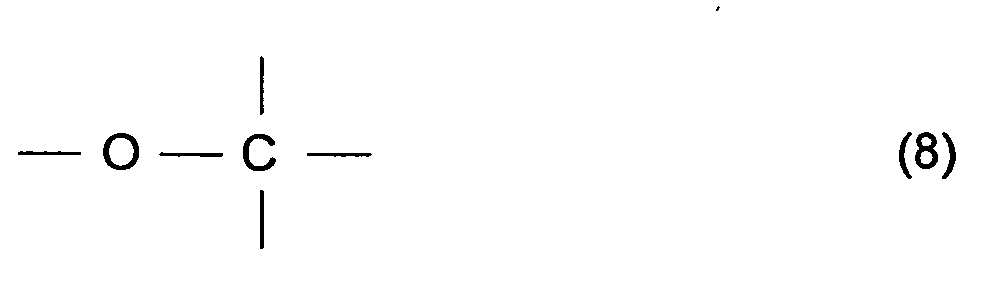
- Y means oxygen containing structural units of the formulae wherein R means hydrogen or C 1 - to C 6 -alkyl.
- Y is a nitrogen containing structural unit, it may in preferred embodiments correspond to the following formulae: wherein
- Y is a nitrogen containing unit it may comprise repetitive nitrogen containing structural units.
- Such units may be represented by the formulae (13) and (14) wherein a and b independently from each other are integers from 1 to 10, and the other symbols have the meaning as indicated above.
- Y is shown in the same direction as represented in formulae (1a) and/or (1b), i. e. the unsaturated residue of the molecule is bonded to Y via the valency shown on the left and the phosphonic acid or salt groups are bonded to the valencies on the right.
- Z is any suitable cation.
- Z is selected from hydrogen, alkali metal, alkaline earth metal, ammonium or organic base cations.
- a particularly preferred compound of formula (1a) corresponds to the formula (15)
- the phosphonates of the invention and the phosphonic acids used as starting material to make them may exist either as the free acid or as their salts. It should be understood that references made here to the acid also pertain to the salts and vice versa where the context makes this possible.
- Polymers and oligomers made from these novel phosphonate monomers, and optionally other comonomers, are particularly useful as oilfield scale inhibitors.
- the phosphonate monomers of the invention may be made by the reaction of ethylenically unsaturated oxiranes (e.g. allylglycidyl ether or glycidyl methacrylate) with hydroxy-functional phosphonic acids (e.g. hydroxyethylidenediphosphonic acid or 2-hydroxyethyliminobismethylenephosphonic acid [monoethanolamine diphosphonate]).
- ethylenically unsaturated oxiranes e.g. allylglycidyl ether or glycidyl methacrylate
- hydroxy-functional phosphonic acids e.g. hydroxyethylidenediphosphonic acid or 2-hydroxyethyliminobismethylenephosphonic acid [monoethanolamine diphosphonate]
- the reaction is preferably carried out in an aqueous medium under mildly alkaline conditions, though the use of organic solvents and/or acidic catalysis is possible.
- the ethylenically unsaturated oxiranes may be relatively sparingly soluble in water, given adequate agitation of the heterogeneous mixture they react readily.
- the product phosphonate monomer may tend to crystallise out during the process if the concentration of the reaction mixture is high. In order to avoid this and to produce a stable monomer solution it is preferred to operate below 50% solids, more typically at 30 - 40 % solids.
- the preferred process temperature is about 75 - 95°C, at which reaction is generally complete in a few hours. Higher reaction temperature under aqueous conditions may lead to reduced yield of the phosphonate monomer, owing to diol formation by reaction of the oxirane with water.
- Another way of making the phosphonate monomers of the invention is to react an amidoalcohol or amidophenol (e.g. N-acetylethanolamine) with an ethylenically unsaturated oxirane (e.g. allyl glycidyl ether) to yield an intermediate, which on hydrolysis gives an amine which can be reacted with formaldehyde and phosphorous acid (Mannich reaction) to give phosphonate monomers.
- an amidoalcohol or amidophenol e.g. N-acetylethanolamine
- an ethylenically unsaturated oxirane e.g. allyl glycidyl ether
- formaldehyde and phosphorous acid e.g. allyl glycidyl ether
- Mannich reaction formaldehyde and phosphorous acid
- Reaction temperature is typically in the range of 100 - 150 °C.
- the hydrolysis and Mannich reaction is usually done under
- a further way of making the phosphonate monomers of the invention is to react ammonia or an amine with an ethylenically unsaturated oxirane to make an unsaturated amino-functional intermediate which can be reacted with formaldehyde and phosphorous acid (Mannich reaction) to give phosphonate monomers.
- Mannich reaction may be taken to minimise the formation of polyunsaturated species (e.g. using a large excess of ammonia or amine).
- the oxirane reaction may be done with or without a solvent, but generally an aqueous medium is preferred, with the reaction temperature between 40 and 100°C for a period of a few hours.
- the Mannich reaction is done as above.
- the phosphonate monomers of the invention may be (co)polymerised by well-known free-radical processes. Typically this can be done in aqueous solution, with watersoluble polymerisation initiators, catalysts, chain transfer agents and comonomers. However, polymerisation in an organic solvent or use of emulsion or suspension type polymerisation processes and the use of water-insoluble reactants is also possible.
- the polymers may be homopolymers of the compounds of formulae (1a) or (1b), or copolymers comprising 2 to less than 100 wt.-% of the structural elements of formulae (1c) or (1d) and up to 98 wt.-% of other monomers.
- monomers besides the compounds of formulae (1a) or (1b) olefinically unsaturated compounds are suitable.
- Preferred olefinically unsaturated compounds are selected from mono- and dicarboxylic acids and their derivatives, such as salts, esters and amides.
- Other preferred olefinically unsaturated compounds are sulphonic acids and their derivatives, such as salts.
- Examples of preferred olefinically unsaturated compounds to form copolymers with the compounds of formulae (1a) or (1b) are acrylic acid and its esters and salts, methacrylic acid and its esters and salts, maleic acid and its esters and salts, fumaric acid and its esters and salts, crotonic acid and its esters and salts, itaconic acid and its esters and salts, mesaconic acid and its esters and salts, citraconic acid and its esters and salts, angelic acid, vinyl acetate, vinyl chloride, vinyl pyridine, vinyl pyrrolidone, acrylamide and its derivatives, 2-acrylamido-2-methylpropane sulphonic acid and its salts, styrene-4-sulphonic acid and its salts, allyl sulphonic acid and its salts, methallylsulphonic acid and its salts, vinyl sulphonic acid and its salts, vinyl phosphonic acid and its salts, dialkylamin
- polymerisation initiators examples include alkali metal and ammonium persulphates, hydrogen peroxide, organic peroxides, azo compounds and redox couples such as persulphate/bisulphite, peroxide/hypophosphite, hydroperoxide/formaldehyde sulphoxylate.
- catalysts which may be used include iron and copper salts.
- chain-transfer reagents which may be used include thiols such as mercaptoacetic acid and mercaptopropionic acid, secondary alcohols such as isopropanol and hypophosphorous acid and its salts.
- the molecular weight of the polymers or oligomers preferably should be in the range from about 1000 - 20000 g/mol, more typically from 1500 - 5000 g/mol. This may be achieved by the well-known means of initiator and chain transfer agent level adjustment.
- the polymers of the invention are suitable as corrosion inhibitors, scale dissolvers, adhesion promoters, detergent builders, deflocculants and dispersants.
- the polymers of the invention are used in concentrations suitable to fulfill their purpose.
- concentration of use is between 1 and 10,000 ppm, more particularly between 3 and 1000 ppm.
- the polymers or oligomers are generally based on compositions using from 2 wt.-% to 100 wt.-% of the phosphonate monomer in the total monomer. More typically 3 wt.-% to 60 wt.-% of the phosphonate monomer is preferred.
- Polymerisation may be conducted by batch, semi-continuous or continuous processes.
- reaction mixture was then cooled and 27.5 g of 37 % hydrochloric acid was added, followed by 88.5 g of 97 % phosphorous acid and 24.5 g of water.
- the mixture was then heated to 93°C and 92.5 g of 34 % formaldehyde solution was added over 30 mins., keeping the temperature at 90 - 95°C. When all the formaldehyde was added the temperature was raised to reflux (105 - 108 °C) for 10 hours.
- reaction mixture was then cooled and 27.5 g of 37 % hydrochloric acid was added, followed by 88.5 g of 97 % phosphorous acid and 24.5 g of water.
- the mixture was then heated to 93°C and 92.5 g of 34 % formaldehyde solution was added over 30 mins., keeping the temperature at 90-95°C. When all the formaldehyde was added the temperature was raised to reflux (105 - 108 °C) for 10 hours.
- reaction mixture was then cooled and 88.5 g of 97 % phosphorous acid and 30 g of water were added.
- the resulting product was a clear, light brown solution at 51 % non-volatiles, pH 2, Brookfield viscosity 62 cP.
- the resulting product has been tested in a series of comparative tests against a number of industry standard scale inhibitors.
- This testing included static and dynamic inhibition tests in a sulphate scaling regime (represented by a 50 : 50 formation water (250 mg/l Barium): seawater (2960 mg/l Sulphate) brine mix), dynamic inhibition performance testing with a carbonate scaling regime (represented by, a self-scaling formation water (2800 mg/l Calcium, 500 mg/l Bicarbonate), a modified static test to evaluate the performance in a sulphide scaling regime and a static adsorption test to evaluate the retention characteristics offered by the polymer.
- a sulphate scaling regime represented by a 50 formation water (250 mg/l Barium): seawater (2960 mg/l Sulphate) brine mix
- dynamic inhibition performance testing with a carbonate scaling regime represented by, a self-scaling formation water (2800 mg/l Calcium, 500 mg/l Bicarbonate
- a modified static test to evaluate the performance in a sulphide
- the polymer demonstrated excellent performance towards sulphate scale in both static and dynamic inhibition tests, offering a higher degree of inhibition efficiency and lower MIC's compared with the industry standards, see Tables 1 and 2. It is also clear that the inclusion of the phosphonate monomer has improved the sulphate inhibition performance under both static and dynamic conditions when compared to the non P containing polymers, see Tables 1 and 2. This is perceived to be due synergistic inhibition gained from the combination of the phosphonate and the maleic and sulphonate functional groups in the polymer. The polymer also demonstrated a reasonable degree of carbonate inhibition in dynamic testing, the results of which are presented in Table 3.
- Table 1 Static inhibition testing of Example 6 under sulphate conditions over 24 hrs; values give Ba efficiency in % Inhibitor Inhibitor Concentration / ppm 5 10 15 DTPMP (comp) 8 20 42 PPCA (comp) 14 17 18 HEMPA (comp) 12 13 15 Maleic acid terpolymer (comp) 8 8 9 PVS copolymer (comp) 8 52 65
- Table 2 Dynamic inhibition testing of Example 6 under sulphate conditions Inhibitor Minimum Inhibitor Concentration / ppm DTPMP (comp) 15 PPCA (comp) 20 HEMPA (comp) >30 Maleic acid terpolymer (comp) 30 PVS copolymer (comp) 30
- Example 6 15 Table 3: Dynamic inhibition testing of Example 6 under carbonate conditions Inhibitor Minimum Inhibitor Concentration / ppm
- Example 6 1 Static inhibition testing of Example 6 under carbonate conditions Inhibitor Minimum Inhibitor Concentration / ppm
- Example 6 1
- Table 4 Static sulphide tolerance testing under sulphide scaling conditions, 100 ppm inhibitor concentration; values indicate turbidity in ntu Inhibitor added sulphide in ppm 10 15 20 25 30 none 250 300 - - - PPCA (comp) 50 120 300 430 480 HEMPA (comp) 90 200 320 400 400 PVS copolymer (comp) 120 280 400 480 480 Maleic acid terpolymer (comp) 30 50 120 300 450 Example 6 90 210 400 420 450 Example 11 30 110 260 420 500
- the resultant polymer has also shown an increase in adsorption onto sandstone core material in static adsorption tests compared with non-P-containing products, see Table 5. This result is to be expected as it is well documented that the inclusion of P-containing groups in polymers via a back bone or a side chain increases the retention of the polymer onto rock surfaces.
- Table 5 Static adsorption of inhibitors on sandstone in mg/g Inhibitor Inhibitor adsorpiton time, hrs 0.5 1 2 4 6 24 VS copolymer (comp) 0 0 0,7 0,5 0,6 0 DTPMP (comp) 6 8 9 10 10.5 10.5 PVS copolymer (comp) 0 0.1 0.2 0.3 0.6 - Example 6 1.5 2.5 2.5 2.8 3.0 3.5
- Example 11 1.5 5.5 7 7 8.5 9.5
- the resultant polymer has demonstrated effective performance against sulphate, carbonate and sulphide scales and a high level of adsorption onto sandstone core.
- the resulting product was a clear, light brown solution at 42 % non-volatiles, pH 3.0, Brookfield viscosity 14 cP.
- Table 6 Static inhibition testing of Example 7 under sulphate conditions over 24 hrs; values indicate the Ba efficiency in % Inhibitor Inhibitor Concentration / ppm 5 10 15 DTPMP (comp) 8 20 42 PPCA (comp) 14 17 18 HEMPA (comp) 12 13 15 Maleic acid terpolymer (comp) 8 8 9 PVS copolymer (comp) 8 52 65
- Example 7 32 50 72 Table 7: Dynamic inhibitor testing of example 7 under sulphate conditions Inhibitor Minimum Inhibitor Concentration / ppm DTPMP (comp) 15 PPCA (comp) 20 HEMPA (comp) >30 Maleic acid terpolymer (comp) 30 PVS copolymer (comp) 30 Example 7 20
- the resultant polymer has also shown a high degree of adsorption onto sandstone core material in static adsorption tests, the results are presented in Table 5.
- the clear, slightly yellow product had a non-volatile content of 19 %, pH 7.7 and Brookfield viscosity of 3 cP.
- the clear, pale brown product had a non-volatile content of 41 %, pH 4.4 and Brookfield viscosity of 99 cP.
- the clear, pale brown product had a non-volatile content of 41 %, pH 3.3 and Brookfield viscosity of 21 cP.
- Example 5 108 g of the solution prepared in Example 5 was copolymerised in aqueous solution with 77 g of sodium allylsulphonate and 65 g of maleic anhydride.
- the resulting product was a clear, light brown solution at 53 % solids, pH 1.3 and Brookfield viscosity 66 cP.
- Table 10 Static inhibition testing of Example 11 under sulphate conditions over 24 hrs; values indicate the Ba efficiency in % Inhibitor Inhibitor Concentration / ppm 5 10 15 DTPMP (comp) 8 20 42 PPCA (comp) 14 17 18 HEMPA (comp) 12 13 15 Maleic acid terpolymer (comp) 8 8 9 PVS copolymer (comp) 8 52 65
- Example 11 12 75 58 Table 11: Dynamic inhibition testing of Example 11 under sulphate conditions Inhibitor Minimum Inhibitor Concentration / ppm DTPMP (comp) 15 PPCA (comp) 20 HEMPA (comp) >30 Maleic acid terpolymer (comp) 30 PVS copolymer (comp) 30 Example 11 25
- the resultant polymer has also shown a high degree of adsorption onto sandstone core material in static adsorption tests, the results are presented in Table 5.
Landscapes
- Chemical & Material Sciences (AREA)
- Organic Chemistry (AREA)
- Life Sciences & Earth Sciences (AREA)
- General Life Sciences & Earth Sciences (AREA)
- Engineering & Computer Science (AREA)
- Materials Engineering (AREA)
- General Chemical & Material Sciences (AREA)
- Chemical Kinetics & Catalysis (AREA)
- Health & Medical Sciences (AREA)
- Hydrology & Water Resources (AREA)
- Molecular Biology (AREA)
- Environmental & Geological Engineering (AREA)
- Water Supply & Treatment (AREA)
- Inorganic Chemistry (AREA)
- General Health & Medical Sciences (AREA)
- Biochemistry (AREA)
- Addition Polymer Or Copolymer, Post-Treatments, Or Chemical Modifications (AREA)
Abstract


R
means H or C1- to C6-alkyl,
X
means a bivalent linking group comprising from one to 12 carbon atoms,
Y
means a linking group comprising at least one carbon atom, and at least one oxygen atom, or at least one nitrogen atom or both and being at least trivalent,
Z
means a cation, and
n
means an integer being two or higher.
Description
- The present invention relates to novel phosphonate monomers, made by the reaction of ethylenically unsaturated substituted oxiranes with amine- or hydroxy-functional phosphonic acids or their precursors. These monomers may be polymerised or copolymerised with other ethylenically unsaturated species to yield phosphonate-functional polymers or oligomers. These polymers or oligomers are of particular use as oilfield scale inhibitors.
- Water from natural sources often contains dissolved minerals, with an appreciable presence of ions such as Ca2+, Mg2+ and, in the case of oilfield formation water, Ba2+, Sr2+ and Ra2+. Under conditions of temperature or pH change, loss of carbon dioxide from solution or admixture with other water containing differing mineral content, relatively insoluble species such as carbonates and sulphates may deposit from solution as scale. In offshore oilfields such deposition may be particularly acute when sulphate-containing seawater, pumped underground to aid oil recovery, comes into contact with the formation water.
- Deposited scale impedes oil recovery and may even become severe enough to block an oilwell. It is therefore a common procedure to treat oilwells with a scale inhibitor to minimise or prevent scale deposition. These scale inhibitors are commonly oligomeric species, made by the free-radical interpolymerisation of monomers such as (meth)acrylic acid, maleic acid and sulphonated species such as 2-acrylamido-2-methylpropanesulphonic acid (AMPS®), allyl and vinyl sulphonic acid.
- In use, a relatively concentrated solution of the scale inhibitor is pumped down the oilwell and flushed out into the formation. From here it leaches back in the produced water, protecting the well and pipework from scaling.
- A careful balance of properties must be achieved. The scale inhibitor must not only control scale, but must also on the one hand have sufficient solubility in the waters at the temperatures it will meet to enable placement in the formation without itself prematurely precipitating from solution, whilst on the other hand it must adsorb strongly enough on the formation rock to give a suitable slow leach rate. If the scale inhibitor does not adsorb strongly enough it will all leach back very quickly and the well will require re-treatment after a short time.
- It is also important that the concentration of scale inhibitor in the produced water can be monitored so that the progress of the leaching can be followed and the well retreated before the scale inhibitor is depleted. Few of the oligomeric scale inhibitors referred to above lend themselves to ready quantitative analysis in produced water at the part-per-million levels involved.
- Phosphorus-containing functional groups have been incorporated into scale inhibiting oligomers either by the use of hypophosphorous acid or its derivatives as telomerising agents (e.g.
US-4 046 707 andUS-6 071 434 ), or by the introduction of phosphorus-containing monomers such as vinyl phosphonic acid or vinylidene diphosphonic acid (e.g.EP-A-0 643 081 ). Such phosphorus functionality both aids the adsorption of the scale inhibitor onto the formation rock and also provides a useful analytical tag, whereby the scale inhibitor concentration can be calculated from an elemental phosphorus analysis. However, it is difficult to incorporate other than very low levels of phosphorus functionality via the telomerising agent route without reducing molecular weight to a performance-impairing level and the adsorption improvement is limited. The above phosphorus-containing monomers are difficult and expensive to make and polymerise, which again limits their level of use and performance improvement. -
US-3 799 893 discloses methylene phosphonates of glycidyl reacted polyalkylene polyamines, said methylene phosphonates of glycidyl reacted polyalkylene polyamines having nitrogen-bonded methylene phosphonate units and nitrogen-bonded glycidyl reacted units, said methylene phosphonates being of the formula
- n
- is 1 - 100,
- A
- is
- m
- is 2 - 10 and
- X
- is hydrogen or alkyl, with the proviso that A is the same or different when n is 2, or more, and
- R°
- is a methylene phosphonate unit, glycidyl reacted unit or hydrogen.
- R1
- is an hydroxyl substituted or nonsubstituted lower alkylene group,
- R2
- is H or lower alkyl group,
- R3
- is a lower alkylene group and
- M
- is H or water soluble cation.
- We have now discovered that ethylenically unsaturated oxiranes will readily react with hydroxy-functional phosphonates to make polymerisable phosphonate monomers. These will copolymerise with other monomers to give particularly useful oilfield scale inhibitors. This benefit stems partly from the possibility of incorporating higher levels of phosphorus functionality (in fact the phosphonate monomer can be the major monomeric component) into the oligomer and partly from the surprisingly favourable adsorption/desorption characteristics which it can impart. We postulate that the latter effect may be associated with the extensive complexing functionality afforded not only by the phosphonate moiety, but also by adjacent ether and hydroxyl groups. The relatively high level of phosphorus incorporation which is possible using these novel monomers also makes the analysis of the produced water for scale inhibitor content straightforward and accurate.
- This invention relates to compounds of formulae (1a) and (1b):
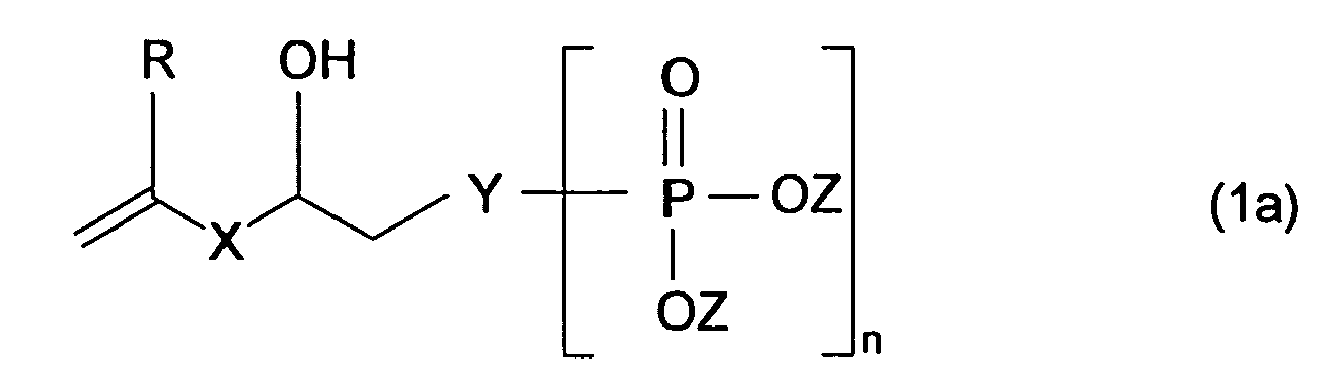

- R
- means H or C1- to C6-alkyl,
- X
- means a bivalent linking group comprising from one to 12 carbon atoms,
- Y
- means a linking group comprising at least one carbon atom, and at least one oxygen atom, or at least one nitrogen atom or both and being at least trivalent,
- Z
- means a cation, and
- n
- means an integer being two or higher.
- This invention further relates to a process of manufacture of the compounds of formulae (1a) and (1b), the process comprising the step of reacting a compound of formula (2)with a compound of formula (3)


- This invention further relates to a process of manufacture of the compounds of formulae (1a) or (1b), the process comprising the steps of reacting a compound of formula (2)

- This invention further relates to a process of manufacture of the compounds of formulae (1a) or (1b), the process comprising the steps of reacting a compound of formula (2)

- This invention further relates to polymers and oligomers, obtainable by free radical homo- or copolymerization of the compounds of formulae (1a) and/or (1b).
- This invention further relates to oligomers and polymers, comprising 2 wt.-% to 100 wt.-% of structural units of the formulae (1c) and/or (1d)


- This invention further relates to a process of inhibiting scale deposition from an aqueous system, the process comprising the step of adding an oligomer or polymer as described above to the aqueous system.
- This invention further relates to the use of oligomers or polymers as described above as scale inhibitors in aqueous systems.
n is preferably an integer from 2 to 80, particularly from 3 to 40, for example 2, 3, 4, 5, 6, 7, 8, 9 or 10. - In a preferred embodiment of the invention X comprises one or more oxygen atoms. In a further preferred embodiment of the invention X means an alkylene, ether or ester group. Particularly preferred are alkylene, ether or ester groups corresponding to the formulae
-(CH2)m- (4)
-(CH2)m-O-(CH2)k- (5)

- In a preferred embodiment of the invention, Y means a hydrocarbon linking group comprising one or more carbon atoms, one or more hydrogen atoms, and heteroatoms selected from at least one oxygen atom, or at least one nitrogen atom, or both. Particularly preferred, Y means oxygen containing structural units of the formulae


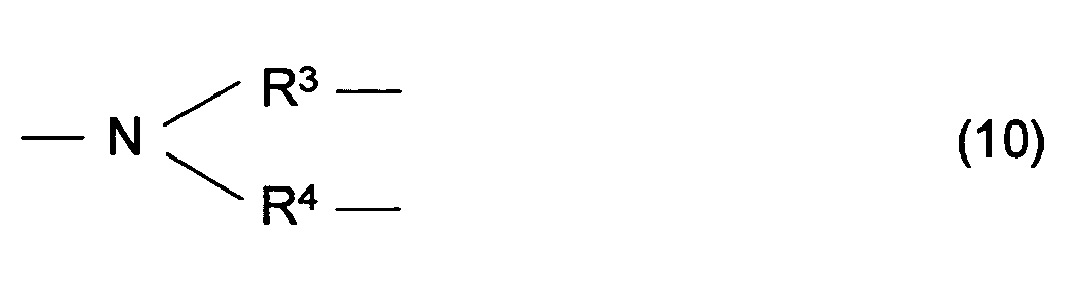
R means hydrogen or C1- to C6-alkyl. - If Y is a nitrogen containing structural unit, it may in preferred embodiments correspond to the following formulae:



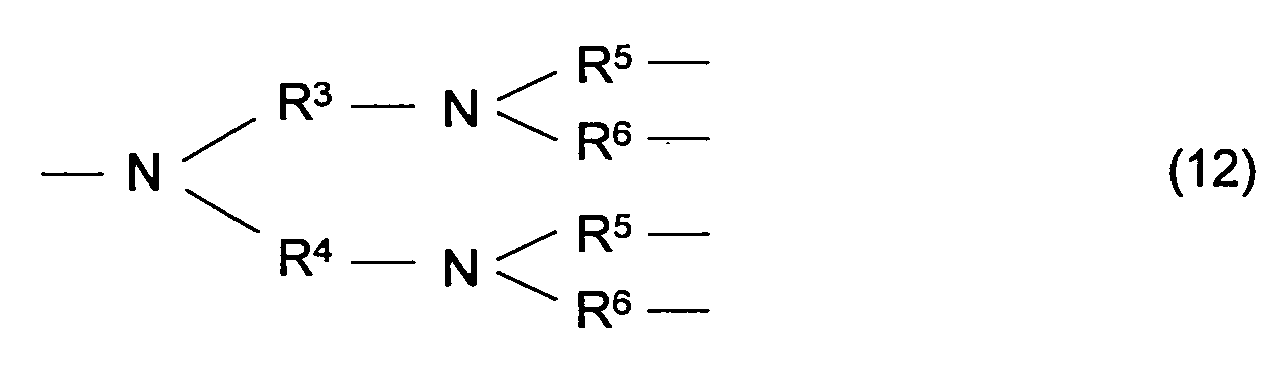
- R2
- means an alkylene or alkylidene group having 1 to 6 carbon atoms or an arylene or alkylarylene group having from 6 to 20 carbon atoms
- R3, R4, R5, R6
- independently from each other mean an alkylene or alkylidene group having 1 to 6 carbon atoms or an arylene or alkylarylene group having from 6 to 20 carbon atoms
- Additionally, if Y is a nitrogen containing unit it may comprise repetitive nitrogen containing structural units. Such units may be represented by the formulae (13) and (14)


- In the formulae (7) to (14), Y is shown in the same direction as represented in formulae (1a) and/or (1b), i. e. the unsaturated residue of the molecule is bonded to Y via the valency shown on the left and the phosphonic acid or salt groups are bonded to the valencies on the right.
- Z is any suitable cation. Preferably, Z is selected from hydrogen, alkali metal, alkaline earth metal, ammonium or organic base cations.
- A particularly preferred compound of formula (1a) corresponds to the formula (15)

- Another particularly preferred compound of formula (1a) corresponds to the formula (16)

- Another particularly preferred compound of formula 1(a) corresponds to the formula (17)

- Another particularly preferred compound of formula 1(a) corresponds to the formula (18)

- Another particularly preferred compound of formula 1(a) corresponds to the formula (19)

- The phosphonates of the invention and the phosphonic acids used as starting material to make them may exist either as the free acid or as their salts. It should be understood that references made here to the acid also pertain to the salts and vice versa where the context makes this possible.
- Polymers and oligomers made from these novel phosphonate monomers, and optionally other comonomers, are particularly useful as oilfield scale inhibitors.
- The phosphonate monomers of the invention may be made by the reaction of ethylenically unsaturated oxiranes (e.g. allylglycidyl ether or glycidyl methacrylate) with hydroxy-functional phosphonic acids (e.g. hydroxyethylidenediphosphonic acid or 2-hydroxyethyliminobismethylenephosphonic acid [monoethanolamine diphosphonate]).
- The reaction is preferably carried out in an aqueous medium under mildly alkaline conditions, though the use of organic solvents and/or acidic catalysis is possible. Although the ethylenically unsaturated oxiranes may be relatively sparingly soluble in water, given adequate agitation of the heterogeneous mixture they react readily. The product phosphonate monomer may tend to crystallise out during the process if the concentration of the reaction mixture is high. In order to avoid this and to produce a stable monomer solution it is preferred to operate below 50% solids, more typically at 30 - 40 % solids. The preferred process temperature is about 75 - 95°C, at which reaction is generally complete in a few hours. Higher reaction temperature under aqueous conditions may lead to reduced yield of the phosphonate monomer, owing to diol formation by reaction of the oxirane with water.
- The following examples illustrate how the compounds of formula (1a) and (1b) can be manufactured.

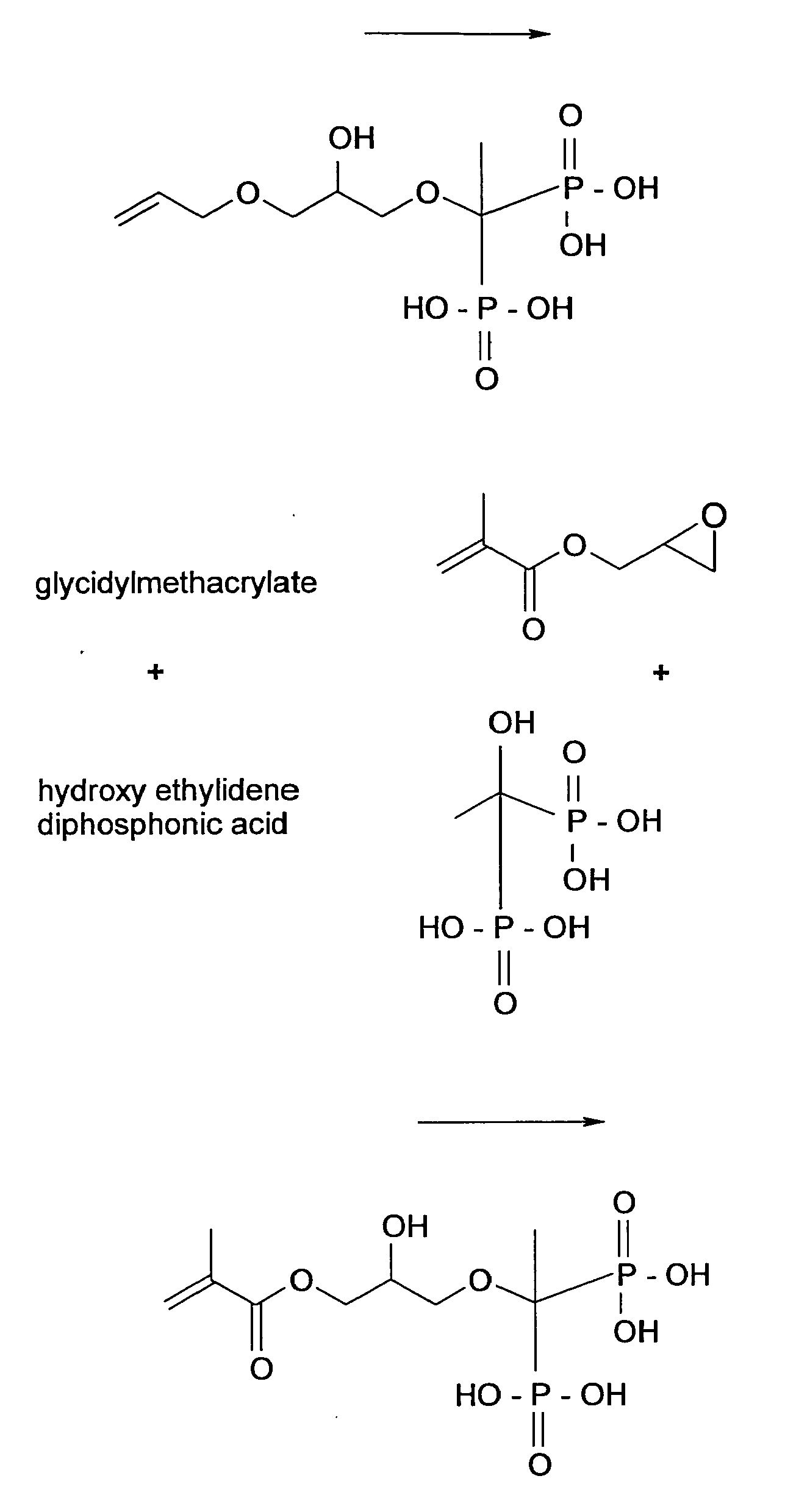
- Any such reaction will result in a mixture of compounds of formulae (1a) and (1b).
- Another way of making the phosphonate monomers of the invention is to react an amidoalcohol or amidophenol (e.g. N-acetylethanolamine) with an ethylenically unsaturated oxirane (e.g. allyl glycidyl ether) to yield an intermediate, which on hydrolysis gives an amine which can be reacted with formaldehyde and phosphorous acid (Mannich reaction) to give phosphonate monomers. Typically the first step of this synthesis is done under anhydrous conditions using a basic catalyst, though again an acid catalyst is feasible. Reaction temperature is typically in the range of 100 - 150 °C. The hydrolysis and Mannich reaction is usually done under aqueous acidic conditions, typically at 80 - 110 °C for several hours. A reaction scheme could look as follows:

- A further way of making the phosphonate monomers of the invention is to react ammonia or an amine with an ethylenically unsaturated oxirane to make an unsaturated amino-functional intermediate which can be reacted with formaldehyde and phosphorous acid (Mannich reaction) to give phosphonate monomers. With this procedure steps may be taken to minimise the formation of polyunsaturated species (e.g. using a large excess of ammonia or amine). The oxirane reaction may be done with or without a solvent, but generally an aqueous medium is preferred, with the reaction temperature between 40 and 100°C for a period of a few hours. The Mannich reaction is done as above.
- The phosphonate monomers of the invention may be (co)polymerised by well-known free-radical processes. Typically this can be done in aqueous solution, with watersoluble polymerisation initiators, catalysts, chain transfer agents and comonomers. However, polymerisation in an organic solvent or use of emulsion or suspension type polymerisation processes and the use of water-insoluble reactants is also possible.
- The polymers may be homopolymers of the compounds of formulae (1a) or (1b), or copolymers comprising 2 to less than 100 wt.-% of the structural elements of formulae (1c) or (1d) and up to 98 wt.-% of other monomers. As monomers besides the compounds of formulae (1a) or (1b) olefinically unsaturated compounds are suitable. Preferred olefinically unsaturated compounds are selected from mono- and dicarboxylic acids and their derivatives, such as salts, esters and amides. Other preferred olefinically unsaturated compounds are sulphonic acids and their derivatives, such as salts.
- Examples of preferred olefinically unsaturated compounds to form copolymers with the compounds of formulae (1a) or (1b) are acrylic acid and its esters and salts, methacrylic acid and its esters and salts, maleic acid and its esters and salts, fumaric acid and its esters and salts, crotonic acid and its esters and salts, itaconic acid and its esters and salts, mesaconic acid and its esters and salts, citraconic acid and its esters and salts, angelic acid, vinyl acetate, vinyl chloride, vinyl pyridine, vinyl pyrrolidone, acrylamide and its derivatives, 2-acrylamido-2-methylpropane sulphonic acid and its salts, styrene-4-sulphonic acid and its salts, allyl sulphonic acid and its salts, methallylsulphonic acid and its salts, vinyl sulphonic acid and its salts, vinyl phosphonic acid and its salts, dialkylaminoacrylates and methacrylates and their quaternary derivatives, diallyldimethylammonium chloride and 3-allyloxy-2-hydroxypropyltrimethylammonium chloride.
- Examples of polymerisation initiators which may be used include alkali metal and ammonium persulphates, hydrogen peroxide, organic peroxides, azo compounds and redox couples such as persulphate/bisulphite, peroxide/hypophosphite, hydroperoxide/formaldehyde sulphoxylate.
- Examples of catalysts which may be used include iron and copper salts.
Examples of chain-transfer reagents which may be used include thiols such as mercaptoacetic acid and mercaptopropionic acid, secondary alcohols such as isopropanol and hypophosphorous acid and its salts. - For the oilfield scale inhibitor application the molecular weight of the polymers or oligomers preferably should be in the range from about 1000 - 20000 g/mol, more typically from 1500 - 5000 g/mol. This may be achieved by the well-known means of initiator and chain transfer agent level adjustment.
- Apart from a use as scale inhibitor, the polymers of the invention are suitable as corrosion inhibitors, scale dissolvers, adhesion promoters, detergent builders, deflocculants and dispersants.
- The polymers of the invention are used in concentrations suitable to fulfill their purpose. In general, the concentration of use is between 1 and 10,000 ppm, more particularly between 3 and 1000 ppm.
- For the oilfield scale inhibitor application the polymers or oligomers are generally based on compositions using from 2 wt.-% to 100 wt.-% of the phosphonate monomer in the total monomer. More typically 3 wt.-% to 60 wt.-% of the phosphonate monomer is preferred.
- Polymerisation may be conducted by batch, semi-continuous or continuous processes.
- The following examples further illustrate the invention:
- 36 g of a 60 % aqueous solution of hydroxyethylidenediphosphonic acid and 40 g of water was placed in a reaction vessel equipped with stirring, reflux condenser and heating and cooling. With stirring and cooling 33.6 g of 50 % sodium hydroxide was added slowly. 11.4 g of allylglycidyl ether was then added and the mixture heated to 80 °C and kept at this temperature for 2 hours, then heated to 95 °C and kept at this temperature for 1 hour. The reaction mixture was then cooled and could be used, without further purification, as a monomer solution.
- If the cooled reaction mixture was extracted with ether (3X) and the combined ether extracts dried and evaporated, a negligible amount of allylglyceryl ether was isolated. If the aqueous solution remaining after ether extraction was dried at 105 °C to constant weight, about 38 g or approximately 88 % of the theoretical quantity of diphosphonate monomer was obtained as a white solid.
- 72 g of a 60 % aqueous solution of 1,1-hydroxyethylidenediphosphonic acid and 160 g of water was placed in a reaction vessel equipped with stirring, reflux condenser and heating and cooling. With stirring and cooling 60 g of 50 % sodium hydroxide was added slowly. 0.015 g of p-methoxyphenol and 28.4 g of glycidyl methacrylate were then added and the mixture heated to 75 °C for 7 hours. A small amount of unreacted glycidyl methacrylate was separated off and the product either isolated as a white, crystalline solid (approx. 70 % yield) or used as the unpurified aqueous solution to make polymers.
- 51.5 g of N-acetylethanolamine and 0.275 g of sodium metal were placed in a reaction vessel equipped with stirring, reflux condenser and heating and cooling. The mixture was heated to 130 °C and when the sodium was fully dissolved 57 g of allyl glycidyl ether was added in small portions over 1 hour. The temperature was kept at 130 - 140 °C throughout the addition and for 1.5 hours after.
- The reaction mixture was then cooled and 27.5 g of 37 % hydrochloric acid was added, followed by 88.5 g of 97 % phosphorous acid and 24.5 g of water. The mixture was then heated to 93°C and 92.5 g of 34 % formaldehyde solution was added over 30 mins., keeping the temperature at 90 - 95°C. When all the formaldehyde was added the temperature was raised to reflux (105 - 108 °C) for 10 hours.
- After cooling 15.5 g of 50 % sodium hydroxide was added. The resulting solution was used without purification to make copolymers.
- 250 g of 0.880 ammonia and 57 g of allyl glycidyl ether were placed in a reaction vessel equipped with stirring, reflux condenser and heating and cooling. A slow reaction ensued, the temperature rising to a peak of 40°C without the application of external heating. Heating was then applied and the mixture refluxed until ammonia was not detected in the exit gas (3 hours approx.).
- The reaction mixture was then cooled and 27.5 g of 37 % hydrochloric acid was added, followed by 88.5 g of 97 % phosphorous acid and 24.5 g of water. The mixture was then heated to 93°C and 92.5 g of 34 % formaldehyde solution was added over 30 mins., keeping the temperature at 90-95°C. When all the formaldehyde was added the temperature was raised to reflux (105 - 108 °C) for 10 hours.
- After cooling 15.5 g of 50 % sodium hydroxide was added. The resulting solution was used without purification to make copolymers.
- 25.75 g of diethylenetriamine and 62.5 g of water were placed in a reaction vessel equipped with stirring, reflux condenser and heating and cooling. With cooling, 49.25 g of 37 % hydrochloric acid was added slowly. The temperature was reduced to 40°C and then 28.5 g of allyl glycidyl ether was added. The mixture was heated to 65 - 70°C for 1 hour, then raised to 95 °C for 1 hour.
- The reaction mixture was then cooled and 88.5 g of 97 % phosphorous acid and 30 g of water were added.
- The mixture was then heated to 93°C and 92.5 g of 34 % formaldehyde solution was added over 30 mins., keeping the temperature at 90 - 95°C. When all the formaldehyde was added the temperature was raised to reflux (105 - 108 °C) for 10 hours.
- After cooling 27.7 g of 50 % sodium hydroxide was added. The resulting solution was used without purification to make copolymers.
- 121 g of the reaction mixture from Example 1 was copolymerised in aqueous solution with 130 g of sodium allylsulphonate and 98 g of maleic anhydride.
- The resulting product was a clear, light brown solution at 51 % non-volatiles, pH 2, Brookfield viscosity 62 cP.
- The resulting product has been tested in a series of comparative tests against a number of industry standard scale inhibitors. This testing included static and dynamic inhibition tests in a sulphate scaling regime (represented by a 50 : 50 formation water (250 mg/l Barium): seawater (2960 mg/l Sulphate) brine mix), dynamic inhibition performance testing with a carbonate scaling regime (represented by, a self-scaling formation water (2800 mg/l Calcium, 500 mg/l Bicarbonate), a modified static test to evaluate the performance in a sulphide scaling regime and a static adsorption test to evaluate the retention characteristics offered by the polymer.
- The polymer demonstrated excellent performance towards sulphate scale in both static and dynamic inhibition tests, offering a higher degree of inhibition efficiency and lower MIC's compared with the industry standards, see Tables 1 and 2. It is also clear that the inclusion of the phosphonate monomer has improved the sulphate inhibition performance under both static and dynamic conditions when compared to the non P containing polymers, see Tables 1 and 2. This is perceived to be due synergistic inhibition gained from the combination of the phosphonate and the maleic and sulphonate functional groups in the polymer. The polymer also demonstrated a reasonable degree of carbonate inhibition in dynamic testing, the results of which are presented in Table 3.
Table 1: Static inhibition testing of Example 6 under sulphate conditions over 24 hrs; values give Ba efficiency in % Inhibitor Inhibitor Concentration / ppm 5 10 15 DTPMP (comp) 8 20 42 PPCA (comp) 14 17 18 HEMPA (comp) 12 13 15 Maleic acid terpolymer (comp) 8 8 9 PVS copolymer (comp) 8 52 65 Example 6 48 82 100 Table 2: Dynamic inhibition testing of Example 6 under sulphate conditions Inhibitor Minimum Inhibitor Concentration / ppm DTPMP (comp) 15 PPCA (comp) 20 HEMPA (comp) >30 Maleic acid terpolymer (comp) 30 PVS copolymer (comp) 30 Example 6 15 Table 3: Dynamic inhibition testing of Example 6 under carbonate conditions Inhibitor Minimum Inhibitor Concentration / ppm Example 6 1 - In static tests the polymer has also shown a degree of inhibition towards iron sulphide scales showing a higher tolerance to sulphide through addition of increasing concentrations of sulphide anion to an iron containing (10ppm) brine mix, the results are presented in Table 4.
Table 4: Static sulphide tolerance testing under sulphide scaling conditions, 100 ppm inhibitor concentration; values indicate turbidity in ntu Inhibitor added sulphide in ppm 10 15 20 25 30 none 250 300 - - - PPCA (comp) 50 120 300 430 480 HEMPA (comp) 90 200 320 400 400 PVS copolymer (comp) 120 280 400 480 480 Maleic acid terpolymer (comp) 30 50 120 300 450 Example 6 90 210 400 420 450 Example 11 30 110 260 420 500 - The resultant polymer has also shown an increase in adsorption onto sandstone core material in static adsorption tests compared with non-P-containing products, see Table 5. This result is to be expected as it is well documented that the inclusion of P-containing groups in polymers via a back bone or a side chain increases the retention of the polymer onto rock surfaces.
Table 5: Static adsorption of inhibitors on sandstone in mg/g Inhibitor Inhibitor adsorpiton time, hrs 0.5 1 2 4 6 24 VS copolymer (comp) 0 0 0,7 0,5 0,6 0 DTPMP (comp) 6 8 9 10 10.5 10.5 PVS copolymer (comp) 0 0.1 0.2 0.3 0.6 - Example 6 1.5 2.5 2.5 2.8 3.0 3.5 Example 7 0 1 3.2 3.2 5 7 Example 11 1.5 5.5 7 7 8.5 9.5 - In the testing performed here the resultant polymer has demonstrated effective performance against sulphate, carbonate and sulphide scales and a high level of adsorption onto sandstone core.
- Preparation of a diphosphonate-functional oligomer with a higher diphosphonate content.
- 242 g of the reaction mixture from Example 1 was copolymerised in aqueous solution with 48 g of sodium allylsulphonate and 49 g of maleic anhydride.
- The resulting product was a clear, light brown solution at 42 % non-volatiles, pH 3.0, Brookfield viscosity 14 cP.
- The resulting product has been tested in a series of comparative tests against a number of industry standard scale inhibitors. This testing included static and dynamic inhibition tests in a sulphate scaling regime (represented by a 50 : 50 formation water (250 mg/l Barium): seawater (2960 mg/l Sulphate) brine mix). In both static and dynamic inhibition tests the polymer demonstrates effective performance against sulphate scales, the results are presented in Tables 6 and 7.
Table 6: Static inhibition testing of Example 7 under sulphate conditions over 24 hrs; values indicate the Ba efficiency in % Inhibitor Inhibitor Concentration / ppm 5 10 15 DTPMP (comp) 8 20 42 PPCA (comp) 14 17 18 HEMPA (comp) 12 13 15 Maleic acid terpolymer (comp) 8 8 9 PVS copolymer (comp) 8 52 65 Example 7 32 50 72 Table 7: Dynamic inhibitor testing of example 7 under sulphate conditions Inhibitor Minimum Inhibitor Concentration / ppm DTPMP (comp) 15 PPCA (comp) 20 HEMPA (comp) >30 Maleic acid terpolymer (comp) 30 PVS copolymer (comp) 30 Example 7 20 - The resultant polymer has also shown a high degree of adsorption onto sandstone core material in static adsorption tests, the results are presented in Table 5.
- 316 g of the product from Example 2 was homopolymerised in aqueous solution.
- The clear, slightly yellow product had a non-volatile content of 19 %, pH 7.7 and Brookfield viscosity of 3 cP.
- 75 g of the solution from Example 3 was copolymerised in aqueous solution with 143 g of acrylic acid.
- The clear, pale brown product had a non-volatile content of 41 %, pH 4.4 and Brookfield viscosity of 99 cP.
- The resultant product has been evaluated in dynamic tests in a carbonate scaling regime (represented by self scaling formation water (2800mg/l Calcium, 500mg/l Bicarbonate)). The polymer demonstrates effective inhibition of carbonate scales with results presented in Table 8.
Table 8: Dynamic inhibition testing of Example 9 under carbonate conditions Inhibitor Minimum Inhibitor Concentration / ppm Example 9 4 - 90 g of the solution from Example 4 was copolymerised in aqueous solution with 72 g of acrylic acid and 65 g of sodium vinyl sulphonate.
- The clear, pale brown product had a non-volatile content of 41 %, pH 3.3 and Brookfield viscosity of 21 cP.
- The resulting product has been tested in dynamic inhibition tests in a sulphate scaling regime (represented by a 50 : 50 formation water (250 mg/l Barium): seawater (2960 mg/l Sulphate) brine mix). In the tests performed here the polymer demonstrates excellent inhibition of sulphate scales, the results are presented in Table 9.
Table 9: Dynamic inhibition testing of Example 10 under sulphate conditions Inhibitor Minimum Inhibitor Concentration / ppm DTPMP (comp) 15 PPCA (comp) 20 HEMPA (comp) >30 Maleic acid terpolymer (comp) 30 PVS copolymer (comp) 30 Example 10 20 - 108 g of the solution prepared in Example 5 was copolymerised in aqueous solution with 77 g of sodium allylsulphonate and 65 g of maleic anhydride.
- The resulting product was a clear, light brown solution at 53 % solids, pH 1.3 and Brookfield viscosity 66 cP.
- The resulting product has been tested in a series of comparative tests against a number of industry standard scale inhibitors. This testing included static and dynamic inhibition tests in a sulphate scaling regime (represented by a 50 : 50 formation water (250 mg/l Barium): seawater (2960 mg/l Sulphate) brine mix). In both static and dynamic inhibition tests the polymer demonstrates effective performance against sulphate scales, the results are presented in Tables 10 and 11.
Table 10: Static inhibition testing of Example 11 under sulphate conditions over 24 hrs; values indicate the Ba efficiency in % Inhibitor Inhibitor Concentration / ppm 5 10 15 DTPMP (comp) 8 20 42 PPCA (comp) 14 17 18 HEMPA (comp) 12 13 15 Maleic acid terpolymer (comp) 8 8 9 PVS copolymer (comp) 8 52 65 Example 11 12 75 58 Table 11: Dynamic inhibition testing of Example 11 under sulphate conditions Inhibitor Minimum Inhibitor Concentration / ppm DTPMP (comp) 15 PPCA (comp) 20 HEMPA (comp) >30 Maleic acid terpolymer (comp) 30 PVS copolymer (comp) 30 Example 11 25 - The resultant polymer has also shown a high degree of adsorption onto sandstone core material in static adsorption tests, the results are presented in Table 5.
-
- DTPMP
- Diethylenetriamine-penta-methylene phosphonic acid disodium salt
- PPCA
- Polyphosphinocarboxylic acid
- HEMPA
- Hydroxyethylamino-di(methylene phosphonic acid)
- PVS
- Polyvinyl sulphonate


Claims (17)
- Compounds of formulae (1a) and (1b)

 R means H or C1- to C6-alkyl,X means a bivalent linking group comprising from one to 12 carbon atoms,Y means a linking group comprising at least one carbon atom, and at least one oxygen atom, or at least one nitrogen atom or both and being at least trivalent,Z means a cation, andn means an integer being two or higher.
 - Compounds according to claim 1, wherein X is an alkylene, ether or ester group.
- Compounds according to claims 1 or 2, wherein X is selected from the formulae
- (CH2)m- (4)
- (CH2)m-O-(CH2)k- (5)

- Compounds according to one or more of claims 1 to 3, wherein X is
- (CH2)-O-(CH2)-
- Compounds according to one or more of claims 1 to 4, wherein Y is a hydrocarbon linking group comprising one or more carbon atoms, one or more hydrogen atoms, and heteroatoms selected from at least one oxygen atom, or at least one nitrogen atom, or both.
- Compounds according to one or more of claims 1 to 5, wherein Y is a structural unit selected from the formulae




 a, b independently from each other are integers from 1 to 10R means hydrogen or C1- to C6-alkylR2 means an alkylene or alkylidene group having 1 to 6 carbon atoms or an arylene or alkylarylene group having from 6 to 20 carbon atomsR3, R4, R5, R6 independently from each other mean an alkylene or alkylidene group having 1 to 6 carbon atoms or an arylene or alkylarylene group having from 6 to 20 carbon atoms
 - Compounds according to one or more of claims 1 to 6, wherein Z is selected from alkali metal, alkaline earth metal, ammonium or organic base cations.
- Compounds according to claim 1 or 7, corresponding to one of the formulae (15) to (19)


- Polymers and oligomers, comprising 2 wt.-% to 100 wt.-% of repetitive structural units of the formulae (1a) and/or (1b)


- Polymers and oligomers according to claim 9, where the monomers copolymerised with the phosphonate monomer according to claims 1 to 8 are selected from the group which consists of acrylic acid and its esters and salts, methacrylic acid and its esters and salts, maleic acid and its esters and salts, fumaric acid and its esters and salts, crotonic acid and its esters and salts, itaconic acid and its esters and salts, mesaconic acid and its esters and salts, citraconic acid and its esters and salts, angelic acid, vinyl acetate, vinyl chloride, vinyl pyridine, vinyl pyrrolidone, acrylamide and its derivatives, 2-acrylamido-2-methylpropane sulphonic acid and its salts, styrene-4-sulphonic acid and its salts, allyl sulphonic acid and its salts, methallylsulphonic acid and its salts, vinyl sulphonic acid and its salts, vinyl phosphonic acid and its salts, dialkylaminoacrylates and methacrylates and their quaternary derivatives, diallyldimethylammonium chloride and 3-allyloxy-2-hydroxypropyltrimethylammonium chloride.
- Polymers and oligomers according to claims 9 or 10, wherein the acid groups are fully or partially neutralised to form salts with one or more cations selected from the group comprising sodium, potassium, calcium, magnesium, aluminum, zinc, ammonium, the cations derived from the amines mono, di or trimethylamine, mono, di or triethylamine, monoethanolamine, diethanolamine, triethanolamine.
- A process of manufacture of the compounds according to one or more of claims 1 to 8, the process comprising the step of reacting a compound of formula 2

 R means H or C1- to C6-alkyl,X means a bivalent linking group comprising from one to 12 carbon atoms,Y means a linking group comprising at least one carbon atom, and at least one oxygen atom, or at least one nitrogen atom or both and being at least trivalent,Z means a cation, andn means an integer being two or higher.
 - A process according to claim 12, whereby allyl glycidyl ether is reacted with hydroxyethylidenediphosphonic acid or its salts.
- A process of inhibiting scale deposition from an aqueous system, the process comprising the step of adding an oligomer or polymer according to one or more of claims 9, 10 or 11 in the aqueous system.
- A process according to claim 14, wherein the aqueous system is the formation water associated with an oilwell and/or the water injected into an oilwell to aid oil recovery.
- A process according to claim 14 or 15, wherein the scale comprises the carbonates and or sulphates of one or more of the group comprising calcium, magnesium, barium, strontium, radium, iron.
- A process according to one or more of claims 14 to 16, wherein the scale inhibitor is used in an oilfield squeeze treatment.
Priority Applications (9)
| Application Number | Priority Date | Filing Date | Title |
|---|---|---|---|
| EP08018433A EP2180004B1 (en) | 2008-10-22 | 2008-10-22 | Olefinically unsaturated phosphonate compounds, polymers made therefrom and their use |
| AT08018433T ATE509936T1 (en) | 2008-10-22 | 2008-10-22 | OLEFINICALLY UNSATURATED PHOSPHONATE COMPOUNDS, POLYMERS PRODUCED THEREFROM AND THE USE THEREOF |
| ES08018433T ES2366758T3 (en) | 2008-10-22 | 2008-10-22 | OLEFINICALLY INSATURED PHOSPHONATE COMPOUNDS, POLYMERS MANUFACTURED FROM THEM, AND ITS USE. |
| DK08018433.6T DK2180004T3 (en) | 2008-10-22 | 2008-10-22 | Olefinically unsaturated phosphonate compounds, polymers prepared therefrom and their use |
| CN200980122024.1A CN102066389B (en) | 2008-10-22 | 2009-10-06 | Olefinically unsaturated phosphonate compounds, polymers made therefrom and their use |
| PCT/EP2009/007146 WO2010046026A1 (en) | 2008-10-22 | 2009-10-06 | Olefinically unsaturated phosphonate compounds, polymers made therefrom and their use |
| CA2741348A CA2741348C (en) | 2008-10-22 | 2009-10-06 | Olefinically unsaturated phosphonate compounds, polymers made therefrom and their use |
| US13/125,074 US9187503B2 (en) | 2008-10-22 | 2009-10-06 | Olefinically unsaturated phosphonate compounds, polymers made therefrom and their use |
| BRPI0919751-6A BRPI0919751B1 (en) | 2008-10-22 | 2009-10-06 | ELEPHINICALLY UNSATURATED PHOSPHONATE COMPOUNDS, POLYMERS OBTAINED FROM THE SAME AND USE OF THE SAME. |
Applications Claiming Priority (1)
| Application Number | Priority Date | Filing Date | Title |
|---|---|---|---|
| EP08018433A EP2180004B1 (en) | 2008-10-22 | 2008-10-22 | Olefinically unsaturated phosphonate compounds, polymers made therefrom and their use |
Publications (2)
| Publication Number | Publication Date |
|---|---|
| EP2180004A1 true EP2180004A1 (en) | 2010-04-28 |
| EP2180004B1 EP2180004B1 (en) | 2011-05-18 |
Family
ID=40090391
Family Applications (1)
| Application Number | Title | Priority Date | Filing Date |
|---|---|---|---|
| EP08018433A Active EP2180004B1 (en) | 2008-10-22 | 2008-10-22 | Olefinically unsaturated phosphonate compounds, polymers made therefrom and their use |
Country Status (9)
| Country | Link |
|---|---|
| US (1) | US9187503B2 (en) |
| EP (1) | EP2180004B1 (en) |
| CN (1) | CN102066389B (en) |
| AT (1) | ATE509936T1 (en) |
| BR (1) | BRPI0919751B1 (en) |
| CA (1) | CA2741348C (en) |
| DK (1) | DK2180004T3 (en) |
| ES (1) | ES2366758T3 (en) |
| WO (1) | WO2010046026A1 (en) |
Cited By (12)
| Publication number | Priority date | Publication date | Assignee | Title |
|---|---|---|---|---|
| WO2011062965A3 (en) * | 2009-11-18 | 2011-09-15 | University Of Washington Through Its Center For Commercialization | Targeting monomers and polymers having targeting blocks |
| US8822213B2 (en) | 2008-11-06 | 2014-09-02 | University Of Washington | Bispecific intracellular delivery vehicles |
| JP2014534277A (en) * | 2011-09-23 | 2014-12-18 | スパゴ イメージング アクチエボラグSpago Imaging Ab | New manganese-containing nanostructures |
| US9006193B2 (en) | 2008-05-13 | 2015-04-14 | University Of Washington | Polymeric carrier |
| US9211250B2 (en) | 2008-08-22 | 2015-12-15 | University Of Washington | Heterogeneous polymeric micelles for intracellular delivery |
| US9339558B2 (en) | 2008-05-13 | 2016-05-17 | University Of Washington | Micellic assemblies |
| US9464300B2 (en) | 2008-11-06 | 2016-10-11 | University Of Washington | Multiblock copolymers |
| US9476063B2 (en) | 2008-05-13 | 2016-10-25 | University Of Washington | Diblock copolymers and polynucleotide complexes thereof for delivery into cells |
| US9593169B2 (en) | 2008-12-08 | 2017-03-14 | University Of Washington | Omega-functionalized polymers, junction-functionalized block copolymers, polymer bioconjugates, and radical chain extension polymerization |
| US10646582B2 (en) | 2013-07-30 | 2020-05-12 | Genevant Sciences Gmbh | Block copolymers |
| US11219634B2 (en) | 2015-01-21 | 2022-01-11 | Genevant Sciences Gmbh | Methods, compositions, and systems for delivering therapeutic and diagnostic agents into cells |
| US11684584B2 (en) | 2016-12-30 | 2023-06-27 | Genevant Sciences Gmbh | Branched peg molecules and related compositions and methods |
Families Citing this family (7)
| Publication number | Priority date | Publication date | Assignee | Title |
|---|---|---|---|---|
| EP2650314A1 (en) * | 2012-04-13 | 2013-10-16 | Clariant International Ltd. | Process for inhibition of sulphide scales |
| ES2861649T3 (en) * | 2016-10-27 | 2021-10-06 | Biomedical Bonding Ab | A composition comprising compounds containing thiol, alkene and phosphonic acid for use as a primer to improve adhesion |
| JP6921580B2 (en) * | 2017-03-30 | 2021-08-18 | 株式会社日本触媒 | Water-soluble polymer |
| CN113471538B (en) * | 2021-08-18 | 2022-12-06 | 中节能万润股份有限公司 | Lithium ion battery nonaqueous electrolyte additive and application thereof |
| CN114806524B (en) * | 2022-04-08 | 2024-06-14 | 西南石油大学 | Scale inhibitor for oilfield squeezing process and preparation method thereof, and kit for oilfield squeezing process and application thereof |
| WO2025065547A1 (en) * | 2023-09-28 | 2025-04-03 | Saudi Arabian Oil Company | Phosphonate-tagged polymeric scale inhibitors and methods for production and use thereof |
| CN118599505B (en) * | 2024-08-09 | 2024-11-22 | 克拉玛依市金鑫科技有限公司 | Degradable oil-based coring sealing fluid |
Citations (6)
| Publication number | Priority date | Publication date | Assignee | Title |
|---|---|---|---|---|
| US3799893A (en) | 1971-03-31 | 1974-03-26 | Petrolite Corp | Methylene phosphonates of glycidyl reacted polyamines |
| US3867286A (en) * | 1972-03-24 | 1975-02-18 | Petrolite Corp | Use of polyquaternary ammonium methylene phosphonates to chelate or inhibit formation of scale |
| US4046707A (en) | 1974-06-11 | 1977-09-06 | Ciba Geigy (Uk) Limited | Treatment of aqueous systems |
| US4851490A (en) | 1983-10-26 | 1989-07-25 | Betz Laboratories, Inc. | Water soluble phosphonated polymers |
| EP0643081A1 (en) | 1993-09-10 | 1995-03-15 | Hoechst Aktiengesellschaft | Polymers of vinylsulfonic acid |
| US6071434A (en) | 1997-02-26 | 2000-06-06 | Albright & Wilson Uk Limited | Phosphino derivatives |
Family Cites Families (3)
| Publication number | Priority date | Publication date | Assignee | Title |
|---|---|---|---|---|
| US2867286A (en) | 1956-04-23 | 1959-01-06 | Cottrell Res Inc | Discharge electrode tensioning means |
| CN1050586C (en) * | 1995-08-30 | 2000-03-22 | 化学工业部天津化工研究院 | Phosphinic sulfoacid carboxylic acid multicomponent copolymer and its synthetic method |
| JPH10140192A (en) * | 1996-11-05 | 1998-05-26 | Hoechst Ind Kk | Bleaching solution containing hydrogen peroxide and bleaching method therewith |
-
2008
- 2008-10-22 EP EP08018433A patent/EP2180004B1/en active Active
- 2008-10-22 AT AT08018433T patent/ATE509936T1/en active
- 2008-10-22 ES ES08018433T patent/ES2366758T3/en active Active
- 2008-10-22 DK DK08018433.6T patent/DK2180004T3/en active
-
2009
- 2009-10-06 US US13/125,074 patent/US9187503B2/en active Active
- 2009-10-06 CA CA2741348A patent/CA2741348C/en active Active
- 2009-10-06 BR BRPI0919751-6A patent/BRPI0919751B1/en active IP Right Grant
- 2009-10-06 WO PCT/EP2009/007146 patent/WO2010046026A1/en not_active Ceased
- 2009-10-06 CN CN200980122024.1A patent/CN102066389B/en not_active Expired - Fee Related
Patent Citations (6)
| Publication number | Priority date | Publication date | Assignee | Title |
|---|---|---|---|---|
| US3799893A (en) | 1971-03-31 | 1974-03-26 | Petrolite Corp | Methylene phosphonates of glycidyl reacted polyamines |
| US3867286A (en) * | 1972-03-24 | 1975-02-18 | Petrolite Corp | Use of polyquaternary ammonium methylene phosphonates to chelate or inhibit formation of scale |
| US4046707A (en) | 1974-06-11 | 1977-09-06 | Ciba Geigy (Uk) Limited | Treatment of aqueous systems |
| US4851490A (en) | 1983-10-26 | 1989-07-25 | Betz Laboratories, Inc. | Water soluble phosphonated polymers |
| EP0643081A1 (en) | 1993-09-10 | 1995-03-15 | Hoechst Aktiengesellschaft | Polymers of vinylsulfonic acid |
| US6071434A (en) | 1997-02-26 | 2000-06-06 | Albright & Wilson Uk Limited | Phosphino derivatives |
Non-Patent Citations (2)
| Title |
|---|
| ADUSEI ET AL., J. OF APPLIED POLYMER SCIENCE, vol. 88, 2003, pages 565 - 569 |
| ADUSEI ET AL: "Polymerization Behavior of an Organophosphorus Monomer for Use in Dental Restorative Materials", JOURNAL OF APPLIED POLYMER SCIENCE, vol. 88, 2003, pages 565 - 569, XP002519798 * |
Cited By (20)
| Publication number | Priority date | Publication date | Assignee | Title |
|---|---|---|---|---|
| US9662403B2 (en) | 2008-05-13 | 2017-05-30 | University Of Washington | Micellic assemblies |
| US11707483B2 (en) | 2008-05-13 | 2023-07-25 | University Of Washington | Micellic assemblies |
| US9006193B2 (en) | 2008-05-13 | 2015-04-14 | University Of Washington | Polymeric carrier |
| US9339558B2 (en) | 2008-05-13 | 2016-05-17 | University Of Washington | Micellic assemblies |
| US10420790B2 (en) | 2008-05-13 | 2019-09-24 | University Of Washington | Micellic assemblies |
| US9476063B2 (en) | 2008-05-13 | 2016-10-25 | University Of Washington | Diblock copolymers and polynucleotide complexes thereof for delivery into cells |
| US9862792B2 (en) | 2008-05-13 | 2018-01-09 | University Of Washington | Diblock copolymers and polynucleotide complexes thereof for delivery into cells |
| US9211250B2 (en) | 2008-08-22 | 2015-12-15 | University Of Washington | Heterogeneous polymeric micelles for intracellular delivery |
| US8822213B2 (en) | 2008-11-06 | 2014-09-02 | University Of Washington | Bispecific intracellular delivery vehicles |
| US9220791B2 (en) | 2008-11-06 | 2015-12-29 | University Of Washington | Bispecific intracellular delivery vehicles |
| US9464300B2 (en) | 2008-11-06 | 2016-10-11 | University Of Washington | Multiblock copolymers |
| US9593169B2 (en) | 2008-12-08 | 2017-03-14 | University Of Washington | Omega-functionalized polymers, junction-functionalized block copolymers, polymer bioconjugates, and radical chain extension polymerization |
| US10066043B2 (en) | 2008-12-08 | 2018-09-04 | University Of Washington | ω-functionalized polymers, junction-functionalized block copolymers, polymer bioconjugates, and radical chain extension polymerization |
| WO2011062965A3 (en) * | 2009-11-18 | 2011-09-15 | University Of Washington Through Its Center For Commercialization | Targeting monomers and polymers having targeting blocks |
| US9415113B2 (en) | 2009-11-18 | 2016-08-16 | University Of Washington | Targeting monomers and polymers having targeting blocks |
| JP2014534277A (en) * | 2011-09-23 | 2014-12-18 | スパゴ イメージング アクチエボラグSpago Imaging Ab | New manganese-containing nanostructures |
| US10646582B2 (en) | 2013-07-30 | 2020-05-12 | Genevant Sciences Gmbh | Block copolymers |
| US11938191B2 (en) | 2013-07-30 | 2024-03-26 | Genevant Sciences Gmbh | Block copolymers |
| US11219634B2 (en) | 2015-01-21 | 2022-01-11 | Genevant Sciences Gmbh | Methods, compositions, and systems for delivering therapeutic and diagnostic agents into cells |
| US11684584B2 (en) | 2016-12-30 | 2023-06-27 | Genevant Sciences Gmbh | Branched peg molecules and related compositions and methods |
Also Published As
| Publication number | Publication date |
|---|---|
| ES2366758T3 (en) | 2011-10-25 |
| EP2180004B1 (en) | 2011-05-18 |
| US20110195876A1 (en) | 2011-08-11 |
| CA2741348A1 (en) | 2010-04-29 |
| DK2180004T3 (en) | 2011-09-05 |
| ATE509936T1 (en) | 2011-06-15 |
| CN102066389B (en) | 2014-06-04 |
| BRPI0919751B1 (en) | 2019-04-16 |
| CN102066389A (en) | 2011-05-18 |
| CA2741348C (en) | 2016-09-27 |
| WO2010046026A1 (en) | 2010-04-29 |
| US9187503B2 (en) | 2015-11-17 |
| BRPI0919751A2 (en) | 2018-12-26 |
Similar Documents
| Publication | Publication Date | Title |
|---|---|---|
| EP2180004B1 (en) | Olefinically unsaturated phosphonate compounds, polymers made therefrom and their use | |
| JP3225213B2 (en) | Phosphonated oligomers of maleic acid | |
| EP0861846B1 (en) | Novel phosphino derivatives | |
| EP0516346B1 (en) | Telomers | |
| CA1239742A (en) | Carboxylic/sulfonic/polyalkylene oxide polymer for use as scale, corrosion, and iron oxide deposit control | |
| EP1254144B2 (en) | Novel phosphorus compounds | |
| US20040039144A1 (en) | Water soluble copolymers prepared using phosphorus containing chain transfer agents | |
| US4435556A (en) | Method of making and using novel scale inhibiting terpolymer | |
| US5167828A (en) | Phosphinate-containing polymers for controlling scale in underground petroleum-containing formations and equipment associated therewith | |
| GB2254615A (en) | Aminoalkylphosphinates and phosphinic acid - containing polymers therefrom | |
| AU2009207667B2 (en) | Method of water treatment | |
| US4432884A (en) | Scale inhibiting agent | |
| US4980433A (en) | Novel amine-containing copolymers and their use | |
| US4913880A (en) | Novel amine-containing copolymers and their use | |
| US4906383A (en) | Novel amine-containing copolymers and their use | |
| EP0681995A2 (en) | Scale inhibition process | |
| EP0172154B1 (en) | Inhibition of scale formation with a maleate polymer | |
| EP0297049B1 (en) | Scale inhibition | |
| US4898684A (en) | Novel amine-containing copolymers and their use | |
| EP1578818B1 (en) | Biodegradable polymers | |
| US4851490A (en) | Water soluble phosphonated polymers | |
| US4868263A (en) | Novel amine-containing copolymers and their use | |
| NO842458L (en) | NEW DICYCLOPENTADIEN DERIVATIVES, AND PROCEDURE FOR AA HOME EXPOSURE OF METAL IONS THROUGH THESE. | |
| CA1338161C (en) | Amine-containing copolymers and their use | |
| AU613925B2 (en) | Scale inhibition |
Legal Events
| Date | Code | Title | Description |
|---|---|---|---|
| PUAI | Public reference made under article 153(3) epc to a published international application that has entered the european phase |
Free format text: ORIGINAL CODE: 0009012 |
|
| 17P | Request for examination filed |
Effective date: 20090516 |
|
| AK | Designated contracting states |
Kind code of ref document: A1 Designated state(s): AT BE BG CH CY CZ DE DK EE ES FI FR GB GR HR HU IE IS IT LI LT LU LV MC MT NL NO PL PT RO SE SI SK TR |
|
| AX | Request for extension of the european patent |
Extension state: AL BA MK RS |
|
| RAP1 | Party data changed (applicant data changed or rights of an application transferred) |
Owner name: CLARIANT FINANCE (BVI) LIMITED |
|
| AKX | Designation fees paid |
Designated state(s): AT BE BG CH CY CZ DE DK EE ES FI FR GB GR HR HU IE IS IT LI LT LU LV MC MT NL NO PL PT RO SE SI SK TR |
|
| GRAP | Despatch of communication of intention to grant a patent |
Free format text: ORIGINAL CODE: EPIDOSNIGR1 |
|
| RIN1 | Information on inventor provided before grant (corrected) |
Inventor name: HEATH, STEVE Inventor name: ARCHIBALD, MARC Inventor name: MOIR, GORDON Inventor name: GOULDING, JOHN |
|
| GRAS | Grant fee paid |
Free format text: ORIGINAL CODE: EPIDOSNIGR3 |
|
| GRAA | (expected) grant |
Free format text: ORIGINAL CODE: 0009210 |
|
| REG | Reference to a national code |
Ref country code: GB Ref legal event code: FG4D |
|
| REG | Reference to a national code |
Ref country code: CH Ref legal event code: EP |
|
| REG | Reference to a national code |
Ref country code: IE Ref legal event code: FG4D |
|
| REG | Reference to a national code |
Ref country code: DE Ref legal event code: R096 Ref document number: 602008007063 Country of ref document: DE Effective date: 20110630 |
|
| REG | Reference to a national code |
Ref country code: SE Ref legal event code: TRGR |
|
| REG | Reference to a national code |
Ref country code: NL Ref legal event code: T3 |
|
| REG | Reference to a national code |
Ref country code: DK Ref legal event code: T3 |
|
| REG | Reference to a national code |
Ref country code: NO Ref legal event code: T2 Effective date: 20110518 |
|
| REG | Reference to a national code |
Ref country code: ES Ref legal event code: FG2A Ref document number: 2366758 Country of ref document: ES Kind code of ref document: T3 Effective date: 20111025 |
|
| PG25 | Lapsed in a contracting state [announced via postgrant information from national office to epo] |
Ref country code: LT Free format text: LAPSE BECAUSE OF FAILURE TO SUBMIT A TRANSLATION OF THE DESCRIPTION OR TO PAY THE FEE WITHIN THE PRESCRIBED TIME-LIMIT Effective date: 20110518 Ref country code: PT Free format text: LAPSE BECAUSE OF FAILURE TO SUBMIT A TRANSLATION OF THE DESCRIPTION OR TO PAY THE FEE WITHIN THE PRESCRIBED TIME-LIMIT Effective date: 20110919 Ref country code: HR Free format text: LAPSE BECAUSE OF FAILURE TO SUBMIT A TRANSLATION OF THE DESCRIPTION OR TO PAY THE FEE WITHIN THE PRESCRIBED TIME-LIMIT Effective date: 20110518 |
|
| PG25 | Lapsed in a contracting state [announced via postgrant information from national office to epo] |
Ref country code: IS Free format text: LAPSE BECAUSE OF FAILURE TO SUBMIT A TRANSLATION OF THE DESCRIPTION OR TO PAY THE FEE WITHIN THE PRESCRIBED TIME-LIMIT Effective date: 20110918 Ref country code: BE Free format text: LAPSE BECAUSE OF FAILURE TO SUBMIT A TRANSLATION OF THE DESCRIPTION OR TO PAY THE FEE WITHIN THE PRESCRIBED TIME-LIMIT Effective date: 20110518 Ref country code: FI Free format text: LAPSE BECAUSE OF FAILURE TO SUBMIT A TRANSLATION OF THE DESCRIPTION OR TO PAY THE FEE WITHIN THE PRESCRIBED TIME-LIMIT Effective date: 20110518 Ref country code: GR Free format text: LAPSE BECAUSE OF FAILURE TO SUBMIT A TRANSLATION OF THE DESCRIPTION OR TO PAY THE FEE WITHIN THE PRESCRIBED TIME-LIMIT Effective date: 20110819 Ref country code: CY Free format text: LAPSE BECAUSE OF FAILURE TO SUBMIT A TRANSLATION OF THE DESCRIPTION OR TO PAY THE FEE WITHIN THE PRESCRIBED TIME-LIMIT Effective date: 20110518 Ref country code: LV Free format text: LAPSE BECAUSE OF FAILURE TO SUBMIT A TRANSLATION OF THE DESCRIPTION OR TO PAY THE FEE WITHIN THE PRESCRIBED TIME-LIMIT Effective date: 20110518 Ref country code: SI Free format text: LAPSE BECAUSE OF FAILURE TO SUBMIT A TRANSLATION OF THE DESCRIPTION OR TO PAY THE FEE WITHIN THE PRESCRIBED TIME-LIMIT Effective date: 20110518 |
|
| PG25 | Lapsed in a contracting state [announced via postgrant information from national office to epo] |
Ref country code: CZ Free format text: LAPSE BECAUSE OF FAILURE TO SUBMIT A TRANSLATION OF THE DESCRIPTION OR TO PAY THE FEE WITHIN THE PRESCRIBED TIME-LIMIT Effective date: 20110518 Ref country code: EE Free format text: LAPSE BECAUSE OF FAILURE TO SUBMIT A TRANSLATION OF THE DESCRIPTION OR TO PAY THE FEE WITHIN THE PRESCRIBED TIME-LIMIT Effective date: 20110518 |
|
| PG25 | Lapsed in a contracting state [announced via postgrant information from national office to epo] |
Ref country code: RO Free format text: LAPSE BECAUSE OF FAILURE TO SUBMIT A TRANSLATION OF THE DESCRIPTION OR TO PAY THE FEE WITHIN THE PRESCRIBED TIME-LIMIT Effective date: 20110518 Ref country code: PL Free format text: LAPSE BECAUSE OF FAILURE TO SUBMIT A TRANSLATION OF THE DESCRIPTION OR TO PAY THE FEE WITHIN THE PRESCRIBED TIME-LIMIT Effective date: 20110518 Ref country code: SK Free format text: LAPSE BECAUSE OF FAILURE TO SUBMIT A TRANSLATION OF THE DESCRIPTION OR TO PAY THE FEE WITHIN THE PRESCRIBED TIME-LIMIT Effective date: 20110518 |
|
| PLBE | No opposition filed within time limit |
Free format text: ORIGINAL CODE: 0009261 |
|
| STAA | Information on the status of an ep patent application or granted ep patent |
Free format text: STATUS: NO OPPOSITION FILED WITHIN TIME LIMIT |
|
| 26N | No opposition filed |
Effective date: 20120221 |
|
| PG25 | Lapsed in a contracting state [announced via postgrant information from national office to epo] |
Ref country code: MC Free format text: LAPSE BECAUSE OF NON-PAYMENT OF DUE FEES Effective date: 20111031 |
|
| REG | Reference to a national code |
Ref country code: DE Ref legal event code: R097 Ref document number: 602008007063 Country of ref document: DE Effective date: 20120221 |
|
| REG | Reference to a national code |
Ref country code: IE Ref legal event code: MM4A |
|
| PG25 | Lapsed in a contracting state [announced via postgrant information from national office to epo] |
Ref country code: IE Free format text: LAPSE BECAUSE OF NON-PAYMENT OF DUE FEES Effective date: 20111022 |
|
| PG25 | Lapsed in a contracting state [announced via postgrant information from national office to epo] |
Ref country code: MT Free format text: LAPSE BECAUSE OF FAILURE TO SUBMIT A TRANSLATION OF THE DESCRIPTION OR TO PAY THE FEE WITHIN THE PRESCRIBED TIME-LIMIT Effective date: 20110518 |
|
| PG25 | Lapsed in a contracting state [announced via postgrant information from national office to epo] |
Ref country code: LU Free format text: LAPSE BECAUSE OF NON-PAYMENT OF DUE FEES Effective date: 20111022 |
|
| PG25 | Lapsed in a contracting state [announced via postgrant information from national office to epo] |
Ref country code: BG Free format text: LAPSE BECAUSE OF FAILURE TO SUBMIT A TRANSLATION OF THE DESCRIPTION OR TO PAY THE FEE WITHIN THE PRESCRIBED TIME-LIMIT Effective date: 20110818 |
|
| PG25 | Lapsed in a contracting state [announced via postgrant information from national office to epo] |
Ref country code: HU Free format text: LAPSE BECAUSE OF FAILURE TO SUBMIT A TRANSLATION OF THE DESCRIPTION OR TO PAY THE FEE WITHIN THE PRESCRIBED TIME-LIMIT Effective date: 20110518 |
|
| PGFP | Annual fee paid to national office [announced via postgrant information from national office to epo] |
Ref country code: CH Payment date: 20140904 Year of fee payment: 7 |
|
| PGFP | Annual fee paid to national office [announced via postgrant information from national office to epo] |
Ref country code: ES Payment date: 20140915 Year of fee payment: 7 Ref country code: SE Payment date: 20140820 Year of fee payment: 7 |
|
| PGFP | Annual fee paid to national office [announced via postgrant information from national office to epo] |
Ref country code: TR Payment date: 20141013 Year of fee payment: 7 Ref country code: FR Payment date: 20140910 Year of fee payment: 7 Ref country code: DE Payment date: 20140825 Year of fee payment: 7 |
|
| PGFP | Annual fee paid to national office [announced via postgrant information from national office to epo] |
Ref country code: AT Payment date: 20140820 Year of fee payment: 7 |
|
| PGFP | Annual fee paid to national office [announced via postgrant information from national office to epo] |
Ref country code: IT Payment date: 20140826 Year of fee payment: 7 |
|
| REG | Reference to a national code |
Ref country code: DE Ref legal event code: R119 Ref document number: 602008007063 Country of ref document: DE |
|
| REG | Reference to a national code |
Ref country code: SE Ref legal event code: EUG Ref country code: CH Ref legal event code: PL |
|
| REG | Reference to a national code |
Ref country code: AT Ref legal event code: MM01 Ref document number: 509936 Country of ref document: AT Kind code of ref document: T Effective date: 20151022 |
|
| PG25 | Lapsed in a contracting state [announced via postgrant information from national office to epo] |
Ref country code: IT Free format text: LAPSE BECAUSE OF NON-PAYMENT OF DUE FEES Effective date: 20151022 Ref country code: DE Free format text: LAPSE BECAUSE OF NON-PAYMENT OF DUE FEES Effective date: 20160503 Ref country code: LI Free format text: LAPSE BECAUSE OF NON-PAYMENT OF DUE FEES Effective date: 20151031 Ref country code: CH Free format text: LAPSE BECAUSE OF NON-PAYMENT OF DUE FEES Effective date: 20151031 |
|
| REG | Reference to a national code |
Ref country code: FR Ref legal event code: ST Effective date: 20160630 |
|
| PG25 | Lapsed in a contracting state [announced via postgrant information from national office to epo] |
Ref country code: FR Free format text: LAPSE BECAUSE OF NON-PAYMENT OF DUE FEES Effective date: 20151102 Ref country code: AT Free format text: LAPSE BECAUSE OF NON-PAYMENT OF DUE FEES Effective date: 20151022 Ref country code: SE Free format text: LAPSE BECAUSE OF NON-PAYMENT OF DUE FEES Effective date: 20151023 |
|
| PGFP | Annual fee paid to national office [announced via postgrant information from national office to epo] |
Ref country code: NL Payment date: 20160822 Year of fee payment: 9 |
|
| PG25 | Lapsed in a contracting state [announced via postgrant information from national office to epo] |
Ref country code: ES Free format text: LAPSE BECAUSE OF NON-PAYMENT OF DUE FEES Effective date: 20151023 |
|
| PG25 | Lapsed in a contracting state [announced via postgrant information from national office to epo] |
Ref country code: TR Free format text: LAPSE BECAUSE OF NON-PAYMENT OF DUE FEES Effective date: 20151022 |
|
| REG | Reference to a national code |
Ref country code: NL Ref legal event code: MM Effective date: 20171101 |
|
| PG25 | Lapsed in a contracting state [announced via postgrant information from national office to epo] |
Ref country code: NL Free format text: LAPSE BECAUSE OF NON-PAYMENT OF DUE FEES Effective date: 20171101 |
|
| REG | Reference to a national code |
Ref country code: NO Ref legal event code: CHAD Owner name: CLARIANT INTERNATIONAL LTD, CH Ref country code: NO Ref legal event code: CREP |
|
| REG | Reference to a national code |
Ref country code: GB Ref legal event code: 732E Free format text: REGISTERED BETWEEN 20210805 AND 20210811 |
|
| REG | Reference to a national code |
Ref country code: NO Ref legal event code: CREP Representative=s name: ZACCO NORWAY AS, POSTBOKS 488, 0213 OSLO, NORGE |
|
| P01 | Opt-out of the competence of the unified patent court (upc) registered |
Effective date: 20230505 |
|
| PGFP | Annual fee paid to national office [announced via postgrant information from national office to epo] |
Ref country code: DK Payment date: 20241025 Year of fee payment: 17 |
|
| PGFP | Annual fee paid to national office [announced via postgrant information from national office to epo] |
Ref country code: GB Payment date: 20251023 Year of fee payment: 18 |
|
| PGFP | Annual fee paid to national office [announced via postgrant information from national office to epo] |
Ref country code: NO Payment date: 20251022 Year of fee payment: 18 |