EP2177226A1 - Hydroxamate compositions - Google Patents
Hydroxamate compositions Download PDFInfo
- Publication number
- EP2177226A1 EP2177226A1 EP09252411A EP09252411A EP2177226A1 EP 2177226 A1 EP2177226 A1 EP 2177226A1 EP 09252411 A EP09252411 A EP 09252411A EP 09252411 A EP09252411 A EP 09252411A EP 2177226 A1 EP2177226 A1 EP 2177226A1
- Authority
- EP
- European Patent Office
- Prior art keywords
- groups
- vinyl
- component
- group
- acrylate
- Prior art date
- Legal status (The legal status is an assumption and is not a legal conclusion. Google has not performed a legal analysis and makes no representation as to the accuracy of the status listed.)
- Granted
Links
- 239000000203 mixture Substances 0.000 title claims abstract description 140
- 229920001577 copolymer Polymers 0.000 claims abstract description 105
- 125000000391 vinyl group Chemical group [H]C([*])=C([H])[H] 0.000 claims abstract description 78
- 229920002554 vinyl polymer Polymers 0.000 claims abstract description 50
- RHDGNLCLDBVESU-UHFFFAOYSA-N but-3-en-4-olide Chemical compound O=C1CC=CO1 RHDGNLCLDBVESU-UHFFFAOYSA-N 0.000 claims abstract description 47
- NIXOWILDQLNWCW-UHFFFAOYSA-M acrylate group Chemical group C(C=C)(=O)[O-] NIXOWILDQLNWCW-UHFFFAOYSA-M 0.000 claims abstract description 38
- -1 vinyl phospholipid Chemical class 0.000 claims description 124
- 239000000178 monomer Substances 0.000 claims description 48
- 125000003342 alkenyl group Chemical group 0.000 claims description 25
- 125000003545 alkoxy group Chemical group 0.000 claims description 24
- 229940048053 acrylate Drugs 0.000 claims description 23
- 125000000217 alkyl group Chemical group 0.000 claims description 23
- 229920000642 polymer Polymers 0.000 claims description 22
- 229910052736 halogen Inorganic materials 0.000 claims description 20
- 150000002367 halogens Chemical class 0.000 claims description 20
- 125000002768 hydroxyalkyl group Chemical group 0.000 claims description 17
- 229910052739 hydrogen Inorganic materials 0.000 claims description 13
- 150000001252 acrylic acid derivatives Chemical class 0.000 claims description 11
- UFHFLCQGNIYNRP-UHFFFAOYSA-N Hydrogen Chemical compound [H][H] UFHFLCQGNIYNRP-UHFFFAOYSA-N 0.000 claims description 10
- 125000003710 aryl alkyl group Chemical group 0.000 claims description 10
- 125000003118 aryl group Chemical group 0.000 claims description 10
- 239000001257 hydrogen Substances 0.000 claims description 10
- FQPSGWSUVKBHSU-UHFFFAOYSA-N methacrylamide Chemical class CC(=C)C(N)=O FQPSGWSUVKBHSU-UHFFFAOYSA-N 0.000 claims description 10
- CERQOIWHTDAKMF-UHFFFAOYSA-M methacrylate group Chemical group C(C(=C)C)(=O)[O-] CERQOIWHTDAKMF-UHFFFAOYSA-M 0.000 claims description 10
- 229920001223 polyethylene glycol Polymers 0.000 claims description 10
- 150000003926 acrylamides Chemical class 0.000 claims description 9
- 150000003973 alkyl amines Chemical class 0.000 claims description 9
- 125000005188 oxoalkyl group Chemical group 0.000 claims description 9
- ZSZRUEAFVQITHH-UHFFFAOYSA-N 2-(2-methylprop-2-enoyloxy)ethyl 2-(trimethylazaniumyl)ethyl phosphate Chemical compound CC(=C)C(=O)OCCOP([O-])(=O)OCC[N+](C)(C)C ZSZRUEAFVQITHH-UHFFFAOYSA-N 0.000 claims description 8
- 125000000304 alkynyl group Chemical group 0.000 claims description 8
- 150000002148 esters Chemical class 0.000 claims description 8
- 125000002485 formyl group Chemical group [H]C(*)=O 0.000 claims description 8
- 239000002202 Polyethylene glycol Substances 0.000 claims description 7
- 150000001408 amides Chemical class 0.000 claims description 7
- 125000003178 carboxy group Chemical group [H]OC(*)=O 0.000 claims description 7
- 125000004093 cyano group Chemical group *C#N 0.000 claims description 7
- 239000000853 adhesive Substances 0.000 claims description 6
- 230000001070 adhesive effect Effects 0.000 claims description 6
- 229920002818 (Hydroxyethyl)methacrylate Chemical group 0.000 claims description 5
- SMZOUWXMTYCWNB-UHFFFAOYSA-N 2-(2-methoxy-5-methylphenyl)ethanamine Chemical compound COC1=CC=C(C)C=C1CCN SMZOUWXMTYCWNB-UHFFFAOYSA-N 0.000 claims description 5
- NIXOWILDQLNWCW-UHFFFAOYSA-N 2-Propenoic acid Natural products OC(=O)C=C NIXOWILDQLNWCW-UHFFFAOYSA-N 0.000 claims description 5
- WOBHKFSMXKNTIM-UHFFFAOYSA-N Hydroxyethyl methacrylate Chemical group CC(=C)C(=O)OCCO WOBHKFSMXKNTIM-UHFFFAOYSA-N 0.000 claims description 5
- CERQOIWHTDAKMF-UHFFFAOYSA-N Methacrylic acid Chemical compound CC(=C)C(O)=O CERQOIWHTDAKMF-UHFFFAOYSA-N 0.000 claims description 5
- YHHSONZFOIEMCP-UHFFFAOYSA-O phosphocholine Chemical compound C[N+](C)(C)CCOP(O)(O)=O YHHSONZFOIEMCP-UHFFFAOYSA-O 0.000 claims description 5
- 229950004354 phosphorylcholine Drugs 0.000 claims description 5
- 229920001451 polypropylene glycol Polymers 0.000 claims description 5
- 239000000565 sealant Substances 0.000 claims description 5
- NYUTUWAFOUJLKI-UHFFFAOYSA-N 3-prop-2-enoyloxypropane-1-sulfonic acid Chemical compound OS(=O)(=O)CCCOC(=O)C=C NYUTUWAFOUJLKI-UHFFFAOYSA-N 0.000 claims description 4
- LWLHCZLCSDUDEL-UHFFFAOYSA-O C[N+](C)(C)CC(O)=P(=O)CCOC(=O)C=C Chemical compound C[N+](C)(C)CC(O)=P(=O)CCOC(=O)C=C LWLHCZLCSDUDEL-UHFFFAOYSA-O 0.000 claims description 4
- 150000001412 amines Chemical group 0.000 claims description 4
- 239000007943 implant Substances 0.000 claims description 4
- 229920001296 polysiloxane Polymers 0.000 claims description 4
- PQUXFUBNSYCQAL-UHFFFAOYSA-N 1-(2,3-difluorophenyl)ethanone Chemical group CC(=O)C1=CC=CC(F)=C1F PQUXFUBNSYCQAL-UHFFFAOYSA-N 0.000 claims description 3
- AGBXYHCHUYARJY-UHFFFAOYSA-N 2-phenylethenesulfonic acid Chemical compound OS(=O)(=O)C=CC1=CC=CC=C1 AGBXYHCHUYARJY-UHFFFAOYSA-N 0.000 claims description 3
- HRPVXLWXLXDGHG-UHFFFAOYSA-N Acrylamide Chemical compound NC(=O)C=C HRPVXLWXLXDGHG-UHFFFAOYSA-N 0.000 claims description 3
- WHNWPMSKXPGLAX-UHFFFAOYSA-N N-Vinyl-2-pyrrolidone Chemical group C=CN1CCCC1=O WHNWPMSKXPGLAX-UHFFFAOYSA-N 0.000 claims description 3
- CQEYYJKEWSMYFG-UHFFFAOYSA-N butyl acrylate Chemical compound CCCCOC(=O)C=C CQEYYJKEWSMYFG-UHFFFAOYSA-N 0.000 claims description 3
- CHDKQNHKDMEASZ-UHFFFAOYSA-N n-prop-2-enoylprop-2-enamide Chemical compound C=CC(=O)NC(=O)C=C CHDKQNHKDMEASZ-UHFFFAOYSA-N 0.000 claims description 3
- 229940047670 sodium acrylate Drugs 0.000 claims description 3
- 210000000988 bone and bone Anatomy 0.000 claims description 2
- 239000000945 filler Substances 0.000 claims description 2
- 210000003041 ligament Anatomy 0.000 claims description 2
- 230000000399 orthopedic effect Effects 0.000 claims description 2
- 210000002435 tendon Anatomy 0.000 claims description 2
- 239000002407 tissue scaffold Substances 0.000 claims description 2
- HGAGUTMCPCFMAI-UHFFFAOYSA-N 3-ethenyl-3h-furan-2-one Chemical compound C=CC1C=COC1=O HGAGUTMCPCFMAI-UHFFFAOYSA-N 0.000 claims 3
- 150000003904 phospholipids Chemical class 0.000 abstract description 40
- 238000000576 coating method Methods 0.000 abstract description 20
- 102000002274 Matrix Metalloproteinases Human genes 0.000 description 33
- 108010000684 Matrix Metalloproteinases Proteins 0.000 description 33
- 150000002241 furanones Chemical class 0.000 description 28
- 239000000243 solution Substances 0.000 description 22
- 235000014113 dietary fatty acids Nutrition 0.000 description 21
- 229930195729 fatty acid Natural products 0.000 description 21
- 239000000194 fatty acid Substances 0.000 description 21
- 238000000034 method Methods 0.000 description 21
- 239000000463 material Substances 0.000 description 19
- YMWUJEATGCHHMB-UHFFFAOYSA-N Dichloromethane Chemical compound ClCCl YMWUJEATGCHHMB-UHFFFAOYSA-N 0.000 description 15
- 208000027418 Wounds and injury Diseases 0.000 description 13
- 239000011248 coating agent Substances 0.000 description 13
- 239000004743 Polypropylene Substances 0.000 description 12
- ZJXZSIYSNXKHEA-UHFFFAOYSA-N ethyl dihydrogen phosphate Chemical compound CCOP(O)(O)=O ZJXZSIYSNXKHEA-UHFFFAOYSA-N 0.000 description 12
- 150000004665 fatty acids Chemical class 0.000 description 12
- 238000006116 polymerization reaction Methods 0.000 description 12
- 229920001155 polypropylene Polymers 0.000 description 12
- 239000002904 solvent Substances 0.000 description 12
- 206010052428 Wound Diseases 0.000 description 10
- 230000000845 anti-microbial effect Effects 0.000 description 10
- 239000004599 antimicrobial Substances 0.000 description 10
- 210000001519 tissue Anatomy 0.000 description 10
- 150000001875 compounds Chemical class 0.000 description 9
- 239000000835 fiber Substances 0.000 description 9
- 230000015572 biosynthetic process Effects 0.000 description 8
- 230000005855 radiation Effects 0.000 description 8
- 239000004698 Polyethylene Substances 0.000 description 7
- 125000002887 hydroxy group Chemical group [H]O* 0.000 description 7
- 229920000573 polyethylene Polymers 0.000 description 7
- 239000004753 textile Substances 0.000 description 7
- 241000894006 Bacteria Species 0.000 description 6
- 125000002252 acyl group Chemical group 0.000 description 6
- 230000002421 anti-septic effect Effects 0.000 description 6
- 230000000694 effects Effects 0.000 description 6
- 229920001519 homopolymer Polymers 0.000 description 6
- 230000029663 wound healing Effects 0.000 description 6
- 229910052725 zinc Inorganic materials 0.000 description 6
- 239000011701 zinc Substances 0.000 description 6
- KHICUSAUSRBPJT-UHFFFAOYSA-N 2-(2-octadecanoyloxypropanoyloxy)propanoic acid Chemical compound CCCCCCCCCCCCCCCCCC(=O)OC(C)C(=O)OC(C)C(O)=O KHICUSAUSRBPJT-UHFFFAOYSA-N 0.000 description 5
- 230000033115 angiogenesis Effects 0.000 description 5
- 239000003242 anti bacterial agent Substances 0.000 description 5
- 229940088710 antibiotic agent Drugs 0.000 description 5
- 230000015556 catabolic process Effects 0.000 description 5
- 230000006378 damage Effects 0.000 description 5
- 238000006731 degradation reaction Methods 0.000 description 5
- 229920000728 polyester Polymers 0.000 description 5
- 229920000098 polyolefin Polymers 0.000 description 5
- MHZDONKZSXBOGL-UHFFFAOYSA-L propyl phosphate Chemical compound CCCOP([O-])([O-])=O MHZDONKZSXBOGL-UHFFFAOYSA-L 0.000 description 5
- 150000003839 salts Chemical class 0.000 description 5
- 229940071209 stearoyl lactylate Drugs 0.000 description 5
- STCOOQWBFONSKY-UHFFFAOYSA-N tributyl phosphate Chemical compound CCCCOP(=O)(OCCCC)OCCCC STCOOQWBFONSKY-UHFFFAOYSA-N 0.000 description 5
- NJNWCIAPVGRBHO-UHFFFAOYSA-N 2-hydroxyethyl-dimethyl-[(oxo-$l^{5}-phosphanylidyne)methyl]azanium Chemical class OCC[N+](C)(C)C#P=O NJNWCIAPVGRBHO-UHFFFAOYSA-N 0.000 description 4
- 206010002329 Aneurysm Diseases 0.000 description 4
- OYPRJOBELJOOCE-UHFFFAOYSA-N Calcium Chemical compound [Ca] OYPRJOBELJOOCE-UHFFFAOYSA-N 0.000 description 4
- HEDRZPFGACZZDS-UHFFFAOYSA-N Chloroform Chemical compound ClC(Cl)Cl HEDRZPFGACZZDS-UHFFFAOYSA-N 0.000 description 4
- AEMRFAOFKBGASW-UHFFFAOYSA-N Glycolic acid Chemical compound OCC(O)=O AEMRFAOFKBGASW-UHFFFAOYSA-N 0.000 description 4
- FYYHWMGAXLPEAU-UHFFFAOYSA-N Magnesium Chemical compound [Mg] FYYHWMGAXLPEAU-UHFFFAOYSA-N 0.000 description 4
- XEFQLINVKFYRCS-UHFFFAOYSA-N Triclosan Chemical compound OC1=CC(Cl)=CC=C1OC1=CC=C(Cl)C=C1Cl XEFQLINVKFYRCS-UHFFFAOYSA-N 0.000 description 4
- HCHKCACWOHOZIP-UHFFFAOYSA-N Zinc Chemical compound [Zn] HCHKCACWOHOZIP-UHFFFAOYSA-N 0.000 description 4
- 229910052782 aluminium Inorganic materials 0.000 description 4
- XAGFODPZIPBFFR-UHFFFAOYSA-N aluminium Chemical compound [Al] XAGFODPZIPBFFR-UHFFFAOYSA-N 0.000 description 4
- 229910052788 barium Inorganic materials 0.000 description 4
- DSAJWYNOEDNPEQ-UHFFFAOYSA-N barium atom Chemical compound [Ba] DSAJWYNOEDNPEQ-UHFFFAOYSA-N 0.000 description 4
- 239000011575 calcium Substances 0.000 description 4
- 229910052791 calcium Inorganic materials 0.000 description 4
- 230000012292 cell migration Effects 0.000 description 4
- 125000005842 heteroatom Chemical group 0.000 description 4
- 208000015181 infectious disease Diseases 0.000 description 4
- 239000004615 ingredient Substances 0.000 description 4
- 230000002401 inhibitory effect Effects 0.000 description 4
- 230000005764 inhibitory process Effects 0.000 description 4
- JVTAAEKCZFNVCJ-UHFFFAOYSA-N lactic acid Chemical compound CC(O)C(O)=O JVTAAEKCZFNVCJ-UHFFFAOYSA-N 0.000 description 4
- 239000011777 magnesium Substances 0.000 description 4
- 229910052749 magnesium Inorganic materials 0.000 description 4
- 239000011159 matrix material Substances 0.000 description 4
- 239000005022 packaging material Substances 0.000 description 4
- 230000008569 process Effects 0.000 description 4
- 230000018612 quorum sensing Effects 0.000 description 4
- 238000011282 treatment Methods 0.000 description 4
- RKDVKSZUMVYZHH-UHFFFAOYSA-N 1,4-dioxane-2,5-dione Chemical compound O=C1COC(=O)CO1 RKDVKSZUMVYZHH-UHFFFAOYSA-N 0.000 description 3
- UCYQBFGYQFAGSO-UHFFFAOYSA-N 3-hydroxy-3h-furan-2-one Chemical class OC1C=COC1=O UCYQBFGYQFAGSO-UHFFFAOYSA-N 0.000 description 3
- QTBSBXVTEAMEQO-UHFFFAOYSA-N Acetic acid Chemical compound CC(O)=O QTBSBXVTEAMEQO-UHFFFAOYSA-N 0.000 description 3
- WEVYAHXRMPXWCK-UHFFFAOYSA-N Acetonitrile Chemical compound CC#N WEVYAHXRMPXWCK-UHFFFAOYSA-N 0.000 description 3
- 208000037260 Atherosclerotic Plaque Diseases 0.000 description 3
- LFQSCWFLJHTTHZ-UHFFFAOYSA-N Ethanol Chemical compound CCO LFQSCWFLJHTTHZ-UHFFFAOYSA-N 0.000 description 3
- 108010037362 Extracellular Matrix Proteins Proteins 0.000 description 3
- 102000010834 Extracellular Matrix Proteins Human genes 0.000 description 3
- WSFSSNUMVMOOMR-UHFFFAOYSA-N Formaldehyde Chemical compound O=C WSFSSNUMVMOOMR-UHFFFAOYSA-N 0.000 description 3
- OKKJLVBELUTLKV-UHFFFAOYSA-N Methanol Chemical compound OC OKKJLVBELUTLKV-UHFFFAOYSA-N 0.000 description 3
- 239000004952 Polyamide Substances 0.000 description 3
- 150000001298 alcohols Chemical class 0.000 description 3
- 125000004414 alkyl thio group Chemical group 0.000 description 3
- 230000027455 binding Effects 0.000 description 3
- 230000032770 biofilm formation Effects 0.000 description 3
- 238000009954 braiding Methods 0.000 description 3
- 229910052792 caesium Inorganic materials 0.000 description 3
- OEUVSBXAMBLPES-UHFFFAOYSA-L calcium stearoyl-2-lactylate Chemical compound [Ca+2].CCCCCCCCCCCCCCCCCC(=O)OC(C)C(=O)OC(C)C([O-])=O.CCCCCCCCCCCCCCCCCC(=O)OC(C)C(=O)OC(C)C([O-])=O OEUVSBXAMBLPES-UHFFFAOYSA-L 0.000 description 3
- 230000001684 chronic effect Effects 0.000 description 3
- 125000000753 cycloalkyl group Chemical group 0.000 description 3
- 201000010099 disease Diseases 0.000 description 3
- 208000037265 diseases, disorders, signs and symptoms Diseases 0.000 description 3
- 210000002744 extracellular matrix Anatomy 0.000 description 3
- 229910052730 francium Inorganic materials 0.000 description 3
- 125000001188 haloalkyl group Chemical group 0.000 description 3
- 230000035876 healing Effects 0.000 description 3
- 238000001727 in vivo Methods 0.000 description 3
- 239000003999 initiator Substances 0.000 description 3
- 208000014674 injury Diseases 0.000 description 3
- JJTUDXZGHPGLLC-UHFFFAOYSA-N lactide Chemical compound CC1OC(=O)C(C)OC1=O JJTUDXZGHPGLLC-UHFFFAOYSA-N 0.000 description 3
- 229910052744 lithium Inorganic materials 0.000 description 3
- 238000004519 manufacturing process Methods 0.000 description 3
- 230000004048 modification Effects 0.000 description 3
- 238000012986 modification Methods 0.000 description 3
- IIXYEVUNJFXWEB-UHFFFAOYSA-N n-hydroxy-2-methylprop-2-enamide Chemical compound CC(=C)C(=O)NO IIXYEVUNJFXWEB-UHFFFAOYSA-N 0.000 description 3
- 201000008482 osteoarthritis Diseases 0.000 description 3
- 229920002647 polyamide Polymers 0.000 description 3
- 229920000139 polyethylene terephthalate Polymers 0.000 description 3
- 239000005020 polyethylene terephthalate Substances 0.000 description 3
- 150000003254 radicals Chemical class 0.000 description 3
- 229910052701 rubidium Inorganic materials 0.000 description 3
- 239000000126 substance Substances 0.000 description 3
- 239000012209 synthetic fiber Substances 0.000 description 3
- 229920002994 synthetic fiber Polymers 0.000 description 3
- 229960003500 triclosan Drugs 0.000 description 3
- YFHICDDUDORKJB-UHFFFAOYSA-N trimethylene carbonate Chemical compound O=C1OCCCO1 YFHICDDUDORKJB-UHFFFAOYSA-N 0.000 description 3
- 125000004642 (C1-C12) alkoxy group Chemical group 0.000 description 2
- 125000004400 (C1-C12) alkyl group Chemical group 0.000 description 2
- 125000006039 1-hexenyl group Chemical group 0.000 description 2
- 125000006023 1-pentenyl group Chemical group 0.000 description 2
- SJIXRGNQPBQWMK-UHFFFAOYSA-N 2-(diethylamino)ethyl 2-methylprop-2-enoate Chemical compound CCN(CC)CCOC(=O)C(C)=C SJIXRGNQPBQWMK-UHFFFAOYSA-N 0.000 description 2
- 125000003903 2-propenyl group Chemical group [H]C([*])([H])C([H])=C([H])[H] 0.000 description 2
- 125000006041 3-hexenyl group Chemical group 0.000 description 2
- OSDLLIBGSJNGJE-UHFFFAOYSA-N 4-chloro-3,5-dimethylphenol Chemical compound CC1=CC(O)=CC(C)=C1Cl OSDLLIBGSJNGJE-UHFFFAOYSA-N 0.000 description 2
- 102100026802 72 kDa type IV collagenase Human genes 0.000 description 2
- 101710151806 72 kDa type IV collagenase Proteins 0.000 description 2
- ZCYVEMRRCGMTRW-UHFFFAOYSA-N 7553-56-2 Chemical compound [I] ZCYVEMRRCGMTRW-UHFFFAOYSA-N 0.000 description 2
- SOGAXMICEFXMKE-UHFFFAOYSA-N Butylmethacrylate Chemical compound CCCCOC(=O)C(C)=C SOGAXMICEFXMKE-UHFFFAOYSA-N 0.000 description 2
- 0 CCCCCCC(C(N1CCCC)=O)=CC1(C(*)Br)O Chemical compound CCCCCCC(C(N1CCCC)=O)=CC1(C(*)Br)O 0.000 description 2
- SXKHPMAQZUMRFC-UHFFFAOYSA-N CCCCCCC(C(N1Cc2ccccc2)=O)=CC1(C(Br)Br)O Chemical compound CCCCCCC(C(N1Cc2ccccc2)=O)=CC1(C(Br)Br)O SXKHPMAQZUMRFC-UHFFFAOYSA-N 0.000 description 2
- 229920002491 Diethylaminoethyl-dextran Polymers 0.000 description 2
- ULGZDMOVFRHVEP-RWJQBGPGSA-N Erythromycin Chemical compound O([C@@H]1[C@@H](C)C(=O)O[C@@H]([C@@]([C@H](O)[C@@H](C)C(=O)[C@H](C)C[C@@](C)(O)[C@H](O[C@H]2[C@@H]([C@H](C[C@@H](C)O2)N(C)C)O)[C@H]1C)(C)O)CC)[C@H]1C[C@@](C)(OC)[C@@H](O)[C@H](C)O1 ULGZDMOVFRHVEP-RWJQBGPGSA-N 0.000 description 2
- VZCYOOQTPOCHFL-OWOJBTEDSA-N Fumaric acid Chemical compound OC(=O)\C=C\C(O)=O VZCYOOQTPOCHFL-OWOJBTEDSA-N 0.000 description 2
- YLQBMQCUIZJEEH-UHFFFAOYSA-N Furan Chemical compound C=1C=COC=1 YLQBMQCUIZJEEH-UHFFFAOYSA-N 0.000 description 2
- 206010061218 Inflammation Diseases 0.000 description 2
- KFZMGEQAYNKOFK-UHFFFAOYSA-N Isopropanol Chemical compound CC(C)O KFZMGEQAYNKOFK-UHFFFAOYSA-N 0.000 description 2
- 229940124761 MMP inhibitor Drugs 0.000 description 2
- 206010028980 Neoplasm Diseases 0.000 description 2
- 235000021314 Palmitic acid Nutrition 0.000 description 2
- 229920002845 Poly(methacrylic acid) Polymers 0.000 description 2
- 229940123361 Quorum sensing inhibitor Drugs 0.000 description 2
- 235000021355 Stearic acid Nutrition 0.000 description 2
- 125000004442 acylamino group Chemical group 0.000 description 2
- 125000004423 acyloxy group Chemical group 0.000 description 2
- 125000005035 acylthio group Chemical group 0.000 description 2
- 150000001299 aldehydes Chemical class 0.000 description 2
- 230000003872 anastomosis Effects 0.000 description 2
- 125000000129 anionic group Chemical group 0.000 description 2
- 229920006318 anionic polymer Polymers 0.000 description 2
- 229940064004 antiseptic throat preparations Drugs 0.000 description 2
- 206010003246 arthritis Diseases 0.000 description 2
- 230000001580 bacterial effect Effects 0.000 description 2
- 239000011324 bead Substances 0.000 description 2
- 125000004369 butenyl group Chemical group C(=CCC)* 0.000 description 2
- 125000004106 butoxy group Chemical group [*]OC([H])([H])C([H])([H])C(C([H])([H])[H])([H])[H] 0.000 description 2
- 239000003916 calcium stearoyl-2-lactylate Substances 0.000 description 2
- 235000010957 calcium stearoyl-2-lactylate Nutrition 0.000 description 2
- 125000003917 carbamoyl group Chemical group [H]N([H])C(*)=O 0.000 description 2
- 125000004432 carbon atom Chemical group C* 0.000 description 2
- 150000004649 carbonic acid derivatives Chemical class 0.000 description 2
- 239000003054 catalyst Substances 0.000 description 2
- 230000003197 catalytic effect Effects 0.000 description 2
- 125000002091 cationic group Chemical group 0.000 description 2
- 210000004027 cell Anatomy 0.000 description 2
- 230000004709 cell invasion Effects 0.000 description 2
- MYSWGUAQZAJSOK-UHFFFAOYSA-N ciprofloxacin Chemical compound C12=CC(N3CCNCC3)=C(F)C=C2C(=O)C(C(=O)O)=CN1C1CC1 MYSWGUAQZAJSOK-UHFFFAOYSA-N 0.000 description 2
- 239000008199 coating composition Substances 0.000 description 2
- 210000002808 connective tissue Anatomy 0.000 description 2
- 238000007334 copolymerization reaction Methods 0.000 description 2
- 125000000596 cyclohexenyl group Chemical group C1(=CCCCC1)* 0.000 description 2
- 125000000522 cyclooctenyl group Chemical group C1(=CCCCCCC1)* 0.000 description 2
- 125000002433 cyclopentenyl group Chemical group C1(=CCCC1)* 0.000 description 2
- 238000011161 development Methods 0.000 description 2
- 230000018109 developmental process Effects 0.000 description 2
- POULHZVOKOAJMA-UHFFFAOYSA-N dodecanoic acid Chemical compound CCCCCCCCCCCC(O)=O POULHZVOKOAJMA-UHFFFAOYSA-N 0.000 description 2
- 239000003814 drug Substances 0.000 description 2
- 238000012377 drug delivery Methods 0.000 description 2
- 238000010336 energy treatment Methods 0.000 description 2
- 125000001495 ethyl group Chemical group [H]C([H])([H])C([H])([H])* 0.000 description 2
- 238000001125 extrusion Methods 0.000 description 2
- 235000013305 food Nutrition 0.000 description 2
- 238000009472 formulation Methods 0.000 description 2
- 229920001002 functional polymer Polymers 0.000 description 2
- 230000012010 growth Effects 0.000 description 2
- 239000003102 growth factor Substances 0.000 description 2
- 125000000623 heterocyclic group Chemical group 0.000 description 2
- IPCSVZSSVZVIGE-UHFFFAOYSA-N hexadecanoic acid Chemical compound CCCCCCCCCCCCCCCC(O)=O IPCSVZSSVZVIGE-UHFFFAOYSA-N 0.000 description 2
- 238000002513 implantation Methods 0.000 description 2
- 230000004054 inflammatory process Effects 0.000 description 2
- 239000003112 inhibitor Substances 0.000 description 2
- 230000000977 initiatory effect Effects 0.000 description 2
- 239000011630 iodine Substances 0.000 description 2
- 229910052740 iodine Inorganic materials 0.000 description 2
- 125000001449 isopropyl group Chemical group [H]C([H])([H])C([H])(*)C([H])([H])[H] 0.000 description 2
- 239000004310 lactic acid Substances 0.000 description 2
- 235000014655 lactic acid Nutrition 0.000 description 2
- 125000002496 methyl group Chemical group [H]C([H])([H])* 0.000 description 2
- 238000002156 mixing Methods 0.000 description 2
- 125000002950 monocyclic group Chemical group 0.000 description 2
- 238000000465 moulding Methods 0.000 description 2
- 229940021182 non-steroidal anti-inflammatory drug Drugs 0.000 description 2
- 231100000252 nontoxic Toxicity 0.000 description 2
- 230000003000 nontoxic effect Effects 0.000 description 2
- 235000021313 oleic acid Nutrition 0.000 description 2
- 239000003960 organic solvent Substances 0.000 description 2
- 238000004806 packaging method and process Methods 0.000 description 2
- 239000002245 particle Substances 0.000 description 2
- 229920000233 poly(alkylene oxides) Polymers 0.000 description 2
- 230000000379 polymerizing effect Effects 0.000 description 2
- 229910052700 potassium Inorganic materials 0.000 description 2
- 239000011591 potassium Substances 0.000 description 2
- 125000001844 prenyl group Chemical group [H]C([*])([H])C([H])=C(C([H])([H])[H])C([H])([H])[H] 0.000 description 2
- 230000001737 promoting effect Effects 0.000 description 2
- 125000001436 propyl group Chemical group [H]C([*])([H])C([H])([H])C([H])([H])[H] 0.000 description 2
- 108090000623 proteins and genes Proteins 0.000 description 2
- 208000037803 restenosis Diseases 0.000 description 2
- 206010039073 rheumatoid arthritis Diseases 0.000 description 2
- 229910052708 sodium Inorganic materials 0.000 description 2
- 239000011734 sodium Substances 0.000 description 2
- 239000000725 suspension Substances 0.000 description 2
- 230000017423 tissue regeneration Effects 0.000 description 2
- VZCYOOQTPOCHFL-UHFFFAOYSA-N trans-butenedioic acid Natural products OC(=O)C=CC(O)=O VZCYOOQTPOCHFL-UHFFFAOYSA-N 0.000 description 2
- 238000012546 transfer Methods 0.000 description 2
- 125000004417 unsaturated alkyl group Chemical group 0.000 description 2
- XLYOFNOQVPJJNP-UHFFFAOYSA-N water Substances O XLYOFNOQVPJJNP-UHFFFAOYSA-N 0.000 description 2
- 230000003313 weakening effect Effects 0.000 description 2
- PAPBSGBWRJIAAV-UHFFFAOYSA-N ε-Caprolactone Chemical compound O=C1CCCCCO1 PAPBSGBWRJIAAV-UHFFFAOYSA-N 0.000 description 2
- FFTVPQUHLQBXQZ-KVUCHLLUSA-N (4s,4as,5ar,12ar)-4,7-bis(dimethylamino)-1,10,11,12a-tetrahydroxy-3,12-dioxo-4a,5,5a,6-tetrahydro-4h-tetracene-2-carboxamide Chemical compound C1C2=C(N(C)C)C=CC(O)=C2C(O)=C2[C@@H]1C[C@H]1[C@H](N(C)C)C(=O)C(C(N)=O)=C(O)[C@@]1(O)C2=O FFTVPQUHLQBXQZ-KVUCHLLUSA-N 0.000 description 1
- OYHQOLUKZRVURQ-NTGFUMLPSA-N (9Z,12Z)-9,10,12,13-tetratritiooctadeca-9,12-dienoic acid Chemical compound C(CCCCCCC\C(=C(/C\C(=C(/CCCCC)\[3H])\[3H])\[3H])\[3H])(=O)O OYHQOLUKZRVURQ-NTGFUMLPSA-N 0.000 description 1
- MINDHVHHQZYEEK-UHFFFAOYSA-N (E)-(2S,3R,4R,5S)-5-[(2S,3S,4S,5S)-2,3-epoxy-5-hydroxy-4-methylhexyl]tetrahydro-3,4-dihydroxy-(beta)-methyl-2H-pyran-2-crotonic acid ester with 9-hydroxynonanoic acid Natural products CC(O)C(C)C1OC1CC1C(O)C(O)C(CC(C)=CC(=O)OCCCCCCCCC(O)=O)OC1 MINDHVHHQZYEEK-UHFFFAOYSA-N 0.000 description 1
- WRIDQFICGBMAFQ-UHFFFAOYSA-N (E)-8-Octadecenoic acid Natural products CCCCCCCCCC=CCCCCCCC(O)=O WRIDQFICGBMAFQ-UHFFFAOYSA-N 0.000 description 1
- VKSWWACDZPRJAP-UHFFFAOYSA-N 1,3-dioxepan-2-one Chemical compound O=C1OCCCCO1 VKSWWACDZPRJAP-UHFFFAOYSA-N 0.000 description 1
- VPVXHAANQNHFSF-UHFFFAOYSA-N 1,4-dioxan-2-one Chemical compound O=C1COCCO1 VPVXHAANQNHFSF-UHFFFAOYSA-N 0.000 description 1
- CPKVUHPKYQGHMW-UHFFFAOYSA-N 1-ethenylpyrrolidin-2-one;molecular iodine Chemical compound II.C=CN1CCCC1=O CPKVUHPKYQGHMW-UHFFFAOYSA-N 0.000 description 1
- JAHNSTQSQJOJLO-UHFFFAOYSA-N 2-(3-fluorophenyl)-1h-imidazole Chemical compound FC1=CC=CC(C=2NC=CN=2)=C1 JAHNSTQSQJOJLO-UHFFFAOYSA-N 0.000 description 1
- QHVBLSNVXDSMEB-UHFFFAOYSA-N 2-(diethylamino)ethyl prop-2-enoate Chemical compound CCN(CC)CCOC(=O)C=C QHVBLSNVXDSMEB-UHFFFAOYSA-N 0.000 description 1
- DPBJAVGHACCNRL-UHFFFAOYSA-N 2-(dimethylamino)ethyl prop-2-enoate Chemical compound CN(C)CCOC(=O)C=C DPBJAVGHACCNRL-UHFFFAOYSA-N 0.000 description 1
- VKUYLANQOAKALN-UHFFFAOYSA-N 2-[benzyl-(4-methoxyphenyl)sulfonylamino]-n-hydroxy-4-methylpentanamide Chemical compound C1=CC(OC)=CC=C1S(=O)(=O)N(C(CC(C)C)C(=O)NO)CC1=CC=CC=C1 VKUYLANQOAKALN-UHFFFAOYSA-N 0.000 description 1
- MPNXSZJPSVBLHP-UHFFFAOYSA-N 2-chloro-n-phenylpyridine-3-carboxamide Chemical compound ClC1=NC=CC=C1C(=O)NC1=CC=CC=C1 MPNXSZJPSVBLHP-UHFFFAOYSA-N 0.000 description 1
- TWJNQYPJQDRXPH-UHFFFAOYSA-N 2-cyanobenzohydrazide Chemical compound NNC(=O)C1=CC=CC=C1C#N TWJNQYPJQDRXPH-UHFFFAOYSA-N 0.000 description 1
- AFENDNXGAFYKQO-UHFFFAOYSA-N 2-hydroxybutyric acid Chemical class CCC(O)C(O)=O AFENDNXGAFYKQO-UHFFFAOYSA-N 0.000 description 1
- OELQSSWXRGADDE-UHFFFAOYSA-N 2-methylprop-2-eneperoxoic acid Chemical group CC(=C)C(=O)OO OELQSSWXRGADDE-UHFFFAOYSA-N 0.000 description 1
- LQJBNNIYVWPHFW-UHFFFAOYSA-N 20:1omega9c fatty acid Natural products CCCCCCCCCCC=CCCCCCCCC(O)=O LQJBNNIYVWPHFW-UHFFFAOYSA-N 0.000 description 1
- KOKJLQDZWDLNJE-UHFFFAOYSA-N 3H-furan-2-one prop-2-enoic acid Chemical compound OC(=O)C=C.O=C1CC=CO1 KOKJLQDZWDLNJE-UHFFFAOYSA-N 0.000 description 1
- WIYVVIUBKNTNKG-UHFFFAOYSA-N 6,7-dimethoxy-3,4-dihydronaphthalene-2-carboxylic acid Chemical compound C1CC(C(O)=O)=CC2=C1C=C(OC)C(OC)=C2 WIYVVIUBKNTNKG-UHFFFAOYSA-N 0.000 description 1
- QSBYPNXLFMSGKH-UHFFFAOYSA-N 9-Heptadecensaeure Natural products CCCCCCCC=CCCCCCCCC(O)=O QSBYPNXLFMSGKH-UHFFFAOYSA-N 0.000 description 1
- 241000607528 Aeromonas hydrophila Species 0.000 description 1
- APKFDSVGJQXUKY-KKGHZKTASA-N Amphotericin-B Natural products O[C@H]1[C@@H](N)[C@H](O)[C@@H](C)O[C@H]1O[C@H]1C=CC=CC=CC=CC=CC=CC=C[C@H](C)[C@@H](O)[C@@H](C)[C@H](C)OC(=O)C[C@H](O)C[C@H](O)CC[C@@H](O)[C@H](O)C[C@H](O)C[C@](O)(C[C@H](O)[C@H]2C(O)=O)O[C@H]2C1 APKFDSVGJQXUKY-KKGHZKTASA-N 0.000 description 1
- 206010050456 Anastomotic leak Diseases 0.000 description 1
- WZPBZJONDBGPKJ-UHFFFAOYSA-N Antibiotic SQ 26917 Natural products O=C1N(S(O)(=O)=O)C(C)C1NC(=O)C(=NOC(C)(C)C(O)=O)C1=CSC(N)=N1 WZPBZJONDBGPKJ-UHFFFAOYSA-N 0.000 description 1
- 108700042778 Antimicrobial Peptides Proteins 0.000 description 1
- 102000044503 Antimicrobial Peptides Human genes 0.000 description 1
- 201000001320 Atherosclerosis Diseases 0.000 description 1
- 244000063299 Bacillus subtilis Species 0.000 description 1
- 235000014469 Bacillus subtilis Nutrition 0.000 description 1
- 229940123208 Biguanide Drugs 0.000 description 1
- 229930185605 Bisphenol Natural products 0.000 description 1
- WKBOTKDWSSQWDR-UHFFFAOYSA-N Bromine atom Chemical compound [Br] WKBOTKDWSSQWDR-UHFFFAOYSA-N 0.000 description 1
- YENUJQDSHWRJIR-UHFFFAOYSA-N CC(C(c1ccccc1)=C1)(Nc2ccccc2)OC1=O Chemical compound CC(C(c1ccccc1)=C1)(Nc2ccccc2)OC1=O YENUJQDSHWRJIR-UHFFFAOYSA-N 0.000 description 1
- HZKNEKONLNWIDX-UHFFFAOYSA-N CCCCC(C(N1Cc2ccccc2)=O)=CC1=C(Br)Br Chemical compound CCCCC(C(N1Cc2ccccc2)=O)=CC1=C(Br)Br HZKNEKONLNWIDX-UHFFFAOYSA-N 0.000 description 1
- YCZBPODLWUJIGM-UHFFFAOYSA-N CCCCC(C(N1c2ccccc2)=O)=CC1=C(Br)Br Chemical compound CCCCC(C(N1c2ccccc2)=O)=CC1=C(Br)Br YCZBPODLWUJIGM-UHFFFAOYSA-N 0.000 description 1
- USZFVYBTSBABTI-KAMYIIQDSA-N CCCCC(C(O/C1=C\NCc2ccccc2)=O)=C1Br Chemical compound CCCCC(C(O/C1=C\NCc2ccccc2)=O)=C1Br USZFVYBTSBABTI-KAMYIIQDSA-N 0.000 description 1
- KJTMKHGWQHIAEJ-UHFFFAOYSA-N CCCCC(C(OC1(CBr)Nc2ccccc2)=O)=C1Br Chemical compound CCCCC(C(OC1(CBr)Nc2ccccc2)=O)=C1Br KJTMKHGWQHIAEJ-UHFFFAOYSA-N 0.000 description 1
- 125000006519 CCH3 Chemical group 0.000 description 1
- JLAKFBPCDHUEOL-UHFFFAOYSA-O C[N+](C)(C)CC(O)=P(=O)C=C Chemical class C[N+](C)(C)CC(O)=P(=O)C=C JLAKFBPCDHUEOL-UHFFFAOYSA-O 0.000 description 1
- 206010007513 Cardiac aneurysm Diseases 0.000 description 1
- 229930186147 Cephalosporin Natural products 0.000 description 1
- GHXZTYHSJHQHIJ-UHFFFAOYSA-N Chlorhexidine Chemical compound C=1C=C(Cl)C=CC=1NC(N)=NC(N)=NCCCCCCN=C(N)N=C(N)NC1=CC=C(Cl)C=C1 GHXZTYHSJHQHIJ-UHFFFAOYSA-N 0.000 description 1
- ZAMOUSCENKQFHK-UHFFFAOYSA-N Chlorine atom Chemical compound [Cl] ZAMOUSCENKQFHK-UHFFFAOYSA-N 0.000 description 1
- 108010035532 Collagen Proteins 0.000 description 1
- 102000008186 Collagen Human genes 0.000 description 1
- 102100027995 Collagenase 3 Human genes 0.000 description 1
- 108050005238 Collagenase 3 Proteins 0.000 description 1
- 208000035473 Communicable disease Diseases 0.000 description 1
- 229920000742 Cotton Polymers 0.000 description 1
- 102000004127 Cytokines Human genes 0.000 description 1
- 108090000695 Cytokines Proteins 0.000 description 1
- 206010061818 Disease progression Diseases 0.000 description 1
- 102000004190 Enzymes Human genes 0.000 description 1
- 108090000790 Enzymes Proteins 0.000 description 1
- 241000588724 Escherichia coli Species 0.000 description 1
- 108010067306 Fibronectins Proteins 0.000 description 1
- 102000016359 Fibronectins Human genes 0.000 description 1
- 206010016654 Fibrosis Diseases 0.000 description 1
- 241000192125 Firmicutes Species 0.000 description 1
- PXGOKWXKJXAPGV-UHFFFAOYSA-N Fluorine Chemical compound FF PXGOKWXKJXAPGV-UHFFFAOYSA-N 0.000 description 1
- IECPWNUMDGFDKC-UHFFFAOYSA-N Fusicsaeure Natural products C12C(O)CC3C(=C(CCC=C(C)C)C(O)=O)C(OC(C)=O)CC3(C)C1(C)CCC1C2(C)CCC(O)C1C IECPWNUMDGFDKC-UHFFFAOYSA-N 0.000 description 1
- 108010010803 Gelatin Proteins 0.000 description 1
- CEAZRRDELHUEMR-URQXQFDESA-N Gentamicin Chemical compound O1[C@H](C(C)NC)CC[C@@H](N)[C@H]1O[C@H]1[C@H](O)[C@@H](O[C@@H]2[C@@H]([C@@H](NC)[C@@](C)(O)CO2)O)[C@H](N)C[C@@H]1N CEAZRRDELHUEMR-URQXQFDESA-N 0.000 description 1
- 229930182566 Gentamicin Natural products 0.000 description 1
- SXRSQZLOMIGNAQ-UHFFFAOYSA-N Glutaraldehyde Chemical compound O=CCCCC=O SXRSQZLOMIGNAQ-UHFFFAOYSA-N 0.000 description 1
- 108010015899 Glycopeptides Proteins 0.000 description 1
- 102000002068 Glycopeptides Human genes 0.000 description 1
- 208000004196 Heart Aneurysm Diseases 0.000 description 1
- 206010019909 Hernia Diseases 0.000 description 1
- ONIBWKKTOPOVIA-BYPYZUCNSA-N L-Proline Chemical compound OC(=O)[C@@H]1CCCN1 ONIBWKKTOPOVIA-BYPYZUCNSA-N 0.000 description 1
- 108010085895 Laminin Proteins 0.000 description 1
- 239000005639 Lauric acid Substances 0.000 description 1
- WHXSMMKQMYFTQS-UHFFFAOYSA-N Lithium Chemical compound [Li] WHXSMMKQMYFTQS-UHFFFAOYSA-N 0.000 description 1
- 102000000380 Matrix Metalloproteinase 1 Human genes 0.000 description 1
- 108010016113 Matrix Metalloproteinase 1 Proteins 0.000 description 1
- 102000005741 Metalloproteases Human genes 0.000 description 1
- 108010006035 Metalloproteases Proteins 0.000 description 1
- 206010027476 Metastases Diseases 0.000 description 1
- VVQNEPGJFQJSBK-UHFFFAOYSA-N Methyl methacrylate Chemical compound COC(=O)C(C)=C VVQNEPGJFQJSBK-UHFFFAOYSA-N 0.000 description 1
- 235000021360 Myristic acid Nutrition 0.000 description 1
- TUNFSRHWOTWDNC-UHFFFAOYSA-N Myristic acid Natural products CCCCCCCCCCCCCC(O)=O TUNFSRHWOTWDNC-UHFFFAOYSA-N 0.000 description 1
- 206010028851 Necrosis Diseases 0.000 description 1
- 206010029113 Neovascularisation Diseases 0.000 description 1
- 102100030411 Neutrophil collagenase Human genes 0.000 description 1
- 101710118230 Neutrophil collagenase Proteins 0.000 description 1
- 229920002292 Nylon 6 Polymers 0.000 description 1
- 229920002302 Nylon 6,6 Polymers 0.000 description 1
- 229910004749 OS(O)2 Inorganic materials 0.000 description 1
- 239000005642 Oleic acid Substances 0.000 description 1
- ZQPPMHVWECSIRJ-UHFFFAOYSA-N Oleic acid Natural products CCCCCCCCC=CCCCCCCCC(O)=O ZQPPMHVWECSIRJ-UHFFFAOYSA-N 0.000 description 1
- 208000001132 Osteoporosis Diseases 0.000 description 1
- 229930182555 Penicillin Natural products 0.000 description 1
- 102000035195 Peptidases Human genes 0.000 description 1
- 108091005804 Peptidases Proteins 0.000 description 1
- OAICVXFJPJFONN-UHFFFAOYSA-N Phosphorus Chemical compound [P] OAICVXFJPJFONN-UHFFFAOYSA-N 0.000 description 1
- 229920003171 Poly (ethylene oxide) Polymers 0.000 description 1
- 229920000954 Polyglycolide Polymers 0.000 description 1
- 229920000331 Polyhydroxybutyrate Polymers 0.000 description 1
- 239000004642 Polyimide Substances 0.000 description 1
- 229920001710 Polyorthoester Polymers 0.000 description 1
- 239000004372 Polyvinyl alcohol Substances 0.000 description 1
- 206010060932 Postoperative adhesion Diseases 0.000 description 1
- 229920000153 Povidone-iodine Polymers 0.000 description 1
- ONIBWKKTOPOVIA-UHFFFAOYSA-N Proline Natural products OC(=O)C1CCCN1 ONIBWKKTOPOVIA-UHFFFAOYSA-N 0.000 description 1
- OFOBLEOULBTSOW-UHFFFAOYSA-N Propanedioic acid Natural products OC(=O)CC(O)=O OFOBLEOULBTSOW-UHFFFAOYSA-N 0.000 description 1
- 108010076504 Protein Sorting Signals Proteins 0.000 description 1
- 108010067787 Proteoglycans Proteins 0.000 description 1
- 241000589517 Pseudomonas aeruginosa Species 0.000 description 1
- 206010063837 Reperfusion injury Diseases 0.000 description 1
- 229930189077 Rifamycin Natural products 0.000 description 1
- 241001354013 Salmonella enterica subsp. enterica serovar Enteritidis Species 0.000 description 1
- 241000191967 Staphylococcus aureus Species 0.000 description 1
- 241000191963 Staphylococcus epidermidis Species 0.000 description 1
- 241000193998 Streptococcus pneumoniae Species 0.000 description 1
- 102100030416 Stromelysin-1 Human genes 0.000 description 1
- 101710108790 Stromelysin-1 Proteins 0.000 description 1
- 239000004098 Tetracycline Substances 0.000 description 1
- WKDDRNSBRWANNC-UHFFFAOYSA-N Thienamycin Natural products C1C(SCCN)=C(C(O)=O)N2C(=O)C(C(O)C)C21 WKDDRNSBRWANNC-UHFFFAOYSA-N 0.000 description 1
- 108010059993 Vancomycin Proteins 0.000 description 1
- 102000036861 Zinc-dependent endopeptidases Human genes 0.000 description 1
- 108091006982 Zinc-dependent endopeptidases Proteins 0.000 description 1
- IJCWFDPJFXGQBN-RYNSOKOISA-N [(2R)-2-[(2R,3R,4S)-4-hydroxy-3-octadecanoyloxyoxolan-2-yl]-2-octadecanoyloxyethyl] octadecanoate Chemical compound CCCCCCCCCCCCCCCCCC(=O)OC[C@@H](OC(=O)CCCCCCCCCCCCCCCCC)[C@H]1OC[C@H](O)[C@H]1OC(=O)CCCCCCCCCCCCCCCCC IJCWFDPJFXGQBN-RYNSOKOISA-N 0.000 description 1
- 125000002777 acetyl group Chemical group [H]C([H])([H])C(*)=O 0.000 description 1
- 239000002253 acid Chemical group 0.000 description 1
- 230000009471 action Effects 0.000 description 1
- 108010003059 aggrecanase Proteins 0.000 description 1
- 125000001931 aliphatic group Chemical group 0.000 description 1
- 125000003302 alkenyloxy group Chemical group 0.000 description 1
- 125000004453 alkoxycarbonyl group Chemical group 0.000 description 1
- 125000005138 alkoxysulfonyl group Chemical group 0.000 description 1
- 125000003282 alkyl amino group Chemical group 0.000 description 1
- 125000004647 alkyl sulfenyl group Chemical group 0.000 description 1
- 125000004390 alkyl sulfonyl group Chemical group 0.000 description 1
- 125000005278 alkyl sulfonyloxy group Chemical group 0.000 description 1
- 125000006319 alkynyl amino group Chemical group 0.000 description 1
- DTOSIQBPPRVQHS-PDBXOOCHSA-N alpha-linolenic acid Chemical compound CC\C=C/C\C=C/C\C=C/CCCCCCCC(O)=O DTOSIQBPPRVQHS-PDBXOOCHSA-N 0.000 description 1
- 235000020661 alpha-linolenic acid Nutrition 0.000 description 1
- 125000003277 amino group Chemical group 0.000 description 1
- 229940126575 aminoglycoside Drugs 0.000 description 1
- APKFDSVGJQXUKY-INPOYWNPSA-N amphotericin B Chemical compound O[C@H]1[C@@H](N)[C@H](O)[C@@H](C)O[C@H]1O[C@H]1/C=C/C=C/C=C/C=C/C=C/C=C/C=C/[C@H](C)[C@@H](O)[C@@H](C)[C@H](C)OC(=O)C[C@H](O)C[C@H](O)CC[C@@H](O)[C@H](O)C[C@H](O)C[C@](O)(C[C@H](O)[C@H]2C(O)=O)O[C@H]2C1 APKFDSVGJQXUKY-INPOYWNPSA-N 0.000 description 1
- 229960003942 amphotericin b Drugs 0.000 description 1
- 239000002269 analeptic agent Substances 0.000 description 1
- 230000019552 anatomical structure morphogenesis Effects 0.000 description 1
- 230000002491 angiogenic effect Effects 0.000 description 1
- 230000006427 angiogenic response Effects 0.000 description 1
- 238000002399 angioplasty Methods 0.000 description 1
- 238000000137 annealing Methods 0.000 description 1
- 239000002260 anti-inflammatory agent Substances 0.000 description 1
- 229940121363 anti-inflammatory agent Drugs 0.000 description 1
- 230000003110 anti-inflammatory effect Effects 0.000 description 1
- 230000001775 anti-pathogenic effect Effects 0.000 description 1
- 239000002246 antineoplastic agent Substances 0.000 description 1
- 229960003093 antiseptics and disinfectants Drugs 0.000 description 1
- 239000007864 aqueous solution Substances 0.000 description 1
- 239000007900 aqueous suspension Substances 0.000 description 1
- 210000001367 artery Anatomy 0.000 description 1
- 125000002102 aryl alkyloxo group Chemical group 0.000 description 1
- 230000003143 atherosclerotic effect Effects 0.000 description 1
- 125000004429 atom Chemical group 0.000 description 1
- 150000001540 azides Chemical class 0.000 description 1
- 150000003851 azoles Chemical class 0.000 description 1
- WZPBZJONDBGPKJ-VEHQQRBSSA-N aztreonam Chemical compound O=C1N(S([O-])(=O)=O)[C@@H](C)[C@@H]1NC(=O)C(=N/OC(C)(C)C(O)=O)\C1=CSC([NH3+])=N1 WZPBZJONDBGPKJ-VEHQQRBSSA-N 0.000 description 1
- 229960003644 aztreonam Drugs 0.000 description 1
- 230000009286 beneficial effect Effects 0.000 description 1
- 230000008901 benefit Effects 0.000 description 1
- 239000003782 beta lactam antibiotic agent Substances 0.000 description 1
- 230000033228 biological regulation Effects 0.000 description 1
- 230000029918 bioluminescence Effects 0.000 description 1
- 238000005415 bioluminescence Methods 0.000 description 1
- IISBACLAFKSPIT-UHFFFAOYSA-N bisphenol A Chemical compound C=1C=C(O)C=CC=1C(C)(C)C1=CC=C(O)C=C1 IISBACLAFKSPIT-UHFFFAOYSA-N 0.000 description 1
- 229920001400 block copolymer Polymers 0.000 description 1
- 210000004204 blood vessel Anatomy 0.000 description 1
- GDTBXPJZTBHREO-UHFFFAOYSA-N bromine Substances BrBr GDTBXPJZTBHREO-UHFFFAOYSA-N 0.000 description 1
- 229910052794 bromium Inorganic materials 0.000 description 1
- 230000001680 brushing effect Effects 0.000 description 1
- VIHAEDVKXSOUAT-UHFFFAOYSA-N but-2-en-4-olide Chemical class O=C1OCC=C1 VIHAEDVKXSOUAT-UHFFFAOYSA-N 0.000 description 1
- 125000004063 butyryl group Chemical group O=C([*])C([H])([H])C([H])([H])C([H])([H])[H] 0.000 description 1
- TVFDJXOCXUVLDH-UHFFFAOYSA-N caesium atom Chemical compound [Cs] TVFDJXOCXUVLDH-UHFFFAOYSA-N 0.000 description 1
- CJZGTCYPCWQAJB-UHFFFAOYSA-L calcium stearate Chemical compound [Ca+2].CCCCCCCCCCCCCCCCCC([O-])=O.CCCCCCCCCCCCCCCCCC([O-])=O CJZGTCYPCWQAJB-UHFFFAOYSA-L 0.000 description 1
- 239000008116 calcium stearate Substances 0.000 description 1
- 235000013539 calcium stearate Nutrition 0.000 description 1
- 125000001589 carboacyl group Chemical group 0.000 description 1
- 229910052799 carbon Inorganic materials 0.000 description 1
- 210000000845 cartilage Anatomy 0.000 description 1
- 230000008355 cartilage degradation Effects 0.000 description 1
- 239000004359 castor oil Substances 0.000 description 1
- 235000019438 castor oil Nutrition 0.000 description 1
- 229960001139 cefazolin Drugs 0.000 description 1
- MLYYVTUWGNIJIB-BXKDBHETSA-N cefazolin Chemical compound S1C(C)=NN=C1SCC1=C(C(O)=O)N2C(=O)[C@@H](NC(=O)CN3N=NN=C3)[C@H]2SC1 MLYYVTUWGNIJIB-BXKDBHETSA-N 0.000 description 1
- 230000008619 cell matrix interaction Effects 0.000 description 1
- 230000004663 cell proliferation Effects 0.000 description 1
- 230000001413 cellular effect Effects 0.000 description 1
- 229940124587 cephalosporin Drugs 0.000 description 1
- 150000001780 cephalosporins Chemical class 0.000 description 1
- JQXXHWHPUNPDRT-BQVAUQFYSA-N chembl1523493 Chemical compound O([C@](C1=O)(C)O\C=C/[C@@H]([C@H]([C@@H](OC(C)=O)[C@H](C)[C@H](O)[C@H](C)[C@@H](O)[C@@H](C)/C=C\C=C(C)/C(=O)NC=2C(O)=C3C(O)=C4C)C)OC)C4=C1C3=C(O)C=2C=NN1CCN(C)CC1 JQXXHWHPUNPDRT-BQVAUQFYSA-N 0.000 description 1
- 229940044683 chemotherapy drug Drugs 0.000 description 1
- 229960005091 chloramphenicol Drugs 0.000 description 1
- WIIZWVCIJKGZOK-RKDXNWHRSA-N chloramphenicol Chemical compound ClC(Cl)C(=O)N[C@H](CO)[C@H](O)C1=CC=C([N+]([O-])=O)C=C1 WIIZWVCIJKGZOK-RKDXNWHRSA-N 0.000 description 1
- 229960003260 chlorhexidine Drugs 0.000 description 1
- 239000000460 chlorine Substances 0.000 description 1
- 229910052801 chlorine Inorganic materials 0.000 description 1
- 229960003405 ciprofloxacin Drugs 0.000 description 1
- 229960002227 clindamycin Drugs 0.000 description 1
- KDLRVYVGXIQJDK-AWPVFWJPSA-N clindamycin Chemical compound CN1C[C@H](CCC)C[C@H]1C(=O)N[C@H]([C@H](C)Cl)[C@@H]1[C@H](O)[C@H](O)[C@@H](O)[C@@H](SC)O1 KDLRVYVGXIQJDK-AWPVFWJPSA-N 0.000 description 1
- 229920001436 collagen Polymers 0.000 description 1
- 239000003086 colorant Substances 0.000 description 1
- 230000001010 compromised effect Effects 0.000 description 1
- 238000010276 construction Methods 0.000 description 1
- 238000011109 contamination Methods 0.000 description 1
- 208000029078 coronary artery disease Diseases 0.000 description 1
- 125000006254 cycloalkyl carbonyl group Chemical group 0.000 description 1
- 125000006637 cyclobutyl carbonyl group Chemical group 0.000 description 1
- 125000006639 cyclohexyl carbonyl group Chemical group 0.000 description 1
- 125000006638 cyclopentyl carbonyl group Chemical group 0.000 description 1
- 230000034994 death Effects 0.000 description 1
- 125000003074 decanoyl group Chemical group [H]C([H])([H])C([H])([H])C([H])([H])C([H])([H])C([H])([H])C([H])([H])C([H])([H])C([H])([H])C([H])([H])C(*)=O 0.000 description 1
- 230000008021 deposition Effects 0.000 description 1
- 239000000645 desinfectant Substances 0.000 description 1
- 125000004663 dialkyl amino group Chemical group 0.000 description 1
- 238000007598 dipping method Methods 0.000 description 1
- 230000005750 disease progression Effects 0.000 description 1
- 229940079593 drug Drugs 0.000 description 1
- 238000001035 drying Methods 0.000 description 1
- 239000000975 dye Substances 0.000 description 1
- 230000002708 enhancing effect Effects 0.000 description 1
- 230000002255 enzymatic effect Effects 0.000 description 1
- 229940088598 enzyme Drugs 0.000 description 1
- 210000003979 eosinophil Anatomy 0.000 description 1
- 229960003276 erythromycin Drugs 0.000 description 1
- 150000002170 ethers Chemical class 0.000 description 1
- 125000003754 ethoxycarbonyl group Chemical group C(=O)(OCC)* 0.000 description 1
- 125000006125 ethylsulfonyl group Chemical group 0.000 description 1
- 239000004744 fabric Substances 0.000 description 1
- 230000004761 fibrosis Effects 0.000 description 1
- RFHAOTPXVQNOHP-UHFFFAOYSA-N fluconazole Chemical compound C1=NC=NN1CC(C=1C(=CC(F)=CC=1)F)(O)CN1C=NC=N1 RFHAOTPXVQNOHP-UHFFFAOYSA-N 0.000 description 1
- 229960004884 fluconazole Drugs 0.000 description 1
- 229910052731 fluorine Inorganic materials 0.000 description 1
- 239000011737 fluorine Substances 0.000 description 1
- KLMCZVJOEAUDNE-UHFFFAOYSA-N francium atom Chemical compound [Fr] KLMCZVJOEAUDNE-UHFFFAOYSA-N 0.000 description 1
- 239000001530 fumaric acid Substances 0.000 description 1
- 125000000524 functional group Chemical group 0.000 description 1
- 229960004675 fusidic acid Drugs 0.000 description 1
- IECPWNUMDGFDKC-MZJAQBGESA-N fusidic acid Chemical compound O[C@@H]([C@@H]12)C[C@H]3\C(=C(/CCC=C(C)C)C(O)=O)[C@@H](OC(C)=O)C[C@]3(C)[C@@]2(C)CC[C@@H]2[C@]1(C)CC[C@@H](O)[C@H]2C IECPWNUMDGFDKC-MZJAQBGESA-N 0.000 description 1
- 230000002496 gastric effect Effects 0.000 description 1
- 239000000499 gel Substances 0.000 description 1
- 229920000159 gelatin Polymers 0.000 description 1
- 235000019322 gelatine Nutrition 0.000 description 1
- 235000011852 gelatine desserts Nutrition 0.000 description 1
- 230000002068 genetic effect Effects 0.000 description 1
- 229960002518 gentamicin Drugs 0.000 description 1
- ZEMPKEQAKRGZGQ-XOQCFJPHSA-N glycerol triricinoleate Natural products CCCCCC[C@@H](O)CC=CCCCCCCCC(=O)OC[C@@H](COC(=O)CCCCCCCC=CC[C@@H](O)CCCCCC)OC(=O)CCCCCCCC=CC[C@H](O)CCCCCC ZEMPKEQAKRGZGQ-XOQCFJPHSA-N 0.000 description 1
- 229920000578 graft copolymer Polymers 0.000 description 1
- 125000005291 haloalkenyloxy group Chemical group 0.000 description 1
- 125000004438 haloalkoxy group Chemical group 0.000 description 1
- 125000000232 haloalkynyl group Chemical group 0.000 description 1
- 125000001475 halogen functional group Chemical group 0.000 description 1
- 125000000268 heptanoyl group Chemical group O=C([*])C([H])([H])C([H])([H])C([H])([H])C([H])([H])C([H])([H])C([H])([H])[H] 0.000 description 1
- 125000006517 heterocyclyl carbonyl group Chemical group 0.000 description 1
- ACGUYXCXAPNIKK-UHFFFAOYSA-N hexachlorophene Chemical compound OC1=C(Cl)C=C(Cl)C(Cl)=C1CC1=C(O)C(Cl)=CC(Cl)=C1Cl ACGUYXCXAPNIKK-UHFFFAOYSA-N 0.000 description 1
- 229960004068 hexachlorophene Drugs 0.000 description 1
- 235000010299 hexamethylene tetramine Nutrition 0.000 description 1
- VKYKSIONXSXAKP-UHFFFAOYSA-N hexamethylenetetramine Chemical compound C1N(C2)CN3CN1CN2C3 VKYKSIONXSXAKP-UHFFFAOYSA-N 0.000 description 1
- 125000003104 hexanoyl group Chemical group O=C([*])C([H])([H])C([H])([H])C([H])([H])C([H])([H])C([H])([H])[H] 0.000 description 1
- LNCPIMCVTKXXOY-UHFFFAOYSA-N hexyl 2-methylprop-2-enoate Chemical compound CCCCCCOC(=O)C(C)=C LNCPIMCVTKXXOY-UHFFFAOYSA-N 0.000 description 1
- 229940088597 hormone Drugs 0.000 description 1
- 239000005556 hormone Substances 0.000 description 1
- 239000000017 hydrogel Substances 0.000 description 1
- 230000007062 hydrolysis Effects 0.000 description 1
- 238000006460 hydrolysis reaction Methods 0.000 description 1
- 230000002209 hydrophobic effect Effects 0.000 description 1
- ZSKVGTPCRGIANV-ZXFLCMHBSA-N imipenem Chemical compound C1C(SCC\N=C\N)=C(C(O)=O)N2C(=O)[C@H]([C@H](O)C)[C@H]21 ZSKVGTPCRGIANV-ZXFLCMHBSA-N 0.000 description 1
- 229960002182 imipenem Drugs 0.000 description 1
- 238000007654 immersion Methods 0.000 description 1
- 230000002519 immonomodulatory effect Effects 0.000 description 1
- 230000001976 improved effect Effects 0.000 description 1
- 238000011065 in-situ storage Methods 0.000 description 1
- 238000011534 incubation Methods 0.000 description 1
- 230000001939 inductive effect Effects 0.000 description 1
- 239000012678 infectious agent Substances 0.000 description 1
- 230000008595 infiltration Effects 0.000 description 1
- 238000001764 infiltration Methods 0.000 description 1
- 210000004969 inflammatory cell Anatomy 0.000 description 1
- 230000002757 inflammatory effect Effects 0.000 description 1
- 230000003993 interaction Effects 0.000 description 1
- 208000028867 ischemia Diseases 0.000 description 1
- 230000000302 ischemic effect Effects 0.000 description 1
- QXJSBBXBKPUZAA-UHFFFAOYSA-N isooleic acid Natural products CCCCCCCC=CCCCCCCCCC(O)=O QXJSBBXBKPUZAA-UHFFFAOYSA-N 0.000 description 1
- 150000002576 ketones Chemical class 0.000 description 1
- 238000009940 knitting Methods 0.000 description 1
- 238000000608 laser ablation Methods 0.000 description 1
- 229960004488 linolenic acid Drugs 0.000 description 1
- KQQKGWQCNNTQJW-UHFFFAOYSA-N linolenic acid Natural products CC=CCCC=CCC=CCCCCCCCC(O)=O KQQKGWQCNNTQJW-UHFFFAOYSA-N 0.000 description 1
- 239000007788 liquid Substances 0.000 description 1
- 239000003120 macrolide antibiotic agent Substances 0.000 description 1
- 229940041033 macrolides Drugs 0.000 description 1
- 238000012423 maintenance Methods 0.000 description 1
- VZCYOOQTPOCHFL-UPHRSURJSA-N maleic acid Chemical compound OC(=O)\C=C/C(O)=O VZCYOOQTPOCHFL-UPHRSURJSA-N 0.000 description 1
- 239000011976 maleic acid Substances 0.000 description 1
- 210000004962 mammalian cell Anatomy 0.000 description 1
- 230000007246 mechanism Effects 0.000 description 1
- 230000010534 mechanism of action Effects 0.000 description 1
- 239000002609 medium Substances 0.000 description 1
- 229910021645 metal ion Inorganic materials 0.000 description 1
- 125000005641 methacryl group Chemical group 0.000 description 1
- 229960004011 methenamine Drugs 0.000 description 1
- 125000001160 methoxycarbonyl group Chemical group [H]C([H])([H])OC(*)=O 0.000 description 1
- LVHBHZANLOWSRM-UHFFFAOYSA-N methylenebutanedioic acid Natural products OC(=O)CC(=C)C(O)=O LVHBHZANLOWSRM-UHFFFAOYSA-N 0.000 description 1
- 125000004170 methylsulfonyl group Chemical group [H]C([H])([H])S(*)(=O)=O 0.000 description 1
- 229960000282 metronidazole Drugs 0.000 description 1
- VAOCPAMSLUNLGC-UHFFFAOYSA-N metronidazole Chemical compound CC1=NC=C([N+]([O-])=O)N1CCO VAOCPAMSLUNLGC-UHFFFAOYSA-N 0.000 description 1
- 230000000813 microbial effect Effects 0.000 description 1
- 229960004023 minocycline Drugs 0.000 description 1
- 229960003128 mupirocin Drugs 0.000 description 1
- 229930187697 mupirocin Natural products 0.000 description 1
- DDHVILIIHBIMQU-YJGQQKNPSA-L mupirocin calcium hydrate Chemical compound O.O.[Ca+2].C[C@H](O)[C@H](C)[C@@H]1O[C@H]1C[C@@H]1[C@@H](O)[C@@H](O)[C@H](C\C(C)=C\C(=O)OCCCCCCCCC([O-])=O)OC1.C[C@H](O)[C@H](C)[C@@H]1O[C@H]1C[C@@H]1[C@@H](O)[C@@H](O)[C@H](C\C(C)=C\C(=O)OCCCCCCCCC([O-])=O)OC1 DDHVILIIHBIMQU-YJGQQKNPSA-L 0.000 description 1
- WQEPLUUGTLDZJY-UHFFFAOYSA-N n-Pentadecanoic acid Natural products CCCCCCCCCCCCCCC(O)=O WQEPLUUGTLDZJY-UHFFFAOYSA-N 0.000 description 1
- GPXLMGHLHQJAGZ-JTDSTZFVSA-N nafcillin Chemical compound C1=CC=CC2=C(C(=O)N[C@@H]3C(N4[C@H](C(C)(C)S[C@@H]43)C(O)=O)=O)C(OCC)=CC=C21 GPXLMGHLHQJAGZ-JTDSTZFVSA-N 0.000 description 1
- 229960000515 nafcillin Drugs 0.000 description 1
- 239000002105 nanoparticle Substances 0.000 description 1
- 230000017074 necrotic cell death Effects 0.000 description 1
- 230000007935 neutral effect Effects 0.000 description 1
- 210000000440 neutrophil Anatomy 0.000 description 1
- 125000004971 nitroalkyl group Chemical group 0.000 description 1
- IAIWVQXQOWNYOU-FPYGCLRLSA-N nitrofural Chemical compound NC(=O)N\N=C\C1=CC=C([N+]([O-])=O)O1 IAIWVQXQOWNYOU-FPYGCLRLSA-N 0.000 description 1
- 229960000564 nitrofurantoin Drugs 0.000 description 1
- NXFQHRVNIOXGAQ-YCRREMRBSA-N nitrofurantoin Chemical compound O1C([N+](=O)[O-])=CC=C1\C=N\N1C(=O)NC(=O)C1 NXFQHRVNIOXGAQ-YCRREMRBSA-N 0.000 description 1
- 229960001907 nitrofurazone Drugs 0.000 description 1
- 229910052757 nitrogen Inorganic materials 0.000 description 1
- 125000001402 nonanoyl group Chemical group O=C([*])C([H])([H])C([H])([H])C([H])([H])C([H])([H])C([H])([H])C([H])([H])C([H])([H])C([H])([H])[H] 0.000 description 1
- QIQXTHQIDYTFRH-UHFFFAOYSA-N octadecanoic acid Chemical compound CCCCCCCCCCCCCCCCCC(O)=O QIQXTHQIDYTFRH-UHFFFAOYSA-N 0.000 description 1
- OQCDKBAXFALNLD-UHFFFAOYSA-N octadecanoic acid Natural products CCCCCCCC(C)CCCCCCCCC(O)=O OQCDKBAXFALNLD-UHFFFAOYSA-N 0.000 description 1
- 125000002801 octanoyl group Chemical group C(CCCCCCC)(=O)* 0.000 description 1
- NZIDBRBFGPQCRY-UHFFFAOYSA-N octyl 2-methylprop-2-enoate Chemical compound CCCCCCCCOC(=O)C(C)=C NZIDBRBFGPQCRY-UHFFFAOYSA-N 0.000 description 1
- ZQPPMHVWECSIRJ-KTKRTIGZSA-N oleic acid Chemical compound CCCCCCCC\C=C/CCCCCCCC(O)=O ZQPPMHVWECSIRJ-KTKRTIGZSA-N 0.000 description 1
- 150000002889 oleic acids Chemical class 0.000 description 1
- 150000002905 orthoesters Chemical class 0.000 description 1
- 229910052760 oxygen Inorganic materials 0.000 description 1
- 150000002943 palmitic acids Chemical class 0.000 description 1
- 230000007310 pathophysiology Effects 0.000 description 1
- 150000002960 penicillins Chemical class 0.000 description 1
- 208000028169 periodontal disease Diseases 0.000 description 1
- 206010034674 peritonitis Diseases 0.000 description 1
- 150000002989 phenols Chemical class 0.000 description 1
- 125000005328 phosphinyl group Chemical group [PH2](=O)* 0.000 description 1
- 125000001476 phosphono group Chemical group [H]OP(*)(=O)O[H] 0.000 description 1
- 229910052698 phosphorus Inorganic materials 0.000 description 1
- 239000011574 phosphorus Substances 0.000 description 1
- 230000007505 plaque formation Effects 0.000 description 1
- 239000013612 plasmid Substances 0.000 description 1
- 239000005014 poly(hydroxyalkanoate) Substances 0.000 description 1
- 239000005015 poly(hydroxybutyrate) Substances 0.000 description 1
- 229920001748 polybutylene Polymers 0.000 description 1
- 150000004291 polyenes Chemical class 0.000 description 1
- 229920000570 polyether Polymers 0.000 description 1
- 229920000903 polyhydroxyalkanoate Polymers 0.000 description 1
- 229920001721 polyimide Polymers 0.000 description 1
- 229920001228 polyisocyanate Polymers 0.000 description 1
- 239000005056 polyisocyanate Substances 0.000 description 1
- 238000010094 polymer processing Methods 0.000 description 1
- 229920005672 polyolefin resin Polymers 0.000 description 1
- 108010033949 polytyrosine Proteins 0.000 description 1
- 229920002635 polyurethane Polymers 0.000 description 1
- 239000004814 polyurethane Substances 0.000 description 1
- 229920002451 polyvinyl alcohol Polymers 0.000 description 1
- 229920000915 polyvinyl chloride Polymers 0.000 description 1
- 239000004800 polyvinyl chloride Substances 0.000 description 1
- GTNNCNWLWZLCGV-UHFFFAOYSA-M potassium;2-(2-octadecanoyloxypropanoyloxy)propanoate Chemical compound [K+].CCCCCCCCCCCCCCCCCC(=O)OC(C)C(=O)OC(C)C([O-])=O GTNNCNWLWZLCGV-UHFFFAOYSA-M 0.000 description 1
- 229960001621 povidone-iodine Drugs 0.000 description 1
- 238000002360 preparation method Methods 0.000 description 1
- 108090000765 processed proteins & peptides Proteins 0.000 description 1
- 238000012545 processing Methods 0.000 description 1
- 230000035755 proliferation Effects 0.000 description 1
- AZIQALWHRUQPHV-UHFFFAOYSA-N prop-2-eneperoxoic acid Chemical group OOC(=O)C=C AZIQALWHRUQPHV-UHFFFAOYSA-N 0.000 description 1
- 125000001325 propanoyl group Chemical group O=C([*])C([H])([H])C([H])([H])[H] 0.000 description 1
- 102000004169 proteins and genes Human genes 0.000 description 1
- 229940024999 proteolytic enzymes for treatment of wounds and ulcers Drugs 0.000 description 1
- 150000003856 quaternary ammonium compounds Chemical class 0.000 description 1
- 125000001453 quaternary ammonium group Chemical group 0.000 description 1
- 150000007660 quinolones Chemical class 0.000 description 1
- 229920005604 random copolymer Polymers 0.000 description 1
- 230000035484 reaction time Effects 0.000 description 1
- 230000001105 regulatory effect Effects 0.000 description 1
- 230000008844 regulatory mechanism Effects 0.000 description 1
- 238000007634 remodeling Methods 0.000 description 1
- 230000008439 repair process Effects 0.000 description 1
- 229920005989 resin Polymers 0.000 description 1
- 239000011347 resin Substances 0.000 description 1
- 230000004044 response Effects 0.000 description 1
- 229960001225 rifampicin Drugs 0.000 description 1
- BTVYFIMKUHNOBZ-QXMMDKDBSA-N rifamycin s Chemical class O=C1C(C(O)=C2C)=C3C(=O)C=C1NC(=O)\C(C)=C/C=C\C(C)C(O)C(C)C(O)C(C)C(OC(C)=O)C(C)C(OC)\C=C/OC1(C)OC2=C3C1=O BTVYFIMKUHNOBZ-QXMMDKDBSA-N 0.000 description 1
- 229940081192 rifamycins Drugs 0.000 description 1
- IGLNJRXAVVLDKE-UHFFFAOYSA-N rubidium atom Chemical compound [Rb] IGLNJRXAVVLDKE-UHFFFAOYSA-N 0.000 description 1
- 229920006395 saturated elastomer Polymers 0.000 description 1
- 235000003441 saturated fatty acids Nutrition 0.000 description 1
- 150000004671 saturated fatty acids Chemical class 0.000 description 1
- 230000028327 secretion Effects 0.000 description 1
- 210000004739 secretory vesicle Anatomy 0.000 description 1
- 230000011664 signaling Effects 0.000 description 1
- 150000004756 silanes Chemical class 0.000 description 1
- 230000015590 smooth muscle cell migration Effects 0.000 description 1
- 210000004872 soft tissue Anatomy 0.000 description 1
- 239000011343 solid material Substances 0.000 description 1
- 238000000807 solvent casting Methods 0.000 description 1
- 238000000935 solvent evaporation Methods 0.000 description 1
- 239000001589 sorbitan tristearate Substances 0.000 description 1
- 235000011078 sorbitan tristearate Nutrition 0.000 description 1
- 229960004129 sorbitan tristearate Drugs 0.000 description 1
- 238000001694 spray drying Methods 0.000 description 1
- 238000005507 spraying Methods 0.000 description 1
- 239000003381 stabilizer Substances 0.000 description 1
- 239000008117 stearic acid Substances 0.000 description 1
- 229940031000 streptococcus pneumoniae Drugs 0.000 description 1
- 125000001424 substituent group Chemical group 0.000 description 1
- 239000000758 substrate Substances 0.000 description 1
- FKENQMMABCRJMK-RITPCOANSA-N sulbactam Chemical compound O=S1(=O)C(C)(C)[C@H](C(O)=O)N2C(=O)C[C@H]21 FKENQMMABCRJMK-RITPCOANSA-N 0.000 description 1
- 229960005256 sulbactam Drugs 0.000 description 1
- 229960005404 sulfamethoxazole Drugs 0.000 description 1
- 229940124530 sulfonamide Drugs 0.000 description 1
- 150000003456 sulfonamides Chemical class 0.000 description 1
- JLKIGFTWXXRPMT-UHFFFAOYSA-N sulphamethoxazole Chemical compound O1C(C)=CC(NS(=O)(=O)C=2C=CC(N)=CC=2)=N1 JLKIGFTWXXRPMT-UHFFFAOYSA-N 0.000 description 1
- 239000004094 surface-active agent Substances 0.000 description 1
- 239000003356 suture material Substances 0.000 description 1
- 230000005174 swarming motility Effects 0.000 description 1
- 208000024891 symptom Diseases 0.000 description 1
- 210000001179 synovial fluid Anatomy 0.000 description 1
- 238000003786 synthesis reaction Methods 0.000 description 1
- 239000003277 telomerase inhibitor Substances 0.000 description 1
- 235000019364 tetracycline Nutrition 0.000 description 1
- 150000003522 tetracyclines Chemical class 0.000 description 1
- 229940040944 tetracyclines Drugs 0.000 description 1
- 229920001169 thermoplastic Polymers 0.000 description 1
- 239000004416 thermosoftening plastic Substances 0.000 description 1
- 239000002562 thickening agent Substances 0.000 description 1
- 150000003573 thiols Chemical class 0.000 description 1
- 230000007838 tissue remodeling Effects 0.000 description 1
- 230000008427 tissue turnover Effects 0.000 description 1
- 229960000707 tobramycin Drugs 0.000 description 1
- NLVFBUXFDBBNBW-PBSUHMDJSA-N tobramycin Chemical compound N[C@@H]1C[C@H](O)[C@@H](CN)O[C@@H]1O[C@H]1[C@H](O)[C@@H](O[C@@H]2[C@@H]([C@@H](N)[C@H](O)[C@@H](CO)O2)O)[C@H](N)C[C@@H]1N NLVFBUXFDBBNBW-PBSUHMDJSA-N 0.000 description 1
- 230000009466 transformation Effects 0.000 description 1
- IEDVJHCEMCRBQM-UHFFFAOYSA-N trimethoprim Chemical compound COC1=C(OC)C(OC)=CC(CC=2C(=NC(N)=NC=2)N)=C1 IEDVJHCEMCRBQM-UHFFFAOYSA-N 0.000 description 1
- 229960001082 trimethoprim Drugs 0.000 description 1
- OUYCCCASQSFEME-UHFFFAOYSA-N tyrosine Natural products OC(=O)C(N)CC1=CC=C(O)C=C1 OUYCCCASQSFEME-UHFFFAOYSA-N 0.000 description 1
- 235000021122 unsaturated fatty acids Nutrition 0.000 description 1
- 150000004670 unsaturated fatty acids Chemical class 0.000 description 1
- 125000003774 valeryl group Chemical group O=C([*])C([H])([H])C([H])([H])C([H])([H])C([H])([H])[H] 0.000 description 1
- MYPYJXKWCTUITO-LYRMYLQWSA-N vancomycin Chemical compound O([C@@H]1[C@@H](O)[C@H](O)[C@@H](CO)O[C@H]1OC1=C2C=C3C=C1OC1=CC=C(C=C1Cl)[C@@H](O)[C@H](C(N[C@@H](CC(N)=O)C(=O)N[C@H]3C(=O)N[C@H]1C(=O)N[C@H](C(N[C@@H](C3=CC(O)=CC(O)=C3C=3C(O)=CC=C1C=3)C(O)=O)=O)[C@H](O)C1=CC=C(C(=C1)Cl)O2)=O)NC(=O)[C@@H](CC(C)C)NC)[C@H]1C[C@](C)(N)[C@H](O)[C@H](C)O1 MYPYJXKWCTUITO-LYRMYLQWSA-N 0.000 description 1
- 229960003165 vancomycin Drugs 0.000 description 1
- MYPYJXKWCTUITO-UHFFFAOYSA-N vancomycin Natural products O1C(C(=C2)Cl)=CC=C2C(O)C(C(NC(C2=CC(O)=CC(O)=C2C=2C(O)=CC=C3C=2)C(O)=O)=O)NC(=O)C3NC(=O)C2NC(=O)C(CC(N)=O)NC(=O)C(NC(=O)C(CC(C)C)NC)C(O)C(C=C3Cl)=CC=C3OC3=CC2=CC1=C3OC1OC(CO)C(O)C(O)C1OC1CC(C)(N)C(O)C(C)O1 MYPYJXKWCTUITO-UHFFFAOYSA-N 0.000 description 1
- 230000002792 vascular Effects 0.000 description 1
- 230000004862 vasculogenesis Effects 0.000 description 1
- NLVXSWCKKBEXTG-UHFFFAOYSA-N vinylsulfonic acid Chemical compound OS(=O)(=O)C=C NLVXSWCKKBEXTG-UHFFFAOYSA-N 0.000 description 1
- 238000009941 weaving Methods 0.000 description 1
- 239000003357 wound healing promoting agent Substances 0.000 description 1
- 230000037314 wound repair Effects 0.000 description 1
- 150000003751 zinc Chemical class 0.000 description 1
- 230000004572 zinc-binding Effects 0.000 description 1
- 239000002132 β-lactam antibiotic Substances 0.000 description 1
- 229940124586 β-lactam antibiotics Drugs 0.000 description 1
- 150000003952 β-lactams Chemical class 0.000 description 1
Classifications
-
- A—HUMAN NECESSITIES
- A61—MEDICAL OR VETERINARY SCIENCE; HYGIENE
- A61K—PREPARATIONS FOR MEDICAL, DENTAL OR TOILETRY PURPOSES
- A61K31/00—Medicinal preparations containing organic active ingredients
- A61K31/74—Synthetic polymeric materials
-
- A—HUMAN NECESSITIES
- A61—MEDICAL OR VETERINARY SCIENCE; HYGIENE
- A61L—METHODS OR APPARATUS FOR STERILISING MATERIALS OR OBJECTS IN GENERAL; DISINFECTION, STERILISATION OR DEODORISATION OF AIR; CHEMICAL ASPECTS OF BANDAGES, DRESSINGS, ABSORBENT PADS OR SURGICAL ARTICLES; MATERIALS FOR BANDAGES, DRESSINGS, ABSORBENT PADS OR SURGICAL ARTICLES
- A61L17/00—Materials for surgical sutures or for ligaturing blood vessels ; Materials for prostheses or catheters
- A61L17/14—Post-treatment to improve physical properties
- A61L17/145—Coating
-
- A—HUMAN NECESSITIES
- A61—MEDICAL OR VETERINARY SCIENCE; HYGIENE
- A61L—METHODS OR APPARATUS FOR STERILISING MATERIALS OR OBJECTS IN GENERAL; DISINFECTION, STERILISATION OR DEODORISATION OF AIR; CHEMICAL ASPECTS OF BANDAGES, DRESSINGS, ABSORBENT PADS OR SURGICAL ARTICLES; MATERIALS FOR BANDAGES, DRESSINGS, ABSORBENT PADS OR SURGICAL ARTICLES
- A61L27/00—Materials for grafts or prostheses or for coating grafts or prostheses
- A61L27/14—Macromolecular materials
- A61L27/18—Macromolecular materials obtained otherwise than by reactions only involving carbon-to-carbon unsaturated bonds
-
- A—HUMAN NECESSITIES
- A61—MEDICAL OR VETERINARY SCIENCE; HYGIENE
- A61L—METHODS OR APPARATUS FOR STERILISING MATERIALS OR OBJECTS IN GENERAL; DISINFECTION, STERILISATION OR DEODORISATION OF AIR; CHEMICAL ASPECTS OF BANDAGES, DRESSINGS, ABSORBENT PADS OR SURGICAL ARTICLES; MATERIALS FOR BANDAGES, DRESSINGS, ABSORBENT PADS OR SURGICAL ARTICLES
- A61L27/00—Materials for grafts or prostheses or for coating grafts or prostheses
- A61L27/28—Materials for coating prostheses
- A61L27/34—Macromolecular materials
-
- C—CHEMISTRY; METALLURGY
- C08—ORGANIC MACROMOLECULAR COMPOUNDS; THEIR PREPARATION OR CHEMICAL WORKING-UP; COMPOSITIONS BASED THEREON
- C08F—MACROMOLECULAR COMPOUNDS OBTAINED BY REACTIONS ONLY INVOLVING CARBON-TO-CARBON UNSATURATED BONDS
- C08F224/00—Copolymers of compounds having one or more unsaturated aliphatic radicals, each having only one carbon-to-carbon double bond, and at least one being terminated by a heterocyclic ring containing oxygen
-
- C—CHEMISTRY; METALLURGY
- C08—ORGANIC MACROMOLECULAR COMPOUNDS; THEIR PREPARATION OR CHEMICAL WORKING-UP; COMPOSITIONS BASED THEREON
- C08F—MACROMOLECULAR COMPOUNDS OBTAINED BY REACTIONS ONLY INVOLVING CARBON-TO-CARBON UNSATURATED BONDS
- C08F230/00—Copolymers of compounds having one or more unsaturated aliphatic radicals, each having only one carbon-to-carbon double bond, and containing phosphorus, selenium, tellurium or a metal
- C08F230/02—Copolymers of compounds having one or more unsaturated aliphatic radicals, each having only one carbon-to-carbon double bond, and containing phosphorus, selenium, tellurium or a metal containing phosphorus
Definitions
- compositions including copolymers possessing furanones in combination with hydroxamates, and articles made from or coated with such copolymers or compositions.
- MMPs Matrix metalloproteinases
- collagens including collagens, gelatins, fibronectin, laminin and proteoglycan. They depend upon zinc for their catalytic activity.
- MMPs Most cells do not express MMPs in vivo. Instead, growth factors, hormones, inflammatory cytokines, cell-matrix interactions and cellular transformation regulate their expression. Although the secretory granules of neutrophils and eosinophils are known to store some MMPs, most cell types normally synthesize very low quantities of MMPs.
- MMPs share some common structural characteristics that include a signal sequence, an amino-terminal pro-peptide domain, a catalytic zinc binding domain, a proline-rich hinge region, and a carboxy-terminal hemopexin-like domain.
- Extracellular matrix degradation is a normal event in the physiological remodeling associated with morphogenesis, reproduction, and in growth and maintenance processes such as cell migration, angiogenesis, and tissue regeneration.
- excess MMPs may degrade the surrounding proteinaceous matrix, which may result in the destruction or weakening of connective tissue, unregulated cell migration/invasion, and/or tissue fibrosis.
- connective tissue weakening or destruction may result in diseases such as rheumatoid arthritis, osteoarthritis, chronic periodontis, and arterial and cardiac aneurysm.
- MMP inhibitors have been used to treat osteoporosis, osteoarthritis, human chronic periodontal disease and various types of aneurysms.
- Antimicrobial agents have been used within and/or on medical devices such as intraocular lenses, contact lenses, sutures, meshes, packages containing such devices, and the like. However, some medical devices may not provide effective levels of antimicrobial activity for a sufficient period of time. Moreover, antimicrobial agents on medical devices can be undesirably transferred to their packages, requiring the use of higher levels of antimicrobial agents in order to obtain the desired antimicrobial effect upon implantation or use of the medical devices in vivo.
- compositions including copolymers possessing furanones in combination with hydroxamates, articles made from or coated with such copolymers or compositions, and methods for making such compositions and articles.
- a composition of the present disclosure may include a first component including at least one vinyl phospholipid, a second component of formula: wherein R 2 , R 3 and R 4 are independently or all H or halogen, and R 1 is a moiety such as H, halogen, formyl, carboxyl, cyano, ester, amide, alkyl, alkoxy, oxoalkyl, alkenyl, alkynyl, aryl or arylalkyl, wherein at least one of R 1 R 2 , R 3 and R 4 are substituted with a moiety such as vinyl moieties and acrylate moieties, and a third component including a hydroxamate of the formula: wherein R 10 may be vinyl groups, hydroxy alkyl acrylate groups, hydroxy alkyl methacrylate groups, alkyl amines, acrylamides, methacrylamides, alkyl groups, alkoxy groups, alkenyl groups, polymers terminated with the foregoing groups
- a composition of the present disclosure may include a first component including a phosphorylcholine possessing at least one vinyl group of the formula: wherein x is from about 1 to about 10 and y is from about 1 to about 10; a furanone of formula: wherein R 2 , R 3 and R 4 are independently or all H or halogen, and R 1 is a moiety such as H, halogen, formyl, carboxyl, cyano, ester, amide, alkyl, alkoxy, oxoalkyl, alkenyl, alkynyl, aryl or arylalkyl, wherein at least one of R 1 , R 2 , R 3 and R 4 are substituted with a moiety such as vinyl moieties and acrylate moieties; and a hydroxamate of the formula: wherein R 10 may be vinyl groups, hydroxy alkyl acrylate groups, hydroxy alkyl methacrylate groups, alkyl amines, acrylamides, me
- an article of the present disclosure may include a first component including at least one vinyl phospholipid; a second component of formula: wherein R 2 , R 3 and R 4 are independently or all H or halogen; and R 1 is a moiety such as H, halogen, formyl, carboxyl, cyano, ester, amide, alkyl, alkoxy, oxoalkyl, alkenyl, alkynyl, aryl or arylalkyl, wherein at least one of R 1 , R 2 , R 3 and R 4 are substituted with a moiety such as vinyl moieties and acrylate moieties; and a third component including a hydroxamate of the formula: wherein R 10 may be vinyl groups, hydroxy alkyl acrylate groups, hydroxy alkyl methacrylate groups, alkyl amines, acrylamides, methacrylamides, alkyl groups, alkoxy groups, alkenyl groups, polymers terminated with the foregoing
- a composition of the present disclosure may include a first component including at least one vinyl phospholipid; and a second component including a hydroxamate of the formula: wherein R 10 may be vinyl groups, hydroxy alkyl acrylate groups, hydroxy alkyl methacrylate groups, alkyl amines, acrylamides, methacrylamides, alkyl groups, alkoxy groups, alkenyl groups, polymers terminated with the foregoing groups, and combinations thereof, and R 11 may be hydrogen.
- compositions of the present disclosure may include at least one vinyl phospholipid and at least one hydroxamate, either as a copolymer, a blend, or both. Compositions including such copolymers and blends are also provided.
- copolymers may be bioabsorbable or nonabsorbable.
- copolymer includes, but is not limited to, random, block, graft and/or segmented copolymers.
- Copolymers of the present disclosure may possess, as a first monomer, at least one phospholipid possessing at least one vinyl group.
- phospholipids are within the purview of those skilled in the art and include, for example, vinyl functional phosphorylcholine monomers, such as 2-methacryloyloxyethyl phosphorylcholine (MPC), 2-acryloyloxyethyl phosphorylcholine, and the like, and combinations thereof.
- phosphorylcholines may be utilized, including phosphorylcholines based upon, or derived from, monomers including, but not limited to, 2-(meth)acryloyloxyethyl-2'-(trimethylammonio)ethyl phosphate; 3-(meth)acryloyloxypropyl-2'-(trimethylammonio)ethyl phosphate; 4-(meth)acryloyloxybutyl-2'-(trimethylammonio)ethyl phosphate; 5-(meth)acry loyloxypentyl-2'-(trimethylammonio)ethyl phosphate; 6-(meth)acryloyloxyhexyl-2'-(trimethylammonio)ethyl phosphate; 2-(meth)acryloyloxyethyl-2'-(triethylammonio)ethyl phosphate; 2-(meth)acryloyloxyethyl-2'-(triethylammonio
- suitable vinyl phosphorylcholines may be of the following formula: wherein x is from about 1 to about 10, in embodiments from about 2 to about 6, and y is from about 1 to about 10, in embodiments from about 2 to about 6.
- suitable phosphorylcholines include those commercially available as PC 1059, PC 1036, PC 1062, PC 2028, PC 1071, PC 1015, and/or PC 2083 from Biocompatibles Limited (Middlesex, UK).
- the copolymers of the present disclosure may be formed by polymerizing the above phospholipid possessing at least one vinyl group with a furanone possessing vinyl and/or acrylate groups.
- Suitable furanones possessing vinyl and/or acrylate groups for use in forming the copolymers in accordance with the present disclosure include, for example, compounds of formula: wherein R 2 , R 3 and R 4 are independently or all H or halogen; and R 1 is a moiety such as H, halogen, acrylate, formyl, carboxyl, cyano, ester, amide, alkyl, alkoxy, oxoalkyl, alkenyl, alkynyl, aryl or arylalkyl, which moiety may optionally be substituted with one or more substituents; and/or interrupted by one or more hetero atoms; and/or straight chain, branched chain, hydrophobic, hydrophilic, and/or fluorophilic; with the proviso that at least one of R
- halogen and/or “halogenated” includes fluorine, chlorine, bromine or iodine.
- a substituted furanone or substituted moiety includes one possessing a group such as alkyl, cycloalkyl, alkenyl, alkynyl, halo, haloalkyl, haloalkynyl, hydroxy, alkoxy, alkenyloxy, haloalkoxy, haloalkenyloxy, nitro, amino, nitroalkyl, nitroalkenyl, nitroalkynyl, nitroheterocyclyl, alkylamino, dialkylamino, alkenylamine, alkynylamino, acyl, alkenylacyl, alkynylacyl, acylamino, diacylamino, acyloxy, alkylsulfonyloxy, heterocyclyl, heterocycloxy, heterocyclamino, haloheterocyclyl, alkylsulfenyl, carboalkoxy, alkylthio, acyl
- alkyl used either alone or in compound words such as “haloalkyl” or “alkylthio”, includes straight chain or branched C 1-12 alkyl groups. Examples include methyl, ethyl, propyl, isopropyl and the like.
- alkoxy includes straight chain or branched alkoxy, in embodiments C 1-12 alkoxy such as methoxy, ethoxy, n-propoxy, isopropoxy and butoxy isomers.
- alkenyl includes groups formed from straight chain, branched or mono- or polycyclic alkenes including ethylenically mono- or poly-unsaturated alkyl or cycloalkyl groups as previously defined, in embodiments C 2-12 alkenyl.
- alkenyl examples include vinyl; allyl; 1-methylvinyl; butenyl; iso-butenyl; 3-methyl-2-butenyl; 1-pentenyl; cyclopentenyl; 1-methyl-cyclopentenyl; 1-hexenyl; 3-hexenyl; cyclohexenyl; 1-heptenyl; 3-heptenyl; 1-octenyl; cyclooctenyl; 1-nonenyl; 2-nonenyl; 3-nonenyl; 1-decenyl; 3-decenyl; 1,3-butadienyl; 1-4,pentadienyl; 1,3-cyclopentadienyl; 1,3-hexadienyl; 1,4-hexadienyl; 1,3-cyclohexadienyl; 1,4-cyclohexadienyl; 1,3-cycloheptadienyl; 1,3,5-cycloheptatrien
- heteroatoms include O, N and/or S.
- acyl used either alone or in compound words such as “acyloxy”, “acylthio", “acylamino” or diacylamino” includes carbamoyl, aliphatic acyl groups and acyl groups containing a heterocyclic ring which may be referred to as heterocyclic acyl, in embodiments C 1-10 acyl.
- acyl examples include carbamoyl; straight chain or branched alkanoyl, such as formyl, acetyl, propanoyl, butanoyl, 2-methylpropanoyl, pentanoyl, 2,2-dimethylpropanoyl, hexanoyl, heptanoyl, octanoyl, nonanoyl, decanoyl; alkoxycarbonyl, such as methoxycarbonyl, ethoxycarbonyl, t-butoxycarbonyl, t-pentyloxycarbonyl or heptyloxycarbonyl; cycloalkylcarbonyl such as cyclopopylcarbonyl cyclobutylcarbonyl, cyclopentylcarbonyl or cyclohexylcarbonyl; alkylsulfonyl, such as methylsulfonyl or ethylsulfonyl; alkoxysul
- fluorophilic includes the highly attractive interactions certain groups, such as highly fluorinated alkyl groups of C 4 -C 10 chain length, have for perfluoroalkanes and perfluoroalkane polymers.
- a suitable furanone may be of the following formula: wherein R 5 and R 6 are independently H, halogen, hydroxy, substituted or unsubstituted alkyl, substituted or unsubstituted alkoxy, substituted or unsubstituted oxoalkyl, substituted or unsubstituted alkenyl, substituted or unsubstituted aryl, or substituted or unsubstituted arylalkyl, optionally interrupted by one or more hetero atoms, straight chain or branched chain, hydrophilic or fluorophilic, R 7 and R 8 are independently H, halogen, substituted or unsubstituted alkyl, substituted or unsubstituted alkoxy, substituted or unsubstituted aryl, or substituted or unsubstituted arylalkyl, and R 9 is H, hydroxy, substituted or unsubstituted alkyl, substituted or unsubstituted alkoxy
- the above furanones of formula III may be dehydrated to form another suitable furanone compound of the following formula IV: wherein R 5 , R 6 , R 7 , R 8 , and R 9 are as defined above.
- furanone derivatives may include, in embodiments, those of the following formula: wherein R 5 , R 6 , R 7 , R 8 and R 9 are as defined above and X is O or NR 5 .
- furanones of formula V include, but are not limited to, the following:
- furanones include those of the following formula: wherein R 5 , R 6 , R 7 and R 9 are as defined above, and X is O or NR 5 .
- furanones of formula VI include, but are not limited to, the following:
- Furanones including halogenated furanones and/or hydroxyl furanones, are known as inhibitors of quorum sensing.
- Quorum sensing also known as bacterial signaling, is recognized as a general mechanism for gene regulation in many bacteria, and it allows bacteria to perform in unison such activities as bioluminescence, swarming, biofilm formation, production of proteolytic enzymes, synthesis of antibiotics, development of genetic competence, plasmid conjugal transfer, and spoliation.
- Quorum sensing is a universal regulatory mechanism used by both Gram-positive bacteria such as Staphylococcus aureus, Streptococcus pneumoniae, Salmonella enteritidis, Staphylococcus epidermidis, Bacillus subtilis, and the like, and Gram-negative bacteria such as Pseudomonas aeruginosa, Escherichia coli, Aeromonas hydrophila, and the like.
- Gram-positive bacteria such as Staphylococcus aureus, Streptococcus pneumoniae, Salmonella enteritidis, Staphylococcus epidermidis, Bacillus subtilis, and the like
- Gram-negative bacteria such as Pseudomonas aeruginosa, Escherichia coli, Aeromonas hydrophila, and the like.
- Furanones including halogenated and/or hydroxyl furanones, may also block quorum sensing and inhibit the growth of bacteria in amounts that are non-toxic to mammalian cells. Given their mechanism of action, furanones' antipathogenic properties may be effective against a broad spectrum of infectious agents and may be able to reduce and/or prevent colonization of both gram positive and gram negative bacteria, including those noted above.
- a quorum sensing inhibitor such as the furanones described above, optionally possessing a vinyl and/or acrylate group described herein, in embodiments also possessing halogen and/or hydroxyl groups, may act as an antimicrobial agent by inhibiting microbial development and proliferation.
- the furanone acting as a quorum sensing inhibitor, may inhibit swarming motility and biofilm formation, both of which frequently underlie the pathophysiology of infectious diseases. The inhibition of swarming and biofilm formation may thus reduce bacterial burden and hence prevent infection and disease progression.
- furanones including halogenated and/or hydroxyl furanones described herein do not exert such evolutionary pressures.
- antimicrobial resistance to an article made with or coated with a copolymer of the present disclosure is not a concern.
- the copolymerization can be achieved by reacting the at least one phospholipid possessing at least one vinyl group with a furanone possessing a vinyl and/or acrylate group.
- the conditions under which the at least one phospholipid possessing at least one vinyl group may be reacted with the furanone may vary widely depending on the specific phospholipid, the specific furanone being employed, and the desired degree of polymerization to be achieved.
- the molar ratio of phospholipid to furanone may be from about 1:10 to about 10:1.
- the amount of furanone employed can be from about 2 to about 8 moles of furanone per mole of phospholipid possessing at least one vinyl group.
- Suitable reaction times and temperatures can be from about 15 minutes to about 72 hours, in embodiments from about 60 minutes to about 24 hours, at temperatures of from about 0° C to about 250° C, in embodiments from about 25° C to about 80° C.
- the copolymers of the present disclosure may be prepared from monomer solutions prepared by dissolving the furanone possessing vinyl or acrylate groups in a liquid vinyl monomer or monomer solution, for example the at least one phospholipid possessing at least one vinyl group.
- Suitable solvents which may be utilized in forming such solutions include, for example, water, lower alcohols, mixtures of the foregoing, and the like.
- an aqueous solution or suspension may be formed with the furanone possessing vinyl and/or acrylate groups in combination with the at least one phospholipid possessing at least one vinyl group.
- the furanone possessing vinyl or acrylate groups may be combined with an organic solvent and the resulting solution may then be mixed or emulsified with an aqueous compatible or incompatible solution containing the at least one phospholipid possessing at least one vinyl group.
- Suitable organic solvents include, for example, ethanol, methanol, isopropanol, chloroform, methylene chloride, combinations thereof, and the like.
- the copolymers of the above furanones and the at least one phospholipid possessing at least one vinyl group may be copolymerized with hydroxamates to form a copolymer of the present disclosure.
- the copolymers of the above furanones and the at least one phospholipid possessing at least one vinyl group may be blended with hydroxamates to form a composition of the present disclosure.
- a composition of the present disclosure may include at least one phospholipid possessing at least one vinyl group in combination with at least one hydroxamate, either as a copolymer or blend.
- Suitable hydroxamates for combination with the above components include components possessing a hydroxamate group of the following formula (VIII) : wherein R 10 may include vinyl groups, including vinyl alcohols such as polyvinyl alcohol, hydroxy acrylate groups including hydroxyl alkyl acrylates, hydroxy methacrylate groups including hydroxy alkyl methacrylates, hydroxyethyl methacrylates, acid groups including acrylic acid, methacrylic acid, alkyl amines, acrylamides, methacrylamides, other alkyl groups, alkoxy groups, alkenyl groups, and polymers possessing hydroxyl groups, including polymers terminated with any of the above groups, such as vinyl alcohols, hydroxyethyl methacrylates, and the like, and R 11 may be hydrogen.
- R 10 may include vinyl groups, including vinyl alcohols such as polyvinyl alcohol, hydroxy acrylate groups including hydroxyl alkyl acrylates, hydroxy methacrylate groups including hydroxy alkyl methacrylates,
- alkyl used either alone or in compound words such as “haloalkyl” or “alkylthio”, includes straight chain or branched C 1-12 alkyl groups. Examples include methyl, ethyl, propyl, isopropyl and the like.
- alkoxy includes straight chain or branched alkoxy, in embodiments C 1-12 alkoxy such as methoxy, ethoxy, n-propoxy, isopropoxy and butoxy isomers.
- alkenyl includes groups formed from straight chain, branched or mono- or polycyclic alkenes including ethylenically mono- or poly-unsaturated alkyl or cycloalkyl groups as previously defined, in embodiments C 2-12 alkenyl.
- alkenyl examples include vinyl; allyl; 1-methylvinyl; butenyl; iso-butenyl; 3-methyl-2-butenyl; 1-pentenyl;; cyclopentenyl; 1-methyl-cyclopentenyl; 1-hexenyl; 3-hexenyl; cyclohexenyl; 1-heptenyl; 3-heptenyl; 1-octenyl; cyclooctenyl; 1-nonenyl; 2-nonenyl; 3-nonenyl; 1-decenyl; 3-decenyl; 1,3-butadienyl; 1-4,pentadienyl; 1,3-cyclopentadienyl; 1,3-hexadienyl; 1,4-hexadienyl; 1,3-cyclohexadienyl; 1,4-cyclohexadienyl; 1,3-cycloheptadienyl; 1,3,5-cycloheptat
- a hydroxamate functional polymer may be produced by the surface modification of cross-linked polymethacrylic acid (PMAA)-co-methyl methacrylate (MAA) beads, thus producing a hydroxamate functional polymer, i.e., PMAA-MMA-hydroxamate as the hydroxamate functional composition.
- polymerizable hydroxamate monomers may be synthesized which may be copolymerized with the furanones and the at least one phospholipid possessing at least one vinyl group, or blended therewith.
- the hydroxamate monomer may be utilized to synthesize a hydroxamate homopolymer, or may be copolymerized with any other suitable comonomers to produce copolymers which, in turn, may be copolymerized with the furanones and the at least one phospholipid possessing at least one vinyl group, or blended therewith.
- Hydroxamate homopolymers synthesized from the above hydroxamate monomer can also be grafted onto any derivatizable polymer.
- the resulting hydroxamate functional composition whether a monomer, homopolymer, or copolymer, may then be combined with the copolymer including the above furanones and the at least one phospholipid possessing at least one vinyl group, either as a comonomer or as a blend.
- the hydroxamates may be copolymerized or blended with the phospholipids possessing at least one vinyl group, without a furanone.
- monomers such as MPC and n-hydroxy methacrylamide (NHMAA) may be polymerized by conventional free radical, living radical, Atom Transfer Radical (ATR), or radiation polymerization techniques. Such techniques are within the purview of those skilled in the art.
- the solubility, amphiphilicity, and swellability of the resulting composition, in embodiments a copolymer, may be controlled by incorporating other monomers into the composition.
- Such additional monomers include, for example, acrylate or methacrylate monomers such as methyl methacrylate, butyl methacrylate, hexyl methacrylate, octyl methacrylate, combinations thereof, and the like.
- Additional wound healing properties may be imparted to the copolymer or blend by incorporating additional monomers having a cationic charge into the copolymer or blend.
- monomers having a cationic charge include, but are not limited to, 2-(diethylamino)ethyl methacrylate; 2-(dimethylamino)ethyl methacrylate; acrylates including 2-(diethylamino)ethyl acrylate, 2-(dimethylamino)ethyl acrylate, combinations thereof, and the like.
- anionic monomers include, for example, acrylic acid, methacrylic acid, itaconic acid, maleic acid, fumaric acid, vinyl sulfonic acid, sulfopropyl acrylate, combinations thereof, and the like. These monomers may be blended or copolymerized with the phospholipid, the hydroxamate, or both.
- antimicrobial properties may be provided to the compositions by the addition of monomers containing quaternary ammonium groups such as 2-(methacryloxyethyl)trimethyl ammonium chloride.
- furanone/phospholipid copolymers Conditions for conducting polymerization of the hydroxamates with the furanones and/or phospholipids, in embodiments furanone/phospholipid copolymers, are within the purview of those skilled in the art and include those described above for the polymerization of the furanones and the at least one phospholipid possessing at least one vinyl group.
- Polymerization may also be initiated by subjecting the monomers, for example, the at least one phospholipid possessing at least one vinyl group, and/or furanone possessing vinyl and/or acrylate groups, and/or hydroxamate, to energy including irradiation, such as high energy radiation including gamma and/or e-beam, ultraviolet (UV) light, pulse laser ablation deposition, plasma energy treatment, chemical initiation, photoinitiation, and the like.
- energy including irradiation such as high energy radiation including gamma and/or e-beam, ultraviolet (UV) light, pulse laser ablation deposition, plasma energy treatment, chemical initiation, photoinitiation, and the like.
- high energy radiation initiation may be beneficial as it should not require the use of an additional initiator such as a chemical initiator or catalyst.
- a copolymer of the present disclosure may possess the vinyl phospholipid in amounts of from about 5 to about 95 percent by weight of the copolymer, in embodiments from about 15 to about 85 percent by weight of the copolymer.
- the copolymer of the present disclosure may possess the furanone possessing vinyl and/or acrylate groups, or the hydroxamate, in amounts of from about 5 to about 95 percent by weight of the copolymer, in embodiments from about 15 to about 85 percent by weight of the copolymer.
- a composition including the above furanone/phospholipid copolymer with the hydroxamate as a blend would include the furanone/vinyl phospholipid copolymer in an amount of from about 1 percent by weight of the composition to about 99 percent by weight of the composition, in embodiments from about 5 percent by weight of the composition to about 95 percent by weight of the composition, with the hydroxamate present in an amount of from about 1 percent by weight of the composition to about 99 percent by weight of the composition, in embodiments from about 5 percent by weight of the composition to about 95 percent by weight of the composition.
- the resulting copolymer may possess the furanone in an amount of from about 1 percent by weight of the copolymer to about 98 percent by weight of the copolymer, in embodiments from about 5 percent by weight of the copolymer to about 90 percent by weight of the copolymer;
- the vinyl phospholipid may be present in an amount of from about 1 percent by weight of the copolymer to about 98 percent by weight of the copolymer, in embodiments from about 5 percent by weight of the copolymer to about 90 percent by weight of the copolymer;
- the hydroxamate may be present in an amount of from about 1 percent by weight of the copolymer to about 98 percent by weight of the copolymer, in embodiments from about 5 percent by weight of the copolymer to about 90 percent by weight of the copolymer.
- the above hydroxamates may be copolymerized or blended with a furanone, without the phospholipid. In other embodiments, the above hydroxamates may be copolymerized or blended with a phospholipid, without the furanone.
- Suitable conditions for conducting the polymerization of a hydroxamate with a furanone, and/or the polymerization of a hydroxamate with a phospholipid include those described herein for polymerization of a hydroxamate with a furanone/phospholipid copolymer, as well as those described above for the polymerization of the furanone and the at least one phospholipid possessing at least one vinyl group.
- the phospholipid may be present in an amount of from about 5% to about 95% by weight of the composition, in embodiments from about 15% to about 85% by weight of the composition, with the hydroxamate present in an amount of from about 5% to about 95% by weight of the composition, in embodiments from about 15% to about 85% by weight of the composition.
- the phospholipid possessing at least one vinyl group, the furanone possessing vinyl and/or acrylate groups, and optional halogen and/or hydroxyl groups, and optionally the hydroxamate may also be copolymerized in the presence of additional vinyl or acrylate monomers, optionally possessing the hydroxamate groups described above, to obtain copolymers possessing excellent solubility, wettability, thermal properties, film-forming properties, and the like.
- Such additional vinyl or acrylate monomers may include, for example, vinyl functional quaternary amines, hydroxyethyl methacrylate, n-vinyl pyrrolidone, sodium acrylate, bis-acrylate, styrene sulfonic acid, butyl acrylate, sulfopropyl acrylate, sulfopropyl methacylate, acrylamide, diacrylamide, methacrylic acid, acrylic acid, polyethylene glycol acrylates, polyethylene glycol/polypropylene glycol acrylates, silicone acrylates, combinations thereof, and the like.
- these additional vinyl or acrylate monomers may be combined with the copolymers of the present disclosure as a mixture or blend.
- a copolymer of the present disclosure may include a random copolymer of the phospholipid possessing at least one vinyl group, the furanone possessing vinyl and/or acrylate groups, and the additional vinyl or acrylate monomer including the hydroxamate functional group.
- the furanone possessing vinyl or acrylate groups and the at least one phospholipid possessing at least one vinyl group may be placed into a solution with an additional acrylate or vinyl compound possessing a hydroxamate group.
- a furanone acrylate and MPC may be placed into solution with the PMAA-MMA-hydroxamate described above (at a ratio of about 50 to about 25 to about 25) and polymerized by subjecting the monomers to gamma radiation to produce a copolymer.
- the resulting copolymer may, in embodiments, be in the form of a hydrogel.
- compositions of the present disclosure including hydroxamates may be used in wound treatment, or in the formation of medical devices and implants. Chronic wounds may take months or years to heal due, in part, to high levels of MMPs that degrade the newly formed matrix even as it is synthesized.
- the compositions of the present disclosure including hydroxamates, due to the presence of the hydroxamate group, may inhibit the activity of the MMPs in or adjacent a wound, thereby promoting healing.
- compositions of the present disclosure including hydroxamates, which counteract those MMPs, may thus be suitable for minimizing angiogenesis and/or vascularization of tumors.
- compositions of the present disclosure including hydroxamates, which counteract those MMPs, may thus be suitable to enhance would repair.
- MMPs The activity of MMPs is also essential for many of the processes involved in atherosclerotic plaque formation (infiltration of inflammatory cells, angiogenesis, and smooth muscle cell migration and proliferation). Elevated levels of MMPs are expressed in human atherosclerotic plaque and at the sites of aneurysm. Furthermore, matrix degradation by MMPs may cause the plaque instability and rupture that leads to the clinical symptoms of atherosclerosis.
- the compositions of the present disclosure including hydroxamates, which counteract those MMPs, may thus be suitable to reduce the formation of atherosclerotic plaques and the incidence of rupture at the sites of aneurysm.
- MMP-1 Elevated concentrations and activities of several MMPs including MMP-1, MMP-3, MMP-8 and MMP-13, as well as aggrecanase (another metalloproteinase) have been identified in the synovial fluid of osteoarthritis and rheumatoid arthritis patients.
- the compositions of the present disclosure including hydroxamates, which counteract those MMPs, may thus be suitable to treat arthritis and/or minimize the degradation of cartilage.
- compositions of the present disclosure including hydroxamates may inactivate MMPs by binding the zinc at the active center of the enzymes. With multiple point attachments, the hydroxamates behave like a molecular magnet for zinc.
- compositions of the present disclosure possessing hydroxamates may bind to the active form of MMPs, without and specificity for particular MMP types.
- the compositions of the present disclosure possessing hydroxamates may provide preferential binding to active forms of MMPs in the local tissue environment. This may be advantageous because it specifically targets one stage in the MMP regulatory cascade, namely that directly preceding matrix degradation.
- selective binding may reduce the risk of over inhibition which would delay healing by preventing a healthy rate of tissue turnover and essential processes such as cell migration and angiogenesis.
- the copolymers thus produced may have a furanone and/or a hydroxamate attached via a hydrolytically degradable bonds at the head of the polymer chain.
- the present copolymers may release low concentrations of the furanone and/or hydroxamate, thus providing antimicrobial properties where a furanone is released, and inhibition of MMP activity, where the hydroxamate is released, at the site of implantation or injury to which the copolymer or an article including the composition of the present disclosure is applied.
- compositions of the present disclosure including phospholipids, hydroxamates, and/or furanones, may be suitable for coating other materials, made into a solid material after conventional thermoplastic processing (molding, extrusion, etc.), or made into beads or nanoparticles by spray drying, solvent evaporation or any other conventional polymer processing method.
- articles prepared from or coated with a composition of the present disclosure possessing a furanone and/or hydroxamate, optionally as a copolymer blend, may thus display improved resistance to bacteria.
- the resulting compositions may also have MMP-inhibiting properties, which may enhance wound healing.
- compositions of the present disclosure may find many uses in the formation of medical devices and coatings thereon.
- surgical articles can be manufactured from the compositions described herein.
- Suitable medical devices include, but are not limited to, clips and other fasteners, staples, tacks, sutures, pins, screws, prosthetic devices, wound dressings, bandages, drug delivery devices, anastomosis rings, surgical blades, contact lenses, intraocular lenses, surgical meshes including hernia meshes, stents, stent coatings, grafts, tissue patches, catheters, stent/grafts, knotiess wound closures, sealants, adhesives, contact lenses, intraocular lenses, anti-adhesion devices, anchors, tunnels, bone fillers, synthetic tendons, synthetic ligaments, tissue scaffolds, stapling devices, buttresses, lapbands, orthopedic hardware, pacers, pacemakers, drug delivery devices, soft tissue repair devices (including mesh fixation) and other implants and implantable devices.
- Fibers can be made from the compositions of the present disclosure.
- fibers made of compositions of the present disclosure may be knitted or woven with other fibers, either absorbable or non-absorbable fibers, to form textiles.
- the fibers also can be made into non-woven materials to form fabrics, such as meshes and felts.
- the present copolymers or blends of the present disclosure can be formed into articles using any technique within the purview of those skilled in the art, such as, for example, extrusion, molding and/or solvent casting.
- the copolymers and/or blends herein can be used alone or combined with other polymers, which may be either absorbable or non-absorbable.
- Copolymers and/or blends of the present disclosure, optionally combined with other materials may be referred to, in embodiments, as compositions of the present disclosure. Methods for forming articles with the compositions of the present disclosure are within the purview of those skilled in the art.
- Packaging materials which may formed with the compositions of the present disclosure include packaging for products such as medical devices, pharmaceuticals, textiles, consumer goods, foods, and the like.
- Copolymers or blends of the present disclosure may also be used to form coatings for articles, including textiles, medical devices, and packaging materials. Coatings may be applied to at least a portion of the surface of an article, including the interior, exterior, or both.
- the coating of the present disclosure can be applied as a solution and the solvent evaporated to leave the coating components, in embodiments, the furanone, phospholipid, and hydroxamate of the present disclosure.
- Suitable solvents which may be utilized in forming the solution include any solvent or combination of solvents suitable for the chosen coating composition. To be suitable, the solvent must (1) be miscible with the coating components, and (2) not appreciably affect the integrity of any material used to form the article being coated, such as a suture.
- suitable solvents include alcohols, ketones, ethers, aldehydes, acetonitrile, acetic acid, methylene chloride, chloroform and water. In embodiments, methylene chloride may be used as a solvent.
- Medical devices and packaging materials in accordance with the present disclosure can be sterilized in accordance with techniques within the purview of those skilled in the art.
- Preparing a coating solution of the present disclosure may be a relatively simple procedure and can be accomplished by blending, mixing, and the like.
- a composition of the present disclosure and a solvent such as methylene chloride are utilized to form the coating solution
- the desired amount of composition may be placed into a container, followed by the addition of the desired amount of methylene chloride.
- the two ingredients may then be mixed thoroughly to combine the ingredients.
- any technique within the purview of those skilled in the art may be employed for applying the coating solution or suspension to the article. Suitable techniques include dipping, spraying, wiping and brushing.
- the article wetted with the coating solution or suspension may be subsequently passed through or held in a drying oven for a time and at a temperature sufficient to vaporize and drive off the solvent.
- the present disclosure provides methods for surface/bulk modification of devices by impregnating a device such as a medical device with monomer solutions of the vinyl phospholipid, and/or furanone possessing vinyl and/or acrylate groups, and/or hydroxamates, for example by immersion, and in situ polymerizing the monomer solutions to prepare graft copolymers or an interpenetrating network of the copolymers of the present disclosure in combination with the device.
- Solutions may also be used with chemical couplers, for example silanes, vinyl siloxanes, and the like, to not only graft or interpenetrate the surface of a medical device, but to also covalently tether the copolymers of the present disclosure to the surface of a device.
- chemical couplers for example silanes, vinyl siloxanes, and the like
- Medical devices possessing a coating of the present disclosure may be formed of copolymers or blends of the present disclosure.
- medical devices can also be formed of absorbable materials, nonabsorbable materials, and combinations thereof.
- Suitable absorbable materials which may be utilized to form the medical device include trimethylene carbonate, caprolactone, dioxanone, glycolic acid, lactic acid, homopolymers thereof, copolymers thereof, and combinations thereof.
- Suitable non-absorbable materials which may be utilized to form the medical device include polyolefins, such as polyethylene, polypropylene, copolymers of polyethylene and polypropylene, blends of polyethylene and polypropylene, polyesters such as polyethylene terephthalate, polyimides, polyamides, combinations thereof, and the like.
- Textiles which may be coated with compositions of the present disclosure include fibers made of copolymers or blends of the present disclosure, as well as other natural fibers, synthetic fibers, blends of natural fibers, blends of synthetic fibers, and blends of natural fibers with synthetic fibers.
- Suitable other materials utilized to form textiles include polyesters, polyamides, polyolefins, halogenated polymers, polyester/polyethers, polyurethanes, homopolymers thereof, copolymers thereof, and combinations thereof.
- Specific examples of suitable materials include polyethylene, polypropylene, polybutylene, polyvinyl chloride, polyethylene terephthalate, nylon 6, and nylon 6,6.
- compositions in accordance with the present disclosure may be formed by combining the copolymers or blends of the present disclosure with other additional components.
- coating compositions of the present disclosure may be combined with a fatty acid component, such as a fatty acid or a fatty acid salt or a salt of a fatty acid ester.
- Suitable fatty acids may be saturated or unsaturated, and may include higher fatty acids having more than about 12 carbon atoms.
- Suitable saturated fatty acids include, for example, stearic acid, palmitic acid, myristic acid and lauric acid.
- Suitable unsaturated fatty acids include oleic acid, linoleic acid, and linolenic acid.
- an ester of fatty acids such as sorbitan tristearate or hydrogenated castor oil, may be used.
- Suitable fatty acid salts include the polyvalent metal ion salts of C 6 and higher fatty acids, particularly those having from about 12 to about 22 carbon atoms, and mixtures thereof.
- Fatty acid salts including the calcium, magnesium, barium, aluminum, and zinc salts of stearic, palmitic and oleic acids may be useful in some embodiments of the present disclosure.
- Some useful salts include commercial "food grade" calcium stearate which contains a mixture of about one-third C 16 and two-thirds C 18 fatty acids, with small amounts of the C 14 and C 22 fatty acids.
- Suitable salts of fatty acid esters which may be included in the compositions of the present disclosure include calcium, magnesium, aluminum, barium, or zinc stearoyl lactylate; calcium, magnesium, aluminum, barium, or zinc palmityl lactylate; and/or calcium, magnesium, aluminum, barium, or zinc oleyl lactylate.
- calcium stearoyl-2-lactylate such as the calcium stearoyl-2-lactylate commercially available under the tradename VERV from American Ingredients Co., Kansas City, Mo.
- VERV calcium stearoyl-2-lactylate
- fatty acid ester salts which may be utilized include those selected from the group consisting of lithium stearoyl lactylate, potassium stearoyl lactylate, rubidium stearoyl lactylate, cesium stearoyl lactylate, francium stearoyl lactylate, sodium palmityl lactylate, lithium palmityl lactylate, potassium palmityl lactylate, rubidium palmityl lactylate, cesium palmityl lactylate, francium palmityl lactylate, sodium oleyl lactylate, lithium oleyl lactylate, potassium oleyl lactylate, rubidium oleyl lactylate, cesium oleyl lactylate, and francium oleyl lactylate.
- the amount of fatty acid component can be from about 5 percent to about 60 percent by weight of the total composition of the present disclosure. In embodiments, the fatty acid component may be present in an amount from about 15 percent to about 55 percent by weight of the total composition.
- the copolymer or blend including the phospholipid, furanone, and hydroxamate can be present in an amount from about 45 to about 60 weight percent of the composition and the fatty acid component, such as a fatty acid salt or a salt of a fatty acid ester, can be present in an amount from about 40 to about 55 weight percent of the composition.
- the phospholipid, furanone and hydroxamate can be present in an amount from about 50 to about 55 weight percent of the composition and the fatty acid component can be present in an amount from about 45 to about 50 weight percent of the composition.
- a fatty acid component as described above including a calcium stearoyl lactate, may be combined with a copolymer or blend of the present disclosure or included in any coating solution utilized to apply a copolymer or blend of the present disclosure to a medical article, packaging, textile, and the like.
- the copolymers or blends of the present disclosure may be combined with additional polymeric materials, such as oligomers and/or polymers.
- the additional polymeric materials can be bioabsorbable or non-absorbable.
- Bioabsorbable polymers which may be utilized in the composition are within the purview of those skilled in the art and include those containing linkages derived from monomers including, for example, glycolide, lactide, glycolic acid, lactic acid, caprolactone, trimethylene carbonate, dioxanones, dioxepanones, and the like, and homopolymers, copolymers and combinations thereof.
- polyorthoesters may be added.
- the additional polymeric materials may be blended with or bonded to the copolymers or blends of the present disclosure (e.g., to create a block copolymer).
- the copolymers or blends of the present disclosure may be combined with polyalkylene oxides such as polyethylene oxides, polyethylene glycol, polypropylene glycol, copolymers thereof, and the like, including those having acrylate groups such as acrylate PEGs, and/or acrylate PEG/PPG copolymers.
- polyalkylene oxides such as polyethylene oxides, polyethylene glycol, polypropylene glycol, copolymers thereof, and the like, including those having acrylate groups such as acrylate PEGs, and/or acrylate PEG/PPG copolymers.
- Such combinations may include copolymers or blends of the present disclosure with polyalkylene oxide oligomers and/or polymers and/or other non-toxic surfactants.
- the resulting composition may thus possess antimicrobial and MMP-inhibiting properties due to the presence of the copolymers or blends described above.
- the copolymers or blends of the present disclosure may be combined with silicone acrylates.
- compositions described herein can optionally contain additional components, e.g., dyes, antimicrobial agents, growth factors, anti-inflammatory agents, and the like.
- additional components e.g., dyes, antimicrobial agents, growth factors, anti-inflammatory agents, and the like.
- antimicrobial agent as used in the present disclosure includes antibiotics, antiseptics, disinfectants and combinations thereof.
- the antimicrobial agent may be an antiseptic, such as triclosan or one of the furanones described above.
- Classes of antibiotics that can be combined with the compositions of the present disclosure include tetracyclines like minocycline; rifamycins like rifampin; macrolides like erythromycin; penicillins like nafcillin; cephalosporins like cefazolin; beta-lactam antibiotics like imipenem and aztreonam; aminoglycosides like gentamicin and TOBRAMYCIN ® ; chloramphenicol; sulfonamides like sulfamethoxazole; glycopeptides like vancomycin; quinolones like ciprofloxacin; fusidic acid; trimethoprim; metronidazole; clindamycin; mupirocin; polyenes like amphotericin B; azoles like fluconazole; and beta-lactam inhibitors like sulbactam.
- Other antimicrobials which may be added include, for example, antimicrobial
- antiseptics and disinfectants which may be combined with the compositions of the present disclosure include hexachlorophene; cationic biguanides like chlorhexidine and cyclohexidine; iodine and iodophores like povidone-iodine; halosubstituted phenolic compounds like PCMX (i.e., p-chloro-m-xylenol) and triclosan (i.e., 2,4,4'-trichloro-2'hydroxy-diphenylether); furan medical preparations like nitrofurantoin and nitrofurazone; methenamine; aldehydes like glutaraldehyde and formaldehyde; and alcohols.
- at least one of the antimicrobial agents may be an antiseptic, such as triclosan.
- polymer drugs i.e., polymeric forms of such compounds, for example, polymeric antibiotics, polymeric antiseptics, polymeric non-steroidal anti-inflammatory drugs (NSAIDS), and the like, may be utilized.
- polymeric antibiotics i.e., polymeric antibiotics, polymeric antiseptics, polymeric non-steroidal anti-inflammatory drugs (NSAIDS), and the like.
- NSAIDS polymeric non-steroidal anti-inflammatory drugs
- Anionic polymers including sulfated and/or carboxylated polymers, may be combined with the compositions of the present disclosure. Such anionic polymers may, in embodiments, induce an angiogenic response when implanted in vivo.
- cationically charged particles such as diethylaminoethyl dextrans (DEAE-dextrans) may be applied. Such particles may increase the rate of healing of cutaneous and other wounds.
- DEAE-dextrans diethylaminoethyl dextrans
- quaternary ammonium compounds which may exert antiseptic properties, may be included.
- compositions of the present disclosure may be combined with various optional ingredients, such as stabilizing agents, thickeners, colors, and the like.
- the optional ingredients may be present in an amount of up to about 10% of the total weight of the compositions formed with copolymers or blends of the present disclosure.
- compositions of the present disclosure As low amounts of furanones and/or hydroxamates are required in compositions of the present disclosure, existing formulations and manufacturing processes need only minimal modifications to produce the compositions described herein. This ease of formulation and production may reduce both the time and cost necessary to prepare compositions of the present disclosure, compared with adding other antimicrobial agents or MMP-inhibitors to existing materials.
- compositions of the present disclosure possess antimicrobial and MMP-inhibiting properties, they may be useful in forming contact lenses, intraocular lenses, and other medical devices or coatings thereon which might otherwise be known to be subject to a high incidence of infection.
- the lenses may be incubated with a solution which is a poor solvent for the lens, and which possesses the furanone possessing vinyl or acrylate groups, the at least one phospholipid possessing at least one vinyl group, and the hydroxamate. Incubation of the lens with the solution possessing the monomers will swell the surface of the lens with the monomers.
- the lens and monomers may then be subjected to low dose radiation, such as low dose gamma radiation, to initiate the formation of the copolymer and the graft/interpenetrating polymerization of the copolymer to the lens material.
- compositions of the present disclosure may be utilized as adhesives or sealants. They may also be utilized with other materials to form adhesives or sealants. For example, where methacrylamide units are incorporated into a backbone of a polymer (for example when MPC and NHMAA are combined), the resulting amine groups can be used to crosslink electrophilic groups on other components of an adhesive, for example NHS-functionalized PEGs or polyisocyanate functional components.
- two compositions of the present disclosure may be prepared, one with a net positive charge, and the other with a net negative charge: the two compositions may gel upon combination.
- compositions of the present disclosure may be utilized to promote wound healing, and may also include immune modulating, neovascularization enhancing/stimulating agents, and additional wound healing agents, to improve wound healing of diseased, injured, and/or compromised tissue in and around a wound.
- This may be useful in the treatment of many injuries and/or wounds.
- the compositions of the present disclosure may be useful in the treatment of gastrointestinal anastomoses, either in the formation of implants or coatings thereon, as well as adhesives and/or sealants, to reduce ischemia and/or reperfusion injury, which could lead to a delay in wound healing or tissue necrosis, anastomotic leaks, peritonitis, post-operative adhesions, and potentially death.
- a surgical suture, mesh, contact lens, or other medical device may be swollen with a solution containing the furanone possessing vinyl or acrylate groups, the at least one phospholipid possessing at least one vinyl group, and the hydroxamate, optionally in combination with additional vinyl or acrylate monomer. If the device is swollen in a monomer solution utilizing a solvent that does not completely solubilize the monomers, the formation of the resulting copolymer may be localized on the surface of the device and not affect or compromise the bulk properties of the device.
- the device may be removed from the polymerization medium, i.e., the solution containing the monomers and any initiators, catalysts, and the like, and washed to remove excess free copolymer of the present disclosure and/or any residual monomers.
- the device possessing the copolymer coating, in embodiments grafted and/or interpenetrating, may then be subjected to additional energy treatments, including high energy radiation such as gamma radiation, to both sterilize and further modify the copolymer coating.
- a medical device in accordance with the present disclosure may be a suture.
- Sutures in accordance with the present disclosure may be monofilament or multifilament and may be made of the compositions of the present disclosure or any conventional material, including both bioabsorbable and non-bioabsorbable materials. Suitable materials include, but are not limited to, surgical gut, silk, cotton, polyolefins such as polypropylene, polyamides, polyglycolic acids, polyesters such as polyethylene terephthalate and glycolide-lactide copolymers, and the like.
- the suture may be made of a polyolefin.
- Suitable polyolefins include polyethylene, polypropylene, copolymers of polyethylene and polypropylene, and blends of polyethylene and polypropylene.
- polypropylene can be utilized to form the suture.
- the polypropylene can be isotactic polypropylene or a mixture of isotactic and syndiotactic or atactic polypropylene.
- the suture may be made from synthetic absorbable polymers such as those made from glycolides, lactides, caprolactones, alkylene carbonates (i.e., trimethylene carbonate, tetramethylene carbonate, and the like), dioxanones, orthoesters, hydroxy alkanoates, hydroxybutyrates, tyrosine carbonates, polymide carbonates, polyimino carbonates such as poly(bisphenol A-iminocarbonate) and poly(hydroquinone-iminocarbonate), and copolymers and combinations thereof.
- One combination which may be utilized includes glycolide and lactide based polyesters, including copolymers of glycolide and lactide.
- the suture can be monofilament or multifilament.
- methods for producing such sutures are within the purview of those skilled in the art. Such methods include forming a suture material, such as a polyolefin resin or a copolymer of the present disclosure, and extruding, drawing and annealing the resin of copolymers to form the monofilament.
- the suture can be made using any technique within the purview of one skilled in the art such as, for example, braiding, weaving or knitting.
- the filaments may also be combined to produce a non-woven suture.
- the filaments themselves may be drawn, oriented, crinkled, twisted, commingled or air entangled to form yarns as part of the suture forming process.
- a multifilament suture of the present disclosure can be produced by braiding.
- the braiding can be done by any method within the purview of those skilled in the art.
- braid constructions for sutures and other medical devices are described in U.S. Patent Nos. 5,019,093 ; 5,059,213 ; 5,133,738 ; 5,181,923 ; 5,226,912 ; 5,261,886 ; 5,306,289 ; 5,318,575 ; 5,370,031 ; 5,383,387 ; 5,662,682 ; 5,667,528 ; and 6,203,564 , the entire disclosures of each of which are incorporated by reference herein.
- the suture Once the suture is constructed, it can be sterilized by any means within the purview of those skilled in the art.
- a tubular braid, or sheath can be constructed about a core structure which is fed through the center of a braider.
- Known tubular braided sutures including those possessing cores, are disclosed, for example, in U.S. Patent Nos. 3,187,752 ; 3,565,077 ; 4,014,973 ; 4,043,344 ; and 4,047,533 .
- a suture in accordance with the present disclosure may be attached to any surgical needle within the purview of those skilled in the art to produce a needled suture.
- Wounds may be sutured by passing a needled suture through tissue to create wound closure.
- the needle may then be removed from the suture and the suture tied.
- the suture may remain in the tissue and help prevent contamination and infection of said tissue by virtue of its antimicrobial properties, thereby promoting wound healing and minimizing infection.
- the suture coating also advantageously enhances the surgeon's ability to pass the suture through tissue, and increases the ease and security with which he/she can tie the suture.
Landscapes
- Health & Medical Sciences (AREA)
- Chemical & Material Sciences (AREA)
- Medicinal Chemistry (AREA)
- General Health & Medical Sciences (AREA)
- Veterinary Medicine (AREA)
- Public Health (AREA)
- Epidemiology (AREA)
- Life Sciences & Earth Sciences (AREA)
- Animal Behavior & Ethology (AREA)
- Chemical Kinetics & Catalysis (AREA)
- Organic Chemistry (AREA)
- Transplantation (AREA)
- Oral & Maxillofacial Surgery (AREA)
- Dermatology (AREA)
- Polymers & Plastics (AREA)
- Engineering & Computer Science (AREA)
- Pharmacology & Pharmacy (AREA)
- Vascular Medicine (AREA)
- Materials Engineering (AREA)
- Surgery (AREA)
- Addition Polymer Or Copolymer, Post-Treatments, Or Chemical Modifications (AREA)
- Materials For Medical Uses (AREA)
- Prostheses (AREA)
- Surgical Instruments (AREA)
Abstract
Description
- This application claims the benefit of and priority to
U.S. Provisional Application Serial No. 61/105,478, filed October 15, 2008 - The present disclosure relates to compositions including copolymers possessing furanones in combination with hydroxamates, and articles made from or coated with such copolymers or compositions.
- Matrix metalloproteinases (MMPs) are neutral zinc-dependent endopeptidases with substrate specificity for most extracellular matrix molecules, including collagens, gelatins, fibronectin, laminin and proteoglycan. They depend upon zinc for their catalytic activity.
- Most cells do not express MMPs in vivo. Instead, growth factors, hormones, inflammatory cytokines, cell-matrix interactions and cellular transformation regulate their expression. Although the secretory granules of neutrophils and eosinophils are known to store some MMPs, most cell types normally synthesize very low quantities of MMPs.
- MMPs share some common structural characteristics that include a signal sequence, an amino-terminal pro-peptide domain, a catalytic zinc binding domain, a proline-rich hinge region, and a carboxy-terminal hemopexin-like domain.
- Extracellular matrix degradation is a normal event in the physiological remodeling associated with morphogenesis, reproduction, and in growth and maintenance processes such as cell migration, angiogenesis, and tissue regeneration. During inflammation and in several disease situations excess MMPs may degrade the surrounding proteinaceous matrix, which may result in the destruction or weakening of connective tissue, unregulated cell migration/invasion, and/or tissue fibrosis. For example, connective tissue weakening or destruction may result in diseases such as rheumatoid arthritis, osteoarthritis, chronic periodontis, and arterial and cardiac aneurysm. Accordingly, MMP inhibitors have been used to treat osteoporosis, osteoarthritis, human chronic periodontal disease and various types of aneurysms.
- Antimicrobial agents have been used within and/or on medical devices such as intraocular lenses, contact lenses, sutures, meshes, packages containing such devices, and the like. However, some medical devices may not provide effective levels of antimicrobial activity for a sufficient period of time. Moreover, antimicrobial agents on medical devices can be undesirably transferred to their packages, requiring the use of higher levels of antimicrobial agents in order to obtain the desired antimicrobial effect upon implantation or use of the medical devices in vivo.
- Accordingly, there is a need for medical devices, packaging materials and textiles that can retain enhanced antimicrobial efficacy. There is also a need for medical devices and compositions that can reduce inflammation and prevent the degradation of the extracellular matrix by MMPs, particularly in response to a disease or injury.
- The present disclosure provides compositions including copolymers possessing furanones in combination with hydroxamates, articles made from or coated with such copolymers or compositions, and methods for making such compositions and articles.
- In embodiments, a composition of the present disclosure may include a first component including at least one vinyl phospholipid, a second component of formula:


- In other embodiments, a composition of the present disclosure may include a first component including a phosphorylcholine possessing at least one vinyl group of the formula:


- In embodiments, an article of the present disclosure may include a first component including at least one vinyl phospholipid; a second component of formula:


- In yet other embodiments, a composition of the present disclosure may include a first component including at least one vinyl phospholipid; and a second component including a hydroxamate of the formula:

- The present disclosure provides copolymers including at least one vinyl phospholipid monomer, and at least one furanone. The copolymers may further include at least one hydroxamate as a comonomer, or the furanone/vinyl phospholipid copolymer may be blended with at least one hydroxamate. In other embodiments, compositions of the present disclosure may include at least one vinyl phospholipid and at least one hydroxamate, either as a copolymer, a blend, or both. Compositions including such copolymers and blends are also provided.
- The present copolymers may be bioabsorbable or nonabsorbable. As used herein the term "copolymer" includes, but is not limited to, random, block, graft and/or segmented copolymers.
- Copolymers of the present disclosure may possess, as a first monomer, at least one phospholipid possessing at least one vinyl group. Such phospholipids are within the purview of those skilled in the art and include, for example, vinyl functional phosphorylcholine monomers, such as 2-methacryloyloxyethyl phosphorylcholine (MPC), 2-acryloyloxyethyl phosphorylcholine, and the like, and combinations thereof. Other phosphorylcholines may be utilized, including phosphorylcholines based upon, or derived from, monomers including, but not limited to, 2-(meth)acryloyloxyethyl-2'-(trimethylammonio)ethyl phosphate; 3-(meth)acryloyloxypropyl-2'-(trimethylammonio)ethyl phosphate; 4-(meth)acryloyloxybutyl-2'-(trimethylammonio)ethyl phosphate; 5-(meth)acry loyloxypentyl-2'-(trimethylammonio)ethyl phosphate; 6-(meth)acryloyloxyhexyl-2'-(trimethylammonio)ethyl phosphate; 2-(meth)acryloyloxyethyl-2'-(triethylammonio)ethyl phosphate; 2-(meth)acryloyloxyethyl-2'-(tripropylammonio)ethyl phosphate; 2-(meth)acryloyloxyethyl-2'-(tributylammonio)ethyl phosphate; 2-(meth)acryloyloxypropyl-2'-(trimethylammonio)ethyl phosphate; 2-(meth)acryloyloxybutyl-2'-(trimethylammonio)ethyl phosphate; 2-(meth)acryloyloxypentyl-2'-(trimethylammonio)ethyl phosphate; 2-(meth)acryloyloxyhexyl-2'-(trimethylammonio)ethyl phosphate; 2-(meth)acryloyloxyethyl-3'-(trimethylammonio)propyl phosphate; 3-(meth)acryloyloxypropyl-3'-(trimethylammonio)propyl phosphate; 4-(meth)acryloyloxybutyl-3'-(trimethylammonio)propyl phosphate; 5-(meth)acryloyloxypentyl-3'-(trimethylammonio)propyl phosphate; 6-(meth)acryloyloxyhexyl-3'-(trimethylammonio)propyl phosphate; 2-(meth)acryloyloxyethyl-4'-(trimethylammonio)butyl phosphate; 3-(meth)acryloyloxypropyl-4'-(trimethylammonio)butyl phosphate; 4-(meth)acryloyloxybutyl-4'-(trimethylammonio)butyl phosphate; 5-(meth)acryloyloxypentyl-4'-(trimethylammonio)butyl phosphate; 6-(meth)acryloyloxyhexyl-4'-(trimethylammonio)butylphosphate; and combinations thereof. As used herein, "(meth)acryl" includes both methacryl and/or acryl groups. Methods for forming phosphorylcholines from such monomers are within the purview of those skilled in the art.
- In embodiments, suitable vinyl phosphorylcholines may be of the following formula:

- In embodiments, suitable phosphorylcholines include those commercially available as PC 1059, PC 1036, PC 1062, PC 2028, PC 1071, PC 1015, and/or PC 2083 from Biocompatibles Limited (Middlesex, UK).
- The copolymers of the present disclosure may be formed by polymerizing the above phospholipid possessing at least one vinyl group with a furanone possessing vinyl and/or acrylate groups. Suitable furanones possessing vinyl and/or acrylate groups for use in forming the copolymers in accordance with the present disclosure include, for example, compounds of formula:

R1 is a moiety such as H, halogen, acrylate, formyl, carboxyl, cyano, ester, amide, alkyl, alkoxy, oxoalkyl, alkenyl, alkynyl, aryl or arylalkyl, which moiety may optionally be substituted with one or more substituents; and/or interrupted by one or more hetero atoms; and/or straight chain, branched chain, hydrophobic, hydrophilic, and/or fluorophilic; with the proviso that at least one of R1, R2, R3 and R4 are substituted with a vinyl moiety and/or an acrylate moiety. In embodiments, the furanone possessing vinyl and/or acrylate groups may also be halogenated. - As used herein, "halogen" and/or "halogenated" includes fluorine, chlorine, bromine or iodine.
- As used herein, a substituted furanone or substituted moiety includes one possessing a group such as alkyl, cycloalkyl, alkenyl, alkynyl, halo, haloalkyl, haloalkynyl, hydroxy, alkoxy, alkenyloxy, haloalkoxy, haloalkenyloxy, nitro, amino, nitroalkyl, nitroalkenyl, nitroalkynyl, nitroheterocyclyl, alkylamino, dialkylamino, alkenylamine, alkynylamino, acyl, alkenylacyl, alkynylacyl, acylamino, diacylamino, acyloxy, alkylsulfonyloxy, heterocyclyl, heterocycloxy, heterocyclamino, haloheterocyclyl, alkylsulfenyl, carboalkoxy, alkylthio, acylthio, phosphorus-containing groups such as phosphono and phosphinyl, and combinations thereof.
- As used herein, "alkyl", used either alone or in compound words such as "haloalkyl" or "alkylthio", includes straight chain or branched C1-12 alkyl groups. Examples include methyl, ethyl, propyl, isopropyl and the like.
- As used herein, "alkoxy" includes straight chain or branched alkoxy, in embodiments C1-12 alkoxy such as methoxy, ethoxy, n-propoxy, isopropoxy and butoxy isomers.
- As used herein, "alkenyl" includes groups formed from straight chain, branched or mono- or polycyclic alkenes including ethylenically mono- or poly-unsaturated alkyl or cycloalkyl groups as previously defined, in embodiments C2-12 alkenyl. Examples of alkenyl include vinyl; allyl; 1-methylvinyl; butenyl; iso-butenyl; 3-methyl-2-butenyl; 1-pentenyl; cyclopentenyl; 1-methyl-cyclopentenyl; 1-hexenyl; 3-hexenyl; cyclohexenyl; 1-heptenyl; 3-heptenyl; 1-octenyl; cyclooctenyl; 1-nonenyl; 2-nonenyl; 3-nonenyl; 1-decenyl; 3-decenyl; 1,3-butadienyl; 1-4,pentadienyl; 1,3-cyclopentadienyl; 1,3-hexadienyl; 1,4-hexadienyl; 1,3-cyclohexadienyl; 1,4-cyclohexadienyl; 1,3-cycloheptadienyl; 1,3,5-cycloheptatrienyl; and/or 1,3,5,7-cyclooctatetraenyl.
- As used herein, "heteroatoms" include O, N and/or S.
- As used herein, "acyl" used either alone or in compound words such as "acyloxy", "acylthio", "acylamino" or diacylamino" includes carbamoyl, aliphatic acyl groups and acyl groups containing a heterocyclic ring which may be referred to as heterocyclic acyl, in embodiments C1-10 acyl. Examples of acyl include carbamoyl; straight chain or branched alkanoyl, such as formyl, acetyl, propanoyl, butanoyl, 2-methylpropanoyl, pentanoyl, 2,2-dimethylpropanoyl, hexanoyl, heptanoyl, octanoyl, nonanoyl, decanoyl; alkoxycarbonyl, such as methoxycarbonyl, ethoxycarbonyl, t-butoxycarbonyl, t-pentyloxycarbonyl or heptyloxycarbonyl; cycloalkylcarbonyl such as cyclopopylcarbonyl cyclobutylcarbonyl, cyclopentylcarbonyl or cyclohexylcarbonyl; alkylsulfonyl, such as methylsulfonyl or ethylsulfonyl; alkoxysulfonyl, such as methoxysulfonyl or ethoxysulfonyl; heterocyclylcarbonyl; heterocyclylalkanoyl, such as pyrrolidinylacetyl, pyrrolidinylpropanoyl, pyrrolidinylbutanoyl, pyrrolidinylpentanoyl, pyrrolidinylhexanoyl or thiazolidinylacetyl; heterocyclylalkenoyl, such as heterocyclylpropenoyl, heterocyclylbutenoyl, heterocyclylpentenoyl or heterocyclylhexenoyl; and/or heterocyclylglyoxyloyl, such as thiazolidinylglyoxyloyl or pyrrolidinylglyoxyloyl.
- As used herein, "fluorophilic" includes the highly attractive interactions certain groups, such as highly fluorinated alkyl groups of C4-C10 chain length, have for perfluoroalkanes and perfluoroalkane polymers.
- In other embodiments, a suitable furanone may be of the following formula:

R7 and R8 are independently H, halogen, substituted or unsubstituted alkyl, substituted or unsubstituted alkoxy, substituted or unsubstituted aryl, or substituted or unsubstituted arylalkyl, and
R9 is H, hydroxy, substituted or unsubstituted alkyl, substituted or unsubstituted alkoxy, substituted or unsubstituted oxoalkyl, substituted or unsubstituted alkenyl, substituted or unsubstituted aryl or substituted or unsubstituted arylalkyl, optionally interrupted by one or more hetero atoms, straight chain or branched chain, hydrophilic or fluorophilic. - Specific examples of such compounds of formula III include, for example, the following:


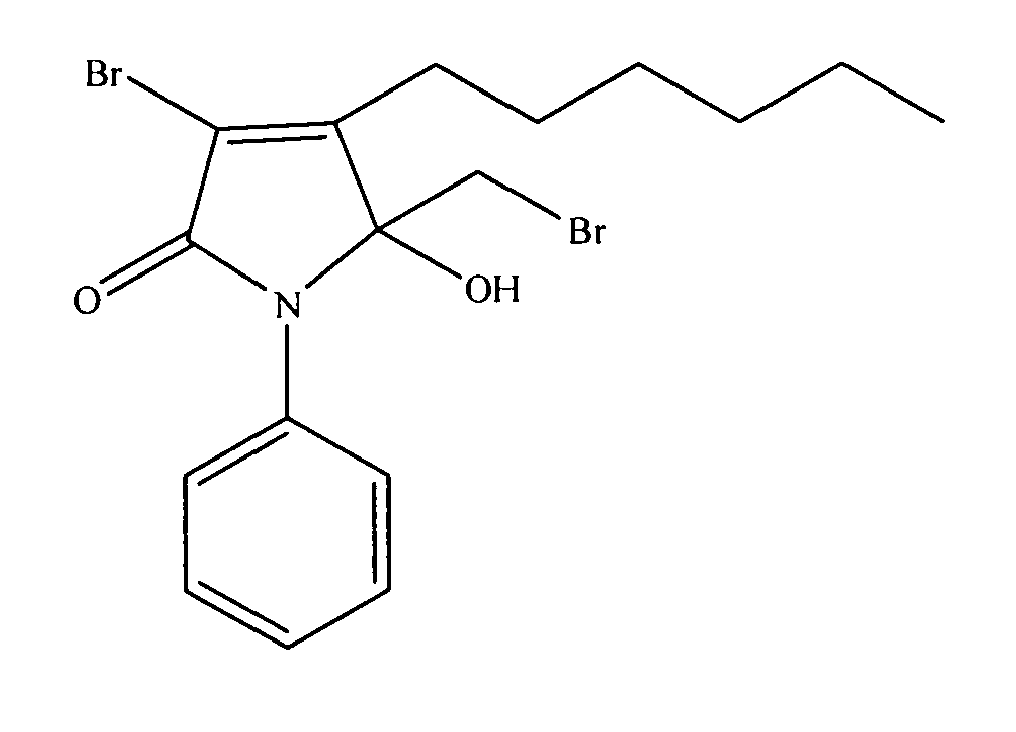
- In some embodiments, the above furanones of formula III may be dehydrated to form another suitable furanone compound of the following formula IV:

- Specific examples of compounds of formula IV include the following:


- Other suitable furanone derivatives may include, in embodiments, those of the following formula:

- Specific examples of furanones of formula V include, but are not limited to, the following:


- Yet other suitable furanones include those of the following formula:

- Specific examples of furanones of formula VI include, but are not limited to, the following:


- Yet other suitable furanones include those of the following formula:

OC(O)R6, =O, amine, azide, thiol, mercaptoaryl, arylalkoxy, mercaptoarylalkyl, SC(O)R6, OS(O)2R6, NHC(O)R6, =NR6, or NHR6. - Specific examples of compounds of formula VII include, but are not limited to, the following:


- Furanones, including halogenated furanones and/or hydroxyl furanones, are known as inhibitors of quorum sensing. Quorum sensing, also known as bacterial signaling, is recognized as a general mechanism for gene regulation in many bacteria, and it allows bacteria to perform in unison such activities as bioluminescence, swarming, biofilm formation, production of proteolytic enzymes, synthesis of antibiotics, development of genetic competence, plasmid conjugal transfer, and spoliation. Quorum sensing is a universal regulatory mechanism used by both Gram-positive bacteria such as Staphylococcus aureus, Streptococcus pneumoniae, Salmonella enteritidis, Staphylococcus epidermidis, Bacillus subtilis, and the like, and Gram-negative bacteria such as Pseudomonas aeruginosa, Escherichia coli, Aeromonas hydrophila, and the like.
- Furanones, including halogenated and/or hydroxyl furanones, may also block quorum sensing and inhibit the growth of bacteria in amounts that are non-toxic to mammalian cells. Given their mechanism of action, furanones' antipathogenic properties may be effective against a broad spectrum of infectious agents and may be able to reduce and/or prevent colonization of both gram positive and gram negative bacteria, including those noted above.
- In accordance with the present disclosure, a quorum sensing inhibitor, such as the furanones described above, optionally possessing a vinyl and/or acrylate group described herein, in embodiments also possessing halogen and/or hydroxyl groups, may act as an antimicrobial agent by inhibiting microbial development and proliferation. As noted above, the furanone, acting as a quorum sensing inhibitor, may inhibit swarming motility and biofilm formation, both of which frequently underlie the pathophysiology of infectious diseases. The inhibition of swarming and biofilm formation may thus reduce bacterial burden and hence prevent infection and disease progression.
- In addition, unlike antibiotics and antiseptic compounds which kill microbes and carry the risk of inducing antimicrobial resistance, furanones, including halogenated and/or hydroxyl furanones described herein do not exert such evolutionary pressures. Thus, antimicrobial resistance to an article made with or coated with a copolymer of the present disclosure is not a concern.
- Conditions for conducting the copolymerization of the above furanones with the at least one phospholipid possessing at least one vinyl group are within the purview of those skilled in the art. The copolymerization can be achieved by reacting the at least one phospholipid possessing at least one vinyl group with a furanone possessing a vinyl and/or acrylate group. The conditions under which the at least one phospholipid possessing at least one vinyl group may be reacted with the furanone may vary widely depending on the specific phospholipid, the specific furanone being employed, and the desired degree of polymerization to be achieved. The molar ratio of phospholipid to furanone may be from about 1:10 to about 10:1. In embodiments, the amount of furanone employed can be from about 2 to about 8 moles of furanone per mole of phospholipid possessing at least one vinyl group. Suitable reaction times and temperatures can be from about 15 minutes to about 72 hours, in embodiments from about 60 minutes to about 24 hours, at temperatures of from about 0° C to about 250° C, in embodiments from about 25° C to about 80° C.
- In embodiments, the copolymers of the present disclosure may be prepared from monomer solutions prepared by dissolving the furanone possessing vinyl or acrylate groups in a liquid vinyl monomer or monomer solution, for example the at least one phospholipid possessing at least one vinyl group. Suitable solvents which may be utilized in forming such solutions include, for example, water, lower alcohols, mixtures of the foregoing, and the like. In other embodiments, an aqueous solution or suspension may be formed with the furanone possessing vinyl and/or acrylate groups in combination with the at least one phospholipid possessing at least one vinyl group. In yet other embodiments, the furanone possessing vinyl or acrylate groups may be combined with an organic solvent and the resulting solution may then be mixed or emulsified with an aqueous compatible or incompatible solution containing the at least one phospholipid possessing at least one vinyl group. Suitable organic solvents include, for example, ethanol, methanol, isopropanol, chloroform, methylene chloride, combinations thereof, and the like.
- In embodiments, the copolymers of the above furanones and the at least one phospholipid possessing at least one vinyl group may be copolymerized with hydroxamates to form a copolymer of the present disclosure. In other embodiments, the copolymers of the above furanones and the at least one phospholipid possessing at least one vinyl group may be blended with hydroxamates to form a composition of the present disclosure. In yet other embodiments, a composition of the present disclosure may include at least one phospholipid possessing at least one vinyl group in combination with at least one hydroxamate, either as a copolymer or blend.
- Suitable hydroxamates for combination with the above components, either as comonomers or as a blend, include components possessing a hydroxamate group of the following formula (VIII) :

- As used herein, "alkyl", used either alone or in compound words such as "haloalkyl" or "alkylthio", includes straight chain or branched C1-12 alkyl groups. Examples include methyl, ethyl, propyl, isopropyl and the like.
- As used herein, "alkoxy" includes straight chain or branched alkoxy, in embodiments C1-12 alkoxy such as methoxy, ethoxy, n-propoxy, isopropoxy and butoxy isomers.
- As used herein, "alkenyl" includes groups formed from straight chain, branched or mono- or polycyclic alkenes including ethylenically mono- or poly-unsaturated alkyl or cycloalkyl groups as previously defined, in embodiments C2-12 alkenyl. Examples of alkenyl include vinyl; allyl; 1-methylvinyl; butenyl; iso-butenyl; 3-methyl-2-butenyl; 1-pentenyl;; cyclopentenyl; 1-methyl-cyclopentenyl; 1-hexenyl; 3-hexenyl; cyclohexenyl; 1-heptenyl; 3-heptenyl; 1-octenyl; cyclooctenyl; 1-nonenyl; 2-nonenyl; 3-nonenyl; 1-decenyl; 3-decenyl; 1,3-butadienyl; 1-4,pentadienyl; 1,3-cyclopentadienyl; 1,3-hexadienyl; 1,4-hexadienyl; 1,3-cyclohexadienyl; 1,4-cyclohexadienyl; 1,3-cycloheptadienyl; 1,3,5-cycloheptatrienyl; or 1,3,5,7-cyclooctatetraenyl.
- Methods for forming these hydroxamate functional compositions are within the purview of those skilled in the art. For example, in embodiments, a hydroxamate functional polymer may be produced by the surface modification of cross-linked polymethacrylic acid (PMAA)-co-methyl methacrylate (MAA) beads, thus producing a hydroxamate functional polymer, i.e., PMAA-MMA-hydroxamate as the hydroxamate functional composition.
- In other embodiments, polymerizable hydroxamate monomers may be synthesized which may be copolymerized with the furanones and the at least one phospholipid possessing at least one vinyl group, or blended therewith. The hydroxamate monomer, which may be encompassed by formula VIII above, may have an R10 including CH2=C-CH3, and R11 may be hydrogen. In other embodiments, the hydroxamate monomer may be utilized to synthesize a hydroxamate homopolymer, or may be copolymerized with any other suitable comonomers to produce copolymers which, in turn, may be copolymerized with the furanones and the at least one phospholipid possessing at least one vinyl group, or blended therewith.
- Hydroxamate homopolymers synthesized from the above hydroxamate monomer can also be grafted onto any derivatizable polymer. The resulting hydroxamate functional composition, whether a monomer, homopolymer, or copolymer, may then be combined with the copolymer including the above furanones and the at least one phospholipid possessing at least one vinyl group, either as a comonomer or as a blend.
- It should, of course, be understood that two or more hydroxamates may be utilized in forming a copolymer or blend.
- In other embodiments, as noted above, the hydroxamates may be copolymerized or blended with the phospholipids possessing at least one vinyl group, without a furanone. For example, monomers such as MPC and n-hydroxy methacrylamide (NHMAA) may be polymerized by conventional free radical, living radical, Atom Transfer Radical (ATR), or radiation polymerization techniques. Such techniques are within the purview of those skilled in the art. The solubility, amphiphilicity, and swellability of the resulting composition, in embodiments a copolymer, may be controlled by incorporating other monomers into the composition. Such additional monomers include, for example, acrylate or methacrylate monomers such as methyl methacrylate, butyl methacrylate, hexyl methacrylate, octyl methacrylate, combinations thereof, and the like.
- Additional wound healing properties may be imparted to the copolymer or blend by incorporating additional monomers having a cationic charge into the copolymer or blend. Such monomers having a cationic charge include, but are not limited to, 2-(diethylamino)ethyl methacrylate; 2-(dimethylamino)ethyl methacrylate; acrylates including 2-(diethylamino)ethyl acrylate, 2-(dimethylamino)ethyl acrylate, combinations thereof, and the like.
- Additional functionality, including angiogenic properties, anti-inflammatory properties, enzymatic inhibition properties, and the like, may be imparted by the addition of anionic monomers. Suitable anionic monomers include, for example, acrylic acid, methacrylic acid, itaconic acid, maleic acid, fumaric acid, vinyl sulfonic acid, sulfopropyl acrylate, combinations thereof, and the like. These monomers may be blended or copolymerized with the phospholipid, the hydroxamate, or both.
- Similarly, antimicrobial properties may be provided to the compositions by the addition of monomers containing quaternary ammonium groups such as 2-(methacryloxyethyl)trimethyl ammonium chloride.
- Conditions for conducting polymerization of the hydroxamates with the furanones and/or phospholipids, in embodiments furanone/phospholipid copolymers, are within the purview of those skilled in the art and include those described above for the polymerization of the furanones and the at least one phospholipid possessing at least one vinyl group.
- Polymerization may also be initiated by subjecting the monomers, for example, the at least one phospholipid possessing at least one vinyl group, and/or furanone possessing vinyl and/or acrylate groups, and/or hydroxamate, to energy including irradiation, such as high energy radiation including gamma and/or e-beam, ultraviolet (UV) light, pulse laser ablation deposition, plasma energy treatment, chemical initiation, photoinitiation, and the like. In embodiments, the use of high energy radiation initiation may be beneficial as it should not require the use of an additional initiator such as a chemical initiator or catalyst.
- In embodiments, a copolymer of the present disclosure may possess the vinyl phospholipid in amounts of from about 5 to about 95 percent by weight of the copolymer, in embodiments from about 15 to about 85 percent by weight of the copolymer. Thus, the copolymer of the present disclosure may possess the furanone possessing vinyl and/or acrylate groups, or the hydroxamate, in amounts of from about 5 to about 95 percent by weight of the copolymer, in embodiments from about 15 to about 85 percent by weight of the copolymer.
- A composition including the above furanone/phospholipid copolymer with the hydroxamate as a blend, would include the furanone/vinyl phospholipid copolymer in an amount of from about 1 percent by weight of the composition to about 99 percent by weight of the composition, in embodiments from about 5 percent by weight of the composition to about 95 percent by weight of the composition, with the hydroxamate present in an amount of from about 1 percent by weight of the composition to about 99 percent by weight of the composition, in embodiments from about 5 percent by weight of the composition to about 95 percent by weight of the composition.
- Where the hydroxamate is included as a comonomer with the furanone/vinyl phospholipid copolymer, the resulting copolymer may possess the furanone in an amount of from about 1 percent by weight of the copolymer to about 98 percent by weight of the copolymer, in embodiments from about 5 percent by weight of the copolymer to about 90 percent by weight of the copolymer; the vinyl phospholipid may be present in an amount of from about 1 percent by weight of the copolymer to about 98 percent by weight of the copolymer, in embodiments from about 5 percent by weight of the copolymer to about 90 percent by weight of the copolymer; and the hydroxamate may be present in an amount of from about 1 percent by weight of the copolymer to about 98 percent by weight of the copolymer, in embodiments from about 5 percent by weight of the copolymer to about 90 percent by weight of the copolymer.
- In other embodiments, the above hydroxamates may be copolymerized or blended with a furanone, without the phospholipid. In other embodiments, the above hydroxamates may be copolymerized or blended with a phospholipid, without the furanone. Suitable conditions for conducting the polymerization of a hydroxamate with a furanone, and/or the polymerization of a hydroxamate with a phospholipid, include those described herein for polymerization of a hydroxamate with a furanone/phospholipid copolymer, as well as those described above for the polymerization of the furanone and the at least one phospholipid possessing at least one vinyl group.
- Where the composition of the present disclosure includes a phospholipid and hydroxamate as a copolymer or blend, the phospholipid may be present in an amount of from about 5% to about 95% by weight of the composition, in embodiments from about 15% to about 85% by weight of the composition, with the hydroxamate present in an amount of from about 5% to about 95% by weight of the composition, in embodiments from about 15% to about 85% by weight of the composition.
- In embodiments, the phospholipid possessing at least one vinyl group, the furanone possessing vinyl and/or acrylate groups, and optional halogen and/or hydroxyl groups, and optionally the hydroxamate, may also be copolymerized in the presence of additional vinyl or acrylate monomers, optionally possessing the hydroxamate groups described above, to obtain copolymers possessing excellent solubility, wettability, thermal properties, film-forming properties, and the like. Such additional vinyl or acrylate monomers may include, for example, vinyl functional quaternary amines, hydroxyethyl methacrylate, n-vinyl pyrrolidone, sodium acrylate, bis-acrylate, styrene sulfonic acid, butyl acrylate, sulfopropyl acrylate, sulfopropyl methacylate, acrylamide, diacrylamide, methacrylic acid, acrylic acid, polyethylene glycol acrylates, polyethylene glycol/polypropylene glycol acrylates, silicone acrylates, combinations thereof, and the like. In addition to forming copolymers with the phospholipid possessing at least one vinyl group and the furanone possessing vinyl and/or acrylate groups, in some embodiments these additional vinyl or acrylate monomers may be combined with the copolymers of the present disclosure as a mixture or blend.
- For example, in some embodiments a copolymer of the present disclosure may include a random copolymer of the phospholipid possessing at least one vinyl group, the furanone possessing vinyl and/or acrylate groups, and the additional vinyl or acrylate monomer including the hydroxamate functional group.
- In embodiments, the furanone possessing vinyl or acrylate groups and the at least one phospholipid possessing at least one vinyl group may be placed into a solution with an additional acrylate or vinyl compound possessing a hydroxamate group. For example, in some embodiments, a furanone acrylate and MPC may be placed into solution with the PMAA-MMA-hydroxamate described above (at a ratio of about 50 to about 25 to about 25) and polymerized by subjecting the monomers to gamma radiation to produce a copolymer. The resulting copolymer may, in embodiments, be in the form of a hydrogel.
- The compositions of the present disclosure including hydroxamates may be used in wound treatment, or in the formation of medical devices and implants. Chronic wounds may take months or years to heal due, in part, to high levels of MMPs that degrade the newly formed matrix even as it is synthesized. The compositions of the present disclosure including hydroxamates, due to the presence of the hydroxamate group, may inhibit the activity of the MMPs in or adjacent a wound, thereby promoting healing.
- Similarly, angiogenesis or vasculogenesis of tumors and the formation of metastases require cell migration and invasion, which are enabled by the release of pro-MMPs. The compositions of the present disclosure including hydroxamates, which counteract those MMPs, may thus be suitable for minimizing angiogenesis and/or vascularization of tumors.
- Furthermore tissue remodeling occurs secondary to secretion or expression of MMP's. Thus blood vessels associated with wound repair are resorbed or ischemic tissue is destroyed by MMP action. The compositions of the present disclosure including hydroxamates, which counteract those MMPs, may thus be suitable to enhance would repair.
- The activity of MMPs is also essential for many of the processes involved in atherosclerotic plaque formation (infiltration of inflammatory cells, angiogenesis, and smooth muscle cell migration and proliferation). Elevated levels of MMPs are expressed in human atherosclerotic plaque and at the sites of aneurysm. Furthermore, matrix degradation by MMPs may cause the plaque instability and rupture that leads to the clinical symptoms of atherosclerosis. The compositions of the present disclosure including hydroxamates, which counteract those MMPs, may thus be suitable to reduce the formation of atherosclerotic plaques and the incidence of rupture at the sites of aneurysm.
- In the context of arthritis, a similar role for activated MMPs in cartilage degradation has been demonstrated. Elevated concentrations and activities of several MMPs including MMP-1, MMP-3, MMP-8 and MMP-13, as well as aggrecanase (another metalloproteinase) have been identified in the synovial fluid of osteoarthritis and rheumatoid arthritis patients. The compositions of the present disclosure including hydroxamates, which counteract those MMPs, may thus be suitable to treat arthritis and/or minimize the degradation of cartilage.
- There is also accumulating evidence that an increase in the proportion of active MMPs is associated with the progression of restenosis following vascular interventions such as balloon angioplasty or intra-coronary stenting, for the treatment of coronary artery disease. In contrast to the non-diseased vessel wall, which constitutively expresses only pro-(inactive) MMP-2, injured or atherosclerotic arteries demonstrate a dramatic increase in MMP-2 activity. This occurs in conjunction with induced expression of MMPs-3, -7, -9, -12, and -13. The compositions of the present disclosure including hydroxamates, which counteract those MMPs, may thus be utilized to reduce restenosis.
- The compositions of the present disclosure including hydroxamates may inactivate MMPs by binding the zinc at the active center of the enzymes. With multiple point attachments, the hydroxamates behave like a molecular magnet for zinc.
- In embodiments, the compositions of the present disclosure possessing hydroxamates may bind to the active form of MMPs, without and specificity for particular MMP types. In other embodiments, the compositions of the present disclosure possessing hydroxamates may provide preferential binding to active forms of MMPs in the local tissue environment. This may be advantageous because it specifically targets one stage in the MMP regulatory cascade, namely that directly preceding matrix degradation. In addition, selective binding may reduce the risk of over inhibition which would delay healing by preventing a healthy rate of tissue turnover and essential processes such as cell migration and angiogenesis.
- The copolymers thus produced may have a furanone and/or a hydroxamate attached via a hydrolytically degradable bonds at the head of the polymer chain. Advantageously, upon hydrolysis, the present copolymers may release low concentrations of the furanone and/or hydroxamate, thus providing antimicrobial properties where a furanone is released, and inhibition of MMP activity, where the hydroxamate is released, at the site of implantation or injury to which the copolymer or an article including the composition of the present disclosure is applied.
- The resulting compositions of the present disclosure, including phospholipids, hydroxamates, and/or furanones, may be suitable for coating other materials, made into a solid material after conventional thermoplastic processing (molding, extrusion, etc.), or made into beads or nanoparticles by spray drying, solvent evaporation or any other conventional polymer processing method.
- In embodiments, articles prepared from or coated with a composition of the present disclosure possessing a furanone and/or hydroxamate, optionally as a copolymer blend, may thus display improved resistance to bacteria. The resulting compositions may also have MMP-inhibiting properties, which may enhance wound healing.
- The compositions of the present disclosure may find many uses in the formation of medical devices and coatings thereon. In embodiments, surgical articles can be manufactured from the compositions described herein. Suitable medical devices include, but are not limited to, clips and other fasteners, staples, tacks, sutures, pins, screws, prosthetic devices, wound dressings, bandages, drug delivery devices, anastomosis rings, surgical blades, contact lenses, intraocular lenses, surgical meshes including hernia meshes, stents, stent coatings, grafts, tissue patches, catheters, stent/grafts, knotiess wound closures, sealants, adhesives, contact lenses, intraocular lenses, anti-adhesion devices, anchors, tunnels, bone fillers, synthetic tendons, synthetic ligaments, tissue scaffolds, stapling devices, buttresses, lapbands, orthopedic hardware, pacers, pacemakers, drug delivery devices, soft tissue repair devices (including mesh fixation) and other implants and implantable devices.
- Fibers can be made from the compositions of the present disclosure. In embodiments, fibers made of compositions of the present disclosure may be knitted or woven with other fibers, either absorbable or non-absorbable fibers, to form textiles. The fibers also can be made into non-woven materials to form fabrics, such as meshes and felts.
- The present copolymers or blends of the present disclosure can be formed into articles using any technique within the purview of those skilled in the art, such as, for example, extrusion, molding and/or solvent casting. The copolymers and/or blends herein can be used alone or combined with other polymers, which may be either absorbable or non-absorbable. Copolymers and/or blends of the present disclosure, optionally combined with other materials, may be referred to, in embodiments, as compositions of the present disclosure. Methods for forming articles with the compositions of the present disclosure are within the purview of those skilled in the art.
- Packaging materials which may formed with the compositions of the present disclosure include packaging for products such as medical devices, pharmaceuticals, textiles, consumer goods, foods, and the like.
- Copolymers or blends of the present disclosure may also be used to form coatings for articles, including textiles, medical devices, and packaging materials. Coatings may be applied to at least a portion of the surface of an article, including the interior, exterior, or both.
- In embodiments, the coating of the present disclosure can be applied as a solution and the solvent evaporated to leave the coating components, in embodiments, the furanone, phospholipid, and hydroxamate of the present disclosure. Suitable solvents which may be utilized in forming the solution include any solvent or combination of solvents suitable for the chosen coating composition. To be suitable, the solvent must (1) be miscible with the coating components, and (2) not appreciably affect the integrity of any material used to form the article being coated, such as a suture. Some examples of suitable solvents include alcohols, ketones, ethers, aldehydes, acetonitrile, acetic acid, methylene chloride, chloroform and water. In embodiments, methylene chloride may be used as a solvent.
- Medical devices and packaging materials in accordance with the present disclosure can be sterilized in accordance with techniques within the purview of those skilled in the art.
- Preparing a coating solution of the present disclosure may be a relatively simple procedure and can be accomplished by blending, mixing, and the like. In one embodiment, where a composition of the present disclosure and a solvent such as methylene chloride are utilized to form the coating solution, the desired amount of composition may be placed into a container, followed by the addition of the desired amount of methylene chloride. The two ingredients may then be mixed thoroughly to combine the ingredients.
- Any technique within the purview of those skilled in the art may be employed for applying the coating solution or suspension to the article. Suitable techniques include dipping, spraying, wiping and brushing. The article wetted with the coating solution or suspension may be subsequently passed through or held in a drying oven for a time and at a temperature sufficient to vaporize and drive off the solvent.
- In addition, the present disclosure provides methods for surface/bulk modification of devices by impregnating a device such as a medical device with monomer solutions of the vinyl phospholipid, and/or furanone possessing vinyl and/or acrylate groups, and/or hydroxamates, for example by immersion, and in situ polymerizing the monomer solutions to prepare graft copolymers or an interpenetrating network of the copolymers of the present disclosure in combination with the device.
- Solutions may also be used with chemical couplers, for example silanes, vinyl siloxanes, and the like, to not only graft or interpenetrate the surface of a medical device, but to also covalently tether the copolymers of the present disclosure to the surface of a device.
- Medical devices possessing a coating of the present disclosure may be formed of copolymers or blends of the present disclosure. In other embodiments, medical devices can also be formed of absorbable materials, nonabsorbable materials, and combinations thereof. Suitable absorbable materials which may be utilized to form the medical device include trimethylene carbonate, caprolactone, dioxanone, glycolic acid, lactic acid, homopolymers thereof, copolymers thereof, and combinations thereof. Suitable non-absorbable materials which may be utilized to form the medical device include polyolefins, such as polyethylene, polypropylene, copolymers of polyethylene and polypropylene, blends of polyethylene and polypropylene, polyesters such as polyethylene terephthalate, polyimides, polyamides, combinations thereof, and the like.
- Textiles which may be coated with compositions of the present disclosure include fibers made of copolymers or blends of the present disclosure, as well as other natural fibers, synthetic fibers, blends of natural fibers, blends of synthetic fibers, and blends of natural fibers with synthetic fibers. Suitable other materials utilized to form textiles include polyesters, polyamides, polyolefins, halogenated polymers, polyester/polyethers, polyurethanes, homopolymers thereof, copolymers thereof, and combinations thereof. Specific examples of suitable materials include polyethylene, polypropylene, polybutylene, polyvinyl chloride, polyethylene terephthalate, nylon 6, and nylon 6,6.
- In some embodiments, compositions in accordance with the present disclosure may be formed by combining the copolymers or blends of the present disclosure with other additional components. In embodiments, coating compositions of the present disclosure may be combined with a fatty acid component, such as a fatty acid or a fatty acid salt or a salt of a fatty acid ester. Suitable fatty acids may be saturated or unsaturated, and may include higher fatty acids having more than about 12 carbon atoms. Suitable saturated fatty acids include, for example, stearic acid, palmitic acid, myristic acid and lauric acid. Suitable unsaturated fatty acids include oleic acid, linoleic acid, and linolenic acid. In addition, an ester of fatty acids, such as sorbitan tristearate or hydrogenated castor oil, may be used.
- Suitable fatty acid salts include the polyvalent metal ion salts of C6 and higher fatty acids, particularly those having from about 12 to about 22 carbon atoms, and mixtures thereof. Fatty acid salts including the calcium, magnesium, barium, aluminum, and zinc salts of stearic, palmitic and oleic acids may be useful in some embodiments of the present disclosure. Some useful salts include commercial "food grade" calcium stearate which contains a mixture of about one-third C16 and two-thirds C18 fatty acids, with small amounts of the C14 and C22 fatty acids.
- Suitable salts of fatty acid esters which may be included in the compositions of the present disclosure include calcium, magnesium, aluminum, barium, or zinc stearoyl lactylate; calcium, magnesium, aluminum, barium, or zinc palmityl lactylate; and/or calcium, magnesium, aluminum, barium, or zinc oleyl lactylate. In embodiments; calcium stearoyl-2-lactylate (such as the calcium stearoyl-2-lactylate commercially available under the tradename VERV from American Ingredients Co., Kansas City, Mo.) may be utilized. Other fatty acid ester salts which may be utilized include those selected from the group consisting of lithium stearoyl lactylate, potassium stearoyl lactylate, rubidium stearoyl lactylate, cesium stearoyl lactylate, francium stearoyl lactylate, sodium palmityl lactylate, lithium palmityl lactylate, potassium palmityl lactylate, rubidium palmityl lactylate, cesium palmityl lactylate, francium palmityl lactylate, sodium oleyl lactylate, lithium oleyl lactylate, potassium oleyl lactylate, rubidium oleyl lactylate, cesium oleyl lactylate, and francium oleyl lactylate.
- Where utilized, the amount of fatty acid component can be from about 5 percent to about 60 percent by weight of the total composition of the present disclosure. In embodiments, the fatty acid component may be present in an amount from about 15 percent to about 55 percent by weight of the total composition.
- In one embodiment, the copolymer or blend including the phospholipid, furanone, and hydroxamate, can be present in an amount from about 45 to about 60 weight percent of the composition and the fatty acid component, such as a fatty acid salt or a salt of a fatty acid ester, can be present in an amount from about 40 to about 55 weight percent of the composition. In embodiments, the phospholipid, furanone and hydroxamate can be present in an amount from about 50 to about 55 weight percent of the composition and the fatty acid component can be present in an amount from about 45 to about 50 weight percent of the composition.
- In embodiments, a fatty acid component as described above, including a calcium stearoyl lactate, may be combined with a copolymer or blend of the present disclosure or included in any coating solution utilized to apply a copolymer or blend of the present disclosure to a medical article, packaging, textile, and the like.
- In other embodiments, the copolymers or blends of the present disclosure may be combined with additional polymeric materials, such as oligomers and/or polymers. The additional polymeric materials can be bioabsorbable or non-absorbable. Bioabsorbable polymers which may be utilized in the composition are within the purview of those skilled in the art and include those containing linkages derived from monomers including, for example, glycolide, lactide, glycolic acid, lactic acid, caprolactone, trimethylene carbonate, dioxanones, dioxepanones, and the like, and homopolymers, copolymers and combinations thereof. Similarly, polyorthoesters, polyhydroxy butyrates, polytyrosine carbonates, polyhydroxy alkanoates, combinations thereof, and the like, may be added. The additional polymeric materials may be blended with or bonded to the copolymers or blends of the present disclosure (e.g., to create a block copolymer).
- In embodiments, the copolymers or blends of the present disclosure may be combined with polyalkylene oxides such as polyethylene oxides, polyethylene glycol, polypropylene glycol, copolymers thereof, and the like, including those having acrylate groups such as acrylate PEGs, and/or acrylate PEG/PPG copolymers. Such combinations may include copolymers or blends of the present disclosure with polyalkylene oxide oligomers and/or polymers and/or other non-toxic surfactants. The resulting composition may thus possess antimicrobial and MMP-inhibiting properties due to the presence of the copolymers or blends described above. In other embodiments, the copolymers or blends of the present disclosure may be combined with silicone acrylates.
- If desired, in addition to the copolymers or blends of the present disclosure, compositions described herein can optionally contain additional components, e.g., dyes, antimicrobial agents, growth factors, anti-inflammatory agents, and the like. The term "antimicrobial agent" as used in the present disclosure includes antibiotics, antiseptics, disinfectants and combinations thereof. In embodiments, the antimicrobial agent may be an antiseptic, such as triclosan or one of the furanones described above.
- Classes of antibiotics that can be combined with the compositions of the present disclosure include tetracyclines like minocycline; rifamycins like rifampin; macrolides like erythromycin; penicillins like nafcillin; cephalosporins like cefazolin; beta-lactam antibiotics like imipenem and aztreonam; aminoglycosides like gentamicin and TOBRAMYCIN®; chloramphenicol; sulfonamides like sulfamethoxazole; glycopeptides like vancomycin; quinolones like ciprofloxacin; fusidic acid; trimethoprim; metronidazole; clindamycin; mupirocin; polyenes like amphotericin B; azoles like fluconazole; and beta-lactam inhibitors like sulbactam. Other antimicrobials which may be added include, for example, antimicrobial peptides and/or proteins, chemotherapeutic drugs, telomerase inhibitors, other furanones including 5-furanones, mitoxanthone, and the like.
- Examples of antiseptics and disinfectants which may be combined with the compositions of the present disclosure include hexachlorophene; cationic biguanides like chlorhexidine and cyclohexidine; iodine and iodophores like povidone-iodine; halosubstituted phenolic compounds like PCMX (i.e., p-chloro-m-xylenol) and triclosan (i.e., 2,4,4'-trichloro-2'hydroxy-diphenylether); furan medical preparations like nitrofurantoin and nitrofurazone; methenamine; aldehydes like glutaraldehyde and formaldehyde; and alcohols. In some embodiments, at least one of the antimicrobial agents may be an antiseptic, such as triclosan.
- In other embodiments, polymer drugs, i.e., polymeric forms of such compounds, for example, polymeric antibiotics, polymeric antiseptics, polymeric non-steroidal anti-inflammatory drugs (NSAIDS), and the like, may be utilized.
- Anionic polymers, including sulfated and/or carboxylated polymers, may be combined with the compositions of the present disclosure. Such anionic polymers may, in embodiments, induce an angiogenic response when implanted in vivo.
- In other embodiments, cationically charged particles, such as diethylaminoethyl dextrans (DEAE-dextrans), may be applied. Such particles may increase the rate of healing of cutaneous and other wounds.
- In yet other embodiments, quaternary ammonium compounds, which may exert antiseptic properties, may be included.
- The compositions of the present disclosure may be combined with various optional ingredients, such as stabilizing agents, thickeners, colors, and the like. The optional ingredients may be present in an amount of up to about 10% of the total weight of the compositions formed with copolymers or blends of the present disclosure.
- As low amounts of furanones and/or hydroxamates are required in compositions of the present disclosure, existing formulations and manufacturing processes need only minimal modifications to produce the compositions described herein. This ease of formulation and production may reduce both the time and cost necessary to prepare compositions of the present disclosure, compared with adding other antimicrobial agents or MMP-inhibitors to existing materials.
- In embodiments, as the compositions of the present disclosure possess antimicrobial and MMP-inhibiting properties, they may be useful in forming contact lenses, intraocular lenses, and other medical devices or coatings thereon which might otherwise be known to be subject to a high incidence of infection. For contact lenses and intraocular lenses, the lenses may be incubated with a solution which is a poor solvent for the lens, and which possesses the furanone possessing vinyl or acrylate groups, the at least one phospholipid possessing at least one vinyl group, and the hydroxamate. Incubation of the lens with the solution possessing the monomers will swell the surface of the lens with the monomers. The lens and monomers may then be subjected to low dose radiation, such as low dose gamma radiation, to initiate the formation of the copolymer and the graft/interpenetrating polymerization of the copolymer to the lens material.
- In other embodiments, compositions of the present disclosure may be utilized as adhesives or sealants. They may also be utilized with other materials to form adhesives or sealants. For example, where methacrylamide units are incorporated into a backbone of a polymer (for example when MPC and NHMAA are combined), the resulting amine groups can be used to crosslink electrophilic groups on other components of an adhesive, for example NHS-functionalized PEGs or polyisocyanate functional components. In other embodiments, two compositions of the present disclosure may be prepared, one with a net positive charge, and the other with a net negative charge: the two compositions may gel upon combination.
- As noted above, the compositions of the present disclosure may be utilized to promote wound healing, and may also include immune modulating, neovascularization enhancing/stimulating agents, and additional wound healing agents, to improve wound healing of diseased, injured, and/or compromised tissue in and around a wound. This may be useful in the treatment of many injuries and/or wounds. For example, the compositions of the present disclosure may be useful in the treatment of gastrointestinal anastomoses, either in the formation of implants or coatings thereon, as well as adhesives and/or sealants, to reduce ischemia and/or reperfusion injury, which could lead to a delay in wound healing or tissue necrosis, anastomotic leaks, peritonitis, post-operative adhesions, and potentially death.
- In embodiments, a surgical suture, mesh, contact lens, or other medical device may be swollen with a solution containing the furanone possessing vinyl or acrylate groups, the at least one phospholipid possessing at least one vinyl group, and the hydroxamate, optionally in combination with additional vinyl or acrylate monomer. If the device is swollen in a monomer solution utilizing a solvent that does not completely solubilize the monomers, the formation of the resulting copolymer may be localized on the surface of the device and not affect or compromise the bulk properties of the device.
- Following polymerization, the device may be removed from the polymerization medium, i.e., the solution containing the monomers and any initiators, catalysts, and the like, and washed to remove excess free copolymer of the present disclosure and/or any residual monomers. The device possessing the copolymer coating, in embodiments grafted and/or interpenetrating, may then be subjected to additional energy treatments, including high energy radiation such as gamma radiation, to both sterilize and further modify the copolymer coating.
- In embodiments, a medical device in accordance with the present disclosure may be a suture. Sutures in accordance with the present disclosure may be monofilament or multifilament and may be made of the compositions of the present disclosure or any conventional material, including both bioabsorbable and non-bioabsorbable materials. Suitable materials include, but are not limited to, surgical gut, silk, cotton, polyolefins such as polypropylene, polyamides, polyglycolic acids, polyesters such as polyethylene terephthalate and glycolide-lactide copolymers, and the like.
- In embodiments, the suture may be made of a polyolefin. Suitable polyolefins include polyethylene, polypropylene, copolymers of polyethylene and polypropylene, and blends of polyethylene and polypropylene. In some embodiments, polypropylene can be utilized to form the suture. The polypropylene can be isotactic polypropylene or a mixture of isotactic and syndiotactic or atactic polypropylene.
- In other embodiments, the suture may be made from synthetic absorbable polymers such as those made from glycolides, lactides, caprolactones, alkylene carbonates (i.e., trimethylene carbonate, tetramethylene carbonate, and the like), dioxanones, orthoesters, hydroxy alkanoates, hydroxybutyrates, tyrosine carbonates, polymide carbonates, polyimino carbonates such as poly(bisphenol A-iminocarbonate) and poly(hydroquinone-iminocarbonate), and copolymers and combinations thereof. One combination which may be utilized includes glycolide and lactide based polyesters, including copolymers of glycolide and lactide.
- As noted above, the suture can be monofilament or multifilament. Where the suture is a monofilament, methods for producing such sutures are within the purview of those skilled in the art. Such methods include forming a suture material, such as a polyolefin resin or a copolymer of the present disclosure, and extruding, drawing and annealing the resin of copolymers to form the monofilament.
- Where the sutures are made of multiple filaments, the suture can be made using any technique within the purview of one skilled in the art such as, for example, braiding, weaving or knitting. The filaments may also be combined to produce a non-woven suture. The filaments themselves may be drawn, oriented, crinkled, twisted, commingled or air entangled to form yarns as part of the suture forming process.
- In embodiments a multifilament suture of the present disclosure can be produced by braiding. The braiding can be done by any method within the purview of those skilled in the art. For example, braid constructions for sutures and other medical devices are described in
U.S. Patent Nos. 5,019,093 ;5,059,213 ;5,133,738 ;5,181,923 ;5,226,912 ;5,261,886 ;5,306,289 ;5,318,575 ;5,370,031 ;5,383,387 ;5,662,682 ;5,667,528 ; and6,203,564 , the entire disclosures of each of which are incorporated by reference herein. Once the suture is constructed, it can be sterilized by any means within the purview of those skilled in the art. - In some cases a tubular braid, or sheath, can be constructed about a core structure which is fed through the center of a braider. Known tubular braided sutures, including those possessing cores, are disclosed, for example, in
U.S. Patent Nos. 3,187,752 ;3,565,077 ;4,014,973 ;4,043,344 ; and4,047,533 . - In embodiments, a suture in accordance with the present disclosure may be attached to any surgical needle within the purview of those skilled in the art to produce a needled suture. Wounds may be sutured by passing a needled suture through tissue to create wound closure. The needle may then be removed from the suture and the suture tied. The suture may remain in the tissue and help prevent contamination and infection of said tissue by virtue of its antimicrobial properties, thereby promoting wound healing and minimizing infection. The suture coating also advantageously enhances the surgeon's ability to pass the suture through tissue, and increases the ease and security with which he/she can tie the suture.
- While the above description contains many specifics, these specifics should not be construed as limitations on the scope of the disclosure herein but merely as exemplifications of particularly useful embodiments thereof. Those skilled in the art will envision many other possibilities within the scope and spirit of the disclosure as defined by the claims appended hereto.
Claims (15)
- A composition comprising:a first component comprising at least one vinyl phospholipid;a second component of formula:

R1 is a moiety selected from the group consisting of H, halogen, formyl, carboxyl, cyano, ester, amide, alkyl, alkoxy, oxoalkyl, alkenyl, alkynyl, aryl or arylalkyl,
wherein at least one of R1, R2, R3 and R4 are substituted with a moiety selected from the group consisting of vinyl moieties and acrylate moieties; anda third component comprising a hydroxamate of the formula
- The composition of claim 1, wherein the first component comprises a phosphorylcholine possessing at least one vinyl group of the formula:

- The composition of claim 1, wherein the first component is selected from the group consisting of 2-methacryloyloxyethyl phosphorylcholine, 2-acryloyloxyethyl phosphorylcholine and combinations thereof; or the composition of claim 1, wherein the second component comprises a vinyl furanone.
- The composition of claim 1, wherein the first component, the second component, and optionally the third component, comprise a copolymer; preferably wherein the copolymer further comprises at least one additional monomer selected from the group consisting of vinyl monomers, acrylate monomers, and combinations thereof.
- The composition of claim 4, further comprising at least one additional monomer selected from the group consisting of vinyl functional quaternary amines, hydroxyethyl methacrylate, n-vinyl pyrrolidone, sodium acrylate, bis-acrylate, styrene sulfonic acid, butyl acrylate, sulfopropyl acrylate, sulfopropyl methacylate, acrylamide, diacrylamide, methacrylic acid, acrylic acid, polyethylene glycol acrylates, polyethylene glycol/polypropylene glycol acrylates, silicone acrylates, and combinations thereof.
- A composition comprising:a first component comprising a phosphorylcholine possessing at least one vinyl group of the formula:wherein x is from about 1 to about 10 and y is from about 1 to about 10;
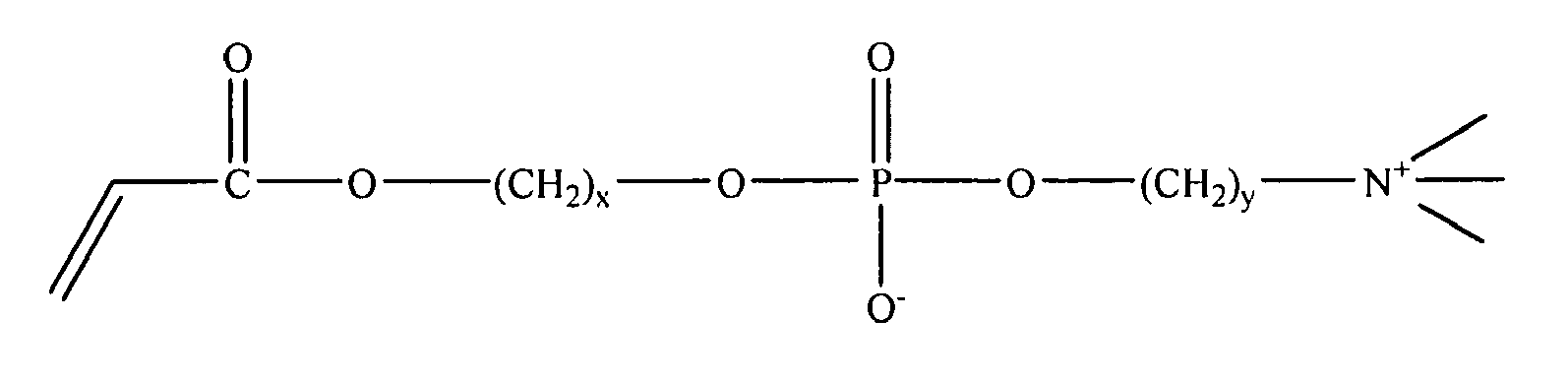
a furanone of formula:
R1 is a moiety selected from the group consisting of H, halogen, formyl, carboxyl, cyano, ester, amide, alkyl, alkoxy, oxoalkyl, alkenyl, alkynyl, aryl or arylalkyl,
wherein at least one of R1, R2, R3 and R4 are substituted with a moiety selected from the group consisting of vinyl moieties and acrylate moieties; and
a hydroxamate of the formula:
- The composition of claim 6, wherein the first component is selected from the group consisting of 2-methacryloyloxyethyl phosphorylcholine, 2-acryloyloxyethyl phosphorylcholine and combinations thereof; or the composition of claim 6, wherein the furanone comprises a vinyl furanone.
- The composition of claim 6, wherein the first component, the furanone, and optionally the hydroxamate, comprise a copolymer; preferably further comprising at least one additional monomer selected from the group consisting of vinyl monomers, acrylate monomers, and combinations thereof or further comprising at least one additional monomer selected from the group consisting of vinyl functional quaternary amines, hydroxyethyl methacrylate, n-vinyl pyrrolidone, sodium acrylate, bis-acrylate, styrene sulfonic acid, butyl acrylate, sulfopropyl acrylate, sulfopropyl methacylate, acrylamide, diacrylamide, methacrylic acid, acrylic acid, polyethylene glycol acrylates, polyethylene glycol/polypropylene glycol acrylates, silicone acrylates, and combinations thereof.
- An article comprising:a first component comprising at least one vinyl phospholipid;a second component of formula:wherein R2, R3 and R4 are independently or all H or halogen; and

R1 is a moiety selected from the group consisting of H, halogen, formyl, carboxyl, cyano, ester, amide, alkyl, alkoxy, oxoalkyl, alkenyl, alkynyl, aryl or arylalkyl,
wherein at least one of R1, R2, R3 and R4 are substituted with a moiety selected from the group consisting of vinyl moieties and acrylate moieties; and
a third component comprising a hydroxamate of the formula: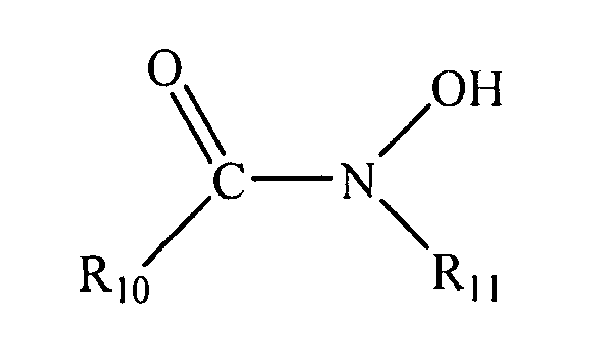
- The article of claim 9, wherein the first component comprises a phosphorylcholine possessing at least one vinyl group of the formula:

- The article of claim 9, wherein the first component is selected from the group consisting of 2-methacryloyloxyethyl phosphorylcholine, 2-acryloyloxyethyl phosphorylcholine and combinations thereof.
- The article of claim 9, wherein the second component comprises a vinyl furanone.
- The article of claim 9, wherein the first component, the second component, and optionally the third component, comprise a copolymer.
- The article of claim 9, wherein the article is selected from the group consisting of sutures, surgical meshes, contact lenses, intraocular lenses, staples, clips, buttresses, lapbands, catheters, bandages, stents, grafts, stent/grafts, knotless wound closures, sealants, adhesives, anti-adhesion devices, anchors, tunnels, bone fillers, synthetic tendons, synthetic ligaments, grafts, tissue scaffolds, pins, screws, orthopedic hardware, pacers, pacemakers, and implants.
- A composition comprising:a first component comprising at least one vinyl phospholipid; anda second component comprising a hydroxamate of the formula:wherein R10 is selected from the group consisting of vinyl groups, hydroxy alkyl acrylate groups, hydroxy alkyl methacrylate groups, alkyl amines, acrylamides, methacrylamides, alkyl groups, alkoxy groups, alkenyl groups, polymers terminated with the foregoing groups, and combinations thereof, and R11 comprises hydrogen.

Priority Applications (1)
| Application Number | Priority Date | Filing Date | Title |
|---|---|---|---|
| EP12194610A EP2564859A1 (en) | 2008-10-15 | 2009-10-14 | Hydroxamate compositions |
Applications Claiming Priority (2)
| Application Number | Priority Date | Filing Date | Title |
|---|---|---|---|
| US10547808P | 2008-10-15 | 2008-10-15 | |
| US12/573,232 US7923439B2 (en) | 2008-10-15 | 2009-10-05 | Hydroxamate compositions |
Related Child Applications (1)
| Application Number | Title | Priority Date | Filing Date |
|---|---|---|---|
| EP12194610.7 Division-Into | 2012-11-28 |
Publications (2)
| Publication Number | Publication Date |
|---|---|
| EP2177226A1 true EP2177226A1 (en) | 2010-04-21 |
| EP2177226B1 EP2177226B1 (en) | 2013-09-18 |
Family
ID=41510958
Family Applications (2)
| Application Number | Title | Priority Date | Filing Date |
|---|---|---|---|
| EP09252411.5A Not-in-force EP2177226B1 (en) | 2008-10-15 | 2009-10-14 | Hydroxamate compositions |
| EP12194610A Withdrawn EP2564859A1 (en) | 2008-10-15 | 2009-10-14 | Hydroxamate compositions |
Family Applications After (1)
| Application Number | Title | Priority Date | Filing Date |
|---|---|---|---|
| EP12194610A Withdrawn EP2564859A1 (en) | 2008-10-15 | 2009-10-14 | Hydroxamate compositions |
Country Status (5)
| Country | Link |
|---|---|
| US (1) | US7923439B2 (en) |
| EP (2) | EP2177226B1 (en) |
| JP (1) | JP2010095719A (en) |
| AU (1) | AU2009225329B2 (en) |
| CA (1) | CA2681831A1 (en) |
Families Citing this family (7)
| Publication number | Priority date | Publication date | Assignee | Title |
|---|---|---|---|---|
| US7090745B2 (en) * | 2002-09-13 | 2006-08-15 | University Of Pittsburgh | Method for increasing the strength of a cellulosic product |
| JP6264624B1 (en) * | 2016-08-24 | 2018-01-24 | 株式会社ファインテック | Antibacterial / mold / deodorant, vaporizing humidifier using the same, and antibacterial / mold / deodorant method |
| CA3152310A1 (en) | 2019-10-04 | 2021-04-08 | Terah Whiting Smiley | Adjustable intraocular lenses and methods of post-operatively adjusting intraocular lenses |
| US12446774B2 (en) | 2021-04-06 | 2025-10-21 | Alcon Inc. | Apparatus, systems, and methods for objectively assessing accommodation in an eye |
| US12016942B2 (en) * | 2021-08-20 | 2024-06-25 | Inolex Investment Corporation | Potassium hydrogen salts of alkylhydroxamates and compositions comprising the same |
| CN118510469A (en) | 2022-01-31 | 2024-08-16 | 爱尔康公司 | Adjustable intraocular lens and method for post-operative adjustment of an intraocular lens |
| JP2026523040A (en) | 2023-06-30 | 2026-07-10 | アルコン インコーポレイティド | System and method for compensating for tilt of intraocular lens |
Citations (25)
| Publication number | Priority date | Publication date | Assignee | Title |
|---|---|---|---|---|
| US3187752A (en) | 1962-04-27 | 1965-06-08 | American Cyanamid Co | Non-absorbable silicone coated sutures and method of making |
| US3565077A (en) | 1968-05-06 | 1971-02-23 | American Cyanamid Co | Densified absorbably polyglycolic acid suture braid, and method for preparing same |
| US4014973A (en) | 1973-07-31 | 1977-03-29 | Ethicon, Inc. | Method of compacting silk sutures by stretching |
| US4043344A (en) | 1976-09-20 | 1977-08-23 | American Cyanamid Company | Non-absorbable surgical sutures coated with polyoxyethylene-polyoxypropylene copolymer lubricant |
| US4047533A (en) | 1976-09-20 | 1977-09-13 | American Cyanamid Company | Absorbable surgical sutures coated with polyoxyethylene-polyoxypropylene copolymer lubricant |
| FR2630728A1 (en) * | 1988-05-02 | 1989-11-03 | Coatex Sa | Scaling and corrosion inhibitor for the treatment of water and/or aqueous media |
| US5019093A (en) | 1989-04-28 | 1991-05-28 | United States Surgical Corporation | Braided suture |
| US5059213A (en) | 1990-03-26 | 1991-10-22 | United States Surgical Corporation | Spiroid braided suture |
| US5133738A (en) | 1989-09-27 | 1992-07-28 | United States Surgical Corporation | Combined surgical needle-spiroid braided suture device |
| US5181923A (en) | 1990-03-26 | 1993-01-26 | United States Surgical Corporation | Spiroid braided suture |
| US5226912A (en) | 1987-08-26 | 1993-07-13 | United States Surgical Corporation | Combined surgical needle-braided suture device |
| US5261886A (en) | 1987-08-26 | 1993-11-16 | United States Surgical Corporation | Cabled core and braided suture made therefrom |
| US5306289A (en) | 1987-08-26 | 1994-04-26 | United States Surgical Corporation | Braided suture of improved characteristics |
| US5318575A (en) | 1992-02-03 | 1994-06-07 | United States Surgical Corporation | Method of using a surgical repair suture product |
| US5370031A (en) | 1990-08-17 | 1994-12-06 | United States Surgical Corporation | Braider apparatus with improved bobbin holder |
| US5383387A (en) | 1990-08-17 | 1995-01-24 | United States Surgical Corporation | Apparatus and method for producing braided suture products |
| US5667528A (en) | 1995-11-22 | 1997-09-16 | United States Surgical Corporation | Braided suture surgical incision member attachment |
| US6203564B1 (en) | 1998-02-26 | 2001-03-20 | United States Surgical | Braided polyester suture and implantable medical device |
| WO2001030795A1 (en) * | 1999-10-29 | 2001-05-03 | Pfizer Products Inc. | Hygromycin derivatives |
| WO2006002050A1 (en) * | 2004-06-15 | 2006-01-05 | Encore Therapeutics, Inc. | Phospholipid compositions and methods for their preparation and use |
| EP1669093A1 (en) * | 2004-12-01 | 2006-06-14 | Tyco Healthcare Group Lp | Polyoxyalkylene copolymer blends as biomaterial for drug delivery and surface modification |
| WO2008144248A1 (en) * | 2007-05-14 | 2008-11-27 | Tyco Healthcare Group Lp | Furanone copolymers |
| WO2008143654A1 (en) * | 2006-12-22 | 2008-11-27 | Tyco Healthcare Group Lp | Coating compositions |
| WO2008144247A1 (en) * | 2007-05-14 | 2008-11-27 | Tyco Healthcare Group Lp | Antimicrobial materials and coatings |
| EP2028208A1 (en) * | 2007-08-15 | 2009-02-25 | Tyco Healthcare Group LP | Phospholipid copolymers |
Family Cites Families (30)
| Publication number | Priority date | Publication date | Assignee | Title |
|---|---|---|---|---|
| US4024676A (en) * | 1970-09-12 | 1977-05-24 | Kabushiki Kaisha Suwa Seikosha | Electronic timepiece |
| US4027676A (en) | 1975-01-07 | 1977-06-07 | Ethicon, Inc. | Coated sutures |
| US4201216A (en) * | 1976-12-15 | 1980-05-06 | Ethicon, Inc. | Absorbable coating composition for sutures |
| JPS6021599B2 (en) * | 1977-10-28 | 1985-05-28 | 株式会社クラレ | 2-methacryloxyethylphosphorylcholine |
| JPS5814405B2 (en) * | 1978-09-12 | 1983-03-18 | 日東電工株式会社 | antibacterial material |
| US4190720A (en) * | 1978-12-26 | 1980-02-26 | Ethicon, Inc. | Isomorphic copolymers of ε-caprolactone and 1,5-dioxepan-2-one |
| US4582052A (en) * | 1982-03-23 | 1986-04-15 | Repromed, Inc. | Povidone-iodine dispensing fiber |
| US4605730A (en) * | 1982-10-01 | 1986-08-12 | Ethicon, Inc. | Surgical articles of copolymers of glycolide and ε-caprolactone and methods of producing the same |
| US4700704A (en) * | 1982-10-01 | 1987-10-20 | Ethicon, Inc. | Surgical articles of copolymers of glycolide and ε-caprolactone and methods of producing the same |
| US4624256A (en) * | 1985-09-11 | 1986-11-25 | Pfizer Hospital Products Group, Inc. | Caprolactone polymers for suture coating |
| US5032638A (en) * | 1986-09-05 | 1991-07-16 | American Cyanamid Company | Bioabsorbable coating for a surgical device |
| US4711241A (en) * | 1986-09-05 | 1987-12-08 | American Cyanamid Company | Surgical filament coating |
| US4705820A (en) * | 1986-09-05 | 1987-11-10 | American Cyanamid Company | Surgical suture coating |
| US4788979A (en) * | 1986-09-23 | 1988-12-06 | American Cyanamid Company | Bioabsorbable coating for a surgical article |
| EP0261470B1 (en) * | 1986-09-23 | 1993-05-05 | American Cyanamid Company | Bioabsorbable coating for a surgical article |
| US5047048A (en) * | 1990-01-30 | 1991-09-10 | Ethicon, Inc. | Crystalline copolymers of p-dioxanone and ε-caprolactone |
| US4994074A (en) * | 1990-02-01 | 1991-02-19 | Ethicon, Inc. | Copolymers of ε-caprolactone, glycolide and glycolic acid for suture coatings |
| US5133739A (en) * | 1990-02-06 | 1992-07-28 | Ethicon, Inc. | Segmented copolymers of ε-caprolactone and glycolide |
| US5100433A (en) * | 1990-11-08 | 1992-03-31 | Ethicon, Inc. | Suture coated with a copolymer coating composition |
| US5352515A (en) * | 1992-03-02 | 1994-10-04 | American Cyanamid Company | Coating for tissue drag reduction |
| IL110099A0 (en) * | 1993-07-22 | 1994-10-07 | Johnson & Johnson Vision Prod | Anti-bacterial, insoluble, metal-chelating polymers |
| US5716376A (en) * | 1996-06-28 | 1998-02-10 | United States Surgical Corporation | Absorbable mixture and coatings for surgical articles fabricated therefrom |
| AUPP297898A0 (en) * | 1998-04-16 | 1998-05-07 | Unisearch Limited | Production of furanones |
| US6177094B1 (en) * | 1998-04-30 | 2001-01-23 | United States Surgical Corporation | Bioabsorbable blends and coating composition containing same |
| US20070104678A1 (en) * | 2003-04-07 | 2007-05-10 | May Michael H | Ancient defense polymer |
| US20070160655A1 (en) * | 2003-04-23 | 2007-07-12 | Sefton Michael V | Hydroxyamate-containing materials for the inhibition of matrix metalloproteinases |
| US20040213758A1 (en) * | 2003-04-23 | 2004-10-28 | Rimon Therapeutics Ltd. | Hydroxyamate-containing materials for the inhibition of matrix metalloproteinases |
| CA2572597A1 (en) | 2004-07-02 | 2006-01-12 | Rimon Therapeutics Ltd. | Hydroxyamate-containing materials for the inhibition of matrix metalloproteinases |
| JP4919244B2 (en) * | 2004-08-26 | 2012-04-18 | 憲司 中村 | Makeup tools |
| WO2006133569A1 (en) | 2005-06-17 | 2006-12-21 | Rimon Therapeutics Ltd. | Therapeutic polymeric pouch |
-
2009
- 2009-10-05 US US12/573,232 patent/US7923439B2/en active Active
- 2009-10-07 CA CA2681831A patent/CA2681831A1/en not_active Abandoned
- 2009-10-13 AU AU2009225329A patent/AU2009225329B2/en not_active Ceased
- 2009-10-14 EP EP09252411.5A patent/EP2177226B1/en not_active Not-in-force
- 2009-10-14 EP EP12194610A patent/EP2564859A1/en not_active Withdrawn
- 2009-10-14 JP JP2009237494A patent/JP2010095719A/en active Pending
Patent Citations (26)
| Publication number | Priority date | Publication date | Assignee | Title |
|---|---|---|---|---|
| US3187752A (en) | 1962-04-27 | 1965-06-08 | American Cyanamid Co | Non-absorbable silicone coated sutures and method of making |
| US3565077A (en) | 1968-05-06 | 1971-02-23 | American Cyanamid Co | Densified absorbably polyglycolic acid suture braid, and method for preparing same |
| US4014973A (en) | 1973-07-31 | 1977-03-29 | Ethicon, Inc. | Method of compacting silk sutures by stretching |
| US4043344A (en) | 1976-09-20 | 1977-08-23 | American Cyanamid Company | Non-absorbable surgical sutures coated with polyoxyethylene-polyoxypropylene copolymer lubricant |
| US4047533A (en) | 1976-09-20 | 1977-09-13 | American Cyanamid Company | Absorbable surgical sutures coated with polyoxyethylene-polyoxypropylene copolymer lubricant |
| US5226912A (en) | 1987-08-26 | 1993-07-13 | United States Surgical Corporation | Combined surgical needle-braided suture device |
| US5306289A (en) | 1987-08-26 | 1994-04-26 | United States Surgical Corporation | Braided suture of improved characteristics |
| US5261886A (en) | 1987-08-26 | 1993-11-16 | United States Surgical Corporation | Cabled core and braided suture made therefrom |
| FR2630728A1 (en) * | 1988-05-02 | 1989-11-03 | Coatex Sa | Scaling and corrosion inhibitor for the treatment of water and/or aqueous media |
| US5019093A (en) | 1989-04-28 | 1991-05-28 | United States Surgical Corporation | Braided suture |
| US5133738A (en) | 1989-09-27 | 1992-07-28 | United States Surgical Corporation | Combined surgical needle-spiroid braided suture device |
| US5181923A (en) | 1990-03-26 | 1993-01-26 | United States Surgical Corporation | Spiroid braided suture |
| US5059213A (en) | 1990-03-26 | 1991-10-22 | United States Surgical Corporation | Spiroid braided suture |
| US5662682A (en) | 1990-03-26 | 1997-09-02 | United States Surgical Corporation | Spiroid braided suture |
| US5370031A (en) | 1990-08-17 | 1994-12-06 | United States Surgical Corporation | Braider apparatus with improved bobbin holder |
| US5383387A (en) | 1990-08-17 | 1995-01-24 | United States Surgical Corporation | Apparatus and method for producing braided suture products |
| US5318575A (en) | 1992-02-03 | 1994-06-07 | United States Surgical Corporation | Method of using a surgical repair suture product |
| US5667528A (en) | 1995-11-22 | 1997-09-16 | United States Surgical Corporation | Braided suture surgical incision member attachment |
| US6203564B1 (en) | 1998-02-26 | 2001-03-20 | United States Surgical | Braided polyester suture and implantable medical device |
| WO2001030795A1 (en) * | 1999-10-29 | 2001-05-03 | Pfizer Products Inc. | Hygromycin derivatives |
| WO2006002050A1 (en) * | 2004-06-15 | 2006-01-05 | Encore Therapeutics, Inc. | Phospholipid compositions and methods for their preparation and use |
| EP1669093A1 (en) * | 2004-12-01 | 2006-06-14 | Tyco Healthcare Group Lp | Polyoxyalkylene copolymer blends as biomaterial for drug delivery and surface modification |
| WO2008143654A1 (en) * | 2006-12-22 | 2008-11-27 | Tyco Healthcare Group Lp | Coating compositions |
| WO2008144248A1 (en) * | 2007-05-14 | 2008-11-27 | Tyco Healthcare Group Lp | Furanone copolymers |
| WO2008144247A1 (en) * | 2007-05-14 | 2008-11-27 | Tyco Healthcare Group Lp | Antimicrobial materials and coatings |
| EP2028208A1 (en) * | 2007-08-15 | 2009-02-25 | Tyco Healthcare Group LP | Phospholipid copolymers |
Also Published As
| Publication number | Publication date |
|---|---|
| AU2009225329A1 (en) | 2010-04-29 |
| CA2681831A1 (en) | 2010-04-15 |
| EP2177226B1 (en) | 2013-09-18 |
| US20100093846A1 (en) | 2010-04-15 |
| US7923439B2 (en) | 2011-04-12 |
| JP2010095719A (en) | 2010-04-30 |
| AU2009225329B2 (en) | 2014-07-03 |
| EP2564859A1 (en) | 2013-03-06 |
Similar Documents
| Publication | Publication Date | Title |
|---|---|---|
| US8153741B2 (en) | Furanone copolymers | |
| US8425972B2 (en) | Antimicrobial materials and coatings | |
| AU2007249680B2 (en) | Antimicrobial coatings | |
| US20100094340A1 (en) | Coating compositions | |
| EP2177226B1 (en) | Hydroxamate compositions | |
| AU2008203080A1 (en) | Phospholipid copolymers | |
| US7851526B2 (en) | Furanone-initiated polymers | |
| EP2177554B1 (en) | Hydroxamate-initiated polymers | |
| AU2012200047A1 (en) | Antimicrobial coatings |
Legal Events
| Date | Code | Title | Description |
|---|---|---|---|
| PUAI | Public reference made under article 153(3) epc to a published international application that has entered the european phase |
Free format text: ORIGINAL CODE: 0009012 |
|
| AK | Designated contracting states |
Kind code of ref document: A1 Designated state(s): AT BE BG CH CY CZ DE DK EE ES FI FR GB GR HR HU IE IS IT LI LT LU LV MC MK MT NL NO PL PT RO SE SI SK SM TR |
|
| AX | Request for extension of the european patent |
Extension state: AL BA RS |
|
| 17P | Request for examination filed |
Effective date: 20101018 |
|
| 17Q | First examination report despatched |
Effective date: 20101130 |
|
| RAP1 | Party data changed (applicant data changed or rights of an application transferred) |
Owner name: COVIDIEN LP |
|
| RIC1 | Information provided on ipc code assigned before grant |
Ipc: A61L 27/16 20060101ALI20130108BHEP Ipc: C08F 224/00 20060101ALI20130108BHEP Ipc: C08F 230/02 20060101ALI20130108BHEP Ipc: A61L 17/14 20060101ALI20130108BHEP Ipc: A61L 27/34 20060101ALI20130108BHEP Ipc: A61K 31/74 20060101AFI20130108BHEP Ipc: C08F 220/60 20060101ALI20130108BHEP Ipc: A61L 27/18 20060101ALI20130108BHEP |
|
| GRAP | Despatch of communication of intention to grant a patent |
Free format text: ORIGINAL CODE: EPIDOSNIGR1 |
|
| GRAP | Despatch of communication of intention to grant a patent |
Free format text: ORIGINAL CODE: EPIDOSNIGR1 |
|
| INTG | Intention to grant announced |
Effective date: 20130614 |
|
| GRAS | Grant fee paid |
Free format text: ORIGINAL CODE: EPIDOSNIGR3 |
|
| GRAA | (expected) grant |
Free format text: ORIGINAL CODE: 0009210 |
|
| AK | Designated contracting states |
Kind code of ref document: B1 Designated state(s): AT BE BG CH CY CZ DE DK EE ES FI FR GB GR HR HU IE IS IT LI LT LU LV MC MK MT NL NO PL PT RO SE SI SK SM TR |
|
| REG | Reference to a national code |
Ref country code: GB Ref legal event code: FG4D |
|
| REG | Reference to a national code |
Ref country code: CH Ref legal event code: EP |
|
| REG | Reference to a national code |
Ref country code: IE Ref legal event code: FG4D |
|
| REG | Reference to a national code |
Ref country code: AT Ref legal event code: REF Ref document number: 632370 Country of ref document: AT Kind code of ref document: T Effective date: 20131015 |
|
| REG | Reference to a national code |
Ref country code: DE Ref legal event code: R096 Ref document number: 602009018866 Country of ref document: DE Effective date: 20131114 |
|
| PG25 | Lapsed in a contracting state [announced via postgrant information from national office to epo] |
Ref country code: LT Free format text: LAPSE BECAUSE OF FAILURE TO SUBMIT A TRANSLATION OF THE DESCRIPTION OR TO PAY THE FEE WITHIN THE PRESCRIBED TIME-LIMIT Effective date: 20130918 Ref country code: NO Free format text: LAPSE BECAUSE OF FAILURE TO SUBMIT A TRANSLATION OF THE DESCRIPTION OR TO PAY THE FEE WITHIN THE PRESCRIBED TIME-LIMIT Effective date: 20131218 Ref country code: HR Free format text: LAPSE BECAUSE OF FAILURE TO SUBMIT A TRANSLATION OF THE DESCRIPTION OR TO PAY THE FEE WITHIN THE PRESCRIBED TIME-LIMIT Effective date: 20130918 Ref country code: CY Free format text: LAPSE BECAUSE OF FAILURE TO SUBMIT A TRANSLATION OF THE DESCRIPTION OR TO PAY THE FEE WITHIN THE PRESCRIBED TIME-LIMIT Effective date: 20130821 Ref country code: SE Free format text: LAPSE BECAUSE OF FAILURE TO SUBMIT A TRANSLATION OF THE DESCRIPTION OR TO PAY THE FEE WITHIN THE PRESCRIBED TIME-LIMIT Effective date: 20130918 |
|
| REG | Reference to a national code |
Ref country code: NL Ref legal event code: VDEP Effective date: 20130918 |
|
| REG | Reference to a national code |
Ref country code: AT Ref legal event code: MK05 Ref document number: 632370 Country of ref document: AT Kind code of ref document: T Effective date: 20130918 |
|
| REG | Reference to a national code |
Ref country code: LT Ref legal event code: MG4D |
|
| PG25 | Lapsed in a contracting state [announced via postgrant information from national office to epo] |
Ref country code: SI Free format text: LAPSE BECAUSE OF FAILURE TO SUBMIT A TRANSLATION OF THE DESCRIPTION OR TO PAY THE FEE WITHIN THE PRESCRIBED TIME-LIMIT Effective date: 20130918 Ref country code: GR Free format text: LAPSE BECAUSE OF FAILURE TO SUBMIT A TRANSLATION OF THE DESCRIPTION OR TO PAY THE FEE WITHIN THE PRESCRIBED TIME-LIMIT Effective date: 20131219 Ref country code: FI Free format text: LAPSE BECAUSE OF FAILURE TO SUBMIT A TRANSLATION OF THE DESCRIPTION OR TO PAY THE FEE WITHIN THE PRESCRIBED TIME-LIMIT Effective date: 20130918 Ref country code: LV Free format text: LAPSE BECAUSE OF FAILURE TO SUBMIT A TRANSLATION OF THE DESCRIPTION OR TO PAY THE FEE WITHIN THE PRESCRIBED TIME-LIMIT Effective date: 20130918 |
|
| PG25 | Lapsed in a contracting state [announced via postgrant information from national office to epo] |
Ref country code: BE Free format text: LAPSE BECAUSE OF FAILURE TO SUBMIT A TRANSLATION OF THE DESCRIPTION OR TO PAY THE FEE WITHIN THE PRESCRIBED TIME-LIMIT Effective date: 20130918 Ref country code: CY Free format text: LAPSE BECAUSE OF FAILURE TO SUBMIT A TRANSLATION OF THE DESCRIPTION OR TO PAY THE FEE WITHIN THE PRESCRIBED TIME-LIMIT Effective date: 20130918 |
|
| PG25 | Lapsed in a contracting state [announced via postgrant information from national office to epo] |
Ref country code: CZ Free format text: LAPSE BECAUSE OF FAILURE TO SUBMIT A TRANSLATION OF THE DESCRIPTION OR TO PAY THE FEE WITHIN THE PRESCRIBED TIME-LIMIT Effective date: 20130918 Ref country code: IS Free format text: LAPSE BECAUSE OF FAILURE TO SUBMIT A TRANSLATION OF THE DESCRIPTION OR TO PAY THE FEE WITHIN THE PRESCRIBED TIME-LIMIT Effective date: 20140118 Ref country code: NL Free format text: LAPSE BECAUSE OF FAILURE TO SUBMIT A TRANSLATION OF THE DESCRIPTION OR TO PAY THE FEE WITHIN THE PRESCRIBED TIME-LIMIT Effective date: 20130918 Ref country code: EE Free format text: LAPSE BECAUSE OF FAILURE TO SUBMIT A TRANSLATION OF THE DESCRIPTION OR TO PAY THE FEE WITHIN THE PRESCRIBED TIME-LIMIT Effective date: 20130918 Ref country code: SK Free format text: LAPSE BECAUSE OF FAILURE TO SUBMIT A TRANSLATION OF THE DESCRIPTION OR TO PAY THE FEE WITHIN THE PRESCRIBED TIME-LIMIT Effective date: 20130918 |
|
| PG25 | Lapsed in a contracting state [announced via postgrant information from national office to epo] |
Ref country code: AT Free format text: LAPSE BECAUSE OF FAILURE TO SUBMIT A TRANSLATION OF THE DESCRIPTION OR TO PAY THE FEE WITHIN THE PRESCRIBED TIME-LIMIT Effective date: 20130918 Ref country code: ES Free format text: LAPSE BECAUSE OF FAILURE TO SUBMIT A TRANSLATION OF THE DESCRIPTION OR TO PAY THE FEE WITHIN THE PRESCRIBED TIME-LIMIT Effective date: 20130918 Ref country code: PL Free format text: LAPSE BECAUSE OF FAILURE TO SUBMIT A TRANSLATION OF THE DESCRIPTION OR TO PAY THE FEE WITHIN THE PRESCRIBED TIME-LIMIT Effective date: 20130918 |
|
| REG | Reference to a national code |
Ref country code: CH Ref legal event code: PL |
|
| REG | Reference to a national code |
Ref country code: DE Ref legal event code: R097 Ref document number: 602009018866 Country of ref document: DE |
|
| PG25 | Lapsed in a contracting state [announced via postgrant information from national office to epo] |
Ref country code: PT Free format text: LAPSE BECAUSE OF FAILURE TO SUBMIT A TRANSLATION OF THE DESCRIPTION OR TO PAY THE FEE WITHIN THE PRESCRIBED TIME-LIMIT Effective date: 20140120 Ref country code: MC Free format text: LAPSE BECAUSE OF FAILURE TO SUBMIT A TRANSLATION OF THE DESCRIPTION OR TO PAY THE FEE WITHIN THE PRESCRIBED TIME-LIMIT Effective date: 20130918 |
|
| PLBE | No opposition filed within time limit |
Free format text: ORIGINAL CODE: 0009261 |
|
| STAA | Information on the status of an ep patent application or granted ep patent |
Free format text: STATUS: NO OPPOSITION FILED WITHIN TIME LIMIT |
|
| PG25 | Lapsed in a contracting state [announced via postgrant information from national office to epo] |
Ref country code: LI Free format text: LAPSE BECAUSE OF NON-PAYMENT OF DUE FEES Effective date: 20131031 Ref country code: CH Free format text: LAPSE BECAUSE OF NON-PAYMENT OF DUE FEES Effective date: 20131031 |
|
| 26N | No opposition filed |
Effective date: 20140619 |
|
| PG25 | Lapsed in a contracting state [announced via postgrant information from national office to epo] |
Ref country code: IT Free format text: LAPSE BECAUSE OF FAILURE TO SUBMIT A TRANSLATION OF THE DESCRIPTION OR TO PAY THE FEE WITHIN THE PRESCRIBED TIME-LIMIT Effective date: 20130918 |
|
| REG | Reference to a national code |
Ref country code: DE Ref legal event code: R097 Ref document number: 602009018866 Country of ref document: DE Effective date: 20140619 |
|
| PG25 | Lapsed in a contracting state [announced via postgrant information from national office to epo] |
Ref country code: DK Free format text: LAPSE BECAUSE OF FAILURE TO SUBMIT A TRANSLATION OF THE DESCRIPTION OR TO PAY THE FEE WITHIN THE PRESCRIBED TIME-LIMIT Effective date: 20130918 |
|
| PG25 | Lapsed in a contracting state [announced via postgrant information from national office to epo] |
Ref country code: RO Free format text: LAPSE BECAUSE OF FAILURE TO SUBMIT A TRANSLATION OF THE DESCRIPTION OR TO PAY THE FEE WITHIN THE PRESCRIBED TIME-LIMIT Effective date: 20130918 |
|
| PG25 | Lapsed in a contracting state [announced via postgrant information from national office to epo] |
Ref country code: SM Free format text: LAPSE BECAUSE OF FAILURE TO SUBMIT A TRANSLATION OF THE DESCRIPTION OR TO PAY THE FEE WITHIN THE PRESCRIBED TIME-LIMIT Effective date: 20130918 |
|
| PG25 | Lapsed in a contracting state [announced via postgrant information from national office to epo] |
Ref country code: TR Free format text: LAPSE BECAUSE OF FAILURE TO SUBMIT A TRANSLATION OF THE DESCRIPTION OR TO PAY THE FEE WITHIN THE PRESCRIBED TIME-LIMIT Effective date: 20130918 |
|
| PG25 | Lapsed in a contracting state [announced via postgrant information from national office to epo] |
Ref country code: MK Free format text: LAPSE BECAUSE OF FAILURE TO SUBMIT A TRANSLATION OF THE DESCRIPTION OR TO PAY THE FEE WITHIN THE PRESCRIBED TIME-LIMIT Effective date: 20130918 Ref country code: BG Free format text: LAPSE BECAUSE OF FAILURE TO SUBMIT A TRANSLATION OF THE DESCRIPTION OR TO PAY THE FEE WITHIN THE PRESCRIBED TIME-LIMIT Effective date: 20130918 Ref country code: HU Free format text: LAPSE BECAUSE OF FAILURE TO SUBMIT A TRANSLATION OF THE DESCRIPTION OR TO PAY THE FEE WITHIN THE PRESCRIBED TIME-LIMIT; INVALID AB INITIO Effective date: 20091014 Ref country code: LU Free format text: LAPSE BECAUSE OF NON-PAYMENT OF DUE FEES Effective date: 20131014 |
|
| PG25 | Lapsed in a contracting state [announced via postgrant information from national office to epo] |
Ref country code: MT Free format text: LAPSE BECAUSE OF FAILURE TO SUBMIT A TRANSLATION OF THE DESCRIPTION OR TO PAY THE FEE WITHIN THE PRESCRIBED TIME-LIMIT Effective date: 20130918 |
|
| REG | Reference to a national code |
Ref country code: FR Ref legal event code: PLFP Year of fee payment: 8 |
|
| PGFP | Annual fee paid to national office [announced via postgrant information from national office to epo] |
Ref country code: GB Payment date: 20160928 Year of fee payment: 8 Ref country code: IE Payment date: 20160922 Year of fee payment: 8 |
|
| REG | Reference to a national code |
Ref country code: FR Ref legal event code: PLFP Year of fee payment: 9 |
|
| GBPC | Gb: european patent ceased through non-payment of renewal fee |
Effective date: 20171014 |
|
| REG | Reference to a national code |
Ref country code: IE Ref legal event code: MM4A |
|
| PG25 | Lapsed in a contracting state [announced via postgrant information from national office to epo] |
Ref country code: GB Free format text: LAPSE BECAUSE OF NON-PAYMENT OF DUE FEES Effective date: 20171014 |
|
| REG | Reference to a national code |
Ref country code: FR Ref legal event code: PLFP Year of fee payment: 10 |
|
| PG25 | Lapsed in a contracting state [announced via postgrant information from national office to epo] |
Ref country code: IE Free format text: LAPSE BECAUSE OF NON-PAYMENT OF DUE FEES Effective date: 20171014 |
|
| PGFP | Annual fee paid to national office [announced via postgrant information from national office to epo] |
Ref country code: FR Payment date: 20180920 Year of fee payment: 10 |
|
| PGFP | Annual fee paid to national office [announced via postgrant information from national office to epo] |
Ref country code: DE Payment date: 20180819 Year of fee payment: 10 |
|
| REG | Reference to a national code |
Ref country code: DE Ref legal event code: R119 Ref document number: 602009018866 Country of ref document: DE |
|
| PG25 | Lapsed in a contracting state [announced via postgrant information from national office to epo] |
Ref country code: DE Free format text: LAPSE BECAUSE OF NON-PAYMENT OF DUE FEES Effective date: 20200501 |
|
| PG25 | Lapsed in a contracting state [announced via postgrant information from national office to epo] |
Ref country code: FR Free format text: LAPSE BECAUSE OF NON-PAYMENT OF DUE FEES Effective date: 20191031 |