EP2167083B1 - 1- heteroaryl-3-azabicyclo[3.1.0]hexanes, methods for their preparation and their use as medicaments - Google Patents
1- heteroaryl-3-azabicyclo[3.1.0]hexanes, methods for their preparation and their use as medicaments Download PDFInfo
- Publication number
- EP2167083B1 EP2167083B1 EP08768192.0A EP08768192A EP2167083B1 EP 2167083 B1 EP2167083 B1 EP 2167083B1 EP 08768192 A EP08768192 A EP 08768192A EP 2167083 B1 EP2167083 B1 EP 2167083B1
- Authority
- EP
- European Patent Office
- Prior art keywords
- azabicyclo
- hexane
- thiophen
- methyl
- compound
- Prior art date
- Legal status (The legal status is an assumption and is not a legal conclusion. Google has not performed a legal analysis and makes no representation as to the accuracy of the status listed.)
- Not-in-force
Links
- 238000000034 method Methods 0.000 title claims description 85
- 239000003814 drug Substances 0.000 title description 34
- 238000002360 preparation method Methods 0.000 title description 31
- 150000001875 compounds Chemical class 0.000 claims description 216
- 239000000203 mixture Substances 0.000 claims description 210
- VLKZOEOYAKHREP-UHFFFAOYSA-N n-Hexane Chemical compound CCCCCC VLKZOEOYAKHREP-UHFFFAOYSA-N 0.000 claims description 128
- -1 chloro, bromo, iodo Chemical group 0.000 claims description 104
- 150000003839 salts Chemical class 0.000 claims description 68
- YLQBMQCUIZJEEH-UHFFFAOYSA-N Furan Chemical compound C=1C=COC=1 YLQBMQCUIZJEEH-UHFFFAOYSA-N 0.000 claims description 48
- 208000015114 central nervous system disease Diseases 0.000 claims description 45
- 125000000217 alkyl group Chemical group 0.000 claims description 42
- 208000037265 diseases, disorders, signs and symptoms Diseases 0.000 claims description 35
- 208000035475 disorder Diseases 0.000 claims description 33
- 229910052736 halogen Inorganic materials 0.000 claims description 31
- 125000004093 cyano group Chemical group *C#N 0.000 claims description 27
- 150000002367 halogens Chemical group 0.000 claims description 27
- RAXXELZNTBOGNW-UHFFFAOYSA-N imidazole Natural products C1=CNC=N1 RAXXELZNTBOGNW-UHFFFAOYSA-N 0.000 claims description 27
- SIKJAQJRHWYJAI-UHFFFAOYSA-N Indole Chemical compound C1=CC=C2NC=CC2=C1 SIKJAQJRHWYJAI-UHFFFAOYSA-N 0.000 claims description 24
- 125000001424 substituent group Chemical group 0.000 claims description 24
- 125000003118 aryl group Chemical group 0.000 claims description 23
- FCEHBMOGCRZNNI-UHFFFAOYSA-N 1-benzothiophene Chemical compound C1=CC=C2SC=CC2=C1 FCEHBMOGCRZNNI-UHFFFAOYSA-N 0.000 claims description 22
- 125000000304 alkynyl group Chemical group 0.000 claims description 22
- 125000003282 alkyl amino group Chemical group 0.000 claims description 21
- 125000005843 halogen group Chemical group 0.000 claims description 21
- 239000012453 solvate Substances 0.000 claims description 21
- VQKFNUFAXTZWDK-UHFFFAOYSA-N 2-Methylfuran Chemical compound CC1=CC=CO1 VQKFNUFAXTZWDK-UHFFFAOYSA-N 0.000 claims description 20
- 125000002887 hydroxy group Chemical group [H]O* 0.000 claims description 20
- 125000003545 alkoxy group Chemical group 0.000 claims description 19
- 125000000008 (C1-C10) alkyl group Chemical group 0.000 claims description 18
- KYQCOXFCLRTKLS-UHFFFAOYSA-N Pyrazine Chemical compound C1=CN=CC=N1 KYQCOXFCLRTKLS-UHFFFAOYSA-N 0.000 claims description 18
- KAESVJOAVNADME-UHFFFAOYSA-N Pyrrole Chemical compound C=1C=CNC=1 KAESVJOAVNADME-UHFFFAOYSA-N 0.000 claims description 18
- IOJUPLGTWVMSFF-UHFFFAOYSA-N benzothiazole Chemical compound C1=CC=C2SC=NC2=C1 IOJUPLGTWVMSFF-UHFFFAOYSA-N 0.000 claims description 18
- 125000003178 carboxy group Chemical group [H]OC(*)=O 0.000 claims description 18
- 229910052739 hydrogen Inorganic materials 0.000 claims description 18
- 239000001257 hydrogen Substances 0.000 claims description 18
- AWJUIBRHMBBTKR-UHFFFAOYSA-N isoquinoline Chemical compound C1=NC=CC2=CC=CC=C21 AWJUIBRHMBBTKR-UHFFFAOYSA-N 0.000 claims description 18
- 125000004104 aryloxy group Chemical group 0.000 claims description 17
- 125000004435 hydrogen atom Chemical group [H]* 0.000 claims description 17
- 125000006274 (C1-C3)alkoxy group Chemical group 0.000 claims description 16
- 125000004191 (C1-C6) alkoxy group Chemical group 0.000 claims description 16
- 125000004169 (C1-C6) alkyl group Chemical group 0.000 claims description 16
- 125000006552 (C3-C8) cycloalkyl group Chemical group 0.000 claims description 16
- 208000019901 Anxiety disease Diseases 0.000 claims description 16
- HBAQYPYDRFILMT-UHFFFAOYSA-N 8-[3-(1-cyclopropylpyrazol-4-yl)-1H-pyrazolo[4,3-d]pyrimidin-5-yl]-3-methyl-3,8-diazabicyclo[3.2.1]octan-2-one Chemical class C1(CC1)N1N=CC(=C1)C1=NNC2=C1N=C(N=C2)N1C2C(N(CC1CC2)C)=O HBAQYPYDRFILMT-UHFFFAOYSA-N 0.000 claims description 15
- 125000003342 alkenyl group Chemical group 0.000 claims description 14
- 210000003169 central nervous system Anatomy 0.000 claims description 14
- 150000004677 hydrates Chemical class 0.000 claims description 13
- 238000004519 manufacturing process Methods 0.000 claims description 13
- LRFFANZEULSABR-UHFFFAOYSA-N 1-(1-benzothiophen-2-yl)-3-azabicyclo[3.1.0]hexane Chemical compound C1=CC=C2SC(C34CNCC4C3)=CC2=C1 LRFFANZEULSABR-UHFFFAOYSA-N 0.000 claims description 12
- 125000001589 carboacyl group Chemical group 0.000 claims description 12
- PZOUSPYUWWUPPK-UHFFFAOYSA-N indole Natural products CC1=CC=CC2=C1C=CN2 PZOUSPYUWWUPPK-UHFFFAOYSA-N 0.000 claims description 12
- RKJUIXBNRJVNHR-UHFFFAOYSA-N indolenine Natural products C1=CC=C2CC=NC2=C1 RKJUIXBNRJVNHR-UHFFFAOYSA-N 0.000 claims description 12
- 125000002023 trifluoromethyl group Chemical group FC(F)(F)* 0.000 claims description 12
- DBZBFTYWENDRSY-UHFFFAOYSA-N 1-(1-benzothiophen-2-yl)-3-methyl-3-azabicyclo[3.1.0]hexane Chemical compound C1=CC=C2SC(C34CC3CN(C4)C)=CC2=C1 DBZBFTYWENDRSY-UHFFFAOYSA-N 0.000 claims description 11
- RFRXIWQYSOIBDI-UHFFFAOYSA-N benzarone Chemical compound CCC=1OC2=CC=CC=C2C=1C(=O)C1=CC=C(O)C=C1 RFRXIWQYSOIBDI-UHFFFAOYSA-N 0.000 claims description 11
- XSCHRSMBECNVNS-UHFFFAOYSA-N benzopyrazine Natural products N1=CC=NC2=CC=CC=C21 XSCHRSMBECNVNS-UHFFFAOYSA-N 0.000 claims description 11
- 125000000449 nitro group Chemical group [O-][N+](*)=O 0.000 claims description 11
- KZYFPHYKZPRCKS-UHFFFAOYSA-N 1-(6-fluoro-1-benzothiophen-2-yl)-3-azabicyclo[3.1.0]hexane Chemical compound FC1=CC=C2C=C(C34C(C3)CNC4)SC2=C1 KZYFPHYKZPRCKS-UHFFFAOYSA-N 0.000 claims description 10
- IWTFOFMTUOBLHG-UHFFFAOYSA-N 2-methoxypyridine Chemical compound COC1=CC=CC=N1 IWTFOFMTUOBLHG-UHFFFAOYSA-N 0.000 claims description 10
- BHNHHSOHWZKFOX-UHFFFAOYSA-N 2-methyl-1H-indole Chemical compound C1=CC=C2NC(C)=CC2=C1 BHNHHSOHWZKFOX-UHFFFAOYSA-N 0.000 claims description 10
- 125000000623 heterocyclic group Chemical group 0.000 claims description 10
- 239000008194 pharmaceutical composition Substances 0.000 claims description 10
- JYEUMXHLPRZUAT-UHFFFAOYSA-N 1,2,3-triazine Chemical compound C1=CN=NN=C1 JYEUMXHLPRZUAT-UHFFFAOYSA-N 0.000 claims description 9
- PCNDJXKNXGMECE-UHFFFAOYSA-N Phenazine Natural products C1=CC=CC2=NC3=CC=CC=C3N=C21 PCNDJXKNXGMECE-UHFFFAOYSA-N 0.000 claims description 9
- WTKZEGDFNFYCGP-UHFFFAOYSA-N Pyrazole Chemical compound C=1C=NNC=1 WTKZEGDFNFYCGP-UHFFFAOYSA-N 0.000 claims description 9
- FZWLAAWBMGSTSO-UHFFFAOYSA-N Thiazole Chemical compound C1=CSC=N1 FZWLAAWBMGSTSO-UHFFFAOYSA-N 0.000 claims description 9
- VZWXIQHBIQLMPN-UHFFFAOYSA-N chromane Chemical compound C1=CC=C2CCCOC2=C1 VZWXIQHBIQLMPN-UHFFFAOYSA-N 0.000 claims description 9
- WCZVZNOTHYJIEI-UHFFFAOYSA-N cinnoline Chemical compound N1=NC=CC2=CC=CC=C21 WCZVZNOTHYJIEI-UHFFFAOYSA-N 0.000 claims description 9
- ZLTPDFXIESTBQG-UHFFFAOYSA-N isothiazole Chemical compound C=1C=NSC=1 ZLTPDFXIESTBQG-UHFFFAOYSA-N 0.000 claims description 9
- LFSXCDWNBUNEEM-UHFFFAOYSA-N phthalazine Chemical compound C1=NN=CC2=CC=CC=C21 LFSXCDWNBUNEEM-UHFFFAOYSA-N 0.000 claims description 9
- JWVCLYRUEFBMGU-UHFFFAOYSA-N quinazoline Chemical compound N1=CN=CC2=CC=CC=C21 JWVCLYRUEFBMGU-UHFFFAOYSA-N 0.000 claims description 9
- 150000003536 tetrazoles Chemical class 0.000 claims description 9
- 150000003852 triazoles Chemical class 0.000 claims description 9
- 125000004767 (C1-C4) haloalkoxy group Chemical group 0.000 claims description 8
- 125000000229 (C1-C4)alkoxy group Chemical group 0.000 claims description 8
- 125000004209 (C1-C8) alkyl group Chemical group 0.000 claims description 8
- 125000006374 C2-C10 alkenyl group Chemical group 0.000 claims description 8
- 125000004648 C2-C8 alkenyl group Chemical group 0.000 claims description 8
- 125000004649 C2-C8 alkynyl group Chemical group 0.000 claims description 8
- 125000001153 fluoro group Chemical group F* 0.000 claims description 8
- HEBMCVBCEDMUOF-UHFFFAOYSA-N isochromane Chemical compound C1=CC=C2COCCC2=C1 HEBMCVBCEDMUOF-UHFFFAOYSA-N 0.000 claims description 8
- PBMFSQRYOILNGV-UHFFFAOYSA-N pyridazine Chemical compound C1=CC=NN=C1 PBMFSQRYOILNGV-UHFFFAOYSA-N 0.000 claims description 8
- KFTZZPKHYZIUDM-UHFFFAOYSA-N 1-(1-benzofuran-3-yl)-3-azabicyclo[3.1.0]hexane Chemical compound C1=CC=C2C(C34CNCC4C3)=COC2=C1 KFTZZPKHYZIUDM-UHFFFAOYSA-N 0.000 claims description 7
- YYJNJKYAZRZTSI-UHFFFAOYSA-N 1-(6-methoxypyridin-3-yl)-3-azabicyclo[3.1.0]hexane Chemical compound C1=NC(OC)=CC=C1C1(CNC2)C2C1 YYJNJKYAZRZTSI-UHFFFAOYSA-N 0.000 claims description 7
- IMAUFDNEOGMGSB-UHFFFAOYSA-N 2-(3-azabicyclo[3.1.0]hexan-1-yl)-1,3-benzothiazole Chemical compound C1=CC=C2SC(C34CNCC4C3)=NC2=C1 IMAUFDNEOGMGSB-UHFFFAOYSA-N 0.000 claims description 7
- PFFDKIXFTMBQBL-UHFFFAOYSA-N 1-(1-benzofuran-3-yl)-3-methyl-3-azabicyclo[3.1.0]hexane Chemical compound C1=CC=C2C(C34CC3CN(C4)C)=COC2=C1 PFFDKIXFTMBQBL-UHFFFAOYSA-N 0.000 claims description 6
- WRMVCXCOLHGGHP-UHFFFAOYSA-N 1-(5-methylfuran-2-yl)-3-azabicyclo[3.1.0]hexane Chemical compound O1C(C)=CC=C1C1(CNC2)C2C1 WRMVCXCOLHGGHP-UHFFFAOYSA-N 0.000 claims description 6
- YNQHIHMQJABYPZ-UHFFFAOYSA-N 1-(6-bromo-1-benzothiophen-2-yl)-3-methyl-3-azabicyclo[3.1.0]hexane Chemical compound C1=C(Br)C=C2SC(C34CC3CN(C4)C)=CC2=C1 YNQHIHMQJABYPZ-UHFFFAOYSA-N 0.000 claims description 6
- SYVDLLFRHRLJTB-UHFFFAOYSA-N 1-(6-methoxypyridin-3-yl)-3-methyl-3-azabicyclo[3.1.0]hexane Chemical compound C1=NC(OC)=CC=C1C1(CN(C)C2)C2C1 SYVDLLFRHRLJTB-UHFFFAOYSA-N 0.000 claims description 6
- HHQCHGGRRGSHDT-UHFFFAOYSA-N 1-methyl-2-(3-propan-2-yl-3-azabicyclo[3.1.0]hexan-1-yl)indole Chemical compound C1=CC=C2N(C)C(C34CC3CN(C4)C(C)C)=CC2=C1 HHQCHGGRRGSHDT-UHFFFAOYSA-N 0.000 claims description 6
- JSVYLSSUKVSCJP-UHFFFAOYSA-N 1-methyl-5-(3-propan-2-yl-3-azabicyclo[3.1.0]hexan-1-yl)indole Chemical compound C1=C2N(C)C=CC2=CC(C23CC2CN(C3)C(C)C)=C1 JSVYLSSUKVSCJP-UHFFFAOYSA-N 0.000 claims description 6
- QKKWAHXVHABKGP-UHFFFAOYSA-N 2-(3-azabicyclo[3.1.0]hexan-1-yl)-n,n-dimethyl-1-benzothiophen-6-amine Chemical compound CN(C)C1=CC=C2C=C(C34C(C3)CNC4)SC2=C1 QKKWAHXVHABKGP-UHFFFAOYSA-N 0.000 claims description 6
- LQMUQWUNPVJZAC-UHFFFAOYSA-N 2-(3-ethyl-3-azabicyclo[3.1.0]hexan-1-yl)-1-methylindole Chemical compound C1=CC=C2N(C)C(C34CC3CN(C4)CC)=CC2=C1 LQMUQWUNPVJZAC-UHFFFAOYSA-N 0.000 claims description 6
- BAWJUFIRRTZUII-UHFFFAOYSA-N 2-(3-ethyl-3-azabicyclo[3.1.0]hexan-1-yl)-n,n-dimethyl-1-benzothiophen-6-amine Chemical compound C1=C(N(C)C)C=C2SC(C34CC3CN(C4)CC)=CC2=C1 BAWJUFIRRTZUII-UHFFFAOYSA-N 0.000 claims description 6
- FWOXHNRRYGRGSR-UHFFFAOYSA-N 5-(3-ethyl-3-azabicyclo[3.1.0]hexan-1-yl)-1-methylindole Chemical compound C1=C2N(C)C=CC2=CC(C23CC2CN(C3)CC)=C1 FWOXHNRRYGRGSR-UHFFFAOYSA-N 0.000 claims description 6
- 208000027030 Premenstrual dysphoric disease Diseases 0.000 claims description 6
- YXTCEVNWEUUGEX-UHFFFAOYSA-N n,n-dimethyl-2-(3-methyl-3-azabicyclo[3.1.0]hexan-1-yl)-1-benzothiophen-6-amine Chemical compound CN(C)C1=CC=C2C=C(C34C(C3)CN(C)C4)SC2=C1 YXTCEVNWEUUGEX-UHFFFAOYSA-N 0.000 claims description 6
- BFXAJSFVZQUCCO-UHFFFAOYSA-N 1-(5-bromo-1-benzothiophen-2-yl)-3-azabicyclo[3.1.0]hexane Chemical compound BrC1=CC=C2SC(C34C(C3)CNC4)=CC2=C1 BFXAJSFVZQUCCO-UHFFFAOYSA-N 0.000 claims description 5
- SPGNPXFXHQPXCB-UHFFFAOYSA-N 1-(5-bromo-1-benzothiophen-2-yl)-3-methyl-3-azabicyclo[3.1.0]hexane Chemical compound BrC1=CC=C2SC(C34CC3CN(C4)C)=CC2=C1 SPGNPXFXHQPXCB-UHFFFAOYSA-N 0.000 claims description 5
- GKRRKMPJALBEBV-UHFFFAOYSA-N 2-(3-azabicyclo[3.1.0]hexan-1-yl)-n,n-dimethyl-1-benzothiophen-5-amine Chemical compound CN(C)C1=CC=C2SC(C34C(C3)CNC4)=CC2=C1 GKRRKMPJALBEBV-UHFFFAOYSA-N 0.000 claims description 5
- UMBXJDXNWOXLEF-UHFFFAOYSA-N 2-(3-ethyl-3-azabicyclo[3.1.0]hexan-1-yl)-n,n-dimethyl-1-benzothiophen-5-amine Chemical compound CN(C)C1=CC=C2SC(C34CC3CN(C4)CC)=CC2=C1 UMBXJDXNWOXLEF-UHFFFAOYSA-N 0.000 claims description 5
- GEPBHTFMDHTCGM-UHFFFAOYSA-N n,n-dimethyl-2-(3-propan-2-yl-3-azabicyclo[3.1.0]hexan-1-yl)-1-benzothiophen-5-amine Chemical compound CN(C)C1=CC=C2SC(C34CC3CN(C4)C(C)C)=CC2=C1 GEPBHTFMDHTCGM-UHFFFAOYSA-N 0.000 claims description 5
- VEWGMILKTJWMNR-UHFFFAOYSA-N n,n-dimethyl-2-(3-propan-2-yl-3-azabicyclo[3.1.0]hexan-1-yl)-1-benzothiophen-6-amine Chemical compound C1=C(N(C)C)C=C2SC(C34CC3CN(C4)C(C)C)=CC2=C1 VEWGMILKTJWMNR-UHFFFAOYSA-N 0.000 claims description 5
- LRFFANZEULSABR-GWCFXTLKSA-N (1r,5r)-1-(1-benzothiophen-2-yl)-3-azabicyclo[3.1.0]hexane Chemical compound C1=CC=C2SC([C@]34CNC[C@@H]4C3)=CC2=C1 LRFFANZEULSABR-GWCFXTLKSA-N 0.000 claims description 4
- MWBDRPPLXACLTP-ZZNDMADYSA-N (1r,5r)-1-(1-benzothiophen-2-yl)-3-methyl-2-azabicyclo[3.1.0]hexane Chemical compound C1=CC=C2SC([C@@]34C[C@H]3CC(N4)C)=CC2=C1 MWBDRPPLXACLTP-ZZNDMADYSA-N 0.000 claims description 4
- KZYFPHYKZPRCKS-ZANVPECISA-N (1r,5r)-1-(6-fluoro-1-benzothiophen-2-yl)-3-azabicyclo[3.1.0]hexane Chemical compound FC1=CC=C2C=C([C@@]34[C@@H](C3)CNC4)SC2=C1 KZYFPHYKZPRCKS-ZANVPECISA-N 0.000 claims description 4
- LRFFANZEULSABR-ZWNOBZJWSA-N (1s,5s)-1-(1-benzothiophen-2-yl)-3-azabicyclo[3.1.0]hexane Chemical compound C1=CC=C2SC([C@@]34CNC[C@H]4C3)=CC2=C1 LRFFANZEULSABR-ZWNOBZJWSA-N 0.000 claims description 4
- DBZBFTYWENDRSY-BXUZGUMPSA-N (1s,5s)-1-(1-benzothiophen-2-yl)-3-methyl-3-azabicyclo[3.1.0]hexane Chemical compound C1=CC=C2SC([C@@]34C[C@@H]3CN(C4)C)=CC2=C1 DBZBFTYWENDRSY-BXUZGUMPSA-N 0.000 claims description 4
- KZYFPHYKZPRCKS-NOZJJQNGSA-N (1s,5s)-1-(6-fluoro-1-benzothiophen-2-yl)-3-azabicyclo[3.1.0]hexane Chemical compound FC1=CC=C2C=C([C@]34[C@H](C3)CNC4)SC2=C1 KZYFPHYKZPRCKS-NOZJJQNGSA-N 0.000 claims description 4
- BYDJQABDOLXGIK-UHFFFAOYSA-N 1-(1-benzofuran-2-yl)-3-methyl-3-azabicyclo[3.1.0]hexane Chemical compound C1=CC=C2OC(C34CC3CN(C4)C)=CC2=C1 BYDJQABDOLXGIK-UHFFFAOYSA-N 0.000 claims description 4
- UQKPWDFOJSLIAL-UHFFFAOYSA-N 1-(5-chloro-1-benzothiophen-2-yl)-3-methyl-3-azabicyclo[3.1.0]hexane Chemical compound ClC1=CC=C2SC(C34CC3CN(C4)C)=CC2=C1 UQKPWDFOJSLIAL-UHFFFAOYSA-N 0.000 claims description 4
- NNHQOBIUDYYKIT-UHFFFAOYSA-N 1-(5-chloro-1-benzothiophen-3-yl)-3-azabicyclo[3.1.0]hexane Chemical compound ClC1=CC=C2SC=C(C34C(C3)CNC4)C2=C1 NNHQOBIUDYYKIT-UHFFFAOYSA-N 0.000 claims description 4
- QUFVSLXWLCAVFU-UHFFFAOYSA-N 1-(5-chloro-1-benzothiophen-3-yl)-3-methyl-3-azabicyclo[3.1.0]hexane Chemical compound C1=C(Cl)C=C2C(C34CC3CN(C4)C)=CSC2=C1 QUFVSLXWLCAVFU-UHFFFAOYSA-N 0.000 claims description 4
- CFWHOTMOLFXUOB-UHFFFAOYSA-N 1-(5-fluoro-1-benzothiophen-2-yl)-3-azabicyclo[3.1.0]hexane Chemical compound FC1=CC=C2SC(C34C(C3)CNC4)=CC2=C1 CFWHOTMOLFXUOB-UHFFFAOYSA-N 0.000 claims description 4
- IOTSRWFKIJXVQH-UHFFFAOYSA-N 1-(5-fluoro-1-benzothiophen-2-yl)-3-methyl-3-azabicyclo[3.1.0]hexane Chemical compound FC1=CC=C2SC(C34CC3CN(C4)C)=CC2=C1 IOTSRWFKIJXVQH-UHFFFAOYSA-N 0.000 claims description 4
- CYHCNTAIKJHARI-UHFFFAOYSA-N 1-(6-fluoro-1-benzothiophen-2-yl)-3-methyl-3-azabicyclo[3.1.0]hexane Chemical compound C1=C(F)C=C2SC(C34CC3CN(C4)C)=CC2=C1 CYHCNTAIKJHARI-UHFFFAOYSA-N 0.000 claims description 4
- WSKBJOKGMUFLAL-UHFFFAOYSA-N 1-methyl-2-(3-methyl-3-azabicyclo[3.1.0]hexan-1-yl)indole Chemical compound C1=CC=C2N(C)C(C34CC3CN(C4)C)=CC2=C1 WSKBJOKGMUFLAL-UHFFFAOYSA-N 0.000 claims description 4
- LYOHYNBRYVKIJM-UHFFFAOYSA-N 1-methyl-5-(3-methyl-3-azabicyclo[3.1.0]hexan-1-yl)indole Chemical compound C1=C2N(C)C=CC2=CC(C23CC2CN(C3)C)=C1 LYOHYNBRYVKIJM-UHFFFAOYSA-N 0.000 claims description 4
- 230000002152 alkylating effect Effects 0.000 claims description 4
- 238000005888 cyclopropanation reaction Methods 0.000 claims description 4
- 239000003937 drug carrier Substances 0.000 claims description 4
- 125000002496 methyl group Chemical group [H]C([H])([H])* 0.000 claims description 4
- GMDRSAGZBCDTOH-UHFFFAOYSA-N n,n-dimethyl-2-(3-methyl-3-azabicyclo[3.1.0]hexan-1-yl)-1-benzothiophen-5-amine Chemical compound CN(C)C1=CC=C2SC(C34C(C3)CN(C)C4)=CC2=C1 GMDRSAGZBCDTOH-UHFFFAOYSA-N 0.000 claims description 4
- 208000011117 substance-related disease Diseases 0.000 claims description 4
- 238000002560 therapeutic procedure Methods 0.000 claims description 4
- ISTCWLQBTSLMRY-UHFFFAOYSA-N 1-(1-benzothiophen-2-yl)-3-azabicyclo[3.1.0]hexane;hydrochloride Chemical compound Cl.C1=CC=C2SC(C34CNCC4C3)=CC2=C1 ISTCWLQBTSLMRY-UHFFFAOYSA-N 0.000 claims description 3
- JTHFOWKEHBJWOD-UHFFFAOYSA-N 1-(1-benzothiophen-2-yl)-3-methyl-3-azabicyclo[3.1.0]hexane;hydrochloride Chemical compound Cl.C1=CC=C2SC(C34CC3CN(C4)C)=CC2=C1 JTHFOWKEHBJWOD-UHFFFAOYSA-N 0.000 claims description 3
- 208000008589 Obesity Diseases 0.000 claims description 3
- 208000010877 cognitive disease Diseases 0.000 claims description 3
- 125000001495 ethyl group Chemical group [H]C([H])([H])C([H])([H])* 0.000 claims description 3
- 125000001449 isopropyl group Chemical group [H]C([H])([H])C([H])(*)C([H])([H])[H] 0.000 claims description 3
- 235000020824 obesity Nutrition 0.000 claims description 3
- 238000007363 ring formation reaction Methods 0.000 claims description 3
- 201000009032 substance abuse Diseases 0.000 claims description 3
- 231100000736 substance abuse Toxicity 0.000 claims description 3
- 239000003981 vehicle Substances 0.000 claims description 3
- RANHDKAIJTUQSN-UHFFFAOYSA-N 1-(6-fluoro-1-benzothiophen-2-yl)-3-azabicyclo[3.1.0]hexane;hydrochloride Chemical compound Cl.FC1=CC=C2C=C(C34C(C3)CNC4)SC2=C1 RANHDKAIJTUQSN-UHFFFAOYSA-N 0.000 claims description 2
- CPYLFALFYKCLRI-UHFFFAOYSA-N 2-chloro-1-benzothiophene Chemical compound C1=CC=C2SC(Cl)=CC2=C1 CPYLFALFYKCLRI-UHFFFAOYSA-N 0.000 claims description 2
- 230000008878 coupling Effects 0.000 claims description 2
- 238000010168 coupling process Methods 0.000 claims description 2
- 238000005859 coupling reaction Methods 0.000 claims description 2
- 125000001436 propyl group Chemical group [H]C([*])([H])C([H])([H])C([H])([H])[H] 0.000 claims description 2
- YMWUJEATGCHHMB-UHFFFAOYSA-N Dichloromethane Chemical compound ClCCl YMWUJEATGCHHMB-UHFFFAOYSA-N 0.000 description 668
- WYURNTSHIVDZCO-UHFFFAOYSA-N Tetrahydrofuran Chemical compound C1CCOC1 WYURNTSHIVDZCO-UHFFFAOYSA-N 0.000 description 262
- XEKOWRVHYACXOJ-UHFFFAOYSA-N Ethyl acetate Chemical compound CCOC(C)=O XEKOWRVHYACXOJ-UHFFFAOYSA-N 0.000 description 187
- 239000000243 solution Substances 0.000 description 185
- IJGRMHOSHXDMSA-UHFFFAOYSA-N Atomic nitrogen Chemical compound N#N IJGRMHOSHXDMSA-UHFFFAOYSA-N 0.000 description 170
- RTZKZFJDLAIYFH-UHFFFAOYSA-N Diethyl ether Chemical compound CCOCC RTZKZFJDLAIYFH-UHFFFAOYSA-N 0.000 description 149
- HEMHJVSKTPXQMS-UHFFFAOYSA-M Sodium hydroxide Chemical compound [OH-].[Na+] HEMHJVSKTPXQMS-UHFFFAOYSA-M 0.000 description 126
- HEDRZPFGACZZDS-MICDWDOJSA-N Trichloro(2H)methane Chemical compound [2H]C(Cl)(Cl)Cl HEDRZPFGACZZDS-MICDWDOJSA-N 0.000 description 120
- 239000007787 solid Substances 0.000 description 116
- VYPSYNLAJGMNEJ-UHFFFAOYSA-N Silicium dioxide Chemical compound O=[Si]=O VYPSYNLAJGMNEJ-UHFFFAOYSA-N 0.000 description 105
- LFQSCWFLJHTTHZ-UHFFFAOYSA-N Ethanol Chemical compound CCO LFQSCWFLJHTTHZ-UHFFFAOYSA-N 0.000 description 101
- OKKJLVBELUTLKV-UHFFFAOYSA-N Methanol Chemical compound OC OKKJLVBELUTLKV-UHFFFAOYSA-N 0.000 description 92
- VYFYYTLLBUKUHU-UHFFFAOYSA-N dopamine Chemical compound NCCC1=CC=C(O)C(O)=C1 VYFYYTLLBUKUHU-UHFFFAOYSA-N 0.000 description 92
- 229910052757 nitrogen Inorganic materials 0.000 description 88
- 239000000543 intermediate Substances 0.000 description 85
- 238000005160 1H NMR spectroscopy Methods 0.000 description 82
- IAZDPXIOMUYVGZ-WFGJKAKNSA-N Dimethyl sulfoxide Chemical compound [2H]C([2H])([2H])S(=O)C([2H])([2H])[2H] IAZDPXIOMUYVGZ-WFGJKAKNSA-N 0.000 description 74
- XLYOFNOQVPJJNP-UHFFFAOYSA-N water Substances O XLYOFNOQVPJJNP-UHFFFAOYSA-N 0.000 description 74
- QZAYGJVTTNCVMB-UHFFFAOYSA-N serotonin Chemical compound C1=C(O)C=C2C(CCN)=CNC2=C1 QZAYGJVTTNCVMB-UHFFFAOYSA-N 0.000 description 66
- 229910002027 silica gel Inorganic materials 0.000 description 65
- 239000000741 silica gel Substances 0.000 description 65
- 235000019439 ethyl acetate Nutrition 0.000 description 63
- CSNNHWWHGAXBCP-UHFFFAOYSA-L Magnesium sulfate Chemical compound [Mg+2].[O-][S+2]([O-])([O-])[O-] CSNNHWWHGAXBCP-UHFFFAOYSA-L 0.000 description 60
- WEVYAHXRMPXWCK-UHFFFAOYSA-N Acetonitrile Chemical compound CC#N WEVYAHXRMPXWCK-UHFFFAOYSA-N 0.000 description 54
- SFLSHLFXELFNJZ-UHFFFAOYSA-N norepinephrine Natural products NCC(O)C1=CC=C(O)C(O)=C1 SFLSHLFXELFNJZ-UHFFFAOYSA-N 0.000 description 50
- 239000000706 filtrate Substances 0.000 description 48
- SFLSHLFXELFNJZ-QMMMGPOBSA-N (-)-norepinephrine Chemical compound NC[C@H](O)C1=CC=C(O)C(O)=C1 SFLSHLFXELFNJZ-QMMMGPOBSA-N 0.000 description 47
- 229960002748 norepinephrine Drugs 0.000 description 47
- 229960003638 dopamine Drugs 0.000 description 46
- 239000003921 oil Substances 0.000 description 44
- 239000000725 suspension Substances 0.000 description 44
- 235000019198 oils Nutrition 0.000 description 43
- 238000003786 synthesis reaction Methods 0.000 description 42
- 230000015572 biosynthetic process Effects 0.000 description 41
- NLXLAEXVIDQMFP-UHFFFAOYSA-N Ammonia chloride Chemical compound [NH4+].[Cl-] NLXLAEXVIDQMFP-UHFFFAOYSA-N 0.000 description 40
- VEXZGXHMUGYJMC-UHFFFAOYSA-N Hydrochloric acid Chemical compound Cl VEXZGXHMUGYJMC-UHFFFAOYSA-N 0.000 description 40
- 238000009472 formulation Methods 0.000 description 36
- 238000001644 13C nuclear magnetic resonance spectroscopy Methods 0.000 description 34
- 230000002401 inhibitory effect Effects 0.000 description 34
- 208000024891 symptom Diseases 0.000 description 33
- IMNFDUFMRHMDMM-UHFFFAOYSA-N N-Heptane Chemical compound CCCCCCC IMNFDUFMRHMDMM-UHFFFAOYSA-N 0.000 description 32
- 229940076279 serotonin Drugs 0.000 description 32
- FYSNRJHAOHDILO-UHFFFAOYSA-N thionyl chloride Chemical compound ClS(Cl)=O FYSNRJHAOHDILO-UHFFFAOYSA-N 0.000 description 32
- 238000011282 treatment Methods 0.000 description 32
- 125000002619 bicyclic group Chemical group 0.000 description 31
- XJHCXCQVJFPJIK-UHFFFAOYSA-M caesium fluoride Chemical compound [F-].[Cs+] XJHCXCQVJFPJIK-UHFFFAOYSA-M 0.000 description 30
- RAABOESOVLLHRU-UHFFFAOYSA-N diazene Chemical compound N=N RAABOESOVLLHRU-UHFFFAOYSA-N 0.000 description 30
- 229910000071 diazene Inorganic materials 0.000 description 30
- 229910052943 magnesium sulfate Inorganic materials 0.000 description 30
- 239000003795 chemical substances by application Substances 0.000 description 29
- 239000012280 lithium aluminium hydride Substances 0.000 description 29
- KFZMGEQAYNKOFK-UHFFFAOYSA-N Isopropanol Chemical compound CC(C)O KFZMGEQAYNKOFK-UHFFFAOYSA-N 0.000 description 27
- 238000003756 stirring Methods 0.000 description 25
- 239000000908 ammonium hydroxide Substances 0.000 description 24
- 230000014759 maintenance of location Effects 0.000 description 24
- VHUUQVKOLVNVRT-UHFFFAOYSA-N Ammonium hydroxide Chemical compound [NH4+].[OH-] VHUUQVKOLVNVRT-UHFFFAOYSA-N 0.000 description 23
- ZMANZCXQSJIPKH-UHFFFAOYSA-N Triethylamine Chemical class CCN(CC)CC ZMANZCXQSJIPKH-UHFFFAOYSA-N 0.000 description 22
- 239000012065 filter cake Substances 0.000 description 22
- 239000000047 product Substances 0.000 description 22
- WSFSSNUMVMOOMR-UHFFFAOYSA-N Formaldehyde Chemical compound O=C WSFSSNUMVMOOMR-UHFFFAOYSA-N 0.000 description 21
- 239000012458 free base Substances 0.000 description 21
- MZRVEZGGRBJDDB-UHFFFAOYSA-N N-Butyllithium Chemical compound [Li]CCCC MZRVEZGGRBJDDB-UHFFFAOYSA-N 0.000 description 20
- 239000000284 extract Substances 0.000 description 20
- 230000036515 potency Effects 0.000 description 20
- 229920006395 saturated elastomer Polymers 0.000 description 20
- 229940124597 therapeutic agent Drugs 0.000 description 20
- RYHBNJHYFVUHQT-UHFFFAOYSA-N 1,4-Dioxane Chemical compound C1COCCO1 RYHBNJHYFVUHQT-UHFFFAOYSA-N 0.000 description 19
- 238000006243 chemical reaction Methods 0.000 description 19
- WSLDOOZREJYCGB-UHFFFAOYSA-N 1,2-Dichloroethane Chemical compound ClCCCl WSLDOOZREJYCGB-UHFFFAOYSA-N 0.000 description 18
- QMCQBAJOOAMKBX-UHFFFAOYSA-N 1-(hydroxymethyl)cyclopropane-1-carbonitrile Chemical compound OCC1(C#N)CC1 QMCQBAJOOAMKBX-UHFFFAOYSA-N 0.000 description 18
- 150000001412 amines Chemical class 0.000 description 18
- 239000012044 organic layer Substances 0.000 description 18
- 239000000126 substance Substances 0.000 description 18
- 230000001225 therapeutic effect Effects 0.000 description 18
- 230000000035 biogenic effect Effects 0.000 description 17
- PMZURENOXWZQFD-UHFFFAOYSA-L Sodium Sulfate Chemical compound [Na+].[Na+].[O-]S([O-])(=O)=O PMZURENOXWZQFD-UHFFFAOYSA-L 0.000 description 16
- 235000019270 ammonium chloride Nutrition 0.000 description 16
- 125000004432 carbon atom Chemical group C* 0.000 description 16
- 239000007788 liquid Substances 0.000 description 16
- 229910052938 sodium sulfate Inorganic materials 0.000 description 16
- POYMFKJUYZDXAT-UHFFFAOYSA-N 1-(4-iodophenyl)pyrrolidine Chemical compound C1=CC(I)=CC=C1N1CCCC1 POYMFKJUYZDXAT-UHFFFAOYSA-N 0.000 description 15
- 239000007832 Na2SO4 Substances 0.000 description 15
- YXFVVABEGXRONW-UHFFFAOYSA-N Toluene Chemical compound CC1=CC=CC=C1 YXFVVABEGXRONW-UHFFFAOYSA-N 0.000 description 15
- 230000035987 intoxication Effects 0.000 description 15
- 231100000566 intoxication Toxicity 0.000 description 15
- 208000028017 Psychotic disease Diseases 0.000 description 14
- 238000004128 high performance liquid chromatography Methods 0.000 description 14
- 230000000966 norepinephrine reuptake Effects 0.000 description 14
- PIBWKRNGBLPSSY-UHFFFAOYSA-L palladium(II) chloride Chemical compound Cl[Pd]Cl PIBWKRNGBLPSSY-UHFFFAOYSA-L 0.000 description 14
- 239000003208 petroleum Substances 0.000 description 14
- 230000000697 serotonin reuptake Effects 0.000 description 14
- QCQCHGYLTSGIGX-GHXANHINSA-N 4-[[(3ar,5ar,5br,7ar,9s,11ar,11br,13as)-5a,5b,8,8,11a-pentamethyl-3a-[(5-methylpyridine-3-carbonyl)amino]-2-oxo-1-propan-2-yl-4,5,6,7,7a,9,10,11,11b,12,13,13a-dodecahydro-3h-cyclopenta[a]chrysen-9-yl]oxy]-2,2-dimethyl-4-oxobutanoic acid Chemical compound N([C@@]12CC[C@@]3(C)[C@]4(C)CC[C@H]5C(C)(C)[C@@H](OC(=O)CC(C)(C)C(O)=O)CC[C@]5(C)[C@H]4CC[C@@H]3C1=C(C(C2)=O)C(C)C)C(=O)C1=CN=CC(C)=C1 QCQCHGYLTSGIGX-GHXANHINSA-N 0.000 description 13
- 230000004700 cellular uptake Effects 0.000 description 13
- 150000002170 ethers Chemical class 0.000 description 13
- 230000002829 reductive effect Effects 0.000 description 13
- KZPYGQFFRCFCPP-UHFFFAOYSA-N 1,1'-bis(diphenylphosphino)ferrocene Chemical compound [Fe+2].C1=CC=C[C-]1P(C=1C=CC=CC=1)C1=CC=CC=C1.C1=CC=C[C-]1P(C=1C=CC=CC=1)C1=CC=CC=C1 KZPYGQFFRCFCPP-UHFFFAOYSA-N 0.000 description 12
- 239000007864 aqueous solution Substances 0.000 description 12
- 230000005764 inhibitory process Effects 0.000 description 12
- KTBPXPGXDDKAGN-UHFFFAOYSA-N [1-(aminomethyl)cyclopropyl]methanol Chemical compound NCC1(CO)CC1 KTBPXPGXDDKAGN-UHFFFAOYSA-N 0.000 description 11
- 229940079593 drug Drugs 0.000 description 11
- QTBSBXVTEAMEQO-UHFFFAOYSA-N Acetic acid Chemical compound CC(O)=O QTBSBXVTEAMEQO-UHFFFAOYSA-N 0.000 description 10
- 238000005481 NMR spectroscopy Methods 0.000 description 10
- 210000004027 cell Anatomy 0.000 description 10
- 238000001514 detection method Methods 0.000 description 10
- 230000000694 effects Effects 0.000 description 10
- 230000000926 neurological effect Effects 0.000 description 10
- QJGQUHMNIGDVPM-UHFFFAOYSA-N nitrogen group Chemical group [N] QJGQUHMNIGDVPM-UHFFFAOYSA-N 0.000 description 10
- WORJRXHJTUTINR-UHFFFAOYSA-N 1,4-dioxane;hydron;chloride Chemical compound Cl.C1COCCO1 WORJRXHJTUTINR-UHFFFAOYSA-N 0.000 description 9
- 108010078791 Carrier Proteins Proteins 0.000 description 9
- OKKJLVBELUTLKV-MZCSYVLQSA-N Deuterated methanol Chemical compound [2H]OC([2H])([2H])[2H] OKKJLVBELUTLKV-MZCSYVLQSA-N 0.000 description 9
- IAZDPXIOMUYVGZ-UHFFFAOYSA-N Dimethylsulphoxide Chemical compound CS(C)=O IAZDPXIOMUYVGZ-UHFFFAOYSA-N 0.000 description 9
- BRLQWZUYTZBJKN-UHFFFAOYSA-N Epichlorohydrin Chemical compound ClCC1CO1 BRLQWZUYTZBJKN-UHFFFAOYSA-N 0.000 description 9
- 208000002193 Pain Diseases 0.000 description 9
- 239000012267 brine Substances 0.000 description 9
- 239000007789 gas Substances 0.000 description 9
- SYSQUGFVNFXIIT-UHFFFAOYSA-N n-[4-(1,3-benzoxazol-2-yl)phenyl]-4-nitrobenzenesulfonamide Chemical class C1=CC([N+](=O)[O-])=CC=C1S(=O)(=O)NC1=CC=C(C=2OC3=CC=CC=C3N=2)C=C1 SYSQUGFVNFXIIT-UHFFFAOYSA-N 0.000 description 9
- 239000000843 powder Substances 0.000 description 9
- WRIKHQLVHPKCJU-UHFFFAOYSA-N sodium bis(trimethylsilyl)amide Chemical compound C[Si](C)(C)N([Na])[Si](C)(C)C WRIKHQLVHPKCJU-UHFFFAOYSA-N 0.000 description 9
- HPALAKNZSZLMCH-UHFFFAOYSA-M sodium;chloride;hydrate Chemical compound O.[Na+].[Cl-] HPALAKNZSZLMCH-UHFFFAOYSA-M 0.000 description 9
- 208000036864 Attention deficit/hyperactivity disease Diseases 0.000 description 8
- ROSDSFDQCJNGOL-UHFFFAOYSA-N Dimethylamine Chemical compound CNC ROSDSFDQCJNGOL-UHFFFAOYSA-N 0.000 description 8
- PEEHTFAAVSWFBL-UHFFFAOYSA-N Maleimide Chemical compound O=C1NC(=O)C=C1 PEEHTFAAVSWFBL-UHFFFAOYSA-N 0.000 description 8
- 208000015802 attention deficit-hyperactivity disease Diseases 0.000 description 8
- 125000005842 heteroatom Chemical group 0.000 description 8
- 239000002858 neurotransmitter agent Substances 0.000 description 8
- MXQOYLRVSVOCQT-UHFFFAOYSA-N palladium;tritert-butylphosphane Chemical compound [Pd].CC(C)(C)P(C(C)(C)C)C(C)(C)C.CC(C)(C)P(C(C)(C)C)C(C)(C)C MXQOYLRVSVOCQT-UHFFFAOYSA-N 0.000 description 8
- BWHMMNNQKKPAPP-UHFFFAOYSA-L potassium carbonate Chemical compound [K+].[K+].[O-]C([O-])=O BWHMMNNQKKPAPP-UHFFFAOYSA-L 0.000 description 8
- 230000002265 prevention Effects 0.000 description 8
- 239000000651 prodrug Substances 0.000 description 8
- 229940002612 prodrug Drugs 0.000 description 8
- 208000020016 psychiatric disease Diseases 0.000 description 8
- 238000010992 reflux Methods 0.000 description 8
- 239000002904 solvent Substances 0.000 description 8
- DYHSDKLCOJIUFX-UHFFFAOYSA-N tert-butoxycarbonyl anhydride Chemical compound CC(C)(C)OC(=O)OC(=O)OC(C)(C)C DYHSDKLCOJIUFX-UHFFFAOYSA-N 0.000 description 8
- QGZKDVFQNNGYKY-UHFFFAOYSA-N Ammonia Chemical compound N QGZKDVFQNNGYKY-UHFFFAOYSA-N 0.000 description 7
- 206010012218 Delirium Diseases 0.000 description 7
- 206010012239 Delusion Diseases 0.000 description 7
- 208000004547 Hallucinations Diseases 0.000 description 7
- 230000036506 anxiety Effects 0.000 description 7
- 239000002585 base Chemical class 0.000 description 7
- 231100000868 delusion Toxicity 0.000 description 7
- 125000001072 heteroaryl group Chemical group 0.000 description 7
- 239000010410 layer Substances 0.000 description 7
- 125000001997 phenyl group Chemical group [H]C1=C([H])C([H])=C(*)C([H])=C1[H] 0.000 description 7
- 230000009467 reduction Effects 0.000 description 7
- 230000013275 serotonin uptake Effects 0.000 description 7
- KWTSXDURSIMDCE-QMMMGPOBSA-N (S)-amphetamine Chemical compound C[C@H](N)CC1=CC=CC=C1 KWTSXDURSIMDCE-QMMMGPOBSA-N 0.000 description 6
- CSCPPACGZOOCGX-UHFFFAOYSA-N Acetone Chemical compound CC(C)=O CSCPPACGZOOCGX-UHFFFAOYSA-N 0.000 description 6
- WKBOTKDWSSQWDR-UHFFFAOYSA-N Bromine atom Chemical compound [Br] WKBOTKDWSSQWDR-UHFFFAOYSA-N 0.000 description 6
- 206010013654 Drug abuse Diseases 0.000 description 6
- 239000002253 acid Substances 0.000 description 6
- GDTBXPJZTBHREO-UHFFFAOYSA-N bromine Substances BrBr GDTBXPJZTBHREO-UHFFFAOYSA-N 0.000 description 6
- 229910052794 bromium Inorganic materials 0.000 description 6
- 239000000380 hallucinogen Substances 0.000 description 6
- 239000002245 particle Substances 0.000 description 6
- 239000000546 pharmaceutical excipient Substances 0.000 description 6
- 230000002685 pulmonary effect Effects 0.000 description 6
- ODZPKZBBUMBTMG-UHFFFAOYSA-N sodium amide Chemical compound [NH2-].[Na+] ODZPKZBBUMBTMG-UHFFFAOYSA-N 0.000 description 6
- 239000012321 sodium triacetoxyborohydride Substances 0.000 description 6
- VZGDMQKNWNREIO-UHFFFAOYSA-N tetrachloromethane Chemical compound ClC(Cl)(Cl)Cl VZGDMQKNWNREIO-UHFFFAOYSA-N 0.000 description 6
- 208000016686 tic disease Diseases 0.000 description 6
- 0 *c1cc([s]c(CO)c2)c2cc1 Chemical compound *c1cc([s]c(CO)c2)c2cc1 0.000 description 5
- NQDOCLXQTQYUDH-UHFFFAOYSA-N 1-propan-2-ylpyrrole-2,5-dione Chemical compound CC(C)N1C(=O)C=CC1=O NQDOCLXQTQYUDH-UHFFFAOYSA-N 0.000 description 5
- 208000029197 Amphetamine-Related disease Diseases 0.000 description 5
- 208000006096 Attention Deficit Disorder with Hyperactivity Diseases 0.000 description 5
- 208000022497 Cocaine-Related disease Diseases 0.000 description 5
- WHUUTDBJXJRKMK-VKHMYHEASA-N L-glutamic acid Chemical compound OC(=O)[C@@H](N)CCC(O)=O WHUUTDBJXJRKMK-VKHMYHEASA-N 0.000 description 5
- 208000003863 Marijuana Abuse Diseases 0.000 description 5
- 208000019022 Mood disease Diseases 0.000 description 5
- 208000012902 Nervous system disease Diseases 0.000 description 5
- 208000025966 Neurological disease Diseases 0.000 description 5
- 208000026251 Opioid-Related disease Diseases 0.000 description 5
- 229910006124 SOCl2 Inorganic materials 0.000 description 5
- KEAYESYHFKHZAL-UHFFFAOYSA-N Sodium Chemical compound [Na] KEAYESYHFKHZAL-UHFFFAOYSA-N 0.000 description 5
- 239000000443 aerosol Substances 0.000 description 5
- 229940025084 amphetamine Drugs 0.000 description 5
- 125000003917 carbamoyl group Chemical group [H]N([H])C(*)=O 0.000 description 5
- 239000012230 colorless oil Substances 0.000 description 5
- 125000000753 cycloalkyl group Chemical group 0.000 description 5
- ZUOUZKKEUPVFJK-UHFFFAOYSA-N diphenyl Chemical compound C1=CC=CC=C1C1=CC=CC=C1 ZUOUZKKEUPVFJK-UHFFFAOYSA-N 0.000 description 5
- 239000002552 dosage form Substances 0.000 description 5
- 229960002715 nicotine Drugs 0.000 description 5
- 125000004433 nitrogen atom Chemical group N* 0.000 description 5
- 239000004533 oil dispersion Substances 0.000 description 5
- 239000003755 preservative agent Substances 0.000 description 5
- NWIJBOCPTGHGIK-UHFFFAOYSA-N quinolin-5-ylboronic acid Chemical compound C1=CC=C2C(B(O)O)=CC=CC2=N1 NWIJBOCPTGHGIK-UHFFFAOYSA-N 0.000 description 5
- 238000010898 silica gel chromatography Methods 0.000 description 5
- 208000019116 sleep disease Diseases 0.000 description 5
- 239000012312 sodium hydride Substances 0.000 description 5
- 229910000104 sodium hydride Inorganic materials 0.000 description 5
- RIOQSEWOXXDEQQ-UHFFFAOYSA-N triphenylphosphine Chemical compound C1=CC=CC=C1P(C=1C=CC=CC=1)C1=CC=CC=C1 RIOQSEWOXXDEQQ-UHFFFAOYSA-N 0.000 description 5
- VBICKXHEKHSIBG-UHFFFAOYSA-N 1-monostearoylglycerol Chemical compound CCCCCCCCCCCCCCCCCC(=O)OCC(O)CO VBICKXHEKHSIBG-UHFFFAOYSA-N 0.000 description 4
- CRXNWFJQCMBRJA-UHFFFAOYSA-N 1-pyridin-2-yl-3-azabicyclo[3.1.0]hexane Chemical compound C1C2CNCC12C1=CC=CC=N1 CRXNWFJQCMBRJA-UHFFFAOYSA-N 0.000 description 4
- GZQJGESMXWQLHS-UHFFFAOYSA-N 1-pyridin-3-yl-3-azabicyclo[3.1.0]hexane Chemical compound C1C2CNCC12C1=CC=CN=C1 GZQJGESMXWQLHS-UHFFFAOYSA-N 0.000 description 4
- ANHBKMQREZPNSW-UHFFFAOYSA-N 1-pyridin-4-yl-3-azabicyclo[3.1.0]hexane Chemical compound C1C2CNCC12C1=CC=NC=C1 ANHBKMQREZPNSW-UHFFFAOYSA-N 0.000 description 4
- QTBSBXVTEAMEQO-UHFFFAOYSA-M Acetate Chemical compound CC([O-])=O QTBSBXVTEAMEQO-UHFFFAOYSA-M 0.000 description 4
- HCYAFALTSJYZDH-UHFFFAOYSA-N Desimpramine Chemical compound C1CC2=CC=CC=C2N(CCCNC)C2=CC=CC=C21 HCYAFALTSJYZDH-UHFFFAOYSA-N 0.000 description 4
- 208000026331 Disruptive, Impulse Control, and Conduct disease Diseases 0.000 description 4
- 201000001880 Sexual dysfunction Diseases 0.000 description 4
- 125000002947 alkylene group Chemical group 0.000 description 4
- 238000003556 assay Methods 0.000 description 4
- 239000008280 blood Substances 0.000 description 4
- 210000004369 blood Anatomy 0.000 description 4
- UORVGPXVDQYIDP-UHFFFAOYSA-N borane Chemical compound B UORVGPXVDQYIDP-UHFFFAOYSA-N 0.000 description 4
- 239000000872 buffer Substances 0.000 description 4
- 229910052799 carbon Inorganic materials 0.000 description 4
- ZPUCINDJVBIVPJ-LJISPDSOSA-N cocaine Chemical compound O([C@H]1C[C@@H]2CC[C@@H](N2C)[C@H]1C(=O)OC)C(=O)C1=CC=CC=C1 ZPUCINDJVBIVPJ-LJISPDSOSA-N 0.000 description 4
- 229960003920 cocaine Drugs 0.000 description 4
- 239000012043 crude product Substances 0.000 description 4
- WVIIMZNLDWSIRH-UHFFFAOYSA-N cyclohexylcyclohexane Chemical compound C1CCCCC1C1CCCCC1 WVIIMZNLDWSIRH-UHFFFAOYSA-N 0.000 description 4
- 229960003914 desipramine Drugs 0.000 description 4
- 230000028436 dopamine uptake Effects 0.000 description 4
- TVDHAURTADJRSV-UHFFFAOYSA-N ethyl 6-fluoro-1-benzothiophene-2-carboxylate Chemical compound C1=C(F)C=C2SC(C(=O)OCC)=CC2=C1 TVDHAURTADJRSV-UHFFFAOYSA-N 0.000 description 4
- LNEPOXFFQSENCJ-UHFFFAOYSA-N haloperidol Chemical compound C1CC(O)(C=2C=CC(Cl)=CC=2)CCN1CCCC(=O)C1=CC=C(F)C=C1 LNEPOXFFQSENCJ-UHFFFAOYSA-N 0.000 description 4
- 238000001727 in vivo Methods 0.000 description 4
- 239000003112 inhibitor Substances 0.000 description 4
- 125000002950 monocyclic group Chemical group 0.000 description 4
- 229910000027 potassium carbonate Inorganic materials 0.000 description 4
- 125000002924 primary amino group Chemical group [H]N([H])* 0.000 description 4
- 238000011321 prophylaxis Methods 0.000 description 4
- 238000010791 quenching Methods 0.000 description 4
- YGDICLRMNDWZAK-UHFFFAOYSA-N quinolin-3-ylboronic acid Chemical compound C1=CC=CC2=CC(B(O)O)=CN=C21 YGDICLRMNDWZAK-UHFFFAOYSA-N 0.000 description 4
- 231100000872 sexual dysfunction Toxicity 0.000 description 4
- 238000006467 substitution reaction Methods 0.000 description 4
- 239000003826 tablet Substances 0.000 description 4
- 230000000699 topical effect Effects 0.000 description 4
- SNICXCGAKADSCV-JTQLQIEISA-N (-)-Nicotine Chemical compound CN1CCC[C@H]1C1=CC=CN=C1 SNICXCGAKADSCV-JTQLQIEISA-N 0.000 description 3
- 125000004178 (C1-C4) alkyl group Chemical group 0.000 description 3
- HFKOSWVAYAKGJJ-UHFFFAOYSA-N 1-(5-methylthiophen-2-yl)-3-azabicyclo[3.1.0]hexane Chemical compound S1C(C)=CC=C1C1(CNC2)C2C1 HFKOSWVAYAKGJJ-UHFFFAOYSA-N 0.000 description 3
- SPSLIDYEAGDAJS-UHFFFAOYSA-N 1-(6-bromo-1-benzothiophen-2-yl)-3-azabicyclo[3.1.0]hexane Chemical compound BrC1=CC=C2C=C(C34C(C3)CNC4)SC2=C1 SPSLIDYEAGDAJS-UHFFFAOYSA-N 0.000 description 3
- CAIXLWJEHLLOKQ-UHFFFAOYSA-N 2-(6-bromo-1-benzothiophen-2-yl)acetonitrile Chemical compound BrC1=CC=C2C=C(CC#N)SC2=C1 CAIXLWJEHLLOKQ-UHFFFAOYSA-N 0.000 description 3
- HWRUTRFVLLNYEQ-UHFFFAOYSA-N 2-(chloromethyl)-6-fluoro-1-benzothiophene Chemical compound FC1=CC=C2C=C(CCl)SC2=C1 HWRUTRFVLLNYEQ-UHFFFAOYSA-N 0.000 description 3
- DKDODJCWYDWZPS-UHFFFAOYSA-N 3-(3-ethyl-3-azabicyclo[3.1.0]hexan-1-yl)quinoline Chemical compound C1=CC=CC2=CC(C34CC3CN(C4)CC)=CN=C21 DKDODJCWYDWZPS-UHFFFAOYSA-N 0.000 description 3
- UFUQBRMYERTCQH-UHFFFAOYSA-N 3-bromo-1-methylpyrrole-2,5-dione Chemical compound CN1C(=O)C=C(Br)C1=O UFUQBRMYERTCQH-UHFFFAOYSA-N 0.000 description 3
- NRROSQRMBRUNQN-UHFFFAOYSA-N 3-bromo-4-propan-2-ylpyrrole-2,5-dione Chemical compound CC(C)C1=C(Br)C(=O)NC1=O NRROSQRMBRUNQN-UHFFFAOYSA-N 0.000 description 3
- WFDIJRYMOXRFFG-UHFFFAOYSA-N Acetic anhydride Chemical compound CC(=O)OC(C)=O WFDIJRYMOXRFFG-UHFFFAOYSA-N 0.000 description 3
- 206010001605 Alcohol poisoning Diseases 0.000 description 3
- 208000007848 Alcoholism Diseases 0.000 description 3
- 241000218236 Cannabis Species 0.000 description 3
- 208000017781 Cocaine intoxication Diseases 0.000 description 3
- 208000030814 Eating disease Diseases 0.000 description 3
- 208000019454 Feeding and Eating disease Diseases 0.000 description 3
- WQZGKKKJIJFFOK-GASJEMHNSA-N Glucose Natural products OC[C@H]1OC(O)[C@H](O)[C@@H](O)[C@@H]1O WQZGKKKJIJFFOK-GASJEMHNSA-N 0.000 description 3
- UFHFLCQGNIYNRP-UHFFFAOYSA-N Hydrogen Chemical compound [H][H] UFHFLCQGNIYNRP-UHFFFAOYSA-N 0.000 description 3
- 208000030990 Impulse-control disease Diseases 0.000 description 3
- 241000124008 Mammalia Species 0.000 description 3
- 208000018737 Parkinson disease Diseases 0.000 description 3
- 102000019208 Serotonin Plasma Membrane Transport Proteins Human genes 0.000 description 3
- 108010012996 Serotonin Plasma Membrane Transport Proteins Proteins 0.000 description 3
- VMHLLURERBWHNL-UHFFFAOYSA-M Sodium acetate Chemical compound [Na+].CC([O-])=O VMHLLURERBWHNL-UHFFFAOYSA-M 0.000 description 3
- FAPWRFPIFSIZLT-UHFFFAOYSA-M Sodium chloride Chemical class [Na+].[Cl-] FAPWRFPIFSIZLT-UHFFFAOYSA-M 0.000 description 3
- 102100033928 Sodium-dependent dopamine transporter Human genes 0.000 description 3
- 125000004423 acyloxy group Chemical group 0.000 description 3
- 239000000654 additive Substances 0.000 description 3
- 208000028505 alcohol-related disease Diseases 0.000 description 3
- 125000004103 aminoalkyl group Chemical group 0.000 description 3
- 229910021529 ammonia Inorganic materials 0.000 description 3
- 125000003710 aryl alkyl group Chemical group 0.000 description 3
- 125000004429 atom Chemical group 0.000 description 3
- 230000008901 benefit Effects 0.000 description 3
- 125000001797 benzyl group Chemical group [H]C1=C([H])C([H])=C(C([H])=C1[H])C([H])([H])* 0.000 description 3
- WQZGKKKJIJFFOK-VFUOTHLCSA-N beta-D-glucose Chemical compound OC[C@H]1O[C@@H](O)[C@H](O)[C@@H](O)[C@@H]1O WQZGKKKJIJFFOK-VFUOTHLCSA-N 0.000 description 3
- 239000004305 biphenyl Substances 0.000 description 3
- 235000010290 biphenyl Nutrition 0.000 description 3
- UWTDFICHZKXYAC-UHFFFAOYSA-N boron;oxolane Chemical compound [B].C1CCOC1 UWTDFICHZKXYAC-UHFFFAOYSA-N 0.000 description 3
- 239000003153 chemical reaction reagent Substances 0.000 description 3
- 239000000460 chlorine Substances 0.000 description 3
- QOPVNWQGBQYBBP-UHFFFAOYSA-N chloroethyl chloroformate Chemical compound CC(Cl)OC(Cl)=O QOPVNWQGBQYBBP-UHFFFAOYSA-N 0.000 description 3
- 238000013270 controlled release Methods 0.000 description 3
- 125000004663 dialkyl amino group Chemical group 0.000 description 3
- 238000010790 dilution Methods 0.000 description 3
- 239000012895 dilution Substances 0.000 description 3
- 239000007884 disintegrant Substances 0.000 description 3
- 235000014632 disordered eating Nutrition 0.000 description 3
- 230000002825 dopamine reuptake Effects 0.000 description 3
- 206010013663 drug dependence Diseases 0.000 description 3
- 239000000839 emulsion Substances 0.000 description 3
- PVBRSNZAOAJRKO-UHFFFAOYSA-N ethyl 2-sulfanylacetate Chemical compound CCOC(=O)CS PVBRSNZAOAJRKO-UHFFFAOYSA-N 0.000 description 3
- 235000003599 food sweetener Nutrition 0.000 description 3
- 229940049906 glutamate Drugs 0.000 description 3
- 229930195712 glutamate Natural products 0.000 description 3
- 208000035231 inattentive type attention deficit hyperactivity disease Diseases 0.000 description 3
- 239000004615 ingredient Substances 0.000 description 3
- 239000000314 lubricant Substances 0.000 description 3
- 210000004072 lung Anatomy 0.000 description 3
- 229950002454 lysergide Drugs 0.000 description 3
- 239000011777 magnesium Substances 0.000 description 3
- 235000019341 magnesium sulphate Nutrition 0.000 description 3
- 210000004962 mammalian cell Anatomy 0.000 description 3
- 239000000463 material Substances 0.000 description 3
- 239000003094 microcapsule Substances 0.000 description 3
- SNICXCGAKADSCV-UHFFFAOYSA-N nicotine Natural products CN1CCCC1C1=CC=CN=C1 SNICXCGAKADSCV-UHFFFAOYSA-N 0.000 description 3
- 150000002825 nitriles Chemical class 0.000 description 3
- 125000004430 oxygen atom Chemical group O* 0.000 description 3
- 208000019906 panic disease Diseases 0.000 description 3
- 238000007911 parenteral administration Methods 0.000 description 3
- 239000008177 pharmaceutical agent Substances 0.000 description 3
- 229920001467 poly(styrenesulfonates) Polymers 0.000 description 3
- 229920000642 polymer Polymers 0.000 description 3
- 239000002244 precipitate Substances 0.000 description 3
- 239000011541 reaction mixture Substances 0.000 description 3
- 208000020685 sleep-wake disease Diseases 0.000 description 3
- MNWBNISUBARLIT-UHFFFAOYSA-N sodium cyanide Chemical compound [Na+].N#[C-] MNWBNISUBARLIT-UHFFFAOYSA-N 0.000 description 3
- 239000003765 sweetening agent Substances 0.000 description 3
- 239000000454 talc Substances 0.000 description 3
- 229910052623 talc Inorganic materials 0.000 description 3
- 235000012222 talc Nutrition 0.000 description 3
- 210000001519 tissue Anatomy 0.000 description 3
- 238000001665 trituration Methods 0.000 description 3
- SYWDZJWBRYIJJB-UHFFFAOYSA-N (1-methylindol-5-yl)boronic acid Chemical compound OB(O)C1=CC=C2N(C)C=CC2=C1 SYWDZJWBRYIJJB-UHFFFAOYSA-N 0.000 description 2
- RANHDKAIJTUQSN-NAWISMDQSA-N (1r,5r)-1-(6-fluoro-1-benzothiophen-2-yl)-3-azabicyclo[3.1.0]hexane;hydrochloride Chemical compound Cl.FC1=CC=C2C=C([C@@]34[C@@H](C3)CNC4)SC2=C1 RANHDKAIJTUQSN-NAWISMDQSA-N 0.000 description 2
- RANHDKAIJTUQSN-BDROLASLSA-N (1s,5s)-1-(6-fluoro-1-benzothiophen-2-yl)-3-azabicyclo[3.1.0]hexane;hydrochloride Chemical compound Cl.FC1=CC=C2C=C([C@]34[C@H](C3)CNC4)SC2=C1 RANHDKAIJTUQSN-BDROLASLSA-N 0.000 description 2
- RTHCYVBBDHJXIQ-MRXNPFEDSA-N (R)-fluoxetine Chemical compound O([C@H](CCNC)C=1C=CC=CC=1)C1=CC=C(C(F)(F)F)C=C1 RTHCYVBBDHJXIQ-MRXNPFEDSA-N 0.000 description 2
- SCYULBFZEHDVBN-UHFFFAOYSA-N 1,1-Dichloroethane Chemical compound CC(Cl)Cl SCYULBFZEHDVBN-UHFFFAOYSA-N 0.000 description 2
- QWXNQMHTWJZSGA-UHFFFAOYSA-N 1-(5-chlorothiophen-3-yl)-3-azabicyclo[3.1.0]hexane Chemical compound S1C(Cl)=CC(C23C(C2)CNC3)=C1 QWXNQMHTWJZSGA-UHFFFAOYSA-N 0.000 description 2
- GOKLPXGEFXNEMN-UHFFFAOYSA-N 1-(5-chlorothiophen-3-yl)-3-methyl-3-azabicyclo[3.1.0]hexane Chemical compound C1N(C)CC2CC21C1=CSC(Cl)=C1 GOKLPXGEFXNEMN-UHFFFAOYSA-N 0.000 description 2
- XEZNGIUYQVAUSS-UHFFFAOYSA-N 18-crown-6 Chemical compound C1COCCOCCOCCOCCOCCO1 XEZNGIUYQVAUSS-UHFFFAOYSA-N 0.000 description 2
- 125000003903 2-propenyl group Chemical group [H]C([*])([H])C([H])=C([H])[H] 0.000 description 2
- 125000002774 3,4-dimethoxybenzyl group Chemical group [H]C1=C([H])C(=C([H])C(OC([H])([H])[H])=C1OC([H])([H])[H])C([H])([H])* 0.000 description 2
- QZAYGJVTTNCVMB-PZFLKRBQSA-N 3-(2-amino-1,2-ditritioethyl)-1h-indol-5-ol Chemical compound C1=C(O)C=C2C(C([3H])C(N)[3H])=CNC2=C1 QZAYGJVTTNCVMB-PZFLKRBQSA-N 0.000 description 2
- VWKQZRZOWZOCFI-UHFFFAOYSA-N 3-(3-azabicyclo[3.1.0]hexan-1-yl)quinoline Chemical compound C1=CC=CC2=CC(C34CNCC4C3)=CN=C21 VWKQZRZOWZOCFI-UHFFFAOYSA-N 0.000 description 2
- MNSNWFKYZNKOEC-UHFFFAOYSA-N 3-(3-methyl-3-azabicyclo[3.1.0]hexan-1-yl)quinoline Chemical compound C1=CC=CC2=CC(C34CC3CN(C4)C)=CN=C21 MNSNWFKYZNKOEC-UHFFFAOYSA-N 0.000 description 2
- DHPNQGMNJZIXAY-UHFFFAOYSA-N 3-(3-propan-2-yl-3-azabicyclo[3.1.0]hexan-1-yl)quinoline Chemical compound C1=CC=CC2=CC(C34CC3CN(C4)C(C)C)=CN=C21 DHPNQGMNJZIXAY-UHFFFAOYSA-N 0.000 description 2
- DMNYXSDTUOFLGD-UHFFFAOYSA-N 3-methyl-1-(5-methylthiophen-2-yl)-3-azabicyclo[3.1.0]hexane Chemical compound C1N(C)CC2CC21C1=CC=C(C)S1 DMNYXSDTUOFLGD-UHFFFAOYSA-N 0.000 description 2
- SHMMNUWWICKYEU-UHFFFAOYSA-N 3-methyl-1-pyridin-2-yl-3-azabicyclo[3.1.0]hexane Chemical compound C1N(C)CC2CC21C1=CC=CC=N1 SHMMNUWWICKYEU-UHFFFAOYSA-N 0.000 description 2
- ZJBQKIZQUXQULK-UHFFFAOYSA-N 3-methyl-1-pyridin-3-yl-3-azabicyclo[3.1.0]hexane Chemical compound C1N(C)CC2CC21C1=CC=CN=C1 ZJBQKIZQUXQULK-UHFFFAOYSA-N 0.000 description 2
- IBTZJSFDECIJKO-UHFFFAOYSA-N 3-methyl-1-pyridin-4-yl-3-azabicyclo[3.1.0]hexane Chemical compound C1N(C)CC2CC21C1=CC=NC=C1 IBTZJSFDECIJKO-UHFFFAOYSA-N 0.000 description 2
- DSRNRFDUYZGFKM-UHFFFAOYSA-N 5-(3-azabicyclo[3.1.0]hexan-1-yl)quinoline Chemical compound C1=CC=C2C(C34CNCC4C3)=CC=CC2=N1 DSRNRFDUYZGFKM-UHFFFAOYSA-N 0.000 description 2
- IOFUDJXTMBLWNF-UHFFFAOYSA-N 5-(3-methyl-3-azabicyclo[3.1.0]hexan-1-yl)quinoline Chemical compound C1=CC=C2C(C34CC3CN(C4)C)=CC=CC2=N1 IOFUDJXTMBLWNF-UHFFFAOYSA-N 0.000 description 2
- CIWBSHSKHKDKBQ-JLAZNSOCSA-N Ascorbic acid Chemical compound OC[C@H](O)[C@H]1OC(=O)C(O)=C1O CIWBSHSKHKDKBQ-JLAZNSOCSA-N 0.000 description 2
- 208000027448 Attention Deficit and Disruptive Behavior disease Diseases 0.000 description 2
- 206010006550 Bulimia nervosa Diseases 0.000 description 2
- 102000014914 Carrier Proteins Human genes 0.000 description 2
- ZAMOUSCENKQFHK-UHFFFAOYSA-N Chlorine atom Chemical compound [Cl] ZAMOUSCENKQFHK-UHFFFAOYSA-N 0.000 description 2
- HEDRZPFGACZZDS-UHFFFAOYSA-N Chloroform Chemical compound ClC(Cl)Cl HEDRZPFGACZZDS-UHFFFAOYSA-N 0.000 description 2
- GJSURZIOUXUGAL-UHFFFAOYSA-N Clonidine Chemical compound ClC1=CC=CC(Cl)=C1NC1=NCCN1 GJSURZIOUXUGAL-UHFFFAOYSA-N 0.000 description 2
- 208000027691 Conduct disease Diseases 0.000 description 2
- 208000020401 Depressive disease Diseases 0.000 description 2
- FEWJPZIEWOKRBE-JCYAYHJZSA-N Dextrotartaric acid Chemical compound OC(=O)[C@H](O)[C@@H](O)C(O)=O FEWJPZIEWOKRBE-JCYAYHJZSA-N 0.000 description 2
- 102000004190 Enzymes Human genes 0.000 description 2
- 108090000790 Enzymes Proteins 0.000 description 2
- 208000034826 Genetic Predisposition to Disease Diseases 0.000 description 2
- CKLJMWTZIZZHCS-REOHCLBHSA-N L-aspartic acid Chemical compound OC(=O)[C@@H](N)CC(O)=O CKLJMWTZIZZHCS-REOHCLBHSA-N 0.000 description 2
- OUYCCCASQSFEME-QMMMGPOBSA-N L-tyrosine Chemical compound OC(=O)[C@@H](N)CC1=CC=C(O)C=C1 OUYCCCASQSFEME-QMMMGPOBSA-N 0.000 description 2
- 229910010084 LiAlH4 Inorganic materials 0.000 description 2
- 239000012448 Lithium borohydride Substances 0.000 description 2
- 102000005665 Neurotransmitter Transport Proteins Human genes 0.000 description 2
- 108010084810 Neurotransmitter Transport Proteins Proteins 0.000 description 2
- PHVGLTMQBUFIQQ-UHFFFAOYSA-N Nortryptiline Chemical compound C1CC2=CC=CC=C2C(=CCCNC)C2=CC=CC=C21 PHVGLTMQBUFIQQ-UHFFFAOYSA-N 0.000 description 2
- 229910019142 PO4 Inorganic materials 0.000 description 2
- 206010034158 Pathological gambling Diseases 0.000 description 2
- JUJWROOIHBZHMG-UHFFFAOYSA-N Pyridine Chemical compound C1=CC=NC=C1 JUJWROOIHBZHMG-UHFFFAOYSA-N 0.000 description 2
- SMWDFEZZVXVKRB-UHFFFAOYSA-N Quinoline Chemical compound N1=CC=CC2=CC=CC=C21 SMWDFEZZVXVKRB-UHFFFAOYSA-N 0.000 description 2
- 102000007056 Recombinant Fusion Proteins Human genes 0.000 description 2
- 108010008281 Recombinant Fusion Proteins Proteins 0.000 description 2
- CDBYLPFSWZWCQE-UHFFFAOYSA-L Sodium Carbonate Chemical compound [Na+].[Na+].[O-]C([O-])=O CDBYLPFSWZWCQE-UHFFFAOYSA-L 0.000 description 2
- UIIMBOGNXHQVGW-UHFFFAOYSA-M Sodium bicarbonate Chemical compound [Na+].OC([O-])=O UIIMBOGNXHQVGW-UHFFFAOYSA-M 0.000 description 2
- 101710114615 Sodium-dependent dopamine transporter Proteins 0.000 description 2
- 208000027520 Somatoform disease Diseases 0.000 description 2
- 208000003028 Stuttering Diseases 0.000 description 2
- YTPLMLYBLZKORZ-UHFFFAOYSA-N Thiophene Chemical compound C=1C=CSC=1 YTPLMLYBLZKORZ-UHFFFAOYSA-N 0.000 description 2
- 229940123445 Tricyclic antidepressant Drugs 0.000 description 2
- WETWJCDKMRHUPV-UHFFFAOYSA-N acetyl chloride Chemical compound CC(Cl)=O WETWJCDKMRHUPV-UHFFFAOYSA-N 0.000 description 2
- 239000012346 acetyl chloride Substances 0.000 description 2
- 239000004480 active ingredient Substances 0.000 description 2
- 239000013543 active substance Substances 0.000 description 2
- 230000001154 acute effect Effects 0.000 description 2
- 230000002411 adverse Effects 0.000 description 2
- 206010001584 alcohol abuse Diseases 0.000 description 2
- 208000025746 alcohol use disease Diseases 0.000 description 2
- 208000029650 alcohol withdrawal Diseases 0.000 description 2
- 125000004183 alkoxy alkyl group Chemical group 0.000 description 2
- DKNWSYNQZKUICI-UHFFFAOYSA-N amantadine Chemical compound C1C(C2)CC3CC2CC1(N)C3 DKNWSYNQZKUICI-UHFFFAOYSA-N 0.000 description 2
- 229960003805 amantadine Drugs 0.000 description 2
- 229940040526 anhydrous sodium acetate Drugs 0.000 description 2
- 230000002075 anti-alcohol Effects 0.000 description 2
- 230000000648 anti-parkinson Effects 0.000 description 2
- 239000000935 antidepressant agent Substances 0.000 description 2
- 229940005513 antidepressants Drugs 0.000 description 2
- 239000000939 antiparkinson agent Substances 0.000 description 2
- 239000002830 appetite depressant Substances 0.000 description 2
- 229940009098 aspartate Drugs 0.000 description 2
- 230000006399 behavior Effects 0.000 description 2
- 239000011230 binding agent Substances 0.000 description 2
- 230000004071 biological effect Effects 0.000 description 2
- 125000006267 biphenyl group Chemical group 0.000 description 2
- 238000007664 blowing Methods 0.000 description 2
- 229910000085 borane Inorganic materials 0.000 description 2
- RMRJXGBAOAMLHD-IHFGGWKQSA-N buprenorphine Chemical compound C([C@]12[C@H]3OC=4C(O)=CC=C(C2=4)C[C@@H]2[C@]11CC[C@]3([C@H](C1)[C@](C)(O)C(C)(C)C)OC)CN2CC1CC1 RMRJXGBAOAMLHD-IHFGGWKQSA-N 0.000 description 2
- 229960001736 buprenorphine Drugs 0.000 description 2
- OSGAYBCDTDRGGQ-UHFFFAOYSA-L calcium sulfate Chemical class [Ca+2].[O-]S([O-])(=O)=O OSGAYBCDTDRGGQ-UHFFFAOYSA-L 0.000 description 2
- 201000001843 cannabis dependence Diseases 0.000 description 2
- 125000004181 carboxyalkyl group Chemical group 0.000 description 2
- 239000000969 carrier Substances 0.000 description 2
- 238000009903 catalytic hydrogenation reaction Methods 0.000 description 2
- 238000004113 cell culture Methods 0.000 description 2
- 239000006285 cell suspension Substances 0.000 description 2
- 239000001913 cellulose Chemical class 0.000 description 2
- 229920002678 cellulose Chemical class 0.000 description 2
- 235000010980 cellulose Nutrition 0.000 description 2
- 229910052801 chlorine Inorganic materials 0.000 description 2
- 229960002896 clonidine Drugs 0.000 description 2
- 238000002648 combination therapy Methods 0.000 description 2
- 238000013329 compounding Methods 0.000 description 2
- 238000010276 construction Methods 0.000 description 2
- 238000007796 conventional method Methods 0.000 description 2
- 125000004122 cyclic group Chemical group 0.000 description 2
- 125000001559 cyclopropyl group Chemical group [H]C1([H])C([H])([H])C1([H])* 0.000 description 2
- 230000000593 degrading effect Effects 0.000 description 2
- 125000004985 dialkyl amino alkyl group Chemical group 0.000 description 2
- 239000003085 diluting agent Substances 0.000 description 2
- 239000002270 dispersing agent Substances 0.000 description 2
- AUZONCFQVSMFAP-UHFFFAOYSA-N disulfiram Chemical compound CCN(CC)C(=S)SSC(=S)N(CC)CC AUZONCFQVSMFAP-UHFFFAOYSA-N 0.000 description 2
- LBOJYSIDWZQNJS-CVEARBPZSA-N dizocilpine Chemical compound C12=CC=CC=C2[C@]2(C)C3=CC=CC=C3C[C@H]1N2 LBOJYSIDWZQNJS-CVEARBPZSA-N 0.000 description 2
- 229940000406 drug candidate Drugs 0.000 description 2
- 238000012377 drug delivery Methods 0.000 description 2
- GKIPXFAANLTWBM-UHFFFAOYSA-N epibromohydrin Chemical compound BrCC1CO1 GKIPXFAANLTWBM-UHFFFAOYSA-N 0.000 description 2
- 238000013265 extended release Methods 0.000 description 2
- 238000001914 filtration Methods 0.000 description 2
- 229960002464 fluoxetine Drugs 0.000 description 2
- 229940075507 glyceryl monostearate Drugs 0.000 description 2
- 239000008187 granular material Substances 0.000 description 2
- 229960003878 haloperidol Drugs 0.000 description 2
- GFZHNFOGCMEYTA-UHFFFAOYSA-N hydron;4-[6-imino-3-(4-methoxyphenyl)pyridazin-1-yl]butanoic acid;bromide Chemical compound [Br-].C1=CC(OC)=CC=C1C1=CC=C(N)[N+](CCCC(O)=O)=N1 GFZHNFOGCMEYTA-UHFFFAOYSA-N 0.000 description 2
- 125000002768 hydroxyalkyl group Chemical group 0.000 description 2
- BCGWQEUPMDMJNV-UHFFFAOYSA-N imipramine Chemical compound C1CC2=CC=CC=C2N(CCCN(C)C)C2=CC=CC=C21 BCGWQEUPMDMJNV-UHFFFAOYSA-N 0.000 description 2
- 229960004801 imipramine Drugs 0.000 description 2
- 238000000338 in vitro Methods 0.000 description 2
- 238000000099 in vitro assay Methods 0.000 description 2
- 239000007924 injection Substances 0.000 description 2
- 238000002347 injection Methods 0.000 description 2
- 150000002596 lactones Chemical class 0.000 description 2
- 230000000670 limiting effect Effects 0.000 description 2
- HQKMJHAJHXVSDF-UHFFFAOYSA-L magnesium stearate Chemical compound [Mg+2].CCCCCCCCCCCCCCCCCC([O-])=O.CCCCCCCCCCCCCCCCCC([O-])=O HQKMJHAJHXVSDF-UHFFFAOYSA-L 0.000 description 2
- 208000024714 major depressive disease Diseases 0.000 description 2
- BUGYDGFZZOZRHP-UHFFFAOYSA-N memantine Chemical compound C1C(C2)CC3(C)CC1(C)CC2(N)C3 BUGYDGFZZOZRHP-UHFFFAOYSA-N 0.000 description 2
- 230000002503 metabolic effect Effects 0.000 description 2
- 230000004060 metabolic process Effects 0.000 description 2
- 125000000325 methylidene group Chemical group [H]C([H])=* 0.000 description 2
- 239000004005 microsphere Substances 0.000 description 2
- 239000001788 mono and diglycerides of fatty acids Substances 0.000 description 2
- DQCKKXVULJGBQN-XFWGSAIBSA-N naltrexone Chemical compound N1([C@@H]2CC3=CC=C(C=4O[C@@H]5[C@](C3=4)([C@]2(CCC5=O)O)CC1)O)CC1CC1 DQCKKXVULJGBQN-XFWGSAIBSA-N 0.000 description 2
- 229960003086 naltrexone Drugs 0.000 description 2
- 125000001624 naphthyl group Chemical group 0.000 description 2
- 239000002767 noradrenalin uptake inhibitor Substances 0.000 description 2
- 229940127221 norepinephrine reuptake inhibitor Drugs 0.000 description 2
- 229960001158 nortriptyline Drugs 0.000 description 2
- 229940127240 opiate Drugs 0.000 description 2
- 239000006186 oral dosage form Substances 0.000 description 2
- 150000007524 organic acids Chemical class 0.000 description 2
- CTSLXHKWHWQRSH-UHFFFAOYSA-N oxalyl chloride Chemical compound ClC(=O)C(Cl)=O CTSLXHKWHWQRSH-UHFFFAOYSA-N 0.000 description 2
- 239000010452 phosphate Substances 0.000 description 2
- NBIIXXVUZAFLBC-UHFFFAOYSA-K phosphate Chemical compound [O-]P([O-])([O-])=O NBIIXXVUZAFLBC-UHFFFAOYSA-K 0.000 description 2
- XHXFXVLFKHQFAL-UHFFFAOYSA-N phosphoryl trichloride Chemical compound ClP(Cl)(Cl)=O XHXFXVLFKHQFAL-UHFFFAOYSA-N 0.000 description 2
- 229940068196 placebo Drugs 0.000 description 2
- 239000000902 placebo Substances 0.000 description 2
- 230000008569 process Effects 0.000 description 2
- 230000000069 prophylactic effect Effects 0.000 description 2
- 125000006239 protecting group Chemical group 0.000 description 2
- 238000000746 purification Methods 0.000 description 2
- 239000011347 resin Substances 0.000 description 2
- 229920005989 resin Polymers 0.000 description 2
- 230000004044 response Effects 0.000 description 2
- 238000012552 review Methods 0.000 description 2
- 239000003772 serotonin uptake inhibitor Substances 0.000 description 2
- 239000000377 silicon dioxide Substances 0.000 description 2
- 125000005415 substituted alkoxy group Chemical group 0.000 description 2
- 125000000547 substituted alkyl group Chemical group 0.000 description 2
- 125000004434 sulfur atom Chemical group 0.000 description 2
- 239000000375 suspending agent Substances 0.000 description 2
- 238000010189 synthetic method Methods 0.000 description 2
- 229940095064 tartrate Drugs 0.000 description 2
- 125000000999 tert-butyl group Chemical group [H]C([H])([H])C(*)(C([H])([H])[H])C([H])([H])[H] 0.000 description 2
- 230000004797 therapeutic response Effects 0.000 description 2
- VZCYOOQTPOCHFL-UHFFFAOYSA-N trans-butenedioic acid Natural products OC(=O)C=CC(O)=O VZCYOOQTPOCHFL-UHFFFAOYSA-N 0.000 description 2
- QHCNIBQIQQKJPD-UHFFFAOYSA-N tributyl-(1-methylindol-2-yl)stannane Chemical compound C1=CC=C2N(C)C([Sn](CCCC)(CCCC)CCCC)=CC2=C1 QHCNIBQIQQKJPD-UHFFFAOYSA-N 0.000 description 2
- 239000003029 tricyclic antidepressant agent Substances 0.000 description 2
- 238000005406 washing Methods 0.000 description 2
- AHOUBRCZNHFOSL-YOEHRIQHSA-N (+)-Casbol Chemical compound C1=CC(F)=CC=C1[C@H]1[C@H](COC=2C=C3OCOC3=CC=2)CNCC1 AHOUBRCZNHFOSL-YOEHRIQHSA-N 0.000 description 1
- BRLQWZUYTZBJKN-GSVOUGTGSA-N (+)-Epichlorohydrin Chemical compound ClC[C@@H]1CO1 BRLQWZUYTZBJKN-GSVOUGTGSA-N 0.000 description 1
- DBGIVFWFUFKIQN-UHFFFAOYSA-N (+-)-Fenfluramine Chemical compound CCNC(C)CC1=CC=CC(C(F)(F)F)=C1 DBGIVFWFUFKIQN-UHFFFAOYSA-N 0.000 description 1
- BRLQWZUYTZBJKN-VKHMYHEASA-N (-)-Epichlorohydrin Chemical compound ClC[C@H]1CO1 BRLQWZUYTZBJKN-VKHMYHEASA-N 0.000 description 1
- PTLWNCBCBZZBJI-UHNVWZDZSA-N (2s,3r)-piperidine-2,3-dicarboxylic acid Chemical compound OC(=O)[C@@H]1CCCN[C@@H]1C(O)=O PTLWNCBCBZZBJI-UHNVWZDZSA-N 0.000 description 1
- KAKXAXVTXCGICU-UHFFFAOYSA-N (5-bromo-1-benzothiophen-2-yl)methanol Chemical compound BrC1=CC=C2SC(CO)=CC2=C1 KAKXAXVTXCGICU-UHFFFAOYSA-N 0.000 description 1
- YGEBIGMLMWYGHE-UHFFFAOYSA-N (6-bromo-1-benzothiophen-2-yl)methanol Chemical compound C1=C(Br)C=C2SC(CO)=CC2=C1 YGEBIGMLMWYGHE-UHFFFAOYSA-N 0.000 description 1
- VMWNQDUVQKEIOC-ZDUSSCGKSA-N (6as)-6-methyl-5,6,6a,7-tetrahydro-4h-dibenzo[de,g]quinoline-10,11-diol Chemical compound C([C@@H]1N(C)CC2)C3=CC=C(O)C(O)=C3C3=C1C2=CC=C3 VMWNQDUVQKEIOC-ZDUSSCGKSA-N 0.000 description 1
- WSEQXVZVJXJVFP-HXUWFJFHSA-N (R)-citalopram Chemical compound C1([C@@]2(C3=CC=C(C=C3CO2)C#N)CCCN(C)C)=CC=C(F)C=C1 WSEQXVZVJXJVFP-HXUWFJFHSA-N 0.000 description 1
- BGRJTUBHPOOWDU-NSHDSACASA-N (S)-(-)-sulpiride Chemical compound CCN1CCC[C@H]1CNC(=O)C1=CC(S(N)(=O)=O)=CC=C1OC BGRJTUBHPOOWDU-NSHDSACASA-N 0.000 description 1
- MMMOIKGDYGYUKO-UHFFFAOYSA-N 1-(5-bromo-1-benzothiophen-2-yl)-2-(hydroxymethyl)cyclopropane-1-carbonitrile Chemical compound OCC1CC1(C#N)C1=CC2=CC(Br)=CC=C2S1 MMMOIKGDYGYUKO-UHFFFAOYSA-N 0.000 description 1
- QGHJIERLHJQOBR-UHFFFAOYSA-N 1-(5-bromo-1-benzothiophen-2-yl)-3-oxabicyclo[3.1.0]hexan-4-one Chemical compound BrC1=CC=C2SC(C34C(C3)C(=O)OC4)=CC2=C1 QGHJIERLHJQOBR-UHFFFAOYSA-N 0.000 description 1
- BIWBMRJSFSXDHS-UHFFFAOYSA-N 1-(6-bromo-1-benzothiophen-2-yl)-2-(hydroxymethyl)cyclopropane-1-carbonitrile Chemical compound OCC1CC1(C#N)C1=CC2=CC=C(Br)C=C2S1 BIWBMRJSFSXDHS-UHFFFAOYSA-N 0.000 description 1
- 125000004973 1-butenyl group Chemical group C(=CCC)* 0.000 description 1
- 125000004972 1-butynyl group Chemical group [H]C([H])([H])C([H])([H])C#C* 0.000 description 1
- 125000006039 1-hexenyl group Chemical group 0.000 description 1
- 125000006018 1-methyl-ethenyl group Chemical group 0.000 description 1
- 125000006023 1-pentenyl group Chemical group 0.000 description 1
- 125000006017 1-propenyl group Chemical group 0.000 description 1
- 125000000530 1-propynyl group Chemical group [H]C([H])([H])C#C* 0.000 description 1
- VVVOJODFBWBNBI-UHFFFAOYSA-N 2,5-difluorobenzaldehyde Chemical compound FC1=CC=C(F)C(C=O)=C1 VVVOJODFBWBNBI-UHFFFAOYSA-N 0.000 description 1
- ZMZSYUSDGRJZNT-UHFFFAOYSA-N 2-(1,3-benzothiazol-2-yl)acetonitrile Chemical compound C1=CC=C2SC(CC#N)=NC2=C1 ZMZSYUSDGRJZNT-UHFFFAOYSA-N 0.000 description 1
- BJAJKVZABJZXDC-UHFFFAOYSA-N 2-(1-benzofuran-3-yl)acetonitrile Chemical compound C1=CC=C2C(CC#N)=COC2=C1 BJAJKVZABJZXDC-UHFFFAOYSA-N 0.000 description 1
- CCWSDPKUUBXSFD-UHFFFAOYSA-N 2-(3-azabicyclo[3.1.0]hexan-1-yl)-n,n-dimethyl-1-benzothiophen-5-amine;dihydrochloride Chemical compound Cl.Cl.CN(C)C1=CC=C2SC(C34C(C3)CNC4)=CC2=C1 CCWSDPKUUBXSFD-UHFFFAOYSA-N 0.000 description 1
- BKXDLVSBYCCVNN-UHFFFAOYSA-N 2-(3-azabicyclo[3.1.0]hexan-1-yl)-n,n-dimethyl-1-benzothiophen-6-amine;dihydrochloride Chemical compound Cl.Cl.CN(C)C1=CC=C2C=C(C34C(C3)CNC4)SC2=C1 BKXDLVSBYCCVNN-UHFFFAOYSA-N 0.000 description 1
- KZDYMDBMKPSNMX-UHFFFAOYSA-N 2-(3-ethyl-3-azabicyclo[3.1.0]hexan-1-yl)-n,n-dimethyl-1-benzothiophen-5-amine;dihydrochloride Chemical compound Cl.Cl.CN(C)C1=CC=C2SC(C34CC3CN(C4)CC)=CC2=C1 KZDYMDBMKPSNMX-UHFFFAOYSA-N 0.000 description 1
- WCPGLXXPCZOLLN-UHFFFAOYSA-N 2-(3-ethyl-3-azabicyclo[3.1.0]hexan-1-yl)-n,n-dimethyl-1-benzothiophen-6-amine;dihydrochloride Chemical compound Cl.Cl.C1=C(N(C)C)C=C2SC(C34CC3CN(C4)CC)=CC2=C1 WCPGLXXPCZOLLN-UHFFFAOYSA-N 0.000 description 1
- XRVJDLPGGJHWLC-UHFFFAOYSA-N 2-(5-bromo-1-benzothiophen-2-yl)acetonitrile Chemical compound BrC1=CC=C2SC(CC#N)=CC2=C1 XRVJDLPGGJHWLC-UHFFFAOYSA-N 0.000 description 1
- JTPXNKOVUOJIKL-UHFFFAOYSA-N 2-(5-chloro-1-benzothiophen-3-yl)acetonitrile Chemical compound ClC1=CC=C2SC=C(CC#N)C2=C1 JTPXNKOVUOJIKL-UHFFFAOYSA-N 0.000 description 1
- JHIJLFWTUJRTHP-UHFFFAOYSA-N 2-(5-methylfuran-2-yl)acetonitrile Chemical compound CC1=CC=C(CC#N)O1 JHIJLFWTUJRTHP-UHFFFAOYSA-N 0.000 description 1
- RJSXCQGCONCDBE-UHFFFAOYSA-N 2-(5-methylthiophen-2-yl)acetonitrile Chemical compound CC1=CC=C(CC#N)S1 RJSXCQGCONCDBE-UHFFFAOYSA-N 0.000 description 1
- RGHZXZCNIZIVGY-UHFFFAOYSA-N 2-(6-methoxypyridin-3-yl)acetonitrile Chemical compound COC1=CC=C(CC#N)C=N1 RGHZXZCNIZIVGY-UHFFFAOYSA-N 0.000 description 1
- RRTQTOBOLIGMED-UHFFFAOYSA-N 2-(carboxyamino)-2-phenylacetic acid Chemical compound OC(=O)NC(C(O)=O)C1=CC=CC=C1 RRTQTOBOLIGMED-UHFFFAOYSA-N 0.000 description 1
- FALRKNHUBBKYCC-UHFFFAOYSA-N 2-(chloromethyl)pyridine-3-carbonitrile Chemical compound ClCC1=NC=CC=C1C#N FALRKNHUBBKYCC-UHFFFAOYSA-N 0.000 description 1
- JKMHFZQWWAIEOD-UHFFFAOYSA-N 2-[4-(2-hydroxyethyl)piperazin-1-yl]ethanesulfonic acid Chemical compound OCC[NH+]1CCN(CCS([O-])(=O)=O)CC1 JKMHFZQWWAIEOD-UHFFFAOYSA-N 0.000 description 1
- WKAVKKUXZAWHDM-UHFFFAOYSA-N 2-acetamidopentanedioic acid;2-(dimethylamino)ethanol Chemical compound CN(C)CCO.CC(=O)NC(C(O)=O)CCC(O)=O WKAVKKUXZAWHDM-UHFFFAOYSA-N 0.000 description 1
- QDGAVODICPCDMU-UHFFFAOYSA-N 2-amino-3-[3-[bis(2-chloroethyl)amino]phenyl]propanoic acid Chemical compound OC(=O)C(N)CC1=CC=CC(N(CCCl)CCCl)=C1 QDGAVODICPCDMU-UHFFFAOYSA-N 0.000 description 1
- 125000005999 2-bromoethyl group Chemical group 0.000 description 1
- 125000004974 2-butenyl group Chemical group C(C=CC)* 0.000 description 1
- 125000000069 2-butynyl group Chemical group [H]C([H])([H])C#CC([H])([H])* 0.000 description 1
- 125000006040 2-hexenyl group Chemical group 0.000 description 1
- 125000000954 2-hydroxyethyl group Chemical group [H]C([*])([H])C([H])([H])O[H] 0.000 description 1
- 125000006022 2-methyl-2-propenyl group Chemical group 0.000 description 1
- 125000005916 2-methylpentyl group Chemical group 0.000 description 1
- BSKHPKMHTQYZBB-UHFFFAOYSA-N 2-methylpyridine Chemical class CC1=CC=CC=N1 BSKHPKMHTQYZBB-UHFFFAOYSA-N 0.000 description 1
- 125000006024 2-pentenyl group Chemical group 0.000 description 1
- 125000001494 2-propynyl group Chemical group [H]C#CC([H])([H])* 0.000 description 1
- UKVQBONVSSLJBB-UHFFFAOYSA-N 2-pyridin-2-ylacetonitrile Chemical compound N#CCC1=CC=CC=N1 UKVQBONVSSLJBB-UHFFFAOYSA-N 0.000 description 1
- OIPHWUPMXHQWLR-UHFFFAOYSA-N 2-pyridin-3-ylacetonitrile Chemical compound N#CCC1=CC=CN=C1 OIPHWUPMXHQWLR-UHFFFAOYSA-N 0.000 description 1
- BMVSAKPRNWZCPG-UHFFFAOYSA-N 2-pyridin-4-ylacetonitrile Chemical compound N#CCC1=CC=NC=C1 BMVSAKPRNWZCPG-UHFFFAOYSA-N 0.000 description 1
- JYLNVJYYQQXNEK-UHFFFAOYSA-N 3-amino-2-(4-chlorophenyl)-1-propanesulfonic acid Chemical compound OS(=O)(=O)CC(CN)C1=CC=C(Cl)C=C1 JYLNVJYYQQXNEK-UHFFFAOYSA-N 0.000 description 1
- 125000004975 3-butenyl group Chemical group C(CC=C)* 0.000 description 1
- 125000000474 3-butynyl group Chemical group [H]C#CC([H])([H])C([H])([H])* 0.000 description 1
- 239000003148 4 aminobutyric acid receptor blocking agent Substances 0.000 description 1
- 239000003477 4 aminobutyric acid receptor stimulating agent Substances 0.000 description 1
- BTOJSYRZQZOMOK-UHFFFAOYSA-N 4-chloro-7-(4-methylphenyl)sulfonylpyrrolo[2,3-d]pyrimidine Chemical compound C1=CC(C)=CC=C1S(=O)(=O)N1C2=NC=NC(Cl)=C2C=C1 BTOJSYRZQZOMOK-UHFFFAOYSA-N 0.000 description 1
- ZUUXDJRJXKMGTC-UHFFFAOYSA-N 5-(3-ethyl-3-azabicyclo[3.1.0]hexan-1-yl)quinoline Chemical compound C1=CC=C2C(C34CC3CN(C4)CC)=CC=CC2=N1 ZUUXDJRJXKMGTC-UHFFFAOYSA-N 0.000 description 1
- KDXZKJURYBYPPL-UHFFFAOYSA-N 5-(3-propan-2-yl-3-azabicyclo[3.1.0]hexan-1-yl)quinoline Chemical compound C1=CC=C2C(C34CC3CN(C4)C(C)C)=CC=CC2=N1 KDXZKJURYBYPPL-UHFFFAOYSA-N 0.000 description 1
- OPZOJWHOZRKYQX-UHFFFAOYSA-N 5-(aminomethyl)-1,2-oxazol-3-one;hydrobromide Chemical compound Br.NCC1=CC(=O)NO1 OPZOJWHOZRKYQX-UHFFFAOYSA-N 0.000 description 1
- NBAHQCCWEKHGTD-UHFFFAOYSA-N 5-fluoro-1h-pyrimidin-6-one Chemical compound OC1=NC=NC=C1F NBAHQCCWEKHGTD-UHFFFAOYSA-N 0.000 description 1
- USSIQXCVUWKGNF-UHFFFAOYSA-N 6-(dimethylamino)-4,4-diphenylheptan-3-one Chemical compound C=1C=CC=CC=1C(CC(C)N(C)C)(C(=O)CC)C1=CC=CC=C1 USSIQXCVUWKGNF-UHFFFAOYSA-N 0.000 description 1
- ZCYVEMRRCGMTRW-UHFFFAOYSA-N 7553-56-2 Chemical compound [I] ZCYVEMRRCGMTRW-UHFFFAOYSA-N 0.000 description 1
- QUIKMLCZZMOBLH-UHFFFAOYSA-N 8-[4-(4-fluorophenyl)-4-oxobutyl]-1-phenyl-1,3,8-triazaspiro[4.5]decan-4-one;hydrochloride Chemical compound Cl.C1=CC(F)=CC=C1C(=O)CCCN1CCC2(C(NCN2C=2C=CC=CC=2)=O)CC1 QUIKMLCZZMOBLH-UHFFFAOYSA-N 0.000 description 1
- 102000009027 Albumins Human genes 0.000 description 1
- 108010088751 Albumins Proteins 0.000 description 1
- 206010001596 Alcohol induced persisting dementia Diseases 0.000 description 1
- GUBGYTABKSRVRQ-XLOQQCSPSA-N Alpha-Lactose Chemical compound O[C@@H]1[C@@H](O)[C@@H](O)[C@@H](CO)O[C@H]1O[C@@H]1[C@@H](CO)O[C@H](O)[C@H](O)[C@H]1O GUBGYTABKSRVRQ-XLOQQCSPSA-N 0.000 description 1
- 239000005995 Aluminium silicate Substances 0.000 description 1
- 208000024827 Alzheimer disease Diseases 0.000 description 1
- 208000031091 Amnestic disease Diseases 0.000 description 1
- 208000020706 Autistic disease Diseases 0.000 description 1
- KPYSYYIEGFHWSV-UHFFFAOYSA-N Baclofen Chemical compound OC(=O)CC(CN)C1=CC=C(Cl)C=C1 KPYSYYIEGFHWSV-UHFFFAOYSA-N 0.000 description 1
- BVKZGUZCCUSVTD-UHFFFAOYSA-M Bicarbonate Chemical compound OC([O-])=O BVKZGUZCCUSVTD-UHFFFAOYSA-M 0.000 description 1
- IYGYMKDQCDOMRE-QRWMCTBCSA-N Bicculine Chemical compound O([C@H]1C2C3=CC=4OCOC=4C=C3CCN2C)C(=O)C2=C1C=CC1=C2OCO1 IYGYMKDQCDOMRE-QRWMCTBCSA-N 0.000 description 1
- QWYWEIPAHPBSDN-UHFFFAOYSA-N C=[Br]c1ccc2[s]c(C3(C(CO)C3)C(N)=O)cc2c1 Chemical compound C=[Br]c1ccc2[s]c(C3(C(CO)C3)C(N)=O)cc2c1 QWYWEIPAHPBSDN-UHFFFAOYSA-N 0.000 description 1
- GAWIXWVDTYZWAW-UHFFFAOYSA-N C[CH]O Chemical group C[CH]O GAWIXWVDTYZWAW-UHFFFAOYSA-N 0.000 description 1
- OYPRJOBELJOOCE-UHFFFAOYSA-N Calcium Chemical compound [Ca] OYPRJOBELJOOCE-UHFFFAOYSA-N 0.000 description 1
- OKTJSMMVPCPJKN-UHFFFAOYSA-N Carbon Chemical compound [C] OKTJSMMVPCPJKN-UHFFFAOYSA-N 0.000 description 1
- BVKZGUZCCUSVTD-UHFFFAOYSA-L Carbonate Chemical compound [O-]C([O-])=O BVKZGUZCCUSVTD-UHFFFAOYSA-L 0.000 description 1
- 241000700199 Cavia porcellus Species 0.000 description 1
- 241000282693 Cercopithecidae Species 0.000 description 1
- VEXZGXHMUGYJMC-UHFFFAOYSA-M Chloride anion Chemical compound [Cl-] VEXZGXHMUGYJMC-UHFFFAOYSA-M 0.000 description 1
- KRKNYBCHXYNGOX-UHFFFAOYSA-K Citrate Chemical compound [O-]C(=O)CC(O)(CC([O-])=O)C([O-])=O KRKNYBCHXYNGOX-UHFFFAOYSA-K 0.000 description 1
- ZWINTWJBIYBUPP-UHFFFAOYSA-N ClCc([s]c1c2)cc1ccc2Br Chemical compound ClCc([s]c1c2)cc1ccc2Br ZWINTWJBIYBUPP-UHFFFAOYSA-N 0.000 description 1
- GDLIGKIOYRNHDA-UHFFFAOYSA-N Clomipramine Chemical compound C1CC2=CC=C(Cl)C=C2N(CCCN(C)C)C2=CC=CC=C21 GDLIGKIOYRNHDA-UHFFFAOYSA-N 0.000 description 1
- 206010010904 Convulsion Diseases 0.000 description 1
- 229920000742 Cotton Polymers 0.000 description 1
- DYDCUQKUCUHJBH-UWTATZPHSA-N D-Cycloserine Chemical compound N[C@@H]1CONC1=O DYDCUQKUCUHJBH-UWTATZPHSA-N 0.000 description 1
- DYDCUQKUCUHJBH-UHFFFAOYSA-N D-Cycloserine Natural products NC1CONC1=O DYDCUQKUCUHJBH-UHFFFAOYSA-N 0.000 description 1
- FBPFZTCFMRRESA-FSIIMWSLSA-N D-Glucitol Natural products OC[C@H](O)[C@H](O)[C@@H](O)[C@H](O)CO FBPFZTCFMRRESA-FSIIMWSLSA-N 0.000 description 1
- FBPFZTCFMRRESA-KVTDHHQDSA-N D-Mannitol Chemical compound OC[C@@H](O)[C@@H](O)[C@H](O)[C@H](O)CO FBPFZTCFMRRESA-KVTDHHQDSA-N 0.000 description 1
- FBPFZTCFMRRESA-JGWLITMVSA-N D-glucitol Chemical compound OC[C@H](O)[C@@H](O)[C@H](O)[C@H](O)CO FBPFZTCFMRRESA-JGWLITMVSA-N 0.000 description 1
- RGHNJXZEOKUKBD-SQOUGZDYSA-M D-gluconate Chemical compound OC[C@@H](O)[C@@H](O)[C@H](O)[C@@H](O)C([O-])=O RGHNJXZEOKUKBD-SQOUGZDYSA-M 0.000 description 1
- 206010012225 Delirium tremens Diseases 0.000 description 1
- 229920001353 Dextrin Polymers 0.000 description 1
- 239000004375 Dextrin Substances 0.000 description 1
- XBPCUCUWBYBCDP-UHFFFAOYSA-N Dicyclohexylamine Chemical class C1CCCCC1NC1CCCCC1 XBPCUCUWBYBCDP-UHFFFAOYSA-N 0.000 description 1
- 108010044266 Dopamine Plasma Membrane Transport Proteins Proteins 0.000 description 1
- 239000004097 EU approved flavor enhancer Substances 0.000 description 1
- KZYFPHYKZPRCKS-WCRCJTMVSA-N Fc1ccc(cc([C@@]2(C3)C3CNC2)[s]2)c2c1 Chemical compound Fc1ccc(cc([C@@]2(C3)C3CNC2)[s]2)c2c1 KZYFPHYKZPRCKS-WCRCJTMVSA-N 0.000 description 1
- 208000001836 Firesetting Behavior Diseases 0.000 description 1
- 206010016754 Flashback Diseases 0.000 description 1
- PXGOKWXKJXAPGV-UHFFFAOYSA-N Fluorine Chemical compound FF PXGOKWXKJXAPGV-UHFFFAOYSA-N 0.000 description 1
- BDAGIHXWWSANSR-UHFFFAOYSA-M Formate Chemical compound [O-]C=O BDAGIHXWWSANSR-UHFFFAOYSA-M 0.000 description 1
- 229930091371 Fructose Natural products 0.000 description 1
- 239000005715 Fructose Substances 0.000 description 1
- RFSUNEUAIZKAJO-ARQDHWQXSA-N Fructose Chemical compound OC[C@H]1O[C@](O)(CO)[C@@H](O)[C@@H]1O RFSUNEUAIZKAJO-ARQDHWQXSA-N 0.000 description 1
- VZCYOOQTPOCHFL-OWOJBTEDSA-N Fumaric acid Chemical compound OC(=O)\C=C\C(O)=O VZCYOOQTPOCHFL-OWOJBTEDSA-N 0.000 description 1
- 208000001613 Gambling Diseases 0.000 description 1
- 229940122459 Glutamate antagonist Drugs 0.000 description 1
- SQUHHTBVTRBESD-UHFFFAOYSA-N Hexa-Ac-myo-Inositol Natural products CC(=O)OC1C(OC(C)=O)C(OC(C)=O)C(OC(C)=O)C(OC(C)=O)C1OC(C)=O SQUHHTBVTRBESD-UHFFFAOYSA-N 0.000 description 1
- 208000033830 Hot Flashes Diseases 0.000 description 1
- 206010060800 Hot flush Diseases 0.000 description 1
- CPELXLSAUQHCOX-UHFFFAOYSA-N Hydrogen bromide Chemical compound Br CPELXLSAUQHCOX-UHFFFAOYSA-N 0.000 description 1
- 229920002153 Hydroxypropyl cellulose Polymers 0.000 description 1
- DGAQECJNVWCQMB-PUAWFVPOSA-M Ilexoside XXIX Chemical compound C[C@@H]1CC[C@@]2(CC[C@@]3(C(=CC[C@H]4[C@]3(CC[C@@H]5[C@@]4(CC[C@@H](C5(C)C)OS(=O)(=O)[O-])C)C)[C@@H]2[C@]1(C)O)C)C(=O)O[C@H]6[C@@H]([C@H]([C@@H]([C@H](O6)CO)O)O)O.[Na+] DGAQECJNVWCQMB-PUAWFVPOSA-M 0.000 description 1
- 208000022559 Inflammatory bowel disease Diseases 0.000 description 1
- 208000001271 Inhalant Abuse Diseases 0.000 description 1
- 238000012695 Interfacial polymerization Methods 0.000 description 1
- YQEZLKZALYSWHR-UHFFFAOYSA-N Ketamine Chemical compound C=1C=CC=C(Cl)C=1C1(NC)CCCCC1=O YQEZLKZALYSWHR-UHFFFAOYSA-N 0.000 description 1
- WTDRDQBEARUVNC-LURJTMIESA-N L-DOPA Chemical compound OC(=O)[C@@H](N)CC1=CC=C(O)C(O)=C1 WTDRDQBEARUVNC-LURJTMIESA-N 0.000 description 1
- WTDRDQBEARUVNC-UHFFFAOYSA-N L-Dopa Natural products OC(=O)C(N)CC1=CC=C(O)C(O)=C1 WTDRDQBEARUVNC-UHFFFAOYSA-N 0.000 description 1
- ROHFNLRQFUQHCH-YFKPBYRVSA-N L-leucine Chemical compound CC(C)C[C@H](N)C(O)=O ROHFNLRQFUQHCH-YFKPBYRVSA-N 0.000 description 1
- MKXZASYAUGDDCJ-SZMVWBNQSA-N LSM-2525 Chemical compound C1CCC[C@H]2[C@@]3([H])N(C)CC[C@]21C1=CC(OC)=CC=C1C3 MKXZASYAUGDDCJ-SZMVWBNQSA-N 0.000 description 1
- JVTAAEKCZFNVCJ-UHFFFAOYSA-M Lactate Chemical compound CC(O)C([O-])=O JVTAAEKCZFNVCJ-UHFFFAOYSA-M 0.000 description 1
- GUBGYTABKSRVRQ-QKKXKWKRSA-N Lactose Natural products OC[C@H]1O[C@@H](O[C@H]2[C@H](O)[C@@H](O)C(O)O[C@@H]2CO)[C@H](O)[C@@H](O)[C@H]1O GUBGYTABKSRVRQ-QKKXKWKRSA-N 0.000 description 1
- 208000020358 Learning disease Diseases 0.000 description 1
- ROHFNLRQFUQHCH-UHFFFAOYSA-N Leucine Natural products CC(C)CC(N)C(O)=O ROHFNLRQFUQHCH-UHFFFAOYSA-N 0.000 description 1
- UXBPQRGCVJOTNT-COBSGTNCSA-N Levomethadyl acetate hydrochloride Chemical compound Cl.C=1C=CC=CC=1C(C[C@H](C)N(C)C)([C@@H](OC(C)=O)CC)C1=CC=CC=C1 UXBPQRGCVJOTNT-COBSGTNCSA-N 0.000 description 1
- WHXSMMKQMYFTQS-UHFFFAOYSA-N Lithium Chemical compound [Li] WHXSMMKQMYFTQS-UHFFFAOYSA-N 0.000 description 1
- 239000004907 Macro-emulsion Substances 0.000 description 1
- FYYHWMGAXLPEAU-UHFFFAOYSA-N Magnesium Chemical compound [Mg] FYYHWMGAXLPEAU-UHFFFAOYSA-N 0.000 description 1
- 239000005913 Maltodextrin Substances 0.000 description 1
- 229920002774 Maltodextrin Polymers 0.000 description 1
- 206010026749 Mania Diseases 0.000 description 1
- 229930195725 Mannitol Natural products 0.000 description 1
- ZPXSCAKFGYXMGA-UHFFFAOYSA-N Mazindol Chemical compound N12CCN=C2C2=CC=CC=C2C1(O)C1=CC=C(Cl)C=C1 ZPXSCAKFGYXMGA-UHFFFAOYSA-N 0.000 description 1
- 241001465754 Metazoa Species 0.000 description 1
- AFVFQIVMOAPDHO-UHFFFAOYSA-N Methanesulfonic acid Chemical compound CS(O)(=O)=O AFVFQIVMOAPDHO-UHFFFAOYSA-N 0.000 description 1
- DUGOZIWVEXMGBE-UHFFFAOYSA-N Methylphenidate Chemical compound C=1C=CC=CC=1C(C(=O)OC)C1CCCCN1 DUGOZIWVEXMGBE-UHFFFAOYSA-N 0.000 description 1
- 229920000168 Microcrystalline cellulose Polymers 0.000 description 1
- 241000699666 Mus <mouse, genus> Species 0.000 description 1
- HSHXDCVZWHOWCS-UHFFFAOYSA-N N'-hexadecylthiophene-2-carbohydrazide Chemical compound CCCCCCCCCCCCCCCCNNC(=O)c1cccs1 HSHXDCVZWHOWCS-UHFFFAOYSA-N 0.000 description 1
- GHAZCVNUKKZTLG-UHFFFAOYSA-N N-ethyl-succinimide Natural products CCN1C(=O)CCC1=O GHAZCVNUKKZTLG-UHFFFAOYSA-N 0.000 description 1
- HDFGOPSGAURCEO-UHFFFAOYSA-N N-ethylmaleimide Chemical compound CCN1C(=O)C=CC1=O HDFGOPSGAURCEO-UHFFFAOYSA-N 0.000 description 1
- HMCDGSZQOWBTMS-UHFFFAOYSA-N NCC1(C(CO)C1)c1cc2cc(Br)ccc2[s]1 Chemical compound NCC1(C(CO)C1)c1cc2cc(Br)ccc2[s]1 HMCDGSZQOWBTMS-UHFFFAOYSA-N 0.000 description 1
- 229910002651 NO3 Inorganic materials 0.000 description 1
- 229940122770 Neurotransmitter uptake inhibitor Drugs 0.000 description 1
- 206010057852 Nicotine dependence Diseases 0.000 description 1
- NHNBFGGVMKEFGY-UHFFFAOYSA-N Nitrate Chemical compound [O-][N+]([O-])=O NHNBFGGVMKEFGY-UHFFFAOYSA-N 0.000 description 1
- 108010049586 Norepinephrine Plasma Membrane Transport Proteins Proteins 0.000 description 1
- 102000008092 Norepinephrine Plasma Membrane Transport Proteins Human genes 0.000 description 1
- ICPSRGXXUXQQJR-UHFFFAOYSA-N O=C1OCC(C2)C12c1cc2cc(Br)ccc2[s]1 Chemical compound O=C1OCC(C2)C12c1cc2cc(Br)ccc2[s]1 ICPSRGXXUXQQJR-UHFFFAOYSA-N 0.000 description 1
- QOLYISVQGDZBHS-UHFFFAOYSA-N OCc([s]c1c2)cc1ccc2F Chemical compound OCc([s]c1c2)cc1ccc2F QOLYISVQGDZBHS-UHFFFAOYSA-N 0.000 description 1
- 235000019502 Orange oil Nutrition 0.000 description 1
- MUBZPKHOEPUJKR-UHFFFAOYSA-N Oxalic acid Chemical compound OC(=O)C(O)=O MUBZPKHOEPUJKR-UHFFFAOYSA-N 0.000 description 1
- 229910019213 POCl3 Inorganic materials 0.000 description 1
- 206010033664 Panic attack Diseases 0.000 description 1
- NBIIXXVUZAFLBC-UHFFFAOYSA-N Phosphoric acid Chemical class OP(O)(O)=O NBIIXXVUZAFLBC-UHFFFAOYSA-N 0.000 description 1
- LHNKBXRFNPMIBR-UHFFFAOYSA-N Picrotoxin Natural products CC(C)(O)C1(O)C2OC(=O)C1C3(O)C4OC4C5C(=O)OC2C35C LHNKBXRFNPMIBR-UHFFFAOYSA-N 0.000 description 1
- ZLMJMSJWJFRBEC-UHFFFAOYSA-N Potassium Chemical compound [K] ZLMJMSJWJFRBEC-UHFFFAOYSA-N 0.000 description 1
- 206010037660 Pyrexia Diseases 0.000 description 1
- CZPWVGJYEJSRLH-UHFFFAOYSA-N Pyrimidine Chemical compound C1=CN=CN=C1 CZPWVGJYEJSRLH-UHFFFAOYSA-N 0.000 description 1
- 241000700159 Rattus Species 0.000 description 1
- 208000033039 Somatisation disease Diseases 0.000 description 1
- 229920002472 Starch Polymers 0.000 description 1
- 235000021355 Stearic acid Nutrition 0.000 description 1
- 206010066218 Stress Urinary Incontinence Diseases 0.000 description 1
- 229930006000 Sucrose Natural products 0.000 description 1
- CZMRCDWAGMRECN-UGDNZRGBSA-N Sucrose Chemical compound O[C@H]1[C@H](O)[C@@H](CO)O[C@@]1(CO)O[C@@H]1[C@H](O)[C@@H](O)[C@H](O)[C@@H](CO)O1 CZMRCDWAGMRECN-UGDNZRGBSA-N 0.000 description 1
- QAOWNCQODCNURD-UHFFFAOYSA-L Sulfate Chemical compound [O-]S([O-])(=O)=O QAOWNCQODCNURD-UHFFFAOYSA-L 0.000 description 1
- 208000023655 Tic Diseases 0.000 description 1
- GWEVSGVZZGPLCZ-UHFFFAOYSA-N Titan oxide Chemical compound O=[Ti]=O GWEVSGVZZGPLCZ-UHFFFAOYSA-N 0.000 description 1
- 208000025569 Tobacco Use disease Diseases 0.000 description 1
- 208000000323 Tourette Syndrome Diseases 0.000 description 1
- 208000016620 Tourette disease Diseases 0.000 description 1
- GSEJCLTVZPLZKY-UHFFFAOYSA-N Triethanolamine Chemical class OCCN(CCO)CCO GSEJCLTVZPLZKY-UHFFFAOYSA-N 0.000 description 1
- DTQVDTLACAAQTR-UHFFFAOYSA-M Trifluoroacetate Chemical compound [O-]C(=O)C(F)(F)F DTQVDTLACAAQTR-UHFFFAOYSA-M 0.000 description 1
- 239000007983 Tris buffer Substances 0.000 description 1
- 208000026723 Urinary tract disease Diseases 0.000 description 1
- TVXBFESIOXBWNM-UHFFFAOYSA-N Xylitol Natural products OCCC(O)C(O)C(O)CCO TVXBFESIOXBWNM-UHFFFAOYSA-N 0.000 description 1
- HCHKCACWOHOZIP-UHFFFAOYSA-N Zinc Chemical compound [Zn] HCHKCACWOHOZIP-UHFFFAOYSA-N 0.000 description 1
- WIRJRUVPAOFWLK-UHFFFAOYSA-N [AlH2]C1(C2)C2CNC1 Chemical compound [AlH2]C1(C2)C2CNC1 WIRJRUVPAOFWLK-UHFFFAOYSA-N 0.000 description 1
- CIUQDSCDWFSTQR-UHFFFAOYSA-N [C]1=CC=CC=C1 Chemical compound [C]1=CC=CC=C1 CIUQDSCDWFSTQR-UHFFFAOYSA-N 0.000 description 1
- 230000002159 abnormal effect Effects 0.000 description 1
- 238000010521 absorption reaction Methods 0.000 description 1
- 125000002777 acetyl group Chemical group [H]C([H])([H])C(*)=O 0.000 description 1
- 125000003668 acetyloxy group Chemical group [H]C([H])([H])C(=O)O[*] 0.000 description 1
- 208000005298 acute pain Diseases 0.000 description 1
- 125000004442 acylamino group Chemical group 0.000 description 1
- 230000000996 additive effect Effects 0.000 description 1
- 239000002671 adjuvant Substances 0.000 description 1
- 238000012387 aerosolization Methods 0.000 description 1
- 239000000556 agonist Substances 0.000 description 1
- 201000007930 alcohol dependence Diseases 0.000 description 1
- 208000006246 alcohol withdrawal delirium Diseases 0.000 description 1
- 125000001931 aliphatic group Chemical group 0.000 description 1
- 229910052784 alkaline earth metal Inorganic materials 0.000 description 1
- 150000001342 alkaline earth metals Chemical class 0.000 description 1
- 125000005236 alkanoylamino group Chemical group 0.000 description 1
- 125000004453 alkoxycarbonyl group Chemical group 0.000 description 1
- 125000005194 alkoxycarbonyloxy group Chemical group 0.000 description 1
- 125000000278 alkyl amino alkyl group Chemical group 0.000 description 1
- 125000004457 alkyl amino carbonyl group Chemical group 0.000 description 1
- 125000003806 alkyl carbonyl amino group Chemical group 0.000 description 1
- 125000004448 alkyl carbonyl group Chemical group 0.000 description 1
- 125000005196 alkyl carbonyloxy group Chemical group 0.000 description 1
- 125000005037 alkyl phenyl group Chemical group 0.000 description 1
- 125000004644 alkyl sulfinyl group Chemical group 0.000 description 1
- 125000004656 alkyl sulfonylamino group Chemical group 0.000 description 1
- 125000004691 alkyl thio carbonyl group Chemical group 0.000 description 1
- 125000004414 alkyl thio group Chemical group 0.000 description 1
- HSFWRNGVRCDJHI-UHFFFAOYSA-N alpha-acetylene Natural products C#C HSFWRNGVRCDJHI-UHFFFAOYSA-N 0.000 description 1
- 229910052782 aluminium Inorganic materials 0.000 description 1
- XAGFODPZIPBFFR-UHFFFAOYSA-N aluminium Chemical compound [Al] XAGFODPZIPBFFR-UHFFFAOYSA-N 0.000 description 1
- PNEYBMLMFCGWSK-UHFFFAOYSA-N aluminium oxide Inorganic materials [O-2].[O-2].[O-2].[Al+3].[Al+3] PNEYBMLMFCGWSK-UHFFFAOYSA-N 0.000 description 1
- 235000012211 aluminium silicate Nutrition 0.000 description 1
- 210000002821 alveolar epithelial cell Anatomy 0.000 description 1
- 230000009435 amidation Effects 0.000 description 1
- 238000007112 amidation reaction Methods 0.000 description 1
- 150000001408 amides Chemical class 0.000 description 1
- 229940024606 amino acid Drugs 0.000 description 1
- 239000003194 amino acid receptor blocking agent Substances 0.000 description 1
- 125000003277 amino group Chemical group 0.000 description 1
- KRMDCWKBEZIMAB-UHFFFAOYSA-N amitriptyline Chemical compound C1CC2=CC=CC=C2C(=CCCN(C)C)C2=CC=CC=C21 KRMDCWKBEZIMAB-UHFFFAOYSA-N 0.000 description 1
- 229960000836 amitriptyline Drugs 0.000 description 1
- 229960002519 amoxapine Drugs 0.000 description 1
- QWGDMFLQWFTERH-UHFFFAOYSA-N amoxapine Chemical compound C12=CC(Cl)=CC=C2OC2=CC=CC=C2N=C1N1CCNCC1 QWGDMFLQWFTERH-UHFFFAOYSA-N 0.000 description 1
- 201000002472 amphetamine abuse Diseases 0.000 description 1
- 206010002026 amyotrophic lateral sclerosis Diseases 0.000 description 1
- 229940035674 anesthetics Drugs 0.000 description 1
- 150000008064 anhydrides Chemical class 0.000 description 1
- 238000010171 animal model Methods 0.000 description 1
- 239000005557 antagonist Substances 0.000 description 1
- 230000001430 anti-depressive effect Effects 0.000 description 1
- 229940065524 anticholinergics inhalants for obstructive airway diseases Drugs 0.000 description 1
- 239000003963 antioxidant agent Substances 0.000 description 1
- 235000006708 antioxidants Nutrition 0.000 description 1
- 239000002249 anxiolytic agent Substances 0.000 description 1
- 229960004046 apomorphine Drugs 0.000 description 1
- 125000006615 aromatic heterocyclic group Chemical group 0.000 description 1
- 125000002029 aromatic hydrocarbon group Chemical group 0.000 description 1
- 125000003435 aroyl group Chemical group 0.000 description 1
- 235000010323 ascorbic acid Nutrition 0.000 description 1
- 229960005070 ascorbic acid Drugs 0.000 description 1
- 239000011668 ascorbic acid Substances 0.000 description 1
- QVGXLLKOCUKJST-UHFFFAOYSA-N atomic oxygen Chemical compound [O] QVGXLLKOCUKJST-UHFFFAOYSA-N 0.000 description 1
- VHGCDTVCOLNTBX-QGZVFWFLSA-N atomoxetine Chemical compound O([C@H](CCNC)C=1C=CC=CC=1)C1=CC=CC=C1C VHGCDTVCOLNTBX-QGZVFWFLSA-N 0.000 description 1
- 229960002430 atomoxetine Drugs 0.000 description 1
- 125000000852 azido group Chemical group *N=[N+]=[N-] 0.000 description 1
- 229960000794 baclofen Drugs 0.000 description 1
- JUHORIMYRDESRB-UHFFFAOYSA-N benzathine Chemical class C=1C=CC=CC=1CNCCNCC1=CC=CC=C1 JUHORIMYRDESRB-UHFFFAOYSA-N 0.000 description 1
- ZGRWZUDBZZBJQB-UHFFFAOYSA-N benzenecarbodithioic acid Chemical group SC(=S)C1=CC=CC=C1 ZGRWZUDBZZBJQB-UHFFFAOYSA-N 0.000 description 1
- SRSXLGNVWSONIS-UHFFFAOYSA-M benzenesulfonate Chemical compound [O-]S(=O)(=O)C1=CC=CC=C1 SRSXLGNVWSONIS-UHFFFAOYSA-M 0.000 description 1
- 229940077388 benzenesulfonate Drugs 0.000 description 1
- WPYMKLBDIGXBTP-UHFFFAOYSA-N benzoic acid Chemical compound OC(=O)C1=CC=CC=C1 WPYMKLBDIGXBTP-UHFFFAOYSA-N 0.000 description 1
- 150000001559 benzoic acids Chemical class 0.000 description 1
- 125000003236 benzoyl group Chemical group [H]C1=C([H])C([H])=C(C([H])=C1[H])C(*)=O 0.000 description 1
- OFYVIGTWSQPCLF-NWDGAFQWSA-N bicifadine Chemical compound C1=CC(C)=CC=C1[C@@]1(CNC2)[C@H]2C1 OFYVIGTWSQPCLF-NWDGAFQWSA-N 0.000 description 1
- 229950010365 bicifadine Drugs 0.000 description 1
- AACMFFIUYXGCOC-UHFFFAOYSA-N bicuculline Natural products CN1CCc2cc3OCOc3cc2C1C4OCc5c6OCOc6ccc45 AACMFFIUYXGCOC-UHFFFAOYSA-N 0.000 description 1
- 125000002618 bicyclic heterocycle group Chemical group 0.000 description 1
- 230000001102 biogenic amine re-uptake Effects 0.000 description 1
- 230000033228 biological regulation Effects 0.000 description 1
- 239000012472 biological sample Substances 0.000 description 1
- 230000000903 blocking effect Effects 0.000 description 1
- 230000037396 body weight Effects 0.000 description 1
- MCQRPQCQMGVWIQ-UHFFFAOYSA-N boron;methylsulfanylmethane Chemical compound [B].CSC MCQRPQCQMGVWIQ-UHFFFAOYSA-N 0.000 description 1
- 210000004556 brain Anatomy 0.000 description 1
- 239000006172 buffering agent Substances 0.000 description 1
- TVFDJXOCXUVLDH-UHFFFAOYSA-N caesium atom Chemical class [Cs] TVFDJXOCXUVLDH-UHFFFAOYSA-N 0.000 description 1
- 239000011575 calcium Substances 0.000 description 1
- 229910052791 calcium Inorganic materials 0.000 description 1
- WUKWITHWXAAZEY-UHFFFAOYSA-L calcium difluoride Chemical compound [F-].[F-].[Ca+2] WUKWITHWXAAZEY-UHFFFAOYSA-L 0.000 description 1
- 239000001506 calcium phosphate Substances 0.000 description 1
- 229910000389 calcium phosphate Inorganic materials 0.000 description 1
- 235000011010 calcium phosphates Nutrition 0.000 description 1
- 159000000007 calcium salts Chemical class 0.000 description 1
- CJZGTCYPCWQAJB-UHFFFAOYSA-L calcium stearate Chemical compound [Ca+2].CCCCCCCCCCCCCCCCCC([O-])=O.CCCCCCCCCCCCCCCCCC([O-])=O CJZGTCYPCWQAJB-UHFFFAOYSA-L 0.000 description 1
- 235000013539 calcium stearate Nutrition 0.000 description 1
- 239000008116 calcium stearate Substances 0.000 description 1
- 235000011132 calcium sulphate Nutrition 0.000 description 1
- 201000009322 cannabis abuse Diseases 0.000 description 1
- 125000001951 carbamoylamino group Chemical group C(N)(=O)N* 0.000 description 1
- 125000006297 carbonyl amino group Chemical group [H]N([*:2])C([*:1])=O 0.000 description 1
- 125000002915 carbonyl group Chemical group [*:2]C([*:1])=O 0.000 description 1
- PEXLVYGNUFQOLW-UHFFFAOYSA-N carboxy phenyl carbonate Chemical group OC(=O)OC(=O)OC1=CC=CC=C1 PEXLVYGNUFQOLW-UHFFFAOYSA-N 0.000 description 1
- 230000001413 cellular effect Effects 0.000 description 1
- 239000003638 chemical reducing agent Substances 0.000 description 1
- WBLIXGSTEMXDSM-UHFFFAOYSA-N chloromethane Chemical compound Cl[CH2] WBLIXGSTEMXDSM-UHFFFAOYSA-N 0.000 description 1
- 125000004218 chloromethyl group Chemical group [H]C([H])(Cl)* 0.000 description 1
- 239000000812 cholinergic antagonist Substances 0.000 description 1
- 230000001684 chronic effect Effects 0.000 description 1
- 208000022371 chronic pain syndrome Diseases 0.000 description 1
- 208000021703 chronic tic disease Diseases 0.000 description 1
- 229960001653 citalopram Drugs 0.000 description 1
- 229960004606 clomipramine Drugs 0.000 description 1
- 238000005354 coacervation Methods 0.000 description 1
- 239000011248 coating agent Substances 0.000 description 1
- 238000000576 coating method Methods 0.000 description 1
- 201000001272 cocaine abuse Diseases 0.000 description 1
- 201000006145 cocaine dependence Diseases 0.000 description 1
- 230000001149 cognitive effect Effects 0.000 description 1
- 239000008119 colloidal silica Substances 0.000 description 1
- 229940075614 colloidal silicon dioxide Drugs 0.000 description 1
- 239000003086 colorant Substances 0.000 description 1
- 238000004440 column chromatography Methods 0.000 description 1
- 229940126540 compound 41 Drugs 0.000 description 1
- 238000007906 compression Methods 0.000 description 1
- 230000006835 compression Effects 0.000 description 1
- 231100000867 compulsive behavior Toxicity 0.000 description 1
- 239000012084 conversion product Substances 0.000 description 1
- 239000000498 cooling water Substances 0.000 description 1
- 239000006071 cream Substances 0.000 description 1
- 239000013058 crude material Substances 0.000 description 1
- 239000013078 crystal Substances 0.000 description 1
- 125000000000 cycloalkoxy group Chemical group 0.000 description 1
- 125000001995 cyclobutyl group Chemical group [H]C1([H])C([H])([H])C([H])(*)C1([H])[H] 0.000 description 1
- 125000000113 cyclohexyl group Chemical group [H]C1([H])C([H])([H])C([H])([H])C([H])(*)C([H])([H])C1([H])[H] 0.000 description 1
- 125000001511 cyclopentyl group Chemical group [H]C1([H])C([H])([H])C([H])([H])C([H])(*)C1([H])[H] 0.000 description 1
- 125000004186 cyclopropylmethyl group Chemical group [H]C([H])(*)C1([H])C([H])([H])C1([H])[H] 0.000 description 1
- IYGYMKDQCDOMRE-UHFFFAOYSA-N d-Bicucullin Natural products CN1CCC2=CC=3OCOC=3C=C2C1C1OC(=O)C2=C1C=CC1=C2OCO1 IYGYMKDQCDOMRE-UHFFFAOYSA-N 0.000 description 1
- 229960002887 deanol Drugs 0.000 description 1
- 230000002939 deleterious effect Effects 0.000 description 1
- 238000002716 delivery method Methods 0.000 description 1
- 238000000151 deposition Methods 0.000 description 1
- 239000007933 dermal patch Substances 0.000 description 1
- 231100000223 dermal penetration Toxicity 0.000 description 1
- 229960000632 dexamfetamine Drugs 0.000 description 1
- 235000019425 dextrin Nutrition 0.000 description 1
- 229960001985 dextromethorphan Drugs 0.000 description 1
- RWTWIZDKEIWLKQ-XCPWPWHNSA-N dextrorphan tartrate Chemical compound OC(=O)[C@H](O)[C@@H](O)C(O)=O.C1C2=CC=C(O)C=C2[C@@]23CCN(C)[C@@H]1[C@H]2CCCC3 RWTWIZDKEIWLKQ-XCPWPWHNSA-N 0.000 description 1
- 239000008121 dextrose Substances 0.000 description 1
- 125000004473 dialkylaminocarbonyl group Chemical group 0.000 description 1
- 229960003529 diazepam Drugs 0.000 description 1
- AAOVKJBEBIDNHE-UHFFFAOYSA-N diazepam Chemical compound N=1CC(=O)N(C)C2=CC=C(Cl)C=C2C=1C1=CC=CC=C1 AAOVKJBEBIDNHE-UHFFFAOYSA-N 0.000 description 1
- 229940120124 dichloroacetate Drugs 0.000 description 1
- JXTHNDFMNIQAHM-UHFFFAOYSA-N dichloroacetic acid Chemical compound OC(=O)C(Cl)Cl JXTHNDFMNIQAHM-UHFFFAOYSA-N 0.000 description 1
- ZBCBWPMODOFKDW-UHFFFAOYSA-N diethanolamine Chemical class OCCNCCO ZBCBWPMODOFKDW-UHFFFAOYSA-N 0.000 description 1
- 201000010099 disease Diseases 0.000 description 1
- BNIILDVGGAEEIG-UHFFFAOYSA-L disodium hydrogen phosphate Chemical compound [Na+].[Na+].OP([O-])([O-])=O BNIILDVGGAEEIG-UHFFFAOYSA-L 0.000 description 1
- 229910000397 disodium phosphate Inorganic materials 0.000 description 1
- 235000019800 disodium phosphate Nutrition 0.000 description 1
- 239000006185 dispersion Substances 0.000 description 1
- 208000035548 disruptive behavior disease Diseases 0.000 description 1
- 238000009826 distribution Methods 0.000 description 1
- 229960002563 disulfiram Drugs 0.000 description 1
- 229950004794 dizocilpine Drugs 0.000 description 1
- DLNKOYKMWOXYQA-UHFFFAOYSA-N dl-pseudophenylpropanolamine Natural products CC(N)C(O)C1=CC=CC=C1 DLNKOYKMWOXYQA-UHFFFAOYSA-N 0.000 description 1
- 229940052760 dopamine agonists Drugs 0.000 description 1
- 239000003210 dopamine receptor blocking agent Substances 0.000 description 1
- 239000003136 dopamine receptor stimulating agent Substances 0.000 description 1
- 239000000221 dopamine uptake inhibitor Substances 0.000 description 1
- BSMNRYCSBFHEMQ-UHFFFAOYSA-N dov-216,303 Chemical compound C1=C(Cl)C(Cl)=CC=C1C1(CNC2)C2C1 BSMNRYCSBFHEMQ-UHFFFAOYSA-N 0.000 description 1
- 229960005426 doxepin Drugs 0.000 description 1
- ODQWQRRAPPTVAG-GZTJUZNOSA-N doxepin Chemical compound C1OC2=CC=CC=C2C(=C/CCN(C)C)/C2=CC=CC=C21 ODQWQRRAPPTVAG-GZTJUZNOSA-N 0.000 description 1
- 208000024732 dysthymic disease Diseases 0.000 description 1
- 239000003480 eluent Substances 0.000 description 1
- 239000003995 emulsifying agent Substances 0.000 description 1
- 238000005516 engineering process Methods 0.000 description 1
- 239000003623 enhancer Substances 0.000 description 1
- 230000002255 enzymatic effect Effects 0.000 description 1
- 230000032050 esterification Effects 0.000 description 1
- 238000005886 esterification reaction Methods 0.000 description 1
- 150000002148 esters Chemical class 0.000 description 1
- 150000002169 ethanolamines Chemical class 0.000 description 1
- 125000005745 ethoxymethyl group Chemical group [H]C([H])([H])C([H])([H])OC([H])([H])* 0.000 description 1
- QYNBPINLQQVHBJ-UHFFFAOYSA-N ethyl 5-bromo-1-benzothiophene-2-carboxylate Chemical compound BrC1=CC=C2SC(C(=O)OCC)=CC2=C1 QYNBPINLQQVHBJ-UHFFFAOYSA-N 0.000 description 1
- QNZMCEMVNKFVOA-UHFFFAOYSA-N ethyl 6-bromo-1-benzothiophene-2-carboxylate Chemical compound C1=C(Br)C=C2SC(C(=O)OCC)=CC2=C1 QNZMCEMVNKFVOA-UHFFFAOYSA-N 0.000 description 1
- 125000002534 ethynyl group Chemical group [H]C#C* 0.000 description 1
- 238000010228 ex vivo assay Methods 0.000 description 1
- 239000000928 excitatory amino acid agonist Substances 0.000 description 1
- 230000002349 favourable effect Effects 0.000 description 1
- 229960001582 fenfluramine Drugs 0.000 description 1
- 239000000945 filler Substances 0.000 description 1
- 239000000796 flavoring agent Substances 0.000 description 1
- 235000019634 flavors Nutrition 0.000 description 1
- 239000011737 fluorine Substances 0.000 description 1
- 229910052731 fluorine Inorganic materials 0.000 description 1
- 239000010436 fluorite Substances 0.000 description 1
- 125000004785 fluoromethoxy group Chemical group [H]C([H])(F)O* 0.000 description 1
- 229960004038 fluvoxamine Drugs 0.000 description 1
- CJOFXWAVKWHTFT-XSFVSMFZSA-N fluvoxamine Chemical compound COCCCC\C(=N/OCCN)C1=CC=C(C(F)(F)F)C=C1 CJOFXWAVKWHTFT-XSFVSMFZSA-N 0.000 description 1
- 239000006260 foam Substances 0.000 description 1
- 235000019264 food flavour enhancer Nutrition 0.000 description 1
- 229910021485 fumed silica Inorganic materials 0.000 description 1
- 230000006870 function Effects 0.000 description 1
- 125000000524 functional group Chemical group 0.000 description 1
- 239000000499 gel Substances 0.000 description 1
- 239000003193 general anesthetic agent Substances 0.000 description 1
- 239000011521 glass Substances 0.000 description 1
- 239000003365 glass fiber Substances 0.000 description 1
- 229940050410 gluconate Drugs 0.000 description 1
- 239000008103 glucose Substances 0.000 description 1
- 229960002989 glutamic acid Drugs 0.000 description 1
- 150000004676 glycans Chemical class 0.000 description 1
- 239000010440 gypsum Substances 0.000 description 1
- 229910052602 gypsum Inorganic materials 0.000 description 1
- 201000002270 hallucinogen abuse Diseases 0.000 description 1
- 201000006138 hallucinogen dependence Diseases 0.000 description 1
- 208000011331 hallucinogen-persisting perception disease Diseases 0.000 description 1
- 125000001188 haloalkyl group Chemical group 0.000 description 1
- NSHHWCVURMDJCH-UHFFFAOYSA-N hexan-2-one Chemical compound [CH2]CCCC(C)=O NSHHWCVURMDJCH-UHFFFAOYSA-N 0.000 description 1
- BHEPBYXIRTUNPN-UHFFFAOYSA-N hydridophosphorus(.) (triplet) Chemical compound [PH] BHEPBYXIRTUNPN-UHFFFAOYSA-N 0.000 description 1
- XMBWDFGMSWQBCA-UHFFFAOYSA-N hydrogen iodide Chemical compound I XMBWDFGMSWQBCA-UHFFFAOYSA-N 0.000 description 1
- 239000008172 hydrogenated vegetable oil Substances 0.000 description 1
- QAOWNCQODCNURD-UHFFFAOYSA-M hydrogensulfate Chemical compound OS([O-])(=O)=O QAOWNCQODCNURD-UHFFFAOYSA-M 0.000 description 1
- 230000007062 hydrolysis Effects 0.000 description 1
- 238000006460 hydrolysis reaction Methods 0.000 description 1
- 229920003063 hydroxymethyl cellulose Polymers 0.000 description 1
- 229940031574 hydroxymethyl cellulose Drugs 0.000 description 1
- 125000004029 hydroxymethyl group Chemical group [H]OC([H])([H])* 0.000 description 1
- 239000001863 hydroxypropyl cellulose Substances 0.000 description 1
- 235000010977 hydroxypropyl cellulose Nutrition 0.000 description 1
- 239000001866 hydroxypropyl methyl cellulose Substances 0.000 description 1
- 235000010979 hydroxypropyl methyl cellulose Nutrition 0.000 description 1
- 229920003088 hydroxypropyl methyl cellulose Polymers 0.000 description 1
- 208000013403 hyperactivity Diseases 0.000 description 1
- 239000012216 imaging agent Substances 0.000 description 1
- 238000005462 in vivo assay Methods 0.000 description 1
- 239000005414 inactive ingredient Substances 0.000 description 1
- 238000011534 incubation Methods 0.000 description 1
- CDAISMWEOUEBRE-GPIVLXJGSA-N inositol Chemical compound O[C@H]1[C@H](O)[C@@H](O)[C@H](O)[C@H](O)[C@@H]1O CDAISMWEOUEBRE-GPIVLXJGSA-N 0.000 description 1
- 229960000367 inositol Drugs 0.000 description 1
- 230000003993 interaction Effects 0.000 description 1
- 208000015046 intermittent explosive disease Diseases 0.000 description 1
- 238000001361 intraarterial administration Methods 0.000 description 1
- 238000000185 intracerebroventricular administration Methods 0.000 description 1
- 238000007918 intramuscular administration Methods 0.000 description 1
- 238000007912 intraperitoneal administration Methods 0.000 description 1
- 238000007913 intrathecal administration Methods 0.000 description 1
- 238000001990 intravenous administration Methods 0.000 description 1
- 239000011630 iodine Substances 0.000 description 1
- 229910052740 iodine Inorganic materials 0.000 description 1
- 208000002551 irritable bowel syndrome Diseases 0.000 description 1
- 125000003384 isochromanyl group Chemical group C1(OCCC2=CC=CC=C12)* 0.000 description 1
- JJWLVOIRVHMVIS-UHFFFAOYSA-N isopropylamine Chemical compound CC(C)N JJWLVOIRVHMVIS-UHFFFAOYSA-N 0.000 description 1
- NLYAJNPCOHFWQQ-UHFFFAOYSA-N kaolin Chemical compound O.O.O=[Al]O[Si](=O)O[Si](=O)O[Al]=O NLYAJNPCOHFWQQ-UHFFFAOYSA-N 0.000 description 1
- 229960000829 kaolin Drugs 0.000 description 1
- 229960003299 ketamine Drugs 0.000 description 1
- 206010023461 kleptomania Diseases 0.000 description 1
- 239000000832 lactitol Substances 0.000 description 1
- 235000010448 lactitol Nutrition 0.000 description 1
- VQHSOMBJVWLPSR-JVCRWLNRSA-N lactitol Chemical compound OC[C@H](O)[C@@H](O)[C@@H]([C@H](O)CO)O[C@@H]1O[C@H](CO)[C@H](O)[C@H](O)[C@H]1O VQHSOMBJVWLPSR-JVCRWLNRSA-N 0.000 description 1
- 229960003451 lactitol Drugs 0.000 description 1
- 239000008101 lactose Substances 0.000 description 1
- 201000003723 learning disability Diseases 0.000 description 1
- 235000005772 leucine Nutrition 0.000 description 1
- 229960004502 levodopa Drugs 0.000 description 1
- 229960004145 levosulpiride Drugs 0.000 description 1
- 239000002502 liposome Substances 0.000 description 1
- 239000008263 liquid aerosol Substances 0.000 description 1
- 238000004895 liquid chromatography mass spectrometry Methods 0.000 description 1
- 229910052744 lithium Inorganic materials 0.000 description 1
- RENRQMCACQEWFC-UGKGYDQZSA-N lnp023 Chemical compound C1([C@H]2N(CC=3C=4C=CNC=4C(C)=CC=3OC)CC[C@@H](C2)OCC)=CC=C(C(O)=O)C=C1 RENRQMCACQEWFC-UGKGYDQZSA-N 0.000 description 1
- 229960005209 lofexidine Drugs 0.000 description 1
- KSMAGQUYOIHWFS-UHFFFAOYSA-N lofexidine Chemical compound N=1CCNC=1C(C)OC1=C(Cl)C=CC=C1Cl KSMAGQUYOIHWFS-UHFFFAOYSA-N 0.000 description 1
- 230000007774 longterm Effects 0.000 description 1
- 239000006210 lotion Substances 0.000 description 1
- 229910052749 magnesium Inorganic materials 0.000 description 1
- 229940037627 magnesium lauryl sulfate Drugs 0.000 description 1
- 159000000003 magnesium salts Chemical class 0.000 description 1
- 235000019359 magnesium stearate Nutrition 0.000 description 1
- HBNDBUATLJAUQM-UHFFFAOYSA-L magnesium;dodecyl sulfate Chemical compound [Mg+2].CCCCCCCCCCCCOS([O-])(=O)=O.CCCCCCCCCCCCOS([O-])(=O)=O HBNDBUATLJAUQM-UHFFFAOYSA-L 0.000 description 1
- VZCYOOQTPOCHFL-UPHRSURJSA-N maleic acid Chemical compound OC(=O)\C=C/C(O)=O VZCYOOQTPOCHFL-UPHRSURJSA-N 0.000 description 1
- FPYJFEHAWHCUMM-UHFFFAOYSA-N maleic anhydride Chemical compound O=C1OC(=O)C=C1 FPYJFEHAWHCUMM-UHFFFAOYSA-N 0.000 description 1
- 239000000845 maltitol Substances 0.000 description 1
- 235000010449 maltitol Nutrition 0.000 description 1
- VQHSOMBJVWLPSR-WUJBLJFYSA-N maltitol Chemical compound OC[C@H](O)[C@@H](O)[C@@H]([C@H](O)CO)O[C@H]1O[C@H](CO)[C@@H](O)[C@H](O)[C@H]1O VQHSOMBJVWLPSR-WUJBLJFYSA-N 0.000 description 1
- 229940035436 maltitol Drugs 0.000 description 1
- 229940035034 maltodextrin Drugs 0.000 description 1
- IWYDHOAUDWTVEP-UHFFFAOYSA-M mandelate Chemical compound [O-]C(=O)C(O)C1=CC=CC=C1 IWYDHOAUDWTVEP-UHFFFAOYSA-M 0.000 description 1
- 239000000594 mannitol Substances 0.000 description 1
- 235000010355 mannitol Nutrition 0.000 description 1
- 229960001855 mannitol Drugs 0.000 description 1
- 229960004090 maprotiline Drugs 0.000 description 1
- QSLMDECMDJKHMQ-GSXCWMCISA-N maprotiline Chemical compound C12=CC=CC=C2[C@@]2(CCCNC)C3=CC=CC=C3[C@@H]1CC2 QSLMDECMDJKHMQ-GSXCWMCISA-N 0.000 description 1
- 229960000299 mazindol Drugs 0.000 description 1
- 230000007246 mechanism Effects 0.000 description 1
- 238000002844 melting Methods 0.000 description 1
- 230000008018 melting Effects 0.000 description 1
- 229960004640 memantine Drugs 0.000 description 1
- 210000004379 membrane Anatomy 0.000 description 1
- 239000012528 membrane Substances 0.000 description 1
- HEBKCHPVOIAQTA-UHFFFAOYSA-N meso ribitol Natural products OCC(O)C(O)C(O)CO HEBKCHPVOIAQTA-UHFFFAOYSA-N 0.000 description 1
- 229910052751 metal Inorganic materials 0.000 description 1
- 239000002184 metal Substances 0.000 description 1
- 229960001797 methadone Drugs 0.000 description 1
- 229920000609 methyl cellulose Chemical class 0.000 description 1
- 239000001923 methylcellulose Chemical class 0.000 description 1
- 235000010981 methylcellulose Nutrition 0.000 description 1
- 229960001344 methylphenidate Drugs 0.000 description 1
- 239000004530 micro-emulsion Substances 0.000 description 1
- 229940016286 microcrystalline cellulose Drugs 0.000 description 1
- 235000019813 microcrystalline cellulose Nutrition 0.000 description 1
- 239000008108 microcrystalline cellulose Substances 0.000 description 1
- 239000011859 microparticle Substances 0.000 description 1
- 150000007522 mineralic acids Chemical class 0.000 description 1
- 125000004573 morpholin-4-yl group Chemical group N1(CCOCC1)* 0.000 description 1
- 210000004400 mucous membrane Anatomy 0.000 description 1
- WSMXEAHABFVNAT-UHFFFAOYSA-N n,n-dimethyl-2-(3-methyl-3-azabicyclo[3.1.0]hexan-1-yl)-1-benzothiophen-6-amine;dihydrochloride Chemical compound Cl.Cl.CN(C)C1=CC=C2C=C(C34C(C3)CN(C)C4)SC2=C1 WSMXEAHABFVNAT-UHFFFAOYSA-N 0.000 description 1
- RGJPDOYCDCOINB-UHFFFAOYSA-N n,n-dimethyl-2-(3-propan-2-yl-3-azabicyclo[3.1.0]hexan-1-yl)-1-benzothiophen-5-amine;dihydrochloride Chemical compound Cl.Cl.CN(C)C1=CC=C2SC(C34CC3CN(C4)C(C)C)=CC2=C1 RGJPDOYCDCOINB-UHFFFAOYSA-N 0.000 description 1
- YSCVGQWSXIKRDT-UHFFFAOYSA-N n,n-dimethyl-2-(3-propan-2-yl-3-azabicyclo[3.1.0]hexan-1-yl)-1-benzothiophen-6-amine;dihydrochloride Chemical compound Cl.Cl.C1=C(N(C)C)C=C2SC(C34CC3CN(C4)C(C)C)=CC2=C1 YSCVGQWSXIKRDT-UHFFFAOYSA-N 0.000 description 1
- 125000004108 n-butyl group Chemical group [H]C([H])([H])C([H])([H])C([H])([H])C([H])([H])* 0.000 description 1
- QQZOPKMRPOGIEB-UHFFFAOYSA-N n-butyl methyl ketone Natural products CCCCC(C)=O QQZOPKMRPOGIEB-UHFFFAOYSA-N 0.000 description 1
- 125000001280 n-hexyl group Chemical group C(CCCCC)* 0.000 description 1
- 125000000740 n-pentyl group Chemical group [H]C([H])([H])C([H])([H])C([H])([H])C([H])([H])C([H])([H])* 0.000 description 1
- 125000004123 n-propyl group Chemical group [H]C([H])([H])C([H])([H])C([H])([H])* 0.000 description 1
- 239000002088 nanocapsule Substances 0.000 description 1
- 239000002105 nanoparticle Substances 0.000 description 1
- 150000005209 naphthoic acids Chemical class 0.000 description 1
- 239000007923 nasal drop Substances 0.000 description 1
- 229940100662 nasal drops Drugs 0.000 description 1
- 229940097496 nasal spray Drugs 0.000 description 1
- 239000007922 nasal spray Substances 0.000 description 1
- 230000001722 neurochemical effect Effects 0.000 description 1
- 208000015122 neurodegenerative disease Diseases 0.000 description 1
- 230000002981 neuropathic effect Effects 0.000 description 1
- 239000004090 neuroprotective agent Substances 0.000 description 1
- 230000019818 neurotransmitter uptake Effects 0.000 description 1
- 239000003901 neurotransmitter uptake inhibitor Substances 0.000 description 1
- 229910000069 nitrogen hydride Inorganic materials 0.000 description 1
- XXPANQJNYNUNES-UHFFFAOYSA-N nomifensine Chemical compound C12=CC=CC(N)=C2CN(C)CC1C1=CC=CC=C1 XXPANQJNYNUNES-UHFFFAOYSA-N 0.000 description 1
- 229960001073 nomifensine Drugs 0.000 description 1
- 231100000252 nontoxic Toxicity 0.000 description 1
- 230000003000 nontoxic effect Effects 0.000 description 1
- 230000012154 norepinephrine uptake Effects 0.000 description 1
- 239000007764 o/w emulsion Substances 0.000 description 1
- QIQXTHQIDYTFRH-UHFFFAOYSA-N octadecanoic acid Chemical compound CCCCCCCCCCCCCCCCCC(O)=O QIQXTHQIDYTFRH-UHFFFAOYSA-N 0.000 description 1
- OQCDKBAXFALNLD-UHFFFAOYSA-N octadecanoic acid Natural products CCCCCCCC(C)CCCCCCCCC(O)=O OQCDKBAXFALNLD-UHFFFAOYSA-N 0.000 description 1
- 239000002674 ointment Substances 0.000 description 1
- 201000005040 opiate dependence Diseases 0.000 description 1
- 201000000988 opioid abuse Diseases 0.000 description 1
- 208000024196 oppositional defiant disease Diseases 0.000 description 1
- 239000010502 orange oil Substances 0.000 description 1
- 210000000056 organ Anatomy 0.000 description 1
- 230000003647 oxidation Effects 0.000 description 1
- 238000007254 oxidation reaction Methods 0.000 description 1
- 229910052760 oxygen Inorganic materials 0.000 description 1
- 239000001301 oxygen Substances 0.000 description 1
- 208000027753 pain disease Diseases 0.000 description 1
- 239000006072 paste Substances 0.000 description 1
- 229960000761 pemoline Drugs 0.000 description 1
- NRNCYVBFPDDJNE-UHFFFAOYSA-N pemoline Chemical compound O1C(N)=NC(=O)C1C1=CC=CC=C1 NRNCYVBFPDDJNE-UHFFFAOYSA-N 0.000 description 1
- 125000004115 pentoxy group Chemical group [*]OC([H])([H])C([H])([H])C([H])([H])C(C([H])([H])[H])([H])[H] 0.000 description 1
- 125000005009 perfluoropropyl group Chemical group FC(C(C(F)(F)F)(F)F)(F)* 0.000 description 1
- 230000002085 persistent effect Effects 0.000 description 1
- 230000000144 pharmacologic effect Effects 0.000 description 1
- 229950010883 phencyclidine Drugs 0.000 description 1
- DLNKOYKMWOXYQA-APPZFPTMSA-N phenylpropanolamine Chemical compound C[C@@H](N)[C@H](O)C1=CC=CC=C1 DLNKOYKMWOXYQA-APPZFPTMSA-N 0.000 description 1
- 229960000395 phenylpropanolamine Drugs 0.000 description 1
- 208000019899 phobic disease Diseases 0.000 description 1
- IPNPIHIZVLFAFP-UHFFFAOYSA-N phosphorus tribromide Chemical compound BrP(Br)Br IPNPIHIZVLFAFP-UHFFFAOYSA-N 0.000 description 1
- VJKUPQSHOVKBCO-AHMKVGDJSA-N picrotoxin Chemical compound O=C([C@@]12O[C@@H]1C[C@]1(O)[C@@]32C)O[C@@H]3[C@H]2[C@@H](C(=C)C)[C@@H]1C(=O)O2.O=C([C@@]12O[C@@H]1C[C@]1(O)[C@@]32C)O[C@@H]3[C@H]2[C@@H](C(C)(O)C)[C@@H]1C(=O)O2 VJKUPQSHOVKBCO-AHMKVGDJSA-N 0.000 description 1
- 229920001223 polyethylene glycol Polymers 0.000 description 1
- 229920001282 polysaccharide Polymers 0.000 description 1
- 239000005017 polysaccharide Substances 0.000 description 1
- 239000011591 potassium Substances 0.000 description 1
- 229910052700 potassium Inorganic materials 0.000 description 1
- XAEFZNCEHLXOMS-UHFFFAOYSA-M potassium benzoate Chemical compound [K+].[O-]C(=O)C1=CC=CC=C1 XAEFZNCEHLXOMS-UHFFFAOYSA-M 0.000 description 1
- 230000003389 potentiating effect Effects 0.000 description 1
- 238000011533 pre-incubation Methods 0.000 description 1
- 239000002243 precursor Substances 0.000 description 1
- 125000001844 prenyl group Chemical group [H]C([*])([H])C([H])=C(C([H])([H])[H])C([H])([H])[H] 0.000 description 1
- 229960002601 protriptyline Drugs 0.000 description 1
- BWPIARFWQZKAIA-UHFFFAOYSA-N protriptyline Chemical compound C1=CC2=CC=CC=C2C(CCCNC)C2=CC=CC=C21 BWPIARFWQZKAIA-UHFFFAOYSA-N 0.000 description 1
- 239000003368 psychostimulant agent Substances 0.000 description 1
- 210000003456 pulmonary alveoli Anatomy 0.000 description 1
- 238000010926 purge Methods 0.000 description 1
- 230000001047 pyretic effect Effects 0.000 description 1
- UMJSCPRVCHMLSP-UHFFFAOYSA-N pyridine Natural products COC1=CC=CN=C1 UMJSCPRVCHMLSP-UHFFFAOYSA-N 0.000 description 1
- 150000003222 pyridines Chemical class 0.000 description 1
- 201000004645 pyromania Diseases 0.000 description 1
- 239000002287 radioligand Substances 0.000 description 1
- 238000001953 recrystallisation Methods 0.000 description 1
- 230000000306 recurrent effect Effects 0.000 description 1
- 238000006722 reduction reaction Methods 0.000 description 1
- 230000001105 regulatory effect Effects 0.000 description 1
- 238000009877 rendering Methods 0.000 description 1
- 230000000717 retained effect Effects 0.000 description 1
- CDAISMWEOUEBRE-UHFFFAOYSA-N scyllo-inosotol Natural products OC1C(O)C(O)C(O)C(O)C1O CDAISMWEOUEBRE-UHFFFAOYSA-N 0.000 description 1
- 150000003335 secondary amines Chemical class 0.000 description 1
- 238000000926 separation method Methods 0.000 description 1
- 239000003775 serotonin noradrenalin reuptake inhibitor Substances 0.000 description 1
- 229940126570 serotonin reuptake inhibitor Drugs 0.000 description 1
- 229960002073 sertraline Drugs 0.000 description 1
- VGKDLMBJGBXTGI-SJCJKPOMSA-N sertraline Chemical compound C1([C@@H]2CC[C@@H](C3=CC=CC=C32)NC)=CC=C(Cl)C(Cl)=C1 VGKDLMBJGBXTGI-SJCJKPOMSA-N 0.000 description 1
- 230000009329 sexual behaviour Effects 0.000 description 1
- 235000012239 silicon dioxide Nutrition 0.000 description 1
- 230000000391 smoking effect Effects 0.000 description 1
- 239000011734 sodium Substances 0.000 description 1
- 229910052708 sodium Inorganic materials 0.000 description 1
- 239000001632 sodium acetate Substances 0.000 description 1
- 235000017281 sodium acetate Nutrition 0.000 description 1
- WXMKPNITSTVMEF-UHFFFAOYSA-M sodium benzoate Chemical compound [Na+].[O-]C(=O)C1=CC=CC=C1 WXMKPNITSTVMEF-UHFFFAOYSA-M 0.000 description 1
- 239000004299 sodium benzoate Substances 0.000 description 1
- 235000010234 sodium benzoate Nutrition 0.000 description 1
- 235000017557 sodium bicarbonate Nutrition 0.000 description 1
- 229910000030 sodium bicarbonate Inorganic materials 0.000 description 1
- 239000012279 sodium borohydride Substances 0.000 description 1
- 229910000033 sodium borohydride Inorganic materials 0.000 description 1
- 229910000029 sodium carbonate Inorganic materials 0.000 description 1
- 239000011780 sodium chloride Substances 0.000 description 1
- 159000000000 sodium salts Chemical class 0.000 description 1
- 235000011152 sodium sulphate Nutrition 0.000 description 1
- 208000016994 somatization disease Diseases 0.000 description 1
- 239000000600 sorbitol Substances 0.000 description 1
- 229960002920 sorbitol Drugs 0.000 description 1
- 235000010356 sorbitol Nutrition 0.000 description 1
- 238000004611 spectroscopical analysis Methods 0.000 description 1
- 239000007921 spray Substances 0.000 description 1
- 239000003381 stabilizer Substances 0.000 description 1
- 239000008107 starch Substances 0.000 description 1
- 235000019698 starch Nutrition 0.000 description 1
- 239000007858 starting material Substances 0.000 description 1
- 239000008117 stearic acid Substances 0.000 description 1
- 238000010254 subcutaneous injection Methods 0.000 description 1
- 239000007929 subcutaneous injection Substances 0.000 description 1
- 125000005017 substituted alkenyl group Chemical group 0.000 description 1
- KDYFGRWQOYBRFD-UHFFFAOYSA-L succinate(2-) Chemical compound [O-]C(=O)CCC([O-])=O KDYFGRWQOYBRFD-UHFFFAOYSA-L 0.000 description 1
- 229940014800 succinic anhydride Drugs 0.000 description 1
- 239000005720 sucrose Substances 0.000 description 1
- 235000000346 sugar Nutrition 0.000 description 1
- 150000005846 sugar alcohols Chemical class 0.000 description 1
- 150000008163 sugars Chemical class 0.000 description 1
- 125000005420 sulfonamido group Chemical group S(=O)(=O)(N*)* 0.000 description 1
- 150000003871 sulfonates Chemical class 0.000 description 1
- 150000003467 sulfuric acid derivatives Chemical group 0.000 description 1
- 229910021653 sulphate ion Inorganic materials 0.000 description 1
- 230000000946 synaptic effect Effects 0.000 description 1
- 239000006188 syrup Substances 0.000 description 1
- 235000020357 syrup Nutrition 0.000 description 1
- 230000009885 systemic effect Effects 0.000 description 1
- XBNGAGOWPZBGCT-UHFFFAOYSA-N tert-butyl 1-(5-bromo-1-benzothiophen-2-yl)-3-azabicyclo[3.1.0]hexane-3-carboxylate Chemical compound BrC1=CC=C2SC(C34CC3CN(C4)C(=O)OC(C)(C)C)=CC2=C1 XBNGAGOWPZBGCT-UHFFFAOYSA-N 0.000 description 1
- XITXHQGDLOPHTJ-UHFFFAOYSA-N tert-butyl 1-(6-bromo-1-benzothiophen-2-yl)-3-azabicyclo[3.1.0]hexane-3-carboxylate Chemical compound C1=C(Br)C=C2SC(C34CC3CN(C4)C(=O)OC(C)(C)C)=CC2=C1 XITXHQGDLOPHTJ-UHFFFAOYSA-N 0.000 description 1
- 150000003512 tertiary amines Chemical class 0.000 description 1
- 239000002562 thickening agent Substances 0.000 description 1
- 229930192474 thiophene Natural products 0.000 description 1
- OGIDPMRJRNCKJF-UHFFFAOYSA-N titanium oxide Inorganic materials [Ti]=O OGIDPMRJRNCKJF-UHFFFAOYSA-N 0.000 description 1
- JOXIMZWYDAKGHI-UHFFFAOYSA-N toluene-4-sulfonic acid Chemical compound CC1=CC=C(S(O)(=O)=O)C=C1 JOXIMZWYDAKGHI-UHFFFAOYSA-N 0.000 description 1
- 238000011200 topical administration Methods 0.000 description 1
- 231100000419 toxicity Toxicity 0.000 description 1
- 230000001988 toxicity Effects 0.000 description 1
- 208000027100 transient tic disease Diseases 0.000 description 1
- 238000011269 treatment regimen Methods 0.000 description 1
- QORWJWZARLRLPR-UHFFFAOYSA-H tricalcium bis(phosphate) Chemical class [Ca+2].[Ca+2].[Ca+2].[O-]P([O-])([O-])=O.[O-]P([O-])([O-])=O QORWJWZARLRLPR-UHFFFAOYSA-H 0.000 description 1
- 125000004784 trichloromethoxy group Chemical group ClC(O*)(Cl)Cl 0.000 description 1
- 208000002271 trichotillomania Diseases 0.000 description 1
- 125000000876 trifluoromethoxy group Chemical group FC(F)(F)O* 0.000 description 1
- ZSCDBOWYZJWBIY-UHFFFAOYSA-N trimipramine Chemical compound C1CC2=CC=CC=C2N(CC(CN(C)C)C)C2=CC=CC=C21 ZSCDBOWYZJWBIY-UHFFFAOYSA-N 0.000 description 1
- LENZDBCJOHFCAS-UHFFFAOYSA-N tris Chemical compound OCC(N)(CO)CO LENZDBCJOHFCAS-UHFFFAOYSA-N 0.000 description 1
- 229960004441 tyrosine Drugs 0.000 description 1
- 208000014001 urinary system disease Diseases 0.000 description 1
- 210000002700 urine Anatomy 0.000 description 1
- 238000003828 vacuum filtration Methods 0.000 description 1
- PNVNVHUZROJLTJ-UHFFFAOYSA-N venlafaxine Chemical compound C1=CC(OC)=CC=C1C(CN(C)C)C1(O)CCCCC1 PNVNVHUZROJLTJ-UHFFFAOYSA-N 0.000 description 1
- 229960004688 venlafaxine Drugs 0.000 description 1
- 125000000391 vinyl group Chemical group [H]C([*])=C([H])[H] 0.000 description 1
- 230000003442 weekly effect Effects 0.000 description 1
- 239000000080 wetting agent Substances 0.000 description 1
- 239000000811 xylitol Substances 0.000 description 1
- 235000010447 xylitol Nutrition 0.000 description 1
- HEBKCHPVOIAQTA-SCDXWVJYSA-N xylitol Chemical compound OC[C@H](O)[C@@H](O)[C@H](O)CO HEBKCHPVOIAQTA-SCDXWVJYSA-N 0.000 description 1
- 229960002675 xylitol Drugs 0.000 description 1
- 229910052725 zinc Inorganic materials 0.000 description 1
- 239000011701 zinc Substances 0.000 description 1
- 239000011592 zinc chloride Substances 0.000 description 1
- JIAARYAFYJHUJI-UHFFFAOYSA-L zinc dichloride Chemical compound [Cl-].[Cl-].[Zn+2] JIAARYAFYJHUJI-UHFFFAOYSA-L 0.000 description 1
Classifications
-
- C—CHEMISTRY; METALLURGY
- C07—ORGANIC CHEMISTRY
- C07D—HETEROCYCLIC COMPOUNDS
- C07D401/00—Heterocyclic compounds containing two or more hetero rings, having nitrogen atoms as the only ring hetero atoms, at least one ring being a six-membered ring with only one nitrogen atom
- C07D401/02—Heterocyclic compounds containing two or more hetero rings, having nitrogen atoms as the only ring hetero atoms, at least one ring being a six-membered ring with only one nitrogen atom containing two hetero rings
- C07D401/04—Heterocyclic compounds containing two or more hetero rings, having nitrogen atoms as the only ring hetero atoms, at least one ring being a six-membered ring with only one nitrogen atom containing two hetero rings directly linked by a ring-member-to-ring-member bond
-
- A—HUMAN NECESSITIES
- A61—MEDICAL OR VETERINARY SCIENCE; HYGIENE
- A61P—SPECIFIC THERAPEUTIC ACTIVITY OF CHEMICAL COMPOUNDS OR MEDICINAL PREPARATIONS
- A61P25/00—Drugs for disorders of the nervous system
- A61P25/24—Antidepressants
-
- C—CHEMISTRY; METALLURGY
- C07—ORGANIC CHEMISTRY
- C07D—HETEROCYCLIC COMPOUNDS
- C07D403/00—Heterocyclic compounds containing two or more hetero rings, having nitrogen atoms as the only ring hetero atoms, not provided for by group C07D401/00
- C07D403/02—Heterocyclic compounds containing two or more hetero rings, having nitrogen atoms as the only ring hetero atoms, not provided for by group C07D401/00 containing two hetero rings
- C07D403/04—Heterocyclic compounds containing two or more hetero rings, having nitrogen atoms as the only ring hetero atoms, not provided for by group C07D401/00 containing two hetero rings directly linked by a ring-member-to-ring-member bond
-
- C—CHEMISTRY; METALLURGY
- C07—ORGANIC CHEMISTRY
- C07D—HETEROCYCLIC COMPOUNDS
- C07D405/00—Heterocyclic compounds containing both one or more hetero rings having oxygen atoms as the only ring hetero atoms, and one or more rings having nitrogen as the only ring hetero atom
- C07D405/02—Heterocyclic compounds containing both one or more hetero rings having oxygen atoms as the only ring hetero atoms, and one or more rings having nitrogen as the only ring hetero atom containing two hetero rings
- C07D405/04—Heterocyclic compounds containing both one or more hetero rings having oxygen atoms as the only ring hetero atoms, and one or more rings having nitrogen as the only ring hetero atom containing two hetero rings directly linked by a ring-member-to-ring-member bond
-
- C—CHEMISTRY; METALLURGY
- C07—ORGANIC CHEMISTRY
- C07D—HETEROCYCLIC COMPOUNDS
- C07D409/00—Heterocyclic compounds containing two or more hetero rings, at least one ring having sulfur atoms as the only ring hetero atoms
- C07D409/02—Heterocyclic compounds containing two or more hetero rings, at least one ring having sulfur atoms as the only ring hetero atoms containing two hetero rings
- C07D409/04—Heterocyclic compounds containing two or more hetero rings, at least one ring having sulfur atoms as the only ring hetero atoms containing two hetero rings directly linked by a ring-member-to-ring-member bond
-
- C—CHEMISTRY; METALLURGY
- C07—ORGANIC CHEMISTRY
- C07D—HETEROCYCLIC COMPOUNDS
- C07D417/00—Heterocyclic compounds containing two or more hetero rings, at least one ring having nitrogen and sulfur atoms as the only ring hetero atoms, not provided for by group C07D415/00
- C07D417/02—Heterocyclic compounds containing two or more hetero rings, at least one ring having nitrogen and sulfur atoms as the only ring hetero atoms, not provided for by group C07D415/00 containing two hetero rings
- C07D417/04—Heterocyclic compounds containing two or more hetero rings, at least one ring having nitrogen and sulfur atoms as the only ring hetero atoms, not provided for by group C07D415/00 containing two hetero rings directly linked by a ring-member-to-ring-member bond
Definitions
- the present invention relates to novel 1-heteroaryl-3-azabicyclo[3.1.0]hexanes, intermediates for the production thereof and methods for preparing, formulating, and using 1-heteroaryl-3-azabicyclo[3.1.0]hexanes.
- Phenyl substituted-3-azabicyclo[3.1.0]hexanes exemplified by bicifadine (p-toly-3-azabicyclo[3.1.0]hexane) and 1-(3,4-dichlorophenyl)-3-azabicyclo[3.1.0]hexane have been reported to inhibit the uptake of biogenic amines (serotonin, norepinephrine and dopamine) that serve as neurotransmitters in the central nervous system.
- biogenic amines serrotonin, norepinephrine and dopamine
- a neurotransmitter uptake inhibitor in treating a neuropsychiatric disorder depends upon, at least in part, its relative potency as an inhibitor of serotonin versus norepinephrine versus dopamine uptake.
- serotonin selective reuptake inhibitors SSRIs
- SSRIs serotonin selective reuptake inhibitors
- NRIs norepinephrine and serotonin
- the present invention provides novel compounds capable of inhibiting the reuptake of multiple biogenic amines linked to neurological and psychiatric disorders, related compositions and said compounds and compositions for treating and managing a variety of neurological and psychiatric disorders, including depression and anxiety.
- the 1-heteroaryl-3-azabicyclo[3.1.0]hexanes of the present disclosure are provided in any of a variety of forms, including pharmaceutically acceptable, active salts, solvates, hydrates, polymorphs, and/or prodrugs of the compounds disclosed herein, or any combination thereof.
- heteroaryl ring can be varied to comprise other substituents, and/or can include yet additional substituents (i.e., three or more substitutions on the heteroaryl ring), combined with one another, or additionally combined with or without substitutions on the nitrogen atom as described herein, to yield yet additional compounds within the present disclosure for treating CNS disorders (including a range of neuropsychiatric disorders, such as depression and anxiety).
- the present disclosure provides an illustrative assemblage of novel 1-heteroaryl-3-azabicyclo[3.1.0]hexanes amines having multiple substitutions on the aryl ring, combined with or without substitution(s) on the nitrogen atom.
- useful 1-heteroaryl-3-azabicyclo[3.1.0]hexanes of the present disclosure include the substituted 1-heteroaryl-3-azabicyclo[3.1.0]hexanes compounds described herein, as well as their pharmaceutically acceptable salts, enantiomers, polymorphs, solvates, hydrate or prodrugs or combinations thereof.
- enantiomeric forms of the novel compounds described herein, having chiral symmetric structures are provided, which provide yet additional drug candidates for treating CNS disorders.
- the present disclosure provides enantiomers, diastereomers, and other stereoisomeric forms of the disclosed compounds, including racemic and resolved forms and mixtures thereof. The individual enantiomers may be separated according to methods that are well known to those of ordinary skill in the art.
- the enantiomers, diastereomers and other stereoisomeric forms of the disclosed compounds contain no more than about 10%, about 5%, about 2% or about 1% of the corresponding enantiomers, diastereomers and stereoisomers.
- the compounds described herein contain olefinic double bonds or other centers of geometric asymmetry, and unless specified otherwise, it is intended to include both E and Z geometric isomers. All tautomers are intended to be encompassed by the present disclosure as well.
- the compounds of the present disclosure can be can be prepared as both acid addition salts formed from an acid and the basic nitrogen group of 1-heteroaryl-3-azabicyclo[3.1.0.]hexanes and base salts.
- the methods of the present disclosure can be used to prepare compounds as both acid addition salts formed from an acid and the basic nitrogen group of 1-heteroaryl-3-azabicyclo[3.1.0.]hexanes and base salts.
- Suitable acid addition salts include, for example, hydrochloride, hydrobromide, hydroiodide, sulphate, hydrogen sulphate, nitrate, phosphate, and hydrogen phosphate salts.
- Other examples of pharmaceutically acceptable acid addition salts include inorganic and organic acid addition salts.
- Additional pharmaceutically acceptable salts include, but are not limited to, metal salts such as sodium salt, potassium salt, cesium salt and the like; alkaline earth metals such as calcium salt, magnesium salt and the like; organic amine salts such as triethylamine salt, pyridine salt, picoline salt, ethanolamine salt, triethanolamine salt, dicyclohexylamine salt, N,N'-dibenzylethylenediamine salt and the like; organic acid salts such as acetate, citrate, lactate, succinate, tartrate, maleate, fumarate, mandelate, acetate, dichloroacetate, trifluoroacetate, oxalate, formate and the like; sulfonates such as methanesulfonate, benzenesulfonate, p-toluenesulfonate and the like; and amino acid salts such as arginate, asparginate, glutamate, tartrate, gluconate and the like.
- the present disclosure provides prodrugs of the disclosed compounds.
- Prodrugs are considered to be any covalently bonded carriers which release the active parent drug in vivo.
- Examples of prodrugs include esters or amides of a compound of the present disclosure with hydroxyalkyl or aminoalkyl as a substituent. These may be prepared by reacting such compounds with anhydrides such as succinic anhydride.
- the present disclosure will also be understood to disclose in vivo metabolic products of the disclosed compounds. Such products may result for example from the oxidation, reduction, hydrolysis, amidation, esterification and the like of the administered compound, primarily due to enzymatic processes. Accordingly, the present disclosure includes compounds produced by a process comprising contacting a compound of this disclosure with a mammal for a period of time sufficient to yield a metabolic product thereof. Such products typically are identified by preparing a radiolabelled compound of the present disclosure, administering it parenterally in a detectable dose to an animal such as rat, mouse, guinea pig, monkey, or to man, allowing sufficient time for metabolism to occur and isolating its conversion products from the urine, blood or other biological samples.
- the present disclosure will also be understood to encompass the disclosed compounds isotopically-labelled by having one or more atoms replaced by an atom having a different atomic mass or mass number.
- isotopes that can be incorporated into the disclosed compounds include isotopes of hydrogen, carbon, nitrogen, oxygen, phosphorous, fluorite and chloride, such as 2 H, 3 H, 13 C, 14 C, 15 N, 18 O, 17 O, 31 P, 32 P, 35 S, 18 F, and 36 Cl, respectively.
- the compounds of the present disclosure may be prepared using methods known to those skilled in the art, and in other aspects by employing novel synthetic schemes as provided herein, which, along with the exemplified intermediate compounds, also fall within the present disclosure. Accordingly, the present disclosure also provides novel methods and compositions for producing the compounds of the present disclosure as well as other 1-heteroaryl-3-azabicyclo[3.1.0] hexanes.
- Suitable reducing agents and methodologies include, for example, lithium aluminum hydride (LAH), sodium aluminum hydride (SAH), NaBH 4 with ZnCl 2 and catalytic hydrogenation.
- Suitable nitrogen protecting groups include, for example, benzyl, allyl, tert-butyl and 3,4-dimethoxy-benzyl groups. In general, nitrogen protecting groups are well known to those skilled in the art, see for example, “ Nitrogen Protecting Groups in Organic Synthesis", John Wiley and Sons, New York, N.Y., 1981, Chapter 7 ; “ Nitrogen Protecting Groups in Organic Chemistry", Plenum Press, New York, N.Y., 1973, Chapter 2 ; T. W. Green and P. G. M. Wuts in "Protective Groups in Organic Chemistry", 3rd edition, John Wiley & Sons, New York, N.Y., 1999 .
- the nitrogen protecting group When the nitrogen protecting group is no longer needed, it may be removed by methods well known in the art. For example, benzyl or 3,4-dimethoxy-benzyl groups may be removed by catalytic hydrogenation. In general, methods of removing nitrogen protecting groups are well known to those skilled in the art, see for example, " Nitrogen Protecting Groups in Organic Synthesis", John Wiley and Sons, New York, N.Y., 1981, Chapter 7 ; “ Nitrogen Protecting Groups in Organic Chemistry", Plenum Press, New York, N.Y., 1973, Chapter 2 ; T. W. Green and P. G. M. Wuts in "Protective Groups in Organic Chemistry", 3rd edition, John Wiley & Sons, Inc. New York, N.Y., 1999 .
- Suitable reagents for causing cyclization include, for example, SOCl 2 , POCl 3 , oxalyl chloride, phosphorous tribromide, triphenylphosphorous dibromide and oxalyl bromide.
- Reaction Scheme 1 generally sets forth an exemplary process for preparing 1-heteroaryl-3-azabicyclo[3.1.0]hexanes.
- Reaction Scheme 2 generally sets forth another exemplary process for preparing 1-heteroaryl-3-azabicyclo[3.1.0]hexanes.
- Reaction Scheme 3 generally sets forth an additional exemplary process for preparing 1-heteroaryl-3-azabicyclo[3.1.0]hexanes.
- Reaction Scheme 4 generally sets forth an additional exemplary process for preparing chiral 1-heteroaryl-3-azabicyclo[3.1.0]hexanes.
- Reaction Scheme 5 generally sets forth an additional exemplary process for preparing chiral 1-heteroaryl-3-azabicyclo[3.1.0]hexanes.
- halogen refers to bromine, chlorine, fluorine or iodine. In one embodiment, the halogen is chlorine. In another embodiment, the halogen is bromine.
- hydroxy refers to -OH or --O - .
- alkyl refers to straight- or branched-chain aliphatic groups containing 1-20 carbon atoms, preferably 1-7 carbon atoms and most preferably 1-4 carbon atoms. This definition applies as well to the alkyl portion of alkoxy, alkanoyl and aralkyl groups. In one embodiment, the alkyl is a methyl group.
- alkoxy includes substituted and unsubstituted alkyl, alkenyl, and alkynyl groups covalently linked to an oxygen atom.
- the alkoxy group contains 1 to 4 carbon atoms.
- Embodiments of alkoxy groups include, but are not limited to, methoxy, ethoxy, isopropyloxy, propoxy, butoxy, and pentoxy groups.
- Embodiments of substituted alkoxy groups include halogenated alkoxy groups.
- the alkoxy groups can be substituted with groups such as alkenyl, alkynyl, halogen, hydroxyl, alkylcarbonyloxy, phenylcarbonyloxy, alkoxycarbonyloxy, phenyloxycarbonyloxy, carboxylate, alkylcarbonyl, phenylcarbonyl, alkoxycarbonyl, aminocarbonyl, alkylaminocarbonyl, dialkylaminocarbonyl, alkylthiocarbonyl, alkoxyl, phosphate, phosphonato, phosphinato, cyano, amino (including alkylamino, dialkylamino, phenylamino, diphenylamino, and alkylphenylamino), acylamino (including alkylcarbonylamino, phenylcarbonylamino, carbamoyl and ureido), amidino, imino, sulfhydryl, alkylthio
- aryl refers to monocyclic or bicyclic aromatic hydrocarbon groups having from 6 to 12 carbon atoms in the ring portion, for example, phenyl, naphthyl, biphenyl and diphenyl groups, each of which may be substituted with, for example, one to four substituents such as alkyl, substituted alkyl as defined above, halogen, trifluoromethyl, trifluoromethoxy, hydroxy, alkoxy, cycloalkyloxy, alkanoyl, alkanoyloxy, amino, alkylamino, dialkylamino, nitro, cyano, carboxy, carboxyalkyl, carbamyl, carbamoyl and aryloxy.
- substituents such as alkyl, substituted alkyl as defined above, halogen, trifluoromethyl, trifluoromethoxy, hydroxy, alkoxy, cycloalkyloxy, alkanoyl, alkanoyloxy, amino, alkylamino,
- nitro as used herein alone or in combination refers to a --NO 2 group.
- amino refers to the group --NRR', where R and R' may independently be hydrogen, alkyl, phenyl, alkoxy, or heterophenyl.
- aminoalkyl as used herein represents a more detailed selection as compared to “amino” and refers to the group --NRR', where R and R' may independently be hydrogen or (C 1 -C 4 )alkyl.
- trifluoromethoxy refers to --OCF 3 .
- cycloalkyl refers to a saturated cyclic hydrocarbon ring system containing from 3 to 7 carbon atoms that may be optionally substituted. Exemplary embodiments include, but are not limited to, cyclopropyl, cyclobutyl, cyclopentyl and cyclohexyl. In certain embodiments, the cycloalkyl group is cyclopropyl.
- the (cycloalkyl)alkyl groups contain from 3 to 7 carbon atoms in the cyclic portion and 1 to 4 carbon atoms in the alkyl portion. In certain embodiments, the (cycloalkyl)alkyl group is cyclopropylmethyl.
- the alkyl groups are optionally substituted with from one to three substituents selected from the group consisting of halogen, hydroxy and amino.
- alkanoyl and alkanoyloxy refer, respectively, to-C(O)-alkyl groups and -O-C(O)-alkyl groups, each optionally containing 2-5 carbon atoms. Specific embodiments of alkanoyl and alkanoyloxy groups are acetyl and acetoxy, respectively.
- aroyl refers to a phenyl radical derived from an aromatic carboxylic acid, such as optionally substituted benzoic or naphthoic acids.
- aralkyl refers to a phenyl group bonded to an alkyl group, preferably one containing 1-4 carbon atoms.
- a preferred aralkyl group is benzyl.
- nitrile or "cyano” as used herein refers to the group -CN.
- pyrrolidine-1-yl refers to the structure:
- morpholino refers to the structure:
- dialkylamino refers to an amino group having two attached alkyl groups that can be the same or different.
- alkenyl refers to a straight or branched alkenyl group of 2 to 10 carbon atoms having 1 to 3 double bonds.
- Preferred embodiments include ethenyl, 1-propenyl, 2-propenyl, 1-methylethenyl, 1-butenyl, 2-butenyl, 3-butenyl, 2-methyl-2-propenyl, 1-pentenyl, 2-pentenyl, 4-pentenyl, 3-methyl-2-butenyl, 1-hexenyl, 2-hexenyl, 1-heptenyl, 2-heptenyl, 1-octenyl, 2-octenyl, 1,3-octadienyl, 2-nonenyl, 1,3-nonadienyl, 2-decenyl, etc.
- alkynyl refers to a straight or branched alkynyl group of 2 to 10 carbon atoms having 1 to 3 triple bonds.
- exemplary alkynyls include, but are not limited to, ethynyl, 1-propynyl, 2-propynyl, 1-butynyl, 2-butynyl, 3-butynyl, 1-pentynyl, 2-pentynyl, 4-pentynyl, 1-octynyl, 6-methyl-1-heptynyl, and 2-decynyl.
- hydroxyalkyl alone or in combination, refers to an alkyl group as previously defined, wherein one or several hydrogen atoms, preferably one hydrogen atom has been replaced by a hydroxyl group. Examples include hydroxymethyl, hydroxyethyl and 2-hydroxyethyl.
- aminoalkyl and “alkylamino” as used herein refers to the group-NRR', where R and R' may independently be hydrogen or (C 1 -C 4 )alkyl.
- alkylaminoalkyl refers to an alkylamino group linked via an alkyl group (i.e., a group having the general structure --alkyl-NH-alkyl or --alkyl-N(alkyl)(alkyl)).
- alkyl group i.e., a group having the general structure --alkyl-NH-alkyl or --alkyl-N(alkyl)(alkyl)
- alkyl group i.e., a group having the general structure --alkyl-NH-alkyl or --alkyl-N(alkyl)(alkyl)
- Such groups include, but are not limited to, mono- and di-(C 1 -C 8 alkyl)aminoC 1 -C 8 alkyl, in which each al
- dialkylaminoalkyl refers to alkylamino groups attached to an alkyl group. Examples include, but are not limited to, N,N-dimethylaminomethyl, N,N-dimethylaminoethyl, N,N-dimethylaminopropyl, and the like.
- dialkylaminoalkyl also includes groups where the bridging alkyl moiety is optionally substituted.
- haloalkyl refers to an alkyl group substituted with one or more halo groups, for example chloromethyl, 2-bromoethyl, 3-iodopropyl, trifluoromethyl, perfluoropropyl, 8-chlorononyl and the like.
- alkyl refers to the substituent --R'--COOH wherein R' is alkylene; and carbalkoxyalkyl refers to --R'--COOR wherein R' and R are alkylene and alkyl respectively.
- alkyl refers to a saturated straight- or branched-chain hydrocarbyl radical of 1-6 carbon atoms such as methyl, ethyl, n-propyl, isopropyl, n-butyl, t-butyl, n-pentyl, 2-methylpentyl, n-hexyl, and so forth.
- Alkylene is the same as alkyl except that the group is divalent.
- alkoxyalkyl refers to an alkylene group substituted with an alkoxy group.
- methoxyethyl [CH 3 OCH 2 CH 2 --] and ethoxymethyl (CH 3 CH 2 OCH 2 --] are both C 3 alkoxyalkyl groups.
- alkanoylamino refers to alkyl, alkenyl or alkynyl groups containing the group --C(O)-- followed by --N(H)--, for example acetylamino, propanoylamino and butanoylamino and the like.
- carbonylamino refers to the group --NR--CO--CH 2 --R', where R and R' may be independently selected from hydrogen or (C 1 -C 4 )alkyl.
- carbamoyl refers to --O--C(O)NH 2 .
- heterocyclo refers to an optionally substituted, unsaturated, partially saturated, or fully saturated, aromatic or nonaromatic cyclic group that is a 4 to 7 membered monocyclic, or 7 to 11 membered bicyclic ring system that has at least one heteroatom in at least one carbon atom-containing ring.
- the substituents on the heterocyclo rings may be selected from those given above for the aryl groups.
- Each ring of the heterocyclo group containing a heteroatom may have 1, 2 or 3 heteroatoms selected from nitrogen atoms, oxygen atoms and sulfur atoms.
- Plural heteroatoms in a given heterocyclo ring may be the same or different.
- heteroaryl refers to an optionally substituted monocyclic or bicyclic heterocyclic aryl group (ie., an aromatic heterocyclic group) that is a 4 to 7 membered monocyclic, or 7 to 11 membered bicyclic ring system that has at least one heteroatom in at least one carbon atom-containing ring.
- Each ring of the heteroaryl group containing a heteroatom may have 1,2 or 3 heteroatoms selected from nitrogen atoms, oxygen atoms and sulfur atoms.
- Plural heteroatoms in a given heteroaryl group may be the same or different.
- heteroaryl groups in accordance with the present disclosure include furan, thiophene, pyrrole, imidazole, pyrazole, triazole, tetrazole, thiazole, isothiazole, pyridine, pyridizine, pyrimidine, pyrazine, triazine, indole, benzofuran, benzothiophene, benzothiazole, quinoline, isoquinoline, cinnoline, phthalazine, quinazoline, quinoxaline, chromane and isochromane groups.
- alkylsulfonylamino refers to refers to the group --NHS(O) 2 R a wherein R a is an alkyl as defined above.
- stereoisomers is a general term for all isomers of individual molecules that differ only in the orientation of their atoms in space. It includes enantiomers and isomers of compounds with more than one chiral center that are not mirror images of one another (diastereomers).
- chiral center refers to a carbon atom to which four different groups are attached.
- enantiomer or “enantiomeric” refers to a molecule that is nonsuperimposeable on its mirror image and hence optically active wherein the enantiomer rotates the plane of polarized light in one direction and its mirror image rotates the plane of polarized light in the opposite direction.
- racemic refers to a mixture of equal parts of enantiomers and which is optically inactive.
- resolution refers to the separation or concentration or depletion of one of the two enantiomeric forms of a molecule.
- compositions and methods of the present disclosure comprising a 1-heteroaryl-3-azabicyclo[3.1.0] hexane are effective for treating or preventing a variety of central nervous system (CNS) disorders in mammals.
- CNS central nervous system
- pharmaceutical compositions and methods are provided for treating a CNS disorder in a mammalian subject.
- Mammalian subjects amenable for treatment using these compositions and methods include, but are not limited to, human and other mammalian subjects suffering from a CNS disorder that responds positively to intervention by inhibition of biogenic amine transport.
- compositions and methods which employ an effective amount of one or more 1-heteroaryl-3-azabicyclo[3.1.0] hexane(s) described herein to treat or prevent a selected CNS disorder in a subject, wherein administration of the composition to the subject effectively inhibits the function of one or more, and in certain aspects of the present disclosure all three, norepinephrine, serotonin, and/or dopamine transport proteins in the subject, thereby preventing, or reducing the occurrence or severity of symptoms of, the targeted CNS disorder.
- Suitable forms of the compounds of the present disclosure for use in biologically active compositions and methods of the present disclosure include the compounds exemplified herein, as well as their pharmaceutically acceptable salts, polymorphs, solvates, hydrates and prodrugs.
- a biogenic amine transport inhibitory-effective amount of a 1-heteroaryl-3-azabicyclo[3.1.0.]hexane of the present disclosure is administered to treat or prevent a CNS disorder, including neurological or psychiatric conditions, in a mammalian subject responsive to inhibition of biogenic amine transport.
- administration of an active compound of the present disclosure provides a therapeutic or prophylactic benefit by inhibiting or blocking reuptake of one or more, including any combination of two, or all three, biogenic amines selected from norepinephrine, serotonin, and dopamine.
- administering mediates a therapeutic effect via the active compound inhibiting reuptake of norepinephrine, serotonin, and/or dopamine.
- Biogenic amine reuptake inhibition in this context can optionally be determined and selected by using one or more 1-heteroaryl-3-azabicyclo[3.1.0.]hexane(s) of the present disclosure to achieve variable selectivity and potency of transporter inhibition, wherein one or any combination of norepinephrine, serotonin and/or dopamine transporters can be inhibited, at predetermined levels or ratios among or between different transporters.
- the various 1-heteroaryl-3-azabicyclo[3.1.0.]hexanes of the present disclosure exhibit a wide range of potencies as inhibitors of one, two, or all three of the norepinephrine, serotonin and dopamine transporters--rendering them useful in a broad array of therapeutic applications.
- compounds disclosed herein are administered to mammalian subjects, for example a human patient, to treat or prevent one or more symptom(s) of a CNS disorder alleviated by inhibiting dopamine reuptake, and/or norepinephrine reuptake, and/or serotonin reuptake.
- treatment or “treating” refers to amelioration of one or more symptom(s) of a CNS disorder, whereby the symptom(s) is/are alleviated by inhibiting dopamine and/or norepinephrine and/or serotonin reuptake.
- treatment refers to an amelioration of at least one measurable physical parameter associated with a CNS disorder.
- treatment refers to inhibiting or reducing the progression or severity of a CNS disorder (or one or more symptom(s) thereof) alleviated by inhibiting dopamine and/or norepinephrine and/or serotonin reuptake, e.g., as discerned based on physical, physiological, and/or psychological parameters.
- treatment refers to delaying the onset of a CNS disorder (or one or more symptom(s) thereof) alleviated by inhibiting dopamine and/or norepinephrine and/or serotonin reuptake.
- a compound of the present disclosure or a pharmaceutically acceptable salt thereof is administered to a mammalian subject, for example a human patient, as a preventative or prophylactic treatment against a CNS disorder (or one or more symptom(s) thereof) alleviated by inhibiting dopamine and/or norepinephrine and/or serotonin reuptake.
- prevention refers to a reduction in the risk or likelihood that the subject will acquire a CNS disorder or one or more symptom(s) thereof, which risk or likelihood is reduced in the subject by inhibiting dopamine and/or norepinephrine and/or serotonin reuptake.
- prevention and prophylaxis may correlate with a reduced risk of recurrence of the CNS disorder or symptom(s) thereof in the subject once the subject has been cured, restored to a normal state, or placed in remission from the subject CNS disorder.
- a compound or pharmaceutical composition of the present disclosure is administered as a preventative measure to the subject.
- Exemplary subjects amenable to prophylactic treatment in this context may have a genetic predisposition to a CNS disorder amenable to treatment by inhibiting dopamine, and/or serotonin, and/or norepinephrine reuptake, such as a family history of a biochemical imbalance in the brain, or a non-genetic predisposition to a disorder alleviated by inhibiting dopamine and/or norepinephrine and/or serotonin reuptake.
- a genetic predisposition to a CNS disorder amenable to treatment by inhibiting dopamine, and/or serotonin, and/or norepinephrine reuptake such as a family history of a biochemical imbalance in the brain, or a non-genetic predisposition to a disorder alleviated by inhibiting dopamine and/or norepinephrine and/or serotonin reuptake.
- a compound of the present disclosure and pharmaceutically acceptable salts thereof are useful for treating or preventing endogenous disorders alleviated by inhibiting dopamine and/or norepinephrine and/or serotonin reuptake.
- disorders include, but are not limited to, attention-deficit disorder, depression, anxiety, obesity, Parkinson's disease, tic disorders, and addictive and substance abuse disorders.
- disorders alleviated by inhibiting dopamine and/or norepinephrine and/or serotonin reuptake are not limited to the specific disorders described herein, and the compositions and methods of the present disclosure will be understood or readily ascertained to provide effective treatment agents for treating and/or preventing a wide range of additional CNS disorders and associated symptoms.
- the compounds of the present disclosure will provide promising candidates for treatment and/or prevention of attention deficit hyperactivity disorder and related symtoms, as well as forms and symptoms of alcohol abuse, drug abuse, cognitive distorders, obsessive compulsive behaviors, learning disorders, reading problems, gambling addiction, manic symptoms, phobias, panic attacks, oppositional defiant behavior, conduct disorder, academic problems in school, smoking, abnormal sexual behaviors, schizoid behaviors, somatization, depression, sleep disorders, general anxiety, stuttering, and tic disorders (See, for example, U.S. Pat. No. 6,132,724 ).
- disorders for which the compounds of the present disclosure may be useful include irritable bowel syndrome; inflammatory bowel disease; urinary tract disorders, such as stress urinary incontinence; PMDD (Premenstrual dysphoric disorder), degenerative diseases, including Alzheimers disease, and amyotrophic lateral sclerosis; and pyretic conditions (including fevers, and post-and peri-menopausal hot flashes).
- PMDD Premenstrual dysphoric disorder
- degenerative diseases including Alzheimers disease, and amyotrophic lateral sclerosis
- pyretic conditions including fevers, and post-and peri-menopausal hot flashes.
- Cognitive disorders for treament and/or prevention include, but are not limited to, Attention-Deficit/Hyperactivity Disorder, Predominately Inattentive Type; Attention-Deficit/Hyperactivity Disorder, Predominately Hyperactivity-Impulsive Type; Attention-Deficit/Hyperactivity Disorder, Combined Type; Attention-Deficit/Hyperactivity Disorder not otherwise specified (NOS); Conduct Disorder; Oppositional Defiant Disorder; and Disruptive Behavior Disorder not otherwise specified (NOS).
- Depressive disorders amenable for treatment and/or prevention according to the present disclosure include, but are not limited to, Major Depressive Disorder, Recurrent; Dysthymic Disorder; Depressive Disorder not otherwise specified (NOS); and Major Depressive Disorder, Single Episode.
- Addictive disorders amenable for treatment and/or prevention employing the methods and compositions of the present disclosure include, but are not limited to, eating disorders, impulse control disorders, alcohol-related disorders, nicotine-related disorders, amphetamine-related disorders, cannabis-related disorders, cocaine-related disorders, hallucinogen use disorders, inhalant-related disorders, and opioid-related disorders, all of which are further sub-classified as listed below.
- Eating disorders include, but are not limited to, Bulimia Nervosa, Nonpurging Type; Bulimia Nervosa, Purging Type; and Eating Disorder not otherwise specified (NOS).
- Impulse control disorders include, but are not limited to, Intermittent Explosive Disorder, Kleptomania, Pyromania, Pathological Gambling, Trichotillomania, and Impulse Control Disorder not otherwise specified (NOS).
- Alcohol-related disorders include, but are not limited to, Alcohol-Induced Psychotic Disorder, with delusions; Alcohol Abuse; Alcohol Intoxication; Alcohol Withdrawal; Alcohol Intoxication Delirium; Alcohol Withdrawal Delirium; Alcohol-Induced Persisting Dementia; Alcohol-Induced Persisting Amnestic Disorder; Alcohol Dependence; Alcohol-Induced Psychotic Disorder, with hallucinations; Alcohol-Induced Mood Disorder; Alcohol-Induced Anxiety Disorder; Acohol-Induced sexual Dysfunction; Alcohol-Induced Sleep Disorders; Alcohol-Related Disorders not otherwise specified (NOS); Alcohol Intoxication; and Alcohol Withdrawal.
- Alcohol-Induced Psychotic Disorder with delusions
- Alcohol Abuse Alcohol Intoxication; Alcohol Withdrawal; Alcohol Intoxication Delirium; Alcohol Withdrawal Delirium; Alcohol-Induced Persisting Dementia; Alcohol-Induced Persisting Amnestic Disorder; Alcohol Dependence; Alcohol-Induced Psychotic Disorder
- Nicotine-related disorders include, but are not limited to, Nicotine Dependence, Nicotine Withdrawal, and Nicotine-Related Disorder not otherwise specified (NOS).
- Amphetamine-related disorders include, but are not limited to, Amphetamine Dependence, Amphetamine Abuse, Amphetamine Intoxication, Amphetamine Withdrawal, Amphetamine Intoxication Delirium, Amphetamine-Induced Psychotic Disorder with delusions, Amphetamine-Induced Psychotic Disorders with hallucinations, Amphetamine-Induced Mood Disorder, Amphetamine-Induced Anxiety Disorder, Amphetamine-Induced sexual Dysfunction, Amphetamine-Induced Sleep Disorder, Amphetamine Related Disorder not otherwise specified (NOS), Amphetamine Intoxication, and Amphetamine Withdrawal.
- Cannabis-related disorders include, but are not limited to, Cannabis Dependence; Cannabis Abuse; Cannabis Intoxication; Cannabis Intoxication Delirium; Cannabis-Induced Psychotic Disorder, with delusions; Cannabis-Induced Psychotic Disorder with hallucinations; Cannabis-Induced Anxiety Disorder; Cannabis Related Disorder not otherwise specified (NOS); and Cannabis Intoxication.
- Cocaine-related disorders include, but are not limited to, Cocaine Dependence, Cocaine Abuse, Cocaine Intoxication, Cocaine Withdrawal, Cocaine Intoxication Delirium, Cocaine-Induced Psychotic Disorder with delusions, Cocaine-Induced Psychotic Disorders with hallucinations, Cocaine-Induced Mood Disorder, Cocaine-Induced Anxiety Disorder, Cocaine-Induced Sexual Dysfunction, Cocaine-Induced
- Hallucinogen-use disorders include, but are not limited to, Hallucinogen Dependence, Hallucinogen Abuse, Hallucinogen Intoxication, Hallucinogen Withdrawal, Hallucinogen Intoxication Delirium, Hallucinogen-Induced Psychotic Disorder with delusions, Hallucinogen-Induced Psychotic Disorders with hallucinations, Hallucinogen- Induced Mood Disorder, Hallucinogen-Induced Anxiety Disorder, Hallucinogen-Induced sexual Dysfunction, Hallucinogen-Induced Sleep Disorder, Hallucinogen Related Disorder not otherwise specified (NOS), Hallucinogen Intoxication, and Hallucinogen Persisting Perception Disorder (Flashbacks).
- Inhalant-related disorders include, but are not limited to, Inhalant Dependence; Inhalant Abuse; Inhalant Intoxication; Inhalant Intoxication Delirium; Inhalant-Induced Psychotic Disorder, with delusions; Inhalant-Induced Psychotic Disorder with hallucinations; Inhalant-Induced Anxiety Disorder; Inhalant Related Disorder not otherwise specified (NOS); and Inhalant Intoxication.
- Opioid-related disorders include, but are not limited to, Opioid Dependence, Opioid Abuse, Opioid Intoxication, Opioid Intoxication Delirium, Opioid-Induced Psychotic Disorder, with delusions, Opioid-Induced Psychotic Disorder with hallucinations, Opioid-Induced Anxiety Disorder, Opioid Related Disorder not otherwise specified (NOS), Opioid Intoxication, and Opioid Withdrawal.
- Tic disorders include, but are not limited to, Tourette's Disorder, Chronic Motor or Vocal Tic Disorder, Transient Tic Disorder, Tic Disorder not otherwise specified (NOS), Stuttering, Autistic Disorder, and Somatization Disorder.
- novel compounds of the present invention are thus useful in a wide range of veterinary and human medical applications, in particular for treating and/or preventing a wide array of CNS disorders and/or associated symptom(s) alleviated by by inhibiting dopamine and/or norepinephrine and/or serotonin reuptake.
- combinatorial formulations and coordinate administration methods employ an effective amount of a compound of the invention (or a pharmaceutically effective enantiomer, salt, solvate, hydrate, polymorph, or prodrug thereof), and one or more additional active agent(s) that is/are combinatorially formulated or coordinately administered with the compound of the invention-yielding a combinatorial formulation or coordinate administration method that is effective to modulate, alleviate, treat or prevent a targeted CNS disorder, or one or more symptom(s) thereof, in a mammalian subject.
- Exemplary combinatorial formulations and coordinate treatment methods in this context comprise a therapeutic compound of the present disclosure in combination with one or more additional or adjunctive treatment agents or methods for treating the targeted CNS disorder or symptom(s), for example one or more antidepressant or anxiolytic agent(s) and/or therapeutic method(s).
- the compounds disclosed herein can be used in combination therapy with at least one other therapeutic agent or method.
- compounds of the present disclosure can be administered concurrently or sequentially with administration of a second therapeutic agent, for example a second agent that acts to treat or prevent the same, or different, CNS disorder or symptom(s) for which the compound of the present disclosure is administered.
- the compound of the present disclosure and the second therapeutic agent can be combined in a single composition or adminstered in different compositions.
- the second therapeutic agent may also be effective for treating and/or preventing a CNS disorder or associated symptom(s) by inhibiting dopamine and/or norepinephrine and/or serotonin reuptake.
- the coordinate administration may be done simultaneously or sequentially in either order, and there may be a time period while only one or both (or all) active therapeutic agents, individually and/or collectively, exert their biological activities and therapeutic effects.
- a distinguishing aspect of all such coordinate treatment methods is that the compound of the present disclosure exerts at least some detectable therapeutic activity toward alleviating or preventing the targeted CNS disorder or symptom(s), as described herein, and/or elicit a favorable clinical response, which may or may not be in conjunction with a secondary clinical response provided by the secondary therapeutic agent.
- the coordinate administration of a compound of the present disclosure with a secondary therapeutic agent as contemplated herein will yield an enhanced therapeutic response beyond the therapeutic response elicited by either or both the compound of the present disclosure and/or secondary therapeutic agent alone.
- combination therapy involves alternating between administering a compound of the present disclosure and a second therapeutic agent (i.e., alternating therapy regimens between the two drugs, e.g., at one week, one month, three month, six month, or one year intervals). Alternating drug regimens in this context will often reduce or even eliminate adverse side effects, such as toxicity, that may attend long-term administration of one or both drugs alone.
- the secondary therapeutic is a norepinephrine reuptake inhibitor.
- norepinephrine reuptake inhibitors useful in this context include tertiary amine tricyclics such as amitriptyline, clomipramine, doxepin, imipramine, (+)-trimipramine, and secondary amine tricyclics including amoxapine, atomoxetine, desipramine, maprotiline, nortriptyline, and protriptyline.
- the secondary therapeutic is a serotonin reuptake inhibitor.
- serotonin reuptake inhibitors useful in this context include citalopram, fluoxetine, fluvoxamine, (-)-paroxetine, sertraline, and venlafaxine.
- the secondary therapeutic agent is an anti-attention-deficit-disorder treatment agent.
- useful anti-attention-deficit-disorder agents for use in these aspects include, but are not limited to, methylphenidate; dextroamphetamine; tricyclic antidepressants, such as imipramine, desipramine, and nortriptyline; and psychostimulants, such as pemoline and deanol.
- the secondary therapeutic agent is an anti-addictive-disorder agent.
- useful anti-addictive-disorder agents include, but are not limited to, tricyclic antidepressants; glutamate antagonists, such as ketamine HCl, dextromethorphan, dextrorphan tartrate and dizocilpine (MK801); degrading enzymes, such as anesthetics and aspartate antagonists; GABA agonists, such as baclofen and muscimol HBr; reuptake blockers; degrading enzyme blockers; glutamate agonists, such as D-cycloserine, carboxyphenylglycine, L-glutamic acid, and cis-piperidine-2,3-dicarboxylic acid; aspartate agonists; GABA antagonists such as gabazine (SR-95531), saclofen, bicuculline,
- the secondary therapeutic agent is an anti-alcohol agent.
- useful anti-alcohol agents include, but are not limited to, disulfiram and naltrexone.
- the secondary therapeutic agent is an anti-nicotine agent.
- useful anti-nicotine agents include, but are not limited to, clonidine.
- the secondary therapeutic agent is an anti-opiate agent.
- useful anti-opiate agents include, but are not limited to, methadone, clonidine, lofexidine, levomethadyl acetate HCl, naltrexone, and buprenorphine.
- the secondary therapeutic agent is anti-cocaine agent.
- useful anti-cocaine agents include, but are not limited to, desipramine, amantadine, fluoxidine, and buprenorphine.
- the secondary therapeutic agent is an anti-lysergic acid diethylamide (“anti-LSD”) agent.
- anti-LSD agents include, but are not limited to, diazepam.
- the secondary therapeutic agent is an anti-phencyclidine (“anti-PCP”) agent.
- anti-PCP anti-phencyclidine
- useful anti-PCP agents include, but are not limited to, haloperidol.
- the secondary therapeutic agent is an appetite suppressant.
- useful appetite suppressants include, but are not limited to, fenfluramine, phenylpropanolamine, and mazindol.
- the secondary therapeutic agent is an anti-Parkinson's-disease agent.
- useful anti-Parkinson's-disease agents include, but are not limited to dopamine precursors, such as levodopa, L-phenylalanine, and L-tyrosine; neuroprotective agents; dopamine agonists; dopamine reuptake inhibitors; anticholinergics such as amantadine and memantine; and 1,3,5-trisubstituted adamantanes, such as 1-amino-3,5-dimethyl-adamantane. (See, U.S. Patent No. 4,122,193 )
- a mammalian subject presenting with one or more symptoms of a CNS disorder or other neurological or psychiatric condition will detectably decrease, eliminate, or prevent the targeted CNS disorder and/or associated symptom(s).
- a 1-heteroaryl-3-azabicyclo[3.1.0.]hexane composition to a suitable test subject will yield a reduction in one or more target symptom(s) associated with a selected CNS disorder, such as pain, by at least 10%, 20%, 30%, 50% or greater, up to a 75-90%, or 95% or greater, reduction in the targeted CNS disorder or one or more target symptom(s), compared to placebo-treated or other suitable control subjects.
- Comparable levels of efficacy are contemplated for the entire range of CNS disorders, including all contemplated neurological and psychiatric disorders, and related conditions and symptoms, for treatment or prevention using the compositions and methods of the present disclosure.
- the active compounds of the present disclosure may be optionally formulated with a pharmaceutically acceptable carrier and/or various excipients, vehicles, stabilizers, buffers, preservatives, etc.
- An "effective amount,” “therapeutic amount,” “therapeutically effective amount,” or “effective dose” is an effective amount or dose of an active compound as described herein sufficient to elicit a desired pharmacological or therapeutic effect in a mammalian subject--typically resulting in a measurable reduction in an occurrence, frequency, or severity of one or more symptom(s) of a CNS disorder, including any combination of neurological and/or psychological symptoms, diseases, or conditions, associated with or caused by the targeted CNS disorder, in the subject.
- an effective amount of the compound when a compound of the present disclosure is administered to treat a CNS disorder, for example a pain disorder, an effective amount of the compound will be an amount sufficient in vivo to delay or eliminate onset of symptoms of the targeted condition or disorder.
- Therapeutic efficacy can alternatively be demonstrated by a decrease in the frequency or severity of symptoms associated with the treated condition or disorder, or by altering the nature, recurrence, or duration of symptoms associated with the treated condition or disorder.
- compositions of the present disclosure including pharmaceutically effective salts, solvates, hydrates, polymorphs or prodrugs thereof, will be readily determinable by those of ordinary skill in the art, often based on routine clinical or patient-specific factors.
- Suitable routes of administration for a 1-heteroaryl-3-azabicyclo[3.1.0.]hexane of the present disclosure include, but are not limited to, oral, buccal, nasal, aerosol, topical, transdermal, mucosal, injectable, slow release, controlled release, iontophoresis, sonophoresis, and other conventional delivery routes, devices and methods.
- injectable delivery methods are also contemplated, including but not limited to, intravenous, intramuscular, intraperitoneal, intraspinal, intrathecal, intracerebroventricular, intraarterial, and subcutaneous injection.
- Suitable effective unit dosage amounts of a 1-heteroaryl-3-azabicyclo[3.1.0.]hexane of the present disclosure for mammalian subjects may range from about 25 to 1800 mg, 50 to 1000mg, 75 to 900 mg, 100 to 750 mg, or 150 to 500 mg. In certain aspects of the present disclosure, the effective dosage will be selected within narrower ranges of, for example, 10 to 25 mg, 30-50 mg, 75 to 100mg, 100 to 250 mg, or 250 to 500 mg. These and other effective unit dosage amounts may be administered in a single dose, or in the form of multiple daily, weekly or monthly doses, for example in a dosing regimen comprising from 1 to 5, or 2-3, doses administered per day, per week, or per month.
- dosages of 10 to 25 mg, 30-50 mg, 75 to 100 mg, 100 to 250 mg, or 250 to 500 mg are administered one, two, three, or four times per day.
- dosages of 50-75 mg, 100-200 mg, 250-400 mg, or 400-600 mg are administered once or twice daily.
- dosages are calculated based on body weight, and may be administered, for example, in amounts from about 0.5mg/kg to about 20mg/kg per day, 1mg/kg to about 15mg/kg per day, 1mg/kg to about 10mg/kg per day, 2mg/kg to about 20mg/kg per day, 2mg/kg to about 10mg/kg per day or 3mg/kg to about 15mg/kg per day.
- compositions of the present disclosure comprising an effective amount of a 1-heteroaryl-3-azabicyclo[3.1.0.]hexane of the present disclosure will be routinely adjusted on an individual basis, depending on such factors as weight, age, gender, and condition of the individual, the acuteness of the condition to be treated and/or related symptoms, whether the administration is prophylactic or therapeutic, and on the basis of other factors known to effect drug delivery, absorption, pharmacokinetics, including half-life, and efficacy.
- An effective dose or multi-dose treatment regimen for the compounds of the present disclosure will ordinarily be selected to approximate a minimal dosing regimen that is necessary and sufficient to substantially prevent or alleviate one or more symptom(s) of a neurological or psychiatric condition in the subject, as described herein.
- test subjects will exhibit a 10%, 20%, 30%, 50% or greater reduction, up to a 75-90%, or 95% or greater, reduction, in one or more symptoms associated with a targeted CNS disorder or other neurological or psychiatric condition, compared to placebo-treated or other suitable control subjects.
- compositions of the 1-heteroaryl-3-azabicyclo[3.1.0.]hexanes of the present disclosure may optionally include excipients recognized in the art of pharmaceutical compounding as being suitable for the preparation of dosage units as discussed above.
- excipients include, without limitation, binders, fillers, lubricants, emulsifiers, suspending agents, sweeteners, flavorings, preservatives, buffers, wetting agents, disintegrants, effervescent agents and other conventional excipients and additives.
- compositions of the present disclosure for treating CNS disorders can thus include any one or combination of the following: a pharmaceutically acceptable carrier or excipient; other medicinal agent(s); pharmaceutical agent(s); adjuvants; buffers; preservatives; diluents; and various other pharmaceutical additives and agents known to those skilled in the art.
- additional formulation additives and agents will often be biologically inactive and can be administered to patients without causing unacceptable deleterious side effects or serious adverse interactions with the active agent.
- the substituted 1-heteroaryl-3-azabicyclo[3.1.0.]hexanes of the present disclosure can be administered in a controlled release form, for example by use of a slow release carrier such as a hydrophilic, slow release polymer.
- a slow release carrier such as a hydrophilic, slow release polymer.
- exemplary controlled release agents in this context include, but are not limited to, hydroxypropyl methyl cellulose, having a viscosity in the range of about 100 cps to about 100,000 cps.
- compositions of the present disclosure will often be formulated and administered in an oral dosage form, optionally in combination with a carrier or other additive(s).
- suitable carriers common to pharmaceutical formulation technology include, but are not limited to, microcrystalline cellulose, lactose, sucrose, fructose, glucose, dextrose, or other sugars, di-basic calcium phosphate, calcium sulfate, cellulose, methylcellulose, cellulose derivatives, kaolin, mannitol, lactitol, maltitol, xylitol, sorbitol, or other sugar alcohols, dry starch, dextrin, maltodextrin or other polysaccharides, inositol, or mixtures thereof.
- Exemplary unit oral dosage forms for use in this dislcosure include tablets, which may be prepared by any conventional method of preparing pharmaceutical oral unit dosage form.
- Oral unit dosage forms, such as tablets may contain one or more conventional additional formulation ingredients, including, but not limited to, release modifying agents, glidants, compression aides, disintegrants, lubricants, binders, flavors, flavor enhancers, sweeteners and/or preservatives.
- Suitable lubricants include stearic acid, magnesium stearate, talc, calcium stearate, hydrogenated vegetable oils, sodium benzoate, leucine carbowax, magnesium lauryl sulfate, colloidal silicon dioxide and glyceryl monostearate.
- Suitable glidants include colloidal silica, fumed silicon dioxide, silica, talc, fumed silica, gypsum and glyceryl monostearate. Substances which may be used for coating include hydroxypropyl cellulose, titanium oxide, talc, sweeteners and colorants.
- the aforementioned effervescent agents and disintegrants are useful in the formulation of rapidly disintegrating tablets known to those skilled in the art. These typically disintegrate in the mouth in less than one minute, and preferably in less than thirty seconds.
- effervescent agent is meant a couple, typically an organic acid and a carbonate or bicarbonate. Such rapidly acting dosage forms would be useful, for example, in the prevention or treatment of acute attacks of panic disorder.
- Additional 1-heteroaryl-3-azabicyclo[3.1.0.]hexane compositions of the present disclosure can be prepared and administered in any of a variety of inhalation or nasal delivery forms known in the art.
- Devices capable of depositing aerosolized substituted 1-heteroaryl-3-azabicyclo[3.1.0.]hexane formulations in the sinus cavity or pulmonary alveoli of a patient include metered dose inhalers, nebulizers, dry powder generators, sprayers, and the like. Pulmonary delivery to the lungs for rapid transit across the alveolar epithelium into the blood stream may be particularly useful in treating impending episodes of seizures or panic disorder. Methods and compositions suitable for pulmonary delivery of drugs for systemic effect are well known in the art.
- Suitable formulations, wherein the carrier is a liquid, for administration, as for example, a nasal spray or as nasal drops, may include aqueous or oily solutions of a 1-heteroaryl-3-azabicyclo[3.1.0.]hexane, and any additional active or inactive ingredient(s).
- Intranasal and pulmonary delivery permits the passage of active compounds of the present disclosure into the blood stream directly after administering an effective amount of the compound to the nose or lung. In the case of intranasal delivery, this mode of administration can achieve direct, or enhanced, delivery of the active compound to the CNS.
- a liquid aerosol formulation will often contain an active compound of the present disclosure combined with a dispersing agent and/or a physiologically acceptable diluent.
- dry powder aerosol formulations may contain a finely divided solid form of the subject compound and a dispersing agent allowing for the ready dispersal of the dry powder particles.
- the formulation must be aerosolized into small, liquid or solid particles in order to ensure that the aerosolized dose reaches the mucous membranes of the nasal passages or the lung.
- aerosol particle is used herein to describe a suitable liquid or solid particle of a sufficiently small particle diameter, e.g., in a range of from about 2-5 microns, for nasal or pulmonary distribution to targeted mucous or alveolar membranes.
- Other considerations include the construction of the delivery device, additional components in the formulation, and particle characteristics. These aspects of nasal or pulmonary administration of drugs are well known in the art, and manipulation of formulations, aerosolization means, and construction of delivery devices, is within the level of ordinary skill in the art.
- Topical compositions may comprise a 1-heteroaryl-3-azabicyclo[3.1.0.]hexane and any other active or inactive component(s) incorporated in a dermatological or mucosal acceptable carrier, including in the form of aerosol sprays, powders, dermal patches, sticks, granules, creams, pastes, gels, lotions, syrups, ointments, impregnated sponges, cotton applicators, or as a solution or suspension in an aqueous liquid, non-aqueous liquid, oil-in-water emulsion, or water-in-oil liquid emulsion.
- a dermatological or mucosal acceptable carrier including in the form of aerosol sprays, powders, dermal patches, sticks, granules, creams, pastes, gels, lotions, syrups, ointments, impregnated sponges, cotton applicators, or as a solution or suspension in an aqueous liquid, non-aqueous liquid, oil-in
- Topical compositions may comprise a 1-heteroaryl-3-azabicyclo[3.1.0.]hexane dissolved or dispersed in a portion of a water or other solvent or liquid to be incorporated in the topical composition or delivery device.
- Transdermal administration may be enhanced by the use of dermal penetration enhancers known to those skilled in the art.
- aqueous and non-aqueous sterile injection solutions which may optionally contain anti-oxidants, buffers, bacteriostats and/or solutes which render the formulation isotonic with the blood of the mammalian subject
- aqueous and non-aqueous sterile suspensions which may include suspending agents and/or thickening agents.
- the formulations may be presented in unit-dose or multi-dose containers.
- 1-heteroaryl-3-azabicyclo[3.1.0.]hexane formulations of the present disclosure may also include polymers for extended release following parenteral administration.
- Extemporaneous injection solutions, emulsions and suspensions may be prepared from sterile powders, granules and tablets of the kind previously described.
- Preferred unit dosage formulations are those containing a daily dose or unit, daily sub-dose, as described herein above, or an appropriate fraction thereof, of the active ingredient(s).
- 1-heteroaryl-3-azabicyclo[3.1.0.]hexanes may be encapsulated for delivery in microcapsules, microparticles, or microspheres, prepared, for example, by coacervation techniques or by interfacial polymerization, for example, hydroxymethylcellulose or gelatin-microcapsules and poly(methylmethacylate) microcapsules, respectively, in colloidal drug delivery systems (for example, liposomes, albumin microspheres, microemulsions, nano-particles and nanocapsules) or in macroemulsions.
- colloidal drug delivery systems for example, liposomes, albumin microspheres, microemulsions, nano-particles and nanocapsules
- the present disclosure also provides pharmaceutical packs or kits comprising one or more containers holding a 1-heteroaryl-3-azabicyclo[3.1.0.]hexane, or any composition comprising a 1-heteroaryl-3-azabicyclo[3.1.0.]hexane as described herein, including pharmaceutically acceptable salts and other forms of 1-heteroaryl-3-azabicyclo[3.1.0.]hexanes as described, in a pharmaceutically acceptable, stable form.
- kits can be a notice, e.g., in a form prescribed by a governmental agency regulating pharmaceuticals or biological products, reflecting approval by the agency of the manufacture, use and/or sale of the product contained in the pack or kit for human administration (optionally specifying one or more approved treatment indications as described herein).
- the pharmaceutical agents of the present disclosure may be administered parenterally, e.g. intravenously, intramuscularly, subcutaneously or intraperitoneally.
- the parenteral preparations may be solutions, dispersions or emulsions suitable for such administration.
- the subject agents may also be formulated into polymers for extended release following parenteral administration.
- Pharmaceutically acceptable formulations and ingredients will typically be sterile or readily sterilizable, biologically inert, and easily administered. Such polymeric materials are well known to those of ordinary skill in the pharmaceutical compounding arts.
- Parenteral preparations typically contain buffering agents and preservatives, and may be lyophilized to be re-constituted at the time of administration.
- compounds and compositions of the present disclosure are also useful in a variety of in vitro applications, including a range of diagnostic uses.
- compounds and compositions of the present disclosure can be used as CNS imaging agents.
- the compounds of the present disclosure can be used in a variety of conventional, clinical assays to determine whether it is desired to administer a compound of the present disclosure, or a particular dosage form or quantity of the compound, to a particular patient as a therapeutic agent.
- assays employing cell cultures, tissue cultures, or animal model systems can be used to demonstrate safety and efficacy of the compounds and pharmaceutical formulations described herein.
- the residual solid was dissolved in 1:1 methylene chloude/heptane and loaded onto a silica gel column and eluted with 1:1, 2:1, then 3:1 methylene chloride/heptane to afford the bicyclic diimide intermediate (250mg, 64%) as a very pale yellow oil.
- the residual solid was dissolved in 1:1 methylene chloride/heptane and loaded onto a silica gel column and eluted with 1:1, 2:1, then 3:1 methylene chloride/heptane to afford the bicyclic diimide intermediate (628mg, 64%) as a very pale yellow oil.
- the residual solid was dissolved in 1:1 methylene chloride/heptane and loaded onto a silica gel column and eluted with 1:1, 2:1, then 3:1 methylene chloride/heptane to afford the bicyclic diimide intermediate (75mg, 62%) as a very pale yellow oil.
- the residual solid was dissolved in 1:1 methylene chloride/heptane and loaded onto a silica gel column and eluted with 1:1, 2:1, then 3:1 methylene chloride/heptane to afford the bicyclic diimide intermediate (75mg, 62%) as a very pale yellow oil.
- the brown oil was dissolved in THF (42 ml) and 10 M borane dimethylsulfide (9.3 ml, 0.0836) was added dropwise via syringe. The mixture was heated to reflux for 2 hr. The mixture was cooled to ⁇ 40 °C and quenched with 4N HCl (85 ml). The organic portion was separated and discarded. The aqueous portion was re-extracted with ethyl acetate (3 x 50 ml) and organic portion discarded. The aqueous portion was basified with ammonium hydroxide (35 ml) and then extracted with ethyl acetate (2 x 50 ml).
- the hydrochloride salt was prepared with [2-aminomethyl-2-(6-fluoro-benzo[b]thiophen-2-yl)-2-cyclopropyl]-methanol (170 mg) by dissolving in isopropanol (2 ml) and adding 5M isopropanolic HCl (2 ml) and blowing dry with nitrogen.
- the hydrochloride salt was dried in vacuo at 50 °C for 12 hours to yield (1S, 2S)-[2-aminomethyl-2-(6-fluoro-benzo[b]thiophen-2-yl)-2-cyclopropyl]-methanol hydrochloride which was 98 8% pure by HPLC. MS m / z 252 (MH+).
- the substances were obtained according to the general procedure .
- the substances were obtained according to the general procedure .
- HPLC Cold C18 3.9x150 mm 5mkm
- mobile phase acetonitrile/water+TFA 5/95 (0min)-100/0(18min)-100/0(25min); flow 1.0 ml/min; RT; Detection UV at 220 nm: First Peak with Retention Time of 10.123 min, area 98.9%; Second Peak with Retention Time of 10.892 min, area 0.6%; Third Peak with Retention Time of 11.058, area 04%; Fourth Peak with Retention Time of 11.752, area 01%.
- HPLC Cold C18 3.9x150 mm 5mkm
- mobile phase acetonitrile/water+TFA 5/95 (0min)-100/0(18min)-100/0(25min); flow 1.0 ml/min; RT; Detection UV at 254 nm: First Peak with Retention Time of 9.127 min, area 1.8%; Second Peak with Retention Time of 10.113 min, area 98.2%
- HPLC Cold C18 3.9x150 mm 5mkm
- mobile phase acetonitrile/water+TFA 5/95 (0min)-100/0(18min)-100/0(25min); flow 1.0 ml/min; RT; Detection UV at 254 nm: First Peak with Retention Time of 9.294 min, area 0.13%; Second Peak with Retention Time of 10.231 min, area 99.87%.
- HPLC Cold C18 3.9x150 mm 5mkm
- mobile phase acetonitrile/water+TFA 5/95 (0min)-100/0(18min)-100/0(25min); flow 1.0 ml/min; RT; Detection UV at 254 nm: First Peak with Retention Time of 9.242 min, area 1.4%; Second Peak with Retention Time of 10.169 min, area 98.6%
- the substance was obtained according to the general procedure and was used on the next step without any purification.
- the substance was obtained according to the general procedure and was used on the next step without any purification.
- HPLC Cold C18 3.9x150 mm 5mkm
- mobile phase acetonitrile/water+TFA 5/95 (0min)-100/0(18min)-100/0(25min); flow 1.0 ml/min; RT; Detection UV at 220 nm: First Peak with Retention Time of 5.404 min, area 95.9%; Second Peak with Retention Time of 8.992 min, area 4.1%.
- the ability of the 1-heteroaryl-3-azabicyclo[3.1.0.]hexane of the invention for inhibiting transport of norepinephrine (NE) and/or dopamine (DA) and/or serotonin (5-HT) were evaluated using cell lines (such as the HEK 293 cell line) that stably express recombinant human NE, DA, and 5-HT transporters, respectively.
- cell lines such as the HEK 293 cell line
- the techniques for stably transfecting mammalian cell lines with neurotransmitter transporters and measuring the effects of drugs on amine uptake have been described in the literature (e.g., Gu, H., et al. J. Biol. Chem. 269:7124-7130, 1994 ; Eshleman AJ, J Pharmacol Exp Ther 289:877-885, 1999 ) and well known to those skilled in the art.
- cell suspensions HEK 293 cells expressing the 5-HT transporter; MDCK cells expressing the NE transporter, and CHO-K1 cells expressing the DA transporter, respectively
- HEK 293 cells expressing the 5-HT transporter
- MDCK cells expressing the NE transporter
- CHO-K1 cells expressing the DA transporter
- test drugs final concentrations generally from 0.01-5 ⁇ M
- Tris/Hepes buffer, pH 7.1 also containing 120 mM NaCl, 1.2 mM CalCl 2 , 1.2 mM MgSO 4 , 5 mM D-glucose, and 1 mM ascorbic acid.
- [ 3 H]DA, [ 3 H]5-HT, or [ 3 H]NE was added and the incubation continued an additional 10 minutes.
- Radiolabelled neurotransmitter uptake was terminated by vacuum filtration and washing through Whatman glass fiber filters (GF/C), and the radioactivity retained on the filters was measured by liquid scintillation spectrometry.
- Specific uptake was defined as the difference in uptake observed in the absence and presence of a large molar excess of nomifensine, desipramine, or fluoxetine (for [ 3 H]DA, [ 3 H]NE or [ 3 H]5-HT, respectively].
- the compounds and related formulations and methods of the invention provide neurobiologically active tools for modulating biogenic amine transport in mammalian subjects. These subjects may include in vitro or ex vivo mammalian cell, cell culture, tissue culture, or organ explants, as well as human and other mammalian individuals presenting with, or at heightened risk for developing, a central nervous system (CNS) disorder, such as pain, anxiety, or depression.
- CNS central nervous system
- neurobiologically active compositions comprising a 1-heteroaryl-3-azabicyclo[3.1.0.]hexane of the invention are effective to inhibit cellular uptake of norepinephrine in a mammalian subject. In other embodiments, these compositions will effectively inhibit cellular uptake of serotonin in mammals. Other compositions of the invention will be effective to inhibit cellular uptake of dopamine in mammalian subjects.
- compositions of the invention will be effective to inhibit cellular uptake of multiple biogenic amine neurotransmitters in mammalian subjects, for example, norepinephrine and serotonin, norepinephrine and dopamine, or serotonin and dopamine.
- the compositions of the invention are effective to inhibit cellular uptake of norepinephrine, serotonin and dopamine in mammalian subjects.
- neurobiologically active compositions of the invention surprisingly inhibit cellular reuptake of two, or three, biogenic amines selected from norepinephrine, serotonin and dopamine in a mammalian subject "non-uniformly" across the affected range of multiple targets.
- the distinct double and triple reuptake inhibition activity profiles demonstrated herein for exemplary compounds of the invention illustrate the powerful and unpredictable nature of structural variations for the compounds, and further evince the ability to follow the teachings of the present disclosure to produce, select, and employ other substituted candidates according to the invention having distinct activity profiles to fulfill additional therapeutic uses within the invention for treating diverse CNS disorders.
- this differential inhibition may yield a profile of reuptake inhibition activities for all three neurotransmitters, norepinephrine, serotonin, and dopamine, respectively, in approximate reuptake inhibition profiles as determined in Table 2 selected from the following relative potencies: (1:1:10); (1:1:6); (1:2:1); (1:0.5:2); (1:1:3); (1:3:3); (1:1:2); and (1:1:1)-which values will correlate in a measurable way with novel in vivo reuptake inhibition profiles/ratios as will be readily determined by those skilled in the art.
- neurobiologically active compositions of the present disclosure inhibit cellular uptake of two, or three, biogenic amine neurotransmitters non-uniformly, for example by inhibiting uptake of at least one member of a group of transmitters including norepinephrine, serotonin, and dopamine by a factor of two- to ten-fold greater than a potency of the same composition to inhibit uptake of one or more different neurotransmitter(s).
- compositions of the present disclosure comprising a 1-heteroaryl-3-azabicyclo[3.1.0.]hexane inhibit cellular uptake of serotonin by a factor of at least approximately two-fold, or three-fold, greater than a potency of the same composition to inhibit uptake of norepinephrine, dopamine, or both norepinephrine and dopamine.
- different 1-heteroaryl-3-azabicyclo[3.1.0.]hexanes of the present disclosure inhibit cellular uptake of dopamine by a factor of at least approximately two-fold, six-fold, or ten-fold, greater than a potency of the composition for inhibiting uptake of norepinephrine, serotonin, or both norepinephrine and serotonin.
- the compositions described herein inhibit cellular uptake of norepinephrine by a factor of at least approximately two-fold greater than a potency of the same composition for inhibiting uptake of serotonin.
- compositions are provided that inhibit cellular uptake of dopamine by a factor of at least approximately two-fold greater than potency of the composition for inhibiting uptake of serotonin.
- neurobiologically active compositions are provided that exhibit approximately equivalent potency for inhibiting cellular uptake of norepinephrine and serotonin, while at the same time inhibiting dopamine uptake by a factor of at least approximately two-fold, or six-fold, greater than the potency for inhibiting uptake of norepinephrine and serotonin.
- compositions of the invention exhibit approximately equivalent potency for inhibiting cellular uptake of serotonin and dopamine, while at the same time inhibiting norepinephrine by a factor of no greater than approximately half the potency for inhibiting uptake of serotonin and dopamine. In certain aspects of the present disclosure, compositions of the present disclosure exhibit approximately equivalent potency for inhibiting cellular uptake of norepinephrine, serotonin, and dopamine.
- Compounds of the present disclosure that inhibit the uptake of norepinephrine, serotonin, and/or dopamine have a wide range of therapeutic uses, principally to treat CNS disorders as described above.
- Certain CNS disorders contemplated herein will be more responsive to a compound of the present disclosure that preferentially inhibits, for example, dopamine uptake relative to norepinephrine and/or serotonin uptake, as in the case of some forms of depression.
- Other disorders, for example pain will be determined to be more responsive to compounds of the present disclosure that more potently inhibit norepinenephrine reuptake relative to serotonin reuptake and dopamine reuptake.
- CNS disorders for example, attention deficit hyperactivity disorder (ADHD)
- ADHD attention deficit hyperactivity disorder
- compounds of the present disclosure that preferentially inhibit dopamine and norepinephrine reuptake relative to serotonin reuptake.
- ADHD attention deficit hyperactivity disorder
- the host of disclosed compounds described herein which provide a range of reuptake inhibition profiles/ratios, will provide useful drug candidates for a diverse range of CNS disorders, and will effectively treat specific disorders with lower side effect profiles than currently available drugs.
Landscapes
- Chemical & Material Sciences (AREA)
- Organic Chemistry (AREA)
- Health & Medical Sciences (AREA)
- Pain & Pain Management (AREA)
- Psychiatry (AREA)
- Engineering & Computer Science (AREA)
- Bioinformatics & Cheminformatics (AREA)
- Biomedical Technology (AREA)
- Neurology (AREA)
- Neurosurgery (AREA)
- Chemical Kinetics & Catalysis (AREA)
- General Chemical & Material Sciences (AREA)
- Medicinal Chemistry (AREA)
- Nuclear Medicine, Radiotherapy & Molecular Imaging (AREA)
- Pharmacology & Pharmacy (AREA)
- Life Sciences & Earth Sciences (AREA)
- Animal Behavior & Ethology (AREA)
- General Health & Medical Sciences (AREA)
- Public Health (AREA)
- Veterinary Medicine (AREA)
- Pharmaceuticals Containing Other Organic And Inorganic Compounds (AREA)
Description
- The present invention relates to novel 1-heteroaryl-3-azabicyclo[3.1.0]hexanes, intermediates for the production thereof and methods for preparing, formulating, and using 1-heteroaryl-3-azabicyclo[3.1.0]hexanes.
- Phenyl substituted-3-azabicyclo[3.1.0]hexanes, exemplified by bicifadine (p-toly-3-azabicyclo[3.1.0]hexane) and 1-(3,4-dichlorophenyl)-3-azabicyclo[3.1.0]hexane have been reported to inhibit the uptake of biogenic amines (serotonin, norepinephrine and dopamine) that serve as neurotransmitters in the central nervous system. Basile, A.S., et al., . J. Pharmacol. Exp. Ther., 321:1208-1225 (2007). ; Skolnick, P. et al., Eur. J. Pharmacol. 461:99 (2003); Skolnick, P. et al., Life Sci. 73: 3175-3179 (2003); Skolnick, P., et al., CNS Drug Reviews (2006)] Related compounds have also been described in
U.S. Patent Application Serial No. 11/371,178 filed on March 7, 2006 US 2006-0223875 A1 ), which is related to and claims priority fromUS Provisional Applications 60/661,662, filed on March 8, 2005 60/701,562 filed on July 22, 2005 - The effectiveness of a neurotransmitter uptake inhibitor in treating a neuropsychiatric disorder depends upon, at least in part, its relative potency as an inhibitor of serotonin versus norepinephrine versus dopamine uptake. For example, serotonin selective reuptake inhibitors (SSRIs) are commonly prescribed as antidepressants but are not very effective in treating pain [Atkinson, J.H. et al., Pain 83:137-145 (1999)], while compounds that inhibit the uptake of norepinephrine and serotonin (NSRIs) are useful in treating both depression and pain. Compounds inhibiting the reuptake of all three biogenic amines may have certain therapeutic advantages (e.g., faster onset; superior side effect profile) than single or dual uptake inhibitors. [Skolnick, P. et al., Eur. J. Pharmacol. 461:99 (2003); Skolnick, P. et al., Life Sci. 73: 3175-3179 (2003); Skolnick, P. in "Dopamine and glutamate in psychiatric disorders, " W. Schmidt, Editor; Humana Press, Totowa, Chapter 9, pp. 199-214(2005)]
- The ability of phenyl substituted azabicyclohexanes to inhibit biogenic amine uptake is effected through binding to a family of distinct but related transport proteins that have been identified and can readily be expressed as recombinant proteins. [Povlock, S.L. and Amara, S.G., in "Neurotransmitter transporters: structure, junction, and regulation," Reith MEA, Editor, Humana Press, Totowa, pp.1-28 (1997); Eshleman, A.J. et al., Journal of Pharmacology & Experimental Therapeutics 289:877-885 (1999)] The potency of a compound to inhibit biogenic amine uptake can be measured by standard neurochemical techniques [Skolnick, P. et al., Eur. J. Pharmacol. 461:99 (2003)] including radioligand binding and [3H]biogenic amine (e.g., serotonin) uptake using such recombinant proteins expressed in, for example, a mammalian cell line. Such techniques are well known to those skilled in the art.
- Notwithstanding the foregoing, there remains a compelling need to identify additional compounds that inhibit the reuptake of one, two, or three of these biogenic amines for the treatment of a variety of neurological and psychiatric disorders.
- The present invention provides novel compounds capable of inhibiting the reuptake of multiple biogenic amines linked to neurological and psychiatric disorders, related compositions and said compounds and compositions for treating and managing a variety of neurological and psychiatric disorders, including depression and anxiety.
- The present invention is as defined in the claims.
- Aspects of the present invention are now described with reference to the following clauses:
- 1. A compound of the following Formula I:

- Ar is a heterocyclic aryl group selected from furan, methylfuran, pyrrole, imidazole, pyrazole, triazole, tetrazole, thiazole, isothiazole, methoxypyridine, pyridazine, pyrazine, triazine, indole, methylindole, benzofuran, benzothiophene, benzothiazole, isoquinoline, cinnoline, phthalazine, quinazoline, chromane and isochromane, and Ar is either unsubstituted or substituted with one or more substituents independently selected from fluoro, chloro, bromo, iodo, -NO2, -CN,-NH2, carboxy, C2-8 alkenyl, C2-8 alkynyl, halo(C1-8)alkyl, hydroxy, trifluoromethyl, C3-8 cycloalkyl, C1-3 alkoxy, C1-3 alkoxy(C1-3)alkyl, carboxy(C1-3)alkyl, C1-3 alkanoyl, halo(C1-3)alkoxyl, C1-8 alkylamino, and di(C1-8)alkylamino; and
- R1 is selected from hydrogen, unsubstituted C1-10 alkyl, C3-8 cycloalkyl, C2-10 alkenyl, and C3-10 alkynyl, and substituted C1-10 alkyl, C3-10 alkenyl and C3-10 alkynyl wherein the substituent is one or more of hydroxy, cyano, halogen, C1-6 alkoxy, aryl substituted C1-6 alkoxy, aryloxy, aryloxy substituted with one or more halogens, C1-6 alkyl, C1-6 alkyl independently substituted with one or more of cyano and halogen, C1-4 alkoxy, and C1-4 haloalkoxy.
- 2. The compound according to clause 1 and pharmaceutically acceptable salts, enantiomers, polymorphs, solvates, or hydrates thereof, wherein Ar is furan, methylfuran, fluorobenzothiophene, methoxypyridine, benzofuran, benzothiophene, chlorobenzothiophene, indole or methylindole and R1 is hydrogen or unsubstituted C1-10 alkyl.
- 3. The compound according to clause 2 and pharmaceutically acceptable salts, enantiomers, polymorphs, solvates, or hydrates thereof, wherein R1 is hydrogen, methyl, ethyl, propyl or isopropyl.
- 4. The compound according to clause 1, wherein the compound is selected from the group consisting of:
- 1-(5-methylfuran-2-yl)-3-azabicyclo[3.1.0]hexane;
- 1-(6-methoxypyridin-3-yl)-3-azabicyclo[3.1.0]hexane;
- 1-(6-methoxypyridin-3-yl)-3-methyl-3-azabicyclo[3.1.0]hexane;
- 1-(benzofuran-2-yl)-3-methyl-3-azabicyclo[3.1.0]hexane;
- 1-(benzofuran-3-yl)-3-azabicyclo[3.1.0]hexane;
- 1-(benzofuran-3-yl)-3-methyl-3-azabicyclo[3.1.0]hexane;
- 1-methyl-2-(3-methyl-3-azabicyclo[3.1.0]hexan-1-yl)-1H-indole;
- 2-(3-ethyl-3-azabicyclo[3.1.0]hexan-1-yl)-1-methyl-1H-indole;
- 2-(3-isopropyl-3-azabicyclo[3.1.0]hexan-1-yl)-1-methyl-1H-indole;
- 1-methyl-5-(3-methyl-3-azabicyclo[3.1.0]hexan-1-yl)-1H-indole;
- 5-(3-ethyl-3-azabicyclo[3.1.0]hexan-1-yl)-1-methyl-1H-indole;
- 5-(3-isopropyl-3-azabicyclo[3.1.0]hexan-1-yl)-1-methyl-1H-indole;
- 1-(5-chlorobenzo[b]thiophen-3-yl)-3-azabicyclo[3.1.0]hexane;
- 1-(5-chlorobenzo[b]thiophen-2-yl)-3-methyl-3-azabicyclo[3.1.0]hexane;
- 1-(5-chlorobenzo[b]thiophen-3-yl)-3-methyl-3-azabicyclo[3.1.0]hexane;
- 1-(benzo[b]thiophen-2-yl)-3-aza-bicyclo[3.1.0]hexane;
- 1-(benzo[b]thiophen-2-yl)-3-methyl-3-aza-bicyclo[3.1.0]hexane;
- 1-(6-fluorobenzo[b]thiophen-2-yl)-3-aza-bicyclo[3.1.0]hexane;
- 1-(6-fluorobenzo[b]thiophen-2-yl)-3-methyl-3-aza-bicyclo[3.1.0]hexane;
- 1-(5-fluorobenzo[b]thiophen-2-yl)-3-aza-bicyclo[3.1.0]hexane;
- 1-(5-fluorobenzo[b]thiophen-2-yl)-3-methyl-3-aza-bicyclo[3.1.0]hexane;
- N,N-dimethyl-2-(3-methyl-3-azabicyclo[3.1.0]hexane-1-yl)benzo[b]thiophen-5-amine;
- 1-(5-bromobenzo[b]thiophen-2-yl)-3-azabicyclo[3.1.0]hexane;
- 1-(5-bromobenzo[b]thiophen-2-yl)-3-methyl-3-azabicyclo[3.1.0]hexane;
- 2-(3-azabicyclo[3.1.0]hexan-1-yl)-N,N-dimethylbenzo[b]thiophen-5-amine;
- 2-(3-ethyl-3-azabicyclo[3.1.0]hexan-1-yl)-N,N-dimethylbenzo[b]thiophen-5-amine;
- 2-(3-isopropyl-3-azabicyclo[3.1.0]hexan-1-yl)-N,N-dimethylbenzo[b]thiophen-5-amine;
- 1-(6-bromobenzo[b]thiophen-2-yl)-3-azabicylco[3.1.0]hexane;
- 1-(6-bromobenzo[b]thiophen-2-yl)-3-methyl-3-azabicyclo[3.1.0]hexane;
- 2-(3-azabicyclo[3.1.0]hexan-1-yl)-N,N-dimethylbenzo[b]thiophen-6-amine;
- N,N-dimethyl-2-(3-methyl-3-azabicyclo[3.1.0]hexan-1-yl)benzo[b]thiophen-6-amine;
- 2-(3-ethyl-3-azabicyclo[3.1.0]hexan-1-yl)-N,N-dimethylbenzo[b]thiophen-6-amine;
- 2-(3-isopropyl-3-azabicyclo[3.1.0]hexan-1-yl)-N,N-dimethylbenzo[b]thiophen-6-amine; and
- 2-(3-azabicyclo[3.1.0]hexan-1-yl)-benzo[d]thiazole;
- 5. The compound according to clause 1 selected from the group consisting of:
- (1S,5S)-1-(benzo[b]thiophen-2-yl)-3-azabicyclo[3.1.0]hexane;
- (1R,5R)-1-(benzo[b]thiophen-2-yl)-3-azabicyclo[3.1.0]hexane;
- (1S,5S)-1-(benzo[b]thiophen-2-yl)-3-methyl-3-azabicyclo[3.1.0]hexane;
- (1R,5R)-1-(benzo[b]thiophen-2-yl)-3-methyl-azabicyclo[3.1.0]hexane;
- (1S,5S)-1-(6-fluorobenzo[b]thiophen-2-yl)-3-aza-bicyclo[3.1.0]hexane; and
- (1R,5R)-1-(6-fluorobenzo[b]thiophen-2-yl)-3-aza-bicyclo[3.1.0]hexane;
- 6. The compound according to clause 1 selected from the group consisting of:
- 1-(5-methylfuran-2-yl)-3-azabicyclo[3.1.0]hexane;
- 1-(6-methoxypyridin-3-yl)-3-azabicyclo[3.1.0]hexane;
- 1-(6-methoxypyridin-3-yl)-3-methyl-3-azabicyclo[3.1.0]hexane;
- 1-(benzofuran-2-yl)-3-methyl-3-azabicyclo[3.1.0]hexane;
- 1-(benzofuran-3-yl)-3-azabicyclo[3.1.0]hexane;
- 1-(benzofuran-3-yl)-3-methyl-3-azabicyclo[3.1.0]hexane;
- 1-methyl-2-(3-methyl-3-azabicyclo[3.1.0]hexan-1-yl)-1H-indole;
- 2-(3-ethyl-3-azabicyclo[3.1.0]hexan-1-yl)-1-methyl-1H-indole;
- 2-(3-isopropyl-3-azabicyclo[3.1.0]hexan-1-yl)-1-methyl-1H-indole;
- 1-methyl-5-(3-methyl-3-azabicyclo[3.1.0]hexan-1-yl)-1H-indole;
- 5-(3-ethyl-3-azabicyclo[3.1.0]hexan-1-yl)-1-methyl-1H-indole;
- 5-(3-isopropyl-3-azabicyclo[3.1.0]hexan-1-yl)-1-methyl-1H-indole;
- 1-(5-chlorobenzo[b]thiophen-3-yl)-3-azabicyclo[3.1.0]hexane;
- 1-(5-chlorobenzo[b]thiophen-2-yl)-3-methyl-3-azabicyclo[3.1.0]hexane;
- 1-(5-chlorobenzo[b]thiophen-3-yl)-3-methyl-3-azabicyclo[3.1.0]hexane;
- 1-(benzo[b]thiophen-2-yl)-3-aza-bicyclo[3.1.0]hexane;
- 1-(benzo[b]thiophen-2-yl)-3-methyl-3-aza-bicyclo[3.1.0]hexane;
- 1-(6-fluorobenzo[b]thiophen-2-yl)-3-aza-bicyclo[3.1.0]hexane;
- 1-(6-fluorobenzo[b]thiophen-2-yl)-3-methyl-3-aza-bicyclo[3.1.0]hexane;
- 1-(5-fluorobenzo[b]thiophen-2-yl)-3-aza-bicyclo[3.1.0]hexane;
- 1-(5-fluorobenzo[b]thiophen-2-yl)-3-methyl-3-aza-bicyclo[3.1.0]hexane;
- N,N-dimethyl-2-(3-methyl-3-azabicyclo[3.1.0]hexane-1-yl)benzo[b]thiophen-5-amine;
- 1-(5-bromobenzo[b]thiophen-2-yl)-3-azabicyclo[3.1.0]hexane;
- 1-(5-bromobenzo[b]thiophen-2-yl)-3-methyl-3-azabicyclo[3.1.0]hexane;
- 2-(3-azabicyclo[3.1.0]hexan-1-yl)-N,N-dimethylbenzo[b]thiophen-5-amine;
- 2-(3-ethyl-3-azabicyclo[3.1.0]hexan-1-yl)-N,N-dimethylbenzo[b]thiophen-5-amine;
- 2-(3-isopropyl-3-azabicyclo[3.1.0]hexan-1-yl)-N,N-dimethylbenzo[b]thiophen-5-amine;
- 1-(6-bromobenzo[b]thiophen-2-yl)-3-azabicylco[3.1.0]hexane;
- 1-(6-bromobenzo[b]thiophen-2-yl)-3-methyl-3-azabicyclo[3.1.0]hexane;
- 2-(3-azabicyclo[3.1.0]hexan-1-yl)-N,N-dimethylbenzo[b]thiophen-6-amine;
- N,N-dimethyl-2-(3-methyl-3-azabicyclo[3.1.0]hexan-1-yl)benzo[b]thiophen-6-amine;
- 2-(3-ethyl-3-azabicyclo[3.1.0]hexan-1-yl)-N,N-dimethylbenzo[b]thiophen-6-amine;
- 2-(3-isopropyl-3-azabicyclo[3.1.0]hexan-1-yl)-N,N-dimethylbenzo[b]thiophen-6-amine; and
- 2-(3-azabicyclo[3.1.0]hexan-1-yl)-benzo[d]thiazole;
- 7. The compound according to clause 6 selected from the group consisting of:
- (1S,5S)-1-(benzo[b]thiophen-2-yl)-3-azabicyclo[3.1.0]hexane;
- (1R,5R)-1-(benzo[b]thiophen-2-yl)-3-azabicyclo[3.1.0]hexane;
- (1S,5S)-1-(benzo[b]thiophen-2-yl)-3-methyl-3-azabicyclo[3.1.0]hexane;
- (1R,5R)-1-(benzo[b]thiophen-2-yl)-3-methyl-azabicyclo[3.1.0]hexane;
- (1S,5S)-1-(6-fluorobenzo[b]thiophen-2-yl)-3-aza-bicyclo[3.1.0]hexane; and
- (1R,5R)-1-(6-fluorobenzo[b]thiophen-2-yl)-3-aza-bicyclo[3.1.0]hexane;
- 8. The compound according to clause 6, wherein the compound is 1-(benzo[b]thiophen-2-yl)-3-methyl-3-aza-bicyclo[3.1.0]hexane or a pharmaceutically acceptable salt thereof.
- 9. The compound according to clause 6, wherein the compound is 1-(6-fluorobenzo[b]thiophen-2-yl)-3-aza-bicyclo[3.1.0]hexane or a pharmaceutically acceptable salt thereof.
- 10. The compound according to clause 6, wherein the compound is 1-(6-fluorobenzo[b]thiophen-2-yl)-3-aza-bicyclo[3.1.0]hexane hydrochloride or 1-(benzo[b]thiophen-2-yl)-3-methyl-3-aza-bicyclo[3.1.0]hexane hydrochloride.
- 11. The compound according to clause 6, wherein the compound is 1-(benzo[b]thiophen-2-yl)-3-aza-bicyclo[3.1.0]hexane or a pharmaceutically acceptable salt thereof.
- 12. The compound according to clause 11, wherein the compound is 1-(benzo[b]thiophen-2-yl)-3-aza-bicyclo[3.1.0]hexane hydrochloride.
- 13. The compound according to clause 11, wherein the compound is (1S,5S)-(1-benzo[b]thiophen-2-yl)-3-azabicyclo[3.1.0]hexane or a pharmaceutically acceptable salt thereof.
- 14. The compound according to clause 13, wherein the compound is (1S,5S)-(1-benzo[b]thiophen-2-yl)-3-azabicyclo[3.1.0]hexane hydrochloride.
- 15. A pharmaceutical composition comprising a compound according to clauses 1-14 or a pharmaceutically acceptable salt, enantiomer, polymorph, solvate, or hydrate thereof, and a pharmaceutically acceptable carrier or vehicle therefore.
- 16. The pharmaceutical composition according to clause 15 comprising a compound selected from the group consisting of:
- 1-(6-fluorobenzo[b]thiophen-2-yl)-3-aza-bicyclo[3.1.0]hexane;
- 1-(benzo[b]thiophen-2-yl)-3-aza-bicyclo[3.1.0]hexane; and
- 1-(benzo[b]thiophen-2-yl)-3-methyl-3-aza-bicyclo[3.1.0]hexane;or a pharmaceutically acceptable salt thereof.
- 17. The pharmaceutical composition according to clause 16 comprising (1S,5S)-(1-benzo[b]thiophen-2-yl)-3-azabicyclo[3.1.0]hexane or a pharmaceutically acceptable salt thereof.
- 18. A compound according to any one of clauses 1-14 or a pharmaceutically acceptable salt, enantiomer, polymorph, solvate, or hydrate thereof, or a composition according to any one of clauses 15, 16, or 17, for use in therapy.
- 19. A compound according to any one of clauses 1-14 or a pharmaceutically acceptable salt, enantiomer, polymorph, solvate, or hydrate thereof, or a composition according to any one of clauses 15, 16, or 17, for use in treating or preventing a central nervous system (CNS) disorder; optionally, wherein the CNS disorder is: depression, an anxiety disorder, an attention defecit disorder, obesity, substance abuse, PMDD (Premenstrual dysphoric disorder) or a cognitive disorder.
- 20. The compound for use according to clause 19, wherein the compound is selected from the group consisting of:
- 1-(6-fluorobenzo[b]thiophen-2-yl)-3-aza-bicyclo[3.1.0]hexane;
- 1-(benzo[b]thiophen-2-yl)-3-aza-bicyclo[3.1.0]hexane; and
- 1-(benzo[b]thiophen-2-yl)-3-methyl-3-aza-bicyclo[3.1.0]hexane;
- 21. The compound for use according to clause 20, wherein the compound is (1S,5S)-(1-benzo[b]thiophen-2-yl)-3-azabicyclo[3.1.0]hexane or a pharmaceutically acceptable salt thereof.
- 22. A method of making a 1-heteroaryl-3-azabicyclo[3.1.0]hexane of the following Formula III,


- (a) reacting a compound of the following formula (i),


- (b) reducing the compound of formula (ii) to produce a compound of the following formula (iii),

- (c) causing cyclization of the compound of formula (iii) to produce the 1-heteroaryl-3-azabicyclo[3.1.0]hexane, or an enantiomer or diastereomer thereof.
- (a) reacting a compound of the following formula (i),
- 23. The method according to clause 22 further comprising:
- (d) alkylating the 1-heteroaryl-3-azabicyclo[3.1.0]hexane produced in step (c) to produce a compound of the following Formula I,

- (d) alkylating the 1-heteroaryl-3-azabicyclo[3.1.0]hexane produced in step (c) to produce a compound of the following Formula I,
- 24. A method of making a 1-heteroaryl-3-azabicyclo[3.1.0]hexane of the following Formula I,

- (a) reacting a compound of the following formula (iv),


- (b) causing cyclopropanation of the compound of formula (v) to produce a compound of the following formula (vi),

- (c) reducing the compound of formula (vi) to produce the 1-heteroaryl-3-azabicyclo[3.1.0]hexane.
- (a) reacting a compound of the following formula (iv),
- 25. A method of making a 1-heteroaryl-3-azabicyclo[3.1.0]hexane of the following Formula III,

- (a) coupling a compound of the following formula (vii),


- (b) causing cyclopropanation of the compound of formula (viii) to produce a compound of the following formula (ix),

- (c) reducing the compound of formula (ix) to produce a compound of the following formula (x),

- (d) deprotecting the compound of formula (x) to produce the 1-heteroaryl-3-azabicyclo[3.1.0]hexane.
- (a) coupling a compound of the following formula (vii),
- 26. The method according to clause 25 further comprising:
- (e) alkylating the 1-heteroaryl-3-azabicyclo[3.1.0]hexane produced in step (d) to produce a compound of the following Formula I,

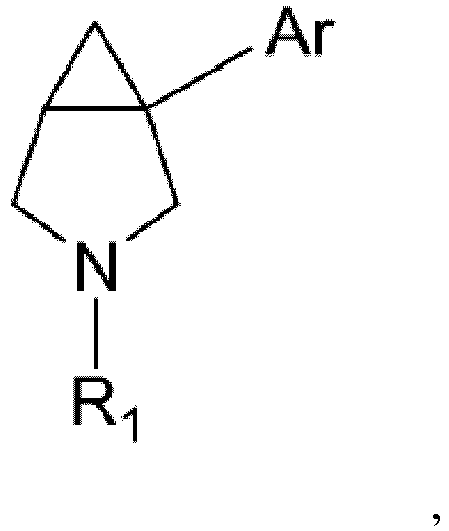
- (e) alkylating the 1-heteroaryl-3-azabicyclo[3.1.0]hexane produced in step (d) to produce a compound of the following Formula I,
- An illustrative assemblage of 1-heteroaryl-3-azabicyclo-[3.1.0]hexanes according to the present disclosure is provided in Table 1.


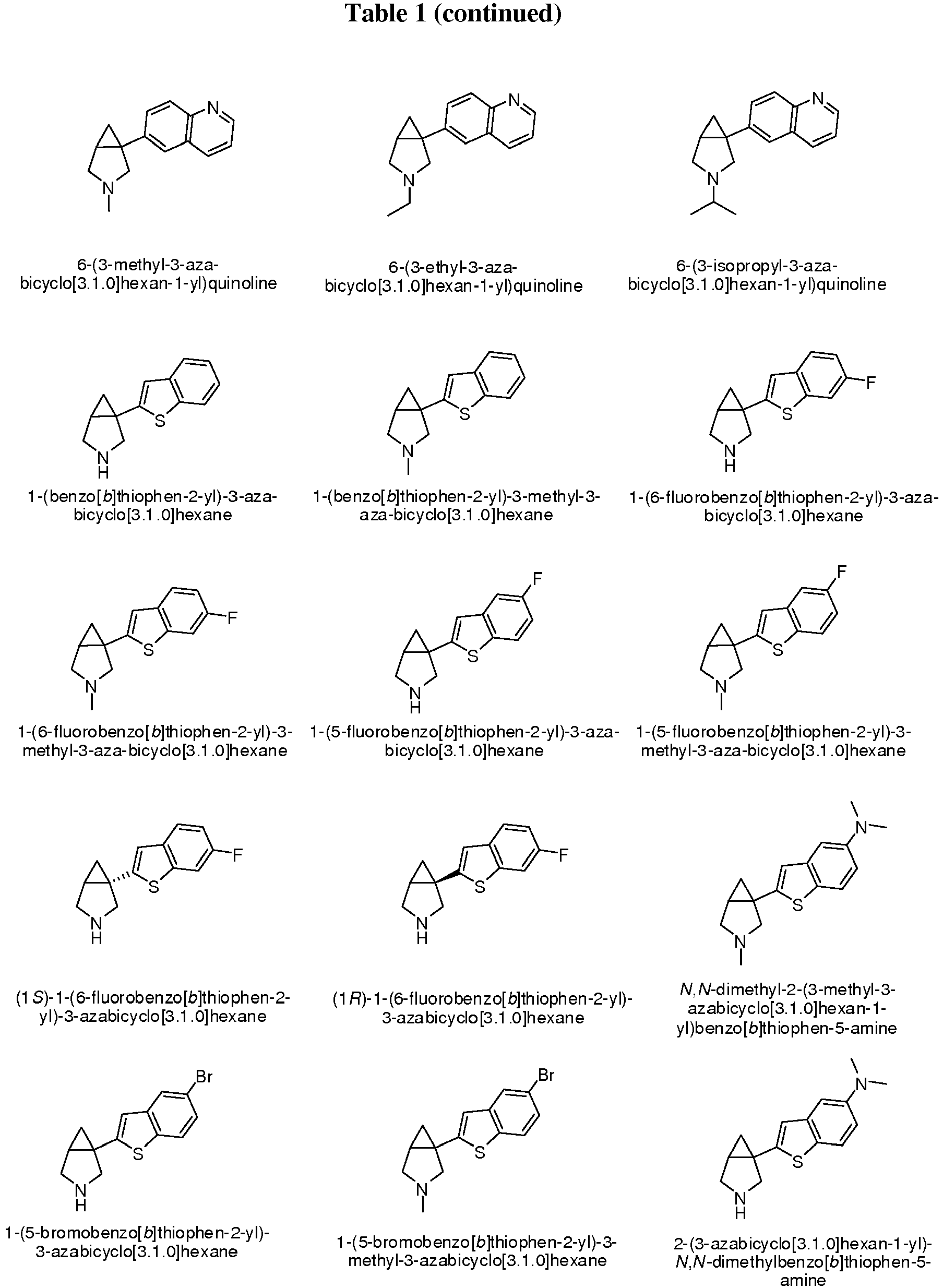
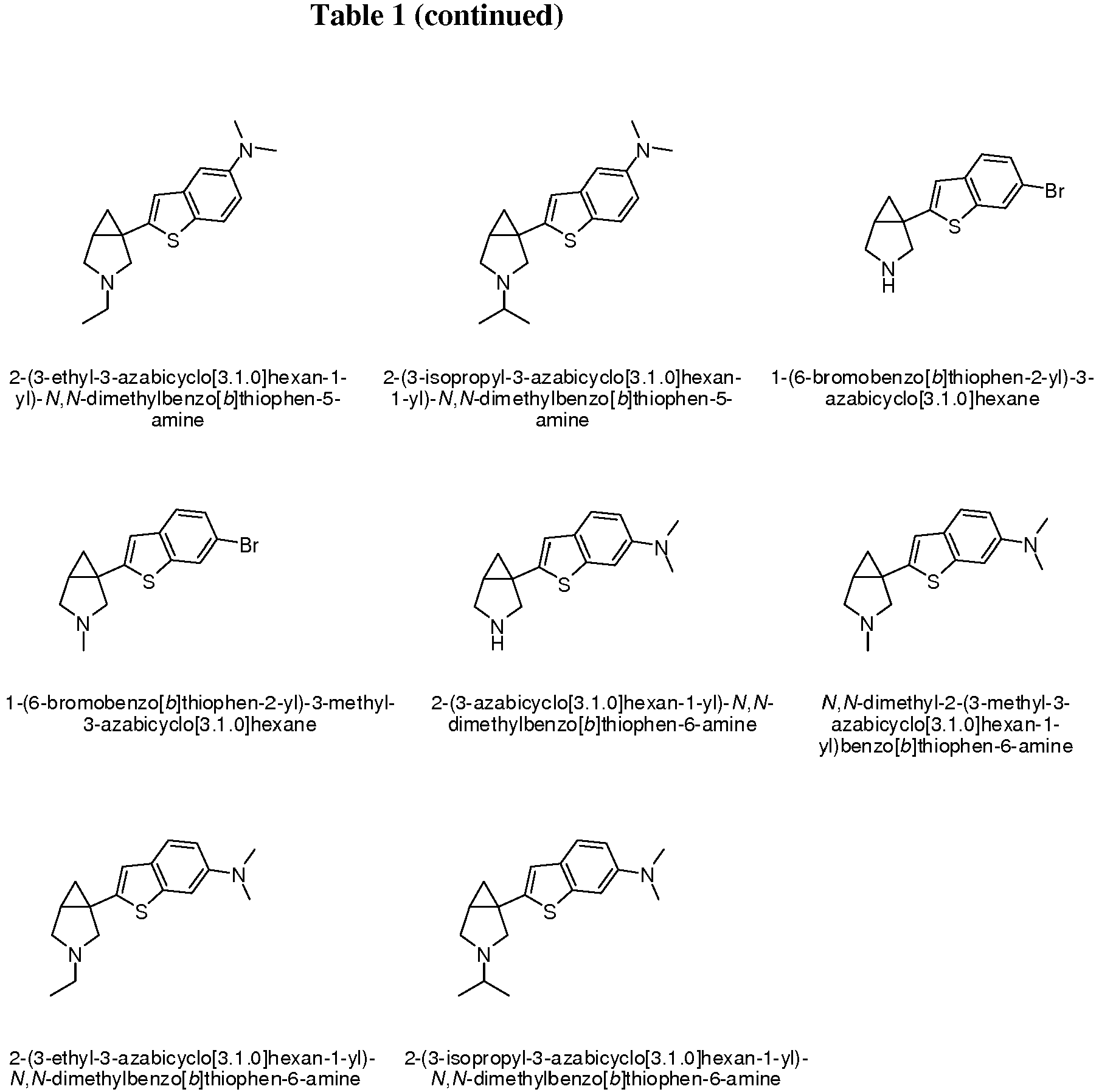
- The 1-heteroaryl-3-azabicyclo[3.1.0]hexanes of the present disclosure are provided in any of a variety of forms, including pharmaceutically acceptable, active salts, solvates, hydrates, polymorphs, and/or prodrugs of the compounds disclosed herein, or any combination thereof.
- It will be understood that the exemplary compounds identified in Table 1 are illustrative, and that in aspects of the present disclosure the heteroaryl ring can be varied to comprise other substituents, and/or can include yet additional substituents (i.e., three or more substitutions on the heteroaryl ring), combined with one another, or additionally combined with or without substitutions on the nitrogen atom as described herein, to yield yet additional compounds within the present disclosure for treating CNS disorders (including a range of neuropsychiatric disorders, such as depression and anxiety). For example, the present disclosure provides an illustrative assemblage of novel 1-heteroaryl-3-azabicyclo[3.1.0]hexanes amines having multiple substitutions on the aryl ring, combined with or without substitution(s) on the nitrogen atom. Additionally, useful 1-heteroaryl-3-azabicyclo[3.1.0]hexanes of the present disclosure include the substituted 1-heteroaryl-3-azabicyclo[3.1.0]hexanes compounds described herein, as well as their pharmaceutically acceptable salts, enantiomers, polymorphs, solvates, hydrate or prodrugs or combinations thereof.
- Within related aspects of the disclosure, enantiomeric forms of the novel compounds described herein, having chiral symmetric structures, are provided, which provide yet additional drug candidates for treating CNS disorders. In certain aspects, the present disclosure provides enantiomers, diastereomers, and other stereoisomeric forms of the disclosed compounds, including racemic and resolved forms and mixtures thereof. The individual enantiomers may be separated according to methods that are well known to those of ordinary skill in the art. In other aspects of the present disclosure, the enantiomers, diastereomers and other stereoisomeric forms of the disclosed compounds contain no more than about 10%, about 5%, about 2% or about 1% of the corresponding enantiomers, diastereomers and stereoisomers. When the compounds described herein contain olefinic double bonds or other centers of geometric asymmetry, and unless specified otherwise, it is intended to include both E and Z geometric isomers. All tautomers are intended to be encompassed by the present disclosure as well.
- As noted above, the compounds of the present disclosure can be can be prepared as both acid addition salts formed from an acid and the basic nitrogen group of 1-heteroaryl-3-azabicyclo[3.1.0.]hexanes and base salts. As further noted above, the methods of the present disclosure can be used to prepare compounds as both acid addition salts formed from an acid and the basic nitrogen group of 1-heteroaryl-3-azabicyclo[3.1.0.]hexanes and base salts. Suitable acid addition salts include, for example, hydrochloride, hydrobromide, hydroiodide, sulphate, hydrogen sulphate, nitrate, phosphate, and hydrogen phosphate salts. Other examples of pharmaceutically acceptable acid addition salts include inorganic and organic acid addition salts. Additional pharmaceutically acceptable salts include, but are not limited to, metal salts such as sodium salt, potassium salt, cesium salt and the like; alkaline earth metals such as calcium salt, magnesium salt and the like; organic amine salts such as triethylamine salt, pyridine salt, picoline salt, ethanolamine salt, triethanolamine salt, dicyclohexylamine salt, N,N'-dibenzylethylenediamine salt and the like; organic acid salts such as acetate, citrate, lactate, succinate, tartrate, maleate, fumarate, mandelate, acetate, dichloroacetate, trifluoroacetate, oxalate, formate and the like; sulfonates such as methanesulfonate, benzenesulfonate, p-toluenesulfonate and the like; and amino acid salts such as arginate, asparginate, glutamate, tartrate, gluconate and the like. Suitable base salts are formed from bases, which form nontoxic salts and include, for example, aluminum, calcium, lithium, magnesium, potassium, sodium, zinc and diethanolamine salts. The hydrochloride salt formed with hydrochloric acid is an exemplary useful salt.
- In other detailed aspects, the present disclosure provides prodrugs of the disclosed compounds. Prodrugs are considered to be any covalently bonded carriers which release the active parent drug in vivo. Examples of prodrugs include esters or amides of a compound of the present disclosure with hydroxyalkyl or aminoalkyl as a substituent. These may be prepared by reacting such compounds with anhydrides such as succinic anhydride.
- The present disclosure will also be understood to disclose in vivo metabolic products of the disclosed compounds. Such products may result for example from the oxidation, reduction, hydrolysis, amidation, esterification and the like of the administered compound, primarily due to enzymatic processes. Accordingly, the present disclosure includes compounds produced by a process comprising contacting a compound of this disclosure with a mammal for a period of time sufficient to yield a metabolic product thereof. Such products typically are identified by preparing a radiolabelled compound of the present disclosure, administering it parenterally in a detectable dose to an animal such as rat, mouse, guinea pig, monkey, or to man, allowing sufficient time for metabolism to occur and isolating its conversion products from the urine, blood or other biological samples.
- The present disclosure will also be understood to encompass the disclosed compounds isotopically-labelled by having one or more atoms replaced by an atom having a different atomic mass or mass number. Examples of isotopes that can be incorporated into the disclosed compounds include isotopes of hydrogen, carbon, nitrogen, oxygen, phosphorous, fluorite and chloride, such as 2H, 3H, 13C, 14C, 15N, 18O, 17O, 31P, 32P, 35S, 18F, and 36Cl, respectively.
- The compounds of the present disclosure may be prepared using methods known to those skilled in the art, and in other aspects by employing novel synthetic schemes as provided herein, which, along with the exemplified intermediate compounds, also fall within the present disclosure. Accordingly, the present disclosure also provides novel methods and compositions for producing the compounds of the present disclosure as well as other 1-heteroaryl-3-azabicyclo[3.1.0] hexanes.
- In practicing the methods of the present invention for making 1-heteroaryl-3-azabicyclo[3.1.0]hexanes, various reagents may be utilized for the different reaction steps. In general, suitable reagents for the various reaction steps may be selected by one of ordinary skill in the art based on the present disclosure.
- Suitable reducing agents and methodologies include, for example, lithium aluminum hydride (LAH), sodium aluminum hydride (SAH), NaBH4 with ZnCl2 and catalytic hydrogenation.
Suitable nitrogen protecting groups include, for example, benzyl, allyl, tert-butyl and 3,4-dimethoxy-benzyl groups. In general, nitrogen protecting groups are well known to those skilled in the art, see for example, "Nitrogen Protecting Groups in Organic Synthesis", John Wiley and Sons, New York, N.Y., 1981, Chapter 7; "Nitrogen Protecting Groups in Organic Chemistry", Plenum Press, New York, N.Y., 1973, Chapter 2; T. W. Green and P. G. M. Wuts in "Protective Groups in Organic Chemistry", 3rd edition, John Wiley & Sons, New York, N.Y., 1999. - When the nitrogen protecting group is no longer needed, it may be removed by methods well known in the art. For example, benzyl or 3,4-dimethoxy-benzyl groups may be removed by catalytic hydrogenation. In general, methods of removing nitrogen protecting groups are well known to those skilled in the art, see for example, "Nitrogen Protecting Groups in Organic Synthesis", John Wiley and Sons, New York, N.Y., 1981, Chapter 7; "Nitrogen Protecting Groups in Organic Chemistry", Plenum Press, New York, N.Y., 1973, Chapter 2; T. W. Green and P. G. M. Wuts in "Protective Groups in Organic Chemistry", 3rd edition, John Wiley & Sons, Inc. New York, N.Y., 1999.
- Suitable reagents for causing cyclization include, for example, SOCl2, POCl3, oxalyl chloride, phosphorous tribromide, triphenylphosphorous dibromide and oxalyl bromide.
- Exemplary synthetic methods, starting materials, and intermediates useful in various aspects of the present disclosure for producing compounds of the present disclosure are described below and in the examples.
- Reaction Scheme 1 below generally sets forth an exemplary process for preparing 1-heteroaryl-3-azabicyclo[3.1.0]hexanes.

- Reaction Scheme 2 below generally sets forth another exemplary process for preparing 1-heteroaryl-3-azabicyclo[3.1.0]hexanes.

- Reaction Scheme 3 below generally sets forth an additional exemplary process for preparing 1-heteroaryl-3-azabicyclo[3.1.0]hexanes.

- Reaction Scheme 4 below generally sets forth an additional exemplary process for preparing chiral 1-heteroaryl-3-azabicyclo[3.1.0]hexanes.

- Reaction Scheme 5 below generally sets forth an additional exemplary process for preparing chiral 1-heteroaryl-3-azabicyclo[3.1.0]hexanes.

- For the purposes of further describing the invention, including the novel compounds and synthetic methods disclosed herein, the following terms and definitions are provided by way of example.
- The term "halogen" as used herein refers to bromine, chlorine, fluorine or iodine. In one embodiment, the halogen is chlorine. In another embodiment, the halogen is bromine.
- The term "hydroxy" as used herein refers to -OH or --O-.
- The term "alkyl" as used herein refers to straight- or branched-chain aliphatic groups containing 1-20 carbon atoms, preferably 1-7 carbon atoms and most preferably 1-4 carbon atoms. This definition applies as well to the alkyl portion of alkoxy, alkanoyl and aralkyl groups. In one embodiment, the alkyl is a methyl group.
- The term "alkoxy" includes substituted and unsubstituted alkyl, alkenyl, and alkynyl groups covalently linked to an oxygen atom. In one embodiment, the alkoxy group contains 1 to 4 carbon atoms. Embodiments of alkoxy groups include, but are not limited to, methoxy, ethoxy, isopropyloxy, propoxy, butoxy, and pentoxy groups. Embodiments of substituted alkoxy groups include halogenated alkoxy groups. In a further embodiment, the alkoxy groups can be substituted with groups such as alkenyl, alkynyl, halogen, hydroxyl, alkylcarbonyloxy, phenylcarbonyloxy, alkoxycarbonyloxy, phenyloxycarbonyloxy, carboxylate, alkylcarbonyl, phenylcarbonyl, alkoxycarbonyl, aminocarbonyl, alkylaminocarbonyl, dialkylaminocarbonyl, alkylthiocarbonyl, alkoxyl, phosphate, phosphonato, phosphinato, cyano, amino (including alkylamino, dialkylamino, phenylamino, diphenylamino, and alkylphenylamino), acylamino (including alkylcarbonylamino, phenylcarbonylamino, carbamoyl and ureido), amidino, imino, sulfhydryl, alkylthio, phenylthio, thiocarboxylate, sulfates, alkylsulfinyl, sulfonato, sulfamoyl, sulfonamido, nitro, trifluoromethyl, cyano, azido, heterocyclyl, alkylphenyl, or aromatic or heteroaromatic moieties. Exemplary halogen substituted alkoxy groups include, but are not limited to, fluoromethoxy, difluoromethoxy, trifluoromethoxy, chloromethoxy, dichloromethoxy, and trichloromethoxy.
- The term "aryl" as used herein refers to monocyclic or bicyclic aromatic hydrocarbon groups having from 6 to 12 carbon atoms in the ring portion, for example, phenyl, naphthyl, biphenyl and diphenyl groups, each of which may be substituted with, for example, one to four substituents such as alkyl, substituted alkyl as defined above, halogen, trifluoromethyl, trifluoromethoxy, hydroxy, alkoxy, cycloalkyloxy, alkanoyl, alkanoyloxy, amino, alkylamino, dialkylamino, nitro, cyano, carboxy, carboxyalkyl, carbamyl, carbamoyl and aryloxy. Specific embodiments of aryl groups in accordance with the present disclosure include phenyl, substituted phenyl, naphthyl, biphenyl, and diphenyl.
- The term "nitro", as used herein alone or in combination refers to a --NO2 group.
- The term "amino" as used herein refers to the group --NRR', where R and R' may independently be hydrogen, alkyl, phenyl, alkoxy, or heterophenyl. The term "aminoalkyl" as used herein represents a more detailed selection as compared to "amino" and refers to the group --NRR', where R and R' may independently be hydrogen or (C1-C4)alkyl.
- The term "trifluoromethyl" as used herein refers to --CF3.
- The term "trifluoromethoxy" as used herein refers to --OCF3.
- The term "cycloalkyl" as used herein refers to a saturated cyclic hydrocarbon ring system containing from 3 to 7 carbon atoms that may be optionally substituted. Exemplary embodiments include, but are not limited to, cyclopropyl, cyclobutyl, cyclopentyl and cyclohexyl. In certain embodiments, the cycloalkyl group is cyclopropyl.
- In another embodiment, the (cycloalkyl)alkyl groups contain from 3 to 7 carbon atoms in the cyclic portion and 1 to 4 carbon atoms in the alkyl portion. In certain embodiments, the (cycloalkyl)alkyl group is cyclopropylmethyl. The alkyl groups are optionally substituted with from one to three substituents selected from the group consisting of halogen, hydroxy and amino.
- The terms "alkanoyl" and "alkanoyloxy" as used herein refer, respectively, to-C(O)-alkyl groups and -O-C(O)-alkyl groups, each optionally containing 2-5 carbon atoms. Specific embodiments of alkanoyl and alkanoyloxy groups are acetyl and acetoxy, respectively.
- The term "aroyl," as used alone or in combination herein, refers to a phenyl radical derived from an aromatic carboxylic acid, such as optionally substituted benzoic or naphthoic acids.
- The term "aralkyl" as used herein refers to a phenyl group bonded to an alkyl group, preferably one containing 1-4 carbon atoms. A preferred aralkyl group is benzyl.
- The term "nitrile" or "cyano" as used herein refers to the group -CN.
- The term "pyrrolidine-1-yl" as used herein refers to the structure:

- The term "morpholino" as used herein refers to the structure:

- The term "dialkylamino" refers to an amino group having two attached alkyl groups that can be the same or different.
- The term "alkenyl" refers to a straight or branched alkenyl group of 2 to 10 carbon atoms having 1 to 3 double bonds. Preferred embodiments include ethenyl, 1-propenyl, 2-propenyl, 1-methylethenyl, 1-butenyl, 2-butenyl, 3-butenyl, 2-methyl-2-propenyl, 1-pentenyl, 2-pentenyl, 4-pentenyl, 3-methyl-2-butenyl, 1-hexenyl, 2-hexenyl, 1-heptenyl, 2-heptenyl, 1-octenyl, 2-octenyl, 1,3-octadienyl, 2-nonenyl, 1,3-nonadienyl, 2-decenyl, etc.
- The term "alkynyl" as used herein refers to a straight or branched alkynyl group of 2 to 10 carbon atoms having 1 to 3 triple bonds. Exemplary alkynyls include, but are not limited to, ethynyl, 1-propynyl, 2-propynyl, 1-butynyl, 2-butynyl, 3-butynyl, 1-pentynyl, 2-pentynyl, 4-pentynyl, 1-octynyl, 6-methyl-1-heptynyl, and 2-decynyl.
- The term "hydroxyalkyl" alone or in combination, refers to an alkyl group as previously defined, wherein one or several hydrogen atoms, preferably one hydrogen atom has been replaced by a hydroxyl group. Examples include hydroxymethyl, hydroxyethyl and 2-hydroxyethyl.
- The term "aminoalkyl" and "alkylamino" as used herein refers to the group-NRR', where R and R' may independently be hydrogen or (C1-C4)alkyl.
The term "alkylaminoalkyl" refers to an alkylamino group linked via an alkyl group (i.e., a group having the general structure --alkyl-NH-alkyl or --alkyl-N(alkyl)(alkyl)). Such groups include, but are not limited to, mono- and di-(C1-C8 alkyl)aminoC1-C8 alkyl, in which each alkyl may be the same or different. - The term "dialkylaminoalkyl" refers to alkylamino groups attached to an alkyl group. Examples include, but are not limited to, N,N-dimethylaminomethyl, N,N-dimethylaminoethyl, N,N-dimethylaminopropyl, and the like. The term dialkylaminoalkyl also includes groups where the bridging alkyl moiety is optionally substituted.
- The term "haloalkyl" refers to an alkyl group substituted with one or more halo groups, for example chloromethyl, 2-bromoethyl, 3-iodopropyl, trifluoromethyl, perfluoropropyl, 8-chlorononyl and the like.
- The term "carboxyalkyl" as used herein refers to the substituent --R'--COOH wherein R' is alkylene; and carbalkoxyalkyl refers to --R'--COOR wherein R' and R are alkylene and alkyl respectively. In certain embodiments, alkyl refers to a saturated straight- or branched-chain hydrocarbyl radical of 1-6 carbon atoms such as methyl, ethyl, n-propyl, isopropyl, n-butyl, t-butyl, n-pentyl, 2-methylpentyl, n-hexyl, and so forth. Alkylene is the same as alkyl except that the group is divalent.
- The term "alkoxyalkyl" refers to an alkylene group substituted with an alkoxy group. For example, methoxyethyl [CH3OCH2CH2--] and ethoxymethyl (CH3CH2OCH2--] are both C3 alkoxyalkyl groups.
- The term "carboxy", as used herein, represents a group of the formula-COOH.
- The term "alkanoylamino" refers to alkyl, alkenyl or alkynyl groups containing the group --C(O)-- followed by --N(H)--, for example acetylamino, propanoylamino and butanoylamino and the like.
- The term "carbonylamino" refers to the group --NR--CO--CH2--R', where R and R' may be independently selected from hydrogen or (C1-C4)alkyl.
- The term "carbamoyl" as used herein refers to --O--C(O)NH2.
- The term "carbamyl" as used herein refers to a functional group in which a nitrogen atom is directly bonded to a carbonyl, i.e., as in --NRC(=O)R' or-C(=O)NRR', wherein R and R' can be hydrogen, alkyl, substituted alkyl, alkenyl, substituted alkenyl, alkoxy, cycloalkyl, phenyl, heterocyclo, or heterophenyl.
- The terms "heterocyclo" or "heterocyclic" refers to an optionally substituted, unsaturated, partially saturated, or fully saturated, aromatic or nonaromatic cyclic group that is a 4 to 7 membered monocyclic, or 7 to 11 membered bicyclic ring system that has at least one heteroatom in at least one carbon atom-containing ring. The substituents on the heterocyclo rings may be selected from those given above for the aryl groups. Each ring of the heterocyclo group containing a heteroatom may have 1, 2 or 3 heteroatoms selected from nitrogen atoms, oxygen atoms and sulfur atoms. Plural heteroatoms in a given heterocyclo ring may be the same or different.
- The term "heteroaryl" refers to an optionally substituted monocyclic or bicyclic heterocyclic aryl group (ie., an aromatic heterocyclic group) that is a 4 to 7 membered monocyclic, or 7 to 11 membered bicyclic ring system that has at least one heteroatom in at least one carbon atom-containing ring. Each ring of the heteroaryl group containing a heteroatom may have 1,2 or 3 heteroatoms selected from nitrogen atoms, oxygen atoms and sulfur atoms. Plural heteroatoms in a given heteroaryl group may be the same or different. Specific embodiments of heteroaryl groups in accordance with the present disclosure include furan, thiophene, pyrrole, imidazole, pyrazole, triazole, tetrazole, thiazole, isothiazole, pyridine, pyridizine, pyrimidine, pyrazine, triazine, indole, benzofuran, benzothiophene, benzothiazole, quinoline, isoquinoline, cinnoline, phthalazine, quinazoline, quinoxaline, chromane and isochromane groups.
- The term "alkylsulfonylamino" refers to refers to the group --NHS(O)2Ra wherein Ra is an alkyl as defined above.
- As used herein, the term "stereoisomers" is a general term for all isomers of individual molecules that differ only in the orientation of their atoms in space. It includes enantiomers and isomers of compounds with more than one chiral center that are not mirror images of one another (diastereomers).
- The term "chiral center" refers to a carbon atom to which four different groups are attached.
- The term "enantiomer" or "enantiomeric" refers to a molecule that is nonsuperimposeable on its mirror image and hence optically active wherein the enantiomer rotates the plane of polarized light in one direction and its mirror image rotates the plane of polarized light in the opposite direction.
- The term "racemic" refers to a mixture of equal parts of enantiomers and which is optically inactive.
- The term "resolution" refers to the separation or concentration or depletion of one of the two enantiomeric forms of a molecule.
- The compositions and methods of the present disclosure comprising a 1-heteroaryl-3-azabicyclo[3.1.0] hexane are effective for treating or preventing a variety of central nervous system (CNS) disorders in mammals. In certain aspects of the present disclosure, pharmaceutical compositions and methods are provided for treating a CNS disorder in a mammalian subject. Mammalian subjects amenable for treatment using these compositions and methods include, but are not limited to, human and other mammalian subjects suffering from a CNS disorder that responds positively to intervention by inhibition of biogenic amine transport. In related aspects of the present disclosure, therapeutic compositions and methods are provided which employ an effective amount of one or more 1-heteroaryl-3-azabicyclo[3.1.0] hexane(s) described herein to treat or prevent a selected CNS disorder in a subject, wherein administration of the composition to the subject effectively inhibits the function of one or more, and in certain aspects of the present disclosure all three, norepinephrine, serotonin, and/or dopamine transport proteins in the subject, thereby preventing, or reducing the occurrence or severity of symptoms of, the targeted CNS disorder. Suitable forms of the compounds of the present disclosure for use in biologically active compositions and methods of the present disclosure include the compounds exemplified herein, as well as their pharmaceutically acceptable salts, polymorphs, solvates, hydrates and prodrugs.
- In related aspects of the present disclosure, a biogenic amine transport inhibitory-effective amount of a 1-heteroaryl-3-azabicyclo[3.1.0.]hexane of the present disclosure is administered to treat or prevent a CNS disorder, including neurological or psychiatric conditions, in a mammalian subject responsive to inhibition of biogenic amine transport. In more detailed aspects, administration of an active compound of the present disclosure provides a therapeutic or prophylactic benefit by inhibiting or blocking reuptake of one or more, including any combination of two, or all three, biogenic amines selected from norepinephrine, serotonin, and dopamine.
- Within more detailed treatment methods of the present disclosure, administration of the active 1-heteroaryl-3-azabicyclo[3.1.0.]hexane(s) mediates a therapeutic effect via the active compound inhibiting reuptake of norepinephrine, serotonin, and/or dopamine. Biogenic amine reuptake inhibition in this context can optionally be determined and selected by using one or more 1-heteroaryl-3-azabicyclo[3.1.0.]hexane(s) of the present disclosure to achieve variable selectivity and potency of transporter inhibition, wherein one or any combination of norepinephrine, serotonin and/or dopamine transporters can be inhibited, at predetermined levels or ratios among or between different transporters. In this context, the various 1-heteroaryl-3-azabicyclo[3.1.0.]hexanes of the present disclosure exhibit a wide range of potencies as inhibitors of one, two, or all three of the norepinephrine, serotonin and dopamine transporters--rendering them useful in a broad array of therapeutic applications.
- In accordance with the present disclosure, compounds disclosed herein, optionally formulated with additional ingredients in a pharmaceutically acceptable composition, are administered to mammalian subjects, for example a human patient, to treat or prevent one or more symptom(s) of a CNS disorder alleviated by inhibiting dopamine reuptake, and/or norepinephrine reuptake, and/or serotonin reuptake. In certain aspects of the present disclosure, "treatment" or "treating" refers to amelioration of one or more symptom(s) of a CNS disorder, whereby the symptom(s) is/are alleviated by inhibiting dopamine and/or norepinephrine and/or serotonin reuptake. In other aspects of the present disclosure, "treatment" or "treating" refers to an amelioration of at least one measurable physical parameter associated with a CNS disorder. In yet another aspect of the present disclosure, "treatment" or "treating" refers to inhibiting or reducing the progression or severity of a CNS disorder (or one or more symptom(s) thereof) alleviated by inhibiting dopamine and/or norepinephrine and/or serotonin reuptake, e.g., as discerned based on physical, physiological, and/or psychological parameters. In additional aspects of the present disclosure, "treatment" or "treating" refers to delaying the onset of a CNS disorder (or one or more symptom(s) thereof) alleviated by inhibiting dopamine and/or norepinephrine and/or serotonin reuptake.
- In certain aspects of the present disclosure, a compound of the present disclosure or a pharmaceutically acceptable salt thereof is administered to a mammalian subject, for example a human patient, as a preventative or prophylactic treatment against a CNS disorder (or one or more symptom(s) thereof) alleviated by inhibiting dopamine and/or norepinephrine and/or serotonin reuptake. As used herein, "prevention", "preventing", and prophylaxis refers to a reduction in the risk or likelihood that the subject will acquire a CNS disorder or one or more symptom(s) thereof, which risk or likelihood is reduced in the subject by inhibiting dopamine and/or norepinephrine and/or serotonin reuptake. Alternatively, prevention and prophylaxis may correlate with a reduced risk of recurrence of the CNS disorder or symptom(s) thereof in the subject once the subject has been cured, restored to a normal state, or placed in remission from the subject CNS disorder. In related aspects of the present disclosure, a compound or pharmaceutical composition of the present disclosure is administered as a preventative measure to the subject. Exemplary subjects amenable to prophylactic treatment in this context may have a genetic predisposition to a CNS disorder amenable to treatment by inhibiting dopamine, and/or serotonin, and/or norepinephrine reuptake, such as a family history of a biochemical imbalance in the brain, or a non-genetic predisposition to a disorder alleviated by inhibiting dopamine and/or norepinephrine and/or serotonin reuptake.
- A compound of the present disclosure and pharmaceutically acceptable salts thereof are useful for treating or preventing endogenous disorders alleviated by inhibiting dopamine and/or norepinephrine and/or serotonin reuptake. Such disorders include, but are not limited to, attention-deficit disorder, depression, anxiety, obesity, Parkinson's disease, tic disorders, and addictive and substance abuse disorders.
- Disorders alleviated by inhibiting dopamine and/or norepinephrine and/or serotonin reuptake are not limited to the specific disorders described herein, and the compositions and methods of the present disclosure will be understood or readily ascertained to provide effective treatment agents for treating and/or preventing a wide range of additional CNS disorders and associated symptoms. For example, the compounds of the present disclosure will provide promising candidates for treatment and/or prevention of attention deficit hyperactivity disorder and related symtoms, as well as forms and symptoms of alcohol abuse, drug abuse, cognitive distorders, obsessive compulsive behaviors, learning disorders, reading problems, gambling addiction, manic symptoms, phobias, panic attacks, oppositional defiant behavior, conduct disorder, academic problems in school, smoking, abnormal sexual behaviors, schizoid behaviors, somatization, depression, sleep disorders, general anxiety, stuttering, and tic disorders (See, for example,
U.S. Pat. No. 6,132,724 ). Other disorders for which the compounds of the present disclosure may be useful include irritable bowel syndrome; inflammatory bowel disease; urinary tract disorders, such as stress urinary incontinence; PMDD (Premenstrual dysphoric disorder), degenerative diseases, including Alzheimers disease, and amyotrophic lateral sclerosis; and pyretic conditions (including fevers, and post-and peri-menopausal hot flashes). These and other symptoms, regardless of the underlying CNS disorder, are each targets for the novel compositions and methods of the present disclosure that mediate therapeutic benefits by inhibiting dopamine and/or norepinephrine and/or serotonin reuptake. Additional CNS disorders contemplated for treatment employing the compositions and methods of the present disclosure are described, for example, in the Quick Reference to the Diagnostic Criteria From DSM-IV (Diagnostic and Statistical Manual of Mental Disorders, Fourth Edition), The American Psychiatric Association, Washington, D.C., 1994, 358 pages. Cognitive disorders for treament and/or prevention according to the present disclosure, include, but are not limited to, Attention-Deficit/Hyperactivity Disorder, Predominately Inattentive Type; Attention-Deficit/Hyperactivity Disorder, Predominately Hyperactivity-Impulsive Type; Attention-Deficit/Hyperactivity Disorder, Combined Type; Attention-Deficit/Hyperactivity Disorder not otherwise specified (NOS); Conduct Disorder; Oppositional Defiant Disorder; and Disruptive Behavior Disorder not otherwise specified (NOS). - Depressive disorders amenable for treatment and/or prevention according to the present disclosure include, but are not limited to, Major Depressive Disorder, Recurrent; Dysthymic Disorder; Depressive Disorder not otherwise specified (NOS); and Major Depressive Disorder, Single Episode.
- Addictive disorders amenable for treatment and/or prevention employing the methods and compositions of the present disclosure include, but are not limited to, eating disorders, impulse control disorders, alcohol-related disorders, nicotine-related disorders, amphetamine-related disorders, cannabis-related disorders, cocaine-related disorders, hallucinogen use disorders, inhalant-related disorders, and opioid-related disorders, all of which are further sub-classified as listed below.
- Eating disorders include, but are not limited to, Bulimia Nervosa, Nonpurging Type; Bulimia Nervosa, Purging Type; and Eating Disorder not otherwise specified (NOS).
- Impulse control disorders include, but are not limited to, Intermittent Explosive Disorder, Kleptomania, Pyromania, Pathological Gambling, Trichotillomania, and Impulse Control Disorder not otherwise specified (NOS).
- Alcohol-related disorders include, but are not limited to, Alcohol-Induced Psychotic Disorder, with delusions; Alcohol Abuse; Alcohol Intoxication; Alcohol Withdrawal; Alcohol Intoxication Delirium; Alcohol Withdrawal Delirium; Alcohol-Induced Persisting Dementia; Alcohol-Induced Persisting Amnestic Disorder; Alcohol Dependence; Alcohol-Induced Psychotic Disorder, with hallucinations; Alcohol-Induced Mood Disorder; Alcohol-Induced Anxiety Disorder; Acohol-Induced Sexual Dysfunction; Alcohol-Induced Sleep Disorders; Alcohol-Related Disorders not otherwise specified (NOS); Alcohol Intoxication; and Alcohol Withdrawal.
- Nicotine-related disorders include, but are not limited to, Nicotine Dependence, Nicotine Withdrawal, and Nicotine-Related Disorder not otherwise specified (NOS). Amphetamine-related disorders include, but are not limited to, Amphetamine Dependence, Amphetamine Abuse, Amphetamine Intoxication, Amphetamine Withdrawal, Amphetamine Intoxication Delirium, Amphetamine-Induced Psychotic Disorder with delusions, Amphetamine-Induced Psychotic Disorders with hallucinations, Amphetamine-Induced Mood Disorder, Amphetamine-Induced Anxiety Disorder, Amphetamine-Induced Sexual Dysfunction, Amphetamine-Induced Sleep Disorder, Amphetamine Related Disorder not otherwise specified (NOS), Amphetamine Intoxication, and Amphetamine Withdrawal.
- Cannabis-related disorders include, but are not limited to, Cannabis Dependence; Cannabis Abuse; Cannabis Intoxication; Cannabis Intoxication Delirium; Cannabis-Induced Psychotic Disorder, with delusions; Cannabis-Induced Psychotic Disorder with hallucinations; Cannabis-Induced Anxiety Disorder; Cannabis Related Disorder not otherwise specified (NOS); and Cannabis Intoxication.
- Cocaine-related disorders include, but are not limited to, Cocaine Dependence, Cocaine Abuse, Cocaine Intoxication, Cocaine Withdrawal, Cocaine Intoxication Delirium, Cocaine-Induced Psychotic Disorder with delusions, Cocaine-Induced Psychotic Disorders with hallucinations, Cocaine-Induced Mood Disorder, Cocaine-Induced Anxiety Disorder, Cocaine-Induced Sexual Dysfunction, Cocaine-Induced
- Sleep Disorder, Cocaine Related Disorder not otherwise specified (NOS), Cocaine Intoxication, and Cocaine Withdrawal.
- Hallucinogen-use disorders include, but are not limited to, Hallucinogen Dependence, Hallucinogen Abuse, Hallucinogen Intoxication, Hallucinogen Withdrawal, Hallucinogen Intoxication Delirium, Hallucinogen-Induced Psychotic Disorder with delusions, Hallucinogen-Induced Psychotic Disorders with hallucinations, Hallucinogen- Induced Mood Disorder, Hallucinogen-Induced Anxiety Disorder, Hallucinogen-Induced Sexual Dysfunction, Hallucinogen-Induced Sleep Disorder, Hallucinogen Related Disorder not otherwise specified (NOS), Hallucinogen Intoxication, and Hallucinogen Persisting Perception Disorder (Flashbacks).
- Inhalant-related disorders include, but are not limited to, Inhalant Dependence; Inhalant Abuse; Inhalant Intoxication; Inhalant Intoxication Delirium; Inhalant-Induced Psychotic Disorder, with delusions; Inhalant-Induced Psychotic Disorder with hallucinations; Inhalant-Induced Anxiety Disorder; Inhalant Related Disorder not otherwise specified (NOS); and Inhalant Intoxication.
- Opioid-related disorders include, but are not limited to, Opioid Dependence, Opioid Abuse, Opioid Intoxication, Opioid Intoxication Delirium, Opioid-Induced Psychotic Disorder, with delusions, Opioid-Induced Psychotic Disorder with hallucinations, Opioid-Induced Anxiety Disorder, Opioid Related Disorder not otherwise specified (NOS), Opioid Intoxication, and Opioid Withdrawal.
- Tic disorders include, but are not limited to, Tourette's Disorder, Chronic Motor or Vocal Tic Disorder, Transient Tic Disorder, Tic Disorder not otherwise specified (NOS), Stuttering, Autistic Disorder, and Somatization Disorder.
- By virtue of their multiple reuptake inhibitory activity, the novel compounds of the present invention are thus useful in a wide range of veterinary and human medical applications, in particular for treating and/or preventing a wide array of CNS disorders and/or associated symptom(s) alleviated by by inhibiting dopamine and/or norepinephrine and/or serotonin reuptake.
- Within additional aspects of the present disclosure, combinatorial formulations and coordinate administration methods are provided which employ an effective amount of a compound of the invention (or a pharmaceutically effective enantiomer, salt, solvate, hydrate, polymorph, or prodrug thereof), and one or more additional active agent(s) that is/are combinatorially formulated or coordinately administered with the compound of the invention-yielding a combinatorial formulation or coordinate administration method that is effective to modulate, alleviate, treat or prevent a targeted CNS disorder, or one or more symptom(s) thereof, in a mammalian subject. Exemplary combinatorial formulations and coordinate treatment methods in this context comprise a therapeutic compound of the present disclosure in combination with one or more additional or adjunctive treatment agents or methods for treating the targeted CNS disorder or symptom(s), for example one or more antidepressant or anxiolytic agent(s) and/or therapeutic method(s).
- In related aspects of the present disclosure, the compounds disclosed herein can be used in combination therapy with at least one other therapeutic agent or method. In this context, compounds of the present disclosure can be administered concurrently or sequentially with administration of a second therapeutic agent, for example a second agent that acts to treat or prevent the same, or different, CNS disorder or symptom(s) for which the compound of the present disclosure is administered. The compound of the present disclosure and the second therapeutic agent can be combined in a single composition or adminstered in different compositions. The second therapeutic agent may also be effective for treating and/or preventing a CNS disorder or associated symptom(s) by inhibiting dopamine and/or norepinephrine and/or serotonin reuptake. The coordinate administration may be done simultaneously or sequentially in either order, and there may be a time period while only one or both (or all) active therapeutic agents, individually and/or collectively, exert their biological activities and therapeutic effects. A distinguishing aspect of all such coordinate treatment methods is that the compound of the present disclosure exerts at least some detectable therapeutic activity toward alleviating or preventing the targeted CNS disorder or symptom(s), as described herein, and/or elicit a favorable clinical response, which may or may not be in conjunction with a secondary clinical response provided by the secondary therapeutic agent. Often, the coordinate administration of a compound of the present disclosure with a secondary therapeutic agent as contemplated herein will yield an enhanced therapeutic response beyond the therapeutic response elicited by either or both the compound of the present disclosure and/or secondary therapeutic agent alone.
- As many of the CNS disorders and symptoms treatable or preventable using compounds of the present present disclosure are chronic, in one aspect of the present disclosure combination therapy involves alternating between administering a compound of the present disclosure and a second therapeutic agent (i.e., alternating therapy regimens between the two drugs, e.g., at one week, one month, three month, six month, or one year intervals). Alternating drug regimens in this context will often reduce or even eliminate adverse side effects, such as toxicity, that may attend long-term administration of one or both drugs alone.
- In certain aspects of the present disclosure of combinatorial formulations and coordinate treatment methods of the present disclosure, the secondary therapeutic is a norepinephrine reuptake inhibitor. Examples of norepinephrine reuptake inhibitors useful in this context include tertiary amine tricyclics such as amitriptyline, clomipramine, doxepin, imipramine, (+)-trimipramine, and secondary amine tricyclics including amoxapine, atomoxetine, desipramine, maprotiline, nortriptyline, and protriptyline.
- In certain aspects of the present disclosure of combinatorial formulations and coordinate treatment methods of the present disclosure, the secondary therapeutic is a serotonin reuptake inhibitor. Examples of other serotonin reuptake inhibitors useful in this context include citalopram, fluoxetine, fluvoxamine, (-)-paroxetine, sertraline, and venlafaxine.
- In other aspects of the present disclosure of combinatorial formulations and coordinate treatment methods provided herein, the secondary therapeutic agent is an anti-attention-deficit-disorder treatment agent. Examples of useful anti-attention-deficit-disorder agents for use in these aspects include, but are not limited to, methylphenidate; dextroamphetamine; tricyclic antidepressants, such as imipramine, desipramine, and nortriptyline; and psychostimulants, such as pemoline and deanol.
- In additional aspects of the present disclosure of combinatorial formulations and coordinate treatment methods provided herein, the secondary therapeutic agent is an anti-addictive-disorder agent. Examples of useful anti-addictive-disorder agents include, but are not limited to, tricyclic antidepressants; glutamate antagonists, such as ketamine HCl, dextromethorphan, dextrorphan tartrate and dizocilpine (MK801); degrading enzymes, such as anesthetics and aspartate antagonists; GABA agonists, such as baclofen and muscimol HBr; reuptake blockers; degrading enzyme blockers; glutamate agonists, such as D-cycloserine, carboxyphenylglycine, L-glutamic acid, and cis-piperidine-2,3-dicarboxylic acid; aspartate agonists; GABA antagonists such as gabazine (SR-95531), saclofen, bicuculline, picrotoxin, and (+) apomorphine HCl; and dopamine antagonists, such as spiperone HCl, haloperidol, and (-) sulpiride.
- In other aspects of the present disclosure of combinatorial formulations and coordinate treatment methods provided herein, the secondary therapeutic agent is an anti-alcohol agent. Examples of useful anti-alcohol agents include, but are not limited to, disulfiram and naltrexone.
- In other aspects of the present disclosure of combinatorial formulations and coordinate treatment methods provided herein, the secondary therapeutic agent is an anti-nicotine agent. Examples of useful anti-nicotine agents include, but are not limited to, clonidine.
- In other aspects of the present disclosure of combinatorial formulations and coordinate treatment methods provided herein, the secondary therapeutic agent is an anti-opiate agent. Examples of useful anti-opiate agents include, but are not limited to, methadone, clonidine, lofexidine, levomethadyl acetate HCl, naltrexone, and buprenorphine.
- In other aspects of the present disclosure of combinatorial formulations and coordinate treatment methods provided herein, the secondary therapeutic agent is anti-cocaine agent. Examples of useful anti-cocaine agents include, but are not limited to, desipramine, amantadine, fluoxidine, and buprenorphine.
- In other aspects of the present disclosure of combinatorial formulations and coordinate treatment methods provided herein, the secondary therapeutic agent is an anti-lysergic acid diethylamide ("anti-LSD") agent. Examples of useful anti-LSD agents include, but are not limited to, diazepam.
- In other aspects of the present disclosure of combinatorial formulations and coordinate treatment methods provided herein, the secondary therapeutic agent is an anti-phencyclidine ("anti-PCP") agent. Examples of useful anti-PCP agents include, but are not limited to, haloperidol.
- In other aspects of the present disclosure of combinatorial formulations and coordinate treatment methods provided herein, the secondary therapeutic agent is an appetite suppressant. Examples of useful appetite suppressants include, but are not limited to, fenfluramine, phenylpropanolamine, and mazindol.
- In yet additional aspects of the present disclosure of combinatorial formulations and coordinate treatment methods provided herein, the secondary therapeutic agent is an anti-Parkinson's-disease agent. Examples of useful anti-Parkinson's-disease agents include, but are not limited to dopamine precursors, such as levodopa, L-phenylalanine, and L-tyrosine; neuroprotective agents; dopamine agonists; dopamine reuptake inhibitors; anticholinergics such as amantadine and memantine; and 1,3,5-trisubstituted adamantanes, such as 1-amino-3,5-dimethyl-adamantane. (See,
U.S. Patent No. 4,122,193 ) - Administration of an effective amount of a 1-heteroaryl-3-azabicyclo[3.1.0.]hexane of the present disclosure to a mammalian subject presenting with one or more symptoms of a CNS disorder or other neurological or psychiatric condition will detectably decrease, eliminate, or prevent the targeted CNS disorder and/or associated symptom(s). In exemplary aspects of the present disclosure, administration of a 1-heteroaryl-3-azabicyclo[3.1.0.]hexane composition to a suitable test subject will yield a reduction in one or more target symptom(s) associated with a selected CNS disorder, such as pain, by at least 10%, 20%, 30%, 50% or greater, up to a 75-90%, or 95% or greater, reduction in the targeted CNS disorder or one or more target symptom(s), compared to placebo-treated or other suitable control subjects. Comparable levels of efficacy are contemplated for the entire range of CNS disorders, including all contemplated neurological and psychiatric disorders, and related conditions and symptoms, for treatment or prevention using the compositions and methods of the present disclosure.
- The active compounds of the present disclosure may be optionally formulated with a pharmaceutically acceptable carrier and/or various excipients, vehicles, stabilizers, buffers, preservatives, etc. An "effective amount," "therapeutic amount," "therapeutically effective amount," or "effective dose" is an effective amount or dose of an active compound as described herein sufficient to elicit a desired pharmacological or therapeutic effect in a mammalian subject--typically resulting in a measurable reduction in an occurrence, frequency, or severity of one or more symptom(s) of a CNS disorder, including any combination of neurological and/or psychological symptoms, diseases, or conditions, associated with or caused by the targeted CNS disorder, in the subject. In certain aspects of the present disclosure, when a compound of the present disclosure is administered to treat a CNS disorder, for example a pain disorder, an effective amount of the compound will be an amount sufficient in vivo to delay or eliminate onset of symptoms of the targeted condition or disorder. Therapeutic efficacy can alternatively be demonstrated by a decrease in the frequency or severity of symptoms associated with the treated condition or disorder, or by altering the nature, recurrence, or duration of symptoms associated with the treated condition or disorder. Therapeutically effective amounts, and dosage regimens, of the 1-heteroaryl-3-azabicyclo[3.1.0.]hexane compositions of the present disclosure, including pharmaceutically effective salts, solvates, hydrates, polymorphs or prodrugs thereof, will be readily determinable by those of ordinary skill in the art, often based on routine clinical or patient-specific factors.
- Suitable routes of administration for a 1-heteroaryl-3-azabicyclo[3.1.0.]hexane of the present disclosure include, but are not limited to, oral, buccal, nasal, aerosol, topical, transdermal, mucosal, injectable, slow release, controlled release, iontophoresis, sonophoresis, and other conventional delivery routes, devices and methods. Injectable delivery methods are also contemplated, including but not limited to, intravenous, intramuscular, intraperitoneal, intraspinal, intrathecal, intracerebroventricular, intraarterial, and subcutaneous injection.
- Suitable effective unit dosage amounts of a 1-heteroaryl-3-azabicyclo[3.1.0.]hexane of the present disclosure for mammalian subjects may range from about 25 to 1800 mg, 50 to 1000mg, 75 to 900 mg, 100 to 750 mg, or 150 to 500 mg. In certain aspects of the present disclosure, the effective dosage will be selected within narrower ranges of, for example, 10 to 25 mg, 30-50 mg, 75 to 100mg, 100 to 250 mg, or 250 to 500 mg. These and other effective unit dosage amounts may be administered in a single dose, or in the form of multiple daily, weekly or monthly doses, for example in a dosing regimen comprising from 1 to 5, or 2-3, doses administered per day, per week, or per month. In exemplary aspects of the present disclosure, dosages of 10 to 25 mg, 30-50 mg, 75 to 100 mg, 100 to 250 mg, or 250 to 500 mg, are administered one, two, three, or four times per day. In more detailed aspects of the present disclosure, dosages of 50-75 mg, 100-200 mg, 250-400 mg, or 400-600 mg are administered once or twice daily. In alternate aspects of the present disclosure, dosages are calculated based on body weight, and may be administered, for example, in amounts from about 0.5mg/kg to about 20mg/kg per day, 1mg/kg to about 15mg/kg per day, 1mg/kg to about 10mg/kg per day, 2mg/kg to about 20mg/kg per day, 2mg/kg to about 10mg/kg per day or 3mg/kg to about 15mg/kg per day.
- The amount, timing and mode of delivery of compositions of the present disclosure comprising an effective amount of a 1-heteroaryl-3-azabicyclo[3.1.0.]hexane of the present disclosure will be routinely adjusted on an individual basis, depending on such factors as weight, age, gender, and condition of the individual, the acuteness of the condition to be treated and/or related symptoms, whether the administration is prophylactic or therapeutic, and on the basis of other factors known to effect drug delivery, absorption, pharmacokinetics, including half-life, and efficacy. An effective dose or multi-dose treatment regimen for the compounds of the present disclosure will ordinarily be selected to approximate a minimal dosing regimen that is necessary and sufficient to substantially prevent or alleviate one or more symptom(s) of a neurological or psychiatric condition in the subject, as described herein. Thus, following administration of a 1-heteroaryl-3-azabicyclo[3.1.0.]hexane of the present disclosure according to the formulations and methods herein, test subjects will exhibit a 10%, 20%, 30%, 50% or greater reduction, up to a 75-90%, or 95% or greater, reduction, in one or more symptoms associated with a targeted CNS disorder or other neurological or psychiatric condition, compared to placebo-treated or other suitable control subjects.
- Pharmaceutical dosage forms of the 1-heteroaryl-3-azabicyclo[3.1.0.]hexanes of the present disclosure may optionally include excipients recognized in the art of pharmaceutical compounding as being suitable for the preparation of dosage units as discussed above. Such excipients include, without limitation, binders, fillers, lubricants, emulsifiers, suspending agents, sweeteners, flavorings, preservatives, buffers, wetting agents, disintegrants, effervescent agents and other conventional excipients and additives.
- The compositions of the present disclosure for treating CNS disorders, including depression, anxiety, and/or pain, can thus include any one or combination of the following: a pharmaceutically acceptable carrier or excipient; other medicinal agent(s); pharmaceutical agent(s); adjuvants; buffers; preservatives; diluents; and various other pharmaceutical additives and agents known to those skilled in the art. These additional formulation additives and agents will often be biologically inactive and can be administered to patients without causing unacceptable deleterious side effects or serious adverse interactions with the active agent.
- If desired, the substituted 1-heteroaryl-3-azabicyclo[3.1.0.]hexanes of the present disclosure can be administered in a controlled release form, for example by use of a slow release carrier such as a hydrophilic, slow release polymer. Exemplary controlled release agents in this context include, but are not limited to, hydroxypropyl methyl cellulose, having a viscosity in the range of about 100 cps to about 100,000 cps.
- 1-heteroaryl-3-azabicyclo[3.1.0.]hexane compositions of the present disclosure will often be formulated and administered in an oral dosage form, optionally in combination with a carrier or other additive(s). Suitable carriers common to pharmaceutical formulation technology include, but are not limited to, microcrystalline cellulose, lactose, sucrose, fructose, glucose, dextrose, or other sugars, di-basic calcium phosphate, calcium sulfate, cellulose, methylcellulose, cellulose derivatives, kaolin, mannitol, lactitol, maltitol, xylitol, sorbitol, or other sugar alcohols, dry starch, dextrin, maltodextrin or other polysaccharides, inositol, or mixtures thereof. Exemplary unit oral dosage forms for use in this dislcosure include tablets, which may be prepared by any conventional method of preparing pharmaceutical oral unit dosage form. Oral unit dosage forms, such as tablets, may contain one or more conventional additional formulation ingredients, including, but not limited to, release modifying agents, glidants, compression aides, disintegrants, lubricants, binders, flavors, flavor enhancers, sweeteners and/or preservatives. Suitable lubricants include stearic acid, magnesium stearate, talc, calcium stearate, hydrogenated vegetable oils, sodium benzoate, leucine carbowax, magnesium lauryl sulfate, colloidal silicon dioxide and glyceryl monostearate. Suitable glidants include colloidal silica, fumed silicon dioxide, silica, talc, fumed silica, gypsum and glyceryl monostearate. Substances which may be used for coating include hydroxypropyl cellulose, titanium oxide, talc, sweeteners and colorants. The aforementioned effervescent agents and disintegrants are useful in the formulation of rapidly disintegrating tablets known to those skilled in the art. These typically disintegrate in the mouth in less than one minute, and preferably in less than thirty seconds. By effervescent agent is meant a couple, typically an organic acid and a carbonate or bicarbonate. Such rapidly acting dosage forms would be useful, for example, in the prevention or treatment of acute attacks of panic disorder.
- Additional 1-heteroaryl-3-azabicyclo[3.1.0.]hexane compositions of the present disclosure can be prepared and administered in any of a variety of inhalation or nasal delivery forms known in the art. Devices capable of depositing aerosolized substituted 1-heteroaryl-3-azabicyclo[3.1.0.]hexane formulations in the sinus cavity or pulmonary alveoli of a patient include metered dose inhalers, nebulizers, dry powder generators, sprayers, and the like. Pulmonary delivery to the lungs for rapid transit across the alveolar epithelium into the blood stream may be particularly useful in treating impending episodes of seizures or panic disorder. Methods and compositions suitable for pulmonary delivery of drugs for systemic effect are well known in the art. Suitable formulations, wherein the carrier is a liquid, for administration, as for example, a nasal spray or as nasal drops, may include aqueous or oily solutions of a 1-heteroaryl-3-azabicyclo[3.1.0.]hexane, and any additional active or inactive ingredient(s).
- Intranasal and pulmonary delivery permits the passage of active compounds of the present disclosure into the blood stream directly after administering an effective amount of the compound to the nose or lung. In the case of intranasal delivery, this mode of administration can achieve direct, or enhanced, delivery of the active compound to the CNS. For intranasal and pulmonary administration, a liquid aerosol formulation will often contain an active compound of the present disclosure combined with a dispersing agent and/or a physiologically acceptable diluent. Alternatively, dry powder aerosol formulations may contain a finely divided solid form of the subject compound and a dispersing agent allowing for the ready dispersal of the dry powder particles. With either liquid or dry powder aerosol formulations, the formulation must be aerosolized into small, liquid or solid particles in order to ensure that the aerosolized dose reaches the mucous membranes of the nasal passages or the lung. The term "aerosol particle" is used herein to describe a suitable liquid or solid particle of a sufficiently small particle diameter, e.g., in a range of from about 2-5 microns, for nasal or pulmonary distribution to targeted mucous or alveolar membranes. Other considerations include the construction of the delivery device, additional components in the formulation, and particle characteristics. These aspects of nasal or pulmonary administration of drugs are well known in the art, and manipulation of formulations, aerosolization means, and construction of delivery devices, is within the level of ordinary skill in the art.
- Yet additional compositions and methods of the present disclosure are provided for topical administration of 1-heteroaryl-3-azabicyclo[3.1.0.]hexanes for treating CNS disorders, including pain. Topical compositions may comprise a 1-heteroaryl-3-azabicyclo[3.1.0.]hexane and any other active or inactive component(s) incorporated in a dermatological or mucosal acceptable carrier, including in the form of aerosol sprays, powders, dermal patches, sticks, granules, creams, pastes, gels, lotions, syrups, ointments, impregnated sponges, cotton applicators, or as a solution or suspension in an aqueous liquid, non-aqueous liquid, oil-in-water emulsion, or water-in-oil liquid emulsion. These topical compositions may comprise a 1-heteroaryl-3-azabicyclo[3.1.0.]hexane dissolved or dispersed in a portion of a water or other solvent or liquid to be incorporated in the topical composition or delivery device. Transdermal administration may be enhanced by the use of dermal penetration enhancers known to those skilled in the art.
- Yet additional 1-heteroaryl-3-azabicyclo[3.1.0.]hexane formulations are provided for parenteral administration, including aqueous and non-aqueous sterile injection solutions which may optionally contain anti-oxidants, buffers, bacteriostats and/or solutes which render the formulation isotonic with the blood of the mammalian subject; and aqueous and non-aqueous sterile suspensions which may include suspending agents and/or thickening agents. The formulations may be presented in unit-dose or multi-dose containers.
- 1-heteroaryl-3-azabicyclo[3.1.0.]hexane formulations of the present disclosure may also include polymers for extended release following parenteral administration. Extemporaneous injection solutions, emulsions and suspensions may be prepared from sterile powders, granules and tablets of the kind previously described. Preferred unit dosage formulations are those containing a daily dose or unit, daily sub-dose, as described herein above, or an appropriate fraction thereof, of the active ingredient(s).
- In more detailed aspects of the present disclosure, 1-heteroaryl-3-azabicyclo[3.1.0.]hexanes may be encapsulated for delivery in microcapsules, microparticles, or microspheres, prepared, for example, by coacervation techniques or by interfacial polymerization, for example, hydroxymethylcellulose or gelatin-microcapsules and poly(methylmethacylate) microcapsules, respectively, in colloidal drug delivery systems (for example, liposomes, albumin microspheres, microemulsions, nano-particles and nanocapsules) or in macroemulsions.
- The present disclosure also provides pharmaceutical packs or kits comprising one or more containers holding a 1-heteroaryl-3-azabicyclo[3.1.0.]hexane, or any composition comprising a 1-heteroaryl-3-azabicyclo[3.1.0.]hexane as described herein, including pharmaceutically acceptable salts and other forms of 1-heteroaryl-3-azabicyclo[3.1.0.]hexanes as described, in a pharmaceutically acceptable, stable form. Optionally packaged with these packs and kits can be a notice, e.g., in a form prescribed by a governmental agency regulating pharmaceuticals or biological products, reflecting approval by the agency of the manufacture, use and/or sale of the product contained in the pack or kit for human administration (optionally specifying one or more approved treatment indications as described herein).
- The pharmaceutical agents of the present disclosure may be administered parenterally, e.g. intravenously, intramuscularly, subcutaneously or intraperitoneally. The parenteral preparations may be solutions, dispersions or emulsions suitable for such administration. The subject agents may also be formulated into polymers for extended release following parenteral administration. Pharmaceutically acceptable formulations and ingredients will typically be sterile or readily sterilizable, biologically inert, and easily administered. Such polymeric materials are well known to those of ordinary skill in the pharmaceutical compounding arts. Parenteral preparations typically contain buffering agents and preservatives, and may be lyophilized to be re-constituted at the time of administration.
- Compounds and compositions of the present disclosure are also useful in a variety of in vitro applications, including a range of diagnostic uses. In certain in vitro assays, compounds and compositions of the present disclosure can be used as CNS imaging agents. In other aspects of the present disclosure, the compounds of the present disclosure can be used in a variety of conventional, clinical assays to determine whether it is desired to administer a compound of the present disclosure, or a particular dosage form or quantity of the compound, to a particular patient as a therapeutic agent. For example, assays employing cell cultures, tissue cultures, or animal model systems can be used to demonstrate safety and efficacy of the compounds and pharmaceutical formulations described herein. Additional uses of the compounds of the present disclosure, e.g., in radiolabeled or other labeled form, can be used to study biochemical mechanisms, metabolic processes, pharmacokinetics, etc. of the subject compounds and/or their targets in a diverse array of in vitro, ex vivo, and in vivo assays. Each of the foregoing general applications of the subject compounds will be understood by those skilled in the art to have many corresponding aspects and modified formats following conventional methods and procedures widely known in the art.
- The following examples illustrate certain embodiments of the present invention, and are not to be construed as limiting the present disclosure.
-
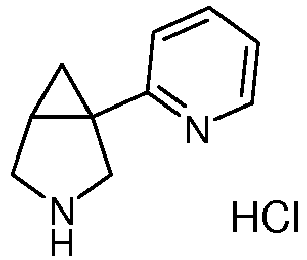
- A cooled (-25°C) stirred suspension of sodium amide (0.43g, 11 mmol) in anhydrous THF (20mL) under nitrogen was treated with a solution of pyridine-2-acetonitrile (591mg, 5.0 mmol) in anhydrous THF (5mL) and stirred at room temperature for 3h. The mixture was cooled (-25°C) and treated with a solution of epichlorohydrin (0.52mL, 6.0 mmol) in anhydrous THF (2mL) in one portion, then stirred at room temperature for 1.5h. Reaction was incomplete, so the solution was heated to 35°C for 1.5h, then cooled on an ice bath. Saturated aqueous ammonium chloride (5mL) was added, followed by ethyl acetate (70mL). The organic layer was separated, the aqueous extracted with more ethyl acetate (30mL), and the combined organic layers dried (MgSO4) and concentrated in vacuo. The residue was dissolved in methylene chloride and loaded onto a silica gel column (~150cc) and eluted with 1:1 methylene chloride/ethyl acetate to afford the intermediate cyanocyclopropanemethanol (447mg, 51%) as a 4:1 E/Z mixture of isomers (by NMR).
- An ice-cooled (3°C) stirred solution of lithium aluminum hydride/THF (3.0mL, 3.0 mmol) under nitrogen was treated dropwise with a solution of the above cyanocyclopropanemethanol (348mg, 2.0 mmol) in THF (3mL), and the mixture stirred on an ice bath for 2h and carefully quenched dropwise by successive addition of water (0.115mL), 15% aqueous sodium hydroxide (0.115mL), and water (0.35mL). The suspension was diluted with THF to loosen it up, stirred a few minutes, filtered, and the filtrate concentrated in vacuo (toluene added to ensure water removal). The residual oil was dissolved in anhydrous 1,2-dichloroethane (DCE, 12mL), cooled (3°C), and treated with thionyl chloride (0.175mL, 2.4 mmol). The mixture was warmed to room temperature, stirred 3h, concentrated in vacuo, and the residue taken up in water (10mL). The aqueous solution was made basic with 5N NaOH (~2mL), extracted with methylene chloride containing a little 2-propanol (5X15mL), and the combined extracts dried (Na2SO4) and concentrated in vacuo. The residue was dissolved in methylene chloride and loaded onto a silica gel column (~50cc) and eluted with 80:18:2 methylene chloride/ethanol/ammonium hydroxide to afford 1-(pyridine-2-yl)-3-azabicyclo[3.1.0]hexane (225mg, 70%) as a pale amber oil. MS (M+1) 161.0. 1H NMR (CDCl3) δ 8.48 (m, 1H), 7.56 (m, 1H), 7.03-7.12 (m, 2H), 3.40 (m, 1H), 3.31 (d, 1H, J=11Hz), 3.11 (dd, 1H, J=11Hz,3Hz), 3.04 (d, 1H, J=11Hz), 1.98 (m, 1H), 1.31 (m, 1H), 0.97 (t, 1H, J=5Hz).
- The above free base (190mg, 1.18 mmol) was dissolved in methanol (5mL) and treated with 2N HCl/ether (1.5mL, 3 mmol) and the resulting solution was concentrated in vacuo. The residue was triturated from a mixture of ethanol and acetonitrile to afford 1-(pyridine-2-yl)-3-azabicyclo[3.1.0]-hexane, dihydrochloride (184mg, 67%) as a pale tan solid. MS (M+1) 161.0. 1H NMR (DMSO-d6) δ 10.21 (br s, 1H), 9.98 (br s, 1H), 8.64 (m, 1H), 8.24 (t, 1H, J=8Hz), 7.75 (d, 1H, J=8Hz), 7.67 (t, 1H, J=7Hz), 3.73 (m, 2H), 3.45-3.57 (m, 1H), 3.38 (m, 1H), 2.51 (m, 1H), 1.74 (t, 1H, J=6Hz), 1.50 (dd, 1H, J=6Hz,9Hz). 13C NMR (DMSO-d6) δ 155.19, 144.08, 142.81, 124.12, 123.87, 47.84, 46.34, 30.39, 25.75, 16.55.
-

- A solution of 1-(pyridine-2-yl)-3-azabicyclo[3.1.0]hexane (240mg, 1.5 mmol) in anhydrous methylene chloride (10mL) was treated with di-tert-butyl dicarbonate (382mg, 1.75 mmol), stirred for 2h, and concentrated in vacuo (with toluene added late). An ice-cooled stirred solution of 1N LAH/THF (4.5mL, 4.5 mmol) under nitrogen was treated dropwise with a solution of the above residue in anhydrous THF (3.5mL), then the mixture was stirred for 1h at room temperature and for 5h at reflux, cooled on an ice bath, and carefully quenched dropwise successively with water (0.17mL), 15% aqueous sodium hydroxide (0.17mL), and water (0.50mL). The suspension was diluted with THF to loosen it up, stirred a few minutes, filtered, and the filtrate concentrated in vacuo. The residue was dissolved in methylene chloride, loaded onto a silica gel column (~75cc), and eluted with 95:4.5:0.5, then 90:9:1 methylene chloride/ethanol/ammonium hydroxide to afford a colorless oil. This was dissolved in methanol (5mL), treated with 2N HCl/ether (1.5mL, 3.0mL), and concentrated in vacuo to a solid. Trituration from ether afforded 3-methyl-1-(pyridine-2-yl)-3-azabicyclo[3.1.0]hexane, dihydrochloride (214mg, 58%) as a white solid. MS (M+1) 175.1. 1H NMR (DMSO-d6) δ 11.63 (br s, 1H), 8.64 (m, 1H), 8.23 (t, 1H, J=8Hz) 7.73 (d, 1H, J=8Hz), 7.66 (t, 1H, J=7Hz), 3.82-3.97 (m, 2H), 3.61 (m, 2H), 2.81 (br s, 3H), 2.45 (m, 1H), 2.03 (t, 1H, J=6Hz), 1.52 (m, 1H). 13C NMR (DMSO-d6) δ 154.90, 144.42, 142.52, 123.94, 57.18, 55.65, 30.25, 25.69, 15.93.
-

- A cooled (-25°C) stirred solution of pyridine-3-acetonitrile (1.18g, 10 mmol) in anhydrous THF (25mL) under nitrogen was treated with 1.0N sodium bis(trimethylsilyl)amide (11mL, 11 mmol), warmed to room temperature, stirred 10 min, then recooled (-25°C). More base (12mL, 12 mmol) was added, followed by epichlorohydrin (1.04mL, 12 mmol) in one portion, and the mixture was stirred at room temperature for 2h, cooled on an ice bath, and quenched (10mL saturated aqueous ammonium chloride), followed by dilution with ethyl acetate (100mL). The organic layer was separated and the aqueous extracted with ethyl acetate (25mL). The combined organic solution was dried (MgSO4) and concentrated in vacuo, and the residual brown solid dissolved in methylene chloride and loaded onto a silica gel column (~250cc). This was eluted with ethyl acetate, then 5% ethanol/ethyl acetate, then 10% ethanol/ethyl acetate to afford an orange solid, which was recrystallized from ethyl acetate/heptane to afford the intermediate cyanocyclopropanemethanol (625mg, 36%) as a 3.5:1 E/Z mixture of isomers (by NMR). An ice-cooled (3°C) stirred solution of lithium aluminum hydride/THF (4.1mL, 4.1 mmol) under nitrogen was treated dropwise with a solution of the above cyanocyclopropanemethanol (470mg, 2.7 mmol) in THF (4mL), and the mixture stirred on an ice bath for 2h and carefully quenched dropwise successively with water (0.16mL), 15% aqueous sodium hydroxide (0.16mL), and water (0.48mL). The suspension was diluted with THF/isopropanol to loosen it up, stirred a few minutes, filtered, and the filtrate concentrated in vacuo (toluene added to ensure water removal). The residual oil was dissolved in anhydrous 1,2-dichloroethane (DCE, 12mL), cooled (3°C), and treated with thionyl chloride (0.22mL, 3.0 mmol). The mixture was warmed to room temperature, stirred 3h, concentrated in vacuo, and the residue taken up in water (10mL). The aqueous solution was basified with 5N NaOH (~3mL), extracted with methylene chloride containing a little 2-propanol (4X25mL), and the combined extracts dried (MgSO4) and concentrated in vacuo. The residue was dissolved in methylene chloride and loaded onto a silica gel column (~50cc) and eluted with 80:18:2 methylene chloride/ethanol/ammonium hydroxide to afford 1-(pyridine-3-yl)-3-azabicyclo[3.1.0]hexane (156mg, 36%) as a pale yellow oil. The above free base (68mg, 0.424 mmol) was dissolved in methanol (2mL) and treated with 2N HCl/ether (1.0mL, 2.0 mmol), then the solution was concentrated in vacuo. The residue was rinsed with ether and triturated from acetonitrile to afford 1-(pyridine-3-yl)-3-azabicyclo[3.1.0]- hexane, dihydrochloride (67mg, 68%) as a pale tan solid. MS (M+1) 161.0. 1H NMR (DMSO-d6) δ 10.20 (br s, 1H), 9.95 (br s, 1H), 8.87 (m, 1H), 8.74 (d, 1H, J=5Hz), 8.41 (m, 1H), 7.94 (dd, 1H, J=6Hz,9Hz), 3.74 (m, 1H), 3.42-3.60 (m, 2H), 3.37 (m, 1H), 2.37 (m, 1H), 1.64 (t, 1H, J=6Hz), 1.30 (m, 1H). 13C NMR (DMSO-d6) δ 143.15, 141.00, 140.31, 139.35, 126.38, 48.27, 46.41, 28.42, 24.30, 16.15.
-

- A solution of 1-(pyridine-3-yl)-3-azabicyclo[3.1.0]hexane (81.7mg, 0.51 mmol) in anhydrous methylene chloride (3mL) was treated with di-tert-butyl dicarbonate (120mg, 0.55 mmol), stirred for 2h, and concentrated in vacuo (with toluene added late). An ice-cooled stirred solution of 1N LAH/THF (1.5mL, 1.5 mmol) under nitrogen was treated dropwise with a solution of the above residue in anhydrous THF (1.5mL), then the mixture was stirred for 1h at room temperature and for 5h at reflux, cooled on an ice bath, and carefully quenched dropwise successively with water (0.07mL), 15% aqueous sodium hydroxide (0.07mL), and water (0.22mL). The suspension was diluted with THF/isopropanol to loosen it up, stirred a few minutes, filtered, and the filtrate concentrated in vacuo. The residue was dissolved in methylene chloride, loaded onto a silica gel column (~70cc), and eluted with 95:4.5:0.5, then 90:9:1 methylene chloride/ethanol/ammonium hydroxide to afford a pale tan oil. This was dissolved in methanol (5mL), treated with 2N HCl/ether (0.75mL, 1.5mL), and concentrated in vacuo to a solid. Trituration from ether afforded 3-methyl-1-(pyridine-3-yl)-3-azabicyclo[3.1.0]hexane, dihydrochloride (73mg, 58%) as a pale tan solid. MS (M+1) 175.0. 1H NMR (DMSO-d6) δ 11.59 (br s, 1H), 8.91 (m, 1H), 8.76 (d, 1H, J=5Hz), 8.43 (m, 1H), 7.94 (dd, 1H, J=6Hz,9Hz), 3.93 (m, 1H), 3.58-3.70 (m, 2H), 3.50 (m, 1H), 2.79 (br s, 3H), 2.33 (m, 1H), 1.97 (t, 1H, J=6Hz), 1.34 (m, 3H). 13C NMR (DMSO-d6) δ 143.13, 141.39, 140.63, 138.89, 126.34, 57.54, 55.71, 28.27, 24.37, 15.39.
-
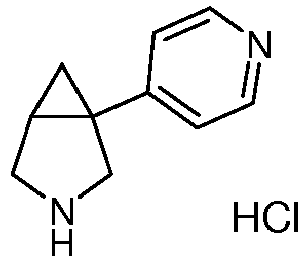
- A cooled (-25°C) stirred solution of pyridine-4-acetonitrile (1.83g, 15.5 mmol) in anhydrous THF (40mL) under nitrogen was treated with 1.0N sodium bis(trimethylsilyl)amide (16mL, 16mmol), warmed to room temperature, stirred 15min, then recooled (-25°C). More base (17mL, 17 mmol) was added, followed by epichlorohydrin (1.56mL, 18 mmol) in one portion, and the mixture was stirred at room temperature for 18h, cooled on an ice bath, and quenched (15mL saturated aqueous ammonium chloride), followed by dilution with ethyl acetate (200mL). The organic layer was separated and the aqueous extracted with ethyl acetate (50mL). The combined organic solution was dried (MgSO4) and concentrated in vacuo, and the residual brown oil dissolved in methylene chloride and loaded onto a silica gel column (~300cc). This was eluted with 10% ethanol/methylene chloride to afford the intermediate cyanocyclopropanemethanol (750mg, 28%) as a viscous amber oil, a 5:1 E/Z mixture of isomers (by NMR).
- An ice-cooled (3°C) stirred solution of lithium aluminum hydride/THF (6.5mL, 6.5 mmol) under nitrogen was treated dropwise with a solution of the above cyanocyclopropanemethanol (740mg, 4.25 mmol) in THF (6mL), and the mixture stirred on an ice bath for 2h and carefully quenched dropwise successively with water (0.25mL), 15% aqueous sodium hydroxide (0.25mL), and water (0.75mL). The suspension was diluted with THF/isopropanol to loosen it up, stirred a few minutes, filtered, and the filtrate concentrated in vacuo (toluene added to ensure water removal). The residual oil was dissolved in anhydrous 1,2-dichloroethane (DCE, 20mL), cooled (3°C), and treated with thionyl chloride (0.33mL, 4.5 mmol). The mixture was warmed to room temperature, stirred 3h, concentrated in vacuo, and the residue taken up in water (10mL). The aqueous solution was basified with 5N NaOH (~4mL), extracted with methylene chloride containing a little 2-propanol (5X25mL), and the combined extracts dried (Na2SO4) and concentrated in vacuo. The residue was dissolved in methylene chloride and loaded onto a silica gel column (~100cc) and eluted with 90:9:1, then 85:13.5:1.5 methylene chloride/ethanol/ammonium hydroxide to afford 1-(pyridine-4-yl)-3-azabicyclo[3.1.0]hexane (175mg, 26%) as an amber oil.
- The above free base (101mg, 0.63 mmol) was dissolved in methanol (5mL) and treated with 2N HCl/ether (1.0mL, 2.0 mmol), then the solution was concentrated in vacuo. The residue was triturated from ether to afford 1-(pyridine-4-yl)-3-azabicyclo[3.1.0]hexane, dihydrochloride (130mg, 88%) as a white solid. MS (M+1) 161.0. 1H NMR (DMSO-d6) δ 10.33 (br s, 1H), 10.10 (br s, 1H), 8.79 (d, 2H, J=7Hz), 7.82 (d, 2H, J=7Hz), 3.78 (m, 1H), 3.64 (m, 1H), 3.41 (m, 2H), 2.58 (m, 1H), 1.94 (t, 1H, J=6Hz), 1.49 (m, 1H). 13C NMR (DMSO-d6) δ 161.21, 141.84, 124.18, 47.35, 46.78, 31.72, 28.81, 21.28.
-

- A stirred solution of 1-(pyridine-4-yl)-3-azabicyclo[3.1.0]hexane (272mg, 1.7 mmol) in DCE (50mL) was treated with 37% aqueous formaldehyde (1.02mL, 13.6 mmol), then with sodium triacetoxyborohydride (1.44g, 6.8 mmol) and stirred at room temperature for 3h. 1N sodium hydroxide (25mL) was added, stirring continued for 15min, the organic layer was separated, and the aqueous solution extracted with methylene chloride (2X50mL). The combined organic extracts were dried (MgSO4), concentrated in vacuo, dissolved in methylene chloride, and loaded onto a silica gel column (∼100cc). This was eluted with 95:4.5:0.5, then 90:10:1 methylene chloride/ethanol/ammonium hydroxide to afford product free base as a colorless oil. This was dissolved in methanol, treated with 2N HCl/ether (2mL, 4mmol), concentrated in vacuo, and the residual solid triturated from ether to afford 3-methyl-1-(pyridine-4-yl)-3-azabicyclo[3.1.0]hexane, dihydrochloride (285mg, 68%) as a white solid. MS (M+1) 175.0. 1H NMR (DMSO-d6) δ 11.76 (br s, 1H), 8.80 (d, 2H, J=7Hz), 7.78 (d, 2H, J=7Hz), 3.99 (m, 1H), 3.76 (m, 1H), 3.64 (m, 1H), 3.46 (m, 1H), 2.79 (br s, 3H), 2.57 (m, 1H), 2.25 (t, 1H, J=6Hz), 1.49 (m, 1H). 13C NMR (DMSO-d6) δ 159.52, 141.58, 123.31, 55.82, 55.29, 30.63, 27.94, 19.99.
-

- A cooled (-25°C) stirred solution of 6-methoxypyridine-3-acetonitrile (1.48g, 10.0 mmol) in anhydrous THF (25mL) under nitrogen was treated with 1.0N sodium bis(trimethylsilyl)amide (11mL, 11 mmol), warmed to room temperature, stirred 15min, then recooled (-25°C). More base (12mL, 12 mmol) was added, followed by epichlorohydrin (1.04mL, 12 mmol) in one portion, and the mixture was stirred at room temperature for 2h, cooled on an ice bath, and quenched (10mL saturated aqueous ammonium chloride), followed by dilution with ethyl acetate (100mL). The organic layer was separated and the aqueous extracted with ethyl acetate (25mL). The combined organic solution was dried (MgSO4) and concentrated in vacuo, and the residue dissolved in ethyl acetate and loaded onto a silica gel column (∼150cc). This was eluted with ethyl acetate to afford the intermediate cyanocyclopropanemethanol (970mg, 47%) as a viscous pale yellow oil, a 5:2 E/Z mixture of isomers (by NMR).
- An ice-cooled (3°C) stirred solution of the above cyanocyclopropanemethanol (960mg, 4.7 mmol) in anhydrous THF (8mL) under nitrogen was treated dropwise with 1N LAH/THF (7.1mL, 7.1mmol) at a rate to keep pot temp<8°C, then stirred at 3°C for 2h and carefully dropwise quenched with water (0.27mL), 15% aqueous sodium hydroxide (0.27mL), and water (0.80mL). The thick suspension was diluted with THF to facilitate stirring, stirred for 15min, then filtered through Celite® (filter cake rinsed with THF). The filtrate was concentrated in vacuo and the residue was dissolved in methylene chloride and loaded onto a column of silica gel (∼130cc), then eluted with 80:18:2 methylene chloride/ethanol/ammonium hydroxide to afford the intermediate aminomethylcyclopropanemethanol (496mg, 51%) as a pale yellow oil.
- An ice-cooled (3°C) stirred solution of the above aminomethylcyclopropanemethanol (489mg, 2.35 mmol) in anhydrous DCE (12mL) under nitrogen was treated dropwise with thionyl chloride (0.205mL, 2.8 mmol), then stirred for 3h at room temperature and concentrated in vacuo. The residue was taken up in water (10mL), stirred for 15min, basified with 5N NaOH (3mL), and extracted with methylene chloride containing a little isopropanol (4X25mL). The combined organic solution was rinsed with water (30mL), dried (MgSO4), and concentrated in vacuo. The residue was dissolved in methylene chloride, loaded onto a silica gel column (∼75cc), and eluted with 90:9:1, then 80:18:2 methylene chloride/ethanol/ammonium hydroxide to afford bicyclic amine free base (192mg, 43%) as a pale yellow viscous oil.
- A solution of the above bicyclic amine free base (70mg, 0.368 mmol) in methanol (5mL) was treated with 2N HCl/ether (0.5mL, 1.0 mmol), the solution concentrated in vacuo, and the residual solid triturated successively with ether and acetonitrile to afford 1-(6-methoxypyridine-3-yl)-3-azabicyclo[3.1.0]hexane, dihydrochloride (82mg, 85%) as a white solid. MS (M+1) 190.9. 1H NMR (DMSO-d6) δ 9.96 (br s, 1H), 9.71 (br s, 1H), 8.11 (m, 1H), 7.67 (m, 1H), 6.81 (m, 1H), 3.82 (s, 3H), 3.61 (m, 1H), 3.45 (m, 1H), 3.28-3.40 (m, 2H), 2.05 (m, 1H), 1.39 (m, 1H), 1.04 (m, 1H). 13C NMR (DMSO-d6) δ 162.27, 144.91, 138.90, 128.04, 110.23, 53.49, 49.40, 46.68, 27.93, 22.48, 14.45.
-

- A stirred solution of 1-(6-methoxypyridine-3-yl)-3-azabicyclo[3.1.0]hexane (90mg, 0.473 mmol) in DCE (15mL) was treated with 37% aqueous formaldehyde (0.29mL, 3.8 mmol), followed by sodium triacetoxyborohydride (0.403g, 1.9 mmol), and stirred at room temperature for 3h. 1N sodium hydroxide (6mL) was added, stirring continued for 15min, and the organic layer was separated and the aqueous solution extracted with methylene chloride (3X15mL). The combined organic extracts were dried (Na2SO4), concentrated in vacuo, dissolved in methylene chloride, and loaded onto silica gel (∼50cc). This was eluted with 95:4.5:0.5, then 85:13.5:1.5 methylene chloride/ethanol/ammonium hydroxide to afford the above free base as a colorless oil, which was dissolved in methanol (5mL). The stirred solution was treated with 2N HCl/ether (0.5mL, 1.0mmol), concentrated in vacuo, and the residual solid triturated with ether to afford 1-(6-methoxypyridine-3-yl)-3-methyl-3-azabicyclo[3.1.0]hexane, dihydrochloride (101mg, 77%) as a white solid. MS (M+1) 204.9. 1H NMR (DMSO-d6) δ 11.36 (br s, 1H), 8.12 (m, 1H), 7.71 (m, 1H), 6.82 (m, 1H), 3.82 (s, 3H), 3.77-3.87 (m, 1H), 3.57 (m, 1H), 3.45 (m, 2H), 2.76 (br s, 3H), 2.04 (m, 1H), 1.76 (m, 1H), 1.05 (m, 1H). 13C NMR (DMSO-d6) δ 162.36, 145.07, 138.91, 127.78, 110.21, 58.50, 55.93, 53.47, 27.78, 22.54, 14.13.
-

- A cooled (3°C) stirred suspension of sodium amide (1.37g, 35 mmol) in anhydrous THF (40mL) under nitrogen was treated with a solution of 5-methylfuran-2-acetonitrile (1.82g, 15 mmol) in anhydrous THF (20mL), stirred 1.5h at room temperature, and recooled (3°C). Epichlorohydrin (1.53mL, 19.5 mmol) was added, and the mixture stirred at room temperature for 2h, then cooled on an ice bath and quenched with saturated aqueous ammonium chloride (15mL). After stirring for 15min, the mixture was taken up in ethyl acetate (150mL) and the organic layer separated. The aqueous solution was extracted with ethyl acetate (30mL) and the combined organic solution was dried (MgSO4) and concentrated in vacuo. The residue was dissolved in methylene chloride and loaded onto a silica gel column (∼150cc) and eluted with methylene chloride, 5% ethyl acetate/methylene chloride, and 10% ethyl acetate/methylene chloride to afford the intermediate cyanocyclopropanemethanol (1.25g, 47%) as an amber oil, a 2:1 E/Z mixture of isomers (by NMR).
- A cooled (-25°C) stirred solution of the intermediate cyanocyclopropanemethanol (1.24g, 7.00 mmol) in anhydrous THF (15mL) was carefully treated dropwise with 1.0N LAH/THF (14mL, 14 mmol), then stirred for 3h on an ice bath. The solution was cooled (-25°C) and carefully treated dropwise with water (0.53mL), 15% NaOH (0.53mL), and water (1.6mL), diluted with THF to facilitate stirring, stirred 15min, and filtered through Celite® (filter cake rinsed with THF). The filtrate was concentrated in vacuo and the residue dissolved in methylene chloride and loaded onto a silica gel column (∼150cc). This was eluted with 9:1 methylene chloride/ethanol, 95:4.5:0.5 methylene chloride/ethanol/ammonium hydroxide, and 90:9:1 methylene chloride/ethanol/ammonium hydroxide to afford the intermediate aminomethylcyclopro panemethanol (453mg, 38%) as a pale amber oil. MS (M+1) 181.9. 1H NMR (CDCl3) δ 5.91 (m, 1H), 5.83 (m, 1H), 4.08 (dd, 1H, J=12Hz,5Hz), 3.67 (d, 1H, J=13Hz), 3.28 (dd, 1H, J=13Hz,11Hz), 2.48 (d, 1H, J=12Hz), 2.23 (s, 3H), 1.78 (m, 1H), 1.08 (dd, 1H, J=9Hz,5Hz), 0.68 (t, 1H, J=5Hz).
- A cooled (3°C) stirred solution of the intermediate aminomethylcyclopropanemethanol (435mg, 2.4 mmol) in anhydrous DCE (15mL) was treated dropwise with thionyl chloride (0.22mL, 3.0 mmol). The solution was stirred 3h at room temperature, then concentrated in vacuo, taken up in water (15mL), stirred 15min, and basified (3mL of 5N NaOH). The dark aqueous mixture was extracted with methylene chloride (3X40mL) and the combined extracts washed with brine (50mL), dried (Na2SO4) and concentrated in vacuo. The residue was dissolved in methylene chloride, loaded onto a silica gel column (∼75cc), and eluted with 90:9:1 methylene chloride/ethanol/ammonium hydroxide to afford the bicyclic amine free base (158mg, 40%) as an amber glass. MS (M+1) 163.9.
- A solution of the bicyclic amine free base (70mg, 0.429 mmol) in methylene chloride (5mL) was treated with 2N HCl/ether (0.25mL, 0.50 mmol), stirred a few minutes, then concentrated in vacuo. The residue was triturated from ether to afford 1-(5-methylfuran-2-yl)-3-azabicyclo[3.1.0]hexane, hydrochloride (65mg, 76%) as a brown solid. MS (M+1) 163.9. 1H NMR (CDCl3) δ 10.26 (br s, 1H), 9.75 (br s, 1H), 5.90 (m, 2H), 3.45-3.75 (m, 4H), 2.23 (s, 3H), 1.89 (m, 1H), 1.50 (m, 1H), 1.36 (m, 1H). 13C NMR (CDCl3) δ 151.59, 149.26, 106.89, 106.28, 48.37, 47.26, 25.71, 23.46, 13.45, 13.35.
-

- A cooled (3°C) stirred suspension of sodium amide (1.37g, 35 mmol) in anhydrous THF (45mL) under nitrogen was treated with a solution of benzofuran-3-acetonitrile (2.36g, 15 mmol) in anhydrous THF (15mL), stirred 1h at room temperature, and recooled (3°C). Epichlorohydrin (1.53mL, 19.5 mmol) was added, and the mixture stirred at room temperature for 1h, then cooled on an ice bath and quenched with saturated aqueous ammonium chloride (15mL). After stirring for 15min, the mixture was taken up in ethyl acetate (150mL) and the organic layer separated. The aqueous solution was extracted with ethyl acetate (2X20mL) and the combined organic solution was dried (MgSO4) and concentrated in vacuo. The residue was dissolved in methylene chloride and loaded onto a silica gel column (∼150cc) and eluted with 5% ethyl acetate/methylene chloride, then 10% ethyl acetate/methylene chloride to afford the intermediate cyanocyclopropanemethanol (1.83g, 57%) as a pale amber oil, a 2:1 E/Z mixture of isomers (by NMR).
- A cooled (-25°C) stirred solution of the intermediate cyanocyclopropanemethanol (1.80g, 8.44 mmol) in anhydrous THF (15mL) was carefully treated dropwise with 1.0N LAH/THF (14.8mL, 14.8 mmol), then stirred for 3h on an ice bath. The solution was carefully treated dropwise with water (0.60mL), 15% NaOH (0.60mL), and water (1.7mL), diluted with THF to facilitate stirring, stirred 15min, and filtered through Celite® (filter cake rinsed with THF). The filtrate was concentrated in vacuo and the residue dissolved in methylene chloride and loaded onto a silica gel column (∼125cc). This was eluted with 90:9:1, then 85:13.5:1.5 methylene chloride/ethanol/ammonium hydroxide to afford the intermediate aminomethylcyclopropanemethanol (1.06g, 58%) as a viscous colorless oil. MS (M+1) 217.9. 1H NMR (CDCl3) δ 7.76 (m, 1H), 7.59 (s, 1H), 7.47 (m, 1H), 7.23-7.33 (m, 2H), 4.16 (dd, 1H, J=13Hz,5Hz), 3.57 (d, 1H, J=12Hz), 3.38 (dd, 1H, J=13Hz,11Hz), 2.59 (d, 1H, J=12Hz), 1.76 (m, 1H), 0.99 (dd, 1H, J=9Hz,5Hz), 0.80 (t, 1H, J=5Hz).
- A cooled (3°C) stirred solution of the intermediate aminomethylcyclopropanemethanol (1.03g, 4.75 mmol) in anhydrous DCE (25mL) was treated dropwise with thionyl chloride (0.44mL, 6.0 mmol). The solution was stirred 3h at room temperature, then concentrated in vacuo, taken up in water (15mL), stirred 25min, and basified (6mL of 5N NaOH). The aqueous mixture was extracted with methylene chloride (4X50mL) and the combined extracts washed with brine (50mL), dried (Na2SO4) and concentrated in vacuo. The residue was dissolved in methylene chloride, loaded onto a silica gel column (∼150cc), and eluted with 95:4.5:0.5, then 90:9:1, then 85:13.5:1.5 methylene chloride/ethanol/ammonium hydroxide to afford the bicyclic amine free base (709mg, 75%) as a pale tan solid. MS (M+1) 180.0. 1H NMR (CDCl3) δ 7.55 (m, 1H), 7.46 (m, 1H), 7.44 (s, 1H), 7.20-7.32 (m, 2H), 3.15-3.26 (m, 3H), 3.09 (d, 1H, J=11 Hz), 1.76 (m, 1H), 1.05 (dd, 1H, J=8Hz,5Hz), 0.83 (t, 1H, J=5Hz).
- A stirred solution of the above bicyclic amine free base (240mg, 1.205 mmol) in anhydrous ether (5mL) was treated with 2.0N HCl/ether (1.0mL, 2.0 mmol), stirred until a solid formed and for a few minutes more, filtered, and the solid rinsed with ether, collected, and dried in vacuo to afford 1-(benzofuran-3-yl)-3-azabicyclo[3.1.0]hexane, hydrochloride (266mg, 94%) as a white solid. MS (M+1) 199.9. 1H NMR (CDCl3) δ 10.35 (br s, 1H), 9.89 (br s, 1H), 7.53 (d, 1H, J=8Hz), 7.50 (s, 1H), 7.48 (d, 1H, J=8Hz), 7.23-7.35 (m, 2H), 3.60-3.80 (m, 4H), 2.01 (m, 1H), 1.62 (m, 1H), 1.32 (d, 1H, J=8Hz). 13C NMR (CDCl3) δ 155.49, 142.93, 126.52, 124.93, 123.04, 119.43, 117.80, 111.98, 49.98, 47.56, 22.74, 21.54, 13.44.
-

- A stirred solution of 1-(benzofuran-3-yl)-3-azabicyclo[3.1.0]hexane (199mg, 1.00 mmol) in DCE (25mL) was treated with 37% aqueous formaldehyde (0.61mL, 8.0 mmol), then with sodium triacetoxyborohydride (850mg, 4.0 mmol), and stirred at room temperature for 3h. 1N Sodium hydroxide (15mL) was added, stirring was continued for a few minutes, and the organic layer was separated. The aqueous layer was extracted with methylene chloride (2X25mL) and the combined organic solution was washed with brine (50mL), dried (Na2SO4) and concentrated in vacuo. The residue was dissolved in methylene chloride, loaded onto a silica gel column (∼60cc), and eluted with 95:4.5:0.5 methylene chloride/ethanol/ammonium hydroxide to afford the bicyclic amine free base. This was dissolved in anhydrous ether (5mL) and treated with 2N HCl/ether (0.8mL, 1.6 mmol) and stirred until several minutes after a solid formed, then filtered, rinsed with ether, and the solid collected and dried in vacuo to afford 1-(benzofuran-3-yl)-3-methyl-3-azabicyclo[3.1.0]hexane, hydrochloride (226mg, 94%) as a white solid. MS (M+1) 213.9. 1H NMR (CDCl3) δ 12.64 (br s, 1H), 7.45-7.55 (m, 3H), 7.23-7.25 (m, 2H), 4.08 (m, 1H), 3.96 (m, 1H), 3.41 (m, 1H), 3.29 (m, 1H), 2.92 (br s, 3H), 2.23 (m, 1H), 2.06 (m, 1H), 1.27 (t, 1H, J=8Hz). 13C NMR (CDCl3) δ 155.45, 143.01, 126.44, 125.03, 123.05, 119.11, 117.61, 112.09, 59.57, 57.09, 41.24, 22.65, 21.45, 13.87.
-

- A cooled (3°C) stirred suspension of sodium amide (1.25g, 32 mmol) in anhydrous THF (35mL) under nitrogen was treated with a solution of 5-methylthiophen-2-acetonitrile1,2 (1.85g, 13.5 mmol) in anhydrous THF (15mL), stirred 1.5h at room temperature, and recooled (3°C). Epichlorohydrin (1.40mL, 17.8 mmol) was added, and the mixture stirred at room temperature for 2h, then cooled on an ice bath and quenched with saturated aqueous ammonium chloride (15mL). After stirring for 15min, the mixture was taken up in ethyl acetate (125mL) and the organic layer separated. The aqueous solution was extracted with ethyl acetate (25mL) and the combined organic solution was dried (MgSO4) and concentrated in vacuo. The residue was dissolved in methylene chloride and loaded onto a silica gel column (∼150cc) and eluted with 10% ethyl acetate/methylene chloride, then 20% ethyl acetate/methylene chloride to afford the intermediate cyanocyclopropanemethanol (1.74g, 67%) as an amber oil, a 2:1 E/Z mixture of isomers (by NMR).
- A cooled (-20°C) stirred solution of the intermediate cyanocyclopropanemethanol (1.64g, 8.50 mmol) in anhydrous THF (15mL) was carefully treated dropwise with 1.0N LAH/THF (17mL, 17 mmol), then stirred for 3h on an ice bath. The solution was cooled (-20°C) and carefully treated dropwise with water (0.65mL), 15% NaOH (0.65mL), and water (2.0mL), diluted with THF to facilitate stirring, stirred 15min, and filtered through Celite® (filter cake rinsed with THF). The filtrate was concentrated in vacuo and the residue dissolved in methylene chloride and loaded onto a silica gel column (∼125cc). This was eluted with 90:9:1 methylene chloride/ethanol/- ammonium hydroxide to afford the intermediate aminomethylcyclopropanemethanol (584mg, 35%) as a pale yellow oil. MS (M+1) 198.1. 1H NMR (CDCl3) δ 6.73 (m, 1H), 6.54 (m, 1H), 4.09 (dd, 1H, J=12Hz,5Hz), 3.52 (d, 1H, J=13Hz), 3.29 (dd, 1H, J=13Hz,11Hz), 2.56 (d, 1H, J=12Hz), 2.42 (br s, 3H), 1.84 (m, 1H), 1.03 (dd, 1H, J=9Hz,5Hz), 0.77 (t, 1H, J=5Hz).
- A cooled (3°C) stirred solution of the intermediate aminomethylcyclopropanemethanol (572mg, 2.90 mmol) in anhydrous DCE (15mL) was treated dropwise with thionyl chloride (0.27mL, 3.7 mmol). The solution was stirred 3h at room temperature, then concentrated in vacuo, taken up in water (15mL), stirred 15min, and basified (4mL of 5N NaOH). The aqueous mixture was extracted with methylene chloride (4X30mL) and the combined extracts washed with brine (50mL), dried (Na2SO4) and concentrated in vacuo. The residue was dissolved in methylene chloride, loaded onto a silica gel column (∼150cc), and eluted with 95:4.5:0.5, then 90:9:1 methylene chloride/ethanol/ammonium hydroxide to afford the bicyclic amine free base (308mg, 59%) as a brown oil. MS (M+1) 180.0. 1H NMR (CDCl3) δ 6.59 (m, 1H), 6.54 (m, 1H), 3.10-3.22 (m, 3H), 2.99 (d, 1H, J=12Hz), 2.41 (s, 3H), 1.61 (m, 1H), 1.04 (m, 1H), 0.88 (t, 1H, J=5 Hz).
- A solution of the bicyclic amine free base (163mg, 0.909 mmol) in anhydrous ether (5mL) was treated with 2N HCl/ether (0.75mL, 1.50 mmol), stirred a few hours, the solid filtered, rinsed with ether, collected, and dried in vacuo to afford 1-(5-methylthiophen-2-yl)-3-azabicyclo[3.1.0]hexane, hydrochloride (174mg, 89%) as a pale gray solid. MS (M+1) 179.9. 1H NMR (CDCl3) δ 10.22 (br s, 1H), 9.74 (br s, 1H), 6.65 (m, 1H), 6.55 (m, 1H), 3.50-3.75 (m, 4H), 2.41 (s, 3H), 1.87 (m, 1H), 1.59 (m, 1H), 1.30 (m, 1H). 13C NMR (CDCl3) δ 139.00, 138.98, 125.15, 125.04, 50.83, 47.40, 27.39, 24.89, 15.97, 15.26.
-

- A stirred solution of 1-(5-methylthiophen-2-yl)-3-azabicyclo[3.1.0]hexane (126mg, 0.70 mmol) in DCE (15mL) was treated with 37% aqueous formaldehyde (0.43mL, 5.0 mmol), then with sodium triacetoxyborohydride (594mg, 2.8 mmol), and stirred at room temperature for 3h. 1N Sodium hydroxide (12mL) was added, stirring was continued for a few minutes, and the organic layer was separated. The aqueous layer was extracted with methylene chloride (2X15mL) and the combined organic solution was washed with brine (20mL), dried (Na2SO4) and concentrated in vacuo. The residue was dissolved in methylene chloride, loaded onto a silica gel column (∼50cc), and eluted with 95:4.5:0.5 methylene chloride/ethanol/ammonium hydroxide to afford the bicyclic amine free base. This was dissolved in anhydrous ether (5mL) and treated with 2N HCl/ether (0.6mL, 1.2 mmol) and stirred for 2h, then filtered, rinsed with ether, and the solid collected and dried in vacuo to afford 1-(5-methylthiophen-2-yl)-3-methyl-3-azabicyclo[3.1.0]hexane, hydrochloride (133mg, 82%) as a pale tan solid. MS(M+1)193.9. 1H NMR (CDCl3) δ 12.51 (br s, 1H), 6.65 (m, 1H), 6.55 (m, 1H), 4.02 (m, 1H), 3.85 (m, 1H), 3.18-3.36 (m, 2H), 2.87 (br s, 3H), 2.40 (s, 3H), 2.21 (m, 1H), 1.91 (m, 1H), 1.28 (m, 1H). 13C NMR (CDCl3) δ 139.22, 138.64, 125.35, 125.09, 60.54, 57.06, 41.31, 27.43, 24.91, 16.54, 15.25.
-

- An ice-cooled (3°C) stirred suspension of sodium amide (1.80g, 46 mmol) in anhydrous THF (50mL) under nitrogen was treated with a solution of benzothiazole-2-acetonitrile (3.49g, 20 mmol) in anhydrous THF (20mL), then stirred at room temperature for 2.5h. The mixture was recooled (3°C), treated in one portion with epichlorohydrin (2.1mL, 26.9 mmol), and stirred at room temperature for 20h, then cooled on an ice bath and quenched with saturated aqueous ammonium chloride (20mL). The mixture was extracted with ethyl acetate (200mL, then 50mL), and the combined extracts were dried (MgSO4) and concentrated in vacuo. The residue was dissolved in methylene chloride, loaded onto a silica gel column (∼250cm), and eluted with 4:1 methylene chloride/ethyl acetate to afford the intermediate cyanocyclopropanemethanol (1.00g, 22%) as a pale tan foam, a somewhat still crude mixture of isomers (by NMR). MS (M+1) 231.7.
- A cooled (-25°C) stirred solution of the intermediate cyanocyclopropanemethanol (1.00g, 4.34 mmol) in anhydrous THF (7mL) under nitrogen was treated dropwise with 1N LAH/THF (6.5mL, 6.5 mmol), stirred at 3°C for 2h, recooled (-25°C), and carefully quenched dropwise with water (0.25mL), 15% NaOH ().25mL), and water (0.75mL). Extra THF was added to facilitate stirring, and after a few minutes the mixture was filtered through Celite® (filter cake rinsed with THF). The filtrate was concentrated in vacuo, and the residue dissolved in methylene chloride and loaded onto a silica gel column (∼125cc) and eluted with 90:9:1, then 85:13.5:1.5 methylene chloride/ethanol/ammonium hydroxide to afford the intermediate aminomethylcyclopropanemethanol (137mg, 13%) as an orange viscous oil. MS (M+1) 234.7. 1H NMR (CDCl3) δ 7.88 (d, 1H, J=8Hz), 7.77 (d, 1H, J=8Hz), 7.41 (t, 1H, J=8Hz), 7.30 (t, 1H, J=8Hz), 4.10-4.18 (m, 2H), 3.37 (t, 1H, J=12Hz), 2.58 (d, 1H, J=12Hz), 2.02 (m, 1H), 1.43 (dd, 1H, J=9Hz,5Hz), 1.12 (t, 1H, J=6Hz).
- An ice-cooled (3°C) stirred solution of the intermediate aminomethylcyclopropanemethanol (137mg, 0.585 mmol) in anhydrous DCE (3mL) under nitrogen was treated with thionyl chloride (87mg, 0.73 mmol) and stirred at room temperature for 3h, then concentrated in vacuo. Water (2mL) was added, stirring continued for 15min, then the solution was basified with 5N sodium hydroxide (1mL) and extracted with 5:1 methylene chloride/isopropanol (3X15mL). The combined extracts were dried (MgSO4), concentrated in vacuo, and the residue dissolved in methylene chloride and loaded onto a silica gel column (∼50cc). This was eluted with 90:9:1, then 85:13.5:1.5 methylene chloride/ethanol/ammonium hydroxide to afford 1-(benzothiazol-2-yl)-3-azabicyclo[3.1.0]hexane (88mg, 70%) as an amber solid. This was dissolved in ether containing a little methanol (5mL), treated with 2.0N HCl/ether (0.40mL, 0.80 mmol), the solvent evacuated from the flask, and the residual solid triturated from ether to afford 1-(benzothiazol-2-yl)-3-azabicyclo[3.1.0]hexane, hydrochloride (99mg, 96% from free base) as a pale brick-colored powder. MS (M+1) 216.8. 1H NMR (DMSO-d6) δ 10.20 (br s, 1H), 9.95 (br s, 1H), 8.05 (d, 1H, J=8Hz), 7.91 (d, 1H, J=8Hz), 7.48 (t, 1H, J=8Hz), 7.39 (t, 1H, J=8Hz), 3.88 (m, 1H), 3.73 (m, 1H), 3.50 (m, 1H), 3.38 (m, 1H), 2.35 (m, 1H), 1.88 (t, 1H, J=6Hz), 1.59 (m, 1H). 13C NMR (DMSO-d6) δ 170.19, 152.52, 133.73, 126.46, 125.09, 122.20, 121.98, 47.52, 46.39, 31.07, 28.61, 18.23.
-

- A cooled (3°C) stirred suspension of sodium amide (0.90g, 23 mmol) in anhydrous THF (30mL) under nitrogen was treated with a solution/suspension of 5-chlorobenzothiophen-3-acetonitrile (2.08g, 10 mmol) in anhydrous THF (10mL), stirred 1h at room temperature, and recooled (3°C). Epichlorohydrin (1.04mL, 12 mmol) was added, and the mixture stirred at room temperature for 4h, then cooled on an ice bath and quenched with saturated aqueous ammonium chloride (10mL). After stirring for 15min, the mixture was taken up in ethyl acetate (100mL) and the organic layer separated. The aqueous solution was extracted with ethyl acetate (50mL) and the combined organic solution was dried (MgSO4) and concentrated in vacuo. The residue was dissolved in methylene chloride and loaded onto a silica gel column (∼150cc) and eluted with 10% ethyl acetate/methylene chloride to afford the intermediate cyanocyclopropane- methanol (1.51g, 57%) as a tan solid, a 4:1 E/Z mixture of isomers (by NMR).
- A ice-cooled (3°C) stirred solution of 1.0N LAH/THF (5.25mL, 5.25 mmol) under nitrogen was treated dropwise with a solution of the intermediate cyanocyclopropanemethanol (932mg, 3.5 mmol) in anhydrous THF (5mL), and the mixture was stirred 2h at 3°C. Water (0.2mL), 15% NaOH (0.2mL), and water (0.6mL) were carefully added dropwise, and the mixture was diluted with THF and stirred 15 min at room temperature, filtered through Celite® (filter cake rinsed with THF), and the filtrate concentrated in vacuo. The residue was dissolved in methylene chloride, loaded onto a silica gel column (∼60cc), and eluted with 10% EtOH/CH2Cl2, then 90:9:1 methylene chloride/ethanol/ammonium hydroxide to afford the intermediate aminomethylcyclopropanemethanol (650mg, 69%) as a white solid. MS (M+1) 267.7. 1H NMR (CDCl3) δ 7.94 (d, 1H, J=2Hz), 7.76 (d, 1H, J=9Hz), 7.46 (s, 1H), 7.32 (dd, 1H, J=9Hz,2Hz), 4.18 (dd, 1H, J=12Hz,5.5Hz), 3.54 (d, 1H, J=12Hz), 3.39 (t, 1H, J=11Hz), 2.60 (d, 1H, J=12Hz), 1.80 (m, 1H), 1.01 (dd, 1H, J=9Hz,5Hz), 0.89 (t, 1H, J=5Hz).
- A cooled (3°C) stirred solution of the intermediate aminomethylcyclopropanemethanol (0.65g, 2.43 mmol) in anhydrous DCE (12mL) was treated dropwise with thionyl chloride (0.20mL, 2.70 mmol). The solution was stirred 3h at room temperature, then concentrated in vacuo, taken up in water (10mL), stirred 15min, and basified (3mL of 5N NaOH). The aqueous mixture was extracted with methylene chloride (4X25mL) and the combined extracts washed with brine (30mL), dried (Na2SO4) and concentrated in vacuo. The residue was dissolved in methylene chloride, loaded onto a silica gel column (∼75cc), and eluted with 95:4.5:0.5, then 90:9:1 methylene chloride/ethanol/ammonium hydroxide to afford the bicyclic amine free base (435mg, 72%) as a white solid. MS (M+1) 249.7. 1H NMR (CDCl3) δ 7.79 (d, 1H, J=2Hz), 7.75 (d, 1H, J=9Hz), 7.30 (dd, 1H, J=9Hz,2Hz), 7.27 (s, 1H), 3.33 (dd, 1H, J=12Hz,2.5Hz), 3.24 (d, 1H, J=11Hz), 3.14 (d, 1H, J=12Hz), 3.09 (d, 1H, J=12Hz), 1.71 (m, 1H), 0.96 (m, 1H), 0.89 (t, 1H, J=5Hz).
- A stirred solution of the above bicyclic amine free base (150mg, 0.60 mmol) in anhydrous ether (6mL) was treated with 2.0N HCl/ether (0.5mL, 1.0 mmol), stirred for 2h, filtered, and the solid rinsed with ether, collected, and dried in vacuo to afford 1-(5-chlorothiophen-3-yl)-3-azabicyclo[3.1.0]hexane, hydrochloride (166mg, 97%) as a white solid. MS (M+1) 249.7. 1H NMR (CDCl3) δ 10.23 (br s, 1H), 9.83 (br s, 1H), 7.69 (d, 1H, J=9Hz), 7.67 (d, 1H, J=2Hz), 7.33 (s, 1H), 7.27 (dd, 1H, J=9Hz,2Hz), 3.74 (m, 2H), 3.65 (m, 1H), 3.45 (m, 1H), 1.97 (m, 1H), 1.61 (m, 1H), 1.17 (m, 1H). 13C NMR (CDCl3) δ 139.41, 138.71, 132.01, 131.09, 127.97, 125.36, 124.22, 121.37, 50.52, 47.64, 26.29, 21.50, 13.68.
-

- A stirred solution of 1-(5-chlorothiophen-3-yl)-3-azabicyclo[3.1.0]hexane (150mg, 0.60 mmol) in DCE (20mL) was treated with 37% aqueous formaldehyde (0.37mL, 4.8 mmol), then with sodium triacetoxyborohydride (510mg, 2.4 mmol), and stirred at room temperature for 3h. 1N Sodium hydroxide (8mL) was added, stirring was continued for 15min, and the organic layer was separated. The aqueous layer was extracted with methylene chloride (2X25mL) and the combined organic solution was washed with brine (50mL), dried (Na2SO4) and concentrated in vacuo. The residue was dissolved in methylene chloride, loaded onto a silica gel column (∼75cc), and eluted with 95:4.5:0.5 methylene chloride/ethanol/ammonium hydroxide to afford the bicyclic amine free base. This was dissolved in anhydrous ether (5mL) and treated with 2N HCl/ether (0.5mL, 1.0 mmol) and stirred for 30min, then filtered, rinsed with ether, and the solid collected and dried in vacuo to afford 1-(5-chlorothiophen-3-yl)-3-methyl-3-azabicyclo[3.1.0]hexane, hydrochloride (153mg, 85%) as a white solid. MS (M+1) 263.8. 1H NMR (CDCl3) δ 12.68 (br s, 1H), 7.77 (d, 1H, J=9Hz), 7.70 (d, 1H, J=2Hz), 7.44 (s, 1H), 7.34 (dd, 1H, J=9Hz,2Hz), 4.10 (dd, 1H, J=11Hz,5Hz), 4.02 (dd, 1H, J=11Hz,5Hz), 3.50 (m, 1H), 3.20 (t, 1H, J=10Hz), 2.94 (br s, 3H), 2.30 (m, 1H), 2.08 (m, 1H), 1.21 (t, 1H, J=8Hz). 13C NMR (CDCl3) δ 139.22, 138.75, 131.64, 131.12, 128.30, 125.41, 124.38, 121.05, 59.88, 57.15, 41.26, 26.24, 21.49, 13.96.
-

- A stirred solution of N-methylbromomaleimide (1.9g 10 mmol) and 1-methyl-2-(tributhyltin)indole (5.25g, 12.5 mmol) in anhydrous dioxane (60mL) was degassed under a stream of nitrogen for 10 minutes, then treated with cesium fluoride (3.6g, 23.6 mmol) and Cl2Pd(PPh3)2 (0.4g 0.6 mmol), stirred at room temperature for 0.5h, then at 40°C for 1h and at 50°C for 2h. Then the reaction mixture was cooled to room temperature, methylene chloride (100ml) added, and the mixture was filtered through celite, concentrated and purified by silica gel chromatography (2% ethyl acetate/methylene chloride) to afford maleimide intermediate (1.2g, 98%). 1H NMR (CDCl3) δ 7.72-7.68 (m, 1H), 7.62-7.61 (m, 1H), 7.36-7.33 (m, 2H), 7.17-7.12 (m, 1H) 6.59-6.57 (m, 1H), 3.89 (s, 3H) 3.11 (s, 3H).
- A cooled (-20°C) stirred solution of trimethylsulfoxonium chloride (0. 892g, 6.96 mmol) in anhydrous tetrahydrofuran (30mL) under nitrogen was treated with n-butyllithium/hexane (2.5N, 2.2mL, 5.5 mmol) and warmed to 50°C over 30 minutes. A solution of the above maleimide intermediate (1.2g, 5 mmol) in anhydrous tetrahydrofuran (25mL) was warmed to 50°C and added all at once. After 2h at 50°C, the mixture was cooled on ice and quenched with saturated aqueous ammonium chloride (2mL). The mixture was stirred at room temperature for 15 minutes, then it was added to methylene chloride (100mL) and the organic solution was dried (Na2SO4) and concentrated in vacuo. The residue was dissolved in methylene chloride, loaded onto a silica gel column and eluted with 2% ethyl acetate/methylene chloride to afford diimide intermediate (140mg, 12%). 1H NMR (CDCl3 δ 7.59-7.54 (m, 1H), 7.35-7.30 (m, 1H), 7.28-7.23 (m, 1H), 7.14-7.08 (m, 1H), 6.46-6.43 (m, 1H), 3.82 (s, 3H), 2.96 (s, 3H), 2.83-2.78 (m, 1H), 1.99-1.96 (m, 1H) 1.92-1.87 (m, 1H).
- A stirred, ice-cooled (2°C) solution of 1N lithium aluminum hydride /THF (3.43mL, 3.43 mmol) under nitrogen was treated dropwise with a solution of the above diimide intermediate (140mg, 0.55 mmol) in anhydrous tetrahydrofuran (20mL), stirred for 1h at room temperature and 7h at reflux, then cooled on an ice bath. Water (0.30mL), 15% NaOH (0.30mL) and water (0.90mL) were added dropwise together with more tetrahydrofuran to facilitate stirring. The mixture was stirred at room temperature for 15 minutes, filtered through celite, and the filtrate concentrated in vacuo. The residue was dissolved in methylene chloride, loaded onto a silica gel column, and eluted with 3:1 methylene chloride/ethyl acetate to afford 3-methyl-1-(1-methylindol-2-yl)-3-azabicyclo[3.1.0]bicyclohexane (100mg, 80%), which was then converted to the hydrochloride salt by treating with 2N HCl/ether(82mg, 80%). MS (M+1) 226.8 1H NMR (DMSO-d 6) δ 11.35- 11.12 (br s, 1H), 7.52-7.34 (m, 2H), 7.15-6.93 (m, 2H), 6.45-6.34 (m, 1H), 3.92-3.84 (m, 1H), 3.79-3.75 (s, 3H), 3.71-3.64 (m, 1H), 3.63-3.56 (m, 1H), 3.39-3.26 (m, 1H), 2.81 (d, 3H), 2.24- 2.16 (m, 1H), 1.91-1.83 (m, 1H), 1.11-1.01 (m, 1H). 13C NMR (DMSO-d 6) δ 138.06, 137.98, 127.38, 122.00, 14.21, 120.67, 119.98, 110.28, 102.01, 59.38, 56.47, 40.36, 30.96, 24.26, 22.51.
-

- A stirred solution of N-methylbromomaleimide (1.8g, 9.5 mmol) and 1-methylindole-5-boronic acid (2g, 11.4 mmol) in dioxane (50mL) was degassed under a stream of nitrogen for 10 minutes, then treated with cesium fluoride (3.8g, 24.7 mmol) and Cl2Pd(dppf)•CH2Cl2 (0.475g, 0.58 mmol), then stirred at room temperature for 1 hour and at 40°C for 1h. The mixture was cooled and diluted with methylene chloride, stirred a few minutes and filtered through celite. The filtrate was concentrated in vacuo and purified by silica gel chromatography using 2% ethyl acetate/ methylene chloride as an eluting solvent to afford maleimide intermediate (2.17g, 95%). 1H NMR (CDCl3) δ 8.43 (d, 1H, J=1.5Hz), 7.74 (dd, 1H, J=8.5Hz,1.5 Hz), 7.37 (d, 1H, J=9Hz), 6.66 (s, 1 H), 6.60 (d, 1H, J=3Hz), 3.83 (s, 3H), 3.10 (s, 3H).
- A cooled (-20°C) stirred solution of trimethylsulfoxonium chloride (1.4g, 11.25 mmol) in anhydrous tetrahydrofuran (40 mL) under nitrogen was treated with n-butyllithium/hexane (2.5N, 3.6mL, 9 mmol) and warmed to 50°C over 30 minutes. A solution of the above maleimide intermediate (2g, 8.3 mmol) in anhydrous tetrahydrofuran (40mL) was warmed to 50°C and added all at once. After 2h at 50°C, the mixture was cooled on ice and quenched with saturated aqueous ammonium chloride. The mixture was stirred at room temperature for 15 minutes, then it was added to methylene chloride (150mL) and the organic solution was dried (Na2SO4) and concentrated in vacuo. The residue was purified by silica gel chromatography, using ethyl acetate/methylene chloride to afford bicyclic diimide intermediate (500mg, 25%). 1H NMR (CDCl3) δ 7.61-7.65 (m, 1 H), 7.30-7.34 (m, 1H), 7.23-7.26 (m, 1H), 7.07 (d, 1H, J=3Hz), 6.46 (dd, 1H, J=3Hz,1Hz,), 3.79 (s, 1H), 2.94 (s, 3H), 1.90 (dd, 1H, J=8Hz,4.5Hz), 1.84-1.87 (m, 1H).
- A stirred, ice-cooled (2°C) solution of 1N lithium aluminum hydride /THF (12mL, 12mmol) under nitrogen was treated dropwise with a solution of the above bicyclic diimide intermediate (0.5g, 1.96mmol) in anhydrous tetrahydrofuran (10mL), stirred for 1h at room temperature and 2h at reflux, then cooled on an ice bath. Water (0.4mL), 15% NaOH (0.4mL), and water (1.2mL) were added dropwise together with more tetrahydrofuran to facilitate stirring. The mixture was stirred at room temperature for 15 minutes, filtered through celite, and the filtrate concentrated in vacuo. The residue was purified by silica gel chromatography, using methylene chloride/methanol as an eluting solvent to afford 3-methyl-1-(1-methylindol-5-yl)-3-azabicyclo[3.1.0]bicyclo-hexane, hydrochloride (0.262g, 60%), which was converted to the hydrochloride salt by treating with 2N HCl/ether (270mg, 90%). MS (M+1) 227. 1H NMR (CDCl3) δ 12.21 (br s, 1H), 7.45 (s, 1H), 7.22- 7.28 (m, 1H), 7.02-7.07 (m, 2H), 6.40 (d, 1H, J=2.5Hz), 4.05 (dd, 1H, J=10.5Hz,5Hz), 3.88 (dd, 1H, J=10Hz,4.5 Hz), 3.74 (s, 3H), 3.62-3.71 (m, 1H), 3.32-3.40 (m, 1H), 3.27 (t, 1H, J=9.5Hz), 2.87 (d, 3H, J=4Hz), 2.06-2.11 (m, 1H), 1.93-1.99 (m, 1H). 13C NMR (CDCl3) δ 136.19, 130.17, 128.82 , 128.50 , 121.34 , 120.10 , 109.91 , 100.99 , 61.73 , 57.75, 41.43, 33.17, 32.18, 22.95, 15.68.
-

- A stirred solution/suspension of N-methylbromomaleimide (0.78 g, 4.1 mmol) and quinoline-5-boronic acid (1.1g, 2.6 mmol) in dioxane (15mL) under nitrogen was degassed with a stream of nitrogen for 10 min, treated with cesium fluoride (1.6g, 10.8 mmol) and Cl2Pd(dppf).CH2Cl2 (0.25g, 0.3 mmol), then stirred at room temperature for 0.5h and at 45°C for 30min then at 65°C for 45min. The mixture was cooled and diluted with methylene chloride (50mL). The mixture was filtered through Celite® (rinse filter cake with methylene chloride) and the brown filtrate concentrated in vacuo. The residue was dissolved in methylene chloride and filtered through a column of silica gel (eluted with methylene chloride 60% and ethyl acetate 40%) to afford a yellowish solid, which was triturated from cold petroleum ethers to afford the arylmaleimide intermediate (0.48 g, 50%) as a pale yellow solid.
- A cooled (-20°C) stirred solution of trimethylsulfoxonium chloride (290mg, 2.2 mmol) in anhydrous tetrahydrofuran (15mL) under nitrogen was treated dropwise with n-butyllithium/hexane (2.4N, 1.1mL, 2.03 mmol) and gradually warmed to 50°C over 30 minutes. Meanwhile, a solution of the intermediate arylmaleimide (0.690g, 2.6 mmol) in anhydrous THF (10mL) was heated to 50°C, then added quickly in one portion to the above heated suspension, and the mixture was stirred at 50°C for 2h, then cooled on an ice bath. Saturated aqueous ammonium chloride (1mL) was added to quench, and the mixture was diluted with methylene chloride (75mL), dried (MgSO4), filtered through Celite® (rinse with methylene chloride), and concentrated in vacuo. The residue was dissolved in methylene chloride, loaded onto a silica gel column, and the product eluted with 3% ethyl acetate/methylene chloride to afford the intermediate bicyclic diimide (120mg, 24%) as a very pale yellow viscous oil.
- A stirred ice-cooled solution of 1.0N borane/THF (10.5mL, 10.5 mmol) under nitrogen was treated dropwise with a solution of the above bicyclic diimide intermediate (120mg, 0.48 mmol) in anhydrous THF (10mL). The solution was stirred at room temperature for 15min, refluxed for 4h, cooled on an ice bath, and carefully treated dropwise with 6N HCl (10mL, vigorous evolution of gas). The solution was concentrated to a white solid, which was partitioned between 5N sodium hydroxide (25mL) and ether (50mL). The organic layer was separated and the aqueous extracted with ether (50mL). The combined organic solution was washed with water (25mL), dried (Mg2SO4), and concentrated in vacuo. The residue was dissolved in methanol (23mL), treated with 4N HCl/dioxane (7mL), then stirred at room temperature for 16h and at 55°C for 4h. The solution was concentrated in vacuo. and the residue triturated from ether to afford 1-(quinolin-5-yl)-3-methyl-3-azabicyclo[3.1.0]hexane, hydrochloride (50mg, 20%) as a white solid. MS (M+1) 225.1. 1H NMR (CDCl3) δ 7.23 (dd, 1H, J=6.5Hz,2Hz), 7.01-7.15 (m, 2H), 4.10 (dd, 1H, J=11Hz,5Hz), 3.92 (dd, 1H, J=11Hz,5Hz), 2.95-3.30 (m, 4H), 2.36 (dd, 1H, J=6.5Hz,4.5Hz), 1.93-2.02 (m, 1H), 1.51 (t, 3H, J=7Hz), 1.13-1.20 (m, 1H). 13C NMR (DMSO-d 6) δ 146.98, 141.45, 140.98, 137.01, 133.53, 131.50, 128.73, 127.46, 123.07, 61.39, 60.37, 56.60, 29.59, 22.58, 14.35.
-
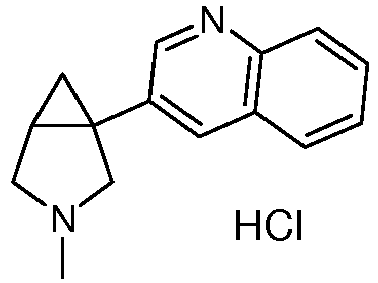
- A stirred solution/suspension of 3-bromo-1-methylmaleimide (2.0g, 10.5 mmol) and quinoline-3-boronic acid (2.2g, 12.6 mmol) in dioxane (50mL) under nitrogen was degassed with a stream of nitrogen for 10 min, treated with cesium fluoride (3.5g, 22.0 mmol) and Cl2Pd(dppf).CH2Cl2 (0.5g, 0.6 mmol), then stirred at room temperature for 0.5h, at 45°C for 30min, and at 65°C for 45min. The mixture was cooled and diluted with methylene chloride (50mL). The mixture was filtered through Celite® (rinse filter cake with methylene chloride) and the brown filtrate concentrated in vacuo. The residue was dissolved in methylene chloride and filtered through a column of silica gel (eluted with methylene chloride 60% and ethyl acetate 40%) to afford a tan solid, which was triturated from cold petroleum ethers to afford arylmaleimide intermediate (880 mg, 15%) as a tan solid.
- A cooled (-20°C) stirred solution of trimethylsulfoxonium chloride (261mg, 2.03 mmol) in anhydrous tetrahydrofuran (15mL) under nitrogen was treated dropwise with n-butyllithium/hexane (2.4N, 1.1mL, 2.03 mmol) and gradually warmed to 50°C over 30 minutes. Meanwhile, a solution of the intermediate arylmaleimide (0.350g, 1.5 mmol) in anhydrous THF (10mL) was heated to 50°C, then added quickly in one portion to the above heated suspension, and the mixture was stirred at 50°C for 2h, then cooled on an ice bath. Saturated aqueous ammonium chloride (1mL) was added to quench, and the mixture was diluted with methylene chloride (75mL), dried (MgSO4), filtered through Celite® (rinse with methylene chloride), and concentrated in vacuo. The residue was dissolved in methylene chloride, loaded onto a silica gel column, and the product eluted with 3% ethyl acetate/methylene chloride to afford the intermediate bicyclic diimide (148mg, 50%) as a very pale yellow viscous oil. 1H NMR (CDCl3 δ 7.74- 7.90 (m, 3H), 7.38-7.55 (m, 3H), 4.54 (dd, 2H), 3.86 (d, 6H, J=4.5 Hz), 2.81 (dd, 1H, J=8Hz, 3.5Hz), 1.91 (dd, 1H, J=8Hz,4.5Hz), 1.78 (dd, 1H, J=4.5, 3.5Hz).
- A stirred ice-cooled solution of 1.0N borane/THF (10.5mL, 10.5 mmol) under nitrogen was treated dropwise with a solution of the above bicyclic diimide intermediate (560mg, 2.1mmol) in anhydrous THF (10mL). The solution was stirred at room temperature for 15min, refluxed for 4h, cooled on an ice bath, and carefully treated dropwise with 6N HCl (10mL, vigorous evolution of gas). The solution was concentrated to a white solid, which was partitioned between 5N sodium hydroxide (25mL) and ether (50mL). The organic layer was separated and the aqueous extracted with ether (50mL). The combined organic solution was washed with water (25mL), dried (Mg2SO4), and concentrated in vacuo. The residue was dissolved in methanol (23mL), treated with 4N HCl/dioxane (7mL), then stirred at room temperature for 16h and at 55°C for 4h. The solution was concentrated in vacuo and the residue triturated from ether to afford 1-(quinolin-3-yl)-3-methyl-3-azabicyclo[3.1.0]hexane, hydrochloride (100mg, 20%) as a white solid. MS (M+1) 240.1. 1H NMR (CDCl3) δ 7.23 (dd, 1H, J=6.5Hz,2Hz), 7.01-7.15 (m, 2H), 4.10 (dd, 1H, J=11Hz,5Hz), 3.92 (dd, 1H, J=11Hz,5Hz), 2.95-3.30 (m, 4H), 2.36 (dd, 1H, J=6.5Hz,4.5Hz), 1.93-2.02 (m, 1H), 1.51 (t, 3H, J=7Hz,3Hz), 1.13-1.20 (m, 1H). 13C NMR (DMSO-d 6) δ 146.98, 141.45, 140.98, 137.01, 133.53, 131.50, 128.73, 127.46, 123.07, 61.39, 60.37, 56.60, 29.59, 22.58, 14.35.
-

- A cooled (5°C) solution of N-ethylmaleimide (20g, 0.16mole) in carbon tetrachloride (20mL) under nitrogen was treated dropwise over 45 min with bromine (23g, 0.14mole) at a rate to keep the pot temp <10°C. The mixture was stirred at 5°C for 2 hours. Dichloromethane (20mL) was added to the reaction and N2 was bubbled through the reaction for 15min to remove excess bromine. The reaction was blown dry with a steady stream of N2 and then brought up in ethanol. Anhydrous sodium acetate (12.3g, 0.15mole) was added and the reaction was refluxed for 4 hours. The mixture was concentrated in vacuo and the residue taken up in methylene chloride (300mL), filtered and concentrated in vacuo to yield an orange oil. Pure 3-bromo-1-ethylmaleimide was obtained from recrystallization in chloroform to yield a yellowish solid (26g, 82%). 1H NMR (CDCl3) δ 1.20 (t, J=7.22 Hz, 3 H) 3.62 (q, J=7.22 Hz, 2 H) 6.85 (s, 1 H).
-

- A stirred solution/suspension of 3-bromo-1-ethylmaleimide (2.4 g, 5.9mmol) and 3-quinolineboronic acid (2.2g, 6.5mmol) in dioxane (15mL) under nitrogen was degassed with a stream of nitrogen for 10 min, treated with cesium fluoride (3.2g, 10.8mmol) and POPd (Combiphos, cat# AC1000) (0.500g, 0.5mmol), then stirred at room temperature for 0.5h and at 45°C for 30min then at 65°C for 45min. The mixture was cooled and diluted with methylene chloride (50mL). The mixture was filtered through Celite® (rinse filter cake with methylene chloride) and the brown filtrate concentrated in vacuo. The residue was dissolved in methylene chloride and filtered through a column of silica gel (eluted with methylene chloride 60% and ethyl acetate 40%) to afford a light gray solid, which was triturated from cold petroleum ethers to afford the arylmaleimide intermediate (300 mg, 10%) as a gray solid.
- A stirred solution of sodium hydride oil dispersion (60%, 140mg, 3.5mmol) in anhydrous tetrahydrofuran (30mL) under nitrogen was treated with trimethyl-sulfoxonium chloride (0.55g, 4.25mmol), then refluxed for 2.5h and cooled (50°C). The above arylmaleimide (937mg, 3.5mmol) was added in one portion and the mixture stirred at 50°C for 3h, cooled on an ice bath, and quenched with saturated ammonium chloride (10mL). The product mixture was extracted with ether (2X50mL), and the combined extracts washed with water (30mL), dried (MgSO4), and concentrated in vacuo. The residual solid was dissolved in 1:1 methylene chloude/heptane and loaded onto a silica gel column and eluted with 1:1, 2:1, then 3:1 methylene chloride/heptane to afford the bicyclic diimide intermediate (250mg, 64%) as a very pale yellow oil. 1H NMR (CDCl3) δ 1.18 (t, 3 H) 1.89 - 1.96 (m, 2 H) 2.91 (dd, J=6.44, 5.47 Hz, 1 H) 3.46 - 3.59 (m, 2 H) 7.55 - 7.65 (m, 1 H) 7.69 - 7.81 (m, 1 H) 7.84 (d, J=8.20 Hz, 1 H) 8.16 (d, J=8.40 Hz, 1 H) 8.30 (d, J=1.76 Hz, 1 H) 8.92 (d, J=2.34 Hz, 1 H).
- A stirred ice-cooled solution of 2.0N LAH/THF (1.9mL, 3.76mmol) under nitrogen was treated dropwise with a solution of the above bicyclic diimide intermediate (250mg, 0.94mmol) in anhydrous THF (10mL). The solution was stirred at room temperature for 15min, refluxed for 4h, cooled on an ice bath, and carefully treated dropwise with 30% NaOH (1.3mL, vigorous evolution of gas). The solution was filtered and the filtrate was reduced to a clear oil. The residue was dissolved in methanol (23mL), treated with 4N HCl/dioxane (7mL), then stirred at room temperature for 3h. The solution was concentrated in vacuo and the residue triturated from ether to afford 1-(quinolin-3-yl)-3-ethyl-3-azabicyclo[3.1.0]hexane, hydrochloride (105mg, 43%) as a white solid. MS (M+1) 239. 1H NMR (CDCl3) δ 7.25 (m, 1H), 7.08 (m, 2H), 4.04 (m, 1H), 3.85 (m, 1H), 3.35 (m, 2H), 3.21 (m, 1H), 2.39 (m, 1H), 1.97 (m, 1H), 1.50 (d, 6H, J=7Hz), 1.10 (m, 1H). 13C NMR (CDCl3) δ 158.83, 156.34, 135.62, 129.93, 127.57, 121.54, 117.17, 59.78, 57.35, 53.99, 30.68, 23.06, 19.05, 16.29.
-

- A stirred solution/suspension of 3-bromo-1-ethylmaleimide (0.7 g, 3.43mmol) and 1-methyl-1H-indol-5-ylboronic acid (0.65g, 3.7mmol) in dioxane (15mL) under nitrogen was degassed with a stream of nitrogen for 10 min, treated with cesium fluoride (1.6g, 10.8mmol) and Cl2Pd(dppf).CH2Cl2 (0.25g, 0.3mmol), then stirred at room temperature for 0.5h and at 45°C for 30min then at 65°C for 45min. The mixture was cooled and diluted with methylene chloride (50mL). The mixture was filtered through Celite® (rinse filter cake with methylene chloride) and the brown filtrate concentrated in vacuo. The residue was dissolved in methylene chloride and filtered through a column of silica gel (eluted with methylene chloride 60% and ethyl acetate 40%) to afford an orange solid, which was triturated from cold petroleum ethers to afford arylmaleimide intermediate (585 mg, 67%) as an orange solid.
- A stirred suspension of sodium hydride oil dispersion (60%, 140mg, 3.5mmol) in anhydrous tetrahydrofuran (30mL) under nitrogen was treated with trimethylsulfoxonium chloride (0.55g, 4.25mmol), then refluxed for 2.5h and cooled (50°C). The above arylmaleimide (937mg, 3.5mmol) was added in one portion and the mixture stirred at 50°C for 3h, cooled on an ice bath, and quenched with saturated ammonium chloride (10mL). The product mixture was extracted with ether (2X50mL), and the combined extracts washed with water (30mL), dried (MgSO4), and concentrated in vacuo. The residual solid was dissolved in 1:1 methylene chloride/heptane and loaded onto a silica gel column and eluted with 1:1, 2:1, then 3:1 methylene chloride/heptane to afford the bicyclic diimide intermediate (628mg, 64%) as a very pale yellow oil. 1H NMR (CDCl3) δ 1.14 (t, 3 H) 1.79 (dd, J=4.39, 3.61 Hz, 1 H) 1.89 (dd, J=8.10, 4.39 Hz, 1 H) 2.70 (dd, J=8.10, 3.61 Hz, 1 H) 3.42 - 3.56 (m, 2 H) 3.78 - 3.81 (m, 1 H) 6.46 (dd, J=3.12, 0.78 Hz, 1 H) 7.07 (d, J=2.93 Hz, 1 H) 7.26 (d, J=1.76 Hz, 1 H) 7.29 - 7.37 (m, 1 H) 7.63 (d, J=0.98 Hz, 1 H).
- A stirred ice-cooled solution of 2.0N LAH/THF (2.2mL, 2.23mmol) under nitrogen was treated dropwise with a solution of the above bicyclic diimide intermediate (150mg, 0.6mmol) in anhydrous THF (10mL). The solution was stirred at room temperature for 15min, refluxed for 4h, cooled on an ice bath, and carefully treated dropwise with 30% NaOH (1.3mL, vigorous evolution of gas). The solution was filtered and the filtrate was reduced to a clear oil. The residue was dissolved in methanol (23mL), treated with 4N HCl/dioxane (7mL), then stirred at room temperature for 3h. The solution was concentrated in vacuo and the residue triturated from ether to afford 1-(1-methyl-1H-indol-5-yl)-3-ethyl-3-azabicyclo[3.1.0]hexane, hydrochloride (76mg, 53%) as a white solid. MS (M+1) 241. 1H NMR (CDCl3) δ 1.10 (d, J=6.44 Hz, 1 H) 1.48 (t, 3 H) 1.92 - 2.02 (m, 1 H) 2.19 (dd, J=6.54, 4.59 Hz, 1 H) 3.13 - 3.25 (m, 3 H) 3.25 - 3.36 (m, 1 H) 3.74 - 3.79 (m, 3 H) 3.91 (dd, J=11.03, 5.37 Hz, 1 H) 4.10 (dd, J=10.84, 5.37 Hz, 1 H) 6.38 - 6.47 (m, 1 H) 6.98 - 7.12 (m, 2 H) 7.26 - 7.33 (m, 1 H) 7.40 - 7.54 (m, 1 H). 13C NMR (CDCl3) δ 11.12, 22.47, 31.79, 33.16, 51.48, 55.69, 59.78, 66.05, 100.44, 109.10, 120.10, 121.37, 122.56, 123.34, 129.62.
-

- A stirred solution/suspension of 3-bromo-1-ethylmaleimide (1.0 g, 4.9mmol) and 1-methyl-2-tributylstannylindole (2.3g, 5.4mmol) in dioxane (15mL) under nitrogen was degassed with a stream of nitrogen for 10 min, treated with cesium fluoride (1.6g, 10.8mmol) and Cl2Pd(dppf).CH2Cl2 (0.25g, 0.3mmol), then stirred at room temperature for 0.5h and at 45°C for 30min then at 65°C for 45min. The mixture was cooled and diluted with methylene chloride (50mL). The mixture was filtered through Celite® (rinse filter cake with methylene chloride) and the brown filtrate concentrated in vacuo. The residue was dissolved in methylene chloride and filtered through a column of silica gel (eluted with methylene chloride 60% and ethyl acetate 40%) to afford a yellowish solid, which was triturated from cold petroleum ethers to afford the arylmaleimide intermediate (1.32 g, 87%) as a yellowish solid.
- A stirred suspension of sodium hydride oil dispersion (60%, 140mg, 3.5mmol) in anhydrous tetrahydrofuran (30mL) under nitrogen was treated with trimethyl-sulfoxonium chloride (0.495g, 3.85mmol), then refluxed for 2.5h and cooled (50°C). The above arylmaleimide (900mg, 3.5mmol) was added in one portion and the mixture stirred at 50°C for 3h, cooled on an ice bath, and quenched with saturated ammonium chloride (10mL). The product mixture was extracted with ether (2X50mL), and the combined extracts washed with water (30mL), dried (MgSO4), and concentrated in vacuo. The residual solid was dissolved in *1:1 methylene chloude/heptane and loaded onto a silica gel column and eluted with 1:1, 2:1, then 3:1 methylene chloride/heptane to afford the bicyclic diimide intermediate (370mg, 40%) as a very pale yellow oil. 1H NMR (CDCl3) δ 1.15 (t, 3 H) 1.86 (dd, J=4.88, 3.71 Hz, 1 H) 1.93 (dd, J=8.20, 4.88 Hz, 1 H) 2.57 (dd, J=8.30, 3.81 Hz, 1 H) 3.44 - 3.53 (m, 2 H) 7.29 (d, J=1.17 Hz, 2 H) 7.45 (t, J=1.17 Hz, 1 H).
- A stirred ice-cooled solution of 2.0N LAH/THF (6.0mL, 5.8mmol) under nitrogen was treated dropwise with a solution of the above bicyclic diimide intermediate (370mg, 1.45mmol) in anhydrous THF (10mL). The solution was stirred at room temperature for 15min, refluxed for 4h, cooled on an ice bath, and carefully treated dropwise with 30% NaOH (1.3mL, vigorous evolution of gas). The solution was filtered and the filtrate was reduced to a clear oil. The residue was dissolved in methanol (23mL), treated with 4N HCl/dioxane (7mL), then stirred at room temperature for 3h. The solution was concentrated in vacuo and the residue triturated from ether to afford 2-(3-ethyl-3-aza-bicyclo[3.1.0]hex-1-yl)-1-methyl-1H-indole, hydrochloride (262mg, 75%) as a white solid. MS (M+1) 241. 1H NMR (CDCl3) δ 1.12 - 1.19 (m, 1 H) 1.48 (t, J=7.13 Hz, 3 H) 2.10 - 2.20 (m, 1 H) 2.39 (dd, J=6.25, 4.69 Hz, 1 H) 3.04 - 3.26 (m, 3 H) 3.28 - 3.42 (m, 1 H) 3.78 (s, 3 H) 3.93 (dd, J=10.93, 5.27 Hz, 1 H) 4.10 (dd, J=10.93, 5.27 Hz, 1 H) 6.36 (s, 1 H) 7.02 - 7.15 (m, 1 H) 7.15 - 7.31 (m, 2 H) 7.52 (d, J=8.00 Hz, 1 H). 13C NMR (CDCl3) δ 11.11, 15.28, 22.42, 24.24, 30.74, 51.55, 54.91, 58.62, 101.39, 109.43, 120.30, 120.78, 122.50, 127.21, 136.70, 137.94.
-

- A stirred solution/suspension of 3-bromo-1-ethylmaleimide (0.7 g, 3.43mmol) and 5-quinolineboronic acid (1.2g, 5.9mmol) in dioxane (15mL) under nitrogen was degassed with a stream of nitrogen for 10 min, treated with cesium fluoride (1.6g, 10.8mmol) and Cl2Pd(dppf).CH2Cl2 (0.25g, 0.3mmol then stirred at room temperature for 0.5h and at 45°C for 30min then at 65°C for 45min. The mixture was cooled and diluted with methylene chloride (50mL). The mixture was filtered through Celite® (rinse filter cake with methylene chloride) and the brown filtrate concentrated in vacuo. The residue was dissolved in methylene chloride and filtered through a column of silica gel (eluted with methylene chloride 60% and ethyl acetate 40%) to afford a tan solid, which was triturated from cold petroleum ethers to afford the arylmaleimide intermediate (430 mg, 30%) as a tan solid.
- A stirred suspension of sodium hydride oil dispersion (60%, 140mg, 3.5mmol) in anhydrous tetrahydrofuran (30mL) under nitrogen was treated with trimethyl-sulfoxonium chloride (0.55g, 4.25mmol), then refluxed for 2.5h and cooled (50°C). The above arylmaleimide (937mg, 3.5mmol) was added in one portion and the mixture stirred at 50°C for 3h, cooled on an ice bath, and quenched with saturated ammonium chloride (10mL). The product mixture was extracted with ether (2X50mL), and the combined extracts washed with water (30mL), dried (MgSO4), and concentrated in vacuo. The residual solid was dissolved in 1:1 methylene chloride/heptane and loaded onto a silica gel column and eluted with 1:1, 2:1, then 3:1 methylene chloride/heptane to afford bicyclic diimide intermediate (628mg, 64%) as a very pale yellow oil. 1H NMR (CDCl3) δ 1.19 (t, 3 H) 1.85 - 1.95 (m, 1 H) 1.97 - 2.08 (m, 1 H) 2.82 (dd, J=8.40, 3.51 Hz, 1 H) 3.47 - 3.64 (m, 2 H) 7.35 - 7.87 (m, 4 H) 8.17 (dd, J=8.49, 3.81 Hz, 1 H) 8.82 - 9.03 (m, 1 H).
- A stirred ice-cooled solution of 2.0N LAH/THF (0.58mL, 1.1mmol) under nitrogen was treated dropwise with a solution of the above bicyclic diimide intermediate (77mg, 0.29mmol) in anhydrous THF (10mL). The solution was stirred at room temperature for 15min, refluxed for 4h, cooled on an ice bath, and carefully treated dropwise with 30% NaOH (1.3mL, vigorous evolution of gas). The solution was filtered and the filtrate was reduced to a clear oil. The residue was dissolved in methanol (23mL), treated with 4N HCl/dioxane (7mL), then stirred at room temperature for 3h. The solution was concentrated in vacuo and the residue triturated from ether to afford 1-(quinolin-5-yl)-3-ethyl)-3-azabicyclo[3.1.0]hexane, hydrochloride (55mg, 81%) as a white solid. MS (M+1) 239. 1H NMR (CDCl3) δ 1.0 7 (t, J=7.03 Hz, 1 H) 1.27 (t, J=7.22 Hz, 3 H) 1.31 - 1.38 (m, 1 H) 1.61 - 1.82 (m, 1 H) 3.24 (s, 1 H) 3.48 - 3.57 (m, 1 H) 3.62 - 3.79 (m, 2 H) 4.06 (dd, J=11.13, 5.27 Hz, 1 H) 7.66 (t, J=7.61 Hz, 1 H) 7.69 - 7.83 (m, 1 H) 7.97 (s, 1 H) 8.06 (d, J=8.79 Hz, 1 H) 8.41 (s, 1 H) 8.95 (d, J=2.34 Hz, 1 H). 13C NMR (CDCl3) δ 10.96, 29.17, 30.13, 42.07, 51.27, 55.11, 58.82, 122.30, 122.55, 123.77, 128.09, 131.10, 131.49, 134.91, 138.88, 143.98.
-

- A cooled (5°C) stirred solution of maleic anhydride (29.4g, 0.30mole) in anhydrous ether (150mL) under nitrogen was treated dropwise over 45 min with a solution of isopropylamine (35.5g, 0.60mole) in anhydrous ether (100mL) at a rate to keep the pot temp <20°C, then the mixture was stirred at 10°C for 15 min, filtered, and the filter cake rinsed with anhydrous ether and dried in vacuo to afford a white solid. This was taken up in acetic anhydride (250mL), treated with anhydrous sodium acetate (12.3g, 0.15mole), and heated to 75°C with stirring for 4.5h, then at 100°C for 1.5h. The mixture was concentrated in vacuo and the residue taken up in methylene chloride (300mL), washed with saturated aqueous sodium bicarbonate (200mL), water (200mL), dried (MgSO4), and concentrated in vacuo. The residue was distilled (approx. 5mm pressure) to afford two products; N-isopropylmaleimide at 82°C (13.0g) and an acetate adduct of N-isopropylmaleimide at 154°C (12.9g). The acetate adduct was dissolved in 4:1 acetonitrile/triethylamine (100mL), heated to 65°C for 4h, then concentrated in vacuo. The residue was dissolved in methylene chloride and filtered through a pad of silica gel (eluted with methylene chloride) to afford an additional 3.5g of N-isopropylmaleimide. Total yield was 16.5g of N-isopropylmaleimide (40%).
- A stirred ice-cold solution of N-isopropylmaleimide (16.4g, 0.118mole) in carbon tetrachloride (12mL) under nitrogen was treated dropwise with bromine (6.41mL, 0.25mole) at a rate to keep the pot temp <9°C, then stirred at 3°C for 2h, during which time the mixture formed a solid cake. The cake was maintained under a stream of nitrogen to allow excess bromine and CCl4 to evaporate, then the reaction mixture was placed under vacuum to remove the remaining solvent. Ethanol (100mL) was added to the flask, followed by sodium acetate (11g, 0.134mole), and the mixture was refluxed for 16h with stirring. The cooled solution was filtered through Celite® (filter cake rinsed with methylene chloride), and the filtrate concentrated in vacuo, dissolved in methylene chloride, filtered through a pad of alumina (eluted with methylene chloride), and re-concentrated in vacuo. The residue was dissolved in 2:1 petroleum ether/methylene chloride, loaded onto a column of silica gel, and eluted successively with 2:1 petroleum ethers/CH2Cl2, 1:1 petroleum ethers/CH2Cl2, and CH2Cl2 alone to afford the subject compound (16.45g, 64% yield) as a pale yellow, low melting solid. No MS (M+1) peak observed. 1H NMR (CDCl3) δ 6.78 (s, 1H), 4.30-4.40 (m, 1H), 1.37 (d, 6H, J=8Hz).
-

- A stirred solution/suspension of 3-bromo-1-methylethylmaleimide (0.7 g, 3.43mmol) and 3-quinoline boronic acid (1.2g, 5.9mmol) in dioxane (15mL) under nitrogen was degassed with a stream of nitrogen for 10 min, treated with cesium fluoride (1.6g, 10.8mmol) and Cl2Pd(dppf).CH2Cl2 (0.25g, 0.3mmol) then stirred at room temperature for 0.5h and at 45°C for 30min then at 65°C for 45min. The mixture was cooled and diluted with methylene chloride (50mL). The mixture was filtered through Celite® (rinse filter cake with methylene chloride) and the brown filtrate concentrated in vacuo. The residue was dissolved in methylene chloride and filtered through a column of silica gel (eluted with methylene chloride 60% and ethyl acetate 40%) to afford a tan solid, which was triturated from cold petroleum ethers to afford arylmaleimide intermediate (120mg, 30%) as a tan solid.
- A stirred suspension of trimethyl-sulfoxonium chloride (0.062g, 0.48mmol) under nitrogen was treated with 2.5M n-butyl lithium (0.19mL, 0.48mmol) in anhydrous tetrahydrofuran (30mL), then refluxed for 2.5h and cooled (50°C). The above arylmaleimide (115mg, 0.43mmol) was added in one portion and the mixture stirred at 50°C for 3h, cooled on an ice bath, and quenched with saturated ammonium chloride (10mL). The product mixture was extracted with ether (2X50mL), and the combined extracts washed with water (30mL), dried (MgSO4), and concentrated in vacuo. The residual solid was dissolved in 1:1 methylene chloride/heptane and loaded onto a silica gel column and eluted with 1:1, 2:1, then 3:1 methylene chloride/heptane to afford the bicyclic diimide intermediate (75mg, 62%) as a very pale yellow oil. 1H NMR (CDCl3) δ 1.31 - 1.43 (m, 6 H) 1.80 - 1.91 (m, 2 H) 2.87 (dd, J=7.61, 4.30 Hz, 1 H) 4.17 - 4.37 (m, 1 H) 7.51 - 7.62 (m, 1 H) 7.68 - 7.77 (m, 1 H) 7.81 (d, J=8.00 Hz, 1 H) 8.11 (d, J=8.59 Hz, 1 H) 8.25 (d, J=1.95 Hz, 1 H) 8.89 (d, J=1.17 Hz, 1H).
- A stirred ice-cooled solution of 2.0N LAH/THF (0.58mL, 1.1mmol) under nitrogen was treated dropwise with a solution of the above bicyclic diimide intermediate (72mg, 0.27mmol) in anhydrous THF (10mL). The solution was stirred at room temperature for 15min, refluxed for 4h, cooled on an ice bath, and carefully treated dropwise with 30% NaOH (0.5mL, vigorous evolution of gas). The solution was filtered and the filtrate was reduced to a clear oil. The residue was dissolved in methanol (23mL), treated with 4N HCl/dioxane (7mL), then stirred at room temperature for 3h. The solution was concentrated in vacuo and the residue triturated from ether to afford 1-(quinolin-3-yl)-3-(2-propyl)-3-azabicyclo[3.1.0]hexane, hydrochloride (50mg, 65%) as a white solid. MS (M+1) 253. 1H NMR (CD3OD) δ 1.37 - 1.45 (m, 1 H) 1.49 (d, J=5.94 Hz, 6 H) 1.59 (t, J=7.73 Hz, 1 H) 1.81 (dd, J=6.74, 4.76 Hz, 1 H) 2.46 - 2.60 (m, 1 H) 3.79 - 3.87 (m, 1 H) 3.88 - 3.95 (m, 2 H) 4.26 (d, J=11.10 Hz, 1 H) 7.99 (t, J=7.73 Hz, 1 H) 8.16 (t, J=7.33 Hz, 1 H) 8.26 (d, J=8.32 Hz, 1 H) 8.33 (d, J=8.32 Hz, 1 H) 9.22 (s, 1 H) 9.37 (d, J=1.98 Hz, 1 H). 13C NMR (CD3OD) δ 16.44, 19.42, 25.07, 29.93, 55.59, 57.94, 61.11, 121.95, 129.64, 131.44, 135.91, 138.94, 146.66.
-

- A stirred solution/suspension of 3-bromo-1-methylethylmaleimide (0.7g, 3.43mmol) and 5-quinoline-boronic acid (1.2g, 5.9mmol) in dioxane (15mL) under nitrogen was degassed with a stream of nitrogen for 10 min, treated with cesium fluoride (1.6g, 10.8mmol) and Cl2Pd(dppf).CH2Cl2 (0.25g, 0.3mmol) then stirred at room temperature for 0.5h and at 45°C for 30min then at 65°C for 45min. The mixture was cooled and diluted with methylene chloride (50mL). The mixture was filtered through Celite® (rinse filter cake with methylene chloride) and the brown filtrate concentrated in vacuo. The residue was dissolved in methylene chloride and filtered through a column of silica gel (eluted with methylene chloride 60% and ethyl acetate 40%) to afford a tan solid, which was triturated from cold petroleum ethers to afford arylmaleimide intermediate (430 mg, 30%) as a tan solid.
- A stirred suspension of trimethylsulfoxonium chloride (0.290g, 2.28mmol) under nitrogen was treated with 2.5M n-butyllithium (0.95mL, 2.18 mmol) in anhydrous tetrahydrofuran (30mL), then refluxed for 2.5h and cooled (50°C). The above arylmaleimide (530mg, 1.98 mmol) was added in one portion and the mixture stirred at 50°C for 3h, cooled on an ice bath, and quenched with saturated ammonium chloride (10mL). The product mixture was extracted with ether (2X50mL), and the combined extracts washed with water (30mL), dried (MgSO4), and concentrated in vacuo. The residual solid was dissolved in 1:1 methylene chloride/heptane and loaded onto a silica gel column and eluted with 1:1, 2:1, then 3:1 methylene chloride/heptane to afford bicyclic diimide intermediate (120mg, 21%) as a very pale yellow oil. 1H NMR (CDCl3) δ 1.22 - 1.39 (m, 6 H) 1.73 (dd, J=4.21, 3.48 Hz, 1 H) 1.83 (dd, J=8.14, 4.30 Hz, 1 H) 2.67 (dd, J=8.05, 3.48 Hz, 1 H) 3.79 (s, 3 H) 4.14 - 4.31 (m, 1 H) 6.43 - 6.47 (m, 1 H) 7.04 - 7.08 (m, 1 H) 7.23 - 7.27 (m, 1 H) 7.28 - 7.35 (m, 1 H) 7.63 (d, J=1.10 Hz, 1 H).
- A stirred ice-cooled solution of 2.0N LAH/THF (0.820mL, 1.6mmol) under nitrogen was treated dropwise with a solution of the above bicyclic diimide intermediate (116mg, 0.41mmol) in anhydrous THF (10mL). The solution was stirred at room temperature for 15min, refluxed for 4h, cooled on an ice bath, and carefully treated dropwise with 30% NaOH (0.5mL, vigorous evolution of gas). The solution was filtered and the filtrate was reduced to a clear oil. The residue was dissolved in methanol (23mL), treated with 4N HCl/dioxane (7mL), then stirred at room temperature for 3h. The solution was concentrated in vacuo and the residue triturated from ether to afford 1-(1-methyl-1H-indol-5-yl)-3-(2-propyl)-3-azabicyclo[3.1.0]-hexane, hydrochloride (60mg, 62%) as a white solid. MS (M+1) 255. 1H NMR (CDCl3) δ 1.10 - 1.20 (m, 1 H) 1.51 (t, J=6.54 Hz, 6 H) 1.89 - 2.00 (m, 1 H) 2.29 (dd, J=6.44, 4.49 Hz, 1 H) 3.17 - 3.40 (m, 3 H) 3.74 - 3.79 (m, 3 H) 3.86 (dd, J=10.84, 5.56 Hz, 1 H) 4.06 (dd, J=10.93, 5.47 Hz, 1 H) 6.41 (d, J=3.12 Hz, 1 H) 7.00 - 7.10 (m, 2 H) 7.21 - 7.29 (m, 1 H) 7.46 (d, J=1.37 Hz, 1 H). 13C NMR (CDCl3) δ 15.95, 18.97, 22.62, 31.96, 33.16, 54.32, 58.59, 59.54, 109.88, 120.14, 121.45, 128.84, 129.06, 130.15, 136.18.
-

- A stirred solution/suspension of 3-bromo-1-(1-methylethyl)maleimide (1.09g, 5mmol) and (1-methylindol-2-yl)tributyltin (2.63g, 6.25mmol) in dioxane (30mL) under nitrogen was degassed with a stream of nitrogen for 10 min, then treated with cesium fluoride (1.8g, 11.8mmol) and Cl2Pd(PPh3)2 (0.21g, 0.3mmol), stirred at room temperature for 30min, 40°C for 30min, and 60°C for 1.5h. The mixture was cooled to room temperature, taken up in methylene chloride (100mL), and filtered through Celite® (rinse filter cake with methylene chloride) and the filtrate concentrated in vacuo. The residue was dissolved in methylene chloride and filtered through a column of silica gel (eluted with methylene chloride) to afford a dark solid, which was triturated from ether to afford the arylmaleimide intermediate (1.236g, 92%) as a yellow solid. MS (M+1) 269.2. 1H NMR (CDCl3) δ 7.69 (m, 1H), 7.59 (s, 1H), 7.34 (m, 2H), 7.14 (m, 1H), 6.52 (s, 1H), 4.44 (m, 1H), 3.87 (s, 3H), 1.46 (d, 6H, J=7Hz).
- A stirred suspension of sodium hydride oil dispersion (60%, 160mg, 4.0mmol) in anhydrous tetrahydrofuran (35mL) under nitrogen was treated with trimethylsulfoxonium chloride (0.643g, 5.0mmol), then refluxed for 2.5h and cooled (50°C). The above arylmaleimide (1.073g, 4.0mmol) was added in one portion and the mixture stirred at 50°C for 3h, cooled on an ice bath, and quenched with saturated ammonium chloride (12mL). The product mixture was extracted with ether (2X50mL), and the combined extracts washed with water (35mL), dried (MgSO4), and concentrated in vacuo. The residue was dissolved in methylene chloride and loaded onto a silica gel column and eluted with methylene chloride to afford the bicyclic diimide intermediate (640mg, 57%) as a pale orange solid. MS (M+1) 283.1. 1H NMR (CDCl3) δ 7.56 (m, 1H), 7.32 (m, 1H), 7.20-7.27 (m, 2H), 7.10 (m, 1H), 4.28 (m, 1H), 3.80 (s, 3H), 2.72 (m, 1H), 1.87 (m, 2H), 1.37 (m, 6H).
- A stirred cooled (5°C) mixture of 2.0N lithium aluminum hydride/THF (5.2mL, 10.4mmol) in a 3-neck 100 mL round bottom flask under nitrogen was treated dropwise with a solution of the above bicyclic diimide intermediate (0.367g, 1.30 mmol) in anhydrous THF (5mL), and the mixture was stirred 1h at room temperature and 3h at reflux, then recooled on an ice bath. Water (0.4mL), 15% sodium hydroxide (0.4mL), and water (1.2mL) were carefully added dropwise, and the mixture was stirred for a few minutes and filtered (rinse filter cake with methylene chloride). The filtrate was concentrated in vacuo and the residue dissolved in methylene chloride and loaded onto a silica gel column and eluted with 5% (9:1 ethanol/ammonia)/methylene chloride, then 10% (9:1 ethanol/ammonia)/methylene chloride to afford the free base of the title compound as a colorless oil. This was dissolved in ether (15mL) and treated with 2.0N HCl/ether (1.25mL, 2.5mmol), the suspension diluted with a few mL of methylene chloride, stirred a few minutes, and the solid filtered, collected and dried in vacuo to afford 1-(1-methyl-2-indolyl)-3-(2-propyl)-3-azabicyclo[3.1.0]hexane, hydrochloride (321mg, 85%) as a white solid. MS (M+1) 255.2. 1H NMR (CDCl3) δ 7.52 (d, 1H, J=8Hz), 7.20-7.30 (m, 2H), 7.09 (m, 1H), 6.35 (br s, 1H), 4.08 (m, 1H), 3.91 (m, 1H), 3.79 (s, 3H), 3.41 (m, 1H), 3.30 (m, 1H), 3.15 (m, 1H), 2.52 (m, 1H), 2.13 (m, 1H), 1.52 (m, 6H), 1.14 (m, 1H). 13C NMR (CDCl3) δ 137.93, 136.96, 127.22, 122.49, 120.76, 120.30, 109.43, 101.26, 59.71, 57.36, 53.55, 30.77, 24.43, 22.61, 18.97, 15.36.
-

- A stirred solution/suspension of 3-bromo-1-methylethylmaleimide (0.7 g, 3.43mmol) and 5-quinolineboronic acid (1.2g, 5.9mmol) in dioxane (15mL) under nitrogen was degassed with a stream of nitrogen for 10 min, treated with cesium fluoride (1.6g, 10.8mmol) and Cl2Pd(dppf).CH2Cl2 (0.25g, 0.3mmol) then stirred at room temperature for 0.5h and at 45°C for 30min then at 65°C for 45min. The mixture was cooled and diluted with methylene chloride (50mL). The mixture was filtered through Celite® (rinse filter cake with methylene chloride) and the brown filtrate concentrated in vacuo. The residue was dissolved in methylene chloride and filtered through a column of silica gel (eluted with methylene chloride 60% and ethyl acetate 40%) to afford a tan solid, which was triturated from cold petroleum ethers to afford the arylmaleimide intermediate (430 mg, 30%) as a tan solid.
- A stirred suspension of trimethylsulfoxonium chloride (0.062g, 0.48mmol) under nitrogen was treated with 2.5M n-butyllithium (0.19mL, 0.48mmol) in anhydrous tetrahydrofuran (30mL), then refluxed for 2.5h and cooled (50°C). The above arylmaleimide (115mg, 0.43mmol) was added in one portion and the mixture stirred at 50°C for 3h, cooled on an ice bath, and quenched with saturated ammonium chloride (10mL). The product mixture was extracted with ether (2X50mL), and the combined extracts washed with water (30mL), dried (MgSO4), and concentrated in vacuo. The residual solid was dissolved in 1:1 methylene chloride/heptane and loaded onto a silica gel column and eluted with 1:1, 2:1, then 3:1 methylene chloride/heptane to afford the bicyclic diimide intermediate (75mg, 62%) as a very pale yellow oil. 1H NMR (CDCl3) δ 1.31 - 1.43 (m, 6 H) 1.80 - 1.91 (m, 2 H) 2.87 (dd, J=7.61, 4.30 Hz, 1 H) 4.17 - 4.37 (m, 1 H) 7.51 - 7.62 (m, 1 H) 7.68 - 7.77 (m, 1 H) 7.81 (d, J=8.00 Hz, 1 H) 8.11 (d, J=8.59 Hz, 1 H) 8.25 (d, J=1.95 Hz, 1 H) 8.89 (d, J=1.17 Hz, 1H).
- A stirred ice-cooled solution of 2.0N LAH/THF (0.58mL, 1.1mmol) under nitrogen was treated dropwise with a solution of the above bicyclic diimide intermediate (68mg, 0.24mmol) in anhydrous THF (10mL). The solution was stirred at room temperature for 15min, refluxed for 4h, cooled on an ice bath, and carefully treated dropwise with 30% NaOH (0.5mL, vigorous evolution of gas). The solution was filtered and the filtrate was reduced to a clear oil. The residue was dissolved in methanol (23mL), treated with 4N HCl/dioxane (7mL), then stirred at room temperature for 3h. The solution was concentrated in vacuo and the residue triturated from ether to afford 1-(quinolin-5-yl)-3-(2-propyl)-3-azabicyclo[3.1.0]hexane, hydrochloride (50mg, 75%) as a white solid. MS (M+1) 254. 1H NMR (CD3OD) δ 1.37 - 1.45 (m, 1 H) 1.49 (d, J=5.94 Hz, 6 H) 1.59 (t, J=7.73 Hz, 1 H) 1.81 (dd, J=6.74, 4.76 Hz, 1 H) 2.46 - 2.60 (m, 1 H) 3.79 - 3.87 (m, 1 H) 3.88 - 3.95 (m, 2 H) 4.26 (d, J=11.10 Hz, 1 H) 7.99 (t, J=7.73 Hz, 1 H) 8.16 (t, J=7.33 Hz, 1 H) 8.26 (d, J=8.32 Hz, 1 H) 8.33 (d, J=8.32 Hz, 1 H) 9.22 (s, 1 H) 9.37 (d, J=1.98 Hz, 1 H). 13C NMR (CD3OD) δ 15.24, 18.91, 22.07, 29.31, 29.63, 54.20, 57.34, 60.05, 121.83, 122.56, 129.41, 131.70, 135.21, 136.73, 138.52, 143.76, 144.49.
-

- A stirred solution of 3-bromo-1-(3,4-dimethoxybenzyl)maleimide (3.26g, 10 mmol) and thionaphthene-2-boronic acid (2.13g, 12 mmol) in dioxane (30mL) was degassed under a stream of nitrogen for 10 minutes, then treated with cesium fluoride (4g, 26 mmol) and Cl2Pd(dppf)CH2Cl (0.5g, 0.61 mmol), then stirred at room temperature for 1 hour and at 40°C for 2h. The mixture was cooled and diluted with methylene chloride, stirred a few minutes and filtered through celite. The filtrate was concentrated in vacuo and purified by silica gel chromatography using 2% ethyl acetate/ methylene chloride as the eluting solvent to afford the arylmaleimide intermediate (3.3g, 87.3%). 1H NMR (CDCl3) δ 8.34-8.27 (m, 1H), 7.92-7.81 (m, 2H), 7.48-7.36 (m, 2H), 7.07-6.80 (m, 3H), 6.66-6.60 (m, 1H), 4.73-4.65 (m, 2H), 3.89 (s, 3H), 3.86 (s, 3H).
- A cooled (-20°C) stirred solution of trimethylsulfoxonium chloride (964mg, 7.5 mmol) in anhydrous tetrahydrofuran (30mL) under nitrogen was treated with n-butyllithium/hexane (2.5N, 2.4mL, 6.0 mmol) and warmed to 50°C over 30 minutes. A solution of the arylmaleimide intermediate (2g, 5.4 mmol) in anhydrous tetrahydrofuran (20mL) was warmed to 50°C and added all at once. After 2h at 50°C, the mixture was cooled on ice and quenched with saturated aqueous ammonium chloride (2mL). The mixture was stirred at room temperature for 15 minutes, then it was added to methylene chloride (100mL) and the organic solution was dried (Na2SO4) and concentrated in vacuo. The residue was dissolved in methylene chloride, loaded onto a silica gel column and eluted with 2% ethyl acetate/methylene chloride to afford the bicyclic diimide intermediate (702mg, 33%). 1H NMR (CDCl3) δ 7.80-7.76 (m, 1H), 7.73-7.69 (m, 1H), 7.37-7.30 (m, 3H), 6.94-6.89 (m, 2H), 6.81-6.77 (m, 1H), 4.54 (q, 2H), 3.86 (s, 3H), 3.84 (s, 3H), 2.88-2.84 (m, 1H), 1.96-1.92 (m, 1H), 1.87-1.83 (m, 1H).
- A stirred, ice-cooled (2°C) solution of 1N lithium aluminum hydride/THF (16mL, 16 mmol) under nitrogen was treated dropwise with a solution of the above bicyclic diimide (1.014g, 2.58 mmol) in anhydrous tetrahydrofuran (20mL), stirred 3h at room temperature and 1h at reflux, then cooled on an ice bath. Water (0.60mL), 15% NaOH (0.60mL), and water (1.80mL) were added dropwise together with more tetrahydrofuran to facilitate stirring. The mixture was stirred at room temperature for 15 minutes, filtered through celite and the filtrate concentrated in vacuo. The residue was dissolved in methylene chloride, loaded onto a silica gel column, and eluted with 3:1 methylene chloride/ethyl acetate to afford the bicyclic intermediate (754mg, 80%). 1H NMR (CDCl3) δ 7.74-7.59 (m, 2H), 7.31-7.19 (m, 2H), 6.99-6.97 (m, 1H), 6.90-6.78 (m, 3H), 3.90 (s, 3H), 3.85 (s, 3H), 3.65-3.60 (m, 2H), 3.30 (d, 1H), 3.05 (d, 1H), 2.75 (d, 1H), 2.60-2.54 (m, 1H), 1.77- 1.71 (m, 1H), 1.68-1.62 (m, 1H), 1.08-1.03 (m, 1H).
- A solution of the above bicyclic intermediate (365mg, 1 mmol) and anhydrous potassium carbonate (276mg, 2 mmol) in anhydrous methylene chloride (6mL) in a pressure tube was treated with 1-chloroethyl chloroformate (0.3mL, 3 mmol). The tube was closed under nitrogen flow, stirred at 40°C for 4h, then cooled and uncapped. The contents were filtered and the filtrate concentrated in vacuo, dissolved in methanol (12mL), refluxed for 1h, then cooled to room temperature and treated with DOWEX 550A-OH. The mixture was filtered and the filtrate concentrated in vacuo to debenzylated free base of 1-(benzothiophen-2-yl)-3-azabicyclo[3.1.0]hexane (120mg, 56%). 45 mg of compound was converted to the hydrochloride salt by treating with 2N HCl/ether. MS (M+1) 215.8. 1H NMR (MeOH-d 4) δ 7.82-7.67 (m, 2H), 7.36-7.23 (m, 3H), 3.85-3.66 (m, 3H), 3.57-3.49 (m, 1H), 3.32-3.27 (m, 1H), 2.24-2.17 (m, 1H), 1.54-1.47 (m, 1H), 1.37-1.31 (m, 1H). 13C NMR (MeOD-d 4) δ 142.58, 140.10, 138.95, 124.52, 124.35, 123.14, 121.95, 121.76, 50.52, 47.69, 28.06, 25.82, 16.16.
-

- A stirred solution of 1-(benzothiophen-2-yl)-3-azabicyclo[3.1.0]hexane (72mg, 0.348 mmol) in 1,2-dichloroethane (7ml) was treated with 37% formaldehyde (0.21 mL, 2.8 mmol), then with sodium triacetoxyborohydride (294.5mg, 1.39 mmol) and this reaction mixture was stirred at room temperature for 3h. 1N sodium hydroxide (7mL) was then added, stirring continued for a few minutes, and the organic layer was separated. The aqueous layer was washed with methylene chloride, and the organic layers were combined, washed with brine, dried (Na2SO4), filtered and concentrated in vacuo. The residue was chromatographed on a silica gel column (eluted with 90:9:1 methylene chloride/ethanol/ammonia). The oily 1-(benzothiophen-2-yl)-3-methyl-3-aza-bicyclo[3.1.0]hexane (71.6mg, 90%) was converted to the hydrochloride salt by treating with 2N HCl/ether (49mg, 53%). MS (M+1) 229.79. 1H NMR (MeOD-d 4) δ 7.84-7.66 (m, 2H), 7.39-7.23 (m, 3H), 4.11- 4.02 (m, 1H), 3.85-3.71 (m, 2H), 3.68-3.60 (m, 1H), 3.07-2.97 (s, 3H), 2.31-2.21 (m, 1H), 1.56 - 1.44 (m, 2H). 13C NMR (METHANOL-d 4) δ 142.20, 140.06, 138.95, 124.56, 124.41, 123.18, 121.96, 121.92, 59.69, 57.19, 40.00, 27.81, 25.6, 16.21.
-
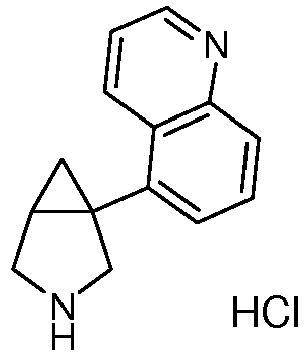
- A stirred solution/suspension of 3-bromo-1-(3,4-dimethoxybenzyl)maleimide (3.8 g, 11.57 mmol) and quinoline-5-boronic acid (2g, 11.56 mmol) in dioxane (15mL) under nitrogen was degassed with a stream of nitrogen for 10 min, treated with cesium fluoride (3.8g, 25.4 mmol) and Cl2Pd(dppf).CH2Cl2 (0.50g, 0.6 mmol), then stirred at room temperature for 0.5h and at 45°C for 30min then at 65°C for 45min. The mixture was cooled and diluted with methylene chloride (50mL). The mixture was filtered through Celite® (rinse filter cake with methylene chloride) and the brown filtrate concentrated in vacuo. The residue was dissolved in methylene chloride and filtered through a column of silica gel (eluted with methylene chloride 60% and ethyl acetate 40%) to afford a pale yellow solid, which was triturated from cold petroleum ethers to afford the arylmaleimide intermediate (3.3 g, 77%) as pale yellow solid.
- A cooled (-20°C) stirred solution of trimethylsulfoxonium chloride (1.25g, 9.7 mmol) in anhydrous tetrahydrofuran (15mL) under nitrogen was treated dropwise with n-butyllithium/hexane (2.4N, 3.9mL, 9.73 mmol) and gradually warmed to 50°C over 30 minutes. Meanwhile, a solution of the intermediate arylmaleimide (3.3 g, 8.8 mmol) in anhydrous THF (10mL) was heated to 50°C, then added quickly in one portion to the above heated suspension, and the mixture was stirred at 50°C for 2h, then cooled on an ice bath. Saturated aqueous ammonium chloride (1mL) was added to quench, and the mixture was diluted with methylene chloride (75mL), dried (MgSO4), filtered through Celite® (rinse with methylene chloride), and concentrated in vacuo. The residue was dissolved in methylene chloride, loaded onto a silica gel column, and the product eluted with 3% ethyl acetate/methylene chloride to afford the intermediate bicyclic diimide (300mg, 10%) as a very pale yellow viscous oil.
- A cooled (5°C) stirred solution of 1N lithium aluminum hydride/THF (3.1mL, 3.1 mmol) under nitrogen was treated slowly with a solution of the above intermediate bicyclic diimide (300mg, 0.77 mmol) in anhydrous THF (7mL), stirred 1h at room temperature, refluxed for 6h, and cooled (5°C). Water (0.4mL), 15% sodium hydroxide (0.4mL), and water (1.2mL) were carefully added dropwise, followed by additional THF to facilitate stirring. The suspension was stirred 15min, filtered through Celite® (filter cake rinsed with THF), and the filtrate concentrated in vacuo. The residue was dissolved in methylene chloride, loaded onto a silica gel column, and eluted with 3:1 methylene chloride/ethyl acetate to afford the intermediate dimethoxybenzyl bicyclic amine (110mg, 40%) as a colorless viscous oil.
- A mixture of the intermediate dimethoxybenzyl bicyclic amine (100mg, 0.3 mmol) and anhydrous potassium carbonate (83mg, 0.6 mmol) in anhydrous methylene chloride (5mL) in a pressure tube equipped with a stirbar was treated with 1-chloroethyl chloroformate (0.130mL, 0.9mmol), closed, and stirred at 45°C for 4h. The tube was cooled, opened, and the contents filtered (rinse with methylene chloride), and the filtrate concentrated in vacuo. The residue was dissolved in methanol (7mL), refluxed for 1h, cooled, treated with DOWEX® 550A-OH resin (2.0g, prerinsed with methanol), stirred a few minutes, filtered, and the filtrate concentrated in vacuo. The residue was taken up in ether, filtered through Celite®, and the filtrate treated with 2N HCl/ether (0.6mL, 1.2 mmol). The suspension was stirred a few minutes, the solid salt collected by filtration, rinsed with ether, and dried in vacuo to afford 1-(quinolin-5-yl)-3-azabicyclo[3.1.0]- hexane, hydrochloride (70mg, 47%) as a light beige solid. MS (M+1) 225.1. 1H NMR (DMSO-d 6) δ 9.33 (s, 1H), 8.94 (s, 1H), 8.36 (d,1H, J=8.5Hz), 8.17 (d, 1H, J=8Hz), 8.01 (t, 1H, J=7.5Hz), 7.86 (t, 1H, J=7.5Hz), 3.97 (dd, 1H, J=11Hz, 5Hz), 3.42-3.86 (m, 3H), 2.24-2.43 (m, 1H), 1.74-2.14 (m, 1H), 1.44 (t, 1H, J=7.5Hz). 13C NMR (DMSO-d 6) δ 147.12, 142.14, 134.04, 133.52, 129.91, 129.10,128.57, 123.24, 58.85, 56.63, 29.36, 24.70, 15.32.
-

- A stirred solution of 3-bromo-1-(3,4-dimethoxybenzyl)maleimide (1.0g, 3.06 mmol) and quinoline-3-boronic acid (0.52g, 3.4 mmol) in anhydrous dioxane (10mL) under nitrogen was degassed over 10min with a stream of nitrogen, then treated with cesium fluoride (1.3g, 8.5 mmol) and Cl2Pd(dppf).CH2Cl2 (Aldrich, 0.17g, 0.21 mmol), stirred 1h at room temperature, then 2h at 40°C. The mixture was cooled, diluted with methylene chloride (50mL), stirred a few minutes, filtered through Celite® (rinse with methylene chloride), and the filtrate concentrated in vacuo. The residue was dissolved in methylene chloride and loaded onto a silica gel column and the product eluted with 3% ethyl acetate/methylene chloride to afford a yellow solid, which was triturated from petroleum ethers to afford the intermediate arylmaleimide (940g, 79%) as a pale yellow solid.
- A cooled (-20°C) stirred solution of trimethylsulfoxonium chloride (370mg, 2.86 mmol) in anhydrous tetrahydrofuran (15mL) under nitrogen was treated dropwise with n-butyllithium/hexane (2.4N, 1.1mL, 2.03 mmol) and gradually warmed to 50°C over 30 minutes. Meanwhile, a solution of the intermediate arylmaleimide (0.94g, 2.6 mmol) in anhydrous THF (10mL) was heated to 50°C, then added quickly in one portion to the above heated suspension, and the mixture was stirred at 50°C for 2h, then cooled on an ice bath. Saturated aqueous ammonium chloride (1mL) was added to quench, and the mixture was diluted with methylene chloride (75mL), dried (MgSO4), filtered through Celite® (rinse with methylene chloride), and concentrated in vacuo. The residue was dissolved in methylene chloride, loaded onto a silica gel column, and the product eluted with 3% ethyl acetate/methylene chloride to afford the intermediate bicyclic diimide (400mg, 50%) as a very pale yellow viscous oil.
- A cooled (5°C) stirred solution of 1N lithium aluminum hydride/THF (3.6mL, 10 mmol) under nitrogen was treated slowly with a solution of the above intermediate bicyclic diimide (400mg, 1.2 mmol) in anhydrous THF (7mL), stirred 1h at room temperature, refluxed for 6h, and cooled (5°C). Water (0.4mL), 15% sodium hydroxide (0.4mL), and water (1.2mL) were carefully added dropwise, followed by additional THF to facilitate stirring. The suspension was stirred 15min, filtered through Celite®(filter cake rinsed with THF), and the filtrate concentrated in vacuo. The residue was dissolved in methylene chloride, loaded onto a silica gel column, and eluted with 3:1 methylene chloride/ethyl acetate to afford the intermediate dimethoxybenzyl bicyclic amine (280mg, 58%) as a colorless viscous oil.
- A mixture of the intermediate dimethoxybenzyl bicyclic amine (280mg, 0.76 mmol) and anhydrous potassium carbonate (215mg, 1.55 mmol) in anhydrous methylene chloride (5mL) in a pressure tube equipped with a stirbar was treated with 1-chloroethyl chloroformate (0.221mL, 1.55 mmol), closed, and stirred at 45°C for 4h. The tube was cooled, opened, and the contents filtered (rinse with methylene chloride), and the filtrate concentrated in vacuo. The residue was dissolved in methanol (7mL), refluxed for 1h, cooled, treated with DOWEX® 550A-OH resin (2.0g, prerinsed with methanol), stirred a few minutes, filtered, and the filtrate concentrated in vacuo. The residue was taken up in ether, filtered through Celite®, and the filtrate treated with 2N HCl/ether (0.6mL, 1.2 mmol). The suspension was stirred a few minutes, the solid salt collected by filtration, rinsed with ether, and dried in vacuo to afford 1-(quinolin-3-yl)-3-azabicyclo- [3.1.0]hexane, hydrochloride (100mg, 47%) as a light beige solid. MS (M+1) 192.1. 1H NMR (DMSO-d 6) δ 9.33 (s, 1H), 8.94 (s, 1H), 8.36 (d, 1H, J=8.5Hz), 8.17 (d, 1H, J=8Hz), 8.01 (t, 1H, J=7.5Hz), 7.86 (t, 1H, J=7.5Hz), 3.97 (dd, 1H, J=11Hz,5Hz), 3.42-3.86 (m, 3H), 2.24-2.43 (m, 1H), 1.74-2.14 (m, 1H) 1.44 (t, 1H, J=7.5Hz). 13C NMR (DMSO-d 6) δ ppm 147.12, 142.14, 134.04, 133.52, 129.91, 129.10,128.57, 123.24, 58.85, 56.63, 29.36, 24.70, 15.32.
-

- To a mixture of 2, 5-difluorobenzaldehyde (280 g, 1.97 mol), potassium carbonate (272 g, 1.97 mol) and anhydrous DMF (1260 ml) was added mercaptoacetic acid ethyl ester (236 g, 1.97 mol). The mixture was stirred at 90°C for 4 h. After cooling water (4200 ml) was added and the solution was extracted with ethyl acetate (3x1500 ml), the combined extracts dried over sodium sulfate and the solvent was removed to give crude product, which was flash-chromatographed (eluent - ethyl acetate (1):hexane (9). Yield of 6-fluoro-benzo[b]thiophene-2-carboxylic acid ethyl ester 96.49 g (21.8%) as a yellow solid. 1H-NMR (400 MHz, CDCl3); δ (ppm): 1.40 (t, 3H), 4.40 (q, 2H), 7.15 (t, 1H), 7.52 (d, 1H), 7.81(dd, 1H), 8.00 (s, 1H).
-

- To a suspension of lithium aluminum hydride (15.5 g, 0.43 mol) in dry THF (600 ml) was added a solution of 6-fluoro-benzo[b]thiophene-2-carboxylic acid ethyl ester (96.49 g, 0.43 mol) in dry THF (960 ml), the mixture was stirred for 3 h at 20°C. The reaction was carefully quenched by the dropwise addition of water (15.5 ml), 15% NaOH (15.5 ml) and water (46.5 ml), stirred for 0.5 h, then filtered and washed with THF: water (1:1) (100 ml). The filtrate was concentrated to give 58.25 g (74 %) of 6-fluoro-benzo[b]thiophen-2-yl)-methanol as white powder. 1H-NMR (400 MHz, DMSO-d6); δ (ppm): 4.67 (s, 2H), 5.51 (s, 1H), 7.17 (t, 1H), 7.22 (s, 1H), 7.72-7.80 (m, 2H).
-

- To a solution of 6-fluoro-benzo[b]thiophen-2-yl)-methanol (60.89 g, 0.33 mol) in dry dioxane (30 ml) was added thionyl chloride (39 ml, 0.53 mol) while keeping the temperature below 15°C and stirred at for 4 hours (TLC control). The mixture was evaporated at 40°C under reduced pressure to give 2-chloromethyl-6-fluoro-benzo[b]thiophene as white solid in essentially quantitative yield.
-

- To a solution of NaCN (21.8 g, 0.446 mol) in DMSO (600 ml) was added portionwise 2-chloromethyl- 6-fluoro-benzo[b]thiophene (71.5g, 0.357 mol) while keeping the temperature below 15°C and stirred for 1.5 h at 40-45°C (TLC 7:3; Heptane: ethyl acetate), then diluted with cold water (2 L), which lead to the formation of a precipitate. The precipitate was filtered off, washed with water and dried in vacuo at 50 °C for 12 hours. The crude material was still very wet and dissolved in dichloromethane (1L) and dried over magnesium sulfate. The crude product was isolated by removal of the solvent under reduced pressure, yielding 28.1 g (41%) of 6-fluorobenzo[b]thiophen-2-yl)-acetonitrile as a light yellow powder. 1H-NMR (400 MHz, CDCl3); δ (ppm): 3.95 (s, 2H), 7.11 (t, 1H), 7.26 (s, 1H), 7.45 (d, 1H), 7.67 (dd, 1H).
-

- To a stirring solution of 6-fluoro-benzo[b]thiophen-2-yl)-acetonitrile (8 g, 0.0418 mol) in anhydrous THF (42 ml) at -30°C under nitrogen was added 20.9 ml (0.0418 mmol) of NaHMDS (2M in THF) slowly while keeping the temperature below -20°C. The resulting mixture was stirred for 0.5 hr between -15°C and -25°C. (S)-(+)-Epichlorohydrin (5.03 g, 0.0418 mol) was added at-25°C, the mixture was stirred between -15°C and -25°C for 0.5 h then NaHMDS (25.1 ml, 0.0502 mol) was added at -25°C. The mixture was stirred for 1 hr between -10° and -20°C, then for 2 hr between -10° and 5°C, quenched with 2N HCl (60 ml) and the layers were separated. The aqueous layer was re-extracted with EtOAc (1x50 ml). The organics were combined, washed with saturated NaCl (50 ml), dried over Na2SO4, filtered and concentrated to provide crude product as a brown oil.
- The brown oil was dissolved in THF (42 ml) and 10 M borane dimethylsulfide (9.3 ml, 0.0836) was added dropwise via syringe. The mixture was heated to reflux for 2 hr. The mixture was cooled to <40 °C and quenched with 4N HCl (85 ml). The organic portion was separated and discarded. The aqueous portion was re-extracted with ethyl acetate (3 x 50 ml) and organic portion discarded. The aqueous portion was basified with ammonium hydroxide (35 ml) and then extracted with ethyl acetate (2 x 50 ml). The combined organic portion was washed with 5% sodium phosphate dibasic (1 x 50 ml) and brine (1 x 50 ml). The organic portion was dried over magnesium sulfate, filtered and concentrated under reduced pressure to a yellow oil (5.24 g). The oil was purified by column chromatography with dichloromethane (93): MeOH (6):NH4O (1) and the major product (cis isomer) was isolated (1S, 2S)-[2-aminomethyl-2-(6-fluoro-benzo[b]thiophen-2-yl)-2-cyclopropyl]-methanol 2.13 g (20%) as an off white solid. MS m/z 252 (MH+).
- The hydrochloride salt was prepared with [2-aminomethyl-2-(6-fluoro-benzo[b]thiophen-2-yl)-2-cyclopropyl]-methanol (170 mg) by dissolving in isopropanol (2 ml) and adding 5M isopropanolic HCl (2 ml) and blowing dry with nitrogen. The hydrochloride salt was dried in vacuo at 50 °C for 12 hours to yield (1S, 2S)-[2-aminomethyl-2-(6-fluoro-benzo[b]thiophen-2-yl)-2-cyclopropyl]-methanol hydrochloride which was 98 8% pure by HPLC. MS m/z 252 (MH+). 1H NMR (400 MHz, DMSO-d 6) δ ppm 1.03 (d) 1.19-1.25 (m) 1.23 (t) 1.20 - 1.25 (m) 1.20 - 1.25 (m) 1.28 (dd) 1.59 - 1.70 (m) 3.20 - 3.39 (m) 3.42 (dd) 3.89 (dd) 7.23 (td) 7.77 (dd) 7.84 (dd) 8.07 (br. s.)
- To a stirring solution of [2-aminomethyl-2-(6-fluoro-benzo[b]thiophen-2-yl)-2-cyclopropyl]- methanol (1.96 g, 7.8 mmol) in dry dioxane (130 ml) at 15°C was added slowly thionyl chloride (1.88 ml, 25.7 mmol). After 2.5 hr at room temperature TLC (9:1; Dichloromethane: methanol) showed the reaction was complete. The mixture was evaporated at 40°C, dissolved in dichloromethane (200 ml) and stirred vigorously with aqueous sodium carbonate until LC/MS showed that the compound was completely cyclized (0.5 hr). The layers were separated and the organic portion dried over magnesium sulfate and concentrated under reduced pressure. The crude product was suspended in diethyl ether (100 ml), added 5M isopropanolic HCl (5 ml), and stirred for 30 min. The precipitate was filtered, washed with diethyl ether to give (1S, 5S)-1-(6-fluoro-benzo[b]thiophen-2-yl)-3-aza-bicyclo[3.1.0]hexane hydrochloride as an off white solid. Yield 1.2 g (57%) and 100 % pure by HPLC. Chiral Purity 100 %. MS m/z 234 (MH+) 1H-NMR (400 MHz, DMSO-d6); δ (ppm):1.32 (t, 1H), 1.60 (t, 1H), 2.11 (m, 1H), 3.30-3.75 (m, 4H), 7.22 (t, 1H), 7.35 (s, 1H), 7.76 (dd, 1H), 7.82 (d, 1H), 9.80 (br. s, 2H). 13C NMR (101 MHz, DMSO-d 6) d ppm 16.39, 25.98, 27.63, 49.15, 108.49, 108.75, 113.23, 113.47, 120.88, 124.36, 124.45, 136.34, 138.91, 139.02, 143.63, 143.66, 158.38, 160.78.
-
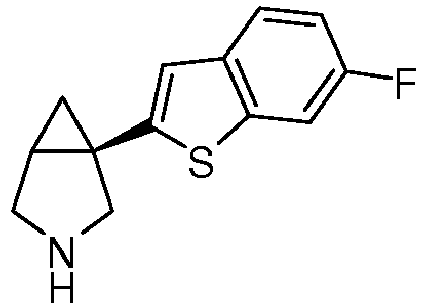
- (1R, 2R)-[2-aminomethyl-2-(6-fluoro-benzo[b]thiophen-2-yl)-2-cyclopropyl]-methanol 2.13 g (20%) as an off white solid. MS m/z 252 (MH+). The hydrochloride salt was prepared with (1R, 2R)-[2-aminomethyl-2-(6-fluoro-benzo[b]thiophen-2-yl)-2-cyclopropyl]-methanol (111 mg) by dissolving in isopropanol (2 ml) and adding 5M isopropanolic HCl (2 ml) and blowing dry with nitrogen. The hydrochloride salt was dried in vacuo at 50 °C for 12 hours to yield (1R,2R)-[2-aminomethyl-2-(6-fluoro-benzo[b]thiophen-2-yl)-2-cyclopropyl]-methanol hydrochloride which was 98.4 % pure by HPLC. MS mlz 252 (MH+). 1H NMR (400 MHz, DMSO-d 6) δ ppm 1.03 (d) 1.19 - 1.25 (m) 1.23 (t) 1.20 - 1.25 (m) 1.20 - 1.25 (m) 1.28 (dd) 1.59 - 1.70 (m) 3.20 - 3.39 (m) 3.42 (dd) 3.89 (dd) 7.23 (td) 7.77 (dd) 7.84 (dd) 8.07 (br. s.)
- (1R, 5R)-1-(6-fluoro-benzo[b]thiophen-2-yl)-3-aza-bicyclo[3.1.0]hexane hydrochloride as an off white solid. Yield 1.0 g (48%) and 100 % pure by HPLC. Chiral purity 99.6%. MS m/z 234 (MH+). 1H-NMR (400 MHz, DMSO-d6); δ (ppm):1.32 (t, 1H), 1.60 (t, 1H), 2.11 (m, 1H), 3.30-3.75 (m, 4H), 7.22 (t, 1H), 7.35 (s, 1H), 7.76 (dd, 1H), 7.82 (d, 1H), 9.80 (br. s, 2H). 13C NMR (101 MHz, DMSO-d 6) d ppm 16.39, 25.98, 27.63, 49.15, 108.49, 108.75, 113.23, 113.47, 120.88, 124.36, 124.45, 136.34, 138.91, 139.02, 143.63, 143.66, 158.38, 160.78.
-

- The substance was obtained according to the general procedure, yielding the title compound as a light yellow solid (70%).
1H-NMR (400 MHz, DMSO-d6); δ (ppm): 1.34 (t, 3H), 4.34 (dd, 2H), 7.62 (d, 1H), 7.96 (d, 1H), 7.18 (s, 1H), 7.37 (s, 1H) -

- The substance was obtained according to the general procedure, yielding the title compound as a off-white crystals (75%).
1H-NMR (400 MHz, DMSO-d6); δ (ppm): 1.33 (t, 3H), 4.36 (dd, 2H), 7.63 (d, 1H), 8.04 (d, 1H), 7.13 (s, 1H), 7.25 (s, 1H) -

- The substance was obtained according to the general procedure, yielding the title compound as a white solid (96%)
-

- The substance was obtained according to the general procedure, yielding the title compound as a white solid (73%)
-

- The substance was obtained according to the general procedure. Overall yield of (6-bromo-benzo[b]thiophen-2-yl)-acetonitrile (30 % on three previous steps). Light yellow solid.
1H-NMR (400 MHz, DMSO-d6); δ (ppm): 4.39 (s, 2H), 7.4 (s, 1H), 7.53 (d, 1H), 7.78 (d, 1H), 8.23 (s, 1H) -

- The substance was obtained according to the general procedure. Overall yield of (6-bromo-benzo[b]thiophen-2-yl)-acetonitrile (26 % on three previous steps). Light yellow solid.
1H-NMR (400 MHz, DMSO-d6); δ (ppm): 4.43 (s, 2H), 7.39 (s, 1H), 7.48 (d, 1H), 7.9 (d, 1H), 8.06 (s, 1H) -

- a) NaHMDS, THF, -20°C, 1 h
- b) Epibromohydrin, -20°C, 1 h
- c) NaHMDS, THF, from -20°C to 5 °C, overnight
- The substances were obtained according to the general procedure .
- Yield of the lactone 17%. Light brown crystalline solid.
- Yield of the nitrile 39%. Dark brown liquid.
-

- a) NaHMDS, THF, -20°C, 1 h
- b) Epibromohydrin, -20°C, 1 h
- c) NaHMDS, THF, from -20°C to 5 °C, overnight
- The substances were obtained according to the general procedure.
- Yield of the lactone 20%. Light brown crystalline solid.
- CI MS m/z 308.8, 310.78 (MH+).
- Yield of the nitrile 37%. Dark brown liquid.
- CI MS m/z 307.89, 309.86 (MH+).
-

- The substances were obtained according to the general procedure, yielding the title compound as a light yellow liquid (42%).
-
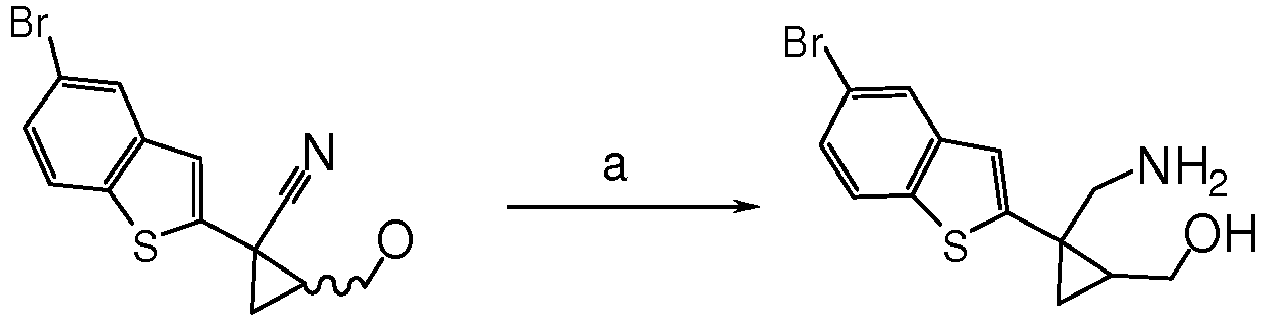
- The substance was obtained according to the general procedure, yielding the title compound as a light yellow liquid (40%).
-

- a) NH3/MeOH, 50°C, 12h
- b) BH3-THF complex, reflux, 8 h
- The substance was obtained according to the general procedure. Overall yield of the title compound 41%. A light yellow liquid
CI MS m/z 311.89, 313.87 (MH+). -

- The substance and its hydrochloride salt were obtained according to the general procedure. Overall yield of the title compound as a white crystalline solid (60%).
CI MS m/z 293.97, 295.95 (MH+).
1H-NMR (400 MHz, DMSO-d6); δ (ppm):1.33 (t, 1H), 1.61 (t, 1H), 2.15 (m, 1H), 3.35-3.76 (m, 4H), 7.38 (s, 1H), 7.51 (d, 1H), 7.69 (d, 1H), 8.2 (s, 1H), 9.80 (br. s, 2H).
HPLC (Column C18 3.9x150 mm 5mkm) - mobile phase: acetonitrile/water+TFA 5/95 (0min)-100/0(18min)-100/0(25min); flow 1.0 ml/min; RT; Detection UV at 220 nm: First Peak with Retention Time of 10.123 min, area 98.9%; Second Peak with Retention Time of 10.892 min, area 0.6%; Third Peak with Retention Time of 11.058, area 04%; Fourth Peak with Retention Time of 11.752, area 01%. -

- The substance and its hydrochloride salt were obtained according to the general procedure. Overall yield of the title compound as a white crystalline solid (72%).
CI MS m/z 293.96, 295.94 (MH+).
1H-NMR (400 MHz, DMSO-d6); δ (ppm):1.35 (t, 1H), 1.69 (t, 1H), 2.15 (m, 1H), 3.33-3.80 (m, 4H), 7.35 (s, 1H), 7.44 (d, 1H), 7.87 (d, 1H), 7.94 (s, 1H), 9.70 (br. s, 2H).
HPLC (Column C18 3.9x150 mm 5mkm) - mobile phase: acetonitrile/water+TFA 5/95 (0min)-100/0(18min)-100/0(25min); flow 1.0 ml/min; RT; Detection UV at 254 nm: First Peak with Retention Time of 9.127 min, area 1.8%; Second Peak with Retention Time of 10.113 min, area 98.2% -

- The substance and its hydrochloride salt were obtained according to the general procedure. Overall yield of the title compound as a white crystalline solid (80%).
CI MS m/z 307.95, 309.95 (MH+).
1H-NMR (400 MHz, DMSO-d6); δ (ppm):1.31 (s, 1H), 1.97 (s, 1H), 2.24 (m, 1H), 2.82 (t, 3H), 3.45-3.98 (m, 4H), 7.35 (s, 1H), 7.50 (d, 1H), 7.70 (d, 1H), 8.20 (s, 1H), 11.30 (br. s, 1H).
HPLC (Column C18 3.9x150 mm 5mkm) - mobile phase: acetonitrile/water+TFA 5/95 (0min)-100/0(18min)-100/0(25min); flow 1.0 ml/min; RT; Detection UV at 254 nm: First Peak with Retention Time of 9.294 min, area 0.13%; Second Peak with Retention Time of 10.231 min, area 99.87%. -

- The substance and its hydrochloride salt were obtained according to the general procedure. Overall yield of the title compound as a white crystalline solid (75%).
CI MS m/z 307.96, 309.95 (MH+).
1H-NMR (400 MHz, DMSO-d6); δ (ppm):1.30 (s, 1H), 1.96 (s, 1H), 2.18 (m, 1H), 2.82 (t, 3H), 3.46-4.00 (m, 4H), 7.33 (s, 1H), 7.44 (d, 1H), 7.87 (d, 1H), 7.86 (s, 1H), 11.25 (br. s, 1H).
HPLC (Column C18 3.9x150 mm 5mkm) - mobile phase: acetonitrile/water+TFA 5/95 (0min)-100/0(18min)-100/0(25min); flow 1.0 ml/min; RT; Detection UV at 254 nm: First Peak with Retention Time of 9.242 min, area 1.4%; Second Peak with Retention Time of 10.169 min, area 98.6% -

- The substance was obtained according to the general procedure and was used on the next step without any purification.
-

- The substance was obtained according to the general procedure and was used on the next step without any purification.
-

- Dimethylamine solution in THF (20%), NaO(i-Am), bis(tri-tert-butylphosphine)palladium(0) 6-8 mole%, microwave irradiation at 100°C, 3 h.
5-6 M HCl solution in isopropanol
Boc derivative and the title compound was obtained according to the general procedure.
Yield of the Boc-derivative (87%). Light yellow liquid.
Yield of the title compound (86%). White crystalline solid.
CI MS m/z 259.17 (MH+).
1H-NMR (400 MHz, DMSO-d6); δ (ppm):1.34 (t, 1H), 1.64 (t, 1H), 2.12 (m, 1H), 3.07 (s, 6H), 3.32-3.72 (m, 4H), 7.31 (s, 1H), 7.46 (s, 1H), 7.75 (d, 1H), 7.94 (m, 1H), 9.78 (br. s, 1H), 10.08 (br. s, 1H)
HPLC (Column C18 3.9x150 mm 5mkm) - mobile phase: acetonitrile/water+TFA 5/95 (0min)-100/0(18min)-100/0(25min); flow 1.0 ml/min; RT; Detection UV at 254 nm: First Peak with Retention Time of 5.348 min, area 96.9%; Second Peak with Retention Time of 8.537 min, area 2.4%; Third Peak with Retention Time of 9.162 min, area 08%. -

- Dimethylamine solution in THF (20%), NaO(i-Am), bis(tri-tert-butylphosphine)palladium(0) 6-8 mole%, microwave irradiation at 100°C, 3 h.
5-6 M HCl solution in isopropanol - The Boc derivative and the title compound were obtained according to the general procedure.
Yield of the Boc-derivative (63%). Light yellow liquid.
Yield of the title compound (80%). White crystalline solid.
CI MS m/z 259.00 (MH+).
1H-NMR (400 MHz, DMSO-d6); δ (ppm):1.35 (t, 1H), 1.68 (s, 1H), 2.17 (m, 1H), 3.12 (s, 6H), 3.33-3.72 (m, 4H), 7.4 (s, 1H), 7.54 (s, 1H), 7.88 (m, 1H), 8.00 (d, 1H), 9.80 (br. s, 1H), 10.05 (br. s, 1H)
13C -NMR (100MHz, DMSO-d6) RT; δ (ppm): 16.71, 26.14, 27.59 , 44.63, 46.41, 49.05, 113.20, 115.62, 121.07, 123.42, 135.75, 139.93, 142.23, 146.22.
HPLC (Column C18 3.9x150 mm 5mkm) - mobile phase: acetonitrile/water+TFA 5/95 (0min)-100/0(18min)-100/0(25min); flow 1.0 ml/min; RT; Detection UV at 220 nm: First Peak with Retention Time of 5.404 min, area 95.9%; Second Peak with Retention Time of 8.992 min, area 4.1%. -

- The title compound was obtained according to the general procedure, yielding the title compound as a white crystalline solid (77%).
CI MS m/z 273.00 (MH+).
1H-NMR (400 MHz, DMSO-d6); δ (ppm):1.30 (t, 1H), 2.02 (m, 1H), 2.17 (m, 1H), 2.84 (s, 3H), 3.08 (s, 6H), 3.5-3.97 (m, 4H), 7.4 (s, 1H), 7.43 (s, 1H), 7.75 (d, 1H), 7.90 (m, 1H), 11.40 (br. s, 1H)
HPLC (Column C18 3.9x150 mm 5mkm) - mobile phase: acetonitrile/water+TFA 5/95 (0min)-100/0(18min)-100/0(25min); flow 1.0 ml/min; RT; Detection UV at 254 nm: First Peak with Retention Time of 5.383 min, area 96.5%; Second Peak with Retention Time of 8.813 min, area 2.1%; Third Peak with Retention Time of 16.781, area 1.4%. -

- The title compound was obtained according to the general procedure, yielding the title compound as a white crystalline solid (75%).
CI MS m/z 301.04 (MH+).
1H-NMR (400 MHz, DMSO-d6); δ (ppm):1.20-1.38 (m, 7H), 2.05-2.02 (m, 2H), 3.04 (s, 6H), 3.15-4.00 (m, 4H), 7.28-7.48 (m, 2H), 7.67-7.94 (m, 2H), 11.35 (br. s, 1H)
HPLC (Column C18 3.9x150 mm 5mkm) - mobile phase: acetonitrile/water+TFA 5/95 (0min)-100/0(18min)-100/0(25min); flow 1.0 ml/min; RT; Detection UV at 254 nm: First Peak with Retention Time of 5.946 min, area 98.0%; Second Peak with Retention Time of 9.650 min, area 2.0%. -

- The title compound was obtained according to the general procedure, yielding the title compound as a white crystalline solid (65%).
CI MS m/z 301.07 (MH+).
1H-NMR (400 MHz, DMSO-d6); δ (ppm):1.20-1.42 (m, 8H), 2.02 (s, 1H), 3.04 (s, 6H), 3.48-4.05 (m, 4H), 7.38-7.59 (m, 2H), 7.75-7.99 (m, 2H), 11.28 (br. s, 1H)
HPLC (Column C18 3.9x150 mm 5mkm) - mobile phase: acetonitrile/water+TFA 5/95 (0min)-100/0(18min)-100/0(25min); flow 1.0 ml/min; RT; Detection UV at 254 nm: First Peak with Retention Time of 5.888 min, area 97.9%; Second Peak with Retention Time of 9.917 min, area 2.1%. -

- Dimethylamine solution in THF (20%), NaO(i-Am), bis(tri-tert-butylphosphine)palladium(0) 6-8 mole%, microwave irradiation at 100°C, 3 h.
LiAlH4, THF, RT, 2 h - The title compound was obtained according to the general procedure, yielding the title compound as a white crystalline solid (62%).
CI MS m/z 287.13 (MH+).
1H-NMR (400 MHz, DMSO-d6); δ (ppm):1.02-1.50 (m, 7H), 2.12 (m, 2H), 3.03 (s, 6H), 3.31-4.1 (m, 4H), 7.28-7.51 (m, 2H), 7.69-7.98 (m, 2H), 11.28 (br. s, 1H)
HPLC (Column C18 3.9x150 mm 5mkm) - mobile phase: acetonitrile/water+TFA 5/95 (0min)-100/0(18min)-100/0(25min); flow 1.0 ml/min; RT; Detection UV at 254 nm: First Peak with Retention Time of 4.079 min, area 96.2%; Second Peak with Retention Time of 8.990 min, area 3.8%. -

- Dimethylamine solution in THF (20%), NaO(i-Am), bis(tri-tert-butylphosphine)palladium(0) 6-8 mole%, microwave irradiation at 100°C, 3 h.
LiAlH4, THF, RT, 2 h - The title compound was obtained according to the general procedure, yielding the title compound as a white crystalline solid (68%).
CI MS m/z 287.03 (MH+).
1H-NMR (400 MHz, DMSO-d6); δ (ppm):1.22-1.34 (m, 5H), 2.04 (d, 1H), 2.18 (s, 1H), 3.04 (s, 6H), 3.15-3.98 (m, 4H), 7.36 (s, 1H), 7.49 (s, 1H), 7.73-7.92 (m, 1H), 7.98 (d, 1H), 11.38 (br. s, 1H) - The ability of the 1-heteroaryl-3-azabicyclo[3.1.0.]hexane of the invention for inhibiting transport of norepinephrine (NE) and/or dopamine (DA) and/or serotonin (5-HT) were evaluated using cell lines (such as the HEK 293 cell line) that stably express recombinant human NE, DA, and 5-HT transporters, respectively. The techniques for stably transfecting mammalian cell lines with neurotransmitter transporters and measuring the effects of drugs on amine uptake have been described in the literature (e.g., Gu, H., et al. J. Biol. Chem. 269:7124-7130, 1994; Eshleman AJ, J Pharmacol Exp Ther 289:877-885, 1999) and well known to those skilled in the art.
- A basic technique for measuring the ability of a compound to inhibit [3H]NE, DA, and 5-HT uptake in cell lines recombinantly expressing human transporters has been described (Eshleman, et al., 1999). In brief, cell suspensions (HEK 293 cells expressing the 5-HT transporter; MDCK cells expressing the NE transporter, and CHO-K1 cells expressing the DA transporter, respectively) can be prepared for assay by removing the medium from cells grown on tissue culture dishes, then washing the plates with buffered medium. Cells can then be gently scraped from the plates and cell clusters separated by trituration with a pipette for 5-10 aspiration/ejection cycles. To these cell suspensions were added test drugs (final concentrations generally from 0.01-5 µM) and Tris/Hepes buffer, pH 7.1 (also containing 120 mM NaCl, 1.2 mM CalCl2, 1.2 mM MgSO4, 5 mM D-glucose, and 1 mM ascorbic acid). Following a preincubation of the isolated cells at 25°C, either [3H]DA, [3H]5-HT, or [3H]NE was added and the incubation continued an additional 10 minutes. Radiolabelled neurotransmitter uptake was terminated by vacuum filtration and washing through Whatman glass fiber filters (GF/C), and the radioactivity retained on the filters was measured by liquid scintillation spectrometry. Specific uptake was defined as the difference in uptake observed in the absence and presence of a large molar excess of nomifensine, desipramine, or fluoxetine (for [3H]DA, [3H]NE or [3H]5-HT, respectively].
- The results of these assays are shown in Table 2, below, which indicates, for each of the exemplary compounds, the structure of the substituent, and levels of observed uptake inhibition percentage for each of the indicated neurotransmitters at a fixed concentration of compound, or the IC50 value, defined as that concentration of compound necessary to inhibit uptake by 50%. These are standard terms known to those skilled in the art.
Table 2 Inhibition of Biogenic Amine Uptake By Exemplary Substituted 1-Aryl-3-Azabicyclo[3.1.0.]hexanes Structure Uptake inh.% at 1 µM NE Uptake inh.% at 1 µM 5-HT Uptake inh.% at 1 µM DA Uptake IC50 (nM) NE Uptake IC50 (nM) 5-HT Uptake IC50 (nM) DA 
400 340 630 
77 57 63 82 188 770 
82 45 67 138 1450 475 
59 35 20 
64 14 10 
35 64 19 
29 65 32 Structure Uptake inh.% at 1 µM NE Uptake inh.% at 1 µM 5-HT Uptake inh.% at 1 µM DA Uptake IC50 (nM) NE Uptake IC50 (nM) 5-HT Uptake IC50 (nM) DA 
50 18 13 
39 50 1 
53 71 45 186 154 811 
39 59 65 138 308 215 
13 83 7 
72 7 5 
90 66 91 20 88 82 
71 92 88 60 34 98 
97 96 90 14 193 52 
84 76 90 99 481 149 
89 99 82 71 54 224 
75 89 83 107 263 195 
98 100 99 
88 99 94 
68 63 17 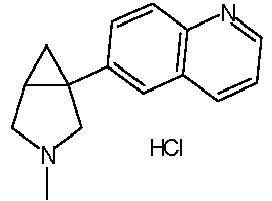
13 93 12 
91 98 78 
70 94 63 - Readily discernable from the foregoing results is the high degree of diversity with respect to the biological activity changes that were achieved by differentially altering N-substituents to yield novel 1-heteroaryl-3-azabicyclo[3.1.0.]hexanes according to the invention--whereby the absolute potency at any one transporter may be altered dramatically, and in distinct patterns among the exemplified compounds. These different relative potencies at the three transporters yield profound and distinct therapeutic potentials among the different, novel compounds of the invention. Both the absolute changes in potency and the changes in relative potency among the three transporters described herein for exemplary compounds of the invention would not have been expected or predictable with a reasonable expectation of success by persons of ordinary skill in the art
- The data provided in Table 2 demonstrate that several of the 1-heteroaryl-3-azabicyclo[3.1.0.]hexanes of the invention are potent (nM) inhibitors of norepinephrine and/or serotonin and/or dopamine uptake. As such, the compounds and related formulations and methods of the invention provide neurobiologically active tools for modulating biogenic amine transport in mammalian subjects. These subjects may include in vitro or ex vivo mammalian cell, cell culture, tissue culture, or organ explants, as well as human and other mammalian individuals presenting with, or at heightened risk for developing, a central nervous system (CNS) disorder, such as pain, anxiety, or depression.
- In certain embodiments, neurobiologically active compositions comprising a 1-heteroaryl-3-azabicyclo[3.1.0.]hexane of the invention are effective to inhibit cellular uptake of norepinephrine in a mammalian subject. In other embodiments, these compositions will effectively inhibit cellular uptake of serotonin in mammals. Other compositions of the invention will be effective to inhibit cellular uptake of dopamine in mammalian subjects.
- As illustrated by the foregoing examples, additional neurobiologically active compositions of the invention will be effective to inhibit cellular uptake of multiple biogenic amine neurotransmitters in mammalian subjects, for example, norepinephrine and serotonin, norepinephrine and dopamine, or serotonin and dopamine. In additional embodiments, the compositions of the invention are effective to inhibit cellular uptake of norepinephrine, serotonin and dopamine in mammalian subjects.
- In further-detailed embodiments, as exemplified by the results presented in Table 2, neurobiologically active compositions of the invention surprisingly inhibit cellular reuptake of two, or three, biogenic amines selected from norepinephrine, serotonin and dopamine in a mammalian subject "non-uniformly" across the affected range of multiple targets. The distinct double and triple reuptake inhibition activity profiles demonstrated herein for exemplary compounds of the invention illustrate the powerful and unpredictable nature of structural variations for the compounds, and further evince the ability to follow the teachings of the present disclosure to produce, select, and employ other substituted candidates according to the invention having distinct activity profiles to fulfill additional therapeutic uses within the invention for treating diverse CNS disorders.
- In exemplary aspects of the present disclosure, this differential inhibition may yield a profile of reuptake inhibition activities for all three neurotransmitters, norepinephrine, serotonin, and dopamine, respectively, in approximate reuptake inhibition profiles as determined in Table 2 selected from the following relative potencies: (1:1:10); (1:1:6); (1:2:1); (1:0.5:2); (1:1:3); (1:3:3); (1:1:2); and (1:1:1)-which values will correlate in a measurable way with novel in vivo reuptake inhibition profiles/ratios as will be readily determined by those skilled in the art.
- In related aspects of the present disclosure, neurobiologically active compositions of the present disclosure inhibit cellular uptake of two, or three, biogenic amine neurotransmitters non-uniformly, for example by inhibiting uptake of at least one member of a group of transmitters including norepinephrine, serotonin, and dopamine by a factor of two- to ten-fold greater than a potency of the same composition to inhibit uptake of one or more different neurotransmitter(s). In exemplary aspects of the present disclosure, compositions of the present disclosure comprising a 1-heteroaryl-3-azabicyclo[3.1.0.]hexane inhibit cellular uptake of serotonin by a factor of at least approximately two-fold, or three-fold, greater than a potency of the same composition to inhibit uptake of norepinephrine, dopamine, or both norepinephrine and dopamine. In other aspects of the present disclosure, different 1-heteroaryl-3-azabicyclo[3.1.0.]hexanes of the present disclosure inhibit cellular uptake of dopamine by a factor of at least approximately two-fold, six-fold, or ten-fold, greater than a potency of the composition for inhibiting uptake of norepinephrine, serotonin, or both norepinephrine and serotonin. In additional exemplary aspects of the present disclosure, the compositions described herein inhibit cellular uptake of norepinephrine by a factor of at least approximately two-fold greater than a potency of the same composition for inhibiting uptake of serotonin. In different aspects of the present disclosure, compositions are provided that inhibit cellular uptake of dopamine by a factor of at least approximately two-fold greater than potency of the composition for inhibiting uptake of serotonin. In yet additional aspects of the present disclosure, neurobiologically active compositions are provided that exhibit approximately equivalent potency for inhibiting cellular uptake of norepinephrine and serotonin, while at the same time inhibiting dopamine uptake by a factor of at least approximately two-fold, or six-fold, greater than the potency for inhibiting uptake of norepinephrine and serotonin. In still other aspects of the present disclosure, compositions of the invention exhibit approximately equivalent potency for inhibiting cellular uptake of serotonin and dopamine, while at the same time inhibiting norepinephrine by a factor of no greater than approximately half the potency for inhibiting uptake of serotonin and dopamine. In certain aspects of the present disclosure, compositions of the present disclosure exhibit approximately equivalent potency for inhibiting cellular uptake of norepinephrine, serotonin, and dopamine.
- Compounds of the present disclosure that inhibit the uptake of norepinephrine, serotonin, and/or dopamine have a wide range of therapeutic uses, principally to treat CNS disorders as described above. Certain CNS disorders contemplated herein will be more responsive to a compound of the present disclosure that preferentially inhibits, for example, dopamine uptake relative to norepinephrine and/or serotonin uptake, as in the case of some forms of depression. Other disorders, for example pain, will be determined to be more responsive to compounds of the present disclosure that more potently inhibit norepinenephrine reuptake relative to serotonin reuptake and dopamine reuptake. Other CNS disorders, for example, attention deficit hyperactivity disorder (ADHD), may respond better to compounds of the present disclosure that preferentially inhibit dopamine and norepinephrine reuptake relative to serotonin reuptake. Thus, the host of disclosed compounds described herein, which provide a range of reuptake inhibition profiles/ratios, will provide useful drug candidates for a diverse range of CNS disorders, and will effectively treat specific disorders with lower side effect profiles than currently available drugs.
- It is to be understood that this invention is not limited to the particular formulations, process steps, and materials disclosed herein as such formulations, process steps, and materials may vary somewhat. It is also to be understood that the terminology employed herein is used for the purpose of describing particular embodiments only and is not intended to be limiting since the scope of the present invention will be limited only by the appended claims.
-
- Basile, A.S., et al., .J. Pharmacol. Exp. Ther., 321:1208-1225 (2007)
- Skolnick, P. et al., Eur. J. Pharmacol. 461:99 (2003)
- Skolnick, P. et al., Life Sci. 73: 3175-3179 (2003)
- Skolnick, P., et al., CNS Drug Reviews (2006)
- Briley, M., Hum. Psychopharmacol. Clin. Exp. 19:S21-S25 (2004)
- Skolnick, P. in "Dopamine and glutamate in psychiatric disorders," W. Schmidt, Editor; Humana Press, Totowa, Chapter 9, pp. 199-214 (2005)
- Atkinson, J.H. et al., Pain 83:137-145 (1999)
- Povlock, S.L. and Amara, S.G., in "Neurotransmitter transporters: structure, function, and regulation," Reith MEA, Editor, Humana Press, Totowa, pp.1-28 (1997)
- Eshleman, A.J. et al., Journal of Pharmacology & Experimental Therapeutics 289:877-885 (1999)
- "Nitrogen Protecting Groups in Organic Synthesis", John Wiley and Sons, New York, N.Y., 1981, Chapter 7
- "Nitrogen Protecting Groups in Organic Chemistry", Plenum Press, New York, N.Y., 1973, Chapter 2
- Green, T.W. and Wuts, P.G.M. in "Protective Groups in Organic Chemistry", 3rd edition, John Wiley & Sons, New York, N.Y., 1999
- Quick Reference to the Diagnostic Criteria From DSM-IV (Diagnostic and Statistical Manual of Mental Disorders, Fourth Edition), The American Psychiatric Association, Washington, D.C., 1994
- Perovic, S. and Muller, W.E., Arzneimittelforschung 45: 1145-1148 (1995)
- Gu, H., et al. J. Biol. Chem. 269:7124-7130 (1994)
-
US Patent No. 4,122,193; Scherm et al.; October 24, 1978 -
US Patent No. 6,132,724; Blum; October 17, 2000 -
U.S. Patent Application Serial No. 11/371,178
Claims (26)
- A compound of the following Formula I:
 Ar is a heterocyclic aryl group selected from furan, methylfuran, pyrrole, imidazole, pyrazole, triazole, tetrazole, thiazole, isothiazole, methoxypyridine, pyridazine, pyrazine, triazine, indole, methylindole, benzofuran, benzothiophene, benzothiazole, isoquinoline, cinnoline, phthalazine, quinazoline, chromane and isochromane, and Ar is either unsubstituted or substituted with one or more substituents independently selected from fluoro, chloro, bromo, iodo, -NO2, -CN, -NH2, carboxy, C2-8 alkenyl, C2-8 alkynyl, halo(C1-8)alkyl, hydroxy, trifluoromethyl, C3-8 cycloalkyl, C1-3 alkoxy, C1-3 alkoxy(C1-3)alkyl, carboxy(C1-3)alkyl, C1-3 alkanoyl, halo(C1-3)alkoxyl, C1-8 alkylamino, and di(C1-8)alkylamino; andR1 is selected from hydrogen, unsubstituted C1-10 alkyl, C3-8 cycloalkyl, C2-10 alkenyl, and C3-10 alkynyl, and substituted C1-10 alkyl, C3-10 alkenyl and C3-10 alkynyl wherein the substituent is one or more of hydroxy, cyano, halogen, C1-6 alkoxy, aryl substituted C1-6 alkoxy, aryloxy, aryloxy substituted with one or more halogens, C1-6 alkyl, C1-6 alkyl independently substituted with one or more of cyano and halogen, C1-4 alkoxy, and C1-4 haloalkoxy.
 - The compound according to claim 1 and pharmaceutically acceptable salts, enantiomers, polymorphs, solvates, or hydrates thereof, wherein Ar is furan, methylfuran, fluorobenzothiophene, methoxypyridine, benzofuran, benzothiophene, chlorobenzothiophene, indole or methylindole and R1 is hydrogen or unsubstituted C1-10 alkyl.
- The compound according to claim 2 and pharmaceutically acceptable salts, enantiomers, polymorphs, solvates, or hydrates thereof, wherein R1 is hydrogen, methyl, ethyl, propyl or isopropyl.
- The compound according to claim 1, wherein the compound is selected from the group consisting of:1-(5-methylfuran-2-yl)-3-azabicyclo[3.1.0]hexane;1-(6-methoxypyridin-3-yl)-3-azabicyclo[3.1.0]hexane;1-(6-methoxypyridin-3-yl)-3-methyl-3-azabicyclo[3.1.0]hexane;1-(benzofuran-2-yl)-3-methyl-3-azabicyclo[3.1.0]hexane;1-(benzofuran-3-yl)-3-azabicyclo[3.1.0]hexane;1-(benzofuran-3-yl)-3-methyl-3-azabicyclo[3.1.0]hexane;1-methyl-2-(3-methyl-3-azabicyclo[3.1.0]hexan-1-yl)-1H-indole;2-(3-ethyl-3-azabicyclo[3.1.0]hexan-1-yl)-1-methyl-1H-indole;2-(3-isopropyl-3-azabicyclo[3.1.0]hexan-1-yl)-1-methyl-1H-indole;1-methyl-5-(3-methyl-3-azabicyclo[3.1.0]hexan-1-yl)-1H-indole;5-(3-ethyl-3-azabicyclo[3.1.0]hexan-1-yl)-1-methyl-1H-indole;5-(3-isopropyl-3-azabicyclo[3.1.0]hexan-1-yl)-1-methyl-1H-indole;1-(5-chlorobenzo[b]thiophen-3-yl)-3-azabicyclo[3.1.0]hexane;1-(5-chlorobenzo[b]thiophen-2-yl)-3-methyl-3-azabicyclo[3.1.0]hexane;1-(5-chlorobenzo[b]thiophen-3-yl)-3-methyl-3-azabicyclo[3.1.0]hexane;1-(benzo[b]thiophen-2-yl)-3-aza-bicyclo[3.1.0]hexane;1-(benzo[b]thiophen-2-yl)-3-methyl-3-aza-bicyclo[3.1.0]hexane;1-(6-fluorobenzo[b]thiophen-2-yl)-3-aza-bicyclo[3.1.0]hexane;1-(6-fluorobenzo[b]thiophen-2-yl)-3-methyl-3-aza-bicyclo[3.1.0]hexane;1-(5-fluorobenzo[b]thiophen-2-yl)-3-aza-bicyclo[3.1.0]hexane;1-(5-fluorobenzo[b]thiophen-2-yl)-3-methyl-3-aza-bicyclo[3.1.0]hexane;N,N-dimethyl-2-(3-methyl-3-azabicyclo[3.1.0]hexane-1-yl)benzo[b]thiophen-5-amine;1-(5-bromobenzo[b]thiophen-2-yl)-3-azabicyclo[3.1.0]hexane;1-(5-bromobenzo[b]thiophen-2-yl)-3-methyl-3-azabicyclo[3.1.0]hexane;2-(3-azabicyclo[3.1.0]hexan-1-yl)-N,N-dimethylbenzo[b]thiophen-5-amine;2-(3-ethyl-3-azabicyclo[3.1.0]hexan-1-yl)-N,N-dimethylbenzo[b]thiophen-5-amine;2-(3-isopropyl-3-azabicyclo[3.1.0]hexan-1-yl)-N,N-dimethylbenzo[b]thiophen-5-amine;1-(6-bromobenzo[b]thiophen-2-yl)-3-azabicylco[3.1.0]hexane;1-(6-bromobenzo[b]thiophen-2-yl)-3-methyl-3-azabicyclo[3.1.0]hexane;2-(3-azabicyclo[3.1.0]hexan-1-yl)-N,N-dimethylbenzo[b]thiophen-6-amine;N,N-dimethyl-2-(3-methyl-3-azabicyclo[3.1.0]hexan-1-yl)benzo[b]thiophen-6-amine;2-(3-ethyl-3-azabicyclo[3.1.0]hexan-1-yl)-N,N-dimethylbenzo[b]thiophen-6-amine;2-(3-isopropyl-3-azabicyclo[3.1.0]hexan-l-yl)-N,N-dimethylbenzo[b]thiophen-6-amine; and2-(3-azabicyclo[3.1.0]hexan-1-yl)-benzo[d]thiazole;and pharmaceutically acceptable salts, enantiomers, polymorphs, solvates, or hydrates thereof.
- The compound according to claim 1 selected from the group consisting of:(1S,5S)-1-(benzo[b]thiophen-2-yl)-3-azabicyclo[3.1.0]hexane;(1R,5R)-1-(benzo[b]thiophen-2-yl)-3-azabicyclo[3.1.0]hexane;(1S,5S)-1-(benzo[b]thiophen-2-yl)-3-methyl-3-azabicyclo[3.1.0]hexane;(1R,5R)-1-(benzo[b]thiophen-2-yl)-3-methyl-azabicyclo[3.1.0]hexane;(1S,5S)-1-(6-fluorobenzo[b]thiophen-2-yl)-3-aza-bicyclo[3.1.0]hexane; and(1R,5R)-1-(6-fluorobenzo[b]thiophen-2-yl)-3-aza-bicyclo[3.1.0]hexane;and pharmaceutically acceptable salts polymorphs, solvates, or hydrates thereof.
- The compound according to claim 1 selected from the group consisting of:1-(5-methylfuran-2-yl)-3-azabicyclo[3.1.0]hexane;1-(6-methoxypyridin-3-yl)-3-azabicyclo[3.1.0]hexane;1-(6-methoxypyridin-3-yl)-3-methyl-3-azabicyclo[3.1.0]hexane;1-(benzofuran-2-yl)-3-methyl-3-azabicyclo[3.1.0]hexane;1-(benzofuran-3-yl)-3-azabicyclo[3.1.0]hexane;1-(benzofuran-3-yl)-3-methyl-3-azabicyclo[3.1.0]hexane;1-methyl-2-(3-methyl-3-azabicyclo[3.1.0]hexan-1-yl)-1H-indole;2-(3-ethyl-3-azabicyclo[3.1.0]hexan-1-yl)-1-methyl-1H-indole;2-(3-isopropyl-3-azabicyclo[3.1.0]hexan-1-yl)-1-methyl-1H-indole;1-methyl-5-(3-methyl-3-azabicyclo[3.1.0]hexan-1-yl)-1H-indole;5-(3-ethyl-3-azabicyclo[3.1.0]hexan-1-yl)-1-methyl-1H-indole;5-(3-isopropyl-3-azabicyclo[3.1.0]hexan-1-yl)-1-methyl-1H-indole;1-(5-chlorobenzo[b]thiophen-3-yl)-3-azabicyclo[3.1.0]hexane;1-(5-chlorobenzo[b]thiophen-2-yl)-3-methyl-3-azabicyclo[3.1.0]hexane;1-(5-chlorobenzo[b]thiophen-3-yl)-3-methyl-3-azabicyclo[3.1.0]hexane;1-(benzo[b]thiophen-2-yl)-3-aza-bicyclo[3.1.0]hexane;1-(benzo[b]thiophen-2-yl)-3-methyl-3-aza-bicyclo[3.1.0]hexane;1-(6-fluorobenzo[b]thiophen-2-yl)-3-aza-bicyclo[3.1.0]hexane;1-(6-fluorobenzo[b]thiophen-2-yl)-3-methyl-3-aza-bicyclo[3.1.0]hexane;1-(5-fluorobenzo[b]thiophen-2-yl)-3-aza-bicyclo[3.1.0]hexane;1-(5-fluorobenzo[b]thiophen-2-yl)-3-methyl-3-aza-bicyclo[3.1.0]hexane;N,N-dimethyl-2-(3-methyl-3-azabicyclo[3.1.0]hexane-1-yl)benzo[b]thiophen-5-amine;1-(5-bromobenzo[b]thiophen-2-yl)-3-azabicyclo[3.1.0]hexane;1-(5-bromobenzo[b]thiophen-2-yl)-3-methyl-3-azabicyclo[3.1.0]hexane;2-(3-azabicyclo[3.1.0]hexan-1-yl)-N,N-dimethylbenzo[b]thiophen-5-amine;2-(3-ethyl-3-azabicyclo[3.1.0]hexan-1-yl)-N,N-dimethylbenzo[b]thiophen-5-amine;2-(3-isopropyl-3-azabicyclo[3.1.0]hexan-1-yl)-N,N-dimethylbenzo[b]thiophen-5-amine;1-(6-bromobenzo[b]thiophen-2-yl)-3-azabicylco[3.1.0]hexane;1-(6-bromobenzo[b]thiophen-2-yl)-3-methyl-3-azabicyclo[3.1.0]hexane;2-(3-azabicyclo[3.1.0]hexan-1-yl)-N,N-dimethylbenzo[b]thiophen-6-amine;N,N-dimethyl-2-(3-methyl-3-azabicyclo[3.1.0]hexan-1-yl)benzo[b]thiophen-6-amine;2-(3-ethyl-3-azabicyclo[3.1.0]hexan-1-yl)-N,N-dimethylbenzo[b]thiophen-6-amine;2-(3-isopropyl-3-azabicyclo[3.1.0]hexan-1-yl)-N,N-dimethylbenzo[b]thiophen-6-amine; and2-(3-azabicyclo[3.1.0]hexan-1-yl)-benzo[d]thiazole;or a pharmaceutically acceptable salt thereof.
- The compound according to claim 6 selected from the group consisting of:(1S,5S)-1-(benzo[b]thiophen-2-yl)-3-azabicyclo[3.1.0]hexane;(1R,5R)-1-(benzo[b]thiophen-2-yl)-3-azabicyclo[3.1.0]hexane;(1S,5S)-1-(benzo[b]thiophen-2-yl)-3-methyl-3-azabicyclo[3.1.0]hexane;(1R,5R)-1-(benzo[b]thiophen-2-yl)-3-methyl-azabicyclo[3.1.0]hexane;(1S,5S)-1-(6-fluorobenzo[b]thiophen-2-yl)-3-aza-bicyclo[3.1.0]hexane; and(1R,5R)-1-(6-fluorobenzo[b]thiophen-2-yl)-3-aza-bicyclo[3.1.0]hexane;or a pharmaceutically acceptable salt thereof.
- The compound according to claim 6, wherein the compound is 1-(benzo[b]thiophen-2-yl)-3-methyl-3-aza-bicyclo[3.1.0]hexane or a pharmaceutically acceptable salt thereof.
- The compound according to claim 6, wherein the compound is 1-(6-fluorobenzo[b]thiophen-2-yl)-3-aza-bicyclo[3.1.0]hexane or a pharmaceutically acceptable salt thereof.
- The compound according to claim 6, wherein the compound is 1-(6-fluorobenzo[b]thiophen-2-yl)-3-aza-bicyclo[3.1.0]hexane hydrochloride or 1-(benzo[b]thiophen-2-yl)-3-methyl-3-aza-bicyclo[3.1.0]hexane hydrochloride.
- The compound according to claim 6, wherein the compound is 1-(benzo[b]thiophen-2-yl)-3-aza-bicyclo[3.1.0]hexane or a pharmaceutically acceptable salt thereof.
- The compound according to claim 11, wherein the compound is 1-(benzo[b]thiophen-2-yl)-3-aza-bicyclo[3.1.0]hexane hydrochloride.
- The compound according to claim 11, wherein the compound is (1S,5S)-(1-benzo[b]thiophen-2-yl)-3-azabicyclo[3.1.0]hexane or a pharmaceutically acceptable salt thereof.
- The compound according to claim 13, wherein the compound is (1S,5S)-(1-benzo[b]thiophen-2-yl)-3-azabicyclo[3.1.0]hexane hydrochloride.
- A pharmaceutical composition comprising a compound according to claims 1-14 or a pharmaceutically acceptable salt, enantiomer, polymorph, solvate, or hydrate thereof, and a pharmaceutically acceptable carrier or vehicle therefore.
- The pharmaceutical composition according to claim 15 comprising a compound selected from the group consisting of:1-(6-fluorobenzo[b]thiophen-2-yl)-3-aza-bicyclo[3.1.0]hexane;1-(benzo[b]thiophen-2-yl)-3-aza-bicyclo[3.1.0]hexane; and1-(benzo[b]thiophen-2-yl)-3-methyl-3-aza-bicyclo[3.1.0]hexane;or a pharmaceutically acceptable salt thereof.
- The pharmaceutical composition according to claim 16 comprising (1S,5S)-(1-benzo[b]thiophen-2-yl)-3-azabicyclo[3.1.0]hexane or a pharmaceutically acceptable salt thereof.
- A compound according to any one of claims 1-14 or a pharmaceutically acceptable salt, enantiomer, polymorph, solvate, or hydrate thereof, or a composition according to any one of claims 15, 16, or 17, for use in therapy.
- A compound according to any one of claims 1-14 or a pharmaceutically acceptable salt, enantiomer, polymorph, solvate, or hydrate thereof, or a composition according to any one of claims 15, 16, or 17, for use in treating or preventing a central nervous system (CNS) disorder; optionally, wherein the CNS disorder is: depression, an anxiety disorder, an attention defecit disorder, obesity, substance abuse, PMDD (Premenstrual dysphoric disorder) or a cognitive disorder.
- The compound for use according to claim 19, wherein the compound is selected from the group consisting of:1-(6-fluorobenzo[b]thiophen-2-yl)-3-aza-bicyclo[3.1.0]hexane;1-(benzo[b]thiophen-2-yl)-3-aza-bicyclo[3.1.0]hexane; and1-(benzo[b]thiophen-2-yl)-3-methyl-3-aza-bicyclo[3.1.0]hexane;or a pharmaceutically acceptable salt thereof.
- The compound for use according to claim 20, wherein the compound is (1S,5S)-(1-benzo[b]thiophen-2-yl)-3-azabicyclo[3.1.0]hexane or a pharmaceutically acceptable salt thereof.
- A method of making a 1-heteroaryl-3-azabicyclo[3.1.0]hexane of the following Formula III,
 (a) reacting a compound of the following formula (i),
 (b) reducing the compound of formula (ii) to produce a compound of the following formula (iii),
 (c) causing cyclization of the compound of formula (iii) to produce the 1-heteroaryl-3-azabicyclo[3.1.0]hexane, or an enantiomer or diastereomer thereof.
 - The method according to claim 22 further comprising:(d) alkylating the 1-heteroaryl-3-azabicyclo[3.1.0]hexane produced in step (c) to produce a compound of the following Formula I,

- A method of making a 1-heteroaryl-3-azabicyclo[3.1.0]hexane of the following Formula I,

 (a) reacting a compound of the following formula (iv),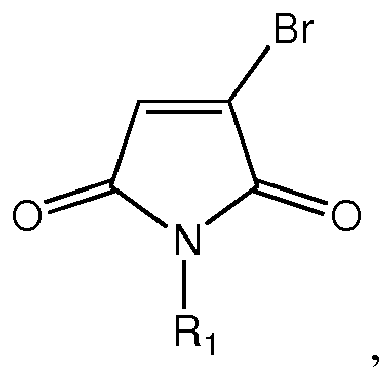

 (b) causing cyclopropanation of the compound of formula (v) to produce a
compound of the following formula (vi), (c) reducing the compound of formula (vi) to produce the 1-heteroaryl-3-azabicyclo[3.1.0]hexane.
 - A method of making a 1-heteroaryl-3-azabicyclo[3.1.0]hexane of the following Formula III,

independently selected from fluoro, chloro, bromo, iodo, -NO2, -CN, -NH2, carboxy, C2-8 alkenyl, C2-8 alkynyl, halo(C1-8)alkyl, hydroxy, trifluoromethyl, C3-8 cycloalkyl, C1-3 alkoxy, C1-3 alkoxy(C1-3)alkyl, carboxy(C1-3)alkyl, C1-3 alkanoyl, halo(C1-3)alkoxyl, C1-8 alkylamino, and di(C1-8)alkylamino, comprising the steps of:(a) coupling a compound of the following formula (vii),
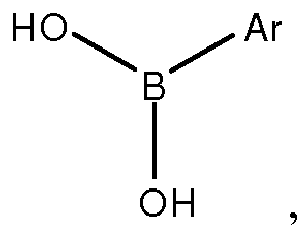
the following formula (viii),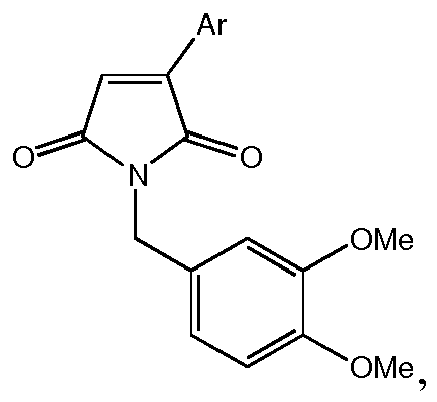 (b) causing cyclopropanation of the compound of formula (viii) to produce a
compound of the following formula (ix), (c) reducing the compound of formula (ix) to produce a compound of the
following formula (x), (d) deprotecting the compound of formula (x) to produce the 1-heteroaryl-3-azabicyclo[3.1.0]hexane.
 - The method according to claim 25 further comprising:(e) alkylating the 1-heteroaryl-3-azabicyclo[3.1.0]hexane produced in step (d) to produce a compound of the following Formula I,

Applications Claiming Priority (2)
| Application Number | Priority Date | Filing Date | Title |
|---|---|---|---|
| US93363107P | 2007-06-06 | 2007-06-06 | |
| PCT/US2008/007116 WO2008153937A2 (en) | 2007-06-06 | 2008-06-06 | Novel 1- heteroaryl-3-azabicyclo[3.1.0]hexanes, methods for their preparation and their use as medicaments |
Publications (3)
| Publication Number | Publication Date |
|---|---|
| EP2167083A2 EP2167083A2 (en) | 2010-03-31 |
| EP2167083A4 EP2167083A4 (en) | 2010-09-08 |
| EP2167083B1 true EP2167083B1 (en) | 2015-10-28 |
Family
ID=40130404
Family Applications (1)
| Application Number | Title | Priority Date | Filing Date |
|---|---|---|---|
| EP08768192.0A Not-in-force EP2167083B1 (en) | 2007-06-06 | 2008-06-06 | 1- heteroaryl-3-azabicyclo[3.1.0]hexanes, methods for their preparation and their use as medicaments |
Country Status (3)
| Country | Link |
|---|---|
| US (1) | US20090069374A1 (en) |
| EP (1) | EP2167083B1 (en) |
| WO (1) | WO2008153937A2 (en) |
Families Citing this family (11)
| Publication number | Priority date | Publication date | Assignee | Title |
|---|---|---|---|---|
| UA91341C2 (en) | 2004-07-15 | 2010-07-26 | Амр Текнолоджи, Інк. | Aryl-and heteroaryl-substituted tetrahydroisoquinolines and use thereof to block reuptake of norepinephrine, dopamine, and serotonin |
| ZA200801825B (en) | 2005-07-27 | 2009-12-30 | Dov Pharmaceutical Inc | Novel 1-aryl-3-azabicyclo[3.1.0]hexanes: Preparation and use to treat neuropsychiatric disorders |
| US9133159B2 (en) * | 2007-06-06 | 2015-09-15 | Neurovance, Inc. | 1-heteroaryl-3-azabicyclo[3.1.0]hexanes, methods for their preparation and their use as medicaments |
| US9156812B2 (en) | 2008-06-04 | 2015-10-13 | Bristol-Myers Squibb Company | Crystalline form of 6-[(4S)-2-methyl-4-(2-naphthyl)-1,2,3,4-tetrahydroisoquinolin-7-yl]pyridazin-3-amine |
| JP5739415B2 (en) * | 2009-05-12 | 2015-06-24 | ブリストル−マイヤーズ スクウィブ カンパニー | (S) -7-([1,2,4] triazolo [1,5-a] pyridin-6-yl) -4- (3,4-dichlorophenyl) -1,2,3,4-tetrahydroisoquinoline Crystal forms and uses thereof |
| CN102595902B (en) * | 2009-05-12 | 2015-04-29 | 阿尔巴尼分子研究公司 | 7-([1,2,4]triazolo[1,5-a]pyridin-6-yl)-4-(3,4-dichlorophenyl)-1,2,3,4-tetrahydro Isoquinolines and their uses |
| ES2446971T3 (en) | 2009-05-12 | 2014-03-11 | Albany Molecular Research, Inc. | Tetrahydroisoquinolines substituted with aryl, heteroaryl, and heterocycle and their use |
| RU2012102094A (en) | 2009-06-26 | 2013-08-10 | Панацеа Биотек Лтд. | New azabicyclohexanes |
| BR112013007566A2 (en) | 2010-09-28 | 2016-08-02 | Panacea Biotec Ltd | new bicyclic compounds |
| US20140206740A1 (en) | 2011-07-30 | 2014-07-24 | Neurovance, Inc. | Use Of (1R,5S)-(+)-(Napthalen-2-yl)-3-Azabicyclo[3.1.0]Hexane In The Treatment Of Conditions Affected By Monoamine Neurotransmitters |
| KR102082532B1 (en) * | 2012-08-20 | 2020-02-27 | 마낙 가부시끼가이샤 | Method for producing borinic acid derivative, and novel borinic acid derivative |
Family Cites Families (53)
| Publication number | Priority date | Publication date | Assignee | Title |
|---|---|---|---|---|
| NL7305644A (en) | 1972-04-20 | 1973-10-23 | ||
| BE800903A (en) * | 1973-06-14 | 1973-12-14 | Babitsky Boris D | PROCESS FOR OBTAINING POLYMERS OF 2-ALCOYL BUTADIENES-1,3 OR OF COPOLYMERS OF 2-ALCOYL BUTADIENES-1,3-BUTADIENE-1,3 |
| JPS535994B2 (en) * | 1974-09-26 | 1978-03-03 | ||
| US4088652A (en) * | 1975-07-31 | 1978-05-09 | American Cyanamid Company | Acylazabicyclohexanes |
| US4231935A (en) * | 1975-07-31 | 1980-11-04 | American Cyanamid Company | 1-Phenyl-3-azabicyclo[3.1.0]hexanes |
| US4196120A (en) * | 1975-07-31 | 1980-04-01 | American Cyanamid Company | Azabicyclohexanes, method of use and preparation of the same |
| US4131611A (en) * | 1975-07-31 | 1978-12-26 | American Cyanamid Company | Azabicyclohexanes |
| GB1532682A (en) * | 1976-04-27 | 1978-11-22 | Bristol Myers Co | Process for the preparation of cephadroxil |
| US4118393A (en) * | 1977-06-23 | 1978-10-03 | American Cyanamid Company | Phenyl azabicyclohexanones |
| US4118417A (en) * | 1977-06-23 | 1978-10-03 | American Cyanamid Company | Process for resolving cis-1-substituted phenyl-1,2-cyclopropanedicarboxylic acids |
| CH644580A5 (en) * | 1980-01-29 | 1984-08-15 | Hoffmann La Roche | CYCLOHEXEN DERIVATIVES. |
| IL63968A (en) * | 1980-10-01 | 1985-10-31 | Glaxo Group Ltd | Form 2 ranitidine hydrochloride,its preparation and pharmaceutical compositions containing it |
| US4435419A (en) * | 1981-07-01 | 1984-03-06 | American Cyanamid Company | Method of treating depression using azabicyclohexanes |
| JPS58150526A (en) * | 1982-03-04 | 1983-09-07 | Ube Ind Ltd | Optically active propargyl alcohol and preparation thereof |
| DE3324263A1 (en) * | 1983-07-06 | 1985-01-17 | Hoechst Ag, 6230 Frankfurt | DERIVATIVES OF 2-AZABICYCLO (3.1.0) HEXAN-3-CARBONIC ACID, METHOD FOR THE PRODUCTION THEREOF, THEIR SUBSTANCES AND THE USE THEREOF, AND 2-AZABICYCLO (3.1.0) HEXANE DERIVATIVES AS INTERMEDIATE PRODUCTS AND PROCESS PRODUCTS |
| US5316759A (en) * | 1986-03-17 | 1994-05-31 | Robert J. Schaap | Agonist-antagonist combination to reduce the use of nicotine and other drugs |
| US5198459A (en) * | 1987-07-11 | 1993-03-30 | Sandoz Ltd. | Use of 5HT-3 antagonists in preventing or reducing dependency on dependency-inducing agents |
| DE3822792C2 (en) * | 1987-07-11 | 1997-11-27 | Sandoz Ag | New use of 5HT¶3¶ antagonists |
| US5075341A (en) * | 1989-12-01 | 1991-12-24 | The Mclean Hospital Corporation | Treatment for cocaine abuse |
| US5130430A (en) * | 1990-10-31 | 1992-07-14 | Neurogen Corporation | 2-substituted imidazoquinoxaline diones, a new class of gaba brain receptor ligands |
| US6204284B1 (en) * | 1991-12-20 | 2001-03-20 | American Cyanamid Company | Use of 1-(substitutedphenyl)-3-azabicyclo[3.1.0]hexanes for the treatment of chemical dependencies |
| US5478577A (en) * | 1993-11-23 | 1995-12-26 | Euroceltique, S.A. | Method of treating pain by administering 24 hour oral opioid formulations exhibiting rapid rate of initial rise of plasma drug level |
| US5232934A (en) * | 1992-07-17 | 1993-08-03 | Warner-Lambert Co. | Method for the treatment of psychomotor stimulant addiction |
| US5321012A (en) * | 1993-01-28 | 1994-06-14 | Virginia Commonwealth University Medical College | Inhibiting the development of tolerance to and/or dependence on a narcotic addictive substance |
| US5556837A (en) * | 1994-08-01 | 1996-09-17 | Regeneron Pharmaceuticals Inc. | Methods for treating addictive disorders |
| US5488056A (en) * | 1994-10-31 | 1996-01-30 | Eli Lilly And Company | Method for treating anxiety |
| US5762925A (en) * | 1994-11-03 | 1998-06-09 | Sagen; Jacqueline | Preventing opiate tolerance by cellular implantation |
| BR9609872A (en) * | 1995-07-17 | 1999-03-23 | Warner Lambert Co | Hemi calcium salt of (R- (R * R *)) - 2- (4-fluorophenyl -) - beta delta-dihydroxy-5- (1-methylethyl) -3-phenyl-4- [(phenylamino) carbonyl ] -1H- pyrrole-1heptanoic (atorvastatin) and ristaline |
| AUPN605795A0 (en) * | 1995-10-19 | 1995-11-09 | F.H. Faulding & Co. Limited | Analgesic pharmaceutical composition |
| ZA969485B (en) * | 1995-11-16 | 1998-05-12 | Lilly Co Eli | Excitatory amino acid receptor antagonists. |
| TW513409B (en) * | 1996-06-07 | 2002-12-11 | Eisai Co Ltd | Polymorphs of donepezil hydrochloride |
| ZA983930B (en) * | 1997-05-14 | 1999-11-08 | Lilly Co Eli | Excitatory amino acid receptor modulators. |
| US5911992A (en) * | 1997-06-12 | 1999-06-15 | A. Glenn Braswell | Method for controlling weight with hypericum perforatum and garcinia cambogia |
| US6121261A (en) * | 1997-11-19 | 2000-09-19 | Merck & Co., Inc. | Method for treating attention deficit disorder |
| WO1999029668A1 (en) * | 1997-12-05 | 1999-06-17 | Eisai Co., Ltd. | Donepezil polycrystals and process for producing the same |
| US6245357B1 (en) * | 1998-03-06 | 2001-06-12 | Alza Corporation | Extended release dosage form |
| US6132724A (en) | 1998-04-29 | 2000-10-17 | City Of Hope National Medical Center | Allelic polygene diagnosis of reward deficiency syndrome and treatment |
| US6109269A (en) * | 1999-04-30 | 2000-08-29 | Medtronic, Inc. | Method of treating addiction by brain infusion |
| US6372919B1 (en) * | 2001-01-11 | 2002-04-16 | Dov Pharmaceutical, Inc. | (+)-1-(3,4-dichlorophenyl)-3-azabicyclo[3.1.0]hexane, compositions thereof, and uses as an anti-depressant agent |
| US6569887B2 (en) * | 2001-08-24 | 2003-05-27 | Dov Pharmaceuticals Inc. | (−)-1-(3,4-Dichlorophenyl)-3-azabicyclo[3.1.0]hexane, compositions thereof, and uses as a dopamine-reuptake |
| US20040127541A1 (en) * | 2002-07-31 | 2004-07-01 | Janet Codd | Bicifadine formulation |
| RU2005117630A (en) * | 2002-11-08 | 2006-01-20 | Дов Фармасьютикал, Инк. (Us) | BICYPHADINE HYDROCHLORIDE POLYMORPHES |
| ATE451364T1 (en) * | 2004-02-23 | 2009-12-15 | Glaxo Group Ltd | AZABICYCLOÄ3.1.0ÜHEXANE DERIVATIVES SUITABLE AS MODULATORS OF THE DOPAMINE D3 RECEPTOR |
| US20060223875A1 (en) | 2005-03-08 | 2006-10-05 | Phil Skolnick | Methods and compositions for production, formulation and use of 1-aryl-3-azabicyclo[3.1.0]hexanes |
| GB0507602D0 (en) * | 2005-04-14 | 2005-05-18 | Glaxo Group Ltd | Compounds |
| WO2007006117A1 (en) * | 2005-07-13 | 2007-01-18 | Nicogen Inc. | Novel cyp2a6 inhibitors |
| GB0517191D0 (en) * | 2005-08-22 | 2005-09-28 | Glaxo Group Ltd | Compounds |
| ATE487715T1 (en) * | 2005-08-22 | 2010-11-15 | Glaxo Group Ltd | TRIAZOLE DERIVATIVES AS MODULATORS OF DOPAMINE D3 RECEPTORS |
| GB0517193D0 (en) * | 2005-08-22 | 2005-09-28 | Glaxo Group Ltd | Novel use |
| GB0616574D0 (en) * | 2006-08-21 | 2006-09-27 | Glaxo Group Ltd | Compounds |
| US20080269348A1 (en) * | 2006-11-07 | 2008-10-30 | Phil Skolnick | Novel Arylbicyclo[3.1.0]Hexylamines And Methods And Compositions For Their Preparation And Use |
| US8138377B2 (en) * | 2006-11-07 | 2012-03-20 | Dov Pharmaceutical, Inc. | Arylbicyclo[3.1.0]hexylamines and methods and compositions for their preparation and use |
| KR100837555B1 (en) * | 2006-11-24 | 2008-06-12 | 동부일렉트로닉스 주식회사 | Semiconductor device and manufacturing method thereof |
-
2008
- 2008-06-06 WO PCT/US2008/007116 patent/WO2008153937A2/en not_active Ceased
- 2008-06-06 US US12/135,053 patent/US20090069374A1/en not_active Abandoned
- 2008-06-06 EP EP08768192.0A patent/EP2167083B1/en not_active Not-in-force
Also Published As
| Publication number | Publication date |
|---|---|
| EP2167083A2 (en) | 2010-03-31 |
| EP2167083A4 (en) | 2010-09-08 |
| WO2008153937A2 (en) | 2008-12-18 |
| WO2008153937A3 (en) | 2009-02-19 |
| US20090069374A1 (en) | 2009-03-12 |
Similar Documents
| Publication | Publication Date | Title |
|---|---|---|
| US10039746B2 (en) | 1-aryl-3-azabicyclo[3.1.0]hexanes: preparation and use to treat neuropsychiatric disorders | |
| US20090069374A1 (en) | Novel 1-Heteroaryl-3-Azabicyclo[3.1.0]Hexanes, Methods For Their Preparation And Their Use As Medicaments | |
| US5834493A (en) | Indole derivatives as 5-HT1A and/or 5-HT2 ligands | |
| EP1856045B1 (en) | 1-acetic acid-indole derivatives with pgd2 antagonist activity | |
| EP1551803B1 (en) | Azabicyclo derivatives as muscarinic receptor antagonists | |
| EA015974B1 (en) | Derivatives of pyrrolizine, indolizine and quinolizine, preparation thereof and therapeutic use thereof | |
| EP3447045B1 (en) | 1-(1-hydroxy-2,3-dihydro-1h-inden-5-yl)-urea derivatives and related compounds kcnq 2-5 channel activators for treating dysuria | |
| US9597315B2 (en) | 1-heteroaryl-3-azabicyclo[3.1.0]hexanes, methods for their preparation and their use as medicaments | |
| HK1207379A1 (en) | 6-aminoindole derivatives as trp channel antagonists | |
| HK1196940A (en) | Novel 1-naphthyl-3-azabicyclo[3.1.0]hexanes:preparation and use to treat neuropsychiatric disorders | |
| ZA200500952B (en) | 3,6 Disubstituted azabicyclo (3.1.0) hexane derivatives useful as muscarinic receptor antagonists. | |
| HK1196940B (en) | Novel 1-naphthyl-3-azabicyclo[3.1.0]hexanes:preparation and use to treat neuropsychiatric disorders | |
| JPWO2000076980A1 (en) | Novel nitrogen-containing heterocyclic derivatives or salts thereof | |
| HK1122215A (en) | Novel 1-aryl-3-azabicyclo[3.1.0]hexanes: preparation and use to treat neuropsychiatric disorders | |
| HK1109628B (en) | 1-acetic acid-indole derivatives with pgd2 antagonist activity |
Legal Events
| Date | Code | Title | Description |
|---|---|---|---|
| PUAI | Public reference made under article 153(3) epc to a published international application that has entered the european phase |
Free format text: ORIGINAL CODE: 0009012 |
|
| 17P | Request for examination filed |
Effective date: 20100105 |
|
| AK | Designated contracting states |
Kind code of ref document: A2 Designated state(s): AT BE BG CH CY CZ DE DK EE ES FI FR GB GR HR HU IE IS IT LI LT LU LV MC MT NL NO PL PT RO SE SI SK TR |
|
| AX | Request for extension of the european patent |
Extension state: AL BA MK RS |
|
| A4 | Supplementary search report drawn up and despatched |
Effective date: 20100806 |
|
| RIC1 | Information provided on ipc code assigned before grant |
Ipc: C07D 409/04 20060101ALI20100802BHEP Ipc: A61K 31/44 20060101AFI20100119BHEP Ipc: A61K 31/541 20060101ALI20100802BHEP Ipc: A61P 25/24 20060101ALI20100802BHEP Ipc: C07D 401/04 20060101ALI20100802BHEP Ipc: C07D 403/04 20060101ALI20100802BHEP Ipc: C07D 405/04 20060101ALI20100802BHEP Ipc: C07D 417/04 20060101ALI20100802BHEP |
|
| REG | Reference to a national code |
Ref country code: HK Ref legal event code: DE Ref document number: 1142260 Country of ref document: HK |
|
| 17Q | First examination report despatched |
Effective date: 20110325 |
|
| DAX | Request for extension of the european patent (deleted) | ||
| GRAP | Despatch of communication of intention to grant a patent |
Free format text: ORIGINAL CODE: EPIDOSNIGR1 |
|
| INTG | Intention to grant announced |
Effective date: 20150508 |
|
| RAP1 | Party data changed (applicant data changed or rights of an application transferred) |
Owner name: EUTHYMICS BIOSCIENCE, INC. |
|
| GRAS | Grant fee paid |
Free format text: ORIGINAL CODE: EPIDOSNIGR3 |
|
| GRAA | (expected) grant |
Free format text: ORIGINAL CODE: 0009210 |
|
| AK | Designated contracting states |
Kind code of ref document: B1 Designated state(s): AT BE BG CH CY CZ DE DK EE ES FI FR GB GR HR HU IE IS IT LI LT LU LV MC MT NL NO PL PT RO SE SI SK TR |
|
| REG | Reference to a national code |
Ref country code: GB Ref legal event code: FG4D |
|
| REG | Reference to a national code |
Ref country code: CH Ref legal event code: EP |
|
| REG | Reference to a national code |
Ref country code: AT Ref legal event code: REF Ref document number: 757549 Country of ref document: AT Kind code of ref document: T Effective date: 20151115 |
|
| REG | Reference to a national code |
Ref country code: IE Ref legal event code: FG4D |
|
| REG | Reference to a national code |
Ref country code: DE Ref legal event code: R096 Ref document number: 602008040905 Country of ref document: DE |
|
| REG | Reference to a national code |
Ref country code: DE Ref legal event code: R081 Ref document number: 602008040905 Country of ref document: DE Owner name: NEUROVANCE, INC., CAMBRIDGE, US Free format text: FORMER OWNER: EUTHYMICS BIOSCIENCE, INC., CAMBRIDGE, MASS., US |
|
| REG | Reference to a national code |
Ref country code: CH Ref legal event code: PUE Owner name: NEUROVANCE, INC., US Free format text: FORMER OWNER: EUTHYMICS BIOSCIENCE, INC., US Ref country code: CH Ref legal event code: NV Representative=s name: RENTSCH PARTNER AG, CH |
|
| RAP2 | Party data changed (patent owner data changed or rights of a patent transferred) |
Owner name: NEUROVANCE, INC. |
|
| REG | Reference to a national code |
Ref country code: LT Ref legal event code: MG4D |
|
| REG | Reference to a national code |
Ref country code: NL Ref legal event code: MP Effective date: 20151028 |
|
| REG | Reference to a national code |
Ref country code: GB Ref legal event code: 732E Free format text: REGISTERED BETWEEN 20160211 AND 20160217 |
|
| REG | Reference to a national code |
Ref country code: AT Ref legal event code: MK05 Ref document number: 757549 Country of ref document: AT Kind code of ref document: T Effective date: 20151028 |
|
| PG25 | Lapsed in a contracting state [announced via postgrant information from national office to epo] |
Ref country code: NO Free format text: LAPSE BECAUSE OF FAILURE TO SUBMIT A TRANSLATION OF THE DESCRIPTION OR TO PAY THE FEE WITHIN THE PRESCRIBED TIME-LIMIT Effective date: 20160128 Ref country code: IT Free format text: LAPSE BECAUSE OF FAILURE TO SUBMIT A TRANSLATION OF THE DESCRIPTION OR TO PAY THE FEE WITHIN THE PRESCRIBED TIME-LIMIT Effective date: 20151028 Ref country code: NL Free format text: LAPSE BECAUSE OF FAILURE TO SUBMIT A TRANSLATION OF THE DESCRIPTION OR TO PAY THE FEE WITHIN THE PRESCRIBED TIME-LIMIT Effective date: 20151028 Ref country code: ES Free format text: LAPSE BECAUSE OF FAILURE TO SUBMIT A TRANSLATION OF THE DESCRIPTION OR TO PAY THE FEE WITHIN THE PRESCRIBED TIME-LIMIT Effective date: 20151028 Ref country code: HR Free format text: LAPSE BECAUSE OF FAILURE TO SUBMIT A TRANSLATION OF THE DESCRIPTION OR TO PAY THE FEE WITHIN THE PRESCRIBED TIME-LIMIT Effective date: 20151028 Ref country code: LT Free format text: LAPSE BECAUSE OF FAILURE TO SUBMIT A TRANSLATION OF THE DESCRIPTION OR TO PAY THE FEE WITHIN THE PRESCRIBED TIME-LIMIT Effective date: 20151028 Ref country code: IS Free format text: LAPSE BECAUSE OF FAILURE TO SUBMIT A TRANSLATION OF THE DESCRIPTION OR TO PAY THE FEE WITHIN THE PRESCRIBED TIME-LIMIT Effective date: 20160228 |
|
| REG | Reference to a national code |
Ref country code: FR Ref legal event code: PLFP Year of fee payment: 9 |
|
| PG25 | Lapsed in a contracting state [announced via postgrant information from national office to epo] |
Ref country code: PT Free format text: LAPSE BECAUSE OF FAILURE TO SUBMIT A TRANSLATION OF THE DESCRIPTION OR TO PAY THE FEE WITHIN THE PRESCRIBED TIME-LIMIT Effective date: 20160229 Ref country code: FI Free format text: LAPSE BECAUSE OF FAILURE TO SUBMIT A TRANSLATION OF THE DESCRIPTION OR TO PAY THE FEE WITHIN THE PRESCRIBED TIME-LIMIT Effective date: 20151028 Ref country code: PL Free format text: LAPSE BECAUSE OF FAILURE TO SUBMIT A TRANSLATION OF THE DESCRIPTION OR TO PAY THE FEE WITHIN THE PRESCRIBED TIME-LIMIT Effective date: 20151028 Ref country code: AT Free format text: LAPSE BECAUSE OF FAILURE TO SUBMIT A TRANSLATION OF THE DESCRIPTION OR TO PAY THE FEE WITHIN THE PRESCRIBED TIME-LIMIT Effective date: 20151028 Ref country code: GR Free format text: LAPSE BECAUSE OF FAILURE TO SUBMIT A TRANSLATION OF THE DESCRIPTION OR TO PAY THE FEE WITHIN THE PRESCRIBED TIME-LIMIT Effective date: 20160129 Ref country code: SE Free format text: LAPSE BECAUSE OF FAILURE TO SUBMIT A TRANSLATION OF THE DESCRIPTION OR TO PAY THE FEE WITHIN THE PRESCRIBED TIME-LIMIT Effective date: 20151028 Ref country code: LV Free format text: LAPSE BECAUSE OF FAILURE TO SUBMIT A TRANSLATION OF THE DESCRIPTION OR TO PAY THE FEE WITHIN THE PRESCRIBED TIME-LIMIT Effective date: 20151028 |
|
| PG25 | Lapsed in a contracting state [announced via postgrant information from national office to epo] |
Ref country code: CZ Free format text: LAPSE BECAUSE OF FAILURE TO SUBMIT A TRANSLATION OF THE DESCRIPTION OR TO PAY THE FEE WITHIN THE PRESCRIBED TIME-LIMIT Effective date: 20151028 |
|
| PGFP | Annual fee paid to national office [announced via postgrant information from national office to epo] |
Ref country code: CH Payment date: 20160613 Year of fee payment: 9 Ref country code: GB Payment date: 20160601 Year of fee payment: 9 Ref country code: DE Payment date: 20160601 Year of fee payment: 9 |
|
| REG | Reference to a national code |
Ref country code: DE Ref legal event code: R097 Ref document number: 602008040905 Country of ref document: DE |
|
| PG25 | Lapsed in a contracting state [announced via postgrant information from national office to epo] |
Ref country code: SK Free format text: LAPSE BECAUSE OF FAILURE TO SUBMIT A TRANSLATION OF THE DESCRIPTION OR TO PAY THE FEE WITHIN THE PRESCRIBED TIME-LIMIT Effective date: 20151028 Ref country code: EE Free format text: LAPSE BECAUSE OF FAILURE TO SUBMIT A TRANSLATION OF THE DESCRIPTION OR TO PAY THE FEE WITHIN THE PRESCRIBED TIME-LIMIT Effective date: 20151028 Ref country code: DK Free format text: LAPSE BECAUSE OF FAILURE TO SUBMIT A TRANSLATION OF THE DESCRIPTION OR TO PAY THE FEE WITHIN THE PRESCRIBED TIME-LIMIT Effective date: 20151028 Ref country code: RO Free format text: LAPSE BECAUSE OF FAILURE TO SUBMIT A TRANSLATION OF THE DESCRIPTION OR TO PAY THE FEE WITHIN THE PRESCRIBED TIME-LIMIT Effective date: 20151028 |
|
| PGFP | Annual fee paid to national office [announced via postgrant information from national office to epo] |
Ref country code: FR Payment date: 20160516 Year of fee payment: 9 |
|
| PLBE | No opposition filed within time limit |
Free format text: ORIGINAL CODE: 0009261 |
|
| STAA | Information on the status of an ep patent application or granted ep patent |
Free format text: STATUS: NO OPPOSITION FILED WITHIN TIME LIMIT |
|
| 26N | No opposition filed |
Effective date: 20160729 |
|
| PG25 | Lapsed in a contracting state [announced via postgrant information from national office to epo] |
Ref country code: SI Free format text: LAPSE BECAUSE OF FAILURE TO SUBMIT A TRANSLATION OF THE DESCRIPTION OR TO PAY THE FEE WITHIN THE PRESCRIBED TIME-LIMIT Effective date: 20151028 |
|
| PG25 | Lapsed in a contracting state [announced via postgrant information from national office to epo] |
Ref country code: BE Free format text: LAPSE BECAUSE OF FAILURE TO SUBMIT A TRANSLATION OF THE DESCRIPTION OR TO PAY THE FEE WITHIN THE PRESCRIBED TIME-LIMIT Effective date: 20151028 |
|
| REG | Reference to a national code |
Ref country code: HK Ref legal event code: WD Ref document number: 1142260 Country of ref document: HK |
|
| PG25 | Lapsed in a contracting state [announced via postgrant information from national office to epo] |
Ref country code: MC Free format text: LAPSE BECAUSE OF FAILURE TO SUBMIT A TRANSLATION OF THE DESCRIPTION OR TO PAY THE FEE WITHIN THE PRESCRIBED TIME-LIMIT Effective date: 20151028 |
|
| PG25 | Lapsed in a contracting state [announced via postgrant information from national office to epo] |
Ref country code: IE Free format text: LAPSE BECAUSE OF NON-PAYMENT OF DUE FEES Effective date: 20160606 |
|
| REG | Reference to a national code |
Ref country code: CH Ref legal event code: PCAR Free format text: NEW ADDRESS: BELLERIVESTRASSE 203 POSTFACH, 8034 ZUERICH (CH) |
|
| REG | Reference to a national code |
Ref country code: DE Ref legal event code: R119 Ref document number: 602008040905 Country of ref document: DE |
|
| REG | Reference to a national code |
Ref country code: CH Ref legal event code: PL |
|
| GBPC | Gb: european patent ceased through non-payment of renewal fee |
Effective date: 20170606 |
|
| REG | Reference to a national code |
Ref country code: FR Ref legal event code: ST Effective date: 20180228 |
|
| PG25 | Lapsed in a contracting state [announced via postgrant information from national office to epo] |
Ref country code: DE Free format text: LAPSE BECAUSE OF NON-PAYMENT OF DUE FEES Effective date: 20180103 Ref country code: GB Free format text: LAPSE BECAUSE OF NON-PAYMENT OF DUE FEES Effective date: 20170606 Ref country code: LI Free format text: LAPSE BECAUSE OF NON-PAYMENT OF DUE FEES Effective date: 20170630 Ref country code: CH Free format text: LAPSE BECAUSE OF NON-PAYMENT OF DUE FEES Effective date: 20170630 |
|
| PG25 | Lapsed in a contracting state [announced via postgrant information from national office to epo] |
Ref country code: CY Free format text: LAPSE BECAUSE OF FAILURE TO SUBMIT A TRANSLATION OF THE DESCRIPTION OR TO PAY THE FEE WITHIN THE PRESCRIBED TIME-LIMIT Effective date: 20151028 Ref country code: FR Free format text: LAPSE BECAUSE OF NON-PAYMENT OF DUE FEES Effective date: 20170630 Ref country code: HU Free format text: LAPSE BECAUSE OF FAILURE TO SUBMIT A TRANSLATION OF THE DESCRIPTION OR TO PAY THE FEE WITHIN THE PRESCRIBED TIME-LIMIT; INVALID AB INITIO Effective date: 20080606 |
|
| PG25 | Lapsed in a contracting state [announced via postgrant information from national office to epo] |
Ref country code: MT Free format text: LAPSE BECAUSE OF NON-PAYMENT OF DUE FEES Effective date: 20160630 Ref country code: LU Free format text: LAPSE BECAUSE OF NON-PAYMENT OF DUE FEES Effective date: 20160606 Ref country code: TR Free format text: LAPSE BECAUSE OF FAILURE TO SUBMIT A TRANSLATION OF THE DESCRIPTION OR TO PAY THE FEE WITHIN THE PRESCRIBED TIME-LIMIT Effective date: 20151028 |
|
| PG25 | Lapsed in a contracting state [announced via postgrant information from national office to epo] |
Ref country code: BG Free format text: LAPSE BECAUSE OF FAILURE TO SUBMIT A TRANSLATION OF THE DESCRIPTION OR TO PAY THE FEE WITHIN THE PRESCRIBED TIME-LIMIT Effective date: 20151028 |