EP2166853B1 - Therapeutic pyrazolonaphthyridine derivatives - Google Patents
Therapeutic pyrazolonaphthyridine derivatives Download PDFInfo
- Publication number
- EP2166853B1 EP2166853B1 EP08770412.8A EP08770412A EP2166853B1 EP 2166853 B1 EP2166853 B1 EP 2166853B1 EP 08770412 A EP08770412 A EP 08770412A EP 2166853 B1 EP2166853 B1 EP 2166853B1
- Authority
- EP
- European Patent Office
- Prior art keywords
- alkyl
- compound
- aryl
- optionally substituted
- fluoro
- Prior art date
- Legal status (The legal status is an assumption and is not a legal conclusion. Google has not performed a legal analysis and makes no representation as to the accuracy of the status listed.)
- Not-in-force
Links
- VMPCBEQFWHYVIV-UHFFFAOYSA-N C1=CC=N[C]2N[C]3C=NN=C3C=C21 Chemical class C1=CC=N[C]2N[C]3C=NN=C3C=C21 VMPCBEQFWHYVIV-UHFFFAOYSA-N 0.000 title description 2
- 230000001225 therapeutic effect Effects 0.000 title 1
- 150000001875 compounds Chemical class 0.000 claims description 107
- 125000004169 (C1-C6) alkyl group Chemical group 0.000 claims description 85
- 125000003118 aryl group Chemical group 0.000 claims description 43
- 229910052739 hydrogen Inorganic materials 0.000 claims description 28
- 241001465754 Metazoa Species 0.000 claims description 27
- 229910052757 nitrogen Inorganic materials 0.000 claims description 26
- 125000001153 fluoro group Chemical group F* 0.000 claims description 25
- 239000001257 hydrogen Substances 0.000 claims description 25
- 125000004356 hydroxy functional group Chemical group O* 0.000 claims description 25
- 125000000623 heterocyclic group Chemical group 0.000 claims description 23
- 150000003839 salts Chemical class 0.000 claims description 23
- -1 -C(O)Oaryl Chemical group 0.000 claims description 20
- 125000001072 heteroaryl group Chemical group 0.000 claims description 20
- 230000015654 memory Effects 0.000 claims description 19
- IJGRMHOSHXDMSA-UHFFFAOYSA-N nitrogen Substances N#N IJGRMHOSHXDMSA-UHFFFAOYSA-N 0.000 claims description 18
- 125000004191 (C1-C6) alkoxy group Chemical group 0.000 claims description 17
- 239000003814 drug Substances 0.000 claims description 16
- 150000002431 hydrogen Chemical group 0.000 claims description 15
- QVGXLLKOCUKJST-UHFFFAOYSA-N atomic oxygen Chemical compound [O] QVGXLLKOCUKJST-UHFFFAOYSA-N 0.000 claims description 14
- 229910052760 oxygen Inorganic materials 0.000 claims description 14
- 239000001301 oxygen Substances 0.000 claims description 14
- UFHFLCQGNIYNRP-UHFFFAOYSA-N Hydrogen Chemical compound [H][H] UFHFLCQGNIYNRP-UHFFFAOYSA-N 0.000 claims description 10
- 125000005843 halogen group Chemical group 0.000 claims description 10
- 229910003827 NRaRb Inorganic materials 0.000 claims description 8
- 238000002360 preparation method Methods 0.000 claims description 8
- NINIDFKCEFEMDL-UHFFFAOYSA-N Sulfur Chemical compound [S] NINIDFKCEFEMDL-UHFFFAOYSA-N 0.000 claims description 6
- 230000003920 cognitive function Effects 0.000 claims description 6
- 239000011593 sulfur Substances 0.000 claims description 6
- 229910052717 sulfur Inorganic materials 0.000 claims description 6
- 125000000882 C2-C6 alkenyl group Chemical group 0.000 claims description 4
- 125000003601 C2-C6 alkynyl group Chemical group 0.000 claims description 4
- 125000002877 alkyl aryl group Chemical group 0.000 claims description 4
- 125000004093 cyano group Chemical group *C#N 0.000 claims description 4
- 230000007787 long-term memory Effects 0.000 claims description 4
- 125000004043 oxo group Chemical group O=* 0.000 claims description 4
- 208000020016 psychiatric disease Diseases 0.000 claims description 4
- 230000006403 short-term memory Effects 0.000 claims description 4
- QJGQUHMNIGDVPM-UHFFFAOYSA-N nitrogen group Chemical group [N] QJGQUHMNIGDVPM-UHFFFAOYSA-N 0.000 claims description 3
- 208000019901 Anxiety disease Diseases 0.000 claims description 2
- 230000001668 ameliorated effect Effects 0.000 claims description 2
- 125000006620 amino-(C1-C6) alkyl group Chemical group 0.000 claims description 2
- 208000010877 cognitive disease Diseases 0.000 claims description 2
- 208000037265 diseases, disorders, signs and symptoms Diseases 0.000 claims description 2
- 208000035475 disorder Diseases 0.000 claims description 2
- 125000000449 nitro group Chemical group [O-][N+](*)=O 0.000 claims description 2
- 201000000980 schizophrenia Diseases 0.000 claims description 2
- 208000019116 sleep disease Diseases 0.000 claims description 2
- 208000020685 sleep-wake disease Diseases 0.000 claims description 2
- 125000002023 trifluoromethyl group Chemical group FC(F)(F)* 0.000 claims description 2
- 239000008194 pharmaceutical composition Substances 0.000 claims 7
- 239000003937 drug carrier Substances 0.000 claims 1
- IAZDPXIOMUYVGZ-WFGJKAKNSA-N Dimethyl sulfoxide Chemical compound [2H]C([2H])([2H])S(=O)C([2H])([2H])[2H] IAZDPXIOMUYVGZ-WFGJKAKNSA-N 0.000 description 56
- GLUUGHFHXGJENI-UHFFFAOYSA-N Piperazine Chemical compound C1CNCCN1 GLUUGHFHXGJENI-UHFFFAOYSA-N 0.000 description 40
- 238000000034 method Methods 0.000 description 36
- 238000005160 1H NMR spectroscopy Methods 0.000 description 32
- ZMANZCXQSJIPKH-UHFFFAOYSA-N Triethylamine Chemical compound CCN(CC)CC ZMANZCXQSJIPKH-UHFFFAOYSA-N 0.000 description 24
- 238000012549 training Methods 0.000 description 18
- 102000005962 receptors Human genes 0.000 description 14
- 108020003175 receptors Proteins 0.000 description 14
- 239000002904 solvent Substances 0.000 description 13
- GQHTUMJGOHRCHB-UHFFFAOYSA-N 2,3,4,6,7,8,9,10-octahydropyrimido[1,2-a]azepine Chemical compound C1CCCCN2CCCN=C21 GQHTUMJGOHRCHB-UHFFFAOYSA-N 0.000 description 12
- JGFZNNIVVJXRND-UHFFFAOYSA-N N,N-Diisopropylethylamine (DIPEA) Chemical compound CCN(C(C)C)C(C)C JGFZNNIVVJXRND-UHFFFAOYSA-N 0.000 description 12
- 230000015572 biosynthetic process Effects 0.000 description 11
- BTCSSZJGUNDROE-UHFFFAOYSA-N gamma-aminobutyric acid Chemical compound NCCCC(O)=O BTCSSZJGUNDROE-UHFFFAOYSA-N 0.000 description 11
- 210000000287 oocyte Anatomy 0.000 description 11
- 150000003254 radicals Chemical class 0.000 description 11
- 238000003786 synthesis reaction Methods 0.000 description 11
- HEDRZPFGACZZDS-UHFFFAOYSA-N Chloroform Chemical compound ClC(Cl)Cl HEDRZPFGACZZDS-UHFFFAOYSA-N 0.000 description 10
- ZMXDDKWLCZADIW-UHFFFAOYSA-N N,N-Dimethylformamide Chemical compound CN(C)C=O ZMXDDKWLCZADIW-UHFFFAOYSA-N 0.000 description 10
- 125000004122 cyclic group Chemical group 0.000 description 10
- 229960003692 gamma aminobutyric acid Drugs 0.000 description 10
- 239000000203 mixture Substances 0.000 description 10
- YNAVUWVOSKDBBP-UHFFFAOYSA-N Morpholine Chemical compound C1COCCN1 YNAVUWVOSKDBBP-UHFFFAOYSA-N 0.000 description 8
- HEDRZPFGACZZDS-MICDWDOJSA-N Trichloro(2H)methane Chemical compound [2H]C(Cl)(Cl)Cl HEDRZPFGACZZDS-MICDWDOJSA-N 0.000 description 8
- MVPPADPHJFYWMZ-UHFFFAOYSA-N chlorobenzene Chemical compound ClC1=CC=CC=C1 MVPPADPHJFYWMZ-UHFFFAOYSA-N 0.000 description 8
- 239000002299 complementary DNA Substances 0.000 description 8
- 125000005842 heteroatom Chemical group 0.000 description 8
- 229940086542 triethylamine Drugs 0.000 description 8
- XZDABLUPZIKEAS-UHFFFAOYSA-N O=C1N(C=2C=CC=CC=2)N=C(C2=N3)C1=CNC2=CC=C3N1CCNCC1 Chemical compound O=C1N(C=2C=CC=CC=2)N=C(C2=N3)C1=CNC2=CC=C3N1CCNCC1 XZDABLUPZIKEAS-UHFFFAOYSA-N 0.000 description 7
- 125000000217 alkyl group Chemical group 0.000 description 7
- 210000004556 brain Anatomy 0.000 description 7
- 229910052799 carbon Inorganic materials 0.000 description 7
- 230000000694 effects Effects 0.000 description 7
- 230000014759 maintenance of location Effects 0.000 description 7
- 230000004044 response Effects 0.000 description 7
- 239000000243 solution Substances 0.000 description 7
- YMWUJEATGCHHMB-UHFFFAOYSA-N Dichloromethane Chemical compound ClCCl YMWUJEATGCHHMB-UHFFFAOYSA-N 0.000 description 6
- LFQSCWFLJHTTHZ-UHFFFAOYSA-N Ethanol Chemical compound CCO LFQSCWFLJHTTHZ-UHFFFAOYSA-N 0.000 description 6
- CTQNGGLPUBDAKN-UHFFFAOYSA-N O-Xylene Chemical group CC1=CC=CC=C1C CTQNGGLPUBDAKN-UHFFFAOYSA-N 0.000 description 6
- PWUABIOOZPIRRX-UHFFFAOYSA-N O=C1N(C=2C=CC=CC=2)N=C(C2=CN=3)C1=CNC2=CC=3N1CCNCC1 Chemical compound O=C1N(C=2C=CC=CC=2)N=C(C2=CN=3)C1=CNC2=CC=3N1CCNCC1 PWUABIOOZPIRRX-UHFFFAOYSA-N 0.000 description 6
- RWRDLPDLKQPQOW-UHFFFAOYSA-N Pyrrolidine Chemical compound C1CCNC1 RWRDLPDLKQPQOW-UHFFFAOYSA-N 0.000 description 6
- YXFVVABEGXRONW-UHFFFAOYSA-N Toluene Chemical compound CC1=CC=CC=C1 YXFVVABEGXRONW-UHFFFAOYSA-N 0.000 description 6
- 238000003556 assay Methods 0.000 description 6
- 238000006243 chemical reaction Methods 0.000 description 6
- 239000012320 chlorinating reagent Substances 0.000 description 6
- 230000006870 function Effects 0.000 description 6
- CTSLXHKWHWQRSH-UHFFFAOYSA-N oxalyl chloride Chemical compound ClC(=O)C(Cl)=O CTSLXHKWHWQRSH-UHFFFAOYSA-N 0.000 description 6
- 0 C*N(C1)C(C)C*C[*+]C1(C)P Chemical compound C*N(C1)C(C)C*C[*+]C1(C)P 0.000 description 5
- OKTJSMMVPCPJKN-UHFFFAOYSA-N Carbon Chemical compound [C] OKTJSMMVPCPJKN-UHFFFAOYSA-N 0.000 description 5
- 229940049706 benzodiazepine Drugs 0.000 description 5
- 125000004432 carbon atom Chemical group C* 0.000 description 5
- 229940079593 drug Drugs 0.000 description 5
- 238000002474 experimental method Methods 0.000 description 5
- 238000004519 manufacturing process Methods 0.000 description 5
- 239000013612 plasmid Substances 0.000 description 5
- PAMIQIKDUOTOBW-UHFFFAOYSA-N 1-methylpiperidine Chemical compound CN1CCCCC1 PAMIQIKDUOTOBW-UHFFFAOYSA-N 0.000 description 4
- SVUOLADPCWQTTE-UHFFFAOYSA-N 1h-1,2-benzodiazepine Chemical compound N1N=CC=CC2=CC=CC=C12 SVUOLADPCWQTTE-UHFFFAOYSA-N 0.000 description 4
- REUOCJLVDZPJEK-UHFFFAOYSA-N 3-chlorocinnoline Chemical compound C1=CC=C2N=NC(Cl)=CC2=C1 REUOCJLVDZPJEK-UHFFFAOYSA-N 0.000 description 4
- ZSJSVURISXUDBG-UHFFFAOYSA-N C1=CC(OC)=CC=C1N1C(=O)C2=CNC3=CC=C(N4CCN(C)CC4)N=C3C2=N1 Chemical compound C1=CC(OC)=CC=C1N1C(=O)C2=CNC3=CC=C(N4CCN(C)CC4)N=C3C2=N1 ZSJSVURISXUDBG-UHFFFAOYSA-N 0.000 description 4
- HHRYDDRWORXLOW-UHFFFAOYSA-N C1CN(C)CCN1C1=CC=C(NC=C2C(N(C=3N=CC=CC=3)N=C22)=O)C2=N1 Chemical compound C1CN(C)CCN1C1=CC=C(NC=C2C(N(C=3N=CC=CC=3)N=C22)=O)C2=N1 HHRYDDRWORXLOW-UHFFFAOYSA-N 0.000 description 4
- UVZAIPRVSOBFOL-UHFFFAOYSA-N O=C1N(C=2C=CC=CC=2)N=C(C2=CC=N3)C1=CNC2=C3N1CCNCC1 Chemical compound O=C1N(C=2C=CC=CC=2)N=C(C2=CC=N3)C1=CNC2=C3N1CCNCC1 UVZAIPRVSOBFOL-UHFFFAOYSA-N 0.000 description 4
- KDLHZDBZIXYQEI-UHFFFAOYSA-N Palladium Chemical compound [Pd] KDLHZDBZIXYQEI-UHFFFAOYSA-N 0.000 description 4
- 241000700159 Rattus Species 0.000 description 4
- 241000283984 Rodentia Species 0.000 description 4
- FAPWRFPIFSIZLT-UHFFFAOYSA-M Sodium chloride Chemical compound [Na+].[Cl-] FAPWRFPIFSIZLT-UHFFFAOYSA-M 0.000 description 4
- 230000027455 binding Effects 0.000 description 4
- PFKFTWBEEFSNDU-UHFFFAOYSA-N carbonyldiimidazole Chemical compound C1=CN=CN1C(=O)N1C=CN=C1 PFKFTWBEEFSNDU-UHFFFAOYSA-N 0.000 description 4
- ZUOUZKKEUPVFJK-UHFFFAOYSA-N diphenyl Chemical compound C1=CC=CC=C1C1=CC=CC=C1 ZUOUZKKEUPVFJK-UHFFFAOYSA-N 0.000 description 4
- USIUVYZYUHIAEV-UHFFFAOYSA-N diphenyl ether Chemical compound C=1C=CC=CC=1OC1=CC=CC=C1 USIUVYZYUHIAEV-UHFFFAOYSA-N 0.000 description 4
- OAKJQQAXSVQMHS-UHFFFAOYSA-N hydrazine Substances NN OAKJQQAXSVQMHS-UHFFFAOYSA-N 0.000 description 4
- 241000894007 species Species 0.000 description 4
- 239000000126 substance Substances 0.000 description 4
- FYSNRJHAOHDILO-UHFFFAOYSA-N thionyl chloride Chemical compound ClS(Cl)=O FYSNRJHAOHDILO-UHFFFAOYSA-N 0.000 description 4
- 108091032973 (ribonucleotides)n+m Proteins 0.000 description 3
- MHCVCKDNQYMGEX-UHFFFAOYSA-N 1,1'-biphenyl;phenoxybenzene Chemical compound C1=CC=CC=C1C1=CC=CC=C1.C=1C=CC=CC=1OC1=CC=CC=C1 MHCVCKDNQYMGEX-UHFFFAOYSA-N 0.000 description 3
- SGUVLZREKBPKCE-UHFFFAOYSA-N 1,5-diazabicyclo[4.3.0]-non-5-ene Chemical compound C1CCN=C2CCCN21 SGUVLZREKBPKCE-UHFFFAOYSA-N 0.000 description 3
- PVOAHINGSUIXLS-UHFFFAOYSA-N 1-Methylpiperazine Chemical compound CN1CCNCC1 PVOAHINGSUIXLS-UHFFFAOYSA-N 0.000 description 3
- CXUGAWWYKSOLEL-UHFFFAOYSA-N 2h-cinnolin-3-one Chemical compound C1=CC=C2N=NC(O)=CC2=C1 CXUGAWWYKSOLEL-UHFFFAOYSA-N 0.000 description 3
- XEKOWRVHYACXOJ-UHFFFAOYSA-N Ethyl acetate Chemical compound CCOC(C)=O XEKOWRVHYACXOJ-UHFFFAOYSA-N 0.000 description 3
- 241000124008 Mammalia Species 0.000 description 3
- OKKJLVBELUTLKV-UHFFFAOYSA-N Methanol Chemical compound OC OKKJLVBELUTLKV-UHFFFAOYSA-N 0.000 description 3
- HEMHJVSKTPXQMS-UHFFFAOYSA-M Sodium hydroxide Chemical compound [OH-].[Na+] HEMHJVSKTPXQMS-UHFFFAOYSA-M 0.000 description 3
- 239000000556 agonist Substances 0.000 description 3
- 238000013459 approach Methods 0.000 description 3
- 230000003542 behavioural effect Effects 0.000 description 3
- 125000002619 bicyclic group Chemical group 0.000 description 3
- 230000003197 catalytic effect Effects 0.000 description 3
- 231100000673 dose–response relationship Toxicity 0.000 description 3
- 230000007831 electrophysiology Effects 0.000 description 3
- 238000002001 electrophysiology Methods 0.000 description 3
- 238000001914 filtration Methods 0.000 description 3
- 238000010438 heat treatment Methods 0.000 description 3
- 210000001320 hippocampus Anatomy 0.000 description 3
- 238000005259 measurement Methods 0.000 description 3
- 125000002950 monocyclic group Chemical group 0.000 description 3
- VLKZOEOYAKHREP-UHFFFAOYSA-N n-Hexane Chemical compound CCCCCC VLKZOEOYAKHREP-UHFFFAOYSA-N 0.000 description 3
- 229940078552 o-xylene Drugs 0.000 description 3
- 230000010412 perfusion Effects 0.000 description 3
- HKOOXMFOFWEVGF-UHFFFAOYSA-N phenylhydrazine Chemical compound NNC1=CC=CC=C1 HKOOXMFOFWEVGF-UHFFFAOYSA-N 0.000 description 3
- 229940067157 phenylhydrazine Drugs 0.000 description 3
- 210000002442 prefrontal cortex Anatomy 0.000 description 3
- 230000008569 process Effects 0.000 description 3
- 239000000047 product Substances 0.000 description 3
- 238000011160 research Methods 0.000 description 3
- 125000001424 substituent group Chemical group 0.000 description 3
- 238000010189 synthetic method Methods 0.000 description 3
- 238000012360 testing method Methods 0.000 description 3
- 238000013518 transcription Methods 0.000 description 3
- 230000035897 transcription Effects 0.000 description 3
- 230000003936 working memory Effects 0.000 description 3
- WSLDOOZREJYCGB-UHFFFAOYSA-N 1,2-Dichloroethane Chemical compound ClCCCl WSLDOOZREJYCGB-UHFFFAOYSA-N 0.000 description 2
- FQUYSHZXSKYCSY-UHFFFAOYSA-N 1,4-diazepane Chemical compound C1CNCCNC1 FQUYSHZXSKYCSY-UHFFFAOYSA-N 0.000 description 2
- JOMNTHCQHJPVAZ-UHFFFAOYSA-N 2-methylpiperazine Chemical compound CC1CNCCN1 JOMNTHCQHJPVAZ-UHFFFAOYSA-N 0.000 description 2
- CUYKNJBYIJFRCU-UHFFFAOYSA-N 3-aminopyridine Chemical compound NC1=CC=CN=C1 CUYKNJBYIJFRCU-UHFFFAOYSA-N 0.000 description 2
- CSCPPACGZOOCGX-UHFFFAOYSA-N Acetone Chemical compound CC(C)=O CSCPPACGZOOCGX-UHFFFAOYSA-N 0.000 description 2
- 108020004635 Complementary DNA Proteins 0.000 description 2
- CEAZRRDELHUEMR-URQXQFDESA-N Gentamicin Chemical compound O1[C@H](C(C)NC)CC[C@@H](N)[C@H]1O[C@H]1[C@H](O)[C@@H](O[C@@H]2[C@@H]([C@@H](NC)[C@@](C)(O)CO2)O)[C@H](N)C[C@@H]1N CEAZRRDELHUEMR-URQXQFDESA-N 0.000 description 2
- 229930182566 Gentamicin Natural products 0.000 description 2
- TWRXJAOTZQYOKJ-UHFFFAOYSA-L Magnesium chloride Chemical compound [Mg+2].[Cl-].[Cl-] TWRXJAOTZQYOKJ-UHFFFAOYSA-L 0.000 description 2
- CSNNHWWHGAXBCP-UHFFFAOYSA-L Magnesium sulfate Chemical compound [Mg+2].[O-][S+2]([O-])([O-])[O-] CSNNHWWHGAXBCP-UHFFFAOYSA-L 0.000 description 2
- FSNRTTIQMHEDGW-UHFFFAOYSA-N O=C1N(C=2C=CC=CC=2)N=C(C2=CC=N3)C1=CNC2=C3N1CCOCC1 Chemical compound O=C1N(C=2C=CC=CC=2)N=C(C2=CC=N3)C1=CNC2=C3N1CCOCC1 FSNRTTIQMHEDGW-UHFFFAOYSA-N 0.000 description 2
- FFXIAKPIQXSHEB-UHFFFAOYSA-N O=C1N(C=2N=CC=CC=2)N=C(C2=N3)C1=CNC2=CC=C3N1CCOCC1 Chemical compound O=C1N(C=2N=CC=CC=2)N=C(C2=N3)C1=CNC2=CC=C3N1CCOCC1 FFXIAKPIQXSHEB-UHFFFAOYSA-N 0.000 description 2
- YGYAWVDWMABLBF-UHFFFAOYSA-N Phosgene Chemical compound ClC(Cl)=O YGYAWVDWMABLBF-UHFFFAOYSA-N 0.000 description 2
- NQRYJNQNLNOLGT-UHFFFAOYSA-N Piperidine Chemical compound C1CCNCC1 NQRYJNQNLNOLGT-UHFFFAOYSA-N 0.000 description 2
- 229920005372 Plexiglas® Polymers 0.000 description 2
- LCTONWCANYUPML-UHFFFAOYSA-M Pyruvate Chemical compound CC(=O)C([O-])=O LCTONWCANYUPML-UHFFFAOYSA-M 0.000 description 2
- PPTYJKAXVCCBDU-UHFFFAOYSA-N Rohypnol Chemical compound N=1CC(=O)N(C)C2=CC=C([N+]([O-])=O)C=C2C=1C1=CC=CC=C1F PPTYJKAXVCCBDU-UHFFFAOYSA-N 0.000 description 2
- UIIMBOGNXHQVGW-UHFFFAOYSA-M Sodium bicarbonate Chemical compound [Na+].OC([O-])=O UIIMBOGNXHQVGW-UHFFFAOYSA-M 0.000 description 2
- 241000269370 Xenopus <genus> Species 0.000 description 2
- 150000001336 alkenes Chemical class 0.000 description 2
- 125000003342 alkenyl group Chemical group 0.000 description 2
- 150000001345 alkine derivatives Chemical group 0.000 description 2
- 125000003545 alkoxy group Chemical group 0.000 description 2
- 125000003710 aryl alkyl group Chemical group 0.000 description 2
- 125000004429 atom Chemical group 0.000 description 2
- 239000004305 biphenyl Substances 0.000 description 2
- 235000010290 biphenyl Nutrition 0.000 description 2
- ZCCIPPOKBCJFDN-UHFFFAOYSA-N calcium nitrate Chemical compound [Ca+2].[O-][N+]([O-])=O.[O-][N+]([O-])=O ZCCIPPOKBCJFDN-UHFFFAOYSA-N 0.000 description 2
- 150000001721 carbon Chemical group 0.000 description 2
- 239000011203 carbon fibre reinforced carbon Substances 0.000 description 2
- 230000019771 cognition Effects 0.000 description 2
- AAOVKJBEBIDNHE-UHFFFAOYSA-N diazepam Chemical compound N=1CC(=O)N(C)C2=CC=C(Cl)C=C2C=1C1=CC=CC=C1 AAOVKJBEBIDNHE-UHFFFAOYSA-N 0.000 description 2
- 229960003529 diazepam Drugs 0.000 description 2
- LTMHNWPUDSTBKD-UHFFFAOYSA-N diethyl 2-(ethoxymethylidene)propanedioate Chemical compound CCOC=C(C(=O)OCC)C(=O)OCC LTMHNWPUDSTBKD-UHFFFAOYSA-N 0.000 description 2
- 230000029087 digestion Effects 0.000 description 2
- 238000006073 displacement reaction Methods 0.000 description 2
- ZPHRASBBSVSJJF-UHFFFAOYSA-N ethyl 4,7-dichloro-1,6-naphthyridine-3-carboxylate Chemical compound C1=C(Cl)N=CC2=C(Cl)C(C(=O)OCC)=CN=C21 ZPHRASBBSVSJJF-UHFFFAOYSA-N 0.000 description 2
- MKWUPCSLSDLXQC-UHFFFAOYSA-N ethyl 4,8-dichloro-1,7-naphthyridine-3-carboxylate Chemical compound ClC1=NC=CC2=C(Cl)C(C(=O)OCC)=CN=C21 MKWUPCSLSDLXQC-UHFFFAOYSA-N 0.000 description 2
- DBGPGTXEGGUYSF-UHFFFAOYSA-N ethyl 4-chloro-6-fluoro-1,5-naphthyridine-3-carboxylate Chemical compound C1=CC(F)=NC2=C(Cl)C(C(=O)OCC)=CN=C21 DBGPGTXEGGUYSF-UHFFFAOYSA-N 0.000 description 2
- DANFNIHHHTWXTP-UHFFFAOYSA-N ethyl 7-chloro-4-oxo-1h-1,6-naphthyridine-3-carboxylate Chemical compound C1=C(Cl)N=CC2=C(O)C(C(=O)OCC)=CN=C21 DANFNIHHHTWXTP-UHFFFAOYSA-N 0.000 description 2
- 125000001495 ethyl group Chemical group [H]C([H])([H])C([H])([H])* 0.000 description 2
- 125000004446 heteroarylalkyl group Chemical group 0.000 description 2
- 238000004128 high performance liquid chromatography Methods 0.000 description 2
- 125000004435 hydrogen atom Chemical group [H]* 0.000 description 2
- 238000000338 in vitro Methods 0.000 description 2
- 238000011534 incubation Methods 0.000 description 2
- 150000002500 ions Chemical class 0.000 description 2
- PHTQWCKDNZKARW-UHFFFAOYSA-N isoamylol Chemical compound CC(C)CCO PHTQWCKDNZKARW-UHFFFAOYSA-N 0.000 description 2
- 125000001449 isopropyl group Chemical group [H]C([H])([H])C([H])(*)C([H])([H])[H] 0.000 description 2
- 239000003446 ligand Substances 0.000 description 2
- 238000004895 liquid chromatography mass spectrometry Methods 0.000 description 2
- 239000012528 membrane Substances 0.000 description 2
- 230000006883 memory enhancing effect Effects 0.000 description 2
- 108020004999 messenger RNA Proteins 0.000 description 2
- 230000007935 neutral effect Effects 0.000 description 2
- 150000007530 organic bases Chemical class 0.000 description 2
- 230000000144 pharmacologic effect Effects 0.000 description 2
- 125000001997 phenyl group Chemical group [H]C1=C([H])C([H])=C(*)C([H])=C1[H] 0.000 description 2
- UHZYTMXLRWXGPK-UHFFFAOYSA-N phosphorus pentachloride Chemical compound ClP(Cl)(Cl)(Cl)Cl UHZYTMXLRWXGPK-UHFFFAOYSA-N 0.000 description 2
- XHXFXVLFKHQFAL-UHFFFAOYSA-N phosphoryl trichloride Chemical compound ClP(Cl)(Cl)=O XHXFXVLFKHQFAL-UHFFFAOYSA-N 0.000 description 2
- HDOWRFHMPULYOA-UHFFFAOYSA-N piperidin-4-ol Chemical compound OC1CCNCC1 HDOWRFHMPULYOA-UHFFFAOYSA-N 0.000 description 2
- 239000004926 polymethyl methacrylate Substances 0.000 description 2
- 239000002244 precipitate Substances 0.000 description 2
- 238000000159 protein binding assay Methods 0.000 description 2
- JEXVQSWXXUJEMA-UHFFFAOYSA-N pyrazol-3-one Chemical compound O=C1C=CN=N1 JEXVQSWXXUJEMA-UHFFFAOYSA-N 0.000 description 2
- 238000010992 reflux Methods 0.000 description 2
- 108091008146 restriction endonucleases Proteins 0.000 description 2
- 239000000932 sedative agent Substances 0.000 description 2
- 230000001624 sedative effect Effects 0.000 description 2
- 239000011780 sodium chloride Substances 0.000 description 2
- 239000007787 solid Substances 0.000 description 2
- 239000012453 solvate Substances 0.000 description 2
- 229960005322 streptomycin Drugs 0.000 description 2
- UCPYLLCMEDAXFR-UHFFFAOYSA-N triphosgene Chemical compound ClC(Cl)(Cl)OC(=O)OC(Cl)(Cl)Cl UCPYLLCMEDAXFR-UHFFFAOYSA-N 0.000 description 2
- XLYOFNOQVPJJNP-UHFFFAOYSA-N water Substances O XLYOFNOQVPJJNP-UHFFFAOYSA-N 0.000 description 2
- 239000008096 xylene Substances 0.000 description 2
- 150000003738 xylenes Chemical class 0.000 description 2
- OGNSCSPNOLGXSM-UHFFFAOYSA-N (+/-)-DABA Natural products NCCC(N)C(O)=O OGNSCSPNOLGXSM-UHFFFAOYSA-N 0.000 description 1
- SHAHPWSYJFYMRX-GDLCADMTSA-N (2S)-2-(4-{[(1R,2S)-2-hydroxycyclopentyl]methyl}phenyl)propanoic acid Chemical compound C1=CC([C@@H](C(O)=O)C)=CC=C1C[C@@H]1[C@@H](O)CCC1 SHAHPWSYJFYMRX-GDLCADMTSA-N 0.000 description 1
- PVRSIFAEUCUJPK-UHFFFAOYSA-N (4-methoxyphenyl)hydrazine Chemical compound COC1=CC=C(NN)C=C1 PVRSIFAEUCUJPK-UHFFFAOYSA-N 0.000 description 1
- AVJKDKWRVSSJPK-UHFFFAOYSA-N 1-(4-fluorophenyl)piperazine Chemical compound C1=CC(F)=CC=C1N1CCNCC1 AVJKDKWRVSSJPK-UHFFFAOYSA-N 0.000 description 1
- 125000004973 1-butenyl group Chemical group C(=CCC)* 0.000 description 1
- 125000004972 1-butynyl group Chemical group [H]C([H])([H])C([H])([H])C#C* 0.000 description 1
- FXHRAKUEZPSMLJ-UHFFFAOYSA-N 1-methyl-1,4-diazepane Chemical compound CN1CCCNCC1 FXHRAKUEZPSMLJ-UHFFFAOYSA-N 0.000 description 1
- 125000006017 1-propenyl group Chemical group 0.000 description 1
- 125000000530 1-propynyl group Chemical group [H]C([H])([H])C#C* 0.000 description 1
- YBYIRNPNPLQARY-UHFFFAOYSA-N 1H-indene Natural products C1=CC=C2CC=CC2=C1 YBYIRNPNPLQARY-UHFFFAOYSA-N 0.000 description 1
- HNVIQLPOGUDBSU-UHFFFAOYSA-N 2,6-dimethylmorpholine Chemical compound CC1CNCC(C)O1 HNVIQLPOGUDBSU-UHFFFAOYSA-N 0.000 description 1
- JKMHFZQWWAIEOD-UHFFFAOYSA-N 2-[4-(2-hydroxyethyl)piperazin-1-yl]ethanesulfonic acid Chemical compound OCC[NH+]1CCN(CCS([O-])(=O)=O)CC1 JKMHFZQWWAIEOD-UHFFFAOYSA-N 0.000 description 1
- 125000004974 2-butenyl group Chemical group C(C=CC)* 0.000 description 1
- 125000000069 2-butynyl group Chemical group [H]C([H])([H])C#CC([H])([H])* 0.000 description 1
- 125000006020 2-methyl-1-propenyl group Chemical group 0.000 description 1
- 125000000094 2-phenylethyl group Chemical group [H]C1=C([H])C([H])=C(C([H])=C1[H])C([H])([H])C([H])([H])* 0.000 description 1
- 125000003903 2-propenyl group Chemical group [H]C([*])([H])C([H])=C([H])[H] 0.000 description 1
- 125000004105 2-pyridyl group Chemical group N1=C([*])C([H])=C([H])C([H])=C1[H] 0.000 description 1
- 125000004172 4-methoxyphenyl group Chemical group [H]C1=C([H])C(OC([H])([H])[H])=C([H])C([H])=C1* 0.000 description 1
- YTHMOBMZVVFNBE-UHFFFAOYSA-N 6-fluoropyridin-3-amine Chemical compound NC1=CC=C(F)N=C1 YTHMOBMZVVFNBE-UHFFFAOYSA-N 0.000 description 1
- HBAQYPYDRFILMT-UHFFFAOYSA-N 8-[3-(1-cyclopropylpyrazol-4-yl)-1H-pyrazolo[4,3-d]pyrimidin-5-yl]-3-methyl-3,8-diazabicyclo[3.2.1]octan-2-one Chemical class C1(CC1)N1N=CC(=C1)C1=NNC2=C1N=C(N=C2)N1C2C(N(CC1CC2)C)=O HBAQYPYDRFILMT-UHFFFAOYSA-N 0.000 description 1
- 206010002091 Anaesthesia Diseases 0.000 description 1
- 241000271566 Aves Species 0.000 description 1
- 101710125089 Bindin Proteins 0.000 description 1
- BSFNZDWYVUYMKV-UHFFFAOYSA-N C12=NC(F)=CC=C2NC=C(C2=O)C1=NN2C1=CC=CC=C1 Chemical compound C12=NC(F)=CC=C2NC=C(C2=O)C1=NN2C1=CC=CC=C1 BSFNZDWYVUYMKV-UHFFFAOYSA-N 0.000 description 1
- QBIJGIIZBMBFAP-UHFFFAOYSA-N C1=2C=NC(Cl)=CC=2NC=C(C2=O)C1=NN2C1=CC=CC=C1 Chemical compound C1=2C=NC(Cl)=CC=2NC=C(C2=O)C1=NN2C1=CC=CC=C1 QBIJGIIZBMBFAP-UHFFFAOYSA-N 0.000 description 1
- ZLTDSOKDHYFFCO-UHFFFAOYSA-N C1=CC(F)=CC=C1N1CCN(C=2N=C3C=4C(C(N(C=5C=CC=CC=5)N=4)=O)=CNC3=CC=2)CC1 Chemical compound C1=CC(F)=CC=C1N1CCN(C=2N=C3C=4C(C(N(C=5C=CC=CC=5)N=4)=O)=CNC3=CC=2)CC1 ZLTDSOKDHYFFCO-UHFFFAOYSA-N 0.000 description 1
- QFDBHNPIDPQJTP-UHFFFAOYSA-N C1=CC(OC)=CC=C1N1C(=O)C2=CNC3=CC=C(F)N=C3C2=N1 Chemical compound C1=CC(OC)=CC=C1N1C(=O)C2=CNC3=CC=C(F)N=C3C2=N1 QFDBHNPIDPQJTP-UHFFFAOYSA-N 0.000 description 1
- FFVUAQYOIMKSGF-UHFFFAOYSA-N C1C(C)OC(C)CN1C1=CC=C(NC=C2C(N(C=3C=CC=CC=3)N=C22)=O)C2=N1 Chemical compound C1C(C)OC(C)CN1C1=CC=C(NC=C2C(N(C=3C=CC=CC=3)N=C22)=O)C2=N1 FFVUAQYOIMKSGF-UHFFFAOYSA-N 0.000 description 1
- YLIZTFTUFLAHDV-UHFFFAOYSA-N C1C(CO)CCCN1C1=CC=C(NC=C2C(N(C=3C=CC=CC=3)N=C22)=O)C2=N1 Chemical compound C1C(CO)CCCN1C1=CC=C(NC=C2C(N(C=3C=CC=CC=3)N=C22)=O)C2=N1 YLIZTFTUFLAHDV-UHFFFAOYSA-N 0.000 description 1
- IHKJMFJUGUWJDS-UHFFFAOYSA-N C1C(O)CCCN1C1=CC=C(NC=C2C(N(C=3C=CC=CC=3)N=C22)=O)C2=N1 Chemical compound C1C(O)CCCN1C1=CC=C(NC=C2C(N(C=3C=CC=CC=3)N=C22)=O)C2=N1 IHKJMFJUGUWJDS-UHFFFAOYSA-N 0.000 description 1
- OVKRIKXYUJPNJW-UHFFFAOYSA-N C1CC(O)CCN1C1=CC=C(NC=C2C(N(C=3C=CC=CC=3)N=C22)=O)C2=N1 Chemical compound C1CC(O)CCN1C1=CC=C(NC=C2C(N(C=3C=CC=CC=3)N=C22)=O)C2=N1 OVKRIKXYUJPNJW-UHFFFAOYSA-N 0.000 description 1
- LMOGWFDXSZTCNI-UHFFFAOYSA-N C1CN(C)CCCN1C1=CC=C(NC=C2C(N(C=3N=CC=CC=3)N=C22)=O)C2=N1 Chemical compound C1CN(C)CCCN1C1=CC=C(NC=C2C(N(C=3N=CC=CC=3)N=C22)=O)C2=N1 LMOGWFDXSZTCNI-UHFFFAOYSA-N 0.000 description 1
- KTGKKRPATFIFKO-UHFFFAOYSA-N C1CN(C)CCN1C1=CC=C(NC=C2C(N(C=3C=CC=CC=3)N=C22)=O)C2=N1 Chemical compound C1CN(C)CCN1C1=CC=C(NC=C2C(N(C=3C=CC=CC=3)N=C22)=O)C2=N1 KTGKKRPATFIFKO-UHFFFAOYSA-N 0.000 description 1
- KLZHVQLVHUKPDX-UHFFFAOYSA-N C1CNC(=O)CN1C1=CC=C(NC=C2C(N(C=3C=CC=CC=3)N=C22)=O)C2=N1 Chemical compound C1CNC(=O)CN1C1=CC=C(NC=C2C(N(C=3C=CC=CC=3)N=C22)=O)C2=N1 KLZHVQLVHUKPDX-UHFFFAOYSA-N 0.000 description 1
- YVNULDAZKYQVDS-UHFFFAOYSA-N C1CNC(C)CN1C1=CC=C(NC=C2C(N(C=3C=CC=CC=3)N=C22)=O)C2=N1 Chemical compound C1CNC(C)CN1C1=CC=C(NC=C2C(N(C=3C=CC=CC=3)N=C22)=O)C2=N1 YVNULDAZKYQVDS-UHFFFAOYSA-N 0.000 description 1
- FFZGJASKWJYJNW-UHFFFAOYSA-N C1CNC(C)CN1C1=CC=C(NC=C2C(N(C=3N=CC=CC=3)N=C22)=O)C2=N1 Chemical compound C1CNC(C)CN1C1=CC=C(NC=C2C(N(C=3N=CC=CC=3)N=C22)=O)C2=N1 FFZGJASKWJYJNW-UHFFFAOYSA-N 0.000 description 1
- DEDBGNMIIXSKGR-UHFFFAOYSA-N C=C1c(nc(cc2)N3CCOCC3)c2NC=C1C(N(c1ccccc1)N)=O Chemical compound C=C1c(nc(cc2)N3CCOCC3)c2NC=C1C(N(c1ccccc1)N)=O DEDBGNMIIXSKGR-UHFFFAOYSA-N 0.000 description 1
- UXVMQQNJUSDDNG-UHFFFAOYSA-L Calcium chloride Chemical compound [Cl-].[Cl-].[Ca+2] UXVMQQNJUSDDNG-UHFFFAOYSA-L 0.000 description 1
- 241000282693 Cercopithecidae Species 0.000 description 1
- 102000029816 Collagenase Human genes 0.000 description 1
- 108060005980 Collagenase Proteins 0.000 description 1
- 206010010904 Convulsion Diseases 0.000 description 1
- 241000938605 Crocodylia Species 0.000 description 1
- 206010052804 Drug tolerance Diseases 0.000 description 1
- 108010067770 Endopeptidase K Proteins 0.000 description 1
- 102000003688 G-Protein-Coupled Receptors Human genes 0.000 description 1
- 108090000045 G-Protein-Coupled Receptors Proteins 0.000 description 1
- 102000005915 GABA Receptors Human genes 0.000 description 1
- 108010005551 GABA Receptors Proteins 0.000 description 1
- 102000004300 GABA-A Receptors Human genes 0.000 description 1
- 108090000839 GABA-A Receptors Proteins 0.000 description 1
- 108090000543 Ligand-Gated Ion Channels Proteins 0.000 description 1
- 102000004086 Ligand-Gated Ion Channels Human genes 0.000 description 1
- 241001529936 Murinae Species 0.000 description 1
- 241000699670 Mus sp. Species 0.000 description 1
- ZKGNPQKYVKXMGJ-UHFFFAOYSA-N N,N-dimethylacetamide Chemical compound CN(C)C(C)=O.CN(C)C(C)=O ZKGNPQKYVKXMGJ-UHFFFAOYSA-N 0.000 description 1
- 229910003251 Na K Inorganic materials 0.000 description 1
- LPZWZHOTMKOSHR-UHFFFAOYSA-N O=C1C2=CNC=3C(Cl)=NC=CC=3C2=NN1C1=CC=CC=C1 Chemical compound O=C1C2=CNC=3C(Cl)=NC=CC=3C2=NN1C1=CC=CC=C1 LPZWZHOTMKOSHR-UHFFFAOYSA-N 0.000 description 1
- AOAMOTSYCNVTRA-UHFFFAOYSA-N O=C1N(C=2C=CC=CC=2)N=C(C2=N3)C1=CNC2=CC=C3N(CC1)CCN1C1=CC=CC=C1 Chemical compound O=C1N(C=2C=CC=CC=2)N=C(C2=N3)C1=CNC2=CC=C3N(CC1)CCN1C1=CC=CC=C1 AOAMOTSYCNVTRA-UHFFFAOYSA-N 0.000 description 1
- OCLHBAOJPIDREO-UHFFFAOYSA-N O=C1N(C=2C=CC=CC=2)N=C(C2=N3)C1=CNC2=CC=C3N1CCCC1 Chemical compound O=C1N(C=2C=CC=CC=2)N=C(C2=N3)C1=CNC2=CC=C3N1CCCC1 OCLHBAOJPIDREO-UHFFFAOYSA-N 0.000 description 1
- PVXJJBUJBFOSKI-UHFFFAOYSA-N O=C1N(C=2C=CC=CC=2)N=C(C2=N3)C1=CNC2=CC=C3N1CCCNCC1 Chemical compound O=C1N(C=2C=CC=CC=2)N=C(C2=N3)C1=CNC2=CC=C3N1CCCNCC1 PVXJJBUJBFOSKI-UHFFFAOYSA-N 0.000 description 1
- MIJLICUDIUQQPQ-UHFFFAOYSA-N O=C1N(C=2C=CC=CC=2)N=C(C2=N3)C1=CNC2=CC=C3N1CCOCC1 Chemical compound O=C1N(C=2C=CC=CC=2)N=C(C2=N3)C1=CNC2=CC=C3N1CCOCC1 MIJLICUDIUQQPQ-UHFFFAOYSA-N 0.000 description 1
- FSGMTQGECCJGNK-UHFFFAOYSA-N O=C1N(C=2N=CC=CC=2)N=C(C2=N3)C1=CNC2=CC=C3N1CCNCC1 Chemical compound O=C1N(C=2N=CC=CC=2)N=C(C2=N3)C1=CNC2=CC=C3N1CCNCC1 FSGMTQGECCJGNK-UHFFFAOYSA-N 0.000 description 1
- SPSXIBGIPRNDMI-UHFFFAOYSA-N O=C1N(c2ccccc2)N=C2C(CCN=C3N4CCNCC4)=C3NC=C12 Chemical compound O=C1N(c2ccccc2)N=C2C(CCN=C3N4CCNCC4)=C3NC=C12 SPSXIBGIPRNDMI-UHFFFAOYSA-N 0.000 description 1
- MFGLWCARYJZOOE-UHFFFAOYSA-N O=C1N(c2ccccc2)N=C2C(CCN=C3N4CCOCC4)=C3NC=C12 Chemical compound O=C1N(c2ccccc2)N=C2C(CCN=C3N4CCOCC4)=C3NC=C12 MFGLWCARYJZOOE-UHFFFAOYSA-N 0.000 description 1
- ISWSIDIOOBJBQZ-UHFFFAOYSA-N Phenol Chemical compound OC1=CC=CC=C1 ISWSIDIOOBJBQZ-UHFFFAOYSA-N 0.000 description 1
- LHNKBXRFNPMIBR-UHFFFAOYSA-N Picrotoxin Natural products CC(C)(O)C1(O)C2OC(=O)C1C3(O)C4OC4C5C(=O)OC2C35C LHNKBXRFNPMIBR-UHFFFAOYSA-N 0.000 description 1
- 239000012891 Ringer solution Substances 0.000 description 1
- 206010039897 Sedation Diseases 0.000 description 1
- PMZURENOXWZQFD-UHFFFAOYSA-L Sodium Sulfate Chemical compound [Na+].[Na+].[O-]S([O-])(=O)=O PMZURENOXWZQFD-UHFFFAOYSA-L 0.000 description 1
- 101710137500 T7 RNA polymerase Proteins 0.000 description 1
- 239000007983 Tris buffer Substances 0.000 description 1
- 230000003187 abdominal effect Effects 0.000 description 1
- 125000002777 acetyl group Chemical group [H]C([H])([H])C(*)=O 0.000 description 1
- 239000002253 acid Substances 0.000 description 1
- 239000011543 agarose gel Substances 0.000 description 1
- 238000000246 agarose gel electrophoresis Methods 0.000 description 1
- 230000008484 agonism Effects 0.000 description 1
- 125000001931 aliphatic group Chemical group 0.000 description 1
- 125000004450 alkenylene group Chemical group 0.000 description 1
- 125000004414 alkyl thio group Chemical group 0.000 description 1
- 125000000304 alkynyl group Chemical group 0.000 description 1
- 125000003277 amino group Chemical group 0.000 description 1
- 230000037005 anaesthesia Effects 0.000 description 1
- 238000010171 animal model Methods 0.000 description 1
- 125000002178 anthracenyl group Chemical group C1(=CC=CC2=CC3=CC=CC=C3C=C12)* 0.000 description 1
- 239000002249 anxiolytic agent Substances 0.000 description 1
- 230000000949 anxiolytic effect Effects 0.000 description 1
- 125000006615 aromatic heterocyclic group Chemical group 0.000 description 1
- 150000005840 aryl radicals Chemical class 0.000 description 1
- 125000004104 aryloxy group Chemical group 0.000 description 1
- 230000001580 bacterial effect Effects 0.000 description 1
- 229940125717 barbiturate Drugs 0.000 description 1
- 230000006399 behavior Effects 0.000 description 1
- 150000001557 benzodiazepines Chemical class 0.000 description 1
- 125000001797 benzyl group Chemical group [H]C1=C([H])C([H])=C(C([H])=C1[H])C([H])([H])* 0.000 description 1
- 230000031018 biological processes and functions Effects 0.000 description 1
- 238000009835 boiling Methods 0.000 description 1
- 239000005388 borosilicate glass Substances 0.000 description 1
- 239000012267 brine Substances 0.000 description 1
- 125000000484 butyl group Chemical group [H]C([*])([H])C([H])([H])C([H])([H])C([H])([H])[H] 0.000 description 1
- 239000001110 calcium chloride Substances 0.000 description 1
- 229910001628 calcium chloride Inorganic materials 0.000 description 1
- 125000002915 carbonyl group Chemical group [*:2]C([*:1])=O 0.000 description 1
- 210000004027 cell Anatomy 0.000 description 1
- 230000033077 cellular process Effects 0.000 description 1
- 210000001638 cerebellum Anatomy 0.000 description 1
- 230000008859 change Effects 0.000 description 1
- 125000001309 chloro group Chemical group Cl* 0.000 description 1
- 238000010367 cloning Methods 0.000 description 1
- 239000002475 cognitive enhancer Substances 0.000 description 1
- 230000036992 cognitive tasks Effects 0.000 description 1
- 229960002424 collagenase Drugs 0.000 description 1
- 239000003086 colorant Substances 0.000 description 1
- 238000004440 column chromatography Methods 0.000 description 1
- 239000003179 convulsant agent Substances 0.000 description 1
- 230000036461 convulsion Effects 0.000 description 1
- 125000006165 cyclic alkyl group Chemical group 0.000 description 1
- 125000000582 cycloheptyl group Chemical group [H]C1([H])C([H])([H])C([H])([H])C([H])([H])C([H])(*)C([H])([H])C1([H])[H] 0.000 description 1
- 125000000113 cyclohexyl group Chemical group [H]C1([H])C([H])([H])C([H])([H])C([H])(*)C([H])([H])C1([H])[H] 0.000 description 1
- 125000001511 cyclopentyl group Chemical group [H]C1([H])C([H])([H])C([H])([H])C([H])(*)C1([H])[H] 0.000 description 1
- 125000001559 cyclopropyl group Chemical group [H]C1([H])C([H])([H])C1([H])* 0.000 description 1
- 230000003111 delayed effect Effects 0.000 description 1
- 230000001419 dependent effect Effects 0.000 description 1
- CETRZFQIITUQQL-UHFFFAOYSA-N dmso dimethylsulfoxide Chemical compound CS(C)=O.CS(C)=O CETRZFQIITUQQL-UHFFFAOYSA-N 0.000 description 1
- 230000000816 effect on animals Effects 0.000 description 1
- 238000003379 elimination reaction Methods 0.000 description 1
- 150000002081 enamines Chemical class 0.000 description 1
- 230000002708 enhancing effect Effects 0.000 description 1
- 238000012869 ethanol precipitation Methods 0.000 description 1
- BXVVELXARNOMPY-UHFFFAOYSA-N ethyl 6-fluoro-4-oxo-1h-1,5-naphthyridine-3-carboxylate Chemical compound C1=CC(F)=NC2=C(O)C(C(=O)OCC)=CN=C21 BXVVELXARNOMPY-UHFFFAOYSA-N 0.000 description 1
- 239000000374 eutectic mixture Substances 0.000 description 1
- 125000003983 fluorenyl group Chemical group C1(=CC=CC=2C3=CC=CC=C3CC12)* 0.000 description 1
- 230000003325 follicular Effects 0.000 description 1
- 238000007429 general method Methods 0.000 description 1
- 230000005484 gravity Effects 0.000 description 1
- 230000026781 habituation Effects 0.000 description 1
- 125000003187 heptyl group Chemical group [H]C([*])([H])C([H])([H])C([H])([H])C([H])([H])C([H])([H])C([H])([H])C([H])([H])[H] 0.000 description 1
- 125000004051 hexyl group Chemical group [H]C([H])([H])C([H])([H])C([H])([H])C([H])([H])C([H])([H])C([H])([H])* 0.000 description 1
- 150000004677 hydrates Chemical class 0.000 description 1
- 230000000147 hypnotic effect Effects 0.000 description 1
- 230000006872 improvement Effects 0.000 description 1
- 238000010348 incorporation Methods 0.000 description 1
- 125000003392 indanyl group Chemical group C1(CCC2=CC=CC=C12)* 0.000 description 1
- 125000003454 indenyl group Chemical group C1(C=CC2=CC=CC=C12)* 0.000 description 1
- 125000001041 indolyl group Chemical group 0.000 description 1
- 230000002401 inhibitory effect Effects 0.000 description 1
- 230000000977 initiatory effect Effects 0.000 description 1
- 238000002347 injection Methods 0.000 description 1
- 239000007924 injection Substances 0.000 description 1
- 230000003993 interaction Effects 0.000 description 1
- 238000002955 isolation Methods 0.000 description 1
- 125000002183 isoquinolinyl group Chemical group C1(=NC=CC2=CC=CC=C12)* 0.000 description 1
- 230000002045 lasting effect Effects 0.000 description 1
- 230000003902 lesion Effects 0.000 description 1
- 238000012417 linear regression Methods 0.000 description 1
- 229910001629 magnesium chloride Inorganic materials 0.000 description 1
- 229910052943 magnesium sulfate Inorganic materials 0.000 description 1
- 230000005056 memory consolidation Effects 0.000 description 1
- 230000006993 memory improvement Effects 0.000 description 1
- 125000002496 methyl group Chemical group [H]C([H])([H])* 0.000 description 1
- 230000009149 molecular binding Effects 0.000 description 1
- 125000004108 n-butyl group Chemical group [H]C([H])([H])C([H])([H])C([H])([H])C([H])([H])* 0.000 description 1
- 125000001624 naphthyl group Chemical group 0.000 description 1
- 238000002610 neuroimaging Methods 0.000 description 1
- 210000002569 neuron Anatomy 0.000 description 1
- 239000002858 neurotransmitter agent Substances 0.000 description 1
- 125000004433 nitrogen atom Chemical group N* 0.000 description 1
- 125000006574 non-aromatic ring group Chemical group 0.000 description 1
- 230000009871 nonspecific binding Effects 0.000 description 1
- 230000002611 ovarian Effects 0.000 description 1
- 125000002971 oxazolyl group Chemical group 0.000 description 1
- 229910052763 palladium Inorganic materials 0.000 description 1
- 239000008188 pellet Substances 0.000 description 1
- 125000001147 pentyl group Chemical group C(CCCC)* 0.000 description 1
- 125000001792 phenanthrenyl group Chemical group C1(=CC=CC=2C3=CC=CC=C3C=CC12)* 0.000 description 1
- YZTJYBJCZXZGCT-UHFFFAOYSA-N phenylpiperazine Chemical compound C1CNCCN1C1=CC=CC=C1 YZTJYBJCZXZGCT-UHFFFAOYSA-N 0.000 description 1
- 239000008363 phosphate buffer Substances 0.000 description 1
- VJKUPQSHOVKBCO-AHMKVGDJSA-N picrotoxin Chemical compound O=C([C@@]12O[C@@H]1C[C@]1(O)[C@@]32C)O[C@@H]3[C@H]2[C@@H](C(=C)C)[C@@H]1C(=O)O2.O=C([C@@]12O[C@@H]1C[C@]1(O)[C@@]32C)O[C@@H]3[C@H]2[C@@H](C(C)(O)C)[C@@H]1C(=O)O2 VJKUPQSHOVKBCO-AHMKVGDJSA-N 0.000 description 1
- IWELDVXSEVIIGI-UHFFFAOYSA-N piperazin-2-one Chemical compound O=C1CNCCN1 IWELDVXSEVIIGI-UHFFFAOYSA-N 0.000 description 1
- BIWOSRSKDCZIFM-UHFFFAOYSA-N piperidin-3-ol Chemical compound OC1CCCNC1 BIWOSRSKDCZIFM-UHFFFAOYSA-N 0.000 description 1
- VUNPWIPIOOMCPT-UHFFFAOYSA-N piperidin-3-ylmethanol Chemical compound OCC1CCCNC1 VUNPWIPIOOMCPT-UHFFFAOYSA-N 0.000 description 1
- 125000002924 primary amino group Chemical group [H]N([H])* 0.000 description 1
- 230000037452 priming Effects 0.000 description 1
- 125000001436 propyl group Chemical group [H]C([*])([H])C([H])([H])C([H])([H])[H] 0.000 description 1
- 125000004076 pyridyl group Chemical group 0.000 description 1
- 125000005344 pyridylmethyl group Chemical group [H]C1=C([H])C([H])=C([H])C(=N1)C([H])([H])* 0.000 description 1
- 125000000168 pyrrolyl group Chemical group 0.000 description 1
- 125000002294 quinazolinyl group Chemical group N1=C(N=CC2=CC=CC=C12)* 0.000 description 1
- 125000002943 quinolinyl group Chemical group N1=C(C=CC2=CC=CC=C12)* 0.000 description 1
- 125000001567 quinoxalinyl group Chemical group N1=C(C=NC2=CC=CC=C12)* 0.000 description 1
- 238000001953 recrystallisation Methods 0.000 description 1
- 230000002787 reinforcement Effects 0.000 description 1
- 238000007363 ring formation reaction Methods 0.000 description 1
- 125000006413 ring segment Chemical group 0.000 description 1
- 238000012216 screening Methods 0.000 description 1
- 125000002914 sec-butyl group Chemical group [H]C([H])([H])C([H])([H])C([H])(*)C([H])([H])[H] 0.000 description 1
- 230000036280 sedation Effects 0.000 description 1
- 230000035939 shock Effects 0.000 description 1
- 150000003384 small molecules Chemical class 0.000 description 1
- 229910000030 sodium bicarbonate Inorganic materials 0.000 description 1
- HPALAKNZSZLMCH-UHFFFAOYSA-M sodium;chloride;hydrate Chemical compound O.[Na+].[Cl-] HPALAKNZSZLMCH-UHFFFAOYSA-M 0.000 description 1
- 238000007614 solvation Methods 0.000 description 1
- 150000003431 steroids Chemical class 0.000 description 1
- 239000000725 suspension Substances 0.000 description 1
- 125000000999 tert-butyl group Chemical group [H]C([H])([H])C(*)(C([H])([H])[H])C([H])([H])[H] 0.000 description 1
- 125000005329 tetralinyl group Chemical group C1(CCCC2=CC=CC=C12)* 0.000 description 1
- 238000002560 therapeutic procedure Methods 0.000 description 1
- 125000001544 thienyl group Chemical group 0.000 description 1
- 229940072040 tricaine Drugs 0.000 description 1
- FQZJYWMRQDKBQN-UHFFFAOYSA-N tricaine methanesulfonate Chemical compound CS([O-])(=O)=O.CCOC(=O)C1=CC=CC([NH3+])=C1 FQZJYWMRQDKBQN-UHFFFAOYSA-N 0.000 description 1
- LENZDBCJOHFCAS-UHFFFAOYSA-N tris Chemical compound OCC(N)(CO)CO LENZDBCJOHFCAS-UHFFFAOYSA-N 0.000 description 1
- 238000011870 unpaired t-test Methods 0.000 description 1
- 238000005303 weighing Methods 0.000 description 1
- 229960001475 zolpidem Drugs 0.000 description 1
- ZAFYATHCZYHLPB-UHFFFAOYSA-N zolpidem Chemical compound N1=C2C=CC(C)=CN2C(CC(=O)N(C)C)=C1C1=CC=C(C)C=C1 ZAFYATHCZYHLPB-UHFFFAOYSA-N 0.000 description 1
Classifications
-
- C—CHEMISTRY; METALLURGY
- C07—ORGANIC CHEMISTRY
- C07D—HETEROCYCLIC COMPOUNDS
- C07D471/00—Heterocyclic compounds containing nitrogen atoms as the only ring hetero atoms in the condensed system, at least one ring being a six-membered ring with one nitrogen atom, not provided for by groups C07D451/00 - C07D463/00
- C07D471/12—Heterocyclic compounds containing nitrogen atoms as the only ring hetero atoms in the condensed system, at least one ring being a six-membered ring with one nitrogen atom, not provided for by groups C07D451/00 - C07D463/00 in which the condensed system contains three hetero rings
- C07D471/14—Ortho-condensed systems
-
- A—HUMAN NECESSITIES
- A61—MEDICAL OR VETERINARY SCIENCE; HYGIENE
- A61P—SPECIFIC THERAPEUTIC ACTIVITY OF CHEMICAL COMPOUNDS OR MEDICINAL PREPARATIONS
- A61P25/00—Drugs for disorders of the nervous system
- A61P25/18—Antipsychotics, i.e. neuroleptics; Drugs for mania or schizophrenia
-
- A—HUMAN NECESSITIES
- A61—MEDICAL OR VETERINARY SCIENCE; HYGIENE
- A61P—SPECIFIC THERAPEUTIC ACTIVITY OF CHEMICAL COMPOUNDS OR MEDICINAL PREPARATIONS
- A61P25/00—Drugs for disorders of the nervous system
- A61P25/20—Hypnotics; Sedatives
-
- A—HUMAN NECESSITIES
- A61—MEDICAL OR VETERINARY SCIENCE; HYGIENE
- A61P—SPECIFIC THERAPEUTIC ACTIVITY OF CHEMICAL COMPOUNDS OR MEDICINAL PREPARATIONS
- A61P25/00—Drugs for disorders of the nervous system
- A61P25/22—Anxiolytics
-
- A—HUMAN NECESSITIES
- A61—MEDICAL OR VETERINARY SCIENCE; HYGIENE
- A61P—SPECIFIC THERAPEUTIC ACTIVITY OF CHEMICAL COMPOUNDS OR MEDICINAL PREPARATIONS
- A61P25/00—Drugs for disorders of the nervous system
- A61P25/24—Antidepressants
-
- A—HUMAN NECESSITIES
- A61—MEDICAL OR VETERINARY SCIENCE; HYGIENE
- A61P—SPECIFIC THERAPEUTIC ACTIVITY OF CHEMICAL COMPOUNDS OR MEDICINAL PREPARATIONS
- A61P25/00—Drugs for disorders of the nervous system
- A61P25/28—Drugs for disorders of the nervous system for treating neurodegenerative disorders of the central nervous system, e.g. nootropic agents, cognition enhancers, drugs for treating Alzheimer's disease or other forms of dementia
-
- A—HUMAN NECESSITIES
- A61—MEDICAL OR VETERINARY SCIENCE; HYGIENE
- A61P—SPECIFIC THERAPEUTIC ACTIVITY OF CHEMICAL COMPOUNDS OR MEDICINAL PREPARATIONS
- A61P43/00—Drugs for specific purposes, not provided for in groups A61P1/00-A61P41/00
Definitions
- the present invention is related to the use of novel derivatives of pyrazolonaphthyridines as modulators of GABA A ⁇ 5 for the intended use of therapy for enhancing cognition.
- the inhibitory neurotransmitter ⁇ -aminobutyric acid serves as a ligand for two distinct classes of receptors, GABA A and GABA B .
- the GABA A class is a ligand-gated ion channel while GABA B is a canonical seven transmembrane G-protein coupled receptor.
- the GABA A receptor is comprised of a number of subunits, including ⁇ , ⁇ , ⁇ , and ⁇ . Cloning of the individual subunits of the GABA A receptor has confirmed the existence, so far, of six a subunits, three ⁇ subunits, three ⁇ subunits, and one ⁇ subunit.
- the overall structure of the receptor is a pentamer with a minimum subunit requirement of at least one a subunit, one ⁇ subunit, and one ⁇ subunit.
- GABA binding sites on the GABA A receptor that modulate the activity of the receptor including sites for benzodiazepines, steroids, barbiturates, ethanol, and convulsants (e.g. picrotoxin).
- the GABA binding site is located at the ⁇ / ⁇ interface.
- BZ-site benzodiazepine binding site
- Binding of GABA is greatly modulated by binding of drugs to the BZ-site, which can cause a number of different pharmacological responses.
- Drugs such as diazepam and zolpidem, agonists of GABA A function have shown historic success as anxiolytic agents ( Muller, W.E. (1988) Drugs of Today 24: 649-663 ). More recent work has suggested that the sedative and hypnotic effects of these drugs are primarily due to interaction with the ⁇ 1-containing receptors, therefore much effort has been focused on finding drugs that have preferential activity towards ⁇ 2 ⁇ 2 ⁇ 2 and ⁇ 3 ⁇ 2 over ⁇ 1 ⁇ 2 in order to maintain the anxiolytic activity but reduce the sedative side effects ( Rudolph, U.F., et al. (1999) Nature 401: 796-800 ; Löw, K.F., et al. (2000) Science 290: 131-134 ; McKernan, R.M., et al. (2000) Nat. Neurosci. 3: 587-592 ).
- the ⁇ 5-subunit is predominantly found in the hippocampus, a part of the brain that plays a part in memory and spatial navigation.
- ⁇ 5-containing GABA receptor function As a result, much research has been focused on identifying links between ⁇ 5-containing GABA receptor function and cognition. Results from a number of laboratories have indicated that selective inverse agonism of the ⁇ 5 ⁇ 2/3 GABA A receptor can show marked improvement of memory function in a number of animal models.
- inverse agonism of the ⁇ 5 ⁇ 2/3 GABA A receptor can show marked improvement of memory function in a number of animal models.
- inverse agonists There have been a growing number of examples of inverse agonists in both the patent and scientific literature ( Yokoyama, N., et al. (1982) J. Med. Chem. 25: 337-339 ; Takada, S., et al. (1988) J. Med. Chem.
- a preferable profile for a cognitive enhancer is one that shows negative modulation at ⁇ 5, but with less modulation of ⁇ 1, ⁇ 2, or ⁇ 3 to minimize side effects such as convulsion or sedation.
- no ⁇ 5 selective GABA A negative modulator has been brought to market, and only a limited number have been investigated in human clinical trials.
- GABA A ⁇ 5 modulations which are structurally related to compounds of the present invention are disclosed in WO 99/06401 .
- the compounds of Formula I encompass all possible tautomers of the chemical structures and mixtures thereof.
- One embodiment of the invention provides a compound of formula (I): wherein:
- Y is CM or N.
- X can be NL.
- Y is CM or N.
- X can be NL.
- the compound has the formula ( Ih )
- the compound has the formula (Ik)
- the compound has the formula ( In )
- the compound has the formula ( Iq )
- the compound is selected from the group consisting of: and or tautomer thereof, or their pharmaceutically acceptable salts.
- Some embodiments disclosed herein relate to the use of the compounds of this invention, or a pharmaceutically acceptable salt thereof, for the manufacture of a medicament useful for modulation of one or more GABA A subtypes in an animal.
- the modulation can be negative.
- the modulation can be positive.
- the GABA A subtypes is GABA A ⁇ 5.
- Some embodiments disclosed herein relate to the use of the compounds of this invention, or a pharmaceutically acceptable salt thereof, for the manufacture of a medicament useful for treatment of a cognitive dysfunction in an animal.
- Some embodiments disclosed herein relate to the use of the compounds of this invention, or a pharmaceutically acceptable salt thereof, for the manufacture of a medicament useful for treatment of psychiatric disorders in an animal.
- the psychiatric disorder is an anxiety disorder, sleep disorder, depression, or schizophrenia.
- Some embodiments disclosed herein relate to the use of a compound of formula (I), or a pharmaceutically acceptable salt thereof, for the manufacture of a medicament useful for treatment of disorders ameliorated by modulation of GABA A ⁇ subunits other than ⁇ 5 in an animal.
- the modulation can be positive. In another embodiment, the modulation can be negative.
- Some embodiments disclosed herein relate to the use of a compound of formula ( I ), or a pharmaceutically acceptable salt thereof, for the manufacture of a medicament for increasing cognitive function in an animal wherein the GABA A ⁇ 5 subtype in the animal is negatively modulated.
- the animal is healthy.
- the memory is long term memory. In one embodiment, the memory is short term memory.
- alkyl refers to an aliphatic hydrocarbon group.
- the alkyl moiety may be a "saturated alkyl” group, which means that it does not contain any alkene or alkyne moieties.
- An "alkene” moiety refers to a group consisting of at least two carbon atoms and at least one carbon-carbon double bond
- an “alkyne” moiety refers to a group consisting of at least two carbon atoms and at least one carbon-carbon triple bond.
- the alkyl moiety may be branched, straight chain, or cyclic. Examples of branched alkyl groups include, but are not limited to, isopropy, sec-butyl, t-butyl and the like.
- straight chain alkyl groups include, but are not limited to, methyl, ethyl, propyl, butyl, pentyl, hexyl, heptyl, and the like.
- cyclic alkyl groups include, but are not limited to, cyclopropyl, cyclopentyl, cyclohexyl, cycloheptyl, and the like
- alkoxy refers to straight or branched chain alkyl radical covalently bonded to the parent molecule through an --O-- linkage.
- alkoxy groups include, but are not limited to, methoxy, ethoxy, propoxy, isopropoxy, butoxy, n-butoxy, sec-butoxy, t-butoxy and the like.
- alkenyl used herein refers to a monovalent straight or branched chain radical of from two to twenty carbon atoms containing a carbon double bond including, but not limited to, 1-propenyl, 2-propenyl, 2-methyl-1-propenyl, 1-butenyl, 2-butenyl, and the like.
- alkynyl used herein refers to a monovalent straight or branched chain radical of from two to twenty carbon atoms containing a carbon triple bond including, but not limited to, 1-propynyl, 1-butynyl, 2-butynyl, and the like.
- aryl refers to homocyclic aromatic radical whether one ring or multiple fused rings. Moreover, the term “aryl” includes fused ring systems wherein at least two aryl rings, or at least one aryl and an ortho-fused bicyclic carbocyclic radical having about nine to ten ring atoms in which at least one ring is aromatic share at least one chemical bond. Examples of “aryl” rings include, but are not limited to, optionally substituted phenyl, biphenyl, naphthalenyl, phenanthrenyl, anthracenyl, tetralinyl, fluorenyl, indenyl, and indanyl.
- heterocycle or “heterocycle group” used herein refers to an optionally substituted monocyclic, bicyclic, or tricyclic ring system comprising at least one heteroatom in the ring system backbone.
- the heteroatoms are independently selected from oxygen, sulfur, and nitrogen.
- heterocycle includes multiple fused ring systems.
- heterocycle includes fused ring systems that may have any degree of saturation provided that at least one ring in the ring system is not aromatic.
- the monocyclic, bicyclic, or tricyclic ring system may be substituted or unsubstituted, and can be attached to other groups via any available valence, preferably any available carbon or nitrogen.
- Preferred monocyclic ring systems are of 4, 5, 6, 7, or 8 members.
- Six membered monocyclic rings contain from up to three heteroatoms wherein each heteroatom is individually selected from oxygen, sulfur, and nitrogen, and wherein when the ring is five membered, preferably it has one or two heteroatoms wherein each heteroatom is individually selected from oxygen, sulfur, and nitrogen.
- Preferred bicyclic cyclic ring systems are of 8 to 12 members and include spirocycles.
- heteroaryl refers to an aromatic heterocyclic group, whether one ring or multiple fused rings. In fused ring systems, the one or more heteroatoms may be present in only one of the rings.
- heteroaryl groups include, but are not limited to, benzothiazyl, benzoxazyl, quinazolinyl, quinolinyl, isoquinolinyl, quinoxalinyl, pyridyl, pyrrolyl, oxazolyl, indolyl, thienyl, and the like.
- heterocycle encompasses heteroaryl fused to a non-aromatic ring system.
- heteroatom refers to, for example, oxygen, sulfur and nitrogen.
- amino used herein refers to a nitrogen radical substituted with hydrogen, alkyl, aryl, or combinations thereof.
- Examples of amino groups include, but are not limited to, -NHMethyl, -NH 2 , -NMethyl 2 , -NPhenylMethyl, -NHPhenyl, -NEthylMethyl, and the like.
- arylalkyl refers to one or more aryl groups appended to an alkyl radical.
- arylalkyl groups include, but are not limited to, benzyl, phenethyl, phenpropyl, phenbutyl, and the like.
- heteroarylalkyl refers to one or more heteroaryl groups appended to an alkyl radical.
- heteroarylalkyl include, but are not limited to, pyridylmethyl, furanylmethyl, thiopheneylethyl, and the like.
- aryloxy used herein refers to an aryl radical covalently bonded to the parent molecule through an --O-- linkage.
- alkylthio used herein refers to straight or branched chain alkyl radical covalently bonded to the parent molecule through an --S-- linkage.
- a radical indicates species with a single, unpaired electron such that the species containing the radical can be covalently bonded to another species.
- a radical is not necessarily a free radical. Rather, a radical indicates a specific portion of a larger molecule.
- the term "radical” can be used interchangeably with the term "group.”
- a substituted group is derived from the unsubstituted parent structure in which there has been an exchange of one or more hydrogen atoms for another atom or group.
- Asymmetric carbon atoms may be present in the compounds described. All such isomers, including diastereomers and enantiomers, as well as the mixtures thereof are intended to be included in the scope of the recited compound. In certain cases, compounds can exist in tautomeric forms. All tautomeric forms are intended to be included in the scope. Likewise, when compounds contain an alkenyl or alkenylene group, there exists the possibility of cis- and trans- isomeric forms of the compounds. Both cis- and trans-isomers, as well as the mixtures of cis- and trans- isomers, are contemplated. Thus, reference herein to a compound includes all of the aforementioned isomeric forms unless the context clearly dictates otherwise.
- a polymorph is a composition having the same chemical formula, but a different structure.
- a solvate is a composition formed by solvation (the combination of solvent molecules with molecules or ions of the solute).
- a hydrate is a compound formed by an incorporation of water.
- a conformer is a structure that is a conformational isomer. Conformational isomerism is the phenomenon of molecules with the same structural formula but different conformations (conformers) of atoms about a rotating bond.
- Salts of compounds can be prepared by methods known to those skilled in the art. For example, salts of compounds can be prepared by reacting the appropriate base or acid with a stoichiometric equivalent of the compound.
- animal as used herein includes birds, reptiles, and mammals (e.g. domesticated mammals and humans).
- the terms “individual,” “host,” “subject,” and “patient” are used interchangeably herein, and refer to a mammal, including, but not limited to, murines, simians, humans, mammalian farm animals, mammalian sport animals, and mammalian pets.
- the compound of formula ( I ) is a compound of any of the formulae Ia-Iw
- a specific value for Ar can be phenyl, 4-methoxyphenyl, or 2-pyridyl.
- Designation B 1 is intended to mean the group: where the B 1 group is attached to a ring carbon atom ( i.e . C) at a position in the ring to which the bond is attached.
- the carbon atom may be at the Z 1 , Z 2 , Z 3 or Z 4 position of the ring structure.
- a specific value for B 1 can be piperazine, pyrrolidine, morpholine, piperidine, and perhydro-1,4-diazepine.
- a specific value for X can be carbon, oxygen, or nitrogen.
- n can be 0, 1, or 2.
- a specific value for Q can be hydrogen, (C 1 -C 6 )alkyl, and hydroxy(C 1 -C 6 )alkyl.
- General Reaction Scheme 1 shows a representative synthetic method for the synthesis of Aryl 2,5-dihydro-pyrazolo[4,3-c][1,5]Pyrazolonaphthyridines.
- General Reaction Scheme 1 shows a representative synthetic method for the synthesis of Aryl 2,5-dihydro-pyrazolo[4,3-c][1,5]Pyrazolonaphthyridines.
- the 3-amino-pyridine of Formula 1 can be reacted with diethyl 2-(ethoxymethylene)malonate under heating to afford, in an addition-elimination type reaction, the enamine of Formula 2.
- Thermal cyclization of the compound of Formula 2 provides the hydroxyl-azaquinoline of formula 3a.
- Solvents that can be used in step (b) include but are not limited to diphenyl ether, Dowtherm® and similar high boiling point stable solvents.
- Conversion of the hydroxyl-azaquinoline of formula 3a to the chloro-azaquinoline of formula 4a can be accomplished using a chlorinating agent in a halogenated solvent and optionally catalytic DMF.
- Chlorinating agents that can be used in step (c) include but are not limited to oxalyl chloride, P(O)Cl 3 , PCl 5 , thionyl chloride, phosgene, triphosgene, and similar chlorinating agents.
- Solvents that can be used in step (c) include but are not limited to chlorobenzene, methylene chloride, 1,2-dichloroethane, chloroform, and similar solvents.
- the chloro-azaquinoline of formula 4a can be reacted with aryl or heteroaryl hydrazine to form the tricyclic oxo-pyrazole of formula 5a-c.
- Organic bases that can be used in step (d) include but are not limited to triethyl amine (TEA), diisopropylethyl amine (DIEA), 1,8-Diazabicyclo[5.4.0]undec-7-ene (DBU), 1,5-Diazabicyclo[4.3.0]non-5-ene (DBN), N-methylpiperidine, and the like.
- Solvents that can be used in step (d) include but are not limited to o-xylene, xylenes, chlorobenzene, toluene, and the like. Displacement of the fluoro of the compound of formula 5a-c with a cyclic amine under heating provides the compound of formula 6a-t. Step (e) can be performed with solvent or neat.
- General Reaction Scheme 2 shows a representative synthetic method for the synthesis of Aryl 2,5-dihydro-pyrazolo[4,3-c][1,6]Pyrazolonaphthyridine.
- Conversion of the hydroxyl-azaquinoline of formula 11 to the chloro-azaquinoline of formula 12 can be accomplished using a chlorinating agent in a halogenated solvent and optionally catalytic DMF.
- Chlorinating agents that can be used in step (a) include but are not limited to oxalyl chloride, P(O)Cl 3 , PCl 5 , thionyl chloride, phosgene , triphosgene, and similar chlorinating agents.
- Solvents that can be used in step (a) include but are not limited to chlorobenzene, methylene chloride, 1,2-dichloroethane, chloroform, and similar solvents.
- the chloro-azaquinoline of formula 12 can be reacted with aryl or heteroaryl hydrazine to form the tricyclic oxo-pyrazole of formula 13.
- Organic bases that can be used in step (b) include but are not limited to triethyl amine (TEA), diisopropylethyl amine (DIEA), 1,8-Diazabicyclo[5.4.0]undec-7-ene (DBU), 1,5-Diazabicyclo[4.3.0]non-5-ene (DBN), N-methylpiperidine, and the like.
- Solvents that can be used in step (b) include but are not limited to o-xylene, xylenes, chlorobenzene, toluene, and the like. Displacement of the chloro of the compound of formula 13 with a cyclic amine under heating provides the compound of formula 14.
- Step (c) can be performed with solvent or neat.
- Equimolar quantities of 5-amino-2-fluoropyridine and diethyl 2-(ethoxymethylene)malonate were combined and refluxed for 3 hours at 120 °C, Ethanol was removed in vacuo to afford the 2-(4-fluoro-3-pyridyl)-aminomethylene-malonic acid diethyl ester in quantitative yield.
- the resulting solid was added to refluxing Dowtherm A® and maintained at that temperature for 1 hour.
- the mixture was cooled to 80 °C and added to ligroin.
- Ethyl-4-chloro-6-fluoro-[1,5]naphthyridine-3-carboxylate (4a).
- To a suspension of 3a in chloroform were added 4 equivalents of oxalyl chloride followed by 0.1 equiv. of dimethylformamide.
- the solution was refluxed for 3 hours and was quenched with 5 M sodium hydroxide solution at 4 °C.
- the chloroform layer was collected, washed with 100 mL water and brine solution, dried over anhydrous sodium sulfate, filtered and concentrated in vacuo. Product was obtained by recrystallization using acetone.
- the ability of a compound disclosed herein to act as ligand to the benzodiazepine site of GABA A can be determined using pharmacological models which are well known in the art using the following assay.
- the IC 50 values for the exemplified compounds range from sub nM to 10 ⁇ M in a 3-concentration dose response curve.
- All compounds disclosed in Table 1 are assumed to be drawn as neutral. If not indicated, a hydrogen atom is assumed to be present on nitrogen atoms to provide a neutral compound.
- the compounds of Table 1 can exist in additional isomeric forms, for example, the compounds can exist as tautomers of the drawn structures.
- the compounds disclosed in Table 1 encompass all possible tautomers of the drawn structures.
- One of skill in the art will understand that a compound can exist in different tautomeric forms or mixtures there of depending on the environment encompassing the compound, that is an equilibrium can exist between the different tautomerics forms of the compounds and the equilibrium between said forms can be influenced by outside factors.
- the modulation of GABA A function is determined by changes in current as determined in an electrophysiology assay, as is detailed below.
- mRNA was prepared from lyophilized plasmid pellets containing cDNA inserts encoding the specific GABA A receptor subunit.
- cDNAs encoding the ⁇ 2, ⁇ 3, and ⁇ 3 subunits were subcloned into pBluescript, SK - .
- cDNAs encoding the ⁇ 1 and ⁇ 5 subunits were subcloned into prC while cDNA encoding the ⁇ 2 subunit was subcloned into pcDNA1.
- the cDNA construct encoding the ⁇ 2s subunit is in the pGH19 expression construct. Overnight cultures of transformed DH5a bacterial cells were performed to grow sufficient quantities for maxiprep isolation of the plasmid cDNA.
- the resulting plasmid cDNA was linearized by digestion with an appropriate restriction enzyme that cleaves distal to the cDNA insert ( Xba I for ⁇ 1,2, ⁇ 2, and ⁇ 3 or Not I for ⁇ 3,5 and ⁇ 2, respectively). Following digestion, plasmid cDNA was treated with proteinase K and extracted with phenol/chloroform/isoamyl alcohol, followed by ethanol precipitation. cDNA quality was assessed by agarose-gel electrophoresis (1.5% agarose gel). Samples were stored at -20°C until use. In vitro transcription was performed with T7 RNA polymerase. mRNA was then stored at -80°C until use. Plasmids were linearized with appropriate restriction enzymes before in vitro transcription using the Message Machine kit (Ambion, Austin, TX).
- GABA A receptor expression in Xenopus oocytes GABA A receptor expression in Xenopus oocytes.
- GABA A receptor expression in Xenopus oocytes Following 45 min of 0.15% Tricaine anesthesia, an ovarian section containing the follicular oocytes was removed from the frog through a lateral abdominal incision. Oocytes were immediately placed in a calcium-free solution (NaCl 96 mM, MgCl 2 1 mM, KCl 2mM, Hepes 50 mM, pyruvate 2.5 mM, gentamycin 100 ⁇ g/mL, penicillin-streptomycin 50 U/mL, pH 7.4). Following 1.5-2 hour incubation in 0.2% collagenase (type II, Sigma Chemical Co., St.
- Oocytes were injected solution using an electronic microinjector (Drummond, Broomall, PA) with 50 nL of RNA containing 0.3-0.5 ng of each subunit RNA in a 1:1:1 ratio.
- the injected oocytes were used for experiments after 1-5 days of incubation in Barth's solution at 18-20°C.
- Measurements of ion currents from oocytes expressing GABA A receptors were performed using a Warner two-electrode voltage-clamp amplifier (Warner Instruments, Inc., Foster City, CA) ( Park-Chung, M., et al. (1999) Brain Res. 830: 72-87 ).
- Microelectrodes were fabricated from borosilicate glass capillaries with a programmed pipette puller (Sutter Instrument Co., CA). Microelectrode resistance was 1-3 M ⁇ when filled with 3 M KCI.
- the oocyte recording chamber was continuously perfused with Ringer solution. Oocytes were clamped at a holding potential of -70mV during data acquisition.
- the membrane current was filtered at 10 Hz and sampled at 100 Hz.
- Compounds were applied by a gravity-driven external perfusion system.
- the working volume of the recording chamber was 30 ⁇ L and the rate of the perfusion was approximately 50 ⁇ L/sec.
- Compound application was 10-20 sec followed by a 90 sec wash.
- Data acquisition and external perfusion was computer controlled by custom-developed software. All experiments were performed at room temperature (22-24 °C).
- % change I ⁇ / I - 1 x 100 where I is the control response at the GABA EC 10 and I' the response in the presence of modulator ( Lippa A, et al. (2005) Proc. Natl. Acad. Sci. USA 102(20): 7380-7385 ).
- Some compounds showed positive modulation and some showed negative modulation at a screening concentration of 10 ⁇ M.
- Effect on animal behavior specifically improvement of cognitive function (including but not limited to both short-term/working memory and long-term memory), can be determined using a number of established protocols.
- One method, novel object recognition, is described below.
- Object recognition is an ethologically relevant task for rodents, which does not result from negative reinforcement (foot shock). This task relies on the natural curiosity of rodents to explore novel objects in their environments more than familiar ones. Obviously, for an object to be "familiar,” the animal must have attended to it before and remembered that experience. Hence, animals with better memory will attend and explore a new object more than an object familiar to them. During testing, the animal is presented with the training object and a second, novel one. Memory of the training object renders it familiar to the animal, and it then spends more time exploring the new novel object rather than the familiar one ( Bourtchouladze, R., et al. (2003) Proc. Natl. Acad. Sci.
- the strength of memory retention in most cases is dependent on the amount of training (repetition of explicit or implicit trials).
- This "memory acquisition curve" can be influenced by many experimental and physical variables, which include, but are not limited to, temperature, humidity, ambient noise, lighting levels, the size of the training arena, the size and dimensions of the objects, the physical textures and colors of the training arena and the animal's stress levels, motivational states or experiences prior to training.
- the experimeter must parameterize training duration to define (i) the duration (amount of training) required to reach an asymptotic (high) level of memory retention and (ii) a lesser duration at which memory retention is sub-maximal.
- Memory enhancing compounds will produce higher memory retention with submaximal training (but may have no measurable effect with asymptotic ("maximal”) training.
- the difference between sub-maximal and asymptotic memory must be sufficiently larger to yield appropriate statistical power.
- the day before training an individual animal was placed into a training apparatus located in a dimly lit room and allowed to habituate to the environment for 15 minutes (also see ( Pittenger, C., et al. (2002) Neuron 34: 447-462 ; Bourtchouladze, R., et al. (2003) Proc. Natl. Acad.Sci.
- Training was initiated 24h hours after habituation. An animal was placed back into the training box, which contained two identical objects (e.g. a small conus-shape object), and was allowed to explore these objects. The objects were placed into the central area of the box and the spatial position of objects (left-right sides) was counterbalanced between subjects. Animals were trained for 15 minutes. To test for memory retention, animals were observed for 10 minutes 24 hours after training. A rodent was presented with two objects, one of which was used during training, and thus was 'familiar' and the other of which was novel (e.g. a small pyramid-shape object). To ensure that the discrimination targets do not differ in smell, after each experimental subject, the apparatus and the objects were thoroughly cleaned with 90% ethanol, dried and ventilated for a few minutes.
- two identical objects e.g. a small conus-shape object
- the experiments were videotaped via an overhead video camera system. Types were then reviewed by a blinded observer and the following behavioral parameters were determined: time of exploration of an each object; the total time of exploration of the objects; number of approaches to the objects; and time (latency) to first approach to an object.
- the discrimination index - memory score - was determined as described previously ( Ennaceur, A. and Aggleton, J.P. (1997) Behav. Brain Res. 88: 181-193 ; Bourtchouladze, R., et. al. (2003) Proc. Natl. Acad. Sci. USA 100: 10518-10522 ). This Data was analyzed by Student's unpaired t test using a software package (Statview 5.0.1; SAS Institute, Inc). All values in the text and figures are expressed as mean ⁇ SEM.
- 1-hr memory retention represents a measure of decremental, short-term memory (usually transcription independent), which contributes to cognitive functions, such as working memory (radial arm maze, delayed match to sample, etc), executive function (task-switching, etc.) and attentional processes (priming, etc).
- Twenty-four hour memory retention represents a measure of long-term memory, to which STM is converted through the molecular and cellular processes of memory consolidation. LTM contributes to lasting cognitive functions such as reference memory.
Landscapes
- Health & Medical Sciences (AREA)
- Organic Chemistry (AREA)
- Chemical & Material Sciences (AREA)
- Bioinformatics & Cheminformatics (AREA)
- Engineering & Computer Science (AREA)
- General Health & Medical Sciences (AREA)
- Veterinary Medicine (AREA)
- Nuclear Medicine, Radiotherapy & Molecular Imaging (AREA)
- General Chemical & Material Sciences (AREA)
- Pharmacology & Pharmacy (AREA)
- Life Sciences & Earth Sciences (AREA)
- Animal Behavior & Ethology (AREA)
- Chemical Kinetics & Catalysis (AREA)
- Public Health (AREA)
- Medicinal Chemistry (AREA)
- Neurosurgery (AREA)
- Neurology (AREA)
- Biomedical Technology (AREA)
- Psychiatry (AREA)
- Pain & Pain Management (AREA)
- Hospice & Palliative Care (AREA)
- Anesthesiology (AREA)
- Pharmaceuticals Containing Other Organic And Inorganic Compounds (AREA)
- Nitrogen Condensed Heterocyclic Rings (AREA)
Description
- The present invention is related to the use of novel derivatives of pyrazolonaphthyridines as modulators of GABAA α5 for the intended use of therapy for enhancing cognition.
- The inhibitory neurotransmitter γ-aminobutyric acid (GABA), serves as a ligand for two distinct classes of receptors, GABAA and GABAB. The GABAA class is a ligand-gated ion channel while GABAB is a canonical seven transmembrane G-protein coupled receptor. The GABAA receptor is comprised of a number of subunits, including α, β, γ, and δ. Cloning of the individual subunits of the GABAA receptor has confirmed the existence, so far, of six a subunits, three β subunits, three γ subunits, and one δ subunit. The overall structure of the receptor is a pentamer with a minimum subunit requirement of at least one a subunit, one β subunit, and one γ subunit.
- Due to afore mentioned diversity of subunits, there are more than 10,000 possible combinations of the subunits that comprise the GABAA receptor, though not all appear in nature. Specific combinations that have been identified to have biological relevance (and their relative abundance in rat brains, include αlβ2γ2 (43%), α2β2/3γ2 (18%), α3βγ2/3 (17%), α2βγl (8%), α5β3γ2/3 (4%), α6βγ2 (2%), α6βδ (2%), and α4βδ (3%) (Barnard, E. A., et al. (1998) Pharmacol. Rev. 50: 291-313).
- There are a number of distinct, small molecule binding sites on the GABAA receptor that modulate the activity of the receptor including sites for benzodiazepines, steroids, barbiturates, ethanol, and convulsants (e.g. picrotoxin). The GABA binding site is located at the α/β interface. A tremendous amount of pharmaceutical research has been invested in identifying compounds that bind to the benzodiazepine binding site (BZ-site), which is located at the α/γ interface. Binding of GABA is greatly modulated by binding of drugs to the BZ-site, which can cause a number of different pharmacological responses. Drugs such as diazepam and zolpidem, agonists of GABAA function, have shown historic success as anxiolytic agents (Muller, W.E. (1988) Drugs of Today 24: 649-663 ). More recent work has suggested that the sedative and hypnotic effects of these drugs are primarily due to interaction with the α1-containing receptors, therefore much effort has been focused on finding drugs that have preferential activity towards α2β2γ2 and α3βγ2 over α1βγ2 in order to maintain the anxiolytic activity but reduce the sedative side effects (Rudolph, U.F., et al. (1999) Nature 401: 796-800 ; Löw, K.F., et al. (2000) Science 290: 131-134 ; McKernan, R.M., et al. (2000) Nat. Neurosci. 3: 587-592 ).
- The α5-subunit is predominantly found in the hippocampus, a part of the brain that plays a part in memory and spatial navigation. As a result, much research has been focused on identifying links between α5-containing GABA receptor function and cognition. Results from a number of laboratories have indicated that selective inverse agonism of the α5βγ2/3 GABAA receptor can show marked improvement of memory function in a number of animal models. There have been a growing number of examples of inverse agonists in both the patent and scientific literature (Yokoyama, N., et al. (1982) J. Med. Chem. 25: 337-339; Takada, S., et al. (1988) J. Med. Chem. 31: 1738-1745 ; Atack, J.R., et al. (2006) European Journal of Pharmacology 548: 77-82). A preferable profile for a cognitive enhancer is one that shows negative modulation at α5, but with less modulation of α1, α2, or α3 to minimize side effects such as convulsion or sedation. As yet, no α5 selective GABAA negative modulator has been brought to market, and only a limited number have been investigated in human clinical trials.
- GABAA, α5 modulations which are structurally related to compounds of the present invention are disclosed in
WO 99/06401 - Herein described is the composition and use of a new chemical series that is shown to bind to the benzodiazepine site of the GABAA receptor and negatively modulates the α5 subtype of GABAA. The general structure of formula I is shown below:

- The compounds of Formula I encompass all possible tautomers of the chemical structures and mixtures thereof.
- It is recognized in the following structures, when a formula is depicted as a mixture of two tautomeric structures, that the definitions of "R" can be different in the structure on the left than in the structure on the right. For example, in a compound of formula (I), in the structure on the left the definition of "R" can be absent and in the structure on the right the definition of "R" can be hydrogen. Compounds represented by the tautomeric structures can exist in all possible tautomeric forms and mixtures thereof. Additionally, compounds need not exist in both drawn tautomeric forms. A compound that can be represented by either drawn structure, whether in equilibrium or not in equilibrium, falls within the present disclosure.
- It is recognized, that two tautomeric forms are drawn for some formulas. For simplicity, in some places (including the claims), only the tautomeric form on the right is drawn for an indicated formula, this is not to exclude the other tautomeric form. In places where only one tautomeric form is drawn for a formula the other tautomeric form is also contemplated.
- One embodiment of the invention provides a compound of formula (I):

- R is absent, hydrogen, or oxide;
- Z1, Z2, Z3, and Z4 are each independently N, or C(R1 ), wherein at least one of Z1, Z2, Z3, or Z4 are N and at least two of Z1, Z2, Z3, or Z4 are C(R1 );
- each R1 is independently selected from the group consisting of hydrogen, hydroxy, halo, cyano, B1, -CONRaRb , -NRaRb , hydroxy(C1-C6)alkyl, aryl, heteroaryl, heterocycle, amino(C1-C6)alkyl, (C1-C6)alkyl optionally substituted with up to 5 fluoro, and (C1-C6)alkoxy optionally substituted with up to 5 fluoro, wherein at least one R1 is B1 ;
- B1 is

- R2 is selected from the group consisting of hydrogen, hydroxy, halo, hydroxy(C1-C6)alkyl, (C1-C6)alkyl optionally substituted with up to 5 fluoro, and (C1-C6)alkoxy optionally substituted with up to 5 fluoro;
- each Ra and Rb is independently hydrogen, (C1-C6)alkyl, aryl, heteroaryl, heterocycle, (C1-C6)alkylaryl, -S(O)z(C1-C6)alkyl, -S(O)zaryl, -C(O)(C1-C6)alkyl, -C(O)NRg(C1-C6)alkyl, -C(O)NR garyl, -C(O)O(C1-C6)alkyl, arylOC(O)- or arylC(O)-, or Ra and Rb are taken together with the nitrogen to which they are attached to form a heterocycle group optionally substituted with one or more Rd; wherein the heterocycle group optionally include one or more groups selected from O (oxygen), S (sulfur), and NRc ;
- each Rc is independently hydrogen, (C2-C6)alkenyl, (C2-C6)alkynyl, -C(O)O(C1-C6)alkyl, -C(O)Oaryl, (C1-C6)alkoxy(C1-C6)alkyl, hydroxy(C1-C6)alkyl, aryl, heteroaryl, heterocycle, arylO(C1-C6)alkyl, -C(O)NRg (C1-C6)alkyl, -C(O)NRg aryl, -S(O)z(C1-C6)alkyl, -S(O)zaryl, -C(O)(C1-C6)alkyl, arylC(O)-, (C1-C6)alkyl optionally substituted with up to 5 fluoro, or (C1-C6)alkoxy optionally substituted with up to 5 fluoro;
- each Rd is independently hydrogen, halo, oxo, hydroxy, -C(O)NR e R f , -NR e R f , hydroxy(C1-C6)alkyl, aryl, aryl(C1-C6)alkyl, (C1-C6)alkyl optionally substituted with up to 5 fluoro, or (C1-C6)alkoxy optionally substituted with up to 5 fluoro;
- each Re and Rf is independently selected from hydrogen, (C1-C6)alkyl, aryl, heteroaryl, heterocycle, (C1-C6)alkylaryl, aryl(C1-C6)alkyl, -C(O)(C1-C6)alkyl, -S(O)z(C1-C6)alkyl, -S(O)zNRg (C1-C6)alkyl, -S(O)zaryl, -C(O)NRg (C1-C6)alkyl, -C(O)(C1-C6)alkyl, arylC(O)-, arylOC(O)-, or -C(O)O(C1-C6)alkyl;
- Rg is hydrogen, aryl, heteroaryl, heterocycle or (C1-C6)alkyl optionally substituted with up to 5 fluoro;
- Ar is aryl optionally substituted with one or more M or heteroaryl optionally substituted with one or more M;
- each Q is independently hydrogen, halo, oxo, hydroxy, -C(O)NRaRb , -NRaRb , (C1-C6)alkyl optionally substituted with up to 5 fluoro, (C1-C6)alkoxy optionally substituted with up to 5 fluoro, (C1-C6)alkyl optionally substituted with one or more Rd, hydroxy(C1-C6)alkyl optionally substituted with one or more Rd, aryl optionally substituted with one or more Rd, or aryl(C1-C6)alkyl optionally substituted with one or more Rd;
- each M is independently hydrogen, halo, CF3, CF2H, hydroxy, cyano, nitro, (C1-C6)alkyl, hydroxy(C1-C6)alkyl, (C1-C6)alkoxy, -NRaRb , aryl, heteroaryl or heterocycle;
- each X is independently NL, oxygen, C(Q)2, or S(O)z;
- each L is independently hydrogen, (C2-C6)alkenyl, (C2-C6)alkynyl, -C(O)O(C1-C6)alkyl, -C(O)Oaryl, (C1-C6)alkoxy(C1-C6)alkyl, hydroxy(C1-C6)alkyl, aryl, heteroaryl, heterocycle, arylO(C1-C6)alkyl, -CONReRf , -S(O)z(C1-C6)alkyl, -S(O)zaryl,
- p is an integer selected from 0, 1, 2 and 3;
- z is an integer selected from 0, 1 and 2; and
- n is an integer selected from 0, 1, and 2.
- In one embodiment the compound has the formula Ia:

- or tautomer thereof, or their pharmaceutically acceptable salts, wherein Y is CM or N. In one embodiment, X can be NL.
- In another embodiment the compound has the formula Ib:

- and tautomers thereof, or their pharmaceutically acceptable salts, wherein Y is CM or N. In one embodiment, X can be NL.
- In another embodiment the compound has the formula (Ih)

- or tautomer thereof, or their pharmaceutically acceptable salts, wherein Y is CM or N.
- In another embodiment the compound has the formula (Ik)

- or tautomer thereof, or their pharmaceutically acceptable salts, wherein Y is CM or N.
- In another embodiment the compound has the formula (In)


- or tautomer thereof, or their pharmaceutically acceptable salts, wherein Y is CM or N.
- In another embodiment the compound has the formula (Iq)

- or tautomer thereof, or their pharmaceutically acceptable salts, wherein Y is CM or N.
- In another embodiment the compound is selected from the group consisting of:


- Some embodiments disclosed herein relate to the use of the compounds of this invention, or a pharmaceutically acceptable salt thereof, for the manufacture of a medicament useful for modulation of one or more GABAA subtypes in an animal. In one embodiment, the modulation can be negative. In another embodiment, the modulation can be positive. In one embodiment of the method, the GABAA subtypes is GABAA α5.
- Some embodiments disclosed herein relate to the use of the compounds of this invention, or a pharmaceutically acceptable salt thereof, for the manufacture of a medicament useful for treatment of a cognitive dysfunction in an animal.
- Some embodiments disclosed herein relate to the use of the compounds of this invention, or a pharmaceutically acceptable salt thereof, for the manufacture of a medicament useful for treatment of psychiatric disorders in an animal. In one embodiment the psychiatric disorder is an anxiety disorder, sleep disorder, depression, or schizophrenia.
- Some embodiments disclosed herein relate to the use of a compound of formula (I), or a pharmaceutically acceptable salt thereof, for the manufacture of a medicament useful for treatment of disorders ameliorated by modulation of GABAA α subunits other than α5 in an animal. In one embodiment, the modulation can be positive. In another embodiment, the modulation can be negative.
- Some embodiments disclosed herein relate to the use of a compound of formula (I), or a pharmaceutically acceptable salt thereof, for the manufacture of a medicament for increasing cognitive function in an animal wherein the GABAA α5 subtype in the animal is negatively modulated. In one embodiment, the animal is healthy. In one embodiment, the memory is long term memory. In one embodiment, the memory is short term memory.
- As used herein, common organic abbreviations are defined as follows:
- Ac
- Acetyl
- aq.
- Aqueous
- Bu
- n-Butyl
- cat.
- Catalytic
- CDI
- 1,1'-carbonyldiimidazole
- °C
- Temperature in degrees Centigrade
- Dowtherm®
- eutectic mixture of diphenyl ether and biphenyl
- DBN
- 1,5-Diazabicyclo[4.3.0]non-5-ene
- DBU
- 1,8-Diazabicyclo[5.4.0]undec-7-ene
- DIEA
- Diisopropylethylamine
- DMA
- Dimethylacetamide
- DMF
- N,N'-Dimethylformamide
- DMSO
- Dimethylsulfoxide
- Et
- Ethyl
- g
- Gram(s)
- h
- Hour (hours)
- HPLC
- High performance liquid chromatography
- iPr or isopr
- Isopropyl
- LCMS
- Liquid chromatography-mass spectrometry
- Me
- Methyl
- MeOH
- Methanol
- mL
- Milliliter(s)
- Pd/C
- Palladium on activated carbon
- ppt
- Precipitate
- rt
- Room temperature
- TEA
- Triethylamine
- Tert, t
- tertiary
- µL
- Microliter(s)
- As used herein, the term "alkyl" refers to an aliphatic hydrocarbon group. The alkyl moiety may be a "saturated alkyl" group, which means that it does not contain any alkene or alkyne moieties. An "alkene" moiety refers to a group consisting of at least two carbon atoms and at least one carbon-carbon double bond, and an "alkyne" moiety refers to a group consisting of at least two carbon atoms and at least one carbon-carbon triple bond. The alkyl moiety may be branched, straight chain, or cyclic. Examples of branched alkyl groups include, but are not limited to, isopropy, sec-butyl, t-butyl and the like. Examples of straight chain alkyl groups include, but are not limited to, methyl, ethyl, propyl, butyl, pentyl, hexyl, heptyl, and the like. Examples of cyclic alkyl groups include, but are not limited to, cyclopropyl, cyclopentyl, cyclohexyl, cycloheptyl, and the like
- The term "alkoxy" used herein refers to straight or branched chain alkyl radical covalently bonded to the parent molecule through an --O-- linkage. Examples of alkoxy groups include, but are not limited to, methoxy, ethoxy, propoxy, isopropoxy, butoxy, n-butoxy, sec-butoxy, t-butoxy and the like.
- The term "alkenyl" used herein refers to a monovalent straight or branched chain radical of from two to twenty carbon atoms containing a carbon double bond including, but not limited to, 1-propenyl, 2-propenyl, 2-methyl-1-propenyl, 1-butenyl, 2-butenyl, and the like.
- The term "alkynyl" used herein refers to a monovalent straight or branched chain radical of from two to twenty carbon atoms containing a carbon triple bond including, but not limited to, 1-propynyl, 1-butynyl, 2-butynyl, and the like.
- The term "aryl" used herein refers to homocyclic aromatic radical whether one ring or multiple fused rings. Moreover, the term "aryl" includes fused ring systems wherein at least two aryl rings, or at least one aryl and an ortho-fused bicyclic carbocyclic radical having about nine to ten ring atoms in which at least one ring is aromatic share at least one chemical bond. Examples of "aryl" rings include, but are not limited to, optionally substituted phenyl, biphenyl, naphthalenyl, phenanthrenyl, anthracenyl, tetralinyl, fluorenyl, indenyl, and indanyl.
- The term, "heterocycle" or "heterocycle group" used herein refers to an optionally substituted monocyclic, bicyclic, or tricyclic ring system comprising at least one heteroatom in the ring system backbone. The heteroatoms are independently selected from oxygen, sulfur, and nitrogen. The term, "heterocycle" includes multiple fused ring systems. Moreover, the term "heterocycle" includes fused ring systems that may have any degree of saturation provided that at least one ring in the ring system is not aromatic. The monocyclic, bicyclic, or tricyclic ring system may be substituted or unsubstituted, and can be attached to other groups via any available valence, preferably any available carbon or nitrogen. Preferred monocyclic ring systems are of 4, 5, 6, 7, or 8 members. Six membered monocyclic rings contain from up to three heteroatoms wherein each heteroatom is individually selected from oxygen, sulfur, and nitrogen, and wherein when the ring is five membered, preferably it has one or two heteroatoms wherein each heteroatom is individually selected from oxygen, sulfur, and nitrogen. Preferred bicyclic cyclic ring systems are of 8 to 12 members and include spirocycles. An example of an optional substituent includes, but is not limited to, oxo (=O).
- The term "heteroaryl" used herein refers to an aromatic heterocyclic group, whether one ring or multiple fused rings. In fused ring systems, the one or more heteroatoms may be present in only one of the rings. Examples of heteroaryl groups include, but are not limited to, benzothiazyl, benzoxazyl, quinazolinyl, quinolinyl, isoquinolinyl, quinoxalinyl, pyridyl, pyrrolyl, oxazolyl, indolyl, thienyl, and the like. The term "heterocycle" encompasses heteroaryl fused to a non-aromatic ring system.
- The term "heteroatom" used herein refers to, for example, oxygen, sulfur and nitrogen.
- The term "amino" used herein refers to a nitrogen radical substituted with hydrogen, alkyl, aryl, or combinations thereof. Examples of amino groups include, but are not limited to, -NHMethyl, -NH2, -NMethyl2, -NPhenylMethyl, -NHPhenyl, -NEthylMethyl, and the like.
- The term "arylalkyl" used herein refers to one or more aryl groups appended to an alkyl radical. Examples of arylalkyl groups include, but are not limited to, benzyl, phenethyl, phenpropyl, phenbutyl, and the like.
- The term "heteroarylalkyl" used herein refers to one or more heteroaryl groups appended to an alkyl radical. Examples of heteroarylalkyl include, but are not limited to, pyridylmethyl, furanylmethyl, thiopheneylethyl, and the like.
- The term "aryloxy" used herein refers to an aryl radical covalently bonded to the parent molecule through an --O-- linkage.
- The term "alkylthio" used herein refers to straight or branched chain alkyl radical covalently bonded to the parent molecule through an --S-- linkage.
- The term "carbonyl" used herein refers to C=O (i.e. carbon double bonded to oxygen).
- As used herein, a radical indicates species with a single, unpaired electron such that the species containing the radical can be covalently bonded to another species. Hence, in this context, a radical is not necessarily a free radical. Rather, a radical indicates a specific portion of a larger molecule. The term "radical" can be used interchangeably with the term "group."
- As used herein, a substituted group is derived from the unsubstituted parent structure in which there has been an exchange of one or more hydrogen atoms for another atom or group.
- Asymmetric carbon atoms may be present in the compounds described. All such isomers, including diastereomers and enantiomers, as well as the mixtures thereof are intended to be included in the scope of the recited compound. In certain cases, compounds can exist in tautomeric forms. All tautomeric forms are intended to be included in the scope. Likewise, when compounds contain an alkenyl or alkenylene group, there exists the possibility of cis- and trans- isomeric forms of the compounds. Both cis- and trans-isomers, as well as the mixtures of cis- and trans- isomers, are contemplated. Thus, reference herein to a compound includes all of the aforementioned isomeric forms unless the context clearly dictates otherwise.
- Various forms are included in the embodiments, including polymorphs, solvates, hydrates, conformers, and salts. A polymorph is a composition having the same chemical formula, but a different structure. A solvate is a composition formed by solvation (the combination of solvent molecules with molecules or ions of the solute). A hydrate is a compound formed by an incorporation of water. A conformer is a structure that is a conformational isomer. Conformational isomerism is the phenomenon of molecules with the same structural formula but different conformations (conformers) of atoms about a rotating bond. Salts of compounds can be prepared by methods known to those skilled in the art. For example, salts of compounds can be prepared by reacting the appropriate base or acid with a stoichiometric equivalent of the compound.
- The term "animal" as used herein includes birds, reptiles, and mammals (e.g. domesticated mammals and humans).
- The terms "individual," "host," "subject," and "patient" are used interchangeably herein, and refer to a mammal, including, but not limited to, murines, simians, humans, mammalian farm animals, mammalian sport animals, and mammalian pets.
- In a specific embodiment of the invention, the compound of formula (I) is a compound of any of the formulae Ia-Iw

- Specific values listed below for radicals, substituents, and ranges, are for illustration only; they do not exclude other defined values or other values within defined ranges for the radicals and substituents.
- A specific value for Ar can be phenyl, 4-methoxyphenyl, or 2-pyridyl.
- Designation B1 is intended to mean the group:

- A specific value for B1 can be piperazine, pyrrolidine, morpholine, piperidine, and perhydro-1,4-diazepine.
- A specific value for X can be carbon, oxygen, or nitrogen.
- A specific value of n can be 0, 1, or 2.
- A specific value for Q can be hydrogen, (C1-C6)alkyl, and hydroxy(C1-C6)alkyl.
- The general methods to synthesize these compounds are detailed below.
- Processes for preparing compounds of formula (I), specifically 6 and 14 are provided as further embodiments of the invention and are illustrated by the following procedures in which the meanings of the generic radicals are as given above unless otherwise qualified.
- Compounds of the general formula (I) can be prepared using the general synthetic approach illustrated below in Scheme 1, to access compounds of the type 6 and in Scheme 2, to access compounds of the type 14.

- General Reaction Scheme 1 shows a representative synthetic method for the synthesis of Aryl 2,5-dihydro-pyrazolo[4,3-c][1,5]Pyrazolonaphthyridines. The 3-amino-heteroaryl hydrazine, 2 equiv. triethylamine, o-xylene, reflux , 12 hrs. e) L-N-piperazine, 175 °C, 24-72 hrs.
- General Reaction Scheme 1 shows a representative synthetic method for the synthesis of Aryl 2,5-dihydro-pyrazolo[4,3-c][1,5]Pyrazolonaphthyridines. The 3-amino-pyridine of Formula 1 can be reacted with diethyl 2-(ethoxymethylene)malonate under heating to afford, in an addition-elimination type reaction, the enamine of Formula 2. Thermal cyclization of the compound of Formula 2 provides the hydroxyl-azaquinoline of formula 3a. Solvents that can be used in step (b) include but are not limited to diphenyl ether, Dowtherm® and similar high boiling point stable solvents. Conversion of the hydroxyl-azaquinoline of formula 3a to the chloro-azaquinoline of formula 4a can be accomplished using a chlorinating agent in a halogenated solvent and optionally catalytic DMF. Chlorinating agents that can be used in step (c) include but are not limited to oxalyl chloride, P(O)Cl3, PCl5, thionyl chloride, phosgene, triphosgene, and similar chlorinating agents. Solvents that can be used in step (c) include but are not limited to chlorobenzene, methylene chloride, 1,2-dichloroethane, chloroform, and similar solvents. The chloro-azaquinoline of formula 4a can be reacted with aryl or heteroaryl hydrazine to form the tricyclic oxo-pyrazole of formula 5a-c. Organic bases that can be used in step (d) include but are not limited to triethyl amine (TEA), diisopropylethyl amine (DIEA), 1,8-Diazabicyclo[5.4.0]undec-7-ene (DBU), 1,5-Diazabicyclo[4.3.0]non-5-ene (DBN), N-methylpiperidine, and the like. Solvents that can be used in step (d) include but are not limited to o-xylene, xylenes, chlorobenzene, toluene, and the like. Displacement of the fluoro of the compound of formula 5a-c with a cyclic amine under heating provides the compound of formula 6a-t. Step (e) can be performed with solvent or neat.


- General Reaction Scheme 2 shows a representative synthetic method for the synthesis of Aryl 2,5-dihydro-pyrazolo[4,3-c][1,6]Pyrazolonaphthyridine. Conversion of the hydroxyl-azaquinoline of formula 11 to the chloro-azaquinoline of formula 12 can be accomplished using a chlorinating agent in a halogenated solvent and optionally catalytic DMF. Chlorinating agents that can be used in step (a) include but are not limited to oxalyl chloride, P(O)Cl3, PCl5, thionyl chloride, phosgene, triphosgene, and similar chlorinating agents. Solvents that can be used in step (a) include but are not limited to chlorobenzene, methylene chloride, 1,2-dichloroethane, chloroform, and similar solvents. The chloro-azaquinoline of formula 12 can be reacted with aryl or heteroaryl hydrazine to form the tricyclic oxo-pyrazole of formula 13. Organic bases that can be used in step (b) include but are not limited to triethyl amine (TEA), diisopropylethyl amine (DIEA), 1,8-Diazabicyclo[5.4.0]undec-7-ene (DBU), 1,5-Diazabicyclo[4.3.0]non-5-ene (DBN), N-methylpiperidine, and the like. Solvents that can be used in step (b) include but are not limited to o-xylene, xylenes, chlorobenzene, toluene, and the like. Displacement of the chloro of the compound of formula 13 with a cyclic amine under heating provides the compound of formula 14. Step (c) can be performed with solvent or neat.
-

-

- Ethyl-6-fluoro-4-hydroxy-[1,5]naphthyridine-3-carboxylate (3a). Equimolar quantities of 5-amino-2-fluoropyridine and diethyl 2-(ethoxymethylene)malonate were combined and refluxed for 3 hours at 120 °C, Ethanol was removed in vacuo to afford the 2-(4-fluoro-3-pyridyl)-aminomethylene-malonic acid diethyl ester in quantitative yield. The resulting solid was added to refluxing Dowtherm A® and maintained at that temperature for 1 hour. The mixture was cooled to 80 °C and added to ligroin. The solid formed was collected by filtration and washed with hexane to afford product in 30-80% yield. 1H-NMR (DMSO-d6) δ (ppm): 1.26 (3H, t, J = 7.14 Hz), 4.17 (2H, q, J = 7.14 Hz), 7.54 (1H, dd, J = 9.07, 3.02 Hz), 8.24 (1H, dd, J = 8.79, 7.14 Hz), 8.58 (1H, s). m/z 237.3 (MH+).
-

- Ethyl-4-chloro-6-fluoro-[1,5]naphthyridine-3-carboxylate (4a). To a suspension of 3a in chloroform were added 4 equivalents of oxalyl chloride followed by 0.1 equiv. of dimethylformamide. The solution was refluxed for 3 hours and was quenched with 5 M sodium hydroxide solution at 4 °C. The chloroform layer was collected, washed with 100 mL water and brine solution, dried over anhydrous sodium sulfate, filtered and concentrated in vacuo. Product was obtained by recrystallization using acetone. 1H-NMR (CDCl3) δ (ppm): 1.47 (3H, t, J = 7.14 Hz), 4.53 (2H, q, J = 7.14 Hz), 7.45 (1H, dd, J = 8.79, 3.02 Hz), 8.54 (1H, dd, J = 9.06, 7.41), 9.21 (1H, s). m/z 255.7 (MH+).
-

- 8-Fluoro-2-phenyl-2,5-dihydro-pyrazolo[4,3-c][1,5]naphthyridin-3-one (5a). In a vial were added 4a, phenyl hydrazine and triethylamine. The vial was sealed and heated to 135 °C for 12 hours. The product was collected by filtration and was washed with methanol in 85% yield. 1H-NMR (DMSO-d6) δ (ppm): 7.18 (1H, dd, J = 7.41, 7.14 Hz), 7.50 (3H, m), 8.26 (3H, m), 8.81 (1H, s). m/z 281.3 (MH+).
-

- 2-Phenyl-8-(piperazin-1-yl)-2,5-dihydro-pyrazolo[4,3-c][1,5] naphthyridin-3-one (6a). Compound 5a was stirred with excess of piperazine at 175 °C for 24 hours. The precipitates were collected by filtration and washed with ethyl acetate and purified using column chromatography to obtain title compound in 84% yield. 1H-NMR (DMSO-d6) δ (ppm): 2.88 (4H, brm), 3.64 (4H, brm), 7.11 (2H, tt, J = 7.42, 1.10 Hz), 7.23 (1H, d, J = 9.34 Hz), 7.41 (2H, m), 7.84 (1H, d, J = 9.06 Hz), 8.22, (2H, m), 8.51 (1H, s). m/z 347.4 (MH+).
-

- 8-(4-Methyl-piperazin-1-yl)-2-phenyl-2,5-dihydro-pyrazolo[4,3-c][1,5] naphthyridin-3-one (6b). The title compound was prepared following the procedure described for 6a using 1-methylpiperazine instead of piperazine. 1H-NMR (DMSO-d6) δ (ppm): 2.52 (3H, s), 2.84 (4H, brm), 3.62 (4H, brm), 7.11 (1H, t, J = 7.22 Hz), 7.20 (1H, d, J = 9.28 Hz), 7.40 (2H, dd, J = 8.30, 7.57 Hz), 7.80 (1H, d, J = 9.28 Hz), 8.21 (2H, d, J = 7.57 Hz), 8.50 (1H, s). m/z 361.4 (MH+).
-

- 8-Morpholin-4-yl-2-phenyl-2,5-dihydro-pyrazolo[4,3-c][1,5]naphthyridin -3-one (6c). The title compound was prepared following the procedure described for 6a using morpholine instead of piperazine. 1H-NMR (DMSO-d6) δ (ppm): 3.01 (4H, brm), 3.78 (4H, brm), 7.12 (1H, dt, J = 7.56, 7.33 Hz), 7.23 (1H, d, J = 9.28 Hz), 7.45 (2H, dd, J = 8.54, 7.32 Hz), 7.88 (1H, d, J = 9.53 Hz), 8.21 (2H, dd, J = 8.55, 1.22 Hz), 8.57 (1H, s). m/z 348.4 (MH+).
-

- 8-(4-Hydroxy-piperidin-1-yl)-2-phenyl-2,5-dihydro-pyrazolo[4,3-c][1,5] naphthyridin-3-one (6d). The title compound was prepared following the procedure described for 6a using 4-hydroxypiperidine instead of piperazine. 1H-NMR (DMSO-d6) δ (ppm): 1.39 (2H, brm), 1.83 (2H, brm), 3.15 (1H, d, J = 5.22 Hz), 3.71 (1H, m), 4.19 (2H, m), 4.74 (1H, d, J = 4.40 Hz), 7.16 (1H, tt, J = 7.40, 1.10 Hz), 7.21 (1H, d, J = 9.34 Hz), 7.42 (2H, m), 7.78 (1H, d, J = 9.34 Hz), 8.21 (2H, ddd, J = 7.69, 1.92, 1.10 Hz), 8.52 (1H, s). m/z 362.4 (MH+).
-

- 8-(3-Methyl-piperazin-1-yl)-2-phenyl-2,5-dihydro-pyrazolo[4,3-c][1,5] naphthyridin-3-one (6e). The title compound was prepared following the procedure described for 6a using 2-methylpiperazine instead of piperazine. 1H-NMR (DMSO-d6) δ (ppm): 1.00 (3H, s), 2.78 (4H, brm), 3.05 (1H, m), 4.30 (2H, m), 7.07 (2H, m), 7.39 (2H, dd, J = 8.24, 7.97 Hz), 7.75 (1H, d, J = 9.34 Hz), 8.27 (2H, dd, J = 7.42, 1.10 Hz), 8.37 (1H, s). m/z 361.4 (MH+).
-

- 8-(3-Hydroxy-piperidin-1-yl)-2-phenyl-2,5-dihydro-pyrazolo[4,3-c][1,5] naphthyridin-3-one (6f). The title compound was prepared following the procedure described for 6a using 3-hydroxypiperidine instead of piperazine. 1H-NMR (DMSO-d6) δ (ppm): 1.40 (2H, m), 1.75 (1H, m), 1.80 (1H, m), 2.92 (1H, dd, J = 12.64, 8.79 Hz), 3.51 (1H, m), 4.10 (1H, m), 4.33 (1H, dd, J = 12.63, 3.84 Hz), 4.91 (1H, d, J = 4.40 Hz), 7.15 (1H, tt, J = 7.42, 1.09 Hz), 7.20 (1H, d, J = 9.34 Hz), 7.42 (2H, dd, J = 8.52, 7.42 Hz), 7.80 (1H, d, J = 9.34 Hz), 8.21 (2H, dd, J = 8.79, 1.38 Hz), 8.53 (1H, s). m/z 361.4 (MH+).
-

- 8-[4-(4-Fluoro-phenyl)-piperazin-1yl]-2-phenyl-2,5-dihydro-pyrazolo [4,3-c][1,5]naphthyridin-3-one (6g). The title compound was prepared following the procedure described for 6a using 1-(4-fluorophenyl)-piperazine instead of piperazine. 1H-NMR (DMSO-d6) δ (ppm): 3.22 (4H, brm), 3.83 (4H, brm), 7.07 (5H, m), 7.32 (1H, d, J = 9.34 Hz), 7.43 (2H, dd, J = 8.24, 7.69 Hz), 7.85 (1H, d, J = 9.34 Hz), 8.19 (2H, dd, J = 8.24, 0.82 Hz), 8.57 (1H, s). m/z 441.5 (MH+).
-

- 8-[1,4]-Diazepan-1-yl-2-phenyl-2,5-dihydro-pyrazolo[4,3-c][1,5] naphthyridin-3-one (6h). The title compound was prepared following the procedure described for 6a using perhydro-[1,4]-diazepine instead of piperazine. 1H-NMR (DMSO-d6) δ (ppm): 1.82 (2H, m), 2.65 (2H, m), 2.90 (2H, m), 3.88 (4H, m), 6.89 (1H, d, J = 9.07 Hz), 7.05 (1H, t, J = 7.41 Hz), 7.35 (2H, dd, J = 8.52, 7.41 Hz), 7.74 (1 H, d, J = 9.07 Hz), 8.25 (2H, m), 8.29 (1H, s). m/z 361.4 (MH+).
-

- 8-(3-Hydroxymethyl-piperidin-1-yl)-2-phenyl-2,5-dihydro-pyrazolo[4,3-c][1,5]naphthyridin-3-one (6i). The title compound was prepared following the procedure described for 6a using 3-hydroxymethylpiperidine instead of piperazine. 1H-NMR (DMSO-d6) δ (ppm): 1.75 (4H, brm), 2.87 (1H, dd, J = 12.91, 9.89 Hz), 3.05 (1H, m), 3.13 (1H, d, J = 5.22 Hz), 3.54 (2H, brm), 3.88 (2H, brd, J = 2.91 Hz), 7.14 (1H, dt, J = 7.42, 1.10 Hz), 7.19 (1H, d, J = 9.34 Hz), 7.42 (2H, ddd, J = 7.41, 2.20, 1.92 Hz), 7.79 (1H, d, J = 9.34 Hz), 8.21 (2H, ddd, J = 7.69, 1.92, 1.10 Hz), 8.52 (1H, s). m/z 361.4 (MH+).
-

- 8-(3-Oxo-piperazin-1-yl)-2-phenyl-2,5-dihydro-pyrazolo[4,3-c][1,5] naphthyridin-3-one (6j). The title compound was prepared following the procedure described for 6a using 2-oxopiperazine instead of piperazine. 1H-NMR (DMSO-d6) δ (ppm): 3.08 (2H, m), 3.90 (2H, dd, J = 5.67, 4.94), 4.19 (2H, s), 7.15 (1H, dd, J = 7.42, 1.09 Hz), 7.20 (1H, d, J = 9.34 Hz), 7.40 (2H, dd, J = 8.51, 7.42 Hz), 7.85 (1H, d, J = 9.06 Hz), 8.16 (1H, br), 8.22 (1H, dd, J = 7.70, 1.09 Hz), 8.57 (1H, s). m/z 361.4 (MH+).
-

- 2-Phenyl-8-pyrrolidin-1-yl-2,5-dihydro-pyrazolo[4,3-c][1,5]naphthyridin-3-one (6k). The title compound was prepared following the procedure described for 6a using pyrrolidine instead of piperazine. 1H-NMR (DMSO-d6) δ (ppm): 1.99 (4H, br), 3.49 (4H, br), 6.77 (1H, d, J = 9.06 Hz), 7.05 (1H, tt, J = 7.41, 0.89 Hz), 7.37 (2H, m), 7.77 (1H, d, J = 9.07 Hz), 8.28 (2H, dd, J = 7.70, 1.09 Hz), 8.34 (1H, s). m/z 332.4 (MH+).
-

- 2-Phenyl-8-(4-phenyl-piperazin-1-yl)-2,5-dihydro-pyrazolo[4,3-c][1,5] naphthyridin-3-one (61). The title compound was prepared following the procedure described for 6a using 1-phenylpiperazine instead of piperazine. 1H-NMR (DMSO-d6) δ (ppm): 2.80 (4H, br), 3.11 (1H, m), 3.80 (1H, dd, J = 11.44,2.75 Hz), 4.39 (1H, J = 11.53 Hz), 4.41 (1H, J = 11.53 Hz), 7.14 (1H, tt, J = 7.42, 1.09 Hz), 7.36 (6H, m), 7.52 (2H, m), 7.83 (1H, d, J = 9.34 Hz), 8.16 (2H, m), 8.54 (1H, s). m/z 423.5 (MH+).
-

- 8-(2,6-Dimethyl-morpholin-4-yl)-2-phenyl-2,5-dihydro-pyrazolo[4,3-c][1,5]naphthyridin-3-one (6m). The title compound was prepared following the procedure described for 6a using 2,6-dimethylmorpholine instead of piperazine. 1H-NMR (DMSO-d6) δ (ppm): 1.19 (6H, d, J = 7.05 Hz), 2.36 (2H, t, J = 12.09, 10.98 Hz), 3.75 (4H, brm), 7.16 (1H, tt, J = 7.42, 1.09 Hz), 7.43 (4H, m), 7.56 (2H, d, J = 9.06 Hz), 8.23 (2H, dt, J = 8.79, 1.37 Hz), 8.56 (1H, s). m/z 376.5 (MH+).
-

-

- 8-Fluoro-2-pyridin-2-yl-2,5-dihydro-pyrazolo[4,3-c][1l,5]naphthyridin-3-one (5b). The title compound was prepared following the procedure described in Step 3 for synthesis for 5a using pyridyl-2-hydrazine instead of phenylhydrazine. 1H-NMR (DMSO-d6) δ (ppm): 7.25 (1H, ddd, J = 7.14, 4.67, 1.10 Hz), 7.50 (1H, dd, J = 8.79, 3.03 Hz),): 7.90 (1H, ddd, J = 9.34, 7.42, 1.93 Hz), 8.14 (1H, brd, J = 8.24 Hz), 8.28 (1H, ddd, J = 9.06, 7.42, 7.14 Hz), 8.50 (1H, m), 8.84 (1H, s). m/z 282.3 (MH+).
-

- 8-(4-Methyl-piperazin-1-yl)-2-pyridin-2-yl-2,5-dihydro-pyrazolo[4,3-c][1,5]naphthyridin-3-one (6n). The title compound was prepared following the procedure described for 6a using 5b and 1-methylpiperazine instead of 5a and piperazine respectively. 1H-NMR (DMSO-d6) δ (ppm): 2.55 (4H, br), 2.77 (3H, brs), 3.80 (4H, br), 7.20 (1H, m), 7.27 (6H, d, J = 9.24 Hz), 7.87 (2H, m), 8.20 (1H, d, J = 8.24 Hz), 8.48 (1H, m), 8.60 (1H, s). m/z 362.4 (MH+).
-
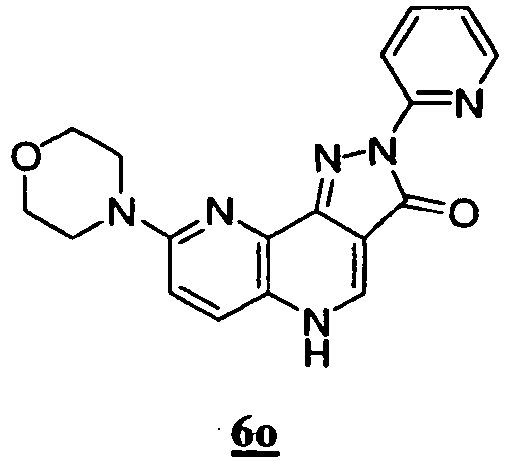
- 8-Morpholin-4-yl-2-pyridin-2-yl-2,5-dihydro-pyrazolo[4,3-c][1,5] naphthyridin-3-one (6o). The title compound was prepared following the procedure described for 6a using 5b and morpholine instead of 5a and piperazine respectively. 1H-NMR (DMSO-d6) δ (ppm): 3.63 (4H, br), 3.72 (4H, br), 7.19 (2H, m), 7.82 (2H, m), 8.22 (1H, d, J = 8.24 Hz), 8.48 (1H, dd, J = 2.20, 1.10 Hz), 8.56 (1H, s). m/z 349.4 (MH+).
-
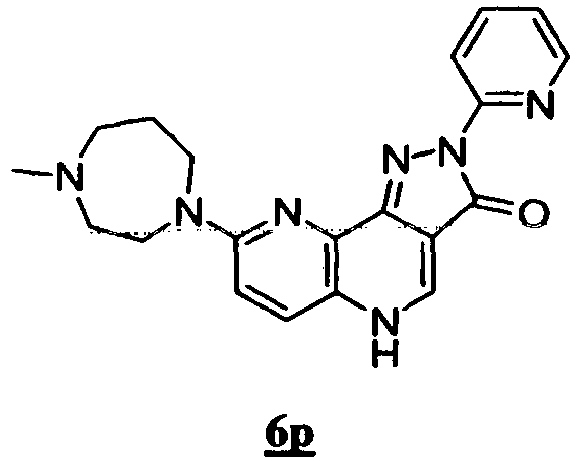
- 8-(4-Methyl-[1,4]diazepan-1-yl)-2-pyridin-2-yl-2,5-dihydro-pyrazolo[4,3-c][1,5]naphthyridin-3-one (6p). The title compound was prepared following the procedure described for 6a using 5b and 4-methyl-[1,4]-diazepane instead of 5a and piperazine respectively. 1H-NMR (DMSO-d6) δ (ppm): 2.04 (2H, m), 2.35 (3H, s), 2.60 (2H, m), 2.76 (2H, m), 3.76 (2H, d, J = 6.32 Hz), 3.98 (2H, t, J = 4.67 Hz), 6.96 (1H, d, J = 9.36 Hz), 7.25 (1H, ddd, J = 7.14, 4.55, 0.82 Hz), 7.82 (1H, d, J = 9.34 Hz), 7.92 (1H, m), 8.30 (1H, dt, J = 8.24,0.82 Hz), 8.49 (1H, m), 8.52 (1H, s). m/z 376.4 (MH+).
-

- 8-(3-Methyl-piperazin-1-yl)-2-pyridin-2-yl-2,5-dihydropyrazolo[4,3-c] [1,5]naphthyridin-3-one (6q). The title compound was prepared following the procedure described for 6a using 5b and 2-methylpiperazine instead of 5a and piperazine respectively. 1H-NMR (DMSO-d6) δ (ppm): 1.07 (3H, d, J = 6.87 Hz), 2.78 (3H, m), 3.00 (2H, m), 4.31 (2H, m), 7.14 (2H, m), 7.83 (2H, m), 8.22 (1H, dt, J = 7.96, 7.64 Hz), 8.49 (2H, m). m/z 362.4 (MH+).
-

- The above compound was prepared following the procedure described for 6a using 5b and 4-hydroxypiperidine instead of piperazine. 1H-NMR (DMSO-d6) δ (ppm): 2.25 (1H, m), 2.70 (1H, m), 2.89 (2H, m), 3.15 (2H, m), 3.75 (2H, m), 4.74 (1H, m), 7.24 (2H, m), 7.79 (1H, d, J = 9.24 Hz), 7.88 (1H, m), 8.23 (1H, d, J = 8.24 Hz), 8.49 (1H, dd, J = 4.67, 1.10 Hz), 8.53 (1H, s).
-

- 8-Piperazin-1-yl-2-pyridin-2-yl-2,5-dihydro-pyrazolo[4,3-c][1,5] naphthyridin-3-one (6s). The title compound was prepared following the procedure described for 6a using 5b instead of 5a. 1H-NMR (CDCl3) δ (ppm): 2.97 (4H, br), 3.72 (4H, br), 6.82 (1H, d, J = 9.34 Hz), 7.42 (4H, m), 7.75 (1H, m), 8.17 (2H, d, J = 7.97 Hz), 8.52 (1H, s). m/z 348.4 (MH+).
-

-

- 8-Fluoro-2-(4-methoxy-phenyl)-2,5-dihydro-pyrazolo[4,3-c][1,5] naphthyridin-3-one (5c). The title compound was prepared following the procedure described in Step 3 for synthesis for 5a using 4-methoxyphenylhydrazine instead of phenylhydrazine. 1H-NMR (DMSO-d6) δ (ppm): 7.25 (1H, ddd, J = 7.14, 4.67, 1.10 Hz), 7.50 (1H, dd, J = 8.79, 3.03 Hz),): 7.90 (1H, ddd, J = 9.34, 7.42, 1.93 Hz), 8.14 (1H, brd, J = 8.24 Hz), 8.28 (1H, ddd, J = 9.06, 7.42, 7.14 Hz), 8.50 (1H, m), 8.84 (1H, s). m/z 282.3 (MH+).
-

- 2-(4-Methoxy-phenyl)-8-(4-methyl-piperazin-1-yl)-2,5-dihydro-pyrazolo [4,3-c][1,5]naphthyridin-3-one (6t). The title compound was prepared following the procedure described for 6a using 5c and 1-methylpiperazine instead of 5a and piperazine respectively. 1H-NMR (DMSO-d6) δ (ppm): 2.22 (3H, s), 2.56 (4H, m), 3.64 (4H, m), 6.98 (2H, d, J = 9.07 Hz), 7.15 (1H, d, J = 9.34 Hz), 7.78 (6H, d, J = 9.34 Hz), 8.10 (2H, d, J = 9.07 Hz), 8.45 (1H, s). m/z 391.4 (MH+).
-

-

- Ethyl-4,7-dichloro-[1,6]naphthyridine-3-carboxyate (12). The title compound was prepared following the procedure described for 4a using 7-chloro-4-hydroxy-[1,6]naphthyridine-3-carboxylic acid ethyl ester (11). 1H-NMR (CDCl3) δ (ppm): 1.47 (3H, t, J = 7.14 Hz), 4.53 (2H, q, J = 7.14 Hz), 8.02 (1H, s), 9.37 (1H, s), 9.62 (1H, s). m/z 272.2 (MH+).
-

- 7-Chloro-2-phenyl-2,5-dihydro-pyrazolo[4,3-c][1,6]naphthyridin-3-one (13). The title compound was prepared following the procedure described in Step 3 for synthesis for 5a using 12 instead of 4a. 1H-NMR (DMSO-d6) δ (ppm): 7.18 (1H, dd, J = 7.14, 6.59 Hz), 7.46 (2H, dd, J = 8.24, 7.70 Hz), 7.60 (1H, s), 8.14 (2H, d, J = 7.51 Hz), 8.81 (1H, s), 9.21 (1H,s). m/z 297.7 (MH+).
-

- 2-Phenyl-7-(piperazin-1-yl)-2,5-dihydro-pyrazolo[4,3-c][1,6] naphthyridin-3-one (14). The title compound was prepared following the procedure described in Step 4 for synthesis for 6a using 13 instead of 5a. 1H-NMR (DMSO-d6) δ (ppm): 2.80 (4H, brm), 3.46 (4H, brm), 6.68 (1H, s), 7.06 (1H, dd, J = 7.42, 7.14 Hz), 7.36 (2H, dd, J = 8.52, 7.41 Hz), 8.20 (2H, dd, J = 8.79, 1.10 Hz), 8.47 (1H, s), 8.94 (1H, s). m/z 347.4 (MH+).
-

-

- Ethyl-4,8-dichloro-[1,7]naphthyridine-3-carboxyate (15). The title compound was prepared following the procedure described for 4a using 8-chloro-4-hydroxy-[1, 7]naphthyridine-3-carboxylic acid ethyl ester-(11). 1H-NMR (CDCl3) δ (ppm): 1.47 (3H, t, J = 7.14 Hz), 4.53 (2H, q, J = 7.14 Hz), 8.13 (1H, d, J = 5.8 Hz), 8.55 (1H, d, J = 5.8 Hz), 9.35 (1H, s). m/z 271.0 (MH+).
-

- 6-Chloro-2-phenyl-2,5-dihydro-pyrazolo[4,3-c][1,7]naphthyridin-3-one (16). The title compound was prepared following the procedure described in Step 3 for synthesis for 5a using 15 instead of 4a. 1H-NMR (DMSO-d6) δ (ppm): 7.16 (1H, m), 7.44 (2H, dd, J = 8.6, 7.6 Hz), 8.09 (1H, d, J = 5.3 Hz), 8.14 (2H, dd, J = 8.5, 1.1 Hz), 8.37 (1H, d, J = 5.2 Hz), 8.51 (1H,s). m/z 297.7 (MH+).
-

- 2-Phenyl-6-(piperazin-1-yl)-2,5-dihydro-pyrazolo[4,3-c][1,7] naphthyridin-3-one (17). The title compound was prepared following the procedure described in Step 4 for synthesis for 6a using 16 instead of 5a. 1H-NMR (DMSO-d6) δ (ppm): 3.2 (4H, brm), 3.48 (4H, brm), 7.13 (1H, m), 7.46 (2H, m), 7.78 (1H, d, J = 5.2 Hz), 8.18 (2H, d, J = 7.7 Hz), 8.30 (1H, d, J = 5.2 Hz), 8.50 (1H, s). m/z 347.4 (MH+).
-

- 6-(Morpholin-4-yl)-2-phenyl-2,5-dihydro-pyrazolo[4,3-c][1,7]naphthyridin-3-one (18). The title compound was prepared following the procedure described in Step 4 for synthesis for 6a using 16 and morpholine. 1H-NMR (DMSO-d6) δ (ppm): 3.17 (4H, brm), 3.87 (4H, brm), 7.15 (1H, m), 7.43 (2H, m), 7.76 (1H, d, J = 5.5 Hz), 8.17 (2H, d, J = 8.8 Hz), 8.33 (1H, d, J = 5.2 Hz), 8.44 (1H, s). m/z 348.1 (MH+).
- The ability of a compound disclosed herein to act as ligand to the benzodiazepine site of GABAA can be determined using pharmacological models which are well known in the art using the following assay. The IC50 values for the exemplified compounds range from sub nM to 10 µM in a 3-concentration dose response curve.
- Whole brain (except cerebellum) of male Wistar derived rats weighing 175 ± 25 g were used to prepare GABAA central benzodiazepine receptor in Na-K phosphate buffer pH 7.4. A 5 mg aliquot was incubated with 1 nM (3H)-flunitrazepam for 60 minutes at 25 °C. Experiments were performed in the presence or absence of 30 µM of GABA. Nonspecific binding was estimated in the presence of 10 µM of diazepam. Membranes were filtered and washed, the filters were then counted to determine (3H)-flunitrazepam specifically bound. Test compounds were tested in duplicate according to the required concentrations (Damm, H.W., et al. (1978) Res. Comm. Chem. Pathol. Pharmacol. 22: 597-560; Speth, R.C., et al. (1979) Life Sci. 24: 351-357 ).
- wherein:
- A indicates an IC50 of >1µM
- B indicates an IC50 of <1µM
- C indicates an IC50 of <1nM
- All compounds disclosed in Table 1 are assumed to be drawn as neutral. If not indicated, a hydrogen atom is assumed to be present on nitrogen atoms to provide a neutral compound. The compounds of Table 1 can exist in additional isomeric forms, for example, the compounds can exist as tautomers of the drawn structures. The compounds disclosed in Table 1 encompass all possible tautomers of the drawn structures. One of skill in the art will understand that a compound can exist in different tautomeric forms or mixtures there of depending on the environment encompassing the compound, that is an equilibrium can exist between the different tautomerics forms of the compounds and the equilibrium between said forms can be influenced by outside factors.
- The modulation of GABAA function is determined by changes in current as determined in an electrophysiology assay, as is detailed below.
- mRNA was prepared from lyophilized plasmid pellets containing cDNA inserts encoding the specific GABAA receptor subunit. cDNAs encoding the α 2, α 3, and γ 3 subunits were subcloned into pBluescript, SK-. cDNAs encoding the α 1 and α 5 subunits were subcloned into prC while cDNA encoding the β 2 subunit was subcloned into pcDNA1. The cDNA construct encoding the γ 2s subunit is in the pGH19 expression construct. Overnight cultures of transformed DH5a bacterial cells were performed to grow sufficient quantities for maxiprep isolation of the plasmid cDNA. The resulting plasmid cDNA was linearized by digestion with an appropriate restriction enzyme that cleaves distal to the cDNA insert (XbaI for α 1,2, β 2, and γ 3 or NotI for α 3,5 and γ 2, respectively). Following digestion, plasmid cDNA was treated with proteinase K and extracted with phenol/chloroform/isoamyl alcohol, followed by ethanol precipitation. cDNA quality was assessed by agarose-gel electrophoresis (1.5% agarose gel). Samples were stored at -20°C until use. In vitro transcription was performed with T7 RNA polymerase. mRNA was then stored at -80°C until use. Plasmids were linearized with appropriate restriction enzymes before in vitro transcription using the Message Machine kit (Ambion, Austin, TX).
- GABAA receptor expression in Xenopus oocytes: Following 45 min of 0.15% Tricaine anesthesia, an ovarian section containing the follicular oocytes was removed from the frog through a lateral abdominal incision. Oocytes were immediately placed in a calcium-free solution (NaCl 96 mM, MgCl2 1 mM, KCl 2mM, Hepes 50 mM, pyruvate 2.5 mM, gentamycin 100 µg/mL, penicillin-streptomycin 50 U/mL, pH 7.4). Following 1.5-2 hour incubation in 0.2% collagenase (type II, Sigma Chemical Co., St. Louis, MO) at room temperature, individual Dumont stage V and VI oocytes were transferred to an incubator and maintained overnight in Barth's solution (NaCl 84 mM, NaHCO3 2.4 mM, MgSO4 0.82 mM, KCl 1 mM, Ca(NO3)2 0.33 mM, CaCl2 0.41 mM, Tris/HCl 7.5 mM, pyruvate 2.5 mM, gentamycin 50 µg/mL, penicillin-streptomycin, 100 units/mL, pH 7.4) at 18-20°C and used for experiments 1-5 days post-injection. Oocytes were injected solution using an electronic microinjector (Drummond, Broomall, PA) with 50 nL of RNA containing 0.3-0.5 ng of each subunit RNA in a 1:1:1 ratio. The injected oocytes were used for experiments after 1-5 days of incubation in Barth's solution at 18-20°C.
- Measurements of ion currents from oocytes expressing GABAA receptors were performed using a Warner two-electrode voltage-clamp amplifier (Warner Instruments, Inc., Foster City, CA) (Park-Chung, M., et al. (1999) Brain Res. 830: 72-87). Microelectrodes were fabricated from borosilicate glass capillaries with a programmed pipette puller (Sutter Instrument Co., CA). Microelectrode resistance was 1-3 MΩ when filled with 3 M KCI. The oocyte recording chamber was continuously perfused with Ringer solution. Oocytes were clamped at a holding potential of -70mV during data acquisition. The membrane current was filtered at 10 Hz and sampled at 100 Hz. Compounds were applied by a gravity-driven external perfusion system. The working volume of the recording chamber was 30 µL and the rate of the perfusion was approximately 50 µL/sec. Compound application was 10-20 sec followed by a 90 sec wash. Data acquisition and external perfusion was computer controlled by custom-developed software. All experiments were performed at room temperature (22-24 °C). Dose-response data from each oocyte were fitted to the Hill equation by non-linear regression using the equation:

Emax is the maximum response, EC50 is the concentration producing 50% of the maximal response, nH is the Hill coefficient and c is the concentration of agonist. Based on the GABA concentration-response curve fit, an EC10 for GABA was determined for each subunit combination, and this concentration was used for subsequent modulator concentration-response studies. Peak current measurements were normalized and expressed as a fraction of the peak control current measurements. Control current responses to an EC10 concentration of GABA were re-determined after every 2-4 modulator applications. Percent modulation was determined by the equation:
where I is the control response at the GABA EC10 and I' the response in the presence of modulator (Lippa A, et al. (2005) Proc. Natl. Acad. Sci. USA 102(20): 7380-7385). - Some compounds showed positive modulation and some showed negative modulation at a screening concentration of 10 µM.
- Effect on animal behavior, specifically improvement of cognitive function (including but not limited to both short-term/working memory and long-term memory), can be determined using a number of established protocols. One method, novel object recognition, is described below.
- Object recognition is an ethologically relevant task for rodents, which does not result from negative reinforcement (foot shock). This task relies on the natural curiosity of rodents to explore novel objects in their environments more than familiar ones. Obviously, for an object to be "familiar," the animal must have attended to it before and remembered that experience. Hence, animals with better memory will attend and explore a new object more than an object familiar to them. During testing, the animal is presented with the training object and a second, novel one. Memory of the training object renders it familiar to the animal, and it then spends more time exploring the new novel object rather than the familiar one (Bourtchouladze, R., et al. (2003) Proc. Natl. Acad. Sci. USA 100: 10518-10522). Recent neuroimaging studies in humans demonstrated that memory in object recognition depends on prefrontal cortex (PFC) (Deibert, E., et al. (1999) Neurology 52: 1413-1417). Consistent with these findings, rats with the PFC lesions show poor working memory when they are required to discriminate between familiar and novel objects (Mitchell, J.B. and Laiacona, J. (1998) Behav. Brain Res. 97: 107-113). Other studies on monkeys and rodents suggest that the hippocampus is important for novel object recognition (Teng, E. et al. (2000) J. Neuroscience 20: 3853-3863; Mumby, D.G. (2001) Behavioural Brain Research 127: 159-181). Hence, object recognition provides an excellent behavioral model to evaluate drug-compound effects on cognitive task associated with function of hippocampus and cortex.
- The strength of memory retention in most cases is dependent on the amount of training (repetition of explicit or implicit trials). This "memory acquisition curve" can be influenced by many experimental and physical variables, which include, but are not limited to, temperature, humidity, ambient noise, lighting levels, the size of the training arena, the size and dimensions of the objects, the physical textures and colors of the training arena and the animal's stress levels, motivational states or experiences prior to training. To evaluate memory enhancing compounds for NOR, the experimeter must parameterize training duration to define (i) the duration (amount of training) required to reach an asymptotic (high) level of memory retention and (ii) a lesser duration at which memory retention is sub-maximal. Memory enhancing compounds will produce higher memory retention with submaximal training (but may have no measurable effect with asymptotic ("maximal") training. Typically, the difference between sub-maximal and asymptotic memory must be sufficiently larger to yield appropriate statistical power. An example which follows:
- Prior to initiation of training, animals were handled and habituated to the training arena. Appropriately sized arenas were used for different species (e.g. for mice: a Plexiglas box of L=48 cm; W=38 cm and H=20 cm; for rats: a Plexiglas box of L=70 cm; W=60 cm and H=35 cm). The day before training, an individual animal was placed into a training apparatus located in a dimly lit room and allowed to habituate to the environment for 15 minutes (also see (Pittenger, C., et al. (2002) Neuron 34: 447-462; Bourtchouladze, R., et al. (2003) Proc. Natl. Acad.Sci. USA 100: 10518-10522). Training was initiated 24h hours after habituation. An animal was placed back into the training box, which contained two identical objects (e.g. a small conus-shape object), and was allowed to explore these objects. The objects were placed into the central area of the box and the spatial position of objects (left-right sides) was counterbalanced between subjects. Animals were trained for 15 minutes. To test for memory retention, animals were observed for 10 minutes 24 hours after training. A rodent was presented with two objects, one of which was used during training, and thus was 'familiar' and the other of which was novel (e.g. a small pyramid-shape object). To ensure that the discrimination targets do not differ in smell, after each experimental subject, the apparatus and the objects were thoroughly cleaned with 90% ethanol, dried and ventilated for a few minutes.
- The experiments were videotaped via an overhead video camera system. Types were then reviewed by a blinded observer and the following behavioral parameters were determined: time of exploration of an each object; the total time of exploration of the objects; number of approaches to the objects; and time (latency) to first approach to an object. The discrimination index - memory score - was determined as described previously (Ennaceur, A. and Aggleton, J.P. (1997) Behav. Brain Res. 88: 181-193; Bourtchouladze, R., et. al. (2003) Proc. Natl. Acad. Sci. USA 100: 10518-10522). This Data was analyzed by Student's unpaired t test using a software package (Statview 5.0.1; SAS Institute, Inc). All values in the text and figures are expressed as mean ± SEM.
- For NOR, 1-hr memory retention represents a measure of decremental, short-term memory (usually transcription independent), which contributes to cognitive functions, such as working memory (radial arm maze, delayed match to sample, etc), executive function (task-switching, etc.) and attentional processes (priming, etc). Twenty-four hour memory retention represents a measure of long-term memory, to which STM is converted through the molecular and cellular processes of memory consolidation. LTM contributes to lasting cognitive functions such as reference memory.
| No. | Structure | BZ bindin g assay (IC50) | EP result | No. | Structure | BZ binding assay (IC50) | EP result |
| 6a |  | B | Neg | 6n |  | B | |
| 6b |  | B | Neg | 6o |  | B | |
| 6c |  | C | Neg | 6p |  | B | |
| 6d |  | C | 6q |  | B | Pos | |
| 6e |  | B | 6r |  | C | ||
| 6e |  | B | 6r |  | C | ||
| 6f |  | B | 6s |  | B | Pos | |
| 6g |  | B | 6t |  | C | Neg | |
| 6h |  | B | 14 | 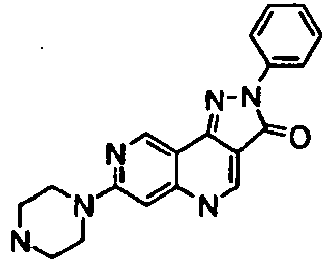 | A | Neg | |
| 6i |  | C | 17 |  | A | ||
| 6l |  | B | Pos | ||||
| 6m |  | B | Pos |
Claims (21)
- A compound of formula (I):

wherein:R is hydrogen, or oxide;Z1, Z2, Z3, and Z4 are each independently N, or C(R1 ), wherein at least one of Z1, Z2, Z3, or Z4 are N and at least two of Z1, Z2, Z3, or Z4 are C(R1 );each R1 is independently selected from the group consisting of hydrogen, hydroxy, halo, cyano, B1, -CONRaRb , -NRaRb , hydroxy(C1-C6)alkyl, aryl, heteroaryl, heterocycle, amino(C1-C6)alkyl, (C1-C6)alkyl optionally substituted with up to 5 fluoro, and (C1-C6)alkoxy optionally substituted with up to 5 fluoro, wherein at least one R1 is B1; R2 is selected from the group consisting of hydrogen, hydroxy, halo, hydroxy(C1-C6)alkyl, (C1-C6)alkyl optionally substituted with up to 5 fluoro, and (C1-C6)alkoxy optionally substituted with up to 5 fluoro;each Ra and Rb is independently hydrogen, (C1-C6)alkyl, aryl, heteroaryl, heterocycle, (C1-C6)alkylaryl, -S(O)z(C1-C6)alkyl, -S(O)zaryl, -C(O)(C1-C6)alkyl, -C(O)NRg(C1-C6)alkyl, -C(O)NRg aryl, -C(O)O(C1-C6)alkyl, arylOC(O)- or arylC(O)-, or Ra and Rb are taken together with the nitrogen to which they are attached to form a heterocycle group optionally substituted with one or more Rd; wherein the heterocycle group optionally include one or more groups selected from O (oxygen), S (sulfur), and NRc ;each Rc is independently hydrogen, (C2-C6)alkenyl, (C2-C6)alkynyl, -C(O)O(C1-C6)alkyl, -C(O)Oaryl, (C1-C6)alkoxy(C1-C6)alkyl, hydroxy(C1-C6)alkyl, aryl, heteroaryl, heterocycle, arylO(C1-C6)alkyl, -C(O)NRg (C1-C6)alkyl, -C(O)NRg aryl, -S(O)z(C1-C6)alkyl, -S(O)zaryl, -C(O)(C1-C6)alkyl, arylC(O)-, (C1-C6)alkyl optionally substituted with up to 5 fluoro, or (C1-C6)alkoxy optionally substituted with up to 5 fluoro;each Rd is independently hydrogen, halo, oxo, hydroxy, -C(O)NReRf , -NReRf , hydroxy(C1-C6)alkyl, aryl, aryl(C1-C6)alkyl, (C1-C6)alkyl optionally substituted with up to 5 fluoro, or (C1-C6)alkoxy optionally substituted with up to 5 fluoro;each Re and Rf is independently selected from hydrogen, (C1-C6)alkyl, aryl, heteroaryl, heterocycle, (C1-C6)alkylaryl, aryl(C1-C6)alkyl, -C(O)(C1-C6)alkyl, -S(O)z(C1-C6)alkyl, -S(O)z NRg (C1-C6)alkyl, -S(O)zaryl, -C(O)NRg (C1-C6)alkyl, -C(O)(C1-C6)alkyl, arylC(O)-, arylOC(O)-, or -C(O)O(C1-C6)alkyl;Rg is hydrogen, aryl, heteroaryl, heterocycle, or (C1-C6)alkyl optionally substituted with up to 5 fluoro;Ar is aryl optionally substituted with one or more M or heteroaryl optionally substituted with one or more M;each Q is independently hydrogen, halo, oxo, hydroxy, -C(O)NRaRb , -NRaRb , (C1-C6)alkyl optionally substituted with up to 5 fluoro, (C1-C6)alkoxy optionally substituted with up to 5 fluoro, (C1-C6)alkyl optionally substituted with one or more Rd, hydroxy(C1-C6)alkyl optionally substituted with one or more Rd, aryl optionally substituted with one or more Rd, or aryl(C1-C6)alkyl optionally substituted with one or more Rd;each M is independently hydrogen, halo, CF3, CF2H, hydroxy, cyano, nitro, (C1-C6)alkyl, hydroxy(C1-C6)alkyl, (C1-C6)alkoxy, -NRaRb, aryl, heteroaryl or heterocycle;each X is independently NL, oxygen, C(Q)2, or S(O)z;each L is independently hydrogen, (C2-C6)alkenyl, (C2-C6)alkynyl, -C(O)O(C1-C6)alkyl, -C(O)Oaryl, (C1-C6)alkoxy(C1-C6)alkyl, hydroxy(C1-C6)alkyl, aryl, heteroaryl, heterocycle, arylO(C1-C6)alkyl, -CONReRf , -S(O)z(C1-C6)alkyl, -S(O)zaryl, -C(O)(C1-C6)alkyl, arylC(O)-, -C(O)NRg (C1-C6)alkyl, (C1-C6)alkyl optionally substituted with up to 5 fluoro, or (C1-C6)alkoxy optionally substituted with up to 5 fluoro;p is an integer selected from 0, 1, 2 and 3;z is an integer selected from 0, 1 and 2; andn is an integer selected from 0, 1, and 2.
 - The compound of claim 1 that has the formula Ia:

wherein Y is CM or N, preferably at least one X is NL. - The compound of claim 1 that has the formula Ib:

wherein Y is CM or N, preferably at least one X is NL. - The compound of claim 1, wherein
at least one B' is
- The compound of claim 4, wherein Z1 is N (nitrogen) or Z2 is N (nitrogen).
- The compound of claim 2 that has the formula Ih:

wherein Y is CM or N, preferably at least one X is NL or oxygen. - The compound of claim 2 that has the formula Ik:

wherein Y is CM or N, preferably at least one X is NL or oxygen. - The compound of claim 3 that has the formula In:

wherein Y is CM or N, preferably at least one X is NL or oxygen. - The compound of claim 1 that has the formula Iq:

wherein Y is CM or N, preferably Z1 is N; and Z2 is C(R1 ), or Z2 is N; and Z1 is C(R1 ). - The compound of claim 9, wherein at least one X is NL.
- The compound of claim 9, wherein at least one X is oxygen.
- The compound of claim 1 selected from the group consisting of:


- A pharmaceutical composition comprising:a) a compound of any one of claims 1 to 12; andb) a pharmaceutically acceptable carrier.
- Use of a compound of claim I or the pharmaceutical composition of claim 13, in the preparation of a medicament for modulation of one or more GABAA subtypes in an animal, preferably the GABAA subtypes is GABAA α5.
- The use of claim 14 wherein the modulation is negative or positive.
- The use of claim 14 wherein the compound negatively modulates GABAA α5 subtype.
- Use of a compound of claim 1 or the pharmaceutical composition of claim 13, in the preparation of a medicament for treatment of a cognitive dysfunction in an animal.
- Use of a compound of claim 1 or the pharmaceutical composition of claim 13, in the preparation of a medicament for treatment of psychiatric disorders in an animal, preferably the psychiatric disorder is an anxiety disorder, sleep disorder, depression, or schizophrenia.
- Use of a compound of claim 1 or the pharmaceutical composition of claim 13, in the preparation of a medicament for treatment of disorders ameliorated by modulation of GABAA α subunits other than α5 in an animal, preferably the modulation is positive or negative.
- Use of a compound of claim 1 or the pharmaceutical composition of claim 13, in the preparation of a medicament for increasing cognitive function in an animal under conditions wherein memory is increased, preferably the memory is long term memory or short term memory.
- Use of a compound of claim 1 or the pharmaceutical composition of claim 13, in the preparation of a medicament for increasing cognitive function in an animal wherein the GABAA α5 subtype in the animal is negatively modulated.
Applications Claiming Priority (2)
| Application Number | Priority Date | Filing Date | Title |
|---|---|---|---|
| US94300007P | 2007-06-08 | 2007-06-08 | |
| PCT/US2008/066211 WO2008154447A1 (en) | 2007-06-08 | 2008-06-06 | Therapeutic pyrazolonaphthyridine derivatives |
Publications (3)
| Publication Number | Publication Date |
|---|---|
| EP2166853A1 EP2166853A1 (en) | 2010-03-31 |
| EP2166853A4 EP2166853A4 (en) | 2011-04-06 |
| EP2166853B1 true EP2166853B1 (en) | 2014-05-28 |
Family
ID=40130166
Family Applications (1)
| Application Number | Title | Priority Date | Filing Date |
|---|---|---|---|
| EP08770412.8A Not-in-force EP2166853B1 (en) | 2007-06-08 | 2008-06-06 | Therapeutic pyrazolonaphthyridine derivatives |
Country Status (12)
| Country | Link |
|---|---|
| US (2) | US7858614B2 (en) |
| EP (1) | EP2166853B1 (en) |
| JP (1) | JP2010529145A (en) |
| KR (1) | KR20100036306A (en) |
| CN (1) | CN101754681A (en) |
| AU (1) | AU2008261803A1 (en) |
| BR (1) | BRPI0812369A2 (en) |
| CA (1) | CA2689934A1 (en) |
| ES (1) | ES2483728T3 (en) |
| IL (1) | IL202287A0 (en) |
| MX (1) | MX2009013197A (en) |
| WO (1) | WO2008154447A1 (en) |
Families Citing this family (8)
| Publication number | Priority date | Publication date | Assignee | Title |
|---|---|---|---|---|
| US7863266B2 (en) * | 2007-06-08 | 2011-01-04 | Helicon Therapeutics, Inc. | Therapeutic pyrazoloquinoline urea derivatives |
| EP2627655B1 (en) * | 2010-10-14 | 2015-09-16 | Dart Neuroscience (Cayman) Ltd | FUSED 3-OXO-PYRAZOLO[4,3-c]PYRIDINE COMPOUNDS AS GABAA MODULATORS |
| US20150374705A1 (en) | 2012-02-14 | 2015-12-31 | Shanghai Institues for Biological Sciences | Substances for treatment or relief of pain |
| US10531200B2 (en) * | 2015-10-23 | 2020-01-07 | Harman International Industries, Incorporated | Dual asymmetric compression driver |
| CN106810550A (en) * | 2017-01-10 | 2017-06-09 | 湖南华腾制药有限公司 | A kind of preparation method of 7-naphthyridine derivatives |
| JP7210483B2 (en) | 2017-06-30 | 2023-01-23 | バイエル・アニマル・ヘルス・ゲゼルシャフト・ミット・ベシュレンクテル・ハフツング | Novel azaquinoline derivatives |
| CN117430602A (en) * | 2023-09-26 | 2024-01-23 | 爱斯特(成都)生物制药股份有限公司 | A method for preparing 6-halo-4-hydroxy[1,5]naphthyridine-3-carboxylate and its derivatives |
| CN117447469A (en) * | 2023-10-27 | 2024-01-26 | 爱斯特(成都)生物制药股份有限公司 | A continuous flow synthesis method for key intermediates of MELK inhibitors |
Family Cites Families (21)
| Publication number | Priority date | Publication date | Assignee | Title |
|---|---|---|---|---|
| DE3204126A1 (en) * | 1982-02-06 | 1983-08-11 | Bayer Ag, 5090 Leverkusen | PYRAZOLOXAZINE, -THIAZINE, -CHINOLINE, METHOD FOR THE PRODUCTION THEREOF AND THEIR USE AS A MEDICINAL PRODUCT |
| US4479955A (en) * | 1983-01-10 | 1984-10-30 | Ciba-Geigy Corporation | Heterocycle-fused pyrazolo[3,4-d]pyridin-3-ones as benzodiazepine receptor modulators |
| US4814450A (en) | 1984-07-09 | 1989-03-21 | Ciba-Geigy Corporation | Certain ring-fused pyrazolo[3,4-d]-pyridin-3-one derivatives |
| JPS61112075A (en) * | 1984-11-05 | 1986-05-30 | Shionogi & Co Ltd | Thienylpyrazoloquinoline derivative |
| EP0214092A1 (en) | 1985-08-08 | 1987-03-11 | Ciba-Geigy Ag | Enhanced absorption of psychoactive 2-aryl-pyrazolo quinolines as a solid molecular dispersion in polyvinylpyrrolidone |
| US4817450A (en) * | 1987-11-30 | 1989-04-04 | Spedco, Inc. | Pressure/temperature test plug assembly |
| FR2695126B1 (en) * | 1992-08-27 | 1994-11-10 | Sanofi Elf | Thienyl or pyrrolyl carboxylic acid derivatives, their preparation and medicaments containing them. |
| US5334595A (en) * | 1992-10-23 | 1994-08-02 | Sterling Winthrop Inc. | Pyrazoloquinolones as anticancer agents |
| AU688515B2 (en) * | 1994-05-24 | 1998-03-12 | F. Hoffmann-La Roche Ag | Tricyclic dicarbonyl derivatives |
| GB9716347D0 (en) * | 1997-08-01 | 1997-10-08 | Merck Sharp & Dohme | Therapeutic compounds |
| GB9716344D0 (en) * | 1997-08-01 | 1997-10-08 | Merck Sharp & Dohme | Therapeutic compounds |
| GB9716345D0 (en) * | 1997-08-01 | 1997-10-08 | Merck Sharp & Dohme | Therapeutic compounds |
| TWI271406B (en) * | 1999-12-13 | 2007-01-21 | Eisai Co Ltd | Tricyclic condensed heterocyclic compounds, preparation method of the same and pharmaceuticals comprising the same |
| GB0108475D0 (en) * | 2001-04-04 | 2001-05-23 | Merck Sharp & Dohme | New compounds |
| JP3896309B2 (en) * | 2001-07-09 | 2007-03-22 | ファイザー株式会社 | Pyrazoloquinolinone derivatives as protein kinase C inhibitors |
| EP1572689B1 (en) * | 2002-12-16 | 2009-03-11 | Active Biotech AB | Tetracyclic immunomodulatory compounds |
| US20050245563A1 (en) * | 2003-05-29 | 2005-11-03 | Millennium Pharmaceuticals, Inc. | Chk-1 inhibitors |
| US7544697B2 (en) * | 2003-10-03 | 2009-06-09 | Coley Pharmaceutical Group, Inc. | Pyrazolopyridines and analogs thereof |
| CN1893943A (en) * | 2003-10-03 | 2007-01-10 | 3M创新有限公司 | Pyrazolopyridines and analogs thereof |
| US20070078083A1 (en) * | 2005-09-07 | 2007-04-05 | Braincells, Inc. | MODULATION OF NEUORGENESIS BY HDac INHIBITION |
| ATE544344T1 (en) * | 2007-06-08 | 2012-02-15 | Helicon Therapeutics Inc | THERAPEUTIC PYRAZOLOCHINOLINE DERIVATIVES |
-
2008
- 2008-06-06 ES ES08770412.8T patent/ES2483728T3/en active Active
- 2008-06-06 MX MX2009013197A patent/MX2009013197A/en active IP Right Grant
- 2008-06-06 WO PCT/US2008/066211 patent/WO2008154447A1/en not_active Ceased
- 2008-06-06 CA CA2689934A patent/CA2689934A1/en not_active Abandoned
- 2008-06-06 BR BRPI0812369A patent/BRPI0812369A2/en not_active IP Right Cessation
- 2008-06-06 EP EP08770412.8A patent/EP2166853B1/en not_active Not-in-force
- 2008-06-06 AU AU2008261803A patent/AU2008261803A1/en not_active Abandoned
- 2008-06-06 KR KR1020107000331A patent/KR20100036306A/en not_active Withdrawn
- 2008-06-06 CN CN200880025152A patent/CN101754681A/en active Pending
- 2008-06-06 US US12/135,045 patent/US7858614B2/en not_active Expired - Fee Related
- 2008-06-06 JP JP2010511393A patent/JP2010529145A/en active Pending
-
2009
- 2009-11-23 IL IL202287A patent/IL202287A0/en unknown
-
2010
- 2010-11-18 US US12/949,619 patent/US8497262B2/en not_active Expired - Fee Related
Also Published As
| Publication number | Publication date |
|---|---|
| WO2008154447A1 (en) | 2008-12-18 |
| CN101754681A (en) | 2010-06-23 |
| BRPI0812369A2 (en) | 2016-08-09 |
| ES2483728T3 (en) | 2014-08-07 |
| MX2009013197A (en) | 2010-04-27 |
| US20110065692A1 (en) | 2011-03-17 |
| US20090005365A1 (en) | 2009-01-01 |
| US8497262B2 (en) | 2013-07-30 |
| EP2166853A4 (en) | 2011-04-06 |
| JP2010529145A (en) | 2010-08-26 |
| EP2166853A1 (en) | 2010-03-31 |
| US7858614B2 (en) | 2010-12-28 |
| HK1142774A1 (en) | 2010-12-17 |
| AU2008261803A1 (en) | 2008-12-18 |
| KR20100036306A (en) | 2010-04-07 |
| IL202287A0 (en) | 2010-06-16 |
| CA2689934A1 (en) | 2008-12-18 |
Similar Documents
| Publication | Publication Date | Title |
|---|---|---|
| US8497262B2 (en) | Therapeutic pyrazolonaphthyridine derivatives | |
| EP2164328B1 (en) | Therapeutic pyrazoloquinoline urea derivatives | |
| JP2010529145A5 (en) | ||
| EP2166852B1 (en) | Therapeutic pyrazoloquinoline derivatives | |
| HK1142774B (en) | Therapeutic pyrazolonaphthyridine derivatives | |
| HK1142775B (en) | Therapeutic pyrazoloquinoline derivatives | |
| HK1144892A (en) | Therapeutic pyrazolonaphthyridine derivatives | |
| EP2627655B1 (en) | FUSED 3-OXO-PYRAZOLO[4,3-c]PYRIDINE COMPOUNDS AS GABAA MODULATORS | |
| HK1142496B (en) | Therapeutic pyrazoloquinoline urea derivatives | |
| HK1142776A (en) | Therapeutic pyrazoloquinoline urea derivatives | |
| HK1144891A (en) | Therapeutic pyrazoloquinoline derivatives | |
| AU2013203580A1 (en) | Bridged heterocyclic compounds and methods of use |
Legal Events
| Date | Code | Title | Description |
|---|---|---|---|
| PUAI | Public reference made under article 153(3) epc to a published international application that has entered the european phase |
Free format text: ORIGINAL CODE: 0009012 |
|
| 17P | Request for examination filed |
Effective date: 20091218 |
|
| AK | Designated contracting states |
Kind code of ref document: A1 Designated state(s): AT BE BG CH CY CZ DE DK EE ES FI FR GB GR HR HU IE IS IT LI LT LU LV MC MT NL NO PL PT RO SE SI SK TR |
|
| AX | Request for extension of the european patent |
Extension state: AL BA MK RS |
|
| DAX | Request for extension of the european patent (deleted) | ||
| REG | Reference to a national code |
Ref country code: HK Ref legal event code: DE Ref document number: 1142774 Country of ref document: HK |
|
| A4 | Supplementary search report drawn up and despatched |
Effective date: 20110303 |
|
| REG | Reference to a national code |
Ref country code: DE Ref legal event code: R079 Ref document number: 602008032500 Country of ref document: DE Free format text: PREVIOUS MAIN CLASS: A01N0043420000 Ipc: C07D0471140000 |
|
| GRAP | Despatch of communication of intention to grant a patent |
Free format text: ORIGINAL CODE: EPIDOSNIGR1 |
|
| RIC1 | Information provided on ipc code assigned before grant |
Ipc: C07D 471/14 20060101AFI20131129BHEP |
|
| INTG | Intention to grant announced |
Effective date: 20131216 |
|
| GRAS | Grant fee paid |
Free format text: ORIGINAL CODE: EPIDOSNIGR3 |
|
| GRAA | (expected) grant |
Free format text: ORIGINAL CODE: 0009210 |
|
| RAP1 | Party data changed (applicant data changed or rights of an application transferred) |
Owner name: DART NEUROSCIENCE (CAYMAN) LTD |
|
| AK | Designated contracting states |
Kind code of ref document: B1 Designated state(s): AT BE BG CH CY CZ DE DK EE ES FI FR GB GR HR HU IE IS IT LI LT LU LV MC MT NL NO PL PT RO SE SI SK TR |
|
| REG | Reference to a national code |
Ref country code: GB Ref legal event code: FG4D |
|
| REG | Reference to a national code |
Ref country code: CH Ref legal event code: EP |
|
| REG | Reference to a national code |
Ref country code: AT Ref legal event code: REF Ref document number: 670295 Country of ref document: AT Kind code of ref document: T Effective date: 20140615 |
|
| REG | Reference to a national code |
Ref country code: IE Ref legal event code: FG4D |
|
| REG | Reference to a national code |
Ref country code: DE Ref legal event code: R096 Ref document number: 602008032500 Country of ref document: DE Effective date: 20140703 |
|
| REG | Reference to a national code |
Ref country code: CH Ref legal event code: NV Representative=s name: KIRKER AND CIE S.A., CH |
|
| REG | Reference to a national code |
Ref country code: ES Ref legal event code: FG2A Ref document number: 2483728 Country of ref document: ES Kind code of ref document: T3 Effective date: 20140807 |
|
| REG | Reference to a national code |
Ref country code: AT Ref legal event code: MK05 Ref document number: 670295 Country of ref document: AT Kind code of ref document: T Effective date: 20140528 |
|
| REG | Reference to a national code |
Ref country code: NL Ref legal event code: VDEP Effective date: 20140528 |
|
| REG | Reference to a national code |
Ref country code: LT Ref legal event code: MG4D |
|
| PG25 | Lapsed in a contracting state [announced via postgrant information from national office to epo] |
Ref country code: GR Free format text: LAPSE BECAUSE OF FAILURE TO SUBMIT A TRANSLATION OF THE DESCRIPTION OR TO PAY THE FEE WITHIN THE PRESCRIBED TIME-LIMIT Effective date: 20140829 Ref country code: LT Free format text: LAPSE BECAUSE OF FAILURE TO SUBMIT A TRANSLATION OF THE DESCRIPTION OR TO PAY THE FEE WITHIN THE PRESCRIBED TIME-LIMIT Effective date: 20140528 Ref country code: CY Free format text: LAPSE BECAUSE OF FAILURE TO SUBMIT A TRANSLATION OF THE DESCRIPTION OR TO PAY THE FEE WITHIN THE PRESCRIBED TIME-LIMIT Effective date: 20140528 Ref country code: NO Free format text: LAPSE BECAUSE OF FAILURE TO SUBMIT A TRANSLATION OF THE DESCRIPTION OR TO PAY THE FEE WITHIN THE PRESCRIBED TIME-LIMIT Effective date: 20140828 Ref country code: FI Free format text: LAPSE BECAUSE OF FAILURE TO SUBMIT A TRANSLATION OF THE DESCRIPTION OR TO PAY THE FEE WITHIN THE PRESCRIBED TIME-LIMIT Effective date: 20140528 |
|
| PG25 | Lapsed in a contracting state [announced via postgrant information from national office to epo] |
Ref country code: LV Free format text: LAPSE BECAUSE OF FAILURE TO SUBMIT A TRANSLATION OF THE DESCRIPTION OR TO PAY THE FEE WITHIN THE PRESCRIBED TIME-LIMIT Effective date: 20140528 Ref country code: AT Free format text: LAPSE BECAUSE OF FAILURE TO SUBMIT A TRANSLATION OF THE DESCRIPTION OR TO PAY THE FEE WITHIN THE PRESCRIBED TIME-LIMIT Effective date: 20140528 Ref country code: SE Free format text: LAPSE BECAUSE OF FAILURE TO SUBMIT A TRANSLATION OF THE DESCRIPTION OR TO PAY THE FEE WITHIN THE PRESCRIBED TIME-LIMIT Effective date: 20140528 Ref country code: HR Free format text: LAPSE BECAUSE OF FAILURE TO SUBMIT A TRANSLATION OF THE DESCRIPTION OR TO PAY THE FEE WITHIN THE PRESCRIBED TIME-LIMIT Effective date: 20140528 |
|
| PG25 | Lapsed in a contracting state [announced via postgrant information from national office to epo] |
Ref country code: PT Free format text: LAPSE BECAUSE OF FAILURE TO SUBMIT A TRANSLATION OF THE DESCRIPTION OR TO PAY THE FEE WITHIN THE PRESCRIBED TIME-LIMIT Effective date: 20140929 |
|
| PG25 | Lapsed in a contracting state [announced via postgrant information from national office to epo] |
Ref country code: EE Free format text: LAPSE BECAUSE OF FAILURE TO SUBMIT A TRANSLATION OF THE DESCRIPTION OR TO PAY THE FEE WITHIN THE PRESCRIBED TIME-LIMIT Effective date: 20140528 Ref country code: RO Free format text: LAPSE BECAUSE OF FAILURE TO SUBMIT A TRANSLATION OF THE DESCRIPTION OR TO PAY THE FEE WITHIN THE PRESCRIBED TIME-LIMIT Effective date: 20140528 Ref country code: BE Free format text: LAPSE BECAUSE OF FAILURE TO SUBMIT A TRANSLATION OF THE DESCRIPTION OR TO PAY THE FEE WITHIN THE PRESCRIBED TIME-LIMIT Effective date: 20140528 Ref country code: DK Free format text: LAPSE BECAUSE OF FAILURE TO SUBMIT A TRANSLATION OF THE DESCRIPTION OR TO PAY THE FEE WITHIN THE PRESCRIBED TIME-LIMIT Effective date: 20140528 Ref country code: SK Free format text: LAPSE BECAUSE OF FAILURE TO SUBMIT A TRANSLATION OF THE DESCRIPTION OR TO PAY THE FEE WITHIN THE PRESCRIBED TIME-LIMIT Effective date: 20140528 Ref country code: CZ Free format text: LAPSE BECAUSE OF FAILURE TO SUBMIT A TRANSLATION OF THE DESCRIPTION OR TO PAY THE FEE WITHIN THE PRESCRIBED TIME-LIMIT Effective date: 20140528 |
|
| PG25 | Lapsed in a contracting state [announced via postgrant information from national office to epo] |
Ref country code: NL Free format text: LAPSE BECAUSE OF FAILURE TO SUBMIT A TRANSLATION OF THE DESCRIPTION OR TO PAY THE FEE WITHIN THE PRESCRIBED TIME-LIMIT Effective date: 20140528 Ref country code: PL Free format text: LAPSE BECAUSE OF FAILURE TO SUBMIT A TRANSLATION OF THE DESCRIPTION OR TO PAY THE FEE WITHIN THE PRESCRIBED TIME-LIMIT Effective date: 20140528 |
|
| REG | Reference to a national code |
Ref country code: DE Ref legal event code: R097 Ref document number: 602008032500 Country of ref document: DE |
|
| REG | Reference to a national code |
Ref country code: IE Ref legal event code: MM4A |
|
| PLBE | No opposition filed within time limit |
Free format text: ORIGINAL CODE: 0009261 |
|
| STAA | Information on the status of an ep patent application or granted ep patent |
Free format text: STATUS: NO OPPOSITION FILED WITHIN TIME LIMIT |
|
| REG | Reference to a national code |
Ref country code: HK Ref legal event code: GR Ref document number: 1142774 Country of ref document: HK |
|
| PG25 | Lapsed in a contracting state [announced via postgrant information from national office to epo] |
Ref country code: IE Free format text: LAPSE BECAUSE OF NON-PAYMENT OF DUE FEES Effective date: 20140606 |
|
| 26N | No opposition filed |
Effective date: 20150303 |
|
| REG | Reference to a national code |
Ref country code: DE Ref legal event code: R097 Ref document number: 602008032500 Country of ref document: DE Effective date: 20150303 |
|
| REG | Reference to a national code |
Ref country code: FR Ref legal event code: PLFP Year of fee payment: 8 |
|
| PG25 | Lapsed in a contracting state [announced via postgrant information from national office to epo] |
Ref country code: SI Free format text: LAPSE BECAUSE OF FAILURE TO SUBMIT A TRANSLATION OF THE DESCRIPTION OR TO PAY THE FEE WITHIN THE PRESCRIBED TIME-LIMIT Effective date: 20140528 |
|
| PG25 | Lapsed in a contracting state [announced via postgrant information from national office to epo] |
Ref country code: MT Free format text: LAPSE BECAUSE OF FAILURE TO SUBMIT A TRANSLATION OF THE DESCRIPTION OR TO PAY THE FEE WITHIN THE PRESCRIBED TIME-LIMIT Effective date: 20140528 |
|
| PG25 | Lapsed in a contracting state [announced via postgrant information from national office to epo] |
Ref country code: MC Free format text: LAPSE BECAUSE OF FAILURE TO SUBMIT A TRANSLATION OF THE DESCRIPTION OR TO PAY THE FEE WITHIN THE PRESCRIBED TIME-LIMIT Effective date: 20140528 |
|
| REG | Reference to a national code |
Ref country code: FR Ref legal event code: PLFP Year of fee payment: 9 |
|
| PG25 | Lapsed in a contracting state [announced via postgrant information from national office to epo] |
Ref country code: BG Free format text: LAPSE BECAUSE OF FAILURE TO SUBMIT A TRANSLATION OF THE DESCRIPTION OR TO PAY THE FEE WITHIN THE PRESCRIBED TIME-LIMIT Effective date: 20140528 |
|
| PG25 | Lapsed in a contracting state [announced via postgrant information from national office to epo] |
Ref country code: IS Free format text: LAPSE BECAUSE OF FAILURE TO SUBMIT A TRANSLATION OF THE DESCRIPTION OR TO PAY THE FEE WITHIN THE PRESCRIBED TIME-LIMIT Effective date: 20140528 |
|
| PG25 | Lapsed in a contracting state [announced via postgrant information from national office to epo] |
Ref country code: TR Free format text: LAPSE BECAUSE OF FAILURE TO SUBMIT A TRANSLATION OF THE DESCRIPTION OR TO PAY THE FEE WITHIN THE PRESCRIBED TIME-LIMIT Effective date: 20140528 Ref country code: LU Free format text: LAPSE BECAUSE OF NON-PAYMENT OF DUE FEES Effective date: 20140606 Ref country code: HU Free format text: LAPSE BECAUSE OF FAILURE TO SUBMIT A TRANSLATION OF THE DESCRIPTION OR TO PAY THE FEE WITHIN THE PRESCRIBED TIME-LIMIT; INVALID AB INITIO Effective date: 20080606 |
|
| PGFP | Annual fee paid to national office [announced via postgrant information from national office to epo] |
Ref country code: DE Payment date: 20160601 Year of fee payment: 9 Ref country code: GB Payment date: 20160601 Year of fee payment: 9 Ref country code: ES Payment date: 20160510 Year of fee payment: 9 Ref country code: CH Payment date: 20160613 Year of fee payment: 9 |
|
| PGFP | Annual fee paid to national office [announced via postgrant information from national office to epo] |
Ref country code: IT Payment date: 20160621 Year of fee payment: 9 |
|
| REG | Reference to a national code |
Ref country code: FR Ref legal event code: PLFP Year of fee payment: 10 |
|
| PGFP | Annual fee paid to national office [announced via postgrant information from national office to epo] |
Ref country code: FR Payment date: 20170511 Year of fee payment: 10 |
|
| REG | Reference to a national code |
Ref country code: DE Ref legal event code: R119 Ref document number: 602008032500 Country of ref document: DE |
|
| REG | Reference to a national code |
Ref country code: CH Ref legal event code: PL |
|
| GBPC | Gb: european patent ceased through non-payment of renewal fee |
Effective date: 20170606 |
|
| PG25 | Lapsed in a contracting state [announced via postgrant information from national office to epo] |
Ref country code: LI Free format text: LAPSE BECAUSE OF NON-PAYMENT OF DUE FEES Effective date: 20170630 Ref country code: DE Free format text: LAPSE BECAUSE OF NON-PAYMENT OF DUE FEES Effective date: 20180103 Ref country code: CH Free format text: LAPSE BECAUSE OF NON-PAYMENT OF DUE FEES Effective date: 20170630 Ref country code: GB Free format text: LAPSE BECAUSE OF NON-PAYMENT OF DUE FEES Effective date: 20170606 |
|
| PG25 | Lapsed in a contracting state [announced via postgrant information from national office to epo] |
Ref country code: IT Free format text: LAPSE BECAUSE OF NON-PAYMENT OF DUE FEES Effective date: 20170606 |
|
| REG | Reference to a national code |
Ref country code: ES Ref legal event code: FD2A Effective date: 20181114 |
|
| PG25 | Lapsed in a contracting state [announced via postgrant information from national office to epo] |
Ref country code: ES Free format text: LAPSE BECAUSE OF NON-PAYMENT OF DUE FEES Effective date: 20170607 |
|
| PG25 | Lapsed in a contracting state [announced via postgrant information from national office to epo] |
Ref country code: FR Free format text: LAPSE BECAUSE OF NON-PAYMENT OF DUE FEES Effective date: 20180630 |