EP2166601A1 - Low-temperature bonding of refractory ceramic layers - Google Patents
Low-temperature bonding of refractory ceramic layers Download PDFInfo
- Publication number
- EP2166601A1 EP2166601A1 EP09169743A EP09169743A EP2166601A1 EP 2166601 A1 EP2166601 A1 EP 2166601A1 EP 09169743 A EP09169743 A EP 09169743A EP 09169743 A EP09169743 A EP 09169743A EP 2166601 A1 EP2166601 A1 EP 2166601A1
- Authority
- EP
- European Patent Office
- Prior art keywords
- layer
- cathode
- fuel cell
- electrolyte
- ionic
- Prior art date
- Legal status (The legal status is an assumption and is not a legal conclusion. Google has not performed a legal analysis and makes no representation as to the accuracy of the status listed.)
- Granted
Links
- 239000011214 refractory ceramic Substances 0.000 title claims description 4
- 239000000446 fuel Substances 0.000 claims abstract description 69
- 239000003792 electrolyte Substances 0.000 claims abstract description 42
- 238000005245 sintering Methods 0.000 claims abstract description 29
- 239000011533 mixed conductor Substances 0.000 claims abstract description 26
- 239000011148 porous material Substances 0.000 claims abstract description 23
- 239000001301 oxygen Substances 0.000 claims abstract description 14
- 229910052760 oxygen Inorganic materials 0.000 claims abstract description 14
- 238000009792 diffusion process Methods 0.000 claims abstract description 9
- 239000007789 gas Substances 0.000 claims abstract description 9
- 239000000463 material Substances 0.000 claims description 32
- 239000012071 phase Substances 0.000 claims description 22
- CETPSERCERDGAM-UHFFFAOYSA-N ceric oxide Chemical compound O=[Ce]=O CETPSERCERDGAM-UHFFFAOYSA-N 0.000 claims description 13
- 229910000422 cerium(IV) oxide Inorganic materials 0.000 claims description 13
- 239000007787 solid Substances 0.000 claims description 13
- 229910001233 yttria-stabilized zirconia Inorganic materials 0.000 claims description 13
- -1 oxygen ion Chemical class 0.000 claims description 12
- 239000000203 mixture Substances 0.000 claims description 11
- VTYYLEPIZMXCLO-UHFFFAOYSA-L Calcium carbonate Chemical compound [Ca+2].[O-]C([O-])=O VTYYLEPIZMXCLO-UHFFFAOYSA-L 0.000 claims description 8
- 229910002119 nickel–yttria stabilized zirconia Inorganic materials 0.000 claims description 7
- 238000000034 method Methods 0.000 claims description 5
- 239000000758 substrate Substances 0.000 claims description 5
- PACGUUNWTMTWCF-UHFFFAOYSA-N [Sr].[La] Chemical compound [Sr].[La] PACGUUNWTMTWCF-UHFFFAOYSA-N 0.000 claims description 4
- 229910000019 calcium carbonate Inorganic materials 0.000 claims description 4
- 239000006229 carbon black Substances 0.000 claims description 4
- 229910052963 cobaltite Inorganic materials 0.000 claims description 4
- 239000013078 crystal Substances 0.000 claims description 4
- 230000007812 deficiency Effects 0.000 claims description 4
- 229910000859 α-Fe Inorganic materials 0.000 claims description 4
- OKTJSMMVPCPJKN-UHFFFAOYSA-N Carbon Chemical compound [C] OKTJSMMVPCPJKN-UHFFFAOYSA-N 0.000 claims description 3
- 229920002472 Starch Polymers 0.000 claims description 3
- 229910001420 alkaline earth metal ion Inorganic materials 0.000 claims description 3
- 229910002804 graphite Inorganic materials 0.000 claims description 3
- 239000010439 graphite Substances 0.000 claims description 3
- FKTOIHSPIPYAPE-UHFFFAOYSA-N samarium(iii) oxide Chemical compound [O-2].[O-2].[O-2].[Sm+3].[Sm+3] FKTOIHSPIPYAPE-UHFFFAOYSA-N 0.000 claims description 3
- 239000008107 starch Substances 0.000 claims description 3
- 235000019698 starch Nutrition 0.000 claims description 3
- ZLNQQNXFFQJAID-UHFFFAOYSA-L magnesium carbonate Chemical compound [Mg+2].[O-]C([O-])=O ZLNQQNXFFQJAID-UHFFFAOYSA-L 0.000 claims description 2
- 229910000021 magnesium carbonate Inorganic materials 0.000 claims description 2
- 239000001095 magnesium carbonate Substances 0.000 claims description 2
- 239000007790 solid phase Substances 0.000 claims description 2
- 239000000126 substance Substances 0.000 abstract description 3
- 239000010410 layer Substances 0.000 description 70
- 230000010287 polarization Effects 0.000 description 8
- 230000015572 biosynthetic process Effects 0.000 description 6
- 239000001257 hydrogen Substances 0.000 description 6
- 229910052739 hydrogen Inorganic materials 0.000 description 6
- VNWKTOKETHGBQD-UHFFFAOYSA-N methane Chemical compound C VNWKTOKETHGBQD-UHFFFAOYSA-N 0.000 description 6
- 229910052688 Gadolinium Inorganic materials 0.000 description 5
- 229910052779 Neodymium Inorganic materials 0.000 description 5
- 229910052772 Samarium Inorganic materials 0.000 description 5
- QVGXLLKOCUKJST-UHFFFAOYSA-N atomic oxygen Chemical compound [O] QVGXLLKOCUKJST-UHFFFAOYSA-N 0.000 description 5
- 229910052727 yttrium Inorganic materials 0.000 description 5
- 229930195733 hydrocarbon Natural products 0.000 description 4
- 150000002430 hydrocarbons Chemical class 0.000 description 4
- UFHFLCQGNIYNRP-UHFFFAOYSA-N Hydrogen Chemical compound [H][H] UFHFLCQGNIYNRP-UHFFFAOYSA-N 0.000 description 3
- 238000013459 approach Methods 0.000 description 3
- 239000003054 catalyst Substances 0.000 description 3
- 230000003197 catalytic effect Effects 0.000 description 3
- 239000000919 ceramic Substances 0.000 description 3
- UIWYJDYFSGRHKR-UHFFFAOYSA-N gadolinium atom Chemical compound [Gd] UIWYJDYFSGRHKR-UHFFFAOYSA-N 0.000 description 3
- QEFYFXOXNSNQGX-UHFFFAOYSA-N neodymium atom Chemical compound [Nd] QEFYFXOXNSNQGX-UHFFFAOYSA-N 0.000 description 3
- KZUNJOHGWZRPMI-UHFFFAOYSA-N samarium atom Chemical compound [Sm] KZUNJOHGWZRPMI-UHFFFAOYSA-N 0.000 description 3
- VWQVUPCCIRVNHF-UHFFFAOYSA-N yttrium atom Chemical compound [Y] VWQVUPCCIRVNHF-UHFFFAOYSA-N 0.000 description 3
- XKRFYHLGVUSROY-UHFFFAOYSA-N Argon Chemical compound [Ar] XKRFYHLGVUSROY-UHFFFAOYSA-N 0.000 description 2
- 239000004215 Carbon black (E152) Substances 0.000 description 2
- BVKZGUZCCUSVTD-UHFFFAOYSA-L Carbonate Chemical compound [O-]C([O-])=O BVKZGUZCCUSVTD-UHFFFAOYSA-L 0.000 description 2
- LFQSCWFLJHTTHZ-UHFFFAOYSA-N Ethanol Chemical compound CCO LFQSCWFLJHTTHZ-UHFFFAOYSA-N 0.000 description 2
- 239000011575 calcium Substances 0.000 description 2
- 230000002301 combined effect Effects 0.000 description 2
- 239000000470 constituent Substances 0.000 description 2
- 230000002950 deficient Effects 0.000 description 2
- 230000032798 delamination Effects 0.000 description 2
- 239000002355 dual-layer Substances 0.000 description 2
- 239000011532 electronic conductor Substances 0.000 description 2
- 239000008240 homogeneous mixture Substances 0.000 description 2
- 150000002431 hydrogen Chemical class 0.000 description 2
- XEEYBQQBJWHFJM-UHFFFAOYSA-N iron Substances [Fe] XEEYBQQBJWHFJM-UHFFFAOYSA-N 0.000 description 2
- 239000007791 liquid phase Substances 0.000 description 2
- 239000011777 magnesium Substances 0.000 description 2
- 239000011572 manganese Substances 0.000 description 2
- 239000000320 mechanical mixture Substances 0.000 description 2
- 239000012528 membrane Substances 0.000 description 2
- 238000003801 milling Methods 0.000 description 2
- 239000003345 natural gas Substances 0.000 description 2
- 230000000737 periodic effect Effects 0.000 description 2
- 238000010248 power generation Methods 0.000 description 2
- 150000003839 salts Chemical class 0.000 description 2
- 238000001778 solid-state sintering Methods 0.000 description 2
- 229910014031 strontium zirconium oxide Inorganic materials 0.000 description 2
- IJGRMHOSHXDMSA-UHFFFAOYSA-N Atomic nitrogen Chemical compound N#N IJGRMHOSHXDMSA-UHFFFAOYSA-N 0.000 description 1
- OYPRJOBELJOOCE-UHFFFAOYSA-N Calcium Chemical compound [Ca] OYPRJOBELJOOCE-UHFFFAOYSA-N 0.000 description 1
- FYYHWMGAXLPEAU-UHFFFAOYSA-N Magnesium Chemical compound [Mg] FYYHWMGAXLPEAU-UHFFFAOYSA-N 0.000 description 1
- PWHULOQIROXLJO-UHFFFAOYSA-N Manganese Chemical compound [Mn] PWHULOQIROXLJO-UHFFFAOYSA-N 0.000 description 1
- 150000001242 acetic acid derivatives Chemical class 0.000 description 1
- 229910052784 alkaline earth metal Inorganic materials 0.000 description 1
- 150000001342 alkaline earth metals Chemical class 0.000 description 1
- 229910052786 argon Inorganic materials 0.000 description 1
- 229910052788 barium Inorganic materials 0.000 description 1
- DSAJWYNOEDNPEQ-UHFFFAOYSA-N barium atom Chemical compound [Ba] DSAJWYNOEDNPEQ-UHFFFAOYSA-N 0.000 description 1
- 229910052791 calcium Inorganic materials 0.000 description 1
- 239000010406 cathode material Substances 0.000 description 1
- 150000001768 cations Chemical class 0.000 description 1
- 238000006243 chemical reaction Methods 0.000 description 1
- 229910017052 cobalt Inorganic materials 0.000 description 1
- 239000010941 cobalt Substances 0.000 description 1
- GUTLYIVDDKVIGB-UHFFFAOYSA-N cobalt atom Chemical compound [Co] GUTLYIVDDKVIGB-UHFFFAOYSA-N 0.000 description 1
- 150000001875 compounds Chemical class 0.000 description 1
- 239000004020 conductor Substances 0.000 description 1
- 238000000354 decomposition reaction Methods 0.000 description 1
- 239000002283 diesel fuel Substances 0.000 description 1
- 230000009977 dual effect Effects 0.000 description 1
- 238000000840 electrochemical analysis Methods 0.000 description 1
- 238000005516 engineering process Methods 0.000 description 1
- 230000002349 favourable effect Effects 0.000 description 1
- CMIHHWBVHJVIGI-UHFFFAOYSA-N gadolinium(III) oxide Inorganic materials [O-2].[O-2].[O-2].[Gd+3].[Gd+3] CMIHHWBVHJVIGI-UHFFFAOYSA-N 0.000 description 1
- 239000003502 gasoline Substances 0.000 description 1
- 239000010416 ion conductor Substances 0.000 description 1
- 239000003915 liquefied petroleum gas Substances 0.000 description 1
- 229910052749 magnesium Inorganic materials 0.000 description 1
- 229910052748 manganese Inorganic materials 0.000 description 1
- 229910052751 metal Inorganic materials 0.000 description 1
- 239000002184 metal Substances 0.000 description 1
- 150000002739 metals Chemical class 0.000 description 1
- PLDDOISOJJCEMH-UHFFFAOYSA-N neodymium oxide Inorganic materials [O-2].[O-2].[O-2].[Nd+3].[Nd+3] PLDDOISOJJCEMH-UHFFFAOYSA-N 0.000 description 1
- 150000002823 nitrates Chemical class 0.000 description 1
- 150000002902 organometallic compounds Chemical class 0.000 description 1
- 238000002407 reforming Methods 0.000 description 1
- 239000007784 solid electrolyte Substances 0.000 description 1
- 229910052712 strontium Inorganic materials 0.000 description 1
- CIOAGBVUUVVLOB-UHFFFAOYSA-N strontium atom Chemical compound [Sr] CIOAGBVUUVVLOB-UHFFFAOYSA-N 0.000 description 1
- XLYOFNOQVPJJNP-UHFFFAOYSA-N water Substances O XLYOFNOQVPJJNP-UHFFFAOYSA-N 0.000 description 1
- FIXNOXLJNSSSLJ-UHFFFAOYSA-N ytterbium(III) oxide Inorganic materials O=[Yb]O[Yb]=O FIXNOXLJNSSSLJ-UHFFFAOYSA-N 0.000 description 1
- RUDFQVOCFDJEEF-UHFFFAOYSA-N yttrium(III) oxide Inorganic materials [O-2].[O-2].[O-2].[Y+3].[Y+3] RUDFQVOCFDJEEF-UHFFFAOYSA-N 0.000 description 1
Images

Classifications
-
- H—ELECTRICITY
- H01—ELECTRIC ELEMENTS
- H01M—PROCESSES OR MEANS, e.g. BATTERIES, FOR THE DIRECT CONVERSION OF CHEMICAL ENERGY INTO ELECTRICAL ENERGY
- H01M4/00—Electrodes
- H01M4/86—Inert electrodes with catalytic activity, e.g. for fuel cells
- H01M4/8647—Inert electrodes with catalytic activity, e.g. for fuel cells consisting of more than one material, e.g. consisting of composites
- H01M4/8657—Inert electrodes with catalytic activity, e.g. for fuel cells consisting of more than one material, e.g. consisting of composites layered
-
- H—ELECTRICITY
- H01—ELECTRIC ELEMENTS
- H01M—PROCESSES OR MEANS, e.g. BATTERIES, FOR THE DIRECT CONVERSION OF CHEMICAL ENERGY INTO ELECTRICAL ENERGY
- H01M4/00—Electrodes
- H01M4/86—Inert electrodes with catalytic activity, e.g. for fuel cells
- H01M4/88—Processes of manufacture
- H01M4/8878—Treatment steps after deposition of the catalytic active composition or after shaping of the electrode being free-standing body
- H01M4/8882—Heat treatment, e.g. drying, baking
- H01M4/8885—Sintering or firing
- H01M4/8889—Cosintering or cofiring of a catalytic active layer with another type of layer
-
- H—ELECTRICITY
- H01—ELECTRIC ELEMENTS
- H01M—PROCESSES OR MEANS, e.g. BATTERIES, FOR THE DIRECT CONVERSION OF CHEMICAL ENERGY INTO ELECTRICAL ENERGY
- H01M4/00—Electrodes
- H01M4/86—Inert electrodes with catalytic activity, e.g. for fuel cells
- H01M4/90—Selection of catalytic material
- H01M4/9016—Oxides, hydroxides or oxygenated metallic salts
-
- H—ELECTRICITY
- H01—ELECTRIC ELEMENTS
- H01M—PROCESSES OR MEANS, e.g. BATTERIES, FOR THE DIRECT CONVERSION OF CHEMICAL ENERGY INTO ELECTRICAL ENERGY
- H01M4/00—Electrodes
- H01M4/86—Inert electrodes with catalytic activity, e.g. for fuel cells
- H01M4/90—Selection of catalytic material
- H01M4/9016—Oxides, hydroxides or oxygenated metallic salts
- H01M4/9025—Oxides specially used in fuel cell operating at high temperature, e.g. SOFC
- H01M4/9033—Complex oxides, optionally doped, of the type M1MeO3, M1 being an alkaline earth metal or a rare earth, Me being a metal, e.g. perovskites
-
- H—ELECTRICITY
- H01—ELECTRIC ELEMENTS
- H01M—PROCESSES OR MEANS, e.g. BATTERIES, FOR THE DIRECT CONVERSION OF CHEMICAL ENERGY INTO ELECTRICAL ENERGY
- H01M8/00—Fuel cells; Manufacture thereof
- H01M8/10—Fuel cells with solid electrolytes
- H01M8/12—Fuel cells with solid electrolytes operating at high temperature, e.g. with stabilised ZrO2 electrolyte
- H01M8/124—Fuel cells with solid electrolytes operating at high temperature, e.g. with stabilised ZrO2 electrolyte characterised by the process of manufacturing or by the material of the electrolyte
- H01M8/1246—Fuel cells with solid electrolytes operating at high temperature, e.g. with stabilised ZrO2 electrolyte characterised by the process of manufacturing or by the material of the electrolyte the electrolyte consisting of oxides
- H01M8/1253—Fuel cells with solid electrolytes operating at high temperature, e.g. with stabilised ZrO2 electrolyte characterised by the process of manufacturing or by the material of the electrolyte the electrolyte consisting of oxides the electrolyte containing zirconium oxide
-
- H—ELECTRICITY
- H01—ELECTRIC ELEMENTS
- H01M—PROCESSES OR MEANS, e.g. BATTERIES, FOR THE DIRECT CONVERSION OF CHEMICAL ENERGY INTO ELECTRICAL ENERGY
- H01M4/00—Electrodes
- H01M4/86—Inert electrodes with catalytic activity, e.g. for fuel cells
- H01M2004/8678—Inert electrodes with catalytic activity, e.g. for fuel cells characterised by the polarity
- H01M2004/8689—Positive electrodes
-
- H—ELECTRICITY
- H01—ELECTRIC ELEMENTS
- H01M—PROCESSES OR MEANS, e.g. BATTERIES, FOR THE DIRECT CONVERSION OF CHEMICAL ENERGY INTO ELECTRICAL ENERGY
- H01M8/00—Fuel cells; Manufacture thereof
- H01M8/10—Fuel cells with solid electrolytes
- H01M8/12—Fuel cells with solid electrolytes operating at high temperature, e.g. with stabilised ZrO2 electrolyte
- H01M2008/1293—Fuel cells with solid oxide electrolytes
-
- Y—GENERAL TAGGING OF NEW TECHNOLOGICAL DEVELOPMENTS; GENERAL TAGGING OF CROSS-SECTIONAL TECHNOLOGIES SPANNING OVER SEVERAL SECTIONS OF THE IPC; TECHNICAL SUBJECTS COVERED BY FORMER USPC CROSS-REFERENCE ART COLLECTIONS [XRACs] AND DIGESTS
- Y02—TECHNOLOGIES OR APPLICATIONS FOR MITIGATION OR ADAPTATION AGAINST CLIMATE CHANGE
- Y02E—REDUCTION OF GREENHOUSE GAS [GHG] EMISSIONS, RELATED TO ENERGY GENERATION, TRANSMISSION OR DISTRIBUTION
- Y02E60/00—Enabling technologies; Technologies with a potential or indirect contribution to GHG emissions mitigation
- Y02E60/30—Hydrogen technology
- Y02E60/50—Fuel cells
-
- Y—GENERAL TAGGING OF NEW TECHNOLOGICAL DEVELOPMENTS; GENERAL TAGGING OF CROSS-SECTIONAL TECHNOLOGIES SPANNING OVER SEVERAL SECTIONS OF THE IPC; TECHNICAL SUBJECTS COVERED BY FORMER USPC CROSS-REFERENCE ART COLLECTIONS [XRACs] AND DIGESTS
- Y02—TECHNOLOGIES OR APPLICATIONS FOR MITIGATION OR ADAPTATION AGAINST CLIMATE CHANGE
- Y02P—CLIMATE CHANGE MITIGATION TECHNOLOGIES IN THE PRODUCTION OR PROCESSING OF GOODS
- Y02P70/00—Climate change mitigation technologies in the production process for final industrial or consumer products
- Y02P70/50—Manufacturing or production processes characterised by the final manufactured product
Definitions
- the present invention relates to fuel cells; more particularly, to fuel cells having a solid-oxide electrolyte layer separating an anode layer from a cathode layer; and most particularly, to a high performance low resistance three layer cathode and to a method for low-temperature bonding of refractory ceramic layers.
- Fuel cells which generate electric current by the electrochemical combination of hydrogen and oxygen, are well known.
- an anodic layer and a cathodic layer are separated by an electrolyte formed of a ceramic solid oxide.
- Such a fuel cell is known in the art as a Solid-Oxide Fuel Cell (SOFC).
- SOFC systems derive electrical power through a high-efficiency conversion process from a variety of fuels including natural gas, liquefied petroleum gas, ethanol, and other hydrocarbon and non-hydrocarbon fuels.
- Hydrogen either pure or reformed from hydrocarbons, is flowed along the outer surface of the anode and diffuses into the anode.
- Oxygen typically from air, is flowed along the outer surface of the cathode and diffuses into the cathode.
- Each O 2 molecule is split and reduced to two O -2 anions catalytically at the cathode/electrolyte interface.
- the oxygen anions diffuse through the electrolyte and combine with four hydrogen ions at the anode/electrolyte interface to form two molecules of water.
- the anode and the cathode are connected externally through a load to complete the circuit whereby electrons are transferred from the anode to the cathode.
- the reformate gas produced includes CO which is converted to CO 2 at the anode/electrolyte interface. Since a single fuel cell is capable of generating a relatively small amount of voltage and wattage, in practice, it is known to stack a plurality of fuel cells together in electrical series.
- a dense ceramic solid electrolyte membrane for example yttria stabilized zirconia (YSZ), over which a cathode electrode consisting of an ionic conducting layer and a porous catalyst, such as a mixed ionic and electronic conductor (MIEC), is deposited.
- the cathode material is predominantly an electronic conductor with some ionic conductivity.
- oxygen is reduced and the ionic species pass through the electrolyte membrane to the anode where a fuel is oxidized to produce power.
- the resistance of the cathode, ohmic and polarization plays a major role in the overall cell resistance and, therefore, can greatly affect electrochemical performance of the cell.
- cathode resistance polarization
- MIEC mixed ionic and electronic conductor
- Another prior art approach is to modify the geometry of the cathode to a three layer configuration that includes an ionic conductor layer, a dual phase layer including the mixed ionic and electronic conductor (MIEC) material and ionic conducting material, and a mixed ionic and electronic conductor (MIEC) layer.
- MIEC mixed ionic and electronic conductor
- MIEC mixed ionic and electronic conductor
- cathodes of current solid oxide fuel cells have a high resistance (ohmic and polarization) and, thus, a relatively low power output due to poor adhesion, low ionic conductivity, and an insufficient microstructure of the cathode. Poor adhesion may result in the delamination of the cathode from the electrolyte surface, which may lead to a drastic reduction in output power and even cell failure.
- cathode of a solid oxide fuel cell with improved bonding to the electrolyte, that is highly electrocatalytic, and that is porous with contiguous electronic, ionic, and gas diffusion paths.
- a cathode for a solid oxide fuel cell has a three layer structure that overcomes the low adhesion, the high resistance, the low catalytic activity, and the microstructure related shortcomings of known prior art cathodes.
- the adhesion of the cathode to the electrolyte surface is improved by adding a sintering aid to a center layer that is formed from a mixed ionic and electronic conductor (MIEC) material with an added ionic conducting phase and to a top layer that is formed from a mixed ionic and electronic conductor (MIEC) material.
- the sintering aid is preferably an alkaline earth metal ion from the group IIA of the periodic table.
- Pore formers may be added to the center and the top layer to control the microstructures and porosity of these layers.
- the combined effect of the sintering aid and the pore formers yields a microstructure that has a relatively low tortuosity.
- Pore formers are materials such as carbon black, starch, graphite, and the like, non-soluble organics, and other appropriate materials that decompose to leave the desired porosity in the sintered layer.
- the overall resistance of the cathode in accordance with the invention is further reduced by including an oxygen ion conducting phase in the composition of the center layer.
- an oxygen ion conducting phase for example samaria doped ceria (SDC), and a mixed ionic and electronic conductor, for example lanthanum strontium cobaltite ferrite (LSCF) is prepared.
- SDC samaria doped ceria
- LSCF mixed ionic and electronic conductor
- a more homogeneous mixture can be prepared via liquid phases using soluble salts or through solid-state sintering and milling.
- the composition of the mixed ionic and electronic conductor (MIEC) material, such as LSCF, of the top layer may be varied in terms of relative amounts of its constituents while maintaining a pervoskite structure.
- the LSCF material may be deficient in A-sites or even a mixture of the two-phase pervoskite structures arising from a large deficiency in A-sites in the crystal structure.
- relatively low sintering temperatures are applied to avoid the formation of resistive phases at the electrode/electrolyte surfaces, to maximize population of active sites by avoiding excessive grain growth, and to maintain high catalytic activity while creating continuous ionic, electronic, and gas diffusion paths that are facile.
- anode supported solid-oxide fuel cell with a three-layer cathode in accordance with the invention may be better appreciated by first considering prior art anode supported solid-oxide fuel cells.
- Such fuel cells generate electric current by electrochemical combination of hydrogen and oxygen and include an anode electrode and a cathode electrode separated by an electrolyte formed of a ceramic solid oxide.
- a first prior art anode supported solid-oxide fuel cell 100 includes an anode 110 that supports an electrolyte 120 consisting of a yttria stabilized zirconia (YSZ) plate.
- Anode 110 is typically a nickel-yttria stabilized zirconia (Ni-YSZ) substrate.
- Electrolyte 120 separates anode 110 from cathode 130.
- Cathode 130 is a dual layer cathode.
- Cathode 130 includes an ionic conducting layer 132 that is typically ceria based and doped with, for example samarium (Sm), Gadolinium (Gd), neodymium (Nd), or yttrium (Y).
- a porous catalyst which is a mixed ionic and electronic conductor (MIEC) layer 136, is deposited over ionic conducting layer 132.
- MIEC mixed ionic and electronic conductor
- LSCF Lanthanum strontium cobaltite ferrite
- an initially lower polarization resistance of cathode 130 increases as the operating temperature of fuel cell 100 approaches about 800 °C due to the formation of SrZrO 3 , since LSCF reacts with YSZ at temperatures as low as about 800°C. Tape pull tests have shown that cathode 130 is structurally weak and tends to delaminate from the surface of electrolyte 120.
- a second prior art anode supported solid-oxide fuel cell 200 includes an anode 210 that supports an electrolyte 220. Both anode 210 and electrolyte 220 may be formed from the same substances as anode 110 and electrolyte 120 of fuel cell 100, as described above. Electrolyte 220 separates anode 210 from a cathode 230. Cathode 230 is also a dual layer cathode. Cathode 230 includes a layer 234 where a doped (Sm, Gd, Nd, Y etc.) ceria based ionic conducting phase is added to an MIEC material, such as LSCF.
- a doped (Sm, Gd, Nd, Y etc.) ceria based ionic conducting phase is added to an MIEC material, such as LSCF.
- a mixed ionic and electronic conductor (MIEC) layer 236, is deposited over layer 234 as a porous catalyst. Since in fuel cell 200, the LSCF material of layer 234 is in direct contact with YSZ electrolyte 220, fuel cell 200 is more susceptible to the formation of SrZrO 3 than fuel cell 100 as illustrated in FIG. 1a , since LSCF reacts with YSZ at temperatures as low as about 800°C. As a result, fuel cell 200 is considered less reliable than fuel cell 100. In addition, tape pull tests have shown that cathode 230 is also structurally weak and tends to delaminate from the surface of electrolyte 220.
- a third prior art anode supported solid oxide fuel cell 300 includes an anode 310 that supports an electrolyte 320. Both may be formed from the same substances as anode 110 and electrolyte 120 of fuel cell 100, as described above. Electrolyte 320 separates anode 310 from a cathode 330. Cathode 330 is a triple layer cathode. Cathode 230 includes an ionic conducting layer 332, a layer 234 deposited over layer 332 where a doped ceria based ionic conducting phase is added to a MIEC material, such as LSCF, and a MIEC layer 336 deposited over layer 334.
- a MIEC material such as LSCF
- Ionic conducting layer 332 is typically ceria based and doped with, for example samarium (Sm), Gadolinium (Gd), neodymium (Nd), or yttrium (Y). Even with the geometry of cathode 330 modified to a three layer configuration, the power performance of fuel cell 300 is not improved compared to the power performance of fuel cells 100 and 200.
- cathodes 130, 230, and 330 of prior art fuel cells 100, 200, and 300 have a high resistance (ohmic and polarization) and, thus, a low power output.
- a reason for the unsatisfactory power performance lies in the poor adhesion of the cathodes to the electrolyte surface, low ionic conductivity, and the microstructure of the cathodes. All of these relationships are known in the art of fuel cell design and need not to be further elaborated here.
- an anode supported solid-oxide fuel cell 400 in accordance with the invention includes a cathode 430 that has a three layer structure similar to cathode 330 of fuel cell 300, as shown in FIG. 1 c.
- Fuel cell 400 in accordance with the invention also includes an anode 410, for example a nickel-yttria stabilized zirconia (Ni-YSZ) substrate, that supports an electrolyte 420, such as a yttria stabilized zirconia (YSZ) plate.
- Electrolyte 420 separates anode 410 from cathode 430.
- Cathode 430 includes an ionic conducting layer 432, a layer 434 deposited over layer 432 where a doped ceria based ionic conducting phase is added to MIEC material, such as LSCF, and a MIEC layer 436 deposited over layer 434.
- Ionic conducting layer 432 may be ceria based and doped with, for example samarium (Sm), Gadolinium (Gd), neodymium (Nd), or yttrium (Y).
- Adhesion of cathode 430 in accordance with the invention is improved compared to prior art cathode 330 by modifying layers 434 and 436 with a sintering aid 440.
- the sintering aid 440 is preferably an alkaline earth metal ion from group IIA of the periodic table, such as magnesium (Mg), calcium (Ca), strontium (Sr), and barium (Ba).
- Mg magnesium
- Ca calcium
- Ba barium
- CaCO 3 and MgCO 3 or their mixtures have been found to aid in the formation of porous films, are readily available and inexpensive.
- Other compounds of the alkaline earth metals can be used including aqueous soluble, such as acetates and nitrates, and organic soluble metal-organic compounds to these metals.
- the amount of the sintering aid 440 contained in the layers 434 and 436 may vary from about 0 wt% (weight percent) to about 10 wt% of solids in the composition, with about 2 wt% to about 6 wt% being the preferred range.
- the microstructures of layer 434 and of layer 436 may be controlled by including pore formers 450 in their respective compositions.
- the purpose of pore formers 450 is to enable the formation of low resistance gas diffusion paths.
- Pore formers 450 are materials that decompose to leave the desired porosity in the sintered layer, such as layers 434 and 436.
- carbon black, starch, graphite, and non-soluble organics may be used as pore formers 450.
- the amount of pore formers 450 may vary from about 0 wt% to about 100 wt% of the solid phase or even higher, with about 10 wt% to about 50 wt% being the preferred range.
- the constraint on the amount of pore former 450 is the mechanical strength of the resulting films.
- the combined effect of sintering aid 440 and pore formers 450 yields a microstructure of layers 434 and 436 that has a low tortuosity.
- the low tortuosity results from rounding of the pores in the porous layers 434 and 436 caused by sintering aid 440 and pore formers 450.
- the resistance of cathode 430 is further reduced, compared to prior art cathodes 130, 230, and 330 as illustrated in FIGS. 1 a through 1 c, by adjusting the composition of layer 434 by mixing an oxygen ion conducting phase 460.
- an ionic conducting phase for example samaria doped ceria (SDC)
- MIEC mixed ionic and electronic conductor
- LSCF La 0.6 Sr 0.4 C 0.2 Fe 0.8 O 3- ⁇
- a more homogenous mixture may be prepared via liquid phases using soluble salts, or through solid-state sintering and milling.
- the ionic conducting phase 460 may be any ceria doped material, such as Y 2 O 3 , Gd 2 O 3 , Nd 2 O 3 , Yb 2 O 3 , etc., with or without a variable-valance cation as a sintering aid, such as iron (Fe), cobalt (Co), and manganese (Mn) oxides.
- the doping level of ceria may be about 3 mole% to about 30 mole%, with about 10 mole% to about 20 mole% being the preferred range.
- the amount of ionic conducting phase 460 in the MIEC material may be varied from about 0 wt% to about 60 wt%, with about 25 wt% to about 50 wt% being the preferred range.
- the composition of the MIEC layer 436 material may be varied in terms of relative amounts of its constituents while a pervoskite structure is maintained.
- the LSCF material of layer 436 may be, for example, deficient in A-sites or may be even a mixture of the two-phase pervoskite structures arising from a relatively large deficiency in A-sites in the crystal structure of layer 436.
- Other materials that are predominantly electronic conductors for example LNF, LSC, LSF, LSM, etc. and their combinations, may be used to form MIEC layer 436 instead of LSCF.
- relatively low sintering temperatures in the range from about 1000 °C to about 1100 °C are preferably used to form cathode 430 to avoid the formation of resistive phases at the cathode 430 and electrolyte 420 interface, to maximize population of active sites by avoiding excessive grain growth, and to maintain high catalytic activity.
- the sintering time at these sintering temperatures may be varied from about 10 hours to about 0.5 hours.
- Decomposition of calcium carbonate (CaO) from the added sintering aid 440 and subsequent diffusion of CaO through ceria film of the ionic conducting layer 432 to the YSZ electrolyte 320 improves the bonding of all three layers 432, 434, and 436 to the surface of electrolyte 420 and shapes the pores within layers 434 and 436 to reduce gas diffusion path resistance.
- CaO calcium carbonate
- graph 500 compares power generation characteristics of the first prior art fuel cell 100 (as shown in FIG. 1 a) and the fuel cell 400 (as shown in FIG. 2 ) in accordance with the present invention, both operating at 0.7 V (volts) in a fuel mixture of 50% hydrogen (H 2 ) in nitrogen (N 2 ) at 750 °C.
- the power density 510 is illustrated in dependence from the time 520.
- Trace 530 represents the first prior art fuel cell 100 and trace 540 represents fuel cell 400 in accordance with the invention.
- Graph 500 illustrates electrochemical test results of a variety of test fuel cells 400 that were prepared to demonstrate the performance improvements due to the three layer structure of cathode 430 as described above with FIG. 2 .
- the cathodes 430 were build on an YSZ electrolyte 420 supported by a Ni-YSZ substrate acting as an anode 410 for fuel cell 400.
- the amounts of CaCO 3 as sintering aid 440 and carbon black as pore-former 450 in layers 434 and 436 as well as the amount of the oxygen ion conducting phase 460 in layer 434 were varied to optimize the microstructure of layers 434 and 436.
- the total thicknesses of cathode 430 is about 40 ⁇ m.
- One of the advantages of the three layer structure of the cathode 430 in accordance with the invention is that the thickness of cathode 430 could vary over a wide range (>10 ⁇ m ⁇ 100 ⁇ m) and still show favorable electrochemical and structural performance as well as structural stability.
- fuel cell 400 in accordance with the invention yields an improvement in power density 510 of about 40 to 50% (trace 540) compared to prior art fuel cell 100 (trace 530).
- This improvement in power density 510 is achieved by improving the bonding at the interface of cathode 430 and electrolyte 420 and by reducing the ohmic and polarization resistance of the fuel cell shown in FIG. 3 .
- the combination of pore former 450 and sintering aid 440 in both layers 434 and 436 establishes ionic, electronic, and gas diffusion paths that are contagious.
- the application of sintering aid 440, pore formers 450, and an oxygen ion conducting phase 460 in the three layer structure of cathode 400 in accordance with the invention results in a solid-oxide fuel cell 400 where cathode 430 is well bonded to electrolyte 420, is highly electrocatalytic, has a relatively low overall resistance, and is porous with contagious electronic, ionic, and gas diffusion paths.
- the power density and the durability of fuel cell 400 are improved compared to prior art fuel cells 100, 200, and 300.
Landscapes
- Chemical & Material Sciences (AREA)
- Engineering & Computer Science (AREA)
- General Chemical & Material Sciences (AREA)
- Chemical Kinetics & Catalysis (AREA)
- Electrochemistry (AREA)
- Manufacturing & Machinery (AREA)
- Materials Engineering (AREA)
- Life Sciences & Earth Sciences (AREA)
- Sustainable Development (AREA)
- Sustainable Energy (AREA)
- Physics & Mathematics (AREA)
- Thermal Sciences (AREA)
- Composite Materials (AREA)
- Inert Electrodes (AREA)
- Fuel Cell (AREA)
Abstract
Description
- The present invention relates to fuel cells; more particularly, to fuel cells having a solid-oxide electrolyte layer separating an anode layer from a cathode layer; and most particularly, to a high performance low resistance three layer cathode and to a method for low-temperature bonding of refractory ceramic layers.
- Fuel cells, which generate electric current by the electrochemical combination of hydrogen and oxygen, are well known. In one form of such a fuel cell, an anodic layer and a cathodic layer are separated by an electrolyte formed of a ceramic solid oxide. Such a fuel cell is known in the art as a Solid-Oxide Fuel Cell (SOFC). SOFC systems derive electrical power through a high-efficiency conversion process from a variety of fuels including natural gas, liquefied petroleum gas, ethanol, and other hydrocarbon and non-hydrocarbon fuels. Hydrogen, either pure or reformed from hydrocarbons, is flowed along the outer surface of the anode and diffuses into the anode. Oxygen, typically from air, is flowed along the outer surface of the cathode and diffuses into the cathode.
- Each O2 molecule is split and reduced to two O-2 anions catalytically at the cathode/electrolyte interface. The oxygen anions diffuse through the electrolyte and combine with four hydrogen ions at the anode/electrolyte interface to form two molecules of water. The anode and the cathode are connected externally through a load to complete the circuit whereby electrons are transferred from the anode to the cathode.
- When hydrogen as a feed stock for the fuel cell is derived by "reforming" hydrocarbons, such as from gasoline, diesel fuel, natural gas, or methane, in the presence of limited oxygen, the reformate gas produced includes CO which is converted to CO2 at the anode/electrolyte interface. Since a single fuel cell is capable of generating a relatively small amount of voltage and wattage, in practice, it is known to stack a plurality of fuel cells together in electrical series.
- Present anode supported SOFC technology uses a dense ceramic solid electrolyte membrane, for example yttria stabilized zirconia (YSZ), over which a cathode electrode consisting of an ionic conducting layer and a porous catalyst, such as a mixed ionic and electronic conductor (MIEC), is deposited. The cathode material is predominantly an electronic conductor with some ionic conductivity. At the cathode, oxygen is reduced and the ionic species pass through the electrolyte membrane to the anode where a fuel is oxidized to produce power. The resistance of the cathode, ohmic and polarization, plays a major role in the overall cell resistance and, therefore, can greatly affect electrochemical performance of the cell.
- One prior art approach to decrease the cathode resistance (polarization) is to add a doped (Sm, Gd, Nd, Y, etc.) ceria based ionic conducting phase to the mixed ionic and electronic conductor (MIEC) material. While such cathodes may have an initially lower polarization resistance, the polarization resistance increases at elevated cell temperatures as low as about 800 °C. In addition, such cathodes are structurally weak and tend to delaminate under certain conditions.
- Another prior art approach is to modify the geometry of the cathode to a three layer configuration that includes an ionic conductor layer, a dual phase layer including the mixed ionic and electronic conductor (MIEC) material and ionic conducting material, and a mixed ionic and electronic conductor (MIEC) layer. Such a fuel cell is still susceptible to delamination and the power performance is not improved.
- Therefore, cathodes of current solid oxide fuel cells have a high resistance (ohmic and polarization) and, thus, a relatively low power output due to poor adhesion, low ionic conductivity, and an insufficient microstructure of the cathode. Poor adhesion may result in the delamination of the cathode from the electrolyte surface, which may lead to a drastic reduction in output power and even cell failure.
- What is needed in the art is a cathode of a solid oxide fuel cell with improved bonding to the electrolyte, that is highly electrocatalytic, and that is porous with contiguous electronic, ionic, and gas diffusion paths.
- It is a principal object of the present invention to provide a cathode for a solid-oxide fuel cell that enables significant improvement of the power density of such fuel cell and that has an improved durability.
- It is a further object of the invention to provide a method for low-temperature bonding of refractory ceramic layers.
- Briefly described, a cathode for a solid oxide fuel cell has a three layer structure that overcomes the low adhesion, the high resistance, the low catalytic activity, and the microstructure related shortcomings of known prior art cathodes.
- In one aspect of the invention, the adhesion of the cathode to the electrolyte surface is improved by adding a sintering aid to a center layer that is formed from a mixed ionic and electronic conductor (MIEC) material with an added ionic conducting phase and to a top layer that is formed from a mixed ionic and electronic conductor (MIEC) material. The sintering aid is preferably an alkaline earth metal ion from the group IIA of the periodic table.
- In addition, pore formers may be added to the center and the top layer to control the microstructures and porosity of these layers. The combined effect of the sintering aid and the pore formers yields a microstructure that has a relatively low tortuosity. Pore formers are materials such as carbon black, starch, graphite, and the like, non-soluble organics, and other appropriate materials that decompose to leave the desired porosity in the sintered layer.
- The overall resistance of the cathode in accordance with the invention is further reduced by including an oxygen ion conducting phase in the composition of the center layer. For this purpose, a mechanical mixture of an ionic conducting phase, for example samaria doped ceria (SDC), and a mixed ionic and electronic conductor, for example lanthanum strontium cobaltite ferrite (LSCF) is prepared. Alternatively, a more homogeneous mixture can be prepared via liquid phases using soluble salts or through solid-state sintering and milling.
- Similarly, the composition of the mixed ionic and electronic conductor (MIEC) material, such as LSCF, of the top layer may be varied in terms of relative amounts of its constituents while maintaining a pervoskite structure. The LSCF material may be deficient in A-sites or even a mixture of the two-phase pervoskite structures arising from a large deficiency in A-sites in the crystal structure.
- In another aspect of the invention, relatively low sintering temperatures are applied to avoid the formation of resistive phases at the electrode/electrolyte surfaces, to maximize population of active sites by avoiding excessive grain growth, and to maintain high catalytic activity while creating continuous ionic, electronic, and gas diffusion paths that are facile.
- The present invention will now be described, by way of example, with reference to the accompanying drawings, in which:
-
FIG. 1 a is a schematic cross-sectional view of a first prior art anode supported solid-oxide fuel cell; -
FIG. 1b is a schematic cross-sectional view of a second prior art anode supported solid-oxide fuel cell; -
FIG. 1c is a schematic cross-sectional view of a third prior art anode supported solid-oxide fuel cell; -
FIG. 2 is a schematic cross-sectional view of an anode supported solid-oxide fuel cell, in accordance with the invention; and -
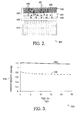
FIG. 3 is a graph comparing power generation characteristics of a prior art fuel cell and a fuel cell in accordance with the present invention. - Corresponding reference characters indicate corresponding parts throughout the several views. The exemplification set out herein illustrates one preferred embodiment of the invention, in one form, and such exemplification is not to be construed as limiting the scope of the invention in any manner.
- The advantages and benefits afforded to an anode supported solid-oxide fuel cell with a three-layer cathode in accordance with the invention may be better appreciated by first considering prior art anode supported solid-oxide fuel cells. Such fuel cells generate electric current by electrochemical combination of hydrogen and oxygen and include an anode electrode and a cathode electrode separated by an electrolyte formed of a ceramic solid oxide.
- Referring to
FIGS. 1a , a first prior art anode supported solid-oxide fuel cell 100 includes ananode 110 that supports anelectrolyte 120 consisting of a yttria stabilized zirconia (YSZ) plate.Anode 110 is typically a nickel-yttria stabilized zirconia (Ni-YSZ) substrate.Electrolyte 120 separatesanode 110 fromcathode 130. Cathode 130 is a dual layer cathode.Cathode 130 includes an ionic conductinglayer 132 that is typically ceria based and doped with, for example samarium (Sm), Gadolinium (Gd), neodymium (Nd), or yttrium (Y). A porous catalyst, which is a mixed ionic and electronic conductor (MIEC)layer 136, is deposited over ionic conductinglayer 132. Lanthanum strontium cobaltite ferrite (LSCF) may be used as material forMIEC layer 136. If LSCF is used as material forcathode 130, an initially lower polarization resistance ofcathode 130 increases as the operating temperature offuel cell 100 approaches about 800 °C due to the formation of SrZrO3, since LSCF reacts with YSZ at temperatures as low as about 800°C. Tape pull tests have shown thatcathode 130 is structurally weak and tends to delaminate from the surface ofelectrolyte 120. - Referring to
FIGS. 1b , a second prior art anode supported solid-oxide fuel cell 200 includes ananode 210 that supports anelectrolyte 220. Bothanode 210 andelectrolyte 220 may be formed from the same substances asanode 110 andelectrolyte 120 offuel cell 100, as described above.Electrolyte 220 separates anode 210 from acathode 230.Cathode 230 is also a dual layer cathode.Cathode 230 includes alayer 234 where a doped (Sm, Gd, Nd, Y etc.) ceria based ionic conducting phase is added to an MIEC material, such as LSCF. Similar tofuel cell 100, a mixed ionic and electronic conductor (MIEC)layer 236, is deposited overlayer 234 as a porous catalyst. Since infuel cell 200, the LSCF material oflayer 234 is in direct contact withYSZ electrolyte 220,fuel cell 200 is more susceptible to the formation of SrZrO3 thanfuel cell 100 as illustrated inFIG. 1a , since LSCF reacts with YSZ at temperatures as low as about 800°C. As a result,fuel cell 200 is considered less reliable thanfuel cell 100. In addition, tape pull tests have shown thatcathode 230 is also structurally weak and tends to delaminate from the surface ofelectrolyte 220. - Referring to
FIGS. 1c , a third prior art anode supported solidoxide fuel cell 300 includes ananode 310 that supports anelectrolyte 320. Both may be formed from the same substances asanode 110 andelectrolyte 120 offuel cell 100, as described above.Electrolyte 320 separates anode 310 from acathode 330.Cathode 330 is a triple layer cathode.Cathode 230 includes anionic conducting layer 332, alayer 234 deposited overlayer 332 where a doped ceria based ionic conducting phase is added to a MIEC material, such as LSCF, and aMIEC layer 336 deposited overlayer 334.Ionic conducting layer 332 is typically ceria based and doped with, for example samarium (Sm), Gadolinium (Gd), neodymium (Nd), or yttrium (Y). Even with the geometry ofcathode 330 modified to a three layer configuration, the power performance offuel cell 300 is not improved compared to the power performance offuel cells - As shown in
FIGS. 1 a through 1 c,cathodes art fuel cells - Referring to
FIG. 2 , an anode supported solid-oxide fuel cell 400 in accordance with the invention includes acathode 430 that has a three layer structure similar tocathode 330 offuel cell 300, as shown inFIG. 1 c.Fuel cell 400 in accordance with the invention also includes ananode 410, for example a nickel-yttria stabilized zirconia (Ni-YSZ) substrate, that supports anelectrolyte 420, such as a yttria stabilized zirconia (YSZ) plate.Electrolyte 420 separates anode 410 fromcathode 430. -
Cathode 430 includes anionic conducting layer 432, alayer 434 deposited overlayer 432 where a doped ceria based ionic conducting phase is added to MIEC material, such as LSCF, and aMIEC layer 436 deposited overlayer 434.Ionic conducting layer 432 may be ceria based and doped with, for example samarium (Sm), Gadolinium (Gd), neodymium (Nd), or yttrium (Y). - Adhesion of
cathode 430 in accordance with the invention is improved compared toprior art cathode 330 by modifyinglayers sintering aid 440. Thesintering aid 440 is preferably an alkaline earth metal ion from group IIA of the periodic table, such as magnesium (Mg), calcium (Ca), strontium (Sr), and barium (Ba). For example, CaCO3 and MgCO3 or their mixtures have been found to aid in the formation of porous films, are readily available and inexpensive. Other compounds of the alkaline earth metals can be used including aqueous soluble, such as acetates and nitrates, and organic soluble metal-organic compounds to these metals. The amount of thesintering aid 440 contained in thelayers - In addition to adding a
sintering aid 440, the microstructures oflayer 434 and oflayer 436 may be controlled by includingpore formers 450 in their respective compositions. The purpose ofpore formers 450 is to enable the formation of low resistance gas diffusion paths. Poreformers 450 are materials that decompose to leave the desired porosity in the sintered layer, such aslayers pore formers 450. The amount ofpore formers 450 may vary from about 0 wt% to about 100 wt% of the solid phase or even higher, with about 10 wt% to about 50 wt% being the preferred range. The constraint on the amount of pore former 450 is the mechanical strength of the resulting films. The combined effect ofsintering aid 440 and poreformers 450 yields a microstructure oflayers porous layers aid 440 and poreformers 450. By varying the amount ofsintering aid 440 and poreformers 450 added to thelayers 434 and 436 a desired and application specific microstructure of each of these layers can be achieved without undue experimentation. - In another aspect of the invention, the resistance of
cathode 430 is further reduced, compared toprior art cathodes FIGS. 1 a through 1 c, by adjusting the composition oflayer 434 by mixing an oxygenion conducting phase 460. For this purpose, a mechanical mixture of an ionic conducting phase, for example samaria doped ceria (SDC), and a mixed ionic and electronic conductor (MIEC) material, for example La0.6Sr0.4C0.2Fe0.8O3-δ, (LSCF) is prepared. Alternatively, a more homogenous mixture may be prepared via liquid phases using soluble salts, or through solid-state sintering and milling. Theionic conducting phase 460 may be any ceria doped material, such as Y2O3, Gd2O3, Nd2O3, Yb2O3, etc., with or without a variable-valance cation as a sintering aid, such as iron (Fe), cobalt (Co), and manganese (Mn) oxides. The doping level of ceria may be about 3 mole% to about 30 mole%, with about 10 mole% to about 20 mole% being the preferred range. The amount ofionic conducting phase 460 in the MIEC material may be varied from about 0 wt% to about 60 wt%, with about 25 wt% to about 50 wt% being the preferred range. - In still another aspect of the invention, the composition of the
MIEC layer 436 material, for example LSCF, may be varied in terms of relative amounts of its constituents while a pervoskite structure is maintained. The LSCF material oflayer 436 may be, for example, deficient in A-sites or may be even a mixture of the two-phase pervoskite structures arising from a relatively large deficiency in A-sites in the crystal structure oflayer 436. Other materials that are predominantly electronic conductors, for example LNF, LSC, LSF, LSM, etc. and their combinations, may be used to formMIEC layer 436 instead of LSCF. - Still referring to
FIG. 2 , relatively low sintering temperatures in the range from about 1000 °C to about 1100 °C are preferably used to formcathode 430 to avoid the formation of resistive phases at thecathode 430 andelectrolyte 420 interface, to maximize population of active sites by avoiding excessive grain growth, and to maintain high catalytic activity. The sintering time at these sintering temperatures may be varied from about 10 hours to about 0.5 hours. Decomposition of calcium carbonate (CaO) from the addedsintering aid 440 and subsequent diffusion of CaO through ceria film of theionic conducting layer 432 to theYSZ electrolyte 320 improves the bonding of all threelayers electrolyte 420 and shapes the pores withinlayers - Referring to
FIG. 3 ,graph 500 compares power generation characteristics of the first prior art fuel cell 100 (as shown inFIG. 1 a) and the fuel cell 400 (as shown inFIG. 2 ) in accordance with the present invention, both operating at 0.7 V (volts) in a fuel mixture of 50% hydrogen (H2) in nitrogen (N2) at 750 °C. Thepower density 510 is illustrated in dependence from thetime 520.Trace 530 represents the first priorart fuel cell 100 andtrace 540 representsfuel cell 400 in accordance with the invention. -
Graph 500 illustrates electrochemical test results of a variety oftest fuel cells 400 that were prepared to demonstrate the performance improvements due to the three layer structure ofcathode 430 as described above withFIG. 2 . Thecathodes 430 were build on anYSZ electrolyte 420 supported by a Ni-YSZ substrate acting as ananode 410 forfuel cell 400. - The amounts of CaCO3 as
sintering aid 440 and carbon black as pore-former 450 inlayers ion conducting phase 460 inlayer 434 were varied to optimize the microstructure oflayers cathode 430 is about 40 µm. One of the advantages of the three layer structure of thecathode 430 in accordance with the invention is that the thickness ofcathode 430 could vary over a wide range (>10 µm < 100 µm) and still show favorable electrochemical and structural performance as well as structural stability. - As illustrated in
FIG. 3 ,fuel cell 400 in accordance with the invention yields an improvement inpower density 510 of about 40 to 50% (trace 540) compared to prior art fuel cell 100 (trace 530). This improvement inpower density 510 is achieved by improving the bonding at the interface ofcathode 430 andelectrolyte 420 and by reducing the ohmic and polarization resistance of the fuel cell shown inFIG. 3 . Furthermore, the combination of pore former 450 andsintering aid 440 in bothlayers - Furthermore, tape pull tests after exposing the
test fuel cells 400 to an argon test atmosphere at 1000 °C have shown that thecathodes 430 do not delaminate from the surface ofelectrolytes 420 contrary to thecathodes 130 of the priorart fuel cells 100. - As can be seen in
FIGS. 2 and 3 , the application ofsintering aid 440, poreformers 450, and an oxygenion conducting phase 460 in the three layer structure ofcathode 400 in accordance with the invention results in a solid-oxide fuel cell 400 wherecathode 430 is well bonded toelectrolyte 420, is highly electrocatalytic, has a relatively low overall resistance, and is porous with contagious electronic, ionic, and gas diffusion paths. As a result, the power density and the durability offuel cell 400 are improved compared to priorart fuel cells - While the invention has been described by reference to various specific embodiments, it should be understood that numerous changes may be made within the spirit and scope of the inventive concepts described. Accordingly, it is intended that the invention not be limited to the described embodiments, but will have full scope defined by the language of the following claims.
Claims (15)
- A cathode (430) of a solid-oxide fuel cell (400), comprising:a first ionic conducting layer (432);a second layer (434), formed of a mixed ionic and electronic conductor material and an oxygen ion conducting phase deposited over said first layer (432);a third layer (436), formed from a mixed ionic and electronic conductor material. deposited over said second layer;a sintering aid (440) added to said second layer (434) and to said third layer (436); andpore formers (450) added to said second layer (434) and to said third layer (436);wherein said sintering aid (440) and said pore formers (450) establish ionic, electronic, and gas diffusion paths.
- The cathode (430) of Claim 1, wherein said first layer (432) is deposited over an electrolyte that is supported by an anode.
- The cathode (430) of Claim 2, wherein said electrolyte (420) is an yttria stabilized zirconia plate, and wherein said anode (410) is a nickel-yttria stabilized zirconia substrate.
- The cathode (430) of Claim 1, wherein the material of said second layer (434) is formed of lanthanum strontium cobaltite ferrite with samaria doped ceria added as said oxygen ion conducting phase (460).
- The cathode (430) of Claim 1, wherein said third layer (436) is formed of lanthanum strontium cobaltite ferrite.
- The cathode (430) of Claim 1, wherein said sintering aid (440) is an alkaline earth metal ion.or calcium carbonate or magnesium carbonate
- The cathode (430) of Claim 1, wherein said pore formers (450) are selected from carbon black, starch, graphite, and non-soluble organics.
- A solid oxide fuel cell (400) comprising:an yttria stabilized zirconia plate functioning as an electrolyte (420);a nickel- yttria stabilized zirconia substrate functioning as an anode (410) and supporting said electrolyte (420); anda cathode (430) having a three layer structure (432, 434, 436) deposited over said electrolyte 420;wherein said cathode (430) is as claimed in any one of claims 1 to 3, and wherein thefirst layer (432) is in contact with said electrolyte (420).
- The solid oxide fuel cell (400) of Claim 8, wherein an amount of said sintering aid (440) contained in said second layer (434) and in said third layer (436) varies from about 0 wt% to about 10 wt%.
- The solid oxide fuel cell (400) of Claim 8, wherein an amount of said pore formers (450) contained in said second layer (434) and in said third layer (436) varies from about0 wt % to about 100 wt % in the solid phase.
- The solid oxide fuel cell (400) of Claim 8, wherein an amount of said ionic conducting phase (460) in said mixed ionic and electronic conductor material varies from 0 wt% to about 60 wt%.
- The solid oxide fuel cell (400) of Claim 8, wherein said mixed ionic and electronic conductor material has a deficiency in A-sites in a crystal structure of said third layer.
- The solid oxide fuel cell (400) of Claim 8, wherein sintering temperatures in the range from about 1000 °C to about 1100 °C are used to form said cathode (430),
- A method for low-temperature bonding of refractory ceramic layers, comprising the steps of:building a cathode (430) having a three layer structure on an electrolyte (420) that is supported by an anode (410);adding a sintering aid (440) to a material of a center layer and to a material of a top layer of said cathode (430);adding pore formers (450) to said material of said center layer and said material of said top layer; andsintering said cathode (460) at temperatures in the range from about 1000 °C to about 1100 °C.
- The method in accordance with Claim 14, further comprising the steps of:including an oxygen ion conducting phase (460) in said material of said center layer; andvarying a composition of said material of said top layer to form a deficiency of A-sited in a crystal structure of said top layer.
Applications Claiming Priority (1)
| Application Number | Priority Date | Filing Date | Title |
|---|---|---|---|
| US12/284,499 US9276267B2 (en) | 2008-09-23 | 2008-09-23 | Low-temperature bonding of refractory ceramic layers |
Publications (2)
| Publication Number | Publication Date |
|---|---|
| EP2166601A1 true EP2166601A1 (en) | 2010-03-24 |
| EP2166601B1 EP2166601B1 (en) | 2013-06-19 |
Family
ID=41228628
Family Applications (1)
| Application Number | Title | Priority Date | Filing Date |
|---|---|---|---|
| EP09169743.3A Not-in-force EP2166601B1 (en) | 2008-09-23 | 2009-09-08 | Low-temperature bonding of refractory ceramic layers |
Country Status (3)
| Country | Link |
|---|---|
| US (1) | US9276267B2 (en) |
| EP (1) | EP2166601B1 (en) |
| DK (1) | DK2166601T3 (en) |
Cited By (5)
| Publication number | Priority date | Publication date | Assignee | Title |
|---|---|---|---|---|
| WO2011154516A1 (en) * | 2010-06-11 | 2011-12-15 | Commissariat A L'energie Atomique Et Aux Energies Alternatives | Method for manufacturing basic electrochemical cells for energy or hydrogen-producing electrochemical systems, in particular of the sofc and hte type |
| WO2014057218A3 (en) * | 2012-10-10 | 2014-06-12 | Universite De Bourgogne | Method for preparing a fuel cell |
| EP2937927A1 (en) * | 2014-04-14 | 2015-10-28 | Panasonic Intellectual Property Management Co., Ltd. | Solid oxide fuel cell and electrolysis device |
| US9463489B2 (en) | 2010-10-25 | 2016-10-11 | Commissariat A L'energie Atomique Et Aux Energies Alternatives | Process for coating a part with an oxidation-protective coating |
| US9493873B2 (en) | 2011-11-25 | 2016-11-15 | Commissariat A L'energie Atomique Et Aux Energies Alternatives | Method for preparing a coating for protecting a part against oxidation |
Families Citing this family (8)
| Publication number | Priority date | Publication date | Assignee | Title |
|---|---|---|---|---|
| WO2011136806A1 (en) * | 2010-04-30 | 2011-11-03 | Hewlett-Packard Development Company, L.P. | Ionic devices with interacting species |
| KR101164141B1 (en) * | 2010-12-16 | 2012-07-11 | 한국에너지기술연구원 | Solid oxide fuel cell for flat tube type or flat plate type |
| CA2850780A1 (en) | 2011-10-24 | 2013-05-02 | Technical University Of Denmark | A modified anode/electrolyte structure for a solid oxide electrochemical cell and a method for making said structure |
| US9005490B2 (en) * | 2012-12-14 | 2015-04-14 | Delphi Technologies, Inc. | Material for solid state sintered material |
| EP2814100A1 (en) | 2013-06-12 | 2014-12-17 | Topsøe Fuel Cell A/S | Impregnation of an electrochemical cell cathode backbone |
| JP5603515B1 (en) * | 2013-08-23 | 2014-10-08 | 日本碍子株式会社 | Air electrode material and solid oxide fuel cell |
| KR102544924B1 (en) * | 2018-09-28 | 2023-06-16 | 주식회사 엘지화학 | Method for manufacturing solid oxide fuel cell and solid oxide fuel cell manufactured thereby |
| CN114380595A (en) * | 2020-10-16 | 2022-04-22 | 宜兴摩根热陶瓷有限公司 | Oxygen ion conductive ceramic material with low sintering temperature and preparation method thereof |
Citations (5)
| Publication number | Priority date | Publication date | Assignee | Title |
|---|---|---|---|---|
| DE4237519C1 (en) | 1992-11-06 | 1994-03-31 | Dornier Gmbh | Solid electrolyte with multi-layer electrode attached to it |
| US20020177031A1 (en) * | 2001-04-10 | 2002-11-28 | Honeywell International, Inc. | High performance cathodes for solid oxide fuel cells |
| US20050214612A1 (en) * | 1999-07-31 | 2005-09-29 | The Regents Of The University Of California | Solid state electrochemical composite |
| WO2005122300A2 (en) | 2004-06-10 | 2005-12-22 | Risoe National Laboratory | Solid oxide fuel cell |
| EP1791211A1 (en) * | 2005-11-25 | 2007-05-30 | Shinko Electric Industries Co., Ltd. | Solid electrolyte fuel cell comprising a fired anode and a multi-layered porous cathode |
Family Cites Families (3)
| Publication number | Priority date | Publication date | Assignee | Title |
|---|---|---|---|---|
| JPS59107908A (en) * | 1982-12-08 | 1984-06-22 | Toyo Soda Mfg Co Ltd | Manufacture of silicon nitride powder with superior sinterability |
| EA012824B1 (en) * | 2004-09-14 | 2009-12-30 | Карбо Керамикс Инк. | Sintered spherical pellets for gas and oil wells and a method of fracturing |
| US20090148743A1 (en) * | 2007-12-07 | 2009-06-11 | Day Michael J | High performance multilayer electrodes for use in oxygen-containing gases |
-
2008
- 2008-09-23 US US12/284,499 patent/US9276267B2/en active Active
-
2009
- 2009-09-08 DK DK09169743.3T patent/DK2166601T3/en active
- 2009-09-08 EP EP09169743.3A patent/EP2166601B1/en not_active Not-in-force
Patent Citations (5)
| Publication number | Priority date | Publication date | Assignee | Title |
|---|---|---|---|---|
| DE4237519C1 (en) | 1992-11-06 | 1994-03-31 | Dornier Gmbh | Solid electrolyte with multi-layer electrode attached to it |
| US20050214612A1 (en) * | 1999-07-31 | 2005-09-29 | The Regents Of The University Of California | Solid state electrochemical composite |
| US20020177031A1 (en) * | 2001-04-10 | 2002-11-28 | Honeywell International, Inc. | High performance cathodes for solid oxide fuel cells |
| WO2005122300A2 (en) | 2004-06-10 | 2005-12-22 | Risoe National Laboratory | Solid oxide fuel cell |
| EP1791211A1 (en) * | 2005-11-25 | 2007-05-30 | Shinko Electric Industries Co., Ltd. | Solid electrolyte fuel cell comprising a fired anode and a multi-layered porous cathode |
Non-Patent Citations (2)
| Title |
|---|
| KIM J-H ET AL.: "Journal of Power Sources", vol. 22, 23 July 2003, ELSEVIER SA, article "Fabrication and characteristics of anode-supported flat-tube solid oxide fuel cell", pages: 138 - 143 |
| KIM J-H ET AL: "Fabrication and characteristics of anode-supported flat-tube solid oxide fuel cell", JOURNAL OF POWER SOURCES, ELSEVIER SA, CH, vol. 122, no. 2, 23 July 2003 (2003-07-23), pages 138 - 143, XP004437055, ISSN: 0378-7753 * |
Cited By (7)
| Publication number | Priority date | Publication date | Assignee | Title |
|---|---|---|---|---|
| WO2011154516A1 (en) * | 2010-06-11 | 2011-12-15 | Commissariat A L'energie Atomique Et Aux Energies Alternatives | Method for manufacturing basic electrochemical cells for energy or hydrogen-producing electrochemical systems, in particular of the sofc and hte type |
| FR2961350A1 (en) * | 2010-06-11 | 2011-12-16 | Commissariat Energie Atomique | PROCESS FOR THE PRODUCTION OF ELEMENTARY ELECTROCHEMICAL CELLS FOR ELECTROCHEMICAL SYSTEMS PRODUCING ENERGY OR HYDROGEN, IN PARTICULAR OF THE SOFC AND EHT TYPE |
| US9065104B2 (en) | 2010-06-11 | 2015-06-23 | Commissariat A L'energie Atomique Et Aux Energies Alternatives | Process for manufacturing elementary electrochemical cells for energy- or hydrogen-producing electrochemical systems, in particular of SOFC and HTE type |
| US9463489B2 (en) | 2010-10-25 | 2016-10-11 | Commissariat A L'energie Atomique Et Aux Energies Alternatives | Process for coating a part with an oxidation-protective coating |
| US9493873B2 (en) | 2011-11-25 | 2016-11-15 | Commissariat A L'energie Atomique Et Aux Energies Alternatives | Method for preparing a coating for protecting a part against oxidation |
| WO2014057218A3 (en) * | 2012-10-10 | 2014-06-12 | Universite De Bourgogne | Method for preparing a fuel cell |
| EP2937927A1 (en) * | 2014-04-14 | 2015-10-28 | Panasonic Intellectual Property Management Co., Ltd. | Solid oxide fuel cell and electrolysis device |
Also Published As
| Publication number | Publication date |
|---|---|
| DK2166601T3 (en) | 2013-07-08 |
| EP2166601B1 (en) | 2013-06-19 |
| US9276267B2 (en) | 2016-03-01 |
| US20100075194A1 (en) | 2010-03-25 |
Similar Documents
| Publication | Publication Date | Title |
|---|---|---|
| US9276267B2 (en) | Low-temperature bonding of refractory ceramic layers | |
| Ye et al. | High-temperature electrocatalysis and key materials in solid oxide electrolysis cells | |
| Zhang et al. | Electrochemical reduction of CO2 in solid oxide electrolysis cells | |
| Ranran et al. | Electrochemical properties of intermediate-temperature SOFCs based on proton conducting Sm-doped BaCeO3 electrolyte thin film | |
| US11817589B2 (en) | Solid oxide fuel cells with cathode functional layers | |
| Weber et al. | Materials and concepts for solid oxide fuel cells (SOFCs) in stationary and mobile applications | |
| US20090148743A1 (en) | High performance multilayer electrodes for use in oxygen-containing gases | |
| US10062909B2 (en) | Composition for fuel cell electrode | |
| US20110244365A1 (en) | Metal oxide-yttria stabilized zirconia composite and solid oxide fuel cell using the same | |
| US8802316B1 (en) | Solid oxide fuel cells having porous cathodes infiltrated with oxygen-reducing catalysts | |
| EP3488482B1 (en) | Intermediate-temperature fuel cell tailored for efficient utilization of methane | |
| Chandran et al. | A review of materials used for solid oxide fuel cell | |
| Wei et al. | Performance evaluation of an anode-supported solid oxide fuel cell with Ce0. 8Sm0. 2O1. 9 impregnated GdBaCo2O5+ δ cathode | |
| Orui et al. | Electrochemical characteristics of tubular flat-plate-SOFCs fabricated by co-firing cathode substrate and electrolyte | |
| Tarragó et al. | Perovskites used in fuel cells | |
| US20050112453A1 (en) | Fuel electrode for solid oxide fuel cell and solid oxide fuel cell using the same | |
| JP7301768B2 (en) | Electrochemical cells, electrochemical cell stacks and electrolytes for electrochemical cells | |
| US20240396052A1 (en) | Cathode composite, manufacturing method of the same and electrochemical cell comprising the same | |
| Wachsman | Development of a lower temperature SOFC | |
| US10497960B2 (en) | Solid oxide fuel cell and cell module comprising same | |
| KR20260051860A (en) | Fuel-electrode supported solid oxide cell and and manufacturing method thereof | |
| Tang et al. | Overview on grain-boundary and transport problems in solid oxide fuel cell | |
| Housel | Facile Fabrication of Mechanically Stable LSGM-Based Anodes for Use in Intermediate Temperature Solid Oxide Fuel Cells | |
| Armstrong et al. | VII. 8 LSGM-Based Composite Cathodes for Anode-Supported, Intermediate-Temperature (600-800 C) Solid Oxide Fuel Cells |
Legal Events
| Date | Code | Title | Description |
|---|---|---|---|
| PUAI | Public reference made under article 153(3) epc to a published international application that has entered the european phase |
Free format text: ORIGINAL CODE: 0009012 |
|
| AK | Designated contracting states |
Kind code of ref document: A1 Designated state(s): AT BE BG CH CY CZ DE DK EE ES FI FR GB GR HR HU IE IS IT LI LT LU LV MC MK MT NL NO PL PT RO SE SI SK SM TR |
|
| AX | Request for extension of the european patent |
Extension state: AL BA RS |
|
| 17P | Request for examination filed |
Effective date: 20100924 |
|
| 17Q | First examination report despatched |
Effective date: 20101022 |
|
| GRAP | Despatch of communication of intention to grant a patent |
Free format text: ORIGINAL CODE: EPIDOSNIGR1 |
|
| GRAS | Grant fee paid |
Free format text: ORIGINAL CODE: EPIDOSNIGR3 |
|
| GRAA | (expected) grant |
Free format text: ORIGINAL CODE: 0009210 |
|
| AK | Designated contracting states |
Kind code of ref document: B1 Designated state(s): AT BE BG CH CY CZ DE DK EE ES FI FR GB GR HR HU IE IS IT LI LT LU LV MC MK MT NL NO PL PT RO SE SI SK SM TR |
|
| REG | Reference to a national code |
Ref country code: GB Ref legal event code: FG4D |
|
| REG | Reference to a national code |
Ref country code: CH Ref legal event code: EP |
|
| REG | Reference to a national code |
Ref country code: DK Ref legal event code: T3 |
|
| REG | Reference to a national code |
Ref country code: AT Ref legal event code: REF Ref document number: 618085 Country of ref document: AT Kind code of ref document: T Effective date: 20130715 |
|
| REG | Reference to a national code |
Ref country code: IE Ref legal event code: FG4D |
|
| REG | Reference to a national code |
Ref country code: DE Ref legal event code: R096 Ref document number: 602009016485 Country of ref document: DE Effective date: 20130814 |
|
| PG25 | Lapsed in a contracting state [announced via postgrant information from national office to epo] |
Ref country code: NO Free format text: LAPSE BECAUSE OF FAILURE TO SUBMIT A TRANSLATION OF THE DESCRIPTION OR TO PAY THE FEE WITHIN THE PRESCRIBED TIME-LIMIT Effective date: 20130919 Ref country code: FI Free format text: LAPSE BECAUSE OF FAILURE TO SUBMIT A TRANSLATION OF THE DESCRIPTION OR TO PAY THE FEE WITHIN THE PRESCRIBED TIME-LIMIT Effective date: 20130619 Ref country code: ES Free format text: LAPSE BECAUSE OF FAILURE TO SUBMIT A TRANSLATION OF THE DESCRIPTION OR TO PAY THE FEE WITHIN THE PRESCRIBED TIME-LIMIT Effective date: 20130930 Ref country code: GR Free format text: LAPSE BECAUSE OF FAILURE TO SUBMIT A TRANSLATION OF THE DESCRIPTION OR TO PAY THE FEE WITHIN THE PRESCRIBED TIME-LIMIT Effective date: 20130920 Ref country code: SE Free format text: LAPSE BECAUSE OF FAILURE TO SUBMIT A TRANSLATION OF THE DESCRIPTION OR TO PAY THE FEE WITHIN THE PRESCRIBED TIME-LIMIT Effective date: 20130619 Ref country code: LT Free format text: LAPSE BECAUSE OF FAILURE TO SUBMIT A TRANSLATION OF THE DESCRIPTION OR TO PAY THE FEE WITHIN THE PRESCRIBED TIME-LIMIT Effective date: 20130619 Ref country code: SI Free format text: LAPSE BECAUSE OF FAILURE TO SUBMIT A TRANSLATION OF THE DESCRIPTION OR TO PAY THE FEE WITHIN THE PRESCRIBED TIME-LIMIT Effective date: 20130619 |
|
| REG | Reference to a national code |
Ref country code: AT Ref legal event code: MK05 Ref document number: 618085 Country of ref document: AT Kind code of ref document: T Effective date: 20130619 |
|
| REG | Reference to a national code |
Ref country code: LT Ref legal event code: MG4D |
|
| PG25 | Lapsed in a contracting state [announced via postgrant information from national office to epo] |
Ref country code: BG Free format text: LAPSE BECAUSE OF FAILURE TO SUBMIT A TRANSLATION OF THE DESCRIPTION OR TO PAY THE FEE WITHIN THE PRESCRIBED TIME-LIMIT Effective date: 20130919 Ref country code: HR Free format text: LAPSE BECAUSE OF FAILURE TO SUBMIT A TRANSLATION OF THE DESCRIPTION OR TO PAY THE FEE WITHIN THE PRESCRIBED TIME-LIMIT Effective date: 20130619 |
|
| REG | Reference to a national code |
Ref country code: NL Ref legal event code: VDEP Effective date: 20130619 |
|
| PG25 | Lapsed in a contracting state [announced via postgrant information from national office to epo] |
Ref country code: LV Free format text: LAPSE BECAUSE OF FAILURE TO SUBMIT A TRANSLATION OF THE DESCRIPTION OR TO PAY THE FEE WITHIN THE PRESCRIBED TIME-LIMIT Effective date: 20130619 |
|
| PG25 | Lapsed in a contracting state [announced via postgrant information from national office to epo] |
Ref country code: SK Free format text: LAPSE BECAUSE OF FAILURE TO SUBMIT A TRANSLATION OF THE DESCRIPTION OR TO PAY THE FEE WITHIN THE PRESCRIBED TIME-LIMIT Effective date: 20130619 Ref country code: CY Free format text: LAPSE BECAUSE OF FAILURE TO SUBMIT A TRANSLATION OF THE DESCRIPTION OR TO PAY THE FEE WITHIN THE PRESCRIBED TIME-LIMIT Effective date: 20130821 Ref country code: PT Free format text: LAPSE BECAUSE OF FAILURE TO SUBMIT A TRANSLATION OF THE DESCRIPTION OR TO PAY THE FEE WITHIN THE PRESCRIBED TIME-LIMIT Effective date: 20131021 Ref country code: BE Free format text: LAPSE BECAUSE OF FAILURE TO SUBMIT A TRANSLATION OF THE DESCRIPTION OR TO PAY THE FEE WITHIN THE PRESCRIBED TIME-LIMIT Effective date: 20130619 Ref country code: EE Free format text: LAPSE BECAUSE OF FAILURE TO SUBMIT A TRANSLATION OF THE DESCRIPTION OR TO PAY THE FEE WITHIN THE PRESCRIBED TIME-LIMIT Effective date: 20130619 Ref country code: IS Free format text: LAPSE BECAUSE OF FAILURE TO SUBMIT A TRANSLATION OF THE DESCRIPTION OR TO PAY THE FEE WITHIN THE PRESCRIBED TIME-LIMIT Effective date: 20131019 Ref country code: CZ Free format text: LAPSE BECAUSE OF FAILURE TO SUBMIT A TRANSLATION OF THE DESCRIPTION OR TO PAY THE FEE WITHIN THE PRESCRIBED TIME-LIMIT Effective date: 20130619 Ref country code: AT Free format text: LAPSE BECAUSE OF FAILURE TO SUBMIT A TRANSLATION OF THE DESCRIPTION OR TO PAY THE FEE WITHIN THE PRESCRIBED TIME-LIMIT Effective date: 20130619 |
|
| PG25 | Lapsed in a contracting state [announced via postgrant information from national office to epo] |
Ref country code: RO Free format text: LAPSE BECAUSE OF FAILURE TO SUBMIT A TRANSLATION OF THE DESCRIPTION OR TO PAY THE FEE WITHIN THE PRESCRIBED TIME-LIMIT Effective date: 20130619 Ref country code: PL Free format text: LAPSE BECAUSE OF FAILURE TO SUBMIT A TRANSLATION OF THE DESCRIPTION OR TO PAY THE FEE WITHIN THE PRESCRIBED TIME-LIMIT Effective date: 20130619 Ref country code: NL Free format text: LAPSE BECAUSE OF FAILURE TO SUBMIT A TRANSLATION OF THE DESCRIPTION OR TO PAY THE FEE WITHIN THE PRESCRIBED TIME-LIMIT Effective date: 20130619 |
|
| PG25 | Lapsed in a contracting state [announced via postgrant information from national office to epo] |
Ref country code: CY Free format text: LAPSE BECAUSE OF FAILURE TO SUBMIT A TRANSLATION OF THE DESCRIPTION OR TO PAY THE FEE WITHIN THE PRESCRIBED TIME-LIMIT Effective date: 20130619 |
|
| PLBE | No opposition filed within time limit |
Free format text: ORIGINAL CODE: 0009261 |
|
| STAA | Information on the status of an ep patent application or granted ep patent |
Free format text: STATUS: NO OPPOSITION FILED WITHIN TIME LIMIT |
|
| PG25 | Lapsed in a contracting state [announced via postgrant information from national office to epo] |
Ref country code: MC Free format text: LAPSE BECAUSE OF FAILURE TO SUBMIT A TRANSLATION OF THE DESCRIPTION OR TO PAY THE FEE WITHIN THE PRESCRIBED TIME-LIMIT Effective date: 20130619 |
|
| REG | Reference to a national code |
Ref country code: CH Ref legal event code: PL |
|
| 26N | No opposition filed |
Effective date: 20140320 |
|
| GBPC | Gb: european patent ceased through non-payment of renewal fee |
Effective date: 20130919 |
|
| PG25 | Lapsed in a contracting state [announced via postgrant information from national office to epo] |
Ref country code: IT Free format text: LAPSE BECAUSE OF FAILURE TO SUBMIT A TRANSLATION OF THE DESCRIPTION OR TO PAY THE FEE WITHIN THE PRESCRIBED TIME-LIMIT Effective date: 20130619 |
|
| REG | Reference to a national code |
Ref country code: FR Ref legal event code: ST Effective date: 20140530 |
|
| REG | Reference to a national code |
Ref country code: IE Ref legal event code: MM4A |
|
| REG | Reference to a national code |
Ref country code: DE Ref legal event code: R097 Ref document number: 602009016485 Country of ref document: DE Effective date: 20140320 |
|
| PG25 | Lapsed in a contracting state [announced via postgrant information from national office to epo] |
Ref country code: IE Free format text: LAPSE BECAUSE OF NON-PAYMENT OF DUE FEES Effective date: 20130908 Ref country code: CH Free format text: LAPSE BECAUSE OF NON-PAYMENT OF DUE FEES Effective date: 20130930 Ref country code: GB Free format text: LAPSE BECAUSE OF NON-PAYMENT OF DUE FEES Effective date: 20130919 Ref country code: LI Free format text: LAPSE BECAUSE OF NON-PAYMENT OF DUE FEES Effective date: 20130930 |
|
| PG25 | Lapsed in a contracting state [announced via postgrant information from national office to epo] |
Ref country code: FR Free format text: LAPSE BECAUSE OF NON-PAYMENT OF DUE FEES Effective date: 20130930 |
|
| PG25 | Lapsed in a contracting state [announced via postgrant information from national office to epo] |
Ref country code: SM Free format text: LAPSE BECAUSE OF FAILURE TO SUBMIT A TRANSLATION OF THE DESCRIPTION OR TO PAY THE FEE WITHIN THE PRESCRIBED TIME-LIMIT Effective date: 20130619 |
|
| PG25 | Lapsed in a contracting state [announced via postgrant information from national office to epo] |
Ref country code: MT Free format text: LAPSE BECAUSE OF FAILURE TO SUBMIT A TRANSLATION OF THE DESCRIPTION OR TO PAY THE FEE WITHIN THE PRESCRIBED TIME-LIMIT Effective date: 20130619 Ref country code: TR Free format text: LAPSE BECAUSE OF FAILURE TO SUBMIT A TRANSLATION OF THE DESCRIPTION OR TO PAY THE FEE WITHIN THE PRESCRIBED TIME-LIMIT Effective date: 20130619 |
|
| PG25 | Lapsed in a contracting state [announced via postgrant information from national office to epo] |
Ref country code: HU Free format text: LAPSE BECAUSE OF FAILURE TO SUBMIT A TRANSLATION OF THE DESCRIPTION OR TO PAY THE FEE WITHIN THE PRESCRIBED TIME-LIMIT; INVALID AB INITIO Effective date: 20090908 Ref country code: LU Free format text: LAPSE BECAUSE OF NON-PAYMENT OF DUE FEES Effective date: 20130908 Ref country code: MK Free format text: LAPSE BECAUSE OF FAILURE TO SUBMIT A TRANSLATION OF THE DESCRIPTION OR TO PAY THE FEE WITHIN THE PRESCRIBED TIME-LIMIT Effective date: 20130619 |
|
| PGFP | Annual fee paid to national office [announced via postgrant information from national office to epo] |
Ref country code: DE Payment date: 20150929 Year of fee payment: 7 |
|
| PGFP | Annual fee paid to national office [announced via postgrant information from national office to epo] |
Ref country code: DK Payment date: 20160927 Year of fee payment: 8 |
|
| REG | Reference to a national code |
Ref country code: DE Ref legal event code: R119 Ref document number: 602009016485 Country of ref document: DE |
|
| PG25 | Lapsed in a contracting state [announced via postgrant information from national office to epo] |
Ref country code: DE Free format text: LAPSE BECAUSE OF NON-PAYMENT OF DUE FEES Effective date: 20170401 |
|
| REG | Reference to a national code |
Ref country code: DK Ref legal event code: EBP Effective date: 20170930 |
|
| PG25 | Lapsed in a contracting state [announced via postgrant information from national office to epo] |
Ref country code: DK Free format text: LAPSE BECAUSE OF NON-PAYMENT OF DUE FEES Effective date: 20170930 |