EP2163549A1 - Process for the Preparation of Tetronic Acid - Google Patents
Process for the Preparation of Tetronic Acid Download PDFInfo
- Publication number
- EP2163549A1 EP2163549A1 EP09169613A EP09169613A EP2163549A1 EP 2163549 A1 EP2163549 A1 EP 2163549A1 EP 09169613 A EP09169613 A EP 09169613A EP 09169613 A EP09169613 A EP 09169613A EP 2163549 A1 EP2163549 A1 EP 2163549A1
- Authority
- EP
- European Patent Office
- Prior art keywords
- acid
- reaction
- tetronic
- ester
- tetronic acid
- Prior art date
- Legal status (The legal status is an assumption and is not a legal conclusion. Google has not performed a legal analysis and makes no representation as to the accuracy of the status listed.)
- Withdrawn
Links
- PGRHXDWITVMQBC-UHFFFAOYSA-N dehydroacetic acid Natural products CC(=O)C1C(=O)OC(C)=CC1=O PGRHXDWITVMQBC-UHFFFAOYSA-N 0.000 title claims abstract description 46
- PEQJBOMPGWYIRO-UHFFFAOYSA-N n-ethyl-3,4-dimethoxyaniline Chemical compound CCNC1=CC=C(OC)C(OC)=C1 PEQJBOMPGWYIRO-UHFFFAOYSA-N 0.000 title claims abstract description 46
- 238000000034 method Methods 0.000 title claims description 32
- 238000002360 preparation method Methods 0.000 title claims description 5
- 238000006243 chemical reaction Methods 0.000 claims abstract description 50
- 239000003960 organic solvent Substances 0.000 claims abstract description 23
- 150000002148 esters Chemical class 0.000 claims abstract description 22
- 239000002253 acid Substances 0.000 claims abstract description 18
- XLYOFNOQVPJJNP-UHFFFAOYSA-N water Substances O XLYOFNOQVPJJNP-UHFFFAOYSA-N 0.000 claims abstract description 18
- 125000000217 alkyl group Chemical group 0.000 claims abstract description 8
- 125000004435 hydrogen atom Chemical group [H]* 0.000 claims abstract description 4
- QTBSBXVTEAMEQO-UHFFFAOYSA-N Acetic acid Chemical compound CC(O)=O QTBSBXVTEAMEQO-UHFFFAOYSA-N 0.000 claims description 48
- 239000002904 solvent Substances 0.000 claims description 30
- VEXZGXHMUGYJMC-UHFFFAOYSA-N Hydrochloric acid Chemical compound Cl VEXZGXHMUGYJMC-UHFFFAOYSA-N 0.000 claims description 18
- CVEFXRBXZIGLMA-UHFFFAOYSA-N ethyl 4-[(2-methylpropan-2-yl)oxy]-3-oxobutanoate Chemical compound CCOC(=O)CC(=O)COC(C)(C)C CVEFXRBXZIGLMA-UHFFFAOYSA-N 0.000 claims description 14
- IXCSERBJSXMMFS-UHFFFAOYSA-N hydrogen chloride Substances Cl.Cl IXCSERBJSXMMFS-UHFFFAOYSA-N 0.000 claims description 13
- 229910000041 hydrogen chloride Inorganic materials 0.000 claims description 13
- 239000007789 gas Substances 0.000 claims description 10
- 239000003905 agrochemical Substances 0.000 abstract description 3
- 239000003814 drug Substances 0.000 abstract description 3
- 239000012847 fine chemical Substances 0.000 abstract description 3
- 229920000642 polymer Polymers 0.000 abstract description 3
- 239000004065 semiconductor Substances 0.000 abstract description 3
- XEKOWRVHYACXOJ-UHFFFAOYSA-N Ethyl acetate Chemical compound CCOC(C)=O XEKOWRVHYACXOJ-UHFFFAOYSA-N 0.000 description 21
- YXFVVABEGXRONW-UHFFFAOYSA-N Toluene Chemical compound CC1=CC=CC=C1 YXFVVABEGXRONW-UHFFFAOYSA-N 0.000 description 15
- 238000004519 manufacturing process Methods 0.000 description 15
- 238000001704 evaporation Methods 0.000 description 14
- 230000008020 evaporation Effects 0.000 description 11
- WYURNTSHIVDZCO-UHFFFAOYSA-N Tetrahydrofuran Chemical compound C1CCOC1 WYURNTSHIVDZCO-UHFFFAOYSA-N 0.000 description 10
- YMWUJEATGCHHMB-UHFFFAOYSA-N Dichloromethane Chemical compound ClCCl YMWUJEATGCHHMB-UHFFFAOYSA-N 0.000 description 9
- 239000013078 crystal Substances 0.000 description 9
- 238000002425 crystallisation Methods 0.000 description 8
- 230000008025 crystallization Effects 0.000 description 8
- 239000011541 reaction mixture Substances 0.000 description 7
- 238000000926 separation method Methods 0.000 description 7
- WEVYAHXRMPXWCK-UHFFFAOYSA-N Acetonitrile Chemical compound CC#N WEVYAHXRMPXWCK-UHFFFAOYSA-N 0.000 description 6
- 125000004432 carbon atom Chemical group C* 0.000 description 6
- SKTCDJAMAYNROS-UHFFFAOYSA-N methoxycyclopentane Chemical compound COC1CCCC1 SKTCDJAMAYNROS-UHFFFAOYSA-N 0.000 description 6
- RTZKZFJDLAIYFH-UHFFFAOYSA-N Diethyl ether Chemical compound CCOCC RTZKZFJDLAIYFH-UHFFFAOYSA-N 0.000 description 5
- 238000007664 blowing Methods 0.000 description 5
- OHLRLMWUFVDREV-UHFFFAOYSA-N ethyl 4-chloro-3-oxobutanoate Chemical compound CCOC(=O)CC(=O)CCl OHLRLMWUFVDREV-UHFFFAOYSA-N 0.000 description 5
- 229910052751 metal Inorganic materials 0.000 description 5
- 239000002184 metal Substances 0.000 description 5
- VLKZOEOYAKHREP-UHFFFAOYSA-N n-Hexane Chemical compound CCCCCC VLKZOEOYAKHREP-UHFFFAOYSA-N 0.000 description 5
- 150000007524 organic acids Chemical class 0.000 description 5
- 238000000746 purification Methods 0.000 description 5
- 239000007858 starting material Substances 0.000 description 5
- YLQBMQCUIZJEEH-UHFFFAOYSA-N tetrahydrofuran Natural products C=1C=COC=1 YLQBMQCUIZJEEH-UHFFFAOYSA-N 0.000 description 5
- 125000005907 alkyl ester group Chemical group 0.000 description 4
- 238000001914 filtration Methods 0.000 description 4
- 239000000203 mixture Substances 0.000 description 4
- SDTMFDGELKWGFT-UHFFFAOYSA-N 2-methylpropan-2-olate Chemical compound CC(C)(C)[O-] SDTMFDGELKWGFT-UHFFFAOYSA-N 0.000 description 3
- LFQSCWFLJHTTHZ-UHFFFAOYSA-N Ethanol Chemical compound CCO LFQSCWFLJHTTHZ-UHFFFAOYSA-N 0.000 description 3
- OKKJLVBELUTLKV-UHFFFAOYSA-N Methanol Chemical compound OC OKKJLVBELUTLKV-UHFFFAOYSA-N 0.000 description 3
- ZMXDDKWLCZADIW-UHFFFAOYSA-N N,N-Dimethylformamide Chemical compound CN(C)C=O ZMXDDKWLCZADIW-UHFFFAOYSA-N 0.000 description 3
- 150000007513 acids Chemical class 0.000 description 3
- 239000007864 aqueous solution Substances 0.000 description 3
- JFDZBHWFFUWGJE-UHFFFAOYSA-N benzonitrile Chemical compound N#CC1=CC=CC=C1 JFDZBHWFFUWGJE-UHFFFAOYSA-N 0.000 description 3
- 238000009835 boiling Methods 0.000 description 3
- -1 butyloctyl groups Chemical group 0.000 description 3
- 239000004210 ether based solvent Substances 0.000 description 3
- 238000000605 extraction Methods 0.000 description 3
- 239000000463 material Substances 0.000 description 3
- 239000000047 product Substances 0.000 description 3
- 238000001953 recrystallisation Methods 0.000 description 3
- RYHBNJHYFVUHQT-UHFFFAOYSA-N 1,4-Dioxane Chemical compound C1COCCO1 RYHBNJHYFVUHQT-UHFFFAOYSA-N 0.000 description 2
- DJEJYZZJYYNADA-UHFFFAOYSA-N 3-chlorooxolane-2,4-dione Chemical compound ClC1C(=O)COC1=O DJEJYZZJYYNADA-UHFFFAOYSA-N 0.000 description 2
- YEJRWHAVMIAJKC-UHFFFAOYSA-N 4-Butyrolactone Chemical compound O=C1CCCO1 YEJRWHAVMIAJKC-UHFFFAOYSA-N 0.000 description 2
- KVCGLPKGMWWEMC-UHFFFAOYSA-N 6-(hydroxymethyl)-2,2-dimethyl-1,3-dioxin-4-one Chemical compound CC1(C)OC(=O)C=C(CO)O1 KVCGLPKGMWWEMC-UHFFFAOYSA-N 0.000 description 2
- HEDRZPFGACZZDS-UHFFFAOYSA-N Chloroform Chemical compound ClC(Cl)Cl HEDRZPFGACZZDS-UHFFFAOYSA-N 0.000 description 2
- XTHFKEDIFFGKHM-UHFFFAOYSA-N Dimethoxyethane Chemical compound COCCOC XTHFKEDIFFGKHM-UHFFFAOYSA-N 0.000 description 2
- IAZDPXIOMUYVGZ-UHFFFAOYSA-N Dimethylsulphoxide Chemical compound CS(C)=O IAZDPXIOMUYVGZ-UHFFFAOYSA-N 0.000 description 2
- DGAQECJNVWCQMB-PUAWFVPOSA-M Ilexoside XXIX Chemical compound C[C@@H]1CC[C@@]2(CC[C@@]3(C(=CC[C@H]4[C@]3(CC[C@@H]5[C@@]4(CC[C@@H](C5(C)C)OS(=O)(=O)[O-])C)C)[C@@H]2[C@]1(C)O)C)C(=O)O[C@H]6[C@@H]([C@H]([C@@H]([C@H](O6)CO)O)O)O.[Na+] DGAQECJNVWCQMB-PUAWFVPOSA-M 0.000 description 2
- KFZMGEQAYNKOFK-UHFFFAOYSA-N Isopropanol Chemical compound CC(C)O KFZMGEQAYNKOFK-UHFFFAOYSA-N 0.000 description 2
- LRHPLDYGYMQRHN-UHFFFAOYSA-N N-Butanol Chemical compound CCCCO LRHPLDYGYMQRHN-UHFFFAOYSA-N 0.000 description 2
- IMNFDUFMRHMDMM-UHFFFAOYSA-N N-Heptane Chemical compound CCCCCCC IMNFDUFMRHMDMM-UHFFFAOYSA-N 0.000 description 2
- OFBQJSOFQDEBGM-UHFFFAOYSA-N Pentane Chemical compound CCCCC OFBQJSOFQDEBGM-UHFFFAOYSA-N 0.000 description 2
- NBIIXXVUZAFLBC-UHFFFAOYSA-N Phosphoric acid Chemical compound OP(O)(O)=O NBIIXXVUZAFLBC-UHFFFAOYSA-N 0.000 description 2
- QAOWNCQODCNURD-UHFFFAOYSA-N Sulfuric acid Chemical compound OS(O)(=O)=O QAOWNCQODCNURD-UHFFFAOYSA-N 0.000 description 2
- DKGAVHZHDRPRBM-UHFFFAOYSA-N Tert-Butanol Chemical compound CC(C)(C)O DKGAVHZHDRPRBM-UHFFFAOYSA-N 0.000 description 2
- HEDRZPFGACZZDS-MICDWDOJSA-N Trichloro(2H)methane Chemical compound [2H]C(Cl)(Cl)Cl HEDRZPFGACZZDS-MICDWDOJSA-N 0.000 description 2
- QARVLSVVCXYDNA-UHFFFAOYSA-N bromobenzene Chemical compound BrC1=CC=CC=C1 QARVLSVVCXYDNA-UHFFFAOYSA-N 0.000 description 2
- 125000003178 carboxy group Chemical group [H]OC(*)=O 0.000 description 2
- MVPPADPHJFYWMZ-UHFFFAOYSA-N chlorobenzene Chemical compound ClC1=CC=CC=C1 MVPPADPHJFYWMZ-UHFFFAOYSA-N 0.000 description 2
- 238000004440 column chromatography Methods 0.000 description 2
- 238000001514 detection method Methods 0.000 description 2
- XBDQKXXYIPTUBI-UHFFFAOYSA-N dimethylselenoniopropionate Natural products CCC(O)=O XBDQKXXYIPTUBI-UHFFFAOYSA-N 0.000 description 2
- 238000004821 distillation Methods 0.000 description 2
- 239000003759 ester based solvent Substances 0.000 description 2
- 238000004128 high performance liquid chromatography Methods 0.000 description 2
- 125000002887 hydroxy group Chemical group [H]O* 0.000 description 2
- 238000011835 investigation Methods 0.000 description 2
- BDAGIHXWWSANSR-UHFFFAOYSA-N methanoic acid Natural products OC=O BDAGIHXWWSANSR-UHFFFAOYSA-N 0.000 description 2
- 238000000199 molecular distillation Methods 0.000 description 2
- 238000006386 neutralization reaction Methods 0.000 description 2
- 238000007363 ring formation reaction Methods 0.000 description 2
- 229910052708 sodium Inorganic materials 0.000 description 2
- 239000011734 sodium Substances 0.000 description 2
- MFRIHAYPQRLWNB-UHFFFAOYSA-N sodium tert-butoxide Chemical compound [Na+].CC(C)(C)[O-] MFRIHAYPQRLWNB-UHFFFAOYSA-N 0.000 description 2
- 238000003756 stirring Methods 0.000 description 2
- 239000000126 substance Substances 0.000 description 2
- 125000001424 substituent group Chemical group 0.000 description 2
- HXJUTPCZVOIRIF-UHFFFAOYSA-N sulfolane Chemical class O=S1(=O)CCCC1 HXJUTPCZVOIRIF-UHFFFAOYSA-N 0.000 description 2
- 238000003786 synthesis reaction Methods 0.000 description 2
- PJANXHGTPQOBST-VAWYXSNFSA-N trans-stilbene Chemical compound C=1C=CC=CC=1/C=C/C1=CC=CC=C1 PJANXHGTPQOBST-VAWYXSNFSA-N 0.000 description 2
- WSLDOOZREJYCGB-UHFFFAOYSA-N 1,2-Dichloroethane Chemical compound ClCCCl WSLDOOZREJYCGB-UHFFFAOYSA-N 0.000 description 1
- DURPTKYDGMDSBL-UHFFFAOYSA-N 1-butoxybutane Chemical compound CCCCOCCCC DURPTKYDGMDSBL-UHFFFAOYSA-N 0.000 description 1
- 238000005160 1H NMR spectroscopy Methods 0.000 description 1
- FLXXBDLDPLYXTE-UHFFFAOYSA-N 2,4-dichloro-3-oxobutanoic acid Chemical compound OC(=O)C(Cl)C(=O)CCl FLXXBDLDPLYXTE-UHFFFAOYSA-N 0.000 description 1
- OSWFIVFLDKOXQC-UHFFFAOYSA-N 4-(3-methoxyphenyl)aniline Chemical compound COC1=CC=CC(C=2C=CC(N)=CC=2)=C1 OSWFIVFLDKOXQC-UHFFFAOYSA-N 0.000 description 1
- UCTNTYHJFWMUBD-UHFFFAOYSA-N 4-chloro-3-oxobutanoic acid Chemical compound OC(=O)CC(=O)CCl UCTNTYHJFWMUBD-UHFFFAOYSA-N 0.000 description 1
- DKPFZGUDAPQIHT-UHFFFAOYSA-N Butyl acetate Natural products CCCCOC(C)=O DKPFZGUDAPQIHT-UHFFFAOYSA-N 0.000 description 1
- XCJRXDPMTAHVGP-UHFFFAOYSA-N CC[O](CC)C1=CC(O)OC1 Chemical compound CC[O](CC)C1=CC(O)OC1 XCJRXDPMTAHVGP-UHFFFAOYSA-N 0.000 description 1
- ZAFNJMIOTHYJRJ-UHFFFAOYSA-N Diisopropyl ether Chemical compound CC(C)OC(C)C ZAFNJMIOTHYJRJ-UHFFFAOYSA-N 0.000 description 1
- CPELXLSAUQHCOX-UHFFFAOYSA-N Hydrogen bromide Chemical compound Br CPELXLSAUQHCOX-UHFFFAOYSA-N 0.000 description 1
- WHXSMMKQMYFTQS-UHFFFAOYSA-N Lithium Chemical compound [Li] WHXSMMKQMYFTQS-UHFFFAOYSA-N 0.000 description 1
- 238000005481 NMR spectroscopy Methods 0.000 description 1
- ZLMJMSJWJFRBEC-UHFFFAOYSA-N Potassium Chemical compound [K] ZLMJMSJWJFRBEC-UHFFFAOYSA-N 0.000 description 1
- XBDQKXXYIPTUBI-UHFFFAOYSA-M Propionate Chemical compound CCC([O-])=O XBDQKXXYIPTUBI-UHFFFAOYSA-M 0.000 description 1
- 235000011054 acetic acid Nutrition 0.000 description 1
- KXKVLQRXCPHEJC-UHFFFAOYSA-N acetic acid trimethyl ester Natural products COC(C)=O KXKVLQRXCPHEJC-UHFFFAOYSA-N 0.000 description 1
- 125000004423 acyloxy group Chemical group 0.000 description 1
- 239000005456 alcohol based solvent Substances 0.000 description 1
- 125000003545 alkoxy group Chemical group 0.000 description 1
- 125000004453 alkoxycarbonyl group Chemical group 0.000 description 1
- 229910000147 aluminium phosphate Inorganic materials 0.000 description 1
- 150000001408 amides Chemical class 0.000 description 1
- 125000003277 amino group Chemical group 0.000 description 1
- 150000004945 aromatic hydrocarbons Chemical class 0.000 description 1
- 125000005098 aryl alkoxy carbonyl group Chemical group 0.000 description 1
- 125000002102 aryl alkyloxo group Chemical group 0.000 description 1
- 125000005161 aryl oxy carbonyl group Chemical group 0.000 description 1
- 125000004104 aryloxy group Chemical group 0.000 description 1
- 230000015572 biosynthetic process Effects 0.000 description 1
- 244000309464 bull Species 0.000 description 1
- BTANRVKWQNVYAZ-UHFFFAOYSA-N butan-2-ol Chemical compound CCC(C)O BTANRVKWQNVYAZ-UHFFFAOYSA-N 0.000 description 1
- 125000000484 butyl group Chemical group [H]C([*])([H])C([H])([H])C([H])([H])C([H])([H])[H] 0.000 description 1
- 125000003917 carbamoyl group Chemical group [H]N([H])C(*)=O 0.000 description 1
- 150000001875 compounds Chemical class 0.000 description 1
- 239000012141 concentrate Substances 0.000 description 1
- 238000009833 condensation Methods 0.000 description 1
- 230000005494 condensation Effects 0.000 description 1
- 238000001816 cooling Methods 0.000 description 1
- 125000004093 cyano group Chemical group *C#N 0.000 description 1
- 238000000354 decomposition reaction Methods 0.000 description 1
- 125000002704 decyl group Chemical group [H]C([H])([H])C([H])([H])C([H])([H])C([H])([H])C([H])([H])C([H])([H])C([H])([H])C([H])([H])C([H])([H])C([H])([H])* 0.000 description 1
- 125000003438 dodecyl group Chemical group [H]C([H])([H])C([H])([H])C([H])([H])C([H])([H])C([H])([H])C([H])([H])C([H])([H])C([H])([H])C([H])([H])C([H])([H])C([H])([H])C([H])([H])* 0.000 description 1
- 238000001035 drying Methods 0.000 description 1
- 125000001495 ethyl group Chemical group [H]C([H])([H])C([H])([H])* 0.000 description 1
- 239000000706 filtrate Substances 0.000 description 1
- 235000019253 formic acid Nutrition 0.000 description 1
- 150000008282 halocarbons Chemical class 0.000 description 1
- 125000005843 halogen group Chemical group 0.000 description 1
- 238000010438 heat treatment Methods 0.000 description 1
- 125000000623 heterocyclic group Chemical group 0.000 description 1
- FUZZWVXGSFPDMH-UHFFFAOYSA-N hexanoic acid Chemical compound CCCCCC(O)=O FUZZWVXGSFPDMH-UHFFFAOYSA-N 0.000 description 1
- 125000004051 hexyl group Chemical group [H]C([H])([H])C([H])([H])C([H])([H])C([H])([H])C([H])([H])C([H])([H])* 0.000 description 1
- 238000005984 hydrogenation reaction Methods 0.000 description 1
- 230000001771 impaired effect Effects 0.000 description 1
- 239000012535 impurity Substances 0.000 description 1
- 125000000959 isobutyl group Chemical group [H]C([H])([H])C([H])(C([H])([H])[H])C([H])([H])* 0.000 description 1
- 125000001449 isopropyl group Chemical group [H]C([H])([H])C([H])(*)C([H])([H])[H] 0.000 description 1
- 150000002596 lactones Chemical class 0.000 description 1
- 239000007788 liquid Substances 0.000 description 1
- 229910052744 lithium Inorganic materials 0.000 description 1
- 230000014759 maintenance of location Effects 0.000 description 1
- 125000002496 methyl group Chemical group [H]C([H])([H])* 0.000 description 1
- 150000007522 mineralic acids Chemical class 0.000 description 1
- 150000002825 nitriles Chemical class 0.000 description 1
- 125000000449 nitro group Chemical group [O-][N+](*)=O 0.000 description 1
- 125000001400 nonyl group Chemical group [H]C([*])([H])C([H])([H])C([H])([H])C([H])([H])C([H])([H])C([H])([H])C([H])([H])C([H])([H])C([H])([H])[H] 0.000 description 1
- 238000000655 nuclear magnetic resonance spectrum Methods 0.000 description 1
- TVMXDCGIABBOFY-UHFFFAOYSA-N octane Chemical compound CCCCCCCC TVMXDCGIABBOFY-UHFFFAOYSA-N 0.000 description 1
- 125000002347 octyl group Chemical group [H]C([*])([H])C([H])([H])C([H])([H])C([H])([H])C([H])([H])C([H])([H])C([H])([H])C([H])([H])[H] 0.000 description 1
- 235000005985 organic acids Nutrition 0.000 description 1
- 239000012044 organic layer Substances 0.000 description 1
- 125000004043 oxo group Chemical group O=* 0.000 description 1
- 125000001820 oxy group Chemical group [*:1]O[*:2] 0.000 description 1
- 125000005740 oxycarbonyl group Chemical group [*:1]OC([*:2])=O 0.000 description 1
- 125000001147 pentyl group Chemical group C(CCCC)* 0.000 description 1
- 239000003208 petroleum Substances 0.000 description 1
- 229920001223 polyethylene glycol Polymers 0.000 description 1
- 229910052700 potassium Inorganic materials 0.000 description 1
- 239000011591 potassium Substances 0.000 description 1
- 238000001556 precipitation Methods 0.000 description 1
- BDERNNFJNOPAEC-UHFFFAOYSA-N propan-1-ol Chemical compound CCCO BDERNNFJNOPAEC-UHFFFAOYSA-N 0.000 description 1
- 235000019260 propionic acid Nutrition 0.000 description 1
- 125000001436 propyl group Chemical group [H]C([*])([H])C([H])([H])C([H])([H])[H] 0.000 description 1
- 125000006239 protecting group Chemical group 0.000 description 1
- 238000000425 proton nuclear magnetic resonance spectrum Methods 0.000 description 1
- IUVKMZGDUIUOCP-BTNSXGMBSA-N quinbolone Chemical compound O([C@H]1CC[C@H]2[C@H]3[C@@H]([C@]4(C=CC(=O)C=C4CC3)C)CC[C@@]21C)C1=CCCC1 IUVKMZGDUIUOCP-BTNSXGMBSA-N 0.000 description 1
- 230000009257 reactivity Effects 0.000 description 1
- 238000010992 reflux Methods 0.000 description 1
- 238000001226 reprecipitation Methods 0.000 description 1
- 229920006395 saturated elastomer Polymers 0.000 description 1
- 229930195734 saturated hydrocarbon Natural products 0.000 description 1
- 125000002914 sec-butyl group Chemical group [H]C([H])([H])C([H])([H])C([H])(*)C([H])([H])[H] 0.000 description 1
- 229920002545 silicone oil Polymers 0.000 description 1
- 239000007787 solid Substances 0.000 description 1
- 239000000243 solution Substances 0.000 description 1
- 125000000020 sulfo group Chemical group O=S(=O)([*])O[H] 0.000 description 1
- 150000003462 sulfoxides Chemical class 0.000 description 1
- 125000000999 tert-butyl group Chemical group [H]C([H])([H])C(*)(C([H])([H])[H])C([H])([H])[H] 0.000 description 1
- PJANXHGTPQOBST-UHFFFAOYSA-N trans-Stilbene Natural products C=1C=CC=CC=1C=CC1=CC=CC=C1 PJANXHGTPQOBST-UHFFFAOYSA-N 0.000 description 1
- 125000002948 undecyl group Chemical group [H]C([*])([H])C([H])([H])C([H])([H])C([H])([H])C([H])([H])C([H])([H])C([H])([H])C([H])([H])C([H])([H])C([H])([H])C([H])([H])[H] 0.000 description 1
- 229930195735 unsaturated hydrocarbon Natural products 0.000 description 1
Classifications
-
- C—CHEMISTRY; METALLURGY
- C07—ORGANIC CHEMISTRY
- C07D—HETEROCYCLIC COMPOUNDS
- C07D307/00—Heterocyclic compounds containing five-membered rings having one oxygen atom as the only ring hetero atom
- C07D307/02—Heterocyclic compounds containing five-membered rings having one oxygen atom as the only ring hetero atom not condensed with other rings
- C07D307/34—Heterocyclic compounds containing five-membered rings having one oxygen atom as the only ring hetero atom not condensed with other rings having two or three double bonds between ring members or between ring members and non-ring members
- C07D307/56—Heterocyclic compounds containing five-membered rings having one oxygen atom as the only ring hetero atom not condensed with other rings having two or three double bonds between ring members or between ring members and non-ring members with hetero atoms or with carbon atoms having three bonds to hetero atoms with at the most one bond to halogen, e.g. ester or nitrile radicals, directly attached to ring carbon atoms
- C07D307/60—Two oxygen atoms, e.g. succinic anhydride
-
- C—CHEMISTRY; METALLURGY
- C07—ORGANIC CHEMISTRY
- C07D—HETEROCYCLIC COMPOUNDS
- C07D307/00—Heterocyclic compounds containing five-membered rings having one oxygen atom as the only ring hetero atom
- C07D307/02—Heterocyclic compounds containing five-membered rings having one oxygen atom as the only ring hetero atom not condensed with other rings
- C07D307/26—Heterocyclic compounds containing five-membered rings having one oxygen atom as the only ring hetero atom not condensed with other rings having one double bond between ring members or between a ring member and a non-ring member
- C07D307/30—Heterocyclic compounds containing five-membered rings having one oxygen atom as the only ring hetero atom not condensed with other rings having one double bond between ring members or between a ring member and a non-ring member with hetero atoms or with carbon atoms having three bonds to hetero atoms with at the most one bond to halogen, e.g. ester or nitrile radicals, directly attached to ring carbon atoms
- C07D307/32—Oxygen atoms
Definitions
- the present invention relates to a process for the preparation of tetronic acid.
- Tetronic acid is useful as an intermediate for fine chemicals such as pharmaceuticals and agricultural chemicals and as an intermediate for semiconductor resist polymers.
- An exemplary known process for preparing tetronic acid is a process of preparing tetronic acid by reacting ethyl 4-tert-butoxyacetoacetate with an aqueous solution of hydrogen chloride(hydrochloric acid) and evaporating the aqueous solution of hydrogen chloride to dryness (Japanese Unexamined Patent Application Publication (JP-A) No. S58-971 ; and JP-A No. S58-972 ).
- JP-A No. S60-184073 discloses a process for preparing tetronic acid by chlorinating an ester of 4-chloroacetoacetic acid to 2,4-dichloroacetoacetic acid, subjecting the same to a heat treatment to give 3-chlorotetronic acid, dissolving resulting 3-chlorotetronic acid in water, carrying out a hydrogenation reaction, and evaporating the reaction mixture to dryness on a rotary evaporator.
- This process is also not advantageous in commercial-scale production, because extremely great energy is required for the evaporation of a large amount of water, as in the above process.
- JP-A No. H03-52881 discloses a process for preparing tetronic acid, in which water is not used in the reaction.
- a lower alkyl ester of 4-halo-3-alkoxy-2-butenecarboxylic acid is subjected to cyclization to give an alkyl ester of tetronic acid
- the alkyl ester of tetronic acid is hydrolyzed with an acid. More specifically the alkyl ester of tetronic acid is hydrolyzed with hydrogen chloride or hydrogen bromide in acetic acid, the solvent acetic acid is evaporated to dryness, tetronic acid is precipitated from methylene chloride, and collected through filtration.
- this process is also not advantageous in commercial-scale production, because it requires extremely great energy for the evaporation of acetic acid to dryness and uses a large amount of methylene chloride that significantly affects the environment.
- Chem. Pharm. Bull., 1990, pages 99-102 discloses a process for preparing tetronic acid by refluxing 6-hydroxymethyl-2,2-dimethyl-1,3-dioxin-4-one in solvent toluene, evaporating the solvent to dryness, and carrying out recrystallization of tetronic acid from ethyl acetate.
- This process is also not advantageous in commercial production, because it requires extremely great energy for the evaporation of the solvent to dryness and, in addition, the synthesis of material 6-hydroxymethyl-2,2-dimethyl-1,3-dioxin-4-one requires many steps.
- an object of the present invention is to provide a process for industrially efficiently preparing tetronic acid that is useful as an intermediate for fine chemicals such as pharmaceuticals and agricultural chemicals and as an intermediate for semiconductor resist polymers.
- the present inventors After intensive investigations to achieve the objects, the present inventors have found that a process for preparing tetronic acid by subjecting 4-hydroxy- or 4-alkoxy-acetoacetic acid or an ester thereof to cyclization using an organic solvent and an acid in the absence of water is very advantageous in commercial-scale production, because crystals of tetronic acid can be recovered without requiring evaporation of water to dryness, and the process thereby does not require extra energy for the evaporation or condensation of water.
- the present invention has been made based on these findings and further investigations.
- the process preferably further includes the step of crystallizing tetronic acid from a poor solvent after the step of carrying out the reaction. Such crystallization is a more energy saving and more simple procedure than evaporation to dryness.
- the process more preferably further includes the step of reducing the amount of the organic solvent in the reaction system after the step of carrying out the reaction and before the step of crystallizing.
- Acetic acid and hydrogen chloride gas are preferably used as the organic solvent and the acid, respectively.
- the material 4-hydroxy- or 4-alkoxy-acetoacetic acid, or an ester thereof, represented by Formula (1) is preferably ethyl 4-tert-butoxyacetoacetate.
- the process according to the present invention prepares tetronic acid from 4-hydroxy- or 4-alkoxy-acetoacetic acid or an ester thereof, using an organic solvent and an acid in the absence of water, thereby does not require evaporation of water to dryness for obtaining crystals of tetronic acid, and does not require much energy for the evaporation of a large amount of water.
- the process is therefore very advantageous in commercial-scale production.
- the reaction is carried out in acetic acid as the organic solvent while blowing hydrogen chloride gas as the acid directly into the reaction system; the amount of acetic acid is reduced after the reaction; and a poor solvent is then added to carry out crystallization of tetronic acid.
- impurities can be easily separated from product tetronic acid into a filtrate; acetic acid used as the organic solvent enables an efficient reaction in a nonaqueous reaction system as in an aqueous reaction system and enables purification of product tetronic acid through crystallization; hydrogen chloride gas used as the acid can be blown directly into the reaction system and thereby enables efficient reaction.
- high-purity tetronic acid can be efficiently produced while minimizing consumed energy.
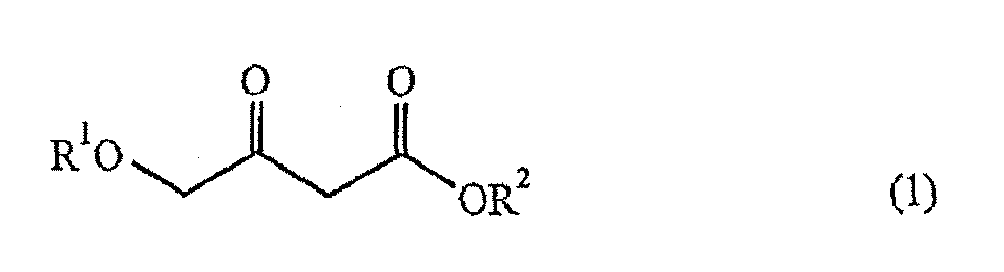
- a process according to an embodiment of the present invention prepares tetronic acid represented by Formula (2) through a reaction of 4-hydroxy- or 4-alkoxy-acetoacetic acid, or an ester thereof, represented by Formula (1).
- This process includes the step of carrying out the reaction using an organic solvent and an acid in the absence of water.
- organic solvents for use herein include ester solvents such as ethyl acetate; aromatic hydrocarbon solvents such as toluene; ether solvents such as 1,4-dioxane; and organic acid solvents such as acetic acid, formic acid, and propionic acid.
- organic acid solvents are preferred, of which acetic acid is especially preferred, because these organic acid solvents, especially acetic acid, allow the reaction to proceed efficiently and enable purification of resulting tetronic acid not through the evaporation of the organic solvent to dryness but through crystallization. Such crystallization is a more energy saving and more simple procedure than evaporation to dryness.
- the amount of the organic solvent is not specifically limited, as long as reaction components can be dissolved or dispersed therein, and economical efficiency and other advantages are not impaired. Typically, the amount can be selected within a range of generally from about 1 to about 20 parts by weight, and preferably from about 2 to about 5 parts by weight, per 1 part by weight of 4-hydroxy- or 4-alkoxy-acetoacetic acid or an ester thereof. If the amount of the organic solvent is less than the above range, the yield and selectivity may deteriorate. In contrast, if the amount of the organic solvent is more than the above range, the concentration after the reaction may be done to a more extent, and the efficiency may thereby deteriorate.
- Exemplary acids for use herein include inorganic acids such as hydrogen chloride gas and sulfuric acid; and organic acids.
- An organic acid if used as the solvent, can also be used as the acid.
- hydrogen chloride gas is preferably used herein, because it can be easily eliminated after the reaction.
- the amount of the acid can be set as appropriate, and is, for example, generally from about 1 to about 50 parts by mole, preferably from about 1 to about 10 parts by mole, and especially preferably from about 1 to about 2 parts by mole, per 1 part by mole of 4-hydroxy- or 4-alkoxy-acetoacetic acid or an ester thereof. If the amount of the acid is lower than the above range, the reaction rate may often deteriorate, and this may impede efficient production of tetronic acid.
- R 1 and R 2 each independently represent a hydrogen atom or an alkyl group.
- exemplary alkyl groups include linear alkyl groups containing from about 1 to about 20 carbon atoms, such as methyl, ethyl, propyl, butyl, pentyl, hexyl, octyl, nonyl, decyl, undecyl, and dodecyl groups, of which those containing from about 1 to about 10 carbon atoms are preferred, and those containing from about 1 to about 5 carbon atoms are more preferred; and branched-chain alkyl groups containing from about 3 to about 20 carbon atoms, such as isopropyl, isobutyl, sec-butyl, tert-butyl, and butyloctyl groups, of which those containing from about 3 to about 10 carbon atoms are preferred, and
- the alkyl groups may each have a variety of substituents.
- substituents include halogen atoms, oxo groups, hydroxyl groups, substituted oxy groups (e.g., alkoxy groups, aryloxy groups, aralkyloxy groups, and acyloxy groups), carboxyl groups, substituted oxycarbonyl groups (e.g., alkoxycarbonyl groups, aryloxycarbonyl groups, and aralkyloxycarbonyl groups), substituted or unsubstituted carbamoyl groups, cyano groups, nitro groups, substituted or unsubstituted amino groups, sulfo groups, and heterocyclic groups.
- the hydroxyl groups and carboxyl groups may be protected by protecting groups commonly used in organic synthesis.
- ethyl 4-tert-butoxyacetoacetate is preferably used as the 4-hydroxy- or 4-alkoxy-acetoacetic acid, or an ester thereof, represented by Formula (1), since the reaction will proceed satisfactorily rapidly.
- the 4-hydroxy- or 4-alkoxy-acetoacetic acid, or an ester thereof, represented by Formula (1) can be prepared by a know reaction or through the application of such a known reaction.
- ethyl 4-tert-butoxyacetoacetate can be prepared, for example, by reacting ethyl 4-chloroacetoacetate with a metal tert-butoxide (t-BuOM), as in following Formula (3):
- Examples of the metal element (M) in the metal tert-butoxide include sodium, potassium, and lithium. Among them, sodium is preferred as the metal element (M) for satisfactory reactivity, broad utility, and high economical efficiency.
- the reaction temperature in the reaction between ethyl 4-chloroacetoacetate and the metal tert-butoxide can be suitably chosen according typically to the production rate of ethyl 4-tert-butoxyacetoacetate and the stability of the starting material ethyl 4-chloroacetoacetate and of the product ethyl 4-tert-butoxyacetoacetate. It can be chosen, for example, within a range of from about 0°C to about 100°C, preferably from about 0°C to about 50°C, and especially preferably from about 10°C to about 40°C.
- the reaction is generally performed under normal atmospheric pressure or under a pressure (under a load) (e.g., at a pressure of from about 0.1 to about 50 MPa, and preferably from about 0.1 to about 10 MPa).
- the reaction may also be performed under reduced pressure for the sake of operational convenience.
- the reaction may be performed in the presence of, or in the absence of, a solvent, but is generally performed in the presence of a solvent.
- solvents include ether solvents such as diethyl ether, diisopropyl ether, dibutyl ether, tetrahydrofuran, dioxane, 1,2-dimethoxyethane, and cyclopentyl methyl ether (CPME); nitriles such as acetonitrile and benzonitrile; sulfoxide solvents such as dimethyl sulfoxide; sulfolanes such as sulfolane; ester solvents such as methyl acetate, ethyl acetate, and butyl acetate; lactones such as ⁇ -butyrolactone; amide solvents such as dimethylformamide; alcohol solvents such as methanol, ethanol, propanol, isopropanol, n-butanol, s-butanol, and
- the amount of solvents is not especially limited, as long as reaction components can be dissolved or dispersed therein and the economical efficiency and other properties are not damaged.
- the amount of solvents can be chosen within a range of from about 1 to about 100000 parts by weight, and preferably from about 1 to about 10000 parts by weight, per 100 parts by weight of ethyl 4-chloroacetoacetate fed to the reaction system.
- reaction may be performed according to any of a batch system, a semi-batch system, and a continuous system.
- resulting ethyl 4-tert-butoxyacetoacetate may be purified according to a common separation/purification procedure such as separation through neutralization, extraction, distillation, rectification, molecular distillation, crystallization, recrystallization, and/or column chromatography.
- the reaction temperature in the reaction for the preparation of tetronic acid from 4-hydroxy- or 4-alkoxy-acetoacetic acid or an ester thereof can be appropriately chosen according typically to the stability of the starting material 4-hydroxy- or 4-alkoxy-acetoacetic acid or an ester thereof.
- the temperature is, for example, from about -10°C to about 100°C, preferably from about 5°C to about 50°C, and especially preferably from about 10°C to about 40°C.
- a reaction, if performed at a temperature below -10°C proceeds at a significantly low rate, and this may impede efficient production of target tetronic acid.
- a reaction, if performed at a temperature over 100°C may tend to cause decomposition of the material, and this may lower the yield.
- the reaction is generally performed under normal atmospheric pressure or under a pressure (under a load) (for example, at a pressure of from about 0.1 to about 50 MPa, and preferably from about 0.1 to about 10 MPa).
- the reaction may also be performed under reduced pressure for the sake of operational convenience.
- reaction may be performed according to any of a batch system, a semi-batch system, and a continuous system.
- resulting tetronic acid may be purified according to a common separation/purification procedure such as separation through neutralization, extraction, distillation, rectification, molecular distillation, crystallization, recrystallization, and/or column chromatography.
- the process further includes the step of crystallizing tetronic acid from a poor solvent after the step of carrying out the reaction. It is enough for the poor solvent to show a low solubility to tetronic acid.
- poor solvents include toluene, ethyl acetate, cyclopentylmethyl ether (CPME), and n-hexane, of which toluene and ethyl acetate are preferably used for satisfactory yield, effective purification, and broad utility.
- the amount of poor solvent can be suitably set according to the combination of the starting material 4-hydroxy- or 4-alkoxy-acetoacetic acid or an ester thereof and the poor solvent, and can be chosen within a range of, for example, generally from about 0.5 to about 10 parts by weight, and preferably from about 1 to about 5 parts by weight, per 1 part by weight of 4-hydroxy- or 4-alkoxy-acetoacetic acid or an ester thereof.
- a poor solvent if its amount is excessively small, may not sufficiently contribute to efficient production of high-quality tetronic acid. Contrarily, a poor solvent, if its amount is excessively large, may cause economical disadvantage.
- the process further includes the step of reducing the amount of the organic solvent in the system after the step of carrying out the reaction and before the step of crystallizing. Reduction of the amount of the organic solvent in the system enables efficient precipitation of crystals of tetronic acid.
- the amount of the organic solvent in the system can be reduced, for example, by distilling off the organic solvent to concentrate the reaction mixture.
- the amount of the organic solvent after reduction typically through concentration can be suitably set according typically to the type of the starting material 4-hydroxy- or 4-alkoxy-acetoacetic acid or an ester thereof, and can be chosen within a range of, for example, generally from about 0.5 to about 10 parts by weight, and preferably from about 1 to about 2 parts by weight, per 1 part by weight of 4-hydroxy-or 4-alkoxy-acetoacetic acid or an ester thereof.
- High-purity, high-quality tetronic acid can be prepared by subjecting crystals of tetronic acid precipitated by crystallization to a solid-liquid separation procedure such as filtration or centrifugal separation; subjecting the resulting solid to reprecipitation according to necessity; and drying.
- NMR spectra were measured at 500 MHz ( 1 H-NMR) with a nuclear magnetic resonance system (trade name "BRUKER AM500” supplied by Bruker Corporation).
- the purity of tetronic acid was determined quantitatively through high-performance liquid chromatography (HPLC) under the analytical conditions below using a commercial authentic sample.
Landscapes
- Chemical & Material Sciences (AREA)
- Organic Chemistry (AREA)
- Organic Low-Molecular-Weight Compounds And Preparation Thereof (AREA)
- Furan Compounds (AREA)
Abstract

Description
- The present invention relates to a process for the preparation of tetronic acid. Tetronic acid is useful as an intermediate for fine chemicals such as pharmaceuticals and agricultural chemicals and as an intermediate for semiconductor resist polymers.
- An exemplary known process for preparing tetronic acid is a process of preparing tetronic acid by reacting ethyl 4-tert-butoxyacetoacetate with an aqueous solution of hydrogen chloride(hydrochloric acid) and evaporating the aqueous solution of hydrogen chloride to dryness (Japanese Unexamined Patent Application Publication (JP-A) No.
S58-971 JP-A No. S58-972 -
JP-A No. S60-184073 - Independently,
JP-A No. H03-52881 - Chem. Pharm. Bull., 1990, pages 99-102 discloses a process for preparing tetronic acid by refluxing 6-hydroxymethyl-2,2-dimethyl-1,3-dioxin-4-one in solvent toluene, evaporating the solvent to dryness, and carrying out recrystallization of tetronic acid from ethyl acetate. This process, however, is also not advantageous in commercial production, because it requires extremely great energy for the evaporation of the solvent to dryness and, in addition, the synthesis of material 6-hydroxymethyl-2,2-dimethyl-1,3-dioxin-4-one requires many steps.
- Accordingly, an object of the present invention is to provide a process for industrially efficiently preparing tetronic acid that is useful as an intermediate for fine chemicals such as pharmaceuticals and agricultural chemicals and as an intermediate for semiconductor resist polymers.
- After intensive investigations to achieve the objects, the present inventors have found that a process for preparing tetronic acid by subjecting 4-hydroxy- or 4-alkoxy-acetoacetic acid or an ester thereof to cyclization using an organic solvent and an acid in the absence of water is very advantageous in commercial-scale production, because crystals of tetronic acid can be recovered without requiring evaporation of water to dryness, and the process thereby does not require extra energy for the evaporation or condensation of water. The present invention has been made based on these findings and further investigations.
- Specifically, according to an embodiment of the present invention, there is provided a process for the preparation of tetronic acid represented by following Formula (2):


the process comprising the step of carrying out the reaction in the presence of an organic solvent and an acid but substantially in the absence of water. - The process preferably further includes the step of crystallizing tetronic acid from a poor solvent after the step of carrying out the reaction. Such crystallization is a more energy saving and more simple procedure than evaporation to dryness. The process more preferably further includes the step of reducing the amount of the organic solvent in the reaction system after the step of carrying out the reaction and before the step of crystallizing.
- Acetic acid and hydrogen chloride gas are preferably used as the organic solvent and the acid, respectively.
- The material 4-hydroxy- or 4-alkoxy-acetoacetic acid, or an ester thereof, represented by Formula (1) is preferably ethyl 4-tert-butoxyacetoacetate.
- The process according to the present invention prepares tetronic acid from 4-hydroxy- or 4-alkoxy-acetoacetic acid or an ester thereof, using an organic solvent and an acid in the absence of water, thereby does not require evaporation of water to dryness for obtaining crystals of tetronic acid, and does not require much energy for the evaporation of a large amount of water. The process is therefore very advantageous in commercial-scale production.
- In a preferred embodiment, the reaction is carried out in acetic acid as the organic solvent while blowing hydrogen chloride gas as the acid directly into the reaction system; the amount of acetic acid is reduced after the reaction; and a poor solvent is then added to carry out crystallization of tetronic acid. According to such embodiment, impurities can be easily separated from product tetronic acid into a filtrate; acetic acid used as the organic solvent enables an efficient reaction in a nonaqueous reaction system as in an aqueous reaction system and enables purification of product tetronic acid through crystallization; hydrogen chloride gas used as the acid can be blown directly into the reaction system and thereby enables efficient reaction. Thus, high-purity tetronic acid can be efficiently produced while minimizing consumed energy.
- These and other objects, features, and advantages of the present invention will be understood more fully from the following description of the preferred embodiments. All numbers are herein assumed to be modified by the term "about."
- A process according to an embodiment of the present invention prepares tetronic acid represented by Formula (2) through a reaction of 4-hydroxy- or 4-alkoxy-acetoacetic acid, or an ester thereof, represented by Formula (1). This process includes the step of carrying out the reaction using an organic solvent and an acid in the absence of water.
- Exemplary organic solvents for use herein include ester solvents such as ethyl acetate; aromatic hydrocarbon solvents such as toluene; ether solvents such as 1,4-dioxane; and organic acid solvents such as acetic acid, formic acid, and propionic acid. Among them, organic acid solvents are preferred, of which acetic acid is especially preferred, because these organic acid solvents, especially acetic acid, allow the reaction to proceed efficiently and enable purification of resulting tetronic acid not through the evaporation of the organic solvent to dryness but through crystallization. Such crystallization is a more energy saving and more simple procedure than evaporation to dryness.
- The amount of the organic solvent is not specifically limited, as long as reaction components can be dissolved or dispersed therein, and economical efficiency and other advantages are not impaired. Typically, the amount can be selected within a range of generally from about 1 to about 20 parts by weight, and preferably from about 2 to about 5 parts by weight, per 1 part by weight of 4-hydroxy- or 4-alkoxy-acetoacetic acid or an ester thereof. If the amount of the organic solvent is less than the above range, the yield and selectivity may deteriorate. In contrast, if the amount of the organic solvent is more than the above range, the concentration after the reaction may be done to a more extent, and the efficiency may thereby deteriorate.
- Exemplary acids for use herein include inorganic acids such as hydrogen chloride gas and sulfuric acid; and organic acids. An organic acid, if used as the solvent, can also be used as the acid. Among such acids, hydrogen chloride gas is preferably used herein, because it can be easily eliminated after the reaction.
- The amount of the acid can be set as appropriate, and is, for example, generally from about 1 to about 50 parts by mole, preferably from about 1 to about 10 parts by mole, and especially preferably from about 1 to about 2 parts by mole, per 1 part by mole of 4-hydroxy- or 4-alkoxy-acetoacetic acid or an ester thereof. If the amount of the acid is lower than the above range, the reaction rate may often deteriorate, and this may impede efficient production of tetronic acid.
- The starting material 4-hydroxy- or 4-alkoxy-acetoacetic acid or an ester thereof for use herein is represented by Formula (1). In Formula (1), R1 and R2 each independently represent a hydrogen atom or an alkyl group. Exemplary alkyl groups include linear alkyl groups containing from about 1 to about 20 carbon atoms, such as methyl, ethyl, propyl, butyl, pentyl, hexyl, octyl, nonyl, decyl, undecyl, and dodecyl groups, of which those containing from about 1 to about 10 carbon atoms are preferred, and those containing from about 1 to about 5 carbon atoms are more preferred; and branched-chain alkyl groups containing from about 3 to about 20 carbon atoms, such as isopropyl, isobutyl, sec-butyl, tert-butyl, and butyloctyl groups, of which those containing from about 3 to about 10 carbon atoms are preferred, and those containing from about 3 to about 5 carbon atoms are more preferred.
- The alkyl groups may each have a variety of substituents. Exemplary substituents include halogen atoms, oxo groups, hydroxyl groups, substituted oxy groups (e.g., alkoxy groups, aryloxy groups, aralkyloxy groups, and acyloxy groups), carboxyl groups, substituted oxycarbonyl groups (e.g., alkoxycarbonyl groups, aryloxycarbonyl groups, and aralkyloxycarbonyl groups), substituted or unsubstituted carbamoyl groups, cyano groups, nitro groups, substituted or unsubstituted amino groups, sulfo groups, and heterocyclic groups. The hydroxyl groups and carboxyl groups may be protected by protecting groups commonly used in organic synthesis.
- Among the compounds represented by Formula (1), ethyl 4-tert-butoxyacetoacetate is preferably used as the 4-hydroxy- or 4-alkoxy-acetoacetic acid, or an ester thereof, represented by Formula (1), since the reaction will proceed satisfactorily rapidly.
- The 4-hydroxy- or 4-alkoxy-acetoacetic acid, or an ester thereof, represented by Formula (1) can be prepared by a know reaction or through the application of such a known reaction.
- Of 4-hydroxy- or 4-alkoxy-acetoacetic acid and esters thereof represented by Formula (1), ethyl 4-tert-butoxyacetoacetate can be prepared, for example, by reacting ethyl 4-chloroacetoacetate with a metal tert-butoxide (t-BuOM), as in following Formula (3):

- Examples of the metal element (M) in the metal tert-butoxide include sodium, potassium, and lithium. Among them, sodium is preferred as the metal element (M) for satisfactory reactivity, broad utility, and high economical efficiency.
- The reaction temperature in the reaction between ethyl 4-chloroacetoacetate and the metal tert-butoxide can be suitably chosen according typically to the production rate of ethyl 4-tert-butoxyacetoacetate and the stability of the starting material ethyl 4-chloroacetoacetate and of the product ethyl 4-tert-butoxyacetoacetate. It can be chosen, for example, within a range of from about 0°C to about 100°C, preferably from about 0°C to about 50°C, and especially preferably from about 10°C to about 40°C.
- The reaction is generally performed under normal atmospheric pressure or under a pressure (under a load) (e.g., at a pressure of from about 0.1 to about 50 MPa, and preferably from about 0.1 to about 10 MPa). The reaction may also be performed under reduced pressure for the sake of operational convenience.
- The reaction may be performed in the presence of, or in the absence of, a solvent, but is generally performed in the presence of a solvent. Exemplary solvents include ether solvents such as diethyl ether, diisopropyl ether, dibutyl ether, tetrahydrofuran, dioxane, 1,2-dimethoxyethane, and cyclopentyl methyl ether (CPME); nitriles such as acetonitrile and benzonitrile; sulfoxide solvents such as dimethyl sulfoxide; sulfolanes such as sulfolane; ester solvents such as methyl acetate, ethyl acetate, and butyl acetate; lactones such as γ-butyrolactone; amide solvents such as dimethylformamide; alcohol solvents such as methanol, ethanol, propanol, isopropanol, n-butanol, s-butanol, and t-butanol; saturated or unsaturated hydrocarbon solvents such as pentane, hexane, heptane, octane, and petroleum ether; halogenated hydrocarbon solvents such as methylene chloride, chloroform, 1,2-dichloroethane, chlorobenzene, and bromobenzene; and high-boiling solvents such as poly(ethylene glycol)s and silicone oils. Among them, ether solvents such as tetrahydrofuran and cyclopentyl methyl ether (CPME) are preferably used. Each of different solvents can be used alone or in combination.
- The amount of solvents is not especially limited, as long as reaction components can be dissolved or dispersed therein and the economical efficiency and other properties are not damaged. Typically, the amount of solvents can be chosen within a range of from about 1 to about 100000 parts by weight, and preferably from about 1 to about 10000 parts by weight, per 100 parts by weight of ethyl 4-chloroacetoacetate fed to the reaction system.
- The reaction may be performed according to any of a batch system, a semi-batch system, and a continuous system. Where necessary, resulting ethyl 4-tert-butoxyacetoacetate may be purified according to a common separation/purification procedure such as separation through neutralization, extraction, distillation, rectification, molecular distillation, crystallization, recrystallization, and/or column chromatography.
- The reaction temperature in the reaction for the preparation of tetronic acid from 4-hydroxy- or 4-alkoxy-acetoacetic acid or an ester thereof can be appropriately chosen according typically to the stability of the starting material 4-hydroxy- or 4-alkoxy-acetoacetic acid or an ester thereof. The temperature is, for example, from about -10°C to about 100°C, preferably from about 5°C to about 50°C, and especially preferably from about 10°C to about 40°C. A reaction, if performed at a temperature below -10°C, proceeds at a significantly low rate, and this may impede efficient production of target tetronic acid. In contrast, a reaction, if performed at a temperature over 100°C, may tend to cause decomposition of the material, and this may lower the yield.
- The reaction is generally performed under normal atmospheric pressure or under a pressure (under a load) (for example, at a pressure of from about 0.1 to about 50 MPa, and preferably from about 0.1 to about 10 MPa). The reaction may also be performed under reduced pressure for the sake of operational convenience.
- The reaction may be performed according to any of a batch system, a semi-batch system, and a continuous system. Where necessary, resulting tetronic acid may be purified according to a common separation/purification procedure such as separation through neutralization, extraction, distillation, rectification, molecular distillation, crystallization, recrystallization, and/or column chromatography.
- In a preferred embodiment of the present invention, the process further includes the step of crystallizing tetronic acid from a poor solvent after the step of carrying out the reaction. It is enough for the poor solvent to show a low solubility to tetronic acid. Examples of such poor solvents include toluene, ethyl acetate, cyclopentylmethyl ether (CPME), and n-hexane, of which toluene and ethyl acetate are preferably used for satisfactory yield, effective purification, and broad utility.
- The amount of poor solvent can be suitably set according to the combination of the starting material 4-hydroxy- or 4-alkoxy-acetoacetic acid or an ester thereof and the poor solvent, and can be chosen within a range of, for example, generally from about 0.5 to about 10 parts by weight, and preferably from about 1 to about 5 parts by weight, per 1 part by weight of 4-hydroxy- or 4-alkoxy-acetoacetic acid or an ester thereof. A poor solvent, if its amount is excessively small, may not sufficiently contribute to efficient production of high-quality tetronic acid. Contrarily, a poor solvent, if its amount is excessively large, may cause economical disadvantage.
- In another preferred embodiment, the process further includes the step of reducing the amount of the organic solvent in the system after the step of carrying out the reaction and before the step of crystallizing. Reduction of the amount of the organic solvent in the system enables efficient precipitation of crystals of tetronic acid.
- The amount of the organic solvent in the system can be reduced, for example, by distilling off the organic solvent to concentrate the reaction mixture. The amount of the organic solvent after reduction typically through concentration can be suitably set according typically to the type of the starting material 4-hydroxy- or 4-alkoxy-acetoacetic acid or an ester thereof, and can be chosen within a range of, for example, generally from about 0.5 to about 10 parts by weight, and preferably from about 1 to about 2 parts by weight, per 1 part by weight of 4-hydroxy-or 4-alkoxy-acetoacetic acid or an ester thereof.
- High-purity, high-quality tetronic acid can be prepared by subjecting crystals of tetronic acid precipitated by crystallization to a solid-liquid separation procedure such as filtration or centrifugal separation; subjecting the resulting solid to reprecipitation according to necessity; and drying.
- The present invention will be illustrated in further detail with reference to several examples below. It should be noted, however, these examples are never construed to limit the scope of the present invention.
- NMR spectra were measured at 500 MHz (1H-NMR) with a nuclear magnetic resonance system (trade name "BRUKER AM500" supplied by Bruker Corporation).
- The amount of ethyl 4-tert-butoxyacetoacetate was determined using trans-stilbene as internal standard.
- The purity of tetronic acid was determined quantitatively through high-performance liquid chromatography (HPLC) under the analytical conditions below using a commercial authentic sample.
-
- Column: trade name "TSK-GEL ODS-80Ts QA", 4.6 mm in diameter and 250 mm in length, supplied by Tosoh Corporation
- Mobile phase: 0.2% aqueous phosphoric acid solution /acetonitrile = 95/5
- Detection wavelength: UV (230 nm)
- Detection temperature: 40°C
- Flow rate: 1.0 ml/min.
- Sample amount: 10 µl
- Retention time: 5.7 min.
- Sample concentration: 300 ppm
- Sodium tert-butoxide (53.7 g, 0.559 mol) was suspended in tetrahydrofuran (429 g), to which a mixture of ethyl 4-chloroacetoacetate (40.0 g, 0.243 mol) and tetrahydrofuran (71.0 g) was added dropwise so that the temperature fell within a range of from 20°C to about 30°C. After the completion of dropwise addition, the mixture was stirred at room temperature (25°C) for 20 hours. After condensing tetrahydrofuran, a diluted hydrochloric acid (a mixture of 34.4 g of 35% hydrochloric acid and 200 g of water) was added dropwise under ice-cooling, followed by extraction with ethyl acetate and separation. The organic layer was washed with water, concentrated, and thereby yielded ethyl 4-tert-butoxyacetoacetate (yield: 43.1 g, yield by weight: 87.7%, purity: 76.6%).
- 1H-NMR spectrum of ethyl 4-tert-butoxyacetoacetate (CDCl3): δ 1.21 (s, 9H), 1.27 (t, 3H), 3.55 (s, 2H), 4.01 (s, 2H), 4.19 (q, 2H)
- The above-prepared ethyl 4-tert-butoxyacetoacetate (40 g, 0.152 mol (converted based on purity)) was dissolved in acetic acid (210 g), followed by blowing hydrogen chloride gas (0.308 mol) thereinto at temperatures of from 20°C to 30°C. After the blowing, the mixture was stirred at room temperature (25°C) for 1 hour. The reaction mixture was placed in an evaporator, the pressure was reduced, residual hydrogen chloride gas was eliminated, low-boiling substances and acetic acid were then distilled out, and thereby the reaction mixture was concentrated to an amount of residual acetic acid of one-fifth (42 g) the charged amount. The residue was stirred to precipitate crystals, to which toluene (70 g) was added dropwise, followed by stirring at room temperature (25°C) for 2 hours. The crystals were collected by filtration and thereby yielded tetronic acid (yield: 11.5 g, yield by weight: 74.6%, purity: 98.1%).
- Ethyl 4-tert-butoxyacetoacetate was prepared by the procedure of Example 1.
- The above-prepared ethyl 4-tert-butoxyacetoacetate (10 g, 0.0399 mol (converted based on purity)) was dissolved in acetic acid (21.1 g), followed by blowing of hydrogen chloride gas (0.0867 mol) thereinto at temperatures of from 20°C to 30°C. After the blowing, the reaction mixture was stirred at room temperature (25°C) for 1 hour, placed in an evaporator, the pressure was reduced, residual hydrogen chloride gas was eliminated, low-boiling substances and acetic acid were then distilled out, and thereby the reaction mixture was concentrated to an amount of residual acetic acid of one half (10.55 g) the charged amount. The residue was stirred to precipitate crystals, to which ethyl acetate (9 g) was added dropwise, followed by stirring at room temperature (25°C) for 2 hours. The crystals were collected by filtration and thereby yielded tetronic acid (yield: 1.92 g, yield by weight: 47.5%, purity: 99.2%).
- While the above description is of the preferred embodiments of the present invention, it should be appreciated that the invention may be modified, altered, or varied without deviating from the scope and fair meaning of the following claims.
Claims (5)
- A process for the preparation of tetronic acid represented by following Formula (2):


the process comprising the step of carrying out the reaction in the presence of an organic solvent and an acid but substantially in the absence of water. - The process according to claim 1, further comprising the step of crystallizing tetronic acid from a poor solvent after the step of carrying out the reaction.
- The process according to claim 2, further comprising the step of reducing the amount of the organic solvent in the reaction system after the step of carrying out the reaction and before the step of crystallizing.
- The process according to any one of claims 1 to 3, wherein acetic acid and hydrogen chloride gas are used as the organic solvent and the acid, respectively.
- The process according to any one of claims 1 to 4, wherein ethyl 4-tert-butoxyacetoacetate is used as the 4-hydroxy- or 4-alkoxy-acetoacetic acid, or an ester thereof, represented by Formula (1).
Applications Claiming Priority (1)
| Application Number | Priority Date | Filing Date | Title |
|---|---|---|---|
| JP2008236613A JP2010070460A (en) | 2008-09-16 | 2008-09-16 | Method for producing tetronic acid |
Publications (1)
| Publication Number | Publication Date |
|---|---|
| EP2163549A1 true EP2163549A1 (en) | 2010-03-17 |
Family
ID=41283076
Family Applications (1)
| Application Number | Title | Priority Date | Filing Date |
|---|---|---|---|
| EP09169613A Withdrawn EP2163549A1 (en) | 2008-09-16 | 2009-09-07 | Process for the Preparation of Tetronic Acid |
Country Status (5)
| Country | Link |
|---|---|
| EP (1) | EP2163549A1 (en) |
| JP (1) | JP2010070460A (en) |
| KR (1) | KR20100032320A (en) |
| CN (1) | CN101676278A (en) |
| TW (1) | TW201016674A (en) |
Families Citing this family (1)
| Publication number | Priority date | Publication date | Assignee | Title |
|---|---|---|---|---|
| CN106008419B (en) * | 2016-06-15 | 2022-02-15 | 上海丸全化学科技有限公司 | Synthesis process of tetronic acid |
Citations (4)
| Publication number | Priority date | Publication date | Assignee | Title |
|---|---|---|---|---|
| EP0067409A1 (en) * | 1981-06-17 | 1982-12-22 | Lonza Ag | Process for the preparation of tetronic acid |
| JPS58971A (en) | 1981-06-17 | 1983-01-06 | ロンザ・リミテツド | Manufacture of tetronic acid |
| JPS60184073A (en) | 1984-02-09 | 1985-09-19 | ロンザ リミテツド | Manufacture of tetronic acid |
| JPH0352881A (en) | 1989-07-20 | 1991-03-07 | Lonza Ag | Preparation of tetronic alkylate |
-
2008
- 2008-09-16 JP JP2008236613A patent/JP2010070460A/en active Pending
-
2009
- 2009-09-07 EP EP09169613A patent/EP2163549A1/en not_active Withdrawn
- 2009-09-15 TW TW098130995A patent/TW201016674A/en unknown
- 2009-09-15 CN CN200910173553A patent/CN101676278A/en active Pending
- 2009-09-15 KR KR1020090086749A patent/KR20100032320A/en not_active Withdrawn
Patent Citations (5)
| Publication number | Priority date | Publication date | Assignee | Title |
|---|---|---|---|---|
| EP0067409A1 (en) * | 1981-06-17 | 1982-12-22 | Lonza Ag | Process for the preparation of tetronic acid |
| JPS58971A (en) | 1981-06-17 | 1983-01-06 | ロンザ・リミテツド | Manufacture of tetronic acid |
| JPS58972A (en) | 1981-06-17 | 1983-01-06 | ロンザ・リミテツド | Manufacture of tetronic acid |
| JPS60184073A (en) | 1984-02-09 | 1985-09-19 | ロンザ リミテツド | Manufacture of tetronic acid |
| JPH0352881A (en) | 1989-07-20 | 1991-03-07 | Lonza Ag | Preparation of tetronic alkylate |
Non-Patent Citations (1)
| Title |
|---|
| CHEM. PHARM. BULL., 1990, pages 99 - 102 |
Also Published As
| Publication number | Publication date |
|---|---|
| KR20100032320A (en) | 2010-03-25 |
| JP2010070460A (en) | 2010-04-02 |
| CN101676278A (en) | 2010-03-24 |
| TW201016674A (en) | 2010-05-01 |
Similar Documents
| Publication | Publication Date | Title |
|---|---|---|
| EP3909961B1 (en) | L-glufosinate intermediate and l-glufosinate preparation method | |
| EP2360135B1 (en) | Method for manufacturing neuraminic acid derivatives | |
| US20110130576A1 (en) | Process for producing (z)-1-phenyl-1-(n,n-diethylaminocarbonyl)-2-phthalimidomethylcyclopropane | |
| CN113498409A (en) | Process for producing alpha, beta-unsaturated dicarboxylic acid ester | |
| EP2163549A1 (en) | Process for the Preparation of Tetronic Acid | |
| EP2241552B1 (en) | Production method and beckmann rearrangement catalyst for producing a cyclic lactam compound | |
| US11339133B2 (en) | Method for producing triazolidinedione compound | |
| US10822304B2 (en) | Process for the production of N-Boc-2-amino-3,3-dimethylbutyric acid | |
| US7745649B2 (en) | Processes for preparing tetrahydropyran-4-one and pyran-4-one | |
| US6632950B2 (en) | Process for the preparation of derivatives of 4-amino-3-hydroxypyrrole-2-carboxylic acid | |
| US20240182401A1 (en) | A process for the preparation of mixed oxybate salts and polymorphs thereof | |
| CN1127503C (en) | (R)-2[3-(2-N-phthalic amido ethyl)-4,5-dihydro-5-isoxazolyl]-acetic acid and its synthesis | |
| CA2571379C (en) | An improved process for lactonization in the preparation of statins | |
| US6992210B2 (en) | Fluorine-containing cyclic esters, fluorine-containing cyclic alcohols, and their production processes | |
| JP4084501B2 (en) | α-Mercaptocarboxylic acid and process for producing the same | |
| WO2023100110A1 (en) | Process for preparing brivaracetam | |
| US10150731B2 (en) | Method for preparing 4-cyanopiperidine hydrochloride | |
| CN115028579A (en) | Synthetic method of rebamipide bulk drug | |
| WO2025022637A1 (en) | Method for producing cyclized product by cyclization reaction involving dehydration condensation of carboxylic acid ester derivative, and method for producing 1,3,4-substituted-pyrazole-5-carboxylic acid ester | |
| CN117567419A (en) | A kind of synthesis method of 3-aminomethylchromone derivatives | |
| HK1159065B (en) | Method for manufacturing neuraminic acid derivatives | |
| HK1159065A1 (en) | Method for manufacturing neuraminic acid derivatives | |
| US20090054680A1 (en) | Synthesis of 3,5,5-trimethyl-2-cyclohexene salicylate | |
| JP2001172262A (en) | Method for producing 1-alkyl-3-vinyl-2-imidazolidinone and its polymer |
Legal Events
| Date | Code | Title | Description |
|---|---|---|---|
| PUAI | Public reference made under article 153(3) epc to a published international application that has entered the european phase |
Free format text: ORIGINAL CODE: 0009012 |
|
| AK | Designated contracting states |
Kind code of ref document: A1 Designated state(s): AT BE BG CH CY CZ DE DK EE ES FI FR GB GR HR HU IE IS IT LI LT LU LV MC MK MT NL NO PL PT RO SE SI SK SM TR |
|
| AX | Request for extension of the european patent |
Extension state: AL BA RS |
|
| 17P | Request for examination filed |
Effective date: 20100804 |
|
| 17Q | First examination report despatched |
Effective date: 20101014 |
|
| TPAC | Observations filed by third parties |
Free format text: ORIGINAL CODE: EPIDOSNTIPA |
|
| STAA | Information on the status of an ep patent application or granted ep patent |
Free format text: STATUS: THE APPLICATION IS DEEMED TO BE WITHDRAWN |
|
| 18D | Application deemed to be withdrawn |
Effective date: 20130222 |