EP2161964A1 - Method and device for data processing in a cellular network - Google Patents
Method and device for data processing in a cellular network Download PDFInfo
- Publication number
- EP2161964A1 EP2161964A1 EP08105236A EP08105236A EP2161964A1 EP 2161964 A1 EP2161964 A1 EP 2161964A1 EP 08105236 A EP08105236 A EP 08105236A EP 08105236 A EP08105236 A EP 08105236A EP 2161964 A1 EP2161964 A1 EP 2161964A1
- Authority
- EP
- European Patent Office
- Prior art keywords
- signaling information
- broadcast channel
- cell specific
- base station
- specific uplink
- Prior art date
- Legal status (The legal status is an assumption and is not a legal conclusion. Google has not performed a legal analysis and makes no representation as to the accuracy of the status listed.)
- Granted
Links
- 230000001413 cellular effect Effects 0.000 title claims abstract description 27
- 238000000034 method Methods 0.000 title claims abstract description 25
- 238000012545 processing Methods 0.000 title claims abstract description 8
- 230000011664 signaling Effects 0.000 claims abstract description 36
- 238000004891 communication Methods 0.000 claims abstract description 12
- 230000005540 biological transmission Effects 0.000 claims description 8
- 238000013459 approach Methods 0.000 description 16
- 238000001228 spectrum Methods 0.000 description 12
- 238000005516 engineering process Methods 0.000 description 3
- 230000008901 benefit Effects 0.000 description 2
- 230000008859 change Effects 0.000 description 2
- PCHJSUWPFVWCPO-UHFFFAOYSA-N gold Chemical group [Au] PCHJSUWPFVWCPO-UHFFFAOYSA-N 0.000 description 2
- 239000010931 gold Substances 0.000 description 2
- 229910052737 gold Inorganic materials 0.000 description 2
- 230000007774 longterm Effects 0.000 description 2
- 238000005259 measurement Methods 0.000 description 2
- 230000007420 reactivation Effects 0.000 description 2
- 206010003591 Ataxia Diseases 0.000 description 1
- 206010010947 Coordination abnormal Diseases 0.000 description 1
- 238000006243 chemical reaction Methods 0.000 description 1
- 230000010485 coping Effects 0.000 description 1
- 125000004122 cyclic group Chemical group 0.000 description 1
- 230000001934 delay Effects 0.000 description 1
- 238000001514 detection method Methods 0.000 description 1
- 230000001627 detrimental effect Effects 0.000 description 1
- 230000000694 effects Effects 0.000 description 1
- 230000003116 impacting effect Effects 0.000 description 1
- 238000003780 insertion Methods 0.000 description 1
- 230000037431 insertion Effects 0.000 description 1
- 230000003993 interaction Effects 0.000 description 1
- 208000028756 lack of coordination Diseases 0.000 description 1
- 238000013507 mapping Methods 0.000 description 1
- 230000007246 mechanism Effects 0.000 description 1
- 238000005457 optimization Methods 0.000 description 1
- 230000035945 sensitivity Effects 0.000 description 1
- 230000003595 spectral effect Effects 0.000 description 1
- 230000001360 synchronised effect Effects 0.000 description 1
- 230000001960 triggered effect Effects 0.000 description 1
Images

Classifications
-
- H—ELECTRICITY
- H04—ELECTRIC COMMUNICATION TECHNIQUE
- H04W—WIRELESS COMMUNICATION NETWORKS
- H04W92/00—Interfaces specially adapted for wireless communication networks
- H04W92/16—Interfaces between hierarchically similar devices
- H04W92/20—Interfaces between hierarchically similar devices between access points
-
- H—ELECTRICITY
- H04—ELECTRIC COMMUNICATION TECHNIQUE
- H04W—WIRELESS COMMUNICATION NETWORKS
- H04W72/00—Local resource management
- H04W72/20—Control channels or signalling for resource management
- H04W72/27—Control channels or signalling for resource management between access points
Definitions
- the invention relates to a method and to a device for data processing in a cellular network and to a communication system comprising such a device.
- LTE Long Term Evolution
- LTE-A LTE-Advanced
- IMT-A ITU International Mobile Telecommunications
- a challenging scenario is related to a local-area (LA) mass deployment of plug-and-play Home NBs (HNB) and/or Local-Area NBs (LNB) providing and/or coping with peak user bit rates of up to 1Gb/s. It is in particular not clear as how self-organization networks (SONs) and flexible spectrum use (FSU) can be appropriately provided and/or efficiently supported.
- LA local-area
- HNB plug-and-play Home NBs
- LNB Local-Area NBs
- SONs self-organization networks
- FSU flexible spectrum use
- SON techniques enable plug-and-play operation of the HNB and/or the LNB, self-tuning and reconfiguration of certain network parameters and structures affecting network operation.
- FSU techniques provide effective means of utilizing and sharing limited available spectrum resources among network systems of the same or of different operators processing an overlapping or even a common spectrum throughout a geographical service area.
- NB-to-NB communications required for supporting limited aspects of SON and FSU such as self-optimization and inter-cell interference control (ICIC) are conducted over wired X2 interfaces.
- IOC inter-cell interference control
- the problem to be solved is to overcome the disadvantages stated above and in particular to enable in-band NB-to-NB broadcast control signaling over the air interface supporting SON and/or FSU in advanced cellular systems, in particular in 3GPP LTE Release 9 systems. It is noted that this approach is also backward compatible in particular with regard to Release 8.
- a method for data processing in a cellular network comprising the step:
- the signaling information can either be conveyed directly between base stations or it can be conveyed via a mobile terminal utilizing in particular a special channel for such purpose.
- NBs LNBs and/or HNBs
- the approach further avoids that plug-and-play NBs affect the macro cellular network and hence avoid re-configuration of the macro cellular network based on the deployment of HNBs or LNBs.
- the method for data processing may in particular comprise or provide a channel structuring and/or channel configuration function.
- the signaling information comprises a broadcast control signaling information.
- said signaling information is supplied via a cell specific uplink broadcast channel (CUBCH).
- CMBCH cell specific uplink broadcast channel
- said cell specific uplink broadcast channel is transmitted by at least one mobile terminal to convey signaling information to at least one adjacent base station.
- mobile terminal as well as the base station or NB (also eNB) may refer to any kind of communication network or technology present or upcoming.
- the cell specific uplink broadcast channel is configured and/or controlled by a base station.
- a particular base station (or several base stations) can be selected to control and/or configure said CUBCH.
- the cell specific uplink broadcast channel is scrambled by a cell-specific scrambling sequence.
- a layer-1 cell ID of a particular base station is mapped to the cell specific uplink broadcast channel transport format and/or allocation.
- the cell specific uplink broadcast channel configuration comprises at least one of the following:
- the method comprises the steps:
- physical resources are reserved in the cellular network for said cell specific uplink broadcast channel.
- cell specific uplink broadcast channel configuration and/or control can be provided via layer-1 signaling and/or layer-2 signaling and/or layer-3 signaling.
- the signaling information is received by a base station in a disruptive time interval (in particular: DNBO time interval).
- a disruptive time interval in particular: DNBO time interval
- This DNBO time interval can be used as an alternative to aforementioned CUBCH. However, it may also be used in combination with such Cell Specific Uplink Broadcast Channel.
- the SFN can be set at the base stations for scheduling broadcast information in a coordinated manner among neighboring NBs.
- At least one base station indicates to at least one mobile terminal in a given cellular network an upcoming DNBO time interval. Such indication and/or notification can be provided utilizing a flag to be conveyed towards the at least one mobile terminal.
- said base station adjusts its cell configuration and/or its resource usage, in particular regarding SON and FSU, based on the signaling information received.
- a particular base station conveys signaling information in said disruptive time interval.
- At least some base stations send signaling information to each other utilizing at least one subframe.
- a device comprising a and/or being associated with a processor unit and/or a hard-wired circuit and/or a logic device that is arranged such that the method as described herein is executable on said processor unit.
- the device is a communication device, in particular a or being associated with a base station (NB, LNB, HNB) or a mobile terminal (e.g., UE).
- NB base station
- LNB low noise amplifier
- HNB home node B
- UE mobile terminal
- a generic LA deployment scenario several cellular networks of the same radio access technology (e.g., E-UTRA) operated by different operators are deployed in the same geographical area (e.g., in a modern house-and-office building complex) and make use of the same radio spectrum resources.
- HNBs or LNBs of the same or of different networks may be placed and set up next to each other within a short distance in a spatially uncoordinated fashion.
- An X2 direct interface between NBs as specified in E-UTRA Release 8 may be not applicable in such LA deployment scenario.
- technical issues or problems to be considered to facilitate efficient SON and FSU in supporting such LA deployment scenario may in particular comprise:
- coordination either explicit or implicit, between adjacent NBs within one network system or between different network systems in terms of network planning, deployment arrangement, network configuration, real-time and non-real-time interaction and control are required for supporting efficient SON and FSU.
- Implicit coordination in which coordination information is not communicated explicitly by signaling messages, but inferred from a local environment, may be utilized for SONs.
- a pragmatic approach to address the technical issues and problems mentioned above is to enable and use a particular NB sensing radio environment and adjacent NB-to-NB communication over the air interface.
- such approach leaves the topic unsolved as how to coordinate and schedule such NB-to-NB transmissions so that a given active NB can listen to other active NB(s) nearby while maintaining cell specific operation for local UEs.
- NB-to-NB signaling over an air interface e.g., a NB broadcasting control information to other NBs in the neighborhood for facilitating and supporting SON and FSU.
- a NB broadcasting control information to other NBs in the neighborhood for facilitating and supporting SON and FSU.
- This is based on the principle of an active NB (e.g., HNB or LNB) broadcasting, e.g., certain cell-specific configuration, neighborhood knowledge and spectrum load status information to its adjacent NBs.
- Such information e.g., notification, messages or indications
- providing active NBs broadcast information and receiving broadcasted information from other active NBs during network operation results in practical and technical challenges: Firstly, regular active radio devices such as NBs are most probably not able to transmit and receive at the same time in the same frequency band or even to transmit and receive at the same time in different frequency bands that are not sufficiently spaced from each other.
- utilizing an out-band broadcast control signaling is rather expensive in terms of spectrum consumption and NB implementation.
- the approach presented in particular provides some methods and mechanisms to enable in-band NB-to-NB broadcast control signaling over the air interface supporting SON and FSU in advanced cellular systems, in particular in 3GPP LTE Release 9 systems. It is noted that this approach is also backward compatible in particular with regard to Release 8.
- the approach provided herein in particular allows, enables or facilitates in-band adjacent NB-to-NB broadcast control signaling over an air interface supporting SON and FSU, e.g., in advanced cellular systems.
- CBCH Cell Specific Uplink Broadcast Channel
- the approach is based on one or several active UEs in a given cell broadcasting cell-specific information of interests to neighboring cells on a Cell Specific Uplink Broadcast Channel (CUBCH).
- CMBCH Cell Specific Uplink Broadcast Channel
- This channel is preferably configured and controlled by a NB, but the channel itself is transmitted by selected active UE(s) in the cell using a particular format and/or allocation (e.g., in subframe #2 shown in Fig.2 , which can be commonly used for all NBs in a predetermined service area).
- This CUBCH is intended to be received by all neighboring NBs. It is noted that in LA TDD systems a strict frame-synchronization as well as a close time-alignment among neighboring NBs and UEs can be expected. This is an excellent basis for operating the CUBCH.
- the CUBCH can be scrambled by a cell-specific scrambling sequence. It is preferable to have this sequence 1:1 mapped on a layer-1 (L1) cell ID of the cell (which is sent in DL synchronization channels), and thus CUBCHs of neighboring cells may be considered as quasi-orthogonal or semi-orthogonal.
- L1 layer-1
- the approach presented herein may utilize and/or provide a synchronization towards the neighboring NBs (also: eNBs). It is also of advantage if the sequences used have sufficient correlation properties in the time domain as well as good cross correlation properties. In such case, synchronization efforts may be omitted. Sequences that could be used for this purpose could be so-called "Gold sequences" based on a Gold code constituting a set of binary sequences.
- neighboring NBs which have a valid L1 cell ID of a given cell (e.g., acquired upon initial setup or upon reactivation of the NB within its neighborhood or via an active UE measurement reports) may be able to receive the CUBCH.
- the CUBCH configurations comprise in particular a transport format, a transmit power, a content, and a schedule. Those are in particular controlled and updated towards (e.g., selected) active UE(s) in a given cell by the NB beforehand. Then, selected UE(s) may reconstruct and conduct actual CUBCH transmissions accordingly.
- the CUBCH may be pre-processed (e.g., parts of channel coding) by the NB.
- the NB may select at least one suitable active UE to broadcast said CUBCH, to set and to control transmit power and contents of the CUBCH based on, e.g., monitored channel and traffic conditions, battery power status, location of the at least one active UE and the number of selected active UE(s) together with an awareness of adjacent NBs (e.g., their locations, radio ranges or sensitivities, etc.).
- multiple synchronized CUBCH transmissions may provide for a significant diversity gain (also referred to as single-frequency-network gain).
- This diversity gain is achieved under the assumption that the propagation delay to neighboring eNBs can be estimated at a highly accurate level, or alternatively, a cyclic prefix is so long that it can capture the propagation delays.
- a set of UEs transmitting the same CUBCH information could be perceived, but distributed over time, such that neighboring eNBs will be able to combine information provided by different UEs.
- a solution to incorporate the CUBCH for FDD operation may be to reserve a set of physical resources in each cell, thereby ensuring that there will be no (significant) intra-cell interference from other UEs being scheduled.
- the reservation of resources could be defined in the frequency domain as well as in the time domain (for instance related to the system frame number).
- Transmitting the CUBCH will require additional transmit power consumed by the UEs thereby reducing the endurance of the UEs' battery. This effect could be facilitated by providing benefits for these UEs like a reduced subscription price, a higher priority regarding data, etc.
- the NB and the UE can use L1 (PHY), L2 (MAC) or L3 (RRC) signaling in order to facilitate CUBCH configuration and/or control.
- L1 PHY
- L2 MAC
- RRC L3
- This solution provides an additional channel (CUBCH) and related procedures to be implemented in Release 8.
- CUBCH additional channel
- the solution does not change basic frame structures or system architectures of Release 8, thereby allowing the CUBCH to be added and integrated into Release 8 without any notable impacts on existing Release 8 system structures.
- This approach is simple and effective, much faster and more robust than relying on, for examples, dedicated UE measurement and reporting of neighboring cells. This also improves the hidden node problem in case of direct NB-to-NB communication.
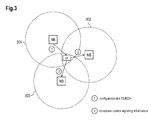
- Fig.3 shows a schematic network scenario comprising three NBs (e.g., HNBs and/or LNBs) each constituting a cellular network 301 to 303.
- a mobile terminal UE is within range for all three cellular networks 301 to 303.
- a CUBCH is configured and controlled via NB of cellular network 301 and the mobile terminal conveys broadcast control signaling information via said CUBCH towards the NBs of cellular networks 302 and 303.
- DNBO Disruptive NB Operation
- the operation is resumed immediately after ending of the DNBO time interval.
- the UEs of the cell are informed prior to the actual DNBO so that the UEs can adjust their transmission timing accordingly.
- the following topics may be at least partially considered:
- TDD system evolutions of E-UTRAN with dynamic uplink-downlink switching it may be a special case to have all neighboring NBs broadcast SIB(s) to each other within at least one subframe.
- subframes #3, #4, #7 or #8 may be utilized as depicted in Fig.2 .
- the NB that requires listening to other neighboring NBs within a next system frame may switch to a listening mode or to UL in the corresponding subframe(s) of the next system frame.
- the DNBO Interval is reduced to one or to several subframes and active UEs may be informed within the same system frame.
- Such an alternative can be supported by TDD systems using different UL and/or DL frame configurations between NBs and/or different frame timing offsets.
- FDD such approach may require additionally forced disruptive NB transmissions when receiving BCH from neighboring cells.
- This option is robust and also extendable to support more advanced NB-to-NB handshaking and communications, including in-band relaying extensions (RN-to-NB communications).
- RN-to-NB communications in-band relaying extensions
- Fig.4 depicting a schematics comprising three NBs (HNBs and/or LNBs), wherein a first NB conveys broadcast control signal information in said DNBO time interval towards the other two NBs.
- the approach presented in particular enables and facilitates exchange of control signaling over the air interface between access points (NB, HNB or LNB).
- Implementation of the proposed idea may refer to the access point and to the mobile terminal (UE).
Landscapes
- Engineering & Computer Science (AREA)
- Computer Networks & Wireless Communication (AREA)
- Signal Processing (AREA)
- Mobile Radio Communication Systems (AREA)
Abstract
Description
- The invention relates to a method and to a device for data processing in a cellular network and to a communication system comprising such a device.
- 3GPP Long Term Evolution (LTE) of UMTS, i.e.,
Release 9 and beyond - also referred to as LTE-Advanced (LTE-A) - as well as future advanced ITU International Mobile Telecommunications (IMT-A) systems in particular pursue an objective of supplying and supporting base stations or NodeBs (NBs) to the customers. - A challenging scenario is related to a local-area (LA) mass deployment of plug-and-play Home NBs (HNB) and/or Local-Area NBs (LNB) providing and/or coping with peak user bit rates of up to 1Gb/s. It is in particular not clear as how self-organization networks (SONs) and flexible spectrum use (FSU) can be appropriately provided and/or efficiently supported.
- SON techniques enable plug-and-play operation of the HNB and/or the LNB, self-tuning and reconfiguration of certain network parameters and structures affecting network operation. FSU techniques provide effective means of utilizing and sharing limited available spectrum resources among network systems of the same or of different operators processing an overlapping or even a common spectrum throughout a geographical service area.
- In current
LTE E-UTRAN Release 8, NB-to-NB communications required for supporting limited aspects of SON and FSU, such as self-optimization and inter-cell interference control (ICIC), are conducted over wired X2 interfaces. No solution is suggested regarding FSU and SON in combination with plug-and-play NBs and spectrum sharing (SS) between different operators' in the same service area. - The problem to be solved is to overcome the disadvantages stated above and in particular to enable in-band NB-to-NB broadcast control signaling over the air interface supporting SON and/or FSU in advanced cellular systems, in particular in
3GPP LTE Release 9 systems. It is noted that this approach is also backward compatible in particular with regard toRelease 8. - This problem is solved according to the features of the independent claims. Further embodiments result from the depending claims.
- In order to overcome this problem, a method is provided for data processing in a cellular network, comprising the step:
- conveying signaling information between base stations over an air interface supporting SON and/or FSU in said cellular network.
- Advantageously, the signaling information can either be conveyed directly between base stations or it can be conveyed via a mobile terminal utilizing in particular a special channel for such purpose.
- This approach efficiently enables base stations, in particular NBs (LNBs and/or HNBs) to become aware of interference and disturbances that may stem from other base stations and hence they may configure the cellular network accordingly to avoid or at least reduce detrimental effects from other base stations.
- The approach further avoids that plug-and-play NBs affect the macro cellular network and hence avoid re-configuration of the macro cellular network based on the deployment of HNBs or LNBs.
- The method for data processing may in particular comprise or provide a channel structuring and/or channel configuration function.
- It is also an approach that said signaling information is conveyed and facilitated between base stations over the air interface.
- In an embodiment, the signaling information comprises a broadcast control signaling information.
- In another embodiment, said signaling information is supplied via a cell specific uplink broadcast channel (CUBCH).
- In a further embodiment, said cell specific uplink broadcast channel is transmitted by at least one mobile terminal to convey signaling information to at least one adjacent base station.
- It is noted that mobile terminal as well as the base station or NB (also eNB) may refer to any kind of communication network or technology present or upcoming.
- In a next embodiment, the cell specific uplink broadcast channel is configured and/or controlled by a base station.
- Hence, a particular base station (or several base stations) can be selected to control and/or configure said CUBCH.
- It is also an embodiment that the cell specific uplink broadcast channel is scrambled by a cell-specific scrambling sequence.
- Pursuant to another embodiment, a layer-1 cell ID of a particular base station is mapped to the cell specific uplink broadcast channel transport format and/or allocation.
- According to an embodiment, the cell specific uplink broadcast channel configuration comprises at least one of the following:
- a transport format;
- a transmit power;
- a content;
- a schedule.
- According to another embodiment, the method comprises the steps:
- the cell specific uplink broadcast channel configuration is conveyed and/or updated towards at least one mobile terminal;
- the at least one mobile terminal reconstructs and/or conducts cell specific uplink broadcast channel transmissions based on the configuration received.
- In yet another embodiment, physical resources are reserved in the cellular network for said cell specific uplink broadcast channel.
- According to a next embodiment, cell specific uplink broadcast channel configuration and/or control can be provided via layer-1 signaling and/or layer-2 signaling and/or layer-3 signaling.
- Pursuant to yet an embodiment, the signaling information is received by a base station in a disruptive time interval (in particular: DNBO time interval).
- This DNBO time interval can be used as an alternative to aforementioned CUBCH. However, it may also be used in combination with such Cell Specific Uplink Broadcast Channel.
- According to an embodiment, the SFN can be set at the base stations for scheduling broadcast information in a coordinated manner among neighboring NBs.
- It is a further embodiment that at least one base station indicates to at least one mobile terminal in a given cellular network an upcoming DNBO time interval. Such indication and/or notification can be provided utilizing a flag to be conveyed towards the at least one mobile terminal.
- As another embodiment, said base station adjusts its cell configuration and/or its resource usage, in particular regarding SON and FSU, based on the signaling information received.
- It is also an embodiment that a particular base station conveys signaling information in said disruptive time interval.
- According to a further embodiment, at least some base stations send signaling information to each other utilizing at least one subframe.
- The problem stated above is also solved by a device comprising a and/or being associated with a processor unit and/or a hard-wired circuit and/or a logic device that is arranged such that the method as described herein is executable on said processor unit.
- According to an embodiment, the device is a communication device, in particular a or being associated with a base station (NB, LNB, HNB) or a mobile terminal (e.g., UE).
- The problem stated supra is further solved by a communication system comprising the device as described herein.
- Embodiments of the invention are shown and illustrated in view of the following figures:
- Fig.1
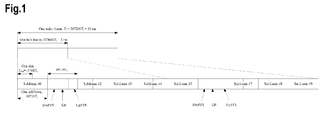
- shows a
frame structure type 2 for a switch-point periodicity of 5ms according toFig.4 .2-1 of 3GPP TS 36.211 V8.3.0 (2008-05); - Fig.2
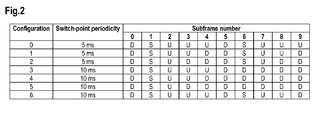
- shows a table of uplink-downlink allocations according to Table 4.2-2 of 3GPP TS 36.211 V8.3.0 (2008-05) as agreed on for
Release 8; - Fig.3
- shows a schematic network scenario comprising three NBs (e.g., HNBs and/or LNBs) each constituting a cellular network, wherein a mobile terminal is within range for all three cellular networks and a CUBCH is configured and controlled via a first NB and the mobile terminal conveys broadcast control signaling information via said CUBCH towards the remaining NBs;
- Fig.4
- shows a schematics comprising three NBs (HNBs and/or LNBs), wherein a first NB conveys broadcast control signal information in said DNBO time interval towards the other two NBs.
- In a generic LA deployment scenario, several cellular networks of the same radio access technology (e.g., E-UTRA) operated by different operators are deployed in the same geographical area (e.g., in a modern house-and-office building complex) and make use of the same radio spectrum resources. HNBs or LNBs of the same or of different networks may be placed and set up next to each other within a short distance in a spatially uncoordinated fashion. An X2 direct interface between NBs as specified in
E-UTRA Release 8 may be not applicable in such LA deployment scenario. Thus, technical issues or problems to be considered to facilitate efficient SON and FSU in supporting such LA deployment scenario may in particular comprise: - (a) An inter-cell and/or a co-channel interference may affect the operation of individual cells within the network. Interference is an important factor considering the plug-and-play nature of HNBs or LNBs and the lack of coordination between different networks and/or operators.
The plug-and-play scenario setting up HNBs and LNBs is totally different from traditional (offline) network-planning for existing cellular networks. Such cellular networks are also referred to as macro cells and are mostly set up offline carefully considering potential conflicts with other macro cells.
Initial setup, reconfiguration, reset or removal of plug-and-play HNBs or LNBs should only have a minimum impact on the operating network environment. Thus, any chain-reactions forcing are to be avoided that would lead to network reconfigurations across a number of (macro) cells of adjacent networks located around the said HNBs or LNBs. Hence, in other words, any plug-and-play HNB or LNB deployment preferably does not require to reconfigure existing macro-cells. - (b) There is a need for balancing a spectrum load among HNBs or LNBs which are active within a LA deployment. The spectrum is to be balanced in order to meet an efficient spectrum sharing and an overall efficient radio resource utilization. This is required by high dynamic variation and distribution of user traffic load among HNBs or LNBs stemming from a system requirement stipulating a high degree of spectral efficiency.
- In general, coordination, either explicit or implicit, between adjacent NBs within one network system or between different network systems in terms of network planning, deployment arrangement, network configuration, real-time and non-real-time interaction and control are required for supporting efficient SON and FSU.
- Implicit coordination, in which coordination information is not communicated explicitly by signaling messages, but inferred from a local environment, may be utilized for SONs. In case of limited cooperation between collocated network systems of different operators and/or in case of no direct X2 interface being available between NBs, a pragmatic approach to address the technical issues and problems mentioned above is to enable and use a particular NB sensing radio environment and adjacent NB-to-NB communication over the air interface. However, such approach leaves the topic unsolved as how to coordinate and schedule such NB-to-NB transmissions so that a given active NB can listen to other active NB(s) nearby while maintaining cell specific operation for local UEs.
- The approach presented in particular considers applications of NB-to-NB signaling over an air interface, e.g., a NB broadcasting control information to other NBs in the neighborhood for facilitating and supporting SON and FSU. This is based on the principle of an active NB (e.g., HNB or LNB) broadcasting, e.g., certain cell-specific configuration, neighborhood knowledge and spectrum load status information to its adjacent NBs. Such information (e.g., notification, messages or indications) is preferably utilized by these adjacent NBs to determine, select or adjust proper spectrum resources to be used upon cell initial setup, reset, reconfiguration, or scheduling for actual users regarding adjacent networks that provide SON and/or FSU functionality.
- A new NB upon its insertion into the network system or upon its reactivation (i.e., upon initial cell setup and reset) may listen to broadcast information of active NBs in its neighborhood. However, providing active NBs broadcast information and receiving broadcasted information from other active NBs during network operation results in practical and technical challenges: Firstly, regular active radio devices such as NBs are most probably not able to transmit and receive at the same time in the same frequency band or even to transmit and receive at the same time in different frequency bands that are not sufficiently spaced from each other. Secondly, utilizing an out-band broadcast control signaling is rather expensive in terms of spectrum consumption and NB implementation.
- The approach presented in particular provides some methods and mechanisms to enable in-band NB-to-NB broadcast control signaling over the air interface supporting SON and FSU in advanced cellular systems, in particular in
3GPP LTE Release 9 systems. It is noted that this approach is also backward compatible in particular with regard toRelease 8. - It is noted that for
Release 8 backward compatibility considerations ofRelease 9, the following aspects ofRelease 8 structures may be considered: - (a)
Release 8 frame structures for FDD and TDD, FDD UL-DL timing, TDD UL-DL allocations and channel structures as specified in 3GPP TS 36.211; - (b) TDD may be preferably utilized over FDD for LA scenarios;
- (c)
Fig.1 shows aframe structure type 2 for a switch-point periodicity of 5ms according toFig.4 .2-1 of 3GPP TS 36.211 V8.3.0 (2008-05).Fig.2 shows a table of uplink-downlink allocations according to Table 4.2-2 of 3GPP TS 36.211 V8.3.0 (2008-05) as agreed on forRelease 8;Release 8 TDD assumes perfect time-synchronization and the same uplink-downlink configuration is applied for all NBs in a certain geographical area. This assumption may change for LTE-A. For instance,subframe # 3, #4, #7, #8 can be used for either UL or DL on a frame-to-frame basis, which implies that for LTE-A there may be scenarios with uplink-downlink interference between NBs as well as between UEs. - (d) A physical broadcast channel (PBCH) carries the coded BCH transport block MIB (Master Information Block) mapped to four subframes within a 40ms interval, i.e., the MIB is refreshed every 40ms and repeated every 10ms in
subframe # 0 within a 40ms interval. The rest of broadcast system information is sent on a physical downlink shared channel (PDSCH). More related details can be found in 3GPP TS 36.300 V8.5.0 (2008-06). - (e) The scheduling information, as contained within SU-1, is carried in a System Information Block (SIB) called a Scheduling Block (SB). Besides this SB, SU-1 comprises one or more other SIBs. SU-1 may in particular comprise all access restriction related parameters. SU-1 is carried on a downlink shared channel (DL-SCH) and may use a fixed schedule with a periodicity of 80ms. SU-1 is scheduled in the
subframe # 5. The updating schedule of a given SIB in current E-UTRAN follows a generic rule of SFN mod K=0, i.e., sent once every K system frames of 10ms, with K=4, 8, 16, 32, etc. More related details can be found in 3GPP TS 36.300 V8.5.0 (2008-06). - The approach provided herein in particular allows, enables or facilitates in-band adjacent NB-to-NB broadcast control signaling over an air interface supporting SON and FSU, e.g., in advanced cellular systems.
- This alternative is proposed primarily for LA TDD systems, but it is as well applicable for FDD systems.
- The approach is based on one or several active UEs in a given cell broadcasting cell-specific information of interests to neighboring cells on a Cell Specific Uplink Broadcast Channel (CUBCH). This channel is preferably configured and controlled by a NB, but the channel itself is transmitted by selected active UE(s) in the cell using a particular format and/or allocation (e.g., in
subframe # 2 shown inFig.2 , which can be commonly used for all NBs in a predetermined service area). - This CUBCH is intended to be received by all neighboring NBs. It is noted that in LA TDD systems a strict frame-synchronization as well as a close time-alignment among neighboring NBs and UEs can be expected. This is an excellent basis for operating the CUBCH.
- Preferably, the CUBCH can be scrambled by a cell-specific scrambling sequence. It is preferable to have this sequence 1:1 mapped on a layer-1 (L1) cell ID of the cell (which is sent in DL synchronization channels), and thus CUBCHs of neighboring cells may be considered as quasi-orthogonal or semi-orthogonal.
- The approach presented herein may utilize and/or provide a synchronization towards the neighboring NBs (also: eNBs). It is also of advantage if the sequences used have sufficient correlation properties in the time domain as well as good cross correlation properties. In such case, synchronization efforts may be omitted. Sequences that could be used for this purpose could be so-called "Gold sequences" based on a Gold code constituting a set of binary sequences.
- Preferably, neighboring NBs which have a valid L1 cell ID of a given cell (e.g., acquired upon initial setup or upon reactivation of the NB within its neighborhood or via an active UE measurement reports) may be able to receive the CUBCH. Hence, there may be a predefined 1:1 mapping between the L1 cell ID and the CUBCH transport format and allocation.
- The CUBCH configurations comprise in particular a transport format, a transmit power, a content, and a schedule. Those are in particular controlled and updated towards (e.g., selected) active UE(s) in a given cell by the NB beforehand. Then, selected UE(s) may reconstruct and conduct actual CUBCH transmissions accordingly. The CUBCH may be pre-processed (e.g., parts of channel coding) by the NB.
- The NB may select at least one suitable active UE to broadcast said CUBCH, to set and to control transmit power and contents of the CUBCH based on, e.g., monitored channel and traffic conditions, battery power status, location of the at least one active UE and the number of selected active UE(s) together with an awareness of adjacent NBs (e.g., their locations, radio ranges or sensitivities, etc.).
- It is noted that in case more than one active UE is selected, preferably multiple synchronized CUBCH transmissions may provide for a significant diversity gain (also referred to as single-frequency-network gain). This diversity gain is achieved under the assumption that the propagation delay to neighboring eNBs can be estimated at a highly accurate level, or alternatively, a cyclic prefix is so long that it can capture the propagation delays. As some part of the diversity gain can also be obtained over time, a set of UEs transmitting the same CUBCH information could be perceived, but distributed over time, such that neighboring eNBs will be able to combine information provided by different UEs.
- A solution to incorporate the CUBCH for FDD operation may be to reserve a set of physical resources in each cell, thereby ensuring that there will be no (significant) intra-cell interference from other UEs being scheduled. The reservation of resources could be defined in the frequency domain as well as in the time domain (for instance related to the system frame number).
- Transmitting the CUBCH will require additional transmit power consumed by the UEs thereby reducing the endurance of the UEs' battery. This effect could be facilitated by providing benefits for these UEs like a reduced subscription price, a higher priority regarding data, etc.
- The NB and the UE can use L1 (PHY), L2 (MAC) or L3 (RRC) signaling in order to facilitate CUBCH configuration and/or control.
- This solution provides an additional channel (CUBCH) and related procedures to be implemented in
Release 8. However, the solution does not change basic frame structures or system architectures ofRelease 8, thereby allowing the CUBCH to be added and integrated intoRelease 8 without any notable impacts on existingRelease 8 system structures. - This approach is simple and effective, much faster and more robust than relying on, for examples, dedicated UE measurement and reporting of neighboring cells. This also improves the hidden node problem in case of direct NB-to-NB communication.
-
Fig.3 shows a schematic network scenario comprising three NBs (e.g., HNBs and/or LNBs) each constituting acellular network 301 to 303. A mobile terminal UE is within range for all threecellular networks 301 to 303. A CUBCH is configured and controlled via NB ofcellular network 301 and the mobile terminal conveys broadcast control signaling information via said CUBCH towards the NBs ofcellular networks - This solution is applicable for both, TDD and FDD systems.
- It is based on the idea of coordinating transmissions of broadcast control signaling of interest between neighboring NBs and allowing a particular NB to temporarily interrupt or halt at least the current DL operation in certain frequency band of its cell for a Disruptive NB Operation DNBO time interval (e.g., in the order of tens of milliseconds) to listen to broadcast control signaling of neighboring NBs to adjust its cell configurations if necessary. Such adjustment may be required, e.g., in case the NB experiences some temporary local outage states.
- The operation is resumed immediately after ending of the DNBO time interval. The UEs of the cell are informed prior to the actual DNBO so that the UEs can adjust their transmission timing accordingly. To realize this DNBO mode, the following topics may be at least partially considered:
- (1) The NB, upon initial setup, reset and reconfiguration, may determine a proper SFN offset corresponding to a SFN information of most affected neighboring NBs. Such SFN information can be received, e.g., from BCH MIB of neighboring NBs.
It is noted that in current cellular systems such asRelease 8 E-UTRAN, scheduling of SIB is tied to SFN mode K. This coordination of SFN may help in ensuring that most impacting neighboring NBs may (not) schedule SIB(s) of interest in the coinciding system frame. It may further prevent all those neighboring NBs from processing DNBO at the same time. - (2) Introducing a DNBO Indication Flag and a DNBO Interval to indicate an upcoming DNBO event: Prior to an event-triggered DNBO, the DNBO Indication Flag and the DNBO Interval can be sent to active UEs (in particular to all active UEs) in the cell on, e.g., a physical downlink control channel (PDCCH) in a broadcast fashion, or via a broadcast control channel.
The DNBO Interval can be a semi-static time interval that can be configured conveyed to the UEs utilizing SIBs. In case of periodical DNBOs, the semi-static DNBO schedule and the corresponding DNBO Interval can be sent via the BCH.
The duration of the DNBO Interval can be set to one or to multiple radio frames, preferably in a range of tens of milliseconds. However, the DNBO Interval may be configured to be sufficiently long for the NB to receive SIBs from other neighboring NBs while synchronization can be maintained and resumed. - (3) The NB in such DNBO mode may detect and listen to as many neighboring NBs as possible or it may just listen to a portion or a group of NBs selected.
The NB may also detect or determine other neighboring NB(s) currently being in DNBO mode, in particular if the NB does not receive information from those NB(s) as it would if they were not in DNBO mode.
Based on the received information and based on the detection regarding the NB's neighborhood, the NB is enabled to provide predictive adjustments for its operations with SON and FSU. - Considering TDD system evolutions of E-UTRAN with dynamic uplink-downlink switching, it may be a special case to have all neighboring NBs broadcast SIB(s) to each other within at least one subframe. For example,
subframes # 3, #4, #7 or #8 may be utilized as depicted inFig.2 . In such case, the NB that requires listening to other neighboring NBs within a next system frame, may switch to a listening mode or to UL in the corresponding subframe(s) of the next system frame. Thus, the DNBO Interval is reduced to one or to several subframes and active UEs may be informed within the same system frame. Such an alternative can be supported by TDD systems using different UL and/or DL frame configurations between NBs and/or different frame timing offsets. Regarding FDD, such approach may require additionally forced disruptive NB transmissions when receiving BCH from neighboring cells. - This option is robust and also extendable to support more advanced NB-to-NB handshaking and communications, including in-band relaying extensions (RN-to-NB communications).
- The second approach is visualized in
Fig.4 depicting a schematics comprising three NBs (HNBs and/or LNBs), wherein a first NB conveys broadcast control signal information in said DNBO time interval towards the other two NBs. - The approach presented in particular enables and facilitates exchange of control signaling over the air interface between access points (NB, HNB or LNB). Implementation of the proposed idea may refer to the access point and to the mobile terminal (UE).
-
- 3GPP
- 3rd Generation Partnership Project
- BCH
- Broadcast channel
- BCH
- Broadcast Channel
- CUBCH
- Cell Specific Uplink Broadcast Channel
- DL
- Downlink
- DL-SCH
- Downlink Shared Channel
- DNBO
- Disruptive NB Operation
- E-UTRA
- Evolved UMTS Terrestrial Radio Access
- eNB
- evolved NB
- FDD
- Frequency Division Duplex
- FSU
- Flexible Spectrum Use
- HNB
- Home NB
- IMT-A
- International Mobile Telecommunications - Advanced
- L1
-
Layer 1 or Physical Layer - L2
- Layer 2 (herein referred to, e.g., Medium Access Control Layer)
- L3
- Layer 3 (herein referred to, e.g., Radio Resource Control Layer)
- LA
- Local Area
- LNB
- LA NB
- LTE
- Long Term Evolution
- LTE-A
- LTE-Advanced
- MIB
- Master Information Block
- NB
- Node B or base station
- PBCH
- Physical Broadcast Channel
- PDCCH
- Physical Downlink Control Channel
- PDSCH
- Physical Downlink Shared Channel
- RAT
- Radio access technology
- RN
- Relaying Node
- SB
- Scheduling Block
- SFN
- System Frame Number
- SIB
- System Information Block
- SON
- Self-Organization Network
- SU-1
- Scheduling Unit No. 1
- TDD
- Time Division Duplex
- UE
- User Equipment (Mobile Terminal)
- UL
- Uplink
- UMTS
- Universal Mobile Telecommunications System
- UTRAN
- UMTS Terrestrial Radio Access Network
Claims (15)
- A method for data processing in a cellular network, comprising the step:- conveying signaling information between base stations over an air interface supporting SON and/or FSU in said cellular network.
- The method according to claim 1, wherein the signaling information comprises a broadcast control signaling information.
- The method according to any of the preceding claims, wherein said signaling information is supplied via a cell specific uplink broadcast channel.
- The method according to claim 3, wherein said cell specific uplink broadcast channel is transmitted by at least one mobile terminal to convey signaling information to at least one adjacent base station.
- The method according to any of claims 3 or 4, wherein the cell specific uplink broadcast channel is configured and/or controlled by a base station.
- The method according to any of claims 3 to 5, wherein the cell specific uplink broadcast channel configuration comprises at least one of the following:- a transport format;- a transmit power;- a content;- a schedule.
- The method according to claim 6, comprising the steps:- the cell specific uplink broadcast channel configuration is conveyed and/or updated towards at least one mobile terminal;- the at least one mobile terminal reconstructs and/or conducts cell specific uplink broadcast channel transmissions based on the configuration received.
- The method according to any of claims 3 to 7, wherein physical resources are reserved in the cellular network for said cell specific uplink broadcast channel.
- The method according to any of the preceding claims, wherein the signaling information is received by a base station in a disruptive time interval.
- The method according to claim 9, wherein said base station adjusts its cell configuration and/or its resource usage, in particular regarding SON and FSU, based on the signaling information received.
- The method according to any of claims 9 or 10, wherein a particular base station conveys signaling information in said disruptive time interval.
- The method according to any of claims 9 to 11, wherein at least some base stations send signaling information to each other utilizing at least one subframe.
- A device comprising a and/or being associated with a processor unit and/or a hard-wired circuit and/or a logic device that is arranged such that the method according to any of the preceding claims is executable thereon.
- The device according to claim 13, wherein said device is a communication device, in particular a or being associated with a base station or a mobile terminal.
- Communication system comprising the device according to any of claims 13 or 14.
Priority Applications (4)
| Application Number | Priority Date | Filing Date | Title |
|---|---|---|---|
| EP08105236.7A EP2161964B1 (en) | 2008-09-04 | 2008-09-04 | Method and device for data processing in a cellular network |
| US13/061,977 US8891460B2 (en) | 2008-09-04 | 2009-09-04 | Method and device for data processing in a cellular network |
| PCT/EP2009/061447 WO2010026210A1 (en) | 2008-09-04 | 2009-09-04 | Method and device for data processing in a cellular network |
| CN200980143969.1A CN102204397B (en) | 2008-09-04 | 2009-09-04 | Method and device for data processing in a cellular network |
Applications Claiming Priority (1)
| Application Number | Priority Date | Filing Date | Title |
|---|---|---|---|
| EP08105236.7A EP2161964B1 (en) | 2008-09-04 | 2008-09-04 | Method and device for data processing in a cellular network |
Publications (2)
| Publication Number | Publication Date |
|---|---|
| EP2161964A1 true EP2161964A1 (en) | 2010-03-10 |
| EP2161964B1 EP2161964B1 (en) | 2015-02-18 |
Family
ID=39811811
Family Applications (1)
| Application Number | Title | Priority Date | Filing Date |
|---|---|---|---|
| EP08105236.7A Not-in-force EP2161964B1 (en) | 2008-09-04 | 2008-09-04 | Method and device for data processing in a cellular network |
Country Status (4)
| Country | Link |
|---|---|
| US (1) | US8891460B2 (en) |
| EP (1) | EP2161964B1 (en) |
| CN (1) | CN102204397B (en) |
| WO (1) | WO2010026210A1 (en) |
Cited By (3)
| Publication number | Priority date | Publication date | Assignee | Title |
|---|---|---|---|---|
| WO2012120183A1 (en) * | 2011-03-08 | 2012-09-13 | Nokia Corporation | Apparatus and method for allocating communication resources in a communication system |
| WO2012123310A1 (en) * | 2011-03-11 | 2012-09-20 | Telefonica, S.A. | A method and a system for avoiding interferences in frequency division duplex operating areas |
| WO2013134723A1 (en) * | 2012-03-09 | 2013-09-12 | Qualcomm Incorporated | Method and system for communicating between small cells using over-the-air transmissions |
Families Citing this family (6)
| Publication number | Priority date | Publication date | Assignee | Title |
|---|---|---|---|---|
| CN102088735B (en) * | 2010-03-24 | 2014-12-03 | 电信科学技术研究院 | Method and equipment for balancing inter-sub-frame traffic load and processing inter-cell interference (ICI) |
| CN103733695B (en) * | 2011-07-26 | 2017-07-28 | Nec欧洲有限公司 | Method and resource management system for resource management in a cellular communication network |
| JP6000275B2 (en) * | 2011-11-07 | 2016-09-28 | パナソニック インテレクチュアル プロパティ コーポレーション オブ アメリカPanasonic Intellectual Property Corporation of America | Terminal device, base station device, transmission method and reception method |
| WO2015199391A1 (en) * | 2014-06-22 | 2015-12-30 | 엘지전자 주식회사 | Method and apparatus for transmitting and receiving signal by full-duplex base station in wireless communication system |
| CN106664583B (en) * | 2014-06-25 | 2020-03-03 | 诺基亚通信公司 | Network Assisted Alternate Coverage in Cellular Communication Networks |
| CA3031381A1 (en) * | 2016-07-27 | 2018-02-01 | Sony Corporation | Communication control device, wireless communication device, method and program |
Citations (2)
| Publication number | Priority date | Publication date | Assignee | Title |
|---|---|---|---|---|
| WO1998009390A1 (en) * | 1996-08-30 | 1998-03-05 | Telefonaktiebolaget Lm Ericsson (Publ) | Method and apparatus for synchronizing private radio systems |
| US20060079242A1 (en) * | 2004-09-14 | 2006-04-13 | Nokia Corporation | Enhanced assisted cell change |
Family Cites Families (5)
| Publication number | Priority date | Publication date | Assignee | Title |
|---|---|---|---|---|
| GB2432484B (en) * | 2005-11-22 | 2007-12-27 | Ipwireless Inc | Cellular communication system and method for broadcast communication |
| CN101132190B (en) | 2007-09-28 | 2013-02-27 | 中兴通讯股份有限公司 | Method for automatically controlling subdistrict interference |
| CN101132643B (en) | 2007-09-28 | 2012-02-29 | 中兴通讯股份有限公司 | Automatic optimizing method for wireless access parameters |
| US8498227B2 (en) * | 2008-06-20 | 2013-07-30 | Nokia Corporation | Method and apparatus for flexible spectrum usage in communications systems |
| US9560567B2 (en) * | 2008-07-25 | 2017-01-31 | Alcatel Lucent | Method and apparatus for reconstructing the network topology in wireless relay communication network |
-
2008
- 2008-09-04 EP EP08105236.7A patent/EP2161964B1/en not_active Not-in-force
-
2009
- 2009-09-04 US US13/061,977 patent/US8891460B2/en not_active Expired - Fee Related
- 2009-09-04 CN CN200980143969.1A patent/CN102204397B/en not_active Expired - Fee Related
- 2009-09-04 WO PCT/EP2009/061447 patent/WO2010026210A1/en not_active Ceased
Patent Citations (2)
| Publication number | Priority date | Publication date | Assignee | Title |
|---|---|---|---|---|
| WO1998009390A1 (en) * | 1996-08-30 | 1998-03-05 | Telefonaktiebolaget Lm Ericsson (Publ) | Method and apparatus for synchronizing private radio systems |
| US20060079242A1 (en) * | 2004-09-14 | 2006-04-13 | Nokia Corporation | Enhanced assisted cell change |
Non-Patent Citations (1)
| Title |
|---|
| SANJAY KUMAR ET AL: "Spectrum sharing for next generation wireless communication networks", COGNITIVE RADIO AND ADVANCED SPECTRUM MANAGEMENT, 2008. COGART 2008. FIRST INTERNATIONAL WORKSHOP ON, IEEE, PISCATAWAY, NJ, USA, 14 February 2008 (2008-02-14), pages 1 - 5, XP031247475, ISBN: 978-1-4244-2139-8 * |
Cited By (7)
| Publication number | Priority date | Publication date | Assignee | Title |
|---|---|---|---|---|
| WO2012120183A1 (en) * | 2011-03-08 | 2012-09-13 | Nokia Corporation | Apparatus and method for allocating communication resources in a communication system |
| WO2012123310A1 (en) * | 2011-03-11 | 2012-09-20 | Telefonica, S.A. | A method and a system for avoiding interferences in frequency division duplex operating areas |
| ES2393513A1 (en) * | 2011-03-11 | 2012-12-21 | Telefónica, S.A. | A method and a system for avoiding interferences in frequency division duplex operating areas |
| CN103518411A (en) * | 2011-03-11 | 2014-01-15 | 电话有限公司 | A method and a system for avoiding interferences in frequency division duplex operating areas |
| US9369879B2 (en) | 2011-03-11 | 2016-06-14 | Telefonica, S.A. | Method for avoiding interferences in frequency division duplex operating areas |
| WO2013134723A1 (en) * | 2012-03-09 | 2013-09-12 | Qualcomm Incorporated | Method and system for communicating between small cells using over-the-air transmissions |
| US9392598B2 (en) | 2012-03-09 | 2016-07-12 | Qualcomm Incorporated | Method and system for communicating between small cells using over-the-air transmissions |
Also Published As
| Publication number | Publication date |
|---|---|
| US8891460B2 (en) | 2014-11-18 |
| US20110211543A1 (en) | 2011-09-01 |
| EP2161964B1 (en) | 2015-02-18 |
| WO2010026210A1 (en) | 2010-03-11 |
| CN102204397A (en) | 2011-09-28 |
| CN102204397B (en) | 2015-08-26 |
Similar Documents
| Publication | Publication Date | Title |
|---|---|---|
| US11102772B2 (en) | Method and terminal device for allocating resources in a plurality of subframes | |
| EP2161964B1 (en) | Method and device for data processing in a cellular network | |
| CN114599118B (en) | Wireless communication system, base station and communication terminal | |
| KR101317598B1 (en) | Relay operation in a wireless communication system | |
| EP3138219B1 (en) | Method and base station for mitigating inter-operator interference | |
| EP2451226B1 (en) | Air interface synchronization method, apparatus and system | |
| RU2601427C2 (en) | Communication device and communication method | |
| US12477485B2 (en) | Synchronization signal block (SSB) in full-duplex | |
| EP2853126B1 (en) | System, method and base station for allocating resources in a plurality of subframes | |
| US10440722B2 (en) | Mobile communications network, methods, base station, relay node and communications terminal | |
| EP2373077A1 (en) | Method and radio base station for effective spectrum utilization | |
| EP2154917A1 (en) | Transmission of a synchronization signal within a cellular telecommunication network with temporarily increased transmitting power | |
| CN107196751A (en) | Cellular communication system for limited bandwidth communications device is supported | |
| US10892927B2 (en) | System and method for configuring measurement gaps and reference signals | |
| JP2016511957A (en) | Inter-cell interference control for machine type communication | |
| JP2015500584A (en) | Efficient spectrum use in ABS (ALMOSTBLANKSUBFRAMES) | |
| EP2611245A1 (en) | Method, equipment and system for adjusting configuration of spectrum resources | |
| US9445425B2 (en) | Method of transmission in a communications network | |
| US20120106432A1 (en) | Method for transmitting uplink signal with periodic and relay system for the same | |
| JP7001604B2 (en) | Interference management for networks with variable transmission time intervals | |
| US20120106502A1 (en) | Direct Communications in Wireless Networks | |
| Cai et al. | Analysis and field trial on interference coexistence of 5G NR and 4G LTE dynamic spectrum sharing | |
| EP3060020B1 (en) | Heterogeneous network communication method and relevant equipment |
Legal Events
| Date | Code | Title | Description |
|---|---|---|---|
| PUAI | Public reference made under article 153(3) epc to a published international application that has entered the european phase |
Free format text: ORIGINAL CODE: 0009012 |
|
| AK | Designated contracting states |
Kind code of ref document: A1 Designated state(s): AT BE BG CH CY CZ DE DK EE ES FI FR GB GR HR HU IE IS IT LI LT LU LV MC MT NL NO PL PT RO SE SI SK TR |
|
| AX | Request for extension of the european patent |
Extension state: AL BA MK RS |
|
| 17P | Request for examination filed |
Effective date: 20100910 |
|
| 17Q | First examination report despatched |
Effective date: 20101014 |
|
| AKX | Designation fees paid |
Designated state(s): AT BE BG CH CY CZ DE DK EE ES FI FR GB GR HR HU IE IS IT LI LT LU LV MC MT NL NO PL PT RO SE SI SK TR |
|
| RAP1 | Party data changed (applicant data changed or rights of an application transferred) |
Owner name: NOKIA SOLUTIONS AND NETWORKS OY |
|
| REG | Reference to a national code |
Ref country code: DE Ref legal event code: R079 Ref document number: 602008036662 Country of ref document: DE Free format text: PREVIOUS MAIN CLASS: H04W0084020000 Ipc: H04W0072040000 |
|
| RIC1 | Information provided on ipc code assigned before grant |
Ipc: H04W 84/02 20090101ALI20140708BHEP Ipc: H04W 72/04 20090101AFI20140708BHEP Ipc: H04W 92/20 20090101ALI20140708BHEP |
|
| GRAP | Despatch of communication of intention to grant a patent |
Free format text: ORIGINAL CODE: EPIDOSNIGR1 |
|
| INTG | Intention to grant announced |
Effective date: 20140917 |
|
| GRAS | Grant fee paid |
Free format text: ORIGINAL CODE: EPIDOSNIGR3 |
|
| GRAA | (expected) grant |
Free format text: ORIGINAL CODE: 0009210 |
|
| AK | Designated contracting states |
Kind code of ref document: B1 Designated state(s): AT BE BG CH CY CZ DE DK EE ES FI FR GB GR HR HU IE IS IT LI LT LU LV MC MT NL NO PL PT RO SE SI SK TR |
|
| REG | Reference to a national code |
Ref country code: GB Ref legal event code: FG4D |
|
| REG | Reference to a national code |
Ref country code: CH Ref legal event code: EP |
|
| REG | Reference to a national code |
Ref country code: AT Ref legal event code: REF Ref document number: 711089 Country of ref document: AT Kind code of ref document: T Effective date: 20150315 |
|
| REG | Reference to a national code |
Ref country code: IE Ref legal event code: FG4D |
|
| REG | Reference to a national code |
Ref country code: DE Ref legal event code: R096 Ref document number: 602008036662 Country of ref document: DE Effective date: 20150326 |
|
| REG | Reference to a national code |
Ref country code: NL Ref legal event code: VDEP Effective date: 20150218 |
|
| REG | Reference to a national code |
Ref country code: AT Ref legal event code: MK05 Ref document number: 711089 Country of ref document: AT Kind code of ref document: T Effective date: 20150218 |
|
| REG | Reference to a national code |
Ref country code: LT Ref legal event code: MG4D |
|
| PG25 | Lapsed in a contracting state [announced via postgrant information from national office to epo] |
Ref country code: ES Free format text: LAPSE BECAUSE OF FAILURE TO SUBMIT A TRANSLATION OF THE DESCRIPTION OR TO PAY THE FEE WITHIN THE PRESCRIBED TIME-LIMIT Effective date: 20150218 Ref country code: FI Free format text: LAPSE BECAUSE OF FAILURE TO SUBMIT A TRANSLATION OF THE DESCRIPTION OR TO PAY THE FEE WITHIN THE PRESCRIBED TIME-LIMIT Effective date: 20150218 Ref country code: LT Free format text: LAPSE BECAUSE OF FAILURE TO SUBMIT A TRANSLATION OF THE DESCRIPTION OR TO PAY THE FEE WITHIN THE PRESCRIBED TIME-LIMIT Effective date: 20150218 Ref country code: HR Free format text: LAPSE BECAUSE OF FAILURE TO SUBMIT A TRANSLATION OF THE DESCRIPTION OR TO PAY THE FEE WITHIN THE PRESCRIBED TIME-LIMIT Effective date: 20150218 Ref country code: SE Free format text: LAPSE BECAUSE OF FAILURE TO SUBMIT A TRANSLATION OF THE DESCRIPTION OR TO PAY THE FEE WITHIN THE PRESCRIBED TIME-LIMIT Effective date: 20150218 Ref country code: NO Free format text: LAPSE BECAUSE OF FAILURE TO SUBMIT A TRANSLATION OF THE DESCRIPTION OR TO PAY THE FEE WITHIN THE PRESCRIBED TIME-LIMIT Effective date: 20150518 |
|
| PG25 | Lapsed in a contracting state [announced via postgrant information from national office to epo] |
Ref country code: LV Free format text: LAPSE BECAUSE OF FAILURE TO SUBMIT A TRANSLATION OF THE DESCRIPTION OR TO PAY THE FEE WITHIN THE PRESCRIBED TIME-LIMIT Effective date: 20150218 Ref country code: AT Free format text: LAPSE BECAUSE OF FAILURE TO SUBMIT A TRANSLATION OF THE DESCRIPTION OR TO PAY THE FEE WITHIN THE PRESCRIBED TIME-LIMIT Effective date: 20150218 Ref country code: GR Free format text: LAPSE BECAUSE OF FAILURE TO SUBMIT A TRANSLATION OF THE DESCRIPTION OR TO PAY THE FEE WITHIN THE PRESCRIBED TIME-LIMIT Effective date: 20150519 Ref country code: IS Free format text: LAPSE BECAUSE OF FAILURE TO SUBMIT A TRANSLATION OF THE DESCRIPTION OR TO PAY THE FEE WITHIN THE PRESCRIBED TIME-LIMIT Effective date: 20150618 Ref country code: NL Free format text: LAPSE BECAUSE OF FAILURE TO SUBMIT A TRANSLATION OF THE DESCRIPTION OR TO PAY THE FEE WITHIN THE PRESCRIBED TIME-LIMIT Effective date: 20150218 |
|
| PG25 | Lapsed in a contracting state [announced via postgrant information from national office to epo] |
Ref country code: CZ Free format text: LAPSE BECAUSE OF FAILURE TO SUBMIT A TRANSLATION OF THE DESCRIPTION OR TO PAY THE FEE WITHIN THE PRESCRIBED TIME-LIMIT Effective date: 20150218 Ref country code: RO Free format text: LAPSE BECAUSE OF FAILURE TO SUBMIT A TRANSLATION OF THE DESCRIPTION OR TO PAY THE FEE WITHIN THE PRESCRIBED TIME-LIMIT Effective date: 20150218 Ref country code: DK Free format text: LAPSE BECAUSE OF FAILURE TO SUBMIT A TRANSLATION OF THE DESCRIPTION OR TO PAY THE FEE WITHIN THE PRESCRIBED TIME-LIMIT Effective date: 20150218 Ref country code: SK Free format text: LAPSE BECAUSE OF FAILURE TO SUBMIT A TRANSLATION OF THE DESCRIPTION OR TO PAY THE FEE WITHIN THE PRESCRIBED TIME-LIMIT Effective date: 20150218 Ref country code: EE Free format text: LAPSE BECAUSE OF FAILURE TO SUBMIT A TRANSLATION OF THE DESCRIPTION OR TO PAY THE FEE WITHIN THE PRESCRIBED TIME-LIMIT Effective date: 20150218 |
|
| REG | Reference to a national code |
Ref country code: DE Ref legal event code: R097 Ref document number: 602008036662 Country of ref document: DE |
|
| PG25 | Lapsed in a contracting state [announced via postgrant information from national office to epo] |
Ref country code: PL Free format text: LAPSE BECAUSE OF FAILURE TO SUBMIT A TRANSLATION OF THE DESCRIPTION OR TO PAY THE FEE WITHIN THE PRESCRIBED TIME-LIMIT Effective date: 20150218 |
|
| PLBE | No opposition filed within time limit |
Free format text: ORIGINAL CODE: 0009261 |
|
| STAA | Information on the status of an ep patent application or granted ep patent |
Free format text: STATUS: NO OPPOSITION FILED WITHIN TIME LIMIT |
|
| PG25 | Lapsed in a contracting state [announced via postgrant information from national office to epo] |
Ref country code: IT Free format text: LAPSE BECAUSE OF FAILURE TO SUBMIT A TRANSLATION OF THE DESCRIPTION OR TO PAY THE FEE WITHIN THE PRESCRIBED TIME-LIMIT Effective date: 20150218 |
|
| 26N | No opposition filed |
Effective date: 20151119 |
|
| PG25 | Lapsed in a contracting state [announced via postgrant information from national office to epo] |
Ref country code: SI Free format text: LAPSE BECAUSE OF FAILURE TO SUBMIT A TRANSLATION OF THE DESCRIPTION OR TO PAY THE FEE WITHIN THE PRESCRIBED TIME-LIMIT Effective date: 20150218 |
|
| PG25 | Lapsed in a contracting state [announced via postgrant information from national office to epo] |
Ref country code: LU Free format text: LAPSE BECAUSE OF FAILURE TO SUBMIT A TRANSLATION OF THE DESCRIPTION OR TO PAY THE FEE WITHIN THE PRESCRIBED TIME-LIMIT Effective date: 20150904 Ref country code: MC Free format text: LAPSE BECAUSE OF FAILURE TO SUBMIT A TRANSLATION OF THE DESCRIPTION OR TO PAY THE FEE WITHIN THE PRESCRIBED TIME-LIMIT Effective date: 20150218 |
|
| REG | Reference to a national code |
Ref country code: CH Ref legal event code: PL |
|
| PG25 | Lapsed in a contracting state [announced via postgrant information from national office to epo] |
Ref country code: BE Free format text: LAPSE BECAUSE OF FAILURE TO SUBMIT A TRANSLATION OF THE DESCRIPTION OR TO PAY THE FEE WITHIN THE PRESCRIBED TIME-LIMIT Effective date: 20150218 |
|
| REG | Reference to a national code |
Ref country code: IE Ref legal event code: MM4A |
|
| REG | Reference to a national code |
Ref country code: FR Ref legal event code: ST Effective date: 20160531 |
|
| PG25 | Lapsed in a contracting state [announced via postgrant information from national office to epo] |
Ref country code: LI Free format text: LAPSE BECAUSE OF NON-PAYMENT OF DUE FEES Effective date: 20150930 Ref country code: IE Free format text: LAPSE BECAUSE OF NON-PAYMENT OF DUE FEES Effective date: 20150904 Ref country code: CH Free format text: LAPSE BECAUSE OF NON-PAYMENT OF DUE FEES Effective date: 20150930 |
|
| PG25 | Lapsed in a contracting state [announced via postgrant information from national office to epo] |
Ref country code: FR Free format text: LAPSE BECAUSE OF NON-PAYMENT OF DUE FEES Effective date: 20150930 |
|
| PG25 | Lapsed in a contracting state [announced via postgrant information from national office to epo] |
Ref country code: MT Free format text: LAPSE BECAUSE OF FAILURE TO SUBMIT A TRANSLATION OF THE DESCRIPTION OR TO PAY THE FEE WITHIN THE PRESCRIBED TIME-LIMIT Effective date: 20150218 |
|
| PG25 | Lapsed in a contracting state [announced via postgrant information from national office to epo] |
Ref country code: BG Free format text: LAPSE BECAUSE OF FAILURE TO SUBMIT A TRANSLATION OF THE DESCRIPTION OR TO PAY THE FEE WITHIN THE PRESCRIBED TIME-LIMIT Effective date: 20150218 Ref country code: HU Free format text: LAPSE BECAUSE OF FAILURE TO SUBMIT A TRANSLATION OF THE DESCRIPTION OR TO PAY THE FEE WITHIN THE PRESCRIBED TIME-LIMIT; INVALID AB INITIO Effective date: 20080904 |
|
| PG25 | Lapsed in a contracting state [announced via postgrant information from national office to epo] |
Ref country code: CY Free format text: LAPSE BECAUSE OF FAILURE TO SUBMIT A TRANSLATION OF THE DESCRIPTION OR TO PAY THE FEE WITHIN THE PRESCRIBED TIME-LIMIT Effective date: 20150218 |
|
| PG25 | Lapsed in a contracting state [announced via postgrant information from national office to epo] |
Ref country code: TR Free format text: LAPSE BECAUSE OF FAILURE TO SUBMIT A TRANSLATION OF THE DESCRIPTION OR TO PAY THE FEE WITHIN THE PRESCRIBED TIME-LIMIT Effective date: 20150218 |
|
| PG25 | Lapsed in a contracting state [announced via postgrant information from national office to epo] |
Ref country code: PT Free format text: LAPSE BECAUSE OF FAILURE TO SUBMIT A TRANSLATION OF THE DESCRIPTION OR TO PAY THE FEE WITHIN THE PRESCRIBED TIME-LIMIT Effective date: 20150218 |
|
| PGFP | Annual fee paid to national office [announced via postgrant information from national office to epo] |
Ref country code: DE Payment date: 20190820 Year of fee payment: 12 |
|
| PGFP | Annual fee paid to national office [announced via postgrant information from national office to epo] |
Ref country code: GB Payment date: 20190906 Year of fee payment: 12 |
|
| REG | Reference to a national code |
Ref country code: DE Ref legal event code: R119 Ref document number: 602008036662 Country of ref document: DE |
|
| GBPC | Gb: european patent ceased through non-payment of renewal fee |
Effective date: 20200904 |
|
| PG25 | Lapsed in a contracting state [announced via postgrant information from national office to epo] |
Ref country code: DE Free format text: LAPSE BECAUSE OF NON-PAYMENT OF DUE FEES Effective date: 20210401 |
|
| PG25 | Lapsed in a contracting state [announced via postgrant information from national office to epo] |
Ref country code: GB Free format text: LAPSE BECAUSE OF NON-PAYMENT OF DUE FEES Effective date: 20200904 |