EP2161644A2 - Operation feeling imparting type input device - Google Patents
Operation feeling imparting type input device Download PDFInfo
- Publication number
- EP2161644A2 EP2161644A2 EP09169123A EP09169123A EP2161644A2 EP 2161644 A2 EP2161644 A2 EP 2161644A2 EP 09169123 A EP09169123 A EP 09169123A EP 09169123 A EP09169123 A EP 09169123A EP 2161644 A2 EP2161644 A2 EP 2161644A2
- Authority
- EP
- European Patent Office
- Prior art keywords
- rotation
- friction plate
- rotor member
- engagement protrusion
- rotation shaft
- Prior art date
- Legal status (The legal status is an assumption and is not a legal conclusion. Google has not performed a legal analysis and makes no representation as to the accuracy of the status listed.)
- Granted
Links
Images





Classifications
-
- G—PHYSICS
- G05—CONTROLLING; REGULATING
- G05G—CONTROL DEVICES OR SYSTEMS INSOFAR AS CHARACTERISED BY MECHANICAL FEATURES ONLY
- G05G1/00—Controlling members, e.g. knobs or handles; Assemblies or arrangements thereof; Indicating position of controlling members
- G05G1/08—Controlling members for hand actuation by rotary movement, e.g. hand wheels
- G05G1/10—Details, e.g. of discs, knobs, wheels or handles
-
- B—PERFORMING OPERATIONS; TRANSPORTING
- B60—VEHICLES IN GENERAL
- B60K—ARRANGEMENT OR MOUNTING OF PROPULSION UNITS OR OF TRANSMISSIONS IN VEHICLES; ARRANGEMENT OR MOUNTING OF PLURAL DIVERSE PRIME-MOVERS IN VEHICLES; AUXILIARY DRIVES FOR VEHICLES; INSTRUMENTATION OR DASHBOARDS FOR VEHICLES; ARRANGEMENTS IN CONNECTION WITH COOLING, AIR INTAKE, GAS EXHAUST OR FUEL SUPPLY OF PROPULSION UNITS IN VEHICLES
- B60K35/00—Instruments specially adapted for vehicles; Arrangement of instruments in or on vehicles
- B60K35/10—Input arrangements, i.e. from user to vehicle, associated with vehicle functions or specially adapted therefor
-
- B—PERFORMING OPERATIONS; TRANSPORTING
- B60—VEHICLES IN GENERAL
- B60K—ARRANGEMENT OR MOUNTING OF PROPULSION UNITS OR OF TRANSMISSIONS IN VEHICLES; ARRANGEMENT OR MOUNTING OF PLURAL DIVERSE PRIME-MOVERS IN VEHICLES; AUXILIARY DRIVES FOR VEHICLES; INSTRUMENTATION OR DASHBOARDS FOR VEHICLES; ARRANGEMENTS IN CONNECTION WITH COOLING, AIR INTAKE, GAS EXHAUST OR FUEL SUPPLY OF PROPULSION UNITS IN VEHICLES
- B60K35/00—Instruments specially adapted for vehicles; Arrangement of instruments in or on vehicles
- B60K35/20—Output arrangements, i.e. from vehicle to user, associated with vehicle functions or specially adapted therefor
- B60K35/25—Output arrangements, i.e. from vehicle to user, associated with vehicle functions or specially adapted therefor using haptic output
-
- G—PHYSICS
- G05—CONTROLLING; REGULATING
- G05G—CONTROL DEVICES OR SYSTEMS INSOFAR AS CHARACTERISED BY MECHANICAL FEATURES ONLY
- G05G5/00—Means for preventing, limiting or returning the movements of parts of a control mechanism, e.g. locking controlling member
- G05G5/03—Means for enhancing the operator's awareness of arrival of the controlling member at a command or datum position; Providing feel, e.g. means for creating a counterforce
-
- B—PERFORMING OPERATIONS; TRANSPORTING
- B60—VEHICLES IN GENERAL
- B60K—ARRANGEMENT OR MOUNTING OF PROPULSION UNITS OR OF TRANSMISSIONS IN VEHICLES; ARRANGEMENT OR MOUNTING OF PLURAL DIVERSE PRIME-MOVERS IN VEHICLES; AUXILIARY DRIVES FOR VEHICLES; INSTRUMENTATION OR DASHBOARDS FOR VEHICLES; ARRANGEMENTS IN CONNECTION WITH COOLING, AIR INTAKE, GAS EXHAUST OR FUEL SUPPLY OF PROPULSION UNITS IN VEHICLES
- B60K2360/00—Indexing scheme associated with groups B60K35/00 or B60K37/00 relating to details of instruments or dashboards
- B60K2360/126—Rotatable input devices for instruments
Definitions
- the invention employs the following means for solving the above-described problems.
- the rotation elasticity imparting means has an elastic portion which is elastically deformed by a reactive force from the engagement protrusion when the rotation operating member is operated to rotate in a state where the rotation of the friction plate is regulated, thereby displacing the engagement clip portion so as to permit the relative rotation of the rotor member.
- the operation feeling imparting type input device may have the above-described basic configuration and also the following feature.
- the rotation transmission mechanism is configured such that the engagement protrusion is provided at the rotor member, and the engagement clip portion is provided at the friction plate.
- the engagement protrusion projects from the rotor member toward the friction plate.
- the engagement clip portion has a pair of clip walls which receive a rotational force from the rotor member through the engagement protrusion with the engagement protrusion sandwiched therebetween from both sides in the rotation direction of the friction plate.
- the engagement protrusion transmits the rotation to the engagement clip portion while being sandwiched from both sides in the rotation direction.
- the rotation of the friction plate is regulated, the direction of elastic deformation of the elastic portion and the direction of displacement of the engagement protrusion correspond to the rotation direction (or the opposite direction).
- the elastic portion can be elastically deformed while the length in the thrust direction is not particularly limited, and thus there is no increase structurally in size in the thrust direction.
- the operation feeling imparting type input device has the following feature.
- the rotor member where the engagement protrusion is provided has a pair of cutout portions which are formed on both sides of the engagement protrusion to permit or regulate the displacement of the engagement protrusion.
- the pair of cutout portions form a pair of regulation walls on both sides of the engagement protrusion at an interval in the rotation direction.
- the pair of cutout portions permit the displacement of the engagement protrusion in the rotation direction between the regulation walls and regulate the displacement of the engagement protrusion in a state where the engagement protrusion is in contact with the regulation walls.
- the contact elasticity imparting means clamps the engagement protrusion, which projects from the rotor member toward the friction plate, to the friction plate, thereby imparting the elastic force in the absorption direction through the engagement protrusion.
- the operation feeling imparting type input device 10 has a rotation operating member 12.
- the rotation operating member 12 has, for example, a rotary-type knob shape (dial shape). An operator can grip and rotate the rotation operating member 12. In this case, the rotation operating member 12 is rotated around a central axis line CL which is indicated by a one-dot-chain line in the drawing.
- Two photo-interrupters 18 and 19 serving as detectors are provided close to the rotation shaft 14.
- the photo-interrupter 18 is arranged such that detection light transmits the slits of the code plate 16.
- the photo-interrupter 19 is arranged such that detection light is shielded by the index at the reference position. If the rotation operating member 12 is operated to rotate, the code plate 16 is rotated together with the rotation shaft 14, and a rotation angle signal (encoder pulse) is output from the photo-interrupter 18. Further, a rotation direction signal (ON/OFF signal) with respect to the reference position is output from the photo-interrupter 19 in accordance with the rotation direction at that time.
- a rotor member 20 is attached in the vicinity of the center of the rotation shaft 14 when viewed from the longitudinal direction of the rotation shaft 14.
- the rotor member 20 has a disk-shaped main body portion 20a, and the main body portion 20a is spread in a radial direction centered around the rotation shaft 14.
- a through hole 20b is formed at the center of the main body portion 20a.
- the through hole 20b is formed to pass through the main body portion 20a in the thickness direction.
- the rotor member 20 is fixed (fitted) to the rotation shaft 14 in a state where the rotation shaft 14 is inserted into the through hole 20b. For this reason, if the rotation operating member 12 is operated, the rotor member 20 is rotated around the central axis line CL together with the rotation shaft 14.
- a friction plate 22 is attached at a position of the rotation shaft 14 close to the rotor member 20 when viewed from the longitudinal direction of the rotation shaft 14.
- the friction plate 22 also has a disk-shaped main body portion 22a, and an insertion hole 22b is formed at the center of the main body portion 22a.
- the insertion hole 22b of the friction plate 22 passes through the main body portion 22a in the thickness direction, but the inner diameter thereof is slightly larger than the outer diameter of the rotation shaft 14. For this reason, the friction plate 22 is not fixed to the rotation shaft 14 and is supported so as to relatively rotate around the central axis line CL with respect to the rotation shaft 14 or the rotor member 20.
- the friction plate 22 may be displaced in the longitudinal direction (thrust direction).
- a bearing (not shown) may be provided between the outer circumferential surface of the rotation shaft 14 and the inner circumferential surface of the insertion hole 22b to freely slide along the rotation shaft 14, for example.
- the whole of the friction plate 22 is formed of a magnetic material (for example, iron).
- the operation feeling imparting type input device 10 has, for example, an electromagnetic brake 24.
- the electromagnetic brake 24 has a case-type core 24a which has a hollow columnar shape, and a hoop winding 24b is disposed in the case-type core 24a.
- a bearing 24c formed of resin is provided at the center of the case-type core 24a, and the other end portion (lower end portion in Fig. 1 ) of the rotation shaft 14 is rotatably supported by the case-type core 24a through the bearing 24c.
- the electromagnetic brake 24 generates an electromagnetic force in the case-type core 24a in a state where electricity is conducted to the winding 24b, thereby absorbing the friction plate 22 in the thrust direction.
- the other end of the rotation shaft 14 passes through the case-type core 24a and projects in a direction (lower direction in Fig. 1 ) opposite to the rotor member 20 or the friction plate 22, and a flange-shaped stopper 26 is attached to the rotation shaft 14 at the projected position.
- the stopper 26 prevents the rotation shaft 14 from slipping out from the case-type core 24a in the one-end direction of the rotation shaft 14 (upper direction in Fig. 1 ).
- the operation feeling imparting type input device 10 has a controller 28 as an electrical configuration.
- the controller 28 includes a microprocessor which has a processor (CPU) (not shown), a memory device, such as a ROM or a RAM, and peripheral circuits, such as an input/output circuit and the like.
- the rotation angle signal and the rotation direction signal which are output from the photo-interrupters 18 and 19 are A/D converted by the input/output circuit and then input to the CPU.
- the CPU of the controller 28 calculates the rotation angle and the rotation direction of the rotation shaft 14 (rotation operating member 12) on the basis of the input signals.
- the CPU of the controller 28 controls the activation (electricity conduction or non-conduction to the winding 24b) of the electromagnetic brake 24 on the basis of the calculation result of the rotation angle and the rotation direction.
- the friction plate 22 is provided with two engagement protrusions 22c which project from the surface thereof (upper surface in Fig. 1 ).
- the engagement protrusions 22c extend from the surface of the friction plate 22 (main body portion 22a) toward the rotor member 20 (thrust direction).
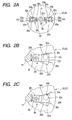
- Figs. 2A to 2C are successive views (including a section taken along the line II-II in Fig. 1 ) showing the arrangement of the respective members on the surface of the rotor member 20 and the activation states.
- Fig. 2B In contrast, when the electromagnetic brake 24 is activated, as described above, the friction plate 22 is absorbed by an electromagnetic force, and rotation is locked. In this state, for example, when the rotation operating member 12 is operated to rotate in the direction of the arrow in the drawing, one of the elastic portions 30b is elastically deformed by a reactive force from the engagement protrusion 22c, thereby displacing the engagement clip portion 30a in the direction opposite to the rotation direction. In this case, the engagement protrusion 22c is permitted to be relatively moved between the pair of regulation walls 20d in the receiving portion 20c. Therefore, even if the friction plate 22 is locked, the relative rotation of the rotor member 20 is permitted, as shown in the drawing.
- Fig. 3 is a diagram (including a section taken along the line III-III in Fig. 1 ) showing just the friction plate 22.
- the engagement protrusion 22c has, for example, a columnar shape (a circular shape in section), and comes into contact with a pair of engagement clip portions 30a on the outer circumferential surface (curved surface) thereof.
- the engagement protrusion 22c has a columnar shape (a circular shape in section)
- the engagement protrusion 22c may have a prism shape (a rectangular shape in section).
- the contact elastic plate 30d functions as a plate spring and extends from the inner position outward in a state where the base end thereof is connected to the connection plate 30c.
- the front end portion of the contact elastic plate 30d is in contact with the upper end of the engagement protrusion 22c, and in this state, the elastic force is imparted downward with respect to the engagement protrusion 22c.
- the friction plate 22 is constantly in contact with the electromagnetic brake 24, so the same advantages as in the third embodiment can be obtained.
Landscapes
- Engineering & Computer Science (AREA)
- Physics & Mathematics (AREA)
- General Physics & Mathematics (AREA)
- Automation & Control Theory (AREA)
- Chemical & Material Sciences (AREA)
- Combustion & Propulsion (AREA)
- Transportation (AREA)
- Mechanical Engineering (AREA)
- Mechanical Control Devices (AREA)
- Rotary Switch, Piano Key Switch, And Lever Switch (AREA)
- Switch Cases, Indication, And Locking (AREA)
Abstract
Description
- The present invention contains subject matter related to Japanese Patent Application
JP 2008-228474 - The present invention relates to an operation feeling imparting type input device which can be used as an input device in various electronic apparatuses or in-vehicle electric components, and can impart a dynamic operation feeling to an operator at the time of use.
- With regard to such an operation feeling imparting type input device, related art is known in which the rotation of an operating knob is regulated by an electromagnetic brake, thereby imparting a feeling of resistance to the rotation of the operating knob (for example, see Japanese Unexamined Patent Application Publication No.
2005-19113 - Unlike a case where the rotation is regulated by a mechanical stopper or the like, in the locking by the electromagnetic brake, the rotation in a direction opposite to the previous direction is regulated. For this reason, even though the operator tries to return the operating knob in the opposite direction, the operating knob remains fixed in the locked state. According to the related art, an elastic member is provided between the operating knob and the electromagnetic brake, and when the operating knob is operated in the locked state, the elastic member is bent to allow the detection of the rotation direction after the locking. Therefore, flexible control can be realized such that the locked state is maintained when the operating knob is rotated in the same direction as the previous direction, and the locked state is released when the operating knob is returned in the opposite direction.
- According to the above-described related art, even if a locking feeling is imparted to the operating knob, a slight operational force is given to the operating knob in the direction opposite to the previous direction, which easily releases the locked state. Therefore, excellent operational convenience is achieved, and thus the related art has a high technical value.
- The inventors have focused that the elastic member used in the related art needs to be twisted (bent) by a comparatively weak operational force, and to this end, a certain level of length in a thrust direction (rotation axis direction) is needed, and have studied further improvement. That is, an advantage of some aspects of the invention is that it provides an operation feeling imparting type input device capable of realizing a reduction in size in a thrust direction.
- The invention employs the following means for solving the above-described problems.
- According to an aspect of the invention, an operation feeling imparting type input device includes a rotation shaft supported so as to be rotatable together with a rotation operating member to be rotated by an operator, rotation detection means having a body to be detected configured to rotate together with the rotation shaft, and having a detector configured to detect the rotation state of the body to be detected, a rotor member provided to be spread in a radial direction of the rotation shaft and configured to rotate together with the rotation shaft, a friction plate provided so as to be rotatable around the same central axis line as the rotation shaft and the rotor member and to be freely displaced in a thrust direction of the rotor member with respect to the rotor member, a rotation transmission mechanism configured to transmit the rotation of the rotor member to a friction member so as to rotate the friction plate so that it follows the rotor member, rotation regulation means configured to absorb the friction plate in the thrust direction of the rotor member and to regulate the rotation of the friction plate by a frictional force due to the absorption, control means configured to control the operation state of the rotation regulation means on the basis of the detection result of the rotation detection means, and rotation elasticity imparting means configured to impart an elastic force in a rotation direction to the rotation transmission mechanism so as to permit the body to be detected to be relatively rotated with respect to the friction plate together with the rotor member if the rotation operating member is operated to rotate in a state where the rotation of the friction plate is regulated by the rotation regulation means.
- This operation feeling imparting type input device has the following functions with the above-described basic configuration. That is, if the rotation operating member is operated to rotate by the operator (user), accordingly, the rotation shaft is rotated together with the rotation operating member. The rotation of the rotation shaft causes the body to be detected to be rotated, and the detector detects the rotation state of the body to be rotated. The rotor member is rotated together with the rotation shaft in a state being spread in the radial direction of the rotation shaft. In this case, if the control means does not activate the rotation regulation means (the rotation of the friction plate is not regulated), the rotation of the rotor member is transmitted to the friction plate by the rotation transmission mechanism, and the friction plate is rotated to follow the rotation shaft and the rotor member. In contrast, if the control means activates the rotation regulation means, when the rotation operating member is operated, the rotation transmission mechanism continuously transmits the rotation of the rotor member to the friction plate. In this case, the rotation elasticity imparting means imparts the elastic force in the rotation direction to the rotation transmission mechanism, and the rotation that should be transmitted to the friction plate is absorbed by the elastic force. When this happens, even though the rotation of the friction plate is regulated (the friction plate is locked), the rotation of the body to be detected is permitted together with the rotor member, and thus the rotation state (rotation direction) can be detected. Therefore, control can be realized such that, for example, when rotation is detected in the direction opposite to the direction before the rotation of the friction plate is regulated, the control means deactivates the rotation regulation means to enable the free rotation of the rotation operating member.
- First, the operation feeling imparting type input device has the following feature. The rotation transmission mechanism includes an engagement protrusion provided at the friction plate, and an engagement clip portion provided at the rotor member. Of these, the engagement protrusion projects from the friction plate toward the rotor member. The engagement clip portion has a pair of clip walls which transmit a rotational force from the rotor member to the engagement protrusion with the engagement protrusion sandwiched therebetween from both sides in the rotation direction of the rotor member. The rotation elasticity imparting means has an elastic portion which is elastically deformed by a reactive force from the engagement protrusion when the rotation operating member is operated to rotate in a state where the rotation of the friction plate is regulated, thereby displacing the engagement clip portion so as to permit the relative rotation of the rotor member.
- With this operation feeling imparting type input device, the engagement clip portion is configured to transmit the rotation with the engagement protrusion sandwiched from both sides in the rotation direction. When the rotation of the friction plate is regulated, the direction of elastic deformation by the elastic portion corresponds to the rotation direction (or the opposite direction). For this reason, the elastic portion can be elastically deformed while the length in the thrust direction is not particularly limited, and thus there is no increase structurally in size in the thrust direction.
- Second, the operation feeling imparting type input device has the following feature. The rotor member is configured to have a receiving portion which receives the engagement protrusion projecting from the friction plate toward the rotor member. The receiving portion includes a pair of regulation walls which are provided on both sides of the engagement clip portion at an interval in the rotation direction. The receiving portion permits the engagement protrusion to be relatively moved in the rotation direction between the pair of regulation walls in a state where the engagement protrusion is received between the regulation walls and regulates the movement of the engagement protrusion in a state where the regulation walls are in contact with the engagement protrusion.
- In this case, even if the operational force is imparted to the rotation operating member in a state where the rotation of the friction plate is regulated, the engagement protrusion is relatively moved between the pair of regulation walls due to elastic deformation of the elastic portion, so the rotation state of the body to be detected can be detected, as described above. Further, if the rotation operation is made to a certain angle, the engagement protrusion eventually comes into contact with one of the pair of regulation walls, and thus further rotation is regulated. Therefore, the elastic portion can be prevented from being excessively deformed (for example, yield) or broken.
- Third, the operation feeling imparting type input device may have the above-described basic configuration and also the following feature. The rotation transmission mechanism is configured such that the engagement protrusion is provided at the rotor member, and the engagement clip portion is provided at the friction plate. In this case, the engagement protrusion projects from the rotor member toward the friction plate. The engagement clip portion has a pair of clip walls which receive a rotational force from the rotor member through the engagement protrusion with the engagement protrusion sandwiched therebetween from both sides in the rotation direction of the friction plate. The rotation elasticity imparting means has an elastic portion which is elastically deformed by a reactive force from the engagement clip portion when the rotation operating member is operated to rotate in a state where the rotation of the friction plate is regulated, thereby displacing the engagement protrusion so as to permit the relative rotation of the rotor member.
- With this operation feeling imparting type input device, the engagement protrusion transmits the rotation to the engagement clip portion while being sandwiched from both sides in the rotation direction. When the rotation of the friction plate is regulated, the direction of elastic deformation of the elastic portion and the direction of displacement of the engagement protrusion correspond to the rotation direction (or the opposite direction). For this reason, the elastic portion can be elastically deformed while the length in the thrust direction is not particularly limited, and thus there is no increase structurally in size in the thrust direction.
- Fourth, the operation feeling imparting type input device has the following feature. The rotor member where the engagement protrusion is provided has a pair of cutout portions which are formed on both sides of the engagement protrusion to permit or regulate the displacement of the engagement protrusion. The pair of cutout portions form a pair of regulation walls on both sides of the engagement protrusion at an interval in the rotation direction. The pair of cutout portions permit the displacement of the engagement protrusion in the rotation direction between the regulation walls and regulate the displacement of the engagement protrusion in a state where the engagement protrusion is in contact with the regulation walls.
- If the rotor member has a pair of cutout portions (a pair of regulation walls), when the operational force is imparted to the rotation operating member in a state where the rotation of the friction plate is regulated, the engagement protrusion is relatively moved between the pair of regulation walls (within the range of the cutout portions) due to elastic deformation of the elastic portion, so the rotation state of the body to be detected can be detected, as described above. Further, if the rotation operation is made to a certain angle, the engagement protrusion eventually comes into contact with one of the pair of regulation walls, and thus further rotation is regulated. Therefore, the elastic portion can be prevented from being excessively deformed (for example, yield) or broken.
- Fifth, the operation feeling imparting type input device may have the following configuration with regard to the fourth feature. The rotor member has a main body portion which has a disk shape centered around the rotation shaft, and a pair of cutout portions are formed to extend from the outer edge of the main body portion toward the rotation shaft. Part of a portion of the main body portion which extends in a peninsula shape from an inner position to the outer edge while being sandwiched between the pair of cutout portions forms the engagement protrusion, and a base end portion at the inner position forms the elastic portion.
- With this configuration, the engagement protrusion or the elastic portion can be formed on the rotor member itself, and thus the number of parts can be reduced by as much.
- Sixth, the operation feeling imparting type input device may have the following configuration with regard to the first to fifth features. The friction plate has a through hole into which the rotation shaft is inserted in the thickness direction, and a clearance which is defined between the inner circumferential surface of the through hole and the outer circumferential surface of the rotation shaft. The clearance permits the displacement of the friction plate in the thrust direction without restriction in the direction of the central axis line of the rotation shaft.
- In this case, the friction plate is freely displaced in the thrust direction, and is not restricted in the direction of the central axis line of the rotation shaft. Therefore, the friction plate can be constantly and uniformly absorbed with respect to the rotation regulation means. For example, in a structure in which the friction plate slides along the outer circumferential surface of the rotation shaft, the friction plate is restricted in the direction of the central axis line by the rotation shaft, so there is a possibility that the state when the friction plate is absorbed to the rotation regulation means changes depending on the positional relationship between the rotation shaft and the rotation regulation means, or the angle between the central axis line and the rotation regulation means at the same time, so a variation in the frictional force occurs. In contrast, in a structure in which the clearance is defined, the friction plate can be absorbed to the rotation regulation means without influence on the rotation shaft, and thus a frictional force can be generated stably.
- Seventh, the operation feeling imparting type input device may have the following configuration with regard to the third to sixth features. The rotor member is provided with at least three engagement protrusions in the rotation direction, and the friction plate is provided with the same number of engagement clip portions as the engagement protrusions.
- With this configuration, the engagement of the engagement protrusions and the engagement clip portions is made throughout the rotation direction of the rotor member, and thus a shear with respect to the rotation center (central axis line) can be suppressed.
- Eighth, the operation feeling imparting type input device may further include contact elasticity imparting means configured to impart an elastic force in the absorption direction to the friction plate and to permit free rotation in a state where the friction plate is in contact with the rotation regulation means by the elastic force.
- In this case, even if the control means does not activate the rotation regulation means, the friction plate remains to be in contact with the rotation regulation means by the elastic force. For this reason, at the moment the control means activates the rotation regulation means, the friction plate can be prevented from colliding against the rotation regulation means by the absorption, and an impact sound can be prevented from being generated.
- The contact elasticity imparting means clamps the engagement protrusion, which projects from the rotor member toward the friction plate, to the friction plate, thereby imparting the elastic force in the absorption direction through the engagement protrusion.
- With this configuration, it is not necessary to provide a new part serving as the contact elasticity imparting means, so an increase in the number of parts can be suppressed by as much. Further, the engagement protrusion is prevented from slipping out from the engagement clip portion, so the idle rotation of the rotor member can be suppressed.
- When the fifth feature is provided, of the main body portion of the rotor member, a base end portion at an inner position of a portion which extends in a peninsula shape from the inner position to the outer edge with sandwiched between a pair of cutout portions forms elastic portion, and the base end portion forms the contact elasticity imparting means. With this configuration, the parts of the rotor member can be given many functions, and thus a more reasonable structure can be realized.
- According to this operation feeling imparting type input device, the reduction in size in the thrust direction can be achieved without sacrificing the same basic functionality as that the previous devices have. Further, a structure can be realized which prevents parts from being damaged due to an excessive operation, and has excellent durability.
-
-
Fig. 1 is a schematic view showing the overall configuration of an operation feeling imparting type input device of a first embodiment. -
Figs. 2A to 2C are successive views (including a section taken along the line II-II inFig. 1 ) showing the arrangement of the respective members on the surface of the rotor member and the activation states. -
Fig. 3 is a diagram (including a section taken along the line III-III inFig. 1 ) showing just a friction plate. -
Fig. 4 is a diagram showing an example of the relationship between the rotation angle of a rotation operating member and the electromagnetic force by an electromagnetic brake. -
Fig. 5 is a longitudinal sectional view partially showing the configuration of an operation feeling imparting type input device of a second embodiment. -
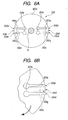
Figs. 6A and 6B are diagrams (including a section taken along the line VI-VI inFig. 5 ) showing the arrangement of the respective members on the surface of the rotor member and the activation states. -
Fig. 7 is a diagram (including a section taken along the line VII-VII inFig. 5 ) showing just a friction plate in the second embodiment. -
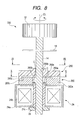
Fig. 8 is a longitudinal sectional view partially showing the configuration of an operation feeling imparting type input device of a third embodiment. -
Fig. 9 is a diagram (including a section taken along the line IX-IX inFig. 8 ) showing the arrangement of the respective members on the surface of the rotor member and the activation states. -
Fig. 10 is a diagram (including a section taken along the line X-X inFig. 8 ) showing just a friction plate in the third embodiment. -
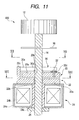
Fig. 11 is a longitudinal sectional view partially showing the configuration of an operation feeling imparting type input device of a fourth embodiment. -
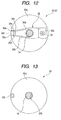
Fig. 12 is a successive view (including a section taken along the line XII-XII inFig. 11 ) showing the arrangement of the respective members on the surface of the rotor member and the activation states. -
Fig. 13 is a diagram (including a section taken along the line XIII-XIII inFig. 11 ) showing just a friction plate in the fourth embodiment. -
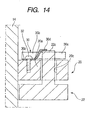
Fig. 14 is a partial sectional view showing an example where an additional element is provided in a clip-shaped member of the first embodiment. - Embodiments of the invention will now be described with reference to the drawings. An operation feeling imparting type input device according to an embodiment of the invention may be used as an input device (user interface) for various electronic apparatuses (computers, audio apparatuses, and video apparatuses) and also in-vehicle electric components, such as a car navigation device and the like. With regard to the operation feeling imparting type input device, various embodiments are made in accordance with the difference in the specific structure. Hereinafter, the operation feeling imparting type input device will be described with respect to plural exemplary embodiments.
-
Fig. 1 is a schematic view showing the overall configuration of an operation feeling impartingtype input device 10 of a first embodiment. InFig. 1 , most of the mechanical configuration of the operation feeling impartingtype input device 10 is shown by a longitudinal sectional view. Further, inFig. 1 , the electrical configuration of the operation feeling impartingtype input device 10 is shown by a block diagram. - The operation feeling imparting
type input device 10 has arotation operating member 12. Therotation operating member 12 has, for example, a rotary-type knob shape (dial shape). An operator can grip and rotate therotation operating member 12. In this case, therotation operating member 12 is rotated around a central axis line CL which is indicated by a one-dot-chain line in the drawing. - The
rotation operating member 12 is connected to one end of arotation shaft 14, for example. Therotation shaft 14 extends from therotation operating member 12 in one direction (lower direction inFig. 1 ) along the central axis line CL. Therotation shaft 14 is rotated around the central axis line CL together with therotation operating member 12. - Onto the outer circumference of the
rotation shaft 14, acode plate 16 serving as a body to be detected is attached. Thecode plate 16 has a thin disk shape centered around therotation shaft 14, and slits (not shown) are formed at regular pitches in the circumferential direction of thecode plate 16. In the outer circumferential portion of thecode plate 16, an index (light shielding portion) is formed in the circumferential direction with a reference position of the rotation direction as a base point. - Two photo-interrupters 18 and 19 serving as detectors are provided close to the
rotation shaft 14. Of these, the photo-interrupter 18 is arranged such that detection light transmits the slits of thecode plate 16. The photo-interrupter 19 is arranged such that detection light is shielded by the index at the reference position. If therotation operating member 12 is operated to rotate, thecode plate 16 is rotated together with therotation shaft 14, and a rotation angle signal (encoder pulse) is output from the photo-interrupter 18. Further, a rotation direction signal (ON/OFF signal) with respect to the reference position is output from the photo-interrupter 19 in accordance with the rotation direction at that time. - A
rotor member 20 is attached in the vicinity of the center of therotation shaft 14 when viewed from the longitudinal direction of therotation shaft 14. Therotor member 20 has a disk-shapedmain body portion 20a, and themain body portion 20a is spread in a radial direction centered around therotation shaft 14. A throughhole 20b is formed at the center of themain body portion 20a. The throughhole 20b is formed to pass through themain body portion 20a in the thickness direction. Therotor member 20 is fixed (fitted) to therotation shaft 14 in a state where therotation shaft 14 is inserted into the throughhole 20b. For this reason, if therotation operating member 12 is operated, therotor member 20 is rotated around the central axis line CL together with therotation shaft 14. - A
friction plate 22 is attached at a position of therotation shaft 14 close to therotor member 20 when viewed from the longitudinal direction of therotation shaft 14. Thefriction plate 22 also has a disk-shapedmain body portion 22a, and aninsertion hole 22b is formed at the center of themain body portion 22a. Theinsertion hole 22b of thefriction plate 22 passes through themain body portion 22a in the thickness direction, but the inner diameter thereof is slightly larger than the outer diameter of therotation shaft 14. For this reason, thefriction plate 22 is not fixed to therotation shaft 14 and is supported so as to relatively rotate around the central axis line CL with respect to therotation shaft 14 or therotor member 20. - In a state where the
rotation shaft 14 is inserted into theinsertion hole 22b, thefriction plate 22 may be displaced in the longitudinal direction (thrust direction). A bearing (not shown) may be provided between the outer circumferential surface of therotation shaft 14 and the inner circumferential surface of theinsertion hole 22b to freely slide along therotation shaft 14, for example. The whole of thefriction plate 22 is formed of a magnetic material (for example, iron). - The operation feeling imparting
type input device 10 has, for example, anelectromagnetic brake 24. Theelectromagnetic brake 24 has a case-type core 24a which has a hollow columnar shape, and a hoop winding 24b is disposed in the case-type core 24a. Abearing 24c formed of resin is provided at the center of the case-type core 24a, and the other end portion (lower end portion inFig. 1 ) of therotation shaft 14 is rotatably supported by the case-type core 24a through thebearing 24c. Theelectromagnetic brake 24 generates an electromagnetic force in the case-type core 24a in a state where electricity is conducted to the winding 24b, thereby absorbing thefriction plate 22 in the thrust direction. - The other end of the
rotation shaft 14 passes through the case-type core 24a and projects in a direction (lower direction inFig. 1 ) opposite to therotor member 20 or thefriction plate 22, and a flange-shapedstopper 26 is attached to therotation shaft 14 at the projected position. Thestopper 26 prevents therotation shaft 14 from slipping out from the case-type core 24a in the one-end direction of the rotation shaft 14 (upper direction inFig. 1 ). - The operation feeling imparting
type input device 10 has acontroller 28 as an electrical configuration. Thecontroller 28 includes a microprocessor which has a processor (CPU) (not shown), a memory device, such as a ROM or a RAM, and peripheral circuits, such as an input/output circuit and the like. The rotation angle signal and the rotation direction signal which are output from the photo-interrupters 18 and 19 are A/D converted by the input/output circuit and then input to the CPU. The CPU of thecontroller 28 calculates the rotation angle and the rotation direction of the rotation shaft 14 (rotation operating member 12) on the basis of the input signals. The CPU of thecontroller 28 controls the activation (electricity conduction or non-conduction to the winding 24b) of theelectromagnetic brake 24 on the basis of the calculation result of the rotation angle and the rotation direction. - The operation feeling imparting
type input device 10 has a rotation transmission mechanism which transmits the rotation of therotor member 20 to thefriction plate 22. A specific configuration of the rotation transmission mechanism will now be described. - The
friction plate 22 is provided with twoengagement protrusions 22c which project from the surface thereof (upper surface inFig. 1 ). Theengagement protrusions 22c extend from the surface of the friction plate 22 (main body portion 22a) toward the rotor member 20 (thrust direction). - At the
rotor member 20, receivingportions 20c are formed at the positions corresponding to the twoengagement protrusions 22c. The receivingportions 20c pass through themain body portion 20a in the thickness direction and extend, and theengagement protrusions 22c are respectively inserted into the receivingportions 20c. Theengagement protrusions 22c have such a length sufficient to be projected from the surface (upper surface inFig. 1 ) of the rotor member 20 (main body portion 20a) in a state being inserted into the receivingportions 20c. - At the
rotor member 20, two clip-shapedmembers 30 are formed to correspond to the twoengagement protrusions 22c. The clip-shapedmembers 30 are fixed to the surface of themain body portion 20a by usingscrews 32, for example. InFig. 1 , only a sectional shape is shown, but the clip-shapedmembers 30 are arranged so as to sandwich the projected ends of theengagement protrusions 22c from both sides. Hereinafter, this point will be described with reference to an additional drawing. -
Figs. 2A to 2C are successive views (including a section taken along the line II-II inFig. 1 ) showing the arrangement of the respective members on the surface of therotor member 20 and the activation states. -
Fig. 2A : Each of the clip-shapedmembers 30 extends from the center of therotor member 20 in the radial direction, and the front end portion thereof is formed in shape of a pair ofengagement clip portions 30a. The clip-shapedmember 30 is assembled in a state where theengagement protrusion 22c is sandwiched between the pair ofengagement clip portions 30a. - In the clip-shaped
member 30, the intermediate portions connected to the pair ofengagement clip portions 30a formelastic portions 30b. Theelastic portions 30b function as, for example, a plate spring. - Each of the clip-shaped
members 30 has aconnection plate 30c near the center thereof, and theconnection plate 30c extends in the circumferential direction along the surface of therotor member 20. The clip-shapedmember 30 is fixed to therotor member 20 by thescrew 32 at the position of theconnection plate 30c. Theelastic portions 30b extend in the radial direction with both edges as the base portions when viewed from the circumferential direction of theconnection plate 30c. - Each of the receiving
portions 20c extends in the circumferential direction (the rotation direction of the rotor member 20) centered around therotation shaft 14, and the inner surfaces at both ends of the receivingportion 20c when viewed from the rotation direction form a pair ofregulation walls 20d. The pair ofregulation walls 20d are arranged on both sides of theengagement protrusion 22c at an interval when viewed from the rotation direction of therotor member 20. - When the
electromagnetic brake 24 is not activated, if therotation operating member 12 is operated to rotate and therotor member 20 is rotated in the operation direction together with therotation shaft 14, the rotational force is transmitted from theengagement clip portions 30a to theengagement protrusions 22c. Thus, thefriction plate 22 can be rotated to follow the rotation of therotor member 20. -
Fig. 2B : In contrast, when theelectromagnetic brake 24 is activated, as described above, thefriction plate 22 is absorbed by an electromagnetic force, and rotation is locked. In this state, for example, when therotation operating member 12 is operated to rotate in the direction of the arrow in the drawing, one of theelastic portions 30b is elastically deformed by a reactive force from theengagement protrusion 22c, thereby displacing theengagement clip portion 30a in the direction opposite to the rotation direction. In this case, theengagement protrusion 22c is permitted to be relatively moved between the pair ofregulation walls 20d in the receivingportion 20c. Therefore, even if thefriction plate 22 is locked, the relative rotation of therotor member 20 is permitted, as shown in the drawing. -
Fig. 2C : If therotation operating member 12 is further operated to rotate, theengagement protrusion 22c eventually comes into contact with one of theregulation walls 20d (on the side opposite to the rotation direction) in the receivingportion 20c. In this state, the further relative rotation of theengagement protrusion 22c is regulated, and as a result, the rotation of therotor member 20 is regulated. Therefore, therotation operating member 12 cannot be further rotated, so the operator can be given a feeling of collision against a wall from therotation operating member 12. As a result, theelastic portion 30b can be prevented from being excessively deformed. -
Fig. 3 is a diagram (including a section taken along the line III-III inFig. 1 ) showing just thefriction plate 22. Theengagement protrusion 22c has, for example, a columnar shape (a circular shape in section), and comes into contact with a pair ofengagement clip portions 30a on the outer circumferential surface (curved surface) thereof. Thus, as described above, when theelastic portion 30b is elastically deformed, the displacement of theengagement clip portion 30a can be smoothly guided along the outer circumferential surface. Although theengagement protrusion 22c has a columnar shape (a circular shape in section), theengagement protrusion 22c may have a prism shape (a rectangular shape in section). - Next, an example of control of the
electromagnetic brake 24 by thecontroller 28 will be described.Fig. 4 is a diagram showing an example of the relationship (excitation pattern) between the rotation angle of therotation operating member 12 and the electromagnetic force (frictional force) by theelectromagnetic brake 24. - As described above, the CPU of the
controller 28 calculates the current rotation angle of therotation operating member 12 on the basis of the rotation angle signal and the rotation direction signal from the photo-interrupters 18 and 19. In this case, with regard to the rotation angle, an increase in one direction from a prescribed reference angle (θ0) can be expressed by a positive angle (+θ), and an increase in the opposite direction can be expressed by a negative angle (-θ). - In the example of the drawing, the rotation angle of the
rotation operating member 12 can be limited symmetrically in two directions. Specifically, the upper limit angles (+θmax, -θmax) in two directions for control are set, and when the calculated rotation angle reaches any upper limit angle, thecontroller 28 prompts electricity to be conducted to the winding 24b of theelectromagnetic brake 24, thereby generating in steps the maximum electromagnetic force. When this happens, thefriction plate 22 is absorbed in the thrust direction, so as described above, theengagement protrusion 22c comes into contact with theregulation walls 20d and the rotation of therotation operating member 12 is locked. It should suffice that the upper limit angles (+θmax, -θmax) may be set in expectation of the rotation angle when theengagement protrusion 22c comes into contact with theregulation walls 20d. - For example, it is assumed that the rotation angle of the
rotation operating member 12 reaches the positive upper limit angle (+θmax) and theelectromagnetic brake 24 is activated. In this case, even though the operator tries to further rotate therotation operating member 12, locking is made by theelectromagnetic brake 24, and the operation cannot be continued. - In this state, if the operator operates the
rotation operating member 12 to rotate in the direction (negative direction) opposite to the previous direction, the otherelastic portion 30b is elastically deformed, and then theengagement clip portion 30a on the side opposite to the direction of the rotation operation is displaced. When this happens, the rotation of therotor member 20 in the direction opposite to the previous direction is permitted. In this case, theengagement protrusion 22c is permitted to be relatively moved toward theregulation wall 20d opposite to theregulation wall 20d with which theengagement protrusion 22c is in contact. - In this case, the rotation in the direction opposite to the previous direction is detected by the photo-interrupters 18 and 19, so the
controller 28 deactivates theelectromagnetic brake 24 on the basis of the excitation pattern inFig. 4 . When this happens, the absorption of thefriction plate 22 is released, and therotor member 20 is freely rotated. Thus, from the operator's side, the locking of therotation operating member 12 is released. - With the operation feeling imparting
type input device 10 of the first embodiment, theelastic portion 30b is elastically deformed in the rotation direction of therotor member 20, so the length of therotation shaft 14 in the thrust direction is not particularly limited. Therefore, the operation feeling impartingtype input device 10 as a whole can be reduced in size in the thrust direction, and thus the whole of an apparatus (for example, an electronic apparatus or an in-vehicle electric component) into which the operation feeling impartingtype input device 10 is incorporated can be reduced in size. - Even though the
rotation operating member 12 is further operated to rotate during the activation of theelectromagnetic brake 24, theregulation wall 20d comes into contact with theengagement protrusion 22c, thereby restricting further rotation. Therefore, the clip-shapedmember 30 can be prevented from being broken or plastically deformed, and thus the lifespan of articles can be ensured. -
Fig. 5 is a longitudinal sectional view partially showing an operation feeling impartingtype input device 100 of a second embodiment. The operation feeling impartingtype input device 100 of the second embodiment has arotor member 200 and afriction plate 220 which are different from those in the first embodiment. Other portions including the portions not shown in the drawings are the same as those in the first embodiment. Hereinafter, the same portions as those in the first embodiment are represented by the same reference numerals, and overlap descriptions will be omitted. - In the second embodiment, the
rotor member 200 has, for example, a disk-shapedmain body portion 200a, and themain body portion 200a is spread in the radial direction centered around therotation shaft 14. A throughhole 200b is formed at the center of themain body portion 200a. The throughhole 200b is formed to pass through themain body portion 200a in the thickness direction. Therotor member 200 is fixed (fitted) to therotation shaft 14 in a state where therotation shaft 14 is inserted into the throughhole 200b. For this reason, if therotation operating member 12 is operated, therotor member 200 is rotated around the central axis line CL together with therotation shaft 14. - The
friction plate 220 also has, for example, a disk-shapedmain body portion 220a, and aninsertion hole 220b is formed at the center of themain body portion 220a. In the second embodiment, the inner diameter of theinsertion hole 220b of thefriction plate 220 is set to be slightly larger than the outer diameter of therotation shaft 14, so thefriction plate 220 can be displaced in the longitudinal direction (thrust direction) of therotation shaft 14. - In the second embodiment,
engagement protrusions 200c are formed on therotor member 200. In this case, theengagement protrusions 200c project from therotor member 200 toward thefriction plate 220. In the second embodiment,engagement clip portions 220c are formed on thefriction plate 220. -
Figs. 6A and 6B are diagrams (including a section taken along the line VI-VI ofFig. 5 ) showing the arrangement of the respective members on the surface of therotor member 200 and the activation states. -
Fig. 6A :Cutout portions 200d are formed in pairs at two places of therotor member 200 when viewed from the circumferential direction of themain body portion 200a. Thecutout portions 200d extend in parallel from the outer edge of therotor member 200 toward therotation shaft 14. Eachportion 200f sandwiched between thecutout portions 200d extends in a peninsula shape from the inner position of themain body portion 200a to the outer edge, and at the front end thereof, theengagement protrusion 200c is formed. In the second embodiment, a base end portion at the inner position of the peninsula-shapedportion 200f forms anelastic portion 200e. A pair ofcutout portions 200dform regulation walls 200g on both sides of theengagement protrusion 200c when viewed from the rotation direction of therotor member 200. -
Fig. 6B : In the second embodiment, when therotation operating member 12 is operated to rotate in the direction of the arrow in the drawing in a state where thefriction plate 220 is locked, theelastic portion 200e is elastically deformed by a reactive force from theengagement clip portion 220c. When this happens, as indicated by a two-dot-chain line in the drawing, the whole of the peninsula-shapedportion 200f is displaced, so theengagement protrusion 200c can be displaced in the direction opposite to the rotation direction. In this case, theengagement protrusion 200c is permitted to be relatively moved between a pair ofregulation walls 200g in thecutout portions 200d. Therefore, in the second embodiment, as shown in the drawing, the relative rotation of therotor member 200 is permitted in a state where thefriction plate 220 is locked. - If the
rotation operating member 12 is continuously operated to rotate after theelectromagnetic brake 24 is activated, theengagement protrusion 200c (the side surface of theportion 200f) comes into contact with one of theregulation walls 200g (on the side opposite to the rotation direction) in thecutout portions 200d. In this case, the further relative movement of theengagement protrusion 200c is regulated, and as a result, the rotation of therotor member 200 is regulated. When this happens, in the second embodiment, the operator can be given a feeling of collision against a wall from therotation operating member 12. Similarly to the first embodiment, theelastic portion 200e can be prevented from being excessively deformed and from being broken. -
Fig. 7 is a diagram (including a section taken along the line VII-VII inFig. 5 ) showing just thefriction plate 220 in the second embodiment. InFig. 7 , the section of theengagement protrusion 200c is not shown. Theengagement clip portions 220c are formed at an interval slightly larger than the width of theengagement protrusion 200c when viewed from the rotation direction. For this reason, theengagement clip portions 220c can transmit the rotation of therotor member 200 to thefriction plate 220 with theengagement protrusion 200c sandwiched therebetween, and can absorb thefriction plate 220 in the thrust direction without being pulled to theengagement protrusion 200c when theelectromagnetic brake 24 is activated. - In the second embodiment, no elastic portion is provided on the
rotation shaft 14, so similarly to the first embodiment, the reduction in size in the thrust direction can be easily realized. Further, theelastic portions 200e are formed integrally with themain body portion 200a of therotor member 200, so the number of parts can be reduced by as much. - Next,
Fig. 8 is a longitudinal sectional view partially showing the configuration of an operation feeling impartingtype input device 300 of a third embodiment. The operation feeling impartingtype input device 300 of the third embodiment also has arotor member 250 and afriction plate 260 which are different from those in the first embodiment. Other portions including the portions not shown in the drawing are the same as those in the first embodiment, and overlap descriptions will be omitted. - In the third embodiment, the
rotor member 250 has, for example, a disk-shapedmain body portion 250a, and themain body portion 250a is spread in the radial direction centered around therotation shaft 14. A throughhole 250b is formed at the center of themain body portion 250a. The throughhole 250b is formed to pass through themain body portion 250a in the thickness direction. Therotor member 250 is fixed (fitted) to therotation shaft 14 in a state where therotation shaft 14 is inserted into the throughhole 250b. For this reason, if therotation operating member 12 is operated, therotor member 250 is rotated around the central axis line CL together with therotation shaft 14. - The
friction plate 260 also has, for example, a disk-shapedmain body portion 260a, and aninsertion hole 260b is formed at the center of themain body portion 260a. In the third embodiment, however, the inner diameter of theinsertion hole 260b is set to be 2 to 2.5 times larger than the outer diameter of therotation shaft 14, for example. For this reason, a sufficient clearance C is ensured between the outer circumferential surface of therotation shaft 14 and the inner surface of theinsertion hole 260b. The total clearance C on both sides of therotation shaft 14 is set to be larger than the thickness of themain body portion 260a. Thus, thefriction plate 260 is freely displaced in the thrust direction with respect to therotation shaft 14, and also has a large degree of freedom in angular displacement with respect to the central axis line CL. - In the third embodiment, similarly to the second embodiment,
engagement protrusions 250c are formed on therotor member 250. Thus, theengagement protrusions 250c project from therotor member 250 toward thefriction plate 260. Similarly, in the third embodiment,engagement clip portions 260c are formed on thefriction plate 260. -
Fig. 9 is a diagram (including a section taken along the line IX-IX inFig. 8 ) showing the arrangement of the respective members on the surface of therotor member 250 and the activation states. In the third embodiment, theengagement protrusions 250c are formed at three places when viewed from the circumferential direction of the rotor member 250 (main body portion 250a). In this case, theengagement protrusions 250c are desirably arranged at regular intervals (angular pitch) when viewed from the circumferential direction. Thecutout portions 250d, the peninsula-shapedportions 250f, theelastic portions 250e, and theregulation walls 250g have the same configuration and basic functions as those in the second embodiment. -
Fig. 10 is a diagram (including a section taken along the line X-X inFig. 8 ) showing just thefriction plate 260 in the third embodiment. InFig. 10 , the section of theengagement protrusion 250c is not shown. In the third embodiment, similarly to the second embodiment, theengagement clip portions 260c are formed at an interval slightly larger than the width of theengagement protrusion 250c when viewed from the rotation direction. - In the third embodiment, the
friction plate 260 can be constantly in contact with theelectromagnetic brake 24 by the elastic force theelastic portions 250e. That is, in a state where therotor member 250 is attached to therotation shaft 14, theelastic portions 250e impart the elastic force through theengagement protrusions 250c in a direction (lower direction inFig. 9 ) for clamping thefriction plate 260. Thus, thefriction plate 260 can be maintained in a state being in contact with the absorption surface (frictional surface) of theelectromagnetic brake 24. Note that the elastic force is imparted such that, even through thefriction plate 260 is in contact with theelectromagnetic brake 24, smooth rotation (so-called sliding) is not obstructed. - In the third embodiment, similarly to the first and second embodiments, the reduction in size in the thrust direction can be easily realized. Further, similarly to the second embodiment, the
elastic portions 250e are formed integrally with themain body portion 250a of therotor member 250, so the number of parts can be reduced by as much. - In particular, in the third embodiment, the clearance C is provided, such that the posture of the
friction plate 260 is not restricted by therotation shaft 14. Thus, when theelectromagnetic brake 24 is activated, thefriction plate 260 can be absorbed constantly in a reasonable posture. For this reason, a variation in the frictional force which is generated when theelectromagnetic brake 24 is activated is eliminated, and thus stable rotation regulation can be realized. - In the third embodiment, at least three
engagement protrusions 250c are formed in the rotation direction of therotor member 250 and sandwiched between theengagement clip portions 260c of thefriction plate 260. Thus, thefriction plate 260 can be prevented from being laterally shifted (decentered) with respect to therotation shaft 14. - In the third embodiment, the
friction plate 260 can be constantly in contact with theelectromagnetic brake 24. Thus, when theelectromagnetic brake 24 is activated, thefriction plate 260 can be prevented from colliding against the cast-type core 24a, and an impact sound can be prevented from being generated. -
Fig. 11 is a longitudinal sectional view partially showing the configuration of an operation feeling impartingtype input device 400 of a fourth embodiment. The operation feeling impartingtype input device 400 of the fourth embodiment is different from the first embodiment in that oneengagement protrusion 22c and oneengagement clip portion 30a are respectively provided, but it basically has the same configuration as that of the first embodiment. Hereinafter, description will be made focusing on differences from the first embodiment. -
Fig. 12 is a successive view (including a section taken along the line XII-XII inFig. 11 ) showing the arrangement of the respective members on the surface of therotor member 20 and the activation states. In the fourth embodiment, a clip-shapedmember 30 extends in the radial direction of therotor member 20 with therotation shaft 14 sandwiched. Thus, when viewed from the diameter direction of therotor member 20, the front end portion of the clip-shapedmember 30 on one side of therotation shaft 14 forms a pair ofengagement clip portions 30a, and aconnection plate 30c is positioned on the other side.Elastic portions 30b are formed to be longer than those in the first embodiment, but have the same basic function. - A receiving
portion 20c passes through themain body portion 20a in the thickness direction and has an opening at the outer edge of themain body portion 20a. That is, the receivingportion 20c is formed by cutting themain body portion 20a at the outer edge. In this case, the inner surfaces at both ends of the receivingportion 20c when viewed from the rotation direction form a pair ofregulation walls 20d. Similarly to the first embodiment, thepair regulation walls 20d are positioned at an interval on both sides of theengagement protrusion 22c when viewed from the rotation direction of therotor member 20. - Like the fourth embodiment, even though one
engagement protrusion 22c and oneengagement clip portion 30a are provided, when theelectromagnetic brake 24 is not activated, if therotation operating member 12 is operated to rotate and therotor member 20 is rotated in the operation direction together with therotation shaft 14, the rotational force of therotor member 20 is transmitted to theengagement protrusion 22c in a state where theengagement protrusion 22c is sandwiched between a pair ofengagement clip portions 30a. Thus, thefriction plate 22 is rotated to follow the rotation of therotor member 20. - Similarly, when the
rotation operating member 12 is operated to rotate during the activation of theelectromagnetic brake 24, similarly, oneelastic portion 30b is elastically deformed by a reactive force from theengagement protrusion 22c, thereby displacing theengagement clip portion 30a in the direction opposite to the rotation direction. In this case, theengagement protrusion 22c is permitted to be relatively moved between the pair ofregulation walls 20d in the receivingportion 20c. Therefore, even though thefriction plate 22 is locked, the relative rotation of therotor member 20 is permitted. - If the
rotation operating member 12 is further operated during the activation of theelectromagnetic brake 24, theengagement protrusion 22c comes into contact with one of theregulation walls 20d (on the side opposite to the rotation direction) in the receivingportion 20c, and further relative rotation of theengagement protrusion 22c is regulated. As a result, the rotation of therotor member 20 is regulated, so therotation operating member 12 cannot be rotated, and the operator can be given a feeling of collision against a wall. In this case, theelastic portions 30b can be prevented from being broken (yield deformation). -
Fig. 13 is a diagram (including a section taken along the line XIII-XIII inFig. 11 ) showing just thefriction plate 22 in the fourth embodiment. In this case, theengagement protrusion 22c has, for example, a prism shape (a rectangular shape in section). Note that theengagement protrusion 22c may have a columnar shape (a circular shape in section), like the first embodiment. -
Fig. 14 is a partial section view showing an example where an additional element is provided at the clip-shapedmember 30 of the first embodiment. A contactelastic plate 30d may be provided at the clip-shapedmember 30 of the first embodiment to be integrally with theconnection plate 30c. - The contact
elastic plate 30d functions as a plate spring and extends from the inner position outward in a state where the base end thereof is connected to theconnection plate 30c. The front end portion of the contactelastic plate 30d is in contact with the upper end of theengagement protrusion 22c, and in this state, the elastic force is imparted downward with respect to theengagement protrusion 22c. Thus, in the first embodiment, thefriction plate 22 is constantly in contact with theelectromagnetic brake 24, so the same advantages as in the third embodiment can be obtained. - The invention is not limited to the foregoing embodiments, and various modifications may be made. In the foregoing embodiments, a disk-shaped rotor member has been exemplified, but a rotor member having a polygonal plate shape may be used. Further, in the first and third embodiments, a plate spring-shaped elastic portion has been exemplified, but a coil spring-shaped elastic portion may be used.
- The excitation pattern of the
electromagnetic brake 24 is not limited to the above-described example. For example, an excitation pattern for imparting a feeling of click may be used, or an excitation pattern for imparting a feeling of resistance, which is changed in accordance with an increase in the rotation angle, may be used. - The detection of the rotation state may be realized by the combination of a reflecting mirror and a photo-switch as well as the combination of the
code plate 16 and the photo-interrupters 18 and 19. - The shapes or arrangement of various members shown in the drawings are just examples, and they may be appropriately changed in carrying out the invention.
- It should be understood by those skilled in the art that various modifications, combinations, sub-combinations and alterations may occur depending on design requirements and other factors insofar as they are within the scope of the appended claims of the equivalents thereof.
Claims (9)
- An operation feeling imparting type input device comprising:a rotation shaft (14) supported so as to be rotatable together with a rotation operating member (12), which is rotated by an operator;rotation detection means having a body to be detected (16) which rotates together with the rotation shaft (14), and having a detector (18) which detects the rotation state of the body to be detected (16);a rotor member (20) provided to be spread in a radial direction of the rotation shaft (14) and configured to rotate together with the rotation shaft (14);a friction plate (22) provided so as to be rotatable around the same central axis line as the rotation shaft (14) and the rotor member (20) and to be freely displaced in a thrust direction of the rotor member (20) with respect to the rotor member (20);a rotation transmission mechanism configured to transmit the rotation of the rotor member (20) to a friction member so as to rotate the friction plate (22) so that it follows the rotor member (20);rotation regulation means (24) configured to absorb the friction plate (22) in the thrust direction of the rotor member (20) and to regulate the rotation of the friction plate (22) by a frictional force due to the absorption;control means (28) configured to control the operation state of the rotation regulation means (24) on the basis of the detection result of the rotation detection means; androtation elasticity imparting means configured to impart an elastic force in a rotation direction to the rotation transmission mechanism so as to permit the body to be detected (16) to be relatively rotated with respect to the friction plate (22) together with the rotor member (20) if the rotation operating member (12) is operated to rotate in a state where the rotation of the friction plate (22) is regulated by the rotation regulation means (24),characterized in that the rotation transmission mechanism includes
an engagement protrusion (22c) provided at the friction plate (22) to project from the friction plate (22) toward the rotor member (20), and
an engagement clip portion (30a) provided at the rotor member (20) to have a pair of clip walls which transmit a rotational force from the rotor member (20) to the engagement protrusion (22c) with the engagement protrusion (22c) sandwiched therebetween from both sides in the rotation direction, and
the rotation elasticity imparting means has an elastic portion (30b) which is elastically deformed by a reactive force from the engagement protrusion (22c) when the rotation operating member (12) is operated to rotate in a state where the rotation of the friction plate (22) is regulated, thereby displacing the engagement clip portion (30a) so as to permit the relative rotation of the rotor member (20). - The operation feeling imparting type input device according to claim 1,
characterized in that the rotor member (20) has a receiving portion (20c) which includes a pair of regulation walls (20d) which are provided on both sides of the engagement clip portion (30a) at an interval in the rotation direction, and the receiving portion (20c) permits the engagement protrusion (22c) to be relatively moved in the rotation direction between the pair of regulation walls (20d) in a state where the engagement protrusion (22c) is received between the regulation walls (20d) and regulates the movement of the engagement protrusion (22c) in a state where the regulation walls (20d) are in contact with the engagement protrusion (22c). - An operation feeling imparting type input device comprising:a rotation shaft (14) supported so as to be rotatable together with a rotation operating member (12) to be rotated by an operator;rotation detection means having a body to be detected (16) configured to rotate together with the rotation shaft (14), and having a detector (18) configured to detect the rotation state of the body to be detected (16);a rotor member (200) provided to be spread in a radial direction of the rotation shaft (14) and configured to rotate together with the rotation shaft (14);a friction plate (220) provided so as to be rotatable around the same central axis line as the rotation shaft (14) and the rotor member (200) and to be freely displaced in a thrust direction of the rotor member (200) with respect to the rotor member (200);a rotation transmission mechanism configured to transmit the rotation of the rotor member (200) to a friction member so as to rotate the friction plate (220) so that it follows the rotor member (200);rotation regulation means (24) configured to absorb the friction plate (220) in the thrust direction of the rotor member (200) and to regulate the rotation of the friction plate (220) by a frictional force due to the absorption;control means (28) configured to control the operation state of the rotation regulation means (24) on the basis of the detection result of the rotation detection means; androtation elasticity imparting means configured to impart an elastic force in a rotation direction to the rotation transmission mechanism so as to permit the body to be detected (16) to be relatively rotated with respect to the friction plate (220) together with the rotor member (200) if the rotation operating member (12) is operated to rotate in a state where the rotation of the friction plate (220) is regulated by the rotation regulation means (24),characterized in that the rotation transmission mechanism includes
an engagement protrusion (200c) provided at the rotor member (200) to project from the rotor member (200) toward the friction plate (220), and
an engagement clip portion (220c) provided at the friction plate (220) to have a pair of clip walls which receive a rotational force from the rotor member (200) through the engagement protrusion (200c) with the engagement protrusion (200c) sandwiched therebetween from both sides in rotation direction, and
the rotation elasticity imparting means has an elastic portion (200e) which is elastically deformed by a reactive force from the engagement clip portion (220c) when the rotation operating member (12) is operated to rotate in a state where the rotation of the friction plate (220) is regulated, thereby displacing the engagement protrusion (200c) so as to permit the relative rotation of the rotor member (200). - The operation feeling imparting type input device according to claim 3,
characterized in that the rotor member (200) has a pair of cutout portions (200d) which form a pair of regulation walls (200g) on both sides of the engagement protrusion (200c) at an interval in the rotation direction, the pair of cutout portions (200d) permit the displacement of the engagement protrusion (200c) in the rotation direction between the regulation walls (200g) and regulate the displacement of the engagement protrusion (200c) in a state where the regulation walls (200g) are in contact with the engagement protrusion (200c). - The operation feeling imparting type input device according to claim 4,
characterized in that the rotor member (200) has a main body portion (200a) which has a disk shape centered around the rotation shaft (14), the pair of cutout portions (200d) are formed to extend from the outer edge of the main body portion (200a) toward the rotation shaft (14), part of a portion of the main body portion (200a) extending in a peninsula shape from an inner position to the outer edge while being sandwiched between the pair of cutout portions (200d) forms the engagement protrusion (200c), and a base end portion at the inner position forms the elastic portion (200e). - The operation feeling imparting type input device according to any one of claims 1 to 5,
characterized in that the friction plate (260) has
a through hole (260b) into which the rotation shaft (14) is inserted in the thickness direction, and
a clearance (C) which is defined between the inner circumferential surface of the through hole (260b) and the outer circumferential surface of the rotation shaft (14), and
the clearance (C) permits the displacement of the friction plate (260) in the thrust direction without restriction in the direction of the central axis line of the rotation shaft (14). - The operation feeling imparting type input device according to any one of claims 3 to 6,
characterized in that the rotor member (250) is provided with at least three engagement protrusions (250c) in the rotation direction, and the friction plate (260) is provided with the same number of engagement clip portions (260c) as the engagement protrusions (250c). - The operation feeling imparting type input device according to any one of claims 1 to 7, further comprising:contact elasticity imparting means (30d) configured to impart an elastic force in the absorption direction to the friction plate (22), and permits free rotation in a state where the friction plate (22) is in contact with the rotation regulation means (24) by the elastic force.
- The operation feeling imparting type input device according to claim 8,
characterized in that the contact elasticity imparting means clamps the engagement protrusion (22c), which projects from the rotor member (20) toward the friction plate (22), to the friction plate (22), thereby imparting the elastic force in the absorption direction through the engagement protrusion (22c).
Applications Claiming Priority (1)
| Application Number | Priority Date | Filing Date | Title |
|---|---|---|---|
| JP2008228474A JP4614371B2 (en) | 2008-09-05 | 2008-09-05 | Operation feeling imparting type input device |
Publications (3)
| Publication Number | Publication Date |
|---|---|
| EP2161644A2 true EP2161644A2 (en) | 2010-03-10 |
| EP2161644A3 EP2161644A3 (en) | 2010-10-06 |
| EP2161644B1 EP2161644B1 (en) | 2012-12-26 |
Family
ID=41381577
Family Applications (1)
| Application Number | Title | Priority Date | Filing Date |
|---|---|---|---|
| EP09169123A Active EP2161644B1 (en) | 2008-09-05 | 2009-09-01 | Operation feeling imparting type input device |
Country Status (2)
| Country | Link |
|---|---|
| EP (1) | EP2161644B1 (en) |
| JP (1) | JP4614371B2 (en) |
Cited By (3)
| Publication number | Priority date | Publication date | Assignee | Title |
|---|---|---|---|---|
| CN103244582A (en) * | 2012-02-08 | 2013-08-14 | 阿尔卑斯电气株式会社 | Electromagnetic brake device and force sense imparting type rotary input device using the same |
| US10276320B2 (en) | 2015-08-24 | 2019-04-30 | Panasonic Intellectual Property Management Co., Ltd. | Input device |
| CN116868144A (en) * | 2021-03-25 | 2023-10-10 | 阿尔卑斯阿尔派株式会社 | rotary shifter |
Families Citing this family (3)
| Publication number | Priority date | Publication date | Assignee | Title |
|---|---|---|---|---|
| US8866643B2 (en) * | 2010-09-07 | 2014-10-21 | Alps Electric Co., Ltd. | Rotation input device |
| JP6049072B2 (en) | 2013-03-11 | 2016-12-21 | アルプス電気株式会社 | Electromagnetic brake unit |
| JP7021958B2 (en) * | 2018-01-17 | 2022-02-17 | アルプスアルパイン株式会社 | Rotation control device |
Citations (2)
| Publication number | Priority date | Publication date | Assignee | Title |
|---|---|---|---|---|
| JP2005019113A (en) | 2003-06-25 | 2005-01-20 | Alps Electric Co Ltd | Tactile force applying type input device |
| JP2008228474A (en) | 2007-03-14 | 2008-09-25 | Renesas Technology Corp | Motor drive |
Family Cites Families (5)
| Publication number | Priority date | Publication date | Assignee | Title |
|---|---|---|---|---|
| JPH05182562A (en) * | 1992-01-06 | 1993-07-23 | Canon Inc | Switch device |
| DE10120618A1 (en) * | 2001-04-26 | 2002-10-31 | Kostal Leopold Gmbh & Co Kg | turntable |
| DE20219655U1 (en) * | 2001-12-20 | 2003-03-13 | Leopold Kostal GmbH & Co KG, 58507 Lüdenscheid | Switch mechanism particularly a control knob such as for operating windows and sun roofs in cars and having a damping medium |
| JP2003263234A (en) * | 2002-03-11 | 2003-09-19 | Alps Electric Co Ltd | Apparatus for applying sense of force |
| US8002089B2 (en) * | 2004-09-10 | 2011-08-23 | Immersion Corporation | Systems and methods for providing a haptic device |
-
2008
- 2008-09-05 JP JP2008228474A patent/JP4614371B2/en active Active
-
2009
- 2009-09-01 EP EP09169123A patent/EP2161644B1/en active Active
Patent Citations (2)
| Publication number | Priority date | Publication date | Assignee | Title |
|---|---|---|---|---|
| JP2005019113A (en) | 2003-06-25 | 2005-01-20 | Alps Electric Co Ltd | Tactile force applying type input device |
| JP2008228474A (en) | 2007-03-14 | 2008-09-25 | Renesas Technology Corp | Motor drive |
Cited By (8)
| Publication number | Priority date | Publication date | Assignee | Title |
|---|---|---|---|---|
| CN103244582A (en) * | 2012-02-08 | 2013-08-14 | 阿尔卑斯电气株式会社 | Electromagnetic brake device and force sense imparting type rotary input device using the same |
| EP2626588A1 (en) * | 2012-02-08 | 2013-08-14 | Alps Electric Co., Ltd. | Electromagnetic brake system and force sense imparting type rotation input apparatus using the same |
| US8869952B2 (en) | 2012-02-08 | 2014-10-28 | Alps Electric Co., Ltd. | Electromagnetic brake system and force sense imparting type rotation input apparatus using the same |
| CN103244582B (en) * | 2012-02-08 | 2015-09-23 | 阿尔卑斯电气株式会社 | Electromagnetic brake device and force sense imparting type rotary input device using the same |
| US10276320B2 (en) | 2015-08-24 | 2019-04-30 | Panasonic Intellectual Property Management Co., Ltd. | Input device |
| CN116868144A (en) * | 2021-03-25 | 2023-10-10 | 阿尔卑斯阿尔派株式会社 | rotary shifter |
| US12098768B2 (en) | 2021-03-25 | 2024-09-24 | Alps Alpine Co., Ltd. | Rotary shifter |
| CN116868144B (en) * | 2021-03-25 | 2026-01-09 | 阿尔卑斯阿尔派株式会社 | Rotary shifter |
Also Published As
| Publication number | Publication date |
|---|---|
| EP2161644B1 (en) | 2012-12-26 |
| JP2010062075A (en) | 2010-03-18 |
| EP2161644A3 (en) | 2010-10-06 |
| JP4614371B2 (en) | 2011-01-19 |
Similar Documents
| Publication | Publication Date | Title |
|---|---|---|
| EP2161644B1 (en) | Operation feeling imparting type input device | |
| JP6823209B2 (en) | Input device | |
| JP5787677B2 (en) | Rotation input device | |
| EP2636928B1 (en) | Parking lock device | |
| JP5777613B2 (en) | Accelerator device | |
| US10234022B2 (en) | Electronic transmission system | |
| EP3330513B1 (en) | Throttle grip apparatus | |
| JP2017004099A (en) | Rotation operation device | |
| KR20190081794A (en) | Actuator and Transmission for Vehicle including the Actuator | |
| EP3267280A1 (en) | Reaction force output device | |
| US12098768B2 (en) | Rotary shifter | |
| EP3339689B1 (en) | Shift device | |
| JP2012001164A (en) | Webbing take-up device | |
| CA2169508C (en) | Gear mechanism and webbing retractor | |
| JP2011173458A (en) | Shift operating device | |
| CN112443402B (en) | Throttle grip device for receiving throttle operation of driver | |
| EP2720241B1 (en) | Composite operating device | |
| JP2017181010A (en) | Door open / close mechanism for refrigerator | |
| JP6603114B2 (en) | Shift switch device | |
| JP3833987B2 (en) | Clutch mechanism | |
| WO2017135122A1 (en) | Shift device | |
| JP2020009648A (en) | Dial switch and on-vehicle equipment controlling system | |
| KR20180002058U (en) | Parking release actuator | |
| JPH0140775Y2 (en) | ||
| JP2025029695A (en) | Drink holder |
Legal Events
| Date | Code | Title | Description |
|---|---|---|---|
| PUAI | Public reference made under article 153(3) epc to a published international application that has entered the european phase |
Free format text: ORIGINAL CODE: 0009012 |
|
| AK | Designated contracting states |
Kind code of ref document: A2 Designated state(s): AT BE BG CH CY CZ DE DK EE ES FI FR GB GR HR HU IE IS IT LI LT LU LV MC MK MT NL NO PL PT RO SE SI SK SM TR |
|
| PUAL | Search report despatched |
Free format text: ORIGINAL CODE: 0009013 |
|
| AK | Designated contracting states |
Kind code of ref document: A3 Designated state(s): AT BE BG CH CY CZ DE DK EE ES FI FR GB GR HR HU IE IS IT LI LT LU LV MC MK MT NL NO PL PT RO SE SI SK SM TR |
|
| 17P | Request for examination filed |
Effective date: 20110311 |
|
| 17Q | First examination report despatched |
Effective date: 20110526 |
|
| GRAP | Despatch of communication of intention to grant a patent |
Free format text: ORIGINAL CODE: EPIDOSNIGR1 |
|
| GRAS | Grant fee paid |
Free format text: ORIGINAL CODE: EPIDOSNIGR3 |
|
| GRAP | Despatch of communication of intention to grant a patent |
Free format text: ORIGINAL CODE: EPIDOSNIGR1 |
|
| GRAA | (expected) grant |
Free format text: ORIGINAL CODE: 0009210 |
|
| AK | Designated contracting states |
Kind code of ref document: B1 Designated state(s): AT BE BG CH CY CZ DE DK EE ES FI FR GB GR HR HU IE IS IT LI LT LU LV MC MK MT NL NO PL PT RO SE SI SK SM TR |
|
| REG | Reference to a national code |
Ref country code: GB Ref legal event code: FG4D |
|
| REG | Reference to a national code |
Ref country code: CH Ref legal event code: EP |
|
| REG | Reference to a national code |
Ref country code: AT Ref legal event code: REF Ref document number: 590789 Country of ref document: AT Kind code of ref document: T Effective date: 20130115 |
|
| REG | Reference to a national code |
Ref country code: DE Ref legal event code: R096 Ref document number: 602009012181 Country of ref document: DE Effective date: 20130307 |
|
| PG25 | Lapsed in a contracting state [announced via postgrant information from national office to epo] |
Ref country code: HR Free format text: LAPSE BECAUSE OF FAILURE TO SUBMIT A TRANSLATION OF THE DESCRIPTION OR TO PAY THE FEE WITHIN THE PRESCRIBED TIME-LIMIT Effective date: 20121226 Ref country code: NO Free format text: LAPSE BECAUSE OF FAILURE TO SUBMIT A TRANSLATION OF THE DESCRIPTION OR TO PAY THE FEE WITHIN THE PRESCRIBED TIME-LIMIT Effective date: 20130326 Ref country code: LT Free format text: LAPSE BECAUSE OF FAILURE TO SUBMIT A TRANSLATION OF THE DESCRIPTION OR TO PAY THE FEE WITHIN THE PRESCRIBED TIME-LIMIT Effective date: 20121226 Ref country code: FI Free format text: LAPSE BECAUSE OF FAILURE TO SUBMIT A TRANSLATION OF THE DESCRIPTION OR TO PAY THE FEE WITHIN THE PRESCRIBED TIME-LIMIT Effective date: 20121226 Ref country code: SE Free format text: LAPSE BECAUSE OF FAILURE TO SUBMIT A TRANSLATION OF THE DESCRIPTION OR TO PAY THE FEE WITHIN THE PRESCRIBED TIME-LIMIT Effective date: 20121226 |
|
| REG | Reference to a national code |
Ref country code: AT Ref legal event code: MK05 Ref document number: 590789 Country of ref document: AT Kind code of ref document: T Effective date: 20121226 |
|
| REG | Reference to a national code |
Ref country code: LT Ref legal event code: MG4D |
|
| REG | Reference to a national code |
Ref country code: NL Ref legal event code: VDEP Effective date: 20121226 |
|
| PG25 | Lapsed in a contracting state [announced via postgrant information from national office to epo] |
Ref country code: LV Free format text: LAPSE BECAUSE OF FAILURE TO SUBMIT A TRANSLATION OF THE DESCRIPTION OR TO PAY THE FEE WITHIN THE PRESCRIBED TIME-LIMIT Effective date: 20121226 Ref country code: GR Free format text: LAPSE BECAUSE OF FAILURE TO SUBMIT A TRANSLATION OF THE DESCRIPTION OR TO PAY THE FEE WITHIN THE PRESCRIBED TIME-LIMIT Effective date: 20130327 Ref country code: SI Free format text: LAPSE BECAUSE OF FAILURE TO SUBMIT A TRANSLATION OF THE DESCRIPTION OR TO PAY THE FEE WITHIN THE PRESCRIBED TIME-LIMIT Effective date: 20121226 |
|
| PG25 | Lapsed in a contracting state [announced via postgrant information from national office to epo] |
Ref country code: BE Free format text: LAPSE BECAUSE OF FAILURE TO SUBMIT A TRANSLATION OF THE DESCRIPTION OR TO PAY THE FEE WITHIN THE PRESCRIBED TIME-LIMIT Effective date: 20121226 Ref country code: ES Free format text: LAPSE BECAUSE OF FAILURE TO SUBMIT A TRANSLATION OF THE DESCRIPTION OR TO PAY THE FEE WITHIN THE PRESCRIBED TIME-LIMIT Effective date: 20130406 Ref country code: SK Free format text: LAPSE BECAUSE OF FAILURE TO SUBMIT A TRANSLATION OF THE DESCRIPTION OR TO PAY THE FEE WITHIN THE PRESCRIBED TIME-LIMIT Effective date: 20121226 Ref country code: CZ Free format text: LAPSE BECAUSE OF FAILURE TO SUBMIT A TRANSLATION OF THE DESCRIPTION OR TO PAY THE FEE WITHIN THE PRESCRIBED TIME-LIMIT Effective date: 20121226 Ref country code: AT Free format text: LAPSE BECAUSE OF FAILURE TO SUBMIT A TRANSLATION OF THE DESCRIPTION OR TO PAY THE FEE WITHIN THE PRESCRIBED TIME-LIMIT Effective date: 20121226 Ref country code: EE Free format text: LAPSE BECAUSE OF FAILURE TO SUBMIT A TRANSLATION OF THE DESCRIPTION OR TO PAY THE FEE WITHIN THE PRESCRIBED TIME-LIMIT Effective date: 20121226 Ref country code: BG Free format text: LAPSE BECAUSE OF FAILURE TO SUBMIT A TRANSLATION OF THE DESCRIPTION OR TO PAY THE FEE WITHIN THE PRESCRIBED TIME-LIMIT Effective date: 20130326 Ref country code: IS Free format text: LAPSE BECAUSE OF FAILURE TO SUBMIT A TRANSLATION OF THE DESCRIPTION OR TO PAY THE FEE WITHIN THE PRESCRIBED TIME-LIMIT Effective date: 20130426 |
|
| PG25 | Lapsed in a contracting state [announced via postgrant information from national office to epo] |
Ref country code: PT Free format text: LAPSE BECAUSE OF FAILURE TO SUBMIT A TRANSLATION OF THE DESCRIPTION OR TO PAY THE FEE WITHIN THE PRESCRIBED TIME-LIMIT Effective date: 20130426 Ref country code: NL Free format text: LAPSE BECAUSE OF FAILURE TO SUBMIT A TRANSLATION OF THE DESCRIPTION OR TO PAY THE FEE WITHIN THE PRESCRIBED TIME-LIMIT Effective date: 20121226 Ref country code: PL Free format text: LAPSE BECAUSE OF FAILURE TO SUBMIT A TRANSLATION OF THE DESCRIPTION OR TO PAY THE FEE WITHIN THE PRESCRIBED TIME-LIMIT Effective date: 20121226 Ref country code: RO Free format text: LAPSE BECAUSE OF FAILURE TO SUBMIT A TRANSLATION OF THE DESCRIPTION OR TO PAY THE FEE WITHIN THE PRESCRIBED TIME-LIMIT Effective date: 20121226 |
|
| PG25 | Lapsed in a contracting state [announced via postgrant information from national office to epo] |
Ref country code: DK Free format text: LAPSE BECAUSE OF FAILURE TO SUBMIT A TRANSLATION OF THE DESCRIPTION OR TO PAY THE FEE WITHIN THE PRESCRIBED TIME-LIMIT Effective date: 20121226 |
|
| PLBE | No opposition filed within time limit |
Free format text: ORIGINAL CODE: 0009261 |
|
| STAA | Information on the status of an ep patent application or granted ep patent |
Free format text: STATUS: NO OPPOSITION FILED WITHIN TIME LIMIT |
|
| PG25 | Lapsed in a contracting state [announced via postgrant information from national office to epo] |
Ref country code: CY Free format text: LAPSE BECAUSE OF FAILURE TO SUBMIT A TRANSLATION OF THE DESCRIPTION OR TO PAY THE FEE WITHIN THE PRESCRIBED TIME-LIMIT Effective date: 20121226 |
|
| 26N | No opposition filed |
Effective date: 20130927 |
|
| PG25 | Lapsed in a contracting state [announced via postgrant information from national office to epo] |
Ref country code: IT Free format text: LAPSE BECAUSE OF FAILURE TO SUBMIT A TRANSLATION OF THE DESCRIPTION OR TO PAY THE FEE WITHIN THE PRESCRIBED TIME-LIMIT Effective date: 20121226 |
|
| REG | Reference to a national code |
Ref country code: DE Ref legal event code: R097 Ref document number: 602009012181 Country of ref document: DE Effective date: 20130927 |
|
| PG25 | Lapsed in a contracting state [announced via postgrant information from national office to epo] |
Ref country code: MC Free format text: LAPSE BECAUSE OF FAILURE TO SUBMIT A TRANSLATION OF THE DESCRIPTION OR TO PAY THE FEE WITHIN THE PRESCRIBED TIME-LIMIT Effective date: 20121226 |
|
| REG | Reference to a national code |
Ref country code: CH Ref legal event code: PL |
|
| GBPC | Gb: european patent ceased through non-payment of renewal fee |
Effective date: 20130901 |
|
| REG | Reference to a national code |
Ref country code: FR Ref legal event code: ST Effective date: 20140530 |
|
| REG | Reference to a national code |
Ref country code: IE Ref legal event code: MM4A |
|
| PG25 | Lapsed in a contracting state [announced via postgrant information from national office to epo] |
Ref country code: CH Free format text: LAPSE BECAUSE OF NON-PAYMENT OF DUE FEES Effective date: 20130930 Ref country code: GB Free format text: LAPSE BECAUSE OF NON-PAYMENT OF DUE FEES Effective date: 20130901 Ref country code: LI Free format text: LAPSE BECAUSE OF NON-PAYMENT OF DUE FEES Effective date: 20130930 Ref country code: IE Free format text: LAPSE BECAUSE OF NON-PAYMENT OF DUE FEES Effective date: 20130901 |
|
| PG25 | Lapsed in a contracting state [announced via postgrant information from national office to epo] |
Ref country code: FR Free format text: LAPSE BECAUSE OF NON-PAYMENT OF DUE FEES Effective date: 20130930 |
|
| PG25 | Lapsed in a contracting state [announced via postgrant information from national office to epo] |
Ref country code: SM Free format text: LAPSE BECAUSE OF FAILURE TO SUBMIT A TRANSLATION OF THE DESCRIPTION OR TO PAY THE FEE WITHIN THE PRESCRIBED TIME-LIMIT Effective date: 20121226 |
|
| PG25 | Lapsed in a contracting state [announced via postgrant information from national office to epo] |
Ref country code: MT Free format text: LAPSE BECAUSE OF FAILURE TO SUBMIT A TRANSLATION OF THE DESCRIPTION OR TO PAY THE FEE WITHIN THE PRESCRIBED TIME-LIMIT Effective date: 20121226 Ref country code: TR Free format text: LAPSE BECAUSE OF FAILURE TO SUBMIT A TRANSLATION OF THE DESCRIPTION OR TO PAY THE FEE WITHIN THE PRESCRIBED TIME-LIMIT Effective date: 20121226 |
|
| PG25 | Lapsed in a contracting state [announced via postgrant information from national office to epo] |
Ref country code: HU Free format text: LAPSE BECAUSE OF FAILURE TO SUBMIT A TRANSLATION OF THE DESCRIPTION OR TO PAY THE FEE WITHIN THE PRESCRIBED TIME-LIMIT; INVALID AB INITIO Effective date: 20090901 Ref country code: MK Free format text: LAPSE BECAUSE OF FAILURE TO SUBMIT A TRANSLATION OF THE DESCRIPTION OR TO PAY THE FEE WITHIN THE PRESCRIBED TIME-LIMIT Effective date: 20121226 Ref country code: LU Free format text: LAPSE BECAUSE OF NON-PAYMENT OF DUE FEES Effective date: 20130901 |
|
| REG | Reference to a national code |
Ref country code: DE Ref legal event code: R082 Ref document number: 602009012181 Country of ref document: DE Representative=s name: SCHMITT-NILSON SCHRAUD WAIBEL WOHLFROM PATENTA, DE |
|
| REG | Reference to a national code |
Ref country code: DE Ref legal event code: R082 Ref document number: 602009012181 Country of ref document: DE Representative=s name: SCHMITT-NILSON SCHRAUD WAIBEL WOHLFROM PATENTA, DE Ref country code: DE Ref legal event code: R081 Ref document number: 602009012181 Country of ref document: DE Owner name: ALPS ALPINE CO., LTD., JP Free format text: FORMER OWNER: ALPS ELECTRIC CO., LTD., TOKYO, JP |
|
| PGFP | Annual fee paid to national office [announced via postgrant information from national office to epo] |
Ref country code: DE Payment date: 20250919 Year of fee payment: 17 |