EP2160384B1 - Process for the preparation of valsartan - Google Patents
Process for the preparation of valsartan Download PDFInfo
- Publication number
- EP2160384B1 EP2160384B1 EP08750212.6A EP08750212A EP2160384B1 EP 2160384 B1 EP2160384 B1 EP 2160384B1 EP 08750212 A EP08750212 A EP 08750212A EP 2160384 B1 EP2160384 B1 EP 2160384B1
- Authority
- EP
- European Patent Office
- Prior art keywords
- compound
- process according
- valsartan
- reaction
- temperature
- Prior art date
- Legal status (The legal status is an assumption and is not a legal conclusion. Google has not performed a legal analysis and makes no representation as to the accuracy of the status listed.)
- Not-in-force
Links
- 238000000034 method Methods 0.000 title claims description 64
- 239000004072 C09CA03 - Valsartan Substances 0.000 title claims description 35
- 229960004699 valsartan Drugs 0.000 title claims description 35
- 238000002360 preparation method Methods 0.000 title claims description 20
- SJSNUMAYCRRIOM-QFIPXVFZSA-N valsartan Chemical compound C1=CC(CN(C(=O)CCCC)[C@@H](C(C)C)C(O)=O)=CC=C1C1=CC=CC=C1C1=NN=N[N]1 SJSNUMAYCRRIOM-QFIPXVFZSA-N 0.000 title claims 3
- 150000001875 compounds Chemical class 0.000 claims description 49
- 238000006243 chemical reaction Methods 0.000 claims description 22
- KDLHZDBZIXYQEI-UHFFFAOYSA-N Palladium Chemical group [Pd] KDLHZDBZIXYQEI-UHFFFAOYSA-N 0.000 claims description 20
- QAOWNCQODCNURD-UHFFFAOYSA-N Sulfuric acid Chemical compound OS(O)(=O)=O QAOWNCQODCNURD-UHFFFAOYSA-N 0.000 claims description 18
- 238000005984 hydrogenation reaction Methods 0.000 claims description 18
- 239000001117 sulphuric acid Substances 0.000 claims description 18
- 235000011149 sulphuric acid Nutrition 0.000 claims description 18
- 125000006239 protecting group Chemical group 0.000 claims description 14
- 239000003054 catalyst Substances 0.000 claims description 13
- -1 1-methyl-1-phenylethyl Chemical group 0.000 claims description 11
- 125000002221 trityl group Chemical group [H]C1=C([H])C([H])=C([H])C([H])=C1C([*])(C1=C(C(=C(C(=C1[H])[H])[H])[H])[H])C1=C([H])C([H])=C([H])C([H])=C1[H] 0.000 claims description 9
- 238000009903 catalytic hydrogenation reaction Methods 0.000 claims description 7
- 150000007530 organic bases Chemical class 0.000 claims description 7
- XBPCUCUWBYBCDP-UHFFFAOYSA-N Dicyclohexylamine Chemical group C1CCCCC1NC1CCCCC1 XBPCUCUWBYBCDP-UHFFFAOYSA-N 0.000 claims description 5
- 125000000999 tert-butyl group Chemical group [H]C([H])([H])C(*)(C([H])([H])[H])C([H])([H])[H] 0.000 claims description 5
- 150000003839 salts Chemical class 0.000 claims description 4
- 239000002638 heterogeneous catalyst Substances 0.000 claims description 3
- 238000002955 isolation Methods 0.000 claims description 2
- ACWBQPMHZXGDFX-QFIPXVFZSA-N valsartan Chemical compound C1=CC(CN(C(=O)CCCC)[C@@H](C(C)C)C(O)=O)=CC=C1C1=CC=CC=C1C1=NN=NN1 ACWBQPMHZXGDFX-QFIPXVFZSA-N 0.000 description 33
- 239000000203 mixture Substances 0.000 description 16
- YXFVVABEGXRONW-UHFFFAOYSA-N Toluene Chemical compound CC1=CC=CC=C1 YXFVVABEGXRONW-UHFFFAOYSA-N 0.000 description 12
- 239000011541 reaction mixture Substances 0.000 description 11
- JMMWKPVZQRWMSS-UHFFFAOYSA-N isopropanol acetate Natural products CC(C)OC(C)=O JMMWKPVZQRWMSS-UHFFFAOYSA-N 0.000 description 10
- 229940011051 isopropyl acetate Drugs 0.000 description 10
- GWYFCOCPABKNJV-UHFFFAOYSA-N isovaleric acid Chemical compound CC(C)CC(O)=O GWYFCOCPABKNJV-UHFFFAOYSA-N 0.000 description 10
- 238000011282 treatment Methods 0.000 description 9
- KFZMGEQAYNKOFK-UHFFFAOYSA-N Isopropanol Chemical compound CC(C)O KFZMGEQAYNKOFK-UHFFFAOYSA-N 0.000 description 8
- 239000012535 impurity Substances 0.000 description 8
- 239000007787 solid Substances 0.000 description 8
- UFHFLCQGNIYNRP-UHFFFAOYSA-N Hydrogen Chemical compound [H][H] UFHFLCQGNIYNRP-UHFFFAOYSA-N 0.000 description 7
- 239000001257 hydrogen Substances 0.000 description 7
- 229910052739 hydrogen Inorganic materials 0.000 description 7
- YMWUJEATGCHHMB-UHFFFAOYSA-N Dichloromethane Chemical compound ClCCl YMWUJEATGCHHMB-UHFFFAOYSA-N 0.000 description 6
- RWGFKTVRMDUZSP-UHFFFAOYSA-N cumene Chemical compound CC(C)C1=CC=CC=C1 RWGFKTVRMDUZSP-UHFFFAOYSA-N 0.000 description 6
- IZXIZTKNFFYFOF-UHFFFAOYSA-N 2-Oxazolidone Chemical group O=C1NCCO1 IZXIZTKNFFYFOF-UHFFFAOYSA-N 0.000 description 5
- BASFCYQUMIYNBI-UHFFFAOYSA-N platinum Chemical compound [Pt] BASFCYQUMIYNBI-UHFFFAOYSA-N 0.000 description 5
- 150000003536 tetrazoles Chemical group 0.000 description 5
- XLYOFNOQVPJJNP-UHFFFAOYSA-N water Substances O XLYOFNOQVPJJNP-UHFFFAOYSA-N 0.000 description 5
- 239000008346 aqueous phase Substances 0.000 description 4
- TZCXTZWJZNENPQ-UHFFFAOYSA-L barium sulfate Chemical compound [Ba+2].[O-]S([O-])(=O)=O TZCXTZWJZNENPQ-UHFFFAOYSA-L 0.000 description 4
- 230000015572 biosynthetic process Effects 0.000 description 4
- 238000004128 high performance liquid chromatography Methods 0.000 description 4
- 238000007327 hydrogenolysis reaction Methods 0.000 description 4
- 229910052763 palladium Inorganic materials 0.000 description 4
- 239000007858 starting material Substances 0.000 description 4
- LFQSCWFLJHTTHZ-UHFFFAOYSA-N Ethanol Chemical compound CCO LFQSCWFLJHTTHZ-UHFFFAOYSA-N 0.000 description 3
- OKKJLVBELUTLKV-UHFFFAOYSA-N Methanol Chemical compound OC OKKJLVBELUTLKV-UHFFFAOYSA-N 0.000 description 3
- KJTLSVCANCCWHF-UHFFFAOYSA-N Ruthenium Chemical compound [Ru] KJTLSVCANCCWHF-UHFFFAOYSA-N 0.000 description 3
- HEMHJVSKTPXQMS-UHFFFAOYSA-M Sodium hydroxide Chemical compound [OH-].[Na+] HEMHJVSKTPXQMS-UHFFFAOYSA-M 0.000 description 3
- ZMANZCXQSJIPKH-UHFFFAOYSA-N Triethylamine Chemical compound CCN(CC)CC ZMANZCXQSJIPKH-UHFFFAOYSA-N 0.000 description 3
- 239000004480 active ingredient Substances 0.000 description 3
- UAOMVDZJSHZZME-UHFFFAOYSA-N diisopropylamine Chemical compound CC(C)NC(C)C UAOMVDZJSHZZME-UHFFFAOYSA-N 0.000 description 3
- 230000008030 elimination Effects 0.000 description 3
- 238000003379 elimination reaction Methods 0.000 description 3
- VLKZOEOYAKHREP-UHFFFAOYSA-N n-Hexane Chemical compound CCCCCC VLKZOEOYAKHREP-UHFFFAOYSA-N 0.000 description 3
- 239000012071 phase Substances 0.000 description 3
- 239000010948 rhodium Substances 0.000 description 3
- MHOVAHRLVXNVSD-UHFFFAOYSA-N rhodium atom Chemical compound [Rh] MHOVAHRLVXNVSD-UHFFFAOYSA-N 0.000 description 3
- 238000003756 stirring Methods 0.000 description 3
- 238000003786 synthesis reaction Methods 0.000 description 3
- CIWBSHSKHKDKBQ-JLAZNSOCSA-N Ascorbic acid Chemical compound OC[C@H](O)[C@H]1OC(=O)C(O)=C1O CIWBSHSKHKDKBQ-JLAZNSOCSA-N 0.000 description 2
- IJGRMHOSHXDMSA-UHFFFAOYSA-N Atomic nitrogen Chemical compound N#N IJGRMHOSHXDMSA-UHFFFAOYSA-N 0.000 description 2
- VTYYLEPIZMXCLO-UHFFFAOYSA-L Calcium carbonate Chemical compound [Ca+2].[O-]C([O-])=O VTYYLEPIZMXCLO-UHFFFAOYSA-L 0.000 description 2
- VEXZGXHMUGYJMC-UHFFFAOYSA-N Hydrochloric acid Chemical compound Cl VEXZGXHMUGYJMC-UHFFFAOYSA-N 0.000 description 2
- IMNFDUFMRHMDMM-UHFFFAOYSA-N N-Heptane Chemical compound CCCCCCC IMNFDUFMRHMDMM-UHFFFAOYSA-N 0.000 description 2
- NQRYJNQNLNOLGT-UHFFFAOYSA-N Piperidine Chemical compound C1CCNCC1 NQRYJNQNLNOLGT-UHFFFAOYSA-N 0.000 description 2
- 229910000831 Steel Inorganic materials 0.000 description 2
- PNEYBMLMFCGWSK-UHFFFAOYSA-N aluminium oxide Inorganic materials [O-2].[O-2].[O-2].[Al+3].[Al+3] PNEYBMLMFCGWSK-UHFFFAOYSA-N 0.000 description 2
- 229910052799 carbon Inorganic materials 0.000 description 2
- 238000010511 deprotection reaction Methods 0.000 description 2
- JQVDAXLFBXTEQA-UHFFFAOYSA-N dibutylamine Chemical compound CCCCNCCCC JQVDAXLFBXTEQA-UHFFFAOYSA-N 0.000 description 2
- 239000000852 hydrogen donor Substances 0.000 description 2
- 239000012442 inert solvent Substances 0.000 description 2
- 239000000543 intermediate Substances 0.000 description 2
- BDAGIHXWWSANSR-UHFFFAOYSA-N methanoic acid Natural products OC=O BDAGIHXWWSANSR-UHFFFAOYSA-N 0.000 description 2
- 239000012074 organic phase Substances 0.000 description 2
- 239000008194 pharmaceutical composition Substances 0.000 description 2
- 229910052697 platinum Inorganic materials 0.000 description 2
- 239000003223 protective agent Substances 0.000 description 2
- 238000000746 purification Methods 0.000 description 2
- 229910052703 rhodium Inorganic materials 0.000 description 2
- 229910052707 ruthenium Inorganic materials 0.000 description 2
- 239000002904 solvent Substances 0.000 description 2
- 239000010959 steel Substances 0.000 description 2
- OSWFIVFLDKOXQC-UHFFFAOYSA-N 4-(3-methoxyphenyl)aniline Chemical compound COC1=CC=CC(C=2C=CC(N)=CC=2)=C1 OSWFIVFLDKOXQC-UHFFFAOYSA-N 0.000 description 1
- 102000008873 Angiotensin II receptor Human genes 0.000 description 1
- 108050000824 Angiotensin II receptor Proteins 0.000 description 1
- 208000019901 Anxiety disease Diseases 0.000 description 1
- OKTJSMMVPCPJKN-UHFFFAOYSA-N Carbon Chemical compound [C] OKTJSMMVPCPJKN-UHFFFAOYSA-N 0.000 description 1
- 208000010412 Glaucoma Diseases 0.000 description 1
- 206010019280 Heart failures Diseases 0.000 description 1
- 206010020772 Hypertension Diseases 0.000 description 1
- YNHIGQDRGKUECZ-UHFFFAOYSA-L PdCl2(PPh3)2 Substances [Cl-].[Cl-].[Pd+2].C1=CC=CC=C1P(C=1C=CC=CC=1)C1=CC=CC=C1.C1=CC=CC=C1P(C=1C=CC=CC=1)C1=CC=CC=C1 YNHIGQDRGKUECZ-UHFFFAOYSA-L 0.000 description 1
- WYURNTSHIVDZCO-UHFFFAOYSA-N Tetrahydrofuran Chemical compound C1CCOC1 WYURNTSHIVDZCO-UHFFFAOYSA-N 0.000 description 1
- 239000008186 active pharmaceutical agent Substances 0.000 description 1
- 239000002671 adjuvant Substances 0.000 description 1
- 150000001298 alcohols Chemical class 0.000 description 1
- 125000004849 alkoxymethyl group Chemical group 0.000 description 1
- VZTDIZULWFCMLS-UHFFFAOYSA-N ammonium formate Chemical compound [NH4+].[O-]C=O VZTDIZULWFCMLS-UHFFFAOYSA-N 0.000 description 1
- 239000005557 antagonist Substances 0.000 description 1
- 239000002220 antihypertensive agent Substances 0.000 description 1
- 229940030600 antihypertensive agent Drugs 0.000 description 1
- 230000036506 anxiety Effects 0.000 description 1
- 235000010323 ascorbic acid Nutrition 0.000 description 1
- 229960005070 ascorbic acid Drugs 0.000 description 1
- 239000011668 ascorbic acid Substances 0.000 description 1
- 239000012298 atmosphere Substances 0.000 description 1
- 150000001642 boronic acid derivatives Chemical class 0.000 description 1
- 229910000019 calcium carbonate Inorganic materials 0.000 description 1
- 230000000747 cardiac effect Effects 0.000 description 1
- 230000015556 catabolic process Effects 0.000 description 1
- 230000003197 catalytic effect Effects 0.000 description 1
- 238000004587 chromatography analysis Methods 0.000 description 1
- 230000000052 comparative effect Effects 0.000 description 1
- 230000008878 coupling Effects 0.000 description 1
- 238000010168 coupling process Methods 0.000 description 1
- 238000005859 coupling reaction Methods 0.000 description 1
- 230000002950 deficient Effects 0.000 description 1
- 238000006731 degradation reaction Methods 0.000 description 1
- 229940043279 diisopropylamine Drugs 0.000 description 1
- 238000004090 dissolution Methods 0.000 description 1
- 239000003814 drug Substances 0.000 description 1
- 238000001914 filtration Methods 0.000 description 1
- 235000019253 formic acid Nutrition 0.000 description 1
- 125000000524 functional group Chemical group 0.000 description 1
- 238000010438 heat treatment Methods 0.000 description 1
- 239000002815 homogeneous catalyst Substances 0.000 description 1
- 150000002431 hydrogen Chemical class 0.000 description 1
- BDAGIHXWWSANSR-NJFSPNSNSA-N hydroxyformaldehyde Chemical compound O[14CH]=O BDAGIHXWWSANSR-NJFSPNSNSA-N 0.000 description 1
- 230000000977 initiatory effect Effects 0.000 description 1
- 238000003760 magnetic stirring Methods 0.000 description 1
- 238000004519 manufacturing process Methods 0.000 description 1
- 239000000463 material Substances 0.000 description 1
- 238000001465 metallisation Methods 0.000 description 1
- 125000004092 methylthiomethyl group Chemical group [H]C([H])([H])SC([H])([H])* 0.000 description 1
- 229910052757 nitrogen Inorganic materials 0.000 description 1
- 229910000510 noble metal Inorganic materials 0.000 description 1
- 239000003960 organic solvent Substances 0.000 description 1
- AICOOMRHRUFYCM-ZRRPKQBOSA-N oxazine, 1 Chemical compound C([C@@H]1[C@H](C(C[C@]2(C)[C@@H]([C@H](C)N(C)C)[C@H](O)C[C@]21C)=O)CC1=CC2)C[C@H]1[C@@]1(C)[C@H]2N=C(C(C)C)OC1 AICOOMRHRUFYCM-ZRRPKQBOSA-N 0.000 description 1
- MUMZUERVLWJKNR-UHFFFAOYSA-N oxoplatinum Chemical compound [Pt]=O MUMZUERVLWJKNR-UHFFFAOYSA-N 0.000 description 1
- 230000020477 pH reduction Effects 0.000 description 1
- 125000003170 phenylsulfonyl group Chemical group C1(=CC=CC=C1)S(=O)(=O)* 0.000 description 1
- ACVYVLVWPXVTIT-UHFFFAOYSA-N phosphinic acid Chemical compound O[PH2]=O ACVYVLVWPXVTIT-UHFFFAOYSA-N 0.000 description 1
- AQSJGOWTSHOLKH-UHFFFAOYSA-N phosphite(3-) Chemical class [O-]P([O-])[O-] AQSJGOWTSHOLKH-UHFFFAOYSA-N 0.000 description 1
- 229960005235 piperonyl butoxide Drugs 0.000 description 1
- 125000004591 piperonyl group Chemical group C(C1=CC=2OCOC2C=C1)* 0.000 description 1
- 150000003058 platinum compounds Chemical class 0.000 description 1
- 229910003446 platinum oxide Inorganic materials 0.000 description 1
- XAFJSPPHVXDRIE-UHFFFAOYSA-L platinum(2+);triphenylphosphane;dichloride Chemical compound [Cl-].[Cl-].[Pt+2].C1=CC=CC=C1P(C=1C=CC=CC=1)C1=CC=CC=C1.C1=CC=CC=C1P(C=1C=CC=CC=1)C1=CC=CC=C1 XAFJSPPHVXDRIE-UHFFFAOYSA-L 0.000 description 1
- 239000000843 powder Substances 0.000 description 1
- 238000001556 precipitation Methods 0.000 description 1
- 230000035484 reaction time Effects 0.000 description 1
- 238000000926 separation method Methods 0.000 description 1
- 238000007086 side reaction Methods 0.000 description 1
- 229910000018 strontium carbonate Inorganic materials 0.000 description 1
- 125000001412 tetrahydropyranyl group Chemical group 0.000 description 1
- 238000005406 washing Methods 0.000 description 1
Classifications
-
- A—HUMAN NECESSITIES
- A61—MEDICAL OR VETERINARY SCIENCE; HYGIENE
- A61K—PREPARATIONS FOR MEDICAL, DENTAL OR TOILETRY PURPOSES
- A61K31/00—Medicinal preparations containing organic active ingredients
- A61K31/33—Heterocyclic compounds
- A61K31/395—Heterocyclic compounds having nitrogen as a ring hetero atom, e.g. guanethidine or rifamycins
- A61K31/41—Heterocyclic compounds having nitrogen as a ring hetero atom, e.g. guanethidine or rifamycins having five-membered rings with two or more ring hetero atoms, at least one of which being nitrogen, e.g. tetrazole
- A61K31/42—Oxazoles
- A61K31/422—Oxazoles not condensed and containing further heterocyclic rings
-
- C—CHEMISTRY; METALLURGY
- C07—ORGANIC CHEMISTRY
- C07D—HETEROCYCLIC COMPOUNDS
- C07D257/00—Heterocyclic compounds containing rings having four nitrogen atoms as the only ring hetero atoms
- C07D257/02—Heterocyclic compounds containing rings having four nitrogen atoms as the only ring hetero atoms not condensed with other rings
- C07D257/04—Five-membered rings
-
- A—HUMAN NECESSITIES
- A61—MEDICAL OR VETERINARY SCIENCE; HYGIENE
- A61P—SPECIFIC THERAPEUTIC ACTIVITY OF CHEMICAL COMPOUNDS OR MEDICINAL PREPARATIONS
- A61P9/00—Drugs for disorders of the cardiovascular system
- A61P9/04—Inotropic agents, i.e. stimulants of cardiac contraction; Drugs for heart failure
-
- A—HUMAN NECESSITIES
- A61—MEDICAL OR VETERINARY SCIENCE; HYGIENE
- A61P—SPECIFIC THERAPEUTIC ACTIVITY OF CHEMICAL COMPOUNDS OR MEDICINAL PREPARATIONS
- A61P9/00—Drugs for disorders of the cardiovascular system
- A61P9/12—Antihypertensives
-
- C—CHEMISTRY; METALLURGY
- C07—ORGANIC CHEMISTRY
- C07D—HETEROCYCLIC COMPOUNDS
- C07D413/00—Heterocyclic compounds containing two or more hetero rings, at least one ring having nitrogen and oxygen atoms as the only ring hetero atoms
- C07D413/02—Heterocyclic compounds containing two or more hetero rings, at least one ring having nitrogen and oxygen atoms as the only ring hetero atoms containing two hetero rings
- C07D413/10—Heterocyclic compounds containing two or more hetero rings, at least one ring having nitrogen and oxygen atoms as the only ring hetero atoms containing two hetero rings linked by a carbon chain containing aromatic rings
-
- Y—GENERAL TAGGING OF NEW TECHNOLOGICAL DEVELOPMENTS; GENERAL TAGGING OF CROSS-SECTIONAL TECHNOLOGIES SPANNING OVER SEVERAL SECTIONS OF THE IPC; TECHNICAL SUBJECTS COVERED BY FORMER USPC CROSS-REFERENCE ART COLLECTIONS [XRACs] AND DIGESTS
- Y02—TECHNOLOGIES OR APPLICATIONS FOR MITIGATION OR ADAPTATION AGAINST CLIMATE CHANGE
- Y02P—CLIMATE CHANGE MITIGATION TECHNOLOGIES IN THE PRODUCTION OR PROCESSING OF GOODS
- Y02P20/00—Technologies relating to chemical industry
- Y02P20/50—Improvements relating to the production of bulk chemicals
- Y02P20/55—Design of synthesis routes, e.g. reducing the use of auxiliary or protecting groups
Definitions
- the present invention relates to a new process for the preparation of Valsartan.
- Valsartan is the INN of the chemical compound N -(1-oxopentyl)- N -[[2'-(1 H- tetrazol-5-yl)[1,1'-biphenyl]-4-yl]methyl]-L-valine corresponding to the structure:
- Valsartan is comprised in the group of the antagonists of angiotensin II receptor, which are used in the treatment of hypertension, anxiety, glaucoma, and cardiac stroke. Valsartan is used in medicine as an antihypertensive agent and also in cases of cardiac insufficiency. Valsartan and processes for the preparation thereof were disclosed in the European Patent Application EP-A-443983 . In those processes there is the need of using chromatographic techniques to isolate and/or to purify some of the intermediates implied therein.Thus, the complex equipment and processes required for the industrial application of the disclosed processes impair the scalability thereof.
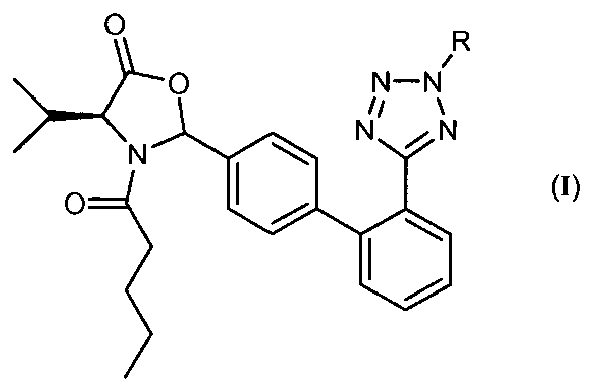
- the process implies the compound of general formula (I) as an intermediate, which contains the tetrazole ring protected by a protecting group R.
- the protecting group can be triphenylmethyl, t -butyl, C 1 -C 4 -alkoxymethyl, methylthiomethyl, phenyl-(C 1 -C 4 ) alkoxymethyl, p-methoxybenzyl, 2,4,6-trimethylbenzyl, 1-methyl-1-phenylethyl, 2-(trimethylsilyl)ethyl, tetrahydropyranyl, piperonyl, or benzenesulfonyl, preferably, the group used is triphenylmethyl (trityl), 1-methyl-1-phenylethyl (cumyl) or t -butyl.
- the opening of the oxazolidinone ring of the compound of general formula (I) is performed by hydrogenolysis, which can be performed by catalytic hydrogenation or by catalytic hydrogen transfer through a hydrogen donor, such as: formic acid, formiates, ascorbic acid, phosphinic acid, phosphinates, phosphites, and alcohols.
- a hydrogen donor such as: formic acid, formiates, ascorbic acid, phosphinic acid, phosphinates, phosphites, and alcohols.
- the elimination of the protecting agent can also occur during the hydrogenolysis, i.e. immediately before, simultaneously or immediately after the opening of the oxazolidinone ring.
- the examples disclosed in the European Patent Application EP-A-1533305 show the preparation of Valsartan through the hydrogenolysis of the compound of general formula (I) wherein the protecting group is the trityl group:
- the authors of the present invention have found a new process for the preparation of Valsartan starting from the compound of general formula (I) wherein the yield is significantly improved and the formation of impurities is reduced.
- the object of the invention is a process for the preparation of Valsartan starting from the compound of general formula (I).
- Compound of general formula (I) comprises the tetrazole ring protected by a protecting group.
- said protecting group is eliminated by the treatment with sulphuric acid, and the compound of formula (II) is obtained.
- the oxazolidinone ring of compound (II) is opened by catalytic hydrogenation and Valsartan, or a pharmaceutically acceptable salt thereof, is obtained.
- global yield of both steps is from 80% to 90%, showing that the developed process is advantageous over the process disclosed in patent application EP-A-1533305 , which shows significantly lower yields.
- the process for the preparation of Valsartan comprises the reaction of a compound of general formula (I): wherein R is a protecting agent selected from the group consisting of 1-methyl-1-phenylethyl, triphenylmethyl and t-butyl, with concentrated sulphuric acid to obtain the compound of formula (II): next, a catalytic hydrogenation of compound (II) in the presence of an organic base, and the isolation of Valsartan or a pharmaceutically acceptable salt thereof.
- R is a protecting agent selected from the group consisting of 1-methyl-1-phenylethyl, triphenylmethyl and t-butyl
- Starting compound of general formula (I) in the process of the invention may be obtained, for instance, by an analogue process to that disclosed in Example 3 of EP-A-1533305 patent application, through a coupling of:
- the 1-methyl-1-phenylethyl group is generally referred to as cumyl group, and triphenylmethyl is referred to as trityl group. According to the process of the invention, cumyl protective group is preferably used.
- the first step of the process of the present invention comprises the elimination of the protecting group of the tetrazole ring being part of the compound of general formula (I).
- Sulphuric acid used in the process of the invention is concentrated.
- concentrated sulphuric acid refers to a sulphuric acid in a concentration exceeding 90% w/w, preferably exceeding 95% w/w, and more preferably exceeding 96%.
- the reaction of a compound of general formula (I) and the concentrated sulphuric acid is carried out at a temperature below room temperature, preferably below 15° C, and more preferably from 5° C to 10° C.
- treatments with concentrated sulphuric acid may be carried out directly using the product or a solution thereof in an inert solvent.
- a compound of general formula (I) is generally solved in an inert solvent, e.g. methylene chloride or chlorophorm, to carry out the deprotection of the protective group with sulphuric acid.
- the solution of said compound is usually added slowly over the sulphuric acid maintaining the reaction temperature below room temperature, preferably below 15° C, and more preferably from 5° C to 10° C.
- the addition of the compound of general formula (I) over chilled sulphuric acid is carried out in a period of time comprised from 30 minutes to 3 hours.
- the temperature of the reaction mixture is maintained from 5° C to 10° C during the whole process.
- the deprotection reaction is very fast, thus the temperature of the reaction mixture is generally maintained at the temperature mentioned above from 5 minutes to 2 hours, preferably from 15 minutes to 1 hour.
- the obtained product, compound of formula (II) may be isolated according to common methods known by the skilled in the art, for instance, by treatment of the reaction mixture with a mixture of water and a solvent, such as isopropylacetate. Generally, compound of formula (II) is obtained pure with a yield close to 90%. The obtained product may be used without further purification in the next step of the process of the invention for the preparation of Valsartan.
- the second step of the process of the invention comprises the opening of the oxazolidinone ring of compound of formula (II) by treatment with hydrogen in the presence of a catalyst and an organic base.
- Catalytic hydrogenation is a well-known reaction for the skilled in the art wherein hydrogen gas and a catalyst are used.
- hydrogen may be employed at low pressure, from 1 to 4 bars, and at relatively low temperatures, from 0° C to 100° C, or at high pressure, from 100 and 400 bars, and higher temperatures, from 25° C to 300° C.
- hydrogen is generally used at low pressure, preferably from 1 to 4 bars, and more preferably from 2 and 3 bars.
- a catalyst based in noble metals is generally used, e.g. based on palladium, rhodium, or ruthenium. Hydrogenation reactions over platinum are frequently carried out using a platinum fine powder obtained through the reduction of a platinum compound, for example platinum oxide. Otherwise, palladium, rhodium, and ruthenium catalysts are used in the form of a metal deposition over an inert support as carbon, alumina, barium sulphate, calcium carbonate, or strontium carbonate.
- the above catalysts are heterogeneous catalysts, among them: Pt/C, Rh/C, Pd/C, Ru/C, Pd/BaSO4, and Rh/alumina.
- Homogeneous catalysts may also be used, e.g. PdCl 2 (PPh 3 ) 2 , o PtCl 2 (PPh 3 ) 2.
- the catalyst used according to the process of the invention is preferably selected from the group formed by heterogeneous catalysts, preferably Pd/C, and more preferably 10% Pd/C.
- the hydrogenation reaction is carried out in the presence of an organic base.
- suitable organic bases those soluble in an organic solvent are preferred, e.g. diisopropylamine, dibutylamine, triethylamine, dicyclohexylamine, and piperidine.
- dicyclohexylamine is used.
- Compound of formula (II) is solid and, in order to carry out the hydrogenation reaction, it is generally dissolved in a solvent as toluene, isopropanol, methanol, ethanol, tetrahydrofurane, or mixtures thereof.
- the hydrogenation reaction is generally carried out under stirring and the temperature of the reaction is from 20° C to 80° C, preferably from 50° C to 70° C, more preferably from 60° C to 65° C.
- Hydrogenation reaction may be carried out in a conventional steel hydrogenator suitable for a pressure from 1 to 4 bars. The progress of the reaction is monitored by HPLC. Generally, the reaction is considered complete when the compound of formula (II) remaining in the reaction mixture is less than 1%.
- Valsartan may be isolated from the reaction mixture by a conventional treatment, for instance that disclosed in Example 5 of EP-A-1533305 patent application. Through the process of the invention, Valsartan is generally obtained as a white solid with yields higher than 90%, with a suitable purity for its use as active ingredient in pharmaceutical formulations. From the compound of general formula (I), the global yield of the process of the invention is usually more than 80%. Valsartan obtained through the process of the invention may be transformed in any of the pharmaceutical suitable salts thereof, as described in WO-A-92/06253 patent application.
- Table II shows the percentages of the various components of the reaction mixture when reaction is complete after a hydrogenation as described in Example 2: Table II Compound Content (II) 0.09% Valsartan 95.6% (V) 2.22% (VI) 0.55%
- the process of the invention is a new process for the preparation of Valsartan which allows the preparation thereof from compound of general formula (I) with an improved yield and a suitable purity to be used as active ingredient in pharmaceutical compositions.
- the following examples are provided by way of illustration, and are not intended to be limiting of the present invention.
- reaction mixture was poured over a mixture of 425 ml of isopropyl acetate and 1000 ml of water through an addition funnel, maintaining the temperature from 5° C to 10° C.
- the mixture was poured in a separation funnel and the phases were separated.
- the lower aqueous phase, not containing product, was washed with 112 ml of isopropyl acetate.
- the obtained organic phases were joined, dried and vacuum-concentrated. 112 ml of isopropylacetate were added to the yellowish solid obtained and the mixture was stirred at room temperature for 30 minutes. Next, the mixture was cooled between -5° C and 0° C, stirring at said temperature for 2 hours.
- the progression of the hydrogenation was monitored by HPLC, the reaction was considered completed 5 hours later, when less than 1% of the starting product remained unreacted.
- the mixture was extracted from the hydrogenator washing the system with 80 ml of isopropanol. pH was set at 12 by adding about 22 ml of 30% solution of sodium hydroxide. Next, the mixture was filtered with a filtering adjuvant, e.g. Hyflo, and washed with 200 ml of a mixture of isopropanol/water/toluene 3:4:1 v/v. Phases were decanted, and the aqueous phase was washed with 150 ml of toluene.
- a filtering adjuvant e.g. Hyflo
Landscapes
- Chemical & Material Sciences (AREA)
- Organic Chemistry (AREA)
- Health & Medical Sciences (AREA)
- General Health & Medical Sciences (AREA)
- Public Health (AREA)
- Veterinary Medicine (AREA)
- Animal Behavior & Ethology (AREA)
- Life Sciences & Earth Sciences (AREA)
- Pharmacology & Pharmacy (AREA)
- Medicinal Chemistry (AREA)
- Engineering & Computer Science (AREA)
- Bioinformatics & Cheminformatics (AREA)
- Cardiology (AREA)
- General Chemical & Material Sciences (AREA)
- Nuclear Medicine, Radiotherapy & Molecular Imaging (AREA)
- Chemical Kinetics & Catalysis (AREA)
- Heart & Thoracic Surgery (AREA)
- Epidemiology (AREA)
- Hospice & Palliative Care (AREA)
- Pharmaceuticals Containing Other Organic And Inorganic Compounds (AREA)
- Low-Molecular Organic Synthesis Reactions Using Catalysts (AREA)
- Steroid Compounds (AREA)
Description
- The present invention relates to a new process for the preparation of Valsartan.
- Valsartan is the INN of the chemical compound N-(1-oxopentyl)-N-[[2'-(1H-tetrazol-5-yl)[1,1'-biphenyl]-4-yl]methyl]-L-valine corresponding to the structure:

- Valsartan is comprised in the group of the antagonists of angiotensin II receptor, which are used in the treatment of hypertension, anxiety, glaucoma, and cardiac stroke. Valsartan is used in medicine as an antihypertensive agent and also in cases of cardiac insufficiency. Valsartan and processes for the preparation thereof were disclosed in the European Patent Application
EP-A-443983 - Therefore, there are a number of alternative processes for the preparation of Valsartan in the state of the art which attempt to overcome the disadvantages of the original process. Among them, processes disclosed in the following patent applications can be mentioned:
EP-A-1533305 ,EP-A-1555260 ,US-A-2006/149079 ,WO-A-93/10106 WO-A-99/01459 WO-A-2004/026847 ,WO-A-2004/094391 ,WO-A-2004/101534 ,WO-A-2004/111018 ,WO-A-2005/014602 ,WO-A-2005/021535 ,WO-A-2005/049586 ,WO-A-2005/51928 WO-A-2005/51929 WO-A-2005/102987 ,WO-A-2006/058701 ,WO-A-2007/005967 , andWO-A-2007/032019 .
Depending on the strategy of synthesis used, in some of said processes there is the need of using protecting groups to avoid the reaction of the tetrazole ring in the reaction conditions of some of the steps. For example, the processes disclosed inEP-A-1533305 ,EP-A-1555260 ,WO-A-93/10106 WO-A-99/01459 WO-A-2004/094391 ,WO-A-2005/51928 WO-A-2005/51929 WO-A-2005/021535 patent applications comprise the use of protecting groups for the tetrazole ring. The introduction and elimination of protecting groups from a compound comprising various functional groups is a common technique in the field of the organic synthesis, and said reactions are typically performed without significant problems. Said procedure is disclosed in well known reference books as, for example, in T. W. Greene et a/., Protective Groups in Organic Synthesis, 3rd Edition, John Wiley & Sons, New York, 1999 [ISBN: 0-471-16019-9].
The process disclosed in the European Patent ApplicationEP-A-1533305 for the preparation of Valsartan is shown is Scheme I:
- As shown, the process implies the compound of general formula (I) as an intermediate, which contains the tetrazole ring protected by a protecting group R.
According to the description of the patent application, the protecting group can be triphenylmethyl, t-butyl, C1-C4-alkoxymethyl, methylthiomethyl, phenyl-(C1-C4) alkoxymethyl, p-methoxybenzyl, 2,4,6-trimethylbenzyl, 1-methyl-1-phenylethyl, 2-(trimethylsilyl)ethyl, tetrahydropyranyl, piperonyl, or benzenesulfonyl, preferably, the group used is triphenylmethyl (trityl), 1-methyl-1-phenylethyl (cumyl) or t-butyl.
The opening of the oxazolidinone ring of the compound of general formula (I) is performed by hydrogenolysis, which can be performed by catalytic hydrogenation or by catalytic hydrogen transfer through a hydrogen donor, such as: formic acid, formiates, ascorbic acid, phosphinic acid, phosphinates, phosphites, and alcohols. The elimination of the protecting agent can also occur during the hydrogenolysis, i.e. immediately before, simultaneously or immediately after the opening of the oxazolidinone ring. The examples disclosed in the European Patent ApplicationEP-A-1533305 show the preparation of Valsartan through the hydrogenolysis of the compound of general formula (I) wherein the protecting group is the trityl group: - In Example 4, the hydrogenolysis is carried out with ammonium formiate as hydrogen donor in the presence of the 5% Pd/C catalyst, and Valsartan is obtained yielding 70% after a treatment comprising the acidification of the reaction mixture with 20% sulphuric acid.
- In Example 5, the opening of the oxazolidinone ring is carried out with a pressure of hydrogen in the presence of the same palladium catalyst, and Valsartan is obtained yielding 53% after the treatment of Example 4. Therefore, the preparation of Valsartan from the compound of formula (I) shows a deficient yield for the industrial scalability, particularly in the case of catalytic hydrogenation.
- The authors of the present invention have found a new process for the preparation of Valsartan starting from the compound of general formula (I) wherein the yield is significantly improved and the formation of impurities is reduced. The object of the invention is a process for the preparation of Valsartan starting from the compound of general formula (I).
- The process for the preparation of Valsartan found by the inventors may be depicted by Scheme II:

- Compound of general formula (I) comprises the tetrazole ring protected by a protecting group. In a first step, said protecting group is eliminated by the treatment with sulphuric acid, and the compound of formula (II) is obtained. Next, the oxazolidinone ring of compound (II) is opened by catalytic hydrogenation and Valsartan, or a pharmaceutically acceptable salt thereof, is obtained. Surprisingly, global yield of both steps is from 80% to 90%, showing that the developed process is advantageous over the process disclosed in patent application
EP-A-1533305 , which shows significantly lower yields.
The process for the preparation of Valsartan, which is the object of the invention, comprises the reaction of a compound of general formula (I):

- Starting compound of general formula (I) in the process of the invention may be obtained, for instance, by an analogue process to that disclosed in Example 3 of
EP-A-1533305 patent application, through a coupling of: - the compound obtained in Example 2 of said patent application, and
- a boronic acid derivative obtained according to the process disclosed in
WO-A-93/10106 
- The 1-methyl-1-phenylethyl group is generally referred to as cumyl group, and triphenylmethyl is referred to as trityl group. According to the process of the invention, cumyl protective group is preferably used.
- The first step of the process of the present invention comprises the elimination of the protecting group of the tetrazole ring being part of the compound of general formula (I).
Sulphuric acid used in the process of the invention is concentrated. As used herein, concentrated sulphuric acid refers to a sulphuric acid in a concentration exceeding 90% w/w, preferably exceeding 95% w/w, and more preferably exceeding 96%. Generally, the reaction of a compound of general formula (I) and the concentrated sulphuric acid is carried out at a temperature below room temperature, preferably below 15° C, and more preferably from 5° C to 10° C.
Generally, treatments with concentrated sulphuric acid may be carried out directly using the product or a solution thereof in an inert solvent. According to the process of the invention, a compound of general formula (I) is generally solved in an inert solvent, e.g. methylene chloride or chlorophorm, to carry out the deprotection of the protective group with sulphuric acid.
The solution of said compound is usually added slowly over the sulphuric acid maintaining the reaction temperature below room temperature, preferably below 15° C, and more preferably from 5° C to 10° C.
Generally, the addition of the compound of general formula (I) over chilled sulphuric acid is carried out in a period of time comprised from 30 minutes to 3 hours. Generally, the temperature of the reaction mixture is maintained from 5° C to 10° C during the whole process. The deprotection reaction is very fast, thus the temperature of the reaction mixture is generally maintained at the temperature mentioned above from 5 minutes to 2 hours, preferably from 15 minutes to 1 hour.
The obtained product, compound of formula (II), may be isolated according to common methods known by the skilled in the art, for instance, by treatment of the reaction mixture with a mixture of water and a solvent, such as isopropylacetate. Generally, compound of formula (II) is obtained pure with a yield close to 90%. The obtained product may be used without further purification in the next step of the process of the invention for the preparation of Valsartan. - The second step of the process of the invention comprises the opening of the oxazolidinone ring of compound of formula (II) by treatment with hydrogen in the presence of a catalyst and an organic base. Catalytic hydrogenation is a well-known reaction for the skilled in the art wherein hydrogen gas and a catalyst are used.
Depending on the catalyst used, hydrogen may be employed at low pressure, from 1 to 4 bars, and at relatively low temperatures, from 0° C to 100° C, or at high pressure, from 100 and 400 bars, and higher temperatures, from 25° C to 300° C. According to the process of the invention, hydrogen is generally used at low pressure, preferably from 1 to 4 bars, and more preferably from 2 and 3 bars. In low-pressure catalytic hydrogenations, a catalyst based in noble metals is generally used, e.g. based on palladium, rhodium, or ruthenium. Hydrogenation reactions over platinum are frequently carried out using a platinum fine powder obtained through the reduction of a platinum compound, for example platinum oxide. Otherwise, palladium, rhodium, and ruthenium catalysts are used in the form of a metal deposition over an inert support as carbon, alumina, barium sulphate, calcium carbonate, or strontium carbonate. The above catalysts are heterogeneous catalysts, among them: Pt/C, Rh/C, Pd/C, Ru/C, Pd/BaSO4, and Rh/alumina. Homogeneous catalysts may also be used, e.g. PdCl2(PPh3)2, o PtCl2(PPh3)2.
The catalyst used according to the process of the invention is preferably selected from the group formed by heterogeneous catalysts, preferably Pd/C, and more preferably 10% Pd/C. The hydrogenation reaction is carried out in the presence of an organic base. Among suitable organic bases, those soluble in an organic solvent are preferred, e.g. diisopropylamine, dibutylamine, triethylamine, dicyclohexylamine, and piperidine. Preferably, dicyclohexylamine is used.
Compound of formula (II) is solid and, in order to carry out the hydrogenation reaction, it is generally dissolved in a solvent as toluene, isopropanol, methanol, ethanol, tetrahydrofurane, or mixtures thereof.
The hydrogenation reaction is generally carried out under stirring and the temperature of the reaction is from 20° C to 80° C, preferably from 50° C to 70° C, more preferably from 60° C to 65° C. Hydrogenation reaction may be carried out in a conventional steel hydrogenator suitable for a pressure from 1 to 4 bars. The progress of the reaction is monitored by HPLC. Generally, the reaction is considered complete when the compound of formula (II) remaining in the reaction mixture is less than 1%. Generally, the reaction is completed from 4 to 6 hours after the initiation.
Valsartan may be isolated from the reaction mixture by a conventional treatment, for instance that disclosed in Example 5 ofEP-A-1533305 patent application.
Through the process of the invention, Valsartan is generally obtained as a white solid with yields higher than 90%, with a suitable purity for its use as active ingredient in pharmaceutical formulations. From the compound of general formula (I), the global yield of the process of the invention is usually more than 80%.
Valsartan obtained through the process of the invention may be transformed in any of the pharmaceutical suitable salts thereof, as described inWO-A-92/06253 EP-A-1533305 patent application, wherein compound of general formula (I) is hydrogenated directly obtaining Valsartan.
For instance, when the direct hydrogenation of the compound of general formula (I) wherein R is cumyl is carried out in the same conditions of the second step of the process of the invention, the following additional impurities have been identified, in addition to isopropylbenzene arising from cumyl protective group:
- The percentages of the various components of the reaction mixture determined by HPLC at different reaction times are shown in Table I:
Table I Compound 1.5 h 6.5 h 11.5 h 15.5 h 18.5 h (I) wherein R=cumyl 48.62% 18.72% 13.97% 8.29% 2.95% Valsartan 15.07% 35.30% 41.02% 54.58% 71.41% (II) 25.78% 28.66% 26.69% 17.97% 6.33% (IV) wherein R=cumyl 3.01% 3.49% 3.10% 2.48% 1.24% (V) 0.11% 1.04% 2.70% 6.51% 8.82% (VI) 2.86% 6.33% 5.21% 2.65% 1.30% Isopropylbenzene 2.21% 3.41% 4.57% 4.97% 4.97% - As shown, compound of general formula (I) wherein R is cumyl reacts slowly, and the impurity content increases with time.
It can be also observed that hydrogenation conditions used in this reaction, which are those of the second step of the process of the invention, lead to the preparation of Valsartan yielding about 70%. This value is noticeably higher than that obtained through the hydrogenation reaction of Example 5 ofEP-A-1533305 patent application, which is 53%. When Valsartan is prepared through the hydrogenation of compound of formula (II) according to the process of the invention, the impurity content is noticeably lower, and that increase the yield of said active ingredient. - Table II shows the percentages of the various components of the reaction mixture when reaction is complete after a hydrogenation as described in Example 2:
Table II Compound Content (II) 0.09% Valsartan 95.6% (V) 2.22% (VI) 0.55% - In this case, isopropylbenzene is not detected because cumyl group is removed in the first step of the process of the invention by treatment with sulphuric acid. It can be noted that starting compound, compound of formula (II), have disappeared substantially after 4-5 h over hydrogenation, and that the impurity content is noticeably low and clearly lower to that obtained in a direct hydrogenation, as shown in Table I. Therefore, the process of the invention is a new process for the preparation of Valsartan which allows the preparation thereof from compound of general formula (I) with an improved yield and a suitable purity to be used as active ingredient in pharmaceutical compositions. The following examples are provided by way of illustration, and are not intended to be limiting of the present invention.
-

- 100 ml (0.18 mol) of concentrated sulphuric acid were placed in a 500 ml flask with magnetic stirring and a thermometer and the temperature was set from 0° C to 10° C by an external water-ice bath. Once said temperature was achieved, the addition of 100 g (0.18 mol) of the compound of general formula (I) wherein R is cumyl, e.g. prepared according to the process described in "Starting compound" herein, solved in 167 ml of methylene chloride, was started by an addition funnel, maintaining the temperature from 5° C to 10° C. When the addition was finished, the temperature of the reaction mixture was maintained from 5° C and 10° C until the reaction was completed. The reaction mixture was intense red. Thereafter, the reaction mixture was poured over a mixture of 425 ml of isopropyl acetate and 1000 ml of water through an addition funnel, maintaining the temperature from 5° C to 10° C. Next, the mixture was poured in a separation funnel and the phases were separated. The lower aqueous phase, not containing product, was washed with 112 ml of isopropyl acetate. The obtained organic phases were joined, dried and vacuum-concentrated. 112 ml of isopropylacetate were added to the yellowish solid obtained and the mixture was stirred at room temperature for 30 minutes. Next, the mixture was cooled between -5° C and 0° C, stirring at said temperature for 2 hours. The mixture was filtered and the recovered solid was washed with 80 ml of cold isopropylacetate. 84 g of wet product were obtained and dried under vacuum in a furnace at 40° C. Finally, 68.68 g of pure compound of formula (II) were obtained, thus yielding 87%.
-

- 24.3 g of 10% Pd/C and 325 ml of water were placed in a 1 litre steel hydrogenator. Next, 50 g (0.12 mol) of compound of formula (II) obtained in Example 1 were added dissolved in a mixture of 250 ml of isopropanol, 100 ml of toluene and 41.4 ml (0.23 mol) of dicyclohexylamine. The mixture was stirred at 400 rpm and nitrogen was added to provide an inert atmosphere. The system was checked for leaks, and 3 bars of hydrogen pressure were added, stirring was increased to 1000 rpm and heating to 65° C of the recirculation water was started. The progression of the hydrogenation was monitored by HPLC, the reaction was considered completed 5 hours later, when less than 1% of the starting product remained unreacted.
The mixture was extracted from the hydrogenator washing the system with 80 ml of isopropanol. pH was set at 12 by adding about 22 ml of 30% solution of sodium hydroxide. Next, the mixture was filtered with a filtering adjuvant, e.g. Hyflo, and washed with 200 ml of a mixture of isopropanol/water/toluene 3:4:1 v/v. Phases were decanted, and the aqueous phase was washed with 150 ml of toluene.
350 ml of isopropylacetate were added to the alkaline aqueous phase, and pH was set to 2 by the addition of about 19 ml of concentrated hydrochloric acid. The phases were decanted, and the aqueous phase was extracted again with 350 ml of isopropylacetate. The organic phases were joined and vacuum-concentrated. The resulting material was washed with 200 ml of isopropylacetate and concentrated again. 350 ml of isopropylacetate were added to the white solid obtained and the moisture of the mixture was determined to check that it did not exceeded 1%. The mixture was heated at 40° C until dissolution. Next, the mixture was cooled at room temperature for 30 minutes and a white solid started to precipitate. 350 ml of hexane were added to the precipitated and it was cooled from 0° C to 5° C for 1 hour in order to complete the precipitation. The obtained solid was filtered and washed with 70 ml of a cold mixture of isopropyl acetate/heptane 1:1 v/v. The wet solid was dried in a furnace at 40° C under vacuum, and finally 46.65 g of pure Valsartan were obtained, with a yield of 94%. -

- Following a similar process to that described in Example 2, compound of general formula (I) wherein R is cumyl was hydrogenated with hydrogen using Pd/C as catalyst and in the presence of dicyclohexylamine as organic base. Samples of the reaction mass were collected at different times: 1.5 h, 6.5 h, 11.5 h, 15.5, h and 18.5 h, and were analyzed by HPLC to determine the content of the different compounds. The results are shown in Table I in the description. Finally, Valsartan was isolated in 55% yield.
Claims (15)
- Process for the preparation of Valsartan characterized in that it comprises the reaction of a compound of general formula (I):

- Process according to claim 1, characterized in that R is cumyl.
- Process according to any one of the claims 1-2, characterized in that the concentration of sulphuric acid is more than 90% w/w.
- Process according to claim 3, characterized in that the concentration of sulphuric acid is more than 95% w/w.
- Process according to any one of the claims 1-4 characterized in that the reaction of the compound of general formula (I) and the concentrated sulphuric acid is carried out at a temperature below room temperature.
- Process according to claim 5, characterized in that the temperature is below 15° C.
- Process according to claim 6, characterized in that the temperature is comprised from 5° C to 10° C.
- Process according to any one of the claims 1-7 characterized in that the hydrogenation reaction is performed at a pressure comprised from 1 to 4 bar.
- Process according to any one of the claims 1-8 characterized in that the catalyst for the hydrogenation reaction is selected from the group consisting of heterogeneous catalysts.
- Process according to claim 9, characterized in that the catalyst is Pd/C.
- Process according to claim 10, characterized in that the catalyst is 10% Pd/C.
- Process according to any one of the claims 1-11, characterized in that the organic base is dicyclohexylamine.
- Process according to any one of the claims 1-12, characterized in that the hydrogenation reaction is performed at a temperature comprised from 20° C to 80° C.
- Process according to claim 13, characterized in that the temperature is comprised from 50° C to 70° C.
- Process according to claim 14, characterized in that the temperature is comprised from 60° C to 65° C.
Applications Claiming Priority (2)
| Application Number | Priority Date | Filing Date | Title |
|---|---|---|---|
| ES200701365A ES2316281B1 (en) | 2007-05-14 | 2007-05-14 | VALSARTAN PREPARATION PROCEDURE. |
| PCT/EP2008/055719 WO2008138871A1 (en) | 2007-05-14 | 2008-05-08 | Process for the preparation of valsartan |
Publications (2)
| Publication Number | Publication Date |
|---|---|
| EP2160384A1 EP2160384A1 (en) | 2010-03-10 |
| EP2160384B1 true EP2160384B1 (en) | 2013-04-17 |
Family
ID=39580295
Family Applications (1)
| Application Number | Title | Priority Date | Filing Date |
|---|---|---|---|
| EP08750212.6A Not-in-force EP2160384B1 (en) | 2007-05-14 | 2008-05-08 | Process for the preparation of valsartan |
Country Status (3)
| Country | Link |
|---|---|
| EP (1) | EP2160384B1 (en) |
| ES (2) | ES2316281B1 (en) |
| WO (1) | WO2008138871A1 (en) |
Families Citing this family (2)
| Publication number | Priority date | Publication date | Assignee | Title |
|---|---|---|---|---|
| EP2601180A1 (en) * | 2010-08-03 | 2013-06-12 | Novartis AG | Highly crystalline valsartan |
| CN102702118B (en) * | 2012-06-11 | 2014-04-16 | 吉林三善恩科技开发有限公司 | Valsartan organic pharmaceutical co-crystal and preparation method thereof |
Family Cites Families (3)
| Publication number | Priority date | Publication date | Assignee | Title |
|---|---|---|---|---|
| US7378531B2 (en) * | 2003-04-21 | 2008-05-27 | Teva Pharmaceutical Industries Ltd | Process for the preparation of valsartan |
| ITMI20032267A1 (en) * | 2003-11-21 | 2005-05-22 | Dinamite Dipharma S P A In Forma A Bbreviata Diph | PROCDIMENTO FOR PREPARATION OF VALSARTAN AND ITS INTERMEDIATES |
| EP1812411A2 (en) * | 2005-07-05 | 2007-08-01 | Teva Pharmaceutical Industries Ltd. | Process for preparing valsartan |
-
2007
- 2007-05-14 ES ES200701365A patent/ES2316281B1/en not_active Expired - Fee Related
-
2008
- 2008-05-08 EP EP08750212.6A patent/EP2160384B1/en not_active Not-in-force
- 2008-05-08 WO PCT/EP2008/055719 patent/WO2008138871A1/en not_active Ceased
- 2008-05-08 ES ES08750212T patent/ES2421641T3/en active Active
Also Published As
| Publication number | Publication date |
|---|---|
| ES2421641T3 (en) | 2013-09-04 |
| ES2316281B1 (en) | 2010-02-09 |
| WO2008138871A1 (en) | 2008-11-20 |
| EP2160384A1 (en) | 2010-03-10 |
| ES2316281A1 (en) | 2009-04-01 |
Similar Documents
| Publication | Publication Date | Title |
|---|---|---|
| CA2707334C (en) | A process for the preparation or purification of olmesartan medoxomil | |
| EP2332409B1 (en) | Process for preparing oxymorphone, naltrexone and buprenorphine | |
| AU2007316693B2 (en) | Method for preparing Medetomidine and its salts | |
| EP2128133A1 (en) | Ezetimibe process and composition | |
| CA2980965A1 (en) | Process for the preparation of androgen receptor antagonists and intermediates thereof | |
| AU2017214243A1 (en) | Improved process for the preparation of osimertinib (AZD9291) or a salt thereof, and "AZD9291 aniline" or a salt thereof | |
| WO2015111085A2 (en) | Processes for the preparation of eltrombopag and pharmaceutically acceptable salts, solvates and intermediates thereof | |
| CN101798300B (en) | N-phenylindole methyl substituted bis-benzimidazole derivative and application thereof in reducing blood pressure and the like | |
| EP2160384A1 (en) | Process for the preparation of valsartan | |
| JP6324567B2 (en) | Method for producing moringdon and its salt | |
| EP1682539B1 (en) | Process for preparing thiazolidinediones | |
| CN102186835B (en) | Process for preparing nebivolol | |
| EP1685126A2 (en) | Preparation of candesartan cilexetil | |
| EP1945629B1 (en) | Process for the preparation of candesartan cilexetil | |
| EP2961744B1 (en) | Intermediates for use in the preparation of indazole derivatives and processes for the preparation thereof | |
| HUP0103651A2 (en) | Paroxetine maleate and process for its preparation | |
| KR100662110B1 (en) | Method for preparing tetrazole derivatives | |
| EP2022790A1 (en) | A process for the preparation or purification of olmesartan medoxomil | |
| CN101328167A (en) | Preparation of losartan | |
| EP1535918B1 (en) | Process for producing aminobenzopyran compound | |
| KR101257272B1 (en) | Method of preparing a biphenyltetrazole compound for hypertension treatment using deprotecting reaction | |
| CN110615790A (en) | Improved method of preparation process of linagliptin | |
| WO2008041957A1 (en) | Method for producing pure crystalline form of 2-n-butyl-3-((2-(1h-tetrazole-5-yl) (1,1'-biphenyl)-4-methyl)-1,3-diazapspiro (4,4') non -1- en-4-one | |
| JPH0748371A (en) | Production of 2-amino-4-pyridylmethyl-6 hydroxybenzothiazole derivative | |
| CA2528930A1 (en) | New process for the production of melagatran |
Legal Events
| Date | Code | Title | Description |
|---|---|---|---|
| PUAI | Public reference made under article 153(3) epc to a published international application that has entered the european phase |
Free format text: ORIGINAL CODE: 0009012 |
|
| 17P | Request for examination filed |
Effective date: 20091214 |
|
| AK | Designated contracting states |
Kind code of ref document: A1 Designated state(s): AT BE BG CH CY CZ DE DK EE ES FI FR GB GR HR HU IE IS IT LI LT LU LV MC MT NL NO PL PT RO SE SI SK TR |
|
| AX | Request for extension of the european patent |
Extension state: AL BA MK RS |
|
| RAP1 | Party data changed (applicant data changed or rights of an application transferred) |
Owner name: CHEMO IBERICA, S.A. |
|
| DAX | Request for extension of the european patent (deleted) | ||
| RAP1 | Party data changed (applicant data changed or rights of an application transferred) |
Owner name: CHEMO IBERICA, S.A. |
|
| GRAP | Despatch of communication of intention to grant a patent |
Free format text: ORIGINAL CODE: EPIDOSNIGR1 |
|
| GRAS | Grant fee paid |
Free format text: ORIGINAL CODE: EPIDOSNIGR3 |
|
| GRAA | (expected) grant |
Free format text: ORIGINAL CODE: 0009210 |
|
| AK | Designated contracting states |
Kind code of ref document: B1 Designated state(s): AT BE BG CH CY CZ DE DK EE ES FI FR GB GR HR HU IE IS IT LI LT LU LV MC MT NL NO PL PT RO SE SI SK TR |
|
| REG | Reference to a national code |
Ref country code: GB Ref legal event code: FG4D |
|
| REG | Reference to a national code |
Ref country code: CH Ref legal event code: EP |
|
| REG | Reference to a national code |
Ref country code: IE Ref legal event code: FG4D |
|
| REG | Reference to a national code |
Ref country code: AT Ref legal event code: REF Ref document number: 607226 Country of ref document: AT Kind code of ref document: T Effective date: 20130515 |
|
| REG | Reference to a national code |
Ref country code: DE Ref legal event code: R096 Ref document number: 602008023901 Country of ref document: DE Effective date: 20130613 |
|
| REG | Reference to a national code |
Ref country code: NO Ref legal event code: T2 Effective date: 20130417 |
|
| REG | Reference to a national code |
Ref country code: ES Ref legal event code: FG2A Ref document number: 2421641 Country of ref document: ES Kind code of ref document: T3 Effective date: 20130904 |
|
| REG | Reference to a national code |
Ref country code: AT Ref legal event code: MK05 Ref document number: 607226 Country of ref document: AT Kind code of ref document: T Effective date: 20130417 |
|
| REG | Reference to a national code |
Ref country code: LT Ref legal event code: MG4D |
|
| REG | Reference to a national code |
Ref country code: NL Ref legal event code: VDEP Effective date: 20130417 |
|
| PG25 | Lapsed in a contracting state [announced via postgrant information from national office to epo] |
Ref country code: PT Free format text: LAPSE BECAUSE OF FAILURE TO SUBMIT A TRANSLATION OF THE DESCRIPTION OR TO PAY THE FEE WITHIN THE PRESCRIBED TIME-LIMIT Effective date: 20130819 Ref country code: SI Free format text: LAPSE BECAUSE OF FAILURE TO SUBMIT A TRANSLATION OF THE DESCRIPTION OR TO PAY THE FEE WITHIN THE PRESCRIBED TIME-LIMIT Effective date: 20130417 Ref country code: SE Free format text: LAPSE BECAUSE OF FAILURE TO SUBMIT A TRANSLATION OF THE DESCRIPTION OR TO PAY THE FEE WITHIN THE PRESCRIBED TIME-LIMIT Effective date: 20130417 Ref country code: LT Free format text: LAPSE BECAUSE OF FAILURE TO SUBMIT A TRANSLATION OF THE DESCRIPTION OR TO PAY THE FEE WITHIN THE PRESCRIBED TIME-LIMIT Effective date: 20130417 Ref country code: AT Free format text: LAPSE BECAUSE OF FAILURE TO SUBMIT A TRANSLATION OF THE DESCRIPTION OR TO PAY THE FEE WITHIN THE PRESCRIBED TIME-LIMIT Effective date: 20130417 Ref country code: IS Free format text: LAPSE BECAUSE OF FAILURE TO SUBMIT A TRANSLATION OF THE DESCRIPTION OR TO PAY THE FEE WITHIN THE PRESCRIBED TIME-LIMIT Effective date: 20130817 Ref country code: BE Free format text: LAPSE BECAUSE OF FAILURE TO SUBMIT A TRANSLATION OF THE DESCRIPTION OR TO PAY THE FEE WITHIN THE PRESCRIBED TIME-LIMIT Effective date: 20130417 |
|
| PGFP | Annual fee paid to national office [announced via postgrant information from national office to epo] |
Ref country code: NO Payment date: 20130703 Year of fee payment: 6 Ref country code: FI Payment date: 20130703 Year of fee payment: 6 |
|
| PG25 | Lapsed in a contracting state [announced via postgrant information from national office to epo] |
Ref country code: LV Free format text: LAPSE BECAUSE OF FAILURE TO SUBMIT A TRANSLATION OF THE DESCRIPTION OR TO PAY THE FEE WITHIN THE PRESCRIBED TIME-LIMIT Effective date: 20130417 Ref country code: BG Free format text: LAPSE BECAUSE OF FAILURE TO SUBMIT A TRANSLATION OF THE DESCRIPTION OR TO PAY THE FEE WITHIN THE PRESCRIBED TIME-LIMIT Effective date: 20130717 Ref country code: HR Free format text: LAPSE BECAUSE OF FAILURE TO SUBMIT A TRANSLATION OF THE DESCRIPTION OR TO PAY THE FEE WITHIN THE PRESCRIBED TIME-LIMIT Effective date: 20130417 Ref country code: PL Free format text: LAPSE BECAUSE OF FAILURE TO SUBMIT A TRANSLATION OF THE DESCRIPTION OR TO PAY THE FEE WITHIN THE PRESCRIBED TIME-LIMIT Effective date: 20130417 Ref country code: CY Free format text: LAPSE BECAUSE OF FAILURE TO SUBMIT A TRANSLATION OF THE DESCRIPTION OR TO PAY THE FEE WITHIN THE PRESCRIBED TIME-LIMIT Effective date: 20130417 |
|
| REG | Reference to a national code |
Ref country code: CH Ref legal event code: PL |
|
| PG25 | Lapsed in a contracting state [announced via postgrant information from national office to epo] |
Ref country code: LI Free format text: LAPSE BECAUSE OF NON-PAYMENT OF DUE FEES Effective date: 20130531 Ref country code: MC Free format text: LAPSE BECAUSE OF FAILURE TO SUBMIT A TRANSLATION OF THE DESCRIPTION OR TO PAY THE FEE WITHIN THE PRESCRIBED TIME-LIMIT Effective date: 20130417 Ref country code: DK Free format text: LAPSE BECAUSE OF FAILURE TO SUBMIT A TRANSLATION OF THE DESCRIPTION OR TO PAY THE FEE WITHIN THE PRESCRIBED TIME-LIMIT Effective date: 20130417 Ref country code: CH Free format text: LAPSE BECAUSE OF NON-PAYMENT OF DUE FEES Effective date: 20130531 Ref country code: CZ Free format text: LAPSE BECAUSE OF FAILURE TO SUBMIT A TRANSLATION OF THE DESCRIPTION OR TO PAY THE FEE WITHIN THE PRESCRIBED TIME-LIMIT Effective date: 20130417 Ref country code: EE Free format text: LAPSE BECAUSE OF FAILURE TO SUBMIT A TRANSLATION OF THE DESCRIPTION OR TO PAY THE FEE WITHIN THE PRESCRIBED TIME-LIMIT Effective date: 20130417 Ref country code: SK Free format text: LAPSE BECAUSE OF FAILURE TO SUBMIT A TRANSLATION OF THE DESCRIPTION OR TO PAY THE FEE WITHIN THE PRESCRIBED TIME-LIMIT Effective date: 20130417 Ref country code: DE Free format text: LAPSE BECAUSE OF NON-PAYMENT OF DUE FEES Effective date: 20131203 |
|
| REG | Reference to a national code |
Ref country code: DE Ref legal event code: R119 Ref document number: 602008023901 Country of ref document: DE Effective date: 20131203 |
|
| PLBE | No opposition filed within time limit |
Free format text: ORIGINAL CODE: 0009261 |
|
| STAA | Information on the status of an ep patent application or granted ep patent |
Free format text: STATUS: NO OPPOSITION FILED WITHIN TIME LIMIT |
|
| REG | Reference to a national code |
Ref country code: IE Ref legal event code: MM4A |
|
| PG25 | Lapsed in a contracting state [announced via postgrant information from national office to epo] |
Ref country code: NL Free format text: LAPSE BECAUSE OF FAILURE TO SUBMIT A TRANSLATION OF THE DESCRIPTION OR TO PAY THE FEE WITHIN THE PRESCRIBED TIME-LIMIT Effective date: 20130417 Ref country code: RO Free format text: LAPSE BECAUSE OF FAILURE TO SUBMIT A TRANSLATION OF THE DESCRIPTION OR TO PAY THE FEE WITHIN THE PRESCRIBED TIME-LIMIT Effective date: 20130417 Ref country code: IT Free format text: LAPSE BECAUSE OF FAILURE TO SUBMIT A TRANSLATION OF THE DESCRIPTION OR TO PAY THE FEE WITHIN THE PRESCRIBED TIME-LIMIT Effective date: 20130417 |
|
| REG | Reference to a national code |
Ref country code: FR Ref legal event code: ST Effective date: 20140131 |
|
| 26N | No opposition filed |
Effective date: 20140120 |
|
| GBPC | Gb: european patent ceased through non-payment of renewal fee |
Effective date: 20130717 |
|
| PG25 | Lapsed in a contracting state [announced via postgrant information from national office to epo] |
Ref country code: GB Free format text: LAPSE BECAUSE OF NON-PAYMENT OF DUE FEES Effective date: 20130717 Ref country code: IE Free format text: LAPSE BECAUSE OF NON-PAYMENT OF DUE FEES Effective date: 20130508 |
|
| PG25 | Lapsed in a contracting state [announced via postgrant information from national office to epo] |
Ref country code: FR Free format text: LAPSE BECAUSE OF NON-PAYMENT OF DUE FEES Effective date: 20130617 |
|
| PG25 | Lapsed in a contracting state [announced via postgrant information from national office to epo] |
Ref country code: FI Free format text: LAPSE BECAUSE OF NON-PAYMENT OF DUE FEES Effective date: 20140508 Ref country code: NO Free format text: LAPSE BECAUSE OF NON-PAYMENT OF DUE FEES Effective date: 20140531 |
|
| PG25 | Lapsed in a contracting state [announced via postgrant information from national office to epo] |
Ref country code: MT Free format text: LAPSE BECAUSE OF FAILURE TO SUBMIT A TRANSLATION OF THE DESCRIPTION OR TO PAY THE FEE WITHIN THE PRESCRIBED TIME-LIMIT Effective date: 20130417 |
|
| PG25 | Lapsed in a contracting state [announced via postgrant information from national office to epo] |
Ref country code: TR Free format text: LAPSE BECAUSE OF FAILURE TO SUBMIT A TRANSLATION OF THE DESCRIPTION OR TO PAY THE FEE WITHIN THE PRESCRIBED TIME-LIMIT Effective date: 20130417 |
|
| REG | Reference to a national code |
Ref country code: ES Ref legal event code: FD2A Effective date: 20150703 |
|
| PG25 | Lapsed in a contracting state [announced via postgrant information from national office to epo] |
Ref country code: HU Free format text: LAPSE BECAUSE OF FAILURE TO SUBMIT A TRANSLATION OF THE DESCRIPTION OR TO PAY THE FEE WITHIN THE PRESCRIBED TIME-LIMIT; INVALID AB INITIO Effective date: 20080508 Ref country code: LU Free format text: LAPSE BECAUSE OF NON-PAYMENT OF DUE FEES Effective date: 20130508 Ref country code: ES Free format text: LAPSE BECAUSE OF NON-PAYMENT OF DUE FEES Effective date: 20140509 |
|
| PG25 | Lapsed in a contracting state [announced via postgrant information from national office to epo] |
Ref country code: GR Free format text: LAPSE BECAUSE OF NON-PAYMENT OF DUE FEES Effective date: 20130417 |