EP2156997A1 - A vehicle safety system - Google Patents
A vehicle safety system Download PDFInfo
- Publication number
- EP2156997A1 EP2156997A1 EP20080162620 EP08162620A EP2156997A1 EP 2156997 A1 EP2156997 A1 EP 2156997A1 EP 20080162620 EP20080162620 EP 20080162620 EP 08162620 A EP08162620 A EP 08162620A EP 2156997 A1 EP2156997 A1 EP 2156997A1
- Authority
- EP
- European Patent Office
- Prior art keywords
- air
- bag
- hose
- vehicle
- gas
- Prior art date
- Legal status (The legal status is an assumption and is not a legal conclusion. Google has not performed a legal analysis and makes no representation as to the accuracy of the status listed.)
- Granted
Links
Images



Classifications
-
- B—PERFORMING OPERATIONS; TRANSPORTING
- B60—VEHICLES IN GENERAL
- B60R—VEHICLES, VEHICLE FITTINGS, OR VEHICLE PARTS, NOT OTHERWISE PROVIDED FOR
- B60R21/00—Arrangements or fittings on vehicles for protecting or preventing injuries to occupants or pedestrians in case of accidents or other traffic risks
- B60R21/02—Occupant safety arrangements or fittings, e.g. crash pads
- B60R21/16—Inflatable occupant restraints or confinements designed to inflate upon impact or impending impact, e.g. air bags
- B60R21/26—Inflatable occupant restraints or confinements designed to inflate upon impact or impending impact, e.g. air bags characterised by the inflation fluid source or means to control inflation fluid flow
-
- B—PERFORMING OPERATIONS; TRANSPORTING
- B60—VEHICLES IN GENERAL
- B60R—VEHICLES, VEHICLE FITTINGS, OR VEHICLE PARTS, NOT OTHERWISE PROVIDED FOR
- B60R21/00—Arrangements or fittings on vehicles for protecting or preventing injuries to occupants or pedestrians in case of accidents or other traffic risks
- B60R21/34—Protecting non-occupants of a vehicle, e.g. pedestrians
- B60R21/36—Protecting non-occupants of a vehicle, e.g. pedestrians using airbags
-
- B—PERFORMING OPERATIONS; TRANSPORTING
- B60—VEHICLES IN GENERAL
- B60R—VEHICLES, VEHICLE FITTINGS, OR VEHICLE PARTS, NOT OTHERWISE PROVIDED FOR
- B60R21/00—Arrangements or fittings on vehicles for protecting or preventing injuries to occupants or pedestrians in case of accidents or other traffic risks
- B60R21/02—Occupant safety arrangements or fittings, e.g. crash pads
- B60R21/16—Inflatable occupant restraints or confinements designed to inflate upon impact or impending impact, e.g. air bags
- B60R21/26—Inflatable occupant restraints or confinements designed to inflate upon impact or impending impact, e.g. air bags characterised by the inflation fluid source or means to control inflation fluid flow
- B60R2021/26094—Inflatable occupant restraints or confinements designed to inflate upon impact or impending impact, e.g. air bags characterised by the inflation fluid source or means to control inflation fluid flow characterised by fluid flow controlling valves
-
- B—PERFORMING OPERATIONS; TRANSPORTING
- B60—VEHICLES IN GENERAL
- B60R—VEHICLES, VEHICLE FITTINGS, OR VEHICLE PARTS, NOT OTHERWISE PROVIDED FOR
- B60R21/00—Arrangements or fittings on vehicles for protecting or preventing injuries to occupants or pedestrians in case of accidents or other traffic risks
- B60R21/02—Occupant safety arrangements or fittings, e.g. crash pads
- B60R21/16—Inflatable occupant restraints or confinements designed to inflate upon impact or impending impact, e.g. air bags
- B60R21/26—Inflatable occupant restraints or confinements designed to inflate upon impact or impending impact, e.g. air bags characterised by the inflation fluid source or means to control inflation fluid flow
- B60R21/261—Inflatable occupant restraints or confinements designed to inflate upon impact or impending impact, e.g. air bags characterised by the inflation fluid source or means to control inflation fluid flow with means other than bag structure to diffuse or guide inflation fluid
- B60R2021/2612—Gas guiding means, e.g. ducts
-
- B—PERFORMING OPERATIONS; TRANSPORTING
- B60—VEHICLES IN GENERAL
- B60R—VEHICLES, VEHICLE FITTINGS, OR VEHICLE PARTS, NOT OTHERWISE PROVIDED FOR
- B60R21/00—Arrangements or fittings on vehicles for protecting or preventing injuries to occupants or pedestrians in case of accidents or other traffic risks
- B60R21/02—Occupant safety arrangements or fittings, e.g. crash pads
- B60R21/16—Inflatable occupant restraints or confinements designed to inflate upon impact or impending impact, e.g. air bags
- B60R21/23—Inflatable members
- B60R21/237—Inflatable members characterised by the way they are folded
Definitions
- This invention relates to a vehicle safety system, and in particular concerns a system including an air-bag which is inflated outside the vehicle.
- Such safety systems can be used to mitigate of the impulse delivered to the vehicle in a high-speed impact (e.g. over 65km/h), protection during a low-speed impact (e.g. below 15km/h), pedestrian protection, to increase the compatibility of larger cars such as SUVs to small city cars (e.g. Smart cars or "no-licence" cars), or for other purposes.
- the air-bag is stowed within the vehicle's front bumper.
- current regulations in many countries require that the front bumper of a vehicle is provided with a typical thickness of 65mm of foam within the bumper.
- folded air-bag cushions Prior to inflation, folded air-bag cushions are tightly packed, and it has been found that providing a folded air-bag cushion within a bumper results in a bumper that is too hard to meet these regulations.
- one aspect of the present invention provides an air-bag system for a vehicle, comprising: an air-bag; a flexible hose connected to receive pressurised gas from an inflator, the hose having at least one selective gas delivery region which is in communication with an interior of the air-bag, wherein the selective gas delivery region initially substantially prevents gas from flowing from the hose into the interior of the air-bag, and when the gas pressure within the hose exceeds a predetermined threshold, the selective gas delivery region allows gas to flow from the hose into the interior of the air-bag.
- the flexible hose is in a folded configuration prior to the delivery of gas thereto by the inflator.
- the hose is initially uninflated, and the gas pressure in the hose does not exceed the predetermined threshold until the hose is at least substantially inflated.
- the air-bag prior to delivery of gas from the inflator, the air-bag is in an initial position, and before the gas pressure in the hose exceeds the predetermined threshold, the hose inflates and transports the air-bag to an inflation position.
- the air-bag is initially substantially uninflated, and the transporting of the air-bag to the inflation position occurs while the air-bag is still substantially uninflated.
- the hose is initially provided between the air-bag and a rigid member, and wherein during transportation of the air-bag to from the initial position to the inflation position, the air-bag is moved away from the rigid member.
- the hose has a length when inflated and is provided in a cavity which is shorter than the length, so that, during inflation of the hose, the hose is driven into a substantially arcuate configuration.
- the selective gas delivery region is formed by the presence of the air-bag adjacent an aperture in the hose.
- the selective gas delivery region comprises one or more perforations provided in the surface of the hose, which are configured to widen when the gas pressure within the hose exceeds the predetermined threshold.
- the hose is formed from a flexible, elastic material.
- the hose passes through an interior of the air-bag.
- the air-bag is provided with a throat to allow its connection to the hose to be sealed when the hose inflates.
- Another aspect of the present invention provides a vehicle comprising an air-bag system according to the above.
- the vehicle further comprises an obstruction provided between the initial position of the air-bag and an exterior surface of the vehicle, such that the obstruction is knocked out of position by the transportation of the air-bag from its initial position to its inflation position.
- the inflation position of the air-bag is substantially level with, or outboard of, an external surface of the vehicle.
- the obstruction is a part of a bumper of the vehicle.
- a further aspect of the present invention provides an air-bag system for a vehicle, comprising an air-bag which, prior to inflation, is in an initial position, wherein upon activation of the air-bag system, the air-bag is transported to an inflation position, the transporting occurring while the air-bag is still substantially uninflated, and wherein the air-bag is fully inflated after being transported to the inflation position.
- FIG 1 shows a top-down view of the front portion of a motor vehicle, including the front bumper thereof.
- the front bumper has an outer skin 2, which may be formed from any suitably light, flexible materials such as plastic fibreglass, carbon fibre or other "composite" material, or thin, flexible metal.
- a central portion 3 of the outer skin 2 of the bumper is connected to the side portions of the outer skin 2 by relatively weak, frangible connections 4. In preferred embodiments, the central portion 3 supports the number plate of the vehicle.
- the foam is preferably soft and readily compressible, to afford cushioning so that the outer skin 2 of the bumper may deflect and deform inwardly. As discussed above, in many countries there are strict regulations as to the minimum thickness of this foam, and/or the extent to which the bumper is compressible.
- the foam positioned behind the outer skin 2 of the bumper comprises three blocks 5, and includes two side blocks 5, and a central block 5, which is positioned substantially behind the central portion 3 of the outer skin 2.
- the central block 5 is connected to the two side blocks 5 by relatively weak frangible connections 6.
- a beam 7 Located behind the blocks 5 of foam is a beam 7, which comprises a substantially trough-shaped channel with enclosing rear, upper and lower surfaces 11,13,14, but which is open in a forward-facing direction.
- the beam 7 extends across the vehicle, and is preferably substantially as wide as the forward-facing part of the bumper.
- first and second inflators 8,9 Located within the beam 7 are first and second inflators 8,9, which are located at left and right sides of the beam 7.
- Each of the inflators 7,8 is operable to generate relatively large quantities of gas, and may comprise pyrotechnic or pneumatic inflators, as is known in the art.
- a gas delivery hose 10 is connected to both of the inflators 8,9 such that gas from the inflators may be delivered to an interior of the hose 10.
- the hose 10 is connected between the inflators 8,9, so that each inflator 8,9 may deliver gas into one end of the hose 10.
- the hose 10 is formed from a material that is flexible, and even more preferably is elastic.
- the hose 10 may be formed from a suitable fabric.
- the hose 10 Before the air-bag unit 1 is activated, the hose 10 is uninflated, and is packed towards the rear surface 11 of the beam 7.
- the length of the hose 10 is, in this embodiment, greater than the distance between the two inflators 8,9.
- an air-bag 12 Also provided within, or substantially within, the beam 7 is an air-bag 12. Before the air-bag unit 1 is activated, the air-bag 12 is packed, rolled and/or folded, and is connected to the hose 10, as will be discussed in greater detail below. The air-bag 12 is positioned to lie behind the central block 5 of foam.
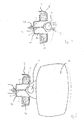
- FIG 2 a front view of the beam 7, including the inflators 8,9, the hose 10 and the air-bag 12, is shown.
- the beam 7 has a rear surface 11, and upper and lower surfaces 13,14, which define the trough-shape thereof.
- the beam 7 also includes upwardly-and downwardly-extending flanges 15, to allow the beam to be supported by, and connected to other components of the vehicle (not shown).
- FIG 3 a side view of the air-bag system 1 prior to deployment is shown. From this view, it can be seen that, within the outer skin 2 of the bumper, three strips of foam are provided.
- the three inter-connected blocks 5 of foam discussed above are provided across a central region of the bumper, and together comprise a central strip of foam. Above and below these blocks 5, further upper and lower strips 16,17 are provided. These upper and lower strips 16,17 of foam extend substantially all the way across the bumper, and are not divided into blocks 5, as is the case with the middle foam strip.
- the upper and lower strips 16,17 of foam are connected to the central blocks 5 of foam by relatively weak frangible connections 18. Weak connections 19 are also provided around the central portion 3 of the outer skin 2 of the bumper when viewed in this direction. It will therefore be understood that the central region 3 is substantially rectangular, and surrounded on all four sides by weak connections 4, 19.
- a cooling system 20 of the vehicle is also visible, located rearwardly of the beam.
- the air-bag unit 1 will be deployed before the vehicle makes contact with another object.
- the vehicle is therefore preferably equipped with one or more sensors, such as optical or infrared frequency cameras or radar systems, that will allow an on-board processor to determine that an impact with an object ahead of the vehicle is likely or unavoidable.
- the vehicle's sensor systems may also make determinations as to the type of object that is ahead of the vehicle, for instance by making measurements as to the apparent size of the object, and may also match the shape of the object against a number of "template" shapes held in a memory.
- the likely severity of the crash may also be gauged, for instance with reference to the speed of the vehicle relative to the road, and/or to the relative speed between the vehicle and the other object.
- the air-bag unit 1 It is anticipated that triggering of the air-bag unit 1 would be of most use in relatively low-speed impacts. If the vehicle's processor determines that a suitable impact is or about to occur, or is likely to occur, the air-bag unit 1 will be triggered.
- the inflators 8,9 When a triggering signal is sent to the air-bag unit 1 by an on-board processor, the inflators 8,9 start to generate gas rapidly, and to introduce this gas into an interior of the hose 10.
- the length of the hose 10 is greater than the distance between the inflators 8,9.
- the hose 10 is preferably folded against the rear surface 11 of the beam 7 as shown in figure 4a .
- the hose 10 increases in rigidity and can no longer remain in this folded configuration, and is driven into an arcuate shape extending between the inflators 8,9. Since movement of the hose 10 is blocked in rearward, upward and downward functions by the rear, top and bottom surfaces 11,13,14 of the beam 7, the hose 10 is formed into an arcuate configuration extending forwardly out of the open surface of the beam 7, as shown in figure 4b .
- the air-bag 12 is omitted from figures 4a and 4b for the purposes of clarity. However, as discussed above, the air-bag 12 is attached to the hose 10, and extends forwardly therefrom.
- the air-bag 12 When the hose 10 is formed into a forwardly-extending arcuate shape, the air-bag 12, which is still uninflated, is driven into contact with a rear surface of the central block 5 of foam.
- the air-bag 12 is driven into this block 5 of foam with sufficient force to break the weak connections 6,18 between this block 5 and the blocks 5 to the left and right thereof, and also to the upper and lower strips 16,17 of foam.
- the middle block 5 of foam is therefore driven forwardly until the block 5 comes into contact with the rear surface of the central portion 3 of the outer skin 2 of the bumper. Once again, this contact is made with sufficient force to break the weak connections 4,19 which connect the central region 3 to the remainder of the outer skin 2 of the bumper.
- the air-bag 12 continues to be driven forward by the inflation of the hose 10, so that the middle block 5 of foam, and the central portion 3 of the outer skin 2 of the bumper, are thrown forwardly of the vehicle.
- the central portion of the bumper is captured by a tether system as known in the art for covering of passenger airbags.
- the middle section 10 of the hose which extends furthest forward, preferably lies substantially level with, or protrudes beyond, the outer skin 2 of the bumper, as shown in figure 5 .
- the air-bag 12 is still wholly or substantially uninflated, but is positioned approximately level with, or forwardly of the outer skin 2 of the bumper.
- the hose 10 and air-bag 12 are preferably prevented from moving too far forwardly, however, by a restraining mechanism such as a tether 21, which is attached to a rear portion of the air-bag 12.
- the tether 21 passes through an aperture 22 provided in the rear surface 11 of the beam 7, and is attached to a sturdy ring 23 or other widened portion, which is provided behind the rear surface 11 and is too wide to pass through the aperture 22.
- the air-bag 12 Once the air-bag 12 is in the position shown in figure 5 , full inflation of the air-bag may begin, until the air-bag 12 is fully inflated, as shown in figure 6 .
- the capacity of the air-bag 12 is around 80 litres.
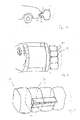
- FIG 7 A side-view of the air-bag 12 in its inflated state is shown in figure 7 .
- FIG 8 A top view of the inflated air-bag 12 is shown in figure 8 .
- the air-bag 12 protrudes from the central portion 3 of the outer skin 2 of the bumper, when inflated the air-bag 12 extends to both sides, thus covering the front of substantially all of the bumper.
- the air-bag 12 comprises four interconnected chambers 24, which are arranged side-by-side.
- FIG. 9 An isometric rear view of the inflated air-bag 12 is shown in figure 9 .
- a connection region 25 of the air-bag 12 comprises upper and lower panels which overlay one another, and are connected to each other along a top edge 26 thereof.
- the top edge 26 may comprise a fold in a continuous sheet of material, or may comprise a join line between the upper and lower panels.
- the width of the panel reduces in a tapering fashion, and then reduces sharply until the overall width of the panels is around half of the width at the top edge 26.
- the panels then continue away from the top edge 6, having substantially constant width, forming a delivery portion 27 of the air-bag 12.
- an inflation portion 28 of the air-bag 12 is formed.
- the inflation portion 28 is substantially wider than the delivery portion 27 is substantially enclosed, and is the main part of the air-bag 12 that provides protection to pedestrians.
- the inflation portion 28 of the air-bag 12 may be formed to have a plurality of chambers 24. This is the portion that, prior to inflation of the air-bag 12, will be tightly packed, rolled and/or folded.
- First stitching 29 is formed at the edges of the upper and lower panels in the region of the delivery portion 27, to seal the edges of the upper and lower panels to one another.
- connection portion 25 the outer edges of the upper and lower panels are not connected to one another.
- two outwardly protruding, generally triangular-shaped entry portions 30 are formed, with sideways-facing openings 31.
- the entrance portions 30 are folded into the interior of the air-bag 12, and this can be likened to pushing the sleeves of a T-shirt inwardly into the body of the T-shirt.
- Second stitching 32 is then formed across the top edge 26, this stitching passing through all four layers of the upper and lower panels, and the upper and lower surfaces of the entrance portions 30.
- the entrance portions 30 are thus held firmly in place within the body of the air-bag 12, so that a pair of throats are formed allowing access to the interior of the air-bag 12.
- the hose 10 is then passed through the air-bag 12, through the throats formed by the openings 31 in the inverted entrance portions 30.
- the ends of the hose 10 are then connected to the inflators 8,9.
- a selective gas delivery region is formed in the surface of the hose 10.
- the region is in the form of a plurality of delivery perforations 32 and is located such that when the hose 10 is inserted into the air-bag 12 as described above, the delivery perforations 32 are in fluid communication with the interior region of the air-bag 12.
- the delivery perforations 32 are formed to be relatively small so that, when gas below a threshold pressure is introduced into the hose 10, the perforations 32 allow very little gas to escape therethrough. Weakened regions are formed around the delivery perforations 32, however, so that when the gas pressure within the hose 10 rises above the threshold, the perforations 32 are widened considerably, allowing the delivery of large amounts of gas through the perforations 32.
- no perforations are formed in the hose, but weakened regions are formed that will rupture to form perforations or apertures when gas pressure within the hose 10 exceeds the threshold.
- one or more lines of perforations may define the outline of a larger gas flow aperture formed in the hose 10.
- the pressure in the hose 10 may cause the perforations to burst, leading to the formation of one or more larger gas flow apertures through which gas may exit the hose 10.
- the aperture to inflate the air-bag 12 is simply covered and closed by the folded air-bag 12.
- the filling of the air-bag 12 is blocked by the presence of the folded air-bag 12, particularly since, due to its inertia, the air-bag 12 will be pressed against the aperture as the central portion of the hose 10 moves forwardly.
- the gas pressure in the hose 10 will air-bag 12 will act against the air-bag 12, moving the air-bag 12 away from the aperture and thus opening the aperture and allowing gas to flow from the hose 10 into the air-bag 12.
- the hose 10 and inflators 8, 9 are then installed in the beam 7 as described above, so that the expansion portion 28 of the air-bag 12 is located on the forward-facing side of the hose 10.
- the gas pressure within the hose 10 will not be sufficient to widen the delivery perforations 32. Only when the hose 10 has reached its fully inflated state, with the air-bag 12 in the appropriate position to begin full inflation, will the gas pressure inside the hose 10 exceed the threshold, widening the delivery perforations 32 and allowing gas to flow from the inflators 8,9, through the hose 10 and into the interior of the air-bag 12 at a high rate. The gas will then flow through the delivery portion 27 and into the inflation portion 28 to inflate the inflation portion 28.
- the throats defined by the two entrance portions 30 are preferably of roughly the same width as, or slightly smaller than, the width of the hose 10 when fully inflated. Hence, when the hose 10 inflates, the hose 10 presses against the inside surfaces of the throats, allowing a firm and substantially air-tight connection to be made between the hose 10 and the air-bag 12.
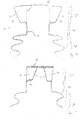
- Figures 13a, 13b and 13c show alternative ways in which the hose 10 may be folded within the beam 7, against the rear surface 11 thereof.
- Figure 13a shows the hose 10 folded longitudinally in half, with the delivery perforations 32 being provided around the fold on the inner side thereof.
- Figure 13b shows the hose 10 packed with two substantially right-angled folds formed between the ends of the hose and the portion containing the delivery perforations 32, with this portion lying close to the rear surface 11 of the beam.
- Figure 13c once again shows the portion of the hose 10 that includes the delivery perforations 32 resting against the rear surface 11 of the beam 7, with top and bottom regions of the hose 10 being folded through 180° and overlying this portion.
- hose 10 may be packed in the beam 7 prior to activation of the air-bag system.
- the inflators 8,9 may be pyrotechnic inflators. However, the inflators 8,9 may alternatively be pneumatic inflators and this may be particularly useful if the air-bag module 1 is to be reversible, i.e. after deployment, the air-bag module 1 can one again be placed in a ready state.
- inflator only one inflator may be used, although in preferred embodiments two inflators are provided. Further inflators may also be provided, if necessary.
- the hose 10 is substantially fixed in position at either end thereof, with the air-bag 12 being positioned on an intermediate portion of the hose 10.
- the hose 10 is fixed at its ends to the inflators 8,9.
- this may be attached to one end of the hose 10, while the other end of the hose 10 is sealed and attached to another component, for instance an inner surface of the beam 7.
- air-bag modules of this type may be provided in other parts of a vehicle.
- an air-bag module of this type may be provided behind, or in the region of, a rear bumper of a vehicle, in case a rearward collision is anticipated, or on an A pillar of a vehicle, to prevent a pedestrian striking the A pillar during an accident.
- vent holes may be provided in the air-bag 12, to allow for venting of the air-bag 12 once it has been inflated.
- the present invention provides an air-bag module that will allow the safety of pedestrians to be effectively increased, whilst reducing interference with the construction of vehicle bumpers and other components.
Landscapes
- Engineering & Computer Science (AREA)
- Mechanical Engineering (AREA)
- Physics & Mathematics (AREA)
- Fluid Mechanics (AREA)
- Air Bags (AREA)
Abstract
Description
- This invention relates to a vehicle safety system, and in particular concerns a system including an air-bag which is inflated outside the vehicle. Such safety systems can be used to mitigate of the impulse delivered to the vehicle in a high-speed impact (e.g. over 65km/h), protection during a low-speed impact (e.g. below 15km/h), pedestrian protection, to increase the compatibility of larger cars such as SUVs to small city cars (e.g. Smart cars or "no-licence" cars), or for other purposes.
- In collisions between motor vehicles and pedestrians, it is relatively common for the vehicle to strike the pedestrian head-on. This often leads to injury to the legs of the pedestrian, as the pedestrian's legs are hit by the vehicle's front bumper.
- To address this, it has previously been proposed to include an air-bag which inflates forwardly of the vehicle prior to the impact. The pedestrian's legs are therefore contacted by this air-bag, rather than the vehicle's bumper, and this reduces the likelihood, or severity, of injury to the pedestrian's legs.
- In typical systems of this type, the air-bag is stowed within the vehicle's front bumper. However, current regulations in many countries require that the front bumper of a vehicle is provided with a typical thickness of 65mm of foam within the bumper. Prior to inflation, folded air-bag cushions are tightly packed, and it has been found that providing a folded air-bag cushion within a bumper results in a bumper that is too hard to meet these regulations.
- It is an object of the present invention to seek to ameliorate some or all of the above difficulties. Accordingly, one aspect of the present invention provides an air-bag system for a vehicle, comprising: an air-bag; a flexible hose connected to receive pressurised gas from an inflator, the hose having at least one selective gas delivery region which is in communication with an interior of the air-bag, wherein the selective gas delivery region initially substantially prevents gas from flowing from the hose into the interior of the air-bag, and when the gas pressure within the hose exceeds a predetermined threshold, the selective gas delivery region allows gas to flow from the hose into the interior of the air-bag.
- Advantageously, the flexible hose is in a folded configuration prior to the delivery of gas thereto by the inflator.
- Preferably, the hose is initially uninflated, and the gas pressure in the hose does not exceed the predetermined threshold until the hose is at least substantially inflated.
- Conveniently, prior to delivery of gas from the inflator, the air-bag is in an initial position, and before the gas pressure in the hose exceeds the predetermined threshold, the hose inflates and transports the air-bag to an inflation position.
- Advantageously, the air-bag is initially substantially uninflated, and the transporting of the air-bag to the inflation position occurs while the air-bag is still substantially uninflated.
- Preferably, the hose is initially provided between the air-bag and a rigid member, and wherein during transportation of the air-bag to from the initial position to the inflation position, the air-bag is moved away from the rigid member.
- Conveniently, the hose has a length when inflated and is provided in a cavity which is shorter than the length, so that, during inflation of the hose, the hose is driven into a substantially arcuate configuration.
- Advantageously, the selective gas delivery region is formed by the presence of the air-bag adjacent an aperture in the hose.
- Preferably, the selective gas delivery region comprises one or more perforations provided in the surface of the hose, which are configured to widen when the gas pressure within the hose exceeds the predetermined threshold.
- Conveniently, the hose is formed from a flexible, elastic material.
- Advantageously, the hose passes through an interior of the air-bag.
- Preferably, the air-bag is provided with a throat to allow its connection to the hose to be sealed when the hose inflates.
- Another aspect of the present invention provides a vehicle comprising an air-bag system according to the above.
- Conveniently, the vehicle further comprises an obstruction provided between the initial position of the air-bag and an exterior surface of the vehicle, such that the obstruction is knocked out of position by the transportation of the air-bag from its initial position to its inflation position.
- Advantageously, the inflation position of the air-bag is substantially level with, or outboard of, an external surface of the vehicle.
- Preferably, the obstruction is a part of a bumper of the vehicle.
- A further aspect of the present invention provides an air-bag system for a vehicle, comprising an air-bag which, prior to inflation, is in an initial position, wherein upon activation of the air-bag system, the air-bag is transported to an inflation position, the transporting occurring while the air-bag is still substantially uninflated, and wherein the air-bag is fully inflated after being transported to the inflation position.
- In order that the present invention may be more readily understood, embodiments thereof will now be described, by way of example, with reference to the accompanying drawings, in which:
-
Figures 1 and3 are views of a front part of a motor vehicle including an air-bag system embodying the present invention; -
Figure 2 is a view of the air-bag system offigure 1 ; -
Figures 4a and 4b show a hose of the air-bag system offigure 1 prior to inflation and after inflation, respectively; -
Figures 5 and 6 show the air-bag system offigure 1 in inflating position prior to inflation and after inflation, respectively; -
Figures 7 and 8 show side and top views, respectively, of the front part of the motor vehicle offigure 1 after inflation of the air-bag system; -
Figure 9 is an isometric view of the air-bag of the air-bag system after inflation; -
Figures 10, 11 and12 show stages in the production of the air-bag; and -
Figures 13a, 13b and 13c show alternative ways of packing the hose offigures 4a and 4b prior to inflation. - Referring firstly to
figure 1 , an air-bag module 1 embodying the present invention is shown, prior to deployment.Figure 1 shows a top-down view of the front portion of a motor vehicle, including the front bumper thereof. The front bumper has an outer skin 2, which may be formed from any suitably light, flexible materials such as plastic fibreglass, carbon fibre or other "composite" material, or thin, flexible metal. A central portion 3 of the outer skin 2 of the bumper is connected to the side portions of the outer skin 2 by relatively weak, frangible connections 4. In preferred embodiments, the central portion 3 supports the number plate of the vehicle. - Immediately behind the outer skin 2 lie three
blocks 5 of foam. The foam is preferably soft and readily compressible, to afford cushioning so that the outer skin 2 of the bumper may deflect and deform inwardly. As discussed above, in many countries there are strict regulations as to the minimum thickness of this foam, and/or the extent to which the bumper is compressible. - The foam positioned behind the outer skin 2 of the bumper comprises three
blocks 5, and includes twoside blocks 5, and acentral block 5, which is positioned substantially behind the central portion 3 of the outer skin 2. Thecentral block 5 is connected to the twoside blocks 5 by relatively weak frangible connections 6. - Located behind the
blocks 5 of foam is abeam 7, which comprises a substantially trough-shaped channel with enclosing rear, upper andlower surfaces beam 7 extends across the vehicle, and is preferably substantially as wide as the forward-facing part of the bumper. - Located within the
beam 7 are first andsecond inflators beam 7. Each of theinflators - A
gas delivery hose 10 is connected to both of theinflators hose 10. Thehose 10 is connected between theinflators inflator hose 10. In preferred embodiments, thehose 10 is formed from a material that is flexible, and even more preferably is elastic. Thehose 10 may be formed from a suitable fabric. - Before the air-bag unit 1 is activated, the
hose 10 is uninflated, and is packed towards therear surface 11 of thebeam 7. The length of thehose 10 is, in this embodiment, greater than the distance between the twoinflators - Also provided within, or substantially within, the
beam 7 is an air-bag 12. Before the air-bag unit 1 is activated, the air-bag 12 is packed, rolled and/or folded, and is connected to thehose 10, as will be discussed in greater detail below. The air-bag 12 is positioned to lie behind thecentral block 5 of foam. - Turning to
figure 2 , a front view of thebeam 7, including theinflators hose 10 and the air-bag 12, is shown. As discussed above, thebeam 7 has arear surface 11, and upper andlower surfaces beam 7 also includes upwardly-and downwardly-extending flanges 15, to allow the beam to be supported by, and connected to other components of the vehicle (not shown). - Turning to
figure 3 , a side view of the air-bag system 1 prior to deployment is shown. From this view, it can be seen that, within the outer skin 2 of the bumper, three strips of foam are provided. The threeinter-connected blocks 5 of foam discussed above are provided across a central region of the bumper, and together comprise a central strip of foam. Above and below theseblocks 5, further upper andlower strips 16,17 are provided. These upper andlower strips 16,17 of foam extend substantially all the way across the bumper, and are not divided intoblocks 5, as is the case with the middle foam strip. The upper andlower strips 16,17 of foam are connected to thecentral blocks 5 of foam by relatively weak frangible connections 18.Weak connections 19 are also provided around the central portion 3 of the outer skin 2 of the bumper when viewed in this direction. It will therefore be understood that the central region 3 is substantially rectangular, and surrounded on all four sides byweak connections 4, 19. - In
figure 3 , acooling system 20 of the vehicle is also visible, located rearwardly of the beam. - Deployment of the air-bag unit 1 will now be described. Ideally, the air-bag unit 1 will be deployed before the vehicle makes contact with another object. The vehicle is therefore preferably equipped with one or more sensors, such as optical or infrared frequency cameras or radar systems, that will allow an on-board processor to determine that an impact with an object ahead of the vehicle is likely or unavoidable. The vehicle's sensor systems may also make determinations as to the type of object that is ahead of the vehicle, for instance by making measurements as to the apparent size of the object, and may also match the shape of the object against a number of "template" shapes held in a memory. The likely severity of the crash may also be gauged, for instance with reference to the speed of the vehicle relative to the road, and/or to the relative speed between the vehicle and the other object.
- It is anticipated that triggering of the air-bag unit 1 would be of most use in relatively low-speed impacts. If the vehicle's processor determines that a suitable impact is or about to occur, or is likely to occur, the air-bag unit 1 will be triggered.
- When a triggering signal is sent to the air-bag unit 1 by an on-board processor, the
inflators hose 10. - As discussed above, the length of the
hose 10 is greater than the distance between theinflators hose 10 is preferably folded against therear surface 11 of thebeam 7 as shown infigure 4a . When gas is introduced into thehose 10 under high pressure from theinflators hose 10 increases in rigidity and can no longer remain in this folded configuration, and is driven into an arcuate shape extending between theinflators hose 10 is blocked in rearward, upward and downward functions by the rear, top andbottom surfaces beam 7, thehose 10 is formed into an arcuate configuration extending forwardly out of the open surface of thebeam 7, as shown infigure 4b . - The air-
bag 12 is omitted fromfigures 4a and 4b for the purposes of clarity. However, as discussed above, the air-bag 12 is attached to thehose 10, and extends forwardly therefrom. - When the
hose 10 is formed into a forwardly-extending arcuate shape, the air-bag 12, which is still uninflated, is driven into contact with a rear surface of thecentral block 5 of foam. The air-bag 12 is driven into thisblock 5 of foam with sufficient force to break the weak connections 6,18 between thisblock 5 and theblocks 5 to the left and right thereof, and also to the upper andlower strips 16,17 of foam. Themiddle block 5 of foam is therefore driven forwardly until theblock 5 comes into contact with the rear surface of the central portion 3 of the outer skin 2 of the bumper. Once again, this contact is made with sufficient force to break theweak connections 4,19 which connect the central region 3 to the remainder of the outer skin 2 of the bumper. The air-bag 12 continues to be driven forward by the inflation of thehose 10, so that themiddle block 5 of foam, and the central portion 3 of the outer skin 2 of the bumper, are thrown forwardly of the vehicle. For safety reasons the central portion of the bumper is captured by a tether system as known in the art for covering of passenger airbags. - When the
hose 10 is fully inflated, themiddle section 10 of the hose, which extends furthest forward, preferably lies substantially level with, or protrudes beyond, the outer skin 2 of the bumper, as shown infigure 5 . At this stage, the air-bag 12 is still wholly or substantially uninflated, but is positioned approximately level with, or forwardly of the outer skin 2 of the bumper. Thehose 10 and air-bag 12 are preferably prevented from moving too far forwardly, however, by a restraining mechanism such as atether 21, which is attached to a rear portion of the air-bag 12. Thetether 21 passes through anaperture 22 provided in therear surface 11 of thebeam 7, and is attached to asturdy ring 23 or other widened portion, which is provided behind therear surface 11 and is too wide to pass through theaperture 22. - Once the air-
bag 12 is in the position shown infigure 5 , full inflation of the air-bag may begin, until the air-bag 12 is fully inflated, as shown infigure 6 . In preferred embodiments of the invention, the capacity of the air-bag 12 is around 80 litres. - A side-view of the air-
bag 12 in its inflated state is shown infigure 7 . A top view of the inflated air-bag 12 is shown infigure 8 . As can be seen in this figure, although the air-bag 12 protrudes from the central portion 3 of the outer skin 2 of the bumper, when inflated the air-bag 12 extends to both sides, thus covering the front of substantially all of the bumper. In the depicted embodiment, the air-bag 12 comprises fourinterconnected chambers 24, which are arranged side-by-side. - An isometric rear view of the inflated air-
bag 12 is shown infigure 9 . - The construction of the air-
bag 12, and its connection to thehose 10, will now be described in more detail. - With reference to
figure 10 , a top view is shown of the air-bag 12 in a partially completed state. Aconnection region 25 of the air-bag 12 comprises upper and lower panels which overlay one another, and are connected to each other along atop edge 26 thereof. Thetop edge 26 may comprise a fold in a continuous sheet of material, or may comprise a join line between the upper and lower panels. - As each of the panels extends away from the
top edge 26, the width of the panel reduces in a tapering fashion, and then reduces sharply until the overall width of the panels is around half of the width at thetop edge 26. The panels then continue away from the top edge 6, having substantially constant width, forming adelivery portion 27 of the air-bag 12. - At the far end of the
delivery portion 27 from thetop edge 26, aninflation portion 28 of the air-bag 12 is formed. Theinflation portion 28 is substantially wider than thedelivery portion 27 is substantially enclosed, and is the main part of the air-bag 12 that provides protection to pedestrians. As described above, theinflation portion 28 of the air-bag 12 may be formed to have a plurality ofchambers 24. This is the portion that, prior to inflation of the air-bag 12, will be tightly packed, rolled and/or folded. - First stitching 29 is formed at the edges of the upper and lower panels in the region of the
delivery portion 27, to seal the edges of the upper and lower panels to one another. In theconnection portion 25, however, the outer edges of the upper and lower panels are not connected to one another. At the sides of the air-bag 12 in thedelivery portion 25 thereof, therefore, two outwardly protruding, generally triangular-shapedentry portions 30 are formed, with sideways-facingopenings 31. - Referring to
figure 11 , in the next stage of the construction of the air-bag 12, theentrance portions 30 are folded into the interior of the air-bag 12, and this can be likened to pushing the sleeves of a T-shirt inwardly into the body of the T-shirt.Second stitching 32 is then formed across thetop edge 26, this stitching passing through all four layers of the upper and lower panels, and the upper and lower surfaces of theentrance portions 30. Theentrance portions 30 are thus held firmly in place within the body of the air-bag 12, so that a pair of throats are formed allowing access to the interior of the air-bag 12. - Referring to
figure 12 , thehose 10 is then passed through the air-bag 12, through the throats formed by theopenings 31 in theinverted entrance portions 30. The ends of thehose 10 are then connected to theinflators - A selective gas delivery region is formed in the surface of the
hose 10. Preferably, the region is in the form of a plurality ofdelivery perforations 32 and is located such that when thehose 10 is inserted into the air-bag 12 as described above, thedelivery perforations 32 are in fluid communication with the interior region of the air-bag 12. The delivery perforations 32 are formed to be relatively small so that, when gas below a threshold pressure is introduced into thehose 10, theperforations 32 allow very little gas to escape therethrough. Weakened regions are formed around thedelivery perforations 32, however, so that when the gas pressure within thehose 10 rises above the threshold, theperforations 32 are widened considerably, allowing the delivery of large amounts of gas through theperforations 32. - In yet further embodiments, no perforations are formed in the hose, but weakened regions are formed that will rupture to form perforations or apertures when gas pressure within the
hose 10 exceeds the threshold. - In an alternative embodiment, one or more lines of perforations may define the outline of a larger gas flow aperture formed in the
hose 10. When thehose 10 has been inflated, the pressure in thehose 10 may cause the perforations to burst, leading to the formation of one or more larger gas flow apertures through which gas may exit thehose 10. - In another alternative embodiment the aperture to inflate the air-
bag 12 is simply covered and closed by the folded air-bag 12. At ignition, the filling of the air-bag 12 is blocked by the presence of the folded air-bag 12, particularly since, due to its inertia, the air-bag 12 will be pressed against the aperture as the central portion of thehose 10 moves forwardly. As thehose 10 reaches the inflation position, the gas pressure in thehose 10 will air-bag 12 will act against the air-bag 12, moving the air-bag 12 away from the aperture and thus opening the aperture and allowing gas to flow from thehose 10 into the air-bag 12. - The
hose 10 andinflators beam 7 as described above, so that theexpansion portion 28 of the air-bag 12 is located on the forward-facing side of thehose 10. - When the air-bag unit 1 is triggered and the
hose 10 inflates, forming into an arcuate shape and pushing the air-bag 12 forwardly, the gas pressure within thehose 10 will not be sufficient to widen thedelivery perforations 32. Only when thehose 10 has reached its fully inflated state, with the air-bag 12 in the appropriate position to begin full inflation, will the gas pressure inside thehose 10 exceed the threshold, widening thedelivery perforations 32 and allowing gas to flow from theinflators hose 10 and into the interior of the air-bag 12 at a high rate. The gas will then flow through thedelivery portion 27 and into theinflation portion 28 to inflate theinflation portion 28. - The throats defined by the two
entrance portions 30 are preferably of roughly the same width as, or slightly smaller than, the width of thehose 10 when fully inflated. Hence, when thehose 10 inflates, thehose 10 presses against the inside surfaces of the throats, allowing a firm and substantially air-tight connection to be made between thehose 10 and the air-bag 12. -
Figures 13a, 13b and 13c show alternative ways in which thehose 10 may be folded within thebeam 7, against therear surface 11 thereof.Figure 13a shows thehose 10 folded longitudinally in half, with thedelivery perforations 32 being provided around the fold on the inner side thereof. -
Figure 13b shows thehose 10 packed with two substantially right-angled folds formed between the ends of the hose and the portion containing thedelivery perforations 32, with this portion lying close to therear surface 11 of the beam. -
Figure 13c once again shows the portion of thehose 10 that includes thedelivery perforations 32 resting against therear surface 11 of thebeam 7, with top and bottom regions of thehose 10 being folded through 180° and overlying this portion. - A skilled person will understand that there are many other ways in which the
hose 10 may be packed in thebeam 7 prior to activation of the air-bag system. - As described above, the
inflators inflators - It is also envisaged that only one inflator may be used, although in preferred embodiments two inflators are provided. Further inflators may also be provided, if necessary.
- It is preferred that the
hose 10 is substantially fixed in position at either end thereof, with the air-bag 12 being positioned on an intermediate portion of thehose 10. In the embodiment described above, thehose 10 is fixed at its ends to theinflators hose 10, while the other end of thehose 10 is sealed and attached to another component, for instance an inner surface of thebeam 7. - While the above description includes an air-bag which is mounted behind the front bumper of a motor vehicle, air-bag modules of this type may be provided in other parts of a vehicle. For instance, an air-bag module of this type may be provided behind, or in the region of, a rear bumper of a vehicle, in case a rearward collision is anticipated, or on an A pillar of a vehicle, to prevent a pedestrian striking the A pillar during an accident.
- It is envisaged that the air-
bag 12 will be vented by fabric permeability, and in these embodiments no vent holes may be provided. However, in alternative embodiments, vent holes may be provided in the air-bag 12, to allow for venting of the air-bag 12 once it has been inflated. - It will be appreciate that the present invention provides an air-bag module that will allow the safety of pedestrians to be effectively increased, whilst reducing interference with the construction of vehicle bumpers and other components.
- When used in this specification and claims, the terms "comprises" and "comprising" and variations thereof mean that the specified features, steps or integers are included. The terms are not to be interpreted to exclude the presence of other features, steps or components.
- The features disclosed in the foregoing description, or the following claims, or the accompanying drawings, expressed in their specific forms or in terms of a means for performing the disclosed function, or a method or process for attaining the disclosed result, as appropriate, may, separately, or in any combination of such features, be utilised for realising the invention in diverse forms thereof.
Claims (17)
- An air-bag system for a vehicle, comprising:an air-bag;a flexible hose connected to receive pressurised gas from an inflator, the hose having at least one selective gas delivery region which is in communication with an interior of the air-bag,wherein the selective gas delivery region initially substantially prevents gas from flowing from the hose into the interior of the air-bag, and when the gas pressure within the hose exceeds a predetermined threshold, the selective gas delivery region allows gas to flow from the hose into the interior of the air-bag.
- An air-bag system according to claim 1, wherein the flexible hose is in a folded configuration prior to the delivery of gas thereto by the inflator.
- An air-bag system according to claim 1 or 2, wherein the hose is initially uninflated, and the gas pressure in the hose does not exceed the predetermined threshold until the hose is at least substantially inflated.
- An air-bag system according to any preceding claim wherein:prior to delivery of gas from the inflator, the air-bag is in an initial position; andbefore the gas pressure in the hose exceeds the predetermined threshold, the hose inflates and transports the air-bag to an inflation position.
- An air-bag system according to claim 4 wherein the air-bag is initially substantially uninflated, and the transporting of the air-bag to the inflation position occurs while the air-bag is still substantially uninflated.
- An air-bag system according to claim 4 or 5, wherein the hose is initially provided between the air-bag and a rigid member, and wherein during transportation of the air-bag to from the initial position to the inflation position, the air-bag is moved away from the rigid member.
- An air-bag system according to any preceding claim, wherein the hose has a length when inflated and is provided in a cavity which is shorter than the length, so that, during inflation of the hose, the hose is driven into a substantially arcuate configuration.
- An air-bag system according to any preceding claim, wherein the selective gas delivery region is formed by the presence of the air-bag adjacent an aperture in the hose.
- An air-bag system according to any preceding claim, wherein the selective gas delivery region comprises one or more perforations provided in the surface of the hose, which are configured to widen when the gas pressure within the hose exceeds the predetermined threshold.
- An air-bag system according to any preceding claim, wherein the hose is formed from a flexible, elastic material.
- An air-bag system according to any preceding claim, wherein the hose passes through an interior of the air-bag.
- An air-bag system according to claim 11, wherein the air-bag is provided with a throat to allow its connection to the hose to be sealed when the hose inflates.
- A vehicle comprising an air-bag system according to any preceding claim.
- A vehicle according to claim 13 when dependent upon any one of claims 3 to 6, further comprising an obstruction provided between the initial position of the air-bag and an exterior surface of the vehicle, such that the obstruction is knocked out of position by the transportation of the air-bag from its initial position to its inflation position.
- A vehicle according to claim 14, wherein the inflation position of the air-bag is substantially level with, or outboard of, an external surface of the vehicle.
- A vehicle according to claim 14 or 15, wherein the obstruction is a part of a bumper of the vehicle.
- An air-bag system for a vehicle, comprising an air-bag which, prior to inflation, is in an initial position, wherein upon activation of the air-bag system, the air-bag is transported to an inflation position, the transporting occurring while the air-bag is still substantially uninflated, and wherein the air-bag is fully inflated after being transported to the inflation position.
Priority Applications (1)
| Application Number | Priority Date | Filing Date | Title |
|---|---|---|---|
| EP08162620.2A EP2156997B1 (en) | 2008-08-19 | 2008-08-19 | A vehicle safety system |
Applications Claiming Priority (1)
| Application Number | Priority Date | Filing Date | Title |
|---|---|---|---|
| EP08162620.2A EP2156997B1 (en) | 2008-08-19 | 2008-08-19 | A vehicle safety system |
Publications (2)
| Publication Number | Publication Date |
|---|---|
| EP2156997A1 true EP2156997A1 (en) | 2010-02-24 |
| EP2156997B1 EP2156997B1 (en) | 2017-12-13 |
Family
ID=39931502
Family Applications (1)
| Application Number | Title | Priority Date | Filing Date |
|---|---|---|---|
| EP08162620.2A Not-in-force EP2156997B1 (en) | 2008-08-19 | 2008-08-19 | A vehicle safety system |
Country Status (1)
| Country | Link |
|---|---|
| EP (1) | EP2156997B1 (en) |
Cited By (7)
| Publication number | Priority date | Publication date | Assignee | Title |
|---|---|---|---|---|
| CZ303059B6 (en) * | 2010-09-14 | 2012-03-14 | Centrum dopravního výzkumu, v.v.i. | External airbag for commercial vehicles and buses |
| CN102795180A (en) * | 2011-05-23 | 2012-11-28 | 现代自动车株式会社 | External airbag module for vehicle and back beam for mounting external airbag module |
| DE102012004744A1 (en) * | 2012-03-08 | 2013-09-12 | GM Global Technology Operations LLC (n. d. Ges. d. Staates Delaware) | Front end structure for motor car, has expandable chamber which is releasably connected with gas generator arranged on outer side of the bumper crossbeam |
| CN103723109A (en) * | 2012-10-10 | 2014-04-16 | 现代自动车株式会社 | External airbag cushions for vehicles |
| CN105835811A (en) * | 2015-01-13 | 2016-08-10 | 鸿富锦精密工业(深圳)有限公司 | Vehicle, vehicle safety protection mechanism thereof and protection method |
| WO2025083046A1 (en) * | 2023-10-18 | 2025-04-24 | Zf Automotive Germany Gmbh | Vehicle passenger protection system |
| WO2025083044A1 (en) * | 2023-10-18 | 2025-04-24 | Zf Automotive Germany Gmbh | Vehicle passenger protection system |
Citations (8)
| Publication number | Priority date | Publication date | Assignee | Title |
|---|---|---|---|---|
| DE2053103A1 (en) | 1970-10-29 | 1972-05-04 | Buchmann, Rudolfe, 6800 Mannheim-Feudenheim | Method and device for reducing impact in vehicle rear-end collisions |
| WO1998013231A1 (en) * | 1996-09-26 | 1998-04-02 | Peter Hoyaukin | A vehicle-mounted crash energy absorbing arrangement |
| DE19860823A1 (en) * | 1998-12-30 | 2000-07-06 | Volkswagen Ag | Device to protect of front seat passenger in private motor vehicle has folded airbag installed in front of passenger's seat behind front bulkhead outside vehicle's interior, and deploys in front of passenger through bulkhead opening |
| GB2388080A (en) * | 2002-05-01 | 2003-11-05 | Autoliv Dev | A releasable air-bag |
| US20050062268A1 (en) * | 2003-09-24 | 2005-03-24 | Toyoda Gosei Co., Ltd. | Head-protecting airbag |
| US20050082803A1 (en) * | 2003-10-21 | 2005-04-21 | Takata Corporation | Inflator |
| EP1593556A2 (en) * | 2004-05-04 | 2005-11-09 | Takata Corporation | Inflator |
| US20070057490A1 (en) * | 2005-09-14 | 2007-03-15 | Cassius Deflorimonte | External air bag for a vehicle |
-
2008
- 2008-08-19 EP EP08162620.2A patent/EP2156997B1/en not_active Not-in-force
Patent Citations (8)
| Publication number | Priority date | Publication date | Assignee | Title |
|---|---|---|---|---|
| DE2053103A1 (en) | 1970-10-29 | 1972-05-04 | Buchmann, Rudolfe, 6800 Mannheim-Feudenheim | Method and device for reducing impact in vehicle rear-end collisions |
| WO1998013231A1 (en) * | 1996-09-26 | 1998-04-02 | Peter Hoyaukin | A vehicle-mounted crash energy absorbing arrangement |
| DE19860823A1 (en) * | 1998-12-30 | 2000-07-06 | Volkswagen Ag | Device to protect of front seat passenger in private motor vehicle has folded airbag installed in front of passenger's seat behind front bulkhead outside vehicle's interior, and deploys in front of passenger through bulkhead opening |
| GB2388080A (en) * | 2002-05-01 | 2003-11-05 | Autoliv Dev | A releasable air-bag |
| US20050062268A1 (en) * | 2003-09-24 | 2005-03-24 | Toyoda Gosei Co., Ltd. | Head-protecting airbag |
| US20050082803A1 (en) * | 2003-10-21 | 2005-04-21 | Takata Corporation | Inflator |
| EP1593556A2 (en) * | 2004-05-04 | 2005-11-09 | Takata Corporation | Inflator |
| US20070057490A1 (en) * | 2005-09-14 | 2007-03-15 | Cassius Deflorimonte | External air bag for a vehicle |
Cited By (10)
| Publication number | Priority date | Publication date | Assignee | Title |
|---|---|---|---|---|
| CZ303059B6 (en) * | 2010-09-14 | 2012-03-14 | Centrum dopravního výzkumu, v.v.i. | External airbag for commercial vehicles and buses |
| CN102795180A (en) * | 2011-05-23 | 2012-11-28 | 现代自动车株式会社 | External airbag module for vehicle and back beam for mounting external airbag module |
| CN102795180B (en) * | 2011-05-23 | 2016-06-08 | 现代自动车株式会社 | For the external airbag module of vehicle and the back rest for installing this module |
| DE102011055385B4 (en) | 2011-05-23 | 2024-03-28 | Hyundai Motor Company | External airbag module of a vehicle and rear carrier for mounting the same |
| DE102012004744A1 (en) * | 2012-03-08 | 2013-09-12 | GM Global Technology Operations LLC (n. d. Ges. d. Staates Delaware) | Front end structure for motor car, has expandable chamber which is releasably connected with gas generator arranged on outer side of the bumper crossbeam |
| CN103723109A (en) * | 2012-10-10 | 2014-04-16 | 现代自动车株式会社 | External airbag cushions for vehicles |
| CN105835811A (en) * | 2015-01-13 | 2016-08-10 | 鸿富锦精密工业(深圳)有限公司 | Vehicle, vehicle safety protection mechanism thereof and protection method |
| CN105835811B (en) * | 2015-01-13 | 2017-12-12 | 鸿富锦精密工业(深圳)有限公司 | Vehicle and its vehicle safety mechanism and means of defence |
| WO2025083046A1 (en) * | 2023-10-18 | 2025-04-24 | Zf Automotive Germany Gmbh | Vehicle passenger protection system |
| WO2025083044A1 (en) * | 2023-10-18 | 2025-04-24 | Zf Automotive Germany Gmbh | Vehicle passenger protection system |
Also Published As
| Publication number | Publication date |
|---|---|
| EP2156997B1 (en) | 2017-12-13 |
Similar Documents
| Publication | Publication Date | Title |
|---|---|---|
| EP2319734B1 (en) | A Safety Arrangement | |
| US9994184B2 (en) | Vehicle side airbag with secondary chamber | |
| EP1358091B1 (en) | Bumper airbag and system | |
| EP2617607B1 (en) | Airbag arrangement | |
| EP2156997B1 (en) | A vehicle safety system | |
| US6648368B2 (en) | Dual roof rail air bag with integrated fill system | |
| US20050087998A1 (en) | Bumper airbag and system | |
| CN102649416A (en) | Occupant protection apparatus and occupant protection method | |
| KR102489462B1 (en) | Air bag device for panorama roof | |
| CN105922966A (en) | Airbag for oblique vehicle impacts | |
| EP1405772B1 (en) | Air bag device | |
| KR102154173B1 (en) | Airbag apparatus of vehicle | |
| CN106515652B (en) | An airbag assembly including a depressed area below a steering column | |
| KR102647186B1 (en) | Apparatus of airbag for vehicle | |
| KR102454236B1 (en) | Airbag apparatus for vehicle | |
| JP2017100552A (en) | Air bag device | |
| KR102475716B1 (en) | Air bag device for panorama roof | |
| JP2001277966A (en) | Air bag device for pedestrian | |
| KR20210119161A (en) | Side airbag apparatus for vehicle | |
| EP1541426A1 (en) | Crash protection | |
| KR102263721B1 (en) | Passenger Airbag Aparatus Of Vehicle | |
| JP7249190B2 (en) | air bag device | |
| KR101627120B1 (en) | Airbag for vehicle | |
| KR102905092B1 (en) | vehicle headrest airbag device | |
| JP7416658B2 (en) | curtain airbag device |
Legal Events
| Date | Code | Title | Description |
|---|---|---|---|
| PUAI | Public reference made under article 153(3) epc to a published international application that has entered the european phase |
Free format text: ORIGINAL CODE: 0009012 |
|
| AK | Designated contracting states |
Kind code of ref document: A1 Designated state(s): AT BE BG CH CY CZ DE DK EE ES FI FR GB GR HR HU IE IS IT LI LT LU LV MC MT NL NO PL PT RO SE SI SK TR |
|
| AX | Request for extension of the european patent |
Extension state: AL BA MK RS |
|
| 17P | Request for examination filed |
Effective date: 20100628 |
|
| 17Q | First examination report despatched |
Effective date: 20100803 |
|
| AKX | Designation fees paid |
Designated state(s): AT BE BG CH CY CZ DE DK EE ES FI FR GB GR HR HU IE IS IT LI LT LU LV MC MT NL NO PL PT RO SE SI SK TR |
|
| GRAP | Despatch of communication of intention to grant a patent |
Free format text: ORIGINAL CODE: EPIDOSNIGR1 |
|
| INTG | Intention to grant announced |
Effective date: 20170703 |
|
| RIN1 | Information on inventor provided before grant (corrected) |
Inventor name: MEYER, BERNHARD Inventor name: GOERTZ, CHRISTOPH Inventor name: MACKENSEN, JUERGEN |
|
| GRAS | Grant fee paid |
Free format text: ORIGINAL CODE: EPIDOSNIGR3 |
|
| GRAA | (expected) grant |
Free format text: ORIGINAL CODE: 0009210 |
|
| AK | Designated contracting states |
Kind code of ref document: B1 Designated state(s): AT BE BG CH CY CZ DE DK EE ES FI FR GB GR HR HU IE IS IT LI LT LU LV MC MT NL NO PL PT RO SE SI SK TR |
|
| REG | Reference to a national code |
Ref country code: GB Ref legal event code: FG4D |
|
| REG | Reference to a national code |
Ref country code: AT Ref legal event code: REF Ref document number: 954036 Country of ref document: AT Kind code of ref document: T Effective date: 20171215 Ref country code: CH Ref legal event code: EP |
|
| REG | Reference to a national code |
Ref country code: IE Ref legal event code: FG4D |
|
| REG | Reference to a national code |
Ref country code: DE Ref legal event code: R096 Ref document number: 602008053316 Country of ref document: DE |
|
| REG | Reference to a national code |
Ref country code: NL Ref legal event code: MP Effective date: 20171213 |
|
| REG | Reference to a national code |
Ref country code: LT Ref legal event code: MG4D |
|
| PG25 | Lapsed in a contracting state [announced via postgrant information from national office to epo] |
Ref country code: NO Free format text: LAPSE BECAUSE OF FAILURE TO SUBMIT A TRANSLATION OF THE DESCRIPTION OR TO PAY THE FEE WITHIN THE PRESCRIBED TIME-LIMIT Effective date: 20180313 Ref country code: FI Free format text: LAPSE BECAUSE OF FAILURE TO SUBMIT A TRANSLATION OF THE DESCRIPTION OR TO PAY THE FEE WITHIN THE PRESCRIBED TIME-LIMIT Effective date: 20171213 Ref country code: LT Free format text: LAPSE BECAUSE OF FAILURE TO SUBMIT A TRANSLATION OF THE DESCRIPTION OR TO PAY THE FEE WITHIN THE PRESCRIBED TIME-LIMIT Effective date: 20171213 Ref country code: SE Free format text: LAPSE BECAUSE OF FAILURE TO SUBMIT A TRANSLATION OF THE DESCRIPTION OR TO PAY THE FEE WITHIN THE PRESCRIBED TIME-LIMIT Effective date: 20171213 |
|
| REG | Reference to a national code |
Ref country code: AT Ref legal event code: MK05 Ref document number: 954036 Country of ref document: AT Kind code of ref document: T Effective date: 20171213 |
|
| PG25 | Lapsed in a contracting state [announced via postgrant information from national office to epo] |
Ref country code: LV Free format text: LAPSE BECAUSE OF FAILURE TO SUBMIT A TRANSLATION OF THE DESCRIPTION OR TO PAY THE FEE WITHIN THE PRESCRIBED TIME-LIMIT Effective date: 20171213 Ref country code: HR Free format text: LAPSE BECAUSE OF FAILURE TO SUBMIT A TRANSLATION OF THE DESCRIPTION OR TO PAY THE FEE WITHIN THE PRESCRIBED TIME-LIMIT Effective date: 20171213 Ref country code: GR Free format text: LAPSE BECAUSE OF FAILURE TO SUBMIT A TRANSLATION OF THE DESCRIPTION OR TO PAY THE FEE WITHIN THE PRESCRIBED TIME-LIMIT Effective date: 20180314 Ref country code: BG Free format text: LAPSE BECAUSE OF FAILURE TO SUBMIT A TRANSLATION OF THE DESCRIPTION OR TO PAY THE FEE WITHIN THE PRESCRIBED TIME-LIMIT Effective date: 20180313 |
|
| PG25 | Lapsed in a contracting state [announced via postgrant information from national office to epo] |
Ref country code: NL Free format text: LAPSE BECAUSE OF FAILURE TO SUBMIT A TRANSLATION OF THE DESCRIPTION OR TO PAY THE FEE WITHIN THE PRESCRIBED TIME-LIMIT Effective date: 20171213 |
|
| PG25 | Lapsed in a contracting state [announced via postgrant information from national office to epo] |
Ref country code: CZ Free format text: LAPSE BECAUSE OF FAILURE TO SUBMIT A TRANSLATION OF THE DESCRIPTION OR TO PAY THE FEE WITHIN THE PRESCRIBED TIME-LIMIT Effective date: 20171213 Ref country code: SK Free format text: LAPSE BECAUSE OF FAILURE TO SUBMIT A TRANSLATION OF THE DESCRIPTION OR TO PAY THE FEE WITHIN THE PRESCRIBED TIME-LIMIT Effective date: 20171213 Ref country code: CY Free format text: LAPSE BECAUSE OF FAILURE TO SUBMIT A TRANSLATION OF THE DESCRIPTION OR TO PAY THE FEE WITHIN THE PRESCRIBED TIME-LIMIT Effective date: 20171213 Ref country code: EE Free format text: LAPSE BECAUSE OF FAILURE TO SUBMIT A TRANSLATION OF THE DESCRIPTION OR TO PAY THE FEE WITHIN THE PRESCRIBED TIME-LIMIT Effective date: 20171213 Ref country code: ES Free format text: LAPSE BECAUSE OF FAILURE TO SUBMIT A TRANSLATION OF THE DESCRIPTION OR TO PAY THE FEE WITHIN THE PRESCRIBED TIME-LIMIT Effective date: 20171213 |
|
| REG | Reference to a national code |
Ref country code: FR Ref legal event code: PLFP Year of fee payment: 11 |
|
| PG25 | Lapsed in a contracting state [announced via postgrant information from national office to epo] |
Ref country code: IT Free format text: LAPSE BECAUSE OF FAILURE TO SUBMIT A TRANSLATION OF THE DESCRIPTION OR TO PAY THE FEE WITHIN THE PRESCRIBED TIME-LIMIT Effective date: 20171213 Ref country code: AT Free format text: LAPSE BECAUSE OF FAILURE TO SUBMIT A TRANSLATION OF THE DESCRIPTION OR TO PAY THE FEE WITHIN THE PRESCRIBED TIME-LIMIT Effective date: 20171213 Ref country code: PL Free format text: LAPSE BECAUSE OF FAILURE TO SUBMIT A TRANSLATION OF THE DESCRIPTION OR TO PAY THE FEE WITHIN THE PRESCRIBED TIME-LIMIT Effective date: 20171213 Ref country code: IS Free format text: LAPSE BECAUSE OF FAILURE TO SUBMIT A TRANSLATION OF THE DESCRIPTION OR TO PAY THE FEE WITHIN THE PRESCRIBED TIME-LIMIT Effective date: 20180413 Ref country code: RO Free format text: LAPSE BECAUSE OF FAILURE TO SUBMIT A TRANSLATION OF THE DESCRIPTION OR TO PAY THE FEE WITHIN THE PRESCRIBED TIME-LIMIT Effective date: 20171213 |
|
| REG | Reference to a national code |
Ref country code: DE Ref legal event code: R097 Ref document number: 602008053316 Country of ref document: DE |
|
| PLBE | No opposition filed within time limit |
Free format text: ORIGINAL CODE: 0009261 |
|
| STAA | Information on the status of an ep patent application or granted ep patent |
Free format text: STATUS: NO OPPOSITION FILED WITHIN TIME LIMIT |
|
| 26N | No opposition filed |
Effective date: 20180914 |
|
| PG25 | Lapsed in a contracting state [announced via postgrant information from national office to epo] |
Ref country code: DK Free format text: LAPSE BECAUSE OF FAILURE TO SUBMIT A TRANSLATION OF THE DESCRIPTION OR TO PAY THE FEE WITHIN THE PRESCRIBED TIME-LIMIT Effective date: 20171213 |
|
| PG25 | Lapsed in a contracting state [announced via postgrant information from national office to epo] |
Ref country code: SI Free format text: LAPSE BECAUSE OF FAILURE TO SUBMIT A TRANSLATION OF THE DESCRIPTION OR TO PAY THE FEE WITHIN THE PRESCRIBED TIME-LIMIT Effective date: 20171213 |
|
| PG25 | Lapsed in a contracting state [announced via postgrant information from national office to epo] |
Ref country code: MC Free format text: LAPSE BECAUSE OF FAILURE TO SUBMIT A TRANSLATION OF THE DESCRIPTION OR TO PAY THE FEE WITHIN THE PRESCRIBED TIME-LIMIT Effective date: 20171213 |
|
| REG | Reference to a national code |
Ref country code: CH Ref legal event code: PL |
|
| PG25 | Lapsed in a contracting state [announced via postgrant information from national office to epo] |
Ref country code: CH Free format text: LAPSE BECAUSE OF NON-PAYMENT OF DUE FEES Effective date: 20180831 Ref country code: LI Free format text: LAPSE BECAUSE OF NON-PAYMENT OF DUE FEES Effective date: 20180831 Ref country code: LU Free format text: LAPSE BECAUSE OF NON-PAYMENT OF DUE FEES Effective date: 20180819 |
|
| REG | Reference to a national code |
Ref country code: BE Ref legal event code: MM Effective date: 20180831 |
|
| REG | Reference to a national code |
Ref country code: IE Ref legal event code: MM4A |
|
| PG25 | Lapsed in a contracting state [announced via postgrant information from national office to epo] |
Ref country code: IE Free format text: LAPSE BECAUSE OF NON-PAYMENT OF DUE FEES Effective date: 20180819 |
|
| PG25 | Lapsed in a contracting state [announced via postgrant information from national office to epo] |
Ref country code: BE Free format text: LAPSE BECAUSE OF NON-PAYMENT OF DUE FEES Effective date: 20180831 |
|
| PGFP | Annual fee paid to national office [announced via postgrant information from national office to epo] |
Ref country code: GB Payment date: 20190812 Year of fee payment: 12 |
|
| PG25 | Lapsed in a contracting state [announced via postgrant information from national office to epo] |
Ref country code: MT Free format text: LAPSE BECAUSE OF NON-PAYMENT OF DUE FEES Effective date: 20180819 |
|
| PG25 | Lapsed in a contracting state [announced via postgrant information from national office to epo] |
Ref country code: TR Free format text: LAPSE BECAUSE OF FAILURE TO SUBMIT A TRANSLATION OF THE DESCRIPTION OR TO PAY THE FEE WITHIN THE PRESCRIBED TIME-LIMIT Effective date: 20171213 |
|
| PG25 | Lapsed in a contracting state [announced via postgrant information from national office to epo] |
Ref country code: PT Free format text: LAPSE BECAUSE OF FAILURE TO SUBMIT A TRANSLATION OF THE DESCRIPTION OR TO PAY THE FEE WITHIN THE PRESCRIBED TIME-LIMIT Effective date: 20171213 Ref country code: HU Free format text: LAPSE BECAUSE OF FAILURE TO SUBMIT A TRANSLATION OF THE DESCRIPTION OR TO PAY THE FEE WITHIN THE PRESCRIBED TIME-LIMIT; INVALID AB INITIO Effective date: 20080819 |
|
| PGFP | Annual fee paid to national office [announced via postgrant information from national office to epo] |
Ref country code: FR Payment date: 20200827 Year of fee payment: 13 |
|
| GBPC | Gb: european patent ceased through non-payment of renewal fee |
Effective date: 20200819 |
|
| PG25 | Lapsed in a contracting state [announced via postgrant information from national office to epo] |
Ref country code: GB Free format text: LAPSE BECAUSE OF NON-PAYMENT OF DUE FEES Effective date: 20200819 |
|
| PG25 | Lapsed in a contracting state [announced via postgrant information from national office to epo] |
Ref country code: FR Free format text: LAPSE BECAUSE OF NON-PAYMENT OF DUE FEES Effective date: 20210831 |
|
| P01 | Opt-out of the competence of the unified patent court (upc) registered |
Effective date: 20230507 |
|
| PGFP | Annual fee paid to national office [announced via postgrant information from national office to epo] |
Ref country code: DE Payment date: 20240828 Year of fee payment: 17 |
|
| REG | Reference to a national code |
Ref country code: DE Ref legal event code: R119 Ref document number: 602008053316 Country of ref document: DE |