EP2156664B1 - Devices, methods, and media for providing multi-point video conferencing unit functions - Google Patents
Devices, methods, and media for providing multi-point video conferencing unit functions Download PDFInfo
- Publication number
- EP2156664B1 EP2156664B1 EP08738327A EP08738327A EP2156664B1 EP 2156664 B1 EP2156664 B1 EP 2156664B1 EP 08738327 A EP08738327 A EP 08738327A EP 08738327 A EP08738327 A EP 08738327A EP 2156664 B1 EP2156664 B1 EP 2156664B1
- Authority
- EP
- European Patent Office
- Prior art keywords
- point
- emcu
- conferencing
- video
- audio
- Prior art date
- Legal status (The legal status is an assumption and is not a legal conclusion. Google has not performed a legal analysis and makes no representation as to the accuracy of the status listed.)
- Not-in-force
Links
- 238000000034 method Methods 0.000 title claims abstract description 36
- 230000000007 visual effect Effects 0.000 claims abstract description 60
- 230000005236 sound signal Effects 0.000 claims description 34
- 238000010348 incorporation Methods 0.000 claims 6
- 239000000203 mixture Substances 0.000 description 6
- 241000639978 Aethra Species 0.000 description 2
- 238000010586 diagram Methods 0.000 description 2
- 230000002238 attenuated effect Effects 0.000 description 1
- 230000002093 peripheral effect Effects 0.000 description 1
Images
Classifications
-
- H—ELECTRICITY
- H04—ELECTRIC COMMUNICATION TECHNIQUE
- H04N—PICTORIAL COMMUNICATION, e.g. TELEVISION
- H04N7/00—Television systems
- H04N7/14—Systems for two-way working
- H04N7/15—Conference systems
Definitions
- the disclosed subject matter relates to devices, methods, and media for providing multi-point video conferencing unit functions.
- a video conferencing end-point that is equipped with an Embedded Multi-point Conferencing Unit (EMCU), referred to as an EMCU end-point, is capable of providing a multipoint video conference for several video conferencing end-points.
- EMCU Embedded Multi-point Conferencing Unit
- Organizations that deploy small video conferencing networks tend to choose an EMCU end-point because of the relatively low cost involved and the simplicity of its deployment. For example, one or more EMCU endpoints can be quickly purchased (e.g., without an extensive budget) and readily deployed at the early stages of building a video conferencing network.
- an EMCU end-point cannot provide the scalability and capacity that are required for deploying medium and/or large scale video conferencing networks.
- an EMCU end-point can be limited in the number of video conferencing end-points that the EMCU end-point can support in a video conference.
- the number of video stream layouts and the number of different bit-rates that the EMCU end-point can support can also be limited.
- a network-based multi-point conferencing system that can include existing EMCU end-points has been proposed.
- Such conferencing systems can be much more costly.
- such proposed systems have under utilized the capacity of the existing EMCU endpoints.
- previously proposed conferencing systems have not fully utilized the functionalities that the existing EMCU end-points are designed to perform, such as video processing, thereby relegating the existing EMCU end-points to the limited role of video conferencing end-points.
- devices, methods, and media for providing multi-point video conferencing unit functions comprise: a combination of at least one input interface that receives a plurality of video signals, and that receives a visual layout from an EMCU end-point; a processor that selects a subset of the plurality of video signals; a combination of at least one output interface that sends the subset of the plurality of video signals to the EMCU end-point and that sends the visual layout to a video conferencing end-point, wherein the visual layout incorporates the subset of the plurality of video signals.
- devices for providing multi-point conferencing unit functions comprise: a combination of at least one input interface that receive a plurality of audio signals, and that receives an isolated EMCU end-point user audio signal from an EMCU end-point; a processor that selects a subset of the plurality of audio signals and mixes the subset of the plurality of audio signals to produce a mixed audio signal; and a combination of at least one output interface that sends the mixed audio signal to the EMCU end-point.
- methods for providing multi-point video conferencing unit functions comprise: receiving a plurality of video signals; receives a visual layout from an EMCU end-point; selecting a subset of the plurality of video signals; sending the subset of the plurality of video signals to the EMCU end-point; and sending the visual layout to a video conferencing end-point, wherein the visual layout incorporates the subset of the plurality of video signals.
- methods for providing multi-point video conferencing unit functions comprise: receiving a plurality of audio signals; receiving an isolated EMCU end-point user audio signal from an EMCU end-point; selecting a subset of the plurality of audio signals; mixing the subset of the plurality of audio signals to produce a mixed audio signal; and sending the mixed audio signal to the EMCU end-point.
- computer-readable media containing computer-executable instructions that, when executed by a processor, cause the processor to perform a method for providing multi-point video conferencing unit functions.
- the method comprises: receiving a plurality of video signals; receives a visual layout from an EMCU end-point; selecting a subset of the plurality of video signals; sending the subset of the plurality of video signals to the EMCU end-point; and sending the visual layout to a video conferencing end-point, wherein the visual layout incorporates the subset of the plurality of video signals.
- computer-readable media containing computer-executable instructions that, when executed by a processor, cause the processor to perform a method for providing multi-point video conferencing unit functions are provided.
- the method comprises: receiving a plurality of audio signals; receiving an isolated EMCU end-point user audio signal from an EMCU end-point; selecting a subset of the plurality of audio signals; mixing the subset of the plurality of audio signals to produce a mixed audio signal; and sending the mixed audio signal to the EMCU end-point.
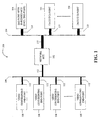
- FIG. 1 is a schematic diagram of a system for providing multi-point video conferencing using a network MCU and one or more EMCU end-points in accordance with some embodiments of the disclosed subject matter.
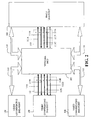
- FIG. 2 is an illustration of a set of communication channels between a network MCU and an EMCU end-point and a set of communication channels between the network MCU and a video conferencing end-point in accordance with some embodiments of the disclosed subject matter.
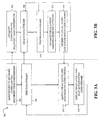
- FIGS. 3A-B illustrate a method for providing multi-point video conferencing in accordance with some embodiments of the disclosed subject matter.
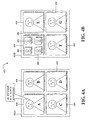
- FIGS. 4A-B are illustrations of visual layouts that are displayed on the screens of EMCU end-points and/or video conferencing end-points in accordance with some embodiments of the disclosed subject matter.
- a network MCU can be used to connect the EMCU end-point(s).
- each of the EMCU end-points can communicate with video conferencing end-points and/or with other EMCU end-points through the network MCU.
- the network MCU can provide switching services for video streams from the video conferencing end-points and the EMCU end-points, and can process and provide switching services for audio streams from the video conferencing end-points.
- the EMCU endpoints can process video streams and generate visual layouts for the video conferencing end-points, and provide these visual layouts to the network MCU for distribution to other end-points.
- FIGS. 1 and 2 are referenced together to illustrate a system 100 for providing multi-point video conferencing.
- FIG. 1 is a schematic diagram of system 100 for providing multi-point video conferencing using a network MCU and one or more EMCU end-points in accordance with some embodiments.
- system 100 includes a network MCU 102, a network 104, one or more EMCU end-points 106, one or more video conferencing end-points 108, a set of EMCU end-point calls 110, and a set of video conferencing end-point calls 112.
- Network MCU 102 can be a program, such as an instance of application software, a library function and/or procedure, one or more background daemon processes, one or more instances of an executable thread, and/or various other suitable pieces of software.
- Network MCU 102 can also be a device containing one or more processors, such as a general-purpose computer, a special-purpose computer, a digital processing device, a server, and/or various other suitable devices, that can run such a program.
- Network 104 can be a local area network (LAN), a wide area network (WAN), a wireless network, a cable network, a telephone network, the Internet, and/or various other suitable networks in which a multi-point video conferencing system can be implemented.
- LAN local area network
- WAN wide area network
- wireless network a wireless network
- cable network a cable network
- telephone network the Internet
- various other suitable networks in which a multi-point video conferencing system can be implemented.
- EMCU end-point 106 can be a video conferencing end-point equipped with an EMCU.
- some such EMCU end-points are manufactured by video conferencing end-point manufacturers, such as POLYCOM ® , TANDBERG ® , SONY ® , LIFESIZE ® , AETHRA ® , and/or various other suitable manufacturers.
- EMCU end-point 106 can be a program or a device running a program.
- Video conferencing end-point 108 can be any suitable device for providing a video conferencing end-point.
- it can be a dedicated end-point device, a personal computer running suitable software, a telephone, a mobile phone, a personal data assistant, an email device, and/or various other suitable devices that can be used to participate in a video conference.
- the functionalities that are necessary to participate in a video conference are built into video conferencing end-point 108.
- video conferencing end-point 108 can add some of the functionalities by interfacing with peripheral devices capable of providing such functionalities.
- video conferencing end-points are manufactured by video conferencing manufacturers, such as POLYCOM ® , TANDBERG ® , SONY ® , LIFESIZE ® , AETHRA ® , and/or various other suitable manufacturers.
- FIG. 2 is an illustration of a set of calls 110 between network MCU 102 and EMCU end-point 106 and a set of calls 112 between network MCU 102 and video conferencing end-point 108 in accordance with some embodiments.
- Calls 110 and 112 can be any logical connection between network MCU 102 and a respective one of EMCU end-point 106 and video conferencing end-point 108.
- calls 110 and 112 can be implemented with dial-up telephone calls, with TCP/IP connections (e.g., via the Internet for example), etc.
- EMCU end-point calls 110 can include video channels 111A and 111B, audio channels 111C and 111D and a control channel 111E.
- Video channels 111A and 111B can include one or more outgoing video channels 111A to EMCU end-point 106 and one or more incoming video channels 111B from EMCU end-point 106.
- audio channels 111C and 111D can include one or more outgoing audio channels 111C to EMCU end-point 106 and one or more incoming audio channels 111D from EMCU end-point 106.
- Control channel 111E can be used to send and receive control commands between network MCU 102 and EMCU end-points 106.
- Video conferencing end-point calls 112 can include video channels 113A and 113B, audio channels 113C and 113D, and a control channel 113E that connect network MCU 102 and video conferencing end-point 108.
- Video channels 113A and 113B can include one or more outgoing video channels 113B to video conferencing end-point 108 and one or more incoming video channels 113A from video conferencing end-point 108.
- audio channels 113C and 113D can include one or more outgoing audio channels 113D to video conferencing end-point 108 and one or more incoming audio channels 113C from video conferencing end-point 108.
- Control channel 113E can be used to send and receive control commands between network MCU 102 and end-points 108.
- Calls 110 and 112 can also include presence information channels, data channels, far-end cameral control channels, and various other standard and/or proprietary channels.
- any suitable number of calls can be used.
- three call 112 are shown, any number of calls 112 can be used.
- FIGS. 2 , 3A-B , and 4A-B are referenced together to illustrate a method 300 for providing multi-point video conferencing.
- FIGS. 3A-B illustrate a method 300 for providing multi-point video conferencing in accordance with some embodiments.
- FIG. 3A illustrates a set of representative functionalities that can be performed by EMCU end-point 106 and video conferencing end-point 108 in accordance with some embodiments.
- FIG. 3B illustrates a set of representative functionalities that can be performed by network MCU 102 and EMCU end-point 106 in accordance with some embodiments.
- a request to establish a connection for a multi-point video conference is made.
- a user can make such request using video conferencing end-point 108 or EMCU end-point 106.
- connections are established for the requested multi-point video conference.
- network MCU 102 establishes the connections.
- the connections include EMCU end-point calls 110 and video conferencing end-point calls 112.
- the calls can be established and/or terminated dynamically at any time during a multi-point video conference.
- data streams are sent through the connections established via the calls.
- the data streams can include video streams, audio streams, steams showing a whiteboard, and/or various other suitable types of data streams.
- video streams can be generated and sent once a user begins participating in the video conference using video conferencing end-point 108 or EMCU end-point 106, and may include frames of video.
- Audio steams can be generated and sent when the user begins speaking.
- the data streams are received.
- network MCU 102 initially receives the data streams from video conferencing end-points 108 through channels 113A and 113C.
- network MCU 102 may send flow control commands to end-points 108 and/or EMCU end-points 106 to control the data streams. For example, network MCU 102 may instruct end-points 108 and 106 to reduce the video bandwidth to 512 kbps, or any other suitable data rate.
- processing data streams can include encoding, decoding, mixing, selecting, switching, and various other suitable operations.
- network MCU 102 processes the received data streams.
- EMCU end-points 106 process the data streams.
- network MCU 102 and EMCU end-points 106 can share the data stream processing tasks. For example, network MCU 102 can decode, mix, select, and/or switch audio streams and select and switch video streams and EMCU end-point 106 can decode, encode, and/or mix video streams. As another example, in some embodiments, network MCU 102 can also decode, encode, and/or mix video streams.
- the selection of audio streams can be made based on one or more factors. In some embodiments, for example, the selection is made by the network MCU 102 based on which user is currently speaking the most loudly and only that user is included in the conference audio. In some embodiments, for example, multiple users that are speaking the most loudly are included in the conference audio. In some embodiments, users that are selected for a conference video are also selected for a conference audio. In some embodiments, the audio streams can be selected based on user input. Any other suitable criteria or criterion can be user to select audio.
- the audio may be mixed by network MCU 102 and distributed to end-points 108 and 106.
- the audio provided to each end-point 108 may be a mixture of the audio from one or more of the users presented in the visual layout without the audio of the user(s) at that end-point.
- the selection of video streams can be made based on one or more factors. In some embodiments, for example, the selection is made based on which users have spoken most recently. In some embodiments, the selection can be based on the order in which each user has joined the video conference. In some embodiments, the selection is, in part, made based on what type of end-point device each user is using. For instance, a user may always be a part of a visual layout because the user is participating in the video conference using the EMCU end-point that generates the visual layout. In some embodiments, the selection may be made so that video of whichever user is speaking is always provided to a certain EMCU end point 108 that is creating a visual layout. In some embodiments, the selection of video streams can be based on user input. Any other suitable criteria or criterion can be used to select video.
- visual layouts may be generated using the data stream that is processed at 310. Examples of visual layouts are shown in FIGS. 4A and 4B .
- network MCU 102 is connected to one EMCU end-point 106 and a visual layout 402A is generated by that EMCU end-point.
- each may generate a visual layout which may be the same or different from visual layouts generated by other EMCU end-points 106.
- a new visual layout can be generated for each frame of a video stream.
- a user that participates in a video conference using an EMCU end-point 106 can, or network MCU 102 can, customize the visual layout that that user sees. For example, that user can select to see only other, specified users.
- a command may be sent to the network MCU instructing it to provide the corresponding video signals to the EMCU end-point.
- This command may be sent using any suitable mechanism, such as an interface from the EMCU to the network MCU, an interface on a Web page (for example) hosted in connection with the network MCU, a DTMF command entered by the user and received by the network MCU, a voice command entered by the user and recognized by the network MCU, etc.
- the EMCU end-point 106 with the customized visual layout may then send to network MCU 102, as its output video, the video being presented on its display and/or the video of the user(s) at that EMCU end-point.
- the visual layout generated at 312 is distributed along with any audio stream(s) selected and mixed at 310.
- network MCU 102 can receive the visual layout through incoming video channel 111B and distribute the visual layout and audio to users A and D-G or users A, C-D, and F-G, respectively, through outgoing video and audio channels 113B and 113D.
- users at end-points 108 can select to see any visual layout or user video (e.g., a video generated by an end-point 108 or 106 for the user(s) at that end-point) that is received by network MCU 102.
- the users may send from their end-points 108 suitable control signals (e.g., using an interface between end-point 108 and network MCU 102, using a Web page, using a DTMF command, using a voice command, etc.) to cause network MCU 102 to send the appropriate visual layout or user video.
- the visual layout generated at 312 is received along with the accompanying audio streams.
- video conferencing endpoints 108 can receive the visual layout and the accompanying audio streams through channels 113B and 113D.
- the visual layout is displayed and the accompanying audio streams are played.
- 310-318 may subsequently be repeated for each portion, e.g., a frame, of a stream, and 306-318 repeated for subsequent streams.
- FIGS. 4A-B are referenced to illustrate 312-318.
- FIGS. 4A-B are illustrations of visual layouts 400, such as 402A and 402B, that can be displayed on the screen of EMCU endpoints 106 and/or video conferencing end-points 108 in accordance with some embodiments.
- Visual layouts 400 can include one or more independent display areas 404 and 406.
- network MCU 102 has received seven video streams and seven audio streams from seven different users A-G who are in a video conference.
- user B participates in the video conference using EMCU end-point 106 and users A and C-G participate in the video conference using video conferencing end-points 108.
- user A is speaking while the rest of the users are listening to user A.
- Network MCU 102 can receive video streams sent by users A and C-G on video channels 113A of corresponding calls 112. Network MCU 102 can then select one or more video streams and direct the selected video streams to EMCU end-point 106. For example, network MCU 102 can select three video streams of users A, C, and D, as illustrated in FIG. 4A , and direct the video streams to EMCU end-point 106 through the outgoing video channels 111A for three respective calls 110. EMCU end-point 106 can then decode the video streams, mix the selected video streams and the video stream generated by user B, generate visual layout 402A, and send visual layout 402A back to network MCU 102 through the incoming video channel 111B for one or more of the calls 110. Network MCU 102 can then distribute visual layout 402A to video conferencing end-points 108 through outgoing video channels 113B of corresponding calls 112.
- Network MCU 102 can also select and mix audio streams from one or more users and send the mixed audio to end-points 106 and 108 for presentation to the users. For example, if a user at an end-point 108 (e.g., user A) is determined to be talking, and the network MCU is configured to only present the voice of the speaking user, then the audio of that user can be selected, optionally mixed, and distributed to each of the end-points 106 and 108.
- end-point 108 e.g., user A
- the audio streams provided to an EMCU end-point 106 can be provided in various different ways.
- the audio from each of users A, C, and D can be selected and mixed together.
- the mixed audio can then be sent to EMCU end-point 106 through an outgoing audio channel 111C of one call 110.
- the audio for users A, C, and D can be sent to EMCU end-point 106 so that some of the audio streams (e.g., that of users A and C) are mixed together and sent on an outgoing audio channel 111C of one call 110 and one or more audio streams (e.g., that of user D) are each kept separate and sent to EMCU end-point 106 on their own channel 111C of a call 110.
- each of the audio streams can be sent separately from the other audio streams on their own audio outgoing audio channel 111C of a call 110.
- some of the audio channels 111C to EMCU end-point 106 may be unnecessary and therefore omitted, established with a no signal, or established with a muted or heavily attenuated signal.
- Suitable processing may be required in network MCU to isolate the audio of the user at an EMCU end-point.
- the EMCU end-point when all of the audio streams being provided to the EMCU end-point (e.g., that of users A, C, and D) are mixed together and sent on a single audio channel 111C, the EMCU end-point will provide back to the network MCU the audio of the user at the EMCU end-point (e.g., user B) on the incoming audio channel 111D on the same call 110 as the single audio channel 111C.
- the processing is performed by mixing the audio streams of users A, C, and D before those streams are sent to the EMCU end-point.
- the EMCU end-point may need to subtract out the audio of those other users to obtain the audio of user B.
- the audio can then be selected and mixed by network MCU 102 in a similar fashion to the audio of any end-point 108.
- network MCU 102 is connected to more than one EMCU end-point 106.
- network MCU 102 can receive visual layout 402A from user B's EMCU end-point 106 and feed it to one of its outgoing video channels to user E's EMCU end-point 106 along with two other video streams that network MCU 102 has selected (e.g., as illustrated, video streams of users F and G).
- User E's EMCU end-point 106 can then generate a different visual layout 402B, as illustrated in FIG. 4B , using visual layout 402A and the two other video streams of, for instance, users F and G.
- Network MCU 102 can then distribute visual layout 402B to all or some of the users A, C-D, and F-G.
Landscapes
- Engineering & Computer Science (AREA)
- Multimedia (AREA)
- Signal Processing (AREA)
- Two-Way Televisions, Distribution Of Moving Picture Or The Like (AREA)
- Telephonic Communication Services (AREA)
Abstract
Description
- The disclosed subject matter relates to devices, methods, and media for providing multi-point video conferencing unit functions.
- A video conferencing end-point that is equipped with an Embedded Multi-point Conferencing Unit (EMCU), referred to as an EMCU end-point, is capable of providing a multipoint video conference for several video conferencing end-points. Organizations that deploy small video conferencing networks tend to choose an EMCU end-point because of the relatively low cost involved and the simplicity of its deployment. For example, one or more EMCU endpoints can be quickly purchased (e.g., without an extensive budget) and readily deployed at the early stages of building a video conferencing network.
- As the video conferencing network grows, however, the EMCU end-points cannot provide the scalability and capacity that are required for deploying medium and/or large scale video conferencing networks. For example, an EMCU end-point can be limited in the number of video conferencing end-points that the EMCU end-point can support in a video conference. The number of video stream layouts and the number of different bit-rates that the EMCU end-point can support can also be limited.
- Several solutions have been proposed in the past to address such shortcomings. For example, a network-based multi-point conferencing system that can include existing EMCU end-points has been proposed. Such conferencing systems, however, can be much more costly. Moreover, such proposed systems have under utilized the capacity of the existing EMCU endpoints. For example, previously proposed conferencing systems have not fully utilized the functionalities that the existing EMCU end-points are designed to perform, such as video processing, thereby relegating the existing EMCU end-points to the limited role of video conferencing end-points.
- Devices, methods, and media for providing multi-point video conferencing unit functions are provided. In some embodiments, devices for providing multi-point conferencing unit functions comprise: a combination of at least one input interface that receives a plurality of video signals, and that receives a visual layout from an EMCU end-point; a processor that selects a subset of the plurality of video signals; a combination of at least one output interface that sends the subset of the plurality of video signals to the EMCU end-point and that sends the visual layout to a video conferencing end-point, wherein the visual layout incorporates the subset of the plurality of video signals.
- In some embodiments, devices for providing multi-point conferencing unit functions, comprise: a combination of at least one input interface that receive a plurality of audio signals, and that receives an isolated EMCU end-point user audio signal from an EMCU end-point; a processor that selects a subset of the plurality of audio signals and mixes the subset of the plurality of audio signals to produce a mixed audio signal; and a combination of at least one output interface that sends the mixed audio signal to the EMCU end-point.
- In some embodiments, methods for providing multi-point video conferencing unit functions are provided. These methods comprise: receiving a plurality of video signals; receives a visual layout from an EMCU end-point; selecting a subset of the plurality of video signals; sending the subset of the plurality of video signals to the EMCU end-point; and sending the visual layout to a video conferencing end-point, wherein the visual layout incorporates the subset of the plurality of video signals.
- In some embodiments, methods for providing multi-point video conferencing unit functions are provided. These methods comprise: receiving a plurality of audio signals; receiving an isolated EMCU end-point user audio signal from an EMCU end-point; selecting a subset of the plurality of audio signals; mixing the subset of the plurality of audio signals to produce a mixed audio signal; and sending the mixed audio signal to the EMCU end-point.
- In some embodiments, computer-readable media containing computer-executable instructions that, when executed by a processor, cause the processor to perform a method for providing multi-point video conferencing unit functions are provided. The method comprises: receiving a plurality of video signals; receives a visual layout from an EMCU end-point; selecting a subset of the plurality of video signals; sending the subset of the plurality of video signals to the EMCU end-point; and sending the visual layout to a video conferencing end-point, wherein the visual layout incorporates the subset of the plurality of video signals.
- In some embodiments, computer-readable media containing computer-executable instructions that, when executed by a processor, cause the processor to perform a method for providing multi-point video conferencing unit functions are provided. The method comprises: receiving a plurality of audio signals; receiving an isolated EMCU end-point user audio signal from an EMCU end-point; selecting a subset of the plurality of audio signals; mixing the subset of the plurality of audio signals to produce a mixed audio signal; and sending the mixed audio signal to the EMCU end-point.
-
FIG. 1 is a schematic diagram of a system for providing multi-point video conferencing using a network MCU and one or more EMCU end-points in accordance with some embodiments of the disclosed subject matter. -
FIG. 2 is an illustration of a set of communication channels between a network MCU and an EMCU end-point and a set of communication channels between the network MCU and a video conferencing end-point in accordance with some embodiments of the disclosed subject matter. -
FIGS. 3A-B illustrate a method for providing multi-point video conferencing in accordance with some embodiments of the disclosed subject matter. -
FIGS. 4A-B are illustrations of visual layouts that are displayed on the screens of EMCU end-points and/or video conferencing end-points in accordance with some embodiments of the disclosed subject matter. - Devices, methods, and media for providing multi-point video conferencing unit functions are provided. In some embodiments of the disclosed subject matter, devices, methods, and media are provided for providing multi-point video conferencing unit functions by leveraging the processing capacity of one or more EMCU end-points. A network MCU can be used to connect the EMCU end-point(s). For example, each of the EMCU end-points can communicate with video conferencing end-points and/or with other EMCU end-points through the network MCU. The network MCU can provide switching services for video streams from the video conferencing end-points and the EMCU end-points, and can process and provide switching services for audio streams from the video conferencing end-points. The EMCU endpoints can process video streams and generate visual layouts for the video conferencing end-points, and provide these visual layouts to the network MCU for distribution to other end-points.
-
FIGS. 1 and2 are referenced together to illustrate asystem 100 for providing multi-point video conferencing. -
FIG. 1 is a schematic diagram ofsystem 100 for providing multi-point video conferencing using a network MCU and one or more EMCU end-points in accordance with some embodiments. As illustrated,system 100 includes anetwork MCU 102, anetwork 104, one or more EMCU end-points 106, one or more video conferencing end-points 108, a set of EMCU end-point calls 110, and a set of video conferencing end-point calls 112. - Network MCU 102 can be a program, such as an instance of application software, a library function and/or procedure, one or more background daemon processes, one or more instances of an executable thread, and/or various other suitable pieces of software. Network MCU 102 can also be a device containing one or more processors, such as a general-purpose computer, a special-purpose computer, a digital processing device, a server, and/or various other suitable devices, that can run such a program.
- Network 104 can be a local area network (LAN), a wide area network (WAN), a wireless network, a cable network, a telephone network, the Internet, and/or various other suitable networks in which a multi-point video conferencing system can be implemented.
- EMCU end-
point 106 can be a video conferencing end-point equipped with an EMCU. For example, some such EMCU end-points are manufactured by video conferencing end-point manufacturers, such as POLYCOM®, TANDBERG®, SONY®, LIFESIZE®, AETHRA®, and/or various other suitable manufacturers. In some embodiments, as for network MCU 102, EMCU end-point 106 can be a program or a device running a program. - Video conferencing end-
point 108 can be any suitable device for providing a video conferencing end-point. For example, it can be a dedicated end-point device, a personal computer running suitable software, a telephone, a mobile phone, a personal data assistant, an email device, and/or various other suitable devices that can be used to participate in a video conference. In some embodiments, the functionalities that are necessary to participate in a video conference are built into video conferencing end-point 108. In some embodiments, video conferencing end-point 108 can add some of the functionalities by interfacing with peripheral devices capable of providing such functionalities. For example, some such video conferencing end-points are manufactured by video conferencing manufacturers, such as POLYCOM®, TANDBERG®, SONY®, LIFESIZE®, AETHRA®, and/or various other suitable manufacturers. -
FIG. 2 is an illustration of a set ofcalls 110 between network MCU 102 and EMCU end-point 106 and a set ofcalls 112 between network MCU 102 and video conferencing end-point 108 in accordance with some embodiments.Calls network MCU 102 and a respective one of EMCU end-point 106 and video conferencing end-point 108. For example,calls - EMCU end-
point calls 110 can includevideo channels audio channels control channel 111E.Video channels outgoing video channels 111A to EMCU end-point 106 and one or moreincoming video channels 111B from EMCU end-point 106. - Similarly,
audio channels outgoing audio channels 111C to EMCU end-point 106 and one or moreincoming audio channels 111D from EMCU end-point 106. -
Control channel 111E can be used to send and receive control commands between network MCU 102 and EMCU end-points 106. - Video conferencing end-
point calls 112 can includevideo channels audio channels control channel 113E that connectnetwork MCU 102 and video conferencing end-point 108.Video channels outgoing video channels 113B to video conferencing end-point 108 and one or moreincoming video channels 113A from video conferencing end-point 108. - Similarly,
audio channels outgoing audio channels 113D to video conferencing end-point 108 and one or moreincoming audio channels 113C from video conferencing end-point 108. -
Control channel 113E can be used to send and receive control commands betweennetwork MCU 102 and end-points 108. -
Calls - Although three
calls 110 are shown betweennetwork MCU 102 and EMCU end-point 106 inFIG. 2 , any suitable number of calls can be used. Similarly, although three call 112 are shown, any number ofcalls 112 can be used. -
FIGS. 2 ,3A-B , and4A-B are referenced together to illustrate amethod 300 for providing multi-point video conferencing. -
FIGS. 3A-B illustrate amethod 300 for providing multi-point video conferencing in accordance with some embodiments.FIG. 3A illustrates a set of representative functionalities that can be performed by EMCU end-point 106 and video conferencing end-point 108 in accordance with some embodiments.FIG. 3B illustrates a set of representative functionalities that can be performed bynetwork MCU 102 and EMCU end-point 106 in accordance with some embodiments. - As shown, at 302, a request to establish a connection for a multi-point video conference is made. A user can make such request using video conferencing end-
point 108 or EMCU end-point 106. - At 304, one or more connections are established for the requested multi-point video conference. In some embodiments,
network MCU 102 establishes the connections. In some embodiments, the connections include EMCU end-point calls 110 and video conferencing end-point calls 112. In some embodiments, the calls can be established and/or terminated dynamically at any time during a multi-point video conference. - At 306, data streams are sent through the connections established via the calls. The data streams can include video streams, audio streams, steams showing a whiteboard, and/or various other suitable types of data streams. For example, video streams can be generated and sent once a user begins participating in the video conference using video conferencing end-
point 108 or EMCU end-point 106, and may include frames of video. Audio steams can be generated and sent when the user begins speaking. - At 308, the data streams are received. In some embodiments, for example,
network MCU 102 initially receives the data streams from video conferencing end-points 108 throughchannels - In some embodiments,
network MCU 102 may send flow control commands to end-points 108 and/or EMCU end-points 106 to control the data streams. For example,network MCU 102 may instruct end-points - At 310, the data streams received at 308 are processed. Processing data streams can include encoding, decoding, mixing, selecting, switching, and various other suitable operations. In some embodiments,
network MCU 102 processes the received data streams. In some embodiments, EMCU end-points 106 process the data streams. In some embodiments,network MCU 102 and EMCU end-points 106 can share the data stream processing tasks. For example,network MCU 102 can decode, mix, select, and/or switch audio streams and select and switch video streams and EMCU end-point 106 can decode, encode, and/or mix video streams. As another example, in some embodiments,network MCU 102 can also decode, encode, and/or mix video streams. - The selection of audio streams can be made based on one or more factors. In some embodiments, for example, the selection is made by the
network MCU 102 based on which user is currently speaking the most loudly and only that user is included in the conference audio. In some embodiments, for example, multiple users that are speaking the most loudly are included in the conference audio. In some embodiments, users that are selected for a conference video are also selected for a conference audio. In some embodiments, the audio streams can be selected based on user input. Any other suitable criteria or criterion can be user to select audio. - After being selected, the audio may be mixed by
network MCU 102 and distributed to end-points point 108 may be a mixture of the audio from one or more of the users presented in the visual layout without the audio of the user(s) at that end-point. - The selection of video streams can be made based on one or more factors. In some embodiments, for example, the selection is made based on which users have spoken most recently. In some embodiments, the selection can be based on the order in which each user has joined the video conference. In some embodiments, the selection is, in part, made based on what type of end-point device each user is using. For instance, a user may always be a part of a visual layout because the user is participating in the video conference using the EMCU end-point that generates the visual layout. In some embodiments, the selection may be made so that video of whichever user is speaking is always provided to a certain
EMCU end point 108 that is creating a visual layout. In some embodiments, the selection of video streams can be based on user input. Any other suitable criteria or criterion can be used to select video. - At 312, visual layouts may be generated using the data stream that is processed at 310. Examples of visual layouts are shown in
FIGS. 4A and 4B . In some embodiments,network MCU 102 is connected to one EMCU end-point 106 and avisual layout 402A is generated by that EMCU end-point. When multiple EMCU end-points 106 are connected to networkMCU 102, each may generate a visual layout which may be the same or different from visual layouts generated by other EMCU end-points 106. In some embodiments, a new visual layout can be generated for each frame of a video stream. - In some embodiments, a user that participates in a video conference using an EMCU end-
point 106 can, ornetwork MCU 102 can, customize the visual layout that that user sees. For example, that user can select to see only other, specified users. In such a case, a command may be sent to the network MCU instructing it to provide the corresponding video signals to the EMCU end-point. This command may be sent using any suitable mechanism, such as an interface from the EMCU to the network MCU, an interface on a Web page (for example) hosted in connection with the network MCU, a DTMF command entered by the user and received by the network MCU, a voice command entered by the user and recognized by the network MCU, etc. The EMCU end-point 106 with the customized visual layout may then send to networkMCU 102, as its output video, the video being presented on its display and/or the video of the user(s) at that EMCU end-point. - At 314, the visual layout generated at 312 is distributed along with any audio stream(s) selected and mixed at 310. For example,
network MCU 102 can receive the visual layout throughincoming video channel 111B and distribute the visual layout and audio to users A and D-G or users A, C-D, and F-G, respectively, through outgoing video andaudio channels - In some embodiments, users at end-
points 108 can select to see any visual layout or user video (e.g., a video generated by an end-point network MCU 102. In such cases, the users may send from their end-points 108 suitable control signals (e.g., using an interface between end-point 108 andnetwork MCU 102, using a Web page, using a DTMF command, using a voice command, etc.) to causenetwork MCU 102 to send the appropriate visual layout or user video. - At 316, the visual layout generated at 312 is received along with the accompanying audio streams. In some embodiments, for example,
video conferencing endpoints 108 can receive the visual layout and the accompanying audio streams throughchannels - As should be apparent, 310-318 may subsequently be repeated for each portion, e.g., a frame, of a stream, and 306-318 repeated for subsequent streams.
-
FIGS. 4A-B are referenced to illustrate 312-318.FIGS. 4A-B are illustrations ofvisual layouts 400, such as 402A and 402B, that can be displayed on the screen ofEMCU endpoints 106 and/or video conferencing end-points 108 in accordance with some embodiments.Visual layouts 400 can include one or moreindependent display areas - To aid in understanding these layouts, suppose, for example, that
network MCU 102 has received seven video streams and seven audio streams from seven different users A-G who are in a video conference. Suppose also that user B participates in the video conference using EMCU end-point 106 and users A and C-G participate in the video conference using video conferencing end-points 108. Initially, user A is speaking while the rest of the users are listening to user A. -
Network MCU 102 can receive video streams sent by users A and C-G onvideo channels 113A of corresponding calls 112.Network MCU 102 can then select one or more video streams and direct the selected video streams to EMCU end-point 106. For example,network MCU 102 can select three video streams of users A, C, and D, as illustrated inFIG. 4A , and direct the video streams to EMCU end-point 106 through theoutgoing video channels 111A for threerespective calls 110. EMCU end-point 106 can then decode the video streams, mix the selected video streams and the video stream generated by user B, generatevisual layout 402A, and sendvisual layout 402A back tonetwork MCU 102 through theincoming video channel 111B for one or more of thecalls 110.Network MCU 102 can then distributevisual layout 402A to video conferencing end-points 108 throughoutgoing video channels 113B of corresponding calls 112. -
Network MCU 102 can also select and mix audio streams from one or more users and send the mixed audio to end-points points - The audio streams provided to an EMCU end-
point 106 can be provided in various different ways. For example, the audio from each of users A, C, and D can be selected and mixed together. The mixed audio can then be sent to EMCU end-point 106 through anoutgoing audio channel 111C of onecall 110. Alternatively, the audio for users A, C, and D can be sent to EMCU end-point 106 so that some of the audio streams (e.g., that of users A and C) are mixed together and sent on anoutgoing audio channel 111C of onecall 110 and one or more audio streams (e.g., that of user D) are each kept separate and sent to EMCU end-point 106 on theirown channel 111C of acall 110. As yet another alternative, each of the audio streams can be sent separately from the other audio streams on their own audiooutgoing audio channel 111C of acall 110. In some embodiments, when two or more of the audio streams are mixed together and sent on a single audio channel, some of theaudio channels 111C to EMCU end-point 106 may be unnecessary and therefore omitted, established with a no signal, or established with a muted or heavily attenuated signal. - Suitable processing may be required in network MCU to isolate the audio of the user at an EMCU end-point. For example, in some embodiments, when all of the audio streams being provided to the EMCU end-point (e.g., that of users A, C, and D) are mixed together and sent on a
single audio channel 111C, the EMCU end-point will provide back to the network MCU the audio of the user at the EMCU end-point (e.g., user B) on theincoming audio channel 111D on thesame call 110 as thesingle audio channel 111C. In this example, the processing is performed by mixing the audio streams of users A, C, and D before those streams are sent to the EMCU end-point. As another example, if the EMCU end-point provides back to network MCU audio of its user (e.g., user B) that is mixed with one or more other users (e.g., user D), the network MCU may need to subtract out the audio of those other users to obtain the audio of user B. Once the audio of a user at an EMCU end-point has been isolated, the audio can then be selected and mixed bynetwork MCU 102 in a similar fashion to the audio of any end-point 108. - In some embodiments,
network MCU 102 is connected to more than one EMCU end-point 106. Suppose, for example, that users B and E participate in the video conference using different EMCU end-points 106. In some embodiments,network MCU 102 can receivevisual layout 402A from user B's EMCU end-point 106 and feed it to one of its outgoing video channels to user E's EMCU end-point 106 along with two other video streams that networkMCU 102 has selected (e.g., as illustrated, video streams of users F and G). User E's EMCU end-point 106 can then generate a differentvisual layout 402B, as illustrated inFIG. 4B , usingvisual layout 402A and the two other video streams of, for instance, users F andG. Network MCU 102 can then distributevisual layout 402B to all or some of the users A, C-D, and F-G. - Although the invention has been described and illustrated in the foregoing illustrative embodiments, it is understood that the present disclosure has been made only by way of example, and that numerous changes in the details of implementation of the invention can be made without departing from the scope of the invention, which is only limited by the claims which follow. Features of the disclosed embodiments can be combined and rearranged in various ways.
Claims (15)
- A conferencing device for providing multi-point conferencing unit functions, comprising:at least one input interface that receives a plurality of audio and video signals from a plurality of video conferencing end-points, wherein at least one of the plurality of video conferencing end-points is an embedded multi-point conferencing unit (EMCU) end-point equipped with an EMCU that has processing capabilities, and that receives a visual layout from the EMCU end-point;a processor that establishes connections between the plurality of video conferencing end-points, selects a subset of the plurality of audio and video signals received from the plurality of video conferencing end-points, and processes a first portion of the subset of the plurality of audio and video signals for incorporation into the visual layout; andat least one output interface that sends the subset of the plurality of audio and video signals to the EMCU end-point for using the processing capabilities to process a second portion of the subset of the plurality of audio and video signals for incorporation into the visual layout and that sends the visual layout with the subset of the plurality of audio and video signals processed by the conferencing device and the EMCU end-point to the plurality of video conferencing end-points.
- The device of claim 1, wherein:the at least one input interface also receives an isolated EMCU end-point user audio signal from the EMCU end-point;the processor also mixes the subset of the plurality of audio signals to produce a mixed audio signal; andthe at least one output interface also sends the mixed audio signal to the EMCU end-point.
- The device of claim 2, wherein the combination of at least one output interface also sends a muted audio signal to the EMCU end-point.
- The device of claim 2, wherein the combination of at least one output interface has an audio channel with the EMCU end-point that has no audio signal.
- The device of claim 2, wherein the only audio signal provided to the EMCU end-point is the mixed audio signal.
- The device of claim 1, wherein one of the plurality of video signals is a second visual layout received from a second EMCU end-point, and wherein the processor selects the second visual layout as part of the subset of the plurality of video signals.
- The device of claim 1, wherein all of the plurality of video signals are received from video conferencing endpoints.
- A method for providing multi-point conferencing unit functions, comprising:using a conferencing device to establish connections between a plurality of video conferencing end-points, wherein at least one of the plurality of video conferencing end-points is an embedded multi-point conferencing unit (EMCU) end-point equipped with an EMCU that has processing capabilities;receiving, using the conferencing device, a plurality of audio and video signals from the plurality of video conferencing end-points;receiving, using the conferencing device, a visual layout from the EMCU end-point;selecting, using the conferencing device, a subset of the plurality of audio and video signals;processing, using the conferencing device, a first portion of the subset of the plurality of audio and video signals for incorporation into the visual layout;sending, using the conferencing device, the subset of the plurality of video signals to the EMCU end-point for using the processing capabilities to process a second portion of the subset of the plurality of audio and video signals for incorporation into the visual layout; andsending, using the conferencing device, the visual layout with the subset of the plurality of audio and video signals processed by the conferencing device and the EMCU end-point to the plurality of video conferencing end-points.
- The method of claim 8, further comprising:receiving an isolated EMCU end-point user audio signal from the EMCU end-point;mixing the subset of the plurality of audio signals to produce a mixed audio signal; andsending the mixed audio signal to the EMCU end-point.
- The method of claim 9, further comprising sending a muted audio signal to the EMCU end-point.
- The method of claim 9, further comprising maintaining an audio channel with the EMCU end-point that has no audio signal.
- The method of claim 9, wherein the only audio signal provided to the EMCU end-point is the mixed audio signal.
- The method of claim 8, wherein one of the plurality of video signals is a second visual layout received from a second EMCU end-point, and the second visual layout is selected as part of the subset of the plurality of video signals.
- The method of claim 8, wherein all of the plurality of video signals are received from video conferencing endpoints.
- A computer-readable medium containing computer-executable instructions that, when executed by a processor, cause the processor to perform a method for providing multipoint conferencing unit functions, the method comprising:using a conferencing device to establish connections between a plurality of video conferencing end-points, wherein at least one of the plurality of video conferencing end-points is an embedded multi-point conferencing unit (EMCU) end-point equipped with an EMCU that has processing capabilities;receiving, using the conferencing device, a plurality of audio and video signals from the plurality of video conferencing end-points;receives, using the conferencing device, a visual layout from the EMCU end-point;selecting, using the conferencing device, a subset of the plurality of audio and video signals;processing, using the conferencing device, a first portion of the subset of the plurality of audio and video signals for incorporation into the visual layout;sending, using the conferencing device, the subset of the plurality of video signals to the EMCU end-point for using the processing capabilities to process a second portion of the subset of the plurality of audio and video signals for incorporation into the visual layout; andsending, using the conferencing device, the visual layout with the subset of the plurality of audio and video signals processed by the conferencing device and the EMCU end-point to the plurality of video conferencing end-points.
Applications Claiming Priority (2)
| Application Number | Priority Date | Filing Date | Title |
|---|---|---|---|
| US11/801,085 US8208004B2 (en) | 2007-05-08 | 2007-05-08 | Device, methods, and media for providing multi-point video conferencing unit functions |
| PCT/IL2008/000626 WO2008135999A1 (en) | 2007-05-08 | 2008-05-06 | Devices, methods, and media for providing multi-point video conferencing unit functions |
Publications (2)
| Publication Number | Publication Date |
|---|---|
| EP2156664A1 EP2156664A1 (en) | 2010-02-24 |
| EP2156664B1 true EP2156664B1 (en) | 2012-08-08 |
Family
ID=39790351
Family Applications (1)
| Application Number | Title | Priority Date | Filing Date |
|---|---|---|---|
| EP08738327A Not-in-force EP2156664B1 (en) | 2007-05-08 | 2008-05-06 | Devices, methods, and media for providing multi-point video conferencing unit functions |
Country Status (5)
| Country | Link |
|---|---|
| US (1) | US8208004B2 (en) |
| EP (1) | EP2156664B1 (en) |
| JP (1) | JP5604617B2 (en) |
| CN (1) | CN101731008B (en) |
| WO (1) | WO2008135999A1 (en) |
Families Citing this family (14)
| Publication number | Priority date | Publication date | Assignee | Title |
|---|---|---|---|---|
| CN101370114B (en) * | 2008-09-28 | 2011-02-02 | 华为终端有限公司 | Video and audio processing method, multi-point control unit and video conference system |
| EP2227013A3 (en) * | 2009-03-04 | 2017-05-10 | Lifesize, Inc. | Virtual distributed multipoint control unit |
| CN101534411B (en) * | 2009-04-08 | 2012-12-12 | 华为终端有限公司 | Control method for video conference, terminal and system based on image |
| EP3249940A1 (en) | 2011-04-21 | 2017-11-29 | Shah Talukder | Flow-control based switched group video chat and real-time interactive broadcast |
| US8982177B2 (en) * | 2013-07-08 | 2015-03-17 | Avaya Inc. | System and method for whiteboard collaboration |
| CN103731629B (en) * | 2013-12-26 | 2018-06-19 | 三亚中兴软件有限责任公司 | A kind of video conference terminal and its implementation method for supporting third-party application |
| CN103702064B (en) * | 2013-12-27 | 2019-01-18 | 三亚中兴软件有限责任公司 | A kind of video-meeting method, terminal and system |
| CN105141884A (en) * | 2015-08-26 | 2015-12-09 | 苏州科达科技股份有限公司 | Control method, device and system for broadcasting audio and video code streams in hybrid conference |
| US9911193B2 (en) | 2015-11-18 | 2018-03-06 | Avaya Inc. | Semi-background replacement based on rough segmentation |
| US9948893B2 (en) | 2015-11-18 | 2018-04-17 | Avaya Inc. | Background replacement based on attribute of remote user or endpoint |
| US10165159B2 (en) | 2016-10-04 | 2018-12-25 | Avaya Inc. | System and method for enhancing video conferencing experience via a moving camera |
| US9942517B1 (en) | 2016-10-04 | 2018-04-10 | Avaya Inc. | Multi-mode video conferencing system |
| CN109660751A (en) * | 2018-12-28 | 2019-04-19 | 中兴通讯股份有限公司 | A kind of video meeting implementing method and device, video conferencing system, storage medium |
| US20240187528A1 (en) * | 2022-12-01 | 2024-06-06 | Nokia Solutions And Networks Oy | Networks and bridging devices for facilitating audio communication |
Family Cites Families (23)
| Publication number | Priority date | Publication date | Assignee | Title |
|---|---|---|---|---|
| US5473363A (en) * | 1994-07-26 | 1995-12-05 | Motorola, Inc. | System, method and multipoint control unit for multipoint multimedia conferencing |
| US5710591A (en) * | 1995-06-27 | 1998-01-20 | At&T | Method and apparatus for recording and indexing an audio and multimedia conference |
| US5963547A (en) * | 1996-09-18 | 1999-10-05 | Videoserver, Inc. | Method and apparatus for centralized multipoint conferencing in a packet network |
| US5943321A (en) * | 1997-08-20 | 1999-08-24 | General Datacomm Inc. | Circuit set-up and caching for multimedia multipoint servers |
| US6438111B1 (en) * | 1998-05-22 | 2002-08-20 | Avaya Technology Corp. | Dynamically scaleable conference system |
| US6356294B1 (en) * | 1998-08-11 | 2002-03-12 | 8×8, Inc. | Multi-point communication arrangement and method |
| JP2000115737A (en) * | 1998-10-08 | 2000-04-21 | Mitsubishi Electric Corp | Multipoint video conference system |
| JP2000270304A (en) * | 1999-03-17 | 2000-09-29 | Nec Corp | Multispot video conference system |
| US6611822B1 (en) * | 1999-05-05 | 2003-08-26 | Ac Properties B.V. | System method and article of manufacture for creating collaborative application sharing |
| US7152092B2 (en) * | 1999-05-05 | 2006-12-19 | Indeliq, Inc. | Creating chat rooms with multiple roles for multiple participants |
| US7174365B1 (en) * | 2000-11-08 | 2007-02-06 | Polycom Israel Ltd. | System and method for controlling one or more multipoint control units as one multipoint control unit |
| US6625258B1 (en) * | 1999-12-27 | 2003-09-23 | Nortel Networks Ltd | System and method for providing unified communication services support |
| US7047279B1 (en) * | 2000-05-05 | 2006-05-16 | Accenture, Llp | Creating collaborative application sharing |
| WO2002037301A1 (en) * | 2000-11-02 | 2002-05-10 | Polycom, Inc. | Conferencing network resource management for call connectivity |
| JP2003224837A (en) * | 2002-01-29 | 2003-08-08 | Canon Inc | Communication method, communication system, and server apparatus |
| EP1381237A3 (en) * | 2002-07-10 | 2004-05-12 | Seiko Epson Corporation | Multi-participant conference system with controllable content and delivery via back-channel video interface |
| US6963353B1 (en) * | 2003-05-14 | 2005-11-08 | Cisco Technology, Inc. | Non-causal speaker selection for conference multicast |
| NO318974B1 (en) * | 2003-07-07 | 2005-05-30 | Tandberg Telecom As | Distributed MCU |
| DE10330808B4 (en) * | 2003-07-08 | 2005-08-11 | Siemens Ag | Conference equipment and method for multipoint communication |
| JP2005094509A (en) * | 2003-09-18 | 2005-04-07 | Hitachi Maxell Ltd | Video conference system and method for executing video conference |
| US7692683B2 (en) * | 2004-10-15 | 2010-04-06 | Lifesize Communications, Inc. | Video conferencing system transcoder |
| US7612793B2 (en) * | 2005-09-07 | 2009-11-03 | Polycom, Inc. | Spatially correlated audio in multipoint videoconferencing |
| US7800642B2 (en) * | 2006-03-01 | 2010-09-21 | Polycom, Inc. | Method and system for providing continuous presence video in a cascading conference |
-
2007
- 2007-05-08 US US11/801,085 patent/US8208004B2/en active Active
-
2008
- 2008-05-06 JP JP2010507057A patent/JP5604617B2/en active Active
- 2008-05-06 EP EP08738327A patent/EP2156664B1/en not_active Not-in-force
- 2008-05-06 CN CN2008800212370A patent/CN101731008B/en active Active
- 2008-05-06 WO PCT/IL2008/000626 patent/WO2008135999A1/en not_active Ceased
Also Published As
| Publication number | Publication date |
|---|---|
| CN101731008A (en) | 2010-06-09 |
| JP5604617B2 (en) | 2014-10-08 |
| WO2008135999A1 (en) | 2008-11-13 |
| CN101731008B (en) | 2013-09-18 |
| JP2010526506A (en) | 2010-07-29 |
| US20080282165A1 (en) | 2008-11-13 |
| US8208004B2 (en) | 2012-06-26 |
| EP2156664A1 (en) | 2010-02-24 |
Similar Documents
| Publication | Publication Date | Title |
|---|---|---|
| US8208004B2 (en) | Device, methods, and media for providing multi-point video conferencing unit functions | |
| US7362349B2 (en) | Multi-participant conference system with controllable content delivery using a client monitor back-channel | |
| US9241131B2 (en) | Multiple channel communication using multiple cameras | |
| US8368737B2 (en) | Smart remote control devices for controlling video call devices | |
| JP4231698B2 (en) | Multi-point multimedia / audio system control unit | |
| US7312809B2 (en) | Method and apparatus for controlling a conference call | |
| JP6172610B2 (en) | Video conferencing system | |
| US20040008249A1 (en) | Method and apparatus for controllable conference content via back-channel video interface | |
| CN102404542B (en) | Method and device for adjusting participant's image display in multi-screen video conference | |
| EP1381237A2 (en) | Multi-participant conference system with controllable content and delivery via back-channel video interface | |
| US7929011B2 (en) | Method and system for handling video signals of conference | |
| JP2018056719A (en) | Television conference device | |
| US7508413B2 (en) | Video conference data transmission device and data transmission method adapted for small display of mobile terminals | |
| KR101918674B1 (en) | Videoconferencing Server for Providing Multi-Screen Videoconferencing by Using Plural Videoconferencing Terminals and Audio Echo-Cancelling Method therefor | |
| US20230126656A1 (en) | Video call method and display apparatus | |
| WO2015003532A1 (en) | Multimedia conferencing establishment method, device and system | |
| WO2002045426A1 (en) | Video terminal, video terminal communicating system, and videoconference system | |
| JP2013243599A (en) | Television conference system | |
| US8717407B2 (en) | Telepresence between a multi-unit location and a plurality of single unit locations | |
| EP2852092A1 (en) | Method and system for videoconferencing | |
| CN101635822A (en) | Method for realizing double stream automatic transmission of conference television terminal | |
| CN107277425A (en) | A kind of server, meeting-place terminal and cloud meeting processing method | |
| EP3641302A1 (en) | Video conference server capable of providing multi-screen video conference by using plurality of terminals for video conference, and method therefor | |
| US20230171379A1 (en) | Virtual distributed camera, associated applications and system | |
| Lindmark | Emphatic Mute: Introducing a New Mute State for Use During a Video Conference |
Legal Events
| Date | Code | Title | Description |
|---|---|---|---|
| PUAI | Public reference made under article 153(3) epc to a published international application that has entered the european phase |
Free format text: ORIGINAL CODE: 0009012 |
|
| 17P | Request for examination filed |
Effective date: 20091109 |
|
| AK | Designated contracting states |
Kind code of ref document: A1 Designated state(s): AT BE BG CH CY CZ DE DK EE ES FI FR GB GR HR HU IE IS IT LI LT LU LV MC MT NL NO PL PT RO SE SI SK TR |
|
| AX | Request for extension of the european patent |
Extension state: AL BA MK RS |
|
| 17Q | First examination report despatched |
Effective date: 20100415 |
|
| DAX | Request for extension of the european patent (deleted) | ||
| GRAP | Despatch of communication of intention to grant a patent |
Free format text: ORIGINAL CODE: EPIDOSNIGR1 |
|
| RAP1 | Party data changed (applicant data changed or rights of an application transferred) |
Owner name: RADVISION LTD |
|
| GRAS | Grant fee paid |
Free format text: ORIGINAL CODE: EPIDOSNIGR3 |
|
| GRAA | (expected) grant |
Free format text: ORIGINAL CODE: 0009210 |
|
| AK | Designated contracting states |
Kind code of ref document: B1 Designated state(s): AT BE BG CH CY CZ DE DK EE ES FI FR GB GR HR HU IE IS IT LI LT LU LV MC MT NL NO PL PT RO SE SI SK TR |
|
| REG | Reference to a national code |
Ref country code: GB Ref legal event code: FG4D |
|
| REG | Reference to a national code |
Ref country code: CH Ref legal event code: EP Ref country code: AT Ref legal event code: REF Ref document number: 570256 Country of ref document: AT Kind code of ref document: T Effective date: 20120815 |
|
| REG | Reference to a national code |
Ref country code: IE Ref legal event code: FG4D |
|
| REG | Reference to a national code |
Ref country code: DE Ref legal event code: R096 Ref document number: 602008017814 Country of ref document: DE Effective date: 20121004 |
|
| REG | Reference to a national code |
Ref country code: NL Ref legal event code: VDEP Effective date: 20120808 |
|
| REG | Reference to a national code |
Ref country code: AT Ref legal event code: MK05 Ref document number: 570256 Country of ref document: AT Kind code of ref document: T Effective date: 20120808 |
|
| REG | Reference to a national code |
Ref country code: LT Ref legal event code: MG4D Effective date: 20120808 |
|
| PG25 | Lapsed in a contracting state [announced via postgrant information from national office to epo] |
Ref country code: FI Free format text: LAPSE BECAUSE OF FAILURE TO SUBMIT A TRANSLATION OF THE DESCRIPTION OR TO PAY THE FEE WITHIN THE PRESCRIBED TIME-LIMIT Effective date: 20120808 Ref country code: LT Free format text: LAPSE BECAUSE OF FAILURE TO SUBMIT A TRANSLATION OF THE DESCRIPTION OR TO PAY THE FEE WITHIN THE PRESCRIBED TIME-LIMIT Effective date: 20120808 Ref country code: CY Free format text: LAPSE BECAUSE OF FAILURE TO SUBMIT A TRANSLATION OF THE DESCRIPTION OR TO PAY THE FEE WITHIN THE PRESCRIBED TIME-LIMIT Effective date: 20120808 Ref country code: NO Free format text: LAPSE BECAUSE OF FAILURE TO SUBMIT A TRANSLATION OF THE DESCRIPTION OR TO PAY THE FEE WITHIN THE PRESCRIBED TIME-LIMIT Effective date: 20121108 Ref country code: HR Free format text: LAPSE BECAUSE OF FAILURE TO SUBMIT A TRANSLATION OF THE DESCRIPTION OR TO PAY THE FEE WITHIN THE PRESCRIBED TIME-LIMIT Effective date: 20120808 Ref country code: AT Free format text: LAPSE BECAUSE OF FAILURE TO SUBMIT A TRANSLATION OF THE DESCRIPTION OR TO PAY THE FEE WITHIN THE PRESCRIBED TIME-LIMIT Effective date: 20120808 Ref country code: IS Free format text: LAPSE BECAUSE OF FAILURE TO SUBMIT A TRANSLATION OF THE DESCRIPTION OR TO PAY THE FEE WITHIN THE PRESCRIBED TIME-LIMIT Effective date: 20121208 |
|
| PG25 | Lapsed in a contracting state [announced via postgrant information from national office to epo] |
Ref country code: BE Free format text: LAPSE BECAUSE OF FAILURE TO SUBMIT A TRANSLATION OF THE DESCRIPTION OR TO PAY THE FEE WITHIN THE PRESCRIBED TIME-LIMIT Effective date: 20120808 Ref country code: PL Free format text: LAPSE BECAUSE OF FAILURE TO SUBMIT A TRANSLATION OF THE DESCRIPTION OR TO PAY THE FEE WITHIN THE PRESCRIBED TIME-LIMIT Effective date: 20120808 Ref country code: SE Free format text: LAPSE BECAUSE OF FAILURE TO SUBMIT A TRANSLATION OF THE DESCRIPTION OR TO PAY THE FEE WITHIN THE PRESCRIBED TIME-LIMIT Effective date: 20120808 Ref country code: LV Free format text: LAPSE BECAUSE OF FAILURE TO SUBMIT A TRANSLATION OF THE DESCRIPTION OR TO PAY THE FEE WITHIN THE PRESCRIBED TIME-LIMIT Effective date: 20120808 Ref country code: SI Free format text: LAPSE BECAUSE OF FAILURE TO SUBMIT A TRANSLATION OF THE DESCRIPTION OR TO PAY THE FEE WITHIN THE PRESCRIBED TIME-LIMIT Effective date: 20120808 Ref country code: GR Free format text: LAPSE BECAUSE OF FAILURE TO SUBMIT A TRANSLATION OF THE DESCRIPTION OR TO PAY THE FEE WITHIN THE PRESCRIBED TIME-LIMIT Effective date: 20121109 Ref country code: PT Free format text: LAPSE BECAUSE OF FAILURE TO SUBMIT A TRANSLATION OF THE DESCRIPTION OR TO PAY THE FEE WITHIN THE PRESCRIBED TIME-LIMIT Effective date: 20121210 |
|
| PG25 | Lapsed in a contracting state [announced via postgrant information from national office to epo] |
Ref country code: NL Free format text: LAPSE BECAUSE OF FAILURE TO SUBMIT A TRANSLATION OF THE DESCRIPTION OR TO PAY THE FEE WITHIN THE PRESCRIBED TIME-LIMIT Effective date: 20120808 |
|
| PG25 | Lapsed in a contracting state [announced via postgrant information from national office to epo] |
Ref country code: RO Free format text: LAPSE BECAUSE OF FAILURE TO SUBMIT A TRANSLATION OF THE DESCRIPTION OR TO PAY THE FEE WITHIN THE PRESCRIBED TIME-LIMIT Effective date: 20120808 Ref country code: EE Free format text: LAPSE BECAUSE OF FAILURE TO SUBMIT A TRANSLATION OF THE DESCRIPTION OR TO PAY THE FEE WITHIN THE PRESCRIBED TIME-LIMIT Effective date: 20120808 Ref country code: DK Free format text: LAPSE BECAUSE OF FAILURE TO SUBMIT A TRANSLATION OF THE DESCRIPTION OR TO PAY THE FEE WITHIN THE PRESCRIBED TIME-LIMIT Effective date: 20120808 Ref country code: CZ Free format text: LAPSE BECAUSE OF FAILURE TO SUBMIT A TRANSLATION OF THE DESCRIPTION OR TO PAY THE FEE WITHIN THE PRESCRIBED TIME-LIMIT Effective date: 20120808 Ref country code: ES Free format text: LAPSE BECAUSE OF FAILURE TO SUBMIT A TRANSLATION OF THE DESCRIPTION OR TO PAY THE FEE WITHIN THE PRESCRIBED TIME-LIMIT Effective date: 20121119 |
|
| PG25 | Lapsed in a contracting state [announced via postgrant information from national office to epo] |
Ref country code: SK Free format text: LAPSE BECAUSE OF FAILURE TO SUBMIT A TRANSLATION OF THE DESCRIPTION OR TO PAY THE FEE WITHIN THE PRESCRIBED TIME-LIMIT Effective date: 20120808 Ref country code: IT Free format text: LAPSE BECAUSE OF FAILURE TO SUBMIT A TRANSLATION OF THE DESCRIPTION OR TO PAY THE FEE WITHIN THE PRESCRIBED TIME-LIMIT Effective date: 20120808 |
|
| PLBE | No opposition filed within time limit |
Free format text: ORIGINAL CODE: 0009261 |
|
| STAA | Information on the status of an ep patent application or granted ep patent |
Free format text: STATUS: NO OPPOSITION FILED WITHIN TIME LIMIT |
|
| 26N | No opposition filed |
Effective date: 20130510 |
|
| PG25 | Lapsed in a contracting state [announced via postgrant information from national office to epo] |
Ref country code: BG Free format text: LAPSE BECAUSE OF FAILURE TO SUBMIT A TRANSLATION OF THE DESCRIPTION OR TO PAY THE FEE WITHIN THE PRESCRIBED TIME-LIMIT Effective date: 20121108 |
|
| REG | Reference to a national code |
Ref country code: DE Ref legal event code: R097 Ref document number: 602008017814 Country of ref document: DE Effective date: 20130510 |
|
| PG25 | Lapsed in a contracting state [announced via postgrant information from national office to epo] |
Ref country code: MC Free format text: LAPSE BECAUSE OF FAILURE TO SUBMIT A TRANSLATION OF THE DESCRIPTION OR TO PAY THE FEE WITHIN THE PRESCRIBED TIME-LIMIT Effective date: 20120808 |
|
| REG | Reference to a national code |
Ref country code: CH Ref legal event code: PL |
|
| PG25 | Lapsed in a contracting state [announced via postgrant information from national office to epo] |
Ref country code: CH Free format text: LAPSE BECAUSE OF NON-PAYMENT OF DUE FEES Effective date: 20130531 Ref country code: LI Free format text: LAPSE BECAUSE OF NON-PAYMENT OF DUE FEES Effective date: 20130531 |
|
| REG | Reference to a national code |
Ref country code: IE Ref legal event code: MM4A |
|
| REG | Reference to a national code |
Ref country code: FR Ref legal event code: ST Effective date: 20140131 |
|
| PG25 | Lapsed in a contracting state [announced via postgrant information from national office to epo] |
Ref country code: IE Free format text: LAPSE BECAUSE OF NON-PAYMENT OF DUE FEES Effective date: 20130506 |
|
| PG25 | Lapsed in a contracting state [announced via postgrant information from national office to epo] |
Ref country code: FR Free format text: LAPSE BECAUSE OF NON-PAYMENT OF DUE FEES Effective date: 20130531 |
|
| REG | Reference to a national code |
Ref country code: DE Ref legal event code: R082 Ref document number: 602008017814 Country of ref document: DE Representative=s name: ISARPATENT GBR PATENT- UND RECHTSANWAELTE, DE Effective date: 20140508 Ref country code: DE Ref legal event code: R081 Ref document number: 602008017814 Country of ref document: DE Owner name: AVAYA INC., US Free format text: FORMER OWNER: RADVISION LTD., TEL AVIV, IL Effective date: 20140508 Ref country code: GB Ref legal event code: 732E Free format text: REGISTERED BETWEEN 20140522 AND 20140528 Ref country code: DE Ref legal event code: R081 Ref document number: 602008017814 Country of ref document: DE Owner name: AVAYA INC., SANTA CLARA, US Free format text: FORMER OWNER: RADVISION LTD., TEL AVIV, IL Effective date: 20140508 Ref country code: DE Ref legal event code: R082 Ref document number: 602008017814 Country of ref document: DE Representative=s name: ISARPATENT PATENTANWAELTE BEHNISCH, BARTH, CHA, DE Effective date: 20140508 Ref country code: DE Ref legal event code: R082 Ref document number: 602008017814 Country of ref document: DE Representative=s name: ISARPATENT - PATENTANWAELTE- UND RECHTSANWAELT, DE Effective date: 20140508 |
|
| PG25 | Lapsed in a contracting state [announced via postgrant information from national office to epo] |
Ref country code: MT Free format text: LAPSE BECAUSE OF FAILURE TO SUBMIT A TRANSLATION OF THE DESCRIPTION OR TO PAY THE FEE WITHIN THE PRESCRIBED TIME-LIMIT Effective date: 20120808 |
|
| PG25 | Lapsed in a contracting state [announced via postgrant information from national office to epo] |
Ref country code: TR Free format text: LAPSE BECAUSE OF FAILURE TO SUBMIT A TRANSLATION OF THE DESCRIPTION OR TO PAY THE FEE WITHIN THE PRESCRIBED TIME-LIMIT Effective date: 20120808 |
|
| PG25 | Lapsed in a contracting state [announced via postgrant information from national office to epo] |
Ref country code: HU Free format text: LAPSE BECAUSE OF FAILURE TO SUBMIT A TRANSLATION OF THE DESCRIPTION OR TO PAY THE FEE WITHIN THE PRESCRIBED TIME-LIMIT; INVALID AB INITIO Effective date: 20080506 Ref country code: LU Free format text: LAPSE BECAUSE OF NON-PAYMENT OF DUE FEES Effective date: 20130506 |
|
| PGFP | Annual fee paid to national office [announced via postgrant information from national office to epo] |
Ref country code: GB Payment date: 20220527 Year of fee payment: 15 Ref country code: DE Payment date: 20220527 Year of fee payment: 15 |
|
| REG | Reference to a national code |
Ref country code: DE Ref legal event code: R119 Ref document number: 602008017814 Country of ref document: DE |
|
| GBPC | Gb: european patent ceased through non-payment of renewal fee |
Effective date: 20230506 |
|
| PG25 | Lapsed in a contracting state [announced via postgrant information from national office to epo] |
Ref country code: DE Free format text: LAPSE BECAUSE OF NON-PAYMENT OF DUE FEES Effective date: 20231201 Ref country code: GB Free format text: LAPSE BECAUSE OF NON-PAYMENT OF DUE FEES Effective date: 20230506 |