EP2155669B1 - New disubstituted phenylpyrrolidines as modulators of cortical catecholaminergic neurotransmission - Google Patents
New disubstituted phenylpyrrolidines as modulators of cortical catecholaminergic neurotransmission Download PDFInfo
- Publication number
- EP2155669B1 EP2155669B1 EP08760493A EP08760493A EP2155669B1 EP 2155669 B1 EP2155669 B1 EP 2155669B1 EP 08760493 A EP08760493 A EP 08760493A EP 08760493 A EP08760493 A EP 08760493A EP 2155669 B1 EP2155669 B1 EP 2155669B1
- Authority
- EP
- European Patent Office
- Prior art keywords
- disorder
- stereoisomers
- difluorophenyl
- compound
- pyrrolidine
- Prior art date
- Legal status (The legal status is an assumption and is not a legal conclusion. Google has not performed a legal analysis and makes no representation as to the accuracy of the status listed.)
- Not-in-force
Links
- 230000001054 cortical effect Effects 0.000 title description 30
- 230000005062 synaptic transmission Effects 0.000 title description 4
- VDQQJMHXZCMNMU-UHFFFAOYSA-N 1-phenylpyrrolidine Chemical class C1CCCN1C1=CC=CC=C1 VDQQJMHXZCMNMU-UHFFFAOYSA-N 0.000 title description 2
- 230000000768 catecholaminergic effect Effects 0.000 title 1
- 150000001875 compounds Chemical class 0.000 claims abstract description 141
- 238000011282 treatment Methods 0.000 claims abstract description 15
- 208000015114 central nervous system disease Diseases 0.000 claims abstract description 8
- 239000000203 mixture Substances 0.000 claims description 42
- 150000003839 salts Chemical class 0.000 claims description 30
- 208000006096 Attention Deficit Disorder with Hyperactivity Diseases 0.000 claims description 16
- 201000000980 schizophrenia Diseases 0.000 claims description 16
- 208000019901 Anxiety disease Diseases 0.000 claims description 14
- 150000001204 N-oxides Chemical class 0.000 claims description 14
- 208000037265 diseases, disorders, signs and symptoms Diseases 0.000 claims description 12
- 208000024891 symptom Diseases 0.000 claims description 12
- 208000010877 cognitive disease Diseases 0.000 claims description 11
- 125000001997 phenyl group Chemical group [H]C1=C([H])C([H])=C(*)C([H])=C1[H] 0.000 claims description 9
- 239000003814 drug Substances 0.000 claims description 8
- 239000008194 pharmaceutical composition Substances 0.000 claims description 8
- KVTILWXFURUWHL-UHFFFAOYSA-N 3-(3,4-difluorophenyl)pyrrolidine Chemical compound C1=C(F)C(F)=CC=C1C1CNCC1 KVTILWXFURUWHL-UHFFFAOYSA-N 0.000 claims description 7
- 208000011688 Generalised anxiety disease Diseases 0.000 claims description 6
- 208000035475 disorder Diseases 0.000 claims description 6
- 208000029364 generalized anxiety disease Diseases 0.000 claims description 6
- 241000282414 Homo sapiens Species 0.000 claims description 5
- 208000028017 Psychotic disease Diseases 0.000 claims description 5
- 201000010099 disease Diseases 0.000 claims description 5
- 229910052739 hydrogen Inorganic materials 0.000 claims description 5
- 208000019906 panic disease Diseases 0.000 claims description 5
- QSBSGFHTQBDWJV-UHFFFAOYSA-N 3-(2,4-difluorophenyl)pyrrolidine Chemical compound FC1=CC(F)=CC=C1C1CNCC1 QSBSGFHTQBDWJV-UHFFFAOYSA-N 0.000 claims description 3
- BZRNHMNSDPKKHM-UHFFFAOYSA-N 3-(3,4-dichlorophenyl)pyrrolidine Chemical compound C1=C(Cl)C(Cl)=CC=C1C1CNCC1 BZRNHMNSDPKKHM-UHFFFAOYSA-N 0.000 claims description 3
- QDXUCQPDXXXLPM-UHFFFAOYSA-N 3-(3,4-difluorophenyl)-1-methylpyrrolidine Chemical compound C1N(C)CCC1C1=CC=C(F)C(F)=C1 QDXUCQPDXXXLPM-UHFFFAOYSA-N 0.000 claims description 3
- NSNPKCDGEORKKV-UHFFFAOYSA-N 3-(3,5-difluorophenyl)pyrrolidine Chemical compound FC1=CC(F)=CC(C2CNCC2)=C1 NSNPKCDGEORKKV-UHFFFAOYSA-N 0.000 claims description 3
- 206010034912 Phobia Diseases 0.000 claims description 3
- 210000003169 central nervous system Anatomy 0.000 claims description 3
- 238000004519 manufacturing process Methods 0.000 claims description 3
- 201000001716 specific phobia Diseases 0.000 claims description 3
- 208000020925 Bipolar disease Diseases 0.000 claims description 2
- 208000028698 Cognitive impairment Diseases 0.000 claims description 2
- 206010012289 Dementia Diseases 0.000 claims description 2
- 208000012239 Developmental disease Diseases 0.000 claims description 2
- 208000019022 Mood disease Diseases 0.000 claims description 2
- 208000000323 Tourette Syndrome Diseases 0.000 claims description 2
- 208000029560 autism spectrum disease Diseases 0.000 claims description 2
- 206010008129 cerebral palsy Diseases 0.000 claims description 2
- 239000003937 drug carrier Substances 0.000 claims description 2
- 208000019116 sleep disease Diseases 0.000 claims description 2
- 241000124008 Mammalia Species 0.000 claims 2
- 208000012902 Nervous system disease Diseases 0.000 claims 2
- 230000002265 prevention Effects 0.000 claims 2
- 208000017194 Affective disease Diseases 0.000 claims 1
- 208000036864 Attention deficit/hyperactivity disease Diseases 0.000 claims 1
- 208000020186 Schizophreniform disease Diseases 0.000 claims 1
- 239000003085 diluting agent Substances 0.000 claims 1
- 230000010249 dopaminergic function Effects 0.000 claims 1
- 208000015122 neurodegenerative disease Diseases 0.000 claims 1
- 208000020685 sleep-wake disease Diseases 0.000 claims 1
- VYFYYTLLBUKUHU-UHFFFAOYSA-N dopamine Chemical compound NCCC1=CC=C(O)C(O)=C1 VYFYYTLLBUKUHU-UHFFFAOYSA-N 0.000 abstract description 110
- 229960003638 dopamine Drugs 0.000 abstract description 55
- SFLSHLFXELFNJZ-QMMMGPOBSA-N (-)-norepinephrine Chemical compound NC[C@H](O)C1=CC=C(O)C(O)=C1 SFLSHLFXELFNJZ-QMMMGPOBSA-N 0.000 abstract description 51
- SFLSHLFXELFNJZ-UHFFFAOYSA-N norepinephrine Natural products NCC(O)C1=CC=C(O)C(O)=C1 SFLSHLFXELFNJZ-UHFFFAOYSA-N 0.000 abstract description 51
- 229960002748 norepinephrine Drugs 0.000 abstract description 51
- 210000003710 cerebral cortex Anatomy 0.000 abstract description 14
- 150000003943 catecholamines Chemical class 0.000 abstract description 9
- 125000003118 aryl group Chemical group 0.000 abstract description 4
- 230000002490 cerebral effect Effects 0.000 abstract description 4
- 210000005171 mammalian brain Anatomy 0.000 abstract description 4
- QZAYGJVTTNCVMB-UHFFFAOYSA-N serotonin Chemical compound C1=C(O)C=C2C(CCN)=CNC2=C1 QZAYGJVTTNCVMB-UHFFFAOYSA-N 0.000 description 114
- CFFZDZCDUFSOFZ-UHFFFAOYSA-N 3,4-Dihydroxy-phenylacetic acid Chemical compound OC(=O)CC1=CC=C(O)C(O)=C1 CFFZDZCDUFSOFZ-UHFFFAOYSA-N 0.000 description 48
- XEKOWRVHYACXOJ-UHFFFAOYSA-N Ethyl acetate Chemical compound CCOC(C)=O XEKOWRVHYACXOJ-UHFFFAOYSA-N 0.000 description 48
- OKKJLVBELUTLKV-UHFFFAOYSA-N Methanol Chemical compound OC OKKJLVBELUTLKV-UHFFFAOYSA-N 0.000 description 36
- 150000001412 amines Chemical class 0.000 description 34
- RTZKZFJDLAIYFH-UHFFFAOYSA-N Diethyl ether Chemical compound CCOCC RTZKZFJDLAIYFH-UHFFFAOYSA-N 0.000 description 33
- 241000700159 Rattus Species 0.000 description 32
- 238000002360 preparation method Methods 0.000 description 32
- 238000001690 micro-dialysis Methods 0.000 description 30
- 229940076279 serotonin Drugs 0.000 description 30
- 238000000034 method Methods 0.000 description 21
- 239000000243 solution Substances 0.000 description 21
- YMWUJEATGCHHMB-UHFFFAOYSA-N Dichloromethane Chemical compound ClCCl YMWUJEATGCHHMB-UHFFFAOYSA-N 0.000 description 18
- 239000002253 acid Substances 0.000 description 17
- 230000000694 effects Effects 0.000 description 17
- 229940093499 ethyl acetate Drugs 0.000 description 16
- 235000019439 ethyl acetate Nutrition 0.000 description 16
- LFQSCWFLJHTTHZ-UHFFFAOYSA-N Ethanol Chemical compound CCO LFQSCWFLJHTTHZ-UHFFFAOYSA-N 0.000 description 15
- 230000005540 biological transmission Effects 0.000 description 15
- CSNNHWWHGAXBCP-UHFFFAOYSA-L Magnesium sulfate Chemical compound [Mg+2].[O-][S+2]([O-])([O-])[O-] CSNNHWWHGAXBCP-UHFFFAOYSA-L 0.000 description 14
- CDBYLPFSWZWCQE-UHFFFAOYSA-L Sodium Carbonate Chemical compound [Na+].[Na+].[O-]C([O-])=O CDBYLPFSWZWCQE-UHFFFAOYSA-L 0.000 description 14
- HEMHJVSKTPXQMS-UHFFFAOYSA-M Sodium hydroxide Chemical compound [OH-].[Na+] HEMHJVSKTPXQMS-UHFFFAOYSA-M 0.000 description 12
- 210000004556 brain Anatomy 0.000 description 12
- KRKNYBCHXYNGOX-UHFFFAOYSA-N citric acid Chemical compound OC(=O)CC(O)(C(O)=O)CC(O)=O KRKNYBCHXYNGOX-UHFFFAOYSA-N 0.000 description 12
- 230000003920 cognitive function Effects 0.000 description 12
- 210000001577 neostriatum Anatomy 0.000 description 12
- 239000012074 organic phase Substances 0.000 description 12
- RONZAEMNMFQXRA-UHFFFAOYSA-N mirtazapine Chemical compound C1C2=CC=CN=C2N2CCN(C)CC2C2=CC=CC=C21 RONZAEMNMFQXRA-UHFFFAOYSA-N 0.000 description 11
- DUUGKQCEGZLZNO-UHFFFAOYSA-N 5-hydroxyindoleacetic acid Chemical compound C1=C(O)C=C2C(CC(=O)O)=CNC2=C1 DUUGKQCEGZLZNO-UHFFFAOYSA-N 0.000 description 10
- 239000012071 phase Substances 0.000 description 10
- XLYOFNOQVPJJNP-UHFFFAOYSA-N water Substances O XLYOFNOQVPJJNP-UHFFFAOYSA-N 0.000 description 10
- IJGRMHOSHXDMSA-UHFFFAOYSA-N Atomic nitrogen Chemical compound N#N IJGRMHOSHXDMSA-UHFFFAOYSA-N 0.000 description 9
- 241000069665 Crenosoma striatum Species 0.000 description 9
- 239000008346 aqueous phase Substances 0.000 description 9
- 230000015572 biosynthetic process Effects 0.000 description 9
- 238000006243 chemical reaction Methods 0.000 description 9
- 238000002474 experimental method Methods 0.000 description 9
- VLKZOEOYAKHREP-UHFFFAOYSA-N n-Hexane Chemical compound CCCCCC VLKZOEOYAKHREP-UHFFFAOYSA-N 0.000 description 9
- 239000000126 substance Substances 0.000 description 9
- 238000012360 testing method Methods 0.000 description 9
- VEXZGXHMUGYJMC-UHFFFAOYSA-N Hydrochloric acid Chemical compound Cl VEXZGXHMUGYJMC-UHFFFAOYSA-N 0.000 description 8
- VYPSYNLAJGMNEJ-UHFFFAOYSA-N Silicium dioxide Chemical compound O=[Si]=O VYPSYNLAJGMNEJ-UHFFFAOYSA-N 0.000 description 8
- 239000013543 active substance Substances 0.000 description 8
- 230000036506 anxiety Effects 0.000 description 8
- HQKMJHAJHXVSDF-UHFFFAOYSA-L magnesium stearate Chemical compound [Mg+2].CCCCCCCCCCCCCCCCCC([O-])=O.CCCCCCCCCCCCCCCCCC([O-])=O HQKMJHAJHXVSDF-UHFFFAOYSA-L 0.000 description 8
- 239000000651 prodrug Substances 0.000 description 8
- 229940002612 prodrug Drugs 0.000 description 8
- 238000000746 purification Methods 0.000 description 8
- 230000002739 subcortical effect Effects 0.000 description 8
- 238000003786 synthesis reaction Methods 0.000 description 8
- DIVQKHQLANKJQO-UHFFFAOYSA-N 3-methoxytyramine Chemical compound COC1=CC(CCN)=CC=C1O DIVQKHQLANKJQO-UHFFFAOYSA-N 0.000 description 7
- 239000001828 Gelatine Substances 0.000 description 7
- 238000001514 detection method Methods 0.000 description 7
- 238000003818 flash chromatography Methods 0.000 description 7
- 229920000159 gelatin Polymers 0.000 description 7
- 235000019322 gelatine Nutrition 0.000 description 7
- QRMZSPFSDQBLIX-UHFFFAOYSA-N homovanillic acid Chemical compound COC1=CC(CC(O)=O)=CC=C1O QRMZSPFSDQBLIX-UHFFFAOYSA-N 0.000 description 7
- 229910052943 magnesium sulfate Inorganic materials 0.000 description 7
- 235000019341 magnesium sulphate Nutrition 0.000 description 7
- 230000003287 optical effect Effects 0.000 description 7
- 239000000523 sample Substances 0.000 description 7
- 229910000029 sodium carbonate Inorganic materials 0.000 description 7
- CURLTUGMZLYLDI-UHFFFAOYSA-N Carbon dioxide Chemical compound O=C=O CURLTUGMZLYLDI-UHFFFAOYSA-N 0.000 description 6
- WTDRDQBEARUVNC-UHFFFAOYSA-N L-Dopa Natural products OC(=O)C(N)CC1=CC=C(O)C(O)=C1 WTDRDQBEARUVNC-UHFFFAOYSA-N 0.000 description 6
- GUBGYTABKSRVRQ-QKKXKWKRSA-N Lactose Natural products OC[C@H]1O[C@@H](O[C@H]2[C@H](O)[C@@H](O)C(O)O[C@@H]2CO)[C@H](O)[C@@H](O)[C@H]1O GUBGYTABKSRVRQ-QKKXKWKRSA-N 0.000 description 6
- 241001465754 Metazoa Species 0.000 description 6
- KDLHZDBZIXYQEI-UHFFFAOYSA-N Palladium Chemical compound [Pd] KDLHZDBZIXYQEI-UHFFFAOYSA-N 0.000 description 6
- DTQVDTLACAAQTR-UHFFFAOYSA-N Trifluoroacetic acid Chemical compound OC(=O)C(F)(F)F DTQVDTLACAAQTR-UHFFFAOYSA-N 0.000 description 6
- 239000002775 capsule Substances 0.000 description 6
- 238000000835 electrochemical detection Methods 0.000 description 6
- 238000009472 formulation Methods 0.000 description 6
- 238000002347 injection Methods 0.000 description 6
- 239000007924 injection Substances 0.000 description 6
- 239000000543 intermediate Substances 0.000 description 6
- 239000008101 lactose Substances 0.000 description 6
- 230000000144 pharmacologic effect Effects 0.000 description 6
- 229940023942 remeron Drugs 0.000 description 6
- RWRDLPDLKQPQOW-UHFFFAOYSA-N tetrahydropyrrole Substances C1CCNC1 RWRDLPDLKQPQOW-UHFFFAOYSA-N 0.000 description 6
- 239000003310 5-hydroxyindoleacetic acid Substances 0.000 description 5
- RVWZUOPFHTYIEO-UHFFFAOYSA-N 5-hydroxyindoleacetic acid Natural products C1=C(O)C=C2C(C(=O)O)=CNC2=C1 RVWZUOPFHTYIEO-UHFFFAOYSA-N 0.000 description 5
- 102100040999 Catechol O-methyltransferase Human genes 0.000 description 5
- 108020002739 Catechol O-methyltransferase Proteins 0.000 description 5
- 229920002261 Corn starch Polymers 0.000 description 5
- MUBZPKHOEPUJKR-UHFFFAOYSA-N Oxalic acid Chemical compound OC(=O)C(O)=O MUBZPKHOEPUJKR-UHFFFAOYSA-N 0.000 description 5
- 150000007513 acids Chemical class 0.000 description 5
- 239000000935 antidepressant agent Substances 0.000 description 5
- 229940005513 antidepressants Drugs 0.000 description 5
- 230000007585 cortical function Effects 0.000 description 5
- MHUWZNTUIIFHAS-CLFAGFIQSA-N dioleoyl phosphatidic acid Chemical group CCCCCCCC\C=C/CCCCCCCC(=O)OCC(COP(O)(O)=O)OC(=O)CCCCCCC\C=C/CCCCCCCC MHUWZNTUIIFHAS-CLFAGFIQSA-N 0.000 description 5
- 229940079593 drug Drugs 0.000 description 5
- 230000006870 function Effects 0.000 description 5
- BTCSSZJGUNDROE-UHFFFAOYSA-N gamma-aminobutyric acid Chemical compound NCCCC(O)=O BTCSSZJGUNDROE-UHFFFAOYSA-N 0.000 description 5
- 238000001727 in vivo Methods 0.000 description 5
- 150000002500 ions Chemical class 0.000 description 5
- 229960004502 levodopa Drugs 0.000 description 5
- 229960001785 mirtazapine Drugs 0.000 description 5
- 229910052757 nitrogen Inorganic materials 0.000 description 5
- -1 oxalic acid Chemical class 0.000 description 5
- 102000005962 receptors Human genes 0.000 description 5
- 108020003175 receptors Proteins 0.000 description 5
- 230000002441 reversible effect Effects 0.000 description 5
- 239000000741 silica gel Substances 0.000 description 5
- 229910002027 silica gel Inorganic materials 0.000 description 5
- 210000001519 tissue Anatomy 0.000 description 5
- YEBFWSDUSZBLAJ-UHFFFAOYSA-N 1-ethyl-4-[3-fluoro-5-(trifluoromethyl)phenyl]piperidine Chemical compound C1CN(CC)CCC1C1=CC(F)=CC(C(F)(F)F)=C1 YEBFWSDUSZBLAJ-UHFFFAOYSA-N 0.000 description 4
- ULOQXIQUBWZVIK-UHFFFAOYSA-N 1-ethyl-4-[4-fluoro-3-(trifluoromethyl)phenyl]piperidine Chemical compound C1CN(CC)CCC1C1=CC=C(F)C(C(F)(F)F)=C1 ULOQXIQUBWZVIK-UHFFFAOYSA-N 0.000 description 4
- XYWGADNXEXEJRG-UHFFFAOYSA-N 4-[3-fluoro-5-(trifluoromethyl)phenyl]-1-propylpiperidine Chemical compound C1CN(CCC)CCC1C1=CC(F)=CC(C(F)(F)F)=C1 XYWGADNXEXEJRG-UHFFFAOYSA-N 0.000 description 4
- SDVLKDOEEJKGSQ-UHFFFAOYSA-N 4-[4-chloro-3-(trifluoromethyl)phenyl]-1-propylpiperidine Chemical compound C1CN(CCC)CCC1C1=CC=C(Cl)C(C(F)(F)F)=C1 SDVLKDOEEJKGSQ-UHFFFAOYSA-N 0.000 description 4
- CIWBSHSKHKDKBQ-JLAZNSOCSA-N Ascorbic acid Chemical compound OC[C@H](O)[C@H]1OC(=O)C(O)=C1O CIWBSHSKHKDKBQ-JLAZNSOCSA-N 0.000 description 4
- KCXVZYZYPLLWCC-UHFFFAOYSA-N EDTA Chemical compound OC(=O)CN(CC(O)=O)CCN(CC(O)=O)CC(O)=O KCXVZYZYPLLWCC-UHFFFAOYSA-N 0.000 description 4
- 229910021607 Silver chloride Inorganic materials 0.000 description 4
- WYURNTSHIVDZCO-UHFFFAOYSA-N Tetrahydrofuran Chemical compound C1CCOC1 WYURNTSHIVDZCO-UHFFFAOYSA-N 0.000 description 4
- 230000009471 action Effects 0.000 description 4
- 238000004458 analytical method Methods 0.000 description 4
- 230000000052 comparative effect Effects 0.000 description 4
- 238000000502 dialysis Methods 0.000 description 4
- 230000003291 dopaminomimetic effect Effects 0.000 description 4
- 230000004064 dysfunction Effects 0.000 description 4
- 210000005153 frontal cortex Anatomy 0.000 description 4
- 238000004128 high performance liquid chromatography Methods 0.000 description 4
- 239000007788 liquid Substances 0.000 description 4
- 235000019359 magnesium stearate Nutrition 0.000 description 4
- 230000004060 metabolic process Effects 0.000 description 4
- 230000010412 perfusion Effects 0.000 description 4
- 230000003389 potentiating effect Effects 0.000 description 4
- 238000000926 separation method Methods 0.000 description 4
- HKZLPVFGJNLROG-UHFFFAOYSA-M silver monochloride Chemical compound [Cl-].[Ag+] HKZLPVFGJNLROG-UHFFFAOYSA-M 0.000 description 4
- 239000007921 spray Substances 0.000 description 4
- FSEUPTSLGGJFNX-UHFFFAOYSA-N 1,2,3,4-tetrahydronaphthalen-1-ylmethanamine Chemical class C1=CC=C2C(CN)CCCC2=C1 FSEUPTSLGGJFNX-UHFFFAOYSA-N 0.000 description 3
- DHGMDHQNUNRMIN-UHFFFAOYSA-N 1-benzylpyrrolidin-3-one Chemical compound C1C(=O)CCN1CC1=CC=CC=C1 DHGMDHQNUNRMIN-UHFFFAOYSA-N 0.000 description 3
- 101710138638 5-hydroxytryptamine receptor 1A Proteins 0.000 description 3
- QTBSBXVTEAMEQO-UHFFFAOYSA-N Acetic acid Chemical compound CC(O)=O QTBSBXVTEAMEQO-UHFFFAOYSA-N 0.000 description 3
- 229920002785 Croscarmellose sodium Polymers 0.000 description 3
- WSFSSNUMVMOOMR-UHFFFAOYSA-N Formaldehyde Chemical compound O=C WSFSSNUMVMOOMR-UHFFFAOYSA-N 0.000 description 3
- PEDCQBHIVMGVHV-UHFFFAOYSA-N Glycerine Chemical compound OCC(O)CO PEDCQBHIVMGVHV-UHFFFAOYSA-N 0.000 description 3
- 102000017911 HTR1A Human genes 0.000 description 3
- NHTMVDHEPJAVLT-UHFFFAOYSA-N Isooctane Chemical compound CC(C)CC(C)(C)C NHTMVDHEPJAVLT-UHFFFAOYSA-N 0.000 description 3
- WHUUTDBJXJRKMK-VKHMYHEASA-N L-glutamic acid Chemical compound OC(=O)[C@@H](N)CCC(O)=O WHUUTDBJXJRKMK-VKHMYHEASA-N 0.000 description 3
- FYYHWMGAXLPEAU-UHFFFAOYSA-N Magnesium Chemical compound [Mg] FYYHWMGAXLPEAU-UHFFFAOYSA-N 0.000 description 3
- 235000019759 Maize starch Nutrition 0.000 description 3
- 239000007832 Na2SO4 Substances 0.000 description 3
- 206010028980 Neoplasm Diseases 0.000 description 3
- DNIAPMSPPWPWGF-UHFFFAOYSA-N Propylene glycol Chemical compound CC(O)CO DNIAPMSPPWPWGF-UHFFFAOYSA-N 0.000 description 3
- PMZURENOXWZQFD-UHFFFAOYSA-L Sodium Sulfate Chemical compound [Na+].[Na+].[O-]S([O-])(=O)=O PMZURENOXWZQFD-UHFFFAOYSA-L 0.000 description 3
- DPXJVFZANSGRMM-UHFFFAOYSA-N acetic acid;2,3,4,5,6-pentahydroxyhexanal;sodium Chemical compound [Na].CC(O)=O.OCC(O)C(O)C(O)C(O)C=O DPXJVFZANSGRMM-UHFFFAOYSA-N 0.000 description 3
- 239000000670 adrenergic alpha-2 receptor antagonist Substances 0.000 description 3
- VZTDIZULWFCMLS-UHFFFAOYSA-N ammonium formate Chemical compound [NH4+].[O-]C=O VZTDIZULWFCMLS-UHFFFAOYSA-N 0.000 description 3
- 230000001430 anti-depressive effect Effects 0.000 description 3
- 230000000035 biogenic effect Effects 0.000 description 3
- 201000011510 cancer Diseases 0.000 description 3
- 230000019771 cognition Effects 0.000 description 3
- 230000001149 cognitive effect Effects 0.000 description 3
- 229960001681 croscarmellose sodium Drugs 0.000 description 3
- 235000010947 crosslinked sodium carboxy methyl cellulose Nutrition 0.000 description 3
- 230000007812 deficiency Effects 0.000 description 3
- JVSWJIKNEAIKJW-UHFFFAOYSA-N dimethyl-hexane Natural products CCCCCC(C)C JVSWJIKNEAIKJW-UHFFFAOYSA-N 0.000 description 3
- 239000000706 filtrate Substances 0.000 description 3
- 229960003692 gamma aminobutyric acid Drugs 0.000 description 3
- 229930195712 glutamate Natural products 0.000 description 3
- 239000003446 ligand Substances 0.000 description 3
- 230000007246 mechanism Effects 0.000 description 3
- 239000002858 neurotransmitter agent Substances 0.000 description 3
- 231100000252 nontoxic Toxicity 0.000 description 3
- 230000003000 nontoxic effect Effects 0.000 description 3
- 230000037361 pathway Effects 0.000 description 3
- 239000000825 pharmaceutical preparation Substances 0.000 description 3
- 230000000862 serotonergic effect Effects 0.000 description 3
- 239000001509 sodium citrate Substances 0.000 description 3
- NLJMYIDDQXHKNR-UHFFFAOYSA-K sodium citrate Chemical compound O.O.[Na+].[Na+].[Na+].[O-]C(=O)CC(O)(CC([O-])=O)C([O-])=O NLJMYIDDQXHKNR-UHFFFAOYSA-K 0.000 description 3
- 229910052938 sodium sulfate Inorganic materials 0.000 description 3
- 235000011152 sodium sulphate Nutrition 0.000 description 3
- 239000003381 stabilizer Substances 0.000 description 3
- 239000000725 suspension Substances 0.000 description 3
- 230000001225 therapeutic effect Effects 0.000 description 3
- OGNSCSPNOLGXSM-UHFFFAOYSA-N (+/-)-DABA Natural products NCCC(N)C(O)=O OGNSCSPNOLGXSM-UHFFFAOYSA-N 0.000 description 2
- YTWKZVJTWPAJOS-UHFFFAOYSA-N 1-benzyl-3-(2,4-difluorophenyl)-3-fluoropyrrolidine Chemical compound FC1=CC(F)=CC=C1C1(F)CN(CC=2C=CC=CC=2)CC1 YTWKZVJTWPAJOS-UHFFFAOYSA-N 0.000 description 2
- DJIFDJSLOYFIQH-UHFFFAOYSA-N 1-benzyl-3-(2,4-difluorophenyl)pyrrolidin-3-ol Chemical compound C1C(O)(C=2C(=CC(F)=CC=2)F)CCN1CC1=CC=CC=C1 DJIFDJSLOYFIQH-UHFFFAOYSA-N 0.000 description 2
- YMAPOIXMNFUOPK-UHFFFAOYSA-N 1-benzyl-3-(3,4-difluorophenyl)pyrrolidin-3-ol Chemical compound C1C(O)(C=2C=C(F)C(F)=CC=2)CCN1CC1=CC=CC=C1 YMAPOIXMNFUOPK-UHFFFAOYSA-N 0.000 description 2
- XJDHSTWTBJMBLL-UHFFFAOYSA-N 1-benzyl-3-(3,5-difluorophenyl)-2,5-dihydropyrrole Chemical compound FC1=CC(F)=CC(C=2CN(CC=3C=CC=CC=3)CC=2)=C1 XJDHSTWTBJMBLL-UHFFFAOYSA-N 0.000 description 2
- JZCBEVKAQFVMLO-UHFFFAOYSA-N 1-benzyl-3-(3,5-difluorophenyl)pyrrolidin-3-ol Chemical compound C1C(O)(C=2C=C(F)C=C(F)C=2)CCN1CC1=CC=CC=C1 JZCBEVKAQFVMLO-UHFFFAOYSA-N 0.000 description 2
- LDMOEFOXLIZJOW-UHFFFAOYSA-N 1-dodecanesulfonic acid Chemical compound CCCCCCCCCCCCS(O)(=O)=O LDMOEFOXLIZJOW-UHFFFAOYSA-N 0.000 description 2
- RSEBUVRVKCANEP-UHFFFAOYSA-N 2-pyrroline Chemical compound C1CC=CN1 RSEBUVRVKCANEP-UHFFFAOYSA-N 0.000 description 2
- WYZDKZLEXZKQAX-UHFFFAOYSA-N 3-(3,4-dichlorophenyl)-2,5-dihydro-1h-pyrrole Chemical compound C1=C(Cl)C(Cl)=CC=C1C1=CCNC1 WYZDKZLEXZKQAX-UHFFFAOYSA-N 0.000 description 2
- PRRFFTYUBPGHLE-UHFFFAOYSA-N 3-phenylpyrrolidine Chemical group C1NCCC1C1=CC=CC=C1 PRRFFTYUBPGHLE-UHFFFAOYSA-N 0.000 description 2
- QTBSBXVTEAMEQO-UHFFFAOYSA-M Acetate Chemical compound CC([O-])=O QTBSBXVTEAMEQO-UHFFFAOYSA-M 0.000 description 2
- WEVYAHXRMPXWCK-UHFFFAOYSA-N Acetonitrile Chemical compound CC#N WEVYAHXRMPXWCK-UHFFFAOYSA-N 0.000 description 2
- GUBGYTABKSRVRQ-XLOQQCSPSA-N Alpha-Lactose Chemical compound O[C@@H]1[C@@H](O)[C@@H](O)[C@@H](CO)O[C@H]1O[C@@H]1[C@@H](CO)O[C@H](O)[C@H](O)[C@H]1O GUBGYTABKSRVRQ-XLOQQCSPSA-N 0.000 description 2
- 229920000945 Amylopectin Polymers 0.000 description 2
- 206010002091 Anaesthesia Diseases 0.000 description 2
- 102000007527 Autoreceptors Human genes 0.000 description 2
- 108010071131 Autoreceptors Proteins 0.000 description 2
- 0 CN(*)CC(CC1)C*1(*)O Chemical compound CN(*)CC(CC1)C*1(*)O 0.000 description 2
- HEDRZPFGACZZDS-UHFFFAOYSA-N Chloroform Chemical compound ClC(Cl)Cl HEDRZPFGACZZDS-UHFFFAOYSA-N 0.000 description 2
- FBPFZTCFMRRESA-FSIIMWSLSA-N D-Glucitol Natural products OC[C@H](O)[C@H](O)[C@@H](O)[C@H](O)CO FBPFZTCFMRRESA-FSIIMWSLSA-N 0.000 description 2
- FBPFZTCFMRRESA-KVTDHHQDSA-N D-Mannitol Chemical compound OC[C@@H](O)[C@@H](O)[C@H](O)[C@H](O)CO FBPFZTCFMRRESA-KVTDHHQDSA-N 0.000 description 2
- FBPFZTCFMRRESA-JGWLITMVSA-N D-glucitol Chemical compound OC[C@H](O)[C@@H](O)[C@H](O)[C@H](O)CO FBPFZTCFMRRESA-JGWLITMVSA-N 0.000 description 2
- VZCYOOQTPOCHFL-OWOJBTEDSA-N Fumaric acid Chemical compound OC(=O)\C=C\C(O)=O VZCYOOQTPOCHFL-OWOJBTEDSA-N 0.000 description 2
- 241000577872 Fusarium striatum Species 0.000 description 2
- 241000282412 Homo Species 0.000 description 2
- MHAJPDPJQMAIIY-UHFFFAOYSA-N Hydrogen peroxide Chemical compound OO MHAJPDPJQMAIIY-UHFFFAOYSA-N 0.000 description 2
- DGAQECJNVWCQMB-PUAWFVPOSA-M Ilexoside XXIX Chemical compound C[C@@H]1CC[C@@]2(CC[C@@]3(C(=CC[C@H]4[C@]3(CC[C@@H]5[C@@]4(CC[C@@H](C5(C)C)OS(=O)(=O)[O-])C)C)[C@@H]2[C@]1(C)O)C)C(=O)O[C@H]6[C@@H]([C@H]([C@@H]([C@H](O6)CO)O)O)O.[Na+] DGAQECJNVWCQMB-PUAWFVPOSA-M 0.000 description 2
- JVTAAEKCZFNVCJ-UHFFFAOYSA-M Lactate Chemical compound CC(O)C([O-])=O JVTAAEKCZFNVCJ-UHFFFAOYSA-M 0.000 description 2
- TWRXJAOTZQYOKJ-UHFFFAOYSA-L Magnesium chloride Chemical compound [Mg+2].[Cl-].[Cl-] TWRXJAOTZQYOKJ-UHFFFAOYSA-L 0.000 description 2
- 229930195725 Mannitol Natural products 0.000 description 2
- MZRVEZGGRBJDDB-UHFFFAOYSA-N N-Butyllithium Chemical compound [Li]CCCC MZRVEZGGRBJDDB-UHFFFAOYSA-N 0.000 description 2
- KFSLWBXXFJQRDL-UHFFFAOYSA-N Peracetic acid Chemical compound CC(=O)OO KFSLWBXXFJQRDL-UHFFFAOYSA-N 0.000 description 2
- 239000002202 Polyethylene glycol Substances 0.000 description 2
- FAPWRFPIFSIZLT-UHFFFAOYSA-M Sodium chloride Chemical compound [Na+].[Cl-] FAPWRFPIFSIZLT-UHFFFAOYSA-M 0.000 description 2
- 229920002472 Starch Polymers 0.000 description 2
- 229930006000 Sucrose Natural products 0.000 description 2
- CZMRCDWAGMRECN-UGDNZRGBSA-N Sucrose Chemical compound O[C@H]1[C@H](O)[C@@H](CO)O[C@@]1(CO)O[C@@H]1[C@H](O)[C@@H](O)[C@H](O)[C@@H](CO)O1 CZMRCDWAGMRECN-UGDNZRGBSA-N 0.000 description 2
- GWEVSGVZZGPLCZ-UHFFFAOYSA-N Titan oxide Chemical compound O=[Ti]=O GWEVSGVZZGPLCZ-UHFFFAOYSA-N 0.000 description 2
- 230000005856 abnormality Effects 0.000 description 2
- 238000009825 accumulation Methods 0.000 description 2
- 239000000443 aerosol Substances 0.000 description 2
- 150000001408 amides Chemical class 0.000 description 2
- 230000037005 anaesthesia Effects 0.000 description 2
- 238000010171 animal model Methods 0.000 description 2
- 239000005557 antagonist Substances 0.000 description 2
- 230000000561 anti-psychotic effect Effects 0.000 description 2
- 230000001174 ascending effect Effects 0.000 description 2
- 235000010323 ascorbic acid Nutrition 0.000 description 2
- 239000011668 ascorbic acid Substances 0.000 description 2
- 125000004429 atom Chemical group 0.000 description 2
- 230000003935 attention Effects 0.000 description 2
- 239000002585 base Substances 0.000 description 2
- 230000006399 behavior Effects 0.000 description 2
- 230000009286 beneficial effect Effects 0.000 description 2
- 230000037396 body weight Effects 0.000 description 2
- 210000005013 brain tissue Anatomy 0.000 description 2
- 239000001569 carbon dioxide Substances 0.000 description 2
- 229910002092 carbon dioxide Inorganic materials 0.000 description 2
- 235000011089 carbon dioxide Nutrition 0.000 description 2
- 125000002091 cationic group Chemical group 0.000 description 2
- 239000001913 cellulose Substances 0.000 description 2
- 229920002678 cellulose Polymers 0.000 description 2
- 238000013375 chromatographic separation Methods 0.000 description 2
- 230000003931 cognitive performance Effects 0.000 description 2
- 238000013270 controlled release Methods 0.000 description 2
- 230000001276 controlling effect Effects 0.000 description 2
- 239000008120 corn starch Substances 0.000 description 2
- 230000000875 corresponding effect Effects 0.000 description 2
- 230000007588 cortical circuitry Effects 0.000 description 2
- 239000012043 crude product Substances 0.000 description 2
- 235000013681 dietary sucrose Nutrition 0.000 description 2
- 239000003210 dopamine receptor blocking agent Substances 0.000 description 2
- 210000001029 dorsal striatum Anatomy 0.000 description 2
- 230000008482 dysregulation Effects 0.000 description 2
- 235000013305 food Nutrition 0.000 description 2
- 239000012458 free base Substances 0.000 description 2
- 229910021397 glassy carbon Inorganic materials 0.000 description 2
- 238000003384 imaging method Methods 0.000 description 2
- 230000005764 inhibitory process Effects 0.000 description 2
- 238000007689 inspection Methods 0.000 description 2
- CETVQRFGPOGIQJ-UHFFFAOYSA-N lithium;hexane Chemical compound [Li+].CCCCC[CH2-] CETVQRFGPOGIQJ-UHFFFAOYSA-N 0.000 description 2
- 230000004807 localization Effects 0.000 description 2
- 239000011777 magnesium Substances 0.000 description 2
- 229910052749 magnesium Inorganic materials 0.000 description 2
- 239000000594 mannitol Substances 0.000 description 2
- 235000010355 mannitol Nutrition 0.000 description 2
- 239000012528 membrane Substances 0.000 description 2
- 230000015654 memory Effects 0.000 description 2
- 239000002207 metabolite Substances 0.000 description 2
- VNWKTOKETHGBQD-UHFFFAOYSA-N methane Chemical compound C VNWKTOKETHGBQD-UHFFFAOYSA-N 0.000 description 2
- BDAGIHXWWSANSR-UHFFFAOYSA-N methanoic acid Natural products OC=O BDAGIHXWWSANSR-UHFFFAOYSA-N 0.000 description 2
- 150000007522 mineralic acids Chemical class 0.000 description 2
- 230000035772 mutation Effects 0.000 description 2
- 230000001537 neural effect Effects 0.000 description 2
- 230000003557 neuropsychological effect Effects 0.000 description 2
- 238000010606 normalization Methods 0.000 description 2
- 150000007524 organic acids Chemical class 0.000 description 2
- 239000003960 organic solvent Substances 0.000 description 2
- 239000007800 oxidant agent Substances 0.000 description 2
- 238000007254 oxidation reaction Methods 0.000 description 2
- WRUUGTRCQOWXEG-UHFFFAOYSA-N pamidronate Chemical compound NCCC(O)(P(O)(O)=O)P(O)(O)=O WRUUGTRCQOWXEG-UHFFFAOYSA-N 0.000 description 2
- 239000000546 pharmaceutical excipient Substances 0.000 description 2
- 238000005191 phase separation Methods 0.000 description 2
- 229920001223 polyethylene glycol Polymers 0.000 description 2
- 229920001592 potato starch Polymers 0.000 description 2
- 239000000843 powder Substances 0.000 description 2
- 210000002442 prefrontal cortex Anatomy 0.000 description 2
- 230000002360 prefrontal effect Effects 0.000 description 2
- 238000002953 preparative HPLC Methods 0.000 description 2
- 108090000623 proteins and genes Proteins 0.000 description 2
- 230000001105 regulatory effect Effects 0.000 description 2
- 239000011734 sodium Substances 0.000 description 2
- 229910052708 sodium Inorganic materials 0.000 description 2
- 239000007787 solid Substances 0.000 description 2
- 239000002904 solvent Substances 0.000 description 2
- 239000000600 sorbitol Substances 0.000 description 2
- 235000010356 sorbitol Nutrition 0.000 description 2
- 238000013222 sprague-dawley male rat Methods 0.000 description 2
- 235000019698 starch Nutrition 0.000 description 2
- 239000007858 starting material Substances 0.000 description 2
- 230000000638 stimulation Effects 0.000 description 2
- 229960004793 sucrose Drugs 0.000 description 2
- 235000000346 sugar Nutrition 0.000 description 2
- 238000001356 surgical procedure Methods 0.000 description 2
- XHYCITONDXQLBE-UHFFFAOYSA-N tert-butyl 3-(3,4-dichlorophenyl)-3-hydroxypyrrolidine-1-carboxylate Chemical compound C1N(C(=O)OC(C)(C)C)CCC1(O)C1=CC=C(Cl)C(Cl)=C1 XHYCITONDXQLBE-UHFFFAOYSA-N 0.000 description 2
- 238000003325 tomography Methods 0.000 description 2
- VZCYOOQTPOCHFL-UHFFFAOYSA-N trans-butenedioic acid Natural products OC(=O)C=CC(O)=O VZCYOOQTPOCHFL-UHFFFAOYSA-N 0.000 description 2
- 235000015112 vegetable and seed oil Nutrition 0.000 description 2
- 239000008158 vegetable oil Substances 0.000 description 2
- 239000002699 waste material Substances 0.000 description 2
- 238000005303 weighing Methods 0.000 description 2
- XRASPMIURGNCCH-UHFFFAOYSA-N zoledronic acid Chemical compound OP(=O)(O)C(P(O)(O)=O)(O)CN1C=CN=C1 XRASPMIURGNCCH-UHFFFAOYSA-N 0.000 description 2
- SNICXCGAKADSCV-JTQLQIEISA-N (-)-Nicotine Chemical class CN1CCC[C@H]1C1=CC=CN=C1 SNICXCGAKADSCV-JTQLQIEISA-N 0.000 description 1
- KPWKPGFLZGMMFX-VHSXEESVSA-N (-)-camphanic acid Chemical compound C1C[C@]2(C(O)=O)OC(=O)[C@@]1(C)C2(C)C KPWKPGFLZGMMFX-VHSXEESVSA-N 0.000 description 1
- KPWKPGFLZGMMFX-ZJUUUORDSA-N (1s,4r)-1,7,7-trimethyl-2-oxo-3-oxabicyclo[2.2.1]heptane-4-carboxylic acid Chemical compound C1C[C@@]2(C(O)=O)OC(=O)[C@]1(C)C2(C)C KPWKPGFLZGMMFX-ZJUUUORDSA-N 0.000 description 1
- NAWXUBYGYWOOIX-SFHVURJKSA-N (2s)-2-[[4-[2-(2,4-diaminoquinazolin-6-yl)ethyl]benzoyl]amino]-4-methylidenepentanedioic acid Chemical compound C1=CC2=NC(N)=NC(N)=C2C=C1CCC1=CC=C(C(=O)N[C@@H](CC(=C)C(O)=O)C(O)=O)C=C1 NAWXUBYGYWOOIX-SFHVURJKSA-N 0.000 description 1
- MPDDTAJMJCESGV-CTUHWIOQSA-M (3r,5r)-7-[2-(4-fluorophenyl)-5-[methyl-[(1r)-1-phenylethyl]carbamoyl]-4-propan-2-ylpyrazol-3-yl]-3,5-dihydroxyheptanoate Chemical compound C1([C@@H](C)N(C)C(=O)C2=NN(C(CC[C@@H](O)C[C@@H](O)CC([O-])=O)=C2C(C)C)C=2C=CC(F)=CC=2)=CC=CC=C1 MPDDTAJMJCESGV-CTUHWIOQSA-M 0.000 description 1
- WSWCOQWTEOXDQX-MQQKCMAXSA-M (E,E)-sorbate Chemical compound C\C=C\C=C\C([O-])=O WSWCOQWTEOXDQX-MQQKCMAXSA-M 0.000 description 1
- KWTSXDURSIMDCE-QMMMGPOBSA-N (S)-amphetamine Chemical compound C[C@H](N)CC1=CC=CC=C1 KWTSXDURSIMDCE-QMMMGPOBSA-N 0.000 description 1
- DDMOUSALMHHKOS-UHFFFAOYSA-N 1,2-dichloro-1,1,2,2-tetrafluoroethane Chemical compound FC(F)(Cl)C(F)(F)Cl DDMOUSALMHHKOS-UHFFFAOYSA-N 0.000 description 1
- HUWJWTNXWXBRFM-UHFFFAOYSA-N 1-benzyl-3-(3,4-difluorophenyl)-2,5-dihydropyrrole Chemical compound C1=C(F)C(F)=CC=C1C(C1)=CCN1CC1=CC=CC=C1 HUWJWTNXWXBRFM-UHFFFAOYSA-N 0.000 description 1
- MGHBDQZXPCTTIH-UHFFFAOYSA-N 1-bromo-2,4-difluorobenzene Chemical compound FC1=CC=C(Br)C(F)=C1 MGHBDQZXPCTTIH-UHFFFAOYSA-N 0.000 description 1
- JHLKSIOJYMGSMB-UHFFFAOYSA-N 1-bromo-3,5-difluorobenzene Chemical compound FC1=CC(F)=CC(Br)=C1 JHLKSIOJYMGSMB-UHFFFAOYSA-N 0.000 description 1
- KVGOXGQSTGQXDD-UHFFFAOYSA-N 1-decane-sulfonic-acid Chemical compound CCCCCCCCCCS(O)(=O)=O KVGOXGQSTGQXDD-UHFFFAOYSA-N 0.000 description 1
- LLSKXGRDUPMXLC-UHFFFAOYSA-N 1-phenylpiperidine Chemical class C1CCCCN1C1=CC=CC=C1 LLSKXGRDUPMXLC-UHFFFAOYSA-N 0.000 description 1
- KJUGUADJHNHALS-UHFFFAOYSA-N 1H-tetrazole Substances C=1N=NNN=1 KJUGUADJHNHALS-UHFFFAOYSA-N 0.000 description 1
- RXQQDLJEDGFPQV-UHFFFAOYSA-N 3-(2,3-dichlorophenyl)-1-hydroxypyrrolidine Chemical compound C1N(O)CCC1C1=CC=CC(Cl)=C1Cl RXQQDLJEDGFPQV-UHFFFAOYSA-N 0.000 description 1
- RRVJLJAJBUFQSE-UHFFFAOYSA-N 3-(2,3-dichlorophenyl)-1-methyl-1-oxidopyrrolidin-1-ium Chemical compound C1[N+](C)([O-])CCC1C1=CC=CC(Cl)=C1Cl RRVJLJAJBUFQSE-UHFFFAOYSA-N 0.000 description 1
- LFYSULAEDJTYAY-UHFFFAOYSA-N 3-(2,3-dichlorophenyl)-1-methylpyrrolidine Chemical compound C1N(C)CCC1C1=CC=CC(Cl)=C1Cl LFYSULAEDJTYAY-UHFFFAOYSA-N 0.000 description 1
- KKGNZEVIDMVXEE-UHFFFAOYSA-N 3-(2,3-dichlorophenyl)pyrrolidine Chemical compound ClC1=CC=CC(C2CNCC2)=C1Cl KKGNZEVIDMVXEE-UHFFFAOYSA-N 0.000 description 1
- ZANBJKBOUWFHHE-UHFFFAOYSA-N 3-(2,3-difluorophenyl)-1-hydroxypyrrolidine Chemical compound C1N(O)CCC1C1=CC=CC(F)=C1F ZANBJKBOUWFHHE-UHFFFAOYSA-N 0.000 description 1
- RYSMUHBGTFDQSB-UHFFFAOYSA-N 3-(2,3-difluorophenyl)-1-methyl-1-oxidopyrrolidin-1-ium Chemical compound C1[N+](C)([O-])CCC1C1=CC=CC(F)=C1F RYSMUHBGTFDQSB-UHFFFAOYSA-N 0.000 description 1
- XLSLUZRSRCJSFC-UHFFFAOYSA-N 3-(2,3-difluorophenyl)-1-methylpyrrolidine Chemical compound C1N(C)CCC1C1=CC=CC(F)=C1F XLSLUZRSRCJSFC-UHFFFAOYSA-N 0.000 description 1
- PMMBYPCCLWALNW-UHFFFAOYSA-N 3-(2,3-difluorophenyl)pyrrolidine Chemical compound FC1=CC=CC(C2CNCC2)=C1F PMMBYPCCLWALNW-UHFFFAOYSA-N 0.000 description 1
- CHIVGDUSPXUGSH-UHFFFAOYSA-N 3-(2,4-dichlorophenyl)-1-hydroxypyrrolidine Chemical compound C1N(O)CCC1C1=CC=C(Cl)C=C1Cl CHIVGDUSPXUGSH-UHFFFAOYSA-N 0.000 description 1
- ZMFDJEYJBGBZIW-UHFFFAOYSA-N 3-(2,4-dichlorophenyl)-1-methyl-1-oxidopyrrolidin-1-ium Chemical compound C1[N+](C)([O-])CCC1C1=CC=C(Cl)C=C1Cl ZMFDJEYJBGBZIW-UHFFFAOYSA-N 0.000 description 1
- AMLWDLNRKPYUOR-UHFFFAOYSA-N 3-(2,4-dichlorophenyl)-1-methylpyrrolidine Chemical compound C1N(C)CCC1C1=CC=C(Cl)C=C1Cl AMLWDLNRKPYUOR-UHFFFAOYSA-N 0.000 description 1
- XHUOCWXCQANZGK-UHFFFAOYSA-N 3-(2,4-dichlorophenyl)pyrrolidine Chemical compound ClC1=CC(Cl)=CC=C1C1CNCC1 XHUOCWXCQANZGK-UHFFFAOYSA-N 0.000 description 1
- UCOZKMZSGGHREG-UHFFFAOYSA-N 3-(2,4-difluorophenyl)-1-hydroxypyrrolidine Chemical compound C1N(O)CCC1C1=CC=C(F)C=C1F UCOZKMZSGGHREG-UHFFFAOYSA-N 0.000 description 1
- XTQGYBVMLXKWKK-UHFFFAOYSA-N 3-(2,4-difluorophenyl)-1-methyl-1-oxidopyrrolidin-1-ium Chemical compound C1[N+](C)([O-])CCC1C1=CC=C(F)C=C1F XTQGYBVMLXKWKK-UHFFFAOYSA-N 0.000 description 1
- CHSSYRPVMRWSRR-UHFFFAOYSA-N 3-(2-chloro-3-fluorophenyl)-1-hydroxypyrrolidine Chemical compound C1N(O)CCC1C1=CC=CC(F)=C1Cl CHSSYRPVMRWSRR-UHFFFAOYSA-N 0.000 description 1
- KYWKRZRRDPIHGZ-UHFFFAOYSA-N 3-(2-chloro-3-fluorophenyl)-1-methylpyrrolidine Chemical compound C1N(C)CCC1C1=CC=CC(F)=C1Cl KYWKRZRRDPIHGZ-UHFFFAOYSA-N 0.000 description 1
- OZIWSCZWPSZRCI-UHFFFAOYSA-N 3-(2-chloro-3-fluorophenyl)pyrrolidine Chemical compound FC1=CC=CC(C2CNCC2)=C1Cl OZIWSCZWPSZRCI-UHFFFAOYSA-N 0.000 description 1
- JWEHWMGSBIMXGT-UHFFFAOYSA-N 3-(2-chloro-4-fluorophenyl)-1-hydroxypyrrolidine Chemical compound C1N(O)CCC1C1=CC=C(F)C=C1Cl JWEHWMGSBIMXGT-UHFFFAOYSA-N 0.000 description 1
- KYIDBWIGACPLMG-UHFFFAOYSA-N 3-(2-chloro-4-fluorophenyl)-1-methyl-1-oxidopyrrolidin-1-ium Chemical compound C1[N+](C)([O-])CCC1C1=CC=C(F)C=C1Cl KYIDBWIGACPLMG-UHFFFAOYSA-N 0.000 description 1
- RLQSIESWQFFWOH-UHFFFAOYSA-N 3-(2-chloro-4-fluorophenyl)-1-methylpyrrolidine Chemical compound C1N(C)CCC1C1=CC=C(F)C=C1Cl RLQSIESWQFFWOH-UHFFFAOYSA-N 0.000 description 1
- XZEFWOQQVCMRJS-UHFFFAOYSA-N 3-(2-chloro-4-fluorophenyl)pyrrolidine Chemical compound ClC1=CC(F)=CC=C1C1CNCC1 XZEFWOQQVCMRJS-UHFFFAOYSA-N 0.000 description 1
- HVUCDLBVCZNBMQ-UHFFFAOYSA-N 3-(3,4-dichlorophenyl)-1-hydroxypyrrolidine Chemical compound C1N(O)CCC1C1=CC=C(Cl)C(Cl)=C1 HVUCDLBVCZNBMQ-UHFFFAOYSA-N 0.000 description 1
- UOMBBUWOMUYSKP-UHFFFAOYSA-N 3-(3,4-dichlorophenyl)-1-methyl-1-oxidopyrrolidin-1-ium Chemical compound C1[N+](C)([O-])CCC1C1=CC=C(Cl)C(Cl)=C1 UOMBBUWOMUYSKP-UHFFFAOYSA-N 0.000 description 1
- MXTXBRDOYJHMCD-UHFFFAOYSA-N 3-(3,4-dichlorophenyl)-1-methylpyrrolidine Chemical compound C1N(C)CCC1C1=CC=C(Cl)C(Cl)=C1 MXTXBRDOYJHMCD-UHFFFAOYSA-N 0.000 description 1
- QWRJORJMBNCIBA-UHFFFAOYSA-N 3-(3,4-difluorophenyl)-1-hydroxypyrrolidine Chemical compound C1N(O)CCC1C1=CC=C(F)C(F)=C1 QWRJORJMBNCIBA-UHFFFAOYSA-N 0.000 description 1
- YCSKANWUGKJYLM-UHFFFAOYSA-N 3-(3,4-difluorophenyl)-1-methyl-1-oxidopyrrolidin-1-ium Chemical compound C1[N+](C)([O-])CCC1C1=CC=C(F)C(F)=C1 YCSKANWUGKJYLM-UHFFFAOYSA-N 0.000 description 1
- ARMMDWOJTKWXAM-UHFFFAOYSA-N 3-(3,5-dichlorophenyl)-1-hydroxypyrrolidine Chemical compound C1N(O)CCC1C1=CC(Cl)=CC(Cl)=C1 ARMMDWOJTKWXAM-UHFFFAOYSA-N 0.000 description 1
- FQETVDXGFGAVHY-UHFFFAOYSA-N 3-(3,5-dichlorophenyl)-1-methyl-1-oxidopyrrolidin-1-ium Chemical compound C1[N+](C)([O-])CCC1C1=CC(Cl)=CC(Cl)=C1 FQETVDXGFGAVHY-UHFFFAOYSA-N 0.000 description 1
- JLJSGRPUHUBTQO-UHFFFAOYSA-N 3-(3,5-dichlorophenyl)-1-methylpyrrolidine Chemical compound C1N(C)CCC1C1=CC(Cl)=CC(Cl)=C1 JLJSGRPUHUBTQO-UHFFFAOYSA-N 0.000 description 1
- XXXYTJWRFBDEIQ-UHFFFAOYSA-N 3-(3,5-dichlorophenyl)pyrrolidine Chemical compound ClC1=CC(Cl)=CC(C2CNCC2)=C1 XXXYTJWRFBDEIQ-UHFFFAOYSA-N 0.000 description 1
- SRBRACVDFSBBFK-UHFFFAOYSA-N 3-(3,5-difluorophenyl)-1-methyl-1-oxidopyrrolidin-1-ium Chemical compound C1[N+](C)([O-])CCC1C1=CC(F)=CC(F)=C1 SRBRACVDFSBBFK-UHFFFAOYSA-N 0.000 description 1
- SGHCBEKTYNVCBC-UHFFFAOYSA-N 3-(3,5-difluorophenyl)-1-methylpyrrolidine Chemical compound C1N(C)CCC1C1=CC(F)=CC(F)=C1 SGHCBEKTYNVCBC-UHFFFAOYSA-N 0.000 description 1
- CNHFJPSWMNGOPC-UHFFFAOYSA-N 3-(3-chloro-2-fluorophenyl)-1-hydroxypyrrolidine Chemical compound C1N(O)CCC1C1=CC=CC(Cl)=C1F CNHFJPSWMNGOPC-UHFFFAOYSA-N 0.000 description 1
- BJXRJBSULXTJNC-UHFFFAOYSA-N 3-(3-chloro-2-fluorophenyl)-1-methyl-1-oxidopyrrolidin-1-ium Chemical compound C1[N+](C)([O-])CCC1C1=CC=CC(Cl)=C1F BJXRJBSULXTJNC-UHFFFAOYSA-N 0.000 description 1
- BXZDYBQLNSCNQW-UHFFFAOYSA-N 3-(3-chloro-2-fluorophenyl)-1-methylpyrrolidine Chemical compound C1N(C)CCC1C1=CC=CC(Cl)=C1F BXZDYBQLNSCNQW-UHFFFAOYSA-N 0.000 description 1
- SSSBHXHRKJDXNE-UHFFFAOYSA-N 3-(3-chloro-2-fluorophenyl)pyrrolidine Chemical compound FC1=C(Cl)C=CC=C1C1CNCC1 SSSBHXHRKJDXNE-UHFFFAOYSA-N 0.000 description 1
- UCAMPPFVFFPKKM-UHFFFAOYSA-N 3-(3-chloro-4-fluorophenyl)-1-hydroxypyrrolidine Chemical compound C1N(O)CCC1C1=CC=C(F)C(Cl)=C1 UCAMPPFVFFPKKM-UHFFFAOYSA-N 0.000 description 1
- XDSMBLPCNAFXNR-UHFFFAOYSA-N 3-(3-chloro-4-fluorophenyl)-1-methyl-1-oxidopyrrolidin-1-ium Chemical compound C1[N+](C)([O-])CCC1C1=CC=C(F)C(Cl)=C1 XDSMBLPCNAFXNR-UHFFFAOYSA-N 0.000 description 1
- HNWYYEFNPGEEFR-UHFFFAOYSA-N 3-(3-chloro-4-fluorophenyl)-1-methylpyrrolidine Chemical compound C1N(C)CCC1C1=CC=C(F)C(Cl)=C1 HNWYYEFNPGEEFR-UHFFFAOYSA-N 0.000 description 1
- DKVPRTKFEONGCM-UHFFFAOYSA-N 3-(3-chloro-4-fluorophenyl)pyrrolidine Chemical compound C1=C(Cl)C(F)=CC=C1C1CNCC1 DKVPRTKFEONGCM-UHFFFAOYSA-N 0.000 description 1
- FJRXQQFXFYUDDA-UHFFFAOYSA-N 3-(3-chloro-5-fluorophenyl)-1-hydroxypyrrolidine Chemical compound C1N(O)CCC1C1=CC(F)=CC(Cl)=C1 FJRXQQFXFYUDDA-UHFFFAOYSA-N 0.000 description 1
- YOUNVINXSVGJJF-UHFFFAOYSA-N 3-(3-chloro-5-fluorophenyl)-1-methyl-1-oxidopyrrolidin-1-ium Chemical compound C1[N+](C)([O-])CCC1C1=CC(F)=CC(Cl)=C1 YOUNVINXSVGJJF-UHFFFAOYSA-N 0.000 description 1
- WBXNFSTYQSTSOJ-UHFFFAOYSA-N 3-(3-chloro-5-fluorophenyl)-1-methylpyrrolidine Chemical compound C1N(C)CCC1C1=CC(F)=CC(Cl)=C1 WBXNFSTYQSTSOJ-UHFFFAOYSA-N 0.000 description 1
- ISGSFUWBAFETKO-UHFFFAOYSA-N 3-(3-chloro-5-fluorophenyl)pyrrolidine Chemical compound FC1=CC(Cl)=CC(C2CNCC2)=C1 ISGSFUWBAFETKO-UHFFFAOYSA-N 0.000 description 1
- RGQWREZMRGUJLT-UHFFFAOYSA-N 3-(4-chloro-2-fluorophenyl)-1-hydroxypyrrolidine Chemical compound C1N(O)CCC1C1=CC=C(Cl)C=C1F RGQWREZMRGUJLT-UHFFFAOYSA-N 0.000 description 1
- FLWDNYPNAXLUJF-UHFFFAOYSA-N 3-(4-chloro-2-fluorophenyl)-1-methyl-1-oxidopyrrolidin-1-ium Chemical compound C1[N+](C)([O-])CCC1C1=CC=C(Cl)C=C1F FLWDNYPNAXLUJF-UHFFFAOYSA-N 0.000 description 1
- CTYHVJYXBPNPAX-UHFFFAOYSA-N 3-(4-chloro-2-fluorophenyl)-1-methylpyrrolidine Chemical compound C1N(C)CCC1C1=CC=C(Cl)C=C1F CTYHVJYXBPNPAX-UHFFFAOYSA-N 0.000 description 1
- RTUNWVZJAANGCT-UHFFFAOYSA-N 3-(4-chloro-2-fluorophenyl)pyrrolidine Chemical compound FC1=CC(Cl)=CC=C1C1CNCC1 RTUNWVZJAANGCT-UHFFFAOYSA-N 0.000 description 1
- ILKQCPKKDMDJRA-UHFFFAOYSA-N 3-(4-chloro-3-fluorophenyl)-1-hydroxypyrrolidine Chemical compound C1N(O)CCC1C1=CC=C(Cl)C(F)=C1 ILKQCPKKDMDJRA-UHFFFAOYSA-N 0.000 description 1
- JQBJQEHAMNDBBI-UHFFFAOYSA-N 3-(4-chloro-3-fluorophenyl)-1-methyl-1-oxidopyrrolidin-1-ium Chemical compound C1[N+](C)([O-])CCC1C1=CC=C(Cl)C(F)=C1 JQBJQEHAMNDBBI-UHFFFAOYSA-N 0.000 description 1
- YMEOTWYFCOTVKI-UHFFFAOYSA-N 3-(4-chloro-3-fluorophenyl)-1-methylpyrrolidine Chemical compound C1N(C)CCC1C1=CC=C(Cl)C(F)=C1 YMEOTWYFCOTVKI-UHFFFAOYSA-N 0.000 description 1
- SHKVVQAPTINIGE-UHFFFAOYSA-N 3-(4-chloro-3-fluorophenyl)pyrrolidine Chemical compound C1=C(Cl)C(F)=CC(C2CNCC2)=C1 SHKVVQAPTINIGE-UHFFFAOYSA-N 0.000 description 1
- MGGZDDQAOZEEDU-UHFFFAOYSA-N 3-(4-chlorophenyl)pyrrolidine Chemical compound C1=CC(Cl)=CC=C1C1CNCC1 MGGZDDQAOZEEDU-UHFFFAOYSA-N 0.000 description 1
- NHQDETIJWKXCTC-UHFFFAOYSA-N 3-chloroperbenzoic acid Chemical compound OOC(=O)C1=CC=CC(Cl)=C1 NHQDETIJWKXCTC-UHFFFAOYSA-N 0.000 description 1
- NZYBILDYPCVNMU-UHFFFAOYSA-N 3-phenylpiperidine Chemical class C1CCNCC1C1=CC=CC=C1 NZYBILDYPCVNMU-UHFFFAOYSA-N 0.000 description 1
- OSWFIVFLDKOXQC-UHFFFAOYSA-N 4-(3-methoxyphenyl)aniline Chemical compound COC1=CC=CC(C=2C=CC(N)=CC=2)=C1 OSWFIVFLDKOXQC-UHFFFAOYSA-N 0.000 description 1
- CFPZDVAZISWERM-UHFFFAOYSA-N 4-bromo-1,2-dichlorobenzene Chemical compound ClC1=CC=C(Br)C=C1Cl CFPZDVAZISWERM-UHFFFAOYSA-N 0.000 description 1
- YMQPKONILWWJQG-UHFFFAOYSA-N 4-bromo-1,2-difluorobenzene Chemical compound FC1=CC=C(Br)C=C1F YMQPKONILWWJQG-UHFFFAOYSA-N 0.000 description 1
- 102000040125 5-hydroxytryptamine receptor family Human genes 0.000 description 1
- 108091032151 5-hydroxytryptamine receptor family Proteins 0.000 description 1
- HBAQYPYDRFILMT-UHFFFAOYSA-N 8-[3-(1-cyclopropylpyrazol-4-yl)-1H-pyrazolo[4,3-d]pyrimidin-5-yl]-3-methyl-3,8-diazabicyclo[3.2.1]octan-2-one Chemical class C1(CC1)N1N=CC(=C1)C1=NNC2=C1N=C(N=C2)N1C2C(N(CC1CC2)C)=O HBAQYPYDRFILMT-UHFFFAOYSA-N 0.000 description 1
- 108060003345 Adrenergic Receptor Proteins 0.000 description 1
- 102000017910 Adrenergic receptor Human genes 0.000 description 1
- QNAYBMKLOCPYGJ-UHFFFAOYSA-N Alanine Chemical compound CC([NH3+])C([O-])=O QNAYBMKLOCPYGJ-UHFFFAOYSA-N 0.000 description 1
- NLXLAEXVIDQMFP-UHFFFAOYSA-N Ammonia chloride Chemical class [NH4+].[Cl-] NLXLAEXVIDQMFP-UHFFFAOYSA-N 0.000 description 1
- 229940122361 Bisphosphonate Drugs 0.000 description 1
- OYPRJOBELJOOCE-UHFFFAOYSA-N Calcium Chemical compound [Ca] OYPRJOBELJOOCE-UHFFFAOYSA-N 0.000 description 1
- UXVMQQNJUSDDNG-UHFFFAOYSA-L Calcium chloride Chemical compound [Cl-].[Cl-].[Ca+2] UXVMQQNJUSDDNG-UHFFFAOYSA-L 0.000 description 1
- 229920002134 Carboxymethyl cellulose Polymers 0.000 description 1
- KRKNYBCHXYNGOX-UHFFFAOYSA-K Citrate Chemical compound [O-]C(=O)CC(O)(CC([O-])=O)C([O-])=O KRKNYBCHXYNGOX-UHFFFAOYSA-K 0.000 description 1
- 206010011168 Cortical dysfunction Diseases 0.000 description 1
- ZGUNAGUHMKGQNY-SSDOTTSWSA-N D-alpha-phenylglycine Chemical compound OC(=O)[C@H](N)C1=CC=CC=C1 ZGUNAGUHMKGQNY-SSDOTTSWSA-N 0.000 description 1
- 208000020401 Depressive disease Diseases 0.000 description 1
- YZCKVEUIGOORGS-OUBTZVSYSA-N Deuterium Chemical compound [2H] YZCKVEUIGOORGS-OUBTZVSYSA-N 0.000 description 1
- FEWJPZIEWOKRBE-JCYAYHJZSA-N Dextrotartaric acid Chemical compound OC(=O)[C@H](O)[C@@H](O)C(O)=O FEWJPZIEWOKRBE-JCYAYHJZSA-N 0.000 description 1
- 239000004338 Dichlorodifluoromethane Substances 0.000 description 1
- ZAFNJMIOTHYJRJ-UHFFFAOYSA-N Diisopropyl ether Chemical compound CC(C)OC(C)C ZAFNJMIOTHYJRJ-UHFFFAOYSA-N 0.000 description 1
- 102000015554 Dopamine receptor Human genes 0.000 description 1
- 108050004812 Dopamine receptor Proteins 0.000 description 1
- 206010013710 Drug interaction Diseases 0.000 description 1
- 244000165918 Eucalyptus papuana Species 0.000 description 1
- BDAGIHXWWSANSR-UHFFFAOYSA-M Formate Chemical compound [O-]C=O BDAGIHXWWSANSR-UHFFFAOYSA-M 0.000 description 1
- AEMRFAOFKBGASW-UHFFFAOYSA-M Glycolate Chemical compound OCC([O-])=O AEMRFAOFKBGASW-UHFFFAOYSA-M 0.000 description 1
- 229920000084 Gum arabic Polymers 0.000 description 1
- UFHFLCQGNIYNRP-UHFFFAOYSA-N Hydrogen Chemical compound [H][H] UFHFLCQGNIYNRP-UHFFFAOYSA-N 0.000 description 1
- CPELXLSAUQHCOX-UHFFFAOYSA-N Hydrogen bromide Chemical compound Br CPELXLSAUQHCOX-UHFFFAOYSA-N 0.000 description 1
- PIWKPBJCKXDKJR-UHFFFAOYSA-N Isoflurane Chemical compound FC(F)OC(Cl)C(F)(F)F PIWKPBJCKXDKJR-UHFFFAOYSA-N 0.000 description 1
- YQEZLKZALYSWHR-UHFFFAOYSA-N Ketamine Chemical compound C=1C=CC=C(Cl)C=1C1(NC)CCCCC1=O YQEZLKZALYSWHR-UHFFFAOYSA-N 0.000 description 1
- WTDRDQBEARUVNC-LURJTMIESA-N L-DOPA Chemical compound OC(=O)[C@@H](N)CC1=CC=C(O)C(O)=C1 WTDRDQBEARUVNC-LURJTMIESA-N 0.000 description 1
- ZGUNAGUHMKGQNY-ZETCQYMHSA-N L-alpha-phenylglycine zwitterion Chemical compound OC(=O)[C@@H](N)C1=CC=CC=C1 ZGUNAGUHMKGQNY-ZETCQYMHSA-N 0.000 description 1
- COLNVLDHVKWLRT-QMMMGPOBSA-N L-phenylalanine Chemical compound OC(=O)[C@@H](N)CC1=CC=CC=C1 COLNVLDHVKWLRT-QMMMGPOBSA-N 0.000 description 1
- WHXSMMKQMYFTQS-UHFFFAOYSA-N Lithium Chemical compound [Li] WHXSMMKQMYFTQS-UHFFFAOYSA-N 0.000 description 1
- OFOBLEOULBTSOW-UHFFFAOYSA-L Malonate Chemical compound [O-]C(=O)CC([O-])=O OFOBLEOULBTSOW-UHFFFAOYSA-L 0.000 description 1
- AFVFQIVMOAPDHO-UHFFFAOYSA-M Methanesulfonate Chemical compound CS([O-])(=O)=O AFVFQIVMOAPDHO-UHFFFAOYSA-M 0.000 description 1
- DUGOZIWVEXMGBE-UHFFFAOYSA-N Methylphenidate Chemical compound C=1C=CC=CC=1C(C(=O)OC)C1CCCCN1 DUGOZIWVEXMGBE-UHFFFAOYSA-N 0.000 description 1
- LVDRREOUMKACNJ-BKMJKUGQSA-N N-[(2R,3S)-2-(4-chlorophenyl)-1-(1,4-dimethyl-2-oxoquinolin-7-yl)-6-oxopiperidin-3-yl]-2-methylpropane-1-sulfonamide Chemical compound CC(C)CS(=O)(=O)N[C@H]1CCC(=O)N([C@@H]1c1ccc(Cl)cc1)c1ccc2c(C)cc(=O)n(C)c2c1 LVDRREOUMKACNJ-BKMJKUGQSA-N 0.000 description 1
- 229910002651 NO3 Inorganic materials 0.000 description 1
- 206010060860 Neurological symptom Diseases 0.000 description 1
- NHNBFGGVMKEFGY-UHFFFAOYSA-N Nitrate Chemical compound [O-][N+]([O-])=O NHNBFGGVMKEFGY-UHFFFAOYSA-N 0.000 description 1
- YNYAYWLBAHXHLL-UHFFFAOYSA-N Normetanephrine Chemical compound COC1=CC(C(O)CN)=CC=C1O YNYAYWLBAHXHLL-UHFFFAOYSA-N 0.000 description 1
- YNYAYWLBAHXHLL-MRVPVSSYSA-N Normetanephrine Natural products COC1=CC([C@H](O)CN)=CC=C1O YNYAYWLBAHXHLL-MRVPVSSYSA-N 0.000 description 1
- 229910019142 PO4 Inorganic materials 0.000 description 1
- 239000005662 Paraffin oil Substances 0.000 description 1
- 102000012338 Poly(ADP-ribose) Polymerases Human genes 0.000 description 1
- 108010061844 Poly(ADP-ribose) Polymerases Proteins 0.000 description 1
- 229920000776 Poly(Adenosine diphosphate-ribose) polymerase Polymers 0.000 description 1
- 206010062519 Poor quality sleep Diseases 0.000 description 1
- ZLMJMSJWJFRBEC-UHFFFAOYSA-N Potassium Chemical compound [K] ZLMJMSJWJFRBEC-UHFFFAOYSA-N 0.000 description 1
- 241000288906 Primates Species 0.000 description 1
- XBDQKXXYIPTUBI-UHFFFAOYSA-M Propionate Chemical compound CCC([O-])=O XBDQKXXYIPTUBI-UHFFFAOYSA-M 0.000 description 1
- 206010037180 Psychiatric symptoms Diseases 0.000 description 1
- 241000283984 Rodentia Species 0.000 description 1
- QAOWNCQODCNURD-UHFFFAOYSA-L Sulfate Chemical compound [O-]S([O-])(=O)=O QAOWNCQODCNURD-UHFFFAOYSA-L 0.000 description 1
- ATJFFYVFTNAWJD-UHFFFAOYSA-N Tin Chemical compound [Sn] ATJFFYVFTNAWJD-UHFFFAOYSA-N 0.000 description 1
- YZCKVEUIGOORGS-NJFSPNSNSA-N Tritium Chemical compound [3H] YZCKVEUIGOORGS-NJFSPNSNSA-N 0.000 description 1
- HCHKCACWOHOZIP-UHFFFAOYSA-N Zinc Chemical compound [Zn] HCHKCACWOHOZIP-UHFFFAOYSA-N 0.000 description 1
- 239000000205 acacia gum Substances 0.000 description 1
- 235000010489 acacia gum Nutrition 0.000 description 1
- KXKVLQRXCPHEJC-UHFFFAOYSA-N acetic acid trimethyl ester Natural products COC(C)=O KXKVLQRXCPHEJC-UHFFFAOYSA-N 0.000 description 1
- 239000004480 active ingredient Substances 0.000 description 1
- 239000002671 adjuvant Substances 0.000 description 1
- 239000000556 agonist Substances 0.000 description 1
- 125000000217 alkyl group Chemical group 0.000 description 1
- 239000004411 aluminium Substances 0.000 description 1
- XAGFODPZIPBFFR-UHFFFAOYSA-N aluminium Chemical compound [Al] XAGFODPZIPBFFR-UHFFFAOYSA-N 0.000 description 1
- 229910052782 aluminium Inorganic materials 0.000 description 1
- 125000003277 amino group Chemical group 0.000 description 1
- 150000003863 ammonium salts Chemical class 0.000 description 1
- 210000004727 amygdala Anatomy 0.000 description 1
- 230000003444 anaesthetic effect Effects 0.000 description 1
- 125000000129 anionic group Chemical group 0.000 description 1
- 229940125681 anticonvulsant agent Drugs 0.000 description 1
- 239000001961 anticonvulsive agent Substances 0.000 description 1
- 229940082988 antihypertensives serotonin antagonists Drugs 0.000 description 1
- 239000003420 antiserotonin agent Substances 0.000 description 1
- 239000002249 anxiolytic agent Substances 0.000 description 1
- 230000000949 anxiolytic effect Effects 0.000 description 1
- 239000007864 aqueous solution Substances 0.000 description 1
- 230000037007 arousal Effects 0.000 description 1
- 229940072107 ascorbate Drugs 0.000 description 1
- 229960005070 ascorbic acid Drugs 0.000 description 1
- 229960002430 atomoxetine Drugs 0.000 description 1
- VHGCDTVCOLNTBX-QGZVFWFLSA-N atomoxetine Chemical compound O([C@H](CCNC)C=1C=CC=CC=1)C1=CC=CC=C1C VHGCDTVCOLNTBX-QGZVFWFLSA-N 0.000 description 1
- 239000003693 atypical antipsychotic agent Substances 0.000 description 1
- 229940127236 atypical antipsychotics Drugs 0.000 description 1
- 230000003190 augmentative effect Effects 0.000 description 1
- 229940090047 auto-injector Drugs 0.000 description 1
- SRSXLGNVWSONIS-UHFFFAOYSA-M benzenesulfonate Chemical compound [O-]S(=O)(=O)C1=CC=CC=C1 SRSXLGNVWSONIS-UHFFFAOYSA-M 0.000 description 1
- WPYMKLBDIGXBTP-UHFFFAOYSA-N benzoic acid Chemical compound OC(=O)C1=CC=CC=C1 WPYMKLBDIGXBTP-UHFFFAOYSA-N 0.000 description 1
- 239000011230 binding agent Substances 0.000 description 1
- 230000004071 biological effect Effects 0.000 description 1
- 230000033228 biological regulation Effects 0.000 description 1
- 150000004663 bisphosphonates Chemical group 0.000 description 1
- 239000012267 brine Substances 0.000 description 1
- 239000006172 buffering agent Substances 0.000 description 1
- 239000011575 calcium Substances 0.000 description 1
- 229910052791 calcium Inorganic materials 0.000 description 1
- 239000001110 calcium chloride Substances 0.000 description 1
- 235000011148 calcium chloride Nutrition 0.000 description 1
- 229910001628 calcium chloride Inorganic materials 0.000 description 1
- CJZGTCYPCWQAJB-UHFFFAOYSA-L calcium stearate Chemical compound [Ca+2].CCCCCCCCCCCCCCCCCC([O-])=O.CCCCCCCCCCCCCCCCCC([O-])=O CJZGTCYPCWQAJB-UHFFFAOYSA-L 0.000 description 1
- 235000013539 calcium stearate Nutrition 0.000 description 1
- 239000008116 calcium stearate Substances 0.000 description 1
- MIOPJNTWMNEORI-UHFFFAOYSA-N camphorsulfonic acid Chemical class C1CC2(CS(O)(=O)=O)C(=O)CC1C2(C)C MIOPJNTWMNEORI-UHFFFAOYSA-N 0.000 description 1
- 239000007963 capsule composition Substances 0.000 description 1
- 150000004657 carbamic acid derivatives Chemical class 0.000 description 1
- 125000003917 carbamoyl group Chemical group [H]N([H])C(*)=O 0.000 description 1
- 150000001720 carbohydrates Chemical class 0.000 description 1
- 229910052799 carbon Inorganic materials 0.000 description 1
- 229960004424 carbon dioxide Drugs 0.000 description 1
- 125000003178 carboxy group Chemical group [H]OC(*)=O 0.000 description 1
- 239000001768 carboxy methyl cellulose Substances 0.000 description 1
- 235000010948 carboxy methyl cellulose Nutrition 0.000 description 1
- 150000001732 carboxylic acid derivatives Chemical class 0.000 description 1
- 239000008112 carboxymethyl-cellulose Substances 0.000 description 1
- 239000000969 carrier Substances 0.000 description 1
- 210000004027 cell Anatomy 0.000 description 1
- 230000008859 change Effects 0.000 description 1
- 239000003153 chemical reaction reagent Substances 0.000 description 1
- 239000003638 chemical reducing agent Substances 0.000 description 1
- 239000003795 chemical substances by application Substances 0.000 description 1
- FZFAMSAMCHXGEF-UHFFFAOYSA-N chloro formate Chemical compound ClOC=O FZFAMSAMCHXGEF-UHFFFAOYSA-N 0.000 description 1
- 229960001231 choline Drugs 0.000 description 1
- OEYIOHPDSNJKLS-UHFFFAOYSA-N choline Chemical compound C[N+](C)(C)CCO OEYIOHPDSNJKLS-UHFFFAOYSA-N 0.000 description 1
- 238000004587 chromatography analysis Methods 0.000 description 1
- 229940114081 cinnamate Drugs 0.000 description 1
- 208000035850 clinical syndrome Diseases 0.000 description 1
- 238000000576 coating method Methods 0.000 description 1
- 230000007278 cognition impairment Effects 0.000 description 1
- 230000037410 cognitive enhancement Effects 0.000 description 1
- 230000007370 cognitive improvement Effects 0.000 description 1
- 239000003086 colorant Substances 0.000 description 1
- 238000004440 column chromatography Methods 0.000 description 1
- 229940125773 compound 10 Drugs 0.000 description 1
- 238000002591 computed tomography Methods 0.000 description 1
- 238000007796 conventional method Methods 0.000 description 1
- 229920001577 copolymer Polymers 0.000 description 1
- 230000002596 correlated effect Effects 0.000 description 1
- 230000003247 decreasing effect Effects 0.000 description 1
- 230000006735 deficit Effects 0.000 description 1
- 239000003479 dental cement Substances 0.000 description 1
- 230000001419 dependent effect Effects 0.000 description 1
- 229910052805 deuterium Inorganic materials 0.000 description 1
- 238000002405 diagnostic procedure Methods 0.000 description 1
- PXBRQCKWGAHEHS-UHFFFAOYSA-N dichlorodifluoromethane Chemical compound FC(F)(Cl)Cl PXBRQCKWGAHEHS-UHFFFAOYSA-N 0.000 description 1
- 235000019404 dichlorodifluoromethane Nutrition 0.000 description 1
- 229940042935 dichlorodifluoromethane Drugs 0.000 description 1
- 229940087091 dichlorotetrafluoroethane Drugs 0.000 description 1
- CSJLBAMHHLJAAS-UHFFFAOYSA-N diethylaminosulfur trifluoride Chemical compound CCN(CC)S(F)(F)F CSJLBAMHHLJAAS-UHFFFAOYSA-N 0.000 description 1
- 230000009699 differential effect Effects 0.000 description 1
- 210000002249 digestive system Anatomy 0.000 description 1
- 150000004683 dihydrates Chemical class 0.000 description 1
- 229910001873 dinitrogen Inorganic materials 0.000 description 1
- ZUOUZKKEUPVFJK-UHFFFAOYSA-N diphenyl Chemical class C1=CC=CC=C1C1=CC=CC=C1 ZUOUZKKEUPVFJK-UHFFFAOYSA-N 0.000 description 1
- ZPWVASYFFYYZEW-UHFFFAOYSA-L dipotassium hydrogen phosphate Chemical compound [K+].[K+].OP([O-])([O-])=O ZPWVASYFFYYZEW-UHFFFAOYSA-L 0.000 description 1
- 238000006073 displacement reaction Methods 0.000 description 1
- 239000003136 dopamine receptor stimulating agent Substances 0.000 description 1
- 239000002552 dosage form Substances 0.000 description 1
- 229940112141 dry powder inhaler Drugs 0.000 description 1
- 125000006575 electron-withdrawing group Chemical group 0.000 description 1
- 230000008030 elimination Effects 0.000 description 1
- 238000003379 elimination reaction Methods 0.000 description 1
- 229950005627 embonate Drugs 0.000 description 1
- 229950011470 enantate Drugs 0.000 description 1
- 150000002148 esters Chemical class 0.000 description 1
- 238000011156 evaluation Methods 0.000 description 1
- 238000001704 evaporation Methods 0.000 description 1
- 230000008020 evaporation Effects 0.000 description 1
- 238000001914 filtration Methods 0.000 description 1
- 239000000796 flavoring agent Substances 0.000 description 1
- 239000011888 foil Substances 0.000 description 1
- 235000013355 food flavoring agent Nutrition 0.000 description 1
- 235000019253 formic acid Nutrition 0.000 description 1
- 238000001640 fractional crystallisation Methods 0.000 description 1
- 125000000524 functional group Chemical group 0.000 description 1
- 210000001222 gaba-ergic neuron Anatomy 0.000 description 1
- 239000007789 gas Substances 0.000 description 1
- 230000002068 genetic effect Effects 0.000 description 1
- 239000011521 glass Substances 0.000 description 1
- 229940049906 glutamate Drugs 0.000 description 1
- 230000000848 glutamatergic effect Effects 0.000 description 1
- 210000001362 glutamatergic neuron Anatomy 0.000 description 1
- 239000008187 granular material Substances 0.000 description 1
- 239000003395 histamine H3 receptor antagonist Substances 0.000 description 1
- 239000001257 hydrogen Substances 0.000 description 1
- 125000002887 hydroxy group Chemical group [H]O* 0.000 description 1
- 208000013403 hyperactivity Diseases 0.000 description 1
- 230000005032 impulse control Effects 0.000 description 1
- 239000003112 inhibitor Substances 0.000 description 1
- 229960002725 isoflurane Drugs 0.000 description 1
- ZLVXBBHTMQJRSX-VMGNSXQWSA-N jdtic Chemical compound C1([C@]2(C)CCN(C[C@@H]2C)C[C@H](C(C)C)NC(=O)[C@@H]2NCC3=CC(O)=CC=C3C2)=CC=CC(O)=C1 ZLVXBBHTMQJRSX-VMGNSXQWSA-N 0.000 description 1
- 229960003299 ketamine Drugs 0.000 description 1
- 238000002372 labelling Methods 0.000 description 1
- 150000003951 lactams Chemical class 0.000 description 1
- 210000003715 limbic system Anatomy 0.000 description 1
- 229910052744 lithium Inorganic materials 0.000 description 1
- 210000000627 locus coeruleus Anatomy 0.000 description 1
- 239000000314 lubricant Substances 0.000 description 1
- KDXKERNSBIXSRK-UHFFFAOYSA-O lysinium(1+) Chemical compound [NH3+]CCCCC([NH3+])C([O-])=O KDXKERNSBIXSRK-UHFFFAOYSA-O 0.000 description 1
- 229910001629 magnesium chloride Inorganic materials 0.000 description 1
- 238000002595 magnetic resonance imaging Methods 0.000 description 1
- VZCYOOQTPOCHFL-UPHRSURJSA-N maleic acid Chemical compound OC(=O)\C=C/C(O)=O VZCYOOQTPOCHFL-UPHRSURJSA-N 0.000 description 1
- IWYDHOAUDWTVEP-UHFFFAOYSA-M mandelate Chemical compound [O-]C(=O)C(O)C1=CC=CC=C1 IWYDHOAUDWTVEP-UHFFFAOYSA-M 0.000 description 1
- 239000011159 matrix material Substances 0.000 description 1
- 238000005259 measurement Methods 0.000 description 1
- 230000001404 mediated effect Effects 0.000 description 1
- 238000002483 medication Methods 0.000 description 1
- 229960001344 methylphenidate Drugs 0.000 description 1
- 239000004005 microsphere Substances 0.000 description 1
- 238000012986 modification Methods 0.000 description 1
- 230000004048 modification Effects 0.000 description 1
- 230000000897 modulatory effect Effects 0.000 description 1
- 238000012544 monitoring process Methods 0.000 description 1
- 230000001730 monoaminergic effect Effects 0.000 description 1
- 150000004682 monohydrates Chemical class 0.000 description 1
- 230000036651 mood Effects 0.000 description 1
- 230000008450 motivation Effects 0.000 description 1
- KVBGVZZKJNLNJU-UHFFFAOYSA-N naphthalene-2-sulfonic acid Chemical compound C1=CC=CC2=CC(S(=O)(=O)O)=CC=C21 KVBGVZZKJNLNJU-UHFFFAOYSA-N 0.000 description 1
- 239000006199 nebulizer Substances 0.000 description 1
- 230000010004 neural pathway Effects 0.000 description 1
- 230000001722 neurochemical effect Effects 0.000 description 1
- 230000000626 neurodegenerative effect Effects 0.000 description 1
- 210000002569 neuron Anatomy 0.000 description 1
- 238000010855 neuropsychological testing Methods 0.000 description 1
- 230000007935 neutral effect Effects 0.000 description 1
- 125000004433 nitrogen atom Chemical group N* 0.000 description 1
- 230000000966 norepinephrine reuptake Effects 0.000 description 1
- 210000001009 nucleus accumben Anatomy 0.000 description 1
- QIQXTHQIDYTFRH-UHFFFAOYSA-N octadecanoic acid Chemical compound CCCCCCCCCCCCCCCCCC(O)=O QIQXTHQIDYTFRH-UHFFFAOYSA-N 0.000 description 1
- 210000001010 olfactory tubercle Anatomy 0.000 description 1
- 235000006408 oxalic acid Nutrition 0.000 description 1
- AICOOMRHRUFYCM-ZRRPKQBOSA-N oxazine, 1 Chemical compound C([C@@H]1[C@H](C(C[C@]2(C)[C@@H]([C@H](C)N(C)C)[C@H](O)C[C@]21C)=O)CC1=CC2)C[C@H]1[C@@]1(C)[C@H]2N=C(C(C)C)OC1 AICOOMRHRUFYCM-ZRRPKQBOSA-N 0.000 description 1
- 230000003647 oxidation Effects 0.000 description 1
- MUMZUERVLWJKNR-UHFFFAOYSA-N oxoplatinum Chemical compound [Pt]=O MUMZUERVLWJKNR-UHFFFAOYSA-N 0.000 description 1
- 229960003978 pamidronic acid Drugs 0.000 description 1
- 239000012188 paraffin wax Substances 0.000 description 1
- 230000036961 partial effect Effects 0.000 description 1
- 230000001717 pathogenic effect Effects 0.000 description 1
- 230000001575 pathological effect Effects 0.000 description 1
- VLTRZXGMWDSKGL-UHFFFAOYSA-M perchlorate Inorganic materials [O-]Cl(=O)(=O)=O VLTRZXGMWDSKGL-UHFFFAOYSA-M 0.000 description 1
- VLTRZXGMWDSKGL-UHFFFAOYSA-N perchloric acid Chemical compound OCl(=O)(=O)=O VLTRZXGMWDSKGL-UHFFFAOYSA-N 0.000 description 1
- 150000004965 peroxy acids Chemical class 0.000 description 1
- 230000003285 pharmacodynamic effect Effects 0.000 description 1
- 238000011458 pharmacological treatment Methods 0.000 description 1
- NBIIXXVUZAFLBC-UHFFFAOYSA-K phosphate Chemical compound [O-]P([O-])([O-])=O NBIIXXVUZAFLBC-UHFFFAOYSA-K 0.000 description 1
- 239000010452 phosphate Substances 0.000 description 1
- XNGIFLGASWRNHJ-UHFFFAOYSA-L phthalate(2-) Chemical compound [O-]C(=O)C1=CC=CC=C1C([O-])=O XNGIFLGASWRNHJ-UHFFFAOYSA-L 0.000 description 1
- 238000000053 physical method Methods 0.000 description 1
- 150000003053 piperidines Chemical class 0.000 description 1
- 229910003446 platinum oxide Inorganic materials 0.000 description 1
- 229920002239 polyacrylonitrile Polymers 0.000 description 1
- 229920000642 polymer Polymers 0.000 description 1
- 229920000137 polyphosphoric acid Polymers 0.000 description 1
- 239000001267 polyvinylpyrrolidone Substances 0.000 description 1
- 229920000036 polyvinylpyrrolidone Polymers 0.000 description 1
- 235000013855 polyvinylpyrrolidone Nutrition 0.000 description 1
- 230000001242 postsynaptic effect Effects 0.000 description 1
- 239000011591 potassium Substances 0.000 description 1
- 229910052700 potassium Inorganic materials 0.000 description 1
- 239000003755 preservative agent Substances 0.000 description 1
- 230000008569 process Effects 0.000 description 1
- 230000002035 prolonged effect Effects 0.000 description 1
- 239000003380 propellant Substances 0.000 description 1
- 125000006239 protecting group Chemical group 0.000 description 1
- 208000020016 psychiatric disease Diseases 0.000 description 1
- 239000003368 psychostimulant agent Substances 0.000 description 1
- 125000004076 pyridyl group Chemical group 0.000 description 1
- 239000011541 reaction mixture Substances 0.000 description 1
- 239000002464 receptor antagonist Substances 0.000 description 1
- 229940044551 receptor antagonist Drugs 0.000 description 1
- 230000002829 reductive effect Effects 0.000 description 1
- 238000011160 research Methods 0.000 description 1
- CVHZOJJKTDOEJC-UHFFFAOYSA-N saccharin Chemical compound C1=CC=C2C(=O)NS(=O)(=O)C2=C1 CVHZOJJKTDOEJC-UHFFFAOYSA-N 0.000 description 1
- YGSDEFSMJLZEOE-UHFFFAOYSA-M salicylate Chemical compound OC1=CC=CC=C1C([O-])=O YGSDEFSMJLZEOE-UHFFFAOYSA-M 0.000 description 1
- 229960001860 salicylate Drugs 0.000 description 1
- 230000000698 schizophrenic effect Effects 0.000 description 1
- 230000009291 secondary effect Effects 0.000 description 1
- 230000035945 sensitivity Effects 0.000 description 1
- 210000002966 serum Anatomy 0.000 description 1
- 238000002603 single-photon emission computed tomography Methods 0.000 description 1
- 210000003625 skull Anatomy 0.000 description 1
- 239000011780 sodium chloride Substances 0.000 description 1
- HPALAKNZSZLMCH-UHFFFAOYSA-M sodium;chloride;hydrate Chemical compound O.[Na+].[Cl-] HPALAKNZSZLMCH-UHFFFAOYSA-M 0.000 description 1
- 239000012439 solid excipient Substances 0.000 description 1
- 229940075554 sorbate Drugs 0.000 description 1
- 238000004611 spectroscopical analysis Methods 0.000 description 1
- 238000010561 standard procedure Methods 0.000 description 1
- 238000005728 strengthening Methods 0.000 description 1
- 125000001424 substituent group Chemical group 0.000 description 1
- KDYFGRWQOYBRFD-UHFFFAOYSA-L succinate(2-) Chemical compound [O-]C(=O)CCC([O-])=O KDYFGRWQOYBRFD-UHFFFAOYSA-L 0.000 description 1
- IIACRCGMVDHOTQ-UHFFFAOYSA-N sulfamic acid Chemical class NS(O)(=O)=O IIACRCGMVDHOTQ-UHFFFAOYSA-N 0.000 description 1
- 229910021653 sulphate ion Inorganic materials 0.000 description 1
- 239000000829 suppository Substances 0.000 description 1
- 235000020357 syrup Nutrition 0.000 description 1
- 239000006188 syrup Substances 0.000 description 1
- 230000009885 systemic effect Effects 0.000 description 1
- 239000007916 tablet composition Substances 0.000 description 1
- 239000000454 talc Substances 0.000 description 1
- 235000012222 talc Nutrition 0.000 description 1
- 229910052623 talc Inorganic materials 0.000 description 1
- 229940095064 tartrate Drugs 0.000 description 1
- 150000003892 tartrate salts Chemical class 0.000 description 1
- JSOMVCDXPUXKIC-UHFFFAOYSA-N tert-butyl 3-oxopyrrolidine-1-carboxylate Chemical compound CC(C)(C)OC(=O)N1CCC(=O)C1 JSOMVCDXPUXKIC-UHFFFAOYSA-N 0.000 description 1
- 150000003512 tertiary amines Chemical class 0.000 description 1
- 150000004685 tetrahydrates Chemical class 0.000 description 1
- 150000003536 tetrazoles Chemical class 0.000 description 1
- 238000002560 therapeutic procedure Methods 0.000 description 1
- 239000002562 thickening agent Substances 0.000 description 1
- 239000004408 titanium dioxide Substances 0.000 description 1
- 235000010215 titanium dioxide Nutrition 0.000 description 1
- WBYWAXJHAXSJNI-VOTSOKGWSA-M trans-cinnamate Chemical compound [O-]C(=O)\C=C\C1=CC=CC=C1 WBYWAXJHAXSJNI-VOTSOKGWSA-M 0.000 description 1
- 230000009466 transformation Effects 0.000 description 1
- 238000000844 transformation Methods 0.000 description 1
- 125000005270 trialkylamine group Chemical group 0.000 description 1
- 150000003852 triazoles Chemical class 0.000 description 1
- CYRMSUTZVYGINF-UHFFFAOYSA-N trichlorofluoromethane Chemical compound FC(Cl)(Cl)Cl CYRMSUTZVYGINF-UHFFFAOYSA-N 0.000 description 1
- 229940029284 trichlorofluoromethane Drugs 0.000 description 1
- 150000004684 trihydrates Chemical class 0.000 description 1
- 229910052722 tritium Inorganic materials 0.000 description 1
- 230000007306 turnover Effects 0.000 description 1
- 239000003981 vehicle Substances 0.000 description 1
- PNVNVHUZROJLTJ-UHFFFAOYSA-N venlafaxine Chemical compound C1=CC(OC)=CC=C1C(CN(C)C)C1(O)CCCCC1 PNVNVHUZROJLTJ-UHFFFAOYSA-N 0.000 description 1
- 229960004688 venlafaxine Drugs 0.000 description 1
- 239000003643 water by type Substances 0.000 description 1
- 239000001993 wax Substances 0.000 description 1
- 230000003936 working memory Effects 0.000 description 1
- BPICBUSOMSTKRF-UHFFFAOYSA-N xylazine Chemical compound CC1=CC=CC(C)=C1NC1=NCCCS1 BPICBUSOMSTKRF-UHFFFAOYSA-N 0.000 description 1
- 229960001600 xylazine Drugs 0.000 description 1
- 229910052725 zinc Inorganic materials 0.000 description 1
- 239000011701 zinc Substances 0.000 description 1
- 229960004276 zoledronic acid Drugs 0.000 description 1
- 229940002005 zometa Drugs 0.000 description 1
Images









Classifications
-
- C—CHEMISTRY; METALLURGY
- C07—ORGANIC CHEMISTRY
- C07D—HETEROCYCLIC COMPOUNDS
- C07D207/00—Heterocyclic compounds containing five-membered rings not condensed with other rings, with one nitrogen atom as the only ring hetero atom
- C07D207/02—Heterocyclic compounds containing five-membered rings not condensed with other rings, with one nitrogen atom as the only ring hetero atom with only hydrogen or carbon atoms directly attached to the ring nitrogen atom
- C07D207/04—Heterocyclic compounds containing five-membered rings not condensed with other rings, with one nitrogen atom as the only ring hetero atom with only hydrogen or carbon atoms directly attached to the ring nitrogen atom having no double bonds between ring members or between ring members and non-ring members
- C07D207/08—Heterocyclic compounds containing five-membered rings not condensed with other rings, with one nitrogen atom as the only ring hetero atom with only hydrogen or carbon atoms directly attached to the ring nitrogen atom having no double bonds between ring members or between ring members and non-ring members with hydrocarbon radicals, substituted by hetero atoms, attached to ring carbon atoms
-
- A—HUMAN NECESSITIES
- A61—MEDICAL OR VETERINARY SCIENCE; HYGIENE
- A61P—SPECIFIC THERAPEUTIC ACTIVITY OF CHEMICAL COMPOUNDS OR MEDICINAL PREPARATIONS
- A61P25/00—Drugs for disorders of the nervous system
-
- A—HUMAN NECESSITIES
- A61—MEDICAL OR VETERINARY SCIENCE; HYGIENE
- A61P—SPECIFIC THERAPEUTIC ACTIVITY OF CHEMICAL COMPOUNDS OR MEDICINAL PREPARATIONS
- A61P25/00—Drugs for disorders of the nervous system
- A61P25/18—Antipsychotics, i.e. neuroleptics; Drugs for mania or schizophrenia
-
- A—HUMAN NECESSITIES
- A61—MEDICAL OR VETERINARY SCIENCE; HYGIENE
- A61P—SPECIFIC THERAPEUTIC ACTIVITY OF CHEMICAL COMPOUNDS OR MEDICINAL PREPARATIONS
- A61P25/00—Drugs for disorders of the nervous system
- A61P25/20—Hypnotics; Sedatives
-
- A—HUMAN NECESSITIES
- A61—MEDICAL OR VETERINARY SCIENCE; HYGIENE
- A61P—SPECIFIC THERAPEUTIC ACTIVITY OF CHEMICAL COMPOUNDS OR MEDICINAL PREPARATIONS
- A61P25/00—Drugs for disorders of the nervous system
- A61P25/22—Anxiolytics
-
- A—HUMAN NECESSITIES
- A61—MEDICAL OR VETERINARY SCIENCE; HYGIENE
- A61P—SPECIFIC THERAPEUTIC ACTIVITY OF CHEMICAL COMPOUNDS OR MEDICINAL PREPARATIONS
- A61P25/00—Drugs for disorders of the nervous system
- A61P25/24—Antidepressants
-
- A—HUMAN NECESSITIES
- A61—MEDICAL OR VETERINARY SCIENCE; HYGIENE
- A61P—SPECIFIC THERAPEUTIC ACTIVITY OF CHEMICAL COMPOUNDS OR MEDICINAL PREPARATIONS
- A61P25/00—Drugs for disorders of the nervous system
- A61P25/28—Drugs for disorders of the nervous system for treating neurodegenerative disorders of the central nervous system, e.g. nootropic agents, cognition enhancers, drugs for treating Alzheimer's disease or other forms of dementia
Definitions
- the present invention relates to new disubstituted phenylpyrrolidines and the use of these compounds which increase extracellular levels of catecholamines, dopamine and norepinephrine, in cerebral cortical areas of the mammalian brain, and more specifically to the use of 3-(disubstituted aryl)-pyrrolidines for the treatment of central nervous system disorders.
- the cerebral cortex encompasses several major regions that are involved in higher functions such as thought, feelings, memory and planning ( Principles of Neural science, 2nd Edition, Elsevier Science Publishing co., Inc. 1985, pp 671 - 687 ).
- Biogenic amines i.e. dopamine, norepinephrine and serotonin, are important for mammalian cortical function.
- the ascending dopamine and norepinephrine pathways innervate the cortex.
- the serotonergic neurons of the CNS project to virtually all regions of the brain including the cerebral cortex ( Fundamental Neuroscience, Academic press 1999, pp 207-212 ).
- Primary or secondary dysfunctions in the activity of these pathways lead to dysregulation of the activity at dopamine and norepinephrine and serotonin receptors in these brain areas and subsequently to manifestations of psychiatric and neurological symptoms.
- the biogenic amines of the cortex modulate several aspects of cortical functions controlling affect, anxiety, motivation, cognition, attention, arousal and wakefulness ( Neuropsychopharmacology, 5th generation of Progress, Lippincott, Williams and Wilkins 2002, Chapter 34 ).
- the catecholamines dopamine and norepinephrine exert strong influence on the prefrontal cortical areas, the integrity of which is essential for the so-called executive cognitive functions, related to e.g. attention, planning of actions and impulse control (the role of the catecholamines in these respects is reviewed in Arnsten and Li, 2005, Biol Psychiatry;57;1377-1384 ).
- Norepinephrine is a major part in the circuitry regulating anxiety and fear and is thus believed to be dysregulated in anxiety disorders such as panic disorders, generalized anxiety disorder (GAD) and specific phobias ( Sullivan et al. 1999, Biol Psychiatry;46:1205-121 ).
- GAD generalized anxiety disorder
- specific phobias Sullivan et al. 1999, Biol Psychiatry;46:1205-121 .
- the monoamine systems in the cortex are known to be directly or indirectly involved in the core symptoms of schizophrenia.
- this disorder emerges as various pathological etiologies converge upon cortical function leading to dysregulation of the cortical micro-circuitry, which is clinically manifested as the symptoms of schizophrenia ( Harrison and Weinberger, 2005, Molecular Psychiatry; 10:40-68 ).
- This cortical micro-circuitry is regulated by several neurotransmitters, including glutamate, GABA, and dopamine.
- 3-Chloro-phenyl-3-pyrrolidine (above) has been disclosed as synthesis intermediate in WO 2006/117669 (Preparation of hydroxyarylcarboxamide derivatives for treating cancer) and WO 2006/112685 (Preparation of triazoles and tetrazoles containing carbamoyl group as anticonvulsants).
- 4-Chloro-phenyl-3-pyrrolidine has been disclosed in J. Med. Chem. (2002), 45(17) 3721-3738 (Highly Potent Geminal Bisphosphonates).
- WO 01/46146 discloses compounds with dopaminergic stabiliser properties, some of which are presented in Table 1.
- One object of the present invention is to provide new compounds for therapeutic use, and more precisely compounds with modulation of dopamine and norepinephrine neurotransmission in the mammalian brain, including the human brain. Another object of the invention is to provide compounds with therapeutic effects after oral administration. A still further object is the provision of compounds with more optimal pharmacodynamic properties such as e.g. kinetic behaviour, bioavailability, solubility or efficacy.
- the present invention concerns the unexpected discovery of the pharmacological effects of compounds of the invention on monoamines in the cerebral cortex, and the use of compounds of the invention as treatment for certain CNS disorders.
- pharmacological testing in vivo in the rat it is demonstrated that compounds of the present invention produce regionally selective increases in catecholamine levels in the frontal cortex. Due to the specific modulatory effects of the catecholamines on cortical functions related to cognition, attention and affect, the compounds of the invention can be used in the treatment of disorders characterised by dysfunctions in these areas.
- the compounds can be used in the treatment of cognitive disorders, ADHD, depression, and anxiety.
- the compounds can also be used to treat schizophrenia, which is characterised by dysfunctions of the cerebral cortex manifested in cognitive failure and psychosis.
- the present invention relates to new 3-(disubstituted aryl)-pyrrolidines, in particular 4-( ortho,para -disubstituted phenyl)-1- pyrrolidines, 4-( meta,para -disubstituted phenyl)-1-pyrrolidines, 4-( meta,meta -disubstituted phenyl)-1- pyrrolidines and 4-( ortho,meta- disubstituted phenyl)-1- pyrrolidines in the form.of the free base or pharmaceutically acceptable salts thereof, pharmaceutical compositions containing said compounds and the use of said compounds in therapy.
- the invention relates to a compound of Formula 2: wherein:
- the compound of the invention is a compound of Formula (3): or Formula (4): or Formula (5): or Formula (6): wherein R 1 , R 2 and R 3 are as defined above, with the proviso that, in Formula (4) above, R 1 and R 2 are not both F when R 3 is H; or a pharmaceutically acceptable salt thereof.
- R 1 is F.
- R 2 is F when R 3 is H or Me.
- R 3 is H.
- R 3 is H.
- R 1 is F.
- R 2 is F.
- R 1 is F and R 2 is F.
- R 3 is H. In a further embodiment, R 3 is Me. In a still further embodiment, R 1 is F. In a further embodiment, R 1 is Cl. In a still further embodiment, R 2 is F. In a still further embodiment, R 2 is Cl. In a special embodiment, R 1 is F and R 2 is F. In a further embodiment, R 1 is Cl and R 2 is Cl.
- R 3 is H.
- R 1 is F.
- R 2 is F.
- R 1 is F and R 2 is F.
- the chemical compound of the invention may be provided in any form suitable for the intended administration. Suitable forms include pharmaceutically (i.e. physiologically) acceptable salts, and pre- or prodrug forms of the chemical compound of the invention.
- Examples of pharmaceutically acceptable addition salts include, without limitation, the non-toxic inorganic and organic acid addition salts such as the hydrochloride, the hydrobromide, the nitrate, the perchlorate, the phosphate, the sulphate, the formate, the acetate, the aconate, the ascorbate, the benzenesulphonate, the benzoate, the cinnamate, the citrate, the embonate, the enantate, the fumarate, the glutamate, the glycolate, the lactate, the maleate, the malonate, the mandelate, the methanesulphonate, the naphthalene-2-sulphonate, the phthalate, the salicylate, the sorbate, the stearate, the succinate, the tartrate, the toluene-p-sulphonate, and the like.
- Such salts may be formed by procedures well known and described in the art.
- acids such as oxalic acid, which may not be considered pharmaceutically acceptable, may be useful in the preparation of salts useful as intermediates in obtaining a chemical compound of the invention and its pharmaceutically acceptable acid addition salt.
- Examples of pharmaceutically acceptable cationic salts of a chemical compound of the invention include, without limitation, the sodium, the potassium, the calcium, the magnesium, the zinc, the aluminium, the lithium, the choline, the lysinium, and the ammonium salt, and the like, of a chemical compound of the invention containing an anionic group.
- Such cationic salts may be formed by procedures well known and described in the art.
- onium salts of N-containing compounds are also contemplated as pharmaceutically acceptable salts.
- Preferred “onium salts” include the alkyl-onium salts, the cycloalkyl-onium salts, and the cycloalkylalkyl-onium salts.
- Examples of pre- or prodrug forms of the chemical compound of the invention include examples of suitable prodrugs of the substances according to the invention include compounds modified at one or more reactive or derivatizable groups of the parent compound. Of particular interest are compounds modified at a carboxyl group, a hydroxyl group, or an amino group. Examples of suitable derivatives are esters or amides.
- prodrugs of the compounds of the present invention are the N-oxides mentions below and the following N-hydroxy-derivatives:
- the chemical compound of the invention may be provided in dissoluble or indissoluble forms together with a pharmaceutically acceptable solvent such as water, ethanol, and the like.
- Dissoluble forms may also include hydrated forms such as the monohydrate, the dihydrate, the hemihydrate, the trihydrate, the tetrahydrate, and the like. In general, the dissoluble forms are considered equivalent to indissoluble forms for the purposes of this invention.
- the invention includes all such isomers and any mixtures thereof including racemic mixtures.
- Racemic forms can be resolved into the optical antipodes by known methods and techniques.
- One way of separating the enantiomeric compounds (including enantiomeric intermediates) is - in the case the compound being a chiral acid - by use of an optically active amine, and liberating the diastereomeric, resolved salt by treatment with an acid.
- Another method for resolving racemates into the optical antipodes is based upon chromatography on an optical active matrix. Racemic compounds of the present invention can thus be resolved into their optical antipodes, e.g., by fractional crystallisation of D- or L- (tartrates, mandelates, or camphorsulphonate) salts for example.
- the chemical compounds of the present invention may also be resolved by the formation of diastereomeric amides by reaction of the chemical compounds of the present invention with an optically active carboxylic acid such as that derived from (+) or (-) phenylalanine, (+) or (-) phenylglycine, (+) or (-) camphanic acid or by the formation of diastereomeric carbamates by reaction of the chemical compound of the present invention with an optically active chloroformate or the like.
- an optically active carboxylic acid such as that derived from (+) or (-) phenylalanine, (+) or (-) phenylglycine, (+) or (-) camphanic acid
- Optical active compounds can also be prepared from optical active starting materials.
- an N-oxide designates an oxide derivative of a tertiary amine, including a nitrogen atom of an aromatic N-heterocyclic compound, a nonaromatic N-heterocyclic compounds, a trialkylamine and a trialkenylamine.
- the N-oxide of a compound containing a pyridyl may be the 1-oxy-pyridin-2, -3 or -4-yl derivative.
- N-oxides of the compounds of the invention may be prepared by oxidation of the corresponding nitrogen base using a conventional oxidizing agent such as hydrogen peroxide in the presence of an acid such as acetic acid at an elevated temperature, or by reaction with a peracid such as peracetic acid in a suitable solvent, e.g. dichloromethane, ethyl acetate or methyl acetate, or in chloroform or dichloromethane with 3-chloroperoxybenzoic acid.
- a suitable solvent e.g. dichloromethane, ethyl acetate or methyl acetate, or in chloroform or dichloromethane with 3-chloroperoxybenzoic acid.
- N-oxides act as prodrugs to the compounds of the invention:
- Formula (7) The following N-oxides act as prodrugs to the compounds of the invention:
- N-oxides according to the invention are:
- the compounds of the invention may be used in their labelled or unlabelled form.
- the labelled compound has one or more atoms replaced by an atom having an atomic mass or mass number different from the atomic mass or mass number usually found in nature.
- the labelling will allow easy quantitative detection of said compound.
- the labelled compounds of the invention may be useful as diagnostic tools, radio tracers, or monitoring agents in various diagnostic methods, and for in vivo receptor imaging.
- the labelled isomer of the invention preferably contains at least one radionuclide as a label. Positron emitting radionuclides are all candidates for usage. In the context of this invention the radionuclide is preferably selected from 2 H (deuterium), 3 H (tritium), 11 C, 13 C, 14 C, 131 I, 125 I, 123 I, and 18 F.
- the physical method for detecting the labelled isomer of the present invention may be selected from Position Emission Tomography (PET), Single Photon Imaging Computed Tomography (SPECT), Magnetic Resonance Spectroscopy (MRS), Magnetic Resonance Imaging (MRI), and Computed Axial X-ray Tomography (CAT), or combinations thereof.
- PET Position Emission Tomography
- SPECT Single Photon Imaging Computed Tomography
- MRS Magnetic Resonance Spectroscopy
- MRI Magnetic Resonance Imaging
- CAT Computed Axial X-ray Tomography
- the compounds according to the present invention possess norepinephrine, dopamine and to some extent serotonin-modulating properties and both they and their pharmaceutical compositions are useful in treating numerous central nervous system disorders including psychiatric disorders.
- the compounds and their pharmaceutical compositions can be used in the treatment of CNS disorders where the cortical monoaminergic systems are dysfunctional due to direct or indirect causes.
- the compounds and compositions according to the invention can be used to treat cognitive disorders including neurodegenerative (e.g. dementia and age-related cognitive impairment) and developmental disorders, such as Autism spectrum disorders, ADHD, Cerebral Palsy, Gilles de la Tourette's syndrome, as well as cognitive disorders occurring as part of the core symptoms of schizophrenia.
- cognitive disorders including neurodegenerative (e.g. dementia and age-related cognitive impairment) and developmental disorders, such as Autism spectrum disorders, ADHD, Cerebral Palsy, Gilles de la Tourette's syndrome, as well as cognitive disorders occurring as part of the core symptoms of schizophrenia.
- the compounds and compositions according to the invention can be used to treat affective disorders including depression and bipolar disorder. They can also be used to treat schizophrenia and schizophreniform disorders.
- the compounds and compositions according to the invention can be used to treat anxiety disorders including generalized anxiety disorder (GAD), specific phobias and panic disorder (PD). They are also useful for treatment of sleep disorders.
- GAD generalized anxiety disorder
- PD panic disorder
- the compounds according to the present invention have been shown to increase the extra-cellular levels of dopamine and norepinephrine in the cerebral cortex and in some cases also serotonin.
- DOPA accumulation measures the increase in the concentration of 3,4-dihydroxyphenylalanine in the striatal regions of the brain.
- DOPAC measures the increase in the concentration of 3,4-dihydroxy phenylacetic acid in the striatal regions of the brain. There is a strong relation between DOPA and DOPAC.
- the essential characteristic of compounds of the present invention is to produce increased cortical levels of catecholamines, measured as the extracellular levels of dopamine and norepinephrine assessed by the microdialysis technique, while displaying no or at most weak effects on subcortical catecholamines ( FIGURES 1-10 ).
- the measurement of the tissue content of DOPAC is well established in the field of research since the 1960's.
- male Sprague-Dawely rats are administered the test compound 60 minutes prior to decapitation.
- the brain is rapidly taken out and dissected.
- the striatum is rapidly frozen and subsequenlty quantitatively analysed with respect to its content of DOPAC by means of HPLC and electrochemical detection.
- the number of animals used for each test compound/vehicle is 4/group.
- the microdialysis technique (Ungerstedt, Herrera-Marschitz et al. 1982) is a well established technique for measuring extracellular levels of neurotransmitters (Ungerstedt 1991).
- the microdialysis technique was used to measure the effect of drugs upon the monoamine transmitters.
- the appended graphs ( Figures 21 and 22 ) show the effects of one established antidepressant (mirtazapine) upon monoamines in the striatum and frontal cortex, as well as for compounds claimed in the present invention ( Figures 1-10 ; Examples 1-5).
- the number of animals (n) used for each compound tested is noted in the figure legend.
- the cortical circuitry underlying cognitive functions including memory, attention and working memory comprises a network of glutamatergic and GABAergic neurons, innervated by ascending dopaminergic and norepinephrinergic projections (Harrison and Weinberger 2005, Arnsten and Li 2005).
- Dopamine acting through DA D1 receptors, enhances cognitive functions, while hypofunction of the cortical DA transmission produces specific cognitive deficits (reviewed in Goldman-Rakic, 2004).
- norepinephrine has been found to enhance cognitive functions, presumably depending on stimulation of post-synaptic alpha-2 receptors in the prefrontal cortex (Arnsten, 2004).
- cortical DA deficiency is regarded as a key feature underlying cognitive dysfunctions (Perlman et al., 2004, Goldman-Rakic, 2004).
- One mechanism by which such cortical DA hypofunction is believed to arise is a well described point mutation in the COMT encoding gene, leading to exagerrated activity of COMT, and therefore, an increased rate of elimination of DA, and ensuing, decreased levels of DA particularly in the cortex (Harrison and Weinberger 2005, Perlman et al., 2004).
- This mutation of COMT is genetically linked to schizophrenia as well as correlated to cognitive performance in healthy individuals.
- cortical microcircuitry since the abnormalities in the cortical microcircuitry are regarded as the core feature underlying the clinical syndrome, restoration of this microcircuitry by facilitating DA transmission should not only improve cognitive functions in schizophrenia, but also reduce psychotic symptoms. Thus, normalisation of cortical DA transmission would as a secondary effect lead to normalisation of subcortical DA transmission, and thus, alleviation of the symptoms related to subcortical hyperdopaminergia (Goldman-Rakic, 2004, Perlman et al., 2004).
- the other clinical example showing the role of DA and NE in cognitive functions is the clinical features of ADHD, including the mode of action of compounds used to relieve the symptoms in this disorder.
- the key features of ADHD are deficiencies in attention, lack of ability to focus on a task for a prolonged time, impulsivity, and hyperactivity (Biederman 2005, Arnsten and Li 2005).
- ADHD patients perform poorly on tests specifically assessing prefrontal cortical functions (Arnsten and Li, 2005).
- the structure of the cortical circuitry underlying these functions suggests that insufficient DA and NE transmission would lead to the specific neuropsychological deficits seen in ADHD.
- Studies on the etiology of ADHD all point toward disregulation of DA and NE, particularly in cortical regions.
- the pharmacological treatments available are mainly psycho-stimulants, including dex-amphetamine, and methylphenidate, which increase DA and NE in most brain areas.
- a recent advancement in the treatment of ADHD is the compound atomoxetine ( US 5,658,590 ), which produces regionally selective increases in cortical DA and NE, relieving core symptoms while avoiding side effects related to increase subcortical in DA transmission, thus supporting that cortical, rather than subcortical effects on catecholamines are essential to the clinical efficacy of ADHD medications (Pliszka, 2005).
- cortical DA and NE transmission would improve the symptoms of ADHD, including cognitive improvement.
- the role of cortical DA and NE in cognitive functions implies that enhancement of cortical DA transmission also improves cognitive functioning in cognitive disorders arising from causes other than schizophrenia or ADHD, as well as in healthy individuals. This is supported by the correlation between COMT activity and cognitive performance in healthy individuals (Perlman et al., 2004) and by numerous studies in rodents, primates and humans concerning the influence of cortical DA and NE on cognitive functions in healthy states as well as in different disorders (Arnsten, 2004, Goldman-Rakic, 2004). Consequently, the compounds according to the present invention will be useful to treat the symptoms of ADHD, as well as cognitive disorders in general, due to their ability to produce regionally selective increases in cortical DA and NE.
- a common trait for all clinically effective classes of antidepressants is an elevation of the levels of dopamine and norepinephrine in the cortex (Tanda, Carboni et al. 1994; Millan, Lejeune et al. 2000).
- the clinically effective antidepressant mirtazapine (remeron) has been shown to increase predominantly extracellullar norepinephrine and dopamine in the cortex (See Figures 21 and 22 , and Devoto, Flore et al. 2004).
- compounds claimed in the present invention elevate the levels of dopamine and norepinephrine in the cortex this supports our claim that they function as antidepressants (see Figures 1-10 , Examples 1-5 in the present invention).
- norepinephrine is strongly involved in the neuronal pathways, comprising the locus ceruleus, the amygdala, and the cerebral cortex, controlling fear and anxiety and so, modulation of cortical norepinephrine transmission modulates states of anxiety ( Sullivan et al. 1999, Biol Psychiatry;46:1205-121 ). Accordingly, compounds that alter cortical norepinephrinergic transmission are reported to be effective in the treatment of anxiety disorders.
- NE modulating compounds like mirtazapine (Remeron), which produces marked increases in cortical NE levels by a mechanism other than NE reuptake inhibition ( Fig 22 ), and venlafaxine, which increases cortical NE by inhibition of norepinephrine re-uptake, both have anxiolytical properties in clinical studies ( Neuropsychopharmacology, 5th generation of Progress, Lippincott, Williams and Wilkins 2002, pp 967 - 980 ).
- Example 1 is injected (s.c.) at time-point 0.
- the values depicted in Figure 1 represent percent of control in relation to baseline values.
- the microdialysis was performed in awake and freely moving rats.
- Example 1 is injected (s.c.) at time-point 0.
- the values depicted in Figure 2 represent percent of control in relation to baseline values.
- the microdialysis was performed in awake and freely moving rats.
- Example 2 is injected (s.c.) at time-point 0.
- the values depicted in Figure 3 represent percent of control in relation to baseline values.
- the microdialysis was performed in awake and freely moving rats.
- Example 2 is injected (s.c.) at time-point 0.
- the values depicted in Figure 4 represent percent of control in relation to baseline values.
- the microdialysis was performed in awake and freely moving rats.
- Example 3 is injected (s.c.) at time-point 0.
- the values depicted in Figure 5 represent percent of control in relation to baseline values.
- the microdialysis was performed in awake and freely moving rats.
- Example 3 is injected (s.c.) at time-point 0.
- the values depicted in Figure 6 represent percent of control in relation to baseline values.
- the microdialysis was performed in awake and freely moving rats.
- Example 4 is injected (s.c.) at time-point 0.
- the values depicted in Figure 7 represent percent of control in relation to baseline values.
- the microdialysis was performed in awake and freely moving rats.
- Example 4 is injected (s.c.) at time-point 0.
- the values depicted in Figure 8 represent percent of control in relation to baseline values.
- the microdialysis was performed in awake and freely moving rats.
- Example 5 is injected (s.c.) at time-point 0.
- the values depicted in Figure 9 represent percent of control in relation to baseline values.
- the microdialysis was performed in awake and freely moving rats.
- Example 3 is injected (s.c.) at time-point 0.
- the values depicted in Figure 10 represent percent of control in relation to baseline values.
- the microdialysis was performed in awake and freely moving rats.
- FIG. 14 4-(4-chloro-3-trifluoromethyl-phenyl)-1-propyl-piperidine (Example 9 in WO 01/46146) 50 ⁇ mol/kg s.c. p.f. cortex
- FIG. 1 4-(3-fluoro-5-trifluoromethyl-phenyl)-1-propyl-piperidine (Example 44 in WO 01/46146) 50 ⁇ mol/kg s.c. p.f. cortex
- Figure 20 4-(3-fluoro-5-trifluoromethyl-phenyl)-1-ethyl-piperidine (claimed in WO 01/46146) 50 ⁇ mol/kg s.c.. p.f. cortex
- Remeron is injected (s.c.) at time-point 0.
- the values depicted in Figure 21 represent percent of control in relation to baseline values.
- the microdialysis was performed in awake and freely moving rats.
- FIG. 22 Mirtazapine (Remeron) 10mg/kg s.c. p.f. cortex
- Remeron is injected (s.c.) at time-point 0.
- the values depicted in Figure 22 represent percent of control in relation to baseline values.
- the microdialysis was performed in awake and freely moving rats.
- the compounds of the invention may be prepared as outlined below in Scheme 1. However, the invention is not limited to these methods.
- the compounds may also be prepared as described for structurally-related compounds in the prior art.
- the reactions can be carried out according to standard procedures (eg. Comprehensive Organic Transformations: A Guide to Functional Group Preparations Richard C. Larock, 22 October, 1999 Wiley-VCH, ISBN: 0471190314 ; or March's Advanced Organic Chemistry: Reactions, Mechanisms, and Structure, 5th Edition. Michael B. Smith, Jerry March, January 15, 2001 Wiley-Interscience, ISBN: 0471585890 ) or as described in the working examples.
- the starting materials for the processes described in the present application are known or may readily be prepared by conventional methods from commercially available chemicals.
- N-oxide compounds used as prodrugs in the present invention can be synthesised from the amines through standard N-oxidation procedures (e.g. Handbook of Reagents for Organic Synthesis - Oxidising and Reducing Agents. S.D. Burke, R.L. Danheiser (Eds.); John. Wiley & Sons, Chichester, 1999, ISBN 0-471-97926-0 )
- the compounds of the present invention may be isolated in any level of purity by standard methods and purification can be achieved by conventional means known to those skilled in the art, such as distillation, recrystallization and chromatography.
- the invention provides novel pharmaceutical compositions comprising a therapeutically effective amount of the chemical compound of the invention.
- the present invention relates to pharmaceutical compositions comprising the compounds of the present invention, and their use in treating CNS disorders.
- Both organic and inorganic acids can be employed to form non-toxic pharmaceutically acceptable acid addition salts of the compounds according to the invention.
- Suitable acid addition salts of the compounds of the present invention include those formed with pharmaceutically acceptable salts such as those mentioned above.
- the pharmaceutical composition comprising a compound according to the invention may also comprise substances used to facilitate the production of the pharmaceutical preparation or the administration of the preparations. Such substances are well known to people skilled in the art and may for instance be pharmaceutically acceptable adjuvants, carriers and preservatives.
- the compounds according to the present invention will normally be administered orally, rectally, nasally or by injection, in the form of pharmaceutical preparations comprising the active ingredient either as a free base or as a pharmaceutically acceptable non-toxic, acid addition salt, such as the hydrochloride, lactate, acetate or sulfamate salt, in association with a pharmaceutically acceptable carrier.
- the carrier may be a solid, semisolid or liquid preparation.
- the active substance will constitute between 0.1 and 99% by weight of the preparation, more specifically between 0.5 and 20% by a weight for preparations intended for injection and between 0.2 and 50% by weight for preparations suitable for oral administration.
- the selected compound may be mixed with a solid excipient, e.g. lactose, saccharose, sorbitol, mannitol, starches such as potato starch, corn starch or amylopectin, cellulose derivatives, a binder such as gelatine or polyvinyl-pyrrolidine, and a lubricant such as magnesium stearate, calcium stearate, polyethylene glycol, waxes, paraffin, and the like, and then compressed into tablets. If coated tablets are required, the cores (prepared as described above) may be coated with a concentrated sugar solution which may contain e.g.
- a concentrated sugar solution which may contain e.g.
- the tablet can be coated with a polymer known to the man skilled in the art, dissolved in a readily volatile organic solvent or mixture of organic solvents. Dyestuffs may be added to these coatings in order to readily distinguish between tablets containing different active substances or different amounts of the active compound.
- the active substance may be admixed with e.g. a vegetable oil or polyethylene glycol.
- Hard gelatine capsules may contain granules of the active substance using either the mentioned excipients for tablets e.g. lactose, saccharose, sorbitol, mannitol, starches (e.g. potato starch, corn starch or amylopectin), cellulose derivatives or gelatine. Also liquids or semisolids of the drug can be filled into hard gelatine capsules.
- Dosage units for rectal application can be solutions or suspensions or can be prepared in the form of suppositories comprising the active substance in a mixture with a neutral fatty base, or gelatine rectal capsules comprising the active substance in admixture with vegetable oil or paraffin oil.
- Liquid preparations for oral application may be in the form of syrups or suspensions, for example solutions containing from about 0.2% to about 20% by weight of the active substance herein described, the balance being sugar and mixture of ethanol, water, glycerol and propylene glycol.
- Such liquid preparations may contain coloring agents, flavoring agents, saccharine and carboxymethylcellulose as a thickening agent or other excipients known to the man in the art.
- Solutions for parenteral applications by injection can be prepared in an aqueous solution of a water-soluble pharmaceutically acceptable salt of the active substance, preferably in a concentration of from 0.5% to about 10% by weight. These solutions may also contain stabilizing agents and/or buffering agents and may conveniently be provided in various dosage unit ampoules. The use and administration to a patient to be treated would be readily apparent to an ordinary skill in the art.
- the compounds of the present invention may be delivered in the form of a solution, dry powder or suspension.
- Administration may take place via a pump spray container that is squeezed or pumped by the patient or through an aerosol spray presentation from a pressurized container or a nebulizer, with the use of a suitable propellant, e.g., dichlorodifluoromethane, trichlorofluoromethane, dichlorotetrafluoroethane, carbon dioxide or other suitable gas.
- a suitable propellant e.g., dichlorodifluoromethane, trichlorofluoromethane, dichlorotetrafluoroethane, carbon dioxide or other suitable gas.
- the compounds of the invention may also be administered via a dry powder inhaler, either as a finely divided powder in combination with a carrier substance (e.g. a saccharide) or as microspheres.
- the inhaler, pump spray or aerosol spray may be single or multi dose.
- the compounds of the invention may also be administered in a controlled release formulation.
- the compounds are released at the required rate to maintain constant pharmacological activity for a desirable period of time.
- Such dosage forms provide a supply of a drug to the body during a predetermined period of time and thus maintain drug levels in the therapeutic range for longer periods of time than conventional non-controlled formulations.
- the compounds may also be formulated in controlled release formulations in which release of the active compound is targeted. For example, release of the compound may be limited to a specific region of the digestive system through the pH sensitivity of the formulation. Such formulations are well known to persons skilled in the art.
- the compositions may be administered at varying doses.
- the dosing will also depend upon the relation of potency to absorbability and the frequency and route of administration.
- Such doses may be administered once, twice or three or more times daily.
- the compounds of this invention can be administered to subjects in doses ranging from 0.01 mg to 500 mg per kg of body weight per day, although variations will necessarily occur depending upon the weight, sex and condition of the subject being treated, the disease state being treated and the particular route of administration chosen.
- a dosage level that is in the range of from 0.1 mg to 10 mg per kg of body weight per day, single or divided dosage is most desirably employed in humans for the treatment of diseases.
- the dosage level is such that a serum concentration of between 0.1 nM to 10 ⁇ M of the compound is obtained.
- mice Male Sprague-Dawley rats weighing 220-320g are used throughout the experiments. Sixty (60) minutes following administration of the test substance, the rats are decapitated. Directly after decapitation the brain is removed from the skull and put on a glass petri bowl filled with ice. The limbic system (containing the nucleus accumbens - both the core and shell, most parts of the olfactory tubercle and ventral pallidum) is dissected using two thin, angled tweezers and put directly on foil on dry ice (carbon dioxide -78° C). The striatum and cortex are then dissected and also put on dry ice. The time from decapitation until the last tissue is dissected varies from four to six minutes..
- the tissue is weighed using a Sartorius BP3105 connected to a computer and packed in labelled tin foil, then stored in an -80° C freezer. Great care is taken in order to keep the tissue frozen until the time of neurochemical analysis. Each brain part is subsequently analyzed with respect to its content of monoamines and their metabolites.
- the monoamine transmitter substances (NE (norepinephrine), DA (dopamine), 5-HT (serotonin)) as well as their amine (NM (normethanephrine), 3-MT (3-methoxytyramine)) and acid (DOPAC (3,4-dihydroxyphenylacetic acid), 5-HIAA (5-hydroxy-indoleacetic acid), HVA (homovanillic acid)) metabolites are quantified in brain tissue homogenates by HPLC separations and electrochemical detection.
- the analytical method is based on two chromatographic separations dedicated for amines or acids.
- Two chromatographic systems share a common auto injector with a 10-port valve and two sample loops for simultaneous injection on the two systems. Both systems are equipped with a reverse phase column (Luna C18(2), dp 3 ⁇ m, 50*2mm i.d., Phenomenex) and electrochemical detection is accomplished at two potentials on glassy carbon electrodes (MF-1000, Bioanalytical Systems, Inc.).
- the column effluent is passed via a T-connection to the detection cell or to a waste outlet. This is accomplished by two solenoid valves, which block either the waste or detector outlet. By preventing the chromatographic front from reaching the detector, better detection conditions are achieved.
- the aqueous mobile phase (0.4 ml/min) for the acid system contains citric acid 14 mM, sodium citrate 10 mM, MeOH 15% (v/v) and EDTA 0.1 mM. Detection potentials relative to Ag/AgCl reference are 0.45 and 0.60V.
- the aqueous ion pairing mobile phase (0.5 ml/min) for the amine system contains citric acid 5 mM, sodium citrate 10 mM, MeOH 9% (v/v), MeCN 10.5% (v/v), decane sulfonic acid 0.45 mM, and EDTA 0.1 mM. Detection potentials relative to Ag/AgCl reference are 0.45 and 0.65V.
- mice Male Sprague-Dawley rats weighing 220-320g were used throughout the experiments. Before the experiment the animals were group housed, five animals in each cage, with free access to water and food. The animals were housed at least 5 days after arrival prior to surgery and use in the experiments. Each rat was used only once for microdialysis.
- the dialysis membrane we use is the AN69 polyacrylonitrile/ sodium methalylsulfonate copolymer (HOSPAL; o.d./i.d. 310/220 ⁇ m: Gambro, Lund, Sweden).
- HOSPAL polyacrylonitrile/ sodium methalylsulfonate copolymer
- o.d./i.d. 310/220 ⁇ m Gambro, Lund, Sweden.
- In the dorsal striatum we use probes with an exposed length of 3 mm of dialysis membrane and in the prefrontal cortex the corresponding length is 2.5 mm.
- Coordinates were calculated relative to bregma; dorsal striatum AP +1, ML ⁇ 2.6, DV -6.2; Pf cortex, AP +3.2, 8° ML ⁇ 1.2, DV -4.0 according to (Paxinos and Watson 1986).
- the dialysis probe was positioned in a burr hole under stereotaxic guidance and cemented with phosphatine dental cement.
- the rats were housed individually in cages for 40 h before the dialysis experiments, allowing them to recover from surgery and minimizing the risk of drug interactions with the anaesthetic during the following experiments. During this period the rats had free access to food and water.
- the perfusion medium was a Ringer's solution containing in mmol/l: NaCl; 140, CaCl2; 1.2, KCl; 3.0, MgCl2; 1.0 and ascorbic acid; 0.04 according to (Moghaddam and Bunney 1989).
- the pump was set to a perfusion speed of 2 ⁇ l/min and 40 ⁇ l samples were collected every 20 min.
- the monoamine transmitter substances (NE (norepinephrine), DA (dopamine), 5-HT (serotonin)) as well as their amine (NM (normethanephrine), 3-MT (3-methoxytyramine)) and acid (DOPAC (3,4-dihydroxyphenylacetic acid), 5-HIAA (5-hydroxy-indoleacetic acid), HVA (homovanillic acid)) metabolites are quantified in brain tissue homogenates by HPLC separations and electrochemical detection.
- the monoamine transmitter substances (NA, DA, 5-HT) as well as their amine (NM, 3-MT) and acid (DOPAC, 5-HIAA, HVA) metabolites are quantified in micro dialysis samples by HPLC separations and electrochemical detection.
- the analytical method is based on two chromatographic separations dedicated for amines or acids.
- Two chromatographic systems share a common auto-injector with a 10-port valve and two sample loops (5 ⁇ l for acids, 20 ⁇ l for amines) for simultaneously injection on the two systems.
- the acids are separated by reverse phase chromategraphy while the amines are separated by reverse phase ion pairing preceded by a reverse phase separation in a column switching configuration.
- Electrochemical detection is accomplished on glassy carbon electrodes (MF-1000, Bioanalytical Systems, Inc.).
- the aqueous mobile phase (0.6 ml/min) for the acid system contains Citric Acid 40 mM, di-Potassium hydrogen phosphate 10 mM, MeOH 8% (v/v) and EDTA 0.1 mM. Column length is 30mm. Detection potential relative to Ag/AgCl reference is 0.70V.
- the aqueous ion pairing mobile phase (0.4 ml/min) for the amine system contains Citric Acid 5 mM, Sodium Citrate 10 mM, MeCN 10%(v/v), THF 4%(v/v), Dodecane Sulfonic Acid 0.05 mM, and EDTA 0.1 mM. Column length is 50mm. Detection potentials relative to Ag/AgCl reference are 0.45 and 0.65V.
- the aqueous mobile phase (0.4 ml/min) for the coupled reverse phase separation is identical to the ion pairing mobile phase, but Dodecane Sulfonic Acid is excluded. Column length is 20mm. Minor modifications in analytical conditions may occur over time for optimisation.
Landscapes
- Health & Medical Sciences (AREA)
- Organic Chemistry (AREA)
- Chemical & Material Sciences (AREA)
- Engineering & Computer Science (AREA)
- Bioinformatics & Cheminformatics (AREA)
- Biomedical Technology (AREA)
- Neurology (AREA)
- Neurosurgery (AREA)
- Pharmacology & Pharmacy (AREA)
- Veterinary Medicine (AREA)
- Nuclear Medicine, Radiotherapy & Molecular Imaging (AREA)
- General Chemical & Material Sciences (AREA)
- Chemical Kinetics & Catalysis (AREA)
- Life Sciences & Earth Sciences (AREA)
- Animal Behavior & Ethology (AREA)
- General Health & Medical Sciences (AREA)
- Public Health (AREA)
- Medicinal Chemistry (AREA)
- Psychiatry (AREA)
- Pain & Pain Management (AREA)
- Hospice & Palliative Care (AREA)
- Anesthesiology (AREA)
- Pharmaceuticals Containing Other Organic And Inorganic Compounds (AREA)
- Photoreceptors In Electrophotography (AREA)
- Pyrrole Compounds (AREA)
Abstract
Description
- The present invention relates to new disubstituted phenylpyrrolidines and the use of these compounds which increase extracellular levels of catecholamines, dopamine and norepinephrine, in cerebral cortical areas of the mammalian brain, and more specifically to the use of 3-(disubstituted aryl)-pyrrolidines for the treatment of central nervous system disorders.
- The cerebral cortex encompasses several major regions that are involved in higher functions such as thought, feelings, memory and planning (Principles of Neural science, 2nd Edition, Elsevier Science Publishing co., Inc. 1985, pp 671 - 687). Biogenic amines, i.e. dopamine, norepinephrine and serotonin, are important for mammalian cortical function. The ascending dopamine and norepinephrine pathways innervate the cortex. The serotonergic neurons of the CNS project to virtually all regions of the brain including the cerebral cortex (Fundamental Neuroscience, Academic press 1999, pp 207-212). Primary or secondary dysfunctions in the activity of these pathways lead to dysregulation of the activity at dopamine and norepinephrine and serotonin receptors in these brain areas and subsequently to manifestations of psychiatric and neurological symptoms.
- The biogenic amines of the cortex modulate several aspects of cortical functions controlling affect, anxiety, motivation, cognition, attention, arousal and wakefulness (Neuropsychopharmacology, 5th generation of Progress, Lippincott, Williams and Wilkins 2002, Chapter 34). Thus, the catecholamines dopamine and norepinephrine exert strong influence on the prefrontal cortical areas, the integrity of which is essential for the so-called executive cognitive functions, related to e.g. attention, planning of actions and impulse control (the role of the catecholamines in these respects is reviewed in Arnsten and Li, 2005, Biol Psychiatry;57;1377-1384). Norepinephrine is a major part in the circuitry regulating anxiety and fear and is thus believed to be dysregulated in anxiety disorders such as panic disorders, generalized anxiety disorder (GAD) and specific phobias (Sullivan et al. 1999, Biol Psychiatry;46:1205-121). Concerning mood and affective functions, the usefulness of compounds facilitating particularly norepinephrine and serotonin neurotransmission in the treatment of depression and anxiety has strongly contributed to the widely-accepted concept that these neurotransmitters are both involved in the regulation of affective functions (Goodman & Gilman's The Pharmacological Basis of Therapeutics, Tenth Edition, McGraw-Hill, 2001).
- In general, compounds specifically affecting the transmission of biogenic amines, more precisely monoamines, norepinephrine, dopamine and serotonin are successfully used to alleviate the affective, cognitive, or attentional symptoms in patients suffering from e.g. depression, anxiety and attention deficit hyperactivity disorders (ADHD).
- Furthermore, the monoamine systems in the cortex are known to be directly or indirectly involved in the core symptoms of schizophrenia. Based on a synthesis of biochemical and genetic findings along with neuropsychological observations indicating dysfunction of specific cortical areas in schizophrenia, it has been proposed that this disorder emerges as various pathological etiologies converge upon cortical function leading to dysregulation of the cortical micro-circuitry, which is clinically manifested as the symptoms of schizophrenia (Harrison and Weinberger, 2005, Molecular Psychiatry; 10:40-68). This cortical micro-circuitry is regulated by several neurotransmitters, including glutamate, GABA, and dopamine.
- Compounds belonging to the class of substituted 3-phenyl-pyrrolidiness have been reported previously. Among these compounds, some are inactive in the CNS, some display serotonergic or mixed serotonergic/dopaminergic pharmacological profiles while some are full or partial dopamine receptor agonists or antagonists with high affinity for dopamine receptors.
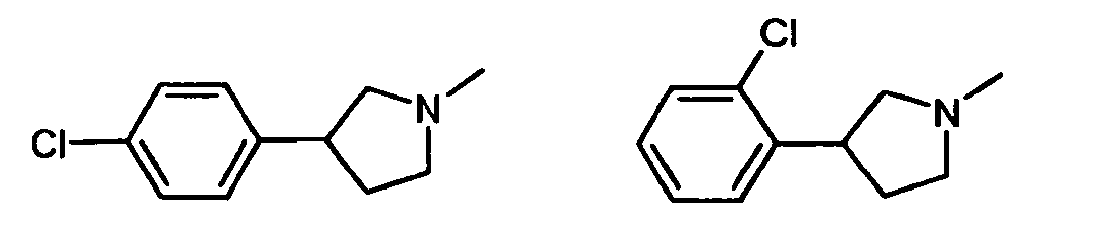
- The above compounds have been disclosed as synthesis intermediates in
WO 00/05225
- 3-Chloro-phenyl-3-pyrrolidine (above) has been disclosed as synthesis intermediate in
WO 2006/117669 (Preparation of hydroxyarylcarboxamide derivatives for treating cancer) andWO 2006/112685 (Preparation of triazoles and tetrazoles containing carbamoyl group as anticonvulsants). 4-Chloro-phenyl-3-pyrrolidine has been disclosed in J. Med. Chem. (2002), 45(17) 3721-3738 (Highly Potent Geminal Bisphosphonates). From Pamidronate Disodium (Aredia) to Zoledronic Acid (Zometa), Bioorganic & Medicinal Chemistry Letters (1999), 9(10), 1379-1384 (N-Substituted 3-aryipyrrolidines: potent and selective ligands at the serotonin 1A receptor), and Journal of Medicinal Chemistry (1989), 32(6) (Metabolism of 3-(p-chlorophenyl)pyrrolidine). Structural effects in conversion of a prototype γ-aminobutyric acid prodrug to lactam and γ-aminobutyric acid type metabolites). 3-Fluoro-phenyl-3-pyrrolidine has been disclosed inUS 5,128,362 andEP 325963 adrenergic α 2 antagonists). 4-Fluoro-phenyl-3-pyrrolidine has been disclosed inWO 2006/117669 (Preparation of hydroxyarylcarboxamide derivatives for treating cancer), Bioorganic & Medicinal Chemistry Letters (1999), 9(10), 1379-1384 (N-Substituted 3-arylpyrrolidines: potent and selective ligands at the serotonin 1A receptor), andUS 5,128,362 (Preparation of 1-aminomethyl-1,2,3,4-tetrahydro naphthalenes asadrenergic α 2 antagonists). 4-Bromo-phenyl-3-pyrrolidine has been disclosed inWO 2006/117669 (Preparation of hydroxyarylcarboxamide derivatives for treating cancer), Bioorganic & Medicinal Chemistry Letters (1999), 9(10), 1379-1384 (N-Substituted 3-arylpyrrolidines: potent and selective ligands at the serotonin 1A receptor),US 5,128,362 (Preparation of 1-aminomethyl-1,2,3,4-tetrahydronaphthalenes asadrenergic α 2 antagonists), andWO 01/16136 
- The above compound has been disclosed as a synthesis intermediate in
WO 2005/028438 (Preparation of piperidine compounds as histamine H3 antagonists or inverse agonists) - Compounds with Formula 1 (
WO 92/18475 
- From compounds with Formula 1, Sonesson et al. (J. Med. Chem. 1994, 37, 2735-2753) have published a series of phenyl piperidines with preferential autoreceptor antagonists. The authors found the compounds to increase the DOPAC levels in striatum at 100 µmol/kg, which is a hallmark of dopamine antagonist properties. Some examples from this publication are shown:

- In addition, Sonesson et al. (Bioorg. Med. Chem. Lett. 1997, 7, 241-246) have described that 3-phenyl-pyrrolidines substituted with electron withdrawing groups in the meta- position of the phenyl ring displays preferential dopamine autoreceptor antagonist properties. One example from this series is presented:

- The prior art teaches that 3-phenyl-piperidines and 3-phenyl-pyrrolidines of J. Med. Chem. 1994, 37, 2735 or Bioorg. Med. Chem. Lett. 1997, 7, 241-246 have a specific, efficacious, and characteristic effect on the metabolism of dopamine, measured as increases in tissue content of DOPAC (3,4-dihydroxyphenylacetic acid) in the striatum (see Table 1). This effect on subcortical dopamine metabolism is not the objective of the present invention.
- In addition, using a microdialysis technique it is shown that compounds from J. Med. Chem. 1994, 37, 2735 - 2753 were found to increase extracellular levels of monoamines, (dopamine, norepinephrine and serotonin), with equal effects in both striatum and in cerebral cortical areas of the mammalian brain (See
Figures 11 - 12 ). In other words, the regionally selective properties of compounds of the present invention between striatum and in cerebral cortical areas are not present in the prior art. -
WO 01/46146 - Thus, there is no guidance in
WO 01/46146 WO 92/18475 - One object of the present invention is to provide new compounds for therapeutic use, and more precisely compounds with modulation of dopamine and norepinephrine neurotransmission in the mammalian brain, including the human brain. Another object of the invention is to provide compounds with therapeutic effects after oral administration. A still further object is the provision of compounds with more optimal pharmacodynamic properties such as e.g. kinetic behaviour, bioavailability, solubility or efficacy.
- The present invention concerns the unexpected discovery of the pharmacological effects of compounds of the invention on monoamines in the cerebral cortex, and the use of compounds of the invention as treatment for certain CNS disorders. By pharmacological testing in vivo in the rat it is demonstrated that compounds of the present invention produce regionally selective increases in catecholamine levels in the frontal cortex. Due to the specific modulatory effects of the catecholamines on cortical functions related to cognition, attention and affect, the compounds of the invention can be used in the treatment of disorders characterised by dysfunctions in these areas. Thus, the compounds can be used in the treatment of cognitive disorders, ADHD, depression, and anxiety. The compounds can also be used to treat schizophrenia, which is characterised by dysfunctions of the cerebral cortex manifested in cognitive failure and psychosis.
- The following abbreviations will be used in the present invention:
- NA: norepinephrine, NM: normetanephrine; DA: dopamine, DOPAC: 3,4-dihydroxyphenylacetic acid; 3-MT: 3-methoxytyramine; 5-HT: serotonin (5-hydroxytryptamine).
- The present invention relates to new 3-(disubstituted aryl)-pyrrolidines, in particular 4-(ortho,para-disubstituted phenyl)-1- pyrrolidines, 4-(meta,para-disubstituted phenyl)-1-pyrrolidines, 4-(meta,meta-disubstituted phenyl)-1- pyrrolidines and 4-(ortho,meta-disubstituted phenyl)-1- pyrrolidines in the form.of the free base or pharmaceutically acceptable salts thereof, pharmaceutical compositions containing said compounds and the use of said compounds in therapy.
- In its first aspect, the invention relates to a compound of Formula 2:

- Ar is phenyl;
- R1 is selected from the group consisting of F and Cl;
- R2 is selected from the group consisting of F and Cl; and
- R3 is selected from the group consisting of H and Me,
- with the proviso that, when Ar is phenyl and one of R1 and R2 is located in the para-position and the other of R1 and R2 is located in the meta-position, then R1 and R2 are not both F when R3 is H;
- any of its stereoisomers or any mixture of its stereoisomers,
- In a further embodiment, the compound of the invention is a compound of Formula (3):


or a pharmaceutically acceptable salt thereof. - In one embodiment, R1 is F. In a further embodiment, R2 is F when R3 is H or Me. In a still further embodiment, R3 is H.
- In one embodiment of the compound of Formula (3), R3 is H. In a further embodiment, R1 is F. In a still further embodiment, R2 is F. In a special embodiment, R1 is F and R2 is F.
- In one embodiment of the compound of Formula (4), R3 is H. In a further embodiment, R3 is Me. In a still further embodiment, R1 is F. In a further embodiment, R1 is Cl. In a still further embodiment, R2 is F. In a still further embodiment, R2 is Cl. In a special embodiment, R1 is F and R2 is F. In a further embodiment, R1 is Cl and R2 is Cl.
- In one embodiment of the compound of Formula (5), R3 is H. In a further embodiment, R1 is F. In a still further embodiment, R2 is F. In a special embodiment, R1 is F and R2 is F.
- Compounds of formulae 2-6 have been found to increase the extracellular levels of norepinephrine and dopamine preferentially in the frontal cortex with no or substantially smaller effects in the striatum, as measured by the microdialysis technique. The unprecedented increase in cortical norepinephrine and dopamine of these compounds is illustrated in
Figures 1-10 . - Examples of compounds of the invention are:
- 3-(3,4-difluorophenyl)pyrrolidine;
- 3-(3,4-difluorophenyl)-1-methylpyrrolidine;
- 3-(2,4-difluorophenyl)pyrrolidine;
- 3-(3,5-difluorophenyl)pyrrolidine;
- 3-(3,4-dichlorophenyl)pyrrolidine;
- 3-(3-chloro-2-fluorophenyl)pyrrolidine;
- 3-(3-chloro-2-fluorophenyl)-1-methylpyrrolidine;
- 3-(2-chloro-3-fluorophenyl)pyrrolidine;
- 3-(2-chloro-3-fluorophenyl)-1-methylpyrrolidine;
- 3-(2,3-dichlorophenyl)pyrrolidine;
- 3-(2,3-dichlorophenyl)-1-methylpyrrolidine;
- 3-(2,3-difluorophenyl)pyrrolidine;
- 3-(2,3-difluorophenyl)-1-methylpyrrolidine;
- 3-(4-chloro-2-fluorophenyl)pyrrolidine;
- 3-(4-chloro-2-fluorophenyl)-1-methylpyrrolidine;
- 3-(2-chloro-4-fluorophenyl)pyrrolidine;
- 3-(2-chloro-4-fluorophenyl)-1-methylpyrrolidine;
- 3-(2,4-dichlorophenyl)pyrrolidine;
- 3-(2,4-dichlorophenyl)-1-methylpyrrolidine;
- 3-(2,4-d ifluorophenyl)-1-methylpyrrolidine;
- 3-(4-chloro-3-fluorophenyl)pyrrolidine;
- 3-(4-chloro-3-fluorophenyl)-1-methylpyrrolidine;
- 3-(3-chloro-4-fluorophenyl)pyrrolidine;
- 3-(3-chloro-4-fluorophenyl)-1-methylpyrrolidine;
- 3-(3,4-dichlorophenyl)-1-methylpyrrolidine;
- 3-(3-chloro-5-fluorophenyl)pyrrolidine;
- 3-(3-chloro-5-fluorophenyl)-1-methylpyrrolidine;
- 3-(3,5-dichlorophenyl)pyrrolidine;
- 3-(3,5-dichlorophenyl)-1-methylpyrrolidine; and
- 3-(3,5-difluorophenyl)-1-methylpyrrolidine.
- Any combination of two or more of the embodiments as described above is considered within the scope of the present invention.
- The chemical compound of the invention may be provided in any form suitable for the intended administration. Suitable forms include pharmaceutically (i.e. physiologically) acceptable salts, and pre- or prodrug forms of the chemical compound of the invention.
- Examples of pharmaceutically acceptable addition salts include, without limitation, the non-toxic inorganic and organic acid addition salts such as the hydrochloride, the hydrobromide, the nitrate, the perchlorate, the phosphate, the sulphate, the formate, the acetate, the aconate, the ascorbate, the benzenesulphonate, the benzoate, the cinnamate, the citrate, the embonate, the enantate, the fumarate, the glutamate, the glycolate, the lactate, the maleate, the malonate, the mandelate, the methanesulphonate, the naphthalene-2-sulphonate, the phthalate, the salicylate, the sorbate, the stearate, the succinate, the tartrate, the toluene-p-sulphonate, and the like. Such salts may be formed by procedures well known and described in the art.
- Other acids such as oxalic acid, which may not be considered pharmaceutically acceptable, may be useful in the preparation of salts useful as intermediates in obtaining a chemical compound of the invention and its pharmaceutically acceptable acid addition salt.
- Examples of pharmaceutically acceptable cationic salts of a chemical compound of the invention include, without limitation, the sodium, the potassium, the calcium, the magnesium, the zinc, the aluminium, the lithium, the choline, the lysinium, and the ammonium salt, and the like, of a chemical compound of the invention containing an anionic group. Such cationic salts may be formed by procedures well known and described in the art.
- In the context of this invention the "onium salts" of N-containing compounds are also contemplated as pharmaceutically acceptable salts. Preferred "onium salts" include the alkyl-onium salts, the cycloalkyl-onium salts, and the cycloalkylalkyl-onium salts. Examples of pre- or prodrug forms of the chemical compound of the invention include examples of suitable prodrugs of the substances according to the invention include compounds modified at one or more reactive or derivatizable groups of the parent compound. Of particular interest are compounds modified at a carboxyl group, a hydroxyl group, or an amino group. Examples of suitable derivatives are esters or amides.
- Specific examples of prodrugs of the compounds of the present invention are the N-oxides mentions below and the following N-hydroxy-derivatives:
- 3-(3,5-difluorophenyl)pyn-olidin-1-ol;
- 3-(3-chloro-2-fluorophenyl)pyrrolidin-1-ol;
- 3-(2-chloro-3-fluorophenyl)pyrrolidin-1-ol;
- 3-(2,3-dichlorophenyl)pyrrolidin-1-ol;
- 3-(2,3-difluorophenyl)pyrrolidin-1-ol;
- 3-(2-chloro-4-fluorophenyl)pyrrolidin-1-ol;
- 3-(2,4-dichlorophenyl)pyrrolidin-1-ol;
- 3-(2,4-difluorophenyl)pyrrolidin-1-ol;
- 3-(4-chloro-2-fluorophenyl)pyrrolidin-1-ol;
- 3-(4-chloro-3-fluorophenyl)pyrrolidin-1-ol;
- 3-(3-chloro-4-fluorophenyl)pyrrolidin-1-ol;
- 3-(3,4-dichlorophenyl)pyrrolidin-1-ol;
- 3-(3,4-difluorophenyl)pyrrolidin-1-ol;
- 3-(3-chloro-5-fluorophenyl)pyrrolidin-1-ol; and
- 3-(3,5-dichlorophenyl)pyrrolidin-1-ol.
- The chemical compound of the invention may be provided in dissoluble or indissoluble forms together with a pharmaceutically acceptable solvent such as water, ethanol, and the like. Dissoluble forms may also include hydrated forms such as the monohydrate, the dihydrate, the hemihydrate, the trihydrate, the tetrahydrate, and the like. In general, the dissoluble forms are considered equivalent to indissoluble forms for the purposes of this invention.
- It will be appreciated by those skilled in the art that the compounds of the present invention may exist in different stereoisomeric forms.
- The invention includes all such isomers and any mixtures thereof including racemic mixtures.
- Racemic forms can be resolved into the optical antipodes by known methods and techniques. One way of separating the enantiomeric compounds (including enantiomeric intermediates) is - in the case the compound being a chiral acid - by use of an optically active amine, and liberating the diastereomeric, resolved salt by treatment with an acid. Another method for resolving racemates into the optical antipodes is based upon chromatography on an optical active matrix. Racemic compounds of the present invention can thus be resolved into their optical antipodes, e.g., by fractional crystallisation of D- or L- (tartrates, mandelates, or camphorsulphonate) salts for example.
- The chemical compounds of the present invention may also be resolved by the formation of diastereomeric amides by reaction of the chemical compounds of the present invention with an optically active carboxylic acid such as that derived from (+) or (-) phenylalanine, (+) or (-) phenylglycine, (+) or (-) camphanic acid or by the formation of diastereomeric carbamates by reaction of the chemical compound of the present invention with an optically active chloroformate or the like.
- Additional methods for the resolving the optical isomers are known in the art. Such methods include those described by Jaques J, Collet A, & Wilen S in "Enantiomers, Racemates, and Resolutions", John Wiley and Sons, New York (1981).
- Optical active compounds can also be prepared from optical active starting materials.
- In the context of this invention an N-oxide designates an oxide derivative of a tertiary amine, including a nitrogen atom of an aromatic N-heterocyclic compound, a nonaromatic N-heterocyclic compounds, a trialkylamine and a trialkenylamine. For example, the N-oxide of a compound containing a pyridyl may be the 1-oxy-pyridin-2, -3 or -4-yl derivative.
- N-oxides of the compounds of the invention may be prepared by oxidation of the corresponding nitrogen base using a conventional oxidizing agent such as hydrogen peroxide in the presence of an acid such as acetic acid at an elevated temperature, or by reaction with a peracid such as peracetic acid in a suitable solvent, e.g. dichloromethane, ethyl acetate or methyl acetate, or in chloroform or dichloromethane with 3-chloroperoxybenzoic acid.
- The following N-oxides act as prodrugs to the compounds of the invention:
Formula (7):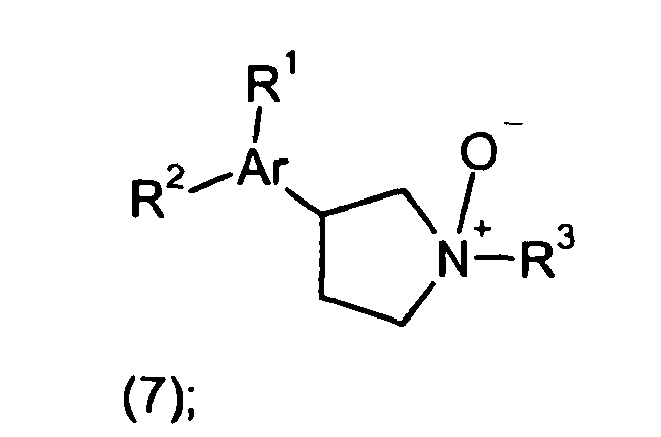
- wherein Ar is phenyl;
- R1 is selected from the group consisting of F and Cl;
- R2 is selected from the group consisting of F and Cl;
- R3 is selected from the group consisting of H and Me;
- and the pharmaceutically acceptable salts thereof.
- Of particular interest are prodrugs having Formula (8):


- R1 is selected from the group consisting of F and Cl;
- R2 is selected from the group consisting of F and Cl;
- R3 is selected from the group consisting of H and Me;
- Examples of N-oxides according to the invention are:
- 3-(3-chloro-2-fluorophenyl)-1-methylpyrrolidine 1-oxide;
- 3-(2,3-dichlorophenyl)-1-methylpyrrolidine 1-oxide;
- 3-(2,3-difluorophenyl)-1-methylpyrrolidine 1-oxide;
- 3-(2-chloro-3-fluoropheny))-1-methylpyrrolidine 1-oxide;
- 3-(4-chloro-2-fluorophenyl)-1-methylpyrrolidine 1-oxide;
- 3-(2,4-dichlorophenyl)-1-methylpyrrolidine 1-oxide;
- 3-(2,4-difluorophenyl)-1-methylpyrrolidine 1-oxide;
- 3-(2-chloro-4-fluorophenyl)-1-methylpyrrolidine 1-oxide;
- 3-(4-chloro-3-fluorophenyl)-1-methylpyrrolidine 1-oxide;
- 3-(3,4-dichlorophenyl)-1-methylpyrrolidine 1-oxide;
- 3-(3-chloro-4-fluorophenyl)-1-methylpyrrolidine 1-oxide;
- 3-(3,4-difluorophenyl)-1-methylpyrrolidine 1-oxide;
- 3-(3-chloro-5-fluorophenyl)-1-methylpyrrolidine 1-oxide;
- 3-(3,5-dichlorophenyl)-1-methylpyrrolidine 1-oxide; and
- 3-(3,5-difluorophenyl)-l-methylpyrrolidine 1-oxide.
- The compounds of the invention may be used in their labelled or unlabelled form. In the context of this invention the labelled compound has one or more atoms replaced by an atom having an atomic mass or mass number different from the atomic mass or mass number usually found in nature. The labelling will allow easy quantitative detection of said compound.
- The labelled compounds of the invention may be useful as diagnostic tools, radio tracers, or monitoring agents in various diagnostic methods, and for in vivo receptor imaging.
- The labelled isomer of the invention preferably contains at least one radionuclide as a label. Positron emitting radionuclides are all candidates for usage. In the context of this invention the radionuclide is preferably selected from 2H (deuterium), 3H (tritium), 11C, 13C, 14C, 131I, 125I, 123I, and 18F.
- The physical method for detecting the labelled isomer of the present invention may be selected from Position Emission Tomography (PET), Single Photon Imaging Computed Tomography (SPECT), Magnetic Resonance Spectroscopy (MRS), Magnetic Resonance Imaging (MRI), and Computed Axial X-ray Tomography (CAT), or combinations thereof.
- The compounds according to the present invention possess norepinephrine, dopamine and to some extent serotonin-modulating properties and both they and their pharmaceutical compositions are useful in treating numerous central nervous system disorders including psychiatric disorders. Particularly, the compounds and their pharmaceutical compositions can be used in the treatment of CNS disorders where the cortical monoaminergic systems are dysfunctional due to direct or indirect causes.
- The compounds and compositions according to the invention can be used to treat cognitive disorders including neurodegenerative (e.g. dementia and age-related cognitive impairment) and developmental disorders, such as Autism spectrum disorders, ADHD, Cerebral Palsy, Gilles de la Tourette's syndrome, as well as cognitive disorders occurring as part of the core symptoms of schizophrenia.
- The compounds and compositions according to the invention can be used to treat affective disorders including depression and bipolar disorder. They can also be used to treat schizophrenia and schizophreniform disorders.
- The compounds and compositions according to the invention can be used to treat anxiety disorders including generalized anxiety disorder (GAD), specific phobias and panic disorder (PD). They are also useful for treatment of sleep disorders.
- The compounds according to the present invention have been shown to increase the extra-cellular levels of dopamine and norepinephrine in the cerebral cortex and in some cases also serotonin.
- However, compounds of the present invention do not have the effects on the metabolism of dopamine in the striatum that are characteristic for the pharmacological actions of the compounds described in
WO 01/46146 WO 01/46145 WO 92/18475 Table 1: The increase in DOPAC levels (3,4-dihydroxyphenylacetic acid) in the rat striatum after systemic adminstration of test compound (100 µmol/kg s.c.). Expressed as the %-increase from control value. For method see the enclosed description. Comparative Examples1 DOPAC %-increase Example 10 of ref. 1 + 2622 Example 16 of ref. 1 + 1502 Example 26 of ref. 1 + 672 Example 27 of ref. 1 + 742 Example 10d of ref. 2 + 633 Example 12d of ref. 2 + 1973 Example 9 of WO01/46146 + 94 Example 43 of WO01/46146 + 94 Example 44 of WO01/46146 + 239 Claimed in WO01/46146 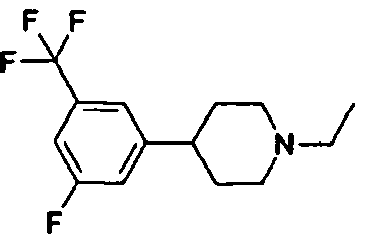
+ 232 Claimed in WO01/46146 + 75 
Example 6 of WO01/46145 + 114 Examples DOPAC %increase Example 1 - 45 Example 2 - 22 Example 3 - 19 Example 4 - 20 Example 5 - 37 1Comparative Examples from prior art; Ref 1: J. Med. Chem. 1994, 37, 2735 ; Ref 2: Bioorg. Med. Chem. Lett. 1997, 7, 241-246 . 2Data taken from Table 2 in Ref 1. 3Data taken from Table 2 in Ref 2. The data from this reference is DOPA accumulation and not DOPAC. DOPAC and DOPA are both a measure of the indirect change in concentration of dopamine in the brain of the experimental animals. An increase in DOPAC and DOPA levels show an increased synthesis and turnover of dopamine in the system. DOPA accumulation measures the increase in the concentration of 3,4-dihydroxyphenylalanine in the striatal regions of the brain. DOPAC measures the increase in the concentration of 3,4-dihydroxy phenylacetic acid in the striatal regions of the brain. There is a strong relation between DOPA and DOPAC. - It can be seen that - upon administration - the known compounds tested produce a significant increase in striatum DOPAC levels. In contrast, compounds of the present invention have surprisingly shown to provide a decrease in striatum DOPAC levels. On the other hand, the essential characteristic of compounds of the present invention is to produce increased cortical levels of catecholamines, measured as the extracellular levels of dopamine and norepinephrine assessed by the microdialysis technique, while displaying no or at most weak effects on subcortical catecholamines (
FIGURES 1-10 ). - The measurement of the tissue content of DOPAC is well established in the field of research since the 1960's. In short, male Sprague-Dawely rats are administered the
test compound 60 minutes prior to decapitation. The brain is rapidly taken out and dissected. The striatum is rapidly frozen and subsequenlty quantitatively analysed with respect to its content of DOPAC by means of HPLC and electrochemical detection. The number of animals used for each test compound/vehicle is 4/group. - The microdialysis technique (Ungerstedt, Herrera-Marschitz et al. 1982) is a well established technique for measuring extracellular levels of neurotransmitters (Ungerstedt 1991). The microdialysis technique was used to measure the effect of drugs upon the monoamine transmitters. The appended graphs (
Figures 21 and22 ) show the effects of one established antidepressant (mirtazapine) upon monoamines in the striatum and frontal cortex, as well as for compounds claimed in the present invention (Figures 1-10 ; Examples 1-5). The number of animals (n) used for each compound tested is noted in the figure legend. - The cortical circuitry underlying cognitive functions including memory, attention and working memory comprises a network of glutamatergic and GABAergic neurons, innervated by ascending dopaminergic and norepinephrinergic projections (Harrison and Weinberger 2005, Arnsten and Li 2005). Dopamine, acting through DA D1 receptors, enhances cognitive functions, while hypofunction of the cortical DA transmission produces specific cognitive deficits (reviewed in Goldman-Rakic, 2004). Likewise, norepinephrine has been found to enhance cognitive functions, presumably depending on stimulation of post-synaptic alpha-2 receptors in the prefrontal cortex (Arnsten, 2004). Clinical examples of the effects of cortical DA and NE deficiency are the cognitive disorders seen in schizophrenia and ADHD. In schizophrenia, cortical DA deficiency is regarded as a key feature underlying cognitive dysfunctions (Perlman et al., 2004, Goldman-Rakic, 2004). One mechanism by which such cortical DA hypofunction is believed to arise is a well described point mutation in the COMT encoding gene, leading to exagerrated activity of COMT, and therefore, an increased rate of elimination of DA, and ensuing, decreased levels of DA particularly in the cortex (Harrison and Weinberger 2005, Perlman et al., 2004). This mutation of COMT is genetically linked to schizophrenia as well as correlated to cognitive performance in healthy individuals. Apart from COMT anomalies, a variety of other pathogenetic pathways are proposed to lead to a functionally similar state of cortical dysfunction in schizophrenia, manifested by the characteristic abnormalities of cognitive functions seen in schizophrenic patients (Harrison and Weinberger, 2005). For instance, a number of susceptibility genes are thought to preferentially affect NMDArecptor mediated glutamate transmission. Due to the beneficial effects on cognitive functions by augmented DA D1 receptor stimulation, strengthening of cortical DA transmission can normalise cortical activity and enhance cognitive functions in schizophrenia as well as in other conditions (Goldman-Rakic, 2004). Furthermore, since the abnormalities in the cortical microcircuitry are regarded as the core feature underlying the clinical syndrome, restoration of this microcircuitry by facilitating DA transmission should not only improve cognitive functions in schizophrenia, but also reduce psychotic symptoms. Thus, normalisation of cortical DA transmission would as a secondary effect lead to normalisation of subcortical DA transmission, and thus, alleviation of the symptoms related to subcortical hyperdopaminergia (Goldman-Rakic, 2004, Perlman et al., 2004). Furthermore, a common feature of atypical antipsychotics, hypothesised to underlye their superior efficacy and fewer side effects compared to other antipsychotic compounds, is their ability to increase cortical dopamine (Moghaddam and Bunney, 1990, Deutch et al., 1991). It is important to note that the principle described in this invention to achieve cognitive enhancement and antipsychotic effects is dependent on regionally selective cortical increase in DA and NE, while increases in subcortical, eg striatal, DA are not sought for. In conclusion, compounds according to this invention that increase cortical DA, but not subcortical DA transmission, will improve cognitive functions and reduce psychotic symptoms in schizophrenia.
- The other clinical example showing the role of DA and NE in cognitive functions is the clinical features of ADHD, including the mode of action of compounds used to relieve the symptoms in this disorder. The key features of ADHD are deficiencies in attention, lack of ability to focus on a task for a prolonged time, impulsivity, and hyperactivity (Biederman 2005, Arnsten and Li 2005). In neuropsychological tests, ADHD patients perform poorly on tests specifically assessing prefrontal cortical functions (Arnsten and Li, 2005). The structure of the cortical circuitry underlying these functions suggests that insufficient DA and NE transmission would lead to the specific neuropsychological deficits seen in ADHD. Studies on the etiology of ADHD all point toward disregulation of DA and NE, particularly in cortical regions. The pharmacological treatments available are mainly psycho-stimulants, including dex-amphetamine, and methylphenidate, which increase DA and NE in most brain areas. A recent advancement in the treatment of ADHD is the compound atomoxetine (
US 5,658,590 ), which produces regionally selective increases in cortical DA and NE, relieving core symptoms while avoiding side effects related to increase subcortical in DA transmission, thus supporting that cortical, rather than subcortical effects on catecholamines are essential to the clinical efficacy of ADHD medications (Pliszka, 2005). - Taken together, there is solid evidence that enhanced cortical DA and NE transmission would improve the symptoms of ADHD, including cognitive improvement. Furthermore, the role of cortical DA and NE in cognitive functions implies that enhancement of cortical DA transmission also improves cognitive functioning in cognitive disorders arising from causes other than schizophrenia or ADHD, as well as in healthy individuals. This is supported by the correlation between COMT activity and cognitive performance in healthy individuals (Perlman et al., 2004) and by numerous studies in rodents, primates and humans concerning the influence of cortical DA and NE on cognitive functions in healthy states as well as in different disorders (Arnsten, 2004, Goldman-Rakic, 2004). Consequently, the compounds according to the present invention will be useful to treat the symptoms of ADHD, as well as cognitive disorders in general, due to their ability to produce regionally selective increases in cortical DA and NE.
- A common trait for all clinically effective classes of antidepressants is an elevation of the levels of dopamine and norepinephrine in the cortex (Tanda, Carboni et al. 1994; Millan, Lejeune et al. 2000). As an example, the clinically effective antidepressant mirtazapine (remeron) has been shown to increase predominantly extracellullar norepinephrine and dopamine in the cortex (See
Figures 21 and22 , and Devoto, Flore et al. 2004). As compounds claimed in the present invention elevate the levels of dopamine and norepinephrine in the cortex this supports our claim that they function as antidepressants (seeFigures 1-10 , Examples 1-5 in the present invention). Furthermore, norepinephrine is strongly involved in the neuronal pathways, comprising the locus ceruleus, the amygdala, and the cerebral cortex, controlling fear and anxiety and so, modulation of cortical norepinephrine transmission modulates states of anxiety (Sullivan et al. 1999, Biol Psychiatry;46:1205-121). Accordingly, compounds that alter cortical norepinephrinergic transmission are reported to be effective in the treatment of anxiety disorders. More specifically, NE modulating compounds like mirtazapine (Remeron), which produces marked increases in cortical NE levels by a mechanism other than NE reuptake inhibition (Fig 22 ), and venlafaxine, which increases cortical NE by inhibition of norepinephrine re-uptake, both have anxiolytical properties in clinical studies (Neuropsychopharmacology, 5th generation of Progress, Lippincott, Williams and Wilkins 2002, pp 967 - 980). Based on this evidence for the beneficial effects of enhanced cortical norepinephrine transmission on anxiety disorders, along with the neurobiological back-ground demonstrating the crucial role of norepinephrine in the control of anxiety, it is concluded that the compounds of the present invention, which produces marked increases in cortical NE will be effective in the treatment of anxiety disorders. - The present invention is further illustrated by reference to the accompanying drawings.
- Example 1 is injected (s.c.) at time-
point 0. The values depicted inFigure 1 represent percent of control in relation to baseline values. The microdialysis was performed in awake and freely moving rats. Dopamine = DA; Norepinephrine = NA; Serotonin = 5-HT; Error-bars=SEM - Example 1 is injected (s.c.) at time-
point 0. The values depicted inFigure 2 represent percent of control in relation to baseline values. The microdialysis was performed in awake and freely moving rats. Dopamine = DA; Norepinephrine = NA; Serotonin = 5-HT; Error-bars=SEM - Example 2 is injected (s.c.) at time-
point 0. The values depicted inFigure 3 represent percent of control in relation to baseline values. The microdialysis was performed in awake and freely moving rats. Dopamine = DA; Norepinephrine = NA; Serotonin = 5-HT; Error-bars=SEM - Example 2 is injected (s.c.) at time-
point 0. The values depicted inFigure 4 represent percent of control in relation to baseline values. The microdialysis was performed in awake and freely moving rats. Dopamine = DA; Norepinephrine = NA; Serotonin = 5-HT; Error-bars=SEM - Example 3 is injected (s.c.) at time-
point 0. The values depicted inFigure 5 represent percent of control in relation to baseline values. The microdialysis was performed in awake and freely moving rats. Dopamine = DA; Norepinephrine = NA; Serotonin = 5-HT; Error-bars=SEM - Example 3 is injected (s.c.) at time-
point 0. The values depicted inFigure 6 represent percent of control in relation to baseline values. The microdialysis was performed in awake and freely moving rats. Dopamine = DA; Norepinephrine = NA; Serotonin = 5-HT; Error-bars=SEM - Example 4 is injected (s.c.) at time-
point 0. The values depicted inFigure 7 represent percent of control in relation to baseline values. The microdialysis was performed in awake and freely moving rats. Dopamine = DA; Norepinephrine = NA; Serotonin = 5-HT; Error-bars=SEM - Example 4 is injected (s.c.) at time-
point 0. The values depicted inFigure 8 represent percent of control in relation to baseline values. The microdialysis was performed in awake and freely moving rats. Dopamine = DA; Norepinephrine = NA; Serotonin = 5-HT; Error-bars=SEM - Example 5 is injected (s.c.) at time-
point 0. The values depicted inFigure 9 represent percent of control in relation to baseline values. The microdialysis was performed in awake and freely moving rats. Dopamine = DA; Norepinephrine = NA; Serotonin = 5-HT; Error-bars=SEM - Example 3 is injected (s.c.) at time-
point 0. The values depicted inFigure 10 represent percent of control in relation to baseline values. The microdialysis was performed in awake and freely moving rats. Dopamine = DA; Norepinephrine = NA; Serotonin = 5-HT; Error-bars=SEM - (S)-(-)-3-[3-methylsulfonyl)phenyl]-1-propylpiperidine is injected (s.c) at time-
point 0. The values depicted inFigure 11 represent percent of control in relation to baseline values. The microdialysis was performed in awake and freely moving rats. Dopamine = DA; Norepinephrine = NA; Serotonin = 5-HT Error-bars=SEM - (S)-(-)-3-[3-methylsulfonyl)phenyl]-1-propylpiperidine is injected (s.c) at time-
point 0. The values depicted inFigure 12 represent percent of control in relation to baseline values. The microdialysis was performed in awake and freely moving rats. Dopamine = DA; Norepinephrine = NA; Serotonin = 5-HT Error-bars=SEM - 4-(4-chloro-3-trifluoromethyl-phenyl)-1-propyl-piperidine is injected (s.c) at time-
point 0. The values depicted inFigure 13 represent percent of control in relation to baseline values. The microdialysis was performed in awake and freely moving rats. Dopamine = DA; Norepinephrine = NA; Serotonin = 5-HT; Error-bars=SEM - 4-(4-chloro-3-trifluoromethyl-phenyl)-1-propyl-piperidine is injected (s.c) at time-
point 0. The values depicted inFigure 14 represent percent of control in relation to baseline values. The microdialysis was performed in awake and freely moving rats. Dopamine = DA; Norepinephrine = NA; Serotonin = 5-HT Error-bars=SEM - 4-(4-fluoro-3-trifluoromethyl-phenyl)-1-ethyl-piperidine is injected (s.c) at time-
point 0. The values depicted inFigure 15 represent percent of control in relation to baseline values. The microdialysis was performed in awake and freely moving rats. Dopamine = DA; Norepinephrine = NA; Serotonin = 5-HT; Error-bars=SEM - 4-(4-fluoro-3-trifluoromethyl-phenyl)-1-ethyl-piperidine is injected (s.c) at time-
point 0. The values depicted inFigure 16 represent percent of control in relation to baseline values. The microdialysis was performed in awake and freely moving rats. Dopamine = DA; Norepinephrine = NA; Serotonin = 5-HT; Error-bars=SEM - 4-(3-fluoro-5-trifluoromethyl-phenyl)-1-propyl-piperidine is injected (s.c) at time-
point 0. The values depicted inFigure 17 represent percent of control in relation to baseline values. The microdialysis was performed in awake and freely moving rats. Dopamine = DA; Norepinephrine = NA; Serotonin = 5-HT; Error-bars=SEM - 4-(3-fluoro-5-trifluoromethyl-phenyl)-1-propyl-piperidine is injected (s.c) at time-
point 0. The values depicted inFigure 18 represent percent of control in relation to baseline values. The microdialysis was performed in awake and freely moving rats. Dopamine = DA; Norepinephrine = NA; Serotonin = 5-HT; Error-bars=SEM - 4-(3-fluoro-5-trifluoromethyl-phenyl)-1-ethyl-piperidine is injected (s.c) at time-
point 0. The values depicted inFigure 19 represent percent of control in relation to baseline values. The microdialysis was performed in awake and freely moving rats. Dopamine = DA; Norepinephrine = NA; Serotonin = 5-HT; Error-bars=SEM - 4-(3-fluoro-5-trifluoromethyl-phenyl)-1-ethyl-piperidine is injected (s.c) at time-
point 0. The values depicted inFigure 20 represent percent of control in relation to baseline values. The microdialysis was performed in awake and freely moving rats. Dopamine = DA; Norepinephrine = NA; Serotonin = 5-HT; Error-bars=SEM - Remeron is injected (s.c.) at time-
point 0. The values depicted inFigure 21 represent percent of control in relation to baseline values. The microdialysis was performed in awake and freely moving rats. Dopamine = DA; Norepinephrine = NA; Serotonin = 5-HT; Error-bars=SEM - Remeron is injected (s.c.) at time-
point 0. The values depicted inFigure 22 represent percent of control in relation to baseline values. The microdialysis was performed in awake and freely moving rats. Dopamine = DA; Norepinephrine = NA; Serotonin = 5-HT; Error-bars=SEM -
- Arnsten A.F.T. and Li B. (2005) Neurobiology of executive functions: Cathecholamine influences on prefrontal cortical functions BIOL PSYCHIATRY 2005;57:1377-1384 Biederman, J. Attention-Deficit/Hyperactivity Disorder: A selective overview BIOL PSYCHIATRY 2005;57:1215-1220.
- Harrison, P.J. and Weinberger, D.R. (2005) Schizophrenia genes, gene expression and neuropathology. on the matter of their convergence. Molecular Psychiatry 10: 40-68.
- Moghaddam, B. and Bunney, B. S. (1990) Acute effects of typical and atypical antipsychotic drugs on the release of dopamine from prefrontal cortex, nucleus accumbens, and striatum of the rat: an in vivo microdialysis study. J. Neurochem 54, 5:1755-1759.
- Deutch AY, Moghaddam B, Innis RB, Krystal JH, Aghajanian GK, Bunney BS, Charney DS. (1991) Mechanisms of action of atypical antipsychotic drugs. Implications for novel therapeutic strategies for schizophrenia. Schizophr Res. Mar-Apr;4(2):121-56.
- Pliszka, S.R. (2005) The neuropsychopharmacology of attention-deficit/hyperactivity disorder. Biol Psychiatry. 2005 Jun 1;57(11):1385-90. Review.
- Ungerstedt, U. (1991). "Microdialysis-principles and applications for studies in animals and man." J. Int. Med. 230: 365-373.
- Ungerstedt, U., M. Herrera-Marschitz, U. Jungnelius, L. Stahle, U. Tossman and T. Zetterström (1982). Dopamine Synaptic Mechanisms Reflected in Studies Combining Behavioural Recordings and Brain Dialysis. Advances in Dopamine Research. M. Kohksa. Oxford, Perganon Press. 37: 219-231.
- Devoto, P., G. Flore, L. Pira, G. Longu and G. L. Gessa (2004). "Mirtazapine-induced corelease of dopamine and norepinephrine from noradrenergic neurons in the medial prefrontal and occipital cortex." Eur J Pharmacol 487(1-3): 105-11.
- Millan, M. J., F. Lejeune and A. Gobert (2000). "Reciprocal autoreceptor and heteroreceptor control of serotonergic, dopaminergic and noradrenergic transmission in the frontal cortex: relevance to the actions of antidepressant agents." J Psychopharmacol 14(2): 114-38.
- Tanda, G., E. Carboni, R. Frau and G. Di Chiara (1994). "Increase of extracellular dopamine in the prefrontal cortex: a trait of drugs with antidepressant potential?" Psychopharmacology (Berl) 115(1-2): 285-8.
- Goldman-Rakic, P. et al. (2004) Targeting the dopamine D1 receptor in schizophrenia: insights for cognitive dysfunction. Psychopharmacology 174:3-16.
- Arnsten, A. (2004) Adrenergic targets for the treatment of cognitive deficits in schizophrenia. Psychopharmacology 174:25-31.
- The compounds of the invention may be prepared as outlined below in Scheme 1. However, the invention is not limited to these methods. The compounds may also be prepared as described for structurally-related compounds in the prior art. The reactions can be carried out according to standard procedures (eg. Comprehensive Organic Transformations: A Guide to Functional Group Preparations Richard C. Larock, 22 October, 1999 Wiley-VCH, ISBN: 0471190314; or March's Advanced Organic Chemistry: Reactions, Mechanisms, and Structure, 5th Edition. Michael B. Smith, Jerry March, January 15, 2001 Wiley-Interscience, ISBN: 0471585890) or as described in the working examples. The starting materials for the processes described in the present application are known or may readily be prepared by conventional methods from commercially available chemicals.
- Persons skilled in the art will appreciate that, in order to obtain compounds of the invention in an alternative - and in some occasions, more convenient manner - the individual process steps mentioned hereinbefore may be performed in a different order, and/or the individual reactions may be performed at different stage in the overall route (i.e. chemical transformations may be performed upon different intermediates to those associated hereinbefore with a particular reaction).
- A synthesis of the compounds of the invention is outlined below in Scheme 1.

- The substituents in Scheme 1 are as follows: Z is a leaving group; A is alkyl or a protecting group; Ar, R1, R2, and R3 are as defined above.
- The N-oxide compounds used as prodrugs in the present invention can be synthesised from the amines through standard N-oxidation procedures (e.g. Handbook of Reagents for Organic Synthesis - Oxidising and Reducing Agents. S.D. Burke, R.L. Danheiser (Eds.); John. Wiley & Sons, Chichester, 1999, ISBN 0-471-97926-0)
- The compounds of the present invention may be isolated in any level of purity by standard methods and purification can be achieved by conventional means known to those skilled in the art, such as distillation, recrystallization and chromatography.
- In another aspect the invention provides novel pharmaceutical compositions comprising a therapeutically effective amount of the chemical compound of the invention.
- The present invention relates to pharmaceutical compositions comprising the compounds of the present invention, and their use in treating CNS disorders. Both organic and inorganic acids can be employed to form non-toxic pharmaceutically acceptable acid addition salts of the compounds according to the invention. Suitable acid addition salts of the compounds of the present invention include those formed with pharmaceutically acceptable salts such as those mentioned above. The pharmaceutical composition comprising a compound according to the invention may also comprise substances used to facilitate the production of the pharmaceutical preparation or the administration of the preparations. Such substances are well known to people skilled in the art and may for instance be pharmaceutically acceptable adjuvants, carriers and preservatives.
- In clinical practice, the compounds according to the present invention will normally be administered orally, rectally, nasally or by injection, in the form of pharmaceutical preparations comprising the active ingredient either as a free base or as a pharmaceutically acceptable non-toxic, acid addition salt, such as the hydrochloride, lactate, acetate or sulfamate salt, in association with a pharmaceutically acceptable carrier. The carrier may be a solid, semisolid or liquid preparation. Usually the active substance will constitute between 0.1 and 99% by weight of the preparation, more specifically between 0.5 and 20% by a weight for preparations intended for injection and between 0.2 and 50% by weight for preparations suitable for oral administration.
- To produce pharmaceutical preparations containing the compound according to the invention in the form of dosage units for oral application, the selected compound may be mixed with a solid excipient, e.g. lactose, saccharose, sorbitol, mannitol, starches such as potato starch, corn starch or amylopectin, cellulose derivatives, a binder such as gelatine or polyvinyl-pyrrolidine, and a lubricant such as magnesium stearate, calcium stearate, polyethylene glycol, waxes, paraffin, and the like, and then compressed into tablets. If coated tablets are required, the cores (prepared as described above) may be coated with a concentrated sugar solution which may contain e.g. gum arabic, gelatine, talcum, titanium dioxide, and the like. Alternatively, the tablet can be coated with a polymer known to the man skilled in the art, dissolved in a readily volatile organic solvent or mixture of organic solvents. Dyestuffs may be added to these coatings in order to readily distinguish between tablets containing different active substances or different amounts of the active compound.
- For the preparation of soft gelatine capsules, the active substance may be admixed with e.g. a vegetable oil or polyethylene glycol. Hard gelatine capsules may contain granules of the active substance using either the mentioned excipients for tablets e.g. lactose, saccharose, sorbitol, mannitol, starches (e.g. potato starch, corn starch or amylopectin), cellulose derivatives or gelatine. Also liquids or semisolids of the drug can be filled into hard gelatine capsules.
- Examples of tablet and capsule formulations suitable for oral administration are given below:
Tablet I mg/ tablet Compound 100 Lactose Ph.Eur 182.75 Croscarmellose sodium 12.0 Maize starch paste (5% w/v paste) 2.25 Magnesium stearate 3.0 Tablet II mg/ tablet Compound 50 Lactose Ph.Eur 223.75 Croscarmellose sodium 6.0 Maize starch 15.0 Polyvinylpyrrolidone (5% w/v paste) 2.25 Magnesium stearate 3.0 Tablet III mg/tablet Compound 1.0 Lactose Ph.Eur 93.25 Croscarmellose sodium 4.0 Maize starch paste (5% w/v paste) 0.75 Magnesium stearate 1.0 Capsule mg/capsule Compound 10 Lactose Ph.Eur 488.5 Magnesium 1.5 - Dosage units for rectal application can be solutions or suspensions or can be prepared in the form of suppositories comprising the active substance in a mixture with a neutral fatty base, or gelatine rectal capsules comprising the active substance in admixture with vegetable oil or paraffin oil. Liquid preparations for oral application may be in the form of syrups or suspensions, for example solutions containing from about 0.2% to about 20% by weight of the active substance herein described, the balance being sugar and mixture of ethanol, water, glycerol and propylene glycol. Optionally such liquid preparations may contain coloring agents, flavoring agents, saccharine and carboxymethylcellulose as a thickening agent or other excipients known to the man in the art.
- Solutions for parenteral applications by injection can be prepared in an aqueous solution of a water-soluble pharmaceutically acceptable salt of the active substance, preferably in a concentration of from 0.5% to about 10% by weight. These solutions may also contain stabilizing agents and/or buffering agents and may conveniently be provided in various dosage unit ampoules. The use and administration to a patient to be treated would be readily apparent to an ordinary skill in the art.
- For intranasal administration or administration by inhalation, the compounds of the present invention may be delivered in the form of a solution, dry powder or suspension. Administration may take place via a pump spray container that is squeezed or pumped by the patient or through an aerosol spray presentation from a pressurized container or a nebulizer, with the use of a suitable propellant, e.g., dichlorodifluoromethane, trichlorofluoromethane, dichlorotetrafluoroethane, carbon dioxide or other suitable gas. The compounds of the invention may also be administered via a dry powder inhaler, either as a finely divided powder in combination with a carrier substance (e.g. a saccharide) or as microspheres. The inhaler, pump spray or aerosol spray may be single or multi dose. The dosage may be controlled through a valve that delivers a measured amount of active compound.
- The compounds of the invention may also be administered in a controlled release formulation. The compounds are released at the required rate to maintain constant pharmacological activity for a desirable period of time. Such dosage forms provide a supply of a drug to the body during a predetermined period of time and thus maintain drug levels in the therapeutic range for longer periods of time than conventional non-controlled formulations. The compounds may also be formulated in controlled release formulations in which release of the active compound is targeted. For example, release of the compound may be limited to a specific region of the digestive system through the pH sensitivity of the formulation. Such formulations are well known to persons skilled in the art.
- Further details on techniques for formulation and administration may be found in the latest edition of Remington's Pharmaceutical Sciences (Maack Publishing Co., Easton, PA).
- Depending upon the disorder and patient to be treated and the route of administration, the compositions may be administered at varying doses. The dosing will also depend upon the relation of potency to absorbability and the frequency and route of administration. Such doses may be administered once, twice or three or more times daily. The compounds of this invention can be administered to subjects in doses ranging from 0.01 mg to 500 mg per kg of body weight per day, although variations will necessarily occur depending upon the weight, sex and condition of the subject being treated, the disease state being treated and the particular route of administration chosen. However, a dosage level that is in the range of from 0.1 mg to 10 mg per kg of body weight per day, single or divided dosage is most desirably employed in humans for the treatment of diseases. Alternatively, the dosage level is such that a serum concentration of between 0.1 nM to 10 µM of the compound is obtained.
- The invention is further illustrated in the examples below, which in no way are intended to limit the scope of the invention.
- A mixture of 3-(3,4-dichlorophenyl)-2,5-dihydro-1H-pyrrole (1.0 g, 4.67 mmol) and platinum oxide (0.1 g) in methanol (20 ml) was treated with hydrogen at 50 psi for 15 h. The reaction mixture was filtered through a pad of celite and the filtrate was evaporated. Aqueous sodium carbonate (10%, 50 ml) was added and the aqueous phase was extracted with ethylacetate (3x30 ml). The combined organic phases was dried (Na2SO4), filtered and evaporated.Purification by preparative HPLC followed by flash chromatography on silica gel gave the title compound (0.2 g). The amine was converted to the hydrochloric acid salt and recrystallized from methanol/diethyl ether: M.p. 136-137 °C. MS m/z (relative intensity, 70 eV) 217 (M+, 63), 215 (M+, bp), 172 (18), 151 (37), 115 (60).
- A mixture of 1-benzyl-3-(2,4-difluorophenyl)-3-fluoropyrrolidine (0.80 g, 2.75 mmol) palladium on carbon (0.08 g) and ammonium formiate (1.73 g, 27.5 mmol) in methanol (20 ml), was refluxed for 20 minutes. The mixture was filtered through a pad of celite and the filtrate was evaporated. Aqeuous sodium carbonate (10%, 50 ml) was added and the aqueous phase was extracted with ethyl acetate (2x50 ml). The combined organic phase was dried and evaporated to give the title compound. (0.37 g) The amine was converted to the oxalic acid salt and recrystallized from methanol/diethyl ether: M.p. 116-116 °C. MS m/z (relative intensity, 70 eV) 183 (M+, bp), 153 (35), 140 (22), 133 (21), 127 (48).
- Preparation according to Example 2: 1-benzyl-3-(3,5-difluorophenyl)-2,5-dihydro-1H-pyrrole (0.71 g, 2.62 mmol), ammonium formiate (1.65 g, 26.2 mmol), palladium on carbon (0.07 g), methanol (50 ml). After filtration and evaporation of methanol, aqeuous sodium carbonate (10%, 50 ml) was added and the aqueous phase was extracted with ethyl acetate (2x50 ml). The combined organic phase was evaporated, aqueous hydrochloric acid (5%, 40 ml) was added, the aqueous phase was washed with two portions of diethyl ether and then basified by the addition of aqeuous sodium carbonate. Ethyl acetate was added and the organic phase was separated, dried (MgSO4) and evaporated.. The amine was converted to the oxalic acid salt and recrystallized from ethanol/diethyl ether: M.p. 199-200 °C. MS m/z (relative intensity, 70 eV) 183 (M+, bp), 153 (44), 151 (24), 133 (23), 127 (43).
- A mixture of 3-(3,4-difluorophenyl)pyrrolidine (0.31 g, 1.69 mmol) in formic acid (4.9 ml) and formaldehyde (40% solution, 4.4 ml) was heated at 100 °C for 1 h. Water (50 ml) was added and the solution was basified by the addition of aqueous sodium hydroxide (5M, 20 ml). The aqueous phase was extracted with ethyl acetate (2x50 ml), the combined organic phases was dried (MgSO4) and evaporated under reduced pressure to give the crude product (0.33 g). Purification by flash chromatography (ethyl acetate/methanol 1:1) yields 0.19 g (57%) of the title compound. The amine was converted to the fumaric acid salt and recrystallized from ethanol/diisopropyl ether: M.p. 140-142 °C. MS ml) (relative intensity, 70 eV) 197 (M+, 71), 196 (23), 153 (13), 127 (19), 57 (bp).
- A mixture of 1-benzyl-3-(3,4-difluorophenyl)-2,5-dihydro-1H-pyrrole (1.96 g, 7.23 mmol) and ammonium formiate (4.55 g, 72.3 mmol) in methanol (20 ml) was purged with nitrogen gas after which palladium on carbon (0.2 g) was added. The mixture was refluxed for 2 h, cooled to ambient temperature and filtered through a pad of celite. The filtrate was evaporated and the crude product was purified by preparative HPLC to give the title compound (0.3 g). The amine was converted to the hydrochloric acid salt and recrystallized from ethanol/diethyl ether: M.p. 139-140 °C. MS m/z (relative intensity, 70 eV) 183 (M+, bp), 153 (38), 151 (22), 133 (24), 127 (45).
- The following Preparations are used in the synthesis of the above Examples.
- To a solution of 1-bromo-3,5-difluorobenzene (2.5 g, 12.8 mmol) in dry diethyl ether (30 ml), under nitrogen, was added dropwise at -78°C, hexyllithium (2.3 M in hexane, 5.6 ml, 12.8 mmol). The mixture was stirred for 1 minute after which a solution of 1-benzylpyrrolidin-3-one (1.5 g, 8.6 mmol) in dry diethyl ether (20 ml) was added drop wise. The resulting mixture was brought to ambient temperature, water (20 ml) was added and the mixture was extracted with ethylacetate (3x50 ml). The combined organic phase was washed with brine, dried (MgSO4), filtered and evaporated. Purification by flash column chromatography (ethylacetate/isooctane, 1:1) gave the title compound (2.07 g). MS m/z (rel. intensity, 70 eV) 289 (M+, 7), 198 (60),134 (34), 133 (56), 132 (43), 91 (bp).
- A mixture of 1-benzyl-3-(3,5-difluorophenyl)pyrrolidin-3-ol (1.6 g, 5.5 mmol) and polyphosphoric acid (2 g) was heated at 85 °C for 1.5 h. The mixture was cooled to ambient temperature, water (50 ml) was added and the mixture was basified with aqueous sodium hydroxide (5 M). Dichloromethane was added and the organic phase was dried (MgSO4) and evaporated. Purification by column chromatography on silica gel gave the title compound (0.71 g). MS m/z (rel. intensity, 70 eV) 271 (M+, bp), 270 (56), 369 (93), 180 (26), 91 (93).
- To a solution of 1-bromo-3,4-difluorobenzene (3.0 g, 15.5 mmol) in dry diethyl ether (25 ml), under nitrogen, was added dropwise at -78 °C, n-butyllithium (2.5 M in hexane, 6.25 ml, 15.5 mmol). The mixture was stirred for 1 h after which a solution of 1-benzylpyrrolidin-3-one (2.7 g, 15.5 mmol) in dry diethyl ether (25 ml) was added drop wise. The resulting mixture was brought to ambient temperature, stirred for 0.5 h, water (20 ml) was added and the mixture was extracted with ethylacetate (2x50 ml). The combined organic phase was dried (Na2SO4), filtered and evaporated.. Purification by flash column chromatography on silica gel (ethylacetate/isooctane, 1:1) gave the title compound (2.7 g). MS m/z (rel. intensity, 70 eV) 289 (M+, 9), 198 (bp), 134 (23), 133 (35), 132 (30), 91 (63).
- 1-benzyl-3-(3,4-difluorophenyl)pyrrolidin-3-ol (1.6 g, 5.5 mmol) and trifluoroacetic acid (20 ml) was heated at 60 °C for 14 h and at 90 °C for 4 h. The trifluoroacetic acid was evaporated, aqeuous sodium carbonate (10%, 50 ml) was added and the aqueous phase was extracted with ethyl acetate (50 ml). Water (50 ml) was added and the solution was basified with aqueous sodium hydroxide (5 M). The combined organic phase was evaporated, aqueous hydrochloric acid (5%, 40 ml) was added, the aqueous phase was washed with two portions of diethyl ether and then basified by the addition of aqeuous sodium carbonate. Ethyl acetate was added and the organic phase was separated, dried (MgSO4) and evaporated to give the title compounds. (1.96 g) MS m/z (relative intensity, 70 eV) 271 (M+, 51), 270 (31), 269 (31), 180 (35), 91 (bp).
- Preparation according to Preparation 1: 1-bromo-2,4-difluorobenzene (7.49 g, 38.5 mmol), dry diethyl ether (60 ml), hexyllithium (2.3 M in hexane, 16.8 ml, 38.5 mmol) and 1-benzylpyrrolidin-3-one (4.5 g, 25,7 mmol). Yield: 5.7 g. MS m/z (rel. intensity, 70 eV) 289 (M+, 5), 198 (66), 133 (52), 132 (42), 91 (bp).
- To a cooled (0 °C) solution of 1-benzyl-3-(2,4-difluorophenyl)pyrrolidin-3-ol (1.9 g, 6.57 mmol) in dichloromethane (50 ml) was added dropwise a solution of diethylaminosulphurtrifluoride (0.86 ml, 6.57 mmol) in dichloromethane (25 ml). The mixture was stirred for 0.5 h after which aqeuous sodium carbonate (50 ml) was added and the phases separated. The aqueous phase was extracted with dichloromethane (50 ml) and the combined organic phase was dried (MgSO4) and evaporated.Purification by flash column chromatography on silica gel gave the title compound (0.8 g). MS m/z (rel. intensity, 70 eV) 291 (M+, 59), 271 35), 133 (64), 132 (49), 91 (bp).
- To a solution of 4-bromo-1,2-dichlorobenzene (2.0 g, 8.85 mmol) in dry tetrahydrofurane (35 ml), under nitrogen, was added magnesium turnings (0.21 g, 8,85 mmol). The mixture was refluxed for 1 h, cooled to ambient temperature and a solution of 1-N-boc-3-pyrrolidone (1.63 g, 8.85 mmol) in dry tetrahydrofurane (10 ml) was added drop wise. The resulting mixture was refluxed for 3 h after which aqueous saturated ammonium chloride solution (40 ml) was added and the mixture was extracted with ethylacetate (3x50 ml). The combined organic phase was dried (MgSO4), filtered and evaporated. Purification by flash chromatography on silica gel (isooctane/ethyl acetate 1:1) gave the title compound (1 g). MS m/z (rel. intensity, 70 eV) 332 (M+, 1), 275 (41), 232 (37), 231 (28), 230 (52), 57 (bp).
- tert-Butyl 3-(3,4-dichlorophenyl)-3-hydroxypyrrolidine-1-carboxylate (6.15 g, 18.5 mmol) and trifluoroacetic acid (20 ml) was heated at 70 °C for 14 h. The mixture was cooled to 0 °C and aqeuous sodium hydroxide (5N) was added until pH reached 10. The aqueous phase was extracted with ethyl acetate (2x50 ml) dried (Na2SO4) and evaporated.. Purification by flash column chromatography (Methanol) gave the title compound (1. g). MS m/z (relative intensity, 70 eV) 215 (45), 214 (M+, 72), 213 (76), 212 (bp), 177 (68).
- The following tests were used for evaluation of the compounds according to the invention.
- Male Sprague-Dawley rats weighing 220-320g are used throughout the experiments. Sixty (60) minutes following administration of the test substance, the rats are decapitated. Directly after decapitation the brain is removed from the skull and put on a glass petri bowl filled with ice. The limbic system (containing the nucleus accumbens - both the core and shell, most parts of the olfactory tubercle and ventral pallidum) is dissected using two thin, angled tweezers and put directly on foil on dry ice (carbon dioxide -78° C). The striatum and cortex are then dissected and also put on dry ice. The time from decapitation until the last tissue is dissected varies from four to six minutes.. The tissue is weighed using a Sartorius BP3105 connected to a computer and packed in labelled tin foil, then stored in an -80° C freezer. Great care is taken in order to keep the tissue frozen until the time of neurochemical analysis. Each brain part is subsequently analyzed with respect to its content of monoamines and their metabolites.
- The monoamine transmitter substances (NE (norepinephrine), DA (dopamine), 5-HT (serotonin)) as well as their amine (NM (normethanephrine), 3-MT (3-methoxytyramine)) and acid (DOPAC (3,4-dihydroxyphenylacetic acid), 5-HIAA (5-hydroxy-indoleacetic acid), HVA (homovanillic acid)) metabolites are quantified in brain tissue homogenates by HPLC separations and electrochemical detection.
- The analytical method is based on two chromatographic separations dedicated for amines or acids. Two chromatographic systems share a common auto injector with a 10-port valve and two sample loops for simultaneous injection on the two systems. Both systems are equipped with a reverse phase column (Luna C18(2),
dp 3 µm, 50*2mm i.d., Phenomenex) and electrochemical detection is accomplished at two potentials on glassy carbon electrodes (MF-1000, Bioanalytical Systems, Inc.). The column effluent is passed via a T-connection to the detection cell or to a waste outlet. This is accomplished by two solenoid valves, which block either the waste or detector outlet. By preventing the chromatographic front from reaching the detector, better detection conditions are achieved. The aqueous mobile phase (0.4 ml/min) for the acid system contains citric acid 14 mM, sodium citrate 10 mM, MeOH 15% (v/v) and EDTA 0.1 mM. Detection potentials relative to Ag/AgCl reference are 0.45 and 0.60V. The aqueous ion pairing mobile phase (0.5 ml/min) for the amine system containscitric acid 5 mM, sodium citrate 10 mM, MeOH 9% (v/v), MeCN 10.5% (v/v), decane sulfonic acid 0.45 mM, and EDTA 0.1 mM. Detection potentials relative to Ag/AgCl reference are 0.45 and 0.65V. - Male Sprague-Dawley rats weighing 220-320g were used throughout the experiments. Before the experiment the animals were group housed, five animals in each cage, with free access to water and food. The animals were housed at least 5 days after arrival prior to surgery and use in the experiments. Each rat was used only once for microdialysis.
- We use a modified version (Waters, Lofberg et al. 1994) of the I-shaped probe (Santiago and Westerink 1990). The dialysis membrane we use is the AN69 polyacrylonitrile/ sodium methalylsulfonate copolymer (HOSPAL; o.d./i.d. 310/220 µm: Gambro, Lund, Sweden). In the dorsal striatum we use probes with an exposed length of 3 mm of dialysis membrane and in the prefrontal cortex the corresponding length is 2.5 mm. The rats were operated under isoflurane inhalation anesthesia while mounted into a Kopf stereotaxic instrument. Coordinates were calculated relative to bregma; dorsal striatum AP +1, ML ± 2.6, DV -6.2; Pf cortex, AP +3.2, 8° ML ±1.2, DV -4.0 according to (Paxinos and Watson 1986). The dialysis probe was positioned in a burr hole under stereotaxic guidance and cemented with phosphatine dental cement.
- The rats were housed individually in cages for 40 h before the dialysis experiments, allowing them to recover from surgery and minimizing the risk of drug interactions with the anaesthetic during the following experiments. During this period the rats had free access to food and water. On the day of experiment the rats were connected to a micro perfusion pump via a swivel and were replaced in the cage where they could move freely within its confinements. The perfusion medium was a Ringer's solution containing in mmol/l: NaCl; 140, CaCl2; 1.2, KCl; 3.0, MgCl2; 1.0 and ascorbic acid; 0.04 according to (Moghaddam and Bunney 1989). The pump was set to a perfusion speed of 2 µl/min and 40 µl samples were collected every 20 min.
- The monoamine transmitter substances (NE (norepinephrine), DA (dopamine), 5-HT (serotonin)) as well as their amine (NM (normethanephrine), 3-MT (3-methoxytyramine)) and acid (DOPAC (3,4-dihydroxyphenylacetic acid), 5-HIAA (5-hydroxy-indoleacetic acid), HVA (homovanillic acid)) metabolites are quantified in brain tissue homogenates by HPLC separations and electrochemical detection.
- The monoamine transmitter substances (NA, DA, 5-HT) as well as their amine (NM, 3-MT) and acid (DOPAC, 5-HIAA, HVA) metabolites are quantified in micro dialysis samples by HPLC separations and electrochemical detection.
- The analytical method is based on two chromatographic separations dedicated for amines or acids. Two chromatographic systems share a common auto-injector with a 10-port valve and two sample loops (5 µl for acids, 20 µl for amines) for simultaneously injection on the two systems. The acids are separated by reverse phase chromategraphy while the amines are separated by reverse phase ion pairing preceded by a reverse phase separation in a column switching configuration.
- Three separation columns (Luna C18(2),
dp 3 µm, 2mm i.d., Phenomenex) of different lengths are used. Electrochemical detection is accomplished on glassy carbon electrodes (MF-1000, Bioanalytical Systems, Inc.). - The aqueous mobile phase (0.6 ml/min) for the acid system contains
Citric Acid 40 mM, di-Potassium hydrogen phosphate 10 mM, MeOH 8% (v/v) and EDTA 0.1 mM. Column length is 30mm. Detection potential relative to Ag/AgCl reference is 0.70V. - The aqueous ion pairing mobile phase (0.4 ml/min) for the amine system contains
Citric Acid 5 mM, Sodium Citrate 10 mM, MeCN 10%(v/v),THF 4%(v/v), Dodecane Sulfonic Acid 0.05 mM, and EDTA 0.1 mM. Column length is 50mm. Detection potentials relative to Ag/AgCl reference are 0.45 and 0.65V. - The aqueous mobile phase (0.4 ml/min) for the coupled reverse phase separation is identical to the ion pairing mobile phase, but Dodecane Sulfonic Acid is excluded. Column length is 20mm. Minor modifications in analytical conditions may occur over time for optimisation.
- After the experiment the rats were uncoupled from the perfusion pump and decapitated. Their brains were rapidly taken out and fixed in Accustain solution (Sigma, Sweden) for subsequent inspection of probe localisation. The Animal Ethics Committee in Göteborg, Sweden approved the procedures applied in these experiments.
- For comparative example 16 of reference 1 an earlier analytical procedure was used. In this procedure the amines are separated without column switching and the ion pairing conditions are slightly different optimised. For comparative example 16 in reference 1, anesthesia was induced by injection of ketamine and xylazine, and the brains were fixed in Neo-fix solution (Kebolab, Sweden) for subsequent inspection of probe localisation.
-
- Moghaddam, B. and B. S. Bunney (1989). "Ionic Composition of Microdialysis Perfusing Solution Alters the Pharmacological Responsiveness and Basal Outflow of Striatal Dopamine." J. Neurochem. 53: 652-654.
- Paxinos, G. and C. Watson (1986). The Rat Brain in Stereotaxic Coordinates. New York, Academic Press.
- Santiago, M. and B. H. C. Westerink (1990). "Characterization of the in vivo release of dopamine as recorded by different types of intracerebral microdialysis probes." Naunyn-Schmiedeberg's Arch. Pharmacol. 342: 407-414.
- Waters, N., L. Lofberg, S. Haadsma-Svensson, K. Svensson, C. Sonesson and A. Carlsson (1994). "Differential effects of dopamine D2 and D3 receptor antagonists in regard to dopamine release, in vivo receptor displacement and behaviour." J Neural Transm Gen Sect 98(1): 39-55.
Claims (14)
- A compound of Formula (2):
 any of its stereoisomers or any mixture of its stereoisomers, or an N-oxide thereof, or a pharmaceutically acceptable salt thereof, wherein:Ar is phenyl;R1 is selected from the group consisting of F and Cl;R2 is selected from the group consisting of F and Cl; andR3 is selected from the group consisting of H and Me;with the proviso that when one of R1 and R2 is located in the para-position andthe other of R1 and R2 is located in the meta-position, then R1 and R2 are not both F when R3 is H.
 - A compound according to claim 1, of Formula (3):


with the proviso that, in Formula (5) above, R1 and R2 are not both F when R3 is H. - A compound according to either one of claims 1-2, wherein R1 is F.
- A compound according to any one of claims 1-3, wherein R2 is F when R3 is H or Me.
- A compound according to any one of claims 1-4, wherein R3 is H.
- A compound according to any one of claims 1-5, in the (+)-enantiomeric form.
- A compound according to any one of claims 1-5, in the (-)-enantiomeric form.
- The compound according to claim 1, which is
3-(3,4-DICHLOROPHENYL)PYRROLIDINE;
3-(2,4-DIFLUOROPHENYL)PYRROLIDINE;
3-(3,5-DIFLUOROPHENYL)PYRROLIDINE; or
3-(3,4-DIFLUOROPHENYL)-1-METHYLPYRROLIDINE;
any of its stereoisomers or any mixture of its stereoisomers,
or an N-oxide thereof, or a pharmaceutically acceptable salt thereof. - A pharmaceutical composition comprising a therapeutically effective amount of a compound according to any one of claims 1-8; or the compound 3-(3,4-DIFLUOROPHENYL)PYRROLIDINE:any of its stereoisomers or any mixture of its stereoisomers, or an N-oxide thereof, or a pharmaceutically acceptable salt thereof, together with one or more pharmaceutically acceptable carriers or diluents.
- Use of the compound according to any one of claims 1-8; or the compound 3-(3,4-DIFLUOROPHENYL)PYRROLIDINE;
any of its stereoisomers or any mixture of its stereoisomers, or an N-oxide thereof, or a pharmaceutically acceptable salt thereof, for the manufacture of a medicament. - The use according to claim 10, for the manufacture of a pharmaceutical composition for the treatment, prevention or alleviation of a disease or a central nervous system disorder of a mammal, including a human.
- The use according to claim 11, wherein the central nervous system disorder is a cognitive disorder, a neurodegenerative disorder, dementia, age-related cognitive impairment, a developmental disorder, an Autism spectrum disorder, ADHD, Cerebral Palsy, Gilles de la Tourette's syndrome, a cognitive disorder occurring as part of the core symptoms of schizophrenia, schizophrenia, a schizophreniform disorder, an affective disorder, depression, bipolar disorder, a anxiety disorder, generalized anxiety disorder (GAD), specific phobia, panic disorder (PD), or a sleep disorder.
- A compound according to any one of claims 1-8; or the compound 3-(3,4-DIFLUOROPHENYL)PYRROLIDINE;
any of its stereoisomers or any mixture of its stereoisomers, or an N-oxide thereof, or a pharmaceutically acceptable salt thereof, for use as a medicament. - A compound according to any one of claims 1-8; or the compound 3-(3,4-DIFLUOROPHENYL)PYRROLIDINE;
any of its stereoisomers or any mixture of its stereoisomers, or an N-oxide thereof, or a pharmaceutically acceptable salt thereof, for use in the treatment, prevention or alleviation of a disease or a disorder or a condition of a mammal, including a human, which disease, disorder or condition is responsive to modulation of dopaminergic function in the central nervous system.
Applications Claiming Priority (3)
| Application Number | Priority Date | Filing Date | Title |
|---|---|---|---|
| US94199307P | 2007-06-05 | 2007-06-05 | |
| SE0701386 | 2007-06-05 | ||
| PCT/EP2008/056912 WO2008148799A1 (en) | 2007-06-05 | 2008-06-04 | New disubstituted phenylpyrrolidines as modulators of cortical catecholaminergic neurotransmission |
Publications (2)
| Publication Number | Publication Date |
|---|---|
| EP2155669A1 EP2155669A1 (en) | 2010-02-24 |
| EP2155669B1 true EP2155669B1 (en) | 2011-05-04 |
Family
ID=39672106
Family Applications (1)
| Application Number | Title | Priority Date | Filing Date |
|---|---|---|---|
| EP08760493A Not-in-force EP2155669B1 (en) | 2007-06-05 | 2008-06-04 | New disubstituted phenylpyrrolidines as modulators of cortical catecholaminergic neurotransmission |
Country Status (11)
| Country | Link |
|---|---|
| US (1) | US20100197760A1 (en) |
| EP (1) | EP2155669B1 (en) |
| JP (1) | JP2010529080A (en) |
| CN (1) | CN101711234A (en) |
| AT (1) | ATE508110T1 (en) |
| AU (1) | AU2008258597A1 (en) |
| CA (1) | CA2689692A1 (en) |
| DE (1) | DE602008006720D1 (en) |
| MX (1) | MX2009012716A (en) |
| NZ (1) | NZ581363A (en) |
| WO (1) | WO2008148799A1 (en) |
Families Citing this family (4)
| Publication number | Priority date | Publication date | Assignee | Title |
|---|---|---|---|---|
| AU2008258599B2 (en) | 2007-06-05 | 2013-06-13 | Nsab, Filial Af Neurosearch Sweden Ab, Sverige | Disubstituted phenylpyrrolidines as modulators of cortical catecholaminergic neurotransmission |
| CA2744308C (en) | 2008-11-24 | 2017-05-30 | Nsab, Filial Af Neurosearch Sweden Ab, Sverige | 3-phenyl-3-methoxypyrrolidine derivatives as modulators of cortical catecholaminergic neurotransmission |
| MX2011005034A (en) | 2008-11-24 | 2011-06-16 | Nsab Af Neurosearch Sweden Ab | Novel 3-phenyl-azetidine derivatives useful as modulators of cortical catecholaminergic neurotransmission. |
| CN103459563B (en) * | 2011-03-31 | 2015-06-17 | 雪佛龙美国公司 | Novel process and catalyst system for improving dewaxing catalyst stability and lubricant oil yield |
Family Cites Families (16)
| Publication number | Priority date | Publication date | Assignee | Title |
|---|---|---|---|---|
| US2878264A (en) * | 1959-03-17 | Substituted amino alcohols | ||
| US364414A (en) * | 1887-06-07 | Gael hollweg | ||
| US3118907A (en) * | 1961-08-14 | 1964-01-21 | Mead Johnson & Co | 3-substituted-3-pyrrolidinols |
| US3635982A (en) * | 1969-04-08 | 1972-01-18 | American Home Prod | Amino-substituted-quinoxalinyloxazolidines and -oxazines |
| WO1992018475A2 (en) | 1991-04-17 | 1992-10-29 | The Upjohn Company | Substituted phenylazacycloalkanes as cns agents |
| US5129962A (en) * | 1991-10-22 | 1992-07-14 | International Business Machines Corporation | Tacky, no-clean thermally dissipated soldering flux |
| US20020169155A1 (en) * | 1998-09-04 | 2002-11-14 | Millennium Pharmaceuticals, Inc. | Chemokine receptor anagonists and methods of use therefor |
| SE9904724D0 (en) | 1999-12-22 | 1999-12-22 | Carlsson A Research Ab | New modulators of dopamine neurotransmission I |
| SE9904723D0 (en) | 1999-12-22 | 1999-12-22 | Carlsson A Research Ab | New modulators of dopamine neurotransmission II |
| TWI308976B (en) * | 2003-02-14 | 2009-04-21 | Chunghwa Picture Tubes Ltd | Process and structure of linquid crystal panel with one drop fill |
| EP1622569B1 (en) * | 2003-04-24 | 2015-12-02 | Incyte Corporation | Aza spiro alkane derivatives as inhibitors of metallproteases |
| ATE547404T1 (en) * | 2003-09-22 | 2012-03-15 | Msd Kk | PIPERIDINE DERIVATIVES |
| TWI350168B (en) * | 2004-05-07 | 2011-10-11 | Incyte Corp | Amido compounds and their use as pharmaceuticals |
| KR100690854B1 (en) * | 2005-11-08 | 2007-03-09 | 엘지전자 주식회사 | Portable terminal capable of multitasking and multitasking processing method thereof |
| CA2626220A1 (en) * | 2005-12-21 | 2007-06-28 | Janssen Pharmaceutica N.V. | Novel substituted pyrazinone derivatives for use in mch-1 mediated diseases |
| US20080070649A1 (en) * | 2006-09-06 | 2008-03-20 | Uchida Toshi K | Free Space Optical Interconnections in Cellular Telephone Handsets |
-
2008
- 2008-06-04 AU AU2008258597A patent/AU2008258597A1/en not_active Abandoned
- 2008-06-04 WO PCT/EP2008/056912 patent/WO2008148799A1/en not_active Ceased
- 2008-06-04 NZ NZ581363A patent/NZ581363A/en unknown
- 2008-06-04 CA CA2689692A patent/CA2689692A1/en not_active Abandoned
- 2008-06-04 US US12/663,211 patent/US20100197760A1/en not_active Abandoned
- 2008-06-04 CN CN200880018786A patent/CN101711234A/en active Pending
- 2008-06-04 DE DE602008006720T patent/DE602008006720D1/en active Active
- 2008-06-04 JP JP2010510782A patent/JP2010529080A/en active Pending
- 2008-06-04 MX MX2009012716A patent/MX2009012716A/en active IP Right Grant
- 2008-06-04 EP EP08760493A patent/EP2155669B1/en not_active Not-in-force
- 2008-06-04 AT AT08760493T patent/ATE508110T1/en not_active IP Right Cessation
Also Published As
| Publication number | Publication date |
|---|---|
| EP2155669A1 (en) | 2010-02-24 |
| AU2008258597A1 (en) | 2008-12-11 |
| JP2010529080A (en) | 2010-08-26 |
| WO2008148799A1 (en) | 2008-12-11 |
| US20100197760A1 (en) | 2010-08-05 |
| NZ581363A (en) | 2011-10-28 |
| CA2689692A1 (en) | 2008-12-11 |
| ATE508110T1 (en) | 2011-05-15 |
| CN101711234A (en) | 2010-05-19 |
| DE602008006720D1 (en) | 2011-06-16 |
| MX2009012716A (en) | 2009-12-14 |
Similar Documents
| Publication | Publication Date | Title |
|---|---|---|
| EP2155671B1 (en) | Disubstituted phenylpyrrolidines as modulators of cortical catecholaminergic neurotransmission | |
| US9035073B2 (en) | 3-phenyl-3-methoxy-pyrrolidine derivatives useful as modulators of cortical catecholaminergic neurotransmission | |
| EP2155669B1 (en) | New disubstituted phenylpyrrolidines as modulators of cortical catecholaminergic neurotransmission | |
| EP1963268B1 (en) | Disubstituted phenylpiperidines as modulators of cortical catecholaminergic neurotransmission | |
| EP2367786B1 (en) | Novel 1 -alkyl- 3 -hydroxy- 3 -phenylazetidine derivatives useful as modulators of cortical catecholaminergic neurotransmission | |
| EP2367785B1 (en) | Novel 3-phenyl-azetidine derivatives useful as modulators of cortical catecholaminergic neurotransmission | |
| HK1147260A (en) | Disubstituted phenylpyrrolidines as modulators of cortical catecholaminergic neurotransmission |
Legal Events
| Date | Code | Title | Description |
|---|---|---|---|
| PUAI | Public reference made under article 153(3) epc to a published international application that has entered the european phase |
Free format text: ORIGINAL CODE: 0009012 |
|
| 17P | Request for examination filed |
Effective date: 20100105 |
|
| AK | Designated contracting states |
Kind code of ref document: A1 Designated state(s): AT BE BG CH CY CZ DE DK EE ES FI FR GB GR HR HU IE IS IT LI LT LU LV MC MT NL NO PL PT RO SE SI SK TR |
|
| AX | Request for extension of the european patent |
Extension state: AL BA MK RS |
|
| 17Q | First examination report despatched |
Effective date: 20100412 |
|
| DAX | Request for extension of the european patent (deleted) | ||
| GRAP | Despatch of communication of intention to grant a patent |
Free format text: ORIGINAL CODE: EPIDOSNIGR1 |
|
| GRAC | Information related to communication of intention to grant a patent modified |
Free format text: ORIGINAL CODE: EPIDOSCIGR1 |
|
| GRAS | Grant fee paid |
Free format text: ORIGINAL CODE: EPIDOSNIGR3 |
|
| GRAA | (expected) grant |
Free format text: ORIGINAL CODE: 0009210 |
|
| AK | Designated contracting states |
Kind code of ref document: B1 Designated state(s): AT BE BG CH CY CZ DE DK EE ES FI FR GB GR HR HU IE IS IT LI LT LU LV MC MT NL NO PL PT RO SE SI SK TR |
|
| REG | Reference to a national code |
Ref country code: GB Ref legal event code: FG4D |
|
| REG | Reference to a national code |
Ref country code: CH Ref legal event code: EP |
|
| REG | Reference to a national code |
Ref country code: IE Ref legal event code: FG4D |
|
| REF | Corresponds to: |
Ref document number: 602008006720 Country of ref document: DE Date of ref document: 20110616 Kind code of ref document: P |
|
| REG | Reference to a national code |
Ref country code: DE Ref legal event code: R096 Ref document number: 602008006720 Country of ref document: DE Effective date: 20110616 |
|
| REG | Reference to a national code |
Ref country code: NL Ref legal event code: VDEP Effective date: 20110504 |
|
| PG25 | Lapsed in a contracting state [announced via postgrant information from national office to epo] |
Ref country code: NO Free format text: LAPSE BECAUSE OF FAILURE TO SUBMIT A TRANSLATION OF THE DESCRIPTION OR TO PAY THE FEE WITHIN THE PRESCRIBED TIME-LIMIT Effective date: 20110804 Ref country code: SE Free format text: LAPSE BECAUSE OF FAILURE TO SUBMIT A TRANSLATION OF THE DESCRIPTION OR TO PAY THE FEE WITHIN THE PRESCRIBED TIME-LIMIT Effective date: 20110504 Ref country code: HR Free format text: LAPSE BECAUSE OF FAILURE TO SUBMIT A TRANSLATION OF THE DESCRIPTION OR TO PAY THE FEE WITHIN THE PRESCRIBED TIME-LIMIT Effective date: 20110615 Ref country code: LT Free format text: LAPSE BECAUSE OF FAILURE TO SUBMIT A TRANSLATION OF THE DESCRIPTION OR TO PAY THE FEE WITHIN THE PRESCRIBED TIME-LIMIT Effective date: 20110504 Ref country code: PT Free format text: LAPSE BECAUSE OF FAILURE TO SUBMIT A TRANSLATION OF THE DESCRIPTION OR TO PAY THE FEE WITHIN THE PRESCRIBED TIME-LIMIT Effective date: 20110905 |
|
| PGFP | Annual fee paid to national office [announced via postgrant information from national office to epo] |
Ref country code: FR Payment date: 20110801 Year of fee payment: 4 |
|
| PG25 | Lapsed in a contracting state [announced via postgrant information from national office to epo] |
Ref country code: SI Free format text: LAPSE BECAUSE OF FAILURE TO SUBMIT A TRANSLATION OF THE DESCRIPTION OR TO PAY THE FEE WITHIN THE PRESCRIBED TIME-LIMIT Effective date: 20110504 Ref country code: FI Free format text: LAPSE BECAUSE OF FAILURE TO SUBMIT A TRANSLATION OF THE DESCRIPTION OR TO PAY THE FEE WITHIN THE PRESCRIBED TIME-LIMIT Effective date: 20110504 Ref country code: LV Free format text: LAPSE BECAUSE OF FAILURE TO SUBMIT A TRANSLATION OF THE DESCRIPTION OR TO PAY THE FEE WITHIN THE PRESCRIBED TIME-LIMIT Effective date: 20110504 Ref country code: BE Free format text: LAPSE BECAUSE OF FAILURE TO SUBMIT A TRANSLATION OF THE DESCRIPTION OR TO PAY THE FEE WITHIN THE PRESCRIBED TIME-LIMIT Effective date: 20110504 Ref country code: IS Free format text: LAPSE BECAUSE OF FAILURE TO SUBMIT A TRANSLATION OF THE DESCRIPTION OR TO PAY THE FEE WITHIN THE PRESCRIBED TIME-LIMIT Effective date: 20110904 Ref country code: GR Free format text: LAPSE BECAUSE OF FAILURE TO SUBMIT A TRANSLATION OF THE DESCRIPTION OR TO PAY THE FEE WITHIN THE PRESCRIBED TIME-LIMIT Effective date: 20110805 Ref country code: AT Free format text: LAPSE BECAUSE OF FAILURE TO SUBMIT A TRANSLATION OF THE DESCRIPTION OR TO PAY THE FEE WITHIN THE PRESCRIBED TIME-LIMIT Effective date: 20110504 Ref country code: ES Free format text: LAPSE BECAUSE OF FAILURE TO SUBMIT A TRANSLATION OF THE DESCRIPTION OR TO PAY THE FEE WITHIN THE PRESCRIBED TIME-LIMIT Effective date: 20110815 Ref country code: CY Free format text: LAPSE BECAUSE OF FAILURE TO SUBMIT A TRANSLATION OF THE DESCRIPTION OR TO PAY THE FEE WITHIN THE PRESCRIBED TIME-LIMIT Effective date: 20110504 |
|
| PGFP | Annual fee paid to national office [announced via postgrant information from national office to epo] |
Ref country code: DE Payment date: 20110622 Year of fee payment: 4 |
|
| PG25 | Lapsed in a contracting state [announced via postgrant information from national office to epo] |
Ref country code: NL Free format text: LAPSE BECAUSE OF FAILURE TO SUBMIT A TRANSLATION OF THE DESCRIPTION OR TO PAY THE FEE WITHIN THE PRESCRIBED TIME-LIMIT Effective date: 20110504 Ref country code: MT Free format text: LAPSE BECAUSE OF FAILURE TO SUBMIT A TRANSLATION OF THE DESCRIPTION OR TO PAY THE FEE WITHIN THE PRESCRIBED TIME-LIMIT Effective date: 20110504 |
|
| PG25 | Lapsed in a contracting state [announced via postgrant information from national office to epo] |
Ref country code: EE Free format text: LAPSE BECAUSE OF FAILURE TO SUBMIT A TRANSLATION OF THE DESCRIPTION OR TO PAY THE FEE WITHIN THE PRESCRIBED TIME-LIMIT Effective date: 20110504 Ref country code: CZ Free format text: LAPSE BECAUSE OF FAILURE TO SUBMIT A TRANSLATION OF THE DESCRIPTION OR TO PAY THE FEE WITHIN THE PRESCRIBED TIME-LIMIT Effective date: 20110504 |
|
| PG25 | Lapsed in a contracting state [announced via postgrant information from national office to epo] |
Ref country code: RO Free format text: LAPSE BECAUSE OF FAILURE TO SUBMIT A TRANSLATION OF THE DESCRIPTION OR TO PAY THE FEE WITHIN THE PRESCRIBED TIME-LIMIT Effective date: 20110504 Ref country code: SK Free format text: LAPSE BECAUSE OF FAILURE TO SUBMIT A TRANSLATION OF THE DESCRIPTION OR TO PAY THE FEE WITHIN THE PRESCRIBED TIME-LIMIT Effective date: 20110504 Ref country code: PL Free format text: LAPSE BECAUSE OF FAILURE TO SUBMIT A TRANSLATION OF THE DESCRIPTION OR TO PAY THE FEE WITHIN THE PRESCRIBED TIME-LIMIT Effective date: 20110504 Ref country code: DK Free format text: LAPSE BECAUSE OF FAILURE TO SUBMIT A TRANSLATION OF THE DESCRIPTION OR TO PAY THE FEE WITHIN THE PRESCRIBED TIME-LIMIT Effective date: 20110504 |
|
| PLBE | No opposition filed within time limit |
Free format text: ORIGINAL CODE: 0009261 |
|
| STAA | Information on the status of an ep patent application or granted ep patent |
Free format text: STATUS: NO OPPOSITION FILED WITHIN TIME LIMIT |
|
| REG | Reference to a national code |
Ref country code: IE Ref legal event code: MM4A |
|
| 26N | No opposition filed |
Effective date: 20120207 |
|
| PG25 | Lapsed in a contracting state [announced via postgrant information from national office to epo] |
Ref country code: IE Free format text: LAPSE BECAUSE OF NON-PAYMENT OF DUE FEES Effective date: 20110604 |
|
| PG25 | Lapsed in a contracting state [announced via postgrant information from national office to epo] |
Ref country code: IT Free format text: LAPSE BECAUSE OF FAILURE TO SUBMIT A TRANSLATION OF THE DESCRIPTION OR TO PAY THE FEE WITHIN THE PRESCRIBED TIME-LIMIT Effective date: 20110504 |
|
| REG | Reference to a national code |
Ref country code: DE Ref legal event code: R097 Ref document number: 602008006720 Country of ref document: DE Effective date: 20120207 Ref country code: CH Ref legal event code: NV Representative=s name: MEYER & KOLLEGEN |
|
| REG | Reference to a national code |
Ref country code: CH Ref legal event code: PL |
|
| REG | Reference to a national code |
Ref country code: CH Ref legal event code: PL |
|
| GBPC | Gb: european patent ceased through non-payment of renewal fee |
Effective date: 20120604 |
|
| REG | Reference to a national code |
Ref country code: FR Ref legal event code: ST Effective date: 20130228 |
|
| REG | Reference to a national code |
Ref country code: DE Ref legal event code: R119 Ref document number: 602008006720 Country of ref document: DE Effective date: 20130101 |
|
| PG25 | Lapsed in a contracting state [announced via postgrant information from national office to epo] |
Ref country code: LI Free format text: LAPSE BECAUSE OF NON-PAYMENT OF DUE FEES Effective date: 20120630 Ref country code: CH Free format text: LAPSE BECAUSE OF NON-PAYMENT OF DUE FEES Effective date: 20120630 Ref country code: MC Free format text: LAPSE BECAUSE OF NON-PAYMENT OF DUE FEES Effective date: 20110630 Ref country code: FR Free format text: LAPSE BECAUSE OF NON-PAYMENT OF DUE FEES Effective date: 20120702 Ref country code: GB Free format text: LAPSE BECAUSE OF NON-PAYMENT OF DUE FEES Effective date: 20120604 Ref country code: DE Free format text: LAPSE BECAUSE OF NON-PAYMENT OF DUE FEES Effective date: 20130101 |
|
| PG25 | Lapsed in a contracting state [announced via postgrant information from national office to epo] |
Ref country code: LU Free format text: LAPSE BECAUSE OF NON-PAYMENT OF DUE FEES Effective date: 20110604 |
|
| PG25 | Lapsed in a contracting state [announced via postgrant information from national office to epo] |
Ref country code: BG Free format text: LAPSE BECAUSE OF FAILURE TO SUBMIT A TRANSLATION OF THE DESCRIPTION OR TO PAY THE FEE WITHIN THE PRESCRIBED TIME-LIMIT Effective date: 20110804 |
|
| PG25 | Lapsed in a contracting state [announced via postgrant information from national office to epo] |
Ref country code: TR Free format text: LAPSE BECAUSE OF FAILURE TO SUBMIT A TRANSLATION OF THE DESCRIPTION OR TO PAY THE FEE WITHIN THE PRESCRIBED TIME-LIMIT Effective date: 20110504 |
|
| PG25 | Lapsed in a contracting state [announced via postgrant information from national office to epo] |
Ref country code: HU Free format text: LAPSE BECAUSE OF FAILURE TO SUBMIT A TRANSLATION OF THE DESCRIPTION OR TO PAY THE FEE WITHIN THE PRESCRIBED TIME-LIMIT Effective date: 20110504 |
|
| PG25 | Lapsed in a contracting state [announced via postgrant information from national office to epo] |
Ref country code: HR Free format text: LAPSE BECAUSE OF FAILURE TO SUBMIT A TRANSLATION OF THE DESCRIPTION OR TO PAY THE FEE WITHIN THE PRESCRIBED TIME-LIMIT Effective date: 20110504 |