EP2155134B1 - Absorbent article with leak barriers - Google Patents
Absorbent article with leak barriers Download PDFInfo
- Publication number
- EP2155134B1 EP2155134B1 EP07748006.9A EP07748006A EP2155134B1 EP 2155134 B1 EP2155134 B1 EP 2155134B1 EP 07748006 A EP07748006 A EP 07748006A EP 2155134 B1 EP2155134 B1 EP 2155134B1
- Authority
- EP
- European Patent Office
- Prior art keywords
- article
- region
- leak barriers
- absorbent
- core
- Prior art date
- Legal status (The legal status is an assumption and is not a legal conclusion. Google has not performed a legal analysis and makes no representation as to the accuracy of the status listed.)
- Not-in-force
Links
- 230000002745 absorbent Effects 0.000 title claims description 132
- 239000002250 absorbent Substances 0.000 title claims description 132
- 230000004888 barrier function Effects 0.000 title claims description 111
- 239000000463 material Substances 0.000 claims description 47
- 239000007788 liquid Substances 0.000 claims description 29
- 206010021639 Incontinence Diseases 0.000 claims description 8
- 239000000853 adhesive Substances 0.000 description 5
- 230000001070 adhesive effect Effects 0.000 description 5
- 239000000835 fiber Substances 0.000 description 5
- -1 polyethylene Polymers 0.000 description 5
- 229920000642 polymer Polymers 0.000 description 5
- 239000013013 elastic material Substances 0.000 description 4
- 238000000034 method Methods 0.000 description 4
- 238000009826 distribution Methods 0.000 description 3
- 210000000416 exudates and transudate Anatomy 0.000 description 3
- 239000000017 hydrogel Substances 0.000 description 3
- 239000002985 plastic film Substances 0.000 description 3
- 229920006255 plastic film Polymers 0.000 description 3
- 229920000247 superabsorbent polymer Polymers 0.000 description 3
- 239000004583 superabsorbent polymers (SAPs) Substances 0.000 description 3
- 238000003466 welding Methods 0.000 description 3
- 239000004698 Polyethylene Substances 0.000 description 2
- 239000004743 Polypropylene Substances 0.000 description 2
- FAPWRFPIFSIZLT-UHFFFAOYSA-M Sodium chloride Chemical compound [Na+].[Cl-] FAPWRFPIFSIZLT-UHFFFAOYSA-M 0.000 description 2
- 229920002472 Starch Polymers 0.000 description 2
- 210000001124 body fluid Anatomy 0.000 description 2
- 239000010839 body fluid Substances 0.000 description 2
- 239000012530 fluid Substances 0.000 description 2
- 239000006261 foam material Substances 0.000 description 2
- 230000002175 menstrual effect Effects 0.000 description 2
- 239000000203 mixture Substances 0.000 description 2
- 239000011368 organic material Substances 0.000 description 2
- 239000002245 particle Substances 0.000 description 2
- 229920002401 polyacrylamide Polymers 0.000 description 2
- 229920000573 polyethylene Polymers 0.000 description 2
- 229920001155 polypropylene Polymers 0.000 description 2
- 235000019698 starch Nutrition 0.000 description 2
- 239000008107 starch Substances 0.000 description 2
- 210000002700 urine Anatomy 0.000 description 2
- SMZOUWXMTYCWNB-UHFFFAOYSA-N 2-(2-methoxy-5-methylphenyl)ethanamine Chemical compound COC1=CC=C(C)C=C1CCN SMZOUWXMTYCWNB-UHFFFAOYSA-N 0.000 description 1
- NIXOWILDQLNWCW-UHFFFAOYSA-N 2-Propenoic acid Natural products OC(=O)C=C NIXOWILDQLNWCW-UHFFFAOYSA-N 0.000 description 1
- NLHHRLWOUZZQLW-UHFFFAOYSA-N Acrylonitrile Chemical compound C=CC#N NLHHRLWOUZZQLW-UHFFFAOYSA-N 0.000 description 1
- 229920000742 Cotton Polymers 0.000 description 1
- 239000004372 Polyvinyl alcohol Substances 0.000 description 1
- 229920001131 Pulp (paper) Polymers 0.000 description 1
- 229920000297 Rayon Polymers 0.000 description 1
- 229920002125 Sokalan® Polymers 0.000 description 1
- 238000010521 absorption reaction Methods 0.000 description 1
- 238000004026 adhesive bonding Methods 0.000 description 1
- 239000002390 adhesive tape Substances 0.000 description 1
- 229910052783 alkali metal Inorganic materials 0.000 description 1
- 239000007864 aqueous solution Substances 0.000 description 1
- 230000015572 biosynthetic process Effects 0.000 description 1
- 239000002131 composite material Substances 0.000 description 1
- 229920001577 copolymer Polymers 0.000 description 1
- 210000003608 fece Anatomy 0.000 description 1
- 239000006260 foam Substances 0.000 description 1
- 239000003292 glue Substances 0.000 description 1
- 150000004676 glycans Chemical class 0.000 description 1
- 230000002209 hydrophobic effect Effects 0.000 description 1
- 229910010272 inorganic material Inorganic materials 0.000 description 1
- 239000011147 inorganic material Substances 0.000 description 1
- 238000005304 joining Methods 0.000 description 1
- 238000004519 manufacturing process Methods 0.000 description 1
- 239000011159 matrix material Substances 0.000 description 1
- 238000012986 modification Methods 0.000 description 1
- 230000004048 modification Effects 0.000 description 1
- 231100000344 non-irritating Toxicity 0.000 description 1
- 230000035515 penetration Effects 0.000 description 1
- 230000002093 peripheral effect Effects 0.000 description 1
- 229920000058 polyacrylate Polymers 0.000 description 1
- 229920000728 polyester Polymers 0.000 description 1
- 229920001184 polypeptide Polymers 0.000 description 1
- 229920001282 polysaccharide Polymers 0.000 description 1
- 239000005017 polysaccharide Substances 0.000 description 1
- 229920002451 polyvinyl alcohol Polymers 0.000 description 1
- 229920002717 polyvinylpyridine Polymers 0.000 description 1
- 102000004196 processed proteins & peptides Human genes 0.000 description 1
- 108090000765 processed proteins & peptides Proteins 0.000 description 1
- 238000011084 recovery Methods 0.000 description 1
- 239000011780 sodium chloride Substances 0.000 description 1
- 238000003860 storage Methods 0.000 description 1
- 229920002994 synthetic fiber Polymers 0.000 description 1
- XLYOFNOQVPJJNP-UHFFFAOYSA-N water Substances O XLYOFNOQVPJJNP-UHFFFAOYSA-N 0.000 description 1
Images



Classifications
-
- A—HUMAN NECESSITIES
- A61—MEDICAL OR VETERINARY SCIENCE; HYGIENE
- A61F—FILTERS IMPLANTABLE INTO BLOOD VESSELS; PROSTHESES; DEVICES PROVIDING PATENCY TO, OR PREVENTING COLLAPSING OF, TUBULAR STRUCTURES OF THE BODY, e.g. STENTS; ORTHOPAEDIC, NURSING OR CONTRACEPTIVE DEVICES; FOMENTATION; TREATMENT OR PROTECTION OF EYES OR EARS; BANDAGES, DRESSINGS OR ABSORBENT PADS; FIRST-AID KITS
- A61F13/00—Bandages or dressings; Absorbent pads
- A61F13/15—Absorbent pads, e.g. sanitary towels, swabs or tampons for external or internal application to the body; Supporting or fastening means therefor; Tampon applicators
- A61F13/45—Absorbent pads, e.g. sanitary towels, swabs or tampons for external or internal application to the body; Supporting or fastening means therefor; Tampon applicators characterised by the shape
- A61F13/49—Absorbent pads, e.g. sanitary towels, swabs or tampons for external or internal application to the body; Supporting or fastening means therefor; Tampon applicators characterised by the shape specially adapted to be worn around the waist, e.g. diapers, nappies
- A61F13/494—Absorbent pads, e.g. sanitary towels, swabs or tampons for external or internal application to the body; Supporting or fastening means therefor; Tampon applicators characterised by the shape specially adapted to be worn around the waist, e.g. diapers, nappies characterised by edge leakage prevention means
- A61F13/49406—Absorbent pads, e.g. sanitary towels, swabs or tampons for external or internal application to the body; Supporting or fastening means therefor; Tampon applicators characterised by the shape specially adapted to be worn around the waist, e.g. diapers, nappies characterised by edge leakage prevention means the edge leakage prevention means being at the crotch region
- A61F13/49413—Absorbent pads, e.g. sanitary towels, swabs or tampons for external or internal application to the body; Supporting or fastening means therefor; Tampon applicators characterised by the shape specially adapted to be worn around the waist, e.g. diapers, nappies characterised by edge leakage prevention means the edge leakage prevention means being at the crotch region the edge leakage prevention means being an upstanding barrier
- A61F13/4942—Absorbent pads, e.g. sanitary towels, swabs or tampons for external or internal application to the body; Supporting or fastening means therefor; Tampon applicators characterised by the shape specially adapted to be worn around the waist, e.g. diapers, nappies characterised by edge leakage prevention means the edge leakage prevention means being at the crotch region the edge leakage prevention means being an upstanding barrier the barrier not being integral with the top- or back-sheet
Definitions
- Absorbent articles of the above mentioned kind which have longitudinally extending leak barriers alongside the absorbent structure.
- These leak barriers also called containment or barrier flaps, have a free laterally inward elasticized side and a laterally outward side, wherein the elasticized side of the leak barrier is raised from the inner cover of the absorbent article.
- Such raised leak barriers help to reduce the occurrence of leakage of body exudates from the absorbent articles.
- Absorbent articles often have an absorbent core that is narrower in the crotch region. Applying the leak barriers to the article with a distance between the leak barriers that is adapted to the width of the absorbent core in the narrow crotch region may result in a distance between the leak barriers in the front and back regions of the article that is too small, especially for articles having a big difference in width of the absorbent core in the crotch region and the front and back regions respectively.
- US 6,620,145 discloses a diaper provided with raised leak barriers, which in the crotch area of the diaper are adhered to the body facing sheet of the article at a location inwardly of the laterally outward side of the leak barrier, so that the raised height of the leakage barrier is less in the crotch region than in the front and back regions of the diaper.
- WO 97/29722 discloses a method of attaching a leak barrier to an absorbent article in a curved manner.
- the leak barrier has at least one edge parallel to the longitudinal centerline of the article and is bonded to the article along a juncture line that extends in a curved configuration with respect to the longitudinal centerline of the article.
- JP 2006-051269 discloses a diaper provided with leak barriers having a laterally outward side attached to the outer cover by adhesive lines that follows the contours of the leg openings of the diaper. Thus the space between the leak barriers is narrower in the crotch portion than in the front and back regions.
- EP-A-0 913 137 discloses an absorbent article comprising a pair of outer leak barriers and a pair of inner leak barriers.
- the inner leak barriers extend at least over the crotch portion of the article and the outer leak barriers extend over the entire length of the article.
- One object of the present invention is to provide an absorbent article combining properties of comfort and fit and an effective leakage protection.
- the article comprises substantially longitudinally extending inner and outer leak barriers at each longitudinal side of the absorbent core, said inner and outer leak barriers being spaced from each other in the transverse direction of the article, wherein the inner leak barriers extend at least along the part of the crotch region having the smallest width in transverse direction, and along a length of at least 5 cm, and the outer leak barriers extend along at least a part of the front region and/or back region of the article, while at least a part of the crotch region along which said inner leak barriers extend is free from raised outer leak barriers.
- absorbent article refers to products that are placed against the skin of the wearer to absorb and contain body exudates, like urine, faeces and menstrual fluid.
- the invention mainly refers to disposable absorbent articles, which are articles that are not intended to be laundered or otherwise restored or reused as an absorbent article after use.
- inner liquid permeable cover materials are porous foams, apertured plastic films etc.
- the materials suited as inner liquid permeable cover materials should be soft and non-irritating to the skin and be readily penetrated by body fluid, e.g. urine or menstrual fluid.
- the inner liquid permeable cover may further be different in different parts of the absorbent article.
- the outer liquid impermeable cover forms the outer cover of the absorbent article at least on the core area thereof.
- the outer liquid impermeable cover can comprise a thin plastic film, e.g. a polyethylene or polypropylene film, a nonwoven material coated with a liquid impervious material, a hydrophobic nonwoven material, which resists liquid penetration, or a laminate, e.g. of a plastic film and a nonwoven material.
- the outer liquid impermeable cover material may be breathable so as to allow vapour to escape from the absorbent core, while still preventing liquids from passing through. Examples of breathable outer liquid impermeable cover materials are porous polymeric films, nonwoven laminates from spunbond and meltblown layers, laminates from porous polymeric films and nonwoven materials.
- Organic materials suitable for use as a superabsorbent material can include natural materials such as polysaccharides, polypeptides and the like, as well as synthetic materials such as synthetic hydrogel polymers.
- Such hydrogel polymers include, for example, alkali metal salts of polyacrylic acids, polyacrylamides, polyvinyl alcohol, polyacrylates, polyacrylamides, polyvinyl pyridines, and the like.
- Other suitable polymers include hydrolyzed acrylonitrile grafted starch, acrylic acid grafted starch, and isobutylene maleic anhydride copolymers and mixtures thereof.
- the hydrogel polymers are preferably lightly crosslinked to render the material substantially water insoluble.
- Preferred superabsorbent materials are further surface crosslinked so that the outer surface or shell of the superabsorbent particle, fiber, flake, sphere, etc. possesses a higher crosslink density than the inner portion of the superabsorbent
- the superabsorbent materials may be in any form suitable for use in absorbent composites including particles, fibers, flakes, spheres, and the like.
- a high absorption capacity is provided by the use of high amounts of superabsorbent material.
- the proportion of superabsorbent material is preferably between 10 and 90% by weight, more preferably between 30 and 70% by weight.
- absorbent articles it is conventional in absorbent articles to have absorbent cores comprising layers of different properties with respect to liquid receiving capacity, liquid distribution capacity and storage capacity. These different layers may also have different concentrations of superabsorbent material, so that one layer may have a relatively high concentration of superabsorbent material and another layer a lower concentration, perhaps below 10% by weight superabsorbent material.
- the thin absorbent bodies which are common in for example baby diapers and incontinence guards, often comprise a compressed mixed or layered structure of cellulosic fluff pulp and superabsorbent polymers.
- the size and absorbent capacity of the absorbent core may be varied to be suited for different uses such as for infants or for adult incontinent persons.
- the absorbent core may further include an acquisition distribution layer placed on top of the primary absorbent body and which is adapted to quickly receive and temporarily store discharged liquid before it is absorbed by the primary absorbent core.
- acquisition distribution layers are well known in the art and may be composed of porous fibrous waddings or foam materials.
- the crotch point is as defined in for example EP-B1-0 969 784 .
- the crotch point is determined by placing the article on a wearer in a standing position and then placing an extensible filament 35 around the legs 36, 37 in a figure eight configuration ( Fig. 7 ). The point in the article and the absorbent core corresponding to the point of intersection of the filament is deemed to be the crotch point 34. It is understood that the crotch point is determined by placing the absorbent article on the wearer in the intended manner and determining where the crossed filament would contact the article/core.
- the crotch point 34 is located at the centre, as well transversely and longitudinally, of the narrowest part of the absorbent core.
- the crotch line is a line in the transverse direction, x, of the article/core extending through the crotch point 34, as shown in Figure 1 .
- the absorbent core is located asymmetrically in the article, for example the main part of the core is located towards the front of the article and the rear edge of the core is located a distance from the crotch point which is equal to or less than 25% of the total length of the core, the crotch region extends from the rear end of the core, to the crotch point 34 and a distance forwards which is 25% of the total length of the core, or vice versa in case the main part of the core is located towards the back of the article.
- the "crotch region" of the absorbent core corresponds to 50% of the total length of the absorbent core (i.e.
- the crotch region 4 may be shorter than 50% of the total length of the core and the crotch point 34 may be located outside the longitudinal center of the crotch region 4.
- the crotch region 4 is in longitudinal direction defined by the transverse lines t 1 and t 2 .
- the front region of the absorbent article is defined by the waist edge of the article, the longitudinal side edges of the article, part of the leg openings of the article and the transverse line, t 1 .
- the back region is defined in a similar manner: by the waist edge of the article, the longitudinal side edges of the article, part of the leg openings of the article and the transverse line, t 2 .
- Leak barriers extend substantially longitudinally alongside the absorbent structure. These leak barriers have a free laterally inward elasticized side (distal side) and a laterally outward side (proximal side) attached to the inner cover of the article, wherein the elasticized distal side of the leak barrier is raised from the inner cover of the absorbent article. Such raised leak barriers help to reduce the occurrence of leakage of body exudates from the absorbent articles.
- Figure 1 shows a simplified plan view of an absorbent article in a flat, uncontracted state.
- the absorbent article shown in Figure 1 is in the form of an incontinence guard intended to be used as a pad in a pair of pants.
- the article 1 has a longitudinal, y, and a transverse direction, x, and comprises, as seen in its longitudinal direction, a front region 2, a back region 3 and a crotch region 4 there between.
- the article is defined by a pair of longitudinal side edges 5 and 6 having an inwardly directed leg contour defining leg openings 5a, 6a, and a pair of transverse waist edges 7 and 8.
- the front region 2 of the absorbent article is defined by the front transverse waist edge 7 of the article, the longitudinal side edges 5, 6 of the article, part of the leg openings 5a, 6a, of the article and the transverse line t 1 .
- the location of the transverse line t 1 is determined in a manner as described above, by determining the crotch point 34 of the article and then measuring a selected distance of the absorbent core in longitudinal direction.
- the front region has an extension in longitudinal direction, y, of the article denoted with a 1 in Fig. 1 .
- the back region 3 is defined in a similar manner: by the back waist edge 8 of the article, the longitudinal side edges 5, 6 of the article, part of the leg openings 5a, 6a, of the article and the transverse line t 2 .
- the back region 3 has an extension in longitudinal direction, y, of the article denoted with a 3 in Fig. 1 .
- the crotch region 4 is the narrow part of the article which in use is located between the legs of the wearer and is defined on the longitudinal edges by the leg openings 5a, 6a of the article and on the transverse edges by the two transverse lines t 1 and t 2 described above.
- the crotch region 4 has an extension in longitudinal direction, y, of the article denoted with a 2 in Fig. 1 , and is determined in the manner described above by determining the crotch point 34 of the article and then measuring the selected distance of the absorbent core in longitudinal direction.
- Figure 7 illustrates how the crotch point 34 of an absorbent article and of the absorbent core of an absorbent article is determined by placing the article on a wearer in a standing position and then placing an extensible filament 35 around the legs 36, 37 in a figure eight configuration.
- This method is, as stated above, applicable for absorbent articles of the type having a chassis that supports the absorbent core and that is worn around the waist of the wearer, such as a diaper having fastening means attaching the diaper around the waist, a pant-type absorbent article and a belted article having belt members that are attached around the waist.
- the crotch point 34 is defined as the centre, as well transversely and longitudinally, of the narrowest part of the absorbent core.
- the article comprises an absorbent core 9 and a cover enclosing the absorbent core.
- Said cover comprises an inner liquid pervious cover 10 on the wearer facing side of the absorbent core 9 and an outer liquid impervious cover 11 on the garment facing side of the absorbent core.
- the inner liquid pervious cover 10 is often referred to as topsheet, while the outer liquid impervious cover 11 is often referred to as backsheet.
- the inner cover 10 and the outer cover 11 extend outwardly beyond the peripheral edges of the absorbent core 9 and have their inner surfaces bonded to each other, e. g. by gluing or welding by heat or ultrasonic.
- the inner and outer cover materials may further be bonded, e.g. by adhesive, to the absorbent core 9.
- the inner cover 10 may be eliminated and the absorbent core 9 located directly against the wearer.
- the article further comprises longitudinally extending inner and outer elastic leak barriers 12 and 13, spaced from each other in the transverse direction, x, of the article a distance, d, as measured between their respective lines of junction 12c and 13c to the inner cover 10.
- the inner and outer leak barriers 12 and 13 each has a laterally outward proximal edge 12a and 13a respectively, a laterally inward distal edge 12b and 13b respectively and an elastic member 17 and 18 respectively spacing the respective distal edge away from the inner cover 10.
- These leak barriers 12 and 13 are at their proximal edges 12a and 13a attached to the inner cover 10 close to the lateral edges of the absorbent core 9 either laterally outside the absorbent core 9 or above the absorbent core 9.
- the attachment is made by for example adhesive, ultrasonic welding or heat bonding.
- the line of junction of the leak barriers 12 and 13 to the inner cover 10 is denoted with 12c and 13c respectively.
- the leak barriers 12, 13 are at their respective transverse end portions laid flat and attached to the inner coversheet also at their distal edges 12b, 13b, for example by adhesive, ultrasonic welding, heat bonding or the like.
- the leak barriers 12, 13 will herewith form pockets. In Fig. 1 the attached portions of the leak barriers 12, 13 are shadowed.
- the ends of the inner and outer leak barriers are defined as the ends of the elasticized distal edges 12b and 13b raised from the inner cover.
- This overlap, f may vary between 0.5 and 10 cm, preferably between 1 and 5 cm.
- the distance, d, in transverse direction, x, between the respective line of junction 12c, 13c, of the inner and outer leak barriers respectively may vary depending on the difference in width of the absorbent core in the crotch region and the front and/or back regions respectively, i.e. the difference between the widths w1 and w2, however preferably the distance d is at least 1 cm. It should be mentioned that the width of the absorbent core in the front and back regions respectively may be the same or different. If the width of the absorbent core is different in the front and back regions the distance d may also be different in the front and back regions.
- the outer leak barriers 13 may alternatively only be present in either the front or back region.
- the invention is primarily applicable to absorbent articles having a considerable difference between w1 and w2. If w2 is measured in the broadest part of the absorbent core, which either can be in the front, the back or both in the front and back regions, w2 should in a preferred embodiment be at least 20% larger than w1, preferably at least 25% larger and more preferably at least 30% larger than w1.
- the outer leak barriers 13 are in the embodiment shown in Fig. 1 spaced apart a distance that exceeds the width, e, of the crotch region 4 in the narrowest part thereof. This applies both to the distance between the respective proximal edges 13a and between the respective distal edges 13b. In an alternative embodiment the distance between at least the distal edges 13b of the outer leak barriers 13 is smaller than the narrowest crotch width, e.
- the distance between the distal edges 13b of the outer leak barriers 13 is smaller than the narrowest crotch width, e, and the distal edges, including the elastic member 18, extend the entire length of the crotch region a 2 , and are deactivated by being laid flat and attached to the inner cover 10 of the article in at least the part of the crotch region having the narrowest crotch width, thus preventing the outer leak barriers 13 to raise in said area.
- the elasticized distal edges 13b of the outer leak barriers 13 will instead form leg elastics in the leg opening area, thus making the provision of additional leg elastic elements redundant It may also be possible that the distance between the distal edges 13b of the outer leak barriers 13 is slightly larger than the narrowest crotch width, e, so that said distal edges 13b, including the elastic member 18, of the outer leak barriers 13 do not extend along the entire length of the crotch region, a 2 , but only along the part of the crotch region a 2 , which is located outside and is broader than the narrowest part thereof. A region adjacent the narrowest crotch width will in this case be free from the leg elastics provided by the elasticized distal edges of the outer leak barriers.
- each inner leak barrier 12 should not be more than half the narrowest crotch width, i.e. not more than 1/2 x e.
- the distance between the proximal edges 12a, 13a of the respective leak barriers 12, 13 as well as the distance between their distal edges 12b, 13b and the distance between their lines of junction 12c, 13c, is measured when in their uncontracted state lying flat against the inner coversheet 10.
- the crotch width is also being measured with the diaper is in an uncontracted state as shown in Fig. 1 .
- the inner and outer leak barriers 12 and 13 may have the same height, as measured between their distal edge 12b, 13b and the respective line of junction 12c, 13c. Alternatively the height of the outer leak barriers 13 is larger than the height of the inner leak barriers. In a still further embodiment the inner leak barriers 12 are higher then the outer leak barriers 13.
- the outer leak barriers in the 13 in the front and back regions 2 and 3 may have the same height, or the outer leak barriers may be higher in the front region 2 than in the back region, or be higher in the back region 3 than in the front region 2.
- the inner leak barriers 12 preferably have a height between 1 and 5 cm, while the outer leak barriers 13 preferably have a height between 1 and 8 cm.
- the inner and outer leak barriers 12 and 13 are applied and attached to the absorbent article intermittently during the manufacturing process.
- the outer leak barriers 13 may be applied continuously and are then cut away in the crotch region 4 when the cuts for the leg openings 5a, 6a are made.
- the distance between the outer leak barriers may exceed the narrowest crotch width, e, wherein all of the outer leak barriers 13 are cut away in said area.
- the distance between the outer leak barriers is slightly smaller than the narrowest crotch width, e, so that a part of the area adjacent the distal edges 13b, including the elastic member 18, of the outer leak barriers 13 will remain and be attached to the inner cover 10 so as to form leg elastics in a manner described above.
- the absorbent article shown in Fig. 1 is, as mentioned above, designed as an absorbent pad to be used in a pair of pants. It may in a known manner be provided with fastening means in the form of adhesive strings on the outside of the outer cover to be fastened to the panties. It is however understood that the absorbent article may be of any other known type, such as a diaper or an incontinence garment, intended to be fastened together around the waist of the wearer by fastening means, such as adhesive tape or hook-and-loop fasteners, to assume a pant-like shape.
- the article may also be a belted article having belt members attached to the back region for fastening the article around the waist of the wearer.
- the article may further be provided with additional features, such as leg elastics, waist elastics etc.
- the article may also be a pant article, such as a pant diaper, a sanitary pant or an incontinence pant.
- a pant-type absorbent article is shown in Fig. 4 and 5 .
- the front and back panels 2 and 3 of the pant article are joined to each other along their longitudinal side edges thereof forming side seams 18 to define a waist-opening 19 and a pair of leg-openings 20.
- the pant article shown in Fig. 4 and 5 comprises a core region 21 comprising the absorbent core 9, a liquid pervious inner cover 10 and a liquid impervious outer cover 11 as disclosed above, and a chassis region outside the core region 21.
- the chassis comprises a front region 2, a back region 3 and a waist region comprising an elastic waistband 25.
- At least a part of the chassis region comprises a coversheet 22 of a soft and comfortable material in the form of an elastic web material, for example an elastic laminate.
- An example of such a pant article is disclosed in WO2005/122985 and WO2006/093439 . Further details about the elastic laminate used as coversheet 22 may be found in any of these documents.
- elastic laminates are stretch-bonded laminates in which a nonelastic material is joined to an elastic material while the elastic material is in a stretched condition, so that when the elastic material is relaxed, the nonelastic material gathers between the locations where it is bonded to the elastic material.
- grooved rolls generally to stretch a laminate formed from an elastic and a non-elastic (extendable) web, for example a nonwoven, in order to form an elastic laminate.
- the elastic laminate 22 may cover the entire articles, including the core region 21 and the entire front and back panels 2 and 3. However according to a preferred embodiment a substantial part of the crotch region 4 of the article is free from the elastic web material 22.
- a "substantial part” used herein refers to at least 50%, preferably at least 75%.
- a crotch region web material 23 which preferably is a non-elastic nonwoven material, is arranged in the crotch region 4 of the article and overlaps with the elastic front and back panels 2 and 3.
- the crotch region web material 23 is joined in an overlapping manner to the front and back panels 2 and 3, respectively, by means of ultrasonic welds 24, heat bonding, cold bonding, glue strings or the like.
- An elastic waist band 25 is further provided which comprises a substantially non-elastic nonwoven material that is elasticized by elongate elastic members 26 such as elastic threads, contractably affixed between material layers, such as nonwoven materials.
- Elastic threads 27 may also be arranged around the leg openings 5 and 6 of the article.
- the liquid-impervious backsheet material 11 underlies the absorbent core 9 and adjacent areas immediately outside the absorbent core 9.
- the area covered by the liquid-impervious backsheet 11 is defined as the core region 21.
- the crotch nonwoven material 23 is arranged on the garment-facing side of the liquid-impervious backsheet 11 in the crotch region 4 of the article.
- the core region 21 extends into the front and back panels 2 and 3 so that the elastic web material 22 and the liquid impervious backsheet 11 overlap in the outer parts of the core region 21, wherein the elastic web material 22 is arranged on the garment facing side of the liquid impervious backsheet 11.
- the surface area of the absorbent core 9 amounts to no more than 50%, preferably not more than 40%, of the total surface area of the article, as measured in a flat state of the article.
- the elastic laminate 22 constitutes the sole component of at least parts of the front and back panels 2 and 3.
- Inner leak barriers 12 are arranged in the crotch region 4 of the pant article and extend alongside the absorbent core 9.
- Outer leak barriers 13 extend alongside the wider part of the absorbent core 9 in the front region 2 and the back region 3 of the article, while at least a main part of the crotch region 4, along which the inner leak barriers 12 extend, is free from outer leak barriers 13. There are preferably no outer leak barriers present in the areas of the front and back region which are outside the core region 21.
- the invention may be applied to any type of absorbent article having raised leakage barriers. It is especially useful in articles having a relatively big difference in the width of the absorbent core in the crotch region and the front and/or back regions respectively as described above.
- One advantage of the present invention is that it provides an improved utilization of the absorbent core and thus reduces the risk for leakage. It further provides and improved comfort and fit and suits female as well as male wearers. For female wearers absorbent capacity is mainly needed in the crotch region and the back region, while for male wearers absorbent capacity is mainly needed in the front and the crotch regions.
Landscapes
- Health & Medical Sciences (AREA)
- Epidemiology (AREA)
- Engineering & Computer Science (AREA)
- Biomedical Technology (AREA)
- Heart & Thoracic Surgery (AREA)
- Vascular Medicine (AREA)
- Life Sciences & Earth Sciences (AREA)
- Animal Behavior & Ethology (AREA)
- General Health & Medical Sciences (AREA)
- Public Health (AREA)
- Veterinary Medicine (AREA)
- Absorbent Articles And Supports Therefor (AREA)
- Orthopedics, Nursing, And Contraception (AREA)
Description
- The present invention refers to an absorbent article, such as a diaper, pant diaper, incontinence guard, sanitary napkin and the like intended to absorb and retain body fluid of the wearer, said article comprises substantially longitudinally extending leak barriers.
- Absorbent articles of the above mentioned kind are known, which have longitudinally extending leak barriers alongside the absorbent structure. These leak barriers, also called containment or barrier flaps, have a free laterally inward elasticized side and a laterally outward side, wherein the elasticized side of the leak barrier is raised from the inner cover of the absorbent article. Such raised leak barriers help to reduce the occurrence of leakage of body exudates from the absorbent articles.
- Absorbent articles often have an absorbent core that is narrower in the crotch region. Applying the leak barriers to the article with a distance between the leak barriers that is adapted to the width of the absorbent core in the narrow crotch region may result in a distance between the leak barriers in the front and back regions of the article that is too small, especially for articles having a big difference in width of the absorbent core in the crotch region and the front and back regions respectively.
-
US 6,620,145 discloses a diaper provided with raised leak barriers, which in the crotch area of the diaper are adhered to the body facing sheet of the article at a location inwardly of the laterally outward side of the leak barrier, so that the raised height of the leakage barrier is less in the crotch region than in the front and back regions of the diaper. -
US 2004/0127882 discloses a pant diaper provided with leak barriers having a laterally outward side that follows the contours of the leg openings of the diaper. -
WO 97/29722 -
JP 2002-058703 -
JP 2006-051269 -
EP-A-0 913 137 discloses an absorbent article comprising a pair of outer leak barriers and a pair of inner leak barriers. The inner leak barriers extend at least over the crotch portion of the article and the outer leak barriers extend over the entire length of the article. - One object of the present invention is to provide an absorbent article combining properties of comfort and fit and an effective leakage protection. The article comprises substantially longitudinally extending inner and outer leak barriers at each longitudinal side of the absorbent core, said inner and outer leak barriers being spaced from each other in the transverse direction of the article, wherein the inner leak barriers extend at least along the part of the crotch region having the smallest width in transverse direction, and along a length of at least 5 cm, and the outer leak barriers extend along at least a part of the front region and/or back region of the article, while at least a part of the crotch region along which said inner leak barriers extend is free from raised outer leak barriers.
- Further features of the invention are described in the specification below and in the dependant claims.
- The invention is especially applicable to an absorbent article in the form of an incontinence guard, a diaper and a pant-type absorbent article and more particularly to such articles having an absorbent core that is considerably narrower in the crotch region than in the front and/or back regions.
- The invention will in the following be closer described with reference to some embodiments shown in the accompanying drawings.
-
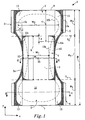
Fig. 1 shows a simplified plan view of an absorbent article in the form of a diaper in its flat, uncontracted state. -
Fig. 2 is a section according to the line II-II inFig. 1 . -
Fig. 3 is a section according to the line III-III inFig. 1 . -
Fig. 4 is a plan view of an absorbent article similar toFig. 1 but showing a modified embodiment. -
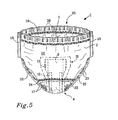
Fig. 5 shows a perspective view of a pant diaper. -
Fig. 6 shows is a plan view of the pant diaper in its flat, uncontracted state prior to formation as seen from the body facing side. -
Fig. 7 illustrates how the crotch point of a wearer, an absorbent article and the corresponding absorbent core is determined. - The term "absorbent article" refers to products that are placed against the skin of the wearer to absorb and contain body exudates, like urine, faeces and menstrual fluid. The invention mainly refers to disposable absorbent articles, which are articles that are not intended to be laundered or otherwise restored or reused as an absorbent article after use.
- The inner liquid permeable cover forms the inner cover of the absorbent article and in use is placed in direct contact with the skin of the wearer. The inner liquid permeable cover can comprise a nonwoven material, e.g. spunbond, meltblown, carded, hydroentangled, wetlaid etc. Suitable nonwoven materials can be composed of natural fibers, such as woodpulp or cotton fibres, manmade fibres, such as polyester, polyethylene, polypropylene, viscose etc. or from a mixture of natural and manmade fibres. The inner liquid permeable cover material may further be composed of tow fibres, which may be bonded to each other in a bonding pattern, as e.g. disclosed in
EP-A-1 035 818 . Further examples of inner liquid permeable cover materials are porous foams, apertured plastic films etc. The materials suited as inner liquid permeable cover materials should be soft and non-irritating to the skin and be readily penetrated by body fluid, e.g. urine or menstrual fluid. The inner liquid permeable cover may further be different in different parts of the absorbent article. - The outer liquid impermeable cover forms the outer cover of the absorbent article at least on the core area thereof. The outer liquid impermeable cover can comprise a thin plastic film, e.g. a polyethylene or polypropylene film, a nonwoven material coated with a liquid impervious material, a hydrophobic nonwoven material, which resists liquid penetration, or a laminate, e.g. of a plastic film and a nonwoven material. The outer liquid impermeable cover material may be breathable so as to allow vapour to escape from the absorbent core, while still preventing liquids from passing through. Examples of breathable outer liquid impermeable cover materials are porous polymeric films, nonwoven laminates from spunbond and meltblown layers, laminates from porous polymeric films and nonwoven materials.
- The absorbent core can be of any conventional kind. Examples of commonly occurring absorbent materials are cellulosic fluff pulp, tissue layers, airlaid materials, highly absorbent polymers (so called superabsorbents), absorbent foam materials, absorbent nonwoven materials or the like. It is common to combine cellulosic pulp fibres with superabsorbent polymers in an absorbent core. Superabsorbent polymers are water-swellable, water-insoluble organic or inorganic materials capable of absorbing at least about 20 times its weight of an aqueous solution containing 0.9 weight percent of sodium chloride. Organic materials suitable for use as a superabsorbent material can include natural materials such as polysaccharides, polypeptides and the like, as well as synthetic materials such as synthetic hydrogel polymers. Such hydrogel polymers include, for example, alkali metal salts of polyacrylic acids, polyacrylamides, polyvinyl alcohol, polyacrylates, polyacrylamides, polyvinyl pyridines, and the like. Other suitable polymers include hydrolyzed acrylonitrile grafted starch, acrylic acid grafted starch, and isobutylene maleic anhydride copolymers and mixtures thereof. The hydrogel polymers are preferably lightly crosslinked to render the material substantially water insoluble. Preferred superabsorbent materials are further surface crosslinked so that the outer surface or shell of the superabsorbent particle, fiber, flake, sphere, etc. possesses a higher crosslink density than the inner portion of the superabsorbent The superabsorbent materials may be in any form suitable for use in absorbent composites including particles, fibers, flakes, spheres, and the like.
- A high absorption capacity is provided by the use of high amounts of superabsorbent material. For an absorbent core comprising a matrix of hydrophilic fibers, such as cellulosic fibers, and superabsorbent material, the proportion of superabsorbent material is preferably between 10 and 90% by weight, more preferably between 30 and 70% by weight.
- It is conventional in absorbent articles to have absorbent cores comprising layers of different properties with respect to liquid receiving capacity, liquid distribution capacity and storage capacity. These different layers may also have different concentrations of superabsorbent material, so that one layer may have a relatively high concentration of superabsorbent material and another layer a lower concentration, perhaps below 10% by weight superabsorbent material. The thin absorbent bodies, which are common in for example baby diapers and incontinence guards, often comprise a compressed mixed or layered structure of cellulosic fluff pulp and superabsorbent polymers. The size and absorbent capacity of the absorbent core may be varied to be suited for different uses such as for infants or for adult incontinent persons.
- The absorbent core may further include an acquisition distribution layer placed on top of the primary absorbent body and which is adapted to quickly receive and temporarily store discharged liquid before it is absorbed by the primary absorbent core. Such acquisition distribution layers are well known in the art and may be composed of porous fibrous waddings or foam materials.
- For an absorbent article of the type having a chassis that supports the absorbent core and in which the absorbent core is an integrated part and that is worn around the waist of the wearer, such as a diaper having fastening means attaching the diaper around the waist, a pant-type absorbent article and a belted article having belt members that are attached around the waist, the crotch point is as defined in for example
EP-B1-0 969 784 . For such article the crotch point is determined by placing the article on a wearer in a standing position and then placing anextensible filament 35 around thelegs Fig. 7 ). The point in the article and the absorbent core corresponding to the point of intersection of the filament is deemed to be thecrotch point 34. It is understood that the crotch point is determined by placing the absorbent article on the wearer in the intended manner and determining where the crossed filament would contact the article/core. - For articles in the form of absorbent pads intended to be placed in the undergarments of the wearer the
crotch point 34 is located at the centre, as well transversely and longitudinally, of the narrowest part of the absorbent core. - The crotch line is a line in the transverse direction, x, of the article/core extending through the
crotch point 34, as shown inFigure 1 . - The crotch region is the narrow part of the article which in use is located between the legs of the wearer and in a normal case the "crotch region" 4 is determined by.first locating the
crotch point 34 of the absorbent core, and then measuring forward and backward a distance of 25% of the total length of the core. In a case, in which the absorbent core is located asymmetrically in the article, for example the main part of the core is located towards the front of the article and the rear edge of the core is located a distance from the crotch point which is equal to or less than 25% of the total length of the core, the crotch region extends from the rear end of the core, to thecrotch point 34 and a distance forwards which is 25% of the total length of the core, or vice versa in case the main part of the core is located towards the back of the article. Thus in the normal case the "crotch region" of the absorbent core corresponds to 50% of the total length of the absorbent core (i.e. in the longitudinal direction, y direction), where thecrotch point 34 is located in the longitudinal center of the crotch region. For an asymmetrically placed core, as described above, thecrotch region 4 may be shorter than 50% of the total length of the core and thecrotch point 34 may be located outside the longitudinal center of thecrotch region 4. InFig. 1 thecrotch region 4 is in longitudinal direction defined by the transverse lines t1 and t2. - The front region of the absorbent article is defined by the waist edge of the article, the longitudinal side edges of the article, part of the leg openings of the article and the transverse line, t1.
- The back region is defined in a similar manner: by the waist edge of the article, the longitudinal side edges of the article, part of the leg openings of the article and the transverse line, t2.
- Leak barriers, or as they also are called containment or barrier flaps, extend substantially longitudinally alongside the absorbent structure. These leak barriers have a free laterally inward elasticized side (distal side) and a laterally outward side (proximal side) attached to the inner cover of the article, wherein the elasticized distal side of the leak barrier is raised from the inner cover of the absorbent article. Such raised leak barriers help to reduce the occurrence of leakage of body exudates from the absorbent articles.
-
Figure 1 shows a simplified plan view of an absorbent article in a flat, uncontracted state. The absorbent article shown inFigure 1 is in the form of an incontinence guard intended to be used as a pad in a pair of pants. The article 1 has a longitudinal, y, and a transverse direction, x, and comprises, as seen in its longitudinal direction, afront region 2, aback region 3 and acrotch region 4 there between. The article is defined by a pair of longitudinal side edges 5 and 6 having an inwardly directed leg contour definingleg openings - The
front region 2 of the absorbent article is defined by the front transverse waist edge 7 of the article, the longitudinal side edges 5, 6 of the article, part of theleg openings crotch point 34 of the article and then measuring a selected distance of the absorbent core in longitudinal direction. The front region has an extension in longitudinal direction, y, of the article denoted with a1 inFig. 1 . Theback region 3 is defined in a similar manner: by theback waist edge 8 of the article, the longitudinal side edges 5, 6 of the article, part of theleg openings back region 3 has an extension in longitudinal direction, y, of the article denoted with a3 inFig. 1 . - The
crotch region 4 is the narrow part of the article which in use is located between the legs of the wearer and is defined on the longitudinal edges by theleg openings crotch region 4 has an extension in longitudinal direction, y, of the article denoted with a2 inFig. 1 , and is determined in the manner described above by determining thecrotch point 34 of the article and then measuring the selected distance of the absorbent core in longitudinal direction. -
Figure 7 illustrates how thecrotch point 34 of an absorbent article and of the absorbent core of an absorbent article is determined by placing the article on a wearer in a standing position and then placing anextensible filament 35 around thelegs Figure 1 , which are intended to be worn in the undergarment, thecrotch point 34 is defined as the centre, as well transversely and longitudinally, of the narrowest part of the absorbent core. - In its most common form the article comprises an
absorbent core 9 and a cover enclosing the absorbent core. Said cover comprises an inner liquidpervious cover 10 on the wearer facing side of theabsorbent core 9 and an outer liquidimpervious cover 11 on the garment facing side of the absorbent core. The inner liquidpervious cover 10 is often referred to as topsheet, while the outer liquidimpervious cover 11 is often referred to as backsheet. - The
inner cover 10 and theouter cover 11 extend outwardly beyond the peripheral edges of theabsorbent core 9 and have their inner surfaces bonded to each other, e. g. by gluing or welding by heat or ultrasonic. The inner and outer cover materials may further be bonded, e.g. by adhesive, to theabsorbent core 9. In an alternative embodiment theinner cover 10 may be eliminated and theabsorbent core 9 located directly against the wearer. - The
absorbent core 9 inFig. 1 has a smallest width in the crotch region denoted w1 and a largest width in the back and/or front region denoted w2. - The article further comprises longitudinally extending inner and outer
elastic leak barriers junction inner cover 10. As can be seen inFig. 2 and 3 the inner andouter leak barriers proximal edge distal edge elastic member inner cover 10. Theseleak barriers proximal edges inner cover 10 close to the lateral edges of theabsorbent core 9 either laterally outside theabsorbent core 9 or above theabsorbent core 9. The attachment is made by for example adhesive, ultrasonic welding or heat bonding. The line of junction of theleak barriers inner cover 10 is denoted with 12c and 13c respectively. - The
leak barriers distal edges leak barriers Fig. 1 the attached portions of theleak barriers - In
Fig. 1 thedistal edges leak barriers inner cover 10. InFig. 2 and 3 however theleak barriers distal edges inner cover 10. - The
inner leak barriers 12 extend at least along the part of thecrotch region 4 having the narrowest width, e, in the transverse direction, x, and along a length, b, of at least 5 cm. It is preferred that theinner leak barriers 12 extend along a length, b, of at least 8 cm, preferably at least 10 cm, more preferably at least 12 cm and most preferably at least 15 cm. The length, b, of the leak barriers is measured as the longitudinal extension of the elasticizeddistal edges 12b in their flat uncontracted state. Theinner leak barriers 12 may extend the entire length of the article. Preferably they do not extend over a length of more than 30 cm and more preferably not more than 25 cm. - The
outer leak barriers 13 extend along at least a part of thefront region 2 and/orback region 3 of the article, while at least a part of thecrotch region 4, along which theinner leak barriers 12 extend is free fromouter leak barriers 13. Theouter leak barriers 13 may extend all the way to the respectivetransverse end edge 7 and 8 of the front and backe regions respectively, or may alternatively end at a distance inside thereof: The ends of theouter leak barriers 13 facing thecrotch region 4 may start in longitudinal direction, y, of the article where theinner leak barriers 12 end, and preferably there is a gap in longitudinal direction, y, of not more than 5 mm between the ends of the inner and outer leak barriers facing each other. Theouter leak barriers 13 may extend all the way to theleg openings distal edges - The distance, d, in transverse direction, x, between the respective line of
junction outer leak barriers 13 may alternatively only be present in either the front or back region. - The invention is primarily applicable to absorbent articles having a considerable difference between w1 and w2. If w2 is measured in the broadest part of the absorbent core, which either can be in the front, the back or both in the front and back regions, w2 should in a preferred embodiment be at least 20% larger than w1, preferably at least 25% larger and more preferably at least 30% larger than w1.
- The
outer leak barriers 13 are in the embodiment shown inFig. 1 spaced apart a distance that exceeds the width, e, of thecrotch region 4 in the narrowest part thereof. This applies both to the distance between the respectiveproximal edges 13a and between the respectivedistal edges 13b. In an alternative embodiment the distance between at least thedistal edges 13b of theouter leak barriers 13 is smaller than the narrowest crotch width, e. - In a still further embodiment, illustrated in
Fig. 4 , the distance between thedistal edges 13b of theouter leak barriers 13 is smaller than the narrowest crotch width, e, and the distal edges, including theelastic member 18, extend the entire length of the crotch region a2, and are deactivated by being laid flat and attached to theinner cover 10 of the article in at least the part of the crotch region having the narrowest crotch width, thus preventing theouter leak barriers 13 to raise in said area. The elasticizeddistal edges 13b of theouter leak barriers 13 will instead form leg elastics in the leg opening area, thus making the provision of additional leg elastic elements redundant It may also be possible that the distance between thedistal edges 13b of theouter leak barriers 13 is slightly larger than the narrowest crotch width, e, so that saiddistal edges 13b, including theelastic member 18, of theouter leak barriers 13 do not extend along the entire length of the crotch region, a2, but only along the part of the crotch region a2, which is located outside and is broader than the narrowest part thereof. A region adjacent the narrowest crotch width will in this case be free from the leg elastics provided by the elasticized distal edges of the outer leak barriers. - In case leg elastics are provided by the elasticized
distal edges 13b of theouter leak barriers 13, which are attached to the inner cover in the crotch region of the article, they should be present in said state, in which they may function as leg elastics, along a length of at least 5 cm in the crotch region. - The distance between the
proximal edge 12a and thedistal edge 12b of eachinner leak barrier 12 should not be more than half the narrowest crotch width, i.e. not more than 1/2 x e. - The distance between the
proximal edges respective leak barriers distal edges junction inner coversheet 10. The crotch width is also being measured with the diaper is in an uncontracted state as shown inFig. 1 . - The inner and
outer leak barriers distal edge junction outer leak barriers 13 is larger than the height of the inner leak barriers. In a still further embodiment theinner leak barriers 12 are higher then theouter leak barriers 13. The outer leak barriers in the 13 in the front andback regions front region 2 than in the back region, or be higher in theback region 3 than in thefront region 2. Theinner leak barriers 12 preferably have a height between 1 and 5 cm, while theouter leak barriers 13 preferably have a height between 1 and 8 cm. - The inner and
outer leak barriers outer leak barriers 13 may be applied continuously and are then cut away in thecrotch region 4 when the cuts for theleg openings outer leak barriers 13 are cut away in said area. Alternatively the distance between the outer leak barriers is slightly smaller than the narrowest crotch width, e, so that a part of the area adjacent thedistal edges 13b, including theelastic member 18, of theouter leak barriers 13 will remain and be attached to theinner cover 10 so as to form leg elastics in a manner described above. - The absorbent article shown in
Fig. 1 is, as mentioned above, designed as an absorbent pad to be used in a pair of pants. It may in a known manner be provided with fastening means in the form of adhesive strings on the outside of the outer cover to be fastened to the panties. It is however understood that the absorbent article may be of any other known type, such as a diaper or an incontinence garment, intended to be fastened together around the waist of the wearer by fastening means, such as adhesive tape or hook-and-loop fasteners, to assume a pant-like shape. The article may also be a belted article having belt members attached to the back region for fastening the article around the waist of the wearer. The article may further be provided with additional features, such as leg elastics, waist elastics etc. - The article may also be a pant article, such as a pant diaper, a sanitary pant or an incontinence pant. One example of a pant-type absorbent article is shown in
Fig. 4 and5 . The front andback panels side seams 18 to define a waist-opening 19 and a pair of leg-openings 20. - The pant article shown in
Fig. 4 and5 comprises acore region 21 comprising theabsorbent core 9, a liquid perviousinner cover 10 and a liquid imperviousouter cover 11 as disclosed above, and a chassis region outside thecore region 21. The chassis comprises afront region 2, aback region 3 and a waist region comprising anelastic waistband 25. At least a part of the chassis region comprises acoversheet 22 of a soft and comfortable material in the form of an elastic web material, for example an elastic laminate. An example of such a pant article is disclosed inWO2005/122985 andWO2006/093439 . Further details about the elastic laminate used ascoversheet 22 may be found in any of these documents. - Further examples of elastic laminates are stretch-bonded laminates in which a nonelastic material is joined to an elastic material while the elastic material is in a stretched condition, so that when the elastic material is relaxed, the nonelastic material gathers between the locations where it is bonded to the elastic material. It is also known to laminate (or bond) a necked material to an elastic sheet to produce a neck bonded laminate which is capable of stretch and recovery in the cross-machine direction. This process involves an elastic member being bonded to a non-elastic member while only the non-elastic member is extended in one direction (usually the machine direction) and necked in the transverse direction, so as to reduce its dimension in the direction orthogonal to the extension. It is further known to utilize intermeshing grooved rolls or discs for stretching nonwoven webs. For instance, it is known to use grooved rolls generally to stretch a laminate formed from an elastic and a non-elastic (extendable) web, for example a nonwoven, in order to form an elastic laminate.
- The
elastic laminate 22 may cover the entire articles, including thecore region 21 and the entire front andback panels crotch region 4 of the article is free from theelastic web material 22. A "substantial part" used herein refers to at least 50%, preferably at least 75%. - A crotch
region web material 23, which preferably is a non-elastic nonwoven material, is arranged in thecrotch region 4 of the article and overlaps with the elastic front andback panels region web material 23 is joined in an overlapping manner to the front andback panels ultrasonic welds 24, heat bonding, cold bonding, glue strings or the like. - An
elastic waist band 25 is further provided which comprises a substantially non-elastic nonwoven material that is elasticized by elongateelastic members 26 such as elastic threads, contractably affixed between material layers, such as nonwoven materials.Elastic threads 27 may also be arranged around theleg openings - The liquid-
impervious backsheet material 11 underlies theabsorbent core 9 and adjacent areas immediately outside theabsorbent core 9. The area covered by the liquid-impervious backsheet 11 is defined as thecore region 21. Thecrotch nonwoven material 23 is arranged on the garment-facing side of the liquid-impervious backsheet 11 in thecrotch region 4 of the article. Thecore region 21 extends into the front andback panels elastic web material 22 and the liquidimpervious backsheet 11 overlap in the outer parts of thecore region 21, wherein theelastic web material 22 is arranged on the garment facing side of the liquidimpervious backsheet 11. - In one embodiment the surface area of the
absorbent core 9 amounts to no more than 50%, preferably not more than 40%, of the total surface area of the article, as measured in a flat state of the article. Theelastic laminate 22 constitutes the sole component of at least parts of the front andback panels - No additional elasticized side panels joining the front and
back panels elastic laminate 22. -
Inner leak barriers 12 are arranged in thecrotch region 4 of the pant article and extend alongside theabsorbent core 9.Outer leak barriers 13 extend alongside the wider part of theabsorbent core 9 in thefront region 2 and theback region 3 of the article, while at least a main part of thecrotch region 4, along which theinner leak barriers 12 extend, is free fromouter leak barriers 13. There are preferably no outer leak barriers present in the areas of the front and back region which are outside thecore region 21. - The invention may be applied to any type of absorbent article having raised leakage barriers. It is especially useful in articles having a relatively big difference in the width of the absorbent core in the crotch region and the front and/or back regions respectively as described above. One advantage of the present invention is that it provides an improved utilization of the absorbent core and thus reduces the risk for leakage. It further provides and improved comfort and fit and suits female as well as male wearers. For female wearers absorbent capacity is mainly needed in the crotch region and the back region, while for male wearers absorbent capacity is mainly needed in the front and the crotch regions.
- It should be understood that several modifications of the inventions are possible within the scope of the claims.
Claims (14)
- An, absorbent article comprising an absorbent core (9), an inner cover (10) and a liquid impervious garment facing surface (11), said article having a longitudinal (y) and a transverse (x) direction and being defined by a pair of longitudinal side edges (5, 6) and a pair of transverse side edges (7, 8), said article comprises, as seen in its longitudinal direction, a front region (2), a back region (3) and a crotch region (4) therebetween, said article further comprises substantially longitudinally extending leak barriers (12; 13), each of said leak barriers (12; 13) having a free laterally inward elasticized side (12b; 13b) and a laterally outward side (12a; 13a) attached to the inner cover (10), the elasticized side (12b; 13b) of the leak barrier being raised from the inner cover (10) of the absorbent article, said article comprises longitudinally extending inner (12) and outer (13) leak barriers alongside each side of the absorbent core (9), said inner and outer leak barriers being spaced from each other in the transverse direction (x) of the article, wherein the inner leak barriers (12) extend at least along the part of the crotch region (4) having the smallest width (e) in transverse direction (x), characterized in
that said inner leak barriers (12) extend along a length (b) in longitudinal direction of at least 5 cm, and the outer leak barriers (13) extend along at least a part of the front region (2) and/or back region (3) of the article, white at least a part of the crotch region (4) along which said inner leak barriers (12) extend is free from raised outer leak barriers (13). - An absorbent article as claimed in claim 1,
characterized in
that said inner leak barriers (12) extend along a length (b) of at least 8 cm. - An absorbent article as claimed in claim 1 or 2,
characterized in
that said inner leak barriers (12) extend along a length (b) of no more than 30 cm. - An absorbent article as claimed in any of the preceding claims,
characterized in
that there is an overlap (f) in longitudinal direction (y) between the inner (12) and outer leak barriers (13) of between 0.5 cm and 10 cm. - An absorbent article as claimed in any of the preceding claims,
characterized in
that the inner leak barriers (12) have a height (h) as measured from the free laterally inward elasticized side edge (12b) and the opposite laterally outward side edge (12a) attached to the inner cover (10) of between 1 and 5 cm. - An absorbent article as claimed in any of the preceding claims,
characterized in
that the outer leak barriers (13) have a height (h) as measured from the free laterally inward elasticized side edge (13b) and the opposite laterally outward side edge (13a) attached to the inner cover (10) of between 1 and 8 cm. - An absorbent article as claimed in any of the preceding claims,
characterized in
that the laterally inward elasticized side (13b) of the outer leak barriers (13) extend along at least part of the crotch region (4), but is deactivated in at least part of said region by being attached to the inner cover (2) of the article, thus preventing it to raise. - An absorbent article as claimed in claim 7;
characterized in
that the laterally inward elasticized side (12b; 13b) of the outer leak barriers (13) extend along the crotch region (4) in said deactivated state over a length at least 5 cm, in longitudinal direction (y) of the article, - An absorbent article as claimed in any of the preceding claims,
characterized in
that the absorbent core (9) in the crotch region (4) has a smallest width (w1) in transverse direction (x) of no more than 20 cm. - An absorbent article as claimed in any of the preceding claims,
characterized in
that the absorbent core (9) has a largest width (w2) in the front (2) and/or back region (3) which is at least 20% larger than the smallest width (w1) of the absorbent core (9) in the crotch region (4) of the article. - An absorbent article as claimed in any of the preceding claims,
characterized in
that outer leak barriers (13) are present in both the front and the back regions (2, 3) of the article. - An absorbent article as claimed in any of the preceding claims,
characterized in
that said article is a pant type absorbent article such as a pant diaper, a sanitary pant of incontinence pant, said article having a core region (21) comprising an absorbent core (9), and a chassis surrounding the core region, said chassis comprising front, back and waist regions (2, 3 and 25), while the core region is located at least in the crotch region (4) of the article, a liquid impermeable outer cover (11) is arranged at least in the core region (21) on the garment-facing side of the absorbent core (9) and a liquid permeable inner cover (10) is arranged at least in the core region (21) on the wearer-facing side of the absorbent core (9), said article in at least a part of the chassis region (4) comprises an outer coversheet (22) in the form of an elastic web material. - An absorbent article as claimed in claim 12,
characterized in
that the inner and outer leak barriers (12, 13) are arranged in the core region (21) of the article. - An absorbent article as claimed in claim 12 or 13,
characterized in
that the surface area of the absorbent core (9) amounts to no more than 50% of the total surface area of the article, as measured in a flat state of the article.
Applications Claiming Priority (1)
| Application Number | Priority Date | Filing Date | Title |
|---|---|---|---|
| PCT/SE2007/000340 WO2008127152A1 (en) | 2007-04-11 | 2007-04-11 | Absorbent article with leak barriers |
Publications (3)
| Publication Number | Publication Date |
|---|---|
| EP2155134A1 EP2155134A1 (en) | 2010-02-24 |
| EP2155134A4 EP2155134A4 (en) | 2012-03-14 |
| EP2155134B1 true EP2155134B1 (en) | 2013-04-10 |
Family
ID=39864150
Family Applications (1)
| Application Number | Title | Priority Date | Filing Date |
|---|---|---|---|
| EP07748006.9A Not-in-force EP2155134B1 (en) | 2007-04-11 | 2007-04-11 | Absorbent article with leak barriers |
Country Status (7)
| Country | Link |
|---|---|
| US (1) | US8282615B2 (en) |
| EP (1) | EP2155134B1 (en) |
| JP (1) | JP2010523259A (en) |
| CN (1) | CN101677896B (en) |
| AU (1) | AU2007351617A1 (en) |
| BR (1) | BRPI0721612A2 (en) |
| WO (1) | WO2008127152A1 (en) |
Families Citing this family (9)
| Publication number | Priority date | Publication date | Assignee | Title |
|---|---|---|---|---|
| US8419699B2 (en) | 2008-10-24 | 2013-04-16 | TamiCare, Ltd. | Absorbent pad |
| US9456935B2 (en) * | 2012-12-18 | 2016-10-04 | The Procter & Gamble Company | Absorbent articles comprising raised barriers |
| US10512566B2 (en) | 2016-02-29 | 2019-12-24 | Kimberly-Clark Worldwide, Inc. | Absorbent article with flat-back protection feature |
| MX382505B (en) | 2016-02-29 | 2025-03-13 | Kimberly Clark Co | ABSORBENT ARTICLE WITH PROTECTIVE ELEMENT WITH FLAT BACK. |
| WO2018008758A1 (en) | 2016-07-08 | 2018-01-11 | 株式会社日本触媒 | N-vinyl lactam-based crosslinked polymer, cosmetic, absorbent agent for ink and absorbent composite |
| CN106726163A (en) * | 2016-12-20 | 2017-05-31 | 福建恒安集团有限公司 | A kind of disposable adsorption object |
| JP7409985B2 (en) * | 2020-07-22 | 2024-01-09 | 花王株式会社 | absorbent articles |
| CN115998527A (en) * | 2021-10-21 | 2023-04-25 | 王子控股株式会社 | Absorbent article |
| CN117084862B (en) * | 2023-08-02 | 2025-05-09 | 北京倍舒特妇幼用品有限公司 | Sanitary product with three-dimensional protective enclosure |
Family Cites Families (31)
| Publication number | Priority date | Publication date | Assignee | Title |
|---|---|---|---|---|
| US4695278A (en) * | 1985-10-11 | 1987-09-22 | The Procter & Gamble Company | Absorbent article having dual cuffs |
| US4936839A (en) | 1987-08-27 | 1990-06-26 | Mcneil-Ppc, Inc. | Winged napkin having cross-channeling |
| JPH02174845A (en) | 1988-12-27 | 1990-07-06 | Daio Paper Corp | Paper diaper |
| JP2892843B2 (en) | 1990-12-18 | 1999-05-17 | ユニ・チャーム株式会社 | Disposable wearing articles |
| FR2713475B1 (en) * | 1993-12-13 | 1996-03-01 | Peaudouce | Disposable absorbent hygiene article with surface veil provided with an opening to receive the stool. |
| US5575785A (en) * | 1995-06-07 | 1996-11-19 | Kimberly-Clark Corporation | Absorbent article including liquid containment beams and leakage barriers |
| US5667609A (en) | 1996-02-14 | 1997-09-16 | The Procter & Gamble Company | Method for attaching barrier cuffs to disposable absorbent article |
| US6102892A (en) | 1996-12-23 | 2000-08-15 | Kimberly-Clark Worldwide, Inc. | Diaper with pleats for containment of liquid and solid waste |
| JP3242586B2 (en) * | 1996-12-28 | 2001-12-25 | ユニ・チャーム株式会社 | Disposable wearable absorbent articles |
| US5827253A (en) | 1997-03-27 | 1998-10-27 | The Procter & Gamble Company | Absorbent articles comprising a material having high flux capabilities |
| JP3366846B2 (en) * | 1997-10-31 | 2003-01-14 | ユニ・チャーム株式会社 | Disposable diapers |
| SE514391C2 (en) | 1997-12-03 | 2001-02-19 | Sca Hygiene Prod Ab | Absorbent articles |
| US7604625B2 (en) * | 1998-06-12 | 2009-10-20 | First Quality Products, Inc. | Disposable elastic absorbent article having retaining enclosures |
| JP4808886B2 (en) * | 1999-11-30 | 2011-11-02 | 株式会社リブドゥコーポレーション | Disposable diapers |
| SE0000729L (en) | 2000-03-06 | 2001-09-07 | Sca Hygiene Prod Ab | Absorbent articles with improved leakage safety |
| KR20020077531A (en) * | 2000-03-10 | 2002-10-11 | 더 프록터 앤드 갬블 캄파니 | Absorbent articles exhibiting improved buckling and bending softness |
| FR2810879B1 (en) | 2000-06-28 | 2003-09-26 | Proteco | LAYER COMPRISING AN ABSORBENT CORE HAVING A GENERAL OMEGA SHAPE |
| JP2002058703A (en) | 2000-08-17 | 2002-02-26 | Kea Le-To Service Kk | Diaper cover and method of manufacturing the same |
| SE517870C2 (en) * | 2000-12-20 | 2002-07-30 | Sca Hygiene Prod Ab | Absorbent articles including leakage barriers |
| JP3683811B2 (en) * | 2000-12-28 | 2005-08-17 | ユニ・チャーム株式会社 | Disposable body fluid absorbent article |
| US8043275B2 (en) | 2001-12-19 | 2011-10-25 | Kimberly Clark Worldwide, Inc. | Absorbent garment with dual containment flaps |
| US6773424B2 (en) | 2002-03-08 | 2004-08-10 | Kimberly-Clark Worldwide, Inc. | Absorbent article having elasticized side shields with improved body fit |
| KR100831912B1 (en) | 2002-07-23 | 2008-05-23 | 카오카부시키가이샤 | Disposable diaper |
| US7736350B2 (en) | 2002-12-30 | 2010-06-15 | Kimberly-Clark Worldwide, Inc. | Absorbent article with improved containment flaps |
| JP4083082B2 (en) * | 2003-06-20 | 2008-04-30 | ユニ・チャーム株式会社 | Disposable diapers |
| US7806884B2 (en) | 2004-06-22 | 2010-10-05 | Sca Hygiene Products Ab | Absorbent article comprising an elastic laminate |
| JP2006051269A (en) | 2004-08-16 | 2006-02-23 | Kao Corp | Disposable diapers |
| JP4712374B2 (en) * | 2004-12-28 | 2011-06-29 | ユニ・チャーム株式会社 | Sanitary napkin |
| EP1877017B1 (en) | 2005-03-02 | 2013-08-07 | SCA Hygiene Products AB | A pant-type absorbent article |
| KR101255592B1 (en) * | 2005-05-09 | 2013-04-16 | 가오 가부시키가이샤 | Disposable diapers |
| CA2648358A1 (en) | 2006-04-05 | 2007-10-11 | Sca Hygiene Products Ab | Absorbent article with leak barriers |
-
2007
- 2007-04-11 WO PCT/SE2007/000340 patent/WO2008127152A1/en not_active Ceased
- 2007-04-11 CN CN200780052527.7A patent/CN101677896B/en not_active Expired - Fee Related
- 2007-04-11 US US12/594,888 patent/US8282615B2/en not_active Expired - Fee Related
- 2007-04-11 EP EP07748006.9A patent/EP2155134B1/en not_active Not-in-force
- 2007-04-11 AU AU2007351617A patent/AU2007351617A1/en not_active Abandoned
- 2007-04-11 BR BRPI0721612-2A patent/BRPI0721612A2/en not_active Application Discontinuation
- 2007-04-11 JP JP2010502964A patent/JP2010523259A/en active Pending
Also Published As
| Publication number | Publication date |
|---|---|
| CN101677896A (en) | 2010-03-24 |
| BRPI0721612A2 (en) | 2013-01-15 |
| CN101677896B (en) | 2014-06-18 |
| EP2155134A4 (en) | 2012-03-14 |
| US8282615B2 (en) | 2012-10-09 |
| WO2008127152A1 (en) | 2008-10-23 |
| EP2155134A1 (en) | 2010-02-24 |
| JP2010523259A (en) | 2010-07-15 |
| AU2007351617A1 (en) | 2008-10-23 |
| US20100137825A1 (en) | 2010-06-03 |
Similar Documents
| Publication | Publication Date | Title |
|---|---|---|
| EP1827335B1 (en) | Absorbent article | |
| US7888549B2 (en) | Absorbent article | |
| US8282615B2 (en) | Absorbent article with leak barriers | |
| US8246595B2 (en) | Absorbent article with leak barriers | |
| KR102372278B1 (en) | Absorbent article having an absorbent assembly with integral containment flaps | |
| US20070073258A1 (en) | Absorbent article | |
| MXPA02009110A (en) | Absorbent article with elastic y shaped means. | |
| RU2397744C2 (en) | Absorbing product with barriers against leakage | |
| RU2417065C1 (en) | Absorbent product with leakage barriers | |
| RU2362528C2 (en) | Adsorbent product | |
| KR20090007731A (en) | Absorbent articles with leak barriers |
Legal Events
| Date | Code | Title | Description |
|---|---|---|---|
| PUAI | Public reference made under article 153(3) epc to a published international application that has entered the european phase |
Free format text: ORIGINAL CODE: 0009012 |
|
| 17P | Request for examination filed |
Effective date: 20091111 |
|
| AK | Designated contracting states |
Kind code of ref document: A1 Designated state(s): AT BE BG CH CY CZ DE DK EE ES FI FR GB GR HU IE IS IT LI LT LU LV MC MT NL PL PT RO SE SI SK TR |
|
| AX | Request for extension of the european patent |
Extension state: AL BA HR MK RS |
|
| RIN1 | Information on inventor provided before grant (corrected) |
Inventor name: UNER, SUE Inventor name: WAESTLUND-KARLSSON, JAN Inventor name: CARLSON, ULRIKA Inventor name: EEN, HANS |
|
| DAX | Request for extension of the european patent (deleted) | ||
| A4 | Supplementary search report drawn up and despatched |
Effective date: 20120215 |
|
| RIC1 | Information provided on ipc code assigned before grant |
Ipc: A61F 13/494 20060101ALI20120209BHEP Ipc: A61F 13/475 20060101AFI20120209BHEP |
|
| GRAP | Despatch of communication of intention to grant a patent |
Free format text: ORIGINAL CODE: EPIDOSNIGR1 |
|
| GRAP | Despatch of communication of intention to grant a patent |
Free format text: ORIGINAL CODE: EPIDOSNIGR1 |
|
| GRAS | Grant fee paid |
Free format text: ORIGINAL CODE: EPIDOSNIGR3 |
|
| GRAA | (expected) grant |
Free format text: ORIGINAL CODE: 0009210 |
|
| AK | Designated contracting states |
Kind code of ref document: B1 Designated state(s): AT BE BG CH CY CZ DE DK EE ES FI FR GB GR HU IE IS IT LI LT LU LV MC MT NL PL PT RO SE SI SK TR |
|
| REG | Reference to a national code |
Ref country code: GB Ref legal event code: FG4D |
|
| REG | Reference to a national code |
Ref country code: AT Ref legal event code: REF Ref document number: 605552 Country of ref document: AT Kind code of ref document: T Effective date: 20130415 Ref country code: CH Ref legal event code: EP |
|
| REG | Reference to a national code |
Ref country code: IE Ref legal event code: FG4D |
|
| REG | Reference to a national code |
Ref country code: DE Ref legal event code: R096 Ref document number: 602007029667 Country of ref document: DE Effective date: 20130606 |
|
| PG25 | Lapsed in a contracting state [announced via postgrant information from national office to epo] |
Ref country code: SI Free format text: LAPSE BECAUSE OF FAILURE TO SUBMIT A TRANSLATION OF THE DESCRIPTION OR TO PAY THE FEE WITHIN THE PRESCRIBED TIME-LIMIT Effective date: 20130410 |
|
| REG | Reference to a national code |
Ref country code: AT Ref legal event code: MK05 Ref document number: 605552 Country of ref document: AT Kind code of ref document: T Effective date: 20130410 |
|
| REG | Reference to a national code |
Ref country code: LT Ref legal event code: MG4D Ref country code: NL Ref legal event code: VDEP Effective date: 20130410 |
|
| PG25 | Lapsed in a contracting state [announced via postgrant information from national office to epo] |
Ref country code: SE Free format text: LAPSE BECAUSE OF FAILURE TO SUBMIT A TRANSLATION OF THE DESCRIPTION OR TO PAY THE FEE WITHIN THE PRESCRIBED TIME-LIMIT Effective date: 20130410 Ref country code: PT Free format text: LAPSE BECAUSE OF FAILURE TO SUBMIT A TRANSLATION OF THE DESCRIPTION OR TO PAY THE FEE WITHIN THE PRESCRIBED TIME-LIMIT Effective date: 20130812 Ref country code: GR Free format text: LAPSE BECAUSE OF FAILURE TO SUBMIT A TRANSLATION OF THE DESCRIPTION OR TO PAY THE FEE WITHIN THE PRESCRIBED TIME-LIMIT Effective date: 20130711 Ref country code: FI Free format text: LAPSE BECAUSE OF FAILURE TO SUBMIT A TRANSLATION OF THE DESCRIPTION OR TO PAY THE FEE WITHIN THE PRESCRIBED TIME-LIMIT Effective date: 20130410 Ref country code: LT Free format text: LAPSE BECAUSE OF FAILURE TO SUBMIT A TRANSLATION OF THE DESCRIPTION OR TO PAY THE FEE WITHIN THE PRESCRIBED TIME-LIMIT Effective date: 20130410 Ref country code: BE Free format text: LAPSE BECAUSE OF FAILURE TO SUBMIT A TRANSLATION OF THE DESCRIPTION OR TO PAY THE FEE WITHIN THE PRESCRIBED TIME-LIMIT Effective date: 20130410 Ref country code: AT Free format text: LAPSE BECAUSE OF FAILURE TO SUBMIT A TRANSLATION OF THE DESCRIPTION OR TO PAY THE FEE WITHIN THE PRESCRIBED TIME-LIMIT Effective date: 20130410 Ref country code: IS Free format text: LAPSE BECAUSE OF FAILURE TO SUBMIT A TRANSLATION OF THE DESCRIPTION OR TO PAY THE FEE WITHIN THE PRESCRIBED TIME-LIMIT Effective date: 20130810 Ref country code: ES Free format text: LAPSE BECAUSE OF FAILURE TO SUBMIT A TRANSLATION OF THE DESCRIPTION OR TO PAY THE FEE WITHIN THE PRESCRIBED TIME-LIMIT Effective date: 20130721 Ref country code: NL Free format text: LAPSE BECAUSE OF FAILURE TO SUBMIT A TRANSLATION OF THE DESCRIPTION OR TO PAY THE FEE WITHIN THE PRESCRIBED TIME-LIMIT Effective date: 20130410 |
|
| PG25 | Lapsed in a contracting state [announced via postgrant information from national office to epo] |
Ref country code: CY Free format text: LAPSE BECAUSE OF FAILURE TO SUBMIT A TRANSLATION OF THE DESCRIPTION OR TO PAY THE FEE WITHIN THE PRESCRIBED TIME-LIMIT Effective date: 20130410 Ref country code: LV Free format text: LAPSE BECAUSE OF FAILURE TO SUBMIT A TRANSLATION OF THE DESCRIPTION OR TO PAY THE FEE WITHIN THE PRESCRIBED TIME-LIMIT Effective date: 20130410 Ref country code: PL Free format text: LAPSE BECAUSE OF FAILURE TO SUBMIT A TRANSLATION OF THE DESCRIPTION OR TO PAY THE FEE WITHIN THE PRESCRIBED TIME-LIMIT Effective date: 20130410 Ref country code: BG Free format text: LAPSE BECAUSE OF FAILURE TO SUBMIT A TRANSLATION OF THE DESCRIPTION OR TO PAY THE FEE WITHIN THE PRESCRIBED TIME-LIMIT Effective date: 20130710 |
|
| REG | Reference to a national code |
Ref country code: CH Ref legal event code: PL |
|
| REG | Reference to a national code |
Ref country code: IE Ref legal event code: MM4A |
|
| PG25 | Lapsed in a contracting state [announced via postgrant information from national office to epo] |
Ref country code: EE Free format text: LAPSE BECAUSE OF FAILURE TO SUBMIT A TRANSLATION OF THE DESCRIPTION OR TO PAY THE FEE WITHIN THE PRESCRIBED TIME-LIMIT Effective date: 20130410 Ref country code: MC Free format text: LAPSE BECAUSE OF FAILURE TO SUBMIT A TRANSLATION OF THE DESCRIPTION OR TO PAY THE FEE WITHIN THE PRESCRIBED TIME-LIMIT Effective date: 20130410 Ref country code: DK Free format text: LAPSE BECAUSE OF FAILURE TO SUBMIT A TRANSLATION OF THE DESCRIPTION OR TO PAY THE FEE WITHIN THE PRESCRIBED TIME-LIMIT Effective date: 20130410 Ref country code: CH Free format text: LAPSE BECAUSE OF NON-PAYMENT OF DUE FEES Effective date: 20130430 Ref country code: SK Free format text: LAPSE BECAUSE OF FAILURE TO SUBMIT A TRANSLATION OF THE DESCRIPTION OR TO PAY THE FEE WITHIN THE PRESCRIBED TIME-LIMIT Effective date: 20130410 Ref country code: CZ Free format text: LAPSE BECAUSE OF FAILURE TO SUBMIT A TRANSLATION OF THE DESCRIPTION OR TO PAY THE FEE WITHIN THE PRESCRIBED TIME-LIMIT Effective date: 20130410 Ref country code: LI Free format text: LAPSE BECAUSE OF NON-PAYMENT OF DUE FEES Effective date: 20130430 |
|
| PLBE | No opposition filed within time limit |
Free format text: ORIGINAL CODE: 0009261 |
|
| STAA | Information on the status of an ep patent application or granted ep patent |
Free format text: STATUS: NO OPPOSITION FILED WITHIN TIME LIMIT |
|
| PG25 | Lapsed in a contracting state [announced via postgrant information from national office to epo] |
Ref country code: IT Free format text: LAPSE BECAUSE OF FAILURE TO SUBMIT A TRANSLATION OF THE DESCRIPTION OR TO PAY THE FEE WITHIN THE PRESCRIBED TIME-LIMIT Effective date: 20130410 Ref country code: RO Free format text: LAPSE BECAUSE OF FAILURE TO SUBMIT A TRANSLATION OF THE DESCRIPTION OR TO PAY THE FEE WITHIN THE PRESCRIBED TIME-LIMIT Effective date: 20130410 |
|
| 26N | No opposition filed |
Effective date: 20140113 |
|
| REG | Reference to a national code |
Ref country code: FR Ref legal event code: ST Effective date: 20140228 |
|
| REG | Reference to a national code |
Ref country code: DE Ref legal event code: R097 Ref document number: 602007029667 Country of ref document: DE Effective date: 20140113 |
|
| PG25 | Lapsed in a contracting state [announced via postgrant information from national office to epo] |
Ref country code: IE Free format text: LAPSE BECAUSE OF NON-PAYMENT OF DUE FEES Effective date: 20130411 |
|
| PG25 | Lapsed in a contracting state [announced via postgrant information from national office to epo] |
Ref country code: FR Free format text: LAPSE BECAUSE OF NON-PAYMENT OF DUE FEES Effective date: 20130610 |
|
| PG25 | Lapsed in a contracting state [announced via postgrant information from national office to epo] |
Ref country code: MT Free format text: LAPSE BECAUSE OF FAILURE TO SUBMIT A TRANSLATION OF THE DESCRIPTION OR TO PAY THE FEE WITHIN THE PRESCRIBED TIME-LIMIT Effective date: 20130410 |
|
| PG25 | Lapsed in a contracting state [announced via postgrant information from national office to epo] |
Ref country code: TR Free format text: LAPSE BECAUSE OF FAILURE TO SUBMIT A TRANSLATION OF THE DESCRIPTION OR TO PAY THE FEE WITHIN THE PRESCRIBED TIME-LIMIT Effective date: 20130410 |
|
| PG25 | Lapsed in a contracting state [announced via postgrant information from national office to epo] |
Ref country code: HU Free format text: LAPSE BECAUSE OF FAILURE TO SUBMIT A TRANSLATION OF THE DESCRIPTION OR TO PAY THE FEE WITHIN THE PRESCRIBED TIME-LIMIT; INVALID AB INITIO Effective date: 20070411 Ref country code: LU Free format text: LAPSE BECAUSE OF NON-PAYMENT OF DUE FEES Effective date: 20130411 |
|
| PGFP | Annual fee paid to national office [announced via postgrant information from national office to epo] |
Ref country code: DE Payment date: 20160411 Year of fee payment: 10 Ref country code: GB Payment date: 20160414 Year of fee payment: 10 |
|
| REG | Reference to a national code |
Ref country code: DE Ref legal event code: R119 Ref document number: 602007029667 Country of ref document: DE |
|
| GBPC | Gb: european patent ceased through non-payment of renewal fee |
Effective date: 20170411 |
|
| PG25 | Lapsed in a contracting state [announced via postgrant information from national office to epo] |
Ref country code: DE Free format text: LAPSE BECAUSE OF NON-PAYMENT OF DUE FEES Effective date: 20171103 |
|
| PG25 | Lapsed in a contracting state [announced via postgrant information from national office to epo] |
Ref country code: GB Free format text: LAPSE BECAUSE OF NON-PAYMENT OF DUE FEES Effective date: 20170411 |