EP2154588A2 - Control system - Google Patents
Control system Download PDFInfo
- Publication number
- EP2154588A2 EP2154588A2 EP09251645A EP09251645A EP2154588A2 EP 2154588 A2 EP2154588 A2 EP 2154588A2 EP 09251645 A EP09251645 A EP 09251645A EP 09251645 A EP09251645 A EP 09251645A EP 2154588 A2 EP2154588 A2 EP 2154588A2
- Authority
- EP
- European Patent Office
- Prior art keywords
- engine
- control system
- demand signal
- driven quantity
- aggregate
- Prior art date
- Legal status (The legal status is an assumption and is not a legal conclusion. Google has not performed a legal analysis and makes no representation as to the accuracy of the status listed.)
- Granted
Links
- 230000008859 change Effects 0.000 claims abstract description 51
- 230000004044 response Effects 0.000 claims abstract description 36
- 239000000446 fuel Substances 0.000 claims description 139
- 238000001816 cooling Methods 0.000 claims description 41
- 238000000034 method Methods 0.000 claims description 27
- 230000008569 process Effects 0.000 claims description 23
- 239000012530 fluid Substances 0.000 claims description 16
- 230000003068 static effect Effects 0.000 claims description 14
- 230000001276 controlling effect Effects 0.000 claims description 10
- 230000001105 regulatory effect Effects 0.000 claims description 3
- 230000001419 dependent effect Effects 0.000 claims 2
- 230000001133 acceleration Effects 0.000 description 20
- 230000010354 integration Effects 0.000 description 18
- 238000004458 analytical method Methods 0.000 description 9
- 238000004088 simulation Methods 0.000 description 9
- 230000000694 effects Effects 0.000 description 6
- 230000009471 action Effects 0.000 description 5
- 230000000712 assembly Effects 0.000 description 5
- 238000000429 assembly Methods 0.000 description 5
- 238000013461 design Methods 0.000 description 5
- 230000001052 transient effect Effects 0.000 description 5
- 238000013459 approach Methods 0.000 description 4
- 230000004048 modification Effects 0.000 description 4
- 238000012986 modification Methods 0.000 description 4
- 230000008901 benefit Effects 0.000 description 3
- 230000003247 decreasing effect Effects 0.000 description 2
- 230000006872 improvement Effects 0.000 description 2
- 230000003278 mimic effect Effects 0.000 description 2
- 230000002829 reductive effect Effects 0.000 description 2
- RZVAJINKPMORJF-UHFFFAOYSA-N Acetaminophen Chemical compound CC(=O)NC1=CC=C(O)C=C1 RZVAJINKPMORJF-UHFFFAOYSA-N 0.000 description 1
- 230000015556 catabolic process Effects 0.000 description 1
- 238000002485 combustion reaction Methods 0.000 description 1
- 238000011217 control strategy Methods 0.000 description 1
- 230000008878 coupling Effects 0.000 description 1
- 238000010168 coupling process Methods 0.000 description 1
- 238000005859 coupling reaction Methods 0.000 description 1
- 230000001186 cumulative effect Effects 0.000 description 1
- 238000006731 degradation reaction Methods 0.000 description 1
- 230000007613 environmental effect Effects 0.000 description 1
- 230000000670 limiting effect Effects 0.000 description 1
- 239000011159 matrix material Substances 0.000 description 1
- 239000003607 modifier Substances 0.000 description 1
- 238000006386 neutralization reaction Methods 0.000 description 1
- 230000000717 retained effect Effects 0.000 description 1
- 230000035945 sensitivity Effects 0.000 description 1
- 238000012546 transfer Methods 0.000 description 1
Images



Classifications
-
- F—MECHANICAL ENGINEERING; LIGHTING; HEATING; WEAPONS; BLASTING
- F01—MACHINES OR ENGINES IN GENERAL; ENGINE PLANTS IN GENERAL; STEAM ENGINES
- F01D—NON-POSITIVE DISPLACEMENT MACHINES OR ENGINES, e.g. STEAM TURBINES
- F01D11/00—Preventing or minimising internal leakage of working-fluid, e.g. between stages
- F01D11/08—Preventing or minimising internal leakage of working-fluid, e.g. between stages for sealing space between rotor blade tips and stator
- F01D11/14—Adjusting or regulating tip-clearance, i.e. distance between rotor-blade tips and stator casing
- F01D11/20—Actively adjusting tip-clearance
- F01D11/24—Actively adjusting tip-clearance by selectively cooling-heating stator or rotor components
-
- F—MECHANICAL ENGINEERING; LIGHTING; HEATING; WEAPONS; BLASTING
- F02—COMBUSTION ENGINES; HOT-GAS OR COMBUSTION-PRODUCT ENGINE PLANTS
- F02C—GAS-TURBINE PLANTS; AIR INTAKES FOR JET-PROPULSION PLANTS; CONTROLLING FUEL SUPPLY IN AIR-BREATHING JET-PROPULSION PLANTS
- F02C9/00—Controlling gas-turbine plants; Controlling fuel supply in air- breathing jet-propulsion plants
- F02C9/26—Control of fuel supply
- F02C9/28—Regulating systems responsive to plant or ambient parameters, e.g. temperature, pressure, rotor speed
-
- G—PHYSICS
- G05—CONTROLLING; REGULATING
- G05B—CONTROL OR REGULATING SYSTEMS IN GENERAL; FUNCTIONAL ELEMENTS OF SUCH SYSTEMS; MONITORING OR TESTING ARRANGEMENTS FOR SUCH SYSTEMS OR ELEMENTS
- G05B13/00—Adaptive control systems, i.e. systems automatically adjusting themselves to have a performance which is optimum according to some preassigned criterion
- G05B13/02—Adaptive control systems, i.e. systems automatically adjusting themselves to have a performance which is optimum according to some preassigned criterion electric
- G05B13/0205—Adaptive control systems, i.e. systems automatically adjusting themselves to have a performance which is optimum according to some preassigned criterion electric not using a model or a simulator of the controlled system
- G05B13/024—Adaptive control systems, i.e. systems automatically adjusting themselves to have a performance which is optimum according to some preassigned criterion electric not using a model or a simulator of the controlled system in which a parameter or coefficient is automatically adjusted to optimise the performance
-
- G—PHYSICS
- G05—CONTROLLING; REGULATING
- G05B—CONTROL OR REGULATING SYSTEMS IN GENERAL; FUNCTIONAL ELEMENTS OF SUCH SYSTEMS; MONITORING OR TESTING ARRANGEMENTS FOR SUCH SYSTEMS OR ELEMENTS
- G05B5/00—Anti-hunting arrangements
- G05B5/01—Anti-hunting arrangements electric
-
- F—MECHANICAL ENGINEERING; LIGHTING; HEATING; WEAPONS; BLASTING
- F05—INDEXING SCHEMES RELATING TO ENGINES OR PUMPS IN VARIOUS SUBCLASSES OF CLASSES F01-F04
- F05D—INDEXING SCHEME FOR ASPECTS RELATING TO NON-POSITIVE-DISPLACEMENT MACHINES OR ENGINES, GAS-TURBINES OR JET-PROPULSION PLANTS
- F05D2270/00—Control
- F05D2270/30—Control parameters, e.g. input parameters
- F05D2270/304—Spool rotational speed
Definitions
- the present invention relates to control systems, such as engine fuel control systems or engine-casing cooling air control systems, particularly for gas turbine engines.
- a purpose of an engine fuel control system is to provide an engine with fuel in a form suitable for combustion and to control the rate of fuel flow for accurate control of engine speed and acceleration. It is known to control the thrust of a gas turbine engine using an Electronic Engine Control (EEC), the thrust of the engine being indirectly measured using shaft speed, Engine Pressure Ratio (EPR) or Turbine Power Ratio (TPR).
- EEC Electronic Engine Control
- the EEC also controls (i) the shaft speeds within safe operational limits, and (ii) the temperature and pressure at different parts of the engine to avoid undesirable conditions such as surge or stall, and to ensure the integrity of the engine.
- EEC Electronic Engine Control
- EPR Engine Pressure Ratio
- TPR Turbine Power Ratio
- the EEC also controls (i) the shaft speeds within safe operational limits, and (ii) the temperature and pressure at different parts of the engine to avoid undesirable conditions such as surge or stall, and to ensure the integrity of the engine.
- Environmental considerations as well as growing power demands of modern aircraft require control systems that are robust and optimise
- Electronic closed-loop fuel control systems have an integrating action which helps to ensure accurate control of the engine while meeting the pilot's demands for thrust and complying with safety limits. Such systems offer distinct advantages in the achievement of accurate Ndot control under normal operating conditions.
- US patent no. 5083277 discloses an engine fuel control system in which fuel flow to the engine is controlled by a fuel flow metering valve in response to an aggregate fuel flow demand signal.
- This signal comprises an element computed in accordance with instantaneous engine speed and an overfuelling element computed in accordance with a pilot's thrust or speed demand.
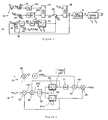
- Figure 1 shows in more detail an engine fuel control system of the type described in US patent no. 5083277 .
- the system of Figure 1 employs a selector control system, generally indicated at 10 with two competing control loops.
- the first includes the pilot's engine speed demand lever and signal generator 6 (which provides a demanded high pressure shaft speed signal NH D ), engine shaft speed error circuit 30, and gain 62a.
- the second loop constituting a shaft acceleration controller, comprises an acceleration limiter loop comparator 46, and an integrator 62b.
- the high pressure shaft speed signal NH is fedback from the engine to the speed governor loop comparator 30 directly and to the acceleration limiter loop comparator 46 via a differentiator (not shown). Selection of one or the other of these control loops is made on the basis of the lowest fuel flow requirement wins by logic block 42 to provide an overfuelling requirement ⁇ F.
- Gain 62a and integrator 62b have respective variable gains Kg and Ka, which are used to map from loop error to ⁇ F.
- a deceleration limiter control loop has been omitted from the drawings of Figure 1 .
- a deceleration limiter loop would be very much like the acceleration limiter loop, but would use a negative reference signal, and its output would be compared with the output of the NH governor loop on the basis of the highest fuel flow requirement wins. The result of that comparison being carried forward to the lowest wins logic 42.
- An estimated engine steady state fuel flow requirement Fss* is computed by engine model block 24 of the feedback loop generally indicated at 14, and this signal is arithmetically summed to the overfuelling requirement ⁇ F selected by logic 42 at summing junction 26.
- the aggregate fuel flow demand signal is supplied to one input of a lowest wins logic block 28 for comparison with a maximum fuel flow signal F Lim .
- a further minimum fuel flow limit signal is compared with the output of block 28 by a highest wins comparison but this is omitted from Figure 1 .
- the resulting trimmed aggregate fuel flow demand signal Fd is connected to control operation of the fuel system 8 which regulates the flow of fuel to engine 2.
- Steady state fuel flow control of the engine is provided by the estimate of the engine steady state fuel flow requirement Fss* against the chosen spool speed, i.e. NH, computed by feedback loop 14.
- the input to feedback loop 14 is the trimmed aggregate fuel flow demand signal Fd.
- the loop output signal i.e. an estimated steady state fuel flow signal Fss*, is subtracted from Fd.
- the difference is the modelled overfuelling demand ⁇ F * , including any limitations imposed by external factors at e.g. logic circuit 28.
- ⁇ F * is multiplied at 18 by the rate of change of engine speed with fuel flow increment NHdot/ ⁇ F to provide an estimate of engine acceleration Nhdot * .
- the estimated acceleration NHdot* is integrated by integrator 22 to obtain an estimated engine shaft speed NH* from which the estimated steady state fuel flow requirement Fss* is computed by engine model block 24.
- Additional signals P 1 , T 1 inlet pressure and temperature) are shown as inputs to block 24. These signals modify the formula used to compute the Fss * versus NH* characteristic or, alternatively, to select the most appropriate member of a family of such characteristics in accordance with prevailing conditions represented by the inputs.
- the computed relationship provided by block 24 is matched as accurately as possible to actual engine behaviour.
- there may be further inputs to the block for variable parameters affecting engine performance such as mechanical power offtake, compressor air bleed level, inlet guide vane angle etc., the effect of which must be mirrored in the computed relationship.
- engine-casing cooling air control systems allow the clearance between the casing and the blade tips of a turbine of the engine to be adjusted, thereby reducing leakage of working fluid between the casing and the tips, and improving engine efficiency.
- Substantial performance degradation is caused by the leakage of working fluid between the rotor and stator assemblies of an engine.
- a significant part of the leakage is attributed to the radial clearance between the casing and the blades tips of a turbine, generally known as turbine tip clearance.
- turbine tip clearance is required to accommodate differential thermal expansion between the rotor and stator assemblies.
- the turbine casing forms a circle surrounding the tips of rotor blades.
- the blades are in intimate contact with the processed fluid and respond rapidly to variations in working medium temperature.
- the casing is located at the boundary of the gas path and responds more slowly to changes in operating conditions.
- the casing is, conventionally, segmented to prevent the build up of mechanical stresses within the turbine casing.
- the rotor assemblies grow radially outward toward the casing.
- a substantial initial clearance is provided between the turbine seal formed on the radially inner wall of the casing and the blade tips to permit this radially outward growth and to allow turbine operation to be free of rub.
- the minimum clearance between the blade tips and the casing generally occurs during transient operating phases, such as takeoff and acceleration. At equilibrium conditions, however, the clearance tends to increase and excessive leakage of working fluid can occur through the gaps between rotor and stator assemblies.
- the radial clearance between the rotor and stator assemblies at cruise conditions can be reduced through the application of turbine casing cooling systems. As the casing is cooled it shrinks, thereby reducing tip clearance to a more acceptable level.
- US patent no. 5048288 discloses a turbine tip clearance control arrangement in which the outer air seal of a gas turbine engine is continuously cooled by compressor discharge air and by a by-pass line which can be throttled or shut off.
- US patent application no. 2004/0240988 discloses a valve assembly for a turbofan jet for supplying cooling air to turbine case sections.
- US patent no. 6487491 proposes closed-loop tip clearance control, in which case the tip clearance of the engine is monitored during flight, including take off and landing, and adjusted by controlling air flow adjacent the engine casing in response to thermal growth.
- the present invention provides a control system which provides an aggregate driven quantity demand signal (such as an aggregate fuel flow demand signal, or an aggregate valve position demand signal) for controlling an actuatable component (such as a valve which regulates fuel flow, or a valve which regulates a cooling air flow).
- an aggregate driven quantity demand signal such as an aggregate fuel flow demand signal, or an aggregate valve position demand signal
- an actuatable component such as a valve which regulates fuel flow, or a valve which regulates a cooling air flow.
- the system receives a reference demand signal (such as thrust or speed demand signal, or a cooling air flow demand signal), which is used by the system to generate the aggregate driven quantity demand signal.
- the reference demand signal corresponds to a desired value or desired change in value of a parameter which is itself varied or controlled by actuation of the actuatable component.
- the present invention provides an engine fuel control system which provides an aggregate fuel flow demand signal for controlling a fuel flow metering valve which regulates fuel flow to the engine (typically a gas turbine engine), the system having:
- the engine fuel control system of this aspect of the invention has a first output signal generated by the feedback loop which converges on a steady state fuel flow requirement value, and a second variable gain included in the feedback loop which tunes the rate of convergence to the steady state fuel flow requirement value.
- This arrangement allows the second variable gain to modify the characteristics of the feedback loop such that phase margins can be improved, engine output overshoots can be reduced, and accurate control of engine speed and acceleration can be achieved, without compromising the bandwidth of the control system.
- the engine fuel control system described in US patent no. 5083277 is focussed on adequate control of NH and NHdot signals and hence compromises on, for example, the performance of intermediate pressure shaft speed (NI) and low pressure shaft speed (NL)
- the present invention can provide adequate control of all engine outputs, including NI, NL and even modelled/mixed signals NMix and NMixdot disclosed in US patent no. 7111464 .
- the aggregate fuel flow demand signal in response to which the feedback loop generates the first output signal, is typically the signal generated by the summing junction.
- the signal generated by the summing junction may be modified by external factors (such as logic circuits which compare the signal with maximum and minimum fuel flow signals) to provide an actual aggregate fuel flow demand signal in response to which the feedback loop generates the output signal.
- the feedback loop includes an engine model.
- the engine model may have an inverse static process module which determines steady state fuel flow requirement as a function of steady state engine speed.
- the feedback loop can mimic accurately the steady state response of the actual engine.
- the model can account for the effect of external factors, such as altitude, Mach number, guide vane and air bleed settings and power offtake on the characteristics of the engine.
- the second variable gain can be used to compensate for modelling inaccuracies in the engine model.
- the feedback loop includes an integrator which, preliminary to the generation of the first output signal by the feedback loop, integrates an estimate of the engine's acceleration to provide an estimate of the engine's speed, i.e. typically the speed of a shaft of the engine.
- the estimate of the engine's speed can be used as an input to the engine model.
- the second variable gain can be viewed as, in effect, modifying the integral time of the integrator.
- This modification may be targeted at compensating for inaccuracies in an engine model included in the feedback loop, thus generating a more accurate model of the engine dynamics.
- the integral gain can also be used to alter the engine model dynamics so that, for example, the modelled engine speed leads or lags behind the actual engine speed during transients.
- the integration time strictly follows the time constant of the engine
- the integration time of the control system of the present invention can be set as a multiple or fraction of the time constant of the engine.
- the second variable gain varies as a function of a modelled or actual engine output, such as engine speed.
- a modelled or actual engine output such as engine speed.
- it may be a function of an estimate of the engine's speed or a function of a measured speed of the engine.
- the feedback loop may receive a second output signal which converges on a value of the rate of change of engine speed with fuel flow increment, the feedback loop combining the second output signal with the aggregate fuel flow demand signal to provide the estimated engine acceleration; and the feedback loop may have a subsidiary loop which generates the second output signal in response to the estimate of the engine's speed, the second variable gain also tuning the rate at which the second output signal converges on the rate of change of engine speed with fuel flow increment.
- the first output signal (which converges on the steady state fuel requirement value) may be subtracted from the aggregate fuel demand signal (e.g. at a further summing junction) to provide an overfuelling demand which is then multiplied with the second output signal to provide the estimated engine acceleration.
- the engine model has a transient-engine module in the subsidiary loop which determines rate of change of engine speed with fuel flow increment as a function of engine speed.
- the second variable gain can act on the second output signal generated by the subsidiary loop before the second output signal is combined with the aggregate fuel demand signal.
- the second variable gain can act on the rate of change of engine speed with fuel flow increment determined by the transient-engine module.
- the second variable gain can act on the steady state fuel flow requirement determined by the inverse static process module to modulate the value of the first output signal.
- the second variable gain can act on the estimated engine acceleration before it enters the integrator.
- the second variable gain can act on the estimated engine speed after it is provided by the integrator. This allows, for example, a scaled engine speed to be applied to an engine model module.
- Elements of the engine fuel control system may be implemented by one or more suitably configured processors and typically also one or more memory devices.
- the control system further has a fuel flow metering valve which is controlled by the aggregate fuel flow demand signal.
- the valve can be one in which fuel flow is proportional to the opening position of a valve member, the opening position being controlled by the aggregate fuel flow demand signal.
- the opening position may be controlled by an actuator driven by the aggregate fuel flow demand signal.
- the actuator may be connected in a feedback control loop in which the actuator is energised by an error signal which is the difference between the aggregate fuel flow demand signal (which may be represented as a desired valve position signal) and a feedback signal representing the opening position of the valve member.
- a second aspect of the invention provides an engine, such as a gas turbine engine, fitted with the engine fuel control system having a fuel flow metering valve of the first aspect, the fuel flow metering valve regulating fuel flow to the engine.
- a third aspect of the invention provides the use of the engine fuel control system having a fuel flow metering valve of the first aspect to regulate fuel flow to an engine, such as a gas turbine engine.
- a fourth aspect of the invention provides a control system which provides an aggregate driven quantity demand signal for controlling an actuatable component, the system having:
- the engine fuel control system of the first aspect is an example of the more general control system of the fourth aspect.
- the control system of the fourth aspect is either (a) an engine fuel control system according to the first aspect, or (b) a control system which is other than an engine fuel control system according to the first aspect.
- Advantages and benefits discussed above in relation to the first aspect of the invention pertain also to the more general control system of the fourth aspect.
- the aggregate driven quantity demand signal is an aggregate fuel flow demand signal
- the actuatable component is a fuel flow metering valve which regulates a fuel flow to the engine
- the steady state driven quantity requirement value is a steady state fuel flow requirement value
- the change in driven quantity demand signal is an overfuelling demand signal
- the reference demand signal is a thrust or speed demand signal
- the engine fuel control system has a selector control system which includes the first variable gain, such that the selector control system generates the overfuelling demand signal in response to the thrust or speed demand signal.
- the control system can be, for example, an engine-casing cooling air control system, or any other fluid flow feedback control system.
- the cooling air controlled by such a system allows the clearance between the casing and the blade tips of a turbine of the engine to be adjusted, for example to reduce leakage of working fluid between the casing and the tips.
- the aggregate driven quantity demand signal may be an aggregate valve position demand signal
- the actuatable component may be a valve which regulates a cooling air flow to an engine casing
- the steady state driven quantity requirement value may be a steady state valve position requirement value
- the change in driven quantity demand signal may be a change in valve position demand signal
- the reference demand signal may be a cooling air flow demand signal.
- such an engine-casing cooling air control system provides an aggregate valve position demand signal for controlling the position of a valve which regulates a cooling air flow to an engine casing, the system having:
- the aggregate driven quantity demand signal in response to which the feedback loop generates the first output signal, is typically the signal generated by the summing junction.
- the signal generated by the summing junction may be modified by external factors (such as logic circuits which compare the signal with maximum and minimum driven quantity values) to provide an actual aggregate driven quantity demand signal in response to which the feedback loop generates the output signal.
- the feedback loop may include a process model.
- the process model may be an engine model.
- the process model may have an inverse static process module which determines steady state driven quantity values as a function of a steady state reference characteristic.
- the reference characteristic can be the cooling air flow rate.
- the feedback loop typically includes an integrator which, preliminary to the generation of the first output signal by the feedback loop, integrates an estimate of a rate of change of the reference characteristic to provide an estimate of the reference characteristic.
- the estimate of the rate of change of the reference characteristic can be used as an input to the process model.
- the second variable gain varies as a function of the reference characteristic.
- the feedback loop may receive a second output signal which converges on a value of the rate of change of the reference characteristic with driven quantity increment (i.e. valve position increment in the case of an engine-casing cooling air control system), the feedback loop combining the second output signal with the (prior) aggregate driven quantity demand signal to provide the estimated rate of change of the reference characteristic; and the feedback loop may have a subsidiary loop which generates the second output signal in response to the estimate of the reference characteristic, the second variable gain also tuning the rate at which the second output signal converges on the rate of change of reference characteristic with driven quantity increment.
- a value of the rate of change of the reference characteristic with driven quantity increment i.e. valve position increment in the case of an engine-casing cooling air control system
- the first output signal may be subtracted from the (prior) aggregate driven quantity demand signal (e.g. at a further summing junction) to provide a change in driven quantity which is then multiplied with the second output signal to provide the estimated rate of change of the reference characteristic.
- the process model has a transient-process module in the subsidiary loop which determines the rate of change of the reference characteristic with driven quantity increment as a function of the reference characteristic.
- the second variable gain can act on the second output signal generated by the subsidiary loop before the second output signal is combined with the (prior) aggregate driven quantity demand signal.
- the second variable gain can act on the rate of change of the reference characteristic with driven quantity increment determined by the transient-process module.
- the second variable gain can act on the steady state driven quantity value determined by the inverse static process module to modulate the value of the first output signal.
- the second variable gain can act on the estimated rate of change of the reference characteristic before it enters the integrator. In other embodiments, the second variable gain can act on the estimated reference characteristic after it is provided by the integrator.
- Elements of the control system may be implemented by one or more suitably configured processors and typically also one or more memory devices.
- control system further has an actuatable component (e.g. a valve) which is controlled by the aggregate driven quantity demand signal.
- an actuatable component e.g. a valve
- a fifth aspect of the invention provides an engine, such as a gas turbine engine, fitted with an engine-casing cooling air control system of the fourth aspect, the system controlling the actuation of a valve which regulates cooling air flow to a casing of the engine.
- a sixth aspect of the invention provides the use of an engine-casing cooling air control system of the fourth aspect to actuate a valve and thereby to regulate cooling air flow to a casing of the engine, such as the casing of a gas turbine engine.
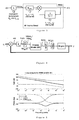
- FIG. 2 shows the structure of the RRIM, which is similar to the engine fuel control system shown in Figure 1 .
- the signal "y r " is a vector of the reference values of the controlled engine outputs (corresponding to the NH D or NHdot D input into the selector control system 10 in Figure 1 ) and "y” is the vector of the actual values of those controlled outputs (corresponding to the NH or NHdot output of the engine 2 in Figure 1 ).
- Variable gain 81 represents both gain 62a and integrator 62b in Figure 1 . Because Figure 2 represents only one control loop in the selector control system 10, logic block 42 in Figure 1 is also omitted.
- the overfuelling requirement ⁇ Wf generated by the selector control system 10 is produced when the NHdot D signal which outputs from variable gain 81 is multiplied at 72 with a ( ⁇ Wf/Nhdot)* value (see below).
- the feedback loop 14 receives the actual aggregate fuel demand signal.
- the feedback loop 14 receives Wf IM , where the subscript indicates a more general fuel flow feedback input to the i nverse m odel.
- that input can be the fuel flow demand, Wf(t), rather than the limited fuel signal Wf d as fed to the engine.
- the controller subtracts from the fuel flow feedback at summer junction 16 the estimated steady state fuel signal Wfss* (Fss* in Figure 1 ).
- the difference is then multiplied at 18 by the estimated rate of change of engine speed with fuel increment (NHdot/ ⁇ Wf)* (NHdot/ ⁇ F in Figure 1 ) to provide an estimate of engine acceleration dNH*/dt or NHdot*.
- the value for (NHdot/ ⁇ Wf)* comes from a subsidiary loop which generates (NHdot/ ⁇ Wf)* as a function of the estimate of the engine's speed NH* produced by integrator 22. More specifically, the value for NH* is passed from the integrator to a second engine model block 70, which generates the value for (NHdot/ ⁇ Wf)*.
- the (NHdot/ ⁇ Wf)* versus NH* characteristic of block 70 can be modified by input signals (temperature, pressure, air bleed, guide vanes etc.) to select the most appropriate member of a family of characteristics and to scale or correct the selected member in order to compensate for the changes in operating conditions.
- the (NHdot/ ⁇ Wf)* value generated by engine model block 70 is also inverted at inverter 71 to produce a ( ⁇ Wf/Nhdot)* value, which is multiplied with the NHdot D signal at 72 to provide the overfuelling requirement ⁇ Wf sent to summer 26.
- the dynamics of the RRIM are tuned to the requirements of the engine via the data within the nonlinear modules, f B and f A , of the first and second engine model blocks or modules 24, 70 respectively.
- the data within these tables can be calculated using an elaborate engine model which relates the output NH(s) to the input Wf(s), where "s" is the Laplace complex variable.
- Nonlinear module f A which is a piecewise continuous function is responsible for the high frequency gain of this relationship
- nonlinear module f B which is a differentiable function contains the inverted static process characteristic of the engine regarding fuel flow to NH.
- the state of the control system models NH and is input to nonlinear modules f A and f B .
- the aggregate fuel flow demand signal, Wf(t), is a summation of the steady state fuel flow requirement associated with NH * (t), Wfss*, and the incremental fuel flow demand, ⁇ Wf, required to fulfil the acceleration demand NHdot D .
- the acceleration demand reduces to zero and the NH* approaches to NH as the control error reduces to zero due to the integral action within the RRIM.
- the architecture of the RRIM controller can be shown to be closely analogous to the PI controller structure given in equation (1)
- U(s) is the Laplace transform of the fuel flow to the engine and E(s) is the Laplace transform of the difference between the set point and the process variable (including but not limited to three spool speeds, spool accelerations and any pressure/temperature to be controlled to a generic reference y r as shown in Figure 2 )
- K p is the overall proportional gain of the controller (the gain of the external element K multiplied with the gain of the inverse model or RRIM K p,IM )
- T i is the response rate.
- Equation (1) can be represented by the structure shown in Figure 3 .
- the controller of Figure 2 with the fuel input Wf iM fed directly from the output of the controller, is represented as a linearised controller in Figure 3 .
- This representation is used, with the linear engine model, in a linear analysis discussed below in relation to Figure 5 .
- integral control action is linearised to an automatic reset using a lag element within a positive feedback loop.
- Such a positive feedback can be seen to be present within the RRIM structure in Figure 2 , as the steady-state fuel flow requirement, Wfss*, is added to ⁇ Wf and the resulting fuel flow demand, Wf(t), is fed back as Wf IM (t).
- fuel flow limiters are ignored for simplicity.
- the limited fuel signal Wf d as fed to the engine can be used as feedback to the controller.
- the lag element within Figure 3 is emulated in the RRIM by the integrator 22 within the negative feedback loop 14, the time constant analogous to T i being a function of the outputs of the engine modules f A and f B .
- the proportional gain of the RRIM, 1/f A can therefore be seen to be the inverse of the engine's parameter f A responsible for the high frequency gain.
- the integral gain, K i of -the PI controller in the classical form of Figure 3 as embedded in the RRIM controller is given in equation (2).
- the integral gain of the RRIM controller is therefore given by the slope of the inverted static process characteristic, f B multiplied with the external gain K.
- the RRIM controller can be seen to be a nonlinear PI controller in which the proportional and integral terms are a function of the state of the controller.
- Figure 4 shows a generalized representation of a closed loop simulation using the RRIM (i.e. a simulation in which the fuel flow into the engine is determined by the RRIM control algorithm), where the outer feedback path represents all measured variables (represented by thick line), the gain K can be considered as a diagonal matrix of gains for all control loops in the selector control system, LSL represents the loop selection logic (corresponding to logic block 42 in Figure 1 ), and FMU represents a fuel management unit (corresponding to fuel system 8 in Figure 1 ).
- y r is a vector of the reference values of the controlled engine outputs (corresponding to the NH D or NHdot D input into the selector control system 10 in Figure 1 ) and y is the vector of the actual values of those controlled outputs (corresponding to the NH or NHdot output of the engine 2 in Figure 1 ).
- the simulation also provides control loops to control the engine outputs NI, NL, P 3 (compressor output pressure), EPR and any other outputs to be controlled.
- the inverted static process characteristic, f B was found by running an aero-thermodynamic gas turbine simulation of a three-spool gas turbine engine. The simulation gives the behaviour of the engine in response to fuel, variable inlet guide vane and bleed valve inputs. All major speeds, temperatures and pressures are output from the simulation in open loop (i.e. without the presence of a control system) at a series of operating points defined by NH.
- the dynamic engine characteristic, f A was found by applying a small increment in fuel flow to the engine at each of the operating points used for the steady state analysis. The data in f A are then the initial value of NHdot, scaled according to the magnitude of the fuel flow increment.
- Figure 5 is a Bode plot showing the subsequent linear analysis of the control system to the right hand side of the loop selection logic, LSL, in Figure 4 , i.e. the RRIM in series with the engine model (the corresponding plot being labelled as "RRIM & Eng.”).
- the gain, K, for each steady state control loop was tuned to give the required control loop bandwidth which varies for each loop and across the operating envelope.
- Table 1 provides the phase margins determined from linear analyses of each tuned control loop, and shows that a phase margin of 60° is met across the operating range for all the control loops except NL and NI.
- the tuning of the gain, K, to meet the required bandwidth resulted in phase margins that were significantly below 60° for large proportions of the operating regime of some loops other than NH.
- the RRIM fuel control system of Figure 2 represents a control strategy offering a nonlinear modulation of fuel to control NH or NHdot.
- the nonlinear behaviour of the control system is based on two engine modules f A and f B , which are used to mimic NH dynamics of the engine, such that the integration time of the control system matches the time constant of the NH response changing nonlinearly with the operating condition. Whilst this can be an attractive solution for NH or NHdot control, it can have short-comings for the control of other engine parameters such as EPR (engine pressure ratio), NI (intermediate pressure shaft speed) and NL (low pressure shaft speed), particularly in a three-spool engine.
- EPR engine pressure ratio
- NI intermediate pressure shaft speed
- NL low pressure shaft speed
- MRIMM Modified Rolls-Royce Inverse Model
- the engine modules f A and f B from the RRIM can be retained to capture the nonlinear behaviour of the engine and other control design requirements.
- the integration time of the control system it is possible to set the integration time of the control system to be greater or less than the time constant of the NH dynamics. This allows an improved trade-off between the bandwidth and stability of a control loop to be achieved.
- FIG 6 shows a first example of an engine fuel control system according to the present invention.
- a second variable gain, K Ndot has been introduced into feedback loop 14 between multiplier 18 and integrator 22.
- the gain K Ndot adjusts the integral gain of the RRIM without adjusting the proportional gain.
- the integration time associated with the feedback loop in the controller follows the nonlinear variations in the time constant, ⁇ NH , associated with the NH response of the engine.
- ⁇ NH time constant
- the additional gain K Ndot provides the opportunity to scale the integration time of the controller.
- the nonlinear behaviour of the engine is captured through the engine modules f A and f B , and the linear design requirements are fulfilled by adjusting the additional gain in the MRRIM.
- the integration time of the EPR control loop should be set as ⁇ NH ( ⁇ 1 and ⁇ NH being the variable time constant representing NH dynamics)
- this can be achieved by setting K Ndot as 1/ ⁇ .
- ⁇ should be different for different control loops, then the configuration of Figure 7 can be adopted, in which each control loop has a different effective MRRIM, implemented by a respective K Ndot tuned for each control loop individually. Otherwise, if K Ndot should be tuned identically for all control loops, the previous feedback configuration of Figure 4 can be adopted by substituting MRRIM for RRIM.
- ⁇ NH * is the estimate of the time constant, ⁇ NH , associated with NH dynamics of the engine.
- the control system's proportional gain resulting from the engine model based on engine modules f A and f B , indicated in equation (4) as K p,IM cannot be tuned/changed, as the look-up table f A is a characteristic of the engine.
- K P,IM is scaled by the variable proportional gain, K, to allow tuning of the closed loop RRIM control system.
- K p KK p , IM
- the integration time of the control system is bound to follow the estimated time constant associated with the NH dynamics, ⁇ NH * , as shown in equation (3).
- T i can be adjusted to achieve design requirements that are beyond the capability of the RRIM controller.
- One way of doing this is to neutralise phase mismatches between the control system and the engine.
- the possibility to tune K Ndot as a variable gain and thereby adjust T i is indicated in Figure 6 by the dashed line connecting K Ndot to the integrator. Note also that the example of Figure 6 includes the possibility to base the engine model on any of the shaft speeds NH, NI or NL.
- K Ndot is to make it a schedule of the modelled speed N * or the measured speed NH so that the modifying gain is non-unity at a speed where there is a phase mismatch between the engine model represented by f A and f B and a more accurate higher order model representing the whole engine.
- the higher order linear model was used to perform the linear analysis of phases margin and bandwidth.
- Figure 8 is a Bode plot showing a linear analysis of the MRRIM control system of Figure 6 (implementing the control loop structure of Figure 4 with MRIMM substituting for RRIM) for comparison with the Bode plot of Figure 5 , K Naot having been tuned to reduce phase mismatches between the controller and the engine.
- the MRRIM in series with the engine model is labelled as "Ex. 1 & Eng.”
- the tuning introduced by K Ndot has the effect of moving the zero of the linear representation of the RRIM at a given operating point.
- K Ndot By making K Ndot less than unity, the integral gain of the RRIM is decreased. This provides phase lead at lower frequencies. Modifying the integral gain reduces the phase lag seen at frequencies around crossover on the Bode plot. This results in a system in which all the control loops conform better to frequency domain requirements without lead compensation, whereby the stability of the control system is maintained while improving its performance.
- Table 2 provides the phase margins determined from linear analysis of each tuned control loop for comparison with the phase margins of Table 1.
- Table 2 NH(%) NH NI NL P 3 EPR NHdot 55 92° 63° 68° 131° 132° 87° 60 99° 58° 77° 131° 135° 94° 65 103° 62° 84° 131° 131° 98° 70 102° 71° 63° 98° 97° 97° 75 104° 82° 65° 96° 99° 99° 80 82° 78° 58° 95° 97° 72° 85 85° 79° 63° 92° 95° 75° 90 81° 74° 65° 92° 95° 66° 95 76° 75° 66° 90° 93° 61° 100 76° 75° 62° 91° 95° 60° 105 76° 75° 54° 93° 97° 61°
- phase margins results.
- only one phase margin in the NL and NI limiter loops is now less than 60°.
- FIG. 9 plots EPR against increments of time in response to a step demand in EPR at around 5s.
- the MRRIM control system of Figure 6 again implements the control loop structure of Figure 4 (with MRIMM substituting for RRIM).
- the response of the RRIM control system is shown for comparison.
- the RRIM is good at decreasing the rise time, but at the expense of relatively high overshoots and low stability margins.
- the example MRRIM control system on the other hand, can produce a similar response time with significantly lower overshoots and better stability margins.
- each EPR response is the cumulative response of all the control loops selected by the loop selection logic LSL, the output of the LSL being a scalar value for NHdot D selected by the LSL out of the NHdot demands of all the loops.
- the MRRIM strategy can overcome shortcomings of the conventional RRIM control design.
- the additional gain K Naot can be tuned in other ways.
- the gain can be further tuned, for example, to improve the NI loop at 60%NH where it was 2% below the required phase margin.
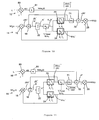
- FIG. 10 shows a second example of an MRRIM engine fuel control system according to the present invention.
- a second variable gain, K N has now been introduced into feedback loop 14 after integrator 22.
- the second variable gain, K Ndot of the first example was positioned before the integrator.
- K N is the modifier for the modelled NH
- K Ndot only varies the rate of change of NH * .
- the modelled speed N * differs from the actual speed NH * by a factor of K N in steady state.
- K N can be used to tune the controller in such a way that the integration time of the controller at any time is equal to the time constant of the NH dynamics measured at the scaled shaft speed, N s * .
- FIG 11 shows a third example of an MRRIM engine fuel control system according to the present invention.
- a second variable gain, K A has now been introduced into the output of the engine module f A before it is applied to the subsidiary loop or used to calculate the incremental fuel flow demand on engine ⁇ Wf.
- K A may be varied using inputs such as the measured speed NH or the modelled speed N * as shown by the dotted line into K A in Figure 11 .
- the integration time T i can be tuned independently using K A to minimise, for example, the phase mismatch between the engine and its inverse at a frequency of interest, and K p can be tuned afterwards to satisfy some other criteria such as a bandwidth requirement.
- the K A coupling between K p and T i can generally be ignored.
- Figure 12 shows another example of an MRRIM engine fuel control system according to the present invention.
- a second variable gain K B scales the output of the engine module f B so that the fuel flow increment in the model, ⁇ Wf * .
- the integration time of the MRRIM control system of Figure 12 depends upon the slope of the second gain K B . This makes the tuning of K B more complicated compared to the tuning of K Ndot in the example of Figure 6 .
- the approach of introducing a second variable gain into a feedback loop to tune the rate at which the output signal generated by the loop converges on a steady state fuel flow requirement can be applied to control driven quantities other than fuel flows.
- the driven quantity can be the position of a valve which regulates the flow of cooling air to an engine casing.
- Figure 13 shows schematically the relation between the input, u v (t), to a valve positioning system and the resultant flow rate, W, of cooling air to the casing.
- the input is typically a torque motor current used to activate a mechanical actuator controlling the valve position.
- the dynamics of the valve actuator and the dynamics of the cooling air flow can be modelled separately so that the fluid flow dynamics can be associated with the position of the valve, ⁇ (t), instead of with the input applied to position the valve.
- the static relationship between the input to the valve actuation system and the position of the valve generally follows a straight line, which means the steady state gain of the valve actuator is a constant.
- the valve dynamics are subordinate to the fluid flow dynamics.
- the engine-casing cooling air control system described below can be adapted to merge the dynamics of the valve with the dynamics of the fluid flow, such that the feedback loop within the controller operates on, for example, the torque motor current rather than the actual valve position.
- the cooling air control system utilises an inverse model having two modules, f 1 and f 2 , analogous to the nonlinear modules, f A and f B of the MRRIM fuel control system described above. These two modules are illustrated schematically in Figure 14.
- Steady state module f 2 124 approximates the steady state position, ⁇ ss , of the valve, in the absence of a change in flow request, as a function of flow rate, W.
- Transient module f 1 170 estimates the rate of change of flow per unit change in valve position, Wdot/ ⁇ , in the presence of a control error, as a function of flow rate, W.
- the steady state and transient modules may have further inputs such as inlet pressure P 1 , inlet temperature T 1 and outlet pressure P 2 across the air modulating valve. These inputs are used to calculate a valve position or change in position according to the operating condition of the valve.
- Figure 15 shows the general architecture of a closed loop control system for controlling the flow of engine casing cooling air.
- the outer feedback path represents the measured cooling air flow rate, W(t).
- W r is the requested cooling air flow rate.
- the gain K operates on the control error e(t) between W(t) and W r to produce the rate of change of fluid flow demand, Wdot d , and can be constituted as a component 181 which is, for example, a proportional controller or a lead compensator.
- the inverse model is shown by a simplified block 'Valve Inverse Model' (VIM).
- VIM has two inputs, the rate of change of fluid flow demand, Wdot d , and the aggregate position demand on the valve, ⁇ VIM .
- ⁇ VIM is selected by a switch 160 between two inputs: the output of the VIM and the output of minimum 128a and maximum 128b limiters acting on the output of the VIM.
- the input to the valve actuator system is the limited VIM output.
- a transfer function G a (s) 154 having a time constant much smaller than the time constant of the valve models the actuator dynamics and produces a value for the input, u v , to the valve positioning system 156 from the limited VIM output.
- u v can be calculated from a first order polynomial or lookup table of steady state valve positions against the steady state input levels required to position the valve.
- FIG 16 shows more detail of the VIM and inner feedback loop 114 of which it forms a part.
- the position input ⁇ VIM is connected to the output of the summing junction 126.
- the input to the VIM is the rate of change of fluid flow demand, Wdot d , introduced at the multiplier 172.
- a modelled increment in the valve position, ⁇ * is calculated by subtracting at 116 the steady state valve position, ⁇ ss , from the inverse model valve position input ⁇ VIM .
- ⁇ ss is calculated from the steady state module 124 against the modelled flow W*.
- the modelled increment in valve position is multiplied with the output of the transient module 170, such that the output of multiplier 118 is a modelled acceleration, W*dot.
- the output of the transient module 170 which is used to model the flow dynamics, is inverted at inverter 171 and multiplied with the rate of change of fluid flow demand, Wdot d , at the junction 172.
- the result is an incremental position demand that can fulfil the rate of change of fluid flow as demanded at the input to the inverse model.
- This demand is added to the output of the steady state module 124 so that the output of the summing junction is an absolute position of the valve to be set in order to achieve the demanded rate of change of fluid flow, Wdot d .
- the present invention can be applied to control of other driven quantities. Thus it is not limited to control of fuel or control of valve position, and is not limited to turbine engine contexts.
Landscapes
- Engineering & Computer Science (AREA)
- General Physics & Mathematics (AREA)
- Combustion & Propulsion (AREA)
- Chemical & Material Sciences (AREA)
- General Engineering & Computer Science (AREA)
- Mechanical Engineering (AREA)
- Automation & Control Theory (AREA)
- Physics & Mathematics (AREA)
- Computer Vision & Pattern Recognition (AREA)
- Software Systems (AREA)
- Medical Informatics (AREA)
- Evolutionary Computation (AREA)
- Health & Medical Sciences (AREA)
- Artificial Intelligence (AREA)
- Feedback Control In General (AREA)
Abstract
Description
- The present invention relates to control systems, such as engine fuel control systems or engine-casing cooling air control systems, particularly for gas turbine engines.
- A purpose of an engine fuel control system is to provide an engine with fuel in a form suitable for combustion and to control the rate of fuel flow for accurate control of engine speed and acceleration. It is known to control the thrust of a gas turbine engine using an Electronic Engine Control (EEC), the thrust of the engine being indirectly measured using shaft speed, Engine Pressure Ratio (EPR) or Turbine Power Ratio (TPR). The EEC also controls (i) the shaft speeds within safe operational limits, and (ii) the temperature and pressure at different parts of the engine to avoid undesirable conditions such as surge or stall, and to ensure the integrity of the engine. Environmental considerations as well as growing power demands of modern aircraft require control systems that are robust and optimised to the operating conditions of the aircraft.
- Electronic closed-loop fuel control systems have an integrating action which helps to ensure accurate control of the engine while meeting the pilot's demands for thrust and complying with safety limits. Such systems offer distinct advantages in the achievement of accurate Ndot control under normal operating conditions.
-
US patent no. 5083277 discloses an engine fuel control system in which fuel flow to the engine is controlled by a fuel flow metering valve in response to an aggregate fuel flow demand signal. This signal comprises an element computed in accordance with instantaneous engine speed and an overfuelling element computed in accordance with a pilot's thrust or speed demand. -
Figure 1 shows in more detail an engine fuel control system of the type described inUS patent no. 5083277 . - The system of
Figure 1 employs a selector control system, generally indicated at 10 with two competing control loops. The first includes the pilot's engine speed demand lever and signal generator 6 (which provides a demanded high pressure shaft speed signal NHD), engine shaftspeed error circuit 30, and gain 62a. The second loop, constituting a shaft acceleration controller, comprises an accelerationlimiter loop comparator 46, and anintegrator 62b. The high pressure shaft speed signal NH is fedback from the engine to the speedgovernor loop comparator 30 directly and to the accelerationlimiter loop comparator 46 via a differentiator (not shown). Selection of one or the other of these control loops is made on the basis of the lowest fuel flow requirement wins bylogic block 42 to provide an overfuelling requirement ΔF. Gain 62a andintegrator 62b have respective variable gains Kg and Ka, which are used to map from loop error to ΔF. - For the sake of brevity, a deceleration limiter control loop has been omitted from the drawings of
Figure 1 . In practice, a deceleration limiter loop would be very much like the acceleration limiter loop, but would use a negative reference signal, and its output would be compared with the output of the NH governor loop on the basis of the highest fuel flow requirement wins. The result of that comparison being carried forward to thelowest wins logic 42. - An estimated engine steady state fuel flow requirement Fss* is computed by
engine model block 24 of the feedback loop generally indicated at 14, and this signal is arithmetically summed to the overfuelling requirement ΔF selected bylogic 42 atsumming junction 26. The aggregate fuel flow demand signal is supplied to one input of a lowestwins logic block 28 for comparison with a maximum fuel flow signal FLim. A further minimum fuel flow limit signal is compared with the output ofblock 28 by a highest wins comparison but this is omitted fromFigure 1 . The resulting trimmed aggregate fuel flow demand signal Fd is connected to control operation of the fuel system 8 which regulates the flow of fuel toengine 2. - Steady state fuel flow control of the engine is provided by the estimate of the engine steady state fuel flow requirement Fss* against the chosen spool speed, i.e. NH, computed by
feedback loop 14. The input tofeedback loop 14 is the trimmed aggregate fuel flow demand signal Fd. At summingjunction 16 the loop output signal, i.e. an estimated steady state fuel flow signal Fss*, is subtracted from Fd. The difference is the modelled overfuelling demand ΔF*, including any limitations imposed by external factors ate.g. logic circuit 28. ΔF* is multiplied at 18 by the rate of change of engine speed with fuel flow increment NHdot/ΔF to provide an estimate of engine acceleration Nhdot*. - The estimated acceleration NHdot* is integrated by
integrator 22 to obtain an estimated engine shaft speed NH* from which the estimated steady state fuel flow requirement Fss* is computed byengine model block 24. Additional signals P1, T1 (inlet pressure and temperature) are shown as inputs to block 24. These signals modify the formula used to compute the Fss* versus NH* characteristic or, alternatively, to select the most appropriate member of a family of such characteristics in accordance with prevailing conditions represented by the inputs. - The computed relationship provided by
block 24 is matched as accurately as possible to actual engine behaviour. Thus, there may be further inputs to the block for variable parameters affecting engine performance such as mechanical power offtake, compressor air bleed level, inlet guide vane angle etc., the effect of which must be mirrored in the computed relationship. - Although engine fuel control systems of the type described in
US patent no. 5083277 enable the use of a simple fuel metering valve and can provide accurate control of engine speed and acceleration, under some circumstances, particularly when applied to high bypass ratio turbofans, inadequate control loop stability, in particular phase margins, can result for certain loops when these are tuned to fulfil desired bandwidth requirements. - As well as engine fuel control systems, other types of control system are found in gas turbine engines. For example, engine-casing cooling air control systems allow the clearance between the casing and the blade tips of a turbine of the engine to be adjusted, thereby reducing leakage of working fluid between the casing and the tips, and improving engine efficiency.
- Substantial performance degradation is caused by the leakage of working fluid between the rotor and stator assemblies of an engine. A significant part of the leakage is attributed to the radial clearance between the casing and the blades tips of a turbine, generally known as turbine tip clearance. However, while it is desired to reduce turbine tip clearance, some clearance is required to accommodate differential thermal expansion between the rotor and stator assemblies.
- At cross-sections along the axis of a turbine, the turbine casing forms a circle surrounding the tips of rotor blades. The blades are in intimate contact with the processed fluid and respond rapidly to variations in working medium temperature. The casing is located at the boundary of the gas path and responds more slowly to changes in operating conditions. The casing is, conventionally, segmented to prevent the build up of mechanical stresses within the turbine casing. As the engine is accelerated during operation, the rotor assemblies grow radially outward toward the casing. A substantial initial clearance is provided between the turbine seal formed on the radially inner wall of the casing and the blade tips to permit this radially outward growth and to allow turbine operation to be free of rub. The minimum clearance between the blade tips and the casing generally occurs during transient operating phases, such as takeoff and acceleration. At equilibrium conditions, however, the clearance tends to increase and excessive leakage of working fluid can occur through the gaps between rotor and stator assemblies.
- The radial clearance between the rotor and stator assemblies at cruise conditions can be reduced through the application of turbine casing cooling systems. As the casing is cooled it shrinks, thereby reducing tip clearance to a more acceptable level.
-
US patent no. 5048288 discloses a turbine tip clearance control arrangement in which the outer air seal of a gas turbine engine is continuously cooled by compressor discharge air and by a by-pass line which can be throttled or shut off.US patent application no. 2004/0240988 discloses a valve assembly for a turbofan jet for supplying cooling air to turbine case sections. -
US patent no. 6487491 proposes closed-loop tip clearance control, in which case the tip clearance of the engine is monitored during flight, including take off and landing, and adjusted by controlling air flow adjacent the engine casing in response to thermal growth. - Although turbine casing cooling holds considerable promise for improved engine performance, that promise has not yet been fully realised in practice.
- In general terms, the present invention provides a control system which provides an aggregate driven quantity demand signal (such as an aggregate fuel flow demand signal, or an aggregate valve position demand signal) for controlling an actuatable component (such as a valve which regulates fuel flow, or a valve which regulates a cooling air flow). Generally, the system receives a reference demand signal (such as thrust or speed demand signal, or a cooling air flow demand signal), which is used by the system to generate the aggregate driven quantity demand signal. Typically, the reference demand signal corresponds to a desired value or desired change in value of a parameter which is itself varied or controlled by actuation of the actuatable component.
- In a first aspect, the present invention provides an engine fuel control system which provides an aggregate fuel flow demand signal for controlling a fuel flow metering valve which regulates fuel flow to the engine (typically a gas turbine engine), the system having:
- a summing junction which generates the aggregate fuel flow demand signal by summing a first output signal which converges on a steady state fuel flow requirement value and an overfuelling demand signal,
- a feedback loop which generates the first output signal in response to the aggregate fuel flow demand signal, and
- a selector control system which generates the overfuelling demand signal in response to a thrust or speed demand signal;
- Thus, relative to the system described above in relation to
Figure 1 , the engine fuel control system of this aspect of the invention has a first output signal generated by the feedback loop which converges on a steady state fuel flow requirement value, and a second variable gain included in the feedback loop which tunes the rate of convergence to the steady state fuel flow requirement value. - This arrangement allows the second variable gain to modify the characteristics of the feedback loop such that phase margins can be improved, engine output overshoots can be reduced, and accurate control of engine speed and acceleration can be achieved, without compromising the bandwidth of the control system. Whilst the engine fuel control system described in
US patent no. 5083277 is focussed on adequate control of NH and NHdot signals and hence compromises on, for example, the performance of intermediate pressure shaft speed (NI) and low pressure shaft speed (NL), the present invention can provide adequate control of all engine outputs, including NI, NL and even modelled/mixed signals NMix and NMixdot disclosed inUS patent no. 7111464 . - The aggregate fuel flow demand signal, in response to which the feedback loop generates the first output signal, is typically the signal generated by the summing junction. Optionally, however, the signal generated by the summing junction may be modified by external factors (such as logic circuits which compare the signal with maximum and minimum fuel flow signals) to provide an actual aggregate fuel flow demand signal in response to which the feedback loop generates the output signal.
- Preferably the feedback loop includes an engine model. The engine model may have an inverse static process module which determines steady state fuel flow requirement as a function of steady state engine speed. Thus the feedback loop can mimic accurately the steady state response of the actual engine. The model can account for the effect of external factors, such as altitude, Mach number, guide vane and air bleed settings and power offtake on the characteristics of the engine. Advantageously, the second variable gain can be used to compensate for modelling inaccuracies in the engine model.
- Typically the feedback loop includes an integrator which, preliminary to the generation of the first output signal by the feedback loop, integrates an estimate of the engine's acceleration to provide an estimate of the engine's speed, i.e. typically the speed of a shaft of the engine. The estimate of the engine's speed can be used as an input to the engine model. The second variable gain can be viewed as, in effect, modifying the integral time of the integrator.
- This modification may be targeted at compensating for inaccuracies in an engine model included in the feedback loop, thus generating a more accurate model of the engine dynamics. The integral gain can also be used to alter the engine model dynamics so that, for example, the modelled engine speed leads or lags behind the actual engine speed during transients. Thus, whereas in the prior art control system of
Figure 1 , the integration time strictly follows the time constant of the engine, the integration time of the control system of the present invention can be set as a multiple or fraction of the time constant of the engine. - Typically, the second variable gain varies as a function of a modelled or actual engine output, such as engine speed. For example, it may be a function of an estimate of the engine's speed or a function of a measured speed of the engine.
- The feedback loop may receive a second output signal which converges on a value of the rate of change of engine speed with fuel flow increment, the feedback loop combining the second output signal with the aggregate fuel flow demand signal to provide the estimated engine acceleration; and
the feedback loop may have a subsidiary loop which generates the second output signal in response to the estimate of the engine's speed, the second variable gain also tuning the rate at which the second output signal converges on the rate of change of engine speed with fuel flow increment. - For example, the first output signal (which converges on the steady state fuel requirement value) may be subtracted from the aggregate fuel demand signal (e.g. at a further summing junction) to provide an overfuelling demand which is then multiplied with the second output signal to provide the estimated engine acceleration.
- When the feedback loop includes an engine model, preferably the engine model has a transient-engine module in the subsidiary loop which determines rate of change of engine speed with fuel flow increment as a function of engine speed.
- The second variable gain can act on the second output signal generated by the subsidiary loop before the second output signal is combined with the aggregate fuel demand signal. For example, when the subsidiary loop has a transient-engine module, the second variable gain can act on the rate of change of engine speed with fuel flow increment determined by the transient-engine module.
- In other embodiments, when the feedback loop includes an engine model having an inverse static process module, the second variable gain can act on the steady state fuel flow requirement determined by the inverse static process module to modulate the value of the first output signal.
- When the feedback loop includes an integrator, the second variable gain can act on the estimated engine acceleration before it enters the integrator. In other embodiments, the second variable gain can act on the estimated engine speed after it is provided by the integrator. This allows, for example, a scaled engine speed to be applied to an engine model module.
- These different options for the location in the feedback loop where the second variable gain acts will typically have different control system response sensitivities to variations in the second variable gain, which can be a basis for selecting one option over the other.
- Elements of the engine fuel control system (such as the summing junction, feedback loop, selector control system) may be implemented by one or more suitably configured processors and typically also one or more memory devices.
- Preferably, the control system further has a fuel flow metering valve which is controlled by the aggregate fuel flow demand signal. The valve can be one in which fuel flow is proportional to the opening position of a valve member, the opening position being controlled by the aggregate fuel flow demand signal. For example, the opening position may be controlled by an actuator driven by the aggregate fuel flow demand signal. The actuator may be connected in a feedback control loop in which the actuator is energised by an error signal which is the difference between the aggregate fuel flow demand signal (which may be represented as a desired valve position signal) and a feedback signal representing the opening position of the valve member.
- Indeed, a second aspect of the invention provides an engine, such as a gas turbine engine, fitted with the engine fuel control system having a fuel flow metering valve of the first aspect, the fuel flow metering valve regulating fuel flow to the engine.
- A third aspect of the invention provides the use of the engine fuel control system having a fuel flow metering valve of the first aspect to regulate fuel flow to an engine, such as a gas turbine engine.
- A fourth aspect of the invention provides a control system which provides an aggregate driven quantity demand signal for controlling an actuatable component, the system having:
- a summing junction which generates the aggregate driven quantity demand signal by summing a first output signal, which converges on a steady state driven quantity requirement value, and a change in driven quantity demand signal,
- a feedback loop which generates the first output signal in response to the aggregate driven quantity demand signal, and
- a first variable gain which tunes the change in driven quantity demand signal in response to a reference demand signal;
- The engine fuel control system of the first aspect is an example of the more general control system of the fourth aspect. In other words, the control system of the fourth aspect is either (a) an engine fuel control system according to the first aspect, or (b) a control system which is other than an engine fuel control system according to the first aspect. Advantages and benefits discussed above in relation to the first aspect of the invention pertain also to the more general control system of the fourth aspect.
- In the case of alternative (a): the aggregate driven quantity demand signal is an aggregate fuel flow demand signal; the actuatable component is a fuel flow metering valve which regulates a fuel flow to the engine; the steady state driven quantity requirement value is a steady state fuel flow requirement value; the change in driven quantity demand signal is an overfuelling demand signal; and the reference demand signal is a thrust or speed demand signal; wherein the engine fuel control system has a selector control system which includes the first variable gain, such that the selector control system generates the overfuelling demand signal in response to the thrust or speed demand signal.
- In the case of alternative (b), the control system can be, for example, an engine-casing cooling air control system, or any other fluid flow feedback control system. The cooling air controlled by such a system allows the clearance between the casing and the blade tips of a turbine of the engine to be adjusted, for example to reduce leakage of working fluid between the casing and the tips. More particularly: the aggregate driven quantity demand signal may be an aggregate valve position demand signal; the actuatable component may be a valve which regulates a cooling air flow to an engine casing; the steady state driven quantity requirement value may be a steady state valve position requirement value; the change in driven quantity demand signal may be a change in valve position demand signal; and the reference demand signal may be a cooling air flow demand signal.
- In other words, such an engine-casing cooling air control system provides an aggregate valve position demand signal for controlling the position of a valve which regulates a cooling air flow to an engine casing, the system having:
- a summing junction which generates the aggregate valve position demand signal by summing a first output signal, which converges on a steady state valve position requirement value, and a change in valve position demand signal,
- a feedback loop which generates the first output signal in response to the aggregate valve position demand signal, and
- a first variable gain which tunes the change in valve position demand signal in response to a cooling air flow demand signal;
- The following optional features of the fourth aspect of the invention correspond to optional features of the first aspect of the invention.
- The aggregate driven quantity demand signal, in response to which the feedback loop generates the first output signal, is typically the signal generated by the summing junction. Optionally, however, the signal generated by the summing junction may be modified by external factors (such as logic circuits which compare the signal with maximum and minimum driven quantity values) to provide an actual aggregate driven quantity demand signal in response to which the feedback loop generates the output signal.
- The feedback loop may include a process model. For example, when the system is an engine-casing cooling air control system the process model may be an engine model. The process model may have an inverse static process module which determines steady state driven quantity values as a function of a steady state reference characteristic. For example, in an engine-casing cooling air control system, the reference characteristic can be the cooling air flow rate.
- The feedback loop typically includes an integrator which, preliminary to the generation of the first output signal by the feedback loop, integrates an estimate of a rate of change of the reference characteristic to provide an estimate of the reference characteristic. The estimate of the rate of change of the reference characteristic can be used as an input to the process model.
- Typically, the second variable gain varies as a function of the reference characteristic.
- The feedback loop may receive a second output signal which converges on a value of the rate of change of the reference characteristic with driven quantity increment (i.e. valve position increment in the case of an engine-casing cooling air control system), the feedback loop combining the second output signal with the (prior) aggregate driven quantity demand signal to provide the estimated rate of change of the reference characteristic; and
the feedback loop may have a subsidiary loop which generates the second output signal in response to the estimate of the reference characteristic, the second variable gain also tuning the rate at which the second output signal converges on the rate of change of reference characteristic with driven quantity increment. - For example, the first output signal may be subtracted from the (prior) aggregate driven quantity demand signal (e.g. at a further summing junction) to provide a change in driven quantity which is then multiplied with the second output signal to provide the estimated rate of change of the reference characteristic.
- When the feedback loop contains a process model, preferably the process model has a transient-process module in the subsidiary loop which determines the rate of change of the reference characteristic with driven quantity increment as a function of the reference characteristic.
- The second variable gain can act on the second output signal generated by the subsidiary loop before the second output signal is combined with the (prior) aggregate driven quantity demand signal. For example, when the subsidiary loop has a transient-process module, the second variable gain can act on the rate of change of the reference characteristic with driven quantity increment determined by the transient-process module.
- In other embodiments, when the feedback loop includes a process model having an inverse static process module, the second variable gain can act on the steady state driven quantity value determined by the inverse static process module to modulate the value of the first output signal.
- When the feedback loop includes an integrator, the second variable gain can act on the estimated rate of change of the reference characteristic before it enters the integrator. In other embodiments, the second variable gain can act on the estimated reference characteristic after it is provided by the integrator.
- Elements of the control system (such as the summing junction, feedback loop, first variable gain) may be implemented by one or more suitably configured processors and typically also one or more memory devices.
- Preferably, the control system further has an actuatable component (e.g. a valve) which is controlled by the aggregate driven quantity demand signal.
- A fifth aspect of the invention provides an engine, such as a gas turbine engine, fitted with an engine-casing cooling air control system of the fourth aspect, the system controlling the actuation of a valve which regulates cooling air flow to a casing of the engine.
- A sixth aspect of the invention provides the use of an engine-casing cooling air control system of the fourth aspect to actuate a valve and thereby to regulate cooling air flow to a casing of the engine, such as the casing of a gas turbine engine.
- Embodiments of the invention will now be described by way of example with reference to the accompanying drawings in which:
-
Figure 1 shows an engine fuel control system of the type described inUS patent no. 5083277 ; -
Figure 2 shows the structure of the Rolls-Royce Inverse Model engine fuel control system; -
Figure 3 shows a PI controller structure corresponding to the architecture of the system ofFigure 2 ; -
Figure 4 shows a generalized representation of a closed-loop simulation using the engine fuel control system ofFigure 2 ; -
Figure 5 is a Bode plot showing a linear analysis of the control system to the right hand side of the loop selection logic, LSL, inFigure 4 ; -
Figure 6 shows a first example of an engine fuel control system according to the present invention; -
Figure 7 shows a modification of the closed-loop simulation ofFigure 4 which may be applied to the engine fuel control system ofFigure 6 ; -
Figure 8 is a Bode plot showing a linear analysis of the control system ofFigure 6 for comparison with the Bode plot ofFigure 5 ; -
Figure 9 is a plot of Engine Pressure Ratio (EPR) against increments of time in response to a step demand for the systems ofFigures 2 andFigure 6 ; -
Figure 10 shows a second example of an engine fuel control system according to the present invention; -
Figure 11 shows a third example of an engine fuel control system according to the present invention; -
Figure 12 shows a fourth example of an engine fuel control system according to the present invention; - Figure 13 shows schematically the relation between the input to a valve positioning system and the resultant flow rate of cooling air to an engine casing;
- Figure 14 shows schematically two modules of a cooling air control system valve inverse model;
- Figure 15 shows the general architecture of a closed loop control system for controlling the flow of engine casing cooling air; and
- Figure 16 shows the more detailed architecture of the valve inverse model and inner feedback loop of the control system of Figure 15, and demonstrates four options for the second variable gain corresponding to the arrangements of
Figures 6 and10 to 12 . - Before describing engine fuel control system embodiments of the invention, it is helpful to consider in more detail the architecture of an engine fuel control system known as the Rolls-Royce Inverse Model, or RIMM.
Figure 2 shows the structure of the RRIM, which is similar to the engine fuel control system shown inFigure 1 . - The same reference numbers are used to indicate equivalent features in
Figures 1 and 2 , although inFigure 2 Wf is used instead of F to indicate a fuel flow requirement, and ΔWf is used instead of ΔF to indicate an overfuelling requirement. To simplify matters, the system downstream from summingjunction 26 is omitted fromFigure 2 . The signal generator 6, enginespeed error circuit 30 and accelerationlimiter loop comparator 46 are replaced by a genericcontrol error circuit 80 representing any control loop. The signal "yr" is a vector of the reference values of the controlled engine outputs (corresponding to the NHD or NHdotD input into theselector control system 10 inFigure 1 ) and "y" is the vector of the actual values of those controlled outputs (corresponding to the NH or NHdot output of theengine 2 inFigure 1 ).Variable gain 81 represents both gain 62a andintegrator 62b inFigure 1 . BecauseFigure 2 represents only one control loop in theselector control system 10,logic block 42 inFigure 1 is also omitted. The overfuelling requirement ΔWf generated by theselector control system 10 is produced when the NHdotD signal which outputs fromvariable gain 81 is multiplied at 72 with a (ΔWf/Nhdot)* value (see below). - In
Figure 1 , thefeedback loop 14 receives the actual aggregate fuel demand signal. InFigure 2 , on the other hand, thefeedback loop 14 receives WfIM, where the subscript indicates a more general fuel flow feedback input to the inverse model. For example, that input can be the fuel flow demand, Wf(t), rather than the limited fuel signal Wfd as fed to the engine. In bothFigure 1 and Figure 2 , the controller subtracts from the fuel flow feedback atsummer junction 16 the estimated steady state fuel signal Wfss* (Fss* inFigure 1 ). The difference is then multiplied at 18 by the estimated rate of change of engine speed with fuel increment (NHdot/ΔWf)* (NHdot/ΔF inFigure 1 ) to provide an estimate of engine acceleration dNH*/dt or NHdot*. As shown inFigure 2 , in the RRIM, the value for (NHdot/ΔWf)* comes from a subsidiary loop which generates (NHdot/ΔWf)* as a function of the estimate of the engine's speed NH* produced byintegrator 22. More specifically, the value for NH* is passed from the integrator to a secondengine model block 70, which generates the value for (NHdot/ΔWf)*. Similarly to the firstengine model block 24, the (NHdot/ΔWf)* versus NH* characteristic ofblock 70 can be modified by input signals (temperature, pressure, air bleed, guide vanes etc.) to select the most appropriate member of a family of characteristics and to scale or correct the selected member in order to compensate for the changes in operating conditions. - The (NHdot/ΔWf)* value generated by
engine model block 70 is also inverted atinverter 71 to produce a (ΔWf/Nhdot)* value, which is multiplied with the NHdotD signal at 72 to provide the overfuelling requirement ΔWf sent tosummer 26. - The dynamics of the RRIM are tuned to the requirements of the engine via the data within the nonlinear modules, fB and fA, of the first and second engine model blocks or
modules - The architecture of the RRIM controller can be shown to be closely analogous to the PI controller structure given in equation (1)

where U(s) is the Laplace transform of the fuel flow to the engine and E(s) is the Laplace transform of the difference between the set point and the process variable (including but not limited to three spool speeds, spool accelerations and any pressure/temperature to be controlled to a generic reference yr as shown inFigure 2 ), Kp is the overall proportional gain of the controller (the gain of the external element K multiplied with the gain of the inverse model or RRIM Kp,IM), and Ti is the response rate. In the RRIM neither Kp,IM nor Ti are tuned or modified by any external means, i.e. they are non-variable and operate within the RRIM as the nonlinear characteristics of the engine. Equation (1) can be represented by the structure shown inFigure 3 . - The controller of
Figure 2 , with the fuel input WfiM fed directly from the output of the controller, is represented as a linearised controller inFigure 3 . This representation is used, with the linear engine model, in a linear analysis discussed below in relation toFigure 5 . InFigure 3 , integral control action is linearised to an automatic reset using a lag element within a positive feedback loop. Such a positive feedback can be seen to be present within the RRIM structure inFigure 2 , as the steady-state fuel flow requirement, Wfss*, is added to ΔWf and the resulting fuel flow demand, Wf(t), is fed back as WfIM(t). InFigure 3 , fuel flow limiters are ignored for simplicity. Alternatively, the limited fuel signal Wfd as fed to the engine can be used as feedback to the controller. - The lag element within
Figure 3 is emulated in the RRIM by theintegrator 22 within thenegative feedback loop 14, the time constant analogous to Ti being a function of the outputs of the engine modules fA and fB. The proportional gain of the RRIM, 1/fA, can therefore be seen to be the inverse of the engine's parameter fA responsible for the high frequency gain. The integral gain, Ki, of -the PI controller in the classical form ofFigure 3 as embedded in the RRIM controller is given in equation (2).
- The integral gain of the RRIM controller is therefore given by the slope of the inverted static process characteristic, fB multiplied with the external gain K.
- The relations fA and fB can accommodate the effect of changes in operating conditions. A convenient way to achieve this is to store these engine functions as referred parameters, thereby scheduling the controller gains according to changes in altitude and Mach number. The simulation studies discussed below represent sea level static conditions.
- As discussed earlier, the RRIM controller can be seen to be a nonlinear PI controller in which the proportional and integral terms are a function of the state of the controller.
- However, the application of the RRIM control system to a high bypass ratio turbofan can result in an inadequate phase margin for certain loops when the required bandwidth is attained.
-
Figure 4 shows a generalized representation of a closed loop simulation using the RRIM (i.e. a simulation in which the fuel flow into the engine is determined by the RRIM control algorithm), where the outer feedback path represents all measured variables (represented by thick line), the gain K can be considered as a diagonal matrix of gains for all control loops in the selector control system, LSL represents the loop selection logic (corresponding tologic block 42 inFigure 1 ), and FMU represents a fuel management unit (corresponding to fuel system 8 inFigure 1 ). As previously, "yr" is a vector of the reference values of the controlled engine outputs (corresponding to the NHD or NHdotD input into theselector control system 10 inFigure 1 ) and y is the vector of the actual values of those controlled outputs (corresponding to the NH or NHdot output of theengine 2 inFigure 1 ). As well as providing control loops for NH and NHdot, the simulation also provides control loops to control the engine outputs NI, NL, P3 (compressor output pressure), EPR and any other outputs to be controlled. - The inverted static process characteristic, fB, was found by running an aero-thermodynamic gas turbine simulation of a three-spool gas turbine engine. The simulation gives the behaviour of the engine in response to fuel, variable inlet guide vane and bleed valve inputs. All major speeds, temperatures and pressures are output from the simulation in open loop (i.e. without the presence of a control system) at a series of operating points defined by NH. The dynamic engine characteristic, fA, was found by applying a small increment in fuel flow to the engine at each of the operating points used for the steady state analysis. The data in fA are then the initial value of NHdot, scaled according to the magnitude of the fuel flow increment.
Figure 5 is a Bode plot showing the subsequent linear analysis of the control system to the right hand side of the loop selection logic, LSL, inFigure 4 , i.e. the RRIM in series with the engine model (the corresponding plot being labelled as "RRIM & Eng."). - The gain, K, for each steady state control loop was tuned to give the required control loop bandwidth which varies for each loop and across the operating envelope. Table 1 provides the phase margins determined from linear analyses of each tuned control loop, and shows that a phase margin of 60° is met across the operating range for all the control loops except NL and NI. In the case of these two control loops, the tuning of the gain, K, to meet the required bandwidth resulted in phase margins that were significantly below 60° for large proportions of the operating regime of some loops other than NH.
Table 1 NH%) NH NI NL P3 EPR NHdot 55 75° 46° 51° 113° 115° 70° 60 72° 31° 50° 104° 108° 66° 65 69° 28° 50° 97° 97° 64° 70 66° 34° 27° 62° 60° 60° 75 69° 48° 31° 62° 64° 64° 80 61° 57° 37° 74° 76° 51° 85 65° 58° 43° 72° 75° 55° 90 63° 56° 47° 73° 76° 48° 95 62° 61° 52° 76° 79° 47° 100 62° 61° 48° 77° 81° 46° 105 61° 60° 39° 77° 82° 45° - Overall, the frequency response behaviour of the system to the right of LSL in
Figure 4 was sub-optimal. The gains required to give the necessary bandwidth for each control loop resulted in insufficient phase margin in the NL and NI limiter loops. - The RRIM fuel control system of
Figure 2 represents a control strategy offering a nonlinear modulation of fuel to control NH or NHdot. The nonlinear behaviour of the control system is based on two engine modules fA and fB, which are used to mimic NH dynamics of the engine, such that the integration time of the control system matches the time constant of the NH response changing nonlinearly with the operating condition. Whilst this can be an attractive solution for NH or NHdot control, it can have short-comings for the control of other engine parameters such as EPR (engine pressure ratio), NI (intermediate pressure shaft speed) and NL (low pressure shaft speed), particularly in a three-spool engine. - Fuel control systems according to the present invention, however, can address these short-comings. The strategy adopted in these control systems is collectively termed the Modified Rolls-Royce Inverse Model (MRIMM).
- In the MRRIM strategy of control, the engine modules fA and fB from the RRIM can be retained to capture the nonlinear behaviour of the engine and other control design requirements. However, in the MRRIM, it is possible to set the integration time of the control system to be greater or less than the time constant of the NH dynamics. This allows an improved trade-off between the bandwidth and stability of a control loop to be achieved.
-
Figure 6 shows a first example of an engine fuel control system according to the present invention. Relative to the RRIM system ofFigure 2 , a second variable gain, KNdot, has been introduced intofeedback loop 14 betweenmultiplier 18 andintegrator 22. The gain KNdot adjusts the integral gain of the RRIM without adjusting the proportional gain. - In the RRIM approach, the integration time associated with the feedback loop in the controller follows the nonlinear variations in the time constant, τNH, associated with the NH response of the engine. However, this approach is too conservative to achieve all control design requirements in time domain and frequency domain. The additional gain KNdot (and its counterparts KN, KA, and KB applied in the alternative examples discussed below) provides the opportunity to scale the integration time of the controller. Thus the nonlinear behaviour of the engine is captured through the engine modules fA and fB, and the linear design requirements are fulfilled by adjusting the additional gain in the MRRIM.
- For example, if it is required that the integration time of the EPR control loop should be set as βτNH (β≠1 and τNH being the variable time constant representing NH dynamics), then this can be achieved by setting KNdot as 1/β. If β should be different for different control loops, then the configuration of
Figure 7 can be adopted, in which each control loop has a different effective MRRIM, implemented by a respective KNdot tuned for each control loop individually. Otherwise, if KNdot should be tuned identically for all control loops, the previous feedback configuration ofFigure 4 can be adopted by substituting MRRIM for RRIM. - The RRIM can be characterised by the integral time, Ti, and proportional gain for fuel flow increment (ΔWf), Kp,IM, from equations (3) and (4):


- In equation (3),

Figure 3 :
- Similarly, the integration time of the control system is bound to follow the estimated time constant associated with the NH dynamics,

Figure 6 the integration time, Ti, has a relation with the time constant,

- However, since dfB/dN* still represents the slope of the steady state module, it follows that:

- Thus Ti can be adjusted to achieve design requirements that are beyond the capability of the RRIM controller. One way of doing this is to neutralise phase mismatches between the control system and the engine. The possibility to tune KNdot as a variable gain and thereby adjust Ti is indicated in
Figure 6 by the dashed line connecting KNdot to the integrator. Note also that the example ofFigure 6 includes the possibility to base the engine model on any of the shaft speeds NH, NI or NL. The use of "N", rather than "NH" to indicate shaft speed inFigure 6 and equations (6) and (7) emphasises that, depending on the value of KNdot, the modelled speed in the MRRIM can be slower or faster than the shaft speed that the engine modules fA and fB represent. - As mentioned above, one way of tuning KNdot is to make it a schedule of the modelled speed N* or the measured speed NH so that the modifying gain is non-unity at a speed where there is a phase mismatch between the engine model represented by fA and fB and a more accurate higher order model representing the whole engine. Note that the higher order linear model was used to perform the linear analysis of phases margin and bandwidth. To illustrate the neutralisation of phase mismatches,
Figure 8 is a Bode plot showing a linear analysis of the MRRIM control system ofFigure 6 (implementing the control loop structure ofFigure 4 with MRIMM substituting for RRIM) for comparison with the Bode plot ofFigure 5 , KNaot having been tuned to reduce phase mismatches between the controller and the engine. InFigure 6 , the MRRIM in series with the engine model is labelled as "Ex. 1 & Eng.". The tuning introduced by KNdot has the effect of moving the zero of the linear representation of the RRIM at a given operating point. By making KNdot less than unity, the integral gain of the RRIM is decreased. This provides phase lead at lower frequencies. Modifying the integral gain reduces the phase lag seen at frequencies around crossover on the Bode plot. This results in a system in which all the control loops conform better to frequency domain requirements without lead compensation, whereby the stability of the control system is maintained while improving its performance. - Table 2 provides the phase margins determined from linear analysis of each tuned control loop for comparison with the phase margins of Table 1.
Table 2 NH(%) NH NI NL P3 EPR NHdot 55 92° 63° 68° 131° 132° 87° 60 99° 58° 77° 131° 135° 94° 65 103° 62° 84° 131° 131° 98° 70 102° 71° 63° 98° 97° 97° 75 104° 82° 65° 96° 99° 99° 80 82° 78° 58° 95° 97° 72° 85 85° 79° 63° 92° 95° 75° 90 81° 74° 65° 92° 95° 66° 95 76° 75° 66° 90° 93° 61° 100 76° 75° 62° 91° 95° 60° 105 76° 75° 54° 93° 97° 61° - A significant improvement in phase margins results. In particular, only one phase margin in the NL and NI limiter loops is now less than 60°.
- The improvement in the step response can be seen in
Figure 9 which plots EPR against increments of time in response to a step demand in EPR at around 5s. For this plot, the MRRIM control system ofFigure 6 again implements the control loop structure ofFigure 4 (with MRIMM substituting for RRIM). The response of the RRIM control system is shown for comparison. The RRIM is good at decreasing the rise time, but at the expense of relatively high overshoots and low stability margins. The example MRRIM control system, on the other hand, can produce a similar response time with significantly lower overshoots and better stability margins. InFigure 9 , each EPR response is the cumulative response of all the control loops selected by the loop selection logic LSL, the output of the LSL being a scalar value for NHdotD selected by the LSL out of the NHdot demands of all the loops. - This example illustrates how the MRRIM strategy can overcome shortcomings of the conventional RRIM control design. However, the additional gain KNaot can be tuned in other ways. The gain can be further tuned, for example, to improve the NI loop at 60%NH where it was 2% below the required phase margin.
-
Figure 10 shows a second example of an MRRIM engine fuel control system according to the present invention. A second variable gain, KN, has now been introduced intofeedback loop 14 afterintegrator 22. In contrast, the second variable gain, KNdot, of the first example was positioned before the integrator. - Again, an effect of the gain KN is to adjust the integral gain without adjusting the proportional gain. However, relative to the first example, the controller response will be more sensitive to KN variations as compared to KNdot variations. The reason is that KN is the modifier for the modelled NH, while KNdot only varies the rate of change of NH*. As a result, in the second example, the modelled speed N* differs from the actual speed NH* by a factor of KN in steady state.
- In this example, the two parameters of the inverse model controller will change according to equations (8) and (9):


where N* is related to

- Since


- Thus, KN can be used to tune the controller in such a way that the integration time of the controller at any time is equal to the time constant of the NH dynamics measured at the scaled shaft speed,

-
Figure 11 shows a third example of an MRRIM engine fuel control system according to the present invention. A second variable gain, KA, has now been introduced into the output of the engine module fA before it is applied to the subsidiary loop or used to calculate the incremental fuel flow demand on engine ΔWf. - In this example, the integration time has a relation with the tuning parameter KA as given in equation (12), and the proportional action of the inverse model is depicted by 1/KAfA as indicated by equation (13):


- In the example of
Figure 11 , KA may be varied using inputs such as the measured speed NH or the modelled speed N* as shown by the dotted line into KA inFigure 11 . In this configuration of the MRRIM, the integration time Ti can be tuned independently using KA to minimise, for example, the phase mismatch between the engine and its inverse at a frequency of interest, and Kp can be tuned afterwards to satisfy some other criteria such as a bandwidth requirement. The KA coupling between Kp and Ti can generally be ignored. -
Figure 12 shows another example of an MRRIM engine fuel control system according to the present invention. In this example, a second variable gain KB scales the output of the engine module fB so that the fuel flow increment in the model, ΔWf*. - The integration time now has a relation with the tuning parameter KB as given in equation (14). In this equation it is assumed that KB may be varied as shown by the dotted line into KB in
Figure 12 . The proportional action of the new inverse model is the same as that of the RRIM controller, i.e. equal to 1/fA as shown in equation (15):

- The integration time of the MRRIM control system of
Figure 12 depends upon the slope of the second gain KB. This makes the tuning of KB more complicated compared to the tuning of KNdot in the example ofFigure 6 . However, in the case of a constant gain, KB, the slope of the gain becomes zero, and the Ti relation in equation (14) simplifies to:


- The approach of introducing a second variable gain into a feedback loop to tune the rate at which the output signal generated by the loop converges on a steady state fuel flow requirement can be applied to control driven quantities other than fuel flows. For example, the driven quantity can be the position of a valve which regulates the flow of cooling air to an engine casing.
- Figure 13 shows schematically the relation between the input, uv(t), to a valve positioning system and the resultant flow rate, W, of cooling air to the casing. The input is typically a torque motor current used to activate a mechanical actuator controlling the valve position.
- In most cases, the dynamics of the valve actuator and the dynamics of the cooling air flow can be modelled separately so that the fluid flow dynamics can be associated with the position of the valve, θ(t), instead of with the input applied to position the valve. Also, the static relationship between the input to the valve actuation system and the position of the valve generally follows a straight line, which means the steady state gain of the valve actuator is a constant. Typically, therefore, the valve dynamics are subordinate to the fluid flow dynamics. However, the engine-casing cooling air control system described below can be adapted to merge the dynamics of the valve with the dynamics of the fluid flow, such that the feedback loop within the controller operates on, for example, the torque motor current rather than the actual valve position.
- The cooling air control system utilises an inverse model having two modules, f1 and f2, analogous to the nonlinear modules, fA and fB of the MRRIM fuel control system described above. These two modules are illustrated schematically in Figure 14. Steady state module f2 124 approximates the steady state position, θss, of the valve, in the absence of a change in flow request, as a function of flow rate, W. Transient module f1 170 estimates the rate of change of flow per unit change in valve position, Wdot/Δθ, in the presence of a control error, as a function of flow rate, W.
- In addition to the flow rate, W, the steady state and transient modules may have further inputs such as inlet pressure P1, inlet temperature T1 and outlet pressure P2 across the air modulating valve. These inputs are used to calculate a valve position or change in position according to the operating condition of the valve.
- Figure 15 shows the general architecture of a closed loop control system for controlling the flow of engine casing cooling air. The outer feedback path represents the measured cooling air flow rate, W(t). There is no selector control system because there is only one control loop. Wr is the requested cooling air flow rate. The gain K operates on the control error e(t) between W(t) and Wr to produce the rate of change of fluid flow demand, Wdotd, and can be constituted as a component 181 which is, for example, a proportional controller or a lead compensator.
- In Figure 15, the inverse model is shown by a simplified block 'Valve Inverse Model' (VIM). The VIM has two inputs, the rate of change of fluid flow demand, Wdotd, and the aggregate position demand on the valve, θVIM. Optionally, θVIM is selected by a switch 160 between two inputs: the output of the VIM and the output of minimum 128a and maximum 128b limiters acting on the output of the VIM.
- The input to the valve actuator system is the limited VIM output. A transfer function Ga(s) 154 having a time constant much smaller than the time constant of the valve models the actuator dynamics and produces a value for the input, uv, to the valve positioning system 156 from the limited VIM output. Alternatively, uv can be calculated from a first order polynomial or lookup table of steady state valve positions against the steady state input levels required to position the valve.
- Figure 16 shows more detail of the VIM and inner feedback loop 114 of which it forms a part.
- The position input θVIM is connected to the output of the summing junction 126. The input to the VIM is the rate of change of fluid flow demand, Wdotd, introduced at the multiplier 172.
- A modelled increment in the valve position, Δθ*, is calculated by subtracting at 116 the steady state valve position, θss, from the inverse model valve position input θVIM. θss is calculated from the steady state module 124 against the modelled flow W*. The modelled increment in valve position is multiplied with the output of the transient module 170, such that the output of multiplier 118 is a modelled acceleration, W*dot.
- The output of the transient module 170, which is used to model the flow dynamics, is inverted at inverter 171 and multiplied with the rate of change of fluid flow demand, Wdotd, at the junction 172. The result is an incremental position demand that can fulfil the rate of change of fluid flow as demanded at the input to the inverse model. This demand is added to the output of the steady state module 124 so that the output of the summing junction is an absolute position of the valve to be set in order to achieve the demanded rate of change of fluid flow, Wdotd.
- In Figure 16, there are also four possible additional gains α1, α2, α3 or α4, such that any one of the four gains αi, where i = 1, 2, 3, 4, can be set as non-unity. In this way, the integration time of the controller can be set to follow the nonlinearly varying time constant of the system such that the time constant of the system is αi times the integration time of the controller. Thus if αi is constant, the integration time of the controller will linearly relate to the time constant of the system. It is, however, possible to tune the additional gain with different conditions of operation. Only one of the additional gains is needed to achieve the integral time modifications for scaling it with respect to the time constant of the system.
- The present invention can be applied to control of other driven quantities. Thus it is not limited to control of fuel or control of valve position, and is not limited to turbine engine contexts.
- While the invention has been described in conjunction with the exemplary embodiments described above, many equivalent modifications and variations will be apparent to those skilled in the art when given this disclosure. Accordingly, the exemplary embodiments of the invention set forth above are considered to be illustrative and not limiting.
the feedback loop includes a second variable gain which tunes the rate at which the first output signal converges on the steady state fuel flow requirement value.
Claims (15)
- A control system which provides an aggregate driven quantity demand signal for controlling an actuatable component, the system having:a summing junction which generates the aggregate driven quantity demand signal by summing a first output signal, which converges on a steady state driven quantity requirement value, and a change in driven quantity demand signal,a feedback loop which generates the first output signal in response to the aggregate driven quantity demand signal, anda first variable gain which tunes the change in driven quantity demand signal in response to a reference demand signal;wherein the feedback loop includes a second variable gain which tunes the rate at which the first output signal converges on the steady state driven quantity requirement value.
- A control system according to claim 1, wherein the feedback loop includes a process model which preferably has an inverse static process module which determines steady state driven quantity values as a function of a steady state reference characteristic.
- A control system according to claim 1 or 2, wherein the feedback loop includes an integrator which, preliminary to the generation of the first output signal by the feedback loop, integrates an estimate of a rate of change of the reference characteristic to provide an estimate of the reference characteristic.
- A control system according to claim 3, wherein the feedback loop receives a second output signal which converges on a value of the rate of change of the reference characteristic with driven quantity increment, the feedback loop combining the second output signal with the aggregate driven quantity demand signal to provide the estimated rate of change of the reference characteristic; and
the feedback loop has a subsidiary loop which generates the second output signal in response to the estimate of the reference characteristic, the second variable gain also tuning the rate at which the second output signal converges on the rate of change of reference characteristic with driven quantity increment. - A control system according to claim 4 as dependent on claim 2, wherein the process model has a transient-process module in the subsidiary loop which determines the rate of change of the reference characteristic with driven quantity increment as a function of the reference characteristic.
- A control system according to any one of claims 3 to 5,
wherein the second variable gain acts on (i) the estimated rate of change of the reference characteristic before it enters the integrator, or (ii) the estimated reference characteristic after it is provided by the integrator. - A control system according to claim 4 or 5, wherein the second variable gain acts on the second output signal generated by the subsidiary loop before the second output signal is combined with the aggregate driven quantity signal
- A control system according to claim 2 or any one of claims 3 to 5 as dependent on claim 2, wherein the process model has an inverse static process module which determines steady state driven quantity values as a function of a steady state reference characteristic, and the second variable gain acts on the steady state driven quantity requirement determined by the inverse static process module to modulate the value of the first output signal.
- A control system according to any one of the previous claims, wherein the second variable gain varies as a function of a modelled or actual value of the reference characteristic.
- A control system according to any one of the previous claims further having an actuatable component which is controlled by the aggregate valve position demand signal.
- A control system according to any one of the previous claims, which is an engine fuel control system, wherein:the aggregate driven quantity demand signal is an aggregate fuel flow demand signal,the actuatable component is a fuel flow metering valve which regulates a fuel flow to the engine,the steady state driven quantity requirement value is a steady state fuel flow requirement value,the change in driven quantity demand signal is an overfuelling demand signal, andthe reference demand signal is a thrust or speed demand signal,wherein the engine fuel control system has a selector control system which includes the first variable gain, such that the selector control system generates the overfuelling demand signal in response to the thrust or speed demand signal.
- An engine fuel control system according to any one of claims 11 further having a fuel flow metering valve which is controlled by the aggregate fuel flow demand signal.
- A fluid flow control system according to any one of claims 1 to 10 which is an engine-casing cooling air control system,
wherein:the aggregate driven quantity demand signal is an aggregate valve position demand signal,the actuatable component is a cooling air flow metering valve which regulates a cooling air flow to an engine casing,the steady state driven quantity requirement value is a steady state valve position requirement value,the change in driven quantity demand signal is a change in valve position demand signal andthe reference demand signal is a cooling air flow demand signal. - An engine-casing cooling air control system according to claim 13 further having a cooling air flow metering valve which is controlled by the aggregate valve position demand signal.
- An engine fitted with (i) the engine fuel control system of claim 12, the fuel flow metering valve regulating fuel flow to the engine, and/or (ii) the engine-casing cooling air control system of claim 14, the valve regulating cooling air flow to a casing of the engine.
Applications Claiming Priority (2)
| Application Number | Priority Date | Filing Date | Title |
|---|---|---|---|
| GB0813263A GB2461925A (en) | 2008-07-18 | 2008-07-18 | Engine fuel control system |
| GB0900574A GB0900574D0 (en) | 2009-01-14 | 2009-01-14 | Control system |
Publications (3)
| Publication Number | Publication Date |
|---|---|
| EP2154588A2 true EP2154588A2 (en) | 2010-02-17 |
| EP2154588A3 EP2154588A3 (en) | 2010-12-29 |
| EP2154588B1 EP2154588B1 (en) | 2020-03-11 |
Family
ID=41460189
Family Applications (1)
| Application Number | Title | Priority Date | Filing Date |
|---|---|---|---|
| EP09251645.9A Active EP2154588B1 (en) | 2008-07-18 | 2009-06-25 | Control system |
Country Status (2)
| Country | Link |
|---|---|
| US (1) | US8321104B2 (en) |
| EP (1) | EP2154588B1 (en) |
Cited By (1)
| Publication number | Priority date | Publication date | Assignee | Title |
|---|---|---|---|---|
| WO2017029456A1 (en) * | 2015-08-19 | 2017-02-23 | Safran Aircraft Engines | System for controlling a controlled parameter |
Families Citing this family (23)
| Publication number | Priority date | Publication date | Assignee | Title |
|---|---|---|---|---|
| US8090456B2 (en) * | 2008-11-03 | 2012-01-03 | United Technologies Corporation | System and method for design and control of engineering systems utilizing component-level dynamic mathematical model |
| US8315741B2 (en) * | 2009-09-02 | 2012-11-20 | United Technologies Corporation | High fidelity integrated heat transfer and clearance in component-level dynamic turbine system control |
| US8668434B2 (en) * | 2009-09-02 | 2014-03-11 | United Technologies Corporation | Robust flow parameter model for component-level dynamic turbine system control |
| US20120180873A1 (en) * | 2011-01-14 | 2012-07-19 | General Electric Company | Method for replicating a pressure control valve with adjustable response characteristic |
| FR2977638B1 (en) * | 2011-07-04 | 2017-10-06 | Snecma | CONTROL METHOD FOR TRANSIENT REGIME OF A TURBOMACHINE |
| GB201121426D0 (en) * | 2011-12-14 | 2012-01-25 | Rolls Royce Plc | Controller |
| EP2971704B1 (en) | 2013-03-14 | 2017-08-23 | Rolls-Royce North American Technologies, Inc. | Gas turbine engine configuration interface |
| JP6604939B2 (en) | 2013-03-15 | 2019-11-13 | ユナイテッド テクノロジーズ コーポレイション | Control system, control method and gas turbine engine |
| DK2816728T3 (en) * | 2013-06-20 | 2020-10-26 | Abb Schweiz Ag | ACTIVE PORT DRIVE CIRCUIT |
| JP6225833B2 (en) * | 2014-05-26 | 2017-11-08 | 三菱日立パワーシステムズ株式会社 | GAS TURBINE FUEL CONTROL METHOD, CONTROL DEVICE FOR EXECUTING THE METHOD, GAS TURBINE EQUIPMENT HAVING THE CONTROL DEVICE |
| GB201514896D0 (en) * | 2015-08-21 | 2015-10-07 | Rolls Royce Plc | Rotor tip clearance |
| US10100679B2 (en) * | 2015-08-28 | 2018-10-16 | General Electric Company | Control system for managing steam turbine rotor stress and method of use |
| US10240544B2 (en) * | 2016-10-27 | 2019-03-26 | Rolls-Royce Corporation | Adaptive controller using unmeasured operating parameter |
| US10309330B2 (en) | 2016-10-27 | 2019-06-04 | Rolls-Royce Corporation | Model reference adaptive controller |
| US10344615B2 (en) * | 2017-06-22 | 2019-07-09 | General Electric Company | Method and system for schedule predictive lead compensation |
| FR3070057B1 (en) * | 2017-08-11 | 2019-09-06 | Safran Aircraft Engines | CONTROL UNIT FOR A CONTROLLED VALVE FOR SAMPLING AN AIR FLOW IN A PRESSURIZED AIR FLOW OF AN AIRCRAFT |
| GB201818268D0 (en) | 2018-11-09 | 2018-12-26 | Rolls Royce | Shaft resonance control |
| GB201903062D0 (en) | 2019-03-07 | 2019-04-24 | Rolls Royce Plc | Fuel control system |
| CN112879167B (en) * | 2019-11-29 | 2022-01-28 | 中国航发商用航空发动机有限责任公司 | Engine closed-loop control system and method |
| US11920521B2 (en) * | 2022-02-07 | 2024-03-05 | General Electric Company | Turboshaft load control using feedforward and feedback control |
| CN116220921B (en) * | 2022-12-31 | 2025-07-29 | 中国航发沈阳发动机研究所 | Method for generating dynamic characteristic evaluation index of executing mechanism of spout control loop |
| US12140088B1 (en) * | 2023-09-22 | 2024-11-12 | Pratt & Whitney Canada Corp. | Method for detecting and annunciating gas turbine engine compressor stall |
| CN117170225B (en) * | 2023-10-09 | 2024-04-09 | 清华大学 | Incremental controller for aircraft engines based on rotor acceleration feedback |
Citations (5)
| Publication number | Priority date | Publication date | Assignee | Title |
|---|---|---|---|---|
| US5048288A (en) | 1988-12-20 | 1991-09-17 | United Technologies Corporation | Combined turbine stator cooling and turbine tip clearance control |
| US5083277A (en) | 1988-01-15 | 1992-01-21 | Rolls-Royce Plc | Fuel control system |
| US6487491B1 (en) | 2001-11-21 | 2002-11-26 | United Technologies Corporation | System and method of controlling clearance between turbine engine blades and case based on engine components thermal growth model |
| US20040240988A1 (en) | 2003-05-30 | 2004-12-02 | Franconi Robert B. | Turbofan jet engine having a turbine case cooling valve |
| US7111464B2 (en) | 2003-03-26 | 2006-09-26 | Rolls-Royce Plc | Acceleration control in multi spool gas turbine engine |
Family Cites Families (12)
| Publication number | Priority date | Publication date | Assignee | Title |
|---|---|---|---|---|
| IN164018B (en) | 1985-08-16 | 1988-12-31 | Siemens Ag | |
| GB2217477B (en) * | 1988-04-05 | 1992-04-15 | Rolls Royce Plc | An engine control unit for a turbomachine |
| US4993221A (en) | 1988-12-21 | 1991-02-19 | General Electric Company | Gas turbine engine control system |
| US5023793A (en) * | 1989-04-10 | 1991-06-11 | United Technologies Corporation | Apparatus and method for dynamic compensation of a propeller pitch speed control governor |
| US5189620A (en) | 1989-10-06 | 1993-02-23 | United Technologies Corporation | Control system for gas turbine helicopter engines and the like |
| KR100275375B1 (en) | 1997-11-10 | 2000-12-15 | 이중구 | Method for controlling gas turbine |
| US7327803B2 (en) * | 2004-10-22 | 2008-02-05 | Parkervision, Inc. | Systems and methods for vector power amplification |
| US7355470B2 (en) * | 2006-04-24 | 2008-04-08 | Parkervision, Inc. | Systems and methods of RF power transmission, modulation, and amplification, including embodiments for amplifier class transitioning |
| US7284372B2 (en) * | 2004-11-04 | 2007-10-23 | Darby Crow | Method and apparatus for converting thermal energy to mechanical energy |
| US7827813B2 (en) * | 2007-01-30 | 2010-11-09 | Johnson Controls Technology Company | Adaptive real-time optimization control |
| CN101861552B (en) * | 2007-07-17 | 2014-08-20 | 约翰逊控制技术公司 | Extremum seeking control with actuator saturation control |
| US8042352B2 (en) * | 2009-01-07 | 2011-10-25 | Belimo Holding Ag | Control method and device for an air conditioning economizer system |
-
2009
- 2009-06-23 US US12/457,833 patent/US8321104B2/en not_active Expired - Fee Related
- 2009-06-25 EP EP09251645.9A patent/EP2154588B1/en active Active
Patent Citations (5)
| Publication number | Priority date | Publication date | Assignee | Title |
|---|---|---|---|---|
| US5083277A (en) | 1988-01-15 | 1992-01-21 | Rolls-Royce Plc | Fuel control system |
| US5048288A (en) | 1988-12-20 | 1991-09-17 | United Technologies Corporation | Combined turbine stator cooling and turbine tip clearance control |
| US6487491B1 (en) | 2001-11-21 | 2002-11-26 | United Technologies Corporation | System and method of controlling clearance between turbine engine blades and case based on engine components thermal growth model |
| US7111464B2 (en) | 2003-03-26 | 2006-09-26 | Rolls-Royce Plc | Acceleration control in multi spool gas turbine engine |
| US20040240988A1 (en) | 2003-05-30 | 2004-12-02 | Franconi Robert B. | Turbofan jet engine having a turbine case cooling valve |
Cited By (2)
| Publication number | Priority date | Publication date | Assignee | Title |
|---|---|---|---|---|
| WO2017029456A1 (en) * | 2015-08-19 | 2017-02-23 | Safran Aircraft Engines | System for controlling a controlled parameter |
| US10625873B2 (en) | 2015-08-19 | 2020-04-21 | Safran Aircraft Engines | System for controlling a controlled parameter |
Also Published As
| Publication number | Publication date |
|---|---|
| US8321104B2 (en) | 2012-11-27 |
| EP2154588A3 (en) | 2010-12-29 |
| US20100017093A1 (en) | 2010-01-21 |
| EP2154588B1 (en) | 2020-03-11 |
Similar Documents
| Publication | Publication Date | Title |
|---|---|---|
| EP2154588B1 (en) | Control system | |
| US5083277A (en) | Fuel control system | |
| EP1302669B1 (en) | Control system for positioning compressor inlet guide vanes | |
| US4159625A (en) | Control for gas turbine engine | |
| US10006374B2 (en) | Control of a gas turbine engine | |
| US4928240A (en) | Active clearance control | |
| EP2292909B1 (en) | Surge margin regulation | |
| US5315819A (en) | Power management system for turbine engines | |
| EP2900986B1 (en) | Real time model based compressor control | |
| US4242864A (en) | Integrated control system for a gas turbine engine | |
| EP1312780A2 (en) | Fuel control system for gas turbine engines | |
| US4928482A (en) | Control of high compressor vanes and fuel for a gas turbine engine | |
| US5048285A (en) | Control system for gas turbine engines providing extended engine life | |
| US11746713B2 (en) | Fuel control system | |
| US11788475B2 (en) | Gas turbine engine fuel control system and method | |
| EP2778376A2 (en) | System and method for engine transient power response | |
| EP3199783B1 (en) | Setting control for gas turbine engine component(s) | |
| US4947643A (en) | Active geometry control system for gas turbine engines | |
| EP0363301A1 (en) | Control system for gas turbine engines | |
| EP0056340B1 (en) | Acceleration limit reset arrangement for a fuel control device of a gas turbine engine | |
| CN111971463A (en) | Feed forward control of a turbine fuel supply circuit | |
| US5274558A (en) | Apparatus for decoupling a torque loop from a speed loop in a power management system for turboprop engines | |
| GB2461925A (en) | Engine fuel control system | |
| Mao et al. | Versatile simulation platform for turboshaft engine control system | |
| JP7434354B2 (en) | Turbomachinery control method and system using control saturation management |
Legal Events
| Date | Code | Title | Description |
|---|---|---|---|
| PUAI | Public reference made under article 153(3) epc to a published international application that has entered the european phase |
Free format text: ORIGINAL CODE: 0009012 |
|
| AK | Designated contracting states |
Kind code of ref document: A2 Designated state(s): AT BE BG CH CY CZ DE DK EE ES FI FR GB GR HR HU IE IS IT LI LT LU LV MC MK MT NL NO PL PT RO SE SI SK TR |
|
| AX | Request for extension of the european patent |
Extension state: AL BA RS |
|
| PUAL | Search report despatched |
Free format text: ORIGINAL CODE: 0009013 |
|
| AK | Designated contracting states |
Kind code of ref document: A3 Designated state(s): AT BE BG CH CY CZ DE DK EE ES FI FR GB GR HR HU IE IS IT LI LT LU LV MC MK MT NL NO PL PT RO SE SI SK TR |
|
| AX | Request for extension of the european patent |
Extension state: AL BA RS |
|
| RIC1 | Information provided on ipc code assigned before grant |
Ipc: G05B 13/04 20060101AFI20100108BHEP Ipc: G05B 5/01 20060101ALI20101124BHEP |
|
| 17P | Request for examination filed |
Effective date: 20101202 |
|
| RAP1 | Party data changed (applicant data changed or rights of an application transferred) |
Owner name: ROLLS-ROYCE PLC |
|
| STAA | Information on the status of an ep patent application or granted ep patent |
Free format text: STATUS: EXAMINATION IS IN PROGRESS |
|
| 17Q | First examination report despatched |
Effective date: 20171121 |
|
| REG | Reference to a national code |
Ref country code: DE Ref legal event code: R079 Ref document number: 602009061395 Country of ref document: DE Free format text: PREVIOUS MAIN CLASS: G05B0013040000 Ipc: F01D0011240000 |
|
| GRAP | Despatch of communication of intention to grant a patent |
Free format text: ORIGINAL CODE: EPIDOSNIGR1 |
|
| STAA | Information on the status of an ep patent application or granted ep patent |
Free format text: STATUS: GRANT OF PATENT IS INTENDED |
|
| RIC1 | Information provided on ipc code assigned before grant |
Ipc: F01D 11/24 20060101AFI20190716BHEP Ipc: F02C 9/28 20060101ALI20190716BHEP Ipc: G05B 13/02 20060101ALI20190716BHEP Ipc: G05B 5/01 20060101ALI20190716BHEP |
|
| INTG | Intention to grant announced |
Effective date: 20190812 |
|
| GRAS | Grant fee paid |
Free format text: ORIGINAL CODE: EPIDOSNIGR3 |
|
| GRAJ | Information related to disapproval of communication of intention to grant by the applicant or resumption of examination proceedings by the epo deleted |
Free format text: ORIGINAL CODE: EPIDOSDIGR1 |
|
| GRAP | Despatch of communication of intention to grant a patent |
Free format text: ORIGINAL CODE: EPIDOSNIGR1 |
|
| STAA | Information on the status of an ep patent application or granted ep patent |
Free format text: STATUS: EXAMINATION IS IN PROGRESS |
|
| GRAP | Despatch of communication of intention to grant a patent |
Free format text: ORIGINAL CODE: EPIDOSNIGR1 |
|
| STAA | Information on the status of an ep patent application or granted ep patent |
Free format text: STATUS: GRANT OF PATENT IS INTENDED |
|
| GRAS | Grant fee paid |
Free format text: ORIGINAL CODE: EPIDOSNIGR3 |
|
| INTC | Intention to grant announced (deleted) | ||
| GRAA | (expected) grant |
Free format text: ORIGINAL CODE: 0009210 |
|
| STAA | Information on the status of an ep patent application or granted ep patent |
Free format text: STATUS: THE PATENT HAS BEEN GRANTED |
|
| INTG | Intention to grant announced |
Effective date: 20200117 |
|
| RAP1 | Party data changed (applicant data changed or rights of an application transferred) |
Owner name: ROLLS-ROYCE PLC |
|
| AK | Designated contracting states |
Kind code of ref document: B1 Designated state(s): AT BE BG CH CY CZ DE DK EE ES FI FR GB GR HR HU IE IS IT LI LT LU LV MC MK MT NL NO PL PT RO SE SI SK TR |
|
| REG | Reference to a national code |
Ref country code: GB Ref legal event code: FG4D |
|
| REG | Reference to a national code |
Ref country code: CH Ref legal event code: EP |
|
| REG | Reference to a national code |
Ref country code: AT Ref legal event code: REF Ref document number: 1243383 Country of ref document: AT Kind code of ref document: T Effective date: 20200315 |
|
| REG | Reference to a national code |
Ref country code: DE Ref legal event code: R096 Ref document number: 602009061395 Country of ref document: DE |
|
| REG | Reference to a national code |
Ref country code: IE Ref legal event code: FG4D |
|
| PG25 | Lapsed in a contracting state [announced via postgrant information from national office to epo] |
Ref country code: FI Free format text: LAPSE BECAUSE OF FAILURE TO SUBMIT A TRANSLATION OF THE DESCRIPTION OR TO PAY THE FEE WITHIN THE PRESCRIBED TIME-LIMIT Effective date: 20200311 Ref country code: NO Free format text: LAPSE BECAUSE OF FAILURE TO SUBMIT A TRANSLATION OF THE DESCRIPTION OR TO PAY THE FEE WITHIN THE PRESCRIBED TIME-LIMIT Effective date: 20200611 |
|
| REG | Reference to a national code |
Ref country code: NL Ref legal event code: MP Effective date: 20200311 |
|
| PG25 | Lapsed in a contracting state [announced via postgrant information from national office to epo] |
Ref country code: BG Free format text: LAPSE BECAUSE OF FAILURE TO SUBMIT A TRANSLATION OF THE DESCRIPTION OR TO PAY THE FEE WITHIN THE PRESCRIBED TIME-LIMIT Effective date: 20200611 Ref country code: GR Free format text: LAPSE BECAUSE OF FAILURE TO SUBMIT A TRANSLATION OF THE DESCRIPTION OR TO PAY THE FEE WITHIN THE PRESCRIBED TIME-LIMIT Effective date: 20200612 Ref country code: HR Free format text: LAPSE BECAUSE OF FAILURE TO SUBMIT A TRANSLATION OF THE DESCRIPTION OR TO PAY THE FEE WITHIN THE PRESCRIBED TIME-LIMIT Effective date: 20200311 Ref country code: LV Free format text: LAPSE BECAUSE OF FAILURE TO SUBMIT A TRANSLATION OF THE DESCRIPTION OR TO PAY THE FEE WITHIN THE PRESCRIBED TIME-LIMIT Effective date: 20200311 Ref country code: SE Free format text: LAPSE BECAUSE OF FAILURE TO SUBMIT A TRANSLATION OF THE DESCRIPTION OR TO PAY THE FEE WITHIN THE PRESCRIBED TIME-LIMIT Effective date: 20200311 |
|
| REG | Reference to a national code |
Ref country code: LT Ref legal event code: MG4D |
|
| PG25 | Lapsed in a contracting state [announced via postgrant information from national office to epo] |
Ref country code: NL Free format text: LAPSE BECAUSE OF FAILURE TO SUBMIT A TRANSLATION OF THE DESCRIPTION OR TO PAY THE FEE WITHIN THE PRESCRIBED TIME-LIMIT Effective date: 20200311 |
|
| PG25 | Lapsed in a contracting state [announced via postgrant information from national office to epo] |
Ref country code: CZ Free format text: LAPSE BECAUSE OF FAILURE TO SUBMIT A TRANSLATION OF THE DESCRIPTION OR TO PAY THE FEE WITHIN THE PRESCRIBED TIME-LIMIT Effective date: 20200311 Ref country code: LT Free format text: LAPSE BECAUSE OF FAILURE TO SUBMIT A TRANSLATION OF THE DESCRIPTION OR TO PAY THE FEE WITHIN THE PRESCRIBED TIME-LIMIT Effective date: 20200311 Ref country code: SK Free format text: LAPSE BECAUSE OF FAILURE TO SUBMIT A TRANSLATION OF THE DESCRIPTION OR TO PAY THE FEE WITHIN THE PRESCRIBED TIME-LIMIT Effective date: 20200311 Ref country code: RO Free format text: LAPSE BECAUSE OF FAILURE TO SUBMIT A TRANSLATION OF THE DESCRIPTION OR TO PAY THE FEE WITHIN THE PRESCRIBED TIME-LIMIT Effective date: 20200311 Ref country code: IS Free format text: LAPSE BECAUSE OF FAILURE TO SUBMIT A TRANSLATION OF THE DESCRIPTION OR TO PAY THE FEE WITHIN THE PRESCRIBED TIME-LIMIT Effective date: 20200711 Ref country code: PT Free format text: LAPSE BECAUSE OF FAILURE TO SUBMIT A TRANSLATION OF THE DESCRIPTION OR TO PAY THE FEE WITHIN THE PRESCRIBED TIME-LIMIT Effective date: 20200805 Ref country code: EE Free format text: LAPSE BECAUSE OF FAILURE TO SUBMIT A TRANSLATION OF THE DESCRIPTION OR TO PAY THE FEE WITHIN THE PRESCRIBED TIME-LIMIT Effective date: 20200311 |
|
| REG | Reference to a national code |
Ref country code: AT Ref legal event code: MK05 Ref document number: 1243383 Country of ref document: AT Kind code of ref document: T Effective date: 20200311 |
|
| REG | Reference to a national code |
Ref country code: DE Ref legal event code: R097 Ref document number: 602009061395 Country of ref document: DE |
|
| PLBE | No opposition filed within time limit |
Free format text: ORIGINAL CODE: 0009261 |
|
| STAA | Information on the status of an ep patent application or granted ep patent |
Free format text: STATUS: NO OPPOSITION FILED WITHIN TIME LIMIT |
|
| PG25 | Lapsed in a contracting state [announced via postgrant information from national office to epo] |
Ref country code: ES Free format text: LAPSE BECAUSE OF FAILURE TO SUBMIT A TRANSLATION OF THE DESCRIPTION OR TO PAY THE FEE WITHIN THE PRESCRIBED TIME-LIMIT Effective date: 20200311 Ref country code: MC Free format text: LAPSE BECAUSE OF FAILURE TO SUBMIT A TRANSLATION OF THE DESCRIPTION OR TO PAY THE FEE WITHIN THE PRESCRIBED TIME-LIMIT Effective date: 20200311 Ref country code: AT Free format text: LAPSE BECAUSE OF FAILURE TO SUBMIT A TRANSLATION OF THE DESCRIPTION OR TO PAY THE FEE WITHIN THE PRESCRIBED TIME-LIMIT Effective date: 20200311 Ref country code: IT Free format text: LAPSE BECAUSE OF FAILURE TO SUBMIT A TRANSLATION OF THE DESCRIPTION OR TO PAY THE FEE WITHIN THE PRESCRIBED TIME-LIMIT Effective date: 20200311 Ref country code: DK Free format text: LAPSE BECAUSE OF FAILURE TO SUBMIT A TRANSLATION OF THE DESCRIPTION OR TO PAY THE FEE WITHIN THE PRESCRIBED TIME-LIMIT Effective date: 20200311 |
|
| REG | Reference to a national code |
Ref country code: CH Ref legal event code: PL |
|
| 26N | No opposition filed |
Effective date: 20201214 |
|
| PG25 | Lapsed in a contracting state [announced via postgrant information from national office to epo] |
Ref country code: SI Free format text: LAPSE BECAUSE OF FAILURE TO SUBMIT A TRANSLATION OF THE DESCRIPTION OR TO PAY THE FEE WITHIN THE PRESCRIBED TIME-LIMIT Effective date: 20200311 Ref country code: PL Free format text: LAPSE BECAUSE OF FAILURE TO SUBMIT A TRANSLATION OF THE DESCRIPTION OR TO PAY THE FEE WITHIN THE PRESCRIBED TIME-LIMIT Effective date: 20200311 |
|
| PG25 | Lapsed in a contracting state [announced via postgrant information from national office to epo] |
Ref country code: LU Free format text: LAPSE BECAUSE OF NON-PAYMENT OF DUE FEES Effective date: 20200625 |
|
| REG | Reference to a national code |
Ref country code: BE Ref legal event code: MM Effective date: 20200630 |
|
| PG25 | Lapsed in a contracting state [announced via postgrant information from national office to epo] |
Ref country code: LI Free format text: LAPSE BECAUSE OF NON-PAYMENT OF DUE FEES Effective date: 20200630 Ref country code: IE Free format text: LAPSE BECAUSE OF NON-PAYMENT OF DUE FEES Effective date: 20200625 Ref country code: CH Free format text: LAPSE BECAUSE OF NON-PAYMENT OF DUE FEES Effective date: 20200630 |
|
| PG25 | Lapsed in a contracting state [announced via postgrant information from national office to epo] |
Ref country code: BE Free format text: LAPSE BECAUSE OF NON-PAYMENT OF DUE FEES Effective date: 20200630 |
|
| PG25 | Lapsed in a contracting state [announced via postgrant information from national office to epo] |
Ref country code: TR Free format text: LAPSE BECAUSE OF FAILURE TO SUBMIT A TRANSLATION OF THE DESCRIPTION OR TO PAY THE FEE WITHIN THE PRESCRIBED TIME-LIMIT Effective date: 20200311 Ref country code: MT Free format text: LAPSE BECAUSE OF FAILURE TO SUBMIT A TRANSLATION OF THE DESCRIPTION OR TO PAY THE FEE WITHIN THE PRESCRIBED TIME-LIMIT Effective date: 20200311 Ref country code: CY Free format text: LAPSE BECAUSE OF FAILURE TO SUBMIT A TRANSLATION OF THE DESCRIPTION OR TO PAY THE FEE WITHIN THE PRESCRIBED TIME-LIMIT Effective date: 20200311 |
|
| PG25 | Lapsed in a contracting state [announced via postgrant information from national office to epo] |
Ref country code: MK Free format text: LAPSE BECAUSE OF FAILURE TO SUBMIT A TRANSLATION OF THE DESCRIPTION OR TO PAY THE FEE WITHIN THE PRESCRIBED TIME-LIMIT Effective date: 20200311 |
|
| P01 | Opt-out of the competence of the unified patent court (upc) registered |
Effective date: 20230528 |
|
| PGFP | Annual fee paid to national office [announced via postgrant information from national office to epo] |
Ref country code: FR Payment date: 20230622 Year of fee payment: 15 Ref country code: DE Payment date: 20230627 Year of fee payment: 15 |
|
| PGFP | Annual fee paid to national office [announced via postgrant information from national office to epo] |
Ref country code: GB Payment date: 20230620 Year of fee payment: 15 |
|
| REG | Reference to a national code |
Ref country code: DE Ref legal event code: R119 Ref document number: 602009061395 Country of ref document: DE |
|
| GBPC | Gb: european patent ceased through non-payment of renewal fee |
Effective date: 20240625 |
|
| PG25 | Lapsed in a contracting state [announced via postgrant information from national office to epo] |
Ref country code: DE Free format text: LAPSE BECAUSE OF NON-PAYMENT OF DUE FEES Effective date: 20250101 |
|
| PG25 | Lapsed in a contracting state [announced via postgrant information from national office to epo] |
Ref country code: FR Free format text: LAPSE BECAUSE OF NON-PAYMENT OF DUE FEES Effective date: 20240630 |
|
| PG25 | Lapsed in a contracting state [announced via postgrant information from national office to epo] |
Ref country code: GB Free format text: LAPSE BECAUSE OF NON-PAYMENT OF DUE FEES Effective date: 20240625 |