EP2154176A1 - Perfluoroether moiety-containing polymer and a surface treating agent comprising the same - Google Patents
Perfluoroether moiety-containing polymer and a surface treating agent comprising the same Download PDFInfo
- Publication number
- EP2154176A1 EP2154176A1 EP20090166776 EP09166776A EP2154176A1 EP 2154176 A1 EP2154176 A1 EP 2154176A1 EP 20090166776 EP20090166776 EP 20090166776 EP 09166776 A EP09166776 A EP 09166776A EP 2154176 A1 EP2154176 A1 EP 2154176A1
- Authority
- EP
- European Patent Office
- Prior art keywords
- group
- integer
- formula
- containing polymer
- perfluoropolyoxyalkylene
- Prior art date
- Legal status (The legal status is an assumption and is not a legal conclusion. Google has not performed a legal analysis and makes no representation as to the accuracy of the status listed.)
- Granted
Links
- 229920000642 polymer Polymers 0.000 title claims abstract description 25
- UJMWVICAENGCRF-UHFFFAOYSA-N oxygen difluoride Chemical group FOF UJMWVICAENGCRF-UHFFFAOYSA-N 0.000 title 1
- 125000004432 carbon atom Chemical group C* 0.000 claims abstract description 26
- 125000000217 alkyl group Chemical group 0.000 claims abstract description 17
- 125000001153 fluoro group Chemical group F* 0.000 claims abstract description 12
- 125000005375 organosiloxane group Chemical group 0.000 claims abstract description 11
- 125000003118 aryl group Chemical group 0.000 claims abstract description 9
- 125000001997 phenyl group Chemical group [H]C1=C([H])C([H])=C(*)C([H])=C1[H] 0.000 claims abstract description 8
- 125000003342 alkenyl group Chemical group 0.000 claims abstract description 6
- 125000005452 alkenyloxyalkyl group Chemical group 0.000 claims abstract description 5
- 125000005647 linker group Chemical group 0.000 claims abstract description 4
- 125000004433 nitrogen atom Chemical group N* 0.000 claims abstract description 4
- 125000004430 oxygen atom Chemical group O* 0.000 claims abstract description 4
- 239000003795 chemical substances by application Substances 0.000 claims description 30
- 239000011248 coating agent Substances 0.000 claims description 21
- 238000000576 coating method Methods 0.000 claims description 19
- 230000007062 hydrolysis Effects 0.000 claims description 7
- 238000006460 hydrolysis reaction Methods 0.000 claims description 7
- 125000003545 alkoxy group Chemical group 0.000 claims description 5
- 239000000203 mixture Substances 0.000 claims description 5
- 229920002554 vinyl polymer Polymers 0.000 claims description 4
- 125000004435 hydrogen atom Chemical group [H]* 0.000 claims description 2
- RTZKZFJDLAIYFH-UHFFFAOYSA-N ether Substances CCOCC RTZKZFJDLAIYFH-UHFFFAOYSA-N 0.000 claims 1
- 125000001183 hydrocarbyl group Chemical group 0.000 claims 1
- 150000001875 compounds Chemical class 0.000 description 24
- 230000000052 comparative effect Effects 0.000 description 22
- YXFVVABEGXRONW-UHFFFAOYSA-N Toluene Chemical compound CC1=CC=CC=C1 YXFVVABEGXRONW-UHFFFAOYSA-N 0.000 description 12
- 239000000758 substrate Substances 0.000 description 12
- -1 methoxymethoxy group Chemical group 0.000 description 11
- 239000002904 solvent Substances 0.000 description 11
- 238000005299 abrasion Methods 0.000 description 9
- 229940125904 compound 1 Drugs 0.000 description 9
- 239000005871 repellent Substances 0.000 description 9
- 229940125782 compound 2 Drugs 0.000 description 8
- 239000010702 perfluoropolyether Substances 0.000 description 8
- 229940126214 compound 3 Drugs 0.000 description 7
- 239000011521 glass Substances 0.000 description 7
- 238000000034 method Methods 0.000 description 7
- XLYOFNOQVPJJNP-UHFFFAOYSA-N water Substances O XLYOFNOQVPJJNP-UHFFFAOYSA-N 0.000 description 7
- SJBBXFLOLUTGCW-UHFFFAOYSA-N 1,3-bis(trifluoromethyl)benzene Chemical compound FC(F)(F)C1=CC=CC(C(F)(F)F)=C1 SJBBXFLOLUTGCW-UHFFFAOYSA-N 0.000 description 6
- QTBSBXVTEAMEQO-UHFFFAOYSA-N Acetic acid Chemical compound CC(O)=O QTBSBXVTEAMEQO-UHFFFAOYSA-N 0.000 description 6
- 125000002496 methyl group Chemical group [H]C([H])([H])* 0.000 description 6
- 238000002360 preparation method Methods 0.000 description 6
- 210000002374 sebum Anatomy 0.000 description 6
- 238000005160 1H NMR spectroscopy Methods 0.000 description 5
- 238000011156 evaluation Methods 0.000 description 5
- BASFCYQUMIYNBI-UHFFFAOYSA-N platinum Chemical compound [Pt] BASFCYQUMIYNBI-UHFFFAOYSA-N 0.000 description 5
- 239000000126 substance Substances 0.000 description 5
- 239000006087 Silane Coupling Agent Substances 0.000 description 4
- 239000002253 acid Substances 0.000 description 4
- 239000003054 catalyst Substances 0.000 description 4
- 229940125773 compound 10 Drugs 0.000 description 4
- 229940125898 compound 5 Drugs 0.000 description 4
- KPUWHANPEXNPJT-UHFFFAOYSA-N disiloxane Chemical class [SiH3]O[SiH3] KPUWHANPEXNPJT-UHFFFAOYSA-N 0.000 description 4
- ZLVXBBHTMQJRSX-VMGNSXQWSA-N jdtic Chemical compound C1([C@]2(C)CCN(C[C@@H]2C)C[C@H](C(C)C)NC(=O)[C@@H]2NCC3=CC(O)=CC=C3C2)=CC=CC(O)=C1 ZLVXBBHTMQJRSX-VMGNSXQWSA-N 0.000 description 4
- 125000000956 methoxy group Chemical group [H]C([H])([H])O* 0.000 description 4
- QFLWZFQWSBQYPS-AWRAUJHKSA-N (3S)-3-[[(2S)-2-[[(2S)-2-[5-[(3aS,6aR)-2-oxo-1,3,3a,4,6,6a-hexahydrothieno[3,4-d]imidazol-4-yl]pentanoylamino]-3-methylbutanoyl]amino]-3-(4-hydroxyphenyl)propanoyl]amino]-4-[1-bis(4-chlorophenoxy)phosphorylbutylamino]-4-oxobutanoic acid Chemical compound CCCC(NC(=O)[C@H](CC(O)=O)NC(=O)[C@H](Cc1ccc(O)cc1)NC(=O)[C@@H](NC(=O)CCCCC1SC[C@@H]2NC(=O)N[C@H]12)C(C)C)P(=O)(Oc1ccc(Cl)cc1)Oc1ccc(Cl)cc1 QFLWZFQWSBQYPS-AWRAUJHKSA-N 0.000 description 3
- WRIDQFICGBMAFQ-UHFFFAOYSA-N (E)-8-Octadecenoic acid Natural products CCCCCCCCCC=CCCCCCCC(O)=O WRIDQFICGBMAFQ-UHFFFAOYSA-N 0.000 description 3
- ZWEHNKRNPOVVGH-UHFFFAOYSA-N 2-Butanone Chemical compound CCC(C)=O ZWEHNKRNPOVVGH-UHFFFAOYSA-N 0.000 description 3
- LQJBNNIYVWPHFW-UHFFFAOYSA-N 20:1omega9c fatty acid Natural products CCCCCCCCCCC=CCCCCCCCC(O)=O LQJBNNIYVWPHFW-UHFFFAOYSA-N 0.000 description 3
- QSBYPNXLFMSGKH-UHFFFAOYSA-N 9-Heptadecensaeure Natural products CCCCCCCC=CCCCCCCCC(O)=O QSBYPNXLFMSGKH-UHFFFAOYSA-N 0.000 description 3
- CSCPPACGZOOCGX-UHFFFAOYSA-N Acetone Chemical compound CC(C)=O CSCPPACGZOOCGX-UHFFFAOYSA-N 0.000 description 3
- 238000005481 NMR spectroscopy Methods 0.000 description 3
- 239000005642 Oleic acid Substances 0.000 description 3
- ZQPPMHVWECSIRJ-UHFFFAOYSA-N Oleic acid Natural products CCCCCCCCC=CCCCCCCCC(O)=O ZQPPMHVWECSIRJ-UHFFFAOYSA-N 0.000 description 3
- 239000000919 ceramic Substances 0.000 description 3
- 239000005357 flat glass Substances 0.000 description 3
- QXJSBBXBKPUZAA-UHFFFAOYSA-N isooleic acid Natural products CCCCCCCC=CCCCCCCCCC(O)=O QXJSBBXBKPUZAA-UHFFFAOYSA-N 0.000 description 3
- 239000007788 liquid Substances 0.000 description 3
- ZQPPMHVWECSIRJ-KTKRTIGZSA-N oleic acid Chemical compound CCCCCCCC\C=C/CCCCCCCC(O)=O ZQPPMHVWECSIRJ-KTKRTIGZSA-N 0.000 description 3
- 230000003287 optical effect Effects 0.000 description 3
- 230000003578 releasing effect Effects 0.000 description 3
- 230000002940 repellent Effects 0.000 description 3
- 229910000077 silane Inorganic materials 0.000 description 3
- 238000003756 stirring Methods 0.000 description 3
- VEXZGXHMUGYJMC-UHFFFAOYSA-N Hydrochloric acid Chemical compound Cl VEXZGXHMUGYJMC-UHFFFAOYSA-N 0.000 description 2
- AFVFQIVMOAPDHO-UHFFFAOYSA-N Methanesulfonic acid Chemical compound CS(O)(=O)=O AFVFQIVMOAPDHO-UHFFFAOYSA-N 0.000 description 2
- ZOKXTWBITQBERF-UHFFFAOYSA-N Molybdenum Chemical compound [Mo] ZOKXTWBITQBERF-UHFFFAOYSA-N 0.000 description 2
- BLRPTPMANUNPDV-UHFFFAOYSA-N Silane Chemical compound [SiH4] BLRPTPMANUNPDV-UHFFFAOYSA-N 0.000 description 2
- QAOWNCQODCNURD-UHFFFAOYSA-N Sulfuric acid Chemical compound OS(O)(=O)=O QAOWNCQODCNURD-UHFFFAOYSA-N 0.000 description 2
- 238000007259 addition reaction Methods 0.000 description 2
- 239000000654 additive Substances 0.000 description 2
- 230000001680 brushing effect Effects 0.000 description 2
- 239000004566 building material Substances 0.000 description 2
- 229910052801 chlorine Inorganic materials 0.000 description 2
- 125000001309 chloro group Chemical group Cl* 0.000 description 2
- 239000007822 coupling agent Substances 0.000 description 2
- 238000007598 dipping method Methods 0.000 description 2
- 125000001301 ethoxy group Chemical group [H]C([H])([H])C([H])([H])O* 0.000 description 2
- 239000004744 fabric Substances 0.000 description 2
- 150000002430 hydrocarbons Chemical group 0.000 description 2
- 238000005461 lubrication Methods 0.000 description 2
- 239000000463 material Substances 0.000 description 2
- 229910052750 molybdenum Inorganic materials 0.000 description 2
- 239000011733 molybdenum Substances 0.000 description 2
- 239000003921 oil Substances 0.000 description 2
- 239000000123 paper Substances 0.000 description 2
- 239000008188 pellet Substances 0.000 description 2
- FYJQJMIEZVMYSD-UHFFFAOYSA-N perfluoro-2-butyltetrahydrofuran Chemical compound FC(F)(F)C(F)(F)C(F)(F)C(F)(F)C1(F)OC(F)(F)C(F)(F)C1(F)F FYJQJMIEZVMYSD-UHFFFAOYSA-N 0.000 description 2
- RVZRBWKZFJCCIB-UHFFFAOYSA-N perfluorotributylamine Chemical compound FC(F)(F)C(F)(F)C(F)(F)C(F)(F)N(C(F)(F)C(F)(F)C(F)(F)C(F)(F)F)C(F)(F)C(F)(F)C(F)(F)C(F)(F)F RVZRBWKZFJCCIB-UHFFFAOYSA-N 0.000 description 2
- 229920001296 polysiloxane Polymers 0.000 description 2
- 239000011347 resin Substances 0.000 description 2
- 229920005989 resin Polymers 0.000 description 2
- 229910052721 tungsten Inorganic materials 0.000 description 2
- 238000001771 vacuum deposition Methods 0.000 description 2
- 238000007740 vapor deposition Methods 0.000 description 2
- 125000000391 vinyl group Chemical group [H]C([*])=C([H])[H] 0.000 description 2
- GETTZEONDQJALK-UHFFFAOYSA-N (trifluoromethyl)benzene Chemical compound FC(F)(F)C1=CC=CC=C1 GETTZEONDQJALK-UHFFFAOYSA-N 0.000 description 1
- LOJJTTDNNWYSGX-UHFFFAOYSA-N 1,1,1,2,2,3,3,4,4-nonafluoro-4-(1,1,2,2,3,3,4,4,4-nonafluorobutoxy)butane Chemical compound FC(F)(F)C(F)(F)C(F)(F)C(F)(F)OC(F)(F)C(F)(F)C(F)(F)C(F)(F)F LOJJTTDNNWYSGX-UHFFFAOYSA-N 0.000 description 1
- XXAFCSLVTWGVEY-UHFFFAOYSA-N 3-[[[4-(aminomethyl)-6-(trifluoromethyl)pyridin-2-yl]amino]methyl]-N-phenylbenzamide Chemical compound NCC1=CC(=NC(=C1)C(F)(F)F)NCC=1C=C(C(=O)NC2=CC=CC=C2)C=CC=1 XXAFCSLVTWGVEY-UHFFFAOYSA-N 0.000 description 1
- ZCYVEMRRCGMTRW-UHFFFAOYSA-N 7553-56-2 Chemical group [I] ZCYVEMRRCGMTRW-UHFFFAOYSA-N 0.000 description 1
- UHOVQNZJYSORNB-UHFFFAOYSA-N Benzene Chemical compound C1=CC=CC=C1 UHOVQNZJYSORNB-UHFFFAOYSA-N 0.000 description 1
- WKBOTKDWSSQWDR-UHFFFAOYSA-N Bromine atom Chemical group [Br] WKBOTKDWSSQWDR-UHFFFAOYSA-N 0.000 description 1
- 239000004215 Carbon black (E152) Substances 0.000 description 1
- YCKRFDGAMUMZLT-UHFFFAOYSA-N Fluorine atom Chemical compound [F] YCKRFDGAMUMZLT-UHFFFAOYSA-N 0.000 description 1
- NTIZESTWPVYFNL-UHFFFAOYSA-N Methyl isobutyl ketone Chemical compound CC(C)CC(C)=O NTIZESTWPVYFNL-UHFFFAOYSA-N 0.000 description 1
- UIHCLUNTQKBZGK-UHFFFAOYSA-N Methyl isobutyl ketone Natural products CCC(C)C(C)=O UIHCLUNTQKBZGK-UHFFFAOYSA-N 0.000 description 1
- CTQNGGLPUBDAKN-UHFFFAOYSA-N O-Xylene Chemical compound CC1=CC=CC=C1C CTQNGGLPUBDAKN-UHFFFAOYSA-N 0.000 description 1
- UKLDJPRMSDWDSL-UHFFFAOYSA-L [dibutyl(dodecanoyloxy)stannyl] dodecanoate Chemical compound CCCCCCCCCCCC(=O)O[Sn](CCCC)(CCCC)OC(=O)CCCCCCCCCCC UKLDJPRMSDWDSL-UHFFFAOYSA-L 0.000 description 1
- 125000003668 acetyloxy group Chemical group [H]C([H])([H])C(=O)O[*] 0.000 description 1
- 150000007513 acids Chemical class 0.000 description 1
- 125000004423 acyloxy group Chemical group 0.000 description 1
- 239000002390 adhesive tape Substances 0.000 description 1
- 150000001338 aliphatic hydrocarbons Chemical class 0.000 description 1
- 125000003302 alkenyloxy group Chemical group 0.000 description 1
- 150000003973 alkyl amines Chemical class 0.000 description 1
- 125000003368 amide group Chemical group 0.000 description 1
- 150000004945 aromatic hydrocarbons Chemical class 0.000 description 1
- 239000012298 atmosphere Substances 0.000 description 1
- 125000004106 butoxy group Chemical group [*]OC([H])([H])C([H])([H])C(C([H])([H])[H])([H])[H] 0.000 description 1
- ABDBNWQRPYOPDF-UHFFFAOYSA-N carbonofluoridic acid Chemical class OC(F)=O ABDBNWQRPYOPDF-UHFFFAOYSA-N 0.000 description 1
- 150000001732 carboxylic acid derivatives Chemical class 0.000 description 1
- 230000003197 catalytic effect Effects 0.000 description 1
- 238000006243 chemical reaction Methods 0.000 description 1
- 238000009833 condensation Methods 0.000 description 1
- 230000005494 condensation Effects 0.000 description 1
- 238000007796 conventional method Methods 0.000 description 1
- 239000002537 cosmetic Substances 0.000 description 1
- 239000006059 cover glass Substances 0.000 description 1
- 230000006866 deterioration Effects 0.000 description 1
- 239000012975 dibutyltin dilaurate Substances 0.000 description 1
- ZXDVQYBUEVYUCG-UHFFFAOYSA-N dibutyltin(2+);methanolate Chemical compound CCCC[Sn](OC)(OC)CCCC ZXDVQYBUEVYUCG-UHFFFAOYSA-N 0.000 description 1
- XUKFPAQLGOOCNJ-UHFFFAOYSA-N dimethyl(trimethylsilyloxy)silicon Chemical compound C[Si](C)O[Si](C)(C)C XUKFPAQLGOOCNJ-UHFFFAOYSA-N 0.000 description 1
- 230000000694 effects Effects 0.000 description 1
- 125000004185 ester group Chemical group 0.000 description 1
- 239000004210 ether based solvent Substances 0.000 description 1
- 125000001033 ether group Chemical group 0.000 description 1
- 150000002170 ethers Chemical class 0.000 description 1
- 125000001495 ethyl group Chemical group [H]C([H])([H])C([H])([H])* 0.000 description 1
- 239000000835 fiber Substances 0.000 description 1
- 210000003811 finger Anatomy 0.000 description 1
- 229910052731 fluorine Inorganic materials 0.000 description 1
- 239000011737 fluorine Substances 0.000 description 1
- 150000002222 fluorine compounds Chemical class 0.000 description 1
- 210000001061 forehead Anatomy 0.000 description 1
- 230000002496 gastric effect Effects 0.000 description 1
- 239000004519 grease Substances 0.000 description 1
- 125000005843 halogen group Chemical group 0.000 description 1
- 210000003128 head Anatomy 0.000 description 1
- 238000010438 heat treatment Methods 0.000 description 1
- 229930195733 hydrocarbon Natural products 0.000 description 1
- 239000011256 inorganic filler Substances 0.000 description 1
- 229910003475 inorganic filler Inorganic materials 0.000 description 1
- 229910052500 inorganic mineral Inorganic materials 0.000 description 1
- 229910052740 iodine Inorganic materials 0.000 description 1
- 239000005453 ketone based solvent Substances 0.000 description 1
- 239000004973 liquid crystal related substance Substances 0.000 description 1
- 229910052751 metal Inorganic materials 0.000 description 1
- 239000002184 metal Substances 0.000 description 1
- 229940098779 methanesulfonic acid Drugs 0.000 description 1
- 239000011707 mineral Substances 0.000 description 1
- 150000007522 mineralic acids Chemical class 0.000 description 1
- 125000000962 organic group Chemical group 0.000 description 1
- AICOOMRHRUFYCM-ZRRPKQBOSA-N oxazine, 1 Chemical compound C([C@@H]1[C@H](C(C[C@]2(C)[C@@H]([C@H](C)N(C)C)[C@H](O)C[C@]21C)=O)CC1=CC2)C[C@H]1[C@@]1(C)[C@H]2N=C(C(C)C)OC1 AICOOMRHRUFYCM-ZRRPKQBOSA-N 0.000 description 1
- 125000005824 oxyalkoxy group Chemical group 0.000 description 1
- 239000003973 paint Substances 0.000 description 1
- LGUZHRODIJCVOC-UHFFFAOYSA-N perfluoroheptane Chemical compound FC(F)(F)C(F)(F)C(F)(F)C(F)(F)C(F)(F)C(F)(F)C(F)(F)F LGUZHRODIJCVOC-UHFFFAOYSA-N 0.000 description 1
- YVBBRRALBYAZBM-UHFFFAOYSA-N perfluorooctane Chemical compound FC(F)(F)C(F)(F)C(F)(F)C(F)(F)C(F)(F)C(F)(F)C(F)(F)C(F)(F)F YVBBRRALBYAZBM-UHFFFAOYSA-N 0.000 description 1
- AQZYBQIAUSKCCS-UHFFFAOYSA-N perfluorotripentylamine Chemical compound FC(F)(F)C(F)(F)C(F)(F)C(F)(F)C(F)(F)N(C(F)(F)C(F)(F)C(F)(F)C(F)(F)C(F)(F)F)C(F)(F)C(F)(F)C(F)(F)C(F)(F)C(F)(F)F AQZYBQIAUSKCCS-UHFFFAOYSA-N 0.000 description 1
- 239000003208 petroleum Substances 0.000 description 1
- 230000010399 physical interaction Effects 0.000 description 1
- 239000004033 plastic Substances 0.000 description 1
- 229920003023 plastic Polymers 0.000 description 1
- 229910052697 platinum Inorganic materials 0.000 description 1
- 230000010287 polarization Effects 0.000 description 1
- 230000001737 promoting effect Effects 0.000 description 1
- 125000002572 propoxy group Chemical group [*]OC([H])([H])C(C([H])([H])[H])([H])[H] 0.000 description 1
- 238000000425 proton nuclear magnetic resonance spectrum Methods 0.000 description 1
- 230000009257 reactivity Effects 0.000 description 1
- 238000007789 sealing Methods 0.000 description 1
- 238000007493 shaping process Methods 0.000 description 1
- 238000004528 spin coating Methods 0.000 description 1
- 235000015096 spirit Nutrition 0.000 description 1
- 238000005507 spraying Methods 0.000 description 1
- 210000004243 sweat Anatomy 0.000 description 1
- 210000003813 thumb Anatomy 0.000 description 1
- 150000003606 tin compounds Chemical class 0.000 description 1
- 150000003609 titanium compounds Chemical class 0.000 description 1
- 230000000007 visual effect Effects 0.000 description 1
- 238000009736 wetting Methods 0.000 description 1
- 239000008096 xylene Substances 0.000 description 1
Images

Classifications
-
- C—CHEMISTRY; METALLURGY
- C08—ORGANIC MACROMOLECULAR COMPOUNDS; THEIR PREPARATION OR CHEMICAL WORKING-UP; COMPOSITIONS BASED THEREON
- C08G—MACROMOLECULAR COMPOUNDS OBTAINED OTHERWISE THAN BY REACTIONS ONLY INVOLVING UNSATURATED CARBON-TO-CARBON BONDS
- C08G77/00—Macromolecular compounds obtained by reactions forming a linkage containing silicon with or without sulfur, nitrogen, oxygen or carbon in the main chain of the macromolecule
- C08G77/04—Polysiloxanes
- C08G77/38—Polysiloxanes modified by chemical after-treatment
- C08G77/382—Polysiloxanes modified by chemical after-treatment containing atoms other than carbon, hydrogen, oxygen or silicon
- C08G77/385—Polysiloxanes modified by chemical after-treatment containing atoms other than carbon, hydrogen, oxygen or silicon containing halogens
-
- C—CHEMISTRY; METALLURGY
- C08—ORGANIC MACROMOLECULAR COMPOUNDS; THEIR PREPARATION OR CHEMICAL WORKING-UP; COMPOSITIONS BASED THEREON
- C08G—MACROMOLECULAR COMPOUNDS OBTAINED OTHERWISE THAN BY REACTIONS ONLY INVOLVING UNSATURATED CARBON-TO-CARBON BONDS
- C08G77/00—Macromolecular compounds obtained by reactions forming a linkage containing silicon with or without sulfur, nitrogen, oxygen or carbon in the main chain of the macromolecule
- C08G77/42—Block-or graft-polymers containing polysiloxane sequences
- C08G77/46—Block-or graft-polymers containing polysiloxane sequences containing polyether sequences
-
- C—CHEMISTRY; METALLURGY
- C08—ORGANIC MACROMOLECULAR COMPOUNDS; THEIR PREPARATION OR CHEMICAL WORKING-UP; COMPOSITIONS BASED THEREON
- C08L—COMPOSITIONS OF MACROMOLECULAR COMPOUNDS
- C08L83/00—Compositions of macromolecular compounds obtained by reactions forming in the main chain of the macromolecule a linkage containing silicon with or without sulfur, nitrogen, oxygen or carbon only; Compositions of derivatives of such polymers
- C08L83/10—Block- or graft-copolymers containing polysiloxane sequences
- C08L83/12—Block- or graft-copolymers containing polysiloxane sequences containing polyether sequences
-
- C—CHEMISTRY; METALLURGY
- C09—DYES; PAINTS; POLISHES; NATURAL RESINS; ADHESIVES; COMPOSITIONS NOT OTHERWISE PROVIDED FOR; APPLICATIONS OF MATERIALS NOT OTHERWISE PROVIDED FOR
- C09D—COATING COMPOSITIONS, e.g. PAINTS, VARNISHES OR LACQUERS; FILLING PASTES; CHEMICAL PAINT OR INK REMOVERS; INKS; CORRECTING FLUIDS; WOODSTAINS; PASTES OR SOLIDS FOR COLOURING OR PRINTING; USE OF MATERIALS THEREFOR
- C09D183/00—Coating compositions based on macromolecular compounds obtained by reactions forming in the main chain of the macromolecule a linkage containing silicon, with or without sulfur, nitrogen, oxygen, or carbon only; Coating compositions based on derivatives of such polymers
- C09D183/10—Block or graft copolymers containing polysiloxane sequences
- C09D183/12—Block or graft copolymers containing polysiloxane sequences containing polyether sequences
-
- Y—GENERAL TAGGING OF NEW TECHNOLOGICAL DEVELOPMENTS; GENERAL TAGGING OF CROSS-SECTIONAL TECHNOLOGIES SPANNING OVER SEVERAL SECTIONS OF THE IPC; TECHNICAL SUBJECTS COVERED BY FORMER USPC CROSS-REFERENCE ART COLLECTIONS [XRACs] AND DIGESTS
- Y10—TECHNICAL SUBJECTS COVERED BY FORMER USPC
- Y10T—TECHNICAL SUBJECTS COVERED BY FORMER US CLASSIFICATION
- Y10T428/00—Stock material or miscellaneous articles
- Y10T428/31504—Composite [nonstructural laminate]
- Y10T428/31652—Of asbestos
- Y10T428/31663—As siloxane, silicone or silane
Definitions
- the present invention relates to a polymer having a perfluoropolyether moiety, more specifically a polymer having a perfluoropolyether moiety having a hydrolysable group on at least one site other than both ends of its molecule chain to form a water- and oil-repellent coating; a surface treating agent composition which comprises the polymer and has good adhesion to a substrate and good curability, and the surface which is treated therewith is water- and oil-repellent and has a low dynamic friction coefficient; and an stain resistant article the surface of which has a low dynamic friction coefficient.
- window glass and bodies of transportation devices and window glass or outer walls of high-rise buildings are surface treated for water repellency, oil repellency or hydrophylicity in order to prevent stain.
- the surfaces of flat-screen television sets, mobile phones, touch panels, car-navigation equipments, and portable audio players are given "stainproof' treatment or "stain easy to be removed” treatment for better appearance or visibility.
- Visual devices are generally equipped with an anti-reflection film on the surface.
- the anti-reflection film is easily stained by stain, such as sebum, fingerprint, sweat, spit, and hairdressings.
- the anti-reflection film has such drawbacks, compared to a simple transparent panel, that the stain changes a degree of surface reflection of the film or that the stain stands out against a background as a white body to make images displayed thereon obscure. Therefore, it has been desired for a long time to provide an anti-reflection film which is good in an stainproof property and a stain-removing property and can keep the stainproof property for a longer time.
- perfluoropolyoxyalkylene group-containing compounds have very small surface free energy, and, therefore, have water- and oil-repellency, an anti-chemical property, a lubrication property, a releasing property, and an stainproof property. Accordingly, the perfluoropolyoxyalkylene group-containing compounds are widely used to utilize their properties as a water-and oil-repellent, stainproof agent for paper and fiber; an anti-oil agent for precision instruments; a sealing agent; a releasing agent; and an stainproof agent and an anti-scratch agent in cosmetics, protection films and optical materials such as lenses, anti-reflection films, and recoding media.
- the perfluoropolyoxyalkylene group-containing silane coupling agent is known which is represented by the following formula.
- the coupling agent has two or three hydrolysable groups on both ends and, therefore, is good in adhesion to a substrate and the surface which is treated with the afore-mentioned coupling agent is water- and oil-repellent and stain is easily wiped off (patent literature 1).
- Rf is a divalent linear perfluoropolyoxyalkylene group
- R is an alkyl group having 1 to 4 carbon atoms or a phenyl group
- X is a hydrolysable group
- b is an integer of from 0 to 2
- c is an integer of from 1 to 5
- a is 2 or 3.
- the inventors also proposed a surface-treating agent comprising a perfluoropolyether-polysiloxane copolymer having hydrolysable groups at both ends and in a molecular chain (Japanese Patent Application No. 2007-311075 ).
- a demand for the surface slipping property is stricter as touch panel type devices become more popular. Therefore, the purpose of the present invention is to provide a surface treating agent which meets the afore-mentioned demand.
- the present invention provides a perfluoropolyoxyalkylene group-containing polymer represented by the following formula (1), wherein Rf is a group having a perfluoropolyoxyalkylene group; W 1 is a divalent organosiloxane group having at least one group represented by the following formula (2); W 2 is a monovalent group selected from an alkyl group, an alkenyl group, an alkenyloxyalkyl group, an aryl group and an organosiloxane group represented by the following formula (3), and the combinations thereof, the monovalent group having 1 to 300 carbon atoms and being optionally substituted with one or more fluorine atoms and; Q is, independently of each other, a divalent linking group having 2 to 12 carbon atoms, optionally containing one or more oxygen atoms, nitrogen atoms, or fluorine atoms; and p is an integer of from 1 to 20, wherein X is a hydrolysable group; R 1 is an alkyl group having 1 to 4
- the present invention also provides a surface treating agent containing the afore-mentioned perfluoropolyoxyalkylene group-containing polymer as an essential component; and an article having a cured coating made from the perfluoropolyoxyalkylene group-containing polymer and/or a partial hydrolysis condensate thereof as an essential component on the surface thereof, in particular, an anti-reflection filter, a polarization plate, glass, a resin film and a cover glass whose surface slipping property is good and stain can be easily wiped off.
- the perfluoropolyoxyalkylene group-containing polymer represented by the afore-mentioned formula (1) has a hydrolysable group around the central part of the molecular chain and, further, has a group selected from the particular groups on the ends of the molecule and, therefore, can give a surface a good surface slipping property without lowering the other properties such as an anti-abrasion property.
- Rf is a group having a perfluoropolyoxyalkylene group
- a perfluoropolyether moiety may be linear or branched, but preferably linear for a better surface slipping property.
- Rf is selected from the group consisting of the groups represented by the following general formula (4), (5) or (6), wherein Y is, independently of each other, F or CF 3 ; e is an integer of from 1 to 3; g is an integer of from 2 to 6, f and i each are an integer of from 0 to 100, provided that a total of f and i is from 2 to 100; and h is an integer of from 0 to 6; and these repeating units may be sequenced at random, -C e F 2e (OCF 2 CF 2 CF 2 ) j OC e F 2e - (5) wherein j is an integer of from 1 to 100 and e is an integer of from 1 to 3, wherein Y is F or a CF 3 group; e is an integer of from 1 to 3; k and l each are an integer of from 0 to 100, provided that a total of k and l is from 2 to 100; and these repeating units may be sequenced at random.
- Y
- Rf is a group represented by the following general formula (7), -CF 2 (OCF 2 CF 2 ) m (OCF 2 ) n OCF 2 - (7) wherein m is an integer of from 0 to 50, n is an integer of from 1 to 50, provided that a total of m and n is an integer of from 2 to 60.
- the total number of the repeating units which are represented in the parentheses in the afore-mentioned chemical structural formulas is in the range of from 2 to 80, preferably from 10 to 50.
- group W 1 having a group represented by formula (2) which has at least one hydrolysable group mention may be made of a group represented by the following general formula (A) or (B), Si n R 2 2n-k (C y H 2y SiR 1 3-a X a ) k O n-1 (A) Si m R 2m-2-k (C y H 2y SiR 1 3-a X a ) k O m (B) wherein R 2 is, independently of each other, a hydrogen atom or a monovalent hydrocarbon group, such as an alkyl group, in particular, a methyl group.
- R 1 is an alkyl group of 1 to 4 carbon atoms or a phenyl group, y is an integer of from 1 to 5, X is a hydrolysable group, and a is 2 or 3.
- n is an integer of from 4 to 42, preferably from 4 to 12;
- m is an integer of from 3 to 5; and
- k is an integer of from 1 to 5.
- the groups represented by formula (8) or (10-1) are preferred.
- W 2 is a monovalent group selected from an alkyl group, an alkenyl group, an alkenyloxyalkyl group, an aryl group and an organosiloxane group represented by the following formula (3), and combinations thereof, the monovalent group having 1 to 300 carbon atoms, preferably 1 to 200 carbon atoms, and being optionally substituted with one or more fluorine atoms.
- W 2 does not react with a substrate under conditions where the hydrolysable group X in formula (2) hydrolyzes. No physical interaction occurs which worsens the surface slipping property with the substrate.
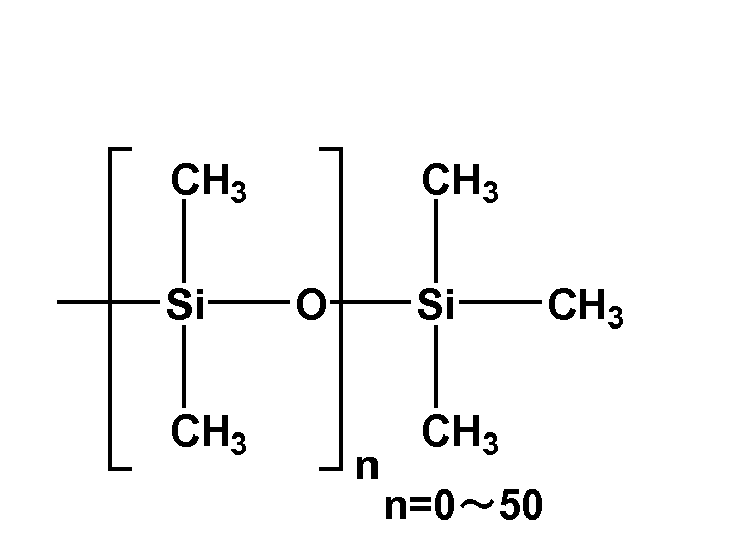
- W 2 preferably has a fluorinated group, more preferably a perfluorinated group, having 1 to 200 carbon atoms, wherein R 2 and R 3 each are, independent of each other, a group selected from an alkyl group and an aryl group, have 1 to 200 carbon atoms and may optionally be substituted with one or more fluorine atoms and; and n is an integer of from 0 to 50.
- Q in formula (1) is, independently of each other, a divalent organic group having 2 to 12 carbon atoms and is a linking group between Rf and W 1 and between Rf and W 2 .
- Q may have one or more oxygen atoms, nitrogen atoms or fluorine atoms.
- W 2 is an alkyl group, an alkenyl group, an alkenyloxyalkyl group or an aryl group, W 2 is not always distinguishable from Q, so that, for instance, the terminal of W 2 may be Q at the same time.
- At least one, preferably at least two, and at most 20, preferably at most 10, groups represented by formula (2) are present in a molecule, wherein X is a hydrolysable group, R 1 is an alkyl group of 1 to 4 carbon atoms or a phenyl group, y is an integer of from 1 to 5, and a is 2 or 3.
- X may be same as or different from each other.
- Preferred examples of X include an alkoxy group having 1 to 10 carbon atoms, such as a methoxy group, an ethoxy group, a propoxy group, and a butoxy group; an oxyalkoxy group having 2 to 10 carbon atoms, such as a methoxymethoxy group and a methoxyethoxy group; an acyloxy group having 1 to 10 carbon atoms, such as an acetoxy group; an alkenyloxy group having 2 to 10 carbon atoms, such as an isopropenoxy group; and halogen atoms, such as a chlorine atom, a bromine atom, and an iodine atom.
- a methoxy group, an ethoxy group, an isopropenoxy group, and a chlorine atom are preferred.
- R 1 examples include a methyl group, an ethyl group, and a phenyl group. Inter alia, a methyl group is preferred.
- a is 2 or 3, preferably 3 for better reactivity and adhesion to a substrate.
- y is 2 or more, preferably 2 to 5 for better balance between adhesion to a substrate and surface properties.
- p is an integer of from 1 to 20 and preferably selected so as to meet the desires for properties. For instance, a smaller p is preferred for a slipping property, and a bigger p is preferred for durability.
- p is preferably from 1 to 5, more preferably 1 or 2, for the application in mobile phones, touch panels, and lenses of spectacles which require routine wiping.
- p is preferably 3 to 10 for the displays of electronic devices, television sets or large size displays installed in the open air.
- the perfluoropolyoxyalkylene group-containing polymer of the present invention can be prepared by subjecting an organosiloxane having reactive groups, such as Si-H bonds, on both ends of W 1 , and a fluorine compound having unsaturated groups on both ends of Rf in a ratio of 1 : 2 to an addition reaction in the presence of a catalyst for the addition reaction, such as platinum catalyst according to a conventional method and, then, addition reacting a compound having W 2 to the unreacted unsaturated group of Rf.
- a catalyst for the addition reaction such as platinum catalyst according to a conventional method
- the present invention also provides a surface treating agent composition
- a surface treating agent composition comprising, as an essential component, the afore-mentioned perfluoropolyoxyalkylene group-containing polymer and/or a partial hydrolysis condensate thereof.
- the surface treating agent may further comprise, if needed, a catalyst for hydrolysis condensation, for instance, organic titanium compounds such as tetra-n-butyltitanate; organic tin compounds such as dibutyltin dimethoxide and dibutyltin dilaurate; oragnic acids such as acetic acid, methanesulfonic acid, and carboxylic acid; inorganic acids such as hydrochloric acid and sulfuric acid.
- the addition amount is a catalytic amount, generally, 0.01 to 5 parts by weight, particularly 0.1 to 1 part by weight, relative to 100 parts by weight of the silane and/or the partial hydrolysis condensate thereof.
- the surface treating agent of the present invention may be diluted with an appropriate solvent.
- the solvent include fluorinated aliphatic hydrocarbon solvents such as perfluoroheptane and perfluorooctane; fluorinated aromatic hydrocarbon solvents such as m-xylenehexafluoride and benzotrifluoride; fluorinated ether solvents such as methy perfluorobutylether and perfluoro(2-butyltetrahydrofurane); fluorinated alkylamine solvents such as perfluorotributylamine and perfluorotripentylamine; hydrocarbon solvents such as petroleum benzine, mineral spirits, toluene, and xylene; and ketone solvents such as acetone, methyl ethyl ketone, and methyl isobutyl ketone.
- fluorinated solvents are preferred for better solubility and wetting proprety.
- fluorinated solvents are preferred for better solubility and wetting proprety.
- m-xylenehexafluoride, perfluoro(2-butyltetrahydrofurane), perfluorotributylamine and a mixture thereof are preferred.
- the content of the silane according to formula (1) and/or the partial hydrolysis condensate thereof in the surface treating agent is preferably 0.01 to 50 % by weight, particularly 0.05 to 20 % by weight.
- the surface treating agent of the present invention may be mixed with another surface treating agent or a silane coupling agent or may be added to various kinds of functional coating agents such as a hard coat agent, an anti-reflection coating agent, and an anti-dazzle coating agent.
- the surface treating agent of the present invention which is diluted with a solvent as described above may be applied in any known application methods, such as brushing, dipping, spraying, spin coating, and vapor deposition.
- the optimum temperature at which the agent is applied depends on each application method. For instance, a temperature of from room temperature to 120 degrees C is desirable in the case of brushing or dipping.
- the agent is desirably applied under humidification for promoting the reaction.
- the treatment conditions depend upon a silane compound or other additives used and, therefore, are desirably optimized for each treatment.
- a substrate to be treated with the surface treating agent is not limited to any particular one. Use may be made of various kinds of materials, such as paper, cloth, metal or oxide thereof, glass, plastics, ceramic ware and ceramics. These substrates may be treated with a silane coupling agent, a primer, a hard coat agent, or an anti-reflection agent beforehand.
- the present agent may be used not only for water- and oil-repellent treatment or stainproof treatment, but also in an adhesive tape and a resin-shaping mold as a releasing agent.
- the film thickness of the cured coating formed on a surface of various substrates described above is properly selected depending on kinds of the substrates, and is generally from 0.1 nm to 5 micrometers, particularly from 1 to 100 nm. In the case where the agent is used on an anti-reflection film, the thickness is preferably 10 nm or less so as not to affect optical properties.
- the surface treating agent of the present invention can be used in the following applications: coating for preventing stain by fingerprint or sebum from adhering to car navigation equipments, mobile phones, digital cameras, digital camcorders, PDA's, portable audio players, car audio devices, game machines, lenses of spectacles, lenses of cameras, filters of lenses, dark glasses, medical devices such as gastric cameras, copy machines, personal computers, liquid crystal displays, organic EL displays, plasma displays, touch panel displays, protection films, and optical parts such as anti-reflection films; water-repellent, stainproof coating for sanitary products such as bathtubs and washbasins; stainproof coating for window glass of automobiles, trains, and airplanes and head lamp covers; water repellent, stainproof coating for building material for exterior wall; grease build-up preventing coating for kitchen building material; water repellent, stainproof, bill-, poster- and graffiti-preventing coating for telephone booths; water repellent coating for preventing adhesion of finger print on artworks; coating for preventing adhesion of fingerprint on compact discs and DVD'
- the dynamic friction coefficient against Bemcot from Asahi Kasei was measured in the following conditions on a surface property test machine from Shinto Scientific Co., Ltd.
- Abrasion procedure on the cured coating was performed on a reciprocating abrasion test machine, HEIDON 30S from Shinto Scientific Co., Ltd., in the following conditions.
- Rf -CF 2 (OCF 2 CF 2 ) p (OCF 2 ) q
- the structure of the main component of the obtained compound 1 is determined to be such represented by the following formula.
- Rf 1 - Rf -CH 2 -O-(CH 2 ) 3 - W 1 -(CH 2 ) 3 -O-CH 2 - Rf - Rf : -CF 2 (OCF 2 CF 2 ) p (OCF 2 ) q OCF 2 -
- the obtained compound 2 is determined to be represented by the following structure formula.
- Rf 1 - Rf -CH 2 O - (CH 2 ) 3 - W 1 -(CH 2 ) 3 -O-CH 2 - Rf - Rf : -CF 2 (OCF 2 CF 2 ) p (OCF 2 ) q OCF 2 -
- the obtained compound 3 is determined to be represented by the following structure formula.
- Rf 1 - Rf -CH 2 -O - (CH 2 ) 3 - W 1 -(CH 2 ) 3 -O-CH 2 - Rf - Rf : -CF 2 (OCF 2 CF 2 ) p (OCF 2 ) q OCF 2 -
- a cylindrical porous ceramic pellet of 5 mm in diameter and 3mm in height was impregnated with 0.5 g of a solution of 20 g of compound 1 dissolved in 80 g of m-xylenehexafluoride and, then, dried at 70 degrees C for 1 hour.
- the pellet was placed on a molybdenum board which is an electric resistance heating body, and placed inside a vacuum vapor deposition device (HSV-3-3G from Sato Vac Inc.). Separately, six pieces of slide glass were also placed inside the afore-mentioned vacuum deposition device. Then, the device was evacuated until the pressure in the vacuum deposition device was 5 X 10 -3 Torr or lower.
- the afore-mentioned molybdenum board was heated to 500 degrees C or higher to vacuum deposit compound 1 on the slide glass.
- the obtained slide glass was left for 24 hours in an atmosphere of 25 degrees C and a humidity of 40 %.
- three pieces of the glass were immediately evaluated for the afore-mentioned properties.
- the other three pieces were subjected to the afore-mentioned abrasion procedure and, then, evaluated for the afore-mentioned properties.
- X is a mixture of the following (c) and (d) in a ratio of 57: 43.
- Compound 6 of Comparative Example 4 and Compound 7 of Comparative Example 5 have a polydimethylsiloxane group and, therefore, the slipping property was good. However, the both ends bonded to the substrate and, therefore, the slipping property was worse than in the Examples.
- the perfluoropolyoxyalkylene group-containing polymer of the present invention has a good surface slipping property and a stain wiping property and, therefore, can provide a coating with less deterioration in the performance, even where the stain wiping is performed daily. Therefore, the present polymer can be used suitably in articles of which slipping property and stain wiping property are important, such as mobile phones, PDA's, portable music players, car navigation equipments, ATM's, and lenses of spectacles.
Landscapes
- Chemical & Material Sciences (AREA)
- Organic Chemistry (AREA)
- Chemical Kinetics & Catalysis (AREA)
- Polymers & Plastics (AREA)
- Health & Medical Sciences (AREA)
- Medicinal Chemistry (AREA)
- Materials Engineering (AREA)
- Wood Science & Technology (AREA)
- Engineering & Computer Science (AREA)
- Life Sciences & Earth Sciences (AREA)
- General Chemical & Material Sciences (AREA)
- Paints Or Removers (AREA)
- Polyethers (AREA)
- Materials Applied To Surfaces To Minimize Adherence Of Mist Or Water (AREA)
- Silicon Polymers (AREA)
Abstract


Description
- This application claims the benefits of Japanese Patent Application No.
2008-196812 filed on July 30, 2008 - The present invention relates to a polymer having a perfluoropolyether moiety, more specifically a polymer having a perfluoropolyether moiety having a hydrolysable group on at least one site other than both ends of its molecule chain to form a water- and oil-repellent coating; a surface treating agent composition which comprises the polymer and has good adhesion to a substrate and good curability, and the surface which is treated therewith is water- and oil-repellent and has a low dynamic friction coefficient; and an stain resistant article the surface of which has a low dynamic friction coefficient.
- Conventionally, window glass and bodies of transportation devices and window glass or outer walls of high-rise buildings are surface treated for water repellency, oil repellency or hydrophylicity in order to prevent stain. Particularly recently, the surfaces of flat-screen television sets, mobile phones, touch panels, car-navigation equipments, and portable audio players are given "stainproof' treatment or "stain easy to be removed" treatment for better appearance or visibility.
- Visual devices are generally equipped with an anti-reflection film on the surface. The anti-reflection film is easily stained by stain, such as sebum, fingerprint, sweat, spit, and hairdressings. The anti-reflection film has such drawbacks, compared to a simple transparent panel, that the stain changes a degree of surface reflection of the film or that the stain stands out against a background as a white body to make images displayed thereon obscure. Therefore, it has been desired for a long time to provide an anti-reflection film which is good in an stainproof property and a stain-removing property and can keep the stainproof property for a longer time.
- Generally, perfluoropolyoxyalkylene group-containing compounds have very small surface free energy, and, therefore, have water- and oil-repellency, an anti-chemical property, a lubrication property, a releasing property, and an stainproof property. Accordingly, the perfluoropolyoxyalkylene group-containing compounds are widely used to utilize their properties as a water-and oil-repellent, stainproof agent for paper and fiber; an anti-oil agent for precision instruments; a sealing agent; a releasing agent; and an stainproof agent and an anti-scratch agent in cosmetics, protection films and optical materials such as lenses, anti-reflection films, and recoding media.
- For instance, the perfluoropolyoxyalkylene group-containing silane coupling agent is known which is represented by the following formula. The coupling agent has two or three hydrolysable groups on both ends and, therefore, is good in adhesion to a substrate and the surface which is treated with the afore-mentioned coupling agent is water- and oil-repellent and stain is easily wiped off (patent literature 1).

- Recently, displays of many instruments such as touch panels and various kinds of electronic devices need to be daily wiped to clean. Then, requirements for a surface slipping property and an anti-abrasion property in wiping are becoming stricter. In order to meet such requirements, the present inventors proposed a silane coupling agent containing a perfluoropolyoxyalkylene group having a hydrolysable group at one end (patent literature 2). The inventors also proposed a surface treating agent comprising a perfluoropolyether-polysiloxane copolymer which improves the touch of surface (patent literature 3).
- [Patent literature 1] Japanese Patent Application Laid-Open No.
2003-238577 - [Patent literature 2] Japanese Patent Application Laid-Open No.
2007-297589 - [Patent literature 3] Japanese Patent Application Laid-Open No.
2008-088412 - Further, the inventors also proposed a surface-treating agent comprising a perfluoropolyether-polysiloxane copolymer having hydrolysable groups at both ends and in a molecular chain (Japanese Patent Application No.
2007-311075 - Thus, the present invention provides a perfluoropolyoxyalkylene group-containing polymer represented by the following formula (1),


- The present invention also provides a surface treating agent containing the afore-mentioned perfluoropolyoxyalkylene group-containing polymer as an essential component; and an article having a cured coating made from the perfluoropolyoxyalkylene group-containing polymer and/or a partial hydrolysis condensate thereof as an essential component on the surface thereof, in particular, an anti-reflection filter, a polarization plate, glass, a resin film and a cover glass whose surface slipping property is good and stain can be easily wiped off.
-
-
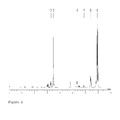
Figure 1 is an NMR chart of compound 1 prepared in Preparation Example 1. -
Figure 2 is an NMR chart of compound 2 prepared in Preparation Example 2. -
Figure 3 is an NMR chart of compound 3 prepared in Preparation Example 3. - The perfluoropolyoxyalkylene group-containing polymer represented by the afore-mentioned formula (1) has a hydrolysable group around the central part of the molecular chain and, further, has a group selected from the particular groups on the ends of the molecule and, therefore, can give a surface a good surface slipping property without lowering the other properties such as an anti-abrasion property.
- The present invention will be further explained in detail. In the following formula (1),

- For the afore-mentioned repeating unit represented by the aforementioned formula -CcF2cO-, mention may be made of the following units and the combinations of the two or more thereof.
- -CF2O-
- -CF2CF2O-
- -CF2CF2CF2O-
- -CF(CF3)CF2O-
- -CF2CF2CF2CF2O-
- -CF2CF2CF2CF2CF2CF2O-
- -C(CF3)2O-
- Among these, preferred are the groups having the following perfluorooxyalkylene group having 1 to 4 carbon atoms as the repeating unit.
- -CF2O-
- -CF2CF2O-
- -CF2CF2CF2O-
- -CF(CF3)CF2O-
- Preferably, Rf is selected from the group consisting of the groups represented by the following general formula (4), (5) or (6),

-CeF2e(OCF2CF2CF2)jOCeF2e- (5)
wherein j is an integer of from 1 to 100 and e is an integer of from 1 to 3,
-CF2(OCF2CF2)m(OCF2)nOCF2- (7)
wherein m is an integer of from 0 to 50, n is an integer of from 1 to 50, provided that a total of m and n is an integer of from 2 to 60. - The total number of the repeating units which are represented in the parentheses in the afore-mentioned chemical structural formulas is in the range of from 2 to 80, preferably from 10 to 50.
- For the group W1 having a group represented by formula (2) which has at least one hydrolysable group, mention may be made of a group represented by the following general formula (A) or (B),
SinR2 2n-k(CyH2ySiR1 3-aXa)kOn-1 (A)
SimR2m-2-k(CyH2ySiR1 3-aXa)kOm (B)
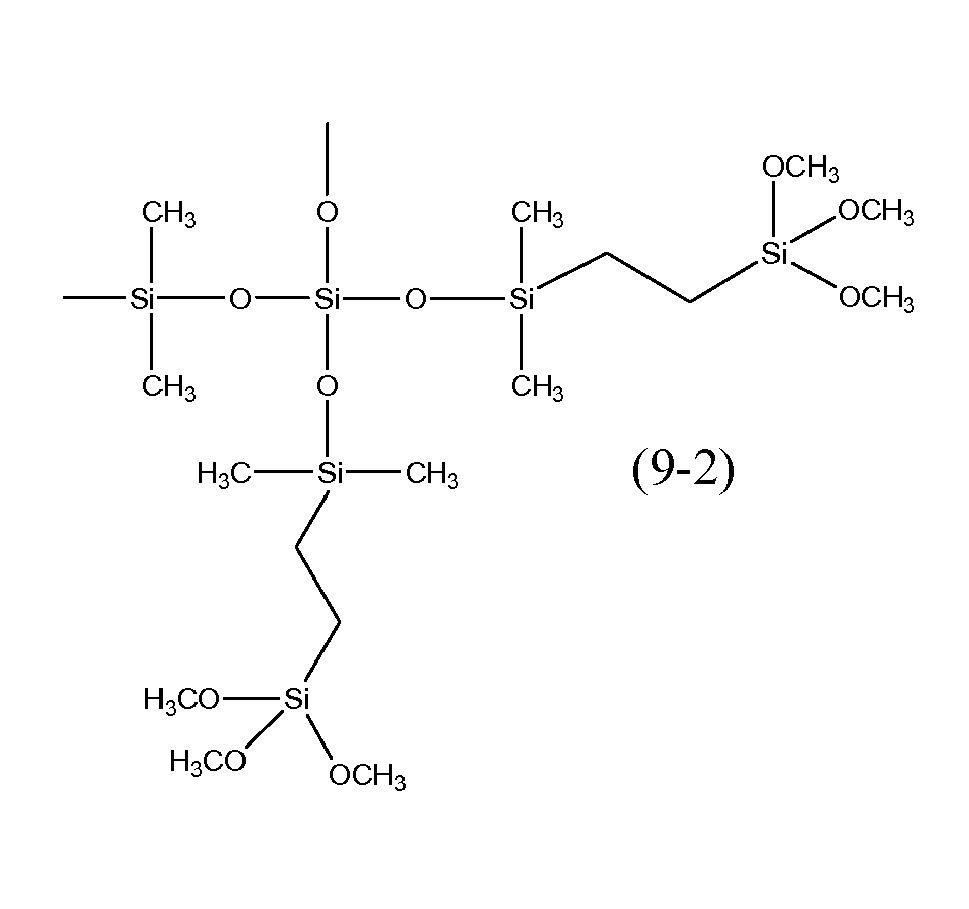
wherein R2 is, independently of each other, a hydrogen atom or a monovalent hydrocarbon group, such as an alkyl group, in particular, a methyl group. R1 is an alkyl group of 1 to 4 carbon atoms or a phenyl group, y is an integer of from 1 to 5, X is a hydrolysable group, and a is 2 or 3. n is an integer of from 4 to 42, preferably from 4 to 12; m is an integer of from 3 to 5; and k is an integer of from 1 to 5. - For examples of the groups represented by formula (A) or (B), mention may be made of the groups represented by the following formulas (8) to (10). The group represented by formula (8) is such that X in formula (A) is a methoxy group, R2 is a methyl group, y = 2, n = 4, and k = 1. For the group represented by (9-1) or (9-2), n = 4 or 5 and k = 2, respectively. For the group represented by formula (10-1), X in formula (B)is a methoxy group, m = 4 and k=2.




- In formula (1), W2 is a monovalent group selected from an alkyl group, an alkenyl group, an alkenyloxyalkyl group, an aryl group and an organosiloxane group represented by the following formula (3), and combinations thereof, the monovalent group having 1 to 300 carbon atoms, preferably 1 to 200 carbon atoms, and being optionally substituted with one or more fluorine atoms. W2 does not react with a substrate under conditions where the hydrolysable group X in formula (2) hydrolyzes. No physical interaction occurs which worsens the surface slipping property with the substrate. For a high water- and oil-repellency, W2 preferably has a fluorinated group, more preferably a perfluorinated group, having 1 to 200 carbon atoms,

- Examples of W2 include groups represented by the following formulas.
-(CmH2mO)n-CH3
m=1∼3 n=0∼20
-(CH2)n-CH3
n=0∼20
-(CH2)n-CH=CH2
n=0∼20


- Q in formula (1) is, independently of each other, a divalent organic group having 2 to 12 carbon atoms and is a linking group between Rf and W1 and between Rf and W2. Q may have one or more oxygen atoms, nitrogen atoms or fluorine atoms. For instance, mention may be made of the following groups having an amide group, an ether group, an ester group or a vinyl group. In the case where W2 is an alkyl group, an alkenyl group, an alkenyloxyalkyl group or an aryl group, W2 is not always distinguishable from Q, so that, for instance, the terminal of W2 may be Q at the same time.


- At least one, preferably at least two, and at most 20, preferably at most 10, groups represented by formula (2) are present in a molecule,

- In formula (2), X may be same as or different from each other. Preferred examples of X include an alkoxy group having 1 to 10 carbon atoms, such as a methoxy group, an ethoxy group, a propoxy group, and a butoxy group; an oxyalkoxy group having 2 to 10 carbon atoms, such as a methoxymethoxy group and a methoxyethoxy group; an acyloxy group having 1 to 10 carbon atoms, such as an acetoxy group; an alkenyloxy group having 2 to 10 carbon atoms, such as an isopropenoxy group; and halogen atoms, such as a chlorine atom, a bromine atom, and an iodine atom. Inter alia, a methoxy group, an ethoxy group, an isopropenoxy group, and a chlorine atom are preferred.
- Examples of R1 include a methyl group, an ethyl group, and a phenyl group. Inter alia, a methyl group is preferred. "a" is 2 or 3, preferably 3 for better reactivity and adhesion to a substrate. "y" is 2 or more, preferably 2 to 5 for better balance between adhesion to a substrate and surface properties.
- In formula (1), p is an integer of from 1 to 20 and preferably selected so as to meet the desires for properties. For instance, a smaller p is preferred for a slipping property, and a bigger p is preferred for durability. "p" is preferably from 1 to 5, more preferably 1 or 2, for the application in mobile phones, touch panels, and lenses of spectacles which require routine wiping. "p" is preferably 3 to 10 for the displays of electronic devices, television sets or large size displays installed in the open air.
- The perfluoropolyoxyalkylene group-containing polymer of the present invention can be prepared by subjecting an organosiloxane having reactive groups, such as Si-H bonds, on both ends of W1, and a fluorine compound having unsaturated groups on both ends of Rf in a ratio of 1 : 2 to an addition reaction in the presence of a catalyst for the addition reaction, such as platinum catalyst according to a conventional method and, then, addition reacting a compound having W2 to the unreacted unsaturated group of Rf. Alternatively, first a structure, Rf-Q-W2, may be prepared and, then reacted with an organosiloxane having W1.
- The present invention also provides a surface treating agent composition comprising, as an essential component, the afore-mentioned perfluoropolyoxyalkylene group-containing polymer and/or a partial hydrolysis condensate thereof. The surface treating agent may further comprise, if needed, a catalyst for hydrolysis condensation, for instance, organic titanium compounds such as tetra-n-butyltitanate; organic tin compounds such as dibutyltin dimethoxide and dibutyltin dilaurate; oragnic acids such as acetic acid, methanesulfonic acid, and carboxylic acid; inorganic acids such as hydrochloric acid and sulfuric acid. If these catalysts are fluorionated, such are much preferred for solubility. Among these, acetic acid, tetra-n-butyltitanate, and perfluorocarboxylic acids are particularly desirable. The addition amount is a catalytic amount, generally, 0.01 to 5 parts by weight, particularly 0.1 to 1 part by weight, relative to 100 parts by weight of the silane and/or the partial hydrolysis condensate thereof.
- The surface treating agent of the present invention may be diluted with an appropriate solvent. Examples of the solvent include fluorinated aliphatic hydrocarbon solvents such as perfluoroheptane and perfluorooctane; fluorinated aromatic hydrocarbon solvents such as m-xylenehexafluoride and benzotrifluoride; fluorinated ether solvents such as methy perfluorobutylether and perfluoro(2-butyltetrahydrofurane); fluorinated alkylamine solvents such as perfluorotributylamine and perfluorotripentylamine; hydrocarbon solvents such as petroleum benzine, mineral spirits, toluene, and xylene; and ketone solvents such as acetone, methyl ethyl ketone, and methyl isobutyl ketone. Among these, fluorinated solvents are preferred for better solubility and wetting proprety. Particularly, m-xylenehexafluoride, perfluoro(2-butyltetrahydrofurane), perfluorotributylamine and a mixture thereof are preferred.
- The content of the silane according to formula (1) and/or the partial hydrolysis condensate thereof in the surface treating agent is preferably 0.01 to 50 % by weight, particularly 0.05 to 20 % by weight.
- If needed, the surface treating agent of the present invention may be mixed with another surface treating agent or a silane coupling agent or may be added to various kinds of functional coating agents such as a hard coat agent, an anti-reflection coating agent, and an anti-dazzle coating agent.
- The surface treating agent of the present invention which is diluted with a solvent as described above may be applied in any known application methods, such as brushing, dipping, spraying, spin coating, and vapor deposition. The optimum temperature at which the agent is applied depends on each application method. For instance, a temperature of from room temperature to 120 degrees C is desirable in the case of brushing or dipping. For treatment humidity, the agent is desirably applied under humidification for promoting the reaction.
- The treatment conditions depend upon a silane compound or other additives used and, therefore, are desirably optimized for each treatment.
- A substrate to be treated with the surface treating agent is not limited to any particular one. Use may be made of various kinds of materials, such as paper, cloth, metal or oxide thereof, glass, plastics, ceramic ware and ceramics. These substrates may be treated with a silane coupling agent, a primer, a hard coat agent, or an anti-reflection agent beforehand. The present agent may be used not only for water- and oil-repellent treatment or stainproof treatment, but also in an adhesive tape and a resin-shaping mold as a releasing agent.
- The film thickness of the cured coating formed on a surface of various substrates described above is properly selected depending on kinds of the substrates, and is generally from 0.1 nm to 5 micrometers, particularly from 1 to 100 nm. In the case where the agent is used on an anti-reflection film, the thickness is preferably 10 nm or less so as not to affect optical properties.
- The surface treating agent of the present invention can be used in the following applications: coating for preventing stain by fingerprint or sebum from adhering to car navigation equipments, mobile phones, digital cameras, digital camcorders, PDA's, portable audio players, car audio devices, game machines, lenses of spectacles, lenses of cameras, filters of lenses, dark glasses, medical devices such as gastric cameras, copy machines, personal computers, liquid crystal displays, organic EL displays, plasma displays, touch panel displays, protection films, and optical parts such as anti-reflection films; water-repellent, stainproof coating for sanitary products such as bathtubs and washbasins; stainproof coating for window glass of automobiles, trains, and airplanes and head lamp covers; water repellent, stainproof coating for building material for exterior wall; grease build-up preventing coating for kitchen building material; water repellent, stainproof, bill-, poster- and graffiti-preventing coating for telephone booths; water repellent coating for preventing adhesion of finger print on artworks; coating for preventing adhesion of fingerprint on compact discs and DVD's; and for modifying flowability and dispersibility of paint additives, resin modifying agents, and inorganic fillers, or improving a lubrication property of tapes and films.
- The present invention will be explained in detail by the reference to the Examples and to the Comparative Examples, but shall not be limited thereto.
- The evaluation methods used in the Examples are as follows.
- Water contact angles and oleic acid contact angles of the cured coating were measured on a contact angle meter, Drop Master from Kyowa Interface Science Co., Ltd.
- The dynamic friction coefficient against Bemcot from Asahi Kasei was measured in the following conditions on a surface property test machine from Shinto Scientific Co., Ltd.
- Contact area: 35mm x 35mm
- Load:200g
- Seven panelists each rubbed the surface of a cured coating on a substrate with their thumb via a piece of Bemcot (ex Asahi Kasei) to evaluate the slipping property, based on the following evaluation criteria.
- A: especially good,
- B: good,
- C: average,
- D:bad.
- Seven panelists each smeared sebum of their forehead on the surface of a cured coating with their finger, wiped off the sebum stain with a piece of Bemcot (ex Asahi Kasei) to evaluate the wiping property based on the following evaluation criteria.
- A: easily wiped off,
- B: possible to wipe off,
- C: sebum remains slightly after the wiping,
- D: impossible to wipe off.
- Abrasion procedure on the cured coating was performed on a reciprocating abrasion test machine, HEIDON 30S from Shinto Scientific Co., Ltd., in the following conditions.
- Evaluation environment conditions: 25 degrees C, humidity of 40 %
- Rubbing member: the tip of the tester (20 mm x 30 mm) to be contacted with a sample was wrapped with a pile of eight pieces of non-woven cloth and fixed with a rubber band.
- Load: 1 kg
- Rubbing distance (one way): 40 mm
- Rubbing speed: 4,800mm/min
- Number of reciprocation: 10,000
- 1,100 g of the perfluoropolyether having unsaturated bonds on the both ends, represented by the following formula (I)

Rf: -CF2(OCF2CF2)p(OCF2)qOCF2-
(p/q = 0.9, p + q = 45 on average),
56 g of the siloxane having SiH groups on the both ends, represented by the following formula (II),
- The 1H-NMR spectrum of compound 1 is shown in
Figure 1 and the chemical shifts are shown below.
1H-NMR (reference: TMS, ppm)
≡ SiCH2CH2Si≡ 0.5∼0.7ppm

-CH2CH2Si≡ 1.6∼1.8ppm
-SiOCH3 3.4∼3.7ppm
-CH2OCH2- 3.6∼3.8ppm
H2C=CH-CH 2-O- 4.0∼4.2ppm
H2C=CH-CH2-O- 5.1∼5.3ppm
H2C=CH-CH2-O- 5.7∼5.9ppm
- Based on the afore-mentioned results, the structure of the main component of the obtained compound 1 is determined to be such represented by the following formula.

Rf1 : -Rf-CH2-O-(CH2)3-W1 -(CH2)3-O-CH2-Rf-
Rf : -CF2(OCF2CF2)p(OCF2)qOCF2-

- 50 g of compound 1, 1.9 g of pentamethyldisiloxane, and 100 g of m-xylenehexafluoride were mixed with stirring, and heated to 90 degrees C. Then, 0.18 g of a solution of chloroplatinic acid/vinyl siloxane complex in toluene (containing 4.5 X 10⁻⁸ mole of Pt) was added and, then stirred at 90 degrees C for 3 hours. Subsequently, the solvent and the unreacted siloxane were distilled off under reduced pressure to obtain 48 g of a pale yellow, transparent liquid, perfluoropolyether, hereinafter referred to as compound 2.
- The 1H-NMR chart of compound 2 is shown in
Figure 2 and the chemical shifts are shown below.
1H-NMR (reference: TMS, ppm)
≡ SiCH2CH2Si≡ 0.5∼0.7ppm

-CH2CH2Si≡ 1.6∼1.8ppm
-SiOCH3 3.4∼3.7ppm
-CH2OCH2- 3.6∼3.8ppm
- Based on the afore-mentioned results, the obtained compound 2 is determined to be represented by the following structure formula.

Rf1 : -Rf-CH2O-(CH2)3-W1 -(CH2)3-O-CH2-Rf-
Rf : -CF2(OCF2CF2)p(OCF2)qOCF2-


- 50 g of compound 1, 8.3 g of the fluorine-containing siloxane represented by the following formula (III), and 100 g of m-xylenehexafluoride were mixed with stirring and heated to 90 degrees C. Then, 0.18 g of a solution of chloroplatinic acid/vinyl siloxane complex in toluene (containing 4.5 X 10⁻⁸ mole of Pt) was added and, then stirred at 90 degrees C for 3 hours. Subsequently, the solvent and the unreacted siloxane were distilled off under reduced pressure to obtain 52 g of a pale yellow, transparent liquid, perfluoropolyether, hereinafter referred to as compound 3.


- The 1H-NMR chart of compound 3 is shown in
Figure 3 and the chemical shifts are shown below.
1H-NMR (reference: TMS, ppm)
≡ SiCH2CH2Si≡ 0.5∼0.7ppm

-CH2CH2Si≡ 1.6∼1.8ppm
-SiOCH3 3.4∼3.7ppm
-CH2OCH2- 3.6∼3.8ppm
- Based on the afore-mentioned results, the obtained compound 3 is determined to be represented by the following structure formula.

Rf1 : -Rf-CH2-O-(CH2)3-W1 -(CH2)3-O-CH2-Rf-
Rf : -CF2(OCF2CF2)p(OCF2)qOCF2-


- A cylindrical porous ceramic pellet of 5 mm in diameter and 3mm in height was impregnated with 0.5 g of a solution of 20 g of compound 1 dissolved in 80 g of m-xylenehexafluoride and, then, dried at 70 degrees C for 1 hour. The pellet was placed on a molybdenum board which is an electric resistance heating body, and placed inside a vacuum vapor deposition device (HSV-3-3G from Sato Vac Inc.). Separately, six pieces of slide glass were also placed inside the afore-mentioned vacuum deposition device. Then, the device was evacuated until the pressure in the vacuum deposition device was 5 X 10⁻³ Torr or lower. Subsequently, the afore-mentioned molybdenum board was heated to 500 degrees C or higher to vacuum deposit compound 1 on the slide glass. The obtained slide glass was left for 24 hours in an atmosphere of 25 degrees C and a humidity of 40 %. Then, three pieces of the glass were immediately evaluated for the afore-mentioned properties. The other three pieces were subjected to the afore-mentioned abrasion procedure and, then, evaluated for the afore-mentioned properties.
- Compound 2 was evaluated in the same manner as in Example 1, except that compound 2 was used instead of compound 1 in Example 1.
- Compound 3 was evaluated in the same manner as in Example 1.
- The following compounds 4 to 11 were evaluated in the same manner as in the Examples.
-

Rf : -CF2(OCF2CF2)p(OCF2)qOCF2-
(p/q = 0.9, p + q = 45 on average) -

Rf : -CF2(OCF2CF2)p(OCF2)qOCF2-
(p/q=0.9, p + q = 45 on average) -

Rf: -CF2(OC2F4)p(OCF2)qOCF2- p/q=0.9 p+q≒45


-

Rf: -CF2(OC2F4)p(OCF2)qOCF2- p/q=0.9 p+q≒45


-

Rf: -CF2(OC2F4)p(OCF2)qOCF2- p/q=0.9 p+q≒45


-

-

Rf: -CF2(OC2F4)p(OCF2)qOCF2-
(p/q = 0.9, p + q = 45 on average) - In compound 10, X is a mixture of the following (c) and (d) in a ratio of 57: 43.


-
W3-Q-Rf-Q-W1-Q-Rf-O-W3


- The results in the evaluation made immediately after the coating was prepared are as seen in Table 1 and those after the abrasion procedure are as seen in Table 2.
-
Table 1 Water Contact Angle (° ) Oleic Acid Contact Angle (° ) Dynamic Friction Coefficient Slipping Property Stain Wiping Property Example 1 Compound 1 105 65 0.05 A A Example 2 Compound 2 104 64 0.05 A A Example 3 Compound 3 108 67 0.06 A A Comparative Example 1 Compound 4 107 66 0.12 C A Comparative Example 2 Compound 5 110 69 0.10 C A Comparative Example 3 Compound 6 108 65 0.08 B A Comparative Example 4 Compound 7 104 60 0.03 B B Comparative Example 5 Compound 8 103 60 0.03 B B Comparative Example 6 Compound 9 113 73 0.21 D B Comparative Example 7 Compound 10 106 66 0.08 B A Reference Exampe 1 Compound 11 106 65 0.10 C A -
Table 2 Water Contact Angle (° ) Oleic Acid Contact Angle (° ) Dynamic Frication Coefficient Slipping Property Stain Wiping Property Example 1 Compound 1 102 64 0.08 A A Example 2 Compound 2 103 63 0.08 A A Example 3 Compound 3 105 65 0.09 B A Comparative Example 1 Compound 4 105 64 0.15 C B Comparative Example 2 Compound 5 98 58 0.15 C C Comparative Example 3 Compound 6 98 59 0.15 B C Comparative Example 4 Compound 7 102 56 0.14 B D Comparative Example 5 Compound 8 100 55 0.12 B D Comparative Example 6 Compound 9 92 56 0.26 D C Comparative Example 7 Compound 10 102 64 0.12 C B Reference Example 1 Compound 11 106 65 0.12 C A - As seen in Tables 1 and 2, all of the coatings of the Examples had a low dynamic friction coefficient, a good slipping property and a good stain wiping property even after the abrasion procedure.
The compound of Comparative Example 1 has many hydrolysable groups on the ends and, therefore, the durability of the contact angle was good but the surface slipping property was bad. This applies also to Comparative Example 7 on the compounds which has the terminal group represented by formula (d) and Reference Example 1.
Compound 5 of Comparative Example 2 has the siloxane moiety only on its ends, and the siloxane moiety of compound 6 of Comparative Example 3 is short and, therefore, the anti-abrasion property was bad.
Compound 6 of Comparative Example 4 and Compound 7 of Comparative Example 5 have a polydimethylsiloxane group and, therefore, the slipping property was good. However, the both ends bonded to the substrate and, therefore, the slipping property was worse than in the Examples. - The perfluoropolyoxyalkylene group-containing polymer of the present invention has a good surface slipping property and a stain wiping property and, therefore, can provide a coating with less deterioration in the performance, even where the stain wiping is performed daily. Therefore, the present polymer can be used suitably in articles of which slipping property and stain wiping property are important, such as mobile phones, PDA's, portable music players, car navigation equipments, ATM's, and lenses of spectacles.
Claims (12)
- A perfluoropolyoxyalkylene group-containing polymer represented by the following formula (1),


- The perfluoropolyoxyalkylene group-containing polymer according to claim 1, wherein Rf in formula (1) is a group containing a divalent perfluorooxyalkylene group represented by the following formula,
-(CcF2cO)d-
wherein c in the repeating unit is, independently of each other, an integer of from 1 to 6; and d is an integer of from 2 to 100. - The perfluorooxyalkylene group-containing polymer according to claim 1 or 2, wherein Rf in formula (1) is selected from the group consisting of the groups represented by the following general formula (4), (5), or (6),

-CeF2e(OCF2CF2CF2)jOCeF2e- (5)
wherein j is an integer of from 1 to 100; and e is an integer of from 1 to 3,
- The perfluorooxyalkylene group-containing polymer according to claim 3, wherein Rf in formula (1) is represented by the following general formula (7),
-CF2(OCF2CF2)m(OCF2)nOCF2- (7)
wherein m is an integer of from 0 to 50; and n is an integer of from 1 to 50, provided that a total of m and n is an integer of from 2 to 60. - The perfluoropolyoxyalkylene group-containing polymer according to any one of claims 1 to 4, wherein W1 is a group represented by the following general formula (A) or (B),
SinR4 2n-k(CyH2ySiR1 3-aXa)kOn-1 (A)
SimR4 2m-2-k(CyH2ySiR1 3-aXa)kOm (B)
wherein R1, y, a, and X are as defined above; R4 is, independently of each other, a hydrogen atom or a monovalent hydrocarbon group; n is an integer of from 4 to 42; k is an integer of from 1 to 5; and m is an integer of from 3 to 5. - The perfluoropolyoxyalkylene group-containing polymer according to any one of claims 1 to 5, wherein X in formula (2) is an alkoxy group; and W1 is represented by the following formula (8) or (10-1).


- The perfluoropolyoxyalkylene group-containing polymer according to any one of claims 1 to 6, wherein X is an alkoxy group; and W2 is an organosiloxane group represented by formula (3), wherein R2 and R3 are an alkyl group having 1 to 4 carbon atoms or a phenyl group; and n is 1.
- The perfluoropolyoxyalkylene group-containing polymer according to any one of claims 1 to 6, wherein X in formula (2) is an alkoxy group and W2 is an alkenyl group.
- The perfluoropolyoxyalkylene group-containing polymer according to any one of claims 1 to 6, wherein X in formula (2) is an alkoxy group and W2 is an organosiloxane group represented by formula (3), wherein at least one R2 in formula (3) is a perfluoroalkyloxyalkyleneoxy group.
- The perfluoropolyoxyalkylene group-containing polymer according to any one of claims 1 to 9, wherein Q in formula (1) is a group having an amide bond, an ether bond, an ester bond or a vinyl bond.
- A surface treating agent composition comprising the perfluoropolyoxyalkylene group-containing polymer according to any one of claims 1 to 10 and/or a partial hydrolysis condensate thereof.
- An article having a cured coating made from the perfluoropolyoxyalkylene group-containing polymer according to any one of claims 1 to 10 and/or a partial hydrolysis condensate thereof on the surface thereof.
Applications Claiming Priority (1)
| Application Number | Priority Date | Filing Date | Title |
|---|---|---|---|
| JP2008196812A JP4709256B2 (en) | 2008-07-30 | 2008-07-30 | Perfluoroether part-containing polymer and surface treatment agent containing the polymer |
Publications (2)
| Publication Number | Publication Date |
|---|---|
| EP2154176A1 true EP2154176A1 (en) | 2010-02-17 |
| EP2154176B1 EP2154176B1 (en) | 2013-07-17 |
Family
ID=41334613
Family Applications (1)
| Application Number | Title | Priority Date | Filing Date |
|---|---|---|---|
| EP20090166776 Not-in-force EP2154176B1 (en) | 2008-07-30 | 2009-07-29 | Perfluoroether moiety-containing polymer and a surface treating agent comprising the same |
Country Status (3)
| Country | Link |
|---|---|
| US (1) | US8013096B2 (en) |
| EP (1) | EP2154176B1 (en) |
| JP (1) | JP4709256B2 (en) |
Families Citing this family (21)
| Publication number | Priority date | Publication date | Assignee | Title |
|---|---|---|---|---|
| JP2010250929A (en) * | 2009-03-27 | 2010-11-04 | Wd Media Singapore Pte Ltd | Lubricant compound for magnetic disk, magnetic disk and manufacturing method thereof |
| JP5570841B2 (en) * | 2010-02-24 | 2014-08-13 | 花王株式会社 | Cosmetics containing fluorine-modified silicone |
| KR101369381B1 (en) * | 2011-11-04 | 2014-03-06 | 에스케이이노베이션 주식회사 | Coating composition for low refractive layer comprising fluorine-containing compound, anti-reflection film using the same, polarizer and image displaying device comprising said anti-reflection film |
| US8864930B2 (en) * | 2012-07-30 | 2014-10-21 | PRC De Soto International, Inc. | Perfluoroether sealant compositions |
| US10150889B2 (en) | 2013-09-16 | 2018-12-11 | Honeywell International Inc. | Poly fluorine-containing siloxane coatings |
| CN104941467B (en) * | 2015-07-03 | 2017-03-08 | 华中科技大学 | A kind of preparation method of compound forward osmosis membrane |
| WO2017188331A1 (en) * | 2016-04-28 | 2017-11-02 | 住友化学株式会社 | Composition |
| JP7160850B2 (en) * | 2017-06-26 | 2022-10-25 | ダウ シリコーンズ コーポレーション | SILICONE POLYETHER COPOLYMERS, SEALANTS CONTAINING SAME, AND RELATED METHODS |
| CN111032337B (en) | 2017-08-17 | 2023-02-10 | 信越化学工业株式会社 | Water-repellent member and method of manufacturing water-repellent member |
| US10544260B2 (en) | 2017-08-30 | 2020-01-28 | Ppg Industries Ohio, Inc. | Fluoropolymers, methods of preparing fluoropolymers, and coating compositions containing fluoropolymers |
| JP6988905B2 (en) | 2017-10-03 | 2022-01-05 | 信越化学工業株式会社 | Water- and oil-repellent member and method for manufacturing water- and oil-repellent member |
| US12187931B2 (en) | 2018-04-24 | 2025-01-07 | Shin-Etsu Chemical Co., Ltd. | Release film for pressure-sensitive silicone adhesive and production method therefor |
| JP7211423B2 (en) | 2018-08-20 | 2023-01-24 | 信越化学工業株式会社 | Water- and oil-repellent member and method for manufacturing water- and oil-repellent member |
| KR102917549B1 (en) | 2019-05-14 | 2026-01-26 | 신에쓰 가가꾸 고교 가부시끼가이샤 | Water-repellent and oil-repellent member and method for manufacturing water-repellent and oil-repellent member |
| US12163044B2 (en) | 2019-08-20 | 2024-12-10 | Shin-Etsu Chemical Co., Ltd. | Water- and oil-repelling member and water- and oil-repelling member production method |
| CN114630871B (en) | 2019-10-31 | 2023-11-21 | 信越化学工业株式会社 | Alkali-resistant water-repellent member, method for producing same, and method for improving alkali resistance and abrasion resistance of water-repellent member |
| KR20240015668A (en) | 2021-05-31 | 2024-02-05 | 신에쓰 가가꾸 고교 가부시끼가이샤 | Water- and oil-repellent members with antibacterial, anti-fungal and anti-viral properties, methods and products for manufacturing water- and oil-repellent members |
| EP4382291A4 (en) | 2021-08-05 | 2025-07-09 | Shinetsu Chemical Co | ARTICLES WITH WATER AND OIL REPELLENT SURFACE LAYER |
| EP4382290A4 (en) | 2021-08-05 | 2025-07-30 | Shinetsu Chemical Co | ARTICLES WITH WATER AND OIL-REPELLENT SURFACE LAYER |
| CN119032012A (en) | 2022-04-19 | 2024-11-26 | 信越化学工业株式会社 | Method for producing water- and oil-repellent article and method for improving the removability of water and oil in water- and oil-repellent article |
| WO2025229833A1 (en) * | 2024-04-30 | 2025-11-06 | 信越化学工業株式会社 | Fluoropolyether-group-containing polymer composition, surface treatment agent, and article |
Citations (6)
| Publication number | Priority date | Publication date | Assignee | Title |
|---|---|---|---|---|
| JP2003238577A (en) | 2001-10-05 | 2003-08-27 | Shin Etsu Chem Co Ltd | Perfluoropolyether-modified silane and surface treatment agent, and antireflection filter |
| US20070149746A1 (en) * | 2005-12-26 | 2007-06-28 | Shin-Etsu Chemical Co., Ltd. | Fluorine-containing organopolysiloxane, a surface treatment composition comprising the same and an article treated with the composition |
| EP1813640A1 (en) * | 2006-01-25 | 2007-08-01 | Shin-Etsu Chemical Co., Ltd. | Fluorine-containing organopolysiloxane, a surface treatment composition comprising the same and an article treated with the composition |
| JP2007311075A (en) | 2006-05-16 | 2007-11-29 | Matsushita Electric Ind Co Ltd | Plasma display panel |
| EP1897899A1 (en) * | 2006-09-08 | 2008-03-12 | Shinetsu Chemical Co., Ltd. | Perfluoroployether-organopolysiloxane copolymer and a surface treatment composition comprising the same |
| JP2008196812A (en) | 2007-02-14 | 2008-08-28 | Fuji Electric Retail Systems Co Ltd | Refrigerant flow control device |
Family Cites Families (1)
| Publication number | Priority date | Publication date | Assignee | Title |
|---|---|---|---|---|
| JP4721459B2 (en) * | 2007-11-30 | 2011-07-13 | 信越化学工業株式会社 | Perfluoropolyether-polyorganosiloxane block copolymer and surface treatment agent containing the same |
-
2008
- 2008-07-30 JP JP2008196812A patent/JP4709256B2/en active Active
-
2009
- 2009-07-29 EP EP20090166776 patent/EP2154176B1/en not_active Not-in-force
- 2009-07-29 US US12/511,862 patent/US8013096B2/en active Active
Patent Citations (8)
| Publication number | Priority date | Publication date | Assignee | Title |
|---|---|---|---|---|
| JP2003238577A (en) | 2001-10-05 | 2003-08-27 | Shin Etsu Chem Co Ltd | Perfluoropolyether-modified silane and surface treatment agent, and antireflection filter |
| US20070149746A1 (en) * | 2005-12-26 | 2007-06-28 | Shin-Etsu Chemical Co., Ltd. | Fluorine-containing organopolysiloxane, a surface treatment composition comprising the same and an article treated with the composition |
| EP1813640A1 (en) * | 2006-01-25 | 2007-08-01 | Shin-Etsu Chemical Co., Ltd. | Fluorine-containing organopolysiloxane, a surface treatment composition comprising the same and an article treated with the composition |
| JP2007297589A (en) | 2006-01-25 | 2007-11-15 | Shin Etsu Chem Co Ltd | Fluorine-containing organopolysiloxane, surface treatment agent containing the same, and article treated with the surface treatment agent |
| JP2007311075A (en) | 2006-05-16 | 2007-11-29 | Matsushita Electric Ind Co Ltd | Plasma display panel |
| EP1897899A1 (en) * | 2006-09-08 | 2008-03-12 | Shinetsu Chemical Co., Ltd. | Perfluoroployether-organopolysiloxane copolymer and a surface treatment composition comprising the same |
| JP2008088412A (en) | 2006-09-08 | 2008-04-17 | Shin Etsu Chem Co Ltd | Perfluoropolyether-polyorganosiloxane copolymer and surface treatment agent containing the same |
| JP2008196812A (en) | 2007-02-14 | 2008-08-28 | Fuji Electric Retail Systems Co Ltd | Refrigerant flow control device |
Also Published As
| Publication number | Publication date |
|---|---|
| US20100029889A1 (en) | 2010-02-04 |
| EP2154176B1 (en) | 2013-07-17 |
| JP4709256B2 (en) | 2011-06-22 |
| JP2010031184A (en) | 2010-02-12 |
| US8013096B2 (en) | 2011-09-06 |
Similar Documents
| Publication | Publication Date | Title |
|---|---|---|
| EP2154176B1 (en) | Perfluoroether moiety-containing polymer and a surface treating agent comprising the same | |
| EP2157120B1 (en) | Fluorine-containing surface treating agent and an article surface-treated therewith | |
| EP2436716B1 (en) | Fluorooxyalkylene group-containing polymer composition, a surface treatment agent comprising the same and an article treated with the agent | |
| EP3006447B1 (en) | Fluorochemical surface treating agent and article treated therewith | |
| EP2725078B1 (en) | Coating composition, surface treating material containing said composition, and article whose surface is treated with said surface treating material | |
| JP5008192B2 (en) | Perfluoropolyether-polyorganosiloxane copolymer and surface treatment agent containing the same | |
| EP2514725B1 (en) | Fluorooxyalkylene group-containing polymer composition, a surface treatment agent comprising the same and an article treated with the agent | |
| EP1801144B1 (en) | Fluorine-containing organopolysiloxane, a surface treatment composition comprising the same and an article treated with the composition | |
| CN105602226B (en) | Water/oil repellent treatment agent having heat resistance, method for producing the same, and treated article | |
| JP4721459B2 (en) | Perfluoropolyether-polyorganosiloxane block copolymer and surface treatment agent containing the same | |
| KR102084270B1 (en) | Fluorooxyalkylene group-containing polymer modified silane and surface treatment agent comprising said silane, and article treated with said surface treatment agent | |
| EP4137547A1 (en) | Surface treatment agent including fluoropolyether group?containing polymer and/or partial (hydrolysis) condensate of same, and article | |
| WO2018216404A1 (en) | Fluorine-containing coating agent composition, surface treatment agent containing said composition, and article | |
| EP4509546A1 (en) | Fluoropolyether group-containing polymer, surface treatment agent, and article | |
| KR20140045885A (en) | Surface treatment method and surface-treated article | |
| EP2192144B1 (en) | Perfluoroether-Polyorganosiloxane block copolymer and a surface treatment composition comprising the same | |
| EP4545586A1 (en) | Fluoropolyether group-containing polymer, surface treatment agent, and article | |
| TW202523735A (en) | Fluorinated ether compositions, surface treatment agents and articles |
Legal Events
| Date | Code | Title | Description |
|---|---|---|---|
| PUAI | Public reference made under article 153(3) epc to a published international application that has entered the european phase |
Free format text: ORIGINAL CODE: 0009012 |
|
| AK | Designated contracting states |
Kind code of ref document: A1 Designated state(s): AT BE BG CH CY CZ DE DK EE ES FI FR GB GR HR HU IE IS IT LI LT LU LV MC MK MT NL NO PL PT RO SE SI SK SM TR |
|
| AX | Request for extension of the european patent |
Extension state: AL BA RS |
|
| 17P | Request for examination filed |
Effective date: 20100728 |
|
| GRAP | Despatch of communication of intention to grant a patent |
Free format text: ORIGINAL CODE: EPIDOSNIGR1 |
|
| INTG | Intention to grant announced |
Effective date: 20130405 |
|
| RAP1 | Party data changed (applicant data changed or rights of an application transferred) |
Owner name: SHIN-ETSU CHEMICAL CO., LTD. |
|
| RIN1 | Information on inventor provided before grant (corrected) |
Inventor name: KISHITA, HIROFUMI Inventor name: YAMANE, YUJI Inventor name: KOIKE, NORIYUKI |
|
| GRAS | Grant fee paid |
Free format text: ORIGINAL CODE: EPIDOSNIGR3 |
|
| GRAA | (expected) grant |
Free format text: ORIGINAL CODE: 0009210 |
|
| AK | Designated contracting states |
Kind code of ref document: B1 Designated state(s): AT BE BG CH CY CZ DE DK EE ES FI FR GB GR HR HU IE IS IT LI LT LU LV MC MK MT NL NO PL PT RO SE SI SK SM TR |
|
| REG | Reference to a national code |
Ref country code: GB Ref legal event code: FG4D |
|
| REG | Reference to a national code |
Ref country code: CH Ref legal event code: EP |
|
| REG | Reference to a national code |
Ref country code: IE Ref legal event code: FG4D |
|
| REG | Reference to a national code |
Ref country code: AT Ref legal event code: REF Ref document number: 622197 Country of ref document: AT Kind code of ref document: T Effective date: 20130815 |
|
| REG | Reference to a national code |
Ref country code: DE Ref legal event code: R096 Ref document number: 602009017172 Country of ref document: DE Effective date: 20130912 |
|
| REG | Reference to a national code |
Ref country code: AT Ref legal event code: MK05 Ref document number: 622197 Country of ref document: AT Kind code of ref document: T Effective date: 20130717 |
|
| REG | Reference to a national code |
Ref country code: NL Ref legal event code: VDEP Effective date: 20130717 |
|
| REG | Reference to a national code |
Ref country code: LT Ref legal event code: MG4D |
|
| PG25 | Lapsed in a contracting state [announced via postgrant information from national office to epo] |
Ref country code: CY Free format text: LAPSE BECAUSE OF FAILURE TO SUBMIT A TRANSLATION OF THE DESCRIPTION OR TO PAY THE FEE WITHIN THE PRESCRIBED TIME-LIMIT Effective date: 20130821 Ref country code: NO Free format text: LAPSE BECAUSE OF FAILURE TO SUBMIT A TRANSLATION OF THE DESCRIPTION OR TO PAY THE FEE WITHIN THE PRESCRIBED TIME-LIMIT Effective date: 20131017 Ref country code: HR Free format text: LAPSE BECAUSE OF FAILURE TO SUBMIT A TRANSLATION OF THE DESCRIPTION OR TO PAY THE FEE WITHIN THE PRESCRIBED TIME-LIMIT Effective date: 20130717 Ref country code: SE Free format text: LAPSE BECAUSE OF FAILURE TO SUBMIT A TRANSLATION OF THE DESCRIPTION OR TO PAY THE FEE WITHIN THE PRESCRIBED TIME-LIMIT Effective date: 20130717 Ref country code: PT Free format text: LAPSE BECAUSE OF FAILURE TO SUBMIT A TRANSLATION OF THE DESCRIPTION OR TO PAY THE FEE WITHIN THE PRESCRIBED TIME-LIMIT Effective date: 20131118 Ref country code: AT Free format text: LAPSE BECAUSE OF FAILURE TO SUBMIT A TRANSLATION OF THE DESCRIPTION OR TO PAY THE FEE WITHIN THE PRESCRIBED TIME-LIMIT Effective date: 20130717 Ref country code: IS Free format text: LAPSE BECAUSE OF FAILURE TO SUBMIT A TRANSLATION OF THE DESCRIPTION OR TO PAY THE FEE WITHIN THE PRESCRIBED TIME-LIMIT Effective date: 20131117 Ref country code: LT Free format text: LAPSE BECAUSE OF FAILURE TO SUBMIT A TRANSLATION OF THE DESCRIPTION OR TO PAY THE FEE WITHIN THE PRESCRIBED TIME-LIMIT Effective date: 20130717 Ref country code: BE Free format text: LAPSE BECAUSE OF FAILURE TO SUBMIT A TRANSLATION OF THE DESCRIPTION OR TO PAY THE FEE WITHIN THE PRESCRIBED TIME-LIMIT Effective date: 20130717 |
|
| PG25 | Lapsed in a contracting state [announced via postgrant information from national office to epo] |
Ref country code: FI Free format text: LAPSE BECAUSE OF FAILURE TO SUBMIT A TRANSLATION OF THE DESCRIPTION OR TO PAY THE FEE WITHIN THE PRESCRIBED TIME-LIMIT Effective date: 20130717 Ref country code: GR Free format text: LAPSE BECAUSE OF FAILURE TO SUBMIT A TRANSLATION OF THE DESCRIPTION OR TO PAY THE FEE WITHIN THE PRESCRIBED TIME-LIMIT Effective date: 20131018 Ref country code: NL Free format text: LAPSE BECAUSE OF FAILURE TO SUBMIT A TRANSLATION OF THE DESCRIPTION OR TO PAY THE FEE WITHIN THE PRESCRIBED TIME-LIMIT Effective date: 20130717 Ref country code: LV Free format text: LAPSE BECAUSE OF FAILURE TO SUBMIT A TRANSLATION OF THE DESCRIPTION OR TO PAY THE FEE WITHIN THE PRESCRIBED TIME-LIMIT Effective date: 20130717 Ref country code: SI Free format text: LAPSE BECAUSE OF FAILURE TO SUBMIT A TRANSLATION OF THE DESCRIPTION OR TO PAY THE FEE WITHIN THE PRESCRIBED TIME-LIMIT Effective date: 20130717 Ref country code: PL Free format text: LAPSE BECAUSE OF FAILURE TO SUBMIT A TRANSLATION OF THE DESCRIPTION OR TO PAY THE FEE WITHIN THE PRESCRIBED TIME-LIMIT Effective date: 20130717 Ref country code: ES Free format text: LAPSE BECAUSE OF FAILURE TO SUBMIT A TRANSLATION OF THE DESCRIPTION OR TO PAY THE FEE WITHIN THE PRESCRIBED TIME-LIMIT Effective date: 20131028 |
|
| REG | Reference to a national code |
Ref country code: CH Ref legal event code: PL |
|
| PG25 | Lapsed in a contracting state [announced via postgrant information from national office to epo] |
Ref country code: CY Free format text: LAPSE BECAUSE OF FAILURE TO SUBMIT A TRANSLATION OF THE DESCRIPTION OR TO PAY THE FEE WITHIN THE PRESCRIBED TIME-LIMIT Effective date: 20130717 |
|
| REG | Reference to a national code |
Ref country code: IE Ref legal event code: MM4A |
|
| PG25 | Lapsed in a contracting state [announced via postgrant information from national office to epo] |
Ref country code: CZ Free format text: LAPSE BECAUSE OF FAILURE TO SUBMIT A TRANSLATION OF THE DESCRIPTION OR TO PAY THE FEE WITHIN THE PRESCRIBED TIME-LIMIT Effective date: 20130717 Ref country code: MC Free format text: LAPSE BECAUSE OF FAILURE TO SUBMIT A TRANSLATION OF THE DESCRIPTION OR TO PAY THE FEE WITHIN THE PRESCRIBED TIME-LIMIT Effective date: 20130717 Ref country code: CH Free format text: LAPSE BECAUSE OF NON-PAYMENT OF DUE FEES Effective date: 20130731 Ref country code: SK Free format text: LAPSE BECAUSE OF FAILURE TO SUBMIT A TRANSLATION OF THE DESCRIPTION OR TO PAY THE FEE WITHIN THE PRESCRIBED TIME-LIMIT Effective date: 20130717 Ref country code: EE Free format text: LAPSE BECAUSE OF FAILURE TO SUBMIT A TRANSLATION OF THE DESCRIPTION OR TO PAY THE FEE WITHIN THE PRESCRIBED TIME-LIMIT Effective date: 20130717 Ref country code: RO Free format text: LAPSE BECAUSE OF FAILURE TO SUBMIT A TRANSLATION OF THE DESCRIPTION OR TO PAY THE FEE WITHIN THE PRESCRIBED TIME-LIMIT Effective date: 20130717 Ref country code: DK Free format text: LAPSE BECAUSE OF FAILURE TO SUBMIT A TRANSLATION OF THE DESCRIPTION OR TO PAY THE FEE WITHIN THE PRESCRIBED TIME-LIMIT Effective date: 20130717 Ref country code: LI Free format text: LAPSE BECAUSE OF NON-PAYMENT OF DUE FEES Effective date: 20130731 |
|
| PLBE | No opposition filed within time limit |
Free format text: ORIGINAL CODE: 0009261 |
|
| STAA | Information on the status of an ep patent application or granted ep patent |
Free format text: STATUS: NO OPPOSITION FILED WITHIN TIME LIMIT |
|
| PG25 | Lapsed in a contracting state [announced via postgrant information from national office to epo] |
Ref country code: IT Free format text: LAPSE BECAUSE OF FAILURE TO SUBMIT A TRANSLATION OF THE DESCRIPTION OR TO PAY THE FEE WITHIN THE PRESCRIBED TIME-LIMIT Effective date: 20130717 |
|
| 26N | No opposition filed |
Effective date: 20140422 |
|
| GBPC | Gb: european patent ceased through non-payment of renewal fee |
Effective date: 20131017 |
|
| PG25 | Lapsed in a contracting state [announced via postgrant information from national office to epo] |
Ref country code: GB Free format text: LAPSE BECAUSE OF NON-PAYMENT OF DUE FEES Effective date: 20131017 Ref country code: IE Free format text: LAPSE BECAUSE OF NON-PAYMENT OF DUE FEES Effective date: 20130729 |
|
| REG | Reference to a national code |
Ref country code: DE Ref legal event code: R097 Ref document number: 602009017172 Country of ref document: DE Effective date: 20140422 |
|
| PG25 | Lapsed in a contracting state [announced via postgrant information from national office to epo] |
Ref country code: SM Free format text: LAPSE BECAUSE OF FAILURE TO SUBMIT A TRANSLATION OF THE DESCRIPTION OR TO PAY THE FEE WITHIN THE PRESCRIBED TIME-LIMIT Effective date: 20130717 |
|
| PG25 | Lapsed in a contracting state [announced via postgrant information from national office to epo] |
Ref country code: TR Free format text: LAPSE BECAUSE OF FAILURE TO SUBMIT A TRANSLATION OF THE DESCRIPTION OR TO PAY THE FEE WITHIN THE PRESCRIBED TIME-LIMIT Effective date: 20130717 Ref country code: MT Free format text: LAPSE BECAUSE OF FAILURE TO SUBMIT A TRANSLATION OF THE DESCRIPTION OR TO PAY THE FEE WITHIN THE PRESCRIBED TIME-LIMIT Effective date: 20130717 |
|
| PG25 | Lapsed in a contracting state [announced via postgrant information from national office to epo] |
Ref country code: LU Free format text: LAPSE BECAUSE OF NON-PAYMENT OF DUE FEES Effective date: 20130729 Ref country code: BG Free format text: LAPSE BECAUSE OF FAILURE TO SUBMIT A TRANSLATION OF THE DESCRIPTION OR TO PAY THE FEE WITHIN THE PRESCRIBED TIME-LIMIT Effective date: 20130717 Ref country code: MK Free format text: LAPSE BECAUSE OF FAILURE TO SUBMIT A TRANSLATION OF THE DESCRIPTION OR TO PAY THE FEE WITHIN THE PRESCRIBED TIME-LIMIT Effective date: 20130717 Ref country code: HU Free format text: LAPSE BECAUSE OF FAILURE TO SUBMIT A TRANSLATION OF THE DESCRIPTION OR TO PAY THE FEE WITHIN THE PRESCRIBED TIME-LIMIT; INVALID AB INITIO Effective date: 20090729 |
|
| REG | Reference to a national code |
Ref country code: FR Ref legal event code: PLFP Year of fee payment: 8 |
|
| REG | Reference to a national code |
Ref country code: FR Ref legal event code: PLFP Year of fee payment: 9 |
|
| REG | Reference to a national code |
Ref country code: FR Ref legal event code: PLFP Year of fee payment: 10 |
|
| PGFP | Annual fee paid to national office [announced via postgrant information from national office to epo] |
Ref country code: FR Payment date: 20200611 Year of fee payment: 12 |
|
| PGFP | Annual fee paid to national office [announced via postgrant information from national office to epo] |
Ref country code: DE Payment date: 20200714 Year of fee payment: 12 |
|
| REG | Reference to a national code |
Ref country code: DE Ref legal event code: R119 Ref document number: 602009017172 Country of ref document: DE |
|
| PG25 | Lapsed in a contracting state [announced via postgrant information from national office to epo] |
Ref country code: DE Free format text: LAPSE BECAUSE OF NON-PAYMENT OF DUE FEES Effective date: 20220201 |
|
| PG25 | Lapsed in a contracting state [announced via postgrant information from national office to epo] |
Ref country code: FR Free format text: LAPSE BECAUSE OF NON-PAYMENT OF DUE FEES Effective date: 20210731 |