EP2151968A2 - Authentication terminal, authentication server, and authentication system - Google Patents
Authentication terminal, authentication server, and authentication system Download PDFInfo
- Publication number
- EP2151968A2 EP2151968A2 EP09010193A EP09010193A EP2151968A2 EP 2151968 A2 EP2151968 A2 EP 2151968A2 EP 09010193 A EP09010193 A EP 09010193A EP 09010193 A EP09010193 A EP 09010193A EP 2151968 A2 EP2151968 A2 EP 2151968A2
- Authority
- EP
- European Patent Office
- Prior art keywords
- array
- authentication
- transformed
- cross
- correlation
- Prior art date
- Legal status (The legal status is an assumption and is not a legal conclusion. Google has not performed a legal analysis and makes no representation as to the accuracy of the status listed.)
- Withdrawn
Links
Images



Classifications
-
- H—ELECTRICITY
- H04—ELECTRIC COMMUNICATION TECHNIQUE
- H04L—TRANSMISSION OF DIGITAL INFORMATION, e.g. TELEGRAPHIC COMMUNICATION
- H04L63/00—Network architectures or network communication protocols for network security
- H04L63/08—Network architectures or network communication protocols for network security for authentication of entities
- H04L63/0861—Network architectures or network communication protocols for network security for authentication of entities using biometrical features, e.g. fingerprint, retina-scan
-
- H—ELECTRICITY
- H04—ELECTRIC COMMUNICATION TECHNIQUE
- H04L—TRANSMISSION OF DIGITAL INFORMATION, e.g. TELEGRAPHIC COMMUNICATION
- H04L9/00—Cryptographic mechanisms or cryptographic arrangements for secret or secure communications; Network security protocols
- H04L9/32—Cryptographic mechanisms or cryptographic arrangements for secret or secure communications; Network security protocols including means for verifying the identity or authority of a user of the system or for message authentication, e.g. authorization, entity authentication, data integrity or data verification, non-repudiation, key authentication or verification of credentials
- H04L9/3226—Cryptographic mechanisms or cryptographic arrangements for secret or secure communications; Network security protocols including means for verifying the identity or authority of a user of the system or for message authentication, e.g. authorization, entity authentication, data integrity or data verification, non-repudiation, key authentication or verification of credentials using a predetermined code, e.g. password, passphrase or PIN
- H04L9/3231—Biological data, e.g. fingerprint, voice or retina
Definitions
- the present invention relates to an authentication terminal, an authentication server, and an authentication system, for authenticating an individual with biometric information of the individual.
- An individual authentication system based on biometric information obtains biometric information of an individual in registration at an initial stage and extracts and registers information referred to as a feature.
- the registered information is referred to as a template.
- the system obtains the biometric information from the individual again, extracts the feature, and matches the extracted features with the previously registered template to verify whether the individual is the person oneself.
- the server performs biometric authentication for a user on a side of the client, typically, the server holds a template.
- the client obtains the biometric information of the user in authentication, extracts a feature from the biometric information, and transmits the extracted feature to the server which verifies whether the user is the identical person by matching the feature to the template.
- the template may provide information for identifying the user as the identical person, a strict control is required for individual information in handling, which results in a high control cost.
- the individual information is strictly controlled, there are many people who are psychologically reluctant to register a template from viewpoint of privacy.
- the biometric information is unchanged all individual's life and is unable to be easily changed like a password or an encryption key. In consideration of this circumstance, it is possible to perform authentication based on other biometric information.
- there is a limit in the number of pieces of biometric information of the individual Accordingly, if a danger to falsification occurred as a result of leak of the template, there may be a problem that the biometric information cannot be used safely thereafter. Further, if the same biometric information is registered in different systems, the other systems also encounter the danger.
- cancelable biometric authentication in which in registration of biometric information, a feature is transformed with a secret parameter (a kind of encryption key: a transformation parameter) that a client has, holds the transformed feature as a template in a status in which the original information is confidential.
- the client transforms a feature of biometric information newly extracted with the same function and parameter and transmits the transformed feature to the server.
- the server matches the received feature with the template as the transformed status is kept.
- the server cannot know the feature even in the authentication, so that privacy of the individual is protected. Further, if the template is leaked, security can be kept by preparing the template again after changing the conversion parameter and registering the template. In addition, if the same biometric information is used in different systems, registering different templates obtained by transformation with different parameters prevents security in other systems from decreasing even if one of the templates is leaked.
- JP 2007-293807A discloses a specific method (hereinafter referred to as a correlation invariant and random filtering) applicable to a biometric authentication technology for determining resemblance on the basis of a correlation value of the feature (image) such as a vein authentication.
- JP2007-293807A discloses as follows:
- the client In authentication, the client newly extracts a feature image y from the body of the user and computes a basis-transformed image Y by sorting pixels in vertical and horizontal directions in inverse orders and then performing basis conversion to compute the basis-transformed image Y.
- the server computes a resemblance between x and y from the cross-correlation to determine whether they are matched or unmatched.
- transmission of x and y after transformation with the secret transformation filter array K to the server allows the server to perform the matching process as x and y are confidential against the server.
- the server can compute the above-mentioned cross-correlation.
- the cross-correlation is also an image (cross-correlation image) of N pixels. From this fact, N-dimension simultaneous equation having unknown variables of x and y pixels (total 2N unknowns) is established. Since the simultaneous equation has too many unknowns, the simultaneous equation cannot be solved. However, it is possible to narrow the solution space from 2N dimension to N dimensions.
- the second to fourth documents do not disclose attack from a server that a sever controller controls with maliciousness (hereinafter referred to as a malicious server).
- the invention improves security in cross-correlation invariant random filtering for the cancelable biometric authentication by making it difficult to narrow solutions through the above-mentioned estimation against attack by the malicious server who tries estimation (decrypting ) of the feature.
- a feature array for registration is extracted from the biometrics information of the user.
- a transformation filter array of which each element has a random value is further generated.
- the feature array is transformed with the transformation filter array to compute a transformed-for-registration feature array.
- a feature array for authentication is extracted from the biometrics information of the user, transformed with the transformation filter array to compute a transformed-for-authentication feature array. Further, without restoring the transformation, a shuffled cross-correlation array in which a cross-correlation array between the feature array for registration and the feature array for authentication are computed. A similarity between the feature array for registration and the feature array for authentication is computed to determine whether the feature array for registration and the feature array for authentication are matched or unmatched.
- a second aspect of the disclosed system provides an authentication terminal in an authentication system in which the authentication terminal configured to obtain biometric information of an individual, extract features in the biometric information of the individual as a feature array including a plurality of elements which are arranged, and transform the feature array for authentication into a transformed-for-authentication feature array, and an authentication server configured to match the transformed-for-authentication feature array received from the authentication terminal with a transformed-for-enrollment feature array, to which a feature array for identifying the individual is transformed for registration, to authenticate the individual, are communicably coupled, the authentication terminal comprising: an authentication terminal storage configured to store a transformation filter array including a plurality of elements having random values for transforming the feature array into the transformed-for-authentication feature array and the transformed-for-registration feature array; and a shuffled cross-correlation computing unit configured to compute a cross-correlation between the transformed-for-authentication feature array with the transformed-for-registration feature array received from the authentication server in a encrypted domain against the authentication terminal as a
- a third aspect of the disclosed system provides an authentication server in an authentication system in which the authentication terminal configured to obtain biometric information of an individual, extract features in the biometric information of the individual as a feature array including a plurality of elements which are arranged, and transform the feature array for authentication into a transformed-for-authentication feature array, and an authentication server configured to perform matching the transformed-for-authentication feature array received from the authentication terminal with a transformed-for-registration feature array, to which a feature array for identifying the individual is transformed for registration, to authenticate the individual are communicably coupled, the authentication server comprising: an authentication server storage configured to store the transformed-for-registration feature array, wherein the authentication terminal computes a cross-correlation between the transformed-for-authentication feature array with the transformed-for-registration received from the authentication server in a confidential status against the authentication terminal as a cross-correlation array including a plurality of elements and shuffles the elements in the cross-correlation array as the confidential status is kept to generate a shuffled cross-cor
- a fourth aspect of the disclosed system provides an authentication system comprising: an authentication terminal configured to obtain biometric information of an individual, extract features in the biometric information of the individual as a feature array including a plurality of elements which are arranged, and transform the feature array for authentication into a transformed-for-authentication feature array; an authentication server configured to match the transformed-for-authentication feature array received from the authentication terminal with a transformed-for-registration feature array, to which a feature array for identifying the individual is transformed for registration, to authenticate the individual, the authentication terminal and the authentication server being communicably coupled, wherein the authentication terminal comprises: an authentication terminal storage configured to store a transformation filter array including a plurality of elements having random values for transforming the feature array into the transformed-for-authentication feature array and the transformed-for-registration feature array; and an authentication terminal shuffled cross-correlation computing unit configured to compute a cross-correlation between the transformed-for-authentication feature array with the transformed-for-registration feature array received from the authentication server in a confidential status against the authentication
- a cancelable biometric authentication system is exemplified in which a feature of biometric information is transformed and matching of the biometric information is performed within a server with the information confidential against the server.
- Fig. 1 is a block diagram of a cancelable biometric authentication system according to the embodiment of the present invention.
- the cancelable biometric authentication system is configured with an authentication terminal (hereinafter client) 100 and an authentication server (hereinafter referred to as a server) 130 which are coupled to each other through a network such as the Internet or an intra-net.
- the client 100 obtains biometric information in registering and authentication, extracts a feature, and transforms the feature.
- the server 130 holds templates and performs matching.
- the client 100 is controlled by the user itself or a reliable third party, has a sensor 110 for obtaining biometric information such as a fingerprint and a vein pattern, and reads data from and writes data on a recording medium 120.
- the recording medium 120 may be controlled by the user as a portable recording medium such as a Smart card, a USB (Universal Serial Bus) memory, and a recording medium such as a hard disk drive fixedly coupled to the client 100.
- a portable recording medium such as a Smart card, a USB (Universal Serial Bus) memory, and a recording medium such as a hard disk drive fixedly coupled to the client 100.
- a portable recording medium such as a Smart card, a USB (Universal Serial Bus) memory
- a recording medium such as a hard disk drive fixedly coupled to the client 100.
- the client 100 is a personal computer of the user at home
- the server 130 is a server controlled by a bank.
- the client 100 includes: a feature extracting unit 101 for extracting a feature from biometric information obtained by the sensor 110 as a feature array including a predetermined number of elements (the elements and array will be described later); a basis transforming unit 102 for basis-transforming the feature array; a transformation filter generating unit 103 for generating, for example, a transformation filter array for random transformation as a transformation filter array including a predetermined number of elements.
- the client 100 further includes: a recording medium interface (I/F) unit 104 for recording and reading the transformation filter on and from the recording medium 120; a feature transforming unit 105 for generating a feature for registration (template) and a feature for authentication through transformation; a shuffled cross-correlation computing unit 106 for performing computation so as to disclose to the server 130 a shuffled cross-correlation (array) in which each element in a cross-correlation array between the futures for registration and the feature for authentication is shuffled with the feature for registration and the features of authentication confidential; and a communicating unit 107 for communicating with the server 130.
- I/F recording medium interface
- a feature transforming unit 105 for generating a feature for registration (template) and a feature for authentication through transformation
- a shuffled cross-correlation computing unit 106 for performing computation so as to disclose to the server 130 a shuffled cross-correlation (array) in which each element in a cross-correlation array between
- the biometric information is data such as a fingerprint image, a vein pattern image, and iris image.
- the feature includes an image obtained by binarizing an image of, for example, the fingerprint or the vein pattern through an enhancement process and a bit stream called an iris code generated from an iris image.
- the resemblance between two features is computed from the cross-correlation thereof.
- an algorism cross-correlation invariant random filtering
- the embodiment provides an advantageous effect in increasing confidentiality by improving the cross-correlation random filtering.
- the cross-correlation random filtering is described in the first and fourth documents in detail.
- the server 130 includes: a communicating unit 131 for communicating with the client 100; a database 133 for storing and controlling the template; and a enrollment unit 132 for registering the template received from the client 100 in the database 133.
- the server 130 further includes: a shuffled cross-correlation computing unit 134 for computing a shuffled cross-correlation between the feature for authentication and the feature for registering which is original of the template without the feature for authentication extracted by the client 100 unknown; and a determining part 135 for matching the feature for registration and the feature for authentication and determining whether the feature for registration and the feature for authentication are matched or not from the shuffled cross-correlation.
- a shuffled cross-correlation computing unit 134 for computing a shuffled cross-correlation between the feature for authentication and the feature for registering which is original of the template without the feature for authentication extracted by the client 100 unknown
- a determining part 135 for matching the feature for registration and the feature for authentication and determining whether the feature for registration and the feature for authentication are matched or not from the shuffled cross-correlation.
- the template controlled in the database 133 is registered so as to be associated with a login ID and a password for the user upon logging in authentication.
- the user inputs the login ID and the password in the client 100 through an input unit (for example, a keyboard).
- the server 130 searches the database 133 for the associated template with the login ID and the password as search keys and reads the associated template to perform the cancelable authentication according to the embodiment.
- the description of the login ID and the password will be omitted hereinafter.
- the sensor 110 obtains biometric information of the user (step S201).
- the feature extracting part 101 in the client 100 extracts a feature from the biometric information (step S202).
- the feature is brightness in a two-dement ional image (feature image) including N pixels (elements).
- a value of zero is set as brightness values with a predetermined width ⁇ (padding the peripheral part with zero) as shown in a padded image 400 in Fig. 4 .
- This is provided for computing a linear convolution (cyclic convolution) when a cross-correlation is computed through the basis transformation such as discrete Fourier transform or numeric theoretic transformation.
- the basis transforming unit 102 basis-transforms the feature array x by applying a function F (step S203).
- the basis transform (F (x)) generates a basis-transformed feature array X.
- the basis transform may be any having a nature of the cyclic convolution such as the discrete Fourier transform and the number theoretic transformation.
- the number theoretic transformation is used.
- a definition in the number theoretic transformation is a finite field GF(p) (p is a prime number).
- the basis transform is described in the first and fourth documents in detail.
- a size (the number of elements) of the basis-transformed feature array X is N.
- the transformation filter generating unit 103 generates a transformation filter having the same size of N as the basis transformed feature array X (step S204).
- a pseudo random number generator (not shown).
- the recording medium interface unit 104 writes the transformation filter array K on the recording medium 120 (step S205).
- the feature transforming unit 105 transforms (for registration) the basis-transformed feature array X with the transformation filter array K (step S206).
- the feature transforming unit 105 obtains as result of transformation a template array (transformed feature array for registration) as a template array T and transmits the template array T to the server 130. More specifically, at each element of the array, computation given by Eq. (1) is performed to generate the template array T.
- (k [i]) -1 represents a multiplicative inverse element of K[i] in the finite field GF (p) and multiplication is also performed on the infinite field GF (p). Because each element of the transformation filter array K is a random value, the server 130 cannot know the basis-transformed feature array X from the template array T.
- the server 130 receives the template array T from the client 100, and the registering unit 132 registers the template array T in the database 133 as a template (step S207).
- the shuffled cross-correlation computing unit 134 in the server 130 generates a key pair including a public key PK for encryption and a secret key SK for decrypting in accordance with a predetermined public key encryption method (step S300).
- a method whose encryption function Enc (•) satisfies the following homomorphic encryption characteristic (Eq. (2)) should be used for the public key encryption method.
- Enc m 1 ⁇ Enc m 2 Enc ⁇ m 1 + m 2 where m 1 and m 2 are, for example, vectors.
- homomorphic encryption method such as Okamoto-Uchiyama encryption (see the second document) and Paillier encryption (see the third document).
- the sensor 110 obtains the biometric information of the user (step S301).
- the feature extracting unit 101 in the client 100 extracts the feature from the biometric information obtained by the feature extracting unit 101 (step S302).
- the peripheral part of the feature image is subject to padding with zero as shown by the padded feature image 401 in Fig. 4 .
- An array representing a feature of the feature image padded with zero where N pixels are arranged in a predetermined sequence order is defined as a feature array y.
- each element of the feature array y is sorted in an inverse order to generate an array y' 402 (step S303). It is noted that convolution of the feature array x and the array y' becomes a cross-correlation between x and y.
- the basis transforming part 102 performs basis transformation by applying the function F to the array y' (step S304).
- the basis transformation (F(y')) generates a basis-transformed feature array Y.
- a size of Y is N which is the same as that of the basis-transformed feature array X in registration.
- the recording medium interface unit 104 reads the transformation filter array K from the recording medium 120 (step S305).
- the feature transforming unit 105 transforms (perform transformation for authentication) the basis-transformed feature array Y with a transformation filter array K (step S306).
- the feature array for authentication (transformed-for- authentication feature array) generated by transformation is regarded as an authentication feature array V for authentication which is transmitted to the server 130. More specially, the authentication feature array is computed in accordance with Eq. (3). Further, multiplication is performed on the infinite field GF(p).
- the shuffled cross-correlation computing unit 134 in the server 130 reads the template array T from the database 133, encrypts each element in the template array T in accordance with Eq. (4) with the public key PK to generate an encrypted template array e, and transmits the template array e to the client 100 (step S307).
- the client 100 receives the encrypted template array e, and the shuffled cross-correlation computing unit 106 computes the array e' (secret computation) in accordance with Eq. (5) (step S308).
- Eq. (6) is given from the homomorphic encryption characteristic Eq. (2) of the encryption function Enc (•) and Eqs.
- the array e' represents encrypted values of the array c.
- the shuffled cross-correlation computing unit 106 in the client 100 shuffles the array e' for each element (step S309).
- Shuffling is provided by repeating random replacement for each element of the array.
- the client 100 transmits to the server 130 an array e ⁇ ' obtained by shuffling the array e'.
- the client 100 includes the pseudo random number generator (not shown) and causes the pseudo random number generator to compute a pseudo random number sequence by applying a seed value to provide the rule.
- a period is set to the generated rule such that the rule is valid up to completion of the current authentication process.
- the rule and the pseudo random number sequence is scrapped.
- the client 100 does not know the secret key SK, the client 100 cannot decode the encrypted information, so that the client 100 cannot know T[i] or X[i]. Accordingly, if an attacker illegally use the client to communicate with the server, and analyzes a communication log, the attacker cannot obtain the template array T or the original feature array x.
- the server 130 receives the array e ⁇ ', and the shuffled correlation computing unit 134 decodes the array e ⁇ ' with the secret key SK for each element to obtain the shuffled cross-correlation c ⁇ (step S310).
- the server 130 can know the cross-correlation in a status that elements are shuffled for each element, but cannot know the cross-correlation arranged in a correct order. Accordingly, simultaneous equations based on cross-correlation in which original features x and y are unknown variables cannot be established, so that it is impossible to narrow the solution space.
- the determining unit 135 determines whether the original features x and y match with each other or not from the shuffled cross-correlation array c ⁇ (step S311 ). Because a maximum value can be obtained from the shuffled cross-correlation array c ⁇ , the determination can be performed by a known method such as a method of determining whether the maximum value exceeds a threshold value.
- the server 130 can perform authentication correctly, but cannot know the original features x and y.
- the server 130 can know only the shuffled cross-correlation c ⁇ . Accordingly, the server cannot generate simultaneous equations of x and y, which makes it difficult that the malicious server estimate x and y.
- security against an illegal access by a server controller can be improved.
- Fig. 6 is a block diagram showing hardware of the client 100 and the server 130.
- the client 100 and the server 130 each include: a CPU (Central Processing Unit: controller) 600; a memory 601 (storage) comprising a RAM (Random Access Memory) functioning as a memory region; a HDD (a hard disk drive: storage) 602 for storing a program for executing data processing (particularly, the registering process flow and the authentication process flow) by the CPU 600 and the database or the like used as an external storage; an input device 603 (input unit) such as a keyboard and mouse; an output device 604 (output unit) such as a display; and a communication device 605, which are a hardware resource.
- a CPU Central Processing Unit: controller
- memory 601 storage
- RAM Random Access Memory
- HDD a hard disk drive: storage
- 604 output unit
- a communication device 605 which are a hardware resource.
- the controller may read a program from a ROM (Read Only Memory) storing the program and execute a predetermined information process.
- the program stored in the recording medium is installed in the storage, and the controller executes processes instructed by the installed program with hardware.
- a cancelable biometric authentication system capable of preventing the biometric information from leaking from the authentication server.
- This system provides authentication on the basis of cross-correlation between features of biometric information, so that the authentication can be done with the biometric information of the user confidential against the authentication server. Accordingly, the system provides a high security against a high level attack such that a controller of the authentication server illegally accessed the system to know the biometric feature of the user.
- the embodiment is preferable to embody the present invention, but the present invention is not limited to this embodiment. In other words, the embodiment can be modified without departure from the subject matter of the present invention.
- the transformation filter array K is written in the recording medium 120 of the client 100 (see step S205).
- the seed value input to the pseudo random number generator to generate the transformation filter array K may be written on the recording medium 120. Writing the seed value on the recording medium 120 can considerably reduces a data quantity.
- the transformation filter generating unit 103 upon authentication, after the client 100 reads the seed value from the recording medium 120, the transformation filter generating unit 103 generates the a transformation filter array K with the seed value.
- the basis transformation feature array Y is transformed with the transformation filter array K (see the step S306).
- the transformation filter array K is stored on the recording medium 120 in the client 100 and the database 133 in the server 130 stores the template array T (see step S205 and step S207).
- the database 133 in the server 130 may store the transformation filter array K.
- inversely storing makes the data stored in the server 130 completely random. This allows the server 130 not to store information about the original feature array x.
- the client 100 reads the template array T from the recording medium 120.
- the server 130 applies the generated public key PK to the transformation filter array K read out from the database 133 to encrypt the transformation filter array K (see step S307).
- the client 100 transforms the basis-transformed array Y into an authentication feature array V with the template array T. Because the homomorphic encryption method is used, there is no change in the secret computation after that (see step S308, Eq. (6)).
- the seed value to be input into the pseudo random number generator to generate the transformation filter array K may be stored in the database 133 in the server 130 in place of the transformation filter array K.
- each element X[i] of the basis-transformed array X is multiplied by the multiplicative inverse element k [i]) -1 of each element K[i] of the transformation filter array K (see step S206).
- the basis-transformed array Y is multiplied by each element K[i] of the transformation filter array K as it is (see step S306).
- each element X [i] of the basis-transformed feature array X can be multiplied with each element K[i] of the transformation filter array K, and the basis-transformed feature array Y may be multiplied by the multiplicative inverse element (K [i]) -1 of each element K[i] of the transformation filter array K.
- the present invention is applicable to a given application for user authentication based on the biometric information.
- the present invention is applicable to information access control in an intranet, an identification of the user in the Internet banking system or an ATM (Automated Teller Machine), logging in a Web side for registered members, identification of a person for entranced into a protected area, and logging in a personal computer.
- an ATM Automatic Teller Machine
Landscapes
- Engineering & Computer Science (AREA)
- Computer Security & Cryptography (AREA)
- Computer Networks & Wireless Communication (AREA)
- Signal Processing (AREA)
- Health & Medical Sciences (AREA)
- Biomedical Technology (AREA)
- General Health & Medical Sciences (AREA)
- Biodiversity & Conservation Biology (AREA)
- Life Sciences & Earth Sciences (AREA)
- Computer Hardware Design (AREA)
- Computing Systems (AREA)
- General Engineering & Computer Science (AREA)
- Collating Specific Patterns (AREA)
Abstract
In registration, a feature array x[i] obtained by client is basis-transformed into array X[i], transformed with a transformation filter array K[i] into a template array T[i] to be registered in the client. In authentication, the feature array y[i] is basis-transformed into an array Y[i] after inversely sorting and applied to filter K by computation V[i] =Y[i]K[i]. The server obtains array e[i] =Enc (T[i]), and the client obtains e'[i] =Enc (Σ jX[j]Y[j]α-ij ) and shuffles each elements. The shuffled array e σ'[i] is transmitted to the server and then decoded to obtain C σ'[i] which provides determination of whether the feature arrays x and y match with each other or not.
Description
- The present invention relates to an authentication terminal, an authentication server, and an authentication system, for authenticating an individual with biometric information of the individual.
- An individual authentication system based on biometric information obtains biometric information of an individual in registration at an initial stage and extracts and registers information referred to as a feature. The registered information is referred to as a template. In an authentication, the system obtains the biometric information from the individual again, extracts the feature, and matches the extracted features with the previously registered template to verify whether the individual is the person oneself.
- In a system in which a client and a sever are coupled through a network, if the server performs biometric authentication for a user on a side of the client, typically, the server holds a template. The client obtains the biometric information of the user in authentication, extracts a feature from the biometric information, and transmits the extracted feature to the server which verifies whether the user is the identical person by matching the feature to the template.
- However, since the template may provide information for identifying the user as the identical person, a strict control is required for individual information in handling, which results in a high control cost. Although the individual information is strictly controlled, there are many people who are psychologically reluctant to register a template from viewpoint of privacy. Further, the biometric information is unchanged all individual's life and is unable to be easily changed like a password or an encryption key. In consideration of this circumstance, it is possible to perform authentication based on other biometric information. However, there is a limit in the number of pieces of biometric information of the individual. Accordingly, if a danger to falsification occurred as a result of leak of the template, there may be a problem that the biometric information cannot be used safely thereafter. Further, if the same biometric information is registered in different systems, the other systems also encounter the danger.
- In consideration of the circumstances, a method called cancelable biometric authentication is proposed in which in registration of biometric information, a feature is transformed with a secret parameter (a kind of encryption key: a transformation parameter) that a client has, holds the transformed feature as a template in a status in which the original information is confidential. In authentication, the client transforms a feature of biometric information newly extracted with the same function and parameter and transmits the transformed feature to the server. The server matches the received feature with the template as the transformed status is kept.
- According to the method, because the client confidentially holds the conversion parameter, the server cannot know the feature even in the authentication, so that privacy of the individual is protected. Further, if the template is leaked, security can be kept by preparing the template again after changing the conversion parameter and registering the template. In addition, if the same biometric information is used in different systems, registering different templates obtained by transformation with different parameters prevents security in other systems from decreasing even if one of the templates is leaked.
- A specific method of the cancelable biometric authentication depends on a type and a matching algorism of the biometric information.
JP 2007-293807A - There is further prior art disclosing other methods relating to the biometric information base authentication technology such as "A New Public-Key Cryptosystem as Secure as Factoring", Okamoto, T. and Uchiyama, S., Proc. EUROCRYPT '98, pp. 308-318; "Public-Key Cryptosystems Based on Composite Degree Residuosity Classes", P. Paillier, Proc. EUROCRYPT '99, pp. 223-238; and "Improvement in Weakness and Security in Cancelable Biometric Authentication Method applicable To Image Matching", Hirata et al., SCIS2007 (hereinafter referred to as second to fourth documents, respectively).
- The first document (
JP2007-293807A - In registration, a client computes a basis-transformed image X through a basis transformation (Fourier transform, and number theoretic transform and the like) of a feature image x extracted from a body of a user and applies the basis-transformed image X to a randomly generated conversion filter K to perform computation such as T[i] = X[i]/K[i] for each i-th pixel to generate a transformed image T and registers the transformed image T in a server. The transformation filter K is stored in a smart card or the like to be held by the user.
- In authentication, the client newly extracts a feature image y from the body of the user and computes a basis-transformed image Y by sorting pixels in vertical and horizontal directions in inverse orders and then performing basis conversion to compute the basis-transformed image Y. The client applies the conversion filter K read out from a smart card of the user to the basis-transformed image Y to perform a computation such as V[i]= Y[i] × K[i] for each i-th pixel to generate a transformed image V and transmits the transformed image V to the server. The server performs computation such as C[i] = T[i] × V[i] (= X[i] × Y[i] to inverse-basis-transform (inverse Fourier transform, inverse number theoretic transformation) the image C to compute a cross-correlation of x⊗y. The server computes a resemblance between x and y from the cross-correlation to determine whether they are matched or unmatched.
- As mentioned above, transmission of x and y after transformation with the secret transformation filter array K to the server allows the server to perform the matching process as x and y are confidential against the server.
- However, if a controller of the server tries to estimate with maliciousness, the controller cannot uniquely estimate x and y. However, the controller may be able to narrow a range of candidates to some extent. For example, the server can compute the above-mentioned cross-correlation. However, if it is assumed that x and y represent an image having N pixels, the cross-correlation is also an image (cross-correlation image) of N pixels. From this fact, N-dimension simultaneous equation having unknown variables of x and y pixels (total 2N unknowns) is established. Since the simultaneous equation has too many unknowns, the simultaneous equation cannot be solved. However, it is possible to narrow the solution space from 2N dimension to N dimensions.
- Further, if a user repeats the authentication, a simultaneous equation regarding pixel values of the basis-transformed image Y can be established from a relation among pieces of data transmitted to the server. For example, it is assumed that authentication processes are repeated, and feature images are y1, y2, --- ym. Then, it is assumed that basis-transformed images by inversely sorting pixels in each feature image are Y1, Y2, ---, Ym, the data transmitted to the server is V1 = Y1 × K, V2 = Y2 × K, ---, Vm = Ym × K, ---. Thus, the server can compute V1/V2, V1/V 3, ---, and V1/Vm. Here, V1/Vi = Y1/Yi. This can be regarded as a simultaneous equation in which a left side is a known constant value and the right side is an unknown variable. Modifying the equation with respect to i = 2, 3, ---, and m provides (m-1)N-dimensional equation regarding nN unknowns. Due to too many unknown variables, the equation cannot be solved. However, the solution space can be narrowed from mN-dimensions to (m - 1)N-dimensions.
- The second to fourth documents do not disclose attack from a server that a sever controller controls with maliciousness (hereinafter referred to as a malicious server).
- The invention improves security in cross-correlation invariant random filtering for the cancelable biometric authentication by making it difficult to narrow solutions through the above-mentioned estimation against attack by the malicious server who tries estimation (decrypting ) of the feature.
- According to a first aspect of the disclosed system, in biometrics authentication for authenticating an individual on the basis of a cross-correlation between feature arrays of biometrics information of the individual, upon registration, a feature array for registration is extracted from the biometrics information of the user. A transformation filter array of which each element has a random value is further generated. The feature array is transformed with the transformation filter array to compute a transformed-for-registration feature array.
- In authentication, a feature array for authentication is extracted from the biometrics information of the user, transformed with the transformation filter array to compute a transformed-for-authentication feature array. Further, without restoring the transformation, a shuffled cross-correlation array in which a cross-correlation array between the feature array for registration and the feature array for authentication are computed. A similarity between the feature array for registration and the feature array for authentication is computed to determine whether the feature array for registration and the feature array for authentication are matched or unmatched.
- A second aspect of the disclosed system provides an authentication terminal in an authentication system in which the authentication terminal configured to obtain biometric information of an individual, extract features in the biometric information of the individual as a feature array including a plurality of elements which are arranged, and transform the feature array for authentication into a transformed-for-authentication feature array, and an authentication server configured to match the transformed-for-authentication feature array received from the authentication terminal with a transformed-for-enrollment feature array, to which a feature array for identifying the individual is transformed for registration, to authenticate the individual, are communicably coupled, the authentication terminal comprising: an authentication terminal storage configured to store a transformation filter array including a plurality of elements having random values for transforming the feature array into the transformed-for-authentication feature array and the transformed-for-registration feature array; and a shuffled cross-correlation computing unit configured to compute a cross-correlation between the transformed-for-authentication feature array with the transformed-for-registration feature array received from the authentication server in a encrypted domain against the authentication terminal as a cross-correlation array including a plurality of elements and shuffle the elements in the cross-correlation array as the confidential status is kept to generate a shuffled cross-correlation array.
- A third aspect of the disclosed system provides an authentication server in an authentication system in which the authentication terminal configured to obtain biometric information of an individual, extract features in the biometric information of the individual as a feature array including a plurality of elements which are arranged, and transform the feature array for authentication into a transformed-for-authentication feature array, and an authentication server configured to perform matching the transformed-for-authentication feature array received from the authentication terminal with a transformed-for-registration feature array, to which a feature array for identifying the individual is transformed for registration, to authenticate the individual are communicably coupled, the authentication server comprising: an authentication server storage configured to store the transformed-for-registration feature array, wherein the authentication terminal computes a cross-correlation between the transformed-for-authentication feature array with the transformed-for-registration received from the authentication server in a confidential status against the authentication terminal as a cross-correlation array including a plurality of elements and shuffles the elements in the cross-correlation array as the confidential status is kept to generate a shuffled cross-correlation array; an authentication server shuffled cross-correlation computing unit configured to receive from the authentication terminal the shuffled cross-correlation array in which the elements in the cross-correlation array are shuffled as a confidential status is kept and release the confidential status of the received shuffled cross-correlation array to obtain a shuffled cross-correlation array; and a determination unit configured to perform the matching on the basis of the obtained shuffled cross-correlation array to determine identification of the individual.
- A fourth aspect of the disclosed system provides an authentication system comprising: an authentication terminal configured to obtain biometric information of an individual, extract features in the biometric information of the individual as a feature array including a plurality of elements which are arranged, and transform the feature array for authentication into a transformed-for-authentication feature array; an authentication server configured to match the transformed-for-authentication feature array received from the authentication terminal with a transformed-for-registration feature array, to which a feature array for identifying the individual is transformed for registration, to authenticate the individual, the authentication terminal and the authentication server being communicably coupled, wherein the authentication terminal comprises: an authentication terminal storage configured to store a transformation filter array including a plurality of elements having random values for transforming the feature array into the transformed-for-authentication feature array and the transformed-for-registration feature array; and an authentication terminal shuffled cross-correlation computing unit configured to compute a cross-correlation between the transformed-for-authentication feature array with the transformed-for-registration feature array received from the authentication server in a confidential status against the authentication terminal as a cross-correlation array including a plurality of elements and shuffle the elements in the cross-correlation array as the confidential status is kept to generate a shuffled cross-correlation array, and wherein the authentication server comprises: an authentication server storage configured to store the transformed-for-registration feature array; an authentication server shuffled cross-correlation computing unit configured to receive the shuffled cross-correlation array from the authentication terminal and decrypt the received encrypted shuffled cross-correlation array to obtain a shuffled cross-correlation array; and a determination unit configured to perform the matching on the basis of the obtained shuffled cross-correlation array to determine identification of the individual.
- According to the teaching herein, in a correlation invariant random filtering, it is difficult to narrow solutions according the above-mentioned estimation against attack by malicious server to improve security.
- These and other benefits are described throughout the present specification. A further understanding of the nature and advantages of the invention may be realized by reference to the remaining portions of the specification and the attached drawings.
-
-
Fig. 1 is a block diagram of an authentication system according to the embodiment; -
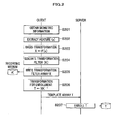
Fig. 2 is a flowchart of an example of a registration process of biometric information according to the embodiment; -
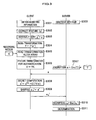
Fig. 3 is an example of an authentication process of the biometric information according to the embodiment; -
Fig. 4 shows feature arrays x, y, and y' according to the embodiment; -
Fig 5 shows a transformation filter array K according to the embodiment; and -
Fig. 6 is a block diagram of hardware of the client and the server according to the embodiment. - Hereinbelow will be described an embodiment of the present invention. In the embodiment, a cancelable biometric authentication system is exemplified in which a feature of biometric information is transformed and matching of the biometric information is performed within a server with the information confidential against the server.
-
Fig. 1 is a block diagram of a cancelable biometric authentication system according to the embodiment of the present invention. - The cancelable biometric authentication system according to the embodiment is configured with an authentication terminal (hereinafter client) 100 and an authentication server (hereinafter referred to as a server) 130 which are coupled to each other through a network such as the Internet or an intra-net. The
client 100 obtains biometric information in registering and authentication, extracts a feature, and transforms the feature. Theserver 130 holds templates and performs matching. - The
client 100 is controlled by the user itself or a reliable third party, has asensor 110 for obtaining biometric information such as a fingerprint and a vein pattern, and reads data from and writes data on arecording medium 120. Therecording medium 120 may be controlled by the user as a portable recording medium such as a Smart card, a USB (Universal Serial Bus) memory, and a recording medium such as a hard disk drive fixedly coupled to theclient 100. For example, if Internet banking is done by a user at home, there may be a configuration in which theclient 100 is a personal computer of the user at home, and theserver 130 is a server controlled by a bank. - The
client 100 includes: afeature extracting unit 101 for extracting a feature from biometric information obtained by thesensor 110 as a feature array including a predetermined number of elements (the elements and array will be described later); abasis transforming unit 102 for basis-transforming the feature array; a transformationfilter generating unit 103 for generating, for example, a transformation filter array for random transformation as a transformation filter array including a predetermined number of elements. - The
client 100 further includes: a recording medium interface (I/F)unit 104 for recording and reading the transformation filter on and from therecording medium 120; afeature transforming unit 105 for generating a feature for registration (template) and a feature for authentication through transformation; a shuffledcross-correlation computing unit 106 for performing computation so as to disclose to the server 130 a shuffled cross-correlation (array) in which each element in a cross-correlation array between the futures for registration and the feature for authentication is shuffled with the feature for registration and the features of authentication confidential; and a communicatingunit 107 for communicating with theserver 130. - The biometric information is data such as a fingerprint image, a vein pattern image, and iris image. The feature includes an image obtained by binarizing an image of, for example, the fingerprint or the vein pattern through an enhancement process and a bit stream called an iris code generated from an iris image.
- Further, it is assumed that the resemblance between two features is computed from the cross-correlation thereof. Regarding the matching algorism for computing the resemblance on the basis of the cross-correlation, an algorism (cross-correlation invariant random filtering) for computing the resemblance in which two features are subject to a special transformation as they are confidential without restoring the features to original ones is known. The embodiment provides an advantageous effect in increasing confidentiality by improving the cross-correlation random filtering. The cross-correlation random filtering is described in the first and fourth documents in detail.
- The
server 130 includes: a communicatingunit 131 for communicating with theclient 100; adatabase 133 for storing and controlling the template; and aenrollment unit 132 for registering the template received from theclient 100 in thedatabase 133. - The
server 130 further includes: a shuffledcross-correlation computing unit 134 for computing a shuffled cross-correlation between the feature for authentication and the feature for registering which is original of the template without the feature for authentication extracted by theclient 100 unknown; and a determiningpart 135 for matching the feature for registration and the feature for authentication and determining whether the feature for registration and the feature for authentication are matched or not from the shuffled cross-correlation. - The template controlled in the
database 133 is registered so as to be associated with a login ID and a password for the user upon logging in authentication. In authentication, the user inputs the login ID and the password in theclient 100 through an input unit (for example, a keyboard). In response to this, theserver 130 searches thedatabase 133 for the associated template with the login ID and the password as search keys and reads the associated template to perform the cancelable authentication according to the embodiment. The description of the login ID and the password will be omitted hereinafter. - With reference to
Fig. 2 , will be described a flow of a registration process of the biometric information according to the embodiment of the present invention. - The
sensor 110 obtains biometric information of the user (step S201). - The
feature extracting part 101 in theclient 100 extracts a feature from the biometric information (step S202). Here, it is exemplified that the feature is brightness in a two-dement ional image (feature image) including N pixels (elements). At a peripheral part of the feature image, a value of zero is set as brightness values with a predetermined width Δ (padding the peripheral part with zero) as shown in apadded image 400 inFig. 4 . This is provided for computing a linear convolution (cyclic convolution) when a cross-correlation is computed through the basis transformation such as discrete Fourier transform or numeric theoretic transformation. - Δ is determined on the basis of a tolerance in displacement in the vertical and horizontal directions in matching the feature images each other upon authentication. For example, if a displacement of the ± four pixel width in the vertical and horizontal direction is permitted, Δ = 4. A feature array x is defined by arranging in a predetermined order N pixels which are the feature of the image after padding with zero. To simplify the description, it is assumed that respective elements of x are represented by a one-dimensional array x [i] (i = 0 to N - 1) and a brightness x [h × W + w] at coordinate (w, h) (0 ≤ w < W,0≤h≤H), if the size of the image after padding with zero is W × H. Further, a value of the brightness value is an integer greater than 0 and less thanθ. Accordingly, the number of pixels in the feature image is N. However, the number of pixels at a part providing the biometric information after padding with zero is W × H.
- Next, the
basis transforming unit 102 basis-transforms the feature array x by applying a function F (step S203). The basis transform (F (x)) generates a basis-transformed feature array X. The basis transform may be any having a nature of the cyclic convolution such as the discrete Fourier transform and the number theoretic transformation. Here, the number theoretic transformation is used. A definition in the number theoretic transformation is a finite field GF(p) (p is a prime number). The basis transform is described in the first and fourth documents in detail. A size (the number of elements) of the basis-transformed feature array X is N. - Next, the transformation
filter generating unit 103 generates a transformation filter having the same size of N as the basis transformed feature array X (step S204). The generated transformation filter is a transformation filter array K in which N elements are arranged in a predetermined order. As shown inFig. 5 , each element K [i] (i = 0 to N -1) of the transformationfilter array K 500 is generated as a random integer being not 0 (a uniform random number greater than one and equal to or less than p - 1). There is a method of generating a random number stream in which a pseudo random number sequence is computed by applying a given a seed value (for example, time or an externally input value such as an inputted random number with a keyboard (input unit), or the like) to a pseudo random number generator (not shown). - Next, the recording
medium interface unit 104 writes the transformation filter array K on the recording medium 120 (step S205). - Next, the
feature transforming unit 105 transforms (for registration) the basis-transformed feature array X with the transformation filter array K (step S206). Thefeature transforming unit 105 obtains as result of transformation a template array (transformed feature array for registration) as a template array T and transmits the template array T to theserver 130. More specifically, at each element of the array, computation given by Eq. (1) is performed to generate the template array T.
where (k [i])-1 represents a multiplicative inverse element of K[i] in the finite field GF (p) and multiplication is also performed on the infinite field GF (p). Because each element of the transformation filter array K is a random value, theserver 130 cannot know the basis-transformed feature array X from the template array T. - Next, the
server 130 receives the template array T from theclient 100, and the registeringunit 132 registers the template array T in thedatabase 133 as a template (step S207). - The above is the registering process flow according to the embodiment.
- With reference to
Fig. 3 will be described an authentication process flow of the biometric information according to the embodiment. - The shuffled
cross-correlation computing unit 134 in theserver 130 generates a key pair including a public key PK for encryption and a secret key SK for decrypting in accordance with a predetermined public key encryption method (step S300). Here, as the public key encryption method, a method whose encryption function Enc (•) satisfies the following homomorphic encryption characteristic (Eq. (2)) should be used for the public key encryption method.
where m1 and m2 are, for example, vectors. - In addition, there are examples of homomorphic encryption method such as Okamoto-Uchiyama encryption (see the second document) and Paillier encryption (see the third document).
- Next, the
sensor 110 obtains the biometric information of the user (step S301). - Next, the
feature extracting unit 101 in theclient 100 extracts the feature from the biometric information obtained by the feature extracting unit 101 (step S302). At the same time as the registration, the peripheral part of the feature image is subject to padding with zero as shown by the paddedfeature image 401 inFig. 4 . An array representing a feature of the feature image padded with zero where N pixels are arranged in a predetermined sequence order is defined as a feature array y. - Next, each element of the feature array y is sorted in an inverse order to generate an array y' 402 (step S303). It is noted that convolution of the feature array x and the array y' becomes a cross-correlation between x and y.
- The
basis transforming part 102 performs basis transformation by applying the function F to the array y' (step S304). The basis transformation (F(y')) generates a basis-transformed feature array Y. A size of Y is N which is the same as that of the basis-transformed feature array X in registration. - Next, the recording
medium interface unit 104 reads the transformation filter array K from the recording medium 120 (step S305). - The
feature transforming unit 105 transforms (perform transformation for authentication) the basis-transformed feature array Y with a transformation filter array K (step S306). The feature array for authentication (transformed-for- authentication feature array) generated by transformation is regarded as an authentication feature array V for authentication which is transmitted to theserver 130. More specially, the authentication feature array is computed in accordance with Eq. (3). Further, multiplication is performed on the infinite field GF(p).
- Next, the shuffled
cross-correlation computing unit 134 in theserver 130 reads the template array T from thedatabase 133, encrypts each element in the template array T in accordance with Eq. (4) with the public key PK to generate an encrypted template array e, and transmits the template array e to the client 100 (step S307).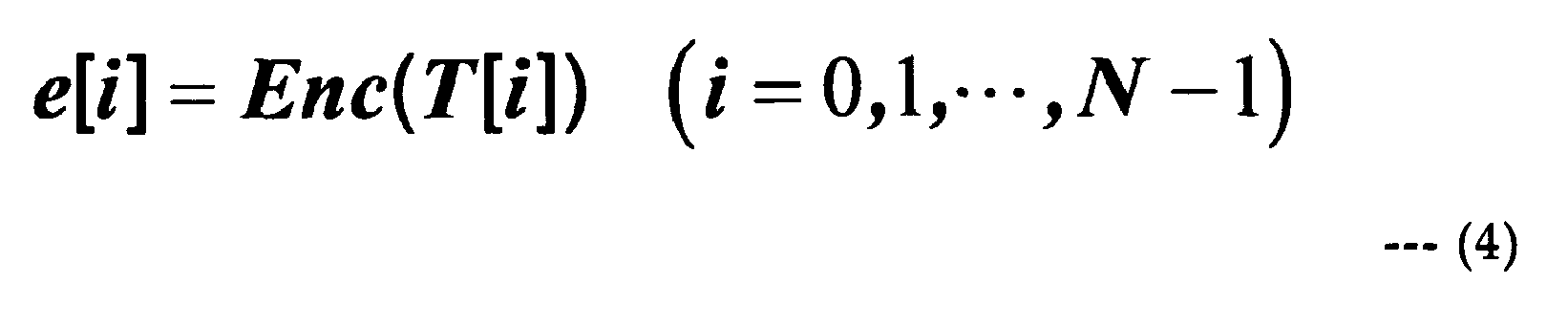
- Next, the
client 100 receives the encrypted template array e, and the shuffledcross-correlation computing unit 106 computes the array e' (secret computation) in accordance with Eq. (5) (step S308).
where α is a primitive N-th root of 1 on the infinite field GF (p) which is a basis transformation constant for transforming a basis defined on the infinite field GF(p) to another basis. Here, Eq. (6) is given from the homomorphic encryption characteristic Eq. (2) of the encryption function Enc (•) and Eqs. (1) and (3).
- Further, an array c of a cross-correlation between the original feature x and the feature y at each element is given by Eq. (7).

Accordingly Eq. (8) is
given.
- As shown in Eq. (8), the array e' represents encrypted values of the array c.
- After that, the shuffled
cross-correlation computing unit 106 in theclient 100 shuffles the array e' for each element (step S309). Shuffling is provided by repeating random replacement for each element of the array. Theclient 100 transmits to theserver 130 an array e σ' obtained by shuffling the array e'. - It is noted that a rule of shuffling depends on each authentication process and is temporarily determined. The
client 100 includes the pseudo random number generator (not shown) and causes the pseudo random number generator to compute a pseudo random number sequence by applying a seed value to provide the rule. - A period is set to the generated rule such that the rule is valid up to completion of the current authentication process. When the period expires, the rule and the pseudo random number sequence is scrapped.
- Because the
client 100 does not know the secret key SK, theclient 100 cannot decode the encrypted information, so that theclient 100 cannot know T[i] or X[i]. Accordingly, if an attacker illegally use the client to communicate with the server, and analyzes a communication log, the attacker cannot obtain the template array T or the original feature array x. - Next, the
server 130 receives the array e σ', and the shuffledcorrelation computing unit 134 decodes the array e σ' with the secret key SK for each element to obtain the shuffled cross-correlation c σ (step S310).
where Dec (•) represent a decoding function. - The
server 130 can know the cross-correlation in a status that elements are shuffled for each element, but cannot know the cross-correlation arranged in a correct order. Accordingly, simultaneous equations based on cross-correlation in which original features x and y are unknown variables cannot be established, so that it is impossible to narrow the solution space. - Finally, the determining
unit 135 determines whether the original features x and y match with each other or not from the shuffled cross-correlation array c σ (step S311 ). Because a maximum value can be obtained from the shuffled cross-correlation array c σ, the determination can be performed by a known method such as a method of determining whether the maximum value exceeds a threshold value. - The above is description of the authentication process flow according to the embodiment.
- According to the above-mentioned process, the
server 130 can perform authentication correctly, but cannot know the original features x and y. In fact, if a malicious server tried to generate from cross-correlation functions of x and y simultaneous equations regarding x and y, theserver 130 can know only the shuffled cross-correlation c σ. Accordingly, the server cannot generate simultaneous equations of x and y, which makes it difficult that the malicious server estimate x and y. Thus, security against an illegal access by a server controller can be improved. -
Fig. 6 is a block diagram showing hardware of theclient 100 and theserver 130. Theclient 100 and theserver 130 each include: a CPU (Central Processing Unit: controller) 600; a memory 601 (storage) comprising a RAM (Random Access Memory) functioning as a memory region; a HDD (a hard disk drive: storage) 602 for storing a program for executing data processing (particularly, the registering process flow and the authentication process flow) by theCPU 600 and the database or the like used as an external storage; an input device 603 (input unit) such as a keyboard and mouse; an output device 604 (output unit) such as a display; and acommunication device 605, which are a hardware resource. - The controller may read a program from a ROM (Read Only Memory) storing the program and execute a predetermined information process. The program stored in the recording medium is installed in the storage, and the controller executes processes instructed by the installed program with hardware.
- According to the embodiment, there is provided a cancelable biometric authentication system capable of preventing the biometric information from leaking from the authentication server. This system provides authentication on the basis of cross-correlation between features of biometric information, so that the authentication can be done with the biometric information of the user confidential against the authentication server. Accordingly, the system provides a high security against a high level attack such that a controller of the authentication server illegally accessed the system to know the biometric feature of the user.
- The embodiment is preferable to embody the present invention, but the present invention is not limited to this embodiment. In other words, the embodiment can be modified without departure from the subject matter of the present invention.
- For example, in the above-mentioned embodiment, in the registration, the transformation filter array K is written in the
recording medium 120 of the client 100 (see step S205). However, in place of writing the transformation filter array K on therecording medium 120, the seed value input to the pseudo random number generator to generate the transformation filter array K may be written on therecording medium 120. Writing the seed value on therecording medium 120 can considerably reduces a data quantity. - In this case, upon authentication, after the
client 100 reads the seed value from therecording medium 120, the transformationfilter generating unit 103 generates the a transformation filter array K with the seed value. The basis transformation feature array Y is transformed with the transformation filter array K (see the step S306). - Further, in the embodiment, the transformation filter array K is stored on the
recording medium 120 in theclient 100 and thedatabase 133 in theserver 130 stores the template array T (see step S205 and step S207). However, thedatabase 133 in theserver 130 may store the transformation filter array K. As mentioned above, inversely storing makes the data stored in theserver 130 completely random. This allows theserver 130 not to store information about the original feature array x. - In this case, in the authentication, the
client 100 reads the template array T from therecording medium 120. On the other hand, theserver 130 applies the generated public key PK to the transformation filter array K read out from thedatabase 133 to encrypt the transformation filter array K (see step S307). When receiving the encrypted transformation filter array K, theclient 100 transforms the basis-transformed array Y into an authentication feature array V with the template array T. Because the homomorphic encryption method is used, there is no change in the secret computation after that (see step S308, Eq. (6)). - In this case, as mentioned above, the seed value to be input into the pseudo random number generator to generate the transformation filter array K, may be stored in the
database 133 in theserver 130 in place of the transformation filter array K. - In the embodiment, in registration, each element X[i] of the basis-transformed array X is multiplied by the multiplicative inverse element k [i])-1 of each element K[i] of the transformation filter array K (see step S206). In authentication, the basis-transformed array Y is multiplied by each element K[i] of the transformation filter array K as it is (see step S306).
- However, inversely, each element X [i] of the basis-transformed feature array X can be multiplied with each element K[i] of the transformation filter array K, and the basis-transformed feature array Y may be multiplied by the multiplicative inverse element (K [i])-1 of each element K[i] of the transformation filter array K.
- Further, specific structure elements such as the hardware, software, and respective flowchart can be modified without departure from the subject matter of the present invention.
- The present invention is applicable to a given application for user authentication based on the biometric information. For example, the present invention is applicable to information access control in an intranet, an identification of the user in the Internet banking system or an ATM (Automated Teller Machine), logging in a Web side for registered members, identification of a person for entranced into a protected area, and logging in a personal computer.
- The specification and drawings are, accordingly, to be regarded in an illustrative rather than a restrictive sense. It will, however, be evident that various modifications and changes may be made thereto without departing from the spirit and scope of the invention as set forth in the claims.
Claims (12)
- An authentication terminal in an authentication system in which
the authentication terminal configured to obtain biometric information of an individual, extract features in the biometric information of the individual as a feature array including a plurality of elements which are arranged, and transform the feature array for authentication into a transformed-for-authentication feature array, and
an authentication server configured to match the transformed-for-authentication feature array received from the authentication terminal with a transformed-for-enrollment feature array, to which a feature array for identifying the individual is transformed for registration, to authenticate the individual, are communicably coupled, the authentication terminal comprising:an authentication terminal storage configured to store a transformation filter array including a plurality of elements having random values for transforming the feature array into the transformed-for-authentication feature array and the transformed-for-registration feature array; anda shuffled cross-correlation computing unit configured to compute a cross-correlation between the transformed-for-authentication feature array with the transformed-for-registration feature array received from the authentication server in a encrypted domain against the authentication terminal as a cross-correlation array including a plurality of elements and shuffle the elements in the cross-correlation array as the confidential status is kept to generate a shuffled cross-correlation array. - The authentication terminal as claimed in claim 1, further comprising a basis transforming unit configured to perform a basis transformation of the feature array to calculate the cross-correlation array by a cyclic convolution.
- The authentication terminal as claimed in claim 2, wherein the basis transformation comprises a number theoretic transformation in which a predetermined finite field is defined.
- The authentication terminal as claimed in claim 2, wherein the basis transformation comprises a discrete Fourier transform.
- An authentication server in an authentication system in which
the authentication terminal configured to obtain biometric information of an individual, extract features in the biometric information of the individual as a feature array including a plurality of elements which are arranged, and transform the feature array for authentication into a transformed-for-authentication feature array, and
an authentication server configured to perform matching the transformed-for-authentication feature array received from the authentication terminal with a transformed-for-registration feature array, to which a feature array for identifying the individual is transformed for registration, to authenticate the individual are communicably coupled, the authentication server comprising:an authentication server storage configured to store the transformed-for-registration feature array, wherein the authentication terminal computes a cross-correlation between the transformed-for-authentication feature array with the transformed-for-registration received from the authentication server in a confidential status against the authentication terminal as a cross-correlation array including a plurality of elements and shuffles the elements in the cross-correlation array as the confidential status is kept to generate a shuffled cross-correlation array;an authentication server shuffled cross-correlation computing unit configured to receive from the authentication terminal the shuffled cross-correlation array in which the elements in the cross-correlation array are shuffled as a confidential status is kept and release the confidential status of the received shuffled cross-correlation array to obtain a shuffled cross-correlation array; anda determination unit configured to perform the matching on the basis of the obtained shuffled cross-correlation array to determine identification of the individual. - The authentication server as claimed in claim 5, wherein the determination unit inverse-basis-transforms the shuffled cross-correlation array obtained by basis-transforming the feature array to allow the authentication terminal to calculate the cross-correlation array by a cyclic convolution.
- The authentication server as claimed in claim 6, wherein the basis transformation comprises a number theoretic transformation in which a predetermined finite field is defined.
- The authentication server as claimed in claim 6, wherein the basis transformation comprises a discrete Fourier transform.
- The authentication server as claimed in claim 5, wherein the authentication server shuffled cross-correlation computing unit reads out the transformed-for-registration feature array of the individual from the authentication server storage, encrypts the received transformed-for-registration feature array with homomorphic Encryption for confidentiality and transmit the encrypted transformed-for-registration feature array to the authentication terminal and when receiving the encrypted transformed-for-registration feature array form the authentication terminal, the authentication server shuffled cross-correlation computing unit decodes the encrypted transformed-for-registration feature array regarding the homomorphic Encryption to obtain a shuffled cross-correlation array without confidentiality.
- The authentication server as claimed in claim 9, wherein the homomorphic Encryption comprises Okamoto-Uchiyama encryption.
- The authentication server as claimed in claim 9, wherein the homomorphic Encryption comprises Paillier encryption.
- An authentication system comprising:an authentication terminal configured to obtain biometric information of an individual, extract features in the biometric information of the individual as a feature array including a plurality of elements which are arranged, and transform the feature array for authentication into a transformed-for-authentication feature array;an authentication server configured to match the transformed-for-authentication feature array received from the authentication terminal with a transformed-for-registration feature array, to which a feature array for identifying the individual is transformed for registration, to authenticate the individual, the authentication terminal and the authentication server being communicably coupled, wherein the authentication terminal comprises:an authentication terminal storage configured to store a transformation filter array including a plurality of elements having random values for transforming the feature array into the transformed-for-authentication feature array and the transformed-for-registration feature array; andan authentication terminal shuffled cross-correlation computing unit configured to compute a cross-correlation between the transformed-for-authentication feature array with the transformed-for-registration feature array received from the authentication server in a confidential status against the authentication terminal as a cross-correlation array including a plurality of elements and shuffle the elements in the cross-correlation array as the confidential status is kept to generate a shuffled cross-correlation array, and wherein the authentication server comprises:an authentication server storage configured to store the transformed-for-registration feature array;an authentication server shuffled cross-correlation computing unit configured to receive the shuffled cross-correlation array from the authentication terminal and decrypt the received encrypted shuffled cross-correlation array to obtain a shuffled cross-correlation array; anda determination unit configured to perform the matching on the basis of the obtained shuffled cross-correlation array to determine identification of the individual.
Applications Claiming Priority (1)
| Application Number | Priority Date | Filing Date | Title |
|---|---|---|---|
| JP2008203903A JP2010039890A (en) | 2008-08-07 | 2008-08-07 | Authentication terminal, authentication server, authentication system, authentication method and authentication program |
Publications (1)
| Publication Number | Publication Date |
|---|---|
| EP2151968A2 true EP2151968A2 (en) | 2010-02-10 |
Family
ID=41258184
Family Applications (1)
| Application Number | Title | Priority Date | Filing Date |
|---|---|---|---|
| EP09010193A Withdrawn EP2151968A2 (en) | 2008-08-07 | 2009-08-06 | Authentication terminal, authentication server, and authentication system |
Country Status (4)
| Country | Link |
|---|---|
| US (1) | US20100106964A1 (en) |
| EP (1) | EP2151968A2 (en) |
| JP (1) | JP2010039890A (en) |
| CN (1) | CN101645777A (en) |
Families Citing this family (23)
| Publication number | Priority date | Publication date | Assignee | Title |
|---|---|---|---|---|
| US8433925B2 (en) * | 2009-09-04 | 2013-04-30 | Gradiant | Cryptographic system for performing secure computations and signal processing directly on encrypted data in untrusted environments |
| US8843762B2 (en) * | 2009-09-04 | 2014-09-23 | Gradiant, Centro Tecnolóxico de Telecomunicacións de Galicia | Cryptographic system for performing secure iterative computations and signal processing directly on encrypted data in untrusted environments |
| US8972742B2 (en) | 2009-09-04 | 2015-03-03 | Gradiant | System for secure image recognition |
| US8861716B2 (en) | 2010-03-30 | 2014-10-14 | International Business Machines Corporation | Efficient homomorphic encryption scheme for bilinear forms |
| JP5416846B2 (en) * | 2010-10-29 | 2014-02-12 | 株式会社日立製作所 | Information authentication method and information authentication system |
| US8837715B2 (en) | 2011-02-17 | 2014-09-16 | Gradiant, Centro Tecnolóxico de Telecomunicacións de Galica | Method and apparatus for secure iterative processing and adaptive filtering |
| US9281941B2 (en) | 2012-02-17 | 2016-03-08 | International Business Machines Corporation | Homomorphic evaluation including key switching, modulus switching, and dynamic noise management |
| CN103107989A (en) * | 2012-11-20 | 2013-05-15 | 高剑青 | Cryptosystem based on multi-hash values |
| CN105409249B (en) * | 2013-05-06 | 2019-03-01 | 康维达无线有限责任公司 | machine-to-machine bootstrapping |
| US9619000B2 (en) * | 2013-05-17 | 2017-04-11 | Nec Corporation | Board, board apparatus and method for interconnection of boards |
| KR101528112B1 (en) * | 2014-11-20 | 2015-06-17 | 중앙대학교 산학협력단 | Cloud server for authenticating user to access the data server using biometric trait |
| JP2016131335A (en) * | 2015-01-14 | 2016-07-21 | 富士通株式会社 | Information processing method, information processing program and information processing device |
| US10068097B2 (en) * | 2015-08-12 | 2018-09-04 | Microsoft Technology Licensing, Llc | Data center privacy |
| JP6507115B2 (en) * | 2016-03-22 | 2019-04-24 | 株式会社日立製作所 | 1: N biometric authentication · encryption · signature system |
| US10298385B2 (en) * | 2017-04-11 | 2019-05-21 | The Governing Council Of The University Of Toronto | Homomorphic processing unit (HPU) for accelerating secure computations under homomorphic encryption |
| KR102008101B1 (en) * | 2018-06-28 | 2019-08-06 | 인하대학교 산학협력단 | Secure biometric authentication method using functional encryption |
| SG11201903586SA (en) * | 2018-11-07 | 2019-05-30 | Alibaba Group Holding Ltd | Blockchain data protection based on account note model with zero-knowledge proof |
| KR102758937B1 (en) * | 2019-02-18 | 2025-01-23 | 삼성전자주식회사 | Electronic device for authenticating biometric information and operating method thereof |
| US12019784B2 (en) * | 2019-10-30 | 2024-06-25 | EMC IP Holding Company LLC | Privacy preserving evaluation of sensitive user features for anomaly detection |
| US12143420B2 (en) | 2019-11-28 | 2024-11-12 | Nec Corporation | Shuffling shares among nodes to detect incorrectness or frauds |
| US12160506B2 (en) | 2019-11-28 | 2024-12-03 | Nec Corporation | Shuffling shares among nodes to detect incorrectness or frauds |
| JP7729407B2 (en) * | 2021-12-27 | 2025-08-26 | 日本電気株式会社 | Verification system, key generation device, verification device, first conversion device, second conversion device, and methods thereof |
| US12368582B2 (en) * | 2023-05-22 | 2025-07-22 | Aetna Inc. | Systems and methods for generating and using biometric secret keys |
Citations (1)
| Publication number | Priority date | Publication date | Assignee | Title |
|---|---|---|---|---|
| JP2007293807A (en) | 2006-03-29 | 2007-11-08 | Hitachi Information & Control Solutions Ltd | Biometric authentication method and system |
-
2008
- 2008-08-07 JP JP2008203903A patent/JP2010039890A/en not_active Withdrawn
-
2009
- 2009-08-06 EP EP09010193A patent/EP2151968A2/en not_active Withdrawn
- 2009-08-06 US US12/536,661 patent/US20100106964A1/en not_active Abandoned
- 2009-08-06 CN CN200910159084A patent/CN101645777A/en active Pending
Patent Citations (1)
| Publication number | Priority date | Publication date | Assignee | Title |
|---|---|---|---|---|
| JP2007293807A (en) | 2006-03-29 | 2007-11-08 | Hitachi Information & Control Solutions Ltd | Biometric authentication method and system |
Non-Patent Citations (3)
| Title |
|---|
| HIRATA ET AL.: "Improvement in Weakness and Security in Cancelable Biometric Authentication Method applicable To Image Matching", SCIS2007 |
| OKAMOTO, T.; UCHIYAMA, S.: "A New Public-Key Cryptosystem as Secure as Factoring", PROC. EUROCRYPT '98, pages 308 - 318 |
| P. PAILLIER: "Public-Key Cryptosystems Based on Composite Degree Residuosity Classes", PROC. EUROCRYPT '99, pages 223 - 238 |
Also Published As
| Publication number | Publication date |
|---|---|
| CN101645777A (en) | 2010-02-10 |
| JP2010039890A (en) | 2010-02-18 |
| US20100106964A1 (en) | 2010-04-29 |
Similar Documents
| Publication | Publication Date | Title |
|---|---|---|
| EP2151968A2 (en) | Authentication terminal, authentication server, and authentication system | |
| JP4929136B2 (en) | Biometric authentication method, apparatus and system | |
| EP2323066B1 (en) | Biometric authentication method and computer system | |
| EP2634955B1 (en) | Information authentication method and information authentication system | |
| EP2360615B1 (en) | Biometric authentication system and method therefor | |
| US10778423B2 (en) | Reusable fuzzy extractor based on the learning-with-error assumption secure against quantum attacks | |
| CN114065169B (en) | Privacy protection biometric authentication method and device and electronic equipment | |
| US20080065900A1 (en) | Method and apparatus for biometrics | |
| US20070031009A1 (en) | Method and system for string-based biometric authentication | |
| Mehta et al. | An efficient and lossless fingerprint encryption algorithm using Henon map & Arnold transformation | |
| Aeloor et al. | Securing biometric data with visual cryptography and steganography | |
| JP5503050B2 (en) | Biometric authentication method and biometric authentication system | |
| WK et al. | Replaceable and securely hashed keys from online signatures | |
| JP7697547B2 (en) | Information processing device, collation method, and program | |
| Maji et al. | A novel biometric template encryption scheme using sudoku puzzle | |
| Hussein Kaabi Lafta | Developing a Biometric Based Authentication to Secure Transferring Data via Cloud Environment | |
| Ousephachan | Nonlinear chaos-based security solution for fingerprint data during communication | |
| CN120296718A (en) | A multi-person identity recognition system with access rights sharing and no storage | |
| Trugenberger | The glass maze: Hiding keys in spin glasses | |
| CN117521104A (en) | Face recognition secure outsourcing calculation method and system based on local linear embedding | |
| Kumari et al. | Framework for Preservation of Biometric Information with Facial Template Protection using Gray-Level Extended Visual Cryptography Scheme. | |
| Aby | A Hybrid Approach for Image Data Security | |
| Lafta | Developing a Biometric Based Authentication to Secure Transferring Data via Cloud Environment | |
| Al-Saidi et al. | Research Article Password Authentication Based on Fractal Coding Scheme | |
| Devi et al. | Biometric based multiserver authentication system |
Legal Events
| Date | Code | Title | Description |
|---|---|---|---|
| PUAI | Public reference made under article 153(3) epc to a published international application that has entered the european phase |
Free format text: ORIGINAL CODE: 0009012 |
|
| AK | Designated contracting states |
Kind code of ref document: A2 Designated state(s): AT BE BG CH CY CZ DE DK EE ES FI FR GB GR HR HU IE IS IT LI LT LU LV MC MK MT NL NO PL PT RO SE SI SK SM TR |
|
| AX | Request for extension of the european patent |
Extension state: AL BA RS |
|
| 17P | Request for examination filed |
Effective date: 20100211 |
|
| STAA | Information on the status of an ep patent application or granted ep patent |
Free format text: STATUS: THE APPLICATION HAS BEEN WITHDRAWN |
|
| 18W | Application withdrawn |
Effective date: 20111108 |