EP2151423A1 - Process to make olefins from organics with reduced side reactions. - Google Patents
Process to make olefins from organics with reduced side reactions. Download PDFInfo
- Publication number
- EP2151423A1 EP2151423A1 EP08161378A EP08161378A EP2151423A1 EP 2151423 A1 EP2151423 A1 EP 2151423A1 EP 08161378 A EP08161378 A EP 08161378A EP 08161378 A EP08161378 A EP 08161378A EP 2151423 A1 EP2151423 A1 EP 2151423A1
- Authority
- EP
- European Patent Office
- Prior art keywords
- mto
- reactor
- catalyst
- oxygen
- process according
- Prior art date
- Legal status (The legal status is an assumption and is not a legal conclusion. Google has not performed a legal analysis and makes no representation as to the accuracy of the status listed.)
- Withdrawn
Links
- 238000000034 method Methods 0.000 title claims abstract description 42
- 230000008569 process Effects 0.000 title claims abstract description 37
- 150000001336 alkenes Chemical class 0.000 title claims abstract description 32
- 230000002829 reductive effect Effects 0.000 title claims abstract description 12
- 238000007086 side reaction Methods 0.000 title description 6
- 239000003054 catalyst Substances 0.000 claims abstract description 61
- 229930195733 hydrocarbon Natural products 0.000 claims abstract description 40
- 150000002430 hydrocarbons Chemical class 0.000 claims abstract description 40
- 238000006243 chemical reaction Methods 0.000 claims abstract description 35
- 239000004215 Carbon black (E152) Substances 0.000 claims abstract description 34
- 239000000203 mixture Substances 0.000 claims abstract description 24
- QVGXLLKOCUKJST-UHFFFAOYSA-N atomic oxygen Chemical compound [O] QVGXLLKOCUKJST-UHFFFAOYSA-N 0.000 claims abstract description 23
- 229910052760 oxygen Inorganic materials 0.000 claims abstract description 23
- 239000001301 oxygen Substances 0.000 claims abstract description 23
- 239000006227 byproduct Substances 0.000 claims abstract description 21
- 239000000047 product Substances 0.000 claims abstract description 15
- -1 sulphur compound Chemical class 0.000 claims abstract description 15
- JRZJOMJEPLMPRA-UHFFFAOYSA-N olefin Natural products CCCCCCCC=C JRZJOMJEPLMPRA-UHFFFAOYSA-N 0.000 claims abstract description 10
- 239000005864 Sulphur Substances 0.000 claims abstract description 9
- 238000002347 injection Methods 0.000 claims abstract description 7
- 239000007924 injection Substances 0.000 claims abstract description 7
- 229910052698 phosphorus Inorganic materials 0.000 claims abstract description 6
- 239000011574 phosphorus Substances 0.000 claims abstract description 5
- OAICVXFJPJFONN-UHFFFAOYSA-N Phosphorus Chemical compound [P] OAICVXFJPJFONN-UHFFFAOYSA-N 0.000 claims abstract description 4
- 239000003701 inert diluent Substances 0.000 claims abstract description 4
- VGGSQFUCUMXWEO-UHFFFAOYSA-N Ethene Chemical compound C=C VGGSQFUCUMXWEO-UHFFFAOYSA-N 0.000 claims description 12
- 239000005977 Ethylene Substances 0.000 claims description 12
- QQONPFPTGQHPMA-UHFFFAOYSA-N propylene Natural products CC=C QQONPFPTGQHPMA-UHFFFAOYSA-N 0.000 claims description 6
- 125000004805 propylene group Chemical group [H]C([H])([H])C([H])([*:1])C([H])([H])[*:2] 0.000 claims description 6
- 238000005194 fractionation Methods 0.000 claims description 2
- OKKJLVBELUTLKV-UHFFFAOYSA-N Methanol Chemical compound OC OKKJLVBELUTLKV-UHFFFAOYSA-N 0.000 description 63
- 229910052782 aluminium Inorganic materials 0.000 description 29
- XAGFODPZIPBFFR-UHFFFAOYSA-N aluminium Chemical compound [Al] XAGFODPZIPBFFR-UHFFFAOYSA-N 0.000 description 29
- BPQQTUXANYXVAA-UHFFFAOYSA-N Orthosilicate Chemical compound [O-][Si]([O-])([O-])[O-] BPQQTUXANYXVAA-UHFFFAOYSA-N 0.000 description 22
- 229910052751 metal Inorganic materials 0.000 description 22
- 239000002184 metal Substances 0.000 description 22
- 239000004411 aluminium Substances 0.000 description 20
- HNPSIPDUKPIQMN-UHFFFAOYSA-N dioxosilane;oxo(oxoalumanyloxy)alumane Chemical compound O=[Si]=O.O=[Al]O[Al]=O HNPSIPDUKPIQMN-UHFFFAOYSA-N 0.000 description 19
- 239000000463 material Substances 0.000 description 16
- 239000010457 zeolite Substances 0.000 description 15
- 238000000576 coating method Methods 0.000 description 14
- XUIMIQQOPSSXEZ-UHFFFAOYSA-N Silicon Chemical compound [Si] XUIMIQQOPSSXEZ-UHFFFAOYSA-N 0.000 description 13
- 239000011241 protective layer Substances 0.000 description 13
- 229910052710 silicon Inorganic materials 0.000 description 13
- 239000010703 silicon Substances 0.000 description 13
- 229910021536 Zeolite Inorganic materials 0.000 description 12
- PNEYBMLMFCGWSK-UHFFFAOYSA-N aluminium oxide Inorganic materials [O-2].[O-2].[O-2].[Al+3].[Al+3] PNEYBMLMFCGWSK-UHFFFAOYSA-N 0.000 description 12
- 238000004939 coking Methods 0.000 description 12
- 230000015572 biosynthetic process Effects 0.000 description 10
- 239000011248 coating agent Substances 0.000 description 10
- VNWKTOKETHGBQD-UHFFFAOYSA-N methane Chemical compound C VNWKTOKETHGBQD-UHFFFAOYSA-N 0.000 description 10
- 239000003973 paint Substances 0.000 description 10
- ATJFFYVFTNAWJD-UHFFFAOYSA-N Tin Chemical compound [Sn] ATJFFYVFTNAWJD-UHFFFAOYSA-N 0.000 description 9
- 229910052718 tin Inorganic materials 0.000 description 9
- 239000011135 tin Substances 0.000 description 9
- XEEYBQQBJWHFJM-UHFFFAOYSA-N Iron Chemical compound [Fe] XEEYBQQBJWHFJM-UHFFFAOYSA-N 0.000 description 8
- 239000008139 complexing agent Substances 0.000 description 8
- 239000011148 porous material Substances 0.000 description 8
- 239000002253 acid Substances 0.000 description 7
- 229910052799 carbon Inorganic materials 0.000 description 7
- 238000010025 steaming Methods 0.000 description 7
- IJGRMHOSHXDMSA-UHFFFAOYSA-N Atomic nitrogen Chemical compound N#N IJGRMHOSHXDMSA-UHFFFAOYSA-N 0.000 description 6
- NINIDFKCEFEMDL-UHFFFAOYSA-N Sulfur Chemical compound [S] NINIDFKCEFEMDL-UHFFFAOYSA-N 0.000 description 6
- 150000001875 compounds Chemical class 0.000 description 6
- 229910052732 germanium Inorganic materials 0.000 description 6
- GNPVGFCGXDBREM-UHFFFAOYSA-N germanium atom Chemical compound [Ge] GNPVGFCGXDBREM-UHFFFAOYSA-N 0.000 description 6
- 238000002386 leaching Methods 0.000 description 6
- 150000002902 organometallic compounds Chemical class 0.000 description 6
- 239000002245 particle Substances 0.000 description 6
- 230000008929 regeneration Effects 0.000 description 6
- 238000011069 regeneration method Methods 0.000 description 6
- 239000007787 solid Substances 0.000 description 6
- VYZAMTAEIAYCRO-UHFFFAOYSA-N Chromium Chemical compound [Cr] VYZAMTAEIAYCRO-UHFFFAOYSA-N 0.000 description 5
- UFHFLCQGNIYNRP-UHFFFAOYSA-N Hydrogen Chemical compound [H][H] UFHFLCQGNIYNRP-UHFFFAOYSA-N 0.000 description 5
- 229910052787 antimony Inorganic materials 0.000 description 5
- WATWJIUSRGPENY-UHFFFAOYSA-N antimony atom Chemical compound [Sb] WATWJIUSRGPENY-UHFFFAOYSA-N 0.000 description 5
- 239000012298 atmosphere Substances 0.000 description 5
- 229910052804 chromium Inorganic materials 0.000 description 5
- 239000011651 chromium Substances 0.000 description 5
- 230000000694 effects Effects 0.000 description 5
- 239000001257 hydrogen Substances 0.000 description 5
- 229910052739 hydrogen Inorganic materials 0.000 description 5
- 239000011159 matrix material Substances 0.000 description 5
- 150000003839 salts Chemical class 0.000 description 5
- OKTJSMMVPCPJKN-UHFFFAOYSA-N Carbon Chemical compound [C] OKTJSMMVPCPJKN-UHFFFAOYSA-N 0.000 description 4
- 229910000831 Steel Inorganic materials 0.000 description 4
- 150000007513 acids Chemical class 0.000 description 4
- 239000011230 binding agent Substances 0.000 description 4
- WQOXQRCZOLPYPM-UHFFFAOYSA-N dimethyl disulfide Chemical compound CSSC WQOXQRCZOLPYPM-UHFFFAOYSA-N 0.000 description 4
- 229910052742 iron Inorganic materials 0.000 description 4
- 239000010410 layer Substances 0.000 description 4
- 229910044991 metal oxide Inorganic materials 0.000 description 4
- 150000004706 metal oxides Chemical class 0.000 description 4
- BASFCYQUMIYNBI-UHFFFAOYSA-N platinum Chemical compound [Pt] BASFCYQUMIYNBI-UHFFFAOYSA-N 0.000 description 4
- 238000002407 reforming Methods 0.000 description 4
- 239000010959 steel Substances 0.000 description 4
- 229910052717 sulfur Inorganic materials 0.000 description 4
- 239000011593 sulfur Substances 0.000 description 4
- 238000005406 washing Methods 0.000 description 4
- QTBSBXVTEAMEQO-UHFFFAOYSA-N Acetic acid Chemical compound CC(O)=O QTBSBXVTEAMEQO-UHFFFAOYSA-N 0.000 description 3
- RTZKZFJDLAIYFH-UHFFFAOYSA-N Diethyl ether Chemical compound CCOCC RTZKZFJDLAIYFH-UHFFFAOYSA-N 0.000 description 3
- KCXVZYZYPLLWCC-UHFFFAOYSA-N EDTA Chemical compound OC(=O)CN(CC(O)=O)CCN(CC(O)=O)CC(O)=O KCXVZYZYPLLWCC-UHFFFAOYSA-N 0.000 description 3
- LFQSCWFLJHTTHZ-UHFFFAOYSA-N Ethanol Chemical compound CCO LFQSCWFLJHTTHZ-UHFFFAOYSA-N 0.000 description 3
- WSFSSNUMVMOOMR-UHFFFAOYSA-N Formaldehyde Chemical compound O=C WSFSSNUMVMOOMR-UHFFFAOYSA-N 0.000 description 3
- OFOBLEOULBTSOW-UHFFFAOYSA-N Malonic acid Chemical compound OC(=O)CC(O)=O OFOBLEOULBTSOW-UHFFFAOYSA-N 0.000 description 3
- MXRIRQGCELJRSN-UHFFFAOYSA-N O.O.O.[Al] Chemical compound O.O.O.[Al] MXRIRQGCELJRSN-UHFFFAOYSA-N 0.000 description 3
- MUBZPKHOEPUJKR-UHFFFAOYSA-N Oxalic acid Chemical compound OC(=O)C(O)=O MUBZPKHOEPUJKR-UHFFFAOYSA-N 0.000 description 3
- 229910045601 alloy Inorganic materials 0.000 description 3
- 239000000956 alloy Substances 0.000 description 3
- JYIBXUUINYLWLR-UHFFFAOYSA-N aluminum;calcium;potassium;silicon;sodium;trihydrate Chemical compound O.O.O.[Na].[Al].[Si].[K].[Ca] JYIBXUUINYLWLR-UHFFFAOYSA-N 0.000 description 3
- 230000003197 catalytic effect Effects 0.000 description 3
- KRKNYBCHXYNGOX-UHFFFAOYSA-N citric acid Chemical compound OC(=O)CC(O)(C(O)=O)CC(O)=O KRKNYBCHXYNGOX-UHFFFAOYSA-N 0.000 description 3
- 238000005253 cladding Methods 0.000 description 3
- 229910001603 clinoptilolite Inorganic materials 0.000 description 3
- 230000000052 comparative effect Effects 0.000 description 3
- 238000009792 diffusion process Methods 0.000 description 3
- 238000001035 drying Methods 0.000 description 3
- 229960001484 edetic acid Drugs 0.000 description 3
- 239000000945 filler Substances 0.000 description 3
- 238000001914 filtration Methods 0.000 description 3
- 238000010438 heat treatment Methods 0.000 description 3
- 150000002739 metals Chemical class 0.000 description 3
- 150000007522 mineralic acids Chemical class 0.000 description 3
- 239000002808 molecular sieve Substances 0.000 description 3
- 229910052757 nitrogen Inorganic materials 0.000 description 3
- 238000010422 painting Methods 0.000 description 3
- 230000009467 reduction Effects 0.000 description 3
- 150000004760 silicates Chemical class 0.000 description 3
- URGAHOPLAPQHLN-UHFFFAOYSA-N sodium aluminosilicate Chemical compound [Na+].[Al+3].[O-][Si]([O-])=O.[O-][Si]([O-])=O URGAHOPLAPQHLN-UHFFFAOYSA-N 0.000 description 3
- 238000005507 spraying Methods 0.000 description 3
- 238000009834 vaporization Methods 0.000 description 3
- 230000008016 vaporization Effects 0.000 description 3
- FCEHBMOGCRZNNI-UHFFFAOYSA-N 1-benzothiophene Chemical compound C1=CC=C2SC=CC2=C1 FCEHBMOGCRZNNI-UHFFFAOYSA-N 0.000 description 2
- CSCPPACGZOOCGX-UHFFFAOYSA-N Acetone Chemical compound CC(C)=O CSCPPACGZOOCGX-UHFFFAOYSA-N 0.000 description 2
- RYGMFSIKBFXOCR-UHFFFAOYSA-N Copper Chemical compound [Cu] RYGMFSIKBFXOCR-UHFFFAOYSA-N 0.000 description 2
- LCGLNKUTAGEVQW-UHFFFAOYSA-N Dimethyl ether Chemical compound COC LCGLNKUTAGEVQW-UHFFFAOYSA-N 0.000 description 2
- VZCYOOQTPOCHFL-OWOJBTEDSA-N Fumaric acid Chemical compound OC(=O)\C=C\C(O)=O VZCYOOQTPOCHFL-OWOJBTEDSA-N 0.000 description 2
- GYHNNYVSQQEPJS-UHFFFAOYSA-N Gallium Chemical compound [Ga] GYHNNYVSQQEPJS-UHFFFAOYSA-N 0.000 description 2
- KFZMGEQAYNKOFK-UHFFFAOYSA-N Isopropanol Chemical compound CC(C)O KFZMGEQAYNKOFK-UHFFFAOYSA-N 0.000 description 2
- ZOKXTWBITQBERF-UHFFFAOYSA-N Molybdenum Chemical compound [Mo] ZOKXTWBITQBERF-UHFFFAOYSA-N 0.000 description 2
- PXHVJJICTQNCMI-UHFFFAOYSA-N Nickel Chemical compound [Ni] PXHVJJICTQNCMI-UHFFFAOYSA-N 0.000 description 2
- NBIIXXVUZAFLBC-UHFFFAOYSA-N Phosphoric acid Chemical compound OP(O)(O)=O NBIIXXVUZAFLBC-UHFFFAOYSA-N 0.000 description 2
- ATUOYWHBWRKTHZ-UHFFFAOYSA-N Propane Chemical compound CCC ATUOYWHBWRKTHZ-UHFFFAOYSA-N 0.000 description 2
- VYPSYNLAJGMNEJ-UHFFFAOYSA-N Silicium dioxide Chemical compound O=[Si]=O VYPSYNLAJGMNEJ-UHFFFAOYSA-N 0.000 description 2
- BQCADISMDOOEFD-UHFFFAOYSA-N Silver Chemical compound [Ag] BQCADISMDOOEFD-UHFFFAOYSA-N 0.000 description 2
- YTPLMLYBLZKORZ-UHFFFAOYSA-N Thiophene Chemical compound C=1C=CSC=1 YTPLMLYBLZKORZ-UHFFFAOYSA-N 0.000 description 2
- RTAQQCXQSZGOHL-UHFFFAOYSA-N Titanium Chemical compound [Ti] RTAQQCXQSZGOHL-UHFFFAOYSA-N 0.000 description 2
- QCWXUUIWCKQGHC-UHFFFAOYSA-N Zirconium Chemical compound [Zr] QCWXUUIWCKQGHC-UHFFFAOYSA-N 0.000 description 2
- WNLRTRBMVRJNCN-UHFFFAOYSA-N adipic acid Chemical compound OC(=O)CCCCC(O)=O WNLRTRBMVRJNCN-UHFFFAOYSA-N 0.000 description 2
- AZDRQVAHHNSJOQ-UHFFFAOYSA-N alumane Chemical group [AlH3] AZDRQVAHHNSJOQ-UHFFFAOYSA-N 0.000 description 2
- 239000007864 aqueous solution Substances 0.000 description 2
- 229910052785 arsenic Inorganic materials 0.000 description 2
- RQNWIZPPADIBDY-UHFFFAOYSA-N arsenic atom Chemical compound [As] RQNWIZPPADIBDY-UHFFFAOYSA-N 0.000 description 2
- 229910052797 bismuth Inorganic materials 0.000 description 2
- JCXGWMGPZLAOME-UHFFFAOYSA-N bismuth atom Chemical compound [Bi] JCXGWMGPZLAOME-UHFFFAOYSA-N 0.000 description 2
- LUZSPGQEISANPO-UHFFFAOYSA-N butyltin Chemical compound CCCC[Sn] LUZSPGQEISANPO-UHFFFAOYSA-N 0.000 description 2
- 238000005229 chemical vapour deposition Methods 0.000 description 2
- 239000000571 coke Substances 0.000 description 2
- 229910052802 copper Inorganic materials 0.000 description 2
- 239000010949 copper Substances 0.000 description 2
- 238000005260 corrosion Methods 0.000 description 2
- 230000007797 corrosion Effects 0.000 description 2
- 238000000151 deposition Methods 0.000 description 2
- 239000003085 diluting agent Substances 0.000 description 2
- 238000009713 electroplating Methods 0.000 description 2
- 238000000605 extraction Methods 0.000 description 2
- 229910052733 gallium Inorganic materials 0.000 description 2
- 239000007789 gas Substances 0.000 description 2
- PCHJSUWPFVWCPO-UHFFFAOYSA-N gold Chemical compound [Au] PCHJSUWPFVWCPO-UHFFFAOYSA-N 0.000 description 2
- 229910052737 gold Inorganic materials 0.000 description 2
- 239000010931 gold Substances 0.000 description 2
- 229910052735 hafnium Inorganic materials 0.000 description 2
- VBJZVLUMGGDVMO-UHFFFAOYSA-N hafnium atom Chemical compound [Hf] VBJZVLUMGGDVMO-UHFFFAOYSA-N 0.000 description 2
- 229910052738 indium Inorganic materials 0.000 description 2
- APFVFJFRJDLVQX-UHFFFAOYSA-N indium atom Chemical compound [In] APFVFJFRJDLVQX-UHFFFAOYSA-N 0.000 description 2
- 229910000765 intermetallic Inorganic materials 0.000 description 2
- 238000005342 ion exchange Methods 0.000 description 2
- QQVIHTHCMHWDBS-UHFFFAOYSA-N isophthalic acid Chemical compound OC(=O)C1=CC=CC(C(O)=O)=C1 QQVIHTHCMHWDBS-UHFFFAOYSA-N 0.000 description 2
- 239000011133 lead Substances 0.000 description 2
- 230000000670 limiting effect Effects 0.000 description 2
- BDAGIHXWWSANSR-UHFFFAOYSA-N methanoic acid Natural products OC=O BDAGIHXWWSANSR-UHFFFAOYSA-N 0.000 description 2
- 229910052750 molybdenum Inorganic materials 0.000 description 2
- 239000011733 molybdenum Substances 0.000 description 2
- 229910052758 niobium Inorganic materials 0.000 description 2
- 239000010955 niobium Substances 0.000 description 2
- GUCVJGMIXFAOAE-UHFFFAOYSA-N niobium atom Chemical compound [Nb] GUCVJGMIXFAOAE-UHFFFAOYSA-N 0.000 description 2
- XZZXKVYTWCYOQX-UHFFFAOYSA-J octanoate;tin(4+) Chemical compound [Sn+4].CCCCCCCC([O-])=O.CCCCCCCC([O-])=O.CCCCCCCC([O-])=O.CCCCCCCC([O-])=O XZZXKVYTWCYOQX-UHFFFAOYSA-J 0.000 description 2
- 150000007524 organic acids Chemical class 0.000 description 2
- 125000004430 oxygen atom Chemical group O* 0.000 description 2
- 230000036961 partial effect Effects 0.000 description 2
- 238000002161 passivation Methods 0.000 description 2
- XNGIFLGASWRNHJ-UHFFFAOYSA-N phthalic acid Chemical compound OC(=O)C1=CC=CC=C1C(O)=O XNGIFLGASWRNHJ-UHFFFAOYSA-N 0.000 description 2
- 229910052697 platinum Inorganic materials 0.000 description 2
- 238000002360 preparation method Methods 0.000 description 2
- 238000002203 pretreatment Methods 0.000 description 2
- BDERNNFJNOPAEC-UHFFFAOYSA-N propan-1-ol Chemical compound CCCO BDERNNFJNOPAEC-UHFFFAOYSA-N 0.000 description 2
- 230000001681 protective effect Effects 0.000 description 2
- 229910052709 silver Inorganic materials 0.000 description 2
- 239000004332 silver Substances 0.000 description 2
- 159000000000 sodium salts Chemical class 0.000 description 2
- 239000000243 solution Substances 0.000 description 2
- 238000004544 sputter deposition Methods 0.000 description 2
- 239000000126 substance Substances 0.000 description 2
- 229910052715 tantalum Inorganic materials 0.000 description 2
- GUVRBAGPIYLISA-UHFFFAOYSA-N tantalum atom Chemical compound [Ta] GUVRBAGPIYLISA-UHFFFAOYSA-N 0.000 description 2
- 229930192474 thiophene Natural products 0.000 description 2
- 229910052719 titanium Inorganic materials 0.000 description 2
- 239000010936 titanium Substances 0.000 description 2
- VZCYOOQTPOCHFL-UHFFFAOYSA-N trans-butenedioic acid Natural products OC(=O)C=CC(O)=O VZCYOOQTPOCHFL-UHFFFAOYSA-N 0.000 description 2
- 230000009466 transformation Effects 0.000 description 2
- QEEPNARXASYKDD-UHFFFAOYSA-J tris(7,7-dimethyloctanoyloxy)stannyl 7,7-dimethyloctanoate Chemical compound [Sn+4].CC(C)(C)CCCCCC([O-])=O.CC(C)(C)CCCCCC([O-])=O.CC(C)(C)CCCCCC([O-])=O.CC(C)(C)CCCCCC([O-])=O QEEPNARXASYKDD-UHFFFAOYSA-J 0.000 description 2
- WFKWXMTUELFFGS-UHFFFAOYSA-N tungsten Chemical compound [W] WFKWXMTUELFFGS-UHFFFAOYSA-N 0.000 description 2
- 229910052721 tungsten Inorganic materials 0.000 description 2
- 239000010937 tungsten Substances 0.000 description 2
- XLYOFNOQVPJJNP-UHFFFAOYSA-N water Substances O XLYOFNOQVPJJNP-UHFFFAOYSA-N 0.000 description 2
- 229910052726 zirconium Inorganic materials 0.000 description 2
- RTBFRGCFXZNCOE-UHFFFAOYSA-N 1-methylsulfonylpiperidin-4-one Chemical compound CS(=O)(=O)N1CCC(=O)CC1 RTBFRGCFXZNCOE-UHFFFAOYSA-N 0.000 description 1
- NVEOATUZNGIRFP-UHFFFAOYSA-N 2,2,2-trichloroacetic acid;2,2,2-trifluoroacetic acid Chemical compound OC(=O)C(F)(F)F.OC(=O)C(Cl)(Cl)Cl NVEOATUZNGIRFP-UHFFFAOYSA-N 0.000 description 1
- OSWFIVFLDKOXQC-UHFFFAOYSA-N 4-(3-methoxyphenyl)aniline Chemical compound COC1=CC=CC(C=2C=CC(N)=CC=2)=C1 OSWFIVFLDKOXQC-UHFFFAOYSA-N 0.000 description 1
- 229910000951 Aluminide Inorganic materials 0.000 description 1
- 239000002028 Biomass Substances 0.000 description 1
- ZOXJGFHDIHLPTG-UHFFFAOYSA-N Boron Chemical compound [B] ZOXJGFHDIHLPTG-UHFFFAOYSA-N 0.000 description 1
- 229920000049 Carbon (fiber) Polymers 0.000 description 1
- CURLTUGMZLYLDI-UHFFFAOYSA-N Carbon dioxide Chemical compound O=C=O CURLTUGMZLYLDI-UHFFFAOYSA-N 0.000 description 1
- FEWJPZIEWOKRBE-JCYAYHJZSA-N Dextrotartaric acid Chemical compound OC(=O)[C@H](O)[C@@H](O)C(O)=O FEWJPZIEWOKRBE-JCYAYHJZSA-N 0.000 description 1
- ZAFNJMIOTHYJRJ-UHFFFAOYSA-N Diisopropyl ether Chemical compound CC(C)OC(C)C ZAFNJMIOTHYJRJ-UHFFFAOYSA-N 0.000 description 1
- 101150004367 Il4i1 gene Proteins 0.000 description 1
- XOBKSJJDNFUZPF-UHFFFAOYSA-N Methoxyethane Chemical compound CCOC XOBKSJJDNFUZPF-UHFFFAOYSA-N 0.000 description 1
- GRYLNZFGIOXLOG-UHFFFAOYSA-N Nitric acid Chemical compound O[N+]([O-])=O GRYLNZFGIOXLOG-UHFFFAOYSA-N 0.000 description 1
- KDYFGRWQOYBRFD-UHFFFAOYSA-N Succinic acid Natural products OC(=O)CCC(O)=O KDYFGRWQOYBRFD-UHFFFAOYSA-N 0.000 description 1
- QAOWNCQODCNURD-UHFFFAOYSA-N Sulfuric acid Chemical compound OS(O)(=O)=O QAOWNCQODCNURD-UHFFFAOYSA-N 0.000 description 1
- FEWJPZIEWOKRBE-UHFFFAOYSA-N Tartaric acid Natural products [H+].[H+].[O-]C(=O)C(O)C(O)C([O-])=O FEWJPZIEWOKRBE-UHFFFAOYSA-N 0.000 description 1
- 239000001361 adipic acid Substances 0.000 description 1
- 235000011037 adipic acid Nutrition 0.000 description 1
- 150000001299 aldehydes Chemical class 0.000 description 1
- 229910052784 alkaline earth metal Inorganic materials 0.000 description 1
- 150000001342 alkaline earth metals Chemical class 0.000 description 1
- 229910000147 aluminium phosphate Inorganic materials 0.000 description 1
- 229910000323 aluminium silicate Inorganic materials 0.000 description 1
- 150000001412 amines Chemical class 0.000 description 1
- 150000003863 ammonium salts Chemical class 0.000 description 1
- JFCQEDHGNNZCLN-UHFFFAOYSA-N anhydrous glutaric acid Natural products OC(=O)CCCC(O)=O JFCQEDHGNNZCLN-UHFFFAOYSA-N 0.000 description 1
- 229910052796 boron Inorganic materials 0.000 description 1
- 230000001680 brushing effect Effects 0.000 description 1
- KDYFGRWQOYBRFD-NUQCWPJISA-N butanedioic acid Chemical compound O[14C](=O)CC[14C](O)=O KDYFGRWQOYBRFD-NUQCWPJISA-N 0.000 description 1
- 238000001354 calcination Methods 0.000 description 1
- 229910052791 calcium Inorganic materials 0.000 description 1
- 125000004432 carbon atom Chemical group C* 0.000 description 1
- 239000004917 carbon fiber Substances 0.000 description 1
- 150000004649 carbonic acid derivatives Chemical class 0.000 description 1
- 150000001728 carbonyl compounds Chemical class 0.000 description 1
- 150000001735 carboxylic acids Chemical class 0.000 description 1
- 235000015165 citric acid Nutrition 0.000 description 1
- 239000003245 coal Substances 0.000 description 1
- 238000001816 cooling Methods 0.000 description 1
- 239000010779 crude oil Substances 0.000 description 1
- 230000003247 decreasing effect Effects 0.000 description 1
- 238000010790 dilution Methods 0.000 description 1
- 239000012895 dilution Substances 0.000 description 1
- IEJIGPNLZYLLBP-UHFFFAOYSA-N dimethyl carbonate Chemical compound COC(=O)OC IEJIGPNLZYLLBP-UHFFFAOYSA-N 0.000 description 1
- 238000004090 dissolution Methods 0.000 description 1
- 239000012153 distilled water Substances 0.000 description 1
- 150000002148 esters Chemical class 0.000 description 1
- 150000002170 ethers Chemical class 0.000 description 1
- 229910001657 ferrierite group Inorganic materials 0.000 description 1
- 230000004907 flux Effects 0.000 description 1
- 235000019253 formic acid Nutrition 0.000 description 1
- 239000001530 fumaric acid Substances 0.000 description 1
- 230000006872 improvement Effects 0.000 description 1
- 238000011065 in-situ storage Methods 0.000 description 1
- 239000011261 inert gas Substances 0.000 description 1
- 239000011810 insulating material Substances 0.000 description 1
- 150000002500 ions Chemical class 0.000 description 1
- 150000002576 ketones Chemical class 0.000 description 1
- 229910052746 lanthanum Inorganic materials 0.000 description 1
- 239000007788 liquid Substances 0.000 description 1
- 229910052749 magnesium Inorganic materials 0.000 description 1
- VZCYOOQTPOCHFL-UPHRSURJSA-N maleic acid Chemical compound OC(=O)\C=C/C(O)=O VZCYOOQTPOCHFL-UPHRSURJSA-N 0.000 description 1
- 239000011976 maleic acid Substances 0.000 description 1
- 238000004519 manufacturing process Methods 0.000 description 1
- 150000002736 metal compounds Chemical class 0.000 description 1
- 238000005272 metallurgy Methods 0.000 description 1
- 239000012229 microporous material Substances 0.000 description 1
- 238000012544 monitoring process Methods 0.000 description 1
- 239000003345 natural gas Substances 0.000 description 1
- 229910052759 nickel Inorganic materials 0.000 description 1
- 229910017604 nitric acid Inorganic materials 0.000 description 1
- MGFYIUFZLHCRTH-UHFFFAOYSA-N nitrilotriacetic acid Chemical compound OC(=O)CN(CC(O)=O)CC(O)=O MGFYIUFZLHCRTH-UHFFFAOYSA-N 0.000 description 1
- 150000002894 organic compounds Chemical class 0.000 description 1
- 239000010815 organic waste Substances 0.000 description 1
- 125000002524 organometallic group Chemical group 0.000 description 1
- 235000006408 oxalic acid Nutrition 0.000 description 1
- 238000007747 plating Methods 0.000 description 1
- 239000000843 powder Substances 0.000 description 1
- 239000001294 propane Substances 0.000 description 1
- 239000011253 protective coating Substances 0.000 description 1
- 238000004064 recycling Methods 0.000 description 1
- 238000000926 separation method Methods 0.000 description 1
- 239000000377 silicon dioxide Substances 0.000 description 1
- 229910052708 sodium Inorganic materials 0.000 description 1
- 239000011734 sodium Substances 0.000 description 1
- 239000002904 solvent Substances 0.000 description 1
- 239000010935 stainless steel Substances 0.000 description 1
- 229910001220 stainless steel Inorganic materials 0.000 description 1
- 229910001134 stannide Inorganic materials 0.000 description 1
- 239000000758 substrate Substances 0.000 description 1
- 150000003464 sulfur compounds Chemical class 0.000 description 1
- 239000001117 sulphuric acid Substances 0.000 description 1
- 235000011149 sulphuric acid Nutrition 0.000 description 1
- 238000003786 synthesis reaction Methods 0.000 description 1
- 239000011975 tartaric acid Substances 0.000 description 1
- 235000002906 tartaric acid Nutrition 0.000 description 1
- 150000003568 thioethers Chemical class 0.000 description 1
- 150000003573 thiols Chemical class 0.000 description 1
- 150000003577 thiophenes Chemical class 0.000 description 1
- 150000003606 tin compounds Chemical class 0.000 description 1
- 229910052725 zinc Inorganic materials 0.000 description 1
Images


Classifications
-
- C—CHEMISTRY; METALLURGY
- C07—ORGANIC CHEMISTRY
- C07C—ACYCLIC OR CARBOCYCLIC COMPOUNDS
- C07C1/00—Preparation of hydrocarbons from one or more compounds, none of them being a hydrocarbon
- C07C1/20—Preparation of hydrocarbons from one or more compounds, none of them being a hydrocarbon starting from organic compounds containing only oxygen atoms as heteroatoms
-
- Y—GENERAL TAGGING OF NEW TECHNOLOGICAL DEVELOPMENTS; GENERAL TAGGING OF CROSS-SECTIONAL TECHNOLOGIES SPANNING OVER SEVERAL SECTIONS OF THE IPC; TECHNICAL SUBJECTS COVERED BY FORMER USPC CROSS-REFERENCE ART COLLECTIONS [XRACs] AND DIGESTS
- Y02—TECHNOLOGIES OR APPLICATIONS FOR MITIGATION OR ADAPTATION AGAINST CLIMATE CHANGE
- Y02P—CLIMATE CHANGE MITIGATION TECHNOLOGIES IN THE PRODUCTION OR PROCESSING OF GOODS
- Y02P30/00—Technologies relating to oil refining and petrochemical industry
- Y02P30/20—Technologies relating to oil refining and petrochemical industry using bio-feedstock
-
- Y—GENERAL TAGGING OF NEW TECHNOLOGICAL DEVELOPMENTS; GENERAL TAGGING OF CROSS-SECTIONAL TECHNOLOGIES SPANNING OVER SEVERAL SECTIONS OF THE IPC; TECHNICAL SUBJECTS COVERED BY FORMER USPC CROSS-REFERENCE ART COLLECTIONS [XRACs] AND DIGESTS
- Y02—TECHNOLOGIES OR APPLICATIONS FOR MITIGATION OR ADAPTATION AGAINST CLIMATE CHANGE
- Y02P—CLIMATE CHANGE MITIGATION TECHNOLOGIES IN THE PRODUCTION OR PROCESSING OF GOODS
- Y02P30/00—Technologies relating to oil refining and petrochemical industry
- Y02P30/40—Ethylene production
Definitions
- the present invention relates to a process to make olefins from organics with reduced side reactions.
- One such process is the conversion of oxygen-containing (by way of example methanol) to hydrocarbons and especially light olefins (by light olefins is meant C 2 to C 4 olefins) or gasoline and aromatics.
- oxygen-containing by way of example methanol
- MTO process the conversion of said oxygen-containing (also referred as oxygenates) is referred as MTO process.
- MTO process The interest in the MTO process is based on the fact that feedstocks, especially methanol can be obtained from coal, hydrocarbon residu's, biomass, organic waste or natural gas by the production of synthesis gas which is then processed to produce methanol.
- the present invention discloses a process for producing light olefins (mainly propylene) with reduced metal catalyzed side-reaction by-products formation from the feed containing oxygenates and hydrocarbon and optionally and inert diluent (steam, nitrogen etc) wherein internal metal surface is protected from coking by protective layer.
- the passivation of the metal surface can be performed by employing either the protecting layer or pre-treatment procedure.
- the pre-treatment of the reactors walls could be performed by injection of sulfur containing compounds.
- the protecting layer can be built either before reaction by coating the metal surface, or during the reaction in-situ by co-injecting sulfur containing compounds with the feed.
- This invention can be used for any type of reactors: moving, fixed or fluidized bed but is especially useful in case if the regeneration of the catalyst is performed in the same vessel as the reaction. This invention is especially useful if the methanol is co-injected with hydrocarbons, or if the hydrocarbons formed in MTO are recycled in the oxygenate conversion zone.
- the zeolitic catalyst is selected from the MFI, MEL, clinoptilolite, FER, MWW, ZSM-22, ZSM-23, ZSM-42, ZSM-57 or a mixture thereof and is used in oxygenates conversion reactor.
- one-pass selectivity to propylene is quite low so that olefins other than propylene have to be recycled to reactor inlet.
- MeAPO providing high one-trough light olefins yield.
- MeAPO possess only a limited capability in recycling of heavy olefins.
- these zeolitic catalysts are more stable on stream than MeAPO - like MTO catalyst. Therefore they can be used often in the process where the regeneration is performed in the same vessel. This allows to reduce the investment costs because of the absence of a separate regenerator vessel.
- the example of this process could be a process including moving beds, fixed beds or non-circulating fluidized bed reactors.
- US20040152935 discloses a method and system for reducing the formation of metal catalyzed side-reaction byproducts formed in the feed vaporization and introduction system of a methanol to olefin reactor system by forming and/or coating one or more of the heating devices, feed lines or feed introduction nozzles of/with a material that is resistant to the formation of metal catalyzed side reaction byproducts.
- the invention also may include monitoring and/or maintaining the temperature of at least a portion of the feed vaporization and introduction system and/or of the feedstock contained therein below about 400°C, 350°C, 300°C, 250°C, 200°C or below about 150°C.
- the temperature can be maintained in the desired range by jacketing at least a portion of the feed vaporization and introduction system, such as at least a portion of the feed introduction nozzle, with a thermally insulating material or by implementing a cooling system.
- Said material that is resistant to the formation of metal catalyzed side reaction byproducts is preferably stainless steel such as AISI (American Iron and Steel Institute) 316.
- W02007102916 relates to a process for producing light olefins from oxygenates wherein internal reactor surfaces are protected from metal-catalyzed coking preferably by employing a protective layer.
- a specific embodiment of this prior art is a process to convert a feed stream comprising an oxygenate in the reaction zone of a fast-fluidized-bed reactor at conversion conditions in the presence of a catalyst to yield a product stream comprising light olefins, wherein the one or more of the internal surfaces of the reaction zone comprises a protective layer resistant to metal-catalyzed coking.
- metal-catalyzed coking leads to the formation of filamentous carbon, which promotes corrosion of reactor walls and coking of the catalyst.
- the carbon fibres may effect obstruction or clogging of moving parts (e.g., valve hinges) and increased pressure drops or even plugging of restricted spaces (e.g., diplegs).
- Metal-catalyzed coking also may be associated with carburization, although examination of iron surfaces exposed to conditions related to the present invention indicates that filamentous carbon is the principal concern.
- the protective layer may be formed on the one or more of the internal surfaces of the reaction zone.
- Effective materials can be selected from one or more of, tin, chromium, antimony, aluminum, germanium, bismuth, arsenic, gallium, indium, lead, copper, molybdenum, tungsten, titanium, niobium, zirconium, tantalum, hafnium, silver, gold, platinum, and mixtures, intermetallic compounds and alloys, as well as silicon and alumina.
- Preferred metals are selected from one or more of the group consisting of tin, chromium, nickel, antimony, aluminum, germanium and silicon.
- the metal- containing coatings can be applied by painting, electroplating, cladding, spraying, chemical vapor deposition, and sputtering.
- the paint is a decomposable, reactive, metal-containing paint which produces a reactive metal which interacts with the reaction-zone internal surface.
- one or both of aluminum and silicon can be applied to metal surfaces such as steels by well known deposition techniques.
- a diluent can be mixed with methanol, said diluent is preferably steam.
- the present invention is a process for making an olefin product from an oxygen-containing organic feedstock comprising:
- the catalyst is regenerated in the MTO reactor.
- Said regeneration is e.g. a treatment with air at a temperature around 500 to 800°C to essentially burn the coke on the catalyst.
- light olefins means ethylene and propylene and the "heavy hydrocarbon fraction” is defined herein as the fraction containing hydrocarbons having a molecular weight greater than propane, which means hydrocarbons having 4 carbon atoms or more and written as C 4 + .
- the MTO reactor effluent comprising light olefins and a heavy hydrocarbon fraction is sent to a fractionation section to separate said light olefins from said heavy hydrocarbon fraction; said heavy hydrocarbon fraction is recycled in the MTO reactor and is used as the hydrocarbon in the mixture of said oxygen-containing feedstock and hydrocarbon.
- said olefin products are fractionated to form a stream comprising essentially ethylene and said stream in whole or in part is recycled in the MTO reactor inlet and is used as the hydrocarbon in the mixture of said oxygen-containing feedstock and hydrocarbon. In addition this increases the propylene yield of the MTO reactor.
- a stream comprising essentially ethylene and the heavy hydrocarbon fraction are recycled at the inlet of the MTO reactor and are used as the hydrocarbon in the mixture of said oxygen-containing feedstock and hydrocarbon.
- the MTO reactor can be a plurality of MTO reactors connected in series. This arrangement is advantageous when the MTO reactor is a fixed bed. To remove the heat of reaction the effluent of one of the reactors is cooled and optionally mixed with a fresh oxygen-containing feedstock before introduction in the subsequent MTO reactor.
- the present invention is of high interest for the catalyst of the ZSM type such as ZSM-5 optionally containing phosphorus and regenerated in the MTO reactor.
- the MTO reactor is fluidized bed reactor.
- the MTO reactor is a non circulated fluidized bed reactor.
- the catalyst is of the MFI type such as ZSM-5 optionally containing phosphorus.
- the catalyst is regenerated in the MTO reactor.
- the catalyst is of the MFI type with Si/Al ratio at least 60 and used in fixed bed MTO process.
- the catalyst is selected from MEL, FER, MTT, MWW, TON, EUO, MFS, ZSM-48.
- the catalyst is regenerated in the oxygenates conversion reactor.
- Metal-catalyzed coking leads to the formation of filamentous carbon, which promotes corrosion of reactor walls and coking of the catalyst.
- the carbon fibers may effect obstruction or clogging of moving parts (e.g., valve hinges) and increased pressure drops or even plugging of restricted spaces (e.g., diplegs).
- reactor walls can catalyse reforming of methanol or olefins co-feeded with methanol leading to hydrogen and methane formation.
- one or more of the internal surfaces of the reaction zone of the present invention comprises a protective layer resistant to metal- catalyzed coking.
- the protective layer may be formed on the one or more of the internal surfaces of the reaction zone using at least one of a variety of materials applied in any manner which is effective to provide a stable layer at conversion conditions.
- Effective materials can be selected from one or more of, without so limiting the invention, tin, chromium, antimony, aluminum, germanium, bismuth, arsenic, gallium, indium, lead, copper, molybdenum, tungsten, titanium, niobium, zirconium, tantalum, hafnium, silver, gold, platinum, and mixtures, intermetallic compounds and alloys, as well as silicon and alumina.
- Preferred metals are selected from one or more of the group consisting of tin, antimony, aluminum, germanium and silicon.
- the protective layer may be applied in any suitable manner which provides a stable layer at conversion conditions.
- metal- containing coatings can be applied by painting, electroplating, cladding, spraying, chemical vapor deposition, and sputtering. Paint is a preferred method of applying the protective layer.
- paint can be applied on reactor-system surfaces by any effective manner such as spraying, brushing, or pigging,
- the paint is a decomposable, reactive, metal-containing paint which produces a reactive metal which interacts with the reaction-zone internal surface.
- Tin is a preferred metal and is exemplified herein; disclosures herein about tin are generally applicable to other reducible metals such as germanium.
- Preferred paints comprise a metal component selected from one or more of the group comprising: a hydrogen-decomposable metal compound, such as an organometallic compound; finely divided metal; a metal oxide, preferably a reducible metal oxide; and a solvent.
- a particularly preferred organometallic compound comprises one or more of butyl tin, tin octanoate or tin neodecanoate. It is within the scope of the invention that iron is added to a tin-containing paint to facilitate the reaction of the paint to form iron stannides as a flux.
- one or both of aluminum and silicon can be applied to metal surfaces such as steels by well known deposition techniques.
- Alternative processes include powder and vapor diffusion processes such as the "Alonizing” process, which has been commercialized by Alon Processing, Inc., Tarentum, Pa.
- Alonizing is a high temperature diffusion process which alloys aluminum into the surface of a treated metal, such as steel, producing aluminides.
- Silicon can be applied by any effective method; for example, by diffusion coating as disclosed in US 4,714,632 ; US 5,254,369 ; and US 5,873,951 , the content of which is enclosed in the present invention.
- other materials such as aluminum and chromium may be combined with silicon in a protective coating. It is preferred that the coatings be sufficiently thick that they completely cover the base metallurgy and that the resulting protective layers remain intact over years of operation.
- the thickness after curing is preferably between 0.1 and 50 mils, more preferably between 0.5 and 10 mils.
- coating materials Although not necessary for all coating materials, for some coatings it is preferred that the coating be cured prior to use. This is especially true for coating materials containing reducible metal oxides and organometallic components, such as oxygen-containing organometallic compounds.
- cure conditions comprise a heating step and optionally a reducing step in a hydrogen-containing atmosphere at elevated temperatures.
- Hydrogen contacting preferably occurs while the protective layer is being formed.
- the contacting of the reactor system having a metal-containing coating, plating, cladding, paint or other coating applied to a portion thereof with a hydrogen-containing gas is done for a time and at a temperature sufficient to produce a continuous and uninterrupted protective layer which adheres to the substrate.
- Curing is preferably done over a period of hours, often with temperatures increasing over time.
- tin paints are preferably cured between 420° and 600°C.
- a protective layer to reduce metal-catalyzed coking can be provided by introducing protective materials in the feed stream.
- the protective material is introduced as an organometallic compound which optimally is a hydrogen-decomposable compound.
- Preferable organometallic compounds are selected from compounds of tin, chromium, antimony, aluminum and germanium, with tin compounds being especially favored. Such materials should be mobile and able to bond with the one or more of the internal surfaces. For example, one or more of butyl tin, tin octanoate and tin neodecanoate could be introduced into the feed stream in a concentration of from 0.01 to 500 wt-ppm.
- the organometallic compound may be introduced either on a continuous basis or on an intermittent basis in a cycle sufficient to provide a protective layer as described hereinbefore to reduce metal- catalyzed coking.
- Suitable reaction conditions for the conversion of aliphatic hetero compounds vary by the nature of the feed stream and product objective. In general, reaction severity increases with increasing temperature, increasing catalyst activity, and decreasing space velocity.
- Suitable conditions for the conversion of oxygenates to light olefins in accordance with the present invention comprise a temperature of from 200° to 600°C, preferably from 300° to 500°C, and a pressure of from 7 to 1400 kPa, preferably from 140 to 700 kPa.
- sulphur compound As regards the injection of sulphur compound, significant improvement can be achieved in case of injection of advantageously at least 10vppm of sulfur compounds.
- Various sulphur compounds advantageously sulfur degradable compounds such as thiols and sulfides of which dimethyldisulphide (DMDS) can be used.
- Amounts (in sulfur element) can range from 10 vppm to 1000 vppm and preferably from 50 vppm to 800 vppm, more preferably around 100 vppm.
- thiohydrocarbons can be selected from the group consisting of thiophene, benzothiophene, substituted thiophenes and mixtures thereof.
- the oxygenate feedstock is any feedstock containing a molecule or any chemical having at least an oxygen atom and capable, in the presence of the above catalyst, to be converted to olefin products.
- the oxygenate feedstock comprises at least one organic compound which contains at least one oxygen atom, such as aliphatic alcohols, ethers, carbonyl compounds (aldehydes, ketones, carboxylic acids, carbonates, esters and the like).
- Representative oxygenates include but are not necessarily limited to lower straight and branched chain aliphatic alcohols and their unsaturated counterparts.
- oxygenate compounds include, but are not limited to: methanol; ethanol; n-propanol; isopropanol; C 4 -C 20 alcohols; methyl ethyl ether; dimethyl ether; diethyl ether; di-isopropyl ether; formaldehyde; dimethyl carbonate; dimethyl ketone; acetic acid; and mixtures thereof.
- Representative oxygenates include lower straight chain or branched aliphatic alcohols, their unsaturated counterparts.
- the present invention is not limited to specific catalysts.
- a crystalline silicate containing advantageously at least one 10 members ring into the structure is used.
- the non-limited examples of zeolitic catalyst can be the MFI (ZSM-5, silicalite-1, boralite C, TS-1), MEL (ZSM-11, silicalite-2, boralite D, TS-2, SSZ-46), FER (Ferrierite, FU-9, ZSM-35), MTT (ZSM-23), MWW (MCM-22, PSH-3, ITQ-1, MCM-49), TON (ZSM-22, Theta-1, NU-10), EUO (ZSM-50, EU-1), MFS (ZSM-57) and ZSM-48 family of microporous materials consisting of silicon, aluminium, boron and oxygen.
- the catalyst is a crystalline silicate with MFI structure having a framework ratio Si/Al of at least about 60.
- Such crystalline silicate having a framework ratio Si/Al of at least about 60 and the dealuminated crystalline silicate are essentially in H-form. It means that a minor part (less than about 50 %) can carry metallic compensating ions such as Na, Mg, Ca, La, Ni, Ce, Zn, Co.
- Examples of a crystalline silicate of the MFI type are the synthetic zeolite ZSM-5 and silicalite and other MFI type crystalline silicates known in the art.
- Examples of a crystalline silicate of the MEL family are the zeolite ZSM-11 and other MEL type crystalline silicates known in the art.
- Other examples are Boralite D and silicalite-2 as described by the International Zeolite Association (Atlas of zeolite structure types, 1987, Butterworths).
- the crystalline silicate is dealuminated by steaming to remove aluminium from the crystalline silicate framework.
- the steam treatment is conducted at elevated temperature, preferably in the range of from 425 to 870°C, more preferably in the range of from 540 to 815°C and at atmospheric pressure and at a water partial pressure of from 13 to 200kPa.
- the steam treatment is conducted in an atmosphere comprising from 5 to 100% steam.
- the steam atmosphere preferably contains from 5 to 100 vol% steam with from 0 to 95vol% of an inert gas, preferably nitrogen.
- a more preferred atmosphere comprises 72 vol% steam and 28 vol% nitrogen i.e. 72kPa steam at a pressure of one atmosphere.
- the steam treatment is preferably carried out for a period of from 1 to 200 hours, more preferably from 20 hours to 100 hours. As stated above, the steam treatment tends to reduce the amount of tetrahedral aluminium in the crystalline silicate framework, by forming alumina.
- the crystalline silicate catalyst is dealuminated by heating the catalyst in steam to remove aluminium from the crystalline silicate framework and extracting aluminium from the catalyst by contacting the catalyst with a complexing agent for aluminium to remove from pores of the framework alumina deposited therein during the steaming step thereby to increase the silicon/aluminium atomic ratio of the catalyst.
- the catalyst having a high silicon/aluminium atomic ratio for use in the catalytic process of the present invention is manufactured by removing aluminium from a commercially available crystalline silicate.
- a typical commercially available silicalite has a silicon/aluminium atomic ratio of around 120.
- the commercially available crystalline silicate is modified by a steaming process which reduces the tetrahedral aluminium in the crystalline silicate framework and converts the aluminium atoms into octahedral aluminium in the form of amorphous alumina.
- aluminium atoms are chemically removed from the crystalline silicate framework structure to form alumina particles, those particles cause partial obstruction of the pores or channels in the framework. This could inhibit the process of the present invention.
- the crystalline silicate is subjected to an extraction step wherein amorphous alumina is removed from the pores and the micropore volume is, at least partially, recovered.
- the physical removal, by a leaching step, of the amorphous alumina from the pores by the formation of a water-soluble aluminium complex yields the overall effect of de-alumination of the crystalline silicate.
- the process aims at achieving a substantially homogeneous de-alumination throughout the whole pore surfaces of the catalyst. This reduces the acidity of the catalyst.
- the reduction of acidity ideally occurs substantially homogeneously throughout the pores defined in the crystalline silicate framework.
- the extraction process is performed in order to de-aluminate the catalyst by leaching.
- the aluminium is preferably extracted from the crystalline silicate by a complexing agent which tends to form a soluble complex with alumina.
- the complexing agent is preferably in an aqueous solution thereof.
- the complexing agent may comprise an organic acid such as citric acid, formic acid, oxalic acid, tartaric acid, malonic acid, succinic acid, glutaric acid, adipic acid, maleic acid, phthalic acid, isophthalic acid, fumaric acid, nitrilotriacetic acid, hydroxyethylenediaminetriacetic acid, ethylenediaminetetracetic acid, trichloroacetic acid trifluoroacetic acid or a salt of such an acid (e.g.
- the complexing agent may comprise an inorganic acid such as nitric acid, halogenic acids, sulphuric acid, phosphoric acid or salts of such acids or a mixture of such acids.
- the complexing agent may also comprise a mixture of such organic and inorganic acids or their corresponding salts.
- the complexing agent for aluminium preferably forms a water-soluble complex with aluminium, and in particular removes alumina which is formed during the steam treatment step from the crystalline silicate.
- a particularly preferred complexing agent may comprise an amine, preferably ethylene diamine tetraacetic acid (EDTA) or a salt thereof, in particular the sodium salt thereof.
- the framework silicon/aluminium ratio is increased by this process to a value about in the range 150 to 1000, more preferably at least 200.
- the crystalline silicate may be subsequently washed, for example with distilled water, and then dried, preferably at an elevated temperature, for example around 110°C.
- the molecular sieve might be subjected to an ion-exchange step.
- ion-exchange is done in aqueous solutions using ammonium salts or inorganic acids.
- the catalyst is thereafter calcined, for example at a temperature of from 400 to 800°C at atmospheric pressure for a period of from 1 to 10 hours.
- the catalyst is a P-modified zeolite (Phosphorus-modified zeolite).
- Said phosphorus modified molecular sieves can be prepared based on MFI, MOR, MEL, clinoptilolite or FER crystalline aluminosilicate molecular sieves having an initial Si/Al ratio advantageously between 4 and 500.
- the P-modified zeolites of this recipe can be obtained based on cheap crystalline silicates with low Si/Al ratio (below 30).
- said P-modified zeolite is made by a process comprising in that order:
- the zeolite with low Si/Al ratio has been made previously with or without direct addition of an organic template.
- the process to make said P-modified zeolite comprises the steps of steaming and leaching.
- the method consists in steaming followed by leaching. It is generally known by the persons in the art that steam treatment of zeolites, results in aluminium that leaves the zeolite framework and resides as aluminiumoxides in and outside the pores of the zeolite. This transformation is known as dealumination of zeolites and this term will be used throughout the text.
- the treatment of the steamed zeolite with an acid solution results in dissolution of the extra-framework aluminiumoxides. This transformation is known as leaching and this term will be used throughout the text.
- the zeolite is separated, advantageously by filtration, and optionally washed.
- a drying step can be envisaged between filtering and washing steps. The solution after the washing can be either separated, by way of example, by filtering from the solid or evaporated.
- P can be introduced by any means or, by way of example, according to the recipe described in US 3,911,041 , US 5,573,990 and US 6,797,851 .
- the catalyst made of a P-modified zeolite can be the P-modified zeolite itself or it can be the P-modified zeolite formulated into a catalyst by combining with other materials that provide additional hardness or catalytic activity to the finished catalyst product.
- the preferred catalyst may be, and preferably is, incorporated into solid particles in which the catalyst is present in an amount effective to promote the desired hydrocarbon conversion.
- the solid particles comprise a catalytically effective amount of the catalyst and at least one matrix material, preferably selected from the group consisting of binder materials, filler materials, and mixtures thereof to provide a desired property or properties, e.g., desired catalyst dilution, mechanical strength and the like, to the solid particles.
- matrix materials are often to some extent porous in nature and may or may not be effective to promote the desired hydrocarbon conversion.
- the matrix materials may promote conversion of the feed stream and often provide reduced selectivity to the desired product or products relative to the catalyst.
- Filler and binder materials include, for example, synthetic and naturally occurring substances such as metal oxides, clays, silicas, aluminas, silica-aluminas, silica-magnesias, silica-zirconias, silica-thorias, silica-beryllias, silica-titanias, silica-alumina-thorias, silica-alumina-zirconias, aluminophosphates, mixtures of these, and the like.
- synthetic and naturally occurring substances such as metal oxides, clays, silicas, aluminas, silica-aluminas, silica-magnesias, silica-zirconias, silica-thorias, silica-beryllias, silica-titanias, silica-alumina-thorias, silica-alumina-zirconias, aluminophosphates, mixtures of these
- the non-zeolitic and/or zeolitic molecular sieves preferably comprise 1 to 99 percent, more preferably 5 to 90 percent, and still more preferably 10 to 80 percent by weight of the total composition.
- the preparation of solid particles comprising catalyst and matrix materials is conventional and well known in the art and, therefore, need not be discussed in detail herein.
Landscapes
- Chemical & Material Sciences (AREA)
- Organic Chemistry (AREA)
- Organic Low-Molecular-Weight Compounds And Preparation Thereof (AREA)
- Catalysts (AREA)
- Production Of Liquid Hydrocarbon Mixture For Refining Petroleum (AREA)
Abstract
The present invention is a process for making an olefin product from an oxygen-containing organic feedstock comprising:
providing a mixture of said oxygen-containing feedstock, an effective amount of an hydrocarbon and optionally an inert diluent,
contacting said mixture in a reaction zone having an inner surface (the MTO reactor) with a zeolitic catalyst at conditions effective to convert at least a part of the oxygen-containing organic feedstock to olefin products (the MTO reactor effluent), recovering a reactor effluent comprising light olefins, a heavy hydrocarbon fraction and undesired by-products, wherein :
at least a part of the inner surface is passivated such that the undesired by-products are reduced by comparison with a non passivated inner surface and /or
one or more sulphur compound is co-injected with the said oxygen-containing feedstock and the hydrocarbon such that the undesired by-products are reduced by comparison with a non injection of sulphur compound.
providing a mixture of said oxygen-containing feedstock, an effective amount of an hydrocarbon and optionally an inert diluent,
contacting said mixture in a reaction zone having an inner surface (the MTO reactor) with a zeolitic catalyst at conditions effective to convert at least a part of the oxygen-containing organic feedstock to olefin products (the MTO reactor effluent), recovering a reactor effluent comprising light olefins, a heavy hydrocarbon fraction and undesired by-products, wherein :
at least a part of the inner surface is passivated such that the undesired by-products are reduced by comparison with a non passivated inner surface and /or
one or more sulphur compound is co-injected with the said oxygen-containing feedstock and the hydrocarbon such that the undesired by-products are reduced by comparison with a non injection of sulphur compound.
The present invention is of high interest for the catalyst of the ZSM type such as ZSM-5 optionally containing phosphorus and regenerated in the MTO reactor.
Description
- The present invention relates to a process to make olefins from organics with reduced side reactions. The limited supply and increasing cost of crude oil has prompted the search for alternative processes for producing hydrocarbon products. One such process is the conversion of oxygen-containing (by way of example methanol) to hydrocarbons and especially light olefins (by light olefins is meant C2 to C4 olefins) or gasoline and aromatics. In the present application the conversion of said oxygen-containing (also referred as oxygenates) is referred as MTO process. The interest in the MTO process is based on the fact that feedstocks, especially methanol can be obtained from coal, hydrocarbon residu's, biomass, organic waste or natural gas by the production of synthesis gas which is then processed to produce methanol.
- The present invention discloses a process for producing light olefins (mainly propylene) with reduced metal catalyzed side-reaction by-products formation from the feed containing oxygenates and hydrocarbon and optionally and inert diluent (steam, nitrogen etc) wherein internal metal surface is protected from coking by protective layer. The passivation of the metal surface can be performed by employing either the protecting layer or pre-treatment procedure. The pre-treatment of the reactors walls could be performed by injection of sulfur containing compounds. The protecting layer can be built either before reaction by coating the metal surface, or during the reaction in-situ by co-injecting sulfur containing compounds with the feed.
- This invention can be used for any type of reactors: moving, fixed or fluidized bed but is especially useful in case if the regeneration of the catalyst is performed in the same vessel as the reaction. This invention is especially useful if the methanol is co-injected with hydrocarbons, or if the hydrocarbons formed in MTO are recycled in the oxygenate conversion zone.
- This invention is especially useful if the zeolitic catalyst is selected from the MFI, MEL, clinoptilolite, FER, MWW, ZSM-22, ZSM-23, ZSM-42, ZSM-57 or a mixture thereof and is used in oxygenates conversion reactor. In this case one-pass selectivity to propylene is quite low so that olefins other than propylene have to be recycled to reactor inlet. This situation is different from MeAPO providing high one-trough light olefins yield. In addition MeAPO possess only a limited capability in recycling of heavy olefins.
- On the other hand, these zeolitic catalysts are more stable on stream than MeAPO - like MTO catalyst. Therefore they can be used often in the process where the regeneration is performed in the same vessel. This allows to reduce the investment costs because of the absence of a separate regenerator vessel. The example of this process could be a process including moving beds, fixed beds or non-circulating fluidized bed reactors.
-
US20040152935 discloses a method and system for reducing the formation of metal catalyzed side-reaction byproducts formed in the feed vaporization and introduction system of a methanol to olefin reactor system by forming and/or coating one or more of the heating devices, feed lines or feed introduction nozzles of/with a material that is resistant to the formation of metal catalyzed side reaction byproducts. The invention also may include monitoring and/or maintaining the temperature of at least a portion of the feed vaporization and introduction system and/or of the feedstock contained therein below about 400°C, 350°C, 300°C, 250°C, 200°C or below about 150°C. The temperature can be maintained in the desired range by jacketing at least a portion of the feed vaporization and introduction system, such as at least a portion of the feed introduction nozzle, with a thermally insulating material or by implementing a cooling system. Said material that is resistant to the formation of metal catalyzed side reaction byproducts is preferably stainless steel such as AISI (American Iron and Steel Institute) 316. -
W02007102916 relates to a process for producing light olefins from oxygenates wherein internal reactor surfaces are protected from metal-catalyzed coking preferably by employing a protective layer. A specific embodiment of this prior art is a process to convert a feed stream comprising an oxygenate in the reaction zone of a fast-fluidized-bed reactor at conversion conditions in the presence of a catalyst to yield a product stream comprising light olefins, wherein the one or more of the internal surfaces of the reaction zone comprises a protective layer resistant to metal-catalyzed coking. In this prior art is explained that metal-catalyzed coking leads to the formation of filamentous carbon, which promotes corrosion of reactor walls and coking of the catalyst. The carbon fibres may effect obstruction or clogging of moving parts (e.g., valve hinges) and increased pressure drops or even plugging of restricted spaces (e.g., diplegs). Metal-catalyzed coking also may be associated with carburization, although examination of iron surfaces exposed to conditions related to the present invention indicates that filamentous carbon is the principal concern. The protective layer may be formed on the one or more of the internal surfaces of the reaction zone. Effective materials can be selected from one or more of, tin, chromium, antimony, aluminum, germanium, bismuth, arsenic, gallium, indium, lead, copper, molybdenum, tungsten, titanium, niobium, zirconium, tantalum, hafnium, silver, gold, platinum, and mixtures, intermetallic compounds and alloys, as well as silicon and alumina. Preferred metals are selected from one or more of the group consisting of tin, chromium, nickel, antimony, aluminum, germanium and silicon. The metal- containing coatings can be applied by painting, electroplating, cladding, spraying, chemical vapor deposition, and sputtering. Preferably, the paint is a decomposable, reactive, metal-containing paint which produces a reactive metal which interacts with the reaction-zone internal surface. In a further alternative embodiment, one or both of aluminum and silicon can be applied to metal surfaces such as steels by well known deposition techniques. - A diluent can be mixed with methanol, said diluent is preferably steam.
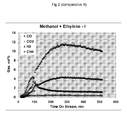
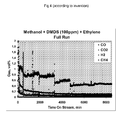
- It has been discovered in the previous prior art that not only coking is reduced but the undesired by-products such as CO, CO2, methane and hydrogen are reduced and that such reduction of undesired by products is amplified by the presence of an hydrocarbon fed with the methanol.
- It has been observed, in addition of the MTO reaction to produce olefins, a reforming of the methanol catalyzed by the inner surface of the reactor. Said reforming is significantly increased when ethylene or other hydrocarbon is co-fed with methanol in the MTO reactor over zeolite or phosphated zeolite.
- It seems that this reforming of methanol is increased when the catalyst has been regenerated in the reactor. Without being binded by an explanation the inventors think that during the regeneration which is e.g. a burning of the coke present on the catalyst by air or air enriched with oxygen the temperature in the reactor can reach 500 to 800°C and then the inner surface of the reactor gets catalytic properties.
- It was found that the injection of a small amount of DMDS could significantly reduce this effect due to sulfidazing the reactor walls. This reduction is amplified when ethylene or other hydrocarbons is co-fed with methanol in the MTO reactor.
- The present invention is a process for making an olefin product from an oxygen-containing organic feedstock comprising:
- providing a mixture of said oxygen-containing feedstock, an effective amount of an hydrocarbon and optionally an inert diluent,
- contacting said mixture in a reaction zone having an inner surface (the MTO reactor) with a zeolitic catalyst at conditions effective to convert at least a part of the oxygen-containing organic feedstock to olefin products (the MTO reactor effluent),
- recovering a reactor effluent comprising light olefins, a heavy hydrocarbon fraction and undesired by-products,
- at least a part of the inner surface is passivated such that the undesired by-products are reduced by comparison with a non passivated inner surface and /or
- one or more sulphur compound is co-injected with the said oxygen-containing feedstock and the hydrocarbon such that the undesired by-products are reduced by comparison with a non injection of sulphur compound.
- In a specific embodiment the catalyst is regenerated in the MTO reactor. Said regeneration is e.g. a treatment with air at a temperature around 500 to 800°C to essentially burn the coke on the catalyst.
- With regards to said effluent of the MTO reactor, "light olefins" means ethylene and propylene and the "heavy hydrocarbon fraction" is defined herein as the fraction containing hydrocarbons having a molecular weight greater than propane, which means hydrocarbons having 4 carbon atoms or more and written as C4 +.
- According to a specific embodiment the MTO reactor effluent comprising light olefins and a heavy hydrocarbon fraction is sent to a fractionation section to separate said light olefins from said heavy hydrocarbon fraction; said heavy hydrocarbon fraction is recycled in the MTO reactor and is used as the hydrocarbon in the mixture of said oxygen-containing feedstock and hydrocarbon.
- According to another embodiment of the invention said olefin products (the effluent of the MTO) are fractionated to form a stream comprising essentially ethylene and said stream in whole or in part is recycled in the MTO reactor inlet and is used as the hydrocarbon in the mixture of said oxygen-containing feedstock and hydrocarbon. In addition this increases the propylene yield of the MTO reactor.
- According to another embodiment which is a combination of the two above embodiments, a stream comprising essentially ethylene and the heavy hydrocarbon fraction are recycled at the inlet of the MTO reactor and are used as the hydrocarbon in the mixture of said oxygen-containing feedstock and hydrocarbon.
- In the above embodiments the MTO reactor can be a plurality of MTO reactors connected in series. This arrangement is advantageous when the MTO reactor is a fixed bed. To remove the heat of reaction the effluent of one of the reactors is cooled and optionally mixed with a fresh oxygen-containing feedstock before introduction in the subsequent MTO reactor.
- The present invention is of high interest for the catalyst of the ZSM type such as ZSM-5 optionally containing phosphorus and regenerated in the MTO reactor.
- In a specific embodiment the MTO reactor is fluidized bed reactor.
- In a specific embodiment the MTO reactor is a non circulated fluidized bed reactor.
- In a specific embodiment the catalyst is of the MFI type such as ZSM-5 optionally containing phosphorus.
- In a specific embodiment the catalyst is regenerated in the MTO reactor.
- In a specific embodiment the catalyst is of the MFI type with Si/Al ratio at least 60 and used in fixed bed MTO process.
- In a specific embodiment the catalyst is selected from MEL, FER, MTT, MWW, TON, EUO, MFS, ZSM-48.
- In a specific embodiment the catalyst is regenerated in the oxygenates conversion reactor.
- Metal-catalyzed coking leads to the formation of filamentous carbon, which promotes corrosion of reactor walls and coking of the catalyst. The carbon fibers may effect obstruction or clogging of moving parts (e.g., valve hinges) and increased pressure drops or even plugging of restricted spaces (e.g., diplegs). In the same time reactor walls can catalyse reforming of methanol or olefins co-feeded with methanol leading to hydrogen and methane formation.
- As regards the passivation of the inner surface of the MTO reactor, good results are achieved when one or more of the internal surfaces of the reaction zone of the present invention comprises a protective layer resistant to metal- catalyzed coking. The protective layer may be formed on the one or more of the internal surfaces of the reaction zone using at least one of a variety of materials applied in any manner which is effective to provide a stable layer at conversion conditions. Effective materials can be selected from one or more of, without so limiting the invention, tin, chromium, antimony, aluminum, germanium, bismuth, arsenic, gallium, indium, lead, copper, molybdenum, tungsten, titanium, niobium, zirconium, tantalum, hafnium, silver, gold, platinum, and mixtures, intermetallic compounds and alloys, as well as silicon and alumina. Preferred metals are selected from one or more of the group consisting of tin, antimony, aluminum, germanium and silicon.
- The protective layer may be applied in any suitable manner which provides a stable layer at conversion conditions. For example, without so limiting the invention, metal- containing coatings can be applied by painting, electroplating, cladding, spraying, chemical vapor deposition, and sputtering. Painting is a preferred method of applying the protective layer. Such paint can be applied on reactor-system surfaces by any effective manner such as spraying, brushing, or pigging,
- Preferably, the paint is a decomposable, reactive, metal-containing paint which produces a reactive metal which interacts with the reaction-zone internal surface. Tin is a preferred metal and is exemplified herein; disclosures herein about tin are generally applicable to other reducible metals such as germanium. Preferred paints comprise a metal component selected from one or more of the group comprising: a hydrogen-decomposable metal compound, such as an organometallic compound; finely divided metal; a metal oxide, preferably a reducible metal oxide; and a solvent. A particularly preferred organometallic compound comprises one or more of butyl tin, tin octanoate or tin neodecanoate. It is within the scope of the invention that iron is added to a tin-containing paint to facilitate the reaction of the paint to form iron stannides as a flux.
- In a further alternative embodiment, one or both of aluminum and silicon can be applied to metal surfaces such as steels by well known deposition techniques. Alternative processes include powder and vapor diffusion processes such as the "Alonizing" process, which has been commercialized by Alon Processing, Inc., Tarentum, Pa. Essentially, "Alonizing" is a high temperature diffusion process which alloys aluminum into the surface of a treated metal, such as steel, producing aluminides. Silicon can be applied by any effective method; for example, by diffusion coating as disclosed in
US 4,714,632 ;US 5,254,369 ; andUS 5,873,951 , the content of which is enclosed in the present invention. As disclosed in these patents, other materials such as aluminum and chromium may be combined with silicon in a protective coating. It is preferred that the coatings be sufficiently thick that they completely cover the base metallurgy and that the resulting protective layers remain intact over years of operation. - This thickness depends, inter alia, on the nature and effectiveness of the coating metal. In general, the thickness after curing is preferably between 0.1 and 50 mils, more preferably between 0.5 and 10 mils.
- Although not necessary for all coating materials, for some coatings it is preferred that the coating be cured prior to use. This is especially true for coating materials containing reducible metal oxides and organometallic components, such as oxygen-containing organometallic compounds.
- In a preferred embodiment, cure conditions comprise a heating step and optionally a reducing step in a hydrogen-containing atmosphere at elevated temperatures. Hydrogen contacting preferably occurs while the protective layer is being formed. In general, the contacting of the reactor system having a metal-containing coating, plating, cladding, paint or other coating applied to a portion thereof with a hydrogen-containing gas is done for a time and at a temperature sufficient to produce a continuous and uninterrupted protective layer which adheres to the substrate. Curing is preferably done over a period of hours, often with temperatures increasing over time. For example, tin paints are preferably cured between 420° and 600°C.
- Alternatively or in addition to directly coating the one or more of the internal surfaces, a protective layer to reduce metal-catalyzed coking can be provided by introducing protective materials in the feed stream. Preferably the protective material is introduced as an organometallic compound which optimally is a hydrogen-decomposable compound.
- Preferable organometallic compounds are selected from compounds of tin, chromium, antimony, aluminum and germanium, with tin compounds being especially favored. Such materials should be mobile and able to bond with the one or more of the internal surfaces. For example, one or more of butyl tin, tin octanoate and tin neodecanoate could be introduced into the feed stream in a concentration of from 0.01 to 500 wt-ppm. The organometallic compound may be introduced either on a continuous basis or on an intermittent basis in a cycle sufficient to provide a protective layer as described hereinbefore to reduce metal- catalyzed coking.
- Suitable reaction conditions for the conversion of aliphatic hetero compounds vary by the nature of the feed stream and product objective. In general, reaction severity increases with increasing temperature, increasing catalyst activity, and decreasing space velocity.
- Suitable conditions for the conversion of oxygenates to light olefins in accordance with the present invention comprise a temperature of from 200° to 600°C, preferably from 300° to 500°C, and a pressure of from 7 to 1400 kPa, preferably from 140 to 700 kPa.
- As regards the injection of sulphur compound, significant improvement can be achieved in case of injection of advantageously at least 10vppm of sulfur compounds. Various sulphur compounds, advantageously sulfur degradable compounds such as thiols and sulfides of which dimethyldisulphide (DMDS) can be used. Amounts (in sulfur element) can range from 10 vppm to 1000 vppm and preferably from 50 vppm to 800 vppm, more preferably around 100 vppm.
- One can cite sulphur compound in which sulphur is part of an aromatic heterocycle. The thiohydrocarbons can be selected from the group consisting of thiophene, benzothiophene, substituted thiophenes and mixtures thereof.
- As regards the MTO process, the oxygenate feedstock is any feedstock containing a molecule or any chemical having at least an oxygen atom and capable, in the presence of the above catalyst, to be converted to olefin products. The oxygenate feedstock comprises at least one organic compound which contains at least one oxygen atom, such as aliphatic alcohols, ethers, carbonyl compounds (aldehydes, ketones, carboxylic acids, carbonates, esters and the like). Representative oxygenates include but are not necessarily limited to lower straight and branched chain aliphatic alcohols and their unsaturated counterparts. Examples of suitable oxygenate compounds include, but are not limited to: methanol; ethanol; n-propanol; isopropanol; C4-C20 alcohols; methyl ethyl ether; dimethyl ether; diethyl ether; di-isopropyl ether; formaldehyde; dimethyl carbonate; dimethyl ketone; acetic acid; and mixtures thereof. Representative oxygenates include lower straight chain or branched aliphatic alcohols, their unsaturated counterparts.
- As regards the catalyst, The present invention is not limited to specific catalysts.
- In a preferred embodiment, a crystalline silicate containing advantageously at least one 10 members ring into the structure is used. The non-limited examples of zeolitic catalyst can be the MFI (ZSM-5, silicalite-1, boralite C, TS-1), MEL (ZSM-11, silicalite-2, boralite D, TS-2, SSZ-46), FER (Ferrierite, FU-9, ZSM-35), MTT (ZSM-23), MWW (MCM-22, PSH-3, ITQ-1, MCM-49), TON (ZSM-22, Theta-1, NU-10), EUO (ZSM-50, EU-1), MFS (ZSM-57) and ZSM-48 family of microporous materials consisting of silicon, aluminium, boron and oxygen.
- Advantageously in said embodiment the catalyst is a crystalline silicate with MFI structure having a framework ratio Si/Al of at least about 60. Such crystalline silicate having a framework ratio Si/Al of at least about 60 and the dealuminated crystalline silicate are essentially in H-form. It means that a minor part (less than about 50 %) can carry metallic compensating ions such as Na, Mg, Ca, La, Ni, Ce, Zn, Co.
- Examples of a crystalline silicate of the MFI type are the synthetic zeolite ZSM-5 and silicalite and other MFI type crystalline silicates known in the art. Examples of a crystalline silicate of the MEL family are the zeolite ZSM-11 and other MEL type crystalline silicates known in the art. Other examples are Boralite D and silicalite-2 as described by the International Zeolite Association (Atlas of zeolite structure types, 1987, Butterworths).
- In a specific embodiment the crystalline silicate is dealuminated by steaming to remove aluminium from the crystalline silicate framework. The steam treatment is conducted at elevated temperature, preferably in the range of from 425 to 870°C, more preferably in the range of from 540 to 815°C and at atmospheric pressure and at a water partial pressure of from 13 to 200kPa. Preferably, the steam treatment is conducted in an atmosphere comprising from 5 to 100% steam. The steam atmosphere preferably contains from 5 to 100 vol% steam with from 0 to 95vol% of an inert gas, preferably nitrogen. A more preferred atmosphere comprises 72 vol% steam and 28 vol% nitrogen i.e. 72kPa steam at a pressure of one atmosphere. The steam treatment is preferably carried out for a period of from 1 to 200 hours, more preferably from 20 hours to 100 hours. As stated above, the steam treatment tends to reduce the amount of tetrahedral aluminium in the crystalline silicate framework, by forming alumina.
- In a more specific embodiment the crystalline silicate catalyst is dealuminated by heating the catalyst in steam to remove aluminium from the crystalline silicate framework and extracting aluminium from the catalyst by contacting the catalyst with a complexing agent for aluminium to remove from pores of the framework alumina deposited therein during the steaming step thereby to increase the silicon/aluminium atomic ratio of the catalyst. The catalyst having a high silicon/aluminium atomic ratio for use in the catalytic process of the present invention is manufactured by removing aluminium from a commercially available crystalline silicate. By way of example a typical commercially available silicalite has a silicon/aluminium atomic ratio of around 120. In accordance with the present invention, the commercially available crystalline silicate is modified by a steaming process which reduces the tetrahedral aluminium in the crystalline silicate framework and converts the aluminium atoms into octahedral aluminium in the form of amorphous alumina. Although in the steaming step aluminium atoms are chemically removed from the crystalline silicate framework structure to form alumina particles, those particles cause partial obstruction of the pores or channels in the framework. This could inhibit the process of the present invention. Accordingly, following the steaming step, the crystalline silicate is subjected to an extraction step wherein amorphous alumina is removed from the pores and the micropore volume is, at least partially, recovered. The physical removal, by a leaching step, of the amorphous alumina from the pores by the formation of a water-soluble aluminium complex yields the overall effect of de-alumination of the crystalline silicate. In this way by removing aluminium from the crystalline silicate framework and then removing alumina formed there from the pores, the process aims at achieving a substantially homogeneous de-alumination throughout the whole pore surfaces of the catalyst. This reduces the acidity of the catalyst. The reduction of acidity ideally occurs substantially homogeneously throughout the pores defined in the crystalline silicate framework. Following the steam treatment, the extraction process is performed in order to de-aluminate the catalyst by leaching. The aluminium is preferably extracted from the crystalline silicate by a complexing agent which tends to form a soluble complex with alumina. The complexing agent is preferably in an aqueous solution thereof. The complexing agent may comprise an organic acid such as citric acid, formic acid, oxalic acid, tartaric acid, malonic acid, succinic acid, glutaric acid, adipic acid, maleic acid, phthalic acid, isophthalic acid, fumaric acid, nitrilotriacetic acid, hydroxyethylenediaminetriacetic acid, ethylenediaminetetracetic acid, trichloroacetic acid trifluoroacetic acid or a salt of such an acid (e.g. the sodium salt) or a mixture of two or more of such acids or salts. The complexing agent may comprise an inorganic acid such as nitric acid, halogenic acids, sulphuric acid, phosphoric acid or salts of such acids or a mixture of such acids. The complexing agent may also comprise a mixture of such organic and inorganic acids or their corresponding salts. The complexing agent for aluminium preferably forms a water-soluble complex with aluminium, and in particular removes alumina which is formed during the steam treatment step from the crystalline silicate. A particularly preferred complexing agent may comprise an amine, preferably ethylene diamine tetraacetic acid (EDTA) or a salt thereof, in particular the sodium salt thereof. In a preferred embodiment, the framework silicon/aluminium ratio is increased by this process to a value about in the range 150 to 1000, more preferably at least 200.
- Following the aluminium leaching step, the crystalline silicate may be subsequently washed, for example with distilled water, and then dried, preferably at an elevated temperature, for example around 110°C.
- Additionally, if during the preparation of the catalysts of the invention alkaline or alkaline earth metals have been used, the molecular sieve might be subjected to an ion-exchange step. Conventionally, ion-exchange is done in aqueous solutions using ammonium salts or inorganic acids.
- Following the de-alumination step, the catalyst is thereafter calcined, for example at a temperature of from 400 to 800°C at atmospheric pressure for a period of from 1 to 10 hours.
- According to another advantageous embodiment the catalyst is a P-modified zeolite (Phosphorus-modified zeolite). Said phosphorus modified molecular sieves can be prepared based on MFI, MOR, MEL, clinoptilolite or FER crystalline aluminosilicate molecular sieves having an initial Si/Al ratio advantageously between 4 and 500. The P-modified zeolites of this recipe can be obtained based on cheap crystalline silicates with low Si/Al ratio (below 30).
- By way of example said P-modified zeolite is made by a process comprising in that order:
- selecting a zeolite (advantageously with Si/Al ratio between 4 and 500) among H+ or NH4 +-form of MFI, MEL, FER, MOR, clinoptilolite;
- introducing P at conditions effective to introduce advantageously at least 0.05 wt% of P;
- separation of the solid from the liquid if any;
- an optional washing step or an optional drying step or an optional drying step followed by a washing step;
- a calcination step; the catalyst of the XTO and the catalyst of the OCP being the same or different.
- The zeolite with low Si/Al ratio has been made previously with or without direct addition of an organic template.
- Optionally the process to make said P-modified zeolite comprises the steps of steaming and leaching. The method consists in steaming followed by leaching. It is generally known by the persons in the art that steam treatment of zeolites, results in aluminium that leaves the zeolite framework and resides as aluminiumoxides in and outside the pores of the zeolite. This transformation is known as dealumination of zeolites and this term will be used throughout the text. The treatment of the steamed zeolite with an acid solution results in dissolution of the extra-framework aluminiumoxides. This transformation is known as leaching and this term will be used throughout the text. Then the zeolite is separated, advantageously by filtration, and optionally washed. A drying step can be envisaged between filtering and washing steps. The solution after the washing can be either separated, by way of example, by filtering from the solid or evaporated.
- P can be introduced by any means or, by way of example, according to the recipe described in
US 3,911,041 ,US 5,573,990 andUS 6,797,851 . - The catalyst made of a P-modified zeolite can be the P-modified zeolite itself or it can be the P-modified zeolite formulated into a catalyst by combining with other materials that provide additional hardness or catalytic activity to the finished catalyst product.
- The preferred catalyst may be, and preferably is, incorporated into solid particles in which the catalyst is present in an amount effective to promote the desired hydrocarbon conversion. In one aspect, the solid particles comprise a catalytically effective amount of the catalyst and at least one matrix material, preferably selected from the group consisting of binder materials, filler materials, and mixtures thereof to provide a desired property or properties, e.g., desired catalyst dilution, mechanical strength and the like, to the solid particles. Such matrix materials are often to some extent porous in nature and may or may not be effective to promote the desired hydrocarbon conversion. The matrix materials may promote conversion of the feed stream and often provide reduced selectivity to the desired product or products relative to the catalyst. Filler and binder materials include, for example, synthetic and naturally occurring substances such as metal oxides, clays, silicas, aluminas, silica-aluminas, silica-magnesias, silica-zirconias, silica-thorias, silica-beryllias, silica-titanias, silica-alumina-thorias, silica-alumina-zirconias, aluminophosphates, mixtures of these, and the like.
- If matrix materials, e.g., binder and/or filler materials, are included in the catalyst composition, the non-zeolitic and/or zeolitic molecular sieves preferably comprise 1 to 99 percent, more preferably 5 to 90 percent, and still more preferably 10 to 80 percent by weight of the total composition. The preparation of solid particles comprising catalyst and matrix materials is conventional and well known in the art and, therefore, need not be discussed in detail herein.
- The foregoing disclosure and following examples are presented only to illustrate certain specific embodiments of the invention, and should not be construed to limit the scope of the invention as set forth in the claims. There are many possible other variations within the spirit of the invention, as those of ordinary skill in the art will recognize.
- In the examples an MTO reaction was carried out at 550°C, P=1.5 bara, WHSV=1.6h-1over an extruded with silica binder Ca-P-MFI catalyst containg 40wt% of zeolite.
-
Fig 1 (comparative I) illustrates by product concentrations (H2, CO, CH4 and CO2) in an MTO reaction effluent with pure methanol on fresh catalyst. -
Fig 2 . (comparative II) illustrates by product concentrations (H2, CO, CH4 and CO2) in an MTO reaction effluent with a mixture of methanol and ethylene on fresh catalyst (methanol/ethylene 5/1 on C-basis). Comparison the data presented at theFig1 &2 clearly illustrates significant increase of the by-product formation in case of co-feeding of ethylene with methanol. -
Fig 3 (comparative III) illustrates by product concentrations (H2, CO, CH4 and CO2) in an MTO reaction effluent, further to a regeneration of the catalyst, fed with pure methanol and ethylene (methanol/ethylene 5/1 on C-basis, dry basis). -
Fig 4 . (examples according to the invention) illustrates by product concentrations (H2, CO, CH4 and CO2) in an MTO reaction effluent, further to a regeneration of the catalyst, fed with methanol and DMDS (100 vppm of S). Then after 250 minutes ethylene is introduced, the by-products are lowered as compared withfig 2 ,3 and even to thefig 1 .
Claims (11)
- Process for making an olefin product from an oxygen-containing organic feedstock comprising:providing a mixture of said oxygen-containing feedstock, an effective amount of an hydrocarbon and optionally an inert diluent,contacting said mixture in a reaction zone having an inner surface (the MTO reactor) with a zeolitic catalyst at conditions effective to convert at least a part of the oxygen-containing organic feedstock to olefin products (the MTO reactor effluent),recovering a reactor effluent comprising light olefins, a heavy hydrocarbon fraction and undesired by-products,wherein :at least a part of the inner surface is passivated such that the undesired by-products are reduced by comparison with a non passivated inner surface and /orone or more sulphur compound is co-injected with the said oxygen-containing feedstock and the hydrocarbon such that the undesired by-products are reduced by comparison with a non injection of sulphur compound.
- Process according to claim 1 wherein the MTO reactor effluent comprising light olefins and a heavy hydrocarbon fraction is sent to a fractionation section to separate said light olefins from said heavy hydrocarbon fraction; said heavy hydrocarbon fraction is recycled in the MTO reactor and is used as the hydrocarbon in the mixture of said oxygen-containing feedstock and hydrocarbon.
- Process according to claim 1 or 2 wherein said olefin products (the effluent of the MTO) are fractionated to form a stream comprising essentially ethylene and said stream in whole or in part is recycled in the MTO reactor inlet and is used as the hydrocarbon in the mixture of said oxygen-containing feedstock and hydrocarbon. In addition this increases the propylene yield of the MTO reactor.
- Process according to any one of the preceding claims wherein the MTO reactor is a plurality of MTO reactors connected in series.
- Process according to any one of the preceding claims wherein the MTO reactor is a non-circulated fluidized bed reactor.
- Process according to any one of claims 1 to 3 wherein the MTO reactor is fluidized bed reactor.
- Process according to any one of the preceding claims wherein the catalyst is of the MFI type such as ZSM-5 optionally containing phosphorus.
- Process according to claim 7 wherein the catalyst is regenerated in the MTO reactor.
- Process according to any one of claims 1 to 5 wherein the catalyst is of the MFI type with Si/Al ratio at least 60 and used in fixed bed MTO process.
- Process according to any one of the preceding claims wherein the catalyst is selected from MEL, FER, MTT, MWW, TON, EUO, MFS, ZSM-48.
- Process according to any one of the preceding claims wherein the catalyst is regenerated in the oxygenates conversion reactor.
Priority Applications (6)
| Application Number | Priority Date | Filing Date | Title |
|---|---|---|---|
| EP08161378A EP2151423A1 (en) | 2008-07-29 | 2008-07-29 | Process to make olefins from organics with reduced side reactions. |
| US13/055,019 US9162937B2 (en) | 2008-07-29 | 2009-07-03 | Process to make olefins from organics with reduced side reactions |
| CN200980128886.5A CN102105419B (en) | 2008-07-29 | 2009-07-03 | Process to make olefins from organics with reduced side reactions |
| EP09802473A EP2318333A1 (en) | 2008-07-29 | 2009-07-03 | Process to make olefins from organics with reduced side reactions |
| PCT/EP2009/058439 WO2010012564A1 (en) | 2008-07-29 | 2009-07-03 | Process to make olefins from organics with reduced side reactions |
| EA201170213A EA021155B1 (en) | 2008-07-29 | 2009-07-03 | Process for making an olefin product from an oxygen-containing organic feedstock |
Applications Claiming Priority (1)
| Application Number | Priority Date | Filing Date | Title |
|---|---|---|---|
| EP08161378A EP2151423A1 (en) | 2008-07-29 | 2008-07-29 | Process to make olefins from organics with reduced side reactions. |
Publications (1)
| Publication Number | Publication Date |
|---|---|
| EP2151423A1 true EP2151423A1 (en) | 2010-02-10 |
Family
ID=40305323
Family Applications (2)
| Application Number | Title | Priority Date | Filing Date |
|---|---|---|---|
| EP08161378A Withdrawn EP2151423A1 (en) | 2008-07-29 | 2008-07-29 | Process to make olefins from organics with reduced side reactions. |
| EP09802473A Withdrawn EP2318333A1 (en) | 2008-07-29 | 2009-07-03 | Process to make olefins from organics with reduced side reactions |
Family Applications After (1)
| Application Number | Title | Priority Date | Filing Date |
|---|---|---|---|
| EP09802473A Withdrawn EP2318333A1 (en) | 2008-07-29 | 2009-07-03 | Process to make olefins from organics with reduced side reactions |
Country Status (5)
| Country | Link |
|---|---|
| US (1) | US9162937B2 (en) |
| EP (2) | EP2151423A1 (en) |
| CN (1) | CN102105419B (en) |
| EA (1) | EA021155B1 (en) |
| WO (1) | WO2010012564A1 (en) |
Cited By (1)
| Publication number | Priority date | Publication date | Assignee | Title |
|---|---|---|---|---|
| WO2016107759A1 (en) * | 2014-12-31 | 2016-07-07 | Total Research & Technology Feluy | Process for preparing olefins by dehydrating alcohols with less side effects comprising addition of sulfur containing compounds |
Families Citing this family (9)
| Publication number | Priority date | Publication date | Assignee | Title |
|---|---|---|---|---|
| CN103459026A (en) | 2011-04-13 | 2013-12-18 | 科伊奥股份有限公司 | Improved catalysts for thermocatalytic conversion of biomass to liquid fuels and chemicals |
| WO2013017499A1 (en) * | 2011-08-03 | 2013-02-07 | Total Research & Technology Feluy | Method for making a catalyst comprising a phosphorus modified zeolite and use of said zeolite |
| UA115428C2 (en) * | 2011-08-03 | 2017-11-10 | Тотал Ресьоч Енд Текнолоджі Фелуй | Catalyst comprising a phosphorus modified zeolite and having partly an alpo structure |
| US9518229B2 (en) | 2012-07-20 | 2016-12-13 | Inaeris Technologies, Llc | Catalysts for thermo-catalytic conversion of biomass, and methods of making and using |
| US9522392B2 (en) | 2013-03-15 | 2016-12-20 | Inaeris Technologies, Llc | Phosphorous promotion of zeolite-containing catalysts |
| MX391102B (en) * | 2013-10-31 | 2025-03-21 | Reactor Resources Llc | METHODS AND SYSTEMS FOR IN SITU COKING, PASSIVATION AND SULFIDIZATION OF CATALYSTS. |
| CN103755510A (en) * | 2014-01-03 | 2014-04-30 | 浙江大学 | Process for producing propylene by using alcohol-hydrocarbon co-refining technology |
| CN109772476B (en) * | 2019-03-18 | 2021-12-03 | 新兴能源科技有限公司 | Method for recovering fine powder of waste molecular sieve catalyst of DMTO device and application |
| CN111992245A (en) * | 2020-05-31 | 2020-11-27 | 南京克米斯璀新能源科技有限公司 | Catalyst for removing hydroxyl from Fischer-Tropsch oil |
Citations (9)
| Publication number | Priority date | Publication date | Assignee | Title |
|---|---|---|---|---|
| US3911041A (en) | 1974-09-23 | 1975-10-07 | Mobil Oil Corp | Conversion of methanol and dimethyl ether |
| US4714632A (en) | 1985-12-11 | 1987-12-22 | Air Products And Chemicals, Inc. | Method of producing silicon diffusion coatings on metal articles |
| US5254369A (en) | 1991-04-17 | 1993-10-19 | L'air Liquide, Societe Anonyme Pour L'etude Et L'exploitation Des Procedes Georges Claude | Method of forming a silicon diffusion and/or overlay coating on the surface of a metallic substrate by chemical vapor deposition |
| US5573990A (en) | 1992-05-03 | 1996-11-12 | Dalian Institute Of Chemical Physics | Process for the conversion of methanol to light olefins and catalyst for such process |
| US5873951A (en) | 1996-08-23 | 1999-02-23 | Alon, Inc. | Diffusion coated ethylene furnace tubes |
| US20040152935A1 (en) | 2002-10-21 | 2004-08-05 | Jones Jeffrey P. | Method and system for reducing decomposition byproducts in a methanol to olefin reactor system |
| US6797851B2 (en) | 2001-08-30 | 2004-09-28 | Exxonmobil Chemical Patents Inc. | Two catalyst process for making olefin |
| US20060149106A1 (en) * | 2005-01-06 | 2006-07-06 | Xin Xiao | Toluene disproportionation process utilizing mild sulfiding during startup |
| WO2007102916A2 (en) | 2005-12-22 | 2007-09-13 | Uop Llc | Methanol-to-olefins process with reduced coking |
Family Cites Families (6)
| Publication number | Priority date | Publication date | Assignee | Title |
|---|---|---|---|---|
| US2709195A (en) * | 1953-12-31 | 1955-05-24 | Du Pont | Thiophene converting process |
| US4311865A (en) * | 1979-04-04 | 1982-01-19 | Mobil Oil Corporation | Manufacture of hydrocarbons from oxygenates |
| US4555495A (en) * | 1984-04-26 | 1985-11-26 | Mobil Oil Corporation | Reactivation of noble metal-containing zeolite catalyst materials |
| US4542252A (en) * | 1984-07-20 | 1985-09-17 | Mobil Oil Corporation | Multi-stage adiabatic process for methanol conversion to light olefins |
| JPS6490136A (en) * | 1987-09-30 | 1989-04-06 | Agency Ind Science Techn | Production of lower olefin |
| US6613951B1 (en) | 1999-09-23 | 2003-09-02 | Mobil Oil Corporation | Process for converting methanol to olefins |
-
2008
- 2008-07-29 EP EP08161378A patent/EP2151423A1/en not_active Withdrawn
-
2009
- 2009-07-03 US US13/055,019 patent/US9162937B2/en not_active Expired - Fee Related
- 2009-07-03 EA EA201170213A patent/EA021155B1/en not_active IP Right Cessation
- 2009-07-03 CN CN200980128886.5A patent/CN102105419B/en not_active Expired - Fee Related
- 2009-07-03 EP EP09802473A patent/EP2318333A1/en not_active Withdrawn
- 2009-07-03 WO PCT/EP2009/058439 patent/WO2010012564A1/en not_active Ceased
Patent Citations (9)
| Publication number | Priority date | Publication date | Assignee | Title |
|---|---|---|---|---|
| US3911041A (en) | 1974-09-23 | 1975-10-07 | Mobil Oil Corp | Conversion of methanol and dimethyl ether |
| US4714632A (en) | 1985-12-11 | 1987-12-22 | Air Products And Chemicals, Inc. | Method of producing silicon diffusion coatings on metal articles |
| US5254369A (en) | 1991-04-17 | 1993-10-19 | L'air Liquide, Societe Anonyme Pour L'etude Et L'exploitation Des Procedes Georges Claude | Method of forming a silicon diffusion and/or overlay coating on the surface of a metallic substrate by chemical vapor deposition |
| US5573990A (en) | 1992-05-03 | 1996-11-12 | Dalian Institute Of Chemical Physics | Process for the conversion of methanol to light olefins and catalyst for such process |
| US5873951A (en) | 1996-08-23 | 1999-02-23 | Alon, Inc. | Diffusion coated ethylene furnace tubes |
| US6797851B2 (en) | 2001-08-30 | 2004-09-28 | Exxonmobil Chemical Patents Inc. | Two catalyst process for making olefin |
| US20040152935A1 (en) | 2002-10-21 | 2004-08-05 | Jones Jeffrey P. | Method and system for reducing decomposition byproducts in a methanol to olefin reactor system |
| US20060149106A1 (en) * | 2005-01-06 | 2006-07-06 | Xin Xiao | Toluene disproportionation process utilizing mild sulfiding during startup |
| WO2007102916A2 (en) | 2005-12-22 | 2007-09-13 | Uop Llc | Methanol-to-olefins process with reduced coking |
Cited By (2)
| Publication number | Priority date | Publication date | Assignee | Title |
|---|---|---|---|---|
| WO2016107759A1 (en) * | 2014-12-31 | 2016-07-07 | Total Research & Technology Feluy | Process for preparing olefins by dehydrating alcohols with less side effects comprising addition of sulfur containing compounds |
| US10472300B2 (en) | 2014-12-31 | 2019-11-12 | Total Research & Technology Feluy | Process for preparing olefins by dehydrating alcohols with less side effects comprising addition of sulfur containing compounds |
Also Published As
| Publication number | Publication date |
|---|---|
| US20110190563A1 (en) | 2011-08-04 |
| CN102105419B (en) | 2014-08-20 |
| CN102105419A (en) | 2011-06-22 |
| EP2318333A1 (en) | 2011-05-11 |
| EA021155B1 (en) | 2015-04-30 |
| EA201170213A1 (en) | 2011-06-30 |
| WO2010012564A1 (en) | 2010-02-04 |
| US9162937B2 (en) | 2015-10-20 |
Similar Documents
| Publication | Publication Date | Title |
|---|---|---|
| US9162937B2 (en) | Process to make olefins from organics with reduced side reactions | |
| CA2801980C (en) | Dehydration of alcohols on poisoned acidic catalysts | |
| EP2238094B1 (en) | Dehydration of alcohols on crystalline silicates | |
| CA2713172C (en) | Dehydration of alcohols in the presence of an inert component | |
| KR101217915B1 (en) | Process to make olefins from ethanol | |
| KR101227221B1 (en) | Process to make olefins from ethanol | |
| EP2143700A1 (en) | Process to make olefins from oxygenates | |
| EP2108637A1 (en) | Process to make olefins from ethanol. | |
| US10472300B2 (en) | Process for preparing olefins by dehydrating alcohols with less side effects comprising addition of sulfur containing compounds | |
| WO2010101121A1 (en) | Method for producing propylene | |
| EP2108634A1 (en) | Dehydration of alcohols on crystalline silicates | |
| EP2108635A1 (en) | Process to make olefins from ethanol | |
| EP3126313B1 (en) | Process for preparing olefins by dehydrating alcohols with less side effects comprising addition of organic acids | |
| EP2108636A1 (en) | Dehydration of alcohols in the presence of an inert component. | |
| CN115485065A (en) | Process and catalyst for the production of ethylene |
Legal Events
| Date | Code | Title | Description |
|---|---|---|---|
| PUAI | Public reference made under article 153(3) epc to a published international application that has entered the european phase |
Free format text: ORIGINAL CODE: 0009012 |
|
| AK | Designated contracting states |
Kind code of ref document: A1 Designated state(s): AT BE BG CH CY CZ DE DK EE ES FI FR GB GR HR HU IE IS IT LI LT LU LV MC MT NL NO PL PT RO SE SI SK TR |
|
| AX | Request for extension of the european patent |
Extension state: AL BA MK RS |
|
| AKY | No designation fees paid | ||
| REG | Reference to a national code |
Ref country code: DE Ref legal event code: 8566 |
|
| STAA | Information on the status of an ep patent application or granted ep patent |
Free format text: STATUS: THE APPLICATION IS DEEMED TO BE WITHDRAWN |
|
| 18D | Application deemed to be withdrawn |
Effective date: 20100811 |