EP2150058A1 - Encoding and decoding methods and apparatus, signal and computer program products therefor - Google Patents
Encoding and decoding methods and apparatus, signal and computer program products therefor Download PDFInfo
- Publication number
- EP2150058A1 EP2150058A1 EP09166150A EP09166150A EP2150058A1 EP 2150058 A1 EP2150058 A1 EP 2150058A1 EP 09166150 A EP09166150 A EP 09166150A EP 09166150 A EP09166150 A EP 09166150A EP 2150058 A1 EP2150058 A1 EP 2150058A1
- Authority
- EP
- European Patent Office
- Prior art keywords
- video sequence
- svc
- enhancement layers
- base layer
- encoding
- Prior art date
- Legal status (The legal status is an assumption and is not a legal conclusion. Google has not performed a legal analysis and makes no representation as to the accuracy of the status listed.)
- Granted
Links
Images




Classifications
-
- H—ELECTRICITY
- H04—ELECTRIC COMMUNICATION TECHNIQUE
- H04N—PICTORIAL COMMUNICATION, e.g. TELEVISION
- H04N21/00—Selective content distribution, e.g. interactive television or video on demand [VOD]
- H04N21/60—Network structure or processes for video distribution between server and client or between remote clients; Control signalling between clients, server and network components; Transmission of management data between server and client, e.g. sending from server to client commands for recording incoming content stream; Communication details between server and client
- H04N21/63—Control signaling related to video distribution between client, server and network components; Network processes for video distribution between server and clients or between remote clients, e.g. transmitting basic layer and enhancement layers over different transmission paths, setting up a peer-to-peer communication via Internet between remote STB's; Communication protocols; Addressing
- H04N21/647—Control signaling between network components and server or clients; Network processes for video distribution between server and clients, e.g. controlling the quality of the video stream, by dropping packets, protecting content from unauthorised alteration within the network, monitoring of network load, bridging between two different networks, e.g. between IP and wireless
- H04N21/64784—Data processing by the network
- H04N21/64792—Controlling the complexity of the content stream, e.g. by dropping packets
-
- H—ELECTRICITY
- H04—ELECTRIC COMMUNICATION TECHNIQUE
- H04N—PICTORIAL COMMUNICATION, e.g. TELEVISION
- H04N19/00—Methods or arrangements for coding, decoding, compressing or decompressing digital video signals
- H04N19/20—Methods or arrangements for coding, decoding, compressing or decompressing digital video signals using video object coding
- H04N19/29—Methods or arrangements for coding, decoding, compressing or decompressing digital video signals using video object coding involving scalability at the object level, e.g. video object layer [VOL]
-
- H—ELECTRICITY
- H04—ELECTRIC COMMUNICATION TECHNIQUE
- H04N—PICTORIAL COMMUNICATION, e.g. TELEVISION
- H04N19/00—Methods or arrangements for coding, decoding, compressing or decompressing digital video signals
- H04N19/30—Methods or arrangements for coding, decoding, compressing or decompressing digital video signals using hierarchical techniques, e.g. scalability
- H04N19/31—Methods or arrangements for coding, decoding, compressing or decompressing digital video signals using hierarchical techniques, e.g. scalability in the temporal domain
-
- H—ELECTRICITY
- H04—ELECTRIC COMMUNICATION TECHNIQUE
- H04N—PICTORIAL COMMUNICATION, e.g. TELEVISION
- H04N19/00—Methods or arrangements for coding, decoding, compressing or decompressing digital video signals
- H04N19/30—Methods or arrangements for coding, decoding, compressing or decompressing digital video signals using hierarchical techniques, e.g. scalability
- H04N19/33—Methods or arrangements for coding, decoding, compressing or decompressing digital video signals using hierarchical techniques, e.g. scalability in the spatial domain
-
- H—ELECTRICITY
- H04—ELECTRIC COMMUNICATION TECHNIQUE
- H04N—PICTORIAL COMMUNICATION, e.g. TELEVISION
- H04N19/00—Methods or arrangements for coding, decoding, compressing or decompressing digital video signals
- H04N19/30—Methods or arrangements for coding, decoding, compressing or decompressing digital video signals using hierarchical techniques, e.g. scalability
- H04N19/39—Methods or arrangements for coding, decoding, compressing or decompressing digital video signals using hierarchical techniques, e.g. scalability involving multiple description coding [MDC], i.e. with separate layers being structured as independently decodable descriptions of input picture data
-
- H—ELECTRICITY
- H04—ELECTRIC COMMUNICATION TECHNIQUE
- H04N—PICTORIAL COMMUNICATION, e.g. TELEVISION
- H04N19/00—Methods or arrangements for coding, decoding, compressing or decompressing digital video signals
- H04N19/60—Methods or arrangements for coding, decoding, compressing or decompressing digital video signals using transform coding
- H04N19/61—Methods or arrangements for coding, decoding, compressing or decompressing digital video signals using transform coding in combination with predictive coding
-
- H—ELECTRICITY
- H04—ELECTRIC COMMUNICATION TECHNIQUE
- H04N—PICTORIAL COMMUNICATION, e.g. TELEVISION
- H04N21/00—Selective content distribution, e.g. interactive television or video on demand [VOD]
- H04N21/20—Servers specifically adapted for the distribution of content, e.g. VOD servers; Operations thereof
- H04N21/23—Processing of content or additional data; Elementary server operations; Server middleware
- H04N21/234—Processing of video elementary streams, e.g. splicing of video streams or manipulating encoded video stream scene graphs
- H04N21/2343—Processing of video elementary streams, e.g. splicing of video streams or manipulating encoded video stream scene graphs involving reformatting operations of video signals for distribution or compliance with end-user requests or end-user device requirements
- H04N21/234327—Processing of video elementary streams, e.g. splicing of video streams or manipulating encoded video stream scene graphs involving reformatting operations of video signals for distribution or compliance with end-user requests or end-user device requirements by decomposing into layers, e.g. base layer and one or more enhancement layers
-
- H—ELECTRICITY
- H04—ELECTRIC COMMUNICATION TECHNIQUE
- H04N—PICTORIAL COMMUNICATION, e.g. TELEVISION
- H04N21/00—Selective content distribution, e.g. interactive television or video on demand [VOD]
- H04N21/20—Servers specifically adapted for the distribution of content, e.g. VOD servers; Operations thereof
- H04N21/25—Management operations performed by the server for facilitating the content distribution or administrating data related to end-users or client devices, e.g. end-user or client device authentication, learning user preferences for recommending movies
- H04N21/266—Channel or content management, e.g. generation and management of keys and entitlement messages in a conditional access system, merging a VOD unicast channel into a multicast channel
- H04N21/2662—Controlling the complexity of the video stream, e.g. by scaling the resolution or bitrate of the video stream based on the client capabilities
Definitions
- the present disclosure relates to encoding and decoding techniques.
- This disclosure was developed with specific attention paid to its possible use in encoding and/or decoding a video sequence comprised of digital samples.
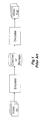
- a well established paradigm in encoding a digital video signal is based on the layout illustrated in Figure 1 .
- an input (“original”) video signal Video In is encoded in an encoder to be then transmitted over a channel or stored in a storage medium to be eventually decoded in a decoder and reproduced as a Video Out signal.
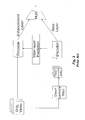
- Figure 2 is representative of a Layered Coding (LC) arrangement wherein an original input video signal (Original Video) is additionally subjected to spatial and/or time subsampling in a downsample filter to produce a number N of downsampled video sequences.
- These downsampled sequences represent multiple descriptions (MD) of the original video signal.
- MD descriptions
- These multiple descriptions are then encoded in a bitstream including a plurality of layers each containing one of the representations of the original signal.
- the various layers are ordered and encoded in such a way that the layers 0 to i-1 are used as a prediction for encoding the i-th layer.
- Figure 2 emphasizes how in the encoding process the original video signal and the downsampled version thereof may be subjected to two parallel encoding processes one of which is hierarchically dependent on the other e.g. via inter-layer prediction.
- the block diagram of Figure 2 is exemplary of a "higher” representation being encoded having reference to the "lower” representation. Consequently, the two signals are encoded via two encoders that are similar to each other, and additionally, encoding the "dependent" representation may re-use certain encoding elements from the "independent” representation.
- the two encoder blocks of Figure 2 plus the inter-layer prediction block and the MUX element may in fact be the building blocks of a single "layered" encoder.
- EL enhanced layer
- the i-th layer of the bitstream can be decoded starting from the results of decoding the previous layers. Increasing the number of layers in the bitstream increases the fidelity in reproducing the original signal form the signals being decoded.
- Scalable Video Coding as provided by the ITU-T/MPEG standards (ITU-T Rec. H. 264/ISO 14496-10 AVC, Annex G "Scalable Video Coding" is exemplary of layered coding which extends the H.264/AVC standards by means of a layered encoding process which enables spatial, time and quality scaling of the decoded signal.
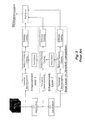
- Figure 3 herein is representative of a SVC processing layout including one base layer and two enhancement layers. Each layer includes a temporal decomposition step followed by motion/texture coding and entropy coding.
- the original video sequence is fed directly to the input of the Enhancement Layer 2 and via cascaded 2D decimation operations to the Enhancement Layer 1 and the Base Layer.
- the output of the various layers (Base Layer, Enhancement Layers 1 and 2) are multiplexed to generate the output SVC encoded bitstream.
- MDC Multiple Description Coding
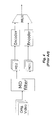
- the original video signal representing the input of the encoding process is subsampled in a multiple description (MD) filter to produce N different multiple descriptions.
- MD multiple description
- Each of these descriptions is then independently encoded in an encoder.
- the encoded descriptions are multiplexed to generate a bitstream to be transmitted and/or stored.
- the block diagram of Figure 4 represents MDC encoding to descriptions MD1 and MD2.
- LC layered coding
- MDC multiple description coding
- IPTV Internet Protocol TeleVision
- IPTV is becoming one of the most significant applications within the framework of digital video technology. Projects aiming at producing IPTV set-top boxes for receiving High Definition TV (HDTV) over IP and using the 802.11 n standard are currently in progress.
- HDTV High Definition TV
- Figure 5 is a schematic representation of an exemplary IPTV scenario including one or more video servers distributing their programs to final users (home users) via hubs receiving the programs from one or more head end hubs.
- IPTV Video On Demand
- VOD Video On Demand
- P2P peer-to-peer
- Figure 7 herein schematically shows how a "fast" peer (i.e. a peer having a bandwidth available which is larger than the bandwidth available to other peers) may connect to various “slow" peers to unload therefrom alternative multiple descriptions which are then re-composed.
- Figure 7 refers to a sequence of five images (P0, ... , P4), which is de-composed in four different descriptions (DO..., D3) each of which is represented with a different degree of shading.
- IPTV IP Television
- HDTV High Definition TV
- SDTV Standard Definition TV
- Figure 8 herein is representative of the scalability concept based on which an original video sequence may be converted into an encoded bitstream which is "scalable", i.e. may be reproduced after possible scaling in terms of "spatial” scalability (that is with images reproduced on a wider or smaller scale in terms of size/number of pixels reproduced), "quality” scalability (important with a change of resolution) and/or “temporal” scalability (e.g. as “slow” video).
- scalable i.e. may be reproduced after possible scaling in terms of "spatial” scalability (that is with images reproduced on a wider or smaller scale in terms of size/number of pixels reproduced), "quality” scalability (important with a change of resolution) and/or “temporal” scalability (e.g. as “slow” video).
- One embodiment provides a flexible arrangement wherein e.g. the decoded signal may be scaled as a function of the capabilities of the receiving terminals as regards spatial resolution of the display unit, the frame rate, the video quality and the computation resources.
- One embodiment provides an arrangement which combines the advantages of LC and MDC, especially as regards compatibility with the SVC standard.
- One embodiment is a method having the features set forth in the claims that follow.
- This disclosure also relates to corresponding encoding/decoding apparatus as well as to a corresponding signal.
- the disclosure also relates to a corresponding computer program product, loadable in the memory of at least one computer and including software code portions for performing the steps of the method of this disclosure when the product is run on a computer.
- reference to such a computer program product is intended to be equivalent to reference to a computer-readable medium containing instructions for controlling a computer system to coordinate the performance of the method of the invention.
- Reference to "at least one computer” is evidently intended to highlight the possibility for the present invention to be implemented in a distributed/ modular fashion.
- An embodiment of this disclosure is a method which combines the LC encoding paradigm with the MDC paradigm by using the SVC Video Encoding Standard (ITU-T/MPEG SVC).
- An embodiment of the arrangement described herein makes it possible to combine the advantages of LC and MDC within a framework compatible with SVC, by giving raise to improved encoding efficiency with respect to the prior art.
- flexibility is provided by compliance with the SVC standard by using an LC encoding paradigm such that the bitstream including the various representations of the original video signal can be scaled by simply discarding those packets which correspond to those layers that are not necessary, whereby the resulting bitstream can be decoded by using a representation of the original video signal in the format held to be the most suitable for the intended use.
- An embodiment of the arrangement described herein makes it possible to provide a P2P network (for which MDC encoding is advantageous) and a set-top box adapted for serving different terminals (for which the scalability as offered by the SVC standard is advantageous.
- Figure 9 is a general layout of a possible embodiment of an IPTV system where contents (video images) from a media server are distributed over a peer-to-peer network including terminals which may be of different types, in terms of e.g., spatial resolution of the display unit, frame rate, quality and computational resources.
- Figure 10 is a block diagram representative of an exemplary encoding process wherein an input video sequence SIN is sent to a spatial and/or time downsampling filter (MDFD) 10 to produce a number N of multiple description (MD1, MD2, ..., MDN) of the input signal.
- MDFD spatial and/or time downsampling filter
- N 4.
- the input signal SIN is also spatially subsampled in a downsample filter (DS) 12 to produce a downsampled version SBIN of the input signal SIN having a spatial and temporal resolution which is lower or equal to the resolution of the N multiple descriptions MD1, MD2, ..., MDN.
- DS downsample filter
- the various downsampled video signals thus generated are encoded in an encoder 14 complying with the SVC (scalable video coding) standard to generate an encoded output bitstream.
- SVC scalable video coding
- the encoder 14 provides encoding as follows.
- the downsampled signal SBIN from the downsample filter 12 is encoded as the base layer BL of the SVC bitstream resulting from encoding in the encoder 14.
- the multiple descriptions MD1, ...., MDN are encoded as enhancement layers (ELs) of the of the SVC bitstream.
- Each base layer EL1, EL2, EL3, EL4 is spatially predicted by the base layer.
- the inter-layer prediction mechanism of SVC leads to each enhancement layer being encoded efficiently.
- bitstream output from the encoder 14 is scalable, in that the base layer BL may be decoded independently of the enhancement layers. These in turn are encoded independently of each other, according to the MDC paradigm.
- MDC encoding introduces a redundancy in the data.
- the redundancy associated with multiple descriptions is "moved" to the base layer BL of the SVC encoding scheme, with the additional advantage of making this totally compatible with the H.264/AVC standard.
- the embodiment illustrated in Figure 10 turns into an advantage what could be regarded as a disadvantage inherent in multiple description coding.
- Tests performed by the Applicant indicate that the rate-distortion efficiency of the arrangement exemplified herein compares well with the efficiency of a conventional MD encoding arrangement for various test sequences. For instance, comparisons with MD arrangements including four multiple descriptions independently encoded according to the H.264/AVC standard indicate that substantially the same quality in terms of PSNR ratio of the same level can be ensured while obtaining, in the case of the arrangement exemplified herein, a much higher encoding efficiency (for instance in excess of 25% in the case of the "Crew" test sequence).
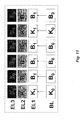
- Figure 11 is representative of an exemplary layout of the SVC bitstream encoded by resorting to the arrangement of Figure 11 .
- each image is subdivided in slices, each of which includes a sequence of macro blocks belonging to that image.
- Each slice is encoded within a packet, designated NALU (Network Abstraction Layer Unit), and the data contained in the packets of the base layer are used to decode data included in the packets of the enhancement layers.
- NALU Network Abstraction Layer Unit
- the packets are designated with K and B suffixes to denote the time prediction structure used by the SVC encoding process.
- K denotes a key picture (of the I or P type)
- B denotes images encoded as hierarchical B-pictures.
- the representation of Figure 11 refers to an exemplary case where each image is constituted by a single slice, but in fact each image may be comprised of plural slices.
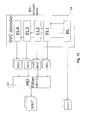
- FIG. 12 The block diagram of Figure 12 is exemplary of a decoder adapted to decode a bitstream (input, right hand side of Figure 12 ) encoded according to the principles exemplified in the foregoing.
- the bitstream to be decoded is first fed to an otherwise conventional SVC decoder 24, to extract (in a manner known per se) the base layer BL and the various enhancement layers EL1, EL2, EL3.
- the enhancement layers are fed to an MD filter 20 which plays the role of a multiple description filter-composer (MDFC) with the purpose of performing spatial and/or time filtering of the multiple descriptions by applying in an inverse manner the de-composition filter (Multiple Description Filter-Decomposer or MDFD) 10 which generated the multiple descriptions for the encoder 14 of Figure 10 .
- MDFC multiple description filter-composer
- the decoded signal comprised in the output of the decoder may be reconstructed with the original spatial and time resolution of the input signal.
- the encoder 10 of Figure 10 is an encoder according to the SVC standard (ITU-T Rec.H 264/ISO 14498-10 AVC, annex G "Scalable Video Coding").
- two multiple descriptions are generated by spatially subsampling the input sequence by using - for each image and each row of pixels - the even pixels for description MD1 while the odd pixels are used for description MD2.
- two descriptions MD1, MD2 are obtained each having a spatial resolution which is one half the spatial resolution of the original sequence.
- each image in the input video sequence SIN is sub divided in sub-blocks including 2x2 pixels and each pixel is used to compose a different description.
- the block diagram of Figure 13 is exemplary of such an approach adopted in a MDFD to generate four multiple descriptions MD1, MD2, MD3, MD4 each having a resolution which is one fourth the resolution of the original sequence SIN.
- an input sequence can be subdivided into two multiple descriptions each having a time resolution half the time resolution of the input sequence by simply using the even images for the first description and the odd images for the second description.
- FIG. 14 is illustrative of the complementary roles played by MDFD and MDFC filters 10 and 20 as illustrated in Figures 10 and 12 in an embodiment compliant with the SVC standard, wherein the encoder and the decoder are conformant with the same profile and layer according to the specifications for the SVC standard.
- the input SX to the encoder (i.e the MDFD filter 10) of Figure 10 is a digital video sequence SIN having the following parameters:
- the MDFD filter 10 when receiving the input sequence SIN, generates therefrom N multiple descriptions MD1, ..., MDN each of which meets the following requirements: W SB ⁇ W MDi ⁇ W SIN H SB ⁇ H MDi ⁇ H SIN F SB ⁇ F MDi ⁇ F SIN , where SIN and SB again denote the original input sequence and sub sampled sequence, respectively, while MDi denotes the i-th of the N multiple descriptions generated by the filter 10.
- the input sequence SBIN sent to the SVC encoder and encoded as the base layer of the scalable bitstream, or the header of each NALU packet used for encoding the SIDN sequence may include the following syntax elements:
- the slices in each ELi exploit an inter-layer prediction from the base layer, while the header in each NALU of the enhancement layers Eli include the syntax element:
- the SVC decoder decodes the base layer BL by producing a video signal designated SOUT and further decodes all the enhancement layers Eli, each containing one of the multiple descriptions MDi the original sequence. These multiple descriptions MDi are then composed by the MDFC filter in such a way to provide a representation SOUT of the input sequence SIN.
Landscapes
- Engineering & Computer Science (AREA)
- Multimedia (AREA)
- Signal Processing (AREA)
- Computer Networks & Wireless Communication (AREA)
- Databases & Information Systems (AREA)
- Computer Security & Cryptography (AREA)
- Compression Or Coding Systems Of Tv Signals (AREA)
Abstract
Description
- The present disclosure relates to encoding and decoding techniques.
- This disclosure was developed with specific attention paid to its possible use in encoding and/or decoding a video sequence comprised of digital samples.
- A well established paradigm in encoding a digital video signal is based on the layout illustrated in
Figure 1 . - There, an input ("original") video signal Video In is encoded in an encoder to be then transmitted over a channel or stored in a storage medium to be eventually decoded in a decoder and reproduced as a Video Out signal.
-
Figure 2 is representative of a Layered Coding (LC) arrangement wherein an original input video signal (Original Video) is additionally subjected to spatial and/or time subsampling in a downsample filter to produce a number N of downsampled video sequences. These downsampled sequences represent multiple descriptions (MD) of the original video signal. These multiple descriptions are then encoded in a bitstream including a plurality of layers each containing one of the representations of the original signal. The various layers are ordered and encoded in such a way that the layers 0 to i-1 are used as a prediction for encoding the i-th layer. - Specifically,
Figure 2 emphasizes how in the encoding process the original video signal and the downsampled version thereof may be subjected to two parallel encoding processes one of which is hierarchically dependent on the other e.g. via inter-layer prediction. The block diagram ofFigure 2 is exemplary of a "higher" representation being encoded having reference to the "lower" representation. Consequently, the two signals are encoded via two encoders that are similar to each other, and additionally, encoding the "dependent" representation may re-use certain encoding elements from the "independent" representation. - The two encoder blocks of
Figure 2 plus the inter-layer prediction block and the MUX element may in fact be the building blocks of a single "layered" encoder. -
Figure 2 refers to two representations, but a hierarchy including a generic number of representations may be considered, where the lower hierarchical level (level n = 0) designated the "base" layer (BL) and each upper layer (level n > 0) represents an "enhancement" layer (EL) with respect to the preceding layers in the hierarchy from which it depends. - During the decoding process, the i-th layer of the bitstream can be decoded starting from the results of decoding the previous layers. Increasing the number of layers in the bitstream increases the fidelity in reproducing the original signal form the signals being decoded.
- Scalable Video Coding (SVC) as provided by the ITU-T/MPEG standards (ITU-T Rec. H. 264/ISO 14496-10 AVC, Annex G "Scalable Video Coding") is exemplary of layered coding which extends the H.264/AVC standards by means of a layered encoding process which enables spatial, time and quality scaling of the decoded signal.
-
Figure 3 herein is representative of a SVC processing layout including one base layer and two enhancement layers. Each layer includes a temporal decomposition step followed by motion/texture coding and entropy coding. The original video sequence is fed directly to the input of theEnhancement Layer 2 and via cascaded 2D decimation operations to theEnhancement Layer 1 and the Base Layer. The output of the various layers (Base Layer,Enhancement Layers 1 and 2) are multiplexed to generate the output SVC encoded bitstream. - In another encoding/decoding paradigm, known as Multiple Description Coding (MDC) as schematically represented in
Figure 4 , the original video signal representing the input of the encoding process is subsampled in a multiple description (MD) filter to produce N different multiple descriptions. Each of these descriptions is then independently encoded in an encoder. The encoded descriptions are multiplexed to generate a bitstream to be transmitted and/or stored. - In the decoding process, the fidelity of the signal decoded (i.e. reproduced) to the original signal increases with an increasing number of descriptions that are received and decoded. The block diagram of
Figure 4 represents MDC encoding to descriptions MD1 and MD2. - Advantages of layered coding (LC) over multiple description coding (MDC) are:
- a greater efficiency in signal compression; and
- a higher flexibility in adapting the decoded signal (scalability).
- Advantages of MDC over LC are:
- a higher "robustness" with respect to errors, in case of transmission over a noisy channel; and
- a higher transmission efficiency in case of peer-to-peer (P2P) applications.
- The article by A. Vitali et al. "Video Over IP Using Standard-Compatible Multiple Description Coding: an EPF Proposal" - Proceedings of the 2006 Packet Video Workshop, Hangzhou, China, provides a detailed review of LC and MDC.
- Internet Protocol TeleVision (IPTV) is a digital TV service provided using the IP protocol over a wideband network infrastructure such as the Internet.
- IPTV is becoming one of the most significant applications within the framework of digital video technology. Projects aiming at producing IPTV set-top boxes for receiving High Definition TV (HDTV) over IP and using the 802.11 n standard are currently in progress.
-
Figure 5 is a schematic representation of an exemplary IPTV scenario including one or more video servers distributing their programs to final users (home users) via hubs receiving the programs from one or more head end hubs. - A feature of IPTV is the Video On Demand (VOD) capability, which permits any user in the system to access at any time a given TV content. At a given time instant, each user may notionally access a different content, whereby conventional point-to-point multicast transmission of encoded contents (left-hand side of
Figure 6 ) would require a very large bandwidth. Forthat reason, IPTV may resort to peer-to-peer (P2P) transmission protocols (right hand side ofFigure 6 ) in order to permit users to exchange their contents thus relieving the provider from the task of individually sending a given content to each and every user that has requested it. - Recent research in the area of P2P protocols demonstrates that MDC encoding can greatly improve efficiency of such a distribution system for multimedia contents. By resorting to MDC, users may exchange different alternative representations of the original system, thus increasing the efficiency of connections between peers within the P2P network. The various representations received may be eventually re-composed to reconstruct the original signal with an increasing quality as a function of the number of the descriptions that are received.
-
Figure 7 herein schematically shows how a "fast" peer (i.e. a peer having a bandwidth available which is larger than the bandwidth available to other peers) may connect to various "slow" peers to unload therefrom alternative multiple descriptions which are then re-composed. Specifically,Figure 7 refers to a sequence of five images (P0, ... , P4), which is de-composed in four different descriptions (DO..., D3) each of which is represented with a different degree of shading. - Another useful feature for IPTV is adaptability of the content to the terminal, so that the digital video signal received can be effectively reproduced on different types of terminals adapted to be connected to an IPTV system, such as High Definition TV (HDTV) receivers, conventional Standard Definition TV (SDTV) receivers, PC desktops, PC laptops, PDAs, smart phones, IPods, and so on.
-
Figure 8 herein is representative of the scalability concept based on which an original video sequence may be converted into an encoded bitstream which is "scalable", i.e. may be reproduced after possible scaling in terms of "spatial" scalability (that is with images reproduced on a wider or smaller scale in terms of size/number of pixels reproduced), "quality" scalability (important with a change of resolution) and/or "temporal" scalability (e.g. as "slow" video). - One embodiment provides a flexible arrangement wherein e.g. the decoded signal may be scaled as a function of the capabilities of the receiving terminals as regards spatial resolution of the display unit, the frame rate, the video quality and the computation resources.
- One embodiment provides an arrangement which combines the advantages of LC and MDC, especially as regards compatibility with the SVC standard.
- One embodiment is a method having the features set forth in the claims that follow. This disclosure also relates to corresponding encoding/decoding apparatus as well as to a corresponding signal. The disclosure also relates to a corresponding computer program product, loadable in the memory of at least one computer and including software code portions for performing the steps of the method of this disclosure when the product is run on a computer. As used herein, reference to such a computer program product is intended to be equivalent to reference to a computer-readable medium containing instructions for controlling a computer system to coordinate the performance of the method of the invention. Reference to "at least one computer" is evidently intended to highlight the possibility for the present invention to be implemented in a distributed/ modular fashion.
- The claims are an integral part of the disclosure as provided herein.
- An embodiment of this disclosure is a method which combines the LC encoding paradigm with the MDC paradigm by using the SVC Video Encoding Standard (ITU-T/MPEG SVC).
- An embodiment of the arrangement described herein makes it possible to combine the advantages of LC and MDC within a framework compatible with SVC, by giving raise to improved encoding efficiency with respect to the prior art.
- In an embodiment of the arrangement described herein, flexibility is provided by compliance with the SVC standard by using an LC encoding paradigm such that the bitstream including the various representations of the original video signal can be scaled by simply discarding those packets which correspond to those layers that are not necessary, whereby the resulting bitstream can be decoded by using a representation of the original video signal in the format held to be the most suitable for the intended use.
- An embodiment of the arrangement described herein makes it possible to provide a P2P network (for which MDC encoding is advantageous) and a set-top box adapted for serving different terminals (for which the scalability as offered by the SVC standard is advantageous.
- Embodiments will now be described, by way of example only, with reference to the enclosed representations, wherein:
-
Figures 1 to 8 have already been discussed in the foregoing, -
Figure 9 is a general layout of a possible embodiment of an IPTV system where contents (video images) from a media server are distributed over a peer-to-peer network, -
Figure 10 is a block diagram representative of an embodiment of an encoding method as described herein, -
Figure 11 is representative of a bitstream structure as derivable by using the arrangement ofFigure 10 , -
Figure 12 is a block diagram representative of an embodiment of the coding method as described herein, -
Figure 13 is a block diagram representative of an embodiment of the arrangement described herein, and -
Figure 14 is a block diagram representative of certain features of the arrangement described herein. - In the following description, numerous specific details are given to provide a thorough understanding of embodiments. The embodiments can be practiced without one or more of the specific details, or with other methods, components, materials, etc. In other instances, well-known structures, materials, or operations are not shown or described in detail to avoid obscuring aspects of the embodiments.
- Reference throughout this specification to "one embodiment" or "an embodiment" means that a particular feature, structure, or characteristic described in connection with the embodiment is included in at least one embodiment. Thus, the appearances of the phrases "in one embodiment" or "in an embodiment" in various places throughout this specification are not necessarily all referring to the same embodiment. Furthermore, the particular features, structures, or characteristics may be combined in any suitable manner in one or more embodiments.
- The headings provided herein are for convenience only and do not interpret the scope or meaning of the embodiments.
-
Figure 9 is a general layout of a possible embodiment of an IPTV system where contents (video images) from a media server are distributed over a peer-to-peer network including terminals which may be of different types, in terms of e.g., spatial resolution of the display unit, frame rate, quality and computational resources. -
Figure 10 is a block diagram representative of an exemplary encoding process wherein an input video sequence SIN is sent to a spatial and/or time downsampling filter (MDFD) 10 to produce a number N of multiple description (MD1, MD2, ..., MDN) of the input signal. In the exemplary embodiment illustrated N = 4. - The input signal SIN is also spatially subsampled in a downsample filter (DS) 12 to produce a downsampled version SBIN of the input signal SIN having a spatial and temporal resolution which is lower or equal to the resolution of the N multiple descriptions MD1, MD2, ..., MDN.
- Subsequently, the various downsampled video signals thus generated are encoded in an
encoder 14 complying with the SVC (scalable video coding) standard to generate an encoded output bitstream. - In an embodiment, the
encoder 14 provides encoding as follows. - The downsampled signal SBIN from the downsample filter 12 is encoded as the base layer BL of the SVC bitstream resulting from encoding in the
encoder 14. - The multiple descriptions MD1, ...., MDN are encoded as enhancement layers (ELs) of the of the SVC bitstream. Each enhancement layer EL1, EL2, ..., ELN (in the exemplary embodiment illustrated N = 4) can be of the spatial or CGS (Course Grain Scalability) type.
- Each base layer EL1, EL2, EL3, EL4 is spatially predicted by the base layer. The inter-layer prediction mechanism of SVC leads to each enhancement layer being encoded efficiently.
- Consequently, the encoding arrangement exemplified in
Figure 10 is more efficient than any method where multiple descriptions are encoded as completely distinct bitstreams. Additionally, the bitstream output from theencoder 14 is scalable, in that the base layer BL may be decoded independently of the enhancement layers. These in turn are encoded independently of each other, according to the MDC paradigm. - If compared to conventional single description encoding, MDC encoding introduces a redundancy in the data. In the embodiment illustrated in
Figure 10 , the redundancy associated with multiple descriptions is "moved" to the base layer BL of the SVC encoding scheme, with the additional advantage of making this totally compatible with the H.264/AVC standard. Thus, the embodiment illustrated inFigure 10 turns into an advantage what could be regarded as a disadvantage inherent in multiple description coding. - The encoding arrangement as exemplified in
Figure 10 exhibits a number of advantages: - scalability, related to the use of the SVC standard;
- robustness to errors and/or the higher efficiency in the case of P2P transmission for the enhancement layers, which is related to the use of the MDC paradigm;
- higher encoding efficiency with respect to a conventional MDC encoding, which is a further advantage deriving from combining MD and SVC;
- compliance with the SVC standard; specifically the arrangement as exemplified herein does not require any additional encoding/decoding capability with respect to video encoding/decoding as provided by IPU/MPEG video standards, while also ensuring full compatibility with SVC specifications.
- Tests performed by the Applicant indicate that the rate-distortion efficiency of the arrangement exemplified herein compares well with the efficiency of a conventional MD encoding arrangement for various test sequences. For instance, comparisons with MD arrangements including four multiple descriptions independently encoded according to the H.264/AVC standard indicate that substantially the same quality in terms of PSNR ratio of the same level can be ensured while obtaining, in the case of the arrangement exemplified herein, a much higher encoding efficiency (for instance in excess of 25% in the case of the "Crew" test sequence).
-
Figure 11 is representative of an exemplary layout of the SVC bitstream encoded by resorting to the arrangement ofFigure 11 . - In each layer (BL = Base Layer; EL1, EL2, EL3 = Enhancement Layers) each image is subdivided in slices, each of which includes a sequence of macro blocks belonging to that image. Each slice is encoded within a packet, designated NALU (Network Abstraction Layer Unit), and the data contained in the packets of the base layer are used to decode data included in the packets of the enhancement layers.
- The packets are designated with K and B suffixes to denote the time prediction structure used by the SVC encoding process. There, K denotes a key picture (of the I or P type), while B denotes images encoded as hierarchical B-pictures. The representation of
Figure 11 refers to an exemplary case where each image is constituted by a single slice, but in fact each image may be comprised of plural slices. - The block diagram of
Figure 12 is exemplary of a decoder adapted to decode a bitstream (input, right hand side ofFigure 12 ) encoded according to the principles exemplified in the foregoing. - The bitstream to be decoded is first fed to an otherwise
conventional SVC decoder 24, to extract (in a manner known per se) the base layer BL and the various enhancement layers EL1, EL2, EL3. - The enhancement layers are fed to an
MD filter 20 which plays the role of a multiple description filter-composer (MDFC) with the purpose of performing spatial and/or time filtering of the multiple descriptions by applying in an inverse manner the de-composition filter (Multiple Description Filter-Decomposer or MDFD) 10 which generated the multiple descriptions for theencoder 14 ofFigure 10 . The decoded signal comprised in the output of the decoder may be reconstructed with the original spatial and time resolution of the input signal. - In an exemplary embodiment, the
encoder 10 ofFigure 10 is an encoder according to the SVC standard (ITU-T Rec.H 264/ISO 14498-10 AVC, annex G "Scalable Video Coding"). - Those of skill in the art will appreciate that arrangement described herein is in no way linked to any specific approach adopted for generating the multiple descriptions MD1, MD2, ..., MDN. Any conventional method adapted to generate such multiple description can be used within the framework of the instant disclosure.
- In an embodiment, two multiple descriptions are generated by spatially subsampling the input sequence by using - for each image and each row of pixels - the even pixels for description MD1 while the odd pixels are used for description MD2. In that way, two descriptions MD1, MD2 are obtained each having a spatial resolution which is one half the spatial resolution of the original sequence.
- The approach described in the foregoing may be extended to the columns of each image to derive for descriptions MD1, ..., MD4, each having a resolution which is ¼ (one fourth) the resolution of the original sequence. Stated otherwise, each image in the input video sequence SIN is sub divided in sub-blocks including 2x2 pixels and each pixel is used to compose a different description.
- From the mathematical viewpoint, a generic pixel (x, y) of each image t in each description MDi (i=1..., 4) generated from the input video signal SIN has the following value:


where x = 1, ..., W(SIN)/2, y = 1,..., H(SIN)/2 - The block diagram of
Figure 13 is exemplary of such an approach adopted in a MDFD to generate four multiple descriptions MD1, MD2, MD3, MD4 each having a resolution which is one fourth the resolution of the original sequence SIN. - In an embodiment, an input sequence can be subdivided into two multiple descriptions each having a time resolution half the time resolution of the input sequence by simply using the even images for the first description and the odd images for the second description.
- The block diagram of
Figure 14 is illustrative of the complementary roles played by MDFD and MDFC filters 10 and 20 as illustrated inFigures 10 and12 in an embodiment compliant with the SVC standard, wherein the encoder and the decoder are conformant with the same profile and layer according to the specifications for the SVC standard. - By assuming that the input SX to the encoder (i.e the MDFD filter 10) of
Figure 10 is a digital video sequence SIN having the following parameters: - W(SIN) = width of the images (measured in pixels),
- H(SIN) = height of the images (again measured in pixels),
- F(SIN) frame-rate, namely number of images per second,
then any spatially and/or time down sampling operation of the sequence SIN will give rise to a second sequence (SBIN) with homologous parameters W, H, and F such that:


where SIN and SB denote the original input sequence and the downsampled sequence, respectively. - The
MDFD filter 10 when receiving the input sequence SIN, generates therefrom N multiple descriptions MD1, ..., MDN each of which meets the following requirements:


where SIN and SB again denote the original input sequence and sub sampled sequence, respectively, while MDi denotes the i-th of the N multiple descriptions generated by thefilter 10. - When coupled as represented in
Figure 14 , the MDFD and MDFC filters 10 and 20 are in a condition to reproduce an output sequence which is notionally identical to the input sequence. That is, by referring toFigure 14 if PSNR (SX, SY)= ∞, or - equivalently - MSE (SX, SY)= 0. - The input sequence SBIN sent to the SVC encoder and encoded as the base layer of the scalable bitstream, or the header of each NALU packet used for encoding the SIDN sequence may include the following syntax elements:
- dependency_id = 0
- quality_id = 0
- layer_base_flag = 1.
- In an embodiment, the multiple descriptions (MDi) i= 1, ... , N are sent to the SVC encoder and encoded as enhancement layers (ELi) of the spatial type, or the header of each NALU packet used for encoding the i-th multiple description may contain the following syntax elements:
- dependency_id = i
- quality_id = 0
- layer_base_flag = 0
- In an embodiment, the slices in each ELi exploit an inter-layer prediction from the base layer, while the header in each NALU of the enhancement layers Eli include the syntax element:
- base_id=0.
- In an embodiment, the SVC decoder decodes the base layer BL by producing a video signal designated SOUT and further decodes all the enhancement layers Eli, each containing one of the multiple descriptions MDi the original sequence. These multiple descriptions MDi are then composed by the MDFC filter in such a way to provide a representation SOUT of the input sequence SIN.
- The various embodiments described above can be combined to provide further embodiments. All of the U.S. patents, U.S. patent application publications, U.S. patent applications, foreign patents, foreign patent applications and non-patent publications referred to in this specification and/or listed in the Application Data Sheet are incorporated herein by reference, in their entirety. Aspects of the embodiments can be modified, if necessary to employ concepts of the various patents, applications and publications to provide yet further embodiments.
- These and other changes can be made to the embodiments in light of the above-detailed description. In general, in the following claims, the terms used should not be construed to limit the claims to the specific embodiments disclosed in the specification and the claims, but should be construed to include all possible embodiments along with the full scope of equivalents to which such claims are entitled. Accordingly, the claims are not limited by the disclosure.
Claims (19)
- A encoding method, comprising:encoding a video sequence including images in the form of digital samples, the encoding including:producing, by subsampling said video sequence:a number N of multiple descriptions of said video sequence, each multiple description including 1/N samples of said video sequence, anda subsampled version of said sequence, said subsampled version having a resolution lower or equal to the resolution of said N multiple descriptions, andproducing an SVC encoded signal having a base layer and N enhancement layers predicted from said base layer by subjecting said N multiple descriptions and said subsampled version to scalable video coding (SVC), wherein SVC-encoded versions of said subsampled version of said sequence and said N multiple descriptions of said video sequence constitute the base layer and the enhancement layers, respectively, of the said SVC encoded signal.
- The method of claim 1, wherein said subsampling said video sequence includes spatial subsampling said video sequence.
- The method of either of claims 1 or 2, wherein said subsampling said video sequence includes taking alternate pixels in the images of said video sequence for different ones of said multiples descriptions.
- The method of claim 3, wherein said subsampling said video sequence includes taking alternate pixels in the rows or in the columns of the images of said video sequence for different ones of said multiple descriptions.
- The method of any of the previous claims, wherein said subsampling said video sequence includes time subsampling said video sequence.
- The method of any of the previous claims, wherein said N multiple descriptions are encoded as spatial type enhancement layers or as CGS type enhancement layers of said SVC encoded signal.
- The method of any of the previous claims, including making each said enhancement layers spatially predictable from said base layer.
- The method of any of the previous claims, including subdividing images in said layers in slices and wherein:- each slice includes a sequence of macro blocks belonging to a respective one of the images in said layers, and/or- each slice is encoded within at least one packet.
- The method of any of the previous claims, including encoding the images in said layers in packets wherein said packets are designated with distinct suffixes to denote a time prediction structure used by said SVC encoding, preferably with suffixes denoting key pictures and hierarchical B-pictures.
- The method of any of the previous claims, wherein said enhancement layers are encoded independently of each other.
- The method of any of the previous claims, wherein said number N of multiple descriptions is selected equal to four.
- An encoder for encoding a video sequence including images in the form of digital samples, the encoder configured to implement the method of any of claims 1 to 11.
- A computer program product, loadable in the memory of at least one computer and including software code portions for implementing the method of any of claims 1 to 11.
- A decoding method, comprising:decoding an SVC encoded signal conveying a video sequence including images in the form of digital samples, the decoding including:SVC decoding said SVC encoded signal, the SVC decoding including extracting from said SVC encoded signal a base layer and a number N of enhancement layers predicted from said base layer,obtaining from said enhancement layers a number N of multiple descriptions of said video sequence, each multiple description including 1/N samples of said video sequence,obtaining from said base layer a subsampled version of said sequence having a resolution lower or equal to the resolution of said N multiple descriptions, andre-constructing said video sequence from at least part of said multiple descriptions and said subsampled version of said video sequence.
- The method of claim 14, wherein said N enhancement layers are spatial type enhancement layers or CGS type enhancement layers of said SVC encoded signal.
- The method of either of claims 14 or 15, including spatially predicting each said enhancement layers from said base layer.
- A decoder for decoding an SVC encoded signal conveying a video sequence including images in the form of digital samples, the decoder configured to implement the method of any of claims 14 to 16.
- A computer program product, loadable in the memory of at least one computer and including software code portions for implementing the method of any of claims 14 to 16.
- An SVC encoded signal conveying a video sequence including images in the form of digital samples, wherein said SVC encoded signal has a base layer and a number N of enhancement layers to be predicted from said base layer, wherein said enhancement layers and said base layer convey:- a number N of multiple descriptions of said video sequence, each said multiple description obtained by subsampling said video sequence and including 1/N samples of said video sequence,- a subsampled version of said sequence having a resolution lower or equal to the resolution of said N multiple descriptions.
Applications Claiming Priority (1)
| Application Number | Priority Date | Filing Date | Title |
|---|---|---|---|
| US12/182,954 US8488680B2 (en) | 2008-07-30 | 2008-07-30 | Encoding and decoding methods and apparatus, signal and computer program product therefor |
Publications (2)
| Publication Number | Publication Date |
|---|---|
| EP2150058A1 true EP2150058A1 (en) | 2010-02-03 |
| EP2150058B1 EP2150058B1 (en) | 2013-07-10 |
Family
ID=41010293
Family Applications (1)
| Application Number | Title | Priority Date | Filing Date |
|---|---|---|---|
| EP09166150.4A Active EP2150058B1 (en) | 2008-07-30 | 2009-07-22 | Scalable multiple description coding of video sequences |
Country Status (2)
| Country | Link |
|---|---|
| US (1) | US8488680B2 (en) |
| EP (1) | EP2150058B1 (en) |
Cited By (1)
| Publication number | Priority date | Publication date | Assignee | Title |
|---|---|---|---|---|
| WO2012009468A3 (en) * | 2010-07-13 | 2012-07-26 | Qualcomm Incorporated | Methods and apparatus for minimizing inter-symbol interference in a peer-to-peer network background |
Families Citing this family (11)
| Publication number | Priority date | Publication date | Assignee | Title |
|---|---|---|---|---|
| US9538176B2 (en) * | 2008-08-08 | 2017-01-03 | Dolby Laboratories Licensing Corporation | Pre-processing for bitdepth and color format scalable video coding |
| US8644374B2 (en) * | 2009-08-31 | 2014-02-04 | Cisco Technology, Inc. | Multiple description coding with spatial shifting |
| KR20110071707A (en) * | 2009-12-21 | 2011-06-29 | 삼성전자주식회사 | Method and apparatus for providing video content, Method and apparatus for playing video content |
| KR20110095800A (en) * | 2010-02-19 | 2011-08-25 | 삼성전자주식회사 | Method for transmitting video content compressed by codec and device therefor |
| JP5586420B2 (en) * | 2010-10-26 | 2014-09-10 | 株式会社東芝 | Video transmission system, transmission processing device, reception processing device, and video transmission method |
| CN103262528B (en) * | 2010-12-10 | 2016-03-09 | 德耳塔维德约股份有限公司 | Video stream presentation system and agreement |
| JP2012235383A (en) * | 2011-05-06 | 2012-11-29 | Sony Corp | Encoder, decoder, encoder system, decoder system, transmission adapter, encoding method, decoding method, and imaging apparatus |
| KR20130071353A (en) * | 2011-12-20 | 2013-06-28 | 한국전자통신연구원 | Apparatus for providing multimedia services and method thereof |
| DK2850829T3 (en) | 2012-05-14 | 2022-03-07 | V Nova Int Ltd | Decomposition of residual data during coding, decoding and reconstruction of signals in a graduated hierarchy |
| EP2887687A1 (en) * | 2013-12-23 | 2015-06-24 | Thomson Licensing | Distribution of audiovisual content for display devices |
| CN111937401B (en) | 2018-04-13 | 2022-08-16 | 皇家Kpn公司 | Method and apparatus for video coding based on block-level super-resolution |
Citations (1)
| Publication number | Priority date | Publication date | Assignee | Title |
|---|---|---|---|---|
| WO2008060732A2 (en) * | 2006-08-16 | 2008-05-22 | Microsoft Corporation | Techniques for variable resolution encoding and decoding of digital video |
Family Cites Families (20)
| Publication number | Priority date | Publication date | Assignee | Title |
|---|---|---|---|---|
| CN100385887C (en) * | 1997-05-07 | 2008-04-30 | 西门子公司 | Method and apparatus for encoding, transmitting and decoding digital data |
| US6345125B2 (en) * | 1998-02-25 | 2002-02-05 | Lucent Technologies Inc. | Multiple description transform coding using optimal transforms of arbitrary dimension |
| US6330370B2 (en) * | 1998-02-25 | 2001-12-11 | Lucent Technologies Inc. | Multiple description transform coding of images using optimal transforms of arbitrary dimension |
| US6665646B1 (en) * | 1998-12-11 | 2003-12-16 | At&T Corp. | Predictive balanced multiple description coder for data compression |
| US6460153B1 (en) * | 1999-03-26 | 2002-10-01 | Microsoft Corp. | Apparatus and method for unequal error protection in multiple-description coding using overcomplete expansions |
| US6556624B1 (en) * | 1999-07-27 | 2003-04-29 | At&T Corp. | Method and apparatus for accomplishing multiple description coding for video |
| US6920179B1 (en) * | 1999-11-16 | 2005-07-19 | Agere Systems Inc. | Method and apparatus for video transmission over a heterogeneous network using progressive video coding |
| US6816194B2 (en) * | 2000-07-11 | 2004-11-09 | Microsoft Corporation | Systems and methods with error resilience in enhancement layer bitstream of scalable video coding |
| US6757735B2 (en) * | 2001-07-03 | 2004-06-29 | Hewlett-Packard Development Company, L.P. | Method for distributing multiple description streams on servers in fixed and mobile streaming media systems |
| US7480252B2 (en) * | 2002-10-04 | 2009-01-20 | Koniklijke Philips Electronics N.V. | Method and system for improving transmission efficiency using multiple-description layered encoding |
| US7369610B2 (en) * | 2003-12-01 | 2008-05-06 | Microsoft Corporation | Enhancement layer switching for scalable video coding |
| US20080002776A1 (en) * | 2004-04-30 | 2008-01-03 | British Broadcasting Corporation (Bbc) | Media Content and Enhancement Data Delivery |
| EP1638337A1 (en) | 2004-09-16 | 2006-03-22 | STMicroelectronics S.r.l. | Method and system for multiple description coding and computer program product therefor |
| KR100668345B1 (en) * | 2004-10-05 | 2007-01-12 | 삼성전자주식회사 | Motion compensated layer generator and method |
| MX2007012564A (en) * | 2005-04-13 | 2007-11-15 | Nokia Corp | Coding, storage and signalling of scalability information. |
| US8553777B2 (en) * | 2005-04-14 | 2013-10-08 | Thomson Licensing | Method and apparatus for slice adaptive motion vector coding for spatial scalable video encoding and decoding |
| KR100667806B1 (en) * | 2005-07-07 | 2007-01-12 | 삼성전자주식회사 | Image encoding and decoding method and apparatus |
| US8699583B2 (en) * | 2006-07-11 | 2014-04-15 | Nokia Corporation | Scalable video coding and decoding |
| US8107571B2 (en) * | 2007-03-20 | 2012-01-31 | Microsoft Corporation | Parameterized filters and signaling techniques |
| US8711948B2 (en) * | 2008-03-21 | 2014-04-29 | Microsoft Corporation | Motion-compensated prediction of inter-layer residuals |
-
2008
- 2008-07-30 US US12/182,954 patent/US8488680B2/en active Active
-
2009
- 2009-07-22 EP EP09166150.4A patent/EP2150058B1/en active Active
Patent Citations (1)
| Publication number | Priority date | Publication date | Assignee | Title |
|---|---|---|---|---|
| WO2008060732A2 (en) * | 2006-08-16 | 2008-05-22 | Microsoft Corporation | Techniques for variable resolution encoding and decoding of digital video |
Cited By (2)
| Publication number | Priority date | Publication date | Assignee | Title |
|---|---|---|---|---|
| WO2012009468A3 (en) * | 2010-07-13 | 2012-07-26 | Qualcomm Incorporated | Methods and apparatus for minimizing inter-symbol interference in a peer-to-peer network background |
| US8462874B2 (en) | 2010-07-13 | 2013-06-11 | Qualcomm Incorporated | Methods and apparatus for minimizing inter-symbol interference in a peer-to-peer network background |
Also Published As
| Publication number | Publication date |
|---|---|
| US8488680B2 (en) | 2013-07-16 |
| US20100027678A1 (en) | 2010-02-04 |
| EP2150058B1 (en) | 2013-07-10 |
Similar Documents
| Publication | Publication Date | Title |
|---|---|---|
| EP2150058B1 (en) | Scalable multiple description coding of video sequences | |
| US11394985B2 (en) | Hybrid backward-compatible signal encoding and decoding | |
| US8958474B2 (en) | System and method for effectively encoding and decoding a wide-area network based remote presentation session | |
| US10142611B2 (en) | Systems and methods for multi-layered frame-compatible video delivery | |
| US9014276B2 (en) | Method and system for 3D video coding using SVC temporal and spatial scalabilities | |
| US8665968B2 (en) | Method and system for 3D video coding using SVC spatial scalability | |
| US9282343B2 (en) | Multiview and bitdepth scalable video delivery | |
| CN108781291B (en) | Spatially scalable video coding | |
| US20150288976A1 (en) | Image decoding method and apparatus using same | |
| CN102860008A (en) | Complexity Adaptive Scalable Decoding and Stream Processing for Multilayer Video Systems | |
| US20080212682A1 (en) | Reduced resolution video transcoding with greatly reduced complexity | |
| US20130156113A1 (en) | Video signal processing | |
| CN104935956A (en) | Method And System For Encoding A Video Data Signal, Encoded Video Data Signal, Method And System For Decoding A Video Data Signal | |
| US9654786B2 (en) | Image decoding method and apparatus using same | |
| Merkle et al. | Stereo video compression for mobile 3D services | |
| US20120002726A1 (en) | Method and apparatus for scalable video coding | |
| EP2606644A1 (en) | Video signal processing | |
| US20080008241A1 (en) | Method and apparatus for encoding/decoding a first frame sequence layer based on a second frame sequence layer | |
| US20240397056A1 (en) | Low complexity enhancement video coding with temporal scalability | |
| US20070223573A1 (en) | Method and apparatus for encoding/decoding a first frame sequence layer based on a second frame sequence layer | |
| Vaz et al. | Video Scalability Advantages for the next Brazilian Terrestrial Digital Television Generation (TV 3.0) | |
| Kumarganesh et al. | Efficient medical data and medical video compression using HEVC standard | |
| CN119324992A (en) | Adaptive playing method and related device based on scalable video coding | |
| Arora et al. | A Review on Different Video Coding Standards | |
| HK1226568B (en) | Decoding method for multi-layered frame-compatible video delivery |
Legal Events
| Date | Code | Title | Description |
|---|---|---|---|
| PUAI | Public reference made under article 153(3) epc to a published international application that has entered the european phase |
Free format text: ORIGINAL CODE: 0009012 |
|
| AK | Designated contracting states |
Kind code of ref document: A1 Designated state(s): AT BE BG CH CY CZ DE DK EE ES FI FR GB GR HR HU IE IS IT LI LT LU LV MC MK MT NL NO PL PT RO SE SI SK SM TR |
|
| AX | Request for extension of the european patent |
Extension state: AL BA RS |
|
| RAP1 | Party data changed (applicant data changed or rights of an application transferred) |
Owner name: STMICROELECTRONICS SRL |
|
| 17P | Request for examination filed |
Effective date: 20100322 |
|
| 17Q | First examination report despatched |
Effective date: 20100420 |
|
| RAP1 | Party data changed (applicant data changed or rights of an application transferred) |
Owner name: STMICROELECTRONICS SRL |
|
| GRAP | Despatch of communication of intention to grant a patent |
Free format text: ORIGINAL CODE: EPIDOSNIGR1 |
|
| GRAP | Despatch of communication of intention to grant a patent |
Free format text: ORIGINAL CODE: EPIDOSNIGR1 |
|
| GRAS | Grant fee paid |
Free format text: ORIGINAL CODE: EPIDOSNIGR3 |
|
| GRAA | (expected) grant |
Free format text: ORIGINAL CODE: 0009210 |
|
| AK | Designated contracting states |
Kind code of ref document: B1 Designated state(s): AT BE BG CH CY CZ DE DK EE ES FI FR GB GR HR HU IE IS IT LI LT LU LV MC MK MT NL NO PL PT RO SE SI SK SM TR |
|
| REG | Reference to a national code |
Ref country code: GB Ref legal event code: FG4D |
|
| REG | Reference to a national code |
Ref country code: CH Ref legal event code: EP Ref country code: AT Ref legal event code: REF Ref document number: 621524 Country of ref document: AT Kind code of ref document: T Effective date: 20130715 |
|
| REG | Reference to a national code |
Ref country code: IE Ref legal event code: FG4D |
|
| REG | Reference to a national code |
Ref country code: DE Ref legal event code: R096 Ref document number: 602009016985 Country of ref document: DE Effective date: 20130905 |
|
| PG25 | Lapsed in a contracting state [announced via postgrant information from national office to epo] |
Ref country code: SI Free format text: LAPSE BECAUSE OF FAILURE TO SUBMIT A TRANSLATION OF THE DESCRIPTION OR TO PAY THE FEE WITHIN THE PRESCRIBED TIME-LIMIT Effective date: 20130710 |
|
| REG | Reference to a national code |
Ref country code: AT Ref legal event code: MK05 Ref document number: 621524 Country of ref document: AT Kind code of ref document: T Effective date: 20130710 |
|
| REG | Reference to a national code |
Ref country code: NL Ref legal event code: VDEP Effective date: 20130710 |
|
| REG | Reference to a national code |
Ref country code: LT Ref legal event code: MG4D |
|
| PG25 | Lapsed in a contracting state [announced via postgrant information from national office to epo] |
Ref country code: HR Free format text: LAPSE BECAUSE OF FAILURE TO SUBMIT A TRANSLATION OF THE DESCRIPTION OR TO PAY THE FEE WITHIN THE PRESCRIBED TIME-LIMIT Effective date: 20130710 Ref country code: LT Free format text: LAPSE BECAUSE OF FAILURE TO SUBMIT A TRANSLATION OF THE DESCRIPTION OR TO PAY THE FEE WITHIN THE PRESCRIBED TIME-LIMIT Effective date: 20130710 Ref country code: AT Free format text: LAPSE BECAUSE OF FAILURE TO SUBMIT A TRANSLATION OF THE DESCRIPTION OR TO PAY THE FEE WITHIN THE PRESCRIBED TIME-LIMIT Effective date: 20130710 Ref country code: CY Free format text: LAPSE BECAUSE OF FAILURE TO SUBMIT A TRANSLATION OF THE DESCRIPTION OR TO PAY THE FEE WITHIN THE PRESCRIBED TIME-LIMIT Effective date: 20130821 Ref country code: BE Free format text: LAPSE BECAUSE OF FAILURE TO SUBMIT A TRANSLATION OF THE DESCRIPTION OR TO PAY THE FEE WITHIN THE PRESCRIBED TIME-LIMIT Effective date: 20130710 Ref country code: IS Free format text: LAPSE BECAUSE OF FAILURE TO SUBMIT A TRANSLATION OF THE DESCRIPTION OR TO PAY THE FEE WITHIN THE PRESCRIBED TIME-LIMIT Effective date: 20131110 Ref country code: PT Free format text: LAPSE BECAUSE OF FAILURE TO SUBMIT A TRANSLATION OF THE DESCRIPTION OR TO PAY THE FEE WITHIN THE PRESCRIBED TIME-LIMIT Effective date: 20131111 Ref country code: NO Free format text: LAPSE BECAUSE OF FAILURE TO SUBMIT A TRANSLATION OF THE DESCRIPTION OR TO PAY THE FEE WITHIN THE PRESCRIBED TIME-LIMIT Effective date: 20131010 Ref country code: SE Free format text: LAPSE BECAUSE OF FAILURE TO SUBMIT A TRANSLATION OF THE DESCRIPTION OR TO PAY THE FEE WITHIN THE PRESCRIBED TIME-LIMIT Effective date: 20130710 |
|
| PG25 | Lapsed in a contracting state [announced via postgrant information from national office to epo] |
Ref country code: GR Free format text: LAPSE BECAUSE OF FAILURE TO SUBMIT A TRANSLATION OF THE DESCRIPTION OR TO PAY THE FEE WITHIN THE PRESCRIBED TIME-LIMIT Effective date: 20131011 Ref country code: PL Free format text: LAPSE BECAUSE OF FAILURE TO SUBMIT A TRANSLATION OF THE DESCRIPTION OR TO PAY THE FEE WITHIN THE PRESCRIBED TIME-LIMIT Effective date: 20130710 Ref country code: NL Free format text: LAPSE BECAUSE OF FAILURE TO SUBMIT A TRANSLATION OF THE DESCRIPTION OR TO PAY THE FEE WITHIN THE PRESCRIBED TIME-LIMIT Effective date: 20130710 Ref country code: FI Free format text: LAPSE BECAUSE OF FAILURE TO SUBMIT A TRANSLATION OF THE DESCRIPTION OR TO PAY THE FEE WITHIN THE PRESCRIBED TIME-LIMIT Effective date: 20130710 Ref country code: ES Free format text: LAPSE BECAUSE OF FAILURE TO SUBMIT A TRANSLATION OF THE DESCRIPTION OR TO PAY THE FEE WITHIN THE PRESCRIBED TIME-LIMIT Effective date: 20131021 Ref country code: LV Free format text: LAPSE BECAUSE OF FAILURE TO SUBMIT A TRANSLATION OF THE DESCRIPTION OR TO PAY THE FEE WITHIN THE PRESCRIBED TIME-LIMIT Effective date: 20130710 |
|
| REG | Reference to a national code |
Ref country code: CH Ref legal event code: PL |
|
| PG25 | Lapsed in a contracting state [announced via postgrant information from national office to epo] |
Ref country code: CY Free format text: LAPSE BECAUSE OF FAILURE TO SUBMIT A TRANSLATION OF THE DESCRIPTION OR TO PAY THE FEE WITHIN THE PRESCRIBED TIME-LIMIT Effective date: 20130710 |
|
| REG | Reference to a national code |
Ref country code: IE Ref legal event code: MM4A |
|
| PG25 | Lapsed in a contracting state [announced via postgrant information from national office to epo] |
Ref country code: LI Free format text: LAPSE BECAUSE OF NON-PAYMENT OF DUE FEES Effective date: 20130731 Ref country code: MC Free format text: LAPSE BECAUSE OF FAILURE TO SUBMIT A TRANSLATION OF THE DESCRIPTION OR TO PAY THE FEE WITHIN THE PRESCRIBED TIME-LIMIT Effective date: 20130710 Ref country code: SK Free format text: LAPSE BECAUSE OF FAILURE TO SUBMIT A TRANSLATION OF THE DESCRIPTION OR TO PAY THE FEE WITHIN THE PRESCRIBED TIME-LIMIT Effective date: 20130710 Ref country code: RO Free format text: LAPSE BECAUSE OF FAILURE TO SUBMIT A TRANSLATION OF THE DESCRIPTION OR TO PAY THE FEE WITHIN THE PRESCRIBED TIME-LIMIT Effective date: 20130710 Ref country code: EE Free format text: LAPSE BECAUSE OF FAILURE TO SUBMIT A TRANSLATION OF THE DESCRIPTION OR TO PAY THE FEE WITHIN THE PRESCRIBED TIME-LIMIT Effective date: 20130710 Ref country code: CZ Free format text: LAPSE BECAUSE OF FAILURE TO SUBMIT A TRANSLATION OF THE DESCRIPTION OR TO PAY THE FEE WITHIN THE PRESCRIBED TIME-LIMIT Effective date: 20130710 Ref country code: DK Free format text: LAPSE BECAUSE OF FAILURE TO SUBMIT A TRANSLATION OF THE DESCRIPTION OR TO PAY THE FEE WITHIN THE PRESCRIBED TIME-LIMIT Effective date: 20130710 Ref country code: CH Free format text: LAPSE BECAUSE OF NON-PAYMENT OF DUE FEES Effective date: 20130731 |
|
| PLBE | No opposition filed within time limit |
Free format text: ORIGINAL CODE: 0009261 |
|
| STAA | Information on the status of an ep patent application or granted ep patent |
Free format text: STATUS: NO OPPOSITION FILED WITHIN TIME LIMIT |
|
| PG25 | Lapsed in a contracting state [announced via postgrant information from national office to epo] |
Ref country code: IT Free format text: LAPSE BECAUSE OF FAILURE TO SUBMIT A TRANSLATION OF THE DESCRIPTION OR TO PAY THE FEE WITHIN THE PRESCRIBED TIME-LIMIT Effective date: 20130710 |
|
| 26N | No opposition filed |
Effective date: 20140411 |
|
| GBPC | Gb: european patent ceased through non-payment of renewal fee |
Effective date: 20131010 |
|
| REG | Reference to a national code |
Ref country code: DE Ref legal event code: R097 Ref document number: 602009016985 Country of ref document: DE Effective date: 20140411 |
|
| PG25 | Lapsed in a contracting state [announced via postgrant information from national office to epo] |
Ref country code: GB Free format text: LAPSE BECAUSE OF NON-PAYMENT OF DUE FEES Effective date: 20131010 Ref country code: IE Free format text: LAPSE BECAUSE OF NON-PAYMENT OF DUE FEES Effective date: 20130722 |
|
| PG25 | Lapsed in a contracting state [announced via postgrant information from national office to epo] |
Ref country code: SM Free format text: LAPSE BECAUSE OF FAILURE TO SUBMIT A TRANSLATION OF THE DESCRIPTION OR TO PAY THE FEE WITHIN THE PRESCRIBED TIME-LIMIT Effective date: 20130710 |
|
| REG | Reference to a national code |
Ref country code: FR Ref legal event code: PLFP Year of fee payment: 7 |
|
| PG25 | Lapsed in a contracting state [announced via postgrant information from national office to epo] |
Ref country code: TR Free format text: LAPSE BECAUSE OF FAILURE TO SUBMIT A TRANSLATION OF THE DESCRIPTION OR TO PAY THE FEE WITHIN THE PRESCRIBED TIME-LIMIT Effective date: 20130710 Ref country code: MT Free format text: LAPSE BECAUSE OF FAILURE TO SUBMIT A TRANSLATION OF THE DESCRIPTION OR TO PAY THE FEE WITHIN THE PRESCRIBED TIME-LIMIT Effective date: 20130710 |
|
| PG25 | Lapsed in a contracting state [announced via postgrant information from national office to epo] |
Ref country code: MK Free format text: LAPSE BECAUSE OF FAILURE TO SUBMIT A TRANSLATION OF THE DESCRIPTION OR TO PAY THE FEE WITHIN THE PRESCRIBED TIME-LIMIT Effective date: 20130710 Ref country code: LU Free format text: LAPSE BECAUSE OF NON-PAYMENT OF DUE FEES Effective date: 20130722 Ref country code: HU Free format text: LAPSE BECAUSE OF FAILURE TO SUBMIT A TRANSLATION OF THE DESCRIPTION OR TO PAY THE FEE WITHIN THE PRESCRIBED TIME-LIMIT; INVALID AB INITIO Effective date: 20090722 Ref country code: BG Free format text: LAPSE BECAUSE OF FAILURE TO SUBMIT A TRANSLATION OF THE DESCRIPTION OR TO PAY THE FEE WITHIN THE PRESCRIBED TIME-LIMIT Effective date: 20130710 |
|
| REG | Reference to a national code |
Ref country code: FR Ref legal event code: PLFP Year of fee payment: 8 |
|
| REG | Reference to a national code |
Ref country code: FR Ref legal event code: PLFP Year of fee payment: 9 |
|
| REG | Reference to a national code |
Ref country code: FR Ref legal event code: PLFP Year of fee payment: 10 |
|
| PGFP | Annual fee paid to national office [announced via postgrant information from national office to epo] |
Ref country code: FR Payment date: 20250620 Year of fee payment: 17 |
|
| PGFP | Annual fee paid to national office [announced via postgrant information from national office to epo] |
Ref country code: DE Payment date: 20250620 Year of fee payment: 17 |