EP2149580A1 - Mimetics of sulfated oligosaccharides - Google Patents
Mimetics of sulfated oligosaccharides Download PDFInfo
- Publication number
- EP2149580A1 EP2149580A1 EP08160464A EP08160464A EP2149580A1 EP 2149580 A1 EP2149580 A1 EP 2149580A1 EP 08160464 A EP08160464 A EP 08160464A EP 08160464 A EP08160464 A EP 08160464A EP 2149580 A1 EP2149580 A1 EP 2149580A1
- Authority
- EP
- European Patent Office
- Prior art keywords
- sulfated
- group
- oso
- oligosaccharides according
- sulfated oligosaccharides
- Prior art date
- Legal status (The legal status is an assumption and is not a legal conclusion. Google has not performed a legal analysis and makes no representation as to the accuracy of the status listed.)
- Withdrawn
Links
- 229920001542 oligosaccharide Polymers 0.000 title claims abstract description 37
- 150000002482 oligosaccharides Chemical class 0.000 title claims abstract description 35
- 238000005670 sulfation reaction Methods 0.000 claims abstract description 21
- 206010027476 Metastases Diseases 0.000 claims abstract description 20
- 230000009401 metastasis Effects 0.000 claims abstract description 20
- 230000019635 sulfation Effects 0.000 claims abstract description 19
- 150000001720 carbohydrates Chemical group 0.000 claims abstract description 18
- 230000033115 angiogenesis Effects 0.000 claims abstract description 16
- 229940079593 drug Drugs 0.000 claims abstract description 6
- 239000003814 drug Substances 0.000 claims abstract description 6
- 206010061218 Inflammation Diseases 0.000 claims abstract description 5
- 230000004054 inflammatory process Effects 0.000 claims abstract description 5
- 125000002887 hydroxy group Chemical group [H]O* 0.000 claims abstract description 4
- 150000001875 compounds Chemical class 0.000 claims description 16
- 125000002252 acyl group Chemical class 0.000 claims description 7
- 125000000217 alkyl group Chemical class 0.000 claims description 7
- 125000004390 alkyl sulfonyl group Chemical class 0.000 claims description 7
- 125000003435 aroyl group Chemical class 0.000 claims description 7
- 125000003118 aryl group Chemical class 0.000 claims description 7
- 125000004391 aryl sulfonyl group Chemical class 0.000 claims description 7
- CBOIHMRHGLHBPB-UHFFFAOYSA-N hydroxymethyl Chemical compound O[CH2] CBOIHMRHGLHBPB-UHFFFAOYSA-N 0.000 claims description 4
- 125000000896 monocarboxylic acid group Chemical group 0.000 claims description 4
- WEVYAHXRMPXWCK-UHFFFAOYSA-N Acetonitrile Chemical compound CC#N WEVYAHXRMPXWCK-UHFFFAOYSA-N 0.000 description 33
- 108010037536 heparanase Proteins 0.000 description 32
- 102100024025 Heparanase Human genes 0.000 description 28
- 206010028980 Neoplasm Diseases 0.000 description 28
- 239000000243 solution Substances 0.000 description 19
- 210000004027 cell Anatomy 0.000 description 16
- 230000000694 effects Effects 0.000 description 15
- VLKZOEOYAKHREP-UHFFFAOYSA-N n-Hexane Chemical compound CCCCCC VLKZOEOYAKHREP-UHFFFAOYSA-N 0.000 description 15
- 229920002971 Heparan sulfate Polymers 0.000 description 14
- 201000011510 cancer Diseases 0.000 description 12
- 150000004044 tetrasaccharides Chemical class 0.000 description 11
- 102000010834 Extracellular Matrix Proteins Human genes 0.000 description 10
- 108010037362 Extracellular Matrix Proteins Proteins 0.000 description 10
- 229960002160 maltose Drugs 0.000 description 10
- 238000000034 method Methods 0.000 description 10
- BQCADISMDOOEFD-UHFFFAOYSA-N Silver Chemical compound [Ag] BQCADISMDOOEFD-UHFFFAOYSA-N 0.000 description 9
- 210000002744 extracellular matrix Anatomy 0.000 description 9
- 230000005764 inhibitory process Effects 0.000 description 9
- OWEGMIWEEQEYGQ-UHFFFAOYSA-N 100676-05-9 Natural products OC1C(O)C(O)C(CO)OC1OCC1C(O)C(O)C(O)C(OC2C(OC(O)C(O)C2O)CO)O1 OWEGMIWEEQEYGQ-UHFFFAOYSA-N 0.000 description 8
- HTTJABKRGRZYRN-UHFFFAOYSA-N Heparin Chemical compound OC1C(NC(=O)C)C(O)OC(COS(O)(=O)=O)C1OC1C(OS(O)(=O)=O)C(O)C(OC2C(C(OS(O)(=O)=O)C(OC3C(C(O)C(O)C(O3)C(O)=O)OS(O)(=O)=O)C(CO)O2)NS(O)(=O)=O)C(C(O)=O)O1 HTTJABKRGRZYRN-UHFFFAOYSA-N 0.000 description 8
- GUBGYTABKSRVRQ-PICCSMPSSA-N Maltose Natural products O[C@@H]1[C@@H](O)[C@H](O)[C@@H](CO)O[C@@H]1O[C@@H]1[C@@H](CO)OC(O)[C@H](O)[C@H]1O GUBGYTABKSRVRQ-PICCSMPSSA-N 0.000 description 8
- QAOWNCQODCNURD-UHFFFAOYSA-L Sulfate Chemical compound [O-]S([O-])(=O)=O QAOWNCQODCNURD-UHFFFAOYSA-L 0.000 description 8
- 229920000669 heparin Polymers 0.000 description 8
- 229960002897 heparin Drugs 0.000 description 8
- 239000003115 supporting electrolyte Substances 0.000 description 8
- QTBSBXVTEAMEQO-UHFFFAOYSA-M Acetate Chemical compound CC([O-])=O QTBSBXVTEAMEQO-UHFFFAOYSA-M 0.000 description 7
- NLFHLQWXGDPOME-DEZPWFOKSA-N [(2r,3r,4s,5r,6r)-3,4,5-triacetyloxy-6-[(2r,3r,4s,5r,6r)-4,5-diacetyloxy-2-(acetyloxymethyl)-6-bromooxan-3-yl]oxyoxan-2-yl]methyl acetate Chemical compound CC(=O)OC[C@H]1O[C@H](Br)[C@H](OC(C)=O)[C@@H](OC(C)=O)[C@@H]1O[C@@H]1[C@H](OC(C)=O)[C@@H](OC(C)=O)[C@H](OC(C)=O)[C@@H](COC(C)=O)O1 NLFHLQWXGDPOME-DEZPWFOKSA-N 0.000 description 7
- 239000000203 mixture Substances 0.000 description 7
- 239000007787 solid Substances 0.000 description 7
- 102000003800 Selectins Human genes 0.000 description 6
- 108090000184 Selectins Proteins 0.000 description 6
- VYPSYNLAJGMNEJ-UHFFFAOYSA-N Silicium dioxide Chemical compound O=[Si]=O VYPSYNLAJGMNEJ-UHFFFAOYSA-N 0.000 description 6
- 230000015572 biosynthetic process Effects 0.000 description 6
- 238000005868 electrolysis reaction Methods 0.000 description 6
- 239000000741 silica gel Substances 0.000 description 6
- 229910002027 silica gel Inorganic materials 0.000 description 6
- 238000003786 synthesis reaction Methods 0.000 description 6
- CBXCPBUEXACCNR-UHFFFAOYSA-N tetraethylammonium Chemical compound CC[N+](CC)(CC)CC CBXCPBUEXACCNR-UHFFFAOYSA-N 0.000 description 6
- XEKOWRVHYACXOJ-UHFFFAOYSA-N Ethyl acetate Chemical compound CCOC(C)=O XEKOWRVHYACXOJ-UHFFFAOYSA-N 0.000 description 5
- 239000000706 filtrate Substances 0.000 description 5
- 201000001441 melanoma Diseases 0.000 description 5
- 230000001394 metastastic effect Effects 0.000 description 5
- 206010061289 metastatic neoplasm Diseases 0.000 description 5
- 201000009030 Carcinoma Diseases 0.000 description 4
- 108090000790 Enzymes Proteins 0.000 description 4
- 102000004190 Enzymes Human genes 0.000 description 4
- 108010035766 P-Selectin Proteins 0.000 description 4
- 102100023472 P-selectin Human genes 0.000 description 4
- 102000016611 Proteoglycans Human genes 0.000 description 4
- 108010067787 Proteoglycans Proteins 0.000 description 4
- OCIBBXPLUVYKCH-QXVNYKTNSA-N alpha-maltohexaose Chemical compound O[C@@H]1[C@@H](O)[C@H](O)[C@@H](CO)O[C@@H]1O[C@@H]1[C@@H](CO)O[C@H](O[C@@H]2[C@H](O[C@H](O[C@@H]3[C@H](O[C@H](O[C@@H]4[C@H](O[C@H](O[C@@H]5[C@H](O[C@H](O)[C@H](O)[C@H]5O)CO)[C@H](O)[C@H]4O)CO)[C@H](O)[C@H]3O)CO)[C@H](O)[C@H]2O)CO)[C@H](O)[C@H]1O OCIBBXPLUVYKCH-QXVNYKTNSA-N 0.000 description 4
- 230000002001 anti-metastasis Effects 0.000 description 4
- 229910052799 carbon Inorganic materials 0.000 description 4
- 230000015556 catabolic process Effects 0.000 description 4
- 230000000875 corresponding effect Effects 0.000 description 4
- 238000006731 degradation reaction Methods 0.000 description 4
- 229940088598 enzyme Drugs 0.000 description 4
- 230000002401 inhibitory effect Effects 0.000 description 4
- DJMVHSOAUQHPSN-UHFFFAOYSA-N malto-hexaose Natural products OC1C(O)C(OC(C(O)CO)C(O)C(O)C=O)OC(CO)C1OC1C(O)C(O)C(OC2C(C(O)C(OC3C(C(O)C(OC4C(C(O)C(O)C(CO)O4)O)C(CO)O3)O)C(CO)O2)O)C(CO)O1 DJMVHSOAUQHPSN-UHFFFAOYSA-N 0.000 description 4
- QEVHRUUCFGRFIF-MDEJGZGSSA-N reserpine Chemical compound O([C@H]1[C@@H]([C@H]([C@H]2C[C@@H]3C4=C(C5=CC=C(OC)C=C5N4)CCN3C[C@H]2C1)C(=O)OC)OC)C(=O)C1=CC(OC)=C(OC)C(OC)=C1 QEVHRUUCFGRFIF-MDEJGZGSSA-N 0.000 description 4
- 238000011894 semi-preparative HPLC Methods 0.000 description 4
- WGHUNMFFLAMBJD-UHFFFAOYSA-M tetraethylazanium;perchlorate Chemical compound [O-]Cl(=O)(=O)=O.CC[N+](CC)(CC)CC WGHUNMFFLAMBJD-UHFFFAOYSA-M 0.000 description 4
- 210000004881 tumor cell Anatomy 0.000 description 4
- DBTMGCOVALSLOR-UHFFFAOYSA-N 32-alpha-galactosyl-3-alpha-galactosyl-galactose Natural products OC1C(O)C(O)C(CO)OC1OC1C(O)C(OC2C(C(CO)OC(O)C2O)O)OC(CO)C1O DBTMGCOVALSLOR-UHFFFAOYSA-N 0.000 description 3
- UXVMQQNJUSDDNG-UHFFFAOYSA-L Calcium chloride Chemical compound [Cl-].[Cl-].[Ca+2] UXVMQQNJUSDDNG-UHFFFAOYSA-L 0.000 description 3
- OKTJSMMVPCPJKN-UHFFFAOYSA-N Carbon Chemical compound [C] OKTJSMMVPCPJKN-UHFFFAOYSA-N 0.000 description 3
- RXVWSYJTUUKTEA-UHFFFAOYSA-N D-maltotriose Natural products OC1C(O)C(OC(C(O)CO)C(O)C(O)C=O)OC(CO)C1OC1C(O)C(O)C(O)C(CO)O1 RXVWSYJTUUKTEA-UHFFFAOYSA-N 0.000 description 3
- 102000008055 Heparan Sulfate Proteoglycans Human genes 0.000 description 3
- OKKJLVBELUTLKV-UHFFFAOYSA-N Methanol Chemical compound OC OKKJLVBELUTLKV-UHFFFAOYSA-N 0.000 description 3
- 102000015728 Mucins Human genes 0.000 description 3
- 108010063954 Mucins Proteins 0.000 description 3
- 241000699670 Mus sp. Species 0.000 description 3
- 108090000054 Syndecan-2 Proteins 0.000 description 3
- 239000002253 acid Substances 0.000 description 3
- 239000001110 calcium chloride Substances 0.000 description 3
- 229910001628 calcium chloride Inorganic materials 0.000 description 3
- 230000004709 cell invasion Effects 0.000 description 3
- 238000003776 cleavage reaction Methods 0.000 description 3
- 239000000539 dimer Substances 0.000 description 3
- 238000002474 experimental method Methods 0.000 description 3
- 239000003446 ligand Substances 0.000 description 3
- 210000004072 lung Anatomy 0.000 description 3
- 230000003211 malignant effect Effects 0.000 description 3
- FYGDTMLNYKFZSV-UHFFFAOYSA-N mannotriose Natural products OC1C(O)C(O)C(CO)OC1OC1C(CO)OC(OC2C(OC(O)C(O)C2O)CO)C(O)C1O FYGDTMLNYKFZSV-UHFFFAOYSA-N 0.000 description 3
- 230000007935 neutral effect Effects 0.000 description 3
- 239000005373 porous glass Substances 0.000 description 3
- 239000002243 precursor Substances 0.000 description 3
- 108090000623 proteins and genes Proteins 0.000 description 3
- 102000004169 proteins and genes Human genes 0.000 description 3
- 239000011541 reaction mixture Substances 0.000 description 3
- 230000007017 scission Effects 0.000 description 3
- 238000001228 spectrum Methods 0.000 description 3
- 229910021653 sulphate ion Inorganic materials 0.000 description 3
- 230000004083 survival effect Effects 0.000 description 3
- 238000012360 testing method Methods 0.000 description 3
- 210000001519 tissue Anatomy 0.000 description 3
- FYGDTMLNYKFZSV-BYLHFPJWSA-N β-1,4-galactotrioside Chemical compound O[C@@H]1[C@@H](O)[C@H](O)[C@@H](CO)O[C@H]1O[C@@H]1[C@H](CO)O[C@@H](O[C@@H]2[C@@H](O[C@@H](O)[C@H](O)[C@H]2O)CO)[C@H](O)[C@H]1O FYGDTMLNYKFZSV-BYLHFPJWSA-N 0.000 description 3
- 238000001644 13C nuclear magnetic resonance spectroscopy Methods 0.000 description 2
- 102000016289 Cell Adhesion Molecules Human genes 0.000 description 2
- 108010067225 Cell Adhesion Molecules Proteins 0.000 description 2
- 238000002965 ELISA Methods 0.000 description 2
- 108010031186 Glycoside Hydrolases Proteins 0.000 description 2
- 102000005744 Glycoside Hydrolases Human genes 0.000 description 2
- 208000034578 Multiple myelomas Diseases 0.000 description 2
- 208000037273 Pathologic Processes Diseases 0.000 description 2
- 206010035226 Plasma cell myeloma Diseases 0.000 description 2
- JUJWROOIHBZHMG-UHFFFAOYSA-N Pyridine Chemical compound C1=CC=NC=C1 JUJWROOIHBZHMG-UHFFFAOYSA-N 0.000 description 2
- UIIMBOGNXHQVGW-UHFFFAOYSA-M Sodium bicarbonate Chemical compound [Na+].OC([O-])=O UIIMBOGNXHQVGW-UHFFFAOYSA-M 0.000 description 2
- FAPWRFPIFSIZLT-UHFFFAOYSA-M Sodium chloride Chemical compound [Na+].[Cl-] FAPWRFPIFSIZLT-UHFFFAOYSA-M 0.000 description 2
- 125000000129 anionic group Chemical group 0.000 description 2
- 239000002260 anti-inflammatory agent Substances 0.000 description 2
- 229940124599 anti-inflammatory drug Drugs 0.000 description 2
- 230000005784 autoimmunity Effects 0.000 description 2
- 230000033228 biological regulation Effects 0.000 description 2
- 230000006196 deacetylation Effects 0.000 description 2
- 238000003381 deacetylation reaction Methods 0.000 description 2
- 230000001419 dependent effect Effects 0.000 description 2
- 238000006471 dimerization reaction Methods 0.000 description 2
- 238000009509 drug development Methods 0.000 description 2
- 239000003623 enhancer Substances 0.000 description 2
- 238000011156 evaluation Methods 0.000 description 2
- 238000003818 flash chromatography Methods 0.000 description 2
- 239000012634 fragment Substances 0.000 description 2
- 230000006870 function Effects 0.000 description 2
- 230000002496 gastric effect Effects 0.000 description 2
- 238000002523 gelfiltration Methods 0.000 description 2
- 230000014509 gene expression Effects 0.000 description 2
- 230000030279 gene silencing Effects 0.000 description 2
- 238000012226 gene silencing method Methods 0.000 description 2
- 150000004676 glycans Chemical class 0.000 description 2
- 230000013595 glycosylation Effects 0.000 description 2
- 238000006206 glycosylation reaction Methods 0.000 description 2
- 239000003102 growth factor Substances 0.000 description 2
- 238000005570 heteronuclear single quantum coherence Methods 0.000 description 2
- 238000002347 injection Methods 0.000 description 2
- 239000007924 injection Substances 0.000 description 2
- 230000003993 interaction Effects 0.000 description 2
- 239000003014 ion exchange membrane Substances 0.000 description 2
- 210000000265 leukocyte Anatomy 0.000 description 2
- 230000035772 mutation Effects 0.000 description 2
- 239000012299 nitrogen atmosphere Substances 0.000 description 2
- 230000002018 overexpression Effects 0.000 description 2
- 230000009054 pathological process Effects 0.000 description 2
- 229920001282 polysaccharide Polymers 0.000 description 2
- 239000005017 polysaccharide Substances 0.000 description 2
- 230000002980 postoperative effect Effects 0.000 description 2
- 230000008569 process Effects 0.000 description 2
- AAEVYOVXGOFMJO-UHFFFAOYSA-N prometryn Chemical compound CSC1=NC(NC(C)C)=NC(NC(C)C)=N1 AAEVYOVXGOFMJO-UHFFFAOYSA-N 0.000 description 2
- 230000009467 reduction Effects 0.000 description 2
- 230000001105 regulatory effect Effects 0.000 description 2
- 229920006395 saturated elastomer Polymers 0.000 description 2
- 229910052709 silver Inorganic materials 0.000 description 2
- 239000004332 silver Substances 0.000 description 2
- MKWYFZFMAMBPQK-UHFFFAOYSA-J sodium feredetate Chemical compound [Na+].[Fe+3].[O-]C(=O)CN(CC([O-])=O)CCN(CC([O-])=O)CC([O-])=O MKWYFZFMAMBPQK-UHFFFAOYSA-J 0.000 description 2
- 239000007858 starting material Substances 0.000 description 2
- 239000000126 substance Substances 0.000 description 2
- 230000002195 synergetic effect Effects 0.000 description 2
- HWCKGOZZJDHMNC-UHFFFAOYSA-M tetraethylammonium bromide Chemical compound [Br-].CC[N+](CC)(CC)CC HWCKGOZZJDHMNC-UHFFFAOYSA-M 0.000 description 2
- 150000004043 trisaccharides Chemical class 0.000 description 2
- 210000005166 vasculature Anatomy 0.000 description 2
- XLYOFNOQVPJJNP-UHFFFAOYSA-N water Substances O XLYOFNOQVPJJNP-UHFFFAOYSA-N 0.000 description 2
- HBDJFVFTHLOSDW-DNDLZOGFSA-N (2r,3r,4r,5r)-2,3,5,6-tetrahydroxy-4-[(2r,3r,4s,5s,6r)-3,4,5-trihydroxy-6-(hydroxymethyl)oxan-2-yl]oxyhexanal;hydrate Chemical compound O.O=C[C@H](O)[C@@H](O)[C@@H]([C@H](O)CO)O[C@H]1O[C@H](CO)[C@@H](O)[C@H](O)[C@H]1O HBDJFVFTHLOSDW-DNDLZOGFSA-N 0.000 description 1
- GHCZTIFQWKKGSB-UHFFFAOYSA-N 2-hydroxypropane-1,2,3-tricarboxylic acid;phosphoric acid Chemical compound OP(O)(O)=O.OC(=O)CC(O)(C(O)=O)CC(O)=O GHCZTIFQWKKGSB-UHFFFAOYSA-N 0.000 description 1
- 102100036597 Basement membrane-specific heparan sulfate proteoglycan core protein Human genes 0.000 description 1
- 206010060999 Benign neoplasm Diseases 0.000 description 1
- 238000011740 C57BL/6 mouse Methods 0.000 description 1
- 108010012236 Chemokines Proteins 0.000 description 1
- 102000019034 Chemokines Human genes 0.000 description 1
- 206010009944 Colon cancer Diseases 0.000 description 1
- 208000001333 Colorectal Neoplasms Diseases 0.000 description 1
- 229920002307 Dextran Polymers 0.000 description 1
- 206010015866 Extravasation Diseases 0.000 description 1
- 102000003974 Fibroblast growth factor 2 Human genes 0.000 description 1
- 108090000379 Fibroblast growth factor 2 Proteins 0.000 description 1
- 108090001007 Interleukin-8 Proteins 0.000 description 1
- 102000004890 Interleukin-8 Human genes 0.000 description 1
- 108010092694 L-Selectin Proteins 0.000 description 1
- 102100033467 L-selectin Human genes 0.000 description 1
- 206010025323 Lymphomas Diseases 0.000 description 1
- 241000699666 Mus <mouse, genus> Species 0.000 description 1
- 238000005481 NMR spectroscopy Methods 0.000 description 1
- 206010061309 Neoplasm progression Diseases 0.000 description 1
- 102000035195 Peptidases Human genes 0.000 description 1
- 108091005804 Peptidases Proteins 0.000 description 1
- BELBBZDIHDAJOR-UHFFFAOYSA-N Phenolsulfonephthalein Chemical compound C1=CC(O)=CC=C1C1(C=2C=CC(O)=CC=2)C2=CC=CC=C2S(=O)(=O)O1 BELBBZDIHDAJOR-UHFFFAOYSA-N 0.000 description 1
- 206010063837 Reperfusion injury Diseases 0.000 description 1
- 229920002684 Sepharose Polymers 0.000 description 1
- 108050006774 Syndecan Proteins 0.000 description 1
- 102100035721 Syndecan-1 Human genes 0.000 description 1
- QYTDEUPAUMOIOP-UHFFFAOYSA-N TEMPO Chemical group CC1(C)CCCC(C)(C)N1[O] QYTDEUPAUMOIOP-UHFFFAOYSA-N 0.000 description 1
- 102000005789 Vascular Endothelial Growth Factors Human genes 0.000 description 1
- 108010019530 Vascular Endothelial Growth Factors Proteins 0.000 description 1
- 230000002159 abnormal effect Effects 0.000 description 1
- 150000007513 acids Chemical class 0.000 description 1
- 150000003863 ammonium salts Chemical class 0.000 description 1
- 210000004102 animal cell Anatomy 0.000 description 1
- 238000010171 animal model Methods 0.000 description 1
- 239000003011 anion exchange membrane Substances 0.000 description 1
- 230000001093 anti-cancer Effects 0.000 description 1
- 230000002429 anti-coagulating effect Effects 0.000 description 1
- 230000003110 anti-inflammatory effect Effects 0.000 description 1
- 239000003146 anticoagulant agent Substances 0.000 description 1
- 229940127219 anticoagulant drug Drugs 0.000 description 1
- 239000002246 antineoplastic agent Substances 0.000 description 1
- 229940041181 antineoplastic drug Drugs 0.000 description 1
- QVGXLLKOCUKJST-UHFFFAOYSA-N atomic oxygen Chemical compound [O] QVGXLLKOCUKJST-UHFFFAOYSA-N 0.000 description 1
- 230000002238 attenuated effect Effects 0.000 description 1
- 230000004888 barrier function Effects 0.000 description 1
- 210000002469 basement membrane Anatomy 0.000 description 1
- 210000004369 blood Anatomy 0.000 description 1
- 239000008280 blood Substances 0.000 description 1
- 210000000481 breast Anatomy 0.000 description 1
- 239000000872 buffer Substances 0.000 description 1
- 150000001721 carbon Chemical group 0.000 description 1
- 125000004432 carbon atom Chemical group C* 0.000 description 1
- 230000021164 cell adhesion Effects 0.000 description 1
- 230000003915 cell function Effects 0.000 description 1
- 230000012292 cell migration Effects 0.000 description 1
- 230000036755 cellular response Effects 0.000 description 1
- 210000003679 cervix uteri Anatomy 0.000 description 1
- 238000012512 characterization method Methods 0.000 description 1
- 238000006243 chemical reaction Methods 0.000 description 1
- 239000000701 coagulant Substances 0.000 description 1
- 239000011248 coating agent Substances 0.000 description 1
- 238000000576 coating method Methods 0.000 description 1
- 210000001072 colon Anatomy 0.000 description 1
- 238000004891 communication Methods 0.000 description 1
- 230000002596 correlated effect Effects 0.000 description 1
- 238000002484 cyclic voltammetry Methods 0.000 description 1
- 238000006264 debenzylation reaction Methods 0.000 description 1
- 238000001212 derivatisation Methods 0.000 description 1
- 238000013461 design Methods 0.000 description 1
- 238000001514 detection method Methods 0.000 description 1
- 238000006642 detritylation reaction Methods 0.000 description 1
- 238000009792 diffusion process Methods 0.000 description 1
- 230000013020 embryo development Effects 0.000 description 1
- 230000010595 endothelial cell migration Effects 0.000 description 1
- 230000007247 enzymatic mechanism Effects 0.000 description 1
- 239000002532 enzyme inhibitor Substances 0.000 description 1
- 210000002919 epithelial cell Anatomy 0.000 description 1
- 230000032050 esterification Effects 0.000 description 1
- 238000005886 esterification reaction Methods 0.000 description 1
- 230000036251 extravasation Effects 0.000 description 1
- 125000002485 formyl group Chemical group [H]C(*)=O 0.000 description 1
- 210000003128 head Anatomy 0.000 description 1
- 208000013210 hematogenous Diseases 0.000 description 1
- -1 heparin Natural products 0.000 description 1
- 238000004128 high performance liquid chromatography Methods 0.000 description 1
- 230000013632 homeostatic process Effects 0.000 description 1
- 229910052739 hydrogen Chemical group 0.000 description 1
- 239000001257 hydrogen Chemical group 0.000 description 1
- 125000004435 hydrogen atom Chemical group [H]* 0.000 description 1
- 230000007062 hydrolysis Effects 0.000 description 1
- 238000006460 hydrolysis reaction Methods 0.000 description 1
- 238000010348 incorporation Methods 0.000 description 1
- 238000011534 incubation Methods 0.000 description 1
- 239000003112 inhibitor Substances 0.000 description 1
- 238000011081 inoculation Methods 0.000 description 1
- 230000026045 iodination Effects 0.000 description 1
- 238000006192 iodination reaction Methods 0.000 description 1
- 230000003902 lesion Effects 0.000 description 1
- 208000032839 leukemia Diseases 0.000 description 1
- 210000004185 liver Anatomy 0.000 description 1
- 238000012423 maintenance Methods 0.000 description 1
- 229960003017 maltose monohydrate Drugs 0.000 description 1
- 239000000463 material Substances 0.000 description 1
- 239000011159 matrix material Substances 0.000 description 1
- 239000012528 membrane Substances 0.000 description 1
- 210000004379 membrane Anatomy 0.000 description 1
- 230000000813 microbial effect Effects 0.000 description 1
- 230000003278 mimic effect Effects 0.000 description 1
- 238000010172 mouse model Methods 0.000 description 1
- 229940051875 mucins Drugs 0.000 description 1
- APVPOHHVBBYQAV-UHFFFAOYSA-N n-(4-aminophenyl)sulfonyloctadecanamide Chemical compound CCCCCCCCCCCCCCCCCC(=O)NS(=O)(=O)C1=CC=C(N)C=C1 APVPOHHVBBYQAV-UHFFFAOYSA-N 0.000 description 1
- DIOQZVSQGTUSAI-UHFFFAOYSA-N n-butylhexane Natural products CCCCCCCCCC DIOQZVSQGTUSAI-UHFFFAOYSA-N 0.000 description 1
- 210000001989 nasopharynx Anatomy 0.000 description 1
- 229930014626 natural product Natural products 0.000 description 1
- 210000003739 neck Anatomy 0.000 description 1
- 230000014508 negative regulation of coagulation Effects 0.000 description 1
- 230000008634 non enzymatic mechanism Effects 0.000 description 1
- 238000000655 nuclear magnetic resonance spectrum Methods 0.000 description 1
- 235000015097 nutrients Nutrition 0.000 description 1
- 210000001672 ovary Anatomy 0.000 description 1
- 229910052760 oxygen Inorganic materials 0.000 description 1
- 239000001301 oxygen Substances 0.000 description 1
- 210000000496 pancreas Anatomy 0.000 description 1
- 230000001575 pathological effect Effects 0.000 description 1
- 108010049224 perlecan Proteins 0.000 description 1
- 229960003531 phenolsulfonphthalein Drugs 0.000 description 1
- 230000035479 physiological effects, processes and functions Effects 0.000 description 1
- 150000003138 primary alcohols Chemical class 0.000 description 1
- 230000001023 pro-angiogenic effect Effects 0.000 description 1
- 238000004393 prognosis Methods 0.000 description 1
- 230000035755 proliferation Effects 0.000 description 1
- 230000001737 promoting effect Effects 0.000 description 1
- 210000002307 prostate Anatomy 0.000 description 1
- 229940024999 proteolytic enzymes for treatment of wounds and ulcers Drugs 0.000 description 1
- 238000000425 proton nuclear magnetic resonance spectrum Methods 0.000 description 1
- 238000000746 purification Methods 0.000 description 1
- UMJSCPRVCHMLSP-UHFFFAOYSA-N pyridine Natural products COC1=CC=CN=C1 UMJSCPRVCHMLSP-UHFFFAOYSA-N 0.000 description 1
- 238000011002 quantification Methods 0.000 description 1
- 102000005962 receptors Human genes 0.000 description 1
- 108020003175 receptors Proteins 0.000 description 1
- 238000007634 remodeling Methods 0.000 description 1
- 238000011160 research Methods 0.000 description 1
- 239000011347 resin Substances 0.000 description 1
- 229920005989 resin Polymers 0.000 description 1
- 210000003079 salivary gland Anatomy 0.000 description 1
- 239000012047 saturated solution Substances 0.000 description 1
- 230000028327 secretion Effects 0.000 description 1
- 238000001338 self-assembly Methods 0.000 description 1
- 229910000030 sodium bicarbonate Inorganic materials 0.000 description 1
- 239000011780 sodium chloride Substances 0.000 description 1
- 239000002904 solvent Substances 0.000 description 1
- 241000894007 species Species 0.000 description 1
- 239000000758 substrate Substances 0.000 description 1
- UDYFLDICVHJSOY-UHFFFAOYSA-N sulfur trioxide-pyridine complex Substances O=S(=O)=O.C1=CC=NC=C1 UDYFLDICVHJSOY-UHFFFAOYSA-N 0.000 description 1
- 210000001685 thyroid gland Anatomy 0.000 description 1
- 125000002221 trityl group Chemical group [H]C1=C([H])C([H])=C([H])C([H])=C1C([*])(C1=C(C(=C(C(=C1[H])[H])[H])[H])[H])C1=C([H])C([H])=C([H])C([H])=C1[H] 0.000 description 1
- 230000005747 tumor angiogenesis Effects 0.000 description 1
- 230000001173 tumoral effect Effects 0.000 description 1
- 210000003932 urinary bladder Anatomy 0.000 description 1
- 210000005167 vascular cell Anatomy 0.000 description 1
- 238000010626 work up procedure Methods 0.000 description 1
Images


Classifications
-
- C—CHEMISTRY; METALLURGY
- C07—ORGANIC CHEMISTRY
- C07H—SUGARS; DERIVATIVES THEREOF; NUCLEOSIDES; NUCLEOTIDES; NUCLEIC ACIDS
- C07H11/00—Compounds containing saccharide radicals esterified by inorganic acids; Metal salts thereof
-
- A—HUMAN NECESSITIES
- A61—MEDICAL OR VETERINARY SCIENCE; HYGIENE
- A61P—SPECIFIC THERAPEUTIC ACTIVITY OF CHEMICAL COMPOUNDS OR MEDICINAL PREPARATIONS
- A61P35/00—Antineoplastic agents
-
- A—HUMAN NECESSITIES
- A61—MEDICAL OR VETERINARY SCIENCE; HYGIENE
- A61P—SPECIFIC THERAPEUTIC ACTIVITY OF CHEMICAL COMPOUNDS OR MEDICINAL PREPARATIONS
- A61P35/00—Antineoplastic agents
- A61P35/04—Antineoplastic agents specific for metastasis
-
- C—CHEMISTRY; METALLURGY
- C07—ORGANIC CHEMISTRY
- C07H—SUGARS; DERIVATIVES THEREOF; NUCLEOSIDES; NUCLEOTIDES; NUCLEIC ACIDS
- C07H17/00—Compounds containing heterocyclic radicals directly attached to hetero atoms of saccharide radicals
- C07H17/04—Heterocyclic radicals containing only oxygen as ring hetero atoms
Definitions
- Heparanase is an endoglycosidase involved in cleavage of heparan sulfate and hence in degradation and remodelling of the basement membrane and extracellular matrix (ECM). Heparanase activity facilitates cell invasion associated with cancer metastasis, angiogenesis, autoimmunity and inflammation.
- Heparanase is up regulated in a variety of human tumours, including carcinomas of the colon, thyroid, liver, pancreas, bladder, cervix, ovary, breast, gastric, prostate, head and neck, salivary gland and nasopharynx, as well as multiple myeloma, leukaemia and lymphoma. In most cases, elevated levels of heparanase were detected in about 50% of the tumour specimens, with a higher incidence in pancreatic (78%) and gastric (80%) carcinomas, and in multiple myeloma (86%).
- Heparanase is an endoglycosidase involved in cleavage of heparan sulfate (HS), HS belongs to the family of highly sulfated and structurally heterogeneous polysaccharides, which are expressed as sidechains of proteoglycans (HSPG) i.e. syndecan, perlecan; on cell surfaces and in the extracellular matrix (ECM). Almost every type of animal cell has the capacity to synthesize HS that interacts with diverse ligands including growth factors/morphogens and their receptors, enzymes and enzyme inhibitors, celladhesion molecules, chemokines, various ECM proteins, and microbial proteins.
- HSPG proteoglycans
- ECM extracellular matrix
- HSPGs thus are essential for normal embryonic development, but are also implicated in homeostasis as well as in pathological processes, such as tumour metastasis.
- HSPG plays a key role in the self-assembly, insolubility and barrier properties of the ECM and tumour microenvironment. Cleavage of HS by heparanase therefore affects the integrity of tissues and hence has regulation effects on normal and pathological phenomena involving cell migration and response to changes in the ECM.
- HSPG interacts with VEGF, FGF-2, IL-8, which together direct the generation and maintenance of the tumour microenvironment.
- Heparanase By cleaving HS chains of proteoglycans, heparanase releases HS-bound growth factors from the matrix along with proangiogenic fragments of HS.
- Molecular diversity of heparan sulphate Esko J., Lindahl U. J. Clin. Invest. (2001) 108, 169-171 .
- Heparan sulfate proteoglycans Heavy hitters in the angiogenesis arena from molecular design to cellular function.Iozzo, R.V., San Antonio, J.D. J. Clin. Invest. (2001)108, 349-355 .
- Mammalian heparanase over-expression is correlated with increased metastatic potential, tumour vascularity and poor postoperative survival of cancer patients.
- Heparanase activity facilitates cell invasion associated with cancer metastasis, angiogenesis, autoimmunity and inflammation.
- Heparanase can exert its role on tumour progression via both enzymatic and non-enzymatic mechanisms.
- the nonenzymatic form of protein can promote cell adhesion, cell survival, endothelial cell migration and invasion.
- Cancer metastasis is a well-organized process; namely, benign neoplasms undergo a series of sequential but distinct changes to reach a malignant state.
- a tumour can initially be benign and then become malignant through acquisition of mutations before proceeding all the way through the metastatic cascade. The mutations acquired lead to abnormal and uncontrolled proliferation.
- the syndecan-1 heparan sulfate proteoglycan is a viable target for myeloma therapy: Yang Yang, Veronica MacLeod, Yuemeng Dai, Yekaterina Khotskaya-Sample, Zacharyshriver, Ganesh Venkataraman, Ram Sasisekharan, Annamaria Naggi, Giangiacomo Torri, Benito Casu, Israel Vlodavsky, Larry J. Suva,Joshua Epstein, Shmuel Yaccoby, John D. Shaughnessy Jr, Bart Barlogie, and Ralph D. Sanderson Blood, 15 September 2007, Volume 110, Number 6 2041-48 ).
- Selectins are vascular cell adhesion molecules promoting initial leukocyte-endothelial interactions.
- P-and L-selectin are implicated in pathological processes involving inflammation, reperfusion injury, and cancer.
- heparin attenuated metastasis in mouse models of carcinomas and melanomas, primarily through inhibition of selectin interactions (P-selectin- and heparanase-dependent antimetastatic activity of non-anticoagulant heparins: Nina Hostettler, Annamaria Naggi, Giangiacomo Torri, Riva Ishai-Michaeli Benito Casu, Israel Vlodavsky, and Lubor Borsig The FASEB Journal • Research Communication 2007, 0892-6638/07.
- Synergistic effects of L- and P-selectin in facilitating tumor metastasis can involve non-mucin ligands and implicate leukocytes as enhancers of metastasis ( Synergistic effects of L- and P-selectin in facilitating tumor metastasis can involve non-mucin ligands and implicate leukocytes as enhancers of metastasis: Borsig, L., Wong, R., Hynes, R. O., Varki, N. M., and Varki, A. (2002) Proc. Natl. Acad. Sci. U. S. A. 99, 2193-2198 ).
- the present invention is directed towards new sulfated oligosaccharides, preferably comprising 4, 5 or 6 saccharide units and wherein two saccharide units are bond through a hydrolize resistant C-C bond and wherein the sulfation degree expressed as percentage of OH groups substituted by a OSO 3 - group is comprised between 50 and 100 %.
- the C-C bond connects either the 2 nd and 3 rd saccharide unit, or the 3 rd and 4 th unit.
- the C involved in the C-C bond between the two saccharide units can be any available C atom, i.e. the carbon atom in position 1, 5 or 6.
- the configuration of the C-C bond, when the carbon is in the 1 position can be either ⁇ or ⁇ .
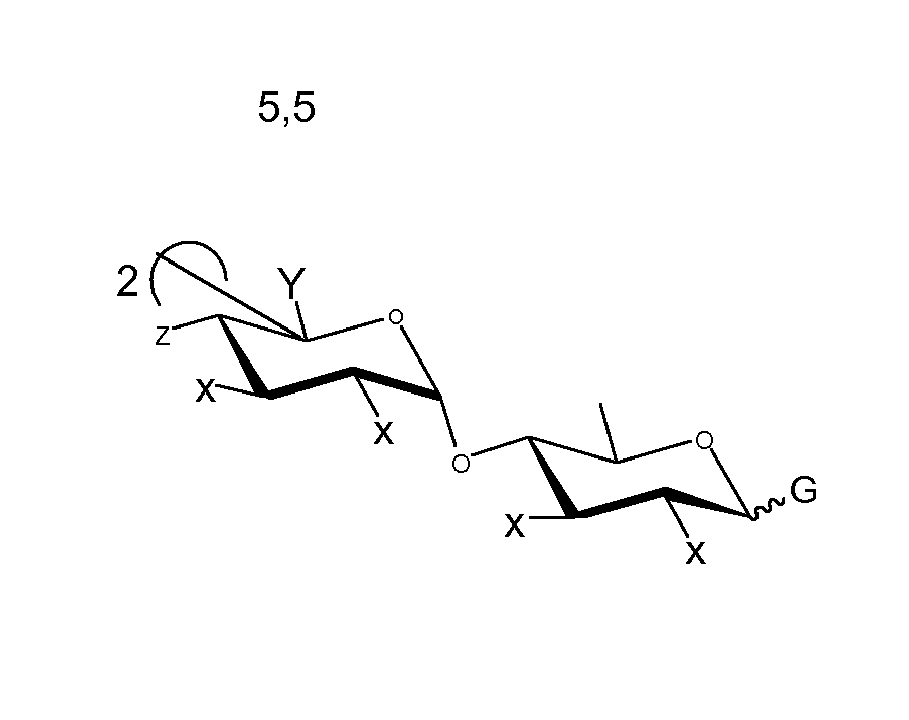
- the oligosaccharides according to the invention are represented by the following formulas:
- oligosaccharides according to the invention are the 5-5 isomers represented by the following formulas:
- G is OH, OSO 3 - , OR wherein R is selected from the group consisting of alkyl, aryl, acyl, aroyl, alkyl sulfonyl, aryl sulfonyl, PEG, a PEG derivative or an optionally sulfated (oligo)saccharide group; Z is OH, OSO 3 - or an optionally sulfated (oligo)saccharide group.
- oligosaccharides according to the invention are the 6-6 isomers represented by the following formula:
- the oligosaccharides according to the invention are useful in the treatment of angiogenesis.
- the oligosaccharides according to the invention are useful as antimetastatic compounds.
- the oligosaccharides according to the invention when used as anti-metastatic and/or anti-angiogenetic drug, have a sulphation degree of from 60 to 100 % in terms of percentage of groups X which are OSO 3 - .
- the methodology is known from the prior art ( Synthesis and characterization of hexa- and tetrasaccharide mimics from acetobromomaltotriose and acetobromomaltose, and of C-disaccharide mimics fromacetobromoglucose, obtained by electrochemical reduction of silver: M. Guerrini, S. Guglieri, R. Santarsiero and E. Vismara: Tetrahedron: Asymmetry 16 (2005) 243-253 ).
- the neutral oligosaccharide precursors can be electro-oxidized to uronic acids with 2,2,6,6-tetramethylpiperidine-1-oxyl as mediator.
- This strategy allows uronic acid residues incorporation into the new sulfated oligosaccharides and their further esterification ( Uronic acid in oligosaccharide synthesis: van den Bos, Leendert J.; Codee, Jeroen D. C.; Litjens, Remy E. J. N.; Dinkelaar, Jasper; Overkleeft, Herman S.; van der Marel, Gijsbert A. European Journal of Organic Chemistry (2007), (24), 3963-3976 ).
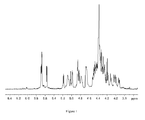
- Figure 1 shows the monodimensional 1 H NMR spectrum of S67.
- Figure 2 shows the bidimensional spectrum 1 H- 13 C NMR of S67
- Figure 3 shows a detail of the bidimensional spectrum 1 H- 13 C NMR of S67.
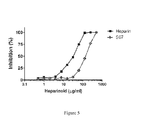
- FIG. 5 shows the activity of S67 in selectins inhibition.
- Maltohexaose sulfate was prepared by sulfation of commercial maltohexaose according to the general sulfation procedure.
- Acetobromomaltose ( ABM ) and acetobromomaltotriose ( ABMT ) were prepared from commercial maltose monohydrate and maltotriose ( Damager, I.; Olsen, C. E.; Moller, B. L.; Motawia, M. S. Synthesis 2002, 3, 418-426 ).
- Acetobromomaltose ( ABM ) and acetobromomaltotriose ( ABMT ) are also the starting compounds of peracetylated 6-CH 2 -iodo reducing-end maltose ( IRM ) and peracetylated 6-CH 2 -iodo reducing-end maltotriose ( IRMT ), respectively. They were converted into the corresponding peracetylated 1,6-anydromaltose and 1,6-anydromaltotriose, precursor respectively of the peracetilated 6-formyl-maltose and 6-formyl-maltotriose ( Cottaz, S.; Apparu, C.; Driguez, H. J. Chem.
- Maltose is the starting compound of peracetylated 6-CH 2 -iodo non reducing-end maltose ( INRM ). It was first protected as 4',6' benzylidene maltose and then fully acetylated. Debenzylation has given peracetylated 4',6'- hydroxyl maltose, which has been protected in 6' with the trityl group, and acetylated in 4' ( Takeo, K.; Shinmitsu, K. Carbohydr. Res. 1984, 133, 135-145 ).
- the degree of sulfation of the final derivatives was determined through bi-dimensional NMR technique (i.e. HSQC).
- HSQC bi-dimensional NMR technique
- the HSQC NMR spectrum appears with typical low field shifts of carbon and hydrogen signals respect to that of the corresponding un-sulfated compounds.
- Step 1 Synthesis of acetylated neutral precursors by preparative electrolysis experiments.
- Step 2 Deacetylation.
- the Sulfated derivatives according to the present invention are obtained by conventional sulfation methods of the deacetylated derivatives. By changing the reaction condition it is possible to obtain the desired sulfation degree.
- Example 1 From acetobromaltose ( ABM ) to 1,1 TETRASACCHARIDES 1 ( ⁇ , ⁇ ), 2 ( ⁇ , ⁇ )
- the electrolysis was carried out under potentiostatic conditions at room temperature under nitrogen atmosphere in a 2-compartment cell, divided with an anion-exchange membrane.
- 50 mL of cathode solution made by anhydrous acetonitrile and containing 1.15 g of tetraethylammonium perchlorate (TeaP) as supporting electrolyte were pre-electrolysed 10 minutes between -1.0 and -1.9 V, using a silver plate as cathode and a silver plate as anode in 50 mL of anhydrous acetonitrile saturated with tetraethylammonium bromide.
- An anionic ion exchange membrane (Sybron Chemicals) was used to separate anode and cathode compartments. After the pre-eletrolysis, 4,11 g (5.89mmol) of ABM were added to the cathode solution and were exhaustively electrolysed at -1.600V. The solution at the cathode compartment was concentrated and precipitated with AcOEt. The solid supporting electrolyte was filtered off. The filtrate was evaporated at reduced pressure and the residue was flash-chromatographed on silica gel from 3:7 hexane/acetate to acetate, isolating 1 ⁇ , ⁇ and 2 ⁇ , ⁇ , overall yields 40 %.
- Example 2 From acetobromomaltotriose ( ABMT ) to 1,1 HEXASACCHARIDES 3 ( ⁇ , ⁇ ), 4 ( ⁇ , ⁇ ) and 5 ( ⁇ , ⁇ )
- the electrolysis was carried out under potentiostatic conditions at room temperature under nitrogen atmosphere in a 2-compartment cell, divided with an anionic ion exchange membrane (Sybron Chemicals) 50 mL of cathode solution made by anhydrous acetonitrile and containing 1.15g of tetraethylammonium perchlorate (TeaP) as supporting electrolyte were pre-electrolysed 10 minutes between -1.0 and -1.9 V, using a silver plate as cathode and a silver plate as anode in 50 mL of anhydrous acetonitrile saturated with tetraethylammonium bromide.
- Sybron TM membrane was used to separate anodic and cathode compartments.
- Example 3 From CH 2 I-reducing-end maltose ( IRM ) to 5,5 TETRASACCHARIDE 6 and 6,6 reducing-end TETRASACCHARIDE 7
- a solution of 217mg of tetraethylammonium tetrafluoborate in 10ml of anhydrous acetonitrile was extensively degassed with N 2 and pre-electrolysed briefly at -1.3000V at the cathode of a two compartment electrolytic cell until the obtainment of a low and constant current intensity.
- a silver plate was used both as cathode and a as anode, the latter being immersed in 8mL of a 0.1M solution of tetraethylammonium tetrafluoborate in anhydrous acetonitrile.
- a porous glass septum was used to separate anodic and cathode compartments.
- a solution of 217mg of tetraethylammonium tetrafluoborate in 10ml of anhydrous acetonitrile was extensively degassed with N 2 and pre-electrolysed briefly at -1.3000V at the cathode of a two compartment electrolytic cell until the obtainment of a low and constant current intensity.
- a silver plate was used both as cathode and a as anode, the latter being immersed in 8mL of a 0.1M solution of tetraethylammonium tetrafluoborate in anhydrous acetonitrile.
- a porous glass septum was used to separate anodic and cathode compartments.
- Example 6 From 1,1 HEXASACCHARIDES 3 ( ⁇ , ⁇ ), 4 ( ⁇ , ⁇ ) and ⁇ , ⁇ / ⁇ , ⁇ , ⁇ DIASTEREOISOMER MIXTURES to the corresponding sulfated derivatives.
- Sulfated compound was tested at two concentrations (1 & 5 ⁇ g/ml) for its ability to inhibit the heparanase enzyme, using metabolically sulfate labeled ECM as a substrate. Briefly, sulfate labeled ECM coating the surface of 35-mm tissue culture dishes, is incubated (37°C, pH 6.0, 4h, 1ml final volume) with recombinant human heparanase (10 ng/ml) in the absence and presence of increasing amounts of each compound. The reaction mixture contains: 50 mM NaCl, 1 mM DTT, 1 mM CaCl 2 , and 10 mM buffer Phosphate-Citrate, pH 6.0.
- the incubation medium is collected and applied for gel filtration on Sepharose 6B columns (0.9 x 30 cm). Fractions (0.2 ml) are eluted with PBS at a flow rate of 5 ml/h and counted for radioactivity. The excluded volume (V O ) is marked by blue dextran and the total included volume (V t ) by phenol red. Degradation fragments of HS side chains are eluted at 0.5 ⁇ Kav ⁇ 0.8 (peak II). Results are best presented as the actual gel filtration profiles.
- Heparanase activity Kav x total cpm in peak II (fractions 15-35).
Landscapes
- Chemical & Material Sciences (AREA)
- Organic Chemistry (AREA)
- Health & Medical Sciences (AREA)
- General Health & Medical Sciences (AREA)
- Life Sciences & Earth Sciences (AREA)
- Molecular Biology (AREA)
- Genetics & Genomics (AREA)
- Biotechnology (AREA)
- Biochemistry (AREA)
- Engineering & Computer Science (AREA)
- Medicinal Chemistry (AREA)
- Animal Behavior & Ethology (AREA)
- Public Health (AREA)
- Veterinary Medicine (AREA)
- Pharmacology & Pharmacy (AREA)
- Nuclear Medicine, Radiotherapy & Molecular Imaging (AREA)
- General Chemical & Material Sciences (AREA)
- Chemical Kinetics & Catalysis (AREA)
- Oncology (AREA)
- Pharmaceuticals Containing Other Organic And Inorganic Compounds (AREA)
Abstract
The present invention is directed to sulfated oligosaccharides having 4, 5 or 6 saccharidic units and wherein a glycosidic bond between two saccharide units is substituted by a C-C bond, and wherein the sulfation degree expressed as percentage of OH groups substituted by a OSO3 - group is comprised between 50 and 100 %.
The sulfated oligosaccharides according to the invention are useful as a drug, in particular in the treatment of angiogenesis, metastasis, and inflammation.
Description
- In recent years there has been a growing interest towards the activity of oligosaccharides in the inhibition of metastasis and angiogenesis. In particular, it has been observed that non-coagulant species of heparin and various sulfated polysaccharides are active in the inhibition of heparanase.
- Heparanase is an endoglycosidase involved in cleavage of heparan sulfate and hence in degradation and remodelling of the basement membrane and extracellular matrix (ECM). Heparanase activity facilitates cell invasion associated with cancer metastasis, angiogenesis, autoimmunity and inflammation.
- Heparanase is up regulated in a variety of human tumours, including carcinomas of the colon, thyroid, liver, pancreas, bladder, cervix, ovary, breast, gastric, prostate, head and neck, salivary gland and nasopharynx, as well as multiple myeloma, leukaemia and lymphoma. In most cases, elevated levels of heparanase were detected in about 50% of the tumour specimens, with a higher incidence in pancreatic (78%) and gastric (80%) carcinomas, and in multiple myeloma (86%). In all cases, the normal looking tissue adjacent to the malignant lesion expressed little or no detectable levels of heparanase, suggesting that epithelial cells do not normally express the enzyme (Regulation, function and clinical significance of heparanase in cancer metastatis and angiogenesis; Ilan, Neta; Elkin, Michael; Volodavsly. The International Journal of Biochemistry & Cell Biology (2006), 38, 2018-2039. Heparanase as a molecular target of cancer chemotherapy; Simizu, Siro;Ishida, Keisuke; Osada, Hiroyuki. Cancer Science (2004), 95(7), 553-558. Secretion of Heparanase Protein Is Regulated by Glycosylation in Human Tumor Cell Lines; Simizu, Siro; Ishida, Keisuke; Wierzba, Michal K.; Osada, Hiroyuki. Journal of Biological Chemistry (2004), 279(4), 2697-2703).
- Heparanase is an endoglycosidase involved in cleavage of heparan sulfate (HS), HS belongs to the family of highly sulfated and structurally heterogeneous polysaccharides, which are expressed as sidechains of proteoglycans (HSPG) i.e. syndecan, perlecan; on cell surfaces and in the extracellular matrix (ECM). Almost every type of animal cell has the capacity to synthesize HS that interacts with diverse ligands including growth factors/morphogens and their receptors, enzymes and enzyme inhibitors, celladhesion molecules, chemokines, various ECM proteins, and microbial proteins. HSPGs thus are essential for normal embryonic development, but are also implicated in homeostasis as well as in pathological processes, such as tumour metastasis. HSPG plays a key role in the self-assembly, insolubility and barrier properties of the ECM and tumour microenvironment. Cleavage of HS by heparanase therefore affects the integrity of tissues and hence has regulation effects on normal and pathological phenomena involving cell migration and response to changes in the ECM. In addition, HSPG interacts with VEGF, FGF-2, IL-8, which together direct the generation and maintenance of the tumour microenvironment. By cleaving HS chains of proteoglycans, heparanase releases HS-bound growth factors from the matrix along with proangiogenic fragments of HS. (Molecular diversity of heparan sulphate; Esko J., Lindahl U. J. Clin. Invest. (2001) 108, 169-171. Heparan sulfate proteoglycans: Heavy hitters in the angiogenesis arena from molecular design to cellular function.Iozzo, R.V., San Antonio, J.D. J. Clin. Invest. (2001)108, 349-355. Heparan sulfate proteoglycans at a glance; Kirkpatrick, Catherine A.; Selleck, Scott B. Journal of Cell Science (2007), 120(11), 1829-1832. Heparan sulphate proteoglycans fine-tune mammalian physiology; Bishop, Joseph R.; Schuksz, Manuela; Esko, Jeffrey D. Nature (2007), 446(7139), 1030-1037).
- Mammalian heparanase over-expression is correlated with increased metastatic potential, tumour vascularity and poor postoperative survival of cancer patients. Heparanase activity facilitates cell invasion associated with cancer metastasis, angiogenesis, autoimmunity and inflammation. Heparanase can exert its role on tumour progression via both enzymatic and non-enzymatic mechanisms. In fact, the nonenzymatic form of protein can promote cell adhesion, cell survival, endothelial cell migration and invasion. In experimental animal models, over-expression of heparanase in tumour cells confers an invasive phenotype (Molecular properties and function of heparanase in cancer metastasis and angiogenesis; Vlodavsky, I., Friedmann, Y. J. Clin. Invest. (2001)108, 341-347), while heparanase gene silencing was demonstrated to markedly inhibit cancer metastasis and angiogenesis (Heparanase gene silencing, tumor invasiveness, angiogenesis, and metastasis: Edovitsky, E., Elkin, M., Zcharia, E., Peretz, T., and Vlodavsky, I. J Natl Cancer Inst, 2004, 96: 1219-1230. An ELISA method for the detection and quantification of human heparanase. Shafat, I., Zcharia, E., Nisman, B., Nadir, Y., Nakhoul, F., Vlodavsky, I., & Ilan, N. (2006). Biochem Biophys Res Commun 341, 958- 963).
- Cancer metastasis is a well-organized process; namely, benign neoplasms undergo a series of sequential but distinct changes to reach a malignant state. For example, a tumour can initially be benign and then become malignant through acquisition of mutations before proceeding all the way through the metastatic cascade. The mutations acquired lead to abnormal and uncontrolled proliferation.
- Angiogenesis is regarded as an absolute prerequisite for tumors which grow beyond a diameter of about 1-2 mm; up to this limit, oxygen and nutrients may be supplied to the tumor cells by diffusion. Every tumor, regardless of its origin and its cause, is thus dependent on angiogenesis for its growth after it has reached a certain size.
- In order to metastasize, cells must first detach from the primary tumor, enter the vasculature or intravasate, circulate through the blood, attach to vessel walls, exit the vasculature or extravasate, and establish in a new surrounding, producing primary metastasis. This whole process is then repeated to give rise to secondary metastasis. The steps of angiogenesis, arrest and adhesion, and intravasation or extravasation involve subtle to extensive cell-surface degradation and remodeling of the ECM by various proteolytic enzymes secreted by the tumor cells.
- Studies performed in our laboratory clearly indicate that heparanase is a most promising target for anti-cancer drug development. This statement was reinforced by clinical observations demonstrating a highly significant correlation between enhanced heparanase expression, metastatic potential, tumor vascularity and reduced postoperative survival of cancer patients. These observations, the anti-cancerous effect of heparanase-inhibiting strategies and the identification of a single functional heparanase gene and protein, indicate that the enzyme is a promising target for drug development (Heparanase expression in human colorectal cancer and its relationship to tumor angiogenesis, hematogenous metastasis, and prognosis: Sato, T., Yamaguchi, A., Goi, T., Hirono, Y., Takeuchi, K., Katayama, K., & Matsukawa, S. J Surg Onco (2004). 87, 174-181. The syndecan-1 heparan sulfate proteoglycan is a viable target for myeloma therapy: Yang Yang, Veronica MacLeod, Yuemeng Dai, Yekaterina Khotskaya-Sample, Zachary Shriver, Ganesh Venkataraman, Ram Sasisekharan, Annamaria Naggi, Giangiacomo Torri, Benito Casu, Israel Vlodavsky, Larry J. Suva,Joshua Epstein, Shmuel Yaccoby, John D. Shaughnessy Jr, Bart Barlogie, and Ralph D. Sanderson Blood, 15 September 2007, Volume 110, Number 6 2041-48).
- Selectins are vascular cell adhesion molecules promoting initial leukocyte-endothelial interactions. In addition, P-and L-selectin are implicated in pathological processes involving inflammation, reperfusion injury, and cancer. We and others have reported that heparin attenuated metastasis in mouse models of carcinomas and melanomas, primarily through inhibition of selectin interactions (P-selectin- and heparanase-dependent antimetastatic activity of non-anticoagulant heparins: Nina Hostettler, Annamaria Naggi, Giangiacomo Torri, Riva Ishai-Michaeli Benito Casu, Israel Vlodavsky, and Lubor Borsig The FASEB Journal • Research Communication 2007, 0892-6638/07. Heparin and cancer revisited: mechanistic connections involving platelets, P-selectin, carcinoma mucins, and tumor metastasis: Borsig, L., Wong, R., Feramisco, J., Nadeau, D. R., Varki, N. M., and Varki, A. (2001) Proc. Natl. Acad. Sci. U. S. A. 98, 3352-3357. Endothelial P-selectin as a target of heparin action in experimental melanoma lung metastasis: Ludwig, R. J., Boehme, B., Podda, M., Henschler, R., Jager, E.,Tandi, C., Boehncke, W. H., Zollner, T. M., Kaufmann, R., and Gille, J. Cancer Res. (2004) 64, 2743-2750). Synergistic effects of L- and P-selectin in facilitating tumor metastasis can involve non-mucin ligands and implicate leukocytes as enhancers of metastasis (Synergistic effects of L- and P-selectin in facilitating tumor metastasis can involve non-mucin ligands and implicate leukocytes as enhancers of metastasis: Borsig, L., Wong, R., Hynes, R. O., Varki, N. M., and Varki, A. (2002) Proc. Natl. Acad. Sci. U. S. A. 99, 2193-2198).
- Several attempts were made in the past to find compounds which are mimetics of natural compounds such as heparin, and that can effectively act in the inhibition of heparanase.
- US 6,143,730 discloses that maltohexaose sulphate is very active in inhibiting vascularization of tumoral cells and angiogenesis. However, the synthesis of maltohexaose sulphate is very complex and expensive, making the use of this compound on a large scale difficult. Phosphomannopentaose sulphate (PI-88) is also indicated as an active compound for angiogenesis inhibition and antimetastatic. (WO2005085264 and US20070185037).
- The present invention is directed towards new sulfated oligosaccharides, preferably comprising 4, 5 or 6 saccharide units and wherein two saccharide units are bond through a hydrolize resistant C-C bond and wherein the sulfation degree expressed as percentage of OH groups substituted by a OSO3 - group is comprised between 50 and 100 %.
- Preferably, the C-C bond connects either the 2nd and 3rd saccharide unit, or the 3rd and 4th unit. The C involved in the C-C bond between the two saccharide units, can be any available C atom, i.e. the carbon atom in position 1, 5 or 6. Furthermore, the configuration of the C-C bond, when the carbon is in the 1 position, can be either α or β.
- In a preferred embodiment of the invention, the oligosaccharides according to the invention, malto-oligosaccharides (MOS), are represented by the following formulas:

- Wherein X can be OH or OSO3 - or an optionally sulfated (oligo)saccharide group; Y is selected from the group consisting of CH2OH, CH2OSO3 -, COOH, COOR wherein R is selected from the group consisting of alkyl, aryl, acyl, aroyl, alkyl sulfonyl, aryl sulfonyl, PEG or a PEG derivative.
- In another preferred embodiment of the invention the oligosaccharides according to the invention are the 5-5 isomers represented by the following formulas:
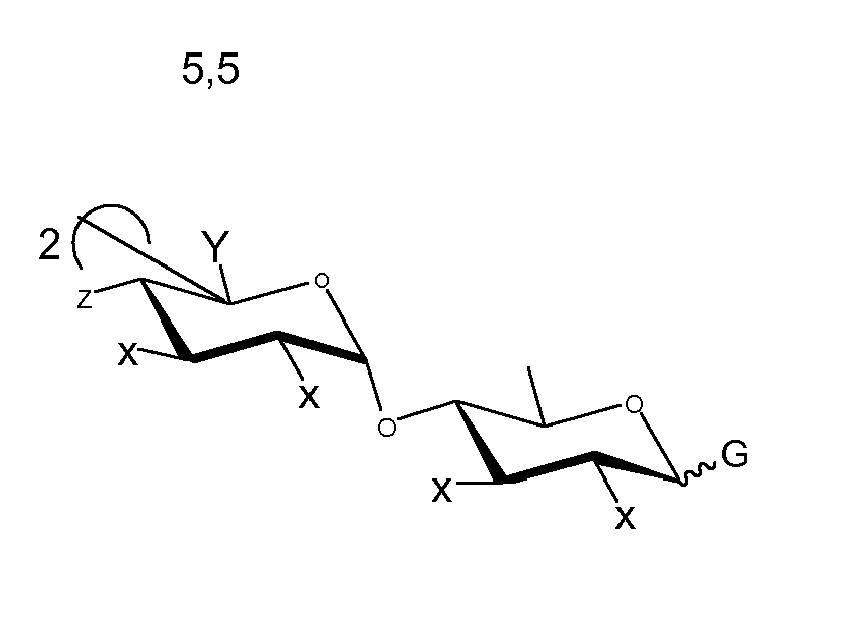
- Wherein Y and X have the above defined meanings; G is OH, OSO3 -, OR wherein R is selected from the group consisting of alkyl, aryl, acyl, aroyl, alkyl sulfonyl, aryl sulfonyl, PEG, a PEG derivative or an optionally sulfated (oligo)saccharide group; Z is OH, OSO3 - or an optionally sulfated (oligo)saccharide group.
- In a further embodiment of the invention the oligosaccharides according to the invention are the 6-6 isomers represented by the following formula:

- Wherein Y, X, G and Z have the above defined meanings.
- In a preferred embodiment of the invention, the oligosaccharides according to the invention are useful in the treatment of angiogenesis.
- In another embodiment of the invention, the oligosaccharides according to the invention are useful as antimetastatic compounds.
- Preferably, the oligosaccharides according to the invention, when used as anti-metastatic and/or anti-angiogenetic drug, have a sulphation degree of from 60 to 100 % in terms of percentage of groups X which are OSO3 -.
- In a preferred embodiment of the invention, it is disclosed the use of the oligosaccharides according to the invention as an anti-inflammatory drug. Preferably, the oligosaccharides according to the invention, when used as anti-inflammatory drug, have a sulphation degree of from 80 to 100 % in terms of percentage of groups X which are OSO3 -.
- The oligosaccharides according to the present invention can be prepared starting from the corresponding compound wherein X = OH. The methodology is known from the prior art (Synthesis and characterization of hexa- and tetrasaccharide mimics from acetobromomaltotriose and acetobromomaltose, and of C-disaccharide mimics fromacetobromoglucose, obtained by electrochemical reduction of silver: M. Guerrini, S. Guglieri, R. Santarsiero and E. Vismara: Tetrahedron: Asymmetry 16 (2005) 243-253).
- Although the publication only discloses the synthesis of tetra- and hexasaccharides by dimerization of di- and trisaccharides, it is evident that by using a mixture of di- and trisaccharide it is obtained a mixture of tetrapenta- and hexasaccharides.
- Starting form the obtained tetra- penta- and hexasaccharides, it is possible to increase the number of saccharide units by using conventional glycosylation methods.
- Before sulfation, the neutral oligosaccharide precursors can be electro-oxidized to uronic acids with 2,2,6,6-tetramethylpiperidine-1-oxyl as mediator. This strategy allows uronic acid residues incorporation into the new sulfated oligosaccharides and their further esterification (Uronic acid in oligosaccharide synthesis: van den Bos, Leendert J.; Codee, Jeroen D. C.; Litjens, Remy E. J. N.; Dinkelaar, Jasper; Overkleeft, Herman S.; van der Marel, Gijsbert A. European Journal of Organic Chemistry (2007), (24), 3963-3976).
- The tests performed on 1,1 α,β sulfated hexasaccharide (S67) demonstrate that the activity of this compound towards selectins inhibition is close to the activity of heparin. It is well known that heparin is very active towards selectins inhibition but cannot be used as an anti-inflammatory compound as such because of its anticoagulant properties. Thus, the result obtained in the test represents an excellent result since the oligosaccharides according to the invention do not present anticoagulant activity.
-
Figure 1 shows the monodimensional 1H NMR spectrum of S67. -
Figure 2 shows the bidimensional spectrum 1H-13C NMR of S67 -
Figure 3 shows a detail of the bidimensional spectrum 1H-13C NMR of S67. -
Figure 4 shows the activity of S67 and P3314 in the reduction of metastatic foci of B16BL6 melanoma. -
Figure 5 shows the activity of S67 in selectins inhibition. - Maltohexaose sulfate (MHS) was prepared by sulfation of commercial maltohexaose according to the general sulfation procedure.
- Acetobromomaltose (ABM) and acetobromomaltotriose (ABMT) were prepared from commercial maltose monohydrate and maltotriose (Damager, I.; Olsen, C. E.; Moller, B. L.; Motawia, M. S. ).
- Acetobromomaltose (ABM) and acetobromomaltotriose (ABMT) are also the starting compounds of peracetylated 6-CH2-iodo reducing-end maltose (IRM) and peracetylated 6-CH2-iodo reducing-end maltotriose (IRMT), respectively. They were converted into the corresponding peracetylated 1,6-anydromaltose and 1,6-anydromaltotriose, precursor respectively of the peracetilated 6-formyl-maltose and 6-formyl-maltotriose (Cottaz, S.; Apparu, C.; Driguez, H. J. Chem. Soc. Perkin Trans 1 1991, 2235-2241). Iodination of the peracetilated 6-hydroxyl-maltose and 6-hydroxyl-maltotriose, coming from the formyl group hydrolysis, respectively afforded IRM and IRMT (Classon, B.; Liu, Z. ; Samuelsson, B. J. Org. Chem. 1988, 53, 6126-6130).
- Maltose is the starting compound of peracetylated 6-CH2-iodo non reducing-end maltose (INRM). It was first protected as 4',6' benzylidene maltose and then fully acetylated. Debenzylation has given peracetylated 4',6'- hydroxyl maltose, which has been protected in 6' with the trityl group, and acetylated in 4' (Takeo, K.; Shinmitsu, K. Carbohydr. Res. 1984, 133, 135-145). After detritylation, 6' hydroxyl peracetylated maltose has been iodinated to INRM (Classon, B.; Liu, Z. ; Samuelsson, B. J. Org. Chem. 1988, 53, 6126-6130).
- The degree of sulfation of the final derivatives was determined through bi-dimensional NMR technique (i.e. HSQC). In the case of homogeneous O-sulfation, the HSQC NMR spectrum appears with typical low field shifts of carbon and hydrogen signals respect to that of the corresponding un-sulfated compounds.
- In the case of incomplete and non homogeneous derivatization an arbitrary evaluation of the spectra was done. Two different areas (in the case of α,β hexasaccharide derivatives AS: 13C 81-72/ 1H 5.3-4.28 ppm; AnS: 13C 77-71/ 1H 4.28-3.90 ppm ) for sulfated and unsulfated secondary carbon were identified, while for primary alcohols a direct evaluation of sulfate residue can be done at 13C 70-68/ 1H 4.55-4.3 ppm. (A6S) respect to 13C 62-60/ 1H 4.0-3.8 ppm. (A6OH).
- In a totally sulfated hexasaccharide mimic compound the area of O-sulfated secondary carbons (AS) is the 65% of the total (AS + AnS). In a case of under-sulfation, the degree of sulfation is measured as follow: [AS / (AS + AnS) x 0,65] + A6S/ (A6S+A6OH) = Degree of sulfation
- Peracetylated halosugars silver cathode potentiostatic electroreductions, redox potential between -1.3 V and -1.7 V on the bases of each halosugar cyclic voltammetry, were exhaustively run in anhydrous acetonitrile, in the presence of a quaternary organic ammonium salt as supporting electrolyte. After the work-up of the reaction mixture, dimers have been isolated by flash chromatography on silica gel. Big efforts have been dedicated to their purification. For this purpose, HPLC semi preparative column was successfully used.
- The Sulfated derivatives according to the present invention are obtained by conventional sulfation methods of the deacetylated derivatives. By changing the reaction condition it is possible to obtain the desired sulfation degree.
-

- The electrolysis was carried out under potentiostatic conditions at room temperature under nitrogen atmosphere in a 2-compartment cell, divided with an anion-exchange membrane. 50 mL of cathode solution made by anhydrous acetonitrile and containing 1.15 g of tetraethylammonium perchlorate (TeaP) as supporting electrolyte were pre-electrolysed 10 minutes between -1.0 and -1.9 V, using a silver plate as cathode and a silver plate as anode in 50 mL of anhydrous acetonitrile saturated with tetraethylammonium bromide. An anionic ion exchange membrane (Sybron Chemicals) was used to separate anode and cathode compartments. After the pre-eletrolysis, 4,11 g (5.89mmol) of ABM were added to the cathode solution and were exhaustively electrolysed at -1.600V. The solution at the cathode compartment was concentrated and precipitated with AcOEt. The solid supporting electrolyte was filtered off. The filtrate was evaporated at reduced pressure and the residue was flash-chromatographed on silica gel from 3:7 hexane/acetate to acetate, isolating 1α,α and 2α,β, overall yields 40 %.
-

- The electrolysis was carried out under potentiostatic conditions at room temperature under nitrogen atmosphere in a 2-compartment cell, divided with an anionic ion exchange membrane (Sybron Chemicals) 50 mL of cathode solution made by anhydrous acetonitrile and containing 1.15g of tetraethylammonium perchlorate (TeaP) as supporting electrolyte were pre-electrolysed 10 minutes between -1.0 and -1.9 V, using a silver plate as cathode and a silver plate as anode in 50 mL of anhydrous acetonitrile saturated with tetraethylammonium bromide. The Sybron™ membrane was used to separate anodic and cathode compartments. After the pre-eletrolysis, 5.82 g (5.89mmol) of ABMT were added to the cathode solution and were exhaustively electrolysed at -1.600V. The solution at the cathode compartment was concentrated and precipitated with AcOEt. The solid supporting electrolyte was filtered off. The filtrate was evaporated at reduced pressure and the residue was flash-chromatographed on silica gel from 4:6 hexane/acetate to acetate, obtaining a crude mixture of α,α, α,β and β,β isomers (34 % yields). After a further flash-chromatography of the crude mixture, fractions enriched in single isomer were obtained. These fractions were purified through semi preparative HPLC yielding pure isomers of 3,4 and 5. Semi-preparative HPLC was performed on a Hypersil BDS C18 250x10mm column from Thermo Hypersil, a Rheodine valve of 100µL and a flow rate of 5ml/min. Samples were dissolved in ACN at the concentration of 100mg/ml; 70µL were injected.
-

- A solution of 217mg of tetraethylammonium tetrafluoborate in 10ml of anhydrous acetonitrile was extensively degassed with N2 and pre-electrolysed briefly at -1.3000V at the cathode of a two compartment electrolytic cell until the obtainment of a low and constant current intensity. A silver plate was used both as cathode and a as anode, the latter being immersed in 8mL of a 0.1M solution of tetraethylammonium tetrafluoborate in anhydrous acetonitrile. A porous glass septum was used to separate anodic and cathode compartments. After the pre-electrolysis, 186 mg (0.25mmol) of IRM were added to the cathode solution and were exhaustively electrolysed under N2 at -1.3000V. The solution at the cathode compartment was concentrated and precipitated with AcOEt. The solid supporting electrolyte was filtered off. The filtrate was evaporated at reduced pressure and the residue was flash-chromatographed on silica gel (3:7 hexane/ acetate). Dimerization of IRM afforded ca. 48 % of tetrasaccharides (73 % of 6 and 27 % of 7)
-

- A solution of 217mg of tetraethylammonium tetrafluoborate in 10ml of anhydrous acetonitrile was extensively degassed with N2 and pre-electrolysed briefly at -1.3000V at the cathode of a two compartment electrolytic cell until the obtainment of a low and constant current intensity. A silver plate was used both as cathode and a as anode, the latter being immersed in 8mL of a 0.1M solution of tetraethylammonium tetrafluoborate in anhydrous acetonitrile. A porous glass septum was used to separate anodic and cathode compartments. After the pre-electrolysis, 186 mg (0.25mmol) of INRM were added to the cathode solution and were exhaustively electrolysed under N2 at -1.3000V. The solution at the cathode compartment was concentrated and precipitated with AcOEt. The solid supporting electrolyte was filtered off. The filtrate was evaporated at reduced pressure and the residue was flash-chromatographed on silica gel (3:7 hexane/ acetate). INRM afforded 8 in ca. 60% yield.
-
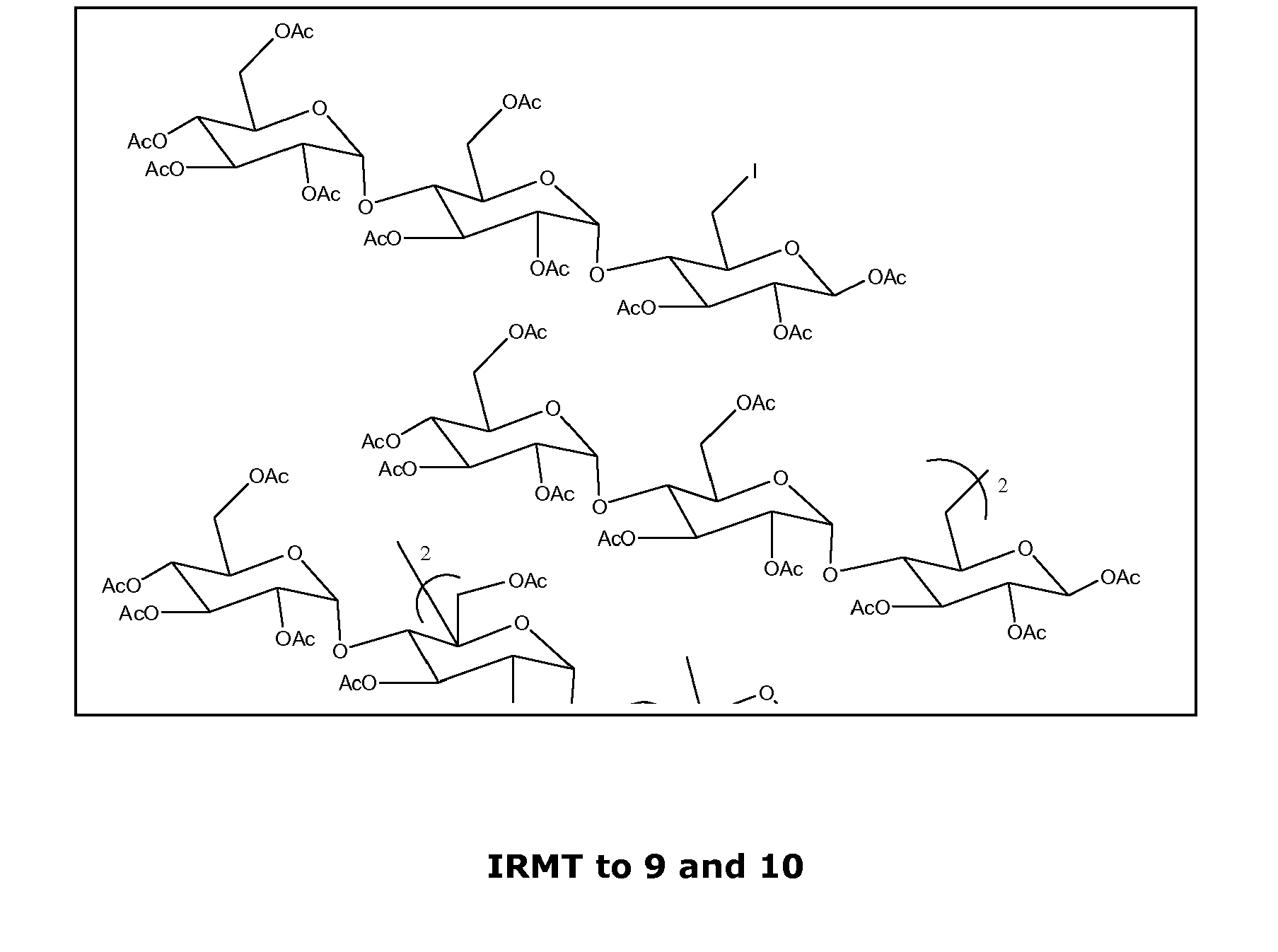
- A solution of 217mg of tetraethylammonium tetrafluoborate in 10ml of anhydrous acetonitrile was extensively degassed with N2 and pre-electrolysed briefly at -1.3000V at the cathode of a two compartment electrolytic cell until the obtainment of a low and constant current intensity. A silver plate was used both as cathode and a as anode, the latter being immersed in 8mL of a 0.1M solution of tetraethylammonium tetrafluoborate in anhydrous acetonitrile. A porous glass septum was used to separate anodic and cathode compartments. After the pre-electrolysis, 240 mg (0.25mmol) of IRMT were added to the cathode solution and were exhaustively electrolysed under N2 at -1.3000V. The solution at the cathode compartment was concentrated and precipitated with AcOEt. The solid supporting electrolyte was filtered off. The filtrate was evaporated at reduced pressure and the residue was flash-chromatographed on silica gel (3:7 hexane/ acetate). A mixture of 9 and 10 was further purified through semi preparative HPLC, yielding pure isomers of 9 and 10. Semi preparative HPLC was performed on a Hypersil BDS C18 250x10mm column from Thermo Hypersil, a Rheodine valve of 100µL and a flow rate of 5ml/min. Samples were dissolved in ACN at the concentration of 100mg/ml; 70µL were injected. IRMT afforded ca 31 % of hexasaccharides (60 % of 9 and 40 % of 10).
- 0.266mmol of the above derivatives and 22 ml of 0.2 M MeONa (4.47mmol, 1.2eq./eq.OAc) in MeOH were stirred overnight at r.t, in a vessel equipped with a CaCl2 trap to avoid moisture. An equal volume of water was added and pH was adjusted to 7 with Amberlite™ IR-120 (H+ form). The resin was filtered off and solvent was removed obtaining neutral dimer as a white solid in quantitative yield.
- 590 mg of sulfur trioxide pyridine complex (3.68 mmol, 10 eq per eq -OH) were added to a pyridine solution of deacetylated dimer (0.0185 mmol , 4 x 10⁻³ M). The reaction mixture was warmed up to 80 °C and stirred for 6 hrs, avoiding moisture with a CaCl2 trap. The mixture cooled down to room temperature, was neutralized with a saturated solution of NaHCO3 and exhaustively evaporated under vacuum. The solid residue was water dissolved and chromatographed on TSK column.
Table 1- Example Samples Identification and Sulfation Degree Sample Diastereoisomer (%) Sulfation degree (%) Ex. 2 P3314 α,α 80 %, 20 % α,β > 90 Ex. 2 P3377 α,β > 95 ∼ 60 Ex. 2 P3609 α,α: β,β: αβ 25:25:50 > 90 Ex. 2 P3677 α,β > 95 > 90 Ex. 2 S67 α,β ∼ 100 ∼ 100 - Sulfated compound was tested at two concentrations (1 & 5 µg/ml) for its ability to inhibit the heparanase enzyme, using metabolically sulfate labeled ECM as a substrate. Briefly, sulfate labeled ECM coating the surface of 35-mm tissue culture dishes, is incubated (37°C, pH 6.0, 4h, 1ml final volume) with recombinant human heparanase (10 ng/ml) in the absence and presence of increasing amounts of each compound. The reaction mixture contains: 50 mM NaCl, 1 mM DTT, 1 mM CaCl2, and 10 mM buffer Phosphate-Citrate, pH 6.0. To evaluate the occurrence of proteoglycan degradation, the incubation medium is collected and applied for gel filtration on Sepharose 6B columns (0.9 x 30 cm). Fractions (0.2 ml) are eluted with PBS at a flow rate of 5 ml/h and counted for radioactivity. The excluded volume (VO) is marked by blue dextran and the total included volume (Vt) by phenol red. Degradation fragments of HS side chains are eluted at 0.5 < Kav < 0.8 (peak II). Results are best presented as the actual gel filtration profiles. Numerical values derived from these graphs are presented in
figure 1 as heparanase activity (% of control), where: Heparanase activity = Kav x total cpm in peak II (fractions 15-35). Kav = (Ve - Vo/ Vt - Vo).
* Control Kav = Kav obtained in the presence of enzyme alone (without inhibitors). -
Table 2- Sample Identification, Sulfation Degree and Hpa Activity Sample Diast. (%) Sulf. degree (%) Heparanase activity (5µg/ml) Ex. 2 P3314 α,α 80 % α,β 20% > 90 39 Ex. 2 P3377 α,β > 95 ∼ 60 65 Ex. 2 P3609 α,α: β,β: αβ 25:25:50 > 90 55 Ex. 2 P3677 α,β > 95 > 90 12 MHS - > 80 27 control - - 100 - Compounds are tested for inhibition of BI6-BL6 lung colonization. For this purpose, C57BL6 mice (n = 5 mice per group) receive a single i.p injection of 0.2 ml PBS (control) or 0.2 ml PBS containing 250 µg of each compound, 20 min prior to i.v inoculation of B16-BL6 melanoma cells (1x10⁵ cells/mouse). Mice are sacrificed 15 days later, lungs are fixed and examined for the number of melanoma colonies on the lung surface.
InFigure 4 mice were injected with 250 µg ofS67 10 prior to B16BL6 melanoma injection (300000 cells). The experiment with P3314 reported inFigure 4 was conducted using an amount of 150 µg instead of 250 µg. The test with P3314 was repeated with 250 µg and the average number of metastatic foci was 75. - The P-selectin inhibitory potential was measured by inhibitory ELISA using LS180 cells, heparin (UFH) as a control. The results are reported in
Fig. 5 .
Claims (14)
- Sulfated oligosaccharides wherein a glycosidic bond between two saccharide units is substituted by a C-C bond, and wherein the sulfation degree, expressed as percentage of OH groups substituted by a OSO3 - group, is comprised between 50 and 100 %.
- Sulfated oligosaccharides according to claim 1 wherein the oligosaccharide has 4, 5 or 6 saccharide units.
- Sulfated oligosaccharides according to claim 1 wherein the C-C bond is between the positions 1-1, 2-2, 5-5 or 6-6.
- Sulfated oligosaccharides according to claim 2 wherein the bond is between the positions 1,1 and the conformation is α-α, α-β or β-β.
- Sulfated oligosaccharides according to claim 1, wherein the compound is expressed by the formula:

- Sulfated oligosaccharides according to claim 1, wherein the compound is expressed by the formula:
- Sulfated oligosaccharides according to claim 1, wherein the compound is expressed by the formula:

- Sulfated oligosaccharides according to claims 1-3 wherein the oligosaccharide is an hexasaccharide and the C-C bond is between the third and fourth unit.
- Sulfated oligosaccharides according to claims 1-8 for use as a drug.
- Sulfated oligosaccharides according to claims 1-8 for use as drug in the treatment of angiogenesis.
- Sulfated oligosaccharides according to claims 1-8 for use as a drug in the treatment of metastasis.
- Sulfated oligosaccharides according to claims 10-11 wherein the sulfation degree is comprised between 60 and 100 %.
- Sulfated oligosaccharides according to claims 1-8 for use as a drug in the treatment of inflammation.
- Sulfated oligosaccharides according to claim 13 wherein the sulfation degree is comprised between 80 and 100 %.
Priority Applications (4)
| Application Number | Priority Date | Filing Date | Title |
|---|---|---|---|
| EP08160464A EP2149580A1 (en) | 2008-07-15 | 2008-07-15 | Mimetics of sulfated oligosaccharides |
| PCT/EP2009/058742 WO2010006982A1 (en) | 2008-07-15 | 2009-07-09 | Mimetics of sulfated oligosaccharides |
| US13/056,085 US8853387B2 (en) | 2008-07-15 | 2009-07-09 | Mimetics of sulfated oligosaccharides |
| EP09797472A EP2321328A1 (en) | 2008-07-15 | 2009-07-09 | Mimetics of sulfated oligosaccharides |
Applications Claiming Priority (1)
| Application Number | Priority Date | Filing Date | Title |
|---|---|---|---|
| EP08160464A EP2149580A1 (en) | 2008-07-15 | 2008-07-15 | Mimetics of sulfated oligosaccharides |
Publications (1)
| Publication Number | Publication Date |
|---|---|
| EP2149580A1 true EP2149580A1 (en) | 2010-02-03 |
Family
ID=40352455
Family Applications (2)
| Application Number | Title | Priority Date | Filing Date |
|---|---|---|---|
| EP08160464A Withdrawn EP2149580A1 (en) | 2008-07-15 | 2008-07-15 | Mimetics of sulfated oligosaccharides |
| EP09797472A Withdrawn EP2321328A1 (en) | 2008-07-15 | 2009-07-09 | Mimetics of sulfated oligosaccharides |
Family Applications After (1)
| Application Number | Title | Priority Date | Filing Date |
|---|---|---|---|
| EP09797472A Withdrawn EP2321328A1 (en) | 2008-07-15 | 2009-07-09 | Mimetics of sulfated oligosaccharides |
Country Status (3)
| Country | Link |
|---|---|
| US (1) | US8853387B2 (en) |
| EP (2) | EP2149580A1 (en) |
| WO (1) | WO2010006982A1 (en) |
Cited By (1)
| Publication number | Priority date | Publication date | Assignee | Title |
|---|---|---|---|---|
| WO2026033348A1 (en) | 2024-08-07 | 2026-02-12 | Centro Alta Tecnologia Istituto Di Ricerche Chimiche E Biochimiche "G. Ronzoni" S.R.L. | Polysaccharides and oligosaccharides encapsulated in lipid nanoparticles |
Families Citing this family (2)
| Publication number | Priority date | Publication date | Assignee | Title |
|---|---|---|---|---|
| BR112019012045A2 (en) | 2016-12-13 | 2020-08-18 | Beta Therapeutics Pty Ltd | heparanase inhibitors and their use |
| US11787783B2 (en) | 2016-12-13 | 2023-10-17 | Beta Therapeutics Pty Ltd | Heparanase inhibitors and use thereof |
Citations (3)
| Publication number | Priority date | Publication date | Assignee | Title |
|---|---|---|---|---|
| WO1996009828A1 (en) * | 1994-09-26 | 1996-04-04 | Glycomed Incorporated | Highly sulfated maltooligosaccharides with heparin-like properties |
| US6143730A (en) | 1995-04-28 | 2000-11-07 | The Australian National University | Preparation and use of sulfated oligosaccharides |
| WO2005085264A1 (en) | 2004-03-04 | 2005-09-15 | Progen Industries Limited | Sulfated oligosaccharide derivatives |
-
2008
- 2008-07-15 EP EP08160464A patent/EP2149580A1/en not_active Withdrawn
-
2009
- 2009-07-09 US US13/056,085 patent/US8853387B2/en not_active Expired - Fee Related
- 2009-07-09 EP EP09797472A patent/EP2321328A1/en not_active Withdrawn
- 2009-07-09 WO PCT/EP2009/058742 patent/WO2010006982A1/en not_active Ceased
Patent Citations (4)
| Publication number | Priority date | Publication date | Assignee | Title |
|---|---|---|---|---|
| WO1996009828A1 (en) * | 1994-09-26 | 1996-04-04 | Glycomed Incorporated | Highly sulfated maltooligosaccharides with heparin-like properties |
| US6143730A (en) | 1995-04-28 | 2000-11-07 | The Australian National University | Preparation and use of sulfated oligosaccharides |
| WO2005085264A1 (en) | 2004-03-04 | 2005-09-15 | Progen Industries Limited | Sulfated oligosaccharide derivatives |
| US20070185037A1 (en) | 2004-03-04 | 2007-08-09 | Progen Industries Limited | Sulfated oligosaccharide derivatives |
Non-Patent Citations (24)
| Title |
|---|
| BISHOP, JOSEPH R.; SCHUKSZ, MANUELA; ESKO, JEFFREY D., NATURE, vol. 446, no. 7139, 2007, pages 1030 - 1037 |
| BORSIG, L. ET AL., PROC. NATL. ACAD. SCI. U. S. A., vol. 98, 2001, pages 3352 - 3357 |
| BORSIG, L. ET AL., PROC. NATL. ACAD. SCI. U. S. A., vol. 99, 2002, pages 2193 - 2198 |
| CLASSON, B.; LIU, Z.; SAMUELSSON, B., J. ORG. CHEM., vol. 53, 1988, pages 6126 - 6130 |
| COTTAZ, S.; APPARU, C.; DRIGUEZ, H. J., CHEM. SOC. PERKIN TRANS, vol. 1, 1991, pages 2235 - 2241 |
| DAMAGER, I. ET AL., SYNTHESIS, vol. 3, 2002, pages 418 - 426 |
| EDOVITSKY, E. ET AL., J NATL CANCER INST, vol. 96, 2004, pages 1219 - 1230 |
| ESKO J.; LINDAHL U., J. CLIN. INVEST., vol. 108, 2001, pages 169 - 171 |
| GUERRINI M ET AL: "Synthesis and characterisation of hexa- and tetrasaccharide mimics from acetobromomaltotriose and acetobromomaltose, and of C-disaccharide mimics from acetobromoglucose, obtained by electrochemical reduction on silver", TETRAHEDRON ASYMMETRY, PERGAMON, OXFORD; GB, vol. 16, no. 1, 10 January 2005 (2005-01-10), pages 243 - 253, XP004718746, ISSN: 0957-4166 * |
| ILAN, NETA; ELKIN, MICHAEL, VOLODAVSLY. THE INTERNATIONAL JOURNAL OF BIOCHEMISTRY & CELL BIOLOGY, vol. 38, 2006, pages 2018 - 2039 |
| IOZZO, R.V.; SAN ANTONIO, J.D., J. CLIN. INVEST., vol. 108, 2001, pages 349 - 355 |
| KIRKPATRICK, CATHERINE A.; SELLECK, SCOTT B., JOURNAL OF CELL SCIENCE, vol. 120, no. 11, 2007, pages 1829 - 1832 |
| LUDWIG, R. J. ET AL., CANCER RES., vol. 64, 2004, pages 2743 - 2750 |
| M. GUERRINI ET AL., TETRAHEDRON: ASYMMETRY, vol. 16, 2005, pages 243 - 253 |
| NINA HOSTETTLER ET AL., THE FASEB JOURNAL RESEARCH COMMUNICATION, 2007, pages 0892 - 6638 |
| SATO, T. ET AL., J SURG ONCO, vol. 87, 2004, pages 174 - 181 |
| SHAFAT, I. ET AL., BIOCHEM BIOPHYS RES COMMUN, vol. 341, 2006, pages 958 - 963 |
| SIMIZU, SIRO ET AL., JOURNAL OF BIOLOGICAL CHEMISTRY, vol. 279, no. 4, 2004, pages 2697 - 2703 |
| SIMIZU, SIRO; ISHIDA, KEISUKE; OSADA, HIROYUKI., CANCER SCIENCE, vol. 95, no. 7, 2004, pages 553 - 558 |
| TAKEO, K.; SHINMITSU, K., CARBOHYDR. RES., vol. 133, 1984, pages 135 - 145 |
| VAN DEN BOS ET AL., EUROPEAN JOURNAL OF ORGANIC CHEMISTRY, vol. 24, 2007, pages 3963 - 3976 |
| VLODAVSKY, I.; FRIEDMANN, Y., J. CLIN. INVEST., vol. 108, 2001, pages 341 - 347 |
| VLODAVSKY, ISRAEL ET AL: "Heparanase : structure , biological functions, and inhibition by heparin-derived mimetics of heparan sulfate", CURRENT PHARMACEUTICAL DESIGN , 13(20), 2057-2073 CODEN: CPDEFP; ISSN: 1381-6128, 2007, XP002516660 * |
| YANG YANG ET AL., SANDERSON BLOOD, vol. 110, no. 6, 15 September 2007 (2007-09-15), pages 2041 - 48 |
Cited By (1)
| Publication number | Priority date | Publication date | Assignee | Title |
|---|---|---|---|---|
| WO2026033348A1 (en) | 2024-08-07 | 2026-02-12 | Centro Alta Tecnologia Istituto Di Ricerche Chimiche E Biochimiche "G. Ronzoni" S.R.L. | Polysaccharides and oligosaccharides encapsulated in lipid nanoparticles |
Also Published As
| Publication number | Publication date |
|---|---|
| US8853387B2 (en) | 2014-10-07 |
| US20120232263A1 (en) | 2012-09-13 |
| EP2321328A1 (en) | 2011-05-18 |
| WO2010006982A1 (en) | 2010-01-21 |
Similar Documents
| Publication | Publication Date | Title |
|---|---|---|
| Sabesan et al. | Combined chemical and enzymatic synthesis of sialyloligosaccharides and characterization by 500-MHz and proton and carbon-13 NMR spectroscopy | |
| Zhang et al. | Circulating heparin oligosaccharides rapidly target the hippocampus in sepsis, potentially impacting cognitive functions | |
| EP0493622B1 (en) | Phospholipid- or lipid-combining glycosaminoglycan, production thereof, and cancer metastasis inhibitor | |
| US20100048638A1 (en) | Heparan sulfate inhibitors | |
| US20110152209A1 (en) | Core 2 GlcNAc-T Inhibitors | |
| Dohi et al. | Stereoselective Glycal Fluorophosphorylation: Synthesis of ADP‐2‐fluoroheptose, an Inhibitor of the LPS Biosynthesis | |
| Tripathi et al. | Microbial heparin/heparan sulphate lyases: potential and applications | |
| CN105504097B (en) | A kind of sulfated heparin oligosaccharides and its preparation method and application | |
| EA001199B1 (en) | SULPHATED OLIGOSAKHARID, ITS APPLICATION FOR THE TREATMENT OF HEAT-BLOOD ANIMALS AND PHARMACEUTICAL COMPOSITION ON ITS BASIS | |
| JPH11504018A5 (en) | ||
| Forman et al. | Synthesis of defined mono-de-N-acetylated β-(1→ 6)-N-acetyl-D-glucosamine oligosaccharides to characterize PgaB hydrolase activity | |
| US8853387B2 (en) | Mimetics of sulfated oligosaccharides | |
| EP3398971A1 (en) | Sulfated heparin oligosaccharide and preparation method and application thereof | |
| Klejch et al. | Enzymatically stable unsaturated hyaluronan-derived oligosaccharides with selective cytostatic properties | |
| EP2349283B1 (en) | Triperpenoid 2-deoxy glycosides and use thereof as medicaments | |
| US20230102826A1 (en) | Heparanase inhibitors for treatment of diabetes | |
| Bundle et al. | Artificial carbohydrate antigens: the synthesis of a tetrasaccharide hapten, a Shigella flexneri O-antigen repeating unit | |
| Fekete et al. | Synthesis of β-(1→ 6)-linked N-acetyl-D-glucosamine oligosaccharide substrates and their hydrolysis by Dispersin B | |
| Endo et al. | Synthesis of neoproteoglycans using the transglycosylation reaction as a reverse reaction of endo-glycosidases | |
| EP0146090B1 (en) | Sialyloligosaccharides and method for producing the same | |
| CN114901702B (en) | A glycosaminoglycan derivative and its application | |
| Uzawa et al. | Synthetic potential of molluscan Sulfatases for the library synthesis of regioselectively O‐sulfonated d‐Galacto‐sugars | |
| US20210330693A1 (en) | Heparanase inhibitors and their use as anti-cancer compounds | |
| Johnsson et al. | Evaluation of fluorescently labeled xylopyranosides as probes for proteoglycan biosynthesis | |
| Rahman | Electrochemical Conversion of Glucosamine Monosaccharides into Variety of Linear and Cyclic Oligosaccharides |
Legal Events
| Date | Code | Title | Description |
|---|---|---|---|
| PUAI | Public reference made under article 153(3) epc to a published international application that has entered the european phase |
Free format text: ORIGINAL CODE: 0009012 |
|
| AK | Designated contracting states |
Kind code of ref document: A1 Designated state(s): AT BE BG CH CY CZ DE DK EE ES FI FR GB GR HR HU IE IS IT LI LT LU LV MC MT NL NO PL PT RO SE SI SK TR |
|
| AX | Request for extension of the european patent |
Extension state: AL BA MK RS |
|
| AKY | No designation fees paid | ||
| REG | Reference to a national code |
Ref country code: DE Ref legal event code: 8566 |
|
| STAA | Information on the status of an ep patent application or granted ep patent |
Free format text: STATUS: THE APPLICATION IS DEEMED TO BE WITHDRAWN |
|
| 18D | Application deemed to be withdrawn |
Effective date: 20100804 |