EP2147924A1 - Estratriene derivatives comprising heterocyclic bioisosteres for the phenolic a-ring - Google Patents
Estratriene derivatives comprising heterocyclic bioisosteres for the phenolic a-ring Download PDFInfo
- Publication number
- EP2147924A1 EP2147924A1 EP08161108A EP08161108A EP2147924A1 EP 2147924 A1 EP2147924 A1 EP 2147924A1 EP 08161108 A EP08161108 A EP 08161108A EP 08161108 A EP08161108 A EP 08161108A EP 2147924 A1 EP2147924 A1 EP 2147924A1
- Authority
- EP
- European Patent Office
- Prior art keywords
- group
- pyrazolo
- estra
- trien
- fluoro
- Prior art date
- Legal status (The legal status is an assumption and is not a legal conclusion. Google has not performed a legal analysis and makes no representation as to the accuracy of the status listed.)
- Withdrawn
Links
- ISWSIDIOOBJBQZ-UHFFFAOYSA-N phenol group Chemical group C1(=CC=CC=C1)O ISWSIDIOOBJBQZ-UHFFFAOYSA-N 0.000 title description 3
- 150000002164 estratrienes Chemical class 0.000 title 1
- 125000000623 heterocyclic group Chemical group 0.000 title 1
- 150000001875 compounds Chemical class 0.000 claims abstract description 142
- 239000000583 progesterone congener Substances 0.000 claims abstract description 35
- 208000037265 diseases, disorders, signs and symptoms Diseases 0.000 claims abstract description 33
- 108010038795 estrogen receptors Proteins 0.000 claims abstract description 29
- 208000035475 disorder Diseases 0.000 claims abstract description 21
- 238000011282 treatment Methods 0.000 claims abstract description 21
- 230000001404 mediated effect Effects 0.000 claims abstract description 19
- 239000000333 selective estrogen receptor modulator Substances 0.000 claims abstract description 19
- 229940095743 selective estrogen receptor modulator Drugs 0.000 claims abstract description 18
- 239000008194 pharmaceutical composition Substances 0.000 claims abstract description 16
- 206010060800 Hot flush Diseases 0.000 claims abstract description 13
- 208000001132 Osteoporosis Diseases 0.000 claims abstract description 11
- 210000001519 tissue Anatomy 0.000 claims abstract description 11
- 208000024172 Cardiovascular disease Diseases 0.000 claims abstract description 9
- 208000014644 Brain disease Diseases 0.000 claims abstract description 8
- 201000009273 Endometriosis Diseases 0.000 claims abstract description 8
- 208000033830 Hot Flashes Diseases 0.000 claims abstract description 8
- 206010047791 Vulvovaginal dryness Diseases 0.000 claims abstract description 8
- 210000000481 breast Anatomy 0.000 claims abstract description 8
- 208000026106 cerebrovascular disease Diseases 0.000 claims abstract description 8
- 230000003920 cognitive function Effects 0.000 claims abstract description 8
- 230000003412 degenerative effect Effects 0.000 claims abstract description 8
- 102000015694 estrogen receptors Human genes 0.000 claims abstract description 8
- 208000031226 Hyperlipidaemia Diseases 0.000 claims abstract description 7
- 208000029725 Metabolic bone disease Diseases 0.000 claims abstract description 7
- 206010049088 Osteopenia Diseases 0.000 claims abstract description 7
- 206010046798 Uterine leiomyoma Diseases 0.000 claims abstract description 7
- 201000010260 leiomyoma Diseases 0.000 claims abstract description 7
- 201000008482 osteoarthritis Diseases 0.000 claims abstract description 7
- 206010020718 hyperplasia Diseases 0.000 claims abstract description 6
- 210000003679 cervix uteri Anatomy 0.000 claims abstract description 5
- MUENRDYXOADTOC-ZBRFXRBCSA-N 3-Deoxyestradiol Chemical compound C1=CC=C2[C@H]3CC[C@](C)([C@H](CC4)O)[C@@H]4[C@@H]3CCC2=C1 MUENRDYXOADTOC-ZBRFXRBCSA-N 0.000 claims description 50
- 239000000203 mixture Substances 0.000 claims description 26
- 238000000034 method Methods 0.000 claims description 25
- 125000004435 hydrogen atom Chemical group [H]* 0.000 claims description 20
- 125000002887 hydroxy group Chemical group [H]O* 0.000 claims description 20
- 125000006273 (C1-C3) alkyl group Chemical group 0.000 claims description 16
- 229910052731 fluorine Inorganic materials 0.000 claims description 16
- 229910052739 hydrogen Inorganic materials 0.000 claims description 14
- 239000001257 hydrogen Substances 0.000 claims description 14
- 150000003839 salts Chemical class 0.000 claims description 14
- 125000002023 trifluoromethyl group Chemical group FC(F)(F)* 0.000 claims description 13
- 150000002431 hydrogen Chemical class 0.000 claims description 12
- 125000006592 (C2-C3) alkenyl group Chemical group 0.000 claims description 11
- 125000002496 methyl group Chemical group [H]C([H])([H])* 0.000 claims description 11
- 239000004480 active ingredient Substances 0.000 claims description 10
- 125000001153 fluoro group Chemical group F* 0.000 claims description 10
- 239000003814 drug Substances 0.000 claims description 9
- 239000003937 drug carrier Substances 0.000 claims description 9
- 230000008569 process Effects 0.000 claims description 8
- SYGWYBOJXOGMRU-UHFFFAOYSA-N chembl233051 Chemical compound C1=CC=C2C3=CC(C(N(CCN(C)C)C4=O)=O)=C5C4=CC=CC5=C3SC2=C1 SYGWYBOJXOGMRU-UHFFFAOYSA-N 0.000 claims description 7
- 208000026310 Breast neoplasm Diseases 0.000 claims description 6
- 125000002534 ethynyl group Chemical group [H]C#C* 0.000 claims description 6
- 239000011737 fluorine Substances 0.000 claims description 6
- 125000000391 vinyl group Chemical group [H]C([*])=C([H])[H] 0.000 claims description 6
- LGHBWDKMGOIZKH-CBZIJGRNSA-N 3-Deoxyestrone Chemical compound C1=CC=C2[C@H]3CC[C@](C)(C(CC4)=O)[C@@H]4[C@@H]3CCC2=C1 LGHBWDKMGOIZKH-CBZIJGRNSA-N 0.000 claims description 5
- 206010006187 Breast cancer Diseases 0.000 claims description 5
- 125000005843 halogen group Chemical group 0.000 claims description 5
- 229920002554 vinyl polymer Polymers 0.000 claims description 5
- 206010004446 Benign prostatic hyperplasia Diseases 0.000 claims description 4
- 206010014759 Endometrial neoplasm Diseases 0.000 claims description 4
- 208000004403 Prostatic Hyperplasia Diseases 0.000 claims description 4
- 229910052736 halogen Inorganic materials 0.000 claims description 4
- 150000002367 halogens Chemical class 0.000 claims description 4
- 238000002156 mixing Methods 0.000 claims description 4
- 125000006527 (C1-C5) alkyl group Chemical group 0.000 claims description 3
- PXGOKWXKJXAPGV-UHFFFAOYSA-N Fluorine Chemical compound FF PXGOKWXKJXAPGV-UHFFFAOYSA-N 0.000 claims description 3
- 208000000236 Prostatic Neoplasms Diseases 0.000 claims description 3
- 208000006105 Uterine Cervical Neoplasms Diseases 0.000 claims description 3
- 239000000969 carrier Substances 0.000 claims description 3
- 238000004519 manufacturing process Methods 0.000 claims description 3
- QJGQUHMNIGDVPM-UHFFFAOYSA-N nitrogen group Chemical group [N] QJGQUHMNIGDVPM-UHFFFAOYSA-N 0.000 claims description 3
- 239000000546 pharmaceutical excipient Substances 0.000 claims description 3
- 125000006274 (C1-C3)alkoxy group Chemical group 0.000 claims description 2
- UFHFLCQGNIYNRP-UHFFFAOYSA-N Hydrogen Chemical compound [H][H] UFHFLCQGNIYNRP-UHFFFAOYSA-N 0.000 claims description 2
- 125000000956 methoxy group Chemical group [H]C([H])([H])O* 0.000 claims description 2
- IJGRMHOSHXDMSA-UHFFFAOYSA-N nitrogen Substances N#N IJGRMHOSHXDMSA-UHFFFAOYSA-N 0.000 claims description 2
- 229910052757 nitrogen Inorganic materials 0.000 claims description 2
- 125000004430 oxygen atom Chemical group O* 0.000 claims description 2
- 201000006828 endometrial hyperplasia Diseases 0.000 claims 1
- 201000001514 prostate carcinoma Diseases 0.000 claims 1
- 239000003433 contraceptive agent Substances 0.000 abstract description 15
- 201000010099 disease Diseases 0.000 abstract description 12
- 230000002265 prevention Effects 0.000 abstract description 11
- 229940124558 contraceptive agent Drugs 0.000 abstract description 7
- 229940088597 hormone Drugs 0.000 abstract description 6
- 239000005556 hormone Substances 0.000 abstract description 6
- 206010028980 Neoplasm Diseases 0.000 abstract description 5
- 210000004696 endometrium Anatomy 0.000 abstract description 5
- 210000002307 prostate Anatomy 0.000 abstract description 4
- 239000005557 antagonist Substances 0.000 abstract description 3
- 210000004027 cell Anatomy 0.000 description 28
- 239000000262 estrogen Substances 0.000 description 28
- 229940011871 estrogen Drugs 0.000 description 28
- 102000007594 Estrogen Receptor alpha Human genes 0.000 description 26
- 108010007005 Estrogen Receptor alpha Proteins 0.000 description 26
- 229960005309 estradiol Drugs 0.000 description 26
- VOXZDWNPVJITMN-ZBRFXRBCSA-N 17β-estradiol Chemical compound OC1=CC=C2[C@H]3CC[C@](C)([C@H](CC4)O)[C@@H]4[C@@H]3CCC2=C1 VOXZDWNPVJITMN-ZBRFXRBCSA-N 0.000 description 25
- 229930182833 estradiol Natural products 0.000 description 23
- 238000012360 testing method Methods 0.000 description 22
- 102100038595 Estrogen receptor Human genes 0.000 description 21
- XEKOWRVHYACXOJ-UHFFFAOYSA-N Ethyl acetate Chemical compound CCOC(C)=O XEKOWRVHYACXOJ-UHFFFAOYSA-N 0.000 description 21
- -1 PSK-3471 Chemical compound 0.000 description 18
- 235000002639 sodium chloride Nutrition 0.000 description 16
- 238000009164 estrogen replacement therapy Methods 0.000 description 13
- 230000009245 menopause Effects 0.000 description 13
- VLKZOEOYAKHREP-UHFFFAOYSA-N n-Hexane Chemical compound CCCCCC VLKZOEOYAKHREP-UHFFFAOYSA-N 0.000 description 12
- 230000015572 biosynthetic process Effects 0.000 description 10
- 230000000694 effects Effects 0.000 description 10
- PEDCQBHIVMGVHV-UHFFFAOYSA-N Glycerine Chemical compound OCC(O)CO PEDCQBHIVMGVHV-UHFFFAOYSA-N 0.000 description 9
- IMONTRJLAWHYGT-ZCPXKWAGSA-N Norethindrone Acetate Chemical compound C1CC2=CC(=O)CC[C@@H]2[C@@H]2[C@@H]1[C@@H]1CC[C@](C#C)(OC(=O)C)[C@@]1(C)CC2 IMONTRJLAWHYGT-ZCPXKWAGSA-N 0.000 description 9
- 230000002254 contraceptive effect Effects 0.000 description 9
- 229960001652 norethindrone acetate Drugs 0.000 description 9
- 239000000243 solution Substances 0.000 description 9
- OAKJQQAXSVQMHS-UHFFFAOYSA-N Hydrazine Chemical compound NN OAKJQQAXSVQMHS-UHFFFAOYSA-N 0.000 description 8
- RJKFOVLPORLFTN-LEKSSAKUSA-N Progesterone Chemical class C1CC2=CC(=O)CC[C@]2(C)[C@@H]2[C@@H]1[C@@H]1CC[C@H](C(=O)C)[C@@]1(C)CC2 RJKFOVLPORLFTN-LEKSSAKUSA-N 0.000 description 8
- HEDRZPFGACZZDS-MICDWDOJSA-N Trichloro(2H)methane Chemical compound [2H]C(Cl)(Cl)Cl HEDRZPFGACZZDS-MICDWDOJSA-N 0.000 description 8
- 210000000988 bone and bone Anatomy 0.000 description 8
- 230000007423 decrease Effects 0.000 description 8
- 238000001727 in vivo Methods 0.000 description 8
- 239000000725 suspension Substances 0.000 description 8
- 208000024891 symptom Diseases 0.000 description 8
- 239000003826 tablet Substances 0.000 description 8
- VEXZGXHMUGYJMC-UHFFFAOYSA-N Hydrochloric acid Chemical compound Cl VEXZGXHMUGYJMC-UHFFFAOYSA-N 0.000 description 7
- 102000009151 Luteinizing Hormone Human genes 0.000 description 7
- 108010073521 Luteinizing Hormone Proteins 0.000 description 7
- PMZURENOXWZQFD-UHFFFAOYSA-L Sodium Sulfate Chemical compound [Na+].[Na+].[O-]S([O-])(=O)=O PMZURENOXWZQFD-UHFFFAOYSA-L 0.000 description 7
- 238000003556 assay Methods 0.000 description 7
- 229940093499 ethyl acetate Drugs 0.000 description 7
- 235000019439 ethyl acetate Nutrition 0.000 description 7
- 229940040129 luteinizing hormone Drugs 0.000 description 7
- 238000002360 preparation method Methods 0.000 description 7
- 210000004291 uterus Anatomy 0.000 description 7
- WWYNJERNGUHSAO-XUDSTZEESA-N (+)-Norgestrel Chemical compound O=C1CC[C@@H]2[C@H]3CC[C@](CC)([C@](CC4)(O)C#C)[C@@H]4[C@@H]3CCC2=C1 WWYNJERNGUHSAO-XUDSTZEESA-N 0.000 description 6
- BFPYWIDHMRZLRN-UHFFFAOYSA-N 17alpha-ethynyl estradiol Natural products OC1=CC=C2C3CCC(C)(C(CC4)(O)C#C)C4C3CCC2=C1 BFPYWIDHMRZLRN-UHFFFAOYSA-N 0.000 description 6
- YMWUJEATGCHHMB-UHFFFAOYSA-N Dichloromethane Chemical compound ClCCl YMWUJEATGCHHMB-UHFFFAOYSA-N 0.000 description 6
- IAZDPXIOMUYVGZ-UHFFFAOYSA-N Dimethylsulphoxide Chemical compound CS(C)=O IAZDPXIOMUYVGZ-UHFFFAOYSA-N 0.000 description 6
- LFQSCWFLJHTTHZ-UHFFFAOYSA-N Ethanol Chemical compound CCO LFQSCWFLJHTTHZ-UHFFFAOYSA-N 0.000 description 6
- BFPYWIDHMRZLRN-SLHNCBLASA-N Ethinyl estradiol Chemical compound OC1=CC=C2[C@H]3CC[C@](C)([C@](CC4)(O)C#C)[C@@H]4[C@@H]3CCC2=C1 BFPYWIDHMRZLRN-SLHNCBLASA-N 0.000 description 6
- WYURNTSHIVDZCO-UHFFFAOYSA-N Tetrahydrofuran Chemical compound C1CCOC1 WYURNTSHIVDZCO-UHFFFAOYSA-N 0.000 description 6
- 238000011262 co‐therapy Methods 0.000 description 6
- 229960002568 ethinylestradiol Drugs 0.000 description 6
- 230000006698 induction Effects 0.000 description 6
- 229960004400 levonorgestrel Drugs 0.000 description 6
- 229960004190 nomegestrol acetate Drugs 0.000 description 6
- IIVBFTNIGYRNQY-YQLZSBIMSA-N nomegestrol acetate Chemical compound C1=C(C)C2=CC(=O)CC[C@@H]2[C@@H]2[C@@H]1[C@@H]1CC[C@@](C(C)=O)(OC(=O)C)[C@@]1(C)CC2 IIVBFTNIGYRNQY-YQLZSBIMSA-N 0.000 description 6
- 230000023603 positive regulation of transcription initiation, DNA-dependent Effects 0.000 description 6
- 108090000623 proteins and genes Proteins 0.000 description 6
- 239000007787 solid Substances 0.000 description 6
- UCSJYZPVAKXKNQ-HZYVHMACSA-N streptomycin Chemical compound CN[C@H]1[C@H](O)[C@@H](O)[C@H](CO)O[C@H]1O[C@@H]1[C@](C=O)(O)[C@H](C)O[C@H]1O[C@@H]1[C@@H](NC(N)=N)[C@H](O)[C@@H](NC(N)=N)[C@H](O)[C@H]1O UCSJYZPVAKXKNQ-HZYVHMACSA-N 0.000 description 6
- 238000003786 synthesis reaction Methods 0.000 description 6
- XLYOFNOQVPJJNP-UHFFFAOYSA-N water Substances O XLYOFNOQVPJJNP-UHFFFAOYSA-N 0.000 description 6
- 102000012673 Follicle Stimulating Hormone Human genes 0.000 description 5
- 108010079345 Follicle Stimulating Hormone Proteins 0.000 description 5
- 208000032843 Hemorrhage Diseases 0.000 description 5
- 241001465754 Metazoa Species 0.000 description 5
- 230000000740 bleeding effect Effects 0.000 description 5
- 238000011161 development Methods 0.000 description 5
- 230000018109 developmental process Effects 0.000 description 5
- 239000002552 dosage form Substances 0.000 description 5
- 231100000673 dose–response relationship Toxicity 0.000 description 5
- 229940028334 follicle stimulating hormone Drugs 0.000 description 5
- 230000008217 follicular development Effects 0.000 description 5
- 210000003494 hepatocyte Anatomy 0.000 description 5
- 239000000463 material Substances 0.000 description 5
- 230000016087 ovulation Effects 0.000 description 5
- 239000006187 pill Substances 0.000 description 5
- 102000004169 proteins and genes Human genes 0.000 description 5
- 210000002966 serum Anatomy 0.000 description 5
- 239000003981 vehicle Substances 0.000 description 5
- 238000005160 1H NMR spectroscopy Methods 0.000 description 4
- 102000002260 Alkaline Phosphatase Human genes 0.000 description 4
- 108020004774 Alkaline Phosphatase Proteins 0.000 description 4
- 208000024827 Alzheimer disease Diseases 0.000 description 4
- 102100029951 Estrogen receptor beta Human genes 0.000 description 4
- 239000005089 Luciferase Substances 0.000 description 4
- JUJWROOIHBZHMG-UHFFFAOYSA-N Pyridine Chemical compound C1=CC=NC=C1 JUJWROOIHBZHMG-UHFFFAOYSA-N 0.000 description 4
- 239000002253 acid Substances 0.000 description 4
- 125000003118 aryl group Chemical group 0.000 description 4
- 239000002775 capsule Substances 0.000 description 4
- 210000003169 central nervous system Anatomy 0.000 description 4
- 238000006243 chemical reaction Methods 0.000 description 4
- 239000003795 chemical substances by application Substances 0.000 description 4
- 208000029078 coronary artery disease Diseases 0.000 description 4
- NKLCNNUWBJBICK-UHFFFAOYSA-N dess–martin periodinane Chemical compound C1=CC=C2I(OC(=O)C)(OC(C)=O)(OC(C)=O)OC(=O)C2=C1 NKLCNNUWBJBICK-UHFFFAOYSA-N 0.000 description 4
- 230000001076 estrogenic effect Effects 0.000 description 4
- 230000006870 function Effects 0.000 description 4
- 210000003016 hypothalamus Anatomy 0.000 description 4
- 238000011534 incubation Methods 0.000 description 4
- 239000007788 liquid Substances 0.000 description 4
- HQKMJHAJHXVSDF-UHFFFAOYSA-L magnesium stearate Chemical compound [Mg+2].CCCCCCCCCCCCCCCCCC([O-])=O.CCCCCCCCCCCCCCCCCC([O-])=O HQKMJHAJHXVSDF-UHFFFAOYSA-L 0.000 description 4
- 239000000651 prodrug Substances 0.000 description 4
- 229940002612 prodrug Drugs 0.000 description 4
- 239000000047 product Substances 0.000 description 4
- 125000006239 protecting group Chemical group 0.000 description 4
- 239000011541 reaction mixture Substances 0.000 description 4
- 229910052938 sodium sulfate Inorganic materials 0.000 description 4
- 235000011152 sodium sulphate Nutrition 0.000 description 4
- 230000000638 stimulation Effects 0.000 description 4
- VZCYOOQTPOCHFL-UHFFFAOYSA-N trans-butenedioic acid Natural products OC(=O)C=CC(O)=O VZCYOOQTPOCHFL-UHFFFAOYSA-N 0.000 description 4
- LNAZSHAWQACDHT-XIYTZBAFSA-N (2r,3r,4s,5r,6s)-4,5-dimethoxy-2-(methoxymethyl)-3-[(2s,3r,4s,5r,6r)-3,4,5-trimethoxy-6-(methoxymethyl)oxan-2-yl]oxy-6-[(2r,3r,4s,5r,6r)-4,5,6-trimethoxy-2-(methoxymethyl)oxan-3-yl]oxyoxane Chemical compound CO[C@@H]1[C@@H](OC)[C@H](OC)[C@@H](COC)O[C@H]1O[C@H]1[C@H](OC)[C@@H](OC)[C@H](O[C@H]2[C@@H]([C@@H](OC)[C@H](OC)O[C@@H]2COC)OC)O[C@@H]1COC LNAZSHAWQACDHT-XIYTZBAFSA-N 0.000 description 3
- GUJSHAHJIQWGNF-IMUNKHCDSA-N (8R,9S,13S,14S)-3,17-dihydroxy-13-methyl-6,7,8,9,11,12,14,15,16,17-decahydrocyclopenta[a]phenanthrene-4-carbaldehyde Chemical class C[C@]12CC[C@H]3[C@@H](CCc4c3ccc(O)c4C=O)[C@@H]1CCC2O GUJSHAHJIQWGNF-IMUNKHCDSA-N 0.000 description 3
- SFLXYFZGKSGFKA-XUDSTZEESA-N (8r,9s,10r,13s,14s,17r)-17-acetyl-17-hydroxy-13-methyl-16-methylidene-2,6,7,8,9,10,11,12,14,15-decahydro-1h-cyclopenta[a]phenanthren-3-one Chemical compound C1CC2=CC(=O)CC[C@@H]2[C@@H]2[C@@H]1[C@@H]1CC(=C)[C@@](C(=O)C)(O)[C@@]1(C)CC2 SFLXYFZGKSGFKA-XUDSTZEESA-N 0.000 description 3
- QTBSBXVTEAMEQO-UHFFFAOYSA-N Acetic acid Chemical compound CC(O)=O QTBSBXVTEAMEQO-UHFFFAOYSA-N 0.000 description 3
- 241000416162 Astragalus gummifer Species 0.000 description 3
- QMBJSIBWORFWQT-DFXBJWIESA-N Chlormadinone acetate Chemical compound C1=C(Cl)C2=CC(=O)CC[C@]2(C)[C@@H]2[C@@H]1[C@@H]1CC[C@@](C(C)=O)(OC(=O)C)[C@@]1(C)CC2 QMBJSIBWORFWQT-DFXBJWIESA-N 0.000 description 3
- 239000006144 Dulbecco’s modified Eagle's medium Substances 0.000 description 3
- KCXVZYZYPLLWCC-UHFFFAOYSA-N EDTA Chemical compound OC(=O)CN(CC(O)=O)CCN(CC(O)=O)CC(O)=O KCXVZYZYPLLWCC-UHFFFAOYSA-N 0.000 description 3
- 206010014733 Endometrial cancer Diseases 0.000 description 3
- 108010041356 Estrogen Receptor beta Proteins 0.000 description 3
- YCKRFDGAMUMZLT-UHFFFAOYSA-N Fluorine atom Chemical compound [F] YCKRFDGAMUMZLT-UHFFFAOYSA-N 0.000 description 3
- VZCYOOQTPOCHFL-OWOJBTEDSA-N Fumaric acid Chemical compound OC(=O)\C=C\C(O)=O VZCYOOQTPOCHFL-OWOJBTEDSA-N 0.000 description 3
- 235000010643 Leucaena leucocephala Nutrition 0.000 description 3
- 240000007472 Leucaena leucocephala Species 0.000 description 3
- 108060001084 Luciferase Proteins 0.000 description 3
- OKKJLVBELUTLKV-UHFFFAOYSA-N Methanol Chemical compound OC OKKJLVBELUTLKV-UHFFFAOYSA-N 0.000 description 3
- 206010027514 Metrorrhagia Diseases 0.000 description 3
- 229930182555 Penicillin Natural products 0.000 description 3
- JGSARLDLIJGVTE-MBNYWOFBSA-N Penicillin G Chemical compound N([C@H]1[C@H]2SC([C@@H](N2C1=O)C(O)=O)(C)C)C(=O)CC1=CC=CC=C1 JGSARLDLIJGVTE-MBNYWOFBSA-N 0.000 description 3
- QAOWNCQODCNURD-UHFFFAOYSA-N Sulfuric acid Chemical compound OS(O)(=O)=O QAOWNCQODCNURD-UHFFFAOYSA-N 0.000 description 3
- 229920001615 Tragacanth Polymers 0.000 description 3
- 230000009471 action Effects 0.000 description 3
- 230000004913 activation Effects 0.000 description 3
- 230000001270 agonistic effect Effects 0.000 description 3
- WPYMKLBDIGXBTP-UHFFFAOYSA-N benzoic acid Chemical compound OC(=O)C1=CC=CC=C1 WPYMKLBDIGXBTP-UHFFFAOYSA-N 0.000 description 3
- 239000011230 binding agent Substances 0.000 description 3
- 210000004556 brain Anatomy 0.000 description 3
- 238000012512 characterization method Methods 0.000 description 3
- 239000003610 charcoal Substances 0.000 description 3
- 239000003153 chemical reaction reagent Substances 0.000 description 3
- 229960001616 chlormadinone acetate Drugs 0.000 description 3
- KRKNYBCHXYNGOX-UHFFFAOYSA-N citric acid Chemical compound OC(=O)CC(O)(C(O)=O)CC(O)=O KRKNYBCHXYNGOX-UHFFFAOYSA-N 0.000 description 3
- 208000010877 cognitive disease Diseases 0.000 description 3
- 239000012043 crude product Substances 0.000 description 3
- 229960000978 cyproterone acetate Drugs 0.000 description 3
- UWFYSQMTEOIJJG-FDTZYFLXSA-N cyproterone acetate Chemical compound C1=C(Cl)C2=CC(=O)[C@@H]3C[C@@H]3[C@]2(C)[C@@H]2[C@@H]1[C@@H]1CC[C@@](C(C)=O)(OC(=O)C)[C@@]1(C)CC2 UWFYSQMTEOIJJG-FDTZYFLXSA-N 0.000 description 3
- POZRVZJJTULAOH-LHZXLZLDSA-N danazol Chemical compound C1[C@]2(C)[C@H]3CC[C@](C)([C@](CC4)(O)C#C)[C@@H]4[C@@H]3CCC2=CC2=C1C=NO2 POZRVZJJTULAOH-LHZXLZLDSA-N 0.000 description 3
- 229960004976 desogestrel Drugs 0.000 description 3
- RPLCPCMSCLEKRS-BPIQYHPVSA-N desogestrel Chemical compound C1CC[C@@H]2[C@H]3C(=C)C[C@](CC)([C@](CC4)(O)C#C)[C@@H]4[C@@H]3CCC2=C1 RPLCPCMSCLEKRS-BPIQYHPVSA-N 0.000 description 3
- 229960003309 dienogest Drugs 0.000 description 3
- AZFLJNIPTRTECV-FUMNGEBKSA-N dienogest Chemical compound C1CC(=O)C=C2CC[C@@H]([C@H]3[C@@](C)([C@](CC3)(O)CC#N)CC3)C3=C21 AZFLJNIPTRTECV-FUMNGEBKSA-N 0.000 description 3
- METQSPRSQINEEU-UHFFFAOYSA-N dihydrospirorenone Natural products CC12CCC(C3(CCC(=O)C=C3C3CC33)C)C3C1C1CC1C21CCC(=O)O1 METQSPRSQINEEU-UHFFFAOYSA-N 0.000 description 3
- 229960004845 drospirenone Drugs 0.000 description 3
- METQSPRSQINEEU-HXCATZOESA-N drospirenone Chemical compound C([C@]12[C@H]3C[C@H]3[C@H]3[C@H]4[C@@H]([C@]5(CCC(=O)C=C5[C@@H]5C[C@@H]54)C)CC[C@@]31C)CC(=O)O2 METQSPRSQINEEU-HXCATZOESA-N 0.000 description 3
- 230000002526 effect on cardiovascular system Effects 0.000 description 3
- 229950007611 elcometrine Drugs 0.000 description 3
- 239000000839 emulsion Substances 0.000 description 3
- 238000005516 engineering process Methods 0.000 description 3
- GCKFUYQCUCGESZ-BPIQYHPVSA-N etonogestrel Chemical compound O=C1CC[C@@H]2[C@H]3C(=C)C[C@](CC)([C@](CC4)(O)C#C)[C@@H]4[C@@H]3CCC2=C1 GCKFUYQCUCGESZ-BPIQYHPVSA-N 0.000 description 3
- 229960005352 gestodene Drugs 0.000 description 3
- SIGSPDASOTUPFS-XUDSTZEESA-N gestodene Chemical compound O=C1CC[C@@H]2[C@H]3CC[C@](CC)([C@](C=C4)(O)C#C)[C@@H]4[C@@H]3CCC2=C1 SIGSPDASOTUPFS-XUDSTZEESA-N 0.000 description 3
- ZDXPYRJPNDTMRX-UHFFFAOYSA-N glutamine Natural products OC(=O)C(N)CCC(N)=O ZDXPYRJPNDTMRX-UHFFFAOYSA-N 0.000 description 3
- 239000004615 ingredient Substances 0.000 description 3
- 231100000546 inhibition of ovulation Toxicity 0.000 description 3
- 238000001990 intravenous administration Methods 0.000 description 3
- 150000002576 ketones Chemical class 0.000 description 3
- 239000002609 medium Substances 0.000 description 3
- 229960002985 medroxyprogesterone acetate Drugs 0.000 description 3
- PSGAAPLEWMOORI-PEINSRQWSA-N medroxyprogesterone acetate Chemical compound C([C@@]12C)CC(=O)C=C1[C@@H](C)C[C@@H]1[C@@H]2CC[C@]2(C)[C@@](OC(C)=O)(C(C)=O)CC[C@H]21 PSGAAPLEWMOORI-PEINSRQWSA-N 0.000 description 3
- 229960004296 megestrol acetate Drugs 0.000 description 3
- RQZAXGRLVPAYTJ-GQFGMJRRSA-N megestrol acetate Chemical compound C1=C(C)C2=CC(=O)CC[C@]2(C)[C@@H]2[C@@H]1[C@@H]1CC[C@@](C(C)=O)(OC(=O)C)[C@@]1(C)CC2 RQZAXGRLVPAYTJ-GQFGMJRRSA-N 0.000 description 3
- 229920000609 methyl cellulose Polymers 0.000 description 3
- 239000001923 methylcellulose Substances 0.000 description 3
- 235000010981 methylcellulose Nutrition 0.000 description 3
- 229960002900 methylcellulose Drugs 0.000 description 3
- 208000010125 myocardial infarction Diseases 0.000 description 3
- 229960000417 norgestimate Drugs 0.000 description 3
- KIQQMECNKUGGKA-NMYWJIRASA-N norgestimate Chemical compound O/N=C/1CC[C@@H]2[C@H]3CC[C@](CC)([C@](CC4)(OC(C)=O)C#C)[C@@H]4[C@@H]3CCC2=C\1 KIQQMECNKUGGKA-NMYWJIRASA-N 0.000 description 3
- 229940049954 penicillin Drugs 0.000 description 3
- 230000000144 pharmacologic effect Effects 0.000 description 3
- 239000012071 phase Substances 0.000 description 3
- 230000001817 pituitary effect Effects 0.000 description 3
- 239000013612 plasmid Substances 0.000 description 3
- 229960003387 progesterone Drugs 0.000 description 3
- 239000000186 progesterone Substances 0.000 description 3
- 229940095055 progestogen systemic hormonal contraceptives Drugs 0.000 description 3
- 150000003217 pyrazoles Chemical class 0.000 description 3
- 230000004044 response Effects 0.000 description 3
- 150000003431 steroids Chemical class 0.000 description 3
- 229960005322 streptomycin Drugs 0.000 description 3
- 125000001424 substituent group Chemical group 0.000 description 3
- 239000000375 suspending agent Substances 0.000 description 3
- 229950001471 tanaproget Drugs 0.000 description 3
- PYVFWTPEBMRKSR-UHFFFAOYSA-N tanaproget Chemical compound CN1C(C#N)=CC=C1C1=CC=C(NC(=S)OC2(C)C)C2=C1 PYVFWTPEBMRKSR-UHFFFAOYSA-N 0.000 description 3
- 235000010487 tragacanth Nutrition 0.000 description 3
- 239000000196 tragacanth Substances 0.000 description 3
- 229940116362 tragacanth Drugs 0.000 description 3
- 150000003852 triazoles Chemical class 0.000 description 3
- 229950008546 trimegestone Drugs 0.000 description 3
- JUNDJWOLDSCTFK-MTZCLOFQSA-N trimegestone Chemical compound C1CC2=CC(=O)CCC2=C2[C@@H]1[C@@H]1CC[C@@](C(=O)[C@@H](O)C)(C)[C@@]1(C)CC2 JUNDJWOLDSCTFK-MTZCLOFQSA-N 0.000 description 3
- 230000001457 vasomotor Effects 0.000 description 3
- HBZBAMXERPYTFS-SECBINFHSA-N (4S)-2-(6,7-dihydro-5H-pyrrolo[3,2-f][1,3]benzothiazol-2-yl)-4,5-dihydro-1,3-thiazole-4-carboxylic acid Chemical compound OC(=O)[C@H]1CSC(=N1)c1nc2cc3CCNc3cc2s1 HBZBAMXERPYTFS-SECBINFHSA-N 0.000 description 2
- HBAQYPYDRFILMT-UHFFFAOYSA-N 8-[3-(1-cyclopropylpyrazol-4-yl)-1H-pyrazolo[4,3-d]pyrimidin-5-yl]-3-methyl-3,8-diazabicyclo[3.2.1]octan-2-one Chemical class C1(CC1)N1N=CC(=C1)C1=NNC2=C1N=C(N=C2)N1C2C(N(CC1CC2)C)=O HBAQYPYDRFILMT-UHFFFAOYSA-N 0.000 description 2
- PAYRUJLWNCNPSJ-UHFFFAOYSA-N Aniline Chemical compound NC1=CC=CC=C1 PAYRUJLWNCNPSJ-UHFFFAOYSA-N 0.000 description 2
- 206010065687 Bone loss Diseases 0.000 description 2
- FERIUCNNQQJTOY-UHFFFAOYSA-N Butyric acid Chemical compound CCCC(O)=O FERIUCNNQQJTOY-UHFFFAOYSA-N 0.000 description 2
- 206010008342 Cervix carcinoma Diseases 0.000 description 2
- 229920002307 Dextran Polymers 0.000 description 2
- FEWJPZIEWOKRBE-JCYAYHJZSA-N Dextrotartaric acid Chemical compound OC(=O)[C@H](O)[C@@H](O)C(O)=O FEWJPZIEWOKRBE-JCYAYHJZSA-N 0.000 description 2
- 229940127406 Estrogen Receptor Agonists Drugs 0.000 description 2
- 239000000579 Gonadotropin-Releasing Hormone Substances 0.000 description 2
- 101000882584 Homo sapiens Estrogen receptor Proteins 0.000 description 2
- 101001010910 Homo sapiens Estrogen receptor beta Proteins 0.000 description 2
- 241000124008 Mammalia Species 0.000 description 2
- 206010027304 Menopausal symptoms Diseases 0.000 description 2
- LFTLOKWAGJYHHR-UHFFFAOYSA-N N-methylmorpholine N-oxide Chemical compound CN1(=O)CCOCC1 LFTLOKWAGJYHHR-UHFFFAOYSA-N 0.000 description 2
- 206010030247 Oestrogen deficiency Diseases 0.000 description 2
- KDLHZDBZIXYQEI-UHFFFAOYSA-N Palladium Chemical compound [Pd] KDLHZDBZIXYQEI-UHFFFAOYSA-N 0.000 description 2
- NBIIXXVUZAFLBC-UHFFFAOYSA-N Phosphoric acid Chemical compound OP(O)(O)=O NBIIXXVUZAFLBC-UHFFFAOYSA-N 0.000 description 2
- 102100025803 Progesterone receptor Human genes 0.000 description 2
- 206010060862 Prostate cancer Diseases 0.000 description 2
- WTKZEGDFNFYCGP-UHFFFAOYSA-N Pyrazole Chemical class C=1C=NNC=1 WTKZEGDFNFYCGP-UHFFFAOYSA-N 0.000 description 2
- VYPSYNLAJGMNEJ-UHFFFAOYSA-N Silicium dioxide Chemical compound O=[Si]=O VYPSYNLAJGMNEJ-UHFFFAOYSA-N 0.000 description 2
- FAPWRFPIFSIZLT-UHFFFAOYSA-M Sodium chloride Chemical compound [Na+].[Cl-] FAPWRFPIFSIZLT-UHFFFAOYSA-M 0.000 description 2
- 101000857870 Squalus acanthias Gonadoliberin Proteins 0.000 description 2
- 229920002472 Starch Polymers 0.000 description 2
- 208000006011 Stroke Diseases 0.000 description 2
- NKANXQFJJICGDU-QPLCGJKRSA-N Tamoxifen Chemical compound C=1C=CC=CC=1C(/CC)=C(C=1C=CC(OCCN(C)C)=CC=1)/C1=CC=CC=C1 NKANXQFJJICGDU-QPLCGJKRSA-N 0.000 description 2
- WAHQVRCNDCHDIB-QZYSPNBYSA-N [(3s,8r,9s,10r,13s,14s,17r)-17-acetyl-17-acetyloxy-6,10,13-trimethyl-1,2,3,8,9,11,12,14,15,16-decahydrocyclopenta[a]phenanthren-3-yl] 3-cyclopentylpropanoate Chemical compound O([C@@H]1C=C2C(C)=C[C@H]3[C@@H]4CC[C@]([C@]4(CC[C@@H]3[C@@]2(C)CC1)C)(OC(=O)C)C(C)=O)C(=O)CCC1CCCC1 WAHQVRCNDCHDIB-QZYSPNBYSA-N 0.000 description 2
- 230000002378 acidificating effect Effects 0.000 description 2
- 230000002411 adverse Effects 0.000 description 2
- 150000001298 alcohols Chemical class 0.000 description 2
- BIVUUOPIAYRCAP-UHFFFAOYSA-N aminoazanium;chloride Chemical compound Cl.NN BIVUUOPIAYRCAP-UHFFFAOYSA-N 0.000 description 2
- 238000004458 analytical method Methods 0.000 description 2
- 239000007900 aqueous suspension Substances 0.000 description 2
- 238000005899 aromatization reaction Methods 0.000 description 2
- 230000008901 benefit Effects 0.000 description 2
- SESFRYSPDFLNCH-UHFFFAOYSA-N benzyl benzoate Chemical compound C=1C=CC=CC=1C(=O)OCC1=CC=CC=C1 SESFRYSPDFLNCH-UHFFFAOYSA-N 0.000 description 2
- 210000004369 blood Anatomy 0.000 description 2
- 239000008280 blood Substances 0.000 description 2
- 210000004204 blood vessel Anatomy 0.000 description 2
- 230000037396 body weight Effects 0.000 description 2
- GDTBXPJZTBHREO-UHFFFAOYSA-N bromine Chemical compound BrBr GDTBXPJZTBHREO-UHFFFAOYSA-N 0.000 description 2
- GZUXJHMPEANEGY-UHFFFAOYSA-N bromomethane Chemical compound BrC GZUXJHMPEANEGY-UHFFFAOYSA-N 0.000 description 2
- 201000010881 cervical cancer Diseases 0.000 description 2
- HVYWMOMLDIMFJA-DPAQBDIFSA-N cholesterol Chemical compound C1C=C2C[C@@H](O)CC[C@]2(C)[C@@H]2[C@@H]1[C@@H]1CC[C@H]([C@H](C)CCCC(C)C)[C@@]1(C)CC2 HVYWMOMLDIMFJA-DPAQBDIFSA-N 0.000 description 2
- 238000000576 coating method Methods 0.000 description 2
- 230000019771 cognition Effects 0.000 description 2
- 230000002301 combined effect Effects 0.000 description 2
- 230000001086 cytosolic effect Effects 0.000 description 2
- 230000003247 decreasing effect Effects 0.000 description 2
- IJKVHSBPTUYDLN-UHFFFAOYSA-N dihydroxy(oxo)silane Chemical compound O[Si](O)=O IJKVHSBPTUYDLN-UHFFFAOYSA-N 0.000 description 2
- 239000002270 dispersing agent Substances 0.000 description 2
- 229940079593 drug Drugs 0.000 description 2
- 239000003480 eluent Substances 0.000 description 2
- 230000002357 endometrial effect Effects 0.000 description 2
- 239000012055 enteric layer Substances 0.000 description 2
- 230000008556 epithelial cell proliferation Effects 0.000 description 2
- 150000002159 estradiols Chemical class 0.000 description 2
- 125000001495 ethyl group Chemical group [H]C([H])([H])C([H])([H])* 0.000 description 2
- 238000002474 experimental method Methods 0.000 description 2
- 239000000284 extract Substances 0.000 description 2
- 235000003599 food sweetener Nutrition 0.000 description 2
- WBJINCZRORDGAQ-UHFFFAOYSA-N formic acid ethyl ester Natural products CCOC=O WBJINCZRORDGAQ-UHFFFAOYSA-N 0.000 description 2
- 208000020694 gallbladder disease Diseases 0.000 description 2
- 229920000159 gelatin Polymers 0.000 description 2
- 235000019322 gelatine Nutrition 0.000 description 2
- 230000003152 gestagenic effect Effects 0.000 description 2
- XLXSAKCOAKORKW-AQJXLSMYSA-N gonadorelin Chemical compound C([C@@H](C(=O)NCC(=O)N[C@@H](CC(C)C)C(=O)N[C@@H](CCCNC(N)=N)C(=O)N1[C@@H](CCC1)C(=O)NCC(N)=O)NC(=O)[C@H](CO)NC(=O)[C@H](CC=1C2=CC=CC=C2NC=1)NC(=O)[C@H](CC=1N=CNC=1)NC(=O)[C@H]1NC(=O)CC1)C1=CC=C(O)C=C1 XLXSAKCOAKORKW-AQJXLSMYSA-N 0.000 description 2
- 229940035638 gonadotropin-releasing hormone Drugs 0.000 description 2
- 239000008187 granular material Substances 0.000 description 2
- 208000019622 heart disease Diseases 0.000 description 2
- BXWNKGSJHAJOGX-UHFFFAOYSA-N hexadecan-1-ol Chemical compound CCCCCCCCCCCCCCCCO BXWNKGSJHAJOGX-UHFFFAOYSA-N 0.000 description 2
- 230000003054 hormonal effect Effects 0.000 description 2
- 238000002657 hormone replacement therapy Methods 0.000 description 2
- 238000007031 hydroxymethylation reaction Methods 0.000 description 2
- 238000000338 in vitro Methods 0.000 description 2
- 238000007918 intramuscular administration Methods 0.000 description 2
- 238000011835 investigation Methods 0.000 description 2
- 125000001449 isopropyl group Chemical group [H]C([H])([H])C([H])(*)C([H])([H])[H] 0.000 description 2
- XZEUAXYWNKYKPL-WDYNHAJCSA-N levormeloxifene Chemical compound C1([C@H]2[C@@H](C3=CC=C(C=C3OC2(C)C)OC)C=2C=CC(OCCN3CCCC3)=CC=2)=CC=CC=C1 XZEUAXYWNKYKPL-WDYNHAJCSA-N 0.000 description 2
- 150000002632 lipids Chemical class 0.000 description 2
- 239000002502 liposome Substances 0.000 description 2
- 239000000314 lubricant Substances 0.000 description 2
- 235000019359 magnesium stearate Nutrition 0.000 description 2
- VZCYOOQTPOCHFL-UPHRSURJSA-N maleic acid Chemical compound OC(=O)\C=C/C(O)=O VZCYOOQTPOCHFL-UPHRSURJSA-N 0.000 description 2
- 210000005075 mammary gland Anatomy 0.000 description 2
- 230000010534 mechanism of action Effects 0.000 description 2
- 210000004914 menses Anatomy 0.000 description 2
- 230000002175 menstrual effect Effects 0.000 description 2
- 230000002503 metabolic effect Effects 0.000 description 2
- 230000004060 metabolic process Effects 0.000 description 2
- 229920001206 natural gum Polymers 0.000 description 2
- 210000002569 neuron Anatomy 0.000 description 2
- 231100000252 nontoxic Toxicity 0.000 description 2
- 230000003000 nontoxic effect Effects 0.000 description 2
- 239000012038 nucleophile Substances 0.000 description 2
- QIQXTHQIDYTFRH-UHFFFAOYSA-N octadecanoic acid Chemical compound CCCCCCCCCCCCCCCCCC(O)=O QIQXTHQIDYTFRH-UHFFFAOYSA-N 0.000 description 2
- 229940127234 oral contraceptive Drugs 0.000 description 2
- 239000003539 oral contraceptive agent Substances 0.000 description 2
- 239000007800 oxidant agent Substances 0.000 description 2
- 230000003647 oxidation Effects 0.000 description 2
- 238000007254 oxidation reaction Methods 0.000 description 2
- NXJCBFBQEVOTOW-UHFFFAOYSA-L palladium(2+);dihydroxide Chemical compound O[Pd]O NXJCBFBQEVOTOW-UHFFFAOYSA-L 0.000 description 2
- 238000007911 parenteral administration Methods 0.000 description 2
- 229920000642 polymer Polymers 0.000 description 2
- 239000001267 polyvinylpyrrolidone Substances 0.000 description 2
- 235000013855 polyvinylpyrrolidone Nutrition 0.000 description 2
- 230000008092 positive effect Effects 0.000 description 2
- 230000027365 positive regulation of epithelial cell proliferation Effects 0.000 description 2
- 239000000843 powder Substances 0.000 description 2
- 239000003755 preservative agent Substances 0.000 description 2
- 108090000468 progesterone receptors Proteins 0.000 description 2
- 238000000159 protein binding assay Methods 0.000 description 2
- UMJSCPRVCHMLSP-UHFFFAOYSA-N pyridine Natural products COC1=CC=CN=C1 UMJSCPRVCHMLSP-UHFFFAOYSA-N 0.000 description 2
- 230000002829 reductive effect Effects 0.000 description 2
- 230000008929 regeneration Effects 0.000 description 2
- 238000011069 regeneration method Methods 0.000 description 2
- 230000027272 reproductive process Effects 0.000 description 2
- 239000012453 solvate Substances 0.000 description 2
- 239000008107 starch Substances 0.000 description 2
- 235000019698 starch Nutrition 0.000 description 2
- 238000007920 subcutaneous administration Methods 0.000 description 2
- 230000001629 suppression Effects 0.000 description 2
- 239000003765 sweetening agent Substances 0.000 description 2
- YLQBMQCUIZJEEH-UHFFFAOYSA-N tetrahydrofuran Natural products C=1C=COC=1 YLQBMQCUIZJEEH-UHFFFAOYSA-N 0.000 description 2
- 230000009466 transformation Effects 0.000 description 2
- 239000002691 unilamellar liposome Substances 0.000 description 2
- 210000001635 urinary tract Anatomy 0.000 description 2
- DNXHEGUUPJUMQT-UHFFFAOYSA-N (+)-estrone Natural products OC1=CC=C2C3CCC(C)(C(CC4)=O)C4C3CCC2=C1 DNXHEGUUPJUMQT-UHFFFAOYSA-N 0.000 description 1
- CMIBUZBMZCBCAT-HZPDHXFCSA-N (2r,3r)-2,3-bis[(4-methylbenzoyl)oxy]butanedioic acid Chemical compound C1=CC(C)=CC=C1C(=O)O[C@@H](C(O)=O)[C@H](C(O)=O)OC(=O)C1=CC=C(C)C=C1 CMIBUZBMZCBCAT-HZPDHXFCSA-N 0.000 description 1
- VOXZDWNPVJITMN-QXDIGNSFSA-N (8s,9r,13r,14r,17r)-13-methyl-6,7,8,9,11,12,14,15,16,17-decahydrocyclopenta[a]phenanthrene-3,17-diol Chemical compound OC1=CC=C2[C@@H]3CC[C@@](C)([C@@H](CC4)O)[C@H]4[C@H]3CCC2=C1 VOXZDWNPVJITMN-QXDIGNSFSA-N 0.000 description 1
- RLBMHEOUPYFOFC-MIJRVZTASA-N (9r,10r,13r)-13-methyl-4-nitro-1,2,3,4,5,6,9,10,11,12-decahydrocyclopenta[a]phenanthrene Chemical class C([C@@H]12)CCC([N+]([O-])=O)C1CC=C1[C@@H]2CC[C@@]2(C)C1=CC=C2 RLBMHEOUPYFOFC-MIJRVZTASA-N 0.000 description 1
- GHOKWGTUZJEAQD-ZETCQYMHSA-N (D)-(+)-Pantothenic acid Chemical compound OCC(C)(C)[C@@H](O)C(=O)NCCC(O)=O GHOKWGTUZJEAQD-ZETCQYMHSA-N 0.000 description 1
- KAESVJOAVNADME-UHFFFAOYSA-N 1H-pyrrole Natural products C=1C=CNC=1 KAESVJOAVNADME-UHFFFAOYSA-N 0.000 description 1
- VZSRBBMJRBPUNF-UHFFFAOYSA-N 2-(2,3-dihydro-1H-inden-2-ylamino)-N-[3-oxo-3-(2,4,6,7-tetrahydrotriazolo[4,5-c]pyridin-5-yl)propyl]pyrimidine-5-carboxamide Chemical compound C1C(CC2=CC=CC=C12)NC1=NC=C(C=N1)C(=O)NCCC(N1CC2=C(CC1)NN=N2)=O VZSRBBMJRBPUNF-UHFFFAOYSA-N 0.000 description 1
- 125000003903 2-propenyl group Chemical group [H]C([*])([H])C([H])=C([H])[H] 0.000 description 1
- YLZOPXRUQYQQID-UHFFFAOYSA-N 3-(2,4,6,7-tetrahydrotriazolo[4,5-c]pyridin-5-yl)-1-[4-[2-[[3-(trifluoromethoxy)phenyl]methylamino]pyrimidin-5-yl]piperazin-1-yl]propan-1-one Chemical compound N1N=NC=2CN(CCC=21)CCC(=O)N1CCN(CC1)C=1C=NC(=NC=1)NCC1=CC(=CC=C1)OC(F)(F)F YLZOPXRUQYQQID-UHFFFAOYSA-N 0.000 description 1
- ZUDXUNPSRMREOJ-UHFFFAOYSA-N 3-(4-methoxyphenyl)-4-[[4-(2-piperidin-1-ylethoxy)phenyl]methyl]-2h-chromen-7-ol Chemical compound C1=CC(OC)=CC=C1C(COC1=CC(O)=CC=C11)=C1CC(C=C1)=CC=C1OCCN1CCCCC1 ZUDXUNPSRMREOJ-UHFFFAOYSA-N 0.000 description 1
- FEWJPZIEWOKRBE-UHFFFAOYSA-M 3-carboxy-2,3-dihydroxypropanoate Chemical compound OC(=O)C(O)C(O)C([O-])=O FEWJPZIEWOKRBE-UHFFFAOYSA-M 0.000 description 1
- ALKYHXVLJMQRLQ-UHFFFAOYSA-M 3-carboxynaphthalen-2-olate Chemical compound C1=CC=C2C=C(C([O-])=O)C(O)=CC2=C1 ALKYHXVLJMQRLQ-UHFFFAOYSA-M 0.000 description 1
- XZKIHKMTEMTJQX-UHFFFAOYSA-N 4-Nitrophenyl Phosphate Chemical compound OP(O)(=O)OC1=CC=C([N+]([O-])=O)C=C1 XZKIHKMTEMTJQX-UHFFFAOYSA-N 0.000 description 1
- FHVDTGUDJYJELY-UHFFFAOYSA-N 6-{[2-carboxy-4,5-dihydroxy-6-(phosphanyloxy)oxan-3-yl]oxy}-4,5-dihydroxy-3-phosphanyloxane-2-carboxylic acid Chemical compound O1C(C(O)=O)C(P)C(O)C(O)C1OC1C(C(O)=O)OC(OP)C(O)C1O FHVDTGUDJYJELY-UHFFFAOYSA-N 0.000 description 1
- ZCYVEMRRCGMTRW-UHFFFAOYSA-N 7553-56-2 Chemical group [I] ZCYVEMRRCGMTRW-UHFFFAOYSA-N 0.000 description 1
- 206010000060 Abdominal distension Diseases 0.000 description 1
- QTBSBXVTEAMEQO-UHFFFAOYSA-M Acetate Chemical compound CC([O-])=O QTBSBXVTEAMEQO-UHFFFAOYSA-M 0.000 description 1
- 229920001817 Agar Polymers 0.000 description 1
- GUBGYTABKSRVRQ-XLOQQCSPSA-N Alpha-Lactose Chemical compound O[C@@H]1[C@@H](O)[C@@H](O)[C@@H](CO)O[C@H]1O[C@@H]1[C@@H](CO)O[C@H](O)[C@H](O)[C@H]1O GUBGYTABKSRVRQ-XLOQQCSPSA-N 0.000 description 1
- 201000000736 Amenorrhea Diseases 0.000 description 1
- 206010001928 Amenorrhoea Diseases 0.000 description 1
- 206010003694 Atrophy Diseases 0.000 description 1
- 239000005711 Benzoic acid Substances 0.000 description 1
- GUBGYTABKSRVRQ-DCSYEGIMSA-N Beta-Lactose Chemical compound OC[C@H]1O[C@@H](O[C@H]2[C@H](O)[C@@H](O)[C@H](O)O[C@@H]2CO)[C@H](O)[C@@H](O)[C@H]1O GUBGYTABKSRVRQ-DCSYEGIMSA-N 0.000 description 1
- BVKZGUZCCUSVTD-UHFFFAOYSA-M Bicarbonate Chemical compound OC([O-])=O BVKZGUZCCUSVTD-UHFFFAOYSA-M 0.000 description 1
- 208000010392 Bone Fractures Diseases 0.000 description 1
- BTBUEUYNUDRHOZ-UHFFFAOYSA-N Borate Chemical compound [O-]B([O-])[O-] BTBUEUYNUDRHOZ-UHFFFAOYSA-N 0.000 description 1
- 206010006298 Breast pain Diseases 0.000 description 1
- CPELXLSAUQHCOX-UHFFFAOYSA-M Bromide Chemical compound [Br-] CPELXLSAUQHCOX-UHFFFAOYSA-M 0.000 description 1
- 206010006784 Burning sensation Diseases 0.000 description 1
- 0 C*=C(C[C@]1(C*)C(*)(*)C(*)CC1C1CC2)[C@]1c(cc1*)c2c2c1N=N*2 Chemical compound C*=C(C[C@]1(C*)C(*)(*)C(*)CC1C1CC2)[C@]1c(cc1*)c2c2c1N=N*2 0.000 description 1
- BPGUVDLWILPHPL-UHFFFAOYSA-N CC(CC1)(C(CC2)C(CC3)C1c(cc1)c3c3c1[nH]nc3)C2=O Chemical compound CC(CC1)(C(CC2)C(CC3)C1c(cc1)c3c3c1[nH]nc3)C2=O BPGUVDLWILPHPL-UHFFFAOYSA-N 0.000 description 1
- OYPRJOBELJOOCE-UHFFFAOYSA-N Calcium Chemical compound [Ca] OYPRJOBELJOOCE-UHFFFAOYSA-N 0.000 description 1
- BVKZGUZCCUSVTD-UHFFFAOYSA-L Carbonate Chemical compound [O-]C([O-])=O BVKZGUZCCUSVTD-UHFFFAOYSA-L 0.000 description 1
- VEXZGXHMUGYJMC-UHFFFAOYSA-M Chloride anion Chemical compound [Cl-] VEXZGXHMUGYJMC-UHFFFAOYSA-M 0.000 description 1
- KZBUYRJDOAKODT-UHFFFAOYSA-N Chlorine Chemical compound ClCl KZBUYRJDOAKODT-UHFFFAOYSA-N 0.000 description 1
- KRKNYBCHXYNGOX-UHFFFAOYSA-K Citrate Chemical compound [O-]C(=O)CC(O)(CC([O-])=O)C([O-])=O KRKNYBCHXYNGOX-UHFFFAOYSA-K 0.000 description 1
- HZZVJAQRINQKSD-UHFFFAOYSA-N Clavulanic acid Natural products OC(=O)C1C(=CCO)OC2CC(=O)N21 HZZVJAQRINQKSD-UHFFFAOYSA-N 0.000 description 1
- 229920002261 Corn starch Polymers 0.000 description 1
- FBPFZTCFMRRESA-FSIIMWSLSA-N D-Glucitol Natural products OC[C@H](O)[C@H](O)[C@@H](O)[C@H](O)CO FBPFZTCFMRRESA-FSIIMWSLSA-N 0.000 description 1
- FBPFZTCFMRRESA-JGWLITMVSA-N D-glucitol Chemical compound OC[C@H](O)[C@@H](O)[C@H](O)[C@H](O)CO FBPFZTCFMRRESA-JGWLITMVSA-N 0.000 description 1
- RGHNJXZEOKUKBD-SQOUGZDYSA-M D-gluconate Chemical compound OC[C@@H](O)[C@@H](O)[C@H](O)[C@@H](O)C([O-])=O RGHNJXZEOKUKBD-SQOUGZDYSA-M 0.000 description 1
- 206010012289 Dementia Diseases 0.000 description 1
- 235000019739 Dicalciumphosphate Nutrition 0.000 description 1
- 239000004150 EU approved colour Substances 0.000 description 1
- 208000005189 Embolism Diseases 0.000 description 1
- 206010014522 Embolism venous Diseases 0.000 description 1
- 102000000509 Estrogen Receptor beta Human genes 0.000 description 1
- DNXHEGUUPJUMQT-CBZIJGRNSA-N Estrone Chemical compound OC1=CC=C2[C@H]3CC[C@](C)(C(CC4)=O)[C@@H]4[C@@H]3CCC2=C1 DNXHEGUUPJUMQT-CBZIJGRNSA-N 0.000 description 1
- 206010017076 Fracture Diseases 0.000 description 1
- VWUXBMIQPBEWFH-WCCTWKNTSA-N Fulvestrant Chemical compound OC1=CC=C2[C@H]3CC[C@](C)([C@H](CC4)O)[C@@H]4[C@@H]3[C@H](CCCCCCCCCS(=O)CCCC(F)(F)C(F)(F)F)CC2=C1 VWUXBMIQPBEWFH-WCCTWKNTSA-N 0.000 description 1
- 108010010803 Gelatin Proteins 0.000 description 1
- 239000001828 Gelatine Substances 0.000 description 1
- WQZGKKKJIJFFOK-GASJEMHNSA-N Glucose Natural products OC[C@H]1OC(O)[C@H](O)[C@@H](O)[C@@H]1O WQZGKKKJIJFFOK-GASJEMHNSA-N 0.000 description 1
- 102000006771 Gonadotropins Human genes 0.000 description 1
- 108010086677 Gonadotropins Proteins 0.000 description 1
- 206010019233 Headaches Diseases 0.000 description 1
- 206010019629 Hepatic adenoma Diseases 0.000 description 1
- CPELXLSAUQHCOX-UHFFFAOYSA-N Hydrogen bromide Chemical compound Br CPELXLSAUQHCOX-UHFFFAOYSA-N 0.000 description 1
- AVXURJPOCDRRFD-UHFFFAOYSA-N Hydroxylamine Chemical compound ON AVXURJPOCDRRFD-UHFFFAOYSA-N 0.000 description 1
- 206010020772 Hypertension Diseases 0.000 description 1
- DGAQECJNVWCQMB-PUAWFVPOSA-M Ilexoside XXIX Chemical compound C[C@@H]1CC[C@@]2(CC[C@@]3(C(=CC[C@H]4[C@]3(CC[C@@H]5[C@@]4(CC[C@@H](C5(C)C)OS(=O)(=O)[O-])C)C)[C@@H]2[C@]1(C)O)C)C(=O)O[C@H]6[C@@H]([C@H]([C@@H]([C@H](O6)CO)O)O)O.[Na+] DGAQECJNVWCQMB-PUAWFVPOSA-M 0.000 description 1
- WHUUTDBJXJRKMK-VKHMYHEASA-N L-glutamic acid Chemical compound OC(=O)[C@@H](N)CCC(O)=O WHUUTDBJXJRKMK-VKHMYHEASA-N 0.000 description 1
- JVTAAEKCZFNVCJ-UHFFFAOYSA-M Lactate Chemical compound CC(O)C([O-])=O JVTAAEKCZFNVCJ-UHFFFAOYSA-M 0.000 description 1
- GUBGYTABKSRVRQ-QKKXKWKRSA-N Lactose Natural products OC[C@H]1O[C@@H](O[C@H]2[C@H](O)[C@@H](O)C(O)O[C@@H]2CO)[C@H](O)[C@@H](O)[C@H]1O GUBGYTABKSRVRQ-QKKXKWKRSA-N 0.000 description 1
- 208000006662 Mastodynia Diseases 0.000 description 1
- AFVFQIVMOAPDHO-UHFFFAOYSA-N Methanesulfonic acid Chemical compound CS(O)(=O)=O AFVFQIVMOAPDHO-UHFFFAOYSA-N 0.000 description 1
- 229910002651 NO3 Inorganic materials 0.000 description 1
- 206010028813 Nausea Diseases 0.000 description 1
- NHNBFGGVMKEFGY-UHFFFAOYSA-N Nitrate Chemical compound [O-][N+]([O-])=O NHNBFGGVMKEFGY-UHFFFAOYSA-N 0.000 description 1
- REYJJPSVUYRZGE-UHFFFAOYSA-N Octadecylamine Chemical compound CCCCCCCCCCCCCCCCCCN REYJJPSVUYRZGE-UHFFFAOYSA-N 0.000 description 1
- 238000006036 Oppenauer oxidation reaction Methods 0.000 description 1
- 229910019142 PO4 Inorganic materials 0.000 description 1
- 208000002193 Pain Diseases 0.000 description 1
- 208000031481 Pathologic Constriction Diseases 0.000 description 1
- 235000019483 Peanut oil Nutrition 0.000 description 1
- 229920001710 Polyorthoester Polymers 0.000 description 1
- 208000002500 Primary Ovarian Insufficiency Diseases 0.000 description 1
- OFOBLEOULBTSOW-UHFFFAOYSA-N Propanedioic acid Natural products OC(=O)CC(O)=O OFOBLEOULBTSOW-UHFFFAOYSA-N 0.000 description 1
- 208000003251 Pruritus Diseases 0.000 description 1
- 241000700157 Rattus norvegicus Species 0.000 description 1
- 229920001800 Shellac Polymers 0.000 description 1
- VMHLLURERBWHNL-UHFFFAOYSA-M Sodium acetate Chemical compound [Na+].CC([O-])=O VMHLLURERBWHNL-UHFFFAOYSA-M 0.000 description 1
- WQDUMFSSJAZKTM-UHFFFAOYSA-N Sodium methoxide Chemical compound [Na+].[O-]C WQDUMFSSJAZKTM-UHFFFAOYSA-N 0.000 description 1
- BCKXLBQYZLBQEK-KVVVOXFISA-M Sodium oleate Chemical compound [Na+].CCCCCCCC\C=C/CCCCCCCC([O-])=O BCKXLBQYZLBQEK-KVVVOXFISA-M 0.000 description 1
- 235000021355 Stearic acid Nutrition 0.000 description 1
- KDYFGRWQOYBRFD-UHFFFAOYSA-N Succinic acid Natural products OC(=O)CCC(O)=O KDYFGRWQOYBRFD-UHFFFAOYSA-N 0.000 description 1
- CZMRCDWAGMRECN-UGDNZRGBSA-N Sucrose Chemical compound O[C@H]1[C@H](O)[C@@H](CO)O[C@@]1(CO)O[C@@H]1[C@H](O)[C@@H](O)[C@H](O)[C@@H](CO)O1 CZMRCDWAGMRECN-UGDNZRGBSA-N 0.000 description 1
- 229930006000 Sucrose Natural products 0.000 description 1
- QAOWNCQODCNURD-UHFFFAOYSA-L Sulfate Chemical compound [O-]S([O-])(=O)=O QAOWNCQODCNURD-UHFFFAOYSA-L 0.000 description 1
- 229960005561 TAS-108 Drugs 0.000 description 1
- 229920002253 Tannate Polymers 0.000 description 1
- FEWJPZIEWOKRBE-UHFFFAOYSA-N Tartaric acid Natural products [H+].[H+].[O-]C(=O)C(O)C(O)C([O-])=O FEWJPZIEWOKRBE-UHFFFAOYSA-N 0.000 description 1
- 208000001435 Thromboembolism Diseases 0.000 description 1
- 239000007983 Tris buffer Substances 0.000 description 1
- 206010046543 Urinary incontinence Diseases 0.000 description 1
- 206010071018 Urogenital atrophy Diseases 0.000 description 1
- 208000025609 Urogenital disease Diseases 0.000 description 1
- 208000002495 Uterine Neoplasms Diseases 0.000 description 1
- 208000021017 Weight Gain Diseases 0.000 description 1
- 240000008042 Zea mays Species 0.000 description 1
- 235000005824 Zea mays ssp. parviglumis Nutrition 0.000 description 1
- 235000002017 Zea mays subsp mays Nutrition 0.000 description 1
- AZFNGPAYDKGCRB-XCPIVNJJSA-M [(1s,2s)-2-amino-1,2-diphenylethyl]-(4-methylphenyl)sulfonylazanide;chlororuthenium(1+);1-methyl-4-propan-2-ylbenzene Chemical compound [Ru+]Cl.CC(C)C1=CC=C(C)C=C1.C1=CC(C)=CC=C1S(=O)(=O)[N-][C@@H](C=1C=CC=CC=1)[C@@H](N)C1=CC=CC=C1 AZFNGPAYDKGCRB-XCPIVNJJSA-M 0.000 description 1
- AUYLVPGDOVEOML-UHFFFAOYSA-N [6-hydroxy-2-(4-hydroxyphenyl)-1-benzothiophen-3-yl]-[4-(piperidin-1-ylmethoxy)phenyl]methanone Chemical compound C1=CC(O)=CC=C1C1=C(C(=O)C=2C=CC(OCN3CCCCC3)=CC=2)C2=CC=C(O)C=C2S1 AUYLVPGDOVEOML-UHFFFAOYSA-N 0.000 description 1
- 230000002159 abnormal effect Effects 0.000 description 1
- 235000011054 acetic acid Nutrition 0.000 description 1
- DPXJVFZANSGRMM-UHFFFAOYSA-N acetic acid;2,3,4,5,6-pentahydroxyhexanal;sodium Chemical compound [Na].CC(O)=O.OCC(O)C(O)C(O)C(O)C=O DPXJVFZANSGRMM-UHFFFAOYSA-N 0.000 description 1
- 229940081735 acetylcellulose Drugs 0.000 description 1
- 150000007513 acids Chemical class 0.000 description 1
- 239000000443 aerosol Substances 0.000 description 1
- 239000008272 agar Substances 0.000 description 1
- 229940023476 agar Drugs 0.000 description 1
- 235000010419 agar Nutrition 0.000 description 1
- 239000000556 agonist Substances 0.000 description 1
- 150000001299 aldehydes Chemical class 0.000 description 1
- 229940072056 alginate Drugs 0.000 description 1
- 235000010443 alginic acid Nutrition 0.000 description 1
- 229920000615 alginic acid Polymers 0.000 description 1
- 229910052783 alkali metal Inorganic materials 0.000 description 1
- 229910052784 alkaline earth metal Inorganic materials 0.000 description 1
- 125000003342 alkenyl group Chemical group 0.000 description 1
- 125000000304 alkynyl group Chemical group 0.000 description 1
- HSFWRNGVRCDJHI-UHFFFAOYSA-N alpha-acetylene Natural products C#C HSFWRNGVRCDJHI-UHFFFAOYSA-N 0.000 description 1
- 229910000147 aluminium phosphate Inorganic materials 0.000 description 1
- 231100000540 amenorrhea Toxicity 0.000 description 1
- 150000001408 amides Chemical class 0.000 description 1
- 230000006907 apoptotic process Effects 0.000 description 1
- 238000013459 approach Methods 0.000 description 1
- 239000007864 aqueous solution Substances 0.000 description 1
- 239000012131 assay buffer Substances 0.000 description 1
- 230000037444 atrophy Effects 0.000 description 1
- 229940090047 auto-injector Drugs 0.000 description 1
- OISFUZRUIGGTSD-LJTMIZJLSA-N azane;(2r,3r,4r,5s)-6-(methylamino)hexane-1,2,3,4,5-pentol Chemical compound N.CNC[C@H](O)[C@@H](O)[C@H](O)[C@H](O)CO OISFUZRUIGGTSD-LJTMIZJLSA-N 0.000 description 1
- 239000000440 bentonite Substances 0.000 description 1
- 229910000278 bentonite Inorganic materials 0.000 description 1
- 229940092782 bentonite Drugs 0.000 description 1
- 235000012216 bentonite Nutrition 0.000 description 1
- SVPXDRXYRYOSEX-UHFFFAOYSA-N bentoquatam Chemical compound O.O=[Si]=O.O=[Al]O[Al]=O SVPXDRXYRYOSEX-UHFFFAOYSA-N 0.000 description 1
- 229940077388 benzenesulfonate Drugs 0.000 description 1
- SRSXLGNVWSONIS-UHFFFAOYSA-M benzenesulfonate Chemical compound [O-]S(=O)(=O)C1=CC=CC=C1 SRSXLGNVWSONIS-UHFFFAOYSA-M 0.000 description 1
- 235000010233 benzoic acid Nutrition 0.000 description 1
- 229960002903 benzyl benzoate Drugs 0.000 description 1
- WGQKYBSKWIADBV-UHFFFAOYSA-N benzylamine Chemical compound NCC1=CC=CC=C1 WGQKYBSKWIADBV-UHFFFAOYSA-N 0.000 description 1
- WQZGKKKJIJFFOK-VFUOTHLCSA-N beta-D-glucose Chemical compound OC[C@H]1O[C@@H](O)[C@H](O)[C@@H](O)[C@@H]1O WQZGKKKJIJFFOK-VFUOTHLCSA-N 0.000 description 1
- 229920002988 biodegradable polymer Polymers 0.000 description 1
- 239000004621 biodegradable polymer Substances 0.000 description 1
- 208000024330 bloating Diseases 0.000 description 1
- 229920001400 block copolymer Polymers 0.000 description 1
- 210000002449 bone cell Anatomy 0.000 description 1
- 230000037118 bone strength Effects 0.000 description 1
- 230000006931 brain damage Effects 0.000 description 1
- 231100000874 brain damage Toxicity 0.000 description 1
- 208000029028 brain injury Diseases 0.000 description 1
- 229910052794 bromium Inorganic materials 0.000 description 1
- KDYFGRWQOYBRFD-NUQCWPJISA-N butanedioic acid Chemical compound O[14C](=O)CC[14C](O)=O KDYFGRWQOYBRFD-NUQCWPJISA-N 0.000 description 1
- 229910052791 calcium Inorganic materials 0.000 description 1
- 239000011575 calcium Substances 0.000 description 1
- 239000001506 calcium phosphate Substances 0.000 description 1
- MIOPJNTWMNEORI-UHFFFAOYSA-N camphorsulfonic acid Chemical compound C1CC2(CS(O)(=O)=O)C(=O)CC1C2(C)C MIOPJNTWMNEORI-UHFFFAOYSA-N 0.000 description 1
- 201000011510 cancer Diseases 0.000 description 1
- 239000007894 caplet Substances 0.000 description 1
- BVKZGUZCCUSVTD-UHFFFAOYSA-N carbonic acid Chemical compound OC(O)=O BVKZGUZCCUSVTD-UHFFFAOYSA-N 0.000 description 1
- 239000001768 carboxy methyl cellulose Substances 0.000 description 1
- 210000000748 cardiovascular system Anatomy 0.000 description 1
- 238000006555 catalytic reaction Methods 0.000 description 1
- 238000004113 cell culture Methods 0.000 description 1
- 230000001413 cellular effect Effects 0.000 description 1
- 229920002301 cellulose acetate Polymers 0.000 description 1
- 230000003727 cerebral blood flow Effects 0.000 description 1
- 229960000541 cetyl alcohol Drugs 0.000 description 1
- 238000004296 chiral HPLC Methods 0.000 description 1
- 239000000460 chlorine Substances 0.000 description 1
- 229910052801 chlorine Inorganic materials 0.000 description 1
- 235000012000 cholesterol Nutrition 0.000 description 1
- 238000013375 chromatographic separation Methods 0.000 description 1
- 229940117975 chromium trioxide Drugs 0.000 description 1
- WGLPBDUCMAPZCE-UHFFFAOYSA-N chromium trioxide Inorganic materials O=[Cr](=O)=O WGLPBDUCMAPZCE-UHFFFAOYSA-N 0.000 description 1
- GAMDZJFZMJECOS-UHFFFAOYSA-N chromium(6+);oxygen(2-) Chemical compound [O-2].[O-2].[O-2].[Cr+6] GAMDZJFZMJECOS-UHFFFAOYSA-N 0.000 description 1
- 235000015165 citric acid Nutrition 0.000 description 1
- 229940090805 clavulanate Drugs 0.000 description 1
- HZZVJAQRINQKSD-PBFISZAISA-N clavulanic acid Chemical compound OC(=O)[C@H]1C(=C/CO)/O[C@@H]2CC(=O)N21 HZZVJAQRINQKSD-PBFISZAISA-N 0.000 description 1
- 238000003776 cleavage reaction Methods 0.000 description 1
- GKIRPKYJQBWNGO-OCEACIFDSA-N clomifene Chemical compound C1=CC(OCCN(CC)CC)=CC=C1C(\C=1C=CC=CC=1)=C(\Cl)C1=CC=CC=C1 GKIRPKYJQBWNGO-OCEACIFDSA-N 0.000 description 1
- 229960003608 clomifene Drugs 0.000 description 1
- 239000003240 coconut oil Substances 0.000 description 1
- 235000019864 coconut oil Nutrition 0.000 description 1
- 230000001149 cognitive effect Effects 0.000 description 1
- 229940127235 combined oral contraceptive pill Drugs 0.000 description 1
- 229940125904 compound 1 Drugs 0.000 description 1
- 238000010924 continuous production Methods 0.000 description 1
- 238000013270 controlled release Methods 0.000 description 1
- 238000007796 conventional method Methods 0.000 description 1
- 229920001577 copolymer Polymers 0.000 description 1
- 235000005822 corn Nutrition 0.000 description 1
- 239000008120 corn starch Substances 0.000 description 1
- 235000012343 cottonseed oil Nutrition 0.000 description 1
- 239000002385 cottonseed oil Substances 0.000 description 1
- 230000009089 cytolysis Effects 0.000 description 1
- 210000000172 cytosol Anatomy 0.000 description 1
- GHVNFZFCNZKVNT-UHFFFAOYSA-N decanoic acid Chemical class CCCCCCCCCC(O)=O GHVNFZFCNZKVNT-UHFFFAOYSA-N 0.000 description 1
- 230000006735 deficit Effects 0.000 description 1
- 230000007850 degeneration Effects 0.000 description 1
- 230000005786 degenerative changes Effects 0.000 description 1
- 239000003405 delayed action preparation Substances 0.000 description 1
- 230000003111 delayed effect Effects 0.000 description 1
- 239000007933 dermal patch Substances 0.000 description 1
- 238000013461 design Methods 0.000 description 1
- NEFBYIFKOOEVPA-UHFFFAOYSA-K dicalcium phosphate Chemical compound [Ca+2].[Ca+2].[O-]P([O-])([O-])=O NEFBYIFKOOEVPA-UHFFFAOYSA-K 0.000 description 1
- 229940038472 dicalcium phosphate Drugs 0.000 description 1
- 229910000390 dicalcium phosphate Inorganic materials 0.000 description 1
- ACYGYJFTZSAZKR-UHFFFAOYSA-J dicalcium;2-[2-[bis(carboxylatomethyl)amino]ethyl-(carboxylatomethyl)amino]acetate Chemical compound [Ca+2].[Ca+2].[O-]C(=O)CN(CC([O-])=O)CCN(CC([O-])=O)CC([O-])=O ACYGYJFTZSAZKR-UHFFFAOYSA-J 0.000 description 1
- 235000005911 diet Nutrition 0.000 description 1
- 230000037213 diet Effects 0.000 description 1
- 238000010790 dilution Methods 0.000 description 1
- 239000012895 dilution Substances 0.000 description 1
- SPCNPOWOBZQWJK-UHFFFAOYSA-N dimethoxy-(2-propan-2-ylsulfanylethylsulfanyl)-sulfanylidene-$l^{5}-phosphane Chemical compound COP(=S)(OC)SCCSC(C)C SPCNPOWOBZQWJK-UHFFFAOYSA-N 0.000 description 1
- 239000001177 diphosphate Substances 0.000 description 1
- XPPKVPWEQAFLFU-UHFFFAOYSA-J diphosphate(4-) Chemical compound [O-]P([O-])(=O)OP([O-])([O-])=O XPPKVPWEQAFLFU-UHFFFAOYSA-J 0.000 description 1
- 235000011180 diphosphates Nutrition 0.000 description 1
- 238000009826 distribution Methods 0.000 description 1
- POULHZVOKOAJMA-UHFFFAOYSA-M dodecanoate Chemical compound CCCCCCCCCCCC([O-])=O POULHZVOKOAJMA-UHFFFAOYSA-M 0.000 description 1
- 210000001198 duodenum Anatomy 0.000 description 1
- 239000000975 dye Substances 0.000 description 1
- 229940009662 edetate Drugs 0.000 description 1
- 239000008157 edible vegetable oil Substances 0.000 description 1
- 229950005627 embonate Drugs 0.000 description 1
- 201000003914 endometrial carcinoma Diseases 0.000 description 1
- 239000002702 enteric coating Substances 0.000 description 1
- 210000000981 epithelium Anatomy 0.000 description 1
- 239000003797 essential amino acid Substances 0.000 description 1
- 235000020776 essential amino acid Nutrition 0.000 description 1
- 150000002148 esters Chemical class 0.000 description 1
- 229950000206 estolate Drugs 0.000 description 1
- 229960003399 estrone Drugs 0.000 description 1
- CCIVGXIOQKPBKL-UHFFFAOYSA-M ethanesulfonate Chemical compound CCS([O-])(=O)=O CCIVGXIOQKPBKL-UHFFFAOYSA-M 0.000 description 1
- 230000001747 exhibiting effect Effects 0.000 description 1
- 210000004996 female reproductive system Anatomy 0.000 description 1
- 238000001914 filtration Methods 0.000 description 1
- 239000000796 flavoring agent Substances 0.000 description 1
- 235000019634 flavors Nutrition 0.000 description 1
- 235000020375 flavoured syrup Nutrition 0.000 description 1
- 230000003325 follicular Effects 0.000 description 1
- 238000009472 formulation Methods 0.000 description 1
- 238000001640 fractional crystallisation Methods 0.000 description 1
- 239000012458 free base Substances 0.000 description 1
- 229960002258 fulvestrant Drugs 0.000 description 1
- 229940050411 fumarate Drugs 0.000 description 1
- 239000001530 fumaric acid Substances 0.000 description 1
- 239000008273 gelatin Substances 0.000 description 1
- 235000011852 gelatine desserts Nutrition 0.000 description 1
- 210000004392 genitalia Anatomy 0.000 description 1
- 229960001731 gluceptate Drugs 0.000 description 1
- KWMLJOLKUYYJFJ-VFUOTHLCSA-N glucoheptonic acid Chemical compound OC[C@@H](O)[C@@H](O)[C@H](O)[C@@H](O)[C@@H](O)C(O)=O KWMLJOLKUYYJFJ-VFUOTHLCSA-N 0.000 description 1
- 229940050410 gluconate Drugs 0.000 description 1
- 239000008103 glucose Substances 0.000 description 1
- 229930195712 glutamate Natural products 0.000 description 1
- 229940049906 glutamate Drugs 0.000 description 1
- 239000003163 gonadal steroid hormone Substances 0.000 description 1
- 239000002622 gonadotropin Substances 0.000 description 1
- 229940094892 gonadotropins Drugs 0.000 description 1
- 150000004795 grignard reagents Chemical class 0.000 description 1
- 239000001963 growth medium Substances 0.000 description 1
- 231100000869 headache Toxicity 0.000 description 1
- 230000002440 hepatic effect Effects 0.000 description 1
- IPCSVZSSVZVIGE-UHFFFAOYSA-M hexadecanoate Chemical compound CCCCCCCCCCCCCCCC([O-])=O IPCSVZSSVZVIGE-UHFFFAOYSA-M 0.000 description 1
- 239000008240 homogeneous mixture Substances 0.000 description 1
- 239000013029 homogenous suspension Substances 0.000 description 1
- XGIHQYAWBCFNPY-AZOCGYLKSA-N hydrabamine Chemical compound C([C@@H]12)CC3=CC(C(C)C)=CC=C3[C@@]2(C)CCC[C@@]1(C)CNCCNC[C@@]1(C)[C@@H]2CCC3=CC(C(C)C)=CC=C3[C@@]2(C)CCC1 XGIHQYAWBCFNPY-AZOCGYLKSA-N 0.000 description 1
- 150000004677 hydrates Chemical class 0.000 description 1
- 239000000017 hydrogel Substances 0.000 description 1
- XMBWDFGMSWQBCA-UHFFFAOYSA-N hydrogen iodide Chemical compound I XMBWDFGMSWQBCA-UHFFFAOYSA-N 0.000 description 1
- QAOWNCQODCNURD-UHFFFAOYSA-M hydrogensulfate Chemical compound OS([O-])(=O)=O QAOWNCQODCNURD-UHFFFAOYSA-M 0.000 description 1
- 239000005457 ice water Substances 0.000 description 1
- 239000012729 immediate-release (IR) formulation Substances 0.000 description 1
- 230000005764 inhibitory process Effects 0.000 description 1
- 239000007924 injection Substances 0.000 description 1
- 238000002347 injection Methods 0.000 description 1
- 230000003993 interaction Effects 0.000 description 1
- 238000000185 intracerebroventricular administration Methods 0.000 description 1
- 238000007917 intracranial administration Methods 0.000 description 1
- 238000010255 intramuscular injection Methods 0.000 description 1
- 239000007927 intramuscular injection Substances 0.000 description 1
- 238000007913 intrathecal administration Methods 0.000 description 1
- 238000007914 intraventricular administration Methods 0.000 description 1
- 229910052740 iodine Inorganic materials 0.000 description 1
- 230000000302 ischemic effect Effects 0.000 description 1
- FZWBNHMXJMCXLU-BLAUPYHCSA-N isomaltotriose Chemical compound O[C@@H]1[C@@H](O)[C@H](O)[C@@H](CO)O[C@@H]1OC[C@@H]1[C@@H](O)[C@H](O)[C@@H](O)[C@@H](OC[C@@H](O)[C@@H](O)[C@H](O)[C@@H](O)C=O)O1 FZWBNHMXJMCXLU-BLAUPYHCSA-N 0.000 description 1
- 125000001972 isopentyl group Chemical group [H]C([H])([H])C([H])(C([H])([H])[H])C([H])([H])C([H])([H])* 0.000 description 1
- 230000007803 itching Effects 0.000 description 1
- 229940001447 lactate Drugs 0.000 description 1
- 229940099584 lactobionate Drugs 0.000 description 1
- JYTUSYBCFIZPBE-AMTLMPIISA-M lactobionate Chemical compound [O-]C(=O)[C@H](O)[C@@H](O)[C@@H]([C@H](O)CO)O[C@@H]1O[C@H](CO)[C@H](O)[C@H](O)[C@H]1O JYTUSYBCFIZPBE-AMTLMPIISA-M 0.000 description 1
- 239000008101 lactose Substances 0.000 description 1
- 229940070765 laurate Drugs 0.000 description 1
- 229950002728 levormeloxifene Drugs 0.000 description 1
- 239000003446 ligand Substances 0.000 description 1
- 210000004185 liver Anatomy 0.000 description 1
- 230000007774 longterm Effects 0.000 description 1
- 159000000003 magnesium salts Chemical class 0.000 description 1
- NXPHGHWWQRMDIA-UHFFFAOYSA-M magnesium;carbanide;bromide Chemical compound [CH3-].[Mg+2].[Br-] NXPHGHWWQRMDIA-UHFFFAOYSA-M 0.000 description 1
- 238000012423 maintenance Methods 0.000 description 1
- 229940049920 malate Drugs 0.000 description 1
- BJEPYKJPYRNKOW-UHFFFAOYSA-L malate(2-) Chemical compound [O-]C(=O)C(O)CC([O-])=O BJEPYKJPYRNKOW-UHFFFAOYSA-L 0.000 description 1
- 239000011976 maleic acid Substances 0.000 description 1
- IWYDHOAUDWTVEP-UHFFFAOYSA-M mandelate Chemical compound [O-]C(=O)C(O)C1=CC=CC=C1 IWYDHOAUDWTVEP-UHFFFAOYSA-M 0.000 description 1
- 238000013160 medical therapy Methods 0.000 description 1
- 229940102396 methyl bromide Drugs 0.000 description 1
- JZMJDSHXVKJFKW-UHFFFAOYSA-M methyl sulfate(1-) Chemical compound COS([O-])(=O)=O JZMJDSHXVKJFKW-UHFFFAOYSA-M 0.000 description 1
- 230000027939 micturition Effects 0.000 description 1
- 125000000740 n-pentyl group Chemical group [H]C([H])([H])C([H])([H])C([H])([H])C([H])([H])C([H])([H])* 0.000 description 1
- ZTHRQJQJODGZHV-UHFFFAOYSA-N n-phenylpropanamide Chemical compound CCC(=O)NC1=CC=CC=C1 ZTHRQJQJODGZHV-UHFFFAOYSA-N 0.000 description 1
- 125000004123 n-propyl group Chemical group [H]C([H])([H])C([H])([H])C([H])([H])* 0.000 description 1
- 230000008693 nausea Effects 0.000 description 1
- 125000001971 neopentyl group Chemical group [H]C([*])([H])C(C([H])([H])[H])(C([H])([H])[H])C([H])([H])[H] 0.000 description 1
- 210000000653 nervous system Anatomy 0.000 description 1
- 230000009935 nitrosation Effects 0.000 description 1
- 238000007034 nitrosation reaction Methods 0.000 description 1
- 238000010899 nucleation Methods 0.000 description 1
- OQCDKBAXFALNLD-UHFFFAOYSA-N octadecanoic acid Natural products CCCCCCCC(C)CCCCCCCCC(O)=O OQCDKBAXFALNLD-UHFFFAOYSA-N 0.000 description 1
- 239000003921 oil Substances 0.000 description 1
- 239000012053 oil suspension Substances 0.000 description 1
- 235000019198 oils Nutrition 0.000 description 1
- ZQPPMHVWECSIRJ-KTKRTIGZSA-M oleate Chemical compound CCCCCCCC\C=C/CCCCCCCC([O-])=O ZQPPMHVWECSIRJ-KTKRTIGZSA-M 0.000 description 1
- 229940049964 oleate Drugs 0.000 description 1
- 238000009806 oophorectomy Methods 0.000 description 1
- 229940006093 opthalmologic coloring agent diagnostic Drugs 0.000 description 1
- 210000000056 organ Anatomy 0.000 description 1
- 239000013110 organic ligand Substances 0.000 description 1
- 239000012074 organic phase Substances 0.000 description 1
- 239000003960 organic solvent Substances 0.000 description 1
- 150000002900 organolithium compounds Chemical class 0.000 description 1
- 229960003327 ormeloxifene Drugs 0.000 description 1
- LUMKNAVTFCDUIE-VHXPQNKSSA-N ospemifene Chemical compound C1=CC(OCCO)=CC=C1C(\C=1C=CC=CC=1)=C(\CCCl)C1=CC=CC=C1 LUMKNAVTFCDUIE-VHXPQNKSSA-N 0.000 description 1
- 229960003969 ospemifene Drugs 0.000 description 1
- 210000000963 osteoblast Anatomy 0.000 description 1
- 201000008968 osteosarcoma Diseases 0.000 description 1
- 230000002611 ovarian Effects 0.000 description 1
- 210000001672 ovary Anatomy 0.000 description 1
- 229910052763 palladium Inorganic materials 0.000 description 1
- 125000001312 palmitoyl group Chemical group O=C([*])C([H])([H])C([H])([H])C([H])([H])C([H])([H])C([H])([H])C([H])([H])C([H])([H])C([H])([H])C([H])([H])C([H])([H])C([H])([H])C([H])([H])C([H])([H])C([H])([H])C([H])([H])[H] 0.000 description 1
- 229940014662 pantothenate Drugs 0.000 description 1
- 235000019161 pantothenic acid Nutrition 0.000 description 1
- 239000011713 pantothenic acid Substances 0.000 description 1
- 239000003182 parenteral nutrition solution Substances 0.000 description 1
- 239000000312 peanut oil Substances 0.000 description 1
- 239000008177 pharmaceutical agent Substances 0.000 description 1
- 239000008024 pharmaceutical diluent Substances 0.000 description 1
- 229940124531 pharmaceutical excipient Drugs 0.000 description 1
- NBIIXXVUZAFLBC-UHFFFAOYSA-K phosphate Chemical compound [O-]P([O-])([O-])=O NBIIXXVUZAFLBC-UHFFFAOYSA-K 0.000 description 1
- 239000010452 phosphate Substances 0.000 description 1
- 150000003904 phospholipids Chemical class 0.000 description 1
- 239000002798 polar solvent Substances 0.000 description 1
- 229920000747 poly(lactic acid) Polymers 0.000 description 1
- 229920001610 polycaprolactone Polymers 0.000 description 1
- 229920002721 polycyanoacrylate Polymers 0.000 description 1
- 239000004626 polylactic acid Substances 0.000 description 1
- 229920006324 polyoxymethylene Polymers 0.000 description 1
- 229920000036 polyvinylpyrrolidone Polymers 0.000 description 1
- 239000011148 porous material Substances 0.000 description 1
- 208000001685 postmenopausal osteoporosis Diseases 0.000 description 1
- 239000004304 potassium nitrite Substances 0.000 description 1
- 235000010289 potassium nitrite Nutrition 0.000 description 1
- 159000000001 potassium salts Chemical class 0.000 description 1
- 230000003389 potentiating effect Effects 0.000 description 1
- 239000002243 precursor Substances 0.000 description 1
- 206010036601 premature menopause Diseases 0.000 description 1
- 238000004237 preparative chromatography Methods 0.000 description 1
- 230000003449 preventive effect Effects 0.000 description 1
- 230000002035 prolonged effect Effects 0.000 description 1
- 125000004368 propenyl group Chemical group C(=CC)* 0.000 description 1
- 125000001436 propyl group Chemical group [H]C([*])([H])C([H])([H])C([H])([H])[H] 0.000 description 1
- 125000002568 propynyl group Chemical group [*]C#CC([H])([H])[H] 0.000 description 1
- 238000000746 purification Methods 0.000 description 1
- 150000003233 pyrroles Chemical class 0.000 description 1
- 150000003242 quaternary ammonium salts Chemical class 0.000 description 1
- 230000002285 radioactive effect Effects 0.000 description 1
- 102000005962 receptors Human genes 0.000 description 1
- 108020003175 receptors Proteins 0.000 description 1
- 230000009467 reduction Effects 0.000 description 1
- 230000001105 regulatory effect Effects 0.000 description 1
- 230000001850 reproductive effect Effects 0.000 description 1
- YGSDEFSMJLZEOE-UHFFFAOYSA-M salicylate Chemical compound OC1=CC=CC=C1C([O-])=O YGSDEFSMJLZEOE-UHFFFAOYSA-M 0.000 description 1
- 229960001860 salicylate Drugs 0.000 description 1
- 230000007017 scission Effects 0.000 description 1
- 230000028327 secretion Effects 0.000 description 1
- 230000035807 sensation Effects 0.000 description 1
- 235000019615 sensations Nutrition 0.000 description 1
- 238000013207 serial dilution Methods 0.000 description 1
- 239000008159 sesame oil Substances 0.000 description 1
- 235000011803 sesame oil Nutrition 0.000 description 1
- 210000004999 sex organ Anatomy 0.000 description 1
- 230000001568 sexual effect Effects 0.000 description 1
- 239000004208 shellac Substances 0.000 description 1
- ZLGIYFNHBLSMPS-ATJNOEHPSA-N shellac Chemical compound OCCCCCC(O)C(O)CCCCCCCC(O)=O.C1C23[C@H](C(O)=O)CCC2[C@](C)(CO)[C@@H]1C(C(O)=O)=C[C@@H]3O ZLGIYFNHBLSMPS-ATJNOEHPSA-N 0.000 description 1
- 229940113147 shellac Drugs 0.000 description 1
- 235000013874 shellac Nutrition 0.000 description 1
- 239000000741 silica gel Substances 0.000 description 1
- 229910002027 silica gel Inorganic materials 0.000 description 1
- 239000011734 sodium Substances 0.000 description 1
- 235000015424 sodium Nutrition 0.000 description 1
- 229910052708 sodium Inorganic materials 0.000 description 1
- 239000001632 sodium acetate Substances 0.000 description 1
- 235000017281 sodium acetate Nutrition 0.000 description 1
- WXMKPNITSTVMEF-UHFFFAOYSA-M sodium benzoate Chemical compound [Na+].[O-]C(=O)C1=CC=CC=C1 WXMKPNITSTVMEF-UHFFFAOYSA-M 0.000 description 1
- 239000004299 sodium benzoate Substances 0.000 description 1
- 235000010234 sodium benzoate Nutrition 0.000 description 1
- WRIKHQLVHPKCJU-UHFFFAOYSA-N sodium bis(trimethylsilyl)amide Chemical compound C[Si](C)(C)N([Na])[Si](C)(C)C WRIKHQLVHPKCJU-UHFFFAOYSA-N 0.000 description 1
- 235000019812 sodium carboxymethyl cellulose Nutrition 0.000 description 1
- 229920001027 sodium carboxymethylcellulose Polymers 0.000 description 1
- 239000011780 sodium chloride Substances 0.000 description 1
- RYYKJJJTJZKILX-UHFFFAOYSA-M sodium octadecanoate Chemical compound [Na+].CCCCCCCCCCCCCCCCCC([O-])=O RYYKJJJTJZKILX-UHFFFAOYSA-M 0.000 description 1
- 239000008247 solid mixture Substances 0.000 description 1
- 239000000600 sorbitol Substances 0.000 description 1
- 235000010356 sorbitol Nutrition 0.000 description 1
- 239000007921 spray Substances 0.000 description 1
- 238000010561 standard procedure Methods 0.000 description 1
- 229940032147 starch Drugs 0.000 description 1
- 239000007858 starting material Substances 0.000 description 1
- 239000008117 stearic acid Substances 0.000 description 1
- 230000036262 stenosis Effects 0.000 description 1
- 208000037804 stenosis Diseases 0.000 description 1
- 239000008174 sterile solution Substances 0.000 description 1
- 230000003637 steroidlike Effects 0.000 description 1
- 210000002784 stomach Anatomy 0.000 description 1
- 238000006467 substitution reaction Methods 0.000 description 1
- KDYFGRWQOYBRFD-UHFFFAOYSA-L succinate(2-) Chemical compound [O-]C(=O)CCC([O-])=O KDYFGRWQOYBRFD-UHFFFAOYSA-L 0.000 description 1
- 239000005720 sucrose Substances 0.000 description 1
- 235000000346 sugar Nutrition 0.000 description 1
- 150000008163 sugars Chemical class 0.000 description 1
- 239000001117 sulphuric acid Substances 0.000 description 1
- 235000011149 sulphuric acid Nutrition 0.000 description 1
- 239000000829 suppository Substances 0.000 description 1
- 238000013268 sustained release Methods 0.000 description 1
- 239000012730 sustained-release form Substances 0.000 description 1
- 230000035900 sweating Effects 0.000 description 1
- 235000020357 syrup Nutrition 0.000 description 1
- 239000006188 syrup Substances 0.000 description 1
- 230000009885 systemic effect Effects 0.000 description 1
- 239000000454 talc Substances 0.000 description 1
- 229910052623 talc Inorganic materials 0.000 description 1
- 235000012222 talc Nutrition 0.000 description 1
- 229960001603 tamoxifen Drugs 0.000 description 1
- 239000011975 tartaric acid Substances 0.000 description 1
- 229960001367 tartaric acid Drugs 0.000 description 1
- 235000002906 tartaric acid Nutrition 0.000 description 1
- 229940095064 tartrate Drugs 0.000 description 1
- VOHOCSJONOJOSD-SCIDSJFVSA-N tas-108 Chemical compound OC(=O)CC(O)(C(O)=O)CC(O)=O.COC1=CC(CN(CC)CC)=CC=C1OCC[C@@H]1[C@@]2(C)CC[C@@H]3C4=CC=C(O)C=C4C[C@@H](C)[C@H]3[C@@H]2CC1 VOHOCSJONOJOSD-SCIDSJFVSA-N 0.000 description 1
- 229950002757 teoclate Drugs 0.000 description 1
- 125000000999 tert-butyl group Chemical group [H]C([H])([H])C(*)(C([H])([H])[H])C([H])([H])[H] 0.000 description 1
- 238000010257 thawing Methods 0.000 description 1
- 230000001225 therapeutic effect Effects 0.000 description 1
- 238000002560 therapeutic procedure Methods 0.000 description 1
- JOXIMZWYDAKGHI-UHFFFAOYSA-N toluene-4-sulfonic acid Chemical compound CC1=CC=C(S(O)(=O)=O)C=C1 JOXIMZWYDAKGHI-UHFFFAOYSA-N 0.000 description 1
- 230000000699 topical effect Effects 0.000 description 1
- XFCLJVABOIYOMF-QPLCGJKRSA-N toremifene Chemical compound C1=CC(OCCN(C)C)=CC=C1C(\C=1C=CC=CC=1)=C(\CCCl)C1=CC=CC=C1 XFCLJVABOIYOMF-QPLCGJKRSA-N 0.000 description 1
- 229960005026 toremifene Drugs 0.000 description 1
- 230000037317 transdermal delivery Effects 0.000 description 1
- 238000000844 transformation Methods 0.000 description 1
- 230000007704 transition Effects 0.000 description 1
- ITMCEJHCFYSIIV-UHFFFAOYSA-M triflate Chemical compound [O-]S(=O)(=O)C(F)(F)F ITMCEJHCFYSIIV-UHFFFAOYSA-M 0.000 description 1
- 241000701447 unidentified baculovirus Species 0.000 description 1
- 208000019206 urinary tract infection Diseases 0.000 description 1
- 206010046766 uterine cancer Diseases 0.000 description 1
- 210000001215 vagina Anatomy 0.000 description 1
- 229940070710 valerate Drugs 0.000 description 1
- NQPDZGIKBAWPEJ-UHFFFAOYSA-N valeric acid Chemical compound CCCCC(O)=O NQPDZGIKBAWPEJ-UHFFFAOYSA-N 0.000 description 1
- 230000024883 vasodilation Effects 0.000 description 1
- 208000004043 venous thromboembolism Diseases 0.000 description 1
- 230000004584 weight gain Effects 0.000 description 1
- 235000019786 weight gain Nutrition 0.000 description 1
- 238000010626 work up procedure Methods 0.000 description 1
- 239000000230 xanthan gum Substances 0.000 description 1
- 229920001285 xanthan gum Polymers 0.000 description 1
- 235000010493 xanthan gum Nutrition 0.000 description 1
- 229940082509 xanthan gum Drugs 0.000 description 1
- 229930195724 β-lactose Natural products 0.000 description 1
Classifications
-
- C—CHEMISTRY; METALLURGY
- C07—ORGANIC CHEMISTRY
- C07J—STEROIDS
- C07J71/00—Steroids in which the cyclopenta(a)hydrophenanthrene skeleton is condensed with a heterocyclic ring
- C07J71/0036—Nitrogen-containing hetero ring
- C07J71/0042—Nitrogen only
- C07J71/0047—Nitrogen only at position 2(3)
-
- C—CHEMISTRY; METALLURGY
- C07—ORGANIC CHEMISTRY
- C07J—STEROIDS
- C07J71/00—Steroids in which the cyclopenta(a)hydrophenanthrene skeleton is condensed with a heterocyclic ring
-
- A—HUMAN NECESSITIES
- A61—MEDICAL OR VETERINARY SCIENCE; HYGIENE
- A61K—PREPARATIONS FOR MEDICAL, DENTAL OR TOILETRY PURPOSES
- A61K31/00—Medicinal preparations containing organic active ingredients
- A61K31/56—Compounds containing cyclopenta[a]hydrophenanthrene ring systems; Derivatives thereof, e.g. steroids
- A61K31/58—Compounds containing cyclopenta[a]hydrophenanthrene ring systems; Derivatives thereof, e.g. steroids containing heterocyclic rings, e.g. danazol, stanozolol, pancuronium or digitogenin
-
- A—HUMAN NECESSITIES
- A61—MEDICAL OR VETERINARY SCIENCE; HYGIENE
- A61P—SPECIFIC THERAPEUTIC ACTIVITY OF CHEMICAL COMPOUNDS OR MEDICINAL PREPARATIONS
- A61P13/00—Drugs for disorders of the urinary system
- A61P13/08—Drugs for disorders of the urinary system of the prostate
-
- A—HUMAN NECESSITIES
- A61—MEDICAL OR VETERINARY SCIENCE; HYGIENE
- A61P—SPECIFIC THERAPEUTIC ACTIVITY OF CHEMICAL COMPOUNDS OR MEDICINAL PREPARATIONS
- A61P15/00—Drugs for genital or sexual disorders; Contraceptives
- A61P15/02—Drugs for genital or sexual disorders; Contraceptives for disorders of the vagina
-
- A—HUMAN NECESSITIES
- A61—MEDICAL OR VETERINARY SCIENCE; HYGIENE
- A61P—SPECIFIC THERAPEUTIC ACTIVITY OF CHEMICAL COMPOUNDS OR MEDICINAL PREPARATIONS
- A61P15/00—Drugs for genital or sexual disorders; Contraceptives
- A61P15/08—Drugs for genital or sexual disorders; Contraceptives for gonadal disorders or for enhancing fertility, e.g. inducers of ovulation or of spermatogenesis
-
- A—HUMAN NECESSITIES
- A61—MEDICAL OR VETERINARY SCIENCE; HYGIENE
- A61P—SPECIFIC THERAPEUTIC ACTIVITY OF CHEMICAL COMPOUNDS OR MEDICINAL PREPARATIONS
- A61P15/00—Drugs for genital or sexual disorders; Contraceptives
- A61P15/12—Drugs for genital or sexual disorders; Contraceptives for climacteric disorders
-
- A—HUMAN NECESSITIES
- A61—MEDICAL OR VETERINARY SCIENCE; HYGIENE
- A61P—SPECIFIC THERAPEUTIC ACTIVITY OF CHEMICAL COMPOUNDS OR MEDICINAL PREPARATIONS
- A61P15/00—Drugs for genital or sexual disorders; Contraceptives
- A61P15/18—Feminine contraceptives
-
- A—HUMAN NECESSITIES
- A61—MEDICAL OR VETERINARY SCIENCE; HYGIENE
- A61P—SPECIFIC THERAPEUTIC ACTIVITY OF CHEMICAL COMPOUNDS OR MEDICINAL PREPARATIONS
- A61P19/00—Drugs for skeletal disorders
- A61P19/02—Drugs for skeletal disorders for joint disorders, e.g. arthritis, arthrosis
-
- A—HUMAN NECESSITIES
- A61—MEDICAL OR VETERINARY SCIENCE; HYGIENE
- A61P—SPECIFIC THERAPEUTIC ACTIVITY OF CHEMICAL COMPOUNDS OR MEDICINAL PREPARATIONS
- A61P19/00—Drugs for skeletal disorders
- A61P19/08—Drugs for skeletal disorders for bone diseases, e.g. rachitism, Paget's disease
-
- A—HUMAN NECESSITIES
- A61—MEDICAL OR VETERINARY SCIENCE; HYGIENE
- A61P—SPECIFIC THERAPEUTIC ACTIVITY OF CHEMICAL COMPOUNDS OR MEDICINAL PREPARATIONS
- A61P19/00—Drugs for skeletal disorders
- A61P19/08—Drugs for skeletal disorders for bone diseases, e.g. rachitism, Paget's disease
- A61P19/10—Drugs for skeletal disorders for bone diseases, e.g. rachitism, Paget's disease for osteoporosis
-
- A—HUMAN NECESSITIES
- A61—MEDICAL OR VETERINARY SCIENCE; HYGIENE
- A61P—SPECIFIC THERAPEUTIC ACTIVITY OF CHEMICAL COMPOUNDS OR MEDICINAL PREPARATIONS
- A61P25/00—Drugs for disorders of the nervous system
-
- A—HUMAN NECESSITIES
- A61—MEDICAL OR VETERINARY SCIENCE; HYGIENE
- A61P—SPECIFIC THERAPEUTIC ACTIVITY OF CHEMICAL COMPOUNDS OR MEDICINAL PREPARATIONS
- A61P25/00—Drugs for disorders of the nervous system
- A61P25/28—Drugs for disorders of the nervous system for treating neurodegenerative disorders of the central nervous system, e.g. nootropic agents, cognition enhancers, drugs for treating Alzheimer's disease or other forms of dementia
-
- A—HUMAN NECESSITIES
- A61—MEDICAL OR VETERINARY SCIENCE; HYGIENE
- A61P—SPECIFIC THERAPEUTIC ACTIVITY OF CHEMICAL COMPOUNDS OR MEDICINAL PREPARATIONS
- A61P3/00—Drugs for disorders of the metabolism
- A61P3/06—Antihyperlipidemics
-
- A—HUMAN NECESSITIES
- A61—MEDICAL OR VETERINARY SCIENCE; HYGIENE
- A61P—SPECIFIC THERAPEUTIC ACTIVITY OF CHEMICAL COMPOUNDS OR MEDICINAL PREPARATIONS
- A61P35/00—Antineoplastic agents
-
- A—HUMAN NECESSITIES
- A61—MEDICAL OR VETERINARY SCIENCE; HYGIENE
- A61P—SPECIFIC THERAPEUTIC ACTIVITY OF CHEMICAL COMPOUNDS OR MEDICINAL PREPARATIONS
- A61P43/00—Drugs for specific purposes, not provided for in groups A61P1/00-A61P41/00
-
- A—HUMAN NECESSITIES
- A61—MEDICAL OR VETERINARY SCIENCE; HYGIENE
- A61P—SPECIFIC THERAPEUTIC ACTIVITY OF CHEMICAL COMPOUNDS OR MEDICINAL PREPARATIONS
- A61P5/00—Drugs for disorders of the endocrine system
- A61P5/24—Drugs for disorders of the endocrine system of the sex hormones
- A61P5/30—Oestrogens
-
- A—HUMAN NECESSITIES
- A61—MEDICAL OR VETERINARY SCIENCE; HYGIENE
- A61P—SPECIFIC THERAPEUTIC ACTIVITY OF CHEMICAL COMPOUNDS OR MEDICINAL PREPARATIONS
- A61P9/00—Drugs for disorders of the cardiovascular system
-
- A—HUMAN NECESSITIES
- A61—MEDICAL OR VETERINARY SCIENCE; HYGIENE
- A61P—SPECIFIC THERAPEUTIC ACTIVITY OF CHEMICAL COMPOUNDS OR MEDICINAL PREPARATIONS
- A61P9/00—Drugs for disorders of the cardiovascular system
- A61P9/10—Drugs for disorders of the cardiovascular system for treating ischaemic or atherosclerotic diseases, e.g. antianginal drugs, coronary vasodilators, drugs for myocardial infarction, retinopathy, cerebrovascula insufficiency, renal arteriosclerosis
Definitions
- the present invention is directed to novel pyrazolo-estrien and triazolo-estrien-derivatives, pharmaceutical compositions containing them and their use in the treatment or prevention of disorders and diseases mediated by an estrogen receptor such as hot flashes, vaginal dryness, osteopenia, osteoporosis, hyperlipidemia, loss of cognitive function, degenerative brain diseases, cardiovascular diseases, cerebrovascular diseases, hormone sensitive cancers and hyperplasia (in tissues including breast, endometrium, and cervix in women and prostate in men), endometriosis, uterine fibroids, osteoarthritis; and as contraceptive agents either alone or in combination with a progestogen or progestogen antagonist.
- the compounds of the invention are selective estrogen receptor modulators.
- Estrogens are a group of female hormones essential for the reproductive process and for the development of the uterus, breasts, and other physical changes associated with puberty. Estrogens have an effect on various tissues throughout a woman's body, not only those involved in the reproductive process, such as the uterus, breasts, and external genitalia, but also tissues in the central nervous system, bones, the liver, skin, and the urinary tract. The ovaries produce most of the estrogens in women's body. Endogenous estrogens, such as 17beta-estradiol and estrone, play a central role in the development of and maintenance of the female sex organs, mammary glands, and other sexual characteristics.
- estrogens are involved in the growth and function of a number of other tissues, such as the cardiovascular system, the central nervous system, and the skeleton, both in females and males.
- the significance of the estrogens in the development of the female reproductive system led to the development of a variety of compounds that interact with the estrogen receptors, such as contraceptives and agents for treatment of breast cancers.
- Combined oral contraceptive pills were developed to prevent ovulation by suppressing the release of gonadotropins.
- Combined hormonal contraceptives including COCPs, inhibit follicular development and prevent ovulation as their primary mechanism of action ( Trussell, James (2007). "Contraceptive Efficacy", in Hatcher, Robert A., et al: Contraceptive Technology, 19th rev. ed., New York: Ardent Media .; Speroff, Leon; Darney, Philip D. (2005). "Oral Contraception”, A Clinical Guide for Contraception, 4th ed., Philadelphia: Lippincott Williams & Wilkins, pp. 21-138 ; Loose, Davis S.; Stancel, George M. (2006).
- Progestagen negative feedback decreases the pulse frequency of gonadotropin-releasing hormone (GnRH) release by the hypothalamus, which decreases the release of follicle-stimulating hormone (FSH) and greatly decreases the release of luteinizing hormone (LH) by the anterior pituitary. Decreased levels of FSH inhibit follicular development, preventing an increase in estradiol levels. Progestagen negative feedback and the lack of estrogen positive feedback on LH release prevent a mid-cycle LH surge. Inhibition of follicular development and the absence of a LH surge prevent ovulation ( Trussell, James (2007). "Contraceptive Efficacy", in Hatcher, Robert A., et al: Contraceptive Technology, 19th rev.
- Estrogen was originally included in oral contraceptives for better cycle control (to stabilize the endometrium and thereby reduce the incidence of breakthrough bleeding), but was also found to inhibit follicular development and help prevent ovulation.
- Estrogen negative feedback on the anterior pituitary greatly decreases the release of FSH, which inhibits follicular development and helps prevent ovulation ( Trussell, James (2007). "Contraceptive Efficacy”, in Hatcher, Robert A., et al: Contraceptive Technology, 19th rev. ed., New York: Ardent Media .; Speroff, Leon; Darney, Philip D. (2005). "Oral Contraception”, A Clinical Guide for Contraception, 4th ed., Philadelphia: Lippincott Williams & Wilkins, pp.
- the oral contraceptives are highly effective, their use is associated with unpleasant side effects (such as nausea, depression, weightgain, and headache) and an increased long-time risk of severe disease (such as thromboembolism, stroke, myocardial infarction, hepatic adenoma, gall bladder disease, and hypertension). Bleeding irregularities (such as breakthrough bleeding, spotting, and amenorrhea) are also frequent.
- a progestin when administered alone, causes an increased incidence of changes in menstrual patterns, especially a marked increase in the amount and duration of menstrual bleeding.
- the estrogen receptor beta (ER beta) was discovered as a second subtype of the estrogen receptor ( Kuiper et al. (1996), Proc. Natl. Acad. Sci. 93: 5925-5930 ; Mosselman, Dijkema (1996) Febs Letters 392: 49-53 ; Tremblay et al. (1997), Molecular Endocrinology 11: 353-365 ). Intensive efforts are being made to investigate the distribution of ER alpha and ER beta in several tissues.
- the estrogen receptor alpha (ER alpha) is expressed in neurons projecting to GnRHpositive neurons in the hypothalamus and is required for mediating the positive estradiol feedback leeding to the preovulatory LH surge.
- estrogen receptor alpha in the pituitary and in the hypothalamus is involved in mediating the negative feedback of estradiol which leads to suppression of LH/FSH secretion.
- Estrogen receptor alpha activation is important for the induction of progesterone receptor expression in some reproductive organs such as the uterus and the hypothalamus. In other words, estrogen receptor activation is a prerequisite for progestin action.
- Estrogen receptor alpha mediates estrogenic responses in the uterus (stimulation of epithelial cell proliferation), in the mammary gland (stimulation of epithelial cell proliferation), the bone (prevention of osteoblast apoptosis) and the brain (prevention of hot flushes).
- the primary role of the estrogenic component in combined oral contraception is the maintainance of a regular bleeding pattern during the pill-free days.
- the contraceptive function, i.e. ovulation inhibition is primarily mediated by the gestagenic component. However, ovulation inhibition leads to suppression of endogenous estradiol levels which would cause hot flushes and bone loss in young women. Addition of estrogens in combined oral contraception prevents these symptoms.
- the estrogenic component is required to induce the progesterone receptor and to enable the contraceptive action of the gestagenic component. In other words, without estrogen addition, much higher doses of progestins would be required to induce ovulation inhibition.
- Menopause is defined as the permanent cessation of menses due to loss of ovarian follicular function and the almost termination of estrogen production.
- the midlife transition of menopause is characterized by a decrease in estrogen that provokes both short-term and long-term symptoms with the vasomotor, urogenital, cardiovascular, and skeletal and central nervous systems, such as hot flushes, urogenital atrophy, increased risk of cardiovascular disease, osteoporosis, cognitive and psychological impairment, including an increased risk of cognitive disorders and Alz mecanicer's disease (AD).
- AD Alzièreer's disease
- estradiol stimulates uterine epithelial cell proliferation and thus increases the risk for endometrial carcinoma
- progestins are required in postmenopausal women that still have an uterus.
- Progestins inhibit the estradiol activated uterine epithelial cell proliferation. Seventy-five percent of all women experience some occurrence of vasomotor symptoms associated with the onset of menopause such as body sweating and hot flushes. These complaints may begin several years before menopause and in some women may continue for more than 10 years either relatively constant or as instant attacks without a definable, provoking cause.
- Urogenital symptoms associated with the onset of menopause involving the vagina include a sensation of dryness, burning, itching, pain during intercourse, superficial bleeding and discharge, along with atrophy and stenosis.
- Symptoms involving the urinary tract include a burning sensation during urination, frequent urgency, recurrent urinary tract infections, and urinary incontinence. These symptoms have been reported to occur in up to 50% of all women near the time of menopause and are more frequent a few years after menopause. If left untreated, the problems can become permanent.
- Heart attack and stroke are major causes of morbility and mortality among senior women. Female morbility from these diseases increases rapidly after menopause. Women who undergo premature menopause are at greater coronary risk than menstruating women of similar age.
- the presence of serum estrogen has a positive effect on serum lipids.
- the hormone promotes vasodilation of blood vessels, and enhances the formation of new blood vessels.
- the decrease in serum estrogen levels in postmenopausal women results in adverse cardiovascular effect.
- differences in the ability of blood to coagulate may account for the observed difference in the occurrence of heart disease before and after menopause.
- the skeleton is under a continuous process of bone degeneration and regeneration in a carefully regulated interaction among the bone cells. These cells are directly affected by estrogen.
- Estrogen deficiency results in a loss of bone structure and a decrease of bone strength. Rapid loss of bone mass during the year immediately following menopause leads to postmenopausal osteoporosis and increased risk of fracture.
- Estrogen deficiency is also one of the causes for the degenerative changes in the central nervous system and may lead to Alzheimer's disease and decline of cognition. Recent evidence suggests an association between estrogen, menopause and cognition. More particularly, it has been reported that estrogen replacement therapy and the use of estrogen in women may prevent the development of Alzheimer disease and improve cognitive function. Hormone replacement therapy (HRT) - more specifically estrogen replacement therapy (ERT) - is commonly prescribed to address the medical problems associated with menopause, and also to help hinder osteoporosis and primary cardiovascular complications (such as coronary artery disease) in both a preventive and therapeutical manner. As such, HRT is considered as a medical therapy for prolonging the average life span of postmenopausal women and providing a better quality of life.
- HRT Hormone replacement therapy
- ERT estrogen replacement therapy
- ERT effectively relieves the climacteric symptoms and urogenital symptoms and has shown significant benefits in the prevention and treatment of heart disease in postmenopausal women.
- Clinical reports have shown that ERT lowered heart attack rates and mortality rates in populations that received ERT versus similar populations not on ERT. ERT initiated soon after menopause may also help maintain bone mass for several years.
- Controlled investigations have shown that treatment with ERT has a positive effect even in older women up to age of 75 years.
- Venous thromboembolism, gallbladder disease, resumption of menses, mastodynia and a possible increased risk of developing uterine and/or breast cancer are the risks associated with ERT.
- Up to 30% of women who were prescribed ERT did not fill the prescription, and the discontinuation rate is between 38% and 70%, with safety concerns and adverse effects (bloating and break-through bleeding) the most important reasons for discontinuation.
- WO 2004/005314 describes novel estrieno[3.2-b]/[3,4-c]pyrrole derivatives, pharmaceutical compositions containing them and their use in the treatment or prevention of disorders and diseases mediated by an estrogen receptor such as hot flashes, vaginal dryness, osteopenia, osteoporosis, hyperlipidemia, loss of cognitive function, degenerative brain diseases, cardiovascular diseases, cerebrovascular diseases, hormone sensitive Cancers and hyperplasia (in tissues including breast, endometrium, and cervix in women and prostate in men), endometriosis, uterine fibroids, osteoarthritis; and as contraceptive agents either alone or in combination with a progestogen or progestogen antagonist.
- the claimed compounds are selective estrogen receptor modulators, but relatively weak Estrogen Receptor ligands.
- WO 2007/089291 discloses non-steroidal pyrazol derivatives which are useful for treating or preventing a variety of conditions related to estrogen functioning, especially for eliciting an estrogen receptor modulating effect in a mammal in need thereof.
- the described compounds are also relatively weak Estrogen Receptor agonists.
- Ethinylestradiol is the current market standard.
- the administration of Ethinylestradiol is associated with an increased risk for venous thrombembolism and a high inter- and intraindividual variability of the bioavailability.
- the compounds according to the present invention show a comparable oral bioavailability as Ethinylestradiol. Additionally, the compounds of the present invention also have considerably reduced hepatic estrogenicity compared to the current market standard ethinyl estradiol. Preferably, the compounds according to the present invention exhibit agonistic activity on the Estrogen Receptor (ER) in the uterus, in the bone and brain as well as in the breast like ethinyl estradiol and estradiol. Therefore, they are suitable for oral contraception. Therefore, use of the compounds of the present invention for contraception alone or in combination with an additional active ingredient is an embodiment of this invention.
- ER Estrogen Receptor
- the ER agonistic activity in the uterus allows a sufficient bleeding control which is desirable for a contraception method.
- the ER agonistic activity in the bone and brain is preferred in order to prevent young women which are taking combined oral contraception from bone loss and hot flushes.
- the compounds of the invention are suitable for the treatment and prevention of decreasing systemic estrogen levels.
- the compounds according to the invention are suitable for ERT, especially for the treatment and prevention of vasomotor, urogenital and cognitive disorders
- Illustrative of the invention is a pharmaceutical composition which comprises at least one compound described in formula (I) and optionally at least one pharmaceutically suitable excipient and/or carrier.
- a further embodiment of the present invention is a pharmaceutical composition comprising compounds of the general formula I and, optionally at least one additional active ingredient.
- the additional active ingredient is a SERM (selective estrogen receptor modulator) or a SERD (selective estrogen receptor destabilizer) or a progestogen.
- An illustration of the invention is a pharmaceutical composition made by mixing any of the compounds described above and a pharmaceutically acceptable carrier.
- Illustrating the invention is a process for making a pharmaceutical composition comprising mixing any of the compounds described above and a pharmaceutically acceptable carrier.
- Exemplifying the invention are methods of treating a disorder mediated by one or more estrogen receptors in a subject in need thereof comprising administering to the subject a therapeutically effective amount of any of the: compounds or pharmaceutical compositions described above.
- Illustrating the invention is a method of contraception comprising administering to a subject in need thereof co-therapy with an effective amount of any of the compounds described herein with a progestogen.
- Progestogens which are useful for such co-therapy are progesterone, trimegestone, medroxyprogesterone acetate, megestrol acetate, cyproterone acetate, chlormadinone acetate, nestorone, levonorgestrel, norgestimate, desogestrel, ethonogestrel (3-Ketodesogestrel), nomegestrol acetate (NOMAC), norethisterone acetate (NETA), drospirenone, gestodene, dienogest, norethindrone acetate, danazole, norgestrel, and tanaproget.
- Another example of the invention is the use of any of the compounds described herein in the preparation of a medicament for treating: (a) hot flashes, (b) vaginal dryness, (c) osteopenia, (d) osteoporosis, (e) hyperlipidemia, (f) loss of cognitive function, (g) a degenerative brain disorder, (h) a cardiovascular disease, (i) a cerebrovascular disease (j) breast cancer, (k) endometrial cancer, (I) cervical cancer, (m) prostate cancer, (n) benign prostatic hyperplasia, (o) endometriosis, (p) uterine fibroids, (q) osteoarthritis and for (r) contraception in a subject in need thereof.
- the compounds according to the invention can likewise be used in combination with any given Selective Estrogen Receptor Destabilizer (SERD) or Selective Estrogen Receptor Modulator (SERM) or with a progestogen.
- SELD Selective Estrogen Receptor Destabilizer
- SERM Selective Estrogen Receptor Modulator
- Suitable for combination with the compounds according to the invention in this connection are for example the following fulvestrant and compounds claimed in WO98/007740 , WO03/045971 and WO01/00652 (SERDs) as well as Tamoxifen, Raloxifen, Bazedoxifen, Arzoxifen, Lasofoxifen, Clomiphene, Ormeloxifene, Levormeloxifene, Toremifene, Ospemifene, TAS-108, PSK-3471, CHF-4227, GSK-2329802, LY-2066948 and the compounds claimed in WO01/68634 and WO 03
- the present invention is preferably directed to compounds of formula (I) wherein X, R 2 , R 11 , R 16 , R 17a and R 17b are as herein defined.
- the compounds of the present invention are modulators of the estrogen receptor alpha and hence useful for the treatment and prevention of disorders associated with estrogen depletion, including, but not limited to hot flashes, vaginal dryness, osteopenia, osteoporosis, hyperlipidemia, loss of cognitive function, degenerative brain diseases, cardiovascular diseases and cerebrovascular diseases; for the treatment of hormone sensitive cancers and hyperplasia (in tissues including breast, endometrium, and cervix in women and prostate in men); for the treatment and prevention of endometriosis, uterine fibroids, and osteoarthritis.
- disorders associated with estrogen depletion including, but not limited to hot flashes, vaginal dryness, osteopenia, osteoporosis, hyperlipidemia, loss of cognitive function, degenerative brain diseases, cardiovascular diseases and cerebrovascular diseases; for the treatment of hormone sensitive cancers and hyperplasia (in tissues including breast, endometrium, and cervix in women and prostate in men); for the treatment and prevention of endometriosis, uterine fibroids
- the compounds of the present invention are especially suitable as contraceptive agents either alone or in combination with a progestogen. Examples for useful progestogens are mentioned above.
- C 1 - 3 - and C 1 - 5 -alkyl group means unbranched or optionally branched alkyl radicals. Examples thereof are a methyl, ethyl, n-propyl, isopropyl, n-, iso-, tert-butyl, an n-pentyl, 2,2-dimethylpropyl, 3-methylbutyl group.
- R 17a and R b the methyl group is preferred.
- an optionally substituted C 1 - 3 -alkyl group means methyl, ethyl, propyl and iso-propyl.
- Alkenyl means unbranched or optionally branched alkenyl radicals.
- Examples of the meaning of a C 2 - 3 -alkenyl group in the context of the invention are vinyl, propenyl and allyl.
- the vinyl group is preferred,
- Alkynyl means unbranched or optionally branched alkynyl radicals.
- a C 2 - 3 -alkynyl radical is intended to be for example an ethynyl, propynyl, but preferably an ethynyl group.
- Suitable for a partly or completely fluorinated C 1 - 3 -fluoroalkyl group is in particular the trifluoromethyl group.
- a halogen atom may be a fluorine, chlorine, bromine or iodine atom. Fluorine is preferred here.
- each R 11 as well as R 16 substituent may be in an alpha-or a beta-orientation.
- any of the compounds described herein have to be combined with a progestogen like progesterone, trimegestone, medroxyprogesterone acetate, megestrol acetate, cyproterone acetate, chlormadinone acetate, nestorone, levonorgestrel, norgestimate, desogestrel, ethonogestrel (3-Ketodesogestrel), nomegestrol acetate (NOMAC), norethisterone acetate (NETA), drospirenone, gestodene, dienogest, norethindrone acetate, danazole, norgestrel, and tanaproget.
- a progestogen like progesterone, trimegestone, medroxyprogesterone acetate, megestrol acetate, cyproterone acetate, chlormadinone acetate, nestorone, levonorgestrel, norgestimate, des
- the term "disease or disorder modulated or mediated by an estrogen receptor” shall mean any disease or disorder which is mediated by the estrogen receptor alpha, any disease or disorder which is mediated by the estrogen receptor beta or any disease or disorder which is mediated by both the estrogen receptors alpha and beta.
- BPH benign prostatic hyperplasia
- the term “degenerative brain disease” shall include cognitive disorder, dementia (regardless of underlying cause) and Alzheimer's disease.
- the term “cardiovascular disease” shall include elevated blood lipid levels, coronary arteriosclerosis and coronary heart disease.
- the term “cerebrovascular disease” shall include abnormal regional cerebral blood flow and ischemic brain damage.
- subject refers to an animal, preferably a mammal, most preferably a human, who is the object of treatment, observation or experiment.
- therapeutically effective amount means that amount of active compound or pharmaceutical agent that elicits the biological or medicinal response in a tissue system, animal or human that is being sought by a researcher, veterinarian, medical doctor or other clinician, which includes alleviation of the symptoms of the disease or disorder being treated.
- therapeutically effective amount shall mean that amount of the combination of agents taken together so that the combined effect elicits the desired biological or medicinal response.
- the therapeutically; effective amount of co-therapy comprising administration of a compound of formula (I) and progestogen or SERM or SERD would be the amount of the compound of formula (I) and the amount of the progestogen, SERM or SERD that when taken together or sequentially have a combined effect that is therapeutically effective.
- the amount of the compound of formula I and/or the amount of the progestogen or SERM or SERD individually may or may not be therapeutically effective.
- the term "co-therapy” shall mean treatment of a subject in need thereof by administering one or more compounds of formula (I) with a progestogen or SERM or SERD, wherein the compound(s) of formula (I) and the progestogen, SERM or SERD are administered by any suitable means, simultaneously, sequentially, separately or in a single pharmaceutical formulation.
- the number of dosages administered per day for each compound may be the same or different.
- the compound(s) of formula (I) and the progestogen, SERM or SERD may be administered via the same or different routes of administration.
- suitable methods of administration include, but are not limited to, oral, intravenous (iv.), intramuscular (im.), subcutaneous (sc.), transdermal, and rectal.
- Compounds may also be administered directly to the nervous system including, but not limited to, intracerebral, intraventricular, intracerebroventricular, intrathecal, and intracisternal, intraspinal and / or pert-spinal routes of administration by delivery via intracranial or intravertebral needles and / or catheters with or without pump devices.
- the compound(s) of formula (I) and the progestogen or SERM or SERD may be administered according to simultaneous or alternating regimens, at the same or different times during the course of the therapy, concurrently in divided or single forms.
- composition is intended to encompass a product comprising the specified ingredients in the specified amounts, as well as any product which results, directly or indirectly, from combinations of the specified ingredients in the specified amounts.
- salts of the compounds of this invention refer to non-toxic “pharmaceutically acceptable salts.” Other salts may, however, be useful in the preparation of compounds according to this invention or of their pharmaceutically acceptable salts.
- Suitable pharmaceutically acceptable salts of the compounds include acid addition salts which may, for example, be formed by mixing a solution of the compound with a solution of a pharmaceutically acceptable acid such as hydrochloric acid, sulfuric acid, fumaric acid, maleic acid, succinic acid, acetic acid, benzoic acid, citric acid, tartaric acid, carbonic acid or phosphoric acid.
- suitable pharmaceutically acceptable salts thereof may include alkali metal salts, e.g. sodium or potassium salts; alkaline earth metal salts, e.g. calcium or magnesium salts; and salts formed with suitable organic ligands, e.g. quaternary ammonium salts.
- representative pharmaceutically acceptable salts include the following: acetate, benzenesulfonate, benzoate, bicarbonate, bisulfate, bitartrate, borate, bromide, calcium edetate, camsylate, carbonate, chloride, clavulanate, citrate, dihydrochloride, edetate, edisylate, estolate, esylate, fumarate, gluceptate, gluconate, glutamate, glycollylarsanilate, hexylresorcinate, hydrabamine, hydrobromide, hydrochloride, hydroxynaphthoate, iodide, isothionate, lactate, lactobionate, laurate, malate, maleate, mandelate, mesylate, methylbromide, methyinitrate, methylsulfate, mucate, napsylate, nitrate, N-methylglucamine ammonium salt, oleate
- R 17a is selected from the group consisting of hydrogen, an optionally substituted C 1-3 -alkyl group, an optionally substituted C 2-3 -alkenyl group, an optionally substituted C 2-3 -alkinyl group, whereas R 17b is selected from the group consisting of hydroxyl, fluorine, -OCOR b with R b as defined above.
- R 16 is selected from the group consisting of hydrogen, hydroxyl and fluorine.
- R 18 is a hydrogen atom.
- X stands for CR a with R a as defined above.
- R a stands for a hydrogen atom, a group trifluoromethyl or a methyl group.
- R 17a is selected from the group consisting of hydrogen, methyl, trifluoromethyl, vinyl and ethinyl.
- R 17a represents a hydroxyl group or a fluorine atom.
- R 11 represents a hydrogen atom, a fluorine atom, a hydroxyl group or a methoxy group.
- R 2 stands for a hydrogen atom, a fluorine atom or a trifluoromethyl group.
- R 16 represents a hydroxyl group
- R 17a a hydrogen atom
- R 17b a fluorine atom
- R 17b represents a hydroxyl group
- R 17a a hydrogen atom, a vinyl, ethinyl, methyl or a trifluoromethyl group
- R 16 a hydrogen or fluorine atom or a hydroxyl group.
- the compounds may additionally exist as diastereomers. It is to be understood that all such isomers and mixtures thereof are encompassed within the scope of the present invention. Furthermore, some of the crystalline forms for the compounds may exist as polymorphs and as such are intended to be included in the present invention. In addition, some of the compounds may form solvates with water (i.e. hydrates) or common organic solvents, and such solvates are also intended to be encompassed within the scope of this invention. Where the processes for the preparation of the compounds according to the invention give rise to mixture of stereoisomers, these isomers may be separated by conventional techniques such as preparative chromatography. The compounds may be prepared in racemic form, or individual enantiomers may be prepared either by enantiospecific synthesis or by resolution.
- the compounds may, for example, be resolved into their component enantiomers by standard techniques, such as the formation of diastereomeric pairs by salt formation with an optically active acid, such as (-)-di-p-toluoyl-D-tartaric acid and/or (+)-di-p-toluoyl-L-tartaric acid followed by fractional crystallization and regeneration of the free base.
- an optically active acid such as (-)-di-p-toluoyl-D-tartaric acid and/or (+)-di-p-toluoyl-L-tartaric acid followed by fractional crystallization and regeneration of the free base.
- the compounds may also be resolved by formation of diastereomeric esters or amides, followed by chromatographic separation and removal of the chiral auxiliary. Alternatively, the compounds may be resolved using a chiral HPLC column.
- any of the processes for preparation of the compounds of the present invention it may be necessary and/or desirable to protect sensitive or reactive groups on any of the molecules concerned. This may be achieved by means of conventional protecting groups, such as those described in Protective Groups in Organic Chemistry, ed. J.F.W. McOmie, Plenum Press, 1973 ; and T.W. Greene & P.G.M. Wuts, Protective Groups in Organic Synthesis, John Wiley & Sons, 1991 .
- the protecting groups may be removed at a convenient subsequent stage using methods known from the art.
- the present invention includes within its scope prodrugs of the compounds of this invention. In general, such prodrugs will be functional derivatives of the compounds which are readily convertible in vivo into the required compound.
- administering shall encompass the treatment of the various disorders described with the compound specifically disclosed or with a compound which may not be specifically disclosed, but which converts to the specified compound in vivo after administration to the patient.
- Conventional procedures for the selection and preparation of suitable prodrug derivatives are described, for example, in " Design of Prodrugs", ed. H. Bundgaard, Elsevier, 1985 .
- the utility of the compounds of the instant invention to treat disorders mediated by an estrogen receptor may be determined according to the procedures described below:
- This assay monitors the binding of tool compounds to the estrogen receptor ⁇ (ER ⁇ ) using competition experiments with radioactively labeled estradiol.
- the ER ⁇ protein used in the binding assay was purified from cytosolic fractions of Hi5 cells transfected with recombinant baculoviruses encoding either the human ER ⁇ . Aliquots of cytosolic fractions were stored at -80°C and had protein concentrations of 5 - 7 mg/ml (as determined by the BCA method).
- the binding assay was performed in Greiner microtiter plates with conical wells.
- test compound 5 ⁇ l of the test compound (various concentrations dissolved in 10% DMSO) were mixed with 15 ⁇ l of 16.66 nM 3 H-estradiol ([2,4,6,7- 3 H(N)-estradiol, 70 - 115 Ci/mmol, NEN) in assay buffer (10 mM TIS/HCl pH7.4, 1.5 mM EDTA, 10% glycerol). 30 ⁇ l of cytosol were added leading to a final volume of 50 ⁇ l per well. Final protein concentration was 50 - 200 ⁇ g per well, final cold estradiol or tool compound concentration ranged from 0.3 nM to 1 ⁇ M. All samples were tested in duplicate.
- the mixtures were filtered into Picoplates using a vacuum pump to separate protein-bound from unbound radioactive estradiol.
- the protein-bound radioactivity was measured by addition of 200 ⁇ l Microszint-40 (Canberra Packard) to each well using a TopCount scintillation counter.
- Dose-response curves were generated and the IC 50 values for estradiol and the test compounds were calculated.
- KF values were determined by dividing the IC 50 of the test compound by the IC 50 of the reference (i.e. estradiol). By definition, the KF of estradiol is 1.
- U2OS cells a human osteosarcoma cell line
- p(ERE) 2 -luc + an estrogen-responsive luciferase reporter plasmid, i.e. p(ERE) 2 -luc + as described previously by Wessler et al., J Steroid Biochem Mol Biol. (2006), 98(1):25-35 .
- Cells were serum-starved for at least 24 hours and seeded in 96 well plates at a density of 10000 cells per well in phenolred-free DMEM containing 5% charcoal stripped serum, 4 mM glutamine, 100 U/ml penicillin, and 100 ⁇ g/ml streptomycin.
- the medium was aspirated and cells were lysed with 30 ⁇ l of 1x Lysis Reagent (Promega E1531) at room temperature for 30 minutes. Subsequently 30 ⁇ l of luciferase substrate A ( PharMingen 556867) and 30 ⁇ l of luciferase substrate B (PharMOngen 556869) were added. Plates were measured in a luminometer (DYNATECH). Dose response curves were generated and ED 50 values were calculated using Sigma Plot.
- MCF-7 cells endogenously expressing ER ⁇ and stably transfected with the estrogen-responsive vitellogenin-tk-luciferase reporter plasmid.
- Cells were starved for at least 3 days in phenolred-free DMEM containing 5% charcoal-stripped serum, 4 mM glutamine, 100 U/ml penicillin and 100 ⁇ g/ml streptomycin.
- 6000 cells were seeded in 25 ⁇ l medium per well on a 384 well plate and stimulated for 24 hours with either vehicle, estradiol or test compounds (concentration range as 10 -6 - 10 -13 M).
- Luciferase activity was measured after addition of 25 ⁇ l steady-Glo in a TopCount. Dose response curves were generated and EC 50 values were calculated using Sigma plot.
- Alkaline phosphatase is an estrogen target gene in the normal uterine epithelium as well as in endometrial-derived cancer cells, such as Ishikawa cells.
- the induction of alkaline phosphatase activity by estradiol or test compounds can be used to assess the in vitro potency of test compounds on endogenously exppressed ER ⁇ in these cells.
- Ishikawa cells from European collection of cell cultures) were maintained in phenolred-free MEM with 5% FCS, 4 mM glutamine, 1% non essential amino acids and 100 U / ml penicillin and 100 ⁇ g/ml streptomycin. Prior to testing, cells were starved for 72 hours in phenolred-free MEM containing 5% charcoal-stripped FCS.
- Vehicle or test compounds were added to the culture media at varying concentrations covering a range from 10 -7 to 10 -13 M. Cells are incubated for 72 hours. On the third day, the media were removed; cells were washed two times with 50 ⁇ l PBS and then frozen at -80°C for 20 min. After thawing at room temperature for 10 min, cells were incubated with 100 ⁇ l of 1-Step PNPP reagent (Pierce) and incubated for 1.5 h at room temperature. OD was measured at 405 nm sing a Polarstar Optima. Dose response curves were generated using and ED 50 values were calculated using Sigma plot.
- ER ⁇ -mediated in vivo action is the stimulation of uterine growth in castrated animals.
- adult female Wistar rats were ovariectomized. 14 days after ovariectomy, animals were treated daily subcutaneously for 14 days with either vehicle (benzylbenzoate/ricinusoil 1+4) or different doses of the test compounds. Animals were sacrificed on day 15 and the relative uterine weights were determined. Dose response curves were generated in Sigma plot to determine the in vivo activity of the test compounds at ER ⁇ in comparison to estradiol as standard.
- test compounds with respect to phase 1 and phase 2 metabolisms were investigated by incubation of the compounds with hepatocytes. These investigations were performed for characterisation of compounds in case of phase 2 metabolism is to be expected.
- the different test compounds were incubated for a sufficient period of time with a suspension of human cryopreserved hepatocytes of comparable metabolic activity (no. of hepatocytes in homogenous suspension).
- concentrations of the test compounds after different incubation periods were related to the initial concentration of the respective test compound (sero hour's time point).
- the resulting area under the concentration-time-curve of the test compound investigated in the assay is used to derive the respective Fmax value. This data gives the maximal theoretical bioavailability of the test compound investigated.
- the present invention therefore provides a method of treating disorders mediated by an estrogen receptor in a subject in need thereof which comprises administering any of the compounds as defined herein in a quantity effective to treat said disorder.
- the compound may be administered to a patient by any conventional route of administration, including, but not limited to, intravenous, oral, subcutaneous, intramuscular, intradermal and parenteral.
- the quantity of the compound which is effective for contraception or treating a disorder mediated by an estrogen receptor is between 0.5 ⁇ g per kg and 1 mg per kg of subject body weight per day depending on route of administration, indication and potency of the respective compound.
- the present invention also provides pharmaceutical compositions comprising one or more compounds of this invention in association with a pharmaceutically acceptable carrier.
- compositions are in unit 30 dosage forms such as tablets, pills, capsules, powders, granules, sterile parenteral solutions or suspensions, metered aerosol or liquid sprays, drops, ampoules, autoinjector devices or suppositories; for oral parenteral, intranasal, sublingual or rectal administration, or for administration by inhalation or insufflation.
- the composition may be presented in a form suitable for once-weekly or once-monthly administration; for example, an insoluble salt of the active compound, such as the decanoate salt, may be adapted to provide a depot preparation for intramuscular injection.
- a pharmaceutical carrier e.g.
- a solid preformulation composition containing a homogeneous mixture of a compound of the present invention, or a pharmaceutically acceptable salt thereof.
- preformulation compositions as homogeneous, it is meant that the active ingredient is dispersed evenly throughout the composition so that the composition may be readily subdivided into equally effective dosage forms such as tablets, pills and capsules.
- This solid preformulation composition is then subdivided into unit dosage forms of the type described above containing from 0.025 to about 100 mg of the active ingredient of the present invention.
- the tablets or pills of the novel composition can be coated or otherwise compounded to provide a dosage form affording the advantage of prolonged action.
- the tablet or pill can comprise an inner dosage and an outer dosage component, the latter being in the form of an envelope over the former.
- the two components can be separated by an enteric layer which serves to resist disintegration in the stomach and permits the inner component to pass intact into the duodenum or to be delayed in release.
- enteric layers or coatings such materials including a number of polymeric acids with such materials as shellac, cetyl alcohol and cellulose acetate.
- liquid forms in which the novel compositions of the present invention may be incorporated for administration orally or by injection include, aqueous solutions, suitably flavoured syrups, aqueous or oil suspensions, and flavoured emulsions with edible oils such as cottonseed oil, sesame oil, coconut oil or peanut oil, as well as elixirs and similar pharmaceutical vehicles.
- Suitable dispersing or suspending agents for aqueous suspensions include synthetic and natural gums such as tragacanth, acacia, alginate, dextran, sodium carboxymethylcellulose, methylcellulose, polyvinyl-pyrrolidone or gelatin.
- the method of treating a disorder mediated by an estrogen receptor described in the present invention may also be carried out using a pharmaceutical composition comprising any of the compounds as defined herein and a pharmaceutically acceptable carrier.
- the pharmaceutical composition may contain between about 5 mg and 1000 mg, preferably about 10 to 500 mg, of the compound, and may be constituted into any form suitable for the mode of administration selected.
- Carriers include necessary and inert pharmaceutical excipients, including, but not limited to, binders, suspending agents, lubricants, flavorants, sweeteners, preservatives, dyes, and coatings.
- compositions suitable for oral administration include solid forms, such as pills, tablets, caplets, capsules (each including immediate release, timed release and sustained release formulations), granules, and powders, and liquid forms, such as solutions, syrups, elixers, emulsions, and suspensions.
- forms useful for parenteral administration include sterile solutions, emulsions and suspensions.
- compounds of the present invention may be administered in a single daily dose, or the total daily dosage may be administered in divided doses of two, three or four times daily.
- compounds for the present invention can be administered in intranasal form via topical use of suitable intranasal vehicles, or via transdermal skin patches well known to those of ordinary skill in that art.
- the dosage administration will, of course, be continuous rather than intermittent throughout the dosage regimen.
- the active drug component can be combined with an oral, non-toxic pharmaceutically acceptable inert carrier such as ethanol, glycerol, water and the like.
- suitable binders, lubricants, disintegrating agents and colouring agents can also be incorporated into the mixture.
- Suitable binders include, without limitation, starch, gelatine, natural sugars such as glucose or beta lactose, corn sweeteners, natural and synthetic gums such as acacia, tragacanth or sodium oleate, sodium stearate, magnesium stearate, sodium benzoate, sodium acetate, sodium chloride and the like.
- Disintegrators include, without limitation, starch, methyl cellulose, agar, bentonite, xanthan gum and the like.
- the liquid forms may include suitably flavoured suspending or dispersing agents such as the synthetic and natural gums, for example, tragacanth, acacia, methyl-cellulose and the like.
- sterile suspensions and solutions are desired.
- Isotonic preparations which generally contain suitable preservatives are employed when intravenous administration is desired.
- the compound of the present invention can also be administered in the form of liposome delivery systems, such as small unilamellar vesicles, large unilamellar vesicles, and multilamellar vesicles.
- Liposomes can be formed from a variety of phospholipids, such as cholesterol, stearylamine or phophatidylcholines.
- Compounds of the present invention may also be delivered by the use of monoclonal antibodies as individual carriers to which the compound molecules are coupled.
- the compounds of the present invention may also be coupled with soluble polymers as targetable drug carriers.
- Such polymers can include polyvinylpyrrolidone, pyran copolymer, polyhydroxypropylmethacrylamidephenol, polyhydroxyethylaspartamidephenol, or polyethyleneoxidepolylysine substituted with palmitoyl residue.
- the compounds of the present invention may be coupled to a class of biodegradable polymers useful in achieving controlled release of a drug, for example, polylactic acid, polyepsilon caprolactone, polyhydroxy butyric acid, polyorthoesters, polyacetals, polydihydropyrans, polycyanoacrylates and cross-linked or amphipathic block copolymers of hydrogels.
- the compounds of this invention may be administered in any of the foregoing compositions and according to dosage regimens established in the art whenever contraception or treatment of a disorder mediated by an estrogen receptor is required.
- the daily dosage of the products may be varied over a wide range from 25 ⁇ g to 100 mg per adult human per day.
- the compositions are preferably provided in the form of tablets containing 0.025, 0.1, 0.5, 1.0, 5.0, 10.0, 15.0, 25.0, 50.0, 100 milligrams of the active ingredient for the symptomatic adjustment of the dosage to the woman in need of contraception or patient to be treated.
- Optimal dosages to be administered may be readily determined by those skilled in the art, and will vary with the particular compound used, the mode of administration, and the strength of the preparation and the advancement of the disease condition. In addition, factors associated with the particular patient being treated, including patient age, weight, diet and time of administration, will result in the need to adjust dosages.
- the following examples are set forth to aid in the understanding of the invention, and are not intended and should not be construed to limit in any way the invention set forth in the claims which follow thereafter:
- the new compounds of formula (I) are prepared according to the process outlined in scheme 1. Starting the synthesis with hydroxymethylation of 17 ⁇ -hydroxy-5a-estr-1-en-3-ones 1 [ US 19591229 ] with ethyl formiate under basic conditions [ NL 6405235 ] the hydroxymethylated steroids of formula 2 are obtained. Reaction of these compounds with hydrazine gives 17 ⁇ -hydroxy-5a-estr-1-eno[3,4-c]pyrazols 3. Aromatization of such non aromatic pyrazolo-steroids under different conditions with several oxidizing agents, for example with palladium (II) hydroxide ( US Patent 6399766 ) yields aromatic pyrazolo-steroids of formula 4. Compounds with substituents in position 18 are synthesized in an analogous manner.
- Substitutions in position 17 are achieved according to scheme 3.
- the sequence includes an oxidation of compound 4 with different oxidation agents or reactions known to an expert skilled in the art like Oppenauer oxidation, Dess-Martin periodinane ( Dess.; Martin. J. Org. Chem. 48, 4155 (1983 )) or with tetrapropylammonium-perruthenate / N-methyl-morpholine-n-oxide ( Ley et al, Tetrahedron Lett. 30, 3204 (1989 )) leading to the corresponding 17-ketone 5.
- Reaction of these ketones 5 with different nucleophiles like oranomagnesium or arganolithium reagents gives 17-substituted pyrazolosteroids of formula 6.
- the synthesis starts from aromatic precursors, which can be prepared by methods known to an expert skilled in the art (see as a general reference: Fieser and Fieser: Steroids; Reinhold Publishing Cor. 1959 ), outlined in scheme 4 to give the pyrazolo-steroids 8.
- the 4-formylestradiols 7 which can be prepared analogously according to the literature [ Liu, Yong; Kim, Byoungmoo; Taylor, Scott D., Journal of Organic Chemistry (2007), 72(23), 8824-8830 ] can react with hydrazine under acidic conditions or directly with hydrazinehydrochloride in an analogous manner as described in the literature [ Lokhande et al. Tetrahedron Letters; 48; 6890 (2007 )].
- Substituents in position 5' can be introduced by the following sequence shown in scheme 5.
- Aldehydes of type 7 can be reacted with nucleophiles like Grignard reagents or organo lithium compounds to give alcohols of type 9 .
- These alcohols can be oxidized with different oxidizing agents (like chromium trioxide, tetrapropylammonium-perruthenate / N-methyl-morpholine-n-oxide) known to an expert in the field and give the ketones of type 10.
- These can react with hydrazine hydrochloride in analogy to the procedure described in scheme 4 to give pyrazoles of type 11.
- the triazoles can be prepared as outlined in scheme 7.
- a 4-nitro-estratrien derivative of type 17 Horwitz et al., J. Med. Chem. 29, 692 (1986 ) can be transformed to a 3-amino derivative 18 in analogy to the process described above for scheme 6.
- the amino-nitro derivative 18 can be reduced to the corresponding diamino-derivative 19 by well known reduction methods.
- the triazoles 20 can be made by nitrosation for example with potassium nitrite and sulphuric acid (Chemische Berichte; 9; 222 (1876)).
Landscapes
- Health & Medical Sciences (AREA)
- Chemical & Material Sciences (AREA)
- Organic Chemistry (AREA)
- General Health & Medical Sciences (AREA)
- Engineering & Computer Science (AREA)
- Bioinformatics & Cheminformatics (AREA)
- Veterinary Medicine (AREA)
- Public Health (AREA)
- Animal Behavior & Ethology (AREA)
- Life Sciences & Earth Sciences (AREA)
- Medicinal Chemistry (AREA)
- Pharmacology & Pharmacy (AREA)
- General Chemical & Material Sciences (AREA)
- Chemical Kinetics & Catalysis (AREA)
- Nuclear Medicine, Radiotherapy & Molecular Imaging (AREA)
- Physical Education & Sports Medicine (AREA)
- Reproductive Health (AREA)
- Endocrinology (AREA)
- Rheumatology (AREA)
- Orthopedic Medicine & Surgery (AREA)
- Neurology (AREA)
- Gynecology & Obstetrics (AREA)
- Neurosurgery (AREA)
- Biomedical Technology (AREA)
- Diabetes (AREA)
- Urology & Nephrology (AREA)
- Heart & Thoracic Surgery (AREA)
- Cardiology (AREA)
- Hematology (AREA)
- Hospice & Palliative Care (AREA)
- Pregnancy & Childbirth (AREA)
- Immunology (AREA)
- Vascular Medicine (AREA)
- Psychiatry (AREA)
- Obesity (AREA)
- Epidemiology (AREA)
- Pharmaceuticals Containing Other Organic And Inorganic Compounds (AREA)
- Medicines That Contain Protein Lipid Enzymes And Other Medicines (AREA)
- Steroid Compounds (AREA)
Abstract
The present invention is directed to novel pyrazolo-estrien and triazolo-estrien-derivatives, pharmaceutical compositions containing them and their use in the treatment or prevention of disorders and diseases mediated by an estrogen receptor such as hot flashes, vaginal dryness, osteopenia, osteoporosis, hyperlipidemia, loss of cognitive function, degenerative brain diseases, cardiovascular diseases, cerebrovascular diseases, hormone sensitive cancers and hyperplasia (in tissues including breast, endometrium, and cervix in women and prostate in men), endometriosis, uterine fibroids, osteoarthritis; and as contraceptive agents either alone or in combination with a progestogen or progestogen antagonist. The compounds of the invention are selective estrogen receptor modulators.
Description
- The present invention is directed to novel pyrazolo-estrien and triazolo-estrien-derivatives, pharmaceutical compositions containing them and their use in the treatment or prevention of disorders and diseases mediated by an estrogen receptor such as hot flashes, vaginal dryness, osteopenia, osteoporosis, hyperlipidemia, loss of cognitive function, degenerative brain diseases, cardiovascular diseases, cerebrovascular diseases, hormone sensitive cancers and hyperplasia (in tissues including breast, endometrium, and cervix in women and prostate in men), endometriosis, uterine fibroids, osteoarthritis; and as contraceptive agents either alone or in combination with a progestogen or progestogen antagonist. The compounds of the invention are selective estrogen receptor modulators.
- Estrogens are a group of female hormones essential for the reproductive process and for the development of the uterus, breasts, and other physical changes associated with puberty. Estrogens have an effect on various tissues throughout a woman's body, not only those involved in the reproductive process, such as the uterus, breasts, and external genitalia, but also tissues in the central nervous system, bones, the liver, skin, and the urinary tract. The ovaries produce most of the estrogens in women's body. Endogenous estrogens, such as 17beta-estradiol and estrone, play a central role in the development of and maintenance of the female sex organs, mammary glands, and other sexual characteristics. In addition to their role as female sex hormone, estrogens are involved in the growth and function of a number of other tissues, such as the cardiovascular system, the central nervous system, and the skeleton, both in females and males. The significance of the estrogens in the development of the female reproductive system led to the development of a variety of compounds that interact with the estrogen receptors, such as contraceptives and agents for treatment of breast cancers.
- Combined oral contraceptive pills (COCPs) were developed to prevent ovulation by suppressing the release of gonadotropins. Combined hormonal contraceptives, including COCPs, inhibit follicular development and prevent ovulation as their primary mechanism of action (Trussell, James (2007). "Contraceptive Efficacy", in Hatcher, Robert A., et al: Contraceptive Technology, 19th rev. ed., New York: Ardent Media.; Speroff, Leon; Darney, Philip D. (2005). "Oral Contraception", A Clinical Guide for Contraception, 4th ed., Philadelphia: Lippincott Williams & Wilkins, pp. 21-138; Loose, Davis S.; Stancel, George M. (2006). "Estrogens and Progestins", in Brunton, Laurence L.; Lazo, John S.; Parker, Keith L. (eds.): Goodman & Gilman's The Pharmacological Basis of Therapeutics, 11th ed., New York: McGraw-Hill, pp. 1541-1571; Glasier, Anna (2006). "Contraception", in DeGroot, Leslie J.; Jameson, J. Larry (eds.): Endocrinology, 5th edition, Philadelphia: Elsevier Saunders, pp. 2993-3003; Rivera R, Yacobson I, Grimes D (1999). "The mechanism of action of hormonal contraceptives and intrauterine contraceptive devices". Am J Obstet Gynecol 181 (5 Pt 1): 1263-9).
- Progestagen negative feedback decreases the pulse frequency of gonadotropin-releasing hormone (GnRH) release by the hypothalamus, which decreases the release of follicle-stimulating hormone (FSH) and greatly decreases the release of luteinizing hormone (LH) by the anterior pituitary. Decreased levels of FSH inhibit follicular development, preventing an increase in estradiol levels. Progestagen negative feedback and the lack of estrogen positive feedback on LH release prevent a mid-cycle LH surge. Inhibition of follicular development and the absence of a LH surge prevent ovulation (Trussell, James (2007). "Contraceptive Efficacy", in Hatcher, Robert A., et al: Contraceptive Technology, 19th rev. ed., New York: Ardent Media.; Speroff, Leon; Darney, Philip D. (2005). "Oral Contraception", A Clinical Guide for Contraception, 4th ed., Philadelphia: Lippincott Williams & Wilkins, pp. 21-138; Loose, Davis S.; Stancel, George M. (2006). "Estrogens and Progestins", in Brunton, Laurence L.; Lazo, John S.; Parker, Keith L. (eds.): Goodman & Gilman's The Pharmacological Basis of Therapeutics, 11th ed., New York: McGraw-Hill, pp. 1541-1571).
- Estrogen was originally included in oral contraceptives for better cycle control (to stabilize the endometrium and thereby reduce the incidence of breakthrough bleeding), but was also found to inhibit follicular development and help prevent ovulation. Estrogen negative feedback on the anterior pituitary greatly decreases the release of FSH, which inhibits follicular development and helps prevent ovulation (Trussell, James (2007). "Contraceptive Efficacy", in Hatcher, Robert A., et al: Contraceptive Technology, 19th rev. ed., New York: Ardent Media.; Speroff, Leon; Darney, Philip D. (2005). "Oral Contraception", A Clinical Guide for Contraception, 4th ed., Philadelphia: Lippincott Williams & Wilkins, pp. 21-138; Loose, Davis S.; Stancel, George M. (2006). "Estrogens and Progestins", in Brunton, Laurence L.; Lazo, John S.; Parker, Keith L. (eds.): Goodman & Gilman's The Pharmacological Basis of Therapeutics, 11th ed., New York: McGraw-Hill, pp. 1541-1571).
- Although the oral contraceptives are highly effective, their use is associated with unpleasant side effects (such as nausea, depression, weightgain, and headache) and an increased long-time risk of severe disease (such as thromboembolism, stroke, myocardial infarction, hepatic adenoma, gall bladder disease, and hypertension). Bleeding irregularities (such as breakthrough bleeding, spotting, and amenorrhea) are also frequent. A progestin, when administered alone, causes an increased incidence of changes in menstrual patterns, especially a marked increase in the amount and duration of menstrual bleeding.
- The estrogen receptor beta (ER beta) was discovered as a second subtype of the estrogen receptor (Kuiper et al. (1996), Proc. Natl. Acad. Sci. 93: 5925-5930; Mosselman, Dijkema (1996) Febs Letters 392: 49-53; Tremblay et al. (1997), Molecular Endocrinology 11: 353-365). Intensive efforts are being made to investigate the distribution of ER alpha and ER beta in several tissues.
- The estrogen receptor alpha (ER alpha) is expressed in neurons projecting to GnRHpositive neurons in the hypothalamus and is required for mediating the positive estradiol feedback leeding to the preovulatory LH surge. On the other hand, estrogen receptor alpha in the pituitary and in the hypothalamus is involved in mediating the negative feedback of estradiol which leads to suppression of LH/FSH secretion. Estrogen receptor alpha activation is important for the induction of progesterone receptor expression in some reproductive organs such as the uterus and the hypothalamus. In other words, estrogen receptor activation is a prerequisite for progestin action. Estrogen receptor alpha mediates estrogenic responses in the uterus (stimulation of epithelial cell proliferation), in the mammary gland (stimulation of epithelial cell proliferation), the bone (prevention of osteoblast apoptosis) and the brain (prevention of hot flushes). The primary role of the estrogenic component in combined oral contraception is the maintainance of a regular bleeding pattern during the pill-free days. The contraceptive function, i.e. ovulation inhibition is primarily mediated by the gestagenic component. However, ovulation inhibition leads to suppression of endogenous estradiol levels which would cause hot flushes and bone loss in young women. Addition of estrogens in combined oral contraception prevents these symptoms. Moreover, the estrogenic component is required to induce the progesterone receptor and to enable the contraceptive action of the gestagenic component. In other words, without estrogen addition, much higher doses of progestins would be required to induce ovulation inhibition.
- Intensive efforts have focused on the selective estrogen receptor modulators for treatment and prevention of postmenopausal conditions, such as osteoporosis, coronary artery disease, depression and Alzheimer disease.
Menopause is defined as the permanent cessation of menses due to loss of ovarian follicular function and the almost termination of estrogen production. The midlife transition of menopause is characterized by a decrease in estrogen that provokes both short-term and long-term symptoms with the vasomotor, urogenital, cardiovascular, and skeletal and central nervous systems, such as hot flushes, urogenital atrophy, increased risk of cardiovascular disease, osteoporosis, cognitive and psychological impairment, including an increased risk of cognitive disorders and Alzbeimer's disease (AD). All these menopausal symptoms can be treated successfully with estrogen. Since estradiol stimulates uterine epithelial cell proliferation and thus increases the risk for endometrial carcinoma, the addition of progestins is required in postmenopausal women that still have an uterus. Progestins inhibit the estradiol activated uterine epithelial cell proliferation.
Seventy-five percent of all women experience some occurrence of vasomotor symptoms associated with the onset of menopause such as body sweating and hot flushes. These complaints may begin several years before menopause and in some women may continue for more than 10 years either relatively constant or as instant attacks without a definable, provoking cause.
Urogenital symptoms associated with the onset of menopause involving the vagina include a sensation of dryness, burning, itching, pain during intercourse, superficial bleeding and discharge, along with atrophy and stenosis. Symptoms involving the urinary tract include a burning sensation during urination, frequent urgency, recurrent urinary tract infections, and urinary incontinence. These symptoms have been reported to occur in up to 50% of all women near the time of menopause and are more frequent a few years after menopause. If left untreated, the problems can become permanent. Heart attack and stroke are major causes of morbility and mortality among senior women. Female morbility from these diseases increases rapidly after menopause. Women who undergo premature menopause are at greater coronary risk than menstruating women of similar age. The presence of serum estrogen has a positive effect on serum lipids. The hormone promotes vasodilation of blood vessels, and enhances the formation of new blood vessels. Thus the decrease in serum estrogen levels in postmenopausal women results in adverse cardiovascular effect. Additionally, it is theorized that differences in the ability of blood to coagulate may account for the observed difference in the occurrence of heart disease before and after menopause.
The skeleton is under a continuous process of bone degeneration and regeneration in a carefully regulated interaction among the bone cells. These cells are directly affected by estrogen. Estrogen deficiency results in a loss of bone structure and a decrease of bone strength. Rapid loss of bone mass during the year immediately following menopause leads to postmenopausal osteoporosis and increased risk of fracture.
Estrogen deficiency is also one of the causes for the degenerative changes in the central nervous system and may lead to Alzheimer's disease and decline of cognition. Recent evidence suggests an association between estrogen, menopause and cognition. More particularly, it has been reported that estrogen replacement therapy and the use of estrogen in women may prevent the development of Alzheimer disease and improve cognitive function.
Hormone replacement therapy (HRT) - more specifically estrogen replacement therapy (ERT) - is commonly prescribed to address the medical problems associated with menopause, and also to help hinder osteoporosis and primary cardiovascular complications (such as coronary artery disease) in both a preventive and therapeutical manner. As such, HRT is considered as a medical therapy for prolonging the average life span of postmenopausal women and providing a better quality of life.
ERT effectively relieves the climacteric symptoms and urogenital symptoms and has shown significant benefits in the prevention and treatment of heart disease in postmenopausal women. Clinical reports have shown that ERT lowered heart attack rates and mortality rates in populations that received ERT versus similar populations not on ERT. ERT initiated soon after menopause may also help maintain bone mass for several years. Controlled investigations have shown that treatment with ERT has a positive effect even in older women up to age of 75 years.
However, as mentioned above, there are numerous undesirable effects associated with ERT that reduce patient compliance. Venous thromboembolism, gallbladder disease, resumption of menses, mastodynia and a possible increased risk of developing uterine and/or breast cancer are the risks associated with ERT. Up to 30% of women who were prescribed ERT did not fill the prescription, and the discontinuation rate is between 38% and 70%, with safety concerns and adverse effects (bloating and break-through bleeding) the most important reasons for discontinuation. -
WO 2004/005314 describes novel estrieno[3.2-b]/[3,4-c]pyrrole derivatives, pharmaceutical compositions containing them and their use in the treatment or prevention of disorders and diseases mediated by an estrogen receptor such as hot flashes, vaginal dryness, osteopenia, osteoporosis, hyperlipidemia, loss of cognitive function, degenerative brain diseases, cardiovascular diseases, cerebrovascular diseases, hormone sensitive Cancers and hyperplasia (in tissues including breast, endometrium, and cervix in women and prostate in men), endometriosis, uterine fibroids, osteoarthritis; and as contraceptive agents either alone or in combination with a progestogen or progestogen antagonist. The claimed compounds are selective estrogen receptor modulators, but relatively weak Estrogen Receptor ligands. -
WO 2007/089291 discloses non-steroidal pyrazol derivatives which are useful for treating or preventing a variety of conditions related to estrogen functioning, especially for eliciting an estrogen receptor modulating effect in a mammal in need thereof. The described compounds are also relatively weak Estrogen Receptor agonists. - For combined contraception Ethinylestradiol is the current market standard. However, the administration of Ethinylestradiol is associated with an increased risk for venous thrombembolism and a high inter- and intraindividual variability of the bioavailability.
- It is therefore an object of the present invention to provide further compounds which are estrogen receptor agonists. These compounds should have an oral bioavailability at least comparable to Ethinylestradiol.
- The object is achieved according to the present invention by the provision of compounds of the general formula (I)

- X
- is selected from the group consisting of nitrogen and CRa, whereby
- Ra
- stands for hydrogen, C1-3-alkyl group, a CpF2p+1 group with p = 1-3,
- R2
- represents a hydrogen atom, a halogen atom, a C1-3-alkyl group or a trifluoromethyl group,
- R11
- is selected from the group of hydrogen, halogen, C1-3-alkyl, C2-3-alkenyl, C2-3-alkinyl and C1-3-alkoxy,
- R16
- is selected from the group consisting of hydrogen, hydroxyl, halogen, C1-3-alkyl, C2-3-alkenyl, C2-3-alkinyl and trifluoromethyl,
- R17a and R17b
- stand for a hydrogen atom, a hydroxyl group, an optionally substituted C1-3-alkyl group, an optionally substituted C2-3-alkenyl group, an optionally substituted C2-3-alkinyl group, a halogen atom, a group -OCORb, whereby
- Rb
- represents a group -(CH2)nCOOH with n = 2 or 3, or a C1-5-alkyl group with the proviso if R17a stands for a hydroxyl group, R17b represents a hydrogen atom or an optionally substituted C1-3-alkyl group, an optionally substituted C2-3-alkenyl group or a group -OCORb with the definition for Rb as mentioned above, and vice versa, or
- R17a and R17b
- stand together for an oxygen atom,
and - R18
- represents a hydrogen atom or a methyl group,
- The compounds according to the present invention show a comparable oral bioavailability as Ethinylestradiol.
Additionally, the compounds of the present invention also have considerably reduced hepatic estrogenicity compared to the current market standard ethinyl estradiol.
Preferably, the compounds according to the present invention exhibit agonistic activity on the Estrogen Receptor (ER) in the uterus, in the bone and brain as well as in the breast like ethinyl estradiol and estradiol. Therefore, they are suitable for oral contraception.
Therefore, use of the compounds of the present invention for contraception alone or in combination with an additional active ingredient is an embodiment of this invention. - The ER agonistic activity in the uterus allows a sufficient bleeding control which is desirable for a contraception method.
The ER agonistic activity in the bone and brain is preferred in order to prevent young women which are taking combined oral contraception from bone loss and hot flushes. Additionally, the compounds of the invention are suitable for the treatment and prevention of decreasing systemic estrogen levels. Preferably the compounds according to the invention are suitable for ERT, especially for the treatment and prevention of vasomotor, urogenital and cognitive disorders - Illustrative of the invention is a pharmaceutical composition which comprises at least one compound described in formula (I) and optionally at least one pharmaceutically suitable excipient and/or carrier. A further embodiment of the present invention is a pharmaceutical composition comprising compounds of the general formula I and, optionally at least one additional active ingredient. According to the present invention the additional active ingredient is a SERM (selective estrogen receptor modulator) or a SERD (selective estrogen receptor destabilizer) or a progestogen.
- An illustration of the invention is a pharmaceutical composition made by mixing any of the compounds described above and a pharmaceutically acceptable carrier. Illustrating the invention is a process for making a pharmaceutical composition comprising mixing any of the compounds described above and a pharmaceutically acceptable carrier.
Exemplifying the invention are methods of treating a disorder mediated by one or more estrogen receptors in a subject in need thereof comprising administering to the subject a therapeutically effective amount of any of the: compounds or pharmaceutical compositions described above. - Illustrating the invention is a method of contraception comprising administering to a subject in need thereof co-therapy with an effective amount of any of the compounds described herein with a progestogen. Progestogens which are useful for such co-therapy are progesterone, trimegestone, medroxyprogesterone acetate, megestrol acetate, cyproterone acetate, chlormadinone acetate, nestorone, levonorgestrel, norgestimate, desogestrel, ethonogestrel (3-Ketodesogestrel), nomegestrol acetate (NOMAC), norethisterone acetate (NETA), drospirenone, gestodene, dienogest, norethindrone acetate, danazole, norgestrel, and tanaproget.
- Another example of the invention is the use of any of the compounds described herein in the preparation of a medicament for treating: (a) hot flashes, (b) vaginal dryness, (c) osteopenia, (d) osteoporosis, (e) hyperlipidemia, (f) loss of cognitive function, (g) a degenerative brain disorder, (h) a cardiovascular disease, (i) a cerebrovascular disease (j) breast cancer, (k) endometrial cancer, (I) cervical cancer, (m) prostate cancer, (n) benign prostatic hyperplasia, (o) endometriosis, (p) uterine fibroids, (q) osteoarthritis and for (r) contraception in a subject in need thereof. For these indications the compounds according to the invention can likewise be used in combination with any given Selective Estrogen Receptor Destabilizer (SERD) or Selective Estrogen Receptor Modulator (SERM) or with a progestogen.
Suitable for combination with the compounds according to the invention in this connection are for example the following fulvestrant and compounds claimed inWO98/007740 WO03/045971 WO01/00652 WO01/68634 WO 03/033461 - The present invention is preferably directed to compounds of formula (I)

- As mentioned above, the compounds of the present invention are modulators of the estrogen receptor alpha and hence useful for the treatment and prevention of disorders associated with estrogen depletion, including, but not limited to hot flashes, vaginal dryness, osteopenia, osteoporosis, hyperlipidemia, loss of cognitive function, degenerative brain diseases, cardiovascular diseases and cerebrovascular diseases; for the treatment of hormone sensitive cancers and hyperplasia (in tissues including breast, endometrium, and cervix in women and prostate in men); for the treatment and prevention of endometriosis, uterine fibroids, and osteoarthritis.
- The compounds of the present invention are especially suitable as contraceptive agents either alone or in combination with a progestogen. Examples for useful progestogens are mentioned above.
- The substituents, defined as groups, of the compounds according to the invention of the general formula (I) may in each case have the following meanings:
- C1-3- and C1-5-alkyl group means unbranched or optionally branched alkyl radicals. Examples thereof are a methyl, ethyl, n-propyl, isopropyl, n-, iso-, tert-butyl, an n-pentyl, 2,2-dimethylpropyl, 3-methylbutyl group.
In the meaning of R17a and Rb, the methyl group is preferred.
In the meaning of R17a an optionally substituted C1-3-alkyl group means methyl, ethyl, propyl and iso-propyl. - Alkenyl means unbranched or optionally branched alkenyl radicals. Examples of the meaning of a C2-3-alkenyl group in the context of the invention are vinyl, propenyl and allyl. The vinyl group is preferred,
- Alkynyl means unbranched or optionally branched alkynyl radicals. A C2-3-alkynyl radical is intended to be for example an ethynyl, propynyl, but preferably an ethynyl group.
- Suitable for a partly or completely fluorinated C1-3-fluoroalkyl group is in particular the trifluoromethyl group.
- A halogen atom may be a fluorine, chlorine, bromine or iodine atom. Fluorine is preferred here.
- For the compounds of the present invention, each R11 as well as R16 substituent may be in an alpha-or a beta-orientation.
- For the combined oral contraception any of the compounds described herein have to be combined with a progestogen like progesterone, trimegestone, medroxyprogesterone acetate, megestrol acetate, cyproterone acetate, chlormadinone acetate, nestorone, levonorgestrel, norgestimate, desogestrel, ethonogestrel (3-Ketodesogestrel), nomegestrol acetate (NOMAC), norethisterone acetate (NETA), drospirenone, gestodene, dienogest, norethindrone acetate, danazole, norgestrel, and tanaproget.
- As used herein, the term "disease or disorder modulated or mediated by an estrogen receptor" shall mean any disease or disorder which is mediated by the estrogen receptor alpha, any disease or disorder which is mediated by the estrogen receptor beta or any disease or disorder which is mediated by both the estrogen receptors alpha and beta. For example, hot flashes, vaginal dryness, osteopenia, osteoporosis, hyperlipidemia, loss of cognitive function, a degenerative brain disorder, cardiovascular disease, cerebrovascular disease, breast cancer, endometrial cancer, cervical cancer, prostate cancer, benign prostatic hyperplasia (BPH), endometriosis, uterine fibroids, osteoarthritis and contraception.
As used herein, the term "degenerative brain disease" shall include cognitive disorder, dementia (regardless of underlying cause) and Alzheimer's disease. As used herein, the term "cardiovascular disease" shall include elevated blood lipid levels, coronary arteriosclerosis and coronary heart disease.
As used herein, the term "cerebrovascular disease" shall include abnormal regional cerebral blood flow and ischemic brain damage. - The term "subject" as used herein, refers to an animal, preferably a mammal, most preferably a human, who is the object of treatment, observation or experiment. The term "therapeutically effective amount" as used herein, means that amount of active compound or pharmaceutical agent that elicits the biological or medicinal response in a tissue system, animal or human that is being sought by a researcher, veterinarian, medical doctor or other clinician, which includes alleviation of the symptoms of the disease or disorder being treated. Wherein the present invention is directed to co-therapy comprising administration of one or more compound(s) of formula (I) and a progestogen, "therapeutically effective amount" shall mean that amount of the combination of agents taken together so that the combined effect elicits the desired biological or medicinal response. For example, the therapeutically; effective amount of co-therapy comprising administration of a compound of formula (I) and progestogen or SERM or SERD would be the amount of the compound of formula (I) and the amount of the progestogen, SERM or SERD that when taken together or sequentially have a combined effect that is therapeutically effective. Further, it will be recognized by one skilled in the art that in the case of co-therapy with a therapeutically effective amount, as in the example above, the amount of the compound of formula I and/or the amount of the progestogen or SERM or SERD individually may or may not be therapeutically effective.
As used herein, the term "co-therapy" shall mean treatment of a subject in need thereof by administering one or more compounds of formula (I) with a progestogen or SERM or SERD, wherein the compound(s) of formula (I) and the progestogen, SERM or SERD are administered by any suitable means, simultaneously, sequentially, separately or in a single pharmaceutical formulation. Where the compound(s) of formula (I) and the progestogen, SERM or SERD are administered in separate dosage forms, the number of dosages administered per day for each compound may be the same or different. The compound(s) of formula (I) and the progestogen, SERM or SERD may be administered via the same or different routes of administration. Examples of suitable methods of administration include, but are not limited to, oral, intravenous (iv.), intramuscular (im.), subcutaneous (sc.), transdermal, and rectal. Compounds may also be administered directly to the nervous system including, but not limited to, intracerebral, intraventricular, intracerebroventricular, intrathecal, and intracisternal, intraspinal and / or pert-spinal routes of administration by delivery via intracranial or intravertebral needles and / or catheters with or without pump devices. The compound(s) of formula (I) and the progestogen or SERM or SERD may be administered according to simultaneous or alternating regimens, at the same or different times during the course of the therapy, concurrently in divided or single forms.
As used herein, the term "composition" is intended to encompass a product comprising the specified ingredients in the specified amounts, as well as any product which results, directly or indirectly, from combinations of the specified ingredients in the specified amounts.
For use in medicine, the salts of the compounds of this invention refer to non-toxic "pharmaceutically acceptable salts." Other salts may, however, be useful in the preparation of compounds according to this invention or of their pharmaceutically acceptable salts. Suitable pharmaceutically acceptable salts of the compounds include acid addition salts which may, for example, be formed by mixing a solution of the compound with a solution of a pharmaceutically acceptable acid such as hydrochloric acid, sulfuric acid, fumaric acid, maleic acid, succinic acid, acetic acid, benzoic acid, citric acid, tartaric acid, carbonic acid or phosphoric acid. Furthermore, where the compounds of the invention carry an acidic moiety, suitable pharmaceutically acceptable salts thereof may include alkali metal salts, e.g. sodium or potassium salts; alkaline earth metal salts, e.g. calcium or magnesium salts; and salts formed with suitable organic ligands, e.g. quaternary ammonium salts. Thus, representative pharmaceutically acceptable salts include the following: acetate, benzenesulfonate, benzoate, bicarbonate, bisulfate, bitartrate, borate, bromide, calcium edetate, camsylate, carbonate, chloride, clavulanate, citrate, dihydrochloride, edetate, edisylate, estolate, esylate, fumarate, gluceptate, gluconate, glutamate, glycollylarsanilate, hexylresorcinate, hydrabamine, hydrobromide, hydrochloride, hydroxynaphthoate, iodide, isothionate, lactate, lactobionate, laurate, malate, maleate, mandelate, mesylate, methylbromide, methyinitrate, methylsulfate, mucate, napsylate, nitrate, N-methylglucamine ammonium salt, oleate, pamoate (embonate), palmitate, pantothenate, phosphate/diphosphate, polygalacturonate, salicylate, stearate, sulfate, subacetate, succinate, tannate, tartrate, teoclate, tosylate, triethiodide and valerate. - In an embodiment of the present invention R17a is selected from the group consisting of hydrogen, an optionally substituted C1-3-alkyl group, an optionally substituted C2-3-alkenyl group, an optionally substituted C2-3-alkinyl group, whereas R17b is selected from the group consisting of hydroxyl, fluorine, -OCORb with Rb as defined above.
- In an embodiment of the present invention R16 is selected from the group consisting of hydrogen, hydroxyl and fluorine.
- In an embodiment of the present invention R18 is a hydrogen atom.
- In an embodiment of the present invention X stands for CRa with Ra as defined above.
- In another embodiment of the present invention Ra stands for a hydrogen atom, a group trifluoromethyl or a methyl group.
- In another embodiment of the present invention R17a is selected from the group consisting of hydrogen, methyl, trifluoromethyl, vinyl and ethinyl.
- In another embodiment of the present invention R17a represents a hydroxyl group or a fluorine atom.
- In a further embodiment of the present invention R11 represents a hydrogen atom, a fluorine atom, a hydroxyl group or a methoxy group.
- In a further embodiment of the present invention R2 stands for a hydrogen atom, a fluorine atom or a trifluoromethyl group.
- In a further embodiment of the present invention R16 represents a hydroxyl group, R17a a hydrogen atom and R17b a fluorine atom.
- In a further embodiment of the present invention R17b represents a hydroxyl group, R17a a hydrogen atom, a vinyl, ethinyl, methyl or a trifluoromethyl group and R16 a hydrogen or fluorine atom or a hydroxyl group.
- The compounds mentioned below, and the uses thereof, are preferred according to the invention:
- 2'H-Pyrazolo[3',4':3,4]estra-1,3,5(10)-trien-17β-ol
- 17α-Methyl-2'H-pyrazolo[3',4':3,4]estra-1,3,5(10)-trien-17β-ol
- 17α-Ethyl-2'H-pyrazolo[3',4':3,4]estra-1,3,5(10)-trien-17β-ol
- 17α-Propyl-2'H-pyrazolo[3',4':3,4]estra-1,3,5(10)-trien-17β-ol
- 17α-Vinyl-2'H-pyrazolo[3',4':3,4]estra-1,3,5(10)-trien-17β-ol
- 17α-Ethinyl-2'H-pyrazolo[3',4':3,4]estra-1,3,5(10)-trien-17β-ol
- 2'H-Pyrazolo[3',4':3,4]estra-1,3,5(10)-trien-17-one
- 2-Fluoro-2'H-pyrazolo[3',4':3,4]estra-1,3,5(10)-trien-17β-ol
- 2-Fluoro-17α-methyl-2'H-pyrazolo[3',4':3,4]estra-1,3,5(10)-trien-17β-ol
- 17α-Ethyl-2-fluoro-2'H-pyrazolo[3',4':3,4]estra-1,3,5(10)-trien-17β-ol
- 2-Fluoro-17α-propyl-2'H-pyrazolo[3',4':3,4]estra-1,3,5(10)-trien-17β-ol
- 2-Fluoro-17α-vinyl-2'H-pyrazolo[3',4':3,4]estra-1,3,5(10)-trien-17β-ol
- 17α-Ethinyl-2-fluoro-2'H-pyrazolo[3',4':3,4]estra-1,3,5(10)-trien-17β-ol
- 11β-Fluoro-2'H-Pyrazolo[3',4':3,4]estra-1,3,5(10)-trien-17β-ol
- 11β-Fluoro-17α-Methyl-2'H-pyrazolo[3',4':3,4]estra-1,3,5(10)-trien-17β-ol
- 17α-Ethyl-11β-fluoro-2'H-pyrazolo[3',4':3,4]estra-1,3,5(10)-trien-17β-ol
- 11β-Fluoro-17α-Propyl-2'H-pyrazolo[3',4':3,4]estra-1,3,5(10)-trien-17β-ol
- 11β-Fluoro-17α-Vinyl-2'H-pyrazolo[3',4':3,4]estra-1,3,5(10)-trien-17β-ol
- 17α-Ethinyl-11β-fluoro-2'H-pyrazolo[3',4':3,4]estra-1,3,5(10)-trien-17β-ol
- 5'-Methyl-2'H-pyrazolo[3',4':3,4]estra-1,3,5(10)-trien-17β-ol
- 5',17-Dimethyl-2'H-pyrazolo[3',4':3,4]estra-1,3,5(10)-trien-17β-ol
- 2-Fluoro-5',17-dimethyl-2'H-pyrazolo[3',4':3,4]estra-1,3,5(10)-trien-17β-ol
- 2-Fluoro-5'-Methyl-2'H-pyrazolo[3',4':3,4]estra-1,3,5(10)-trien-17β-ol
- The compounds may additionally exist as diastereomers. It is to be understood that all such isomers and mixtures thereof are encompassed within the scope of the present invention.
Furthermore, some of the crystalline forms for the compounds may exist as polymorphs and as such are intended to be included in the present invention.
In addition, some of the compounds may form solvates with water (i.e. hydrates) or common organic solvents, and such solvates are also intended to be encompassed within the scope of this invention.
Where the processes for the preparation of the compounds according to the invention give rise to mixture of stereoisomers, these isomers may be separated by conventional techniques such as preparative chromatography.
The compounds may be prepared in racemic form, or individual enantiomers may be prepared either by enantiospecific synthesis or by resolution. The compounds may, for example, be resolved into their component enantiomers by standard techniques, such as the formation of diastereomeric pairs by salt formation with an optically active acid, such as (-)-di-p-toluoyl-D-tartaric acid and/or (+)-di-p-toluoyl-L-tartaric acid followed by fractional crystallization and regeneration of the free base. The compounds may also be resolved by formation of diastereomeric esters or amides, followed by chromatographic separation and removal of the chiral auxiliary. Alternatively, the compounds may be resolved using a chiral HPLC column.
During any of the processes for preparation of the compounds of the present invention, it may be necessary and/or desirable to protect sensitive or reactive groups on any of the molecules concerned. This may be achieved by means of conventional protecting groups, such as those described in Protective Groups in Organic Chemistry, ed. J.F.W. McOmie, Plenum Press, 1973; and T.W. Greene & P.G.M. Wuts, Protective Groups in Organic Synthesis, John Wiley & Sons, 1991. The protecting groups may be removed at a convenient subsequent stage using methods known from the art.
The present invention includes within its scope prodrugs of the compounds of this invention. In general, such prodrugs will be functional derivatives of the compounds which are readily convertible in vivo into the required compound. Thus, in the methods of treatment of the present invention, the term "administering" shall encompass the treatment of the various disorders described with the compound specifically disclosed or with a compound which may not be specifically disclosed, but which converts to the specified compound in vivo after administration to the patient. Conventional procedures for the selection and preparation of suitable prodrug derivatives are described, for example, in "Design of Prodrugs", ed. H. Bundgaard, Elsevier, 1985.
The utility of the compounds of the instant invention to treat disorders mediated by an estrogen receptor may be determined according to the procedures described below: - This assay monitors the binding of tool compounds to the estrogen receptor α (ERα) using competition experiments with radioactively labeled estradiol. The ERα protein used in the binding assay was purified from cytosolic fractions of Hi5 cells transfected with recombinant baculoviruses encoding either the human ERα. Aliquots of cytosolic fractions were stored at -80°C and had protein concentrations of 5 - 7 mg/ml (as determined by the BCA method).
The binding assay was performed in Greiner microtiter plates with conical wells. 5 µl of the test compound (various concentrations dissolved in 10% DMSO) were mixed with 15 µl of 16.66 nM 3H-estradiol ([2,4,6,7-3H(N)-estradiol, 70 - 115 Ci/mmol, NEN) in assay buffer (10 mM TIS/HCl pH7.4, 1.5 mM EDTA, 10% glycerol).
30 µl of cytosol were added leading to a final volume of 50 µl per well. Final protein concentration was 50 - 200 µg per well, final cold estradiol or tool compound concentration ranged from 0.3 nM to 1 µM. All samples were tested in duplicate. Unspecific binding was determined in the presence of 10 µM cold estradiol, total binding was measured in the absence of cold estradiol or test compound. Incubation of ERα with the different concentrations of estradiol or tool compound in the presence of radioactively labeled estradiol was performed for 1 h at room temperature. Afterwards, 45 µl of the incubation mixture were transferred to microtiter filtration plates preloaded with 50 µl per well cold charcoal suspension (2% charcoal, 0.2% dextran T70 in 10 mM TRIS/HCl pH 7.4, 1.5 mM EDTA, 15% glycerol) (EVENT plates, 0.2 µm pores, low protein binding filters by Eppendorf) to bind non-receptor bound radioactivity. The mixtures were filtered into Picoplates using a vacuum pump to separate protein-bound from unbound radioactive estradiol. The protein-bound radioactivity was measured by addition of 200 µl Microszint-40 (Canberra Packard) to each well using a TopCount scintillation counter. Dose-response curves were generated and the IC50 values for estradiol and the test compounds were calculated. In addition, KF values were determined by dividing the IC50 of the test compound by the IC50 of the reference (i.e. estradiol). By definition, the KF of estradiol is 1. - To analyse the transactivational properties of test compounds on ERα we used U2OS cells (a human osteosarcoma cell line) transiently transfected with either ERα and an estrogen-responsive luciferase reporter plasmid, i.e. p(ERE)2-luc+ as described previously by Wessler et al., J Steroid Biochem Mol Biol. (2006), 98(1):25-35. Cells were serum-starved for at least 24 hours and seeded in 96 well plates at a density of 10000 cells per well in phenolred-free DMEM containing 5% charcoal stripped serum, 4 mM glutamine, 100 U/ml penicillin, and 100 µg/ml streptomycin. 6 hours after seeding cells were transiently transfected overnight with the luciferase reporter plasmid and the appropriate human estrogen receptor using FuGENE 6 according to the instructions of the manufacturer. The next day the medium was removed and 180 µl of DMEM containing 5% charcoal-stripped were added to the cells.
Serial dilutions of test compounds and estradiol were prepared in 1 % DMSO ranging from 10-7 - 10-12 M. 20 µl of these dilutions were added to the cells for 24 hours, leading to final concentrations of 10-8 - 10-13 M of estradiol or test compound. respectively. After stimulation of the cells with either vehicle or test compounds, the medium was aspirated and cells were lysed with 30 µl of 1x Lysis Reagent (Promega E1531) at room temperature for 30 minutes. Subsequently 30 µl of luciferase substrate A ( PharMingen 556867) and 30 µl of luciferase substrate B (PharMOngen 556869) were added. Plates were measured in a luminometer (DYNATECH). Dose response curves were generated and ED50 values were calculated using Sigma Plot. - To analyse activation of the ERα by diverse tool compounds in a second cellular system, we used MCF-7 cells endogenously expressing ERα and stably transfected with the estrogen-responsive vitellogenin-tk-luciferase reporter plasmid. Cells were starved for at least 3 days in phenolred-free DMEM containing 5% charcoal-stripped serum, 4 mM glutamine, 100 U/ml penicillin and 100 µg/ml streptomycin. 6000 cells were seeded in 25 µl medium per well on a 384 well plate and stimulated for 24 hours with either vehicle, estradiol or test compounds (concentration range as 10-6 - 10-13 M). Luciferase activity was measured after addition of 25 µl steady-Glo in a TopCount. Dose response curves were generated and EC50 values were calculated using Sigma plot.
- Alkaline phosphatase is an estrogen target gene in the normal uterine epithelium as well as in endometrial-derived cancer cells, such as Ishikawa cells. The induction of alkaline phosphatase activity by estradiol or test compounds can be used to assess the in vitro potency of test compounds on endogenously exppressed ERα in these cells. Ishikawa cells (from European collection of cell cultures) were maintained in phenolred-free MEM with 5% FCS, 4 mM glutamine, 1% non essential amino acids and 100 U / ml penicillin and 100 µg/ml streptomycin. Prior to testing, cells were starved for 72 hours in phenolred-free MEM containing 5% charcoal-stripped FCS. Vehicle or test compounds were added to the culture media at varying concentrations covering a range from 10-7 to 10-13 M. Cells are incubated for 72 hours. On the third day, the media were removed; cells were washed two times with 50 µl PBS and then frozen at -80°C for 20 min. After thawing at room temperature for 10 min, cells were incubated with 100 µl of 1-Step PNPP reagent (Pierce) and incubated for 1.5 h at room temperature. OD was measured at 405 nm sing a Polarstar Optima. Dose response curves were generated using and ED50 values were calculated using Sigma plot.
- One classical ERα-mediated in vivo action is the stimulation of uterine growth in castrated animals. To assess the in vivo potency of test compounds at ERα, adult female Wistar rats were ovariectomized. 14 days after ovariectomy, animals were treated daily subcutaneously for 14 days with either vehicle (benzylbenzoate/ricinusoil 1+4) or different doses of the test compounds. Animals were sacrificed on day 15 and the relative uterine weights were determined. Dose response curves were generated in Sigma plot to determine the in vivo activity of the test compounds at ERα in comparison to estradiol as standard.
- The metabolic stability of test compounds with respect to phase 1 and phase 2 metabolisms was investigated by incubation of the compounds with hepatocytes. These investigations were performed for characterisation of compounds in case of phase 2 metabolism is to be expected. The different test compounds were incubated for a sufficient period of time with a suspension of human cryopreserved hepatocytes of comparable metabolic activity (no. of hepatocytes in homogenous suspension). After analytical workup the concentrations of the test compounds after different incubation periods were related to the initial concentration of the respective test compound (sero hour's time point). The resulting area under the concentration-time-curve of the test compound investigated in the assay is used to derive the respective Fmax value. This data gives the maximal theoretical bioavailability of the test compound investigated.
- Compounds of the present invention were tested according to the procedures described above for binding to ERα for transactivation at ERα for activity in the MVLN assay, for induction of alkaline phosphatase in Ishikawa cells, and for in vivo activity with regard to stimulation of uterine growth.
As can be seen in Table 1 exemplary for, but not limited to compound 1, the compounds of the present invention are potent ERalpha agonists in vitro regarding binding and transactivation and in vivo regarding uterine growth induction exhibiting a significant higher oral bioavailability than estradiol.Table 1 Experimental readout Example 1 Estradiol ERα binding [KF] 1.6 1 EC50 ERα transactivation, U2OS cells [pM] 82 15 EC50 ERα transactivation, MVLN assay [pM] 1420 216 EC50 Alkaline phoshatase induction, Ishikawa cells [pM] 759 72.6 ED50 Uterine growth, [µg/kg bodyweight] 8.25 1.03 Fmax (calculated from hepatocyte stability) 34 % 17% - The present invention therefore provides a method of treating disorders mediated by an estrogen receptor in a subject in need thereof which comprises administering any of the compounds as defined herein in a quantity effective to treat said disorder. The compound may be administered to a patient by any conventional route of administration, including, but not limited to, intravenous, oral, subcutaneous, intramuscular, intradermal and parenteral. The quantity of the compound which is effective for contraception or treating a disorder mediated by an estrogen receptor is between 0.5 µg per kg and 1 mg per kg of subject body weight per day depending on route of administration, indication and potency of the respective compound.
The present invention also provides pharmaceutical compositions comprising one or more compounds of this invention in association with a pharmaceutically acceptable carrier. Preferably these compositions are in unit 30 dosage forms such as tablets, pills, capsules, powders, granules, sterile parenteral solutions or suspensions, metered aerosol or liquid sprays, drops, ampoules, autoinjector devices or suppositories; for oral parenteral, intranasal, sublingual or rectal administration, or for administration by inhalation or insufflation. Alternatively, the composition may be presented in a form suitable for once-weekly or once-monthly administration; for example, an insoluble salt of the active compound, such as the decanoate salt, may be adapted to provide a depot preparation for intramuscular injection. For preparing solid compositions such as tablets, the principal active ingredient is mixed with a pharmaceutical carrier, e.g. conventional tableting ingredients such as corn starch, lactose, sucrose, sorbitol, talc, stearic acid, magnesium stearate, dicalcium phosphate or gums, and other pharmaceutical diluents, e.g. water, to form a solid preformulation composition containing a homogeneous mixture of a compound of the present invention, or a pharmaceutically acceptable salt thereof. When referring to these preformulation compositions as homogeneous, it is meant that the active ingredient is dispersed evenly throughout the composition so that the composition may be readily subdivided into equally effective dosage forms such as tablets, pills and capsules. This solid preformulation composition is then subdivided into unit dosage forms of the type described above containing from 0.025 to about 100 mg of the active ingredient of the present invention. The tablets or pills of the novel composition can be coated or otherwise compounded to provide a dosage form affording the advantage of prolonged action. For example, the tablet or pill can comprise an inner dosage and an outer dosage component, the latter being in the form of an envelope over the former. The two components can be separated by an enteric layer which serves to resist disintegration in the stomach and permits the inner component to pass intact into the duodenum or to be delayed in release. A variety of material can be used for such enteric layers or coatings, such materials including a number of polymeric acids with such materials as shellac, cetyl alcohol and cellulose acetate.
The liquid forms in which the novel compositions of the present invention may be incorporated for administration orally or by injection include, aqueous solutions, suitably flavoured syrups, aqueous or oil suspensions, and flavoured emulsions with edible oils such as cottonseed oil, sesame oil, coconut oil or peanut oil, as well as elixirs and similar pharmaceutical vehicles. Suitable dispersing or suspending agents for aqueous suspensions, include synthetic and natural gums such as tragacanth, acacia, alginate, dextran, sodium carboxymethylcellulose, methylcellulose, polyvinyl-pyrrolidone or gelatin.
The method of treating a disorder mediated by an estrogen receptor described in the present invention may also be carried out using a pharmaceutical composition comprising any of the compounds as defined herein and a pharmaceutically acceptable carrier. The pharmaceutical composition may contain between about 5 mg and 1000 mg, preferably about 10 to 500 mg, of the compound, and may be constituted into any form suitable for the mode of administration selected. Carriers include necessary and inert pharmaceutical excipients, including, but not limited to, binders, suspending agents, lubricants, flavorants, sweeteners, preservatives, dyes, and coatings. Compositions suitable for oral administration include solid forms, such as pills, tablets, caplets, capsules (each including immediate release, timed release and sustained release formulations), granules, and powders, and liquid forms, such as solutions, syrups, elixers, emulsions, and suspensions. Forms useful for parenteral administration include sterile solutions, emulsions and suspensions.
Advantageously, compounds of the present invention may be administered in a single daily dose, or the total daily dosage may be administered in divided doses of two, three or four times daily. Furthermore, compounds for the present invention can be administered in intranasal form via topical use of suitable intranasal vehicles, or via transdermal skin patches well known to those of ordinary skill in that art. To be administered in the form of a transdermal delivery system, the dosage administration will, of course, be continuous rather than intermittent throughout the dosage regimen. For instance, for oral administration in the form of a tablet or capsule, the active drug component can be combined with an oral, non-toxic pharmaceutically acceptable inert carrier such as ethanol, glycerol, water and the like. Moreover, when desired or necessary, suitable binders, lubricants, disintegrating agents and colouring agents can also be incorporated into the mixture. Suitable binders include, without limitation, starch, gelatine, natural sugars such as glucose or beta lactose, corn sweeteners, natural and synthetic gums such as acacia, tragacanth or sodium oleate, sodium stearate, magnesium stearate, sodium benzoate, sodium acetate, sodium chloride and the like. Disintegrators include, without limitation, starch, methyl cellulose, agar, bentonite, xanthan gum and the like.
The liquid forms may include suitably flavoured suspending or dispersing agents such as the synthetic and natural gums, for example, tragacanth, acacia, methyl-cellulose and the like. For parenteral administration, sterile suspensions and solutions are desired. Isotonic preparations which generally contain suitable preservatives are employed when intravenous administration is desired.
The compound of the present invention can also be administered in the form of liposome delivery systems, such as small unilamellar vesicles, large unilamellar vesicles, and multilamellar vesicles. Liposomes can be formed from a variety of phospholipids, such as cholesterol, stearylamine or phophatidylcholines. Compounds of the present invention may also be delivered by the use of monoclonal antibodies as individual carriers to which the compound molecules are coupled. The compounds of the present invention may also be coupled with soluble polymers as targetable drug carriers. Such polymers can include polyvinylpyrrolidone, pyran copolymer, polyhydroxypropylmethacrylamidephenol, polyhydroxyethylaspartamidephenol, or polyethyleneoxidepolylysine substituted with palmitoyl residue. Furthermore, the compounds of the present invention may be coupled to a class of biodegradable polymers useful in achieving controlled release of a drug, for example, polylactic acid, polyepsilon caprolactone, polyhydroxy butyric acid, polyorthoesters, polyacetals, polydihydropyrans, polycyanoacrylates and cross-linked or amphipathic block copolymers of hydrogels.
The compounds of this invention may be administered in any of the foregoing compositions and according to dosage regimens established in the art whenever contraception or treatment of a disorder mediated by an estrogen receptor is required. The daily dosage of the products may be varied over a wide range from 25 µg to 100 mg per adult human per day. For oral administration, the compositions are preferably provided in the form of tablets containing 0.025, 0.1, 0.5, 1.0, 5.0, 10.0, 15.0, 25.0, 50.0, 100 milligrams of the active ingredient for the symptomatic adjustment of the dosage to the woman in need of contraception or patient to be treated. Optimal dosages to be administered may be readily determined by those skilled in the art, and will vary with the particular compound used, the mode of administration, and the strength of the preparation and the advancement of the disease condition. In addition, factors associated with the particular patient being treated, including patient age, weight, diet and time of administration, will result in the need to adjust dosages.
The following examples are set forth to aid in the understanding of the invention, and are not intended and should not be construed to limit in any way the invention set forth in the claims which follow thereafter: - The compounds of the present invention can be prepared according to the following general schemes, using appropriate materials, and are further exemplified by the subsequent specific examples. The compounds illustrated in the examples are not, however, to be construed as forming the only genus that is considered as the invention. Those skilled in the art will readily understand that known variations of the conditions and processes of the following preparative procedures can be used to prepare these compounds. All temperatures are degrees Celsius unless otherwise noted.
The final compounds of the present invention are synthesized as outlined in Schemes 1 to 8. - The new compounds of formula (I) are prepared according to the process outlined in scheme 1. Starting the synthesis with hydroxymethylation of 17β-hydroxy-5a-estr-1-en-3-ones 1 [
US 19591229 NL 6405235 US Patent 6399766 ) yields aromatic pyrazolo-steroids of formula 4. Compounds with substituents in position 18 are synthesized in an analogous manner.
- As an alternative the corresponding 5β-derivatives are also suitable as starting material in the same route as depicted in scheme 2. Starting the synthesis from the well described 17β-hydroxy-5β-estr-1-en-3-one 1a (
US 3007947 ) and following the synthesis as described above for scheme 1 the hydroxymethylation in position 4, pyrazole formation with hydrazine and finally an aromatization yield aromatic pyrazolo-steroids of formula 4.
- Substitutions in position 17 are achieved according to scheme 3. The sequence includes an oxidation of compound 4 with different oxidation agents or reactions known to an expert skilled in the art like Oppenauer oxidation, Dess-Martin periodinane (Dess.; Martin. J. Org. Chem. 48, 4155 (1983)) or with tetrapropylammonium-perruthenate / N-methyl-morpholine-n-oxide (Ley et al, Tetrahedron Lett. 30, 3204 (1989)) leading to the corresponding 17-ketone 5. Reaction of these ketones 5 with different nucleophiles like oranomagnesium or arganolithium reagents gives 17-substituted pyrazolosteroids of formula 6.

- Alternatively, the synthesis starts from aromatic precursors, which can be prepared by methods known to an expert skilled in the art (see as a general reference: Fieser and Fieser: Steroids; Reinhold Publishing Cor. 1959), outlined in scheme 4 to give the pyrazolo-steroids 8. The 4-formylestradiols 7 which can be prepared analogously according to the literature [Liu, Yong; Kim, Byoungmoo; Taylor, Scott D., Journal of Organic Chemistry (2007), 72(23), 8824-8830] can react with hydrazine under acidic conditions or directly with hydrazinehydrochloride in an analogous manner as described in the literature [Lokhande et al. Tetrahedron Letters; 48; 6890 (2007)].

- Substituents in position 5' can be introduced by the following sequence shown in scheme 5. Aldehydes of type 7 can be reacted with nucleophiles like Grignard reagents or organo lithium compounds to give alcohols of type 9. These alcohols can be oxidized with different oxidizing agents (like chromium trioxide, tetrapropylammonium-perruthenate / N-methyl-morpholine-n-oxide) known to an expert in the field and give the ketones of type 10. These can react with hydrazine hydrochloride in analogy to the procedure described in scheme 4 to give pyrazoles of type 11.

- An additional approach is outlined in scheme 6. Starting from estradiol derivatives 12 4-formyl-derivatives of type 13 can be made (J. Org. Chem. 72 (2007), 8824-30). The introduction of a 3-amino function can be achieved by making a 2-methyl-propionic-amide-ethers and subsequent treatment of the intermediate in a polar solvent. (see: J. Chem. Soc. 1990, 767-71; Org. Lett. 7, (2005), 3629-31). Cleavage of the propionic-acidanilide gives the free aniline 14. An additional alternative for this transformation is the conversion of the phenol to a leaving group (e.g. triflate) and subsequent Palladium catalyzed reaction with nitrogen-containing compounds like benzylamin or sodium hexamethyldisilazane (see: Tetrahedron Lett. 44, (2003) 3071-73; Tetrahedron Lett. 46, (2005), 7111-15; J. Med. Chem. 49, (2006), 3832-49, Tetrahedron Lett. 43, (2002), 7617-20). The following transformations can be carried out in analogy to methods described in the literature (Org. Lett. 10, (2008), 1021-23). Hydroxylimin derivates 15 can be obtained after treatment with hydroxyamine. Subsequent dehydratization gives the desired pyrazoles 16.

- The triazoles can be prepared as outlined in scheme 7. A 4-nitro-estratrien derivative of type 17 (Horwitz et al., J. Med. Chem. 29, 692 (1986) can be transformed to a 3-amino derivative 18 in analogy to the process described above for scheme 6. The amino-nitro derivative 18 can be reduced to the corresponding diamino-derivative 19 by well known reduction methods.

- The triazoles 20 can be made by nitrosation for example with potassium nitrite and sulphuric acid (Chemische Berichte; 9; 222 (1876)).
-

- A solution of 500 mg 17β-hydroxy-5α-estr-1-en-3-one in 10 ml pyridine and 15 ml ethylformiate was cooled to -10°C. A solution of sodium methanolate (15 ml, 1M) was added in portions. The mixture was warmed to room temperature over two hours. The reaction mixture was poured into ice water and neutralized with hydrochloric acid, extracted with ethyl acetate, dried over sodium sulfate and concentrated in vacuo to yield 540 mg of yellow oil. This material was used in the next step without further purification and characterization.
-
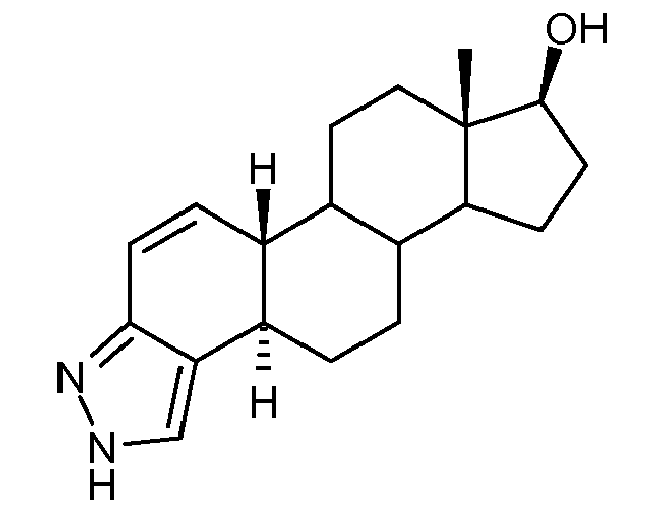
- To a solution 520 mg of raw 17β-hydroxy-4(Z)-hydroxymethylen-5α-estr-1-en-3-one in 6 ml ethanol was added a solution of hydrazine in THF (1.9 ml, 1 M). The mixture was stirred at room temperature for three hours. The mixture was extracted with ethyl acetate and water. The organic phase was dried over sodium sulphate and concentrated in vacuo. The raw product was chromatographed on silica gel with hexane and ethyl acetate as eluents to yield 84 mg of.2'H-Pyrazolo [5',4':3,4]-5α-estr-1-en-17β-ol.
- MS (CI+): m/z = 299 (M+1);
1H-NMR (400 MHz, CDCl3): δ = 7.24 (s, 1H); 6.57 (d, 1H); 6.20 (d, 1 H); 3.71 (t, 1H); 2.45 (m, 1H); 1.05 - 2.50 (m, 16H); 0.76 (s, 3H) -
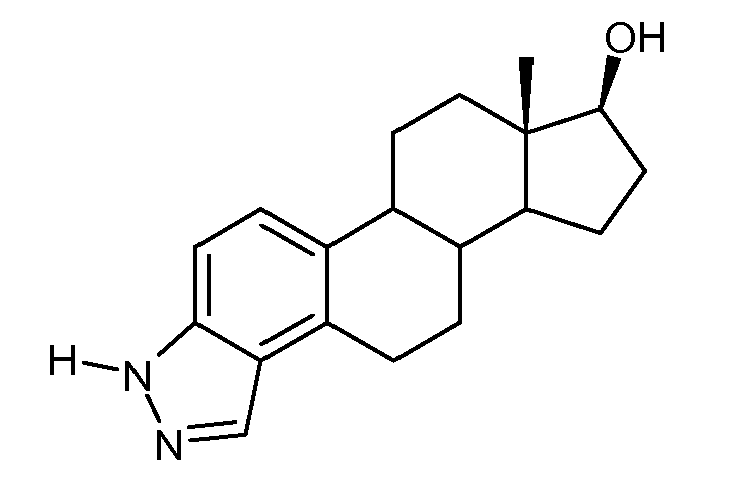
- To a solution 1 g 2'H-Pyrazolo[5',4':3,4]-5α-estr-1-en-17β-ol of in 10 ml methanol were added 1.2 g of palladium hydroxide on charcoal (10 %). The mixture was heated in a sealed tube for 4 hours. The mixture was allowed to cool to room temperature, filtered over celite and concentrated in vacuo. The crude product was chromatographed on silica gel 60 with hexane/ethylacetate as eluent to give 64 mg of 2'H-Pyrazolo[3',4':3,4]estra-1,3,5(10)-trien-17β-ol as a white solid.
- MS (CI+): m/z = 297 (M+H)+
1H-NMR (400 MHz, CDCl3): δ = 8.03 (s, 1H); 7.39 (d, 1H); 7.30 (d, 1H); 3.76 (t, 1H); 3.15 (m, 2H); 2.39 (m, 2H); 2.16 (m, 1H); 2.01 (m, 2H); 1.72 (m, 1H); 1.20 - 1.60 (m, 7H); 0.81 (s, 3H) -

- To a suspension of 521 mg of 2'H-Pyrazolo[3',4':3,4]estra-1,3,5(10)-trien-17β-ol (example 1) in 19 ml dichloromethane and 0.7 ml pyridine was added 746 mg of Dess-Martin periodinane. The reaction mixture was stirred for 2.5 hours at room temperature. The reaction mixture was diluted with water and extracted with ethyl acetate. The combined organic extracts were dried with sodium sulphate and concentrated in vacuo. The crude product was triturated with dichloromethane and hexane to give 325 mg of 2'H-Pyrazolo [3',4':3,4]estra-1,3,5(10)-trien-17-one as a white solid.
- MS (CI+): m/z = 295 (M+H)+;
1H-NMR (400 MHz, CDCl3): δ = 8.05 (s, 1 H); 7.39 (d, 1 H); 7.32 (d, 1 H); 3.22 (m, 2H); 2.50 (m, 3H); 1.92 - 2.23 (m, 4H); 1.45 - 1.80 (m, 5H); 0.94 (s, 3H); 0.88 (t, 1 H) -

- To a suspension of 80 mg of 2'H-Pyrazolo[3',4':3,4]estra-1,3,5(10)-trien-17-one in 10 ml of tetrahydrofuran were added 2.7 ml of methylmagnesiumbromide in tetrahydrofuran (3M). The reaction mixture was stirred for 20 hours. Then water was added and the mixture was extracted with ethyl acetate. The combined organic extracts were dried with sodium sulphate and concentrated in vacuo. The crude product was chromatoghraphed on silica gel 60 with hexane/ethyl acetate to yield 53 mg 17α-Methyl-2'H-pyrazolo[3',4':3,4]estra-1,3,5(10)-trien-17β-ol as a white solid.
- MS (CI+): m/z = 311 (M+H)+;
1H-NMR (400 MHz, CDCl3): δ = 8.03 (s, 1 H); 7.39 (d, 1 H); 7.30 (d, 1 H); 3.16 (m, 2H); 2.40 (m, 2H); 2.05 (m, 1 H); 2.01 (m, 2H); 1.20 - 1.80 (m, 8H); 1.30 (s, 3H); 0.92 (s, 3H)
Claims (21)
- A compound of formula (I)
 X is selected from the group consisting of nitrogen and CRa, wherebyRa stands for hydrogen, C1-3-alkyl group, a CpF2p+1 group with p = 1-3,R2 represents a hydrogen atom, a halogen atom, a C1-3-alkyl group or a trifluoromethyl group,R11 is selected from the group of hydrogen, halogen, C1-3-alkyl, C2-3-alkenyl, C2-3-alkinyl and C1-3-alkoxy,R16 is selected from the group consisting of hydrogen, hydroxyl, halogen, C1-3-alkyl, C2-3-alkenyl, C2-3-alkinyl and trifluoromethyl,R17a and R17b stand for a hydrogen atom, a hydroxyl group, an optionally substituted C1-3-alkyl group, an optionally substituted C2-3-alkenyl group, an optionally substituted C2-3-alkinyl group, a halogen atom, a group -OCORb, wherebyRb represents a group -(CH2)nCOOH with n = 2 or 3, or a C1-5-alkyl group with the proviso if R17a stands for a hydroxyl group, R17b represents a hydrogen atom or an optionally substituted C1-3-alkyl group, an optionally substituted C2-3-alkenyl group or a group -OCORb with the definition for Rb as mentioned above, and vice versa, orR17a and R17b stand together for an oxygen atom,
andR18 represents a hydrogen atom or a methyl group,or a pharmaceutically acceptable salt thereof. - A compound according to Claim 1 wherein R17a is selected from the group consisting of hydrogen, an optionally substituted C1-3-alkyl group, an optionally substituted C2-3-alkenyl group, an optionally substituted C2-3-alkinyl group, whereas R17b is selected from the group consisting of hydroxyl, fluorine, -OCORb.
- A compound according to Claim 1, wherein R17a is selected from the group consisting of hydrogen, methyl, trifluoromethyl, vinyl and ethinyl.
- A compound according to Claim 1, wherein R17a represents a hydroxyl group or a fluorine atom.
- A compound according to Claim 1 wherein R16 is selected from the group consisting of hydrogen, hydroxyl and fluorine.
- A compound according to Claim 1 wherein R18 is a hydrogen atom.
- A compound according to claim 1, wherein X stands for CRa.
- A compound according to claim 1, wherein Ra stands for a hydrogen atom, a group trifluoromethyl or a methyl group.
- A compound according to Claim 1, wherein R11 represents a hydrogen atom, a fluorine atom, a hydroxyl group or a methoxy group.
- A compound according to Claim 1, wherein R2 stands for a hydrogen atom, a fluorine atom or a trifluoromethyl group. A pharmaceutical composition comprising a pharmaceutically acceptable carrier and a compound of Claim 1.
- A compound according to claim 1, wherein R16 represents a hydroxyl group, R17a a hydrogen atom and R17b a fluorine atom.
- A compound according to claim 1, wherein R17b represents a hydroxyl group, R17a a hydrogen atom, a vinyl, ethinyl, methyl or a trifluoromethyl group and R16 a hydrogen or fluorine atom or a hydroxyl group.
- Compounds according to claim 1 to 12, namely
2'H-Pyrazolo[3',4':3,4]estra-1,3,5(10)-trien-17β-ol
17α-Methyl-2'H-pyrazolo[3',4':3,4]estra-1,3,5(10)-trien-17β-ol
17α-Ethyl-2'H-pyrazolo[3',4':3,4]estra-1,3,5(10)-trien-17β-ol
17α-Propyl-2'H-pyrazolo[3',4':3,4]estra-1,3,5(10)-trien-17β-ol
17α-Vinyl-2'H-pyrazolo[3',4':3,4]estra-1,3,5(10)-trien-17β-ol
17α-Ethinyl-2'H-pyrazolo[3',4':3,4]estra-1,3,5(10)-trien-17β-ol
2'H-Pyrazolo[3',4':3,4]estra-1,3,5(10)-trien-17-one
2-Fluoro-2'H-pyrazolo[3',4':3,4]estra-1,3,5(10)-trien-17β-ol
2-Fluoro-17a-methyl-2'H-pyrazolo[3',4':3,4]estra-1,3,5(10)-trien-17β-ol
17α-Ethyl-2-fluoro-2'H-pyrazolo[3',4':3,4]estra-1,3,5(10)-trien-17β-ol
2-Fluoro-17α-propyl-2'H-pyrazolo[3',4':3,4]estra-1,3,5(10)-trien-17β-ol
2-Fluoro-17α-vinyl-2'H-pyrazolo[3',4':3,4]estra-1,3,5(10)-trien-17β-ol
17α-Ethinyl-2-fluoro-2'H-pyrazolo[3',4':3,4]estra-1,3,5(10)-trien-17β-ol
11β-Fluoro-2'H-Pyrazolo[3',4':3,4]estra-1,3,5(10)-trien-17β-ol
11β-Fluoro-17α-Methyl-2'H-pyrazolo[3',4':3,4]estra-1,3,5(10)-trien-17β-ol
17α-Ethyl-11β-fluoro-2'H-pyrazolo[3',4':3,4]estra-1,3,5(10)-trien-17β-ol
11β-Fluoro-17α-Propyl-2'H-pyrazolo[3',4':3,4]estra-1,3,5(10)-trien-17β-ol
11β-Fluoro-17α-Vinyl-2'H-pyrazolo[3',4':3,4]estra-1,3,5(10)-trien-17β-ol
17α-Ethinyl-11P-fluoro-2'H-pyrazolo[3',4':3,4]estra-1,3,5(10)-trien-17β-ol
5'-Methyl-2'H-pyrazolo[3',4':3,4]estra-1,3,5(10)-trien-17β-ol
5',17-Dimethyl-2'H-pyrazolo[3',4':3,4]estra-1,3,5(10)-trien-17β-ol
2-Fluoro-5',17-dimethyl-2'H-pyrazolo[3',4':3,4]estra-1,3,5(10)-trien-17β-ol
2-Fluoro-5'-Methyl-2'H-pyrazolo[3',4':3,4]estra-1,3,5(10)-trien-17β-ol - Pharmaceutical composition comprising at least one compound of the general formula I according to any of Claims 1 to 13 and, optionally at least one additional active ingredient together with pharmaceutically suitable excipients and/or carriers.
- Pharmaceutical composition according to claim 14, wherein the additional active ingredient is a SERM (selective estrogen receptor modulator) or a SERD (selective estrogen receptor destabilizer).or a progestogen.
- A process for making a pharmaceutical composition comprising mixing a compound of Claim 1 and optionally at least one additional active ingredient with a pharmaceutically acceptable carrier.
- Use of compounds according to claim 1 to 13 for manufacturing a medicament for the treatment of a disorder mediated by an estrogen receptor, in a subject in need thereof comprising administering to the subject a therapeutically effective amount of the compound of Claim 1.
- Use according to Claim 16, wherein the disorder mediated by an estrogen receptor is selected from the group consisting of hot flashes, vaginal dryness, osteopenia, osteoporosis, hyperlipidemia, loss of cognitive function, degenerative brain diseases, cardiovascular diseases, cerebrovascular diseases, cancer of the breast tissue, hyperplasia of the breast tissue, cancer of the endometrium, hyperplasia of the endometrium, cancer of the cervix, hyperplasia of the cervix, cancer of the prostate, benign prostatic hyperplasia, endometriosis, uterine fibroids and osteoarthritis.
- Use according to Claim 16, wherein the disorder mediated by an estrogen receptor is selected from the group consisting of osteoporosis, hot flashes, vaginal dryness, breast cancer and endometriosis.
- Use of compounds according to claim 1 to 13 for manufacturing a medicament for the treatment of a disorder mediated by an estrogen receptor in a subject in need thereof comprising administering to the subject a therapeutically effective amount of the composition of Claim 14.
- Use of compounds according to claim 1 to 13 for contraception, alone or in combination with an effective amount of a compound as in Claim 1 to 13 and a progestogen.
Priority Applications (25)
| Application Number | Priority Date | Filing Date | Title |
|---|---|---|---|
| EP08161108A EP2147924A1 (en) | 2008-07-24 | 2008-07-24 | Estratriene derivatives comprising heterocyclic bioisosteres for the phenolic a-ring |
| US13/055,388 US20110190246A1 (en) | 2008-07-24 | 2009-07-14 | Estratriene derivatives comprising heterocyclic bioisosteres for the phenolic a-ring |
| PE2011000072A PE20110402A1 (en) | 2008-07-24 | 2009-07-14 | STRATIENE DERIVATIVES INCLUDING HETEROCYCLIC BIOSOSTERS FOR THE PHENOLIC RING A |
| CA2731634A CA2731634A1 (en) | 2008-07-24 | 2009-07-14 | Estratriene derivatives comprising heterocyclic bioisosteres for the phenolic a-ring |
| JP2011519066A JP2011528675A (en) | 2008-07-24 | 2009-07-14 | Estratriene derivatives containing heterocyclic bioequivalents for the phenol A ring |
| BRPI0915987A BRPI0915987A2 (en) | 2008-07-24 | 2009-07-14 | stratriene derivatives comprising heterocyclic ring isomers of phenolic a |
| EA201100226A EA201100226A1 (en) | 2008-07-24 | 2009-07-14 | DERIVATIVES OF ESTRATRIEN CONTAINING HETEROCYCLIC BIOISOLAS FOR A-RING PHENOL |
| MX2011000939A MX2011000939A (en) | 2008-07-24 | 2009-07-14 | Estratriene derivatives comprising heterocyclic bioisosteres for the phenolic a-ring. |
| CN2009801289641A CN102105484A (en) | 2008-07-24 | 2009-07-14 | Estratriene derivatives comprising heterocyclic bioisosteres for the phenolic a-ring |
| PCT/EP2009/005086 WO2010009828A1 (en) | 2008-07-24 | 2009-07-14 | Estratriene derivatives comprising heterocyclic bioisosteres for the phenolic a-ring |
| EP09800008A EP2307439A1 (en) | 2008-07-24 | 2009-07-14 | Estratriene derivatives comprising heterocyclic bioisosteres for the phenolic a-ring |
| KR1020117001617A KR20110036739A (en) | 2008-07-24 | 2009-07-14 | Estratriene Derivatives Including Heterocyclic Bioisomers for the Phenol A Ring |
| AU2009273494A AU2009273494A1 (en) | 2008-07-24 | 2009-07-14 | Estratriene derivatives comprising heterocyclic bioisosteres for the phenolic a-ring |
| TW098124460A TW201008570A (en) | 2008-07-24 | 2009-07-20 | Estratriene derivatives comprising heterocyclic bioisosteres for the phenolic a-ring |
| UY0001032005A UY32005A (en) | 2008-07-24 | 2009-07-23 | STRATRIENE DERIVATIVES THAT INCLUDE HETEROCYCLIC BIOISOSTERS FOR PHENOLIC RING A |
| ARP090102822A AR072533A1 (en) | 2008-07-24 | 2009-07-24 | STRATRIENE DERIVATIVES THAT INCLUDE HETEROCICLIC BIOISOSTERS FOR PHENOLIC RING A |
| IL210314A IL210314A0 (en) | 2008-07-24 | 2010-12-28 | Estratriene derivatives comprising heterocyclic bioisosteres for the phenolic a-ring |
| MA33521A MA32477B1 (en) | 2008-07-24 | 2011-01-14 | Stratrini derivatives contain bioesostere with a heterocyclic cyclic heterozygous for phenolic |
| DO2011000024A DOP2011000024A (en) | 2008-07-24 | 2011-01-20 | STRATRIENE DERIVATIVES THAT INCLUDE HETEROCICLIC BIOSOSTERS FOR THE PHENOLIC RING A |
| CL2011000153A CL2011000153A1 (en) | 2008-07-24 | 2011-01-24 | Compounds derived from pyrazolo-estriene and triazolo-estriene; pharmaceutical composition; Preparation process; and its use for the treatment of estrogen receptor mediated disorders, such as hot flashes, vaginal dryness, osteopenia, osteoporosis, hyperlipidemia and loss of cognitive function, among others. |
| EC2011010780A ECSP11010780A (en) | 2008-07-24 | 2011-01-24 | STRATRIENE DERIVATIVES THAT INCLUDE HETEROCYCLIC BIOISOSTERS FOR PHENOLIC RING A |
| CR20110045A CR20110045A (en) | 2008-07-24 | 2011-01-24 | STRATRIEN DERIVATIVES THAT INCLUDE HETEROCICLIC BIOISOSTERS FOR THE PHENËLIC RING A |
| SV2011003817A SV2011003817A (en) | 2008-07-24 | 2011-01-24 | STRATRIENE DERIVATIVES THAT INCLUDE HETEROCICLIC BIOISOSTERS FOR PHENOLIC RING A |
| CO11007864A CO6351799A2 (en) | 2008-07-24 | 2011-01-25 | STRATRIENE DERIVATIVES THAT INCLUDE HETEROCICLIC BIOISOSTERS FOR PHENOLIC RING A |
| ZA2011/01445A ZA201101445B (en) | 2008-07-24 | 2011-02-23 | Estratriene derivatives comprising heterocyclic bioisosteres for the phenolic a-ring |
Applications Claiming Priority (1)
| Application Number | Priority Date | Filing Date | Title |
|---|---|---|---|
| EP08161108A EP2147924A1 (en) | 2008-07-24 | 2008-07-24 | Estratriene derivatives comprising heterocyclic bioisosteres for the phenolic a-ring |
Publications (1)
| Publication Number | Publication Date |
|---|---|
| EP2147924A1 true EP2147924A1 (en) | 2010-01-27 |
Family
ID=40329347
Family Applications (2)
| Application Number | Title | Priority Date | Filing Date |
|---|---|---|---|
| EP08161108A Withdrawn EP2147924A1 (en) | 2008-07-24 | 2008-07-24 | Estratriene derivatives comprising heterocyclic bioisosteres for the phenolic a-ring |
| EP09800008A Withdrawn EP2307439A1 (en) | 2008-07-24 | 2009-07-14 | Estratriene derivatives comprising heterocyclic bioisosteres for the phenolic a-ring |
Family Applications After (1)
| Application Number | Title | Priority Date | Filing Date |
|---|---|---|---|
| EP09800008A Withdrawn EP2307439A1 (en) | 2008-07-24 | 2009-07-14 | Estratriene derivatives comprising heterocyclic bioisosteres for the phenolic a-ring |
Country Status (24)
| Country | Link |
|---|---|
| US (1) | US20110190246A1 (en) |
| EP (2) | EP2147924A1 (en) |
| JP (1) | JP2011528675A (en) |
| KR (1) | KR20110036739A (en) |
| CN (1) | CN102105484A (en) |
| AR (1) | AR072533A1 (en) |
| AU (1) | AU2009273494A1 (en) |
| BR (1) | BRPI0915987A2 (en) |
| CA (1) | CA2731634A1 (en) |
| CL (1) | CL2011000153A1 (en) |
| CO (1) | CO6351799A2 (en) |
| CR (1) | CR20110045A (en) |
| DO (1) | DOP2011000024A (en) |
| EA (1) | EA201100226A1 (en) |
| EC (1) | ECSP11010780A (en) |
| IL (1) | IL210314A0 (en) |
| MA (1) | MA32477B1 (en) |
| MX (1) | MX2011000939A (en) |
| PE (1) | PE20110402A1 (en) |
| SV (1) | SV2011003817A (en) |
| TW (1) | TW201008570A (en) |
| UY (1) | UY32005A (en) |
| WO (1) | WO2010009828A1 (en) |
| ZA (1) | ZA201101445B (en) |
Cited By (2)
| Publication number | Priority date | Publication date | Assignee | Title |
|---|---|---|---|---|
| EP4265977A1 (en) | 2022-04-20 | 2023-10-25 | Eberspächer catem GmbH & Co. KG | Electric heating device |
| EP4265976A1 (en) | 2022-04-20 | 2023-10-25 | Eberspächer catem GmbH & Co. KG | Electric heating device |
Families Citing this family (2)
| Publication number | Priority date | Publication date | Assignee | Title |
|---|---|---|---|---|
| WO2011092127A1 (en) * | 2010-01-26 | 2011-08-04 | Bayer Schering Pharma Aktiengesellschaft | 14,17-bridged estratriene derivatives comprising heterocyclic bioisosteres for the phenolic a-ring |
| AU2021269612A1 (en) | 2020-05-15 | 2023-01-05 | Jiangsu Simcere Pharmaceutical Co., Ltd. | Pyrrolidine compound and use thereof |
Citations (2)
| Publication number | Priority date | Publication date | Assignee | Title |
|---|---|---|---|---|
| US3458504A (en) * | 1966-10-24 | 1969-07-29 | Sterling Drug Inc | Steroido(3,4-c)pyrazoles of the 5alpha- and 5beta-androstane series |
| WO2004005314A1 (en) * | 2002-07-03 | 2004-01-15 | Ortho-Mcneil Pharmaceutical, Inc. | ESTRIENO[3,2-b]/[3,4-c]PYRROLE DERIVATIVES USEFUL AS MODULATORS OF THE ESTROGEN RECEPTORS |
-
2008
- 2008-07-24 EP EP08161108A patent/EP2147924A1/en not_active Withdrawn
-
2009
- 2009-07-14 PE PE2011000072A patent/PE20110402A1/en not_active Application Discontinuation
- 2009-07-14 EP EP09800008A patent/EP2307439A1/en not_active Withdrawn
- 2009-07-14 JP JP2011519066A patent/JP2011528675A/en active Pending
- 2009-07-14 EA EA201100226A patent/EA201100226A1/en unknown
- 2009-07-14 WO PCT/EP2009/005086 patent/WO2010009828A1/en not_active Ceased
- 2009-07-14 CN CN2009801289641A patent/CN102105484A/en active Pending
- 2009-07-14 MX MX2011000939A patent/MX2011000939A/en not_active Application Discontinuation
- 2009-07-14 CA CA2731634A patent/CA2731634A1/en not_active Abandoned
- 2009-07-14 KR KR1020117001617A patent/KR20110036739A/en not_active Withdrawn
- 2009-07-14 AU AU2009273494A patent/AU2009273494A1/en not_active Abandoned
- 2009-07-14 US US13/055,388 patent/US20110190246A1/en not_active Abandoned
- 2009-07-14 BR BRPI0915987A patent/BRPI0915987A2/en not_active IP Right Cessation
- 2009-07-20 TW TW098124460A patent/TW201008570A/en unknown
- 2009-07-23 UY UY0001032005A patent/UY32005A/en not_active Application Discontinuation
- 2009-07-24 AR ARP090102822A patent/AR072533A1/en unknown
-
2010
- 2010-12-28 IL IL210314A patent/IL210314A0/en unknown
-
2011
- 2011-01-14 MA MA33521A patent/MA32477B1/en unknown
- 2011-01-20 DO DO2011000024A patent/DOP2011000024A/en unknown
- 2011-01-24 EC EC2011010780A patent/ECSP11010780A/en unknown
- 2011-01-24 CL CL2011000153A patent/CL2011000153A1/en unknown
- 2011-01-24 SV SV2011003817A patent/SV2011003817A/en unknown
- 2011-01-24 CR CR20110045A patent/CR20110045A/en not_active Application Discontinuation
- 2011-01-25 CO CO11007864A patent/CO6351799A2/en not_active Application Discontinuation
- 2011-02-23 ZA ZA2011/01445A patent/ZA201101445B/en unknown
Patent Citations (2)
| Publication number | Priority date | Publication date | Assignee | Title |
|---|---|---|---|---|
| US3458504A (en) * | 1966-10-24 | 1969-07-29 | Sterling Drug Inc | Steroido(3,4-c)pyrazoles of the 5alpha- and 5beta-androstane series |
| WO2004005314A1 (en) * | 2002-07-03 | 2004-01-15 | Ortho-Mcneil Pharmaceutical, Inc. | ESTRIENO[3,2-b]/[3,4-c]PYRROLE DERIVATIVES USEFUL AS MODULATORS OF THE ESTROGEN RECEPTORS |
Non-Patent Citations (4)
| Title |
|---|
| HORWITZ ET AL., J. MED. CHEM., vol. 29, 1986, pages 692 |
| LOVELY CARL J ET AL: "Synthesis and biological evaluation of 4-(hydroxyalkyl)estradiols and related compounds", JOURNAL OF MEDICINAL CHEMISTRY, vol. 40, no. 23, 7 November 1997 (1997-11-07), pages 3756 - 3764, XP002514694, ISSN: 0022-2623 * |
| PETERS R H ET AL: "Steroidal oxathiazine inhibitors of estrone sulfatase", STEROIDS, ELSEVIER SCIENCE PUBLISHERS, NEW YORK, NY, US, vol. 68, no. 1, 1 January 2003 (2003-01-01), pages 97 - 110, XP004398474, ISSN: 0039-128X * |
| ZHANG X ET AL: "An efficient synthesis of novel estrieno[2.3-b] and [3.4-c]pyrroles", TETRAHEDRON LETTERS, ELSEVIER, AMSTERDAM, vol. 44, no. 15, 7 April 2003 (2003-04-07), pages 3071 - 3073, XP004415671, ISSN: 0040-4039 * |
Cited By (4)
| Publication number | Priority date | Publication date | Assignee | Title |
|---|---|---|---|---|
| EP4265977A1 (en) | 2022-04-20 | 2023-10-25 | Eberspächer catem GmbH & Co. KG | Electric heating device |
| EP4265976A1 (en) | 2022-04-20 | 2023-10-25 | Eberspächer catem GmbH & Co. KG | Electric heating device |
| DE102022109556A1 (en) | 2022-04-20 | 2023-10-26 | Eberspächer Catem Gmbh & Co. Kg | Electric heater |
| DE102022109544A1 (en) | 2022-04-20 | 2023-10-26 | Eberspächer Catem Gmbh & Co. Kg | Electric heater |
Also Published As
| Publication number | Publication date |
|---|---|
| US20110190246A1 (en) | 2011-08-04 |
| CN102105484A (en) | 2011-06-22 |
| CO6351799A2 (en) | 2011-12-20 |
| EP2307439A1 (en) | 2011-04-13 |
| UY32005A (en) | 2010-02-26 |
| KR20110036739A (en) | 2011-04-08 |
| CA2731634A1 (en) | 2010-01-28 |
| MA32477B1 (en) | 2011-07-03 |
| ZA201101445B (en) | 2012-07-25 |
| WO2010009828A1 (en) | 2010-01-28 |
| SV2011003817A (en) | 2011-05-20 |
| PE20110402A1 (en) | 2011-06-19 |
| EA201100226A1 (en) | 2011-08-30 |
| ECSP11010780A (en) | 2011-02-28 |
| JP2011528675A (en) | 2011-11-24 |
| CR20110045A (en) | 2012-05-28 |
| AU2009273494A1 (en) | 2010-01-28 |
| TW201008570A (en) | 2010-03-01 |
| MX2011000939A (en) | 2011-03-04 |
| BRPI0915987A2 (en) | 2019-09-24 |
| IL210314A0 (en) | 2011-03-31 |
| DOP2011000024A (en) | 2011-02-28 |
| CL2011000153A1 (en) | 2011-07-08 |
| AR072533A1 (en) | 2010-09-01 |
Similar Documents
| Publication | Publication Date | Title |
|---|---|---|
| AU749597C (en) | Novel anti-estrogenic steroids, and associated pharmaceutical compositions and methods of use | |
| WO2011092127A1 (en) | 14,17-bridged estratriene derivatives comprising heterocyclic bioisosteres for the phenolic a-ring | |
| EP2125859B1 (en) | Estratriene derivatives and their uses as 17beta-hydroxysteroid dehydrogenase inhibitors | |
| JP5865845B2 (en) | Progesterone receptor antagonist | |
| CN101146798A (en) | New Heterocyclic Benzo[C]chromene Derivatives as Estrogen Receptor Modulators | |
| NO314231B1 (en) | Meios regulating compounds and their use in the manufacture of medicaments | |
| MX2007014736A (en) | 17beta-hsd1 and sts inhibitors. | |
| EP0785211A1 (en) | New substituted 19-nor-pregnane derivatives | |
| JP4545929B2 (en) | 17β-amino and hydroxylamino-11β-allyl steroids and their derivatives having agonist or antagonist hormone properties | |
| US6172052B1 (en) | 17β-acyl-17α-propynyl-11β-arylsteroids and their derivatives having agonist or antagonist hormonal properties | |
| EP1525215B1 (en) | Progesterone receptor modulators having an increased antigonadotropic activity for use in female fertility testing and hormone replacement therapy | |
| US20110190246A1 (en) | Estratriene derivatives comprising heterocyclic bioisosteres for the phenolic a-ring | |
| US20080255075A1 (en) | Substituted estratriene derivatives as 17beta hsd inhibitors | |
| US7550451B2 (en) | Progesterone receptor modulators with increased antigonadotropic activity for female birth control and hormone replacement therapy | |
| US6740645B1 (en) | 17β-acyl-17α-propynyl-11β-(cyclic amino) aryl steroids and their derivatives having antagonist hormonal properties | |
| US20060281710A1 (en) | 17SS-HSD1 and STS inhibitors | |
| JP4768181B2 (en) | 11β-Aryl-17,17-spirothiolane substituted steroids | |
| HK1157793A (en) | Estratriene derivatives comprising heterocyclic bioisosteres for the phenolic a-ring | |
| US6916921B2 (en) | Steroid compounds, use of these compounds for the preparation of meiosis-regulating medicaments and method for the preparation of these compounds | |
| AU2005225560B2 (en) | Progesterone receptor modulators | |
| US20080146531A1 (en) | Therapeutically Active Triazoles and Their Use | |
| HRP20000893A2 (en) | Novel 17-halogenated 19-nor steroids, method and intermediates for preparing same, use as medicines and pharmaceutical compositions containing same | |
| JP2004508373A (en) | Cyclic and acyclic amidines and pharmaceutical compositions containing them for use as progesterone receptor binding agents | |
| HK1131787B (en) | Oxa-steroids derivatives as selective progesterone receptor modulators | |
| CN102459304A (en) | Substituted 16,17-fused steroid compounds for female healthcare |
Legal Events
| Date | Code | Title | Description |
|---|---|---|---|
| PUAI | Public reference made under article 153(3) epc to a published international application that has entered the european phase |
Free format text: ORIGINAL CODE: 0009012 |
|
| AK | Designated contracting states |
Kind code of ref document: A1 Designated state(s): AT BE BG CH CY CZ DE DK EE ES FI FR GB GR HR HU IE IS IT LI LT LU LV MC MT NL NO PL PT RO SE SI SK TR |
|
| AX | Request for extension of the european patent |
Extension state: AL BA MK RS |
|
| AKY | No designation fees paid | ||
| STAA | Information on the status of an ep patent application or granted ep patent |
Free format text: STATUS: THE APPLICATION IS DEEMED TO BE WITHDRAWN |
|
| 18D | Application deemed to be withdrawn |
Effective date: 20100728 |
|
| REG | Reference to a national code |
Ref country code: DE Ref legal event code: 8566 |