EP2146440A2 - Method for sending and taking off a signal with digital data in the power distribution network of a building - Google Patents
Method for sending and taking off a signal with digital data in the power distribution network of a building Download PDFInfo
- Publication number
- EP2146440A2 EP2146440A2 EP08767021A EP08767021A EP2146440A2 EP 2146440 A2 EP2146440 A2 EP 2146440A2 EP 08767021 A EP08767021 A EP 08767021A EP 08767021 A EP08767021 A EP 08767021A EP 2146440 A2 EP2146440 A2 EP 2146440A2
- Authority
- EP
- European Patent Office
- Prior art keywords
- busbar
- injection
- signal
- points
- power
- Prior art date
- Legal status (The legal status is an assumption and is not a legal conclusion. Google has not performed a legal analysis and makes no representation as to the accuracy of the status listed.)
- Withdrawn
Links
Images


Classifications
-
- H—ELECTRICITY
- H04—ELECTRIC COMMUNICATION TECHNIQUE
- H04B—TRANSMISSION
- H04B3/00—Line transmission systems
- H04B3/54—Systems for transmission via power distribution lines
- H04B3/542—Systems for transmission via power distribution lines the information being in digital form
-
- H—ELECTRICITY
- H02—GENERATION; CONVERSION OR DISTRIBUTION OF ELECTRIC POWER
- H02J—ELECTRIC POWER NETWORKS; CIRCUIT ARRANGEMENTS OR SYSTEMS FOR SUPPLYING OR DISTRIBUTING ELECTRIC POWER; SYSTEMS FOR STORING ELECTRIC ENERGY
- H02J13/00—Circuit arrangements for providing remote monitoring or remote control of equipment in a power distribution network
- H02J13/13—Circuit arrangements for providing remote monitoring or remote control of equipment in a power distribution network characterised by the transmission of data to equipment in the power network
- H02J13/1311—Circuit arrangements for providing remote monitoring or remote control of equipment in a power distribution network characterised by the transmission of data to equipment in the power network using the power network as support for the transmission
-
- H—ELECTRICITY
- H02—GENERATION; CONVERSION OR DISTRIBUTION OF ELECTRIC POWER
- H02J—ELECTRIC POWER NETWORKS; CIRCUIT ARRANGEMENTS OR SYSTEMS FOR SUPPLYING OR DISTRIBUTING ELECTRIC POWER; SYSTEMS FOR STORING ELECTRIC ENERGY
- H02J13/00—Circuit arrangements for providing remote monitoring or remote control of equipment in a power distribution network
- H02J13/13—Circuit arrangements for providing remote monitoring or remote control of equipment in a power distribution network characterised by the transmission of data to equipment in the power network
- H02J13/1321—Circuit arrangements for providing remote monitoring or remote control of equipment in a power distribution network characterised by the transmission of data to equipment in the power network using a wired telecommunication network or a data transmission bus
- H02J13/1323—Circuit arrangements for providing remote monitoring or remote control of equipment in a power distribution network characterised by the transmission of data to equipment in the power network using a wired telecommunication network or a data transmission bus using optical fibres
-
- H—ELECTRICITY
- H02—GENERATION; CONVERSION OR DISTRIBUTION OF ELECTRIC POWER
- H02J—ELECTRIC POWER NETWORKS; CIRCUIT ARRANGEMENTS OR SYSTEMS FOR SUPPLYING OR DISTRIBUTING ELECTRIC POWER; SYSTEMS FOR STORING ELECTRIC ENERGY
- H02J13/00—Circuit arrangements for providing remote monitoring or remote control of equipment in a power distribution network
- H02J13/13—Circuit arrangements for providing remote monitoring or remote control of equipment in a power distribution network characterised by the transmission of data to equipment in the power network
- H02J13/1337—Circuit arrangements for providing remote monitoring or remote control of equipment in a power distribution network characterised by the transmission of data to equipment in the power network involving the use of Internet protocols
-
- H—ELECTRICITY
- H02—GENERATION; CONVERSION OR DISTRIBUTION OF ELECTRIC POWER
- H02J—ELECTRIC POWER NETWORKS; CIRCUIT ARRANGEMENTS OR SYSTEMS FOR SUPPLYING OR DISTRIBUTING ELECTRIC POWER; SYSTEMS FOR STORING ELECTRIC ENERGY
- H02J13/00—Circuit arrangements for providing remote monitoring or remote control of equipment in a power distribution network
- H02J13/18—Circuit arrangements for providing remote monitoring or remote control of equipment in a power distribution network characterised by the remotely-controlled equipment, e.g. converters or transformers
- H02J13/333—Circuit arrangements for providing remote monitoring or remote control of equipment in a power distribution network characterised by the remotely-controlled equipment, e.g. converters or transformers the equipment forming part of substations
-
- H—ELECTRICITY
- H04—ELECTRIC COMMUNICATION TECHNIQUE
- H04B—TRANSMISSION
- H04B2203/00—Indexing scheme relating to line transmission systems
- H04B2203/54—Aspects of powerline communications not already covered by H04B3/54 and its subgroups
- H04B2203/5404—Methods of transmitting or receiving signals via power distribution lines
- H04B2203/5425—Methods of transmitting or receiving signals via power distribution lines improving S/N by matching impedance, noise reduction, gain control
-
- Y—GENERAL TAGGING OF NEW TECHNOLOGICAL DEVELOPMENTS; GENERAL TAGGING OF CROSS-SECTIONAL TECHNOLOGIES SPANNING OVER SEVERAL SECTIONS OF THE IPC; TECHNICAL SUBJECTS COVERED BY FORMER USPC CROSS-REFERENCE ART COLLECTIONS [XRACs] AND DIGESTS
- Y02—TECHNOLOGIES OR APPLICATIONS FOR MITIGATION OR ADAPTATION AGAINST CLIMATE CHANGE
- Y02B—CLIMATE CHANGE MITIGATION TECHNOLOGIES RELATED TO BUILDINGS, e.g. HOUSING, HOUSE APPLIANCES OR RELATED END-USER APPLICATIONS
- Y02B90/00—Enabling technologies or technologies with a potential or indirect contribution to GHG emissions mitigation
- Y02B90/20—Smart grids as enabling technology in buildings sector
-
- Y—GENERAL TAGGING OF NEW TECHNOLOGICAL DEVELOPMENTS; GENERAL TAGGING OF CROSS-SECTIONAL TECHNOLOGIES SPANNING OVER SEVERAL SECTIONS OF THE IPC; TECHNICAL SUBJECTS COVERED BY FORMER USPC CROSS-REFERENCE ART COLLECTIONS [XRACs] AND DIGESTS
- Y04—INFORMATION OR COMMUNICATION TECHNOLOGIES HAVING AN IMPACT ON OTHER TECHNOLOGY AREAS
- Y04S—SYSTEMS INTEGRATING TECHNOLOGIES RELATED TO POWER NETWORK OPERATION, COMMUNICATION OR INFORMATION TECHNOLOGIES FOR IMPROVING THE ELECTRICAL POWER GENERATION, TRANSMISSION, DISTRIBUTION, MANAGEMENT OR USAGE, i.e. SMART GRIDS
- Y04S40/00—Systems for electrical power generation, transmission, distribution or end-user application management characterised by the use of communication or information technologies, or communication or information technology specific aspects supporting them
- Y04S40/12—Systems for electrical power generation, transmission, distribution or end-user application management characterised by the use of communication or information technologies, or communication or information technology specific aspects supporting them characterised by data transport means between the monitoring, controlling or managing units and monitored, controlled or operated electrical equipment
- Y04S40/121—Systems for electrical power generation, transmission, distribution or end-user application management characterised by the use of communication or information technologies, or communication or information technology specific aspects supporting them characterised by data transport means between the monitoring, controlling or managing units and monitored, controlled or operated electrical equipment using the power network as support for the transmission
-
- Y—GENERAL TAGGING OF NEW TECHNOLOGICAL DEVELOPMENTS; GENERAL TAGGING OF CROSS-SECTIONAL TECHNOLOGIES SPANNING OVER SEVERAL SECTIONS OF THE IPC; TECHNICAL SUBJECTS COVERED BY FORMER USPC CROSS-REFERENCE ART COLLECTIONS [XRACs] AND DIGESTS
- Y04—INFORMATION OR COMMUNICATION TECHNOLOGIES HAVING AN IMPACT ON OTHER TECHNOLOGY AREAS
- Y04S—SYSTEMS INTEGRATING TECHNOLOGIES RELATED TO POWER NETWORK OPERATION, COMMUNICATION OR INFORMATION TECHNOLOGIES FOR IMPROVING THE ELECTRICAL POWER GENERATION, TRANSMISSION, DISTRIBUTION, MANAGEMENT OR USAGE, i.e. SMART GRIDS
- Y04S40/00—Systems for electrical power generation, transmission, distribution or end-user application management characterised by the use of communication or information technologies, or communication or information technology specific aspects supporting them
- Y04S40/12—Systems for electrical power generation, transmission, distribution or end-user application management characterised by the use of communication or information technologies, or communication or information technology specific aspects supporting them characterised by data transport means between the monitoring, controlling or managing units and monitored, controlled or operated electrical equipment
- Y04S40/124—Systems for electrical power generation, transmission, distribution or end-user application management characterised by the use of communication or information technologies, or communication or information technology specific aspects supporting them characterised by data transport means between the monitoring, controlling or managing units and monitored, controlled or operated electrical equipment using wired telecommunication networks or data transmission busses
-
- Y—GENERAL TAGGING OF NEW TECHNOLOGICAL DEVELOPMENTS; GENERAL TAGGING OF CROSS-SECTIONAL TECHNOLOGIES SPANNING OVER SEVERAL SECTIONS OF THE IPC; TECHNICAL SUBJECTS COVERED BY FORMER USPC CROSS-REFERENCE ART COLLECTIONS [XRACs] AND DIGESTS
- Y04—INFORMATION OR COMMUNICATION TECHNOLOGIES HAVING AN IMPACT ON OTHER TECHNOLOGY AREAS
- Y04S—SYSTEMS INTEGRATING TECHNOLOGIES RELATED TO POWER NETWORK OPERATION, COMMUNICATION OR INFORMATION TECHNOLOGIES FOR IMPROVING THE ELECTRICAL POWER GENERATION, TRANSMISSION, DISTRIBUTION, MANAGEMENT OR USAGE, i.e. SMART GRIDS
- Y04S40/00—Systems for electrical power generation, transmission, distribution or end-user application management characterised by the use of communication or information technologies, or communication or information technology specific aspects supporting them
- Y04S40/12—Systems for electrical power generation, transmission, distribution or end-user application management characterised by the use of communication or information technologies, or communication or information technology specific aspects supporting them characterised by data transport means between the monitoring, controlling or managing units and monitored, controlled or operated electrical equipment
- Y04S40/128—Systems for electrical power generation, transmission, distribution or end-user application management characterised by the use of communication or information technologies, or communication or information technology specific aspects supporting them characterised by data transport means between the monitoring, controlling or managing units and monitored, controlled or operated electrical equipment involving the use of Internet protocol
Definitions
- the invention relates to electrical communication engineering, namely to methods of supply and removal (hereinafter: injection) of digital data into the system for distributing electric power in a building.
- the invention also relates to the area of telecommunication technologies, namely to methods of transmitting information via power systems by means of PLT (Power Line Telecommunication) technology, also-called PLC (Power Line Communication or Power Line Carrier), PLN (Power Line Networking) or PAN (Power Area Networking) technology.
- PLT Power Line Telecommunication
- PLC Power Line Communication or Power Line Carrier
- PLN Power Line Networking
- PAN Power Area Networking
- the invention also relates to methods of transmitting high-frequency signals over electrical networks.
- the digital data to be transmitted can include communication data (e.g. Internet data; video, audio and voice data), telemetry data, control data and/or other digital data.
- a method for transmitting information via an electric power cable (Manstorfer K. Data transmission system for transmission of data on at least one power cable.
- Input and output of digital data takes place in the terminal regions of the power cable, thus providing communication between two points located at the ends of the power cable.
- the medium transmitting the digital signal in the description of the known method is a section of the electric power cable (without branchings). For this reason the known method belongs to a group of methods of direct communication, mainly intended for purposes of remote acquisition of information on the operation of transformer substations and other electrical equipment over medium-voltage and high-voltage power cables.
- the basic drawback of the known method is that it cannot be used for injection of a PLT signal into the power-distributing system of a building.
- branched power grids we observe losses of power of the PLT signal owing to branchings in the grid.
- noise interference caused for example by switching on and off of electrical appliances.
- interference of this kind greatly exceeds the "ethereal" noise arising in unbranched electric cables.
- this leads to low speed and insufficient reliability of transmission of information by the known method.
- most rooms in the building are not covered by a PLT signal of sufficient power, which means that the known method is not suitable for use in branched power-distributing systems of buildings.
- a method for injection of a signal with digital data into a power-supply system in the section before a transformer substation is also known.
- the essential feature of the known method is that input of digital data into a power-distributing system is carried out so that the point of injection of the digital signal is on a medium-voltage power line. Then a special shunt provides transmission of the digital data from the medium-voltage power system to the low-voltage power system. In this way the signal with the digital data is diverted to the low-voltage system, by-passing the transformer substation.
- the PLT signal goes simultaneously to all the electrical sockets of the block of houses supplied by this transformer substation.
- the main drawback of the known method is substantial attenuation of the PLT signal on the section of the power supply line from the transformer substation to the electric power sockets in the flats or offices of the building being supplied. This method does not envisage the possibility of repeat injection of the signal.
- This drawback means that use of the known method is not effective for injection of a signal with digital data in buildings with busbar topology of the power-distributing system (i.e. in the majority of residential buildings in the RF), since it gives low speed and reliability of transmission of digital data, and insufficient coverage of the rooms in the building by the PLT signal.
- a method also exists for injection of a signal with digital data into the electrical system of a building (Crenshaw R.E., Grimes D.W., Larson P.L. Method and apparatus for attaching power line communications to customer premises.
- This method is nearest to the proposal in technical essence and result achieved and is its prototype ("the prior art").
- injection of the signal with digital data is effected in the electrical distribution board of a building, from where the PLT signal is distributed with the wiring to all the rooms of the building.
- a system for combining the signal with three-phase mains in the building, a system is used that contains a device of carrier-frequency current, which creates a carrier signal for transmission over the power grid; a passive connecting device (a so-called passive coupler), constructed with possibility of connection to the distribution board.
- the main drawback of the known method is considerable remoteness of the end users from the injection point of the digital signal (the electrical distribution board). In multistorey buildings with busbar topology of the power-supply system this drawback once again causes low speed and reliability of transmission of the digital data, impossibility of complete coverage of the rooms with a PLT signal of the required power.
- busbar topology of the power-distributing system of a building is typical.
- electrical busbars are laid throughout the building, and wiring going directly to the rooms is branched from them.
- branchings are effected on each floor.
- the distance from the injection point of the PLT signal (the electrical distribution board in the distribution cabinet on the ground floor or in the basement) to the user includes the distance along the busbar to the corresponding floor and then the length of the electrical wiring from the busbar to the point of connection of the user's electrical appliance to the power-supply system (to the electrical socket).
- the technical problem to be solved by the present method is that, with limited power of a supplied signal with digital data, its injection is to be effected in such a way that acceptable power of the digital signal is achieved at reasonable cost throughout the power-distributing system of a building. According to the invention this problem is solved by the features of the independent claim. Corresponding preferred further embodiments of the invention are the subject of the dependent claims.
- an electrical busbar is the name given to a distribution cable, laid throughout a building for connecting consumers to the electric power.
- a vertical electrical busbar is also often called a rising main (rising main busbar).
- Electrical wiring is branched from the electrical busbars and goes into the rooms of the building (e.g. residential premises - rooms, flats).
- Injection in the present description and in the claims, means supply and/or removal of a signal with digital data to and/or from the power-supply system (the mains).
- injection will comprise any of the following: a) supply of a signal with digital data to the power-supply system, b) removal of a signal with digital data from the power-supply system, c) supply of a signal with digital data to the power-supply system and removal of a signal with digital data from the power-supply system.
- injection is often used in literature with this meaning.
- the synonymous terms "aggregation” and “coupling” are used less often in the meaning of "aggregation/coupling of a PLT signal with a power-supply system”.
- a digital signal prepared in some way for transmission and reception over a power-supply system will be called a PLT signal.
- the essence of the invention is that injection of a signal with digital data into a power-distributing system of a building for subsequent transmission of the data via the mains by means of PLT technology is carried out as follows.
- the digital signal is injected into the power-distributing system of the building from the digital line to an electrical busbar forming part of the power-distributing system of the building, moreover injection of the digital signal is effected at least at two points of said busbar.
- the distances between the points of signal injection can be established so as to provide the necessary power of the signal with digital data throughout the power-distributing system of the building, formed from said busbar.
- a carrier signal is created for subsequent transmission over the power grid by means of PLT technology.
- a set of carrier frequencies is used (e.g. in the range 3-10 MHz) and a connection scheme such that if signal extinction occurs on one carrier, transmission of the data is compensated by the other carrier frequencies.
- the necessary operations are performed for data transmission/reception over the power-supply system and processing of the digital data by the hardware and software of group and individual equipment, used in telecommunication technologies for high-speed information exchange of data with service functions.
- the digital line carrying the signal with digital data that is to be injected is brought to the building.
- the digital data to be transmitted can include communication data (Internet data, video, audio, and voice data, other data), telemetry data (e.g., digital data on consumption of water, gas, electricity, other utilities), control data (digital data used for controlling appliances in the home and building with accounting elements) and/or other types of digital data.
- Supply/removal of the signal with digital data (injection of the digital signal) in the electrical mains of a building is carried out at two or more points of the electrical mains of the building. For uniform distribution and delivery of the digital signal to different points of the busbar, it is possible to use coaxial cable, connected to the digital line.
- the digital line from which injection of the signal with digital data into the electrical mains of the building is carried out, is represented by any of the following or any combination of the following: a) wire trunk line, b) fibre-optic trunk line, c) trunk line using wireless access technology based on electromagnetic waves (e.g. radio waves), d) some other trunk line for high-speed transmission of digital data.
- a) wire trunk line b) fibre-optic trunk line
- some other trunk line for high-speed transmission of digital data.
- the digital signal is injected into any wire-based electrical system. Injection can be effected into any conductor of three-phase electrical mains or any combination of conductors of three-phase electrical mains, e.g. into a) first phase conductor, b) second phase conductor, c) third phase conductor, d) neutral conductor, e) earthing conductor. In this way the digital signal is injected into low-voltage or medium-voltage alternating-current mains. The digital signal can also be injected into direct-current mains.
- the distances between the points of injection of the digital signal are established so as to provide the necessary power of the signal with digital data throughout the power-distributing system of the building, formed from said busbar. Any one of the following embodiments of the present invention is used for this:
- the phenomenon of interference can additionally be taken into account.
- the carrier wavelengths are taken into account, so as to provide amplification or at least minimum attenuation of the digital signal to be injected based on its wave properties.
- the distance between the points of injection on the busbar is selected as a multiple of the carrier wavelength. Any of the following can be used for calculating the distance between the points of injection: a) minimum carrier wavelength, b) mean carrier wavelength, c) maximum carrier wavelength, d) a characteristic (e.g. any noteworthy) carrier wavelength, e) any other carrier wavelength.
- an iterative principle can be used.
- the coordinates of the location of the points of injection are determined to a first approximation.
- any one of the points of injection of the digital signal is displaced slightly (as a rule, within the limits of a floor) in an arbitrary direction, in order to increase the quality of the digital signal at the power sockets of the building, which are used by users connected to the access service. In this way the location of the points of injection on the busbar of the building is defined more accurately.
- Injection is effected by known methods (e.g. by methods of capacitive or inductive injection).
- methods of capacitive or inductive injection For details of injection, see for example in ( Bayliss C., Hardy B. Transmission and distribution electrical engineering. Elsevier, 2006 ; Modern power station practice. Ed. British Electricity International, London, UK. Pergamon, 1991-1992 , Multi-volume book).
- the minimum number of points of injection of the digital signal is selected; this is determined by the type of busbars in the building and their condition. Thus, the better the condition of the busbars, the smaller the number of points of injection required. Similarly, the larger the diameter of the busbar and the more uniformly the cable is laid in it, the smaller the number of points of injection necessary for providing a specified power of the PLT signal in the rooms of the building.
- the minimum number of points of injection of the digital signal also depends on the number of floors in the building. Moreover, the number of points of injection is proportional to the height of the building. In practice, one injection per 3-6 floors proves sufficient.
- the present invention can be used for the supply and removal of a signal with digital data in the power-distributing system of a building in conditions of providing broadband and narrowband access.
- Broadband access is as a rule used in the area of telecommunications, and narrowband in the area of telemetry and control.
- the points of injection are distributed uniformly along each busbar. For example, in the case of two-point injection, the points of injection are arranged on the busbar in such a way that the distance between them and from the ends of the busbar are equal to L /3. If injection is carried out at three points, the distances between them and from the ends of the busbar must be equal to U4. With a larger number of points of injection, the calculations are carried out similarly.
- injection is carried out in such a way that when using the existing hardware and software, interference does not lead to substantial impairment of the signal.
- the amplitude or power of the signal with digital data to be injected is monitored along the busbar, and where there is attenuation of the amplitude or power of the signal to a level below that specified, repeat injection of the digital signal is carried out
- the signal is injected in an arbitrarily selected section of the busbar (usually it is several metres away from one of the ends of the busbar). Then the drop in amplitude or power of the signal is monitored along the busbar. To a first approximation this drop is described by a monoexponential curve. Where there is attenuation of the amplitude or power of the signal to a level below that specified, repeat injection of the digital signal is carried out, which makes it possible to achieve the necessary increase in amplitude or power of the digital signal at a distance from the first injection point.
- the distance between the points of injection is determined from a special formula, making it possible to optimise the location of the points of injection along the busbar
- the value of ⁇ - the ratio of the amplitude of the signal with digital data after passing along the busbar to the amplitude of the digital signal to be injected, is measured.
- the parameter ⁇ can be calculated, for example, as follows. In the case of single-point injection of the digital signal, the power of the PLT signal ( P 1 ) is measured at a distance of several floors from the injection point. Then the ratio P 1 lP 0 is determined (less than unity), where P 0 is the power of the PLT signal at the injection point. The square root of the ratio P 1 lP 0 is calculated. The proportion of the length of the rising main ( L ) occupied by the distance between the injection point and the point where P 1 was measured, is determined, i.e.
- x 1 and x 2 are the coordinates of the location of the first ( x 1 ) and second ( x 2 ) points of injection on the injectable busbar, any of the ends of which is taken as the origin.
- the amplitude of the signal with digital data to be injected is determined as any of the following or any combination of the following: a) amplitude of the digital signal to be injected with fixed carrier wavelength, b) mean amplitude of the spectrum of the digital signal to be injected in the selected range of carrier wavelengths, c) integral amplitude of the digital signal to be injected in the selected range of carrier wavelengths, d) the amplitude is determined in any other way.
- the power of the signal with digital data to be injected is determined as any of the following or any combination of the following: a) power of the digital signal to be injected with fixed carrier wavelength, b) mean power of the spectrum of the digital signal to be injected in the selected range of carrier wavelengths, c) integral power of the digital signal to be injected in the selected range of carrier wavelengths, d) the power is determined in any other way.
- the point of connection of a consumer to the power supply is any of the following or any combination of the following: a) electric power socket, b) plug and socket unit, c) terminal, d) some other connecting device.
- the digital signal was injected: a) at one point of one busbar (at the level of the 6th floor), b) at two points of one busbar of homes located at the level of the 1st and 12th floors of the building.
- the digital signal was injected into the distribution board (feed and distribution device).
- Fig. 1 Based on actual measurements, the following data were obtained ( Fig. 1 ).
- the mean power of the digital signal with two-point injection on the entire length of the busbar was not less than -48 dB/Hz, the typical value of this index was about -40 dB/Hz, and uniform distribution of signal power along the busbar was observed. It was established that the threshold value of the mean signal power, necessary for transmission of digital data, is -50 dB/Hz. Therefore the present method makes it possible to achieve the claimed technical result.
- injection of a digital signal by the proposed method gave far higher quality of the PLT signal compared with the prior art, and incomparably larger coverage of the rooms with a signal of sufficient power for fast, reliable transmission of digital data.
- the system for injection of a signal with digital data inside a building consists of two components - an electrical busbar and a tapping from it to the rooms (e.g. flats).
- the decrease in amplitude of the power component of the phase current V i (t) along the busbar is insignificant.
- the amplitude of a high-frequency PLT signal, to be injected into the phase current, V 2 (t) is attenuated more perceptibly on passing along the wiring, and this attenuation obeys an exponential law with a rate of attenuation that depends on the carrier frequency, ⁇ n .
- V 2 (t) If at the point of connection to the busbar the amplitude of V 2 (t) is equal to A c , then at a power socket (or other point of connection), connected to the busbar along a line inside the flat of length l , it will be A c ⁇ e - ⁇ ⁇ l ⁇ ⁇ ⁇ n .
- the constant ⁇ is the rate of attenuation of the PLT signal within the wiring inside the flat.
- ⁇ e - ⁇ L ⁇ H .
- ⁇ is the drop in amplitude of the PLT signal of a specified frequency on passing along the busbar ( ⁇ ⁇ 1).
- ⁇ ⁇ the drop in amplitude of the PLT signal of a specified frequency on passing along the busbar ( ⁇ ⁇ 1).
Landscapes
- Engineering & Computer Science (AREA)
- Power Engineering (AREA)
- Computer Networks & Wireless Communication (AREA)
- Signal Processing (AREA)
- Cable Transmission Systems, Equalization Of Radio And Reduction Of Echo (AREA)
Abstract
Description
- The invention relates to electrical communication engineering, namely to methods of supply and removal (hereinafter: injection) of digital data into the system for distributing electric power in a building. The invention also relates to the area of telecommunication technologies, namely to methods of transmitting information via power systems by means of PLT (Power Line Telecommunication) technology, also-called PLC (Power Line Communication or Power Line Carrier), PLN (Power Line Networking) or PAN (Power Area Networking) technology. The invention also relates to methods of transmitting high-frequency signals over electrical networks. The digital data to be transmitted can include communication data (e.g. Internet data; video, audio and voice data), telemetry data, control data and/or other digital data.
- There are extensive power supply grids in the Russian Federation (RF) and other countries. A fundamental advantage of this infrastructure is the ubiquitous character of electricity grids. Accordingly, the possibility of providing Internet access, voice communication and other forms of transmission of digital data over electricity grids is extremely promising. The fact that there is no need for additional cabling is an important factor in this. There is, understandably, interest in finding technical solutions for using electrical power grids as an alternative medium for transmission of digital data.
- Various methods of telecommunication by means of electric power lines are well known from the prior art. Detailed information on classical methods of transmitting information over power transmission lines can be found in ("Fundamentals Handbook of Electrical and Computer Engineering: Communication Control Devices and Systems". John Wiley & Sons, 1983; Modern power station practice. Ed. British Electricity International, London, UK. Pergamon, 1991-1992, Multi-volume book). Some additional examples from the prior art will be presented.
- A method is known for transmitting information via an electric power cable (Manstorfer K. Data transmission system for transmission of data on at least one power cable. Application
EP 0889602 A2 . IPC6 H04B3/54. Prior. 03.07.1997. Publ. 07.01.1999). Input and output of digital data takes place in the terminal regions of the power cable, thus providing communication between two points located at the ends of the power cable. The medium transmitting the digital signal in the description of the known method is a section of the electric power cable (without branchings). For this reason the known method belongs to a group of methods of direct communication, mainly intended for purposes of remote acquisition of information on the operation of transformer substations and other electrical equipment over medium-voltage and high-voltage power cables. The basic drawback of the known method is that it cannot be used for injection of a PLT signal into the power-distributing system of a building. In fact, in branched power grids we observe losses of power of the PLT signal owing to branchings in the grid. Moreover, in buildings there is a considerable amount of noise interference, caused for example by switching on and off of electrical appliances. In its intensity, interference of this kind greatly exceeds the "ethereal" noise arising in unbranched electric cables. At limited power of the PLT signal supplied, this leads to low speed and insufficient reliability of transmission of information by the known method. Furthermore, in this case most rooms in the building are not covered by a PLT signal of sufficient power, which means that the known method is not suitable for use in branched power-distributing systems of buildings. - A method is also known for injection of a signal with digital data into a power-supply system in the section before a transformer substation (Kline P.A. Power line communication system and method of using the same. Patent
US 6958680 . IPC6 H04B3/54. Prior. 16.04.2001. Publ. 25.10.2005). The essential feature of the known method is that input of digital data into a power-distributing system is carried out so that the point of injection of the digital signal is on a medium-voltage power line. Then a special shunt provides transmission of the digital data from the medium-voltage power system to the low-voltage power system. In this way the signal with the digital data is diverted to the low-voltage system, by-passing the transformer substation. Because the signal with digital data is fed to a section of the power grid in the direct vicinity of the transformer substation, the PLT signal goes simultaneously to all the electrical sockets of the block of houses supplied by this transformer substation. The main drawback of the known method is substantial attenuation of the PLT signal on the section of the power supply line from the transformer substation to the electric power sockets in the flats or offices of the building being supplied. This method does not envisage the possibility of repeat injection of the signal. This drawback means that use of the known method is not effective for injection of a signal with digital data in buildings with busbar topology of the power-distributing system (i.e. in the majority of residential buildings in the RF), since it gives low speed and reliability of transmission of digital data, and insufficient coverage of the rooms in the building by the PLT signal. - A method also exists for injection of a signal with digital data into the electrical system of a building (Crenshaw R.E., Grimes D.W., Larson P.L. Method and apparatus for attaching power line communications to customer premises. Application
WO 2004/017621 A1 . IPC7 H04M11/04. Prior. 16.08.2002. Publ. 26.02.2004). This method is nearest to the proposal in technical essence and result achieved and is its prototype ("the prior art"). In carrying out the known method, injection of the signal with digital data is effected in the electrical distribution board of a building, from where the PLT signal is distributed with the wiring to all the rooms of the building. In this case, for combining the signal with three-phase mains in the building, a system is used that contains a device of carrier-frequency current, which creates a carrier signal for transmission over the power grid; a passive connecting device (a so-called passive coupler), constructed with possibility of connection to the distribution board. The main drawback of the known method is considerable remoteness of the end users from the injection point of the digital signal (the electrical distribution board). In multistorey buildings with busbar topology of the power-supply system this drawback once again causes low speed and reliability of transmission of the digital data, impossibility of complete coverage of the rooms with a PLT signal of the required power. - Once again it should be pointed out that in the RF and other countries, busbar topology of the power-distributing system of a building is typical. In this topology, electrical busbars are laid throughout the building, and wiring going directly to the rooms is branched from them. For example, with vertical arrangement of the busbars, branchings are effected on each floor. Accordingly, the distance from the injection point of the PLT signal (the electrical distribution board in the distribution cabinet on the ground floor or in the basement) to the user includes the distance along the busbar to the corresponding floor and then the length of the electrical wiring from the busbar to the point of connection of the user's electrical appliance to the power-supply system (to the electrical socket). Clearly, in multistorey buildings these distances will often come to tens of metres, and over such distances there is considerable attenuation of the PLT signal. The physical principles of this phenomenon are that power-supply systems of busbars with their high typical short-circuit currents and very low full resistances for high-frequency signals are low-resistance networks with a large number of branchings. In such networks, in contrast to ordinary cable lines, digital signals suffer severe attenuation even at distances of the order of 10 metres.
- In addition, it must be borne in mind that the operation of hybrid grids is covered by international standards (e.g., Reg TP NB 30 - International Electromechanical Commission (IEC), Comité Européen de Normalisation Electrotechnique (CENELEC), EN50065-1, 1999) that impose substantial restrictions on the level of radiation from lines during data transmission. This means that the power of the high-frequency digital signal supplied cannot be increased without limit, there must be sensible management of the existing limited power of the PLT signal to be injected, in order to obtain sufficient power of the signal at each power point of the building. Therefore it would be desirable to inject the PLT signal as near as possible to the end user, thereby eliminating the risk of its excessive attenuation. Moreover, supplying a digital trunk line (e.g., fibre-optic cable) to each room in a building is too expensive. This defines the technical problem that is to be solved by the present invention.
- The technical problem to be solved by the present method is that, with limited power of a supplied signal with digital data, its injection is to be effected in such a way that acceptable power of the digital signal is achieved at reasonable cost throughout the power-distributing system of a building. According to the invention this problem is solved by the features of the independent claim. Corresponding preferred further embodiments of the invention are the subject of the dependent claims.
- More precise definitions of some terminology will be provided for purposes of further description. In this area of industry, an electrical busbar is the name given to a distribution cable, laid throughout a building for connecting consumers to the electric power. A vertical electrical busbar is also often called a rising main (rising main busbar). Electrical wiring is branched from the electrical busbars and goes into the rooms of the building (e.g. residential premises - rooms, flats). Injection, in the present description and in the claims, means supply and/or removal of a signal with digital data to and/or from the power-supply system (the mains). Accordingly, injection will comprise any of the following: a) supply of a signal with digital data to the power-supply system, b) removal of a signal with digital data from the power-supply system, c) supply of a signal with digital data to the power-supply system and removal of a signal with digital data from the power-supply system. The English term "injection" is often used in literature with this meaning. The synonymous terms "aggregation" and "coupling" are used less often in the meaning of "aggregation/coupling of a PLT signal with a power-supply system". A digital signal prepared in some way for transmission and reception over a power-supply system will be called a PLT signal. For methods of preparation of signals with digital data for transmission and reception over a power-supply system, see for example (Bayliss C., Hardy B. Transmission and distribution electrical engineering. Elsevier, 2006; Modern power station practice. Ed. British Electricity International, London, UK. Pergamon, 1991-1992, Multi-volume book; Power line communication. From Wikipedia, the free encyclopaedia. http://en.wikipedia.org/wiki/Power_line_communication).
- The essence of the invention is that injection of a signal with digital data into a power-distributing system of a building for subsequent transmission of the data via the mains by means of PLT technology is carried out as follows. The digital signal is injected into the power-distributing system of the building from the digital line to an electrical busbar forming part of the power-distributing system of the building, moreover injection of the digital signal is effected at least at two points of said busbar. The distances between the points of signal injection can be established so as to provide the necessary power of the signal with digital data throughout the power-distributing system of the building, formed from said busbar.
- Aims of the invention. The inventive concept forming the basis of the proposed method is directed at achieving the following main aims:
- 1. to increase the degree of coverage of the rooms in a building with a digital signal with sufficient power for transmission of digital data,
- 2. to increase the reliability of transmission of digital data by means of PLT technology in an inhomogeneous environment with a large number of branchings, such as the power-distributing system of buildings with busbar topology of organization of the electrical mains,
- 3. to increase the speed of transmission of digital data for the user throughout the power-distributing system of a building, formed from said busbar.
- Implementation of the invention. The method is put into effect as follows. For implementing telecommunication technologies of broadband data packet switching over power-supply systems by the known methods, a carrier signal is created for subsequent transmission over the power grid by means of PLT technology. When transmitting digital data using PLT technology, a set of carrier frequencies is used (e.g. in the range 3-10 MHz) and a connection scheme such that if signal extinction occurs on one carrier, transmission of the data is compensated by the other carrier frequencies. The necessary operations are performed for data transmission/reception over the power-supply system and processing of the digital data by the hardware and software of group and individual equipment, used in telecommunication technologies for high-speed information exchange of data with service functions.
- The digital line carrying the signal with digital data that is to be injected is brought to the building. The digital data to be transmitted can include communication data (Internet data, video, audio, and voice data, other data), telemetry data (e.g., digital data on consumption of water, gas, electricity, other utilities), control data (digital data used for controlling appliances in the home and building with accounting elements) and/or other types of digital data. Supply/removal of the signal with digital data (injection of the digital signal) in the electrical mains of a building is carried out at two or more points of the electrical mains of the building. For uniform distribution and delivery of the digital signal to different points of the busbar, it is possible to use coaxial cable, connected to the digital line.
- The digital line, from which injection of the signal with digital data into the electrical mains of the building is carried out, is represented by any of the following or any combination of the following: a) wire trunk line, b) fibre-optic trunk line, c) trunk line using wireless access technology based on electromagnetic waves (e.g. radio waves), d) some other trunk line for high-speed transmission of digital data.
- The digital signal is injected into any wire-based electrical system. Injection can be effected into any conductor of three-phase electrical mains or any combination of conductors of three-phase electrical mains, e.g. into a) first phase conductor, b) second phase conductor, c) third phase conductor, d) neutral conductor, e) earthing conductor. In this way the digital signal is injected into low-voltage or medium-voltage alternating-current mains. The digital signal can also be injected into direct-current mains.
- The distances between the points of injection of the digital signal are established so as to provide the necessary power of the signal with digital data throughout the power-distributing system of the building, formed from said busbar. Any one of the following embodiments of the present invention is used for this:
- 1. the points of injection are distributed along the busbar uniformly,
- 2. the amplitude or power of the signal with digital data to be injected is monitored along the busbar, and where there is attenuation of the amplitude or power of the signal to a level below that specified, repeat injection of the signal is carried out,
- 3. the value of θ - the ratio of the amplitude of the signal with digital data after passing along the busbar to the amplitude of the digital signal to be injected, is measured, then the location of the first injection point of the digital signal is determined from the formula

- Combinations of the aforementioned embodiments of the present invention are also possible. In all cases the distance between the points of injection of the digital signal is set in such a way that it is at least 2.5 metres. This is done for purposes of economical use of the limited power of the digital signal supplied.
- When using any of the aforementioned embodiments of the present invention, the phenomenon of interference can additionally be taken into account. Then when determining the location of the points of injection on the busbar, the carrier wavelengths are taken into account, so as to provide amplification or at least minimum attenuation of the digital signal to be injected based on its wave properties. For this, the distance between the points of injection on the busbar is selected as a multiple of the carrier wavelength. Any of the following can be used for calculating the distance between the points of injection: a) minimum carrier wavelength, b) mean carrier wavelength, c) maximum carrier wavelength, d) a characteristic (e.g. any noteworthy) carrier wavelength, e) any other carrier wavelength.
- When using any of the aforementioned embodiments of the present invention, additionally an iterative principle can be used. According to this principle, first on the basis of the aforementioned embodiments of the invention, the coordinates of the location of the points of injection are determined to a first approximation. Then, if necessary, any one of the points of injection of the digital signal is displaced slightly (as a rule, within the limits of a floor) in an arbitrary direction, in order to increase the quality of the digital signal at the power sockets of the building, which are used by users connected to the access service. In this way the location of the points of injection on the busbar of the building is defined more accurately.
- Injection is effected by known methods (e.g. by methods of capacitive or inductive injection). For details of injection, see for example in (Bayliss C., Hardy B. Transmission and distribution electrical engineering. Elsevier, 2006; Modern power station practice. Ed. British Electricity International, London, UK. Pergamon, 1991-1992, Multi-volume book).
- The minimum number of points of injection of the digital signal is selected; this is determined by the type of busbars in the building and their condition. Thus, the better the condition of the busbars, the smaller the number of points of injection required. Similarly, the larger the diameter of the busbar and the more uniformly the cable is laid in it, the smaller the number of points of injection necessary for providing a specified power of the PLT signal in the rooms of the building. The minimum number of points of injection of the digital signal also depends on the number of floors in the building. Moreover, the number of points of injection is proportional to the height of the building. In practice, one injection per 3-6 floors proves sufficient.
- It is also important to take into account that as a rule there is more than one busbar in a building (e.g. one per entrance). In such a case the present method is repeated if necessary for each busbar.
- The most preferred embodiments of the invention should also be noted. The present invention can be used for the supply and removal of a signal with digital data in the power-distributing system of a building in conditions of providing broadband and narrowband access. Broadband access is as a rule used in the area of telecommunications, and narrowband in the area of telemetry and control.
- We shall examine the aforementioned three embodiments of the present invention in more detail.
- After selecting the minimum number of points of injection (at least two), the points of injection are distributed uniformly along each busbar. For example, in the case of two-point injection, the points of injection are arranged on the busbar in such a way that the distance between them and from the ends of the busbar are equal to L/3. If injection is carried out at three points, the distances between them and from the ends of the busbar must be equal to U4. With a larger number of points of injection, the calculations are carried out similarly.
- In a number of cases such an approach proves sufficient for optimum distribution of a PLT signal over the power-distributing system of a building, formed from an injectable busbar. If this is not so, another embodiment of the invention is used (see below).
- When carrying out the invention in the case of uniform distribution of the points of injection along the busbar, it is taken into account that interference of the PLT signal within the busbar is possible during injection. Interference of the digital signal arises, in particular, owing to repeat injection at different points of the busbar. Therefore when selecting the distances between the points of injection it may be necessary to take into account the wavelengths of the components of the carrier signal. As a result of interference, on connecting the next injection at certain points of the electrical system of the building, the power of the signal becomes lower than before its connection. Moreover, each connection of a new injection "takes" some of the supplied power of the digital signal (e.g. from a coaxial cable), which reduces the signal power at other points of injection. As a result, the power of the digital signal at certain points of the electrical system may be lower than is permissible.
- Accordingly, injection is carried out in such a way that when using the existing hardware and software, interference does not lead to substantial impairment of the signal.
- The signal is injected in an arbitrarily selected section of the busbar (usually it is several metres away from one of the ends of the busbar). Then the drop in amplitude or power of the signal is monitored along the busbar. To a first approximation this drop is described by a monoexponential curve. Where there is attenuation of the amplitude or power of the signal to a level below that specified, repeat injection of the digital signal is carried out, which makes it possible to achieve the necessary increase in amplitude or power of the digital signal at a distance from the first injection point.
- First, the value of θ - the ratio of the amplitude of the signal with digital data after passing along the busbar to the amplitude of the digital signal to be injected, is measured. The parameter θ can be calculated, for example, as follows. In the case of single-point injection of the digital signal, the power of the PLT signal (P1 ) is measured at a distance of several floors from the injection point. Then the ratio P1lP0 is determined (less than unity), where P0 is the power of the PLT signal at the injection point. The square root of the ratio P1lP0 is calculated. The proportion of the length of the rising main (L) occupied by the distance between the injection point and the point where P1 was measured, is determined, i.e. the ratio z = L/l is calculated, where L is the length of the rising main, and l is the distance between the injection point and the point where P1 was measured. If, for example, the drop in signal power was assessed at a distance equal to a third of the length of the rising main, then z = 3. Then parameter θ is calculated as
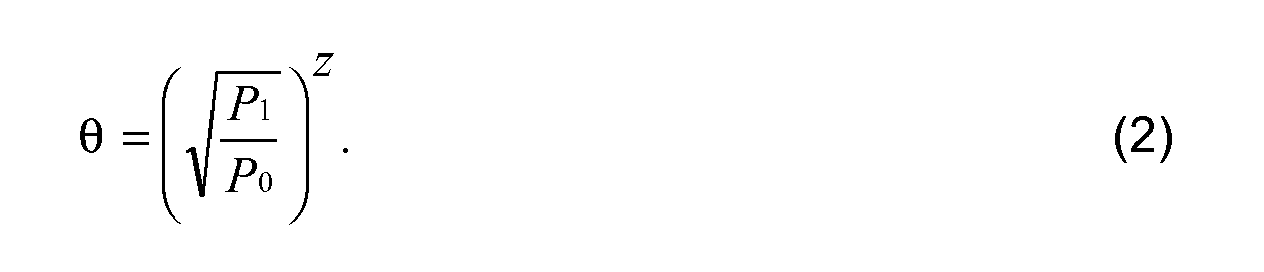
For more details on determination of the quantity θ see the Appendix. - Note that the example given for calculation of the quantity θ uses the power of the digital signal to be injected, not the amplitude. Here, θ is the ratio of the square root of the power of the signal with digital data after passing along the busbar to the square root of the power of the signal with digital data to be injected, which follows from principles of electrodynamics. If we use data on the amplitude of the digital signal, formula (2) similarly assumes the form:

where A0 is the amplitude of the PLT signal at the injection point; - A1 is the amplitude of the PLT signal at the selected distance from the injection point.
- In many cases it is possible to use data for the quantity θ obtained previously.
- Then the coordinate of the location of the first injection point of the digital signal is determined from the formula

where L is the length of the busbar. The coordinate of the location of the second point of injection of the digital signal is calculated using the formula
Here x1 and x2 are the coordinates of the location of the first (x1 ) and second (x2 ) points of injection on the injectable busbar, any of the ends of which is taken as the origin. - When using these formulae, the amplitude of the signal with digital data to be injected is determined as any of the following or any combination of the following: a) amplitude of the digital signal to be injected with fixed carrier wavelength, b) mean amplitude of the spectrum of the digital signal to be injected in the selected range of carrier wavelengths, c) integral amplitude of the digital signal to be injected in the selected range of carrier wavelengths, d) the amplitude is determined in any other way. Similarly the power of the signal with digital data to be injected is determined as any of the following or any combination of the following: a) power of the digital signal to be injected with fixed carrier wavelength, b) mean power of the spectrum of the digital signal to be injected in the selected range of carrier wavelengths, c) integral power of the digital signal to be injected in the selected range of carrier wavelengths, d) the power is determined in any other way.
- Use of the above formulae makes it possible to optimise the location of two injection points on the busbar. The derivation of the formulae is given in the Appendix.
- In concluding this section of the description it must be pointed out that the point of connection of a consumer to the power supply is any of the following or any combination of the following: a) electric power socket, b) plug and socket unit, c) terminal, d) some other connecting device.
- Injection of a digital signal in a 12-storey block of flats, located in Moscow, was carried out by the proposed method. Injection was effected from a high-speed digital line by means of coaxial cable into three phases of the power system. Capacitive couplers were used for injection. The power of the digital signal was measured with a "Propower-5" spectrum analyser made by the Spanish company Promax Electronica, S.A.
- The digital signal was injected: a) at one point of one busbar (at the level of the 6th floor), b) at two points of one busbar of homes located at the level of the 1st and 12th floors of the building. In addition, for comparison with the prior art (Crenshaw R.E., Grimes D.W., Larson P.L. Method and apparatus for attaching power line communications to customer premises. Application
WO 2004/017621 A1 . IPC7 H04M11/04. Prior. 16.08.2002. Publ. 26.02.2004), the digital signal was injected into the distribution board (feed and distribution device). - Selection of the levels for locating the points of injection of the digital signal (1 st and 12th floors) was based on calculations performed using formulae (3) and (4) for determining the coordinates of the optimum location of two points of injection of the digital signal along the busbar. It was taken into account that the length of the busbar in this building is of the order of 38 metres, and the value of θ was taken as close to 0.8, based on previous measurements. For this value of θ the coordinates x1 and x2 , determined from formulae (3) and (4), are of the order of 1 and 37 metres, which corresponds to the 1 st and 12th floors of the chosen building.
- Based on actual measurements, the following data were obtained (
Fig. 1 ). The mean power of the digital signal with two-point injection on the entire length of the busbar was not less than -48 dB/Hz, the typical value of this index was about -40 dB/Hz, and uniform distribution of signal power along the busbar was observed. It was established that the threshold value of the mean signal power, necessary for transmission of digital data, is -50 dB/Hz. Therefore the present method makes it possible to achieve the claimed technical result. - With single-point injection at the level of the 6th floor, the distribution along the busbar was far less uniform: the signal power at the level of injection was quite high, but at the ends of the busbar (below the 3rd and above the 10th floor) it was less than is permissible. This leads to the conclusion that it is impossible to provide, by means of single-point injection, the necessary quality of the digital signal on the lower and upper floors.
- With signal injection at the level of the distribution board, as proposed by the authors of the method of the prototype (prior art), the power of the digital signal is insufficient for reliable data transmission for practically the entire length of the busbar. The random spike of signal power at the level of the 11 th floor should be noted. The location of this spike is unpredictable and may vary over time, which is apparently connected with terminal interference of the PLT signal. Therefore the presence of a random power spike of the digital signal at the level of the 11 th floor does not mean it is possible to use the method of the prior art for reliable transmission of digital data.
- Accordingly, injection of a digital signal by the proposed method gave far higher quality of the PLT signal compared with the prior art, and incomparably larger coverage of the rooms with a signal of sufficient power for fast, reliable transmission of digital data.
- In conclusion, it should be noted that the example given does not exhaust all possibilities of injection of a signal with digital data into an electrical system. A person skilled in the art may find modifications of the present invention, which are still within the scope of the appended claims or equivalent positions. If such modifications are found, the essence of the invention in the application remains unchanged.
- Any of the circumstances (including those qualified as features of the present invention), given in any of the following: 1) in the section of the description "Field of technology", 2) in the section of the description "Prior art", 3) in the section of the description "Essence of the invention", 4) in the section of the description "Information confirming the possibility of carrying out the invention", 5) in the Appendix, 6) in the abstract - can be and if necessary will be included in the claims of the present invention. This last sentence should be regarded as an indication of the need for the features of the invention presented in the aforementioned sections of the description and in the abstract to be included in the claims.
- Acknowledgments. The inventors consider it their pleasant duty to express their sincere gratitude to Roman Vladimirovich Korabelshchikov, head of the PLC laboratory of the "Elektro-Kom" private joint-stock company and to Ivan Nikolaevich Sviridov, director of the network development department of the "Elektro-Kom" private joint-stock company, who provided necessary technical assistance in performing the measurements and verifying the feasibility of the present invention in real conditions.
- The system for injection of a signal with digital data inside a building consists of two components - an electrical busbar and a tapping from it to the rooms (e.g. flats). The decrease in amplitude of the power component of the phase current Vi(t) along the busbar is insignificant. However, the amplitude of a high-frequency PLT signal, to be injected into the phase current, V2(t), is attenuated more perceptibly on passing along the wiring, and this attenuation obeys an exponential law with a rate of attenuation that depends on the carrier frequency, ω n .
- If at the point of connection to the busbar the amplitude of V2(t) is equal to Ac , then at a power socket (or other point of connection), connected to the busbar along a line inside the flat of length l, it will be

In this expression the constant α is the rate of attenuation of the PLT signal within the wiring inside the flat. - Consider a vertical busbar of length L and the associated coordinate system, such that a point with coordinate x is located at a distance x from one of the ends (e.g. the upper end) of the busbar. The constant β corresponds to the rate of attenuation when a PLT signal of the carrier frequency under consideration passes along the busbar. (Clearly any nature of location of the busbar is possible: vertical, horizontal or inclined. In this case one of the ends of the busbar is taken as the origin (coordinate x = 0), from which the coordinates of the location of the points of injection of the digital signal are reckoned.)
- Then if a signal of amplitude A is fed to the busbar via a point with the coordinate x, and the wiring inside the flat - via a point with the coordinate y, then at the electrical socket the high-frequency signal will have amplitude

As the magnitude of the drop in amplitude of the PLT signal during passage along the wiring inside the flat does not depend on how the signal is injected on the busbar (for a specified length l) and does not depend on the manner of connection of the busbar to the digital line, we shall no longer pay special attention to this term. - If the busbar is connected to the digital trunk line via n points with coordinates xk and all the connections have identical amplitude of the PLT signal, equal to A, then at the point with coordinate y the amplitude of the PLT signal will be equal to

Since, at any point of the busbar, the amplitude of the PLT signal must not be greater than a certain maximum value Amax, the problem of selecting the best points of connection xk with specified number n can be formulated thus: it is necessary to find a set of coordinates of the points of connection xk such that the relation
has a maximum value. - In order to make the magnitude of the drop in amplitude more tangible, let us put θ = e -βL
ω H. Here θ is the drop in amplitude of the PLT signal of a specified frequency on passing along the busbar (θ < 1). When determining the technical parameters of a busbar it may be difficult to measure the drop in amplitude of the PLT signal along the entire busbar. Since the amplitude falls exponentially, from the magnitude of the drop on some fraction of the busbar we can find the magnitude of the drop in amplitude of the PLT signal on passing along a section of the busbar of a different length. In particular, if θ z is the magnitude of the drop in amplitude on passing along a section of the busbar of length L/z, then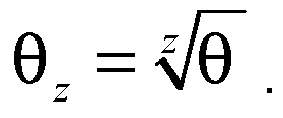
- Since f and g are smooth functions, their extrema can either be at those points where the derivative is equal to zero, or at the boundaries of the region xk ∈ [0,L].
- The problem of optimisation of the relation of the maximum and minimum amplitude of the signal will be solved below. If the relation is optimised with respect to any monotonic function (e.g. with respect to the exponent, with respect to a logarithmic function or any other), the optimum points of injection will be located on the busbar in the same place.
- Since


does not depend on the coordinate x, while for the numerator the maximum of the minimum value of signal power is at x = L/2. For optimum single-point connection the maximum drop in amplitude of a high-frequency signal is equal to e -βLω H /2, or
- Consider

Without restricting generality, we shall assume x1 ≤ x2 (here x2 is the injection point that is located farther from the start of the busbar). - We shall introduce the variable d, such that d > 0. Then

whereas
Therefore the maximum value of the function
is reached at point y ∈ [x1, x2 ], and the maximum of the function
can be found on this section. - Then

and the derivative is equal to zero at
from where
and
- Since at this point the second
derivative 
is positive, the point y = (x1 + x2 )/2 is a local minimum. Therefore the maximum value of function h is reached at the boundary of the domain, or
where, as before, x1 ≤ x2 . We thus find confirmation that, in two-point injection, as in single-point, the maxima of the power of the PLT signal occur at the points of injection. - Consider

In accordance with the results presented above for the magnitude of the derivative of the function
- At y = 0 we have:

at y = L:
and at y = (x1 + x2 )/2:
In this way three local minima of function h were obtained. The overall minimum is one of these. - Let us find the maximum of f = ψ/Ψ. First consider variations of x1 and x2 such that the difference x2 - x1 does not change, i.e. x2 = b + x1 , where b is fixed. In other words, the distance between the points of injection is fixed, but the points themselves are displaced in an arbitrary direction along the busbar. Then

- If case c) is achieved, in which y = (x1 + x 2)/2, then (within these limits) variation of b does not lead to variation of ψ. If not, ψ is equal to the minimum of

and
Since with increase in x1 the first expression decreases, but the second increases, the maximum of their minimum will occur for equality of
which occurs at x1 + b/2 = L/2. Therefore it can be assumed, for any variants, that with optimum selection x2 = L - x1 . Thus, the optimum location of two points of injection presupposes symmetry of their location on the busbar. - Let us now examine the parameterization of x2 = L - x1 , where x1 is a free parameter. Then

and ψ is equal to the minimum of
at points y = 0 and y = (x1 + x2 )/2 (since the cases y = 0 and y = L give an identical value). - In the case y = 0 we find that

and in the case y = (x1 + x2 )/2, we get
If the case y = 0 is achieved, then for f = ψ/Ψ
If the case y = (x1 + x2 )/2 is achieved, then
If we put q = ℓ-βx1 ω H , then for the case y = 0 we have f = q, and for the case y = (x1 + x2 )/2 we have
As can easily be verified, at values of q from 0 to 1 the derivative of the second expression f(q) is negative. Therefore the maximum of the two expressions for f is obtained when they are equal, i.e.
from where
and
or, in terms of the maximum drop in amplitude θ,
- Moreover, since

we have
from where
and
Therefore the optimum connection of the PLT signal should be made at points
and
Then the maximum drop in amplitude of the PLT signal on the busbar will be:
- For an illustration of the advantage of two-point over single-point injection, see
Fig. 2 . -
-
Fig. 1 . Results of actual measurements of the mean power of the digital signal in various methods of injection into one of the busbars of a 12-storey building. -
Fig. 2 . Graph of the maximum drop in amplitude of the PLT signal in single-point and two-point signal injection along the busbar. It can be seen that two-point signal injection, effected according to formulae (3) and (4), is of far higher quality than single-point injection.
Claims (35)
- Method of supplying and removing a signal with digital data in the power-distributing system of a building with implementation of telecommunication technologies of packet switching of digital data over a power-supply system by means of PLT (Power Line Telecommunication) technology, characterised in that supply/removal of the signal with digital data (hereinafter: injection of the digital signal) in the power-distributing system of a building is carried out from a digital trunk line onto a busbar forming part of the power-distributing system of the building, moreover injection of the digital signal is effected at least at two points of said busbar, and the distance between the points of injection of the digital signal is established such that it is at least 2.5 metres.
- Method according to Claim 1, characterised in that the digital trunk line from which injection of the signal with digital data into the electrical mains of the building is carried out, is represented by any of the following or any combination of the following: a) a wire trunk line, b) a fibre-optic trunk line, c) a trunk line using wireless access technology based on electromagnetic waves (e.g. radio waves), d) some other trunk line for high-speed transmission of digital data.
- Method according to Claim 1, characterised in that the signal is injected into any conductor of three-phase mains or any combination of conductors of three-phase mains.
- Method according to any one of Claims 1-3, characterised in that the signal is injected into any of the following or any combination of the following: a) the first phase conductor, b) the second phase conductor, c) the third phase conductor, d) the neutral conductor, e) the earthing conductor.
- Method according to any one of Claims 1-3, characterised in that the signal is injected into any wire-based electrical system.
- Method according to Claim 5, characterised in that the signal is injected into direct-current mains.
- Method according to Claim 5, characterised in that the signal is injected into low-voltage or medium-voltage alternating-current mains.
- Method according to Claim 5, characterised in that the point of connection of a consumer to the power supply is any of the following or any combination of the following: a) an electric power socket, b) a plug and socket unit, c) a terminal, d) some other connecting device.
- Method according to Claim 1, characterised in that the injection points are distributed uniformly along the busbar.
- Method according to Claim 9, characterised in that two injection points are distributed uniformly along the busbar.
- Method according to Claim 9, characterised in that three injection points are distributed uniformly along the busbar.
- Method according to Claim 9, characterised in that four injection points are distributed uniformly along the busbar.
- Method according to Claim 9, characterised in that more than four injection points are distributed uniformly along the busbar.
- Method according to Claim 1, characterised in that the amplitude or the power of the signal with digital data to be injected is monitored along the busbar, and where there is attenuation of the amplitude or power of the signal to a level below that specified, repeat injection of the signal is carried out.
- Method according to Claim 1, characterised in that the quantity θ, the ratio of the amplitude of the signal with digital data after passing along the busbar to the amplitude of the digital signal to be injected, is measured, then the coordinates of the location of the points of injection on the busbar are determined from the following formulae:


where L is the length of the busbar, x1 and x2 are the coordinates of the location of the first (x1 ) and second (x2 ) points of injection on the injectable busbar, any of the ends of which is taken as the origin x. - Method according to Claim 1, characterised in that previously obtained data for the quantity θ (ratio of the amplitude of the signal with digital data after passing along the busbar to the amplitude of the digital signal to be injected) are used, then the coordinates of the location of the points of injection on the busbar are determined from the following formulae:


where L is the length of the busbar, x1 and x2 are the coordinates of the location of the first (x1 ) and second (x2 ) points of injection on the injectable busbar, any of the ends of which is taken as the origin x. - Method according to either of Claims 15 and 16, characterised in that the amplitude of the signal with digital data to be injected is determined as any of the following or any combination of the following: a) amplitude of the digital signal to be injected with a fixed carrier wavelength, b) spectrum mean amplitude of the digital signal to be injected in the selected range of carrier wavelengths, c) integral amplitude of the digital signal to be injected in the selected range of carrier wavelengths, d) in any other way.
- Method according to either of Claims 15 and 16, characterised in that θ is the ratio of the square root of the power of the signal with digital data after passing along the busbar to the square root of the power of the signal with digital data to be injected.
- Method according to Claim 18, characterised in that the power of the signal with digital data to be injected is determined as any of the following or any combination of the following: a) power of the digital signal to be injected with fixed carrier wavelength, b) spectrum mean power of the digital signal to be injected in the selected range of carrier wavelengths, c) integral power of the digital signal to be injected in the selected range of carrier wavelengths, d) in any other way.
- Method according to any one of Claims 1-3, 6-16, and 19, characterised in that the location of the points of injection is if necessary defined more precisely, by displacing one or both of them in an arbitrary direction by an arbitrary distance along the busbar, achieving the necessary signal power at the points of connection of the consumer to the power supply.
- Method according to Claim 17, characterised in that the location of the points of injection is if necessary defined more precisely, by displacing one or both of them in an arbitrary direction by an arbitrary distance along the busbar, achieving the necessary signal power at the points of connection of the consumer to the power supply.
- Method according to Claim 18, characterised in that the location of the points of injection is if necessary defined more precisely, by displacing one or both of them in an arbitrary direction by an arbitrary distance along the busbar, achieving the necessary signal power at the points of connection of the consumer to the power supply.
- Method according to any one of Claims 1-3, 6-16, 19, 21, and 22, characterised in that when determining the location of the points of injection on the busbar, the carrier wavelengths are taken into account, in order to ensure minimum attenuation of the digital signal to be injected based on its wave properties.
- Method according to Claim 23, characterised in that the distance between the points of injection on the busbar is selected as a multiple of the carrier wavelength.
- Method according to Claim 20, characterised in that when determining the location of the points of injection on the busbar, the carrier wavelengths are taken into account, in order to ensure minimum attenuation of the digital signal to be injected based on its wave properties.
- Method according to Claim 25, characterised in that the distance between the points of injection on the busbar is selected as a multiple of the carrier wavelength.
- Method according to any one of Claims 1-3, 6-16, 19, 21, and 22, characterised in that when determining the location of the points of injection on the busbar, the carrier wavelengths are taken into account, in order to ensure amplification of the digital signal to be injected based on its wave properties.
- Method according to Claim 27, characterised in that the distance between the points of injection on the busbar is selected as a multiple of the carrier wavelength.
- Method according to Claim 20, characterised in that when determining the location of the points of injection on the busbar, the carrier wavelengths are taken into account, in order to ensure amplification of the digital signal to be injected based on its wave properties.
- Method according to Claim 29, characterised in that the distance between the points of injection on the busbar is selected as a multiple of the carrier wavelength.
- Method according to any one of Claims 24, 26, 28, and 30, characterised in that the distance between the points of injection on the busbar is selected as a multiple of the minimum carrier wavelength.
- Method according to any one of Claims 24, 26, 28, and 30, characterised in that the distance between the points of injection on the busbar is selected as a multiple of the mean carrier wavelength.
- Method according to any one of Claims 24, 26, 28, and 30, characterised in that the distance between the points of injection on the busbar is selected as a multiple of the maximum carrier wavelength.
- Method according to any one of Claims 24, 26, 28, and 30, characterised in that the distance between the points of injection on the busbar is selected as a multiple of the characteristic carrier wavelength.
- Method according to any one of Claims 24, 26, 28, and 30, characterised in that the distance between the points of injection on the busbar is selected as a multiple of any other carrier wavelength.
Applications Claiming Priority (2)
| Application Number | Priority Date | Filing Date | Title |
|---|---|---|---|
| RU2007115554/09A RU2337481C2 (en) | 2007-04-25 | 2007-04-25 | Method for digital data signal delivery and reading to electric junction network in building |
| PCT/RU2008/000249 WO2008133548A2 (en) | 2007-04-25 | 2008-04-22 | Method for sending and taking off a signal with digital data in the power distribution network of a building |
Publications (2)
| Publication Number | Publication Date |
|---|---|
| EP2146440A2 true EP2146440A2 (en) | 2010-01-20 |
| EP2146440A4 EP2146440A4 (en) | 2014-07-16 |
Family
ID=38955609
Family Applications (1)
| Application Number | Title | Priority Date | Filing Date |
|---|---|---|---|
| EP08767021.2A Withdrawn EP2146440A4 (en) | 2007-04-25 | 2008-04-22 | METHOD FOR PROVIDING AND READING A SIGNAL WITH DIGITAL DATA IN THE ELECTRICITY DISTRIBUTION NETWORK OF A BUILDING |
Country Status (5)
| Country | Link |
|---|---|
| EP (1) | EP2146440A4 (en) |
| EA (1) | EA013105B1 (en) |
| RU (1) | RU2337481C2 (en) |
| UA (1) | UA92285C2 (en) |
| WO (1) | WO2008133548A2 (en) |
Family Cites Families (8)
| Publication number | Priority date | Publication date | Assignee | Title |
|---|---|---|---|---|
| GB9324152D0 (en) * | 1993-11-24 | 1994-01-12 | Remote Metering Systems Ltd | Mains communication system |
| GB9616142D0 (en) * | 1996-08-01 | 1996-09-11 | Northern Telecom Ltd | Distribution network |
| DE19728500C1 (en) | 1997-07-03 | 1999-02-11 | Energieversorgung Ostbayern Ag | Data transmission system for the transmission of data via at least one electrical power cable |
| GB2336746A (en) * | 1998-03-17 | 1999-10-27 | Northern Telecom Ltd | Transmitting communications signals over a power line network |
| BR0110299A (en) | 2000-04-14 | 2005-08-02 | Current Tech Llc | Digital communications using medium voltage power distribution lines |
| US6396392B1 (en) * | 2000-05-23 | 2002-05-28 | Wire21, Inc. | High frequency network communications over various lines |
| US6975212B2 (en) * | 2001-10-02 | 2005-12-13 | Telkonet Communications, Inc. | Method and apparatus for attaching power line communications to customer premises |
| JP2006352664A (en) * | 2005-06-17 | 2006-12-28 | Mitsubishi Electric Corp | Signal coupling device |
-
2007
- 2007-04-25 RU RU2007115554/09A patent/RU2337481C2/en not_active IP Right Cessation
-
2008
- 2008-04-22 UA UAA200910695A patent/UA92285C2/en unknown
- 2008-04-22 WO PCT/RU2008/000249 patent/WO2008133548A2/en not_active Ceased
- 2008-04-22 EP EP08767021.2A patent/EP2146440A4/en not_active Withdrawn
- 2008-04-22 EA EA200900698A patent/EA013105B1/en not_active IP Right Cessation
Also Published As
| Publication number | Publication date |
|---|---|
| EA013105B1 (en) | 2010-02-26 |
| WO2008133548A3 (en) | 2008-12-11 |
| WO2008133548A2 (en) | 2008-11-06 |
| RU2007115554A (en) | 2007-10-27 |
| EA200900698A1 (en) | 2009-10-30 |
| UA92285C2 (en) | 2010-10-11 |
| WO2008133548A8 (en) | 2009-04-09 |
| EP2146440A4 (en) | 2014-07-16 |
| RU2337481C2 (en) | 2008-10-27 |
Similar Documents
| Publication | Publication Date | Title |
|---|---|---|
| Artale et al. | A new PLC-based smart metering architecture for medium/low voltage grids: Feasibility and experimental characterization | |
| Papadopoulos et al. | Narrowband power line communication: Medium voltage cable modeling and laboratory experimental results | |
| Mannan et al. | A study on power line communication | |
| Alam et al. | Modeling of power line for home-building automation | |
| Anatory et al. | Broadband power-line communications: The channel capacity analysis | |
| Antoniou et al. | Transition from alternating current to direct current low voltage distribution networks | |
| Masood et al. | Channel modeling of NB-PLC for Smart Grid | |
| Kikkert | MV to LV transformer PLC bypass coupling networks for a low cost Smart Grid rollout | |
| Masood et al. | Measurements and channel modeling of low and medium voltage NB‐PLC networks for smart metering | |
| Lazaropoulos | Broadband Transmission and Statistical Performance Properties of Overhead High‐Voltage Transmission Networks | |
| Kaloudas et al. | Methodology for the selection of long‐medium‐voltage power cable configurations | |
| Torquato et al. | Propagation characteristics of high-frequency harmonics in distribution systems | |
| Musa et al. | Computation of transient electromagnetic fields due to switching in high-voltage substations | |
| Ercan et al. | Power line communication channel for smart grid | |
| Campello et al. | Hosting capacity of a university electrical grid considering the inclusion of wind-turbines for different background distortions | |
| EP2146440A2 (en) | Method for sending and taking off a signal with digital data in the power distribution network of a building | |
| Liun | Stochastic methodology to estimate costs of HVDC transmission system | |
| Nkom et al. | Single wire earth return distribution grids: A Panacea for rapid rural power penetration in Africa via regulatory policy transfer | |
| Unsal et al. | Medium voltage and low voltage applications of new power line communication model for smart grids | |
| Pinomaa et al. | Power line communication network for a customer-end AC grid in an LVDC distribution system | |
| AlFuhaid et al. | Application of nonuniform-line theory to the simulation of electromagnetic transients in power systems | |
| Pisapan et al. | Review of the lightning electromagnetic impulse protection measure for smart home and building in smart grid system in Thailand | |
| Mehfuz et al. | Modeling of indoor power line for substation monitoring using broadband power line communications | |
| Garma et al. | Measurement and modeling of the propagation of the Ripple Control Signal through the distribution network | |
| Theethayi et al. | On reducing the lightning transients in buried shielded cables using follow-on earth wire |
Legal Events
| Date | Code | Title | Description |
|---|---|---|---|
| PUAI | Public reference made under article 153(3) epc to a published international application that has entered the european phase |
Free format text: ORIGINAL CODE: 0009012 |
|
| 17P | Request for examination filed |
Effective date: 20091123 |
|
| AK | Designated contracting states |
Kind code of ref document: A2 Designated state(s): AT BE BG CH CY CZ DE DK EE ES FI FR GB GR HR HU IE IS IT LI LT LU LV MC MT NL NO PL PT RO SE SI SK TR |
|
| AX | Request for extension of the european patent |
Extension state: AL BA MK RS |
|
| RAP1 | Party data changed (applicant data changed or rights of an application transferred) |
Owner name: PLT ELECTRO-COM LIMITED Owner name: AYZMAN, MIKHAIL IOSIFOVICH Owner name: ZAO "ELECTRO-KOM" |
|
| RAP1 | Party data changed (applicant data changed or rights of an application transferred) |
Owner name: PLT ELECTRO-COM LIMITED Owner name: AYZMAN, MIKHAIL IOSIFOVICH Owner name: ZAO "ELECTRO-KOM" |
|
| RAP1 | Party data changed (applicant data changed or rights of an application transferred) |
Owner name: PLT ELECTRO-COM LIMITED Owner name: AYZMAN, MIKHAIL IOSIFOVICH Owner name: ZAO "ELECTRO-COM" |
|
| RAP1 | Party data changed (applicant data changed or rights of an application transferred) |
Owner name: ZAO "ELECTRO-COM" Owner name: AYZMAN, MIKHAIL IOSIFOVICH Owner name: PLT ELECTRO-COM LIMITED |
|
| A4 | Supplementary search report drawn up and despatched |
Effective date: 20140618 |
|
| RIC1 | Information provided on ipc code assigned before grant |
Ipc: H04B 3/54 20060101AFI20140612BHEP Ipc: H02J 13/00 20060101ALI20140612BHEP |
|
| STAA | Information on the status of an ep patent application or granted ep patent |
Free format text: STATUS: THE APPLICATION IS DEEMED TO BE WITHDRAWN |
|
| 18D | Application deemed to be withdrawn |
Effective date: 20150115 |