EP2145891A1 - 9-substituted-5-carboxy-oxadiazino-quinolone derivatives, their preparation and their application as anti-bacterials - Google Patents
9-substituted-5-carboxy-oxadiazino-quinolone derivatives, their preparation and their application as anti-bacterials Download PDFInfo
- Publication number
- EP2145891A1 EP2145891A1 EP08290678A EP08290678A EP2145891A1 EP 2145891 A1 EP2145891 A1 EP 2145891A1 EP 08290678 A EP08290678 A EP 08290678A EP 08290678 A EP08290678 A EP 08290678A EP 2145891 A1 EP2145891 A1 EP 2145891A1
- Authority
- EP
- European Patent Office
- Prior art keywords
- linear
- methyl
- formula
- dihydro
- mmol
- Prior art date
- Legal status (The legal status is an assumption and is not a legal conclusion. Google has not performed a legal analysis and makes no representation as to the accuracy of the status listed.)
- Withdrawn
Links
- 238000002360 preparation method Methods 0.000 title claims abstract description 19
- 230000000844 anti-bacterial effect Effects 0.000 title abstract description 6
- 229940088710 antibiotic agent Drugs 0.000 title abstract description 3
- 150000001875 compounds Chemical class 0.000 claims abstract description 88
- 239000000203 mixture Substances 0.000 claims abstract description 29
- 150000003839 salts Chemical class 0.000 claims abstract description 23
- 239000003814 drug Substances 0.000 claims abstract description 17
- HBAQYPYDRFILMT-UHFFFAOYSA-N 8-[3-(1-cyclopropylpyrazol-4-yl)-1H-pyrazolo[4,3-d]pyrimidin-5-yl]-3-methyl-3,8-diazabicyclo[3.2.1]octan-2-one Chemical class C1(CC1)N1N=CC(=C1)C1=NNC2=C1N=C(N=C2)N1C2C(N(CC1CC2)C)=O HBAQYPYDRFILMT-UHFFFAOYSA-N 0.000 claims abstract description 16
- 239000002253 acid Substances 0.000 claims abstract description 14
- 150000007513 acids Chemical class 0.000 claims abstract description 10
- 125000000217 alkyl group Chemical group 0.000 claims description 52
- 238000000034 method Methods 0.000 claims description 50
- 229910052739 hydrogen Inorganic materials 0.000 claims description 38
- 239000001257 hydrogen Substances 0.000 claims description 38
- -1 (C3-C6) cyclic alkyl Chemical group 0.000 claims description 24
- 229910052736 halogen Inorganic materials 0.000 claims description 16
- 150000002367 halogens Chemical class 0.000 claims description 16
- 125000004435 hydrogen atom Chemical group [H]* 0.000 claims description 16
- 125000003710 aryl alkyl group Chemical group 0.000 claims description 14
- 125000005842 heteroatom Chemical group 0.000 claims description 14
- 229910052500 inorganic mineral Inorganic materials 0.000 claims description 14
- 239000011707 mineral Substances 0.000 claims description 14
- 229910052760 oxygen Inorganic materials 0.000 claims description 14
- 229910052717 sulfur Inorganic materials 0.000 claims description 14
- 125000000623 heterocyclic group Chemical group 0.000 claims description 13
- 150000002431 hydrogen Chemical group 0.000 claims description 13
- LFQSCWFLJHTTHZ-UHFFFAOYSA-N Ethanol Chemical compound CCO LFQSCWFLJHTTHZ-UHFFFAOYSA-N 0.000 claims description 10
- UFHFLCQGNIYNRP-UHFFFAOYSA-N Hydrogen Chemical compound [H][H] UFHFLCQGNIYNRP-UHFFFAOYSA-N 0.000 claims description 9
- 125000003545 alkoxy group Chemical group 0.000 claims description 9
- 125000003178 carboxy group Chemical group [H]OC(*)=O 0.000 claims description 9
- 238000004177 carbon cycle Methods 0.000 claims description 8
- 125000000041 C6-C10 aryl group Chemical group 0.000 claims description 7
- 150000007524 organic acids Chemical class 0.000 claims description 7
- 235000005985 organic acids Nutrition 0.000 claims description 7
- 150000007530 organic bases Chemical class 0.000 claims description 7
- 125000001997 phenyl group Chemical group [H]C1=C([H])C([H])=C(*)C([H])=C1[H] 0.000 claims description 7
- JDMYDLIKFXBEAL-UHFFFAOYSA-N 7-fluoro-2-methyl-6-[4-(1-methylpyrrole-2-carbonyl)piperazin-1-yl]-10-oxo-4-oxa-1,2-diazatricyclo[7.3.1.05,13]trideca-5(13),6,8,11-tetraene-11-carboxylic acid Chemical compound FC1=CC(C(C(C(O)=O)=C2)=O)=C3N2N(C)COC3=C1N(CC1)CCN1C(=O)C1=CC=CN1C JDMYDLIKFXBEAL-UHFFFAOYSA-N 0.000 claims description 6
- 239000011737 fluorine Chemical group 0.000 claims description 6
- 229910052731 fluorine Inorganic materials 0.000 claims description 6
- 150000007522 mineralic acids Chemical class 0.000 claims description 6
- 125000006239 protecting group Chemical group 0.000 claims description 6
- NFBGVRFMOOQTKQ-UHFFFAOYSA-N 6-(1,3,4,6,7,8,9,9a-octahydropyrido[1,2-a]pyrazin-2-yl)-7-fluoro-2-methyl-10-oxo-4-oxa-1,2-diazatricyclo[7.3.1.05,13]trideca-5(13),6,8,11-tetraene-11-carboxylic acid Chemical compound FC1=CC(C(C(C(O)=O)=CN2N(C)CO3)=O)=C2C3=C1N1CC2CCCCN2CC1 NFBGVRFMOOQTKQ-UHFFFAOYSA-N 0.000 claims description 5
- VDVQYSFBTFSPJD-UHFFFAOYSA-N 6-(3,4,6,7,8,8a-hexahydro-1H-pyrrolo[1,2-a]pyrazin-2-yl)-7-fluoro-2-methyl-10-oxo-4-oxa-1,2-diazatricyclo[7.3.1.05,13]trideca-5(13),6,8,11-tetraene-11-carboxylic acid Chemical compound FC1=CC(C(C(C(O)=O)=CN2N(C)CO3)=O)=C2C3=C1N1CC2CCCN2CC1 VDVQYSFBTFSPJD-UHFFFAOYSA-N 0.000 claims description 5
- DMQILLAYOLLSNC-UHFFFAOYSA-N 6-[4-(2,3-dihydro-1,3-thiazole-4-carbonyl)piperazin-1-yl]-7-fluoro-2-methyl-10-oxo-4-oxa-1,2-diazatricyclo[7.3.1.05,13]trideca-5(13),6,8,11-tetraene-11-carboxylic acid Chemical compound FC1=CC(C(C(C(O)=O)=C2)=O)=C3N2N(C)COC3=C1N(CC1)CCN1C(=O)C1=CSCN1 DMQILLAYOLLSNC-UHFFFAOYSA-N 0.000 claims description 5
- MPAGVCPMBPTFEK-UHFFFAOYSA-N 7-fluoro-2-methyl-10-oxo-6-[4-(thiophene-2-carbonyl)piperazin-1-yl]-4-oxa-1,2-diazatricyclo[7.3.1.05,13]trideca-5(13),6,8,11-tetraene-11-carboxylic acid Chemical compound FC1=CC(C(C(C(O)=O)=C2)=O)=C3N2N(C)COC3=C1N(CC1)CCN1C(=O)C1=CC=CS1 MPAGVCPMBPTFEK-UHFFFAOYSA-N 0.000 claims description 5
- CCRUOTNNOOXDHW-UHFFFAOYSA-N 7-fluoro-2-methyl-6-[4-(4-methyl-1,3-thiazole-5-carbonyl)piperazin-1-yl]-10-oxo-4-oxa-1,2-diazatricyclo[7.3.1.05,13]trideca-5(13),6,8,11-tetraene-11-carboxylic acid Chemical compound FC1=CC(C(C(C(O)=O)=C2)=O)=C3N2N(C)COC3=C1N(CC1)CCN1C(=O)C=1SC=NC=1C CCRUOTNNOOXDHW-UHFFFAOYSA-N 0.000 claims description 5
- XIQCFEJDUUMMMN-UHFFFAOYSA-N 7-fluoro-6-[4-(furan-2-carbonyl)piperazin-1-yl]-2-methyl-10-oxo-4-oxa-1,2-diazatricyclo[7.3.1.05,13]trideca-5(13),6,8,11-tetraene-11-carboxylic acid Chemical compound FC1=CC(C(C(C(O)=O)=C2)=O)=C3N2N(C)COC3=C1N(CC1)CCN1C(=O)C1=CC=CO1 XIQCFEJDUUMMMN-UHFFFAOYSA-N 0.000 claims description 5
- UVINURLLSJUJIT-UHFFFAOYSA-N 8-fluoro-9-{4-[1-(3-methoxy-benzyl)-6-oxo-1,6-dihydro-pyridazin-3-yl]-piperazin-1-yl}-3-methyl-6-oxo-2,3-dihydro-6h-1-oxa-3,3a-diaza-phenalene-5-carboxylic acid Chemical compound COC1=CC=CC(CN2C(C=CC(=N2)N2CCN(CC2)C=2C3=C4C(C(C(C(O)=O)=CN4N(C)CO3)=O)=CC=2F)=O)=C1 UVINURLLSJUJIT-UHFFFAOYSA-N 0.000 claims description 5
- 125000002496 methyl group Chemical group [H]C([H])([H])* 0.000 claims description 5
- PXGOKWXKJXAPGV-UHFFFAOYSA-N Fluorine Chemical group FF PXGOKWXKJXAPGV-UHFFFAOYSA-N 0.000 claims description 4
- 229910052799 carbon Inorganic materials 0.000 claims description 4
- OKTJSMMVPCPJKN-UHFFFAOYSA-N Carbon Chemical group [C] OKTJSMMVPCPJKN-UHFFFAOYSA-N 0.000 claims description 3
- JCXJVPUVTGWSNB-UHFFFAOYSA-N Nitrogen dioxide Chemical group O=[N]=O JCXJVPUVTGWSNB-UHFFFAOYSA-N 0.000 claims description 3
- 239000004480 active ingredient Substances 0.000 claims description 3
- 239000008194 pharmaceutical composition Substances 0.000 claims description 3
- 125000003003 spiro group Chemical group 0.000 claims description 3
- RWRDLPDLKQPQOW-UHFFFAOYSA-N Pyrrolidine Chemical group C1CCNC1 RWRDLPDLKQPQOW-UHFFFAOYSA-N 0.000 claims description 2
- 125000004453 alkoxycarbonyl group Chemical group 0.000 claims description 2
- 150000001721 carbon Chemical group 0.000 claims description 2
- 125000002915 carbonyl group Chemical group [*:2]C([*:1])=O 0.000 claims description 2
- 125000001153 fluoro group Chemical group F* 0.000 claims description 2
- OKKJLVBELUTLKV-UHFFFAOYSA-N Methanol Chemical compound OC OKKJLVBELUTLKV-UHFFFAOYSA-N 0.000 description 139
- YMWUJEATGCHHMB-UHFFFAOYSA-N Dichloromethane Chemical compound ClCCl YMWUJEATGCHHMB-UHFFFAOYSA-N 0.000 description 70
- SJRJJKPEHAURKC-UHFFFAOYSA-N N-Methylmorpholine Chemical compound CN1CCOCC1 SJRJJKPEHAURKC-UHFFFAOYSA-N 0.000 description 58
- 229910001868 water Inorganic materials 0.000 description 53
- XLYOFNOQVPJJNP-UHFFFAOYSA-N water Chemical compound O XLYOFNOQVPJJNP-UHFFFAOYSA-N 0.000 description 52
- VYPSYNLAJGMNEJ-UHFFFAOYSA-N Silicium dioxide Chemical compound O=[Si]=O VYPSYNLAJGMNEJ-UHFFFAOYSA-N 0.000 description 44
- BDAGIHXWWSANSR-UHFFFAOYSA-N Formic acid Chemical compound OC=O BDAGIHXWWSANSR-UHFFFAOYSA-N 0.000 description 43
- 235000019253 formic acid Nutrition 0.000 description 43
- 238000003818 flash chromatography Methods 0.000 description 37
- 239000000741 silica gel Substances 0.000 description 37
- 229910002027 silica gel Inorganic materials 0.000 description 37
- 239000007787 solid Substances 0.000 description 36
- JUJWROOIHBZHMG-UHFFFAOYSA-N Pyridine Chemical compound C1=CC=NC=C1 JUJWROOIHBZHMG-UHFFFAOYSA-N 0.000 description 34
- KDLHZDBZIXYQEI-UHFFFAOYSA-N Palladium Chemical compound [Pd] KDLHZDBZIXYQEI-UHFFFAOYSA-N 0.000 description 28
- 238000004128 high performance liquid chromatography Methods 0.000 description 24
- 239000012043 crude product Substances 0.000 description 22
- ZMANZCXQSJIPKH-UHFFFAOYSA-N Triethylamine Chemical compound CCN(CC)CC ZMANZCXQSJIPKH-UHFFFAOYSA-N 0.000 description 18
- UMJSCPRVCHMLSP-UHFFFAOYSA-N pyridine Natural products COC1=CC=CN=C1 UMJSCPRVCHMLSP-UHFFFAOYSA-N 0.000 description 17
- 239000011541 reaction mixture Substances 0.000 description 17
- SECXISVLQFMRJM-UHFFFAOYSA-N N-Methylpyrrolidone Chemical compound CN1CCCC1=O SECXISVLQFMRJM-UHFFFAOYSA-N 0.000 description 16
- 238000006243 chemical reaction Methods 0.000 description 16
- QGZKDVFQNNGYKY-UHFFFAOYSA-N Ammonia Chemical compound N QGZKDVFQNNGYKY-UHFFFAOYSA-N 0.000 description 15
- ZMXDDKWLCZADIW-UHFFFAOYSA-N N,N-Dimethylformamide Chemical compound CN(C)C=O ZMXDDKWLCZADIW-UHFFFAOYSA-N 0.000 description 14
- 229910000069 nitrogen hydride Inorganic materials 0.000 description 14
- BWHMMNNQKKPAPP-UHFFFAOYSA-L potassium carbonate Chemical compound [K+].[K+].[O-]C([O-])=O BWHMMNNQKKPAPP-UHFFFAOYSA-L 0.000 description 14
- 239000000243 solution Substances 0.000 description 14
- LMDZBCPBFSXMTL-UHFFFAOYSA-N 1-Ethyl-3-(3-dimethylaminopropyl)carbodiimide Substances CCN=C=NCCCN(C)C LMDZBCPBFSXMTL-UHFFFAOYSA-N 0.000 description 13
- YXFVVABEGXRONW-UHFFFAOYSA-N Toluene Chemical compound CC1=CC=CC=C1 YXFVVABEGXRONW-UHFFFAOYSA-N 0.000 description 12
- WGLUMOCWFMKWIL-UHFFFAOYSA-N dichloromethane;methanol Chemical compound OC.ClCCl WGLUMOCWFMKWIL-UHFFFAOYSA-N 0.000 description 12
- 235000010755 mineral Nutrition 0.000 description 12
- NOTFZGFABLVTIG-UHFFFAOYSA-N Cyclohexylethyl acetate Chemical compound CC(=O)OCCC1CCCCC1 NOTFZGFABLVTIG-UHFFFAOYSA-N 0.000 description 11
- LJIOTBMDLVHTBO-CUYJMHBOSA-N (2s)-2-amino-n-[(1r,2r)-1-cyano-2-[4-[4-(4-methylpiperazin-1-yl)sulfonylphenyl]phenyl]cyclopropyl]butanamide Chemical compound CC[C@H](N)C(=O)N[C@]1(C#N)C[C@@H]1C1=CC=C(C=2C=CC(=CC=2)S(=O)(=O)N2CCN(C)CC2)C=C1 LJIOTBMDLVHTBO-CUYJMHBOSA-N 0.000 description 10
- NPZTUJOABDZTLV-UHFFFAOYSA-N hydroxybenzotriazole Substances O=C1C=CC=C2NNN=C12 NPZTUJOABDZTLV-UHFFFAOYSA-N 0.000 description 10
- 0 **C(C(c(cc1*)c23)=O)=CN2N(*)C(*)(*)Oc3c1F Chemical compound **C(C(c(cc1*)c23)=O)=CN2N(*)C(*)(*)Oc3c1F 0.000 description 9
- 241000894006 Bacteria Species 0.000 description 8
- CSNNHWWHGAXBCP-UHFFFAOYSA-L Magnesium sulfate Chemical compound [Mg+2].[O-][S+2]([O-])([O-])[O-] CSNNHWWHGAXBCP-UHFFFAOYSA-L 0.000 description 8
- 150000003254 radicals Chemical class 0.000 description 8
- AOSZTAHDEDLTLQ-AZKQZHLXSA-N (1S,2S,4R,8S,9S,11S,12R,13S,19S)-6-[(3-chlorophenyl)methyl]-12,19-difluoro-11-hydroxy-8-(2-hydroxyacetyl)-9,13-dimethyl-6-azapentacyclo[10.8.0.02,9.04,8.013,18]icosa-14,17-dien-16-one Chemical compound C([C@@H]1C[C@H]2[C@H]3[C@]([C@]4(C=CC(=O)C=C4[C@@H](F)C3)C)(F)[C@@H](O)C[C@@]2([C@@]1(C1)C(=O)CO)C)N1CC1=CC=CC(Cl)=C1 AOSZTAHDEDLTLQ-AZKQZHLXSA-N 0.000 description 7
- FPQQSJJWHUJYPU-UHFFFAOYSA-N 3-(dimethylamino)propyliminomethylidene-ethylazanium;chloride Chemical compound Cl.CCN=C=NCCCN(C)C FPQQSJJWHUJYPU-UHFFFAOYSA-N 0.000 description 7
- NLXLAEXVIDQMFP-UHFFFAOYSA-N Ammonia chloride Chemical compound [NH4+].[Cl-] NLXLAEXVIDQMFP-UHFFFAOYSA-N 0.000 description 7
- 229940126657 Compound 17 Drugs 0.000 description 7
- 229910000027 potassium carbonate Inorganic materials 0.000 description 7
- 239000002244 precipitate Substances 0.000 description 7
- SIOVKLKJSOKLIF-HJWRWDBZSA-N trimethylsilyl (1z)-n-trimethylsilylethanimidate Chemical compound C[Si](C)(C)OC(/C)=N\[Si](C)(C)C SIOVKLKJSOKLIF-HJWRWDBZSA-N 0.000 description 7
- VHYFNPMBLIVWCW-UHFFFAOYSA-N 4-Dimethylaminopyridine Chemical compound CN(C)C1=CC=NC=C1 VHYFNPMBLIVWCW-UHFFFAOYSA-N 0.000 description 6
- WCCBYUQATCGADR-UHFFFAOYSA-N 6-[4-(4-amino-2-fluorophenyl)piperazin-1-yl]-7-fluoro-2-methyl-10-oxo-4-oxa-1,2-diazatricyclo[7.3.1.05,13]trideca-5(13),6,8,11-tetraene-11-carboxylic acid Chemical compound FC1=CC(C(C(C(O)=O)=C2)=O)=C3N2N(C)COC3=C1N(CC1)CCN1C1=CC=C(N)C=C1F WCCBYUQATCGADR-UHFFFAOYSA-N 0.000 description 6
- CDBYLPFSWZWCQE-UHFFFAOYSA-L Sodium Carbonate Chemical compound [Na+].[Na+].[O-]C([O-])=O CDBYLPFSWZWCQE-UHFFFAOYSA-L 0.000 description 6
- UIIMBOGNXHQVGW-UHFFFAOYSA-M Sodium bicarbonate Chemical compound [Na+].OC([O-])=O UIIMBOGNXHQVGW-UHFFFAOYSA-M 0.000 description 6
- 239000012047 saturated solution Substances 0.000 description 6
- QAEDZJGFFMLHHQ-UHFFFAOYSA-N trifluoroacetic anhydride Chemical compound FC(F)(F)C(=O)OC(=O)C(F)(F)F QAEDZJGFFMLHHQ-UHFFFAOYSA-N 0.000 description 6
- GQHTUMJGOHRCHB-UHFFFAOYSA-N 2,3,4,6,7,8,9,10-octahydropyrimido[1,2-a]azepine Chemical compound C1CCCCN2CCCN=C21 GQHTUMJGOHRCHB-UHFFFAOYSA-N 0.000 description 5
- XEKOWRVHYACXOJ-UHFFFAOYSA-N Ethyl acetate Chemical compound CCOC(C)=O XEKOWRVHYACXOJ-UHFFFAOYSA-N 0.000 description 5
- WYURNTSHIVDZCO-UHFFFAOYSA-N Tetrahydrofuran Chemical compound C1CCOC1 WYURNTSHIVDZCO-UHFFFAOYSA-N 0.000 description 5
- 238000005859 coupling reaction Methods 0.000 description 5
- 238000007429 general method Methods 0.000 description 5
- 239000000047 product Substances 0.000 description 5
- 239000002904 solvent Substances 0.000 description 5
- RTZKZFJDLAIYFH-UHFFFAOYSA-N Diethyl ether Chemical compound CCOCC RTZKZFJDLAIYFH-UHFFFAOYSA-N 0.000 description 4
- VEXZGXHMUGYJMC-UHFFFAOYSA-N Hydrochloric acid Chemical compound Cl VEXZGXHMUGYJMC-UHFFFAOYSA-N 0.000 description 4
- GLUUGHFHXGJENI-UHFFFAOYSA-N Piperazine Chemical compound C1CNCCN1 GLUUGHFHXGJENI-UHFFFAOYSA-N 0.000 description 4
- NQRYJNQNLNOLGT-UHFFFAOYSA-N Piperidine Chemical compound C1CCNCC1 NQRYJNQNLNOLGT-UHFFFAOYSA-N 0.000 description 4
- 239000012230 colorless oil Substances 0.000 description 4
- 238000005984 hydrogenation reaction Methods 0.000 description 4
- 229910052943 magnesium sulfate Inorganic materials 0.000 description 4
- 239000012074 organic phase Substances 0.000 description 4
- 238000000746 purification Methods 0.000 description 4
- 238000001228 spectrum Methods 0.000 description 4
- 229960000549 4-dimethylaminophenol Drugs 0.000 description 3
- CSCPPACGZOOCGX-UHFFFAOYSA-N Acetone Chemical compound CC(C)=O CSCPPACGZOOCGX-UHFFFAOYSA-N 0.000 description 3
- WEVYAHXRMPXWCK-UHFFFAOYSA-N Acetonitrile Chemical compound CC#N WEVYAHXRMPXWCK-UHFFFAOYSA-N 0.000 description 3
- 241001465754 Metazoa Species 0.000 description 3
- 235000019270 ammonium chloride Nutrition 0.000 description 3
- 239000007864 aqueous solution Substances 0.000 description 3
- 125000001797 benzyl group Chemical group [H]C1=C([H])C([H])=C(C([H])=C1[H])C([H])([H])* 0.000 description 3
- 230000008878 coupling Effects 0.000 description 3
- 238000010168 coupling process Methods 0.000 description 3
- 239000000284 extract Substances 0.000 description 3
- RAXXELZNTBOGNW-UHFFFAOYSA-N imidazole Natural products C1=CNC=N1 RAXXELZNTBOGNW-UHFFFAOYSA-N 0.000 description 3
- 238000010992 reflux Methods 0.000 description 3
- 229910000030 sodium bicarbonate Inorganic materials 0.000 description 3
- 229910000029 sodium carbonate Inorganic materials 0.000 description 3
- 125000004169 (C1-C6) alkyl group Chemical group 0.000 description 2
- RYHBNJHYFVUHQT-UHFFFAOYSA-N 1,4-Dioxane Chemical compound C1COCCO1 RYHBNJHYFVUHQT-UHFFFAOYSA-N 0.000 description 2
- HZAXFHJVJLSVMW-UHFFFAOYSA-N 2-Aminoethan-1-ol Chemical compound NCCO HZAXFHJVJLSVMW-UHFFFAOYSA-N 0.000 description 2
- QCQCHGYLTSGIGX-GHXANHINSA-N 4-[[(3ar,5ar,5br,7ar,9s,11ar,11br,13as)-5a,5b,8,8,11a-pentamethyl-3a-[(5-methylpyridine-3-carbonyl)amino]-2-oxo-1-propan-2-yl-4,5,6,7,7a,9,10,11,11b,12,13,13a-dodecahydro-3h-cyclopenta[a]chrysen-9-yl]oxy]-2,2-dimethyl-4-oxobutanoic acid Chemical compound N([C@@]12CC[C@@]3(C)[C@]4(C)CC[C@H]5C(C)(C)[C@@H](OC(=O)CC(C)(C)C(O)=O)CC[C@]5(C)[C@H]4CC[C@@H]3C1=C(C(C2)=O)C(C)C)C(=O)C1=CN=CC(C)=C1 QCQCHGYLTSGIGX-GHXANHINSA-N 0.000 description 2
- CINKTXXHYDCUSH-UHFFFAOYSA-N 6-[4-[4-[(1-acetylpyrrolidine-2-carbonyl)amino]-2-fluorophenyl]piperazin-1-yl]-7-fluoro-2-methyl-10-oxo-4-oxa-1,2-diazatricyclo[7.3.1.05,13]trideca-5(13),6,8,11-tetraene-11-carboxylic acid Chemical compound FC1=CC(C(C(C(O)=O)=C2)=O)=C3N2N(C)COC3=C1N(CC1)CCN1C(C(=C1)F)=CC=C1NC(=O)C1CCCN1C(C)=O CINKTXXHYDCUSH-UHFFFAOYSA-N 0.000 description 2
- CUDYNZQACYUPBB-UHFFFAOYSA-N 6-[4-[4-[(2-amino-3-methylbutanoyl)amino]-2-fluorophenyl]piperazin-1-yl]-7-fluoro-2-methyl-10-oxo-4-oxa-1,2-diazatricyclo[7.3.1.05,13]trideca-5(13),6,8,11-tetraene-11-carboxylic acid Chemical compound FC1=CC(NC(=O)C(N)C(C)C)=CC=C1N1CCN(C=2C3=C4C(C(C(C(O)=O)=CN4N(C)CO3)=O)=CC=2F)CC1 CUDYNZQACYUPBB-UHFFFAOYSA-N 0.000 description 2
- QPTMVAFJRYLSNI-RUZDIDTESA-N 6-[4-[4-[[(2R)-2,6-diacetamidohexanoyl]amino]-2-fluorophenyl]piperazin-1-yl]-7-fluoro-2-methyl-10-oxo-4-oxa-1,2-diazatricyclo[7.3.1.05,13]trideca-5(13),6,8,11-tetraene-11-carboxylic acid Chemical compound FC1=CC(C(C(C(O)=O)=C2)=O)=C3N2N(C)COC3=C1N(CC1)CCN1C1=CC=C(NC(=O)[C@@H](CCCCNC(C)=O)NC(C)=O)C=C1F QPTMVAFJRYLSNI-RUZDIDTESA-N 0.000 description 2
- OYWWAGHPJQZWCS-UHFFFAOYSA-N 7-fluoro-2-methyl-6-[4-[1-(2-morpholin-4-ylethyl)-6-oxopyridazin-3-yl]piperazin-1-yl]-10-oxo-4-oxa-1,2-diazatricyclo[7.3.1.05,13]trideca-5(13),6,8,11-tetraene-11-carboxylic acid Chemical compound FC1=CC(C(C(C(O)=O)=C2)=O)=C3N2N(C)COC3=C1N(CC1)CCN1C(=N1)C=CC(=O)N1CCN1CCOCC1 OYWWAGHPJQZWCS-UHFFFAOYSA-N 0.000 description 2
- BBIBEFREJAFSIB-UHFFFAOYSA-N 7-fluoro-6-[4-[2-fluoro-4-(pyrrolidine-2-carbonylamino)phenyl]piperazin-1-yl]-2-methyl-10-oxo-4-oxa-1,2-diazatricyclo[7.3.1.05,13]trideca-5(13),6,8,11-tetraene-11-carboxylic acid Chemical compound FC1=CC(C(C(C(O)=O)=C2)=O)=C3N2N(C)COC3=C1N(CC1)CCN1C(C(=C1)F)=CC=C1NC(=O)C1CCCN1 BBIBEFREJAFSIB-UHFFFAOYSA-N 0.000 description 2
- HKWXGODVEUHLDY-UHFFFAOYSA-N 8-fluoro-9-[4-(1-methoxycarbonylmethyl-6-oxo-1,6-dihydro-pyridazin-3-yl)-piperazin-1-yl]-3-methyl-6-oxo-2,3-dihydro-6h-1-oxa-3,3a-diaza-phenalene-5-carboxylic acid Chemical compound C1=CC(=O)N(CC(=O)OC)N=C1N1CCN(C=2C3=C4C(C(C(C(O)=O)=CN4N(C)CO3)=O)=CC=2F)CC1 HKWXGODVEUHLDY-UHFFFAOYSA-N 0.000 description 2
- QTBSBXVTEAMEQO-UHFFFAOYSA-N Acetic acid Chemical compound CC(O)=O QTBSBXVTEAMEQO-UHFFFAOYSA-N 0.000 description 2
- IJGRMHOSHXDMSA-UHFFFAOYSA-N Atomic nitrogen Chemical compound N#N IJGRMHOSHXDMSA-UHFFFAOYSA-N 0.000 description 2
- 241000588779 Bordetella bronchiseptica Species 0.000 description 2
- BEHNKGZEJYJJOB-UHFFFAOYSA-N C1=CC(=O)N(CCC(=O)OC)N=C1N1CCN(C=2C3=C4C(C(C(C(O)=O)=CN4N(C)CO3)=O)=CC=2F)CC1 Chemical compound C1=CC(=O)N(CCC(=O)OC)N=C1N1CCN(C=2C3=C4C(C(C(C(O)=O)=CN4N(C)CO3)=O)=CC=2F)CC1 BEHNKGZEJYJJOB-UHFFFAOYSA-N 0.000 description 2
- DWASBNBNPPSEQK-UHFFFAOYSA-N C1=CC(=O)N(CCCC(=O)OC)N=C1N1CCN(C=2C3=C4C(C(C(C(O)=O)=CN4N(C)CO3)=O)=CC=2F)CC1 Chemical compound C1=CC(=O)N(CCCC(=O)OC)N=C1N1CCN(C=2C3=C4C(C(C(C(O)=O)=CN4N(C)CO3)=O)=CC=2F)CC1 DWASBNBNPPSEQK-UHFFFAOYSA-N 0.000 description 2
- ZAMOUSCENKQFHK-UHFFFAOYSA-N Chlorine atom Chemical compound [Cl] ZAMOUSCENKQFHK-UHFFFAOYSA-N 0.000 description 2
- HEDRZPFGACZZDS-UHFFFAOYSA-N Chloroform Chemical compound ClC(Cl)Cl HEDRZPFGACZZDS-UHFFFAOYSA-N 0.000 description 2
- 241000193468 Clostridium perfringens Species 0.000 description 2
- IAZDPXIOMUYVGZ-WFGJKAKNSA-N Dimethyl sulfoxide Chemical compound [2H]C([2H])([2H])S(=O)C([2H])([2H])[2H] IAZDPXIOMUYVGZ-WFGJKAKNSA-N 0.000 description 2
- 241000588724 Escherichia coli Species 0.000 description 2
- 244000166102 Eucalyptus leucoxylon Species 0.000 description 2
- 235000004694 Eucalyptus leucoxylon Nutrition 0.000 description 2
- XFMDPCPDTPLMNO-UHFFFAOYSA-N FC1=CC(C(C(C(O)=O)=C2)=O)=C3N2N(C)COC3=C1N(CC1)CCN1C(=N1)C=CC(=O)N1CC(=O)N1CCOCC1 Chemical compound FC1=CC(C(C(C(O)=O)=C2)=O)=C3N2N(C)COC3=C1N(CC1)CCN1C(=N1)C=CC(=O)N1CC(=O)N1CCOCC1 XFMDPCPDTPLMNO-UHFFFAOYSA-N 0.000 description 2
- AJSNRMQISDWPRR-HSZRJFAPSA-N FC1=CC(NC(=O)[C@H](NC(C)=O)C(C)C)=CC=C1N1CCN(C=2C3=C4C(C(C(C(O)=O)=CN4N(C)CO3)=O)=CC=2F)CC1 Chemical compound FC1=CC(NC(=O)[C@H](NC(C)=O)C(C)C)=CC=C1N1CCN(C=2C3=C4C(C(C(C(O)=O)=CN4N(C)CO3)=O)=CC=2F)CC1 AJSNRMQISDWPRR-HSZRJFAPSA-N 0.000 description 2
- YLQBMQCUIZJEEH-UHFFFAOYSA-N Furan Chemical compound C=1C=COC=1 YLQBMQCUIZJEEH-UHFFFAOYSA-N 0.000 description 2
- DGAQECJNVWCQMB-PUAWFVPOSA-M Ilexoside XXIX Chemical compound C[C@@H]1CC[C@@]2(CC[C@@]3(C(=CC[C@H]4[C@]3(CC[C@@H]5[C@@]4(CC[C@@H](C5(C)C)OS(=O)(=O)[O-])C)C)[C@@H]2[C@]1(C)O)C)C(=O)O[C@H]6[C@@H]([C@H]([C@@H]([C@H](O6)CO)O)O)O.[Na+] DGAQECJNVWCQMB-PUAWFVPOSA-M 0.000 description 2
- WHXSMMKQMYFTQS-UHFFFAOYSA-N Lithium Chemical compound [Li] WHXSMMKQMYFTQS-UHFFFAOYSA-N 0.000 description 2
- 239000004472 Lysine Substances 0.000 description 2
- 241001293418 Mannheimia haemolytica Species 0.000 description 2
- BAVYZALUXZFZLV-UHFFFAOYSA-N Methylamine Chemical compound NC BAVYZALUXZFZLV-UHFFFAOYSA-N 0.000 description 2
- YNAVUWVOSKDBBP-UHFFFAOYSA-N Morpholine Chemical compound C1COCCN1 YNAVUWVOSKDBBP-UHFFFAOYSA-N 0.000 description 2
- 241001138504 Mycoplasma bovis Species 0.000 description 2
- JGFZNNIVVJXRND-UHFFFAOYSA-N N,N-Diisopropylethylamine (DIPEA) Chemical compound CCN(C(C)C)C(C)C JGFZNNIVVJXRND-UHFFFAOYSA-N 0.000 description 2
- NBIIXXVUZAFLBC-UHFFFAOYSA-N Phosphoric acid Chemical compound OP(O)(O)=O NBIIXXVUZAFLBC-UHFFFAOYSA-N 0.000 description 2
- KYQCOXFCLRTKLS-UHFFFAOYSA-N Pyrazine Chemical compound C1=CN=CC=N1 KYQCOXFCLRTKLS-UHFFFAOYSA-N 0.000 description 2
- KAESVJOAVNADME-UHFFFAOYSA-N Pyrrole Chemical compound C=1C=CNC=1 KAESVJOAVNADME-UHFFFAOYSA-N 0.000 description 2
- VMHLLURERBWHNL-UHFFFAOYSA-M Sodium acetate Chemical compound [Na+].CC([O-])=O VMHLLURERBWHNL-UHFFFAOYSA-M 0.000 description 2
- 206010041925 Staphylococcal infections Diseases 0.000 description 2
- 241000194054 Streptococcus uberis Species 0.000 description 2
- YTPLMLYBLZKORZ-UHFFFAOYSA-N Thiophene Chemical compound C=1C=CSC=1 YTPLMLYBLZKORZ-UHFFFAOYSA-N 0.000 description 2
- HEDRZPFGACZZDS-MICDWDOJSA-N Trichloro(2H)methane Chemical compound [2H]C(Cl)(Cl)Cl HEDRZPFGACZZDS-MICDWDOJSA-N 0.000 description 2
- 150000001412 amines Chemical class 0.000 description 2
- 230000002924 anti-infective effect Effects 0.000 description 2
- 125000003118 aryl group Chemical group 0.000 description 2
- CBHOOMGKXCMKIR-UHFFFAOYSA-N azane;methanol Chemical compound N.OC CBHOOMGKXCMKIR-UHFFFAOYSA-N 0.000 description 2
- WGQKYBSKWIADBV-UHFFFAOYSA-N benzylamine Chemical compound NCC1=CC=CC=C1 WGQKYBSKWIADBV-UHFFFAOYSA-N 0.000 description 2
- 239000000460 chlorine Substances 0.000 description 2
- 229910052801 chlorine Inorganic materials 0.000 description 2
- 238000004587 chromatography analysis Methods 0.000 description 2
- 238000010511 deprotection reaction Methods 0.000 description 2
- 230000000694 effects Effects 0.000 description 2
- 235000019439 ethyl acetate Nutrition 0.000 description 2
- 229940124307 fluoroquinolone Drugs 0.000 description 2
- 239000006260 foam Substances 0.000 description 2
- 230000002401 inhibitory effect Effects 0.000 description 2
- 238000007918 intramuscular administration Methods 0.000 description 2
- 239000007788 liquid Substances 0.000 description 2
- 229910052744 lithium Inorganic materials 0.000 description 2
- HQKMJHAJHXVSDF-UHFFFAOYSA-L magnesium stearate Chemical compound [Mg+2].CCCCCCCCCCCCCCCCCC([O-])=O.CCCCCCCCCCCCCCCCCC([O-])=O HQKMJHAJHXVSDF-UHFFFAOYSA-L 0.000 description 2
- 229910052757 nitrogen Inorganic materials 0.000 description 2
- 229910052763 palladium Inorganic materials 0.000 description 2
- 150000004885 piperazines Chemical class 0.000 description 2
- 239000000843 powder Substances 0.000 description 2
- WGYKZJWCGVVSQN-UHFFFAOYSA-N propylamine Chemical compound CCCN WGYKZJWCGVVSQN-UHFFFAOYSA-N 0.000 description 2
- 229920006395 saturated elastomer Polymers 0.000 description 2
- 239000000377 silicon dioxide Substances 0.000 description 2
- 229910052708 sodium Inorganic materials 0.000 description 2
- 239000001632 sodium acetate Substances 0.000 description 2
- 235000017281 sodium acetate Nutrition 0.000 description 2
- 235000017557 sodium bicarbonate Nutrition 0.000 description 2
- 238000003756 stirring Methods 0.000 description 2
- 239000000126 substance Substances 0.000 description 2
- 125000001424 substituent group Chemical group 0.000 description 2
- 239000000725 suspension Substances 0.000 description 2
- 125000000999 tert-butyl group Chemical group [H]C([H])([H])C(*)(C([H])([H])[H])C([H])([H])[H] 0.000 description 2
- FPGGTKZVZWFYPV-UHFFFAOYSA-M tetrabutylammonium fluoride Chemical compound [F-].CCCC[N+](CCCC)(CCCC)CCCC FPGGTKZVZWFYPV-UHFFFAOYSA-M 0.000 description 2
- GETQZCLCWQTVFV-UHFFFAOYSA-N trimethylamine Chemical compound CN(C)C GETQZCLCWQTVFV-UHFFFAOYSA-N 0.000 description 2
- JQSHBVHOMNKWFT-DTORHVGOSA-N varenicline Chemical compound C12=CC3=NC=CN=C3C=C2[C@H]2C[C@@H]1CNC2 JQSHBVHOMNKWFT-DTORHVGOSA-N 0.000 description 2
- JXGVXCZADZNAMJ-NSHDSACASA-N (2s)-1-phenylmethoxycarbonylpyrrolidine-2-carboxylic acid Chemical compound OC(=O)[C@@H]1CCCN1C(=O)OCC1=CC=CC=C1 JXGVXCZADZNAMJ-NSHDSACASA-N 0.000 description 1
- WWTBZEKOSBFBEM-SPWPXUSOSA-N (2s)-2-[[2-benzyl-3-[hydroxy-[(1r)-2-phenyl-1-(phenylmethoxycarbonylamino)ethyl]phosphoryl]propanoyl]amino]-3-(1h-indol-3-yl)propanoic acid Chemical compound N([C@@H](CC=1C2=CC=CC=C2NC=1)C(=O)O)C(=O)C(CP(O)(=O)[C@H](CC=1C=CC=CC=1)NC(=O)OCC=1C=CC=CC=1)CC1=CC=CC=C1 WWTBZEKOSBFBEM-SPWPXUSOSA-N 0.000 description 1
- CANZBRDGRHNSGZ-NSHDSACASA-N (2s)-3-methyl-2-(phenylmethoxycarbonylamino)butanoic acid Chemical compound CC(C)[C@@H](C(O)=O)NC(=O)OCC1=CC=CC=C1 CANZBRDGRHNSGZ-NSHDSACASA-N 0.000 description 1
- 125000004191 (C1-C6) alkoxy group Chemical group 0.000 description 1
- FTTATHOUSOIFOQ-UHFFFAOYSA-N 1,2,3,4,6,7,8,8a-octahydropyrrolo[1,2-a]pyrazine Chemical compound C1NCCN2CCCC21 FTTATHOUSOIFOQ-UHFFFAOYSA-N 0.000 description 1
- HMVYYTRDXNKRBQ-UHFFFAOYSA-N 1,3-thiazole-4-carboxylic acid Chemical compound OC(=O)C1=CSC=N1 HMVYYTRDXNKRBQ-UHFFFAOYSA-N 0.000 description 1
- QCDRMVNPSDIPMP-UHFFFAOYSA-N 1-(4-fluorophenyl)-n-(4-morpholin-4-ylsulfonylphenyl)-4-oxopyridazine-3-carboxamide Chemical compound C1=CC(F)=CC=C1N1N=C(C(=O)NC=2C=CC(=CC=2)S(=O)(=O)N2CCOCC2)C(=O)C=C1 QCDRMVNPSDIPMP-UHFFFAOYSA-N 0.000 description 1
- ZKSOJQDNSNJIQW-UHFFFAOYSA-N 1-(bromomethyl)-3-methoxybenzene Chemical compound COC1=CC=CC(CBr)=C1 ZKSOJQDNSNJIQW-UHFFFAOYSA-N 0.000 description 1
- ASOKPJOREAFHNY-UHFFFAOYSA-N 1-Hydroxybenzotriazole Chemical compound C1=CC=C2N(O)N=NC2=C1 ASOKPJOREAFHNY-UHFFFAOYSA-N 0.000 description 1
- ILAOVOOZLVGAJF-UHFFFAOYSA-N 1-methylpyrrole-2-carboxylic acid Chemical compound CN1C=CC=C1C(O)=O ILAOVOOZLVGAJF-UHFFFAOYSA-N 0.000 description 1
- AAILEWXSEQLMNI-UHFFFAOYSA-N 1h-pyridazin-6-one Chemical compound OC1=CC=CN=N1 AAILEWXSEQLMNI-UHFFFAOYSA-N 0.000 description 1
- YMQRPXBBBOXHNZ-UHFFFAOYSA-N 2-chloro-1-morpholin-4-ylethanone Chemical compound ClCC(=O)N1CCOCC1 YMQRPXBBBOXHNZ-UHFFFAOYSA-N 0.000 description 1
- YEDUAINPPJYDJZ-UHFFFAOYSA-N 2-hydroxybenzothiazole Chemical compound C1=CC=C2SC(O)=NC2=C1 YEDUAINPPJYDJZ-UHFFFAOYSA-N 0.000 description 1
- BSKHPKMHTQYZBB-UHFFFAOYSA-N 2-methylpyridine Chemical compound CC1=CC=CC=N1 BSKHPKMHTQYZBB-UHFFFAOYSA-N 0.000 description 1
- 125000000094 2-phenylethyl group Chemical group [H]C1=C([H])C([H])=C(C([H])=C1[H])C([H])([H])C([H])([H])* 0.000 description 1
- 125000003903 2-propenyl group Chemical group [H]C([*])([H])C([H])=C([H])[H] 0.000 description 1
- JADVVTZXHQUFLS-UHFFFAOYSA-N 3,4-dichloropyridazine Chemical compound ClC1=CC=NN=C1Cl JADVVTZXHQUFLS-UHFFFAOYSA-N 0.000 description 1
- QBWKPGNFQQJGFY-QLFBSQMISA-N 3-[(1r)-1-[(2r,6s)-2,6-dimethylmorpholin-4-yl]ethyl]-n-[6-methyl-3-(1h-pyrazol-4-yl)imidazo[1,2-a]pyrazin-8-yl]-1,2-thiazol-5-amine Chemical compound N1([C@H](C)C2=NSC(NC=3C4=NC=C(N4C=C(C)N=3)C3=CNN=C3)=C2)C[C@H](C)O[C@H](C)C1 QBWKPGNFQQJGFY-QLFBSQMISA-N 0.000 description 1
- BMYNFMYTOJXKLE-UHFFFAOYSA-N 3-azaniumyl-2-hydroxypropanoate Chemical compound NCC(O)C(O)=O BMYNFMYTOJXKLE-UHFFFAOYSA-N 0.000 description 1
- PMXMIIMHBWHSKN-UHFFFAOYSA-N 3-{2-[4-(6-fluoro-1,2-benzoxazol-3-yl)piperidin-1-yl]ethyl}-9-hydroxy-2-methyl-6,7,8,9-tetrahydropyrido[1,2-a]pyrimidin-4-one Chemical compound FC1=CC=C2C(C3CCN(CC3)CCC=3C(=O)N4CCCC(O)C4=NC=3C)=NOC2=C1 PMXMIIMHBWHSKN-UHFFFAOYSA-N 0.000 description 1
- NBJHDLKSWUDGJG-UHFFFAOYSA-N 4-(2-chloroethyl)morpholin-4-ium;chloride Chemical compound Cl.ClCCN1CCOCC1 NBJHDLKSWUDGJG-UHFFFAOYSA-N 0.000 description 1
- ZGWGSEUMABQEMD-UHFFFAOYSA-N 4-methyl-1,3-thiazole-5-carboxylic acid Chemical compound CC=1N=CSC=1C(O)=O ZGWGSEUMABQEMD-UHFFFAOYSA-N 0.000 description 1
- CNHAPTXQWHURNY-UHFFFAOYSA-N 6-[4-[4-[(2-amino-3-carboxypropanoyl)amino]-2-fluorophenyl]piperazin-1-yl]-7-fluoro-2-methyl-10-oxo-4-oxa-1,2-diazatricyclo[7.3.1.05,13]trideca-5(13),6,8,11-tetraene-11-carboxylic acid Chemical compound FC1=CC(C(C(C(O)=O)=C2)=O)=C3N2N(C)COC3=C1N(CC1)CCN1C1=CC=C(NC(=O)C(N)CC(O)=O)C=C1F CNHAPTXQWHURNY-UHFFFAOYSA-N 0.000 description 1
- GSDSWSVVBLHKDQ-UHFFFAOYSA-N 9-fluoro-3-methyl-10-(4-methylpiperazin-1-yl)-7-oxo-2,3-dihydro-7H-[1,4]oxazino[2,3,4-ij]quinoline-6-carboxylic acid Chemical compound FC1=CC(C(C(C(O)=O)=C2)=O)=C3N2C(C)COC3=C1N1CCN(C)CC1 GSDSWSVVBLHKDQ-UHFFFAOYSA-N 0.000 description 1
- 244000215068 Acacia senegal Species 0.000 description 1
- VHUUQVKOLVNVRT-UHFFFAOYSA-N Ammonium hydroxide Chemical compound [NH4+].[OH-] VHUUQVKOLVNVRT-UHFFFAOYSA-N 0.000 description 1
- 239000004475 Arginine Substances 0.000 description 1
- 241000193738 Bacillus anthracis Species 0.000 description 1
- 241000283690 Bos taurus Species 0.000 description 1
- WKBOTKDWSSQWDR-UHFFFAOYSA-N Bromine atom Chemical compound [Br] WKBOTKDWSSQWDR-UHFFFAOYSA-N 0.000 description 1
- 201000004813 Bronchopneumonia Diseases 0.000 description 1
- 125000000882 C2-C6 alkenyl group Chemical group 0.000 description 1
- GRWBUOZNSOXGPM-NRFANRHFSA-N CC(C)(C)OC(N(CC1)CCN1c(c(F)c1)ccc1NC([C@H](CCCCNC(C)=O)NC(C)=O)=O)=O Chemical compound CC(C)(C)OC(N(CC1)CCN1c(c(F)c1)ccc1NC([C@H](CCCCNC(C)=O)NC(C)=O)=O)=O GRWBUOZNSOXGPM-NRFANRHFSA-N 0.000 description 1
- CNHAPTXQWHURNY-SFHVURJKSA-N CN(COc1c(c(F)c2)N(CC3)CCN3c(c(F)c3)ccc3NC([C@H](CC(O)=O)N)=O)N(C=C3C(O)=O)c1c2C3=O Chemical compound CN(COc1c(c(F)c2)N(CC3)CCN3c(c(F)c3)ccc3NC([C@H](CC(O)=O)N)=O)N(C=C3C(O)=O)c1c2C3=O CNHAPTXQWHURNY-SFHVURJKSA-N 0.000 description 1
- AHTCNZHZIYXLCZ-UHFFFAOYSA-N COC(CCCN(C(C=C1)=O)N=C1N1CCNCC1)=O Chemical compound COC(CCCN(C(C=C1)=O)N=C1N1CCNCC1)=O AHTCNZHZIYXLCZ-UHFFFAOYSA-N 0.000 description 1
- OYPRJOBELJOOCE-UHFFFAOYSA-N Calcium Chemical compound [Ca] OYPRJOBELJOOCE-UHFFFAOYSA-N 0.000 description 1
- 241000282465 Canis Species 0.000 description 1
- CHKPXMXKVMJWES-UHFFFAOYSA-N Cc1ccc(C2CC2)nn1 Chemical compound Cc1ccc(C2CC2)nn1 CHKPXMXKVMJWES-UHFFFAOYSA-N 0.000 description 1
- 206010007882 Cellulitis Diseases 0.000 description 1
- DXPPQFXYIZTQCV-UHFFFAOYSA-N Clc1ccc(N2CCNCC2)nn1 Chemical compound Clc1ccc(N2CCNCC2)nn1 DXPPQFXYIZTQCV-UHFFFAOYSA-N 0.000 description 1
- OKKJLVBELUTLKV-MZCSYVLQSA-N Deuterated methanol Chemical compound [2H]OC([2H])([2H])[2H] OKKJLVBELUTLKV-MZCSYVLQSA-N 0.000 description 1
- XBPCUCUWBYBCDP-UHFFFAOYSA-N Dicyclohexylamine Chemical compound C1CCCCC1NC1CCCCC1 XBPCUCUWBYBCDP-UHFFFAOYSA-N 0.000 description 1
- 241000194032 Enterococcus faecalis Species 0.000 description 1
- 201000000297 Erysipelas Diseases 0.000 description 1
- 241000282324 Felis Species 0.000 description 1
- 229920000084 Gum arabic Polymers 0.000 description 1
- 241000282412 Homo Species 0.000 description 1
- 241000588748 Klebsiella Species 0.000 description 1
- ODKSFYDXXFIFQN-BYPYZUCNSA-P L-argininium(2+) Chemical compound NC(=[NH2+])NCCC[C@H]([NH3+])C(O)=O ODKSFYDXXFIFQN-BYPYZUCNSA-P 0.000 description 1
- HNDVDQJCIGZPNO-YFKPBYRVSA-N L-histidine Chemical compound OC(=O)[C@@H](N)CC1=CN=CN1 HNDVDQJCIGZPNO-YFKPBYRVSA-N 0.000 description 1
- KDXKERNSBIXSRK-YFKPBYRVSA-N L-lysine Chemical compound NCCCC[C@H](N)C(O)=O KDXKERNSBIXSRK-YFKPBYRVSA-N 0.000 description 1
- BPFYOAJNDMUVBL-UHFFFAOYSA-N LSM-5799 Chemical compound C1CN(C)CCN1C1=C(F)C=C2C(=O)C(C(O)=O)=CN3N(C)COC1=C32 BPFYOAJNDMUVBL-UHFFFAOYSA-N 0.000 description 1
- GUBGYTABKSRVRQ-QKKXKWKRSA-N Lactose Natural products OC[C@H]1O[C@@H](O[C@H]2[C@H](O)[C@@H](O)C(O)O[C@@H]2CO)[C@H](O)[C@@H](O)[C@H]1O GUBGYTABKSRVRQ-QKKXKWKRSA-N 0.000 description 1
- 229910010084 LiAlH4 Inorganic materials 0.000 description 1
- 208000032376 Lung infection Diseases 0.000 description 1
- KDXKERNSBIXSRK-UHFFFAOYSA-N Lysine Natural products NCCCCC(N)C(O)=O KDXKERNSBIXSRK-UHFFFAOYSA-N 0.000 description 1
- FYYHWMGAXLPEAU-UHFFFAOYSA-N Magnesium Chemical compound [Mg] FYYHWMGAXLPEAU-UHFFFAOYSA-N 0.000 description 1
- 241001148550 Mycoplasma bovirhinis Species 0.000 description 1
- 241000204003 Mycoplasmatales Species 0.000 description 1
- UEEJHVSXFDXPFK-UHFFFAOYSA-N N-dimethylaminoethanol Chemical compound CN(C)CCO UEEJHVSXFDXPFK-UHFFFAOYSA-N 0.000 description 1
- MBBZMMPHUWSWHV-BDVNFPICSA-N N-methylglucamine Chemical compound CNC[C@H](O)[C@@H](O)[C@H](O)[C@H](O)CO MBBZMMPHUWSWHV-BDVNFPICSA-N 0.000 description 1
- YGTZXVQIXZTCDG-UHFFFAOYSA-N O=C(c1ccccc1)ON(CC1)CCN1C(C=C1)=NNC1=O Chemical compound O=C(c1ccccc1)ON(CC1)CCN1C(C=C1)=NNC1=O YGTZXVQIXZTCDG-UHFFFAOYSA-N 0.000 description 1
- PCNDJXKNXGMECE-UHFFFAOYSA-N Phenazine Natural products C1=CC=CC2=NC3=CC=CC=C3N=C21 PCNDJXKNXGMECE-UHFFFAOYSA-N 0.000 description 1
- ZLMJMSJWJFRBEC-UHFFFAOYSA-N Potassium Chemical compound [K] ZLMJMSJWJFRBEC-UHFFFAOYSA-N 0.000 description 1
- ONIBWKKTOPOVIA-UHFFFAOYSA-N Proline Natural products OC(=O)C1CCCN1 ONIBWKKTOPOVIA-UHFFFAOYSA-N 0.000 description 1
- 241000588769 Proteus <enterobacteria> Species 0.000 description 1
- 241000589516 Pseudomonas Species 0.000 description 1
- 241000589517 Pseudomonas aeruginosa Species 0.000 description 1
- 208000006311 Pyoderma Diseases 0.000 description 1
- WTKZEGDFNFYCGP-UHFFFAOYSA-N Pyrazole Chemical compound C=1C=NNC=1 WTKZEGDFNFYCGP-UHFFFAOYSA-N 0.000 description 1
- 206010039438 Salmonella Infections Diseases 0.000 description 1
- KEAYESYHFKHZAL-UHFFFAOYSA-N Sodium Chemical compound [Na] KEAYESYHFKHZAL-UHFFFAOYSA-N 0.000 description 1
- 241000295644 Staphylococcaceae Species 0.000 description 1
- 206010056430 Staphylococcal sepsis Diseases 0.000 description 1
- 241000191967 Staphylococcus aureus Species 0.000 description 1
- 229920002472 Starch Polymers 0.000 description 1
- QAOWNCQODCNURD-UHFFFAOYSA-N Sulfuric acid Chemical compound OS(O)(=O)=O QAOWNCQODCNURD-UHFFFAOYSA-N 0.000 description 1
- FZWLAAWBMGSTSO-UHFFFAOYSA-N Thiazole Chemical compound C1=CSC=N1 FZWLAAWBMGSTSO-UHFFFAOYSA-N 0.000 description 1
- DTQVDTLACAAQTR-UHFFFAOYSA-M Trifluoroacetate Chemical class [O-]C(=O)C(F)(F)F DTQVDTLACAAQTR-UHFFFAOYSA-M 0.000 description 1
- DTQVDTLACAAQTR-UHFFFAOYSA-N Trifluoroacetic acid Chemical compound OC(=O)C(F)(F)F DTQVDTLACAAQTR-UHFFFAOYSA-N 0.000 description 1
- 239000000205 acacia gum Substances 0.000 description 1
- 235000010489 acacia gum Nutrition 0.000 description 1
- 230000001154 acute effect Effects 0.000 description 1
- 241001148470 aerobic bacillus Species 0.000 description 1
- 230000001476 alcoholic effect Effects 0.000 description 1
- 238000005804 alkylation reaction Methods 0.000 description 1
- 229910000147 aluminium phosphate Inorganic materials 0.000 description 1
- 229940024606 amino acid Drugs 0.000 description 1
- 150000001413 amino acids Chemical class 0.000 description 1
- 229940095054 ammoniac Drugs 0.000 description 1
- 239000000908 ammonium hydroxide Substances 0.000 description 1
- 235000011114 ammonium hydroxide Nutrition 0.000 description 1
- 230000000845 anti-microbial effect Effects 0.000 description 1
- 239000008135 aqueous vehicle Substances 0.000 description 1
- ODKSFYDXXFIFQN-UHFFFAOYSA-N arginine Natural products OC(=O)C(N)CCCNC(N)=N ODKSFYDXXFIFQN-UHFFFAOYSA-N 0.000 description 1
- 239000012298 atmosphere Substances 0.000 description 1
- 230000001580 bacterial effect Effects 0.000 description 1
- 244000052616 bacterial pathogen Species 0.000 description 1
- WPYMKLBDIGXBTP-UHFFFAOYSA-N benzoic acid group Chemical group C(C1=CC=CC=C1)(=O)O WPYMKLBDIGXBTP-UHFFFAOYSA-N 0.000 description 1
- HSDAJNMJOMSNEV-UHFFFAOYSA-N benzyl chloroformate Chemical compound ClC(=O)OCC1=CC=CC=C1 HSDAJNMJOMSNEV-UHFFFAOYSA-N 0.000 description 1
- 125000001584 benzyloxycarbonyl group Chemical group C(=O)(OCC1=CC=CC=C1)* 0.000 description 1
- 230000003115 biocidal effect Effects 0.000 description 1
- 238000009835 boiling Methods 0.000 description 1
- GDTBXPJZTBHREO-UHFFFAOYSA-N bromine Substances BrBr GDTBXPJZTBHREO-UHFFFAOYSA-N 0.000 description 1
- 229910052794 bromium Inorganic materials 0.000 description 1
- 125000000484 butyl group Chemical group [H]C([*])([H])C([H])([H])C([H])([H])C([H])([H])[H] 0.000 description 1
- 229910052791 calcium Inorganic materials 0.000 description 1
- 239000000920 calcium hydroxide Substances 0.000 description 1
- 150000004657 carbamic acid derivatives Chemical class 0.000 description 1
- OKTJSMMVPCPJKN-YPZZEJLDSA-N carbon-10 atom Chemical class [10C] OKTJSMMVPCPJKN-YPZZEJLDSA-N 0.000 description 1
- 239000003153 chemical reaction reagent Substances 0.000 description 1
- 239000003638 chemical reducing agent Substances 0.000 description 1
- 229940110456 cocoa butter Drugs 0.000 description 1
- 235000019868 cocoa butter Nutrition 0.000 description 1
- 230000000052 comparative effect Effects 0.000 description 1
- 229940126208 compound 22 Drugs 0.000 description 1
- 229940125846 compound 25 Drugs 0.000 description 1
- 239000006071 cream Substances 0.000 description 1
- 125000001995 cyclobutyl group Chemical group [H]C1([H])C([H])([H])C([H])(*)C1([H])[H] 0.000 description 1
- 125000000113 cyclohexyl group Chemical group [H]C1([H])C([H])([H])C([H])([H])C([H])(*)C([H])([H])C1([H])[H] 0.000 description 1
- 125000001511 cyclopentyl group Chemical group [H]C1([H])C([H])([H])C([H])([H])C([H])(*)C1([H])[H] 0.000 description 1
- 125000001559 cyclopropyl group Chemical group [H]C1([H])C([H])([H])C1([H])* 0.000 description 1
- HPNMFZURTQLUMO-UHFFFAOYSA-N diethylamine Chemical compound CCNCC HPNMFZURTQLUMO-UHFFFAOYSA-N 0.000 description 1
- 238000010790 dilution Methods 0.000 description 1
- 239000012895 dilution Substances 0.000 description 1
- 125000000118 dimethyl group Chemical group [H]C([H])([H])* 0.000 description 1
- 239000002270 dispersing agent Substances 0.000 description 1
- 239000008298 dragée Substances 0.000 description 1
- 238000000132 electrospray ionisation Methods 0.000 description 1
- 230000008030 elimination Effects 0.000 description 1
- 238000003379 elimination reaction Methods 0.000 description 1
- 239000003995 emulsifying agent Substances 0.000 description 1
- 229940032049 enterococcus faecalis Drugs 0.000 description 1
- CCIVGXIOQKPBKL-UHFFFAOYSA-N ethanesulfonic acid Chemical class CCS(O)(=O)=O CCIVGXIOQKPBKL-UHFFFAOYSA-N 0.000 description 1
- 125000001495 ethyl group Chemical group [H]C([H])([H])C([H])([H])* 0.000 description 1
- 238000001704 evaporation Methods 0.000 description 1
- 230000008020 evaporation Effects 0.000 description 1
- 239000000706 filtrate Substances 0.000 description 1
- IRXSLJNXXZKURP-UHFFFAOYSA-N fluorenylmethyloxycarbonyl chloride Chemical compound C1=CC=C2C(COC(=O)Cl)C3=CC=CC=C3C2=C1 IRXSLJNXXZKURP-UHFFFAOYSA-N 0.000 description 1
- 150000002244 furazanes Chemical class 0.000 description 1
- 239000000499 gel Substances 0.000 description 1
- 239000007903 gelatin capsule Substances 0.000 description 1
- 150000002334 glycols Chemical class 0.000 description 1
- 239000008187 granular material Substances 0.000 description 1
- 150000004820 halides Chemical class 0.000 description 1
- 238000010438 heat treatment Methods 0.000 description 1
- HNDVDQJCIGZPNO-UHFFFAOYSA-N histidine Natural products OC(=O)C(N)CC1=CN=CN1 HNDVDQJCIGZPNO-UHFFFAOYSA-N 0.000 description 1
- XMBWDFGMSWQBCA-UHFFFAOYSA-N hydrogen iodide Chemical compound I XMBWDFGMSWQBCA-UHFFFAOYSA-N 0.000 description 1
- 238000007327 hydrogenolysis reaction Methods 0.000 description 1
- 238000011065 in-situ storage Methods 0.000 description 1
- 239000011261 inert gas Substances 0.000 description 1
- 208000015181 infectious disease Diseases 0.000 description 1
- 238000001990 intravenous administration Methods 0.000 description 1
- PNDPGZBMCMUPRI-UHFFFAOYSA-N iodine Chemical compound II PNDPGZBMCMUPRI-UHFFFAOYSA-N 0.000 description 1
- 150000002500 ions Chemical class 0.000 description 1
- 125000000959 isobutyl group Chemical group [H]C([H])([H])C([H])(C([H])([H])[H])C([H])([H])* 0.000 description 1
- 125000001972 isopentyl group Chemical group [H]C([H])([H])C([H])(C([H])([H])[H])C([H])([H])C([H])([H])* 0.000 description 1
- 125000001449 isopropyl group Chemical group [H]C([H])([H])C([H])(*)C([H])([H])[H] 0.000 description 1
- ZLTPDFXIESTBQG-UHFFFAOYSA-N isothiazole Chemical compound C=1C=NSC=1 ZLTPDFXIESTBQG-UHFFFAOYSA-N 0.000 description 1
- CTAPFRYPJLPFDF-UHFFFAOYSA-N isoxazole Chemical compound C=1C=NOC=1 CTAPFRYPJLPFDF-UHFFFAOYSA-N 0.000 description 1
- 239000008101 lactose Substances 0.000 description 1
- 239000012280 lithium aluminium hydride Substances 0.000 description 1
- YNESATAKKCNGOF-UHFFFAOYSA-N lithium bis(trimethylsilyl)amide Chemical compound [Li+].C[Si](C)(C)[N-][Si](C)(C)C YNESATAKKCNGOF-UHFFFAOYSA-N 0.000 description 1
- WMFOQBRAJBCJND-UHFFFAOYSA-M lithium hydroxide Substances [Li+].[OH-] WMFOQBRAJBCJND-UHFFFAOYSA-M 0.000 description 1
- 229910052749 magnesium Inorganic materials 0.000 description 1
- 239000000347 magnesium hydroxide Substances 0.000 description 1
- 235000019359 magnesium stearate Nutrition 0.000 description 1
- 230000003211 malignant effect Effects 0.000 description 1
- 238000001819 mass spectrum Methods 0.000 description 1
- WCYWZMWISLQXQU-UHFFFAOYSA-N methyl Chemical group [CH3] WCYWZMWISLQXQU-UHFFFAOYSA-N 0.000 description 1
- YDCHPLOFQATIDS-UHFFFAOYSA-N methyl 2-bromoacetate Chemical compound COC(=O)CBr YDCHPLOFQATIDS-UHFFFAOYSA-N 0.000 description 1
- ACEONLNNWKIPTM-UHFFFAOYSA-N methyl 2-bromopropanoate Chemical compound COC(=O)C(C)Br ACEONLNNWKIPTM-UHFFFAOYSA-N 0.000 description 1
- QAWFLJGZSZIZHO-UHFFFAOYSA-N methyl 4-bromobutanoate Chemical compound COC(=O)CCCBr QAWFLJGZSZIZHO-UHFFFAOYSA-N 0.000 description 1
- 238000002156 mixing Methods 0.000 description 1
- 210000004400 mucous membrane Anatomy 0.000 description 1
- PSHKMPUSSFXUIA-UHFFFAOYSA-N n,n-dimethylpyridin-2-amine Chemical compound CN(C)C1=CC=CC=N1 PSHKMPUSSFXUIA-UHFFFAOYSA-N 0.000 description 1
- XIGPUWVJUIJLKO-WYMPLXKRSA-N n-[(e)-[3-ethoxy-4-[(4-fluorophenyl)methoxy]phenyl]methylideneamino]-2-(5-methyl-3-nitropyrazol-1-yl)acetamide Chemical compound C=1C=C(OCC=2C=CC(F)=CC=2)C(OCC)=CC=1\C=N\NC(=O)CN1N=C([N+]([O-])=O)C=C1C XIGPUWVJUIJLKO-WYMPLXKRSA-N 0.000 description 1
- QSDAAFPBLJBVGC-UHFFFAOYSA-N n-methyl-n-(4-methyl-6-methylsulfanylpyrimidin-2-yl)acetamide Chemical compound CSC1=CC(C)=NC(N(C)C(C)=O)=N1 QSDAAFPBLJBVGC-UHFFFAOYSA-N 0.000 description 1
- 125000001624 naphthyl group Chemical group 0.000 description 1
- 125000004433 nitrogen atom Chemical group N* 0.000 description 1
- 239000002687 nonaqueous vehicle Substances 0.000 description 1
- 229960001699 ofloxacin Drugs 0.000 description 1
- 239000002674 ointment Substances 0.000 description 1
- 125000001181 organosilyl group Chemical group [SiH3]* 0.000 description 1
- 239000012188 paraffin wax Substances 0.000 description 1
- 230000007170 pathology Effects 0.000 description 1
- 238000005897 peptide coupling reaction Methods 0.000 description 1
- 239000000546 pharmaceutical excipient Substances 0.000 description 1
- UYWQUFXKFGHYNT-UHFFFAOYSA-N phenylmethyl ester of formic acid Natural products O=COCC1=CC=CC=C1 UYWQUFXKFGHYNT-UHFFFAOYSA-N 0.000 description 1
- CTFVKBAXWRDJOT-UHFFFAOYSA-N piperazine;1h-pyridazin-6-one Chemical class C1CNCCN1.O=C1C=CC=NN1 CTFVKBAXWRDJOT-UHFFFAOYSA-N 0.000 description 1
- 125000004193 piperazinyl group Chemical group 0.000 description 1
- LWMPFIOTEAXAGV-UHFFFAOYSA-N piperidin-1-amine Chemical class NN1CCCCC1 LWMPFIOTEAXAGV-UHFFFAOYSA-N 0.000 description 1
- 229910052700 potassium Inorganic materials 0.000 description 1
- KWYUFKZDYYNOTN-UHFFFAOYSA-M potassium hydroxide Substances [OH-].[K+] KWYUFKZDYYNOTN-UHFFFAOYSA-M 0.000 description 1
- LPNYRYFBWFDTMA-UHFFFAOYSA-N potassium tert-butoxide Chemical compound [K+].CC(C)(C)[O-] LPNYRYFBWFDTMA-UHFFFAOYSA-N 0.000 description 1
- 239000003755 preservative agent Substances 0.000 description 1
- MFDFERRIHVXMIY-UHFFFAOYSA-N procaine Chemical compound CCN(CC)CCOC(=O)C1=CC=C(N)C=C1 MFDFERRIHVXMIY-UHFFFAOYSA-N 0.000 description 1
- 229960004919 procaine Drugs 0.000 description 1
- 150000003147 proline derivatives Chemical class 0.000 description 1
- 125000001436 propyl group Chemical group [H]C([*])([H])C([H])([H])C([H])([H])[H] 0.000 description 1
- PBMFSQRYOILNGV-UHFFFAOYSA-N pyridazine Chemical group C1=CC=NN=C1 PBMFSQRYOILNGV-UHFFFAOYSA-N 0.000 description 1
- 230000001698 pyrogenic effect Effects 0.000 description 1
- LISFMEBWQUVKPJ-UHFFFAOYSA-N quinolin-2-ol Chemical group C1=CC=C2NC(=O)C=CC2=C1 LISFMEBWQUVKPJ-UHFFFAOYSA-N 0.000 description 1
- 230000006340 racemization Effects 0.000 description 1
- 230000000241 respiratory effect Effects 0.000 description 1
- 206010039447 salmonellosis Diseases 0.000 description 1
- 239000011734 sodium Substances 0.000 description 1
- 239000012312 sodium hydride Substances 0.000 description 1
- 229910000104 sodium hydride Inorganic materials 0.000 description 1
- HEMHJVSKTPXQMS-UHFFFAOYSA-M sodium hydroxide Substances [OH-].[Na+] HEMHJVSKTPXQMS-UHFFFAOYSA-M 0.000 description 1
- 241000894007 species Species 0.000 description 1
- 239000008107 starch Substances 0.000 description 1
- 235000019698 starch Nutrition 0.000 description 1
- 239000008223 sterile water Substances 0.000 description 1
- 229940115922 streptococcus uberis Drugs 0.000 description 1
- 239000007940 sugar coated tablet Substances 0.000 description 1
- 239000001117 sulphuric acid Substances 0.000 description 1
- 235000011149 sulphuric acid Nutrition 0.000 description 1
- 239000000829 suppository Substances 0.000 description 1
- 238000003786 synthesis reaction Methods 0.000 description 1
- 239000000454 talc Substances 0.000 description 1
- 229910052623 talc Inorganic materials 0.000 description 1
- 125000004213 tert-butoxy group Chemical group [H]C([H])([H])C(O*)(C([H])([H])[H])C([H])([H])[H] 0.000 description 1
- 125000005931 tert-butyloxycarbonyl group Chemical group [H]C([H])([H])C(OC(*)=O)(C([H])([H])[H])C([H])([H])[H] 0.000 description 1
- 150000003512 tertiary amines Chemical class 0.000 description 1
- 150000003536 tetrazoles Chemical class 0.000 description 1
- VLLMWSRANPNYQX-UHFFFAOYSA-N thiadiazole Chemical compound C1=CSN=N1.C1=CSN=N1 VLLMWSRANPNYQX-UHFFFAOYSA-N 0.000 description 1
- 229930192474 thiophene Natural products 0.000 description 1
- QERYCTSHXKAMIS-UHFFFAOYSA-N thiophene-2-carboxylic acid Chemical compound OC(=O)C1=CC=CS1 QERYCTSHXKAMIS-UHFFFAOYSA-N 0.000 description 1
- 230000000699 topical effect Effects 0.000 description 1
- 150000003852 triazoles Chemical class 0.000 description 1
- LENZDBCJOHFCAS-UHFFFAOYSA-N tris Chemical compound OCC(N)(CO)CO LENZDBCJOHFCAS-UHFFFAOYSA-N 0.000 description 1
- 125000002221 trityl group Chemical group [H]C1=C([H])C([H])=C([H])C([H])=C1C([*])(C1=C(C(=C(C(=C1[H])[H])[H])[H])[H])C1=C([H])C([H])=C([H])C([H])=C1[H] 0.000 description 1
- 241001148471 unidentified anaerobic bacterium Species 0.000 description 1
- 235000013311 vegetables Nutrition 0.000 description 1
- 239000003981 vehicle Substances 0.000 description 1
- 239000000080 wetting agent Substances 0.000 description 1
- 229940045860 white wax Drugs 0.000 description 1
Classifications
-
- C—CHEMISTRY; METALLURGY
- C07—ORGANIC CHEMISTRY
- C07D—HETEROCYCLIC COMPOUNDS
- C07D498/00—Heterocyclic compounds containing in the condensed system at least one hetero ring having nitrogen and oxygen atoms as the only ring hetero atoms
- C07D498/02—Heterocyclic compounds containing in the condensed system at least one hetero ring having nitrogen and oxygen atoms as the only ring hetero atoms in which the condensed system contains two hetero rings
- C07D498/06—Peri-condensed systems
-
- A—HUMAN NECESSITIES
- A61—MEDICAL OR VETERINARY SCIENCE; HYGIENE
- A61K—PREPARATIONS FOR MEDICAL, DENTAL OR TOILETRY PURPOSES
- A61K31/00—Medicinal preparations containing organic active ingredients
- A61K31/33—Heterocyclic compounds
- A61K31/395—Heterocyclic compounds having nitrogen as a ring hetero atom, e.g. guanethidine or rifamycins
- A61K31/535—Heterocyclic compounds having nitrogen as a ring hetero atom, e.g. guanethidine or rifamycins having six-membered rings with at least one nitrogen and one oxygen as the ring hetero atoms, e.g. 1,2-oxazines
- A61K31/5395—Heterocyclic compounds having nitrogen as a ring hetero atom, e.g. guanethidine or rifamycins having six-membered rings with at least one nitrogen and one oxygen as the ring hetero atoms, e.g. 1,2-oxazines having two or more nitrogen atoms in the same ring, e.g. oxadiazines
-
- A—HUMAN NECESSITIES
- A61—MEDICAL OR VETERINARY SCIENCE; HYGIENE
- A61P—SPECIFIC THERAPEUTIC ACTIVITY OF CHEMICAL COMPOUNDS OR MEDICINAL PREPARATIONS
- A61P31/00—Antiinfectives, i.e. antibiotics, antiseptics, chemotherapeutics
-
- A—HUMAN NECESSITIES
- A61—MEDICAL OR VETERINARY SCIENCE; HYGIENE
- A61P—SPECIFIC THERAPEUTIC ACTIVITY OF CHEMICAL COMPOUNDS OR MEDICINAL PREPARATIONS
- A61P31/00—Antiinfectives, i.e. antibiotics, antiseptics, chemotherapeutics
- A61P31/04—Antibacterial agents
-
- C—CHEMISTRY; METALLURGY
- C07—ORGANIC CHEMISTRY
- C07D—HETEROCYCLIC COMPOUNDS
- C07D471/00—Heterocyclic compounds containing nitrogen atoms as the only ring hetero atoms in the condensed system, at least one ring being a six-membered ring with one nitrogen atom, not provided for by groups C07D451/00 - C07D463/00
- C07D471/02—Heterocyclic compounds containing nitrogen atoms as the only ring hetero atoms in the condensed system, at least one ring being a six-membered ring with one nitrogen atom, not provided for by groups C07D451/00 - C07D463/00 in which the condensed system contains two hetero rings
- C07D471/04—Ortho-condensed systems
-
- C—CHEMISTRY; METALLURGY
- C07—ORGANIC CHEMISTRY
- C07D—HETEROCYCLIC COMPOUNDS
- C07D519/00—Heterocyclic compounds containing more than one system of two or more relevant hetero rings condensed among themselves or condensed with a common carbocyclic ring system not provided for in groups C07D453/00 or C07D455/00
Definitions
- the subject of the invention is novel 9-substituted-5-carboxy-oxadiazino-quinolone derivatives, their preparation and their application as anti-bacterials.
- EP 0259804 EP 0343524 , EP 0688723 , EP 0394553 , EP 0421252 , US 4990517 , US 5480879 , US 5679675 , or also J. Med. Chem 1996, 39, 3021-3088 , J. Med. Chem 2002, 45, 5515-5575 , or J. Med. Chem 2004, 47, 2097-2109 .
- EP 0394553 and EP 0421252 describe quinolone derivatives substituted by a piperazine ring bearing substituents which can form a spiro ring.
- An object of the invention is the compounds of formula (I): in which:
- the compounds of the invention have remarkable antibacterial properties which make them particularly indicated for use as medicaments in both human and veterinary medicine.
- acid salts of the products of formula (I) there may be cited, among others, those formed with mineral acids, such as hydrochloric, hydrobromic, hydroiodic, sulphuric or phosphoric acid or with organic acids such as formic, acetic, trifluoroacetic, propionic, benzoic, maleic, fumaric, succinic, tartaric, citric, oxalic, glyoxylic, aspartic, alkanesulphonic acids, such as methanesulphonic and ethanesulphonic acids, arylsulphonic acids such as benzenesulphonic and paratoluenesulphonic acids.
- mineral acids such as hydrochloric, hydrobromic, hydroiodic, sulphuric or phosphoric acid
- organic acids such as formic, acetic, trifluoroacetic, propionic, benzoic, maleic, fumaric, succinic, tartaric, citric, oxalic, glyoxy
- base salts of the products of formula (I) there may be cited, among others, those formed with mineral alkalis such as, for example, sodium, potassium, lithium, calcium, magnesium or ammonium hydroxide or organic bases such as, for example, methylamine, propylamine, trimethylamine, diethylamine, triethylamine, N,N-dimethylethanolamine, tris(hydroxymethyl)aminomethane, ethanolamine, pyridine, piperidine, piperazine, picoline, dicyclohexylamine, morpholine, benzylamine, procaine, lysine, arginine, histidine, N-methylglucamine.
- mineral alkalis such as, for example, sodium, potassium, lithium, calcium, magnesium or ammonium hydroxide
- organic bases such as, for example, methylamine, propylamine, trimethylamine, diethylamine, triethylamine, N,N-dimethylethanolamine, tris(hydroxymethyl)aminome
- R 4 , R' 4 and R 6 represent hydrogen, R 5 represents methyl, and R 7 represents fluorine.
- a preferred object of the invention is the compounds of formula (I) as defined above, in which R 1 and R 2 form a 5 or 6 membered carbon cycle optionally substituted as defined above, R 3 and R' 3 , R 4 and R' 4 , R 5 , R 6 and R 7 being defined as above, in the form of mixtures of enantiomers or single enantiomers, as well as their addition salts with mineral and organic acids and their salts with mineral or organic bases.
- An especially preferred object of the invention is the compounds of formula (I) as defined above, in which R 1 and R 2 form a 5 membered carbon cycle optionally substituted as defined above, R 3 and R' 3 , R 4 and R' 4 , R 5 , R 6 and R 7 being defined as above, in the form of mixtures of enantiomers or single enantiomers, as well as their addition salts with mineral and organic acids and their salts with mineral or organic bases.
- R 1 represents a CO-R' 1 radical, wherein R' 1 represents a 5 or 6 membered heterocycle containing 1 to 3 heteroatoms selected from N, O and S, optionally substituted by 1 or 2 (C 1 -C 6 ) linear or branched alkyls, and R 2 represents hydrogen, in the form of mixtures of enantiomers or single enantiomers, as well as their addition salts with mineral and organic acids and their salts with mineral or organic bases.
- R 1 represents a radical of formula: wherein R" 1 represents a (C 1 -C 6 ) linear or branched alkyl radical substituted by COOH, COORf, Rg or CORg, Rf represents a (C 1 -C 6 ) linear or branched alkyl, Rg represents morpholino, thiomorpholino or piperazino group, possibly substituted by a (C 1 -C 6 ) linear or branched alkyl radical or Rg represents phenyl optionally substituted by 1 to 3 members of the group constituted by halogen, CF 3 , (C 1 -C 6 ) linear or branched alkyl and (C 1 -C 6 ) linear or branched alkoxy, or Rg represents a 5 or 6 membered heterocycle containing 1 to 3 heteroatoms selected from N, O and S, optionally substituted by 1 or 2 (C 1 -C 6 )
- the compounds of the invention can be prepared by a method characterized in that a compound of formula (II): in which R 4 , R' 4 , R 5 and R 7 are as defined above and R' 6 has the values of R 6 defined above or represents another group protecting the carboxylic function, is treated by a compound of formula (III): in which R 1 , R 2 , R 3 and R' 3 are as previously defined, in the presence of a base, then, if appropriate, the protective groups present are eliminated and, if desired, the carboxy group is esterified by action of an alcohol, and the compound of formula (I) is salified.
- the procedure is carried out preferably in a sealed chamber, in solution in the pyridine, at the reflux temperature of the latter.
- the base used is preferably a tertiary amine, for example triethylamine, N-methyl morpholine or also DBU.
- R' 6 represents a protective group
- it can in particular be a (C 1 -C 6 ) alkyl, a (C 2 -C 6 ) alkenyl, or a (C 7 -C 14 ) arylalkyl.
- the acid obtained can if desired be re-esterified to form a compound in which R 6 is different from hydrogen.
- Protection of the heterocyclic nitrogen and the amines may be necessary and is carried out in particular, according to circumstances, in the form of benzyl or trityl derivatives, in the form of carbamates, in particular allyl, benzyl, phenyl or tertbutyl, or also in the form of silyl derivatives such as dimethyl, trimethyl, triphenyl tertbutyl or also diphenyl tertbutyl-silyl derivatives.
- Deprotection is carried out, according to the nature of the protective group, by sodium or lithium in liquid ammonia, by hydrogenolysis or using soluble palladium 0 complexes, by action of an acid, or by action of tetrabutylammonium fluoride or strong bases such as sodium hydride or potassium tert-butylate.
- These reactions are well known to a person skilled in the art and well described for example by T. W. Green, P. G. M. Wuts, Protective Groups in Organic Synthesis, Wiley-Interscience, New York . Illustrations are provided below in the experimental part.
- the compound of formula (II) in which R 4 and/or R' 4 represent/s an alkyl radical optionally substituted by 1 to 3 halogens can be prepared from a compound of formula (II) in which R 4 and R' 4 represent a hydrogen, which is hot-treated with an alkaline aqueous base, then neutralized, in order to obtain the compound of formula (IV): in which R 5 , R' 6 and R 7 are defined as above, which is treated in dioxane at boiling point by a compound of formula (V) in which R 4 and R' 4 are defined as above.
- the compounds of formula (III) can be prepared by methods known to the skilled chemist and, for example, by those described in the following documents: Helv. Chem. Acta, 1951, 12, 34, 1544-1575 ; J. Med. Chem 2004, 47, 25, 6218-6229 ; Bioorg. Med. Chem. 2006, 16, 20, 5462-5467 ; Tetrahedron 1992, 48, 23, 4985-4998 ; Tetrahedron Asymmetry 1993, 4, 11, 2389-2398 ; Tetrahedron Asymmetry 1996, 7, 9, 2739-2742 ; Tetrahedron Assymetry 1993, 7, 7, 1999-2006 ; Bioorg. Med. Chem. Letters 2004, 12, 1, 71-86 ; W02006/27694 ; US6284757 ; WO2006/72831 ; WO2007/28654 ; USP 5,354,747 ; USP 5,576,314 .
- following compounds of formula (IIIa): in which R 3 , R 3 ', Ra, Rb and Rb' are defined as above, can be prepared from a compound of formula (IV): which is treated by a strong reducer, preferentially LiAlH 4 , in an ethereal solvent such as diethyl ether or tetrahydrofuran, at reflux temperature.
- a strong reducer preferentially LiAlH 4
- an ethereal solvent such as diethyl ether or tetrahydrofuran
- Compounds of formula (IV) can themselves be prepared by heating a compound of formula (V): in which R 8 represents a (C1-C-6) alkyl or a (C7-C14) arylalkyl group, in an appropriated solvent, preferentially an alcoholic solvent such as methanol or ethanol.
- the conditions for the coupling reaction are those known in the art, and can employ conventional associations of coupling reagents used in peptidic chemistry such as HOBT, EDCI, in presence of a base such as diisopropylethylamine or triethylamine and in a solvent such as dimethylformamide.
- the compounds of formula (I) can be in the form of enantiomers or mixtures of enantiomers essentially at position 9 of the ring.
- the compounds of formula (I) are obtained without racemization and, as a result, enantiomers can be obtained by using the corresponding enantiomer of the compound of formula (III) and/or (IV).
- This balanced antibacterial activity distinguishes them from compounds of the prior art, for example marbofloxacine or also ofloxacine, and means that they are particularly indicated for use as medicaments in human medicine, but also in veterinary medicine for which there is a need for compounds which are particularly active in relation to these bacteria.
- gram (+) bacteria such as Streptococcus uberis or Staphylococcus aureus, but also Mycoplasma bovis or bovirhinis, or Clostridium perfringens or Enterococcus faecalis, while still being remarkably active on gram (-) bacteria such as Mannheimia haemolytica, Bordetella bronchiseptica, Escherichia coli or Pseudomonas aeruginosa.
- gram (+) bacteria such as Streptococcus uberis or Staphylococcus aureus, but also Mycoplasma bovis or bovirhinis, or Clostridium perfringens or Enterococcus faecalis
- gram (-) bacteria such as Mannheimia haemolytica, Bordetella bronchiseptica, Escherichia coli or Pseudomonas aeruginosa.
- the compounds can also be used as medicaments in the treatment of colibacilloses and associated infections, in Proteus, Klebsiella, Pseudomonas or also Salmonella infections and in other conditions caused by gram (-) bacteria.
- a further subject of the present invention is therefore the use as medicaments, and in particular as antibiotic medicaments, of the compounds of formula (I) as defined above, as well as their salts with pharmaceutically acceptable acids and bases.
- a subject of the invention is the use, as medicaments, of the preferred compounds of formula (I) defined above, in particular including the compounds of formula (I 1 ) defined above and the compounds listed below:
- a subject of the invention is also the pharmaceutical compositions containing, as active ingredient, at least one of the medicaments according to the invention as defined above.
- compositions can be administered by oral, rectal, parenteral, in particular intramuscular route, by respiratory route or by local route in topical application to the skin and mucous membranes.
- compositions according to the invention can be solid or liquid and be present in the pharmaceutical forms commonly used in human medicine, such as for example, plain or sugar-coated tablets, gelatin capsules, granules, suppositories, injectable preparations, ointments, creams, gels; they are prepared according to the customary methods.
- the active ingredient/s can be incorporated in same, using excipients which are customarily used in these pharmaceutical compositions, such as talc, gum arabic, lactose, starch, magnesium stearate, cocoa butter, aqueous or nonaqueous vehicles, fatty substances of animal or vegetable origin, paraffin derivatives, glycols, various wetting agents, dispersants or emulsifiers, preservatives.
- compositions can in particular be present in the form of a powder intended to be dissolved extemporaneously in an appropriate vehicle, for example, non-pyrogenic sterile water.
- the dose administered varies according to the condition treated, the patient in question, the administration route and the product envisaged. It can, for example, be comprised between 0.25 g and 10 g per day, by oral route in humans, with the product described in Example 1 or also comprised between 0.25 g and 10 g per day by intramuscular or intravenous route.
- the reactions are carried out under dry inert gas and at ambient temperature.
- General method C (peptide coupling) consists of adding 1.2 to 2.0 equivalents of EDCI and 1.2 to 2.0 equivalents of HOBt or DMAP and 1.2 to 2.0 equivalents of heteroaryl carboxylic acid, at 0°C, to a 0.2 to 0.6M solution within DMF of protected amino(piperidine) derivative N-Boc or N-CBz. The mixture is maintained under stirring at ambient temperature for 16 to 18 hours, then diluted with ethyl acetate and washed with water. The solution is then dried and concentrated to dryness under reduced pressure, then the residue is purified by chromatography over silica eluting with the cyclohexane-ethyl acetate mixture.
- General method D (coupling reaction) consists of mixing 8,9-Difluoro-3-methyl-6-oxo-2,3,3a,6-tetrahydronaphto[1,8-de][1,3]oxazine-5-carboxylic acid "TNOC” (1.0 eq.) and a piperazine derivative (2.0 eq) and adding 1-methyl-2-pyrrolidinone. N,O-bis(trimethylsilyl) acetamide (1.0 eq.) and N-methylmorpholine (2.2 to 3.6 eq). The mixture was submitted to microwaves for half an hour to one hour at 120°C or was heated at 95°C for 6 to 8 hours.. The reaction was cooled to 0°C and water was added, the precipitate was filtered and washed with water. The solid was triturated with methanol or ethanol.
- 2a was obtained with 1a (0.25 mL, 5.18 mmol, 1.0 eq.), EDC (324 mg, 10.36 mmol, 2.0 eq.), DMAP (317 mg, 10.36 mmol, 2.0 eq.) and N-methylpyrrole-2-carboxylic acid (329 mg, 10.36 mmol, 2.0 eq.).
- the mixture was washed first with a saturated solution of ammonium chloride, then with 1 N HCl and at the end with a saturated solution of sodium carbonate.
- 2b was obtained with 1b (1.2 g, 6.45 mmol, 1.0 eq.), EDC (1.5g, 7.25 mmol, 1.2 eq.), HOBt (1.1 g, 7.25 mmol, 1.2 eq.) and 4-thiazolecarboxylic acid (1.0 g, 7.25 mmol, 1.2 eq.).
- the mixture was washed first with a saturated solution of ammonium chloride, with 1 N HCl, with a saturated solution of sodium bicarbonate and at the end water.
- the residue 2b (1.8 g, 94%) was used in the next step without further purification.
- 2d was obtained with 1b (1.0 g, 5.35 mmol, 1.0 eq.), EDC (1.59 g, 8.03 mmol, 1.5 eq.), HOBt (1.09 g, 8.03 mmol, 1.5 eq.) and 2-thiophenecarboxylic acid (1.03 g, 8.03 mmol, 1.5 eq.).
- the mixture was washed first with a saturated solution of ammonium chloride, with 1N HCl, with a saturated solution of sodium bicarbonate and at the end water; the residue was purified by flash chromatography on silica gel, eluting with eluting with dichloromethane - methanol (gradient from 0% to 5% methanol). to afford 2d (1.5 g, 95%).
- TNOC 99 mg, 2.12 mmol, 1.0 eq.
- USP 5,354,747 ⁇ 1.5 g, 8.49 mmol, 4.0 eq.
- triethylamine 2.95 mL, 21.2 mmol, 10.0 eq.
- TNOC (559 mg, 1.98 mmol, 1.0 eq.) was coupled with 5b (octahydro-pyrrolo[1,2-a]pyrazine, commercially available) (1.0 g, 7.92 mmol, 4.0 eq.) in 10 mL of pyridine and N-methylmorpholine (0.435 mL, 3.96 mmol, 2.0 eq.).
- TNOC (161 mg, 2.31 mmol, 1.0 eq.) was coupled with 53c as a hydrochloride salt ⁇ Power et al. USP 5,576,314 ⁇ (1.5 g, 7.57 mmol, 3.3 eq.) in 10 mL of pyridine and triethylamine (3.22 mL, 23.1 mmol, 10.0 eq.).
- Example X 9- ⁇ 4-[4-((R)-2-Acetylamino-3-methyl-butyrylamino)-2-fluoro-phenyl]-piperazin-1-yl ⁇ -8-fluoro-3-methyl-6-oxo-2,3-dihydro-6H-1-oxa-3,3a-diaza-phenalene-5-carboxylic acid (11a)
- TNOC (188 mg, 0.67 mmol, 1.0 eq.) was coupled with 10a (449 mg, 1.33 mmol, 2.0 eq.) in 1-methyl-2-pyrrolidinone (5 mL) with N,O-bis(trimethylsilyl) acetamide (163 ⁇ L, 0.67 mmol, 1.0 eq.) and N-methylmorpholine (161 ⁇ L, 1.47 mmol, 2.2 eq.). The mixture was submitted to microwaves for 1 hour at 120°C. The reaction was cooled to 0°C and H 2 O was added, the precipitate was filtered and washed with H 2 O.
- Example XI 9- ⁇ 4-[4-((R)-2,6-Bis-acetylamino-hexanoylamino)-2-fluoro-phenyl]-piperazin-1-yl ⁇ -8-fluoro-3-methyl-6-oxo-2,3-dihydro-6H-1-oxa-3,3a-diaza-phenalene-5-carboxylic acid (11b)
- 8b was obtained starting from 7b (1.63 g, 2.35 mmol) using Pd/C (1.0 g). The residue was used as crude without further purification (1.5 g).
- 9b was obtained starting from 8b (1.5 g, 3.0 mmol), pyridine (5 mL, 47.6 mmol) and trifluoroacetic anhydride (4 mL, 41.7 mmol). The residue was purified by flash chromatography on silica gel, eluting with dichloromethane - methanol (95:5 to 90:10) to afford 9b (995 mg, 83%) as a white powder.
- TNOC 140 mg, 0.50 mmol, 1.0 eq.
- 10b 406 mg, 0.99 mmol, 2.0 eq.
- N,O-bis(trimethylsilyl) acetamide 122 ⁇ L, 0.5 mmol, 1.0 eq.
- N-methylmorpholine 250 ⁇ L, 1.0 mmol, 2.2 eq.
- the mixture was submitted to microwaves for 30 min twice at 120°C.
- the reaction was cooled to 0°C and H 2 O was added, the precipitate was filtered and washed with H 2 O.
- Example XII 9-(4-(4-[(1-Acetyl-pyrrolidine-2-carbonyl)-amino]-2-fluoro-phenyl)-piperazin-1-yl)-8-fluoro-3-methyl-6-oxo-2,3-dihydro-6H-1-oxa-3,3a-diaza-phenalene-5-carboxylic acid (11c)
- 8c was obtained starting from 7c (3.5 g, 6.16 mmol) using Pd/C (0.5 g). The residue was used as crude without further purification (2.6 g).
- 9c was obtained starting from 8c (2.5 g, 6.16 mmol, 1.0 eq.), pyridine (1.1 mL, 13.3 mmol, 2.0 eq.) and trifluoroacetic anhydride (2.5 mL, 26.6 mmol, 4.0 eq.). The residue was purified by flash chromatography on silica gel, eluting with dichloromethane - methanol (98:2) to afford 9c (2.6 g, 90%).
- TNOC (337 mg, 1.2 mmol, 1.0 eq.) was coupled with 10c (800 mg, 2.39 mmol, 2.0 eq.) in 1-methyl-2-pyrrolidinone (8 mL) with N,O-bis(trimethylsilyl) acetamide (293 ⁇ L, 1.2 mmol, 1.0 eq.) and N-methylmorpholine (289 ⁇ L, 2.63 mmol, 2.2 eq.). The mixture was submitted to microwaves for 1 hour at 120°C. The reaction was cooled to 0°C and H 2 O was added, the precipitate was filtered and washed with H 2 O.
- TNOC 224 mg, 0.97 mmol, 1.0 eq.
- 12a 830 mg, 1.94 mmol, 2.0 eq.
- N,O-bis(trimethylsilyl) acetamide (237 ⁇ L, 0.96 mmol, 1.0 eq.
- N-methylmorpholine (234 ⁇ L, 2.13 mmol, 2.2 eq.).
- the mixture was submitted to microwaves for 30 min twice at 120°C.
- the reaction was cooled to 0°C and H 2 O was added, the precipitate was filtered and washed with H 2 O.
- Example XIV 9- ⁇ 4-[4-(2-Amino-3-carboxy-propionylamino)-2-fluoro-phenyl]-piperazin-1-yl ⁇ -8-fluoro-3-methyl-6-oxo-2,3-dihydro-6H-1-oxa-3,3a-diaza-phenalene-5-carboxylic acid
- TNOC 211 mg, 0.75 mmol, 1.0 eq.
- 12b 800 mg, 1.50 mmol, 2.0 eq.
- N,O-bis(trimethylsilyl) acetamide 184 ⁇ L, 0.75 mmol, 1.0 eq.
- N-methylmorpholine 182 ⁇ L, 1.16 mmol, 2.2 eq.
- Example XV 8-Fluoro-9-(4- ⁇ 2-fluoro-4-[(pyrrolidine-2-carbonyl)-amino]-phenyl ⁇ -piperazin-1-yl)-3-methyl-6-oxo-2,3-dihydro-6H-1-oxa-3,3a-diaza-phenalene-5-carboxylic acid (14c)
- TNOC (285 mg, 1.0 mmol, 1.0 eq.) was coupled with 12c (860 mg, 2.0 mmol, 2.0 eq.) in 1-methyl-2-pyrrolidinone (8 mL) with N,O-bis(trimethylsilyl) acetamide (246 ⁇ L, 1.0 mmol, 1.0 eq.) and N-methylmorpholine (244 ⁇ L, 2.22 mmol, 2.2 eq.).
- the mixture was submitted to microwaves for 1 hour at 120°C.
- the reaction was cooled to 0°C and H 2 O was added, the precipitate was filtered and washed with H 2 O.
- 18a was obtained starting from compound 17 (780 mg, 2.5 mmol, 1.0 eq.) and methylbromoacetate (215 ⁇ L, 7.5 mmol, 3.0 eq.) and K 2 CO 3 (857 mg, 6.25 mmol, 2.5 eq.).
- the crude product was purified by flash chromatography on silica gel, eluting with cyclohexane-ethyl acetate (5:5 to 0:1) to afford 18a (900 mg, 94%) as a yellow solid.
- 19a was obtained starting from 18a (900 mg, 2.5 mmol) using Pd/C (80 mg). The crude was purified by flash chromatography on silica gel, eluting with dichloromethane -7N NH 3 in methanol (95:5 to 90:10) to afford 19a (510 mg, 85%).
- 18b was obtained starting from compound 17 (1.30 g, 4.13 mmol, 1.0 eq.) and methylbromopropionate (1.4 mL, 3.9 mmol, 3.0 eq.) and K 2 CO 3 (1.40 g, 10.3 mmol, 2.5 eq.).
- the crude product was purified by flash chromatography on silica gel, eluting with cyclohexane-ethyl acetate (5:5 to 0:1) to afford 18b (1.6 g, 97%) as a yellow gum.
- 19b was obtained starting from 18b (1.6 g, 4.0 mmol) using Pd/C (200 mg).
- the crude was purified by flash chromatography on silica gel, eluting with dichloromethane -7N NH 3 in methanol (95:5 to 90:10) to afford 19b (1.0 g, 94%).
- Example XVIII 8-Fluoro-9- ⁇ 4-[1-(3-methoxycarbonyl-propyl)-6-oxo-1,6-dihydro-pyridazin-3-yl]-piperazin-1-yl ⁇ -3-methyl-6-oxo-2,3-dihydro-6H-1-oxa-3,3a-diaza-phenalene-5-carboxylic acid (20c)
- Example XIX 8-Fluoro-3-methyl-9- ⁇ 4-[1-(2-morpholin-4-yl-2-oxo-ethyl)-6-oxo-1,6-dihydro-pyridazin-3-yl]-piperazin-1-yl ⁇ -6-oxo-2,3-dihydro-6H-1-oxa-3,3a-diaza-phenalene-5-carboxylic acid (20d)
- 18d was obtained starting from compound 17 (1.0 g, 3.18 mmol, 1.0 eq.), 2-chloro-1-morpholinoethan-1-one (1.04 g, 6.40 mmol, 2.0 eq.) and K 2 CO 3 (1.10 g, 7.95 mmol, 2.5 eq.).
- the crude product was purified by flash chromatography on silica gel, eluting with dichloromethane-methanol (99:1 to 90:10) to afford 18d (1.25 g, 89%) as a yellow foam.
- Example XX 8-Fluoro-3-methyl-9- ⁇ 4-[1-(2-morpholin-4-yl-ethyl)-6-oxo-1,6-dihydro-pyridazin-3-yl]-piperazin-1-yl ⁇ -6-oxo-2,3-dihydro-6H-1-oxa-3,3a-diaza-phenalene-5-carboxylic acid (20e)
- 18e was obtained starting from compound 17 (1.1 g, 3.5 mmol, 1.0 eq.), 4-(2-chloroethyl)-morpholine hydrochloride (2.0 g, 10.25 mmol, 3.0 eq.) and K 2 CO 3 (1.21 g, 8.75 mmol, 2.5 eq.).
- the crude product was purified by flash chromatography on silica gel, eluting with dichloromethane-methanol (99:1 to 90:10) to afford 18e (1.45 g, 97%) as a yellow solid.
- Example 21 8-Fluoro-9- ⁇ 4-[1-(3-methoxy-benzyl)-6-oxo-1,6-dihydro-pyridazin-3-yl]-piperazin-1-yl ⁇ -3-methyl-6-oxo-2,3-dihydro-6H-1-oxa-3,3a-diaza-phenalene-5-carboxylic acid (25)
- MIC minimal inhibitory concentrations
- This comparative test uses a reference fluoroquinolone, measures the minimum inhibitory concentrations for the principal reference and in-situ bacteria, isolated from human and animal pathologies (canine, feline, bovine or porcine). These bacteria represent different resistance populations vis-à-vis the fluoroquinolones for each bacterial species selected and come from Applicant's private collection or ATCC references, M. haemolytica (2); B. bronchiseptica; P. aeruginosa (2); E. coli (3); S. aureus (3); S. uberis; M. bovis and bovirhinis; C. perfringens.
- MIC determination is carried out by microdilution in a liquid medium.
- the method used for the aerobic and anaerobic bacteria is based on the CLSI (NCCLS) M31-A (May 2002) guideline "Performance Standards for Antimicrobial Disk and dilution susceptibility tests for bacteria isolated from animals".
- the method used for the mycoplasma is based on the CLSI (NCCLS) M31-A (May 2002) guideline and the article by F. Poumarat and J.L. Martel.
- the concentrations to be tested vis-à-vis the strains are:
Landscapes
- Chemical & Material Sciences (AREA)
- Organic Chemistry (AREA)
- Health & Medical Sciences (AREA)
- General Health & Medical Sciences (AREA)
- Public Health (AREA)
- Veterinary Medicine (AREA)
- Medicinal Chemistry (AREA)
- Animal Behavior & Ethology (AREA)
- Life Sciences & Earth Sciences (AREA)
- Pharmacology & Pharmacy (AREA)
- Oncology (AREA)
- Nuclear Medicine, Radiotherapy & Molecular Imaging (AREA)
- Communicable Diseases (AREA)
- Chemical Kinetics & Catalysis (AREA)
- General Chemical & Material Sciences (AREA)
- Epidemiology (AREA)
- Pharmaceuticals Containing Other Organic And Inorganic Compounds (AREA)
- Nitrogen And Oxygen Or Sulfur-Condensed Heterocyclic Ring Systems (AREA)
Abstract

in the form of enantiomers or mixtures, as well as their salts with acids and bases, their preparation and their application as anti-bacterials, in both human and veterinary medicine.
Description
- The subject of the invention is novel 9-substituted-5-carboxy-oxadiazino-quinolone derivatives, their preparation and their application as anti-bacterials.
- 9-substituted-5-carboxy-oxadiazino-quinolone derivatives have been described in various patents, applications or publications and there may be cited for example:
EP 0259804 ,EP 0343524 ,EP 0688723 ,EP 0394553 ,EP 0421252 ,US 4990517 ,US 5480879 ,US 5679675 , or also J. Med. Chem 1996, 39, 3021-3088, J. Med. Chem 2002, 45, 5515-5575, or J. Med. Chem 2004, 47, 2097-2109. In particular,EP 0394553 andEP 0421252 describe quinolone derivatives substituted by a piperazine ring bearing substituents which can form a spiro ring. - An object of the invention is the compounds of formula (I):

- either R1 and R2 form a 5 or 6 membered carbon cycle optionally substituted by a group Ra and/or by two groups Rb and R'b fixed on the same carbon atom, Ra represents hydrogen, halogen, (C1-C6) linear or branched alkyl, (C3-C6) cyclic alkyl, (C6-C10) aryl, (C7-C12) aralkyl, OH, (C1-C6) linear or branched alkoxy, O-(C6-C10) aryl, O-(C7-C12) aralkyl or NRR', R and R', represent together a (C3-C6) carbon chain possibly interrupted by an heteroatom selected from N, O and S and optionally substituted by 1 or 2 (C1-C6) linear or branched alkyls, or R and R', identical or different, represent hydrogen, (C1-C6) linear or branched alkyl, (C3-C6) cyclic alkyl or R represents hydrogen and R' represents a 5 or 6 membered heterocycle containing 1 to 3 heteroatoms selected from N, O and S, optionally substituted by 1 or 2 (C1-C6) linear or branched alkyls, Rb and R'b, identical or different, represent hydrogen, (C1-C6) linear or branched alkyl, (C3-C6) cyclic alkyl, (C6-C10) aryl or (C7-C12) aralkyl, or Rb and R'b form together a carbonyl;
- or R1 represents a CO-R'1 radical, wherein R'1 represents a 5 or 6 membered heterocycle containing 1 to 3 heteroatoms selected from N, O and S, optionally substituted by 1 or 2 (C1-C6) linear or branched alkyls, and R2 represents hydrogen;
- or R1 represents a radical of formula:

- or R1 represents a radical of formula:

- R3 represents hydrogen, -(CH2)m-NRR', -(CH2)m-OR, (C1-C6) linear or branched alkyl, (C3-C6) cyclic alkyl, or R3 represents (C6-C10) aryl or (C7-C12) aralkyl or a 5 or 6 membered heterocycle containing 1 to 3 heteroatoms selected from N, O and S, all being possibly substituted by halogen, CF3, (C1-C6) linear or branched alkyl and (C1-C6) linear or branched alkoxy, m is 0, 1 or 2 and R and R'are defined as above and R'3 represents hydrogen,
or R3 and R'3 represent (C1-C6) linear or branched alkyl or form together a (C3-C6) spiro ring; - R4 and R'4, identical or different, represent hydrogen or (C1-C6) linear or branched alkyl, optionally substituted by 1 to 3 halogens or R4 represents a (C1-C6) linear or branched alkoxy carbonyl group and R'4 represents hydrogen;
- R5 represents methyl optionally substituted by one to three halogens;
- R6 represents hydrogen, (C1-C6) linear or branched alkyl or (C7-C12) aralkyl;
- R7 represents hydrogen, fluorine, NO2 CF3 or CN;
- The compounds of the invention have remarkable antibacterial properties which make them particularly indicated for use as medicaments in both human and veterinary medicine.
- In general formula (I) and hereafter:
- by 5 or 6 membered heterocycle is meant an aromatic or non aromatic heterocycle and, for example, a pyrrole, furane, thiophene, pyrazole, triazole, tetrazole, thiazole, isothiazole, thiadiazole, imidazole, isoxazole, furazane, pyridine, pyrazine or pyridazine ring, the substituents being fixed, whenever possible, at any possible position, including on a nitrogen atom;
- by (C1-C6) linear or branched alkyl is meant any possible radical and in particular methyl, ethyl, propyl or isopropyl, butyl, isobutyl, tert-butyl or isopentyl;
- by (C3-C6) cyclic alkyl radical is meant any possible radical, cyclopropyl, cyclobutyl, cyclopentyl or cyclohexyl;
- by linear or branched (C1-C6) alkoxy is meant any possible radical and in particular methoxy, ethoxy, propoxy or isopropoxy, butoxy, isobutoxy or tert-butoxy;
- by (C6-C10) aryl is meant phenyl or naphthyl, and preferably phenyl;
- by (C7-C12) aralkyl is meant preferably benzyl or phenethyl;
- the above aryl and aralkyl can be substituted by halogen, CF3, (C1-C6) linear or branched alkyl and (C1-C6) linear or branched alkoxy;
- by halogen in formula (I) and above is meant fluorine, chlorine, bromine or iodine, and preferably fluorine or chlorine;
- Among the acid salts of the products of formula (I), there may be cited, among others, those formed with mineral acids, such as hydrochloric, hydrobromic, hydroiodic, sulphuric or phosphoric acid or with organic acids such as formic, acetic, trifluoroacetic, propionic, benzoic, maleic, fumaric, succinic, tartaric, citric, oxalic, glyoxylic, aspartic, alkanesulphonic acids, such as methanesulphonic and ethanesulphonic acids, arylsulphonic acids such as benzenesulphonic and paratoluenesulphonic acids.
- Among the base salts of the products of formula (I), there may be cited, among others, those formed with mineral alkalis such as, for example, sodium, potassium, lithium, calcium, magnesium or ammonium hydroxide or organic bases such as, for example, methylamine, propylamine, trimethylamine, diethylamine, triethylamine, N,N-dimethylethanolamine, tris(hydroxymethyl)aminomethane, ethanolamine, pyridine, piperidine, piperazine, picoline, dicyclohexylamine, morpholine, benzylamine, procaine, lysine, arginine, histidine, N-methylglucamine.
- Among the preferred compounds of formula (I) according to the invention are those wherein R4, R'4 and R6 represent hydrogen, R5 represents methyl, and R7 represents fluorine.
- A preferred object of the invention is the compounds of formula (I) as defined above, in which R1 and R2 form a 5 or 6 membered carbon cycle optionally substituted as defined above, R3 and R'3, R4 and R'4, R5, R6 and R7 being defined as above, in the form of mixtures of enantiomers or single enantiomers, as well as their addition salts with mineral and organic acids and their salts with mineral or organic bases.
- An especially preferred object of the invention is the compounds of formula (I) as defined above, in which R1 and R2 form a 5 membered carbon cycle optionally substituted as defined above, R3 and R'3, R4 and R'4, R5, R6 and R7 being defined as above, in the form of mixtures of enantiomers or single enantiomers, as well as their addition salts with mineral and organic acids and their salts with mineral or organic bases.
- Within these preferred compounds one can especially mention those having the following formula (I1)

- Another preferred object of the invention is the compounds of formula (I) as defined above, in which R1 represents a CO-R'1 radical, wherein R'1 represents a 5 or 6 membered heterocycle containing 1 to 3 heteroatoms selected from N, O and S, optionally substituted by 1 or 2 (C1-C6) linear or branched alkyls, and R2 represents hydrogen,
in the form of mixtures of enantiomers or single enantiomers, as well as their addition salts with mineral and organic acids and their salts with mineral or organic bases. - Another preferred object of the invention is the compounds of formula (I) as defined above, in which R1 represents a radical of formula:
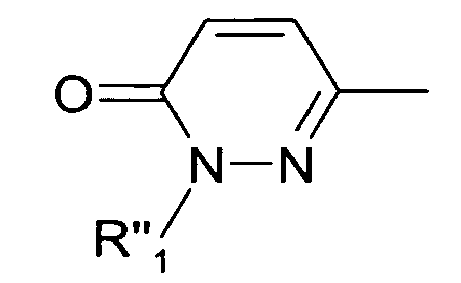
in the form of mixtures of enantiomers or single enantiomers, as well as their addition salts with mineral and organic acids and their salts with mineral or organic bases. - Among the compounds of the invention, there may be cited the compounds described in the experimental part, in particular those whose names follow:
- 8-Fluoro-3-methyl-9-(octahydro-pyrido[1,2-a]pyrazin-2-yl)-6-oxo-2,3-dihydro-6H-1-oxa-3,3a-diaza-phenalene-5-carboxylic acid,
- 8-Fluoro-9-(hexahydro-pyrrolo[1,2-a]pyrazin-2-yl)-3-methyl-6-oxo-2,3-dihydro-6H-1-oxa-3,3a-diaza-phenalene-5-carboxylic acid,
- 8-Fluoro-9-(S)-hexahydro-pyrrolo[1,2-a]pyrazin-2-yl-3-methyl-6-oxo-2,3-dihydro-6H-1-oxa-3,3a-diaza-phenalene-5-carboxylic acid,
- 8-Fluoro-9-(R)-hexahydro-pyrrolo[1,2-a]pyrazin-2-yl-3-methyl-6-oxo-2,3-dihydro-6H-1-oxa-3,3a-diaza-phenalene-5-carboxylic acid,
- 8-Fluoro-3-methyl-9-[4-(1-methyl-1H-pyrrole-2-carbonyl)-piperazin-1-yl]-6-oxo-2,3-dihydro-6H-1-oxa-3,3a-diaza-phenalene-5-carboxylic acid,
- 8-fluoro-3-methyl-6-oxo-9-[4-(2,3-dihydro-thiazole-4-carbonyl)-piperazin-1-yl]-2,3-dihydro-6H-1-oxa-3,3a-diaza-phenalene-5-carboxylic acid,
- 8-Fluoro-3-methyl-9-[4-(4-methyl-thiazole-5-carbonyl)-piperazin-1-yl]-6-oxo-2,3-dihydro-6H-1-oxa-3,3a-diaza-phenalene-5-carboxylic acid,
- 8-Fluoro-3-methyl-6-oxo-9-[4-(thiophene-2-carbonyl)-piperazin-1-yl]-2,3-dihydro-6H-1-oxa-3,3a-diaza-phenalene-5-carboxylic acid,
- 8-Fluoro-9-[4-(furan-2-carbonyl)-piperazin-1-yl]-3-methyl-6-oxo-2,3-dihydro-6H-1-oxa-3,3a-diaza-phenalene-5-carboxylic acid,
- 8-Fluroro-3-methyl-9-{4-[1-(2-morpholin-4-yl-ethyl)-6-oxo-1,6-dihydro-pyridazin-3-yl]-piperazin-1-yl}-6-oxo-2,3-dihydro-6H-1-oxa-3,3a-diaza-phenalene-5-carboxylic acid,
- 8-fluoro-9-{4-[1-(3-methoxy-benzyl)-6-oxo-1,6-dihydro-pyridazin-3-yl]-piperazin-1-yl}-3-methyl-6-oxo-2,3-dihydro-6H-1-oxa-3,3a-diaza-phenalene-5-carboxylic acid,
- The compounds of the invention can be prepared by a method characterized in that a compound of formula (II):


- The procedure is carried out preferably in a sealed chamber, in solution in the pyridine, at the reflux temperature of the latter.
- The base used is preferably a tertiary amine, for example triethylamine, N-methyl morpholine or also DBU.
- When R'6 represents a protective group, it can in particular be a (C1-C6) alkyl, a (C2-C6) alkenyl, or a (C7-C14) arylalkyl. After final elimination of the protective group R'6, the acid obtained can if desired be re-esterified to form a compound in which R6 is different from hydrogen.
- Protection of the heterocyclic nitrogen and the amines may be necessary and is carried out in particular, according to circumstances, in the form of benzyl or trityl derivatives, in the form of carbamates, in particular allyl, benzyl, phenyl or tertbutyl, or also in the form of silyl derivatives such as dimethyl, trimethyl, triphenyl tertbutyl or also diphenyl tertbutyl-silyl derivatives.
- Deprotection is carried out, according to the nature of the protective group, by sodium or lithium in liquid ammonia, by hydrogenolysis or using soluble palladium 0 complexes, by action of an acid, or by action of tetrabutylammonium fluoride or strong bases such as sodium hydride or potassium tert-butylate.
These reactions are well known to a person skilled in the art and well described for example by T. W. Green, P. G. M. Wuts, Protective Groups in Organic Synthesis, Wiley-Interscience, New York. Illustrations are provided below in the experimental part. - The compounds of formula (II) are generally known and can be prepared by the methods described in
US patent 4,801,584 . - The compound of formula (II) in which R4 and/or R'4 represent/s an alkyl radical optionally substituted by 1 to 3 halogens can be prepared from a compound of formula (II) in which R4 and R'4 represent a hydrogen, which is hot-treated with an alkaline aqueous base, then neutralized, in order to obtain the compound of formula (IV):


- The compound of formula (II) in which R5 represents a methyl radical substituted by 1 to 3 halogens can be prepared according to a method such as the one described in
US patent 4,801,584 . - The compounds of formula (III) can be prepared by methods known to the skilled chemist and, for example, by those described in the following documents: Helv. Chem. Acta, 1951, 12, 34, 1544-1575; J. Med. Chem 2004, 47, 25, 6218-6229; Bioorg. Med. Chem. 2006, 16, 20, 5462-5467; Tetrahedron 1992, 48, 23, 4985-4998; Tetrahedron Asymmetry 1993, 4, 11, 2389-2398; Tetrahedron Asymmetry 1996, 7, 9, 2739-2742; Tetrahedron Assymetry 1993, 7, 7, 1999-2006; Bioorg. Med. Chem. Letters 2004, 12, 1, 71-86;
W02006/27694 US6284757 ;WO2006/72831 WO2007/28654 USP 5,354,747 ;USP 5,576,314 . - Preparations of compounds of formula (III) are also provided below in the experimental part.
- Typically, following compounds of formula (IIIa):
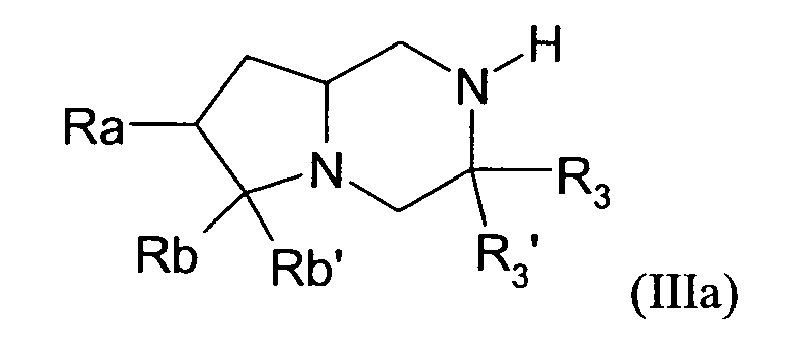

- Compounds of formula (IV) can themselves be prepared by heating a compound of formula (V):

- Compounds of formula (V) can be prepared by coupling the appropriated substituted proline of formula (VI), in which Ra, Rb and Rb' are defined as above, with the corresponding amino ester of formula (VII) in which R3, R3' and R8 are defined as above.

- The conditions for the coupling reaction are those known in the art, and can employ conventional associations of coupling reagents used in peptidic chemistry such as HOBT, EDCI, in presence of a base such as diisopropylethylamine or triethylamine and in a solvent such as dimethylformamide.
- Compounds of formula (III)/(IIIa), wherein R1 and R2 form a 5 or 6 membered carbon cycle are known and described for example in
USP 5,354,257 or5,576,314 and/or are commercially available. - As stated above, the compounds of formula (I) can be in the form of enantiomers or mixtures of enantiomers essentially at position 9 of the ring. The compounds of formula (I) are obtained without racemization and, as a result, enantiomers can be obtained by using the corresponding enantiomer of the compound of formula (III) and/or (IV).
- The compounds according to the invention, and more particularly those wherein R1 and R2 form an optionally substituted 5 or 6 membered carbon cycle, have remarkable antibacterial properties and these properties manifest themselves over a wide spectrum of gram (-) bacteria, but also a wide spectrum of gram (+).
- This balanced antibacterial activity distinguishes them from compounds of the prior art, for example marbofloxacine or also ofloxacine, and means that they are particularly indicated for use as medicaments in human medicine, but also in veterinary medicine for which there is a need for compounds which are particularly active in relation to these bacteria.
- Thus the above compounds are active in particular on gram (+) bacteria such as Streptococcus uberis or Staphylococcus aureus, but also Mycoplasma bovis or bovirhinis, or Clostridium perfringens or Enterococcus faecalis, while still being remarkably active on gram (-) bacteria such as Mannheimia haemolytica, Bordetella bronchiseptica, Escherichia coli or Pseudomonas aeruginosa.
- These properties make said compounds, as well as their salts with pharmaceutically acceptable acids and bases, suitable for use as medicaments in the treatment of conditions with susceptible germs and in particular those involving staphylococci, such as staphylococcal septicaemia, malignant staphylococcal infection of the face or skin, pyoderma, septic or suppurating sores, anthrax, phlegmon, erysipeles, primitive or post-influenzal acute staphylococcal infections, bronchial pneumonia, pulmonary suppurations.
- The compounds can also be used as medicaments in the treatment of colibacilloses and associated infections, in Proteus, Klebsiella, Pseudomonas or also Salmonella infections and in other conditions caused by gram (-) bacteria.
- A further subject of the present invention is therefore the use as medicaments, and in particular as antibiotic medicaments, of the compounds of formula (I) as defined above, as well as their salts with pharmaceutically acceptable acids and bases.
- More particularly, a subject of the invention is the use, as medicaments, of the preferred compounds of formula (I) defined above, in particular including the compounds of formula (I1) defined above and the compounds listed below:
- 8-Fluoro-3-methyl-9-(octahydro-pyrido[1,2-a]pyrazin-2-yl)-6-oxo-2,3-dihydro-6H-1-oxa-3,3a-diaza-phenalene-5-carboxylic acid,
- 8-Fluoro-9-(hexahydro-pyrrolo[1,2-a]pyrazin-2-yl)-3-methyl-6-oxo-2,3-dihydro-6H-1-oxa-3,3a-diaza-phenalene-5-carboxylic acid,
- 8-Fluoro-9-(S)-hexahydro-pyrrolo[1,2-a]pyrazin-2-yl-3-methyl-6-oxo-2,3-dihydro-6H-1-oxa-3,3a-diaza-phenalene-5-carboxylic acid,
- 8-Fluoro-9-(R)-hexahydro-pyrrolo[1,2-a]pyrazin-2-yl-3-methyl-6-oxo-2,3-dihydro-6H-1-oxa-3,3a-diaza-phenalene-5-carboxylic acid,
- 8-Fluoro-3-methyl-9-[4-(1-methyl-1H-pyrrole-2-carbonyl)-piperazin-1-yl]-6-oxo-2,3-dihydro-6H-1-oxa-3,3a-diaza-phenalene-5-carboxylic acid,
- 8-fluoro-3-methyl-6-oxo-9-[4-(2,3-dihydro-thiazole-4-carbonyl)-piperazin-1-yl]-2,3-dihydro-6H-1-oxa-3,3a-diaza-phenalene-5-carboxylic acid,
- 8-Fluoro-3-methyl-9-[4-(4-methyl-thiazole-5-carbonyl)-piperazin-1-yl]-6-oxo-2,3-dihydro-6H-1-oxa-3,3a-diaza-phenalene-5-carboxylic acid,
- 8-Fluoro-3-methyl-6-oxo-9-[4-(thiophene-2-carbonyl)-piperazin-1-yl]-2,3-dihydro-6H-1-oxa-3,3a-diaza-phenalene-5-carboxylic acid,
- 8-Fluoro-9-[4-(furan-2-carbonyl)-piperazin-1-yl]-3-methyl-6-oxo-2,3-dihydro-6H-1-oxa-3,3a-diaza-phenalene-5-carboxylic acid,
- 8-Fluroro-3-methyl-9-{4-[1-(2-morpholin-4-yl-ethyl)-6-oxo-1,6-dihydro-pyridazin-3-yl]-piperazin-1-yl}-6-oxo-2,3-dihydro-6H-1-oxa-3,3a-diaza-phenalene-5-carboxylic acid,
- 8-fluoro-9-{4-[1-(3-methoxy-benzyl)-6-oxo-1,6-dihydro-pyridazin-3-yl]-piperazin-1-yl}-3-methyl-6-oxo-2,3-dihydro-6H-1-oxa-3,3a-diaza-phenalene-5-carboxylic acid,
- A subject of the invention is also the pharmaceutical compositions containing, as active ingredient, at least one of the medicaments according to the invention as defined above.
- These compositions can be administered by oral, rectal, parenteral, in particular intramuscular route, by respiratory route or by local route in topical application to the skin and mucous membranes.
- The compositions according to the invention can be solid or liquid and be present in the pharmaceutical forms commonly used in human medicine, such as for example, plain or sugar-coated tablets, gelatin capsules, granules, suppositories, injectable preparations, ointments, creams, gels; they are prepared according to the customary methods. The active ingredient/s can be incorporated in same, using excipients which are customarily used in these pharmaceutical compositions, such as talc, gum arabic, lactose, starch, magnesium stearate, cocoa butter, aqueous or nonaqueous vehicles, fatty substances of animal or vegetable origin, paraffin derivatives, glycols, various wetting agents, dispersants or emulsifiers, preservatives.
- These compositions can in particular be present in the form of a powder intended to be dissolved extemporaneously in an appropriate vehicle, for example, non-pyrogenic sterile water.
- The dose administered varies according to the condition treated, the patient in question, the administration route and the product envisaged. It can, for example, be comprised between 0.25 g and 10 g per day, by oral route in humans, with the product described in Example 1 or also comprised between 0.25 g and 10 g per day by intramuscular or intravenous route.
- The following examples illustrate the invention.
- In the following examples and, if applicable, in the description above, the abbreviations of chemical names have the following meanings:
- EDCI:
- 1-(3-dimethylaminopropyl)-3-ethylcarbodiimide,
- HOBt:
- 1-hydroxybenzotriazole,
- DBU:
- 1,8-diaza-bicyclo-[5.4,0]-undec-7-ene,
- TNOC:
- 8,9-difluoro-3-methyl-6-oxo-2.3,3a,6-tetrahydronaphtho-[1,8-de][1.3]oxazine-5-carboxylic acid,
- ACN:
- acetonitrile,
- THF:
- tetrahydrofurane,
- DMF:
- dimethylformamide,
- LiHMDS:
- lithium-hexamethyldisilylazide,
- DMAP:
- dimethylaminopyridine,
- TFA:
- trifluroacetic acid,
- Boc:
- tert-butoxycarbonyl,
- CBz:
- benzyloxycarbonyl
- MS:
- mass spectrum,
- ESI+:
- positive ion electrospray ionization.
- NMR:
- The spectra were determined on spectrometers of the 300 or 400 MHz type, the proton and carbon spectra being respectively recorded at 300 and 75 MHz or 400 and 100 MHz, in solution in CDCl3, or DMSO-d6, MeOH-d4. The values recorded are expressed in δ (ppm) and represent the s, d, t, quad, dd and m values. The constant JAB is expressed in Hz.
- Unless otherwise indicated, the reactions are carried out under dry inert gas and at ambient temperature.
- "General method A" (coupling) consists of reacting the product "TNOC" (1.0 equivalent) and the aminated derivative in suspension in pyridine (0.2M) in a sealed chamber overnight at 120°C under stirring. The solvent is evaporated off and toluene and/or methanol are added. After concentration to dryness, the crude product is triturated in methanol and separated then dried.
- "General method B" (Boc deprotection) consists of adding a large excess of TFA to a solution in dichloromethane at 0°C of protected amino derivative (N-Boc). The reaction is carried out at ambient temperature and followed by chromatography over silica. The solution is concentrated to dryness and toluene and/or methanol are added followed by evaporation. The crude product is obtained in the form of a trifluoroacetate.
- "General method C" (peptide coupling) consists of adding 1.2 to 2.0 equivalents of EDCI and 1.2 to 2.0 equivalents of HOBt or DMAP and 1.2 to 2.0 equivalents of heteroaryl carboxylic acid, at 0°C, to a 0.2 to 0.6M solution within DMF of protected amino(piperidine) derivative N-Boc or N-CBz. The mixture is maintained under stirring at ambient temperature for 16 to 18 hours, then diluted with ethyl acetate and washed with water. The solution is then dried and concentrated to dryness under reduced pressure, then the residue is purified by chromatography over silica eluting with the cyclohexane-ethyl acetate mixture.
- "General method D" (coupling reaction) consists of mixing 8,9-Difluoro-3-methyl-6-oxo-2,3,3a,6-tetrahydronaphto[1,8-de][1,3]oxazine-5-carboxylic acid "TNOC" (1.0 eq.) and a piperazine derivative (2.0 eq) and adding 1-methyl-2-pyrrolidinone. N,O-bis(trimethylsilyl) acetamide (1.0 eq.) and N-methylmorpholine (2.2 to 3.6 eq).The mixture was submitted to microwaves for half an hour to one hour at 120°C or was heated at 95°C for 6 to 8 hours.. The reaction was cooled to 0°C and water was added, the precipitate was filtered and washed with water. The solid was triturated with methanol or ethanol.
- "General method E" (hydrogenation) consists of adding Pd/C to a solution of the piperazine derivative in a mixture of dichloromethane/methanol (0/41 to 1/1). The reaction mixture was submitted to hydrogenation at atmospheric pressure and room temperature or 30°C for 1 to 24 hours. The mixture was filtrated over Celite® and evaporated under reduced pressure.
-

-

- According to general procedure C, 2a was obtained with 1a (0.25 mL, 5.18 mmol, 1.0 eq.), EDC (324 mg, 10.36 mmol, 2.0 eq.), DMAP (317 mg, 10.36 mmol, 2.0 eq.) and N-methylpyrrole-2-carboxylic acid (329 mg, 10.36 mmol, 2.0 eq.). The mixture was washed first with a saturated solution of ammonium chloride, then with 1 N HCl and at the end with a saturated solution of sodium carbonate. The residue was purified by flash chromatography on silica gel, eluting with cyclohexane-ethyl acetate (8:2 to 1:1) to afford 2a (420 mg, 98%) as a colorless oil.
MS (ESI+) (+0.1% HCOOH): 328.12 [C18H21N3O3+H]+ (m/z)

- According to general procedure E, 2a (2.0 g, 6.11 mmol, 1.0 eq) was deprotected in methanol (20 mL) with palladium on activated carbon 10% (250 mg). The mixture was submitted to hydrogenation at room temperature under 1 atmosphere for 6 hours. The reaction mixture was filtered through Celite® and evaporated. The residue was purified by flash chromatography on silica gel, eluting with eluting with dichloromethane - 7N NH3 methanol (gradient from 5% to 20% methanol). The title compound was obtained as a colorless gum (1.1 g, 93%).
MS (ESI+) (+0.1% HCOOH): 194.09 [C10H15N3O+H]+ (m/z)
- According to general procedure A, TNOC (535 mg, 1.89 mmol, 1.0 eq.) was coupled with 3a (1.1 g, 5.21 mmol, 3.0 eq.) and 1 mL of N-methylmorpholine. The residue was triturated several times with hot methanol to afford the title compound as a beige solid (321 mg, 37%).
HPLC (gradient 5%-80% ACN in H2O): > 99%
MS (ESI+) (+0.1% HCOOH): 456.1 [C22H22FN5O5 +H]+ (m/z)
mp = 252°C dec. -


- According to general procedure C, 2b was obtained with 1b (1.2 g, 6.45 mmol, 1.0 eq.), EDC (1.5g, 7.25 mmol, 1.2 eq.), HOBt (1.1 g, 7.25 mmol, 1.2 eq.) and 4-thiazolecarboxylic acid (1.0 g, 7.25 mmol, 1.2 eq.). The mixture was washed first with a saturated solution of ammonium chloride, with 1 N HCl, with a saturated solution of sodium bicarbonate and at the end water. The residue 2b (1.8 g, 94%) was used in the next step without further purification.

- According to general procedure B, 2b (1.8 g, 6.05 mmol, 1.0 eq.) was deprotected; the residue was purified by flash chromatography on silica gel, eluting with eluting with dichloromethane - 5% 7N NH3 methanol to afford 3b (1.16 g, 97%).
MS (ESI+) (+0,1% HCOOH): 198.12 [C8H11N3OS+H]+ (m/z)
- According to general procedure A, TNOC (524 mg, 1.86 mmol, 1.0 eq.) was coupled with 3b (1.1 g, 5.60 mmol, 3.0 eq.) and N-methylmorpholine (0.41 mL, 3.23 mmol, 2.0 eq.). The residue was triturated first with water then with hot methanol to afford the title compound as a white solid (450 mg, 53%).
HPLC (gradient 5%-80% ACN in H2O): > 99%
MS (ESI+) (+0.1% HCOOH): 460.1 [C20H18FN5O5+H]+ (m/z)
mp=311°C dec. -


- According to general procedure C, 2c was obtained with 1b (1.3 g, 6.98 mmol, 1.0 eq.), EDC (1.6 g, 8.37 mmol, 1.2 eq.), HOBt (1.1 g, 8.37 mmol, 1.2 eq.) and 4-methyl-thiazole-5-carboxylic acid (1.0 g, 6.78 mmol, 1.0 eq.). The mixture was washed water; the residue was purified by flash chromatography on silica gel, eluting with eluting with dichloromethane - methanol (gradient from 2.5% to 5% methanol). to afford 2c (1.6 g, 24%).
MS (ESI+) (+0.1% HCOOH): 312.09 [C14H21N3O3S+H]+ (m/z)
- According to general procedure B, 2c (1.6 g, 5.14 mmol, 1.0 eq.) was deprotected; the residue was purified by flash chromatography on silica gel, eluting with eluting with dichloromethane - 10% methanol then dichloromethane - 7N NH3 in methanol (gradient from 10% to 20% of 7N NH3 in methanol) to afford 3c as a white wax (1.0 g, 92%).
MS (ESI+) (+0.1% HCOOH): 212.12 [C9H13N3OS+H]+ (m/z)
- According to general procedure A, TNOC (600 mg, 2.12 mmol, 1.0 eq.) was coupled with 3c (1.0 g, 4.25 mmol, 2.2 eq.) and 1 mL of N-methylmorpholine. The residue was triturated with hot methanol to afford the title compound as a beige solid (302 mg, 27%).
HPLC (gradient 5%-80% ACN in H2O): > 99%
MS (ESI+) (+0.1% HCOOH): 425.0 [C21H20FN5O5S+H]+ (m/z)
mp = 285°C dec. -


- According to general procedure C, 2d was obtained with 1b (1.0 g, 5.35 mmol, 1.0 eq.), EDC (1.59 g, 8.03 mmol, 1.5 eq.), HOBt (1.09 g, 8.03 mmol, 1.5 eq.) and 2-thiophenecarboxylic acid (1.03 g, 8.03 mmol, 1.5 eq.). The mixture was washed first with a saturated solution of ammonium chloride, with 1N HCl, with a saturated solution of sodium bicarbonate and at the end water; the residue was purified by flash chromatography on silica gel, eluting with eluting with dichloromethane - methanol (gradient from 0% to 5% methanol). to afford 2d (1.5 g, 95%).
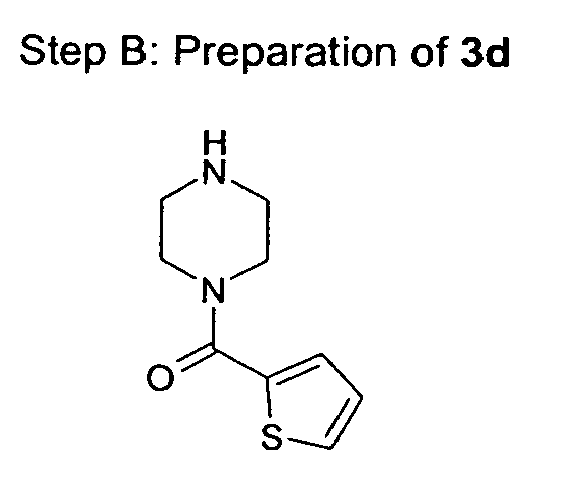
- According to general procedure B, 2d (1.5 g, 5.06 mmol, 1.0 eq.) was deprotected; the residue was purified by flash chromatography on silica gel, eluting with eluting dichloromethane - 5% 7N NH3 in methanol to afford 3d (1.1 g, quantitative).
MS (ESI+) (+0.1% HCOOH): 197.2 [C9H12N2OS+H]+ (m/z)

- According to general procedure A, TNOC (524 mg, 1.86 mmol, 1.0 eq.) was coupled with 3d (1.1 g, 5.60 mmol, 3.0 eq.) and N-methylmorpholine (0.41 mL, 3.23 mmol, 2.0 eq.). The residue was triturated first with water then with hot methanol to afford the title compound as a white solid (450 mg, 53%).
HPLC (gradient 5%-80% ACN in H2O): > 99%
MS (ESI+) (+0.1% HCOOH): 459.1 [C21H19FN4O5S+H]+ (m/z)
mp = 249°C dec. -

- According to general procedure A, TNOC (200 mg, 0.22 mmol, 1.0 eq.) was coupled with 3e (639 mg, 3.55 mmol, 5.0 eq.). The residue was triturated with hot methanol to afford the title compound as a beige solid (136 mg, 43%).
HPLC (gradient 5%-80% ACN in H2O): > 95%
MS (ESI+) (+0.1% HCOOH): 443.0 [C21H19FN4O6+H]+ (m/z)
mp = 261 °C -


-

- According to general procedure A, TNOC (599 mg, 2.12 mmol, 1.0 eq.) was coupled with 5a {
Hansen et al. USP 5,354,747 } (1.5 g, 8.49 mmol, 4.0 eq.) in 10 mL of pyridine and triethylamine (2.95 mL, 21.2 mmol, 10.0 eq.). The reaction was evaporated under reduced pressure, the residue was triturated with water, filtrated and the solid was washed with methanol to afford the title compound as a beige solid (325 mg, 24%)
HPLC (gradient 5% to 95% ACN in H2O): >95%
MS (ESI+) (+ 0.1 % HCOOH) : 403.3 [C20H23FN4O4+H]+ (m/z)
mp = 260-261 °C, dec. -

- According to general procedure A, TNOC (559 mg, 1.98 mmol, 1.0 eq.) was coupled with 5b (octahydro-pyrrolo[1,2-a]pyrazine, commercially available) (1.0 g, 7.92 mmol, 4.0 eq.) in 10 mL of pyridine and N-methylmorpholine (0.435 mL, 3.96 mmol, 2.0 eq.). The reaction was evaporated under reduced pressure, the residue was triturated with methanol and filtrated to afford the title compound as a beige solid (480 mg, 62%)
HPLC (gradient 5% to 80% ACN in H2O): >95%
MS (ESI+) (+ 0.1% HCOOH): 389.23 [C19H21FN4O4+H]+ (m/z)
mp=215°C, dec. -

- According to general procedure A, TNOC (161 mg, 2.31 mmol, 1.0 eq.) was coupled with 53c as a hydrochloride salt {
Power et al. USP 5,576,314 } (1.5 g, 7.57 mmol, 3.3 eq.) in 10 mL of pyridine and triethylamine (3.22 mL, 23.1 mmol, 10.0 eq.). The reaction was evaporated under reduced pressure, the residue was triturated with water, methanol, dichloromethane and at last with methanol to afford the title compound as a beige solid (213 mg, 24%)
HPLC (gradient 5% to 95% ACN in H2O): >95%
MS (ESI+) (+ 0.1% HCOOH) : 389.3 [C19H21FN4O4+H]+ (m/z)
mp = 267°C, dec. -

- According to general procedure A, TNOC (161 mg, 2.31 mmol, 1.0 eq.) was coupled with 5d as a hydrochloride salt {
Power et al. USP 5,576,314 } (1.5 g, 7.57 mmol, 3.3 eq.) in 10 mL of pyridine and triethylamine (3.22 mL, 23.1 mmol, 10.0 eq.). The reaction was evaporated under reduced pressure; the residue was triturated with water, methanol, dichloromethane and at last with methanol to afford the title compound as a beige solid (280 mg, 31 %)
HPLC (gradient 5% to 95% ACN in H2O): >90%
MS (ESI+) (+ 0.1% HCOOH) : 389.2 [C19H21FN4O4+H]+ (m/z)
mp = 263°C, dec. -

-

- Following general procedure C, 7a was obtained with compound 8 (2.3 g, 7.16 mmol, 1.1 eq.), carbobenzyloxy-L-valine (2.5 g, 9.95 mmol, 1.3 eq.), HOBt (1.34g, 9.95 mmol, 1.3 eq) and EDCl (1.9 g, 9.95 mmol, 1.0 eq.). The resulting crude product was purified by flash chromatography on silica gel, eluting with cyclohexane-ethyl acetate (8:2) to afford 7a (2.8 g, 69%) as a colorless oil.
MS (ESI+) (+0.1% HCOOH): 529.18 [C28H37FN4O5+H]+ (m/z)
- To a solution of 7a (1.30 g, 2.46 mmol) in methanol (60 mL) was added Pd/C (121 mg). The reaction mixture was submitted to hydrogenation at atmospheric pressure and at room temperature for 18 hours. The reaction was filtered over Celite® and evaporated under reduced pressure. The residue was used as crude without further purification (940 mg).

- To a solution of 8a (940 mg, 2.38 mmol, 1.0 eq.) in DCM (30 mL) cooled to 0°C were added pyridine (0.3 mL, 2.86 mmol, 1.2 eq.) and trifluoroacetic anhydride (0.8 mL, 8.34 mmol, 3.5 eq;). The reaction mixture was stirred at room temperature for 2 hours. The reaction mixture was concentrated under reduced pressure. The resulting crude product was purified by flash chromatography on silica gel, eluting with cyclohexane-ethyl acetate (5:5 to 0:1) to afford 9a (950 mg, 91%) as a colorless oil.

- Following general procedure B, 9a (950 mg, 2.18 mmol) was deprotected. The residue was purified by flash chromatography on silica gel, eluting with dichloromethane - methanol (95:5 to 90:10) then dichloromethane - 10% 7N NH3 in methanol to afford 10a (210 mg, 96%).
MS (ESI+) (+0.1% HCOOH): 337.08 [C17H25FN4O2+H]+ (m/z)

- Following general procedure D, TNOC (188 mg, 0.67 mmol, 1.0 eq.) was coupled with 10a (449 mg, 1.33 mmol, 2.0 eq.) in 1-methyl-2-pyrrolidinone (5 mL) with N,O-bis(trimethylsilyl) acetamide (163 µL, 0.67 mmol, 1.0 eq.) and N-methylmorpholine (161 µL, 1.47 mmol, 2.2 eq.). The mixture was submitted to microwaves for 1 hour at 120°C. The reaction was cooled to 0°C and H2O was added, the precipitate was filtered and washed with H2O. The solid was triturated with hot methanol and filtrated to afford the title compound (95 mg, 24%).
HPLC (gradient 5%-80% ACN in H2O): > 99%
MS (ESI+) (+0.1% HCOOH): 599.30 [C29H32FN6O6+H]+ (m/z)
mp = 262°C-264°C. -

- Following general procedure C, 7b was obtained with compound 6 (1.5 g, 5.07 mmol, 1.0 eq.), EDCI (1.2 g, 6.1 mmol, 1.2 eq.), HOBt (823 mg, 6.1 mmol, 1.2 eq.) and N,N-carbobenzyloxy-Lysine (2.5 g, 6.1 mmol, 1.2 eq.). The residue was purified by flash chromatography on silica gel, eluting with cyclohexane-ethyl acetate (8:2 to 5:5) to afford 7b (2.9 g, 82%) as a beige foam.
MS (ESI+) (+0.1% HCOOH): 328.12 [C18H21N3O3+H]+ (m/z)

- As described for compound 8a, 8b was obtained starting from 7b (1.63 g, 2.35 mmol) using Pd/C (1.0 g). The residue was used as crude without further purification (1.5 g).

- As described for compound 9a, 9b was obtained starting from 8b (1.5 g, 3.0 mmol), pyridine (5 mL, 47.6 mmol) and trifluoroacetic anhydride (4 mL, 41.7 mmol). The residue was purified by flash chromatography on silica gel, eluting with dichloromethane - methanol (95:5 to 90:10) to afford 9b (995 mg, 83%) as a white powder.

- Following general procedure B, 9b (995 mg, 1.96 mmol) was deprotected. The residue was purified by flash chromatography on silica gel, eluting with dichloromethane - methanol (95:5 to 90:10) then dichloromethane - 10% 7N NH3 in methanol to afford 10b (798 mg, 100%).
MS (ESI+) (+0.1% HCOOH): 408.16 [C20H30FN5O3+H]+ (m/z)

- Following general procedure D, TNOC (140 mg, 0.50 mmol, 1.0 eq.) was coupled with 10b (406 mg, 0.99 mmol, 2.0 eq.) in 1-methyl-2-pyrrolidinone (2 mL) with N,O-bis(trimethylsilyl) acetamide (122 µL, 0.5 mmol, 1.0 eq.) and N-methylmorpholine (250 µL, 1.0 mmol, 2.2 eq). The mixture was submitted to microwaves for 30 min twice at 120°C. The reaction was cooled to 0°C and H2O was added, the precipitate was filtered and washed with H2O. The solid was triturated with hot methanol and filtrated to afford the title compound (160 mg, 24%).
HPLC (gradient 5%-80% ACN in H2O): > 99%
MS (ESI+) (+0.1% HCOOH): 621.30 [C32H37F2N7O7+H]+ (m/z)
mp = 225°C-276°C. -

- Following general procedure C, 7c was obtained with compound 6 (1.9 g, 6.69 mmol, 1.0 eq.), EDCl (1.9 g, 10.0 mmol, 1.5 eq.), HOBt (1.36 g, 10.0 mmol, 1.5 eq.) and N-carbobenzyloxylproline (2.5 g, 10.0 mmol, 1.5 eq.). The residue was purified by flash chromatography on silica gel, eluting with cyclohexane-ethyl acetate (8:2 to 5:5) to afford 7c (3.5 g, 99%).
MS (ESI+) (+0.1% HCOOH): 527.14 [C28H35FN4O5+H]+ (m/z)

- As described for compound 8a, 8c was obtained starting from 7c (3.5 g, 6.16 mmol) using Pd/C (0.5 g). The residue was used as crude without further purification (2.6 g).

- As described for compound 9a, 9c was obtained starting from 8c (2.5 g, 6.16 mmol, 1.0 eq.), pyridine (1.1 mL, 13.3 mmol, 2.0 eq.) and trifluoroacetic anhydride (2.5 mL, 26.6 mmol, 4.0 eq.). The residue was purified by flash chromatography on silica gel, eluting with dichloromethane - methanol (98:2) to afford 9c (2.6 g, 90%).

- Following general procedure B, 9c (2.6 g, 6.0 mmol) was deprotected. The residue was purified by flash chromatography on silica gel, eluting with dichloromethane -7N NH3 in methanol (95:5) to afford 10c (1.7 g, 85%).
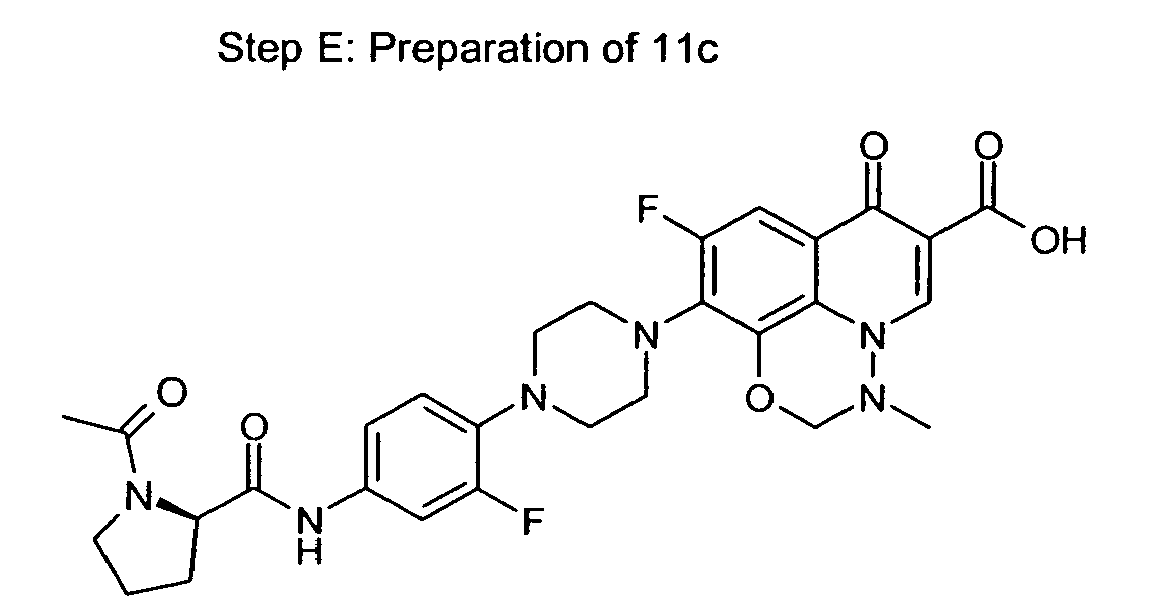
- Following general procedure D, TNOC (337 mg, 1.2 mmol, 1.0 eq.) was coupled with 10c (800 mg, 2.39 mmol, 2.0 eq.) in 1-methyl-2-pyrrolidinone (8 mL) with N,O-bis(trimethylsilyl) acetamide (293 µL, 1.2 mmol, 1.0 eq.) and N-methylmorpholine (289 µL, 2.63 mmol, 2.2 eq.). The mixture was submitted to microwaves for 1 hour at 120°C. The reaction was cooled to 0°C and H2O was added, the precipitate was filtered and washed with H2O. The solid was triturated with hot methanol and filtrated to afford the title compound (100 mg, 14%) as a white solid.
HPLC (gradient 5%-80% ACN in H2O): > 95%
MS (ESI+) (+0.1% HCOOH): 597.30 [C29H30F2N6O6+H]+ (m/z)
mp = 199°C-201°C -

-

- Following general procedure B, 7a (1.3 g, 2.46 mmol) was deprotected. The residue was purified by flash chromatography on silica gel, eluting with dichloromethane -7N NH3 in methanol (95:5) to afford 12a (1.0 g, 97%).
MS (ESI+) (+0.1 % HCOOH): 429.03 [C23H29FN4O3+H]+ (m/z)
- Following general procedure D, TNOC (224 mg, 0.97 mmol, 1.0 eq.) was coupled with 12a (830 mg, 1.94 mmol, 2.0 eq.) in 1-methyl-2-pyrrolidinone (8 mL) with N,O-bis(trimethylsilyl) acetamide (237 µL, 0.96 mmol, 1.0 eq.) and N-methylmorpholine (234 µL, 2.13 mmol, 2.2 eq.). The mixture was submitted to microwaves for 30 min twice at 120°C. The reaction was cooled to 0°C and H2O was added, the precipitate was filtered and washed with H2O. The solid was triturated with hot methanol and filtrated to afford the title compound (200 mg, 30%) as a white solid.
HPLC (gradient 5%-80% ACN in H2O): > 99%
MS (ESI+) (+0.1% HCOOH): 691.43 [C35H36F2N6O7+H]+ (m/z)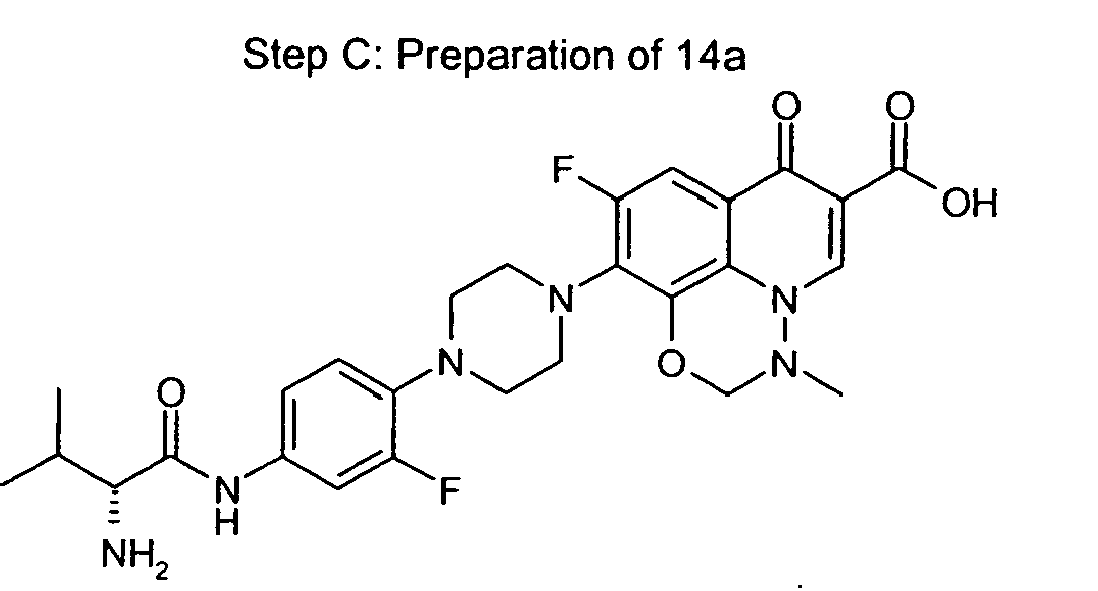
- As described for compound 8a, 14a was obtained starting from 13a (200 mg, 0.29 mmol) using Pd/C (20 mg). The residue was triturated in DCM to afford the title compound (112.5 mg,21%).
HPLC (gradient 5%-80% ACN in H2O) > 99%
MS (ESI+) (+0.1 % HCOOH): 557.20 [C27H30F2N6O5+H]+ (m/z)
mp = dec. -

- Following general procedure C, 7d was obtained with compound 6 (1.3 g, 4.48 mmol, 1.0 eq.), EDCl (1.3 g, 6.23 mmol, 1.5 eq.), HOBt (0.9 g, 6.23 mmol, 1.5 eq.) and N-carbobenzyloxylasparaginebenzylcarboxylic acid (2.4 g, 6.23 mmol, 1.5 eq.). The residue was purified by flash chromatography on silica gel, eluting with cyclohexane-ethyl acetate (8:2 to 5:5) to afford 7d (2.5 g, 87%).

- Following general procedure B, 7d (2.5 g, 2.46 mmol) was deprotected. The residue was purified by flash chromatography on silica gel, eluting with dichloromethane -7N NH3 in methanol (95:5) to afford 12b (1.8 g, 85%).

- Following general procedure D, TNOC (211 mg, 0.75 mmol, 1.0 eq.) was coupled with 12b (800 mg, 1.50 mmol, 2.0 eq.) in 1-methyl-2-pyrrolidinone (8 mL) with N,O-bis(trimethylsilyl) acetamide (184 µL, 0.75 mmol, 1.0 eq.) and N-methylmorpholine (182 µL, 1.16 mmol, 2.2 eq.). The mixture was submitted to microwaves for 30 min twice at 120°C. The reaction was cooled to 0°C and H2O was added, the precipitate was filtered and washed with H2O. The solid was purified by T.L.C preparative to afford the title compound (120 mg, 10%) as a white solid.
HPLC (gradient 5%-80% ACN in H2O): > 95%
MS (ESI+) (+0.1% HCOOH): 592.08 [C30H27F2N5O6+H]+ (m/z)
- As described for compound 8a, 14b was obtained starting from 13b (120 mg, 0.15 mmol) using Pd/C (20 mg). The residue was triturated in Et2O, filtrated, washed with MeOH and DCM to afford the title compound (50 mg, 56%).
HPLC (gradient 5%-80% ACN in H2O): > 95%
MS (ESI+) (+0.1% HCOOH): 524.20 [C26H26F2N6O7+H]+ (m/z)
mp=218°C dec. -

- Following general procedure B, 7c (1.5 g, 2.85 mmol) was deprotected. The residue was purified by flash chromatography on silica gel, eluting with dichloromethane -7N NH3 in methanol (98:2 to 95:5) to afford 12c (1.2 g, 99%).
MS (ESI+) (+0.1% HCOOH): 427.10 [C23H27FN4O3+H]+ (m/z)
- Following general procedure D, TNOC (285 mg, 1.0 mmol, 1.0 eq.) was coupled with 12c (860 mg, 2.0 mmol, 2.0 eq.) in 1-methyl-2-pyrrolidinone (8 mL) with N,O-bis(trimethylsilyl) acetamide (246 µL, 1.0 mmol, 1.0 eq.) and N-methylmorpholine (244 µL, 2.22 mmol, 2.2 eq.). The mixture was submitted to microwaves for 1 hour at 120°C. The reaction was cooled to 0°C and H2O was added, the precipitate was filtered and washed with H2O. The solid was triturated with hot methanol and filtrated to afford the title compound (120 mg, 17%).
HPLC (gradient 5%-80% ACN in H2O): > 99%
MS (ESI+) (+0.1% HCOOH): 689.19 [C35H34F2N6O7+H]+ (m/z)
- As described for compound 8a, 14c was obtained starting from 13c (120 mg, 0.34 mmol) using Pd/C (20 mg). The residue was triturated in DCM to afford the title compound (76mg, 79%) as a beige solid.
HPLC (gradient 5%-80% ACN in H2O): > 95%
MS (ESI+) (+0.1% HCOOH): 555.30 [C27H26F2N6O5+H]+ (m/z)
mp = dec. -

-

- To a solution of dichloropyridazine (10.0 g, 67.1 mmol, 1.0 eq.) and piperazine (25g, 268 mmol, 4 eq.) in EtOH (200 mL) was added DIEPA (11.7 mL, 67.1 mmol, 1.0 eq.). The reaction mixture was stirred at reflux for 18 hours. The reaction mixture was concentrated under reduced pressure. The residue was diluted with CHCl3 and the organic phase was washed with H2O. The organic extracts were dried over MgSO4 and concentrated. The resulting crude product was purified by flash chromatography on silica gel, eluting with dichloromethane-methanol-ammoniac (93:5:2 to 88:10:2) to afford 15 (11.1g, 82%) as a light yellow solid.
MS (ESI+) (+0.1% HCOOH): 198.89 [C8H11N4+H]+ (m/z)
- To a suspension of 15 (1.1 g, 5.54 mmol, 1.0 eq.) in acetone (10 mL) and H2O (10 mL) cooled to 0°C, were added Na2CO3 (880 mg, 8.3 mmol, 1.5 eq.) and benzylchloroformate (1.2 mL, 8.3 mmol, 1.5 eq.). The reaction mixture was stirred at room temperature for 18 hours. The reaction mixture was filtrated, the filtrate was washed with H2O and dried. The crude product was purified by flash chromatography on silica gel, eluting with dichloromethane-methanol (95:5 to 90:10) to afford 16 (1.49g, 81 %) as a white solid.
MS (ESI+) (+0.1% HCOOH): 333.08 [C16H17ClN4O2+H]+ (m/z)

- To a solution of 16 (1.0 g, 3.0 mmol, 1.0 eq.) in AcOH (75 mL) was added sodium acetate (252 mg, 9.0 mmol, 3.0 eq.). The reaction mixture was stirred at 120°C for 18 hours. The reaction mixture was co-evaporated with toluene. The residue was diluted with EtOAc, the organic phase was washed with a saturated aqueous solution of NaHCO3. The organic extracts were dried over MgSO4 and concentrated. The crude product was purified by flash chromatography on silica gel, eluting with dichloromethane-methanol (98:2 to 95:5) to afford 17 (780 mg, 82%) as a yellow solid.
- To a solution of compound 17 in DMF was added K2CO3 and then the halide derivate. The mixture was stirred at 16°C between 6 hours and 18 hours. The reaction mixture was diluted with EtOAC and the organic phase was washed with a saturated aqueous solution of NH4Cl. The organic extracts were dried over MgSO4 and concentrated.

- Following general procedure F, 18a was obtained starting from compound 17 (780 mg, 2.5 mmol, 1.0 eq.) and methylbromoacetate (215 µL, 7.5 mmol, 3.0 eq.) and K2CO3 (857 mg, 6.25 mmol, 2.5 eq.). The crude product was purified by flash chromatography on silica gel, eluting with cyclohexane-ethyl acetate (5:5 to 0:1) to afford 18a (900 mg, 94%) as a yellow solid.

- As described for compound 8a, 19a was obtained starting from 18a (900 mg, 2.5 mmol) using Pd/C (80 mg). The crude was purified by flash chromatography on silica gel, eluting with dichloromethane -7N NH3 in methanol (95:5 to 90:10) to afford 19a (510 mg, 85%).

- To a solution of 19a (510 mg, 2.0 mmol, 2.0 eq.) in pyridine (2.5 mL) and N-methylpyrrolidinone (0.5 mL) were added N-methylmorpholine (0.4 mL, 8.0 mmol, 4.0 eq.) and TNOC (285 mg, 1.0 mmol, 1.0 eq.). The reaction mixture was stirred in a sealed tube at 120°C for 18 hours. The reaction was cooled to 0°C and co-evaporated with toluene and methanol. The residue was triturated with hot methanol and filtrated to afford the title compound (145 mg, 26%) as a beige solid.
HPLC (gradient 5%-80% ACN in H2O): > 90%
MS (ESI+) (+0.1% HCOOH): 515.17 [C35H23F2N6O7+H]+ (m/z)
mp = 305°C-307°C -

- Following general procedure F, 18b was obtained starting from compound 17 (1.30 g, 4.13 mmol, 1.0 eq.) and methylbromopropionate (1.4 mL, 3.9 mmol, 3.0 eq.) and K2CO3 (1.40 g, 10.3 mmol, 2.5 eq.). The crude product was purified by flash chromatography on silica gel, eluting with cyclohexane-ethyl acetate (5:5 to 0:1) to afford 18b (1.6 g, 97%) as a yellow gum.


- As described for compound 8a, 19b was obtained starting from 18b (1.6 g, 4.0 mmol) using Pd/C (200 mg). The crude was purified by flash chromatography on silica gel, eluting with dichloromethane -7N NH3 in methanol (95:5 to 90:10) to afford 19b (1.0 g, 94%).

- As described for compound 20a, 20b was obtained starting from 19b (1.0 g, 3.75 mmol, 2.0 eq.), pyridine (5 mL), N-methylmorpholine (1.0 mL, 20.0 mmol, 4.0 eq.) and TNOC (535 mg, 1.87 mmol, 1.0 eq.). 57 mg of the crude were purified by T.L.C. preparative to afford the title compound (25 mg, 23%) as a yellow solid.
HPLC (gradient 5%-80% ACN in H2O): > 90%
MS (ESI+) (+0.1 % HCOOH): 529.10 [C24H25F2N6O7+H]+ (m/z)
mp = 262°C dec. -
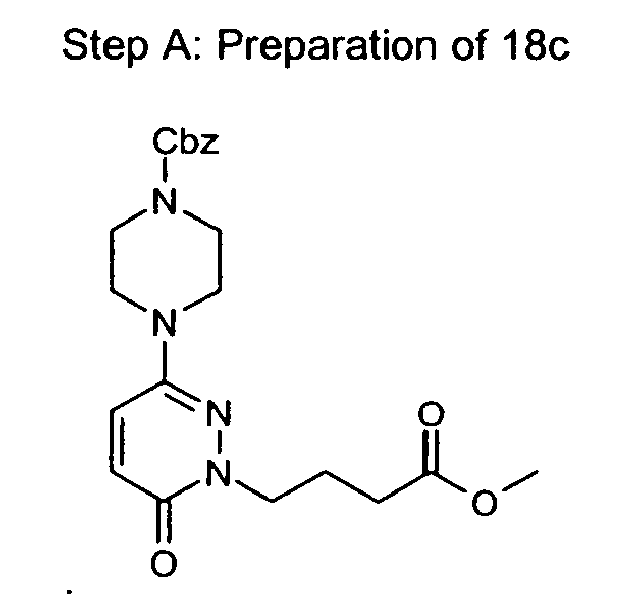
- Following general procedure F, 18c was obtained starting from compound 17 (1.25 g, 3.97 mmol, 1.0 eq.), methyl-4-bromobutyrate (2.2 g, 12.15 mmol, 3.0 eq.) and K2CO3 (1.4 g, 10.3 mmol, 2.5 eq.). The crude product was purified by flash chromatography on silica gel, eluting with cyclohexane-ethyl acetate (5:5 to 0:1) to afford 18c (1.52 g, 92%) as a yellow gum.
MS (ESI+) (+0.1% HCOOH): 415.10 [C21H26N4O5+H]+ (m/z)
- As described for compound 8a, 19c was obtained starting from 18c (1.5 g, 3.61 mmol) using Pd/C (150 mg). The crude product was purified by flash chromatography on silica gel, eluting with dichloromethane -7N NH3 in methanol (95:5 to 90:10) to afford 19c (953 mg, 94%).
MS (ESI+) (+0.1% HCOOH): 249.02 [C13H20N4O3+H]+ (m/z)
- As described for compound 20a, 20c was obtained starting from 19c (953 mg, 3.4 mmol, 2.0 eq.) in pyridine (5 mL) and N-methylmorpholine (1.0 mL, 20.0 mmol, 4.0 eq.) and TNOC (480 mg, 1.7 mmol, 1.0 eq.). The crude product was purified by T.L.C. preparative to afford the title compound (35 mg, 4%) as a yellow solid.
HPLC (gradient 5%-80% ACN in H2O): > 90%
MS (ESI+) (+0.1% HCOOH): 543.10 [C25H27FN6O7+H]+ (m/z)
mp = 192°C-194°C -


- Following general procedure F, 18d was obtained starting from compound 17 (1.0 g, 3.18 mmol, 1.0 eq.), 2-chloro-1-morpholinoethan-1-one (1.04 g, 6.40 mmol, 2.0 eq.) and K2CO3 (1.10 g, 7.95 mmol, 2.5 eq.). The crude product was purified by flash chromatography on silica gel, eluting with dichloromethane-methanol (99:1 to 90:10) to afford 18d (1.25 g, 89%) as a yellow foam.

- As described for compound 8a, 19d was obtained starting from 18d (1.25 g, 2.83 mmol) using Pd/C (200 mg). The crude product was purified by flash chromatography on silica gel, eluting with dichloromethane -7N NH3 in methanol (95:5 to 90:10) to afford 19d (877 mg, 100%).
MS (ESI+) (+0.1% HCOOH): 308.18 [C14H21N5O3+H]+ (m/z)
- As described for compound 20a, 20d was obtained starting from 19d (877 mg, 2.85 mmol, 2.0 eq.), pyridine (6 mL), N-methylmorpholine (0.8 mL, 16.00 mmol, 5.0 eq.) and TNOC (402 mg, 1.42 mmol, 1.0 eq.). The crude product was purified by T.L.C. preparative to afford the title compound (53 mg, 7%) as a yellow solid.
HPLC (gradient 5%-80% ACN in H2O): > 95%
MS (ESI+) (+0.1 % HCOOH): 521.20 [C26H28FN7O7+H]+ (m/z)
mp=315°C-317°C -

- Following general procedure F, 18e was obtained starting from compound 17 (1.1 g, 3.5 mmol, 1.0 eq.), 4-(2-chloroethyl)-morpholine hydrochloride (2.0 g, 10.25 mmol, 3.0 eq.) and K2CO3 (1.21 g, 8.75 mmol, 2.5 eq.). The crude product was purified by flash chromatography on silica gel, eluting with dichloromethane-methanol (99:1 to 90:10) to afford 18e (1.45 g, 97%) as a yellow solid.

- As described for compound 8a, 19e was obtained starting from 18e (1.7 g, 4.0 mmol) using Pd/C (150 mg). The crude product was purified by flash chromatography on silica gel, eluting with dichloromethane -7N NH3 in methanol (95:5 to 90:10) to afford 19e (1.09 g, 94%) as a yellow solid.
MS (ESI+) (+0.1% HCOOH): 294.13 [C14H23N5O2+H]+ (m/z)
- As described for compound 20a, 20e was obtained starting from 19e (1.04 g, 3.54 mmol, 2.0 eq.), pyridine (6 mL), N-methylmorpholine (1 mL, 20.0 mmol, 15.0 eq.) and TNOC (503 mg, 1.78 mmol, 1.0 eq.). The crude product was triturated with hot methanol and filtrated to afford the title compound (430 mg, 44%) as a yellow solid.
HPLC (gradient 5%-80% ACN in H2O): > 95%
MS (ESI+) (+01% HCOOH): 556.20 [C26H30FN7O6+H]+ (m/z)
mp = 255°C-257°C -

-
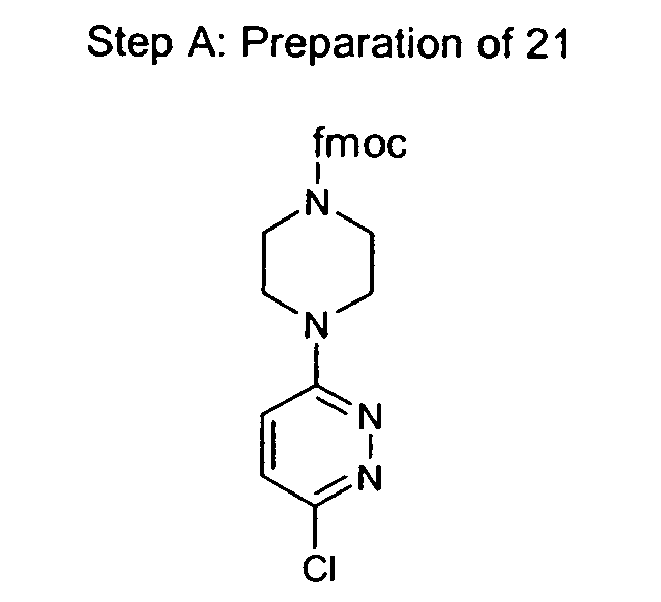
- To a mixture of 15 (1.0 g, 5.0 mmol, 1.0 eq.), an aqueous solution of Na2CO3 (C=10g/100 mL, 14mL, 12.5 mmol, 2.5 eq.) and dioxane (14 mL) cooled to 0°C, was added dropwise FmocCl (2.0 g, 7.5 mmol, 1.5 eq.). The reaction mixture was stirred at room temperature for 18 hours. The reaction mixture was diluted with DCM, the organic phase was washed with H2O and dried over MgSO4. The crude product was purified by flash chromatography on silica gel, eluting with dichlorornelharle-methanol (98:2 to 90:10) to afford 21 (1.90 g, 89%) as a white solid.

- As described for compound 17, 22 was obtained starting from 21 (1.9 g, 4.51 mmol, 1.0 eq.) and sodium acetate (1.1 mg, 13.0 mmol, 3.0 eq.). The crude product was purified by flash chromatography on silica gel, eluting with dichloromethane-methanol (95:5) to afford 22 (1.25 g, 96%) as a yellow solid.

- Following general procedure F, 23 was obtained starting from compound 22 (160 mg, 0.39 mmol, 1.0 eq.) and 3-methoxybenzylbromide (111 µL, 0.078 mmol, 2.0 eq.) and K2CO3 (1.10 g, 0.79 mmol, 2.0 eq.). The crude product was purified by flash chromatography on silica gel, eluting with cyclohexane-ethyl acetate (5:5 to 0:1) to afford 23 (100 mg, 48%).

- To a solution of 23 (823 mg, 1.17 mmol, 1.0 eq.) in DMF (5 mL) was added piperidine (1 mL). The reaction mixture was stirred at room temperature for 6 hours. The reaction mixture was concentrated and was purified by flash chromatography on silica gel, eluting with dichloromethane-methanol (95:5 to 80:20) to afford 24 (300 mg, 60%) as a colorless oil.

- As described for compound 20a, 25 was obtained starting from 24 (300 mg, 0.99 mmol, 2.0 eq.), pyridine (4 mL,) N-methylmorpholine (0.2 mL, 4.0 mmol, 4.0 eq.) and TNOC (140 mg, 0.50 mmol, 1.0 eq.). The crude product was purified by T.L.C. preparative to afford the title compound (80 mg, 28%) as a yellow solid.
HPLC (gradient 5%-80% ACN in H2O): > 95%
MS (ESI+) (+0.1% HCOOH): 563.15 [C28H27FN6O6+H]+ (m/z)
mp = 245°C-247°C - In order to assess the anti-infectious activity, a test to determine the minimal inhibitory concentrations (MIC), of the synthesized molecules is implemented. This comparative test, using a reference fluoroquinolone, measures the minimum inhibitory concentrations for the principal reference and in-situ bacteria, isolated from human and animal pathologies (canine, feline, bovine or porcine). These bacteria represent different resistance populations vis-à-vis the fluoroquinolones for each bacterial species selected and come from Applicant's private collection or ATCC references, M. haemolytica (2); B. bronchiseptica; P. aeruginosa (2); E. coli (3); S. aureus (3); S. uberis; M. bovis and bovirhinis; C. perfringens.
- MIC determination is carried out by microdilution in a liquid medium. The method used for the aerobic and anaerobic bacteria is based on the CLSI (NCCLS) M31-A (May 2002) guideline "Performance Standards for Antimicrobial Disk and dilution susceptibility tests for bacteria isolated from animals". The method used for the mycoplasma is based on the CLSI (NCCLS) M31-A (May 2002) guideline and the article by F. Poumarat and J.L. Martel.
- For each molecule, the concentrations to be tested vis-à-vis the strains are:
- either between 0.001 and 1 µg/ml
- or between 0.03 and 32 µg/ml
- Acceptable results of these controls validate the results obtained for each molecule.
- The results obtained for each of the molecules are summarized in table form in order to:
- Assess the intrinsic performance of the molecule
- Facilitate comparison between molecules
- Discuss the data obtained in relation to the reference.
as well as their addition salts with mineral and organic acids and their salts with mineral or organic bases.


Claims (12)
- The compounds of formula (I):
 either R1 and R2 form a 5 or 6 membered carbon cycle optionally substituted by a group Ra and/or by two groups Rb and R'b fixed on the same carbon atom, Ra represents hydrogen, halogen, (C1-C6) linear or branched alkyl, (C3-C6) cyclic alkyl, (C6-C10) aryl, (C7-C12) aralkyl, OH, (C1-C6) linear or branched alkoxy, O-(C6-C10) aryl, O-(C7-C12) aralkyl or NRR', R and R', represent together a (C3-C6) carbon chain possibly interrupted by an heteroatom selected from N, O and S and optionally substituted by 1 or 2 (C1-C6) linear or branched alkyls, or R and R', identical or different, represent hydrogen, (C1-C6) linear or branched alkyl, (C3-C6) cyclic alkyl or R represents hydrogen and R' represents a 5 or 6 membered heterocycle containing 1 to 3 heteroatoms selected from N, O and S, optionally substituted by 1 or 2 (C1-C6) linear or branched alkyls, Rb and R'b, identical or different, represent hydrogen, (C1-C6) linear or branched alkyl, (C3-C6) cyclic alkyl, (C6-C10) aryl or (C7-C12) aralkyl, or Rb and R'b form together a carbonyl;or R1 represents a CO-R'1 radical, wherein R'1 represents a 5 or 6 membered aromatic heterocycle containing 1 to 3 heteroatoms selected from N, O and S, optionally substituted by 1 or 2 (C1-C6) linear or branched alkyls and R2 represents hydrogen;or R1 represents a radical of formula:
 or R1 represents a radical of formula:
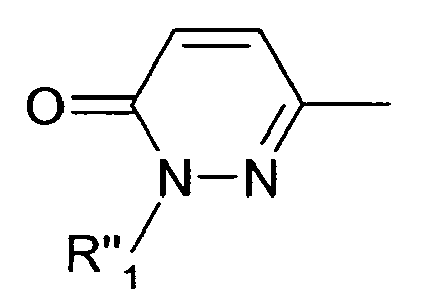 R3 represents hydrogen, -(CH2)m-NRR', -(CH2)m-OR, (C1-C6) linear or branched alkyl, (C3-C6) cyclic alkyl, or R3 represents (C6-C10) aryl or (C7-C12) aralkyl or a 5 or 6 membered heterocycle containing 1 to 3 heteroatoms selected from N, O and S, all being possibly substituted by halogen, CF3, (C1-C6) linear or branched alkyl and (C1-C6) linear or branched alkoxy, m is 0, 1 or 2 and R and R'are defined as above and R'3 represents hydrogen,or R3 and R'3 represent (C1-C6) linear or branched alkyl or form together a (C3-C6) spiro ring;R4 and R'4, identical or different, represent hydrogen or (C1-C6) linear or branched alkyl optionally substituted by 1 to 3 halogens or R4 represents a (C1-C6) linear or branched alkoxy carbonyl group and R'4 represents hydrogen;R5 represents methyl optionally substituted by one to three halogens;R6 represents hydrogen, (C1-C6) linear or branched alkyl or (C7-C12) aralkyl;R7 represents hydrogen, fluorine, NO2, CF3 or CN;in the form of mixtures of enantiomers or single enantiomers,
as well as their addition salts with mineral and organic acids and their salts with mineral or organic bases. - The compounds of formula (I) according to claim 1, in which R4, R'4 and R6 represent hydrogen, R5 represents methyl, and R7 represents fluorine.
- The compounds of formula (I) according to claim 1 or 2, in which R1 and R2 form a 5 or 6 membered carbon cycle optionally substituted as defined in claim 1.
- The compounds of formula (I) according to any of claims 1 to 3, in which R1 and R2 form a 5 membered carbon cycle, represented by the formula (I1):

- The compounds of formula (I) according to claim 1 or 2, in which R1 represents a CO-R'1 radical, wherein R'1 represents a 5 or 6 membered heterocycle containing 1 to 3 heteroatoms selected from N, O and S, optionally substituted by 1 or 2 (C1-C6) linear or branched alkyls, and R2 represents hydrogen.
- The compounds of formula (I) according to claim 1 or 2, in which R1 represents a radical of formula:

- Any one of the compounds of formula (I) according to claim 1, the names of which follow:8-Fluoro-3-methyl-9-(octahydro-pyrido[1,2-a]pyrazin-2-yl)-6-oxo-2,3-dihydro-6H-1-oxa-3,3a-diaza-phenalene-5-carboxylic acid,8-Fluoro-9-(hexahydro-pyrrolo[1,2-a]pyrazin-2-yl)-3-methyl-6-oxo-2,3-dihydro-6H-1-oxa-3,3a-diaza-phenalene-5-carboxylic acid,8-Fluoro-9-(S)-hexahydro-pyrrolo[1,2-a]pyrazin-2-yl-3-methyl-6-oxo-2,3-dihydro-6H-1-oxa-3,3a-diaza-phenalene-5-carboxylic acid,8-Fluoro-9-(R)-hexahydro-pyrrolo[1,2-a]pyrazin-2-yl-3-methyl-6-oxo-2,3-dihydro-6H-1-oxa-3,3a-diaza-phenalene-5-carboxylic acid,8-Fluoro-3-methyl-9-[4-(1-methyl-1H-pyrrole-2-carbonyl)-piperazin-1-yl]-6-oxo-2,3-dihydro-6H-1-oxa-3,3a-diaza-phenalene-5-carboxylic acid,9-[4-(2,3-dihydro-thiazole-4-carbonyl)-piperazin-1-yl]-8-fluoro-3-methyl-6-oxo-2,3-dihydro-6H-1-oxa-3,3a-diaza-phenalene-5-carboxylic acid,8-Fluoro-3-methyl-9-[4-(4-methyl-thiazole-5-carbonyl)-piperazin-1-yl]-6-oxo-2,3-dihydro-6H-1-oxa-3,3a-diaza-phenalene-5-carboxylic acid,8-Fluoro-3-methyl-6-oxo-9-[4-(thiophene-2-carbonyl)-piperazin-1-yl]-2,3-dihydro-6H-1-oxa-3,3a-diaza-phenalene-5-carboxylic acid,8-Fluoro-9-[4-(furan-2-carbonyl)-piperazin-1-yl]-3-methyl-6-oxo-2,3-dihydro-6H-1-oxa-3,3a-diaza-phenalene-5-carboxylic acid,8-Fluroro-3-methyl-9-{4-[1-(2-morpholin-4-yl-ethyl)-6-oxo-1,6-dihydro-pyridazin-3-yl]-piperazin-1-yl}-6-oxo-2,3-dihydro-6H-1-oxa-3,3a-diaza-phenalene-5-carboxylic acid,8-fluoro-9-{4-[1-(3-methoxy-benzyl)-6-oxo-1,6-dihydro-pyridazin-3-yl]-piperazin-1-yl}-3-methyl-6-oxo-2,3-dihydro-6H-1-oxa-3,3a-diaza-phenalene-5-carboxylic acid,as well as their salts.
- Method for the preparation of the compounds of formula (I) as defined in claim 1, characterized in that a compound of formula (II):


- As medicaments, the products of formula (I) as defined in any one of claims 1 to 3, 5 or 6, as well as their salts with the pharmaceutically acceptable acids and bases.
- As medicaments, the products of formula (I1)as defined in claim 4, as well as their salts with the pharmaceutically acceptable acids and bases.
- As medicaments, the products of formula (I) as defined in claim 7, as well as their salts with the pharmaceutically acceptable acids and bases.
- Pharmaceutical compositions containing, as active ingredient, at least one medicament according to claims 9, 10 and 11.
Priority Applications (27)
| Application Number | Priority Date | Filing Date | Title |
|---|---|---|---|
| EP08290678A EP2145891A1 (en) | 2008-07-09 | 2008-07-09 | 9-substituted-5-carboxy-oxadiazino-quinolone derivatives, their preparation and their application as anti-bacterials |
| TW098118150A TW201002717A (en) | 2008-07-09 | 2009-06-02 | Novel 9-substituted-5-carboxy-oxadiazino-quinolone derivatives, their preparation and their application as anti-bacterials |
| ARP090102249A AR072208A1 (en) | 2008-07-09 | 2009-06-19 | DERIVATIVES OF 5-CARBOXI-OXADIACINO-QUINOLONA 9-REPLACED, PHARMACEUTICAL COMPOSITIONS CONTAINING THEM, METHOD OF PREPARATION AND USE OF THE SAME AS ANTIBACTERIAL AGENTS. |
| US12/489,528 US8071590B2 (en) | 2008-07-09 | 2009-06-23 | 9-substituted-5-carboxy-oxadiazino-quinolone derivatives, their preparation and their application as anti-bacterials |
| SI200930233T SI2310395T1 (en) | 2008-07-09 | 2009-06-30 | 9-substituted-b-carboxy-oxadiazino-quinolone derivatives, their preparation and their application as anti-bacterials |
| HK11105454.5A HK1151521B (en) | 2008-07-09 | 2009-06-30 | 9-substituted-b-carboxy-oxadiazino-quinolone derivatives, their preparation and their application as anti-bacterials |
| EA201170164A EA201170164A1 (en) | 2008-07-09 | 2009-06-30 | 9-SUBSTITUTED-IN-CARBOXYOXADIAZINOHINOLINE DERIVATIVES, THEIR OBTAINING AND THEIR USE AS ANTIBACTERIAL MEANS |
| HRP20120329AT HRP20120329T1 (en) | 2008-07-09 | 2009-06-30 | 9-substituted-b-carboxy-oxadiazino-quinolone derivatives, their preparation and their application as anti-bacterials |
| CN2009801265488A CN102089313A (en) | 2008-07-09 | 2009-06-30 | 9-substituted-b-carboxy-oxadiazino-quinolone derivatives, their preparation and their application as anti-bacterials |
| DK09794051.4T DK2310395T3 (en) | 2008-07-09 | 2009-06-30 | 9-Substituted 5-carboxyoxadiazinoquinolone derivatives, their preparation and their use as antibacterial agents |
| CA2727820A CA2727820A1 (en) | 2008-07-09 | 2009-06-30 | 9-substituted-5-carboxy-oxadiazino-quinolone derivatives, their preparation and their application as anti-bacterials |
| PCT/IB2009/006110 WO2010004394A1 (en) | 2008-07-09 | 2009-06-30 | 9-substituted-b-carboxy-oxadiazino-quinolone derivatives, their preparation and their application as anti-bacterials |
| AT09794051T ATE541849T1 (en) | 2008-07-09 | 2009-06-30 | 9-SUBSTITUTED B-CARBOXY-OXADIAZINE-QUINOLONE DERIVATIVES, THEIR PREPARATION AND THEIR USE AS ANTIBACTERIAL AGENTS |
| MX2011000313A MX2011000313A (en) | 2008-07-09 | 2009-06-30 | 9-substituted-b-carboxy-oxadiazino-quinolone derivatives, their preparation and their application as anti-bacterials. |
| AU2009269735A AU2009269735A1 (en) | 2008-07-09 | 2009-06-30 | 9-substituted-5-carboxy-oxadiazino-quinolone derivatives, their preparation and their application as anti-bacterials |
| EP09794051A EP2310395B1 (en) | 2008-07-09 | 2009-06-30 | 9-substituted-b-carboxy-oxadiazino-quinolone derivatives, their preparation and their application as anti-bacterials |
| NZ590367A NZ590367A (en) | 2008-07-09 | 2009-06-30 | 9-Substituted-5-carboxy-oxadiazino-quinolone derivatives, their preparation and their application as anti-bacterials |
| PT09794051T PT2310395E (en) | 2008-07-09 | 2009-06-30 | 9-substituted-b-carboxy-oxadiazino-quinolone derivatives, their preparation and their application as anti-bacterials |
| KR1020117002092A KR20110038071A (en) | 2008-07-09 | 2009-06-30 | 9-Substituted-5-carboxy-oxadiazino-quinolone derivatives, their preparation and their use as antibacterial agents |
| JP2011517257A JP2011527336A (en) | 2008-07-09 | 2009-06-30 | 9-Substituted-5-carboxy-oxadiazino-quinolone derivatives, their preparation and their application as antibacterial agents |
| BRPI0910786A BRPI0910786A2 (en) | 2008-07-09 | 2009-06-30 | 9-substituted-b-carboxy-oxadiazine quinolone derivatives, their preparation and their applications as a bactericide |
| PL09794051T PL2310395T3 (en) | 2008-07-09 | 2009-06-30 | 9-substituted-b-carboxy-oxadiazino-quinolone derivatives, their preparation and their application as anti-bacterials |
| ES09794051T ES2380906T3 (en) | 2008-07-09 | 2009-06-30 | New derivatives of 5-carboxy-oxadiacino-quinolone9-substituted, its preparation and its applications as antibacterial agents |
| IL210013A IL210013A0 (en) | 2008-07-09 | 2010-12-15 | 9-substituted-5-carboxy-oxadiazino-quinolone derivatives, their preparation and their application as anti-bacterials |
| CO10165119A CO6331342A2 (en) | 2008-07-09 | 2010-12-30 | DERIVATIVES OF 5-CARBOXI-OXADIACINO-QUINOLONA 9-REPLACED, ITS PREPARATION AND ITS APPLICATIONS AS ANTIBACTERIAL AGENTS |
| CL2011000041A CL2011000041A1 (en) | 2008-07-09 | 2011-01-07 | Oxadiazine-substituted quinolone derived compounds; pharmaceutical composition; preparation procedure; useful as antibacterials. |
| CY20121100306T CY1112729T1 (en) | 2008-07-09 | 2012-03-23 | 9-Substituted-B-carboxy-oxadiazine-quinolone derivative, their preparation and their application as anti-bacterial |
Applications Claiming Priority (1)
| Application Number | Priority Date | Filing Date | Title |
|---|---|---|---|
| EP08290678A EP2145891A1 (en) | 2008-07-09 | 2008-07-09 | 9-substituted-5-carboxy-oxadiazino-quinolone derivatives, their preparation and their application as anti-bacterials |
Publications (1)
| Publication Number | Publication Date |
|---|---|
| EP2145891A1 true EP2145891A1 (en) | 2010-01-20 |
Family
ID=40011090
Family Applications (2)
| Application Number | Title | Priority Date | Filing Date |
|---|---|---|---|
| EP08290678A Withdrawn EP2145891A1 (en) | 2008-07-09 | 2008-07-09 | 9-substituted-5-carboxy-oxadiazino-quinolone derivatives, their preparation and their application as anti-bacterials |
| EP09794051A Active EP2310395B1 (en) | 2008-07-09 | 2009-06-30 | 9-substituted-b-carboxy-oxadiazino-quinolone derivatives, their preparation and their application as anti-bacterials |
Family Applications After (1)
| Application Number | Title | Priority Date | Filing Date |
|---|---|---|---|
| EP09794051A Active EP2310395B1 (en) | 2008-07-09 | 2009-06-30 | 9-substituted-b-carboxy-oxadiazino-quinolone derivatives, their preparation and their application as anti-bacterials |
Country Status (25)
| Country | Link |
|---|---|
| US (1) | US8071590B2 (en) |
| EP (2) | EP2145891A1 (en) |
| JP (1) | JP2011527336A (en) |
| KR (1) | KR20110038071A (en) |
| CN (1) | CN102089313A (en) |
| AR (1) | AR072208A1 (en) |
| AT (1) | ATE541849T1 (en) |
| AU (1) | AU2009269735A1 (en) |
| BR (1) | BRPI0910786A2 (en) |
| CA (1) | CA2727820A1 (en) |
| CL (1) | CL2011000041A1 (en) |
| CO (1) | CO6331342A2 (en) |
| CY (1) | CY1112729T1 (en) |
| DK (1) | DK2310395T3 (en) |
| EA (1) | EA201170164A1 (en) |
| ES (1) | ES2380906T3 (en) |
| HR (1) | HRP20120329T1 (en) |
| IL (1) | IL210013A0 (en) |
| MX (1) | MX2011000313A (en) |
| NZ (1) | NZ590367A (en) |
| PL (1) | PL2310395T3 (en) |
| PT (1) | PT2310395E (en) |
| SI (1) | SI2310395T1 (en) |
| TW (1) | TW201002717A (en) |
| WO (1) | WO2010004394A1 (en) |
Families Citing this family (2)
| Publication number | Priority date | Publication date | Assignee | Title |
|---|---|---|---|---|
| WO2013049164A1 (en) * | 2011-09-29 | 2013-04-04 | Abbvie Inc. | SUBSTITUTED OCTAHYDROPYRROLO[1,2-a]PYRAZINES AS CALCIUM CHANNEL BLOCKERS |
| EP3828174A4 (en) * | 2018-07-19 | 2022-08-17 | Sumitomo Pharma Co., Ltd. | PYRIDAZINONE DERIVATIVE |
Citations (11)
| Publication number | Priority date | Publication date | Assignee | Title |
|---|---|---|---|---|
| EP0259804A2 (en) | 1986-09-12 | 1988-03-16 | F. Hoffmann-La Roche Ag | Pyrido[3,2,1-ij]-1,3,4-benzoxadiazine derivatives, process for their preparation, resulting pharmaceutical preparations and intermediates for use in the process |
| EP0343524A1 (en) | 1988-05-23 | 1989-11-29 | Shionogi Seiyaku Kabushiki Kaisha | Pyridonecarboxylic acids and antibacterial agents |
| EP0394553A2 (en) | 1989-04-28 | 1990-10-31 | Daiichi Pharmaceutical Co., Ltd. | Use of fluorine containing pyridone carboxylic acid derivatives for preparing a medicament for the treatment of HIV infections |
| US4990517A (en) | 1988-07-15 | 1991-02-05 | Bayer Aktiengesellschaft | 7-(1-pyrrolidinyl)-3-quinolone- and -naphthyridonecarboxylic acid derivatives as antibacterial agents and feed additives |
| EP0470252A1 (en) | 1989-04-28 | 1992-02-12 | Daiichi Pharmaceutical Co., Ltd. | Anti-hiv drug |
| EP0647644A1 (en) * | 1993-09-02 | 1995-04-12 | Bayer Ag | Antibacterial pyrido 1,2,3-d,e 1,3,4 benzoxacin derivatives |
| EP0682030A1 (en) * | 1994-05-11 | 1995-11-15 | Bayer Ag | 8-Amino-10(azabicycloalkyl)-pyrido[1,2,3-d,e] [1,3,4] benzoxadiazine derivatives, process for their preparation and antibacterial agents containing them |
| EP0688772A1 (en) | 1994-06-16 | 1995-12-27 | LG Chemical Limited | Novel quinoline carboxylic acid derivatives having 7-(4-amino-methyl-3-oxime) pyrrolidine substituents and processes for their preparation |
| US5480879A (en) | 1992-10-09 | 1996-01-02 | Bayer Aktiengesellschaft | Quinolonecarboxylic acids |
| WO2004096221A1 (en) * | 2003-04-30 | 2004-11-11 | Morphochem Aktiengesellschaft für kombinatorische Chemie | Use of oxazolidinone-quinoline hybrid antibiotics for the treatment of anthrax and other infections |
| WO2007085760A2 (en) * | 2006-01-24 | 2007-08-02 | Sa Vetoquinol | Anti-infective solution comprising a compound of pyrido(3,2,1-ij)-benzoxadiazine type |
Family Cites Families (22)
| Publication number | Priority date | Publication date | Assignee | Title |
|---|---|---|---|---|
| CS274601B2 (en) * | 1983-07-27 | 1991-09-15 | Dainippon Pharmaceutical Co | Method of 1,8-naphthyridine derivative production |
| ZW16387A1 (en) * | 1986-09-12 | 1988-05-25 | Hoffmann La Roche | Tricyclic compounds |
| US5646163A (en) * | 1992-10-30 | 1997-07-08 | The Procter & Gamble Company | Quinolone 5-(N-heterosubstituted amino) antimicrobials |
| US5354747A (en) * | 1993-06-16 | 1994-10-11 | G. D. Searle & Co. | 2-, 3-, 4-, 5-, 6-, 7-, 8-, 9- and/or 10-substituted dibenzoxazepine and dibenzthiazepine compounds, pharmaceutical compositions and methods of use |
| US5576314A (en) * | 1994-12-12 | 1996-11-19 | Allelix Biopharmaceuticals Inc. | Bicyclic nonane and decane compounds having dopamine receptor affinity |
| GB9601356D0 (en) | 1996-01-24 | 1996-03-27 | Pfizer | Novel compound |
| JPH09323932A (en) * | 1996-01-31 | 1997-12-16 | Sankyo Co Ltd | AIDS treatment or prevention agent |
| EP0982030A3 (en) * | 1998-08-17 | 2000-05-10 | Pfizer Products Inc. | 2,7-substituted octahydro-pyrrolo 1,2-a]pyrazine derivatives as 5ht 1a ligands |
| CN1258531C (en) | 1999-03-10 | 2006-06-07 | 第一制药株式会社 | Aromatic Substituent Substituted Aminomethylpyrrolidine Derivatives |
| WO2003048136A1 (en) * | 2001-11-29 | 2003-06-12 | Merck & Co., Inc. | Cyclopropyl hexane containing oxazolidinone antibiotics and derivatives thereof |
| SE0202133D0 (en) | 2002-07-08 | 2002-07-08 | Astrazeneca Ab | Novel compounds |
| MXPA05001277A (en) * | 2002-08-02 | 2005-10-06 | Ab Science | 2-(3-aminoaryl)amino-4-aryl-thiazoles and their use as c-kit inhibitors. |
| BRPI0414319A (en) | 2003-09-12 | 2006-11-07 | Warner Lambert Co | quinolone antibacterial agents |
| ATE465731T1 (en) * | 2003-10-23 | 2010-05-15 | Ab Science | 2-AMINOARYLOXAZOLE COMPOUNDS AS TYROSINE KINASE INHIBITORS |
| US20080039466A1 (en) * | 2004-01-30 | 2008-02-14 | Ab Science | 2-(3-Substituted-Aryl) Amino-4-Aryl-Thiazoles As Tyrosine Kinase Inhibitors |
| JP2008512442A (en) | 2004-09-07 | 2008-04-24 | ファイザー・インク | Inhibitor of HIV integrase enzyme |
| ES2336130T3 (en) | 2004-10-18 | 2010-04-08 | Eli Lilly And Company | DERIVATIVES 1- (HETERO) ARIL-3-AMINO-PIRROLIDINA FOR USE AS ANGLINGIST OF THE MGLUR3 RECEIVER. |
| CA2593428C (en) | 2005-01-10 | 2012-04-17 | Pfizer Inc. | Pyrrolopyrazoles, potent kinase inhibitors |
| US20080221107A1 (en) | 2005-07-15 | 2008-09-11 | Astrazeneca Ab | Therapeutic Agents |
| RU2008109031A (en) | 2005-08-11 | 2009-09-20 | Вертекс Фармасьютикалз Инкорпорейтед (Us) | FLOWMAN TRANSMEMBRANE CONDUCTIVITY REGULATOR MODULATORS |
| DK1928886T3 (en) | 2005-09-09 | 2011-07-11 | Glaxosmithkline Llc | Pyridine derivatives and their use in the treatment of psychotic disorders |
| FR2928150A1 (en) * | 2008-02-29 | 2009-09-04 | Vetoquinol Sa Sa | NOVEL 7-SUBSTITUTED 3-CARBOXY-OXADIAZINO-QUINOLONES DERIVATIVES, THEIR PREPARATION AND APPLICATION AS ANTI-BACTERIANS |
-
2008
- 2008-07-09 EP EP08290678A patent/EP2145891A1/en not_active Withdrawn
-
2009
- 2009-06-02 TW TW098118150A patent/TW201002717A/en unknown
- 2009-06-19 AR ARP090102249A patent/AR072208A1/en not_active Application Discontinuation
- 2009-06-23 US US12/489,528 patent/US8071590B2/en not_active Expired - Fee Related
- 2009-06-30 BR BRPI0910786A patent/BRPI0910786A2/en not_active IP Right Cessation
- 2009-06-30 NZ NZ590367A patent/NZ590367A/en not_active IP Right Cessation
- 2009-06-30 JP JP2011517257A patent/JP2011527336A/en active Pending
- 2009-06-30 HR HRP20120329AT patent/HRP20120329T1/en unknown
- 2009-06-30 SI SI200930233T patent/SI2310395T1/en unknown
- 2009-06-30 AT AT09794051T patent/ATE541849T1/en active
- 2009-06-30 CN CN2009801265488A patent/CN102089313A/en active Pending
- 2009-06-30 WO PCT/IB2009/006110 patent/WO2010004394A1/en not_active Ceased
- 2009-06-30 AU AU2009269735A patent/AU2009269735A1/en not_active Abandoned
- 2009-06-30 CA CA2727820A patent/CA2727820A1/en not_active Abandoned
- 2009-06-30 EA EA201170164A patent/EA201170164A1/en unknown
- 2009-06-30 EP EP09794051A patent/EP2310395B1/en active Active
- 2009-06-30 PT PT09794051T patent/PT2310395E/en unknown
- 2009-06-30 PL PL09794051T patent/PL2310395T3/en unknown
- 2009-06-30 KR KR1020117002092A patent/KR20110038071A/en not_active Withdrawn
- 2009-06-30 DK DK09794051.4T patent/DK2310395T3/en active
- 2009-06-30 ES ES09794051T patent/ES2380906T3/en active Active
- 2009-06-30 MX MX2011000313A patent/MX2011000313A/en active IP Right Grant
-
2010
- 2010-12-15 IL IL210013A patent/IL210013A0/en unknown
- 2010-12-30 CO CO10165119A patent/CO6331342A2/en active IP Right Grant
-
2011
- 2011-01-07 CL CL2011000041A patent/CL2011000041A1/en unknown
-
2012
- 2012-03-23 CY CY20121100306T patent/CY1112729T1/en unknown
Patent Citations (12)
| Publication number | Priority date | Publication date | Assignee | Title |
|---|---|---|---|---|
| EP0259804A2 (en) | 1986-09-12 | 1988-03-16 | F. Hoffmann-La Roche Ag | Pyrido[3,2,1-ij]-1,3,4-benzoxadiazine derivatives, process for their preparation, resulting pharmaceutical preparations and intermediates for use in the process |
| EP0343524A1 (en) | 1988-05-23 | 1989-11-29 | Shionogi Seiyaku Kabushiki Kaisha | Pyridonecarboxylic acids and antibacterial agents |
| US4990517A (en) | 1988-07-15 | 1991-02-05 | Bayer Aktiengesellschaft | 7-(1-pyrrolidinyl)-3-quinolone- and -naphthyridonecarboxylic acid derivatives as antibacterial agents and feed additives |
| EP0394553A2 (en) | 1989-04-28 | 1990-10-31 | Daiichi Pharmaceutical Co., Ltd. | Use of fluorine containing pyridone carboxylic acid derivatives for preparing a medicament for the treatment of HIV infections |
| EP0470252A1 (en) | 1989-04-28 | 1992-02-12 | Daiichi Pharmaceutical Co., Ltd. | Anti-hiv drug |
| US5480879A (en) | 1992-10-09 | 1996-01-02 | Bayer Aktiengesellschaft | Quinolonecarboxylic acids |
| EP0647644A1 (en) * | 1993-09-02 | 1995-04-12 | Bayer Ag | Antibacterial pyrido 1,2,3-d,e 1,3,4 benzoxacin derivatives |
| EP0682030A1 (en) * | 1994-05-11 | 1995-11-15 | Bayer Ag | 8-Amino-10(azabicycloalkyl)-pyrido[1,2,3-d,e] [1,3,4] benzoxadiazine derivatives, process for their preparation and antibacterial agents containing them |
| US5679675A (en) | 1994-05-11 | 1997-10-21 | Bayer Aktiengesellschaft | 8-amino-10-(azabicycloalkyl)-pyrido 1,2,3-d,e! 1,3,4!benzoxadiazine derivatives |
| EP0688772A1 (en) | 1994-06-16 | 1995-12-27 | LG Chemical Limited | Novel quinoline carboxylic acid derivatives having 7-(4-amino-methyl-3-oxime) pyrrolidine substituents and processes for their preparation |
| WO2004096221A1 (en) * | 2003-04-30 | 2004-11-11 | Morphochem Aktiengesellschaft für kombinatorische Chemie | Use of oxazolidinone-quinoline hybrid antibiotics for the treatment of anthrax and other infections |
| WO2007085760A2 (en) * | 2006-01-24 | 2007-08-02 | Sa Vetoquinol | Anti-infective solution comprising a compound of pyrido(3,2,1-ij)-benzoxadiazine type |
Non-Patent Citations (3)
| Title |
|---|
| J. MED. CHEM, vol. 39, 1996, pages 3070 - 388 |
| J. MED. CHEM, vol. 45, 2002, pages 5564 - 5575 |
| J. MED. CHEM, vol. 47, 2004, pages 2097 - 2109 |
Also Published As
| Publication number | Publication date |
|---|---|
| SI2310395T1 (en) | 2012-06-29 |
| PL2310395T3 (en) | 2012-09-28 |
| MX2011000313A (en) | 2011-06-01 |
| EA201170164A1 (en) | 2011-12-30 |
| AU2009269735A1 (en) | 2010-01-14 |
| CL2011000041A1 (en) | 2011-07-15 |
| BRPI0910786A2 (en) | 2017-05-16 |
| CO6331342A2 (en) | 2011-10-20 |
| US20100009980A1 (en) | 2010-01-14 |
| PT2310395E (en) | 2012-04-26 |
| NZ590367A (en) | 2012-08-31 |
| JP2011527336A (en) | 2011-10-27 |
| CY1112729T1 (en) | 2016-02-10 |
| IL210013A0 (en) | 2011-02-28 |
| CN102089313A (en) | 2011-06-08 |
| HK1151521A1 (en) | 2012-02-03 |
| HRP20120329T1 (en) | 2012-05-31 |
| WO2010004394A1 (en) | 2010-01-14 |
| TW201002717A (en) | 2010-01-16 |
| CA2727820A1 (en) | 2010-01-14 |
| AR072208A1 (en) | 2010-08-11 |
| ATE541849T1 (en) | 2012-02-15 |
| EP2310395B1 (en) | 2012-01-18 |
| KR20110038071A (en) | 2011-04-13 |
| US8071590B2 (en) | 2011-12-06 |
| ES2380906T3 (en) | 2012-05-21 |
| DK2310395T3 (en) | 2012-04-16 |
| EP2310395A1 (en) | 2011-04-20 |
Similar Documents
| Publication | Publication Date | Title |
|---|---|---|
| EP1730154B1 (en) | Rifamycin derivatives effective against drug-resistant microbes | |
| Hubschwerlen et al. | Pyrimido [1, 6-a] benzimidazoles: a new class of DNA gyrase inhibitors | |
| US7238694B2 (en) | Rifamycin imino derivatives effective against drug-resistant microbes | |
| US7250413B2 (en) | C-25 carbamate rifamycin derivatives with activity against drug-resistant microbes | |
| US5654318A (en) | Bicyclic amine derivatives | |
| AU2005279050A1 (en) | Hybrid molecules QA where Q is an aminoquinoline and A is an antibiotic residue, and the synthesis and uses thereof as antibacterial agents | |
| US7713965B2 (en) | 7-substituted 3-carboxy-oxadiazino-quinolone derivatives, their preparation and their application as anti-bacterials | |
| EP2310395B1 (en) | 9-substituted-b-carboxy-oxadiazino-quinolone derivatives, their preparation and their application as anti-bacterials | |
| IE872444L (en) | Pyrido-benzoxadiazine derivatives | |
| IE58390B1 (en) | Naphthyridine antibacterial compounds | |
| JPH02290870A (en) | Enantiomerically pure 7-(3-amino-1- pyrrolidinyl)-quinolone- and naphthyridonecarboxylic acid | |
| HK1151521B (en) | 9-substituted-b-carboxy-oxadiazino-quinolone derivatives, their preparation and their application as anti-bacterials | |
| EP0488227B1 (en) | Optically active pyridobenzoxazine derivatives | |
| NZ516621A (en) | B-group streptogramin derivatives, production thereof and compositions containing the same | |
| CA1340782C (en) | Naphthyridone antibacterial compounds | |
| RU2644780C2 (en) | Semi-synthetic derivatives of heliomycin inhibiting tumor growth |
Legal Events
| Date | Code | Title | Description |
|---|---|---|---|
| PUAI | Public reference made under article 153(3) epc to a published international application that has entered the european phase |
Free format text: ORIGINAL CODE: 0009012 |
|
| AK | Designated contracting states |
Kind code of ref document: A1 Designated state(s): AT BE BG CH CY CZ DE DK EE ES FI FR GB GR HR HU IE IS IT LI LT LU LV MC MT NL NO PL PT RO SE SI SK TR |
|
| AX | Request for extension of the european patent |
Extension state: AL BA MK RS |
|
| 17P | Request for examination filed |
Effective date: 20100720 |
|
| AKX | Designation fees paid |
Designated state(s): AT BE BG CH CY CZ DE DK EE ES FI FR GB GR HR HU IE IS IT LI LT LU LV MC MT NL NO PL PT RO SE SI SK TR |
|
| GRAP | Despatch of communication of intention to grant a patent |
Free format text: ORIGINAL CODE: EPIDOSNIGR1 |
|
| STAA | Information on the status of an ep patent application or granted ep patent |
Free format text: STATUS: THE APPLICATION IS DEEMED TO BE WITHDRAWN |
|
| 18D | Application deemed to be withdrawn |
Effective date: 20110525 |