EP2145885A1 - Hydrazide compound and harmful arthropod-controlling agent containing the same - Google Patents
Hydrazide compound and harmful arthropod-controlling agent containing the same Download PDFInfo
- Publication number
- EP2145885A1 EP2145885A1 EP08740166A EP08740166A EP2145885A1 EP 2145885 A1 EP2145885 A1 EP 2145885A1 EP 08740166 A EP08740166 A EP 08740166A EP 08740166 A EP08740166 A EP 08740166A EP 2145885 A1 EP2145885 A1 EP 2145885A1
- Authority
- EP
- European Patent Office
- Prior art keywords
- group
- optionally halogenated
- compound
- formula
- alkyl group
- Prior art date
- Legal status (The legal status is an assumption and is not a legal conclusion. Google has not performed a legal analysis and makes no representation as to the accuracy of the status listed.)
- Withdrawn
Links
- 0 CC(*)=C(*)C(N(*)C(I)=O)=C(C(*)=C)C(**)=O Chemical compound CC(*)=C(*)C(N(*)C(I)=O)=C(C(*)=C)C(**)=O 0.000 description 8
- MDLCQCRPZAVXBA-UHFFFAOYSA-N COC(N(CCCC1)N1C(C(CC(C=C1Br)Br)=C1N)=O)=O Chemical compound COC(N(CCCC1)N1C(C(CC(C=C1Br)Br)=C1N)=O)=O MDLCQCRPZAVXBA-UHFFFAOYSA-N 0.000 description 1
Classifications
-
- C—CHEMISTRY; METALLURGY
- C07—ORGANIC CHEMISTRY
- C07D—HETEROCYCLIC COMPOUNDS
- C07D401/00—Heterocyclic compounds containing two or more hetero rings, having nitrogen atoms as the only ring hetero atoms, at least one ring being a six-membered ring with only one nitrogen atom
- C07D401/14—Heterocyclic compounds containing two or more hetero rings, having nitrogen atoms as the only ring hetero atoms, at least one ring being a six-membered ring with only one nitrogen atom containing three or more hetero rings
-
- A—HUMAN NECESSITIES
- A01—AGRICULTURE; FORESTRY; ANIMAL HUSBANDRY; HUNTING; TRAPPING; FISHING
- A01N—PRESERVATION OF BODIES OF HUMANS OR ANIMALS OR PLANTS OR PARTS THEREOF; BIOCIDES, e.g. AS DISINFECTANTS, AS PESTICIDES OR AS HERBICIDES; PEST REPELLANTS OR ATTRACTANTS; PLANT GROWTH REGULATORS
- A01N43/00—Biocides, pest repellants or attractants, or plant growth regulators containing heterocyclic compounds
- A01N43/48—Biocides, pest repellants or attractants, or plant growth regulators containing heterocyclic compounds having rings with two nitrogen atoms as the only ring hetero atoms
- A01N43/56—1,2-Diazoles; Hydrogenated 1,2-diazoles
-
- A—HUMAN NECESSITIES
- A01—AGRICULTURE; FORESTRY; ANIMAL HUSBANDRY; HUNTING; TRAPPING; FISHING
- A01N—PRESERVATION OF BODIES OF HUMANS OR ANIMALS OR PLANTS OR PARTS THEREOF; BIOCIDES, e.g. AS DISINFECTANTS, AS PESTICIDES OR AS HERBICIDES; PEST REPELLANTS OR ATTRACTANTS; PLANT GROWTH REGULATORS
- A01N47/00—Biocides, pest repellants or attractants, or plant growth regulators containing organic compounds containing a carbon atom not being member of a ring and having no bond to a carbon or hydrogen atom, e.g. derivatives of carbonic acid
- A01N47/08—Biocides, pest repellants or attractants, or plant growth regulators containing organic compounds containing a carbon atom not being member of a ring and having no bond to a carbon or hydrogen atom, e.g. derivatives of carbonic acid the carbon atom having one or more single bonds to nitrogen atoms
- A01N47/10—Carbamic acid derivatives, i.e. containing the group —O—CO—N<; Thio analogues thereof
- A01N47/16—Carbamic acid derivatives, i.e. containing the group —O—CO—N<; Thio analogues thereof the nitrogen atom being part of a heterocyclic ring
-
- A—HUMAN NECESSITIES
- A01—AGRICULTURE; FORESTRY; ANIMAL HUSBANDRY; HUNTING; TRAPPING; FISHING
- A01N—PRESERVATION OF BODIES OF HUMANS OR ANIMALS OR PLANTS OR PARTS THEREOF; BIOCIDES, e.g. AS DISINFECTANTS, AS PESTICIDES OR AS HERBICIDES; PEST REPELLANTS OR ATTRACTANTS; PLANT GROWTH REGULATORS
- A01N47/00—Biocides, pest repellants or attractants, or plant growth regulators containing organic compounds containing a carbon atom not being member of a ring and having no bond to a carbon or hydrogen atom, e.g. derivatives of carbonic acid
- A01N47/08—Biocides, pest repellants or attractants, or plant growth regulators containing organic compounds containing a carbon atom not being member of a ring and having no bond to a carbon or hydrogen atom, e.g. derivatives of carbonic acid the carbon atom having one or more single bonds to nitrogen atoms
- A01N47/28—Ureas or thioureas containing the groups >N—CO—N< or >N—CS—N<
- A01N47/34—Ureas or thioureas containing the groups >N—CO—N< or >N—CS—N< containing the groups, e.g. biuret; Thio analogues thereof; Urea-aldehyde condensation products
-
- A—HUMAN NECESSITIES
- A01—AGRICULTURE; FORESTRY; ANIMAL HUSBANDRY; HUNTING; TRAPPING; FISHING
- A01N—PRESERVATION OF BODIES OF HUMANS OR ANIMALS OR PLANTS OR PARTS THEREOF; BIOCIDES, e.g. AS DISINFECTANTS, AS PESTICIDES OR AS HERBICIDES; PEST REPELLANTS OR ATTRACTANTS; PLANT GROWTH REGULATORS
- A01N47/00—Biocides, pest repellants or attractants, or plant growth regulators containing organic compounds containing a carbon atom not being member of a ring and having no bond to a carbon or hydrogen atom, e.g. derivatives of carbonic acid
- A01N47/08—Biocides, pest repellants or attractants, or plant growth regulators containing organic compounds containing a carbon atom not being member of a ring and having no bond to a carbon or hydrogen atom, e.g. derivatives of carbonic acid the carbon atom having one or more single bonds to nitrogen atoms
- A01N47/28—Ureas or thioureas containing the groups >N—CO—N< or >N—CS—N<
- A01N47/38—Ureas or thioureas containing the groups >N—CO—N< or >N—CS—N< containing the group >N—CO—N< where at least one nitrogen atom is part of a heterocyclic ring; Thio analogues thereof
Definitions
- the present invention relates to a hydrazide compound and a harmful arthropod controlling agent containing the same.
- WO 01/70671 discloses certain amide compounds for controlling harmful arthropods.
- An object of the present invention is to provide a hydrazide compound represented by the following formula (1) which has an excellent controlling activity on harmful arthropods.
- the present invention provides:
- the present compound has an excellent controlling activity on harmful arthropods and is therefore useful as an active ingredient of a harmful arthropod controlling agent.
- examples of the "halogen atom” include a fluorine atom, a chlorine atom, a bromine atom and an iodine atom.
- C3-C6 polymethylene group examples include a trimethylene group, a tetramethylene group, a pentamethylene group and a hexamethylene group.
- C1-C4 alkyl group examples include a methyl group, an ethyl group, a propyl group, a butyl group, an isopropyl group, an isobutyl group, a sec-butyl group and a tert-butyl group.
- Examples of the "optionally halogenated C1-C6 alkyl group” include a methyl group, a trifluoromethyl group, a trichloromethyl group, a chloromethyl group, a dichloromethyl group, a fluoromethyl group, a difluoromethyl group, an ethyl group, a pentafluoroethyl group, a 2,2,2-trifluoroethyl group, a 2,2,2-trichloroethyl group, a propyl group, an isopropyl group, a heptafluoroisopropyl group, a butyl group, an isobutyl group, a sec-butyl group, a tert-butyl group, a pentyl group and a hexyl group.
- Examples of the "optionally halogenated C2-C6 alkenyl group” include a vinyl group, a 1-propenyl group, a 2-propenyl group, a 1-methylvinyl group, a 2-chlorovinyl group and a 2-methyl-1-propenyl group.
- Examples of the "optionally halogenated C3-C6 alkenyl group” include a 2-propenyl group, a 3-chloro-2-propenyl group, a 2-chloro-2-propenyl group, a 3,3-dichloro-2-propenyl group, a 3-bromo-2-propenyl group, a 2-bromo-2-propenyl group, a 3,3-dibromo-2-propenyl group, a 2-butenyl group, a 3-butenyl group, a 1-methyl-2-propenyl group, a 2-methyl-2-propenyl group, a 3-methyl-2-butenyl group, a 2-pentenyl group and a 2-hexenyl group.
- Examples of the "optionally halogenated C2-C6 alkynyl group” include an ethynyl group, a 2-propynyl group, a 3-chloro-2-propynyl group, a 3-bromo-2-propynyl group, a 1-methyl-2-propynyl group, a 2-butynyl group and a 3-butynyl group.
- Examples of the "optionally halogenated C3-C6 alkynyl group” include a 2-propynyl group, a 3-chloro-2-propynyl group, a 3-bromo-2-propynyl group, a 1-methyl-2-propynyl group, a 2-butynyl group and a 3-butynyl group.
- C2-C6 cyanoalkyl group examples include a cyanomethyl group, a 1-cyanoethyl group, a 2-cyanoethyl group, a 2-cyanopropyl group, a 1-cyano-2-propyl group, a 1-cyano-2-methyl-2-propyl group, a 3-cyano-2-butyl group, a 3-cyanopropyl group and a 4-cyanobutyl group.
- C2-C6 alkoxyalkyl group examples include a methoxyethyl group, a 1-methoxyethyl group, a 2-methoxyethyl group, a 2-ethoxyethyl group and a 2-isopropyloxyethyl group.
- C3-C6 alkoxyalkyl group examples include a 2-methoxyethyl group, a 2-ethoxyethyl group and a 2-isopropyloxyethyl group.
- C2-C6 alkoxycarbonyl group examples include a methoxycarbonyl group, an ethoxycarbonyl group, an isopropoxycarbonyl group and a tert-butoxycarbonyl group.
- Examples of the "1,3-butadiene-1,4-diyl group optionally substituted with a substituent C" include a 1,3-butadiene-1,4-diyl group, a 2-bromo-1,3-butadiene-1,4-diyl group, a 2-chloro-1,3-butadiene-1,4-diyl group, a 2-cyano-1,3-butadiene-1,4-diyl group and a 1-methyl-1,3-butadiene-1,4-diyl group.
- Examples of the "optionally halogenated C1-C6 alkoxy group" include a methoxy group, a trifluoromethoxy group, an ethoxy group, a 2,2,2-trifluoroethoxy group, a propyloxy group, an isopropyloxy group, a butoxy group, an isobutyloxy group, a sec-butoxy group, a tert-butoxy group, a pentyloxy group and a hexyloxy group.
- Examples of the "optionally halogenated C1-C6 alkylthio group” include a methylthio group, a trifluoromethylthio group and an ethylthio group.
- Examples of the "optionally halogenated C1-C6 alkylsulfinyl group” include a methylsulfinyl group, a trifluoromethylsulfinyl group and an ethylsulfinyl group.
- Examples of the "optionally halogenated C1-C6 alkylsulfonyl group” include a methylsulfonyl group, a trifluoromethylsulfonyl group and an ethylsulfonyl group.
- phenyl group optionally substituted with a substituent A examples include a phenyl group, a 2-chlorophenyl group, a 3-chlorophenyl group, a 4-chlorophenyl group, a 4-fluorophenyl group, a 4-bromophenyl group, a 4-iodophenyl group, a 2-cyanophenyl group, a 3-cyanophenyl group, a 4-cyanophenyl group, a 2-nitrophenyl group, a 3-nitrophenyl group, a 4-nitrophenyl group, a 2-methylphenyl group, a 3-methylphenyl group, a 4-methylphenyl group, a 2-(trifluoromethyl)phenyl group, a 3-(trifluoromethyl)phenyl group, a 4-(trifluoromethyl)phenyl group, a 2-methoxyphenyl group, a 3-methoxyphenyl group, a 4-methoxyphenyl group,
- Examples of the "C7-C9 phenylalkyl group whose benzene ring moiety may be substituted with a substituent A" include a benzyl group, a 1-phenylethyl group, a 2-phenylethyl group, a 2-chlorobenzyl group, a 3-chlorobenzyl group, a 4-chlorobenzyl group, a 4-bromobenzyl group, a 2-cyanobenzyl group, a 3-cyanobenzyl group, a 4-cyanobenzyl group, a 2-nitrobenzyl group, a 3-nitrobenzyl group, a 4-nitrobenzyl group, a 2-methylbenzyl group, a 3-methylbenzyl group, a 4-methylbenzyl group, a 2-methoxybenzyl group, a 3-methoxybenzyl group and a 4-methoxybenzyl group.
- Examples of the 5- to 8-membered ring formed by two nitrogen atoms to which R 2 and R 3 are attached together with Z include rings shown below: wherein R a represents a hydrogen atom, an optionally halogenated C1-C6 alkyl group, an optionally halogenated C2-C6 alkoxycarbonyl group, or a phenyl group optionally substituted with a substituent A shown above, and R b represents a hydrogen atom, a halogen atom, an optionally halogenated C1-C6 alkyl group, or an optionally halogenated C2-C6 alkoxycarbonyl group.
- Examples of the present compound include the following aspects:
- a hydrazide compound represented by the formula (1) wherein R 1 is a hydrogen atom or an optionally halogenated C1-C6 alkyl group; R 2 and R 3 are bound at their terminal ends to form -Z-, and Z is a C3-C6 polymethylene group; R 4 is a halogen atom or an optionally halogenated C1-C6 alkyl group; R 5 , R 6 and R 7 each independently represents a hydrogen atom, a halogen atom, cyano group or an optionally halogenated C1-C6 alkyl group; M is -R 8 , -OR 9 or -NR 11 R 12 ; R 8 is a hydrogen atom or an optionally halogenated C1-C6 alkyl group; R 9 is an optionally halogenated C1-C6 alkyl group; each of R 11 and R 12 independently represents an optionally halogenated C1-C6 alkyl group; J is J1; X is a nitrogen
- a hydrazide compound represented by the formula (1) wherein R 1 is a hydrogen atom or a methyl group; R 2 and R 3 are bound at their terminal ends to form -Z-, and Z is a C3-C6 polymethylene group; R 4 is a halogen atom or a methyl group; R 5 and R 7 are hydrogen atoms; R 6 is a hydrogen atom, a halogen atom, a cyano group or a methyl group; M is a hydrogen atom, a methyl group, a methoxy group or a dimethylamino group; J is J1; X is a nitrogen atom or CH; Y 1 is a nitrogen atom; R 13 is a halogen atom, a cyano group or a trifluoromethyl group; and R 14 is a halogen atom.
- a hydrazide compound represented by the formula (1) wherein the ring formed by combining two nitrogen atoms to which R 2 and R 3 are attached, and Z is a 5- or 6-membered ring, and Z is a group formed by binding a plurality of groups selected from the group consisting of (a)-CH 2 - and (c) -CO- (in which Z may be substituted with a substituent selected from the group consisting of a halogen atom, an optionally halogenated C1-C6 alkyl group, and an optionally halogeanted C2-C6 alkoxycarbonyl group on the carbon atom).
- the present compound can be produced, for example, by the following Process A-1 to Process C-3.
- the reaction is carried out in the presence or the absence of a solvent.
- the solvent used in the reaction include ethers such as 1,4-dioxane, diethyl ether, tetrahydrofuran, and methyl tert-butyl ether; halogenated hydrocarbons such as dichloromethane, chloroform, carbon tetrachloride, 1,2-dichloroethane, and chlorobenzene; hydrocarbons such as toluene, benzene, and xylene; nitriles such as acetonitrile; aprotic polar solvents such as N,N-dimethylformamide, N-methyl pyrrolidone, 1,3-diethyl-2-imidadzolidinone, and dimethyl sulfoxide; and a mixture thereof.
- the amount of the compound (3) used in the reaction is usually from to 2 mol per mol of the compound (2).
- the reaction is carried out in the presence of a base, if necessary.
- a base when the reaction is carried out in the presence of the base include nitrogen-containing heterocyclic compounds such as pyridine, picoline, 2,6-lutidine, 1,8-diazabicyclo[5,4,0]7-undecene (DBU), and 1,5-diazabicyclo[4,3,0]5-nonene (DBN); tertiary amines such as triethylamine, and N,N-diisopropylethylamine; and inorganic bases such as potassium carbonate, and sodium hydride.
- the amount of the base when the reaction is carried out in the presence of the base is usually from 1 mol or more per mol of the compound (2).
- the reaction temperature is usually from 0 to 100°C and the reaction time is usually from 0.1 to 24 hours.
- the present compound can be isolated by pouring the reaction mixture into water and extracting the mixture with an organic solvent, or collecting a deposited precipitate by filtration.
- the isolated present compound may be further purified, for example, by recrystallization, or chromatography.
- the present compound can be produced by reacting a compound represented by the formula (6): wherein R 1 , R 2 , R 3 , R 4 , R 5 , R 6 , R 7 and M are as defined above (hereinafter referred to as the compound (6)) with a compound represented by the formula (7): wherein L 2 represents a halogen atom and J is as defined above (hereinafter referred to as the compound (7)).
- the reaction is carried out in the presence or the absence of a solvent.
- the solvent used in the reaction include ethers such as 1,4-dioxane, diethyl ether, tetrahydrofuran, and methyl tert-butyl ether; halogenated hydrocarbons such as dichloromethane, chloroform, carbon tetrachloride, 1,2-dichloroethane, and chlorobenzene; hydrocarbons such as toluene, benzene, and xylene; nitriles such as acetonitrile; aprotic polar solvents such as N,N-dimethylformamide, N-methyl pyrrolidone, 1,3-diethyl-2-imidadzolidinone, and dimethyl sulfoxide; and a mixture thereof.
- the amount of the compound (7) used in the reaction is usually 1 mol or more per mol of the compound (6).
- the reaction is carried out in the presence of a base, if necessary.
- a base when the reaction is carried out in the presence of the base include nitrogen-containing heterocyclic compounds such as pyridine, picoline, 2,6-lutidine, 1,8-diazabicyclo[5,4,0]7-undecene (DBU), and 1,5-diazabicyclo[4,3,0]5-nonene (DBN); tertiary amines such as triethylamine, and N,N-diisopropylethylamine; and inorganic bases such as potassium carbonate, and sodium hydride.
- the amount of the base when the reaction is carried out in the presence of the base is usually from 1 mol or more per mol of the compound (6).
- the reaction temperature is usually from 0 to 100°C and the reaction time is usually from 0.1 to 24 hours.
- the present compound can be isolated by pouring the reaction mixture into water and extracting the mixture with an organic solvent, or collecting a deposited precipitate by filtration.
- the isolated present compound may be further purified, for example, by recrystallization, or chromatography.
- the present compound can be produced by reacting the compound (6) with a compound represented by the formula (8) : wherein J are as defined above (hereinafter referred to as the compound (8)) in the presence of a dehydrating agent.
- the reaction is carried out in the presence or the absence of a solvent.
- the solvent used in the reaction include ethers such as 1,4-dioxane, diethyl ether, tetrahydrofuran, and methyl tert-butyl ether; halogenated hydrocarbons such as dichloromethane, chloroform, carbon tetrachloride, 1,2-dichloroethane, and chlorobenzene; hydrocarbons such as toluene, benzene, and xylene; nitriles such as acetonitrile; aprotic polar solvents such as N,N-dimethylformamide, N-methyl pyrrolidone, 1,3-diethyl-2-imidadzolidinone, and dimethyl sulfoxide; and a mixture thereof.
- the amount of the compound (8) used in the reaction is usually 1 mol or more per mol of the compound (6).
- Examples of the dehydrating agent used in the reaction include carbodiimides such as dicyclohexylcarbodiimide (DCC), and 1-ethyl-3-(3-dimethylaminopropyl)carbodiimide hydrochloride (WSC).
- the amount of the dehydrating agent is usually from 1 mol or more per mol of the compound (6).
- the reaction temperature is usually from 0 to 100°C and the reaction time is usually from 0.1 to 24 hours.
- the present compound can be isolated by pouring the reaction mixture into water and extracting the mixture with an organic solvent, or collecting a deposited precipitate by filtration.
- the isolated present compound may be further purified, for example, by recrystallization, or chromatography.
- the present compound can be produced by reacting the compound (6) with a compound represented by the formula (4) : wherein J is as defined above (hereinafter referred to as the compound (4)) in the presence of an oxidizing agent, for example, peracids such as methachloroperbenzoic acid; and quinone compounds such as o-chloranil, and p-chloranil.
- an oxidizing agent for example, peracids such as methachloroperbenzoic acid; and quinone compounds such as o-chloranil, and p-chloranil.
- the reaction is carried out in the presence of a solvent.
- ether solvents such as 1,4-dioxane, diethylether, tetrahydrofuran, and methyl tert-butyl ether
- halogenated hydrocarbon solvents such as dichloromethane, chloroform, carbon tetrachloride, 1,2-dichloroethane, and chlorobenzene
- hydrocarbon solvents such as hexane, heptane, toluene, benzene, and xylene
- nitrile solvents such as acetonitrile
- amide solvents such as N,N-dimethylformamide
- nitrogen-containing cyclic compound solvents such as N-methyl pyrrolidone, and 1,3-dimethyl-2-imidazolidinone
- aprotic solvents for example, sulfoxide solvents such as dimethyl sulfoxide; carboxylic acid solvents such as acetic acid;
- the amount of the compound (4) used in the reaction is usually 1 mol or more per mol of the compound (6).
- the reaction temperature is usually from 0 to 150°C and the reaction time is usually from instant to 72 hours.
- the compound (1) can be isolated by pouring the reaction mixture into water and extracting the mixture with an organic solvent, or collecting a deposited precipitate by filtration.
- the isolated compound (1) may be further purified, for example, by recrystallization, or chromatography.
- a compound represented by the formula (1-ii): wherein R 2 , R 3 , R 4 , R 5 , R 6 , R 7 , J and M are as defined above (hereinafter referred to as the compound (1-ii)) is produced by reacting a compound represented by the formula (9) : wherein R 4 , R 5 , R 6 , R 7 and J are as defined above (hereinafter referred to as the compound (9)) with a compound represented by the formula (10): wherein R 2 , R 3 and M are as defined above (hereinafter referred to as the compound (10)).
- the reaction is carried out in the presence or the absence of a solvent.
- the solvent used in the reaction include ethers such as 1,4-dioxane, diethyl ether, tetrahydrofuran, and methyl tert-butyl ether; halogenated hydrocarbons such as dichloromethane, chloroform, carbon tetrachloride, 1,2-dichloroethane, and chlorobenzene; hydrocarbons such as toluene, benzene, and xylene; nitriles such as acetonitrile; aprotic polar solvents such as N,N-dimethylformamide, N-methyl pyrrolidone, 1,3-dimethyl-2-imidadzolidinone, and dimethyl sulfoxide; and a mixture thereof.
- the amount of the compound (10) used in the reaction is usually 1 mol or more per mol of the compound (9).
- the reaction temperature is usually from 0 to 100°C and the reaction time is usually from 0.1 to 48 hours.
- the compound (1-ii) can be isolated by pouring the reaction mixture into water and extracting the mixture with an organic solvent, or collecting a deposited precipitate by filtration.
- the isolated compound (1-ii) may be further purified by, for example, recrystallization, or chromatography.
- the reaction is carried out in the presence or the absence of a solvent.
- the solvent used in the reaction include ethers such as 1,4-dioxane, diethyl ether, tetrahydrofuran, and methyl tert-butyl ether; halogenated hydrocarbons such as dichloromethane, chloroform, carbon tetrachloride, 1,2-dichloroethane, and chlorobenzene; hydrocarbons such as toluene, benzene, and xylene; nitriles such as acetonitrile; aprotic polar solvents such as N,N-dimethylformamide, N-methyl pyrrolidone, 1,3-dimethyl-2-imidadzolidinone, and dimethyl sulfoxide; and a mixture thereof.
- the amount of the compound (10) used in the reaction is usually 1 mol or more per mol of the compound (11).
- the reaction is carried out in the presence of a base, if necessary.
- a base when the reaction is carried out in the presence of the base include nitrogen-containing heterocyclic compounds such as pyridine, picoline, 2,6-lutidine, 1,8-diazabicyclo[5,4,0]7-undecene (DBU), and 1,5-diazabicyclo[4,3,0]5-nonene (DBN); tertiary amines such as triethylamine, and N,N-diisopropylethylamine; and inorganic bases such as potassium carbonate, and sodium hydride.
- the amount of the base when the reaction is carried out in the presence of the base is usually from 1 mol or more per 1 mol of the compound (6).
- the reaction temperature is usually from 0 to 100°C and the reaction time is usually from 0.1 to 24 hours.
- the compound (1-iii) can be isolated by pouring the reaction mixture into water and extracting the mixture with an organic solvent, or collecting a deposited precipitate by filtration.
- the isolated compound (1-iii) may be further purified, for example, by recrystallization, or chromatography.
- the compound (1-iii) can also be produced by reacting a compound represented by the formula (12): wherein R 1a , R 4 , R 5 , R 6 , R 7 and J are as defined above (hereinafter referred to as the compound (12)) with the compound (10) in the presence of a dehydrating agent.
- the reaction is carried out in the presence or the absence of a solvent.
- the solvent used in the reaction include ethers such as 1,4-dioxane, diethyl ether, tetrahydrofuran, and methyl tert-butyl ether; halogenated hydrocarbons such as dichloromethane, chloroform, carbon tetrachloride, 1,2-dichloroethane, and chlorobenzene; hydrocarbons such as toluene, benzene, and xylene; nitriles such as acetonitrile; aprotic polar solvents such as N,N-dimethylformamide, N-methyl pyrrolidone, 1,3-diethyl-2-imidadzolidinone, and dimethyl sulfoxide; and a mixture thereof.
- the amount of the compound (10) used in the reaction is usually 1 mol or more per mol of the compound (12).
- Examples of the dehydrating agent used in the reaction include carbodiimides such as dicyclohexylcarbodiimide (DCC), and 1-ethyl-3-(3-dimethylaminopropyl)carbodiimide hydrochloride (WSC).
- the amount of the dehydrating agent is usually 1 mol or more per mol of the compound (12).
- the reaction temperature is usually from 0 to 100°C and the reaction time is usually from 0.1 to 24 hours.
- the compound (1-iii) can be isolated by pouring the reaction mixture into water and extracting the mixture with an organic solvent, or collecting a deposited precipitate by filtration.
- the isolated compound (1-iii) may be further purified, for example, by recrystallization, or chromatography.
- a compound represented by the formula (2-i): wherein R 2 , R 3 , R 4 , R 5 , R 6 , R 7 and J are as defined above (hereinafter referred to as the compound (2-i)) can be produced by reacting the compound (9) with a compound represented by the formula (13): wherein R 2 and R 3 are as defined above (hereinafter referred to as the compound (13)).
- the reaction is carried out in the presence or the absence of a solvent.
- the solvent used in the reaction include ethers such as 1,4-dioxane, diethyl ether, tetrahydrofuran, and methyl tert-butyl ether; halogenated hydrocarbons such as dichloromethane, chloroform, carbon tetrachloride, 1,2-dichloroethane, and chlorobenzene; hydrocarbons such as toluene, benzene, and xylene; nitriles such as acetonitrile; aprotic polar solvents such as N,N-dimethylformamide, N-methyl pyrrolidone, 1,3-dimethyl-2-imidadzolidinone, and dimethyl sulfoxide; and a mixture thereof.
- the amount of the compound (13) used in the reaction is usually 1 mol or more per mol of the compound (9).
- the reaction temperature is usually from -50 to 100°C and the reaction time is usually from 0.1 to 24 hours.
- the compound (2-i) can be isolated by pouring the reaction mixture into water and extracting the mixture with an organic solvent, or collecting a deposited precipitate by filtration.
- the isolated compound (2-i) may be further purified, for example, by recrystallization, or chromatography.
- a compound represented by the formula (2-ii): wherein R 1a , R 2 , R 3 , R 4 , R 5 , R 6 , R 7 and J are as defined (hereinafter referred to as the compound (2-ii)) can be produced by reacting the compound (11) with the compound (13).
- the reaction is carried out in the presence or the absence of a solvent.
- the solvent used in the reaction include ethers such as 1,4-dioxane, diethyl ether, tetrahydrofuran, and methyl tert-butyl ether; halogenated hydrocarbons such as dichloromethane, chloroform, carbon tetrachloride, 1,2-dichloroethane, and chlorobenzene; hydrocarbons such as toluene, benzene, and xylene; nitriles such as acetonitrile; aprotic polar solvents such as N,N-dimethylformamide, N-methyl pyrrolidone, 1,3-dimethyl-2-imidadzolidinone, and dimethyl sulfoxide; and a mixture thereof.
- the amount of the compound (13) used in the reaction is usually 1 mol or more per mol of the compound (11).
- the reaction temperature is usually from -50 to 100°C and the reaction time is usually from 0.1 to 24 hours.
- the compound (2-ii) can be isolated by pouring the reaction mixture into water and extracting the mixture with an organic solvent, or collecting a deposited precipitate by filtration.
- the isolated compound (2-ii) may be further purified, for example, by recrystallization, or chromatography.
- the compound (9) can be produced by reacting a compound represented by the formula (14): wherein R 4 , R 5 , R 6 and R 7 are as defined above (hereinafter referred to as the compound (14)) with the compound (7).
- the reaction is carried out in the presence of a base or in the presence or the absence of a solvent.
- solvent used in the reaction include ethers such as 1,4-dioxane, diethyl ether, tetrahydrofuran, and methyl tert-butyl ether; halogenated hydrocarbons such as dichloromethane, chloroform, carbon tetrachloride, 1,2-dichloroethane, and chlorobenzene; hydrocarbons such as toluene, benzene, and xylene; nitriles such as acetonitrile; aprotic polar solvents such as N,N-dimethylformamide, N-methyl pyrrolidone, 1,3-dimethyl-2-imidadzolidinone, and dimethyl sulfoxide; and a mixture thereof.
- the amount of the compound (7) used in the reaction is usually from 0.5 to 2 mol per mol of the compound (14).
- Examples of the base used in the reaction include nitrogen-containing heterocyclic compounds such as pyridine, picoline, 2,6-lutidine, 1,8-diazabicyclo[5,4,0]7-undecene (DBU), and 1,5-diazabicyclo[4,3,0] 5-nonene (DBN); tertiary amines such as triethylamine, and N,N-diisopropylethylamine; and inorganic bases such as potassium carbonate, and sodium hydride.
- the amount of the base when the reaction is carried out in the presence of the base is usually 1 mol or more per mol of the compound (14).
- the reaction temperature is usually from 50 to 150°C and the reaction time is usually from 1 to 24 hours.
- the compound (9) can be isolated by pouring the reaction mixture into water and extracting the mixture with an organic solvent, or collecting a deposited precipitate by filtration.
- the isolated compound (9) may be further purified, for example, by recrystallization, or chromatography.
- the compound (9) can be produced by reacting a compound represented by the formula (15): wherein R 4 , R 5 , R 6 and R 7 are as defined above (hereinafter referred to as the compound (15)) with the compound (7).
- the reaction is carried out in the presence or the absence of a solvent.
- the solvent used in the reaction include ethers such as 1,4-dioxane, diethyl ether, tetrahydrofuran, and methyl tert-butyl ether; halogenated hydrocarbons such as dichloromethane, chloroform, carbon tetrachloride, 1,2-dichloroethane, and chlorobenzene; hydrocarbons such as toluene, benzene, and xylene; nitriles such as acetonitrile; aprotic polar solvents such as N,N-dimethylformamide, N-methyl pyrrolidone, 1,3-dimethyl-2-imidadzolidinone, and dimethyl sulfoxide; and a mixture thereof.
- the process comprises the following (step 5-1) and (step 5-2).
- the step is carried out by reacting the compound (15) with the compound (7) in the presence of a base.
- the amount of the compound (7) used in this step is usually 1 mol or more per mol of the compound (15).
- the base used in this step include nitrogen-containing heterocyclic compounds such as pyridine, picoline, 2,6-lutidine, 1,8-diazabicyclo[5,4,0]7-undecene (DBU), and 1,5-diazabicyclo[4,3,0]5-nonene (DBN); tertiary amines such as triethylamine, and N,N-diisopropylethylamine; and inorganic bases such as potassium carbonate, and sodium hydride.
- the amount of the base used is usually 1 mol or more per mol of the compound (15).
- the reaction temperature of the step is usually from 0 to 50°C and the reaction time is usually from 0.1 to 24 hours.
- reaction mixture is used as it is for the following (step 5-2).
- the step is carried out by reacting the reaction mixture in the (step 5-1) with a sulfonyl halide in the presence of a base.
- Examples of the sulfonyl halide used in this step include methanesulfonyl chloride, p-toluenesulfonyl chloride, and trifluoromethanesulfonyl chloride.
- the amount of the sulfonyl halide used in this step is usually from 1 mol or more per mol of the compound (15) used in the (step 5-1).
- Examples of the base used in this step include the same bases as those described with respect to the (step 5-1) and usually include the same bases as those described with respect to the (step 5-1).
- the amount of the base used is usually 1 mol or more per mol of the compound (15) used in the (step 5-1).
- the reaction temperature of the step is usually from 0 to 50°C and the reaction time is usually from 0.1 to 24 hours.
- the compound (9) can be isolated by pouring the reaction mixture into water, followed by conventional extraction with an organic solvent.
- the isolated compound (9) may be further purified, for example, by recrystallization, or chromatography.
- the compound (11) can be produced by reacting the compound (12) with a halogenating agent.
- the reaction is carried out in the presence or the absence of a solvent.
- the solvent used in the reaction include ethers such as 1,4-dioxane, diethyl ether, tetrahydrofuran, and methyl tert-butyl ether; halogenated hydrocarbons such as dichloromethane, chloroform, carbon tetrachloride, 1,2-dichloroethane, and chlorobenzene; hydrocarbons such as toluene, benzene, and xylene; nitriles such as acetonitrile; aprotic polar solvents such as N,N-dimethylformamide, N-methyl pyrrolidone, 1,3-dimethyl-2-imidadzolidinone, and dimethyl sulfoxide; and a mixture thereof.
- halogenating agent used in the reaction examples include thionyl chloride, thionyl bromide, phosphorus oxychloride, phosphorus oxybromide, phosphorus pentachloride, oxalyl chloride and phosgene.
- the amount of the halogenating agent used in the reaction is usually 1 mol or more per mol of the compound (12).
- the reaction temperature is usually from 0°C to 150°C and the reaction time is usually from 0.1 to 24 hours.
- the compound (11) can be isolated by collecting a precipitate deposited in the reaction mixture by filtration, or extracting the reaction mixture with an organic solvent.
- the isolated compound (11) may be usually used in the next step as it is. If necessary, it may be further purified, for example, by recrystallization, or chromatography.
- the compound (12) can be produced by reacting a compound represented by the formula (16): wherein R 1a , R 4 , R 5 , R 6 and R 7 are as defined above (hereinafter referred to as the compound (16)) with the compound (7).
- the reaction is carried out in the presence or the absence of a solvent.
- the solvent used in the reaction include ethers such as 1,4-dioxane, diethyl ether, tetrahydrofuran, and methyl tert-butyl ether; halogenated hydrocarbons such as dichloromethane, chloroform, carbon tetrachloride, 1,2-dichloroethane, and chlorobenzene; hydrocarbons such as toluene, benzene, and xylene; nitriles such as acetonitrile; aprotic polar solvents such as N,N-dimethylformamide, N-methyl pyrrolidone, 1,3-dimethyl-2-imidadzolidinone, and dimethyl sulfoxide; and a mixture thereof.
- the amount of the compound (7) used in the reaction is usually 1 mol or more per mol of the compound (16).
- the reaction is carried out in the presence of a base.
- a base examples include nitrogen-containing heterocyclic compounds such as pyridine, picoline, 2,6-lutidine, 1,8-diazabicyclo[5,4,0]7-undecene (DBU), and 1,5-diazabicyclo[4,3,0]5-nonene (DBN); tertiary amines such as triethylamine, and N,N-diisopropylethylamine; and inorganic bases such as potassium carbonate, and sodium hydride.
- the amount of the base used is usually 1 mol or more per mol of the compound (16).
- the reaction temperature of the step is usually from 0 to 50°C and the reaction time is usually from 0.1 to 24 hours.
- the compound (12) can be isolated by pouring the reaction mixture into water and extracting the mixture with an organic solvent, or collecting a deposited precipitate by filtration.
- the isolated compound (12) may be further purified, for example, by recrystallization, or chromatography.
- the compound (6) can be produced by reacting a compound represented by the formula (17): wherein R 1 , R 4 , R 5 , R 6 and R 7 are as defined above (hereinafter referred to as the compound (17)) with the compound (10).
- the reaction is carried out in the presence or the absence of a solvent.
- the solvent used in the reaction include ethers such as 1,4-dioxane, diethylether, tetrahydrofuran, and methyl tert-butyl ether; halogenated hydrocarbons such as dichloromethane, chloroform, carbon tetrachloride, 1,2-dichloroethane, and chlorobenzene; hydrocarbons such as toluene, benzene, and xylene; nitriles such as acetonitrile; aprotic polar solvents such as N,N-dimethylformamide, N-methyl pyrrolidone, 1,3-dimethyl-2-imidazolidinone, and dimethyl sulfoxide; alcohols such as methanol, ethanol, and isopropyl alcohol; and a mixture thereof.
- the amount of the compound (10) used in the reaction is usually 1 mol or more per mol of the compound (17).
- the reaction temperature is usually from -20 to 150°C and the reaction time is usually from 0.1 to 24 hours.
- the compound (6) can be isolated by pouring the reaction mixture into water and extracting the mixture with an organic solvent, or collecting a deposited precipitate by filtration.
- the isolated compound (6) may be further purified, for example, by recrystallization, or chromatography.
- the compound (6) can be produced according to the following scheme: wherein L 1 , R 1 , R 2 , R 3 , R 4 , R 5 , R 6 , R 7 and M are as defined above.
- the amount of the compound (13) is usually 1 mol per mol of the compound (17).
- the reaction is usually carried out in the presence of a solvent, and examples of the solvent include ethers such as 1,4-dioxane, diethylether, tetrahydrofuran, and methyl tert-butyl ether; halogenated hydrocarbons such as dichloromethane, chloroform, carbon tetrachloride, 1,2-dichloroethane, and chlorobenzene; hydrocarbons such as toluene, benzene, and xylene; nitriles such as acetonitrile; aprotic polar solvents such as N,N-dimethylformamide, N-methyl pyrrolidone, 1,3-dimethyl-2-imidazolidinone, and dimethyl sulfoxide; alcohols such as methanol, ethanol, and isopropyl alcohol; and a mixture thereof.
- the solvent include ethers such
- a compound represented by the formula (6-ii) can be produced according to the following scheme: wherein L 4 represents a leaving group (e.g., a halogen atom, a methanesulfonyloxy group, a p-toluenesulfonyloxy group, and the like) and R 1 , R 4 , R 5 , R 6 , R 7 , Z and M are as defined above.
- L 4 represents a leaving group (e.g., a halogen atom, a methanesulfonyloxy group, a p-toluenesulfonyloxy group, and the like) and R 1 , R 4 , R 5 , R 6 , R 7 , Z and M are as defined above.
- the compounds (3) and (13) are known compounds, or can be produced from known compounds according to known methods (see, for example, Organic Functional Group Preparations, 2nd edition, Vol. 1, chapter 12, P.359-376, Stanley R. Sandler, Wolf Karo , or Organic Functional Group Preparations, 2nd edition, Vol. 1, chapter 14, P.434-465, Stanley R. Sandler, Wolf Karo .).
- the compound (10) can be produced according to a method, for example, shown in the following scheme: wherein L 1 , R 2 R 3 and M are as defined above.
- the compound (15) can be produced according to a method, for example, shown in the following scheme: wherein R 4 , R 5 , R 6 and R 7 are as defined above.
- the compounds (14), (16) and (17) can be produced according to a method, for example, shown in the following scheme: wherein R 1a , R 4 , R 5 , R 6 and R 7 are as defined above and L 5 represents a leaving group (e.g., a halogen atom, a methanesulfonyloxy group, a p-toluenesulfonyloxy group, and the like).
- R 1a , R 4 , R 5 , R 6 and R 7 are as defined above and L 5 represents a leaving group (e.g., a halogen atom, a methanesulfonyloxy group, a p-toluenesulfonyloxy group, and the like).
- a compound represented by the formula (8-i): wherein R 13 , R 14 and Y 1 are as defined above, can be produced according to a method, for example, shown in the following scheme: wherein R 14 , R 13 , R 20 and Y 1 are as defined above and L 6 represents a leaving group (e.g., a halogen atom, methylsulfonyl group, and the like).
- R 15 , R 16 , R 17 , R 18 , Y 2 and Y 3 are as defined above
- R 15 , R 16 , R 17 , R 18 , Y 2 and Y 3 are as defined above
- R a represents a methyl group or an ethyl group
- Y a is as defined in Y 2 or Y 3
- R b is as defined in R 16 or R 18
- R c is as defined in R 15 or R 17
- L 7 represents a leaving group (e.g., a halogen atom, methanesulfonyloxy group, p-toluenesulfonyloxy group, and the like).
- a compound represented by the formula (8-iv): wherein R 13 , R 14 , R 19 and Y 1 are as defined above can be produced according to a method, for example, shown in the following scheme: wherein R 13 , R 14 , R 19 and Y 1 are as defined above.
- a compound (4-i) can be produced according to a process, for example, shown in the following scheme: wherein R 13 , R 14 , R 19 , R 20 , Y 1 and L 6 are as defined above.
- compounds represented by the formula (4-11), the formula (4-iii) and the formula (4-iv): wherein R 14 and Y 1 are as defined above, and halo(x) and halo(y) each independently represents a halogen atom can be produced according to a method, for example, shown in the following scheme: wherein R 14 , Y 1 , halo(x) and halo(y) are as defined above.
- a compound represented by the formula (4-v): wherein R 13 , R 14 and Y 1 are as defined above can be produced according to a process, for example, shown in the following scheme: wherein L 6 represents a leaving group (e.g., a halogen atom, methylsulfonyl group, and the like), L 8 represents a leaving group (e.g., a methoxy group, an ethoxy group, an N,N-dimethylamino group, and the like) and R 13 , R 14 and Y 1 are as defined above, and wherein L 2 and J are as defined above.
- L 6 represents a leaving group (e.g., a halogen atom, methylsulfonyl group, and the like)
- L 8 represents a leaving group (e.g., a methoxy group, an ethoxy group, an N,N-dimethylamino group, and the like)
- R 13 , R 14 and Y 1 are as defined above
- the compounds obtained by the processes described above can be isolated and purified by a conventional method such as grinding, powdering, recrystallization, column chromatography, high performance column chromatography (HPLC), medium pressure preparative HPLC, desalting resin column chromatography, and re-precipitation.
- a conventional method such as grinding, powdering, recrystallization, column chromatography, high performance column chromatography (HPLC), medium pressure preparative HPLC, desalting resin column chromatography, and re-precipitation.
- the present compound can be isolated in the form of, for example, a salt (a salt obtained by reacting the present compound with an acid or a base), or a solvate (e.g., a hydrate) according to particular conditions, and the compounds in these forms are also included in the present invention.
- a salt a salt obtained by reacting the present compound with an acid or a base
- a solvate e.g., a hydrate
- the present compound can exist as a tautomer, and the tautomer is also included in the present compound.
- Harmful arthropods to which the harmful arthropod controlling agent containing the present compound as an active ingredient exhibits a controlling effect include, for example, harmful insects and harmful acarids, and specific examples thereof include the followings.
- Thysanoptera
- the harmful arthropod controlling agent of the present invention can be the present compound as it is . However, it is usually formulated into formulations such as emulsifiable concentrates, oil solutions, dusts, granules, wettable powders, flowable formulations, wettable powders, microcapsule formulations, aerosols, fumigants, poison baits, or resin formulations by mixing the present compound with inert carriers such as solid, liquid or gaseous carriers, and adding surfactants and other auxiliary agents for formulations if necessary. These formulations usually contain 0.1 to 95% by weight of the present compound.
- formulations such as emulsifiable concentrates, oil solutions, dusts, granules, wettable powders, flowable formulations, wettable powders, microcapsule formulations, aerosols, fumigants, poison baits, or resin formulations by mixing the present compound with inert carriers such as solid, liquid or gaseous carriers, and adding surfactants and other auxiliary agents for formulations if
- solid carrier used for formulation examples include finely divided powders or granules of clay (e.g., kaolin clay, diatomaceous earth, bentonite, Fubasami clay, and acid clay), synthetic hydrated silicon oxide, talc, ceramics, other inorganic minerals (e.g., sericite, quartz, sulfur, activated carbon, calcium carbonate, and hydrated silica), and chemical fertilizers (e.g., ammonium sulfate, ammonium phosphate, ammonium nitrate, urea, and ammonium chloride).
- clay e.g., kaolin clay, diatomaceous earth, bentonite, Fubasami clay, and acid clay
- synthetic hydrated silicon oxide talc
- ceramics e.g., ceramics
- other inorganic minerals e.g., sericite, quartz, sulfur, activated carbon, calcium carbonate, and hydrated silica
- chemical fertilizers e.g., ammonium sulfate, am
- liquid carrier examples include water, alcohols (e.g., methanol, ethanol, isopropyl alcohol, butanol, hexanol, benzyl alcohol, ethylene glycol, propylene glycol, and phenoxyethanol), ketones (e.g., acetone, methyl ethyl ketone, and cyclohexanone), aromatic hydrocarbons (e.g., toluene, xylene, ethylbenzene, dodecylbenzene, phenylxylylethane, and methylnaphthalene), aliphatic hydrocarbons (e.g., hexane, cyclohexane, kerosene, and gas oil), esters (e.g., ethyl acetate, butyl acetate, isopropyl myristate, ethyl oleate, diisopropyl adipate, diisobutyl
- gaseous carrier examples include fluorocarbon, butane gas, LPG (liquefied petroleum gas), dimethyl ether and carbon dioxide gas.
- surfactant examples include nonionic surfactants such as polyoxyethylene alkyl ether, polyoxyethylene alkyl aryl ether, and polyethylene glycol fatty acid ester; and anionic surfactants such as alkyl sulfonate, alkylbenzene sulfonate, and alkyl sulfate.
- Examples of the other additives for formulations include binders, dispersants, coloring agents and stabilizers, and specific examples thereof include casein, gelatin, saccharides (e.g., starch, gum arabic, cellulose derivatives, and alginic acid), lignin derivatives, bentonite, synthetic water-soluble polymers (e.g., polyvinyl alcohol, polyvinyl pyrrolidone, and polyacrylic acid), PAP (e.g., isopropyl acid phosphate), BHT (2,6-di-tert-butyl-4-methylphenol), and BHA (a mixture of 2-tert-butyl-4-methoxyphenol and 3-tert-butyl-4-methoxyphenol).
- saccharides e.g., starch, gum arabic, cellulose derivatives, and alginic acid
- lignin derivatives e.g., bentonite
- synthetic water-soluble polymers e.g., polyvinyl alcohol, polyviny
- the method for controlling harmful arthropods of the present invention is usually carried out by applying the harmful arthropod controlling agent of the present invention directly to harmful arthropods, or applying to habitats (e.g., plants, soils, houses, and animals) of harmful arthropods.
- habitats e.g., plants, soils, houses, and animals
- the present compound can be used as it is.
- the method includes a method comprising formulating the present compound into the harmful arthropod controlling agent of the present invention as described above and applying the harmful arthropod controlling agent to harmful arthropods or a place where harmful arthropods inhabit, for example, by the same method as that of applying a conventional harmful arthropod controlling agent, thereby bringing the harmful arthropod controlling agent to contact with the above harmful arthropods or allowing the harmful arthropods to ingest the harmful arthropod controlling agent.
- Examples of the place where harmful arthropods inhabit in the present invention include paddy fields, cultivated lands, orchards, non-crop lands, and houses.
- Examples of the application method include spraying treatment, soil treatment, seed treatment, and water culture medium treatment.
- the spraying treatment in the present invention is a treatment method which comprises treating plant surfaces or harmful arthropods themselves with the active ingredient (the present compound) to produce a controlling effect on harmful arthropods.
- Specific examples of the spraying treatment include spraying treatment to foliage, and spraying treatment to tree trunks.
- the soil treatment is a treatment method which comprises treating soil or an irrigation liquid with the active ingredient for the purpose of allowing the active ingredient to permeate and transfer into the interior of the plant body of a crop to be protected from damage such as ingestion by harmful arthropods, for example, through the root part of the plant, thereby protecting the crop from damage by harmful arthropods.
- the soil treatment include planting hole treatment (spraying into planting holes, soil mixing after planting hole treatment), plant foot treatment (plant foot spraying, soil mixing after plant foot treatment, irrigation at plant foot, plant foot treatment at a later seeding raising stage), planting furrow treatment (planting furrow spraying, soil mixing after planting furrow treatment), planting row treatment (planting row spraying, soil mixing after planting row treatment, planting row spraying at a growing stage), planting row treatment at the time of sowing (planting row spraying at the time of sowing, soil mixing after planting row treatment at the time of sowing), broadcast treatment (overall soil surface spraying, soil mixing after broadcast treatment), other soil spraying treatment (spraying of a granular formulation on leaves at a growing stage, spraying under a canopy or around a tree stem, spraying on the soil surface, mixing with surface soil, spraying into seed holes, spraying on the ground surfaces of furrows, spraying between plants), other irrigation treatment (soil irrigation, irrigation at a seedling raising stage, drug solution injection treatment, irrigation of a plant, water
- the seed treatment is a treating method which comprises applying the active ingredient directly to or around a seed, a seed tuber or a bulb of a crop to be protected from damage such as ingestion by harmful arthropods to produce a controlling effect on harmful arthropods.
- Specific examples of the seed treatment include spraying treatment, spray coating treatment, immersion treatment, impregnation treatment, coating treatment, film coating treatment, and pellet coating treatment.
- the water culture medium treatment is a treating method which comprises treating a water culture medium or the like with an active ingredient for the purpose of allowing the active ingredient to permeate and transfer into the interior of the plant body of a crop to be protected from damage such as ingestion by harmful arthropods, for example, through the root part of the plant, thereby protecting the crop from damage by harmful arthropods.
- Specific examples of the water culture medium treatment include mixing with a water culture medium, and incorporation into a water culture medium.
- the application amount thereof is usually from 1 to 10,000 g of the present compound per 10,000 m 2 in terms of the amount of the present compound.
- a harmful arthropod controlling agent of the present invention is in the form of a formulation such as an emulsifiable concentrate, a wettable powder or a flowable formulation
- the harmful arthropod controlling agent is usually applied after it is diluted with water so that the active ingredient concentration becomes 0.01 to 10,000 ppm.
- a harmful arthropod controlling agent is in the form of a formulation such as granules or a powder, the harmful arthropod controlling agent is usually applied as it is.
- harmful arthropod controlling agent and water-dilution thereof can be directly sprayed to harmful arthropods or plants such as crops to be protected from harmful arthropods.
- soil of a cultivated land can be treated with the harmful arthropod controlling agent or water-dilution thereof in order to control harmful arthropods which inhabit the soil.
- the harmful arthropod controlling agent can be in the form of a resin preparation which is processed into a sheet or a string.
- a resin preparation can be applied by winding a crop with a sheet or a string of the resin preparation, putting a string of the resin preparation around a crop so that the crop is surrounded by the string, or laying a sheet of the resin preparation on the soil surface near the root of a crop.
- the application amount thereof is usually from 0.01 to 1,000 mg per 1 m 2 in terms of the amount of the present compound in the case of plain surface treatment, and is usually from 0.01 to 500 mg per 1 m 2 in terms of the amount of the present compound per in the case of space treatment.
- the harmful arthropod controlling agent of the present invention is in the form of a formulation such as an emulsifiable concentrate, a wettable powder or a flowable formulation
- the harmful arthropod controlling agent is usually applied after it is diluted with water so that the active ingredient concentration becomes 0.1 to 1,000 ppm.
- the harmful arthropod controlling agent of the present invention is in the form of a formulation such as an oil solution, an aerosol formulation, a fumigant or poison bait, the harmful arthropod controlling agent is usually applied as it is.
- the present compound can be used a harmful arthropod controlling agent for crop lands such as cultivated lands, paddy fields, lawns and orchards, or non-crop lands.
- the harmful arthropod controlling agent of the present invention may further contain, for example, other harmful arthropod controlling agents, acaricides, nematocides, fungicides, herbicides, plant growth regulators, synergists, fertilizers, soil conditioners, and animal feeds.
- harmful arthropod controlling agents acaricides, nematocides, fungicides, herbicides, plant growth regulators, synergists, fertilizers, soil conditioners, and animal feeds.
- the present compound for spraying treatment, soil treatment, seed treatment, and water culture medium treatment as a mixed formulation appropriately prepared by mixing the present compound with harmful organism controlling agents such as insecticides, acaricides, nematocides, fungicides, plant hormone agents, plant growth regulators and herbicides (including isomers and salts thereof), or, for example, synergists, phytotoxicity reducing agents, colorants, and fertilizers.
- harmful organism controlling agents such as insecticides, acaricides, nematocides, fungicides, plant hormone agents, plant growth regulators and herbicides (including isomers and salts thereof), or, for example, synergists, phytotoxicity reducing agents, colorants, and fertilizers.
- Examples of the active ingredient of the above other harmful arthropod controlling agents, acaricides and/or nematocides include the followings:
- acephate Aluminium phosphide, butathiofos, cadusafos, chlorethoxyfos, chlorfenvinphos, chlorpyrifos, chlorpyrifos-methyl, cyanophos : CYAP, diazinon, DCIP (dichlorodiisopropyl ether), dichlofenthion : ECP, dichlorvos : DDVP, dimethoate, dimethylvinphos, disulfoton, EPN, ethion, ethoprophos, etrimfos, fenthion : MPP, fenitrothion : MEP, fosthiazate, formothion, Hydrogen phosphide, isofenphos, isoxathion, malathion, mesulfenfos, methidathion : DMTP, monocrotophos, naled : BRP, oxydeprofos : ESP,
- cartap bensultap, thiocyclam, monosultap, and bisultap;
- chlorfluazuron bistrifluron, diafenthiuron, diflubenzuron, fluazuron, flucycloxuron, flufenoxuron, hexaflumuron, lufenuron, novaluron, noviflumuron, teflubenzuron, and triflumuron;
- chromafenozide chromafenozide, halofenozide, methoxyfenozide, and tebufenozide
- aldrin dieldrin, dienochlor, endosulfan, and methoxychlor
- avermectin-B bromopropylate, buprofezin, chlorphenapyr, cyromazine, D-D(1,3-Dichloropropene), emamectin-benzoate, fenazaquin, flupyrazofos, hydroprene, indoxacarb, metoxadiazone, A(milbemycin-A), pymetrozine, pyridalyl, pyriproxyfen, spinosad, sulfluramid, tolfenpyrad, triazamate, flubendiamide, SI-0009, cyflumetofen, Arsenic acid, benclothiaz, Calcium cyanamide, Calcium polysulfide, chlordane, DDT, DSP, flufenerim, flonicamid, flurimfen, formetanate, metam-ammonium, metam-sodium, Methyl bromide, nidinote
- Nematocides nematocidal active ingredients
- a mixture of 10 parts of each of the present compounds (1-1) to (1-4), 35 parts of white carbon containing 50 parts of polyoxyethylene alkyl ether sulfate ammonium salt, and 55 parts of water is finely ground by a wet grinding method to obtain a 10% flowable formulation.
- Each of the flowable formulations of the test compounds (1-1) to (1-4) obtained in Formulation Example 5 was diluted with water so that the active ingredient concentration became 500 ppm to prepare a test spray solution.
- cabbage was planted in a polyethylene cup, and grown until the third true leaf or the fourth true leaf was developed.
- the test spray solution as described above was sprayed in an amount of 20 mL/cup on the cabbage. After the spray solution on the cabbage was dried, 10 third-instar larvae of diamondback moths ( Plutella xylostella ) were put on the cabbage. After 5 days, the number of diamondback moths was counted, and the controlling value was calculated by the following equation.
- Controlling value % 1 ⁇ Cb ⁇ Tai / Cai ⁇ Tb ⁇ 100 wherein Cb represents the number of worms in the non-treated group before treatment, Cai represents the number of worms in the non-treated group on observation, Tb represents the number of worms in the treated group before treatment, and Tai represents the number of worms in the treated group on observation.
- test spray solution of each of the present compounds (1-1) to (1-4) exhibited a controlling value of 100%.
- Each of the flowable formulations of the test compounds (1-1) to (1-4) obtained in Formulation Example 5 was diluted with water so that the active ingredient concentration became 500 ppm to prepare a test spray solution.
- cucumber was planted in a polyethylene cup, and was grown until the first true leaf was developed.
- About 30 cotton aphids ( Aphis gossypii ) were put on the cucumber.
- the test spray solution as described above was sprayed in an amount of 20 mL/cup on the cucumber.
- Six days after spraying the number of cotton aphids was counted, and a controlling value was calculated by the following equation.
- Cb represents the number of worms in the non-treated group before treatment
- Cai represents the number of worms in the non-treated group on observation
- Tb represents the number of worms in the treated group before treatment
- Tai represents the number of worms in the treated group on observation.
- test spray solution of each of the present compounds (1-1) to (1-4) exhibited a controlling value of 90% or more.
- Each of the flowable formulations of the test compounds (1-1) to (1-4) obtained in Formulation Example 5 was diluted with water so that the active ingredient concentration became 500 ppm to prepare a test spray solution.
- cabbage was planted in a polyethylene cup, and grown until the third true leaf or the fourth true leaf was developed.
- the test spray solution as described above was sprayed in an amount of 20 mL/cup on the cabbage. After the spray solution sprayed on the cabbage was dried, 10 fourth-instar larvae of common cutworm ( Spodoptera litura ) were put on the cabbage. After 4 days, the number of common cutworm surviving on the cabbage leaves was counted, and a controlling value was calculated by the following equation.
- Cb represents the number of worms in the non-treated group before treatment
- Cai represents the number of worms in the non-treated group on observation
- Tb represents the number of worms in the treated group before treatment
- Tai represents the number of worms in the treated group on observation.
- each of the test spray solutions of the present compounds (1-1) to (1-4) exhibited a controlling value of 100%.
- test spray solution 20 mL of the test spray solution as described above was sprayed to an apple seedling (28 day-old seeding, tree height: about 15 cm) planted in a plastic cup.
- the apple seedling was air-dried to such an extent that the spray solution sprayed on the apple seedling was dried, and then about 30 first-instar larvae of summer fruit tortrix ( Adoxophyes orana fasciata ) were released. Seven days after spraying, the number of worms surviving on the apple seedling was counted, and a controlling value was calculated by the following equation.
- Controlling value % 1 ⁇ Cb ⁇ Tai / Cai ⁇ Tb ⁇ 100 wherein Cb represents the number of worms in the non-treated group before treatment, Cai: the number of worms in the non-treated group on observation, Tb represents the number of worms in the treated group before treatment, and Tai represents the number of worms in the treated group on observation.
- each of the test spray solutions of the present compounds (1-1) to (1-3) exhibited a controlling value of 100%.
- Each of the flowable formulations of the test compounds (1-1) to (1-3) obtained in Formulation Example 5 was diluted with water so that the active ingredient concentration became 500 ppm to prepare a test spray solution.
- cucumber was planted in a polyethylene cup, and was grown until the first true leaf was developed.
- the test spray solution as described above was sprayed in an amount of 20 mL/cup on the cucumber. After the spray solution on the cucumber was dried, the first true leaf was cut and then placed on a filter paper (diameter: 70 mm) containing water in a polyethylene cup (diameter: 110 mm). On the cucumber leaf, 20 larvae of yellow citrus thrips ( Frankliniella occidentalis ) were released, and the polyethylene cup was capped.
- Controlling value % 1 ⁇ Cb ⁇ Tai / Cai ⁇ Tb ⁇ 100 wherein Cb represents the number of worms in the non-treated group before treatment, Cai represents the number of worms in the non-treated group on observation, Tb represents the number of worms in the treated group before treatment, and Tai represents the number of worms in the treated group on observation.
- the present compound has an excellent controlling activity on harmful arthropods and is therefore useful as an active ingredient of a harmful arthropod controlling agent.
Landscapes
- Life Sciences & Earth Sciences (AREA)
- Organic Chemistry (AREA)
- Chemical & Material Sciences (AREA)
- Dentistry (AREA)
- Health & Medical Sciences (AREA)
- Engineering & Computer Science (AREA)
- Plant Pathology (AREA)
- General Health & Medical Sciences (AREA)
- Wood Science & Technology (AREA)
- Zoology (AREA)
- Environmental Sciences (AREA)
- Pest Control & Pesticides (AREA)
- Agronomy & Crop Science (AREA)
- Agricultural Chemicals And Associated Chemicals (AREA)
- Plural Heterocyclic Compounds (AREA)
Abstract
Description
- The present invention relates to a hydrazide compound and a harmful arthropod controlling agent containing the same.
-
WO 01/70671 WO 03/015518 WO 03/016284 WO 03/016300 WO 03/024222 - An object of the present invention is to provide a hydrazide compound represented by the following formula (1) which has an excellent controlling activity on harmful arthropods.
- As a result of the present inventors' intensively study, they have found a hydrazide compound represented by the following formula (1) (hereinafter, sometimes, referred to as the present compound) which has an excellent controlling activity on harmful arthropods, and thus the present invention has been completed.
- That is, the present invention provides:
- <1> A hydrazide compound represented by the formula (1):

R1 represents a hydrogen atom, an optionally halogenated C1-C6 alkyl group, a C2-C6 cyanoalkyl group, a C2-C6 alkoxyalkyl group, an optionally halogenated C3-C6 alkenyl group, an optionally halogenated C3-C6 alkynyl group, or a C7-C9 phenylalkyl group whose benzene ring moiety may be substituted with a substituent A shown below;
R2 and R3 are bound at their terminal ends to represent -Z-, and two nitrogen atoms to which R2 and R3 are attached together with Z form a 5- to 8-membered ring,
{in which Z is formed by binding a plurality of groups selected from the group consisting of (a) -CH2-, (b) - CH=CH-, (c) -CO-, (d) an oxygen atom, (e) -S(O)n- and (f) - NRa -;
Z may be substituted on its carbon atom(s) with a substituent selected from the group consisting of a halogen atom, an optionally halogenated C1-C6 alkyl group, and an optionally halogenated C2-C6 alkoxycarbonyl group;
n represents an integer of 0 to 2;
Ra represents a hydrogen atom, an optionally halogenated C1-C6 alkyl group, an optionally halogenated C2-C6 alkoxycarbonyl group, or a phenyl group optionally substituted with a substituent A shown below};
R4 represents a halogen atom, or an optionally halogenated C1-C6 alkyl group;
each of R5, R6 and R7 independently represents a hydrogen atom, a halogen atom, a cyano group, or an optionally halogenated C1-C6 alkyl group, or
R5 and R6 may be combined to form a 1,3-butadiene-1,4-diyl group optionally substituted with a substituent C shown below;
M represents -R8, -OR9, -SR10 or -NR11R12,
{in which R8 represents a hydrogen atom, an optionally halogenated C1-C6 alkyl group, a C2-C6 alkoxyalkyl group, an optionally halogenated C2-C6 alkenyl group, or an optionally halogenated C2-C6 alkynyl group;
each of R9, R10, R11 and R12 independently represents an optionally halogenated C1-C6 alkyl group, a C3-C6 alkoxyalkyl group, an optionally halogenated C3-C6 alkenyl group, or an optionally halogenated C3-C6 alkynyl group}; J represents any one of J1 to J3 shown below,
Y1 represents a nitrogen atom or CR20;
Y2 represents a nitrogen atom or CR21;
Y3 represents a nitrogen atom or CR22;
R13 and R19 each independently represents a hydrogen atom, a halogen atom, a cyano group, an optionally halogenated C1-C6 alkyl group, an optionally halogenated C1-C6 alkoxy group, an optionally halogenated C1-C6 alkylthio group, an optionally halogenated C1-C6 alkylsulfinyl group, or an optionally halogenated C1-C6 alkylsulfonyl group;
R15 and R17 each independently represents an optionally halogenated C1-C6 alkyl group;
R14, R16, R18, R20, R21 and R22 each independently represents a hydrogen atom, a halogen atom, or an optionally halogenated C1-C6 alkyl group };
substituent A: a substituent selected from the group consisting of a halogen atom, a cyano group, a nitro group, an optionally halogenated C1-C6 alkyl group, and an optionally halogenated C1-C6 alkoxy group; and
substituent C: a substituent selected from the group consisting of a halogen atom, a cyano group, and an optionally halogenated C1-C6 alkyl group; - <2> The hydrazide compound according to <1>, wherein, in the formula (1), Z is any one of Z1 to Z4 shown below:
- Z1: -(CR31R32)m-
- Z2: -CR33R34-CR35=CR36-CR37R38-
- Z3: -(CR39R40)2-Q-(CR41R42)2-
- Z4: -(CR44R45)p-C(=O)-(CR46R47)q-
in which each of R31, R32, P33, R34, R35, R36, R37, R38, R39, R40, R41, R42, R44, R45, R46 and R47 independently represents a hydrogen atom or a C1-C4 alkyl group, m represents an integer of 3 to 5, Q represents an oxygen atom, -S(O)n- or -NR43- {n represents an integer of 0 to 2, and R43 represents a C1-C4 alkyl group}, and p and q each independently represents an integer of 0 to 4, provided that the sum of p and q is 2 to 4;
- <3> The hydrazide compound according to <2>, wherein, in the formula (1), Z is any one of Z1 to Z3;
- <4> The hydrazide compound according to <2>, wherein, in the formula (1), Z is Z1 or Z4;
- <5> The hydrazide compound according to <2>, wherein, in the formula (1), Z is Z1;
- <6> The hydrazide compound according to <1>, wherein, in the formula (1), the ring formed by two nitrogen atoms to which R2 and R3 are attached, together with Z is a 5- or 6- membered ring;
- <7> The hydrazide compound according to <1>, wherein, in the formula (1), Z is a group formed by binding a plurality of groups selected from the group consisting of (a) -CH2- and (c) -CO- (in which Z may be substituted on its carbon atom(s) with a substituent selected from the group consisting of a halogen atom, an optionally halogenated C1-C6 alkyl group, and an optionally halogenated C2-C6 alkoxycarbonyl group;
- <8> The hydrazide compound according to <1>, wherein, in the formula (1), Z is a C3-C6 polymethylene group;
- <9> A harmful arthropod controlling agent comprising the hydrazide compound according to any one of <1> to <8> as an active ingredient;
- <10> Use of the hydrazide compound according to any one of <1> to <8> as an active ingredient of a harmful arthropod controlling agent;
- <11> A method for controlling harmful arthropods, which comprises applying the hydrazide compound according to any one of <1> to <8> directly to harmful arthropods, or applying to habitats of harmful arthropods; and
- <12> Use of the hydrazide compound according to any one of <1> to <8> for the production of a harmful arthropod controlling agent.
- The present compound has an excellent controlling activity on harmful arthropods and is therefore useful as an active ingredient of a harmful arthropod controlling agent.
- In the present invention, examples of the "halogen atom" include a fluorine atom, a chlorine atom, a bromine atom and an iodine atom.
- Examples of the "C3-C6 polymethylene group" include a trimethylene group, a tetramethylene group, a pentamethylene group and a hexamethylene group.
- Examples of the "C1-C4 alkyl group" include a methyl group, an ethyl group, a propyl group, a butyl group, an isopropyl group, an isobutyl group, a sec-butyl group and a tert-butyl group.
- Examples of the "optionally halogenated C1-C6 alkyl group" include a methyl group, a trifluoromethyl group, a trichloromethyl group, a chloromethyl group, a dichloromethyl group, a fluoromethyl group, a difluoromethyl group, an ethyl group, a pentafluoroethyl group, a 2,2,2-trifluoroethyl group, a 2,2,2-trichloroethyl group, a propyl group, an isopropyl group, a heptafluoroisopropyl group, a butyl group, an isobutyl group, a sec-butyl group, a tert-butyl group, a pentyl group and a hexyl group.
- Examples of the "optionally halogenated C2-C6 alkenyl group" include a vinyl group, a 1-propenyl group, a 2-propenyl group, a 1-methylvinyl group, a 2-chlorovinyl group and a 2-methyl-1-propenyl group.
- Examples of the "optionally halogenated C3-C6 alkenyl group" include a 2-propenyl group, a 3-chloro-2-propenyl group, a 2-chloro-2-propenyl group, a 3,3-dichloro-2-propenyl group, a 3-bromo-2-propenyl group, a 2-bromo-2-propenyl group, a 3,3-dibromo-2-propenyl group, a 2-butenyl group, a 3-butenyl group, a 1-methyl-2-propenyl group, a 2-methyl-2-propenyl group, a 3-methyl-2-butenyl group, a 2-pentenyl group and a 2-hexenyl group.
- Examples of the "optionally halogenated C2-C6 alkynyl group" include an ethynyl group, a 2-propynyl group, a 3-chloro-2-propynyl group, a 3-bromo-2-propynyl group, a 1-methyl-2-propynyl group, a 2-butynyl group and a 3-butynyl group.
- Examples of the "optionally halogenated C3-C6 alkynyl group" include a 2-propynyl group, a 3-chloro-2-propynyl group, a 3-bromo-2-propynyl group, a 1-methyl-2-propynyl group, a 2-butynyl group and a 3-butynyl group.
- Examples of the "C2-C6 cyanoalkyl group" include a cyanomethyl group, a 1-cyanoethyl group, a 2-cyanoethyl group, a 2-cyanopropyl group, a 1-cyano-2-propyl group, a 1-cyano-2-methyl-2-propyl group, a 3-cyano-2-butyl group, a 3-cyanopropyl group and a 4-cyanobutyl group.
- Examples of the "C2-C6 alkoxyalkyl group" include a methoxyethyl group, a 1-methoxyethyl group, a 2-methoxyethyl group, a 2-ethoxyethyl group and a 2-isopropyloxyethyl group.
- Examples of the "C3-C6 alkoxyalkyl group" include a 2-methoxyethyl group, a 2-ethoxyethyl group and a 2-isopropyloxyethyl group.
- Examples of the "C2-C6 alkoxycarbonyl group" include a methoxycarbonyl group, an ethoxycarbonyl group, an isopropoxycarbonyl group and a tert-butoxycarbonyl group.
- Examples of the "1,3-butadiene-1,4-diyl group optionally substituted with a substituent C" include a 1,3-butadiene-1,4-diyl group, a 2-bromo-1,3-butadiene-1,4-diyl group, a 2-chloro-1,3-butadiene-1,4-diyl group, a 2-cyano-1,3-butadiene-1,4-diyl group and a 1-methyl-1,3-butadiene-1,4-diyl group.
- Examples of the "optionally halogenated C1-C6 alkoxy group" include a methoxy group, a trifluoromethoxy group, an ethoxy group, a 2,2,2-trifluoroethoxy group, a propyloxy group, an isopropyloxy group, a butoxy group, an isobutyloxy group, a sec-butoxy group, a tert-butoxy group, a pentyloxy group and a hexyloxy group.
- Examples of the "optionally halogenated C1-C6 alkylthio group" include a methylthio group, a trifluoromethylthio group and an ethylthio group.
- Examples of the "optionally halogenated C1-C6 alkylsulfinyl group" include a methylsulfinyl group, a trifluoromethylsulfinyl group and an ethylsulfinyl group.
- Examples of the "optionally halogenated C1-C6 alkylsulfonyl group" include a methylsulfonyl group, a trifluoromethylsulfonyl group and an ethylsulfonyl group.
- Examples of the "phenyl group optionally substituted with a substituent A" include a phenyl group, a 2-chlorophenyl group, a 3-chlorophenyl group, a 4-chlorophenyl group, a 4-fluorophenyl group, a 4-bromophenyl group, a 4-iodophenyl group, a 2-cyanophenyl group, a 3-cyanophenyl group, a 4-cyanophenyl group, a 2-nitrophenyl group, a 3-nitrophenyl group, a 4-nitrophenyl group, a 2-methylphenyl group, a 3-methylphenyl group, a 4-methylphenyl group, a 2-(trifluoromethyl)phenyl group, a 3-(trifluoromethyl)phenyl group, a 4-(trifluoromethyl)phenyl group, a 2-methoxyphenyl group, a 3-methoxyphenyl group, a 4-methoxyphenyl group, a 4-(trifluoromethoxy)phenyl group and a 4-(methylthio)phenyl group.
- Examples of the "C7-C9 phenylalkyl group whose benzene ring moiety may be substituted with a substituent A" include a benzyl group, a 1-phenylethyl group, a 2-phenylethyl group, a 2-chlorobenzyl group, a 3-chlorobenzyl group, a 4-chlorobenzyl group, a 4-bromobenzyl group, a 2-cyanobenzyl group, a 3-cyanobenzyl group, a 4-cyanobenzyl group, a 2-nitrobenzyl group, a 3-nitrobenzyl group, a 4-nitrobenzyl group, a 2-methylbenzyl group, a 3-methylbenzyl group, a 4-methylbenzyl group, a 2-methoxybenzyl group, a 3-methoxybenzyl group and a 4-methoxybenzyl group.
- Examples of the 5- to 8-membered ring formed by two nitrogen atoms to which R2 and R3 are attached together with Z include rings shown below:


- Examples of the present compound include the following aspects:
- A hydrazide compound represented by the formula (1),
wherein Z is any one of Z1 to Z3 shown below: - Z1: -(CR31R32)m-
- Z2: -CR33R34-CR35=CR36-CR37R38-
- Z3: -(CR39R40)2-Q-(CR41R42)2-
in which R31, R32, R33, R34, R35, R36, R37, R38, R39, R40, each of R41 and R42 independently represents a hydrogen atom, or a C1-C4 alkyl group;
m represents an integer of 3 to 5; and
Q represents an oxygen atom, -S(O)n-, or -NR43.
{n represents an integer of 0 to 2, and R43 represents a C1-C4 alkyl group}. - A hydrazide compound represented by the formula (1), wherein R2 and R3 are bound at their terminal ends to form -Z-, and Z is Z1 shown below:
- Z1: -(CR31R32)m-
- A hydrazide compound represented by the formula (1), wherein R2 and R3 are bound at their terminal ends to form -Z-, and Z is a C3-C6 polymethylene group.
- A hydrazide compound represented by the formula (1), wherein R1 is a hydrogen atom.
- A hydrazide compound represented by the formula (1), wherein R1 is a hydrogen atom, R2 and R3 are bound at their terminal ends to form -Z-, and Z is a C3-C6 polymethylene group optionally substituted with a C1-C4 alkyl group.
- A hydrazide compound represented by the formula (1), wherein J is J1.
- A hydrazide compound represented by the formula (1),
wherein M is -R8 or -OR9 . - A hydrazide compound represented by the formula (1),
wherein R1 is a hydrogen atom or an optionally halogenated C1-C6 alkyl group; R2 and R3 are bound at their terminal ends to form -Z-, and Z is a C3-C6 polymethylene group; R4 is a halogen atom or an optionally halogenated C1-C6 alkyl group; R5, R6 and R7 each independently represents a hydrogen atom, a halogen atom, cyano group or an optionally halogenated C1-C6 alkyl group; M is -R8, -OR9 or -NR11R12; R8 is a hydrogen atom or an optionally halogenated C1-C6 alkyl group; R9 is an optionally halogenated C1-C6 alkyl group; each of R11 and R12 independently represents an optionally halogenated C1-C6 alkyl group; J is J1; X is a nitrogen atom or CH; Y1 is a nitrogen atom or CH; R13 is a hydrogen atom, a halogen atom, a cyano group, an optionally halogenated C1-C6 alkyl group, an optionally halogenated C1-C6 alkoxy group or an optionally halogenated C1-C6 alkylthio group; and R14 is a hydrogen atom, a halogen atom or an optionally halogenated C1-C6 alkyl group. - A hydrazide compound represented by the formula (1),
wherein R1 is a hydrogen atom or a methyl group; R2 and R3 are bound at their terminal ends to form -Z-, and Z is a C3-C6 polymethylene group; R4 is a halogen atom or a methyl group; R5 and R7 are hydrogen atoms; R6 is a hydrogen atom, a halogen atom, a cyano group or a methyl group; M is a hydrogen atom, a methyl group, a methoxy group or a dimethylamino group; J is J1; X is a nitrogen atom or CH; Y1 is a nitrogen atom; R13 is a halogen atom, a cyano group or a trifluoromethyl group; and R14 is a halogen atom. - A hydrazide compound represented by the formula (1),
wherein the ring formed by two nitrogen atoms to which R2 and R3 are attached together with Z is a 5- or 6-membered ring. - A hydrazide compound represented by the formula (1), wherein the ring formed by two nitrogen atoms to which R2 and R3 are attached together with Z is a 5-membered ring.
- A hydrazide compound represented by the formula (1),
wherein Z is a group formed by binding a plurality of groups selected from the group consisting of (a)-CH2- and (c) -CO- (in which Z may be substituted on its carbon atom(s) with a substituent selected from the group consisting of a halogen atom, an optionally halogenated C1-C6 alkyl group and an optionally halogenated C2-C6 alkoxycarbonyl group). - A hydrazide compound represented by the formula (1),
wherein the ring formed by combining two nitrogen atoms to which R2 and R3 are attached, and Z is a 5- or 6-membered ring, and Z is a group formed by binding a plurality of groups selected from the group consisting of (a)-CH2- and (c) -CO- (in which Z may be substituted with a substituent selected from the group consisting of a halogen atom, an optionally halogenated C1-C6 alkyl group, and an optionally halogeanted C2-C6 alkoxycarbonyl group on the carbon atom). - A hydrazide compound represented by the formula (1),
wherein the ring formed by two nitrogen atoms to which R2 and R3 are attached together with Z is a 5-membered ring, and Z is a group formed by binding a plurality of groups selected from the group consisting of (a)-CH2- and (c) -CO-(in which Z may be substituted on its carbon atom(s) with a substituent selected from the group consisting of a halogen atom, an optionally halogenated C1-C6 alkyl group, and an optionally halogenated C2-C6 alkoxycarbonyl group). - A hydrazide compound represented by the formula (1),
wherein Z is any one of Z1 to Z4 shown below: - Z1: -(CR31R32)m-
- Z2: -CR33R34-CR35=CR36-CR37R38-
- Z3: -(CR39R40)2-Q-(CR41R42)2-
- Z4: -(CR44R45)p-C(=O)-(CR46R47)q-
in which each of R31, R32, R33, R34, R35, R36, R37, R38, R39, R40, R41, R42, R44, R45, R46 and R47 independently represents a hydrogen atom or a C1-C4 alkyl group, m represents an integer of 3 to 5, Q represents an oxygen atom, -S(O)n- or -NR43- {in which n represents an integer of 0 to 2 and R43 represents a C1-C4 alkyl group}, and each of p and q independently represents an integer of 0 to 4, provided that the sum of p and q is 2 to 4. - A hydrazide compound represented by the formula (1),
wherein Z(s) are Z1 or Z4 shown below: - Z1: -(CR31R32)m-
- Z4: -(CR44R45)p-C(=O)-(CR46R47)q-
in which each of R31, R32, R44, R45, R46 and R47 independently represents a hydrogen atom or a C1-C4 alkyl group, m represents an integer of 3 to 5, and each of p and q independently represents an integer of 0 to 4, provided that the sum of p and q is 2 to 4. - A hydrazide compound represented by the formula (1),
wherein Z is Z4 shown below: - Z4:- (CR44R45)p-C(=O)-(CR46R47)q-
in which each of R44, R45, R46 and R47 independently represents a hydrogen atom or a C1-C4 alkyl group, and p and q each independently represents an integer of 0 to 4, provided that the sum of p and q is 2 to 4. - A hydrazide compound represented by the formula (1),
wherein R1 is a hydrogen atom, M is -OR9 and J is J1. - A hydrazide compound represented by the formula (1),
wherein R1 is a hydrogen atom, Z is any one of Z1 to Z4 shown above, M is -OR9 and J is J1. - A hydrazide compound represented by the formula (1), wherein R1 is a hydrogen atom, Z is any one of Z1 to Z4 shown above, M is -OR9 and J is J1.
- A hydrazide compound represented by the formula (1),
wherein R1 is a hydrogen atom, Z is Z1 or Z4 shown above, M is -OR9 and J is J1. - A hydrazide compound represented by the formula (1),
wherein R1 is a hydrogen atom, the ring formed by two nitrogen atoms to which R2 and R3 are attached together with Z is a 5- or 6-membered ring, M is -OR9 and J is J1. - A hydrazide compound represented by the formula (1),
wherein R1 is a hydrogen atom, the ring formed by two nitrogen atoms to which R2 and R3 are attached together with Z is a 5-membered ring, M is -OR9 and J is J1. - Hereinafter, a process for producing the present compound will be explained.
The present compound can be produced, for example, by the following Process A-1 to Process C-3. - The present compound can be produced by reacting a compound represented by the formula (2):


- The reaction is carried out in the presence or the absence of a solvent. Examples of the solvent used in the reaction include ethers such as 1,4-dioxane, diethyl ether, tetrahydrofuran, and methyl tert-butyl ether; halogenated hydrocarbons such as dichloromethane, chloroform, carbon tetrachloride, 1,2-dichloroethane, and chlorobenzene; hydrocarbons such as toluene, benzene, and xylene; nitriles such as acetonitrile; aprotic polar solvents such as N,N-dimethylformamide, N-methyl pyrrolidone, 1,3-diethyl-2-imidadzolidinone, and dimethyl sulfoxide; and a mixture thereof.
- The amount of the compound (3) used in the reaction is usually from to 2 mol per mol of the compound (2).
- The reaction is carried out in the presence of a base, if necessary. Examples of the base when the reaction is carried out in the presence of the base include nitrogen-containing heterocyclic compounds such as pyridine, picoline, 2,6-lutidine, 1,8-diazabicyclo[5,4,0]7-undecene (DBU), and 1,5-diazabicyclo[4,3,0]5-nonene (DBN); tertiary amines such as triethylamine, and N,N-diisopropylethylamine; and inorganic bases such as potassium carbonate, and sodium hydride. The amount of the base when the reaction is carried out in the presence of the base is usually from 1 mol or more per mol of the compound (2).
- The reaction temperature is usually from 0 to 100°C and the reaction time is usually from 0.1 to 24 hours.
- After completion of the reaction, the present compound can be isolated by pouring the reaction mixture into water and extracting the mixture with an organic solvent, or collecting a deposited precipitate by filtration. The isolated present compound may be further purified, for example, by recrystallization, or chromatography.
- The present compound can be produced by reacting a compound represented by the formula (6):


- The reaction is carried out in the presence or the absence of a solvent. Examples of the solvent used in the reaction include ethers such as 1,4-dioxane, diethyl ether, tetrahydrofuran, and methyl tert-butyl ether; halogenated hydrocarbons such as dichloromethane, chloroform, carbon tetrachloride, 1,2-dichloroethane, and chlorobenzene; hydrocarbons such as toluene, benzene, and xylene; nitriles such as acetonitrile; aprotic polar solvents such as N,N-dimethylformamide, N-methyl pyrrolidone, 1,3-diethyl-2-imidadzolidinone, and dimethyl sulfoxide; and a mixture thereof.
- The amount of the compound (7) used in the reaction is usually 1 mol or more per mol of the compound (6).
- The reaction is carried out in the presence of a base, if necessary. Examples of the base when the reaction is carried out in the presence of the base include nitrogen-containing heterocyclic compounds such as pyridine, picoline, 2,6-lutidine, 1,8-diazabicyclo[5,4,0]7-undecene (DBU), and 1,5-diazabicyclo[4,3,0]5-nonene (DBN); tertiary amines such as triethylamine, and N,N-diisopropylethylamine; and inorganic bases such as potassium carbonate, and sodium hydride. The amount of the base when the reaction is carried out in the presence of the base is usually from 1 mol or more per mol of the compound (6).
- The reaction temperature is usually from 0 to 100°C and the reaction time is usually from 0.1 to 24 hours.
- After completion of the reaction, the present compound can be isolated by pouring the reaction mixture into water and extracting the mixture with an organic solvent, or collecting a deposited precipitate by filtration. The isolated present compound may be further purified, for example, by recrystallization, or chromatography.
- The present compound can be produced by reacting the compound (6) with a compound represented by the formula (8) :

- The reaction is carried out in the presence or the absence of a solvent. Examples of the solvent used in the reaction include ethers such as 1,4-dioxane, diethyl ether, tetrahydrofuran, and methyl tert-butyl ether; halogenated hydrocarbons such as dichloromethane, chloroform, carbon tetrachloride, 1,2-dichloroethane, and chlorobenzene; hydrocarbons such as toluene, benzene, and xylene; nitriles such as acetonitrile; aprotic polar solvents such as N,N-dimethylformamide, N-methyl pyrrolidone, 1,3-diethyl-2-imidadzolidinone, and dimethyl sulfoxide; and a mixture thereof.
- The amount of the compound (8) used in the reaction is usually 1 mol or more per mol of the compound (6).
- Examples of the dehydrating agent used in the reaction include carbodiimides such as dicyclohexylcarbodiimide (DCC), and 1-ethyl-3-(3-dimethylaminopropyl)carbodiimide hydrochloride (WSC). The amount of the dehydrating agent is usually from 1 mol or more per mol of the compound (6).
- The reaction temperature is usually from 0 to 100°C and the reaction time is usually from 0.1 to 24 hours.
- After completion of the reaction, the present compound can be isolated by pouring the reaction mixture into water and extracting the mixture with an organic solvent, or collecting a deposited precipitate by filtration. The isolated present compound may be further purified, for example, by recrystallization, or chromatography.
- The present compound can be produced by reacting the compound (6) with a compound represented by the formula (4) :

- The reaction is carried out in the presence of a solvent. Examples of the solvent used in the reaction include ether solvents such as 1,4-dioxane, diethylether, tetrahydrofuran, and methyl tert-butyl ether; halogenated hydrocarbon solvents such as dichloromethane, chloroform, carbon tetrachloride, 1,2-dichloroethane, and chlorobenzene; hydrocarbon solvents such as hexane, heptane, toluene, benzene, and xylene; nitrile solvents such as acetonitrile; amide solvents such as N,N-dimethylformamide; nitrogen-containing cyclic compound solvents such as N-methyl pyrrolidone, and 1,3-dimethyl-2-imidazolidinone; aprotic solvents, for example, sulfoxide solvents such as dimethyl sulfoxide; carboxylic acid solvents such as acetic acid; ketone solvents such as acetone, and isobutyl methyl ketone; ester solvents such as ethyl acetate; alcohol solvents such as 2-propanol, and tert-butyl alcohol; water; and a mixture thereof.
- The amount of the compound (4) used in the reaction is usually 1 mol or more per mol of the compound (6).
- The reaction temperature is usually from 0 to 150°C and the reaction time is usually from instant to 72 hours.
- After completion of the reaction, the compound (1) can be isolated by pouring the reaction mixture into water and extracting the mixture with an organic solvent, or collecting a deposited precipitate by filtration. The isolated compound (1) may be further purified, for example, by recrystallization, or chromatography.
- Among the present compounds, a compound represented by the formula (1-ii):


- The reaction is carried out in the presence or the absence of a solvent. Examples of the solvent used in the reaction include ethers such as 1,4-dioxane, diethyl ether, tetrahydrofuran, and methyl tert-butyl ether; halogenated hydrocarbons such as dichloromethane, chloroform, carbon tetrachloride, 1,2-dichloroethane, and chlorobenzene; hydrocarbons such as toluene, benzene, and xylene; nitriles such as acetonitrile; aprotic polar solvents such as N,N-dimethylformamide, N-methyl pyrrolidone, 1,3-dimethyl-2-imidadzolidinone, and dimethyl sulfoxide; and a mixture thereof.
- The amount of the compound (10) used in the reaction is usually 1 mol or more per mol of the compound (9).
- The reaction temperature is usually from 0 to 100°C and the reaction time is usually from 0.1 to 48 hours.
- After completion of the reaction, the compound (1-ii) can be isolated by pouring the reaction mixture into water and extracting the mixture with an organic solvent, or collecting a deposited precipitate by filtration. The isolated compound (1-ii) may be further purified by, for example, recrystallization, or chromatography.
- Among the present compounds, a compound represented by the formula (1-iii):


- The reaction is carried out in the presence or the absence of a solvent. Examples of the solvent used in the reaction include ethers such as 1,4-dioxane, diethyl ether, tetrahydrofuran, and methyl tert-butyl ether; halogenated hydrocarbons such as dichloromethane, chloroform, carbon tetrachloride, 1,2-dichloroethane, and chlorobenzene; hydrocarbons such as toluene, benzene, and xylene; nitriles such as acetonitrile; aprotic polar solvents such as N,N-dimethylformamide, N-methyl pyrrolidone, 1,3-dimethyl-2-imidadzolidinone, and dimethyl sulfoxide; and a mixture thereof.
- The amount of the compound (10) used in the reaction is usually 1 mol or more per mol of the compound (11).
- The reaction is carried out in the presence of a base, if necessary. Examples of the base when the reaction is carried out in the presence of the base include nitrogen-containing heterocyclic compounds such as pyridine, picoline, 2,6-lutidine, 1,8-diazabicyclo[5,4,0]7-undecene (DBU), and 1,5-diazabicyclo[4,3,0]5-nonene (DBN); tertiary amines such as triethylamine, and N,N-diisopropylethylamine; and inorganic bases such as potassium carbonate, and sodium hydride. The amount of the base when the reaction is carried out in the presence of the base is usually from 1 mol or more per 1 mol of the compound (6).
- The reaction temperature is usually from 0 to 100°C and the reaction time is usually from 0.1 to 24 hours.
- After completion of the reaction, the compound (1-iii) can be isolated by pouring the reaction mixture into water and extracting the mixture with an organic solvent, or collecting a deposited precipitate by filtration. The isolated compound (1-iii) may be further purified, for example, by recrystallization, or chromatography.
- The compound (1-iii) can also be produced by reacting a compound represented by the formula (12):

- The reaction is carried out in the presence or the absence of a solvent. Examples of the solvent used in the reaction include ethers such as 1,4-dioxane, diethyl ether, tetrahydrofuran, and methyl tert-butyl ether; halogenated hydrocarbons such as dichloromethane, chloroform, carbon tetrachloride, 1,2-dichloroethane, and chlorobenzene; hydrocarbons such as toluene, benzene, and xylene; nitriles such as acetonitrile; aprotic polar solvents such as N,N-dimethylformamide, N-methyl pyrrolidone, 1,3-diethyl-2-imidadzolidinone, and dimethyl sulfoxide; and a mixture thereof.
- The amount of the compound (10) used in the reaction is usually 1 mol or more per mol of the compound (12).
- Examples of the dehydrating agent used in the reaction include carbodiimides such as dicyclohexylcarbodiimide (DCC), and 1-ethyl-3-(3-dimethylaminopropyl)carbodiimide hydrochloride (WSC). The amount of the dehydrating agent is usually 1 mol or more per mol of the compound (12).
- The reaction temperature is usually from 0 to 100°C and the reaction time is usually from 0.1 to 24 hours.
- After completion of the reaction, the compound (1-iii) can be isolated by pouring the reaction mixture into water and extracting the mixture with an organic solvent, or collecting a deposited precipitate by filtration. The isolated compound (1-iii) may be further purified, for example, by recrystallization, or chromatography.
- Hereinafter, a process for producing intermediates for producing the present compound will be explained.
- Among the compound (2), a compound represented by the formula (2-i):


- The reaction is carried out in the presence or the absence of a solvent. Examples of the solvent used in the reaction include ethers such as 1,4-dioxane, diethyl ether, tetrahydrofuran, and methyl tert-butyl ether; halogenated hydrocarbons such as dichloromethane, chloroform, carbon tetrachloride, 1,2-dichloroethane, and chlorobenzene; hydrocarbons such as toluene, benzene, and xylene; nitriles such as acetonitrile; aprotic polar solvents such as N,N-dimethylformamide, N-methyl pyrrolidone, 1,3-dimethyl-2-imidadzolidinone, and dimethyl sulfoxide; and a mixture thereof.
- The amount of the compound (13) used in the reaction is usually 1 mol or more per mol of the compound (9).
- The reaction temperature is usually from -50 to 100°C and the reaction time is usually from 0.1 to 24 hours.
- After completion of the reaction, the compound (2-i) can be isolated by pouring the reaction mixture into water and extracting the mixture with an organic solvent, or collecting a deposited precipitate by filtration. The isolated compound (2-i) may be further purified, for example, by recrystallization, or chromatography.
- Among the compound (2), a compound represented by the formula (2-ii):

- The reaction is carried out in the presence or the absence of a solvent. Examples of the solvent used in the reaction include ethers such as 1,4-dioxane, diethyl ether, tetrahydrofuran, and methyl tert-butyl ether; halogenated hydrocarbons such as dichloromethane, chloroform, carbon tetrachloride, 1,2-dichloroethane, and chlorobenzene; hydrocarbons such as toluene, benzene, and xylene; nitriles such as acetonitrile; aprotic polar solvents such as N,N-dimethylformamide, N-methyl pyrrolidone, 1,3-dimethyl-2-imidadzolidinone, and dimethyl sulfoxide; and a mixture thereof.
- The amount of the compound (13) used in the reaction is usually 1 mol or more per mol of the compound (11).
- The reaction temperature is usually from -50 to 100°C and the reaction time is usually from 0.1 to 24 hours.
- After completion of the reaction, the compound (2-ii) can be isolated by pouring the reaction mixture into water and extracting the mixture with an organic solvent, or collecting a deposited precipitate by filtration. The isolated compound (2-ii) may be further purified, for example, by recrystallization, or chromatography.
- The compound (9) can be produced by reacting a compound represented by the formula (14):

- The reaction is carried out in the presence of a base or in the presence or the absence of a solvent. Examples of the solvent used in the reaction include ethers such as 1,4-dioxane, diethyl ether, tetrahydrofuran, and methyl tert-butyl ether; halogenated hydrocarbons such as dichloromethane, chloroform, carbon tetrachloride, 1,2-dichloroethane, and chlorobenzene; hydrocarbons such as toluene, benzene, and xylene; nitriles such as acetonitrile; aprotic polar solvents such as N,N-dimethylformamide, N-methyl pyrrolidone, 1,3-dimethyl-2-imidadzolidinone, and dimethyl sulfoxide; and a mixture thereof.
- The amount of the compound (7) used in the reaction is usually from 0.5 to 2 mol per mol of the compound (14).
- Examples of the base used in the reaction include nitrogen-containing heterocyclic compounds such as pyridine, picoline, 2,6-lutidine, 1,8-diazabicyclo[5,4,0]7-undecene (DBU), and 1,5-diazabicyclo[4,3,0] 5-nonene (DBN); tertiary amines such as triethylamine, and N,N-diisopropylethylamine; and inorganic bases such as potassium carbonate, and sodium hydride. The amount of the base when the reaction is carried out in the presence of the base is usually 1 mol or more per mol of the compound (14).
- The reaction temperature is usually from 50 to 150°C and the reaction time is usually from 1 to 24 hours.
- After completion of the reaction, the compound (9) can be isolated by pouring the reaction mixture into water and extracting the mixture with an organic solvent, or collecting a deposited precipitate by filtration. The isolated compound (9) may be further purified, for example, by recrystallization, or chromatography.
- The compound (9) can be produced by reacting a compound represented by the formula (15):

- The reaction is carried out in the presence or the absence of a solvent. Examples of the solvent used in the reaction include ethers such as 1,4-dioxane, diethyl ether, tetrahydrofuran, and methyl tert-butyl ether; halogenated hydrocarbons such as dichloromethane, chloroform, carbon tetrachloride, 1,2-dichloroethane, and chlorobenzene; hydrocarbons such as toluene, benzene, and xylene; nitriles such as acetonitrile; aprotic polar solvents such as N,N-dimethylformamide, N-methyl pyrrolidone, 1,3-dimethyl-2-imidadzolidinone, and dimethyl sulfoxide; and a mixture thereof.
- The process comprises the following (step 5-1) and (step 5-2).
- The step is carried out by reacting the compound (15) with the compound (7) in the presence of a base.
- The amount of the compound (7) used in this step is usually 1 mol or more per mol of the compound (15). Examples of the base used in this step include nitrogen-containing heterocyclic compounds such as pyridine, picoline, 2,6-lutidine, 1,8-diazabicyclo[5,4,0]7-undecene (DBU), and 1,5-diazabicyclo[4,3,0]5-nonene (DBN); tertiary amines such as triethylamine, and N,N-diisopropylethylamine; and inorganic bases such as potassium carbonate, and sodium hydride. The amount of the base used is usually 1 mol or more per mol of the compound (15).
- The reaction temperature of the step is usually from 0 to 50°C and the reaction time is usually from 0.1 to 24 hours.
- After completion of the step, the reaction mixture is used as it is for the following (step 5-2).
- The step is carried out by reacting the reaction mixture in the (step 5-1) with a sulfonyl halide in the presence of a base.
- Examples of the sulfonyl halide used in this step include methanesulfonyl chloride, p-toluenesulfonyl chloride, and trifluoromethanesulfonyl chloride. The amount of the sulfonyl halide used in this step is usually from 1 mol or more per mol of the compound (15) used in the (step 5-1).
- Examples of the base used in this step include the same bases as those described with respect to the (step 5-1) and usually include the same bases as those described with respect to the (step 5-1). The amount of the base used is usually 1 mol or more per mol of the compound (15) used in the (step 5-1).
- The reaction temperature of the step is usually from 0 to 50°C and the reaction time is usually from 0.1 to 24 hours.
- After completion of this step, the compound (9) can be isolated by pouring the reaction mixture into water, followed by conventional extraction with an organic solvent. The isolated compound (9) may be further purified, for example, by recrystallization, or chromatography.
- The compound (11) can be produced by reacting the compound (12) with a halogenating agent.
- The reaction is carried out in the presence or the absence of a solvent. Examples of the solvent used in the reaction include ethers such as 1,4-dioxane, diethyl ether, tetrahydrofuran, and methyl tert-butyl ether; halogenated hydrocarbons such as dichloromethane, chloroform, carbon tetrachloride, 1,2-dichloroethane, and chlorobenzene; hydrocarbons such as toluene, benzene, and xylene; nitriles such as acetonitrile; aprotic polar solvents such as N,N-dimethylformamide, N-methyl pyrrolidone, 1,3-dimethyl-2-imidadzolidinone, and dimethyl sulfoxide; and a mixture thereof.
- Examples of the halogenating agent used in the reaction include thionyl chloride, thionyl bromide, phosphorus oxychloride, phosphorus oxybromide, phosphorus pentachloride, oxalyl chloride and phosgene.
- The amount of the halogenating agent used in the reaction is usually 1 mol or more per mol of the compound (12).
- The reaction temperature is usually from 0°C to 150°C and the reaction time is usually from 0.1 to 24 hours.
- After completion of the reaction, the compound (11) can be isolated by collecting a precipitate deposited in the reaction mixture by filtration, or extracting the reaction mixture with an organic solvent. The isolated compound (11) may be usually used in the next step as it is. If necessary, it may be further purified, for example, by recrystallization, or chromatography.
- The compound (12) can be produced by reacting a compound represented by the formula (16):


- The reaction is carried out in the presence or the absence of a solvent. Examples of the solvent used in the reaction include ethers such as 1,4-dioxane, diethyl ether, tetrahydrofuran, and methyl tert-butyl ether; halogenated hydrocarbons such as dichloromethane, chloroform, carbon tetrachloride, 1,2-dichloroethane, and chlorobenzene; hydrocarbons such as toluene, benzene, and xylene; nitriles such as acetonitrile; aprotic polar solvents such as N,N-dimethylformamide, N-methyl pyrrolidone, 1,3-dimethyl-2-imidadzolidinone, and dimethyl sulfoxide; and a mixture thereof.
- The amount of the compound (7) used in the reaction is usually 1 mol or more per mol of the compound (16).
- The reaction is carried out in the presence of a base. Examples of the based used include nitrogen-containing heterocyclic compounds such as pyridine, picoline, 2,6-lutidine, 1,8-diazabicyclo[5,4,0]7-undecene (DBU), and 1,5-diazabicyclo[4,3,0]5-nonene (DBN); tertiary amines such as triethylamine, and N,N-diisopropylethylamine; and inorganic bases such as potassium carbonate, and sodium hydride. The amount of the base used is usually 1 mol or more per mol of the compound (16).
- The reaction temperature of the step is usually from 0 to 50°C and the reaction time is usually from 0.1 to 24 hours.
- After completion of the reaction, the compound (12) can be isolated by pouring the reaction mixture into water and extracting the mixture with an organic solvent, or collecting a deposited precipitate by filtration. The isolated compound (12) may be further purified, for example, by recrystallization, or chromatography.
- The compound (6) can be produced by reacting a compound represented by the formula (17):


- The reaction is carried out in the presence or the absence of a solvent. Examples of the solvent used in the reaction include ethers such as 1,4-dioxane, diethylether, tetrahydrofuran, and methyl tert-butyl ether; halogenated hydrocarbons such as dichloromethane, chloroform, carbon tetrachloride, 1,2-dichloroethane, and chlorobenzene; hydrocarbons such as toluene, benzene, and xylene; nitriles such as acetonitrile; aprotic polar solvents such as N,N-dimethylformamide, N-methyl pyrrolidone, 1,3-dimethyl-2-imidazolidinone, and dimethyl sulfoxide; alcohols such as methanol, ethanol, and isopropyl alcohol; and a mixture thereof.
- The amount of the compound (10) used in the reaction is usually 1 mol or more per mol of the compound (17).
- The reaction temperature is usually from -20 to 150°C and the reaction time is usually from 0.1 to 24 hours.
- After completion of the reaction, the compound (6) can be isolated by pouring the reaction mixture into water and extracting the mixture with an organic solvent, or collecting a deposited precipitate by filtration. The isolated compound (6) may be further purified, for example, by recrystallization, or chromatography.
- The compound (6) can be produced according to the following scheme:

- Compound (17) → Compound (18)
The amount of the compound (13) is usually 1 mol per mol of the compound (17).
The reaction is usually carried out in the presence of a solvent, and examples of the solvent include ethers such as 1,4-dioxane, diethylether, tetrahydrofuran, and methyl tert-butyl ether; halogenated hydrocarbons such as dichloromethane, chloroform, carbon tetrachloride, 1,2-dichloroethane, and chlorobenzene; hydrocarbons such as toluene, benzene, and xylene; nitriles such as acetonitrile; aprotic polar solvents such as N,N-dimethylformamide, N-methyl pyrrolidone, 1,3-dimethyl-2-imidazolidinone, and dimethyl sulfoxide; alcohols such as methanol, ethanol, and isopropyl alcohol; and a mixture thereof. - Compound (18) → Compound (6)
- 1) The amino group (-NHR1 group) on the benzene ring of the compound (18) can be protected with a suitable protecting group (e.g. N-benzylidene group, N-(1-methyl)ethylidene group, and benzyloxycarbonyl group) described in Greene's Protective Groups in Organic Synthesis (WILEY) etc., if necessary.
- 2) The amount of the compound (3) used is usually 1 mol per mol of the compound (18) or a derivative thereof in which the amino group is protected. Examples of the base used in the reaction include metal carbonates such as potassium carbonate.
- 3) The compound (6) in which the amino group is protected can be deprotected under known conditions.
- Among the compound (6), a compound represented by the formula (6-ii) can be produced according to the following scheme:

- 1) The amino group (-NHR1 group) on the benzene ring of the compound (6-i) can be protected with a suitable protecting group (e.g. N-benzylidene group, N-(1-methyl)ethylidene group, and benzyloxycarbonyl group) described in Greene's Protective Groups in Organic Synthesis (WILEY) etc., if necessary.
- 2) The amount of the alkylating agent used is usually 2 mol per mol of the compound (6-i) or a derivative thereof in which the amino group is protected. Examples of the base used in the reaction include metal carbonates such as potassium carbonate.
- 3) The compound (6-ii) in which the amino group is protected can be deprotected under known conditions.
- The compounds (3) and (13) are known compounds, or can be produced from known compounds according to known methods (see, for example, Organic Functional Group Preparations, 2nd edition, Vol. 1, chapter 12, P.359-376, Stanley R. Sandler, Wolf Karo, or Organic Functional Group Preparations, 2nd edition, Vol. 1, chapter 14, P.434-465, Stanley R. Sandler, Wolf Karo.).
- The compound (10) can be produced according to a method, for example, shown in the following scheme:

- The compound (15) can be produced according to a method, for example, shown in the following scheme:


- The compounds (14), (16) and (17) can be produced according to a method, for example, shown in the following scheme:

- Among the compound (8), a compound represented by the formula (8-i):


- Among the compound (8), compounds represented by the formula (8-ii) and the formula (8-iii):


- Among the compound (8), a compound represented by the formula (8-iv):


- Among the compound (4), a compound (4-i) can be produced according to a process, for example, shown in the following scheme:

- Among the compound (4), compounds represented by the formula (4-11), the formula (4-iii) and the formula (4-iv):


- Among the compound (4), a compound represented by the formula (4-v):


- The compounds obtained by the processes described above can be isolated and purified by a conventional method such as grinding, powdering, recrystallization, column chromatography, high performance column chromatography (HPLC), medium pressure preparative HPLC, desalting resin column chromatography, and re-precipitation.
- The present compound can be isolated in the form of, for example, a salt (a salt obtained by reacting the present compound with an acid or a base), or a solvate (e.g., a hydrate) according to particular conditions, and the compounds in these forms are also included in the present invention.
- The present compound can exist as a tautomer, and the tautomer is also included in the present compound.
- Hereinafter, specific examples of the present compound are shown.
- A compound represented by the formula (A-1):

-
Table 1 R1 R2 R3 M H -CH2CH2CH2- H H -CH2CH2CH2CH2- H H -CH2CH2CH2CH2CH2- H H -CH2CH=CHCH2- H H -CH2CH2OCH2CH2- H H -CH2CH2SCH2CH2- H H -CH2CH2S(-O)CH2CH2- H H -CH2CH2S(=O)2CH2CH2- H H -CH2CH2N(CH3)CH2CH2- H CH3 -CH2CH2CH2- H CH3 -CH2CH2CH2CH2- H CH3 -CH2CH2CH2CH2CH2- H CH3 -CH2CH=CHCH2- H CH3 -CH2CH2OCH2CH2- H CH3 -CH2CH2SCH2CH2- H CH3 -CH2CH2S(=O)CH2CH2- H CH3 -CH2CH2S(=O)2CH2CH2- H CH3 -CH2CH2N(CH2)CH2CH2- H -
Table 2 R1 R2 R3 M H -CH2CH2CH2- OCH3 H -CH2CH2CH2CH2- OCH3 H -CH2CH2CH2CH2CH2- OCH3 H -CH2CH=CHCH2- OCH3 H -CH2CH2OCH2CH2- OCH3 H -CH2CH2SCH2CH2- OCH3 H -CH2CH2S (=O) CH2CH2- OCH3 H -CH2CH2S(=O)2CH2CH2- OCH3 H -CH2CH2N(CH3)CH2CH2- OCH3 CH3 -CH2CH2CH2- OCH3 CH3 -CH2CH2CH2CH2- OCH3 CH3 -CH2CH2CH2CH2CH2- OCH3 CH3 -CH2CH=CHCH2- OCH3 CH3 -CH2CH2OCH2CH2- OCH3 CH3 -CH2CH2SCH2CH2- OCH3 CH3 -CH2CH2S(=O) CH2CH2- OCH3 CH3 -CH2CH2S(=O)2CH2CH2- OCH3 CH3 -CH2CH2N(CH3)CH2CH2- OCH3 -
Table 3 R1 R2 R3 M H -CH2CH2CH2- N (CH3)2 H -CH2CH2CH2CH2- N(CH3)2 H -CH2CH2CH2CH2CH2- N(CH3)2 H -CH2CH=CHCH2- N (CH3)2 H -CH2CH2OCH2CH2- N(CH3)2 H -CH2CH2SCH2CH2- N(CH3)2 H -CH2CH2S(=O)CH2CH2- N(CH3)2 H -CH2CH2S(=O)2CH2CH2- N(CH3)2 H -CH2CH2N(CH3)CH2CH2- N(CH3)2 CH3 -CH2CH2CH2- N(CH3)2 CH3 -CH2CH2CH2CH2- N(CH3)2 CH3 -CH2CH2CH2CH2CH2- N(CH3)2 CH3 -CH2CH=CHCH2- N(CH3)2 CH3 -CH2CH2OCH2CH2- N(CH3)2 CH3 -CH2CH2SCH2CH2- N(CH3)2 CH3 -CH2CH2S(=O) CH2CH2- N(CH3)2 CH3 -CH2CH2S(=O)2CH2CH2- N(CH3)2 CH3 -CH2CH2N(CH3)CH2CH2- N(CH3)2 -
Table 4 R1 R2 R3 M H -CH2CH2CH2- CH3 H -CH2CH2CH2CH2- CH3 H -CH2CH2CH2CH2CH2- CH3 H -CH2CH=CHCH2- CH3 H -CH2CH2OCH2CH2- CH3 H -CH2CH2SCH2CH2- CH3 H -CH2CH2S(=O)CH2CH2- CH3 H -CH2CH2S(=O)2CH2CH2- CH3 H -CH2CH2N(CH3)CH2CH2- CH3 CH3 -CH2CH2CH2- CH3 CH3 -CH2CH2CH2CH2- CH3 CH3 -CH2CH2CH2CH2CH2- CH3 CH3 -CH2CH=CHCH2- CH3 CH3 -CH2CH2OCH2CH2- CH3 CH3 -CH2CH2SCH2CH2- CH3 CH3 -CH2CH2S(=O)CH2CH2- CH3 CH3 -CH2CH2S(=O)2CH2CH2- CH3 CH3 -CH2CH2N(CH3)CH2CH2- CH3 -
Table 5 R1 R2 R3 M H -CH2CH2CH2- OCH2CH3 H -CH2CH2CH2CH2- OCH2CH3 H -CH2CH2CH2CH2CH2- OCH2CH3 H -CH2CH=CHCH2- OCH2CH3 H -CH2CH2OCH2CH2- OCH2CH3 H -CH2CH2SCH2CH2- OCH2CH3 H -CH2CH2S(=O)CH2CH2- OCH2CH3 H -CH2CH2S(=O)2CH2CH2- OCH2CH3 H -CH2CH2N(CH3)CH2CH2- OCH2CH3 CH3 -CH2CH2CH2- OCH2CH3 CH3 -CH2CH2CH2CH2- OCH2CH3 CH3 -CH2CH2CH2CH2CH2- OCH2CH3 CH3 -CH2CH=CHCH2- OCH2CH3 CH3 -CH2CH2OCH2CH2- OCH2CH3 CH3 -CH2CH2SCH2CH2- OCH2CH3 CH3 -CH2CH2S(=O)CH2CH2- OCH2CH3 CH3 -CH2CH2S(=O)2CH2CH2- OCH2CH3 CH3 -CH2CH2N(CH3)CH2CH2- OCH2CH3 -
Table 6 R1 R2 R3 M H -CH2CH(CH3)CH2- H H -CH2C(CH3)2CH2- H H -CH(CH3)CH2CH2- H H -CH2CH2CH(CH3)- H H -CH(CH3)CH2CH(CH3) - H H -CH2CHClCH2- H H -CH2CHBrCH2- H H -CH2CH(COOCH3)CH2- H H -CH2CH(COOCH2CH3)CH2- H H -CH(COOCH3)CH2CH2- H H -CH(COOCH2CH3)CH2CH2- H H -CH2CH2CH(COOCH3)- H H -CH2CH2CH(COOCH2CH3)- H H -CH(COOCH3)CH2CH(COOCH3)- H H -CH(COOCH2CH3)CH2CH(COOCH2CH3)- H H -CH2CH(CH3)CH2CH2- H H -CH2CH2CH(CH3)CH2- H H -CH2C(CH3)2CH2CH2- H H -CH2CH2C(CH3)2CH2- H H -CH(CH3)CH2CH2CH2- H H -CH2CH2CH2CH(CH3)- H H -CH(CH3)CH2CH2CH(CH3)- H H -CH(COOCH3)CH2CH2CH2- H H -CH(COOCH2CH3)CH2CH2CH2- H H -CH2CH2CH2CH(COOCH3)- H H -CH2CH2CH2CH(COOCH2CH3)- H H -CH(COOCH3)CH2CH2CH(COOCH3)- H H -CH(COOCH2CH3)CH2CH2CH(COOCH2CH3)- H -
Table 7 R1 R2 R3 M H -CH2CH2NHCH2CH2- H H -CH2CH2N(CHO)CH2CH2- H H -CH2CH2N(COCH3)CH2CH2- H H -CH2CH2N(COOCH3)CH2CH2- H H -CH2CH2N(COOCH2CH3)CH2CH2- H H -CH2CH2C(=O)- H H -CH(CH3)CH2C(=O)- H H -C(=O)CH2CH2- H H -C(=O)CH2CH(CH3)- H H -CH2C(=O)CH2- H H -CH2CH2CH2C(=O)- H H -C(=O)CH2CH2CH2- H H -CH2NHCH2- H H -CH2N(CH3)CH2- H H -CH2N(CHO)CH2- H H -CH2N(COCH3)CH2- H H -CH2N(COOCH3)CH2- H H -CH2N(COOCH2CH3)CH2- H -
Table 8 R1 R2 R3 M H -CH2CH(CH3)CH2- OCH3 H -CH2C(CH3)2CH2- OCH3 H -CH(CH3)CH2CH2- OCH3 H -CH2CH2CH(CH3)- OCH3 H -CH(CH3)CH2CH(CH3)- OCH3 H -CH2CHClCH2- OCH3 H -CH2CHBrCH2- OCH3 H -CH2CH(COCCH3)CH2- OCH3 H -CH2CH(COOCH2CH3)CH2- OCH3 H -CH(COOCH3)CH2CH2- OCH3 H -CH(COOCH2CH3)CH2CH2- OCH3 H -CH2CH2CH(COOCH3)- OCH3 H -CH2CH2CH(COOCH2CH3)- OCH3 H -CH(COOCH3)CH2CH(COOCH3)- OCH3 H -CH(COOCH2CH3)CH2CH(COOCH2CH3)- OCH3 H -CH2CH(CH3)CH2CH2- OCH3 H -CH2CH2CH(CH3)CH2- OCH3 H -CH2C(CH3)2CH2CH2- OCH3 H -CH2CH2C(CH3)2CH2- OCH3 H -CH(CH3)CH2CH2CH2- OCH3 H -CH2CH2CH2CH(CH3)- OCH3 H -CH(CH3)CH2CH2CH(CH3)- OCH3 H -CH(COOCH3)CH2CH2CH2- OCH3 H -CH(COOCH2CH3)CH2CH2CH2- OCH3 H -CH2CH2CH2CH(COOCH3)- OCH3 H -CH2CH2CH2CH(COOCH2CH3)- OCH3 H -CH (COOCH3)CH2CH2CH(COOCH3)- OCH3 H -CH(COOCH2CH3)CH2CH2CH(COOCH2CH3)- OCH3 -
Table 9 R1 R2 R3 M H -CH2CH2NHCH2CH2- OCH3 H -CH2CH2N(CHO)CH2CH2- OCH3 H -CH2CH2N(COCH3)CH2CH2- OCH3 H -CH2CH2N(COOCH3)CH2CH2- OCH3 H -CH2CH2N(COOCH2CH3)CH2CH2- OCH3 H -CH2CH2C(=O)- OCH3 H -CH(CH3)CH2C(=O)- OCH3 H -C(=O)CH2CH2- OCH3 H -C(=O)CH2CH(CH3)- OCH3 H -CH2C(=O)CH2- OCH3 H -CH2CH2CH2C(=O)- OCH3 H -C(=O)CH2CH2CH2- H H -CH2NHCH2- OCH3 H -CH2N(CH3)CH2- OCH3 H -CH2N(CHO)CH2- OCH3 H -CH2N(COCH3)CH2- OCH3 H -CH2N(COOCH3)CH2- OCH3 H -CH2N(COOCH2CH3)CH2- OCH3 - A compound represented by the formula (A-2):


- A compound represented by the formula (A-3):

- A compound represented by the formula (A-4):


- A compound represented by the formula (A-5):

- A compound represented by the formula (A-6):


- A compound represented by the formula (A-7):

- A compound represented by the formula (A-8):


- A compound represented by the formula (A-9):

- A compound represented by the formula (A-10):


- A compound represented by the formula (A-11):

- A compound represented by the formula (A-12):


- A compound represented by the formula (A-13):

- A compound represented by the formula (A-14):


- A compound represented by the formula (A-15):

- A compound represented by the formula (A-16):


- A compound represented by the formula (A-17):

- A compound represented by the formula (A-18):


- A compound represented by the formula (A-19):

- A compound represented by the formula (A-20):


- A compound represented by the formula (A-21):

- A compound represented by the formula (A-22):


- A compound represented by the formula (A-23):

- A compound represented by the formula (A-24):


- A compound represented by the formula (A-25):
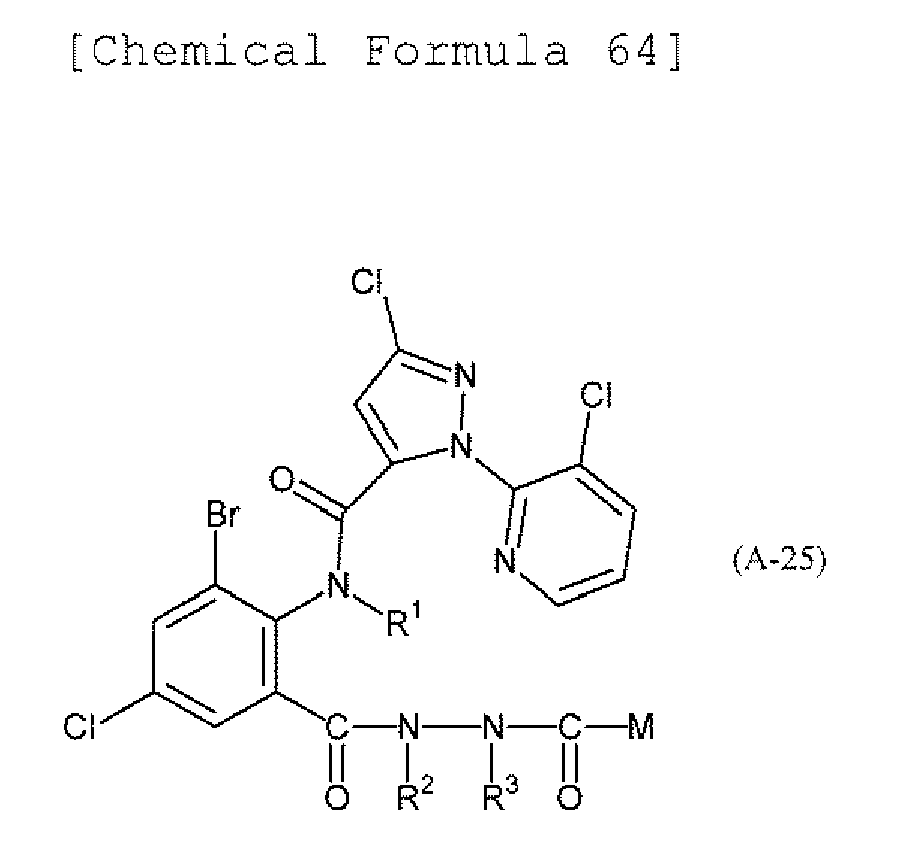
- A compound represented by the formula (A-26):


- A compound represented by the formula (A-27):

- A compound represented by the formula (A-28):


- A compound represented by the formula (A-29):

- A compound represented by the formula (A-30):


- A compound represented by the formula (A-31):

- A compound represented by the formula (A-32):


- A compound represented by the formula (A-33):

- A compound represented by the formula (A-34):

- A compound represented by the formula (A-35):

- A compound represented by the formula (A-36):


- A compound represented by the formula (B-1):

- A compound represented by the formula (B-2):


- A compound represented by the formula (B-3):

- A compound represented by the formula (B-4):


- A compound represented by the formula (B-5):

- A compound represented by the formula (B-6):


- A compound represented by the formula (B-7):
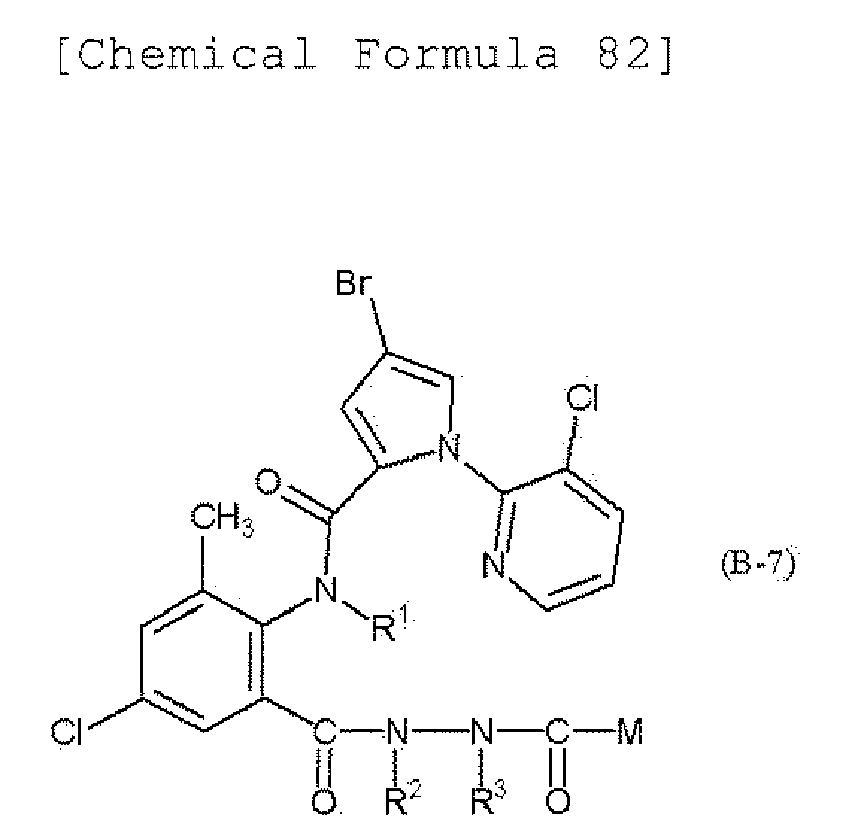
- A compound represented by the formula (B-8):


- A compound represented by the formula (B-9):

- A compound represented by the formula (B-10):


- A compound represented by the formula (B-11):

- A compound represented by the formula (B-12):


- A compound represented by the formula (B-13):

- A compound represented by the formula (B-14):


- A compound represented by the formula (B-15):

- A compound represented by the formula (B-16):


- A compound represented by the formula (C-1):

- A compound represented by the formula (C-2):


- A compound represented by the formula (C-3):
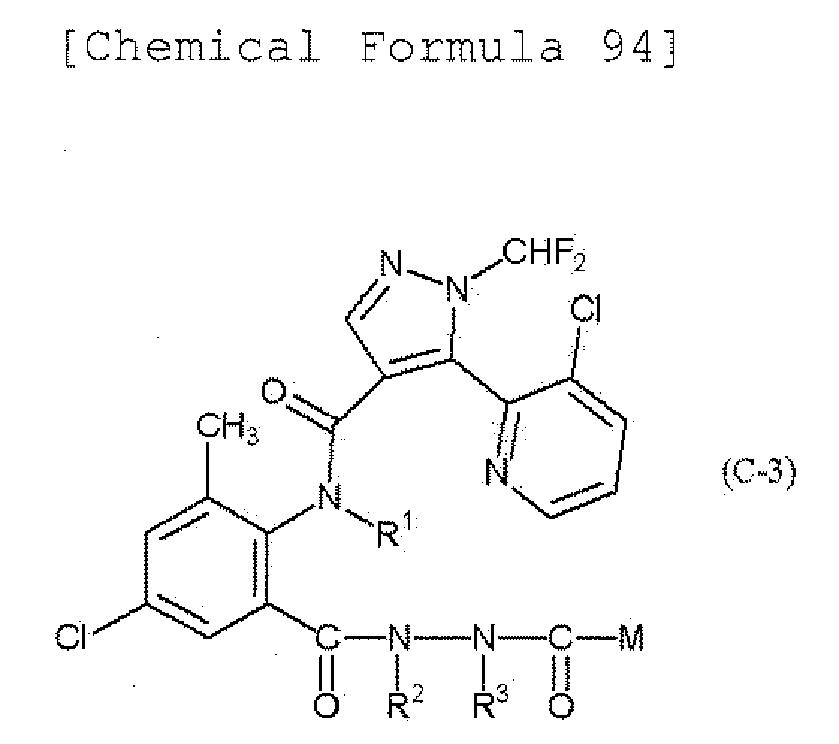
- A compound represented by the formula (C-4):


- A compound represented by the formula (C-5):

- A compound represented by the formula (C-6):


- A compound represented by the formula (C-7):

- A compound represented by the formula (C-8):

- A compound represented by the formula (C-9):

- A compound represented by the formula (C-10):

- A compound represented by the formula (C-11):

- A compound represented by the formula (C-12):

- A compound represented by the formula (D-1):

- A compound represented by the formula (D-2):

- A compound represented by the formula (D-3):

- A compound represented by the formula (D-4):

- A compound represented by the formula (D-5):

- A compound represented by the formula (D-6):
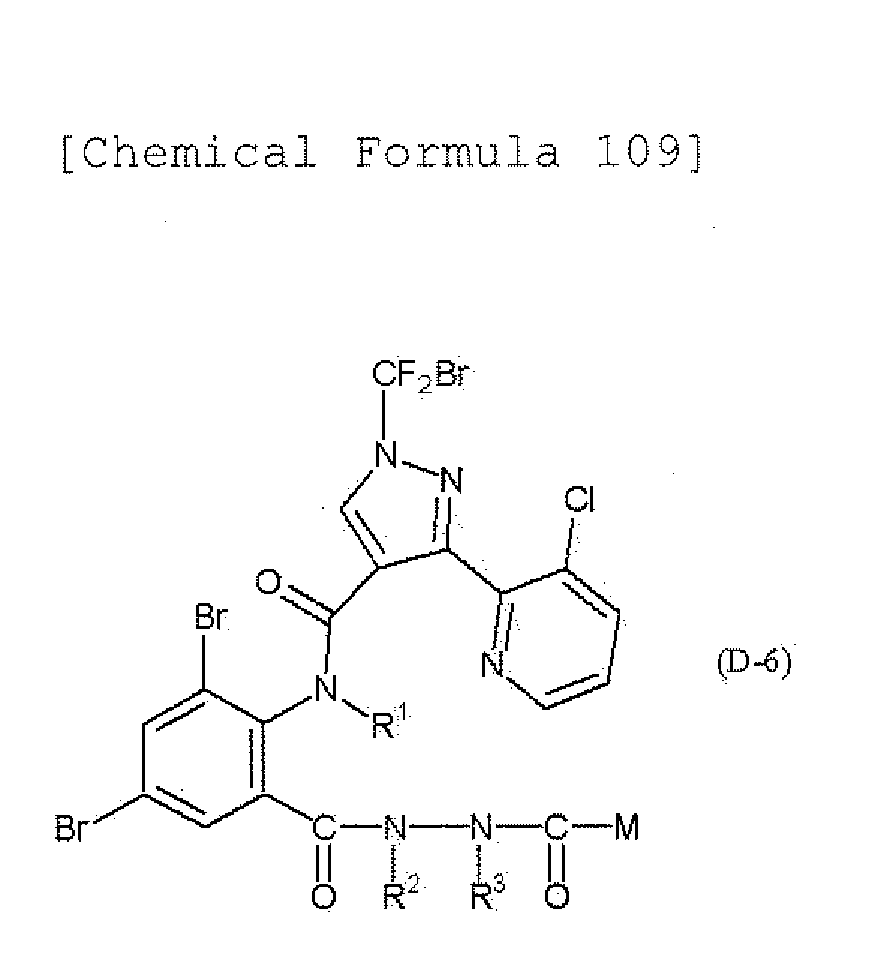
- A compound represented by the formula (D-7):

- A compound represented by the formula (D-8):
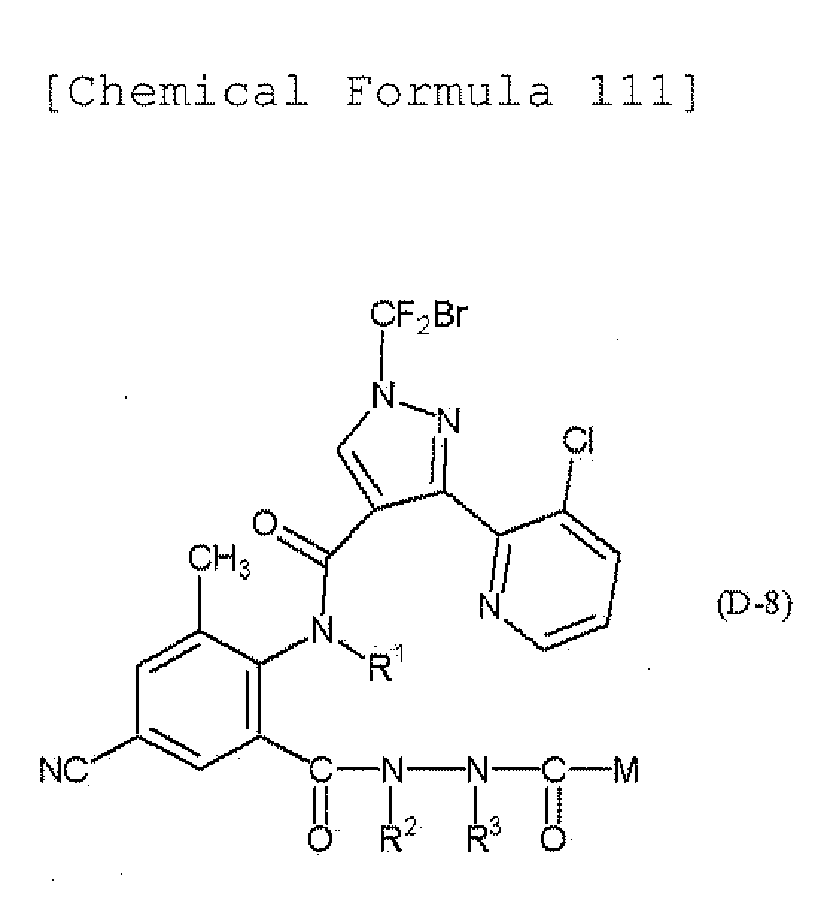
- A compound represented by the formula (D-9):

- A compound represented by the formula (D-10):

- A compound represented by the formula (D-11):

- A compound represented by the formula (D-12):

- Harmful arthropods to which the harmful arthropod controlling agent containing the present compound as an active ingredient exhibits a controlling effect include, for example, harmful insects and harmful acarids, and specific examples thereof include the followings.
- Hemiptera:
- Planthoppers (Delphacidae) such as small brown planthopper (Laodelphax striatellus), brown rice planthopper (Nilaparvata lugens), and white-backed rice planthopper (Sogatella furcifera); leafhoppers (Deltocephalidae) such as green rice leafhopper (Nephotettix cincticeps), green rice leafhopper (Nephotettix virescens), and tea green leafhopper (Empoasca onukii); aphids (Aphididae) such as cotton aphid (Aphis gossypii), green peach aphid (Myzus persicae), cabbage aphid (Brevicoryne brassicae), spiraea aphid (Aphis spiraecola), potato aphid (Macrosiphum euphorbiae), foxglove aphid (Aulaoarthum solani), oat bird-cherry aphid (Rhopalosiphum padi), tropical citrus aphid (Toxoptera citricidus), and mealy plum aphid (Hyalopterus pruni); stink bugs (Pentatomidae) such as green stink bug (Nezara antennata), bean bug (Riptortus clavetus), rice bug (Leptocorisa chinensis), white spotted spined bug (Eysarcoris parvus), and stink bug (Halyomorpha mista); whiteflies (Aleyrodidae) such as greenhouse whitefly (Trialeurodes vaporariorum), sweetpotato whitefly (Bemisia tabaci), citrus whitefly (Diaieurodes citri), and citrus spiny white fly (Aleurocanthus spiniferus); scales (Coccidae) such as Calfornia red scale (Aonidzella aurantii), San Jose scale (Comstockaspis perniciosa), citrus north scale (Unaspis citri), red wax scale (Ceropiastes rubens), cottonycushion scale (Icerya purchasi), Japanese mealybug (Planococcus kraunhiae), Cosmstock mealybug (Pseudococcus longispinis), and white peach scale (Pseudaulacaspis pentagon); lace bugs (Tingidae); cimices such as Cimex lectularius; psyllids (Psyllidae), etc.;
- Lepidoptera:
- Pyralid moths (Pyralidae) such as rice stem borer (Chilo suppressalis), yellow rice borer (Tryporyza incertulas), rice leafroller (Cnaphalocrocis medinalis), cotton leafroller (Notarcha derogata), Indian meal moth (Plodia intorpunctella), Ostrinia furnacalis, cabbage webworm (Hellula undalis), and bluegrass webworm (Pediasia teterrellus); owlet moths (Noctuidae) such as common cutworm (Spodoptera litura), beet armyworm (Spodoptera exigua), armyworm (Pseudaletia separata), cabbage armyworm (Mamestra brassicae), black cutworm (Agrotis ipsilon), beet semi-looper (Plusia nigrisigna), Thoricoplusia spp., Heliothis spp., and Helicoverpa spp.; white butterflies (Pieridae) such as common white (Pieris rapae); tortricid moths (Tortricidae) such as Adoxophyes spp., oriental fruit moth (Grapholita molesta), soybean pod borer (Leguminivora glycinivorella), azuki bean podworm (Matsumuraeses azukivora), summer fruit tortrix (Adoxophyes orana fasciata), smaller tea tortrix (Adoxophyes sp.), oriental tea tortrix (Homona magnanima), apple tortrix (Archips fuscocupreanus), and codling moth (Cydia pomonella); leafblotch miners (Gracillariidae) such as tea leafroller (Caloptilia theivora), and apple leafminer (Phyllonorycter ringoneella); Carposinidae such as peach fruit moth (Carposina niponensis); lyonetiid moths (Lyonetiidae) such as Lyonetia spp.; tussock moths (Lymantriidae) such as Lymantria spp., and Euproctis spp.; yponomeutid moths (Yponomeutidae) such as diamondback (Plutella xylostella); gelechiid moths (Gelechiidae) such as pink bollworm (Pectinophora gossypiella), and potato tubeworm (Phthorimaea operculella); tiger moths and allies (Arctiidae) such as fall webworm (Hyphantria cunea); tineid moths (Tineidae) such as casemaking clothes moth (Tinea translucens), and webbing clothes moth (Tineola bisselliella), etc.;
- Thysanoptera:
- Yellow citrus thrips (Frankliniella occidentalis), melon thrips (Thrips palmi), yellow tea thrips (Scirtothrips dorsalis), onion thrips (Thrips tabaci), flower thrips (Frankliniella intonsa), etc.;
- Diptera:
- Housefly (Musca domestica), common mosquito (Culex piplens pallens), housefly (Tabanus trigonus), onion maggot (Hylemya anitqua), seedcorn maggot (Hylemya platura), Anopheles sinensis, rice leafminer (Agromyza oryzae), rice leafminer (Hydrellia griseola), rice stem maggot (Chlorops oryzae), melon fly (Dacus cucurbitae), Meditteranean fruit fly (Ceratitis capitata), legume leafminer (Liriomyza trifolii), tomato leafminer (Liriomyza sativae), garden pea leafminer (Chromatomyia horticola), etc.;
- Coleoptera:
- Twenty-eight-spotted ladybird (Epilachna vigintioctopunctata), cucurbit leaf beetle (Aulacophora femoralis), rice leaf beetle (Oulema oryzae), rice curculio (Echinocnemus squameus), rice water weevil (Lissorhoptrus oryzophilus), boll weevil (Anthonomus grands), azuki bean weevil (Callosobruchus chinensis), hunting billbug (Sphenophorus venatus), Japanese beetle (Popill ia japonica), cupreous chafer (Anomala cuprea), corn root worms (Diabrotica spp.), Colorado beetle (Leptinotarsa decemlineata), click beetles (Agriotes spp.), cigarette beetle (Lasioderma serricorne), varied carper beetle (Anthrenus verbasci), red flour beetle (Tribolium castaneum), powder post beetle (Lyctus brunneus), white-spotted longicorn beetle (Anoplophora malasiaca), pine shoot beetle (Tomicus piniperda), etc.;
- Orthoptera:
- Asiatic locust (Locusta migratoria), African mole cricket (Gryllotalpa africana), rice grasshopper (Oxya yezoensis), rice grasshopper (Oxya japonica), etc.;
- Hymenoptera:
- Cabbage sawfly (Athalia rasae), leaf-cutting ant (Acromyrmex spp.), fire ant (Solenopsis spp.), etc.;
- Blattodea:
- German cockroach (Blattella germanica), smokybrown cockroach (Periplaneta fuliginosa), American cockroach (Periplaneta americana), Periplaneta brunnea, and oriental cockroach (Blatta orientalis), etc.;
- Acarina:
- Spider mites (Tetranychidae) such as two-spotted spider mite (Tetranychus urticae), Kanzawa spider mite (Tetranychus kanzawai), citrus red mite (Panonychus citri), European red mite (Panonychus ulmi), and Oligonychus spp.; eriophyid mites (Eriophyidae) such as pink citrus rust mite (Aculops pelekassi), Phyllocoptruta citri, tomato rust mite (Aculops lycopersici), purple tea mite (Calacarus carinatus), pink tea rust mite (Acaphylla theavagran), and Eriophyes chibaensis; tarosonemid mites (Tarsonemidae) such as broad mite (Polyphagotarsonemus latus); false spider mites (Tenuipalpidae) such as Brevipalpus phoenicis; Tuckerellidae; ticks (Ixodidae) such as Haemaphysalis longicornis, Haemaphysalis flava, Dermacentor taiwanicus, Ixodes ovatus, Ixodes persulcatus, Boophilus microplus, and Rhipicephalus sanguineus; acarid mites (Acaridae) such as mold mite (Tyrophagus putrescentiae), and Tyrophagus similis; house dust mites (Pyroglyphidae) such as Dermatophagoides farinae, and Dermatophagoides ptrenyssnus; cheyletide mites (Cheyletidae) such as Cheyletus eruditus, Cheyletus malacoensis, and Cheyletus moorei; parasitoid mites (Dermanyssidae) such as poultry red mite (Dermanyssus gallinae); etc.
- The harmful arthropod controlling agent of the present invention can be the present compound as it is . However, it is usually formulated into formulations such as emulsifiable concentrates, oil solutions, dusts, granules, wettable powders, flowable formulations, wettable powders, microcapsule formulations, aerosols, fumigants, poison baits, or resin formulations by mixing the present compound with inert carriers such as solid, liquid or gaseous carriers, and adding surfactants and other auxiliary agents for formulations if necessary. These formulations usually contain 0.1 to 95% by weight of the present compound.
- Examples of the solid carrier used for formulation include finely divided powders or granules of clay (e.g., kaolin clay, diatomaceous earth, bentonite, Fubasami clay, and acid clay), synthetic hydrated silicon oxide, talc, ceramics, other inorganic minerals (e.g., sericite, quartz, sulfur, activated carbon, calcium carbonate, and hydrated silica), and chemical fertilizers (e.g., ammonium sulfate, ammonium phosphate, ammonium nitrate, urea, and ammonium chloride).
- Examples of the liquid carrier include water, alcohols (e.g., methanol, ethanol, isopropyl alcohol, butanol, hexanol, benzyl alcohol, ethylene glycol, propylene glycol, and phenoxyethanol), ketones (e.g., acetone, methyl ethyl ketone, and cyclohexanone), aromatic hydrocarbons (e.g., toluene, xylene, ethylbenzene, dodecylbenzene, phenylxylylethane, and methylnaphthalene), aliphatic hydrocarbons (e.g., hexane, cyclohexane, kerosene, and gas oil), esters (e.g., ethyl acetate, butyl acetate, isopropyl myristate, ethyl oleate, diisopropyl adipate, diisobutyl adipate, and propylene glycol monomethyl ether acetate), nitriles (e.g., acetonitrile, and isobutyronitrile), ethers (e.g., diisopropyl ether, 1,4-dioxane, ethylene glycol dimethyl ether, diethylene glycol dimethyl ether, diethylene glycol monomethyl ether, propylene glycol monomethyl ether, dipropylene glycol monomethyl ether, and 3-methoxy-3-methyl-1-butanol), acid amides (e.g., N,N-dimethylformamide, and N,N-dimethylacetamide), halogenated hydrocarbons (e.g., dichloromethane, trichloroethane, and carbon tetrachloride), sulfoxides (e.g., dimethyl sulfoxide), propylene carbonate and vegetable oils (e.g., soybean oil, and cottonseed oil).
- Examples of the gaseous carrier include fluorocarbon, butane gas, LPG (liquefied petroleum gas), dimethyl ether and carbon dioxide gas.
- Examples of the surfactant include nonionic surfactants such as polyoxyethylene alkyl ether, polyoxyethylene alkyl aryl ether, and polyethylene glycol fatty acid ester; and anionic surfactants such as alkyl sulfonate, alkylbenzene sulfonate, and alkyl sulfate.
- Examples of the other additives for formulations include binders, dispersants, coloring agents and stabilizers, and specific examples thereof include casein, gelatin, saccharides (e.g., starch, gum arabic, cellulose derivatives, and alginic acid), lignin derivatives, bentonite, synthetic water-soluble polymers (e.g., polyvinyl alcohol, polyvinyl pyrrolidone, and polyacrylic acid), PAP (e.g., isopropyl acid phosphate), BHT (2,6-di-tert-butyl-4-methylphenol), and BHA (a mixture of 2-tert-butyl-4-methoxyphenol and 3-tert-butyl-4-methoxyphenol).
- The method for controlling harmful arthropods of the present invention is usually carried out by applying the harmful arthropod controlling agent of the present invention directly to harmful arthropods, or applying to habitats (e.g., plants, soils, houses, and animals) of harmful arthropods.
- For the method for controlling harmful arthropods of the present invention, the present compound can be used as it is. Usually, the method includes a method comprising formulating the present compound into the harmful arthropod controlling agent of the present invention as described above and applying the harmful arthropod controlling agent to harmful arthropods or a place where harmful arthropods inhabit, for example, by the same method as that of applying a conventional harmful arthropod controlling agent, thereby bringing the harmful arthropod controlling agent to contact with the above harmful arthropods or allowing the harmful arthropods to ingest the harmful arthropod controlling agent.
- Examples of the place where harmful arthropods inhabit in the present invention include paddy fields, cultivated lands, orchards, non-crop lands, and houses.
- Examples of the application method include spraying treatment, soil treatment, seed treatment, and water culture medium treatment.
- The spraying treatment in the present invention is a treatment method which comprises treating plant surfaces or harmful arthropods themselves with the active ingredient (the present compound) to produce a controlling effect on harmful arthropods. Specific examples of the spraying treatment include spraying treatment to foliage, and spraying treatment to tree trunks.
The soil treatment is a treatment method which comprises treating soil or an irrigation liquid with the active ingredient for the purpose of allowing the active ingredient to permeate and transfer into the interior of the plant body of a crop to be protected from damage such as ingestion by harmful arthropods, for example, through the root part of the plant, thereby protecting the crop from damage by harmful arthropods. Specific examples of the soil treatment include planting hole treatment (spraying into planting holes, soil mixing after planting hole treatment), plant foot treatment (plant foot spraying, soil mixing after plant foot treatment, irrigation at plant foot, plant foot treatment at a later seeding raising stage), planting furrow treatment (planting furrow spraying, soil mixing after planting furrow treatment), planting row treatment (planting row spraying, soil mixing after planting row treatment, planting row spraying at a growing stage), planting row treatment at the time of sowing (planting row spraying at the time of sowing, soil mixing after planting row treatment at the time of sowing), broadcast treatment (overall soil surface spraying, soil mixing after broadcast treatment), other soil spraying treatment (spraying of a granular formulation on leaves at a growing stage, spraying under a canopy or around a tree stem, spraying on the soil surface, mixing with surface soil, spraying into seed holes, spraying on the ground surfaces of furrows, spraying between plants), other irrigation treatment (soil irrigation, irrigation at a seedling raising stage, drug solution injection treatment, irrigation of a plant part just above the ground, drug solution drip irrigation, chemigation), seedling raising box treatment (spraying into a seedling raising box, irrigation of a seedling raising box), seedling raising tray treatment (spraying on a seedling raising tray, irrigation of a seedling raising tray), seedbed treatment (spraying on a seedbed, irrigation of a seedbed, spraying on a lowland rice nursery, immersion of seedlings), seedbed soil incorporation treatment (mixing with seedbed soil, mixing with seedbed soil before sowing), and other treatment (mixing with culture soil, plowing under, mixing with surface soil, mixing with soil at the place where raindrops fall from a canopy, treatment at a planting position, spraying of a granule formulation on flower clusters, mixing with a paste fertilizer).
The seed treatment is a treating method which comprises applying the active ingredient directly to or around a seed, a seed tuber or a bulb of a crop to be protected from damage such as ingestion by harmful arthropods to produce a controlling effect on harmful arthropods. Specific examples of the seed treatment include spraying treatment, spray coating treatment, immersion treatment, impregnation treatment, coating treatment, film coating treatment, and pellet coating treatment.
The water culture medium treatment is a treating method which comprises treating a water culture medium or the like with an active ingredient for the purpose of allowing the active ingredient to permeate and transfer into the interior of the plant body of a crop to be protected from damage such as ingestion by harmful arthropods, for example, through the root part of the plant, thereby protecting the crop from damage by harmful arthropods. Specific examples of the water culture medium treatment include mixing with a water culture medium, and incorporation into a water culture medium. - When the harmful arthropod controlling agent of the present invention is used for controlling harmful arthropods in the field of agriculture, the application amount thereof is usually from 1 to 10,000 g of the present compound per 10,000 m2 in terms of the amount of the present compound. When a harmful arthropod controlling agent of the present invention is in the form of a formulation such as an emulsifiable concentrate, a wettable powder or a flowable formulation, the harmful arthropod controlling agent is usually applied after it is diluted with water so that the active ingredient concentration becomes 0.01 to 10,000 ppm. When a harmful arthropod controlling agent is in the form of a formulation such as granules or a powder, the harmful arthropod controlling agent is usually applied as it is.
- These harmful arthropod controlling agent and water-dilution thereof can be directly sprayed to harmful arthropods or plants such as crops to be protected from harmful arthropods. Alternatively, soil of a cultivated land can be treated with the harmful arthropod controlling agent or water-dilution thereof in order to control harmful arthropods which inhabit the soil.
- The harmful arthropod controlling agent can be in the form of a resin preparation which is processed into a sheet or a string. Such a resin preparation can be applied by winding a crop with a sheet or a string of the resin preparation, putting a string of the resin preparation around a crop so that the crop is surrounded by the string, or laying a sheet of the resin preparation on the soil surface near the root of a crop.
- When the harmful arthropod controlling agent of the present invention is used for controlling harmful arthropods living in a house (e.g. fly, mosquito, and cockroach), the application amount thereof is usually from 0.01 to 1,000 mg per 1 m2 in terms of the amount of the present compound in the case of plain surface treatment, and is usually from 0.01 to 500 mg per 1 m2 in terms of the amount of the present compound per in the case of space treatment. When the harmful arthropod controlling agent of the present invention is in the form of a formulation such as an emulsifiable concentrate, a wettable powder or a flowable formulation, the harmful arthropod controlling agent is usually applied after it is diluted with water so that the active ingredient concentration becomes 0.1 to 1,000 ppm. When the harmful arthropod controlling agent of the present invention is in the form of a formulation such as an oil solution, an aerosol formulation, a fumigant or poison bait, the harmful arthropod controlling agent is usually applied as it is.
- The present compound can be used a harmful arthropod controlling agent for crop lands such as cultivated lands, paddy fields, lawns and orchards, or non-crop lands.
- The harmful arthropod controlling agent of the present invention may further contain, for example, other harmful arthropod controlling agents, acaricides, nematocides, fungicides, herbicides, plant growth regulators, synergists, fertilizers, soil conditioners, and animal feeds.
- It is also possible to use the present compound for spraying treatment, soil treatment, seed treatment, and water culture medium treatment as a mixed formulation appropriately prepared by mixing the present compound with harmful organism controlling agents such as insecticides, acaricides, nematocides, fungicides, plant hormone agents, plant growth regulators and herbicides (including isomers and salts thereof), or, for example, synergists, phytotoxicity reducing agents, colorants, and fertilizers.
- Examples of the active ingredient of the above other harmful arthropod controlling agents, acaricides and/or nematocides include the followings:
- acephate, Aluminium phosphide, butathiofos, cadusafos, chlorethoxyfos, chlorfenvinphos, chlorpyrifos, chlorpyrifos-methyl, cyanophos : CYAP, diazinon, DCIP (dichlorodiisopropyl ether), dichlofenthion : ECP, dichlorvos : DDVP, dimethoate, dimethylvinphos, disulfoton, EPN, ethion, ethoprophos, etrimfos, fenthion : MPP, fenitrothion : MEP, fosthiazate, formothion, Hydrogen phosphide, isofenphos, isoxathion, malathion, mesulfenfos, methidathion : DMTP, monocrotophos, naled : BRP, oxydeprofos : ESP, parathion, phosalone, phosmet : PMP, pirimiphos-methy1, pyridafenthion, quinalphos, phenthoate:PAP, profenofos, propaphos, prothiofos, pyraclorfos, salithion, sulprofos, tebupirimfos, temephos, tetrachlorvinphos, terbufos, thiometon, trichlorphon : DEP, and vamidothion;
- alanycarb, bendiocarb, benfuracarb, BPMC carbaryl, carbofuran, carbosulfan, cloethocarb, ethiofencarb, fenobucarb, fenothiocarb, fenoxycarb, furathiocarb, isoprocarb:MIPC, metolcarb, methomyl, methiocarb, NAC, oxamyl, pirimicarb, propoxur : PHC, XMC, thiodicarb, and xylylcarb;
- acrinathrin, allethrin, benfluthrin, beta-cyfluthrin, bifenthrin, cycloprothrin, cyfluthrin, cyhalothrin, cypermethrin, deltamethrin, esfenvalerate, ethofenprox, fenpropathrin, fenvalerate, flucythrinate, flufenoprox, flumethrin, fluvalinate, halfenprox, imiprothrin, permethrin, prallethrin, pyrethrins, resmethrin, sigmacypermethrin, silafluofen, tefluthrin, tralomethrin, transfluthrin, 2,3,5,6-tetrafluoro-4-(methoxymethyl)benzyl (EZ)-(1RS,3RS;1RS,3SR)-2,2-dimethyl-3-prop-1-enylcyclopropanecarboxylate, 2,3,5,6-tetrafluoro-4-methylbenzyl (EZ)-(1RS,3RS;1RS,3SR)-2,2-dimethyl-3-prop-1-enylcyclopropanecarboxylate, and 2,3,5,6-tetrafluoro-4-(methoxymethyl)benzyl(1RS,3RS;1RS,3SR)-2,2-dimethyl-3-(2-methyl-1-propenyl)cyclopropanecarboxylate;
- cartap, bensultap, thiocyclam, monosultap, and bisultap;
- imidacloprid, nitenpyram, acetamiprid, thiamethoxam, thiacloprid, dinotefuran, and clothianidin;
- chlorfluazuron, bistrifluron, diafenthiuron, diflubenzuron, fluazuron, flucycloxuron, flufenoxuron, hexaflumuron, lufenuron, novaluron, noviflumuron, teflubenzuron, and triflumuron;
- acetoprole, ethiprole, fipronil, vaniliprole, pyriprole, and pyrafluprole;
- viable spores of Bacillus thuringinesis and crystal toxins produced therefrom, and a mixture thereof;
- chromafenozide, halofenozide, methoxyfenozide, and tebufenozide;
- aldrin, dieldrin, dienochlor, endosulfan, and methoxychlor;
- machine oil, and nicotine-sulfate;
- avermectin-B, bromopropylate, buprofezin, chlorphenapyr, cyromazine, D-D(1,3-Dichloropropene), emamectin-benzoate, fenazaquin, flupyrazofos, hydroprene, indoxacarb, metoxadiazone, A(milbemycin-A), pymetrozine, pyridalyl, pyriproxyfen, spinosad, sulfluramid, tolfenpyrad, triazamate, flubendiamide, SI-0009, cyflumetofen, Arsenic acid, benclothiaz, Calcium cyanamide, Calcium polysulfide, chlordane, DDT, DSP, flufenerim, flonicamid, flurimfen, formetanate, metam-ammonium, metam-sodium, Methyl bromide, nidinotefuran, Potassium oleate, protrifenbute, spiromesifen, Sulfur, metaflumizone, and spirotetramat;
- acequinocyl, amitraz, benzoximate, bromopropylate, chinomethionat, chlorobenzilate, CPCBS (chlorfenson), clofentezine, dicofol, etoxazole, fenbatatin oxide, fenothiocarb, fenpyroximate, fluacrypyrim, fluproxyfen, hexythiazox, propargite:BPPS, polynactins, pyridaben, Pyrimidifen, tebufenpyrad, tetradifon, spirodiclofen, amidoflumet, Bifenazate, and Cyflumetofen;
- DCIP, fosthiazate, levamisol, methyisothiocyanate, and morantel tartarate.
- Hereinafter, the present invention will be explained in more detail by way of Preparation Examples, Formulation Examples, and Test Examples, but the present invention is not limited to these Examples.
- First, Preparation Examples of the present compound will be explained.
- A mixture of 0.24 g of the compound (8-1):
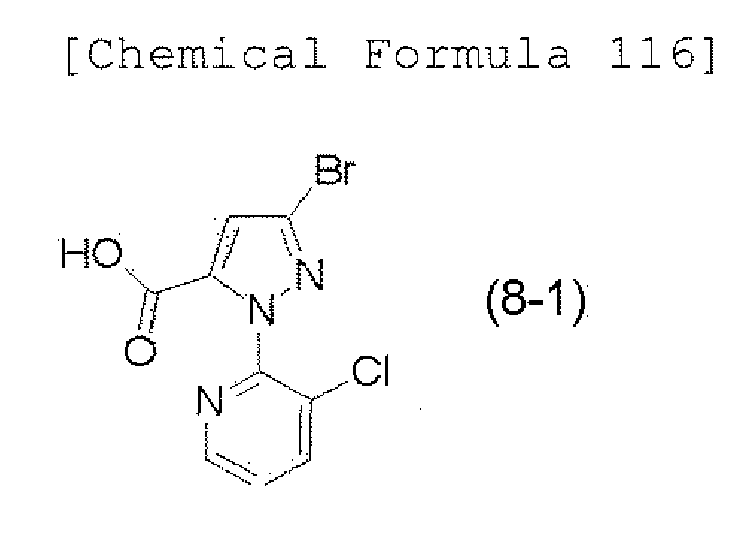


The present compound (1-1):

- A mixture of 0.26 g of the compound (6-2):


- A mixture of 0.39 g of the compound (6-3):


The present compound (1-3):
- To a mixture of 0.30 g of the compound (2-1):


- Next, Preparation Examples of the compound (2), the compound (4), the compound (6) and the compound (8) are described as Reference Preparation Examples.
- (1) To a mixture of 1.85 g of methyl carbazate and 60 mL of tetrahydrofuran was added 6.0 g of 6,8-dibromo-2H-3,1-benzoxazine-2,4-1H-dion:

N-(2-amino-3,5-dibromobenzoyl)-N'-methoxycarbonylhydrazine 1H-NMR (DMSO-d6) δ: 3.63 (3H, s), 6.55 (2H, s), 7.71 (1H, s), 7.79 (1H, s), 9.25 (1H, s), 10.32 (1H, s) - (2) To a mixture of 0.50 g of N-(2-amino-3,5-dibromobenzoyl)-N'-methoxycarbonylhydrazine, 0.47 g of potassium carbonate and 5 mL of N,N-dimethylformamide was added 0.36 g of 1,3-dibromopropane was added with ice-cooling, followed by stirring at 50°C for 10 hours. After adding water, the reaction mixture was extracted with ethyl acetate. The organic layer was washed with water, dried over anhydrous magnesium sulfate, and concentrated under reduced pressure. The resulting residue was subjected to silica gel column chromatography to obtain 0.19 g of the compound (6-1).
Compound (6-1):
- A mixture of 1.0 g of N-(2-amino-3,5-dibromobenzoyl)-N'-methoxycarbonylhydrazine (a compound described in Reference Preparation Example 1(1)), 1.13 g of potassium carbonate, 340 µL of 1,4-dibromobutane and 10 mL of N,N-dimethylformamide was stirred at 50°C for 5 hours. After adding water, the reaction mixture was extracted with ethyl acetate. The organic layer was washed with a saturated sodium chloride solution, dried over anhydrous magnesium sulfate, and concentrated under reduced pressure. The resulting residue was subjected to silica gel column chromatography to obtain 0.26 g of the compound (6-2). Compound (6-2):


- A mixture of 1.0 g of N-(2-amino-3,5-dibromobenzoyl)-N'-methoxycarbonylhydrazine (a compound described in Reference Preparation Example 1(1)), 1.13 g of potassium carbonate, 410 µl of 1,5-dibromopentane and 10 mL of N,N-dimethylformamide was stirred at 50°C for 5 hours. After adding water, the reaction mixture was extracted with ethyl acetate. The organic layer was washed with a saturated sodium chloride solution, dried over anhydrous magnesium sulfate, and concentrated under reduced pressure. The resulting residue was subjected to silica gel column chromatography to obtain 0.49 g of the compound (6-3). Compound (6-3):


- (1) A mixture of 10.7 g of 3-bromo-1H-pyrazole, 11.8 g of 2,3-dichloropyridine, 57.3 g of cesium carbonate and 80 mL of N,N-dimethylformamide was stirred at 100°C for 8 hours. After cooling to room temperature and adding water, the reaction mixture was extracted twice with methyl tert-butyl ether. The organic layers were combined, washed sequentially with water and a saturated sodium chloride solution, dried over magnesium sulfate, and concentrated under reduced pressure. The resulting residue was subjected to silica gel column chromatography to obtain 12.9 g of 2-(3-bromo-1H-pyrazol-1-yl)-3-chloropyridine.
2-(3-bromo-1H-pyrazol-1-yl)-3-chloropyridine
1H-NMR (CDCl3, TMS) δ (ppm): 6.51 (1H, d, J=2Hz), 7.31 (1H, dd, J=8Hz, 4Hz), 7.91 (1H, dd, J=8Hz, 1Hz), 8.04 (1H, d, J=2Hz), 8.45 (1H, dd, J=4Hz, 1Hz) - (2) To a mixture of 9.2 g of 2-(3-bromo-1H-pyrazol yl)-3-chloropyridine and 80 mL of tetrahydrofuran was added dropwise 21.3 mL of a heptane/tetrahydrofuran/ethylbenzene solution of 2.0 M lithium diisopropylamide at -78°C and then the resulting mixture was stirred at -78°C for 15 minutes. The mixture was added in a mixture of dry ice and 50 mL of tetrahydrofuran, followed by stirring for 1 hour while warming to about room temperature. After adding water and diethylether to the reaction mixture, an aqueous 2 N sodium hydroxide solution was added to adjust the aqueous layer to pH 10 to 12. The layers were separated and the resulting aqueous layer was washed twice with diethylether and 2 N hydrochloric acid was added so as to adjust the aqueous layer to about pH 3, followed by extraction three times with methyl tert-butyl ether. The organic layers were combined, washed with a saturated sodium chloride solution, dried over magnesium sulfate, and concentrated under reduced pressure to obtain 7.96 g of the compound (8-1).
Compound (8-1)
1H-NylR (DMSO-d6) δ (ppm) : 7.25 (1H, s), 7.68 (1H, dd, J=8Hz, 4Hz), 8.24 (1H, dd, J=8Hz, J=1Hz), 8.56 (1H, dd, J=4Hz, 1Hz) - To a mixture of 5.0 g of 2-(3-bromo-1H-pyrazol-1-yl)-3-chloropyridine (a compound described in Reference Preparation Example 4(1)) and 30 mL of tetrahydrofuran was added dropwise 11.7 mL of a heptane/tetrahydrofuran/ethylbenzene solution of 2.0 M lithium diisopropylamide at -78C. To the reaction mixture, a mixture of 3 g of ethyl formate and 10 mL of tetrahydrofuran was added dropwise at -78°C, followed by stirring at room temperature for 2 hours. After adding water, the reaction mixture was extracted with ethyl acetate. The organic layer was washed with water, dried over anhydrous magnesium sulfate, and concentrated under reduced pressure. The resulting residue was subjected to silica gel column chromatography to obtain 3.0 g of the compound (4-1).
Compound (4-1):
- (1) A mixture of 1.0 g of the above compound (8-1) and 2 mL of thionyl chloride was heated under reflux for 2 hours. After cooling to room temperature, the reaction mixture was concentrated under reduced pressure and the resulting residue was dissolved in 15 mL of acetonitrile, followed by the addition of 0.88 g of 2-amino-3,5-dibromobenzoic acid and further stirring at room temperature for 30 minutes. To the mixture was added 0.7 mL of triethylamine and the mixture was stirred at room temperature for 30 minutes, followed by the addition of 1.4 mL of triethylamine, stirring at room temperature for 30 minutes, the addition of 0.5 mL of methanesulfonyl chloride and further stirring at room temperature for 5 hours. After adding water, the reaction mixture was concentrated under reduced pressure. The resulting residue was washed with water and methyl tert-butyl, ether to obtain 0.80 g of 2-[3-bromo-1-(3-chloro-2-pyridinyl)-1H-pyrazol-5-yl]-6,8-dibromo-4H-3,1-benzoxazin-4-one. 2-[3-bromo-1-(3-chloro-2-pyridinyl)-1H-pyrazol-5-yl]-6,8-dibromo-4H-3,1-benzoxazin-4-one:

- (2) A mixture of 2.0 g of 2-[3-bromo-1-(3-chloro-2-pyridinyl)-1H-pyrazol-5-yl]-6,8-dibromo-4H-3,1-benzoxazin-4-one, 0.50 g of 3-pyrazolidinone hydrochloride, 1.18 g of potassium carbonate and 50 mL of tetrahydrofuran was stirred at room temperature for 3 hours. After adding water, the reaction mixture was extracted with ethyl acetate. The organic layer was washed with a saturated sodium chloride solution, dried over anhydrous magnesium sulfate, and concentrated under reduced pressure. The resulting solid was washed with chloroform to obtain 1.56 g of the compound (2-1).
Compound (2-1):

- Next, Formulation Examples are shown. All parts are by weight.
- In a mixture of 35 parts of xylene and 35 parts of N,N-dimethylformamide, 10 parts of each of the present compounds (1-1) to (1-4) is dissolved, and then 14 parts of polyoxyethylene styrylphenyl ether and 6 parts of calcium dodecylbenzenesulfonate are added thereto, followed by stirring to obtain a 10% emulsifiable concentrate.
- To a mixture of 4 parts of sodium lauryl sulfate, 2 parts of calcium ligninsulfonate, 20 parts of synthetic hydrous silicon oxide fine powder and 54 parts of diatomaceous earth, 20 parts of each of the present compounds (1-1) to (1-4) is added, followed by stirring to obtain a 20% wettable agent.
- To 2 parts of each of the present compounds (1-1) to (1-4), 1 part of synthetic hydrous silicon oxide fine powder, 2 parts of calcium ligninsulfonate, 30 parts of bentonite and 65 parts of kaolin clay are added, and then stirred thoroughly. Then, an appropriate amount of water is added to the mixture, followed by stirring, granulation with a granulator and air drying to obtain 2% granules.
- In an appropriate amount of acetone, 1 part of each of the present compounds (1-1) to (1-4) is dissolved, and then 5 parts of synthetic hydrous silicon oxide fine powder, 0.3 part of PAP and 93.7 parts of fubasami clay are added, followed by stirring and removal of acetone from the mixture by evaporation to obtain 1% powders.
- A mixture of 10 parts of each of the present compounds (1-1) to (1-4), 35 parts of white carbon containing 50 parts of polyoxyethylene alkyl ether sulfate ammonium salt, and 55 parts of water is finely ground by a wet grinding method to obtain a 10% flowable formulation.
- In 5 parts of xylene and 5 parts of trichloroethane, 0.1 part of each of the present compounds (1-1) to (1-4) is dissolved, and then solution is mixed with 89.9 parts of deodorized kerosene to obtain a 0.1% oil solution.
- In 0.5 mL of acetone, 10 mg of each of the present compounds (1-1) to (1-4) is dissolved and the solution is mixed uniformly with 5 g of a solid feed powder for an animal (solid feed powder for rearing and breeding CE-2, manufactured by CLEA Japan, Inc.), and then dried by evaporation of acetone to obtain poison bait.
- Next, harmful arthropod controlling activity of the present compound is shown by Test Examples.
- Each of the flowable formulations of the test compounds (1-1) to (1-4) obtained in Formulation Example 5 was diluted with water so that the active ingredient concentration became 500 ppm to prepare a test spray solution.
On the other hand, cabbage was planted in a polyethylene cup, and grown until the third true leaf or the fourth true leaf was developed. The test spray solution as described above was sprayed in an amount of 20 mL/cup on the cabbage. After the spray solution on the cabbage was dried, 10 third-instar larvae of diamondback moths (Plutella xylostella) were put on the cabbage. After 5 days, the number of diamondback moths was counted, and the controlling value was calculated by the following equation.
wherein Cb represents the number of worms in the non-treated group before treatment, Cai represents the number of worms in the non-treated group on observation, Tb represents the number of worms in the treated group before treatment, and Tai represents the number of worms in the treated group on observation. - As a result, the test spray solution of each of the present compounds (1-1) to (1-4) exhibited a controlling value of 100%.
- Each of the flowable formulations of the test compounds (1-1) to (1-4) obtained in Formulation Example 5 was diluted with water so that the active ingredient concentration became 500 ppm to prepare a test spray solution.
On the other hand, cucumber was planted in a polyethylene cup, and was grown until the first true leaf was developed. About 30 cotton aphids (Aphis gossypii) were put on the cucumber. One day after, the test spray solution as described above was sprayed in an amount of 20 mL/cup on the cucumber. Six days after spraying, the number of cotton aphids was counted, and a controlling value was calculated by the following equation.
- As a result, the test spray solution of each of the present compounds (1-1) to (1-4) exhibited a controlling value of 90% or more.
- Each of the flowable formulations of the test compounds (1-1) to (1-4) obtained in Formulation Example 5 was diluted with water so that the active ingredient concentration became 500 ppm to prepare a test spray solution.
On the other hand, cabbage was planted in a polyethylene cup, and grown until the third true leaf or the fourth true leaf was developed. The test spray solution as described above was sprayed in an amount of 20 mL/cup on the cabbage. After the spray solution sprayed on the cabbage was dried, 10 fourth-instar larvae of common cutworm (Spodoptera litura) were put on the cabbage. After 4 days, the number of common cutworm surviving on the cabbage leaves was counted, and a controlling value was calculated by the following equation.
- As a result, each of the test spray solutions of the present compounds (1-1) to (1-4) exhibited a controlling value of 100%.
- Each of the flowable formulations of the test compounds (1-1) to (1-3) obtained in Formulation Example 5 were diluted with water so that the active ingredient concentration became 500 ppm to prepare a test spray solution.
On the other hand, 20 mL of the test spray solution as described above was sprayed to an apple seedling (28 day-old seeding, tree height: about 15 cm) planted in a plastic cup. The apple seedling was air-dried to such an extent that the spray solution sprayed on the apple seedling was dried, and then about 30 first-instar larvae of summer fruit tortrix (Adoxophyes orana fasciata) were released. Seven days after spraying, the number of worms surviving on the apple seedling was counted, and a controlling value was calculated by the following equation.
wherein Cb represents the number of worms in the non-treated group before treatment, Cai: the number of worms in the non-treated group on observation, Tb represents the number of worms in the treated group before treatment, and Tai represents the number of worms in the treated group on observation. - As a result, each of the test spray solutions of the present compounds (1-1) to (1-3) exhibited a controlling value of 100%.
- Each of the flowable formulations of the test compounds (1-1) to (1-3) obtained in Formulation Example 5 was diluted with water so that the active ingredient concentration became 500 ppm to prepare a test spray solution.
On the other hand, cucumber was planted in a polyethylene cup, and was grown until the first true leaf was developed. The test spray solution as described above was sprayed in an amount of 20 mL/cup on the cucumber. After the spray solution on the cucumber was dried, the first true leaf was cut and then placed on a filter paper (diameter: 70 mm) containing water in a polyethylene cup (diameter: 110 mm). On the cucumber leaf, 20 larvae of yellow citrus thrips (Frankliniella occidentalis) were released, and the polyethylene cup was capped. Seven days after spraying, the number of worms surviving on the cucumber leaf was counted and a controlling value was calculated by the following equation.
wherein Cb represents the number of worms in the non-treated group before treatment, Cai represents the number of worms in the non-treated group on observation, Tb represents the number of worms in the treated group before treatment, and Tai represents the number of worms in the treated group on observation. - As a result, the group treated with each of the present compounds (1-1) to (1-3) exhibited a controlling value of 100%.
- The present compound has an excellent controlling activity on harmful arthropods and is therefore useful as an active ingredient of a harmful arthropod controlling agent.
Claims (12)
- A hydrazide compound represented by the formula (1):
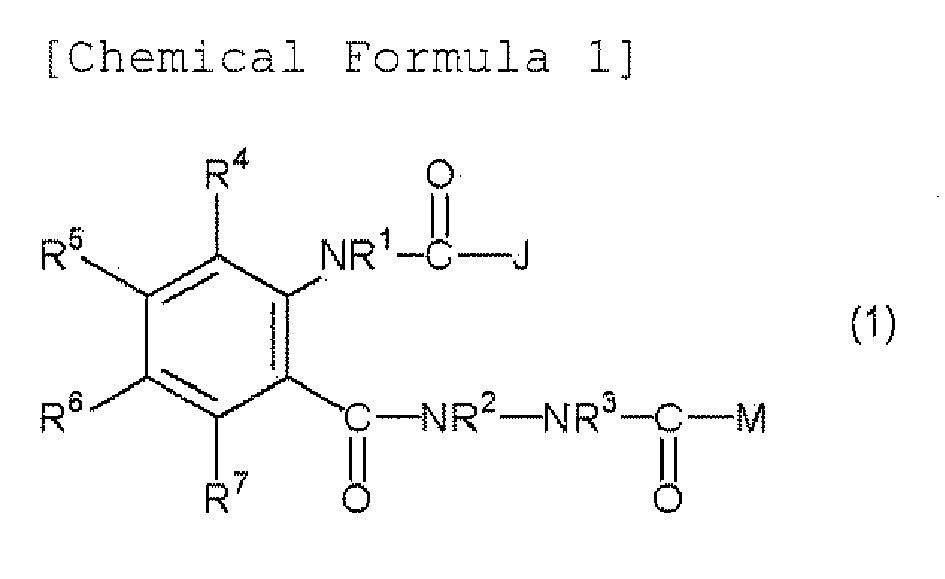
R1 represents a hydrogen atom, an optionally halogenated C1-C6 alkyl group, a C2-C6 cyanoalkyl group, a C2-C6 alkoxyalkyl group, an optionally halogenated C3-C6 alkenyl group, an optionally halogenated C3-C6 alkynyl group, or a C7-C9 phenylalkyl group whose benzene ring moiety may be substituted with a substituent A shown below;
R2 and R3 are bound at their terminal ends to represent -Z-, and two nitrogen atoms to which R2 and R3 are attached together with Z form a 5- to 8-membered ring,
{in which Z is formed by binding a plurality of groups selected from the group consisting of (a) -CH2-, (b) - CH=CH-, (c) -CO-, (d) an oxygen atom, (e) -S(O)n- and (f) - NRa-;
Z may be substituted on its carbon atom(s) with a substituent selected from the group consisting of a halogen atom, an optionally halogenated C1-C6 alkyl group, and an optionally halogenated C2-C6 alkoxycarbonyl group;
n represents an integer of 0 to 2;
Ra represents a hydrogen atom, an optionally halogenated C1-C6 alkyl group, an optionally halogenated C2-C6 alkoxycarbonyl group, or a phenyl group optionally substituted with a substituent A shown below};
R4 represents a halogen atom, or an optionally halogenated C1-C6 alkyl group;
each of R5, R6 and R7 independently represents a hydrogen atom, a halogen atom, a cyano group, or an optionally halogenated C1-C6 alkyl group, or
R5 and R6 may be combined to form a 1,3-butadiene-1,4-diyl group optionally substituted with a substituent C shown below;
M represents -R8, -OR9, -SR10 or -NR11R12,
{in which R8 represents a hydrogen atom, an optionally halogenated C1-C6 alkyl group, a C2-C6 alkoxyalkyl group, an optionally halogenated C2-C6 alkenyl group, or an optionally halogenated C2-C6 alkynyl group;
each of R9, R10, R11 and R12 independently represents an optionally halogenated C1-C6 alkyl group, a C3-C6 alkoxyalkyl group, an optionally halogenated C3-C6 alkenyl group, or an optionally halogenated C3-C6 alkynyl group};
J represents any one of J1 to J3 shown below,
Y1 represents a nitrogen atom or CR20;
Y2 represents a nitrogen atom or CR21;
Y3 represents a nitrogen atom or CR22;
R13 and R19 each independently represents a hydrogen atom, a halogen atom, a cyano group, an optionally halogenated C1-C6 alkyl group, an optionally halogenated C1-C6 alkoxy group, an optionally halogenated C1-C6 alkylthio group, an optionally halogenated C1-C6 alkylsulfinyl group, or an optionally halogenated C1-C6 alkylsulfonyl group;
R15 and R17 each independently represents an optionally halogenated C1-C6 alkyl group;
R14, R16, R18, R20, R21 and R22 each independently represents a hydrogen atom, a halogen atom, or an optionally halogenated C1-C6 alkyl group };
substituent A: a substituent selected from the group consisting of a halogen atom, a cyano group, a nitro group, an optionally halogenated C1-C6 alkyl group, and an optionally halogenated C1-C6 alkoxy group; and
substituent C: a substituent selected from the group consisting of a halogen atom, a cyano group, and an optionally halogenated C1-C6 alkyl group. - The hydrazide compound according to claim 1, wherein, in the formula (1), Z is any one of Z1 to Z4 shown below:Z1: -(CR31R32)m-Z2: -CR33R34-CR35=CR36-CR37R38-Z3: -(CR39R40)2-Q-(CR41R42)2-Z4: -(CR44R45)p-C(=O)-(CR46R47)q-
in which each of R31, R32, R33, R34, R35, R36, R37, R38, R39, R40, R41, R42, R44, R45, R46 and R47 independently represents a hydrogen atom or a C1-C4 alkyl group, m represents an integer of 3 to 5, Q represents an oxygen atom, -S(O)n- or -NR43- {n represents an integer of 0 to 2, and R43 represents a C1-C4 alkyl group}, and p and q each independently represents an integer of 0 to 4, provided that the sum of p and q is 2 to 4. - The hydrazide compound according to claim 2, wherein, in the formula (1), Z is any one of Z1 to Z3.
- The hydrazide compound according to claim 2, wherein, in the formula (1), Z is Z1 or Z4.
- The hydrazide compound according to claim 2, wherein, in the formula (1), Z is Z1.
- The hydrazide compound according to claim 1, wherein, in the formula (1), the ring formed by two nitrogen atoms to which R2 and R3 are attached, together with Z is a 5- or 6-membered ring.
- The hydrazide compound according to claim 1, wherein, in the formula (1), Z is a group formed by binding a plurality of groups selected from the group consisting of (a) -CH2- and (c) -CO- (in which Z may be substituted on its carbon atom(s) with a substituent selected from the group consisting of a halogen atom, an optionally halogenated C1-C6 alkyl group, and an optionally halogenated C2-C6 alkoxycarbonyl group.
- The hydrazide compound according to claim 1, wherein, in the formula (1), Z is a C3-C6 polymethylene group.
- A harmful arthropod controlling agent comprising the hydrazide compound according to any one of claims 1 to 8 as an active ingredient.
- Use of the hydrazide compound according to any one of claims 1 to 8 as an active ingredient of a harmful arthropod controlling agent.
- A method for controlling harmful arthropods, which comprises applying the hydrazide compound according to any one of claims 1 to 8 directly to harmful arthropods, or applying to habitats of harmful arthropods.
- Use of the hydrazide compound according to any one of claims 1 to 8 for the production of a harmful arthropod controlling agent.
Applications Claiming Priority (2)
| Application Number | Priority Date | Filing Date | Title |
|---|---|---|---|
| JP2007104647 | 2007-04-12 | ||
| PCT/JP2008/057065 WO2008126890A1 (en) | 2007-04-12 | 2008-04-10 | Hydrazide compound and harmful arthropod-controlling agent containing the same |
Publications (2)
| Publication Number | Publication Date |
|---|---|
| EP2145885A1 true EP2145885A1 (en) | 2010-01-20 |
| EP2145885A4 EP2145885A4 (en) | 2011-03-23 |
Family
ID=39863985
Family Applications (1)
| Application Number | Title | Priority Date | Filing Date |
|---|---|---|---|
| EP08740166A Withdrawn EP2145885A4 (en) | 2007-04-12 | 2008-04-10 | HYDRAZIDE COMPOUND AND AGENT CONTROLLING THE HARMFUL ARTHROPOD CONTAINING THE SAME |
Country Status (10)
| Country | Link |
|---|---|
| US (1) | US8003650B2 (en) |
| EP (1) | EP2145885A4 (en) |
| JP (1) | JP2008280340A (en) |
| KR (1) | KR20090130037A (en) |
| CN (1) | CN101679374A (en) |
| AU (1) | AU2008239009B2 (en) |
| BR (1) | BRPI0810550A2 (en) |
| CA (1) | CA2681783A1 (en) |
| MX (1) | MX2009010823A (en) |
| WO (1) | WO2008126890A1 (en) |
Cited By (4)
| Publication number | Priority date | Publication date | Assignee | Title |
|---|---|---|---|---|
| WO2021076839A1 (en) * | 2019-10-18 | 2021-04-22 | Fmc Corporation | Methods for the preparation of 5-bromo-2-(3-chloro-pyridin-2-yl)-2h-pyrazole-3-carboxylic acid |
| WO2021076838A1 (en) * | 2019-10-18 | 2021-04-22 | Fmc Corporation | Methods for the preparation of 5-bromo-2-(3-chloro-pyridin-2-yl)-2h-pyrazole-3-carboxylic acid |
| WO2021076832A1 (en) * | 2019-10-18 | 2021-04-22 | Fmc Corporation | Methods for the preparation of 5-bromo-2-(3-chloro-pyridin-2-yl)-2h-pyrazole-3-carboxylic acid |
| WO2021076831A1 (en) * | 2019-10-18 | 2021-04-22 | Fmc Corporation | Methods for the preparation of 5-bromo-2-(3-chloro-pyridin-2-yl)-2h-pyrazole-3-carboxylic acid |
Families Citing this family (13)
| Publication number | Priority date | Publication date | Assignee | Title |
|---|---|---|---|---|
| KR20120125642A (en) | 2010-02-09 | 2012-11-16 | 바이엘 크롭사이언스 아게 | Hydrazine-substituted anthranilic acid derivatives |
| MX2012014574A (en) | 2010-06-15 | 2013-02-07 | Bayer Ip Gmbh | Anthranilic acid diamide derivatives with cyclical side chains. |
| JP5993846B2 (en) | 2010-06-15 | 2016-09-14 | バイエル・インテレクチュアル・プロパティ・ゲゼルシャフト・ミット・ベシュレンクテル・ハフツングBayer Intellectual Property GmbH | Anthranilic acid derivative |
| EP2582693B1 (en) | 2010-06-15 | 2016-03-30 | Bayer Intellectual Property GmbH | New ortho-substituted arylamide derivatives |
| ES2555260T3 (en) | 2010-06-15 | 2015-12-30 | Bayer Intellectual Property Gmbh | Diaranic derivatives of anthranilic acid |
| JP5926253B2 (en) | 2010-07-09 | 2016-05-25 | バイエル・インテレクチュアル・プロパティ・ゲゼルシャフト・ミット・ベシュレンクテル・ハフツングBayer Intellectual Property GmbH | Anthranilamide derivatives as pesticides |
| EP2728276B1 (en) | 2011-06-30 | 2017-10-25 | Mitsubishi Hitachi Power Systems, Ltd. | Solar heat boiler and solar heat electric power generation plant |
| US9925167B2 (en) * | 2011-06-30 | 2018-03-27 | Hansen-Ab Gmbh | Agents for the control of parasites on animals |
| EP2964629A1 (en) | 2013-03-06 | 2016-01-13 | Bayer CropScience Aktiengesellschaft | Alkoximino-substituted anthranilic acid diamides as pesticides |
| KR101773442B1 (en) | 2017-02-15 | 2017-08-31 | 김순일 | Repellent Composition against Biting Arthropods |
| KR102725178B1 (en) | 2017-12-20 | 2024-11-04 | 피아이 인더스트리스 엘티디. | Use of pyrazolopyridine-diamide as an insecticide and its preparation method |
| WO2019123194A1 (en) | 2017-12-20 | 2019-06-27 | Pi Industries Ltd. | Anthranilamides, their use as insecticide and processes for preparing the same. |
| AU2019213694B2 (en) | 2018-01-30 | 2023-04-06 | Pi Industries Ltd. | Novel anthranilamides, their use as insecticide and processes for preparing the same. |
Family Cites Families (9)
| Publication number | Priority date | Publication date | Assignee | Title |
|---|---|---|---|---|
| US4985461A (en) | 1985-10-21 | 1991-01-15 | Rohm And Haas Company | Insecticidal N'-substituted-N,N'-diacylhydrazines |
| DK483586A (en) * | 1985-10-21 | 1987-04-22 | Rohm & Haas | INSECTICIDE N'-SUBSTITUTED-N, N'-DIACYL HYDRAZINES |
| GB9405347D0 (en) | 1994-03-18 | 1994-05-04 | Agrevo Uk Ltd | Fungicides |
| MY138097A (en) | 2000-03-22 | 2009-04-30 | Du Pont | Insecticidal anthranilamides |
| MY142967A (en) * | 2001-08-13 | 2011-01-31 | Du Pont | Method for controlling particular insect pests by applying anthranilamide compounds |
| DE60226875D1 (en) | 2001-08-15 | 2008-07-10 | Du Pont | ORTHOSUBSTITUTED ARYLAMIDES FOR COMBATING WIRELESS PESTS |
| US7199138B2 (en) | 2001-08-16 | 2007-04-03 | E. I. Du Pont De Nemours And Company | Substituted anthranilamides for controlling invertebrate pests |
| TW200724033A (en) | 2001-09-21 | 2007-07-01 | Du Pont | Anthranilamide arthropodicide treatment |
| PL1937664T3 (en) * | 2005-10-14 | 2011-11-30 | Sumitomo Chemical Co | Hydrazide compound and pesticidal use of the same |
-
2008
- 2008-04-09 JP JP2008101162A patent/JP2008280340A/en not_active Ceased
- 2008-04-10 EP EP08740166A patent/EP2145885A4/en not_active Withdrawn
- 2008-04-10 US US12/594,499 patent/US8003650B2/en not_active Expired - Fee Related
- 2008-04-10 WO PCT/JP2008/057065 patent/WO2008126890A1/en not_active Ceased
- 2008-04-10 BR BRPI0810550-2A2A patent/BRPI0810550A2/en not_active Application Discontinuation
- 2008-04-10 AU AU2008239009A patent/AU2008239009B2/en not_active Ceased
- 2008-04-10 KR KR1020097021076A patent/KR20090130037A/en not_active Withdrawn
- 2008-04-10 CA CA002681783A patent/CA2681783A1/en not_active Abandoned
- 2008-04-10 CN CN200880015665A patent/CN101679374A/en active Pending
- 2008-04-10 MX MX2009010823A patent/MX2009010823A/en active IP Right Grant
Cited By (15)
| Publication number | Priority date | Publication date | Assignee | Title |
|---|---|---|---|---|
| WO2021076839A1 (en) * | 2019-10-18 | 2021-04-22 | Fmc Corporation | Methods for the preparation of 5-bromo-2-(3-chloro-pyridin-2-yl)-2h-pyrazole-3-carboxylic acid |
| WO2021076835A1 (en) * | 2019-10-18 | 2021-04-22 | Fmc Corporation | Methods for the preparation of 5-bromo-2-(3chloro-pyridin-2-yl)-2h-pyrazole-3-carboxylic acid |
| WO2021076838A1 (en) * | 2019-10-18 | 2021-04-22 | Fmc Corporation | Methods for the preparation of 5-bromo-2-(3-chloro-pyridin-2-yl)-2h-pyrazole-3-carboxylic acid |
| WO2021076832A1 (en) * | 2019-10-18 | 2021-04-22 | Fmc Corporation | Methods for the preparation of 5-bromo-2-(3-chloro-pyridin-2-yl)-2h-pyrazole-3-carboxylic acid |
| WO2021076831A1 (en) * | 2019-10-18 | 2021-04-22 | Fmc Corporation | Methods for the preparation of 5-bromo-2-(3-chloro-pyridin-2-yl)-2h-pyrazole-3-carboxylic acid |
| CN114555582A (en) * | 2019-10-18 | 2022-05-27 | Fmc公司 | Process for the preparation of 5-bromo-2- (3-chloro-pyridin-2-yl) -2H-pyrazole-3-carboxylic acid |
| CN114641471A (en) * | 2019-10-18 | 2022-06-17 | Fmc公司 | Process for the preparation of 5-bromo-2- (3-chloro-pyridin-2-yl) -2H-pyrazole-3-carboxylic acid |
| CN114650987A (en) * | 2019-10-18 | 2022-06-21 | Fmc公司 | Process for the preparation of 5-bromo-2- (3-chloro-pyridin-2-yl) -2H-pyrazole-3-carboxylic acid |
| EP4043451A1 (en) * | 2019-10-18 | 2022-08-17 | FMC Corporation | Methods for the preparation of an intermediate in the synthesis of 5-bromo-2-(3-chloro-pyridin-2-yl)-2h-pyrazole-3-carboxylic acid |
| IL291940B1 (en) * | 2019-10-18 | 2023-05-01 | Fmc Corp | Methods for the preparation of 5-bromo-2-(3-chloro-pyridin-2-yl)-2h-pyrazole-3-carboxylic acid |
| IL291940B2 (en) * | 2019-10-18 | 2023-09-01 | Fmc Corp | Methods for the preparation of 5-bromo-2-(3-chloro-pyridin-2-yl)-2h-pyrazole-3-carboxylic acid |
| EP4249487A3 (en) * | 2019-10-18 | 2023-11-15 | FMC Corporation | Methods for the preparation of 5-bromo-2-(3-chloro-pyridin-2-yl)-2h-pyrazole-3-carboxylic acid |
| EP4253379A3 (en) * | 2019-10-18 | 2023-11-15 | FMC Corporation | Methods for the preparation of 5-bromo-2-(3-chloro-pyridin-2-yl)-2h-pyrazole-3-carboxylic acid |
| EP4253380A3 (en) * | 2019-10-18 | 2023-11-15 | FMC Corporation | Methods for the preparation of 5-bromo-2-(3-chloro-pyridin-2-yl)-2h-pyrazole-3-carboxylic acid |
| TWI879817B (en) * | 2019-10-18 | 2025-04-11 | 美商富曼西公司 | Methods for the preparation of 5-bromo-2-(3-chloro-pyridin-2-yl)-2h-pyrazole-3-carboxylic acid |
Also Published As
| Publication number | Publication date |
|---|---|
| US8003650B2 (en) | 2011-08-23 |
| AU2008239009A1 (en) | 2008-10-23 |
| CA2681783A1 (en) | 2008-10-23 |
| AU2008239009B2 (en) | 2012-03-01 |
| BRPI0810550A2 (en) | 2014-10-21 |
| KR20090130037A (en) | 2009-12-17 |
| US20100048578A1 (en) | 2010-02-25 |
| WO2008126890A1 (en) | 2008-10-23 |
| JP2008280340A (en) | 2008-11-20 |
| MX2009010823A (en) | 2009-10-29 |
| CN101679374A (en) | 2010-03-24 |
| EP2145885A4 (en) | 2011-03-23 |
Similar Documents
| Publication | Publication Date | Title |
|---|---|---|
| US8003650B2 (en) | Hydrazide compound and harmful arthropod-controlling agent containing the same | |
| EP2143721B1 (en) | Hydrazide compound and harmful arthropod-controlling agent containing the same | |
| EP2393777B1 (en) | Hydrazide compound and use of the same in pest control | |
| US8247431B2 (en) | Heterocyclic hydrazide compound and pesticidal use of the same | |
| US20100137372A1 (en) | Isoxazoline compounds and their use in pest control | |
| IL223412A (en) | Aldehyde compound and intermediate thereof | |
| US20110039843A1 (en) | Harmful arthropod control composition, and fused heterocyclic compound | |
| JP2008280344A (en) | Hydrazide compound and harmful arthropod control agent containing the same | |
| JP2008260716A (en) | Hydrazide compound and harmful arthropod control agent containing the same | |
| JP2010168328A (en) | N-phenylimine compound and use thereof for pest control | |
| JP2009143872A (en) | Heterocyclic compounds and their harmful arthropod control agents | |
| JP2009215230A (en) | Thiadiazole compound, and use thereof |
Legal Events
| Date | Code | Title | Description |
|---|---|---|---|
| PUAI | Public reference made under article 153(3) epc to a published international application that has entered the european phase |
Free format text: ORIGINAL CODE: 0009012 |
|
| 17P | Request for examination filed |
Effective date: 20091103 |
|
| AK | Designated contracting states |
Kind code of ref document: A1 Designated state(s): AT BE BG CH CY CZ DE DK EE ES FI FR GB GR HR HU IE IS IT LI LT LU LV MC MT NL NO PL PT RO SE SI SK TR |
|
| AX | Request for extension of the european patent |
Extension state: AL BA MK RS |
|
| DAX | Request for extension of the european patent (deleted) | ||
| A4 | Supplementary search report drawn up and despatched |
Effective date: 20110217 |
|
| RIC1 | Information provided on ipc code assigned before grant |
Ipc: A01N 43/58 20060101ALI20120229BHEP Ipc: A01N 43/56 20060101ALI20120229BHEP Ipc: C07D 401/14 20060101AFI20120229BHEP |
|
| GRAP | Despatch of communication of intention to grant a patent |
Free format text: ORIGINAL CODE: EPIDOSNIGR1 |
|
| STAA | Information on the status of an ep patent application or granted ep patent |
Free format text: STATUS: THE APPLICATION IS DEEMED TO BE WITHDRAWN |
|
| 18D | Application deemed to be withdrawn |
Effective date: 20120824 |