EP2145435B1 - Compression of data packets while maintaining endpoint-to-endpoint authentication - Google Patents
Compression of data packets while maintaining endpoint-to-endpoint authentication Download PDFInfo
- Publication number
- EP2145435B1 EP2145435B1 EP08744328.9A EP08744328A EP2145435B1 EP 2145435 B1 EP2145435 B1 EP 2145435B1 EP 08744328 A EP08744328 A EP 08744328A EP 2145435 B1 EP2145435 B1 EP 2145435B1
- Authority
- EP
- European Patent Office
- Prior art keywords
- data packets
- packet
- data
- packets
- contiguous
- Prior art date
- Legal status (The legal status is an assumption and is not a legal conclusion. Google has not performed a legal analysis and makes no representation as to the accuracy of the status listed.)
- Not-in-force
Links
Images


Classifications
-
- H—ELECTRICITY
- H04—ELECTRIC COMMUNICATION TECHNIQUE
- H04L—TRANSMISSION OF DIGITAL INFORMATION, e.g. TELEGRAPHIC COMMUNICATION
- H04L47/00—Traffic control in data switching networks
- H04L47/10—Flow control; Congestion control
- H04L47/38—Flow control; Congestion control by adapting coding or compression rate
-
- H—ELECTRICITY
- H04—ELECTRIC COMMUNICATION TECHNIQUE
- H04L—TRANSMISSION OF DIGITAL INFORMATION, e.g. TELEGRAPHIC COMMUNICATION
- H04L69/00—Network arrangements, protocols or services independent of the application payload and not provided for in the other groups of this subclass
- H04L69/04—Protocols for data compression, e.g. ROHC
-
- H—ELECTRICITY
- H04—ELECTRIC COMMUNICATION TECHNIQUE
- H04L—TRANSMISSION OF DIGITAL INFORMATION, e.g. TELEGRAPHIC COMMUNICATION
- H04L63/00—Network architectures or network communication protocols for network security
- H04L63/04—Network architectures or network communication protocols for network security for providing a confidential data exchange among entities communicating through data packet networks
- H04L63/0428—Network architectures or network communication protocols for network security for providing a confidential data exchange among entities communicating through data packet networks wherein the data content is protected, e.g. by encrypting or encapsulating the payload
-
- H—ELECTRICITY
- H04—ELECTRIC COMMUNICATION TECHNIQUE
- H04L—TRANSMISSION OF DIGITAL INFORMATION, e.g. TELEGRAPHIC COMMUNICATION
- H04L63/00—Network architectures or network communication protocols for network security
- H04L63/12—Applying verification of the received information
-
- H—ELECTRICITY
- H04—ELECTRIC COMMUNICATION TECHNIQUE
- H04L—TRANSMISSION OF DIGITAL INFORMATION, e.g. TELEGRAPHIC COMMUNICATION
- H04L69/00—Network arrangements, protocols or services independent of the application payload and not provided for in the other groups of this subclass
- H04L69/22—Parsing or analysis of headers
Definitions
- Computers typically communicate by exchanging data packets over a network.
- the network has a limited amount of bandwidth available to transport the data packets from one endpoint to another.
- the available bandwidth limits the rate at which the computers can exchange the data packets.
- Inadequate rates of data packet transfer result in inefficiencies. For the non-commercial user, inadequate rates of transfer may result in frustration. In the commercial setting, a slow transfer may hinder productivity and profitability.
- each endpoint may employ an accelerator device that is logically located between the sending device and the receiving device.
- the accelerator device is a network transparent device in that data packets are received that are addressed to downstream devices, and the accelerator device may pass through packets unchanged or may collect packets for compression and transmission in a compressed state.
- the accelerator device may apply compression to the payload of the data packets to increase the throughput and improve the user experience. However, the accelerator device terminates the transport layer stream of the incoming packets by discarding the original header and act as a proxy service to deliver the payload.
- the accelerator device may provide desirable compression
- the termination of the transport layer stream presents problems.
- endpoint-to-endpoint authentication protocols such as Internet Protocol Security (IPSec) and Server Message Block (SMB) signing are no longer possible.
- IPSec Internet Protocol Security
- SMB Server Message Block
- WO 02/29991 A1 relates to a group packet encapsulation and compression system and method.
- the system and method implement an encapsulation protocol which can be used with IP packets, as a group IP packet encapsulation and (optionally) compression (GIEC) system and method.
- a communication device accumulates multiple packets in its internal queue before passing them to the data link layer. The packet accumulation could be the result of a TCP/UDP protocol sending multiple packets at the same time, network congestion blocking packet in queue, multiple TCP/UDP flows transmitting simultaneously between two nodes.
- Node-X is a protocol association for Node-Y.
- a protocol association for Node-X includes an address map.
- Node-X determines which of those packets has a destination address that matches an address in the address map.
- the packets are grouped according to having a common destination or an intermediate node in their path. For a given node address in the address map, Node-X dynamically combines the group of packets into one encapsulation packet with one encapsulation packet header and one encapsulation payload.
- the encapsulation payload contains the original packet headers and payloads.
- US 2004/114634 A1 relates to avoiding compression of encrypted payload.
- a method for conveying data packets in a network comprises the steps of examining whether a received data packet is encrypted, compressing the data packet in case that it is examined that the data packet is not encrypted, and refraining from compressing in case it is examined that the data packet is encrypted.
- a decision whether a data packet is encrypted is performed by checking the header of the data packet.
- the particular encryption algorithm may be Encapsulating Security Payload (ESP).
- ESP Encapsulating Security Payload
- it is decided that a data packet is encrypted it is examined whether the data packet belongs to a group of data packets which are encrypted with a NULL algorithm, and in case the data packet belongs to the group, compressing the data packet according to a compression indication associated to the group.
- Information regarding the group of data packets is listed in a lookup table, where the information comprises at least a destination address of the data packet and the compression indication.
- the compression data packets encrypted with the NULL algorithm are identified by the destination
- Embodiments provide for the compression of contiguous data packets of a single communication session between endpoints while preserving the original headers of the communication session such that endpoint-to-endpoint authentication protocols may be maintained.
- the compression of at least the payloads of the contiguous data packets occurs via at least one compressible buffer to thereby compress the payloads of the contiguous data packets collectively as a group rather than individually.
- Different data packets corresponding to a second single communication session between a sending and a receiving device are transmitted to the receiving device in order to transfer the compressed headers and the original headers of the contiguous data packets of the first single communication session.
- the receiving device decompresses at least the compressed payloads and then reconstructs the original contiguous data packets of the first single communication session between endpoints by matching the original headers to the original payloads.
- the reconstructed contiguous data packets may then be inserted into the first single communication session between endpoints at the receiving device so as to deliver each of the contiguous data packets from the receiving device to the endpoint device to which the original contiguous data packets were destined.
- Embodiments provide for the compression of a set of contiguous data packets of a single communication session between endpoints and for the transmission of the compressed set of contiguous data packets to a receiving device.
- Compression may include compressing only the payloads or compressing both the headers and the payloads. Both the compressed payloads and the original headers, either compressed or not, are transferred to the receiving device which then decompresses at least the payloads and reconstructs the original set of contiguous data packets.
- Logic may be employed prior to compression to select those contiguous data packets that are eligible for compression and to maximize the amount of data included in at least one compressible buffer.
- FIG. 1A shows one example of an operating environment for various illustrative embodiments.
- several peer devices may be present at various locations and may be communicating through a network 106 with various peer devices at other locations.
- a first location includes a first peer device 102 and a third peer device 103 connected to a node 101 such as a network switch which receives data packets sent from the first peer device 102 and third peer device 103.
- the node 101 then transfers data packets destined for other locations to a first packet compression device 104.
- the node 101 may also receive data packets from the first packet compression device 104 and then direct them to the first peer device 102 or the third peer device 103.
- the first packet compression device 104 may be a network transparent device because packets from the first peer device 102 and from the third peer device 103 are not addressed to the first packet compression device 104 but are passed to it for further delivery through the network 106. It will be appreciated that varying numbers of peer devices may be present at this location and that if only the first peer device 102 is present, it may be connected directly to the first packet compression device 104. Furthermore, the functionality of the first packet compression device 104 may be integrated into the first peer device 102 rather than being a stand-alone device as shown in this example.
- a second location includes a second peer device 110 and a fourth peer device 111 that are connected to a node 109 which receives data packets from the second peer device 110 and from the fourth peer device 111.
- the node 109 then transfers data packets destined for other locations to a second packet compression device 108.
- the node 109 may also receive data packets from the second packet compression device 108 and then direct them to the second peer device 110 or the fourth peer device 111.
- the second packet compression device may also be a network transparent device because packets from the second peer device 110 and from the fourth peer device 111 are not addressed to the second packet compression device 108 but are passed to it for further delivery through the network 106. It will be appreciated that varying numbers of peer devices may be present at this location and that if only the second peer device 110 is present, it may be connected directly to the second packet compression device 108. Furthermore, the functionality of the second packet compression device 108 may be integrated into the second peer device 110 rather than being a stand-alone device as shown in this example.
- the packet compression device 104 may compress a set of contiguous data packets being sent by the first peer device 102 as a single data set of at least one single compressible buffer.
- the compression may include compression of payloads of the contiguous data packets or headers and payloads of those contiguous data packets.
- the headers and compressed payloads are then transmitted to the second packet compression device 108 where the payloads, and if necessary the headers, are decompressed.
- the headers are then matched to the payloads to reconstruct the original data packets sent from the first peer device 102, and the second packet compression device 108 then injects those reconstructed original data packets into the communication session between the first peer 102 and the second peer 110 or fourth peer 111 to deliver the reconstructed original data packets to the intended destination.
- the same actions may take place in the opposite direction where the second peer device 110 is sending data packets to the first peer device 102 or the third peer device 103.
- the second packet compression device 108 compresses at least the payloads and transmits the original headers and the compressed payloads to the first packet compression device 104.
- the first packet compression device 104 than decompresses the payloads and the headers, if necessary, and then reconstructs the original packets sent from the second peer device 110.
- a first communication session 113 is established between these endpoints such as by creating a transport layer stream between them through network 106.
- a contiguous byte stream flows through the first communication session 113 where the byte stream forms the sequence of data packets, each having headers and payload.
- the transport layer stream is maintained by the transport layer headers present within those data packets of the byte stream.
- the packet compression device 104 may collect at least some of them for compression.
- the compressed data packets may then be transmitted through a second communication session 115 that is established between the packet compression device 104 and the packet compression device 108 through the network 106.
- This second communication session 115 may be created as a transport layer stream maintained between the packet compression device 104 and the packet compression device 108.
- FIG. 1B shows an example of one illustrative implementation of the first packet compression device 104 and the second packet compression device 108.
- the first packet compression device 104 and second packet compression device 108 are present for providing a compression service for the data communications occurring between the first peer device 102 and the second peer device 110.
- the processing system of the first packet compression device 104 includes various components that form a processing system.
- the processing system of the first packet compression device 104 includes a kernel mode portion 134 and a user mode portion 132.
- the kernel mode portion 134 sends and receives data via a first network interface card (NIC) 112 that provides a physical connection to the first peer device 102 or to some intervening device such that data packets are exchanged between the first peer device 102 and the first packet compression device 104.
- NIC network interface card
- a data link layer 114 such as a network driver interface specification layer (NDIS) operates with the NIC 112 to pass the packets over a bridge 120 to the data link layer 118 which passed the packets up to the network and transport layers 122.
- NDIS network driver interface specification layer
- the network and transport layers 122 may utilize protocols such as the Internet Protocol (IP) for the network layer and transmission control protocol (TCP) or user datagram protocol (UDP) for the associated transport layer.
- IP Internet Protocol
- TCP transmission control protocol
- UDP user datagram protocol
- Other examples of the data link, network, and transport layers are also applicable to the various embodiments.
- the first packet compression device 104 is physically located in the data path between the first peer device 102 and the network 106. Accordingly, the kernel mode portion 134 sends and receives data via a second NIC 116, and the kernel mode portion 134 includes an associated data link layer 118 that provides packets up to the network and transport layers 122.
- the NIC 116 exchanges packets over the network 106, such as a wide area network interconnecting the local network of the first peer device 102 to the local network of the second peer device 110.
- a gather engine 124 that collects packets sent by first peer device 102 into a set and then provides the set to at least one single compressible buffer 127 of the user mode portion 132.
- the gather engine may be a driver, such as an NDIS filter driver or an NDIS Intermediate (IM) driver, depending upon an operating system platform of the first packet compression device 104.
- the gather engine 124 of this illustrative implementation includes a kernel portion and a user mode portion.
- the kernel mode portion collects the contiguous data packets from a particular incoming communication session between endpoints and separates the collected set of contiguous data packets into segments including headers separated from payloads.
- the kernel portion passes the segments to the user mode portion which manages the loading of at least the payloads into the at least one single compressible buffer 127 as a single data set to be compressed.
- the data set containing the segments to be compressed may then be accessed from the buffer 127, compressed, and transmitted to the second packet compression device 108.
- the data link layer 118 of this illustrative implementation may also maintain a quality of service (QoS) marker, such as a differentiated services code point (DSCP) marker 136 that is used to mark outgoing DSCP values for streams between the first packet compression device 104 and the second packet compression device 108.
- QoS quality of service
- DSCP differentiated services code point
- the user mode portion 132 of this illustrative implementation of the first packet compression device 104 forms a processing system that includes various components as well.
- the gather engine 124 includes a user mode portion that buffers at least payloads from a given incoming stream of a communication between endpoints through NIC 112. The user mode portion of the gather engine 124 then provides at least the set of payloads as a single data set of at least one single compressible buffer 127 to a compressor engine 128.
- the compressor engine 128 receives at least the payloads as a single data set of the at least one single compressible buffer 127 from the gather engine 124 and performs one or more compression algorithms to compress as a single data set at least the payloads from the at least one single compressible buffer 127.
- the compressor engine 128 is compressing the payloads collectively, rather than individually.
- the compression ratio may be increased.
- the compressor engine 128 may utilize a storage device 130 to maintain dictionaries of previously seen data and other reference information that may be utilized when performing the various compression algorithms. Furthermore, the compressor engine 128 may employ one algorithm to the payload contents of the at least one single compressible buffer and employ another algorithm to a different single compressible buffer that includes headers.
- Examples of compression algorithms that may be applied to the header contents of compressible buffers that include headers include various differential algorithms and various stateless compression algorithms.
- Examples of differential algorithms include those described in Request For Comment (RFC) 1144, 2507, 2508, 2509, 3095, and 4815.
- Examples of stateless compression algorithms include Lempel-Ziv-Welch (LZW) or Huffman encoding.
- Examples of compression algorithms that may be applied to contents of compressible buffers that include payloads include various stateful differential algorithms and various stateless compression algorithms.
- An example of stateful differential algorithms includes Remote Differential Compression (RDC) as used in Distributed File System Replication (DFSR).
- Examples of stateless compression algorithms include LZW and Huffman encoding.
- a transmission engine 126 receives compressed data sets from the compressor engine 128.
- the transmission engine 126 then sends the data sets through a second communication session that is between the first packet compression device 104 and the second packet compression device 108.
- the transmission engine 126 may utilize the network and transport layers 122 to packetize the data sets and send the resulting packets via the data link layer 118 and NIC 116 to the second packet compression device 108 through the second communication session.
- the compressed packets are tunneled in a collectively compressed form through the network 106.
- the components of the first packet compression device 104 that are shown for this example are those components relevant to the collecting, compressing, and transmitting of the incoming data packets from the first peer device 102.
- the first packet compression device 104 and the second packet compression device 108 may be complementary devices in that for data traveling in one direction, the first packet compression device 104 may collect, segment, compress, and transmit while the second packet compression device 108 performs the complementary functions of receiving, decompressing, reconstructing, and injecting back into the stream to the second peer device 110.
- the second packet compression device 108 may collect, segment, compress, and transmit while the first packet compression device 104 receives, decompresses, reconstructs, and injects back into the stream to the first peer device 102.
- first packet compression device 104 is shown with one set of components and the second packet compression device 108 is shown with a different and complementary set of components, it will be appreciated that the first packet compression device 104 may also contain the components shown for the second packet compression device 108 and the second packet compression device 108 may also contain the components shown for the first packet compression device 104.
- the illustrative implementation shown for the second packet compression device 108 also includes a kernel mode portion, a NIC 138 to interface to the network 106 and a NIC 146 to interface to the second peer device 110.
- the second packet compression device 108 includes data link layers 140 and 148, a scatter engine 139, a bridge 150, and network and transport layers 142.
- a user mode portion of this illustrative implementation includes a receiving engine 144, a decompressor engine 152, and a storage device 154.
- Packets that are from the second communication session with the first packet compression device 104 and are therefore addressed to this second packet compression device 108 are received from the first compression device via the NIC 138, are passed to the network and transport layers 142 (e.g., TCP/IP) which then depacketize the information by extracting packet payloads and piecing the payloads together in a specified order.
- the network and transport layers 142 provide the application data to a receiving engine 144.
- This information is the compressed data set that was transmitted from the transmission engine 126 of the first packet compression device 104, where the compressed data set includes the headers, either compressed or not, and the compressed payloads of the original packets from the first peer device 102.
- the receiving engine 144 provides this data set to the decompressor engine 152.
- the decompressor engine 152 of the second packet compression device 108 decompresses the data set utilizing a decompression algorithm(s) that is complementary to the compression algorithm(s) employed by the compressor engine 128 of the first packet compression device 104. In doing so, the decompressor engine 152 may rely upon dictionaries and other reference information of the storage device 154, including dictionaries and other reference information that is complementary to that of the storage device 130 of the first packet compression device 104.
- the decompressor engine 152 provides the segments including headers and decompressed payloads of the original data packets to a buffer managed by a user mode portion of the scatter engine 139.
- the scatter engine 139 ultimately distributes decompressed packets back into the communication sessions between endpoints from which the packets originated so that the communication session is uninterrupted.
- the user mode portion of the scatter engine 139 provides the decompressed headers, payloads, and any other portions of the original packets to the kernel mode portion of this illustrative implementation of the scatter engine.
- the scatter engine 139 matches the headers with the decompressed payloads to reconstruct the original packets.
- the scatter engine 139 then injects the reconstructed original packets into the stream to the second peer device 110 via the bridge 150.
- the first packet compression device 104 and second packet compression device 108 of FIG. 1B are shown for purposes of illustration and are not intended to be limiting.
- these devices may instead be incorporated into endpoints.
- the first packet compression device 104 may be incorporated into the structure of the first peer device 102, thus eliminating the presence of the NIC 112.
- first packet compression device and second packet compression device included some kernel mode components and some user mode components. It will be appreciated that the various components and their functions may be implemented in alternative configurations. For example, all of the components and their functions may be implemented within the kernel mode.
- the components of the first packet compression device 104 and the second packet compression device 108 may be constructed of hard-wired logic, firmware, general-purpose programmable processors implementing programming stored in memory such as the storage device 130 or 154, and so forth.
- the devices of FIG. 1B including the first packet compression device 104 and the second packet compression device 108 as well as the first peer device 102 and the second peer device 110 may include a variety of computer readable media.
- Such computer readable media contains the instructions for operation of the device and for implementation of the embodiments discussed herein.
- Computer readable media can be any available media that can be accessed by a computer system and includes both volatile and nonvolatile media, removable and non-removable media.
- computer readable media may comprise computer storage media and communication media.
- Computer storage media includes volatile and nonvolatile, removable and non-removable media implemented in any method or technology for storage of information such as computer readable instructions, data structures, program modules or other data.
- Computer storage media includes, but is not limited to, RAM, ROM, EEPROM, flash memory or other memory technology, CD-ROM, digital versatile disks (DVD) or other optical disk storage, magnetic cassettes, magnetic tape, magnetic disk storage or other magnetic storage devices, or any other medium which can be used to store the desired information and which can accessed by a computer system.
- Communication media typically embodies computer readable instructions, data structures, program modules or other data in a modulated data signal such as a carrier wave or other transport mechanism and includes any information delivery media.
- modulated data signal means a signal that has one or more of its characteristics set or changed in such a manner as to encode information in the signal.
- communication media includes wired media such as a wired network or direct-wired connection, and wireless media such as acoustic, RF, infrared and other wireless media. Combinations of the any of the above should also be included within the scope of computer readable media.
- FIGs. 2A-3B illustrate operational flows for the compression or decompression of data packets.
- the following descriptions of FIGs. 2A-3B are made with reference to the compression devices 104, 108 of FIG. 1 .
- the flow described with respect to FIGs. 2A-3B is not intended to be limited to being performed by the compression devices 104, 108, or any particular component or group of components of the compression devices 104, 108.
- the operational flows of FIGs. 2A-3B indicate a particular order of steps, in other implementations the operations may be ordered differently, additional operations may be added, and/or some operations may be omitted.
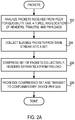
- FIG. 2A shows a set of logical operations that may be performed by one or more embodiments of a packet compression device in order to provide the compression of incoming data packets.
- the logical operations begin with the packet compression device, such as the first packet compression device 104 and particularly the gather engine 124, analyzing incoming packets from the local peer for eligibility to compress at analysis operation 202.
- the incoming packets are also analyzed for information needed to successfully transmit to the receiving packet compression device, such as the second packet compression device 108, for the destination peer at analysis operation 202.
- Certain packets such as those that are encrypted are ineligible for compression because they may need to be passed through to the receiving packet compression device with no compression applied to be effective. These ineligible packets may be found and passed through by analysis operation 202. Additional details of one implementation of analysis operation 202 are discussed below in relation to FIG. 3A .
- This information may include a four-tuple of sending port, sending address, destination port, and destination address that identifies a transport layer stream to which this packet belongs.
- Information needed for determining whether to compress and for organizing the collective compression with other packets may also be obtained at this point, including the locations of the headers within each packet, the location of the payload within each packet, and the location of any trailers that may also be present.
- the eligible packet of a given transport layer stream (e.g., a TCP or UDP stream) is collected into a compressible buffer 127 with other packets of that stream that are also eligible for compression at collection operation 204.
- the collection of these eligible data packets into a set allows for either the entire packet or selected segments thereof (e.g., payloads) to be provided within the at least one single compressible buffer 127.
- the eligible packets may be broken down into header, payload, and trailer if any with each segment being separately buffered with like segment types of other data packets of this same stream. Additional details of one implementation of collection operation 204 are discussed below in relation to FIG. 3B .
- the collection of the packets into a set for compression may need to be constrained to minimize the degradation of the endpoint-to-endpoint connection. For example, delaying transfer of a packet for too long while waiting to fill the at least one single compressible buffer 127 may result in a transport layer timeout. Thus, at this point a determination is made as to whether the set has reached a point at which the compression should commence in order to keep compression ratios at a desirable level while not degrading the endpoint-to-endpoint connection. Details of this determination according to one implementation are also discussed below in relation to FIG. 3B .
- the set of data packets or segments is then passed as contents of at least one single compressible buffer 127 to the compressor engine 128 once it is determined that compression should commence.
- a single packet may be passed directly to the compressor engine 128 for immediate compression and transmission to the receiving compression device such as where the single packet is intended to start a new transport layer stream or terminate an existing transport layer stream.
- the contents of the at least one single compressible buffer 127 are then compressed at compression operation 206.
- the compression is collective in that the compression algorithm acts upon multiple packets, or segments of multiple packets, of the at least one single compressible buffer 127 to produce a compressed output, rather than acting upon a single packet or segment of a single packet at a time. Because more data is acted upon to produce the compressed result when compressing contents of the at least one single compressible buffer 127 containing multiple data packets or segments from multiple data packets, the compression ratio may be higher.
- a compressed data set is produced by the compressor engine 128.
- a compressed data set for payloads may be concatenated with a data set that includes headers and then the concatenated data set may be compressed.
- the transmission engine 126 Upon producing the compressed data sets, the transmission engine 126 transmits the compressed data sets to the receiving compression device at transmission operation 208.
- the data sets are introduced to the network and transport layers 122 (e.g., TCP/IP) where the data sets are packetized and transmitted via a communication session with the receiving compression device.
- These packets being sent to the receiving compression device are tunnel packets because they are providing a tunnel through which the underlying compressed data packets are being delivered.
- the stages of one illustrative implementation of the compression and transmission of are discussed in more detail below in relation to FIG. 4A .
- the data packets being sent from the first packet compression device 104 containing the compressed data sets may have QoS markings to ensure that the packets are being transmitted with sufficient priority.
- the QoS markings for these outgoing packets may be selected on the basis of the QoS markings of the original packets received from the local peer. For example, if an incoming packet has a particular QoS priority, then that QoS marking, such as a DSCP marking, may be stored in memory.
- the tunnel packets being sent to the receiving compression device are marked with the same DSCP marking as the original packets to further maintain transparency of the compression devices for the end-to-end connection.
- a QoS marking for the outgoing packets may be selected based upon some criteria other than the QoS marking of the original data packets.
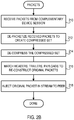
- FIG. 2B shows a set of logical operations that may be performed by one or more embodiments of a compression device in order to decompress data of incoming data packets and reconstruct the original packets from the decompressed data.
- the logical operations begin with the receiving compression device, such as the second packet compression device 108, receiving the tunnel packets sent by the sending compression device, such as the first packet compression device 104, at reception operation 210.
- the tunnel packets are addressed to the receiving device, the packets are passed up the protocol layers rather than being passed through to a local peer of the receiving compression device.
- the network and transport layers 142 receive the packets and depacketize them at packet operation 212 to reveal the compressed data sets that have been previously generated and transmitted by the sending compression device.
- the receiving engine 144 receives the compressed data making up the data sets, including the separate header data set and payload data set for embodiments where headers and payloads are compressed separately.
- the receiving engine 144 passes those on to the decompressor engine 152.
- the decompressor engine 152 decompresses the data sets at decompression operation 214.
- a decompression that is complementary to the compression that has been performed by the sending compression device is employed.
- the compressed data set may include a header that is created by the compression algorithm and that identifies the compression technique that has been utilized such that the decompressor engine 152 may read that header from the compressed data set to then decompress using the appropriate decompression algorithm.
- the scatter engine 139 reconstructs the original data packets by matching the headers, payloads, and any trailers at reconstruction operation 216.
- the scatter engine 139 matches a header with its corresponding payload by referring to the metadata of the decompressed data set to locate the headers and the payloads based on offsets and exact lengths of the segments, where the ordering of the headers matches the ordering of the payloads.
- the scatter engine 139 may also add data that has not been transferred when appropriate, such as adding Ethernet headers and IPSec ESP trailer padding, each of which is information already known to the scatter engine 139.
- the scatter engine 139 then injects them into the end-to-end stream directed to the peer device local to the receiving compression engine at injection operation 218.
- the peer receives the original packets with the original headers and payloads such that end-to-end authentication is maintained.
- the stages of one illustrative implementation of decompressing received packets and reconstructing the original contiguous data packets are discussed in more detail below with reference to FIG. 4B .
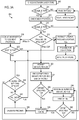
- FIG. 3A shows an illustrative set of logical operations that may be performed in various embodiments to perform the analysis operation 202 of FIG. 2A .
- the goal of this example is to determine which packets are eligible for compression and to extract the necessary information to allow for an efficient compression and transmission of the packet while avoiding degrading the endpoint-to-endpoint connection due to transport layer timeouts or other impactful delays.
- These logical operations are provided for purposes of illustration and are not intended to be limiting, as it will be appreciated that various alternatives exist.
- the logical operations of this example begin at type operation 302 where the gather engine 124 detects the network layer type of the incoming packet by checking a data link header of the packet.
- An option may be that only packets with certain types of network layer protocols, for example Internet Protocol (IP), are eligible for compression.
- IP Internet Protocol
- a query operation 304 detects whether the type for the current packet is eligible, and if not, then the packet is passed through to the receiving compression device without compression at pass operation 306.
- query operation 304 detects that the packet does have an eligible network layer type
- a type operation 308 checks for the next protocol of the packet, such as the transport layer protocol, by checking the network layer header.
- a query operation 310 detects whether this next protocol type is eligible for compression, and if not, then the packet is passed through to the receiving compression device without compression at pass operation 306.
- a further option may be that only packets with certain types of protocols above the network layer are eligible for compression.
- query operation 310 may check for a TCP packet, a UDP packet, an Internet Protocol Security Authentication Header (IPSec AH) packet, and/or an Internet Protocol Security Encapsulating Security Payload (IPSec ESP) packet.
- IPSec AH Internet Protocol Security Authentication Header
- IPSec ESP Internet Protocol Security Encapsulating Security Payload
- a query operation 312 detects whether the packet is TCP, IPSec AH, or IPSec ESP by determining whether a security header for IPSec AH or IPSec ESP is present. Where this next protocol is TCP, then the gather engine 124 extracts information needed for compression and transmission including the four-tuple of sending address, sending port, destination address, and destination port at extraction operation 314. Additional information is also extracted in this example including the location of the headers and payload and the QoS marking of the network layer header based on the packet being an eligible TCP packet.
- the packet is then provided for collection by the gather engine 124, such as by passing the packet from the kernel mode portion to the user mode portion of the gather engine 124 where the packet can be queued in the at least one single compressible buffer 127 prior to being input to the compressor engine 128 at collection operation 316.
- the next incoming data packet is then processed by the logical operations of FIG. 3A .
- query operation 312 detects that the packet is IPSec AH
- the gather engine 124 looks at the security header, which is an authentication header in the case of IPSec AH, to check the type of the next protocol at type operation 318.
- a query operation 320 detects whether this next protocol is TCP. If it is not TCP, then pass operation 306 passes the packet through without compression. If this packet is TCP, then extraction operation 314 extracts the information, and collection operation 316 provides the packet for inclusion in the at least one single compressible buffer 127.
- query operation 312 detects that the packet is IPSec ESP, then a determination may be necessary to detect whether this packet is an encrypted packet or an authenticated packet.
- An option may be that encrypted packets are not compressed while authenticated packets are compressed. The following logical operations may be performed to heuristically determine whether the packet is encrypted or authenticated.
- the gather engine 124 assumes a particular size of an ESP signature of the packet at signature operation 322.
- the size may vary depending upon the version of the operating system and hardware of the peer device sending the packet.
- the ESP signature may be 12 bytes or may be 16 bytes, or other sizes depending upon the operating system of the sending peer.
- the gather engine 124 finds the offset of the packet on the basis of the signature size relative to the end of the packet at offset operation 324.
- a query operation 326 detects whether a protocol number at this offset location indicates that the packet is TCP. If at query operation 326 the gather engine 124 detects for the first assumed signature size that the protocol specified at the offset location is not TCP, then operational flow proceeds directly to a signature operation 336, discussed below.
- the gather engine 124 steps backwards in the packet by 1 byte, the length of the padding in the ESP trailer, at step operation 328.
- An attempt at validating the padding values is done at validation operation 330, where the padding has a regular pattern: 1, 2, and so on.
- the padding is used to make the overall packet size equal to 4 bytes aligned. Details of the padding are discussed in RFC 2406.
- a query operation 332 detects whether the validation of the padding values has succeeded or failed. If the validation succeeded, then it may be assumed that this packet is an IPSec ESP authenticated packet, and extraction operation 314 then extracts the information while collection operation 316 provides the packet for inclusion in the at least one single compressible buffer 127. If the validation has failed, then a query operation 334 detects whether this attempt was the initial attempt or was the second attempt based on an alternative assumed signature size. Note that these logical operations provide for attempts with two assumed signature sizes for purposes of illustration only. It will be appreciated that if additional signature sizes are possible, then additional signature sizes may also be attempted in the same manner.
- pass operation 306 passes through the packet without compression. If this was only the initial attempt such that an alternative signature size has yet to be attempted, then operational flow proceeds to signature operation 336.
- signature operation 336 the gather engine assumes the alternative signature size.
- an offset operation 338 finds the offset of the packet on the basis of the alternative assumed signature size relative to the end of the packet.
- a query operation 340 detects whether a protocol number at this offset location indicates that the packet is TCP. If not, then in this example, pass operation 306 passes the packet through without compression since there are no other signature sizes to attempt. If the offset location does specify TCP, then operational flow proceeds to step operation 328 where the operations proceed as discussed above.
- an ESP encrypted packet may be mistaken for an authenticated packet even after matching the protocol type to TCP and validating the padding values.
- it may be queued while the next few packets, e.g., next 3-4, are also examined to verify that they are also ESP authenticated packets rather than ESP encrypted ones. Once it is verified that these subsequent packets are also ESP authenticated, then the queued packet may be passed on to the at least one single compressible buffer 127 along with the subsequent ones since it is almost certainly an ESP authenticated packet as well.
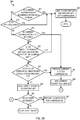
- FIG. 3B shows an example of logical operations performed by the gather engine 124 to collect the contiguous packets or payload segments thereof in the at least one single compressible buffer 127 as in collection operation 204 of FIG. 2A .
- a goal may be to collect as many data packets or payload segments thereof as possible in the at least one single compressible buffer 127 so that the data set being passed to the compressor engine 128 is as large as possible.
- An additional goal may be to also minimize negative effects to the endpoint-to-endpoint stream such as timeouts, latency, and decreased responsiveness of user applications.
- These logical operations are also provided for purposes of illustration and are not intended to be limiting, as it will be appreciated that various alternatives exist for these operations as well.
- the logical operations begin at query operation 342 which detects whether the current packet is the beginning or ending packet of a stream. For example, the gather engine 124 may check the header to see if the SYN, FIN, or RST TCP flags are set. If so, then the packet is added to the current set in the at least one single compressible buffer 127 and the contents of the at least one single compressible buffer 127 are immediately sent to the compressor engine 128 for compression and sending to avoid any further delay in delivering the data packets to the remote peer at compression operation 348.
- adding data packets to the at least one single compressible buffer 127 may involve separating the packets into the various segments, with each segment type being separately buffered so that different compression algorithms may be applied to the different segment types to most efficiently compress the data packets.
- the metadata that specifies the order and lengths of the headers and payloads may be collected and buffered as well.
- query operation 345 detects whether the current packet has a zero length payload. If it does have a zero length payload, such as a TCP ACK packet, then the packet is added to the current set in the at least one single compressible buffer 127. The contents of the at least one single compressible buffer 127 are immediately sent to the compressor engine 128 for compression and sending to avoid any further delay in delivering it to the remote peer at compression operation 348. If the current packet does not have a zero length payload, then operational flow proceeds to a query operation 346.
- a zero length payload such as a TCP ACK packet
- Query operation 346 detects whether the current data packet is out of order in the sequence of packets that have been received for this endpoint-to-endpoint stream. This may be based on the TCP sequence number of the current packet relative to the TCP sequence number of the last collected packed in the queue. If the current data packet is out of order, then the current set of data packets or payload segments thereof within the at least one single compressible buffer 127 is provided for compression at compression operation 354 while the current data packet is then added to a new instance of the at least one single compressible buffer 127 to begin a new set of packets at collection operation 356. This is done to avoid sending a large number of packets out of sequence to the receiving packet compression device which might overly degrade the communication session between endpoints.
- a query operation 350 detects whether a timeout threshold, such as a TCP timeout, is about to occur for any of the data packets in the at least one single compressible buffer 127. This may be determined by storing a time stamp that reflects the time when each data packet of the at least one single compressible buffer 127 was originally received and then by comparing that time stamp to a current time. If the timeout threshold is about to be reached, then the current data packet may be added to the at least one single compressible buffer 127 and the at least one single compressible buffer 127 may then be passed to the compressor engine 128 for compression at compression operation 348.
- a timeout threshold such as a TCP timeout
- query operation 352 detects whether the addition of the current data packet or payload segment thereof to the at least one single compressible buffer 127 will exceed a predefined maximum size, for example 64 kilobytes, for the data set to be compressed. If so, then the current at least one single compressible buffer 127 is provided for compression at compression operation 354 while the current data packet is then added to a new instance of the at least one single compressible buffer 127 to begin a new set of packets at collection operation 356.
- a predefined maximum size for example 64 kilobytes
- Query operation 360 detects whether a delay timer threshold has been exceeded since the last data packet was queued in the at least one single compressible buffer 127 for this stream.
- a delay timer threshold is a fixed 3 milliseconds while another example is a dynamic value which may be adjusted according to the Round-Trip Time (RTT) of the link between the two compression devices. The time stamp for the last data packet may be compared against the current time.
- RTT Round-Trip Time
- the gather engine 124 awaits the next data packet or another timer event which triggers it to send the collected packets to the compressor engine 128.
- the delay timer may be based on the first data packet or payload segment thereof into the queue rather than the last, where the delay timer threshold is set to an amount that is different than a TCP timeout threshold.
- the delay timer threshold may be set to values greater than or less than the 3 millisecond example.
- zero payload packets may be treated as if they had a payload such that query operation 345 may be omitted.
- single compressible buffers may be passed to the compressor engine by detecting whether an incoming packet has the PSH TCP flag set, which would help optimize user applications where an application level confirmation is expected but may decrease the compression ratio for applications where application level confirmations are not expected.
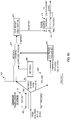
- FIG. 4A shows the stages of the data packets and segments thereof as they progress through the compression and transmission phases according to one illustrative embodiment.
- the data packets are received from the peer device and the data packets that are eligible for compression are collected as a set of contiguous data packets 402.
- the data packets include headers H 1 -H N and corresponding payloads P 1 -P N .
- separate compression algorithms are used for each header 403 and each payload 405 to maximize the compression efficiency for each, so the packets of this set of contiguous data packets 402 are segmented to form the set of headers 404 and the set of payloads 406.
- metadata 408 may be created to specify that exact lengths and order of each of the headers and payloads.
- the set of payloads 406 is stored in the at least one single compressible buffer 127 that is input to the compression algorithm to form a compressed payload data set 410.
- the metadata 408 and set of headers 404 are then concatenated with the compressed payload data set 410 to form a concatenated set 411. Further, according to this embodiment the concatenated set 411 is then compressed using a compression technique such as LZW to form the compressed dataset 412. It will be appreciated that alternative manners of compressing exist as well, such as by separately compressing each of the three parts using a separate instance of the at least one single compressible buffer 127 for each segment type and then concatenating the results to form a compressed data set. It will further be appreciated that the headers and/or the metadata may be left uncompressed such that the concatenated set 411 may be transmitted.
- a compression technique such as LZW
- the compressed data set 412 of this embodiment it is then packetized to form a set of tunnel packets 414.
- the tunnel packets of the set of tunnel packets 414 include their own headers H 11 -H NN and corresponding payloads P 11 -P NN . These tunnel packets are then transmitted through the network 106 to the receiving compression device. It will be appreciated that alternative manners of transferring the headers and compressed payloads are also possible, such as creating separate tunnel packets for the set of headers and the set of compressed payloads.
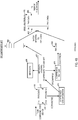
- FIG. 4B shows the stages of the data packets and segments thereof as they progress through the reception, decompression, and reconstruction phase according to one illustrative embodiment.
- the set of tunnel packets 414 are received from the sending compression device.
- each tunnel packet of the set of tunnel packets 414 is depacketized to reproduce the compressed data set 412.
- the compressed data set 412 is then decompressed by the decompressor engine 152 to produce the set of headers 404, metadata 408, and the compressed payload data set 410.
- the compressed payload data set 410 is then provided as at least one single decompressible buffer to the decompressor engine 152 where it is decompressed to produce the set of payloads 406.
- the scatter engine 139 then follows the lengths and order specified in the metadata 408 to match each header of the set of headers 404 to its corresponding payload of the set of payloads 406.
- the scatter engine 139 may also add any additional data such as the Ethernet headers and IPSec ESP padding, which is not transmitted but is already known to the scatter engine 139, to thereby reconstruct the set of contiguous data packets 402 including each header 403 and each corresponding payload 405.
- the scatter engine 139 then injects each individual data packet of the set of contiguous data packets 402 into the end-to-end stream to the peer device that is local to the receiving packet compression device.
Landscapes
- Engineering & Computer Science (AREA)
- Computer Networks & Wireless Communication (AREA)
- Signal Processing (AREA)
- Computer Security & Cryptography (AREA)
- Data Exchanges In Wide-Area Networks (AREA)
Description
- Computers typically communicate by exchanging data packets over a network. The network has a limited amount of bandwidth available to transport the data packets from one endpoint to another. The available bandwidth limits the rate at which the computers can exchange the data packets. Inadequate rates of data packet transfer result in inefficiencies. For the non-commercial user, inadequate rates of transfer may result in frustration. In the commercial setting, a slow transfer may hinder productivity and profitability.
- Businesses often have sustained end-to-end connections, such as between two or more physical locations. There may be a headquarters and several branch offices, for example. In order to increase the throughput of data packets, each endpoint may employ an accelerator device that is logically located between the sending device and the receiving device. The accelerator device is a network transparent device in that data packets are received that are addressed to downstream devices, and the accelerator device may pass through packets unchanged or may collect packets for compression and transmission in a compressed state.
- The accelerator device may apply compression to the payload of the data packets to increase the throughput and improve the user experience. However, the accelerator device terminates the transport layer stream of the incoming packets by discarding the original header and act as a proxy service to deliver the payload.
- While the accelerator device may provide desirable compression, the termination of the transport layer stream presents problems. As one particular example, endpoint-to-endpoint authentication protocols such as Internet Protocol Security (IPSec) and Server Message Block (SMB) signing are no longer possible.
-
WO 02/29991 A1 -
US 2004/114634 A1 relates to avoiding compression of encrypted payload. A method for conveying data packets in a network comprises the steps of examining whether a received data packet is encrypted, compressing the data packet in case that it is examined that the data packet is not encrypted, and refraining from compressing in case it is examined that the data packet is encrypted. A decision whether a data packet is encrypted is performed by checking the header of the data packet. The particular encryption algorithm may be Encapsulating Security Payload (ESP). In case it is decided that a data packet is encrypted, it is examined whether the data packet belongs to a group of data packets which are encrypted with a NULL algorithm, and in case the data packet belongs to the group, compressing the data packet according to a compression indication associated to the group. Information regarding the group of data packets is listed in a lookup table, where the information comprises at least a destination address of the data packet and the compression indication. The compression data packets encrypted with the NULL algorithm are identified by the destination address and from the compression indication. - It is the object of the present invention to simplify and improve data packet transmissions.
- This object is solved by the subject matter of the independent claims.
- Preferred embodiments are defined by the dependent claims.
- Embodiments provide for the compression of contiguous data packets of a single communication session between endpoints while preserving the original headers of the communication session such that endpoint-to-endpoint
authentication protocols may be maintained. The compression of at least the payloads of the contiguous data packets occurs via at least one compressible buffer to thereby compress the payloads of the contiguous data packets collectively as a group rather than individually. Different data packets corresponding to a second single communication session between a sending and a receiving device are transmitted to the receiving device in order to transfer the compressed headers and the original headers of the contiguous data packets of the first single communication session. The receiving device decompresses at least the compressed payloads and then reconstructs the original contiguous data packets of the first single communication session between endpoints by matching the original headers to the original payloads. The reconstructed contiguous data packets may then be inserted into the first single communication session between endpoints at the receiving device so as to deliver each of the contiguous data packets from the receiving device to the endpoint device to which the original contiguous data packets were destined. - This Summary is provided to introduce a selection of concepts in a simplified form that are further described below in the Detailed Description. This Summary is not intended to identify key features or essential features of the claimed subject matter, nor is it intended to be used to limit the scope of the claimed subject matter.
-
-
FIG. 1A shows an example environment for various embodiments of data packet compression devices. -
FIG. 1B shows an illustrative embodiment of two data packet compression devices in communication over the network. -
FIG. 2A shows an example of a set of logical operations to collectively compress at least payloads of a set of contiguous data packets of a single communication session between endpoints. -
FIG. 2B shows an example of a set of logical operations to decompress at least payloads of a set of contiguous data packets and reconstruct the contiguous data packets into their original form. -
FIG. 3A shows an example of a set of logical operations to analyze incoming data packets for eligibility to compress such as during the logical operations ofFIG. 2A . -
FIG. 3B shows an example of a set of logical operations to determine the initiation of compression of at least one compressible buffer including at least payloads of a set of incoming contiguous data packets such as during the logical operations ofFIG. 2A . -
FIG. 4A shows the progression of a set of contiguous set of data packets of a single communication session between endpoints from being collected in an uncompressed state to being compressed and transmitted. -
FIG. 4B shows the progression of a set of contiguous data packets of a single communication session between endpoints from being received in a compressed state to being decompressed and injected in their original form into an outgoing stream of the single communication session. - Embodiments provide for the compression of a set of contiguous data packets of a single communication session between endpoints and for the transmission of the compressed set of contiguous data packets to a receiving device. Compression may include compressing only the payloads or compressing both the headers and the payloads. Both the compressed payloads and the original headers, either compressed or not, are transferred to the receiving device which then decompresses at least the payloads and reconstructs the original set of contiguous data packets. Logic may be employed prior to compression to select those contiguous data packets that are eligible for compression and to maximize the amount of data included in at least one compressible buffer.
-
FIG. 1A shows one example of an operating environment for various illustrative embodiments. In this example, several peer devices may be present at various locations and may be communicating through anetwork 106 with various peer devices at other locations. For purposes of illustration, a first location includes afirst peer device 102 and athird peer device 103 connected to anode 101 such as a network switch which receives data packets sent from thefirst peer device 102 andthird peer device 103. Thenode 101 then transfers data packets destined for other locations to a firstpacket compression device 104. Thenode 101 may also receive data packets from the firstpacket compression device 104 and then direct them to thefirst peer device 102 or thethird peer device 103. - The first
packet compression device 104 may be a network transparent device because packets from thefirst peer device 102 and from thethird peer device 103 are not addressed to the firstpacket compression device 104 but are passed to it for further delivery through thenetwork 106. It will be appreciated that varying numbers of peer devices may be present at this location and that if only thefirst peer device 102 is present, it may be connected directly to the firstpacket compression device 104. Furthermore, the functionality of the firstpacket compression device 104 may be integrated into thefirst peer device 102 rather than being a stand-alone device as shown in this example. - Also for purposes of illustration, a second location includes a
second peer device 110 and afourth peer device 111 that are connected to anode 109 which receives data packets from thesecond peer device 110 and from thefourth peer device 111. Thenode 109 then transfers data packets destined for other locations to a secondpacket compression device 108. Thenode 109 may also receive data packets from the secondpacket compression device 108 and then direct them to thesecond peer device 110 or thefourth peer device 111. - Like the first
packet compression device 104, the second packet compression device may also be a network transparent device because packets from thesecond peer device 110 and from thefourth peer device 111 are not addressed to the secondpacket compression device 108 but are passed to it for further delivery through thenetwork 106. It will be appreciated that varying numbers of peer devices may be present at this location and that if only thesecond peer device 110 is present, it may be connected directly to the secondpacket compression device 108. Furthermore, the functionality of the secondpacket compression device 108 may be integrated into thesecond peer device 110 rather than being a stand-alone device as shown in this example. - When
first peer device 102 sends data packets addressed to thesecond peer device 110 orfourth peer device 111, thepacket compression device 104 may compress a set of contiguous data packets being sent by thefirst peer device 102 as a single data set of at least one single compressible buffer. The compression may include compression of payloads of the contiguous data packets or headers and payloads of those contiguous data packets. The headers and compressed payloads are then transmitted to the secondpacket compression device 108 where the payloads, and if necessary the headers, are decompressed. The headers are then matched to the payloads to reconstruct the original data packets sent from thefirst peer device 102, and the secondpacket compression device 108 then injects those reconstructed original data packets into the communication session between thefirst peer 102 and thesecond peer 110 orfourth peer 111 to deliver the reconstructed original data packets to the intended destination. - The same actions may take place in the opposite direction where the
second peer device 110 is sending data packets to thefirst peer device 102 or thethird peer device 103. The secondpacket compression device 108 compresses at least the payloads and transmits the original headers and the compressed payloads to the firstpacket compression device 104. The firstpacket compression device 104 than decompresses the payloads and the headers, if necessary, and then reconstructs the original packets sent from thesecond peer device 110. - For purposes of illustration, where the
first peer device 102 is communicating with thesecond peer device 110, a first communication session 113 is established between these endpoints such as by creating a transport layer stream between them throughnetwork 106. When thefirst peer device 102 attempts to send data to thesecond peer device 110 through thenetwork 106, a contiguous byte stream flows through the first communication session 113 where the byte stream forms the sequence of data packets, each having headers and payload. The transport layer stream is maintained by the transport layer headers present within those data packets of the byte stream. - Also for purposes of illustration, where the
packet compression device 104 is receiving the packets of the first communication session 113 in order to transmit them on through thenetwork 106, thepacket compression device 104 may collect at least some of them for compression. The compressed data packets may then be transmitted through asecond communication session 115 that is established between thepacket compression device 104 and thepacket compression device 108 through thenetwork 106. Thissecond communication session 115 may be created as a transport layer stream maintained between thepacket compression device 104 and thepacket compression device 108. -
FIG. 1B shows an example of one illustrative implementation of the firstpacket compression device 104 and the secondpacket compression device 108. In this example, the firstpacket compression device 104 and secondpacket compression device 108 are present for providing a compression service for the data communications occurring between thefirst peer device 102 and thesecond peer device 110. - This illustrative implementation of the first
packet compression device 104 includes various components that form a processing system. In this example, the processing system of the firstpacket compression device 104 includes akernel mode portion 134 and auser mode portion 132. Thekernel mode portion 134 sends and receives data via a first network interface card (NIC) 112 that provides a physical connection to thefirst peer device 102 or to some intervening device such that data packets are exchanged between thefirst peer device 102 and the firstpacket compression device 104. Adata link layer 114, such as a network driver interface specification layer (NDIS) operates with theNIC 112 to pass the packets over abridge 120 to the data link layer 118 which passed the packets up to the network and transport layers 122. The network andtransport layers 122 may utilize protocols such as the Internet Protocol (IP) for the network layer and transmission control protocol (TCP) or user datagram protocol (UDP) for the associated transport layer. Other examples of the data link, network, and transport layers are also applicable to the various embodiments. - In this particular example, the first
packet compression device 104 is physically located in the data path between thefirst peer device 102 and thenetwork 106. Accordingly, thekernel mode portion 134 sends and receives data via a second NIC 116, and thekernel mode portion 134 includes an associated data link layer 118 that provides packets up to the network and transport layers 122. The NIC 116 exchanges packets over thenetwork 106, such as a wide area network interconnecting the local network of thefirst peer device 102 to the local network of thesecond peer device 110. - Coupled to the data link layer 118 of the first
packet compression device 104 is a gatherengine 124 that collects packets sent byfirst peer device 102 into a set and then provides the set to at least one singlecompressible buffer 127 of theuser mode portion 132. The gather engine may be a driver, such as an NDIS filter driver or an NDIS Intermediate (IM) driver, depending upon an operating system platform of the firstpacket compression device 104. - The gather
engine 124 of this illustrative implementation includes a kernel portion and a user mode portion. The kernel mode portion collects the contiguous data packets from a particular incoming communication session between endpoints and separates the collected set of contiguous data packets into segments including headers separated from payloads. The kernel portion passes the segments to the user mode portion which manages the loading of at least the payloads into the at least one singlecompressible buffer 127 as a single data set to be compressed. At theuser mode portion 132, the data set containing the segments to be compressed may then be accessed from thebuffer 127, compressed, and transmitted to the secondpacket compression device 108. - The data link layer 118 of this illustrative implementation may also maintain a quality of service (QoS) marker, such as a differentiated services code point (DSCP)
marker 136 that is used to mark outgoing DSCP values for streams between the firstpacket compression device 104 and the secondpacket compression device 108. The marking of outgoing packets to preserve the quality of service intended for the original data packets being compressed is discussed further below. - The
user mode portion 132 of this illustrative implementation of the firstpacket compression device 104 forms a processing system that includes various components as well. As discussed, the gatherengine 124 includes a user mode portion that buffers at least payloads from a given incoming stream of a communication between endpoints throughNIC 112. The user mode portion of the gatherengine 124 then provides at least the set of payloads as a single data set of at least one singlecompressible buffer 127 to acompressor engine 128. - The
compressor engine 128 receives at least the payloads as a single data set of the at least one singlecompressible buffer 127 from the gatherengine 124 and performs one or more compression algorithms to compress as a single data set at least the payloads from the at least one singlecompressible buffer 127. By compressing at least the payloads from the at least one single compressible buffer as a single data set, thecompressor engine 128 is compressing the payloads collectively, rather than individually. By increasing the size of the single data set that is being compressed, the compression ratio may be increased. - The
compressor engine 128 may utilize astorage device 130 to maintain dictionaries of previously seen data and other reference information that may be utilized when performing the various compression algorithms. Furthermore, thecompressor engine 128 may employ one algorithm to the payload contents of the at least one single compressible buffer and employ another algorithm to a different single compressible buffer that includes headers. - Examples of compression algorithms that may be applied to the header contents of compressible buffers that include headers include various differential algorithms and various stateless compression algorithms. Examples of differential algorithms include those described in Request For Comment (RFC) 1144, 2507, 2508, 2509, 3095, and 4815. Examples of stateless compression algorithms include Lempel-Ziv-Welch (LZW) or Huffman encoding.
- Examples of compression algorithms that may be applied to contents of compressible buffers that include payloads include various stateful differential algorithms and various stateless compression algorithms. An example of stateful differential algorithms includes Remote Differential Compression (RDC) as used in Distributed File System Replication (DFSR). Examples of stateless compression algorithms include LZW and Huffman encoding.
- A
transmission engine 126 receives compressed data sets from thecompressor engine 128. Thetransmission engine 126 then sends the data sets through a second communication session that is between the firstpacket compression device 104 and the secondpacket compression device 108. Thetransmission engine 126 may utilize the network andtransport layers 122 to packetize the data sets and send the resulting packets via the data link layer 118 and NIC 116 to the secondpacket compression device 108 through the second communication session. Thus, the compressed packets are tunneled in a collectively compressed form through thenetwork 106. - The components of the first
packet compression device 104 that are shown for this example are those components relevant to the collecting, compressing, and transmitting of the incoming data packets from thefirst peer device 102. It will be appreciated that the firstpacket compression device 104 and the secondpacket compression device 108 may be complementary devices in that for data traveling in one direction, the firstpacket compression device 104 may collect, segment, compress, and transmit while the secondpacket compression device 108 performs the complementary functions of receiving, decompressing, reconstructing, and injecting back into the stream to thesecond peer device 110. For data flowing in the opposite direction, the secondpacket compression device 108 may collect, segment, compress, and transmit while the firstpacket compression device 104 receives, decompresses, reconstructs, and injects back into the stream to thefirst peer device 102. - Accordingly, while the first
packet compression device 104 is shown with one set of components and the secondpacket compression device 108 is shown with a different and complementary set of components, it will be appreciated that the firstpacket compression device 104 may also contain the components shown for the secondpacket compression device 108 and the secondpacket compression device 108 may also contain the components shown for the firstpacket compression device 104. - The illustrative implementation shown for the second
packet compression device 108 also includes a kernel mode portion, aNIC 138 to interface to thenetwork 106 and aNIC 146 to interface to thesecond peer device 110. The secondpacket compression device 108 includes data link layers 140 and 148, ascatter engine 139, abridge 150, and network and transport layers 142. A user mode portion of this illustrative implementation includes a receivingengine 144, adecompressor engine 152, and a storage device 154. - Packets that are from the second communication session with the first
packet compression device 104 and are therefore addressed to this secondpacket compression device 108 are received from the first compression device via theNIC 138, are passed to the network and transport layers 142 (e.g., TCP/IP) which then depacketize the information by extracting packet payloads and piecing the payloads together in a specified order. The network andtransport layers 142 provide the application data to a receivingengine 144. This information is the compressed data set that was transmitted from thetransmission engine 126 of the firstpacket compression device 104, where the compressed data set includes the headers, either compressed or not, and the compressed payloads of the original packets from thefirst peer device 102. The receivingengine 144 provides this data set to thedecompressor engine 152. - The
decompressor engine 152 of the secondpacket compression device 108 decompresses the data set utilizing a decompression algorithm(s) that is complementary to the compression algorithm(s) employed by thecompressor engine 128 of the firstpacket compression device 104. In doing so, thedecompressor engine 152 may rely upon dictionaries and other reference information of the storage device 154, including dictionaries and other reference information that is complementary to that of thestorage device 130 of the firstpacket compression device 104. - The
decompressor engine 152 provides the segments including headers and decompressed payloads of the original data packets to a buffer managed by a user mode portion of thescatter engine 139. Thescatter engine 139 ultimately distributes decompressed packets back into the communication sessions between endpoints from which the packets originated so that the communication session is uninterrupted. The user mode portion of thescatter engine 139 provides the decompressed headers, payloads, and any other portions of the original packets to the kernel mode portion of this illustrative implementation of the scatter engine. Thescatter engine 139 matches the headers with the decompressed payloads to reconstruct the original packets. Thescatter engine 139 then injects the reconstructed original packets into the stream to thesecond peer device 110 via thebridge 150. - The first
packet compression device 104 and secondpacket compression device 108 ofFIG. 1B are shown for purposes of illustration and are not intended to be limiting. For example, while the firstpacket compression device 104 and the secondpacket compression device 108 are shown as stand-alone structures, these devices may instead be incorporated into endpoints. For example, the firstpacket compression device 104 may be incorporated into the structure of thefirst peer device 102, thus eliminating the presence of theNIC 112. - Additionally, the implementations of the first packet compression device and second packet compression device included some kernel mode components and some user mode components. It will be appreciated that the various components and their functions may be implemented in alternative configurations. For example, all of the components and their functions may be implemented within the kernel mode.
- The components of the first
packet compression device 104 and the secondpacket compression device 108 may be constructed of hard-wired logic, firmware, general-purpose programmable processors implementing programming stored in memory such as thestorage device 130 or 154, and so forth. The devices ofFIG. 1B , including the firstpacket compression device 104 and the secondpacket compression device 108 as well as thefirst peer device 102 and thesecond peer device 110 may include a variety of computer readable media. Such computer readable media contains the instructions for operation of the device and for implementation of the embodiments discussed herein. Computer readable media can be any available media that can be accessed by a computer system and includes both volatile and nonvolatile media, removable and non-removable media. By way of example, and not limitation, computer readable media may comprise computer storage media and communication media. - Computer storage media includes volatile and nonvolatile, removable and non-removable media implemented in any method or technology for storage of information such as computer readable instructions, data structures, program modules or other data. Computer storage media includes, but is not limited to, RAM, ROM, EEPROM, flash memory or other memory technology, CD-ROM, digital versatile disks (DVD) or other optical disk storage, magnetic cassettes, magnetic tape, magnetic disk storage or other magnetic storage devices, or any other medium which can be used to store the desired information and which can accessed by a computer system.
- Communication media typically embodies computer readable instructions, data structures, program modules or other data in a modulated data signal such as a carrier wave or other transport mechanism and includes any information delivery media. The term "modulated data signal" means a signal that has one or more of its characteristics set or changed in such a manner as to encode information in the signal. By way of example, and not limitation, communication media includes wired media such as a wired network or direct-wired connection, and wireless media such as acoustic, RF, infrared and other wireless media. Combinations of the any of the above should also be included within the scope of computer readable media.
-
FIGs. 2A-3B illustrate operational flows for the compression or decompression of data packets. The following descriptions ofFIGs. 2A-3B are made with reference to thecompression devices FIG. 1 . However, it should be understood that the flow described with respect toFIGs. 2A-3B is not intended to be limited to being performed by thecompression devices compression devices FIGs. 2A-3B indicate a particular order of steps, in other implementations the operations may be ordered differently, additional operations may be added, and/or some operations may be omitted. -
FIG. 2A shows a set of logical operations that may be performed by one or more embodiments of a packet compression device in order to provide the compression of incoming data packets. The logical operations begin with the packet compression device, such as the firstpacket compression device 104 and particularly the gatherengine 124, analyzing incoming packets from the local peer for eligibility to compress atanalysis operation 202. The incoming packets are also analyzed for information needed to successfully transmit to the receiving packet compression device, such as the secondpacket compression device 108, for the destination peer atanalysis operation 202. - Certain packets such as those that are encrypted are ineligible for compression because they may need to be passed through to the receiving packet compression device with no compression applied to be effective. These ineligible packets may be found and passed through by
analysis operation 202. Additional details of one implementation ofanalysis operation 202 are discussed below in relation toFIG. 3A . - At this point, information needed to properly transmit and, when eligible, needed to compress the eligible data packets may be collected. This information may include a four-tuple of sending port, sending address, destination port, and destination address that identifies a transport layer stream to which this packet belongs. Information needed for determining whether to compress and for organizing the collective compression with other packets may also be obtained at this point, including the locations of the headers within each packet, the location of the payload within each packet, and the location of any trailers that may also be present.
- Upon completing the analysis for eligibility of an incoming packet, the eligible packet of a given transport layer stream (e.g., a TCP or UDP stream) is collected into a
compressible buffer 127 with other packets of that stream that are also eligible for compression atcollection operation 204. The collection of these eligible data packets into a set allows for either the entire packet or selected segments thereof (e.g., payloads) to be provided within the at least one singlecompressible buffer 127. Here, the eligible packets may be broken down into header, payload, and trailer if any with each segment being separately buffered with like segment types of other data packets of this same stream. Additional details of one implementation ofcollection operation 204 are discussed below in relation toFIG. 3B . - The collection of the packets into a set for compression may need to be constrained to minimize the degradation of the endpoint-to-endpoint connection. For example, delaying transfer of a packet for too long while waiting to fill the at least one single
compressible buffer 127 may result in a transport layer timeout. Thus, at this point a determination is made as to whether the set has reached a point at which the compression should commence in order to keep compression ratios at a desirable level while not degrading the endpoint-to-endpoint connection. Details of this determination according to one implementation are also discussed below in relation toFIG. 3B . - The set of data packets or segments is then passed as contents of at least one single
compressible buffer 127 to thecompressor engine 128 once it is determined that compression should commence. In certain circumstances, a single packet may be passed directly to thecompressor engine 128 for immediate compression and transmission to the receiving compression device such as where the single packet is intended to start a new transport layer stream or terminate an existing transport layer stream. - Upon passing the contents of the at least one single
compressible buffer 127 to thecompressor engine 128, the contents of the at least one singlecompressible buffer 127 are then compressed atcompression operation 206. The compression is collective in that the compression algorithm acts upon multiple packets, or segments of multiple packets, of the at least one singlecompressible buffer 127 to produce a compressed output, rather than acting upon a single packet or segment of a single packet at a time. Because more data is acted upon to produce the compressed result when compressing contents of the at least one singlecompressible buffer 127 containing multiple data packets or segments from multiple data packets, the compression ratio may be higher. A compressed data set is produced by thecompressor engine 128. There may be one compressed data set for each segment type that has been compressed for embodiments where different algorithms are used for different segment types. Alternatively, a compressed data set for payloads may be concatenated with a data set that includes headers and then the concatenated data set may be compressed. - Upon producing the compressed data sets, the
transmission engine 126 transmits the compressed data sets to the receiving compression device attransmission operation 208. Here, the data sets are introduced to the network and transport layers 122 (e.g., TCP/IP) where the data sets are packetized and transmitted via a communication session with the receiving compression device. These packets being sent to the receiving compression device are tunnel packets because they are providing a tunnel through which the underlying compressed data packets are being delivered. The stages of one illustrative implementation of the compression and transmission of are discussed in more detail below in relation toFIG. 4A . - The data packets being sent from the first
packet compression device 104 containing the compressed data sets may have QoS markings to ensure that the packets are being transmitted with sufficient priority. The QoS markings for these outgoing packets may be selected on the basis of the QoS markings of the original packets received from the local peer. For example, if an incoming packet has a particular QoS priority, then that QoS marking, such as a DSCP marking, may be stored in memory. The tunnel packets being sent to the receiving compression device are marked with the same DSCP marking as the original packets to further maintain transparency of the compression devices for the end-to-end connection. As an alternative, a QoS marking for the outgoing packets may be selected based upon some criteria other than the QoS marking of the original data packets. -
FIG. 2B shows a set of logical operations that may be performed by one or more embodiments of a compression device in order to decompress data of incoming data packets and reconstruct the original packets from the decompressed data. The logical operations begin with the receiving compression device, such as the secondpacket compression device 108, receiving the tunnel packets sent by the sending compression device, such as the firstpacket compression device 104, atreception operation 210. As the tunnel packets are addressed to the receiving device, the packets are passed up the protocol layers rather than being passed through to a local peer of the receiving compression device. - The network and
transport layers 142 receive the packets and depacketize them atpacket operation 212 to reveal the compressed data sets that have been previously generated and transmitted by the sending compression device. The receivingengine 144 receives the compressed data making up the data sets, including the separate header data set and payload data set for embodiments where headers and payloads are compressed separately. The receivingengine 144 passes those on to thedecompressor engine 152. - The
decompressor engine 152 decompresses the data sets atdecompression operation 214. A decompression that is complementary to the compression that has been performed by the sending compression device is employed. The compressed data set may include a header that is created by the compression algorithm and that identifies the compression technique that has been utilized such that thedecompressor engine 152 may read that header from the compressed data set to then decompress using the appropriate decompression algorithm. Furthermore, there may be higher level agreements in place between two complementary compression devices that dictate which compression algorithms will be utilized. Decompressed data sets are then passed to thescatter engine 139 where the packets can be reconstructed. - The
scatter engine 139 reconstructs the original data packets by matching the headers, payloads, and any trailers atreconstruction operation 216. Here, thescatter engine 139 matches a header with its corresponding payload by referring to the metadata of the decompressed data set to locate the headers and the payloads based on offsets and exact lengths of the segments, where the ordering of the headers matches the ordering of the payloads. Thescatter engine 139 may also add data that has not been transferred when appropriate, such as adding Ethernet headers and IPSec ESP trailer padding, each of which is information already known to thescatter engine 139. - Once the original data packets have been reconstructed, the
scatter engine 139 then injects them into the end-to-end stream directed to the peer device local to the receiving compression engine at injection operation 218. By injecting them into the existing end-to-end stream, the peer receives the original packets with the original headers and payloads such that end-to-end authentication is maintained. The stages of one illustrative implementation of decompressing received packets and reconstructing the original contiguous data packets are discussed in more detail below with reference toFIG. 4B . -
FIG. 3A shows an illustrative set of logical operations that may be performed in various embodiments to perform theanalysis operation 202 ofFIG. 2A . The goal of this example is to determine which packets are eligible for compression and to extract the necessary information to allow for an efficient compression and transmission of the packet while avoiding degrading the endpoint-to-endpoint connection due to transport layer timeouts or other impactful delays. These logical operations are provided for purposes of illustration and are not intended to be limiting, as it will be appreciated that various alternatives exist. - The logical operations of this example begin at
type operation 302 where the gatherengine 124 detects the network layer type of the incoming packet by checking a data link header of the packet. An option may be that only packets with certain types of network layer protocols, for example Internet Protocol (IP), are eligible for compression. In that case, aquery operation 304 detects whether the type for the current packet is eligible, and if not, then the packet is passed through to the receiving compression device without compression atpass operation 306. - Where
query operation 304 detects that the packet does have an eligible network layer type, then atype operation 308 checks for the next protocol of the packet, such as the transport layer protocol, by checking the network layer header. Aquery operation 310 detects whether this next protocol type is eligible for compression, and if not, then the packet is passed through to the receiving compression device without compression atpass operation 306. A further option may be that only packets with certain types of protocols above the network layer are eligible for compression. For example,query operation 310 may check for a TCP packet, a UDP packet, an Internet Protocol Security Authentication Header (IPSec AH) packet, and/or an Internet Protocol Security Encapsulating Security Payload (IPSec ESP) packet. For purposes of illustration, the discussion will proceed as if the eligible types are TCP, IPSec AH, and IPSec ESP, but it will be appreciated that other types may also be eligible. - A
query operation 312 detects whether the packet is TCP, IPSec AH, or IPSec ESP by determining whether a security header for IPSec AH or IPSec ESP is present. Where this next protocol is TCP, then the gatherengine 124 extracts information needed for compression and transmission including the four-tuple of sending address, sending port, destination address, and destination port atextraction operation 314. Additional information is also extracted in this example including the location of the headers and payload and the QoS marking of the network layer header based on the packet being an eligible TCP packet. The packet is then provided for collection by the gatherengine 124, such as by passing the packet from the kernel mode portion to the user mode portion of the gatherengine 124 where the packet can be queued in the at least one singlecompressible buffer 127 prior to being input to thecompressor engine 128 atcollection operation 316. The next incoming data packet is then processed by the logical operations ofFIG. 3A . - Where
query operation 312 detects that the packet is IPSec AH, then the gatherengine 124 looks at the security header, which is an authentication header in the case of IPSec AH, to check the type of the next protocol attype operation 318. Aquery operation 320 then detects whether this next protocol is TCP. If it is not TCP, then passoperation 306 passes the packet through without compression. If this packet is TCP, thenextraction operation 314 extracts the information, andcollection operation 316 provides the packet for inclusion in the at least one singlecompressible buffer 127. - Where
query operation 312 detects that the packet is IPSec ESP, then a determination may be necessary to detect whether this packet is an encrypted packet or an authenticated packet. An option may be that encrypted packets are not compressed while authenticated packets are compressed. The following logical operations may be performed to heuristically determine whether the packet is encrypted or authenticated. - The gather
engine 124 assumes a particular size of an ESP signature of the packet atsignature operation 322. The size may vary depending upon the version of the operating system and hardware of the peer device sending the packet. For example, the ESP signature may be 12 bytes or may be 16 bytes, or other sizes depending upon the operating system of the sending peer. The gatherengine 124 then finds the offset of the packet on the basis of the signature size relative to the end of the packet at offsetoperation 324. Aquery operation 326 then detects whether a protocol number at this offset location indicates that the packet is TCP. If atquery operation 326 the gatherengine 124 detects for the first assumed signature size that the protocol specified at the offset location is not TCP, then operational flow proceeds directly to asignature operation 336, discussed below. - Where the gather
engine 124 has determined that the packet is TCP, then the gatherengine 124 steps backwards in the packet by 1 byte, the length of the padding in the ESP trailer, atstep operation 328. An attempt at validating the padding values is done atvalidation operation 330, where the padding has a regular pattern: 1, 2, and so on. For authenticated ESP data packets, it is expected that the padding is used to make the overall packet size equal to 4 bytes aligned. Details of the padding are discussed in RFC 2406. - A
query operation 332 detects whether the validation of the padding values has succeeded or failed. If the validation succeeded, then it may be assumed that this packet is an IPSec ESP authenticated packet, andextraction operation 314 then extracts the information whilecollection operation 316 provides the packet for inclusion in the at least one singlecompressible buffer 127. If the validation has failed, then aquery operation 334 detects whether this attempt was the initial attempt or was the second attempt based on an alternative assumed signature size. Note that these logical operations provide for attempts with two assumed signature sizes for purposes of illustration only. It will be appreciated that if additional signature sizes are possible, then additional signature sizes may also be attempted in the same manner. - If this was the second attempt such that both assumed signature sizes have resulted in a failed validation of the padding values, then in this
example pass operation 306 passes through the packet without compression. If this was only the initial attempt such that an alternative signature size has yet to be attempted, then operational flow proceeds tosignature operation 336. Atsignature operation 336, the gather engine assumes the alternative signature size. Then, an offsetoperation 338 finds the offset of the packet on the basis of the alternative assumed signature size relative to the end of the packet. Aquery operation 340 then detects whether a protocol number at this offset location indicates that the packet is TCP. If not, then in this example,pass operation 306 passes the packet through without compression since there are no other signature sizes to attempt. If the offset location does specify TCP, then operational flow proceeds to stepoperation 328 where the operations proceed as discussed above. - It is conceivable, albeit unlikely, that an ESP encrypted packet may be mistaken for an authenticated packet even after matching the protocol type to TCP and validating the padding values. In order to avoid attempting compression of this ESP encrypted packet, it may be queued while the next few packets, e.g., next 3-4, are also examined to verify that they are also ESP authenticated packets rather than ESP encrypted ones. Once it is verified that these subsequent packets are also ESP authenticated, then the queued packet may be passed on to the at least one single
compressible buffer 127 along with the subsequent ones since it is almost certainly an ESP authenticated packet as well. -
FIG. 3B shows an example of logical operations performed by the gatherengine 124 to collect the contiguous packets or payload segments thereof in the at least one singlecompressible buffer 127 as incollection operation 204 ofFIG. 2A . In this example, a goal may be to collect as many data packets or payload segments thereof as possible in the at least one singlecompressible buffer 127 so that the data set being passed to thecompressor engine 128 is as large as possible. An additional goal may be to also minimize negative effects to the endpoint-to-endpoint stream such as timeouts, latency, and decreased responsiveness of user applications. These logical operations are also provided for purposes of illustration and are not intended to be limiting, as it will be appreciated that various alternatives exist for these operations as well. - The logical operations begin at
query operation 342 which detects whether the current packet is the beginning or ending packet of a stream. For example, the gatherengine 124 may check the header to see if the SYN, FIN, or RST TCP flags are set. If so, then the packet is added to the current set in the at least one singlecompressible buffer 127 and the contents of the at least one singlecompressible buffer 127 are immediately sent to thecompressor engine 128 for compression and sending to avoid any further delay in delivering the data packets to the remote peer atcompression operation 348. As previously discussed, adding data packets to the at least one singlecompressible buffer 127 may involve separating the packets into the various segments, with each segment type being separately buffered so that different compression algorithms may be applied to the different segment types to most efficiently compress the data packets. During this separation process, the metadata that specifies the order and lengths of the headers and payloads may be collected and buffered as well. - If the current packet is not a beginning or ending packet of a stream, then query
operation 345 detects whether the current packet has a zero length payload. If it does have a zero length payload, such as a TCP ACK packet, then the packet is added to the current set in the at least one singlecompressible buffer 127. The contents of the at least one singlecompressible buffer 127 are immediately sent to thecompressor engine 128 for compression and sending to avoid any further delay in delivering it to the remote peer atcompression operation 348. If the current packet does not have a zero length payload, then operational flow proceeds to aquery operation 346. -
Query operation 346 detects whether the current data packet is out of order in the sequence of packets that have been received for this endpoint-to-endpoint stream. This may be based on the TCP sequence number of the current packet relative to the TCP sequence number of the last collected packed in the queue. If the current data packet is out of order, then the current set of data packets or payload segments thereof within the at least one singlecompressible buffer 127 is provided for compression atcompression operation 354 while the current data packet is then added to a new instance of the at least one singlecompressible buffer 127 to begin a new set of packets atcollection operation 356. This is done to avoid sending a large number of packets out of sequence to the receiving packet compression device which might overly degrade the communication session between endpoints. - If the current data packet is not out of order, then a
query operation 350 detects whether a timeout threshold, such as a TCP timeout, is about to occur for any of the data packets in the at least one singlecompressible buffer 127. This may be determined by storing a time stamp that reflects the time when each data packet of the at least one singlecompressible buffer 127 was originally received and then by comparing that time stamp to a current time. If the timeout threshold is about to be reached, then the current data packet may be added to the at least one singlecompressible buffer 127 and the at least one singlecompressible buffer 127 may then be passed to thecompressor engine 128 for compression atcompression operation 348. - If the timeout threshold is not reached, then query
operation 352 detects whether the addition of the current data packet or payload segment thereof to the at least one singlecompressible buffer 127 will exceed a predefined maximum size, for example 64 kilobytes, for the data set to be compressed. If so, then the current at least one singlecompressible buffer 127 is provided for compression atcompression operation 354 while the current data packet is then added to a new instance of the at least one singlecompressible buffer 127 to begin a new set of packets atcollection operation 356. - If the addition of the current data packet will not exceed the pre-defined maximum size for the at least one single
compressible buffer 127, then the current data packet is added to the at least one singlecompressible buffer 127 atcollection operation 358. Operational flow then proceeds to queryoperation 360. Operational flow also proceeds to queryoperation 360 after completion ofcollection operation 356.Query operation 360 detects whether a delay timer threshold has been exceeded since the last data packet was queued in the at least one singlecompressible buffer 127 for this stream. One example of a delay timer threshold is a fixed 3 milliseconds while another example is a dynamic value which may be adjusted according to the Round-Trip Time (RTT) of the link between the two compression devices. The time stamp for the last data packet may be compared against the current time. If the delay timer threshold has been exceeded, then the current set is provided to thecompressor engine 128 atcompression operation 362. If the delay timer has not been exceeded, then the gatherengine 124 awaits the next data packet or another timer event which triggers it to send the collected packets to thecompressor engine 128. - As discussed above, many variations may be applied. For example, if TCP re-tries are not of concern, then the
query operation 350 may be omitted. As another example, the delay timer may be based on the first data packet or payload segment thereof into the queue rather than the last, where the delay timer threshold is set to an amount that is different than a TCP timeout threshold. The delay timer threshold may be set to values greater than or less than the 3 millisecond example. As yet another example, zero payload packets may be treated as if they had a payload such thatquery operation 345 may be omitted. Furthermore, single compressible buffers may be passed to the compressor engine by detecting whether an incoming packet has the PSH TCP flag set, which would help optimize user applications where an application level confirmation is expected but may decrease the compression ratio for applications where application level confirmations are not expected. -
FIG. 4A shows the stages of the data packets and segments thereof as they progress through the compression and transmission phases according to one illustrative embodiment. Initially, the data packets are received from the peer device and the data packets that are eligible for compression are collected as a set ofcontiguous data packets 402. The data packets include headers H1-HN and corresponding payloads P1-PN. In this embodiment, separate compression algorithms are used for eachheader 403 and eachpayload 405 to maximize the compression efficiency for each, so the packets of this set ofcontiguous data packets 402 are segmented to form the set ofheaders 404 and the set ofpayloads 406. Additionally,metadata 408 may be created to specify that exact lengths and order of each of the headers and payloads. The set ofpayloads 406 is stored in the at least one singlecompressible buffer 127 that is input to the compression algorithm to form a compressedpayload data set 410. - In this example, the
metadata 408 and set ofheaders 404 are then concatenated with the compressedpayload data set 410 to form a concatenatedset 411. Further, according to this embodiment the concatenatedset 411 is then compressed using a compression technique such as LZW to form thecompressed dataset 412. It will be appreciated that alternative manners of compressing exist as well, such as by separately compressing each of the three parts using a separate instance of the at least one singlecompressible buffer 127 for each segment type and then concatenating the results to form a compressed data set. It will further be appreciated that the headers and/or the metadata may be left uncompressed such that the concatenatedset 411 may be transmitted. - In order to transmit the
compressed data set 412 of this embodiment, it is then packetized to form a set oftunnel packets 414. The tunnel packets of the set oftunnel packets 414 include their own headers H11-HNN and corresponding payloads P11-PNN. These tunnel packets are then transmitted through thenetwork 106 to the receiving compression device. It will be appreciated that alternative manners of transferring the headers and compressed payloads are also possible, such as creating separate tunnel packets for the set of headers and the set of compressed payloads. -
FIG. 4B shows the stages of the data packets and segments thereof as they progress through the reception, decompression, and reconstruction phase according to one illustrative embodiment. Initially, the set oftunnel packets 414 are received from the sending compression device. Then each tunnel packet of the set oftunnel packets 414 is depacketized to reproduce thecompressed data set 412. For embodiments such as this one where the concatenatedset 411 has been compressed to produce thecompressed data set 412, thecompressed data set 412 is then decompressed by thedecompressor engine 152 to produce the set ofheaders 404,metadata 408, and the compressedpayload data set 410. The compressedpayload data set 410 is then provided as at least one single decompressible buffer to thedecompressor engine 152 where it is decompressed to produce the set ofpayloads 406. - These decompressed set of
headers 404, set ofpayloads 406, andmetadata 408 are then provided to thescatter engine 139. Thescatter engine 139 then follows the lengths and order specified in themetadata 408 to match each header of the set ofheaders 404 to its corresponding payload of the set ofpayloads 406. Thescatter engine 139 may also add any additional data such as the Ethernet headers and IPSec ESP padding, which is not transmitted but is already known to thescatter engine 139, to thereby reconstruct the set ofcontiguous data packets 402 including eachheader 403 and eachcorresponding payload 405. Thescatter engine 139 then injects each individual data packet of the set ofcontiguous data packets 402 into the end-to-end stream to the peer device that is local to the receiving packet compression device. - Although the subject matter above has been described in language specific to structural features and/or methodological acts, it is to be understood that the subject matter defined in the appended claims is not necessarily limited to the specific features or acts described above. Rather, the specific features and acts described above are disclosed as example forms of implementing the claims.
Claims (14)
- A method of compressing data packet transmissions, comprising:gathering (204) into a first set a plurality of contiguous data packets (402) that are contiguous in a byte stream of a first single communication session (113) between endpoints (102, 110) and that each include a header (403) and a payload (405), the gathering comprising:determining whether any data packets of the first communication session between endpoints include a security header;if a data packet of the first communication session between endpoints includes a security header, then determining whether the data packet with the security header is an encrypted data packet or an authenticated data packet by attempting to validate the data packet using (322, 330) an assumed signature size; andif the data packet is determined to be an authenticated data packet, then including the data packet in the first set and if the data packet is determined to be an encrypted data packet, then forwarding the data packet through the first communication session between endpoints without compressing;grouping (348) at least the payloads (405) of the first set of contiguous data packets (402) into at least one buffer (127);compressing (206) as a single data set at least a plurality of the payloads (405) of the at least one buffer (127) to create a compressed data set (410);packetizing the compressed data set (410) and headers (403) of the contiguous data packets (402) to form a second set of data packets (414), the second set of data packets (414) having headers (415) different from the headers (403) of the first set (402); and transmitting (208) the second set of data packets (414) through a second single communication session (115) between endpoints (104, 108).
- The method of claim 1, further comprising:for each data packet of the first set, separating the header from the payload; andconcatenating the headers with the compressed data set to produce a concatenated set and compressing the concatenated set such that the second set of data packets comprises a set of compressed headers and a set of compressed payloads.
- The method of claim 1, further comprising receiving data packets from a plurality of additional communication sessions, and wherein gathering into the first set the plurality of contiguous data packets comprises identifying received data packets that are from the first single communication session between endpoints, the method further comprising identifying received data packets that are from single communication sessions between endpoints that are different than the first single communication session and including the received data packets from the different single communication sessions in sets different than the first set.
- The method of claim 3, wherein grouping at least the payloads of the set of contiguous data packets into the single compressible buffer comprises determining whether to stop adding payloads to the single compressible buffer and begin compressing the single compressible buffer.
- The method of claim 4, wherein determining whether to stop adding payloads comprises detecting whether at least one threshold is reached, the at least one threshold comprising at least one of a transport layer timeout, a maximum single compressible buffer size, and a pre-defined delay from when a previous payload has been added to the single compressible buffer.
- The method of claim 1, wherein gathering into the first set of contiguous data packets further comprises analyzing each data packet to detect whether the packet is a transmission control protocol packet and including in the first set a data packet that is a transmission control protocol packet.
- The method of claim 1, further comprising:obtaining a priority setting from at least one of the headers of the contiguous data packets of the first communication session; andspecifying the obtained priority setting for at least one of the headers of the second set of data packets.
- A computer readable medium containing instructions encoded thereon that when implemented perform acts comprising:gathering (204) into a first set a plurality of contiguous data packets (402) that are contiguous in a byte stream of a first single communication session (113) between endpoints (102, 110) and that each include a header (403) and a payload (405), the gathering comprising:determining whether any data packets of the first communication session between endpoints include a security header;if a data packet of the first communication session between endpoints includes a security header, then determining whether the data packet with the security header is an encrypted data packet or an authenticated data packet by attempting to validate the data packet using (322, 330) an assumed signature size; andif the data packet is determined to be an authenticated data packet, then including the data packet in the first set and if the data packet is determined to be an encrypted data packet, then forwarding the data packet through the first communication session between endpoints without compressing;grouping (348) at least the payloads (405) of the first set of contiguous data packets (402) into at least one buffer (127);compressing (206) as a single data set at least a plurality of the payloads (405) of the at least one buffer (127) to create a compressed data set (410);packetizing the compressed data set (410) and headers (403) of the contiguous data packets (402) to form a second set of data packets (414), the second set of data packets (414) having headers (415) different from the headers (403) of the first set (402); andtransmitting (208) the second set of data packets (414) through a second single communication session (115) between endpoints (104, 108).
- The computer readable medium of claim 8 containing further instructions encoded thereon that when implemented perform acts comprising:receiving (210) a plurality of data packets (414) of a second communication session (115) between endpoints (104, 108) with each received data packet including a header (415) and a payload (417);depacketizing (212) the received data packets (414) to reveal headers (403) of a set of contiguous data packets (402) that are contiguous in a byte stream of a first single communication session (113) between endpoints (102, 110) and to reveal a single compressed data set (411) including compressed payloads (410) of the set of contiguous data packets (402) of the first single communication session (113) between endpoints (102, 110), the headers (403) of the set of contiguous data packets (402) being different than the headers (415) of the received plurality of data packets (414);decompressing (214) the compressed data set (411) to reveal the payloads (405) of the set of contiguous data packets (402);reconstructing (216) the set of contiguous data packets (402) by matching a header (403) of the set of contiguous data packets (402) with a decompressed payload (405) of the set of contiguous data packets (402); andinjecting (218) the reconstructed set of contiguous data packets (402) into the first single communication session (113) in a pre-defined order.
- The computer readable medium of claim 9, wherein the headers of each contiguous data packet are transmission control protocol headers.
- The computer readable medium of claim 9, wherein the plurality of data packets include metadata specifying a sequential ordering of headers and payloads from the first communication session and wherein reconstructing the set of contiguous data packets comprises obtaining headers and payloads in accordance with the metadata, or wherein the pre-defined order matches an order of the set of contiguous data packets of the first single communication session between endpoints.
- A device (104) for compressing data packets, comprising:at least one network connector (112);a gather engine (124) that receives incoming packets destined for an endpoint (110) of a first single communication session (113) via the at least one network connector (112), determines whether the incoming packets are eligible for inclusion in a first set of contiguous data packets (402) that are contiguous in a byte stream of the first single communication session (113) that is to be compressed and transmitted, and provides at least payloads (405) of the first set of contiguous data packets (402) to at least one buffer (127), wherein the gather engine gathers the contiguous data packets into the first set by:determining whether any data packets of the first communication session between endpoints include a security header;if a data packet of the first communication session between endpoints includes a security header, then determining whether the data packet with the security header is an encrypted data packet or an authenticated data packet by attempting to validate the data packet using (322, 330) an assumed signature size; andif the data packet is determined to be an authenticated data packet, then including the data packet in the first set and if the data packet is determined to be an encrypted data packet, then forwarding the data packet through the first communication session between endpoints without compressing;a compression engine (128) that compresses as a single data set at least a plurality of payloads (405) of the at least one buffer (127) to form a compressed data set (410); anda transmission engine (126) that packetizes the compressed data set (410) and transport layer headers (403) of the contiguous data packets of the first set (402) into a second set of data packets (414) and transmits the second set (414) to another device (108) over a second communication session (115).
- The device of claim 12, further comprising:a receiver engine that receives incoming packets via the at least one network connection from the other device over the second communication session and depacketizes the incoming packets to reveal the transport layer headers and the compressed data set;a decompression engine that receives the compressed data set and decompresses the compressed data set to reveal the payloads of the first set of contiguous data packets; anda scatter engine that gets headers and decompressed payloads and reconstructs the first set of contiguous data packets by matching headers to decompressed payloads, orwherein the scatter engine injects the reconstructed first set of contiguous data packets into a second communication session with the endpoint.
- The device of claim 12, wherein the gather engine gathers incoming data packets into the first set of contiguous data packets by analyzing each data packet to detect whether the packet is a transmission control protocol packet and including a data packet that is a transmission control protocol packet, or
wherein the gather engine obtains a priority setting from the headers of the contiguous data packets of the first communication session and wherein the transmission engine specifies the obtained priority setting for the headers of the second set of data packets.
Applications Claiming Priority (2)
| Application Number | Priority Date | Filing Date | Title |
|---|---|---|---|
| US11/796,078 US8416788B2 (en) | 2007-04-26 | 2007-04-26 | Compression of data packets while maintaining endpoint-to-endpoint authentication |
| PCT/US2008/058138 WO2008134157A1 (en) | 2007-04-26 | 2008-03-25 | Compression of data packets while maintaining endpoint-to-endpoint authentication |
Publications (3)
| Publication Number | Publication Date |
|---|---|
| EP2145435A1 EP2145435A1 (en) | 2010-01-20 |
| EP2145435A4 EP2145435A4 (en) | 2014-12-31 |
| EP2145435B1 true EP2145435B1 (en) | 2018-08-15 |
Family
ID=39886913
Family Applications (1)
| Application Number | Title | Priority Date | Filing Date |
|---|---|---|---|
| EP08744328.9A Not-in-force EP2145435B1 (en) | 2007-04-26 | 2008-03-25 | Compression of data packets while maintaining endpoint-to-endpoint authentication |
Country Status (6)
| Country | Link |
|---|---|
| US (1) | US8416788B2 (en) |
| EP (1) | EP2145435B1 (en) |
| JP (1) | JP2010529704A (en) |
| CN (1) | CN101663867B (en) |
| TW (1) | TW200849900A (en) |
| WO (1) | WO2008134157A1 (en) |
Cited By (1)
| Publication number | Priority date | Publication date | Assignee | Title |
|---|---|---|---|---|
| DE102020113451A1 (en) | 2020-05-18 | 2021-11-18 | Bayerische Motoren Werke Aktiengesellschaft | Sending unit and receiving unit for sending and receiving data packets |
Families Citing this family (78)
| Publication number | Priority date | Publication date | Assignee | Title |
|---|---|---|---|---|
| US8392684B2 (en) | 2005-08-12 | 2013-03-05 | Silver Peak Systems, Inc. | Data encryption in a network memory architecture for providing data based on local accessibility |
| US8095774B1 (en) | 2007-07-05 | 2012-01-10 | Silver Peak Systems, Inc. | Pre-fetching data into a memory |
| US8171238B1 (en) | 2007-07-05 | 2012-05-01 | Silver Peak Systems, Inc. | Identification of data stored in memory |
| US8489562B1 (en) | 2007-11-30 | 2013-07-16 | Silver Peak Systems, Inc. | Deferred data storage |
| US8929402B1 (en) | 2005-09-29 | 2015-01-06 | Silver Peak Systems, Inc. | Systems and methods for compressing packet data by predicting subsequent data |
| US8811431B2 (en) | 2008-11-20 | 2014-08-19 | Silver Peak Systems, Inc. | Systems and methods for compressing packet data |
| US8755381B2 (en) | 2006-08-02 | 2014-06-17 | Silver Peak Systems, Inc. | Data matching using flow based packet data storage |
| US8885632B2 (en) | 2006-08-02 | 2014-11-11 | Silver Peak Systems, Inc. | Communications scheduler |
| US8156241B1 (en) * | 2007-05-17 | 2012-04-10 | Netapp, Inc. | System and method for compressing data transferred over a network for storage purposes |
| US8307115B1 (en) | 2007-11-30 | 2012-11-06 | Silver Peak Systems, Inc. | Network memory mirroring |
| US10164861B2 (en) | 2015-12-28 | 2018-12-25 | Silver Peak Systems, Inc. | Dynamic monitoring and visualization for network health characteristics |
| US9717021B2 (en) | 2008-07-03 | 2017-07-25 | Silver Peak Systems, Inc. | Virtual network overlay |
| US8743683B1 (en) | 2008-07-03 | 2014-06-03 | Silver Peak Systems, Inc. | Quality of service using multiple flows |
| US10805840B2 (en) | 2008-07-03 | 2020-10-13 | Silver Peak Systems, Inc. | Data transmission via a virtual wide area network overlay |
| US9043276B2 (en) * | 2008-10-03 | 2015-05-26 | Microsoft Technology Licensing, Llc | Packaging and bulk transfer of files and metadata for synchronization |
| US8160060B2 (en) * | 2008-11-10 | 2012-04-17 | Infosys Technologies Limited | System and method for transferring data using variance based messaging |
| TWI413899B (en) * | 2009-07-27 | 2013-11-01 | Univ Nat Sun Yat Sen | Compressed data managing system and method for circular buffer |
| US8762532B2 (en) * | 2009-08-13 | 2014-06-24 | Qualcomm Incorporated | Apparatus and method for efficient memory allocation |
| US20110041128A1 (en) * | 2009-08-13 | 2011-02-17 | Mathias Kohlenz | Apparatus and Method for Distributed Data Processing |
| US9038073B2 (en) * | 2009-08-13 | 2015-05-19 | Qualcomm Incorporated | Data mover moving data to accelerator for processing and returning result data based on instruction received from a processor utilizing software and hardware interrupts |
| US8788782B2 (en) * | 2009-08-13 | 2014-07-22 | Qualcomm Incorporated | Apparatus and method for memory management and efficient data processing |
| US8745263B2 (en) * | 2009-10-07 | 2014-06-03 | International Business Machines Corporation | System for high-speed low-latency inter-system communications via channel-to-channel adapters or similar devices |
| US8453040B2 (en) * | 2009-11-05 | 2013-05-28 | International Business Machines Corporation | Obscuring information in messages using compression with site-specific prebuilt dictionary |
| US8539224B2 (en) * | 2009-11-05 | 2013-09-17 | International Business Machines Corporation | Obscuring form data through obfuscation |
| US20110194490A1 (en) * | 2010-02-10 | 2011-08-11 | Xg Technology, Inc. | Method for tcp ack containment in unidirectional flows with cross layer optimization in wireless networks |
| US8806190B1 (en) | 2010-04-19 | 2014-08-12 | Amaani Munshi | Method of transmission of encrypted documents from an email application |
| US9203684B1 (en) * | 2010-07-14 | 2015-12-01 | Google Inc. | Reduction of web page load time using HTTP header compression |
| US9130991B2 (en) * | 2011-10-14 | 2015-09-08 | Silver Peak Systems, Inc. | Processing data packets in performance enhancing proxy (PEP) environment |
| US9626224B2 (en) | 2011-11-03 | 2017-04-18 | Silver Peak Systems, Inc. | Optimizing available computing resources within a virtual environment |
| JP5845462B2 (en) * | 2011-11-07 | 2016-01-20 | パナソニックIpマネジメント株式会社 | Communication system and transmission unit used therefor |
| EP2592784B1 (en) | 2011-11-14 | 2013-09-18 | Alcatel Lucent | Apparatus, method and computer program for routing data packets |
| JP2013115704A (en) * | 2011-11-30 | 2013-06-10 | Canon Inc | Communication device, control method therefor and control program |
| US8762605B2 (en) * | 2011-11-30 | 2014-06-24 | Apple Inc. | Adapter for electronic devices |
| US20140198789A1 (en) * | 2013-01-11 | 2014-07-17 | Lsi Corporation | Low latency in-line data compression for packet transmission systems |
| CN103973645B (en) | 2013-01-30 | 2017-11-24 | 华为技术有限公司 | A kind of data transmission method and relevant apparatus |
| US9634963B2 (en) * | 2013-04-16 | 2017-04-25 | Tencent Technology (Shenzhen) Company Limited | Method and system for handling message on instant messaging open platform |
| JP6205912B2 (en) * | 2013-07-05 | 2017-10-04 | 富士通株式会社 | Information processing apparatus, distribution method, and distribution program |
| US9553954B1 (en) * | 2013-10-01 | 2017-01-24 | Integrated Device Technology, Inc. | Method and apparatus utilizing packet segment compression parameters for compression in a communication system |
| US9313300B2 (en) | 2013-11-07 | 2016-04-12 | Integrated Device Technology, Inc. | Methods and apparatuses for a unified compression framework of baseband signals |
| US9473418B2 (en) * | 2013-12-12 | 2016-10-18 | International Business Machines Corporation | Resource over-subscription |
| US9948496B1 (en) | 2014-07-30 | 2018-04-17 | Silver Peak Systems, Inc. | Determining a transit appliance for data traffic to a software service |
| US9875344B1 (en) | 2014-09-05 | 2018-01-23 | Silver Peak Systems, Inc. | Dynamic monitoring and authorization of an optimization device |
| US20160088083A1 (en) * | 2014-09-21 | 2016-03-24 | Cisco Technology, Inc. | Performance monitoring and troubleshooting in a storage area network environment |
| US9853873B2 (en) | 2015-01-10 | 2017-12-26 | Cisco Technology, Inc. | Diagnosis and throughput measurement of fibre channel ports in a storage area network environment |
| US9900250B2 (en) | 2015-03-26 | 2018-02-20 | Cisco Technology, Inc. | Scalable handling of BGP route information in VXLAN with EVPN control plane |
| US10222986B2 (en) | 2015-05-15 | 2019-03-05 | Cisco Technology, Inc. | Tenant-level sharding of disks with tenant-specific storage modules to enable policies per tenant in a distributed storage system |
| US11588783B2 (en) | 2015-06-10 | 2023-02-21 | Cisco Technology, Inc. | Techniques for implementing IPV6-based distributed storage space |
| US10778765B2 (en) | 2015-07-15 | 2020-09-15 | Cisco Technology, Inc. | Bid/ask protocol in scale-out NVMe storage |
| US9892075B2 (en) | 2015-12-10 | 2018-02-13 | Cisco Technology, Inc. | Policy driven storage in a microserver computing environment |
| US10140172B2 (en) | 2016-05-18 | 2018-11-27 | Cisco Technology, Inc. | Network-aware storage repairs |
| US20170351639A1 (en) | 2016-06-06 | 2017-12-07 | Cisco Technology, Inc. | Remote memory access using memory mapped addressing among multiple compute nodes |
| US10432484B2 (en) | 2016-06-13 | 2019-10-01 | Silver Peak Systems, Inc. | Aggregating select network traffic statistics |
| US10664169B2 (en) | 2016-06-24 | 2020-05-26 | Cisco Technology, Inc. | Performance of object storage system by reconfiguring storage devices based on latency that includes identifying a number of fragments that has a particular storage device as its primary storage device and another number of fragments that has said particular storage device as its replica storage device |
| US9967056B1 (en) | 2016-08-19 | 2018-05-08 | Silver Peak Systems, Inc. | Forward packet recovery with constrained overhead |
| US11563695B2 (en) | 2016-08-29 | 2023-01-24 | Cisco Technology, Inc. | Queue protection using a shared global memory reserve |
| US10355944B2 (en) * | 2016-10-31 | 2019-07-16 | Riverbed Technology, Inc. | Minimally invasive monitoring of path quality |
| US10545914B2 (en) | 2017-01-17 | 2020-01-28 | Cisco Technology, Inc. | Distributed object storage |
| US10771394B2 (en) | 2017-02-06 | 2020-09-08 | Silver Peak Systems, Inc. | Multi-level learning for classifying traffic flows on a first packet from DNS data |
| US10257082B2 (en) | 2017-02-06 | 2019-04-09 | Silver Peak Systems, Inc. | Multi-level learning for classifying traffic flows |
| US10892978B2 (en) | 2017-02-06 | 2021-01-12 | Silver Peak Systems, Inc. | Multi-level learning for classifying traffic flows from first packet data |
| US11044202B2 (en) | 2017-02-06 | 2021-06-22 | Silver Peak Systems, Inc. | Multi-level learning for predicting and classifying traffic flows from first packet data |
| US10243823B1 (en) | 2017-02-24 | 2019-03-26 | Cisco Technology, Inc. | Techniques for using frame deep loopback capabilities for extended link diagnostics in fibre channel storage area networks |
| US10713203B2 (en) | 2017-02-28 | 2020-07-14 | Cisco Technology, Inc. | Dynamic partition of PCIe disk arrays based on software configuration / policy distribution |
| US10254991B2 (en) | 2017-03-06 | 2019-04-09 | Cisco Technology, Inc. | Storage area network based extended I/O metrics computation for deep insight into application performance |
| US10303534B2 (en) | 2017-07-20 | 2019-05-28 | Cisco Technology, Inc. | System and method for self-healing of application centric infrastructure fabric memory |
| US11212210B2 (en) | 2017-09-21 | 2021-12-28 | Silver Peak Systems, Inc. | Selective route exporting using source type |
| US10404596B2 (en) | 2017-10-03 | 2019-09-03 | Cisco Technology, Inc. | Dynamic route profile storage in a hardware trie routing table |
| US10942666B2 (en) | 2017-10-13 | 2021-03-09 | Cisco Technology, Inc. | Using network device replication in distributed storage clusters |
| US10637721B2 (en) | 2018-03-12 | 2020-04-28 | Silver Peak Systems, Inc. | Detecting path break conditions while minimizing network overhead |
| ES2921983T3 (en) * | 2018-03-16 | 2022-09-05 | Acklio | Method and apparatus for processing message data |
| ES2881255T3 (en) * | 2018-10-24 | 2021-11-29 | Acklio | Simple communication protocol for data transmission over limited networks |
| US10511648B1 (en) * | 2019-07-24 | 2019-12-17 | Cybertoka Ltd | Method and system for reconstructing media streams |
| US12218860B2 (en) * | 2020-07-19 | 2025-02-04 | Mellanox Technologies, Ltd | Coalescing packets based on hints generated by network adapter |
| EP3989522B1 (en) * | 2020-10-23 | 2026-02-18 | Nokia Technologies Oy | Payload compression |
| US12393474B2 (en) * | 2021-08-30 | 2025-08-19 | Microsoft Technology Licensing, Llc | Cross machine request forwarding |
| JP7220814B1 (en) * | 2022-01-21 | 2023-02-10 | エヌ・ティ・ティ・アドバンステクノロジ株式会社 | Data acquisition device and data acquisition method |
| CN117714746B (en) * | 2022-09-07 | 2025-07-04 | 腾讯科技(深圳)有限公司 | Data packet transmission method, device, equipment and medium based on multiple channels |
| US20250350565A1 (en) * | 2024-05-13 | 2025-11-13 | Qualcomm Incorporated | Data packet coalescing with header pipelining |
Family Cites Families (23)
| Publication number | Priority date | Publication date | Assignee | Title |
|---|---|---|---|---|
| US5481542A (en) * | 1993-11-10 | 1996-01-02 | Scientific-Atlanta, Inc. | Interactive information services control system |
| US5602749A (en) * | 1995-01-12 | 1997-02-11 | Mtc | Method of data compression and apparatus for its use in monitoring machinery |
| US5684962A (en) | 1995-08-24 | 1997-11-04 | Telco Systems, Inc. | Context control block for computer communications |
| US6339787B1 (en) * | 1995-11-30 | 2002-01-15 | Stampede Technologies, Inc. | Apparatus and method for increasing speed in a network file/object oriented server/client system |
| US6963570B1 (en) | 1997-07-15 | 2005-11-08 | Comsat Corporation | Method and apparatus for adaptive loss-less compression of cell/packet headers |
| US7315544B2 (en) * | 2000-01-21 | 2008-01-01 | Bytemobile, Inc. | Global sequence numbers in wireless communications systems and methods |
| US6523102B1 (en) * | 2000-04-14 | 2003-02-18 | Interactive Silicon, Inc. | Parallel compression/decompression system and method for implementation of in-memory compressed cache improving storage density and access speed for industry standard memory subsystems and in-line memory modules |
| AU2001296586A1 (en) * | 2000-10-05 | 2002-04-15 | Provisionpoint Communications, Llc | Group packet encapsulation and compression system and method |
| US6618397B1 (en) * | 2000-10-05 | 2003-09-09 | Provisionpoint Communications, Llc. | Group packet encapsulation and compression system and method |
| US6834297B1 (en) | 2000-10-06 | 2004-12-21 | Redline Networks, Inc. | Web resource transfer acceleration system and method |
| US20040170166A1 (en) | 2001-05-24 | 2004-09-02 | Ron Cohen | Compression methods for packetized sonet/sdh payloads |
| DE10147979A1 (en) * | 2001-09-28 | 2003-04-10 | Siemens Ag | Transmission method and gateway for real-time communication between packet-oriented communication networks |
| US7209491B2 (en) | 2002-06-28 | 2007-04-24 | Nokia Corporation | Method and system for transmitting data in a packet based communication network |
| JP3853765B2 (en) | 2002-11-08 | 2006-12-06 | Necインフロンティア株式会社 | Packet compression method, packet restoration method, packet compression method, and packet restoration method |
| JP4119992B2 (en) * | 2002-11-08 | 2008-07-16 | 株式会社 デジタルデザイン | Data distribution method and data distribution system in network |
| US7386723B2 (en) * | 2002-11-22 | 2008-06-10 | Intel Corporation | Method, apparatus and system for compressing IPSec-protected IP packets |
| US7362780B2 (en) * | 2002-12-11 | 2008-04-22 | Nokia Corporation | Avoiding compression of encrypted payload |
| US7126955B2 (en) | 2003-01-29 | 2006-10-24 | F5 Networks, Inc. | Architecture for efficient utilization and optimum performance of a network |
| US20040199660A1 (en) | 2003-02-14 | 2004-10-07 | Nokia Corporation | Method of multiplexing compressed and uncompressed internet protocol packets |
| US7590132B2 (en) | 2003-02-25 | 2009-09-15 | Cisco Technology, Inc. | In-band negotiation in single transcompression scenarios related applications |
| GB2415335B (en) * | 2004-06-15 | 2007-09-26 | Toshiba Res Europ Ltd | Wireless terminal dynamically programmable proxies |
| US7640363B2 (en) | 2005-02-16 | 2009-12-29 | Microsoft Corporation | Applications for remote differential compression |
| US7876695B2 (en) | 2006-03-07 | 2011-01-25 | Telefonaktiebolaget Lm Ericsson (Publ) | Communication station and method providing flexible compression of data packets |
-
2007
- 2007-04-26 US US11/796,078 patent/US8416788B2/en not_active Expired - Fee Related
-
2008
- 2008-03-25 CN CN2008800131941A patent/CN101663867B/en not_active Expired - Fee Related
- 2008-03-25 JP JP2010506366A patent/JP2010529704A/en not_active Withdrawn
- 2008-03-25 EP EP08744328.9A patent/EP2145435B1/en not_active Not-in-force
- 2008-03-25 WO PCT/US2008/058138 patent/WO2008134157A1/en not_active Ceased
- 2008-03-26 TW TW097110879A patent/TW200849900A/en unknown
Non-Patent Citations (1)
| Title |
|---|
| None * |
Cited By (1)
| Publication number | Priority date | Publication date | Assignee | Title |
|---|---|---|---|---|
| DE102020113451A1 (en) | 2020-05-18 | 2021-11-18 | Bayerische Motoren Werke Aktiengesellschaft | Sending unit and receiving unit for sending and receiving data packets |
Also Published As
| Publication number | Publication date |
|---|---|
| WO2008134157A1 (en) | 2008-11-06 |
| EP2145435A1 (en) | 2010-01-20 |
| US8416788B2 (en) | 2013-04-09 |
| CN101663867B (en) | 2012-07-11 |
| CN101663867A (en) | 2010-03-03 |
| TW200849900A (en) | 2008-12-16 |
| EP2145435A4 (en) | 2014-12-31 |
| US20080267217A1 (en) | 2008-10-30 |
| JP2010529704A (en) | 2010-08-26 |
Similar Documents
| Publication | Publication Date | Title |
|---|---|---|
| US8416788B2 (en) | Compression of data packets while maintaining endpoint-to-endpoint authentication | |
| US12212492B2 (en) | Systems, apparatuses and methods for network packet management | |
| US9906630B2 (en) | Processing data packets in performance enhancing proxy (PEP) environment | |
| CN106716951B (en) | Method and device for optimizing tunnel traffic | |
| US8855301B2 (en) | Coordinating compression information for unreliable encrypted streams through key establishment protocols | |
| CN103973645A (en) | Data transmission method and data transmission device | |
| US20100030911A1 (en) | Data transfer acceleration system and associated methods | |
| US20040034826A1 (en) | Transport protocol checksum recalculation | |
| CN119766908A (en) | TCP compression stream parsing method and system based on IMAP4 protocol | |
| Neupane | IP payload compression for higher throughput |
Legal Events
| Date | Code | Title | Description |
|---|---|---|---|
| PUAI | Public reference made under article 153(3) epc to a published international application that has entered the european phase |
Free format text: ORIGINAL CODE: 0009012 |
|
| 17P | Request for examination filed |
Effective date: 20091124 |
|
| AK | Designated contracting states |
Kind code of ref document: A1 Designated state(s): AT BE BG CH CY CZ DE DK EE ES FI FR GB GR HR HU IE IS IT LI LT LU LV MC MT NL NO PL PT RO SE SI SK TR |
|
| AX | Request for extension of the european patent |
Extension state: AL BA MK RS |
|
| DAX | Request for extension of the european patent (deleted) | ||
| REG | Reference to a national code |
Ref country code: DE Ref legal event code: R079 Ref document number: 602008056493 Country of ref document: DE Free format text: PREVIOUS MAIN CLASS: H04L0012560000 Ipc: H04L0029060000 |
|
| A4 | Supplementary search report drawn up and despatched |
Effective date: 20141203 |
|
| RIC1 | Information provided on ipc code assigned before grant |
Ipc: H04L 12/28 20060101ALI20141127BHEP Ipc: H04L 29/06 20060101AFI20141127BHEP |
|
| RAP1 | Party data changed (applicant data changed or rights of an application transferred) |
Owner name: MICROSOFT TECHNOLOGY LICENSING, LLC |
|
| GRAP | Despatch of communication of intention to grant a patent |
Free format text: ORIGINAL CODE: EPIDOSNIGR1 |
|
| STAA | Information on the status of an ep patent application or granted ep patent |
Free format text: STATUS: GRANT OF PATENT IS INTENDED |
|
| INTG | Intention to grant announced |
Effective date: 20180322 |
|
| GRAS | Grant fee paid |
Free format text: ORIGINAL CODE: EPIDOSNIGR3 |
|
| GRAA | (expected) grant |
Free format text: ORIGINAL CODE: 0009210 |
|
| STAA | Information on the status of an ep patent application or granted ep patent |
Free format text: STATUS: THE PATENT HAS BEEN GRANTED |
|
| AK | Designated contracting states |
Kind code of ref document: B1 Designated state(s): AT BE BG CH CY CZ DE DK EE ES FI FR GB GR HR HU IE IS IT LI LT LU LV MC MT NL NO PL PT RO SE SI SK TR |
|
| REG | Reference to a national code |
Ref country code: CH Ref legal event code: EP Ref country code: GB Ref legal event code: FG4D Ref country code: AT Ref legal event code: REF Ref document number: 1031085 Country of ref document: AT Kind code of ref document: T Effective date: 20180815 |
|
| REG | Reference to a national code |
Ref country code: IE Ref legal event code: FG4D |
|
| REG | Reference to a national code |
Ref country code: DE Ref legal event code: R096 Ref document number: 602008056493 Country of ref document: DE |
|
| REG | Reference to a national code |
Ref country code: NL Ref legal event code: FP |
|
| REG | Reference to a national code |
Ref country code: LT Ref legal event code: MG4D |
|
| REG | Reference to a national code |
Ref country code: AT Ref legal event code: MK05 Ref document number: 1031085 Country of ref document: AT Kind code of ref document: T Effective date: 20180815 |
|
| PG25 | Lapsed in a contracting state [announced via postgrant information from national office to epo] |
Ref country code: LT Free format text: LAPSE BECAUSE OF FAILURE TO SUBMIT A TRANSLATION OF THE DESCRIPTION OR TO PAY THE FEE WITHIN THE PRESCRIBED TIME-LIMIT Effective date: 20180815 Ref country code: SE Free format text: LAPSE BECAUSE OF FAILURE TO SUBMIT A TRANSLATION OF THE DESCRIPTION OR TO PAY THE FEE WITHIN THE PRESCRIBED TIME-LIMIT Effective date: 20180815 Ref country code: BG Free format text: LAPSE BECAUSE OF FAILURE TO SUBMIT A TRANSLATION OF THE DESCRIPTION OR TO PAY THE FEE WITHIN THE PRESCRIBED TIME-LIMIT Effective date: 20181115 Ref country code: NO Free format text: LAPSE BECAUSE OF FAILURE TO SUBMIT A TRANSLATION OF THE DESCRIPTION OR TO PAY THE FEE WITHIN THE PRESCRIBED TIME-LIMIT Effective date: 20181115 Ref country code: GR Free format text: LAPSE BECAUSE OF FAILURE TO SUBMIT A TRANSLATION OF THE DESCRIPTION OR TO PAY THE FEE WITHIN THE PRESCRIBED TIME-LIMIT Effective date: 20181116 Ref country code: FI Free format text: LAPSE BECAUSE OF FAILURE TO SUBMIT A TRANSLATION OF THE DESCRIPTION OR TO PAY THE FEE WITHIN THE PRESCRIBED TIME-LIMIT Effective date: 20180815 Ref country code: AT Free format text: LAPSE BECAUSE OF FAILURE TO SUBMIT A TRANSLATION OF THE DESCRIPTION OR TO PAY THE FEE WITHIN THE PRESCRIBED TIME-LIMIT Effective date: 20180815 Ref country code: IS Free format text: LAPSE BECAUSE OF FAILURE TO SUBMIT A TRANSLATION OF THE DESCRIPTION OR TO PAY THE FEE WITHIN THE PRESCRIBED TIME-LIMIT Effective date: 20181215 |
|
| PG25 | Lapsed in a contracting state [announced via postgrant information from national office to epo] |
Ref country code: HR Free format text: LAPSE BECAUSE OF FAILURE TO SUBMIT A TRANSLATION OF THE DESCRIPTION OR TO PAY THE FEE WITHIN THE PRESCRIBED TIME-LIMIT Effective date: 20180815 Ref country code: LV Free format text: LAPSE BECAUSE OF FAILURE TO SUBMIT A TRANSLATION OF THE DESCRIPTION OR TO PAY THE FEE WITHIN THE PRESCRIBED TIME-LIMIT Effective date: 20180815 Ref country code: ES Free format text: LAPSE BECAUSE OF FAILURE TO SUBMIT A TRANSLATION OF THE DESCRIPTION OR TO PAY THE FEE WITHIN THE PRESCRIBED TIME-LIMIT Effective date: 20180815 |
|
| PG25 | Lapsed in a contracting state [announced via postgrant information from national office to epo] |
Ref country code: CZ Free format text: LAPSE BECAUSE OF FAILURE TO SUBMIT A TRANSLATION OF THE DESCRIPTION OR TO PAY THE FEE WITHIN THE PRESCRIBED TIME-LIMIT Effective date: 20180815 Ref country code: RO Free format text: LAPSE BECAUSE OF FAILURE TO SUBMIT A TRANSLATION OF THE DESCRIPTION OR TO PAY THE FEE WITHIN THE PRESCRIBED TIME-LIMIT Effective date: 20180815 Ref country code: PL Free format text: LAPSE BECAUSE OF FAILURE TO SUBMIT A TRANSLATION OF THE DESCRIPTION OR TO PAY THE FEE WITHIN THE PRESCRIBED TIME-LIMIT Effective date: 20180815 Ref country code: EE Free format text: LAPSE BECAUSE OF FAILURE TO SUBMIT A TRANSLATION OF THE DESCRIPTION OR TO PAY THE FEE WITHIN THE PRESCRIBED TIME-LIMIT Effective date: 20180815 Ref country code: IT Free format text: LAPSE BECAUSE OF FAILURE TO SUBMIT A TRANSLATION OF THE DESCRIPTION OR TO PAY THE FEE WITHIN THE PRESCRIBED TIME-LIMIT Effective date: 20180815 |
|
| REG | Reference to a national code |
Ref country code: DE Ref legal event code: R097 Ref document number: 602008056493 Country of ref document: DE |
|
| PG25 | Lapsed in a contracting state [announced via postgrant information from national office to epo] |
Ref country code: DK Free format text: LAPSE BECAUSE OF FAILURE TO SUBMIT A TRANSLATION OF THE DESCRIPTION OR TO PAY THE FEE WITHIN THE PRESCRIBED TIME-LIMIT Effective date: 20180815 Ref country code: SK Free format text: LAPSE BECAUSE OF FAILURE TO SUBMIT A TRANSLATION OF THE DESCRIPTION OR TO PAY THE FEE WITHIN THE PRESCRIBED TIME-LIMIT Effective date: 20180815 |
|
| PLBE | No opposition filed within time limit |
Free format text: ORIGINAL CODE: 0009261 |
|
| STAA | Information on the status of an ep patent application or granted ep patent |
Free format text: STATUS: NO OPPOSITION FILED WITHIN TIME LIMIT |
|
| 26N | No opposition filed |
Effective date: 20190516 |
|
| PG25 | Lapsed in a contracting state [announced via postgrant information from national office to epo] |
Ref country code: SI Free format text: LAPSE BECAUSE OF FAILURE TO SUBMIT A TRANSLATION OF THE DESCRIPTION OR TO PAY THE FEE WITHIN THE PRESCRIBED TIME-LIMIT Effective date: 20180815 |
|
| PG25 | Lapsed in a contracting state [announced via postgrant information from national office to epo] |
Ref country code: MC Free format text: LAPSE BECAUSE OF FAILURE TO SUBMIT A TRANSLATION OF THE DESCRIPTION OR TO PAY THE FEE WITHIN THE PRESCRIBED TIME-LIMIT Effective date: 20180815 |
|
| REG | Reference to a national code |
Ref country code: CH Ref legal event code: PL |
|
| PG25 | Lapsed in a contracting state [announced via postgrant information from national office to epo] |
Ref country code: LU Free format text: LAPSE BECAUSE OF NON-PAYMENT OF DUE FEES Effective date: 20190325 |
|
| REG | Reference to a national code |
Ref country code: BE Ref legal event code: MM Effective date: 20190331 |
|
| PG25 | Lapsed in a contracting state [announced via postgrant information from national office to epo] |
Ref country code: CH Free format text: LAPSE BECAUSE OF NON-PAYMENT OF DUE FEES Effective date: 20190331 Ref country code: LI Free format text: LAPSE BECAUSE OF NON-PAYMENT OF DUE FEES Effective date: 20190331 Ref country code: IE Free format text: LAPSE BECAUSE OF NON-PAYMENT OF DUE FEES Effective date: 20190325 |
|
| PG25 | Lapsed in a contracting state [announced via postgrant information from national office to epo] |
Ref country code: BE Free format text: LAPSE BECAUSE OF NON-PAYMENT OF DUE FEES Effective date: 20190331 |
|
| PG25 | Lapsed in a contracting state [announced via postgrant information from national office to epo] |
Ref country code: TR Free format text: LAPSE BECAUSE OF FAILURE TO SUBMIT A TRANSLATION OF THE DESCRIPTION OR TO PAY THE FEE WITHIN THE PRESCRIBED TIME-LIMIT Effective date: 20180815 |
|
| PG25 | Lapsed in a contracting state [announced via postgrant information from national office to epo] |
Ref country code: MT Free format text: LAPSE BECAUSE OF NON-PAYMENT OF DUE FEES Effective date: 20190325 Ref country code: PT Free format text: LAPSE BECAUSE OF FAILURE TO SUBMIT A TRANSLATION OF THE DESCRIPTION OR TO PAY THE FEE WITHIN THE PRESCRIBED TIME-LIMIT Effective date: 20181215 |
|
| PG25 | Lapsed in a contracting state [announced via postgrant information from national office to epo] |
Ref country code: CY Free format text: LAPSE BECAUSE OF FAILURE TO SUBMIT A TRANSLATION OF THE DESCRIPTION OR TO PAY THE FEE WITHIN THE PRESCRIBED TIME-LIMIT Effective date: 20180815 |
|
| PG25 | Lapsed in a contracting state [announced via postgrant information from national office to epo] |
Ref country code: HU Free format text: LAPSE BECAUSE OF FAILURE TO SUBMIT A TRANSLATION OF THE DESCRIPTION OR TO PAY THE FEE WITHIN THE PRESCRIBED TIME-LIMIT; INVALID AB INITIO Effective date: 20080325 |
|
| REG | Reference to a national code |
Ref country code: DE Ref legal event code: R079 Ref document number: 602008056493 Country of ref document: DE Free format text: PREVIOUS MAIN CLASS: H04L0029060000 Ipc: H04L0065000000 |
|
| REG | Reference to a national code |
Ref country code: FR Ref legal event code: PLFP Year of fee payment: 16 |
|
| P01 | Opt-out of the competence of the unified patent court (upc) registered |
Effective date: 20230505 |
|
| PGFP | Annual fee paid to national office [announced via postgrant information from national office to epo] |
Ref country code: NL Payment date: 20240220 Year of fee payment: 17 |
|
| PGFP | Annual fee paid to national office [announced via postgrant information from national office to epo] |
Ref country code: DE Payment date: 20240220 Year of fee payment: 17 Ref country code: GB Payment date: 20240221 Year of fee payment: 17 |
|
| PGFP | Annual fee paid to national office [announced via postgrant information from national office to epo] |
Ref country code: FR Payment date: 20240221 Year of fee payment: 17 |
|
| REG | Reference to a national code |
Ref country code: DE Ref legal event code: R119 Ref document number: 602008056493 Country of ref document: DE |
|
| REG | Reference to a national code |
Ref country code: NL Ref legal event code: MM Effective date: 20250401 |
|
| GBPC | Gb: european patent ceased through non-payment of renewal fee |
Effective date: 20250325 |
|
| PG25 | Lapsed in a contracting state [announced via postgrant information from national office to epo] |
Ref country code: NL Free format text: LAPSE BECAUSE OF NON-PAYMENT OF DUE FEES Effective date: 20250401 |
|
| PG25 | Lapsed in a contracting state [announced via postgrant information from national office to epo] |
Ref country code: DE Free format text: LAPSE BECAUSE OF NON-PAYMENT OF DUE FEES Effective date: 20251001 |
|
| PG25 | Lapsed in a contracting state [announced via postgrant information from national office to epo] |
Ref country code: GB Free format text: LAPSE BECAUSE OF NON-PAYMENT OF DUE FEES Effective date: 20250325 |
|
| PG25 | Lapsed in a contracting state [announced via postgrant information from national office to epo] |
Ref country code: FR Free format text: LAPSE BECAUSE OF NON-PAYMENT OF DUE FEES Effective date: 20250331 |