EP2143827A1 - Process for the production of copper from sulphide compounds - Google Patents
Process for the production of copper from sulphide compounds Download PDFInfo
- Publication number
- EP2143827A1 EP2143827A1 EP08160260A EP08160260A EP2143827A1 EP 2143827 A1 EP2143827 A1 EP 2143827A1 EP 08160260 A EP08160260 A EP 08160260A EP 08160260 A EP08160260 A EP 08160260A EP 2143827 A1 EP2143827 A1 EP 2143827A1
- Authority
- EP
- European Patent Office
- Prior art keywords
- copper
- anode
- cathode
- previous
- matte
- Prior art date
- Legal status (The legal status is an assumption and is not a legal conclusion. Google has not performed a legal analysis and makes no representation as to the accuracy of the status listed.)
- Withdrawn
Links
- 239000010949 copper Substances 0.000 title claims abstract description 54
- RYGMFSIKBFXOCR-UHFFFAOYSA-N Copper Chemical compound [Cu] RYGMFSIKBFXOCR-UHFFFAOYSA-N 0.000 title claims abstract description 46
- 229910052802 copper Inorganic materials 0.000 title claims abstract description 45
- 238000000034 method Methods 0.000 title claims abstract description 35
- 238000004519 manufacturing process Methods 0.000 title abstract description 8
- 150000003568 thioethers Chemical class 0.000 title 1
- 239000003792 electrolyte Substances 0.000 claims abstract description 14
- 150000003839 salts Chemical class 0.000 claims abstract description 14
- FAPWRFPIFSIZLT-UHFFFAOYSA-M Sodium chloride Chemical compound [Na+].[Cl-] FAPWRFPIFSIZLT-UHFFFAOYSA-M 0.000 claims description 12
- NINIDFKCEFEMDL-UHFFFAOYSA-N Sulfur Chemical compound [S] NINIDFKCEFEMDL-UHFFFAOYSA-N 0.000 claims description 12
- 239000005864 Sulphur Substances 0.000 claims description 12
- 239000002184 metal Substances 0.000 claims description 8
- 229910052751 metal Inorganic materials 0.000 claims description 8
- KLZUFWVZNOTSEM-UHFFFAOYSA-K Aluminium flouride Chemical compound F[Al](F)F KLZUFWVZNOTSEM-UHFFFAOYSA-K 0.000 claims description 6
- 238000004090 dissolution Methods 0.000 claims description 6
- 238000010438 heat treatment Methods 0.000 claims description 6
- 230000008018 melting Effects 0.000 claims description 6
- 238000002844 melting Methods 0.000 claims description 6
- 239000011780 sodium chloride Substances 0.000 claims description 6
- 238000005868 electrolysis reaction Methods 0.000 claims description 5
- PUZPDOWCWNUUKD-UHFFFAOYSA-M sodium fluoride Chemical compound [F-].[Na+] PUZPDOWCWNUUKD-UHFFFAOYSA-M 0.000 claims description 5
- 230000000694 effects Effects 0.000 claims description 4
- 229910021591 Copper(I) chloride Inorganic materials 0.000 claims description 3
- 239000006227 byproduct Substances 0.000 claims description 3
- OXBLHERUFWYNTN-UHFFFAOYSA-M copper(I) chloride Chemical compound [Cu]Cl OXBLHERUFWYNTN-UHFFFAOYSA-M 0.000 claims description 3
- 229910052737 gold Inorganic materials 0.000 claims description 3
- 229910052763 palladium Inorganic materials 0.000 claims description 3
- 229910052697 platinum Inorganic materials 0.000 claims description 3
- 239000010970 precious metal Substances 0.000 claims description 3
- 229910052709 silver Inorganic materials 0.000 claims description 3
- 238000005363 electrowinning Methods 0.000 claims description 2
- 238000002156 mixing Methods 0.000 claims description 2
- 239000002994 raw material Substances 0.000 claims description 2
- 239000007788 liquid Substances 0.000 abstract description 20
- BWFPGXWASODCHM-UHFFFAOYSA-N copper monosulfide Chemical class [Cu]=S BWFPGXWASODCHM-UHFFFAOYSA-N 0.000 description 11
- 229910001361 White metal Inorganic materials 0.000 description 6
- 239000010969 white metal Substances 0.000 description 6
- 239000002893 slag Substances 0.000 description 5
- OKTJSMMVPCPJKN-UHFFFAOYSA-N Carbon Chemical compound [C] OKTJSMMVPCPJKN-UHFFFAOYSA-N 0.000 description 4
- XEEYBQQBJWHFJM-UHFFFAOYSA-N Iron Chemical compound [Fe] XEEYBQQBJWHFJM-UHFFFAOYSA-N 0.000 description 4
- UQSXHKLRYXJYBZ-UHFFFAOYSA-N Iron oxide Chemical compound [Fe]=O UQSXHKLRYXJYBZ-UHFFFAOYSA-N 0.000 description 4
- 238000003723 Smelting Methods 0.000 description 4
- 229910001610 cryolite Inorganic materials 0.000 description 4
- 239000010439 graphite Substances 0.000 description 4
- 229910002804 graphite Inorganic materials 0.000 description 4
- 239000012535 impurity Substances 0.000 description 4
- 239000000203 mixture Substances 0.000 description 4
- UCKMPCXJQFINFW-UHFFFAOYSA-N Sulphide Chemical compound [S-2] UCKMPCXJQFINFW-UHFFFAOYSA-N 0.000 description 3
- 239000000463 material Substances 0.000 description 3
- 238000009853 pyrometallurgy Methods 0.000 description 3
- 239000011833 salt mixture Substances 0.000 description 3
- 239000011592 zinc chloride Substances 0.000 description 3
- JIAARYAFYJHUJI-UHFFFAOYSA-L zinc dichloride Chemical compound [Cl-].[Cl-].[Zn+2] JIAARYAFYJHUJI-UHFFFAOYSA-L 0.000 description 3
- 229910052582 BN Inorganic materials 0.000 description 2
- PZNSFCLAULLKQX-UHFFFAOYSA-N Boron nitride Chemical compound N#B PZNSFCLAULLKQX-UHFFFAOYSA-N 0.000 description 2
- MBMLMWLHJBBADN-UHFFFAOYSA-N Ferrous sulfide Chemical compound [Fe]=S MBMLMWLHJBBADN-UHFFFAOYSA-N 0.000 description 2
- PXHVJJICTQNCMI-UHFFFAOYSA-N Nickel Chemical compound [Ni] PXHVJJICTQNCMI-UHFFFAOYSA-N 0.000 description 2
- 150000003841 chloride salts Chemical class 0.000 description 2
- 238000010924 continuous production Methods 0.000 description 2
- 238000007796 conventional method Methods 0.000 description 2
- 239000000374 eutectic mixture Substances 0.000 description 2
- 230000006698 induction Effects 0.000 description 2
- 229910052742 iron Inorganic materials 0.000 description 2
- 229910052976 metal sulfide Inorganic materials 0.000 description 2
- 238000009877 rendering Methods 0.000 description 2
- 239000007787 solid Substances 0.000 description 2
- 238000009834 vaporization Methods 0.000 description 2
- MYMOFIZGZYHOMD-UHFFFAOYSA-N Dioxygen Chemical compound O=O MYMOFIZGZYHOMD-UHFFFAOYSA-N 0.000 description 1
- BPQQTUXANYXVAA-UHFFFAOYSA-N Orthosilicate Chemical compound [O-][Si]([O-])([O-])[O-] BPQQTUXANYXVAA-UHFFFAOYSA-N 0.000 description 1
- QAOWNCQODCNURD-UHFFFAOYSA-N Sulfuric acid Chemical compound OS(O)(=O)=O QAOWNCQODCNURD-UHFFFAOYSA-N 0.000 description 1
- 239000007864 aqueous solution Substances 0.000 description 1
- 239000010953 base metal Substances 0.000 description 1
- 238000010923 batch production Methods 0.000 description 1
- 238000009835 boiling Methods 0.000 description 1
- 229910052799 carbon Inorganic materials 0.000 description 1
- 238000005266 casting Methods 0.000 description 1
- 238000006243 chemical reaction Methods 0.000 description 1
- 238000001816 cooling Methods 0.000 description 1
- 238000000151 deposition Methods 0.000 description 1
- 230000008021 deposition Effects 0.000 description 1
- 230000001627 detrimental effect Effects 0.000 description 1
- 239000003344 environmental pollutant Substances 0.000 description 1
- 150000004673 fluoride salts Chemical class 0.000 description 1
- 239000007789 gas Substances 0.000 description 1
- 229910052500 inorganic mineral Inorganic materials 0.000 description 1
- 239000011707 mineral Substances 0.000 description 1
- 229910052759 nickel Inorganic materials 0.000 description 1
- 230000003647 oxidation Effects 0.000 description 1
- 238000007254 oxidation reaction Methods 0.000 description 1
- 238000002161 passivation Methods 0.000 description 1
- 231100000719 pollutant Toxicity 0.000 description 1
- 238000004886 process control Methods 0.000 description 1
- 239000000047 product Substances 0.000 description 1
- 238000011084 recovery Methods 0.000 description 1
- 238000007670 refining Methods 0.000 description 1
- 238000013341 scale-up Methods 0.000 description 1
- 239000007784 solid electrolyte Substances 0.000 description 1
- 239000000126 substance Substances 0.000 description 1
- 150000004763 sulfides Chemical class 0.000 description 1
- 235000011149 sulphuric acid Nutrition 0.000 description 1
- 239000001117 sulphuric acid Substances 0.000 description 1
- 230000008016 vaporization Effects 0.000 description 1
- 238000005406 washing Methods 0.000 description 1
- XLYOFNOQVPJJNP-UHFFFAOYSA-N water Substances O XLYOFNOQVPJJNP-UHFFFAOYSA-N 0.000 description 1
Images

Classifications
-
- C—CHEMISTRY; METALLURGY
- C25—ELECTROLYTIC OR ELECTROPHORETIC PROCESSES; APPARATUS THEREFOR
- C25C—PROCESSES FOR THE ELECTROLYTIC PRODUCTION, RECOVERY OR REFINING OF METALS; APPARATUS THEREFOR
- C25C3/00—Electrolytic production, recovery or refining of metals by electrolysis of melts
- C25C3/34—Electrolytic production, recovery or refining of metals by electrolysis of melts of metals not provided for in groups C25C3/02 - C25C3/32
-
- C—CHEMISTRY; METALLURGY
- C25—ELECTROLYTIC OR ELECTROPHORETIC PROCESSES; APPARATUS THEREFOR
- C25C—PROCESSES FOR THE ELECTROLYTIC PRODUCTION, RECOVERY OR REFINING OF METALS; APPARATUS THEREFOR
- C25C7/00—Constructional parts, or assemblies thereof, of cells; Servicing or operating of cells
- C25C7/02—Electrodes; Connections thereof
Definitions
- the present invention is related to a process for the production of copper and sulphur from copper sulphide compounds.
- the pyrometallurgical routes to produce copper from sulphide containing raw or secondary materials consist generally of two main steps described hereafter.
- a first step the materials are melted in such conditions that a sulphide melt is produced, called matte (composition belonging mainly to the binary Cu 2 S-FeS system), which is liquid at working temperature and separates from the slag.
- matte composition belonging mainly to the binary Cu 2 S-FeS system
- iron sulphide is transferred to the slag in the form of iron oxide so that the resulting matte is enriched in copper.
- SO 2 is produced and generally used to produce sulphuric acid.
- a matte is generally defined, in the field of pyrometallurgy, as the molten metal sulfide phases typically formed during smelting of copper, nickel, and other base metals.
- an oxidation atmosphere is produced by air, enriched air or pure oxygen in order to transform copper sulphide into copper and iron sulphide into iron oxide dissolved in a silicate slag. It is generally a batch process generating large amounts of SO 2 containing gases. In batch mode, the slag is poured several times. The slag returns to the matte smelting furnace (first step) to recover copper losses and the copper phase (called blister ( ⁇ 97%Cu) is further processed for refining processing.
- Electrochemical alternative methods have also been described in prior art for the converting of Copper.
- the document US3326644 describes a process for the electrolytic deposition of copper from a molten salt electrolyte mixture.
- eutectic mixtures of chloride salts such as KCl/NaCl are used to minimise the cell temperature, which is comprised between 800 and 900°C.
- the copper deposit is in the form of intermeshed filaments having a "wool-like" appearance. This structure needs to be washed out with water before further processing in order to get rid of the salts which are trapped by capillary forces when getting the deposit out of the electrolyte.
- the present invention aims to provide a process for the production of copper from copper sulphide containing matte.
- the present invention further aims to reduce the emission of pollutant such as SO 2 in the production process of copper from copper sulphide containing matte.
- the present invention also aims to provide a process for the production of copper from copper sulphide containing matte wherein the sulphur by-products can be valued at least partly in its elemental chemical form.
- the present invention further aims to provide copper in the liquid form, without the drawbacks of the solid deposit.
- the present invention discloses an anodic dissolution process at high temperature for the electrowinning of copper from a matte comprising Cu 2 S, said process comprising the steps of:
- the invention further discloses at least one or a suitable combination of the following features:
- Fig. 1 represents a particular arrangement for an industrial electrolytic cell suitable for performing the production process of the present invention.
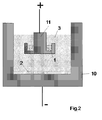
- Fig. 2 represents the electrolytic cell arrangement of the example.
- the basic step of the present invention is the conversion of copper sulphide containing matte into copper and elemental sulphur by electrolysis in fused salts, using liquid cathodes and anodes. Copper is produced at the cathode of a cell and refined afterwards if necessary by conventional methods used for blister copper. Sulphur is removed at the anode as a separate product, in its elemental form.
- the cathode is in the form of liquid copper
- the anode is in the form of liquid Sulphide copper (possibly containing other impurities, such as other metal sulphides).
- This has several advantages, such as the possibility to work at high current density and avoiding the appearance of spikes on the electrode surfaces. Those spikes producing particular inhomogeneous current densities, which can be detrimental to the process control.
- there is no need for a washing step as described in US3326644 the copper being directly drawn off from the cell in the liquid from, no impurities being included by capillary forces.
- the sulphide compounds can be continuously fed in the molten anode, rendering the process particularly suitable for a continuous operation.
- the melting temperature of copper is higher than the vaporisation temperature of sulphur, sulphur escapes from the bath in gaseous form, avoiding the passivation of the anode which is the case with low temperature processes such as those in aqueous solution.
- the fused salt comprises a mixture of fluoride salts such as NaF and AlF 3 .
- a particular composition could be that of cryolite (Na 3 AlF 6 ).
- the process was further improved by the addition of chloride salts, such as NaCl and CuCl.
- the process is used for the recovery of copper from white metal.
- Said white metal is a matte almost free of iron.
- the white metal is first produced by a conventional method using state of the art pyrometallurgical processes. Then, the white metal 9 is fed into an anodic container, and said white metal is melted, forming a liquid anode 1.
- An electrolytic cell is used containing the fused salt 3 at the desired temperature, where copper from the anode 1 is dissolved by passing a direct current in the cell between the anode and the cathode 2. Liquid copper is deposited at the cathode 2.
- a continuous process is used essentially without external heating, the heating being produced by joule effect due to the electrolytic current. If necessary, for example at initial melting, additional heating can be provided by means of heater 7.
- Undissolved impurities from the anode 1 such as precious metals (Ag, Au, Pt, Pd%) are additionally recovered from the anode 1.
- FIG. 1 represents a particular arrangement of an industrial electrolytic cell suitable for performing the process of the present invention.
- the copper sulphide containing matte 9 is fed through an inlet at the liquid anode 1.
- This anode 1 is connected to the positive pole of a current source by means of an anode contact 4.
- liquid copper forms the cathode 2, and is connected to the negative pole of the current source by means of a cathode contact 5.
- Both electrodes are separated by insulating refractory 6, the insulating refractory being suitable for being maintained in contact with the electrolyte at process temperature.
- boron nitride or boron nitride coated parts could be used.
- the crucible was heated in an induction furnace.
- the salt mixture was melted at 780°C.
- An anode container 11 was fabricated in graphite to contain the liquid Cu 2 S. Once the salt mixture was melted at 780 °C the anode container 11 filled up with Cu 2 S was completely immersed, the temperature was increased up to 1180 °C and the liquid Cu 2 S anode 1 was 2cm under the electrolyte level. The surface of the liquid Cu 2 S anode 1 in contact with the electrolyte was of 68 cm 2 .
- the anode container was removed from the bath and the casting of the overall melt (electrolyte + liquid copper) was made to allow cooling.
Landscapes
- Chemical & Material Sciences (AREA)
- Engineering & Computer Science (AREA)
- Chemical Kinetics & Catalysis (AREA)
- Electrochemistry (AREA)
- Materials Engineering (AREA)
- Metallurgy (AREA)
- Organic Chemistry (AREA)
- Electrolytic Production Of Metals (AREA)
Abstract
The present invention is related to a process for the production of copper from a matte comprising Cu2S being in the form of a liquid placed in an electrolytic cell at the positive pole wherein the electrolyte comprises molten salt, and wherein liquid copper is produced at the negative pole.
Description
- The present invention is related to a process for the production of copper and sulphur from copper sulphide compounds.
- The pyrometallurgical routes to produce copper from sulphide containing raw or secondary materials consist generally of two main steps described hereafter.
- In a first step the materials are melted in such conditions that a sulphide melt is produced, called matte (composition belonging mainly to the binary Cu2S-FeS system), which is liquid at working temperature and separates from the slag. In this step a certain amount of iron sulphide is transferred to the slag in the form of iron oxide so that the resulting matte is enriched in copper. During the melting which is generally a continuous process SO2 is produced and generally used to produce sulphuric acid.
- A matte is generally defined, in the field of pyrometallurgy, as the molten metal sulfide phases typically formed during smelting of copper, nickel, and other base metals.
- In a second step called matte converting, an oxidation atmosphere is produced by air, enriched air or pure oxygen in order to transform copper sulphide into copper and iron sulphide into iron oxide dissolved in a silicate slag. It is generally a batch process generating large amounts of SO2 containing gases. In batch mode, the slag is poured several times. The slag returns to the matte smelting furnace (first step) to recover copper losses and the copper phase (called blister (∼ 97%Cu) is further processed for refining processing.
- There exist in scientific literature , patent and industrial practice , a large number of specific processes for the matte-blister route , including continuous matte smelting , iron free matte smelting (white metal production) or direct blister route. However in all of them sulphur is oxidized to SO2.
- Electrochemical alternative methods have also been described in prior art for the converting of Copper.
- Document "Anodic dissolution of copper sulphide ores in molten ZnCl2-KCl" published by Bertram et Al. in Trans. Instn. Min. Metall.(C: Mineral Process. Extr. Metall.) 1983, describes the anodic dissolution of copper sulphide ores in an eutectic mixture of ZnCl2 and KCl. In this document, the temperature is maintained between about 300°C and 400°C, in order to avoid the vaporization of ZnCl2(boiling temperature of ZnCl2 is around 732°C). At this temperature, both electrodes remain solids, which usually lead to dendritic growth at the cathode. This particular type of growth has several drawbacks, as the inclusion of electrolyte in the electrode, growing of needle shaped structures that can induce short circuits and current instabilities, rendering industrial scale-up difficult.
- The document
US3326644 describes a process for the electrolytic deposition of copper from a molten salt electrolyte mixture. In this document, eutectic mixtures of chloride salts such as KCl/NaCl are used to minimise the cell temperature, which is comprised between 800 and 900°C. The copper deposit is in the form of intermeshed filaments having a "wool-like" appearance. This structure needs to be washed out with water before further processing in order to get rid of the salts which are trapped by capillary forces when getting the deposit out of the electrolyte. - The present invention aims to provide a process for the production of copper from copper sulphide containing matte.
- The present invention further aims to reduce the emission of pollutant such as SO2 in the production process of copper from copper sulphide containing matte.
- The present invention also aims to provide a process for the production of copper from copper sulphide containing matte wherein the sulphur by-products can be valued at least partly in its elemental chemical form.
- The present invention further aims to provide copper in the liquid form, without the drawbacks of the solid deposit.
- The present invention discloses an anodic dissolution process at high temperature for the electrowinning of copper from a matte comprising Cu2S, said process comprising the steps of:
- providing an electrolytic cell with a cathode container and an anode container;
- providing a molten copper cathode in said cathode container;
- providing a molten anode, comprising said metal matte in said anode container;
- providing an electrolyte comprising a molten salt;
- bringing said molten salt in contact with said cathode and said anode;
- applying a current to achieve electrolysis;
- recovering copper metal at the cathode.
- According to particular preferred embodiments, the invention further discloses at least one or a suitable combination of the following features:
- the molten salt is selected from the group consisting of NaF, AlF3, CuCl and NaCl or mixing thereof;
- the raw material used for said molten salt is cryolithe;
- the anodic dissolution process generates elemental sulphur as a by-product at the anode;
- the process temperature is higher than copper melting temperature (1085°C).
- the recovered copper metal has a purity higher than 99%;
- precious metals of the group consisting of Ag, Au, Pt, Pd are recovered at the anode.
- heating is mainly obtained by the joule effect produced by electrolysis current;
- the process is performed continuously.
-
Fig. 1 represents a particular arrangement for an industrial electrolytic cell suitable for performing the production process of the present invention. -
Fig. 2 represents the electrolytic cell arrangement of the example. - The basic step of the present invention is the conversion of copper sulphide containing matte into copper and elemental sulphur by electrolysis in fused salts, using liquid cathodes and anodes. Copper is produced at the cathode of a cell and refined afterwards if necessary by conventional methods used for blister copper. Sulphur is removed at the anode as a separate product, in its elemental form.
- To achieve the process of the present invention, it is necessary to use temperatures above the melting temperature of both Cu2S and metallic copper, so that the cathode is in the form of liquid copper, and the anode is in the form of liquid Sulphide copper (possibly containing other impurities, such as other metal sulphides). This has several advantages, such as the possibility to work at high current density and avoiding the appearance of spikes on the electrode surfaces. Those spikes producing particular inhomogeneous current densities, which can be detrimental to the process control. In the present invention, there is no need for a washing step as described in
US3326644 , the copper being directly drawn off from the cell in the liquid from, no impurities being included by capillary forces. In the same time, the sulphide compounds can be continuously fed in the molten anode, rendering the process particularly suitable for a continuous operation. - As the melting temperature of copper is higher than the vaporisation temperature of sulphur, sulphur escapes from the bath in gaseous form, avoiding the passivation of the anode which is the case with low temperature processes such as those in aqueous solution.
- In a particular embodiment, the fused salt comprises a mixture of fluoride salts such as NaF and AlF3. A particular composition could be that of cryolite (Na3AlF6).
- The process was further improved by the addition of chloride salts, such as NaCl and CuCl.
- In a first embodiment of the present invention, the process is used for the recovery of copper from white metal. Said white metal is a matte almost free of iron. The white metal is first produced by a conventional method using state of the art pyrometallurgical processes. Then, the white metal 9 is fed into an anodic container, and said white metal is melted, forming a
liquid anode 1. An electrolytic cell is used containing the fusedsalt 3 at the desired temperature, where copper from theanode 1 is dissolved by passing a direct current in the cell between the anode and thecathode 2. Liquid copper is deposited at thecathode 2. A continuous process is used essentially without external heating, the heating being produced by joule effect due to the electrolytic current. If necessary, for example at initial melting, additional heating can be provided by means of heater 7. - Undissolved impurities from the
anode 1 such as precious metals (Ag, Au, Pt, Pd...) are additionally recovered from theanode 1. -
Figure 1 represents a particular arrangement of an industrial electrolytic cell suitable for performing the process of the present invention. In this cell, the copper sulphide containing matte 9 is fed through an inlet at theliquid anode 1. Thisanode 1 is connected to the positive pole of a current source by means of ananode contact 4. On the other side, liquid copper forms thecathode 2, and is connected to the negative pole of the current source by means of acathode contact 5. Both electrodes are separated by insulating refractory 6, the insulating refractory being suitable for being maintained in contact with the electrolyte at process temperature. For example, boron nitride or boron nitride coated parts could be used. The use of such materials can be limited to the walls being in contact with the electrolyte, the other walls being made out of standard refractory used in the pyrometallurgical process of copper sulphide. As current is injected through the cell, theanode 1 is consumed and copper, along with small amounts of some other impurities deposit on thecathode 2. The produced liquid copper is continuously taken out at an outlet. As theanode 1 is consumed, elemental sulphur is produced at the interface between the matte and the electrolyte, and escapes in gaseous form. This gaseous sulphur is then condensed and can be valuated as such. - A
graphite crucible 10 of 4500 cm3 capacity, that acted as container and contact for amolten cathode 2, was filled with 6Kg of asalt mixture 3 of cryolite (60%Wt Na3AlF6) and sodium chloride (40%Wt NaCl), (SeeFig. 2 ) - The crucible was heated in an induction furnace. The salt mixture was melted at 780°C.
- An
anode container 11 was fabricated in graphite to contain the liquid Cu2S. Once the salt mixture was melted at 780 °C theanode container 11 filled up with Cu2S was completely immersed, the temperature was increased up to 1180 °C and the liquid Cu2S anode 1 was 2cm under the electrolyte level. The surface of the liquid Cu2S anode 1 in contact with the electrolyte was of 68 cm2. - When the temperature was stabilized a potential of 2 V and a current of 100A was applied for 120 minutes. The current density calculated from the anode surface was 147 A/dm2 and no anode effect was detected.
- Once the electrolysis process was finished the anode container was removed from the bath and the casting of the overall melt (electrolyte + liquid copper) was made to allow cooling.
- Metallic copper dispersed in the solid electrolyte and attached on the cathodic surface was recovered with a copper content higher than 99%.
- An anodic dissolution of the anode was observed and quantified by lost weight. A current efficiency of 17% was calculated considering a Cu+1 process. Elemental sulphur deposit was observed on cold free surfaces at the exit of the induction furnace.
-
- 1. Liquid anode (copper sulphide containing metal matte)
- 2. Liquid cathode (liquid copper blister)
- 3. Electrolyte
- 4. Anode contact
- 5. Cathode contact
- 6. Insulated refractory in electrolyte contact
- 7. Heating means
- 8. Copper outflow
- 9. Metal matte feeding
- 10. Graphite crucible
- 11. Graphite anode container
Claims (9)
- An anodic dissolution process at high temperature for the electrowinning of copper from a matte comprising Cu2S, said process comprising the steps of:- providing an electrolytic cell with a cathode container and an anode container;- providing a molten copper cathode in said cathode container;- providing a molten anode, comprising said metal matte in said anode container;- providing an electrolyte comprising a molten salt;- bringing said molten salt in contact with said cathode and said anode;- applying a current to achieve electrolysis;- recovering copper metal at the cathode.
- The process of claim 1 wherein said molten salt is selected from the group consisting of NaF, AlF3, NaCl and CuCl or mixing thereof.
- The process of claim 2 wherein the raw material used for said molten salt is Cryolithe.
- The process according to any of the previous claims wherein said process generates elemental sulphur as a by-product.
- The process according to any of the previous claims wherein the temperature is higher than the copper melting temperature (1085°C).
- The process according to any of the previous claims wherein recovered copper metal has a purity higher than 99%.
- The process according to any of previous claims wherein precious metals selected from the group consisting of Ag, Au, Pt, Pd are recovered at the anode.
- The process according to any of the previous claims wherein heating is obtained by the Joule effect produced by said current.
- The process according to any of the previous claims characterised in that said process is performed continuously.
Priority Applications (2)
| Application Number | Priority Date | Filing Date | Title |
|---|---|---|---|
| EP08160260A EP2143827A1 (en) | 2008-07-11 | 2008-07-11 | Process for the production of copper from sulphide compounds |
| PCT/EP2009/058446 WO2010003906A1 (en) | 2008-07-11 | 2009-07-03 | Process for the production of copper from sulphide compounds |
Applications Claiming Priority (1)
| Application Number | Priority Date | Filing Date | Title |
|---|---|---|---|
| EP08160260A EP2143827A1 (en) | 2008-07-11 | 2008-07-11 | Process for the production of copper from sulphide compounds |
Publications (1)
| Publication Number | Publication Date |
|---|---|
| EP2143827A1 true EP2143827A1 (en) | 2010-01-13 |
Family
ID=40076589
Family Applications (1)
| Application Number | Title | Priority Date | Filing Date |
|---|---|---|---|
| EP08160260A Withdrawn EP2143827A1 (en) | 2008-07-11 | 2008-07-11 | Process for the production of copper from sulphide compounds |
Country Status (2)
| Country | Link |
|---|---|
| EP (1) | EP2143827A1 (en) |
| WO (1) | WO2010003906A1 (en) |
Cited By (2)
| Publication number | Priority date | Publication date | Assignee | Title |
|---|---|---|---|---|
| CN110863218A (en) * | 2019-11-27 | 2020-03-06 | 东北大学 | A kind of method that adopts molten salt electrolytic enrichment to extract gold |
| KR102493791B1 (en) * | 2022-06-20 | 2023-02-06 | 한국지질자원연구원 | Method for the production of copper and elemental sulfur from chalcocite using molten salt electrolysis |
Citations (4)
| Publication number | Priority date | Publication date | Assignee | Title |
|---|---|---|---|---|
| US3326644A (en) | 1963-12-12 | 1967-06-20 | American Metal Climax Inc | Electrowinning copper and product thereof |
| US3616340A (en) * | 1969-07-14 | 1971-10-26 | Kennecott Copper Corp | Refining of liquid copper |
| US3777011A (en) * | 1970-10-02 | 1973-12-04 | Int Erfinder & Patentanstalt | Process for extracting metal plating,scrap or ore in a fused electrolyte cell |
| US4405415A (en) * | 1980-10-07 | 1983-09-20 | Alcan International Limited | Electrolytic refining of molten metal |
Family Cites Families (2)
| Publication number | Priority date | Publication date | Assignee | Title |
|---|---|---|---|---|
| FR2614319B1 (en) * | 1987-04-21 | 1989-06-30 | Pechiney Aluminium | PROCESS FOR THE PREPARATION OF IRON AND NEODYM MOTHER ALLOYS BY ELECTROLYSIS OF OXYGEN SALTS IN MOLTEN FLUORIDE MEDIA. |
| AU2003280106A1 (en) * | 2002-11-14 | 2004-06-03 | Moltech Invent S.A. | The production of hematite-containing material |
-
2008
- 2008-07-11 EP EP08160260A patent/EP2143827A1/en not_active Withdrawn
-
2009
- 2009-07-03 WO PCT/EP2009/058446 patent/WO2010003906A1/en not_active Ceased
Patent Citations (4)
| Publication number | Priority date | Publication date | Assignee | Title |
|---|---|---|---|---|
| US3326644A (en) | 1963-12-12 | 1967-06-20 | American Metal Climax Inc | Electrowinning copper and product thereof |
| US3616340A (en) * | 1969-07-14 | 1971-10-26 | Kennecott Copper Corp | Refining of liquid copper |
| US3777011A (en) * | 1970-10-02 | 1973-12-04 | Int Erfinder & Patentanstalt | Process for extracting metal plating,scrap or ore in a fused electrolyte cell |
| US4405415A (en) * | 1980-10-07 | 1983-09-20 | Alcan International Limited | Electrolytic refining of molten metal |
Non-Patent Citations (2)
| Title |
|---|
| BERTRAM ET AL.: "Trans. Instn. Min. Metall.", C: MINERAL PROCESS. EXTR. METALL., 1983 |
| BERTRAM R ET AL: "Anodic dissolution of Copper Sulphide Ores in Molten ZnCl2-KCl", TRANSACTIONS OF THE INSTITUTE OF MINING AND METALLURGY,, 1 January 1983 (1983-01-01), pages C169 - C171, XP009109791 * |
Cited By (2)
| Publication number | Priority date | Publication date | Assignee | Title |
|---|---|---|---|---|
| CN110863218A (en) * | 2019-11-27 | 2020-03-06 | 东北大学 | A kind of method that adopts molten salt electrolytic enrichment to extract gold |
| KR102493791B1 (en) * | 2022-06-20 | 2023-02-06 | 한국지질자원연구원 | Method for the production of copper and elemental sulfur from chalcocite using molten salt electrolysis |
Also Published As
| Publication number | Publication date |
|---|---|
| WO2010003906A1 (en) | 2010-01-14 |
Similar Documents
| Publication | Publication Date | Title |
|---|---|---|
| Fray | Emerging molten salt technologies for metals production | |
| US5024737A (en) | Process for producing a reactive metal-magnesium alloy | |
| US7901561B2 (en) | Method for electrolytic production and refining of metals | |
| Fray et al. | Reduction of titanium and other metal oxides using electrodeoxidation | |
| AU758931C (en) | Removal of oxygen from metal oxides and solid solutions by electrolysis in a fused salt | |
| AU2002349216B2 (en) | A method for electrowinning of titanium metal or alloy from titanium oxide containing compound in the liquid state | |
| CA2645161C (en) | Method for electrolytic production and refining of metals | |
| US20180245177A1 (en) | Optimized ore processing using molten salts for leaching and thermal energy source | |
| CN108138343B (en) | Metal refining method utilizing electrolytic reduction and electrolytic refining processes | |
| CN101914788A (en) | A kind of method for preparing metal titanium | |
| DK156731B (en) | METHOD OR MANUFACTURING METHOD OR METALOID | |
| CN107223167A (en) | Systems and methods for purifying aluminum | |
| CN101400811B (en) | Method for electrolytic production and refining of metals | |
| Fray | Anodic and cathodic reactions in molten calcium chloride | |
| Shamsuddin | Electrometallurgy | |
| WO2010003906A1 (en) | Process for the production of copper from sulphide compounds | |
| EP1995353A1 (en) | METHOD OF REMOVING/CONCENTRATING METAL-FOG-FORMING METAL PRESENT IN MOLTEN SALT, APPARATUS THEREFOR, AND PROCESS AND APPARATUS FOR PRODUCING Ti OR Ti ALLOY BY USE OF THEM | |
| CN108018465A (en) | A kind of method that aluminothermic reduction ilmenite prepares Al-Ti-Fe alloys in ice crystal ground mass fused salt | |
| EP1625245A2 (en) | Process for the electrolysis of aluminiumsulfide | |
| Sokhanvaran et al. | Advances in Electrometallurgy for Sustainable Metal Production | |
| JPH02259092A (en) | Production of calcium | |
| Fray | Electrochemical processing using slags, fluxes and salts | |
| Haarberg | Electrowinning of Light Metals from Molten Salts Electrolytes | |
| CN105063660B (en) | A kind of method that nano-silicon powder is directly prepared in electrorefining processes | |
| JP7515880B2 (en) | Electrochemical separation of tramp elements from steel scrap |
Legal Events
| Date | Code | Title | Description |
|---|---|---|---|
| PUAI | Public reference made under article 153(3) epc to a published international application that has entered the european phase |
Free format text: ORIGINAL CODE: 0009012 |
|
| AK | Designated contracting states |
Kind code of ref document: A1 Designated state(s): AT BE BG CH CY CZ DE DK EE ES FI FR GB GR HR HU IE IS IT LI LT LU LV MC MT NL NO PL PT RO SE SI SK TR |
|
| AX | Request for extension of the european patent |
Extension state: AL BA MK RS |
|
| AKY | No designation fees paid | ||
| REG | Reference to a national code |
Ref country code: DE Ref legal event code: 8566 |
|
| STAA | Information on the status of an ep patent application or granted ep patent |
Free format text: STATUS: THE APPLICATION IS DEEMED TO BE WITHDRAWN |
|
| 18D | Application deemed to be withdrawn |
Effective date: 20100714 |