EP2143716A1 - Pyrazine derivatives, methods of use, and methods for preparing same - Google Patents
Pyrazine derivatives, methods of use, and methods for preparing same Download PDFInfo
- Publication number
- EP2143716A1 EP2143716A1 EP08253570A EP08253570A EP2143716A1 EP 2143716 A1 EP2143716 A1 EP 2143716A1 EP 08253570 A EP08253570 A EP 08253570A EP 08253570 A EP08253570 A EP 08253570A EP 2143716 A1 EP2143716 A1 EP 2143716A1
- Authority
- EP
- European Patent Office
- Prior art keywords
- pyrazine
- substituent
- carbon
- bonded
- pyrazine ring
- Prior art date
- Legal status (The legal status is an assumption and is not a legal conclusion. Google has not performed a legal analysis and makes no representation as to the accuracy of the status listed.)
- Withdrawn
Links
- 238000000034 method Methods 0.000 title claims abstract description 87
- 150000003216 pyrazines Chemical class 0.000 title abstract description 135
- -1 diaminopyrazine compound Chemical class 0.000 claims description 48
- 150000002772 monosaccharides Chemical class 0.000 claims description 40
- 239000002904 solvent Substances 0.000 claims description 29
- 150000004676 glycans Polymers 0.000 claims description 28
- 150000004804 polysaccharides Polymers 0.000 claims description 28
- ZMXDDKWLCZADIW-UHFFFAOYSA-N N,N-Dimethylformamide Chemical compound CN(C)C=O ZMXDDKWLCZADIW-UHFFFAOYSA-N 0.000 claims description 26
- QTBSBXVTEAMEQO-UHFFFAOYSA-N Acetic acid Chemical compound CC(O)=O QTBSBXVTEAMEQO-UHFFFAOYSA-N 0.000 claims description 25
- 239000001257 hydrogen Substances 0.000 claims description 25
- 229910052739 hydrogen Inorganic materials 0.000 claims description 25
- 125000000008 (C1-C10) alkyl group Chemical group 0.000 claims description 24
- 239000003638 chemical reducing agent Substances 0.000 claims description 24
- 239000012321 sodium triacetoxyborohydride Substances 0.000 claims description 23
- DTQVDTLACAAQTR-UHFFFAOYSA-N Trifluoroacetic acid Chemical compound OC(=O)C(F)(F)F DTQVDTLACAAQTR-UHFFFAOYSA-N 0.000 claims description 20
- 150000001875 compounds Chemical class 0.000 claims description 20
- XLYOFNOQVPJJNP-UHFFFAOYSA-N water Substances O XLYOFNOQVPJJNP-UHFFFAOYSA-N 0.000 claims description 20
- 150000001728 carbonyl compounds Chemical class 0.000 claims description 19
- 239000000203 mixture Substances 0.000 claims description 18
- IAZDPXIOMUYVGZ-UHFFFAOYSA-N Dimethylsulphoxide Chemical compound CS(C)=O IAZDPXIOMUYVGZ-UHFFFAOYSA-N 0.000 claims description 12
- OKKJLVBELUTLKV-UHFFFAOYSA-N Methanol Chemical compound OC OKKJLVBELUTLKV-UHFFFAOYSA-N 0.000 claims description 12
- 239000005017 polysaccharide Substances 0.000 claims description 12
- RTZKZFJDLAIYFH-UHFFFAOYSA-N Diethyl ether Chemical compound CCOCC RTZKZFJDLAIYFH-UHFFFAOYSA-N 0.000 claims description 10
- LFQSCWFLJHTTHZ-UHFFFAOYSA-N Ethanol Chemical compound CCO LFQSCWFLJHTTHZ-UHFFFAOYSA-N 0.000 claims description 9
- KFZMGEQAYNKOFK-UHFFFAOYSA-N Isopropanol Chemical compound CC(C)O KFZMGEQAYNKOFK-UHFFFAOYSA-N 0.000 claims description 9
- 125000002252 acyl group Chemical group 0.000 claims description 9
- PXHVJJICTQNCMI-UHFFFAOYSA-N Nickel Chemical compound [Ni] PXHVJJICTQNCMI-UHFFFAOYSA-N 0.000 claims description 6
- KDLHZDBZIXYQEI-UHFFFAOYSA-N Palladium Chemical compound [Pd] KDLHZDBZIXYQEI-UHFFFAOYSA-N 0.000 claims description 6
- JUJWROOIHBZHMG-UHFFFAOYSA-N Pyridine Chemical compound C1=CC=NC=C1 JUJWROOIHBZHMG-UHFFFAOYSA-N 0.000 claims description 6
- WYURNTSHIVDZCO-UHFFFAOYSA-N Tetrahydrofuran Chemical compound C1CCOC1 WYURNTSHIVDZCO-UHFFFAOYSA-N 0.000 claims description 6
- UORVGPXVDQYIDP-UHFFFAOYSA-N borane Chemical compound B UORVGPXVDQYIDP-UHFFFAOYSA-N 0.000 claims description 6
- CAFSXVAFGILCCI-UHFFFAOYSA-N pyrazine-2,3-diamine Chemical class NC1=NC=CN=C1N CAFSXVAFGILCCI-UHFFFAOYSA-N 0.000 claims description 6
- BEOOHQFXGBMRKU-UHFFFAOYSA-N sodium cyanoborohydride Chemical compound [Na+].[B-]C#N BEOOHQFXGBMRKU-UHFFFAOYSA-N 0.000 claims description 6
- IXCSERBJSXMMFS-UHFFFAOYSA-N hydrogen chloride Substances Cl.Cl IXCSERBJSXMMFS-UHFFFAOYSA-N 0.000 claims description 4
- 238000004519 manufacturing process Methods 0.000 claims description 4
- 239000000546 pharmaceutical excipient Substances 0.000 claims description 4
- RYHBNJHYFVUHQT-UHFFFAOYSA-N 1,4-Dioxane Chemical compound C1COCCO1 RYHBNJHYFVUHQT-UHFFFAOYSA-N 0.000 claims description 3
- XTHFKEDIFFGKHM-UHFFFAOYSA-N Dimethoxyethane Chemical compound COCCOC XTHFKEDIFFGKHM-UHFFFAOYSA-N 0.000 claims description 3
- VEXZGXHMUGYJMC-UHFFFAOYSA-N Hydrochloric acid Chemical compound Cl VEXZGXHMUGYJMC-UHFFFAOYSA-N 0.000 claims description 3
- 239000012448 Lithium borohydride Substances 0.000 claims description 3
- FXHOOIRPVKKKFG-UHFFFAOYSA-N N,N-Dimethylacetamide Chemical compound CN(C)C(C)=O FXHOOIRPVKKKFG-UHFFFAOYSA-N 0.000 claims description 3
- VZTDIZULWFCMLS-UHFFFAOYSA-N ammonium formate Chemical compound [NH4+].[O-]C=O VZTDIZULWFCMLS-UHFFFAOYSA-N 0.000 claims description 3
- 229910000085 borane Inorganic materials 0.000 claims description 3
- RAABOESOVLLHRU-UHFFFAOYSA-N diazene Chemical compound N=N RAABOESOVLLHRU-UHFFFAOYSA-N 0.000 claims description 3
- 229910000071 diazene Inorganic materials 0.000 claims description 3
- 229940113088 dimethylacetamide Drugs 0.000 claims description 3
- 150000002148 esters Chemical class 0.000 claims description 3
- 125000001475 halogen functional group Chemical group 0.000 claims description 3
- 239000012280 lithium aluminium hydride Substances 0.000 claims description 3
- MJGFBOZCAJSGQW-UHFFFAOYSA-N mercury sodium Chemical compound [Na].[Hg] MJGFBOZCAJSGQW-UHFFFAOYSA-N 0.000 claims description 3
- 229910052759 nickel Inorganic materials 0.000 claims description 3
- BASFCYQUMIYNBI-UHFFFAOYSA-N platinum Chemical compound [Pt] BASFCYQUMIYNBI-UHFFFAOYSA-N 0.000 claims description 3
- UMJSCPRVCHMLSP-UHFFFAOYSA-N pyridine Natural products COC1=CC=CN=C1 UMJSCPRVCHMLSP-UHFFFAOYSA-N 0.000 claims description 3
- MHOVAHRLVXNVSD-UHFFFAOYSA-N rhodium atom Chemical compound [Rh] MHOVAHRLVXNVSD-UHFFFAOYSA-N 0.000 claims description 3
- 229910001023 sodium amalgam Inorganic materials 0.000 claims description 3
- 239000012279 sodium borohydride Substances 0.000 claims description 3
- 229910000033 sodium borohydride Inorganic materials 0.000 claims description 3
- YLQBMQCUIZJEEH-UHFFFAOYSA-N tetrahydrofuran Natural products C=1C=COC=1 YLQBMQCUIZJEEH-UHFFFAOYSA-N 0.000 claims description 3
- 125000004435 hydrogen atom Chemical group [H]* 0.000 claims 8
- 125000001424 substituent group Chemical group 0.000 description 210
- OKTJSMMVPCPJKN-UHFFFAOYSA-N Carbon Chemical compound [C] OKTJSMMVPCPJKN-UHFFFAOYSA-N 0.000 description 151
- 229910052799 carbon Inorganic materials 0.000 description 151
- 125000003373 pyrazinyl group Chemical group 0.000 description 138
- XSQUKJJJFZCRTK-UHFFFAOYSA-N Urea Chemical compound NC(N)=O XSQUKJJJFZCRTK-UHFFFAOYSA-N 0.000 description 115
- 125000004429 atom Chemical group 0.000 description 80
- 229920001223 polyethylene glycol Polymers 0.000 description 57
- 239000002202 Polyethylene glycol Substances 0.000 description 56
- 150000001408 amides Chemical class 0.000 description 42
- 230000003907 kidney function Effects 0.000 description 41
- 239000004202 carbamide Substances 0.000 description 37
- 230000003595 spectral effect Effects 0.000 description 36
- 238000004895 liquid chromatography mass spectrometry Methods 0.000 description 30
- UMGDCJDMYOKAJW-UHFFFAOYSA-N thiourea Chemical compound NC(N)=S UMGDCJDMYOKAJW-UHFFFAOYSA-N 0.000 description 30
- 235000008206 alpha-amino acids Nutrition 0.000 description 28
- 238000006243 chemical reaction Methods 0.000 description 27
- HEDRZPFGACZZDS-MICDWDOJSA-N Trichloro(2H)methane Chemical compound [2H]C(Cl)(Cl)Cl HEDRZPFGACZZDS-MICDWDOJSA-N 0.000 description 26
- 125000003368 amide group Chemical group 0.000 description 26
- KYQCOXFCLRTKLS-UHFFFAOYSA-N Pyrazine Chemical class C1=CN=CC=N1 KYQCOXFCLRTKLS-UHFFFAOYSA-N 0.000 description 25
- 150000001370 alpha-amino acid derivatives Chemical class 0.000 description 20
- 230000008569 process Effects 0.000 description 20
- 239000000725 suspension Substances 0.000 description 18
- 230000000875 corresponding effect Effects 0.000 description 17
- 238000005160 1H NMR spectroscopy Methods 0.000 description 16
- 229910004373 HOAc Inorganic materials 0.000 description 16
- LNUFLCYMSVYYNW-ZPJMAFJPSA-N [(2r,3r,4s,5r,6r)-2-[(2r,3r,4s,5r,6r)-6-[(2r,3r,4s,5r,6r)-6-[(2r,3r,4s,5r,6r)-6-[[(3s,5s,8r,9s,10s,13r,14s,17r)-10,13-dimethyl-17-[(2r)-6-methylheptan-2-yl]-2,3,4,5,6,7,8,9,11,12,14,15,16,17-tetradecahydro-1h-cyclopenta[a]phenanthren-3-yl]oxy]-4,5-disulfo Chemical compound O([C@@H]1[C@@H](COS(O)(=O)=O)O[C@@H]([C@@H]([C@H]1OS(O)(=O)=O)OS(O)(=O)=O)O[C@@H]1[C@@H](COS(O)(=O)=O)O[C@@H]([C@@H]([C@H]1OS(O)(=O)=O)OS(O)(=O)=O)O[C@@H]1[C@@H](COS(O)(=O)=O)O[C@H]([C@@H]([C@H]1OS(O)(=O)=O)OS(O)(=O)=O)O[C@@H]1C[C@@H]2CC[C@H]3[C@@H]4CC[C@@H]([C@]4(CC[C@@H]3[C@@]2(C)CC1)C)[C@H](C)CCCC(C)C)[C@H]1O[C@H](COS(O)(=O)=O)[C@@H](OS(O)(=O)=O)[C@H](OS(O)(=O)=O)[C@H]1OS(O)(=O)=O LNUFLCYMSVYYNW-ZPJMAFJPSA-N 0.000 description 16
- WSLDOOZREJYCGB-UHFFFAOYSA-N 1,2-Dichloroethane Chemical compound ClCCCl WSLDOOZREJYCGB-UHFFFAOYSA-N 0.000 description 15
- KXDHJXZQYSOELW-UHFFFAOYSA-M Carbamate Chemical compound NC([O-])=O KXDHJXZQYSOELW-UHFFFAOYSA-M 0.000 description 15
- 229940124530 sulfonamide Drugs 0.000 description 15
- 150000003456 sulfonamides Chemical class 0.000 description 15
- 150000002431 hydrogen Chemical group 0.000 description 14
- 229920001184 polypeptide Polymers 0.000 description 14
- 108090000765 processed proteins & peptides Proteins 0.000 description 14
- 102000004196 processed proteins & peptides Human genes 0.000 description 14
- PCNDJXKNXGMECE-UHFFFAOYSA-N Phenazine Natural products C1=CC=CC2=NC3=CC=CC=C3N=C21 PCNDJXKNXGMECE-UHFFFAOYSA-N 0.000 description 13
- 238000004458 analytical method Methods 0.000 description 13
- SKCNIGRBPJIUBQ-UHFFFAOYSA-N chloroform;ethyl acetate Chemical compound ClC(Cl)Cl.CCOC(C)=O SKCNIGRBPJIUBQ-UHFFFAOYSA-N 0.000 description 13
- 238000012544 monitoring process Methods 0.000 description 13
- 238000003818 flash chromatography Methods 0.000 description 12
- VYPSYNLAJGMNEJ-UHFFFAOYSA-N Silicium dioxide Chemical compound O=[Si]=O VYPSYNLAJGMNEJ-UHFFFAOYSA-N 0.000 description 11
- 239000000741 silica gel Substances 0.000 description 11
- 229910002027 silica gel Inorganic materials 0.000 description 11
- 239000011734 sodium Substances 0.000 description 11
- UIIMBOGNXHQVGW-UHFFFAOYSA-M Sodium bicarbonate Chemical compound [Na+].OC([O-])=O UIIMBOGNXHQVGW-UHFFFAOYSA-M 0.000 description 10
- 238000001514 detection method Methods 0.000 description 10
- 239000007787 solid Substances 0.000 description 10
- 238000001644 13C nuclear magnetic resonance spectroscopy Methods 0.000 description 9
- 238000012545 processing Methods 0.000 description 9
- YMWUJEATGCHHMB-UHFFFAOYSA-N Dichloromethane Chemical compound ClCCl YMWUJEATGCHHMB-UHFFFAOYSA-N 0.000 description 8
- 150000001371 alpha-amino acids Chemical class 0.000 description 8
- 239000012043 crude product Substances 0.000 description 8
- 230000003287 optical effect Effects 0.000 description 8
- 239000000126 substance Substances 0.000 description 8
- 238000010626 work up procedure Methods 0.000 description 8
- WQZGKKKJIJFFOK-GASJEMHNSA-N Glucose Natural products OC[C@H]1OC(O)[C@H](O)[C@@H](O)[C@@H]1O WQZGKKKJIJFFOK-GASJEMHNSA-N 0.000 description 7
- 241001465754 Metazoa Species 0.000 description 7
- 239000012298 atmosphere Substances 0.000 description 7
- 239000011541 reaction mixture Substances 0.000 description 7
- 239000000758 substrate Substances 0.000 description 7
- CXAVPSDDVRPHAK-UHFFFAOYSA-N tert-butyl n-[2-[[3,6-diamino-5-[2-[(2-methylpropan-2-yl)oxycarbonylamino]ethylcarbamoyl]pyrazine-2-carbonyl]amino]ethyl]carbamate Chemical compound CC(C)(C)OC(=O)NCCNC(=O)C1=NC(N)=C(C(=O)NCCNC(=O)OC(C)(C)C)N=C1N CXAVPSDDVRPHAK-UHFFFAOYSA-N 0.000 description 7
- MTCFGRXMJLQNBG-REOHCLBHSA-N (2S)-2-Amino-3-hydroxypropansäure Chemical compound OC[C@H](N)C(O)=O MTCFGRXMJLQNBG-REOHCLBHSA-N 0.000 description 6
- XKRFYHLGVUSROY-UHFFFAOYSA-N Argon Chemical compound [Ar] XKRFYHLGVUSROY-UHFFFAOYSA-N 0.000 description 6
- UXIGWFXRQKWHHA-UHFFFAOYSA-N Iotalamic acid Chemical compound CNC(=O)C1=C(I)C(NC(C)=O)=C(I)C(C(O)=O)=C1I UXIGWFXRQKWHHA-UHFFFAOYSA-N 0.000 description 6
- CKLJMWTZIZZHCS-REOHCLBHSA-N L-aspartic acid Chemical compound OC(=O)[C@@H](N)CC(O)=O CKLJMWTZIZZHCS-REOHCLBHSA-N 0.000 description 6
- 241000700159 Rattus Species 0.000 description 6
- MTCFGRXMJLQNBG-UHFFFAOYSA-N Serine Natural products OCC(N)C(O)=O MTCFGRXMJLQNBG-UHFFFAOYSA-N 0.000 description 6
- FAPWRFPIFSIZLT-UHFFFAOYSA-M Sodium chloride Chemical compound [Na+].[Cl-] FAPWRFPIFSIZLT-UHFFFAOYSA-M 0.000 description 6
- 235000003704 aspartic acid Nutrition 0.000 description 6
- HUMNYLRZRPPJDN-UHFFFAOYSA-N benzaldehyde Chemical compound O=CC1=CC=CC=C1 HUMNYLRZRPPJDN-UHFFFAOYSA-N 0.000 description 6
- WQZGKKKJIJFFOK-VFUOTHLCSA-N beta-D-glucose Chemical compound OC[C@H]1O[C@@H](O)[C@H](O)[C@@H](O)[C@@H]1O WQZGKKKJIJFFOK-VFUOTHLCSA-N 0.000 description 6
- OQFSQFPPLPISGP-UHFFFAOYSA-N beta-carboxyaspartic acid Natural products OC(=O)C(N)C(C(O)=O)C(O)=O OQFSQFPPLPISGP-UHFFFAOYSA-N 0.000 description 6
- DDRJAANPRJIHGJ-UHFFFAOYSA-N creatinine Chemical compound CN1CC(=O)NC1=N DDRJAANPRJIHGJ-UHFFFAOYSA-N 0.000 description 6
- 238000001727 in vivo Methods 0.000 description 6
- 229940029378 iothalamate Drugs 0.000 description 6
- 229920000642 polymer Polymers 0.000 description 6
- 239000000843 powder Substances 0.000 description 6
- 238000002360 preparation method Methods 0.000 description 6
- 235000004400 serine Nutrition 0.000 description 6
- 239000000243 solution Substances 0.000 description 6
- 210000001519 tissue Anatomy 0.000 description 6
- 239000003153 chemical reaction reagent Substances 0.000 description 5
- 239000003795 chemical substances by application Substances 0.000 description 5
- 239000000284 extract Substances 0.000 description 5
- 210000003734 kidney Anatomy 0.000 description 5
- 239000003755 preservative agent Substances 0.000 description 5
- 210000001147 pulmonary artery Anatomy 0.000 description 5
- 239000000523 sample Substances 0.000 description 5
- 229910000030 sodium bicarbonate Inorganic materials 0.000 description 5
- UKAUYVFTDYCKQA-UHFFFAOYSA-N -2-Amino-4-hydroxybutanoic acid Natural products OC(=O)C(N)CCO UKAUYVFTDYCKQA-UHFFFAOYSA-N 0.000 description 4
- WEVYAHXRMPXWCK-UHFFFAOYSA-N Acetonitrile Chemical compound CC#N WEVYAHXRMPXWCK-UHFFFAOYSA-N 0.000 description 4
- SRBFZHDQGSBBOR-IOVATXLUSA-N D-xylopyranose Chemical compound O[C@@H]1COC(O)[C@H](O)[C@H]1O SRBFZHDQGSBBOR-IOVATXLUSA-N 0.000 description 4
- XEKOWRVHYACXOJ-UHFFFAOYSA-N Ethyl acetate Chemical compound CCOC(C)=O XEKOWRVHYACXOJ-UHFFFAOYSA-N 0.000 description 4
- LYCAIKOWRPUZTN-UHFFFAOYSA-N Ethylene glycol Chemical compound OCCO LYCAIKOWRPUZTN-UHFFFAOYSA-N 0.000 description 4
- 229930091371 Fructose Natural products 0.000 description 4
- 239000005715 Fructose Substances 0.000 description 4
- RFSUNEUAIZKAJO-ARQDHWQXSA-N Fructose Chemical compound OC[C@H]1O[C@](O)(CO)[C@@H](O)[C@@H]1O RFSUNEUAIZKAJO-ARQDHWQXSA-N 0.000 description 4
- WHUUTDBJXJRKMK-UHFFFAOYSA-N Glutamic acid Natural products OC(=O)C(N)CCC(O)=O WHUUTDBJXJRKMK-UHFFFAOYSA-N 0.000 description 4
- WHUUTDBJXJRKMK-VKHMYHEASA-N L-glutamic acid Chemical compound OC(=O)[C@@H](N)CCC(O)=O WHUUTDBJXJRKMK-VKHMYHEASA-N 0.000 description 4
- UKAUYVFTDYCKQA-VKHMYHEASA-N L-homoserine Chemical compound OC(=O)[C@@H](N)CCO UKAUYVFTDYCKQA-VKHMYHEASA-N 0.000 description 4
- 229910004727 OSO3H Inorganic materials 0.000 description 4
- 229910006069 SO3H Inorganic materials 0.000 description 4
- 239000012267 brine Substances 0.000 description 4
- 210000004027 cell Anatomy 0.000 description 4
- 230000008859 change Effects 0.000 description 4
- JHIVVAPYMSGYDF-UHFFFAOYSA-N cyclohexanone Chemical compound O=C1CCCCC1 JHIVVAPYMSGYDF-UHFFFAOYSA-N 0.000 description 4
- 239000003085 diluting agent Substances 0.000 description 4
- 239000000835 fiber Substances 0.000 description 4
- 230000024924 glomerular filtration Effects 0.000 description 4
- 239000008103 glucose Substances 0.000 description 4
- 235000013922 glutamic acid Nutrition 0.000 description 4
- 239000004220 glutamic acid Substances 0.000 description 4
- 238000001990 intravenous administration Methods 0.000 description 4
- 239000000463 material Substances 0.000 description 4
- FTQWRYSLUYAIRQ-UHFFFAOYSA-N n-[(octadecanoylamino)methyl]octadecanamide Chemical compound CCCCCCCCCCCCCCCCCC(=O)NCNC(=O)CCCCCCCCCCCCCCCCC FTQWRYSLUYAIRQ-UHFFFAOYSA-N 0.000 description 4
- 210000000056 organ Anatomy 0.000 description 4
- 150000002972 pentoses Chemical class 0.000 description 4
- QEVHRUUCFGRFIF-MDEJGZGSSA-N reserpine Chemical compound O([C@H]1[C@@H]([C@H]([C@H]2C[C@@H]3C4=C(C5=CC=C(OC)C=C5N4)CCN3C[C@H]2C1)C(=O)OC)OC)C(=O)C1=CC(OC)=C(OC)C(OC)=C1 QEVHRUUCFGRFIF-MDEJGZGSSA-N 0.000 description 4
- 239000011780 sodium chloride Substances 0.000 description 4
- HPALAKNZSZLMCH-UHFFFAOYSA-M sodium;chloride;hydrate Chemical compound O.[Na+].[Cl-] HPALAKNZSZLMCH-UHFFFAOYSA-M 0.000 description 4
- 238000003756 stirring Methods 0.000 description 4
- ACNRTYKOPZDRCO-UHFFFAOYSA-N tert-butyl n-(2-oxoethyl)carbamate Chemical compound CC(C)(C)OC(=O)NCC=O ACNRTYKOPZDRCO-UHFFFAOYSA-N 0.000 description 4
- 239000003981 vehicle Substances 0.000 description 4
- PEDCQBHIVMGVHV-UHFFFAOYSA-N Glycerine Chemical compound OCC(O)CO PEDCQBHIVMGVHV-UHFFFAOYSA-N 0.000 description 3
- DNIAPMSPPWPWGF-UHFFFAOYSA-N Propylene glycol Chemical compound CC(O)CO DNIAPMSPPWPWGF-UHFFFAOYSA-N 0.000 description 3
- 238000009825 accumulation Methods 0.000 description 3
- 239000002671 adjuvant Substances 0.000 description 3
- 229910052786 argon Inorganic materials 0.000 description 3
- 230000008901 benefit Effects 0.000 description 3
- 230000015572 biosynthetic process Effects 0.000 description 3
- 239000012455 biphasic mixture Substances 0.000 description 3
- 239000000969 carrier Substances 0.000 description 3
- 230000002596 correlated effect Effects 0.000 description 3
- 229940109239 creatinine Drugs 0.000 description 3
- 239000008121 dextrose Substances 0.000 description 3
- WBKFWQBXFREOFH-UHFFFAOYSA-N dichloromethane;ethyl acetate Chemical compound ClCCl.CCOC(C)=O WBKFWQBXFREOFH-UHFFFAOYSA-N 0.000 description 3
- FMWUURDYOISOQB-UHFFFAOYSA-N diethyl 3,6-bis(benzylamino)pyrazine-2,5-dicarboxylate Chemical compound CCOC(=O)C=1N=C(NCC=2C=CC=CC=2)C(C(=O)OCC)=NC=1NCC1=CC=CC=C1 FMWUURDYOISOQB-UHFFFAOYSA-N 0.000 description 3
- 239000003995 emulsifying agent Substances 0.000 description 3
- 238000003384 imaging method Methods 0.000 description 3
- 238000005259 measurement Methods 0.000 description 3
- 230000007246 mechanism Effects 0.000 description 3
- 230000004048 modification Effects 0.000 description 3
- 238000012986 modification Methods 0.000 description 3
- QNGNSVIICDLXHT-UHFFFAOYSA-N para-ethylbenzaldehyde Natural products CCC1=CC=C(C=O)C=C1 QNGNSVIICDLXHT-UHFFFAOYSA-N 0.000 description 3
- XFTQRUTUGRCSGO-UHFFFAOYSA-N pyrazin-2-amine Chemical compound NC1=CN=CC=N1 XFTQRUTUGRCSGO-UHFFFAOYSA-N 0.000 description 3
- 238000003786 synthesis reaction Methods 0.000 description 3
- RTLZQRCIQCLHKR-UHFFFAOYSA-N tert-butyl n-[2-[[3,6-bis(benzylamino)-5-[2-[(2-methylpropan-2-yl)oxycarbonylamino]ethylcarbamoyl]pyrazine-2-carbonyl]amino]ethyl]carbamate Chemical compound CC(C)(C)OC(=O)NCCNC(=O)C=1N=C(NCC=2C=CC=CC=2)C(C(=O)NCCNC(=O)OC(C)(C)C)=NC=1NCC1=CC=CC=C1 RTLZQRCIQCLHKR-UHFFFAOYSA-N 0.000 description 3
- CHBMGQVHGDZDTR-UHFFFAOYSA-N tert-butyl n-[2-[[3,6-bis[(4-methoxyphenyl)methylamino]-5-[2-[(2-methylpropan-2-yl)oxycarbonylamino]ethylcarbamoyl]pyrazine-2-carbonyl]amino]ethyl]carbamate Chemical compound C1=CC(OC)=CC=C1CNC(C(=N1)C(=O)NCCNC(=O)OC(C)(C)C)=NC(C(=O)NCCNC(=O)OC(C)(C)C)=C1NCC1=CC=C(OC)C=C1 CHBMGQVHGDZDTR-UHFFFAOYSA-N 0.000 description 3
- JZSANNKMXJZRJN-UHFFFAOYSA-N tert-butyl n-[2-[[5-[2-[(2-methylpropan-2-yl)oxycarbonylamino]ethylcarbamoyl]-3,6-bis(propylamino)pyrazine-2-carbonyl]amino]ethyl]carbamate Chemical compound CCCNC1=NC(C(=O)NCCNC(=O)OC(C)(C)C)=C(NCCC)N=C1C(=O)NCCNC(=O)OC(C)(C)C JZSANNKMXJZRJN-UHFFFAOYSA-N 0.000 description 3
- 230000010248 tubular secretion Effects 0.000 description 3
- 239000003643 water by type Substances 0.000 description 3
- 239000004475 Arginine Substances 0.000 description 2
- CIWBSHSKHKDKBQ-JLAZNSOCSA-N Ascorbic acid Chemical compound OC[C@H](O)[C@H]1OC(=O)C(O)=C1O CIWBSHSKHKDKBQ-JLAZNSOCSA-N 0.000 description 2
- 208000028399 Critical Illness Diseases 0.000 description 2
- WQZGKKKJIJFFOK-QTVWNMPRSA-N D-mannopyranose Chemical compound OC[C@H]1OC(O)[C@@H](O)[C@@H](O)[C@@H]1O WQZGKKKJIJFFOK-QTVWNMPRSA-N 0.000 description 2
- HMFHBZSHGGEWLO-SOOFDHNKSA-N D-ribofuranose Chemical compound OC[C@H]1OC(O)[C@H](O)[C@@H]1O HMFHBZSHGGEWLO-SOOFDHNKSA-N 0.000 description 2
- 241000282412 Homo Species 0.000 description 2
- 229920000869 Homopolysaccharide Polymers 0.000 description 2
- UFHFLCQGNIYNRP-UHFFFAOYSA-N Hydrogen Chemical compound [H][H] UFHFLCQGNIYNRP-UHFFFAOYSA-N 0.000 description 2
- ODKSFYDXXFIFQN-BYPYZUCNSA-P L-argininium(2+) Chemical compound NC(=[NH2+])NCCC[C@H]([NH3+])C(O)=O ODKSFYDXXFIFQN-BYPYZUCNSA-P 0.000 description 2
- ZDXPYRJPNDTMRX-VKHMYHEASA-N L-glutamine Chemical compound OC(=O)[C@@H](N)CCC(N)=O ZDXPYRJPNDTMRX-VKHMYHEASA-N 0.000 description 2
- HNDVDQJCIGZPNO-YFKPBYRVSA-N L-histidine Chemical compound OC(=O)[C@@H](N)CC1=CN=CN1 HNDVDQJCIGZPNO-YFKPBYRVSA-N 0.000 description 2
- KDXKERNSBIXSRK-YFKPBYRVSA-N L-lysine Chemical compound NCCCC[C@H](N)C(O)=O KDXKERNSBIXSRK-YFKPBYRVSA-N 0.000 description 2
- KDXKERNSBIXSRK-UHFFFAOYSA-N Lysine Natural products NCCCCC(N)C(O)=O KDXKERNSBIXSRK-UHFFFAOYSA-N 0.000 description 2
- 239000004472 Lysine Substances 0.000 description 2
- 241000124008 Mammalia Species 0.000 description 2
- JGFZNNIVVJXRND-UHFFFAOYSA-N N,N-Diisopropylethylamine (DIPEA) Chemical compound CCN(C(C)C)C(C)C JGFZNNIVVJXRND-UHFFFAOYSA-N 0.000 description 2
- 239000007832 Na2SO4 Substances 0.000 description 2
- 229910018828 PO3H2 Inorganic materials 0.000 description 2
- NBBJYMSMWIIQGU-UHFFFAOYSA-N Propionic aldehyde Chemical compound CCC=O NBBJYMSMWIIQGU-UHFFFAOYSA-N 0.000 description 2
- PYMYPHUHKUWMLA-LMVFSUKVSA-N Ribose Natural products OC[C@@H](O)[C@@H](O)[C@@H](O)C=O PYMYPHUHKUWMLA-LMVFSUKVSA-N 0.000 description 2
- PMZURENOXWZQFD-UHFFFAOYSA-L Sodium Sulfate Chemical compound [Na+].[Na+].[O-]S([O-])(=O)=O PMZURENOXWZQFD-UHFFFAOYSA-L 0.000 description 2
- 238000010521 absorption reaction Methods 0.000 description 2
- 239000000654 additive Substances 0.000 description 2
- 208000026935 allergic disease Diseases 0.000 description 2
- HMFHBZSHGGEWLO-UHFFFAOYSA-N alpha-D-Furanose-Ribose Natural products OCC1OC(O)C(O)C1O HMFHBZSHGGEWLO-UHFFFAOYSA-N 0.000 description 2
- 239000003963 antioxidant agent Substances 0.000 description 2
- 235000006708 antioxidants Nutrition 0.000 description 2
- 239000007864 aqueous solution Substances 0.000 description 2
- PYMYPHUHKUWMLA-UHFFFAOYSA-N arabinose Natural products OCC(O)C(O)C(O)C=O PYMYPHUHKUWMLA-UHFFFAOYSA-N 0.000 description 2
- ODKSFYDXXFIFQN-UHFFFAOYSA-N arginine Natural products OC(=O)C(N)CCCNC(N)=N ODKSFYDXXFIFQN-UHFFFAOYSA-N 0.000 description 2
- PQMOZOQTXKMYSK-UHFFFAOYSA-N benzyl n-(3-oxopropyl)carbamate Chemical compound O=CCCNC(=O)OCC1=CC=CC=C1 PQMOZOQTXKMYSK-UHFFFAOYSA-N 0.000 description 2
- AMUPXWZDEJRONN-UHFFFAOYSA-N benzyl n-[2-[[3,6-diamino-5-[2-(phenylmethoxycarbonylamino)ethylcarbamoyl]pyrazine-2-carbonyl]amino]ethyl]carbamate Chemical compound NC=1N=C(C(=O)NCCNC(=O)OCC=2C=CC=CC=2)C(N)=NC=1C(=O)NCCNC(=O)OCC1=CC=CC=C1 AMUPXWZDEJRONN-UHFFFAOYSA-N 0.000 description 2
- CUQVRVOTLMJMAX-UHFFFAOYSA-N benzyl n-[3-[[3,6-bis[2-(phenylmethoxycarbonylamino)ethylcarbamoyl]-5-[3-(phenylmethoxycarbonylamino)propylamino]pyrazin-2-yl]amino]propyl]carbamate Chemical compound C=1C=CC=CC=1COC(=O)NCCCNC(C(=NC=1NCCCNC(=O)OCC=2C=CC=CC=2)C(=O)NCCNC(=O)OCC=2C=CC=CC=2)=NC=1C(=O)NCCNC(=O)OCC1=CC=CC=C1 CUQVRVOTLMJMAX-UHFFFAOYSA-N 0.000 description 2
- SRBFZHDQGSBBOR-UHFFFAOYSA-N beta-D-Pyranose-Lyxose Natural products OC1COC(O)C(O)C1O SRBFZHDQGSBBOR-UHFFFAOYSA-N 0.000 description 2
- WORJEOGGNQDSOE-UHFFFAOYSA-N chloroform;methanol Chemical compound OC.ClC(Cl)Cl WORJEOGGNQDSOE-UHFFFAOYSA-N 0.000 description 2
- 230000008878 coupling Effects 0.000 description 2
- 238000010168 coupling process Methods 0.000 description 2
- 238000005859 coupling reaction Methods 0.000 description 2
- WKGPKAKWGUAQHI-UHFFFAOYSA-N diethyl 3,6-bis(2-methoxyethylamino)pyrazine-2,5-dicarboxylate Chemical compound CCOC(=O)C1=NC(NCCOC)=C(C(=O)OCC)N=C1NCCOC WKGPKAKWGUAQHI-UHFFFAOYSA-N 0.000 description 2
- XSLXSCHIQBXUHR-UHFFFAOYSA-N diethyl 3,6-diaminopyrazine-2,5-dicarboxylate Chemical compound CCOC(=O)C1=NC(N)=C(C(=O)OCC)N=C1N XSLXSCHIQBXUHR-UHFFFAOYSA-N 0.000 description 2
- LOKCTEFSRHRXRJ-UHFFFAOYSA-I dipotassium trisodium dihydrogen phosphate hydrogen phosphate dichloride Chemical compound P(=O)(O)(O)[O-].[K+].P(=O)(O)([O-])[O-].[Na+].[Na+].[Cl-].[K+].[Cl-].[Na+] LOKCTEFSRHRXRJ-UHFFFAOYSA-I 0.000 description 2
- 125000006575 electron-withdrawing group Chemical group 0.000 description 2
- 230000008030 elimination Effects 0.000 description 2
- 238000003379 elimination reaction Methods 0.000 description 2
- 239000000839 emulsion Substances 0.000 description 2
- SRCZQMGIVIYBBJ-UHFFFAOYSA-N ethoxyethane;ethyl acetate Chemical compound CCOCC.CCOC(C)=O SRCZQMGIVIYBBJ-UHFFFAOYSA-N 0.000 description 2
- 235000019439 ethyl acetate Nutrition 0.000 description 2
- 230000005284 excitation Effects 0.000 description 2
- 230000001747 exhibiting effect Effects 0.000 description 2
- 238000001914 filtration Methods 0.000 description 2
- 230000006870 function Effects 0.000 description 2
- 125000000524 functional group Chemical group 0.000 description 2
- ZDXPYRJPNDTMRX-UHFFFAOYSA-N glutamine Natural products OC(=O)C(N)CCC(N)=O ZDXPYRJPNDTMRX-UHFFFAOYSA-N 0.000 description 2
- PCHJSUWPFVWCPO-UHFFFAOYSA-N gold Chemical compound [Au] PCHJSUWPFVWCPO-UHFFFAOYSA-N 0.000 description 2
- 239000010931 gold Substances 0.000 description 2
- 229910052737 gold Inorganic materials 0.000 description 2
- 210000003128 head Anatomy 0.000 description 2
- 238000004128 high performance liquid chromatography Methods 0.000 description 2
- HNDVDQJCIGZPNO-UHFFFAOYSA-N histidine Natural products OC(=O)C(N)CC1=CN=CN1 HNDVDQJCIGZPNO-UHFFFAOYSA-N 0.000 description 2
- 230000001771 impaired effect Effects 0.000 description 2
- 230000006872 improvement Effects 0.000 description 2
- NOESYZHRGYRDHS-UHFFFAOYSA-N insulin Chemical compound N1C(=O)C(NC(=O)C(CCC(N)=O)NC(=O)C(CCC(O)=O)NC(=O)C(C(C)C)NC(=O)C(NC(=O)CN)C(C)CC)CSSCC(C(NC(CO)C(=O)NC(CC(C)C)C(=O)NC(CC=2C=CC(O)=CC=2)C(=O)NC(CCC(N)=O)C(=O)NC(CC(C)C)C(=O)NC(CCC(O)=O)C(=O)NC(CC(N)=O)C(=O)NC(CC=2C=CC(O)=CC=2)C(=O)NC(CSSCC(NC(=O)C(C(C)C)NC(=O)C(CC(C)C)NC(=O)C(CC=2C=CC(O)=CC=2)NC(=O)C(CC(C)C)NC(=O)C(C)NC(=O)C(CCC(O)=O)NC(=O)C(C(C)C)NC(=O)C(CC(C)C)NC(=O)C(CC=2NC=NC=2)NC(=O)C(CO)NC(=O)CNC2=O)C(=O)NCC(=O)NC(CCC(O)=O)C(=O)NC(CCCNC(N)=N)C(=O)NCC(=O)NC(CC=3C=CC=CC=3)C(=O)NC(CC=3C=CC=CC=3)C(=O)NC(CC=3C=CC(O)=CC=3)C(=O)NC(C(C)O)C(=O)N3C(CCC3)C(=O)NC(CCCCN)C(=O)NC(C)C(O)=O)C(=O)NC(CC(N)=O)C(O)=O)=O)NC(=O)C(C(C)CC)NC(=O)C(CO)NC(=O)C(C(C)O)NC(=O)C1CSSCC2NC(=O)C(CC(C)C)NC(=O)C(NC(=O)C(CCC(N)=O)NC(=O)C(CC(N)=O)NC(=O)C(NC(=O)C(N)CC=1C=CC=CC=1)C(C)C)CC1=CN=CN1 NOESYZHRGYRDHS-UHFFFAOYSA-N 0.000 description 2
- 239000000543 intermediate Substances 0.000 description 2
- 230000005865 ionizing radiation Effects 0.000 description 2
- 150000002500 ions Chemical class 0.000 description 2
- 230000007794 irritation Effects 0.000 description 2
- XHABWJOKQAUTAP-UHFFFAOYSA-N methyl 4-[[5-[(4-methoxy-4-oxobutyl)amino]-3,6-bis[2-[(2-methylpropan-2-yl)oxycarbonylamino]ethylcarbamoyl]pyrazin-2-yl]amino]butanoate Chemical compound COC(=O)CCCNC1=NC(C(=O)NCCNC(=O)OC(C)(C)C)=C(NCCCC(=O)OC)N=C1C(=O)NCCNC(=O)OC(C)(C)C XHABWJOKQAUTAP-UHFFFAOYSA-N 0.000 description 2
- 210000003205 muscle Anatomy 0.000 description 2
- ZRSNZINYAWTAHE-UHFFFAOYSA-N p-methoxybenzaldehyde Chemical compound COC1=CC=C(C=O)C=C1 ZRSNZINYAWTAHE-UHFFFAOYSA-N 0.000 description 2
- 230000001575 pathological effect Effects 0.000 description 2
- 230000037361 pathway Effects 0.000 description 2
- 239000002953 phosphate buffered saline Substances 0.000 description 2
- 230000035790 physiological processes and functions Effects 0.000 description 2
- 239000002244 precipitate Substances 0.000 description 2
- 125000002924 primary amino group Chemical group [H]N([H])* 0.000 description 2
- 235000018102 proteins Nutrition 0.000 description 2
- 102000004169 proteins and genes Human genes 0.000 description 2
- 108090000623 proteins and genes Proteins 0.000 description 2
- CLLHVSIBXXMHJI-UHFFFAOYSA-N pyrazine-2,5-dicarboxamide Chemical compound NC(=O)C1=CN=C(C(N)=O)C=N1 CLLHVSIBXXMHJI-UHFFFAOYSA-N 0.000 description 2
- 238000006268 reductive amination reaction Methods 0.000 description 2
- 230000002829 reductive effect Effects 0.000 description 2
- 150000003839 salts Chemical class 0.000 description 2
- 210000002966 serum Anatomy 0.000 description 2
- 229910052938 sodium sulfate Inorganic materials 0.000 description 2
- 238000001228 spectrum Methods 0.000 description 2
- 238000012453 sprague-dawley rat model Methods 0.000 description 2
- AOCSUUGBCMTKJH-UHFFFAOYSA-N tert-butyl n-(2-aminoethyl)carbamate Chemical compound CC(C)(C)OC(=O)NCCN AOCSUUGBCMTKJH-UHFFFAOYSA-N 0.000 description 2
- VOBAAMGAWIVSAH-UHFFFAOYSA-N tert-butyl n-[2-[[3,6-bis(cyclohexylamino)-5-[2-[(2-methylpropan-2-yl)oxycarbonylamino]ethylcarbamoyl]pyrazine-2-carbonyl]amino]ethyl]carbamate Chemical compound CC(C)(C)OC(=O)NCCNC(=O)C=1N=C(NC2CCCCC2)C(C(=O)NCCNC(=O)OC(C)(C)C)=NC=1NC1CCCCC1 VOBAAMGAWIVSAH-UHFFFAOYSA-N 0.000 description 2
- QDMCBQCNWWODBB-UHFFFAOYSA-N tert-butyl n-[2-[[3,6-bis[2-[(2-methylpropan-2-yl)oxycarbonylamino]ethylamino]-5-[2-[(2-methylpropan-2-yl)oxycarbonylamino]ethylcarbamoyl]pyrazine-2-carbonyl]amino]ethyl]carbamate Chemical compound CC(C)(C)OC(=O)NCCNC(=O)C1=NC(NCCNC(=O)OC(C)(C)C)=C(C(=O)NCCNC(=O)OC(C)(C)C)N=C1NCCNC(=O)OC(C)(C)C QDMCBQCNWWODBB-UHFFFAOYSA-N 0.000 description 2
- JSLSRNPMAMFMFT-UHFFFAOYSA-N tert-butyl n-[2-[[5-[2-[(2-methylpropan-2-yl)oxycarbonylamino]ethylcarbamoyl]-3,6-bis[(4-nitrophenyl)methylamino]pyrazine-2-carbonyl]amino]ethyl]carbamate Chemical compound CC(C)(C)OC(=O)NCCNC(=O)C=1N=C(NCC=2C=CC(=CC=2)[N+]([O-])=O)C(C(=O)NCCNC(=O)OC(C)(C)C)=NC=1NCC1=CC=C([N+]([O-])=O)C=C1 JSLSRNPMAMFMFT-UHFFFAOYSA-N 0.000 description 2
- 230000001225 therapeutic effect Effects 0.000 description 2
- 231100000419 toxicity Toxicity 0.000 description 2
- 230000001988 toxicity Effects 0.000 description 2
- 210000005239 tubule Anatomy 0.000 description 2
- 0 *CCNC(c1nc(N)c(C(NCC*)=O)nc1N)=O Chemical compound *CCNC(c1nc(N)c(C(NCC*)=O)nc1N)=O 0.000 description 1
- QMLKQXIAPAAIEJ-UHFFFAOYSA-N 2-(phenylmethoxycarbonylamino)ethylazanium;chloride Chemical compound Cl.NCCNC(=O)OCC1=CC=CC=C1 QMLKQXIAPAAIEJ-UHFFFAOYSA-N 0.000 description 1
- UVKNREAAHQRBKA-IEOVAKBOSA-I 2-[bis[2-[bis(carboxylatomethyl)amino]ethyl]amino]acetate;technetium-99(4+) Chemical compound [99Tc+4].[O-]C(=O)CN(CC([O-])=O)CCN(CC(=O)[O-])CCN(CC([O-])=O)CC([O-])=O UVKNREAAHQRBKA-IEOVAKBOSA-I 0.000 description 1
- QKNYBSVHEMOAJP-UHFFFAOYSA-N 2-amino-2-(hydroxymethyl)propane-1,3-diol;hydron;chloride Chemical compound Cl.OCC(N)(CO)CO QKNYBSVHEMOAJP-UHFFFAOYSA-N 0.000 description 1
- CORFWQGVBFFZHF-UHFFFAOYSA-M 2-iodohippurate Chemical compound [O-]C(=O)CNC(=O)C1=CC=CC=C1I CORFWQGVBFFZHF-UHFFFAOYSA-M 0.000 description 1
- YSEFYOVWKJXNCH-UHFFFAOYSA-N 2-methoxyacetaldehyde Chemical compound COCC=O YSEFYOVWKJXNCH-UHFFFAOYSA-N 0.000 description 1
- VELGYJCKWFALBF-UHFFFAOYSA-N 3,6-diaminopyrazine-2,5-dicarboxylic acid Chemical compound NC1=NC(C(O)=O)=C(N)N=C1C(O)=O VELGYJCKWFALBF-UHFFFAOYSA-N 0.000 description 1
- FPQQSJJWHUJYPU-UHFFFAOYSA-N 3-(dimethylamino)propyliminomethylidene-ethylazanium;chloride Chemical compound Cl.CCN=C=NCCCN(C)C FPQQSJJWHUJYPU-UHFFFAOYSA-N 0.000 description 1
- BXRFQSNOROATLV-UHFFFAOYSA-N 4-nitrobenzaldehyde Chemical compound [O-][N+](=O)C1=CC=C(C=O)C=C1 BXRFQSNOROATLV-UHFFFAOYSA-N 0.000 description 1
- QTBSBXVTEAMEQO-UHFFFAOYSA-M Acetate Chemical compound CC([O-])=O QTBSBXVTEAMEQO-UHFFFAOYSA-M 0.000 description 1
- 208000009304 Acute Kidney Injury Diseases 0.000 description 1
- 102000009027 Albumins Human genes 0.000 description 1
- 108010088751 Albumins Proteins 0.000 description 1
- GUBGYTABKSRVRQ-XLOQQCSPSA-N Alpha-Lactose Chemical compound O[C@@H]1[C@@H](O)[C@@H](O)[C@@H](CO)O[C@H]1O[C@@H]1[C@@H](CO)O[C@H](O)[C@H](O)[C@H]1O GUBGYTABKSRVRQ-XLOQQCSPSA-N 0.000 description 1
- 102000004506 Blood Proteins Human genes 0.000 description 1
- 108010017384 Blood Proteins Proteins 0.000 description 1
- 102000012192 Cystatin C Human genes 0.000 description 1
- 108010061642 Cystatin C Proteins 0.000 description 1
- FBPFZTCFMRRESA-KVTDHHQDSA-N D-Mannitol Chemical compound OC[C@@H](O)[C@@H](O)[C@H](O)[C@H](O)CO FBPFZTCFMRRESA-KVTDHHQDSA-N 0.000 description 1
- LVGKNOAMLMIIKO-UHFFFAOYSA-N Elaidinsaeure-aethylester Natural products CCCCCCCCC=CCCCCCCCC(=O)OCC LVGKNOAMLMIIKO-UHFFFAOYSA-N 0.000 description 1
- 108010010803 Gelatin Proteins 0.000 description 1
- 102000004877 Insulin Human genes 0.000 description 1
- 108090001061 Insulin Proteins 0.000 description 1
- 229920001202 Inulin Polymers 0.000 description 1
- GUBGYTABKSRVRQ-QKKXKWKRSA-N Lactose Natural products OC[C@H]1O[C@@H](O[C@H]2[C@H](O)[C@@H](O)C(O)O[C@@H]2CO)[C@H](O)[C@@H](O)[C@H]1O GUBGYTABKSRVRQ-QKKXKWKRSA-N 0.000 description 1
- 229930195725 Mannitol Natural products 0.000 description 1
- 208000034486 Multi-organ failure Diseases 0.000 description 1
- 208000010718 Multiple Organ Failure Diseases 0.000 description 1
- 238000005481 NMR spectroscopy Methods 0.000 description 1
- 229910019142 PO4 Inorganic materials 0.000 description 1
- 241000907661 Pieris rapae Species 0.000 description 1
- 229920001213 Polysorbate 20 Polymers 0.000 description 1
- 208000033626 Renal failure acute Diseases 0.000 description 1
- 238000002835 absorbance Methods 0.000 description 1
- 239000000370 acceptor Substances 0.000 description 1
- 239000002253 acid Substances 0.000 description 1
- 230000009056 active transport Effects 0.000 description 1
- 201000011040 acute kidney failure Diseases 0.000 description 1
- 208000012998 acute renal failure Diseases 0.000 description 1
- 230000002776 aggregation Effects 0.000 description 1
- 238000004220 aggregation Methods 0.000 description 1
- 230000001476 alcoholic effect Effects 0.000 description 1
- 125000000217 alkyl group Chemical group 0.000 description 1
- 238000010171 animal model Methods 0.000 description 1
- 125000000129 anionic group Chemical group 0.000 description 1
- 239000004599 antimicrobial Substances 0.000 description 1
- 239000008365 aqueous carrier Substances 0.000 description 1
- 239000003125 aqueous solvent Substances 0.000 description 1
- 239000012300 argon atmosphere Substances 0.000 description 1
- 238000000149 argon plasma sintering Methods 0.000 description 1
- 235000010323 ascorbic acid Nutrition 0.000 description 1
- 229960005070 ascorbic acid Drugs 0.000 description 1
- 239000011668 ascorbic acid Substances 0.000 description 1
- QVGXLLKOCUKJST-UHFFFAOYSA-N atomic oxygen Chemical compound [O] QVGXLLKOCUKJST-UHFFFAOYSA-N 0.000 description 1
- 230000009286 beneficial effect Effects 0.000 description 1
- 239000003613 bile acid Substances 0.000 description 1
- 210000004369 blood Anatomy 0.000 description 1
- 239000008280 blood Substances 0.000 description 1
- 230000017531 blood circulation Effects 0.000 description 1
- 230000036772 blood pressure Effects 0.000 description 1
- 238000010241 blood sampling Methods 0.000 description 1
- 210000001124 body fluid Anatomy 0.000 description 1
- 239000000872 buffer Substances 0.000 description 1
- 244000309464 bull Species 0.000 description 1
- ZTQSAGDEMFDKMZ-UHFFFAOYSA-N butyric aldehyde Natural products CCCC=O ZTQSAGDEMFDKMZ-UHFFFAOYSA-N 0.000 description 1
- 239000006227 byproduct Substances 0.000 description 1
- BPKIGYQJPYCAOW-FFJTTWKXSA-I calcium;potassium;disodium;(2s)-2-hydroxypropanoate;dichloride;dihydroxide;hydrate Chemical compound O.[OH-].[OH-].[Na+].[Na+].[Cl-].[Cl-].[K+].[Ca+2].C[C@H](O)C([O-])=O BPKIGYQJPYCAOW-FFJTTWKXSA-I 0.000 description 1
- 125000003178 carboxy group Chemical group [H]OC(*)=O 0.000 description 1
- 230000000747 cardiac effect Effects 0.000 description 1
- 238000012512 characterization method Methods 0.000 description 1
- 150000005829 chemical entities Chemical class 0.000 description 1
- 238000004587 chromatography analysis Methods 0.000 description 1
- 230000004087 circulation Effects 0.000 description 1
- 238000010668 complexation reaction Methods 0.000 description 1
- 238000001816 cooling Methods 0.000 description 1
- 230000034994 death Effects 0.000 description 1
- 231100000517 death Toxicity 0.000 description 1
- 230000002950 deficient Effects 0.000 description 1
- 230000001419 dependent effect Effects 0.000 description 1
- 239000003599 detergent Substances 0.000 description 1
- 238000010586 diagram Methods 0.000 description 1
- 235000005911 diet Nutrition 0.000 description 1
- 230000037213 diet Effects 0.000 description 1
- 238000010790 dilution Methods 0.000 description 1
- 239000012895 dilution Substances 0.000 description 1
- 230000008034 disappearance Effects 0.000 description 1
- XCZGJTBEXSLSNT-UHFFFAOYSA-L disodium;3,6-diaminopyrazine-2,5-dicarboxylate Chemical compound [Na+].[Na+].NC1=NC(C([O-])=O)=C(N)N=C1C([O-])=O XCZGJTBEXSLSNT-UHFFFAOYSA-L 0.000 description 1
- 229940079593 drug Drugs 0.000 description 1
- 239000003814 drug Substances 0.000 description 1
- 239000003937 drug carrier Substances 0.000 description 1
- 239000000975 dye Substances 0.000 description 1
- 210000000624 ear auricle Anatomy 0.000 description 1
- 230000000694 effects Effects 0.000 description 1
- 239000003792 electrolyte Substances 0.000 description 1
- 238000005516 engineering process Methods 0.000 description 1
- 210000003617 erythrocyte membrane Anatomy 0.000 description 1
- HQPMKSGTIOYHJT-UHFFFAOYSA-N ethane-1,2-diol;propane-1,2-diol Chemical compound OCCO.CC(O)CO HQPMKSGTIOYHJT-UHFFFAOYSA-N 0.000 description 1
- MDKXBBPLEGPIRI-UHFFFAOYSA-N ethoxyethane;methanol Chemical compound OC.CCOCC MDKXBBPLEGPIRI-UHFFFAOYSA-N 0.000 description 1
- LVGKNOAMLMIIKO-QXMHVHEDSA-N ethyl oleate Chemical compound CCCCCCCC\C=C/CCCCCCCC(=O)OCC LVGKNOAMLMIIKO-QXMHVHEDSA-N 0.000 description 1
- 229940093471 ethyl oleate Drugs 0.000 description 1
- 230000029142 excretion Effects 0.000 description 1
- 239000000706 filtrate Substances 0.000 description 1
- 239000012530 fluid Substances 0.000 description 1
- 238000001917 fluorescence detection Methods 0.000 description 1
- 239000006260 foam Substances 0.000 description 1
- 210000001061 forehead Anatomy 0.000 description 1
- 238000009472 formulation Methods 0.000 description 1
- 239000008273 gelatin Substances 0.000 description 1
- 229920000159 gelatin Polymers 0.000 description 1
- 235000019322 gelatine Nutrition 0.000 description 1
- 235000011852 gelatine desserts Nutrition 0.000 description 1
- 230000036571 hydration Effects 0.000 description 1
- 238000006703 hydration reaction Methods 0.000 description 1
- 239000000017 hydrogel Substances 0.000 description 1
- NPZTUJOABDZTLV-UHFFFAOYSA-N hydroxybenzotriazole Substances O=C1C=CC=C2NNN=C12 NPZTUJOABDZTLV-UHFFFAOYSA-N 0.000 description 1
- 230000002163 immunogen Effects 0.000 description 1
- 238000010348 incorporation Methods 0.000 description 1
- 239000011261 inert gas Substances 0.000 description 1
- 238000002329 infrared spectrum Methods 0.000 description 1
- 238000001802 infusion Methods 0.000 description 1
- 229940125396 insulin Drugs 0.000 description 1
- 238000007912 intraperitoneal administration Methods 0.000 description 1
- 239000007928 intraperitoneal injection Substances 0.000 description 1
- 229940029339 inulin Drugs 0.000 description 1
- JYJIGFIDKWBXDU-MNNPPOADSA-N inulin Chemical compound O[C@H]1[C@H](O)[C@@H](CO)O[C@@]1(CO)OC[C@]1(OC[C@]2(OC[C@]3(OC[C@]4(OC[C@]5(OC[C@]6(OC[C@]7(OC[C@]8(OC[C@]9(OC[C@]%10(OC[C@]%11(OC[C@]%12(OC[C@]%13(OC[C@]%14(OC[C@]%15(OC[C@]%16(OC[C@]%17(OC[C@]%18(OC[C@]%19(OC[C@]%20(OC[C@]%21(OC[C@]%22(OC[C@]%23(OC[C@]%24(OC[C@]%25(OC[C@]%26(OC[C@]%27(OC[C@]%28(OC[C@]%29(OC[C@]%30(OC[C@]%31(OC[C@]%32(OC[C@]%33(OC[C@]%34(OC[C@]%35(OC[C@]%36(O[C@@H]%37[C@@H]([C@@H](O)[C@H](O)[C@@H](CO)O%37)O)[C@H]([C@H](O)[C@@H](CO)O%36)O)[C@H]([C@H](O)[C@@H](CO)O%35)O)[C@H]([C@H](O)[C@@H](CO)O%34)O)[C@H]([C@H](O)[C@@H](CO)O%33)O)[C@H]([C@H](O)[C@@H](CO)O%32)O)[C@H]([C@H](O)[C@@H](CO)O%31)O)[C@H]([C@H](O)[C@@H](CO)O%30)O)[C@H]([C@H](O)[C@@H](CO)O%29)O)[C@H]([C@H](O)[C@@H](CO)O%28)O)[C@H]([C@H](O)[C@@H](CO)O%27)O)[C@H]([C@H](O)[C@@H](CO)O%26)O)[C@H]([C@H](O)[C@@H](CO)O%25)O)[C@H]([C@H](O)[C@@H](CO)O%24)O)[C@H]([C@H](O)[C@@H](CO)O%23)O)[C@H]([C@H](O)[C@@H](CO)O%22)O)[C@H]([C@H](O)[C@@H](CO)O%21)O)[C@H]([C@H](O)[C@@H](CO)O%20)O)[C@H]([C@H](O)[C@@H](CO)O%19)O)[C@H]([C@H](O)[C@@H](CO)O%18)O)[C@H]([C@H](O)[C@@H](CO)O%17)O)[C@H]([C@H](O)[C@@H](CO)O%16)O)[C@H]([C@H](O)[C@@H](CO)O%15)O)[C@H]([C@H](O)[C@@H](CO)O%14)O)[C@H]([C@H](O)[C@@H](CO)O%13)O)[C@H]([C@H](O)[C@@H](CO)O%12)O)[C@H]([C@H](O)[C@@H](CO)O%11)O)[C@H]([C@H](O)[C@@H](CO)O%10)O)[C@H]([C@H](O)[C@@H](CO)O9)O)[C@H]([C@H](O)[C@@H](CO)O8)O)[C@H]([C@H](O)[C@@H](CO)O7)O)[C@H]([C@H](O)[C@@H](CO)O6)O)[C@H]([C@H](O)[C@@H](CO)O5)O)[C@H]([C@H](O)[C@@H](CO)O4)O)[C@H]([C@H](O)[C@@H](CO)O3)O)[C@H]([C@H](O)[C@@H](CO)O2)O)[C@@H](O)[C@H](O)[C@@H](CO)O1 JYJIGFIDKWBXDU-MNNPPOADSA-N 0.000 description 1
- 238000009588 inulin clearance Methods 0.000 description 1
- 239000008101 lactose Substances 0.000 description 1
- 239000002502 liposome Substances 0.000 description 1
- 239000007788 liquid Substances 0.000 description 1
- 230000003908 liver function Effects 0.000 description 1
- 231100000053 low toxicity Toxicity 0.000 description 1
- 230000014759 maintenance of location Effects 0.000 description 1
- 239000000594 mannitol Substances 0.000 description 1
- 235000010355 mannitol Nutrition 0.000 description 1
- 229910021645 metal ion Inorganic materials 0.000 description 1
- DLZVZNAPRCRXEG-UHFFFAOYSA-N methyl 4-oxobutanoate Chemical compound COC(=O)CCC=O DLZVZNAPRCRXEG-UHFFFAOYSA-N 0.000 description 1
- 239000000693 micelle Substances 0.000 description 1
- 239000004530 micro-emulsion Substances 0.000 description 1
- 208000029744 multiple organ dysfunction syndrome Diseases 0.000 description 1
- 239000012299 nitrogen atmosphere Substances 0.000 description 1
- 239000012457 nonaqueous media Substances 0.000 description 1
- 231100000252 nontoxic Toxicity 0.000 description 1
- 230000003000 nontoxic effect Effects 0.000 description 1
- 239000000346 nonvolatile oil Substances 0.000 description 1
- 235000015097 nutrients Nutrition 0.000 description 1
- 239000004006 olive oil Substances 0.000 description 1
- 235000008390 olive oil Nutrition 0.000 description 1
- 150000002895 organic esters Chemical class 0.000 description 1
- 239000001301 oxygen Substances 0.000 description 1
- 229910052760 oxygen Inorganic materials 0.000 description 1
- 230000006320 pegylation Effects 0.000 description 1
- 230000010412 perfusion Effects 0.000 description 1
- WVDDGKGOMKODPV-ZQBYOMGUSA-N phenyl(114C)methanol Chemical compound O[14CH2]C1=CC=CC=C1 WVDDGKGOMKODPV-ZQBYOMGUSA-N 0.000 description 1
- NBIIXXVUZAFLBC-UHFFFAOYSA-K phosphate Chemical compound [O-]P([O-])([O-])=O NBIIXXVUZAFLBC-UHFFFAOYSA-K 0.000 description 1
- 239000010452 phosphate Substances 0.000 description 1
- 239000008363 phosphate buffer Substances 0.000 description 1
- 230000004962 physiological condition Effects 0.000 description 1
- 229920001993 poloxamer 188 Polymers 0.000 description 1
- 229920000747 poly(lactic acid) Polymers 0.000 description 1
- 239000004626 polylactic acid Substances 0.000 description 1
- 239000000256 polyoxyethylene sorbitan monolaurate Substances 0.000 description 1
- 235000010486 polyoxyethylene sorbitan monolaurate Nutrition 0.000 description 1
- 235000010482 polyoxyethylene sorbitan monooleate Nutrition 0.000 description 1
- 229920000053 polysorbate 80 Polymers 0.000 description 1
- 238000002953 preparative HPLC Methods 0.000 description 1
- 239000000047 product Substances 0.000 description 1
- 230000002685 pulmonary effect Effects 0.000 description 1
- 238000011002 quantification Methods 0.000 description 1
- 230000002285 radioactive effect Effects 0.000 description 1
- 230000035945 sensitivity Effects 0.000 description 1
- 239000002002 slurry Substances 0.000 description 1
- 150000003384 small molecules Chemical class 0.000 description 1
- WBHQBSYUUJJSRZ-UHFFFAOYSA-M sodium bisulfate Chemical compound [Na+].OS([O-])(=O)=O WBHQBSYUUJJSRZ-UHFFFAOYSA-M 0.000 description 1
- 229910000342 sodium bisulfate Inorganic materials 0.000 description 1
- HRZFUMHJMZEROT-UHFFFAOYSA-L sodium disulfite Chemical compound [Na+].[Na+].[O-]S(=O)S([O-])(=O)=O HRZFUMHJMZEROT-UHFFFAOYSA-L 0.000 description 1
- 229940001584 sodium metabisulfite Drugs 0.000 description 1
- 235000010262 sodium metabisulphite Nutrition 0.000 description 1
- 239000007858 starting material Substances 0.000 description 1
- 239000007929 subcutaneous injection Substances 0.000 description 1
- 238000010254 subcutaneous injection Methods 0.000 description 1
- 238000006467 substitution reaction Methods 0.000 description 1
- 239000006188 syrup Substances 0.000 description 1
- 235000020357 syrup Nutrition 0.000 description 1
- 230000001839 systemic circulation Effects 0.000 description 1
- ZZKXXDPRBHMOAA-UHFFFAOYSA-N tert-butyl 2-amino-3-oxopropanoate Chemical compound CC(C)(C)OC(=O)C(N)C=O ZZKXXDPRBHMOAA-UHFFFAOYSA-N 0.000 description 1
- ZNXFFOGODOGEJI-UHFFFAOYSA-N tert-butyl N-[2-[[3,6-bis(ethylamino)-5-[2-[(2-methylpropan-2-yl)oxycarbonylamino]ethylcarbamoyl]pyrazine-2-carbonyl]amino]ethyl]carbamate Chemical compound CCNC1=NC(C(=O)NCCNC(=O)OC(C)(C)C)=C(NCC)N=C1C(=O)NCCNC(=O)OC(C)(C)C ZNXFFOGODOGEJI-UHFFFAOYSA-N 0.000 description 1
- YSIIVMKZVRRQEG-UHFFFAOYSA-N tert-butyl N-[2-[[3-(cyclohexylamino)-6-(ethylamino)-5-[2-[(2-methylpropan-2-yl)oxycarbonylamino]ethylcarbamoyl]pyrazine-2-carbonyl]amino]ethyl]carbamate Chemical compound N1=C(C(=O)NCCNC(=O)OC(C)(C)C)C(NCC)=NC(C(=O)NCCNC(=O)OC(C)(C)C)=C1NC1CCCCC1 YSIIVMKZVRRQEG-UHFFFAOYSA-N 0.000 description 1
- 238000012360 testing method Methods 0.000 description 1
- AGGKEGLBGGJEBZ-UHFFFAOYSA-N tetramethylenedisulfotetramine Chemical class C1N(S2(=O)=O)CN3S(=O)(=O)N1CN2C3 AGGKEGLBGGJEBZ-UHFFFAOYSA-N 0.000 description 1
- RTKIYNMVFMVABJ-UHFFFAOYSA-L thimerosal Chemical compound [Na+].CC[Hg]SC1=CC=CC=C1C([O-])=O RTKIYNMVFMVABJ-UHFFFAOYSA-L 0.000 description 1
- 229940033663 thimerosal Drugs 0.000 description 1
- 239000008181 tonicity modifier Substances 0.000 description 1
- 238000002054 transplantation Methods 0.000 description 1
- 239000002996 urinary tract agent Substances 0.000 description 1
- 235000015112 vegetable and seed oil Nutrition 0.000 description 1
- 239000008158 vegetable oil Substances 0.000 description 1
Images

Classifications
-
- C—CHEMISTRY; METALLURGY
- C07—ORGANIC CHEMISTRY
- C07D—HETEROCYCLIC COMPOUNDS
- C07D241/00—Heterocyclic compounds containing 1,4-diazine or hydrogenated 1,4-diazine rings
- C07D241/02—Heterocyclic compounds containing 1,4-diazine or hydrogenated 1,4-diazine rings not condensed with other rings
- C07D241/10—Heterocyclic compounds containing 1,4-diazine or hydrogenated 1,4-diazine rings not condensed with other rings having three double bonds between ring members or between ring members and non-ring members
- C07D241/14—Heterocyclic compounds containing 1,4-diazine or hydrogenated 1,4-diazine rings not condensed with other rings having three double bonds between ring members or between ring members and non-ring members with hetero atoms or with carbon atoms having three bonds to hetero atoms with at the most one bond to halogen, e.g. ester or nitrile radicals, directly attached to ring carbon atoms
- C07D241/24—Carbon atoms having three bonds to hetero atoms with at the most one bond to halogen, e.g. ester or nitrile radicals
- C07D241/26—Carbon atoms having three bonds to hetero atoms with at the most one bond to halogen, e.g. ester or nitrile radicals with nitrogen atoms directly attached to ring carbon atoms
- C07D241/28—Carbon atoms having three bonds to hetero atoms with at the most one bond to halogen, e.g. ester or nitrile radicals with nitrogen atoms directly attached to ring carbon atoms in which said hetero-bound carbon atoms have double bonds to oxygen, sulfur or nitrogen atoms
-
- A—HUMAN NECESSITIES
- A61—MEDICAL OR VETERINARY SCIENCE; HYGIENE
- A61P—SPECIFIC THERAPEUTIC ACTIVITY OF CHEMICAL COMPOUNDS OR MEDICINAL PREPARATIONS
- A61P13/00—Drugs for disorders of the urinary system
- A61P13/12—Drugs for disorders of the urinary system of the kidneys
-
- A—HUMAN NECESSITIES
- A61—MEDICAL OR VETERINARY SCIENCE; HYGIENE
- A61P—SPECIFIC THERAPEUTIC ACTIVITY OF CHEMICAL COMPOUNDS OR MEDICINAL PREPARATIONS
- A61P43/00—Drugs for specific purposes, not provided for in groups A61P1/00-A61P41/00
Definitions
- the present invention relates to pyrazine derivatives, such as those capable of absorbing and/or emanating spectral energy in the visible and/or near infrared spectrum.
- the present invention relates to methods of using non-radioactive, exogenous agents (e.g., the previously mentioned pyrazine derivatives) in the monitoring of renal function. Methods of making pyrazine derivatives are also provided.
- GFR glomerular filtration rate
- exogenous markers such as insulin, iothalamate, 51 Cr-EDTA, Gd-DTPA, and 99m Tc-DTPA may be used to measure GFR.[11-13] Other markers such as 123 I and 125 I labeled o-iodohippurate or 99m TcMAG 3 may be used to assess the tubular secretion process.[14]
- these markers and methods suffer from drawbacks such as the use of radioactivity and/or ionizing radiation. These limitations make them undesirable for a number of medical uses (e.g., real-time, bedside renal function monitoring).
- pyrazine derivatives that may be detected in vivo and used in a number of medical procedures (e.g., renal function monitoring).
- the pyrazine derivatives described herein may be designed to be hydrophilic and/or have rigid functionality, thus allowing for rapid renal clearance while providing desired pharmacokinetic properties for monitoring renal function.
- a first aspect of the invention is directed to pyrazine derivatives, each of which has a pyrazine ring.
- a carbon of the pyrazine ring has a substituent bonded thereto that includes a group selected from urea, amide, sulfonamide, thiourea, carbamate, or any combination thereof.
- this pyrazine derivative at least one occurrence of an above-mentioned group is separated from the carbon of the pyrazine ring to which the substituent is bonded by at least two atoms.
- the substituent may include one of the aforementioned groups that is bonded directly to the carbon as long as the substituent also has at least one occurrence of one of the aforementioned groups that is separated from the carbon of the pyrazine ring to which the substituent is bonded by at least two atoms.
- At least one occurrence of the group may be separated from the carbon of the pyrazine ring to which the substituent is bonded by other appropriate atom spacings.
- at least one occurrence of an aforementioned group is separated from the carbon of the pyrazine ring to which the substituent is bonded by at least three atoms.
- at least one occurrence of an aforementioned group is separated from the carbon of the pyrazine ring to which the substituent is bonded by at least four atoms.
- At least one occurrence of an aforementioned group is separated from the carbon of the pyrazine ring to which the substituent is bonded by at least five atoms. And in even other embodiments, at least one occurrence of an aforementioned group is separated from the carbon of the pyrazine ring to which the substituent is bonded by at least six atoms.
- each occurrence of an aforemention group may be separated from the carbon of the pyrazine ring to which the substituent is bonded by at least two atoms.
- no portion of a urea, amide, sulfonamide, thiourea, carbamate, or any combination thereof is located within two atoms of the carbon (of the pyrazine ring) to which the substituent is bonded.
- each occurrence of the group may be separated from the carbon of the pyrazine ring to which the substituent is bonded by at least three, at least four, at least five, or even at least six atoms.
- each of the four carbons of the pyrazine ring has a substituent bonded thereto.
- each occurrence of an aforemention group of any of the four substituents may be separated from the carbon of the pyrazine ring to which the substituent is bonded by at least two atoms.
- each occurrence of an aforementioned group of any of the four substituents may be separated from the carbon of the pyrazine ring to which the substituent is bonded by at least three, at least four, at least five, or even at least six atoms.
- a first carbon of the pyrazine ring has a first substituent bonded thereto that includes a first group selected from urea, amide, sulfonamide, thiourea, carbamate, and any combination thereof.
- a second carbon of the pyrazine ring has a second substituent bonded thereto that includes a second group selected from urea, amide, sulfonamide, thiourea, carbamate, and any combination thereof.
- the first group is separated from the first carbon of the pyrazine ring by at least two atoms
- the second group is separated from the second carbon of the pyrazine ring by at least two atoms.
- the first group may be the same as or different from the second group.
- the first group and the second may each be an amide.
- the first group and the second group may each be a urea.
- the first substituent that is bonded to the first carbon of the pyrazine ring may be the same as or different from the second substituent.
- the first carbon and the second carbon may be located in any appropriate positions along the pyrazine ring.
- the first carbon of the pyrazine ring is para to the second carbon of the pyrazine ring.
- the first carbon of the pyrazine ring is meta to the second carbon of the pyrazine ring.
- the first and second substituents may include any of a number of other appropriate groups besides each including at least one of the groups mentioned above (e.g., urea, amide, sulfonamide, thiourea, carbamate, and/or any combination thereof).
- at least one of the first and second substituents may include at least one polyethylene glycol (PEG) unit (e.g., a plurality of PEG units).
- PEG unit herein refers to a CH 2 CH 2 O unit.
- each of the first and second substituents comprises at least one PEG unit.
- the first substituent may include a plurality of PEG units
- the second substituent may also include a plurality of PEG units.
- a second aspect of the invention is directed to pyrazine derivatives, each of which includes a pyrazine ring that comprises a first carbon, a second carbon, a third carbon, and a fourth carbon.
- the first carbon has a first substituent bonded thereto
- the second carbon has a second substituent bonded thereto
- the third carbon has a third substituent bonded thereto
- the fourth carbon has a fourth substituent bonded thereto.
- Each of the first, second, third, and fourth substituents includes a group selected from urea, amide, sulfonamide, thiourea, carbamate, and any combination thereof.
- the structure of a given substituent may be same as or different from one or more other substituents of the pyrazine derivative.
- the first and second substituents are the same, and the third and fourth substituents are the same but different from the first and second substituents.
- the first and second carbons may be para to each other (which means the third and fourth carbons would also be para to each other), or the first and second carbons may be meta to each other (which means the third and fourth carbons would also be meta to each other).
- each of the first and second substituents includes an amide.
- each of the first, second, third, and fourth substituents includes an amide.
- pyrazine derivatives of the second aspect may include at least two of the first, second, third, and fourth substituents having at least one PEG unit.
- each of the first and second substituents comprises at least one PEG unit.
- each of the first, second, third, and fourth substituents may include at least one PEG unit.
- a third aspect of the invention is directed to pyrazine derivatives, each of which includes a pyrazine ring.
- a carbon of the pyrazine ring has a substituent bonded thereto that includes a urea group. Further, this urea group is separated from the carbon of the pyrazine ring to which the substituent is bonded by at least two atoms.
- the substituent may include one urea that is bonded directly to the carbon of the pyrazine ring as long as the substituent also includes at least one other urea that is separated from the carbon of the pyrazine ring to which the substituent is bonded by at least two atoms.
- one substituent may include a urea that is bonded directly to one carbon of the pyrazine ring, and another substituent may include another urea that is separated from the respective carbon of the pyrazine ring to which that substituent is bonded by at least two atoms.
- At least one occurrence of a urea group may be separated from the carbon of the pyrazine ring to which the substituent is bonded by other appropriate atom spacings.
- at least one occurrence of a urea group is separated from the carbon of the pyrazine ring to which the corresponding substituent is bonded by at least three atoms.
- at least one occurrence of a urea group is separated from the carbon of the pyrazine ring to which the corresponding substituent is bonded by at least four atoms.
- At least one occurrence of a urea group is separated from the carbon of the pyrazine ring to which the corresponding substituent is bonded by at least five atoms. And in even other embodiments, at least one occurrence of a urea group is separated from the carbon of the pyrazine ring to which the corresponding substituent is bonded by at least six atoms.
- the substituent includes multiple occurrences of urea groups, and each occurrence of a urea group is separated from the carbon of the pyrazine ring to which the substituent is bonded by at least two atoms.
- no portion of a urea group is located within two atoms of the carbon (of the pyrazine ring) to which the substituent is bonded.
- each occurrence of a urea group may be separated from the carbon of the pyrazine ring to which the substituent is bonded by at least three, at least four, at least five, or even at least six atoms.
- each of the four carbons of the pyrazine ring has a substituent bonded thereto.
- each occurrence of a urea group of any of the four substituents may be separated from the carbon of the pyrazine ring to which the substituent is bonded by at least two atoms.
- each occurrence of a urea of any of the four substituents may be separated from the carbon of the pyrazine ring to which the substituent is bonded by at least three, at least four, at least five, or even at least six atoms.
- the substituent(s) may include any of a number of other appropriate groups besides at least one urea.
- the substituent that includes the urea may also include at least one PEG unit (e.g., a plurality of PEG units).
- each of a plurality (e.g., two, three, or four) of substituents, each of which is bound to a different carbon of the pyrazine ring may include at least one PEG unit.
- a first substituent bound to a first carbon of the pyrazine ring may include a urea and plurality of PEG units
- a second substituent bound to a second carbon of the pyrazine ring may also include a urea and a plurality of PEG units.
- the first and second carbons may be either meta or para to each other.
- Still a fourth aspect of the invention is directed to pyrazine derivatives, each of which includes a pyrazine ring.
- a carbon of the pyrazine ring has a substituent bonded thereto that includes an amide group. Further, this amide group is separated from the carbon of the pyrazine ring to which the substituent is bonded by at least two atoms.
- the substituent may include one amide that is bonded directly to the carbon of the pyrazine ring as long as the substituent also includes at least one other amide that is separated from the carbon of the pyrazine ring to which the substituent is bonded by at least two atoms.
- one substituent may include an amide that is bonded directly to one carbon of the pyrazine ring, and another substituent may include another amide that is separated from the respective carbon of the pyrazine ring to which that substituent is bonded by at least two atoms.
- At least one occurrence of an amide group may be separated from the carbon of the pyrazine ring to which the substituent is bonded by other appropriate atom spacings.
- at least one occurrence of an amide group is separated from the carbon of the pyrazine ring to which the corresponding substituent is bonded by at least three atoms.
- at least one occurrence of an amide group is separated from the carbon of the pyrazine ring to which the corresponding substituent is bonded by at least four atoms.
- At least one occurrence of an amide group is separated from the carbon of the pyrazine ring to which the corresponding substituent is bonded by at least five atoms. And in even other embodiments, at least one occurrence of an amide group is separated from the carbon of the pyrazine ring to which the corresponding substituent is bonded by at least six atoms.
- the substituent includes multiple occurrences of amide groups, and each occurrence of an amide group is separated from the carbon of the pyrazine ring to which the substituent is bonded by at least two atoms. In other words, in these embodiments, no portion of an amide group is located within two atoms of the carbon (of the pyrazine ring) to which the substituent is bonded. In some substituents that include multiple occurrences of amide groups, each occurrence of an amide group may be separated from the carbon of the pyrazine ring to which the substituent is bonded by at least three, at least four, at least five, or even at least six atoms.
- each of the four carbons of the pyrazine ring has a substituent bonded thereto.
- each occurrence of an amide group of any of the four substituents may be separated from the carbon of the pyrazine ring to which the substituent is bonded by at least two atoms.
- each occurrence of an amide of any of the four substituents may be separated from the carbon of the pyrazine ring to which the substituent is bonded by at least three, at least four, at least five, or even at least six atoms.
- the substituent(s) may include any of a number of other appropriate groups besides at least one amide.
- the substituent that includes the amide may also include at least one PEG unit (e.g., a plurality of PEG units).
- each of a plurality (e.g., two, three, or four) of substituents, each of which is bound to a different carbon of the pyrazine ring may include at least one PEG unit.
- a first substituent bound to a first carbon of the pyrazine ring may include an amide and plurality of PEG units
- a second substituent bound to a second carbon of the pyrazine ring may also include an amide and a plurality of PEG units.
- the first and second carbons may be either meta or para to each other.
- Still a fifth aspect of the invention is directed to pyrazine derivatives of Formulas I and II below.
- each of X 1 and X 2 is independently -CO 2 R 1 , -COR 2 , -SOR 3 , -SO 2 R 4 , -SO 2 OR 5 , -PO 3 R 6 R 8 , or -CONR 7 R 9 .
- R 1 to R 7 is independently -(CH 2 ) a (CH 2 CH 2 O) b (CH 2 ) c NR 10 CONR 11 (CH 2 ) d (CH 2 CH 2 O) e R 20 , -(CH 2 ) a (CH 2 CH 2 O) b (CH 2 ) c NR 12 CSNR 13 (CH 2 ) d (CH 2 CH 2 O) e R 21 , -(CH 2 ) a (CH 2 CH 2 O) b (CH 2 ) c CONR 14 (CH 2 ) d (CH 2 CH 2 O) e R 22 , -(CH 2 ) a (CH 2 CH 2 O) b (CH 2 ) c NR 15 SO 2 (CH 2 ) d (CH 2 CH 2 O) e R 23 , -(CH 2 ) a (CH 2 CH 2 O) b (CH 2 ) c SO 2 NR 16 (CH 2 ) d (CH 2 CH 2 O) e
- Each of R 8 to R 19 is independently -H or -CH 3 .
- Each of R 20 to R 27 is independently -H, -CH 3 , -(CH 2 ) f NR 28 C(O)NR 29 (CH 2 ) g (CH 2 CH 2 O)hR 38 , -(CH 2 ) f NR 30 CSNR 31 (CH 2 ) g (CH 2 CH 2 O) h R 39 , -(CH 2 ) f C(O)NR 32 (CH 2 ) g (CH 2 CH 2 O) h R 40 , -(CH 2 ) f S(O) 2 NR 33 (CH 2 ) g (CH 2 CH 2 O) h R 41 , -(CH 2 ) f NR 34 S(O) 2 (CH 2 ) g (CH 2 CH 2 O) h R 42 , -(CH 2 ) f NR 35 C(O)(CH 2 ) g (CH 2 CH 2 O) h
- each of Y 1 and Y 2 is independently -OR 46 , -SR 47 , -NR 48 R 49 , -N(R 50 )COR 51 , -P(R 52 ) 3 , -P(OR 53 ) 3 , or Z 1 is a single bond, -CR 54 R 55 , -O, -NR 56 , -NCOR 57 , -S, -SO, or -SO 2 .
- R 46 to R 57 is independently -H, -(CH 2 ) c OR 68 , -CH 2 (CHOH) c R 69 , -CH 2 (CHOH) c CO 2 H, -(CHCO 2 H) c CO 2 H, -(CH 2 ) c NR 70 R 71 , -CH[(CH 2 ) f NH 2 ] c CO 2 H, -CH[(CH 2 ) f NH 2 ] c CH 2 OH, -CH 2 (CHNH 2 ) c CH 2 NR 72 R 73 , -(CH 2 CH 2 O) e R 74 , -(CH 2 ) c CO(CH 2 CH 2 O) e R 75 , -(CH 2 ) i (CH 2 CH 2 O) j (CH 2 ) k NR 58 C(O)NR 59 (CH 2 ) l (CH 2 CH 2 O) o R 76 , -(CH 2
- Each of R 58 to R 67 is independently -H or -CH 3 .
- Each of R 68 to R 83 is independently -H, -CH 3 , -(CH 2 ) p NR 81 C(O)NR 82 (CH 2 ) q (CH 2 CH 2 O) s R 77 , -(CH 2 ) p C(O)NR 83 (CH 2 ) q (CH 2 CH 2 O) 5 R 79 , -(CH 2 ) p S(O) 2 NR 84 (CH 2 ) q (CH 2 CH 2 O) s R 81 , -(CH 2 ) p NR 85 S(O) 2 (CH 2 ) q (CH 2 CH 2 O) s R 83 , -(CH 2 ) p NR 86 C(O)(CH 2 ) q (CH 2 CH 2 O) s R 85 , -(CH 2 ) p NR 86 C(O)(CH
- Each of R 81 to R 89 is independently -H or -CH 3 .
- (AA) is a polypeptide chain that includes one or more natural or unnatural ⁇ -amino acids linked together by peptide bonds.
- PS is a sulfated or non-sulfated polysaccharide chain comprising one or more monosaccharide units connected by glycosidic linkages. Still referring to pyrazine derivatives of Formulas I and II, each of 'a', 'd', 'g', 'i', 'l', and 'q' is independently 0, 1, 2, 3, 4, 5, 6, 7, 8, 9 or 10.
- each of 'c', 'f', 'k', and 'p' is independently 1, 2, 3, 4, 5, 6, 7, 8, 9 or 10.
- Each of 'b' and 'j' is independently 0, 1, 2, 3, 4, 5, 6, 7, 8, 9, 10, 11, 12, 13, 14, 15, 16, 17, 18, 19, 20, 21, 22, 23, 24, 25, 26, 27, 28, 29, 30, 31, 32, 33, 34, 35, 36, 37, 38, 39, 40, 41, 42, 43, 44, 45, 46, 47, 48, 49, 50, 51, 52, 53, 54, 55, 56, 57, 58, 59, 60, 61, 62, 63, 64, 65, 66, 67, 68, 69, 70, 71, 72, 73, 74, 75, 76, 77, 78, 79, 80, 81, 82, 83, 84, 85, 86, 87, 88, 89, 90, 91, 92, 93, 94, 95, 96, 97, 98, 99 or 100.
- each of 'e', 'h', 'o', and 's' is independently 0, 1, 2, 3, 4, 5, 6, 7, 8, 9, 10, 11, 12, 13, 14, 15, 16, 17, 18, 19, 20, 21, 22, 23, 24, 25, 26, 27, 28, 29, 30, 31, 32, 33, 34, 35, 36, 37, 38, 39, 40, 41, 42, 43, 44, 45, 46, 47, 48, 49, 50, 51, 52, 53, 54, 55, 56, 57, 58, 59, 60, 61, 62, 63, 64, 65, 66, 67, 68, 69, 70, 71, 72, 73, 74, 75, 76, 77, 78, 79, 80, 81, 82, 83, 84, 85, 86, 87, 88, 89, 90, 91, 92, 93, 94, 95, 96, 97, 98, 99, or 100.
- each of 'm' and 'n' is independently 1, 2 or 3.
- each of X 1 and X 2 may independently be -CO 2 R 1 , -COR 2 , or -CONR 7 R 9 in some embodiments. In other embodiments, each of X 1 and X 2 may independently be -CO 2 R 1 or -CONR 7 R 9 .
- Y 1 and Y 2 may independently be -NR 48 R 49 or in some embodiments.
- each of Y 1 and Y 2 is -NR 48 R 49 .
- Z 1 may be -O, -NR 56 , -S, -SO or -SO 2 .
- Z 1 may be -O or -NR 56 .
- each of R 1 to R 7 may independently be -(CH 2 ) a NR 10 CONR 11 (CH 2 ) b (CH 2 CH 2 O) c R 20 , -(CH 2 ) a CONR 14 (CH 2 ) b (CH 2 CH 2 O) c R 22 , -(CH 2 ) a SO 2 NR 15 (CH 2 ) b (CH 2 CH 2 O) c R 23 , -(CH 2 ) a SO 2 NR 16 (CH 2 ) b (CH 2 CH 2 O) c R 24 , -(CH 2 ) a NR 17 CO(CH 2 ) b (CH 2 CH 2 O) c R 25 , -(CH 2 ) a NR 18 CO 2 (CH 2 ) b (CH 2 CH 2 O) c R 26 , or -(CH 2 ) a OC(O)NR 19 (CH 2 ) b (CH 2 CH 2 O) c R 27 .
- each of R 1 to R 6 may be -(CH 2 ) a NR 10 CONR 11 (CH 2 ) b (CH 2 CH 2 O) c R 20 .
- each of R 1 to R 7 may independently be -(CH 2 ) a (CH 2 CH 2 O) b (CH 2 ) c NR 12 CSNR 13 (CH 2 ) d (CH 2 CH 2 O) e R 21 , -(CH 2 ) a (CH 2 CH 2 O) b (CH 2 ) c CONR 14 (CH 2 ) d (CH 2 CH 2 O) e R 22 , -(CH 2 ) a (CH 2 CH 2 O) b (CH 2 ) c NR 15 SO 2 (CH 2 ) d (CH 2 CH 2 O) e R 23 , -(CH 2 ) a (CH 2 CH 2 O) b (CH 2 ) c SO 2 NR 16 (CH 2 ) d (
- each of R 20 to R 27 may independently be -H, -CH 3 , -(CH 2 ) f NR 30 CSNR 31 (CH 2 ) g (CH 2 CH 2 O) h R 39 ,-(CH 2 ) f C(O)NR 32 (CH 2 ) g (CH 2 CH 2 O) h R 40 , -(CH 2 ) f S(O) 2 NR 33 (CH 2 ) g (CH 2 CH 2 O) h R 41 , -(CH 2 ) f NR 34 S(O) 2 (CH 2 ) g (CH 2 CH 2 O) h R 42 , -(CH 2 ) f NR 36 C(O)O(CH 2 ) g (CH 2 CH 2 O) h R 44 , -(CH 2 ) f OC(O)NR 37 (CH 2 ) g (CH 2 CH 2 O) h R 45 , -CO(AA), or -CONH(PS
- each of R 38 to R 45 may independently be -H or -CH 3 .
- R 46 to R 57 may independently be -H, -(CH 2 ) c OR 68 , -CH 2 (CHOH) c R 69 , -CH 2 (CHOH) c CO 2 H, -(CHCO 2 H) c CO 2 H, -(CH 2 ) c NR 70 R 71 , -CH[(CH 2 ) f NH 2 ] c CO 2 H, -CH[(CH 2 ) f NH 2 ] c CH 2 OH, -CH 2 (CHNH 2 ) c CH 2 NR 72 R 73 , -(CH 2 CH 2 O) e R 74 , -(CH 2 ) c CO(CH 2 CH 2 O) e R 75 , -(CH 2 ) i (CH 2 CH 2 O) j (CH 2 ) k NR 58 C(O)NR 59 (CH 2 )l(CH 2 CH 2 O) o R 76 ,
- (AA) is polypeptide chain including one or more natural or unnatural ⁇ -amino acids linked together by peptide bonds.
- the polypeptide chain (AA) may be a homopolypeptide chain or a heteropolypeptide chain, and may be any appropriate length.
- the polypeptide chain may include 1 to 100 ⁇ -amino acid(s), 1 to 90 ⁇ -amino acid(s), 1 to 80 ⁇ -amino acid(s), 1 to 70 ⁇ -amino acid(s), 1 to 60 ⁇ -amino acid(s), 1 to 50 ⁇ -amino acid(s), 1 to 40 ⁇ -amino acid(s), 1 to 30 ⁇ -amino acid(s), 1 to 20 ⁇ -amino acid(s), or even 1 to 10 ⁇ -amino acid(s).
- the ⁇ -amino acids of the polypeptide chain (AA) are selected from aspartic acid, asparigine, arginine, histidine, lysine, glutamic acid, glutamine, serine, and homoserine. In some embodiments, the ⁇ -amino acids of the polypeptide chain (AA) are selected from aspartic acid, glutamic acid, serine, and homoserine. In some embodiments, the polypeptide chain (AA) refers to a single amino (e.g., either aspartic acid or serine).
- (PS) is a sulfated or non-sulfated polysaccharide chain including one or more monosaccharide units connected by glycosidic linkages.
- the polysaccharide chain (PS) may be any appropriate length.
- the polysaccharide chain may include 1 to 100 monosaccharide unit(s), 1 to 90 monosaccharide unit(s), 1 to 80 monosaccharide unit(s), 1 to 70 monosaccharide unit(s), 1 to 60 monosaccharide unit(s), 1 to 50 monosaccharide unit(s), 1 to 40 monosaccharide unit(s), 1 to 30 monosaccharide unit(s), 1 to 20 monosaccharide unit(s), or even 1 to 10 monosaccharide unit(s).
- the polysaccharide chain (PS) is a homopolysaccharide chain consisting of either pentose or hexose monosaccharide units. In other embodiments, the polysaccharide chain (PS) is a heteropolysaccharide chain consisting of one or both pentose and hexose monosaccharide units. In some embodiments, the monosaccharide units of the polysaccharide chain (PS) are selected from the group consisting of glucose, fructose, mannose, xylose and ribose. In some embodiments, the polysaccharide chain (PS) refers to a single monosaccharide unit (e.g., either glucose or fructose).
- each of 'a', 'd', 'g', 'i', 'l', and 'q' may independently be 1, 2, 3, 4, 5 or 6.
- Each of 'e', 'h', 'o', and 's' may independently be 1, 2, 3, 4, 5, 6, 7, 8, 9, 10, 11, 12, 13, 14, 15, 16, 17, 18, 19 or 20 in some embodiments.
- each of 'b' and 'j' may independently be 0, 1, 2, 3, 4, 5, 6, 7, 8, 9, 10, 11, 12, 13, 14, 15, 16, 17, 18, 19 or 20.
- each of 'm' and 'n' may independently be 1 or 2.
- a pyrazine derivative of the invention may have a molecular weight of no more than about 20000.
- a pyrazine derivative of the invention may have a molecular weight of no more than about 15000, 14000, 13000, 12000, 11000, 10000, 9000, 8000, 7000, 6000, 5000, 4500, 4000, 3500, 3000, 2500, 2000, 1500, 1000, 900, 800, 700, 600, 500, 400, 300, 200, or even 100.
- Other embodiments may have molecular weights that are greater than about 20000.
- a sixth aspect of the invention is directed to methods of using pyrazine derivatives described herein.
- a pyrazine derivative is administered to a patient and utilized in a medical photodiagnostic and/or imaging procedure (e.g., assessing renal function).
- compositions of this seventh aspect are directed to pharmaceutically acceptable compositions, each of which includes one or more pyrazine derivatives disclosed herein.
- pharmaceutically acceptable herein refers substances that are, within the scope of sound medical judgment, suitable for use in contact with relevant tissues of humans and animals without undue toxicity, irritation, allergic response and the like, and are commensurate with a reasonable benefit/risk ratio.
- the compositions of this seventh aspect may include one or more appropriate excipients such as, but not limited to, suitable diluents, preservatives, solubilizers, emulsifiers, adjuvant and/or carriers.
- suitable diluents such as, but not limited to, suitable diluents, preservatives, solubilizers, emulsifiers, adjuvant and/or carriers.
- One example of a composition of this aspect may include at least one pyrazine derivative of Formula I and/or at least one pyrazine derivative of Formula II.
- an eighth aspect of the invention is directed to methods of determining renal function using pyrazine derivatives such as those described above (e.g., with regard to Formulas I and II).
- an effective amount of a pyrazine derivative is administered into the body of a patient (e.g., a mammal such as a human or animal subject).
- an "effective amount” herein generally refers to an amount of pyrazine derivative that is sufficient to enable renal clearance to be analyzed.
- the pyrazine derivative in the body of the patient is exposed to at least one of visible and near infrared light.
- the pyrazine derivative Due to this exposure of the pyrazine derivative to the visible and/or infrared light, the pyrazine derivative emanates spectral energy that may be detected by appropriate detection equipment. This spectral energy emanating from the pyrazine derivative may be detected using an appropriate detection mechanism such as an invasive or non-invasive optical probe.
- an appropriate detection mechanism such as an invasive or non-invasive optical probe.
- "emanating" or the like refers to spectral energy that is emitted and/or fluoresced from a pyrazine derivative. Renal function may be determined based the spectral energy that is detected.
- an initial amount of the amount of pyrazine derivative present in the body of a patient may be determined by a magnitude/intensity of light emanated from the pyrazine derivative that is detected (e.g., in the bloodstream). As the pyrazine derivative is cleared from the body, the magnitude/intensity of detected light generally diminishes. Accordingly, a rate at which this magnitude of detected light diminishes may be correlated to a renal clearance rate of the patient. This detection may be done periodically or in substantially real time (providing a substantially continuous monitoring of renal function).
- methods of the present invention enable renal function/clearance to be determined via detecting one or both a change and a rate of change of the detected magnitude of spectral energy (indicative of an amount of the pyrazine derivative that has not been cleared) from the portion of the pyrazine derivative that remains in the body. While this aspect has been described with regard to use of a single pyrazine derivative of the invention, it should be noted that some embodiments of this aspect include the use of compositions of the invention that may include one or more pyrazine derivatives disclosed herein.
- a ninth aspect of the invention is directed to a method for producing pyrazine derivatives.
- an aminopyrazine compound and a carbonyl compound are combined in the presence of a reducing agent.
- the aminopyrazine compound is a diaminopyrazine
- the pyrazine derivative is an N,N'-alkylated diaminopyrazine.
- Some embodiments of the method may include the aminopyrazine compound, the carbonyl compound, and a solvent being combined in the presence of the reducing agent.
- the aminopyrazine compound and a carbonyl compound may be combined at a temperature between about -20° and about 50° C. For instance, in some embodiments, this combining may occur at a temperature between about -5° and about 30° C.
- the carbonyl compound used in the method may be any appropriate carbonyl compound.
- the carbonyl compound may be of Formula III below.
- each of R 1 and R 2 is independently hydrogen, C 1 -C 10 alkyl, C 5 -C 20 aralkyl, C 1 -C 20 hydroxyalkyl, C 2 -C 20 polyhydroxyalkyl, -(CH 2 ) n CO 2 R 3 , -(CH 2 CH 2 O) m R 4 , or mono- or poly-saccharide containing 1 to 50 units.
- m and n may be any appropriate integers.
- each of m and n is independently 1, 2, 3, 4, 5, 6, 7, 8, 9, 10, 11, 12, 13, 14, 15, 16, 17, 18, 19, 20, 21, 22, 23, 24, 25, 26, 27, 28, 29, 30, 31, 32, 33, 34, 35, 36, 37, 38, 39, 40, 41, 42, 43, 44, 45, 46, 47, 48, 49 or 50.
- each of m and n may independently be 1, 2, 3, 4, 5, 6, 7, 8, 9, 10, 11, 12, 13, 14, 15, 16, 17, 18, 19, 20, 21, 22, 23, 24, 25, 26, 27, 28, 29 or 30.
- m and n may independently be 1, 2, 3, 4, 5, 6, 7, 8, 9, 10, 11, 12, 13, 14, 15, 16, 17, 18, 19 or 20.
- m and n may independently be 1, 2, 3, 4, 5, 6, 7, 8, 9 or 10.
- each occurrence of R 3 and R 4 is independently hydrogen, C 1 -C 10 alkyl, C 5 -C 20 aralkyl, C 1 -C 10 acyl, C 1 -C 20 hydroxyalkyl, C 2 -C 20 polyhydroxyalkyl, or mono- or poly-saccharide containing 1 to 50 units.
- each of R 3 and R 4 is independently hydrogen, C 1 -C 10 alkyl, C 1 -C 20 hydroxyalkyl, or C 2 -C 20 polyhydroxyalkyl.
- the aminopyrazine compound utilized in the method may be any appropriate aminopyrazine compound.
- the aminopyrazine compound utilized may be a compound of the following Formula IV or V below.
- each X and Y is independently hydrogen, C 1 -C 10 alkyl, -OR 5 , -SR 6 , -NR 7 R 8 , -N(R 9 )COR 10 , halo, trihaloakyl, -CN, -NO 2 , -CO-Z-R 11 , -SOR 12 , -SO 2 R 13 , -SO 2 OR 14 , or -PO 3 R 15 R 16 .
- Z is a single bond, -O-, -NR 17 -, -NH(CH 2 ) p NH-, -NH(CH 2 ) p O-, -NH(CH 2 ) p CO-, -NH(CH 2 ) p NHCO-, -NH(CH 2 ) p CONH-, -NH(CH 2 ) p NHCONH-, - NH(CH 2 ) p NHCSNH-, or -NH(CH 2 ) p NHCO 2 -.
- Each of R 5 to R 17 is independently hydrogen, C 1 -C 10 alkyl, C 5 -C 20 aralkyl, C 1 -C 10 acyl, C 1 -C 20 hydroxyalkyl, C 2 -C 20 polyhydroxyalkyl, -(CH 2 CH 2 O) q R 18 , or mono- or poly-saccharide containing 1 to 50 units.
- R 18 is hydrogen, C 1 -C 10 alkyl, C 5 -C 20 aralkyl, C 1 -C 10 acyl, C 1 -C 20 hydroxyalkyl, C 2 -C 20 polyhydroxyalkyl, or mono- or poly-saccharide containing 1 to 50 units.
- the integer p 0, 1, 2, 3, 4, 5 or 6.
- integer q is 1, 2, 3, 4, 5, 6, 7, 8, 9, 10, 11, 12, 13, 14, 15, 16, 17, 18, 19, 20, 21, 22, 23, 24, 25, 26, 27, 28, 29, 30, 31, 32, 33, 34, 35, 36, 37, 38, 39, 40, 41, 42, 43, 44, 45, 46, 47, 48, 49 or 50.
- each of X and Y may be -CN in some embodiments and -CO-Z-R 11 in other embodiments.
- R 11 of some embodiments may be hydrogen, C 1 -C 10 alkyl, C 1 -C 20 hydroxyalkyl, or C 2 -C 20 polyhydroxyalkyl.
- Z may be -NR 17 - in some embodiments, -NH(CH 2 ) p NH- in other embodiments, and -NH(CH 2 ) p CO- in other embodiments.
- R 17 of some embodiments may be hydrogen or C 1 -C 10 alkyl.
- the integer p of some embodiments may be 0, 1, 2, 3 or 4.
- the reducing agent utilized in the method may be any appropriate reducing agent.
- the reducing agent is ammonium formate, diimide, Zn/HCl, sodium triacetoxyborohydride, sodium borohydride, pyridine/borane, lithium aluminium hydride, lithium borohydride, sodium cyanoborohydride, sodium amalgam, H 2 /Pd/C, H 2 /Pt/C, H 2 /Rh/C, H 2 /Raney® Nickel, or any combination thereof.
- the reducing agent includes or is sodium triacetoxyborohydride.
- the reducing agent includes or is sodium cyanoborohydride.
- the solvent may be any appropriate solvent such as, for example, water, C 1 -C 8 alcohol, C 1 -C 8 ether, C 1 -C 8 ester, dimethyl formamide, dimethyl acetamide, acetic acid, trifluoroacetic acid, dimethyl sulfoxide, or any combination thereof.
- the solvent may be methanol, ethanol, isopropyl alcohol, tetrahydrofuran, dioxane, glyme, dimethyl formamide, dimethyl sulfoxide, or any combination thereof.
- a related area of the present invention is directed pyrazine derivatives that are made utilizing a method described herein.
- Pyrazine derivatives made using the method described herein may be utilized in a number of appropriate processes and procedures (e.g., medical procedures).
- pyrazine derivatives made using a method described herein may be utilized in assessing renal function of a medical patient and/or as intermediates in processes for manufacturing pyrazine derivatives and/or compositions that include pyrazine derivatives (e.g., for use in assessing renal function of medical patients).
- Figure 1 A block diagram of an assembly for assessing renal function.
- Figure 2 Illustration of a clearance curve of compound 18 (Formula VI).
- Figure 3 Comparison of compound 18 and an isothalanate standard.
- Pharmacokinetic As used herein, the term “pharmacokinetic” refers to how a compound is absorbed, distributed, metabolized, and eliminated by the body.
- Half-life As used herein, the term “half-life” refers to the time required for the amount of a compound in the body to fall by half.
- the present invention provides compounds that can be detected in vivo and used in a number of medical procedures, including renal function monitoming.
- the compounds can be pyrazine derivatives having a pyrazine ring that can have a substituent bonded to a carbon of the pyrazine ring.
- the carbon of the pyrazine ring can have a substituent bonded thereto that includes a group selected from urea, amide, sulfonamide, thiourea, carbamate, or any combination thereof.
- the pyrazine derivatives of the present invention are designed to be hydrophilic and/or have rigid functionality which it thought to allow for rapid renal clearance while also providing pharmacokinetic properties for monitoring renal function.
- pyrazine derivatives of the present invention can be used in accordance with the methods provided in patent application PCT/US2006/039732 , incorporated herein by reference in its entirety.
- Molecules absorbing, emitting, and/or scattering in the visible, NIR, and/or long-wavelength (UV-A, > 300 nm) region of the electromagnetic spectrum are useful for optical measurement.
- the high sensitivity associated with fluorescence phenomenon permits quantification without the negative effects of radioactivity or ionizing radiation.
- Pyrazine derivatives of general structures A and B below are one of the few classes of small molecules having desirable photophysical properties for biomedical optical applications. These compounds have low molecular weight fluorescent scaffold systems with surprisingly bright emissions in the yellow-to-red region of the electromagnetic spectrum.
- pyrazine derivative A that contains electron donating groups (EDG) in the 2,5 positions and electron withdrawing groups (EWG) in the 3,6 positions are shown to absorb and emit in the visible region with a large Stokes shift.[15-18] These properties allow flexibility in both tuning a molecule to a desired wavelength and introducing a variety of substituents to improve clearance properties.
- the ideal GFR agent should not be reabsorbed nor secreted by the renal tubule, exhibit negligible binding to plasma proteins, and have very low toxicity.
- Optical probes that satisfy all of these requirements strike a balance between photophysical properties and the molecular size and hydrophilicity of the compound.
- polyethylene glycol (PEG) units can be incorporated with the pyrazine core.
- a "PEG unit” means a CH 2 CH 2 O unit.
- PEG units are typically components of highly soluble oligomers and polymers of ethylene glycol. Further, they tend to be highly biocompatible, non-immunogenic, and non-toxic.
- PEG polymers have been used primarily to modify therapeutic proteins for enhancement of their pharmacokinetic performance in vivo.
- PEG polymers are usually of high molecular weight (20-500 kDal) and may be branched or linear chains. Pegylation is known to significantly increase the apparent size (Stokes-Einstein radius or hydrodynamic volume) of the conjugated drug compound.
- rigidifying functional groups between the PEG units can further improve the pharmacokinetic performance of the renal monitoring agents.
- These rigidifying groups include urea, amide, sulfonamide, thiourea, carbamate, or any combination thereof.
- Such groups are good hydrogen bond donors and acceptors and have partial double bond character which restricts free rotation about the bond and confers a planar geometry to the functional group. Without being bound by a particular theory, it is believed that these rigid groups enhance the pharmacokinetic properties of the renal agents by increasing the apparent volume and modulating aggregation of the resulting pyrazine derivatives.
- pyrazine derivatives can have at least one occurrence of a urea, amide, sulfonamide, thiourea, carbamate, or any combination thereof.
- This "occurrence" is typically separated from the carbon of the pyrazine ring to which the substituent is bonded by at least two atoms.
- the substituent may include one of the aforementioned groups that is bonded directly to the carbon as long as the substituent also has at least one occurrence of one of the aforementioned groups that is separated from the carbon of the pyrazine ring to which the substituent is bonded by at least two atoms.
- the occurrence of the urea, amide, sulfonamide, thiourea, carbamate, or any combination thereof may be separated from the carbon of the pyrazine ring to which the substituent is bonded by other appropriate atom spacings.
- at least one occurrence of the substituent group can be separated from the carbon of the pyrazine ring to which the substituent is bonded by at least three atoms.
- at least one occurrence of an aforementioned group can be separated from the carbon of the pyrazine ring to which the substituent is bonded by at least four atoms.
- At least one occurrence of an aforementioned group can be separated from the carbon of the pyrazine ring to which the substituent is bonded by at least five atoms. In other embodiments, at least one occurrence of an aforementioned group can be separated from the carbon of the pyrazine ring to which the substituent is bonded by at least six atoms.
- each occurrence of any of the listed groups may be separated from the carbon of the pyrazine ring to which the substituent is bonded by at least two atoms.
- no portion of a urea, amide, sulfonamide, thiourea, carbamate, or any combination thereof is located within two atoms of the carbon of the pyrazine ring to which the substituent is bonded in these embodiments.
- each occurrence of the group may be separated from the carbon of the pyrazine ring to which the substituent is bonded by at least three, at least four, at least five, or at least six atoms.
- each of the four carbons of the pyrazine ring has a substituent bonded thereto.
- each occurrence of any of the listed groups that is a component of one or more of the four substituents may be separated from the carbon of the pyrazine ring to which the substituent is bonded by at least two atoms.
- each occurrence of an aforementioned group of any of the four substituents may be separated from the carbon of the pyrazine ring to which the substituent is bonded by at least three, at least four, at least five, or even at least six atoms.
- a first carbon of the pyrazine ring has a first substituent bonded thereto that includes a first group selected from urea, amide, sulfonamide, thiourea, carbamate, and any combination thereof.
- a second carbon of the pyrazine ring has a second substituent bonded thereto that includes a second group selected from urea, amide, sulfonamide, thiourea, carbamate, and any combination thereof.
- the first group is separated from the first carbon of the pyrazine ring by at least two atoms
- the second group is separated from the second carbon of the pyrazine ring by at least two atoms.
- the first group may be the same as or different from the second group.
- the first group and the second may each be an amide.
- the first group and the second group may each be a urea.
- the first substituent that is bonded to the first carbon of the pyrazine ring may be the same as or different from the second substituent.
- the first carbon and the second carbon may be located in any appropriate positions along the pyrazine ring.
- the first carbon of the pyrazine ring is para to the second carbon of the pyrazine ring.
- the first carbon of the pyrazine ring is meta to the second carbon of the pyrazine ring.
- the first and second substituents may include any of a number of other appropriate groups besides each including at least one of the groups mentioned above (e.g., urea, amide, sulfonamide, thiourea, carbamate, and/or any combination thereof).
- at least one of the first and second substituents may include at least one PEG unit (e.g., a plurality of PEG units).
- each of the first substituent and second substituent comprises at least one PEG unit.
- the first substituent may include a plurality of PEG units
- the second substituent may also include a plurality of PEG units.
- Another aspect of the invention is directed to pyrazine derivatives, each of which includes a pyrazine ring that comprises a first carbon, a second carbon, a third carbon, and a fourth carbon.
- the first carbon has a first substituent bonded thereto
- the second carbon has a second substituent bonded thereto
- the third carbon has a third substituent bonded thereto
- the fourth carbon has a fourth substituent bonded thereto.
- Each of the first, second, third, and fourth substituents includes a urea, amide, sulfonamide, thiourea, carbamate, or any combination thereof.
- the structure of a given substituent may be the same as or different from one or more other substituents of the pyrazine derivative.
- the first and second substituents are the same, and the third and fourth substituents are the same but different from the first and second substituents.
- the first and second carbons may be para to each other (which means the third and fourth carbons would also be para to each other), or the first and second carbons may be meta to each other (which means the third and fourth carbons would also be meta to each other).
- each of the first substituent and second substituent includes an amide.
- each of the first, second, third, and fourth substituents includes an amide.
- the pyrazine derivative can include at least two of the first, second, third, and fourth substituents having at least one PEG unit.
- each of the first and second substituents can include at least one PEG unit (e.g., a plurality of PEG units).
- each of the first, second, third, and fourth substituents can include at least one PEG unit (e.g., a plurality of PEG units).
- a pyrazine derivative can include a pyrazine ring in which a carbon of the pyrazine ring has a substituent bonded thereto that includes a urea group.
- the urea group is separated from the carbon of the pyrazine ring to which the substituent is bonded by at least two atoms.
- the substituent may include one urea that is bonded directly to the carbon of the pyrazine ring as long as the substituent also includes at least one other urea that is separated from the carbon of the pyrazine ring to which the substituent is bonded by at least two atoms.
- one substituent may include a urea that is bonded directly to one carbon of the pyrazine ring, and another substituent may include another urea that is separated from the respective carbon of the pyrazine ring to which that substituent is bonded by at least two atoms.
- At least one occurrence of a urea group may be separated from the carbon of the pyrazine ring to which the substituent is bonded by other appropriate atom spacings. For instance, in some embodiments, at least one occurrence of a urea group is separated from the carbon of the pyrazine ring to which the corresponding substituent is bonded by at least three atoms. In other embodiments, at least one occurrence of a urea group is separated from the carbon of the pyrazine ring to which the corresponding substituent is bonded by at least four atoms.
- At least one occurrence of a urea group is separated from the carbon of the pyrazine ring to which the corresponding substituent is bonded by at least five atoms. And in even other embodiments, at least one occurrence of a urea group is separated from the carbon of the pyrazine ring to which the corresponding substituent is bonded by at least six atoms.
- the substituent includes multiple occurrences of urea groups, and each occurrence of a urea group is separated from the carbon of the pyrazine ring to which the substituent is bonded by at least two atoms. In other words, in these embodiments, no portion of a urea group is located within two atoms of the carbon (of the pyrazine ring) to which the substituent is bonded. In some substituents that include multiple occurrences of urea groups, each occurrence of a urea group may be separated from the carbon of the pyrazine ring to which the substituent is bonded by at least three, at least four, at least five, or even at least six atoms.
- each of the four carbons of the pyrazine ring has a substituent bonded thereto.
- each occurrence of a urea group of any of the four substituents may be separated from the carbon of the pyrazine ring to which the substituent is bonded by at least two atoms.
- each occurrence of a urea of any of the four substituents may be separated from the carbon of the pyrazine ring to which the substituent is bonded by at least three, at least four, at least five, or even at least six atoms.
- the substituent(s) may include any of a number of other appropriate groups besides at least one urea.
- the substituent that includes the urea may also include at least one PEG unit (e.g., a plurality of PEG units).
- each of a plurality (e.g., two, three, or four) of substituents, each of which is bound to a different carbon of the pyrazine ring may include at least one PEG unit.
- a first substituent bound to a first carbon of the pyrazine ring may include a urea and plurality of PEG units, and a second substituent bound to a second carbon of the pyrazine ring may also include a urea and a plurality of PEG units.
- the first and second carbons may be either meta or para to each other.
- a first substituent bound to a first carbon of the pyrazine ring may include a urea and plurality of PEG units, and a second substituent bound to a second carbon of the pyrazine ring may not include a urea but may include one or more PEG units.
- a carbon of the pyrazine ring has a substituent bonded thereto that includes an amide group.
- This amide group is separated from the carbon of the pyrazine ring to which the substituent is bonded by at least two atoms.
- the substituent may include one amide that is bonded directly to the carbon of the pyrazine ring as long as the substituent also includes at least one other amide that is separated from the carbon of the pyrazine ring to which the substituent is bonded by at least two atoms.
- one substituent may include an amide that is bonded directly to one carbon of the pyrazine ring, and another substituent may include another amide that is separated from the respective carbon of the pyrazine ring to which that substituent is bonded by at least two atoms.
- At least one occurrence of an amide group may be separated from the carbon of the pyrazine ring to which the substituent is bonded by other appropriate atom spacings. For instance, at least one occurrence of an amide group is separated from the carbon of the pyrazine ring to which the corresponding substituent is bonded by at least three atoms. In other embodiments, at least one occurrence of an amide group is separated from the carbon of the pyrazine ring to which the corresponding substituent is bonded by at least four atoms. In still other embodiments, at least one occurrence of an amide group is separated from the carbon of the pyrazine ring to which the corresponding substituent is bonded by at least five atoms. In other embodiments, at least one occurrence of an amide group is separated from the carbon of the pyrazine ring to which the corresponding substituent is bonded by at least six atoms.
- the substituent includes multiple occurrences of amide groups, and each occurrence of an amide group is separated from the carbon of the pyrazine ring to which the substituent is bonded by at least two atoms. In other words, in these embodiments, no portion of an amide group is located within two atoms of the carbon (of the pyrazine ring) to which the substituent is bonded. In some substituents that include multiple occurrences of amide groups, each occurrence of an amide group may be separated from the carbon of the pyrazine ring to which the substituent is bonded by at least three, at least four, at least five, or even at least six atoms.
- each of the four carbons of the pyrazine ring has a substituent bonded thereto.
- each occurrence of an amide group of any of the four substituents may be separated from the carbon of the pyrazine ring to which the substituent is bonded by at least two atoms.
- each occurrence of an amide of any of the four substituents may be separated from the carbon of the pyrazine ring to which the substituent is bonded by at least three, at least four, at least five, or even at least six atoms.
- the substituent(s) may include any of a number of other appropriate groups besides at least one amide.
- the substituent that includes the amide may also include at least one PEG unit (e.g., a plurality of PEG units).
- each of a plurality (e.g., two, three, or four) of substituents, each of which is bound to a different carbon of the pyrazine ring may include at least one PEG unit.
- a first substituent bound to a first carbon of the pyrazine ring may include an amide and plurality of PEG units, and a second substituent bound to a second carbon of the pyrazine ring may also include an amide and a plurality of PEG units.
- the first and second carbons may be either meta or para to each other.
- a first substituent bound to a first carbon of the pyrazine ring may include an amide and plurality of PEG units, and a second substituent bound to a second carbon of the pyrazine ring may not include an amide but may include one or more PEG units.
- Yet another aspect of the present invention is directed to pyrazine derivatives of Formulas I and II below.
- each of X 1 and X 2 can independently be -CO 2 R 1 , -COR 2 , -SOR 3 , -SO 2 R 4 , -SO 2 OR 5 , -PO 3 R 6 R 8 , or -CONR 7 R 9 .
- R 1 to R 7 can independently be -(CH 2 ) a (CH 2 CH 2 O) b (CH 2 ) c NR 10 CONR 11 (CH 2 ) d (CH 2 CH 2 O) e R 20 , -(CH 2 ) a (CH 2 CH 2 O) b (CH 2 ) c NR 12 CSNR 13 (CH 2 ) d (CH 2 CH 2 O) e R 21 , -(CH 2 ) a (CH 2 CH 2 O) b (CH 2 ) c CONR 14 (CH 2 ) d (CH 2 CH 2 O) e R 22 , -(CH 2 ) a (CH 2 CH 2 O) b (CH 2 ) c NR 15 SO 2 (CH 2 ) d (CH 2 CH 2 O) e R 23 , -(CH 2 ) a (CH 2 CH 2 O) b (CH 2 ) c SO 2 NR 16 (CH 2 ) d (CH 2 CH 2 O)
- Each of R 8 to R 19 can independently be -H or -CH 3 .
- Each of R 20 to R 27 can independently be -H, -CH 3, -(CH 2 ) f NR 28 C(O)NR 29 (CH 2 ) g (CH 2 CH 2 O) h R 38 ,-(CH 2 ) f NR 30 CSNR 31 (CH 2 ) g (CH 2 CH 2 O) h R 39 , -(CH 2 ) f (C(O)NR 32 (CH 2 ) g (CH 2 CH 2 O) h R 40 ,-(CH 2 ) f S(O) 2 NR 33 (CH 2 ) g (CH 2 CH 2 O) h R 41 , -(CH 2 ) f NR 34 (O) 2 (CH 2 ) g (CH 2 CH 2 O) h R 42 ,-(CH 2 ) f NR 35 C(O)(CH 2 ) g (CH 2 CH 2 O) h R 43
- each of Y 1 and Y 2 can independently be -OR 46 , -SR 47 , -NR 48 R 49 , -N(R 50 )COR 51 , -P(R 52 ) 3 , -P(OR 53 ) 3 , or Z 1 can be a single bond, -CR 54 R 55 , -O, -NR 56 , -NCOR 57 , -S, -SO, or -SO 2 .
- R 46 to R 57 can independently be -H, -(CH 2 ) c OR 68 , -CH 2 (CHOH) c R 69 , -CH 2 (CHOH) c CO 2 H, -(CHCO 2 H) c CO 2 H, -(CH 2 ) c NR 70 R 71 , -CH[(CH 2 ) f NH 2 ] c CO 2 H, -CH[(CH 2 ) f NH 2 ] c CH 2 OH, -CH 2 (CHNH 2 ) c CH 2 NR 72 R 73 , -(CH 2 CH 2 O) e R 74 , -(CH 2 ) c CO(CH 2 CH 2 O) e R 75 , -(CH 2 ) i (CH 2 CH 2 O) j (CH 2 ) k NR 58 C(O)NR 59 (CH 2 ) l (CH 2 CH 2 O) o R 76 , -(CH
- Each of R 58 to R 67 can independently be -H or -CH 3 .
- Each of R 68 to R 83 can independently be -H, -CH 3 , -(CH 2 ) p NR 81 C(O)NR 82 (CH 2 ) q (CH 2 CH 2 O) s R 77 , -(CH 2 ) p C(O)NR 83 (CH 2 ) q (CH 2 CH 2 O) s R 79 , -(CH 2 ) p S(O) 2 NR 84 (CH 2 ) q (CH 2 CH 2 O) s R 81 , -(CH 2 ) p NR 85 S(O) 2 (CH 2 ) q (CH 2 CH 2 O) s R 83 , -(CH 2 ) p NR 86 C(O)(CH 2 ) q (CH 2 CH 2 O) s R 85 , -(CH 2 ) p NR 86 C(O
- AA is a polypeptide chain that includes one or more natural or unnatural ⁇ -amino acids linked together by peptide bonds.
- PS is a sulfated or non-sulfated polysaccharide chain comprising one or more monosaccharide units connected by glycosidic linkages.
- each of 'a', 'd', 'g', 'i', 'l', and 'q' can independently be 0, 1, 2, 3, 4, 5, 6, 7, 8, 9 or 10.
- each of 'c', 'f', 'k', and 'p' can independently be 1, 2, 3, 4, 5, 6, 7, 8, 9 or 10.
- Each of 'b' and 'j' can independently be 0, 1, 2, 3, 4, 5, 6, 7, 8, 9, 10, 11, 12, 13, 14, 15, 16, 17, 18, 19, 20, 21, 22, 23, 24, 25, 26, 27, 28, 29, 30, 31, 32, 33, 34, 35, 36, 37, 38, 39, 40, 41, 42, 43, 44, 45, 46, 47, 48, 49, 50, 51, 52, 53, 54, 55, 56, 57, 58, 59, 60, 61, 62, 63, 64, 65, 66, 67, 68, 69, 70, 71, 72, 73, 74, 75, 76, 77, 78, 79, 80, 81, 82, 83, 84, 85, 86, 87, 88, 89, 90, 91, 92, 93, 94, 95, 96, 97, 98, 99 or 100.
- each of 'e', 'h', 'o', and 's' can independently be 0, 1, 2, 3, 4, 5, 6, 7, 8, 9, 10, 11, 12, 13, 14, 15, 16, 17, 18, 19, 20, 21, 22, 23, 24, 25, 26, 27, 28, 29, 30, 31, 32, 33, 34, 35, 36, 37, 38, 39, 40, 41, 42, 43, 44, 45, 46, 47, 48, 49, 50, 51, 52, 53, 54, 55, 56, 57, 58, 59, 60, 61, 62, 63, 64, 65, 66, 67, 68, 69, 70, 71, 72, 73, 74, 75, 76, 77, 78, 79, 80, 81, 82, 83, 84, 85, 86, 87, 88, 89, 90, 91, 92, 93, 94, 95, 96, 97, 98, 99, or 100.
- each of 'm' and 'n' can independently be 1, 2 or 3.
- each of X 1 and X 2 can independently be -CO 2 R 1 , -COR 2 , or -CONR 7 R 9 in some embodiments. In other embodiments, each of X 1 and X 2 can independently be -CO 2 R 1 or -CONR 7 R 9 .
- Y 1 and Y 2 may independently be -NR 48 R 49 or in some embodiments.
- each of Y 1 and Y 2 can be -NR 48 R 49 .
- Z 1 may be -O, -NR 56 , -S, -SO or -SO 2 .
- Z 1 may be -O or -NR 56 .
- each of R 1 to R 7 may independently be -(CH 2 ) a NR 10 CONR 11 (CH 2 ) b (CH 2 CH 2 O) c R 20 , -(CH 2 ) a CONR 14 (CH 2 ) b (CH 2 CH 2 O) c R 22 , -(CH 2 ) a SO 2 NR 15 (CH 2 ) b (CH 2 CH 2 O) c R 23 , -(CH 2 ) a SO 2 NR 16 (CH 2 ) b (CH 2 CH 2 O) c R 24 , -(CH 2 ) a NR 17 CO(CH 2 ) b (CH 2 CH 2 O) c R 25 , -(CH 2 ) a NR 18 CO 2 (CH 2 ) b (CH 2 CH 2 O) c R 26 , or -(CH 2 ) a OC(O)NR 19 (CH 2 ) b (CH 2 CH 2 O) c R 27 .
- each of R 1 to R 6 may be -(CH 2 ) a NR 10 CONR 11 (CH 2 ) b (CH 2 CH 2 O) c R 20 .
- each of R 1 to R 7 may independently be -(CH 2 ) a (CH 2 CH 2 O) b (CH 2 ) c NR 12 CSNR 13 (CH 2 ) d (CH 2 CH 2 O) e R 21 , -(CH 2 ) a (CH 2 CH 2 O) b (CH 2 ) c CONR 14 (CH 2 ) d (CH 2 CH 2 O) e R 22 , -(CH 2 ) a (CH 2 CH 2 O) b (CH 2 ) c NR 15 SO 2 (CH 2 ) d (CH 2 CH 2 O) e R 23 , -(CH 2 ) a (CH 2 CH 2 O) b (CH 2 ) c SO 2 NR 16 (CH 2 ) d (
- each of R 20 to R 27 may independently be -H, -CH 3 , -(CH 2 ) f NR 30 CSNR 31 (CH 2 ) g (CH 2 CH 2 O) h R 39 ,-(CH 2 ) f C(O)NR 32 (CH 2 ) g (CH 2 CH 2 O) h R 40 , -(CH 2 ) f S(O) 2 NR 33 (CH 2 ) g (CH 2 CH 2 O) h R 41 , -(CH 2 ) f NR 34 S(O) 2 (CH 2 ) g (CH 2 CH 2 O) h R 42 , -(CH 2 ) f NR 16 C(O)O(CH 2 ) g (CH 2 CH 2 O) h R 44 , -(CH 2 ) f OC(O)NR 37 (CH 2 ) g (CH 2 CH 2 O) h R 45 , -CO(AA), or -CONH(PS
- each of R 38 to R 45 may independently be -H or -CH 3 .
- R 46 to R 57 may independently be -H, -(CH 2 ) c OR 68 , -CH 2 (CHOH) c R 69 , -CH 2 (CHOH) c CO 2 H, -(CHCO 2 H) c CO 2 H, -(CH 2 ) c NR 70 R 71 , -CH[(CH 2 ) f NH 2 ] c CO 2 H, -CH[(CH 2 ) f NH 2 ] c CH 2 OH, -CH 2 (CHNH 2 ) c CH 2 NR 72 R 73 , -(CH 2 CH 2 O) e R 74 , -(CH 2 ) c CO(CH 2 CH 2 O) e R 75 , -(CH 2 ) i (CH 2 CH 2 O) j (CH 2 ) k NR 58 C(O)NR 59 (CH 2 ) l (CH 2 CH 2 O) o R 76 ,
- (AA) is polypeptide chain including one or more natural or unnatural ⁇ -amino acids linked together by peptide bonds.
- the polypeptide chain (AA) may be a homopolypeptide chain or a heteropolypeptide chain, and may be any appropriate length.
- the polypeptide chain may include 1, 2, 3, 4, 5, 6, 7, 8, 9, 10, 11, 12, 13, 14, 15, 16, 17, 18, 19, 20, 21, 22, 23, 24, 25, 26, 27, 28, 29, 30, 31, 32, 33, 34, 35, 36, 37, 38, 39, 40, 41, 42, 43, 44, 45, 46, 47, 48, 49, 50, 51, 52, 53, 54, 55, 56, 57, 58, 59, 60, 61, 62, 63, 64, 65, 66, 67, 68, 69, 70, 71, 72, 73, 74, 75, 76, 77, 78, 79, 80, 81, 82, 83, 84, 85, 86, 87, 88, 89, 90, 91, 92, 93, 94, 95, 96, 97, 98, 99 or 100 ⁇ -amino acid(s), 1 to 90 ⁇ -amino acid(s), 1 to 80 ⁇ -amino acid(s), 1 to 70 97, 98, 99 or
- the ⁇ -amino acids of the polypeptide chain (AA) are selected from aspartic acid, asparigine, arginine, histidine, lysine, glutamic acid, glutamine, serine, and homoserine. In some embodiments, the ⁇ -amino acids of the polypeptide chain (AA) are selected from aspartic acid, glutamic acid, serine, and homoserine. In some embodiments, the polypeptide chain (AA) refers to a single amino (e.g., either aspartic acid or serine).
- (PS) is a sulfated or non-sulfated polysaccharide chain including one or more monosaccharide units connected by glycosidic linkages.
- the polysaccharide chain (PS) may be any appropriate length.
- the polysaccharide chain may include 1, 2, 3, 4, 5, 6, 7, 8, 9, 10, 11, 12, 13, 14, 15, 16, 17, 18, 19, 20, 21, 22, 23, 24, 25, 26, 27, 28, 29, 30, 31, 32, 33, 34, 35, 36, 37, 38, 39, 40, 41, 42, 43, 44, 45, 46, 47, 48, 49, 50, 51, 52, 53, 54, 55, 56, 57, 58, 59, 60, 61, 62, 63, 64, 65, 66, 67, 68, 69, 70, 71, 72, 73, 74, 75, 76, 77, 78, 79, 80, 81, 82, 83, 84, 85, 86, 87, 88, 89, 90,
- the polysaccharide chain (PS) is a homopolysaccharide chain consisting of either pentose or hexose monosaccharide units. In other embodiments, the polysaccharide chain (PS) is a heteropolysaccharide chain consisting of one or both pentose and hexose monosaccharide units. In some embodiments, the monosaccharide units of the polysaccharide chain (PS) are selected from the group consisting of glucose, fructose, mannose, xylose and ribose. In some embodiments, the polysaccharide chain (PS) refers to a single monosaccharide unit (e.g., either glucose or fructose).
- each of 'a', 'd', 'g', 'i', 'l', and 'q' may independently be 1, 2, 3, 4, 5 or 6.
- Each of 'e', 'h', 'o', and 's' may independently be 1, 2, 3, 4, 5, 6, 7, 8, 9, 10, 11, 12, 13, 14, 15, 16, 17, 18, 19 or 20 in some embodiments.
- each of 'b' and 'j' may independently be 0, 1, 2, 3, 4, 5, 6, 7, 8, 9, 10, 11, 12, 13, 14, 15, 16, 17, 18, 19 or 20.
- each of 'm' and 'n' may independently be 1 or 2.
- a pyrazine derivative of the invention may have a molecular weight of no more than about 20000.
- a pyrazine derivative of the invention may have a molecular weight of no more than about 15000, 14000, 13000, 12000, 11000, 10000, 9000, 8000, 7000, 6000, 5000, 4500, 4000, 3500, 3000, 2500, 2000, 1500, 1000, 900, 800, 700, 600, 500, 400, 300, 200, or even 100.
- Other embodiments may have molecular weights that are greater than about 20000.
- Yet another aspect of the invention is directed to methods of using pyrazine derivatives described herein.
- a pyrazine derivative is administered to a patient and utilized in a medical photodiagnostic and/or imaging procedure (e.g., assessing renal function).
- an effective amount of a pyrazine derivative described herein is administered into a body of a patient.
- An appropriate dosage of the pyrazine derivate that is administered to the patient is readily determinable by one of ordinary skill in the art and may vary according to the clinical procedure contemplated (e.g., ranging from about 1 nanomolar to about 100 micromolar).
- the administration of the pyrazine derivative to the patient may occur in any of a number of appropriate fashions including, but not limited to: (1) intravenous, intraperitoneal, or subcutaneous injection or infusion; (2) oral administration; (3) transdermal absorption through the skin; and (4) inhalation.
- Pyrazine derivatives of this invention may be administered as solutions in most pharmaceutically acceptable intravenous vehicles known in the art.
- Pharmaceutically acceptable vehicles that are well known to those skilled in the art include, but are not limited to, 0.01-0.1 M phosphate buffer or 0.8% saline.
- pharmaceutically acceptable carriers may be aqueous or non-aqueous solutions, suspensions, emulsions, or appropriate combinations thereof.
- non-aqueous solvents are propylene glycol, polyethylene glycol, vegetable oils such as olive oil, and injectable organic esters such as ethyl oleate.
- aqueous carriers are water, alcoholic/aqueous solutions, emulsions or suspensions, including saline and buffered media.
- Exemplary parenteral vehicles include sodium chloride solution, Ringer's dextrose, dextrose and sodium chloride, lactated Ringer's or fixed oils.
- Exemplary intravenous vehicles include fluid and nutrient replenishers, electrolyte replenishers such as those based on Ringer's dextrose, and the like. Preservatives and other additives may be present, such as, for example, antimicrobials, and antioxidants, collating agents, inert gases and the like.
- Suitable diluents, preservatives, solubilizers, emulsifiers, adjuvant and/or carriers are also suitable excipients.
- Such compositions tend to be liquids or lyophilized or otherwise dried formulations and include diluents of various buffer content (e.g., Tris-HCl, acetate, phosphate), pH and ionic strength, additives such as albumin or gelatin to prevent absorption to surfaces, detergents (e.g., Tween 20, Tween 80, Pluronic F68, bile acid salts), solubilizing agents (e.g., glycerol, polyethylene glycerol), anti-oxidants (e.g., ascorbic acid, sodium metabisulfite), preservatives (e.g., Thimerosal, benzyl alcohol, parabens), bulking substances or tonicity modifiers (e.g., lactose, mannitol), complexation with metal ions, or
- the pyrazine derivative is exposed to visible and/or near infrared light.
- This exposure of the pyrazine derivate to light may occur at any appropriate time but preferably occurs while the pyrazine derivative is located in the body.
- the pyrazine derivate emanates spectral energy (e.g., visible and/or near infrared light) that may be detected by appropriate detection equipment.
- the spectral energy emanated from the pyrazine derivative may tend to be a wavelength range greater than a wavelength range of the light to which the pyrazine derivative was exposed. For example, if a given pyrazine derivative absorbs light of about 700 nm, the pyrazine derivative may emit light of about 745 nm.
- Detection of a pyrazine derivate may be achieved through optical fluorescence, absorbance, and/or light scattering procedures known in the art.
- this detection of emanated spectral energy may be characterized as a collection of the emanated spectral energy and a generation of electrical signal indicative of the collected spectral energy.
- the mechanism(s) utilized to detect the spectral energy from a given pyrazine derivative that is present in the body may be designed to detect only selected wavelengths (or wavelength ranges) and/or may include one or more appropriate spectral filters.
- Various catheters, endoscopes, ear clips, hand bands, head bands, surface coils, finger probes and the like may be utilized to expose the pyrazine derivative to light and/or to detect light emanating therefrom.[22] This detection of spectral energy may be accomplished at one or more times intermittently or may be substantially continuous.
- Renal function of the patient may be determined based on the detected spectral energy. This may be achieved by using data indicative of the detected spectral energy and generating an intensity/time profile indicative of a clearance of the pyrazine derivative from the body. This profile may be correlated to a physiological or pathological condition. For example, the patient's clearance profiles and/or clearance rates may be compared to known clearance profiles and/or rates to assess the patient's renal function and to diagnose the patient's physiological condition. In the case of analyzing the presence of the pyrazine derivative in bodily fluids, concentration/time curves may be generated and analyzed (preferably in real time) using an appropriate microprocessor to diagnose renal function.
- Physiological function may be assessed by: (1) comparing differences in manners in which normal and impaired cells remove a pyrazine derivative of the invention from the bloodstream; (2) measuring a rate or an accumulation of a pyrazine derivative of the invention in the organs or tissues; and/or (3) obtaining tomographic images of organs or tissues having a pyrazine derivative of the invention associated therewith.
- blood pool clearance may be measured non-invasively from convenient surface capillaries such as those found in an ear lobe or a finger or may be measured invasively using an appropriate instrument such as an endovascular catheter.
- Accumulation of a pyrazine derivative of the invention within cells of interest may be assessed in a similar fashion.
- a modified pulmonary artery catheter may also be utilized to, inter alia, make the desired measurements of spectral energy emanating from a pyrazine derivative of the invention.
- the ability for a pulmonary catheter to detect spectral energy emanating from a pyrazine derivative of the invention is a distinct improvement over current pulmonary artery catheters that measure only intravascular pressures, cardiac output and other derived measures of blood flow.
- critically ill patients have been managed using only the above-listed parameters, and their treatment has tended to be dependent upon intermittent blood sampling and testing for assessment of renal function. These traditional parameters provide for discontinuous data and are frequently misleading in many patient populations.
- Modification of a standard pulmonary artery catheter only requires making a fiber optic sensor thereof wavelength-specific. Catheters that incorporate fiber optic technology for measuring mixed venous oxygen saturation exist currently. In one characterization, it may be said that the modified pulmonary artery catheter incorporates a wavelength-specific optical sensor into a tip of a standard pulmonary artery catheter. This wavelength-specific optical sensor may be utilized to monitor renal function-specific elimination of a designed optically detectable chemical entity such as the pyrazine derivatives of the present invention. Thus, by a method analogous to a dye dilution curve, real-time renal function may be monitored by the disappearance/clearance of an optically detected compound.
- compositions each of which includes one or more pyrazine derivatives disclosed herein.
- pharmaceutically acceptable herein refers substances that are, within the scope of sound medical judgment, suitable for use in contact with relevant tissues of humans and animals without undue toxicity, irritation, allergic response and the like, and are commensurate with a reasonable benefit/risk ratio.
- compositions of the invention may include one or more appropriate excipients such as, but not limited to, suitable diluents, preservatives, solubilizers, emulsifiers, adjuvant and/or carriers.
- suitable diluents such as, but not limited to, suitable diluents, preservatives, solubilizers, emulsifiers, adjuvant and/or carriers.
- a composition of the invention may include at least one pyrazine derivative of Formula I and/or at least one pyrazine derivative of Formula II.
- Yet another aspect of the invention is directed to methods of determining renal function using pyrazine derivatives such as those described above (e.g., with regard to Formulas I and II).
- an effective amount of a pyrazine derivative is administered into the body of a patient (e.g., a mammal such as a human or animal subject).
- an "effective amount” herein generally refers to an amount of pyrazine derivative that is sufficient to enable renal clearance to be analyzed.
- the pyrazine derivative in the body of the patient is exposed to at least one of visible and near infrared light.
- the pyrazine derivative Due to this exposure of the pyrazine derivative to the visible and/or infrared light, the pyrazine derivative emanates spectral energy that may be detected by appropriate detection equipment. This spectral energy emanating from the pyrazine derivative may be detected using an appropriate detection mechanism such as an invasive or non-invasive optical probe.
- an appropriate detection mechanism such as an invasive or non-invasive optical probe.
- "emanating" or the like refers to spectral energy that is emitted and/or fluoresced from a pyrazine derivative. Renal function may be determined based the spectral energy that is detected.
- an initial amount of the amount of pyrazine derivative present in the body of a patient may be determined by a magnitude/intensity of light emanated from the pyrazine derivative that is detected (e.g., in the bloodstream). As the pyrazine derivative is cleared from the body, the magnitude/intensity of detected light generally diminishes. Accordingly, a rate at which this magnitude of detected light diminishes may be correlated to a renal clearance rate of the patient. This detection may be done periodically or in substantially real time (providing a substantially continuous monitoring of renal function).
- methods of the present invention enable renal function/clearance to be determined via detecting one or both a change and a rate of change of the detected magnitude of spectral energy (indicative of an amount of the pyrazine derivative that has not been cleared) from the portion of the pyrazine derivative that remains in the body.
- Yet another aspect of the invention is directed to a process for producing pyrazine derivatives.
- an aminopyrazine compound and a carbonyl compound are combined in the presence of a reducing agent.
- a diaminopyrazine and a carbonyl compound can be combined in the presence of a reducing agent to produce an N,N'-alkylated diaminopyrazine.
- the aminopyrazine compound, the carbonyl compound, and a solvent may be combined in the presence of the reducing agent.
- the various components that are combined may be at any appropriate temperature during the process (e.g., during the combining).
- the process or a portion thereof e.g., the actual combining of the various components
- the temperature of one or more of the various components and/or the environment may be within a range of -20° to 50° C (inclusive) during the combining in some embodiments.
- the temperature can be -20, -19, -18, -17, -16, -15, -14, -13, -12, -11, -10, -9, -8, -7, -6, -5, -4, -3, -2, -1, 0, 1, 2, 3, 4, 5, 6, 7, 8, 9, 10, 11, 12, 13, 14, 15, 16, 17, 18, 19, 20, 21, 22, 23, 24, 25, 26, 27, 28, 29, 30, 31, 32, 33, 34, 35, 36, 37, 38, 39, 40, 41, 42, 43, 44, 45, 46, 47, 48, 49, or 50 degrees Celcius.
- the temperature of one or more of the various components and/or the environment may be within a range of -5° to 30° C (inclusive) during the combining.
- the temperature can be -5, -4, -3, -2, -1, 0, 1, 2, 3, 4, 5, 6, 7, 8, 9, 10, 11, 12, 13, 14, 15, 16, 17, 18, 19, 20, 21, 22, 23, 24, 25, 26, 27, 28, 29, or 30 degrees Celcius.
- the carbonyl compound used in the process may be any appropriate carbonyl compound.
- the carbonyl compound may be of Formula III below.
- each of R 1 and R 2 is independently hydrogen, C 1 -C 10 alkyl, C 5 -C 20 aralkyl, C 1 -C 20 hydroxyalkyl, C 2 -C 20 polyhydroxyalkyl, -(CH 2 ) n CO 2 R 3 , -(CH 2 CH 2 O) m R 4 , or mono- or poly-saccharide containing 1 to 50 units.
- m and n may be any appropriate integers.
- each of m and n is independently 1, 2, 3, 4, 5, 6, 7, 8, 9, 10, 11, 12, 13, 14, 15, 16, 17, 18, 19, 20, 21, 22, 23, 24, 25, 26, 27, 28, 29, 30, 31, 32, 33, 34, 35, 36, 37, 38, 39, 40, 41, 42, 43, 44, 45, 46, 47, 48, 49 or 50.
- each of m and n may independently be 1, 2, 3, 4, 5, 6, 7, 8, 9, 10, 11, 12, 13, 14, 15, 16, 17, 18, 19, 20, 21, 22, 23, 24, 25, 26, 27, 28, 29 or 30.
- m and n may independently be 1, 2, 3, 4, 5, 6, 7, 8, 9, 10, 11, 12, 13, 14, 15, 16, 17, 18, 19 or 20.
- m and n may independently be 1, 2, 3, 4, 5, 6, 7, 8, 9 or 10.
- each occurrence of R 3 and R 4 is independently hydrogen, C 1 -C 10 alkyl, C 5 -C 20 aralkyl, C 1 -C 10 acyl, C 1 -C 20 hydroxyalkyl, C 2 -C 20 polyhydroxyalkyl, or mono- or poly-saccharide containing 1 to 50 units.
- each of R 3 and R 4 is independently hydrogen, C 1 -C 10 alkyl, C 1 -C 20 hydroxyalkyl, or C 2 -C 20 polyhydroxyalkyl.
- the aminopyrazine compound utilized in the process may be any appropriate aminopyrazine compound.
- the aminopyrazine compound utilized may be a compound of the following Formula IV or V below.
- each X and Y is independently hydrogen, C 1 -C 10 alkyl, -OR 5 , -SR 6 , -NR 7 R 8 , -N(R 9 )COR 10 , halo, trihaloakyl, -CN, -NO 2 , -CO-Z-R 11 , -SOR 12 , -SO 2 R 13 , -SO 2 OR 14 , or -PO 3 R 15 R 16 .
- Z is a single bond, -O-, -NR 17 -, -NH(CH 2 ) p NH-, -NH(CH 2 ) p O-, -NH(CH 2 ) p CO-, -NH(CH 2 ) p NHCO-, -NH(CH 2 ) p CONH-, -NH(CH 2 ) p NHCONH-, - NH(CH 2 ) p NHCSNH-, or -NH(CH 2 ) p NHCO 2 -.
- Each of R 5 to R 17 is independently hydrogen, C 1 -C 10 alkyl, C 5 -C 20 aralkyl, C 1 -C 10 acyl, C 1 -C 20 hydroxyalkyl, C 2 -C 20 polyhydroxyalkyl, -(CH 2 CH 2 O) q R 18 , or mono- or poly-saccharide containing 1 to 50 units.
- R 18 is hydrogen, C 1 -C 10 alkyl, C 5 -C 20 aralkyl, C 1 -C 10 acyl, C 1 -C 20 hydroxyalkyl, C 2 -C 20 polyhydroxyalkyl, or mono- or poly-saccharide containing 1 to 50 units.
- the integer p 0, 1, 2, 3, 4, 5 or 6.
- integer q is 1, 2, 3, 4, 5, 6, 7, 8, 9, 10, 11, 12, 13, 14, 15, 16, 17, 18, 19, 20, 21, 22, 23, 24, 25, 26, 27, 28, 29, 30, 31, 32, 33, 34, 35, 36, 37, 38, 39, 40, 41, 42, 43, 44, 45, 46, 47, 48, 49 or 50.
- each of X and Y may be -CN in some embodiments and -CO-Z-R 11 in other embodiments.
- R 11 of some embodiments may be hydrogen, C 1 -C 10 alkyl, C 1 -C 20 hydroxyalkyl, or C 2 -C 20 polyhydroxyalkyl.
- Z may be -NR 17 - in some embodiments, -NH(CH 2 ) p NH- in other embodiments, and -NH(CH 2 ) p CO- in other embodiments.
- R 17 of some embodiments may be hydrogen or C 1 -C 10 alkyl.
- the integer p of some embodiments may be 0, 1, 2, 3 or 4.
- the reducing agent utilized in the process may be any appropriate reducing agent.
- the reducing agent is ammonium formate, diimide, Zn/HCl, sodium triacetoxyborohydride, sodium borohydride, pyridine/borane, lithium aluminium hydride, lithium borohydride, sodium cyanoborohydride, sodium amalgam, H 2 /Pd/C, H 2 /Pt/C, H 2 /Rh/C, H 2 /Raney® Nickel, or any combination thereof.
- the reducing agent includes or is sodium triacetoxyborohydride.
- the reducing agent includes or is sodium cyanoborohydride.
- the solvent may be any appropriate solvent such as, for example, water, C 1 -C 8 alcohol, C 1 -C 8 ether, C 1 -C 8 ester, dimethyl formamide, dimethyl acetamide, acetic acid, trifluoroacetic acid, dimethyl sulfoxide, or any combination thereof.
- the solvent may be methanol, ethanol, isopropyl alcohol, tetrahydrofuran, dioxane, glyme, dimethyl formamide, dimethyl sulfoxide, or any combination thereof.
- the order of addition of reagents in the process may vary (e.g., depending on the nature of the starting materials used).
- the present process contemplates the addition of the reducing agent to the mixture of the aminopyrazine and the carbonyl compound, and likewise it contemplates the addition of the carbonyl compound to a mixture of the aminopyrazine and the reducing agent, as well as the addition of the aminopyrazine to a mixture of the carbonyl compound and the reducing agent provided that the reducing agent does not substantially decompose the carbonyl compound.
- any suitable order of addition may be utilized.
- Compound 18 below is an N,N'-alkylated diaminopyrazine that was produced using a process described herein and that could be used to assess renal function.
- Pyrazine derivatives made using a process described herein may be utilized in a number of appropriate methods and procedures (e.g., medical procedures). For instance, pyrazine derivatives made using a process described herein may be utilized in assessing renal function of a medical patient and/or as intermediates in processes for manufacturing pyrazine derivatives and/or compositions that include pyrazine derivatives (e.g., for use in assessing renal function of medical patients).
- Example 1 Protocol for assessing renal function
- FIG. 1 An example of an in vivo renal monitoring assembly 10 is shown in Fig. 1 and includes a light source 12 and a data processing system 14.
- the light source 12 generally includes or is interconnected with an appropriate device for exposing at least a portion of a patient's body to light therefrom.
- appropriate devices that may be interconnected with or be a part of the light source 12 include, but are not limited to, catheters, endoscopes, fiber optics, ear clips, hand bands, head bands, forehead sensors, surface coils, and finger probes. Indeed, any of a number of devices capable of emitting visible and/or near infrared light of the light source may be employed in the renal monitoring assembly 10.
- the data processing system 14 of the renal monitoring assembly 10 may be any appropriate system capable of detecting spectral energy and processing data indicative of the spectral energy.
- the data processing system 14 may include one or more lenses (e.g., to direct and/or focus spectral energy), one or more filters (e.g., to filter out undesired wavelengths of spectral energy), a photodiode (e.g., to collect the spectral energy and convert the same into electrical signal indicative of the detected spectral energy), an amplifier (e.g., to amplify electrical signal from the photodiode), and a processing unit (e.g., to process the electrical signal from the photodiode).
- lenses e.g., to direct and/or focus spectral energy
- filters e.g., to filter out undesired wavelengths of spectral energy
- a photodiode e.g., to collect the spectral energy and convert the same into electrical signal indicative of the detected spectral energy
- This data processing system 14 is configured to manipulate collected spectral data and generate an intensity/time profile and/or a concentration/time curve indicative of renal clearance of a pyrazine derivative of the present invention from the patient 20. Indeed, the data processing system 14 may be configured to generate appropriate renal function data by comparing differences in manners in which normal and impaired cells remove the pyrazine derivative from the bloodstream, to determine a rate or an accumulation of the pyrazine derivative in organs or tissues of the patient 20, and/or to provide tomographic images of organs or tissues having the pyrazine derivative associated therewith.
- Fig. 2 provides a clearance curve in Sprague-Dawley rats for compound 18 of the present invention, the compound being described in greater detail below.
- Four Sprague-Dawley rats were used to obtain the experimental results depicted in FIG. 2 , with each of the four lines of the graph representing data obtained from an individual rat.
- the rats were injected intravenously with 1 ml of a 2 mmol solution of compound 18 in phosphate-buffered saline (PBS), giving a final concentration of compound 18 in each animal of approximately 6 ⁇ mol/kg.
- PBS phosphate-buffered saline
- the presence of compound 18 in each of the animals was monitored over time and measured in Relative Fluorescence Units (RFUs).
- the clearance curve in FIG. 2 provides RFUs over time for each of the four rats.
- clearance of compound 18 began rapidly in each of the animals, and proceeded at a rapid pace from about 250 minutes to about 750 minutes. The clearance rate then began to
- Fig. 3 provides a bar graph comparison of the clearance rates of an iothalamate reference standard and compound 18.
- Spraque-Dawley rats were again used as animal models for studying the clearance rates. Iothalamate clearance rates were measured in five rats, whereas clearance rates for compound 18 were measured in six rats. The clearance rates are expressed in FIG. 3 in terms of milliliters per minute. As can be seen from the figure, the clearance rate of iothalamate and compound 18 were observed to be virtually the same.
- compound 18 provides clearance rates comparable to the accepted standard of iothalamate, but without the necessity for radiologic or other harmful imaging methods that are commonly used with iothalamate.
- an effective amount of a pyrazine derivative of the invention is administered to the patient (e.g., in the form for a pharmaceutically acceptable composition). At least a portion of the body of the patient 20 is exposed to visible and/or near infrared light from the light source 12 as indicated by arrow 16.
- the light from the light source 12 may be delivered via a fiber optic that is affixed to an ear of the patient 20. The patient may be exposed to the light from the light source 12 before or after administration of the pyrazine derivative to the patient 20.
- a background or baseline reading of light being emitted from the body of the patient 20 may be beneficial to generate a background or baseline reading of light being emitted from the body of the patient 20 (due to exposure to the light from the light source 12) before administering the pyrazine derivative to the patient 20.
- the pyrazine derivative that is in the body of the patient 20 is exposed to the light from the light source 12, the pyrazine derivative emanates light (indicated by arrow 18) that is detected/collected by the data processing system 14.
- administration of the pyrazine derivative to the patient 20 generally enables an initial spectral signal indicative of the initial content of the pyrazine derivative in the patient 20.
- the spectral signal then tends to decay as a function of time as the pyrazine derivative is cleared from the patient 20.
- This decay in the spectral signal as a function of time is indicative of the patient's renal function. For example, in a first patient exhibiting healthy/normal renal function, the spectral signal may decay back to a baseline in a time of T. However, a spectral signal indicative of a second patient exhibiting deficient renal function may decay back to a baseline in a time of T+4 hours.
- the patient 20 may be exposed to the light from the light source 12 for any amount of time appropriate for providing the desired renal function data.
- the data processing system 14 may be allowed to collect/detect spectral energy for any amount of time appropriate for providing the desired renal function data.
- the reddish suspension was slowly allowed to warm to r.t. and stirred overnight (ca. 19 h) in an atmosphere of argon.
- the reaction was quenched by a slow addition of satd NaHCO 3 (20 mL) at 0 °C.
- the biphasic mixture was stirred for 30 min and extracted with CHCl 3 (3 ⁇ 25 mL). The combined organic extracts were successively washed with H 2 O and brine (50 mL each).
- Step 1 Synthesis of 3,6-Diamino- N 2 , N 5 -bis[2-(benzyloxycarbonyl)aminoethyl]pyrazine-2,5-dicarboxamide (15).
- Step 2 To a yellow suspension of the above bisamide 15 (1.10 g, 2.00 mmol) in anhyd DCE (50 mL), 3-[(benzyloxycarbonyl)amino]propionaldehyde (1.24 g, 6.00 mmol) was added, and the reaction flask was immersed in an ice bath. Then HOAc (0.340 mL, 5.90 mmol) was added followed by the addition of sodium triacetoxyborohydride (1.27g, 6.00 mmol) in small portions over a 30 min period. The resulting reddish suspension was slowly allowed to warm to r.t. and stirred overnight (ca. 40 h; RP-LC/MS analysis indicated some substrate) in an atmosphere of N 2 .
- the reaction mixture was diluted with anhyd DCE (30 mL) and treated with more 3-[(benzyloxycarbonyl)amino]propionaldehyde (0.414 g, 2.00 mmol), HOAc (0.12 mL, 2.08 mmol), and sodium triacetoxyborohydride (0.424 g, 2.00 mmol) as described above, and the reaction was continued over the weekend (RP-LC/MS analysis indicated only traces of substrate).
- the crude product obtained was suspended in CH 3 CN-anhyd Et 2 O (1:1, v/v; 100 mL) and stirred at r.t. for 30 min.
- Example 9 (1.35 g) as an orange-red powder.
- Compound 18, above is a longer wavelength compound (excitation ⁇ 500 nm, emission ⁇ 600 nm orange). To achieve the red shift in both excitation and emission wavelengths, electron donation into the ring was increased by alkyl substitution on the pyrazine ring nitrogens.
- the synthetic strategy for these longer wavelength analogues involves functionalizing the carboxyls first through amide chemistry described above followed by reductive amination of the pyrazine amino groups.
- MP-3064 was coupled with Boc-ethylenediamine using the EDC method to afford MP-3183. This material was then converted to MP-3216 by reductive amination using Boc-2-aminoacetaldehyde and sodium triacetoxyborohydride.
- MP-3216 was purified by flash chromatography and deprotected with TFA to afford the corresponding tetramine salt. This material was then acylated with NES-m-dPEG 12 and purified by HPLC to afford compound 18:
- reaction mixture was treated with more N -Boc-2-aminoacetaldehyde (0.191 g, 1.20 mmol), HOAc (0.120 mL, 2.08 mmol), and sodium triacetoxyborohydride (0.212 g, 1.00 mmol) as described above, and the reaction was continued overnight (ca. 25 h; RP-LC/MS analysis indicated a complete reaction).
- the reaction was quenched by a slow addition of sat. NaHCO 3 (30 mL) at 0 °C.
- the biphasic mixture was stirred for 30 min and extracted with CHCl 3 (3 ⁇ 40 mL). The combined organic extracts were washed with H 2 O and brine (50 mL each).
Landscapes
- Chemical & Material Sciences (AREA)
- Organic Chemistry (AREA)
- Health & Medical Sciences (AREA)
- Chemical Kinetics & Catalysis (AREA)
- Life Sciences & Earth Sciences (AREA)
- General Chemical & Material Sciences (AREA)
- Medicinal Chemistry (AREA)
- Nuclear Medicine, Radiotherapy & Molecular Imaging (AREA)
- Bioinformatics & Cheminformatics (AREA)
- Pharmacology & Pharmacy (AREA)
- Engineering & Computer Science (AREA)
- Animal Behavior & Ethology (AREA)
- General Health & Medical Sciences (AREA)
- Public Health (AREA)
- Veterinary Medicine (AREA)
- Urology & Nephrology (AREA)
- Pharmaceuticals Containing Other Organic And Inorganic Compounds (AREA)
- Medicines Containing Antibodies Or Antigens For Use As Internal Diagnostic Agents (AREA)
- Polyethers (AREA)
Abstract
Description
- The present invention relates to pyrazine derivatives, such as those capable of absorbing and/or emanating spectral energy in the visible and/or near infrared spectrum. In addition, the present invention relates to methods of using non-radioactive, exogenous agents (e.g., the previously mentioned pyrazine derivatives) in the monitoring of renal function. Methods of making pyrazine derivatives are also provided.
- The ability to continuously monitor renal function via the glomerular filtration rate (GFR) in the clinic is currently an unmet medical need.[1-5] Monitoring of renal function is important to reduce the risk of acute renal failure caused by clinical, physiological, and pathological conditions. It is particularly important in the cases of critically ill or injured patients, since these patients tend to frequently face the risk of multiple organ failure and death.[6, 7]
- Currently, the most common method of gauging renal function is serum creatinine measurement at frequent intervals over a 24-hour period.[8, 9] The results are often misleading, given that the concentration is affected by age, hydration state, renal perfusion, muscle mass, diet and many other anthropometric and clinical variables.[10]
- An accurate, real-time measure of renal excretion rate using exogenous markers would represent a substantial improvement over current practices. It would also be desirable to provide a process that allows for less subjective interpretation based upon age, muscle mass, blood pressure, etc. Exogenous markers such as insulin, iothalamate, 51Cr-EDTA, Gd-DTPA, and 99mTc-DTPA may be used to measure GFR.[11-13] Other markers such as 123I and 125I labeled o-iodohippurate or 99mTcMAG3 may be used to assess the tubular secretion process.[14] Unfortunately, these markers and methods suffer from drawbacks such as the use of radioactivity and/or ionizing radiation. These limitations make them undesirable for a number of medical uses (e.g., real-time, bedside renal function monitoring).
- Among the various aspects of the present invention are pyrazine derivatives that may be detected in vivo and used in a number of medical procedures (e.g., renal function monitoring). Without being bound by a particular theory, the pyrazine derivatives described herein may be designed to be hydrophilic and/or have rigid functionality, thus allowing for rapid renal clearance while providing desired pharmacokinetic properties for monitoring renal function.
- A first aspect of the invention is directed to pyrazine derivatives, each of which has a pyrazine ring. A carbon of the pyrazine ring has a substituent bonded thereto that includes a group selected from urea, amide, sulfonamide, thiourea, carbamate, or any combination thereof. In this pyrazine derivative, at least one occurrence of an above-mentioned group is separated from the carbon of the pyrazine ring to which the substituent is bonded by at least two atoms. For example, the substituent may include one of the aforementioned groups that is bonded directly to the carbon as long as the substituent also has at least one occurrence of one of the aforementioned groups that is separated from the carbon of the pyrazine ring to which the substituent is bonded by at least two atoms.
- With regard to the pyrazine derivatives of the first aspect of the invention, at least one occurrence of the group may be separated from the carbon of the pyrazine ring to which the substituent is bonded by other appropriate atom spacings. For instance, in some embodiments, at least one occurrence of an aforementioned group is separated from the carbon of the pyrazine ring to which the substituent is bonded by at least three atoms. In other embodiments, at least one occurrence of an aforementioned group is separated from the carbon of the pyrazine ring to which the substituent is bonded by at least four atoms. In still other embodiments, at least one occurrence of an aforementioned group is separated from the carbon of the pyrazine ring to which the substituent is bonded by at least five atoms. And in even other embodiments, at least one occurrence of an aforementioned group is separated from the carbon of the pyrazine ring to which the substituent is bonded by at least six atoms.
- Still referring to the pyrazine derivatives of the first aspect of the invention, in some embodiments, each occurrence of an aforemention group may be separated from the carbon of the pyrazine ring to which the substituent is bonded by at least two atoms. In other words, in these embodiments, no portion of a urea, amide, sulfonamide, thiourea, carbamate, or any combination thereof is located within two atoms of the carbon (of the pyrazine ring) to which the substituent is bonded. In some embodiments, each occurrence of the group may be separated from the carbon of the pyrazine ring to which the substituent is bonded by at least three, at least four, at least five, or even at least six atoms.
- In some embodiments of the first aspect, each of the four carbons of the pyrazine ring has a substituent bonded thereto. In such embodiments, each occurrence of an aforemention group of any of the four substituents may be separated from the carbon of the pyrazine ring to which the substituent is bonded by at least two atoms. In other embodiments, each occurrence of an aforementioned group of any of the four substituents may be separated from the carbon of the pyrazine ring to which the substituent is bonded by at least three, at least four, at least five, or even at least six atoms.
- Still referring to pyrazine derivatives of the first aspect, in some embodiments, a first carbon of the pyrazine ring has a first substituent bonded thereto that includes a first group selected from urea, amide, sulfonamide, thiourea, carbamate, and any combination thereof. Further, a second carbon of the pyrazine ring has a second substituent bonded thereto that includes a second group selected from urea, amide, sulfonamide, thiourea, carbamate, and any combination thereof. In such embodiments, the first group is separated from the first carbon of the pyrazine ring by at least two atoms, and the second group is separated from the second carbon of the pyrazine ring by at least two atoms. The first group may be the same as or different from the second group. For instance, in the case that the first group is the same as the second group, the first group and the second may each be an amide. As another example, the first group and the second group may each be a urea. In some embodiments, the first substituent that is bonded to the first carbon of the pyrazine ring may be the same as or different from the second substituent.
- The first carbon and the second carbon may be located in any appropriate positions along the pyrazine ring. For instance, in some embodiments, the first carbon of the pyrazine ring is para to the second carbon of the pyrazine ring. In other embodiments, the first carbon of the pyrazine ring is meta to the second carbon of the pyrazine ring.
- In embodiments having a first substituent that is bonded to a first carbon and a second substituent that is bonded to a second carbon, the first and second substituents may include any of a number of other appropriate groups besides each including at least one of the groups mentioned above (e.g., urea, amide, sulfonamide, thiourea, carbamate, and/or any combination thereof). For instance, in some embodiments, at least one of the first and second substituents may include at least one polyethylene glycol (PEG) unit (e.g., a plurality of PEG units). Incidentally, a "PEG unit" herein refers to a CH2CH2O unit. In some embodiments, each of the first and second substituents comprises at least one PEG unit. For example, in some embodiments, the first substituent may include a plurality of PEG units, and the second substituent may also include a plurality of PEG units.
- A second aspect of the invention is directed to pyrazine derivatives, each of which includes a pyrazine ring that comprises a first carbon, a second carbon, a third carbon, and a fourth carbon. The first carbon has a first substituent bonded thereto, the second carbon has a second substituent bonded thereto, the third carbon has a third substituent bonded thereto, and the fourth carbon has a fourth substituent bonded thereto. Each of the first, second, third, and fourth substituents includes a group selected from urea, amide, sulfonamide, thiourea, carbamate, and any combination thereof.
- With regard to the second aspect of the invention, the structure of a given substituent may be same as or different from one or more other substituents of the pyrazine derivative. For instance, in some embodiments, the first and second substituents are the same, and the third and fourth substituents are the same but different from the first and second substituents. In such embodiments, the first and second carbons may be para to each other (which means the third and fourth carbons would also be para to each other), or the first and second carbons may be meta to each other (which means the third and fourth carbons would also be meta to each other).
- In some embodiments of pyrazine derivatives of the second aspect, each of the first and second substituents includes an amide. For instance, in some embodiments, each of the first, second, third, and fourth substituents includes an amide.
- Some embodiments of the pyrazine derivatives of the second aspect may include at least two of the first, second, third, and fourth substituents having at least one PEG unit. For instance, in some embodiments, each of the first and second substituents comprises at least one PEG unit. As another example, each of the first, second, third, and fourth substituents may include at least one PEG unit.
- Yet a third aspect of the invention is directed to pyrazine derivatives, each of which includes a pyrazine ring. A carbon of the pyrazine ring has a substituent bonded thereto that includes a urea group. Further, this urea group is separated from the carbon of the pyrazine ring to which the substituent is bonded by at least two atoms. So, at least in theory, the substituent may include one urea that is bonded directly to the carbon of the pyrazine ring as long as the substituent also includes at least one other urea that is separated from the carbon of the pyrazine ring to which the substituent is bonded by at least two atoms. As another example, one substituent may include a urea that is bonded directly to one carbon of the pyrazine ring, and another substituent may include another urea that is separated from the respective carbon of the pyrazine ring to which that substituent is bonded by at least two atoms.
- With regard to the pyrazine derivatives of the third aspect, at least one occurrence of a urea group may be separated from the carbon of the pyrazine ring to which the substituent is bonded by other appropriate atom spacings. For instance, in some embodiments, at least one occurrence of a urea group is separated from the carbon of the pyrazine ring to which the corresponding substituent is bonded by at least three atoms. In other embodiments, at least one occurrence of a urea group is separated from the carbon of the pyrazine ring to which the corresponding substituent is bonded by at least four atoms. In still other embodiments, at least one occurrence of a urea group is separated from the carbon of the pyrazine ring to which the corresponding substituent is bonded by at least five atoms. And in even other embodiments, at least one occurrence of a urea group is separated from the carbon of the pyrazine ring to which the corresponding substituent is bonded by at least six atoms.
- Still referring to the pyrazine derivatives of the third aspect of the invention, in some embodiments, the substituent includes multiple occurrences of urea groups, and each occurrence of a urea group is separated from the carbon of the pyrazine ring to which the substituent is bonded by at least two atoms. In other words, in these embodiments, no portion of a urea group is located within two atoms of the carbon (of the pyrazine ring) to which the substituent is bonded. In some substituents that include multiple occurrences of urea groups, each occurrence of a urea group may be separated from the carbon of the pyrazine ring to which the substituent is bonded by at least three, at least four, at least five, or even at least six atoms.
- Still referring to the third aspect, in some embodiments, each of the four carbons of the pyrazine ring has a substituent bonded thereto. In such embodiments, each occurrence of a urea group of any of the four substituents may be separated from the carbon of the pyrazine ring to which the substituent is bonded by at least two atoms. In other embodiments, each occurrence of a urea of any of the four substituents may be separated from the carbon of the pyrazine ring to which the substituent is bonded by at least three, at least four, at least five, or even at least six atoms.
- In pyrazine derivatives of the third aspect, the substituent(s) may include any of a number of other appropriate groups besides at least one urea. For instance, in some embodiments, the substituent that includes the urea may also include at least one PEG unit (e.g., a plurality of PEG units). In some embodiments, each of a plurality (e.g., two, three, or four) of substituents, each of which is bound to a different carbon of the pyrazine ring, may include at least one PEG unit. For example, in some embodiments, a first substituent bound to a first carbon of the pyrazine ring may include a urea and plurality of PEG units, and a second substituent bound to a second carbon of the pyrazine ring may also include a urea and a plurality of PEG units. In such embodiments, the first and second carbons may be either meta or para to each other.
- Still a fourth aspect of the invention is directed to pyrazine derivatives, each of which includes a pyrazine ring. A carbon of the pyrazine ring has a substituent bonded thereto that includes an amide group. Further, this amide group is separated from the carbon of the pyrazine ring to which the substituent is bonded by at least two atoms. So, at least in theory, the substituent may include one amide that is bonded directly to the carbon of the pyrazine ring as long as the substituent also includes at least one other amide that is separated from the carbon of the pyrazine ring to which the substituent is bonded by at least two atoms. As another example, one substituent may include an amide that is bonded directly to one carbon of the pyrazine ring, and another substituent may include another amide that is separated from the respective carbon of the pyrazine ring to which that substituent is bonded by at least two atoms.
- With regard to the pyrazine derivatives of the fourth aspect, at least one occurrence of an amide group may be separated from the carbon of the pyrazine ring to which the substituent is bonded by other appropriate atom spacings. For instance, in some embodiments, at least one occurrence of an amide group is separated from the carbon of the pyrazine ring to which the corresponding substituent is bonded by at least three atoms. In other embodiments, at least one occurrence of an amide group is separated from the carbon of the pyrazine ring to which the corresponding substituent is bonded by at least four atoms. In still other embodiments, at least one occurrence of an amide group is separated from the carbon of the pyrazine ring to which the corresponding substituent is bonded by at least five atoms. And in even other embodiments, at least one occurrence of an amide group is separated from the carbon of the pyrazine ring to which the corresponding substituent is bonded by at least six atoms.
- Still referring to the pyrazine derivatives of the fourth aspect of the invention, in some embodiments, the substituent includes multiple occurrences of amide groups, and each occurrence of an amide group is separated from the carbon of the pyrazine ring to which the substituent is bonded by at least two atoms. In other words, in these embodiments, no portion of an amide group is located within two atoms of the carbon (of the pyrazine ring) to which the substituent is bonded. In some substituents that include multiple occurrences of amide groups, each occurrence of an amide group may be separated from the carbon of the pyrazine ring to which the substituent is bonded by at least three, at least four, at least five, or even at least six atoms.
- Still referring to the fourth aspect, in some embodiments, each of the four carbons of the pyrazine ring has a substituent bonded thereto. In such embodiments, each occurrence of an amide group of any of the four substituents may be separated from the carbon of the pyrazine ring to which the substituent is bonded by at least two atoms. In other embodiments, each occurrence of an amide of any of the four substituents may be separated from the carbon of the pyrazine ring to which the substituent is bonded by at least three, at least four, at least five, or even at least six atoms.
- In pyrazine derivatives of the fourth aspect, the substituent(s) may include any of a number of other appropriate groups besides at least one amide. For instance, in some embodiments, the substituent that includes the amide may also include at least one PEG unit (e.g., a plurality of PEG units). In some embodiments, each of a plurality (e.g., two, three, or four) of substituents, each of which is bound to a different carbon of the pyrazine ring, may include at least one PEG unit. For example, in some embodiments, a first substituent bound to a first carbon of the pyrazine ring may include an amide and plurality of PEG units, and a second substituent bound to a second carbon of the pyrazine ring may also include an amide and a plurality of PEG units. In such embodiments, the first and second carbons may be either meta or para to each other.
- Still a fifth aspect of the invention is directed to pyrazine derivatives of Formulas I and II below.

- With regard to Formulas I and II, each of X1 and X2 is independently -CO2R1, -COR2, -SOR3, -SO2R4, -SO2OR5, -PO3R6R8, or -CONR7R9. Each of R1 to R7 is independently -(CH2)a(CH2CH2O)b(CH2)cNR10CONR11(CH2)d(CH2CH2O)eR20, -(CH2)a(CH2CH2O)b(CH2)cNR12CSNR13(CH2)d(CH2CH2O)eR21, -(CH2)a(CH2CH2O)b(CH2)cCONR14(CH2)d(CH2CH2O)eR22, -(CH2)a(CH2CH2O)b(CH2)cNR15SO2(CH2)d(CH2CH2O)eR23, -(CH2)a(CH2CH2O)b(CH2)cSO2NR16(CH2)d(CH2CH2O)eR24, -(CH2)a(CH2CH2O)b(CH2)cNR17CO(CH2)d(CH2CH2O)eR21, -(CH2)a(CH2CH2O)b(CH2)cNR18CO2(CH2)d(CH2CH2O)eR26, -(CH2)a(CH2CH2O)b(CH2)cOC(O)NR19(CH2)d(CH2CH2O)eR27, or any combination thereof. Each of R8 to R19 is independently -H or -CH3. Each of R20 to R27 is independently -H, -CH3, -(CH2)fNR28C(O)NR29(CH2)g(CH2CH2O)hR38, -(CH2)fNR30CSNR31(CH2)g(CH2CH2O)hR39, -(CH2)fC(O)NR32(CH2)g(CH2CH2O)hR40, -(CH2)fS(O)2NR33(CH2)g(CH2CH2O)hR41, -(CH2)fNR34S(O)2(CH2)g(CH2CH2O)hR42, -(CH2)fNR35C(O)(CH2)g(CH2CH2O)hR43, -(CH2)fNR36C(O)O(CH2)g(CH2CH2O)hR44, -(CH2)fOC(O)NR37(CH2)g(CH2CH2O)hR45, -CO(AA), -CONH(PS), or any combination thereof. Each of R28 to R37 is independently -H or -CH3. Each of R38 to R45 is independently -H, -CH3, -CO(AA) or -CONH(PS).
- Still referring to pyrazine derivatives of Formulas I and II above, each of Y1 and Y2 is independently -OR46, -SR47, -NR48R49, -N(R50)COR51, -P(R52)3, -P(OR53)3, or

(AA) is a polypeptide chain that includes one or more natural or unnatural α-amino acids linked together by peptide bonds. Moreover, (PS) is a sulfated or non-sulfated polysaccharide chain comprising one or more monosaccharide units connected by glycosidic linkages.
Still referring to pyrazine derivatives of Formulas I and II, each of 'a', 'd', 'g', 'i', 'l', and 'q' is independently 0, 1, 2, 3, 4, 5, 6, 7, 8, 9 or 10. In addition, each of 'c', 'f', 'k', and 'p' is independently 1, 2, 3, 4, 5, 6, 7, 8, 9 or 10. Each of 'b' and 'j' is independently 0, 1, 2, 3, 4, 5, 6, 7, 8, 9, 10, 11, 12, 13, 14, 15, 16, 17, 18, 19, 20, 21, 22, 23, 24, 25, 26, 27, 28, 29, 30, 31, 32, 33, 34, 35, 36, 37, 38, 39, 40, 41, 42, 43, 44, 45, 46, 47, 48, 49, 50, 51, 52, 53, 54, 55, 56, 57, 58, 59, 60, 61, 62, 63, 64, 65, 66, 67, 68, 69, 70, 71, 72, 73, 74, 75, 76, 77, 78, 79, 80, 81, 82, 83, 84, 85, 86, 87, 88, 89, 90, 91, 92, 93, 94, 95, 96, 97, 98, 99 or 100. Further, each of 'e', 'h', 'o', and 's' is independently 0, 1, 2, 3, 4, 5, 6, 7, 8, 9, 10, 11, 12, 13, 14, 15, 16, 17, 18, 19, 20, 21, 22, 23, 24, 25, 26, 27, 28, 29, 30, 31, 32, 33, 34, 35, 36, 37, 38, 39, 40, 41, 42, 43, 44, 45, 46, 47, 48, 49, 50, 51, 52, 53, 54, 55, 56, 57, 58, 59, 60, 61, 62, 63, 64, 65, 66, 67, 68, 69, 70, 71, 72, 73, 74, 75, 76, 77, 78, 79, 80, 81, 82, 83, 84, 85, 86, 87, 88, 89, 90, 91, 92, 93, 94, 95, 96, 97, 98, 99, or 100. In addition, each of 'm' and 'n' is independently 1, 2 or 3. - With regard to pyrazine derivatives of the fifth aspect, each of X1 and X2 may independently be -CO2R1, -COR2, or -CONR7R9 in some embodiments. In other embodiments, each of X1 and X2 may independently be -CO2R1 or -CONR7R9.
- Y1 and Y2 may independently be -NR48R49 or

- In some embodiments, Z1 may be -O, -NR56, -S, -SO or -SO2. For instance, in some embodiments, Z1 may be -O or -NR56.
- In some embodiments, each of R1 to R7 may independently be -(CH2)aNR10CONR11(CH2)b(CH2CH2O)cR20, -(CH2)aCONR14(CH2)b(CH2CH2O)cR22, -(CH2)aSO2NR15(CH2)b(CH2CH2O)cR23, -(CH2)aSO2NR16(CH2)b(CH2CH2O)cR24, -(CH2)aNR17CO(CH2)b(CH2CH2O)cR25, -(CH2)aNR18CO2(CH2)b(CH2CH2O)cR26, or -(CH2)aOC(O)NR19(CH2)b(CH2CH2O)cR27. For instance, in some embodiments, each of R1 to R6 may be -(CH2)aNR10CONR11(CH2)b(CH2CH2O)cR20. In other embodiments, each of R1 to R7 may independently be -(CH2)a(CH2CH2O)b(CH2)cNR12CSNR13(CH2)d(CH2CH2O)eR21, -(CH2)a(CH2CH2O)b(CH2)cCONR14(CH2)d(CH2CH2O)eR22, -(CH2)a(CH2CH2O)b(CH2)cNR15SO2(CH2)d(CH2CH2O)eR23, -(CH2)a(CH2CH2O)b(CH2)cSO2NR16(CH2)d(CH2CH2O)eR24, -(CH2)a(CH2CH2O)b(CH2)cNR18CO2(CH2)d(CH2CH2O)eR26, or -(CH2)a(CH2CH2O)b(CH2)cOC(O)NR19(CH2)d(CH2CH2O)eR27.
- In some embodiments, each of R20 to R27 may independently be -H, -CH3, -(CH2)fNR30CSNR31(CH2)g(CH2CH2O)hR39,-(CH2)fC(O)NR32(CH2)g(CH2CH2O)hR40, -(CH2)fS(O)2NR33(CH2)g(CH2CH2O)hR41, -(CH2)fNR34S(O)2(CH2)g(CH2CH2O)hR42, -(CH2)fNR36C(O)O(CH2)g(CH2CH2O)hR44, -(CH2)fOC(O)NR37(CH2)g(CH2CH2O)hR45, -CO(AA), or -CONH(PS).
- In some embodiments, each of R38 to R45 may independently be -H or -CH3.
- In some embodiments, R46 to R57 may independently be -H, -(CH2)cOR68, -CH2(CHOH)cR69, -CH2(CHOH)cCO2H, -(CHCO2H)cCO2H, -(CH2)cNR70R71, -CH[(CH2)fNH2]cCO2H, -CH[(CH2)fNH2]cCH2OH, -CH2(CHNH2)cCH2NR72R73, -(CH2CH2O)eR74, -(CH2)cCO(CH2CH2O)eR75, -(CH2)i(CH2CH2O)j(CH2)kNR58C(O)NR59(CH2)l(CH2CH2O)oR76, -(CH2)i(CH2CH2O)j(CH2)kNR60C(S)NR61(CH2)l(CH2CH2O)oR77, -(CH2)i(CH2CH2O)j(CH2)kC(O)NR62(CH2)l(CH2CH2O)oR78, -(CH2)i(CH2CH2O)j(CH2)kS(O)2NR63(CH2)l(CH2CH2O)oR79, -(CH2)i(CH2CH2O)j(CH2)kNR64S(O)2(CH2)l(CH2CH2O)oR80, -(CH2)i(CH2CH2O)j(CH2)kNR65C(O)(CH2)l(CH2CH2O)oR81, -(CH2)i(CH2CH2O)j(CH2)kNR66C(O)O(CH2)l(CH2CH2O)oR82, -(CH2)i(CH2CH2O)j(CH2)kOC(O)NR67(CH2)l(CH2CH2O)oR83, -(CH2)aSO3H, -(CH2)aSO3 -, -(CH2)aOSO3H, -(CH2)aOSO3 -, -(CH2)aNHSO3H, or -(CH2)aNHSO3 -.
- As stated above, (AA) is polypeptide chain including one or more natural or unnatural α-amino acids linked together by peptide bonds. The polypeptide chain (AA) may be a homopolypeptide chain or a heteropolypeptide chain, and may be any appropriate length. For instance, in some embodiments, the polypeptide chain may include 1 to 100 α-amino acid(s), 1 to 90 α-amino acid(s), 1 to 80 α-amino acid(s), 1 to 70 α-amino acid(s), 1 to 60 α-amino acid(s), 1 to 50 α-amino acid(s), 1 to 40 α-amino acid(s), 1 to 30 α-amino acid(s), 1 to 20 α-amino acid(s), or even 1 to 10 α-amino acid(s). In some embodiments, the α-amino acids of the polypeptide chain (AA) are selected from aspartic acid, asparigine, arginine, histidine, lysine, glutamic acid, glutamine, serine, and homoserine. In some embodiments, the α-amino acids of the polypeptide chain (AA) are selected from aspartic acid, glutamic acid, serine, and homoserine. In some embodiments, the polypeptide chain (AA) refers to a single amino (e.g., either aspartic acid or serine).
- As stated above, (PS) is a sulfated or non-sulfated polysaccharide chain including one or more monosaccharide units connected by glycosidic linkages. The polysaccharide chain (PS) may be any appropriate length. For instance, in some embodiments, the polysaccharide chain may include 1 to 100 monosaccharide unit(s), 1 to 90 monosaccharide unit(s), 1 to 80 monosaccharide unit(s), 1 to 70 monosaccharide unit(s), 1 to 60 monosaccharide unit(s), 1 to 50 monosaccharide unit(s), 1 to 40 monosaccharide unit(s), 1 to 30 monosaccharide unit(s), 1 to 20 monosaccharide unit(s), or even 1 to 10 monosaccharide unit(s). In some embodiments, the polysaccharide chain (PS) is a homopolysaccharide chain consisting of either pentose or hexose monosaccharide units. In other embodiments, the polysaccharide chain (PS) is a heteropolysaccharide chain consisting of one or both pentose and hexose monosaccharide units. In some embodiments, the monosaccharide units of the polysaccharide chain (PS) are selected from the group consisting of glucose, fructose, mannose, xylose and ribose. In some embodiments, the polysaccharide chain (PS) refers to a single monosaccharide unit (e.g., either glucose or fructose).
- Still referring to pyrazine derivatives of Formulas I and II, in some embodiments, each of 'a', 'd', 'g', 'i', 'l', and 'q' may independently be 1, 2, 3, 4, 5 or 6. Each of 'e', 'h', 'o', and 's' may independently be 1, 2, 3, 4, 5, 6, 7, 8, 9, 10, 11, 12, 13, 14, 15, 16, 17, 18, 19 or 20 in some embodiments. Similarly, in some embodiments, each of 'b' and 'j' may independently be 0, 1, 2, 3, 4, 5, 6, 7, 8, 9, 10, 11, 12, 13, 14, 15, 16, 17, 18, 19 or 20. In some embodiments, each of 'm' and 'n' may independently be 1 or 2.
- Any of the pyrazine derivatives described above may exhibit any appropriate molecular weight. For instance, in some embodiments, a pyrazine derivative of the invention may have a molecular weight of no more than about 20000. In other embodiments, a pyrazine derivative of the invention may have a molecular weight of no more than about 15000, 14000, 13000, 12000, 11000, 10000, 9000, 8000, 7000, 6000, 5000, 4500, 4000, 3500, 3000, 2500, 2000, 1500, 1000, 900, 800, 700, 600, 500, 400, 300, 200, or even 100. Other embodiments may have molecular weights that are greater than about 20000.
- Yet a sixth aspect of the invention is directed to methods of using pyrazine derivatives described herein. In such methods, a pyrazine derivative is administered to a patient and utilized in a medical photodiagnostic and/or imaging procedure (e.g., assessing renal function).
- Still a seventh aspect of the invention is directed to pharmaceutically acceptable compositions, each of which includes one or more pyrazine derivatives disclosed herein. The phrase "pharmaceutically acceptable" herein refers substances that are, within the scope of sound medical judgment, suitable for use in contact with relevant tissues of humans and animals without undue toxicity, irritation, allergic response and the like, and are commensurate with a reasonable benefit/risk ratio. The compositions of this seventh aspect may include one or more appropriate excipients such as, but not limited to, suitable diluents, preservatives, solubilizers, emulsifiers, adjuvant and/or carriers. One example of a composition of this aspect may include at least one pyrazine derivative of Formula I and/or at least one pyrazine derivative of Formula II.
- Yet an eighth aspect of the invention is directed to methods of determining renal function using pyrazine derivatives such as those described above (e.g., with regard to Formulas I and II). In these methods, an effective amount of a pyrazine derivative is administered into the body of a patient (e.g., a mammal such as a human or animal subject). Incidentally, an "effective amount" herein generally refers to an amount of pyrazine derivative that is sufficient to enable renal clearance to be analyzed. The pyrazine derivative in the body of the patient is exposed to at least one of visible and near infrared light. Due to this exposure of the pyrazine derivative to the visible and/or infrared light, the pyrazine derivative emanates spectral energy that may be detected by appropriate detection equipment. This spectral energy emanating from the pyrazine derivative may be detected using an appropriate detection mechanism such as an invasive or non-invasive optical probe. Herein, "emanating" or the like refers to spectral energy that is emitted and/or fluoresced from a pyrazine derivative. Renal function may be determined based the spectral energy that is detected. For example, an initial amount of the amount of pyrazine derivative present in the body of a patient may be determined by a magnitude/intensity of light emanated from the pyrazine derivative that is detected (e.g., in the bloodstream). As the pyrazine derivative is cleared from the body, the magnitude/intensity of detected light generally diminishes. Accordingly, a rate at which this magnitude of detected light diminishes may be correlated to a renal clearance rate of the patient. This detection may be done periodically or in substantially real time (providing a substantially continuous monitoring of renal function). Indeed, methods of the present invention enable renal function/clearance to be determined via detecting one or both a change and a rate of change of the detected magnitude of spectral energy (indicative of an amount of the pyrazine derivative that has not been cleared) from the portion of the pyrazine derivative that remains in the body. While this aspect has been described with regard to use of a single pyrazine derivative of the invention, it should be noted that some embodiments of this aspect include the use of compositions of the invention that may include one or more pyrazine derivatives disclosed herein.
- Yet a ninth aspect of the invention is directed to a method for producing pyrazine derivatives. In this method, an aminopyrazine compound and a carbonyl compound are combined in the presence of a reducing agent.
- In some embodiments of the method, the aminopyrazine compound is a diaminopyrazine, and the pyrazine derivative is an N,N'-alkylated diaminopyrazine.
- Some embodiments of the method may include the aminopyrazine compound, the carbonyl compound, and a solvent being combined in the presence of the reducing agent.
- In some embodiments of the method, the aminopyrazine compound and a carbonyl compound may be combined at a temperature between about -20° and about 50° C. For instance, in some embodiments, this combining may occur at a temperature between about -5° and about 30° C.
- The carbonyl compound used in the method may be any appropriate carbonyl compound. For instance, in some embodiments, the carbonyl compound may be of Formula III below.

- In Formula III, each of R1 and R2 is independently hydrogen, C1-C10 alkyl, C5-C20 aralkyl, C1-C20 hydroxyalkyl, C2-C20 polyhydroxyalkyl, -(CH2)nCO2R3, -(CH2CH2O)mR4, or mono- or poly-saccharide containing 1 to 50 units.
- Referring to R1 and R2 of Formula III, m and n may be any appropriate integers. For instance, in some embodiments, each of m and n is independently 1, 2, 3, 4, 5, 6, 7, 8, 9, 10, 11, 12, 13, 14, 15, 16, 17, 18, 19, 20, 21, 22, 23, 24, 25, 26, 27, 28, 29, 30, 31, 32, 33, 34, 35, 36, 37, 38, 39, 40, 41, 42, 43, 44, 45, 46, 47, 48, 49 or 50. In some embodiments, each of m and n may independently be 1, 2, 3, 4, 5, 6, 7, 8, 9, 10, 11, 12, 13, 14, 15, 16, 17, 18, 19, 20, 21, 22, 23, 24, 25, 26, 27, 28, 29 or 30. In other embodiments, m and n may independently be 1, 2, 3, 4, 5, 6, 7, 8, 9, 10, 11, 12, 13, 14, 15, 16, 17, 18, 19 or 20. In yet other embodiments, m and n may independently be 1, 2, 3, 4, 5, 6, 7, 8, 9 or 10.
- Still referring to R1 and R2 of Formula III, each occurrence of R3 and R4 is independently hydrogen, C1-C10 alkyl, C5-C20 aralkyl, C1-C10 acyl, C1-C20 hydroxyalkyl, C2-C20 polyhydroxyalkyl, or mono- or poly-saccharide containing 1 to 50 units. For instance, in some embodiments, each of R3 and R4 is independently hydrogen, C1-C10 alkyl, C1-C20 hydroxyalkyl, or C2-C20 polyhydroxyalkyl.
- The aminopyrazine compound utilized in the method may be any appropriate aminopyrazine compound. For instance, the aminopyrazine compound utilized may be a compound of the following Formula IV or V below.

- With regard to Formulas IV and V above, each X and Y is independently hydrogen, C1-C10 alkyl, -OR5, -SR6, -NR7R8, -N(R9)COR10, halo, trihaloakyl, -CN, -NO2, -CO-Z-R11, -SOR12, -SO2R13, -SO2OR14, or -PO3R15R16. Z is a single bond, -O-, -NR17-, -NH(CH2)pNH-, -NH(CH2)pO-, -NH(CH2)pCO-, -NH(CH2)pNHCO-, -NH(CH2)pCONH-, -NH(CH2)pNHCONH-, - NH(CH2)pNHCSNH-, or -NH(CH2)pNHCO2-. Each of R5 to R17 is independently hydrogen, C1-C10 alkyl, C5-C20 aralkyl, C1-C10 acyl, C1-C20 hydroxyalkyl, C2-C20 polyhydroxyalkyl, -(CH2CH2O)qR18, or mono- or poly-saccharide containing 1 to 50 units. R18 is hydrogen, C1-C10 alkyl, C5-C20 aralkyl, C1-C10 acyl, C1-C20 hydroxyalkyl, C2-C20 polyhydroxyalkyl, or mono- or poly-saccharide containing 1 to 50 units. The
integer p - In some compounds of Formulas IV and V above, each of X and Y may be -CN in some embodiments and -CO-Z-R11 in other embodiments. In embodiments of compounds of Formulas IV and V that include R11, R11 of some embodiments may be hydrogen, C1-C10 alkyl, C1-C20 hydroxyalkyl, or C2-C20 polyhydroxyalkyl. When each of X and Y is -CO-Z-R11, Z may be -NR17- in some embodiments, -NH(CH2)pNH- in other embodiments, and -NH(CH2)pCO- in other embodiments. In the case that Z is -NR17-, R17 of some embodiments may be hydrogen or C1-C10 alkyl. In the case that Z is either NH(CH2)pNH- or -NH(CH2)pCO-, the integer p of some embodiments may be 0, 1, 2, 3 or 4.
- The reducing agent utilized in the method may be any appropriate reducing agent. For instance, in some embodiments, the reducing agent is ammonium formate, diimide, Zn/HCl, sodium triacetoxyborohydride, sodium borohydride, pyridine/borane, lithium aluminium hydride, lithium borohydride, sodium cyanoborohydride, sodium amalgam, H2/Pd/C, H2/Pt/C, H2/Rh/C, H2/Raney® Nickel, or any combination thereof. In some embodiments, the reducing agent includes or is sodium triacetoxyborohydride. In some embodiments, the reducing agent includes or is sodium cyanoborohydride.
- In the case that a solvent is utilized in the method, the solvent may be any appropriate solvent such as, for example, water, C1-C8 alcohol, C1-C8 ether, C1-C8 ester, dimethyl formamide, dimethyl acetamide, acetic acid, trifluoroacetic acid, dimethyl sulfoxide, or any combination thereof. In some embodiments, the solvent may be methanol, ethanol, isopropyl alcohol, tetrahydrofuran, dioxane, glyme, dimethyl formamide, dimethyl sulfoxide, or any combination thereof.
- A related area of the present invention is directed pyrazine derivatives that are made utilizing a method described herein. Pyrazine derivatives made using the method described herein may be utilized in a number of appropriate processes and procedures (e.g., medical procedures). For instance, pyrazine derivatives made using a method described herein may be utilized in assessing renal function of a medical patient and/or as intermediates in processes for manufacturing pyrazine derivatives and/or compositions that include pyrazine derivatives (e.g., for use in assessing renal function of medical patients).
- These and other features, aspects and advantages of the present teachings will become better understood with reference to the following description, examples and appended claims.
- Those of skill in the art will understand that the drawings, described below, are for illustrative purposes only. The drawings are not intended to limit the scope of the present teachings in any way.
-
Figure 1 . A block diagram of an assembly for assessing renal function. -
Figure 2 . Illustration of a clearance curve of compound 18 (Formula VI). -
Figure 3 . Comparison ofcompound 18 and an isothalanate standard. - Abbreviations and Definitions
- To facilitate understanding of the invention, a number of terms and abbreviations as used herein are defined below as follows:
- Pharmacokinetic: As used herein, the term "pharmacokinetic" refers to how a compound is absorbed, distributed, metabolized, and eliminated by the body.
- Half-life: As used herein, the term "half-life" refers to the time required for the amount of a compound in the body to fall by half.
- Clearance: As used herein, the term "clearance" describes the efficiency of elimination of a compound from the body.
- A, An, and The: As used herein, the articles "a", "an", and "the" are intended to mean that there are one or more of something that the article(s) introduce(s).
- Comprising, Including, and Having: As used herein, the terms "comprising", "including", and "having" are intended to be inclusive and mean that there may be additional items (e.g., substituents, groups, elements, steps, etc.) other than that mentioned.
- The present invention provides compounds that can be detected in vivo and used in a number of medical procedures, including renal function monitoming. The compounds can be pyrazine derivatives having a pyrazine ring that can have a substituent bonded to a carbon of the pyrazine ring. The carbon of the pyrazine ring can have a substituent bonded thereto that includes a group selected from urea, amide, sulfonamide, thiourea, carbamate, or any combination thereof. Without being bound by a particular theory, the pyrazine derivatives of the present invention are designed to be hydrophilic and/or have rigid functionality which it thought to allow for rapid renal clearance while also providing pharmacokinetic properties for monitoring renal function. One of skill in the art will recognize that other uses are contemplated herein. For example, pyrazine derivatives of the present invention can be used in accordance with the methods provided in patent application
PCT/US2006/039732 , incorporated herein by reference in its entirety. - Molecules absorbing, emitting, and/or scattering in the visible, NIR, and/or long-wavelength (UV-A, > 300 nm) region of the electromagnetic spectrum are useful for optical measurement. The high sensitivity associated with fluorescence phenomenon permits quantification without the negative effects of radioactivity or ionizing radiation. Pyrazine derivatives of general structures A and B below are one of the few classes of small molecules having desirable photophysical properties for biomedical optical applications.

- Molecules designed for renal monitoring applications must be cleared from the body via the kidneys. Hydrophilic, anionic substances are generally capable of being excreted by the kidneys.[19] Renal clearance typically occurs via two pathways: glomerular filtration and tubular secretion. Tubular secretion is characterized as an active transport process, and substances clearing via this pathway exhibit specific properties with respect to size, charge and lipophilicity. Most of the substances that pass through the kidneys are filtered through the glomerulus (a small intertwined group of capillaries in the malpighian body of the kidney). In general, molecules which are highly hydrophilic and small (creatinine, molecular weight = 113) to moderately sized (inulin, molecular weight ∼5500) are rapidly cleared from systemic circulation by glomerular filtration.[20]
- In addition to these properties, the ideal GFR agent should not be reabsorbed nor secreted by the renal tubule, exhibit negligible binding to plasma proteins, and have very low toxicity. Optical probes that satisfy all of these requirements strike a balance between photophysical properties and the molecular size and hydrophilicity of the compound.
- To achieve these goals, polyethylene glycol (PEG) units can be incorporated with the pyrazine core. As referred to herein, a "PEG unit" means a CH2CH2O unit. PEG units are typically components of highly soluble oligomers and polymers of ethylene glycol. Further, they tend to be highly biocompatible, non-immunogenic, and non-toxic. PEG polymers have been used primarily to modify therapeutic proteins for enhancement of their pharmacokinetic performance in vivo. PEG polymers are usually of high molecular weight (20-500 kDal) and may be branched or linear chains. Pegylation is known to significantly increase the apparent size (Stokes-Einstein radius or hydrodynamic volume) of the conjugated drug compound. In the case of some therapeutic proteins, the very large hydrodynamic volume of the conjugate has been shown to slow down renal clearance and prolong pharmacokinetic half-life. Ikada has studied the biodistribution of PEG polymers after i.v. administration and found that the terminal half-life in the circulation extended from 18 min to 1 day as the PEG molecular weight increased from 6,000 to 190,000.[21] The lower end of this range is acceptable for a renal function agent. Lower molecular weight PEG polymers (at least <6,000) are known to be filtered by the glomerulus and not reabsorbed by the renal tubules.[21]
- Additionally, inserting rigidifying functional groups between the PEG units can further improve the pharmacokinetic performance of the renal monitoring agents. These rigidifying groups include urea, amide, sulfonamide, thiourea, carbamate, or any combination thereof. Such groups are good hydrogen bond donors and acceptors and have partial double bond character which restricts free rotation about the bond and confers a planar geometry to the functional group. Without being bound by a particular theory, it is believed that these rigid groups enhance the pharmacokinetic properties of the renal agents by increasing the apparent volume and modulating aggregation of the resulting pyrazine derivatives.
- In one aspect of the present invention, pyrazine derivatives can have at least one occurrence of a urea, amide, sulfonamide, thiourea, carbamate, or any combination thereof. This "occurrence" is typically separated from the carbon of the pyrazine ring to which the substituent is bonded by at least two atoms. For example, the substituent may include one of the aforementioned groups that is bonded directly to the carbon as long as the substituent also has at least one occurrence of one of the aforementioned groups that is separated from the carbon of the pyrazine ring to which the substituent is bonded by at least two atoms.
- The occurrence of the urea, amide, sulfonamide, thiourea, carbamate, or any combination thereof, may be separated from the carbon of the pyrazine ring to which the substituent is bonded by other appropriate atom spacings. For instance, at least one occurrence of the substituent group can be separated from the carbon of the pyrazine ring to which the substituent is bonded by at least three atoms. In other embodiments, at least one occurrence of an aforementioned group can be separated from the carbon of the pyrazine ring to which the substituent is bonded by at least four atoms. In still other embodiments, at least one occurrence of an aforementioned group can be separated from the carbon of the pyrazine ring to which the substituent is bonded by at least five atoms. In other embodiments, at least one occurrence of an aforementioned group can be separated from the carbon of the pyrazine ring to which the substituent is bonded by at least six atoms.
- In some embodiments, each occurrence of any of the listed groups may be separated from the carbon of the pyrazine ring to which the substituent is bonded by at least two atoms. In other words, no portion of a urea, amide, sulfonamide, thiourea, carbamate, or any combination thereof is located within two atoms of the carbon of the pyrazine ring to which the substituent is bonded in these embodiments. In some of these embodiments, each occurrence of the group may be separated from the carbon of the pyrazine ring to which the substituent is bonded by at least three, at least four, at least five, or at least six atoms.
- In some embodiments, each of the four carbons of the pyrazine ring has a substituent bonded thereto. In such embodiments, each occurrence of any of the listed groups that is a component of one or more of the four substituents may be separated from the carbon of the pyrazine ring to which the substituent is bonded by at least two atoms. In other embodiments, each occurrence of an aforementioned group of any of the four substituents may be separated from the carbon of the pyrazine ring to which the substituent is bonded by at least three, at least four, at least five, or even at least six atoms.
- In some embodiments, a first carbon of the pyrazine ring has a first substituent bonded thereto that includes a first group selected from urea, amide, sulfonamide, thiourea, carbamate, and any combination thereof. Further, a second carbon of the pyrazine ring has a second substituent bonded thereto that includes a second group selected from urea, amide, sulfonamide, thiourea, carbamate, and any combination thereof. In such embodiments, the first group is separated from the first carbon of the pyrazine ring by at least two atoms, and the second group is separated from the second carbon of the pyrazine ring by at least two atoms. The first group may be the same as or different from the second group. For instance, in the case that the first group is the same as the second group, the first group and the second may each be an amide. As another example, the first group and the second group may each be a urea. In some embodiments, the first substituent that is bonded to the first carbon of the pyrazine ring may be the same as or different from the second substituent. The first carbon and the second carbon may be located in any appropriate positions along the pyrazine ring. For instance, in some embodiments, the first carbon of the pyrazine ring is para to the second carbon of the pyrazine ring. In other embodiments, the first carbon of the pyrazine ring is meta to the second carbon of the pyrazine ring.
- In embodiments having a first substituent that is bonded to a first carbon of the pyrazine ring and a second substituent that is bonded to a second carbon of the pyrazine ring, the first and second substituents may include any of a number of other appropriate groups besides each including at least one of the groups mentioned above (e.g., urea, amide, sulfonamide, thiourea, carbamate, and/or any combination thereof). For instance, in some embodiments, at least one of the first and second substituents may include at least one PEG unit (e.g., a plurality of PEG units). In some embodiments, each of the first substituent and second substituent comprises at least one PEG unit. For example, the first substituent may include a plurality of PEG units, and the second substituent may also include a plurality of PEG units.
- Another aspect of the invention is directed to pyrazine derivatives, each of which includes a pyrazine ring that comprises a first carbon, a second carbon, a third carbon, and a fourth carbon. The first carbon has a first substituent bonded thereto, the second carbon has a second substituent bonded thereto, the third carbon has a third substituent bonded thereto, and the fourth carbon has a fourth substituent bonded thereto. Each of the first, second, third, and fourth substituents includes a urea, amide, sulfonamide, thiourea, carbamate, or any combination thereof.
- In some embodiments, the structure of a given substituent may be the same as or different from one or more other substituents of the pyrazine derivative. For instance, in some embodiments, the first and second substituents are the same, and the third and fourth substituents are the same but different from the first and second substituents. In such embodiments, the first and second carbons may be para to each other (which means the third and fourth carbons would also be para to each other), or the first and second carbons may be meta to each other (which means the third and fourth carbons would also be meta to each other).
- In some embodiments, each of the first substituent and second substituent includes an amide. For instance, each of the first, second, third, and fourth substituents includes an amide.
- The pyrazine derivative can include at least two of the first, second, third, and fourth substituents having at least one PEG unit. For instance, each of the first and second substituents can include at least one PEG unit (e.g., a plurality of PEG units). As another example, each of the first, second, third, and fourth substituents can include at least one PEG unit (e.g., a plurality of PEG units).
- In yet another aspect of the present invention, a pyrazine derivative can include a pyrazine ring in which a carbon of the pyrazine ring has a substituent bonded thereto that includes a urea group. The urea group is separated from the carbon of the pyrazine ring to which the substituent is bonded by at least two atoms. For instance, the substituent may include one urea that is bonded directly to the carbon of the pyrazine ring as long as the substituent also includes at least one other urea that is separated from the carbon of the pyrazine ring to which the substituent is bonded by at least two atoms. As another example, one substituent may include a urea that is bonded directly to one carbon of the pyrazine ring, and another substituent may include another urea that is separated from the respective carbon of the pyrazine ring to which that substituent is bonded by at least two atoms.
- In various embodiments, at least one occurrence of a urea group may be separated from the carbon of the pyrazine ring to which the substituent is bonded by other appropriate atom spacings. For instance, in some embodiments, at least one occurrence of a urea group is separated from the carbon of the pyrazine ring to which the corresponding substituent is bonded by at least three atoms. In other embodiments, at least one occurrence of a urea group is separated from the carbon of the pyrazine ring to which the corresponding substituent is bonded by at least four atoms. In still other embodiments, at least one occurrence of a urea group is separated from the carbon of the pyrazine ring to which the corresponding substituent is bonded by at least five atoms. And in even other embodiments, at least one occurrence of a urea group is separated from the carbon of the pyrazine ring to which the corresponding substituent is bonded by at least six atoms.
- In some embodiments, the substituent includes multiple occurrences of urea groups, and each occurrence of a urea group is separated from the carbon of the pyrazine ring to which the substituent is bonded by at least two atoms. In other words, in these embodiments, no portion of a urea group is located within two atoms of the carbon (of the pyrazine ring) to which the substituent is bonded. In some substituents that include multiple occurrences of urea groups, each occurrence of a urea group may be separated from the carbon of the pyrazine ring to which the substituent is bonded by at least three, at least four, at least five, or even at least six atoms.
- In some embodiments, each of the four carbons of the pyrazine ring has a substituent bonded thereto. In such embodiments, each occurrence of a urea group of any of the four substituents may be separated from the carbon of the pyrazine ring to which the substituent is bonded by at least two atoms. In other embodiments, each occurrence of a urea of any of the four substituents may be separated from the carbon of the pyrazine ring to which the substituent is bonded by at least three, at least four, at least five, or even at least six atoms.
- In various embodiments, the substituent(s) may include any of a number of other appropriate groups besides at least one urea. For instance, in some embodiments, the substituent that includes the urea may also include at least one PEG unit (e.g., a plurality of PEG units). In some embodiments, each of a plurality (e.g., two, three, or four) of substituents, each of which is bound to a different carbon of the pyrazine ring, may include at least one PEG unit. For example, in some embodiments, a first substituent bound to a first carbon of the pyrazine ring may include a urea and plurality of PEG units, and a second substituent bound to a second carbon of the pyrazine ring may also include a urea and a plurality of PEG units. In such embodiments, the first and second carbons may be either meta or para to each other. In other embodiments, a first substituent bound to a first carbon of the pyrazine ring may include a urea and plurality of PEG units, and a second substituent bound to a second carbon of the pyrazine ring may not include a urea but may include one or more PEG units.
- In yet another aspect of the present invention, a carbon of the pyrazine ring has a substituent bonded thereto that includes an amide group. This amide group is separated from the carbon of the pyrazine ring to which the substituent is bonded by at least two atoms. So, for example, the substituent may include one amide that is bonded directly to the carbon of the pyrazine ring as long as the substituent also includes at least one other amide that is separated from the carbon of the pyrazine ring to which the substituent is bonded by at least two atoms. As another example, one substituent may include an amide that is bonded directly to one carbon of the pyrazine ring, and another substituent may include another amide that is separated from the respective carbon of the pyrazine ring to which that substituent is bonded by at least two atoms.
- In various embodiments, at least one occurrence of an amide group may be separated from the carbon of the pyrazine ring to which the substituent is bonded by other appropriate atom spacings. For instance, at least one occurrence of an amide group is separated from the carbon of the pyrazine ring to which the corresponding substituent is bonded by at least three atoms. In other embodiments, at least one occurrence of an amide group is separated from the carbon of the pyrazine ring to which the corresponding substituent is bonded by at least four atoms. In still other embodiments, at least one occurrence of an amide group is separated from the carbon of the pyrazine ring to which the corresponding substituent is bonded by at least five atoms. In other embodiments, at least one occurrence of an amide group is separated from the carbon of the pyrazine ring to which the corresponding substituent is bonded by at least six atoms.
- In some embodiments, the substituent includes multiple occurrences of amide groups, and each occurrence of an amide group is separated from the carbon of the pyrazine ring to which the substituent is bonded by at least two atoms. In other words, in these embodiments, no portion of an amide group is located within two atoms of the carbon (of the pyrazine ring) to which the substituent is bonded. In some substituents that include multiple occurrences of amide groups, each occurrence of an amide group may be separated from the carbon of the pyrazine ring to which the substituent is bonded by at least three, at least four, at least five, or even at least six atoms.
- In some embodiments, each of the four carbons of the pyrazine ring has a substituent bonded thereto. In such embodiments, each occurrence of an amide group of any of the four substituents may be separated from the carbon of the pyrazine ring to which the substituent is bonded by at least two atoms. In other embodiments, each occurrence of an amide of any of the four substituents may be separated from the carbon of the pyrazine ring to which the substituent is bonded by at least three, at least four, at least five, or even at least six atoms.
- The substituent(s) may include any of a number of other appropriate groups besides at least one amide. For instance, in some embodiments, the substituent that includes the amide may also include at least one PEG unit (e.g., a plurality of PEG units). In some embodiments, each of a plurality (e.g., two, three, or four) of substituents, each of which is bound to a different carbon of the pyrazine ring, may include at least one PEG unit. For example, in some embodiments, a first substituent bound to a first carbon of the pyrazine ring may include an amide and plurality of PEG units, and a second substituent bound to a second carbon of the pyrazine ring may also include an amide and a plurality of PEG units. In such embodiments, the first and second carbons may be either meta or para to each other. In other embodiments, a first substituent bound to a first carbon of the pyrazine ring may include an amide and plurality of PEG units, and a second substituent bound to a second carbon of the pyrazine ring may not include an amide but may include one or more PEG units.
- Yet another aspect of the present invention is directed to pyrazine derivatives of Formulas I and II below.

- With regard to Formulas I and II, each of X1 and X2 can independently be -CO2R1, -COR2, -SOR3, -SO2R4, -SO2OR5, -PO3R6R8, or -CONR7R9. Each of R1 to R7 can independently be -(CH2)a(CH2CH2O)b(CH2)cNR10CONR11(CH2)d(CH2CH2O)eR20, -(CH2)a(CH2CH2O)b(CH2)cNR12CSNR13(CH2)d(CH2CH2O)eR21, -(CH2)a(CH2CH2O)b(CH2)cCONR14(CH2)d(CH2CH2O)eR22, -(CH2)a(CH2CH2O)b(CH2)cNR15SO2(CH2)d(CH2CH2O)eR23, -(CH2)a(CH2CH2O)b(CH2)cSO2NR16(CH2)d(CH2CH2O)eR24, -(CH2)a(CH2CH2O)b(CH2)cNR17CO(CH2)d(CH2CH2O)eR25, -(CH2)a(CH2CH2O)b(CH2)cNR18CO2(CH2)d(CH2CH2O)eR26, -(CH2)a(CH2CH2O)b(CH2)cOC(O)NR19(CH2)a(CH2CH2O)eR27, or any combination thereof. Each of R8 to R19 can independently be -H or -CH3. Each of R20 to R27 can independently be -H, -CH3, -(CH2)fNR28C(O)NR29(CH2)g(CH2CH2O)hR38,-(CH2)fNR30CSNR31(CH2)g(CH2CH2O)hR39, -(CH2)f(C(O)NR32(CH2)g(CH2CH2O)hR40,-(CH2)fS(O)2NR33(CH2)g(CH2CH2O)hR41, -(CH2)fNR34(O)2(CH2)g(CH2CH2O)hR42,-(CH2)fNR35C(O)(CH2)g(CH2CH2O)hR43, -(CH2)fNR36C(O)O(CH2)g(CH2CH2O)hR44,-(CH2)fOC(O)NR37(CH2)g(CH2CH2O)hR45,-CO(AA), -CONH(PS), or any combination thereof. Each of R28 to R37 can independently be-H or -CH3. Each of R38 to R45 can independently be -H, -CH3, -CO(AA) or -CONH(PS).
- Still referring to pyrazine derivatives of Formulas I and II above, each of Y1 and Y2 can independently be -OR46, -SR47, -NR48R49, -N(R50)COR51, -P(R52)3, -P(OR53)3, or

- (AA) is a polypeptide chain that includes one or more natural or unnatural α-amino acids linked together by peptide bonds. (PS) is a sulfated or non-sulfated polysaccharide chain comprising one or more monosaccharide units connected by glycosidic linkages.
- Still referring to pyrazine derivatives of Formulas I and II, each of 'a', 'd', 'g', 'i', 'l', and 'q' can independently be 0, 1, 2, 3, 4, 5, 6, 7, 8, 9 or 10. In addition, each of 'c', 'f', 'k', and 'p' can independently be 1, 2, 3, 4, 5, 6, 7, 8, 9 or 10. Each of 'b' and 'j' can independently be 0, 1, 2, 3, 4, 5, 6, 7, 8, 9, 10, 11, 12, 13, 14, 15, 16, 17, 18, 19, 20, 21, 22, 23, 24, 25, 26, 27, 28, 29, 30, 31, 32, 33, 34, 35, 36, 37, 38, 39, 40, 41, 42, 43, 44, 45, 46, 47, 48, 49, 50, 51, 52, 53, 54, 55, 56, 57, 58, 59, 60, 61, 62, 63, 64, 65, 66, 67, 68, 69, 70, 71, 72, 73, 74, 75, 76, 77, 78, 79, 80, 81, 82, 83, 84, 85, 86, 87, 88, 89, 90, 91, 92, 93, 94, 95, 96, 97, 98, 99 or 100. Further, each of 'e', 'h', 'o', and 's' can independently be 0, 1, 2, 3, 4, 5, 6, 7, 8, 9, 10, 11, 12, 13, 14, 15, 16, 17, 18, 19, 20, 21, 22, 23, 24, 25, 26, 27, 28, 29, 30, 31, 32, 33, 34, 35, 36, 37, 38, 39, 40, 41, 42, 43, 44, 45, 46, 47, 48, 49, 50, 51, 52, 53, 54, 55, 56, 57, 58, 59, 60, 61, 62, 63, 64, 65, 66, 67, 68, 69, 70, 71, 72, 73, 74, 75, 76, 77, 78, 79, 80, 81, 82, 83, 84, 85, 86, 87, 88, 89, 90, 91, 92, 93, 94, 95, 96, 97, 98, 99, or 100. In addition, each of 'm' and 'n' can independently be 1, 2 or 3.
- With regard to pyrazine derivatives of the fifth embodiment, each of X1 and X2 can independently be -CO2R1, -COR2, or -CONR7R9 in some embodiments. In other embodiments, each of X1 and X2 can independently be -CO2R1 or -CONR7R9.
- Y1 and Y2 may independently be -NR48R49 or

- In some embodiments, Z1 may be -O, -NR56, -S, -SO or -SO2. For instance, in some embodiments, Z1 may be -O or -NR56.
- In some embodiments, each of R1 to R7 may independently be -(CH2)aNR10CONR11(CH2)b(CH2CH2O)cR20, -(CH2)aCONR14(CH2)b(CH2CH2O)cR22, -(CH2)aSO2NR15(CH2)b(CH2CH2O)cR23, -(CH2)aSO2NR16(CH2)b(CH2CH2O)cR24, -(CH2)aNR17CO(CH2)b(CH2CH2O)cR25, -(CH2)aNR18CO2(CH2)b(CH2CH2O)cR26, or -(CH2)aOC(O)NR19(CH2)b(CH2CH2O)cR27. For instance, in some embodiments, each of R1 to R6 may be -(CH2)aNR10CONR11(CH2)b(CH2CH2O)cR20. In other embodiments, each of R1 to R7 may independently be -(CH2)a(CH2CH2O)b(CH2)cNR12CSNR13(CH2)d(CH2CH2O)eR21, -(CH2)a(CH2CH2O)b(CH2)cCONR14(CH2)d(CH2CH2O)eR22, -(CH2)a(CH2CH2O)b(CH2)cNR15SO2(CH2)d(CH2CH2O)eR23, -(CH2)a(CH2CH2O)b(CH2)cSO2NR16(CH2)d(CH2CH2O)eR24, -(CH2)a(CH2CH2O)b(CH2)cNR18CO2(CH2)d(CH2CH2O)eR26, or -(CH2)a(CH2CH2O)b(CH2)cOC(O)NR19(CH2)d(CH2CH2O)eR27.
- In some embodiments, each of R20 to R27 may independently be -H, -CH3, -(CH2)fNR30CSNR31(CH2)g(CH2CH2O)hR39,-(CH2)fC(O)NR32(CH2)g(CH2CH2O)hR40, -(CH2)fS(O)2NR33(CH2)g(CH2CH2O)hR41, -(CH2)fNR34S(O)2(CH2)g(CH2CH2O)hR42, -(CH2)fNR16C(O)O(CH2)g(CH2CH2O)hR44, -(CH2)fOC(O)NR37(CH2)g(CH2CH2O)hR45, -CO(AA), or -CONH(PS).
- In some embodiments, each of R38 to R45 may independently be -H or -CH3.
- In some embodiments, R46 to R57 may independently be -H, -(CH2)cOR68, -CH2(CHOH)cR69, -CH2(CHOH)cCO2H, -(CHCO2H)cCO2H, -(CH2)cNR70R71, -CH[(CH2)fNH2]cCO2H, -CH[(CH2)fNH2]cCH2OH, -CH2(CHNH2)cCH2NR72R73, -(CH2CH2O)eR74, -(CH2)cCO(CH2CH2O)eR75, -(CH2)i(CH2CH2O)j(CH2)kNR58C(O)NR59(CH2)l(CH2CH2O)oR76, -(CH2)i(CH2CH2O)j(CH2)kNR60C(S)NR61(CH2)l(CH2CH2O)oR77, -(CH2)i(CH2CH2O)j(CH2)kC(O)NR62(CH2)l(CH2CH2O)oR78, -(CH2)i(CH2CH2O)j(CH2)kS(O)2NR63(CH2)l(CH2CH2O)oR79, -(CH2)i(CH2CH2O)j(CH2)kNR64S(O)2(CH2)l(CH2CH2O)oR80, -(CH2)i(CH2CH2O)j(CH2)kNR65C(O)(CH2)l(CH2CH2O)oR81, -(CH2)i(CH2CH2O)j(CH2)kNR66C(O)O(CH2)l(CH2CH2O)oR82, -(CH2)i(CH2CH2O)j(CH2)kOC(O)NR67(CH2)l(CH2CH2O)oR83, -(CH2)aSO3H, -(CH2)aSO3 -, -(CH2)aOSO3H, -(CH2)aOSO3 -, -(CH2)aNHSO3H, or -(CH2)aNHSO3 -.
- As stated above, (AA) is polypeptide chain including one or more natural or unnatural α-amino acids linked together by peptide bonds. The polypeptide chain (AA) may be a homopolypeptide chain or a heteropolypeptide chain, and may be any appropriate length. For instance, in some embodiments, the polypeptide chain may include 1, 2, 3, 4, 5, 6, 7, 8, 9, 10, 11, 12, 13, 14, 15, 16, 17, 18, 19, 20, 21, 22, 23, 24, 25, 26, 27, 28, 29, 30, 31, 32, 33, 34, 35, 36, 37, 38, 39, 40, 41, 42, 43, 44, 45, 46, 47, 48, 49, 50, 51, 52, 53, 54, 55, 56, 57, 58, 59, 60, 61, 62, 63, 64, 65, 66, 67, 68, 69, 70, 71, 72, 73, 74, 75, 76, 77, 78, 79, 80, 81, 82, 83, 84, 85, 86, 87, 88, 89, 90, 91, 92, 93, 94, 95, 96, 97, 98, 99 or 100 α-amino acid(s), 1 to 90 α-amino acid(s), 1 to 80 α-amino acid(s), 1 to 70 α-amino acid(s), 1 to 60 α-amino acid(s), 1 to 50 α-amino acid(s), 1 to 40 α-amino acid(s), 1 to 30 α-amino acid(s), 1 to 20 α-amino acid(s), or even 1 to 10 α-amino acid(s). In some embodiments, the α-amino acids of the polypeptide chain (AA) are selected from aspartic acid, asparigine, arginine, histidine, lysine, glutamic acid, glutamine, serine, and homoserine. In some embodiments, the α-amino acids of the polypeptide chain (AA) are selected from aspartic acid, glutamic acid, serine, and homoserine. In some embodiments, the polypeptide chain (AA) refers to a single amino (e.g., either aspartic acid or serine).
- As stated above, (PS) is a sulfated or non-sulfated polysaccharide chain including one or more monosaccharide units connected by glycosidic linkages. The polysaccharide chain (PS) may be any appropriate length. For instance, in some embodiments, the polysaccharide chain may include 1, 2, 3, 4, 5, 6, 7, 8, 9, 10, 11, 12, 13, 14, 15, 16, 17, 18, 19, 20, 21, 22, 23, 24, 25, 26, 27, 28, 29, 30, 31, 32, 33, 34, 35, 36, 37, 38, 39, 40, 41, 42, 43, 44, 45, 46, 47, 48, 49, 50, 51, 52, 53, 54, 55, 56, 57, 58, 59, 60, 61, 62, 63, 64, 65, 66, 67, 68, 69, 70, 71, 72, 73, 74, 75, 76, 77, 78, 79, 80, 81, 82, 83, 84, 85, 86, 87, 88, 89, 90, 91, 92, 93, 94, 95, 96, 97, 98, 99 or 100 monosaccharide unit(s), 1 to 90 monosaccharide unit(s), 1 to 80 monosaccharide unit(s), 1 to 70 monosaccharide unit(s), 1 to 60 monosaccharide unit(s), 1 to 50 monosaccharide unit(s), 1 to 40 monosaccharide unit(s), 1 to 30 monosaccharide unit(s), 1 to 20 monosaccharide unit(s), or even 1 to 10 monosaccharide unit(s). In some embodiments, the polysaccharide chain (PS) is a homopolysaccharide chain consisting of either pentose or hexose monosaccharide units. In other embodiments, the polysaccharide chain (PS) is a heteropolysaccharide chain consisting of one or both pentose and hexose monosaccharide units. In some embodiments, the monosaccharide units of the polysaccharide chain (PS) are selected from the group consisting of glucose, fructose, mannose, xylose and ribose. In some embodiments, the polysaccharide chain (PS) refers to a single monosaccharide unit (e.g., either glucose or fructose).
- Still referring to pyrazine derivatives of Formulas I and II, in some embodiments, each of 'a', 'd', 'g', 'i', 'l', and 'q' may independently be 1, 2, 3, 4, 5 or 6. Each of 'e', 'h', 'o', and 's' may independently be 1, 2, 3, 4, 5, 6, 7, 8, 9, 10, 11, 12, 13, 14, 15, 16, 17, 18, 19 or 20 in some embodiments. Similarly, in some embodiments, each of 'b' and 'j' may independently be 0, 1, 2, 3, 4, 5, 6, 7, 8, 9, 10, 11, 12, 13, 14, 15, 16, 17, 18, 19 or 20. In some embodiments, each of 'm' and 'n' may independently be 1 or 2.
- Any of the pyrazine derivatives described above may exhibit any appropriate molecular weight. For instance, in some embodiments, a pyrazine derivative of the invention may have a molecular weight of no more than about 20000. In other embodiments, a pyrazine derivative of the invention may have a molecular weight of no more than about 15000, 14000, 13000, 12000, 11000, 10000, 9000, 8000, 7000, 6000, 5000, 4500, 4000, 3500, 3000, 2500, 2000, 1500, 1000, 900, 800, 700, 600, 500, 400, 300, 200, or even 100. Other embodiments may have molecular weights that are greater than about 20000.
- Yet another aspect of the invention is directed to methods of using pyrazine derivatives described herein. In such methods, a pyrazine derivative is administered to a patient and utilized in a medical photodiagnostic and/or imaging procedure (e.g., assessing renal function).
- In accordance with one protocol for assessing physiological function of body cells, an effective amount of a pyrazine derivative described herein is administered into a body of a patient. An appropriate dosage of the pyrazine derivate that is administered to the patient is readily determinable by one of ordinary skill in the art and may vary according to the clinical procedure contemplated (e.g., ranging from about 1 nanomolar to about 100 micromolar). The administration of the pyrazine derivative to the patient may occur in any of a number of appropriate fashions including, but not limited to: (1) intravenous, intraperitoneal, or subcutaneous injection or infusion; (2) oral administration; (3) transdermal absorption through the skin; and (4) inhalation.
- Pyrazine derivatives of this invention may be administered as solutions in most pharmaceutically acceptable intravenous vehicles known in the art. Pharmaceutically acceptable vehicles that are well known to those skilled in the art include, but are not limited to, 0.01-0.1 M phosphate buffer or 0.8% saline. Additionally, pharmaceutically acceptable carriers may be aqueous or non-aqueous solutions, suspensions, emulsions, or appropriate combinations thereof. Examples of non-aqueous solvents are propylene glycol, polyethylene glycol, vegetable oils such as olive oil, and injectable organic esters such as ethyl oleate. Examples of aqueous carriers are water, alcoholic/aqueous solutions, emulsions or suspensions, including saline and buffered media. Exemplary parenteral vehicles include sodium chloride solution, Ringer's dextrose, dextrose and sodium chloride, lactated Ringer's or fixed oils. Exemplary intravenous vehicles include fluid and nutrient replenishers, electrolyte replenishers such as those based on Ringer's dextrose, and the like. Preservatives and other additives may be present, such as, for example, antimicrobials, and antioxidants, collating agents, inert gases and the like.
- Suitable diluents, preservatives, solubilizers, emulsifiers, adjuvant and/or carriers are also suitable excipients. Such compositions tend to be liquids or lyophilized or otherwise dried formulations and include diluents of various buffer content (e.g., Tris-HCl, acetate, phosphate), pH and ionic strength, additives such as albumin or gelatin to prevent absorption to surfaces, detergents (e.g.,
Tween 20, Tween 80, Pluronic F68, bile acid salts), solubilizing agents (e.g., glycerol, polyethylene glycerol), anti-oxidants (e.g., ascorbic acid, sodium metabisulfite), preservatives (e.g., Thimerosal, benzyl alcohol, parabens), bulking substances or tonicity modifiers (e.g., lactose, mannitol), complexation with metal ions, or incorporation of the material into or onto particulate preparations of polymeric compounds such as polylactic acid, polglycolic acid, hydrogels, etc, or onto liposomes, microemulsions, micelles, unilamellar or multilamellar vesicles, erythrocyte ghosts, or spheroplasts. Such compositions may likely influence the physical state, solubility, stability, rate of in vivo release, and/or rate of in vivo clearance. - Still referring to the above-mentioned method of use, the pyrazine derivative is exposed to visible and/or near infrared light. This exposure of the pyrazine derivate to light may occur at any appropriate time but preferably occurs while the pyrazine derivative is located in the body. Due to this exposure of the pyrazine derivate to the visible and/or infrared light, the pyrazine derivate emanates spectral energy (e.g., visible and/or near infrared light) that may be detected by appropriate detection equipment. The spectral energy emanated from the pyrazine derivative may tend to be a wavelength range greater than a wavelength range of the light to which the pyrazine derivative was exposed. For example, if a given pyrazine derivative absorbs light of about 700 nm, the pyrazine derivative may emit light of about 745 nm.
- Detection of a pyrazine derivate (or more particularly, the light emanating therefrom) may be achieved through optical fluorescence, absorbance, and/or light scattering procedures known in the art. In one embodiment, this detection of emanated spectral energy may be characterized as a collection of the emanated spectral energy and a generation of electrical signal indicative of the collected spectral energy. The mechanism(s) utilized to detect the spectral energy from a given pyrazine derivative that is present in the body may be designed to detect only selected wavelengths (or wavelength ranges) and/or may include one or more appropriate spectral filters. Various catheters, endoscopes, ear clips, hand bands, head bands, surface coils, finger probes and the like may be utilized to expose the pyrazine derivative to light and/or to detect light emanating therefrom.[22] This detection of spectral energy may be accomplished at one or more times intermittently or may be substantially continuous.
- Renal function of the patient may be determined based on the detected spectral energy. This may be achieved by using data indicative of the detected spectral energy and generating an intensity/time profile indicative of a clearance of the pyrazine derivative from the body. This profile may be correlated to a physiological or pathological condition. For example, the patient's clearance profiles and/or clearance rates may be compared to known clearance profiles and/or rates to assess the patient's renal function and to diagnose the patient's physiological condition. In the case of analyzing the presence of the pyrazine derivative in bodily fluids, concentration/time curves may be generated and analyzed (preferably in real time) using an appropriate microprocessor to diagnose renal function.
- Physiological function may be assessed by: (1) comparing differences in manners in which normal and impaired cells remove a pyrazine derivative of the invention from the bloodstream; (2) measuring a rate or an accumulation of a pyrazine derivative of the invention in the organs or tissues; and/or (3) obtaining tomographic images of organs or tissues having a pyrazine derivative of the invention associated therewith. For example, blood pool clearance may be measured non-invasively from convenient surface capillaries such as those found in an ear lobe or a finger or may be measured invasively using an appropriate instrument such as an endovascular catheter. Accumulation of a pyrazine derivative of the invention within cells of interest may be assessed in a similar fashion.
- A modified pulmonary artery catheter may also be utilized to, inter alia, make the desired measurements of spectral energy emanating from a pyrazine derivative of the invention.[23] The ability for a pulmonary catheter to detect spectral energy emanating from a pyrazine derivative of the invention is a distinct improvement over current pulmonary artery catheters that measure only intravascular pressures, cardiac output and other derived measures of blood flow. Traditionally, critically ill patients have been managed using only the above-listed parameters, and their treatment has tended to be dependent upon intermittent blood sampling and testing for assessment of renal function. These traditional parameters provide for discontinuous data and are frequently misleading in many patient populations.
- Modification of a standard pulmonary artery catheter only requires making a fiber optic sensor thereof wavelength-specific. Catheters that incorporate fiber optic technology for measuring mixed venous oxygen saturation exist currently. In one characterization, it may be said that the modified pulmonary artery catheter incorporates a wavelength-specific optical sensor into a tip of a standard pulmonary artery catheter. This wavelength-specific optical sensor may be utilized to monitor renal function-specific elimination of a designed optically detectable chemical entity such as the pyrazine derivatives of the present invention. Thus, by a method analogous to a dye dilution curve, real-time renal function may be monitored by the disappearance/clearance of an optically detected compound.
- Yet another aspect of the invention is directed to pharmaceutically acceptable compositions, each of which includes one or more pyrazine derivatives disclosed herein. The phrase "pharmaceutically acceptable" herein refers substances that are, within the scope of sound medical judgment, suitable for use in contact with relevant tissues of humans and animals without undue toxicity, irritation, allergic response and the like, and are commensurate with a reasonable benefit/risk ratio. These compositions of the invention may include one or more appropriate excipients such as, but not limited to, suitable diluents, preservatives, solubilizers, emulsifiers, adjuvant and/or carriers. One example of a composition of the invention may include at least one pyrazine derivative of Formula I and/or at least one pyrazine derivative of Formula II.
- Yet another aspect of the invention is directed to methods of determining renal function using pyrazine derivatives such as those described above (e.g., with regard to Formulas I and II). In these methods, an effective amount of a pyrazine derivative is administered into the body of a patient (e.g., a mammal such as a human or animal subject). Incidentally, an "effective amount" herein generally refers to an amount of pyrazine derivative that is sufficient to enable renal clearance to be analyzed. The pyrazine derivative in the body of the patient is exposed to at least one of visible and near infrared light. Due to this exposure of the pyrazine derivative to the visible and/or infrared light, the pyrazine derivative emanates spectral energy that may be detected by appropriate detection equipment. This spectral energy emanating from the pyrazine derivative may be detected using an appropriate detection mechanism such as an invasive or non-invasive optical probe. Herein, "emanating" or the like refers to spectral energy that is emitted and/or fluoresced from a pyrazine derivative. Renal function may be determined based the spectral energy that is detected. For example, an initial amount of the amount of pyrazine derivative present in the body of a patient may be determined by a magnitude/intensity of light emanated from the pyrazine derivative that is detected (e.g., in the bloodstream). As the pyrazine derivative is cleared from the body, the magnitude/intensity of detected light generally diminishes. Accordingly, a rate at which this magnitude of detected light diminishes may be correlated to a renal clearance rate of the patient. This detection may be done periodically or in substantially real time (providing a substantially continuous monitoring of renal function). Indeed, methods of the present invention enable renal function/clearance to be determined via detecting one or both a change and a rate of change of the detected magnitude of spectral energy (indicative of an amount of the pyrazine derivative that has not been cleared) from the portion of the pyrazine derivative that remains in the body.
- Yet another aspect of the invention is directed to a process for producing pyrazine derivatives. In this process, an aminopyrazine compound and a carbonyl compound are combined in the presence of a reducing agent. For example, in some embodiments, a diaminopyrazine and a carbonyl compound can be combined in the presence of a reducing agent to produce an N,N'-alkylated diaminopyrazine.
- In some embodiments, the aminopyrazine compound, the carbonyl compound, and a solvent may be combined in the presence of the reducing agent. The various components that are combined may be at any appropriate temperature during the process (e.g., during the combining). Moreover, the process or a portion thereof (e.g., the actual combining of the various components) may take place in an environment of any appropriate temperature. For instance, the temperature of one or more of the various components and/or the environment may be within a range of -20° to 50° C (inclusive) during the combining in some embodiments. In other words, the temperature can be -20, -19, -18, -17, -16, -15, -14, -13, -12, -11, -10, -9, -8, -7, -6, -5, -4, -3, -2, -1, 0, 1, 2, 3, 4, 5, 6, 7, 8, 9, 10, 11, 12, 13, 14, 15, 16, 17, 18, 19, 20, 21, 22, 23, 24, 25, 26, 27, 28, 29, 30, 31, 32, 33, 34, 35, 36, 37, 38, 39, 40, 41, 42, 43, 44, 45, 46, 47, 48, 49, or 50 degrees Celcius. In other embodiments, the temperature of one or more of the various components and/or the environment may be within a range of -5° to 30° C (inclusive) during the combining. In other words, the temperature can be -5, -4, -3, -2, -1, 0, 1, 2, 3, 4, 5, 6, 7, 8, 9, 10, 11, 12, 13, 14, 15, 16, 17, 18, 19, 20, 21, 22, 23, 24, 25, 26, 27, 28, 29, or 30 degrees Celcius.
- The carbonyl compound used in the process may be any appropriate carbonyl compound. For instance, in some embodiments, the carbonyl compound may be of Formula III below.
-
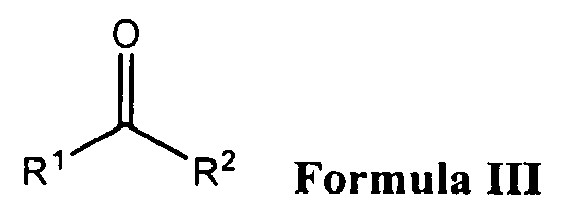
- In Formula III, each of R1 and R2 is independently hydrogen, C1-C10 alkyl, C5-C20 aralkyl, C1-C20 hydroxyalkyl, C2-C20 polyhydroxyalkyl, -(CH2)nCO2R3, -(CH2CH2O)mR4, or mono- or poly-saccharide containing 1 to 50 units.
- Referring to R1 and R2 of Formula III, m and n may be any appropriate integers. For instance, in some embodiments, each of m and n is independently 1, 2, 3, 4, 5, 6, 7, 8, 9, 10, 11, 12, 13, 14, 15, 16, 17, 18, 19, 20, 21, 22, 23, 24, 25, 26, 27, 28, 29, 30, 31, 32, 33, 34, 35, 36, 37, 38, 39, 40, 41, 42, 43, 44, 45, 46, 47, 48, 49 or 50. In some embodiments, each of m and n may independently be 1, 2, 3, 4, 5, 6, 7, 8, 9, 10, 11, 12, 13, 14, 15, 16, 17, 18, 19, 20, 21, 22, 23, 24, 25, 26, 27, 28, 29 or 30. In other embodiments, m and n may independently be 1, 2, 3, 4, 5, 6, 7, 8, 9, 10, 11, 12, 13, 14, 15, 16, 17, 18, 19 or 20. In yet other embodiments, m and n may independently be 1, 2, 3, 4, 5, 6, 7, 8, 9 or 10.
- Still referring to R1 and R2 of Formula III, each occurrence of R3 and R4 is independently hydrogen, C1-C10 alkyl, C5-C20 aralkyl, C1-C10 acyl, C1-C20 hydroxyalkyl, C2-C20 polyhydroxyalkyl, or mono- or poly-saccharide containing 1 to 50 units. For instance, in some embodiments, each of R3 and R4 is independently hydrogen, C1-C10 alkyl, C1-C20 hydroxyalkyl, or C2-C20 polyhydroxyalkyl.
- The aminopyrazine compound utilized in the process may be any appropriate aminopyrazine compound. For instance, the aminopyrazine compound utilized may be a compound of the following Formula IV or V below.
-

- With regard to Formulas IV and V above, each X and Y is independently hydrogen, C1-C10 alkyl, -OR5, -SR6, -NR7R8, -N(R9)COR10, halo, trihaloakyl, -CN, -NO2, -CO-Z-R11, -SOR12, -SO2R13, -SO2OR14, or -PO3R15R16. Z is a single bond, -O-, -NR17-, -NH(CH2)pNH-, -NH(CH2)pO-, -NH(CH2)pCO-, -NH(CH2)pNHCO-, -NH(CH2)pCONH-, -NH(CH2)pNHCONH-, - NH(CH2)pNHCSNH-, or -NH(CH2)pNHCO2-. Each of R5 to R17 is independently hydrogen, C1-C10 alkyl, C5-C20 aralkyl, C1-C10 acyl, C1-C20 hydroxyalkyl, C2-C20 polyhydroxyalkyl, -(CH2CH2O)qR18, or mono- or poly-saccharide containing 1 to 50 units. R18 is hydrogen, C1-C10 alkyl, C5-C20 aralkyl, C1-C10 acyl, C1-C20 hydroxyalkyl, C2-C20 polyhydroxyalkyl, or mono- or poly-saccharide containing 1 to 50 units. The
integer p - In some compounds of Formulas IV and V above, each of X and Y may be -CN in some embodiments and -CO-Z-R11 in other embodiments. In embodimentsof compounds of Formulas IV and V that include R11, R11 of some embodiments may be hydrogen, C1-C10 alkyl, C1-C20 hydroxyalkyl, or C2-C20 polyhydroxyalkyl. When each of X and Y is -CO-Z-R11, Z may be -NR17- in some embodiments, -NH(CH2)pNH- in other embodiments, and -NH(CH2)pCO- in other embodiments. In the case that Z is -NR17-, R17 of some embodimentsmay be hydrogen or C1-C10 alkyl. In the case that Z is either NH(CH2)pNH- or -NH(CH2)pCO-, the integer p of some embodimentsmay be 0, 1, 2, 3 or 4.
- The reducing agent utilized in the process may be any appropriate reducing agent. For instance, in some embodiments, the reducing agent is ammonium formate, diimide, Zn/HCl, sodium triacetoxyborohydride, sodium borohydride, pyridine/borane, lithium aluminium hydride, lithium borohydride, sodium cyanoborohydride, sodium amalgam, H2/Pd/C, H2/Pt/C, H2/Rh/C, H2/Raney® Nickel, or any combination thereof. In some embodiments, the reducing agent includes or is sodium triacetoxyborohydride. In some embodiments, the reducing agent includes or is sodium cyanoborohydride.
- In the case that a solvent is utilized in the process, the solvent may be any appropriate solvent such as, for example, water, C1-C8 alcohol, C1-C8 ether, C1-C8 ester, dimethyl formamide, dimethyl acetamide, acetic acid, trifluoroacetic acid, dimethyl sulfoxide, or any combination thereof. In some embodiments, the solvent may be methanol, ethanol, isopropyl alcohol, tetrahydrofuran, dioxane, glyme, dimethyl formamide, dimethyl sulfoxide, or any combination thereof.
- The order of addition of reagents in the process may vary (e.g., depending on the nature of the starting materials used). For example, the present process contemplates the addition of the reducing agent to the mixture of the aminopyrazine and the carbonyl compound, and likewise it contemplates the addition of the carbonyl compound to a mixture of the aminopyrazine and the reducing agent, as well as the addition of the aminopyrazine to a mixture of the carbonyl compound and the reducing agent provided that the reducing agent does not substantially decompose the carbonyl compound. In short, any suitable order of addition may be utilized.
-
Compound 18 below is an N,N'-alkylated diaminopyrazine that was produced using a process described herein and that could be used to assess renal function.
- Pyrazine derivatives made using a process described herein may be utilized in a number of appropriate methods and procedures (e.g., medical procedures). For instance, pyrazine derivatives made using a process described herein may be utilized in assessing renal function of a medical patient and/or as intermediates in processes for manufacturing pyrazine derivatives and/or compositions that include pyrazine derivatives (e.g., for use in assessing renal function of medical patients).
- Examples
- Unless otherwise noted, all reagents were used as supplied. Organic extracts were dried over anhydrous Na2SO4 and filtered using a fluted filter paper (P8). Solvents were removed on a rotary evaporator under reduced pressure. RP-LC/MS (ESI, positive ion mode) analyses were carried out on a Waters Micromass ZQ system equipped with a PDA detector using either a
BDS Hypersil C18 3 µm (50 mm × 4.6 mm) or a ThermoElectronHypersil Gold C18 3 µm (4.6 mm × 50 mm) column. Compounds were injected using a gradient condition (5 to 50-95%B/6 min) with a flow rate of 1 mL/min (mobile phase A: 0.05% TFA in H2O; mobile phase B: 0.05% TFA in CH3CN). Chemical shifts are expressed in parts per million (δ) relative to TMS (δ= 0) as an internal standard and coupling constants (J) are reported in Hz. - Example 1 - Protocol for assessing renal function
- An example of an in vivo
renal monitoring assembly 10 is shown inFig. 1 and includes alight source 12 and adata processing system 14. Thelight source 12 generally includes or is interconnected with an appropriate device for exposing at least a portion of a patient's body to light therefrom. Examples of appropriate devices that may be interconnected with or be a part of thelight source 12 include, but are not limited to, catheters, endoscopes, fiber optics, ear clips, hand bands, head bands, forehead sensors, surface coils, and finger probes. Indeed, any of a number of devices capable of emitting visible and/or near infrared light of the light source may be employed in therenal monitoring assembly 10. - Still referring to
Fig. 1 , thedata processing system 14 of therenal monitoring assembly 10 may be any appropriate system capable of detecting spectral energy and processing data indicative of the spectral energy. For instance, thedata processing system 14 may include one or more lenses (e.g., to direct and/or focus spectral energy), one or more filters (e.g., to filter out undesired wavelengths of spectral energy), a photodiode (e.g., to collect the spectral energy and convert the same into electrical signal indicative of the detected spectral energy), an amplifier (e.g., to amplify electrical signal from the photodiode), and a processing unit (e.g., to process the electrical signal from the photodiode). Thisdata processing system 14 is configured to manipulate collected spectral data and generate an intensity/time profile and/or a concentration/time curve indicative of renal clearance of a pyrazine derivative of the present invention from thepatient 20. Indeed, thedata processing system 14 may be configured to generate appropriate renal function data by comparing differences in manners in which normal and impaired cells remove the pyrazine derivative from the bloodstream, to determine a rate or an accumulation of the pyrazine derivative in organs or tissues of thepatient 20, and/or to provide tomographic images of organs or tissues having the pyrazine derivative associated therewith. -
Fig. 2 provides a clearance curve in Sprague-Dawley rats forcompound 18 of the present invention, the compound being described in greater detail below. Four Sprague-Dawley rats were used to obtain the experimental results depicted inFIG. 2 , with each of the four lines of the graph representing data obtained from an individual rat. The rats were injected intravenously with 1 ml of a 2 mmol solution ofcompound 18 in phosphate-buffered saline (PBS), giving a final concentration ofcompound 18 in each animal of approximately 6 µmol/kg. The presence ofcompound 18 in each of the animals was monitored over time and measured in Relative Fluorescence Units (RFUs). The clearance curve inFIG. 2 provides RFUs over time for each of the four rats. As shown inFIG. 2 , clearance ofcompound 18 began rapidly in each of the animals, and proceeded at a rapid pace from about 250 minutes to about 750 minutes. The clearance rate then began to level, with complete clearance ofcompound 18 occurring at approximately 6000 minutes. -
Fig. 3 provides a bar graph comparison of the clearance rates of an iothalamate reference standard andcompound 18. Spraque-Dawley rats were again used as animal models for studying the clearance rates. Iothalamate clearance rates were measured in five rats, whereas clearance rates forcompound 18 were measured in six rats. The clearance rates are expressed inFIG. 3 in terms of milliliters per minute. As can be seen from the figure, the clearance rate of iothalamate andcompound 18 were observed to be virtually the same. Thus,compound 18 provides clearance rates comparable to the accepted standard of iothalamate, but without the necessity for radiologic or other harmful imaging methods that are commonly used with iothalamate. - In one protocol for determining renal function, an effective amount of a pyrazine derivative of the invention is administered to the patient (e.g., in the form for a pharmaceutically acceptable composition). At least a portion of the body of the
patient 20 is exposed to visible and/or near infrared light from thelight source 12 as indicated byarrow 16. For instance, the light from thelight source 12 may be delivered via a fiber optic that is affixed to an ear of thepatient 20. The patient may be exposed to the light from thelight source 12 before or after administration of the pyrazine derivative to thepatient 20. In some cases, it may be beneficial to generate a background or baseline reading of light being emitted from the body of the patient 20 (due to exposure to the light from the light source 12) before administering the pyrazine derivative to thepatient 20. When the pyrazine derivative that is in the body of thepatient 20 is exposed to the light from thelight source 12, the pyrazine derivative emanates light (indicated by arrow 18) that is detected/collected by thedata processing system 14. Initially, administration of the pyrazine derivative to the patient 20 generally enables an initial spectral signal indicative of the initial content of the pyrazine derivative in thepatient 20. The spectral signal then tends to decay as a function of time as the pyrazine derivative is cleared from thepatient 20. This decay in the spectral signal as a function of time is indicative of the patient's renal function. For example, in a first patient exhibiting healthy/normal renal function, the spectral signal may decay back to a baseline in a time of T. However, a spectral signal indicative of a second patient exhibiting deficient renal function may decay back to a baseline in a time of T+4 hours. As such, thepatient 20 may be exposed to the light from thelight source 12 for any amount of time appropriate for providing the desired renal function data. Likewise, thedata processing system 14 may be allowed to collect/detect spectral energy for any amount of time appropriate for providing the desired renal function data. - Example 2 - Synthesis of Representative Pyrazine PEG Analogues
- Unless otherwise noted, all reagents in this Example were used as supplied. Organic extracts were dried over anhydrous Na2SO4 and filtered using a fluted filter paper (P8). Solvents were removed on a rotary evaporator under reduced pressure. RP-LC/MS (ESI, positive ion mode) analyses were carried out on a Waters Micromass ZQ system equipped with a PDA detector using either a
BDS Hypersil C18 3 µm (50 mm × 4.6 mm) or a ThermoElectronHypersil Gold C18 3 µm (4.6 mm × 50 mm) column. Compounds were injected using a gradient condition (5 to 50-95%B/6 min) with a flow rate of 1 mL/min (mobile phase A: 0.05% TFA in H2O; mobile phase B: 0.05% TFA in CH3CN). Chemical shifts are expressed in parts per million (δ) relative to TMS (δ= 0) as an internal standard and coupling constants (J) are reported in Hz. -
A. Diethyl 3,6-bis(benzylamino)pyrazine-2,5-dicarboxylate (7)
- To a well-stirred red suspension of
diethyl 3,6-diaminopyrazine-2,5-dicarboxylate (0.127 g, 0.500 mmol)2 inanhyd 1,2-dichloroethane (DCE, 20 mL), benzaldehyde (0.202 mL, 2.00 mmol) was added, and the reaction flask was immersed in an ice bath. Then HOAc (0.115 mL, 2.00 mmol) was added followed by the addition of sodium triacetoxyborohydride (0.424 g, 2.00 mmol) in small portions over a 15 min period. The resulting suspension was slowly allowed to warm to r.t. and stirred overnight (ca. 16 h; RP-LC/MS analysis indicated the presence of some substrate) in an atmosphere of argon. At this stage, the reaction mixture was treated with more benzaldehyde (0.202 mL, 2.00 mmol), HOAc (0.115 mL, 2.00 mmol), and sodium triacetoxyborohydride (0.424 g, 2.00 mmol) as described above, and the reaction was continued overnight (ca. 24 h; RP-LC/MS analysis indicated a complete reaction). The reaction was quenched by a slow addition of satd NaHCO3 (20 mL) while stirring at 0 °C. The biphasic mixture was stirred for 30 min and extracted with CHCl3 (3 × 25 mL). The combined organic extracts were successively washed with satd NaHCO3, H2O, and brine (30 mL each). Removal of the solvent gave 0.200 g of a red solid, which upon flash chromatography over silica gel (CHCl3) afforded Example 1 (0.174 g, 80%) as a dark red powder: R f 0.49; 1H NMR (DMSO-d 6) 7.60 (t, 2, J = 5.9), 7.42 (dd, 4, J = 7.7, 1.7), 7.28-7.18 (m, 6), 4.51 (d, 4, 5.9), 4.32 (q, 4, J = 7.1), 1.30 (t, 6, J = 7.1); 13C NMR (DMSO-d b) 165.36, 146.28, 140.07, 128.08, 128.03, 126.65, 124.80, 61.35, 44.39, 44.29, 14.13; RP-LC/MS (ESI) m/z 435.3 (M + H)+, 457.2 (M + Na)+ (t R = 5.53 min, 5-95%B). Anal. Calcd for C24H26N4O4: C, 66.34; H, 6.03; N, 12.89. Found: C, 66.10; H, 5.98; N, 12.67. - B. 3,6-Bis(propylamino)-N 2,N 5-bis[2-(tert-butoxycarbonyl)aminoethyl]pyrazine-2,5-dicarboxamide (8)

- To a partially-dissolved yellow suspension of 3,6-Diamino-N 2,N 5-bis[2-(tert-butoxycarbonyl)aminoethyl]pyrazine-2,5-dicarboxamide (0.483 g, 1.00 mmol)8 in anhydrous DCE (20 mL), propionaldehyde (0.290 mL, 4.02 mmol) and HOAc (0.290 mL, 5.03 mmol) were added with stirring at 0 °C under argon atmosphere. The resulting somewhat lighter suspension was allowed to stir for 5 min before the addition of sodium triacetoxyborohydride (0.848 g, 4.00 mmol) in small portions over a 10 min period. The reddish suspension was slowly allowed to warm to r.t. and stirred overnight (ca. 19 h) in an atmosphere of argon. The reaction was quenched by a slow addition of satd NaHCO3 (20 mL) at 0 °C. The biphasic mixture was stirred for 30 min and extracted with CHCl3 (3 × 25 mL). The combined organic extracts were successively washed with H2O and brine (50 mL each). Removal of the solvent gave 0.680 g of a red solid, which upon flash chromatography over silica gel [CH2Cl2-EtOAc (17:3 to 3:1, v/v)] afforded Example 2 (0.454 g, 80%) as a crimson red solid: R f 0.44 [CH2Cl2-EtOAc (7:3, v/v)]; 1H NMR (CDCl3) 8.13 (br s, 2), 7.78 (t, 2, J = 5.4), 4.87 (br s, 2), 3.53 (q, 4, J = 5.9), 3.39-3.34 (quintet, 8), 1.70-1.63 (sextet, 4), 1.42 (s, 18), 1.01 (t, 6, J = 7.4); 13C NMR (CDCl3) 166.84, 156.30, 146.01, 126.07, 79.55, 42.89, 40.44, 39.79, 28.32, 22.75, 11.82; RP-LC/MS (ESI) m/z 567.4 (M + H)+, 589.4 (M + Na)+ (t R = 5.17 min, 5-95%B). Anal. Calcd for C26H46N8O6: C, 55.11; H, 8.18; N, 19.77. Found: C, 55.17; H, 8.31; N, 19.53.
- C. 3,6-Bis(benzylamino)-N 2,N 5-bis[2-(tert butoxycarbonyl)aminoethyl]pyrazine-2,5-dicarboxamide (9)

- The reaction of 3,6-Diamino-N 2,N 5-bis[2-(tert-butoxycarbonyl)aminoethyl]pyrazine-2,5-dicarboxamide (0.121 g, 0.250 mmol)8 with benzaldehyde (0.101 mL, 1.00 mmol) in the presence of HOAc (0.058 mL, 1.00 mmol) and sodium triacetoxyborohydride (0.212 g, 1.00 mmol) in DCE (10 mL) was carried out overnight (ca. 16 h) as described in the preparation of Example 2. After the usual work up, the brick-red crude product (0.240 g) was subjected to flash chromatography over silica gel [CHCl3-EtOAc (4:1, v/v)], and the residue triturated with anhyd Et2O to give Example 3 (0.119 g, 72%) as an orange powder: R f 0.40 [CHCl3-EtOAc (7:3, v/v)]; 1H NMR (CDCl3) 8.20 (br t, 2, J = 5.0), 7.76 (br t, 2), 7.37-7.30 (m, 8), 7.25-7.21 (m, 2), 4.77 (br s, 2), 4.58 (d, 4, J = 5.4), 3.44-3.40 (br q, 4), 3.31-3.25 (br q, 4), 1.43 (s, 18); RP-LC/MS (ESI) m/z 663.2 (M + H)+, 685.2 (M + Na)+ (t R = 4.30 min, 50-95%B). Anal. Calcd for C341446N8O6: C, 61.61; H, 7.00; N, 16.91. Found: C, 61.72; H, 7.07; N, 16.89.
- D. 3,6-Bis(4-methoxybenzylamino)-N 2,N 5-bis[2-(tert-butoxycarbonyl)aminoethyl]pyrazine-2,5-dicarboxamide (10)

- The reaction of 3,6-Diamino-N 2,N 5-bis[2-(tert-butoxycarbonyl)aminoethyl]pyrazine-2,5-dicarboxamide (0.483 g, 1.00 mmol)8 with 4-methoxybenzaldehyde (0.485 mL, 4.00 mmol) in the presence of HOAc (0.230 mL, 4.00 mmol) and sodium triacetoxyborohydride (0.848 g, 4.00 mmol) in DCE (25 mL) was carried out overnight as described in the preparation of Example 2. After the usual work up, the brick-red crude product (1.14 g) was subjected to flash chromatography over silica gel [CHCl3-EtOAc (3:1, v/v)], and the material obtained was recrystallized from EtOAc-Et2O to give Example 4 (0.615 g, 85%) as an orange-red microcrystalline solid: R f 0.30 [CHCl3-EtOAc (7:3, v/v)]; 1H NMR (CDCl3) 8.14 (br t, 2, J = 5.0), 7.90 (br t, 2), 7.28 (d, 4, J = 8.5), 6.86 (d, 4, J = 8.5), 4.82 (br t, 2), 4.52 (d, 4, J = 5.4), 3.78 (s, 6), 3.46-3.43 (br q, 4), 3.33-3.28 (br q, 4), 1.42 (s, 18); RP-LC/MS (ESI) m/z 723.3 (M + H)+, 745.3 (M + Na)+ (t R = 4.08 min, 50-95%B). Anal. Calcd for C36H50N8O8: C, 59.82; H, 6.97; N, 15.50. Found: C, 60.01; H, 7.05; N, 15.43.
- E. 3,6-Bis(4-nitrobenzylamino)-N 2,N 5-bis[2-(tert-butoxycarbonyl)aminoethyl]pyrazine-2,5-dicarboxamide (11)

- The reaction of 3,6-Diamino-N 2,N 5-bis[2-(tert-butoxycarbonyl)aminoethyl]pyrazine-2,5-dicarboxamide (0.121 g, 0.250 mmol)8 with 4-nitrobenzaldehyde (0.151 mL, 1.00 mmol) in the presence of HOAc (0.058 mL, 1.00 mmol) and sodium triacetoxyborohydride (0.212 g, 1.00 mmol) in DCE (10 mL) was carried out overnight (ca. 18 h) as described in the preparation of Example 2. After the usual work up, the brick-red crude product (0.260 g) was subjected to flash chromatography over silica gel [CHCl3-EtOAc (7:3, v/v)], and the residue recrystallized from EtOAc-Et2O to give Example 5 (0.155 g, 82%) as an orange microcrystalline solid: R f 0.33 [CHCl3-EtOAc (1:1, v/v)]; 1H NMR (CDCl3) 8.44 (br t, 2), 8.18 (d, 4, J = 8.7), 8.03 (br s, 2), 7.57 (d, 4, J = 8.5), 4.78 (br m, 6), 3.46-3.42 (br q, 4), 3.36-3.30 (br m, 4), 1.39 (s, 18); RP-LC/MS (ESI) m/z 753.2 (M + H)+, 775.1 (M + Na)+ (t R = 4.02 min, 50-95%B). Anal. Calcd for C34H44N10O10: C, 54.25; H, 5.89; N, 18.61. Found: C, 54.20; H, 5.97; N, 18.32.
- F. 3,6-Bis(cyclohexylamino)-N 2,N 5-bis[2-(tert-butoxycarbonyl)aminoethyl]pyrazine-2,5-dicarboxamide (12)

- To a partially-dissolved yellow suspension of 3,6-Diamino-N 2,N 5-bis[2-(tert-butoxycarbonyl)aminoethyl]pyrazine-2,5-dicarboxamide (0.121 g, 0.250 mmol)8 in anhyd DCE (10 mL), cyclohexanone (0.104 mL, 1.00 mmol) was added, and the reaction flask was immersed in an ice bath. Then HOAc (0.058 mL, 1.00 mmol) was added followed by the addition of sodium triacetoxyborohydride (0.212 g, 1.00 mmol) in small portions over a 10 min period. The resulting suspension was slowly allowed to warm to r.t. and stirred overnight (ca. 17 h; RP-LC/MS analysis indicated intact substrate) in an atmosphere of N2. At this stage, the reaction mixture was treated with more cyclohexanone (0.104 mL, 1.00 mmol), HOAc (0.058 mL, 1.00 mmol), and sodium triacetoxyborohydride (0.212 g, 1.00 mmol) as described above, and the reaction was continued for 48 h (RP-LC/MS analysis indicated small amounts of substrate). Similar quantities of the reagents were added once again and the reaction was continued over the weekend (RP-LC/MS analysis indicated a complete reaction). After the usual work up described in Example 2, the crude product (0.456 g) obtained was subjected to flash chromatography over silica gel [CHCl3 to CHCl3-EtOAc (17:3, v/v)] to afford Example 6 (0.075 g, 46%) as a crimson red powder: R f 0.58 [CHCl3-EtOAc (7:3, v/v)]; 1H NMR (CDCl3) 8.02 (br t, 2), 7.75 (d, 2, J = 7.7), 4.83 (br t, 2), 3.90-3.76 (br m, 2), 3.52 (q, 4, J = 5.9), 3.34 (q, 4, J = 5.9), 2.02-1.20 (m, 38, includes Boc singlet at δ 1.42); 13C NMR (CDCl3) 166.51, 156.35, 144.79, 125.75, 79.42, 48.90, 40.36, 39.52, 32.82, 28.27, 25.92, 24.58; RP-LC/MS (ESI) m/z 647.5 (M + H)+ (t R = 5.36 min, 30-95%B). HRMS (ESI) m/z calcd for C32H55N8O6 (M + H)+ 647.4239, found 647.4238.
- The byproducts of the reaction, 0.040 g (27%) of 3-(cyclohexylamino)-6-(ethylamino)-N 2,N 5-bis[2-(tert-butoxycarbonyl)aminoethyl]pyrazine-2,5-dicarboxamide [1H NMR (CDCl3) 8.16 (br t, 1), 8.01 (br t, 1), 7.79 (d, 1, J = 7.7), 7.63 (t, 1, J = 5.1), 4.83 (br s, 2), 3.83 (br m, 1), 3.55-3.34 (m, 10), 1.99-1.21 (m, 31, include Boc singlet at δ 1.42 and Me triplet at δ 1.27); RP-LC/MS (ESI) m/z 593.4 (M + H)+ (t R = 4.88 min, 30-95%B)] and 0.010 g (7%) of 3,6-bis(ethylamino)-N 2,N 5-bis[2-(tert-butoxycarbonyl)aminoethyl]pyrazine-2,5-dicarboxamide [1H NMR (CDCl3) 8.17 (br t, 2), 7.67 (t, 2, J = 5.0), 4.86 (br t, 2), 3.55-3.33 (m, 12), 1.42 (s, 18), 1.27 (t, 6, J = 7.2); RP-LC/MS (ESI) m/z 539.3 (M + H)+, 561.5 (M + Na)+ (t R = 4.34 min, 30-95%B)], were also isolated in the above chromatography.
-
G. Dimethyl 4,4'-[3,6-bis{2-(tert-butoxycarbonylamino)ethylcarbamoyl}pyrazine-2,5-diyl]bis(azanediyl)dibutanoate (13)
- The reaction of 3,6-Diamino-N 2,N 5-bis[2-(tert-butoxycarbonyl)aminoethyl]pyrazine-2,5-dicarboxamide (0.965 g, 2.00 mmol)8 with methyl 4-oxobutanoate (0.838 mL, 8.00 mmol) in the presence of HOAc (0.460 mL, 7.98 mmol) and sodium triacetoxyborohydride (1.70 g, 8.00 mmol) in DCE (40 mL) was carried out overnight (ca. 20 h) as described in the preparation of Example 2. After the usual work up, the orange crude product (1.74 g) was subjected to flash chromatography over silica gel [CHCl3-EtOAc (7:3, v/v)] to give Example 7 (1.30 g, 95%) as an orange-red powder: R f 0.33 [CHCl3-EtOAc (1:1, v/v)]; 1H NMR (CDCl3) 8.66 (t, 2, J = 5.9), 7.93 (t, 2, J = 6.0), 5.21 (br t, 2), 3.67 (s, 6), 3.56 (q, 4, J = 5.8), 3.46-3.30 (m, 8), 2.42 (t, 4, J = 6.5), 1.99-1.89 (quintet, 4), 1.41 (s, 18); 13C NMR (CDCl3) 174.40, 166.70, 156.00, 145.63, 126.09, 79.17, 51.82, 40.81, 40.39, 39.53, 30.89, 28.43, 24.44; RP-LC/MS (ESI) m/z 683.3 (M + H)+, 705.3 (M + Na)+ (t R = 4.75 min, 15-95%B). HRMS (ESI) m/z calcd for C30H51N8O10 (M + H)+ 683.3723, found 683.3719.
- H. 3,6-Bis[2-(tert-butoxycarbonylamino)ethylamino]-N 2,N 5-bis[2-(tert-butoxycarbonyl)aminoethyl]pyrazine-2,5-dicarboxamide (14)

- To a partially-dissolved yellow suspension of 3,6-Diamino-N 2,N 5-bis[2-(tert-butoxycarbonyl)aminoethyl]pyrazine-2,5-dicarboxamide (0.483 g, 1.00 mmol)8 in anhyd DCE (20 mL), N-Boc-2-aminoacetaldehyde (0.382 g, 2.40 mmol) was added, and the reaction flask was immersed in an ice bath. Then HOAc (0.120 mL, 2.08 mmol) was added followed by the addition of sodium triacetoxyborohydride (0.636 g, 3.00 mmol) in small portions over a 15 min period. The resulting reddish suspension was slowly allowed to warm to r.t. and stirred overnight (ca. 16 h; RP-LC/MS analysis indicated some substrate) in an atmosphere of argon. At this stage, the reaction mixture was treated with more N-Boc-2-aminoacetaldehyde (0.191 g, 1.20 mmol), HOAc (0.120 mL, 2.08 mmol), and sodium triacetoxyborohydride (0.212 g, 1.00 mmol) as described above, and the reaction was continued overnight (ca. 25 h; RP-LC/MS analysis indicated a complete reaction). After the usual work up described in Example 2, the crude product (1.04 g) obtained was subjected to flash chromatography over silica gel [CHCl3-EtOAc (1:1, v/v)] to furnish Example 8 (0.813 g, quantitative) as brick-red solid: R f 0.27; 1H NMR (DMSO-d 6) 8.81 (t, 2, J = 5.9), 7.95 (t, 2, J = 5.9), 6.96 (t, 2, J = 5.6), 6.86 (br t, 2, J = 5.1), 3.41 (q, 4, J = 6.4), 3.35 (q, 4, J = 6.2), 3.15-3.08 (quintet, 8), 1.38 (s, 18), 1.35 (s, 18); 13C NMR (DMSO-d 6) 165.43, 155.79, 155.50, 145.03, 125.70, 77.67, 77.52, 40.24 (overlaps with solvent), 39.05 (overlaps with solvent); RP-LC/MS (ESI) m/z 769.3 (M + H)+, 791.3 (M + Na)+ (t R = 5.10 min, 15-95%B). HRMS (ESI) m/z calcd for C34H61N10O10 (M + H)+ 769.4567, found 769.4567.
- I. 3,6-Bis[3-(benzyloxycarbonylamino)propylamino]-N 2,N 5-bis[2-(benzyloxycarbonyl)aminoethyl]pyrazine-2,5-dicarboxamide (16)

-
Step 1. Synthesis of 3,6-Diamino-N 2,N 5-bis[2-(benzyloxycarbonyl)aminoethyl]pyrazine-2,5-dicarboxamide (15).
- A suspension of N-carbobenzoxy-1,2-diaminoethane hydrochloride (4.61 g, 20.0 mmol) in anhyd DMF (100 mL) was stirred with DIPEA (3.50 mL, 20.1 mmol) for 30 min in an atmosphere of N2. Then 3,6-diaminopyrazine-2,5-dicarboxylic acid (1.98 g, 10.0 mmol) was added, and after 15 min, HOBt.H2O (3.37 g, 22.0 mmol) and EDC.HCl (4.22 g, 22.0 mmol) were added, and the resulting dark suspension was stirred at r.t. overnight (ca. 16 h). Most of the DMF was removed under high vacuum and the slurry was stirred with anhyd Et2O-MeOH (1:3, v/v; 200 mL) for about 30 min. The precipitate was collected by filtration and thoroughly washed with MeOH and anhyd Et2O and dried under high vacuum to give the bisamide 15 (4.37 g, 79%) as a yellow powder: 1H NMR (DMSO-d 6) 8.50 (t, 2, J = 5.5), 7.39-7.31 (m, 10), 6.50 (br s, 4), 5.02 (s, 4), 3.37-3.34 (br q, 4), 3.20-3.17 (br q, 4); 13C NMR (DMSO-d 6) 165.80, 156.74, 146.65, 137.60, 128.78, 128.22, 128.20, 126.83, 65.74, 40.44 (overlaps with solvent), 39.22 (overlaps with solvent); RP-LC/MS (ESI) m/z 551.2 (M + H)+, 573.2 (M + Na)+ (t R = 3.86 min, 25-95%B). Anal. Calcd for C26H30N8O6: C, 56.72; H, 5.49, N, 20.35. Found: C, 56.79; H, 5.49; N, 20.30.
-
Step 2. To a yellow suspension of the above bisamide 15 (1.10 g, 2.00 mmol) in anhyd DCE (50 mL), 3-[(benzyloxycarbonyl)amino]propionaldehyde (1.24 g, 6.00 mmol) was added, and the reaction flask was immersed in an ice bath. Then HOAc (0.340 mL, 5.90 mmol) was added followed by the addition of sodium triacetoxyborohydride (1.27g, 6.00 mmol) in small portions over a 30 min period. The resulting reddish suspension was slowly allowed to warm to r.t. and stirred overnight (ca. 40 h; RP-LC/MS analysis indicated some substrate) in an atmosphere of N2. At this stage, the reaction mixture was diluted with anhyd DCE (30 mL) and treated with more 3-[(benzyloxycarbonyl)amino]propionaldehyde (0.414 g, 2.00 mmol), HOAc (0.12 mL, 2.08 mmol), and sodium triacetoxyborohydride (0.424 g, 2.00 mmol) as described above, and the reaction was continued over the weekend (RP-LC/MS analysis indicated only traces of substrate). After the usual work up described in Example 2, the crude product obtained was suspended in CH3CN-anhyd Et2O (1:1, v/v; 100 mL) and stirred at r.t. for 30 min. The precipitate was collected by filtration, washed with CH3CN-anhyd Et2O, and dried under high vacuum to give Example 9 (1.35 g) as an orange-red powder. The filtrate was concentrated and subjected to flash chromatography over silica gel [CHCl3-MeOH (49:1, v/v)] to obtain additional 0.09 g of the product, bringing the overall yield to 1.44 g (77%): R f 0.42 [CHCl3-MeOH (19:1, v/v)]; 1H NMR (DMSO-d 6) 8.53 (t, 2, J = 5.5), 7.86 (br t, 2), 7.42 (t, 2, J = 5.5), 7.36-7.21 (m, 20), 4.99 (s, 4), 4.98 (s, 4), 3.50-3.30 (m, 10), 3.18 (q, 4, J = 6.1), 3.07 (q, 4, J = 6.4), 1.66 (quintet, 4); RP-LC/MS (ESI) m/z 933.4 (M + H)+ (t R = 4.96 min, 15-95%B). Anal. Calcd for C42H68N8O12: C, 61.79; H, 6.05; N, 15.01. Found: C, 61.53; H, 5.92; N, 14.96. -
J. Diethyl 3,6-bis(2-methoxyethylamino)pyrazine-2,5-dicarboxylate (17)
- The reaction of
diethyl 3,6-diaminopyrazine-2,5-dicarboxylate (0.127 g, 0.500 mmol)2 with methoxyacetaldehyde (0.148 g, 2.00 mmol) in the presence of HOAc (0.115 mL, 2.00 mmol) and sodium triacetoxyborohydride (0.424 g, 2.00 mmol) in DCE (20 mL) was carried out as described in the preparation of Example 1. However, it should be mentioned here that the second batch of reagents were added after 21 h and the overall duration of the reaction was 68 h. After the usual work up, the red crude product (0.210 g) was subjected to flash chromatography over silica gel [CH2Cl2 to CH2Cl2-EtOAc (9:1, v/v)] to afford Example 10 (0.075 g, 41%) as a maroon solid: R f 0.29 [CHCl3-EtOAc (19:1, v/v)]; 1H NMR (CDCl3) 7.31 (t, 2, J = 5.3), 4.39 (q, 4, J = 7.1), 3.69-3.60 (m, 8), 3.41 (s, 6), 1.41 (t, 6, J = 7.1); 13C NMR (CDCl3) 166.28, 147.48, 125.54, 71.41, 61.58, 58.76, 40.68, 14.14; RP-LC/MS (ESI) m/z 371.2 (M + H)+, 393.2 (M + Na)+ (t R = 4.59 min, 15-95%B). - K.3,6-Bis(38-oxo-2,5,8,11,14,17,20,23,26,29,32,35-dodecaoxa-39-azahente-tracontan-41-ylamino)-N 2,N 5-bis(38-oxo-2,5,8,11,14,17,20,23,26,29,32,35-dodecaoxa-39-azahentetracontan-41-yl)pyrazine-2,5-dicarboxamide (18).

-
Compound 18, above, is a longer wavelength compound (excitation ∼500 nm, emission ∼600 nm orange). To achieve the red shift in both excitation and emission wavelengths, electron donation into the ring was increased by alkyl substitution on the pyrazine ring nitrogens. The synthetic strategy for these longer wavelength analogues involves functionalizing the carboxyls first through amide chemistry described above followed by reductive amination of the pyrazine amino groups. Thus the synthesis ofcompound 18, above, is presented below. MP-3064 was coupled with Boc-ethylenediamine using the EDC method to afford MP-3183. This material was then converted to MP-3216 by reductive amination using Boc-2-aminoacetaldehyde and sodium triacetoxyborohydride. MP-3216 was purified by flash chromatography and deprotected with TFA to afford the corresponding tetramine salt. This material was then acylated with NES-m-dPEG12 and purified by HPLC to afford compound 18:
- A mixture of
sodium 3,6-diaminopyrazine-2,5-dicarboxylate (500 mg, 2.07 mmol), tert-butyl 2-aminoethylcarbamate (673 mg, 4.20 mmol) HOBt-H2O (836 mg, 5.46 mmol) and EDC-HCl (1.05 g, 5.48 mmol) in DMF (25 mL) was stirred for 16 h and concentrated. The residue was partitioned with 1N NaHSO4 (200 mL) and EtOAc (200 mL). The layers were separated and the organic was washed with water (200 mL), sat. NaHCO3 (200 mL) and brine (200 mL). The EtOAc solution was dried (Mg2SO4), filtered and concentrated to afford 770 mg (76% yield) of 3,6-diamino-N 2,N 5-bis(2-(tert-butoxy carbonylaminoethyl))pyrazine-2,5-dicarboxamide (MP-3183) as an orange foam: 1NMR (300 MHz, DMSO-d 6) major comformer, δ 8.44 (t, J = 5.7 Hz, 2 H), 6.90 (t, J = 5.7 Hz, 2 H), 6.48 (bs, 4 H), 2.93-3.16 (complex m, 8 H), 1.37 (s, 9 H), 1.36 (s, 9 H). 13C NMR (75 MHz, DMSO-d 6), conformational isomers δ 165.1 (s), 155.5 (bs), 155.4 (bs), 146.0 (s), 126.2 (s), 77.7 (bs), 77.5 (bs), 45.2 (bt), 44.5 (bt), 28.2 (q). LCMS (15-95% gradient ACN in 0.1% TFA over 10 min), single peak retention time = 7.18 min on 30 mm column, (M+H)+ = 483. - To a partially-dissolved yellow suspension of MP-3183 (0.483 g, 1.00 mmol) in anhydrous DCE (20 mL), N-Boc-2-aminoacetaldehyde (0.382 g, 2.40 mmol) was added, and the reaction flask was immersed in an ice bath. Then HOAc (0.120 mL, 2.08 mmol) was added followed by the addition of sodium triacetoxyborohydride (0.636 g, 3.00 mmol) in small portions over a 15 min period. The resulting reddish suspension was slowly allowed to warm to room temperature and stirred overnight (ca. 16 h; LC/MS analysis indicated some substrate). At this stage, the reaction mixture was treated with more N-Boc-2-aminoacetaldehyde (0.191 g, 1.20 mmol), HOAc (0.120 mL, 2.08 mmol), and sodium triacetoxyborohydride (0.212 g, 1.00 mmol) as described above, and the reaction was continued overnight (ca. 25 h; RP-LC/MS analysis indicated a complete reaction). The reaction was quenched by a slow addition of sat. NaHCO3 (30 mL) at 0 °C. The biphasic mixture was stirred for 30 min and extracted with CHCl3 (3 × 40 mL). The combined organic extracts were washed with H2O and brine (50 mL each). Removal of the solvent gave 1.04 g of a red solid, which upon flash chromatography over silica gel [CHCl3-EtOAc (1:1, v/v)] afforded MP-3216 (0.813 g, quantitative) as brick-red solid: R f 0.27; 1H NMR (DMSO-d 6) δ 8.81 (t, 2, J = 5.9), 7.95 (t, 2, J = 5.9), 6.96 (t, 2, J = 5.6), 6.86 (br t, 2, J = 5.1), 3.41 (q, 4, J = 6.4), 3.35 (q, 4, J = 6.2), 3.15-3.08 (quintet, 8), 1.38 (s, 18), 1.35 (s, 18); 13C NMR (DMSO-d 6) δ 165.43, 155.79, 155.50, 145.03, 125.70, 77.67, 77.52, 40.24 (overlaps with solvent), 39.05 (overlaps with solvent); LC/MS (ESI) m/z 769.3 (M + H)+, 791.3 (M + Na)+ (t R = 5.10 min, 15-95%B). HRMS (ESI) m/z calcd for C34H61N10O10 (M + H)+ 769.4567, found 769.4567.
- To a red suspension of MP-3216 (0.769 g, 1.00 mmol) in anhyd CH2Cl2 (15 mL), was added TFA (15 mL) carefully while stirring at ice-bath temperature. The reaction became homogeneous instantaneously with a pale yellow coloration, and then turned red after a few minutes. After 30 min at 0 °C, the cooling bath was removed, and the reaction continued for 1.5 h under N2 atmosphere. The reaction mixture was concentrated in vacuo, the viscous residue was co-evaporated with CH2Cl2 (5 × 25 mL), and then dried overnight under high vacuum to give MP-3216-tfa salt (0.886 g, 107% for tetra-TFA salt) as a reddish brown solid: 1H NMR (DMSO-d 6) δ 8.75 (t, 2, J = 6.1), 8.06 (br t, 2), 7.97 (br s, 4), 7.86 (br s, 4), 3.73 ( br q, 4), 3.55 (q, 4, J = 6.3), 3.04-2.95 (m, 8); RP-LC/MS (ESI) m/z 369.4 (M + H)+, 737.4 (2M + H)+ (t R = 1.09min, 5-95% ACN in H2O, 0.1% TFA).
- To a red solution of the MP-3216-tfa salt (0.543 g crude, 0.50 mmol) in DMF (8 mL), NMM (1.10 mL, 10.0 mmol) was added at 0 °C, and stirred for 30 min in an atmosphere of N2. Then a solution of NHS-m-dPEG™12 (7, 1.58 g, 2.30 mmol) in CH2Cl2 (2 mL) was added and the reaction mixture was stirred overnight (ca. 14 h) at ambient temperature. Most of the solvents were removed under high vacuum and the red syrup was subjected to preparative HPLC [column: Waters XBrdige™
Prep C18 OBD ™ 5µm 10 × 150 mm; λmax: PDA (200-600 nm); flow: 50 mL/min; gradient: 5-50% B/10 min (mobile phase A: 0.1% TFA in H2O; mobile phase B: 0.1% TFA in CH3CN)] to give MP-3217 (0.443 g, 33%) as a brick-red slush: 1H NMR (DMSO-d 6) characteristic br s at δ 3.50 and s at δ 3.23 for poly(ethylene glycol) moiety; HPLC (254 nm) 89% [t R = 14.4 min, 20-80% ACN in H2O, 0.1% TFA over 20 min (column:Phenomenex Luna 5 µm C18(2) 100 A 250 × 4.6 mm; flow: 1 mL/min; mobile phase A: 0.1% TFA in H2O; mobile phase B: 0.1% TFA in CH3CN]; LC/MS (ESI) m/z 884.3 (M + 3H)3+, 1325.4 (M + 2H)2+ (t R = 3.81 min, 5-95%B). HRMS (ESI) m/z calcd for C118H231N10O54 (M + 3H)3+ 884.1874, found 884.1872; calcd for C118H230N10O54 (M + 2H)2+ 1325.7774, found 1325.7769. - Other Aspects and Embodiments
- The detailed description set forth above is provided to aid those skilled in the art in practicing the present invention. However, the invention described and claimed herein is not to be limited in scope by the specific aspects and embodiments herein disclosed because these aspects and embodiments are intended as illustration of several aspects of the invention. Any equivalent aspects and embodiments are intended to be within the scope of this invention. Indeed, various modifications of the invention in addition to those shown and described herein will become apparent to those skilled in the art from the foregoing description that do not depart from the spirit or scope of the present inventive discovery. Such modifications are also intended to fall within the scope of the appended claims.
- References Cited
- Citation of a reference herein shall not be construed as an admission that such is prior art to the present invention.
- [1] C.A. Rabito, L.S.T. Fang, and A.C. Waltman, "Renal function in patients at risk with contrast material-induced acute renal failure: Noninvasive real-time monitoring," Radiology 1993, 186, 851-854.
- [2] N.L. Tilney, and J.M. Lazarus, "Acute renal failure in surgical patients: Causes, clinical patterns, and care," Surgical Clinics of North America 1983, 63, 357-377.
- [3] B.E. VanZee, W.E. Hoy, and J.R. Jaenike, "Renal injury associated with intravenous pyelography in non-diabetic and diabetic patients," Annals of Internal Medicine 1978, 89, 51-54.
- [4] S. Lundqvist, G. Edbom, S. Groth, U. Stendahl and S.-O. Hietala, "Iohexol clearance for renal function measurement in gynecologic cancer patients," Acta Radiologica 1996, 37, 582-586.
- [5] P. Guesry, L. Kaufman, S. Orloff, J.A. Nelson, S. Swann, and M. Holliday, "Measurement of glomerular filtration rate by fluorescent excitation of non-radioactive meglumine iothalamate," .
- [6] C.C. Baker, L. Oppenheimer, and B. Stephens, "Epidemiology of trauma deaths," American Journal of Surgery 1980, 140, 144-150.
- [7] R.G. Lobenhoffer, and M. Grotz, "Treatment results of patients with multiple trauma: An analysis of 3406 cases treated between 1972 and 1991 at a German level I trauma center," Journal of Trauma 1995, 38, 70-77.
- [8] F.W. Dodge, B.L Travis, and C.N. Daeschner, "Comparison of endogenous creatinine clearance with inulin clearance," Am. J. Dis. Child. 1967, 113, 683-692.
- [9] J. Brochner-Mortensen, J. Giese, N. Rossing, "Renal inulin clearance versus total plasma clearance of 51Cr-EDTA," Scand. J. Clin. Lab. Invest. 1969, 23, 301-303.
- [10] C. White, A. Akbari, N. Hussain, L. Dinh, G. Filler, N. Lepage, and G. Knoll, "Estimating glomerular filtration rate in kidney transplantation: A comparison between serum creatinine and cystatin C-based methods," J. Am. Soc. Nephrol, 2005, 16, 3763-3770 and references cited therein.
- [11] P.L. Choyke, H.A. Austin, J.A. Frank, "Hydrated clearance of gadolinium-DTPA as a measurement of glomerular filtration rate," Kidney International 1992, 41, 1595-1598.
- [12] M.F. Tweedle, X. Zhang, M. Fernandez, P. Wedeking, A.D. Nunn, and H.W. Strauss, "A noninvasive method for monitoring renal status at the bedside," Invest. Radiol. 1997, 32, 802-805.
- [13] N. Lewis, R. Kerr, C. Van Buren, "Comparative evaluation of urographic contrast media, inulin, and 99mTc-DTPA clearance methods for determination of glomerular filtration rate in clinical transplantation," Transplantation 1989, 48, 790-796.
- [14] R. Muller-Suur, C. Muller-Suur, "Glomerular filtration and tubular secretion of MAG3 in rat kidney," Journal of Nuclear Medicine 1989, 30, 1986-1991.
- [15] Sekar, N. Pyrazine dyes: An update. Colourage 1999, 41-44.
- [16] Shirai, K.; Yanagisawa, A.; Takahashi, H.; Fukunishi, K.; Matsuoka, M. "Syntheses and fluorescent properties of 2,5-diamino-3,6-dicyanopyrazine dyes," Dyes and Pigments 1998, 39, 49-68.
- [17] Kim, J. H.; Shin, S. R.; Matsuoaka, M.; Fukunishi, K. "Self-assembling of aminopyrazine fluorescent dyes and their solid state spectra," Dyes and Pigments 1998, 39, 341-357.
- [18] Kim, J. H.; Shin, S. R.; Matsuoaka, M.; Fukunishi, K. Self-assembling of aminopyrazine fluorescent dyes and their solid state spectra, .
- [19] F. Roch-Ramel, K. Besseghir, and H. Murer. Renal excretion and tubular transport of organic anions and cations. In Handbook of Physiology, Section 8, Neurological Physiology, Vol. II, E.E. Windhager, Editor, pp. 2189-2262. Oxford University Press: New York, 1992
- [20] F. Roch-Ramel and M.E. De Broe, .
- [21] Yamaoka, T., Tabata, Y., Ikada, Y. J. Pharm. Sci. 1994, 83, 601.
- [22] Muller et al. Eds, Medical Optical Tomography, SPIE Volume IS11, 1993.
- [23] R.B. Dorshow et al. Non-Invasive Fluorescence Detection of Hepatic and Renal Function, Bull. Am. Phys. Soc. 1997, 42, 681.
Claims (22)
- A method for producing a N,N'-alkylated diaminopyrazine, the method comprising:combining a diaminopyrazine compound and a carbonyl compound in the presence of a reducing agent.
- The method of claim 1, wherein the combining comprises combining the diaminopyrazine compound, the carbonyl compound, and a solvent in the presence of the reducing agent.
- The method of any of claims 1-2, wherein the combining occurs at a temperature between about -20° and about 50° C.
- The method of any of claims 1-3, wherein the combining occurs at a temperature between about -5° and about 30° C.
- The method of any of claims 1-4, wherein the carbonyl compound is of the following Formula III below, and wherein:
 each of R1 and R2 is independently hydrogen, C1-C10 alkyl, C5-C20 aralkyl, C1-C20 hydroxyalkyl, C2-C20 polyhydroxyalkyl, -(CH2)nCO2R3, -(CH2CH2O)mR4, or mono- or poly-saccharide containing 1 to 50 units;each ofm and n is independently 1, 2, 3, 4, 5, 6, 7, 8, 9, 10, 11, 12, 13, 14, 15, 16, 17, 18, 19, 20, 21, 22, 23, 24, 25, 26, 27, 28, 29, 30, 31, 32, 33, 34, 35, 36, 37, 38, 39, 40, 41, 42, 43, 44, 45, 46, 47, 48, 49 or 50; andeach of R3 and R4 is independently hydrogen, C1-C10 alkyl, C5-C20 aralkyl, C1-C10 acyl, C1-C20 hydroxyalkyl, C2-C20 polyhydroxyalkyl, or mono- or poly-saccharide containing 1 to 50 units.
 - The method of claim 5, wherein each of m and n is independently is 1, 2, 3, 4, 5, 6, 7, 8, 9, 10, 11, 12, 13, 14, 15, 16, 17, 18, 19, 20, 21, 22, 23, 24, 25, 26, 27, 28, 29 or 30.
- The method of any of claims 5-6, wherein each of R3 and R4 is independently hydrogen, C1-C10 alkyl, C1-C20 hydroxyalkyl, or C2-C20 polyhydroxyalkyl.
- The method of any of claims 1-7, wherein the diaminopyrazine compound is of the following Formula II or III below, wherein:
 each of X and Y is independently hydrogen, C1-C10 alkyl, -OR5, -SR6, -NR7R8, -N(R9)COR10, halo, trihaloakyl -CN, -NO2, -CO-Z-R11 -SOR12, -SO2R13, -SO2OR14, or -PO3R15R16;Z is a single bond, -O-, -NR17-, -NH(CH2)pNH-, -NH(CH2)pO-, -NH(CH2)pCO-, -NH(CH2)pNHCO-, -NH(CH2)pCONH-, -NH(CH2)pNHCONH-, -NH(CH2)pNHCSNH-, or -NH(CH2)pNHCO2-;p is 0, 1, 2, 3, 4, 5 or 6;each of R5 to R17 is independently hydrogen, C1-C10 alkyl, C5-C20 aralkyl, C1-C10 acyl, C1-C20 hydroxyalkyl, C2-C20 polyhydroxyalkyl, -(CH2CH2O)qR18, or mono- or poly-saccharide containing 1 to 50 units;q is 1, 2, 3, 4, 5, 6, 7, 8, 9, 10, 11, 12, 13, 14, 15, 16, 17, 18, 19, 20, 21, 22, 23, 24, 25, 26, 27, 28, 29, 30, 31, 32, 33, 34, 35, 36, 37, 38, 39, 40, 41, 42, 43, 44, 45, 46, 47, 48, 49 or 50; andR18 is hydrogen, C1-C10 alkyl, C5-C20 aralkyl, C1-C10 acyl, C1-C20 hydroxyalkyl, C2-C20 polyhydroxyalkyl, or mono- or poly-saccharide containing 1 to 50 units.
 - The method of claim 8, wherein each of X and Y is -CO-Z-R11.
- The method of claim 8, wherein R11 is hydrogen, C1-C10 alkyl, C1-C20 hydroxyalkyl, or C2-C20 polyhydroxyalkyl.
- The method of claim 9 or 10, wherein Z is -NR17-.
- The method of claim 11, wherein R17 is hydrogen or C1-C10 alkyl.
- The method of claim 9 or 10, wherein Z is -NH(CH2)pNH-.
- The method of claim 9 or 10, wherein Z is -NH(CH2)pCO-.
- The method of claim 13 or 14, wherein p is 0, 1, 2, 3 or 4.
- The method of claim 8, wherein each of X and Y is -CN.
- The method of any of claims 1-16, wherein the reducing agent comprises ammonium formate, diimide, Zn/HCl, sodium triacetoxyborohydride, sodium borohydride, pyridine/borane, lithium aluminium hydride, lithium borohydride, sodium cyanoborohydride, sodium amalgam, H2/Pd/C, H2/Pt/C, H2/Rh/C, and H2/Raney® Nickel, or any combination thereof.
- The method of any of claims 1-16, wherein the reducing agent comprises sodium triacetoxyborohydride.
- The method of any of claims 1-16, wherein the reducing agent comprises sodium cyanoborohydride.
- The method of any of claims 2-19, wherein the solvent comprises water, C1-C8 alcohol, C1-C8 ether, C1-C8 ester, dimethyl formamide, dimethyl acetamide, acetic acid, trifluoroacetic acid, dimethyl sulfoxide, or any combination thereof.
- The method of any of claims 2-19, wherein the solvent is essentially methanol, ethanol, isopropyl alcohol, tetrahydrofuran, dioxane, glyme, dimethyl formamide, dimethyl sulfoxide, or any combination thereof.
- A composition comprising the compound prepared by the method of any of claims 22-24 and a pharmaceutically acceptable excipient.
Applications Claiming Priority (2)
| Application Number | Priority Date | Filing Date | Title |
|---|---|---|---|
| US8020708P | 2008-07-11 | 2008-07-11 | |
| US8229608P | 2008-07-21 | 2008-07-21 |
Publications (1)
| Publication Number | Publication Date |
|---|---|
| EP2143716A1 true EP2143716A1 (en) | 2010-01-13 |
Family
ID=40845814
Family Applications (2)
| Application Number | Title | Priority Date | Filing Date |
|---|---|---|---|
| EP08253582.4A Active EP2145879B1 (en) | 2008-07-11 | 2008-10-31 | Pyrazine derivatives, methods of use, and methods for preparing same |
| EP08253570A Withdrawn EP2143716A1 (en) | 2008-07-11 | 2008-10-31 | Pyrazine derivatives, methods of use, and methods for preparing same |
Family Applications Before (1)
| Application Number | Title | Priority Date | Filing Date |
|---|---|---|---|
| EP08253582.4A Active EP2145879B1 (en) | 2008-07-11 | 2008-10-31 | Pyrazine derivatives, methods of use, and methods for preparing same |
Country Status (6)
| Country | Link |
|---|---|
| US (2) | US20100010223A1 (en) |
| EP (2) | EP2145879B1 (en) |
| JP (2) | JP2010018600A (en) |
| CN (1) | CN101701011A (en) |
| AU (1) | AU2008237606A1 (en) |
| CA (1) | CA2641297A1 (en) |
Families Citing this family (48)
| Publication number | Priority date | Publication date | Assignee | Title |
|---|---|---|---|---|
| CA2655857C (en) * | 2006-06-22 | 2014-12-02 | Mallinckrodt Inc. | Pyrazine derivatives with extended conjugation and uses thereof |
| CN101351454A (en) * | 2006-06-22 | 2009-01-21 | 马林克罗特公司 | Pyrazine derivatives and their use in renal monitoring |
| DE102007043830A1 (en) | 2007-09-13 | 2009-04-02 | Lozonschi, Lucian, Madison | Heart valve stent |
| CA2747454A1 (en) * | 2008-12-17 | 2010-07-08 | Mallinckrodt Inc. | Modified pyrazine derivatives and uses thereof |
| US20100210899A1 (en) * | 2009-01-21 | 2010-08-19 | Tendyne Medical, Inc. | Method for percutaneous lateral access to the left ventricle for treatment of mitral insufficiency by papillary muscle alignment |
| US20110015476A1 (en) * | 2009-03-04 | 2011-01-20 | Jeff Franco | Devices and Methods for Treating Cardiomyopathy |
| US9433700B2 (en) | 2009-04-27 | 2016-09-06 | Medibeacon Inc. | Tissue sealant compositions, vascular closure devices, and uses thereof |
| EP4643824A3 (en) | 2009-12-08 | 2026-01-07 | Avalon Medical Ltd. | Device and system for transcatheter mitral valve replacement |
| US8247436B2 (en) | 2010-03-19 | 2012-08-21 | Novartis Ag | Pyridine and pyrazine derivative for the treatment of CF |
| CA2957442C (en) | 2011-08-11 | 2019-06-04 | Tendyne Holdings, Inc. | Improvements for prosthetic valves and related inventions |
| US9827092B2 (en) | 2011-12-16 | 2017-11-28 | Tendyne Holdings, Inc. | Tethers for prosthetic mitral valve |
| WO2014022124A1 (en) | 2012-07-28 | 2014-02-06 | Tendyne Holdings, Inc. | Improved multi-component designs for heart valve retrieval device, sealing structures and stent assembly |
| WO2014021905A1 (en) | 2012-07-30 | 2014-02-06 | Tendyne Holdings, Inc. | Improved delivery systems and methods for transcatheter prosthetic valves |
| US11224510B2 (en) | 2013-04-02 | 2022-01-18 | Tendyne Holdings, Inc. | Prosthetic heart valve and systems and methods for delivering the same |
| US10463489B2 (en) | 2013-04-02 | 2019-11-05 | Tendyne Holdings, Inc. | Prosthetic heart valve and systems and methods for delivering the same |
| US9486306B2 (en) | 2013-04-02 | 2016-11-08 | Tendyne Holdings, Inc. | Inflatable annular sealing device for prosthetic mitral valve |
| US10478293B2 (en) | 2013-04-04 | 2019-11-19 | Tendyne Holdings, Inc. | Retrieval and repositioning system for prosthetic heart valve |
| CN103159687A (en) * | 2013-04-12 | 2013-06-19 | 苏州科捷生物医药有限公司 | Synthesis method of 2-aminopyrazinyl-5-formic acid |
| US9610159B2 (en) | 2013-05-30 | 2017-04-04 | Tendyne Holdings, Inc. | Structural members for prosthetic mitral valves |
| EP3415120B1 (en) | 2013-06-25 | 2022-12-14 | Tendyne Holdings, Inc. | Thrombus management and structural compliance features for prosthetic heart valves |
| CN105555231B (en) | 2013-08-01 | 2018-02-09 | 坦迪尼控股股份有限公司 | External membrane of heart anchor and method |
| WO2015058039A1 (en) | 2013-10-17 | 2015-04-23 | Robert Vidlund | Apparatus and methods for alignment and deployment of intracardiac devices |
| CN105682611B (en) | 2013-10-28 | 2018-06-01 | 坦迪尼控股股份有限公司 | Prosthetic heart valve and systems and methods for delivering a prosthetic heart valve |
| US9526611B2 (en) | 2013-10-29 | 2016-12-27 | Tendyne Holdings, Inc. | Apparatus and methods for delivery of transcatheter prosthetic valves |
| WO2015120122A2 (en) | 2014-02-05 | 2015-08-13 | Robert Vidlund | Apparatus and methods for transfemoral delivery of prosthetic mitral valve |
| US9986993B2 (en) | 2014-02-11 | 2018-06-05 | Tendyne Holdings, Inc. | Adjustable tether and epicardial pad system for prosthetic heart valve |
| JP6865037B2 (en) | 2014-03-10 | 2021-04-28 | テンダイン ホールディングス,インコーポレイテッド | Devices and methods for positioning the artificial mitral valve and monitoring the tether load of the artificial mitral valve |
| AU2016205371B2 (en) | 2015-01-07 | 2019-10-10 | Tendyne Holdings, Inc. | Prosthetic mitral valves and apparatus and methods for delivery of same |
| EP3253331B1 (en) | 2015-02-05 | 2021-04-07 | Tendyne Holdings, Inc. | Prosthetic heart valve with tether and expandable epicardial pad |
| AU2016248314B2 (en) | 2015-04-16 | 2020-05-21 | Tendyne Holdings, Inc. | Apparatus and methods for delivery, repositioning, and retrieval of transcatheter prosthetic valves |
| EP3294296A4 (en) * | 2015-05-12 | 2018-12-26 | Medibeacon Inc. | Compositions and methods for assessing eye vasculature |
| US10327894B2 (en) | 2015-09-18 | 2019-06-25 | Tendyne Holdings, Inc. | Methods for delivery of prosthetic mitral valves |
| CA3005908A1 (en) | 2015-12-03 | 2017-06-08 | Tendyne Holdings, Inc. | Frame features for prosthetic mitral valves |
| AU2016380259B2 (en) | 2015-12-28 | 2020-10-22 | Tendyne Holdings, Inc. | Atrial pocket closures for prosthetic heart valves |
| US10470877B2 (en) | 2016-05-03 | 2019-11-12 | Tendyne Holdings, Inc. | Apparatus and methods for anterior valve leaflet management |
| US11039921B2 (en) | 2016-06-13 | 2021-06-22 | Tendyne Holdings, Inc. | Sequential delivery of two-part prosthetic mitral valve |
| EP3478224B1 (en) | 2016-06-30 | 2022-11-02 | Tendyne Holdings, Inc. | Prosthetic heart valves and apparatus for delivery of same |
| EP3484411A1 (en) | 2016-07-12 | 2019-05-22 | Tendyne Holdings, Inc. | Apparatus and methods for trans-septal retrieval of prosthetic heart valves |
| JP7216066B2 (en) | 2017-07-13 | 2023-01-31 | テンダイン ホールディングス,インコーポレイテッド | Apparatus and methods for prosthetic heart valves and their delivery |
| US11261358B2 (en) | 2017-08-22 | 2022-03-01 | Sunstar Engineering Inc. | Curable composition |
| CN111031967B (en) | 2017-08-28 | 2022-08-09 | 坦迪尼控股股份有限公司 | Prosthetic heart valve with tether connection features |
| EP3700579A4 (en) | 2017-10-27 | 2021-07-21 | MediBeacon Inc. | PROCEDURE FOR DETERMINING RENAL FUNCTION |
| WO2021071983A1 (en) * | 2019-10-08 | 2021-04-15 | Skyhawk Therapeutics, Inc. | Compounds for modulating splicing |
| EP3831343B1 (en) | 2019-12-05 | 2024-01-31 | Tendyne Holdings, Inc. | Braided anchor for mitral valve |
| US11648114B2 (en) | 2019-12-20 | 2023-05-16 | Tendyne Holdings, Inc. | Distally loaded sheath and loading funnel |
| US11951002B2 (en) | 2020-03-30 | 2024-04-09 | Tendyne Holdings, Inc. | Apparatus and methods for valve and tether fixation |
| EP4199860A1 (en) | 2020-08-19 | 2023-06-28 | Tendyne Holdings, Inc. | Fully-transseptal apical pad with pulley for tensioning |
| EP4626869A1 (en) * | 2022-11-28 | 2025-10-08 | Medibeacon Inc. | Synthesis and purification of substituted pyrazines |
Citations (2)
| Publication number | Priority date | Publication date | Assignee | Title |
|---|---|---|---|---|
| WO2006071759A2 (en) * | 2004-12-23 | 2006-07-06 | Mallinckrodt Inc. | Fluorescent pyrazine derivatives and methods of using the same in assessing renal function |
| WO2007149479A1 (en) * | 2006-06-22 | 2007-12-27 | Mallinckrodt Inc. | Pyrazine derivatives and uses thereof in renal monitoring |
Family Cites Families (5)
| Publication number | Priority date | Publication date | Assignee | Title |
|---|---|---|---|---|
| US3573305A (en) * | 1968-12-30 | 1971-03-30 | Merck & Co Inc | (3-amino-pyrazinoyl)sulfamides and their preparation |
| US3959277A (en) | 1972-07-14 | 1976-05-25 | E. I. Du Pont De Nemours And Company | Diimidazopyrazines and tetracarboxamidopyrazines |
| GB2139213A (en) | 1983-05-04 | 1984-11-07 | Shell Int Research | Heterocyclic amido derivatives |
| WO2005066151A2 (en) * | 2003-12-19 | 2005-07-21 | Takeda San Diego, Inc. | Histone deacetylase inhibitors |
| TW200616974A (en) | 2004-07-01 | 2006-06-01 | Astrazeneca Ab | Chemical compounds |
-
2008
- 2008-10-20 CA CA002641297A patent/CA2641297A1/en not_active Abandoned
- 2008-10-30 AU AU2008237606A patent/AU2008237606A1/en not_active Abandoned
- 2008-10-31 EP EP08253582.4A patent/EP2145879B1/en active Active
- 2008-10-31 EP EP08253570A patent/EP2143716A1/en not_active Withdrawn
- 2008-11-05 JP JP2008284905A patent/JP2010018600A/en not_active Withdrawn
- 2008-11-05 JP JP2008284898A patent/JP2010018599A/en not_active Withdrawn
- 2008-12-18 CN CN200910001588A patent/CN101701011A/en active Pending
-
2009
- 2009-01-07 US US12/349,773 patent/US20100010223A1/en not_active Abandoned
- 2009-01-12 US US12/351,891 patent/US8481734B2/en active Active
Patent Citations (2)
| Publication number | Priority date | Publication date | Assignee | Title |
|---|---|---|---|---|
| WO2006071759A2 (en) * | 2004-12-23 | 2006-07-06 | Mallinckrodt Inc. | Fluorescent pyrazine derivatives and methods of using the same in assessing renal function |
| WO2007149479A1 (en) * | 2006-06-22 | 2007-12-27 | Mallinckrodt Inc. | Pyrazine derivatives and uses thereof in renal monitoring |
Non-Patent Citations (12)
| Title |
|---|
| ABDEL-MAGID A F ET AL: "Reductive amination of aldehydes and ketones with sodium triacetoxyborohydride. Studies on direct and indirect reductive amination procedures", JOURNAL OF ORGANIC CHEMISTRY, AMERICAN CHEMICAL SOCIETY, EASTON.; US, vol. 61, no. 11, 1 May 1996 (1996-05-01), pages 3849 - 3862, XP002217704, ISSN: 0022-3263 * |
| ABDEL-MAGID, J.ORG.CHEM., vol. 61, 1996, pages 3849 - 3862 |
| B.E. VANZEE; W.E. HOY; J.R. JAENIKE: "Renal injury associated with intravenous pyelography in non-diabetic and diabetic patients", ANNALS OF INTERNAL MEDICINE, vol. 89, 1978, pages 51 - 54 |
| C. WHITE; A. AKBARI; N. HUSSAIN; L. DINH; G. FILLER; N. LEPAGE; G. KNOLL: "Estimating glomerular filtration rate in kidney transplantation: A comparison between serum creatinine and cystatin C-based methods", J AM. SOC. NEPHROL, vol. 16, 2005, pages 3763 - 3770 |
| C.A. RABITO; L.S.T. FANG; A.C. WALTMAN: "Renal function in patients at risk with contrast material-induced acute renal failure: Noninvasive real-time monitoring", RADIOLOGY, vol. 186, 1993, pages 851 - 854 |
| C.C. BAKER; L. OPPENHEIMER; B. STEPHENS: "Epidemiology of trauma deaths", AMERICAN JOURNAL OF SURGERY, vol. 140, 1980, pages 144 - 150, XP023231555, DOI: doi:10.1016/0002-9610(80)90431-6 |
| F.W. DODGE; B.L TRAVIS; C.N. DAESCHNER: "Comparison of endogenous creatinine clearance with inulin clearance", AM. J DIS. CHILD., vol. 113, 1967, pages 683 - 692 |
| J. BROCHNER-MORTENSEN; J. GIESE; N. ROSSING: "Renal inulin clearance versus total plasma clearance of 51Cr-EDTA", SCAND J CLIN. LAB. INVEST., vol. 23, 1969, pages 301 - 303 |
| N.L. TILNEY; J.M. LAZARUS: "Acute renal failure in surgical patients: Causes, clinical patterns, and care", SURGICAL CLINICS OF NORTH AMERICA, vol. 63, 1983, pages 357 - 377 |
| P. GUESRY; L. KAUFMAN; S. ORLOFF; J.A. NELSON; S. SWANN; M. HOLLIDAY: "Measurement of glomerular filtration rate by fluorescent excitation of non-radioactive meglumine iothalamate", CLINICAL NEPHROLOGY, vol. 3, 1975, pages 134 - 138 |
| R.G. LOBENHOFFER; M. GROTZ: "Treatment results of patients with multiple trauma: An analysis of 3406 cases treated between 1972 and 1991 at a German level I trauma center", JOURNAL OF TRAUMA, vol. 38, 1995, pages 70 - 77 |
| S. LUNDQVIST; G. EDBOM; S. GROTH; U. STENDAHL; S.-O. HIETALA: "Iohexol clearance for renal function measurement in gynecologic cancer patients", ACTA RADIOLOGICA, vol. 37, 1996, pages 582 - 586 |
Also Published As
| Publication number | Publication date |
|---|---|
| US8481734B2 (en) | 2013-07-09 |
| CN101701011A (en) | 2010-05-05 |
| JP2010018600A (en) | 2010-01-28 |
| US20100021382A1 (en) | 2010-01-28 |
| AU2008237606A1 (en) | 2010-01-28 |
| CA2641297A1 (en) | 2010-01-11 |
| EP2145879B1 (en) | 2015-07-29 |
| US20100010223A1 (en) | 2010-01-14 |
| EP2145879A1 (en) | 2010-01-20 |
| JP2010018599A (en) | 2010-01-28 |
Similar Documents
| Publication | Publication Date | Title |
|---|---|---|
| US8481734B2 (en) | Pyrazine derivatives and uses thereof, including in medical imaging and visualization applications | |
| EP2029554B1 (en) | Pyrazine derivatives and uses thereof in renal monitoring | |
| CA2655857C (en) | Pyrazine derivatives with extended conjugation and uses thereof | |
| EP1836175B1 (en) | Fluorescent pyrazine derivatives and methods of using the same in assessing renal function | |
| EP2376459B1 (en) | Modified pyrazine derivatives and uses thereof | |
| CN101624378A (en) | Pyrazine derivatives, methods of use, and methods of preparation thereof | |
| Class et al. | Patent application title: Pyrazine Derivatives and Uses Thereof in Renal Monitoring Inventors: Raghavan Rajagopalan (St. Peters, MO, US) Raghavan Rajagopalan (St. Peters, MO, US) Richard B. Dorshow (Saint Charles, MO, US) William L. Neumann (St. Louis, MO, US) | |
| Dorshow et al. | New optical probes for continuous monitoring of renal function |
Legal Events
| Date | Code | Title | Description |
|---|---|---|---|
| PUAI | Public reference made under article 153(3) epc to a published international application that has entered the european phase |
Free format text: ORIGINAL CODE: 0009012 |
|
| AK | Designated contracting states |
Kind code of ref document: A1 Designated state(s): AT BE BG CH CY CZ DE DK EE ES FI FR GB GR HR HU IE IS IT LI LT LU LV MC MT NL NO PL PT RO SE SI SK TR |
|
| AX | Request for extension of the european patent |
Extension state: AL BA MK RS |
|
| 17P | Request for examination filed |
Effective date: 20100616 |
|
| 17Q | First examination report despatched |
Effective date: 20100802 |
|
| AKX | Designation fees paid |
Designated state(s): AT BE BG CH CY CZ DE DK EE ES FI FR GB GR HR HU IE IS IT LI LT LU LV MC MT NL NO PL PT RO SE SI SK TR |
|
| RAP1 | Party data changed (applicant data changed or rights of an application transferred) |
Owner name: MALLINCKRODT LLC |
|
| STAA | Information on the status of an ep patent application or granted ep patent |
Free format text: STATUS: THE APPLICATION HAS BEEN WITHDRAWN |
|
| 18W | Application withdrawn |
Effective date: 20120621 |