EP2141949A2 - Method for determining RLC data PDU size in wireless communications system according to control data - Google Patents
Method for determining RLC data PDU size in wireless communications system according to control data Download PDFInfo
- Publication number
- EP2141949A2 EP2141949A2 EP09007716A EP09007716A EP2141949A2 EP 2141949 A2 EP2141949 A2 EP 2141949A2 EP 09007716 A EP09007716 A EP 09007716A EP 09007716 A EP09007716 A EP 09007716A EP 2141949 A2 EP2141949 A2 EP 2141949A2
- Authority
- EP
- European Patent Office
- Prior art keywords
- size
- pdu
- retransmission
- transmission payload
- pdus
- Prior art date
- Legal status (The legal status is an assumption and is not a legal conclusion. Google has not performed a legal analysis and makes no representation as to the accuracy of the status listed.)
- Withdrawn
Links
- 238000000034 method Methods 0.000 title claims abstract description 44
- 238000004891 communication Methods 0.000 title description 5
- 230000005540 biological transmission Effects 0.000 claims abstract description 96
- 238000004590 computer program Methods 0.000 claims description 4
- 238000013500 data storage Methods 0.000 description 2
- 230000001934 delay Effects 0.000 description 2
- 230000011218 segmentation Effects 0.000 description 2
- 238000012790 confirmation Methods 0.000 description 1
- 230000001419 dependent effect Effects 0.000 description 1
- 238000011161 development Methods 0.000 description 1
- 230000018109 developmental process Effects 0.000 description 1
- 238000012986 modification Methods 0.000 description 1
- 230000004048 modification Effects 0.000 description 1
- 230000003287 optical effect Effects 0.000 description 1
- 230000004044 response Effects 0.000 description 1
Images


Classifications
-
- H—ELECTRICITY
- H04—ELECTRIC COMMUNICATION TECHNIQUE
- H04W—WIRELESS COMMUNICATION NETWORKS
- H04W28/00—Network traffic management; Network resource management
- H04W28/02—Traffic management, e.g. flow control or congestion control
- H04W28/06—Optimizing the usage of the radio link, e.g. header compression, information sizing, discarding information
- H04W28/065—Optimizing the usage of the radio link, e.g. header compression, information sizing, discarding information using assembly or disassembly of packets
-
- H—ELECTRICITY
- H04—ELECTRIC COMMUNICATION TECHNIQUE
- H04L—TRANSMISSION OF DIGITAL INFORMATION, e.g. TELEGRAPHIC COMMUNICATION
- H04L1/00—Arrangements for detecting or preventing errors in the information received
- H04L1/12—Arrangements for detecting or preventing errors in the information received by using return channel
- H04L1/16—Arrangements for detecting or preventing errors in the information received by using return channel in which the return channel carries supervisory signals, e.g. repetition request signals
- H04L1/18—Automatic repetition systems, e.g. Van Duuren systems
- H04L1/1867—Arrangements specially adapted for the transmitter end
- H04L1/1887—Scheduling and prioritising arrangements
-
- H—ELECTRICITY
- H04—ELECTRIC COMMUNICATION TECHNIQUE
- H04L—TRANSMISSION OF DIGITAL INFORMATION, e.g. TELEGRAPHIC COMMUNICATION
- H04L1/00—Arrangements for detecting or preventing errors in the information received
- H04L1/12—Arrangements for detecting or preventing errors in the information received by using return channel
- H04L1/16—Arrangements for detecting or preventing errors in the information received by using return channel in which the return channel carries supervisory signals, e.g. repetition request signals
- H04L1/1607—Details of the supervisory signal
- H04L1/1685—Details of the supervisory signal the supervisory signal being transmitted in response to a specific request, e.g. to a polling signal
-
- H—ELECTRICITY
- H04—ELECTRIC COMMUNICATION TECHNIQUE
- H04L—TRANSMISSION OF DIGITAL INFORMATION, e.g. TELEGRAPHIC COMMUNICATION
- H04L12/00—Data switching networks
- H04L12/66—Arrangements for connecting between networks having differing types of switching systems, e.g. gateways
-
- H—ELECTRICITY
- H04—ELECTRIC COMMUNICATION TECHNIQUE
- H04W—WIRELESS COMMUNICATION NETWORKS
- H04W28/00—Network traffic management; Network resource management
- H04W28/02—Traffic management, e.g. flow control or congestion control
- H04W28/04—Error control
-
- H—ELECTRICITY
- H04—ELECTRIC COMMUNICATION TECHNIQUE
- H04W—WIRELESS COMMUNICATION NETWORKS
- H04W74/00—Wireless channel access
- H04W74/04—Scheduled access
- H04W74/06—Scheduled access using polling
-
- H—ELECTRICITY
- H04—ELECTRIC COMMUNICATION TECHNIQUE
- H04W—WIRELESS COMMUNICATION NETWORKS
- H04W80/00—Wireless network protocols or protocol adaptations to wireless operation
- H04W80/02—Data link layer protocols
Definitions
- This relates to a radio communication method capable of determining sizes of packet data units when control packet data units are transmitted at the same time in an E-UTRA communications system, according to the pre-characterizing clauses of claims 1, 6 and 14.
- Radio Link Control is a protocol for a user equipment-Evolved UMTS Terrestrial Radio Access Network (UE-EUTRAN) radio interface. Communications packets are transmitted between a physical layer, a MAC layer, and an RLC layer.
- the RLC layer consists of three RLC entities: a TM entity, a UM entity, and an AM entity. Amongst these entities, the AM entity exchanges status information using Control PDUs to guarantee reliable transmissions. This system of receiving transmission acknowledgments enables a transmitting AM entity to retransmit RLC PDUs that are not received by a receiving AM entity.
- the AM entity is therefore bi-directional
- An AM entity includes a transmitting side and a receiving side.
- the MAC layer selects a TB size in a next transmission timing.
- RLC SDUs are segmented and/or concatenated into AM Data PDUs of a variable length at a segmentation/concatenation unit according to the TB size selected by MAC. If Data PDUs to be retransmitted do not fit into the new TB size selected by MAC at the particular transmission opportunity notified by MAC, the AM entity segments the retransmission PDUs into retransmission PDU segments. The number of times re-segmentation can occur is not limited.
- the Data PDU may therefore contain segmented and/or concatenated RLC SDUs (depending on the size of the PDU). Length indicators are used to define boundaries between RLC SDUs within Data PDUs.
- the AM entity can request a status report from the peer AM entity to confirm whether transmitted Data PDUs are received, by setting a polling bit in the Data PDUs.
- the receiving side of the peer AM entity will then generate Control PDUs, where Data PDUs buffered in the Retransmission buffer are deleted or retransmitted based on a status report found within the Control PDUs.
- the PDUs are delivered to a unit that completes the Data PDU header based on an input from an RLC Control Unit that indicates values to set in various fields (e.g. Polling Bit).
- an RLC Control Unit that indicates values to set in various fields (e.g. Polling Bit).
- the RLC SDUs are segmented and / or concatenated in accordance with the TB size selected by MAC at the particular transmission opportunity notified by MAC.
- the segmentation / or concatenation according to TB size selected by MAC may not be suitable. This situation is illustrated by the following examples.
- the MAC multiplexes SDUs onto transport blocks from more than one logical channel for delivery to the physical layer.
- MAC selects a TB size according to physical layer grant and then an RLC entity segments or concatenates the PDUs according to the TB size. If, however, more than one logical channel is multiplexed in a shared channel (i.e. the logical channels have equal priority) then the MAC has to share the TB size between logical channels. For example, if two RLC entities with equal logical channel priority have RLC SDUs to transmit, each RLC entity generates a Data PDU with a size which cannot be transmitted by MAC simultaneously. Furthermore, when a retransmission PDU is transmitted, it will not be able to be transmitted by MAC if its size is the same as the selected TB size at that particular transmission opportunity.
- An E-UTRA RLC entity has SDUs in an RLC buffer for transmission.
- the RLC entity receives a polling from a peer RLC entity and generates a Control PDU in response.
- Data PDUs are generated according to the TB size selected by MAC. If the RLC entity wants to send this Control PDU as soon as it is generated, Data PDUs waiting to be transmitted must be re-segmented in order to multiplex the Control PDU.
- PDU segment headers are larger than PDU headers, so the efficiency of the system is reduced.
- An E-UTRA AM RLC entity has SDUs in an RLC buffer for transmission.
- the AM RLC entity receives a polling from the peer RLC entity and generates a Control PDU. If the AM RLC entity follows a first-in first-out rule for PDU transmission, the Control PDU will not be transmitted until the RLC SDUs have been transmitted. This late delivery of the Control PDU causes a delay for the upper layers to receive the RLC SDUs, as the peer RLC entity cannot release memory until it is known which Data PDUs have been transmitted successfully.
- the prior art does not adequately provide solutions for determining Data PDU sizes when more than one logical channel is multiplexed.
- determining the size of a Data PDU only according to the TB size can cause problems when Control PDUs are also generated.
- lack of priority of Control PDU transmission can cause delays. Therefore, a method is proposed to determine the size of RLC Data PDUs when RLC Control PDUs are transmitted at the same time in order to solve the above-mentioned problems.
- the invention aims at providing two methods for solving the problems associated with the prior art. This is achieved by a method according to a first embodiment and a method according to a second embodiment, according to claims 1 and 6, and 14, respectively.
- the method according to the first embodiment further comprises (a) utilizing the MAC layer to set a transmission payload size; (b) determining whether the transmission payload size is larger than or equal to at least a Control PDU size; (c) when the transmission payload size is larger than or equal to the Control PDU size, submitting the Control PDU to the MAC; (d) adjusting the transmission payload size by subtracting the size of the submitted Control PDU; (e) repeating steps (b), (c) and (d) for all Control PDUs; and (f) utilizing a final adjusted transmission payload size in step (d) to determine a size of a Data PDU.
- the method of determining a size of Data PDUs of an RLC UM/AM entity further comprises: utilizing the MAC layer to set a transport block size for a plurality of RLC SDUs to be transmitted according to physical layer grant; selecting to transmit MAC Control elements in a first transmission timing; calculating a total transmission payload as the transport block size minus the size of the MAC Control elements; and setting a transmission payload size for a next transmission timing according to the total transmission payload and the transport block size.
- the present invention aims to provide methods for accurately determining the size of RLC Data PDUs when RLC Control PDUs or MAC Control information is sent at the same time, thereby avoiding excessive re-segmentation, and problems arising from late delivery of Control PDUs.
- the methods of the present invention introduce a new transmission priority scheme whereby RLC Control PDUs are given highest transmission priority. Transmission payload is then adjusted for the sent RLC Control PDUs, thereby enabling MAC to accurately set sizes for RLC Data PDUs.
- the TB size is set first, and MAC Control elements are given highest transmission priority. The payload is then adjusted to take account of the sent MAC Control elements, and a transmission payload is set for a next transmission opportunity according to the total payload and the selected TB size.
- a transmission payload (TP) size is selected by MAC in a next transmission timing.
- the RLC entity determines whether Control PDUs exist in the transmitting side. If there are Control PDUs to be transmitted, the RLC entity confirms that the TP size is sufficient for Control PDU transmission and arranges the Control PDUs for transmission if there is a positive confirmation.
- the transmission payload size of this transmission opportunity will then be adjusted to take account of these Control PDUs (and, optionally, corresponding MAC sub-header sizes). If there is still space available in this transmission timing, retransmission Data PDUs and new Data PDUs can also be transmitted.
- TP size is larger than or equal to a Data PDU header size (and, optionally, a corresponding MAC sub-header size).
- the order of Data PDUs to be transmitted will conform to the conventional priority order, whereby retransmission Data PDUs have higher priority than new Data PDUs.
- size of TP available for a new Data PDU can be calculated as:
- the above equation includes the term "MAC sub-header size corresponding to each retransmission Data PDU segment" as it is possible that a retransmission Data PDU is too large to fit into the TP but a segment can be transmitted.
- the sub-headers are not counted in RLC and therefore the sizes of said sub-headers do not need to be taken into account when calculating remaining TP size. This should be easily understood by those skilled in the art.
- FIG.1 is a flowchart of the above-mentioned method when the MAC sub-headers are not counted in RLC.
- FIG.2 is a flowchart of the above-mentioned method when the MAC sub-headers are counted in RLC. The steps are illustrated as follows:
- the MAC selects a fixed TB size, and dynamically adjusts the transmission payload size for each transmission opportunity. After the TB size is determined, the MAC selects to send all MAC Control elements first, along with the corresponding sub-headers. The total transmission payload size of RLC SDUs is then calculated as: MAC PDU size - size of MAC Control elements - size of MAC sub - headers of Control elements
- the MAC can then accurately determine a TP for a next transmission timing according to the selected TB size and the adjusted total transmission payload, wherein the next transmission timing will only involve transmission of data.
- the MAC can therefore determine a TP size for an UM or AM RLC entity in a next transmission timing.
- a TP size for an UM or AM RLC entity in a next transmission timing.
- the present invention therefore provides methods for accurately determining a size of a Data PDU to be transmitted by prioritizing Control PDUs/information transmission, and then adjusting a transmission payload size according to the transmitted Control PDUs/information.
- This prioritizing of Control information not only enables a size of Data PDUs to be determined more accurately, but also avoids situations where Data PDUs are unnecessarily segmented, and prevents delays in delivering RLC SDUs due to late transmission of Control information.
- the method of the present embodiment can also be embodied as a computer program product on a computer readable recording medium.
- the computer readable recording medium is any data storage device that can store data which can be thereafter read by a processor of a computer system. Examples of the computer readable recording medium include read-only memory (ROM), random-access memory (RAM), CD-ROMs, magnetic tapes, floppy disks, optical data storage devices, and carrier waves (such as data transmission through the Internet).
Landscapes
- Engineering & Computer Science (AREA)
- Computer Networks & Wireless Communication (AREA)
- Signal Processing (AREA)
- Mobile Radio Communication Systems (AREA)
- Communication Control (AREA)
Abstract
Description
- This relates to a radio communication method capable of determining sizes of packet data units when control packet data units are transmitted at the same time in an E-UTRA communications system, according to the pre-characterizing clauses of claims 1, 6 and 14.
- The following description contains many terms related to the E-UTRA communications system. For simplicity of explanation, the following acronyms will be used.
- AM = Acknowledged Mode
- MAC = Medium Access Control
- PDU = Packet Data Unit
- RLC = Radio Link Control
- SDU = Service Data Unit
- TB = Transport Block
- TP = Transmission Payload
- TM = Transparent Mode
- UE = User Equipment
- UM = Unacknowledged Mode
- UMTS = Universal Mobile Telecommunication System
- Radio Link Control (RLC) is a protocol for a user equipment-Evolved UMTS Terrestrial Radio Access Network (UE-EUTRAN) radio interface. Communications packets are transmitted between a physical layer, a MAC layer, and an RLC layer. The RLC layer consists of three RLC entities: a TM entity, a UM entity, and an AM entity. Amongst these entities, the AM entity exchanges status information using Control PDUs to guarantee reliable transmissions. This system of receiving transmission acknowledgments enables a transmitting AM entity to retransmit RLC PDUs that are not received by a receiving AM entity. The AM entity is therefore bi-directional
- An AM entity includes a transmitting side and a receiving side. The MAC layer selects a TB size in a next transmission timing. In the transmitting side, RLC SDUs are segmented and/or concatenated into AM Data PDUs of a variable length at a segmentation/concatenation unit according to the TB size selected by MAC. If Data PDUs to be retransmitted do not fit into the new TB size selected by MAC at the particular transmission opportunity notified by MAC, the AM entity segments the retransmission PDUs into retransmission PDU segments. The number of times re-segmentation can occur is not limited. The Data PDU may therefore contain segmented and/or concatenated RLC SDUs (depending on the size of the PDU). Length indicators are used to define boundaries between RLC SDUs within Data PDUs.
- The AM entity can request a status report from the peer AM entity to confirm whether transmitted Data PDUs are received, by setting a polling bit in the Data PDUs. The receiving side of the peer AM entity will then generate Control PDUs, where Data PDUs buffered in the Retransmission buffer are deleted or retransmitted based on a status report found within the Control PDUs.
- The PDUs are delivered to a unit that completes the Data PDU header based on an input from an RLC Control Unit that indicates values to set in various fields (e.g. Polling Bit). Once a complete RLC SDU has been received in the peer AM entity, the associated Data PDUs are reassembled by a Reassembly Unit and delivered to upper layers.
- In the current E-UTRA RLC spec [1], the RLC SDUs are segmented and / or concatenated in accordance with the TB size selected by MAC at the particular transmission opportunity notified by MAC. When a Control PDU is also transmitted or two or more RLC entities with equal logical channel priority have data to transmit, the segmentation / or concatenation according to TB size selected by MAC may not be suitable. This situation is illustrated by the following examples.
- The MAC multiplexes SDUs onto transport blocks from more than one logical channel for delivery to the physical layer. MAC selects a TB size according to physical layer grant and then an RLC entity segments or concatenates the PDUs according to the TB size. If, however, more than one logical channel is multiplexed in a shared channel (i.e. the logical channels have equal priority) then the MAC has to share the TB size between logical channels. For example, if two RLC entities with equal logical channel priority have RLC SDUs to transmit, each RLC entity generates a Data PDU with a size which cannot be transmitted by MAC simultaneously. Furthermore, when a retransmission PDU is transmitted, it will not be able to be transmitted by MAC if its size is the same as the selected TB size at that particular transmission opportunity.
- An E-UTRA RLC entity has SDUs in an RLC buffer for transmission. The RLC entity receives a polling from a peer RLC entity and generates a Control PDU in response. Data PDUs are generated according to the TB size selected by MAC. If the RLC entity wants to send this Control PDU as soon as it is generated, Data PDUs waiting to be transmitted must be re-segmented in order to multiplex the Control PDU. PDU segment headers are larger than PDU headers, so the efficiency of the system is reduced.
- An E-UTRA AM RLC entity has SDUs in an RLC buffer for transmission. The AM RLC entity receives a polling from the peer RLC entity and generates a Control PDU. If the AM RLC entity follows a first-in first-out rule for PDU transmission, the Control PDU will not be transmitted until the RLC SDUs have been transmitted. This late delivery of the Control PDU causes a delay for the upper layers to receive the RLC SDUs, as the peer RLC entity cannot release memory until it is known which Data PDUs have been transmitted successfully.
- In the first example, the prior art does not adequately provide solutions for determining Data PDU sizes when more than one logical channel is multiplexed. In the second example, determining the size of a Data PDU only according to the TB size can cause problems when Control PDUs are also generated. In the third example, lack of priority of Control PDU transmission can cause delays. Therefore, a method is proposed to determine the size of RLC Data PDUs when RLC Control PDUs are transmitted at the same time in order to solve the above-mentioned problems.
- This in mind, the invention aims at providing two methods for solving the problems associated with the prior art. This is achieved by a method according to a first embodiment and a method according to a second embodiment, according to claims 1 and 6, and 14, respectively.
- The dependent claims pertain to corresponding further developments and improvements.
- As will be seen more clearly from the detailed description below, the method according to the first embodiment further comprises (a) utilizing the MAC layer to set a transmission payload size; (b) determining whether the transmission payload size is larger than or equal to at least a Control PDU size; (c) when the transmission payload size is larger than or equal to the Control PDU size, submitting the Control PDU to the MAC; (d) adjusting the transmission payload size by subtracting the size of the submitted Control PDU; (e) repeating steps (b), (c) and (d) for all Control PDUs; and (f) utilizing a final adjusted transmission payload size in step (d) to determine a size of a Data PDU.
- The method of determining a size of Data PDUs of an RLC UM/AM entity according to the second embodiment further comprises: utilizing the MAC layer to set a transport block size for a plurality of RLC SDUs to be transmitted according to physical layer grant; selecting to transmit MAC Control elements in a first transmission timing; calculating a total transmission payload as the transport block size minus the size of the MAC Control elements; and setting a transmission payload size for a next transmission timing according to the total transmission payload and the transport block size.
- In the following, the invention is further illustrated by way of example, taking reference to the following drawings. Thereof:
- FIG.1
- is a flowchart of a method according to a first embodiment of the present invention;
- FIG.2
- is a flowchart of a method according to the first embodiment of the present invention; and
- FIG.3
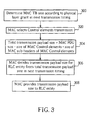
- is a flowchart of a method according to a second embodiment of the present invention.
- The present invention aims to provide methods for accurately determining the size of RLC Data PDUs when RLC Control PDUs or MAC Control information is sent at the same time, thereby avoiding excessive re-segmentation, and problems arising from late delivery of Control PDUs.
- The methods of the present invention introduce a new transmission priority scheme whereby RLC Control PDUs are given highest transmission priority. Transmission payload is then adjusted for the sent RLC Control PDUs, thereby enabling MAC to accurately set sizes for RLC Data PDUs. In a second scheme, the TB size is set first, and MAC Control elements are given highest transmission priority. The payload is then adjusted to take account of the sent MAC Control elements, and a transmission payload is set for a next transmission opportunity according to the total payload and the selected TB size.
- In a first embodiment of the present invention, a transmission payload (TP) size is selected by MAC in a next transmission timing. The RLC entity determines whether Control PDUs exist in the transmitting side. If there are Control PDUs to be transmitted, the RLC entity confirms that the TP size is sufficient for Control PDU transmission and arranges the Control PDUs for transmission if there is a positive confirmation. The transmission payload size of this transmission opportunity will then be adjusted to take account of these Control PDUs (and, optionally, corresponding MAC sub-header sizes). If there is still space available in this transmission timing, retransmission Data PDUs and new Data PDUs can also be transmitted. This is determined by confirming that the TP size is larger than or equal to a Data PDU header size (and, optionally, a corresponding MAC sub-header size). The order of Data PDUs to be transmitted will conform to the conventional priority order, whereby retransmission Data PDUs have higher priority than new Data PDUs. Following this transmission order priority, size of TP available for a new Data PDU can be calculated as:
- TP size - size of each Control PDU - size of each retransmitted Data PDU- size of each retransmitted Data PDU segment - MAC sub-header size of each Control PDU - MAC sub-header size corresponding to each retransmission Data PDU - MAC sub-header size corresponding to each retransmission Data PDU segment - MAC sub-header size corresponding to the new Data PDU
- It should be noted that the above equation includes the term "MAC sub-header size corresponding to each retransmission Data PDU segment" as it is possible that a retransmission Data PDU is too large to fit into the TP but a segment can be transmitted. Furthermore, in some embodiments, the sub-headers are not counted in RLC and therefore the sizes of said sub-headers do not need to be taken into account when calculating remaining TP size. This should be easily understood by those skilled in the art.
- This method is more clearly illustrated in the flowcharts shown, respectively, in
FIG.1 andFIG.2 .FIG.1 is a flowchart of the above-mentioned method when the MAC sub-headers are not counted in RLC.FIG.2 is a flowchart of the above-mentioned method when the MAC sub-headers are counted in RLC. The steps are illustrated as follows: - Step 100:
- TP size selected by MAC;
- Step 102:
- If a Control PDU exists, is TP size >= Control PDU size? If yes go to Step 104, if no go to Step 106;
- Step 104:
- Submit Control PDU to MAC. Set TP size to TP size - Control PDU size; Go to Step 102;
- Step 106:
- If a retransmission Data PDU or a retransmission Data PDU Segment exists, is TP size >= retransmission Data PDU size or retransmission Data PDU segment size? If yes go to Step 112, if no go to Step 108;
- Step 108:
- If a retransmission Data PDU or a retransmission Data PDU segment exists, is TP size >= Data PDU segment header size? If yes go to Step 110, if no go to Step 114;
- Step 110:
- Set Data PDU segment size to TP size - Data PDU segment header size. Generate Data PDU segment with Data PDU segment size including data in retransmission Data PDU if retransmission Data PDU is selected for transmission; Generate a Data PDU segment with Data PDU segment size including data in a retransmission Data PDU segment if retransmission Data PDU segment is selected for transmission;
- Step 112:
- Submit retransmission Data PDU to MAC if retransmission Data PDU is selected for transmission. Submit retransmission Data PDU segment to MAC if retransmission Data PDU segment is selected for transmission. Set maximum Data PDU size to TP size - retransmission Data PDU size if retransmission Data PDU is selected for transmission; Set maximum Data PDU size to TP size - retransmission Data PDU segment size if retransmission Data PDU segment is selected for transmission; Go to Step 106;
- Step 114:
- Is TP size >= Data PDU header size? If yes go to step 116, if no end the process;
- Step 116:
- Generate Data PDU with Data PDU size <= maximum Data PDU size; Go to Step 118;
- Step 118:
- Submit Data PDU to MAC if generated.
- Step 200:
- TP size selected by MAC;
- Step 202:
- If a Control PDU exists, is TP size >= Control PDU size + MAC sub-header size? If yes go to Step 204, if no go to Step 206;
- Step 204:
- Submit Control PDU to MAC. Set TP size to TP size - Control PDU size-MAC sub-header size; Go to Step 202;
- Step 206:
- If a retransmission Data PDU or a retransmission Data PDU Segment exists, is TP size >= retransmission Data PDU size + MAC sub-header size or retransmission Data PDU segment size + MAC sub-header size? If yes go to Step 212, if no go to Step 208;
- Step 208:
- If a retransmission Data PDU or a retransmission Data PDU segment exists, is TP size >= Data PDU segment header size + MAC sub-header size? If yes go to Step 210, if no go to Step 214;
- Step 210:
- Set Data PDU segment size to TP size - Data PDU segment header size-MAC sub-header size. Generate Data PDU segment with Data PDU segment size including data in retransmission Data PDU if retransmission Data PDU is selected for transmission; Generate a Data PDU segment with Data PDU segment size including data in a retransmission Data PDU segment if retransmission Data PDU segment is selected for transmission;
- Step 212:
- Submit retransmission Data PDU to MAC if retransmission Data PDU is selected for transmission. Submit retransmission Data PDU segment to MAC if retransmission Data PDU segment is selected for transmission. Set maximum Data PDU size to TP size - retransmission Data PDU size - MAC sub-header size if retransmission Data PDU is selected for transmission; Set maximum Data PDU size to TP size - retransmission Data PDU segment size - MAC sub-header size if retransmission Data PDU segment is selected for transmission; Go to Step 206;
- Step 214:
- Is TP size >= Data PDU header size? If yes go to step 216, if no end the process;
- Step 216:
- Generate Data PDU with Data PDU size <= maximum Data PDU size; Go to Step 218;
- Step 218:
- Submit Data PDU to MAC if generated.
- As mentioned above, sometimes RLC Control PDUs are sent in the same logical channel. TP and TB selection may therefore be inaccurate, as Control PDUs are not taken into account. The present invention provides a method to solve this problem.
- In this embodiment, the MAC selects a fixed TB size, and dynamically adjusts the transmission payload size for each transmission opportunity. After the TB size is determined, the MAC selects to send all MAC Control elements first, along with the corresponding sub-headers. The total transmission payload size of RLC SDUs is then calculated as:

- The MAC can then accurately determine a TP for a next transmission timing according to the selected TB size and the adjusted total transmission payload, wherein the next transmission timing will only involve transmission of data.
- This method is more clearly illustrated by the flowchart shown in
FIG.3 . The steps are illustrated as follows: - Step 300:
- Determine MAC TB size according to physical layer grant in next transmission timing;
- Step 302:
- MAC selects Control elements transmission;
- Step 304:
- Total transmission payload size = MAC PDU size - size of MAC Control elements - size of MAC sub-headers of MAC Control elements;
- Step 306:
- MAC decides transmission payload size for an RLC entity from total transmission payload size in a next transmission timing;
- Step 308:
- MAC provides transmission payload size to the RLC entity.
- According to the selected MAC Control elements and the adjusted total transmission payload size, the MAC can therefore determine a TP size for an UM or AM RLC entity in a next transmission timing. As those skilled in the art will readily understand this modification, further detail is omitted.
- The present invention therefore provides methods for accurately determining a size of a Data PDU to be transmitted by prioritizing Control PDUs/information transmission, and then adjusting a transmission payload size according to the transmitted Control PDUs/information. This prioritizing of Control information not only enables a size of Data PDUs to be determined more accurately, but also avoids situations where Data PDUs are unnecessarily segmented, and prevents delays in delivering RLC SDUs due to late transmission of Control information.
- The method of the present embodiment (e.g. the process including the
steps 100 to 118 shown inFIG.1 , the process including thesteps 200 to 218 shown inFIG.2 or the process including thesteps 300 to 308 shown inFIG.3 ) can also be embodied as a computer program product on a computer readable recording medium. The computer readable recording medium is any data storage device that can store data which can be thereafter read by a processor of a computer system. Examples of the computer readable recording medium include read-only memory (ROM), random-access memory (RAM), CD-ROMs, magnetic tapes, floppy disks, optical data storage devices, and carrier waves (such as data transmission through the Internet). - All combinations and sub-combinations of the above-described features also belong to the invention.
Claims (15)
- A method of determining a size of Data PDUs of an RLC AM entity, the method
characterized by:(a) utilizing a MAC layer to set a transmission payload size;(b) determining whether the transmission payload size is larger than or equal to at least a Control PDU size;(c) when the transmission payload size is larger than or equal to the Control PDU size, submitting the Control PDU to the MAC layer;(d) adjusting the transmission payload size by subtracting the size of the submitted Control PDU;(e) repeating steps (b), (c) and (d) for all Control PDUs; and(f) utilizing a final adjusted transmission payload size in step (d) to determine a size of a Data PDU. - The method of Claim 1, further characterized by:when there are retransmission PDUs or retransmission PDU segments, submitting the retransmission PDUs or the retransmission PDU segments before the Data PDUs.
- The method of Claim 2, characterized in that step (f) comprises:when there are retransmission PDUs, determining a maximum Data PDU size as the final adjusted transmission payload size minus at least the retransmission PDU size or at least the retransmission PDU segment size; and generating the Data PDU where the size is less than or equal to the determined maximum Data PDU size.
- The method of Claim 3, further characterized by:when the final adjusted transmission payload size is not greater than the retransmission PDU size or the retransmission PDU segment size, utilizing the final adjusted transmission payload size to determine another retransmission PDU segment size.
- A computer program product arranged for causing a processor to execute the method of claim 1.
- A method of determining a size of Data PDUs of an RLC AM entity, the method
characterized by:(a) utilizing a MAC layer to set a transmission payload size;(b) determining whether the transmission payload size is larger than or equal to at least a Control PDU size plus a corresponding MAC sub-header size;(c) when the transmission payload size is larger than or equal to at least the Control PDU size plus the corresponding MAC sub-header size, submitting the Control PDU to the MAC layer;(d) adjusting the transmission payload size by subtracting the size of the submitted Control PDU plus the corresponding MAC sub-header size;(e) repeating steps (b), (c) and (d) for all Control PDUs; and(f) utilizing a final adjusted transmission payload size in step (d) to determine a size of a Data PDU. - The method of Claim 6, further characterized by:when there are retransmission PDUs, submitting the retransmission PDUs before the Data PDUs.
- The method of Claim 7, characterized in that step (f) comprises determining a maximum Data PDU size as the final adjusted transmission payload size minus the retransmission PDU size minus a corresponding MAC sub-header size; and generating the Data PDU where the size is less than or equal to the determined maximum Data PDU size.
- The method of Claim 8, further characterized by:when the final adjusted transmission payload size is not greater than the retransmission PDU size plus the corresponding MAC sub-header size, utilizing the final adjusted transmission payload size to determine a retransmission PDU segment size.
- The method of Claim 6, further characterized by:when there are retransmission PDU segments, submitting the retransmission PDU segments before the Data PDUs.
- The method of Claim 10, characterized in that step (f) comprises determining a maximum Data PDU size as the final adjusted transmission payload size minus the retransmission PDU segment size minus a corresponding MAC sub-header size, and generating the Data PDU where the size is less than or equal to the determined maximum Data PDU size.
- The method of Claim 11, further characterized by:when the final adjusted transmission payload size is not greater than the retransmission PDU segment size plus the corresponding MAC sub-header size, utilizing the final adjusted transmission payload size to determine another retransmission PDU segment size.
- A computer program product arranged for causing a processor to execute the method of claim 6.
- A method of determining a size of Data PDUs in a MAC layer for an RLC UM or AM entity, the method characterized by:utilizing the MAC layer to set a transport block size for a plurality of RLC SDUs to be transmitted;selecting to transmit MAC Control elements in a first transmission timing; calculating a total transmission payload as the transport block size minus the size of the MAC Control elements or as the transport block size minus the size of the MAC Control elements minus the size of corresponding MAC sub-headers of the MAC Control elements; andsetting a transmission payload size for the RLC entity for a next transmission timing according to the total transmission payload and the transport block size.
- A computer program product arranged for causing a processor to execute the method of claim 14.
Applications Claiming Priority (1)
| Application Number | Priority Date | Filing Date | Title |
|---|---|---|---|
| US12/164,121 US9226195B2 (en) | 2008-06-30 | 2008-06-30 | Method for determining RLC Data PDU size in wireless communications system according to control data |
Publications (2)
| Publication Number | Publication Date |
|---|---|
| EP2141949A2 true EP2141949A2 (en) | 2010-01-06 |
| EP2141949A3 EP2141949A3 (en) | 2010-12-15 |
Family
ID=41138807
Family Applications (1)
| Application Number | Title | Priority Date | Filing Date |
|---|---|---|---|
| EP09007716A Withdrawn EP2141949A3 (en) | 2008-06-30 | 2009-06-10 | Method for determining RLC data PDU size in wireless communications system according to control data |
Country Status (5)
| Country | Link |
|---|---|
| US (1) | US9226195B2 (en) |
| EP (1) | EP2141949A3 (en) |
| CN (2) | CN102883367B (en) |
| DE (1) | DE202009018414U1 (en) |
| TW (1) | TW201002017A (en) |
Cited By (1)
| Publication number | Priority date | Publication date | Assignee | Title |
|---|---|---|---|---|
| GB2503469A (en) * | 2012-06-27 | 2014-01-01 | Renesas Mobile Corp | Limiting the size of protocol data units (PDUs) containing new data in a repeat transmission system |
Families Citing this family (12)
| Publication number | Priority date | Publication date | Assignee | Title |
|---|---|---|---|---|
| US8050292B2 (en) * | 2008-06-30 | 2011-11-01 | Htc Corporation | Method of performing transmission and prioritization for radio link control packets for a medium access control layer of a wireless communications system |
| US8638699B2 (en) | 2008-11-10 | 2014-01-28 | Qualcomm Incorporated | Method and apparatus for supporting the large service data unit (SDU) |
| US8711881B2 (en) * | 2009-01-07 | 2014-04-29 | Qualcomm Incorporated | Packet bundling at the PDCP layer |
| US8644338B2 (en) * | 2009-01-07 | 2014-02-04 | Qualcomm Incorporated | Unbundling packets received in wireless communications |
| CN102201901A (en) * | 2010-03-22 | 2011-09-28 | 中兴通讯股份有限公司 | Data retransmission method and device |
| US9320050B2 (en) * | 2013-06-28 | 2016-04-19 | Apple Inc. | Systems and methods to enhance radio link performance in a multi-carrier environment |
| JP6321151B2 (en) * | 2013-09-30 | 2018-05-09 | クゥアルコム・インコーポレイテッドQualcomm Incorporated | Short packet communication in power line communication networks |
| US10470210B2 (en) * | 2015-05-11 | 2019-11-05 | Lg Electronics Inc. | Method for performing RLC retransmission based on contention-based PUSCH in a wireless communication system and a device therefor |
| CN105517053B (en) * | 2016-02-01 | 2019-03-05 | 京信通信系统(中国)有限公司 | Reduce the method and system that protocol data unit of wireless links control layer is segmented again |
| ES2933058T3 (en) * | 2016-11-09 | 2023-01-31 | Beijing Xiaomi Mobile Software Co Ltd | Method and apparatus for sending a control protocol data unit (PDU) |
| WO2019194408A1 (en) * | 2018-04-03 | 2019-10-10 | Lg Electronics Inc. | Method and apparatus for transmitting signals by tm rlc entity of transmission end in wireless communication system |
| CN111245556A (en) * | 2018-11-28 | 2020-06-05 | 普天信息技术有限公司 | TBS (transport block size ratio) calculation method of 5GNR (generalized maximum likelihood ratio) and MACPDU (machine Access data Unit) multiplexing method and equipment |
Family Cites Families (16)
| Publication number | Priority date | Publication date | Assignee | Title |
|---|---|---|---|---|
| US7181223B1 (en) * | 2000-06-21 | 2007-02-20 | Motorola, Inc. | Method for rapid uplink access by GSM GPRS/EDGE mobile stations engaged in voice over internet protocol packet transfer mode |
| GB2396087B (en) * | 2002-12-06 | 2006-03-29 | Qualcomm | A method of and apparatus for adaptive control of data buffering in a data transmitter |
| SE0302685D0 (en) * | 2003-10-07 | 2003-10-07 | Ericsson Telefon Ab L M | Method and arrangement in a telecommunication system |
| GB2412038B (en) * | 2004-03-10 | 2006-04-19 | Toshiba Res Europ Ltd | Packet format |
| US7489629B2 (en) * | 2004-12-07 | 2009-02-10 | Intel Corporation | Methods and media access controller for broadband wireless communications with variable data unit size and delayed data unit construction |
| US7924772B2 (en) * | 2005-02-10 | 2011-04-12 | Nokia Corporation | Method and apparatus to support multi-user packets in a wireless communication system |
| TWM302835U (en) | 2005-04-29 | 2006-12-11 | Interdigital Tech Corp | User equipment and base station for wideband code division multiple access frequency division duplex |
| US8116292B2 (en) * | 2005-04-29 | 2012-02-14 | Interdigital Technology Corporation | MAC multiplexing and TFC selection procedure for enhanced uplink |
| US7532638B2 (en) * | 2005-06-01 | 2009-05-12 | Broadcom Corporation | Wireless terminal baseband processor high speed turbo decoding module supporting MAC header splitting |
| US7864777B1 (en) * | 2005-09-30 | 2011-01-04 | Nortel Networks Limited | Transmission format selection for optimizing transmission of delay sensitive traffic |
| JP2008278473A (en) * | 2007-03-21 | 2008-11-13 | Asustek Computer Inc | Method and apparatus for handling a random access process in a wireless communication system |
| CN103490853B (en) * | 2007-09-28 | 2017-06-27 | 交互数字专利控股公司 | Method and radio transmitting/receiving unit for generating and transmitting RLC PDU |
| TWI514809B (en) * | 2007-09-28 | 2015-12-21 | Interdigital Patent Holdings | Enhanced transmission format combination selection method and device in wireless communication |
| EP3048835B1 (en) * | 2008-02-20 | 2020-09-30 | Amazon Technologies, Inc. | Apparatus and method for constructing a data unit that includes a buffer status report |
| US8958411B2 (en) * | 2008-03-17 | 2015-02-17 | Lg Electronics Inc. | Method of transmitting RLC data |
| US8050292B2 (en) | 2008-06-30 | 2011-11-01 | Htc Corporation | Method of performing transmission and prioritization for radio link control packets for a medium access control layer of a wireless communications system |
-
2008
- 2008-06-30 US US12/164,121 patent/US9226195B2/en active Active
-
2009
- 2009-06-10 EP EP09007716A patent/EP2141949A3/en not_active Withdrawn
- 2009-06-10 DE DE202009018414U patent/DE202009018414U1/en not_active Expired - Lifetime
- 2009-06-30 CN CN201210305887.6A patent/CN102883367B/en active Active
- 2009-06-30 TW TW098122039A patent/TW201002017A/en unknown
- 2009-06-30 CN CN200910140107A patent/CN101621831A/en active Pending
Cited By (4)
| Publication number | Priority date | Publication date | Assignee | Title |
|---|---|---|---|---|
| GB2503469A (en) * | 2012-06-27 | 2014-01-01 | Renesas Mobile Corp | Limiting the size of protocol data units (PDUs) containing new data in a repeat transmission system |
| WO2014002048A3 (en) * | 2012-06-27 | 2014-05-01 | Broadcom Corporation | Methods and apparatus for transmitting data |
| US9787609B2 (en) | 2012-06-27 | 2017-10-10 | Avago Technologies General Ip (Singapore) Pte. Ltd. | Methods and apparatus for transmitting data |
| DE112013003203B4 (en) | 2012-06-27 | 2023-12-21 | Avago Technologies International Sales Pte. Ltd. | Method and device for transmitting data |
Also Published As
| Publication number | Publication date |
|---|---|
| EP2141949A3 (en) | 2010-12-15 |
| CN102883367A (en) | 2013-01-16 |
| US20090323671A1 (en) | 2009-12-31 |
| US9226195B2 (en) | 2015-12-29 |
| TW201002017A (en) | 2010-01-01 |
| DE202009018414U1 (en) | 2011-09-28 |
| CN102883367B (en) | 2015-11-04 |
| CN101621831A (en) | 2010-01-06 |
Similar Documents
| Publication | Publication Date | Title |
|---|---|---|
| US9226195B2 (en) | Method for determining RLC Data PDU size in wireless communications system according to control data | |
| EP2141959B1 (en) | Method of performing transmission and prioritization for radio link control packets for a medium access control layer of a wireless communications system | |
| KR101601010B1 (en) | Method and apparatus for prioritizing logical channels | |
| EP1195923B1 (en) | Transmitting device having radio link control layer in a radio communication system and a data transmitting method in the same | |
| CN101242363B (en) | Cognitive flow control based on channel quality conditions | |
| EP1850522A2 (en) | Method and apparatus for handling segmentation and numbering of SDUS in wireless communications systems | |
| US20060140154A1 (en) | Method and apparatus for signaling user equipment status information for uplink data transmission in a mobile communication system | |
| EP2119142B1 (en) | Wireless communication system and method for determining the size allocated to a field in the header of a packet based on the length of the packet payload | |
| KR101635433B1 (en) | A method and apparatus for processing control message which requests retransmitting data | |
| CN101741835B (en) | Method for creating and transmitting packet with multiple input and output and related communication device | |
| US8693384B2 (en) | Method for dynamic packet retransmission for radio link control layer in a wireless communications system | |
| EP1422840B1 (en) | Data transmission in a mobile telecommunication system | |
| US20150256472A1 (en) | Method and apparatus for supporting large service data unit in mobile communication system | |
| EP2026492B1 (en) | Radio apparatus, radio communication system, and radio information notification method | |
| EP2129060B1 (en) | Method and relate apparatus for enhancing transmission efficiency in a transmitter of a wireless communication system | |
| CN100431291C (en) | Method for sending acknowledgment mode interleaving protocol data unit by radio link control layer |
Legal Events
| Date | Code | Title | Description |
|---|---|---|---|
| PUAI | Public reference made under article 153(3) epc to a published international application that has entered the european phase |
Free format text: ORIGINAL CODE: 0009012 |
|
| AK | Designated contracting states |
Kind code of ref document: A2 Designated state(s): AT BE BG CH CY CZ DE DK EE ES FI FR GB GR HR HU IE IS IT LI LT LU LV MC MK MT NL NO PL PT RO SE SI SK TR |
|
| 17P | Request for examination filed |
Effective date: 20100219 |
|
| PUAL | Search report despatched |
Free format text: ORIGINAL CODE: 0009013 |
|
| AK | Designated contracting states |
Kind code of ref document: A3 Designated state(s): AT BE BG CH CY CZ DE DK EE ES FI FR GB GR HR HU IE IS IT LI LT LU LV MC MK MT NL NO PL PT RO SE SI SK TR |
|
| AX | Request for extension of the european patent |
Extension state: AL BA RS |
|
| 17Q | First examination report despatched |
Effective date: 20110811 |
|
| STAA | Information on the status of an ep patent application or granted ep patent |
Free format text: STATUS: THE APPLICATION IS DEEMED TO BE WITHDRAWN |
|
| 18D | Application deemed to be withdrawn |
Effective date: 20111222 |