EP2141196A1 - Reduction of volatiles of stabilized polypropylene/talc compositions by using specific absorbers - Google Patents
Reduction of volatiles of stabilized polypropylene/talc compositions by using specific absorbers Download PDFInfo
- Publication number
- EP2141196A1 EP2141196A1 EP08159392A EP08159392A EP2141196A1 EP 2141196 A1 EP2141196 A1 EP 2141196A1 EP 08159392 A EP08159392 A EP 08159392A EP 08159392 A EP08159392 A EP 08159392A EP 2141196 A1 EP2141196 A1 EP 2141196A1
- Authority
- EP
- European Patent Office
- Prior art keywords
- polymer composition
- mol
- cas
- polyethers
- antioxidants
- Prior art date
- Legal status (The legal status is an assumption and is not a legal conclusion. Google has not performed a legal analysis and makes no representation as to the accuracy of the status listed.)
- Granted
Links
Classifications
-
- C—CHEMISTRY; METALLURGY
- C08—ORGANIC MACROMOLECULAR COMPOUNDS; THEIR PREPARATION OR CHEMICAL WORKING-UP; COMPOSITIONS BASED THEREON
- C08K—Use of inorganic or non-macromolecular organic substances as compounding ingredients
- C08K13/00—Use of mixtures of ingredients not covered by one single of the preceding main groups, each of these compounds being essential
- C08K13/02—Organic and inorganic ingredients
-
- C—CHEMISTRY; METALLURGY
- C08—ORGANIC MACROMOLECULAR COMPOUNDS; THEIR PREPARATION OR CHEMICAL WORKING-UP; COMPOSITIONS BASED THEREON
- C08L—COMPOSITIONS OF MACROMOLECULAR COMPOUNDS
- C08L23/00—Compositions of homopolymers or copolymers of unsaturated aliphatic hydrocarbons having only one carbon-to-carbon double bond; Compositions of derivatives of such polymers
- C08L23/02—Compositions of homopolymers or copolymers of unsaturated aliphatic hydrocarbons having only one carbon-to-carbon double bond; Compositions of derivatives of such polymers not modified by chemical after-treatment
- C08L23/10—Homopolymers or copolymers of propene
-
- C—CHEMISTRY; METALLURGY
- C08—ORGANIC MACROMOLECULAR COMPOUNDS; THEIR PREPARATION OR CHEMICAL WORKING-UP; COMPOSITIONS BASED THEREON
- C08L—COMPOSITIONS OF MACROMOLECULAR COMPOUNDS
- C08L23/00—Compositions of homopolymers or copolymers of unsaturated aliphatic hydrocarbons having only one carbon-to-carbon double bond; Compositions of derivatives of such polymers
- C08L23/02—Compositions of homopolymers or copolymers of unsaturated aliphatic hydrocarbons having only one carbon-to-carbon double bond; Compositions of derivatives of such polymers not modified by chemical after-treatment
- C08L23/10—Homopolymers or copolymers of propene
- C08L23/12—Polypropene
-
- C—CHEMISTRY; METALLURGY
- C08—ORGANIC MACROMOLECULAR COMPOUNDS; THEIR PREPARATION OR CHEMICAL WORKING-UP; COMPOSITIONS BASED THEREON
- C08L—COMPOSITIONS OF MACROMOLECULAR COMPOUNDS
- C08L63/00—Compositions of epoxy resins; Compositions of derivatives of epoxy resins
-
- C—CHEMISTRY; METALLURGY
- C08—ORGANIC MACROMOLECULAR COMPOUNDS; THEIR PREPARATION OR CHEMICAL WORKING-UP; COMPOSITIONS BASED THEREON
- C08L—COMPOSITIONS OF MACROMOLECULAR COMPOUNDS
- C08L71/00—Compositions of polyethers obtained by reactions forming an ether link in the main chain; Compositions of derivatives of such polymers
Definitions
- the present invention relates a new polypropylene composition comprising organic antioxidant and the use of polyether in such compositions.
- Polypropylene is the material of choice for many applications. For instance polypropylene in combination with talc is used as back sheets of blister packaging as well as in articles in the automotive interior. Said polypropylene/talc compositions are - generally speaking - good processable and can be individually customized. However such materials must also provide long term stability against environmental impacts, like oxidative degradation, keeping the tailored properties of the polypropylene/talc composition on the desired level. Accordingly antioxidants are added to impair the degradation of the polypropylene/talc compositions. However the antioxidants themselves may be instable under specific environmental stresses, which might lead also to malodour.
- the object of the present invention is to reduce the amount of volatile compounds, in particular of volatile compounds in polypropylene compositions comprising talc and organic antioxidants.
- volatile compounds in particular of volatile compounds in polypropylene compositions comprising talc and organic antioxidants.
- organic antioxidants there is in particular the desire to reduce the amount of headspace emission according to VDA 277.
- the first finding of the present invention is that the amount of volatile compounds is mainly based on the rather rapid degradation of the organic antioxidants.
- the second finding of the present invention is that the degradation of the antioxidants can be suppressed by polyethers.
- the invention is directed to a polymer composition
- a polymer composition comprising polypropylene (A) and additionally
- the inventive polymer composition does not comprise hindered amine light stabilizers (F) and/or slip agents (G), preferably slip agents being fatty acid amides.
- the above defined composition show significant reduction in headspace emission, in particular show significant reduction of 2-methyl-1-propene, compared with polypropylene compositions comprising talc and organic antioxidants but no polyethers, in particular no polyethylene glycols and/or epoxy resins (see table1).
- polyethers in particular no polyethylene glycols and/or epoxy resins.
- Such a reduced headspace emission is accomplished with the polyethers but not with other possible candidates like, magnesium hydroxide or anthracene.
- the polypropylene (A) used in the inventive polypropylene composition can be any polypropylene, in particular polypropylenes suitable for the automotive interior and/or for back sheets of blister packaging. Accordingly a preferred polypropylene (A) comprises (is) a heterophasic propylene copolymer (A').
- Heterophasic polypropylene systems are well known in the art and are systems in particular obtained in an at least two step process resulting in a multiphase structure comprising a polypropylene matrix (A 1 ), preferably an isotactic polypropylene matrix (A'), and inclusions dispersed therein comprising amorphous elastomer (A 2 ).
- Such systems can be easily tailored for the requirements needed by setting the comonomer content in the polypropylene matrix (A 1 ) and in the amorphous elastomer (A 2 ) respectively.
- a heterophasic propylene copolymer (A') may have an MFR 2 in the range of 2.0 to 80.0 g/10min, more preferably in the range of 5.0 to 50.0 g/10min, still more preferably in the range of 7.0 to 20.0 g/10min.
- a heterophasic propylene copolymer (A') has an amorphous elastomer (A 2 ) being a propylene-ethylene rubber (EPR) (A 2 ).
- the polypropylene matrix (A 1 ) can be either a propylene homopolymer or a propylene copolymer, wherein the latter is especially preferred.
- the total comonomer, preferably ethylene, content is in the range of 2 to 25 wt.-% based on the total heterophasic propylene copolymer (A').
- the amount of xylene soluble may be in the range of 10 to 40 wt.-%, preferably 15 to 30 wt.-%.
- polypropylene (A) may additionally comprise beside the heterophasic propylene copolymer (A') a high density polyethylene (HDPE) having for instance a density in the range of 0.954 to 0.966 g/cm3 and a melt flow rate (MFR 2 at 190°C) of 0.1 to 15.0 g/10min. Further the polypropylene (A) may also comprise additionally EPR, propylene-cthylenc copolymers and/or ethylene-octene copolymers.
- HDPE high density polyethylene
- MFR 2 at 190°C melt flow rate
- polypropylene (A) is the only polymer component in the inventive polymer composition.
- the polypropylene (A) is present in the inventive composition in the amount of at least 50.0 wt.-%, more preferably at least 60.0 wt.-%), yet more preferably at least 70.0 wt.-%, still more preferably of at least 75.0 wt.-%.
- the invention is in particular defined by its additives.
- the inventive polymer composition must comprise talc (B).
- Talc (B) is usually used to support the crystallization behaviour of the polymer material. It can be also employed as a shrinkage reducing additive and/or reinforcing agent. In any case talc (B) has been recognized in the above mentioned applications as an indispensable part of polypropylene compositions.
- Talc (B) is a mineral composed of hydrated magnesium silicate and may comprise low amounts of residues, like iron oxide (FeO) and/or iron silicate. Generally the amounts of residues do not exceed 5.0 wt.-%.
- the talc (B) comprise 0.1 to 3.5 wt.-%, more preferably 0.1 to 3.0 wt.-%, residues, i.e. residues comprising iron, like iron oxide or iron silicate.
- talc (B) may also be a chlorite-talc as the commercial product "Steamic T1 C A" of Luzenac.
- the talc (B) has a particle size (d50%) of below 3.0 ⁇ m (d50% indicates that 50 wt-% of the talc has a particle size below 3.0 ⁇ m) and/or a particle size (d98%) of below 15.0 ⁇ m (d98% indicates that 98 wt-% or the talc has a particle size below 15,0 ⁇ m), more preferably a particle size (d50%) of below 2.0 ⁇ m and/or a particle size (d98%) of below 10.0 ⁇ m, yet more preferably a particle size (d50%) of below 1.0 ⁇ m and/or a particle size (d98%) of below 5.0 ⁇ m.
- organic antioxidants are required. Antioxidants are needed to impair oxidative degradation of the polypropylene. However the antioxidants themselves may be instable in case they come in contact with other additives. In the present case it has been observed that the organic antioxidants are rather quickly degraded in a polypropylene composition comprising talc. The degradation of the organic oxidants can be very easily deducted in the headspace emission according to VDA 277. The emission spectrum shows degradation products (for instance 2-methyl-1-propene) originating from the organic antioxidants. Such degradation products are undesired. Without to be bond on the theory, the degradation of the organic antioxidants may be catalyzed due to the presence of the talc and/or its residues dispersed therein.
- organic antioxidants (C) must be present in the inventive polymer composition.
- Preferred organic antioxidants (C) are phenolic antioxidant (C').
- phenolic antioxidant (C') as used in the instant invention stands for any compound capable of slowing or preventing the oxidation of the polymer component, i.e. the polypropylene. Additionally such a phenolic antioxidant (C') must of course comprise a phenolic residue.
- phenolic antioxidants (C') are sterically hindered.
- the term "Sterically hindered” according to this invention means that the hydroxyl group (HO-) of the phenolic antioxidants (C') is surrounded by sterical alkyl residues.
- the phenolic antioxidants (C') preferably comprise the residue of formula (I) wherein R 1 being located at the ortho- or meta-position to the hydroxyl-group and R 1 is (CH 3 ) 3 C-, CH 3 - or H, preferably (CH 3 ) 3 C-, and A 1 constitutes the remaining part of the phenolic antioxidant (C') and is preferably located at the para-position to the hydroxyl-group.
- the phenolic antioxidants (C') preferably comprise the residue of formula (Ia) wherein R 1 is (CH 3 ) 3 C-, CH 3 - or H, preferably (CH 3 ) 3 C-, and A 1 constitutes the remaining part of the phenolic antioxidant (C').
- a 1 is in para-position to the hydroxyl-group.
- the phenolic antioxidants (C') shall preferably exceed a specific molecular weight. Accordingly the phenolic antioxidants (C') have preferably a molecular weight of more than 785 g/mol, more preferably more than 1100 g/mol. On the other hand the molecular weight should be not too high, i.e. not higher than 1300 g/mol. A preferred range is from 785 to 1300 g/mol, more preferably from 1000 to 1300 g/mol, yet more preferably from 1100 to 1300 g/mol.
- the phenolic antioxidants (C') can be additionally defined by the amount of phenolic residues, in particular by the amount of phenolic residues of formula (1) or (Ia). Accordingly the phenolic antioxidants (C') may comprise(s) 1, 2, 3, 4 or more phenolic residues, preferably 1, 2, 3, 4 or more phenolic residues of formula (I) or (Ia).
- the phenolic antioxidants (C') comprise mainly only carbon atoms, hydrogen atoms and minor amounts of O-atoms, mainly caused due to the hydroxyl group (HO-) of the phenolic residues.
- the phenolic antioxidants (C') may comprise additionally minor amounts ofN, S and P atoms.
- the phenolic antioxidants (C') are constituted by C, H, O, N and S atoms only, more preferably the phenolic antioxidants (C') are constituted by C, H and O only.
- the phenolic antioxidants (C') shall have a rather high molecular weight.
- a high molecular weight is an indicator for several phenolic residues.
- the phenolic antioxidants (C') have 4 or more, especially 4, phenolic residues, like the phenolic residue of formula (1) or (Ia).
- phenolic antioxidants (C') have been recognized compounds comprising at least one residue of formula (II) wherein R 4 is (CH) 3 C-, CH 3 -, or H, preferably (CH 3 ) 3 C-, and A 2 constitutes the remaining part of the phenolic antioxidant (C').
- the phenolic antioxidants (C') are preferably selected from the group consisting of 2,6-di-tert-butyl-4-methylphenol (CAS no. 128-37-0; M 220 g/mol), pentaerythrityl-tetrakis (3-(3,5-di-tert-butyl-4-hydroxyphenyl) propionate (CAS no. 6683-19-8; M 1178 g/mol), octadecyl 3-(3',5'-di-tert-butyl-4-hydroxyphcnyl)propionate (CAS no.
- butyt-4'-hydroxybenzyl)-isocyanurate (CAS no. 27676-62-6, M 784 g/mol), 1,3,5-tris(4-tert. butyl-3-hydroxy-2,6-dimethylbenzyl)-1,3,5-triazine-2,4,6-(1H,3H,5H)-trione (CAS no. 40601-76-1, M 813 g/mol), bis(3,3-bis(3'-tert-butyl-4'-hydroxyphenyl)butanic acid) glycolester (CAS no. 32509-66-3; M 794 g/mol), 4,4'-thiobis(2-tert-butyl-5-methylphenol) (CAS no.
- the phenolic antioxidants (C') are selected from the group consisting of pentacrythntyl-tetrakis (3-(3,5-di-tert-butyl-4-hydroxyphenyl) propionate (CAS no. 6683-19-8; M 1178 g/mol), octadecyl 3-(3',5'-di-tert-butyl-4-hydroxyphenyl)propionate (CAS no. 2082-79-3; M 531 g/mol) bis(3,3-bis(3'-tert-butyl-4'-hydroxyphenyl)butanic acid) glycolester (CAS no.
- the most preferred phenolic antioxidant (C') is pentacrythrityl-tetrakis (3-(3,5-di-tert-butyt-4-hydroxyphenyl) propionate (CAS no. 6683-19-8; M 1178 g/mol) preferably having the formula (III)
- the present inventive polymer composition may comprise different organic antioxidants (C), like phenolic antioxidants (C'), as defined in the instant invention, however it is preferred that it comprises only one type of organic antioxidant (C), like phenolic antioxidant (C'), as defined herein.
- C organic antioxidants
- C' phenolic antioxidants
- the present polymer composition can additionally comprise in addition to the organic antioxidants (C) one or more phosphorous antioxidants (E). More preferably the polypropylene composition comprises only one type of phosphorous antioxidant (E).
- Preferred phosphorous antioxidants (E) are selected from the group consisting of tris-(2,4-di-tert-butylphenyl) phosphite (CAS no. 31570-04-4; M 647 g/mol), tetrakis-(2,4-di-tert-btitylphenyl)-4,4'-biplienylen-di-phosphonite (CAS no.
- organic phosphites in particular those as defined in the above list, as phosphorous antioxidants (E).
- the most preferred phosphorous antioxidant (E) is tris-(2,4-di-tert-butylphenyl) phosphite (CAS no. 31570-04-4; M 647 g/mol).
- polypropylene compositions comprising talc and organic antioxidants suffer from a rather quick degradation of the antioxidants.
- Such quick degradation - without be bonded on this theory - may be caused by the presence of talc and more importantly by the residues within in the talc.
- These resides may catalyse the degradation of the organic antioxidants.
- any means which may impede the catalytic activity of talc and/or its residues in view of the organic antioxidants reduces the degradation process and associated therewith minimises the headspace emission.
- polyethers (D) are in particular useful. Polyethers (D) are generally sneaking polymers with more than one ether group.
- polyethers (D) are preferably polyethers with a weight average molecular weight (M w ) of at least 300 g/mol, more preferably of at least 700 g/mol. More preferably such polyethers (D) have a weight average molecular weight (M w ) of not more than 13,000 g/mol. In one preferred embodiment the polyethers (D) according to this invention have weight average molecular weight (M w ) of 300 to 12,000 g/mol, more preferably of 700 to 8,000 g/mol and yet more preferably of 1150 to 8,000 g/mol.
- the polyethers (D) as used in the present invention are able to bond on the surface of the talc and thus form a kind of sheeting surrounding the talc particles.
- the bonding may be a covalent bonding and/or ionic bonding. Accordingly the polyethers (D) impede contacting of the organic antioxidants (C) with the talc (B). Thus any degradation caused by talc (B) or its residues is therewith minimized or avoided.
- polyethylene glycols (D 1 ) are used the following are preferred: polyethylene glycol having a weight average molecular weight (M w ) of about 4,000 g/mol (CAS-no 25322-68-3), polyethylene glycol having a weight average molecular weight (M w ) of about 8,000 g/mol (CAS-no 25322-68-3), polyethylene glycol having a weight average molecular weight (M w ) of about 10,000 g/mol (CAS-no 25322-68-3) and/or polyethylene glycol having a weight average molecular weight (M w ) of about 20,000 g/mol (CAS-no 25322-68-3).
- Especially preferred polyethylene glycols (D 1 ) are PEG 4000 and/or PEG 10000 of Clariant.
- Epoxy resins (D 2 ) are in particular appreciated as they comprise reactive epoxy groups simplifying a covalent bonding of the epoxy resin (D 2 ) with tale (B). Accordingly the epoxy resins (D 2 ) are tightly bonded on the surface of the talc (B) and therefore provide an especially suitable protection against degradation of the organic antioxidants (C). Even more preferred the epoxy resins (D 2 ) comprise phenyl groups. Such phenyl groups have the additional advantage that they act as scavengers for possible degradation products of the organic antioxidants (C). Without be bonded on the theory it is very likely that the phenyl groups of the epoxy resins (D 2 ) will be Friedel-Crafts alkylated.
- the alkylating groups originate from the organic antioxidants (C).
- C organic antioxidants
- One example is 2-methyl-1-propene, a typical degradation product of hindered phenolic antioxidants (C') as defined above.
- the inventive polymer composition comprises epoxy resins (D 2 ) comprising units derived from a monomer of the formula (IV) wherein B 1 and B 3 are independently selected from the group consisting of -(CH 2 )-, -(CH 2 ) 2 -, -(CH 2 ) 3 -, -(CH 2 ) 4 -, and -(CH 2 ) 5 -, preferably B 1 and B 3 are -(CH 2 )-, and B 2 is selected from the group consisting of -((CH 3 ) 2 C)-, -((CH 3 ) 2 C) 2 -, -((CH 3 ) 2 C) 3 -, - CH 2 -((CH 3 ) 2 C)-, -((CH 3 )
- the epoxy resins (D 2 ) comprises not only units derived from a monomer of the formula (IV) or (IV-a) but additionally units derived from a monomer of the formula (V) wherein B 4 is selected from the group consisting of -((CH 3 ) 2 C)-, -((CH 3 ) 2 C) 2 -, -((CH 3 ) 2 C) 3 -, - CH 2 -((CH 3 ) 2 C)-, -((CH 3 ) 2 C)-CH 2 , -CH 2 -((CH 3 ) 2 C)-CH 2 - and -CH 2 -((CH 3 ) 2 C) 2 -CH 2 -.
- B 4 is -((CH 3 ) 2 C)-.
- the epoxy resins (D 2 ) have preferably the formula (VI) wherein B 1 and B 3 are independently selected from the group consisting of -(CH 2 )-, -(CH 2 ) 2 -, -(CH 2 ) 3 -, -(CH 2 ) 4 -, and -(CH 2 ) 5 -, B 2 and B 4 are independently selected from the group consisting of -((CH 3 ) 2 C)-, - ((CH 3 ) 2 C) 2 -, -((CH 3 ) 2 C) 3 -, -CH 2 -((CH 3 ) 2 C)-, -((CH 3 ) 2 C)-CH 2 , -CH 2 -((CH 3 ) 2 C)-CH 2 - and -CH 2 -((CH 3 ) 2 C) 2 -CH 2 -, and n is from 1 to 20.
- the epoxy resins (D 2 ) have an epoxy index in the range of 1.10 to 2.00 Eq/kg, more preferably 1.12 to 1.60 Eq/kg, wherein the epoxy index corresponds to the number of epoxy functions in respect of 100 g of resin.
- the most preferred epoxy resin (D 2 ) is poly (2,2-bis[4-(2,3-epoxypropoxy]-phenyl] propane-co-(2-chloromethyl oxirane) (CAS-no 25036-25-3), in particular with an epoxy index as defined in the previous paragraph.
- the present inventive polymer composition may comprise different polyethers (D) as defined in the instant invention, however it is preferred that it comprises only one type of polyether (D) as defined herein. Most preferably the inventive polymer compositions comprises as polyether (D) only an epoxy resin (D 2 ) as defined in herein.
- the components of the polymer composition of the instant invention should be present in specific amounts.
- polymer composition comprises
- the present invention may comprise further additives like calcium stearate and/or pigments, for instance in the form of a master batch.
- the polymer composition is free of hindered amine light stabilizers (F) and/or slip agents (G), preferably slip agents being fatty acid amides.
- hindered amine light stabilizers are in particular 2,6-alkyl-piperidine derivatives, like 2,2,6,6-tetramethyl-piperidine derivatives.
- the present polymer composition is free of such piperidine derivatives.
- the polymer composition shall be free of slip agents (G) being a fatty acid amide. More preferably the polymer composition shall be free of slip agents (G) being unsaturated fatty acid amides.
- the amount of carbons of the fatty acids is preferably in the range of C10 to C25 carbon atoms.
- the polymer composition according to this invention is obtained by extruding the polymer and thereby adding the additives as mentioned in the instant invention.
- a twin-screw extruder is used, like the twin-screw extruder ZSK40.
- the polymer composition pelletized with the twin-screw extruder ZSK 40 is used in the headspace emission test according to VDA 277.
- the present invention is additionally directed to the use of the inventive polymer composition as a covering element for vehicles and/or back sheets of blister packaging, in particular to reduce the headspace emission according to VDA 277, in particular to reduce the emission of 2-methyl-propene according to VDA 277.
- the present invention is directed to articles, preferably automotive articles, more preferably automotive interior articles, like dashboards, door claddings, armrests or other interior trims, comprising the polymer composition as defined herein.
- the invention is further directed to blister packaging, in particular to the back sheets of blister packaging, comprising the polymer composition of the instant invention.
- the present invention is directed to the use of polyethers (D), preferably to the use of polyethylene glycols (D 1 ) and/or epoxy resins (D 2 ), as defined in the instant invention to reduce the headspace emission according to VDA 277, in particular to reduce the emission of 2-methyl-1-propene according to VDA 277, of a polymer composition, preferably of a polymer composition comprising talc, more preferably of a polymer composition comprising talc and organic antioxidants.
- a polymer composition preferably of a polymer composition comprising talc, more preferably of a polymer composition comprising talc and organic antioxidants.
- the present invention is in particular directed to the use of polyethers (D), preferably to the use of polyethylene glycols (D 1 ) and/or epoxy resins (D 2 ), as defined in the instant invention to reduce the headspace emission according to VDA 277, in particular to reduce the emission of 2-methyl-1-propone according to VDA 277, of a polymer composition comprising talc (B) and antioxidants (C) as defined in the instant invention but no polyethers (D).
- D polyethers
- D 1 polyethylene glycols
- D 2 epoxy resins
- a Waters Alliance GPCV 2000 instrument equipped with refractive index detector and online viscosimeter was used with 3 x TSK-gel columns (GMHXL-HT) from TosoHaas and 1,2,4-trichlorobenzene (TCB, stabilized with 200 mg/L 2,6-Di tert butyl-4-methyl-phenol) as solvent at 145 °C and at a constant flow rate of 1 mL/min. 216.5 ⁇ L of sample solution were injected per analysis.
- the column set was calibrated using relative calibration with 19 narrow MWD polystyrene (PS) standards in the range of 0.5 kg/mol to 11 500 kg/mol and a set of well characterised broad polypropylene standards. All samples were prepared by dissolving 5 - 10 mg of polymer in 10 mL (at 160 °C) of stabilized TCB (same as mobile phase) and keeping for 3 hours with continuous shaking prior sampling in into the GPC instrument.
- PS polystyrene
- MFR 2 (230 °C) is measured according to ISO 1133 (230 °C, 2.16 kg load).
- MFR 2 (190 °C) is measured according to ISO 1133 (190 °C, 2.16 kg load).
- Ethylene content is measured with Fourier transform infrared spectroscopy (FTIR) calibrated with 13 C-NMR.
- FTIR Fourier transform infrared spectroscopy
- Particle size is measured according to ISO 13320-1:1999
- the xylene solubles (XS, wt.-%): Content of Xylene solubles (XS) is determined at 23 °C according ISO 6427.
- VDA 277 available for instance from " réelleation Kraftfahrectomy (DKF); Ulrichies 14, 74321 Bietigheim Bissingen)
- the content of volatiles is determined according to VDA 277:1995 using a gas chromatography (GC) device with a WCOT-capillary column (wax type) of 0.25 mm inner diameter and 30 m length.
- the GC settings were as follows: 3 minutes isothermal at 50 °C, heat up to 200 °C at 12 K/min, 4 minutes isothermal at 200 °C, injection-temperature: 200 °C, detection-temperature: 250 °C, carrier helium, flow-mode split 1:20 and average carrier-speed 22 - 27 cm/s.
- a MS detector is used for the evaluation of the single volatile components.
- a specific Quadropol MS was used with the following settings: 280 °C transfer-line temperature, scan method with scanning rate of 15 - 600 amu, relative EMV mode, mass calibration with standard spectra autotune, MS source temperature of 230 °C and MS Quad temperature of 150 °C.
- epoxy resin A poly (2,2-bis[4-(2,3-epoxypropoxy]-phenyl] propane-co-(2-chloromethyl oxirane) (CAS no 25036-25-3)
- epoxy resin B poly (2,2-bis[4-(2,3-epoxypropoxy]-phenyl] propane-co-(2-chloromethyl oxirane) having a epoxy index of 1.68 to 1.75 Eq/kg (CAS no 25036-25-3)
- Araldite GT 7072 epoxy resin C: poly (2,2-bis[4-(2,3-epoxypropoxy]-phenyl] propane-co-(2-chloromethyl oxirane) having a epoxy index of 1.37 to 1.56 Eq/kg (CAS no 25036-25-3)
Landscapes
- Chemical & Material Sciences (AREA)
- Health & Medical Sciences (AREA)
- Chemical Kinetics & Catalysis (AREA)
- Medicinal Chemistry (AREA)
- Polymers & Plastics (AREA)
- Organic Chemistry (AREA)
- Compositions Of Macromolecular Compounds (AREA)
Abstract
Description
- The present invention relates a new polypropylene composition comprising organic antioxidant and the use of polyether in such compositions.
- Polypropylene is the material of choice for many applications. For instance polypropylene in combination with talc is used as back sheets of blister packaging as well as in articles in the automotive interior. Said polypropylene/talc compositions are - generally speaking - good processable and can be individually customized. However such materials must also provide long term stability against environmental impacts, like oxidative degradation, keeping the tailored properties of the polypropylene/talc composition on the desired level. Accordingly antioxidants are added to impair the degradation of the polypropylene/talc compositions. However the antioxidants themselves may be instable under specific environmental stresses, which might lead also to malodour. Over the last years the standard requirements for long term stability have been even steadily tightened, which in turn increased the amounts of additives to satisfy the ambitioned desires, like heat resistance and/or mechanical properties. On the other hand such an increasing amount of additives intensifies the risk of side reactions. Such side reactions, in particular in cases where degradation of antioxidants is involved, lead to side products being quite often volatile. Of course volatile compounds should be kept on low levels in particular as they are not accepted by the customers.
- Thus the object of the present invention is to reduce the amount of volatile compounds, in particular of volatile compounds in polypropylene compositions comprising talc and organic antioxidants. There is in particular the desire to reduce the amount of headspace emission according to VDA 277.
- The first finding of the present invention is that the amount of volatile compounds is mainly based on the rather rapid degradation of the organic antioxidants. The second finding of the present invention is that the degradation of the antioxidants can be suppressed by polyethers.
- Thus the present invention is directed to a polymer composition comprising
- (a) polypropylene (A)
- (b) talc (B)
- (c) organic antioxidants (C),
- (d) polyethers (D) having a weight average molecular weight (Mw) of more than 300 g/mol, and
- (e) optionally phosphorous antioxidants (E).
- Alternatively and preferably the invention is directed to a polymer composition comprising polypropylene (A) and additionally
- (a) 1,000 to 550,000 ppm of talc (B),
- (b) 100 to 5,000 ppm of phenolic antioxidants (C),
- (c) 100 to 5,000 ppm polyethers (D) having a weight average molecular weight (Mw) of more than 300 g/mol, and
- (d) optionally 100 to 5,000 ppm of phosphorous antioxidants (E), based on the total composition.
- As usual 1 ppm of additive correspond to 1 mg additive in 1 kg composition.
- Preferably the inventive polymer composition does not comprise hindered amine light stabilizers (F) and/or slip agents (G), preferably slip agents being fatty acid amides.
- Surprisingly it has been found out that the above defined composition show significant reduction in headspace emission, in particular show significant reduction of 2-methyl-1-propene, compared with polypropylene compositions comprising talc and organic antioxidants but no polyethers, in particular no polyethylene glycols and/or epoxy resins (see table1). Such a reduced headspace emission is accomplished with the polyethers but not with other possible candidates like, magnesium hydroxide or anthracene.
- In the following the present invention is described in more detail. 1.
- The polypropylene (A) used in the inventive polypropylene composition can be any polypropylene, in particular polypropylenes suitable for the automotive interior and/or for back sheets of blister packaging. Accordingly a preferred polypropylene (A) comprises (is) a heterophasic propylene copolymer (A'). Heterophasic polypropylene systems are well known in the art and are systems in particular obtained in an at least two step process resulting in a multiphase structure comprising a polypropylene matrix (A1), preferably an isotactic polypropylene matrix (A'), and inclusions dispersed therein comprising amorphous elastomer (A2). Such systems can be easily tailored for the requirements needed by setting the comonomer content in the polypropylene matrix (A1) and in the amorphous elastomer (A2) respectively. Such a heterophasic propylene copolymer (A') may have an MFR2 in the range of 2.0 to 80.0 g/10min, more preferably in the range of 5.0 to 50.0 g/10min, still more preferably in the range of 7.0 to 20.0 g/10min. Typically such a heterophasic propylene copolymer (A') has an amorphous elastomer (A2) being a propylene-ethylene rubber (EPR) (A2). The polypropylene matrix (A1) can be either a propylene homopolymer or a propylene copolymer, wherein the latter is especially preferred.
- The total comonomer, preferably ethylene, content is in the range of 2 to 25 wt.-% based on the total heterophasic propylene copolymer (A'). The amount of xylene soluble may be in the range of 10 to 40 wt.-%, preferably 15 to 30 wt.-%.
- Of course the polypropylene (A) may additionally comprise beside the heterophasic propylene copolymer (A') a high density polyethylene (HDPE) having for instance a density in the range of 0.954 to 0.966 g/cm3 and a melt flow rate (MFR2 at 190°C) of 0.1 to 15.0 g/10min. Further the polypropylene (A) may also comprise additionally EPR, propylene-cthylenc copolymers and/or ethylene-octene copolymers.
- It is however preferred that the polypropylene (A) is the only polymer component in the inventive polymer composition.
- Preferably the polypropylene (A) is present in the inventive composition in the amount of at least 50.0 wt.-%, more preferably at least 60.0 wt.-%), yet more preferably at least 70.0 wt.-%, still more preferably of at least 75.0 wt.-%.
- Beside the polypropylene the invention is in particular defined by its additives.
- Accordingly to be useful in the above mentioned applications the inventive polymer composition must comprise talc (B). Talc (B) is usually used to support the crystallization behaviour of the polymer material. It can be also employed as a shrinkage reducing additive and/or reinforcing agent. In any case talc (B) has been recognized in the above mentioned applications as an indispensable part of polypropylene compositions. Talc (B) is a mineral composed of hydrated magnesium silicate and may comprise low amounts of residues, like iron oxide (FeO) and/or iron silicate. Generally the amounts of residues do not exceed 5.0 wt.-%. Thus it is preferred that the talc (B) comprise 0.1 to 3.5 wt.-%, more preferably 0.1 to 3.0 wt.-%, residues, i.e. residues comprising iron, like iron oxide or iron silicate. Of course talc (B) may also be a chlorite-talc as the commercial product "Steamic T1 C A" of Luzenac.
- Preferably the talc (B) according to this invention has a particle size (d50%) of below 3.0 µm (d50% indicates that 50 wt-% of the talc has a particle size below 3.0 µm) and/or a particle size (d98%) of below 15.0 µm (d98% indicates that 98 wt-% or the talc has a particle size below 15,0 µm), more preferably a particle size (d50%) of below 2.0 µm and/or a particle size (d98%) of below 10.0 µm, yet more preferably a particle size (d50%) of below 1.0 µm and/or a particle size (d98%) of below 5.0 µm.
- As further additives organic antioxidants (C) are required. Antioxidants are needed to impair oxidative degradation of the polypropylene. However the antioxidants themselves may be instable in case they come in contact with other additives. In the present case it has been observed that the organic antioxidants are rather quickly degraded in a polypropylene composition comprising talc. The degradation of the organic oxidants can be very easily deducted in the headspace emission according to VDA 277. The emission spectrum shows degradation products (for instance 2-methyl-1-propene) originating from the organic antioxidants. Such degradation products are undesired. Without to be bond on the theory, the degradation of the organic antioxidants may be catalyzed due to the presence of the talc and/or its residues dispersed therein. On the other hand one can neither abstain from talc nor from organic antioxidants in the desired applications, since this would deteriorate the other properties of the polymer composition needed in the technical fields as defined in the instant invention. Thus as stated above organic antioxidants (C) must be present in the inventive polymer composition.
- Preferred organic antioxidants (C) are phenolic antioxidant (C').
- The term "phenolic antioxidant" (C') as used in the instant invention stands for any compound capable of slowing or preventing the oxidation of the polymer component, i.e. the polypropylene. Additionally such a phenolic antioxidant (C') must of course comprise a phenolic residue.
- Better result can be achieved in case the phenolic antioxidants (C') are sterically hindered. The term "Sterically hindered" according to this invention means that the hydroxyl group (HO-) of the phenolic antioxidants (C') is surrounded by sterical alkyl residues.
- Accordingly the phenolic antioxidants (C') preferably comprise the residue of formula (I)

R1 being located at the ortho- or meta-position to the hydroxyl-group and R1 is (CH3)3C-, CH3- or H, preferably (CH3)3C-, and
A1 constitutes the remaining part of the phenolic antioxidant (C') and is preferably located at the para-position to the hydroxyl-group. - Preferably the phenolic antioxidants (C') preferably comprise the residue of formula (Ia)
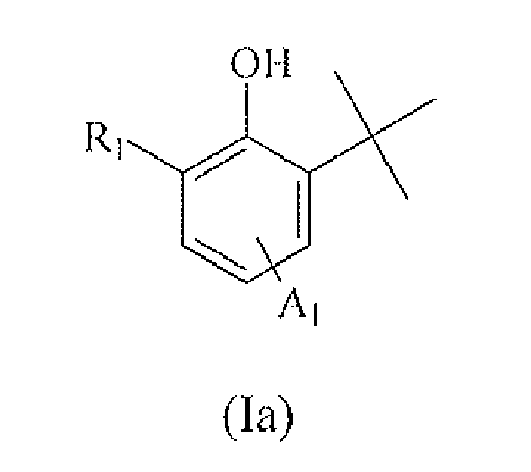
R1 is (CH3)3C-, CH3- or H, preferably (CH3)3C-, and
A1 constitutes the remaining part of the phenolic antioxidant (C'). - Preferably A1 is in para-position to the hydroxyl-group.
- Additionally the phenolic antioxidants (C') shall preferably exceed a specific molecular weight. Accordingly the phenolic antioxidants (C') have preferably a molecular weight of more than 785 g/mol, more preferably more than 1100 g/mol. On the other hand the molecular weight should be not too high, i.e. not higher than 1300 g/mol. A preferred range is from 785 to 1300 g/mol, more preferably from 1000 to 1300 g/mol, yet more preferably from 1100 to 1300 g/mol.
- Further the phenolic antioxidants (C') can be additionally defined by the amount of phenolic residues, in particular by the amount of phenolic residues of formula (1) or (Ia). Accordingly the phenolic antioxidants (C') may comprise(s) 1, 2, 3, 4 or more phenolic residues, preferably 1, 2, 3, 4 or more phenolic residues of formula (I) or (Ia).
- Moreover the phenolic antioxidants (C') comprise mainly only carbon atoms, hydrogen atoms and minor amounts of O-atoms, mainly caused due to the hydroxyl group (HO-) of the phenolic residues. However the phenolic antioxidants (C') may comprise additionally minor amounts ofN, S and P atoms. Preferably the phenolic antioxidants (C') are constituted by C, H, O, N and S atoms only, more preferably the phenolic antioxidants (C') are constituted by C, H and O only.
- As stated above the phenolic antioxidants (C') shall have a rather high molecular weight. A high molecular weight is an indicator for several phenolic residues. Thus it is in particular appreciated that the phenolic antioxidants (C') have 4 or more, especially 4, phenolic residues, like the phenolic residue of formula (1) or (Ia).
- As especially suitable phenolic antioxidants (C') have been recognized compounds comprising at least one residue of formula (II)

R4 is (CH)3C-, CH3-, or H, preferably (CH3)3C-, and
A2 constitutes the remaining part of the phenolic antioxidant (C'). - Considering the above requirements the phenolic antioxidants (C') are preferably selected from the group consisting of
2,6-di-tert-butyl-4-methylphenol (CAS no. 128-37-0; M 220 g/mol),
pentaerythrityl-tetrakis (3-(3,5-di-tert-butyl-4-hydroxyphenyl) propionate (CAS no. 6683-19-8; M 1178 g/mol),
octadecyl 3-(3',5'-di-tert-butyl-4-hydroxyphcnyl)propionate (CAS no. 2082-79-3; M 531 g/mol)
1,3,5-trimcthyl-2,4,6-tris-(3,5-di-tert-butyl-4-hydroxybenzyl) benzene (CAS no. 1709-70-2; M 775 g/mol),
2,2'-thiodiethylenebis (3,5-di-tert.-butyl-4-hydroxyphenyl) propionate (CAS no. 41484-35-9; M 643 g/mol),
calcium bis(ethyl 3,5-di-tert-butyl-4-hydroxybenzylphosphonate) (CAS no. 65140-91-2; M 695 g/mol),
1,3,5-tris(3',5'-di-tert. butyt-4'-hydroxybenzyl)-isocyanurate (CAS no. 27676-62-6, M 784 g/mol),
1,3,5-tris(4-tert. butyl-3-hydroxy-2,6-dimethylbenzyl)-1,3,5-triazine-2,4,6-(1H,3H,5H)-trione (CAS no. 40601-76-1, M 813 g/mol),
bis(3,3-bis(3'-tert-butyl-4'-hydroxyphenyl)butanic acid) glycolester (CAS no. 32509-66-3; M 794 g/mol),
4,4'-thiobis(2-tert-butyl-5-methylphenol) (CAS no. 96-69-5; M 358 g/mol), 2,2'-methylene-bis-(6-(1-methyl-cyclohexyl)-para-cresol) (CAS no. 77-62-3; M 637 g/mol),
3,3'-bis(3,5-di-tert-utyl-4-hydroxyphenyl)-N,N'-hexamethylendipropionamide (CAS no. 23128-74-7; M 637 g/mol),
2,5,7,8-tetramethyl-2-(4',8',12'-trimethyltridecyl)-chroman-6-ol (CAS no. 10191-41-0; M 431 g/mol),
2,2-ethylidenebis (4,6-di-tert-butylphenol) (CAS no. 35958-30-6; M 439 g/mol), 1,1,3-tris(2-methyl-4-hydroxy-5'-tert-butyphenyl) butane (CAS no. 1843-03-4; M 545 g/mol),
3,9-bis(1,1-dimethyl-2-(beta-(3-tert-butyl-4-hydroxy-5-methylphenyl)propionyloxy)ethyl)-2,4,8,10-tetraoxaspiro[5.5]undecane (CAS no. 90498-90-1; M 741 g/mol),
1,6-hexanediyl-bis(3,5-bis(1,1dimethylethyl)-4-hydroxybenzenc)propanoate) (CAS no. 35074-77-2; M 639 g/mol),
2,6-di-tert-butyl-4-nonylphenol (CAS no. 4306-88-1; M 280 g/mol),
4,4'-butylidenebis(6-tert-butyl-3-methylphcnol (CAS no. 85-60-9; M 383 g/mol);
2,2'-methylene bis(6-tert-butyl-4-methylphenol) (CAS no. 119-47-1; M 341 g/mol), triethylenglycol-bis-(3-tert-butyl-4-hydroxy-5-methylphenyl) propionate (CAS no. 36443-68-2; M 587 g/mol),
a mixture of C13 to C15 linear and branched alkyl esters of 3-(3',5'-di-t-butyl-4'-hydroxyphenyl) propionic acid (CAS no. 171090-93-0; Mw 485 g/mol),
6,6'-di-tert=-butyl-2,2'-thiodip-cresol (CAS no. 90-66-4; M 359 g/mol), dielhyl-(3,5-di-tert-butyl-4-hydroxybenzyl) phosphate (CAS no. 976-56-7; M 356 g/mol),
4,6-bis (octylthiomethyl)-o-cresol (CAS no. 10553-27-0; M 425 g/mol), benzenepropanoic acid, 3,5-bis(1,1-dimehtyl-ethyl)-4-hydroxy-,C7-C9-branched and linear alkyl esters (CAS no. 125643-61-0; Mw 399 g/mol),
1,1,3-tris[2-methyl-4-[3-(3,5-di-tert-butyl-4-hydroxyphenyl)propionyloxy]-5-tert-butylphenyl]butane (CAS no. 180002-86-2; M 1326 g/mol),
mixed styrenated phenols (M ca 320 g/mol; CAS no. 61788-44-1; M ca. 320 g/mol), butylated, octylated phenols (M ca 340 g/mol; CAS no. 68610-06-0; M ca 340 g/mol), and
butylated reaction product of p-cresol and dicyclopentadiene (Mw 700 to 800 g/mol; CAS no. 68610-51-5; Mw 700 - 800 g/mol). - More preferably the phenolic antioxidants (C') are selected from the group consisting of
pentacrythntyl-tetrakis (3-(3,5-di-tert-butyl-4-hydroxyphenyl) propionate (CAS no. 6683-19-8; M 1178 g/mol),
octadecyl 3-(3',5'-di-tert-butyl-4-hydroxyphenyl)propionate (CAS no. 2082-79-3; M 531 g/mol)
bis(3,3-bis(3'-tert-butyl-4'-hydroxyphenyl)butanic acid) glycolester (CAS no. 32509-66-3 M 794 g/mol),
3,3'-bis(3,5-di-tert-butyl-4-hydroxyphenyl)-N,N'-hexamethylenedipropionamide (CAS no. 23128-74-7; M 637 g/mol),
3,9-bis(1,1-dimethyl-2-(beta-(3-tert-butyl-4-hydroxy-5-methylphenyl)propionyloxy)ethyl)-2,4,8,10-tetraoxaspiro[5,5]undecane (CAS no. 90498-90-1; M 741 g/mol),
1,6-hexanediyl-bis(3,5-bis(1,1dimethylethyl)-4-hydroxybenzene)propanoate) (CAS no. 35074-77-2; M 639 g/mol),
triethylenglycol-bis-(3-tert-butyl-4-hydroxy-5-methylphenyl) propionate (CAS no. 36443-68-2; M 587 g/mol),
a mixture of C13 to C15 linear and branched alkyl esters of 3-(3',5'-di-t-butyl-4'-hydroxyphenyl) propionic acid (CAS no. 171090-93-0; Mw 485 g/mol), and
benzenepropanoic acid, 3,5-bis(1,1-dimehtyl-ethyl)-4-hydroxy-,C7-C9-branched and linear alkyl esters (CATS no. 125643-61-0; Mw 399 g/mol), - The most preferred phenolic antioxidant (C') is pentacrythrityl-tetrakis (3-(3,5-di-tert-butyt-4-hydroxyphenyl) propionate (CAS no. 6683-19-8; M 1178 g/mol) preferably having the formula (III)

- The present inventive polymer composition may comprise different organic antioxidants (C), like phenolic antioxidants (C'), as defined in the instant invention, however it is preferred that it comprises only one type of organic antioxidant (C), like phenolic antioxidant (C'), as defined herein.
- The present polymer composition can additionally comprise in addition to the organic antioxidants (C) one or more phosphorous antioxidants (E). More preferably the polypropylene composition comprises only one type of phosphorous antioxidant (E). Preferred phosphorous antioxidants (E) are selected from the group consisting of tris-(2,4-di-tert-butylphenyl) phosphite (CAS no. 31570-04-4; M 647 g/mol), tetrakis-(2,4-di-tert-btitylphenyl)-4,4'-biplienylen-di-phosphonite (CAS no. 38613-77-3; M 991 g/mol),
bis-(2,4-di-tert-butylphenyl)-pentaerythrityl-di-phosphite (CAS no. 26741-53-7; M 604 g/mol),
di-stearyl- pentaerythrityl-di-phosphite (CAS no. 3806-34-6; M 733 g/mol),
tris-nonylphenyl phosphite (CAS no. 26523-78-4; M 689 g/mol),
bis(2,6-di-tert-butyl-4-methylphenyl)pentaerythrity-di-phosphite (CAS no. 80693-00-1; M 633 g/mol),
2,2'-methylenebis (4,6-di-tert-butylphenyl) octyl-phosphite (CAS no. 126050-54-2; M 583 g/mol),
1,1,3-tris (2-methyl-4-ditridecyl phosphite-5-tert-butylphenyl) butane (CAS no. 68958-97-4; M 1831 g/mol),
4,4'-butylidenebis (3-methyl-6-tert-butylphenyl-di-tridecyl) phosphite (CAS no. 13003-12-8; M 1240 g/mol),
bis-(2,4-dicumylphenyl)pentaerythritol diposphite (CAS no. 154862-43-8; M 852 g/mol),
bis(2-methyl-4,6-bis(1,1-dimethylethyl) phenyl) phosphorous acid ethylester (CAS no. 145650-60-8; M 514 g/mol),
2,2',2"-nitrilo triethyl-tris(3,3',5,5'-tetra-tert-butyl-1,1'-biphenyl-2,2'-diyl)phosphite) (CAS no. 80410-33-9; M 1465 g/mol)
2,4,6-tris(tert-butyl)phenyl-2-butyl-2-ethyl-1,3-propandiolphosphit (CAS no. 161717-32-4, M 450 g/mol),
2,2'-ethyliden-bis(4,6-di-tert-butylphenyl)fluorphosphonit (CAS no. 118337-09-0; M 487 g/mol),
6-(3-(3-tert-butyl-4-hydroxy-5-methylphenyl)propoxy)-2,4,8,10-tetra-tert-butyldibenz[d,f][1.3.2]dioxaphosphepin (CAS no. 203255-81-6; M 660 g/mol),
tetrakis-(2,4-di-tert-butyl-5-methylphenyl)-4,4'-biphenylen-di-phosphite (CAS no. 147192-62-9; M 1092 g/mol), and
1,3-bis-(diphenylphosphino)-2,2-dimethylpropane (CAS no. 80326-98-3; M 440.5 g/mol). - Especially suitable are organic phosphites, in particular those as defined in the above list, as phosphorous antioxidants (E).
- The most preferred phosphorous antioxidant (E) is tris-(2,4-di-tert-butylphenyl) phosphite (CAS no. 31570-04-4; M 647 g/mol).
- As stated above known polypropylene compositions comprising talc and organic antioxidants suffer from a rather quick degradation of the antioxidants. Such quick degradation - without be bonded on this theory - may be caused by the presence of talc and more importantly by the residues within in the talc. These resides may catalyse the degradation of the organic antioxidants. Thus, any means which may impede the catalytic activity of talc and/or its residues in view of the organic antioxidants reduces the degradation process and associated therewith minimises the headspace emission. It has been in particular discovered that polyethers (D) are in particular useful. Polyethers (D) are generally sneaking polymers with more than one ether group. Accordingly polyethers (D) are preferably polyethers with a weight average molecular weight (Mw) of at least 300 g/mol, more preferably of at least 700 g/mol. More preferably such polyethers (D) have a weight average molecular weight (Mw) of not more than 13,000 g/mol. In one preferred embodiment the polyethers (D) according to this invention have weight average molecular weight (Mw) of 300 to 12,000 g/mol, more preferably of 700 to 8,000 g/mol and yet more preferably of 1150 to 8,000 g/mol.
- Without be bonded on the theory the polyethers (D) as used in the present invention are able to bond on the surface of the talc and thus form a kind of sheeting surrounding the talc particles. The bonding may be a covalent bonding and/or ionic bonding. Accordingly the polyethers (D) impede contacting of the organic antioxidants (C) with the talc (B). Thus any degradation caused by talc (B) or its residues is therewith minimized or avoided.
- As especially useful polyethylene glycols (D1) and/or epoxy resins (D2) have been recognized.
- In case polyethylene glycols (D1) are used the following are preferred: polyethylene glycol having a weight average molecular weight (Mw) of about 4,000 g/mol (CAS-no 25322-68-3), polyethylene glycol having a weight average molecular weight (Mw) of about 8,000 g/mol (CAS-no 25322-68-3), polyethylene glycol having a weight average molecular weight (Mw) of about 10,000 g/mol (CAS-no 25322-68-3) and/or polyethylene glycol having a weight average molecular weight (Mw) of about 20,000 g/mol (CAS-no 25322-68-3). Especially preferred polyethylene glycols (D1) are PEG 4000 and/or PEG 10000 of Clariant.
- Epoxy resins (D2) are in particular appreciated as they comprise reactive epoxy groups simplifying a covalent bonding of the epoxy resin (D2) with tale (B). Accordingly the epoxy resins (D2) are tightly bonded on the surface of the talc (B) and therefore provide an especially suitable protection against degradation of the organic antioxidants (C). Even more preferred the epoxy resins (D2) comprise phenyl groups. Such phenyl groups have the additional advantage that they act as scavengers for possible degradation products of the organic antioxidants (C). Without be bonded on the theory it is very likely that the phenyl groups of the epoxy resins (D2) will be Friedel-Crafts alkylated. Typically the alkylating groups originate from the organic antioxidants (C). One example is 2-methyl-1-propene, a typical degradation product of hindered phenolic antioxidants (C') as defined above. Accordingly it is preferred that the inventive polymer composition comprises epoxy resins (D2) comprising units derived from a monomer of the formula (IV)

B1 and B3 are independently selected from the group consisting of -(CH2)-, -(CH2)2-, -(CH2)3-, -(CH2)4-, and -(CH2)5-, preferably B1 and B3 are -(CH2)-, and
B2 is selected from the group consisting of -((CH3)2C)-, -((CH3)2C)2-, -((CH3)2C)3-, - CH2-((CH3)2C)-, -((CH3)2C)-CH2, -CH2-((CH3)2C)-CH2- and -CH2-((CH3)2C)2-CH2-, preferably B2 is -((CH3)2C)-. Thus it is appreciated that the epoxy resins (D2) comprises units derived from a monomer of the formula (IV-a)
- Further it is preferred that the epoxy resins (D2) comprises not only units derived from a monomer of the formula (IV) or (IV-a) but additionally units derived from a monomer of the formula (V)

B4 is selected from the group consisting of -((CH3)2C)-, -((CH3)2C)2-, -((CH3)2C)3-, - CH2-((CH3)2C)-, -((CH3)2C)-CH2, -CH2-((CH3)2C)-CH2- and -CH2-((CH3)2C)2-CH2-. Especially preferred are monomers of formula (V), wherein B4 is -((CH3)2C)-. - Accordingly the epoxy resins (D2) have preferably the formula (VI)

B1 and B3 are independently selected from the group consisting of -(CH2)-, -(CH2)2-, -(CH2)3-, -(CH2)4-, and -(CH2)5-,
B2 and B4 are independently selected from the group consisting of -((CH3)2C)-, - ((CH3)2C)2-, -((CH3)2C)3-, -CH2-((CH3)2C)-, -((CH3)2C)-CH2, -CH2-((CH3)2C)-CH2- and -CH2-((CH3)2C)2-CH2-, and
n is from 1 to 20. - Additionally it is preferred that the epoxy resins (D2) have an epoxy index in the range of 1.10 to 2.00 Eq/kg, more preferably 1.12 to 1.60 Eq/kg, wherein the epoxy index corresponds to the number of epoxy functions in respect of 100 g of resin.
- The most preferred epoxy resin (D2) is poly (2,2-bis[4-(2,3-epoxypropoxy]-phenyl] propane-co-(2-chloromethyl oxirane) (CAS-no 25036-25-3), in particular with an epoxy index as defined in the previous paragraph.
- The present inventive polymer composition may comprise different polyethers (D) as defined in the instant invention, however it is preferred that it comprises only one type of polyether (D) as defined herein. Most preferably the inventive polymer compositions comprises as polyether (D) only an epoxy resin (D2) as defined in herein.
- To obtain especially good results the components of the polymer composition of the instant invention should be present in specific amounts.
- Accordingly it is appreciated that polymer composition comprises
- (a) at least 50 wt.-%, preferably at least 60 wt.-%, more preferably at least 70 wt.-% polypropylene (A), like heterophasic propylene copolymer (A'),
- (b) 1,000 to 550,000 ppm, preferably 50,000 to 500,000 ppm, more preferably 100,000 to 400,000 ppm, yet more preferably 150,000 to 300,000 ppm, of talc (B),
- (c) 100 to 5,000 ppm, preferably 500 to 5,000 ppm, more preferably 500 to 3,000 ppm, yet more preferably 200 to 1,000 ppm, of phenolic antioxidants (C), like pentaerythrityl-tetrakis (3-(3,5-di-tert-butyl-4-hydroxyphenyl) propionate (CAS no. 6683-19-8; M 1178 g/mol),
- (d) 100 to 20,000 ppm, preferably 100 to 10,000 ppm, more preferably 500 to 5,000 ppm, yet more preferably 500 to 3,000 ppm, still more preferably 800 to 3,000 ppm, polyethers (D), preferably polyethylene glycols (D1) and/or epoxy resins (D2), like poly (2,2-bis[4-(2,3-epoxypropoxy]-phenyl] propane-co-(2-chloromethyl oxirane) (CAS-no 25036-25-3), and
- (e) optionally 100 to 5,000 ppm, preferably500 to 3,000 ppm, more preferably 500 to 1,500 ppm, yet more preferably 1,000 to 1,500 ppm, of phosphorous antioxidants (E), like tris-(2,4-di-tert-butylphenyl) phosphite (CAS no. 31570-04-4; M 647 g/mol),
- Of course the present invention may comprise further additives like calcium stearate and/or pigments, for instance in the form of a master batch.
- However it is especially appreciated as stated above that the polymer composition is free of hindered amine light stabilizers (F) and/or slip agents (G), preferably slip agents being fatty acid amides.
- According to the present invention hindered amine light stabilizers (F) are in particular 2,6-alkyl-piperidine derivatives, like 2,2,6,6-tetramethyl-piperidine derivatives. Thus it is appreciated that the present polymer composition is free of such piperidine derivatives.
- Additionally the polymer composition shall be free of slip agents (G) being a fatty acid amide. More preferably the polymer composition shall be free of slip agents (G) being unsaturated fatty acid amides. The amount of carbons of the fatty acids is preferably in the range of C10 to C25 carbon atoms.
- The polymer composition according to this invention is obtained by extruding the polymer and thereby adding the additives as mentioned in the instant invention. Preferably a twin-screw extruder is used, like the twin-screw extruder ZSK40. The polymer composition pelletized with the twin-screw extruder ZSK 40 is used in the headspace emission test according to VDA 277.
- The present invention is additionally directed to the use of the inventive polymer composition as a covering element for vehicles and/or back sheets of blister packaging, in particular to reduce the headspace emission according to VDA 277, in particular to reduce the emission of 2-methyl-propene according to VDA 277.
- Furthermore the present invention is directed to articles, preferably automotive articles, more preferably automotive interior articles, like dashboards, door claddings, armrests or other interior trims, comprising the polymer composition as defined herein. The invention is further directed to blister packaging, in particular to the back sheets of blister packaging, comprising the polymer composition of the instant invention.
- Finally the present invention is directed to the use of polyethers (D), preferably to the use of polyethylene glycols (D1) and/or epoxy resins (D2), as defined in the instant invention to reduce the headspace emission according to VDA 277, in particular to reduce the emission of 2-methyl-1-propene according to VDA 277, of a polymer composition, preferably of a polymer composition comprising talc, more preferably of a polymer composition comprising talc and organic antioxidants. Thus the present invention is in particular directed to the use of polyethers (D), preferably to the use of polyethylene glycols (D1) and/or epoxy resins (D2), as defined in the instant invention to reduce the headspace emission according to VDA 277, in particular to reduce the emission of 2-methyl-1-propone according to VDA 277, of a polymer composition comprising talc (B) and antioxidants (C) as defined in the instant invention but no polyethers (D). Accordingly the use of the polyethers (D), preferably the use of polyethylene glycols (D1) and/or epoxy resins (D2), in the polymer composition as defined in the instant invention shall reduce the headspace emission according VDA 277, in particular shall reduce the emission of 2-methyl-1-propene according to VDA 277, of at least 30 %, preferably of at least 40 %, yet more preferably of at least 45 %, wherein the percentage is defined as follows:

- The present invention is further described by way of examples.
-
- 1. The following definitions of terms and determination of methods apply for the above general description of the invention as well as to the below examples unless otherwise defined.
- Mw/Mn/MWD are measured by Gel Permeation Chromatography (GPC) according to the following method:
The weight average molecular weight Mw and the molecular weight distribution (MWD = Mw/Mn wherein Mn is the number average molecular weight and Mw is the weight average molecular weight) is measured by a method based on ISO 16014-1:2003 and ISO 16014-4:2003. A Waters Alliance GPCV 2000 instrument, equipped with refractive index detector and online viscosimeter was used with 3 x TSK-gel columns (GMHXL-HT) from TosoHaas and 1,2,4-trichlorobenzene (TCB, stabilized with 200 mg/L 2,6-Di tert butyl-4-methyl-phenol) as solvent at 145 °C and at a constant flow rate of 1 mL/min. 216.5 µL of sample solution were injected per analysis. The column set was calibrated using relative calibration with 19 narrow MWD polystyrene (PS) standards in the range of 0.5 kg/mol to 11 500 kg/mol and a set of well characterised broad polypropylene standards. All samples were prepared by dissolving 5 - 10 mg of polymer in 10 mL (at 160 °C) of stabilized TCB (same as mobile phase) and keeping for 3 hours with continuous shaking prior sampling in into the GPC instrument. - MFR2 (230 °C) is measured according to ISO 1133 (230 °C, 2.16 kg load).
- MFR2 (190 °C) is measured according to ISO 1133 (190 °C, 2.16 kg load).
- Ethylene content is measured with Fourier transform infrared spectroscopy (FTIR) calibrated with 13C-NMR. When measuring the ethylene content in polypropylene, a thin film of the sample (thickness about 250 µm was prepared by hot-pressing. The area of absorption peaks 720 and 733 cm-1 was measured with Perkin Elmer FTIR 1600 spectrometer. The method was calibrated by ethylene content data measured by 13C-NMR.
- The xylene solubles (XS, wt.-%): Content of Xylene solubles (XS) is determined at 23 °C according ISO 6427.
- The content of volatiles is determined according to VDA 277:1995 using a gas chromatography (GC) device with a WCOT-capillary column (wax type) of 0.25 mm inner diameter and 30 m length. The GC settings were as follows: 3 minutes isothermal at 50 °C, heat up to 200 °C at 12 K/min, 4 minutes isothermal at 200 °C, injection-temperature: 200 °C, detection-temperature: 250 °C, carrier helium, flow-mode split 1:20 and average carrier-speed 22 - 27 cm/s.
- In addition to the FID detector for the summary volatile evaluation a MS detector is used for the evaluation of the single volatile components. A specific Quadropol MS was used with the following settings: 280 °C transfer-line temperature, scan method with scanning rate of 15 - 600 amu, relative EMV mode, mass calibration with standard spectra autotune, MS source temperature of 230 °C and MS Quad temperature of 150 °C.
-
Table 1: Properties of the examples CE 1 E 1 E 2 E 3 E 4 E 5 E 6 MFR2 [g/10min] 10.5 10.5 10.4 10.2 10.2 11.7 11.1 HECO [%] 79.678 79.178 79.178 79.178 79.178 79.178 79.178 PA [%] 0.190 0.190 0.190 0.190 0.190 0.190 0.190 OA [%] 0.100 0.100 0.100 0.100 0.100 0.100 0.100 Calcium stearate [%] 0.032 0.032 0.032 0.032 0.032 0.032 0.032 talc [%] 20.000 20.000 20.000 20.000 20.000 20.000 20.000 epoxy resin A [%] - 0.500 - - - - - epoxy resin B [%] - - 0.500 - - - - epoxy resin C [%] - - - 0.500 - - - epoxy resin D [%] - - - - 0.500 - - polyethylene glycol E [%] - - - - - 0.500 - polyethylene glycol F [%] - - - - - - 0.500 total content volatile [VDA 277] [µgC/g] 155 44 42 43 44 44 45 2-methyl-1-propene [VDA 277] [µgC/g] 110 0.1 0.8 0.5 0.9 1 1.4 HECO: heterophasic polypropylene copolymer, namely the commercial product BE170MO of Borealis (MFR2 of 13 g/10 min; xylene soluble content of 15 wt.-%, ethylene content of 7 wt.-% PA: phosphorous antioxidant, namely tris (2,4-di-t- butylphenyl) phosphite (CAS no 31570-04-4) [IRGAFOS 168] OA: organic antioxidant, namely pentaerythrityl-tetrakis(3-(3',5'-di-tert. butyl-4-hydroxyphenyl)-propionate (CAS no 6683-19-8) [IRGANOX 1010] epoxy resin A: poly (2,2-bis[4-(2,3-epoxypropoxy]-phenyl] propane-co-(2-chloromethyl oxirane) (CAS no 25036-25-3) [Epicote 1004] epoxy resin B: poly (2,2-bis[4-(2,3-epoxypropoxy]-phenyl] propane-co-(2-chloromethyl oxirane) having a epoxy index of 1.68 to 1.75 Eq/kg (CAS no 25036-25-3) [Araldite GT 7072] epoxy resin C: poly (2,2-bis[4-(2,3-epoxypropoxy]-phenyl] propane-co-(2-chloromethyl oxirane) having a epoxy index of 1.37 to 1.56 Eq/kg (CAS no 25036-25-3) [Araldite GT 6063] epoxy resin D: poly (2,2-bis[4-(2,3-epoxypropoxy]-phenyl] propane-co-(2-chloromethyl oxirane) having a epoxy index of 1.12 to 1.20 Eq/kg (CAS no 25036-25-3) [Araldite GT 6084] polyethylene glycol E: polyethylene glycol having a weight average molecular weight Mw of 4000 g/mol polyethylene glycol F: polyethylene glycol having a weight average molecular weight Mw of 10000 g/mol
Claims (21)
- Polymer composition comprising(a) polypropylene (A)(b) talc (B)(c) organic antioxidants (C),(d) polyethers (D) having a weight average molecular weight (Mw) of more than 300 g/mol, and(e) optionally phosphorous antioxidants (E).
- Polymer composition according to claim 1, wherein the composition comprises(a) 1,000 to 550,000 ppm of talc (B),(b) 100 to 5,000 ppm of phenolic antioxidants (C),(c) 100 to 5,000 ppm polyethers (D) having a weight average molecular weight (Mw) of more than 300 g/mol, and(d) optionally 100 to 5,000 ppm of phosphorous antioxidants (E), based on the composition.
- Polymer composition according to claim 1 or 2, wherein the polymer composition does not comprise hindered amine light stabilizers (F) and/or slip agents (G), preferably slip agents being fatty acid amides.
- Polymer composition according to anyone of the preceding claims, wherein the polymer composition comprises at least 50 wt.-% polypropylene.
- Polymer composition according to anyone of the preceding claims, wherein the polypropylene (A) is a heterophasic propylene copolymer (A') comprising a polypropylene matrix (A1) and an amorphous elastomer (A2).
- Polymer composition according to anyone of the preceding claims, wherein the tale (B) comprises iron residues, preferably iron oxide (FeO) and/or iron silicate.
- Polymer composition according anyone of the preceding claims, wherein the organic antioxidants (C) are phenolic antioxidants (C'), preferably sterically hindered phenolic antioxidants (C').
- Polymer composition according to any one of the preceding claims, wherein the phenolic antioxidants (C') comprise at least one residue of formula (II)

R4 is (CH3)3C-, CH3-, or H, preferably (CH3)3C-, and
A2 constitutes the remaining part of the phenolic antioxidant (C'). - Polymer composition according to any one of the preceding claims, wherein the polyethers (D) are polyethylene glycols (D1) and/or epoxy resins (D2).
- Polymer composition according to any one of the preceding claims, wherein the epoxy resins (D2) comprise at least one phenyl group.
- Polymer composition according to any one of the preceding claims, wherein the epoxy resins (D2) comprise units derived from a monomer of the formula (IV)

B1 and B3 arc independently selected from the group consisting of -(CH2)-, - (CH2)2-, -(CH2)3-, -(CH2)4-, and -(CH2)5-, and
B2 is selected from the group consisting of -((CH3)2C)-, -((CH3)2C)2-, - ((CH3)2C)3-, -CH2-((CH3)2C)-, -((CH3)2C)-CH2, -CH2-((CH3)2C)-CH2- and - CH2-((CH3)2C)2-CH2-. - Polymer composition according to any one of the preceding claims, wherein the epoxy resins (D2) has the formula (VI)

B1 and B3 are independently selected from the group consisting of -(CH2)-, - (CH2)2-, -(CH2)3-, -(CH2)4-, and -(CH2)5-,
B2 and B4 are independently selected from the group consisting of - ((CH3)2C)-, -((CH3C2)-, -((CH3)2C)3-, -CH2-(CH3)2C)-, -((CH3)2C)-CH2, - CH2-((CH3)2C)-CH2- and -CH2-((CH3)2C)2-CH2-, and
n is from 1 to 20. - Polymer composition according to any one of the preceding claims, wherein the polyethers (D) have a weight average molecular weight (Mw) of not more than 25,000 g/mol.
- Polymer composition according to any one of the preceding claims, wherein the polyethers (D) are selected from the group consisting of polyethylene glycol having a weight average molecular weight (Mw) of about 4,000 g/mol (CAS-no 25322-68-3), polyethylene glycol having a weight average molecular weight (Mw) of about 8,000 g/mol (CAS-no 25322-68-3), polyethylene glycol having a weight average molecular weight (Mw) of about 10000 g/mol (CAS-no 25322-68-3), polyethylene glycol having a weight average molecular weight (Mw) of about 20,000 g/niol (CAS-no 25322-68-3), and poly (2,2-bis[4-(2,3-epoxypropoxy]-phenyl] propane-co-(2-chloromethyl oxirane) (CAS-no 25036-25-3).
- Use of the polyethers (D) as defined in anyone of the preceding claims to reduce the headspace emission according to VDA 277, preferably the headspace emission of 2-methyl-propene according to VDA 277, of a polymer.
- Use according to claim 15, wherein the degradation of the organic antioxidants (C) as defined in anyone of the preceding claims 1 to 17 is reduced.
- Use according to claim 15 or 16, wherein the polyethers (D) are part of the polymer.
- Use according to any one of the preceding claims 15 to 17, wherein the polymer comprises additionally talc (B), preferably talc as defined in any one of the preceding claims 1 to 14.
- Use according to any one of the claims 15 to 18, wherein the polyethers (D) and the organic antioxidants (C) are part of a polymer composition as defined in anyone of the preceding claims 1 to 14.
- Use according to any one of the claims 15 to 19, wherein the polyethers (D) reduce the headspace emission according to VDA 277, preferably the headspace emission of 2-methyl-propene according to VDA 277, of at least 30 % of a polymer composition, preferably of a polymer composition as defined in anyone of the claims 1 to 14, compared to the same polymer composition but without polyethers (D) as defined in anyone of the claims 1 to 14.
- Article, preferably an automotive article or a back sheet of blister packaging, comprising the polymer composition according to anyone of the preceding claims 1 to 14.
Priority Applications (3)
| Application Number | Priority Date | Filing Date | Title |
|---|---|---|---|
| AT08159392T ATE471963T1 (en) | 2008-07-01 | 2008-07-01 | REDUCING VOLATILE COMPONENTS OF STABILIZED POLYPROPYLENE/TALC COMPOSITIONS USING SPECIFIC ABSORPTION AGENTS |
| DE602008001616T DE602008001616D1 (en) | 2008-07-01 | 2008-07-01 | Reduction of volatiles of stabilized polypropylene / talc compositions using specific absorbents |
| EP08159392A EP2141196B1 (en) | 2008-07-01 | 2008-07-01 | Reduction of volatiles of stabilized polypropylene/talc compositions by using specific absorbers |
Applications Claiming Priority (1)
| Application Number | Priority Date | Filing Date | Title |
|---|---|---|---|
| EP08159392A EP2141196B1 (en) | 2008-07-01 | 2008-07-01 | Reduction of volatiles of stabilized polypropylene/talc compositions by using specific absorbers |
Publications (2)
| Publication Number | Publication Date |
|---|---|
| EP2141196A1 true EP2141196A1 (en) | 2010-01-06 |
| EP2141196B1 EP2141196B1 (en) | 2010-06-23 |
Family
ID=40010519
Family Applications (1)
| Application Number | Title | Priority Date | Filing Date |
|---|---|---|---|
| EP08159392A Not-in-force EP2141196B1 (en) | 2008-07-01 | 2008-07-01 | Reduction of volatiles of stabilized polypropylene/talc compositions by using specific absorbers |
Country Status (3)
| Country | Link |
|---|---|
| EP (1) | EP2141196B1 (en) |
| AT (1) | ATE471963T1 (en) |
| DE (1) | DE602008001616D1 (en) |
Cited By (2)
| Publication number | Priority date | Publication date | Assignee | Title |
|---|---|---|---|---|
| WO2010149546A1 (en) * | 2009-06-22 | 2010-12-29 | Borealis Ag | Stabilized polypropylene-talc composite |
| JP2018016683A (en) * | 2016-07-26 | 2018-02-01 | 日油株式会社 | Polypropylene resin composition |
Citations (4)
| Publication number | Priority date | Publication date | Assignee | Title |
|---|---|---|---|---|
| US3553158A (en) * | 1968-08-30 | 1971-01-05 | Shell Oil Co | Polymer compositions containing talc filler, polar organic compound and antioxidant |
| WO1998059002A1 (en) * | 1997-06-24 | 1998-12-30 | Borealis A/S | Heterophasic propylene copolymer and process for its preparation |
| US6124770A (en) * | 1999-10-22 | 2000-09-26 | Nippon Unicar Company Limited | Expandable resin composition |
| WO2002004557A2 (en) * | 2000-07-12 | 2002-01-17 | Alcoa Closure Systems International, Inc. | Stiff and impact resistant compositions containing polypropylene or poly ethylene-propylene copolymer and calcium carbonate for closures |
-
2008
- 2008-07-01 EP EP08159392A patent/EP2141196B1/en not_active Not-in-force
- 2008-07-01 AT AT08159392T patent/ATE471963T1/en not_active IP Right Cessation
- 2008-07-01 DE DE602008001616T patent/DE602008001616D1/en active Active
Patent Citations (4)
| Publication number | Priority date | Publication date | Assignee | Title |
|---|---|---|---|---|
| US3553158A (en) * | 1968-08-30 | 1971-01-05 | Shell Oil Co | Polymer compositions containing talc filler, polar organic compound and antioxidant |
| WO1998059002A1 (en) * | 1997-06-24 | 1998-12-30 | Borealis A/S | Heterophasic propylene copolymer and process for its preparation |
| US6124770A (en) * | 1999-10-22 | 2000-09-26 | Nippon Unicar Company Limited | Expandable resin composition |
| WO2002004557A2 (en) * | 2000-07-12 | 2002-01-17 | Alcoa Closure Systems International, Inc. | Stiff and impact resistant compositions containing polypropylene or poly ethylene-propylene copolymer and calcium carbonate for closures |
Cited By (3)
| Publication number | Priority date | Publication date | Assignee | Title |
|---|---|---|---|---|
| WO2010149546A1 (en) * | 2009-06-22 | 2010-12-29 | Borealis Ag | Stabilized polypropylene-talc composite |
| US8871834B2 (en) | 2009-06-22 | 2014-10-28 | Borealis Ag | Stabilized polypropylene-talc composite |
| JP2018016683A (en) * | 2016-07-26 | 2018-02-01 | 日油株式会社 | Polypropylene resin composition |
Also Published As
| Publication number | Publication date |
|---|---|
| DE602008001616D1 (en) | 2010-08-05 |
| ATE471963T1 (en) | 2010-07-15 |
| EP2141196B1 (en) | 2010-06-23 |
Similar Documents
| Publication | Publication Date | Title |
|---|---|---|
| EP2470600B1 (en) | Polypropylene-talc composite with reduced malodour | |
| EP2445963B1 (en) | Automotive interior article with reduced smell | |
| EP2240542B9 (en) | Low-sticky additive package for automotive interior applications | |
| EP2141193B1 (en) | Reduction of volatiles of stabilized polypropylene/talc compositions by using specific acidic environment | |
| EP2445957B1 (en) | Polypropylene mineral compound with reduced volatiles | |
| EP2445960B1 (en) | Stabilized polypropylene-talc composite | |
| EP2141196B1 (en) | Reduction of volatiles of stabilized polypropylene/talc compositions by using specific absorbers | |
| EP2141197B1 (en) | Polypropylene composition with improved properties | |
| WO2016204950A1 (en) | Cable insulation compositions comprising a sulfur-containing second antioxidant |
Legal Events
| Date | Code | Title | Description |
|---|---|---|---|
| PUAI | Public reference made under article 153(3) epc to a published international application that has entered the european phase |
Free format text: ORIGINAL CODE: 0009012 |
|
| 17P | Request for examination filed |
Effective date: 20080701 |
|
| AK | Designated contracting states |
Kind code of ref document: A1 Designated state(s): AT BE BG CH CY CZ DE DK EE ES FI FR GB GR HR HU IE IS IT LI LT LU LV MC MT NL NO PL PT RO SE SI SK TR |
|
| AX | Request for extension of the european patent |
Extension state: AL BA MK RS |
|
| GRAP | Despatch of communication of intention to grant a patent |
Free format text: ORIGINAL CODE: EPIDOSNIGR1 |
|
| GRAS | Grant fee paid |
Free format text: ORIGINAL CODE: EPIDOSNIGR3 |
|
| GRAA | (expected) grant |
Free format text: ORIGINAL CODE: 0009210 |
|
| AK | Designated contracting states |
Kind code of ref document: B1 Designated state(s): AT BE BG CH CY CZ DE DK EE ES FI FR GB GR HR HU IE IS IT LI LT LU LV MC MT NL NO PL PT RO SE SI SK TR |
|
| REG | Reference to a national code |
Ref country code: CH Ref legal event code: EP |
|
| REG | Reference to a national code |
Ref country code: IE Ref legal event code: FG4D |
|
| REF | Corresponds to: |
Ref document number: 602008001616 Country of ref document: DE Date of ref document: 20100805 Kind code of ref document: P |
|
| AKX | Designation fees paid |
Designated state(s): AT BE BG CH CY CZ DE DK EE ES FI FR GB GR HR HU IE IS IT LI LT LU LV MC MT NL NO PL PT RO SE SI SK TR |
|
| REG | Reference to a national code |
Ref country code: NL Ref legal event code: VDEP Effective date: 20100623 |
|
| PG25 | Lapsed in a contracting state [announced via postgrant information from national office to epo] |
Ref country code: SE Free format text: LAPSE BECAUSE OF FAILURE TO SUBMIT A TRANSLATION OF THE DESCRIPTION OR TO PAY THE FEE WITHIN THE PRESCRIBED TIME-LIMIT Effective date: 20100623 Ref country code: NO Free format text: LAPSE BECAUSE OF FAILURE TO SUBMIT A TRANSLATION OF THE DESCRIPTION OR TO PAY THE FEE WITHIN THE PRESCRIBED TIME-LIMIT Effective date: 20100923 Ref country code: LT Free format text: LAPSE BECAUSE OF FAILURE TO SUBMIT A TRANSLATION OF THE DESCRIPTION OR TO PAY THE FEE WITHIN THE PRESCRIBED TIME-LIMIT Effective date: 20100623 |
|
| LTIE | Lt: invalidation of european patent or patent extension |
Effective date: 20100623 |
|
| PG25 | Lapsed in a contracting state [announced via postgrant information from national office to epo] |
Ref country code: HR Free format text: LAPSE BECAUSE OF FAILURE TO SUBMIT A TRANSLATION OF THE DESCRIPTION OR TO PAY THE FEE WITHIN THE PRESCRIBED TIME-LIMIT Effective date: 20100623 Ref country code: SI Free format text: LAPSE BECAUSE OF FAILURE TO SUBMIT A TRANSLATION OF THE DESCRIPTION OR TO PAY THE FEE WITHIN THE PRESCRIBED TIME-LIMIT Effective date: 20100623 Ref country code: LV Free format text: LAPSE BECAUSE OF FAILURE TO SUBMIT A TRANSLATION OF THE DESCRIPTION OR TO PAY THE FEE WITHIN THE PRESCRIBED TIME-LIMIT Effective date: 20100623 Ref country code: FI Free format text: LAPSE BECAUSE OF FAILURE TO SUBMIT A TRANSLATION OF THE DESCRIPTION OR TO PAY THE FEE WITHIN THE PRESCRIBED TIME-LIMIT Effective date: 20100623 Ref country code: AT Free format text: LAPSE BECAUSE OF FAILURE TO SUBMIT A TRANSLATION OF THE DESCRIPTION OR TO PAY THE FEE WITHIN THE PRESCRIBED TIME-LIMIT Effective date: 20100623 |
|
| PG25 | Lapsed in a contracting state [announced via postgrant information from national office to epo] |
Ref country code: PL Free format text: LAPSE BECAUSE OF FAILURE TO SUBMIT A TRANSLATION OF THE DESCRIPTION OR TO PAY THE FEE WITHIN THE PRESCRIBED TIME-LIMIT Effective date: 20100623 |
|
| PG25 | Lapsed in a contracting state [announced via postgrant information from national office to epo] |
Ref country code: EE Free format text: LAPSE BECAUSE OF FAILURE TO SUBMIT A TRANSLATION OF THE DESCRIPTION OR TO PAY THE FEE WITHIN THE PRESCRIBED TIME-LIMIT Effective date: 20100623 Ref country code: NL Free format text: LAPSE BECAUSE OF FAILURE TO SUBMIT A TRANSLATION OF THE DESCRIPTION OR TO PAY THE FEE WITHIN THE PRESCRIBED TIME-LIMIT Effective date: 20100623 |
|
| PG25 | Lapsed in a contracting state [announced via postgrant information from national office to epo] |
Ref country code: IS Free format text: LAPSE BECAUSE OF FAILURE TO SUBMIT A TRANSLATION OF THE DESCRIPTION OR TO PAY THE FEE WITHIN THE PRESCRIBED TIME-LIMIT Effective date: 20101023 Ref country code: SK Free format text: LAPSE BECAUSE OF FAILURE TO SUBMIT A TRANSLATION OF THE DESCRIPTION OR TO PAY THE FEE WITHIN THE PRESCRIBED TIME-LIMIT Effective date: 20100623 Ref country code: RO Free format text: LAPSE BECAUSE OF FAILURE TO SUBMIT A TRANSLATION OF THE DESCRIPTION OR TO PAY THE FEE WITHIN THE PRESCRIBED TIME-LIMIT Effective date: 20100623 Ref country code: MC Free format text: LAPSE BECAUSE OF NON-PAYMENT OF DUE FEES Effective date: 20100731 Ref country code: CZ Free format text: LAPSE BECAUSE OF FAILURE TO SUBMIT A TRANSLATION OF THE DESCRIPTION OR TO PAY THE FEE WITHIN THE PRESCRIBED TIME-LIMIT Effective date: 20100623 Ref country code: CY Free format text: LAPSE BECAUSE OF FAILURE TO SUBMIT A TRANSLATION OF THE DESCRIPTION OR TO PAY THE FEE WITHIN THE PRESCRIBED TIME-LIMIT Effective date: 20100623 Ref country code: BE Free format text: LAPSE BECAUSE OF FAILURE TO SUBMIT A TRANSLATION OF THE DESCRIPTION OR TO PAY THE FEE WITHIN THE PRESCRIBED TIME-LIMIT Effective date: 20100623 |
|
| PG25 | Lapsed in a contracting state [announced via postgrant information from national office to epo] |
Ref country code: DK Free format text: LAPSE BECAUSE OF FAILURE TO SUBMIT A TRANSLATION OF THE DESCRIPTION OR TO PAY THE FEE WITHIN THE PRESCRIBED TIME-LIMIT Effective date: 20100623 |
|
| PLBE | No opposition filed within time limit |
Free format text: ORIGINAL CODE: 0009261 |
|
| STAA | Information on the status of an ep patent application or granted ep patent |
Free format text: STATUS: NO OPPOSITION FILED WITHIN TIME LIMIT |
|
| PG25 | Lapsed in a contracting state [announced via postgrant information from national office to epo] |
Ref country code: GR Free format text: LAPSE BECAUSE OF FAILURE TO SUBMIT A TRANSLATION OF THE DESCRIPTION OR TO PAY THE FEE WITHIN THE PRESCRIBED TIME-LIMIT Effective date: 20100924 |
|
| 26N | No opposition filed |
Effective date: 20110324 |
|
| REG | Reference to a national code |
Ref country code: DE Ref legal event code: R097 Ref document number: 602008001616 Country of ref document: DE Effective date: 20110323 |
|
| PG25 | Lapsed in a contracting state [announced via postgrant information from national office to epo] |
Ref country code: IE Free format text: LAPSE BECAUSE OF NON-PAYMENT OF DUE FEES Effective date: 20100701 |
|
| PGFP | Annual fee paid to national office [announced via postgrant information from national office to epo] |
Ref country code: FR Payment date: 20110729 Year of fee payment: 4 |
|
| PGFP | Annual fee paid to national office [announced via postgrant information from national office to epo] |
Ref country code: DE Payment date: 20110722 Year of fee payment: 4 |
|
| PG25 | Lapsed in a contracting state [announced via postgrant information from national office to epo] |
Ref country code: MT Free format text: LAPSE BECAUSE OF FAILURE TO SUBMIT A TRANSLATION OF THE DESCRIPTION OR TO PAY THE FEE WITHIN THE PRESCRIBED TIME-LIMIT Effective date: 20100623 |
|
| PGFP | Annual fee paid to national office [announced via postgrant information from national office to epo] |
Ref country code: IT Payment date: 20110731 Year of fee payment: 4 |
|
| PG25 | Lapsed in a contracting state [announced via postgrant information from national office to epo] |
Ref country code: LU Free format text: LAPSE BECAUSE OF NON-PAYMENT OF DUE FEES Effective date: 20100701 Ref country code: PT Free format text: LAPSE BECAUSE OF FAILURE TO SUBMIT A TRANSLATION OF THE DESCRIPTION OR TO PAY THE FEE WITHIN THE PRESCRIBED TIME-LIMIT Effective date: 20101123 Ref country code: HU Free format text: LAPSE BECAUSE OF FAILURE TO SUBMIT A TRANSLATION OF THE DESCRIPTION OR TO PAY THE FEE WITHIN THE PRESCRIBED TIME-LIMIT Effective date: 20101224 Ref country code: BG Free format text: LAPSE BECAUSE OF FAILURE TO SUBMIT A TRANSLATION OF THE DESCRIPTION OR TO PAY THE FEE WITHIN THE PRESCRIBED TIME-LIMIT Effective date: 20100623 |
|
| PG25 | Lapsed in a contracting state [announced via postgrant information from national office to epo] |
Ref country code: TR Free format text: LAPSE BECAUSE OF FAILURE TO SUBMIT A TRANSLATION OF THE DESCRIPTION OR TO PAY THE FEE WITHIN THE PRESCRIBED TIME-LIMIT Effective date: 20100623 |
|
| REG | Reference to a national code |
Ref country code: CH Ref legal event code: PL |
|
| GBPC | Gb: european patent ceased through non-payment of renewal fee |
Effective date: 20120701 |
|
| REG | Reference to a national code |
Ref country code: FR Ref legal event code: ST Effective date: 20130329 |
|
| PG25 | Lapsed in a contracting state [announced via postgrant information from national office to epo] |
Ref country code: LI Free format text: LAPSE BECAUSE OF NON-PAYMENT OF DUE FEES Effective date: 20120731 Ref country code: FR Free format text: LAPSE BECAUSE OF NON-PAYMENT OF DUE FEES Effective date: 20120731 Ref country code: DE Free format text: LAPSE BECAUSE OF NON-PAYMENT OF DUE FEES Effective date: 20130201 Ref country code: GB Free format text: LAPSE BECAUSE OF NON-PAYMENT OF DUE FEES Effective date: 20120701 Ref country code: CH Free format text: LAPSE BECAUSE OF NON-PAYMENT OF DUE FEES Effective date: 20120731 |
|
| REG | Reference to a national code |
Ref country code: DE Ref legal event code: R119 Ref document number: 602008001616 Country of ref document: DE Effective date: 20130201 |
|
| PG25 | Lapsed in a contracting state [announced via postgrant information from national office to epo] |
Ref country code: IT Free format text: LAPSE BECAUSE OF NON-PAYMENT OF DUE FEES Effective date: 20120701 |
|
| PG25 | Lapsed in a contracting state [announced via postgrant information from national office to epo] |
Ref country code: BG Free format text: LAPSE BECAUSE OF FAILURE TO SUBMIT A TRANSLATION OF THE DESCRIPTION OR TO PAY THE FEE WITHIN THE PRESCRIBED TIME-LIMIT Effective date: 20100923 |
|
| PG25 | Lapsed in a contracting state [announced via postgrant information from national office to epo] |
Ref country code: ES Free format text: LAPSE BECAUSE OF FAILURE TO SUBMIT A TRANSLATION OF THE DESCRIPTION OR TO PAY THE FEE WITHIN THE PRESCRIBED TIME-LIMIT Effective date: 20101004 |