EP2141164A1 - New 1,2,4-triazine derivatives and biological applications thereof - Google Patents
New 1,2,4-triazine derivatives and biological applications thereof Download PDFInfo
- Publication number
- EP2141164A1 EP2141164A1 EP08290639A EP08290639A EP2141164A1 EP 2141164 A1 EP2141164 A1 EP 2141164A1 EP 08290639 A EP08290639 A EP 08290639A EP 08290639 A EP08290639 A EP 08290639A EP 2141164 A1 EP2141164 A1 EP 2141164A1
- Authority
- EP
- European Patent Office
- Prior art keywords
- triazin
- benzothiazol
- mmol
- methyl
- amino
- Prior art date
- Legal status (The legal status is an assumption and is not a legal conclusion. Google has not performed a legal analysis and makes no representation as to the accuracy of the status listed.)
- Withdrawn
Links
- 150000003920 1,2,4-triazines Chemical class 0.000 title abstract description 3
- 150000001875 compounds Chemical class 0.000 claims abstract description 144
- 239000003814 drug Substances 0.000 claims abstract description 15
- 229940079593 drug Drugs 0.000 claims abstract description 14
- 239000008194 pharmaceutical composition Substances 0.000 claims abstract description 11
- -1 CRa=NORb Inorganic materials 0.000 claims description 102
- LFQSCWFLJHTTHZ-UHFFFAOYSA-N EtOH Substances CCO LFQSCWFLJHTTHZ-UHFFFAOYSA-N 0.000 claims description 80
- 238000006243 chemical reaction Methods 0.000 claims description 47
- QTBSBXVTEAMEQO-UHFFFAOYSA-N Acetic acid Chemical compound CC(O)=O QTBSBXVTEAMEQO-UHFFFAOYSA-N 0.000 claims description 37
- YNAVUWVOSKDBBP-UHFFFAOYSA-N Morpholine Chemical compound C1COCCN1 YNAVUWVOSKDBBP-UHFFFAOYSA-N 0.000 claims description 22
- 125000004169 (C1-C6) alkyl group Chemical group 0.000 claims description 16
- 125000000623 heterocyclic group Chemical group 0.000 claims description 16
- 125000001997 phenyl group Chemical group [H]C1=C([H])C([H])=C(*)C([H])=C1[H] 0.000 claims description 16
- CSCPPACGZOOCGX-UHFFFAOYSA-N acetone Substances CC(C)=O CSCPPACGZOOCGX-UHFFFAOYSA-N 0.000 claims description 15
- 150000001412 amines Chemical class 0.000 claims description 14
- 125000002496 methyl group Chemical group [H]C([H])([H])* 0.000 claims description 14
- 238000004519 manufacturing process Methods 0.000 claims description 13
- 239000002253 acid Substances 0.000 claims description 12
- 239000002585 base Substances 0.000 claims description 12
- IOJUPLGTWVMSFF-UHFFFAOYSA-N benzothiazole Chemical group C1=CC=C2SC=NC2=C1 IOJUPLGTWVMSFF-UHFFFAOYSA-N 0.000 claims description 12
- 150000007513 acids Chemical class 0.000 claims description 11
- 150000003839 salts Chemical class 0.000 claims description 11
- 125000002950 monocyclic group Chemical group 0.000 claims description 10
- 229910052760 oxygen Inorganic materials 0.000 claims description 10
- 229910052717 sulfur Inorganic materials 0.000 claims description 10
- 229910052736 halogen Inorganic materials 0.000 claims description 9
- 125000002924 primary amino group Chemical group [H]N([H])* 0.000 claims description 9
- 230000009471 action Effects 0.000 claims description 8
- 239000003795 chemical substances by application Substances 0.000 claims description 8
- 238000005660 chlorination reaction Methods 0.000 claims description 8
- 125000005842 heteroatom Chemical group 0.000 claims description 8
- 229910052739 hydrogen Inorganic materials 0.000 claims description 8
- 229920006395 saturated elastomer Polymers 0.000 claims description 7
- 238000006467 substitution reaction Methods 0.000 claims description 7
- PAYRUJLWNCNPSJ-UHFFFAOYSA-N Aniline Chemical compound NC1=CC=CC=C1 PAYRUJLWNCNPSJ-UHFFFAOYSA-N 0.000 claims description 6
- 125000000882 C2-C6 alkenyl group Chemical group 0.000 claims description 6
- 125000003601 C2-C6 alkynyl group Chemical group 0.000 claims description 6
- 230000006870 function Effects 0.000 claims description 5
- 150000002367 halogens Chemical class 0.000 claims description 5
- 238000006268 reductive amination reaction Methods 0.000 claims description 5
- ALUQMCBDQKDRAK-UHFFFAOYSA-N 2,3,3a,4-tetrahydro-1,3-benzothiazole Chemical group C1C=CC=C2SCNC21 ALUQMCBDQKDRAK-UHFFFAOYSA-N 0.000 claims description 4
- 229910003827 NRaRb Inorganic materials 0.000 claims description 4
- ISWSIDIOOBJBQZ-UHFFFAOYSA-N Phenol Chemical compound OC1=CC=CC=C1 ISWSIDIOOBJBQZ-UHFFFAOYSA-N 0.000 claims description 4
- WFIHKLWVLPBMIQ-UHFFFAOYSA-N [1,3]thiazolo[5,4-b]pyridine Chemical group C1=CN=C2SC=NC2=C1 WFIHKLWVLPBMIQ-UHFFFAOYSA-N 0.000 claims description 4
- 230000000844 anti-bacterial effect Effects 0.000 claims description 4
- 229910002092 carbon dioxide Inorganic materials 0.000 claims description 4
- 239000003638 chemical reducing agent Substances 0.000 claims description 4
- 150000002148 esters Chemical class 0.000 claims description 4
- 125000005843 halogen group Chemical group 0.000 claims description 4
- 230000009467 reduction Effects 0.000 claims description 4
- 238000006722 reduction reaction Methods 0.000 claims description 4
- 150000001204 N-oxides Chemical class 0.000 claims description 3
- FZWLAAWBMGSTSO-UHFFFAOYSA-N Thiazole Chemical group C1=CSC=N1 FZWLAAWBMGSTSO-UHFFFAOYSA-N 0.000 claims description 3
- 230000002378 acidificating effect Effects 0.000 claims description 3
- HAMNKKUPIHEESI-UHFFFAOYSA-N aminoguanidine Chemical compound NNC(N)=N HAMNKKUPIHEESI-UHFFFAOYSA-N 0.000 claims description 3
- 125000002393 azetidinyl group Chemical group 0.000 claims description 3
- 125000001164 benzothiazolyl group Chemical group S1C(=NC2=C1C=CC=C2)* 0.000 claims description 3
- 125000004541 benzoxazolyl group Chemical group O1C(=NC2=C1C=CC=C2)* 0.000 claims description 3
- 239000003937 drug carrier Substances 0.000 claims description 3
- 125000002883 imidazolyl group Chemical group 0.000 claims description 3
- 125000002757 morpholinyl group Chemical group 0.000 claims description 3
- 238000010534 nucleophilic substitution reaction Methods 0.000 claims description 3
- 125000005968 oxazolinyl group Chemical group 0.000 claims description 3
- 125000002971 oxazolyl group Chemical group 0.000 claims description 3
- 125000004193 piperazinyl group Chemical group 0.000 claims description 3
- 125000003386 piperidinyl group Chemical group 0.000 claims description 3
- 125000003226 pyrazolyl group Chemical group 0.000 claims description 3
- 125000000719 pyrrolidinyl group Chemical group 0.000 claims description 3
- 125000002769 thiazolinyl group Chemical group 0.000 claims description 3
- 125000000335 thiazolyl group Chemical group 0.000 claims description 3
- XXJGBENTLXFVFI-UHFFFAOYSA-N 1-amino-methylene Chemical compound N[CH2] XXJGBENTLXFVFI-UHFFFAOYSA-N 0.000 claims description 2
- 125000001637 1-naphthyl group Chemical group [H]C1=C([H])C([H])=C2C(*)=C([H])C([H])=C([H])C2=C1[H] 0.000 claims description 2
- 102000044503 Antimicrobial Peptides Human genes 0.000 claims description 2
- 108700042778 Antimicrobial Peptides Proteins 0.000 claims description 2
- PIICEJLVQHRZGT-UHFFFAOYSA-N Ethylenediamine Chemical compound NCCN PIICEJLVQHRZGT-UHFFFAOYSA-N 0.000 claims description 2
- 229910018828 PO3H2 Inorganic materials 0.000 claims description 2
- 229910006069 SO3H Inorganic materials 0.000 claims description 2
- 230000010933 acylation Effects 0.000 claims description 2
- 238000005917 acylation reaction Methods 0.000 claims description 2
- 150000008044 alkali metal hydroxides Chemical class 0.000 claims description 2
- 125000000217 alkyl group Chemical group 0.000 claims description 2
- 230000029936 alkylation Effects 0.000 claims description 2
- 238000005804 alkylation reaction Methods 0.000 claims description 2
- 125000002619 bicyclic group Chemical group 0.000 claims description 2
- 125000003178 carboxy group Chemical group [H]OC(*)=O 0.000 claims description 2
- 238000006555 catalytic reaction Methods 0.000 claims description 2
- 239000012320 chlorinating reagent Substances 0.000 claims description 2
- 125000004093 cyano group Chemical group *C#N 0.000 claims description 2
- 230000020335 dealkylation Effects 0.000 claims description 2
- 238000006900 dealkylation reaction Methods 0.000 claims description 2
- 238000005695 dehalogenation reaction Methods 0.000 claims description 2
- 238000010511 deprotection reaction Methods 0.000 claims description 2
- 230000026030 halogenation Effects 0.000 claims description 2
- 238000005658 halogenation reaction Methods 0.000 claims description 2
- 230000007062 hydrolysis Effects 0.000 claims description 2
- 238000006460 hydrolysis reaction Methods 0.000 claims description 2
- 125000004356 hydroxy functional group Chemical group O* 0.000 claims description 2
- CBOIHMRHGLHBPB-UHFFFAOYSA-N hydroxymethyl Chemical compound O[CH2] CBOIHMRHGLHBPB-UHFFFAOYSA-N 0.000 claims description 2
- 125000000449 nitro group Chemical group [O-][N+](*)=O 0.000 claims description 2
- 239000007800 oxidant agent Substances 0.000 claims description 2
- 238000007254 oxidation reaction Methods 0.000 claims description 2
- 229910052701 rubidium Inorganic materials 0.000 claims description 2
- 238000007127 saponification reaction Methods 0.000 claims description 2
- DUIOPKIIICUYRZ-UHFFFAOYSA-N semicarbazide Chemical compound NNC(N)=O DUIOPKIIICUYRZ-UHFFFAOYSA-N 0.000 claims description 2
- 125000000020 sulfo group Chemical group O=S(=O)([*])O[H] 0.000 claims description 2
- 125000000472 sulfonyl group Chemical group *S(*)(=O)=O 0.000 claims description 2
- 230000006103 sulfonylation Effects 0.000 claims description 2
- 238000005694 sulfonylation reaction Methods 0.000 claims description 2
- 150000003573 thiols Chemical group 0.000 claims description 2
- 230000007704 transition Effects 0.000 claims description 2
- 125000002485 formyl group Chemical class [H]C(*)=O 0.000 claims 1
- 230000015572 biosynthetic process Effects 0.000 abstract description 28
- 238000003786 synthesis reaction Methods 0.000 abstract description 27
- 230000001580 bacterial effect Effects 0.000 abstract description 12
- 150000002386 heptoses Chemical class 0.000 abstract description 12
- 239000000543 intermediate Substances 0.000 abstract description 10
- 230000002401 inhibitory effect Effects 0.000 abstract description 7
- 238000002360 preparation method Methods 0.000 abstract description 4
- YMWUJEATGCHHMB-UHFFFAOYSA-N Dichloromethane Chemical compound ClCCl YMWUJEATGCHHMB-UHFFFAOYSA-N 0.000 description 655
- OKKJLVBELUTLKV-UHFFFAOYSA-N Methanol Chemical compound OC OKKJLVBELUTLKV-UHFFFAOYSA-N 0.000 description 507
- XEKOWRVHYACXOJ-UHFFFAOYSA-N Ethyl acetate Chemical compound CCOC(C)=O XEKOWRVHYACXOJ-UHFFFAOYSA-N 0.000 description 360
- 239000000243 solution Substances 0.000 description 300
- XKRFYHLGVUSROY-UHFFFAOYSA-N Argon Chemical compound [Ar] XKRFYHLGVUSROY-UHFFFAOYSA-N 0.000 description 260
- HEDRZPFGACZZDS-MICDWDOJSA-N Trichloro(2H)methane Chemical compound [2H]C(Cl)(Cl)Cl HEDRZPFGACZZDS-MICDWDOJSA-N 0.000 description 186
- WEVYAHXRMPXWCK-UHFFFAOYSA-N Acetonitrile Chemical compound CC#N WEVYAHXRMPXWCK-UHFFFAOYSA-N 0.000 description 183
- VYPSYNLAJGMNEJ-UHFFFAOYSA-N Silicium dioxide Chemical compound O=[Si]=O VYPSYNLAJGMNEJ-UHFFFAOYSA-N 0.000 description 168
- 238000002330 electrospray ionisation mass spectrometry Methods 0.000 description 168
- 239000000741 silica gel Substances 0.000 description 139
- 229910002027 silica gel Inorganic materials 0.000 description 139
- 229910052786 argon Inorganic materials 0.000 description 130
- 239000007787 solid Substances 0.000 description 129
- 239000011541 reaction mixture Substances 0.000 description 128
- 238000005160 1H NMR spectroscopy Methods 0.000 description 114
- RTZKZFJDLAIYFH-UHFFFAOYSA-N Diethyl ether Chemical compound CCOCC RTZKZFJDLAIYFH-UHFFFAOYSA-N 0.000 description 113
- 238000012746 preparative thin layer chromatography Methods 0.000 description 107
- 239000000203 mixture Substances 0.000 description 102
- PMZURENOXWZQFD-UHFFFAOYSA-L Sodium Sulfate Chemical compound [Na+].[Na+].[O-]S([O-])(=O)=O PMZURENOXWZQFD-UHFFFAOYSA-L 0.000 description 90
- 239000000284 extract Substances 0.000 description 89
- 229910052938 sodium sulfate Inorganic materials 0.000 description 81
- 235000011152 sodium sulphate Nutrition 0.000 description 81
- WYURNTSHIVDZCO-UHFFFAOYSA-N Tetrahydrofuran Chemical compound C1CCOC1 WYURNTSHIVDZCO-UHFFFAOYSA-N 0.000 description 74
- ZMANZCXQSJIPKH-UHFFFAOYSA-N Triethylamine Chemical compound CCN(CC)CC ZMANZCXQSJIPKH-UHFFFAOYSA-N 0.000 description 68
- XLYOFNOQVPJJNP-UHFFFAOYSA-N water Substances O XLYOFNOQVPJJNP-UHFFFAOYSA-N 0.000 description 68
- VEXZGXHMUGYJMC-UHFFFAOYSA-N Hydrochloric acid Chemical compound Cl VEXZGXHMUGYJMC-UHFFFAOYSA-N 0.000 description 67
- HEMHJVSKTPXQMS-UHFFFAOYSA-M Sodium hydroxide Chemical compound [OH-].[Na+] HEMHJVSKTPXQMS-UHFFFAOYSA-M 0.000 description 61
- 238000000746 purification Methods 0.000 description 59
- NLXLAEXVIDQMFP-UHFFFAOYSA-N Ammonia chloride Chemical compound [NH4+].[Cl-] NLXLAEXVIDQMFP-UHFFFAOYSA-N 0.000 description 52
- JGFZNNIVVJXRND-UHFFFAOYSA-N N,N-Diisopropylethylamine (DIPEA) Chemical compound CCN(C(C)C)C(C)C JGFZNNIVVJXRND-UHFFFAOYSA-N 0.000 description 48
- 239000007864 aqueous solution Substances 0.000 description 43
- 238000000034 method Methods 0.000 description 43
- YXFVVABEGXRONW-UHFFFAOYSA-N Toluene Chemical compound CC1=CC=CC=C1 YXFVVABEGXRONW-UHFFFAOYSA-N 0.000 description 42
- 239000003921 oil Substances 0.000 description 42
- 235000019198 oils Nutrition 0.000 description 42
- 239000012043 crude product Substances 0.000 description 41
- BWHMMNNQKKPAPP-UHFFFAOYSA-L potassium carbonate Chemical compound [K+].[K+].[O-]C([O-])=O BWHMMNNQKKPAPP-UHFFFAOYSA-L 0.000 description 40
- 229960004132 diethyl ether Drugs 0.000 description 37
- 238000003818 flash chromatography Methods 0.000 description 34
- SHTWFVOSEKVKLP-UHFFFAOYSA-N 3-chloro-5-(2,6-dimethoxyphenyl)-1,2,4-triazine Chemical compound COC1=CC=CC(OC)=C1C1=CN=NC(Cl)=N1 SHTWFVOSEKVKLP-UHFFFAOYSA-N 0.000 description 28
- OKKJLVBELUTLKV-MZCSYVLQSA-N Deuterated methanol Chemical compound [2H]OC([2H])([2H])[2H] OKKJLVBELUTLKV-MZCSYVLQSA-N 0.000 description 28
- ZMXDDKWLCZADIW-UHFFFAOYSA-N N,N-Dimethylformamide Chemical compound CN(C)C=O ZMXDDKWLCZADIW-UHFFFAOYSA-N 0.000 description 26
- 235000019270 ammonium chloride Nutrition 0.000 description 26
- ILAHWRKJUDSMFH-UHFFFAOYSA-N boron tribromide Chemical compound BrB(Br)Br ILAHWRKJUDSMFH-UHFFFAOYSA-N 0.000 description 24
- JUJWROOIHBZHMG-UHFFFAOYSA-N Pyridine Chemical compound C1=CC=NC=C1 JUJWROOIHBZHMG-UHFFFAOYSA-N 0.000 description 21
- 239000000706 filtrate Substances 0.000 description 21
- HEDRZPFGACZZDS-UHFFFAOYSA-N Chloroform Chemical compound ClC(Cl)Cl HEDRZPFGACZZDS-UHFFFAOYSA-N 0.000 description 20
- XDTMQSROBMDMFD-UHFFFAOYSA-N Cyclohexane Chemical compound C1CCCCC1 XDTMQSROBMDMFD-UHFFFAOYSA-N 0.000 description 20
- 229910000027 potassium carbonate Inorganic materials 0.000 description 20
- IAZDPXIOMUYVGZ-WFGJKAKNSA-N Dimethyl sulfoxide Chemical compound [2H]C([2H])([2H])S(=O)C([2H])([2H])[2H] IAZDPXIOMUYVGZ-WFGJKAKNSA-N 0.000 description 19
- 239000010410 layer Substances 0.000 description 19
- RYHBNJHYFVUHQT-UHFFFAOYSA-N 1,4-Dioxane Chemical compound C1COCCO1 RYHBNJHYFVUHQT-UHFFFAOYSA-N 0.000 description 17
- VHUUQVKOLVNVRT-UHFFFAOYSA-N Ammonium hydroxide Chemical compound [NH4+].[OH-] VHUUQVKOLVNVRT-UHFFFAOYSA-N 0.000 description 15
- KWYUFKZDYYNOTN-UHFFFAOYSA-M Potassium hydroxide Chemical compound [OH-].[K+] KWYUFKZDYYNOTN-UHFFFAOYSA-M 0.000 description 15
- CYPYTURSJDMMMP-WVCUSYJESA-N (1e,4e)-1,5-diphenylpenta-1,4-dien-3-one;palladium Chemical compound [Pd].[Pd].C=1C=CC=CC=1\C=C\C(=O)\C=C\C1=CC=CC=C1.C=1C=CC=CC=1\C=C\C(=O)\C=C\C1=CC=CC=C1.C=1C=CC=CC=1\C=C\C(=O)\C=C\C1=CC=CC=C1 CYPYTURSJDMMMP-WVCUSYJESA-N 0.000 description 14
- KDLHZDBZIXYQEI-UHFFFAOYSA-N Palladium Chemical compound [Pd] KDLHZDBZIXYQEI-UHFFFAOYSA-N 0.000 description 14
- UIIMBOGNXHQVGW-UHFFFAOYSA-M Sodium bicarbonate Chemical compound [Na+].OC([O-])=O UIIMBOGNXHQVGW-UHFFFAOYSA-M 0.000 description 14
- 239000000908 ammonium hydroxide Substances 0.000 description 14
- JPJALAQPGMAKDF-UHFFFAOYSA-N selenium dioxide Chemical compound O=[Se]=O JPJALAQPGMAKDF-UHFFFAOYSA-N 0.000 description 14
- 239000002904 solvent Substances 0.000 description 14
- 241000894006 Bacteria Species 0.000 description 13
- 239000012267 brine Substances 0.000 description 13
- HPALAKNZSZLMCH-UHFFFAOYSA-M sodium;chloride;hydrate Chemical compound O.[Na+].[Cl-] HPALAKNZSZLMCH-UHFFFAOYSA-M 0.000 description 13
- CXNIUSPIQKWYAI-UHFFFAOYSA-N xantphos Chemical compound C=12OC3=C(P(C=4C=CC=CC=4)C=4C=CC=CC=4)C=CC=C3C(C)(C)C2=CC=CC=1P(C=1C=CC=CC=1)C1=CC=CC=C1 CXNIUSPIQKWYAI-UHFFFAOYSA-N 0.000 description 13
- IAZDPXIOMUYVGZ-UHFFFAOYSA-N Dimethylsulphoxide Chemical compound CS(C)=O IAZDPXIOMUYVGZ-UHFFFAOYSA-N 0.000 description 12
- NXQGGXCHGDYOHB-UHFFFAOYSA-L cyclopenta-1,4-dien-1-yl(diphenyl)phosphane;dichloropalladium;iron(2+) Chemical compound [Fe+2].Cl[Pd]Cl.[CH-]1C=CC(P(C=2C=CC=CC=2)C=2C=CC=CC=2)=C1.[CH-]1C=CC(P(C=2C=CC=CC=2)C=2C=CC=CC=2)=C1 NXQGGXCHGDYOHB-UHFFFAOYSA-L 0.000 description 12
- WTDHULULXKLSOZ-UHFFFAOYSA-N Hydroxylamine hydrochloride Chemical compound Cl.ON WTDHULULXKLSOZ-UHFFFAOYSA-N 0.000 description 10
- WQDUMFSSJAZKTM-UHFFFAOYSA-N Sodium methoxide Chemical compound [Na+].[O-]C WQDUMFSSJAZKTM-UHFFFAOYSA-N 0.000 description 10
- 239000012044 organic layer Substances 0.000 description 10
- UMJSCPRVCHMLSP-UHFFFAOYSA-N pyridine Natural products COC1=CC=CN=C1 UMJSCPRVCHMLSP-UHFFFAOYSA-N 0.000 description 10
- 239000012279 sodium borohydride Substances 0.000 description 10
- 229910000033 sodium borohydride Inorganic materials 0.000 description 10
- WMFOQBRAJBCJND-UHFFFAOYSA-M Lithium hydroxide Chemical compound [Li+].[OH-] WMFOQBRAJBCJND-UHFFFAOYSA-M 0.000 description 9
- 239000002158 endotoxin Substances 0.000 description 9
- 229920006008 lipopolysaccharide Polymers 0.000 description 9
- 230000008569 process Effects 0.000 description 9
- 238000003756 stirring Methods 0.000 description 9
- LWFJNQNLPVYTDF-UHFFFAOYSA-N 5-(5-bromo-2-chlorophenyl)-n-[(5-methoxy-1,3-benzothiazol-2-yl)methyl]-1,2,4-triazin-3-amine Chemical compound N=1C2=CC(OC)=CC=C2SC=1CNC(N=1)=NN=CC=1C1=CC(Br)=CC=C1Cl LWFJNQNLPVYTDF-UHFFFAOYSA-N 0.000 description 8
- 230000000295 complement effect Effects 0.000 description 8
- ORTQZVOHEJQUHG-UHFFFAOYSA-L copper(II) chloride Chemical compound Cl[Cu]Cl ORTQZVOHEJQUHG-UHFFFAOYSA-L 0.000 description 8
- VLBUERZRFSORRZ-UHFFFAOYSA-N 1,3-benzothiazol-2-ylmethanamine Chemical class C1=CC=C2SC(CN)=NC2=C1 VLBUERZRFSORRZ-UHFFFAOYSA-N 0.000 description 7
- JOZSYOPADROCMP-UHFFFAOYSA-N 1,3-thiazol-2-ylmethanamine Chemical class NCC1=NC=CS1 JOZSYOPADROCMP-UHFFFAOYSA-N 0.000 description 7
- DXYYSGDWQCSKKO-UHFFFAOYSA-N 2-methylbenzothiazole Chemical class C1=CC=C2SC(C)=NC2=C1 DXYYSGDWQCSKKO-UHFFFAOYSA-N 0.000 description 7
- GGMVLYXQCJOLKU-UHFFFAOYSA-N 5-(4-bromo-2,6-dimethylphenyl)-n-[(5-methoxy-1,3-benzothiazol-2-yl)methyl]-1,2,4-triazin-3-amine Chemical compound N=1C2=CC(OC)=CC=C2SC=1CNC(N=1)=NN=CC=1C1=C(C)C=C(Br)C=C1C GGMVLYXQCJOLKU-UHFFFAOYSA-N 0.000 description 7
- QGZKDVFQNNGYKY-UHFFFAOYSA-N Ammonia Chemical compound N QGZKDVFQNNGYKY-UHFFFAOYSA-N 0.000 description 7
- HCHKCACWOHOZIP-UHFFFAOYSA-N Zinc Chemical compound [Zn] HCHKCACWOHOZIP-UHFFFAOYSA-N 0.000 description 7
- 229910052763 palladium Inorganic materials 0.000 description 7
- XHXFXVLFKHQFAL-UHFFFAOYSA-N phosphoryl trichloride Chemical group ClP(Cl)(Cl)=O XHXFXVLFKHQFAL-UHFFFAOYSA-N 0.000 description 7
- 239000000047 product Substances 0.000 description 7
- 229910000030 sodium bicarbonate Inorganic materials 0.000 description 7
- 235000017557 sodium bicarbonate Nutrition 0.000 description 7
- 238000004809 thin layer chromatography Methods 0.000 description 7
- VHYFNPMBLIVWCW-UHFFFAOYSA-N 4-Dimethylaminopyridine Chemical compound CN(C)C1=CC=NC=C1 VHYFNPMBLIVWCW-UHFFFAOYSA-N 0.000 description 6
- GBWGIUFWLYXEIN-UHFFFAOYSA-N 5-(4-amino-2,6-dimethylphenyl)-n-[(5-methoxy-1,3-benzothiazol-2-yl)methyl]-1,2,4-triazin-3-amine Chemical compound N=1C2=CC(OC)=CC=C2SC=1CNC(N=1)=NN=CC=1C1=C(C)C=C(N)C=C1C GBWGIUFWLYXEIN-UHFFFAOYSA-N 0.000 description 6
- DLFVBJFMPXGRIB-UHFFFAOYSA-N Acetamide Chemical compound CC(N)=O DLFVBJFMPXGRIB-UHFFFAOYSA-N 0.000 description 6
- MZRVEZGGRBJDDB-UHFFFAOYSA-N N-Butyllithium Chemical compound [Li]CCCC MZRVEZGGRBJDDB-UHFFFAOYSA-N 0.000 description 6
- 239000012300 argon atmosphere Substances 0.000 description 6
- SIPUZPBQZHNSDW-UHFFFAOYSA-N diisobutylaluminium hydride Substances CC(C)C[Al]CC(C)C SIPUZPBQZHNSDW-UHFFFAOYSA-N 0.000 description 6
- 230000002147 killing effect Effects 0.000 description 6
- 239000012299 nitrogen atmosphere Substances 0.000 description 6
- CDBYLPFSWZWCQE-UHFFFAOYSA-L sodium carbonate Substances [Na+].[Na+].[O-]C([O-])=O CDBYLPFSWZWCQE-UHFFFAOYSA-L 0.000 description 6
- FVAUCKIRQBBSSJ-UHFFFAOYSA-M sodium iodide Chemical compound [Na+].[I-] FVAUCKIRQBBSSJ-UHFFFAOYSA-M 0.000 description 6
- DTQVDTLACAAQTR-UHFFFAOYSA-N trifluoroacetic acid Substances OC(=O)C(F)(F)F DTQVDTLACAAQTR-UHFFFAOYSA-N 0.000 description 6
- KZPYGQFFRCFCPP-UHFFFAOYSA-N 1,1'-bis(diphenylphosphino)ferrocene Chemical compound [Fe+2].C1=CC=C[C-]1P(C=1C=CC=CC=1)C1=CC=CC=C1.C1=CC=C[C-]1P(C=1C=CC=CC=1)C1=CC=CC=C1 KZPYGQFFRCFCPP-UHFFFAOYSA-N 0.000 description 5
- VNZNZAJGDVEIIU-UHFFFAOYSA-N 2-[[2-[[[5-(2,6-dichlorophenyl)-1,2,4-triazin-3-yl]amino]methyl]-1,3-benzothiazol-5-yl]oxy]acetic acid Chemical compound N=1C2=CC(OCC(=O)O)=CC=C2SC=1CNC(N=1)=NN=CC=1C1=C(Cl)C=CC=C1Cl VNZNZAJGDVEIIU-UHFFFAOYSA-N 0.000 description 5
- JJMPRWPTYNFFBS-UHFFFAOYSA-N 5-(2-aminophenyl)-n-[(4,5-dimethyl-1,3-thiazol-2-yl)methyl]-1,2,4-triazin-3-amine Chemical compound S1C(C)=C(C)N=C1CNC1=NN=CC(C=2C(=CC=CC=2)N)=N1 JJMPRWPTYNFFBS-UHFFFAOYSA-N 0.000 description 5
- XTFNEQLDHDDEDB-UHFFFAOYSA-N 5-(2-bromo-4-fluorophenyl)-n-[(5-methoxy-1,3-benzothiazol-2-yl)methyl]-1,2,4-triazin-3-amine Chemical compound N=1C2=CC(OC)=CC=C2SC=1CNC(N=1)=NN=CC=1C1=CC=C(F)C=C1Br XTFNEQLDHDDEDB-UHFFFAOYSA-N 0.000 description 5
- 241000588724 Escherichia coli Species 0.000 description 5
- 238000005481 NMR spectroscopy Methods 0.000 description 5
- 125000005002 aryl methyl group Chemical group 0.000 description 5
- 238000003556 assay Methods 0.000 description 5
- AZWXAPCAJCYGIA-UHFFFAOYSA-N bis(2-methylpropyl)alumane Chemical compound CC(C)C[AlH]CC(C)C AZWXAPCAJCYGIA-UHFFFAOYSA-N 0.000 description 5
- FJDQFPXHSGXQBY-UHFFFAOYSA-L caesium carbonate Chemical compound [Cs+].[Cs+].[O-]C([O-])=O FJDQFPXHSGXQBY-UHFFFAOYSA-L 0.000 description 5
- 229910000024 caesium carbonate Inorganic materials 0.000 description 5
- 238000002474 experimental method Methods 0.000 description 5
- 239000001257 hydrogen Substances 0.000 description 5
- VLKZOEOYAKHREP-UHFFFAOYSA-N n-Hexane Chemical class CCCCCC VLKZOEOYAKHREP-UHFFFAOYSA-N 0.000 description 5
- LJCNRYVRMXRIQR-OLXYHTOASA-L potassium sodium L-tartrate Chemical compound [Na+].[K+].[O-]C(=O)[C@H](O)[C@@H](O)C([O-])=O LJCNRYVRMXRIQR-OLXYHTOASA-L 0.000 description 5
- 239000001476 sodium potassium tartrate Substances 0.000 description 5
- 235000011006 sodium potassium tartrate Nutrition 0.000 description 5
- 239000007858 starting material Substances 0.000 description 5
- IOGXOCVLYRDXLW-UHFFFAOYSA-N tert-butyl nitrite Chemical compound CC(C)(C)ON=O IOGXOCVLYRDXLW-UHFFFAOYSA-N 0.000 description 5
- 239000012414 tert-butyl nitrite Substances 0.000 description 5
- XWWBHCPDGYDNTH-UHFFFAOYSA-N (4,5-dimethyl-1,3-thiazol-2-yl)methanamine Chemical compound CC=1N=C(CN)SC=1C XWWBHCPDGYDNTH-UHFFFAOYSA-N 0.000 description 4
- LBEWPYDYNCJQJZ-UHFFFAOYSA-N (5-methoxy-1,3-benzothiazol-2-yl)methanamine Chemical compound COC1=CC=C2SC(CN)=NC2=C1 LBEWPYDYNCJQJZ-UHFFFAOYSA-N 0.000 description 4
- RHKPJTFLRQNNGJ-UHFFFAOYSA-N 1,3-benzothiazole-2-carbaldehyde Chemical compound C1=CC=C2SC(C=O)=NC2=C1 RHKPJTFLRQNNGJ-UHFFFAOYSA-N 0.000 description 4
- ANEJNFIRLDFNCE-UHFFFAOYSA-N 2-(dimethylamino)-n-[4-[3-[(5-methoxy-1,3-benzothiazol-2-yl)methylamino]-1,2,4-triazin-5-yl]-3,5-dimethylphenyl]acetamide Chemical compound N=1C2=CC(OC)=CC=C2SC=1CNC(N=1)=NN=CC=1C1=C(C)C=C(NC(=O)CN(C)C)C=C1C ANEJNFIRLDFNCE-UHFFFAOYSA-N 0.000 description 4
- HZAXFHJVJLSVMW-UHFFFAOYSA-N 2-Aminoethan-1-ol Chemical compound NCCO HZAXFHJVJLSVMW-UHFFFAOYSA-N 0.000 description 4
- FLACKHMGVCDFNG-UHFFFAOYSA-N 2-[[[5-(2,6-dichlorophenyl)-1,2,4-triazin-3-yl]amino]methyl]-1,3-benzothiazol-5-ol Chemical compound N=1C2=CC(O)=CC=C2SC=1CNC(N=1)=NN=CC=1C1=C(Cl)C=CC=C1Cl FLACKHMGVCDFNG-UHFFFAOYSA-N 0.000 description 4
- KYATUUMECZCKCI-UHFFFAOYSA-N 2-[[[5-(2,6-dimethoxyphenyl)-1,2,4-triazin-3-yl]amino]methyl]-1,3-benzothiazol-5-amine Chemical compound COC1=CC=CC(OC)=C1C1=CN=NC(NCC=2SC3=CC=C(N)C=C3N=2)=N1 KYATUUMECZCKCI-UHFFFAOYSA-N 0.000 description 4
- KOPSATDWNXPYDI-UHFFFAOYSA-N 2-[[[5-(2,6-dimethoxyphenyl)-1,2,4-triazin-3-yl]amino]methyl]-1,3-benzothiazol-6-amine Chemical compound COC1=CC=CC(OC)=C1C1=CN=NC(NCC=2SC3=CC(N)=CC=C3N=2)=N1 KOPSATDWNXPYDI-UHFFFAOYSA-N 0.000 description 4
- BMBUVWHTGMUWEI-UHFFFAOYSA-N 3-chloro-5-(2-methoxy-6-methylphenyl)-1,2,4-triazine Chemical compound COC1=CC=CC(C)=C1C1=CN=NC(Cl)=N1 BMBUVWHTGMUWEI-UHFFFAOYSA-N 0.000 description 4
- RRBIYJOEJILQJE-UHFFFAOYSA-N 4,5-dimethyl-1,3-thiazole-2-carbaldehyde Chemical compound CC=1N=C(C=O)SC=1C RRBIYJOEJILQJE-UHFFFAOYSA-N 0.000 description 4
- QXYYGNCFVRQOCX-UHFFFAOYSA-N 5-(2,6-dichlorophenyl)-n-[(5-methoxy-1,3-benzothiazol-2-yl)methyl]-1,2,4-triazin-3-amine Chemical compound N=1C2=CC(OC)=CC=C2SC=1CNC(N=1)=NN=CC=1C1=C(Cl)C=CC=C1Cl QXYYGNCFVRQOCX-UHFFFAOYSA-N 0.000 description 4
- WDJXZRUUKALAHZ-UHFFFAOYSA-N 5-(2,6-dimethoxyphenyl)-1,2,4-triazin-3-amine Chemical compound COC1=CC=CC(OC)=C1C1=CN=NC(N)=N1 WDJXZRUUKALAHZ-UHFFFAOYSA-N 0.000 description 4
- OZYBNEWQKNTEGS-UHFFFAOYSA-N 5-(2,6-dimethoxyphenyl)-n-[(4,5-dimethyl-1,3-thiazol-2-yl)methyl]-1,2,4-triazin-3-amine Chemical compound COC1=CC=CC(OC)=C1C1=CN=NC(NCC=2SC(C)=C(C)N=2)=N1 OZYBNEWQKNTEGS-UHFFFAOYSA-N 0.000 description 4
- NWXBSWUAWHBOSL-UHFFFAOYSA-N 6-fluoro-7-methyl-1h-indole Chemical compound CC1=C(F)C=CC2=C1NC=C2 NWXBSWUAWHBOSL-UHFFFAOYSA-N 0.000 description 4
- 229910021592 Copper(II) chloride Inorganic materials 0.000 description 4
- 239000012359 Methanesulfonyl chloride Substances 0.000 description 4
- LRHPLDYGYMQRHN-UHFFFAOYSA-N N-Butanol Chemical compound CCCCO LRHPLDYGYMQRHN-UHFFFAOYSA-N 0.000 description 4
- IMNFDUFMRHMDMM-UHFFFAOYSA-N N-Heptane Chemical compound CCCCCCC IMNFDUFMRHMDMM-UHFFFAOYSA-N 0.000 description 4
- 235000019502 Orange oil Nutrition 0.000 description 4
- GLUUGHFHXGJENI-UHFFFAOYSA-N Piperazine Chemical compound C1CNCCN1 GLUUGHFHXGJENI-UHFFFAOYSA-N 0.000 description 4
- PXIPVTKHYLBLMZ-UHFFFAOYSA-N Sodium azide Chemical compound [Na+].[N-]=[N+]=[N-] PXIPVTKHYLBLMZ-UHFFFAOYSA-N 0.000 description 4
- 150000008062 acetophenones Chemical class 0.000 description 4
- XJHCXCQVJFPJIK-UHFFFAOYSA-M caesium fluoride Chemical compound [F-].[Cs+] XJHCXCQVJFPJIK-UHFFFAOYSA-M 0.000 description 4
- 238000001514 detection method Methods 0.000 description 4
- 238000000605 extraction Methods 0.000 description 4
- 238000004128 high performance liquid chromatography Methods 0.000 description 4
- 230000005764 inhibitory process Effects 0.000 description 4
- QARBMVPHQWIHKH-UHFFFAOYSA-N methanesulfonyl chloride Chemical compound CS(Cl)(=O)=O QARBMVPHQWIHKH-UHFFFAOYSA-N 0.000 description 4
- QEGWUCSDNGAFMZ-UHFFFAOYSA-N n-(1,3-benzothiazol-2-ylmethyl)-5-(2-methoxynaphthalen-1-yl)-1,2,4-triazin-3-amine Chemical compound C1=CC=C2SC(CNC=3N=NC=C(N=3)C3=C4C=CC=CC4=CC=C3OC)=NC2=C1 QEGWUCSDNGAFMZ-UHFFFAOYSA-N 0.000 description 4
- LRHQWTRMIRDWJA-UHFFFAOYSA-N n-[(4,5-dimethyl-1,3-thiazol-2-yl)methyl]-5-(2-nitrophenyl)-1,2,4-triazin-3-amine Chemical compound S1C(C)=C(C)N=C1CNC1=NN=CC(C=2C(=CC=CC=2)[N+]([O-])=O)=N1 LRHQWTRMIRDWJA-UHFFFAOYSA-N 0.000 description 4
- 239000010502 orange oil Substances 0.000 description 4
- 150000002923 oximes Chemical class 0.000 description 4
- 229910000029 sodium carbonate Inorganic materials 0.000 description 4
- 239000000725 suspension Substances 0.000 description 4
- AQRLNPVMDITEJU-UHFFFAOYSA-N triethylsilane Chemical compound CC[SiH](CC)CC AQRLNPVMDITEJU-UHFFFAOYSA-N 0.000 description 4
- VFULOPFTUQAWMP-UHFFFAOYSA-N (5-chloro-1,3-benzothiazol-2-yl)methanamine Chemical compound ClC1=CC=C2SC(CN)=NC2=C1 VFULOPFTUQAWMP-UHFFFAOYSA-N 0.000 description 3
- KVZMOLJZXGZBLM-UHFFFAOYSA-N 1-[3-(1,3-benzothiazol-2-ylmethylamino)-1,2,4-triazin-5-yl]naphthalen-2-ol Chemical compound Oc1ccc2ccccc2c1-c1cnnc(NCc2nc3ccccc3s2)n1 KVZMOLJZXGZBLM-UHFFFAOYSA-N 0.000 description 3
- RAJKFBIIDKSOBJ-UHFFFAOYSA-N 1-[[2-[[[5-(2,6-dichlorophenyl)-1,2,4-triazin-3-yl]amino]methyl]-1,3-benzothiazol-5-yl]oxy]propan-2-one Chemical compound N=1C2=CC(OCC(=O)C)=CC=C2SC=1CNC(N=1)=NN=CC=1C1=C(Cl)C=CC=C1Cl RAJKFBIIDKSOBJ-UHFFFAOYSA-N 0.000 description 3
- YLTBKMCISSMPNQ-UHFFFAOYSA-N 2-(3-chloro-1,2,4-triazin-5-yl)-3-methylphenol Chemical compound Cc1cccc(O)c1-c1cnnc(Cl)n1 YLTBKMCISSMPNQ-UHFFFAOYSA-N 0.000 description 3
- SQKHAGRNKAXANC-UHFFFAOYSA-N 2-(aminomethyl)-1,3-benzothiazol-5-amine Chemical compound NC1=CC=C2SC(CN)=NC2=C1 SQKHAGRNKAXANC-UHFFFAOYSA-N 0.000 description 3
- QCKKLVPYSXAAMR-UHFFFAOYSA-N 2-[1,3-benzothiazol-2-ylmethyl-[5-(2,6-dimethoxyphenyl)-1,2,4-triazin-3-yl]amino]acetic acid Chemical compound COC1=CC=CC(OC)=C1C1=CN=NC(N(CC(O)=O)CC=2SC3=CC=CC=C3N=2)=N1 QCKKLVPYSXAAMR-UHFFFAOYSA-N 0.000 description 3
- KZCLWEJGXWIHHT-UHFFFAOYSA-N 2-[3-[(5-amino-1,3-benzothiazol-2-yl)methylamino]-1,2,4-triazin-5-yl]-3-methylphenol Chemical compound Cc1cccc(O)c1-c1cnnc(NCc2nc3cc(N)ccc3s2)n1 KZCLWEJGXWIHHT-UHFFFAOYSA-N 0.000 description 3
- BUKLZHSQDNJCPY-UHFFFAOYSA-N 2-[4-[4-chloro-3-[3-[(5-methoxy-1,3-benzothiazol-2-yl)methylamino]-1,2,4-triazin-5-yl]phenyl]triazol-1-yl]ethanol Chemical compound N=1C2=CC(OC)=CC=C2SC=1CNC(N=1)=NN=CC=1C(C(=CC=1)Cl)=CC=1C1=CN(CCO)N=N1 BUKLZHSQDNJCPY-UHFFFAOYSA-N 0.000 description 3
- RJTYENYLOGJRJE-UHFFFAOYSA-N 2-[[2-[[[5-(2,6-dichlorophenyl)-1,2,4-triazin-3-yl]amino]methyl]-1,3-benzothiazol-5-yl]oxy]-n-(2-hydroxyethyl)acetamide Chemical compound N=1C2=CC(OCC(=O)NCCO)=CC=C2SC=1CNC(N=1)=NN=CC=1C1=C(Cl)C=CC=C1Cl RJTYENYLOGJRJE-UHFFFAOYSA-N 0.000 description 3
- MRDJXLHIONEDIB-UHFFFAOYSA-N 2-[[2-[[[5-(2,6-dichlorophenyl)-1,2,4-triazin-3-yl]amino]methyl]-1,3-benzothiazol-5-yl]oxy]-n-[2-(dimethylamino)ethyl]acetamide Chemical compound N=1C2=CC(OCC(=O)NCCN(C)C)=CC=C2SC=1CNC(N=1)=NN=CC=1C1=C(Cl)C=CC=C1Cl MRDJXLHIONEDIB-UHFFFAOYSA-N 0.000 description 3
- BBYDXBSTAHMZIF-UHFFFAOYSA-N 2-[[2-[[[5-(2,6-dichlorophenyl)-1,2,4-triazin-3-yl]amino]methyl]-1,3-benzothiazol-5-yl]oxy]acetamide Chemical compound N=1C2=CC(OCC(=O)N)=CC=C2SC=1CNC(N=1)=NN=CC=1C1=C(Cl)C=CC=C1Cl BBYDXBSTAHMZIF-UHFFFAOYSA-N 0.000 description 3
- JJSMNUUEVQTFDM-UHFFFAOYSA-N 2-[[[5-[2-(trifluoromethyl)phenyl]-1,2,4-triazin-3-yl]amino]methyl]-1,3-benzothiazol-4-ol Chemical compound N=1C=2C(O)=CC=CC=2SC=1CNC(N=1)=NN=CC=1C1=CC=CC=C1C(F)(F)F JJSMNUUEVQTFDM-UHFFFAOYSA-N 0.000 description 3
- UBDZFAGVPPMTIT-UHFFFAOYSA-N 2-aminoguanidine;hydron;chloride Chemical compound [Cl-].NC(N)=N[NH3+] UBDZFAGVPPMTIT-UHFFFAOYSA-N 0.000 description 3
- TZAGBVHIUUFVCJ-UHFFFAOYSA-N 2047-49-6 Chemical compound OC(=O)C1=CN=CC([N+]([O-])=O)=C1 TZAGBVHIUUFVCJ-UHFFFAOYSA-N 0.000 description 3
- FPQQSJJWHUJYPU-UHFFFAOYSA-N 3-(dimethylamino)propyliminomethylidene-ethylazanium;chloride Chemical compound Cl.CCN=C=NCCCN(C)C FPQQSJJWHUJYPU-UHFFFAOYSA-N 0.000 description 3
- NQMBBCLKBYLHSI-UHFFFAOYSA-N 3-chloro-1,2,4-triazine Chemical class ClC1=NC=CN=N1 NQMBBCLKBYLHSI-UHFFFAOYSA-N 0.000 description 3
- XWDBGKJTXALRAC-UHFFFAOYSA-N 3-chloro-5-(2,6-dichlorophenyl)-1,2,4-triazine Chemical compound ClC1=NN=CC(C=2C(=CC=CC=2Cl)Cl)=N1 XWDBGKJTXALRAC-UHFFFAOYSA-N 0.000 description 3
- HHXGTIFECJZEGW-UHFFFAOYSA-N 3-chloro-5-[2-(trifluoromethyl)phenyl]-1,2,4-triazine Chemical compound FC(F)(F)C1=CC=CC=C1C1=CN=NC(Cl)=N1 HHXGTIFECJZEGW-UHFFFAOYSA-N 0.000 description 3
- LFLPNDKMQQBLTQ-UHFFFAOYSA-N 3-methyl-2-[3-[[5-(1,3-thiazol-2-ylmethylamino)-1,3-benzothiazol-2-yl]methylamino]-1,2,4-triazin-5-yl]phenol Chemical compound Cc1cccc(O)c1-c1cnnc(NCc2nc3cc(NCc4nccs4)ccc3s2)n1 LFLPNDKMQQBLTQ-UHFFFAOYSA-N 0.000 description 3
- SPIODCFADZTPTR-UHFFFAOYSA-N 4-(3-chloro-1,2,4-triazin-5-yl)-3-methylphenol Chemical compound Cc1cc(O)ccc1-c1cnnc(Cl)n1 SPIODCFADZTPTR-UHFFFAOYSA-N 0.000 description 3
- ZJILPZYBYBXRME-UHFFFAOYSA-N 4-[3-(1,3-benzothiazol-2-ylmethylamino)-1,2,4-triazin-5-yl]-3-methylphenol Chemical compound Cc1cc(O)ccc1-c1cnnc(NCc2nc3ccccc3s2)n1 ZJILPZYBYBXRME-UHFFFAOYSA-N 0.000 description 3
- MELTTXHDIODEIG-UHFFFAOYSA-N 5-(2,6-dimethoxyphenyl)-n-(4,5,6,7-tetrahydro-1,3-benzothiazol-2-ylmethyl)-1,2,4-triazin-3-amine Chemical compound COC1=CC=CC(OC)=C1C1=CN=NC(NCC=2SC=3CCCCC=3N=2)=N1 MELTTXHDIODEIG-UHFFFAOYSA-N 0.000 description 3
- SQABTMWKQNQXGY-UHFFFAOYSA-N 5-(2,6-dimethoxyphenyl)-n-[(5-methoxy-1,3-benzothiazol-2-yl)methyl]-1,2,4-triazin-3-amine Chemical compound N=1C2=CC(OC)=CC=C2SC=1CNC(N=1)=NN=CC=1C1=C(OC)C=CC=C1OC SQABTMWKQNQXGY-UHFFFAOYSA-N 0.000 description 3
- WCNAAPIOULSIMC-UHFFFAOYSA-N 5-(2,6-dimethoxyphenyl)-n-[(5-methyl-1,3-benzothiazol-2-yl)methyl]-1,2,4-triazin-3-amine Chemical compound COC1=CC=CC(OC)=C1C1=CN=NC(NCC=2SC3=CC=C(C)C=C3N=2)=N1 WCNAAPIOULSIMC-UHFFFAOYSA-N 0.000 description 3
- OPACJTLSSJJVTR-UHFFFAOYSA-N 5-(2-chloro-4-fluorophenyl)-n-[(5-methoxy-1,3-benzothiazol-2-yl)methyl]-1,2,4-triazin-3-amine Chemical compound N=1C2=CC(OC)=CC=C2SC=1CNC(N=1)=NN=CC=1C1=CC=C(F)C=C1Cl OPACJTLSSJJVTR-UHFFFAOYSA-N 0.000 description 3
- QJJPURHOQIZNPH-UHFFFAOYSA-N 5-(2-chloro-4-piperazin-1-ylphenyl)-n-[(5-methoxy-1,3-benzothiazol-2-yl)methyl]-1,2,4-triazin-3-amine Chemical compound N=1C2=CC(OC)=CC=C2SC=1CNC(N=1)=NN=CC=1C(C(=C1)Cl)=CC=C1N1CCNCC1 QJJPURHOQIZNPH-UHFFFAOYSA-N 0.000 description 3
- VPCXLGYWSQJKOO-UHFFFAOYSA-N 5-(2-chlorophenyl)-n-[(4,5-dimethyl-1,3-thiazol-2-yl)methyl]-1,2,4-triazin-3-amine Chemical compound S1C(C)=C(C)N=C1CNC1=NN=CC(C=2C(=CC=CC=2)Cl)=N1 VPCXLGYWSQJKOO-UHFFFAOYSA-N 0.000 description 3
- UZKJNIZKHGYXJA-UHFFFAOYSA-N 5-(2-methoxy-6-methylphenyl)-n-([1,3]thiazolo[5,4-b]pyridin-2-ylmethyl)-1,2,4-triazin-3-amine Chemical compound COC1=CC=CC(C)=C1C1=CN=NC(NCC=2SC3=NC=CC=C3N=2)=N1 UZKJNIZKHGYXJA-UHFFFAOYSA-N 0.000 description 3
- UKWYCBNZPGKDOJ-UHFFFAOYSA-N 5-(3-bromo-2,6-dimethoxyphenyl)-n-[(4,5-dimethyl-1,3-thiazol-2-yl)methyl]-1,2,4-triazin-3-amine Chemical compound COC1=CC=C(Br)C(OC)=C1C1=CN=NC(NCC=2SC(C)=C(C)N=2)=N1 UKWYCBNZPGKDOJ-UHFFFAOYSA-N 0.000 description 3
- ZJPZVDIHOOMHNI-UHFFFAOYSA-N 5-[2-chloro-5-(1h-pyrazol-4-yl)phenyl]-n-[(5-methoxy-1,3-benzothiazol-2-yl)methyl]-1,2,4-triazin-3-amine Chemical compound N=1C2=CC(OC)=CC=C2SC=1CNC(N=1)=NN=CC=1C(C(=CC=1)Cl)=CC=1C=1C=NNC=1 ZJPZVDIHOOMHNI-UHFFFAOYSA-N 0.000 description 3
- KLWIBUKNRGPPBY-UHFFFAOYSA-N 5-[2-chloro-5-(1h-pyrazol-5-yl)phenyl]-n-[(5-methoxy-1,3-benzothiazol-2-yl)methyl]-1,2,4-triazin-3-amine Chemical compound N=1C2=CC(OC)=CC=C2SC=1CNC(N=1)=NN=CC=1C(C(=CC=1)Cl)=CC=1C1=CC=NN1 KLWIBUKNRGPPBY-UHFFFAOYSA-N 0.000 description 3
- LWXZUFYKLCKILN-UHFFFAOYSA-N 5-methoxy-n-methyl-1,3-benzothiazol-2-amine Chemical compound COC1=CC=C2SC(NC)=NC2=C1 LWXZUFYKLCKILN-UHFFFAOYSA-N 0.000 description 3
- WFDIJRYMOXRFFG-UHFFFAOYSA-N Acetic anhydride Chemical compound CC(=O)OC(C)=O WFDIJRYMOXRFFG-UHFFFAOYSA-N 0.000 description 3
- AVXURJPOCDRRFD-UHFFFAOYSA-N Hydroxylamine Chemical compound ON AVXURJPOCDRRFD-UHFFFAOYSA-N 0.000 description 3
- 206010070834 Sensitisation Diseases 0.000 description 3
- SMBVOXONUOVKTA-UHFFFAOYSA-N [2-[[[5-(2,6-dimethoxyphenyl)-1,2,4-triazin-3-yl]amino]methyl]-1,3-benzothiazol-6-yl]methanol Chemical compound COC1=CC=CC(OC)=C1C1=CN=NC(NCC=2SC3=CC(CO)=CC=C3N=2)=N1 SMBVOXONUOVKTA-UHFFFAOYSA-N 0.000 description 3
- WETWJCDKMRHUPV-UHFFFAOYSA-N acetyl chloride Chemical compound CC(Cl)=O WETWJCDKMRHUPV-UHFFFAOYSA-N 0.000 description 3
- 239000012346 acetyl chloride Substances 0.000 description 3
- 229910021529 ammonia Inorganic materials 0.000 description 3
- BRPQOXSCLDDYGP-UHFFFAOYSA-N calcium oxide Chemical compound [O-2].[Ca+2] BRPQOXSCLDDYGP-UHFFFAOYSA-N 0.000 description 3
- RZVMWUQLRWQKLF-UHFFFAOYSA-N chembl2325154 Chemical compound N=1C2=CC(OC)=CC=C2SC=1CNC(N=1)=NN=CC=1C1=C(C)C=CC=C1O RZVMWUQLRWQKLF-UHFFFAOYSA-N 0.000 description 3
- OMYVIAHKCNOLKD-UHFFFAOYSA-N chembl2326322 Chemical compound C1=CC=C2C(C=3C=NN=C(N=3)NCC=3SC4=CC=C(C=C4N=3)O)=C(O)C=CC2=C1 OMYVIAHKCNOLKD-UHFFFAOYSA-N 0.000 description 3
- 238000001816 cooling Methods 0.000 description 3
- 230000002255 enzymatic effect Effects 0.000 description 3
- PQJJJMRNHATNKG-UHFFFAOYSA-N ethyl bromoacetate Chemical compound CCOC(=O)CBr PQJJJMRNHATNKG-UHFFFAOYSA-N 0.000 description 3
- 239000005457 ice water Substances 0.000 description 3
- 208000015181 infectious disease Diseases 0.000 description 3
- 239000003112 inhibitor Substances 0.000 description 3
- INQOMBQAUSQDDS-UHFFFAOYSA-N iodomethane Chemical compound IC INQOMBQAUSQDDS-UHFFFAOYSA-N 0.000 description 3
- MLHNMWKOSZCZST-UHFFFAOYSA-N methyl 2-[[[5-(2,6-dimethoxyphenyl)-1,2,4-triazin-3-yl]amino]methyl]-1,3-benzothiazole-6-carboxylate Chemical compound S1C2=CC(C(=O)OC)=CC=C2N=C1CNC(N=1)=NN=CC=1C1=C(OC)C=CC=C1OC MLHNMWKOSZCZST-UHFFFAOYSA-N 0.000 description 3
- 239000002808 molecular sieve Substances 0.000 description 3
- HHANJPCBIDZCKJ-UHFFFAOYSA-N n-[(4-methoxy-1,3-benzothiazol-2-yl)methyl]-5-[2-(trifluoromethyl)phenyl]-1,2,4-triazin-3-amine Chemical compound N=1C=2C(OC)=CC=CC=2SC=1CNC(N=1)=NN=CC=1C1=CC=CC=C1C(F)(F)F HHANJPCBIDZCKJ-UHFFFAOYSA-N 0.000 description 3
- QEKCJLPXXTVKMS-UHFFFAOYSA-N n-[(5,6-difluoro-1,3-benzothiazol-2-yl)methyl]-5-(2,6-dimethoxyphenyl)-1,2,4-triazin-3-amine Chemical compound COC1=CC=CC(OC)=C1C1=CN=NC(NCC=2SC3=CC(F)=C(F)C=C3N=2)=N1 QEKCJLPXXTVKMS-UHFFFAOYSA-N 0.000 description 3
- HMDGSEYRZDITLZ-UHFFFAOYSA-N n-[(5-methoxy-1,3-benzothiazol-2-yl)methyl]-5-(2-methoxynaphthalen-1-yl)-1,2,4-triazin-3-amine Chemical compound C1=CC=C2C(C=3C=NN=C(N=3)NCC=3SC4=CC=C(C=C4N=3)OC)=C(OC)C=CC2=C1 HMDGSEYRZDITLZ-UHFFFAOYSA-N 0.000 description 3
- UTHXIMRZVZASSZ-UHFFFAOYSA-N n-[4-[3-[(5-methoxy-1,3-benzothiazol-2-yl)methylamino]-1,2,4-triazin-5-yl]phenyl]-n',n'-dimethylethane-1,2-diamine Chemical compound N=1C2=CC(OC)=CC=C2SC=1CNC(N=1)=NN=CC=1C1=CC=C(NCCN(C)C)C=C1 UTHXIMRZVZASSZ-UHFFFAOYSA-N 0.000 description 3
- GVMOZYAEEFNRTK-UHFFFAOYSA-N n-[4-[3-[[5-(2-aminoethoxy)-1,3-benzothiazol-2-yl]methylamino]-1,2,4-triazin-5-yl]-3,5-dimethylphenyl]-n',n'-dimethylethane-1,2-diamine Chemical compound CC1=CC(NCCN(C)C)=CC(C)=C1C1=CN=NC(NCC=2SC3=CC=C(OCCN)C=C3N=2)=N1 GVMOZYAEEFNRTK-UHFFFAOYSA-N 0.000 description 3
- 230000002829 reductive effect Effects 0.000 description 3
- 230000008313 sensitization Effects 0.000 description 3
- URGAHOPLAPQHLN-UHFFFAOYSA-N sodium aluminosilicate Chemical compound [Na+].[Al+3].[O-][Si]([O-])=O.[O-][Si]([O-])=O URGAHOPLAPQHLN-UHFFFAOYSA-N 0.000 description 3
- 239000000758 substrate Substances 0.000 description 3
- 125000000999 tert-butyl group Chemical group [H]C([H])([H])C(*)(C([H])([H])[H])C([H])([H])[H] 0.000 description 3
- AUNPQWPCBYDZQT-UHFFFAOYSA-N tert-butyl n-[4-(3-chloro-1,2,4-triazin-5-yl)-3,5-dimethylphenyl]carbamate Chemical compound CC1=CC(NC(=O)OC(C)(C)C)=CC(C)=C1C1=CN=NC(Cl)=N1 AUNPQWPCBYDZQT-UHFFFAOYSA-N 0.000 description 3
- YLQBMQCUIZJEEH-UHFFFAOYSA-N tetrahydrofuran Natural products C=1C=COC=1 YLQBMQCUIZJEEH-UHFFFAOYSA-N 0.000 description 3
- NNZZUYMCPDVPQA-UHFFFAOYSA-N (4,5-dimethyl-1,3-thiazol-2-yl)methanol Chemical compound CC=1N=C(CO)SC=1C NNZZUYMCPDVPQA-UHFFFAOYSA-N 0.000 description 2
- IKEVOSUCBFBJDR-UHFFFAOYSA-N (4-methoxy-1,3-benzothiazol-2-yl)methanamine Chemical compound COC1=CC=CC2=C1N=C(CN)S2 IKEVOSUCBFBJDR-UHFFFAOYSA-N 0.000 description 2
- LPMSHOMZMXVDDC-UHFFFAOYSA-N (5,6-difluoro-1,3-benzothiazol-2-yl)methanamine Chemical compound FC1=C(F)C=C2SC(CN)=NC2=C1 LPMSHOMZMXVDDC-UHFFFAOYSA-N 0.000 description 2
- RRLYENUKILTGLR-UHFFFAOYSA-N (5-methoxy-1,3-benzothiazol-2-yl)methanamine;hydrochloride Chemical compound Cl.COC1=CC=C2SC(CN)=NC2=C1 RRLYENUKILTGLR-UHFFFAOYSA-N 0.000 description 2
- HQIKKEDVSDKGJZ-UHFFFAOYSA-N (5-methyl-6,7-dihydro-4h-[1,3]thiazolo[4,5-c]pyridin-2-yl)methanamine Chemical compound C1N(C)CCC2=C1N=C(CN)S2 HQIKKEDVSDKGJZ-UHFFFAOYSA-N 0.000 description 2
- GETSSVISJIEXSV-UHFFFAOYSA-N (6-chloro-1,3-benzothiazol-2-yl)methanamine Chemical compound C1=C(Cl)C=C2SC(CN)=NC2=C1 GETSSVISJIEXSV-UHFFFAOYSA-N 0.000 description 2
- KYMDREOKFQWAEA-UHFFFAOYSA-N (6-chloro-4-fluoro-1,3-benzothiazol-2-yl)methanamine Chemical compound C1=C(Cl)C=C2SC(CN)=NC2=C1F KYMDREOKFQWAEA-UHFFFAOYSA-N 0.000 description 2
- SECWFYLMUGUXLS-UHFFFAOYSA-N (6-methoxy-1,3-benzothiazol-2-yl)methanamine Chemical compound COC1=CC=C2N=C(CN)SC2=C1 SECWFYLMUGUXLS-UHFFFAOYSA-N 0.000 description 2
- YYOVGEAEEZWWBC-UHFFFAOYSA-N 1,3-benzoxazol-2-ylmethanamine;hydrochloride Chemical compound Cl.C1=CC=C2OC(CN)=NC2=C1 YYOVGEAEEZWWBC-UHFFFAOYSA-N 0.000 description 2
- ZGTFNNUASMWGTM-UHFFFAOYSA-N 1,3-thiazole-2-carbaldehyde Chemical class O=CC1=NC=CS1 ZGTFNNUASMWGTM-UHFFFAOYSA-N 0.000 description 2
- XRUPROQYVHMNDL-UHFFFAOYSA-N 1-(1,3-benzothiazol-2-yl)-n-methylmethanamine Chemical compound C1=CC=C2SC(CNC)=NC2=C1 XRUPROQYVHMNDL-UHFFFAOYSA-N 0.000 description 2
- YYHMLFMKQWRARU-UHFFFAOYSA-N 1-(4,5-dimethyl-1,3-thiazol-2-yl)-n-methylmethanamine Chemical compound CNCC1=NC(C)=C(C)S1 YYHMLFMKQWRARU-UHFFFAOYSA-N 0.000 description 2
- VZQYBPGNBCABSI-UHFFFAOYSA-N 1-(4,5-dimethyl-1,3-thiazol-2-yl)ethanamine Chemical compound CC(N)C1=NC(C)=C(C)S1 VZQYBPGNBCABSI-UHFFFAOYSA-N 0.000 description 2
- NQBBXAHMYZUTSW-UHFFFAOYSA-N 1-(4,5-dimethyl-1,3-thiazol-2-yl)ethanone Chemical compound CC(=O)C1=NC(C)=C(C)S1 NQBBXAHMYZUTSW-UHFFFAOYSA-N 0.000 description 2
- STVFCIJNVZZCRX-UHFFFAOYSA-N 1-(4-bromo-2,6-dimethylphenyl)ethanone Chemical compound CC(=O)C1=C(C)C=C(Br)C=C1C STVFCIJNVZZCRX-UHFFFAOYSA-N 0.000 description 2
- LMDZBCPBFSXMTL-UHFFFAOYSA-N 1-ethyl-3-(3-dimethylaminopropyl)carbodiimide Chemical compound CCN=C=NCCCN(C)C LMDZBCPBFSXMTL-UHFFFAOYSA-N 0.000 description 2
- ZIEWHZUGEDOXIO-UHFFFAOYSA-N 2,2-dibromo-1-(2,6-dimethoxyphenyl)ethanone Chemical compound COC1=CC=CC(OC)=C1C(=O)C(Br)Br ZIEWHZUGEDOXIO-UHFFFAOYSA-N 0.000 description 2
- CCWBETTVHVEDDT-UHFFFAOYSA-N 2-(2,6-dichlorophenyl)-2-oxoacetaldehyde Chemical compound ClC1=CC=CC(Cl)=C1C(=O)C=O CCWBETTVHVEDDT-UHFFFAOYSA-N 0.000 description 2
- FDEPHUOOWLFGMU-UHFFFAOYSA-N 2-(2-nitrophenyl)-2-oxoacetaldehyde Chemical compound [O-][N+](=O)C1=CC=CC=C1C(=O)C=O FDEPHUOOWLFGMU-UHFFFAOYSA-N 0.000 description 2
- NNEUFULBVJBGGO-UHFFFAOYSA-N 2-(aminomethyl)-1,3-benzothiazol-6-ol Chemical compound C1=C(O)C=C2SC(CN)=NC2=C1 NNEUFULBVJBGGO-UHFFFAOYSA-N 0.000 description 2
- QJJDUGCJNFOMLL-UHFFFAOYSA-N 2-(aminomethyl)-n,n-dimethyl-1,3-benzothiazol-5-amine Chemical compound CN(C)C1=CC=C2SC(CN)=NC2=C1 QJJDUGCJNFOMLL-UHFFFAOYSA-N 0.000 description 2
- RINYTMPCQKWNTM-UHFFFAOYSA-N 2-[(5-hydroxy-1,3-benzothiazol-2-yl)methyl]isoindole-1,3-dione Chemical compound O=C1C2=CC=CC=C2C(=O)N1CC1=NC2=CC(O)=CC=C2S1 RINYTMPCQKWNTM-UHFFFAOYSA-N 0.000 description 2
- YKEAIWHACHYMRX-UHFFFAOYSA-N 2-[(5-methoxy-1,3-benzothiazol-2-yl)methyl]isoindole-1,3-dione Chemical compound O=C1C2=CC=CC=C2C(=O)N1CC1=NC2=CC(OC)=CC=C2S1 YKEAIWHACHYMRX-UHFFFAOYSA-N 0.000 description 2
- QSAJEYUTHAEALO-UHFFFAOYSA-N 2-[1-[5-(2,6-dimethoxyphenyl)-1,2,4-triazin-3-yl]piperidin-2-yl]-1,3-benzothiazole Chemical compound COC1=CC=CC(OC)=C1C1=CN=NC(N2C(CCCC2)C=2SC3=CC=CC=C3N=2)=N1 QSAJEYUTHAEALO-UHFFFAOYSA-N 0.000 description 2
- VGUCGCMBNWRNHZ-UHFFFAOYSA-N 2-[1-[5-(2,6-dimethoxyphenyl)-1,2,4-triazin-3-yl]pyrrolidin-2-yl]-1,3-benzothiazole Chemical compound COC1=CC=CC(OC)=C1C1=CN=NC(N2C(CCC2)C=2SC3=CC=CC=C3N=2)=N1 VGUCGCMBNWRNHZ-UHFFFAOYSA-N 0.000 description 2
- KQZRPDNZRYRIKD-UHFFFAOYSA-N 2-[3-(1,3-benzothiazol-2-ylmethylamino)-1,2,4-triazin-5-yl]-3-methylphenol Chemical compound Cc1cccc(O)c1-c1cnnc(NCc2nc3ccccc3s2)n1 KQZRPDNZRYRIKD-UHFFFAOYSA-N 0.000 description 2
- FJDPHPDFSSOSMZ-UHFFFAOYSA-N 2-[3-[(4,5-dimethyl-1,3-thiazol-2-yl)methylamino]-1,2,4-triazin-5-yl]-3-methoxyphenol Chemical compound COc1cccc(O)c1-c1cnnc(NCc2nc(C)c(C)s2)n1 FJDPHPDFSSOSMZ-UHFFFAOYSA-N 0.000 description 2
- BJNBXXVGCQPKSA-UHFFFAOYSA-N 2-[[2-[[[5-(2,6-dichlorophenyl)-1,2,4-triazin-3-yl]amino]methyl]-1,3-benzothiazol-5-yl]oxy]ethanol Chemical compound N=1C2=CC(OCCO)=CC=C2SC=1CNC(N=1)=NN=CC=1C1=C(Cl)C=CC=C1Cl BJNBXXVGCQPKSA-UHFFFAOYSA-N 0.000 description 2
- KJKACUFTXALOCI-UHFFFAOYSA-N 2-[[5-(2,6-dimethoxyphenyl)-1,2,4-triazin-3-yl]oxymethyl]-4,5-dimethyl-1,3-thiazole Chemical compound COC1=CC=CC(OC)=C1C1=CN=NC(OCC=2SC(C)=C(C)N=2)=N1 KJKACUFTXALOCI-UHFFFAOYSA-N 0.000 description 2
- ACAIKDHCKXMLTO-UHFFFAOYSA-N 2-[[[5-(2,6-dimethoxyphenyl)-1,2,4-triazin-3-yl]amino]methyl]-1,3-benzothiazol-6-ol Chemical compound COC1=CC=CC(OC)=C1C1=CN=NC(NCC=2SC3=CC(O)=CC=C3N=2)=N1 ACAIKDHCKXMLTO-UHFFFAOYSA-N 0.000 description 2
- WMOHPNWEJSOLBY-UHFFFAOYSA-N 2-[[[5-(2,6-dimethoxyphenyl)-1,2,4-triazin-3-yl]amino]methyl]-n,n-dimethyl-1,3-benzothiazol-5-amine Chemical compound COC1=CC=CC(OC)=C1C1=CN=NC(NCC=2SC3=CC=C(C=C3N=2)N(C)C)=N1 WMOHPNWEJSOLBY-UHFFFAOYSA-N 0.000 description 2
- NGIRMPARLVGMPX-UHFFFAOYSA-N 2-amino-4-chlorobenzenethiol Chemical compound NC1=CC(Cl)=CC=C1S NGIRMPARLVGMPX-UHFFFAOYSA-N 0.000 description 2
- HLSDGNRMVQZGAB-UHFFFAOYSA-N 2-amino-n-[4-[3-[(5-methoxy-1,3-benzothiazol-2-yl)methylamino]-1,2,4-triazin-5-yl]-3,5-dimethylphenyl]acetamide Chemical compound N=1C2=CC(OC)=CC=C2SC=1CNC(N=1)=NN=CC=1C1=C(C)C=C(NC(=O)CN)C=C1C HLSDGNRMVQZGAB-UHFFFAOYSA-N 0.000 description 2
- CDAWCLOXVUBKRW-UHFFFAOYSA-N 2-aminophenol Chemical compound NC1=CC=CC=C1O CDAWCLOXVUBKRW-UHFFFAOYSA-N 0.000 description 2
- ABFPKTQEQNICFT-UHFFFAOYSA-M 2-chloro-1-methylpyridin-1-ium;iodide Chemical compound [I-].C[N+]1=CC=CC=C1Cl ABFPKTQEQNICFT-UHFFFAOYSA-M 0.000 description 2
- LQLJZSJKRYTKTP-UHFFFAOYSA-N 2-dimethylaminoethyl chloride hydrochloride Chemical compound Cl.CN(C)CCCl LQLJZSJKRYTKTP-UHFFFAOYSA-N 0.000 description 2
- DPGSPRJLAZGUBQ-UHFFFAOYSA-N 2-ethenyl-4,4,5,5-tetramethyl-1,3,2-dioxaborolane Chemical compound CC1(C)OB(C=C)OC1(C)C DPGSPRJLAZGUBQ-UHFFFAOYSA-N 0.000 description 2
- VKAROLKSJWIAOJ-UHFFFAOYSA-N 3-(1,3-benzothiazol-2-ylmethylamino)propan-1-ol Chemical compound C1=CC=C2SC(CNCCCO)=NC2=C1 VKAROLKSJWIAOJ-UHFFFAOYSA-N 0.000 description 2
- IRDZISPGMOBNKM-UHFFFAOYSA-N 3-[1,3-benzothiazol-2-ylmethyl-[5-(2,6-dimethoxyphenyl)-1,2,4-triazin-3-yl]amino]propan-1-ol Chemical compound COC1=CC=CC(OC)=C1C1=CN=NC(N(CCCO)CC=2SC3=CC=CC=C3N=2)=N1 IRDZISPGMOBNKM-UHFFFAOYSA-N 0.000 description 2
- JLSKHGOJKCDJJD-UHFFFAOYSA-N 3-[1,3-benzothiazol-2-ylmethyl-[5-(2,6-dimethoxyphenyl)-1,2,4-triazin-3-yl]amino]propanoic acid Chemical compound COC1=CC=CC(OC)=C1C1=CN=NC(N(CCC(O)=O)CC=2SC3=CC=CC=C3N=2)=N1 JLSKHGOJKCDJJD-UHFFFAOYSA-N 0.000 description 2
- ZJRSKTXMSIVNAU-UHFFFAOYSA-N 3-amino-4-iodopyridine Chemical compound NC1=CN=CC=C1I ZJRSKTXMSIVNAU-UHFFFAOYSA-N 0.000 description 2
- CNAPZMNSZOBGGX-UHFFFAOYSA-N 3-chloro-5-(2-nitrophenyl)-1,2,4-triazine Chemical compound [O-][N+](=O)C1=CC=CC=C1C1=CN=NC(Cl)=N1 CNAPZMNSZOBGGX-UHFFFAOYSA-N 0.000 description 2
- MVXOUEFCXDHEAR-UHFFFAOYSA-N 4,5,6,7-tetrahydro-1,3-benzothiazol-2-ylmethanamine Chemical compound C1CCCC2=C1N=C(CN)S2 MVXOUEFCXDHEAR-UHFFFAOYSA-N 0.000 description 2
- UWSONZCNXUSTKW-UHFFFAOYSA-N 4,5-Dimethylthiazole Chemical compound CC=1N=CSC=1C UWSONZCNXUSTKW-UHFFFAOYSA-N 0.000 description 2
- XBOMEOMTVVEEDW-UHFFFAOYSA-N 4,5-difluoro-2-iodoaniline Chemical compound NC1=CC(F)=C(F)C=C1I XBOMEOMTVVEEDW-UHFFFAOYSA-N 0.000 description 2
- JWPXPZVFSSYGQG-UHFFFAOYSA-N 4-(3-chloro-1,2,4-triazin-5-yl)-3,5-dimethylbenzonitrile Chemical compound CC1=CC(C#N)=CC(C)=C1C1=CN=NC(Cl)=N1 JWPXPZVFSSYGQG-UHFFFAOYSA-N 0.000 description 2
- UBJZDVHTMLKVLZ-UHFFFAOYSA-N 4-[3-[(5-methoxy-1,3-benzothiazol-2-yl)methylamino]-1,2,4-triazin-5-yl]-3,5-dimethylbenzaldehyde Chemical compound N=1C2=CC(OC)=CC=C2SC=1CNC(N=1)=NN=CC=1C1=C(C)C=C(C=O)C=C1C UBJZDVHTMLKVLZ-UHFFFAOYSA-N 0.000 description 2
- BIKUUVSJKZZNNB-UHFFFAOYSA-N 4-[3-[(5-methoxy-1,3-benzothiazol-2-yl)methylamino]-1,2,4-triazin-5-yl]-3,5-dimethylbenzonitrile Chemical compound N=1C2=CC(OC)=CC=C2SC=1CNC(N=1)=NN=CC=1C1=C(C)C=C(C#N)C=C1C BIKUUVSJKZZNNB-UHFFFAOYSA-N 0.000 description 2
- XVNKDGUGWTVIRM-UHFFFAOYSA-N 4-[3-[(5-methoxy-1,3-benzothiazol-2-yl)methylamino]-1,2,4-triazin-5-yl]-3-methylphenol Chemical compound COc1ccc2sc(CNc3nncc(n3)-c3ccc(O)cc3C)nc2c1 XVNKDGUGWTVIRM-UHFFFAOYSA-N 0.000 description 2
- HZQUAMCVQNXYTQ-UHFFFAOYSA-N 4-acetyl-3,5-dimethylbenzonitrile Chemical compound CC(=O)C1=C(C)C=C(C#N)C=C1C HZQUAMCVQNXYTQ-UHFFFAOYSA-N 0.000 description 2
- TUOBUQBWIXBEHR-UHFFFAOYSA-N 4-methoxy-2-methyl-1,3-benzothiazole Chemical compound COC1=CC=CC2=C1N=C(C)S2 TUOBUQBWIXBEHR-UHFFFAOYSA-N 0.000 description 2
- IRBMSCQMXVRPDB-UHFFFAOYSA-N 5-(2,6-dimethoxyphenyl)-n-[(1,5-dimethylpyrazol-3-yl)methyl]-1,2,4-triazin-3-amine Chemical compound COC1=CC=CC(OC)=C1C1=CN=NC(NCC2=NN(C)C(C)=C2)=N1 IRBMSCQMXVRPDB-UHFFFAOYSA-N 0.000 description 2
- UOWAXXOKBAFNQY-UHFFFAOYSA-N 5-(2,6-dimethoxyphenyl)-n-[(4,5-dimethyl-1,3-thiazol-2-yl)methyl]-n-methyl-1,2,4-triazin-3-amine Chemical compound COC1=CC=CC(OC)=C1C1=CN=NC(N(C)CC=2SC(C)=C(C)N=2)=N1 UOWAXXOKBAFNQY-UHFFFAOYSA-N 0.000 description 2
- LETUQEHYFFOOQY-UHFFFAOYSA-N 5-(2,6-dimethoxyphenyl)-n-[(5,6-dimethyl-1,3-benzothiazol-2-yl)methyl]-1,2,4-triazin-3-amine Chemical compound COC1=CC=CC(OC)=C1C1=CN=NC(NCC=2SC3=CC(C)=C(C)C=C3N=2)=N1 LETUQEHYFFOOQY-UHFFFAOYSA-N 0.000 description 2
- YCEJJVVFPCHCCZ-UHFFFAOYSA-N 5-(2,6-dimethoxyphenyl)-n-[1-(4,5-dimethyl-1,3-thiazol-2-yl)ethyl]-1,2,4-triazin-3-amine Chemical compound COC1=CC=CC(OC)=C1C1=CN=NC(NC(C)C=2SC(C)=C(C)N=2)=N1 YCEJJVVFPCHCCZ-UHFFFAOYSA-N 0.000 description 2
- IEVMLZGGIYHJOF-UHFFFAOYSA-N 5-(2,6-dimethoxyphenyl)-n-[[5-(trifluoromethyl)-1,3-benzothiazol-2-yl]methyl]-1,2,4-triazin-3-amine Chemical compound COC1=CC=CC(OC)=C1C1=CN=NC(NCC=2SC3=CC=C(C=C3N=2)C(F)(F)F)=N1 IEVMLZGGIYHJOF-UHFFFAOYSA-N 0.000 description 2
- MMFFBERTCFTZCM-UHFFFAOYSA-N 5-(2,6-dimethylphenyl)-n-[(5-methoxy-1,3-benzothiazol-2-yl)methyl]-1,2,4-triazin-3-amine Chemical compound N=1C2=CC(OC)=CC=C2SC=1CNC(N=1)=NN=CC=1C1=C(C)C=CC=C1C MMFFBERTCFTZCM-UHFFFAOYSA-N 0.000 description 2
- QRUDDRGTGPHLCG-UHFFFAOYSA-N 5-(2-bromo-4-morpholin-4-ylphenyl)-n-[(5-methoxy-1,3-benzothiazol-2-yl)methyl]-1,2,4-triazin-3-amine Chemical compound N=1C2=CC(OC)=CC=C2SC=1CNC(N=1)=NN=CC=1C(C(=C1)Br)=CC=C1N1CCOCC1 QRUDDRGTGPHLCG-UHFFFAOYSA-N 0.000 description 2
- HYMALIDNCSPFEI-UHFFFAOYSA-N 5-(2-chloro-5-ethynylphenyl)-n-[(5-methoxy-1,3-benzothiazol-2-yl)methyl]-1,2,4-triazin-3-amine Chemical compound N=1C2=CC(OC)=CC=C2SC=1CNC(N=1)=NN=CC=1C1=CC(C#C)=CC=C1Cl HYMALIDNCSPFEI-UHFFFAOYSA-N 0.000 description 2
- GGUNAQBFZQGEKG-UHFFFAOYSA-N 5-(2-chloro-5-pyridin-3-ylphenyl)-n-[(5-methoxy-1,3-benzothiazol-2-yl)methyl]-1,2,4-triazin-3-amine Chemical compound N=1C2=CC(OC)=CC=C2SC=1CNC(N=1)=NN=CC=1C(C(=CC=1)Cl)=CC=1C1=CC=CN=C1 GGUNAQBFZQGEKG-UHFFFAOYSA-N 0.000 description 2
- FBVDVXVTSXPZNE-UHFFFAOYSA-N 5-(2-chlorophenyl)-n-[(5-methoxy-1,3-benzothiazol-2-yl)methyl]-1,2,4-triazin-3-amine Chemical compound N=1C2=CC(OC)=CC=C2SC=1CNC(N=1)=NN=CC=1C1=CC=CC=C1Cl FBVDVXVTSXPZNE-UHFFFAOYSA-N 0.000 description 2
- HBWRLLVNLHKTNE-UHFFFAOYSA-N 5-(2-ethenyl-4-fluorophenyl)-n-[(5-methoxy-1,3-benzothiazol-2-yl)methyl]-1,2,4-triazin-3-amine Chemical compound N=1C2=CC(OC)=CC=C2SC=1CNC(N=1)=NN=CC=1C1=CC=C(F)C=C1C=C HBWRLLVNLHKTNE-UHFFFAOYSA-N 0.000 description 2
- TZELUBNSZMBHFZ-UHFFFAOYSA-N 5-(2-methoxy-6-methylphenyl)-n-([1,3]thiazolo[4,5-c]pyridin-2-ylmethyl)-1,2,4-triazin-3-amine Chemical compound COC1=CC=CC(C)=C1C1=CN=NC(NCC=2SC3=CC=NC=C3N=2)=N1 TZELUBNSZMBHFZ-UHFFFAOYSA-N 0.000 description 2
- MQMQOLOJXJJGNW-UHFFFAOYSA-N 5-(2-methoxynaphthalen-1-yl)-2h-1,2,4-triazin-3-one Chemical compound COC1=CC=C2C=CC=CC2=C1C=1C=NNC(=O)N=1 MQMQOLOJXJJGNW-UHFFFAOYSA-N 0.000 description 2
- QXKYLYQJOJRTDR-UHFFFAOYSA-N 5-(2-nitrophenyl)-1,2,4-triazin-3-amine Chemical compound NC1=NN=CC(C=2C(=CC=CC=2)[N+]([O-])=O)=N1 QXKYLYQJOJRTDR-UHFFFAOYSA-N 0.000 description 2
- WPPURZPRMDIZTR-UHFFFAOYSA-N 5-(4-bromo-2,6-dimethylphenyl)-3-chloro-1,2,4-triazine Chemical compound CC1=CC(Br)=CC(C)=C1C1=CN=NC(Cl)=N1 WPPURZPRMDIZTR-UHFFFAOYSA-N 0.000 description 2
- LHQQBXMAAHOLTH-UHFFFAOYSA-N 5-(4-fluorophenyl)-n-[(5-methoxy-1,3-benzothiazol-2-yl)methyl]-1,2,4-triazin-3-amine Chemical compound N=1C2=CC(OC)=CC=C2SC=1CNC(N=1)=NN=CC=1C1=CC=C(F)C=C1 LHQQBXMAAHOLTH-UHFFFAOYSA-N 0.000 description 2
- DTIKYEAJZWDPFY-UHFFFAOYSA-N 5-[2-(trifluoromethyl)phenyl]-1,2,4-triazin-3-amine Chemical compound NC1=NN=CC(C=2C(=CC=CC=2)C(F)(F)F)=N1 DTIKYEAJZWDPFY-UHFFFAOYSA-N 0.000 description 2
- ANZZDKYJZXIXAG-UHFFFAOYSA-N 5-[2-chloro-5-(2-trimethylsilylethynyl)phenyl]-n-[(5-methoxy-1,3-benzothiazol-2-yl)methyl]-1,2,4-triazin-3-amine Chemical compound N=1C2=CC(OC)=CC=C2SC=1CNC(N=1)=NN=CC=1C1=CC(C#C[Si](C)(C)C)=CC=C1Cl ANZZDKYJZXIXAG-UHFFFAOYSA-N 0.000 description 2
- HUTWPVLOWWTBAW-UHFFFAOYSA-N 5-[3-(1,3-benzothiazol-2-ylmethylamino)-1,2,4-triazin-5-yl]-5-methylcyclohexa-1,3-dien-1-ol Chemical compound C=1N=NC(NCC=2SC3=CC=CC=C3N=2)=NC=1C1(C)CC(O)=CC=C1 HUTWPVLOWWTBAW-UHFFFAOYSA-N 0.000 description 2
- JXFLCNWDEQMYNZ-UHFFFAOYSA-N 5-[4-(2-aminoethylsulfanyl)-2,6-dimethylphenyl]-n-[(5-methoxy-1,3-benzothiazol-2-yl)methyl]-1,2,4-triazin-3-amine Chemical compound N=1C2=CC(OC)=CC=C2SC=1CNC(N=1)=NN=CC=1C1=C(C)C=C(SCCN)C=C1C JXFLCNWDEQMYNZ-UHFFFAOYSA-N 0.000 description 2
- DXSMQSJSTKZTES-SNAWJCMRSA-N 5-[4-[(e)-3-aminoprop-1-enyl]-2,6-dimethylphenyl]-n-[(5-methoxy-1,3-benzothiazol-2-yl)methyl]-1,2,4-triazin-3-amine Chemical compound N=1C2=CC(OC)=CC=C2SC=1CNC(N=1)=NN=CC=1C1=C(C)C=C(\C=C\CN)C=C1C DXSMQSJSTKZTES-SNAWJCMRSA-N 0.000 description 2
- HBAQYPYDRFILMT-UHFFFAOYSA-N 8-[3-(1-cyclopropylpyrazol-4-yl)-1H-pyrazolo[4,3-d]pyrimidin-5-yl]-3-methyl-3,8-diazabicyclo[3.2.1]octan-2-one Chemical class C1(CC1)N1N=CC(=C1)C1=NNC2=C1N=C(N=C2)N1C2C(N(CC1CC2)C)=O HBAQYPYDRFILMT-UHFFFAOYSA-N 0.000 description 2
- UJTTUOLQLCQZEA-UHFFFAOYSA-N 9h-fluoren-9-ylmethyl n-(4-hydroxybutyl)carbamate Chemical compound C1=CC=C2C(COC(=O)NCCCCO)C3=CC=CC=C3C2=C1 UJTTUOLQLCQZEA-UHFFFAOYSA-N 0.000 description 2
- 229920001817 Agar Polymers 0.000 description 2
- VGCXGMAHQTYDJK-UHFFFAOYSA-N Chloroacetyl chloride Chemical compound ClCC(Cl)=O VGCXGMAHQTYDJK-UHFFFAOYSA-N 0.000 description 2
- XTHFKEDIFFGKHM-UHFFFAOYSA-N Dimethoxyethane Chemical compound COCCOC XTHFKEDIFFGKHM-UHFFFAOYSA-N 0.000 description 2
- 108090000790 Enzymes Proteins 0.000 description 2
- 102000004190 Enzymes Human genes 0.000 description 2
- ULGZDMOVFRHVEP-RWJQBGPGSA-N Erythromycin Chemical compound O([C@@H]1[C@@H](C)C(=O)O[C@@H]([C@@]([C@H](O)[C@@H](C)C(=O)[C@H](C)C[C@@](C)(O)[C@H](O[C@H]2[C@@H]([C@H](C[C@@H](C)O2)N(C)C)O)[C@H]1C)(C)O)CC)[C@H]1C[C@@](C)(OC)[C@@H](O)[C@H](C)O1 ULGZDMOVFRHVEP-RWJQBGPGSA-N 0.000 description 2
- 241001646716 Escherichia coli K-12 Species 0.000 description 2
- QUSNBJAOOMFDIB-UHFFFAOYSA-N Ethylamine Chemical compound CCN QUSNBJAOOMFDIB-UHFFFAOYSA-N 0.000 description 2
- DGAQECJNVWCQMB-PUAWFVPOSA-M Ilexoside XXIX Chemical compound C[C@@H]1CC[C@@]2(CC[C@@]3(C(=CC[C@H]4[C@]3(CC[C@@H]5[C@@]4(CC[C@@H](C5(C)C)OS(=O)(=O)[O-])C)C)[C@@H]2[C@]1(C)O)C)C(=O)O[C@H]6[C@@H]([C@H]([C@@H]([C@H](O6)CO)O)O)O.[Na+] DGAQECJNVWCQMB-PUAWFVPOSA-M 0.000 description 2
- BAVYZALUXZFZLV-UHFFFAOYSA-N Methylamine Chemical compound NC BAVYZALUXZFZLV-UHFFFAOYSA-N 0.000 description 2
- FFDGPVCHZBVARC-UHFFFAOYSA-N N,N-dimethylglycine Chemical compound CN(C)CC(O)=O FFDGPVCHZBVARC-UHFFFAOYSA-N 0.000 description 2
- PCLIMKBDDGJMGD-UHFFFAOYSA-N N-bromosuccinimide Chemical compound BrN1C(=O)CCC1=O PCLIMKBDDGJMGD-UHFFFAOYSA-N 0.000 description 2
- LQZMLBORDGWNPD-UHFFFAOYSA-N N-iodosuccinimide Chemical compound IN1C(=O)CCC1=O LQZMLBORDGWNPD-UHFFFAOYSA-N 0.000 description 2
- 229910019142 PO4 Inorganic materials 0.000 description 2
- NBIIXXVUZAFLBC-UHFFFAOYSA-N Phosphoric acid Chemical compound OP(O)(O)=O NBIIXXVUZAFLBC-UHFFFAOYSA-N 0.000 description 2
- NQRYJNQNLNOLGT-UHFFFAOYSA-N Piperidine Chemical compound C1CCNCC1 NQRYJNQNLNOLGT-UHFFFAOYSA-N 0.000 description 2
- 239000004793 Polystyrene Substances 0.000 description 2
- ZLMJMSJWJFRBEC-UHFFFAOYSA-N Potassium Chemical compound [K] ZLMJMSJWJFRBEC-UHFFFAOYSA-N 0.000 description 2
- KEAYESYHFKHZAL-UHFFFAOYSA-N Sodium Chemical compound [Na] KEAYESYHFKHZAL-UHFFFAOYSA-N 0.000 description 2
- QAOWNCQODCNURD-UHFFFAOYSA-N Sulfuric acid Chemical compound OS(O)(=O)=O QAOWNCQODCNURD-UHFFFAOYSA-N 0.000 description 2
- DKGAVHZHDRPRBM-UHFFFAOYSA-N Tert-Butanol Chemical compound CC(C)(C)O DKGAVHZHDRPRBM-UHFFFAOYSA-N 0.000 description 2
- LNUFLCYMSVYYNW-ZPJMAFJPSA-N [(2r,3r,4s,5r,6r)-2-[(2r,3r,4s,5r,6r)-6-[(2r,3r,4s,5r,6r)-6-[(2r,3r,4s,5r,6r)-6-[[(3s,5s,8r,9s,10s,13r,14s,17r)-10,13-dimethyl-17-[(2r)-6-methylheptan-2-yl]-2,3,4,5,6,7,8,9,11,12,14,15,16,17-tetradecahydro-1h-cyclopenta[a]phenanthren-3-yl]oxy]-4,5-disulfo Chemical compound O([C@@H]1[C@@H](COS(O)(=O)=O)O[C@@H]([C@@H]([C@H]1OS(O)(=O)=O)OS(O)(=O)=O)O[C@@H]1[C@@H](COS(O)(=O)=O)O[C@@H]([C@@H]([C@H]1OS(O)(=O)=O)OS(O)(=O)=O)O[C@@H]1[C@@H](COS(O)(=O)=O)O[C@H]([C@@H]([C@H]1OS(O)(=O)=O)OS(O)(=O)=O)O[C@@H]1C[C@@H]2CC[C@H]3[C@@H]4CC[C@@H]([C@]4(CC[C@@H]3[C@@]2(C)CC1)C)[C@H](C)CCCC(C)C)[C@H]1O[C@H](COS(O)(=O)=O)[C@@H](OS(O)(=O)=O)[C@H](OS(O)(=O)=O)[C@H]1OS(O)(=O)=O LNUFLCYMSVYYNW-ZPJMAFJPSA-N 0.000 description 2
- WRUWMHXUVGTRDP-UHFFFAOYSA-N [1,3]thiazolo[4,5-c]pyridin-2-ylmethanamine Chemical compound N1=CC=C2SC(CN)=NC2=C1 WRUWMHXUVGTRDP-UHFFFAOYSA-N 0.000 description 2
- ALQYHHMPBZBXFY-UHFFFAOYSA-N [1,3]thiazolo[5,4-b]pyridin-2-ylmethanamine Chemical compound C1=CN=C2SC(CN)=NC2=C1 ALQYHHMPBZBXFY-UHFFFAOYSA-N 0.000 description 2
- BUNQRTHGGUSUHA-UHFFFAOYSA-N [5-(trifluoromethyl)-1,3-benzothiazol-2-yl]methanamine Chemical compound FC(F)(F)C1=CC=C2SC(CN)=NC2=C1 BUNQRTHGGUSUHA-UHFFFAOYSA-N 0.000 description 2
- 239000008272 agar Substances 0.000 description 2
- 229940088710 antibiotic agent Drugs 0.000 description 2
- 239000012131 assay buffer Substances 0.000 description 2
- WGQKYBSKWIADBV-UHFFFAOYSA-N benzylamine Chemical compound NCC1=CC=CC=C1 WGQKYBSKWIADBV-UHFFFAOYSA-N 0.000 description 2
- 210000004369 blood Anatomy 0.000 description 2
- 239000008280 blood Substances 0.000 description 2
- 229910052794 bromium Inorganic materials 0.000 description 2
- 229910052799 carbon Inorganic materials 0.000 description 2
- 125000004432 carbon atom Chemical group C* 0.000 description 2
- 229910052801 chlorine Inorganic materials 0.000 description 2
- ARUVKPQLZAKDPS-UHFFFAOYSA-L copper(II) sulfate Chemical compound [Cu+2].[O-][S+2]([O-])([O-])[O-] ARUVKPQLZAKDPS-UHFFFAOYSA-L 0.000 description 2
- 229910000366 copper(II) sulfate Inorganic materials 0.000 description 2
- LSXDOTMGLUJQCM-UHFFFAOYSA-M copper(i) iodide Chemical compound I[Cu] LSXDOTMGLUJQCM-UHFFFAOYSA-M 0.000 description 2
- 125000000753 cycloalkyl group Chemical group 0.000 description 2
- 238000010790 dilution Methods 0.000 description 2
- 239000012895 dilution Substances 0.000 description 2
- VHJLVAABSRFDPM-QWWZWVQMSA-N dithiothreitol Chemical compound SC[C@@H](O)[C@H](O)CS VHJLVAABSRFDPM-QWWZWVQMSA-N 0.000 description 2
- XPDRWFYXXRIMFH-UHFFFAOYSA-N ethyl 2-(1,3-benzothiazol-2-ylmethylamino)acetate Chemical compound C1=CC=C2SC(CNCC(=O)OCC)=NC2=C1 XPDRWFYXXRIMFH-UHFFFAOYSA-N 0.000 description 2
- XQTRNGREPOJPLH-UHFFFAOYSA-N ethyl 2-[[2-[[[5-(2,6-dichlorophenyl)-1,2,4-triazin-3-yl]amino]methyl]-1,3-benzothiazol-5-yl]oxy]acetate Chemical compound N=1C2=CC(OCC(=O)OCC)=CC=C2SC=1CNC(N=1)=NN=CC=1C1=C(Cl)C=CC=C1Cl XQTRNGREPOJPLH-UHFFFAOYSA-N 0.000 description 2
- 125000001495 ethyl group Chemical group [H]C([H])([H])C([H])([H])* 0.000 description 2
- 238000001914 filtration Methods 0.000 description 2
- 239000000499 gel Substances 0.000 description 2
- 108010022179 heptosyltransferase Proteins 0.000 description 2
- 150000002431 hydrogen Chemical group 0.000 description 2
- 125000004435 hydrogen atom Chemical group [H]* 0.000 description 2
- IXCSERBJSXMMFS-UHFFFAOYSA-N hydrogen chloride Substances Cl.Cl IXCSERBJSXMMFS-UHFFFAOYSA-N 0.000 description 2
- 229910000041 hydrogen chloride Inorganic materials 0.000 description 2
- 238000000338 in vitro Methods 0.000 description 2
- 238000011534 incubation Methods 0.000 description 2
- 230000001939 inductive effect Effects 0.000 description 2
- 238000002347 injection Methods 0.000 description 2
- 239000007924 injection Substances 0.000 description 2
- 239000002054 inoculum Substances 0.000 description 2
- 229910052500 inorganic mineral Inorganic materials 0.000 description 2
- 229910052740 iodine Inorganic materials 0.000 description 2
- 125000002183 isoquinolinyl group Chemical group C1(=NC=CC2=CC=CC=C12)* 0.000 description 2
- CFHGBZLNZZVTAY-UHFFFAOYSA-N lawesson's reagent Chemical compound C1=CC(OC)=CC=C1P1(=S)SP(=S)(C=2C=CC(OC)=CC=2)S1 CFHGBZLNZZVTAY-UHFFFAOYSA-N 0.000 description 2
- 238000004895 liquid chromatography mass spectrometry Methods 0.000 description 2
- 229910052744 lithium Inorganic materials 0.000 description 2
- HQKMJHAJHXVSDF-UHFFFAOYSA-L magnesium stearate Chemical compound [Mg+2].CCCCCCCCCCCCCCCCCC([O-])=O.CCCCCCCCCCCCCCCCCC([O-])=O HQKMJHAJHXVSDF-UHFFFAOYSA-L 0.000 description 2
- IUYHWZFSGMZEOG-UHFFFAOYSA-M magnesium;propane;chloride Chemical compound [Mg+2].[Cl-].C[CH-]C IUYHWZFSGMZEOG-UHFFFAOYSA-M 0.000 description 2
- 239000012528 membrane Substances 0.000 description 2
- VNWKTOKETHGBQD-UHFFFAOYSA-N methane Natural products C VNWKTOKETHGBQD-UHFFFAOYSA-N 0.000 description 2
- VCKKWNSVHIAZSJ-UHFFFAOYSA-N methyl 2-(aminomethyl)-1,3-benzothiazole-6-carboxylate Chemical compound COC(=O)C1=CC=C2N=C(CN)SC2=C1 VCKKWNSVHIAZSJ-UHFFFAOYSA-N 0.000 description 2
- HVJNITFRJJCZIN-UHFFFAOYSA-N methyl 3-(1,3-benzothiazol-2-ylmethylamino)propanoate Chemical compound C1=CC=C2SC(CNCCC(=O)OC)=NC2=C1 HVJNITFRJJCZIN-UHFFFAOYSA-N 0.000 description 2
- HICWYHRWZNQMAW-UHFFFAOYSA-N methyl 3-[1,3-benzothiazol-2-ylmethyl-[5-(2,6-dimethoxyphenyl)-1,2,4-triazin-3-yl]amino]propanoate Chemical compound N=1C2=CC=CC=C2SC=1CN(CCC(=O)OC)C(N=1)=NN=CC=1C1=C(OC)C=CC=C1OC HICWYHRWZNQMAW-UHFFFAOYSA-N 0.000 description 2
- NQMRYBIKMRVZLB-UHFFFAOYSA-N methylamine hydrochloride Chemical compound [Cl-].[NH3+]C NQMRYBIKMRVZLB-UHFFFAOYSA-N 0.000 description 2
- 235000010755 mineral Nutrition 0.000 description 2
- 239000011707 mineral Substances 0.000 description 2
- DCJXSBVDTCWAMY-UHFFFAOYSA-N n'-(1,3-benzothiazol-2-ylmethyl)-n'-[5-(2,6-dimethoxyphenyl)-1,2,4-triazin-3-yl]ethane-1,2-diamine Chemical compound COC1=CC=CC(OC)=C1C1=CN=NC(N(CCN)CC=2SC3=CC=CC=C3N=2)=N1 DCJXSBVDTCWAMY-UHFFFAOYSA-N 0.000 description 2
- HOIYOMZFZPQCSG-UHFFFAOYSA-N n,n,2-trimethyl-1,3-benzothiazol-5-amine Chemical compound CN(C)C1=CC=C2SC(C)=NC2=C1 HOIYOMZFZPQCSG-UHFFFAOYSA-N 0.000 description 2
- ZONNFKQYGQTXMQ-UHFFFAOYSA-N n-(1,3-benzothiazol-2-ylmethyl)-5-(2,6-dimethoxyphenyl)-1,2,4-triazin-3-amine Chemical compound COC1=CC=CC(OC)=C1C1=CN=NC(NCC=2SC3=CC=CC=C3N=2)=N1 ZONNFKQYGQTXMQ-UHFFFAOYSA-N 0.000 description 2
- YTGPPYMLBMLCJX-UHFFFAOYSA-N n-(1,3-benzothiazol-2-ylmethyl)-5-(2,6-dimethoxyphenyl)-n-methyl-1,2,4-triazin-3-amine Chemical compound COC1=CC=CC(OC)=C1C1=CN=NC(N(C)CC=2SC3=CC=CC=C3N=2)=N1 YTGPPYMLBMLCJX-UHFFFAOYSA-N 0.000 description 2
- XJVUOVATQVKNKX-UHFFFAOYSA-N n-(1,3-benzothiazol-2-ylmethyl)-5-(2-methoxy-6-methylphenyl)-1,2,4-triazin-3-amine Chemical compound COC1=CC=CC(C)=C1C1=CN=NC(NCC=2SC3=CC=CC=C3N=2)=N1 XJVUOVATQVKNKX-UHFFFAOYSA-N 0.000 description 2
- GNDVHVQXXSFCNC-UHFFFAOYSA-N n-(1,3-benzothiazol-2-ylmethyl)-5-(3-ethoxy-2-methylphenyl)-1,2,4-triazin-3-amine Chemical compound CCOC1=CC=CC(C=2N=C(NCC=3SC4=CC=CC=C4N=3)N=NC=2)=C1C GNDVHVQXXSFCNC-UHFFFAOYSA-N 0.000 description 2
- CGSVZVXIAHUFRR-UHFFFAOYSA-N n-(1,3-benzothiazol-2-ylmethyl)-5-[2-(trifluoromethyl)phenyl]-1,2,4-triazin-3-amine Chemical compound FC(F)(F)C1=CC=CC=C1C1=CN=NC(NCC=2SC3=CC=CC=C3N=2)=N1 CGSVZVXIAHUFRR-UHFFFAOYSA-N 0.000 description 2
- PENFVRSEDLNRMT-UHFFFAOYSA-N n-(1,3-benzoxazol-2-ylmethyl)-5-(2,6-dimethoxyphenyl)-1,2,4-triazin-3-amine Chemical compound COC1=CC=CC(OC)=C1C1=CN=NC(NCC=2OC3=CC=CC=C3N=2)=N1 PENFVRSEDLNRMT-UHFFFAOYSA-N 0.000 description 2
- BJVKJSCIESMANL-UHFFFAOYSA-N n-[(5-bromo-1,3-benzothiazol-2-yl)methyl]-5-(2,6-dichlorophenyl)-1,2,4-triazin-3-amine Chemical compound ClC1=CC=CC(Cl)=C1C1=CN=NC(NCC=2SC3=CC=C(Br)C=C3N=2)=N1 BJVKJSCIESMANL-UHFFFAOYSA-N 0.000 description 2
- XWIPZHPCLURHOL-UHFFFAOYSA-N n-[(5-chloro-1,3-benzothiazol-2-yl)methyl]-5-(2,6-dimethoxyphenyl)-1,2,4-triazin-3-amine Chemical compound COC1=CC=CC(OC)=C1C1=CN=NC(NCC=2SC3=CC=C(Cl)C=C3N=2)=N1 XWIPZHPCLURHOL-UHFFFAOYSA-N 0.000 description 2
- LNKUAQSVIPOYHG-UHFFFAOYSA-N n-[2-[3-[(4,5-dimethyl-1,3-thiazol-2-yl)methylamino]-1,2,4-triazin-5-yl]phenyl]acetamide Chemical compound CC(=O)NC1=CC=CC=C1C1=CN=NC(NCC=2SC(C)=C(C)N=2)=N1 LNKUAQSVIPOYHG-UHFFFAOYSA-N 0.000 description 2
- HLYRVDIDJNHOPK-UHFFFAOYSA-N n-[2-[[[5-(2,6-dimethoxyphenyl)-1,2,4-triazin-3-yl]amino]methyl]-1,3-benzothiazol-5-yl]acetamide Chemical compound COC1=CC=CC(OC)=C1C1=CN=NC(NCC=2SC3=CC=C(NC(C)=O)C=C3N=2)=N1 HLYRVDIDJNHOPK-UHFFFAOYSA-N 0.000 description 2
- SJRVPORLOJSLPN-UHFFFAOYSA-N n-[2-[[[5-(2,6-dimethoxyphenyl)-1,2,4-triazin-3-yl]amino]methyl]-1,3-benzothiazol-5-yl]methanesulfonamide Chemical compound COC1=CC=CC(OC)=C1C1=CN=NC(NCC=2SC3=CC=C(NS(C)(=O)=O)C=C3N=2)=N1 SJRVPORLOJSLPN-UHFFFAOYSA-N 0.000 description 2
- AOQGHRROXXQKJY-UHFFFAOYSA-N n-[2-[[[5-(2,6-dimethoxyphenyl)-1,2,4-triazin-3-yl]amino]methyl]-1,3-benzothiazol-6-yl]methanesulfonamide Chemical compound COC1=CC=CC(OC)=C1C1=CN=NC(NCC=2SC3=CC(NS(C)(=O)=O)=CC=C3N=2)=N1 AOQGHRROXXQKJY-UHFFFAOYSA-N 0.000 description 2
- KGILSRKOJAHHKS-UHFFFAOYSA-N n-[4-[3-[(5-methoxy-1,3-benzothiazol-2-yl)methylamino]-1,2,4-triazin-5-yl]-3,5-dimethylphenyl]acetamide Chemical compound N=1C2=CC(OC)=CC=C2SC=1CNC(N=1)=NN=CC=1C1=C(C)C=C(NC(C)=O)C=C1C KGILSRKOJAHHKS-UHFFFAOYSA-N 0.000 description 2
- JZKZJUPASCXSMU-UHFFFAOYSA-N n-[4-[3-[(5-methoxy-1,3-benzothiazol-2-yl)methylamino]-1,2,4-triazin-5-yl]-3,5-dimethylphenyl]methanesulfonamide Chemical compound N=1C2=CC(OC)=CC=C2SC=1CNC(N=1)=NN=CC=1C1=C(C)C=C(NS(C)(=O)=O)C=C1C JZKZJUPASCXSMU-UHFFFAOYSA-N 0.000 description 2
- ITBDTBLSEJBEBT-UHFFFAOYSA-N n-[4-chloro-3-[3-[(5-methoxy-1,3-benzothiazol-2-yl)methylamino]-1,2,4-triazin-5-yl]phenyl]acetamide Chemical compound N=1C2=CC(OC)=CC=C2SC=1CNC(N=1)=NN=CC=1C1=CC(NC(C)=O)=CC=C1Cl ITBDTBLSEJBEBT-UHFFFAOYSA-N 0.000 description 2
- YDYGABSGZRFQQE-UHFFFAOYSA-N n-[[5-(2-aminoethylsulfanyl)-1,3-benzothiazol-2-yl]methyl]-5-(2,6-dichlorophenyl)-1,2,4-triazin-3-amine Chemical compound N=1C2=CC(SCCN)=CC=C2SC=1CNC(N=1)=NN=CC=1C1=C(Cl)C=CC=C1Cl YDYGABSGZRFQQE-UHFFFAOYSA-N 0.000 description 2
- QVKPPRYUGJFISN-UHFFFAOYSA-N n-methyl-1,3-benzothiazol-2-amine Chemical compound C1=CC=C2SC(NC)=NC2=C1 QVKPPRYUGJFISN-UHFFFAOYSA-N 0.000 description 2
- 229920001542 oligosaccharide Polymers 0.000 description 2
- 150000002482 oligosaccharides Chemical class 0.000 description 2
- CTSLXHKWHWQRSH-UHFFFAOYSA-N oxalyl chloride Chemical compound ClC(=O)C(Cl)=O CTSLXHKWHWQRSH-UHFFFAOYSA-N 0.000 description 2
- NFHFRUOZVGFOOS-UHFFFAOYSA-N palladium;triphenylphosphane Chemical compound [Pd].C1=CC=CC=C1P(C=1C=CC=CC=1)C1=CC=CC=C1.C1=CC=CC=C1P(C=1C=CC=CC=1)C1=CC=CC=C1.C1=CC=CC=C1P(C=1C=CC=CC=1)C1=CC=CC=C1.C1=CC=CC=C1P(C=1C=CC=CC=1)C1=CC=CC=C1 NFHFRUOZVGFOOS-UHFFFAOYSA-N 0.000 description 2
- 239000012071 phase Substances 0.000 description 2
- 239000010452 phosphate Substances 0.000 description 2
- 229920002223 polystyrene Polymers 0.000 description 2
- 229910052700 potassium Inorganic materials 0.000 description 2
- 239000011591 potassium Substances 0.000 description 2
- 238000002953 preparative HPLC Methods 0.000 description 2
- WGYKZJWCGVVSQN-UHFFFAOYSA-N propylamine Chemical compound CCCN WGYKZJWCGVVSQN-UHFFFAOYSA-N 0.000 description 2
- 108090000623 proteins and genes Proteins 0.000 description 2
- 102000004169 proteins and genes Human genes 0.000 description 2
- 230000035945 sensitivity Effects 0.000 description 2
- 210000002966 serum Anatomy 0.000 description 2
- 239000000377 silicon dioxide Substances 0.000 description 2
- XGVXKJKTISMIOW-ZDUSSCGKSA-N simurosertib Chemical compound N1N=CC(C=2SC=3C(=O)NC(=NC=3C=2)[C@H]2N3CCC(CC3)C2)=C1C XGVXKJKTISMIOW-ZDUSSCGKSA-N 0.000 description 2
- 239000011734 sodium Substances 0.000 description 2
- PPASLZSBLFJQEF-RKJRWTFHSA-M sodium ascorbate Substances [Na+].OC[C@@H](O)[C@H]1OC(=O)C(O)=C1[O-] PPASLZSBLFJQEF-RKJRWTFHSA-M 0.000 description 2
- 235000010378 sodium ascorbate Nutrition 0.000 description 2
- 229960005055 sodium ascorbate Drugs 0.000 description 2
- BEOOHQFXGBMRKU-UHFFFAOYSA-N sodium cyanoborohydride Chemical compound [Na+].[B-]C#N BEOOHQFXGBMRKU-UHFFFAOYSA-N 0.000 description 2
- 239000012312 sodium hydride Substances 0.000 description 2
- 229910000104 sodium hydride Inorganic materials 0.000 description 2
- 235000009518 sodium iodide Nutrition 0.000 description 2
- LPXPTNMVRIOKMN-UHFFFAOYSA-M sodium nitrite Chemical compound [Na+].[O-]N=O LPXPTNMVRIOKMN-UHFFFAOYSA-M 0.000 description 2
- GEHJYWRUCIMESM-UHFFFAOYSA-L sodium sulfite Chemical compound [Na+].[Na+].[O-]S([O-])=O GEHJYWRUCIMESM-UHFFFAOYSA-L 0.000 description 2
- PPASLZSBLFJQEF-RXSVEWSESA-M sodium-L-ascorbate Chemical compound [Na+].OC[C@H](O)[C@H]1OC(=O)C(O)=C1[O-] PPASLZSBLFJQEF-RXSVEWSESA-M 0.000 description 2
- 241000894007 species Species 0.000 description 2
- 239000000126 substance Substances 0.000 description 2
- DYHSDKLCOJIUFX-UHFFFAOYSA-N tert-butoxycarbonyl anhydride Chemical compound CC(C)(C)OC(=O)OC(=O)OC(C)(C)C DYHSDKLCOJIUFX-UHFFFAOYSA-N 0.000 description 2
- GSJJCZSHYJNRPN-UHFFFAOYSA-N tert-butyl n-(2-sulfanylethyl)carbamate Chemical compound CC(C)(C)OC(=O)NCCS GSJJCZSHYJNRPN-UHFFFAOYSA-N 0.000 description 2
- XTKKPHDKWFWYKE-UHFFFAOYSA-N tert-butyl n-(4-acetyl-3,5-dimethylphenyl)carbamate Chemical compound CC(=O)C1=C(C)C=C(NC(=O)OC(C)(C)C)C=C1C XTKKPHDKWFWYKE-UHFFFAOYSA-N 0.000 description 2
- ZGSXCXWZYLTQHE-UHFFFAOYSA-N tert-butyl n-([1,3]thiazolo[4,5-c]pyridin-2-ylmethyl)carbamate Chemical compound N1=CC=C2SC(CNC(=O)OC(C)(C)C)=NC2=C1 ZGSXCXWZYLTQHE-UHFFFAOYSA-N 0.000 description 2
- UKIOHRIFXBKFJR-UHFFFAOYSA-N tert-butyl n-[(5-methyl-6,7-dihydro-4h-[1,3]thiazolo[4,5-c]pyridin-2-yl)methyl]carbamate Chemical compound C1N(C)CCC2=C1N=C(CNC(=O)OC(C)(C)C)S2 UKIOHRIFXBKFJR-UHFFFAOYSA-N 0.000 description 2
- JARPQEDXOATQNC-UHFFFAOYSA-N tert-butyl n-[2-(1,3-benzothiazol-2-ylmethylamino)ethyl]carbamate Chemical compound C1=CC=C2SC(CNCCNC(=O)OC(C)(C)C)=NC2=C1 JARPQEDXOATQNC-UHFFFAOYSA-N 0.000 description 2
- LTPAZWPSIMANAG-UHFFFAOYSA-N tert-butyl n-[2-[1,3-benzothiazol-2-ylmethyl-[5-(2,6-dimethoxyphenyl)-1,2,4-triazin-3-yl]amino]ethyl]carbamate Chemical compound COC1=CC=CC(OC)=C1C1=CN=NC(N(CCNC(=O)OC(C)(C)C)CC=2SC3=CC=CC=C3N=2)=N1 LTPAZWPSIMANAG-UHFFFAOYSA-N 0.000 description 2
- AZZDKSMVYUTPOA-UHFFFAOYSA-N tert-butyl n-[2-[4-[3-[(5-methoxy-1,3-benzothiazol-2-yl)methylamino]-1,2,4-triazin-5-yl]-3,5-dimethylanilino]-2-oxoethyl]carbamate Chemical compound N=1C2=CC(OC)=CC=C2SC=1CNC(N=1)=NN=CC=1C1=C(C)C=C(NC(=O)CNC(=O)OC(C)(C)C)C=C1C AZZDKSMVYUTPOA-UHFFFAOYSA-N 0.000 description 2
- RGGGTFQHKSERMC-UHFFFAOYSA-N tert-butyl n-[2-[4-[3-[(5-methoxy-1,3-benzothiazol-2-yl)methylamino]-1,2,4-triazin-5-yl]-3,5-dimethylphenyl]sulfanylethyl]carbamate Chemical compound N=1C2=CC(OC)=CC=C2SC=1CNC(N=1)=NN=CC=1C1=C(C)C=C(SCCNC(=O)OC(C)(C)C)C=C1C RGGGTFQHKSERMC-UHFFFAOYSA-N 0.000 description 2
- JXRIEAPSTFSOGH-UHFFFAOYSA-N tert-butyl n-[2-[[2-(aminomethyl)-1,3-benzothiazol-5-yl]oxy]ethyl]carbamate Chemical compound CC(C)(C)OC(=O)NCCOC1=CC=C2SC(CN)=NC2=C1 JXRIEAPSTFSOGH-UHFFFAOYSA-N 0.000 description 2
- LXNVPUJWHYFRIP-UHFFFAOYSA-N tert-butyl n-[2-[[2-[[[5-(2,6-dichlorophenyl)-1,2,4-triazin-3-yl]amino]methyl]-1,3-benzothiazol-5-yl]sulfanyl]ethyl]carbamate Chemical compound N=1C2=CC(SCCNC(=O)OC(C)(C)C)=CC=C2SC=1CNC(N=1)=NN=CC=1C1=C(Cl)C=CC=C1Cl LXNVPUJWHYFRIP-UHFFFAOYSA-N 0.000 description 2
- DCRGOISSIIYVTA-UHFFFAOYSA-N tert-butyl n-[2-[[2-[[[5-(4-amino-2,6-dimethylphenyl)-1,2,4-triazin-3-yl]amino]methyl]-1,3-benzothiazol-5-yl]oxy]ethyl]carbamate Chemical compound CC1=CC(N)=CC(C)=C1C1=CN=NC(NCC=2SC3=CC=C(OCCNC(=O)OC(C)(C)C)C=C3N=2)=N1 DCRGOISSIIYVTA-UHFFFAOYSA-N 0.000 description 2
- QXFVXUAOPCFHFX-UHFFFAOYSA-N tert-butyl n-[3,5-dimethyl-4-[3-[[5-[2-[(2-methylpropan-2-yl)oxycarbonylamino]ethoxy]-1,3-benzothiazol-2-yl]methylamino]-1,2,4-triazin-5-yl]phenyl]carbamate Chemical compound CC1=CC(NC(=O)OC(C)(C)C)=CC(C)=C1C1=CN=NC(NCC=2SC3=CC=C(OCCNC(=O)OC(C)(C)C)C=C3N=2)=N1 QXFVXUAOPCFHFX-UHFFFAOYSA-N 0.000 description 2
- HGZQYZGJWXGUOV-UHFFFAOYSA-N tert-butyl n-[4-(3-amino-1,2,4-triazin-5-yl)-3,5-dimethylphenyl]carbamate Chemical compound CC1=CC(NC(=O)OC(C)(C)C)=CC(C)=C1C1=CN=NC(N)=N1 HGZQYZGJWXGUOV-UHFFFAOYSA-N 0.000 description 2
- JXHYMMPPZMLCAI-UHFFFAOYSA-N tert-butyl n-[4-[3-[(5-methoxy-1,3-benzothiazol-2-yl)methylamino]-1,2,4-triazin-5-yl]-3,5-dimethylphenyl]carbamate Chemical compound N=1C2=CC(OC)=CC=C2SC=1CNC(N=1)=NN=CC=1C1=C(C)C=C(NC(=O)OC(C)(C)C)C=C1C JXHYMMPPZMLCAI-UHFFFAOYSA-N 0.000 description 2
- DPKBAXPHAYBPRL-UHFFFAOYSA-M tetrabutylazanium;iodide Chemical compound [I-].CCCC[N+](CCCC)(CCCC)CCCC DPKBAXPHAYBPRL-UHFFFAOYSA-M 0.000 description 2
- FYSNRJHAOHDILO-UHFFFAOYSA-N thionyl chloride Chemical compound ClS(Cl)=O FYSNRJHAOHDILO-UHFFFAOYSA-N 0.000 description 2
- JOXIMZWYDAKGHI-UHFFFAOYSA-N toluene-4-sulfonic acid Chemical compound CC1=CC=C(S(O)(=O)=O)C=C1 JOXIMZWYDAKGHI-UHFFFAOYSA-N 0.000 description 2
- GETQZCLCWQTVFV-UHFFFAOYSA-N trimethylamine Chemical compound CN(C)C GETQZCLCWQTVFV-UHFFFAOYSA-N 0.000 description 2
- RIOQSEWOXXDEQQ-UHFFFAOYSA-N triphenylphosphine Chemical compound C1=CC=CC=C1P(C=1C=CC=CC=1)C1=CC=CC=C1 RIOQSEWOXXDEQQ-UHFFFAOYSA-N 0.000 description 2
- 239000003981 vehicle Substances 0.000 description 2
- 230000001018 virulence Effects 0.000 description 2
- 239000011701 zinc Substances 0.000 description 2
- 229910052725 zinc Inorganic materials 0.000 description 2
- JIAARYAFYJHUJI-UHFFFAOYSA-L zinc dichloride Chemical compound [Cl-].[Cl-].[Zn+2] JIAARYAFYJHUJI-UHFFFAOYSA-L 0.000 description 2
- JGYXJOBBROGMLL-UHFFFAOYSA-N (1,5-dimethylpyrazol-3-yl)methanamine Chemical compound CC1=CC(CN)=NN1C JGYXJOBBROGMLL-UHFFFAOYSA-N 0.000 description 1
- NWZSZGALRFJKBT-KNIFDHDWSA-N (2s)-2,6-diaminohexanoic acid;(2s)-2-hydroxybutanedioic acid Chemical compound OC(=O)[C@@H](O)CC(O)=O.NCCCC[C@H](N)C(O)=O NWZSZGALRFJKBT-KNIFDHDWSA-N 0.000 description 1
- NNLZBVFSCVTSLA-XMABDTGBSA-N (4r,5r,6r)-6-[(1r)-1,2-dihydroxyethyl]-2,4,5-trihydroxyoxane-2-carboxylic acid Chemical compound OC[C@@H](O)[C@H]1OC(O)(C(O)=O)C[C@@H](O)[C@H]1O NNLZBVFSCVTSLA-XMABDTGBSA-N 0.000 description 1
- MVGWKKNPWHEQCW-UHFFFAOYSA-N (5,6-dimethyl-1,3-benzothiazol-2-yl)methanamine Chemical compound C1=C(C)C(C)=CC2=C1SC(CN)=N2 MVGWKKNPWHEQCW-UHFFFAOYSA-N 0.000 description 1
- HVLMPVYQYCAVRS-UHFFFAOYSA-N (5-bromo-1,3-benzothiazol-2-yl)methanamine Chemical compound BrC1=CC=C2SC(CN)=NC2=C1 HVLMPVYQYCAVRS-UHFFFAOYSA-N 0.000 description 1
- BMLGUZWANSIWRN-UHFFFAOYSA-N (5-methyl-1,3-benzothiazol-2-yl)methanamine Chemical compound CC1=CC=C2SC(CN)=NC2=C1 BMLGUZWANSIWRN-UHFFFAOYSA-N 0.000 description 1
- DHADXDMPEUWEAS-UHFFFAOYSA-N (6-methoxypyridin-3-yl)boronic acid Chemical compound COC1=CC=C(B(O)O)C=N1 DHADXDMPEUWEAS-UHFFFAOYSA-N 0.000 description 1
- OTXHZHQQWQTQMW-UHFFFAOYSA-N (diaminomethylideneamino)azanium;hydrogen carbonate Chemical compound OC([O-])=O.N[NH2+]C(N)=N OTXHZHQQWQTQMW-UHFFFAOYSA-N 0.000 description 1
- JYEUMXHLPRZUAT-UHFFFAOYSA-N 1,2,3-triazine Chemical compound C1=CN=NN=C1 JYEUMXHLPRZUAT-UHFFFAOYSA-N 0.000 description 1
- MJIWQHRXSLOUJN-UHFFFAOYSA-N 1,2,4-triazin-3-amine Chemical class NC1=NC=CN=N1 MJIWQHRXSLOUJN-UHFFFAOYSA-N 0.000 description 1
- WSLDOOZREJYCGB-UHFFFAOYSA-N 1,2-Dichloroethane Chemical compound ClCCCl WSLDOOZREJYCGB-UHFFFAOYSA-N 0.000 description 1
- WFBBDKXOGOJOKY-UHFFFAOYSA-N 1-(2-methoxynaphthalen-1-yl)ethanone Chemical compound C1=CC=CC2=C(C(C)=O)C(OC)=CC=C21 WFBBDKXOGOJOKY-UHFFFAOYSA-N 0.000 description 1
- SUGXZLKUDLDTKX-UHFFFAOYSA-N 1-(2-nitrophenyl)ethanone Chemical compound CC(=O)C1=CC=CC=C1[N+]([O-])=O SUGXZLKUDLDTKX-UHFFFAOYSA-N 0.000 description 1
- GFVYFAYTYSTBOM-UHFFFAOYSA-N 1-(4-amino-2,6-dimethylphenyl)ethanone Chemical compound CC(=O)C1=C(C)C=C(N)C=C1C GFVYFAYTYSTBOM-UHFFFAOYSA-N 0.000 description 1
- YRGBMTWHOFQSDJ-UHFFFAOYSA-N 1-[2-chloro-5-(trifluoromethyl)phenyl]ethanone Chemical compound CC(=O)C1=CC(C(F)(F)F)=CC=C1Cl YRGBMTWHOFQSDJ-UHFFFAOYSA-N 0.000 description 1
- OYTINQSEIBAWEA-UHFFFAOYSA-N 1-[4-[3-(1,3-benzothiazol-2-ylmethylamino)-1,2,4-triazin-5-yl]-3-methylphenoxy]propan-2-ol Chemical compound CC1=CC(OCC(O)C)=CC=C1C1=CN=NC(NCC=2SC3=CC=CC=C3N=2)=N1 OYTINQSEIBAWEA-UHFFFAOYSA-N 0.000 description 1
- DUVQSGLVTJVRHH-UHFFFAOYSA-N 1-chloro-2h-triazine Chemical compound ClN1NN=CC=C1 DUVQSGLVTJVRHH-UHFFFAOYSA-N 0.000 description 1
- KEZNMOUMHOZFRA-UHFFFAOYSA-N 1h-pyrazol-4-ylboronic acid Chemical compound OB(O)C=1C=NNC=1 KEZNMOUMHOZFRA-UHFFFAOYSA-N 0.000 description 1
- NEUWPDLMDVINSN-UHFFFAOYSA-N 1h-pyrazol-5-ylboronic acid Chemical compound OB(O)C=1C=CNN=1 NEUWPDLMDVINSN-UHFFFAOYSA-N 0.000 description 1
- ZZLZXZFVVOXVRG-UHFFFAOYSA-N 2,5,6-trimethyl-1,3-benzothiazole Chemical compound CC1=C(C)C=C2SC(C)=NC2=C1 ZZLZXZFVVOXVRG-UHFFFAOYSA-N 0.000 description 1
- XHANCLXYCNTZMM-UHFFFAOYSA-N 2,5-dimethyl-1,3-benzothiazole Chemical compound CC1=CC=C2SC(C)=NC2=C1 XHANCLXYCNTZMM-UHFFFAOYSA-N 0.000 description 1
- XEUGKOFTNAYMMX-UHFFFAOYSA-N 2,6-Dimethoxyacetophenone Chemical compound COC1=CC=CC(OC)=C1C(C)=O XEUGKOFTNAYMMX-UHFFFAOYSA-N 0.000 description 1
- URHJWWVRAOMEHH-UHFFFAOYSA-N 2-(aminomethyl)-1,3-benzothiazol-6-amine Chemical compound C1=C(N)C=C2SC(CN)=NC2=C1 URHJWWVRAOMEHH-UHFFFAOYSA-N 0.000 description 1
- ANRDUCQCZKLSGF-UHFFFAOYSA-N 2-(chloromethyl)-1,3-benzoxazole Chemical compound C1=CC=C2OC(CCl)=NC2=C1 ANRDUCQCZKLSGF-UHFFFAOYSA-N 0.000 description 1
- IZXIZTKNFFYFOF-UHFFFAOYSA-N 2-Oxazolidone Chemical compound O=C1NCCO1 IZXIZTKNFFYFOF-UHFFFAOYSA-N 0.000 description 1
- VRPJIFMKZZEXLR-UHFFFAOYSA-N 2-[(2-methylpropan-2-yl)oxycarbonylamino]acetic acid Chemical compound CC(C)(C)OC(=O)NCC(O)=O VRPJIFMKZZEXLR-UHFFFAOYSA-N 0.000 description 1
- JKMHFZQWWAIEOD-UHFFFAOYSA-N 2-[4-(2-hydroxyethyl)piperazin-1-yl]ethanesulfonic acid Chemical compound OCC[NH+]1CCN(CCS([O-])(=O)=O)CC1 JKMHFZQWWAIEOD-UHFFFAOYSA-N 0.000 description 1
- LZZWQYSYFHTHLT-UHFFFAOYSA-N 2-[4-[4-chloro-3-[3-[(5-methoxy-1,3-benzothiazol-2-yl)methylamino]-1,2,4-triazin-5-yl]phenyl]triazol-1-yl]acetic acid Chemical compound N=1C2=CC(OC)=CC=C2SC=1CNC(N=1)=NN=CC=1C(C(=CC=1)Cl)=CC=1C1=CN(CC(O)=O)N=N1 LZZWQYSYFHTHLT-UHFFFAOYSA-N 0.000 description 1
- MVTRQRSNYWDWMY-UHFFFAOYSA-N 2-amino-4-(trifluoromethyl)benzenethiol Chemical compound NC1=CC(C(F)(F)F)=CC=C1S MVTRQRSNYWDWMY-UHFFFAOYSA-N 0.000 description 1
- AOPBDRUWRLBSDB-UHFFFAOYSA-N 2-bromoaniline Chemical group NC1=CC=CC=C1Br AOPBDRUWRLBSDB-UHFFFAOYSA-N 0.000 description 1
- HKDVVTLISGIPFE-UHFFFAOYSA-N 2-bromopyridin-3-amine Chemical compound NC1=CC=CN=C1Br HKDVVTLISGIPFE-UHFFFAOYSA-N 0.000 description 1
- CCHNWURRBFGQCD-UHFFFAOYSA-N 2-chlorocyclohexan-1-one Chemical compound ClC1CCCCC1=O CCHNWURRBFGQCD-UHFFFAOYSA-N 0.000 description 1
- UBPDKIDWEADHPP-UHFFFAOYSA-N 2-iodoaniline Chemical compound NC1=CC=CC=C1I UBPDKIDWEADHPP-UHFFFAOYSA-N 0.000 description 1
- GPWQHYMVUZYWIK-UHFFFAOYSA-N 2-methyl-1,3-benzothiazol-5-amine Chemical compound NC1=CC=C2SC(C)=NC2=C1 GPWQHYMVUZYWIK-UHFFFAOYSA-N 0.000 description 1
- VEWGTWPJKSPGCD-UHFFFAOYSA-N 2-methyl-5-nitro-1,3-benzothiazole Chemical compound [O-][N+](=O)C1=CC=C2SC(C)=NC2=C1 VEWGTWPJKSPGCD-UHFFFAOYSA-N 0.000 description 1
- YAQKYKGFPQPPQE-UHFFFAOYSA-N 2-methyl-6-nitro-1,3-benzothiazole Chemical compound C1=C([N+]([O-])=O)C=C2SC(C)=NC2=C1 YAQKYKGFPQPPQE-UHFFFAOYSA-N 0.000 description 1
- BSKHPKMHTQYZBB-UHFFFAOYSA-N 2-methylpyridine Chemical compound CC1=CC=CC=N1 BSKHPKMHTQYZBB-UHFFFAOYSA-N 0.000 description 1
- HBDWKZYNXMESGA-UHFFFAOYSA-N 2-oxo-2-[2-(trifluoromethyl)phenyl]acetaldehyde;hydrate Chemical compound O.FC(F)(F)C1=CC=CC=C1C(=O)C=O HBDWKZYNXMESGA-UHFFFAOYSA-N 0.000 description 1
- QXJHTXUNRZNJKT-UHFFFAOYSA-N 2-piperidin-2-yl-1,3-benzothiazole Chemical compound N1CCCCC1C1=NC2=CC=CC=C2S1 QXJHTXUNRZNJKT-UHFFFAOYSA-N 0.000 description 1
- 125000001494 2-propynyl group Chemical group [H]C#CC([H])([H])* 0.000 description 1
- QGZFWPSLMFCWIL-UHFFFAOYSA-N 2-pyrrolidin-2-yl-1,3-benzothiazole;hydrochloride Chemical compound Cl.C1CCNC1C1=NC2=CC=CC=C2S1 QGZFWPSLMFCWIL-UHFFFAOYSA-N 0.000 description 1
- AXNUZKSSQHTNPZ-UHFFFAOYSA-N 3,4-difluoroaniline Chemical compound NC1=CC=C(F)C(F)=C1 AXNUZKSSQHTNPZ-UHFFFAOYSA-N 0.000 description 1
- BKUIQSXGSXNBEB-UHFFFAOYSA-N 3-(3-chloro-1,2,4-triazin-5-yl)-2-methylphenol Chemical compound CC1=C(O)C=CC=C1C1=CN=NC(Cl)=N1 BKUIQSXGSXNBEB-UHFFFAOYSA-N 0.000 description 1
- ZSJQKQCBJJHDDW-UHFFFAOYSA-N 3-[3-(1,3-benzothiazol-2-ylamino)-1,2,4-triazin-5-yl]-2-methylphenol Chemical compound CC1=C(O)C=CC=C1C1=CN=NC(NC=2SC3=CC=CC=C3N=2)=N1 ZSJQKQCBJJHDDW-UHFFFAOYSA-N 0.000 description 1
- PJGVKCGSYAKRPK-UHFFFAOYSA-N 3-[4-chloro-3-[3-[(5-methoxy-1,3-benzothiazol-2-yl)methylamino]-1,2,4-triazin-5-yl]phenyl]-1,3-oxazolidin-2-one Chemical compound N=1C2=CC(OC)=CC=C2SC=1CNC(N=1)=NN=CC=1C(C(=CC=1)Cl)=CC=1N1CCOC1=O PJGVKCGSYAKRPK-UHFFFAOYSA-N 0.000 description 1
- BMYNFMYTOJXKLE-UHFFFAOYSA-N 3-azaniumyl-2-hydroxypropanoate Chemical compound NCC(O)C(O)=O BMYNFMYTOJXKLE-UHFFFAOYSA-N 0.000 description 1
- XVFALUZYXIJVJL-UHFFFAOYSA-N 3-chloro-5-(3-methoxy-2-methylphenyl)-1,2,4-triazine Chemical compound COC1=CC=CC(C=2N=C(Cl)N=NC=2)=C1C XVFALUZYXIJVJL-UHFFFAOYSA-N 0.000 description 1
- OWIPLAOVOCFWSI-UHFFFAOYSA-N 3-chloro-5-(4-methoxy-2-methylphenyl)-1,2,4-triazine Chemical compound CC1=CC(OC)=CC=C1C1=CN=NC(Cl)=N1 OWIPLAOVOCFWSI-UHFFFAOYSA-N 0.000 description 1
- ZTFVTIOCVAPVKF-UHFFFAOYSA-N 3-chloro-5-[2-chloro-5-(trifluoromethyl)phenyl]-1,2,4-triazine Chemical compound FC(F)(F)C1=CC=C(Cl)C(C=2N=C(Cl)N=NC=2)=C1 ZTFVTIOCVAPVKF-UHFFFAOYSA-N 0.000 description 1
- QCQCHGYLTSGIGX-GHXANHINSA-N 4-[[(3ar,5ar,5br,7ar,9s,11ar,11br,13as)-5a,5b,8,8,11a-pentamethyl-3a-[(5-methylpyridine-3-carbonyl)amino]-2-oxo-1-propan-2-yl-4,5,6,7,7a,9,10,11,11b,12,13,13a-dodecahydro-3h-cyclopenta[a]chrysen-9-yl]oxy]-2,2-dimethyl-4-oxobutanoic acid Chemical compound N([C@@]12CC[C@@]3(C)[C@]4(C)CC[C@H]5C(C)(C)[C@@H](OC(=O)CC(C)(C)C(O)=O)CC[C@]5(C)[C@H]4CC[C@@H]3C1=C(C(C2)=O)C(C)C)C(=O)C1=CN=CC(C)=C1 QCQCHGYLTSGIGX-GHXANHINSA-N 0.000 description 1
- SSNQXCONXNVTJN-UHFFFAOYSA-N 4-chloro-2-fluoro-6-iodoaniline Chemical compound NC1=C(F)C=C(Cl)C=C1I SSNQXCONXNVTJN-UHFFFAOYSA-N 0.000 description 1
- FLEJOBRWKBPUOX-UHFFFAOYSA-N 4-chloro-2-iodoaniline Chemical compound NC1=CC=C(Cl)C=C1I FLEJOBRWKBPUOX-UHFFFAOYSA-N 0.000 description 1
- GXQJVWWHGVMOCW-UHFFFAOYSA-N 4-methoxy-1,3-benzothiazole-2-carbaldehyde Chemical compound COC1=CC=CC2=C1N=C(C=O)S2 GXQJVWWHGVMOCW-UHFFFAOYSA-N 0.000 description 1
- VSDKBYDYWDIKJL-UHFFFAOYSA-N 5-(2,4-dimethoxyphenyl)-n-[(4,5-dimethyl-1,3-thiazol-2-yl)methyl]-1,2,4-triazin-3-amine Chemical compound COC1=CC(OC)=CC=C1C1=CN=NC(NCC=2SC(C)=C(C)N=2)=N1 VSDKBYDYWDIKJL-UHFFFAOYSA-N 0.000 description 1
- OMQPLQCZIKZRPD-UHFFFAOYSA-N 5-(2,5-dimethoxyphenyl)-n-[(4,5-dimethyl-1,3-thiazol-2-yl)methyl]-1,2,4-triazin-3-amine Chemical compound COC1=CC=C(OC)C(C=2N=C(NCC=3SC(C)=C(C)N=3)N=NC=2)=C1 OMQPLQCZIKZRPD-UHFFFAOYSA-N 0.000 description 1
- FHSFQDPELNCYPW-UHFFFAOYSA-N 5-(2,6-dichlorophenyl)-2h-1,2,4-triazin-3-one Chemical compound ClC1=CC=CC(Cl)=C1C1=NC(=O)NN=C1 FHSFQDPELNCYPW-UHFFFAOYSA-N 0.000 description 1
- RWMRSGISTRDMQQ-UHFFFAOYSA-N 5-(2,6-dichlorophenyl)-2h-1,2,4-triazin-3-one Chemical compound ClC1=CC=CC(Cl)=C1C1=NC(=O)NN=C1.ClC1=CC=CC(Cl)=C1C1=NC(=O)NN=C1 RWMRSGISTRDMQQ-UHFFFAOYSA-N 0.000 description 1
- NHOZTPMICWCQPT-UHFFFAOYSA-N 5-(2-bromophenyl)-n-[(5-methoxy-1,3-benzothiazol-2-yl)methyl]-1,2,4-triazin-3-amine Chemical compound N=1C2=CC(OC)=CC=C2SC=1CNC(N=1)=NN=CC=1C1=CC=CC=C1Br NHOZTPMICWCQPT-UHFFFAOYSA-N 0.000 description 1
- KDFSCGXDPYRVCX-UHFFFAOYSA-N 5-(2-methoxy-6-methylphenyl)-n-(4,5,6,7-tetrahydro-[1,3]thiazolo[4,5-c]pyridin-2-ylmethyl)-1,2,4-triazin-3-amine Chemical compound COC1=CC=CC(C)=C1C1=CN=NC(NCC=2SC=3CCNCC=3N=2)=N1 KDFSCGXDPYRVCX-UHFFFAOYSA-N 0.000 description 1
- AAXYLWMWTYKLIX-UHFFFAOYSA-N 5-(2-methylphenyl)-2h-1,2,4-triazin-3-one Chemical compound CC1=CC=CC=C1C1=NC(=O)NN=C1 AAXYLWMWTYKLIX-UHFFFAOYSA-N 0.000 description 1
- FRTTVCFVFKZILJ-UHFFFAOYSA-N 5-(3-chloro-1,2,4-triazin-5-yl)-5-methylcyclohexa-1,3-dien-1-ol Chemical compound C=1N=NC(Cl)=NC=1C1(C)CC(O)=CC=C1 FRTTVCFVFKZILJ-UHFFFAOYSA-N 0.000 description 1
- SABIVDYICQGUGC-UHFFFAOYSA-N 5-(4-fluoro-2-morpholin-4-ylphenyl)-n-[(5-methoxy-1,3-benzothiazol-2-yl)methyl]-1,2,4-triazin-3-amine Chemical compound N=1C2=CC(OC)=CC=C2SC=1CNC(N=1)=NN=CC=1C1=CC=C(F)C=C1N1CCOCC1 SABIVDYICQGUGC-UHFFFAOYSA-N 0.000 description 1
- LNUIYDWWTFFLJV-UHFFFAOYSA-N 5-[4-(aminomethyl)-2,6-dimethylphenyl]-n-[(5-methoxy-1,3-benzothiazol-2-yl)methyl]-1,2,4-triazin-3-amine Chemical compound N=1C2=CC(OC)=CC=C2SC=1CNC(N=1)=NN=CC=1C1=C(C)C=C(CN)C=C1C LNUIYDWWTFFLJV-UHFFFAOYSA-N 0.000 description 1
- OLQKNZNXLBILDD-UHFFFAOYSA-N 5-bromo-2-methyl-1,3-benzothiazole Chemical compound BrC1=CC=C2SC(C)=NC2=C1 OLQKNZNXLBILDD-UHFFFAOYSA-N 0.000 description 1
- LNZBRKLHATUCPG-UHFFFAOYSA-N 5-chloro-2-(chloromethyl)-1,3-benzothiazole Chemical compound ClC1=CC=C2SC(CCl)=NC2=C1 LNZBRKLHATUCPG-UHFFFAOYSA-N 0.000 description 1
- GJIVKSSGLJFDDL-UHFFFAOYSA-N 5-methoxy-1,3-benzothiazole-2-carbaldehyde Chemical compound COC1=CC=C2SC(C=O)=NC2=C1 GJIVKSSGLJFDDL-UHFFFAOYSA-N 0.000 description 1
- SAQMNBWVOKYKPZ-UHFFFAOYSA-N 5-methoxy-2-methyl-1,3-benzothiazole Chemical compound COC1=CC=C2SC(C)=NC2=C1 SAQMNBWVOKYKPZ-UHFFFAOYSA-N 0.000 description 1
- DEWDWBYQOFXKIH-UHFFFAOYSA-N 6-methoxy-1,3-benzothiazole-2-carbonitrile Chemical compound COC1=CC=C2N=C(C#N)SC2=C1 DEWDWBYQOFXKIH-UHFFFAOYSA-N 0.000 description 1
- CYJRNFFLTBEQSQ-UHFFFAOYSA-N 8-(3-methyl-1-benzothiophen-5-yl)-N-(4-methylsulfonylpyridin-3-yl)quinoxalin-6-amine Chemical compound CS(=O)(=O)C1=C(C=NC=C1)NC=1C=C2N=CC=NC2=C(C=1)C=1C=CC2=C(C(=CS2)C)C=1 CYJRNFFLTBEQSQ-UHFFFAOYSA-N 0.000 description 1
- 244000215068 Acacia senegal Species 0.000 description 1
- IKHGUXGNUITLKF-UHFFFAOYSA-N Acetaldehyde Chemical compound CC=O IKHGUXGNUITLKF-UHFFFAOYSA-N 0.000 description 1
- 241000589291 Acinetobacter Species 0.000 description 1
- QGZKDVFQNNGYKY-UHFFFAOYSA-O Ammonium Chemical compound [NH4+] QGZKDVFQNNGYKY-UHFFFAOYSA-O 0.000 description 1
- USFZMSVCRYTOJT-UHFFFAOYSA-N Ammonium acetate Chemical compound N.CC(O)=O USFZMSVCRYTOJT-UHFFFAOYSA-N 0.000 description 1
- 239000005695 Ammonium acetate Substances 0.000 description 1
- 239000004475 Arginine Substances 0.000 description 1
- 208000035143 Bacterial infection Diseases 0.000 description 1
- LWXFMXNTJQSHLS-UHFFFAOYSA-N Bc1nc(Cl)nnc1 Chemical compound Bc1nc(Cl)nnc1 LWXFMXNTJQSHLS-UHFFFAOYSA-N 0.000 description 1
- COVZYZSDYWQREU-UHFFFAOYSA-N Busulfan Chemical compound CS(=O)(=O)OCCCCOS(C)(=O)=O COVZYZSDYWQREU-UHFFFAOYSA-N 0.000 description 1
- 0 CC(*)*c1nc(S)cnn1 Chemical compound CC(*)*c1nc(S)cnn1 0.000 description 1
- JFJBRKNGQNRQOX-WECPWJLHSA-N CC(/C=C1)S/C(/CNc2nc(-c(c(C)c3)c(C)cc3SCCN)cnn2)=N\C/C=C1/OC Chemical compound CC(/C=C1)S/C(/CNc2nc(-c(c(C)c3)c(C)cc3SCCN)cnn2)=N\C/C=C1/OC JFJBRKNGQNRQOX-WECPWJLHSA-N 0.000 description 1
- 101150041968 CDC13 gene Proteins 0.000 description 1
- WPOCRPDOVGZIEC-UHFFFAOYSA-N COc1ccc2sc(C=NO)nc2c1 Chemical compound COc1ccc2sc(C=NO)nc2c1 WPOCRPDOVGZIEC-UHFFFAOYSA-N 0.000 description 1
- OYPRJOBELJOOCE-UHFFFAOYSA-N Calcium Chemical compound [Ca] OYPRJOBELJOOCE-UHFFFAOYSA-N 0.000 description 1
- BVKZGUZCCUSVTD-UHFFFAOYSA-L Carbonate Chemical compound [O-]C([O-])=O BVKZGUZCCUSVTD-UHFFFAOYSA-L 0.000 description 1
- VEXZGXHMUGYJMC-UHFFFAOYSA-M Chloride anion Chemical compound [Cl-] VEXZGXHMUGYJMC-UHFFFAOYSA-M 0.000 description 1
- 241000588923 Citrobacter Species 0.000 description 1
- RYGMFSIKBFXOCR-UHFFFAOYSA-N Copper Chemical group [Cu] RYGMFSIKBFXOCR-UHFFFAOYSA-N 0.000 description 1
- 229910021591 Copper(I) chloride Inorganic materials 0.000 description 1
- 229910021595 Copper(I) iodide Inorganic materials 0.000 description 1
- IGXWBGJHJZYPQS-SSDOTTSWSA-N D-Luciferin Chemical compound OC(=O)[C@H]1CSC(C=2SC3=CC=C(O)C=C3N=2)=N1 IGXWBGJHJZYPQS-SSDOTTSWSA-N 0.000 description 1
- HAIWUXASLYEWLM-UHFFFAOYSA-N D-manno-Heptulose Natural products OCC1OC(O)(CO)C(O)C(O)C1O HAIWUXASLYEWLM-UHFFFAOYSA-N 0.000 description 1
- XBPCUCUWBYBCDP-UHFFFAOYSA-N Dicyclohexylamine Chemical compound C1CCCCC1NC1CCCCC1 XBPCUCUWBYBCDP-UHFFFAOYSA-N 0.000 description 1
- 101100378121 Drosophila melanogaster nAChRalpha1 gene Proteins 0.000 description 1
- 241000588914 Enterobacter Species 0.000 description 1
- 229920000084 Gum arabic Polymers 0.000 description 1
- 241000606790 Haemophilus Species 0.000 description 1
- 241000590002 Helicobacter pylori Species 0.000 description 1
- UFHFLCQGNIYNRP-UHFFFAOYSA-N Hydrogen Chemical compound [H][H] UFHFLCQGNIYNRP-UHFFFAOYSA-N 0.000 description 1
- XEEYBQQBJWHFJM-UHFFFAOYSA-N Iron Chemical compound [Fe] XEEYBQQBJWHFJM-UHFFFAOYSA-N 0.000 description 1
- KFZMGEQAYNKOFK-UHFFFAOYSA-N Isopropanol Chemical compound CC(C)O KFZMGEQAYNKOFK-UHFFFAOYSA-N 0.000 description 1
- 241000588748 Klebsiella Species 0.000 description 1
- ODKSFYDXXFIFQN-BYPYZUCNSA-P L-argininium(2+) Chemical compound NC(=[NH2+])NCCC[C@H]([NH3+])C(O)=O ODKSFYDXXFIFQN-BYPYZUCNSA-P 0.000 description 1
- HSNZZMHEPUFJNZ-UHFFFAOYSA-N L-galacto-2-Heptulose Natural products OCC(O)C(O)C(O)C(O)C(=O)CO HSNZZMHEPUFJNZ-UHFFFAOYSA-N 0.000 description 1
- HNDVDQJCIGZPNO-YFKPBYRVSA-N L-histidine Chemical compound OC(=O)[C@@H](N)CC1=CN=CN1 HNDVDQJCIGZPNO-YFKPBYRVSA-N 0.000 description 1
- KDXKERNSBIXSRK-YFKPBYRVSA-N L-lysine Chemical compound NCCCC[C@H](N)C(O)=O KDXKERNSBIXSRK-YFKPBYRVSA-N 0.000 description 1
- GUBGYTABKSRVRQ-QKKXKWKRSA-N Lactose Natural products OC[C@H]1O[C@@H](O[C@H]2[C@H](O)[C@@H](O)C(O)O[C@@H]2CO)[C@H](O)[C@@H](O)[C@H]1O GUBGYTABKSRVRQ-QKKXKWKRSA-N 0.000 description 1
- 241000589248 Legionella Species 0.000 description 1
- 208000007764 Legionnaires' Disease Diseases 0.000 description 1
- 238000005684 Liebig rearrangement reaction Methods 0.000 description 1
- WHXSMMKQMYFTQS-UHFFFAOYSA-N Lithium Chemical compound [Li] WHXSMMKQMYFTQS-UHFFFAOYSA-N 0.000 description 1
- 108060001084 Luciferase Proteins 0.000 description 1
- 239000005089 Luciferase Substances 0.000 description 1
- KDXKERNSBIXSRK-UHFFFAOYSA-N Lysine Natural products NCCCCC(N)C(O)=O KDXKERNSBIXSRK-UHFFFAOYSA-N 0.000 description 1
- 239000004472 Lysine Substances 0.000 description 1
- FYYHWMGAXLPEAU-UHFFFAOYSA-N Magnesium Chemical compound [Mg] FYYHWMGAXLPEAU-UHFFFAOYSA-N 0.000 description 1
- 229910021380 Manganese Chloride Inorganic materials 0.000 description 1
- GLFNIEUTAYBVOC-UHFFFAOYSA-L Manganese chloride Chemical compound Cl[Mn]Cl GLFNIEUTAYBVOC-UHFFFAOYSA-L 0.000 description 1
- 241001465754 Metazoa Species 0.000 description 1
- MRLVFVTVXSKAMX-UHFFFAOYSA-N Methyl 4-amino-3-iodobenzoate Chemical compound COC(=O)C1=CC=C(N)C(I)=C1 MRLVFVTVXSKAMX-UHFFFAOYSA-N 0.000 description 1
- 238000006751 Mitsunobu reaction Methods 0.000 description 1
- 241000588621 Moraxella Species 0.000 description 1
- FXHOOIRPVKKKFG-UHFFFAOYSA-N N,N-Dimethylacetamide Chemical compound CN(C)C(C)=O FXHOOIRPVKKKFG-UHFFFAOYSA-N 0.000 description 1
- FGOFNVXHDGQVBG-UHFFFAOYSA-N N-(2-methoxyphenyl)acetamide Chemical compound COC1=CC=CC=C1NC(C)=O FGOFNVXHDGQVBG-UHFFFAOYSA-N 0.000 description 1
- AXFZADXWLMXITO-UHFFFAOYSA-N N-acetylcysteamine Chemical compound CC(=O)NCCS AXFZADXWLMXITO-UHFFFAOYSA-N 0.000 description 1
- UEEJHVSXFDXPFK-UHFFFAOYSA-N N-dimethylaminoethanol Chemical compound CN(C)CCO UEEJHVSXFDXPFK-UHFFFAOYSA-N 0.000 description 1
- MBBZMMPHUWSWHV-BDVNFPICSA-N N-methylglucamine Chemical compound CNC[C@H](O)[C@@H](O)[C@H](O)[C@H](O)CO MBBZMMPHUWSWHV-BDVNFPICSA-N 0.000 description 1
- 229910020889 NaBH3 Inorganic materials 0.000 description 1
- 241000588653 Neisseria Species 0.000 description 1
- 101710116435 Outer membrane protein Proteins 0.000 description 1
- 206010057249 Phagocytosis Diseases 0.000 description 1
- 108091000080 Phosphotransferase Proteins 0.000 description 1
- 239000004743 Polypropylene Substances 0.000 description 1
- WUGQZFFCHPXWKQ-UHFFFAOYSA-N Propanolamine Chemical compound NCCCO WUGQZFFCHPXWKQ-UHFFFAOYSA-N 0.000 description 1
- GOOHAUXETOMSMM-UHFFFAOYSA-N Propylene oxide Chemical compound CC1CO1 GOOHAUXETOMSMM-UHFFFAOYSA-N 0.000 description 1
- 241000588769 Proteus <enterobacteria> Species 0.000 description 1
- 241000589516 Pseudomonas Species 0.000 description 1
- 102000046755 Ribokinases Human genes 0.000 description 1
- 108700006309 Ribokinases Proteins 0.000 description 1
- 241000607142 Salmonella Species 0.000 description 1
- HAIWUXASLYEWLM-AZEWMMITSA-N Sedoheptulose Natural products OC[C@H]1[C@H](O)[C@H](O)[C@H](O)[C@@](O)(CO)O1 HAIWUXASLYEWLM-AZEWMMITSA-N 0.000 description 1
- 206010040047 Sepsis Diseases 0.000 description 1
- 241000607720 Serratia Species 0.000 description 1
- 241000607768 Shigella Species 0.000 description 1
- 229920002472 Starch Polymers 0.000 description 1
- 108090000992 Transferases Proteins 0.000 description 1
- 102000004357 Transferases Human genes 0.000 description 1
- 229920004890 Triton X-100 Polymers 0.000 description 1
- 241000607734 Yersinia <bacteria> Species 0.000 description 1
- 239000000205 acacia gum Substances 0.000 description 1
- 235000010489 acacia gum Nutrition 0.000 description 1
- 239000004480 active ingredient Substances 0.000 description 1
- 150000001299 aldehydes Chemical class 0.000 description 1
- 229910000102 alkali metal hydride Inorganic materials 0.000 description 1
- 150000008046 alkali metal hydrides Chemical class 0.000 description 1
- HSFWRNGVRCDJHI-UHFFFAOYSA-N alpha-acetylene Natural products C#C HSFWRNGVRCDJHI-UHFFFAOYSA-N 0.000 description 1
- 229910000147 aluminium phosphate Inorganic materials 0.000 description 1
- 150000001408 amides Chemical class 0.000 description 1
- 235000019257 ammonium acetate Nutrition 0.000 description 1
- 229940043376 ammonium acetate Drugs 0.000 description 1
- 239000003242 anti bacterial agent Substances 0.000 description 1
- 239000000427 antigen Substances 0.000 description 1
- 102000036639 antigens Human genes 0.000 description 1
- 108091007433 antigens Proteins 0.000 description 1
- 239000008346 aqueous phase Substances 0.000 description 1
- 239000008135 aqueous vehicle Substances 0.000 description 1
- ODKSFYDXXFIFQN-UHFFFAOYSA-N arginine Natural products OC(=O)C(N)CCCNC(N)=N ODKSFYDXXFIFQN-UHFFFAOYSA-N 0.000 description 1
- 125000003118 aryl group Chemical group 0.000 description 1
- 230000002238 attenuated effect Effects 0.000 description 1
- 208000022362 bacterial infectious disease Diseases 0.000 description 1
- 125000003785 benzimidazolyl group Chemical group N1=C(NC2=C1C=CC=C2)* 0.000 description 1
- 125000004618 benzofuryl group Chemical group O1C(=CC2=C1C=CC=C2)* 0.000 description 1
- WPYMKLBDIGXBTP-UHFFFAOYSA-N benzoic acid group Chemical group C(C1=CC=CC=C1)(=O)O WPYMKLBDIGXBTP-UHFFFAOYSA-N 0.000 description 1
- 125000004619 benzopyranyl group Chemical group O1C(C=CC2=C1C=CC=C2)* 0.000 description 1
- 125000004196 benzothienyl group Chemical group S1C(=CC2=C1C=CC=C2)* 0.000 description 1
- 238000010256 biochemical assay Methods 0.000 description 1
- 230000003115 biocidal effect Effects 0.000 description 1
- 208000037815 bloodstream infection Diseases 0.000 description 1
- 125000001246 bromo group Chemical group Br* 0.000 description 1
- 125000004369 butenyl group Chemical group C(=CCC)* 0.000 description 1
- 125000000480 butynyl group Chemical group [*]C#CC([H])([H])C([H])([H])[H] 0.000 description 1
- 239000011575 calcium Substances 0.000 description 1
- 229910052791 calcium Inorganic materials 0.000 description 1
- 150000001720 carbohydrates Chemical group 0.000 description 1
- 230000003197 catalytic effect Effects 0.000 description 1
- 150000001768 cations Chemical class 0.000 description 1
- BULLHNJGPPOUOX-UHFFFAOYSA-N chloroacetone Chemical compound CC(=O)CCl BULLHNJGPPOUOX-UHFFFAOYSA-N 0.000 description 1
- 125000000259 cinnolinyl group Chemical group N1=NC(=CC2=CC=CC=C12)* 0.000 description 1
- 229940110456 cocoa butter Drugs 0.000 description 1
- 235000019868 cocoa butter Nutrition 0.000 description 1
- 239000000470 constituent Substances 0.000 description 1
- 229910052802 copper Inorganic materials 0.000 description 1
- 239000010949 copper Substances 0.000 description 1
- OXBLHERUFWYNTN-UHFFFAOYSA-M copper(I) chloride Chemical compound [Cu]Cl OXBLHERUFWYNTN-UHFFFAOYSA-M 0.000 description 1
- DOBRDRYODQBAMW-UHFFFAOYSA-N copper(i) cyanide Chemical compound [Cu+].N#[C-] DOBRDRYODQBAMW-UHFFFAOYSA-N 0.000 description 1
- GBRBMTNGQBKBQE-UHFFFAOYSA-L copper;diiodide Chemical compound I[Cu]I GBRBMTNGQBKBQE-UHFFFAOYSA-L 0.000 description 1
- 230000008878 coupling Effects 0.000 description 1
- 238000010168 coupling process Methods 0.000 description 1
- 238000005859 coupling reaction Methods 0.000 description 1
- 239000006071 cream Substances 0.000 description 1
- 125000001995 cyclobutyl group Chemical group [H]C1([H])C([H])([H])C([H])(*)C1([H])[H] 0.000 description 1
- 125000000596 cyclohexenyl group Chemical group C1(=CCCCC1)* 0.000 description 1
- 125000000113 cyclohexyl group Chemical group [H]C1([H])C([H])([H])C([H])([H])C([H])(*)C([H])([H])C1([H])[H] 0.000 description 1
- 125000001511 cyclopentyl group Chemical group [H]C1([H])C([H])([H])C([H])([H])C([H])(*)C1([H])[H] 0.000 description 1
- 125000001559 cyclopropyl group Chemical group [H]C1([H])C([H])([H])C1([H])* 0.000 description 1
- 239000003599 detergent Substances 0.000 description 1
- FAMRKDQNMBBFBR-BQYQJAHWSA-N diethyl azodicarboxylate Substances CCOC(=O)\N=N\C(=O)OCC FAMRKDQNMBBFBR-BQYQJAHWSA-N 0.000 description 1
- HPNMFZURTQLUMO-UHFFFAOYSA-N diethylamine Chemical compound CCNCC HPNMFZURTQLUMO-UHFFFAOYSA-N 0.000 description 1
- 125000005043 dihydropyranyl group Chemical group O1C(CCC=C1)* 0.000 description 1
- IJKVHSBPTUYDLN-UHFFFAOYSA-N dihydroxy(oxo)silane Chemical compound O[Si](O)=O IJKVHSBPTUYDLN-UHFFFAOYSA-N 0.000 description 1
- 125000000532 dioxanyl group Chemical group 0.000 description 1
- 125000005879 dioxolanyl group Chemical group 0.000 description 1
- 239000002270 dispersing agent Substances 0.000 description 1
- 239000008298 dragée Substances 0.000 description 1
- 230000000694 effects Effects 0.000 description 1
- 238000000132 electrospray ionisation Methods 0.000 description 1
- 239000003995 emulsifying agent Substances 0.000 description 1
- 229960003276 erythromycin Drugs 0.000 description 1
- CCIVGXIOQKPBKL-UHFFFAOYSA-N ethanesulfonic acid Chemical class CCS(O)(=O)=O CCIVGXIOQKPBKL-UHFFFAOYSA-N 0.000 description 1
- APZLNHGHRVIBJX-UHFFFAOYSA-N ethyl 2-[1,3-benzothiazol-2-ylmethyl-[5-(2,6-dimethoxyphenyl)-1,2,4-triazin-3-yl]amino]acetate Chemical compound N=1C2=CC=CC=C2SC=1CN(CC(=O)OCC)C(N=1)=NN=CC=1C1=C(OC)C=CC=C1OC APZLNHGHRVIBJX-UHFFFAOYSA-N 0.000 description 1
- WCWAVKHKYSQRIB-UHFFFAOYSA-N ethyl 2-[4-[4-chloro-3-[3-[(5-methoxy-1,3-benzothiazol-2-yl)methylamino]-1,2,4-triazin-5-yl]phenyl]triazol-1-yl]acetate Chemical compound N1=NN(CC(=O)OCC)C=C1C1=CC=C(Cl)C(C=2N=C(NCC=3SC4=CC=C(OC)C=C4N=3)N=NC=2)=C1 WCWAVKHKYSQRIB-UHFFFAOYSA-N 0.000 description 1
- VEUUMBGHMNQHGO-UHFFFAOYSA-N ethyl chloroacetate Chemical compound CCOC(=O)CCl VEUUMBGHMNQHGO-UHFFFAOYSA-N 0.000 description 1
- FAMRKDQNMBBFBR-UHFFFAOYSA-N ethyl n-ethoxycarbonyliminocarbamate Chemical compound CCOC(=O)N=NC(=O)OCC FAMRKDQNMBBFBR-UHFFFAOYSA-N 0.000 description 1
- 125000002534 ethynyl group Chemical group [H]C#C* 0.000 description 1
- 229910052731 fluorine Inorganic materials 0.000 description 1
- 239000012909 foetal bovine serum Substances 0.000 description 1
- 125000002541 furyl group Chemical group 0.000 description 1
- 239000007903 gelatin capsule Substances 0.000 description 1
- 150000002334 glycols Chemical class 0.000 description 1
- 239000008187 granular material Substances 0.000 description 1
- 159000000011 group IA salts Chemical class 0.000 description 1
- 238000010438 heat treatment Methods 0.000 description 1
- 229940037467 helicobacter pylori Drugs 0.000 description 1
- 125000001072 heteroaryl group Chemical group 0.000 description 1
- HNDVDQJCIGZPNO-UHFFFAOYSA-N histidine Natural products OC(=O)C(N)CC1=CN=CN1 HNDVDQJCIGZPNO-UHFFFAOYSA-N 0.000 description 1
- IKDUDTNKRLTJSI-UHFFFAOYSA-N hydrazine monohydrate Substances O.NN IKDUDTNKRLTJSI-UHFFFAOYSA-N 0.000 description 1
- XMBWDFGMSWQBCA-UHFFFAOYSA-N hydrogen iodide Chemical compound I XMBWDFGMSWQBCA-UHFFFAOYSA-N 0.000 description 1
- 230000002209 hydrophobic effect Effects 0.000 description 1
- 238000001727 in vivo Methods 0.000 description 1
- 125000003453 indazolyl group Chemical group N1N=C(C2=C1C=CC=C2)* 0.000 description 1
- 125000003387 indolinyl group Chemical group N1(CCC2=CC=CC=C12)* 0.000 description 1
- 125000001041 indolyl group Chemical group 0.000 description 1
- 238000007918 intramuscular administration Methods 0.000 description 1
- 238000001990 intravenous administration Methods 0.000 description 1
- 125000002346 iodo group Chemical group I* 0.000 description 1
- PGLTVOMIXTUURA-UHFFFAOYSA-N iodoacetamide Chemical compound NC(=O)CI PGLTVOMIXTUURA-UHFFFAOYSA-N 0.000 description 1
- HVTICUPFWKNHNG-UHFFFAOYSA-N iodoethane Chemical compound CCI HVTICUPFWKNHNG-UHFFFAOYSA-N 0.000 description 1
- AQBLLJNPHDIAPN-LNTINUHCSA-K iron(3+);(z)-4-oxopent-2-en-2-olate Chemical compound [Fe+3].C\C([O-])=C\C(C)=O.C\C([O-])=C\C(C)=O.C\C([O-])=C\C(C)=O AQBLLJNPHDIAPN-LNTINUHCSA-K 0.000 description 1
- 230000001788 irregular Effects 0.000 description 1
- 125000000959 isobutyl group Chemical group [H]C([H])([H])C([H])(C([H])([H])[H])C([H])([H])* 0.000 description 1
- 125000001972 isopentyl group Chemical group [H]C([H])([H])C([H])(C([H])([H])[H])C([H])([H])C([H])([H])* 0.000 description 1
- 125000001449 isopropyl group Chemical group [H]C([H])([H])C([H])(*)C([H])([H])[H] 0.000 description 1
- 125000001786 isothiazolyl group Chemical group 0.000 description 1
- 125000000842 isoxazolyl group Chemical group 0.000 description 1
- 239000008101 lactose Substances 0.000 description 1
- 230000000670 limiting effect Effects 0.000 description 1
- GZQKNULLWNGMCW-PWQABINMSA-N lipid A (E. coli) Chemical compound O1[C@H](CO)[C@@H](OP(O)(O)=O)[C@H](OC(=O)C[C@@H](CCCCCCCCCCC)OC(=O)CCCCCCCCCCCCC)[C@@H](NC(=O)C[C@@H](CCCCCCCCCCC)OC(=O)CCCCCCCCCCC)[C@@H]1OC[C@@H]1[C@@H](O)[C@H](OC(=O)C[C@H](O)CCCCCCCCCCC)[C@@H](NC(=O)C[C@H](O)CCCCCCCCCCC)[C@@H](OP(O)(O)=O)O1 GZQKNULLWNGMCW-PWQABINMSA-N 0.000 description 1
- 239000007788 liquid Substances 0.000 description 1
- 238000004811 liquid chromatography Methods 0.000 description 1
- 238000004020 luminiscence type Methods 0.000 description 1
- 210000002540 macrophage Anatomy 0.000 description 1
- 239000011777 magnesium Substances 0.000 description 1
- 229910052749 magnesium Inorganic materials 0.000 description 1
- 235000019359 magnesium stearate Nutrition 0.000 description 1
- FRIJBUGBVQZNTB-UHFFFAOYSA-M magnesium;ethane;bromide Chemical compound [Mg+2].[Br-].[CH2-]C FRIJBUGBVQZNTB-UHFFFAOYSA-M 0.000 description 1
- 239000011565 manganese chloride Substances 0.000 description 1
- 238000004949 mass spectrometry Methods 0.000 description 1
- 238000001819 mass spectrum Methods 0.000 description 1
- 230000001404 mediated effect Effects 0.000 description 1
- 229940087646 methanolamine Drugs 0.000 description 1
- KQEVIFKPZOGBMZ-UHFFFAOYSA-N methyl 3-bromopropanoate Chemical compound COC(=O)CCBr KQEVIFKPZOGBMZ-UHFFFAOYSA-N 0.000 description 1
- HDZGCSFEDULWCS-UHFFFAOYSA-N monomethylhydrazine Chemical compound CNN HDZGCSFEDULWCS-UHFFFAOYSA-N 0.000 description 1
- 239000012452 mother liquor Substances 0.000 description 1
- DILRJUIACXKSQE-UHFFFAOYSA-N n',n'-dimethylethane-1,2-diamine Chemical compound CN(C)CCN DILRJUIACXKSQE-UHFFFAOYSA-N 0.000 description 1
- PSHKMPUSSFXUIA-UHFFFAOYSA-N n,n-dimethylpyridin-2-amine Chemical compound CN(C)C1=CC=CC=N1 PSHKMPUSSFXUIA-UHFFFAOYSA-N 0.000 description 1
- RMRJWWCKPGGBHY-UHFFFAOYSA-N n-(1,3-benzothiazol-2-ylmethyl)-5-(2-chloro-6-fluorophenyl)-1,2,4-triazin-3-amine Chemical compound FC1=CC=CC(Cl)=C1C1=CN=NC(NCC=2SC3=CC=CC=C3N=2)=N1 RMRJWWCKPGGBHY-UHFFFAOYSA-N 0.000 description 1
- JGUMQFCCYLZYTF-UHFFFAOYSA-N n-(1,3-benzothiazol-2-ylmethyl)-5-(3-methoxy-2-methylphenyl)-1,2,4-triazin-3-amine Chemical compound COC1=CC=CC(C=2N=C(NCC=3SC4=CC=CC=C4N=3)N=NC=2)=C1C JGUMQFCCYLZYTF-UHFFFAOYSA-N 0.000 description 1
- WVCCZSJSNVYDMB-UHFFFAOYSA-N n-(1,3-benzothiazol-2-ylmethyl)-5-(4-methoxy-2-methylphenyl)-1,2,4-triazin-3-amine Chemical compound CC1=CC(OC)=CC=C1C1=CN=NC(NCC=2SC3=CC=CC=C3N=2)=N1 WVCCZSJSNVYDMB-UHFFFAOYSA-N 0.000 description 1
- NSVCHLUUNQCWIG-UHFFFAOYSA-N n-(1,3-benzothiazol-2-ylmethyl)-5-[2-chloro-5-(trifluoromethyl)phenyl]-1,2,4-triazin-3-amine Chemical compound FC(F)(F)C1=CC=C(Cl)C(C=2N=C(NCC=3SC4=CC=CC=C4N=3)N=NC=2)=C1 NSVCHLUUNQCWIG-UHFFFAOYSA-N 0.000 description 1
- SAMGHJALQCEJDY-UHFFFAOYSA-N n-(2-methoxyphenyl)ethanethioamide Chemical compound COC1=CC=CC=C1NC(C)=S SAMGHJALQCEJDY-UHFFFAOYSA-N 0.000 description 1
- LZSBQFTUKVUMBF-UHFFFAOYSA-N n-[(4,5-dimethyl-1,3-thiazol-2-yl)methyl]-5-naphthalen-1-yl-1,2,4-triazin-3-amine Chemical compound S1C(C)=C(C)N=C1CNC1=NN=CC(C=2C3=CC=CC=C3C=CC=2)=N1 LZSBQFTUKVUMBF-UHFFFAOYSA-N 0.000 description 1
- VWUSLZTXDFZPDY-UHFFFAOYSA-N n-[(5-methoxy-1,3-benzothiazol-2-yl)methyl]-5-[4-(6-methoxypyridin-3-yl)-2,6-dimethylphenyl]-1,2,4-triazin-3-amine Chemical compound N=1C2=CC(OC)=CC=C2SC=1CNC(N=1)=NN=CC=1C(C(=C1)C)=C(C)C=C1C1=CC=C(OC)N=C1 VWUSLZTXDFZPDY-UHFFFAOYSA-N 0.000 description 1
- TYVVOXZNEWVWKR-UHFFFAOYSA-N n-[(6-chloro-1,3-benzothiazol-2-yl)methyl]-5-(2,6-dimethoxyphenyl)-1,2,4-triazin-3-amine Chemical compound COC1=CC=CC(OC)=C1C1=CN=NC(NCC=2SC3=CC(Cl)=CC=C3N=2)=N1 TYVVOXZNEWVWKR-UHFFFAOYSA-N 0.000 description 1
- YNROJOQWBONREA-UHFFFAOYSA-N n-[(6-chloro-4-fluoro-1,3-benzothiazol-2-yl)methyl]-5-(2,6-dimethoxyphenyl)-1,2,4-triazin-3-amine Chemical compound COC1=CC=CC(OC)=C1C1=CN=NC(NCC=2SC3=CC(Cl)=CC(F)=C3N=2)=N1 YNROJOQWBONREA-UHFFFAOYSA-N 0.000 description 1
- FSWYPGPLUNCWCD-UHFFFAOYSA-N n-[2-[3-[(4,5-dimethyl-1,3-thiazol-2-yl)methylamino]-1,2,4-triazin-5-yl]phenyl]methanesulfonamide Chemical compound S1C(C)=C(C)N=C1CNC1=NN=CC(C=2C(=CC=CC=2)NS(C)(=O)=O)=N1 FSWYPGPLUNCWCD-UHFFFAOYSA-N 0.000 description 1
- AVXSHMKJWSJWTE-UHFFFAOYSA-N n-[2-[[[5-(2,6-dimethoxyphenyl)-1,2,4-triazin-3-yl]amino]methyl]-1,3-benzothiazol-6-yl]acetamide Chemical compound COC1=CC=CC(OC)=C1C1=CN=NC(NCC=2SC3=CC(NC(C)=O)=CC=C3N=2)=N1 AVXSHMKJWSJWTE-UHFFFAOYSA-N 0.000 description 1
- 125000004108 n-butyl group Chemical group [H]C([H])([H])C([H])([H])C([H])([H])C([H])([H])* 0.000 description 1
- XTFSPXGZPDPJNB-UHFFFAOYSA-N n-ethyl-n-propan-2-ylpropan-2-amine;pyridine Chemical compound C1=CC=NC=C1.CCN(C(C)C)C(C)C XTFSPXGZPDPJNB-UHFFFAOYSA-N 0.000 description 1
- MBVXBCNHEMETMD-UHFFFAOYSA-N n-methyl-1,3-benzothiazol-2-amine;hydrochloride Chemical compound Cl.C1=CC=C2SC(NC)=NC2=C1 MBVXBCNHEMETMD-UHFFFAOYSA-N 0.000 description 1
- 125000000740 n-pentyl group Chemical group [H]C([H])([H])C([H])([H])C([H])([H])C([H])([H])C([H])([H])* 0.000 description 1
- 125000004123 n-propyl group Chemical group [H]C([H])([H])C([H])([H])C([H])([H])* 0.000 description 1
- 125000001971 neopentyl group Chemical group [H]C([*])([H])C(C([H])([H])[H])(C([H])([H])[H])C([H])([H])[H] 0.000 description 1
- 230000007935 neutral effect Effects 0.000 description 1
- 239000002687 nonaqueous vehicle Substances 0.000 description 1
- 239000002674 ointment Substances 0.000 description 1
- 150000007524 organic acids Chemical class 0.000 description 1
- 235000005985 organic acids Nutrition 0.000 description 1
- 150000007530 organic bases Chemical class 0.000 description 1
- 239000003960 organic solvent Substances 0.000 description 1
- 125000001715 oxadiazolyl group Chemical group 0.000 description 1
- 125000000160 oxazolidinyl group Chemical group 0.000 description 1
- 125000003566 oxetanyl group Chemical group 0.000 description 1
- LXNAVEXFUKBNMK-UHFFFAOYSA-N palladium(II) acetate Substances [Pd].CC(O)=O.CC(O)=O LXNAVEXFUKBNMK-UHFFFAOYSA-N 0.000 description 1
- YJVFFLUZDVXJQI-UHFFFAOYSA-L palladium(ii) acetate Chemical compound [Pd+2].CC([O-])=O.CC([O-])=O YJVFFLUZDVXJQI-UHFFFAOYSA-L 0.000 description 1
- 239000012188 paraffin wax Substances 0.000 description 1
- 230000008506 pathogenesis Effects 0.000 description 1
- 230000001717 pathogenic effect Effects 0.000 description 1
- 230000007918 pathogenicity Effects 0.000 description 1
- 230000037361 pathway Effects 0.000 description 1
- 239000008188 pellet Substances 0.000 description 1
- 230000008782 phagocytosis Effects 0.000 description 1
- 239000000546 pharmaceutical excipient Substances 0.000 description 1
- 230000000144 pharmacologic effect Effects 0.000 description 1
- UHZYTMXLRWXGPK-UHFFFAOYSA-N phosphorus pentachloride Chemical compound ClP(Cl)(Cl)(Cl)Cl UHZYTMXLRWXGPK-UHFFFAOYSA-N 0.000 description 1
- 230000026731 phosphorylation Effects 0.000 description 1
- 238000006366 phosphorylation reaction Methods 0.000 description 1
- 102000020233 phosphotransferase Human genes 0.000 description 1
- 125000002265 phtalazinyl group Chemical group 0.000 description 1
- LGRFSURHDFAFJT-UHFFFAOYSA-N phthalic anhydride Chemical compound C1=CC=C2C(=O)OC(=O)C2=C1 LGRFSURHDFAFJT-UHFFFAOYSA-N 0.000 description 1
- 238000007747 plating Methods 0.000 description 1
- 229920001155 polypropylene Polymers 0.000 description 1
- 239000000843 powder Substances 0.000 description 1
- 238000011533 pre-incubation Methods 0.000 description 1
- 239000002244 precipitate Substances 0.000 description 1
- 238000001556 precipitation Methods 0.000 description 1
- 239000003755 preservative agent Substances 0.000 description 1
- 230000002265 prevention Effects 0.000 description 1
- MFDFERRIHVXMIY-UHFFFAOYSA-N procaine Chemical compound CCN(CC)CCOC(=O)C1=CC=C(N)C=C1 MFDFERRIHVXMIY-UHFFFAOYSA-N 0.000 description 1
- 229960004919 procaine Drugs 0.000 description 1
- 125000004368 propenyl group Chemical group C(=CC)* 0.000 description 1
- 125000000561 purinyl group Chemical group N1=C(N=C2N=CNC2=C1)* 0.000 description 1
- 125000004309 pyranyl group Chemical group O1C(C=CC=C1)* 0.000 description 1
- 125000003373 pyrazinyl group Chemical group 0.000 description 1
- ABMYEXAYWZJVOV-UHFFFAOYSA-N pyridin-3-ylboronic acid Chemical compound OB(O)C1=CC=CN=C1 ABMYEXAYWZJVOV-UHFFFAOYSA-N 0.000 description 1
- 125000005494 pyridonyl group Chemical group 0.000 description 1
- 125000004076 pyridyl group Chemical group 0.000 description 1
- 125000000714 pyrimidinyl group Chemical group 0.000 description 1
- 230000001698 pyrogenic effect Effects 0.000 description 1
- 125000000168 pyrrolyl group Chemical group 0.000 description 1
- 125000002294 quinazolinyl group Chemical group N1=C(N=CC2=CC=CC=C12)* 0.000 description 1
- 125000002943 quinolinyl group Chemical group N1=C(C=CC2=CC=CC=C12)* 0.000 description 1
- 125000001567 quinoxalinyl group Chemical group N1=C(C=NC2=CC=CC=C12)* 0.000 description 1
- 238000011552 rat model Methods 0.000 description 1
- 239000012429 reaction media Substances 0.000 description 1
- 238000010992 reflux Methods 0.000 description 1
- QEVHRUUCFGRFIF-MDEJGZGSSA-N reserpine Chemical compound O([C@H]1[C@@H]([C@H]([C@H]2C[C@@H]3C4=C(C5=CC=C(OC)C=C5N4)CCN3C[C@H]2C1)C(=O)OC)OC)C(=O)C1=CC(OC)=C(OC)C(OC)=C1 QEVHRUUCFGRFIF-MDEJGZGSSA-N 0.000 description 1
- 230000002441 reversible effect Effects 0.000 description 1
- HSNZZMHEPUFJNZ-SHUUEZRQSA-N sedoheptulose Chemical compound OC[C@@H](O)[C@@H](O)[C@@H](O)[C@H](O)C(=O)CO HSNZZMHEPUFJNZ-SHUUEZRQSA-N 0.000 description 1
- 150000003384 small molecules Chemical class 0.000 description 1
- 229910052708 sodium Inorganic materials 0.000 description 1
- 235000010288 sodium nitrite Nutrition 0.000 description 1
- 235000010265 sodium sulphite Nutrition 0.000 description 1
- 238000001228 spectrum Methods 0.000 description 1
- 238000010561 standard procedure Methods 0.000 description 1
- 239000008107 starch Substances 0.000 description 1
- 235000019698 starch Nutrition 0.000 description 1
- 239000008221 sterile excipient Substances 0.000 description 1
- 239000008223 sterile water Substances 0.000 description 1
- 238000003860 storage Methods 0.000 description 1
- 235000000346 sugar Nutrition 0.000 description 1
- 239000007940 sugar coated tablet Substances 0.000 description 1
- 150000008163 sugars Chemical class 0.000 description 1
- 239000000829 suppository Substances 0.000 description 1
- 239000000454 talc Substances 0.000 description 1
- 229910052623 talc Inorganic materials 0.000 description 1
- AOCSUUGBCMTKJH-UHFFFAOYSA-N tert-butyl n-(2-aminoethyl)carbamate Chemical compound CC(C)(C)OC(=O)NCCN AOCSUUGBCMTKJH-UHFFFAOYSA-N 0.000 description 1
- GPTXCAZYUMDUMN-UHFFFAOYSA-N tert-butyl n-(2-hydroxyethyl)carbamate Chemical compound CC(C)(C)OC(=O)NCCO GPTXCAZYUMDUMN-UHFFFAOYSA-N 0.000 description 1
- WBKQDJJQJZKVOG-UHFFFAOYSA-N tert-butyl n-[(5,6-difluoro-1,3-benzothiazol-2-yl)methyl]carbamate Chemical compound FC1=C(F)C=C2SC(CNC(=O)OC(C)(C)C)=NC2=C1 WBKQDJJQJZKVOG-UHFFFAOYSA-N 0.000 description 1
- QSVROMBLEQNPEA-UHFFFAOYSA-N tert-butyl n-[2-[[2-[(1,3-dioxoisoindol-2-yl)methyl]-1,3-benzothiazol-5-yl]oxy]ethyl]carbamate Chemical compound O=C1C2=CC=CC=C2C(=O)N1CC1=NC2=CC(OCCNC(=O)OC(C)(C)C)=CC=C2S1 QSVROMBLEQNPEA-UHFFFAOYSA-N 0.000 description 1
- WHPUXKHHTKHWMF-UHFFFAOYSA-N tert-butyl n-[2-[[2-[[[5-[4-[2-(dimethylamino)ethylamino]-2,6-dimethylphenyl]-1,2,4-triazin-3-yl]amino]methyl]-1,3-benzothiazol-5-yl]oxy]ethyl]carbamate Chemical compound CC1=CC(NCCN(C)C)=CC(C)=C1C1=CN=NC(NCC=2SC3=CC=C(OCCNC(=O)OC(C)(C)C)C=C3N=2)=N1 WHPUXKHHTKHWMF-UHFFFAOYSA-N 0.000 description 1
- 150000003512 tertiary amines Chemical class 0.000 description 1
- 125000005886 tetrahydrobenzothienyl group Chemical group 0.000 description 1
- 125000003718 tetrahydrofuranyl group Chemical group 0.000 description 1
- 125000005888 tetrahydroindolyl group Chemical group 0.000 description 1
- 125000001412 tetrahydropyranyl group Chemical group 0.000 description 1
- 125000004853 tetrahydropyridinyl group Chemical group N1(CCCC=C1)* 0.000 description 1
- 125000005958 tetrahydrothienyl group Chemical group 0.000 description 1
- CZDYPVPMEAXLPK-UHFFFAOYSA-N tetramethylsilane Chemical compound C[Si](C)(C)C CZDYPVPMEAXLPK-UHFFFAOYSA-N 0.000 description 1
- 125000003831 tetrazolyl group Chemical group 0.000 description 1
- 230000001225 therapeutic effect Effects 0.000 description 1
- 125000001113 thiadiazolyl group Chemical group 0.000 description 1
- 125000001984 thiazolidinyl group Chemical group 0.000 description 1
- 125000001544 thienyl group Chemical group 0.000 description 1
- VXUYXOFXAQZZMF-UHFFFAOYSA-N titanium(IV) isopropoxide Chemical compound CC(C)O[Ti](OC(C)C)(OC(C)C)OC(C)C VXUYXOFXAQZZMF-UHFFFAOYSA-N 0.000 description 1
- 125000004306 triazinyl group Chemical group 0.000 description 1
- 125000001425 triazolyl group Chemical group 0.000 description 1
- PRXNKYBFWAWBNZ-UHFFFAOYSA-N trimethylphenylammonium tribromide Chemical compound Br[Br-]Br.C[N+](C)(C)C1=CC=CC=C1 PRXNKYBFWAWBNZ-UHFFFAOYSA-N 0.000 description 1
- CWMFRHBXRUITQE-UHFFFAOYSA-N trimethylsilylacetylene Chemical group C[Si](C)(C)C#C CWMFRHBXRUITQE-UHFFFAOYSA-N 0.000 description 1
- FIQMHBFVRAXMOP-UHFFFAOYSA-N triphenylphosphane oxide Chemical compound C=1C=CC=CC=1P(C=1C=CC=CC=1)(=O)C1=CC=CC=C1 FIQMHBFVRAXMOP-UHFFFAOYSA-N 0.000 description 1
- BYGOPQKDHGXNCD-UHFFFAOYSA-N tripotassium;iron(3+);hexacyanide Chemical compound [K+].[K+].[K+].[Fe+3].N#[C-].N#[C-].N#[C-].N#[C-].N#[C-].N#[C-] BYGOPQKDHGXNCD-UHFFFAOYSA-N 0.000 description 1
- LENZDBCJOHFCAS-UHFFFAOYSA-N tris Chemical compound OCC(N)(CO)CO LENZDBCJOHFCAS-UHFFFAOYSA-N 0.000 description 1
- COIOYMYWGDAQPM-UHFFFAOYSA-N tris(2-methylphenyl)phosphane Chemical compound CC1=CC=CC=C1P(C=1C(=CC=CC=1)C)C1=CC=CC=C1C COIOYMYWGDAQPM-UHFFFAOYSA-N 0.000 description 1
- 235000013311 vegetables Nutrition 0.000 description 1
- 125000000391 vinyl group Chemical group [H]C([*])=C([H])[H] 0.000 description 1
- 238000011179 visual inspection Methods 0.000 description 1
- 239000000080 wetting agent Substances 0.000 description 1
- 239000008096 xylene Substances 0.000 description 1
- 150000003738 xylenes Chemical class 0.000 description 1
- 229910052727 yttrium Inorganic materials 0.000 description 1
- 239000011592 zinc chloride Substances 0.000 description 1
- 235000005074 zinc chloride Nutrition 0.000 description 1
Classifications
-
- C—CHEMISTRY; METALLURGY
- C07—ORGANIC CHEMISTRY
- C07D—HETEROCYCLIC COMPOUNDS
- C07D417/00—Heterocyclic compounds containing two or more hetero rings, at least one ring having nitrogen and sulfur atoms as the only ring hetero atoms, not provided for by group C07D415/00
- C07D417/02—Heterocyclic compounds containing two or more hetero rings, at least one ring having nitrogen and sulfur atoms as the only ring hetero atoms, not provided for by group C07D415/00 containing two hetero rings
- C07D417/12—Heterocyclic compounds containing two or more hetero rings, at least one ring having nitrogen and sulfur atoms as the only ring hetero atoms, not provided for by group C07D415/00 containing two hetero rings linked by a chain containing hetero atoms as chain links
-
- A—HUMAN NECESSITIES
- A61—MEDICAL OR VETERINARY SCIENCE; HYGIENE
- A61P—SPECIFIC THERAPEUTIC ACTIVITY OF CHEMICAL COMPOUNDS OR MEDICINAL PREPARATIONS
- A61P31/00—Antiinfectives, i.e. antibiotics, antiseptics, chemotherapeutics
-
- C—CHEMISTRY; METALLURGY
- C07—ORGANIC CHEMISTRY
- C07D—HETEROCYCLIC COMPOUNDS
- C07D403/00—Heterocyclic compounds containing two or more hetero rings, having nitrogen atoms as the only ring hetero atoms, not provided for by group C07D401/00
- C07D403/02—Heterocyclic compounds containing two or more hetero rings, having nitrogen atoms as the only ring hetero atoms, not provided for by group C07D401/00 containing two hetero rings
- C07D403/12—Heterocyclic compounds containing two or more hetero rings, having nitrogen atoms as the only ring hetero atoms, not provided for by group C07D401/00 containing two hetero rings linked by a chain containing hetero atoms as chain links
-
- C—CHEMISTRY; METALLURGY
- C07—ORGANIC CHEMISTRY
- C07D—HETEROCYCLIC COMPOUNDS
- C07D413/00—Heterocyclic compounds containing two or more hetero rings, at least one ring having nitrogen and oxygen atoms as the only ring hetero atoms
- C07D413/02—Heterocyclic compounds containing two or more hetero rings, at least one ring having nitrogen and oxygen atoms as the only ring hetero atoms containing two hetero rings
- C07D413/12—Heterocyclic compounds containing two or more hetero rings, at least one ring having nitrogen and oxygen atoms as the only ring hetero atoms containing two hetero rings linked by a chain containing hetero atoms as chain links
-
- C—CHEMISTRY; METALLURGY
- C07—ORGANIC CHEMISTRY
- C07D—HETEROCYCLIC COMPOUNDS
- C07D417/00—Heterocyclic compounds containing two or more hetero rings, at least one ring having nitrogen and sulfur atoms as the only ring hetero atoms, not provided for by group C07D415/00
- C07D417/14—Heterocyclic compounds containing two or more hetero rings, at least one ring having nitrogen and sulfur atoms as the only ring hetero atoms, not provided for by group C07D415/00 containing three or more hetero rings
-
- C—CHEMISTRY; METALLURGY
- C07—ORGANIC CHEMISTRY
- C07D—HETEROCYCLIC COMPOUNDS
- C07D513/00—Heterocyclic compounds containing in the condensed system at least one hetero ring having nitrogen and sulfur atoms as the only ring hetero atoms, not provided for in groups C07D463/00, C07D477/00 or C07D499/00 - C07D507/00
- C07D513/02—Heterocyclic compounds containing in the condensed system at least one hetero ring having nitrogen and sulfur atoms as the only ring hetero atoms, not provided for in groups C07D463/00, C07D477/00 or C07D499/00 - C07D507/00 in which the condensed system contains two hetero rings
- C07D513/04—Ortho-condensed systems
Definitions
- the invention relates to new 1,2,4-triazine derivatives, their preparation and intermediates, their use as drugs and pharmaceutical compositions containing them.
- the invention relates to new compounds capable of inhibiting bacterial heptose synthesis.
- the lipopolysaccharide is a major component of the outer membrane of Gram-negative bacteria. It is composed of three regions: the lipid A, the core oligosaccharide and the O antigen.
- the core oligosaccharide is divided into the inner core and the outer core.
- the inner core consists in a motif of five sugars: two Kdo (Kdo: 3-deoxy-D-manno-octulosonic acid) and three successive heptoses.
- the first heptose transfer is catalysed by the Heptosyltransferase I (protein WaaC) and the second heptose transfer by the Heptosyltransferase II (protein WaaF).
- ADP heptose The natural donor substrate of these transferases is ADP heptose, which is synthesized in bacteria from sedoheptulose by the successive enzymatic steps catalyzed by the following enzymes: GmhA, RfaE, GmhB,and RfaD (WaaD) ( Journal of Bacteriology, Jan.2002, p 363-369 ).
- Heptose synthetic pathway is conserved among Gram negative bacterial species and is necessary for full LPS synthesis. It has been demonstrated that a complete LPS is necessary for pathogenesis due to the Gram negative bacteria. Bacteria lacking heptoses do have a rough phenotype because of the absence of the carbohydrate chains of the inner and outer core LPS. Bacteria having this phenotype are unable to give a productive infection in the host and in particular are very sensitive to the bactericidal effect of complement.
- Gram-negative bacteria that lack heptose display the deep-rough phenotype and show a reduction in outer membrane protein content, an increased sensitivity towards detergents or hydrophobic antibiotics and are more susceptible to phago-cytosis by macrophages.
- deep-rough mutated bacteria have been shown to present an attenuated virulence in an infant rat model and it has been demonstrated that the inner core LPS which constitutes the outer leaflet of Gram-negative bacteria outer membrane is necessary to protect Escherichia coli from complement killing in vitro and for virulence in vivo but is dispensable for gut colonization.
- Compounds inhibiting heptose synthesis activity are expected to prevent full LPS synthesis in Gram negative bacteria, inducing a high sensitivity to the complement and inhibiting bacterial dissemination in blood.
- the invention relates to compounds having the general formula (I) wherein, - A is NR1, O or S; R1 is H or (C 1 -C 6 ) alkyl optionally substituted by one group R'1, or R1 and R2 form with N a 4 to 6 membered saturated heterocycle; R'1 is CH 2 OH, CO 2 H, CO 2 (C 1 -C 4 ) alkyl, CH 2 NH 2 , SO 3 H or PO 3 H 2 ; - R2 is H or (C 1 -C 6 ) alkyl optionally substituted by one or several identical or different R or R1 and R2 form with N a 4 to 6 membered saturated heterocycle; - Y is a 5-10 membered mono or bicyclic, unsaturated or aromatic heterocycle containing 1-4 heteroatoms selected from N, O and S, optionally substituted by one or several identical or different groups R; - B is (C 1 -C 6 ) alkyl or mono or bicyclic aryl, all being
- acid salts of the products of formula (I) there may be cited, among others, those formed with mineral acids, such as hydrochloric, hydrobromic, hydro-iodic, sulfuric or phosphoric acid or with organic acids such as formic, acetic, trifluoroacetic, propionic, benzoic, maleic, fumaric, succinic, tartaric, citric, oxalic, glyoxylic, aspartic, alkanesulfonic acids, such as methanesulfonic and ethanesulfonic acids, arylsulfonic acids such as benzenesulfonic and paratoluenesulfonic acids.
- mineral acids such as hydrochloric, hydrobromic, hydro-iodic, sulfuric or phosphoric acid
- organic acids such as formic, acetic, trifluoroacetic, propionic, benzoic, maleic, fumaric, succinic, tartaric, citric, oxalic, g
- alkaline salts of the products of formula (I) there may be cited, among others, those formed with mineral alkalis such as, for example, sodium, potassium, lithium, calcium, magnesium or ammonium or organic bases such as, for example, methylamine, ethylamine, propylamine, trimethylamine, diethylamine, triethylamine, N,N-dimethylethanolamine, tris(hydroxymethyl)aminomethane, ethanolamine, pyridine, piperidine, piperazine, picoline, dicyclohexylamine, morpholine, benzylamine, procaine, lysine, arginine, histidine, N-methylglucamine.
- mineral alkalis such as, for example, sodium, potassium, lithium, calcium, magnesium or ammonium or organic bases
- organic bases such as, for example, methylamine, ethylamine, propylamine, trimethylamine, diethylamine, triethylamine, N,N-di
- Illustrative heterocycles as mentioned in the definitions of formula I are for example those selected from the group comprising furyl, tetrahydrofuryl, benzofuryl, tetrahydrobenzofuryl, thienyl, tetrahydrothienyl, benzothienyl, tetrahydrobenzothienyl, pyrrolyl, pyrrolidinyl, indolyl, indolinyl, tetrahydroindolyl, oxazolyl, oxazolinyl, oxazolidinyl, benzoxazolyl, tetrahydrobenzoxazolyl, oxazolopyridinyl, tetrahydrooxazolopyridinyl, oxazolopyrimidinyl, tetrahydrooxazolopyrimidinyl, oxazolopyrazinyl, oxazolopyridazinyl,
- Illustrative nitrogenous heterocycles are for example those comprised in the above group.
- the invention includes any N-oxide derivatives of the compounds of formula (I).
- the compounds of formula (I) can be in racemic forms, as well as in the form of pure enantiomers or non racemic (scalemic) mixture of enantiomers, including when the compounds of formula (I) have more than one stereogenic center.
- the compounds of formula (I) have unsaturated carbon carbon double bonds, both the cis (Z) and trans (E) isomers and mixtures belong to the invention.
- Preferred total number of substitutions by R or R' for any substituted (C 1 -C 6 ) alkyl, (C 2 -C 6 ) alkenyl, (C 2 -C 6 ) alkynyl, aryl, heterocycle or R a , R b and R c , is from 1 to 5.
- Preferred compounds according to the invention includes:
- Preferred compounds according to the invention includes the compounds of examples 9, 15, 16, 17, 18, 19, 20, 21, 22, 29, 32, 33, 35, 43, 57, 64, 70, 75, 78, 90, 94, 97, 98, 99, 100, 107 and 108, the names of which are listed below:
- the compounds of formula I and their salts may be prepared by processes known to the skilled chemist to be applicable for preparing chemically related compounds. Such processes use known starting materials or intermediates which may be obtained by standard procedures of organic chemistry. The following processes provide a variety of non-limiting routes for the production of the compounds of formula I and their intermediates. These processes constitute further features of the present invention.
- the invention also relates to a process for preparing the compounds of formula (I) as defined above, which comprises:
- the base used in the nucleophilic substitution on the 3-chloro triazine can be an amine, preferably a tertiary amine, such as triethylamine, diisopropylethylamine pyridine or dimethylaminopyridine, an alkali metal hydride such as sodium hydride, or carbonate such as sodium or potassium carbonate.
- a tertiary amine such as triethylamine, diisopropylethylamine pyridine or dimethylaminopyridine
- an alkali metal hydride such as sodium hydride
- carbonate such as sodium or potassium carbonate.
- the reaction is performed in an organic solvent which can be for example acetonitrile, tetrahydrofuran or dimethylformamide, acetonitrile being preferred, at a temperature between room temperature and the reflux of the reaction medium.
- organic solvent can be for example acetonitrile, tetrahydrofuran or dimethylformamide, acetonitrile being preferred, at a temperature between room temperature and the reflux of the reaction medium.
- the invention also relates to a process for preparing the compounds of formula (I) as defined above, wherein A represents NH, which comprises:
- the reducing agent used in the above reductive amination can be, for example, sodium borohydride, cyanoborohydride or triacetoxyborohydride.
- the reaction can be performed in a solvent adapted to the reducing agent, this being well known to the skilled chemist.
- the invention also relates to a process for preparing the compounds of formula (I) as defined above, wherein A represents NH, which comprises:
- the invention also relates to a process for preparing the compounds of formula (II) as defined above, which comprises reacting a compound of formula (IV) as defined above, with a chlorination agent.
- the chlorination agent is copper II chloride, used in the presence of tert-butyl nitrite.
- the compounds of formula (II) can also be prepared by a process which comprises reacting a compound of formula (VIII): B-CO-CHO (VIII) wherein B has values defined above, with semicarbazide of formula (IX): H 2 N-CO-NH-NH 2 (IX) to obtain a compound of formula (X): which is submitted to the action of a chlorinating agent.
- the chlorination agent is phosphorous oxychloride.
- Phosphorous pentachloride, oxalyl chloride or thionyl chloride can also be used.
- the compounds of formula (II), and intermediately (IV), can be prepared by a process which comprises reacting a compound of formula (VIII): B-CO-CHO (VIII) wherein B has values defined above, with aminoguanidine of formula (XI): H 2 N-C(NH)-NH-NH 2 (XI) to obtain a compound of formula (IV): which is, if desired, either submitted to the action of an alkali metal hydroxide to obtain a compound of formula (X), which is submitted to the action of a chlorination agent as above, or directly submitted to the action of a chlorination agent as above.
- the invention also relates to another process for preparing the compounds of formula (IV) as defined above, which comprises reacting a compound of formula (XI) as defined above, with a compound of formula (XII): B-CO-C(morpholine) 2 (XII) wherein B has values defined above, in an acidic medium.
- the reaction is performed by using acetic acid, in an alcohol like methanol or ethanol as described in the literature ( Organic Letters, 2003, 2271-2274 ).
- the compound of formula (XII) can itself be obtained by reacting a compound of formula (XIII): B-CO-CHBr 2 (XIII) with morpholine
- the compounds of formula (III) and (V) can be prepared starting from commercial compounds, by various processes illustrated below and in the experimental part. These processes are all described in the literature and well known to the skilled chemist.
- the compounds of formula (III) wherein A is NR1, R1 being different from hydrogen can be prepared from a compound of formula (V) which is submitted to a reductive amination, by using an appropriate amine of formula R1-NH 2 , for example in the presence of NaBH 3 CN or NaBH 4 .
- Hal being preferably Br or Cl, which is treated by an amine NH 2 R1.
- the compounds of formula (III) wherein A is O can be obtained from a compound of formula (V) which is reduced by using known methods, to obtain the corresponding alcohol.
- the compounds of formula (III) wherein A is S can be obtained from a compound of formula (III) wherein A is O, by using a Mitsunobu reaction.
- the compounds of formula (III) wherein A is NH, R2 is H and Y is benzothiazole possibly substituted can also be obtained by forming the thiazole ring starting from a possibly substituted 2-bromo or 2-iodo aniline which is treated by a compound of formula (XX): H 2 N-C(S)-CH 2 -NH-COOalkyl (XX) in the presence of a palladium complex and calcium (II) oxide, in acetonitrile, to obtain the corresponding compound of formula (XXI): Y-CH 2 -NH-COOalkyl (XXI) Y being a possibly substituted benzothiazole, which is treated in acidic conditions. Illustration is given below in the experimental part.
- the above process can also be used to prepare compounds of formula (III) wherein Y is different from benzothiazole, by using instead of an aniline an ⁇ bromo or iodo amino-heteroaromatic compound.
- the heteroaromatic ring is preferably a pyridine ring.
- the new compounds of formula (I) are capable of inhibiting bacterial heptose synthesis which makes them useful as drugs for preventing or treating bacterial infections and another object of the invention is the use of the compounds of formula (I) as drugs.
- the drugs of the invention are especially useful for the prevention and therapeutical treatment of severe infections due to Gram negative bacteria able to dissiminate in blood such as the following species (spp.): Escherichia coli, Enterobacter, Salmonella, Shigella, Pseudomonas, Acinetobacter, Neisseria, Klebsiella, Serratia, Citrobacter, Proteus, Yersinia, Haemophilus, Legionella, Moraxella and Helicobacter pylori.
- Escherichia coli Enterobacter
- Salmonella Shigella
- Pseudomonas Acinetobacter
- Neisseria Neisseria
- Klebsiella Serratia
- Citrobacter Proteus
- Yersinia Haemophilus
- Legionella Moraxella
- Helicobacter pylori Helicobacter pylori.
- a further object of the present invention is therefore the use, as drugs and in particular antibiotic drugs, of the compounds of formula (I) as defined above, as well as their salts with pharmaceutically acceptable acids and bases.
- an object of the invention is the use, as drugs, of the preferred compounds of formula (I) mentioned above, and in particular of the compounds listed below:
- the invention also relates to pharmaceutical compositions comprising an effective amount of at least one compound of formula I such as above defined, in association with a pharmaceutically acceptable carrier.
- Said pharmaceutical compositions are advantageously formulated to be administered under oral, parental, and preferably injectable routes, with individual doses appropriate for the patient to be treated.
- compositions according to the invention can be solid or liquid and be present in the pharmaceutical forms commonly used in human medicine, such as for example, plain or sugar-coated tablets, gelatin capsules, granules, suppositories, injectable preparations, ointments, creams, gels; they are prepared according to the customary methods.
- the active ingredient/s can be incorporated in same, using excipients which are customarily used in these pharmaceutical compositions, such as talc, gum arabic, lactose, starch, magnesium stearate, cocoa butter, aqueous or nonaqueous vehicles, fatty substances of animal or vegetable origin, paraffin derivatives, glycols, various wetting agents, dispersants or emulsifiers, preservatives.
- compositions can in particular be present in the form of a powder intended to be dissolved extemporaneously in an appropriate vehicle, for example, non-pyrogenic sterile water.
- the dose administered varies according to the condition treated, the patient in question, the administration route and the product envisaged. It can, for example, be comprised between 0.1 g and 10 g per day, by oral route in humans, with the product described in Example 1 or also comprised between 0.1 g and 10 g per day by intramuscular or intravenous route.
- the drugs according to the invention can be advantageously associated/combined with other antibacterials.
- a further object of the invention is therefore the associations of the compounds of formula (I) with antimicrobial peptides or natural, hemisynthetic or synthetic antibacterial molecules as well as pharmaceutical compositions containing them.
- ESI electrospray ionization
- HPLC high pressure liquid chromatography
- LCMS liquid chromatography coupled with a mass spectrometer
- M in the context of mass spectrometry refers to the molecular peak
- MS mass spectrometer
- NMR nuclear magnetic resonance
- pH pH refers to potential of hydrogen
- TFA trifluoroacetic acid
- Xantphos refers to 9,9-dimethyl-4,5-bis(diphenylphosphino)xanthene
- TEA triethylamine
- DIPEA refers to N , N- diisopropylethylamine
- dppf refers to 1,1'-bis(diphenylphosphino)ferrocene
- THF tetrahydrofuran
- DMF N,N -dimethylformamide
- EDAC refers N- (3-dimethyl
- N-bromosuccinimide (3.8 mg, 0.02 mmol) was added to a solution of 5-(2,6-dimethoxyphenyl)-N-[(4,5-dimethyl-1,3-thiazol-2-yl)methyl]-1,2,4-triazin-3-amine (7.7 mg, 0.02 mmol) in dichloromethane (0.3 mL). The reaction mixture as stirred at room temperature overnight. The reaction mixture was concentrated.
- Example 10 to example 12 the title compounds are prepared from acetophenone derivatives which are commercially available starting materials, following the representative procedure described in example 5 for the synthesis of N-substituted-5-phenyl-1,2,4-triazin-3-amine compounds via 5-aryl-1,2,4-triazin-3-amine intermediates.
- Lithium hydroxide (5.8 mg, 0.24 mmol) was added to a solution of ethyl ⁇ [2-( ⁇ [5-(2,6-dichlorophenyl)-1,2,4-triazin-3-yl]amino ⁇ methyl)-1,3-benzothiazol-5-yl]oxy ⁇ acetate (40 mg, 0.081 mmol, prepared as in example 16) in THF (1 mL) and water (0.5 mL). The reaction was stirred vigorously under argon at room temperature for 1.5 hours. Hydrochloric acid 1N was added and the solution was extracted with diethyl ether and ethyl acetate. The combined organic extracts were dried over sodium sulfate, filtered and evaporated.
- N,N-dimethylethane-1,2-diamine 9.4 ⁇ L, 0.083 mmol
- ⁇ [2-( ⁇ [5-(2,6-dichlorophenyl)-1,2,4-triazin-3-yl]amino ⁇ methyl)-1,3-benzothiazol-5-yl]oxy ⁇ acetic acid (20 mg, 0.043 mmol, prepared as in example 17)
- N-(3-dimethylaminopropyl)-N'-ethylcarbodiimide hydrochloride (16.5 mg, 0.086 mmol)
- 4-dimethylaminopyridine 15.8 mg, 0.129 mmol
- anhydrous THF 0.2 mL
- dichloromethane 0.1 mL
- reaction mixture was stirred at 50°C for 4 hours. Then a dilute aqueous solution of ammonium hydroxide was added and the mixture was extracted with diethyl ether and ethyl acetate. Combined organic extracts were dried over sodium sulfate, filtered and evaporated.
- reaction mixture was filtered over a pad of celite, rinsed with dichloromethane, methanol, ethyl acetate, and evaporated.
- the crude product was purified by preparative TLC (silica gel, dichloromethane/methanol 94/6) to afford [5-(2,6-dimethyl-phenyl)-[1,2,4]triazin-3-yl]-(5-methoxy-benzothiazol-2-ylmethyl)-amine (72 mg, 95%) as a beige solid.
- reaction mixture was filtered over a pad of celite, rinsed with dichloromethane, methanol, ethyl acetate, and evaporated.
- the crude product was purified by preparative TLC (silica gel, dichloromethane/methanol 94/6) to afford N-(4- ⁇ 3-[(5-methoxy-benzothiazol-2-ylmethyl)-amino]-[1,2,4]triazin-5-yl ⁇ -3,5-dimethyl-phenyl)-acetamide (20.4 mg, 23%) as a brown solid.
- reaction mixture was filtered over a pad of celite, rinsed with dichloromethane, methanol, ethyl acetate, and evaporated.
- the crude product was purified by preparative TLC (silica gel, dichloromethane/methanol 95/5) to afford 5-(2-chlorophenyl)-N-[(5-methoxy-1,3-benzothiazol-2-yl)methyl]-1,2,4-triazin-3-amine (7.9 mg, 19%) as a yellow oil.
- the reaction mixture was degassed and stirred under argon at room temperature for 24 hours, then at 65°C for 48 hours.
- the reaction mixture was then filtered over a pad of celite, rinsed with methanol, dichloromethane and ethyl acetate. The filtrate was concentrated.
- the crude product was purified by preparative TLC (silica gel, dichloromethane/methanol 95/5) to yield 5-(2-chloro-4-fluorophenyl)-N-[(5-methoxy-1,3-benzothiazol-2-yl)methyl]-1,2,4-triazin-3-amine (12.8 mg, 46%) as a brown solid.
- Example 109 Pharmaceutical compositions
- the two active principles can, if desired, be introduced in two distinct containers.
- HTS biochemical assays developed to assess RfaE enzymatic activity.
- RfaE is a kinase sharing similarities with the ribokinases family. It catalyses an essential step of the biosynthesis of L-ADP-Heptose, namely the phosphorylation of ⁇ -heptose-7-phosphate (H7P) into ⁇ -heptose-1,7-bisphosphate (H1,7P).
- RfaE assays as described in the literature are essentially based on direct HLPC detection of the substrates H7P and ATP, and of the products H1,7P and ADP, raising obvious limitations for HTS applications.
- the assays described below are based either on luminescent ATP detection, or on fluorescent ADP detection. They are easily amenable to miniaturized formats and fast readouts as required by HTS.
- the following components are added in a white polystyrene Costar plate up to a final volume of 31 ⁇ L: 3 ⁇ L DMSO, or inhibitor dissolved in DMSO and 28 ⁇ L RfaE in AB. After 30min of pre-incubation at room temperature, 29 ⁇ L of Substrates mix in AB are added in each well to a final volume of 60 ⁇ L.
- This reaction mixture is then composed of 3 nM RfaE (produced in house from E.coli ), 0.2 ⁇ M ⁇ -heptose-7-phosphate (in house synthesis) and 0.2 ⁇ M ATP (Sigma) in assay buffer. After 40min of incubation at room temperature, 200 ⁇ L of the revelation mix are added to a final volume of 260 ⁇ L, including the following constituents at the respective final concentrations: 2 nM luciferase (Sigma), 30 ⁇ M D-luciferin (Sigma), 100 ⁇ M N-acetylcysteamine (Aldrich). Luminescence intensity is immediately measured on an Analyst-HT (Molecular Devices) and converted into inhibition percentages.
- the inhibitor is tested at 6 to 10 different concentrations, and the related inhibitions are fitted to a classical langmuir equilibrium model using XLFIT (IDBS).
- Example IC50 RfaE ( ⁇ M) Example IC50 RfaE ( ⁇ M)
- Example IC50 RfaE ( ⁇ M) 9 4.3 29 0.051 78 0.082 15 0.13 32 0.063 90 2.0 16 0.018 33 0.020 94 0.25 17 0.019 35 0.069 97 0.053 18 0.047 43 0.41 98 0.049 19 0.165 57 1.9 99 0.15 20 0.077 64 5.6 100 0.255 21 0.067 70 3.1 107 0.67 22 0.13 75 0.19 108 1.4
- E. coli K12 AcrAB-/TolC- (K12 strain for which efflux pump components AcrA, AcrB and TolC have been deleted) is grown on Müller Hinton agar (MHA) overnight at 35°C.
- MHA Müller Hinton agar
- Five well isolated colonies from overnight agar growth are then added to 10 mL of cation adjusted Müller-Hinton Broth (MH2) and incubated at 35°C with constant shaking for two hours to reach the exponential phase.
- the suspension is then diluted to obtain an inoculum of 1.5E+04 CFU/mL. Viable counts are obtained by plating 10 to 1000-fold dilutions of the suspension on MHA.
- a solution of decomplemented Foetal Bovine Serum is prepared by heating normal FBS at 56°C for 30min.
- Compound dilutions are prepared in DMSO/water 20/80 in polypropylene plates.
- the following components are added on a polystyrene sterile culture plate in a final volume of 100 ⁇ L: 5 ⁇ L of compound in 20% DMSO, 30 ⁇ L of FBS (30% final) or dFBS (30% final) or MH2 (0% FBS), 65 ⁇ L of bacterial suspension at 1.5e4 CFU/mL (final inoculum of 1e4 CFU/mL).
- the MIC of the compound in the presence of FBS 30%, dFBS 30% or FBS 0% is determined by visual inspection of bacterial pellets.
Landscapes
- Chemical & Material Sciences (AREA)
- Organic Chemistry (AREA)
- Health & Medical Sciences (AREA)
- Communicable Diseases (AREA)
- Oncology (AREA)
- Chemical Kinetics & Catalysis (AREA)
- General Chemical & Material Sciences (AREA)
- Medicinal Chemistry (AREA)
- Nuclear Medicine, Radiotherapy & Molecular Imaging (AREA)
- Pharmacology & Pharmacy (AREA)
- Life Sciences & Earth Sciences (AREA)
- Animal Behavior & Ethology (AREA)
- General Health & Medical Sciences (AREA)
- Public Health (AREA)
- Veterinary Medicine (AREA)
- Pharmaceuticals Containing Other Organic And Inorganic Compounds (AREA)
Abstract
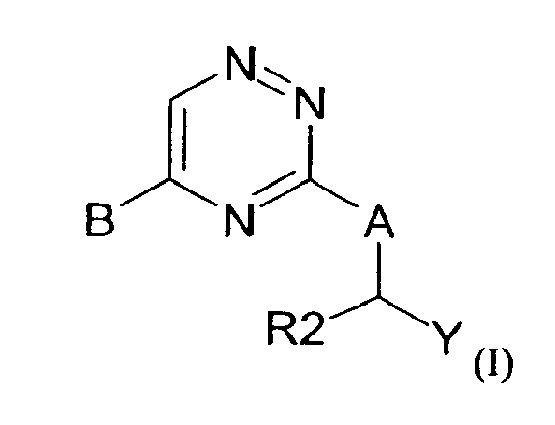
their preparation and intermediates, their use as drugs and pharmaceutical compositions and associations containing them.
Description
- The invention relates to new 1,2,4-triazine derivatives, their preparation and intermediates, their use as drugs and pharmaceutical compositions containing them.
- The invention relates to new compounds capable of inhibiting bacterial heptose synthesis.
- The lipopolysaccharide (LPS) is a major component of the outer membrane of Gram-negative bacteria. It is composed of three regions: the lipid A, the core oligosaccharide and the O antigen. The core oligosaccharide is divided into the inner core and the outer core. The inner core consists in a motif of five sugars: two Kdo (Kdo: 3-deoxy-D-manno-octulosonic acid) and three successive heptoses.
- The first heptose transfer is catalysed by the Heptosyltransferase I (protein WaaC) and the second heptose transfer by the Heptosyltransferase II (protein WaaF).
- The natural donor substrate of these transferases is ADP heptose, which is synthesized in bacteria from sedoheptulose by the successive enzymatic steps catalyzed by the following enzymes: GmhA, RfaE, GmhB,and RfaD (WaaD) (Journal of Bacteriology, Jan.2002, p 363-369).
- Heptose synthetic pathway is conserved among Gram negative bacterial species and is necessary for full LPS synthesis. It has been demonstrated that a complete LPS is necessary for pathogenesis due to the Gram negative bacteria. Bacteria lacking heptoses do have a rough phenotype because of the absence of the carbohydrate chains of the inner and outer core LPS. Bacteria having this phenotype are unable to give a productive infection in the host and in particular are very sensitive to the bactericidal effect of complement.
- Gram-negative bacteria that lack heptose display the deep-rough phenotype and show a reduction in outer membrane protein content, an increased sensitivity towards detergents or hydrophobic antibiotics and are more susceptible to phago-cytosis by macrophages. In addition, deep-rough mutated bacteria have been shown to present an attenuated virulence in an infant rat model and it has been demonstrated that the inner core LPS which constitutes the outer leaflet of Gram-negative bacteria outer membrane is necessary to protect Escherichia coli from complement killing in vitro and for virulence in vivo but is dispensable for gut colonization.
- Compounds inhibiting heptose synthesis activity are expected to prevent full LPS synthesis in Gram negative bacteria, inducing a high sensitivity to the complement and inhibiting bacterial dissemination in blood.
- Therefore small molecules inhibitors of heptose synthesis could be a new way to treat bloodstream infections caused by pathogenic Gram negative bacteria.
- It is known that the reactions catalyzed by RfaE are essential for heptose synthesis. As shown in
WO 2006/058 796 , this enzyme is essential for pathogenicity in an experimental model of infection. - The invention relates to compounds having the general formula (I)

- A is NR1, O or S;
R1 is H or (C1-C6) alkyl optionally substituted by one group R'1, or R1 and R2 form with N a 4 to 6 membered saturated heterocycle;
R'1 is CH2OH, CO2H, CO2 (C1-C4) alkyl, CH2NH2, SO3H or PO3H2;
- R2 is H or (C1-C6) alkyl optionally substituted by one or several identical or different R or R1 and R2 form with N a 4 to 6 membered saturated heterocycle;
- Y is a 5-10 membered mono or bicyclic, unsaturated or aromatic heterocycle containing 1-4 heteroatoms selected from N, O and S, optionally substituted by one or several identical or different groups R;
- B is (C1-C6) alkyl or mono or bicyclic aryl, all being optionally substituted by one or several identical or different groups R;
R is selected from the group consisting of (C1-C6) alkyl, (C2-C6) alkenyl, (C2-C6) alkynyl, phenyl, 4-6 membered monocyclic saturated or unsaturated heterocycle containing 1-3 heteroatoms selected from N, O and S, CO2Ra, CORa, CONRaRb, OCORa, ORa, NRaRb, CRa=NORb, NRaCORb, NRaCOORb, OCONRaRb, NRaCONRbR, NRaSO2Rb, S(O)nRa, and SO2NRaRb, all the above members of the group representing R being optionally substituted by one or several identical or different groups R', or R is halogen, CN or NO2;
Ra, Rb and Rc, identical or different, are selected from the group consisting of H, (C1-C6) alkyl, (C2-C6) alkenyl, (C2-C6) alkynyl, phenyl and 4-6 membered monocyclic saturated or unsaturated heterocycle containing 1-3 heteroatoms selected from N, O and S, all the above members of the group representing Ra, Rb and Rc being optionally substituted by one or different groups R';
R' is selected from the group consisting of (C1-C6) alkyl, (C1-C6) alkyl substituted by hydroxy, 4-6 membered monocyclic saturated or unsaturated heterocycle containing 1-3 heteroatoms selected from N, O and S, CO2R", COR", CONR"R"', OCOR", OR", NR"R"', NR"COR"', NR"COOR"', CONR"-(C1-C3)alkyl-OH, OCONR"R"', NR"CONR"'R"", NR"SO2R"', S(O)nR", SO2 NR"R"', halogen, CN, NR"-CO(C1-C3) alkyl-NR"'R"", NR"-CO(C1-C3) alkyl-heterocycle, NR"-CO(C1-C3) alkyl-OH, NR"-CO(C1-C3) alkyl-CONH2, -CONR"-(C1-C3) alkyl-NR"'R"", -CONR"-(C1-C3) alkyl-CONH2, -CO-NR"-(C1-C3) alkyl-heterocycle, the heterocyle being selected from the group consisting of piperidinyl, imidazolyl, morpholinyl, piperazinyl, pyrrolidinyl and azetidinyl;
R", R"' and R"" being identical or different are H or (C1-C5) alkyl or form together a 4 to 6 membered nitrogenous saturated heterocycle;
n is 0, 1 or 2;
their N-oxide derivatives,
in their racemic, enantiomeric or geometric forms,
and their addition salts thereof with acids and bases. - Among the acid salts of the products of formula (I), there may be cited, among others, those formed with mineral acids, such as hydrochloric, hydrobromic, hydro-iodic, sulfuric or phosphoric acid or with organic acids such as formic, acetic, trifluoroacetic, propionic, benzoic, maleic, fumaric, succinic, tartaric, citric, oxalic, glyoxylic, aspartic, alkanesulfonic acids, such as methanesulfonic and ethanesulfonic acids, arylsulfonic acids such as benzenesulfonic and paratoluenesulfonic acids.
- Among the alkaline salts of the products of formula (I), there may be cited, among others, those formed with mineral alkalis such as, for example, sodium, potassium, lithium, calcium, magnesium or ammonium or organic bases such as, for example, methylamine, ethylamine, propylamine, trimethylamine, diethylamine, triethylamine, N,N-dimethylethanolamine, tris(hydroxymethyl)aminomethane, ethanolamine, pyridine, piperidine, piperazine, picoline, dicyclohexylamine, morpholine, benzylamine, procaine, lysine, arginine, histidine, N-methylglucamine.
- In the general formula (I), as applied herein:
- "C1-C6 alkyl" means any linear, branched or cyclic hydrocarbon groups having 1 to 6 carbon atoms, preferably methyl, ethyl, n-propyl, isopropyl, n-butyl, isobutyl and t-butyl, n-pentyl, isopentyl, neopentyl, cyclopropyl, cyclobutyl, cyclopentyl, cyclohexyl;
- "C2-C6 alkenyl and "C2-C6 alkynyl" as applied herein means any linear, branched or cyclic hydrocarbon groups of 2 to 6 carbon atoms, having at least one double bond or one triple bond and preferably ethenyl, propenyl, butenyl, cyclohexenyl, ethynyl, propargyl, butynyl;
- "Halogen" means F, Cl, Br, and I;
- Illustrative heterocycles as mentioned in the definitions of formula I are for example those selected from the group comprising furyl, tetrahydrofuryl, benzofuryl, tetrahydrobenzofuryl, thienyl, tetrahydrothienyl, benzothienyl, tetrahydrobenzothienyl, pyrrolyl, pyrrolidinyl, indolyl, indolinyl, tetrahydroindolyl, oxazolyl, oxazolinyl, oxazolidinyl, benzoxazolyl, tetrahydrobenzoxazolyl, oxazolopyridinyl, tetrahydrooxazolopyridinyl, oxazolopyrimidinyl, tetrahydrooxazolopyrimidinyl, oxazolopyrazinyl, oxazolopyridazinyl, oxazolotriazinyl, isoxazolyl, benzoisoxazolyl, tetrahydrobenzoisoxazolyl, thiazolyl, thiazolinyl, thiazolidinyl, benzothiazolyl, tetrahydrobenzothiazolyl, thiazolopyridinyl, tetrahydrothiazolopyridinyl, thiazolopyrimidinyl, tetrahydrothiazolopyrimidinyl, thiazolopyrazinyl, thiazolopyridazinyl, thiazolotriazinyl, isothiazolyl, benzoisothiazolyl, tetrahydrobenzoisothiazolyl, imidazolyl, benzimidazolyl, tetrahydrobenzimidazolyl, pyrazolyl, indazolyl, tetrahydroindazolyl, triazolyl, oxadiazolyl, thiadiazolyl, tetrazolyl, pyranyl, dihydropyranyl, tetrahydropyranyl, benzopyranyl, dioxanyl, benzodioxanyl, dioxolanyl, benzodioxolanyl, pyridinyl, pyridonyl, piperidinyl, tetrahydropyridinyl, quinolinyl, isoquinolinyl, tetra- and perbydro-quinolinyl and isoquinolinyl, pyrimidinyl, quinazolinyl, pyrazinyl, pyrazidinyl, piperazinyl, quinoxalinyl, piridazinyl, cinnolinyl, phtalazinyl, triazinyl, purinyl, pyrazolopyridinyl, tetrahydropyrazolopyridnyl, pyrazolopyrimidinyl, pyrazolopyrazinyl, pyrazolotriazinyl, triazolopyridinyl, tetrahydrotriazolopyridinyl, triazolopyrimidinyl, triazolopyrazinyl, triazolotriazinyl, oxetanyl, azetidinyl, morpholinyl.
- Illustrative nitrogenous heterocycles are for example those comprised in the above group.
- As stated above, the invention includes any N-oxide derivatives of the compounds of formula (I).
- According to the invention, the compounds of formula (I) can be in racemic forms, as well as in the form of pure enantiomers or non racemic (scalemic) mixture of enantiomers, including when the compounds of formula (I) have more than one stereogenic center. In case the compounds of formula (I) have unsaturated carbon carbon double bonds, both the cis (Z) and trans (E) isomers and mixtures belong to the invention.
- Preferred total number of substitutions by R or R' for any substituted (C1-C6) alkyl, (C2-C6) alkenyl, (C2-C6) alkynyl, aryl, heterocycle or Ra, Rb and Rc, is from 1 to 5.
- Preferred compounds according to the invention includes:
- the compounds of the general formula (I) wherein B represents phenyl substituted at position 2 by a group R, or 1-naphthyl optionally substituted by R, R being as defined above;
- the compounds of the general formula (I) wherein B represents phenyl substituted at positions 2,5, 2,6 and 2,4,6 by identical or different groups R, R being as defined above;
- the compounds of the general formula (I) wherein B represents phenyl substituted at positions 2,6 by identical or different groups R, R being selected from the group consisting of Me, halogen, NH2, OH and OME;
- the compounds of general formula (I) wherein the heterocycle represented by Y is selected from the group consisting of oxazolyl, oxazolinyl, benzoxazolyl, tetrahydrobenzoxazolyl, oxazolopyridinyl, tetrahydrooxazolopyridinyl, oxazolopyrimidinyl, tetrahydrooxazolopyrimidinyl, oxazolopyrazinyl, oxazolopyridazinyl, oxazolotriazinyl, thiazolyl, thiazolinyl, benzothiazolyl, tetrahydrobenzothiazolyl, thiazolopyridinyl, tetrahydrothiazolopyridinyl, thiazolopyrimidinyl, tetrahydrothiazolopyrimidinyl, thiazolopyrazinyl, thiazolopyridazinyl, thiazolotriazinyl, pyrazolyl, pyrazolopyridinyl, tetrahydropyrazolopyridnyl, pyrazolopyrimidinyl, pyrazolopyrazinyl, pyrazolotriazinyl, triazolopyridinyl, tetrahydrotriazolopyridinyl, triazolopyrimidinyl, triazolopyrazinyl and triazolotriazinyl,
- and in particular:
- the compounds of general formula (I) wherein Y represents a benzothiazole group, a tetrahydrobenzothiazole group, or a thiazolopyridine group, optionally substituted at position 5 by a group R, R being as defined above;
- the compounds of general formula (I) wherein Y represents a benzothiazole group, a tetrahydrobenzothiazole group, or a thiazolopyridine group, optionally substituted at position 5 by a group ORa, Ra being as defined above;
- the compounds of general formula (1) wherein Y represents a thiazole group, optionally substituted at position 4 and/or 5 by one or two groups R, R being as defined above;
- the compounds of general formula (I) wherein A is NH or N-CH3;
- the compounds of general formula (I) wherein R2 is H;
- and their salts with acids or bases.
- Preferred compounds according to the invention includes the compounds of examples 9, 15, 16, 17, 18, 19, 20, 21, 22, 29, 32, 33, 35, 43, 57, 64, 70, 75, 78, 90, 94, 97, 98, 99, 100, 107 and 108, the names of which are listed below:
- 5-(2-Chlorophenyl)-N-[(4,5-dimethyl-1,3-thiazol-2-yl)methyl]-1,2,4-triazin-3-amine,
- 5-(2,6-Dichlorophenyl)-N-[(5-methoxy-1,3-benzothiazol-2-yl)methyl]-1,2,4-triazin-3-amine,
- 2-{[2-({[5-(2,6-Dichlorophenyl)-1,2,4-triazin-3-yl]amino}methyl)-1,3-benzothiazol-5-yl]oxy}ethanol,
- {[2-({[5-(2,6-dichlorophenyl)-1,2,4-triazin-3-yl]amino}methyl)-1,3-benzothiazol-5-yl]oxy}acetic acid,
- 2-(2-{[5-(2,6-Dichloro-phenyl)-[1,2,4]triazin-3-ylamino]-methyl}-benzothiazol-5-yloxy)-N-(2-hydroxy-ethyl)-acetamide,
- 2-(2-{[5-(2,6-Dichloro-phenyl)-[1,2,4]triazin-3-ylamino]-methyl}-benzothiazol-5-yloxy)-N-(2-dimethylamino-ethyl)-acetamide,
- 1-{[2-({[5-(2,6-Dichlorophenyl)-1,2,4-triazin-3-yl]amino}methyl)-1,3-benzothiazol-5-yl]oxy}acetone,
- 2-{[2-({[5-(2,6-Dichlorophenyl)-1,2,4-triazin-3-yl]amino}methyl)-1,3-benzothiazol-5-yl]oxy}acetamide,
- Benzothiazol-2-ylmethyl-[5-(2-methoxy-naphthalen-1-yl)-[1,2,4]triazin-3-yl]-amine,
- N-[(5-Methoxy-1,3-benzothiazol-2-yl)methyl]-5-(2-methoxy-1-naphthyl)-1,2,4-triazin-3-amine,
- 1-{3-[(Benzothiazol-2-ylmethyl)-amino]-[1,2,4]triazin-5-yl}-naphthalen-2-ol,
- 2-{[5-(2-Hydroxy-naphthalen-1-yl)-[1,2,4]triazin-3-ylamino]-methyl}-benzothiazol-5-ol,
- 2-(3-{[(5-Methoxy-1,3-benzothiazol-2-yl)methyl]amino}-1,2,4-triazin-5-yl)-3-methylphenol,
- 3-Methyl-2-{3-[({5-[(1,3-thiazol-2-ylmethyl)amino]-1,3-benzothiazol-2-yl}methyl)amino]-1,2,4-triazin-5-yl}phenol,
- 5-(2,6-Dimethoxyphenyl)-N-(4,5,6,7-tetrahydro-1,3-benzothiazol-2-ylmethyl)-1,2,4-triazin-3-amine,
- 2-[({5-[2-(Trifluoromethyl)phenyl]-1,2,4-triazin-3-yl}amino)methyl]-1,3-benzothiazol-4-ol,
- 5-(2-Methoxy-6-methylphenyl)-N-([1,3]thiazolo[5,4-b]pyridin-2-ylmethyl)-1,2,4-triazin-3-amine,
- 2-Dimethylamino-N-(4-{3-[(5-methoxy-benzothiazol-2-ylmethyl)-amino]-[1,2,4]triazin-5-yl}-3,5-dimethyl-phenyl)-acetamide,
- N,N-Dimethyl-N'-[4-(3-{[(5-methoxy-1,3-benzothiazol-2-yl)methyl]amino}-1,2,4-triazin-5-yl)phenyl]ethane-1,2-diamine,
- {(1,3-Benzothiazol-2-ylmethyl)[5-(2,6-dimethoxyphenyl)-1,2,4-triazin-3-yl]amino}acetic acid,
- N-({5-[(2-Aminoethyl)thio]-1,3-benzothiazol-2-yl}methyl)-5-(2,6-dichlorophenyl)-1,2,4-tri azin-3-amine,
- 5-[2-Chloro-5-(1H-pyrazol-3-yl)phenyl]-N-[(5-methoxy-1,3-benzothiazol-2-yl)methyl]-1,2,4-triazin-3-amine,
- 5-[2-Chloro-5-(1H-pyrazol-4-yl)phenyl]-N-[(5-methoxy-1,3-benzothiazol-2-yl)methyl]-1,2,4-triazin-3-amine,
- 5-(2-Chloro-5-pyridin-3-ylphenyl)-N-[(5-methoxy-1,3-benzothiazol-2-yl)methyl]-1,2,4-triazin-3-amine,
- 2-[4-(4-Chloro-3-{3-[(5-methoxy-benzothiazol-2-ylmethyl)-amino]-[1,2,4]triazin-5-yl}-phenyl)-[1,2,3]triazol-1-yl]-ethanol,
- N-[(5-Methoxy-1,3-benzothiazol-2-yl)methyl]-5-(2-chloro-4-piperazin-1-ylphenyl)-1,2,4-triazin-3-amine, and
- N-[4-(3-{[5-(2-Amino-ethoxy)-benzothiazol-2-ylmethyl]-amino}-[1,2,4]triazin-5-yl)-3,5-dimethyl-phenyl]-N',N'-dimethyl-ethane-1,2-diamine,
- The compounds of formula I and their salts may be prepared by processes known to the skilled chemist to be applicable for preparing chemically related compounds. Such processes use known starting materials or intermediates which may be obtained by standard procedures of organic chemistry. The following processes provide a variety of non-limiting routes for the production of the compounds of formula I and their intermediates. These processes constitute further features of the present invention.
- The invention also relates to a process for preparing the compounds of formula (I) as defined above, which comprises:
- a) reacting a compound of formula (II):

H-A-CH(R2)-Y (III)
wherein A, R2 and Y have the values defined above, in the presence of a base, - b) if appropriate, the reaction being followed or preceded by one or more of the following reactions, performed in an appropriate order, to achieve the substitutions on B and/or Y and/or R1 and/or R2 defined above:
- protection of reactive functions,
- deprotection of reactive functions,
- halogenation,
- dehalogenation,
- dealkylation,
- alkylation of amine, aniline, alcohol and phenol,
- reduction of nitro, esters, cyano, aldehydes,
- transition metal-catalyzed reactions,
- acylation,
- sulfonylation/introduction of sulfonyl groups,
- saponification/hydrolysis of esters groups,
- halogen exchange,
- nucleophilic substitution with amine, thiol or alcohol,
- reductive amination,
- fixation of R groups on B and/or Y,
- N-oxidation,
- salification.
- The base used in the nucleophilic substitution on the 3-chloro triazine can be an amine, preferably a tertiary amine, such as triethylamine, diisopropylethylamine pyridine or dimethylaminopyridine, an alkali metal hydride such as sodium hydride, or carbonate such as sodium or potassium carbonate.
- The reaction is performed in an organic solvent which can be for example acetonitrile, tetrahydrofuran or dimethylformamide, acetonitrile being preferred, at a temperature between room temperature and the reflux of the reaction medium.
- The invention also relates to a process for preparing the compounds of formula (I) as defined above, wherein A represents NH, which comprises:
- a) reacting a compound of formula (IV):

R2-C(O)-Y (V)
wherein Y and R2 have the values defined above, in the presence of a reducing agent, - b) if appropriate, the reaction being followed or preceded by one or more of the reactions defined above, performed in an appropriate order, to achieve the substitutions on B and/or Y and/or R1 and/or R2 defined above.
- The reducing agent used in the above reductive amination can be, for example, sodium borohydride, cyanoborohydride or triacetoxyborohydride.
- The reaction can be performed in a solvent adapted to the reducing agent, this being well known to the skilled chemist.
- The invention also relates to a process for preparing the compounds of formula (I) as defined above, wherein A represents NH, which comprises:
- a) reacting a compound of formula (VI):

H2N-CH(R2)-Y (VII)
wherein R2 and Y have the values defined above, in the presence of an oxidizing agent and a base, - b) if appropriate, the reaction being followed or preceded by one or more of the reactions defined above, performed in an appropriate order, to achieve the substitutions on B and/or Y and/or R1 and/or R2 defined above.
- The conditions for performing the above various reactions referred to in steps b) above are all well known to the skilled and several examples are illustrated below in the experimental part.
- The invention also relates to a process for preparing the compounds of formula (II) as defined above, which comprises reacting a compound of formula (IV) as defined above, with a chlorination agent.
- Preferably, the chlorination agent is copper II chloride, used in the presence of tert-butyl nitrite.
- The compounds of formula (II) can also be prepared by a process which comprises reacting a compound of formula (VIII):
B-CO-CHO (VIII)
wherein B has values defined above, with semicarbazide of formula (IX):
H2N-CO-NH-NH2 (IX)
to obtain a compound of formula (X):
- In preferred conditions, the chlorination agent is phosphorous oxychloride. Phosphorous pentachloride, oxalyl chloride or thionyl chloride can also be used.
- The compounds of formula (II), and intermediately (IV), can be prepared by a process which comprises reacting a compound of formula (VIII):
B-CO-CHO (VIII)
wherein B has values defined above, with aminoguanidine of formula (XI):
H2N-C(NH)-NH-NH2 (XI)
to obtain a compound of formula (IV):
- The invention also relates to another process for preparing the compounds of formula (IV) as defined above, which comprises reacting a compound of formula (XI) as defined above, with a compound of formula (XII):
B-CO-C(morpholine)2 (XII)
wherein B has values defined above, in an acidic medium. - Preferably,the reaction is performed by using acetic acid, in an alcohol like methanol or ethanol as described in the literature (Organic Letters, 2003, 2271-2274).
- The compound of formula (XII) can itself be obtained by reacting a compound of formula (XIII):
B-CO-CHBr2 (XIII)
with morpholine - The above compounds of formulae (II), (IV), (VI), (VIII) (X), (XII) and (XIII) are novel compounds and constitute a further object of the invention.
- The compounds of formula (III) and (V) can be prepared starting from commercial compounds, by various processes illustrated below and in the experimental part. These processes are all described in the literature and well known to the skilled chemist.
- The compounds of formula (III) wherein A is NH and R2 is hydrogen can be prepared from a compound of formula (XIV):
Y-CH3 (XIV)
which are treated by selenium dioxide in a mixture of dioxane and water (an alcanol or tetrahydrofuran can also be used) to obtain a compound of formula (V) defined above, wherein R2 is hydrogen, which is treated by hydroxylamine in an alcohol, to obtain a compound of formula (XV):
Y-CH=NOH (XV)
which is reduced, for example by zinc in acetic acid. - The compounds of formula (III) wherein A is NR1, R1 being different from hydrogen can be prepared from a compound of formula (V) which is submitted to a reductive amination, by using an appropriate amine of formula R1-NH2, for example in the presence of NaBH3CN or NaBH4.
- They can also be obtained from a compound of formula (III) wherein A is NH, which is treated by a compound of formula R1-Hal.
- The compounds of formula (III) wherein A is NR1 and R2 is hydrogen can also be obtained from a compound of formula(XVI):
Y-CH2Hal (XVI)
- Hal being preferably Br or Cl, which is treated by an amine NH2R1.
- The compounds of formula (III) can also be obtained from a compound of formula (XVII):
Y-H (XVII)
which is treated first by an alkyl lithium such as n-butyl lithium, and then by an amide of formula (XVIII):
R2-CONMe2 (XVIII)
the reactive functions on R2 being eventually protected, to obtain a compound of formula (V) defined above, which is treated by hydroxylamine to obtain a compound of formula (XIX):
Y-C(R2)=NOH (XIX)
which is reduced, for example by zinc in acetic acid. - Compounds of formula (III) wherein R1 and R2 form a cycle are commercial, in particular when Y is a benzothiazole. Methods are available in the literature to prepare compounds wherein the heterocycle is different.
- The compounds of formula (III) wherein A is O can be obtained from a compound of formula (V) which is reduced by using known methods, to obtain the corresponding alcohol.
- The compounds of formula (III) wherein A is S can be obtained from a compound of formula (III) wherein A is O, by using a Mitsunobu reaction.
- Conditions for performing the above various reactions referred to in steps b) above applied to the compounds of formula (III) are illustrated below in the experimental part, attention being drawn in particular to those used in example 108.
- The compounds of formula (III) wherein A is NH, R2 is H and Y is benzothiazole possibly substituted can also be obtained by forming the thiazole ring starting from a possibly substituted 2-bromo or 2-iodo aniline which is treated by a compound of formula (XX):
H2N-C(S)-CH2-NH-COOalkyl (XX)
in the presence of a palladium complex and calcium (II) oxide, in acetonitrile, to obtain the corresponding compound of formula (XXI):
Y-CH2-NH-COOalkyl (XXI)
Y being a possibly substituted benzothiazole, which is treated in acidic conditions. Illustration is given below in the experimental part. - The above process can also be used to prepare compounds of formula (III) wherein Y is different from benzothiazole, by using instead of an aniline an α bromo or iodo amino-heteroaromatic compound. The heteroaromatic ring is preferably a pyridine ring.
- The above compounds of formula (III) wherein Y is substituted by one or several identical or different groups R are novel compounds and constitute a further object of the invention.
- As said above, the new compounds of formula (I) are capable of inhibiting bacterial heptose synthesis which makes them useful as drugs for preventing or treating bacterial infections and another object of the invention is the use of the compounds of formula (I) as drugs.
- The drugs of the invention are especially useful for the prevention and therapeutical treatment of severe infections due to Gram negative bacteria able to dissiminate in blood such as the following species (spp.): Escherichia coli, Enterobacter, Salmonella, Shigella, Pseudomonas, Acinetobacter, Neisseria, Klebsiella, Serratia, Citrobacter, Proteus, Yersinia, Haemophilus, Legionella, Moraxella and Helicobacter pylori.
- A further object of the present invention is therefore the use, as drugs and in particular antibiotic drugs, of the compounds of formula (I) as defined above, as well as their salts with pharmaceutically acceptable acids and bases.
- More particularly, an object of the invention is the use, as drugs, of the preferred compounds of formula (I) mentioned above, and in particular of the compounds listed below:
- -5-(2-Chlorophenyl)-N-[(4,5-dimethyl-1,3-thiazol-2-yl)methyl]-1,2,4-triazin-3-amine,
- -5-(2,6-Dichlorophenyl)-N-[(5-methoxy-1,3-benzothiazol-2-yl)methyl]-1,2,4-triazin-3-amine,
- -2-{[2-({[5-(2,6-Dichlorophenyl)-1,2,4-triazin-3-yl]amino}methyl)-1,3-benzothiazol-5-yl]oxy}ethanol,
- -{[2-({[5-(2,6-dichlorophenyl)-1,2,4-triazin-3-yl]amino}methyl)-1,3-benzothiazol-5-yl]oxy}acetic acid,
- -2-(2-{[5-(2,6-Dichloro-phenyl)-[1,2,4]triazin-3-ylamino]-methyl}-benzothiazol-5-yloxy)-N-(2-hydroxy-ethyl)-acetamide,
- -2-(2-{[5-(2,6-Dichloro-phenyl)-[1,2,4]triazin-3-ylamino]-methyl}-benzothiazol-5-yloxy)-N-(2-dimethylamino-ethyl)-acetamide,
- -1-{[2-({[5-(2,6-Dichlorophenyl)-1,2,4-triazin-3-yl]amino}methyl)-1,3-benzothiazol-5-yl]oxy}acetone,
- -2-{[2-({[5-(2,6-Dichlorophenyl)-1,2,4-triazin-3-yl]amino}methyl)-1,3-benzothiazol-5-yl]oxy}acetamide,
- -Benzothiazol-2-ylmethyl-[5-(2-methoxy-naphthalen-1-yl)-[1,2,4]triazin-3-yl]-amine,
- -N-[(5-Methoxy-1,3-benzothiazol-2-yl)methyl]-5-(2-methoxy-1-naphthyl)-1,2,4-triazin-3-amine,
- -1-{3-[(Benzothiazol-2-ylmethyl)-amino]-[1,2,4]triazin-5-yl}-naphthalen-2-ol,
- -2-{[5-(2-Hydroxy-naphthalen-1-yl)-[1,2,4]triazin-3-ylamino]-methy}benzothiazol-5-ol,
- -2-(3-{[(5-Methoxy-1,3-benzothiazol-2-yl)methyl]amino}-1,2,4-triazin-5-yl)-3-methylphenol,
- -3-Methyl-2-{3-[({5-[(1,3-thiazol-2-ylmethyl)amino]-1,3-benzothiazol-2-yl}methyl)amino]-1,2,4-triazin-5-yl}phenol,
- -5-(2,6-Dimethoxyphenyl)-N-(4,5,6,7-tetrahydro-1,3-benzothiazol-2-ylmethyl)-1,2,4-triazin-3-amine,
- -2-[({5-[2-(Trifluoromethyl)phenyl]-1,2,4-triazin-3-yl}amino)methyl]-1,3-benzothiazol-4-ol,
- -5-(2-Methoxy-6-methylphenyl)-N-([1,3]thiazolo[5,4-b]pyridin-2-ylmethyl)-1,2,4-triazin-3-amine,
- -2-Dimethylamino-N-(4-{3-[(5-methoxy-benzothiazol-2-ylmethyl)-amino]-[1,2,4]triazin-5-yl}-3,5-dimethyl-phenyl)-acetamide,
- -N,N-Dimethyl-N'-[4-(3-{[(5-methoxy-1,3-benzothiazol-2-yl)methyl]amino}-1,2,4-triazin-5-yl)phenyl]ethane-1,2-diamine,
- -{(1,3-Benzothiazol-2-ylmethyl)[5-(2,6-dimethoxyphenyl)-1,2,4-triazin-3-yl]amino}acetic acid,
- -N-({5-[(2-Aminoethyl)thio]-1,3-benzothiazol-2-yl}methyl)-5-(2,6-dichlorophenyl)-1,2,4-triazin-3-amine,
- -5-[2-Chloro-5-(1H-pyrazol-3-yl)phenyl]-N-[(5-methoxy-1,3-benzothiazol-2-yl)methyl]-1,2,4-triazin-3-amine,
- -5-[2-Chloro-5-(1H-pyrazol-4-yl)phenyl]-N-[(5-methoxy-1,3-benzothiazol-2-yl)methyl]-1,2,4-triazin-3-amine,
- -5-(2-Chloro-5-pyridin-3-ylphenyl)-N-[(5-methoxy-1,3-benzothiazol-2-yl)methyl]-1,2,4-triazin-3-amine,
- -2-[4-(4-Chloro-3-{3-[(5-methoxy-benzothiazol-2-ylmethyl)-amino]-[1,2,4]triazin-5-yl}-phenyl)-[1,2,3]triazol-1-yl]-ethanol,
- -N-[(5-Methoxy-1,3-benzothiazol-2-yl)methyl]-5-(2-chloro-4-piperazin-1-ylphenyl)-1,2,4-triazin-3-amine, and
- -N-[4-(3-{[5-(2-Amino-ethoxy)-benzothiazol-2-ylmethyl]-amino}-[1,2,4]triazin-5-yl)-3,5-dimethyl-phenyl]-N',N'-dimethyl-ethane-1,2-diamine,
- The invention also relates to pharmaceutical compositions comprising an effective amount of at least one compound of formula I such as above defined, in association with a pharmaceutically acceptable carrier.
- Said pharmaceutical compositions are advantageously formulated to be administered under oral, parental, and preferably injectable routes, with individual doses appropriate for the patient to be treated.
- The compositions according to the invention can be solid or liquid and be present in the pharmaceutical forms commonly used in human medicine, such as for example, plain or sugar-coated tablets, gelatin capsules, granules, suppositories, injectable preparations, ointments, creams, gels; they are prepared according to the customary methods. The active ingredient/s can be incorporated in same, using excipients which are customarily used in these pharmaceutical compositions, such as talc, gum arabic, lactose, starch, magnesium stearate, cocoa butter, aqueous or nonaqueous vehicles, fatty substances of animal or vegetable origin, paraffin derivatives, glycols, various wetting agents, dispersants or emulsifiers, preservatives.
- These compositions can in particular be present in the form of a powder intended to be dissolved extemporaneously in an appropriate vehicle, for example, non-pyrogenic sterile water.
- The dose administered varies according to the condition treated, the patient in question, the administration route and the product envisaged. It can, for example, be comprised between 0.1 g and 10 g per day, by oral route in humans, with the product described in Example 1 or also comprised between 0.1 g and 10 g per day by intramuscular or intravenous route.
- The drugs according to the invention can be advantageously associated/combined with other antibacterials.
- A further object of the invention is therefore the associations of the compounds of formula (I) with antimicrobial peptides or natural, hemisynthetic or synthetic antibacterial molecules as well as pharmaceutical compositions containing them.
- The following examples illustrate the invention.
- Proton nuclear magnetic resonance (1H NMR) spectra were recorded on a 400 MHz Brüker instrument, and chemical shifts are reported in parts per million downfield from the internal standard tetramethylsilane (TMS). Abbreviations for NMR data are as follows: s=singlet, d=doublet, t=triplet, q=quadruplet, m=multiplet, dd=doublet of doublets, dt=doublet of triplets, br=broad. J indicates the NMR coupling constant measured in Hertz. CDCl3 is deuteriochloroform, DMSO-d6 is hexadeuteriodimethylsulfoxide, and CD3OD is tetradeuteriomethanol. Mass spectra were obtained using electrospray (ES) ionization techniques on an Agilent 1100 Series LCMS. HPLC (analytical and preparative) were performed on an Agilent 1100 HPLC with DAD (Diode Array Detection). Preparative HPLC were performed at 0.7mL/min on a Thermo Electron, Hypersil BDS C-18 column (250 x 4.6mm, 5µm) using a gradient of acetonitrile and water with 0.1% TFA (50% in acetonitrile to 100% and then back to 50%). Analtech Silica Gel GF and E. Merck Silica Gel 60 F-254 thin layer plates were used for thin layer chromatography. Flash chromatography was carried out on Flashsmart Pack cartridge, irregular silica 40-60µm or spherical silica 20-40µm.
- The meaning of certain abbreviations is given herein. ESI refers to electrospray ionization, HPLC refers to high pressure liquid chromatography, LCMS refers to liquid chromatography coupled with a mass spectrometer, M in the context of mass spectrometry refers to the molecular peak, MS refers to mass spectrometer, NMR refers to nuclear magnetic resonance, pH refers to potential of hydrogen, TFA refers to trifluoroacetic acid, Xantphos refers to 9,9-dimethyl-4,5-bis(diphenylphosphino)xanthene, TEA refers to triethylamine, DIPEA refers to N,N-diisopropylethylamine, dppf refers to 1,1'-bis(diphenylphosphino)ferrocene, THF refers to tetrahydrofuran, DMF refers to N,N-dimethylformamide, EDAC refers N-(3-dimethylaminopropyl)-N'-ethylcarbodiimide hydrochloride, 4-DMAP refers to 4-(dimethylamino)pyridine, TLC refers to thin layer chromatography.
- The starting materials are commercially available unless indicated otherwise.
-

- a)
To a solution of 1-(2,6-dimethoxyphenyl)ethanone (736 mg, 4 mmol) in anhydrous THF (4 mL), was added portionwise phenyl trimethyl ammonium tribromide (3.18 g, 8 mmol) over a period of one hour. The solution was stirred under argon overnight. Cold water (5 mL) was added and the resulting mixture was filtered. The solid was rinsed with cold water (5 mL) twice. The solid was collected, dissolved in dichloromethane and the resulting solution dried over sodium sulfate, filtered and evaporated. 2,2-dibromo-1-(2,6-dimethoxyphenyl)ethanone (1.17 g, 86%) was obtained as a white solid and was used in the next step without purification.
ESI-MS m/z 337, 339 and 341 (M+H)+. - b)
Under argon, morpholine (333 µL, 3.8 mmol) was added all at once to a solution of 2,2-dibromo-1-(2,6-dimethoxyphenyl)ethanone (308 mg, 0.91 mmol) in anhydrous THF (0.3 mL). The resulting mixture was thoroughly degassed and then heated slowly over one hour to 67°C. The solution was kept stirring at this temperature for 2 days after which it was cooled to room temperature. The white solid was filtered off and the residue was concentrated.
Under argon, the crude residue was next dissolved in methanol (1.5 mL), aminoguanidine bicarbonate (128 mg, 0.94 mmol) was added followed by acetic acid (156 µL, 2.7 mmol). The resulting mixture was briefly degassed and stirred at room temperature for 1.5 hours, then heated at 67°C for 2 days. The reaction mixture was then cooled to room temperature, concentrated and purified by flash chromatography (silica gel, dichloromethane/methanol, 1/0 to 95/5) to afford 5-(2,6-dimethoxyphenyl)-1,2,4-triazin-3-amine (66.3 mg, 31%) as a white solid.
ESI-MS m/z 233 (M+H)+.
(4,5-Dimethyl-1,3-thiazol-2-yl)methylamine could be prepared according to literature procedure (Justus Liebigs Ann. Chem. 1964, 676, 141) or using the following procedure: - c)
Under argon, to a solution of 4,5-dimethylthiazole (600 µL, 5.5 mmol) in anhydrous THF (40 mL) at -78°C, n-butyllithium (2.3 M in hexanes, 3.6 mL, 8.28 mmol) was slowly added and the reaction mixture was stirred at -78°C for one hour. Then a solution of anhydrous DMF (1.1 mL, 14.2 mmol) in anhydrous THF (10 mL) was added. The resulting mixture was stirred for 2.5 hours, allowing the temperature to raise to -60°C. Acetic acid (0.5 mL) and an aqueous solution of ammonium chloride were added, and the temperature let to raise to room temperature. The resulting solution was extracted with diethyl ether and ethyl acetate. The combined organic extracts were dried over sodium sulfate, filtered and evaporated. The crude product was purified by flash chromatography (silica gel, cyclohexane/ethyl acetate, 1/0 to 7/3) to afford 4,5-dimethyl-1,3-thiazole-2-carbaldehyde (724 mg, 93%), as a yellow oil which turns into a white solid after storage at -18°C.
ESI-MS m/z 160 (M+H2O+H)+. - d) Representative procedure for the conversion of thiazole-2-carbaldehyde derivatives into (1,3-thiazol-2-yl)methylamine derivatives.
Under argon, a solution of 4,5-dimethyl-1,3-thiazole-2-carbaldehyde (644.9 mg, 4.57 mmol), hydroxylamine hydrochloride (648.1 mg, 9.143 mmol) and sodium methoxide (493.7 mg, 9.14 mmol) in ethanol (9 mL) was stirred at room temperature overnight. The white solid was filtered off, rinsed with methanol and the solution was evaporated. The crude oxime was dissolved in acetic acid (25 mL), zinc dust (1.8 g, 27.5 mmol) was added portionwise at room temperature and the reaction mixture was stirred at room temperature for 3 hours. The mixture was then filtered over a pad of celite and rinsed with methanol. Toluene was added and the filtrate was concentrated. An aqueous solution of ammonium chloride was added, the solution was acidified to pH = 2 with hydrochloric acid 1N and extracted with diethyl ether and ethyl acetate. These organic layers were discarded. The aqueous layer was basified with aqueous sodium hydroxide to pH = 10, and then extracted with diethyl ether and ethyl acetate. Combined organic extracts were dried over sodium sulfate, filtered and evaporated to give crude (4,5-dimethyl-1,3-thiazol-2-yl)methylamine (321.7 mg, 49%) as a pale yellow oil which was used in the next steps without purification.
ESI-MS m/z 143 (M+ H)+. - e)
Under argon, a solution of tert-butyl nitrite (90%, 85 µL, 0.64 mmol) in anhydrous acetonitrile (0.5 mL) was added to a solution of 5-(2,6-dimethoxyphenyl)-1,2,4-triazin-3-amine (100 mg, 0.43 mmol) and copper(II) chloride (70 mg, 0.52 mmol) in anhydrous acetonitrile (2.5 mL). The resulting mixture was stirred at 65°C for 2 hours. After cooling to room temperature, cold 3N aqueous hydrochloric acid was added and the mixture was extracted with diethyl ether and ethyl acetate. The combined organic extracts were washed with brine, then dried over sodium sulfate, filtered and evaporated to give crude 3-chloro-5-(2,6-dimethoxyphenyl)-1,2,4-triazine as a brown solid. The solid was dissolved in anhydrous acetonitrile (2 mL), then (4,5-dimethyl-1,3-thiazol-2-yl)methylamine (61.1 mg, 0.43 mmol) and triethylamine (60 µL, 0.43 mmol) were added and the resulting mixture was stirred at 80°C overnight. The reaction mixture was concentrated. Purification by preparative TLC (silica gel, dichloromethane/methanol 95/5) afforded 5-(2,6-dimethoxyphenyl)-N-[(4,5-dimethyl-1,3-thiazol-2-yl)methyl]-1,2,4-triazin-3-amine (25.6 mg, 17%) as a beige solid.
ESI-MS m/z 358 (M+H)+.
1H NMR (CDCl3), δ (ppm): 8.59 (s, 1H), 7.38 (t, J = 8.4 Hz, 1H), 6.63 (d, J = 8.4 Hz, 2H), 4.99 (d, J = 5.2 Hz, 2H), 3.75 (s, 6H), 2.31 (s, 6H). -

- Under argon, N-bromosuccinimide (3.8 mg, 0.02 mmol) was added to a solution of 5-(2,6-dimethoxyphenyl)-N-[(4,5-dimethyl-1,3-thiazol-2-yl)methyl]-1,2,4-triazin-3-amine (7.7 mg, 0.02 mmol) in dichloromethane (0.3 mL). The reaction mixture as stirred at room temperature overnight. The reaction mixture was concentrated. Purification by preparative TLC (silica gel, dichloromethane/methanol 95/5) afforded 5-(3-bromo-2,6-dimethoxyphenyl)-N-[(4,5-dimethyl-1,3-thiazol-2-yl)methyl]-1,2,4-triazin-3-amine (4.6 mg, 49%) as a brown solid.
- ESI-MS m/z 436 and 438 (M+H)+.
- 1H NMR (CDCl3), δ (ppm): 8.63 (s, 1H), 7.62 (d, J = 8.8 Hz, 1H), 6.70 (d, J = 8.8 Hz, 1H), 5.17 (br s, 2H), 3.77 (s, 3H), 3.72 (s, 3H), 2.42 (s, 3H), 2.37 (s, 3H).
-

- A solution of 5-(2,6-dimethoxyphenyl)-N-[(4,5-dimethyl-1,3-thiazol-2-yl)methyl]-1,2,4-triazin-3-amine (600 mg, 1.67 mmol) in anhydrous dichloromethane (6 mL) under nitrogen atmosphere was cooled to -78°C. Boron tribromide (0.32ml, 3.3mmol) was added dropwise while maintaining the temperature of the reaction mixture below -40°C. The reaction was then allowed to warm up slowly to 0°C at which temperature the reaction was complete on TLC. The reaction mixture was quenched by addition of a saturated aqueous ammonium chloride solution and neutralized with 10% sodium bicarbonate aqueous solution. The resulting mixture was extracted with dichloromethane, the combined organic extracts were washed with water, brine, dried over anhydrous sodium sulfate and concentrated. Purification by flash chromatography (silica gel, dichloromethane/methanol, 98.5/1.5) afforded 2-(3-{[(4,5-dimethyl-1,3-thiazol-2-yl)methyl]amino}-1,2,4-triazin-5-yl)-3-methoxyphenol (150 mg, 26%) as a yellow solid.
- ESI-MS m/z 344 (M+H)+.
- 1H NMR (CDCl3), δ (ppm): 9.23 (s, 1H), 7.27-7.24 (m, 1H), 6.74 (dd, J = 8.3 Hz and 1.0 Hz, 1H), 6.52 (dd, J = 8.3 Hz and 1.0 Hz, 1H), 6.1 (br s, 1H), 4.94 (d, J = 6.1 Hz, 2H), 3.91 (s, 3H), 2.33 (s, 6H).
-

- Under argon, a solution of 5-(2,6-dimethoxyphenyl)-1,2,4-triazin-3-amine (30 mg, 0.13 mmol) and 1,3-benzothiazole-2-carbaldehyde (42 mg, 0.26 mmol) in 1,2-dichloroethane (0.7 mL) and THF (0.3 mL) with 4Å molecular sieves was stirred overnight at 35°C. Sodium borohydride (15 mg, 0.4 mmol) and methanol (0.2 mL) were then added and the reaction mixture was stirred for 4 hours at 35°C. The solution was filtered and the filtrate was concentrated. Dichloromethane and water were added, the resulting mixture was extracted with dichloromethane. The combined organic extracts were dried over sodium sulfate, filtered and evaporated. Purification by preparative TLC (silica gel, dichloromethane/methanol 95/5) afforded N-(1,3-benzothiazol-2-ylmethyl)-5-(2,6-dimethoxyphenyl)-1,2,4-triazin-3-amine (2.5 mg, 5%) as a white solid.
- ESI-MS m/z 380 (M+H)+.
- 1H NMR (CDCl3), δ (ppm): 8.61 (s, 1H), 7.98 (d, J = 8.0 Hz, 1H), 7.84 (d, J = 8.0 Hz, 1H), 7.48-7.45 (m, 1H), 7.40-7.35 (m, 2H), 6.62 (d, J = 8.0 Hz, 2H), 5.20 (d, J = 5.2 Hz, 2H), 3.70 (s, 6H).
-

- Representative procedure for the conversion of acetophenone derivatives into N-substituted-5-phenyl-1,2,4-triazin-3-amine compounds via 5-aryl-1,2,4-triazin-3-amine intermediates.
- a)
To a solution of 1-(2-nitrophenyl)ethanone (15 g, 91 mmol) in 1,4-dioxane (300 mL) and water (50 mL) was added selenium dioxide (50.4 g, 450 mmol). The reaction mixture was refluxed for 12 hours until the reaction was complete on TLC. The reaction mixture was cooled, diluted with water and extracted with dichloromethane. The combined organic extracts were washed with brine, dried over anhydrous sodium sulfate and concentrated to give crude (2-nitrophenyl)(oxo)acetaldehyde as a brown oil which was used in the next step without purification. - b)
The crude (2-nitrophenyl)(oxo)acetaldehyde was dissolved in methanol (100 mL) and aminoguanidine hydrochloride (9.24 g, 84 mmol) was added followed by triethylamine (11.6 mL, 84 mmol). The resulting mixture was degassed and stirred at room temperature for 1.5 hours and then refluxed for 2 days. The mixture was cooled to room temperature and concentrated. Purification by flash chromatography (silica gel, chloroform/methanol gradient) led to 5-(2-nitrophenyl)-1,2,4-triazin-3-amine (6.0 g, 30%) as a yellow solid.
ESI-MS m/z 218 (M+H)+. - c)
To a solution of copper(II) chloride (3.56 g, 26.5 mmol) and tert-butyl nitrite (3.93 mL, 33 mmol) in anhydrous acetonitrile at 65°C was slowly added 5-(2-nitrophenyl)-1,2,4-triazin-3-amine (4.8 g, 22.1 mmol) and the resulting mixture was stirred for 3 hours. The reaction mixture was cooled, and poured into 1.5N hydrochloric acid cooled to 0°C. The mixture was extracted with diethylether and the combined ether layers were washed with brine, dried over anhydrous sodium sulfate and concentrated. The crude product was purified by flash chromatography (silica gel, chloroform/methanol, 99/1) to give 3-chloro-5-(2-nitrophenyl)-1,2,4-triazine (1.6 g, 31 %).
ESI-MS m/z 237 and 239 (M+H)+. - d)
To a solution of 3-chloro-5-(2-nitrophenyl)-1,2,4-triazine (1.2 g, 5.07 mmol) in anhydrous acetonitrile (7 mL) was added (4,5-dimethyl-1,3-thiazol-2-yl)methylamine (720 mg, 5.07 mmol, prepared as in example 1), anhydrous potassium carbonate (3.5 g, 25.3 mmol) and the resulting mixture was stirred at room temperature for 12 hours. The reaction mixture was concentrated, diluted with water and extracted with ethyl acetate. The combined organic extracts were washed with brine, dried over anhydrous sodium sulfate and concentrated. The crude product obtained was purified by flash chromatography (silica gel, chloroform/methanol, 99/1) to afford N-[(4,5-dimethyl-1,3-thiazol-2-yl)methyl]-5-(2-nitrophenyl)-1,2,4-triazin-3-amine (700 mg, 40%) as a brown solid.
ESI-MS m/z 343 (M+H)+.
1H NMR (CDCl3), δ (ppm): 8.8 (s, 1H), 8.03 (d, J = 7.8 Hz, 1H), 8.02-7.63 (m, 3H), 4.90 (br s, 2H), 2.3 (s, 6H). -

- To a solution of N-[(4,5-dimethyl-1,3-thiazol-2-yl)methyl]-5-(2-nitrophenyl)-1,2,4-triazin-3-amine (180 mg, 0.53 mmol) in methanol (4 mL) was added iron powder (350 mg, 6.3 mmol), followed by ammonium chloride (450 mg, 8.4 mmol) in water (4 mL). The resulting mixture was refluxed for 12 hours. After cooling and filtration through a pad of celite, the filtrate was concentrated and then diluted with water. The aqueous solution was extracted with dichloromethane. Combined organic layers were washed with brine, dried over anhydrous sodium sulfate and concentrated. The crude residue was purified by flash chromatography (silica gel, chloroform/methanol, 99/1) to afford 5-(2-aminophenyl)-N-[(4,5-dimethyl-1,3-thiazol-2-yl)methyl]-1,2,4-triazin-3-amine (100 mg, 60%) as a yellow solid.
- ESI-MS m/z 313 (M+H)+.
- 1H NMR (CDCl3), δ (ppm): 9.08 (s, 1H), 7.72 (d, J = 8.1 Hz, 1H), 7.30-7.26 (m, 1H), 6.79-6.72 (m, 2H), 6.05 (br s, 2H), 4.92 (br s, 2H), 2.32 (s, 6H).
-

- To a solution of 5-(2-aminophenyl)-N-[(4,5-dimethyl-1,3-thiazol-2-yl)methyl]-1,2,4-triazin-3-amine (40 mg, 0.13 mmol) in anhydrous dichloromethane (1 mL) cooled to 0°C, was added acetic anhydride (13 µL, 0.14 mmol) and the resulting mixture was stirred at room temperature for 12h. The reaction mixture was concentrated and the crude residue was purified by flash chromatography (silica gel, chloroform/methanol, 99/1) to yield N-[2-(3-{[(4,5-dimethyl-1,3-thiazol-2-yl)methyl]amino}-1,2,4-triazin-5-yl)phenyl]acetamide (9 mg, 20%) as a yellow solid.
- ESI-MS m/z 355 (M+H)+.
- 1H NMR (CDCl3), δ (ppm): 9.09 (s, 1H), 8.57 (d, J = 8.2 Hz, 1H), 7.76 (d, J = 8.2 Hz, 1H), 7.57-7.52 (m, 1H), 7.25-7.21 (m, 1H), 4.99 (br s, 2H), 2.32 (s, 6H), 2.15 (s, 3H).
-

- To a solution of 5-(2-aminophenyl)-N-[(4,5-dimethyl-1,3-thiazol-2-yl)methyl]-1,2,4-triazin-3-amine (70 mg, 0.22 mmol) in anhydrous dichloromethane (2 mL) cooled to 0°C, was added pyridine (90 µL, 1.11 mmol) followed by methanesulfonyl chloride (17 µL, 0.22 mmol). The reaction mixture was stirred at room temperature overnight. The reaction mixture was basified with an aqueous sodium bicarbonate solution and extracted with dichloromethane. Combined organic extracts were washed with water, brine, dried over anhydrous sodium sulfate and concentrated. The crude residue was purified by preparative HPLC (reverse phase) to obtain N-[2-(3-{[(4,5-dimethyl-1,3-thiazol-2-yl)methyl]amino}-1,2,4-triazin-5-yl)phenyl]methanesulfonamide (10 mg, 11%) as a brown solid.
- ESI-MS m/z 391 (M+H)+.
- 1H NMR (CDCl3), δ (ppm): 9.17 (s, 1H), 7.92 (d, J = 7.8 Hz, 1H), 7.78 (d, J = 8.1 Hz, 1H), 7.59-7.56 (m, 1H), 7.27-7.24 (m, 1H), 4.97 (br s, 2H), 3.08 (s, 3H), 2.33 (s, 6H).
-

- A solution of 5-(2-aminophenyl)-N-[(4,5-dimethyl-1,3-thiazol-2-yl)methyl]-1,2,4-triazin-3-amine (100 mg, 0.32 mmol) in water (1 mL) and hydrochloric acid (37%, 1 mL) was cooled to 0°C. Sodium nitrite (30 mg, 0.43 mmol) in water (0.5 mL) was added dropwise, maintaining the temperature below 5°C. The reaction mixture was stirred at 0°C for 30 min. To this mixture was added a freshly prepared solution of copper(I) chloride (47 mg, 0.48 mmol) in water (1 mL) and hydrochloric acid (37%, 1 mL). The resulting mixture was stirred at room temperature for 30 minutes. The reaction mixture was basified with an aqueous sodium bicarbonate solution and extracted with dichloromethane. Combined organic extracts were washed with water, brine, dried over anhydrous sodium sulfate and concentrated. The crude residue was purified by flash chromatography (silica gel, chloroform/methanol, 99/1) to yield 5-(2-chlorophenyl)-N-[(4,5-dimethyl-1,3-thiazol-2-yl)methyl]-1,2,4-triazin-3-amine (30 mg, 28%) as a yellow solid.
- ESI-MS m/z 332 and 334 (M+H)+.
- 1H NMR (CDCl3), δ (ppm): 9.09 (s, 1H), 7.69-7.67 (m, 1H), 7.53-7.51 (m, 1H), 7.48-7.42 (m, 2H), 5.01 (br s, 2H), 2.34 (s, 6H).
- In the following examples (example 10 to example 12), the title compounds are prepared from acetophenone derivatives which are commercially available starting materials, following the representative procedure described in example 5 for the synthesis of N-substituted-5-phenyl-1,2,4-triazin-3-amine compounds via 5-aryl-1,2,4-triazin-3-amine intermediates.
-

- ESI-MS m/z 358 (M+H)+.
- 1H NMR (CDCl3), δ (ppm): 8.84 (s, 1H), 7.56 (d, J = 2.2 Hz, 1H), 6.97-6.96 (m, 2H), 4.98 (d, J = 5.7Hz, 2H), 3.84 (s, 6H), 2.33 (s, 6H).
-

- ESI-MS m/z 358 (M+H)+.
- 1H NMR (CDCl3), δ (ppm): 8.76 (s, 1H), 7.89 (d, J = 8.6 Hz, 1H), 6.65 (dd, J = 8.5 Hz and 2.3 Hz, 1H), 6.56 (d, J = 2.3 Hz, 1H), 4.96 (d, J = 4.7 Hz, 2H), 3.87 (s, 3H), 3.86 (s, 3H), 2.32 (s, 6H).
-

- ESI-MS m/z 348 (M+H)+.
- 1H NMR (CDCl3), δ (ppm): 8.98 (s, 1H), 8.24 (d, J = 8.2 Hz, 1H), 8.02 (d, J = 8.0 Hz, 1H), 7.95 (d, J = 8.2 Hz, 1H), 7.75-7.73 (m, 1H), 7.62-7.53 (m, 3H), 5.0 (br s, 2H), 2.33 (s, 6H).
-

- a)
To a solution of 2-(trifluoromethyl)phenylglyoxal hydrate (5.98 g, 27.1 mmol) and aminoguanidine hydrochloride (3.34 g, 29.6 mmol) in ethanol (90 mL) under nitrogen atmosphere, was added triethylamine (4.13 mL, 29.6 mmol). The reaction mixture was stirred for 2 hours at room temperature, then refluxed for 2 days. The solvent was evaporated to give an orange solid, which was dissolved in acetone (100 mL), then water (300 mL) was added and a solid was filtered off, washed with water, to give 5-[2-(trifluoromethyl)phenyl]-1,2,4-triazin-3-amine (3.32 g, 51%) as a brown solid which was used in the next step without purification.
ESI-MS m/z 241 (M+H)+. - b)
5-[2-(trifluoromethyl)phenyl]-1,2,4-triazin-3-amine (1.0 g, 4.16 mmol) was added to a solution of potassium hydroxide (0.51 g, 9.1 mmol) in water (5 mL) and ethanol (5 mL). The resulting mixture was heated for 16 hours at 96°C. The solvents were evaporated, the residue was dissolved in water and the pH adjusted to 7 with aqueous hydrochloric acid (1N, 1mL). The solvent was evaporated to give 5-(2-methylphenyl)-1,2,4-triazin-3(2H)-one as a green solid. The latter compound was dissolved in anhydrous chloroform (10 mL), phosphorus oxychloride (3.65 mL, 39 mmol) was added followed by a few drops of anhydrous DMF. The reaction mixture was stirred at 60°C for 2 hours. The solution was then poured into an ice-water mixture (30 mL), and dichloromethane (30 mL) was added. The resulting mixture was stirred for 2 hours at room temperature. The aqueous phase was extracted with dichloromethane, combined organic extracts were dried over anhydrous sodium sulfate, filtered and evaporated. The residue was purified by flash chromatography (silica gel, cyclohexane/dichloromethane, 1/0 to 0/1) to give 3-chloro-5-[2-(trifluoromethyl)phenyl]-1,2,4-triazine as a light brown oil (726 mg, 67%).
ESI-MS m/z 260 and 262 (M+H)+.
1H NMR (CDCl3), δ (ppm): 9.42 (s, 1H), 7.91-7.89 (m, 1H), 7.80-7.73 (m, 2H), 7.65-7.64 (m, 1H). - c)
To a solution of 3-chloro-5-[2-(trifluoromethyl)phenyl]-1,2,4-triazine (31.5 mg, 0.12 mmol) and 1,3-benzothiazol-2-ylmethylamine hydrochloride (48 mg, 0.24 mmol) in anhydrous acetonitrile (0.5 mL), was added potassium carbonate (50 mg, 0.36 mmol). The reaction mixture was stirred at 50°C for 30 minutes then at 85°C overnight. The reaction mixture was concentrated. Purification by preparative TLC (silica gel, dichloromethane/methanol 94/6) afforded N-(1,3-benzothiazol-2-ylmethyl)-5-[2-(trifluoromethyl)phenyl]-1 ,2,4-triazin-3-amine (14.8 mg, 31%) as a yellow solid.
ESI-MS m/z 388 (M+H)+.
1H NMR (CDCl3), δ (ppm): 8.81 (s, 1H), 8.00 (d, J = 8.0 Hz, 1H), 7.86-7.82 (m, 2H), 7.70-7.63 (m, 2H), 7.53-7.46 (m, 2H), 7.41-7.37 (m, 1H), 5.20 (br s, 2H). -

- Under argon, to a solution of 3-chloro-5-[2-chloro-5-(trifluoromethyl)phenyl]-1,2,4-triazine (625 mg, 2.12 mmol, prepared from 1-[2-chloro-5-(trifluoromethyl)phenyl]ethanone according to the representative procedure described in example 5) in anhydrous acetonitrile (5 mL) were added 1,3-benzothiazol-2-ylmethylamine hydrochloride (425 mg, 2.12 mmol) and potassium carbonate (4.38 g, 31.7 mmol). The reaction mixture was stirred at room temperature for 12 hours. The reaction mixture was concentrated, diluted with water and extracted with ethyl acetate. The combined organic extracts were washed with brine, dried over anhydrous sodium sulfate and concentrated. The crude product obtained was purified by flash chromatography (silica gel, 0.25% methanol in chloroform) to afford N-[(4,5-dimethyl-1,3-thiazol-2-yl)methyl]-5-(2-nitrophenyl)-1,2,4-triazin-3-amine (200 mg, 22%) as a brown solid.
- ESI-MS m/z 422 and 424 (M+H)+.
- 1H NMR (CDCl3), δ (ppm): 8.74 (s, 1H), 8.06 (d, J = 8.2 Hz, 1H), 8.02 (s, 1H), 7.89 (d, J = 8.0 Hz, 1H), 7.68-7.64 (m, 2H), 7.55-7.51 (m, 1H), 7.45-7.42 (m, 1H), 5.28 (br s, 2H).
-

- a)
Under nitrogen atmosphere, to a solution of 1-(2,6-dichloropbenyl)ethanone (510 mg, 2.7 mmol) in ethanol (5 mL) and water (0.5 mL), selenium dioxide (330 mg, 3.0 mmol) was added. The reaction mixture was stirred at 105 °C for 48 hours. The solution was filtered on a pad of celite and rinsed with ethanol. The filtrate was concentred to give crude (2,6-dichlorophenyl)(oxo)acetaldehyde which was used without further purification in the next step. - b)
Under nitrogen atmosphere, to a solution of crude (2,6-dichlorophenyl)(oxo)acetaldehyde in ethanol (5 mL) and water (5 mL), semicarbazide hydrochloride (248 mg, 2.2 mmol) and potassium carbonate (304 mg, 2.2 mmol) were added, and the reaction mixture was stirred at room temperature for 2 hours and then refluxed for 20 hours. The solution was filtered on a pad of celite and rinsed with ethanol. Ethanol in the filtrate was concentrated, and the aqueous solution was acidified with aqueous hydrochloric acid 6N. The solution was extracted with ethyl acetate, combined organic extracts were washed with water, dried over sodium sulfate, filtered and concentrated to give crude 5-(2,6-dichlorophenyl)-1,2,4-triazin-3(2H)-one as a brown oil which was used in the next step without purification. - c)
Under nitrogen atmosphere, to a solution of crude 5-(2,6-dichlorophenyl)-1,2,4-triazin-3(2H)-one 5-(2,6-dichlorophenyl)-1,2,4-triazin-3(2H)-one in anhydrous chloroform (2 mL) at room temperature, phosphorus oxychloride (0.75 mL, 8.2 mmol) was added dropwise, followed by a few drops of DMF. The reaction mixture was refluxed for 2 hours. Completion of the reaction was followed by TLC. The reaction mixture was cooled to room temperature and poured into an ice-water mixture. The solution was stirred for 5 minutes, then aqueous sodium hydroxide 2N (5 mL) was slowly added over 10 minutes. The solution was extracted with dichloromethane, combined organic extracts were washed with water, dried over sodium sulfate, filtered and concentrated. Purification by flash chromatography (silica gel, cyclohexane/ethyl acetate, 95/5) afforded 3-chloro-5-(2,6-dichlorophenyl)-1,2,4-triazine (85 mg, 12%) as a yellow oil.
1H NMR (CDCl3, 300 MHz), δ (ppm): 9.29 (s, 1H), 7.51-7.41 (m, 3H). - d) Representative procedure for the synthesis of (1,3-benzothiazol-2-yl)methylamine compounds from methyl-1,3-benzothiazole derivatives
Under argon, selenium dioxide (371 mg, 3.34 mmol) was added to a solution of 5-methoxy-2-methyl-1,3-benzothiazole (400 mg, 2.23 mmol) in 1,4-dioxane (6 mL). The reaction mixture was stirred at 105°C for 3 hours, then filtered over a pad of celite and rinsed with hot 1,4-dioxane. The filtrate was concentrated to give crude 5-methoxy-1,3-benzothiazole-2-carbaldehyde. The latter compound was dissolved in ethanol (4.7 mL), hydroxylamine hydrochloride (306 mg, 4.45 mmol) and sodium methylate (285 mg, 5.28 mmol) were successively added and the reaction mixture was stirred at room temperature overnight. The solution was filtered and concentrated to give crude 5-methoxy-1,3-benzothiazole-2-carbaldehyde oxime. The latter compound was dissolved in acetic acid (12 mL), and zinc dust (875 mg, 13.38 mmol) was added portionwise. The solution was stirred at room temperature for 3 hours. The mixture was then filtered over a pad of celite and rinsed with methanol. Toluene was added and the filtrate was concentrated. Water was added, then the solution was acidified to pH = 2 with hydrochloric acid 1N and extracted with ethyl acetate. These organic layers were discarded. The aqueous layer was basified with aqueous sodium hydroxide to pH = 12, and then extracted with ethyl acetate. Combined organic extracts were dried over sodium sulfate, filtered and evaporated to give (5-methoxy-1,3-benzothiazol-2-yl)methylamine (180 mg, 42%). The latter compound could be isolated as its hydrochloride salt by stirring in a solution of hydrogen chloride in methanol and ethyl acetate for 2 hours and then filtration. The solid was rinsed with ethyl acetate to afford (5-methoxy-1,3-benzothiazol-2-yl)methylamine hydrogen chloride.
ESI-MS m/z 195 (M+H)+.
1H NMR (DMSO-d6, 300 MHz), δ (ppm): 8.84 (br s, 3H), 8.05 (d, J = 9.0 Hz, 1H), 7.53 (d, J = 2.4 Hz, 1H), 7.15 (dd, J = 9.0 Hz and 2.4Hz, 1H), 4.59-4.54 (m, 2H), 3.86 (s, 3H). - e)
Under nitrogen atmosphere, (5-methoxy-1,3-benzothiazol-2-yl)methylamine (70 mg, 0.36 mmol) and DIPEA (63 µL, 0.36 mmol) were added to a solution of 3-chloro-5-(2,6-dichlorophenyl)-1,2,4-triazine (85 mg, 0.33 mmol) in anhydrous acetonitrile (1 mL), and the reaction mixture was refluxed overnight. Water was added and the solution was extracted with ethyl acetate. Combined organic extracts were washed with water, dried over sodium sulfate, filtered and concentrated to give a brown solid. The crude product was washed with methylene chloride to give 5-(2,6-dichlorophenyl)-N-[(5-methoxy-1,3-benzothiazol-2-yl)methyl]-1,2,4-triazin-3-amine (75 mg, 55%) as a beige solid.
ESI-MS m/z 418 and 420 (M+H)+.
1H NMR (CDCl3), δ (ppm): 8.69 (s, 1H), 7.68 (d, J = 8.9 Hz, 1H), 7.47 (d, J = 2.0 Hz, 1H), 7.42-7.32 (m, 3H), 7.02 (dd, J = 8.9 Hz and J = 2.0 Hz, 1H), 5.16 (s, 2H), 3.38 (s, 3H). -

- a)
Under argon, a solution of boron tribromide in dichloromethane (1M, 6.4 mL, 6.4 mmol) was slowly added to a solution of 5-(2,6-dichlorophenyl)-N-[(5-methoxy-1,3-benzothiazol-2-yl)methyl]-1,2,4-triazin-3-amine (267 mg, 0.64 mmol) in anhydrous dichloromethane (6.4 mL) at -78°C. The reaction mixture was stirred overnight allowing the temperature to rise to room temperature. Then the solution was cooled to 0°C and methanol was added. The resulting mixture was stirred at 50°C for 30 minutes then concentrated. Ethyl acetate and water were added to the residue. The solution was extracted with ethyl acetate; combined organic extracts were dried over sodium sulfate, filtered and evaporated. Purification by preparative TLC (silica gel, dichloromethane/methanol 95/5) afforded 2-({[5-(2,6-dichlorophenyl)-1,2,4-triazin-3-yl]amino}methyl)-1,3-benzothiazol-5-ol (226 mg, 88%) as a yellow solid.
ESI-MS m/z 404 and 406 (M+H)+. - b)
Under argon, a solution of 2-({[5-(2,6-dichlorophenyl)-1,2,4-triazin-3-yl]amino}methyl)-1,3-benzothiazol-5-ol (101 mg, 0.25 mmol) and potassium carbonate (69 mg, 0.5 mmol) in acetone (2 mL) was stirred at room temperature for 30 minutes. Ethyl bromoacetate (55 µL, 0.5 mmol) was added and the reaction mixture was stirred at 60°C overnight. The mixture was filtered, rinsed with methanol and dichloromethane, and the filtrate was evaporated. Purication by preparative TLC (silica gel, dichloromethane/methanol/ 95/5) afforded ethyl {[2-({[5-(2,6-dichlorophenyl)-1,2,4-triazin-3-yl]amino}methyl)-1,3-benzothiazol-5-yl]oxy}acetate (53.4 mg, 43 %) as a yellow solid.
ESI-MS m/z 490 and 492 (M+H)+. - c)
Under argon, a solution of diisobutylaluminium hydride in toluene (1M, 420 µL, 0.42 mmol) was slowly added to a solution of ethyl {[2-({[5-(2,6-dichlorophenyl)-1,2,4-tn'azin-3-yl]amino}methyl)-1,3-benzothiazol-5-yl]oxy}acetate (40 mg, 0.081 mmol) in anhydrous dichloromethane (1 mL) stirred at -78°C. The reaction mixture kept stirring for 3 hours, allowing the temperature to raise slowly to -30°C. Then methanol was added, followed by an aqueous solution of sodium potassium tartrate was added and the temperature let to rise. Brine was added and the mixture was extracted with dichloromethane, combined organic extracts were dried over sodium sulfate, filtered and evaporated. The crude product was dissolved in methanol, then a few milligrams of NaBH4 were added and the resulting mixture was stirred for 2 hours under argon at room temperature. A few drops of hydrochloric acid 2N were added and the solution was concentrated. Purication by preparative TLC (silica gel, dichloromethane/methanol/ 95/5) afforded 2-{[2-({[5-(2,6-dichlorophenyl)-1,2,4-triazin-3-yl]amino}methyl)-1,3-benzothiazol-5-yl]oxy}ethanol (18.9 mg, 52 %) as a white solid.
ESI-MS m/z 448 and 450 (M+H)+.
1H NMR (DMSO-d6), δ (ppm): 8.87 (s, 1H), 7.89 (d, J = 8.4 Hz, 1H), 7.69-7.54 (m, 3H), 7.48 (br s, 1H), 7.05 (d, J = 8.4 Hz, 1H), 5.05 (br s, 2H), 4.07-4.02 (m, 2H), 3.77-3.73 (m, 2H). -

- Lithium hydroxide (5.8 mg, 0.24 mmol) was added to a solution of ethyl {[2-({[5-(2,6-dichlorophenyl)-1,2,4-triazin-3-yl]amino}methyl)-1,3-benzothiazol-5-yl]oxy}acetate (40 mg, 0.081 mmol, prepared as in example 16) in THF (1 mL) and water (0.5 mL). The reaction was stirred vigorously under argon at room temperature for 1.5 hours. Hydrochloric acid 1N was added and the solution was extracted with diethyl ether and ethyl acetate. The combined organic extracts were dried over sodium sulfate, filtered and evaporated. The product was recrystallised in a mixture of cyclohexane and dichloromethane to give {[2-({[5-(2,6-dichlorophenyl)-1,2,4-triazin-3-yl]amino}methyl)-1,3-benzothiazol-5-yl]oxy}acetic acid (29 mg, 77%) as a beige solid.
- ESI-MS m/z 462 and 464 (M+H)+.
- 1H NMR (DMSO-d6), δ (ppm): 8.87 (s, 1H), 7.90 (d, J = 8.8 Hz, 1H), 7.69-7.54 (m, 3H), 7.42 (br s, 1H), 7.05 (d, J = 8.8 Hz, 1H), 5.05 (br s, 2H), 4.72 (s, 2H).
-

- Under argon, ethanolamine (5 µL, 0.083 mmol) was added at room temperature to a solution of {[2-({[5-(2,6-dichlorophenyl)-1,2,4-triazin-3-yl]amino}methyl)-1,3-benzothiazol-5-yl]oxy}acetic acid (20 mg, 0.043 mmol, prepared as in example 17), N-(3-dimethylaminopropyl)-N'-ethylcarbodiimide hydrochloride (16.5 mg, 0.086 mmol) and 4-dimethylaminopyridine (15.8 mg, 0.129 mmol) in anhydrous THF (0.2 mL) and dichloromethane (0.1 mL). The reaction mixture was stirred at 50°C for 6 hours. Then a dilute solution of hydrochloric acid was added and the mixture was extracted with diethyl ether and ethyl acetate. Combined organic extracts were dried over sodium sulfate, filtered and evaporated. Purification by preparative TLC (silica gel, dichloromethane/methanol/aqueous ammonium hydroxide 33%, 90/10/1) gave 2-(2-{[5-(2,6-dichloro-phenyl)-[1,2,4]triazin-3-ylamino]-methyl}-benzothiazol-5-yloxy)-N-(2-hydroxy-ethyl)-acetamide (6.7 mg, 31 %) as a white solid.
- ESI-MS m/z 505 and 507 (M+H)+.
- 1H NMR (CD3OD), δ (ppm): 8.70 (s, 1H), 7.83 (d, J = 8.7 Hz, 1H), 7.49-7.45 (m, 4H), 7.17 (d, J = 8.7 Hz, 1H), 5.07 (br s, 2H), 4.63 (s, 2H), 3.66 (t, J = 5.7 Hz, 2H), 3.44 (t, J = 5.7 Hz, 2H).
-
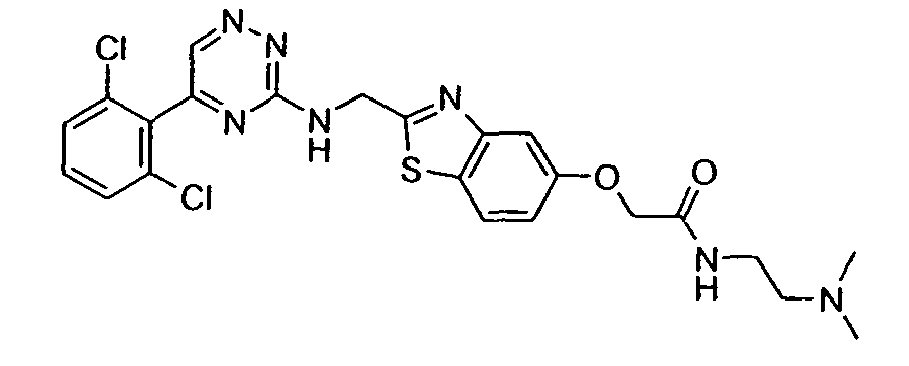
- Under argon, N,N-dimethylethane-1,2-diamine (9.4 µL, 0.083 mmol) was added at room temperature to a solution of {[2-({[5-(2,6-dichlorophenyl)-1,2,4-triazin-3-yl]amino}methyl)-1,3-benzothiazol-5-yl]oxy}acetic acid (20 mg, 0.043 mmol, prepared as in example 17), N-(3-dimethylaminopropyl)-N'-ethylcarbodiimide hydrochloride (16.5 mg, 0.086 mmol) and 4-dimethylaminopyridine (15.8 mg, 0.129 mmol) in anhydrous THF (0.2 mL) and dichloromethane (0.1 mL). The reaction mixture was stirred at 50°C for 4 hours. Then a dilute aqueous solution of ammonium hydroxide was added and the mixture was extracted with diethyl ether and ethyl acetate. Combined organic extracts were dried over sodium sulfate, filtered and evaporated. Purification by preparative TLC (silica gel, dichloromethane/methanol/aqueous ammonium hydroxide 33%, 90/10/1) gave 2-(2-{[5-(2,6-Dichlorophenyl)-[1,2,4]triazin-3-ylamino]-methyl}-benzothiazol-5-yloxy)-N-(2-dimethylamino-ethyl)-acetamide (16.5 mg, 72%) as a white solid.
- ESI-MS m/z 532 and 534 (M+H)+.
- 1H NMR (CD3OD), δ (ppm): 8.69 (s, 1H), 7.82 (d, J = 8.8 Hz, 1H), 7.49-7.45 (m, 4H), 7.16 (dd, J = 8.8 Hz and 1.4 Hz, 1H), 5.06 (br s, 2H), 4.61 (s, 2H), 3.46 (t, J = 6.6 Hz, 2H), 2.55 (t, J = 6.6 Hz, 2H), 2.31 (s, 6H).
-

- Under argon, a solution of 2-({[5-(2,6-dichlorophenyl)-1,2,4-triazin-3-yl]amino}methyl)-1,3-benzothiazol-5-ol (30 mg, 0.074 mmol, prepared as in example 16) and potassium carbonate (20.5 mg, 0.149 mmol) in anhydrous THF (0.3 mL) was stirred at 50°C for 1 hour. Then 1-chloroacetone (12 µL, 0.15 mmol) was added and the reaction mixture was stirred at 50°C overnight. The mixture was then concentrated and the residue was purified by preparative TLC (silica gel, dichloromethane/methanol 95/5) to afford 1-{[2-({[5-(2,6-dichlorophenyl)-1,2,4-triazin-3-yl]amino}methyl)-1,3-benzothiazol-5-yl]oxy}acetone (5.8 mg, 17%) as a yellow solid.
- ESI-MS m/z 460 and 462 (M+H)+.
- 1H NMR (CDCl3), δ (ppm): 8.70 (s, 1H), 7.73 (d, J = 8.9 Hz, 1H), 7.43-7.33 (m, 4H), 7.08 (dd, J = 8.9 Hz and J = 2.7 Hz, 1H), 5.17 (br s, 2H), 4.63 (s, 2H), 2.31 (s, 3H).
-

- Under argon, a solution of 2-({[5-(2,6-dichlorophenyl)-1,2,4-triazin-3-yl]amino}methyl)-1,3-benzothiazol-5-ol (30 mg, 0.074 mmol, prepared as in example 16) and potassium carbonate (20.5 mg, 0.149 mmol) in anhydrous THF (0.3 mL) was stirred at 50°C for I hour. Then iodoacetamide (27.5 mg, 0.15 mmol) was added and the reaction mixture was stirred at 50°C overnight. The mixture was then concentrated and the residue was purified by preparative TLC (silica gel, dichloromethane/methanol 95/5) to afford 2-{[2-({[5-(2,6-dichlorophenyl)-1,2,4-triazin-3-yl]amino}methyl)-1,3-benzothiazol-5-yl]oxy}acetamide (13.6 mg, 40%) as a yellow solid.
- ESI-MS m/z 461 and 463 (M+H)+.
- 1H NMR (CDCl3), δ (ppm): 8.70 (s, 1H), 7.74 (d, J = 8.7 Hz, 1H), 7.50 (d, J = 2.4 Hz, 1H), 7.42-7.33 (m, 3H), 7.06 (dd, J = 8.7 Hz and J = 2.4 Hz, 1H), 6.60 (br s, 2H), 5.87 (br s, 1H), 5.17 (br s, 2H), 4.57 (s, 2H).
-

- a) Representative procedure for the conversion of aryl methyl ketones into 5-aryl-3-chloro-[1,2,4]-triazine derivatives via 5-aryl-1,2,4-triazin-3(2H)-one intermediates:
A solution of 1-(2-methoxy-naphthalen-1-yl)-ethanone (1 g, 5 mmol, prepared as in J. Org. Chem. 1995, 60, 3427), selenium dioxide (610 mg, 5.5 mmol) in dioxane (4 mL) and water (0.8 mL) was heated to 105°C for 4 h. The reaction mixture was cooled to room temperature, filtered over a pad of celite and evaporated. The resulting orange oil was dissolved in ethanol (4 mL) and water (4 mL). Semicarbazide hydrochloride (390 mg, 3.5 mmol) and potassium carbonate (690 mg, 5 mmol) were added, and the solution was stirred at room temperature for 1.5 h, then at 105°C overnight. The reaction mixture was filtered on a pad of celite while hot, the reaction vessel being rinsed with hot ethanol. The resulting solution was evaporated. Purification by flash chromatography (silica gel, dichloromethane/methanol 1/0 to 95/5) led to 5-(2-methoxy-1-naphthyl)-1,2,4-triazin-3(2H)-one (377 mg, 30%) as a yellow solid.
ESI-MS m/z 254 (M+H)+.
Under argon, to a suspension of 5-(2-methoxy-1-naphthyl)-1,2,4-triazin-3(2H)-one (377 mg, 1.5 mmol) in anhydrous chloroform at room temperature were successiveley added phosphorus oxychloride (1.4 mL, 15 mmol) and anhydrous DMF (2 drops). The reaction mixture was heated to 50°C for 1.5 h, then cooled to room temperature and added to a dilute aqueous hydrochloric acid solution cooled to 0°C. The resulting solution was extracted with dichloromethane, The combined organic extracts were dried over sodium sulfate, filtered and evaporated. The crude product was purified by flash chromatography (silica gel, cyclohexane/dichloromethane 1/0 to 1/1 then cyclohexane/ethyl acetate 7/3) to afford 3-chloro-5-(2-methoxynapbthalen-1-yl)-[1,2,4]triazine (162 mg, 40%) as an orange oil.
ESI-MS m/z 272 and 274 (M+H)+. - b) Representative procedure for the synthesis of N-substituted-5-aryl-1,2,4-triazin-3-amine compounds by reaction of 5-aryl-3-chloro-[1,2,4]-triazine derivatives with amines:
A solution of 3-chloro-5-(2-methoxy-naphthalen-l-yl)-[l,2,4]triazine (108.7 mg, 0.4 mmol), benzothiazol-2-yl-methylamine hydrochloride (120 mg, 0.6 mmol), diisopropylethylamine (175 µL, 1 mmol) in anhydrous acetonitrile (2 mL) was stirred at room temperature for 2 h, then at 85°C over 2 days. An aqueous solution of ammonium chloride was added and the reaction mixture was extracted with ethyl acetate. The combined organic extracts were dried over sodium sulfate, filtered and evaporated. Purification by preparative TLC (silica gel, dichloromethane/methanol 95/5) afforded benzothiazol-2-ylmethyl-[5-(2-methoxy-naphthalen-1-yl)-[1,2,4]triazin-3-yl]-amine (67.1 mg, 42%) as a yellow solid.
ESI-MS m/z 400 (M+H)+.
1H NMR (CDCl3), δ (ppm): 8.83 (s, 1H), 7.99-7.95 (m, 2H), 7.87 (d, J = 7.6 Hz, 1H), 7.80 (d, J = 8.0 Hz, 1H), 7.58-7.56 (m, 1H), 7.50-7.46 (m, 1H), 7.41-7.29 (m, 4H), 5.19 (br s, 2H), 3.89 (s, 3H).
In the following examples (example 23 to example 31), the title compounds are prepared according to the procedures described in example 22.
Titles compounds are prepared by reaction of 5-aryl-3-chloro-[1,2,4]-triazine intermediates with amines according to the representative procedure for the synthesis of N-substituted-5-aryl-1,2,4-triazin-3-amine compounds by reaction of 5-aryl-3-chloro-[1,2,4]-triazine derivatives with amines as described in example 22. The corresponding 5-aryl-3-chloro-[1,2,4]-triazine intermediates are prepared from acetophenone derivatives following the representative procedure described in example 22 for the conversion of aryl methyl ketones into 5-aryl-3-chloro-[1,2,4]-triazine derivatives via 5-aryl-1,2,4-triazin-3(2H)-one intermediates. Acetophenone derivatives are commercially available starting materials or readily synthesized according to literature procedures. Amines are prepared as described above (example 1 and example 15) or commercially available starting materials, or prepared according to literature procedures. -

- ESI-MS m/z 364 (M+H)+.
- 1H NMR (CDCl3), δ (ppm): 8.80 (s, 1H), 7.99 (d, J = 8.0 Hz, 1H), 7.84 (d, J = 8.0 Hz, 1H), 7.47 (t, J = 8.0 Hz, 1H), 7.37 (t, J = 8.0 Hz, 1H), 7.28-7.26 (m, 1H), 7.05 (d, J = 8.0 Hz, 1H), 6.97 (d, J = 8.0 Hz, 1H), 5.18 (s, 2H), 3.86 (s, 3H), 2.22 (s, 3H).
-

- ESI-MS m/z 364 (M+H)+.
- 1H NMR (CDCl3), δ (ppm): 8.84 (s, 1H), 8.00 (d, J = 8.0 Hz, 1H), 7.84 (d, J = 8.0 Hz, 1H), 7.52 (d, J = 8.4 Hz, 1H), 7.49-7.45 (m, 1H), 7.39-7.35 (m, 1H), 6.85-6.82 (m, 1H), 6.80 (s, 1H), 5.18 (br s, 2H), 3.84 (s, 3H), 2.43 (s, 3H).
-

- ESI-MS m/z 364 (M+H)+.
- 1H NMR (CDCl3), δ (ppm): 8.51 (s, 1H), 7.97 (d, J = 8.0 Hz, 1H), 7.85 (d, J = 8.0 Hz, 1H), 7.50-7.47 (m, 1H), 7.42-7.38 (m, 2H), 6.88-6.86 (m, 2H), 5.21 (d, J = 5.9 Hz, 2H), 3.83 (s, 3H), 2.04 (s, 3H).
-

- ESI-MS m/z 372 and 374 (M+H)+.
- 1H NMR (CDCl3), δ (ppm): 8.79 (d, J = 1.3 Hz, 1H), 8.00 (d, J = 8.0 Hz, 1H), 7.85 (d, J = 8.0 Hz, 1H), 7.48 (td, J = 8.0 Hz and J = 1.3 Hz, 1H), 7.43-7.36 (m, 2H), 7.33-7.31 (m, 1H), 7.13 (t, J = 9.1 Hz, 1H), 6.43 (br s, 1H), 5.20 (s, 2H).
-

- ESI-MS m/z 428 and 430(M+H)+.
- 1H NMR (CDCl3), δ (ppm): 9.04 (s, 1H), 7.73-7.67 (m, 2H), 7.57-7.53 (m, 1H), 7.48 (d, J = 2.5 Hz, 1H), 7.43 (t, J = 7.8 Hz, 1H), 7.35 (td, J= 7.8 Hz and J = 1.5 Hz, 1H), 7.02 (dd, J = 8.8 Hz and J = 2.5 Hz, 1H), 5.18 (s, 2H), 3.87 (s, 3H).
-
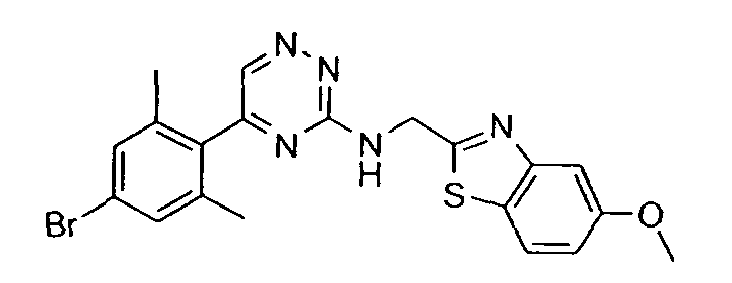
- ESI-MS m/z 456 and 458 (M+H)+.
- 1H NMR (CDCl3), δ (ppm): 8.59 (s, 1H), 7.68 (d, J = 8.8 Hz, 1H), 7.46 (d, J = 2.4 Hz, 1H), 7.25 (s, 2H), 7.02 (dd, J = 8.8 Hz and 2.4 Hz, 1H), 5.15 (br s, 2H), 3.88 (s, 3H), 2.06 (s, 6H).
-

- ESI-MS m/z 430 (M+H)+.
- 1H NMR (CDCl3), δ (ppm): 8.83 (s, 1H), 7.97 (d, J = 9.2 Hz, 1H), 7.80 (d, J = 8.4 Hz, 1H), 7.70 (d, J = 8.8 Hz, 1H), 7.60-7.55 (m 1H), 7.46 (d, J = 2.4 Hz, 1H), 7.34 (d, J = 8.8 Hz, 1H), 7.34-7.30 (m, 1H), 7.03 (dd, J = 8.8 Hz and 2.4 Hz, 1H), 6.36 (br s, 1H), 5.15 (br s = 2H), 3.89 (s, 3H), 3.88 (s, 3H).
-

- ESI-MS m/z 446 and 448 (M+H)+.
- 1H NMR (CDCl3), δ (ppm): 9.09 (s, 1H), 7.73 (d, J = 8.8 Hz, 1H), 7.62 (dd, J = 8.4 Hz and 5.6 Hz, 1H), 7.52 (d, J = 2.4 Hz, 1H), 7.49 (dd, J = 8.0 Hz and 2.4 Hz, 1H), 7.22-7.18 (m, 1H), 7.07 (dd, J = 8.8 Hz and 2.4 Hz, 1H), 5.21 (br s, 2H), 3.92 (s, 3H).
-

- ESI-MS m/z 462, 464 and 466 (M+H)+.
- 1H NMR (CDCl3, 300 MHz), δ (ppm): 9.05 (s, 1H), 7.88 (d, J = 8.7 Hz, 1H), 7.85-7.70 (m, 2H), 7.65-7.55 (m, 1H), 7.50 (d, J=2.7 Hz, 1H), 7.05 (dd, J = 8.7 Hz and 2.7 Hz, I H), 5.10-4.90 (br s, 2H), 3.83 (s, 3H).
-

- Under argon, to a solution of benzothiazol-2-ylmethyl-[5-(2-methoxy-naphthalen-1-yl)-[1,2,4]triazin-3-yl]-amine (49.5 mg, 0.12 mmol, prepared as in example 22) in anhydrous dichloromethane (0.5 mL) at -78°C was added dropwise a solution of boron tribromide in dichloromethane (1M, 1.25 mL, 1.25 mmol). The reaction mixture was stirred overnight allowing the temperature to raise to room temperature. The solution was cooled to -78°C, then methanol (2 mL) was added and the temperature let to rise. Solvents were evaporated, dichloromethane and an aqueous solution of ammonium chloride were added, and the resulting solution was extracted with dichloromethane. The combined organic extracts were dried over sodium sulfate, filtered and evaporated. The crude product was purified by preparative TLC (silica gel, dichloromethane/methanol 94/6) followed by recristallization in dichloromethane and cyclohexane to afford 1-{3-[(benzothiazol-2-ylmethyl)-amino]-[1,2,4]triazin-5-yl}-naphthalen-2-ol (9.6 mg, 20%) as an orange solid.
- ESI-MS m/z 386 (M+H)+.
- 1H NMR (DMSO-d6), δ (ppm): 8.90 (s, 1H), 8.09 (d, J = 8.8 Hz, 1H), 7.92-7.74 (m, 3H), 7.62-7.10 (m, 6H), 4.92 (br s, 2H).
-

- Under argon, to a solution of (5-methoxy-benzothiazol-2-ylmethyl)-[5-(2-methoxy-naphthalen-1-yl)-[1,2,4]triazin-3-yl]-amine (40.7 mg, 0.095 mmol, prepared as in example 29) in anhydrous dichloromethane (1 mL) at -78°C was added dropwise a solution of boron tribromide in dichloromethane (1M, 2 mL, 2 mmol). The reaction mixture was stirred overnight allowing the temperature to rise to room temperature. The solution was cooled to -78°C, then methanol (2 mL) was added and the temperature let to rise. Solvents were evaporated, ethyl acetate and an aqueous solution of ammonium chloride were added, and the resulting solution was extracted with ethyl acetate. The combined organic extracts were dried over sodium sulfate, filtered and evaporated. The crude product was purified by preparative TLC (silica gel, dichloromethane/methanol 95/5) to afford 2-{[5-(2-hydroxy-naphthalen-1-yl)-[1,2,4]triazin-3-ylamino]-methyl}-benzothiazol-5-ol (24.6 mg, 65%) as a yellow solid.
- ESI-MS m/z 402 (M+H)+.
- 1H NMR (DMSO-d6), δ (ppm): 9.65 (s, 1H), 8.83 (s, 1H), 7.94-7.87 (m, 1H), 7.84-7.80 (m, 2H), 7.30-7.21 (m, 4H), 6.93 (d, J = 8.4 Hz, 1H), 4.92 (br s, 2H).
-
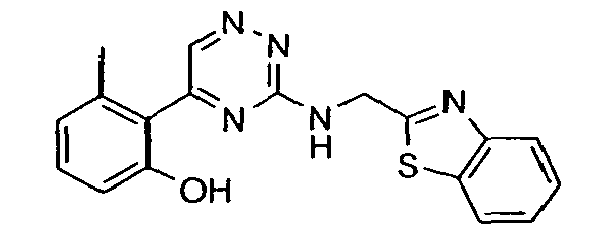
- Under argon, to a solution of N-(1,3-benzothiazol-2-ylmethyl)-5-(2-methoxy-6-methylphenyl)-1,2,4-triazin-3-amine (50 mg, 0.14 mmol, prepared as in example 25) in anhydrous dichloromethane (0.2 mL) at -78°C was added dropwise a solution of boron tribromide in dichloromethane (1M, 0.55 mL, 0.55 mmol). The reaction mixture was stirred for 2 hours allowing the temperature to rise to room temperature. The solution was cooled to -78°C, and boron tribromide in dichloromethane (1M, 0.55 mL, 0.55 mmol) was added again. The reaction mixture was stirred overnight allowing the temperature to rise to room temperature. Next the solution was cooled to 0°C, methanol and water were added and the temperature let to rise. The resulting solution was extracted with ethyl acetate. The combined organic extracts were dried over sodium sulfate, filtered and evaporated. The crude product was purified by preparative TLC (silica gel, dichloromethane/methanol 95/5) to afford 2-{3-[(1,3-benzothiazol-2-ylmethyl)amino]-1,2,4-triazin-5-yl}-3-methylphenol (16.9 mg, 35%) as an yellow solid.
- ESI-MS m/z 350 (M+H)+.
- 1H NMR (CDCl3), δ (ppm): 8.94 (s, 1H), 8.02 (d, J = 8.0 Hz, 1H), 7.86 (d, J = 8.0 Hz, 1H), 7.49 (td, J = 8.1 Hz and J = 1.1 Hz, 1H), 7.39 (td, J = 8.1 Hz and J = 1.1 Hz, 1H), 7.28-7.24 (m, 1H), 6.88-6.84 (m, 2H), 5.17 (br s, 2H), 2.50 (s, 3H).
-

- a)
Under argon, a solution of 3-chloro-5-(2-methoxy-6-methylphenyl)-1,2,4-triazine (50 mg, 0.21 mmol, prepared as in example 25) in anhydrous dichloromethane (1 mL) was cooled to -78°C, and boron tribromide (2mL, 20 mmol) was added dropwise. The reaction mixture was stirred allowing the temperature to raise to room temperature, completion of the reaction was followed by TLC. Water (5 mL) was added, and the mixture was extracted with dichloromethane. Combined organic extracts were washed with an aqueous solution of sodium hydrogencarbonate, then dried over sodium sulfate, filtered and evaporated to give 2-(3-chloro-1,2,4-triazin-5-yl)-3-methylphenol. - b)
A solution of 2-(3-chloro-1,2,4-triazin-5-yl)-3-methylphenol (16.3 mg, 0.074 mmol) and (5-methoxy-1,3-benzothiazol-2-yl)mcthylamine (28.6 mg, 0.147 mmol, prepared as in example 15) in anhydrous acetonitrile (0.2 mL) was stirred at 85°C for 2 days. The solution was then concentrated. Aqueous hydrochloric acid 1N was added and the solution was extracted with ethyl acetate. Combined organic extracts were dried over sodium sulfate, filtered and evaporated. The residue was purified by preparative TLC (silica gel, dichloromethane/methanol 96/4) to afford 2-(3-{[(5-methoxy-1,3-benzothiazol-2-yl)methyl]amino}-1,2,4-triazin-5-yl)-3-methylphenol (10.5 mg, 38%) as a yellow solid.
ESI-MS m/z 380 (M+H)+.
1H NMR (CDCl3), δ (ppm): 8.93 (s, 1H), 7.70 (d, J = 8.6 Hz, 1H), 7.50 (d, J = 2.4 Hz, 1H), 7.28-7.24 (m, 1H), 7.04 (dd, J = 8.6 Hz and J = 2.4 Hz, 1H), 6.88-6.83 (m, 2H), 5.14 (br s, 1H), 3.88 (s, 3H), 2.49 (s, 3H). -

- a)
Under argon, a solution of boron tribromide in dichloromethane (1M, 8 mL, 8 mmol) was added to 3-chloro-5-(4-methoxy-2-methylphenyl)-1,2,4-triazine (162 mg, 0.69 mmol, prepared as in example 24) cooled to -10°C. The reaction mixture was stirred overnight allowing the temperature to raise to room temperature. The mixture was poured in an ice-water bath, and dichloromethane was added. The resulting solution was extracted with dichloromethane, combined organic extracts were dried over sodium sulfate, filtered and evaporated to give crude 4-(3-chloro-1,2,4-triazin-5-yl)-3-methylphenol. - b)
A solution of 4-(3-chloro-1,2,4-triazin-5-yl)-3-methylphenol (60 mg, 0.27 mmol), benzothiazol-2-yl-methylamine (89 mg, 0.54 mmol), pyridine (28 µL, 0.32 mmol) in anhydrous acetonitrile (0.4 mL) was stirred at 85°C overnight. The solution was then concentrated and the residue was purified by preparative TLC (silica gel, dichloromethane/methanol 92/8) to give 4-{3-[(1,3-benzothiazol-2-ylmethyl)amino]-1,2,4-triazin-5-yl}-3-methylphenol (33.8 mg, 36%) as a yellow oil.
ESI-MS m/z 350 (M+H)+.
1H NMR (CDCl3), δ (ppm): 8.78 (s, 1H), 7.97 (d, J = 8.1 Hz, 1H), 7.83 (d, J = 8.1 Hz, 1H), 7.48 (t, J = 7.5 Hz, 1H), 7.39-7.31 (m, 2H), 6.77-6.75 (m, 2H), 6.56 (br s, 1H), 5.16 (s, 2H), 2.30 (s, 3H). -

- Under argon, a solution of 4-{3-[(1,3-benzothiazol-2-ylmethyl)amino]-1,2,4-triazin-5-yl}-3-methylphenol (15 mg, 0.043 mmol, prepared as in example 36) and potassium carbonate (6 mg, 0.043 mmol), in anhydrous DMF (0.2 mL) was stirred at 50°C for 1 hour. Then propylene oxide (6 µL, 0.086 mmol) was added and the solution was stirred at 50°C overnight. The mixture was then concentrated and the residue was purified by preparative TLC (silica gel, cyclohexane/ethyl acetate/methanol 50/50/2) to afford 1-(4-{3-[(1,3-benzothiazol-2-ylmethyl)amino]-1,2,4-triazin-5-yl}-3-methylphenoxy)propan-2-ol (1.2 mg, 7%).
- ESI-MS m/z 408 (M+H)+.
- 1H NMR (CDCl3), δ (ppm): 8.84 (s, 1H), 8.00 (d, J = 8.0 Hz, 1H), 7.84 (d, J = 7.5 Hz, 1H), 7.53-7.46 (m, 2H) 7.38 (t, J = 7.5 Hz, 1H), 6.86-6.84 (m, 2H), 5.18 (br s, 2H), 4.25-4.18 (m, 1H), 3.97 (dd, J = 9.1 Hz and J = 3.2 Hz, 1H), 3.87-3.82 (m, 1H), 2.40 (s, 3H), 1.30 (d, J = 6.4 Hz, 3H).
-

- A solution of 4-(3-chloro-1,2,4-triazin-5-yl)-3-methylphenol (73 mg, 0.33 mmol, prepared as in example 36) and (5-methoxy-1,3-benzothiazol-2-yl)methylamine (134 mg, 0.69 mmol, prepared as in example 15) in anhydrous acetonitrile (0.45 mL) was stirred at 85°C overnight. The solution was then concentrated and the residue was purified by preparative TLC (silica gel, dichloromethane/methanol 97/3) to give 4-(3-{[(5-methoxy-1,3-benzothiazol-2-yl)methyl]amino}-1,2,4-triazin-5-yl)-3-methylphenol (4.6 mg, 4%) as a yellow solid.
- ESI-MS m/z 380 (M+H)+.
- 1H NMR (CD3OD), δ (ppm): 8.75 (s, 1H), 7.77 (d, J = 8.7 Hz, 1H), 7.44 (d, J = 2.4 Hz, 1H), 7.13-7.07 (m, 1H), 7.04 (dd, J = 8.7 Hz and J = 2.4 Hz, 1H), 6.96-6.87 (m, 2H), 5.06 (s, 2H), 3.87 (s, 3H), 2.06 (s, 3H).
-

- a)
Under argon a solution of boron tribromide in dichloromethane (1M, 8 mL, 8 mmol) was added 3-chloro-5-(3-methoxy-2-methylphenyl)-1,2,4-triazine (132 mg, 0.56 mmol, prepared as in example 23) cooled to 0°C. The reaction mixture was stirred for 5 hours at 0°C. Dichloromethane was added and the reaction mixture was quenched with water. The solution was extracted with dichloromethane, combined organic extracts were dried over sodium sulfate, filtered and evaporated to give 3-(3-chloro-1,2,4-triazin-5-yl)-2-methylphenol. - b)
A solution of 3-(3-chloro-1,2,4-triazin-5-yl)-3-methylphenol (20 mg, 0.09 mmol), benzothiazol-2-yl-methylamine (29.6 mg, 0.18 mmol), pyridine (9.3 µL, 0.11 mmol) in anhydrous acetonitrile (0.2 mL) was stirred at 85°C for 3 days. The solution was then concentrated and the residue was purified by preparative TLC (silica gel, dichloromethane/methanol 92/8) to give 3-{3-[(1,3-benzothiazol-2-ylmethyl)amino]-1,2,4-triazin-5-yl}-3-methylphenol (7.7 mg, 24%) as a yellow oil.
ESI-MS m/z 350 (M+H)+.
1H NMR (CDCl3), δ (ppm): 8.79 (s, 1H), 7.99 (d, J = 7.5 Hz, 1H), 7.84 (d, J = 7.5 Hz, 1H), 7.47 (t, J = 7.5 Hz, 1H), 7.37 (t, J = 7.5 Hz, 1H), 7.14 (t, J = 7.8 Hz, 1H), 7.00 (d, J = 7.8 Hz, 1H), 6.94 (d, J = 7.8 Hz, 1H), 5.18 (s, 2H), 2.22 (s, 3H). -

- Under argon, a solution of 3-{3-[(1,3-benzothiazol-2-ylmethyl)amino]-1,2,4-triazin-5-yl}-3-methylphenol (20 mg, 0.057 mmol, prepared as in example 39), potassium carbonate (7.9 mg, 0.057 mmol) and tetrabutylammonium iodide (3.7 mg, 0.01 mmol) in anhydrous THF (0.25 mL) was stirred at 50°C for 1 hour. Then ethyl iodide (5.5 µL, 0.068 mL) was added and the reaction mixture was stirred overnight at 50°C. The mixture was then concentrated and the residue was purified by preparative TLC (silica gel, dichloromethane/methanol 95/5) to afford N-(1,3-benzothiazol-2-ylmethyl)-5-(3-ethoxy-2-methylphenyl)-1,2,4-triazin-3-amine (4.4 mg, 20%) as an off-white solid.
- ESI-MS m/z 378 (M+H)+.
- 1H NMR (CDCl3), δ (ppm): 8.80 (s, 1H), 7.99 (d, J = 7.8 Hz, 1H), 7.85 (d, J = 7.8 Hz, 1H), 7.48 (t, J = 7.8 Hz, 1H), 7.38 (t, J = 7.8 Hz, 1H), 7.27-7.23 (m, 1H), 7.03 (d, J = 7.8 Hz, 1H), 6.96 (d, J = 7.8 Hz, 1H), 5.19 (d, J = 4.3 Hz, 2H), 4.06 (q, J = 6.9 Hz, 2H), 2.24 (s, 3H), 1.44 (t, J = 6.9 Hz, 3H).
- In the following examples (example 41 and example 42), 2-(aminomethyl)-1,3-benzothiazol-5-amine was prepared from 2-methyl-5-nitro-1,3-benzothiazole according to the representative procedure for the synthesis of (1,3-benzothiazol-2-yl)methylamine compounds from methyl-1,3-benzothiazole derivatives described in example 15.
-

- a)
Under argon, a solution of tert-butyl nitrite (90%, 155 µL, 1.17 mmol) and copper(II) chloride (116 mg, 0.86 mmol) in anhydrous acetonitrile (1 mL) was heated at 65°C, and a solution of 5-(2,6-dimethoxyphenyl)-1,2,4-triazin-3-amine (181 mg, 0.78 mmol, prepared as in example 1) in anhydrous acetonitrile (3 mL) and dichloromethane (2 mL) was added. The reaction mixture was stirred at 65°C for 1.5 hours. The solution was then poured into aqueous hydrochloric acid 6N cooled to 0°C. The mixture was extracted with diethyl ether, combined organic extracts were washed with brine, then dried over sodium sulfate, filtered and evaporated. The residue was purified by flash chromatography (silica gel, cyclohexane/ethyl acetate, 8/2) to afford 3-chloro-5-(2,6-dimethoxyphenyl)-1,2,4-triazine (58 mg, 29%) as a yellow solid. - b)
Under argon, a solution of 3-chloro-5-(2,6-dimethoxyphenyl)-1,2,4-triazine (60 mg, 0.24 mmol) and 2-(aminomethyl)-1,3-benzothiazol-5-amine (150 mg, 0.72 mmol) in anhydrous acetonitrile (0.5 mL) was stirred at 85°C for 3 days. The mixture was then concentrated and the residue was purified by preparative TLC (silica gel, dichloromethane/methanol 95/5) to afford 2-({[5-(2,6-dimethoxyphenyl)-1,2,4-triazin-3-yl]amino}methyl)-1,3-benzothiazol-5-amine (43.7 mg, 46%) as an orange solid.
ESI-MS m/z 395 (M+H)+.
1H NMR (CDCl3), δ (ppm): 8.64 (s, 1H), 7.57 (d, J = 8.6 Hz, 1H), 7.36 (t, J = 8.6 Hz, 1H), 7.27-7.25 (m, 1H), 6.70 (dd, J = 8.6 Hz and J = 2.1 Hz, 1H), 6.61 (d, J = 8.6 Hz, 2H), 6.47 (br s, 1H), 5.11 (d, J = 5.4 Hz, 2H), 3.70 (s, 6H). -

- Under argon, a solution of 2-(3-chloro-1,2,4-triazin-5-yl)-3-methylphenol (142.2 mg, 0.64 mmol, prepared as in example 35), 2-(aminomethyl)-1,3-benzothiazol-5-amine (150 mg, 0.84 mmol) and DIPEA (112 µL, 0.64 mmol) in anhydrous acetonitrile (0.8 mL) was stirred at 85°C overnight. The solution was concentrated and the residue was purified by flash chromatography (silica gel, dichloromethane/methanol, 95/5) and preparative TLC (silica gel, dichloromethane/methanol, 95/5) to afford 2-(3-{[(5-amino-1,3-benzothiazol-2-yl)methyl]amino}-1,2,4-triazin-5-yl)-3-methylphenol (110 mg, 47%) as a brown solid.
- ESI-MS m/z 365 (M+H)+.
- 1H NMR (CD3OD), δ (ppm): 8.67 (s, 1H), 7.58 (d, J = 8.4 Hz, 1H), 7.22 (d, J = 2.1 Hz, 1H), 7.14 (t, J = 8.0 Hz, 1H), 6.85 (dd, J = 8.4 Hz and J = 2.1 Hz, 1H), 6.75-6.70 (m, 2H), 5.00 (br s, 2H), 1.94 (br s, 3H).
-

- Under argon, a solution of -(3-{[(5-amino-1,3-benzothiazol-2-yl)methyl]amino}-1,2,4-triazin-5-yl)-3-methylphenol (20 mg, 0.055 mmol, prepared as in example 42), 1,3-thiazole-2-carbaldehyde (18.7 mg, 0.165 mmol) and titanium(IV) isopropoxide (48 µL, 0.164 mol) in anhydrous THF (0.25 mL) with 4Å molecular sieves was stirred overnight at room temperature. Sodium borohydride (2.5 mg, 0.066 mmol) was added and the reaction mixture was stirred at room temperature for 4 hours. The solution was filtered over a pad of celite. Ethyl acetate and aqueous ammonium chloride were added to the filtrate. The mixture was extracted with ethyl acetate, combined organic extracts were dried over sodium sulfate, filtered and evaporated. Purification by preparative TLC (silica gel, dichloromethane/methanol, 95/5) led to 3-methyl-2-{3-[({5-[(1,3-thiazol-2-ylmethyl)amino]-1,3-benzothiazol-2-yl}methyl)amino]-1,2,4-triazin-5-yl}phenol (1.8 mg, 7%) as a yellow solid.
- ESI-MS m/z 462 (M+H)+.
- 1H NMR (CD3OD), δ (ppm): 8.66 (s, 1H), 7.75-7.73 (m, 2H), 7.61 (d = J = 8.8 Hz, 1H), 7.47-7.45 (m, 1H), 7.15 (t, J = 8.0 Hz, 1H), 7.05 (d, J = 2.2 Hz, 1H), 6.85 (dd, J = 8.8 Hz and 2.2 Hz, 1H), 6.73 (d, J = 8.0 Hz, 2H), 4.98 (s, 2H), 4.72 (s, 2H), 2.00 (br s, 3H).
- 7.58 (d, J = 8.4 Hz, 1H), 7.22 (d, J = 2.1 Hz, 1H), 7.14 (t, J = 8.0 Hz, 1H), 6.85 (dd, J = 8.4 Hz and J = 2.1 Hz, 1H), 6.75-6.70 (m, 2H), 5.00 (br s, 2H), 1.94 (br s, 3H).
-

- Under argon, a solution of 2-({[5-(2,6-dimethoxyphenyl)-1,2,4-triazin-3-yl]amino}methyl)-1,3-benzothiazol-5-amine (19.4 mg, 0.049 mmol, prepared as in example 41) and pyridine (5 µL, 0.058 mmol) in anhydrous dichloromethane (0.1 mL) was cooled to 0°C. Acetyl chloride (3.5 µL, 0.049 mmol) was added and the reaction mixture was stirred for 5 hours allowing the temperature to raise to room temperature. Then acetyl chloride (3.5 µL, 0.049 mmol) was added again and the reaction mixture was stirred overnight at room temperature. The solution was concentrated, then ethyl acetate and water were added. The mixture was extracted with ethyl acetate, combined organic extracts were dried over sodium sulfate, filtered and evaporated. Purification by preparative TLC (silica gel, dichloromethane/methanol, 95/5) led to N-[2-({[5-(2,6-dimethoxyphenyl)-1,2,4-triazin-3-yl]amino}methyl)-1,3-benzothiazol-5-yl]acetamide (6.8 mg, 32%) as a yellow oil.
- ESI-MS m/z 437 (M+H)+.
- 1H NMR (CDCl3), δ (ppm): 8.65 (s, 1H), 8.06 (s, 1H), 7.74 (d, J = 8.7 Hz, 1H), 7.64 (d, J = 8.7 Hz, 1H), 7.49 (s, 1H), 7.37 (t, J = 8.6 Hz, 1H), 6.62 (d, J = 8.6 Hz, 2H), 6.35 (br s, 1H), 5.16 (d, J = 5.1 Hz, 2H), 3.71 (s, 6H), 2.22 (s, 3H).
-

- Under argon, a solution of 2-({[5-(2,6-dimethoxyphenyl)-1,2,4-triazin-3-yl]amino}methyl)-1,3-benzothiazol-5-amine (17.4 mg, 0.044 mmol, prepared as in example 41) and pyridine (4 µL, 0.046 mmol) in anhydrous dichloromethane (0.1 mL) was cooled to 0°C. Methanesulfonyl chloride (3.5 µL, 0.045 mmol) was added and the reaction mixture was stirred overnight allowing the temperature to raise to room temperature. The solution was concentrated, then ethyl acetate and water were added. The mixture was extracted with ethyl acetate, combined organic extracts were dried over sodium sulfate, filtered and evaporated. Purification by preparative TLC (silica gel, dichloromethane/methanol, 95/5) led to N-[2-({[5-(2,6-dimethoxyphenyl)-1,2,4-triazin-3-yl]amino}methyl)-1,3-benzothiazol-5-yl]methanesulfonamide (5.2 mg, 25%) as a yellow solid.
- ESI-MS m/z 473 (M+H)+.
- 1H NMR (CDCl3), δ (ppm): 8.66 (s, 1H), 7.83 (d, J = 2.0 Hz, 1H), 7.78 (d, J = 8.6 Hz, 1H), 7.37 (t, J = 8.3 Hz, 1H), 7.32 (dd, J = 8.6 Hz and J = 2.0 Hz, 1H), 7.13 (s, 1H), 6.63 (d, J = 8.3 Hz, 2H), 6.31 (br s, 1H), 5.17 (d, J = 5.6 Hz, 2H), 3.72 (s, 6H), 3.02 (s, 3H).
-

- Under argon, a solution of 3-chloro-5-(2,6-dimethoxyphenyl)-1,2,4-triazine (60 mg, 0.24 mmol, prepared as in example 41) and (5-methoxy-1,3-benzothiazol-2-yl)methylamine (139.3 mg, 0.72 mmol, prepared as in example 15) in anhydrous acetonitrile (0.5 mL) was stirred at 85°C for 3 days. The solution was then concentrated and the residue was purified by preparative TLC (silica gel, dichloromethane/methanol 95/5) to give 5-(2,6-dimethoxyphenyl)-N-[(5-methoxy-1,3-benzothiazol-2-yl)methyl]-1,2,4-triazin-3-amine (70 mg, 72%) as a yellow solid.
- ESI-MS m/z 410 (M+H)+.
- 1H NMR (CDCl3), δ (ppm): 8.65 (s, 1H), 7.69 (d, J = 8.7 Hz, 1H), 7.48 (d, J = 2.4 Hz, 1H), 7.37 (t, J = 8.3 Hz, 1H), 7.02 (dd, J = 8.7 Hz and J = 2.4 Hz, 1H), 6.63 (d, J = 8.3 Hz, 2H), 6.13 (br s, 1H), 5.17 (d, J = 5.6 Hz, 2H), 3.89 (s, 3H), 3.72 (s, 6H).
-

- a)
Under argon, methyl iodide (0.57 mL, 9.2 mmol) was added to a solution of 2-methyl-1,3-benzothiazol-5-amine (1.0 g, 6.1 mmol) and potassium hydroxide (608 mg, 10.8 mmol) in acetone (100 mL) and water (5 mL). The reaction mixture was stirred at room temperature for 2 hours, then methyl iodide (0.57 mL, 9.2 mmol) and potassium hydroxide (343 mg, 6.1 mmol) were added and the reaction mixture was stirred for 3 days at room temperature. Ethyl acetate was added and acetone was evaporated. Water was added and the mixture was extracted with ethyl acetate. The combined organic extracts were dried over sodium sulfate, filtered and evaporated. The residue was purified by flash chromatography (silica gel, dichloromethane/methanol 1/0 to 97/3) and preparative TLC (silica gel, cyclohexane/ethyl acetate 7/3) to furnish N,N,2-trimethyl-1,3-benzothiazol-5-amine (260 mg, 22%) as an off-white solid.
ESI-MS m/z 193 (M+H)+. - b)
2-(aminomethyl)-N,N-dimethyl-1,3-benzothiazol-5-amine was obtained from N,N,2-trimethyl-1,3-benzothiazol-5-amine according to the representative procedure for the synthesis of (1,3-benzothiazol-2-yl)methylamine compounds from methyl-1,3-benzothiazole derivatives described in example 15. - c)
Under argon, a solution of 3-chloro-5-(2,6-dimethoxyphenyl)-1,2,4-triazine (22 mg, 0.087 mmol, prepared as in example 41) and 2-(aminomethyl)-N,N-dimethyl-1,3-benzothiazol-5-amine (38 mg, 0.18 mmol) in anhydrous acetonitrile (0.6 mL) was stirred at 85°C overnight. The solution was then concentrated and the residue was purified by preparative TLC (silica gel, dichloromethane/methanol 95/5) to give 2-({[5-(2,6-dimethoxyphenyl)-1,2,4-triazin-3-yl]amino}methyl)-N,N-dimethyl-1,3-benzothiazol-5-amine (8.2 mg, 22%) as a yellow solid.
ESI-MS m/z 423 (M+H)+.
1H NMR (CDCl3), δ (ppm): 8.60 (s, 1H), 7.63 (d, J = 8.9 Hz, 1H), 7.36 (t, J = 8.4 Hz, 1H), 7.29 (d, J = 2.5 Hz, 1H), 6.90 (dd, J = 8.9 Hz and J = 2.5 Hz, 1H), 6.62 (d, J = 8.4 Hz, 2H), 6.17 (br s, 1H), 5.13 (d, J = 5.6 Hz, 2H), 3.72 (s, 6H), 3.00 (s, 6H). -
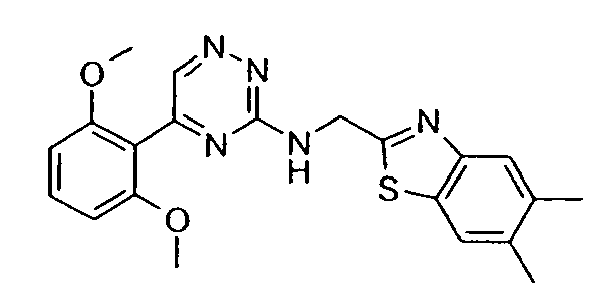
- Under argon, a solution of 3-chloro-5-(2,6-dimethoxyphenyl)-1,2,4-triazine (30 mg, 0.12 mmol, prepared as in example 41) and (5,6-dimethyl-1,3-benzothiazol-2-yl)methylamine (69 mg, 0.36 mmol, prepared from 2,5,6-trimethyl-1,3-benzothiazole according to the representative procedure for the synthesis of (1,3-benzothiazol-2-yl)methylamine compounds from methyl-1,3-benzothiazole derivatives described in example 15) in anhydrous acetonitrile (0.25 mL) was stirred at 85°C for 3 days. The solution was then concentrated and the residue was purified by preparative TLC (silica gel, dichloromethane/methanol 95/5) to give 5-(2,6-dimethoxyphenyl)-N-[(5,6-dimethyl-1,3-benzothiazol-2-yl)methyl]-1,2,4-triazin-3-amine (23 mg, 47%) as a yellow solid.
- ESI-MS m/z 408 (M+H)+.
- 1H NMR (CDCl3), δ (ppm): 8.63 (s, 1H), 7.73 (s, 1H), 7.57 (s, 1H), 7.35 (t, J = 8.4 Hz, 1H), 6.61 (d, J = 8.4 Hz, 2H), 6.35 (br s, 1H), 5.13 (d, J = 5.6 Hz, 2H), 3.70 (s, 6H), 2.38 (s, 3H), 2.36 (s, 3H).
-

- Under argon, a solution of 3-chloro-5-(2,6-dimethoxyphenyl)-1,2,4-triazine (30 mg, 0.12 mmol, prepared as in example 41) and (5-methyl-1,3-benzothiazol-2-yl)methylamine (64 mg, 0.36 mmol, prepared from 2,5-dimethyl-1,3-benzothiazole according to the representative procedure for the synthesis of (1,3-benzothiazol-2-yl)methylamine compounds from methyl-1,3-benzothiazole derivatives described in example 15) in anhydrous acetonitrile (0.3 mL) was stirred at 85°C for 6 hours and then at 50°C for 3 days. The solution was then concentrated and the residue was purified by preparative TLC (silica gel, dichloromethane/methanol 95/5) to give 5-(2,6-dimethoxyphenyl)-N-[(5-methyl-1,3-benzothiazol-2-yl)methyl]-1,2,4-triazin-3-amine (32.4 mg, 69%) as a white solid.
- ESI-MS m/z 394 (M+H)+.
- 1H NMR (CDCl3), δ (ppm): 8.66 (s, 1H), 7.77 (s, 1H), 7.70 (d, J = 8.3 Hz, 1H), 7.35 (t, J = 8.6 Hz), 7.18 (d, J = 8.3 Hz, 1H), 6.61 (d, J = 8.6 Hz, 2H), 6.45 (br s, 1H), 5.10 (s, 2H), 3.69 (s, 6H), 2.49 (s, 3H).
-

- Under argon, a solution of 3-chloro-5-(2,6-dimethoxyphenyl)-1,2,4-triazine (32.3 mg, 0.13 mmol, prepared as in example 41), 2-(aminomethyl)-1,3-benzothiazol-6-amine (30 mg, 0.17 mmol, prepared from 2-methyl-6-nitro-1,3-benzothiazole according to the representative procedure for the synthesis of (1,3-benzothiazol-2-yl)methylamine compounds from methyl-1,3-benzothiazole derivatives described in example 15) and DIPEA (23 µL, 0.13 mmol) in anhydrous acetonitrile (0.6 mL) was stirred at 85°C for 2 days. The solution was then concentrated and the residue was purified by preparative TLC (silica gel, dichloromethane/methanol 95/5) to give 2-({[5-(2,6-dimethoxyphenyl)-1,2,4-triazin-3-yl]amino}methyl)-1,3-benzothiazol-6-amine (32 mg, 63%) as a yellow oil.
- ESI-MS m/z 395 (M+H)+.
- 1H NMR (CDCl3), δ (ppm): 8.63 (s, 1H), 7.71 (d, J = 8.8 Hz, 1H), 7.35 (t, J = 8.3 Hz, 1H), 7.04 (d, J = 2.3 Hz, 1H), 6.79 (dd, J = 8.8 Hz and J = 2.3 Hz, 1H), 6.61 (d, J = 8.3 Hz, 2H), 6.39 (br s, 1H), 5.07 (d, J = 5.9 Hz, 2H), 3.70 (s, 6H).
-

- Under argon, a solution of 2-({[5-(2,6-dimethoxyphenyl)-1,2,4-triazin-3-yl]amino}methyl)-1,3-benzothiazol-6-amine (8.0 mg, 0.020 mmol, prepared as in example 50) and pyridine (2.5 µL, 0.029 mmol) in anhydrous dichloromethane (0.5 mL) was cooled to 0°C. Acetyl chloride (1.8 µL, 0.025 mmol) was added and the reaction mixture was stirred overnight at room temperature. The solution was concentrated, and then ethyl acetate and water were added. The mixture was extracted with ethyl acetate, combined organic extracts were dried over sodium sulfate, filtered and evaporated. Purification by preparative TLC (silica gel, dichloromethane/methanol, 95/5) led to N-[2-({(S-(2,6-dimethoxyphenyl)-1,2,4-triazin-3-yl]amino}methyl)-1,3-benzothiazol-6-yl]acetamide (2.6 mg, 29%) as a pale yellow oil.
- ESI-MS m/z 437 (M+H)+.
- 1H NMR (CDCl3), δ (ppm): 8.65 (s, 1H), 8.38 (d, J = 1.9 Hz, 1H), 7.87 (d, J = 8.6 Hz, 1H), 7.39-7.35 (m, 2H), 6.63 (d, J = 8.6 Hz, 2H,), 6.21 (br s, 1H), 5.15 (d, J = 5.9 Hz, 2H), 3.72 (s, 6H), 2.21 (s, 3H).
-

- Under argon, a solution of 2-({[5-(2,6-dimethoxyphenyl)-1,2,4-triazin-3-yl]amino}methyl)-1,3-benzothiazol-6-amine (18 mg, 0.046 mmol, prepared as in example 50) and pyridine (4 µL, 0.046 mmol) in anhydrous dichloromethane (0.1 mL) was cooled to 0°C. Methanesulfonyl chloride (3.5 µL, 0.045 mmol) was added and the reaction mixture was stirred overnight allowing the temperature to raise to room temperature. The solution was concentrated, and then ethyl acetate and water were added. The mixture was extracted with ethyl acetate, combined organic extracts were dried over sodium sulfate, filtered and evaporated. Purification by preparative TLC (silica gel, dichloromethane/methanol, 95/5) led to N-[2-({[5-(2,6-dimethoxyphenyl)-1,2,4-triazin-3-yl]amino}methyl)-1,3-benzothiazol-6-yl]methanesulfonamide (3.0 mg, 14%) as a yellow oil.
- ESI-MS m/z 473 (M+H)+.
- 1H NMR (CDCl3), δ (ppm): 8.67 (s, 1H), 7.90 (d, J = 8.9 Hz, 1H), 7.79 (d, J = 2.2 Hz, 1H), 7.41-7.35 (m, 2H), 6.89 (br s, 1H), 6.64 (d, J = 8.5 Hz, 2H), 6.20 (br s, 1H), 5.18 (d, J = 5.6 Hz, 2H), 3.73 (s, 6H), 3.01 (s, 3H).
-

- a)
Under argon, a solution of diisobutylaluminium hydride in toluene (1M, 6.3 mL, 6.3 mmol) was added to a solution of 6-methoxy-1,3-benzothiazole-2-carbonitrile (601 mg, 3.13 mmol) in anhydrous THF (25 mL) cooled to -78°C. The reaction mixture was stirred at -78°C for 2 hours, then diisobutylaluminium hydride in toluene (1M, 6.3 mL, 6.3 mmol) was again added dropwise. The reaction mixture was stirred for 2 hours allowing the temperature to raise to -20°C. An aqueous solution of sodium potassium tartrate was added and the temperature let to rise. The mixture was extracted with diethyl ether and ethyl acetate, combined organic extracts were dried over sodium sulfate, filtered and evaporated. The crude product was dissolved in ethanol (6 mL), hydroxylamine hydrochloride (417 mg, 6 mmol) and sodium methoxide (324 mg, 6 mmol) were added and the reaction mixture was stirred at room temperature overnight. The white solid was filtered off, rinsed with methanol and the filtrate was evaporated. The crude oxime was dissolved in acetic acid (15 mL), zinc dust (1.18 g, 18 mmol) was added portionwise and the reaction mixture was stirred at room temperature for 2 hours. The mixture was then filtered over a pad of celite and rinsed with methanol. Toluene was added and the filtrate was concentrated. Ethyl acetate and water were added. The aqueous layer was acidified to pH = 2 with hydrochloric acid 1N and extracted with diethyl ether and ethyl acetate. These organic layers were discarded. The aqueous layer was basified with aqueous sodium hydroxide to pH = 10, and then extracted with diethyl ether and ethyl acetate. Purification by flash chromatography (silica gel, dichloromethane/methanol, 1/0 to 9/1) led to (6-methoxy-1,3-benzothiazol-2-yl)methylamine (300 mg, 49%) as a light brown oil.
ESI-MS m/z 195 (M+H)+. - b)
To a solution of (6-methoxy-1,3-benzothiazol-2-yl)methylamine (300 mg, 1.54 mmol) in anhydrous dichloromethane (6 mL) stirred at -78°C under argon, a solution of boron tribromide in heptane (1M, 6.2 mL, 6.2 mmol) was added dropwise. The reaction mixture was stirred for 6 hours allowing the temperature to raise slowly to 0°C. The solution was then cooled to -35°C, methanol was added and the temperature let to rise. The mixture was concentrated, then dichloromethane and water were added. The aqueous layer was basified with an aqueous solution of sodium hydroxide to pH = 12, and the solution was extracted with dichloromethane. These organic layers were discarded. The pH of the aqueous layer was adjusted to 8 with aqueous ammonium chloride. The aqueous layer was extracted with dichloromethane, combined organic extracts were dried over sodium sulfate, filtered and evaporated. Purification by flash chromatography (silica gel, dichloromethane/methanol, 1/0 to 9/1) afforded 2-(aminomethyl)-1,3-benzothiazol-6-ol (40.8 mg, 15%) as an off-white solid.
ESI-MS m/z 181 (M+H)+. - c)
Under argon, a solution of 3-chloro-5-(2,6-dimethoxyphenyl)-1,2,4-triazine (34.2 mg, 0.136 mmol, prepared as in example 41), 2-(aminomethyl)-1,3-benzothiazol-6-ol (36.8 mg, 0.20 mmol) and pyridine (16.5 µL, 0.20 mmol) in anhydrous acetonitrile (0.75 mL) was stirred at 85°C overnight. The solution was then concentrated and the residue was purified by preparative TLC (silica gel, dichloromethane/methanol 95/5) to give 2-({[5-(2,6-dimethoxyphenyl)-1,2,4-triazin-3-yl]amino}methyl)-1,3-benzothiazol-6-ol (9.4 mg, 17%) as an omage solid.
ESI-MS m/z 396 (M+H)+.
1H NMR (CD3OD), δ (ppm): 8.52 (s, 1H), 7.72 (d, J = 8.4 Hz, 1H), 7.39 (t, J = 8.4 Hz, 1H), 7.26 (d, J = 2.4 Hz, 1H), 6.97 (dd, J = 8.4 Hz and 2.4 Hz, 1H), 6.71 (d, J = 8.4 Hz, 2H), 4.98 (br s, 2H), 3.64 (br s, 6H). -

- a)
Under argon, chloroacetyl chloride (160 µL, 2 mmol) was added to a solution of 2-amino-4-chlorobenzenethiol (160 mg, 1 mmol) in anhydrous toluene (3 mL) at room temperature. Triethylamine (140 µL, 1 mmol) was added dropwise and the reaction mixture was stirred at room temperature for 20 minutes, then at 105°C for 2.5 hours. The solution was cooled to room temeprature and then poured into an aqueous solution of sodium hydrogencarbonate. The mixture was extracted with diethyl ether, combined organic extracts were dried over sodium sulfate, filtered and evaporated to give crude 5-chloro-2-(chloromethyl)-1,3-benzothiazole. The latter compound was placed in a screwed-cap tube, and dissolved in THF (0.5 mL). An aqueous ammonium hydroxide solution (33%, 3 mL) and a few milligrams of tetrabutylammonium iodide were added and the reaction mixture was stirred overnight at 60°C. Ethyl acetate was added and ammonia was evaporated. The aqueous layer was acidified to pH = 1 with cold 1N aqueous hydrochloric acid. Extraction with diethyl ether and ethyl acetate gave organic extracts which were discarded. The aqueous layer was basified with aqueous sodium hydroxide to pH = 10, then extracted with diethyl ether and ethyl acetate. Combined organic extracts were dried over sodium sulfate, filtered and evaporated to give crude (5-chloro-1,3-benzothiazol-2-yl)methylamine (32.7 mg, 16%) as a brown solid.
ESI-MS m/z 199 and 201 (M+H)+. - b)
Under argon, a solution of 3-chloro-5-(2,6-dimethoxyphenyl)-1,2,4-triazine (20 mg, 0.08 mmol, prepared as in example 41), (5-chloro-1,3-benzothiazol-2-yl)methylamine (32.7 mg, 0.16 mmol) and DIPEA (14 µL, 0.08 mmol) in anhydrous acetonitrile (0.5 mL) was stirred at 85°C overnight. An aqueous ammonium chloride solution was added and the mixture was extracted with ethyl acetate. The combined organic extracts were dried over sodium sulfate, filtered and evaporated. Purification by preparative TLC (silica gel, dichloromethane/methanol 95/5) afforded N-[(5-chloro-1,3-benzothiazol-2-yl)methyl]-5-(2,6-dimethoxyphenyl)-1,2,4-triazin-3-amine (15.4 mg, 47%) as a brown solid.
ESI-MS m/z 414 and 416 (M+H)+.
1H NMR (CDCl3), δ (ppm); 8.59 (s, 1H), 7.96 (d, J = 2.0 Hz, 1H), 7.75 (d, J = 8.4 Hz, 1H), 7.39 (t, J = 8.4 Hz, 1H), 7.34 (dd, J = 8.4 Hz and 2.0 Hz, 1H), 6.62 (d, J = 8.4 Hz, 2H), 5.18 (d, J = 6.0 Hz, 2H), 3.69 (s, 6H). -

- a)
[5-(trifluoromethyl)-1,3-benzothiazol-2-yl]methylamine was prepared from 2-amino-4-(trifluoromethyl)benzenethiol following the same procedure as in example 54 for the preparation of (5-chloro-1,3-benzothiazol-2-yl)methylamine from 2-amino-4-chlorobenzenethiol.
ESI-MS m/z 233 (M+H)+. - b)
Under argon, a solution of 3-chloro-5-(2,6-dimethoxyphenyl)-1,2,4-triazine (16.2 mg, 0.064 mmol, prepared as in example 41) and [5-(trifluoromethyl)-1,3-benzothiazol-2-yl]methylamine (60 mg, 0.26 mmol) in anhydrous acetonitrile (0.75 mL) was stirred at 85°C overnight. The solution was then concentrated and the residue was purified by preparative TLC (silica gel, dichloromethane/methanol 95/5) to afford 5-(2,6-dimethoxyphenyl)-N-{[5-(trifluoromethyl)-1,3-benzothiazol-2-yl]methyl}-1,2,4-triazin-3-amine (21.1 mg, 73%)as a yellow solid.
ESI-MS m/z 448 (M+H)+.
1H NMR (CDCl3), δ (ppm): 8.65 (s, 1H), 8.24 (s, 1H), 7.95 (d, J = 8.4 Hz, 1H), 7.60 (d, J = 8.4 Hz, 1H), 7.37 (t, J = 8.4 Hz, 1H), 6.61 (d, J = 8.4 Hz, 2H), 5.19 (d, J = 5.6 Hz, 2H), 3.69 (s, 6H). -

- a)
Under argon, chloroacetyl chloride (122 µL, 1.5 mmol) was added to a solution of 2-aminophenol (111 mg, 1 mmol) in xylenes (4 mL). Triethylamine (153 µL, 1.1 mmol) was next added dropwise. The resulting mixture was stirred for 2 hours at room temperature then at 145°C overnight. An aqueous solution of ammonium chloride was added, and the mixture was extracted with ethyl acetate. The combined organic extracts were washed with brine, then dried over sodium sulfate, filtered and evaporated to give crude 2-(chloromethyl)-1,3-benzoxazole. The latter compound was placed in a screwed-cap tube, and dissolved in THF (0.5 mL). An aqueous ammonium hydroxide solution (33%, 4 mL) was added. The reaction mixture was stirred 30 minutes at room temperature then 22 hours at 60°C. Ethyl acetate was added and ammonia was evaporated. The aqueous layer was acidified to pH = I with cold 1N aqueous hydrochloric acid. Extraction with diethyl ether and ethyl acetate gave organic extracts which were discarded.. The aqueous layer was basified with aqueous sodium hydroxide to pH = 10, then extracted with diethyl ether and ethyl acetate. Combined organic extracts were dried over sodium sulfate, filtered and evaporated to give crude 1,3-benzoxazol-2-ylmethylamine (19.4 mg, 13%) as a brown solid.
ESI-MS m/z 149 (M+H)+. - b)
Under argon, a solution of 3-chloro-5-(2,6-dimethoxyphenyl)-1,2,4-triazine (16.5 mg, 0.066 mmol, prepared as in example 41), 1,3-benzoxazol-2-ylmethylamine (19.4 mg, 0.13 mmol) and DIPEA (11 µL, 0.063 mmol) in anhydrous acetonitrile (0.3 mL) was stirred at 85°C for 4 hours then at 50°C for 3 days. An aqueous ammonium chloride solution was added and the mixture was extracted with ethyl acetate. The combined organic extracts were dried over sodium sulfate, filtered and evaporated. Purification by preparative TLC (silica gel, dichloromethane/methanol 95/5) afforded N-(1,3-benzoxazol-2-ylmethyl)-5-(2,6-dimethoxyphenyl)-1,2,4-triazin-3-amine (6.1 mg, 26%) as a white solid.
ESI-MS m/z 364 (M+H)+.
1H NMR (CDCl3), δ (ppm): 8.58 (s, 1H), 7.70-7.68 (m, 1H), 7.52-7.50 (m, 1H), 7.39 (t, J = 8.4 Hz, 1H), 7.34-7.31 (m, 2H), 6.62 (d, J = 8.4 Hz, 2H), 5.07 (d, J = 5.6 Hz, 2H), 3.68 (s, 6H). -

- a)
A solution of 2-chlorocyclohexanone (58 µL, 0.5 mmol), tert-butyl-2-amino-2-thioxoethylcarbamate (105.7 mg, 0.5 mmol) in ethanol (2 mL) was stirred at room temperature for 1.5 hours, then at 80°C for 40 hours. The reaction was then concentrated. Ethyl acetate and a diluted hydrochloric acid solution were added to the crude product. The solution was extracted with diethyl ether and ethyl acetate. These organic layers were discarded. The aqueous layer was basified with aqueous sodium hydroxide to pH = 10, and then extracted with diethyl ether and ethyl acetate. Combined organic extracts were dried over sodium sulfate, filtered and evaporated to give crude 1-(4,5,6,7-tetrahydro-1,3-benzothiazol-2-yl)methanamine (30.9 mg, 36%) as a brown oil which was used in the next steps without purification.
ESI-MS m/z 169 (M+H)+. - b)
Under argon, a solution of 3-chloro-5-(2,6-dimethoxyphenyl)-1,2,4-triazine (20 mg, 0.08 mmol, prepared as in example 41), 1-(4,5,6,7-tetrahydro-1,3-benzothiazol-2-yl)methanamine (30.9 mg, 0.18 mmol) and triethylamine (11 µL, 0.08 mmol) in anhydrous acetonitrile (0.5 mL) was stirred at 85°C overnight. An aqueous solution of diluted hydrochloric acid was added and the mixture was extracted with ethyl acetate. The combined organic extracts were dried over sodium sulfate, filtered and evaporated. Purification by preparative TLC (silica gel, dichloromethane/methanol 95/5) afforded 5-(2,6-dimethoxyphenyl)-N-(4,5,6,7-tetrahydro-1,3-benzothiazol-2-ylmethyl)-1,2,4-triazin-3-amine (6.6 mg, 22%) as a brown oil.
ESI-MS m/z 384 (M+H)+.
1H NMR (CDCl3), δ (ppm): 8.50 (s, 1H), 7.46 (t, J = 8.4 Hz, 1H), 6.65 (d, J = 8.4 Hz, 2H), 5.19 (br s, 2H), 3.79 (s, 6H), 2.84 (br s, 2H), 2.74 (br s, 2H), 1.86 (br s, 4H). -

- a)
(4,5-dimethyl-1,3-thiazol-2-yl)methanol was prepared by reduction of 4,5-dimethyl-1,3-thiazole-2-carbaldehyde (prepared as in example 1) with sodium borohydride and purified by flash chromatography. - b)
Under argon, sodium hydride (60%, 3.1 mg, 0.08 mmol) was added to a solution of (4,5-dimethyl-1,3-thiazol-2-yl)methanol (16.2 mg, 0.11 mmol) in anhydrous THF (1 mL). The reaction mixture was stirred at room temperature for 20 minutes, then 3-chloro-5-(2,6-dimethoxyphenyl)-1,2,4-triazine (10 mg, 0.04 mmol, prepared as in example 41) was added and the resulting mixture was stirred overnight at 70°C. An aqueous ammonium chloride solution was added and the mixture was extracted with diethyl ether and ethyl acetate. The combined organic extracts were dried over sodium sulfate, filtered and evaporated. Purification by preparative TLC (silica gel, dichloromethane/methanol 95/5) afforded 5-(2,6-dimethoxyphenyl)-3-[(4,5-dimethyl-1,3-thiazol-2-yl)methoxy]-1,2,4-triazine (5.4 mg, 38%) as a pale yellow oil.
ESI-MS m/z 359 (M+H)+.
1H NMR (CDCl3), δ (ppm): 8.99 (s, 1H), 7.40 (t, J = 8.4 Hz, 1H), 6.64 (d, J = 8.4 Hz, 2H), 5.80 (s, 2H), 3.76 (s, 6H), 2.36 (s, 6H). -

- Under argon, a solution of 3-chloro-5-(2,6-dimethoxyphenyl)-1,2,4-triazine (6.85 mg, 0.027 mmol, prepared as in example 41), (1,5-dimethyl-1H-pyrazol-3-yl)methylamine (8 mg, 0.064 mmol) and potassium carbonate (3.8 mg, 0.028 mmol) in anhydrous acetonitrile (0.7 mL) was stirred at 85°C overnight. The solution was evaporated. The residue was purified by preparative TLC (silica gel, dichloromethane/methanol 95/5) to afford 5-(2,6-dimethoxyphenyl)-N-[(1,5-dimethyl-1H-pyrazol-3-yl)methyl]-1,2,4-triazin-3-amine (5.5 mg, 59%) as an off-white solid.
- ESI-MS m/z 341 (M+H)+.
- 1H NMR (CDCl3), δ (ppm): 8.45 (s, 1H), 7.40 (t, J = 8.4 Hz, 1H), 6.64 (d, J = 8.4 Hz, 2H), 6.06 (s, 1H), 4.70 (d, J = 5.2 Hz, 2H), 3.77 (s, 6H), 3.73 (s, 3H), 2.23 (s, 3H).
-

- a)
Under argon, to a solution of 4,5-dimethylthiazole (580 µL, 5.32 mmol) in anhydrous THF (35 mL) at -78°C, n-butyllithium (2.3 M in hexane, 3.3 mL, 7.59 mmol) in anhydrous THF (5 mL) was slowly added and the reaction mixture was stirred at -78°C for one hour. Then a solution of anhydrous N,N-dimethylacetamide (1.16 mL, 12.48 mmol) in anhydrous THF (10 mL) was added. The resulting mixture was stirred for 3 hours, allowing the temperature to raise to -40°C. Methanol and an aqueous solution of ammonium chloride were added, and the temperature let to raise to room temperature. The resulting solution was extracted with diethyl ether and ethyl acetate. The combined organic extracts were dried over sodium sulfate, filtered and evaporated. The crude product was purified by flash chromatography (silica gel, cyclohexane/ethyl acetate, 1/0 to 9/1) to afford 1-(4,5-dimethyl-1,3-thiazol-2-yl)ethanone (814 mg, 98%) as a white solid.
ESI-MS m/z 156 (M+H)+. - b)
Under argon, a solution of 1-(4,5-dimethyl-1,3-thiazol-2-yl)ethanone (155 mg, 1 mmol), hydroxylamine hydrochloride (142 mg, 2 mmol) and sodium methoxide (108 mg, 2 mmol) in ethanol (2 mL) was stirred at room temperature overnight. The white solid was filtered off, rinsed with methanol and the solution was evaporated. The crude oxime was dissolved in acetic acid (6 mL), zinc dust (392 mg, 6 mmol) was added portionwise at room temperature and the reaction mixture was stirred at room temperature for 3.5 hours. The mixture was then filtered over a pad of celite and rinsed with methanol. Toluene was added and the filtrate was concentrated. An aqueous solution of ammonium chloride was added, the solution was acidified to pH = 1 with hydrochloric acid 1N and extracted with diethyl ether and ethyl acetate. These organic layers were discarded. The aqueous layer was basified with aqueous sodium hydroxide to pH = 10, and then extracted with diethyl ether and ethyl acetate. Combined organic extracts were dried over sodium sulfate, filtered and evaporated to give crude 1-(4,5-dimethyl-1,3-thiazol-2-yl)ethanamine (67.2 mg, 43%) as a pale yellow oil which was used in the next steps without purification.
ESI-MS m/z 157 (M+ H)+. - c)
Under argon, a solution of 3-chloro-5-(2,6-dimethoxyphenyl)-1,2,4-triazine (8.2 mg, 0.033 mmol, prepared as in example 41), 1-(4,5-dimethyl-1,3-thiazol-2-yl)ethanamine (10 mg, 0.064 mmol) and potassium carbonate (5.3 mg, 0.038 mmol) in anhydrous acetonitrile (0.7 mL) was stirred at 85°C overnight. The solution was evaporated. The residue was purified by preparative TLC (silica gel, dichloromethane/methanol 95/5) to give 5-(2,6-dimethoxyphenyl)-N-[1-(4,5-dimethyl-1,3-thiazol-2-yl)ethyl]-1,2,4-triazin-3-amine (3.6 mg, 30%) as a pale yellow oil.
ESI-MS m/z 372 (M+H)+.
1H NMR (CDCl3), δ (ppm): 8.51 (s, 1H), 7.41 (t, J = 8.4 Hz, 1H), 6.64 (d, J = 8.4 Hz, 2H), 5.63-5.58 (m, 1H), 3.76 (s, 6H), 2.32 (s, 6H), 1.77 (d, J = 6.8 Hz, 3H). -

- Under argon, a solution of 3-chloro-5-(2,6-dimethoxyphenyl)-1,2,4-triazine (15.4 mg, 0.061 mmol, prepared as in example 41), 2-piperidin-2-yl-1,3-benzothiazole (20 mg, 0.092 mmol) and DIPEA (11 µL, 0.063 mmol) in anhydrous acetonitrile (0.25 mL) was stirred at 85°C overnight. The solution was then concentrated and the residue was purified by preparative TLC (silica gel, dichloromethane/methanol 95/5) to give 2-{1-[5-(2,6-dimethoxyphenyl)-1,2,4-triazin-3-yl]piperidin-2-yl}-1,3-benzothiazole (9.8 mg, 37%) as a yellow oil.
- ESI-MS m/z 434 (M+H)+.
- 1H NMR (CDCl3), δ (ppm): 8.59 (s, 1H), 7.99 (d, J = 7.8 Hz, 1H), 7.83 (d, J = 7.8 Hz, 1H), 7.45 (t, J = 8.4 Hz, 1H), 7.39-7.32 (m, 2H), 7.60 (d, J = 8.4 Hz, 2H), 6.55 (br s, 1H), 5.04-5.00 (m, 1H), 3.67 (s, 6H), 3.36-3.28 (m, 1H), 2.79-2.74 (m, 1H), 2.06-2.02 (m, 1H), 1.80-1.69 (m, 4H).
-
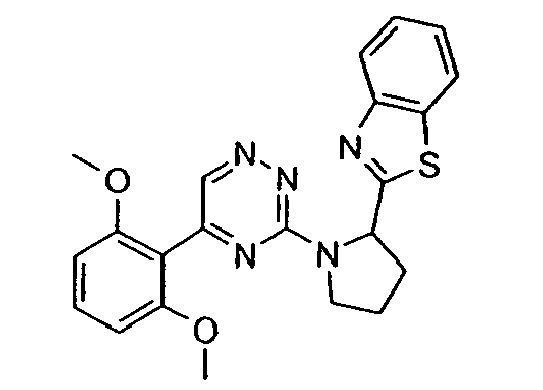
- Under argon, a solution of 3-chloro-5-(2,6-dimethoxyphenyl)-1,2,4-triazine (16.4 mg, 0.065 mmol, prepared as in example 41), 2-pyrrolidin-2-yl-1,3-benzothiazole hydrochloride (23.5 mg, 0.098 mmol) and DIPEA (28 µL, 0.16 mmol) in anhydrous acetonitrile (0.25 mL) was stirred at 85°C overnight. The solution was then concentrated and the residue was purified by preparative TLC (silica gel, dichloromethane/methanol 95/5) to afford 2-{1-[5-(2,6-dimethoxyphenyl)-1,2,4-triazin-3-yl]pyrrolidin-2-yl}-1,3-benzothiazole (26.8 mg, 98%) as a pale yellow oil.
- ESI-MS m/z 420 (M+H)+.
- 1H NMR (CDCl3), δ (ppm): 8.58 (s, 1H), 7.95 (d, J = 8.0 Hz, 1H), 7.80 (d, J = 8.0 Hz, 1H), 7.43 (t, J= 7.9 Hz, 1H), 7.32 (t, J = 8.0 Hz, 2H), 6.53 (d, J = 7.9 Hz, 2H), 5.75 (br s, 1H), 4.15 (br s, 1H), 3.89 (br s, 1H), 3.45 (br s, 6H), 2.54-2.41 (m, 2H), 2.30-2.01 (m, 2H).
-

- a)
A solution of N-(2-methoxyphenyl)acetamide (869 mg, 5 mmol) and Lawesson's reagent (1.23 g, 3 mmol) in anhydrous toluene (50 mL) was stirred at 110°C under argon for 3 hours. The reaction mixture was concentrated. The crude product was purified by flash chromatography (silica gel, cyclohexane/ethyl acetate, 9/1 to 7/3) to afford N-(2-Methoxy-phenyl)-thioacetamide contaminated by traces Lawesson's reagent as a yellow oil. This oil was diluted with ethanol (0.5 mL), and mixed with a solution of sodium hydroxide (1.44 g, 36 mmol) in water (3.5 mL). The resulting solution was added dropwise (over a period of 20 minutes) to a solution of potassium ferricyanide (III) (5.3 g, 16 mmol) in water (1.5 mL) stirred at 90°C. The reaction mixture was kept stirring at 90°C for 50 minutes after completion of the addition. The mixture was cooled to room temperature and filtered. The solid was rinsed with water, then extracted with ethyl acetate. The aqueous layer was also extracted with ethyl acetate. Combined organic extracts were dried over sodium sulfate, filtered and evaporated. Purification by preparative TLC (silica gel, cyclohexane/ethyl acetate 7/3) afforded 4-methoxy-2-methyl-1,3-benzothiazole (89.3 mg, 10%) as a beige solid.
ESI-MS m/z 180 (M+H)+. - b)
A solution of 4-methoxy-2-methyl-1,3-benzothiazole (89.3 mg, 0.5 mmol) and selenium dioxide (111 mg, 1 mmol) in 1,4-dioxane (1.5 mL) was stirred under argon at 100°C for 3 hours. The reaction mixture was filtered and rinsed with hot 1,4-dioxane, and the filtrate was evaporated to give crude 4-methoxy-1,3-benzothiazole-2-carbaldehyde. Ethanol (1 mL) was added followed by hydroxylamine hydrochloride (69.5 mg, 1 mmol) and sodium methoxide (54 mg, I mmol), and the resulting mixture was stirred at room temperature under argon overnight. The solution was filtered and the solid rinsed with methanol, and the filtrate was concentrated. The obtained crude oxime was dissolved in acetic acid (3 mL), zinc dust (196 mg, 3 mmol) was added portionwise at room temperature and the reaction mixture was kept stirring at room temperature for 3 hours. The mixture was then filtered over a pad of celite, and rinsed with methanol. Toluene was added and the filtrate was concentrated. An aqueous solution of ammonium chloride was added, the solution was acidified to pH = 2 with hydrochloric acid 1N and extracted with diethyl ether and ethyl acetate. These organic layers were discarded. The aqueous layer was basified with aqueous sodium hydroxide to pH = 10, and then extracted with diethyl ether and ethyl acetate. Combined organic extracts were dried over sodium sulfate, filtered and evaporated to give crude (4-methoxy-1,3-benzothiazol-2-yl)methylamine (29.2 mg, 30%) as a brown solid which was used in the next steps without purification.
ESI-MS m/z 195 (M+H)+. - c)
Under argon, a solution of 3-chloro-5-[2-(trifluoromethyl)phenyl]-1,2,4-triazine (39 mg, 0.15 mmol, prepared as in example 13), (4-methoxy-1,3-benzothiazol-2-yl)methylamine (29.2 mg, 0.15 mmol) and DIPEA (26 µL, 0.15 mmol) in anhydrous acetonitrile (0.5 mL) was stirred at room temperature for 2.5 hours, then at 85°C overnight and at 50°C for 24 hours. The solution was then concentrated and the residue was purified by preparative TLC (silica gel, dichloromethane/methanol 95/5) to give N-[(4-methoxy-1,3-benzothiazol-2-yl)methyl]-5-[2-(trifluoromethyl)phenyl]-1,2,4-triazin-3-amine (51.1 mg, 81%) as a yellow solid.
ESI-MS m/z 418 (M+H)+.
1H NMR (CDCl3), δ (ppm): 8.82 (s, 1H), 7.82-7.80 (m, 1H), 7.68-7.60 (m, 2H), 7.52-7.50 (m, 1H), 7.41 (dd, J = 8.0 Hz and 0.8 Hz, 1H), 7.33-7.29 (m, 1H), 6.90 (d, J = 7.6 Hz, 1H), 5.21 (br s, 2H), 4.04 (s, 3H). -

- Under argon, a solution of boron tribromide in heptane (1M, 300 µL, 0.3 mmol) was slowly added to a solution of N-[(4-methoxy-1,3-benzothiazol-2-yl)methyl]-5-[2-(trifluoromethyl)phenyl]-1,2,4-triazin-3-amine (27.1 mg, 0.065 mmol, prepared as in example 63) in anhydrous dichloromethane (0.8 mL) at -78°C. The reaction mixture was stirred overnight allowing the temperature to raise to room temperature. The solution was then cooled to -50°C and methanol was added. The solution was kept stirring allowing the temperature to raise to room temperature, and then was evaporated. An aqueous solution of hydrochloric acid was added and the mixture was extracted with dichloromethane. The combined organic extracts were dried over sodium sulfate, filtered and evaporated. Purification by preparative TLC (silica gel, dichloromethane/methanol 95/5) afforded 2-[({5-[2-(trifluoromethyl)phenyl]-1,2,4-triazin-3-yl}amino)methyl]-1,3-benzothiazol-4-ol (10.9 mg, 42%) as an off-white solid.
- ESI-MS m/z 404 (M+H)+.
- 1H NMR (CDCl3), δ (ppm): 8.83 (s, 1H), 7.84-7.82 (m, 1H), 7.70-7.63 (m, 2H), 7.53-7.51 (m, 1H), 7.33 (d, J = 7.8 Hz, 1H), 7.29-7.25 (m, 1H), 6.98 (dd, J = 7.8 Hz and 1.0 Hz, 1H), 5.17 (br s, 2H).
-

- a)
At room temperature, a solution of 3,4-difluoroaniline (100 µL, 1 mmol) and N-iodosuccinimide (225 mg, 1 mmol) in anhydrous dichloromethane (4 mL) was stirred overnight under argon atmosphere. Then an aqueous solution of sodium sulfite was added and the reaction mixture was extracted with dichloromethane. The combined organic extracts were dried over sodium sulfate, filtered and evaporated. The crude product was purified by flash chromatography (silica gel, cyclohexane/ethyl acetate, 1/0 to 8/2) to afford 4,5-difluoro-2-iodoaniline (175 mg, 69%) as a red oil.
ESI-MS m/z 255.9 (M+H)+. - b) Representative procedure for the palladium catalyzed synthesis of (1,3-thiazol-2-yl)methylamine compounds
A solution of 4,5-difluoro-2-iodoaniline (167 mg, 0.65 mmol) in anhydrous acetonitrile (0.7 mL) was added to the reaction mixture containing tris(dibenzylidene acetone)dipalladium(0) (13.8 mg, 0.015 mmol), dppf (33 mg, 0.06 mmol), calcium (II) oxide (56.1 mg, 1 mmol) and tert-butyl-2-amino-2-thioxoethylcarbamate (150 mg, 0.79 mmol) in degassed anhydrous acetonitrile (0.3 mL). Then the reaction mixture was degassed, placed under argon atmosphere and stirred at 60°C overnight. The solution was filtered over a pad of celite, rinsed with dichloromethane, methanol, ethyl acetate, and evaporated. Purification by preparative TLC (silica gel, dichloromethane/methanol 95/5) led to tert-butyl (5,6-difluoro-1,3-benzothiazol-2-yl)methylcarbamate (19.2 mg). The latter compound was dissolved in ethyl acetate (0.9 mL) and hydrochloric acid (37%, 0.3 mL) was slowly added at 0°C. The reaction mixture was vigorously stirred for 20 minutes at 0°C and then 15 minutes at room temperature. Water and ethyl acetate were added, extraction with diethyl ether and ethyl acetate gave organic layers which were discarded. The aqueous layer was basified with aqueous sodium hydroxide to pH = 10, then extracted with diethyl ether and ethyl acetate. Combined organic extracts were dried over sodium sulfate, filtered and evaporated to give crude (5,6-difluoro-1,3-benzothiazol-2-yl)methylamine (8.5 mg, 6%) as a red solid. ESI-MS m/z 201 (M+H)+. - c)
Under argon, a solution of 3-chloro-5-(2,6-dimethoxyphenyl)-1 ,2,4-triazine (13 mg, 0.052 mmol, prepared as in example 41), (5,6-difluoro-1,3-benzothiazol-2-yl)methylamine (8.5 mg, 0.043 mmol) and DIPEA (7 µL, 0.04 mmol) in anhydrous acetonitrile (0.2 mL) was stirred at 85°C overnight. The solution was then concentrated and the residue was purified by preparative TLC (silica gel, dichloromethane/methanol 94/6) to give N-[(5,6-difluoro-1 ,3-benzothiazol-2-yl)methyl]-5-(2,6-dimethoxyphenyl)-1,2,4-triazin-3-amine (9.0 mg, 51 %) as a yellow solid.
ESI-MS m/z 416 (M+H)+.
1H NMR (CDCl3), δ (ppm): 8.67 (s, 1H), 7.76 (dd, J = 10.4 Hz and 7.2 Hz, 1H), 7.61 (dd, J = 9.2 Hz and 7.6 Hz, 1H), 7.37 (t, J = 8.4 Hz, 1H), 6.63 (d, J = 8.4 Hz, 2H), 5.15 (d, J = 5.6 Hz, 2H), 3.72 (s, 6H). -

- a)
Methyl 2-(aminomethyl)-1,3-benzothiazole-6-carboxylate was prepared from methyl 4-amino-3-iodobenzoate according to the representative procedure for the palladium catalyzed synthesis of (1,3-thiazol-2-yl)methylamine compounds described in example 65. ESI-MS m/z 223 (M+H)+. - b)
Under argon, a solution of 3-chloro-5-(2,6-dimethoxyphenyl)-1,2,4-triazine (21.5 mg, 0.085 mmol, prepared as in example 41), methyl 2-(aminomethyl)-1,3-benzothiazole-6-carboxylate (17.8 mg, 0.080 mmol) and DIPEA (14 µL, 0.08 mmol) in anhydrous acetonitrile (0.5 mL) was stirred at room temperature for 1 hour, then at 85°C overnight. The solution was then concentrated and the residue was purified by preparative TLC (silica gel, dichloromethane/methanol 94/6) to give methyl 2-({[5-(2,6-dimethoxyphenyl)-1,2,4-triazin-3-yl]amino} methyl)-1,3-benzothiazole-6-carboxylate (15 mg, 43%) as a yellow oil.
ESI-MS m/z 438 (M+H)+.
1H NMR (CDCl3), δ (ppm): 8.66 (s, 1H), 8.57 (d, J = 1.6 Hz, 1H), 8.14 (dd, J = 8.6 Hz and 1.6 Hz, 1H), 8.00 (d, J = 8.6 Hz, 1H), 7.36 (t, J = 8.6 Hz, 1H), 6.61 (d, J = 8.6 Hz, 2H), 5.19 (d, J = 5.6 Hz, 2H), 3.95 (s, 3H), 3.70 (s, 6H). -

- a)
(6-Chloro-1,3-benzothiazol-2-yl)methylamine was prepared from 4-chloro-2-iodoaniline according to the representative procedure for the palladium catalyzed synthesis of (1,3-thiazol-2-yl)methylamine compounds described in example 65.
ESI-MS m/z 199 and 201 (M+H)+. - b)
Under argon, a solution of 3-chloro-5-(2,6-dimethoxyphenyl)-1,2,4-triazine (51 mg, 0.20 mmol, prepared as in example 41), (6-chloro-1,3-benzothiazol-2-yl)methylamine (60 mg, 0.30 mmol) and DIPEA (70 µL, 0.4 mmol) in anhydrous acetonitrile (0.4 mL) was stirred at 85°C overnight. The solution was then concentrated and the residue was purified by preparative TLC (silica gel, dichloromethane/methanol 95/5) to give N-[(6-chloro-1,3-benzothiazol-2-yl)metbyl]-5-(2,6-dimethoxyphenyl)-1,2,4-triazin-3-amine (23 mg, 27%) as a yellow solid.
ESI-MS m/z 414 and 416 (M+H)+.
1H NMR (CDCl3), δ (ppm): 8.66 (s, 1H), 7.87 (d, J = 8.6 Hz, 1H), 7.79 (d, J = 2.0 Hz, 1H), 7.42 (dd, J = 8.6 Hz and J = 2.0 Hz, 1H), 7.34 (t, J = 8.6 Hz, 1H), 6.65 (br s, 1H), 6.59 (d, J = 8.6 Hz, 2H), 5.10 (d, J = 5.6 Hz, 2H), 3.60 (s, 6H). -

- a)
(6-chloro-4-fluoro-1,3-benzothiazol-2-yl)methylamine was prepared from 4-chloro-2-fluoro-6-iodoaniline according to the representative procedure for the palladium catalyzed synthesis of (1,3-thiazol-2-yl)methylamine compounds described in example 65. ESI-MS m/z 217 and 219 (M+H)+. - b)
Under argon, a solution of 3-chloro-5-(2,6-dimethoxyphenyl)-1,2,4-triazine (93 mg, 0.37 mmol, prepared as in example 41), (6-chloro-4-fluoro-1,3-benzothiazol-2-yl)methylamine (80 mg, 0.37 mmol) and DIPEA (65 µL, 0.37 mmol) in anhydrous acetonitrile (0.7 mL) was stirred at 85°C overnight. The solution was then concentrated and the residue was purified by preparative TLC (silica gel, dichloromethane/methanol 95/5) to give N-[(6-chloro-4-fluoro-1,3-benzothiazol-2-yl)methyl]-5-(2,6-dimethoxypheny)-1,2,4-triazin-3-amine (60.5 mg, 38%) as a yellow solid.
ESI-MS m/z 432 and 434 (M+H)+,
1H NMR (CDCl3), δ (ppm): 8.65 (s, 1H), 7.58 (d, J = 1.9 Hz 1H), 7.35 (t, J = 8.3 Hz, 1H), 7.19 (dd, J = 9.9 Hz and J = 1.9 Hz, 1H), 6.67 (br s, 1H), 6.60 (d, J = 8.3 Hz, 2H), 5.12 (d, J = 5.9 Hz, 2H), 3.69 (s, 6H). -

- a)
1-[1,3]Thiazolo[4,5-c]pyridin-2-ylmethanamine was prepared from 3-amino-4-iodopyridine according to the representative procedure for the palladium catalyzed synthesis of (1,3-thiazol-2-yl)methylamine compounds described in example 65.
ESI-MS m/z 166 (M+H)+. - b)
Under argon, a solution of 3-chloro-5-(2-methoxy-6-methylphenyl)-1,2,4-triazine (28.5 mg, 0.12 mmol, prepared as in example 25), 1-[1,3]thiazolo[4,5-c]pyridin-2-ylmethanamine (20 mg, 0.12 mmol) and triethylamine (17 µL, 0.12 mmol) in anhydrous acetonitrile (0.15 mL) was stirred at 85°C for 3 days. The solution was then concentrated and the residue was purified by preparative TLC (silica gel, dichloromethane/methanol 95/5) to give 5-(2-methoxy-6-methylphenyl)-N-([1,3]thiazolo[4,5-c]pyridin-2-ylmethyl)-1,2,4-triazin-3-amine (9.2 mg, 21%) as a yellow oil.
ESI-MS m/z 365 (M+H)+.
1H NMR (CDCl3), δ (ppm): 9.29 (s, 1H), 8.72 (s, 1H), 8.52 (d, J = 5.3 Hz, 1H), 7.80 (d, J = 5.3 Hz, 1H), 7.31 (t, J = 7.8 Hz, 1H), 6.87 (d, J = 7.8 Hz, 1H), 6.82 (d, J = 7.8 Hz, 1H), 6.30 (br s, 1H), 5.20 (d, J = 5.3 Hz, 2H), 3.74 (s, 3H), 2.11 (br s, 3H). -

- a)
1-[1,3]Thiazolo[5,4-b]pyridin-2-ylmethanamine was prepared from 3-amino-2-bromopyridine according to the representative procedure for the palladium catalyzed synthesis of (1,3-thiazol-2-yl)methylamine compounds described in example 65.
ESI-MS m/z 166 (M+H)+. - b)
Under argon, a solution of 3-chloro-5-(2-methoxy-6-methylphenyl)-1,2,4-triazine (43 mg, 0.18 mmol, prepared as in example 25), 1-[1,3]thiazolo[5,4-b]pyridin-2-ylmethanamine (60 mg, 0.36 mmol) and triethylamine (25 µL, 0.18 mmol) in anhydrous acetonitrile (0.3 mL) was stirred at 85°C for 3 days. The solution was then concentrated and the residue was purified by preparative TLC (silica gel, dichloromethane/methanol 95/5) to give 5-(2-methoxy-6-methylphenyl)-N-([1,3]thiazolo[5,4-b]pyridin-2-ylmethyl)-1,2,4-triazin-3-amine (57.8 mg, 87%) as a yellow oil.
ESI-MS m/z 365 (M+H)+.
1H NMR (CDCl3), δ (ppm): 8.68 (s, 1H), 8.55 (d, J = 4.5 Hz, 1H), 8.19 (d, J = 8.0 Hz, 1H), 7.40 (dd, J = 8.0 Hz and J = 4.5 Hz, 1H), 7.29-7.25 (m, 1H), 6.84 (d, J = 8.0 Hz, 1H), 6.79 (d, J = 8.0 Hz, 1H), 5.10 (br s, 2H), 3.71 (s, 3H), 2.10 (br s, 3H). -

- A solution of Dibal-H in toluene (1M, 110µL, 0.11 mmol) was added to a solution of methyl 2-({[5-(2,6-dimethoxyphenyl)-1,2,4-triazin-3-yl]amino}methyl)-1,3-benzothiazole-6-carboxylate (11.8 mg, 0.027 mmol, prepared as in example 66) in anhydrous dichloromethane (0.6 mL) stirred at -78°C under argon atmosphere. The reaction mixture was stirred for 2 hours allowing the temperature to raise slowly to -45°C. A drop of methanol was added followed by a 1M aqueous solution of sodium potassium tartrate. The temperature was allowed to raise to room temperature, then the reaction mixture was extracted with dichloromethane and ethyl acetate. Combined organic extracts were dried over sodium sulfate, filtered and evaporated. Purification by preparative TLC (silica gel, dichloromethane/methanol 95/5) afforded [2-({[5-(2,6-dimethoxyphenyl)-1,2,4-triazin-3-yl]amino}methyl)-1,3-benzothiazol-6-yl]methanol (5.3 mg, 48%) as a beige solid.
- ESI-MS m/z 410 (M+H)+.
- 1H NMR (CDCl3), δ (ppm): 8.66 (s, 1H), 7.95 (d, J = 8.4 Hz, 1H), 7.87 (d, J = 1.6 Hz, 1H), 7.45 (dd, J = 8.4 Hz and 1.6 Hz, 1H), 7.37 (t, J = 8.4 Hz, 1H), 6.63 (d, J = 8.4 Hz, 2H), 5.19 (d, J = 5.6 Hz, 2H), 4.82 (s, 2H), 3.72 (s, 6H).
-

- a)
A solution of 3-amino-4-iodopyridine (500 mg, 2.27 mmol), tris(dibenzylideneacetone)dipalladium(0) (63.6 mg, 0.07 mmol), dppf (155 mg, 0.28 mmol), calcium (II) oxide (255 mg, 4.55 mmol) and tert-butyl-2-amino-2-thioxoethylcarbamate (600 mg, 3.15 mmol) in anhydrous acetonitrile (4.5 mL) was degassed and stirred under argon atmosphere at 60°C overnight. The solution was filtered over a pad of celite, rinsed with dichloromethane, methanol, ethyl acetate, and evaporated. Purification by flash chromatography (silica gel, dichloromethane/methanol 1/0 to 95/5) led to tert-butyl [1,3]thiazolo[4,5-c]pyridin-2-ylmethylcarbamate (500 mg, 83%) as a yellow oil.
ESI-MS m/z 266 (M+H)+. - b)
Under argon, methyl iodide (100 µL, 1.6 mmol) was added to a solution of tert-butyl [1,3]thiazolo[4,5-c]pyridin-2-ylmethylcarbamate (200 mg, 0.75 mmol) in anhydrous DMF (12 mL). The reaction mixture was stirred at 80°C for 4 hours. The solution was concentrated. Water (10 mL) was added to the residue, and sodium borohydride (82 mg, 2.17 mmol) was added portionwise at 0°C. The resulting mixture was stirred at room temperature for 1 hour. Aqueous sodium hydroxide 1N was added and the solution was extracted with ethyl acetate. The combined organic extracts were dried over sodium sulfate, filtered and evaporated. Purification by preparative TLC (silica gel, dichloromethane/methanol, 95/5) afforded tert-butyl (5-methyl-4,5,6,7-tetrahydro[1,3]thiazolo[4,5-c]pyridin-2-yl)methylcarbamate (160 mg, 75%) as a yellow oil.
ESI-MS m/z 284 (M+H)+. - c)
Tert-butyl (5-methyl-4,5,6,7-tetrahydro[1,3]thiazolo[4,5-c]pyridin-2-yl)methylcarbamate (160 mg, 0.57 mmol) was dissolved in ethyl acetate (2 mL) and hydrochloric acid (37%, 1.1 mL) was slowly added at 0°C. The reaction mixture was vigorously stirred for 20 minutes at 0°C and then 15 minutes at room temperature. Water and ethyl acetate were added, extraction with diethyl ether and ethyl acetate gave organic layers which were discarded. The aqueous layer was basified with aqueous sodium hydroxide to pH = 10, then extracted with diethyl ether and ethyl acetate. Combined organic extracts were dried over sodium sulfate, filtered and evaporated. The residue was purified by preparative TLC (silica gel, dichloromethane/methanol/aqueous ammonium hydroxide 33%, 95/5/1) to give (5-methyl-4,5,6,7-tetrahydro[1,3]thiazolo[4,5-c]pyridin-2-yl)methylamine (30 mg, 29%) as a yellow oil.
ESI-MS m/z 184 (M+H)+. - d)
Under argon, a solution of 3-chloro-5-(2-methoxy-6-methylphenyl)-1,2,4-triazine (30 mg, 0.127 mmol, prepared as in example 25), (5-methyl-4,5,6,7-tetrahydro[1,3]thiazolo[4,5-c]pyridin-2-yl)methylamine (30 mg, 0.164 mmol) and triethylamine (18 µL, 0.130 mmol) in anhydrous acetonitrile (0.6 mL) was stirred at 85°C for 3 days. The solution was then concentrated and the residue was purified by preparative TLC (silica gel, dichloromethane/methanol 95/5) to afford 5-(2-methoxy-6-methylphenyl)-N-(4,5,6,7-tetrahydro[1,3]thiazolo[4,5-c]pyridin-2-ylmethyl)-1,2,4-triazin-3-amine (6.4 mg, 14%) as a yellow oil.
ESI-MS m/z 369 (M+H)+.
1H NMR (CDCl3), δ (ppm): 8.60 (s, 1H), 7.32 (t, J = 8.0 Hz, 1H), 6.91 (d, J = 8.0 Hz, 1H), 6.84 (d, J = 8.0 Hz, 1H), 5.02 (br s, 2H), 4.32-4.29 (m, 2H), 4.13 (br s, 2H), 3.76 (s, 3H), 2.98-2.95 (m, 2H), 2.24 (s, 3H). -

- a)
Under argon, to a solution of 1-(4-amino-2,6-dimethyl-phenyl)-ethanone (2.95 g, 18 mmol, prepared as in J. Org. Chem. 1953, 18, 496) in THF (36 mL) cooled to 0°C, were successively added triethylamine (2.5 mL, 18 mmol), and di(tert-butyl) dicarbonate (3.95 g, 18 mmol). The reaction mixture was stirred overnight allowing the temperature to raise to room temperature, then heated to 50°C for 2 h. The solvent was evaporated, and an aqueous solution of ammonium chloride was added. The resulting solution was extracted with diethyl ether and ethyl acetate. The combined organic extracts were dried over sodium sulfate, filtered and evaporated. The crude product was purified by flash chromatography (silica gel, cyclohexane/ethyl acetate 1/0 to 1/1) to afford (4-acetyl-3,5-dimethyl-phenyl)-carbamic acid tert-butyl ester (3.538 g, 74%) as a white solid
ESI-MS m/z 286 (M+Na)+. - b) Representative procedure for the conversion of aryl methyl ketones into 3-amino-5-aryl-[1,2,4]-triazine derivatives:
A solution of (4-acetyl-3,5-dimethyl-phenyl)-carbamic acid tert-butyl ester (1.317 g, 5 mmol), selenium dioxide (777 mg, 7 mmol) in dioxane (4 mL) and water (0.8 mL) was heated to 105°C for 6 h. The reaction mixture was cooled to room temperature, filtered over a pad of celite and evaporated. The resulting oil was dissolved in ethanol (5 mL) and water (0.8 mL). Aminoguanidine hydrochloride (480 mg, 4.3 mmol) and potassium carbonate (828 mg, 6 mmol) were added, and the solution was stirred at room temperature for 1 h, then at 95°C overnight. The reaction mixture was filtered on a pad of celite while hot, the reaction vessel being rinsed with hot ethanol. The resulting solution was evaporated. Purification by flash chromatography (silica gel, dichloromethane/methanol 1/0 to 95/5) led to [4-(3-amino-[1,2,4]triazin-5-yl)-3,5-dimethyl-phenyl]-carbamic acid tert-butyl ester (541 mg, 34%) as an orange solid.
ESI-MS m/z 316 (M+H)+. - c) Representative procedure for the conversion of 3-amino-[1,2,4]-triazine derivatives into 3-chloro-[1,2,4]-triazine derivatives:
Under argon, tert-butyl nitrite (90%, 365 µL, 2.76 mmol) was added to a solution of [4-(3-amino-[1,2,4]triazin-5-yl)-3,5-dimethyl-phenyl]-carbamic acid tert-butyl ester (541 mg, 1.72 mmol) and copper(II) chloride (300 mg, 2.23 mmol) in anhydrous acetonitrile (5 mL). The resulting mixture was heated to 70°C for 1 h. After cooling to room temperature, cold 3N aqueous hydrochloric acid (5 mL) was added and the mixture was extracted with diethyl ether and ethyl acetate. The combined organic extracts were dried over sodium sulfate, filtered and evaporated. The crude product was purified by flash chromatography (silica gel, cyclohexane/dichloromethane 1/0 to 1/1, then cyclohexane/ethyl acetate 7/3) to give [4-(3-chloro-[1,2,4]triazin-5-yl)-3,5-dimethyl-phenyl]-carbamic acid tert-butyl ester (173 mg, 30%) as a yellow solid.
ESI-MS m/z 335 and 337 (M+H)+. - d)
According to the experimental procedure used in example 22 for the synthesis of N-substituted-5-aryl-1,2,4-triazin-3-amine compounds by reaction of 5-aryl-3-chloro-[1,2,4]-triazine derivatives with amines, reaction of [4-(3-chloro-[1,2,4]triazin-5-yl)-3,5-dimethyl-phenyl]-carbamic acid tert-butyl ester (173 mg, 0.52 mmol) with (5-methoxy-benzothiazol-2-yl)-methylamine (152 mg, 0.78 mmol, prepared as in example 15) afforded (4-{3-[(5-methoxy-benzothiazol-2-ylmethyl)-amino]-[1,2,4]triazin-5-yl}-3,5-dimethyl-phenyl)-carbamic acid tert-butyl ester (207 mg, 81 %) as a beige solid.
ESI-MS m/z 493 (M+H)+.
1H NMR (CDCl3), δ (ppm): 8.59 (s, 1H), 7.68 (d, J = 8.8 Hz, 1H), 7.47 (d, J = 2.4 Hz, 1H), 7.14 (s, 2H), 7.02 (dd, J = 8.8 Hz and 2.4 Hz, 1H), 5.14 (br s, 2H), 3.88 (s, 3H), 2.08 (s, 6H), 1.52 (s, 9H). -

- Under argon, to 4-{3-[(5-methoxy-benzothiazol-2-ylmethyl)-amino]-[1,2,4]triazin-5-yl}-3,5-dimethyl-phenyl)-carbamic acid tert-butyl ester (200 mg, 0.4 mmol, prepared as in example 73) cooled to 0°C was added a mixture of 37% aqueous hydrochloric acid (0.75 mL) and ethyl acetate (2.25 mL). The reaction mixture was stirred for 1 h allowing the temperature to raise to room temperature. A dilute aqueous solution of sodium hydroxyde was added until neutral or slightly basic pH was reached, then the reaction mixture was extracted with ethyl acetate. The combined organic extracts were dried over sodium sulfate, filtered and evaporated. The crude product was purified by preparative TLC (silica gel, dichloromethane/methanol 94/6 ) to afford [5-(4-amino-2,6-dimethyl-phenyl)-[1,2,4]triazin-3-yl]-(5-methoxy-benzothiazol-2-ylmethyl)-amine (138.4 mg, 87%) as a yellow solid.
- ESI-MS m/z 393 (M+H)+.
- 1H NMR (DMSO-d6), δ (ppm): 8.63 (s, 1H), 7.88 (d, J = 8.8 Hz, 1H), 7.47 (s, 1H), 7.04 (d, J = 8.8 Hz, 1H), 6.28 (br s, 2H), 4.90 (br s, 2H), 3.83 (s, 3H), 1.94 (br s, 6H).
-

- Under argon, triethylamine (70 µL, 0.5 mmol) was added to a solution of [5-(4-amino-2,6-dimethyl-phenyl)-[1,2,4]triazin-3-yl]-(5-methoxy-benzothiazol-2-ylmethyl)-amine (40 mg, 0.1 mmol, prepared as in example 74), 2-chloro-1-methylpyridinium iodide (77 mg, 0.3 mmol) and dimethylamino-acetic acid (16 mg, 0.15 mmol) in anhydrous dichloromethane (0.7 mL). The reaction mixture was stirred at room temperature for 2 days. An aqueous solution of sodium hydroxide and ammonia was then added and the solution was extracted with dichloromethane. The combined organic extracts were dried over sodium sulfate, filtered and evaporated. The crude product was purified by preparative TLC (silica gel, dichloromethane/methanol/aqueous ammonium hydroxide 33%, 94/6/1) to afford 2-dimethylamino-N-(4-{3-[(5-methoxy-benzothiazol-2-ylmethyl)-amino]-[1,2,4]triazin-5-yl}-3,5-dimethyl-phenyl)-acetamide (7.4 mg, 15%).
- ESI-MS m/z 478 (M+H)+.
- 1H NMR (CDCl3), δ (ppm): 8.60 (s, 1H), 7.68 (d, J = 8.8 Hz, 1H), 7.47 (d, J = 2.4 Hz, 1H), 7.38 (s, 2H), 7.02 (dd, J = 8.8 Hz and 2.4 Hz, 1H), 5.14 (br s, 2H), 3.88 (s, 3H), 3.08 (s, 2H), 2.38 (s, 6H), 2.10 (s, 6H).
-

- a)
Under argon, triethylamine (70 µL, 0.5 mmol) was added to a solution of [5-(4-amino-2,6-dimethyl-phenyl)-[1,2,4]triazin-3-yl]-(5-methoxy-benzothiazol-2-ylmethyl)-amine (40 mg, 0.1 mmol, prepared as in example 74), 2-chloro-1-methyl-pyridinium iodide (77 mg, 0.3 mmol) and [(tert-butoxycarbonyl)amino]acetic acid (26.8 mg, 0.15 mmol) in anhydrous dichloromethane (0.7 mL). The reaction mixture was stirred at room temperature for 2 days. An aqueous solution of sodium hydroxide was then added and the solution was extracted with dichloromethane. The combined organic extracts were dried over sodium sulfate, filtered and evaporated. The crude product was purified by preparative TLC (silica gel, dichloromethane/methanol 95/5) to afford tert-butyl [(4-{3-[(5-methoxy-benzothiazol-2-ylmethyl)-amino]-[1,2,4]triazin-5-yl}-3,5-dimethyl-phenylcarbamoyl)-methyl]-carbamate (17 mg, 30%).
ESI-MS m/z 550 (M+H)+. - b)
Under argon, to tert-butyl [(4-{3-[(5-methoxy-benzothiazol-2-ylmethyl)-amino]-[1,2,4]triazin-5-yl}-3,5-dimethyl-phenylcarbamoyl)-methyl]-carbamate (17 mg, 0.031 mmol), was added a mixture of ethyl acetate (185 µL) and aqueous hydrochloric acid (37%, 65 µL). The resulting mixture was stirred at room temperature for 1 hour. Then an aqueous solution of sodium hydroxide was added to basify until pH = 10. The mixture was then extracted with dichloromethane, combined organic extracts were dried over sodium sulfate, filtered and evaporated. Purification by preparative TLC (silica gel, dichloromethane/methanol/ ammonium hydroxide 33% 95/5/1) led to 2-amino-N-[3,5-dimethyl-4-(3-{[(5-methoxy-1,3-benzothiazol-2-yl)methyl]amino}-1,2,4-triazin-5-yl)phenyl]acetamide (0.7 mg, 5%) as a pale yellow oil.
ESI-MS m/z 450 (M+H)+.
1H NMR (CDCl3), δ (ppm): 9.41 (s, 1H), 8.61 (s, 1H), 7.68 (d, J = 8.6 Hz, 1H), 7.47 (s, 1H), 7.39 (s, 2H), 7.02 (d, J = 8.6 Hz, 1H), 5.15 (s, 2H), 3.88 (s, 3H), 3.48 (s, 2H), 2.10 (s, 6H). -

- Under argon, a solution of [5-(4-amino-2,6-dimethyl-phenyl)-[1,2,4]triazin-3-yl]-(5-methoxy-benzothiazol-2-ylmethyl)-amine (23 mg, 0.059 mmol, prepared as in example 74) and pyridine (4 µL, 0.046 mmol) in anhydrous dichloromethane (0.1 mL) was cooled to 0°C. Methanesulfonyl chloride (3.5 µL, 0.045 mmol) was added and the reaction mixture was stirred overnight allowing the temperature to raise to room temperature. The solution was concentrated, then ethyl acetate and water were added. The mixture was extracted with ethyl acetate, combined organic extracts were dried over sodium sulfate, filtered and evaporated. Purification by preparative TLC (silica gel, dichloromethane/methanol, 97/3) led N-[4-(3-{[(5-methoxy-1,3-benzothiazol-2-yl)methyl]amino}-1,2,4-triazin-5-yl)-3,5-dimethylphenyl]-methanesulfonamide (4.2 mg, 15%) as a yellow solid.
- ESI-MS m/z 471 (M+H)+.
- 1H NMR (CDCl3), δ (ppm): 8.56 (s, 1H), 7.68 (d, J = 8.7 Hz, 1H), 7.46 (d, J = 1.9 Hz, 1H), 7.03 (dd, J = 8.7 Hz and J = 1.9 Hz, 1H), 6.98 (s, 2H), 5.16 (s, 2H), 3.87 (s, 3H), 3.06 (s, 3H), 2.06 (s, 6H).
-

- Under argon, 2-chloro-N,N-dimethylethanamine hydrochloride (17.6 mg, 0.14 mmol), sodium hydrogencarbonate (19.7 mg, 0.23 mmol) and a few milligrams of sodium iodide were successively added to a solution of [5-(4-amino-2,6-dimethylphenyl)-[1,2,4]triazin-3-yl]-(5-methoxy-benzothiazol-2-ylmethyl)-amine (40 mg, 0.1 mmol, prepared as in example 74) in ethanol (0.5 mL). The reaction mixture was stirred at 80°C overnight. The solution was then dried over potassium carbonate, filtered and concentrated. Purification by preparative TLC (silica gel, dichloromethane/methanol 95/5) led to N,N-dimethyl-N'-[4-(3-{[(5-methoxy-1,3-benzothiazol-2-yl)methyl]amino}-1,2,4-triazin-5-yl)phenyl]ethane-1,2-diamine (1.7 mg, 4%) as a yellow solid.
- ESI-MS m/z 464 (M+H)+.
- 1H NMR (CD3OD), δ (ppm): 8.57 (s, 1H), 7.79 (d, J = 8.9 Hz, 1H), 7.43 (d , J = 2.2 Hz, 1H), 7.07 (dd, J = 8.9 Hz and J = 2.2 Hz, 1H), 6.49 (s, 2H), 5.10 (s, 2H), 3.87 (s, 3H), 3.57 (t, J = 5.9 Hz, 2H), 3.37 (t, J = 5.9 Hz, 2H), 2.94 (s, 6H), 2.06 (br s, 6H).
- [5-(4-Bromo-2,6-dimethyl-phenyl)-[1,2,4]triazin-3-yl]-(5-methox-benzothiazol-2-ylmethyl)-amine

- a)
According to the experimental procedure used in example 22 for the conversion of aryl methyl ketones into 5-aryl-3-chloro-[1,2,4]-triazine derivatives, 1-(4-bromo-2,6-dimethyl-phenyl)-ethanone (2.27 g, 10 mmol, prepared as in J. Chem.. Soc. Perkin Trans. 2 1988, 943) led to 5-(4-bromo-2,6-dimethyl-phenyl)-3-chloro-[1,2,4]triazine (647.5 mg, 22%) as a yellow solid.
ESI-MS m/z 298, 300 and 302 (M+H)+. - b)
According to the experimental procedure used in example 22 for the reaction of 3-chloro-[1,2,4]-triazine derivatives with amines, reaction of 5-(4-bromo-2,6-dimethyl-phenyl)-3-chloro-[1,2,4]triazine (647.5 mg, 2.17 mmol) with (5-methoxy-benzothiazol-2-yl)-methylamine (464 mg, 2.39 mmol, prepared as ni example 15) afforded [5-(4-bromo-2,6-dimethyl-phenyl)-[1,2,4]triazin-3-yl]-(5-methoxy-benzothiazol-2-ylmethyl)-amine (898 mg, 91 %) as a yellow solid.
ESI-MS m/z 456 and 458 (M+H)+.
1H NMR (CDCl3), δ (ppm): 8.59 (s, 1H), 7.68 (d, J = 8.8 Hz, 1H), 7.46 (d, J = 2.4 Hz, 1H), 7.25 (s, 2H), 7.02 (dd, J = 8.8 Hz and 2.4 Hz, 1H), 5.15 (br s, 2H), 3.88 (s, 3H), 2.06 (s, 6H). -

- Under argon, a solution of [5-(4-bromo-2,6-dimethyl-phenyl)-[1,2,4]triazin-3-yl]-(5-methoxy-benzothiazol-2-ylmethyl)-amine (91.9 mg, 0.2 mmol, prepared as in example 79), triethylsilane (100 µL, 0.6 mmoL), cesium fluoride (60 mg, 0.4 mmol) and [1,1'-bis(diphenylphosphino)ferrocene]dichloropalladium(II) complex with dichloromethane (8.2 mg, 0.01 mmol) in degassed anhydrous 1,4-dioxane (1 mL) was stirred at 50°C for 3 days. The reaction mixture was filtered over a pad of celite, rinsed with dichloromethane, methanol, ethyl acetate, and evaporated. The crude product was purified by preparative TLC (silica gel, dichloromethane/methanol 94/6) to afford [5-(2,6-dimethyl-phenyl)-[1,2,4]triazin-3-yl]-(5-methoxy-benzothiazol-2-ylmethyl)-amine (72 mg, 95%) as a beige solid.
- ESI-MS m/z 378 (M+H)+.
- 1H NMR (CDCl3), δ (ppm): 8.62 (s, 1H), 7.68 (d, J = 8.8 Hz, 1H), 7.47 (d, J = 2.4 Hz, 1H), 7.25 (t, J = 8.0 Hz, 1H), 7.11 Hz (d, J = 8.0 Hz, 2H), 7.02 (dd, J = 8.8 Hz and 2.4 Hz, 1H), 5.13 (br s, 2H), 3.88 (s, 3H), 2.09 (s, 6H).
-

- Under argon, a solution of [5-(4-bromo-2,6-dimethyl-phenyl)-[1,2,4]triazin-3-yl]-(5-methoxy-benzothiazol-2-ylmethyl)-amine (91.2 mg, 0.2 mmol, prepared as in example 79), acetamide (15.4 mg, 0.26 mmol), cesium carbonate (91.2 mg, 0.28 mmol), Xantphos (3.5 mg, 0.006 mmol), tris(dibenzylideneacetone)dipalladium(0) (1.8 mg, 0.002 mmol) in degassed anhydrous 1,4-dioxane (0.8 mL) was stirred at 100°C for 3 days. The reaction mixture was filtered over a pad of celite, rinsed with dichloromethane, methanol, ethyl acetate, and evaporated. The crude product was purified by preparative TLC (silica gel, dichloromethane/methanol 94/6) to afford N-(4-{3-[(5-methoxy-benzothiazol-2-ylmethyl)-amino]-[1,2,4]triazin-5-yl}-3,5-dimethyl-phenyl)-acetamide (20.4 mg, 23%) as a brown solid.
- ESI-MS m/z 435 (M+H)+.
- 1H NMR (CDCl3), δ (ppm): 8.58 (s, 1H), 7.67 (d, J = 8.8 Hz, 1H), 7.46 (d, J = 2.4 Hz, 1H), 7.25 (s, 2H), 7.01 (dd, J = 8.8 Hz and 2.4 Hz, 1H), 5.12 (br s, 2H), 3.87 (s, 3H), 2.17 (s, 3H), 2.07 (s, 6H).
-

- a)
Under argon, a solution of [5-(4-bromo-2,6-dimethyl-phenyl)-[1,2,4]triazin-3-yl]-(5-methoxy-benzothiazol-2-ylmethyl)-amine (46 mg, 0.1 mmol, prepared as in example 79), N-allyl phtalimide (22.5 mg, 0.12 mmol, prepared as in Tetrahedron 2006, 62, 12247), triethylamine (28 µL, 0.2 mmol), tri-o-tolylphosphine (3.6 mg, 0.012 mmol), palladium(II) acetate (1.4 mg, 0.006 mmol) in degassed anhydrous acetonitrile (0.2 mL) was stirred at 100°C overnight. The reaction mixture was filtered over a pad of celite, rinsed with dichloromethane, methanol, ethyl acetate, and evaporated. The crude product was purified by preparative TLC (silica gel, dichloromethane/methanol 95/5) to afford 2-[3-(4-{3-[(5-methoxy-benzothiazol-2-ylmethyl)-amino]-[1,2,4]triazin-5-yl}-3,5-dimethyl-phenyl)-allyl]-isoindole-1,3-dione (43 mg, 76%) as a beige solid.
ESI-MS m/z 563 (M+H)+. - b)
Under argon, a solution of 2-[3-(4-{3-[(5-methoxy-benzothiazol-2-ylmethyl)-amino]-[1,2,4]triazin-5-yl}-3,5-dimethyl-phenyl)-allyl]-isoindole-1,3-dione (43 mg, 0,076), hydrazine hydrate (6 µL, 0.12 mmol) in ethanol (0.6 mL) was stirred a screwed-cap tube for 2 h. Solvent was evaporated, and the crude product was purified by preparative TLC (silica gel, dichloromethane/methanol/33% aqueous ammonia 95/5/1) to afford (E)-{5-[4-(3-Amino-propenyl)-2,6-dimethyl-phenyl]-[1,2,4]triazin-3-yl}-(5-methoxy-benzothiazol-2-ylmethyl)-amine (6.2 mg, 19%) as a beige solid.
ESI-MS m/z 433 (M+H)+.
1H NMR (CDCl3), δ (ppm): 8.59 (s, 1H), 7.68 (d, J = 8.8 Hz, 1H), 7.46 (d, J = 2.4 Hz, 1H), 7.10 (s, 2H), 7.02 (dd, J = 8.8 Hz and 2.4 Hz, 1H), 6.49 (d, J = 16 Hz, 1H), 6.35 (dt, J = 16 Hz and 6 Hz, 1H), 5.13 (br s, 2H), 3.87 (s, 3H), 3.54 (d, J = 6 Hz, 2H), 2.07 (s, 6H). -

- Under argon, a solution of [5-(4-bromo-2,6-dimethyl-phenyl)-[1,2,4]triazin-3-yl]-(5-methoxy-benzothiazol-2-ylmethyl)-amine (45.6 mg, 0.1 mmol, prepared as in example 79), 6-methoxy-3-pyridinylboronic acid (23 mg, 0.15 mmol), cesium carbonate (65 mg, 0.2 mmol) and [1,1'-bis(diphenylphosphino) ferrocene]dichloropalladium(II) adduct with dichloromethane (4 mg, 0.005 mmol) in degassed water (0.3 mL) and 1,2-dimethoxyethane (0.3 mL) was stirred at 85°C for 3 days. The reaction mixture was filtered over a pad of celite, rinsed with dichloromethane, methanol, and evaporated. The crude product was purified by preparative TLC (silica gel, dichloromethane/methanol 94/6) to afford (5-Methoxy-benzothiazol-2-ylmethyl)-{5-[4-(6-methoxy-pyridin-3-yl)-2,6-dimethyl-phenyl]-[1,2,4]triazin-3-yl}-amine (41.5 mg, 85%) as a white solid.
- ESI-MS m/z 485 (M+H)+.
- 1H NMR (CDCl3), δ (ppm): 8.65 (s, 1H), 8.37 (d, J = 2.4 Hz, 1H), 7.76 (dd, J = 8.8 Hz and 2.4 Hz, 1H), 7.67 (d, J = 8.8 Hz, 1H), 7.45 (d, J = 2.0 Hz, 1H), 7.24 (s, 2H), 7.01 (dd, J = 8.8 Hz and 2.0 Hz, 1H), 6.81 (d, 8.4 Hz, 1H), 5.12 (br s, 2H), 3.98 (s, 3H), 3.87 (s, 3H), 2.16 (s, 6H).
-

- a)
Under argon, to a solution of [5-(4-bromo-2,6-dimethyl-phenyl)-[1,2,4]triazin-3-yl]-(5-methoxy-benzothiazol-2-ylmethyl)-amine (50 mg, 0.11 mmol, prepared as in example 79), Xantphos (3.2 mg, 0.006 mmol), tris(dibenzylideneacetone)-dipalladium(0) (2.5 mg, 0.003 mmol) in degassed anhydrous 1,4-dioxane (0.25 mL) were successively added tert-butyl N-(2-mercaptoethyl)carbamate (24 µL, 0.14 mmol) and diisopropylethylamine (39 µL, 0.22 mmol). Then the reaction mixture was degassed, placed under argon atmosphere and stirred at 100°C overnight. The solution was then concentrated and purified by preparative TLC (silica gel, dichloromethane/methanol 94/6) to afford tert-butyl [2-(4-{3-[(5-methoxy-benzothiazol-2-ylmethyl)-amino]-[1,2,4]triazin-5-yl}-3,5-dimethyl-phenylsulfanyl)-ethyl]-carbamate (24 mg, 40%) as a yellow oil.
ESI-MS m/z 553 (M+H)+. - b)
Under argon, to tert-butyl [2-(4-{3-[(5-methoxy-benzothiazol-2-ylmethyl)-amino]-[1,2,4]triazin-5-yl}-3,5-dimethyl-phenylsulfanyl)-ethyl]-carbamate (24 mg, 0.043 mmol), was added a mixture of ethyl acetate (225 µL) and aqueous hydrochloric acid (37%, 75 µL). The resulting mixture was stirred at room temperature for 1 hour. Then an aqueous solution of sodium hydroxide was added to basify until pH = 10. The mixture was then extracted with dichloromethane, combined organic extracts were dried over sodium sulfate, filtered and evaporated. Purification by preparative TLC (silica gel, dichloromethane/methanol/ ammonium hydroxide 33% 95/5/1) led to 5-{4-[(2-aminoethyl)thio]-2,6-dimethylphenyl}-N-[(5-methoxy-1,3-benzothiazol-2-yl)methyl]-1,2,4-triazin-3-amine (17.5 mg, 89%) as a yellow solid.
ESI-MS m/z 453 (M+H)+.
1H NMR (CD3OD), δ (ppm): 8.58 (s, 1H), 7.75 (d, J = 8.8 Hz, 1H), 7.40 (s, 1H), 7.08 (s, 2H), 7.03 (dd, J = 8.8 Hz and J = 2.2 Hz, 1H), 5.02 (s, 2H), 3.86 (s, 3H), 3.04 (t, J = 6.6 Hz, 2H), 2.81 (t, J = 6.6 Hz, 2H), 1.97 (s, 6H). -

- a)
Under argon, a solution of 1-(4-bromo-2,6-dimethylphenyl)ethanone (2.749 g, 12.1 mmol, prepared as in J. Chem.. Soc. Perkin Trans. 2 1988, 943), copper cyanide (1.2 g, 13.4 mmol), and copper iodide (4.6 g, 24.2 mmol) in anhydrous DMF (12 mL) was stirred at 155°C overnight. The solution was cooled to room temperature, brine and ethyl acetate were added and the mixture was filtered over a pad of celite. The filtrate was extracted with ethyl acetate, combined organic extracts were dried over sodium sulfate, filtered and evaporated. Purification by flash chromatography (silica gel, cyclohexane/ethyl acetate, 95/5 to 7/3) afforded 4-acetyl-3,5-dimethyl-benzonitrile (800 mg, 38%) as a white solid.
ESI-MS m/z 174 (M+H)+. - b)
According to the experimental procedure used in example 22 for the conversion of aryl methyl ketones into 5-aryl-3-chloro-[1,2,4]-triazine derivatives, 4-acetyl-3,5-dimethylbenzonitrile (800 mg, 4.62 mmol) led to 4-(3-chloro-1,2,4-triazin-5-yl)-3,5-dimethylbenzonitrile (238.7 mg, 21%) as a white solid.
ESI-MS m/z 245 and 247 (M+H)+. - c)
According to the experimental procedure used in example 22 for the reaction of 3-chloro-[1,2,4]-triazine derivatives with amines, reaction of 4-(3-chloro-1,2,4-triazin-5-yl)-3,5-dimethylbenzonitrile (238.7 mg, 0.98 mmol) with (5-methoxy-benzothiazol-2-yl)-methylamine (464 mg, 2.39 mmol, prepared as in example 15) afforded [4-(3-{[(5-methoxy-1,3-benzothiazol-2-yl)methyl]amino}-1,2,4-triazin-5-yl)-3,5-dimethylbenzonitrile (322.2 mg, 82%) as a beige solid.
ESI-MS m/z 403 (M+H)+.
1H NMR (CDCl3), δ (ppm): 8.60 (s, 1H), 7.69 (d, J = 8.8 Hz, 1H), 7.47 (s, 1H), 7.41 (s, 2H), 7.02 (d, J = 8.8 Hz, 1H), 5.14 (br s, 2H), 3.88 (s, 3H), 2.11 (s, 6H). -

- a)
Under argon, a solution of diisobutylaluminium hydride in toluene (1M, 1 mL, 1 mmol) was slowly added to a solution of 4-(3-{[(5-methoxy-1,3-benzothiazol-2-yl)methyl]amino}-1,2,4-triazin-5-yl)-3,5-dimethylbenzonitrile (100 mg, 0.25 mmol, prepared as in example 85) in anhydrous dichloromethane (2.5 mL) stirred at -78°C. The reaction mixture was stirred for 3.5 hours at -78°C, then an aqueous solution of sodium potassium tartrate was added and the temperature let to rise. The mixture was extracted with dichloromethane, combined organic extracts were dried over sodium sulfate, filtered and evaporated. Purification by flash chromatography (silica gel, dichloromethane/methanol, 1/0 to 9/1) and preparative TLC (silica gel, dichloromethane/methanol 93/7) afforded 4-(3-{[(5-methoxy-1,3-benzothiazol-2-yl)methyl]amino}-1,2,4-triazin-5-yl)-3,5-dimethylbenzaldehyde (62.7 mg, 62%) as a yellow oil.
ESI-MS m/z 406 (M+H)+. - b)
Under argon, a solution of 4-(3-{[(5-methoxy-1,3-benzothiazol-2-yl)methyl]amino}-1,2,4-triazin-5-yl)-3,5-dimethylbenzaldehyde (60 mg, 0.15 mmol), ammonium acetate (171 mg, 2.22 mol) in anhydrous methanol (1.2 mL) with 4Å molecular sieves (100 mg) was stirred at room temperature for 5 minutes. Then a solution of sodium cyanoborohydride in THF (1M, 300 µL, 0.3 mmol) was added and the reaction mixture kept stirring overnight. An aqueous solution of potassium hydroxide was added (until pH = 10), and the mixture was extracted with dicloromethane. The combined organic extracts were dried over sodium sulfate, filtered and evaporated. Purication by preparative TLC (silica gel, dichloromethane/methanol/33% ammonium hydroxide 90/10/1) afforded 5-[4-(aminomethyl)-2,6-dimethylphenyl]-N-[(5-methoxy-1,3-benzothiazol-2-yl)methyl]-1,2,4-triazin-3-amine (7.0 mg, 12 %) as a white solid.
ESI-MS m/z 407 (M+H)+.
1H NMR (CDCl3), δ (ppm): 8.61 (s, 1H), 7.68 (d, J = 8.8 Hz, 1H), 7.47 (d, J = 2.4 Hz, 1H), 7.06 (s, 2H), 7.02 (dd, J = 8.8 Hz and 2.4 Hz, 1H), 5.12 (br s, 2H), 3.88 (s, 3H), 3.84 (s, 2H), 2.10 (s, 6H). -
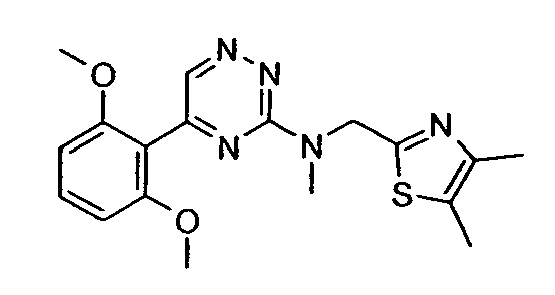
- a)
Under argon, to a solution of 4,5-dimethyl-1,3-thiazole-2-carbaldehyde (69 mg, 0.49 mmol, prepared as in example 1) and methylamine hydrochloride (165 mg, 2.44 mmol) in anhydrous dichloromethane (2 mL) were successively added triethylamine (82 µL, 0.59 mmol) and a solution of sodium cyanoborohydride in THF (1M, 1 mL, 1 mmol). The reaction mixture was stirred overnight at room temperature. An aqueous solution of potassium hydroxide 1N was added and the solution was extracted with dichloromethane. The combined organic extracts were dried over sodium sulfate, filtered and evaporated. Purification by preparative TLC (silica gel, dichloromethane/methanol 9/1) afforded N-[(4,5-dimethyl-1,3-thiazol-2-yl)methyl]-N-methylamine (5.6 mg, 7%) as a yellow oil.
ESI-MS m/z 157 (M+H)+. - b)
Under argon, a solution of 3-chloro-5-(2,6-dimethoxyphenyl)-1,2,4-triazine (6.85 mg, 0.027 mmol, prepared as in example 41), N-[(4,5-dimethyl-1,3-thiazol-2-yl)methyl]-N-methylamine (5.6 mg, 0.036 mmol) and potassium carbonate (3.8 mg, 0.027 mmol) in anhydrous acetonitrile (0.7 mL) was stirred at 85°C overnight. The solution was evaporated. The residue was purified by preparative TLC (silica gel, dichloromethane/methanol 95/5) to afford 5-(2,6-dimethoxyphenyl)-N-[(4,5-dimethyl-1,3-thiazol-2-yl)methyl]-N-methyl-1,2,4-triazin-3-amine (5.1 mg, 50%) as an off-white solid.
ESI-MS m/z 372 (M+H)+.
1H NMR (CDCl3), δ (ppm): 8.59 (s, 1H), 7.36 (t, J = 8.4 Hz, 1H), 6.64 (d, J = 8.4 Hz, 2H), 5.18 (br s, 2H), 3.74 (s, 6H), 3.35 (s, 3H), 2.35 (s, 3H), 2.30 (s, 3H). -

- a)
According to the same procedure used in example 87, reductive amination of 1,3-benzothiazole-2-carbaldehyde with methylamine hydrochloride afforded N-(1,3-benzothiazol-2-ylmethyl)-N-methylamine. - b)
Under argon, a solution of 3-chloro-5-(2,6-dimethoxyphenyl)-1,2,4-triazine (8 mg, 0.032 mmol, prepared as in example 41), N-(1,3-benzothiazol-2-ylmethyl)-N-methylamine (8 mg, 0.045 mmol) and DIPEA (8 µL, 0.046 mmol) in anhydrous acetonitrile (0.2 mL) was stirred at 85°C overnight. The solution was evaporated. The residue was purified by preparative TLC (silica gel, dichloromethane/methanol 95/5) to afford N-(1,3-benzothiazol-2-ylmethyl)-5-(2,6-dimethoxyphenyl)-N-methyl-1,2,4-triazin-3-amine (6.5 mg, 52%) as an off-white solid.
ESI-MS m/z 394 (M+H)+.
1H NMR (CDCl3), δ (ppm): 8.62 (s, 1H), 8.02 (d, J = 8.0 Hz, 1H), 7.84 (d, 8.0 Hz, 1H), 7.50-7.46 (m, 1H), 7.41-7.36 (m, 2H), 6.63 (d, J = 8.8 Hz, 2H), 5.37 (br s, 2H), 3.70 (s, 6H), 3.50 (br s, 3H). -

- a)
Under argon, a solution of 1,3-benzothiazole-2-carbaldehyde (31.4 mg, 0.19 mmol) and 3-aminopropan-1-ol (16 µL, 0.21 mmol) in methanol (1 mL) was stirred at room temperature overnight. Sodium borohydride (7 mg, 0.19 mmol) was added and the reaction mixture was stirred at room temperature for 1.5 hours. A few drops of aqueous ammonium chloride were added and the mixture was filtered over a pad of celite and concentrated. The residue was purified by preparative TLC (silica gel, dichloromethane/methanol 9/1) to furnish 3-[(1,3-benzothiazol-2-ylmethyl)amino]propan-1-ol (19.1 mg, 45%) as a pale yellow oil.
ESI-MS m/z 223 (M+H)+. - b)
Under argon, a solution of 3-chloro-5-(2,6-dimethoxyphenyl)-1,2,4-triazine (6.9 mg, 0.027 mmol, prepared as in example 41), 3-[(1,3-benzothiazol-2-ylmethyl)amino]propan-1-ol (19.1 mg, 0.086 mmol) in anhydrous acetonitrile (0.5 mL) was stirred at 85°C overnight. The solution was evaporated. The residue was purified by preparative TLC (silica gel, dichloromethane/methanol 9/1) to afford 3-{(1,3-benzothiazol-2-ylmethyl)[5-(2,6-dimethoxyphenyl)-1,2,4-triazin-3-yl]amino}propan-1-ol (4.7 mg, 39%) as a pale yellow oil.
ESI-MS m/z 438 (M+H)+.
1H NMR (CDCl3), δ (ppm): 8.65 (s, 1H), 8.01 (d, J = 8.0 Hz, 1H), 7.83 (d, J = 8.0 Hz, 1H), 7.50-7.46 (m, 1H), 7.38 (t, J = 8.4 Hz, 2H), 6.64 (d, J = 8.4 Hz, 2H), 5.33 (br s, 2H), 3.80-3.63 (m, 4H), 3.71 (br s, 6H), 2.45-2.1 (m, 2H). -

- a)
Under argon, a solution of 1,3-benzothiazol-2-ylmethylamine hydrochloride (600 mg, 3 mmol), ethyl chloroacetate (324 µL, 3 mmol) and triethylamine (916 µL, 6.6 mmol) in anhydrous acetonitrile (6 mL) was stirred at room temperature for 1.5 hours then at 50°C overnight. The solution was concentrated. The crude product was purified by flash chromatography (silical gel, dichloromethane/methanol, 1/0 to 95/5) to give ethyl [(1,3-benzothiazol-2-ylmethyl)amino]acetate (436 mg, 58%) as an orange oil.
ESI-MS m/z 251 (M+H)+. - b)
Under argon, a solution of 3-chloro-5-(2,6-dimethoxyphenyl)-1,2,4-triazine (50 mg, 0.20 mmol, prepared as in example 41), ethyl [(1,3-benzothiazol-2-ylmethyl)amino]acetate (50 mg, 0.20 mmol) and DIPEA (35 µL, 0.20 mmol) in anhydrous acetonitrile (0.4 mL) was stirred at 50°C overnight, and then at 80°C for 3 days. The solution was evaporated. The residue was purified by preparative TLC (silica gel, dichloromethane/methanol 97/3) to afford ethyl {(1,3-benzothiazol-2-ylmethyl)[5-(2,6-dimethoxyphenyl)-1,2,4-triazin-3-yl]amino} acetate (7 mg, 8%) as a yellow solid.
ESI-MS m/z 466 (M+H)+. - c)
Under argon, lithium hydroxide (0.4 mg, 0.017 mmol) was added to a solution of ethyl {(1,3-benzothiazol-2-ylmethyl)[5-(2,6-dimethoxyphenyl)-1,2,4-triazin-3-yl]amino}acetate (7 mg, 0.015 mmol) in THF (0.5 mL) and water (0.5 mL). The reaction mixture was stirred overnight at room temperature. A few drops of aqueous hydrochloric acid 1N were added, then the solvents were evaporated. Water was added and a solid was filtered. This solid was dissolved in dichloromethane, precipitation by addition of cyclohexane gave {(1,3-benzothiazol-2-ylmethyl)[5-(2,6-dimethoxyphenyl)-1,2,4-triazin-3-yl]amino}acetic acid (2.9 mg, 44%) as a white solid.
ESI-MS m/z 438 (M+H)+.
1H NMR (CDCl3), δ (ppm): 8.75 (s, 1H), 7.94 (d, J = 7.8 Hz, 1H), 7.87 (d, J = 7.8 Hz, 1H), 7.49 (t, J = 7.8 Hz, 1H), 7.44-7.39 (m, 2H), 6.61 (br s, 2H), 5.53 (br s, 2H), 4.49 (br s, 2H), 3.80 (br s, 6H). -

- a)
Under argon, a solution of 1,3-benzothiazol-2-ylmethylamine hydrochloride (201 mg, 1 mmol), methyl 3-bromopropanoate (113 µL, 1 mmol) and triethylamine (291 µL, 2.1 mmol) in anhydrous acetonitrile (2 mL) was stirred at room temperature for 30 miutes then at 45°C overnight. Water was added and the solution was extracted with ethyl acetate. The combined organic extracts were dried over sodium sulfate, filtered and evaporated. Purification by preparative TLC (silica gel, dichloromethane/methanol 94/6) furnished methyl 3-[(1,3-benzothiazol-2-ylmethyl)amino]propanoate (85.8 mg, 34%) as an off-white solid.
ESI-MS m/z 251 (M+H)+. - b)
Under argon, a solution of 3-chloro-5-(2,6-dimethoxyphenyl)-1,2,4-triazine (50 mg, 0.20 mmol, prepared as in example 41), methyl 3-[(1,3-benzothiazol-2-ylmethyl)amino]propanoate (50 mg, 0.20 mmol) and DIPEA (35 µL, 0.20 mmol) in anhydrous acetonitrile (0.4 mL) was stirred at 85°C for 3 days. The solution was evaporated. The residue was purified by preparative TLC (silica gel, dichloromethane/methanol 97/3) to afford methyl 3-{(1,3-benzothiazol-2-ylmethyl)[5-(2,6-dimethoxyphenyl)-1,2,4-triazin-3-yl]amino}propanoate (46.3 mg, 50%).
ESI-MS m/z 466 (M+H)+. - c)
Under argon, lithium hydroxide (3.6 mg, 0.15 mmol) was added to a solution of methyl 3-{(1,3-benzothiazol-2-ylmethyl)[5-(2,6-dimethoxyphenyl)-1,2,4-triazin-3-yl]amino}propanoate (46.3 mg, 0.10 mmol) in THF (0.5 mL) and water (0.5 mL). The reaction mixture was stirred overnight at room temperature. The solvents were evaporated and the residue was purified by preparative TLC (silica gel, dichloromethane/methanol 90/10) to give 3-{(1,3-benzothiazol-2-ylmethyl)[5-(2,6-dimethoxyphenyl)-1,2,4-triazin-3-yl]amino}propanoic acid (14.9 mg, 33%) as pale yellow oil.
ESI-MS m/z 452 (M+H)+.
1H NMR (CDCl3), δ (ppm): 8.66 (s, 1H), 7.97 (br s, 1H), 7.78 (d, J = 7.8 Hz, 1H), 7.45-7.31 (m, 3H), 6.61 (d, J = 8.3 Hz, 2H), 5.42 (br s, 2H), 4.11 (br s, 2H), 3.68 (br s, 6H), 2.90 (br s, 2H). -

- a)
Under argon, a solution of 1,3-benzothiazole-2-carbaldehyde (49 mg, 0.30 mmol) and tert-butyl 2-aminoethylcarbamate (50 mg, 0.31 mmol) in methanol (1.2 mL) was stirred at room temperature overnight. Sodium borohydride (11.4 mg, 0.30 mmol) was added and the reaction mixture was stirred at room temperature for 2 hours. The mixture was concentrated and the residue was purified by preparative TLC (silica gel, dichloromethane/methanol 9/1) to furnish
tert-butyl 2-[(1,3-benzothiazol-2-ylmethyl)amino]ethylcarbamate (57.1 mg, 62%) as a pale yellow oil.
ESI-MS m/z 308 (M+H)+. - b)
Under argon, a solution of 3-chloro-5-(2,6-dimethoxyphenyl)-1,2,4-triazine (40 mg, 0.16 mmol, prepared as in example 41), tert-butyl 2-[(1,3-benzothiazol-2-ylmethyl)amino]ethylcarbamate (57.1 mg, 0.19 mmol)and DIPEA (28 µL, 0.16 mmol) in anhydrous acetonitrile (0.7 mL) was stirred at 85°C for 2 days. The solution was evaporated. The residue was purified by preparative TLC (silica gel, dichloromethane/methanol 95/5) to afford tert-butyl 2-{(1,3-benzothiazol-2-ylmethyl)[5-(2,6-dimethoxyphenyl)-1,2,4-triazin-3-y!]amino}ethylcarbamate (35 mg, 42%) as a yellow solid.
ESI-MS m/z 523 (M+H)+.
1H NMR (CDCl3), δ (ppm): 8.64 (s, 1H), 7.99 (d, J = 7.5 Hz, 1H), 7.80 (d, J = 7.5 Hz, 1H), 7.44 (t, J = 7.5 Hz, 1H), 7.37-7.33 (m, 2H), 6.62 (d, J = 8.6 Hz, 2H), 5.31 (br s, 2H), 3.98 (br s, 2H), 3.68 (br s, 6H), 3.55 (br s, 2H), 1.35 (s, 9H). -
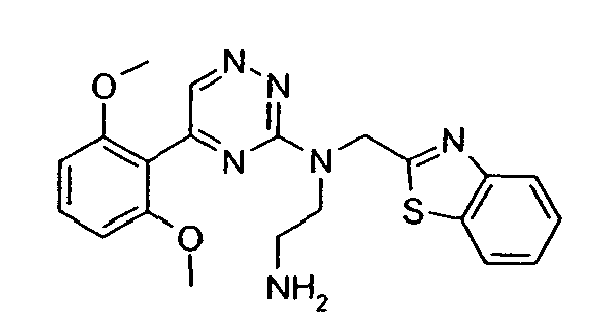
- Under argon, trifluoroacetic acid (50µL) was added dropwise to a solution of tert-butyl 2-{(1,3-benzothiazol-2-ylmethyl)[5-(2,6-dimethoxyphenyl)-1,2,4-triazin-3-yl]amino}ethylcarbamate (15 mg, 0.029 mmol, prepared as in example 92) in dichloromethane (1 mL) cooled at 0°C. The reaction mixture was stirred at 0°C for 2 hours then at room temperature for 30 minutes. The solution was concentrated. Ethyl acetate and aqueous sodium hydroxide were added. The mixture was extracted with ethyl acetate, combined organic extracts were dried over sodium sulfate, filtered and evaporated. Purification by preparative TLC (silica gel, dichloromethane/methanol 95/5) led to N-(1,3-benzothiazol-2-ylmethyl)-N-[5-(2,6-dimethoxyphenyl)-1,2,4-triazin-3-yl]ethane-1,2-diamine (2.5 mg, 21%).
- ESI-MS m/z 423 (M+H)+.
- 1H NMR (CD3OD), δ (ppm): 8.63 (s, 1H), 7.95 (d, J = 8.0 Hz, 2H), 7.51 (t, J = 8.0 Hz, 1H), 7.45-7.41 (m, 2H), 6.72 (br s, 2H), 5.34 (br s, 2H), 4.19 (br s, 2H), 3.59 (br s, 6H), 3.39 (br s, 2H).
-

- a)
Under argon, a solution 3-chloro-5-(2,6-dichlorophenyl)-1,2,4-triazine (503 mg, 1.93 mmol, prepared as in example 15), (5-bromo-1,3-benzothiazol-2-yl)methylamine (516 mg, 2.12 mmol, prepared from 5-bromo-2-methyl-1,3-benzothiazole according to the representative procedure for the synthesis of (1,3-benzothiazol-2-yl)methylamine compounds from methyl-1,3-benzothiazole derivatives described in example 15) and DIPEA (500 µL, 2.87 mmol) in anhydrous acetonitrile (7 mL) was stirred at 85°C overnight. Water (10 mL) was added at room temperature, a precipitate was filtered and rinsed with water. The solid was dried to afford N-[(5-bromo-1,3-benzothiazol-2-yl)methyl]-5-(2,6-dichlorophenyl)-1,2,4-triazin-3-amine (833 mg, 92%) as a brown solid.
1H NMR (CDCl3, 300 MHz), δ (ppm): 8.72 (s, 1H), 8.14 (d, J = 1.8 Hz, 1H), 7.72 (d, J = 8.6 Hz, 1H), 7.50 (dd, J = 8.6 and 1.8 Hz, 1H), 7.45-7.34 (m, 3H), 5.21 (br, 2H). - b)
Under argon, to a solution of N-[(5-bromo-1,3-benzothiazol-2-yl)methyl]-5-(2,6-dichlorophenyl)-1,2,4-triazin-3-amine (93.4 mg, 0.2 mmol), Xantphos (5.8 mg, 0.01 mmol), tris(dibenzylideneacetone)dipalladium(0) (4.6 mg, 0.005 mmol) in degassed anhydrous 1,4-dioxane (0.5 mL) were successively added tert-butyl N-(2-mercaptoethyl)carbamate (46 µL, 0.27 mmol) and diisopropylethylamine (70 µL, 0.4 mmol). Then the reaction mixture was degassed, placed under argon atmosphere and stirred at 100°C overnight. The solution was then concentrated and purified by preparative TLC (silica gel, dichloromethane/methanol 94/6) to afford tert-butyl {[2-({[5-(2,6-dichlorophenyl)-1,2,4-triazin-3-yl]amino}methyl)-1,3-benzothiazol-5-yl]thio}ethylcarbamate (65.1 mg, 57%) as a yellow solid.
ESI-MS m/z 563 and 565 (M+H)+. - c)
Under argon, to tert-butyl {[2-({[5-(2,6-dichlorophenyl)-1,2,4-triazin-3-yl]amino}methyl)-1,3-benzothiazol-5-yl]thio}ethylcarbamate (65.1 mg, 0.12 mmol), was added a mixture of ethyl acetate (0.75 mL) and aqueous hydrochloric acid (37%, 0.25 mL). The resulting mixture was stirred at room temperature for 1 hour. Then an aqueous solution of sodium hydroxide was added to basify until pH = 10. The mixture was then extracted with dichloromethane, combined organic extracts were dried over sodium sulfate, filtered and evaporated. Purification by preparative TLC (silica gel, dichloromethane/methanol/ ammonium hydroxide 33% 90/10/1) led to N-({5-[(2-aminoethyl)thio]-1,3-benzothiazol-2-yl}methyl)-5-(2,6-dichlorophenyl)-1,2,4-triazin-3-amine (18.5 mg, 35%) as a white solid.
ESI-MS m/z 463 and 465 (M+H)+.
1H NMR (CD3OD), δ (ppm): 8.68 (s, 1H), 7.91 (br s, 1H), 7.83 (d, J = 8.4 Hz, 1H), 7.50-7.43 (m, 3H), 7.41 (dd, J = 8.4 Hz and 2.0 Hz, 1H), 5.06 (br s, 2H), 3.09 (t, J = 6.6 hz, 2H), 2.82 (t, J = 6.6 Hz, 2H). -

- Under argon, a solution of 5-(5-bromo-2-chlorophenyl)-N-[(5-methoxy-1,3-benzothiazol-2-yl)methyl]-1,2,4-triazin-3-amine (40 mg, 0.086 mmol, prepared as in example 31), acetamide (6.6 mg, 0.11 mmol), cesium carbonate (39.4 mg, 0.12 mmol), Xantphos (1.5 mg, 2.6 µmol), tris(dibenzylideneacetone)dipalladium(0) (0.8 mg, 0.9 µmol) in degassed anhydrous 1,4-dioxane (0.5 mL) was stirred at 100°C overnight. Water was added and the resulting mixture was extracted with ethyl acetate. Combined organic extracts were dried over sodium sulfate, filtered and evaporated. The crude product was purified by preparative TLC (silica gel, dichloromethane/methanol 95/5) to afford N-[4-chloro-3-(3-{[(5-methoxy-1,3-benzothiazol-2-yl)methyl]amino}-1,2,4-triazin-5-yl)phenyl]acetamide (5.4 mg, 14%) as a brown solid.
- ESI-MS m/z 441 and 443 (M+H)+.
- 1H NMR (CD3OD), δ (ppm): 8.97 (s, 1H), 7.94-7.92 (m, 1H), 7.77 (d, J = 8.8 Hz, 1H), 7.69 (dd, J = 8.8 Hz and 2.8 Hz, 1H), 7.47 (d, J = 8.8 Hz, 1H), 7.44 (d, J = 2.4 Hz, 1H), 7.04 (dd, J = 8.8 and 2.4 Hz, 1H), 5.09 (br s, 2H), 3.87 (s, 3H), 2.12 (s, 3H).
-

- Under argon, a solution of 5-(5-bromo-2-chlorophenyl)-N-[(5-methoxy-1,3-benzothiazol-2-yl)methyl]-1,2,4-triazin-3-amine (50 mg, 0.108 mmol, prepared as in example 31), 1,3-oxazolidin-2-one (12.5 mg, 0.14 mmol), cesium carbonate (49.3 mg, 0.15 mmol), Xantphos (3.7 mg, 0.006 mmol), tris-(dibenzylideneacetone)-dipalladium(0) (2.0 mg, 0.002 mmol) in degassed anhydrous 1,4-dioxane (0.5 mL) was stirred at 100°C for 2 days. The reaction mixture was then filtered over a pad of celite, rinsed with methanol, dichloromethane and ethyl acetate. The filtrate was concentrated. The crude product was purified by preparative TLC (silica gel, dichloromethane/methanol 94/6) to give 3-[4-chloro-3-(3-{[(5-methoxy-1,3-benzothiazol-2-yl)methyl]amino}-1,2,4-triazin-5-yl)phenyl]-1,3-oxazolidin-2-one (14 mg, 27%) as a brown solid.
- ESI-MS m/z 469 and 471 (M+H)+.
- 1H NMR (CDCl3), δ (ppm): 9.15 (s, 1H), 7.88-7.86 (m, 1H), 7.69 (d, J = 8.8 Hz, 1H), 7.49-7.47 (m, 3H), 7.02 (dd, J = 8.8 Hz and 2.4 Hz, 1H), 5.14 (br s, 2H), 4.38-4.36 (m, 2H), 3.88 (s, 3H), 3.88-3.86 (m, 2H).
-

- Under argon, a solution of 5-(5-bromo-2-chlorophenyl)-N-[(5-methoxy-1,3-benzothiazol-2-yl)methyl]-1,2,4-triazin-3-amine (50 mg, 0.11 mmol, prepared as in example 31), 1H-pyrazol-3-yl boronic acid (24.2 mg, 0.22 mmol), sodium carbonate (34.5 mg, 0.33 mmol) and palladium-tetrakis(triphenylphosphine) (37.5 mg, 0.032 mmol) in degassed DMF (0.75 mL) was stirred at 100°C overnight. An aqueous solution of ammonium chloride was added and the reaction mixture was extracted with ethyl acetate. The combined organic extracts were dried over sodium sulfate, filtered and evaporated. The crude product was purified by preparative TLC (silica gel, dichloromethane/methanol/aqueous ammonium hydroxide 33%, 95/5/1) to afford 5-[2-chloro-5-(1H-pyrazol-3-yl)phenyl]-N-[(5-methoxy-1,3-benzothiazol-2-yl)methyl]-1,2,4-triazin-3-amine (25 mg, 51%) as a yellow solid.
- ESI-MS m/z 450 and 452 (M+H)+.
- 1H NMR (CDCl3), δ (ppm): 9.13 (s, 1H), 8.05 (br s, 1H), 7.81 (dd, J = 8.4 Hz and J = 1.6 Hz, 1H), 7.64 (d, J = 8.4 Hz, 1H), 7.59 (br s, 1H), 7.49-7.44 (m, 2H), 6.99 (dd, J = 8.4 Hz and J = 2.4 Hz, 1H), 6.49 (br s, 1H), 5.19 (br s, 2H), 3.83 (s, 3H).
-

- Under argon, a solution of 5-(5-bromo-2-chlorophenyl)-N-[(5-methoxy-1,3-benzothiazol-2-yl)methyl]-1,2,4-triazin-3-amine (50 mg, 0.11 mmol, prepared as in example 31), 1H-pyrazol-4-yl boronic acid (24.2 mg, 0.22 mmol), sodium carbonate (34.5 mg, 0.33 mmol) and palladium-tetrakis(triphenylphosphine) (37.5 mg, 0.032 mmol) in degassed DMF (0.75 mL) was stirred at 100°C overnight. An aqueous solution of ammonium chloride was added and the reaction mixture was extracted with ethyl acetate. The combined organic extracts were dried over sodium sulfate, filtered and evaporated. The crude product was purified by preparative TLC (silica gel, dichloromethane/methanol 95/5) to afford 5-[2-chloro-5-(1H-pyrazol-4-yl)phenyl]-N-[(5-methoxy-1,3-benzothiazol-2-yl)methyl]-1,2,4-triazin-3-amine (1.1 mg, 2%) as a yellow solid.
- ESI-MS m/z 450 and 452 (M+H)+.
- 1H NMR (CD3OD), δ (ppm): 9.04 (s, 1H), 7.80-7.43 (m, 7H), 7.07 (dd, J = 8.9 Hz and J = 2.4 Hz, 1H), 5.09 (br s, 2H), 3.88 (br s, 3H).
-
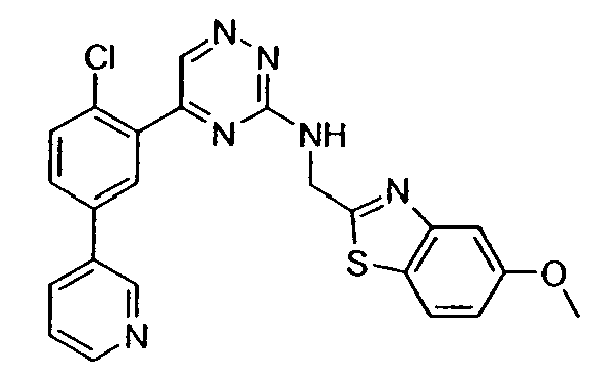
- Under argon, a solution of 5-(5-bromo-2-chlorophenyl)-N-[(5-methoxy-1,3-benzothiazol-2-yl)methyl]-1,2,4-triazin-3-amine (30 mg, 0.065 mmol, prepared as in example 31), 3-pyridinyl boronic acid (9.5 mg, 0.078 mmol), cesium carbonate (63.5 mg, 0.19 mmol) and [1,1'-bis(diphenylphosphino)ferrocene]dichloropalladium(II) adduct with dichloromethane (4.8 mg, 0.006 mmol) in degassed water (0.1 mL) and 1,4-dioxane (0.3 mL) was stirred at 100°C overnight. An aqueous solution of ammonium chloride was added and the reaction mixture was extracted with ethyl acetate. The combined organic extracts were dried over sodium sulfate, filtered and evaporated. The crude product was purified by preparative TLC (silica gel, dichloromethane/methanol 95/5) to afford 5-(2-chloro-5-pyn'din-3-yiphenyl)-N-[(5-methoxy-1,3-benzothiazol-2-yl)methyl]-1,2,4-triazin-3-amine (10 mg, 33%) as a yellow solid.
- ESI-MS m/z 461 and 463 (M+H)+.
- 1H NMR (CDCl3), δ (ppm): 9.17 (s, 1H), 8.83 (s, 1H), 8.63 (d, J = 5.0 Hz, 1H), 7.90-7.76 (m, 2H), 7.69-7.60 (m, 3H), 7.47 (d, J = 2.0 Hz, 1H), 7.35 (t, J = 5.0 Hz, 1H), 7.02 (dd, J = 8.9 Hz and J = 2.0 Hz, 1H), 5.18 (s, 2H), 3.87 (s, 3H).
-

- a)
Under argon, triethylamine (280 µL, 2 mmol) and trimethylsilylacetylene (115 µL, 0.8 mmol) were successively added to a solution of 5-(5-bromo-2-chlorophenyl)-N-[(5-methoxy-1,3-benzothiazol-2-yl)methyl]-1,2,4-triazin-3-amine (185.1 mg, 0.4 mmol, prepared as in example 31), [1,1'-bis(diphenylphosphino)-ferrocene]-dichloropalladium(II) complex with dichloromethane (16.4 mg, 0.02 mmol) and copper(I) iodide in degassed anhydrous acetonitrile (1.6 mL). The resulting mixture was degassed and stirred under argon at 90°C for 4.5 hours. The solution was concentrated and the crude product was purified by preparative TLC (silica gel, dichloromethane/methanol 93/7) to afford [5-(2-chloro-5-trimethylsilanylethynylphenyl)-[1,2,4]triazin-3-yl]-(5-methoxy-benzothiazol-2-ylmethyl)-amine (139 mg, 72%) as a brown solid.
ESI-MS m/z 480 and 482 (M+H)+. - b)
Under argon, potassium carbonate (200 mg, 1.45 mmol) was added to a solution of [5-(2-chloro-5-trimethylsilanylethynyl-phenyl)-[1,2,4]triazin-3-yl]-(5-methoxy-benzothiazol-2-ylmethyl)-amine (139 mg, 0.29 mmol) in methanol (1 mL) and dichloromethane (1 mL). The resulting mixture was stirred at room temperature for 1.5 hours. The solution was filtered and the filtrate was concentrated. Purification by preparative TLC (silica gel, dichloromethane/methanol 95/5) led to [5-(2-chloro-5-ethynyl-phenyl)-[1,2,4]triazin-3-yl]-(5-methoxy-benzothiazol-2-ylmethyl)-amine (69.6 mg, 59%) as an off-white solid.
ESI-MS m/z 408 and 410 (M+H)+. - c)
Under argon, sodium azide (12.2 mg, 0.188 mmol) and ethyl bromoacetate were added to a solution of [5-(2-chloro-5-ethynyl-phenyl)-[1,2,4]triazin-3-yl]-(5-methoxy-benzothiazol-2-ylmethyl)-amine (69.6 mg, 0.17 mmol) in tert-butanol (0.35 mL) and water (0.35 mL) stirred at room temperature. Then copper(II) sulfate (1.4 mg, 0.009 mmol) and sodium ascorbate (3.4 mg, 0.017 mmol) were added. The reaction mixture was stirred overnight at room temperature. Sodium azide (12.2 mg, 0.188 mmol), ethyl bromoacetate, copper(II) sulfate (1.4 mg, 0.009 mmol) and sodium ascorbate (3.4 mg, 0.017 mmol) were added and the reaction was kept sirring at room temperature for 24 hours, then at 50°C for 24 hours. An aqueous solution of ammonium hydroxide was added, and the mixture was extracted with ethyl acetate and dichloromethane. Combined organic extracts were dried over sodium sulfate, filtered and evaporated. Purification by preparative TLC (silica gel, dichloromethane/methanol 95/5) gave ethyl [4-(4-chloro-3-{3-[(5-methoxy-benzothiazol-2-ylmethyl)-amino]-[1,2,4]triazin-5-yl}-phenyl)-[1,2,3]triazol-1-yl]-acetate (19.3 mg, 21%).
ESI-MS m/z 537 and 539 (M+H)+. - d)
Under argon, a solution of diisobutylaluminium hydride in toluene (1M, 0.14 mL, 0.14 mmol) was slowly added to a solution of [4-(4-chloro-3-{3-[(5-methoxybenzothiazol-2-ylmethyl)-amino]-[1,2,4]triazin-5-yl}-phenyl)-[1,2,3]triazol-1-yl]-acetate (19.3 mg, 0.036 mmol) in anhydrous dichloromethane (1 mL) stirred at -78°C. The reaction mixture was stirred for 1.5 hours allowing the temperature to raise to -10°C. Methanol (0.3 mL) was added and the solution was kept stirring for 30 minutes allowing the temperature to rise. Sodium borohydride (5 mg, 0.13 mmol) was next added and the resulting mixture was stirred at room temperature for 1.5 hours. Then an aqueous solution of sodium potassium tartrate was added and the resulting solution was stirred for 30 minutes. The mixture was extracted with ethyl acetate, combined organic extracts were dried over sodium sulfate, filtered and evaporated. Purification by preparative TLC (silica gel, dichloromethane/methanol 9/1) afforded 2-[4-(4-Chloro-3-{3-[(5-methoxy-benzothiazol-2-ylmethyl)-amino]-[1,2,4]triazin-5-yl}-phenyl)-[1,2,3]triazol-1-yl]-ethanol (9.4 mg, 53%) as a pale yellow oil.
ESI-MS m/z 495 and 497 (M+H)+.
1H NMR (CD3OD), δ (ppm): 9.12 (s, 1H), 8.38 (br s, 1H), 8.25 (br s, 1H), 8.02 (dd, J = 8.1 Hz and 1.8 Hz, 1H), 7.86 (d, J = 8.9 Hz, 1H), 7.68 (d, J = 8.1 Hz, 1H), 7.46 (br s, 1H), 7.11 (dd, J = 8.9 Hz and 2.5 Hz, 1H), 5.23 (s, 2H), 4.56 (t, J = 5.2 Hz, 2H), 3.99 (t, J = 5.2 Hz, 2H), 3.88 (s, 3H). -

- Under argon, a solution of 5-(5-bromo-2-chlorophenyl)-N-[(5-methoxy-1,3-benzothiazol-2-yl)methyl]-1,2,4-triazin-3-amine (50 mg, 0.11 mmol, prepared as in example 31), triethylsilane (52 µL, 0.33 mmoL), cesium fluoride (32.9 mg, 0.22 mmol) and [1,1'-bis(diphenylphosphino)ferrocene]dlchloropalladium(II) complex with dichloromethane (4.4 mg, 0.005 mmol) in degassed anhydrous 1,4-dioxane (0.5 mL) was stirred at 50°C for 3 days. The reaction mixture was filtered over a pad of celite, rinsed with dichloromethane, methanol, ethyl acetate, and evaporated. The crude product was purified by preparative TLC (silica gel, dichloromethane/methanol 95/5) to afford 5-(2-chlorophenyl)-N-[(5-methoxy-1,3-benzothiazol-2-yl)methyl]-1,2,4-triazin-3-amine (7.9 mg, 19%) as a yellow oil.
- ESI-MS m/z 384 and 386(M+H)+.
- 1H NMR (CDC13), δ (ppm): 9.11 (s, 1H), 7.70-7.63 (m, 2H), 7.52-7.37 (m, 4H), 7.03 (d, J = 8.8 Hz, 1H), 5.19 (s, 2H), 3.88 (s, 3H).
-
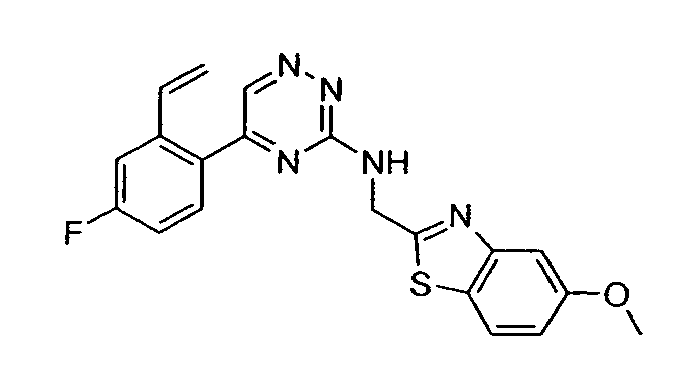
- Under argon, 4,4,5,5-tetramethyl-2-vinyl-1,3,2-dioxaborolane (114 µL, 0.67 mmol) was added to a solution of 5-(2-bromo-4-fluorophenyl)-N-[(5-methoxy-1,3-benzothiazol-2-yl)methyl]-1,2,4-triazin-3-amine (150 mg, 0.336 mmol, prepared as in example 30), [1,1'-bis(diphenylphosphino)ferrocene]dichloropalladium(II) complex with dichloromethane (13.7 mg, 0.017 mmol), potassium carbonate (92.7 mg, 0.67 mmol), in acetonitrile (1.5 mL) and water (0.5 mL). The reaction mixture was degassed and stirred at 85°C under argon overnight. An aqueous solution of ammonium chloride was added and the solution was extracted with ethyl acetate. Combined organic extracts were dried over sodium sulfate, filtered and evaporated. The crude product was purified by preparative TLC (silica gel, dichloromethane/methanol 95/5) to afford 5-(4-fluoro-2-vinylphenyl)-N-[(5-methoxy-1,3-benzothiazol-2-yl)methyl]-1 ,2,4-triazin-3-amine (120.5 mg, 91%) as a yellow solid.
- ESI-MS m/z 394 (M+H)+.
- 1H NMR (CDCl3), δ (ppm): 8.82 (s, 1H), 7.68 (d, J = 8.8 Hz, 1H), 7.58 (dd, J = 8.4 Hz and 5.6 Hz, 1H), 7.48 (d, J = 2.4 Hz, 1H), 7.30 (dd, J = 9.6 Hz and 2.4 Hz, 1H), 7.09 (td, J = 8.4 Hz and 2.4 Hz, 1H), 7.03 (dd, J = 8.8 Hz and 2.4 Hz, 1H), 6.85 (dd, J = 17.2 Hz and 11.2 Hz, 1H), 5.80 (d, J = 17.2 Hz, 1H), 5.32-5.25 (m, 1H), 5.16 (br s, 2H), 3.88 (s, 3H).
-

- Under argon, a solution of 5-(2-bromo-4-fluorophenyl)-N-[(5-methoxy-1,3-benzothiazol-2-yl)methyl]-1,2,4-triazin-3-amine (30 mg, 0.067 mmol, prepared as in example 30) and morpholine (30 µL, 0.34 mmol) in n-butanol (0.5 mL) was stirred at 120°C for 3 days. The reaction mixture was concentrated. The crude product was purified by preparative TLC (silica gel, dichloromethane/methanol 95/5) to give N-[(5-methoxy-1,3-benzothiazol-2-yl)methyl]-5-(2-bromo-4-morpholin-4-ylphenyl)-1,2,4-triazin-3-amine (8.8 mg, 26%) as a yellow solid.
- ESI-MS m/z 513 and 515 (M+H)+.
- 1H NMR (CDCl3), δ (ppm): 9.14 (s, 1H), 7.68 (d, J = 8.8 Hz, 1H), 7.57 (d, J = 8.8 Hz, 1H), 7.49 (d, J = 2.4 Hz, 1H), 7.13 (d, J = 2.4 Hz, 1H), 7.02 (dd, J = 8.8 Hz and 2.4 Hz, 1H), 6.89 (dd, J = 8.8 Hz and 2.4 Hz, 1H), 5.18 (d, J = 5.6 Hz, 2H), 3.89 (s, 3H), 3.89-3.84 (m, 4H), 3.27-3.25 (m, 4H).
-

- The title compound (8.9 mg, 29%) was also obtained as a product of the reaction described in example 103, as a yellow solid.
- ESI-MS m/z 453 (M+H)+.
- 1H NMR (CDCl3), δ (ppm): 9.48 (s, 1H), 7.72-7.68 (m, 2H), 7.49 (d, J = 2.4 Hz, 1H), 7.03 (dd, J = 8.8 Hz and 2.4 Hz, 1H), 6.87-6.79 (m, 2H), 5.18 (d, J = 6.0 Hz, 2H), 3.89 (s, 3H), 3.78-3.76 (m, 4H), 2.92-2.90 (m, 4H).
-

- Under argon, to a solution of 5-(2-bromo-4-fluorophenyl)-N-[(5-methoxy-1,3-benzothiazol-2-yl)methyl]-1,2,4-triazin-3-amine (30 mg, 0.067 mmol, prepared as in example 30) and iron(III) acetylacetonate (1.2 mg, 0.003 mmol) in anhydrous THF (0.4 mL) and NMP (40 µL) was slowly added a solution ethyl magnesium bromide in THF (1M, 150 µL, 0.15 mmol). The reaction mixture was stirred at room temperature for 15 minutes, then diethyl ether and an aqueous solution of hydrochloric acid 1N were successively added at 0°C. The solution was extracted with ethyl acetate. Combined organic extracts were dried over sodium sulfate, filtered and evaporated. The crude product was purified by preparative TLC (silica gel, dichloromethane/methanol 96/4) to afford 5-(4-fluorophenyl)-N-[(5-methoxy-1,3-benzothiazol-2-yl)methyl]-1,2,4-triazin-3-amine (5.6 mg, 23%) as a yellow solid.
- ESI-MS m/z 368 (M+H)+.
- 1H NMR (CDCl3), δ (ppm): 9.11 (s, 1H), 8.14-8.10 (m, 2H), 7.67 (d, J = 8.8 Hz, 1H), 7.49 (d, J = 2.4 Hz, 1H), 7.20 (t, J = 8.6 Hz, 2H), 7.02 (dd, J = 8.8 Hz and 2.4 Hz, 1H), 5.19 (br s, 2H), 3.88 (s, 3H).
-

- Under argon, a solution of isopropylmagnesium chloride in THF (2M, 112 µL, 0.224 mmol) and zinc chloride in THF (0.5M, 450 µL, 0.225 mmol) was stirred at 50°C for 2.5 hours. The reaction mixture was then added to a solution of 5-(2-bromo-4-fluorophenyl)-N-[(5-methoxy-1,3-benzothiazol-2-yl)methyl]-1,2,4-triazin-3-amine (31 mg, 0.069 mmol, prepared as in example 30), [1,1'-bis(diphenylphosphino)ferrocene]dichloropalladium(II) complex with dichloromethane (3.7 mg, 0.005 mmol) and copper (1) iodide (0.7 mg, 0.004 mmol), in anhydrous THF (0.4 mL) at room temperature. The reaction mixture was degassed and stirred under argon at room temperature for 24 hours, then at 65°C for 48 hours. The reaction mixture was then filtered over a pad of celite, rinsed with methanol, dichloromethane and ethyl acetate. The filtrate was concentrated. The crude product was purified by preparative TLC (silica gel, dichloromethane/methanol 95/5) to yield 5-(2-chloro-4-fluorophenyl)-N-[(5-methoxy-1,3-benzothiazol-2-yl)methyl]-1,2,4-triazin-3-amine (12.8 mg, 46%) as a brown solid.
- ESI-MS m/z 402 and 404 (M+H)+.
- 1H NMR (CDCl3), δ (ppm): 9.11 (s, 1H), 7.69-7.65 (m, 1H), 7.68 (d, J = 8.8 Hz, 1H), 7.48 (d, J = 2.4 Hz, 1H), 7.25 (dd, J = 8.4 Hz and 2.4 Hz, 1H), 7.13-7.09 (m, 1H), 7.02 (dd, J = 8.8 Hz and 2.4 Hz, 1H), 5.17 (br s = 2H), 3.88 (s, 3H).
-

- Under argon, a solution of 5-(2-chloro-4-fluorophenyl)-N-[(5-methoxy-1,3-benzothiazol-2-yl)methyl]-1,2,4-triazin-3-amine (21.8 mg, 0.054 mmol, prepared as in example 106) and piperazine (23.4 mg, 0.27 mmol) in n-butanol (0.5 mL) was stirred at 120°C for 3 days. The reaction mixture was concentrated. An aqueous solution of ammonium chloride was added and the solution was extracted with ethyl acetate. Combined organic extracts were dried over sodium sulfate, filtered and evaporated. The crude product was purified by preparative TLC (silica gel, dichloromethane/methanol/triethylamine 9/1/0.1) to give N-[(5-methoxy-1,3-benzothiazol-2-yl)methyl]-5-(2-chloro-4-piperazin-1-ylphenyl)-1,2,4-triazin-3-amine (5.1 mg, 20%) as a yellow solid.
- ESI-MS m/z 468 and 470 (M+H)+.
- 1H NMR (CDCl3), δ (ppm): 9.20 (s, 1H), 7.69 (d, J = 8.8 Hz, 1H), 7.68 (d, J = 8.8 Hz, 1H), 7.49 (d, J = 2.4 Hz, 1H), 7.02 (dd, J = 8.8 Hz and 2.4 Hz, 1H), 6.92 (d, J = 2.0 Hz, 1H), 6.85 (dd, J = 8.8 Hz and 2.0 Hz, 1H), 5.17 (d, J = 5.2 Hz, 2H), 3.89 (s, 3H), 3.31-3.29 (m, 4H), 3.06-3.03 (m, 4H).
-

- a)
Under argon, to a solution of (5-methoxy-1,3-benzothiazol-2-yl)methylamine hydrochloride (1.38 g, 6 mmol, prepared as in example 15) and phtalic anhydride (1.01 g, 6.6 mmol) in anhydrous THF (30 mL) cooled in an ice bath, diisopropylethylamine (1.15 mL, 6.6 mmol) was added and the reaction mixture was stirred for 40 minutes, allowing the temperature to raise to room temperature. The solution was then heated at 70°C for 4 hours. The solvent was evaporated, then diethyl ether and aqueous hydrochloric acid 1N were added. The solid was filtered and rinsed with diethyl ether. The filtrate solution was extracted with ethyl acetate, combined organic extracts dried over sodium sulfate, filtered and evaporated. The residue obtained was combined with the solid filtered previously, toluene (40 mL) and a few milligrams of p-toluenesulfonic acid were added and the resulting mixture was stirred at 115°C for 3 hours. The solvent was evaporated, water and ethyl acetate were added. The mixture was extracted with ethyl acetate, combined organic extracts were dried over sodium sulfate, filtered and evaporated. Purification by recrystallsation of the crude product in a mixture of cyclohexane and dichloromethane, and preparative TLC (silica gel, dichloromethane/methanol 95/5) of the mother liquor after concentration afforded 2-[(5-methoxy-1,3-benzothiazol-2-yl)methyl]-1H-isoindole-1,3(2H)-dione (1.338 g, 69%) as a brown solid.
ESI-MS m/z 325 (M+H)+. - b)
To a solution of 2-[(5-methoxy-1,3-benzothiazol-2-yl)methyl]-1H-isoindole-1,3(2H)-dione (1.338 g, 4.12 mmol) in anhydrous dichloromethane (10 mL) stirred at -78°C under argon, a solution of boron tribromide in dichloromethane (1M, 41 mL, 41 mmol) was added dropwise. The reaction mixture was stirred overnight allowing the temperature to raise slowly to room temperature. The solution was then cooled to -78°C, methanol was added and the temperature let to rise. The mixture was concentrated, an aqueous ammonium chloride solution was added and the solution was extracted with dichloromethane. The combined organic extracts were dried over sodium sulfate, filtered and evaporated. Purification by flash chromatography (silica gel, dichloromethane/methanol, 1/0 to 95/5) afforded 2-[(5-hydroxy-1,3-benzothiazol-2-yl)methyl]-1H-isoindole-1,3(2H)-dione (1.119 g, 87%) as a yellow solid.
ESI-MS m/z 311 (M+H)+. - c)
Under argon, a solution of diethyl azodicarboxylate (730 µL, 4.69 mmol) in anhydrous THF (10 mL) was slowly added to a solution of 2-[(5-hydroxy-1,3-benzothiazol-2-yl)methyl]-1H-isoindole-1,3(2H)-dione (1.119 g, 3.6 mmol), triphenylphosphine (1.416 g, 3.82 mmol), and tert-butyl 2-hydroxyethylcarbamate (651 mg, 3.96 mmol) in anhydrous THF (20 mL) stirred at 0°C. The reaction was kept stirring for 3 days, allowing the temperature to rise. The solvent was evaporated. Purification by flash chromatography (silica gel, dichloromethane/methanol, 1/0 to 97/3) gave tert-butyl {2-[2-(1,3-dioxo-1,3-dihydro-isoindol-2-ylmethyl)-benzothiazol-5-yloxy]-ethyl}-carbamate contaminated by triphenylphosphine oxide as a brown oil. The latter was dissolved in ethanol (15 mL) in a screwed-cap tube, methyl hydrazine (580 mL, 10.8 mmol) was added and the solution was stirred at 80°C under argon for 1.5 hours. The solvent was evaporated and diethyl ether was added. A solid was filtered off, rinsed with diethyl ether and the filtrate was concentrated. Purification by flash chromatography (silica gel, dichloromethane/methanol, 1/0 to 9/1) afforded tert-butyl 2-{[2-(aminomethyl)-1,3-benzothiazol-5-yl]oxy}ethylcarbamate (720.8 mg, 62%) as an orange oil.
ESI-MS m/z 324 (M+H)+.
1H NMR (DMSO-d6), δ (ppm): 7.90 (d, J = 8.6 Hz, 1H), 7.42 (d, J = 2.4 Hz, 1H), 7.00 (dd, J = 8.6 Hz and 2.4 Hz, 1H), 4.09 (s, 2H), 4.02 (t, J = 6.6 Hz, 2H), 3.34-3.30 (m, 2H), 1.39 (s, 9H). - d)
A solution of [4-(3-chloro-[1,2,4]triazin-5-yl)-3,5-dimethyl-phenyl]-carbamic acid tert-butyl ester (160 mg, 0.48 mmol, prepared as in example 73), tert-butyl 2-{[2-(aminomethyl)-1,3-benzothiazol-5-yl]oxy}ethylcarbamate (180 mg, 0.56 mmol) and diisopropylethylamine (84 µL, 0.48 mmol) in anhydrous acetonitrile (2 mL) was stirred under argon at 85°C overnight. An aqueous solution of ammonium chloride was added and the reaction mixture was extracted with ethyl acetate. The combined organic extracts were dried over sodium sulfate, filtered and evaporated. Purification by preparative TLC (silica gel, dichloromethane/methanol 95/5) afforded tert-butyl [4-(3-{[5-(2-tert-butoxycarbonylamino-ethoxy)-benzothiazol-2-ylmethyl]-amino}-[1,2,4]triazin-5-yl)-3,5-dimethyl-phenyl]-carbamate (174.1 mg, 58%) as an orange solid.
ESI-MS m/z 622 (M+H)+. - e)
A mixture of 37% aqueous hydrochloric acid (1.25 mL) and ethyl acetate (3.75 mL) was added to tert-butyl [4-(3-{[5-(2-tert-butoxycarbonylamino-ethoxy)-benzothiazol-2-ylmethyl]-amino}-[1,2,4]triazin-5-yl)-3,5-dimethyl-phenyl]-carbamate (174.1 mg, 0.28 mmol) cooled to 0°C. The reaction mixture was stirred for 1 hour allowing the temperature to raise to room temperature. A dilute aqueous solution of potassium hydroxyde was added until basic pH was reached. The solution was extracted with ethyl acetate and dichloromethane, combined organic extracts were dried over sodium sulfate, filtered and evaporated. The crude product was dissolved in anhydrous THF (3 mL), triethylamine (60 µL, 0.43 mmol) and di(tert-butyl) dicarbonate (67.2 mg, 0.31 mmol) were added. The resulting mixture was stirred at room temperature overnight. An aqueous solution of ammonium chloride was added and the reaction mixture was extracted with diethyl ether and ethyl acetate. The combined organic extracts were dried over sodium sulfate, filtered and evaporated. Purification by preparative TLC (silica gel, dichloromethane/methanol 93/7) afforded tert-butyl [2-(2-{[5-(4-amino-2,6-dimethyl-phenyl)-[1,2,4]triazin-3-ylamino]-methyl}-benzothiazol-5-yloxy)-ethyl]-carbamate (107 mg, 73%) as a yellow solid.
ESI-MS m/z 522 (M+H)+. - f)
Under argon, 2-chloro-N,N-dimethylethanamine hydrochloride (59 mg, 0.41 mmol), sodium hydrogencarbonate (34.5 mg, 0.41 mmol) and a catalytic amount of sodium iodide were successively added to a solution of tert-butyl [2-(2-{[5-(4-amino-2,6-dimethyl-phenyl)-[1,2,4]triazin-3-ylamino]-methyl}-benzothiazol-5-yloxy)-ethyl]-carbamate (107 mg, 0.21 mmol) in ethanol (1.65 mL). The reaction mixture was stirred at room temperature for 1 hour, and then at 80°C overnight. The solution was then dried over potassium carbonate, filtered and concentrated. Purification by preparative TLC (silica gel, dichloromethane/methanol 85/15) led to {2-[2-({5-[4-(2-dimethylamino-ethylamino)-2,6-dimethyl-phenyl]-[1,2,4]triazin-3-ylamino}-methyl)-benzothiazol-5-yloxy]-ethyl}-carbamic acid tert-butyl ester. The latter compound was dissolved in methanol (125 µL) and a solution of hydrogen chloride in dioxane (4N, 375 µL, 1.5 mmol) was added. The resulting mixture was stirred at room temperature for 25 minutes. Methanol and dichloromethane were added and the solution was dried over potassium carbonate, filtered and concentrated. The crude product was purified by preparative TLC (silica gel, dichloromethane/methanol/aqueous ammonium hydroxide 33%, 90/10/2) to afford N-[4-(3-{[5-(2-aminoethoxy)-benzothiazol-2-ylmethyl]-amino}-[1,2,4]triazin-5-yl)-3,5-dimethyl-phenyl]-N',N'-dimethyl-ethane-1,2-diamine (13.6 mg, 13%) as a yellow solid.
ESI-MS m/z 493 (M+H)+.
1H NMR (DMSO-d6), δ (ppm): 8.63 (s, 1H), 7.91 (d, J = 8.8 Hz, 1H), 7.51 (d, J = 2.0 Hz, 1H), 7.07 (dd, J = 8.8 Hz and 2.0 Hz, 1H), 6.32 (br s, 2H), 4.93 (br s, 2H), 4.16-4.13 (m, 2H), 3.12-3.10 (m, 4H), 2.44-2.40 (m, 2H), 2.18 (s, 6H), 1.91 (br s, 6H). -
- 1) A pharmaceutical composition for injection has been prepared as follows:
- compound of example 9 500 mg
- aqueous sterile vehicle q.s.p. 10 mL
- 2) A lyophilized pharmaceutical composition for injection has been prepared as follows:
- compound of example 3 500 mg
- erythromycin 1g
- aqueous sterile excipient q.s.p 5 mL
- The two active principles can, if desired, be introduced in two distinct containers.
- RfaE is a kinase sharing similarities with the ribokinases family. It catalyses an essential step of the biosynthesis of L-ADP-Heptose, namely the phosphorylation of β-heptose-7-phosphate (H7P) into β-heptose-1,7-bisphosphate (H1,7P). RfaE assays as described in the literature are essentially based on direct HLPC detection of the substrates H7P and ATP, and of the products H1,7P and ADP, raising obvious limitations for HTS applications. The assays described below are based either on luminescent ATP detection, or on fluorescent ADP detection. They are easily amenable to miniaturized formats and fast readouts as required by HTS.
- The assay buffer "AB" contains 50 mM Hepes pH=7.5, 1 mM MnCl2, 25 mM KCI, 0.012% Triton-X100 and 1 mM DTT (Dithiothreitol). The following components are added in a white polystyrene Costar plate up to a final volume of 31 µL: 3 µL DMSO, or inhibitor dissolved in DMSO and 28 µL RfaE in AB. After 30min of pre-incubation at room temperature, 29 µL of Substrates mix in AB are added in each well to a final volume of 60 µL. This reaction mixture is then composed of 3 nM RfaE (produced in house from E.coli), 0.2 µM β -heptose-7-phosphate (in house synthesis) and 0.2 µM ATP (Sigma) in assay buffer. After 40min of incubation at room temperature, 200 µL of the revelation mix are added to a final volume of 260 µL, including the following constituents at the respective final concentrations: 2 nM luciferase (Sigma), 30 µM D-luciferin (Sigma), 100 µM N-acetylcysteamine (Aldrich). Luminescence intensity is immediately measured on an Analyst-HT (Molecular Devices) and converted into inhibition percentages.
- For IC50 determinations, the inhibitor is tested at 6 to 10 different concentrations, and the related inhibitions are fitted to a classical langmuir equilibrium model using XLFIT (IDBS).
- The IC50 values in µM of preferred compounds are given in Table 1 below:
Table 1. Example IC50 RfaE (µM) Example IC50 RfaE (µM) Example IC50 RfaE (µM) 9 4.3 29 0.051 78 0.082 15 0.13 32 0.063 90 2.0 16 0.018 33 0.020 94 0.25 17 0.019 35 0.069 97 0.053 18 0.047 43 0.41 98 0.049 19 0.165 57 1.9 99 0.15 20 0.077 64 5.6 100 0.255 21 0.067 70 3.1 107 0.67 22 0.13 75 0.19 108 1.4 - As outlined above, it has been demonstrated that the inner core LPS is necessary to protect Escherichia coli from complement killing in vitro. The inhibition of bacterial RfaE by some of the compounds described herein should therefore sensitize the treated bacteria to complement killing.
- The Gram-negative bacteria E. coli K12 AcrAB-/TolC- (K12 strain for which efflux pump components AcrA, AcrB and TolC have been deleted) is grown on Müller Hinton agar (MHA) overnight at 35°C. Five well isolated colonies from overnight agar growth are then added to 10 mL of cation adjusted Müller-Hinton Broth (MH2) and incubated at 35°C with constant shaking for two hours to reach the exponential phase. The suspension is then diluted to obtain an inoculum of 1.5E+04 CFU/mL. Viable counts are obtained by plating 10 to 1000-fold dilutions of the suspension on MHA. A solution of decomplemented Foetal Bovine Serum (dFBS) is prepared by heating normal FBS at 56°C for 30min. Compound dilutions are prepared in DMSO/water 20/80 in polypropylene plates. The following components are added on a polystyrene sterile culture plate in a final volume of 100µL:
5µL of compound in 20% DMSO,
30µL of FBS (30% final) or dFBS (30% final) or MH2 (0% FBS),
65µL of bacterial suspension at 1.5e4 CFU/mL (final inoculum of 1e4 CFU/mL). After 18-22H at 35°C incubation, the MIC of the compound in the presence of FBS 30%, dFBS 30% or FBS 0% is determined by visual inspection of bacterial pellets. - The MIC of preferred compound of example 18 has been measured in absence/presence of 30% decomplemented FBS, and in the presence of 30% normal (complemented) FBS. Values in µg/mL are given in Table 2 below:
MIC (µg/mL) for E. coli K12 AcrAB- TolC- FBS=0 decomplemeted FBS=30% normal FBS=30% example 18 >32 >32 4 - As awaited, this compound alone or in the presence of decomplemented serum is not inhibiting the growth of our efflux pump deleted E. coli strain. On the other hand, no bacterial growth is observed when bacteria are treated with 4µg/mL of compound 18 in the presence of 30% normal serum. Compound 18 at 4µg/mL has inhibited inner core LPS synthesis by inhibiting bacterial RfaE, thus inducing bacterial sensitization to complement killing.
Claims (25)

- A is NR1, O or S;
R1 is H or (C1-C6) alkyl optionally substituted by one groups R'1, or R1 and R2 form with N a 4 to 6 membered saturated heterocycle;
R'1 is CH2OH, CO2H, CO2 (C1-C4) alkyl, CH2NH2, SO3H or PO3H2
- R2 is H or (C1-C6) alkyl optionally substituted by one or several identical or different R, or R1 and R2 form with N a 4 to 6 membered saturated heterocycle;
- Y is a 5-10 membered mono or bicyclic, unsaturated or aromatic heterocycle containing1-4 heteroatoms selected from N, O and S, optionally substituted by one or several identical or different groups R;
- B is (C1-C6) alkyl or mono or bicyclic aryl, all being optionally substituted by one or several identical or different groups R;
R is selected from the group consisting of (C1-C6) alkyl, (C2-C6) alkenyl, (C2-C6) alkynyl, phenyl, 4-6 membered monocyclic saturated or unsaturated heterocycle containing 1-3 heteroatoms selected from N, O and S, CO2Ra, CORa, CONRaRb, OCORa, ORa, NRaRb, CRa=NORb, NRaCORb, NRaCOORb, OCONRaRb, NRaCONRbRc, NRaSO2Rb, S(O)nRa, and SO2NRaRb, all the above members of the group representing R being optionally substituted by one or several identical or different groups R', or R is halogen, CN or NO2;
Ra, Rb and Rc, identical or different, are selected from the group consisting of H, (C1-C6) alkyl, (C2-C6) alkenyl, (C2-C6) alkynyl, phenyl and 4-6 membered monocyclic saturated or unsaturated heterocycle containing 1-3 heteroatoms selected from N, O and S, all the above members of the group representing Ra, Rb and Rc being optionally substituted by one or different groups R',
R' is selected from the group consisting of (C1-C6) alkyl, (C1-C6) alkyl substituted by hydroxy, 4-6 membered monocyclic saturated or unsaturated heterocycle containing 1-3 heteroatoms selected from N, O and S, CO2R", COR", CONR"R"', OCOR", OR", NR"R"', NR"COR"', NR"COOR"', CONR"-(C1-C3)alkyl-OH, OCONR"R"', NR"CONR"'R"", NR"SO2R"', S(O)nR", SO2 NR"R"', halogen, CN, NR"-CO(C1-C3) alkyl-NR"'R"", NR"-CO(C1-C3) alkyl-heterocycle, NR"-CO(C1-C3) alkyl-OH, NR"-CO(C1-C3) alkyl-CONH2, -CONR"-(C1-C3) alkyl-NR"'R"" -CONR"-(C1-C3) alkyl-CONH2, -CO-NR"-(C1-C3) alkyl-heterocycle, the heterocyle being selected from the group consisting of piperidinyl, imidazolyl, morpholinyl, piperazinyl, pyrrolidinyl and azetidinyl;
R", R"' and R"" being identical or different are H or (C1-C5) alkyl or form together a 4 to 6 membered nitrogenous saturated heterocycle;
n is 0, 1 or 2;
their N-oxide derivatives,
in their racemic, enantiomeric or geometric forms,
and their addition salts thereof with acids and bases.
wherein B represents phenyl substituted at positions 2,5, 2,6 and 2,4,6 by identical or different groups R, R being as defined in claim 1.

H-A-CH(R2)-Y (III)
wherein A, R2 and Y have the values defined in claim 1, in the presence of a base,
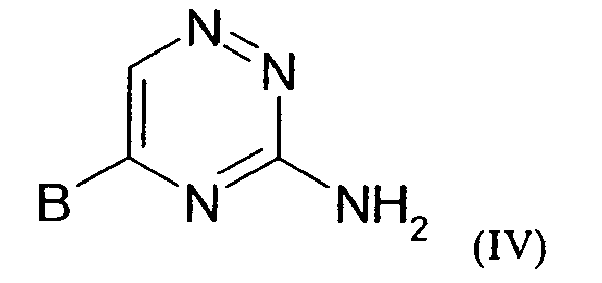
R2-C(O)-Y (V)
wherein Y and R2 have the values defined in claim 1, in the presence of a reducing agent,

H2N-CH(R2)-Y (VII)
wherein R2 and Y have the values defined in claim 1, in the presence of an oxidizing agent and a base,
if appropriate, the reaction being followed or preceded by one or more of the reactions defined in claim 12, performed in an appropriate order, to achieve the substitutions on B and/or Y and/or R1 and/or R2 defined in claim 1.
B-CO-CHO (VIII)
wherein B has values defined in claim 1, with semicarbazide of formula (IX):
H2N-CO-NH-NH2 (IX)
to obtain a compound of formula (X):

B-CO-CHO (VIII)
wherein B has values defined in claim 1, with aminoguanidine of formula (XI):
H2N-C(NH)-NH-NH2 (XI)
to obtain a compound of formula (IV), which is, if desired, either submitted to the action of an alkali metal hydroxide to obtain a compound of formula (X), as defined in claim 16, which is submitted to the action of a chlorination agent, or directly submitted to the action of a chlorination agent.
B-CO-CBr2 (XIII)
with morpholine to obtain a compound of formula (XII):
B-CO-C(morpholine)2 (XII)
wherein B has values defined in claim 1, in an acidic medium, and reacting the compound of formula (XII) with aminoguanidine of formula (XI) as defined in claim 17.
Priority Applications (2)
| Application Number | Priority Date | Filing Date | Title |
|---|---|---|---|
| EP08290639A EP2141164A1 (en) | 2008-07-01 | 2008-07-01 | New 1,2,4-triazine derivatives and biological applications thereof |
| PCT/IB2009/006101 WO2010001220A1 (en) | 2008-07-01 | 2009-06-29 | New 1,2,4-triazine derivatives and biological applications thereof |
Applications Claiming Priority (1)
| Application Number | Priority Date | Filing Date | Title |
|---|---|---|---|
| EP08290639A EP2141164A1 (en) | 2008-07-01 | 2008-07-01 | New 1,2,4-triazine derivatives and biological applications thereof |
Publications (1)
| Publication Number | Publication Date |
|---|---|
| EP2141164A1 true EP2141164A1 (en) | 2010-01-06 |
Family
ID=40032792
Family Applications (1)
| Application Number | Title | Priority Date | Filing Date |
|---|---|---|---|
| EP08290639A Withdrawn EP2141164A1 (en) | 2008-07-01 | 2008-07-01 | New 1,2,4-triazine derivatives and biological applications thereof |
Country Status (2)
| Country | Link |
|---|---|
| EP (1) | EP2141164A1 (en) |
| WO (1) | WO2010001220A1 (en) |
Cited By (3)
| Publication number | Priority date | Publication date | Assignee | Title |
|---|---|---|---|---|
| WO2010046780A3 (en) * | 2008-10-22 | 2011-01-13 | Institut Pasteur Korea | Anti viral compounds |
| US20130053509A1 (en) * | 2009-10-08 | 2013-02-28 | Michelin Recherche Et Technique S.A. | Rubber Composition Comprising A 1,2,4-Triazine |
| EP3549935A4 (en) * | 2016-11-30 | 2020-08-05 | Mitsubishi Tanabe Pharma Corporation | PROCESS FOR PRODUCING TRIAZINE COMPOUNDS |
Families Citing this family (7)
| Publication number | Priority date | Publication date | Assignee | Title |
|---|---|---|---|---|
| EP2669288A1 (en) | 2012-05-29 | 2013-12-04 | Laboratoire Biodim | New monosaccharide derivatives and biological applications thereof |
| EP2725029A1 (en) | 2012-10-29 | 2014-04-30 | Laboratoire Biodim | New antibacterial compounds and biological applications thereof |
| EP3148993B1 (en) | 2014-05-28 | 2019-02-27 | Bayer CropScience Aktiengesellschaft | Process for preparing thiazole derivatives |
| US11905286B2 (en) | 2018-08-09 | 2024-02-20 | Antabio Sas | Diazabicyclooctanones as inhibitors of serine beta-lactamases |
| EP4272831A3 (en) | 2018-08-09 | 2024-02-21 | Antabio SAS | Diazabicyclooctanones as inhibitors of serine beta-lactamases |
| WO2020064173A1 (en) * | 2018-09-25 | 2020-04-02 | Antabio Sas | Indane derivatives for use in the treatment of bacterial infection |
| CN117776924A (en) * | 2023-12-15 | 2024-03-29 | 苏州楚凯药业有限公司 | A kind of key intermediate of 4-acetyl-2-methylbenzoic acid and its synthesis method |
Citations (4)
| Publication number | Priority date | Publication date | Assignee | Title |
|---|---|---|---|---|
| DE2501500A1 (en) * | 1975-01-16 | 1976-07-22 | Hoechst Ag | Triazine-sunstd. imidazole antiprotozoals - 1-(m)ethyl-2-(triazin-2-yl thiomethyl)-5-nitroimidazoles, and corresp. sulphoxides and sulphones |
| US4157392A (en) * | 1977-05-17 | 1979-06-05 | Diamond Shamrock Corporation | Pharmacologically active substituted 1,2,4-triazines |
| WO2006024034A1 (en) * | 2004-08-25 | 2006-03-02 | Targegen, Inc. | Heterocyclic compounds and methods of use |
| WO2006058796A2 (en) | 2004-12-03 | 2006-06-08 | Mutabilis Sa | Methods for preparing enzymatic substrate analogs useful as inhibitors of bacterial heptosyl-transferases and biological applications of the inhibitors |
-
2008
- 2008-07-01 EP EP08290639A patent/EP2141164A1/en not_active Withdrawn
-
2009
- 2009-06-29 WO PCT/IB2009/006101 patent/WO2010001220A1/en not_active Ceased
Patent Citations (4)
| Publication number | Priority date | Publication date | Assignee | Title |
|---|---|---|---|---|
| DE2501500A1 (en) * | 1975-01-16 | 1976-07-22 | Hoechst Ag | Triazine-sunstd. imidazole antiprotozoals - 1-(m)ethyl-2-(triazin-2-yl thiomethyl)-5-nitroimidazoles, and corresp. sulphoxides and sulphones |
| US4157392A (en) * | 1977-05-17 | 1979-06-05 | Diamond Shamrock Corporation | Pharmacologically active substituted 1,2,4-triazines |
| WO2006024034A1 (en) * | 2004-08-25 | 2006-03-02 | Targegen, Inc. | Heterocyclic compounds and methods of use |
| WO2006058796A2 (en) | 2004-12-03 | 2006-06-08 | Mutabilis Sa | Methods for preparing enzymatic substrate analogs useful as inhibitors of bacterial heptosyl-transferases and biological applications of the inhibitors |
Non-Patent Citations (7)
| Title |
|---|
| A. RYKOWSKI, H. C. VAN DER PLAS: "On the amination of 1,2,4-triazines yb potassium amide in liquid ammonia and by phenyl phosphorodiamidate. A 15N-study (1)", JOURNAL OF HETEROCYCLIC CHEMISTRY, vol. 19, 1982, pages 653 - 656, XP002506358 * |
| GMHA ET AL., JOURNAL OF BACTERIOLOGY, January 2002 (2002-01-01), pages 363 - 369 |
| J. CHEM.. SOC. PERKIN TRANS., vol. 2, 1988, pages 943 |
| JUSTUS LIEBIGS ANN. CHEM., vol. 676, 1964, pages 141 |
| ORGANIC LETTERS, 2003, pages 2271 - 2274 |
| OZAWA ET AL: "Phenylimidazole derivatives as specific inhibitors of bacterial enoyl-acyl carrier protein reductase FabK", BIOORGANIC & MEDICINAL CHEMISTRY, ELSEVIER SCIENCE LTD, GB, vol. 15, no. 23, 10 October 2007 (2007-10-10), pages 7325 - 7336, XP022293934, ISSN: 0968-0896 * |
| RYKOWSKI A ET AL: "Ring transformations and amination in reactions of 3-halogeno-5-phenyl-1,2,4-triazines with potassium amide in liquid ammonia", JOURNAL OF ORGANIC CHEMISTRY, AMERICAN CHEMICAL SOCIETY, EASTON.; US, vol. 45, no. 5, 21 February 1980 (1980-02-21), pages 881 - 885, XP002175326, ISSN: 0022-3263 * |
Cited By (4)
| Publication number | Priority date | Publication date | Assignee | Title |
|---|---|---|---|---|
| WO2010046780A3 (en) * | 2008-10-22 | 2011-01-13 | Institut Pasteur Korea | Anti viral compounds |
| US20130053509A1 (en) * | 2009-10-08 | 2013-02-28 | Michelin Recherche Et Technique S.A. | Rubber Composition Comprising A 1,2,4-Triazine |
| US8754164B2 (en) * | 2009-10-08 | 2014-06-17 | Compagnie Generale Des Etablissements Michelin | Rubber composition comprising a 1,2,4-triazine |
| EP3549935A4 (en) * | 2016-11-30 | 2020-08-05 | Mitsubishi Tanabe Pharma Corporation | PROCESS FOR PRODUCING TRIAZINE COMPOUNDS |
Also Published As
| Publication number | Publication date |
|---|---|
| WO2010001220A1 (en) | 2010-01-07 |
Similar Documents
| Publication | Publication Date | Title |
|---|---|---|
| WO2010001220A1 (en) | New 1,2,4-triazine derivatives and biological applications thereof | |
| CN111406054B (en) | 1,2,4-oxadiazole derivatives as histone deacetylase 6 inhibitors | |
| US20100022541A1 (en) | Chemical inhibitors of bacterial heptose synthesis, methods for their preparation and biological applications of said inhibitors | |
| TWI386410B (en) | Inhibitors of akt activity | |
| RU2482112C2 (en) | Kinase inhibitors applicable for treating myeloproliferative diseases and other proliferative diseases | |
| RU2106341C1 (en) | Thiourea derivatives or pharmaceutically acceptable salts, pharmaceutical composition, method of inhibition of reverse transcriptase of aids | |
| US9643933B2 (en) | Compounds useful as antibiotic tolerance inhibitors | |
| US8163742B2 (en) | Di-amino-substituted heterocyclic compounds and methods of use | |
| JP2009515997A (en) | Glucokinase activator | |
| JP2011520915A (en) | Glucokinase activator | |
| US12103904B2 (en) | Benzoylglycine derivatives and methods of making and using same | |
| CA3144506A1 (en) | Substituted amino heteroaryl derivatives and compositions thereof usefule as antifibrotic compounds | |
| RU2139286C1 (en) | Substituted arylalkylthioalkylthiopyridines used for control of bacterium helicobacter | |
| AU2009236380A1 (en) | Inhibitors of phosphatidylinositol 3-kinase | |
| JP2022535290A (en) | 3-(2-(Heteroaryl)-pyridin-4-yl)-5-(trifluoromethyl)-1,2,4-oxadiazole derivatives as HDAC6 inhibitors | |
| WO2015002150A1 (en) | Novel compound, organic cation transporter 3 detection agent, and organic cation transporter 3 activity inhibitor | |
| US20240158385A1 (en) | Novel compounds | |
| HUP0400023A2 (en) | Novel heterocyclic derivatives and medicinal use thereof and pharmaceutical compositions containing them | |
| EP4077290A1 (en) | 4-phenyl-n-(phenyl)thiazol-2-amine derivatives and related compounds as aryl hydrocarbon receptor (ahr) agonists for the treatment of e.g. angiogenesis implicated or inflammatory disorders | |
| JP2001506666A (en) | Imidazopyridazine | |
| EP4367103B1 (en) | Inhibitors of alpha-hemolysin of staphylococcus aureus | |
| US7026324B2 (en) | Thrombin inhibitors | |
| BRPI0614039A2 (en) | isotopically substituted proton pump inhibitors | |
| JPH08512037A (en) | Substituted arylthioalkylthiopyridine | |
| EP3178810A1 (en) | Condensed heterocyclic compound |
Legal Events
| Date | Code | Title | Description |
|---|---|---|---|
| PUAI | Public reference made under article 153(3) epc to a published international application that has entered the european phase |
Free format text: ORIGINAL CODE: 0009012 |
|
| AK | Designated contracting states |
Kind code of ref document: A1 Designated state(s): AT BE BG CH CY CZ DE DK EE ES FI FR GB GR HR HU IE IS IT LI LT LU LV MC MT NL NO PL PT RO SE SI SK TR |
|
| AX | Request for extension of the european patent |
Extension state: AL BA MK RS |
|
| 17P | Request for examination filed |
Effective date: 20100701 |
|
| 17Q | First examination report despatched |
Effective date: 20100803 |
|
| AKX | Designation fees paid |
Designated state(s): AT BE BG CH CY CZ LI |
|
| RBV | Designated contracting states (corrected) |
Designated state(s): AT BE BG CH CY CZ DE DK EE ES FI FR GB GR HR HU IE IS IT LI LT LU LV MC MT NL NO PL PT RO SE SI SK TR |
|
| RAP1 | Party data changed (applicant data changed or rights of an application transferred) |
Owner name: LABORATOIRE BIODIM |
|
| REG | Reference to a national code |
Ref country code: DE Ref legal event code: 8566 |
|
| STAA | Information on the status of an ep patent application or granted ep patent |
Free format text: STATUS: THE APPLICATION IS DEEMED TO BE WITHDRAWN |
|
| 18D | Application deemed to be withdrawn |
Effective date: 20101214 |