EP2139881B1 - Quinolines and their therapeutic use - Google Patents
Quinolines and their therapeutic use Download PDFInfo
- Publication number
- EP2139881B1 EP2139881B1 EP08736891A EP08736891A EP2139881B1 EP 2139881 B1 EP2139881 B1 EP 2139881B1 EP 08736891 A EP08736891 A EP 08736891A EP 08736891 A EP08736891 A EP 08736891A EP 2139881 B1 EP2139881 B1 EP 2139881B1
- Authority
- EP
- European Patent Office
- Prior art keywords
- acetic acid
- yloxy
- difluoromethoxy
- ethyl
- fluoro
- Prior art date
- Legal status (The legal status is an assumption and is not a legal conclusion. Google has not performed a legal analysis and makes no representation as to the accuracy of the status listed.)
- Not-in-force
Links
- 0 *c(c(N)c1)ccc1O Chemical compound *c(c(N)c1)ccc1O 0.000 description 9
- VGCMFCBYAQDHTL-UHFFFAOYSA-N CCc1nc(c(F)ccc2OCC(O)=O)c2c(OC(F)F)c1Cc(cc1)ccc1-[n]1nccc1C1CC1 Chemical compound CCc1nc(c(F)ccc2OCC(O)=O)c2c(OC(F)F)c1Cc(cc1)ccc1-[n]1nccc1C1CC1 VGCMFCBYAQDHTL-UHFFFAOYSA-N 0.000 description 1
- URQYRYZALXMEGG-INIZCTEOSA-N C[C@@H](C(N=O)=O)Oc(c1c2nc(C3CC3)c(Cc(cc3)ccc3-[n]3nccc3)c1C)ccc2F Chemical compound C[C@@H](C(N=O)=O)Oc(c1c2nc(C3CC3)c(Cc(cc3)ccc3-[n]3nccc3)c1C)ccc2F URQYRYZALXMEGG-INIZCTEOSA-N 0.000 description 1
Classifications
-
- C—CHEMISTRY; METALLURGY
- C07—ORGANIC CHEMISTRY
- C07D—HETEROCYCLIC COMPOUNDS
- C07D401/00—Heterocyclic compounds containing two or more hetero rings, having nitrogen atoms as the only ring hetero atoms, at least one ring being a six-membered ring with only one nitrogen atom
- C07D401/02—Heterocyclic compounds containing two or more hetero rings, having nitrogen atoms as the only ring hetero atoms, at least one ring being a six-membered ring with only one nitrogen atom containing two hetero rings
- C07D401/10—Heterocyclic compounds containing two or more hetero rings, having nitrogen atoms as the only ring hetero atoms, at least one ring being a six-membered ring with only one nitrogen atom containing two hetero rings linked by a carbon chain containing aromatic rings
-
- A—HUMAN NECESSITIES
- A61—MEDICAL OR VETERINARY SCIENCE; HYGIENE
- A61P—SPECIFIC THERAPEUTIC ACTIVITY OF CHEMICAL COMPOUNDS OR MEDICINAL PREPARATIONS
- A61P1/00—Drugs for disorders of the alimentary tract or the digestive system
-
- A—HUMAN NECESSITIES
- A61—MEDICAL OR VETERINARY SCIENCE; HYGIENE
- A61P—SPECIFIC THERAPEUTIC ACTIVITY OF CHEMICAL COMPOUNDS OR MEDICINAL PREPARATIONS
- A61P1/00—Drugs for disorders of the alimentary tract or the digestive system
- A61P1/04—Drugs for disorders of the alimentary tract or the digestive system for ulcers, gastritis or reflux esophagitis, e.g. antacids, inhibitors of acid secretion, mucosal protectants
-
- A—HUMAN NECESSITIES
- A61—MEDICAL OR VETERINARY SCIENCE; HYGIENE
- A61P—SPECIFIC THERAPEUTIC ACTIVITY OF CHEMICAL COMPOUNDS OR MEDICINAL PREPARATIONS
- A61P11/00—Drugs for disorders of the respiratory system
-
- A—HUMAN NECESSITIES
- A61—MEDICAL OR VETERINARY SCIENCE; HYGIENE
- A61P—SPECIFIC THERAPEUTIC ACTIVITY OF CHEMICAL COMPOUNDS OR MEDICINAL PREPARATIONS
- A61P11/00—Drugs for disorders of the respiratory system
- A61P11/02—Nasal agents, e.g. decongestants
-
- A—HUMAN NECESSITIES
- A61—MEDICAL OR VETERINARY SCIENCE; HYGIENE
- A61P—SPECIFIC THERAPEUTIC ACTIVITY OF CHEMICAL COMPOUNDS OR MEDICINAL PREPARATIONS
- A61P11/00—Drugs for disorders of the respiratory system
- A61P11/06—Antiasthmatics
-
- A—HUMAN NECESSITIES
- A61—MEDICAL OR VETERINARY SCIENCE; HYGIENE
- A61P—SPECIFIC THERAPEUTIC ACTIVITY OF CHEMICAL COMPOUNDS OR MEDICINAL PREPARATIONS
- A61P11/00—Drugs for disorders of the respiratory system
- A61P11/08—Bronchodilators
-
- A—HUMAN NECESSITIES
- A61—MEDICAL OR VETERINARY SCIENCE; HYGIENE
- A61P—SPECIFIC THERAPEUTIC ACTIVITY OF CHEMICAL COMPOUNDS OR MEDICINAL PREPARATIONS
- A61P11/00—Drugs for disorders of the respiratory system
- A61P11/16—Central respiratory analeptics
-
- A—HUMAN NECESSITIES
- A61—MEDICAL OR VETERINARY SCIENCE; HYGIENE
- A61P—SPECIFIC THERAPEUTIC ACTIVITY OF CHEMICAL COMPOUNDS OR MEDICINAL PREPARATIONS
- A61P17/00—Drugs for dermatological disorders
-
- A—HUMAN NECESSITIES
- A61—MEDICAL OR VETERINARY SCIENCE; HYGIENE
- A61P—SPECIFIC THERAPEUTIC ACTIVITY OF CHEMICAL COMPOUNDS OR MEDICINAL PREPARATIONS
- A61P17/00—Drugs for dermatological disorders
- A61P17/06—Antipsoriatics
-
- A—HUMAN NECESSITIES
- A61—MEDICAL OR VETERINARY SCIENCE; HYGIENE
- A61P—SPECIFIC THERAPEUTIC ACTIVITY OF CHEMICAL COMPOUNDS OR MEDICINAL PREPARATIONS
- A61P37/00—Drugs for immunological or allergic disorders
- A61P37/08—Antiallergic agents
-
- C—CHEMISTRY; METALLURGY
- C07—ORGANIC CHEMISTRY
- C07D—HETEROCYCLIC COMPOUNDS
- C07D215/00—Heterocyclic compounds containing quinoline or hydrogenated quinoline ring systems
- C07D215/02—Heterocyclic compounds containing quinoline or hydrogenated quinoline ring systems having no bond between the ring nitrogen atom and a non-ring member or having only hydrogen atoms or carbon atoms directly attached to the ring nitrogen atom
- C07D215/16—Heterocyclic compounds containing quinoline or hydrogenated quinoline ring systems having no bond between the ring nitrogen atom and a non-ring member or having only hydrogen atoms or carbon atoms directly attached to the ring nitrogen atom with hetero atoms or with carbon atoms having three bonds to hetero atoms with at the most one bond to halogen, e.g. ester or nitrile radicals, directly attached to ring carbon atoms
- C07D215/20—Oxygen atoms
- C07D215/22—Oxygen atoms attached in position 2 or 4
- C07D215/227—Oxygen atoms attached in position 2 or 4 only one oxygen atom which is attached in position 2
-
- C—CHEMISTRY; METALLURGY
- C07—ORGANIC CHEMISTRY
- C07D—HETEROCYCLIC COMPOUNDS
- C07D215/00—Heterocyclic compounds containing quinoline or hydrogenated quinoline ring systems
- C07D215/02—Heterocyclic compounds containing quinoline or hydrogenated quinoline ring systems having no bond between the ring nitrogen atom and a non-ring member or having only hydrogen atoms or carbon atoms directly attached to the ring nitrogen atom
- C07D215/16—Heterocyclic compounds containing quinoline or hydrogenated quinoline ring systems having no bond between the ring nitrogen atom and a non-ring member or having only hydrogen atoms or carbon atoms directly attached to the ring nitrogen atom with hetero atoms or with carbon atoms having three bonds to hetero atoms with at the most one bond to halogen, e.g. ester or nitrile radicals, directly attached to ring carbon atoms
- C07D215/20—Oxygen atoms
- C07D215/22—Oxygen atoms attached in position 2 or 4
- C07D215/233—Oxygen atoms attached in position 2 or 4 only one oxygen atom which is attached in position 4
-
- C—CHEMISTRY; METALLURGY
- C07—ORGANIC CHEMISTRY
- C07D—HETEROCYCLIC COMPOUNDS
- C07D413/00—Heterocyclic compounds containing two or more hetero rings, at least one ring having nitrogen and oxygen atoms as the only ring hetero atoms
- C07D413/02—Heterocyclic compounds containing two or more hetero rings, at least one ring having nitrogen and oxygen atoms as the only ring hetero atoms containing two hetero rings
- C07D413/10—Heterocyclic compounds containing two or more hetero rings, at least one ring having nitrogen and oxygen atoms as the only ring hetero atoms containing two hetero rings linked by a carbon chain containing aromatic rings
-
- C—CHEMISTRY; METALLURGY
- C07—ORGANIC CHEMISTRY
- C07D—HETEROCYCLIC COMPOUNDS
- C07D417/00—Heterocyclic compounds containing two or more hetero rings, at least one ring having nitrogen and sulfur atoms as the only ring hetero atoms, not provided for by group C07D415/00
- C07D417/02—Heterocyclic compounds containing two or more hetero rings, at least one ring having nitrogen and sulfur atoms as the only ring hetero atoms, not provided for by group C07D415/00 containing two hetero rings
- C07D417/10—Heterocyclic compounds containing two or more hetero rings, at least one ring having nitrogen and sulfur atoms as the only ring hetero atoms, not provided for by group C07D415/00 containing two hetero rings linked by a carbon chain containing aromatic rings
Definitions
- This invention relates to a class of quinoline compounds which are ligands of the CRTH2 receptor ( C hemoattctant R eceptor-homologous molecule expressed on T H elper cells type 2 ), and therefore useful in the treatment of diseases responsive to modulation of CRTH2 receptor activity, principally diseases having a significant inflammatory component.
- the invention also relates to novel members of that class of ligands and pharmaceutical compositions containing them.
- PGD 2 mediates it effects through two receptors, the PGD 2 (or DP) receptor ( Boie et al; J. Biol. Chem., 1995, 270, 18910-18916 ) and the chemoattractant receptor-homologous molecule expressed on Th2 (or CRTH2) ( Nagata et al; J. Immunol., 1999, 162, 1278-1289 ; Powell; Prostaglandins Luekot. Essent. Fatty Acids, 2003, 69, 179-185 ). Therefore, it has been postulated that agents that antagonise the effects of PGD 2 at its receptors may have beneficial effects in number of disease states.
- the CRTH2 receptor has been shown to be expressed on cell types associated with allergic inflammation, such as basophils, eosinophils, and Th2-type immune helper cells ( Hirai et al; J. Exp. Med., 2001, 193, 255-261 ).
- the CRTH2 receptor has been shown to mediate PGD 2 -mediated cell migration in these cell types ( Hirai et al; J. Exp. Med., 2001, 193, 255-261 ), and also to play a major role in neutrophil and eosinophil cell recruitment in a model of contact dermatitis ( Takeshita et al; Int. Immunol., 2004, 16, 947-959 ).
- Transgenic mice over expressing PGD 2 synthase exhibit an enhanced pulmonary eosinophilia and increased levels of Th2 cytokines in response to allergen challenge ( Fujitani et al; J. Immunol., 2002, 168, 443-449 ).
- exogenously administered CRTH2 agonists enhance the allergic response in sensitised mice ( Spik et al; J. Immunol., 2005, 174, 3703-3708 ).
- rats exogenously applied CRTH2 agonists cause a pulmonary eosinophilia but a DP agonist (BW 245C) or a TP agonist (I-BOP) showed no effect ( Shirashi et al; J. Pharmacol. Exp Ther., 2005, 312, 954-960 ).
- CRTH2 antagonists include: indoleacetic acids ( WO2007/065684 ; WO2007/045867 ; WO2006/034419 ; WO2005/094816 WO2005/044260 ; WO2005/04011 WO2005/040112 ; GB2407318 ; WO2005/01917 WO2004/106302 ; WO2004/078719 : WO2004/007451 ; WO2003/101981 ; WO2003/101961 ; WO2003/097598 ; WO2003/097042 ; WO2003/066047 ; WO2003/066046 ; WO2003/022813 ), quinolines ( WO2007/036743 ), tetrahydroquinolines ( WO2006/09167 US2005/256158 ; WO2005/100321 ; WO2005/007094 ; WO2004/035543 ; WO2004/03
- the quinoline template is a common one in compounds proposed for use as pharmaceuticals.
- the compounds with which the present invention is concerned have a substitution pattern on the quinoline template which distinguishes them from specific known quinoline-type pharmaceuticals or known generally proposed classes of quinoline-type pharmaceuticals.
- Compounds with which the invention is concerned are CRTH2 receptor antagonists, and are selective over the DP receptor.
- a second aspect of the invention is (i) a compound of formula (I) for use in therapy; (ii) a compound of formula (I) for use in the manufacture of a medicament in the treatment of conditions responsive to modulation of CRTH2 receptor activity.
- Examples of conditions responsive to modulation of CRTH2 receptor activity include asthma, rhinitis, allergic airway syndrome, allergic rhinobronchitis, bronchitis, chronic obstructive pulmonary disease (COPD), nasal polyposis, sarcoidosis, farmer's lung, fibroid lung, cystic fibrosis, chronic cough, conjunctivitis, atopic dermatitis, Alzheimer's disease, amyotrophic lateral sclerosis, AIDS dementia complex, Huntington's disease, frontotemporal dementia, Lewy body dementia, vascular dementia, Guillain-Barre syndrome, chronic demyelinating polyradiculoneurophathy, multifocal motor neuropathy, plexopathy, multiple sclerosis, encephalomyelitis, panencephalitis, cerebellar degeneration and encephalomyelitis, CNS trauma, migraine, stroke, rheumatoid arthritis, ankylosing spondylitis, Behçet's Disease, bursit
- the compounds with which the invention is concerned are primarily of value for the treatment of asthma, chronic obstructive pulmonary disease, rhinitis, allergic airway syndrome, or allergic rhinobronchitis.
- Psoriasis, atopic and non-atopic dermatitis Crohn's disease, ulcerative colitis, and irritable bowel disease are other specific conditions where the present compounds may have particular utility.
- a third aspect of the invention is a pharmaceutical composition
- a pharmaceutical composition comprising a compound of formula (I), in admixture with a pharmaceutically acceptable carrier or excipient.
- (C a -C b )alkyl wherein a and b are integers refers to a straight or branched chain alkyl radical having from a to b carbon atoms.
- a 1 and b is 6, for example, the term includes methyl, ethyl, n-propyl, isopropyl, n-butyl, isobutyl, sec-butyl, t-butyl, n-pentyl and n-hexyl.
- Carbocyclico refers to an optionally substituted mono-, bi- or tricyclic radical having up to 16 ring atoms, all of which are carbon, and includes aryl and cycloalkyl.
- cycloalkyl° refers to an optionally substituted monocyclic saturated carbocyclic radical having from 3-6 carbon atoms and includes, for example, cyclopropyl, cyclobutyl, cyclopentyl, cyclohexyl, cycloheptyl and cyclooctyl.
- aryl refers to an optionally substituted mono-, bi- or tri-cyclic carbocyclic aromatic radical, and includes radicals having two monocyclic carbocyclic aromatic rings which are directly linked by a covalent bond.
- Aryl radicals may have, for example, from 6 to 14 ring carbon atoms, preferably from 6 to 10 carbon atoms.
- Illustrative of aryl radicals are phenyl, biphenyl and napthyl.
- heteroaryl° refers to an optionally substituted mono-, bi- or tri-cyclic aromatic radical containing one or more heteroatoms selected from S, N and O, and includes radicals having two such monocyclic rings, or one such monocyclic ring and one monocyclic aryl ring, which are directly linked by a covalent bond.
- Illustrative of such radicals are thienyl, benzthienyl, furyl, benzfuryl, pyrrolyl, imidazolyl, benzimidazolyl, thiazolyl, benzthiazolyl, isothiazolyl, benzisothiazolyl, pyrazolyl, oxazolyl, benzoxazolyl, isoxazolyl, benzisoxazolyl, isothiazolyl, triazolyl, benztriazolyl, thiadiazolyl, oxadiazolyl, pyridinyl, pyridazinyl, pyrimidinyl, pyridazinyl, triazinyl, indolyl and indazolyl.
- heterocycloalkyl or “heterocyclyl” or “heterocyclic” includes “heteroaryl” as defined above, and in addition means an optionally substituted mono-, bi- or tri-cyclic non-aromatic radical containing one or more heteroatoms selected from S, N and. O, and to groups consisting of a monocyclic non-aromatic radical containing one or more such heteroatoms which is covalently linked to another such radical or to a monocyclic carbocyclic radical.
- radicals are pyrrolyl, furanyl, thienyl, piperidinyl, imidazolyl, oxazolyl, isoxazolyl, thiazolyl, thiadiazolyl, pyrazolyl, pyridinyl, pyrrolidinyl, pyrimidinyl, morpholinyl, piperazinyl, indolyl, quinolyl, morpholinyl, benzfuranyl, pyranyl, isoxazolyl, benzimidazolyl, methylenedioxyphenyl, ethylenedioxyphenyl, maleimido and succinimido groups.
- substituted as applied to any moiety herein means substituted with up to four compatible substituents, each of which independently may be, for example, (C 1 -C 6 )alkyl, cycloalkyl, (C 1 -C 6 )alkoxy, hydroxy, hydroxy(C 1 -C 6 )alkyl, mercapto, mercapto(C 1 -C 6 )alkyl, (C 1 -C 6 )alkylthio, phenyl, monocyclic heteroaryl having 5 or 6 ring atoms, halo (including fluoro, bromo and chloro), trifluoromethyl, trifluoromethoxy, nitro, nitrile (-CN), oxo, -COOH, -COOR A , -COR A , -SO 2 R A , -CONH 2 , -SO 2 NH 2 , -CONHR A ,
- R A and R B are independently a (C 1 -C 6 )alkyl, (C 3 -C 6 ) cycloalkyl , phenyl, or monocyclic heterocyclic group having 5 or 6 ring atoms, or R A and R 8 when attached to the same nitrogen atom may form a ring with that nitrogen of 5 or 6 ring atoms, optionally containing further heteroatoms selected from N, O or S (examples being morpholinyl, piperidinyl, piperizinyl, 4-methylpiperizinyl, and tetrahydropyrrolyl).
- An "optional substituent" may be one of the foregoing substituent groups.
- salt includes base addition, acid addition and quaternary salts.
- Compounds of the invention which are acidic can form salts, including pharmaceutically acceptable salts, with bases such as alkali metal hydroxides, e.g. sodium and potassium hydroxides; alkaline earth metal hydroxides e.g. calcium, barium and magnesium hydroxides; with organic bases e.g. N-methyl-D-glucamine, choline tris(hydroxymethyl)amino-methane, L-arginine, L-lysine, N-ethyl piperidine, dibenzylamine and the like.
- bases such as alkali metal hydroxides, e.g. sodium and potassium hydroxides; alkaline earth metal hydroxides e.g. calcium, barium and magnesium hydroxides; with organic bases e.g. N-methyl-D-glucamine, choline tris(hydroxymethyl)amino-methane, L-arginine, L-lysine, N-ethyl pipe
- Specific salts with bases include the benzathine, calcium, diolamine, meglumine, olamine, potassium, procaine, sodium, tromethamine and zinc salts.
- Those compounds of the invention which are basic can form salts, including pharmaceutically acceptable salts with inorganic acids, e.g. with hydrohalic acids such as hydrochloric or hydrobromic acids, sulphuric acid, nitric acid or phosphoric acid and the like, and with organic acids e.g.
- a compound contains a quaternary ammonium group acceptable counter-ions may be, for example, chlorides, bromides, sulfates, methanesulfonates, benzenesulfonates, toluenesulfonates (tosylates), napadisylates (naphthalene-1,5-disulfonates or naphthalene-1-(sulfonic acid)-5-sulfonates), edisylates (ethane-1,2-disulfonates or ethane-1-(sulfonic acid)-2-sulfonates), isethionates (2-hydroxyethylsulfonates), phosphates, acetates, citrates, lactates, tartrates, mesylates, maleates, malates, fumarates, succinates, xinafoates, p-acetamidobenzoates and the like; wherein the number of qua
- Compounds with which the invention is concerned may exist in one or more stereoisomeric form, because of the presence of asymmetric atoms or rotational restrictions, and in such cases can exist as a number of stereoisomers with R or S stereochemistry at each chiral centre or as atropisomers with R or S stereochemistry at each chiral axis.
- the invention includes all such enantiomers and diastereoisomers and mixtures thereof.
- R 1 is halogen, such as fluoro, chloro or bromo. Presently fluoro and chloro are preferred.
- R 2 is hydrogen or methyl.
- R 3 and R 4 are independently C 1 -C 6 alkyl, for example methyl, ethyl, or n- or iso-propyl; fully or partially halogenated, especially fluorinated, C 1 -C 6 alkyl, for example trifluoromethyl or difluoromethyl; (C 3 -C 6 )cycloalkyl, for example cyclopropyl, fully or partially halogenated, especially fluorinated (C 3 -C 6 )cycloalkyl; or a group -OR 6 ; wherein R 6 is C 1 -C 6 alkyl, for example methyl, ethyl, or n- or iso-propyl; fully or partially halogenated, especially fluorinated, C 1 -C 6 alkyl, for example trifluoromethyl or difluoromethyl; (C 3 -C 6) cycloalkyl, for example cyclopropyl or fully or partially halogenated, especially fluorinated (
- R 3 and R 4 are methyl or ethyl, and the other is difluoromethoxy.
- R 4 is ethyl, isopropyl, cyclopropyl, or difluoromethoxy, and R 3 is difluoromethoxy or, methyl.
- X is -CHr, -S- or -O-.
- Examples of Y and Y 1 when not hydrogen are:
- One particular subclass of compounds of the invention consists of compounds of formula (I) above wherein R 1 is chloro or fluoro, R 2 is hydrogen or methyl, R 3 is methyl or difluoromethoxy, R 4 is ethyl, isopropyl or difluoromethoxy, R 5 is hydrogen, fluoro or chloro, one of Y and Y 1 is hydrogen and the other is pyrimidin-2-yl, pyrazol-1-yl, pyrazol-3-yl, pyrazol-4-yl, imidazol-1-yl, imidazol-2-yl, thiazol-2-yl, oxazol-2-yl or isoxazol-4-yl, any of which may be optionally substituted by one or more substituents selected from fluoro, chloro cyano methyl, ethyl, isopropyl, trifuoromethyl, difluoromethyl, cyclopropyl, hydroxy, methoxy, e
- the compounds with which the invention is concerned are CRTH2 receptor antagonists, and are useful in the treatment of diseases which benefit from such modulation.
- diseases which benefit from such modulation. Examples of such diseases are referred to above, and include asthma, COPD, rhinitis, allergic airway syndrome, and bronchitis.
- the specific dose level for any particular patient will depend upon a variety of factors including the activity of the specific compound employed, the age, body weight, general health, sex, diet, time of administration, route of administration, rate of excretion, drug combination and the severity of the particular disease undergoing treatment. Optimum dose levels and frequency of dosing will be determined by clinical trial, as is required in the pharmaceutical art. In general, the daily dose range will lie within the range of from about 0.001 mg to about 100 mg per kg body weight of a mammal, often 0.01 mg to about 50 mg per kg, for example 0.1 to 10 mg per kg, in single or divided doses. On the other hand, it may be necessary to use dosages outside these limits in some cases.
- compositions may be in the form of tablets, capsules, powders, granules, lozenges, liquid or gel preparations, such as oral, topical, or sterile parenteral solutions or suspensions.
- Tablets and capsules for oral administration may be in unit dose presentation form, and may contain conventional excipients such as binding agents, for example syrup, acacia, gelatin, sorbitol, tragacanth, or polyvinyl-pyrrolidone; fillers for example lactose, sugar, maize-starch, calcium phosphate, sorbitol or glycine; tabletting lubricant, for example magnesium stearate, talc, polyethylene glycol or silica; disintegrants for example potato starch, or acceptable wetting agents such as sodium lauryl sulfate.
- the tablets may be coated according to methods well known in normal pharmaceutical practice.
- Oral liquid preparations may be in the form of, for example, aqueous or oily suspensions, solutions, emulsions, syrups or elixirs, or may be presented as a dry product for reconstitution with water or other suitable vehicle before use.
- Such liquid preparations may contain conventional additives such as suspending agents, for example sorbitol, syrup, methyl cellulose, glucose syrup, gelatin hydrogenated edible fats; emulsifying agents, for example lecithin, sorbitan monooleate, or acacia; nonaqueous vehicles (which may include edible oils), for example almond oil, fractionated coconut oil, oily esters such as glycerine, propylene glycol, or ethyl alcohol; preservatives, for example methyl or propyl p-hydroxybenzoate or sorbic acid, and if desired conventional flavouring or colouring agents.
- suspending agents for example sorbitol, syrup, methyl cellulose, glucose syrup, gelatin hydrogenated edible fats
- emulsifying agents for example lecithin, sorbitan monooleate, or acacia
- nonaqueous vehicles which may include edible oils
- almond oil fractionated coconut oil
- oily esters such as glycerine, propylene glycol
- the drug may be made up into a cream, lotion or ointment.
- Cream or ointment formulations which may be used for the drug are conventional formulations well known in the art, for example as described in standard textbooks of pharmaceutics such as the British Pharmacopoeia.
- the drug may also be formulated for inhalation, for example as a nasal spray, or dry powder or aerosol inhalers.
- the active compound is preferably in the form of microparticles. They may be prepared by a variety of techniques, including spray-drying, freeze-drying and micronisation. Aerosol generation can be carried out using, for example, pressure-driven jet atomizers or ultrasonic atomizers, preferably using propellant-driven metered aerosols or propellant-free administration of micronized active compounds from, for example, inhalation capsules or other "dry powder" delivery systems.
- the active ingredient may also be administered parenterally in a sterile medium.
- the drug can either be suspended or dissolved in the vehicle.
- adjuvants such as a local anaesthetic, preservative and buffering agent can be dissolved in the vehicle.
- compositions for preventing and treating PGD 2 -mediated diseases comprising a therapeutically effective amount of a compound of the invention of formula [I] and one or more other therapeutic agents.
- Suitable therapeutic agents for a combination therapy with compounds of formula [1] include, but are not limited to: (1) corticosteroids, such as fluticasone, ciclesonide or budesonide; (2) ⁇ 2-adrenoreceptor agonists, such as salmeterol, indacaterol or formoterol; (3) leukotriene modulators, for example leukotriene antagonists such as montelukast, zafirulast or pranlukast or leukotriene biosynthesis inhibitors such as Zileuton or BAY-1005; (4) anticholinergic agents, for example muscarinic-3 (M3) receptor antagonists such as tiotropium bromide; (5) phosphodiesterase-IV (PDE-IV) inhibitors, such as roflumilast or cilomilast; (6) antihistamines, for example selective histamine-1 (H1) receptor antagonists, such as fexofenadine, citirizine, loratidine or
- the weight ratio of the compound of the invention to the second active ingredient may be varied and will depend upon the effective dose of each ingredient. Generally, an effective dose of each will be used.
- the present invention is also concerned with processes for preparing the compounds of this invention.
- the compounds of formula [I] of the present invention can be prepared according to the procedures of the following schemes and examples, using appropriate materials, and are further exemplified by the following specific examples. Moreover, by utilizing the procedures described with the disclosure contained herein, one of ordinary skill in the art can readily prepare additional compounds of the present invention claimed herein. The compounds illustrated in the examples are not, however, to be construed as forming the only genus that is considered as the invention. The examples further illustrate details for the preparation of the compounds of the present invention. Those skilled in the art will readily understand that known variations of the conditions and processes of the following preparative procedures can be used to prepare these compounds.
- Compounds of the invention of formula [Ia] may conveniently be prepared by the reaction between an intermediate compound of formula [II] and a suitable alkylating agent of formula [III], wherein group LG represents a suitable leaving group (for example, chloro, bromo, or methanesulfonyloxy) and R 9 is a hydrogen or alkyl group.
- group LG represents a suitable leaving group (for example, chloro, bromo, or methanesulfonyloxy) and R 9 is a hydrogen or alkyl group.
- the alkylation reaction is carried out in the presence of a base (for example, potassium carbonate) in an inert solvent (for example, acetone or N,N- dimethylformamide).
- a base for example, potassium carbonate
- an inert solvent for example, acetone or N,N- dimethylformamide
- Intermediate compounds of formula [II] may be prepared by the reaction between an aminophenol of formula [IV] and a 1,3-dicarbonyl compound of formula [V].
- the reaction may be carried out neat or in the presence of a suitable dehydrating agent, such as polyphosphoric acid, p -totuenesutfonic acid or methanesulfonic acid.
- a suitable dehydrating agent such as polyphosphoric acid, p -totuenesutfonic acid or methanesulfonic acid.
- Intermediate compounds of formula [III], [IV] and [V] are commercially available or can be prepared by known methods.
- intermediate compounds of formula [II], wherein R 4 is an alkyl group, such as isopropyl or cyclopropyl may be prepared from intermediate compounds of formula [VI], wherein T is chloro, bromo or iodo atom, or a trifluoromethanesulfonyloxy group, by reaction with an organometallic reagent of formula [VII], wherein B is an appropriately substituted boron, zinc or tin group (Scheme 2).
- the reaction may conveniently be carried out in the presence of a suitable catalyst such as tetrakis(triphenylphosphine)palladium.
- a suitable catalyst such as tetrakis(triphenylphosphine)palladium.
- Compounds of formula [VII] are commercially available or can be prepared by known methods.
- Intermediate compounds of formula [VI], wherein T is chloro atom may be prepared by treatment of compounds of formula [VIII] with phosphorus oxychloride.
- Intermediate compounds of formula [VIII] may be prepared from compounds of formula [IX].
- the reaction may be carried in the presence of a suitable dehydrating agent, for example methanesulfonic acid or p -toluenesulfonic acid.
- Intermediate compounds of formula [IX] may be prepared from reaction of aminophenols of formula [IV] with ⁇ -ketothioesters of formula [X] in the presence of silver trifluoroacetate.
- Compounds of formula [X] are known or may be prepared from known compounds according to methods known to those skilled in the art.
- Intermediate compounds of formula [XI] may be prepared from compounds of formula [III] and [VIII] using methods described above for the preparation of compounds of formula [Ia] from intermediate compounds of formula [II] (Scheme 1).
- Intermediate compounds of formula [XIV] may be prepared from compounds of formula [IV] using methods described above for the preparation of compounds of formula [Ia] from intermediate compounds of formula [II] (Scheme 1).
- Ketoesters of formula [XIII] are known or may be prepared from known compounds according to methods known to those skilled in the art.
- compounds of formula [Ia], wherein Y or Y 1 represents a heterocyclic group may be conveniently prepared from compounds of formula [Ia], wherein Y or Y 1 represents chloro, bromo, or iodo atom, or a trifluoromethanesulfonyloxy group, by reaction with an organometallic reagent of formula [XV] wherein Het represents a 5-or 6-membered heteroaryl ring and M represents an appropriately substituted boron, zinc, tin, copper or silicon group (Scheme 5).
- the reaction may conveniently be carried out in the presence of a suitable catalyst such as a palladium compound (for example, tetrakis(triphenylphosphine)palladium or [1,1'-bis(diphenylphosphino) ferrocene]dichloropalladium).
- a suitable catalyst such as a palladium compound (for example, tetrakis(triphenylphosphine)palladium or [1,1'-bis(diphenylphosphino) ferrocene]dichloropalladium).
- Method A experiments were performed on a Micromass Platform LCT spectrometer with positive ion electrospray and single wavelength UV 254 nm detection using a Higgins Clipeus C18 5 ⁇ m 100 x 3.0 mm column and a 2 mL / minute flow rate.
- the initial solvent system was 95 % water containing 0.1 % formic acid (solvent A) and 5 % acetonitrile containing 0.1 % formic acid (solvent B) for the first minute followed by a gradient up to 5 % solvent A and 95 % solvent B over the next 14 minutes.
- the final solvent system was held constant for a further 2 minutes.
- Method B experiments were performed on a Micromass Platform LC spectrometer with positive and negative ion electrospray and ELS / Diode array detection using a Phenomenex Luna C18(2) 30 x 4.6 mm column and a 2 mL / minute flow rate.
- the solvent system was 95 % solvent A and 5 % solvent B for the first 0.50 minutes followed by a gradient up to 5 % solvent A and 95 % solvent B over the next 4 minutes.
- the final solvent system was held constant for a further 0.50 minutes
- Microwave experiments were carried out using a Personal Chemistry Smith SynthesizerTM, which uses a single-mode resonator and dynamic field tuning, both of which give reproducibility and control. Temperatures from 40-250 °C can be achieved, and pressures of up to 20 bars can be reached. Two types of vial are available for this processor, 0.5-2.0 mL and 2.0-5.0 mL
- Reverse-phase preparative HPLC purifications were carried out using Genesis 7 micron C-18 bonded silica stationary phase in columns 10 cm in length and 2 cm internal diameter.
- the mobile phase used was mixtures of acetonitrile and water (both buffered with 0.1 % v/v trifluoroacetic acid or formic acid) with a flow rate of 10 mL per minute and typical gradients of 40 to 90 % organic modifier ramped up over 30 to 40 minutes.
- Fractions containing the required product identified by LC-MS analysis
- 3-Amino-4-fluorophenol (3.0 g) was added to a stirred suspension of sodium hydride (60 % in oil, 0.94 g) in N,N -dimethylformamide (30 mL) at 0 °C, and the resulting mixture was warmed to room temperature for 15 minutes. The mixture was cooled to 0 °C, treated with bromoacetic acid methyl ester (3.3 g), and then stirred at room temperature for 2 hours. The mixture was treated with dilute aqueous ammonium chloride solution and extracted with ethyl acetate. The combined extracts were washed with saturated aqueous sodium chloride solution, dried over magnesium sulfate and the solvent removed under reduced pressure.
- a suspension of potassium tert -butoxide (0.57 g) in tetrahydrofuran (40 mL) at 0 °C was treated with a mixture of tert- butanol (2.0 mL) and 3-oxopentanoic acid ethyl ester (0.73 mL), and the resulting mixture was stirred at 0 °C for 45 minutes.
- the mixture was then treated with a solution of 1-(4-bromomethylphenyl)-1H-pyrazole (1.0 g) in tetrahydrofuran (10 mL), and stirred at 0 °C for 2 hours.
- the mixture was diluted with water, concentrated to low bulk under reduced pressure, and the residue extracted with ethyl acetate.
- the title compound was prepared by the method of Preparation 1b using 3-oxopentanoic acid ethyl ester and 1-bromo-4-bromomethylbenzene.
- the title compound was prepared by the method of Preparation 1 c using (3-amino-4-fluorophenoxy)acetic acid methyl ester and 2-(4-bromobenzyl)-3-oxopentanoic acid ethyl ester.
- the title compound was prepared by the method of Preparation 1d using [3-(4-bromobenzyl)-2-ethyl-8-fluoro-4-oxo-1,4-dihydroquinolin-5-yloxy]acefic acid methyl ester and acetic acid chlorodifluoromethyl ester.
- the title compound was prepared by the method of Preparation 1c using (3-amino-4-fluorophenoxy)acetic acid methyl ester and 2-(4-methoxybenzyl)-3-oxopentanoic acid ethyl ester.
- the title compound was prepared by the method of Preparation 1 d using [2-ethyl-8-fluoro-3-(4-methoxybenzyl)-4-oxo-1,4-dihydroquinolin-5-yloxy]acetic acid methyl ester and acetic acid chlorodifluoromethyl ester.
- the title compound was prepared by the method of Preparation 3a using 2-(4-acetylbenzyl)-3-oxopentanoic acid ethyl ester and 1-(4-bromomethylphenyl)ethanone.
- the title compound was prepared by the method of Preparation 1c using (3-amino-4-fluorophenoxy)acetic acid methyl ester and 2-(4-acetylbenzyl)-3-oxopentanoic acid ethyl ester.
- the title compound was prepared by the method of Preparation 1d using [3-(4-acetylbenzyl)-2-ethyl-8-fluoro-4-oxo-1,4-dihydroquinolin-5-yloxy]acetic acid methyl ester and acetic acid chlorodifluoromethyl ester.
- the reaction mixture of Preparation 6a was treated with methanol (0.25 mL), water (1.0 mL) and 5.0 M aqueous lithium hydroxide solution (0.25 mL), and the resulting mixture was stirred at room temperature for 30 min.
- the mixture was diluted with water, acidified by the addition of glacial acetic acid and then concentrated to low bulk under reduced pressure.
- the residue was extracted with ethyl acetate, and the combined extracts were dried over magnesium sulfate.
- the title compound was prepared by the method of Preparation 1c using (3-amino-4-chlorophenoxy)acetic acid methyl ester and 3-oxo-2-(4-pyrazol-1-ylbenzyl)pentanoic acid ethyl ester.
- the title compound was prepared by the method of Preparation 1 d using [8-chloro-2-ethyl-4-oxo-3-(4-pyrazol-1-ylbenzyl)-1,4-dihydroquinolin-5-yloxy]acetic acid methyl ester and acetic acid chlorodifluoromethyl ester.
- the title compound was prepared by the method of Preparation 3a using 3-oxopentanoic acid ethyl ester and 1-(4-bromomethylphenyl)-2,2-dimethylpropan-1-one.
- the title compound was prepared by the method of Preparation 1 c using (3-amino-4-chlorophenoxy)acetic acid methyl ester and 2-[4-(2,2-dimethylpropionyl)benzyl]-3-oxopentanoic acid ethyl ester.
- the title compound was prepared by the method of Preparation 11b using 3-oxo-2-(4-pyrazol-1-ylbenzyl)thiobutyric acid S-tert -butyl ester and 3-amino-4-fluorophenol.
- the title compound was prepared by the method of Preparation 3a using 3-oxopentanoic acid ethyl ester and 1-(4-bromomethylphenyl)-2-methylpropan-1-one.
- the title compound was prepared by the method of Preparation 1c using (3-amino-4-chlorophenoxy)acetic acid methyl ester and 2-(4-isobutyrylbenzyl)-3-oxopentanoic acid ethyl ester.
- the title compound was prepared by the method of Preparation 3a using 3-oxopentanoic acid ethyl ester and 1-bromomethyl-4-trifluoromethoxybenzene.
- the title compound was prepared by the method of Preparation 1c using (3-amino-4-chlorophenoxy)acetic acid methyl ester and 3-oxo-2-(4-trifluoromethoxybenzyl) pentanoic acid ethyl ester.
- Example 17 ⁇ 8-chloro-2-difluoromethoxy-3-[4-(2,2-dimethylpropionyl)benzyl]-4-methylquinolin-5-yloxy ⁇ acetic acid
- the title compound was prepared by the method of Preparation 11b using 2-[4-(2,2-dimethylpropionyl)benzyl]-3-oxothiobutyric acid S-tert- butyl ester and 3-amino-4-chlorophenol.
- Example 18 ⁇ 3-[4-(4-chloropyrazol-1-yl)benzyl]-4-difluoromethoxy-2-ethyl-8-fluoroquinolin-5-yloxy ⁇ acetic acid
- the title compound was prepared by the method of Preparation 1b using 4-methyl-3-oxopentanoic acid ethyl ester and 1-(4-bromomethylphenyl)-1H-pyrazole.
- the title compound was prepared by the method of Preparation 1c using (3-amino-4-chlorophenoxy)acetic acid methyl ester and 4-methyl-3-oxo-2-(4-pyrazol-1-ylbenzyl)pentanoic acid ethyl ester.
- Example 20 ⁇ 3-[4-(3-chloropyrazol-1-yl)benzyl]-4-difluoromethoxy-2-ethyl-8-fluoroquinolin-5-yloxy ⁇ acetic acid
- the title compound was prepared by the method of Preparation 18a using ⁇ 4-difluoromethoxy-2-ethyl-8-fluoro-3-[4-(4,4,5,5-tetrarmethyl[1,3,2]dioxaborolan-2-yl) benzyl]quinolin-5-yloxy ⁇ acetic acid methyl ester and 3-chloro-1H-pyrazole.
- the title compound was prepared by the method of Preparation 1e using ⁇ 3-[4-(3-chloropyrazol-1-yl)benzyl]-4-difluoromethoxy-2-ethyl-8-fluoroquinolin-5-yloxy ⁇ acetic acid methyl ester.
- the title compound was prepared by the method of Preparation 1c using (3-amino-4-fluorophenoxy)acetic acid methyl ester and 4-methyl-3-oxo-2-(4-pyrazol-1-ylbenzyl)pentanoic acid ethyl ester.
- Example 22 ⁇ 4-difluoromethoxy-2-ethyl-8-fluoro-3-[4-(1-isopropyl-1H-pyrazol-3-yl)benzyl]quinolin-5-yloxy ⁇ acetic acid
- Example 23 ⁇ 3-[4-(4-cyclopropylpyrazol-1-yl)benzyl]-4-difluoromethoxy-2-ethyl-8-fluoroquinolin-5-yloxy ⁇ acetic acid
- the title compound was prepared by the method of Preparation 23b using (4- ⁇ [4-difluoromethoxy-2-ethyl-8-fluoro-5-(2-methoxy-2-oxoethoxy)quinolin-3-yi]methyl ⁇ phenyl)boronic acid and 2-isopropyl-1H-imidazole.
- the title compound was prepared by the method of Preparation 1e using ⁇ 4-difluoromethoxy-2-ethyl-8-fluoro-3-[4-(2-isopropylimidazol-1-yl)benzyl]quinolin-5-yloxy ⁇ acetic acid methyl ester.
- Example 25 ⁇ 3-[4-(3-cyclopropylpyrazol-1-yl)benzyl]-4-difluoromethoxy-2-ethyl-8-fluoroquinolin-5-yloxy ⁇ acetic acid
- the title compound was prepared by the method of Preparation 23b using (4- ⁇ [4-difluoromethoxy-2-ethyl-8-fluoro-5-(2-methoxy-2-oxoethoxy)quinolin-3-yl]methyl ⁇ phenyl)boronic acid and 5-cyclopropyl-1H-pyrazole.
- the title compound was prepared by the method of Preparation 1e using ⁇ 3-[4-(3-cyclopropylpyrazol-1-yl)benzyl]-4-difluoromethoxy-2-ethyl-8-fluoroquinolin-5-yloxy ⁇ acetic acid methyl ester.
- Example 26 ⁇ 3-[4-(5-cyclopropylpyrazol-1-yl)benryl]-4-difluoromethoxy-2-ethyl-8-fluoroquinolin-5-yloxy ⁇ acetic acid
- the title compound was prepared by the method of Preparation 23b using (4- ⁇ [4-difluoromethoxy-2-ethyl-8-fluoro-5-(2-methoxy-2-oxoethoxy)quinolin-3-yl]methyl ⁇ phenyl)boronic acid and 5-cyclopropyl-1H-pyrazole.
- the title compound was prepared by the method of Preparation 1e using ⁇ 3-[4-(5-cyclopropylpyrazol-1-yl)benzyl]-4-difluoromethoxy-2-ethyl-8-fluoroquinolin-5-yloxy ⁇ acetic acid methyl ester.
- Example 27 ⁇ 3-[4-(5-cyclopropylisoxazol-4-yl)benzyl]-4-difluoromethoxy-2-ethyl-8-fluoroquinolin-5-yloxy ⁇ acetic acid
- Example 28 ⁇ 2-difluoromethoxy-3-[4-(2,2-dimethylpropionyl)benzyl]-8-fluoro-4-methylquinolin-5-yloxy ⁇ acetic acid
- the title compound was prepared by the method of Preparation 11b using 2-[4-(2,2-dimethylpropionyl)benzyl]-3-oxothiobutyric acid S-tert -butyl ester and 3-amino-4-fluorophenol.
- the title compound was prepared by the method of Preparation 10c using ⁇ 3-[4-(2,2-dimethylpropionyl)benzyl]-8-fluoro-4-methyl-2-oxo-1,2-dihydroquinolin-5-yloxy ⁇ acetic acid methyl ester and chlorodifluoromethane.
- the title compound was prepared by the method of Preparation 1e using ⁇ 2-difluoromethoxy-3-[4-(2,2-dimethylpropionyl)benzyl]-8-fluoro-4-methylquinolin-5-yloxy ⁇ acetic acid methyl ester.
- the title compound was prepared by the method of Preparation 11a using 1-bromo-4-bromomethylbenzene and 3-oxothiobutyric acid S-tert- butyl ester.
- the title compound was prepared by the method of Preparation 11b using 2-(4-bromobenzyl)-3-oxothiobutyric acid S-tert -butyl ester and 3-amino-4-chlorophenol.
- Example 30 ⁇ 8-chloro-2-difluoromethoxy-3-[4-(1-isopropyl-1H-pyrazol-3-yl) benzyl]-4-methylquinolin-5-yloxy ⁇ acetic acid
- the title compound was prepared by the method of Preparation 22b using [3-(4-bromobenzyl)-8-chloro-2-difluoromethoxy-4-methylquinolin-5-yloxylacetic acid tert- butyl ester and 1-isopropyl-3-(4.4.5.5-tetramethyl[1,3,2]dioxaborolan-2-yl)-1H-pyrazole.
- the title compound was prepared by the method of Preparation 22b using [3-(4-bromobenzyl)-8-chloro-2-difluoromethoxy-4-methylquinolin-5-yloxy]acetic acid tert- butyl ester and 1-isopropyl-4-(4,4,5,5-tetramethyl[1,3,2]dioxaborotan-2-yl)-1H-pyrazole.
- Example 32 and 33 ⁇ 8-chloro-3-[4-(3-cyclopropylpyrazol-1-yl)benzyl]-2-difluoromethoxy-4-methylquinolin-5-yloxy ⁇ acetic acid and ⁇ 8-chloro-3-[4-(5-cyclopropyl-pyrazol-1-yl)benzyl]-2-difluoromethoxy-4-methylquinolln-5-yloxy ⁇ acetic acid
- the title compound was prepared by the method of Preparation 11b using 2-(4-bromobenzyl)-3-oxothiobutyric acid S-tert -butyl ester and 3-amino-4-fluoro-phenol.
- the title compound was prepared by the method of Preparation 23a using ⁇ 2-difluoromethoxy-8-fluoro-4-methyl-3-[4-(4,4,5,5-tetramethyl[1,3,2]dioxaborolan-2-yl) benzyl]quinolin-5-yloxy ⁇ acetic acid tert -butyl ester.
- the title compound was prepared by the method of Preparation 18a using 4-(5- tert- butoxycarbonylmethoxy-2-difluoromethoxy-8-fluoro-4-methylquinolin-3-ylmethyl) boronic acid and 5-cyclopropyl-1H-pyrazole.
- the title compound was prepared by the method of Preparation 32c using ⁇ 3-[4-(5-cyclopropylpyrazol-1-yl)benzyl]-2-difluoromethoxy-8-fluoro-4-methylquinolin-5-yloxy ⁇ acetic acid tert -butyl ester.
- Example 35 ⁇ 3-[4-(4-cyclopropylpyrazol-1-yl)benryl]-2-difluoromethoxy-8 fluoro-4-methylquinolin-5-yloxy ⁇ acetic acid
- the title compound was prepared by the method of Preparation 18a using 4-(5- tert- butoxycarbonylmethoxy-2-difluoromethoxy-8-fluoro-4-methylquinolin-3-ylmethyl) boronic acid and 4-cyclopropyl-1H-pyrazole.
- the title compound was prepared by the method of Preparation 32c using ⁇ 3-[4-(4-cyclopropylpyrazol-1-yl)benzyl]-2-dirfluoromethoxy-8-fluoro-4-methylquinofin-5-yloxy ⁇ acetic acid tert- butyl ester.
- Example 36 ⁇ 2-difluoromethoxy-8-fluoro-3-[4-(2-isopropylimidazol-1-yl)benzyl]-4-methylquinalin-5-yloxy ⁇ acetic acid
- the title compound was prepared by the method of Preparation 18a using 4-(5- tert- butoxycarbonylmethoxy-2-difluoromethoxy-8-fluoro-4-methylquinolin-3-ylmethyl) boronic acid and 2-isopropyl-1H-imidazole.
- the title compound was prepared by the method of Preparation 32c using ⁇ 2-difluoromethoxy-8-fluoro-3-[4-(2-isopropylimidazol-1-yl)benzyl]-4-methylquinolin-5-yloxy ⁇ acetic acid tert -butyl ester.
- Example 37 ⁇ 8-chloro-3-[4-(4-cyclopropylpyrazol-1-yl)benzyl]-2-difluoromethoxy-4-methylquinolin-5-yloxylacetic acid
- the title compound was prepared by the method of Preparation 32c using ⁇ 8-chloro-3-[4-(4-cyclopropylpyrazol-1-yl)benzyl]-2-difluoromethoxy-4-methylquinolin-5-yloxy ⁇ acetic acid tert -butyl ester.
- Example 38 ⁇ 3-[4-(3-cyclopropylpyrazol-1-yl)benzyl]-2-difluoromethoxy-8-fluoro-4-methylquinolin-5-yloxy ⁇ acetic acid
- the title compound was prepared by the method of Preparation 18a using 4-(5- tert- butoxycarbonylmethoxy-2-difluoromethoxy-8-fluoro-4-methylquinolin-3-ylmethyl) boronic acid and 3-cyclopropyl-1H-pyrazole.
- the title compound was prepared by the method of Preparation 32c using ⁇ 3-[4-(3-cyciopropylpyrazol-1-yl)benzyl]-2-difluoromethoxy-8-fluoro-4-methylquinolin-5-yloxy ⁇ acetic acid tert -butyl ester.
- Example 39 ⁇ 8-chloro-3-[4-(3-chloropyrazol-1-yl)benzyl]-2-difluoromethoxy-4-methylquinolin-5-yloxy ⁇ acetic acid
- the title compound was prepared by the method of Preparation 18a using ⁇ 8-chloro-2-difluoromethoxy-4-methyl-3-[4-(4,4,5,5-tetramethyl[1,3,2]dioxaborolan-2-yl)benzyl] quinolin-5-yloxy ⁇ acetic acid tert -butyl ester and 3-chloro-1H-pyrazole.
- Example 40 ⁇ 3-[4-(5-cyclopropylisoxazol-4-yl)benzyl]-2-difluoromethoxy-8-fluoro-4-methylquinolin-5-yloxy ⁇ acetic acid
- the title compound was prepared by the method described in US65629651 .
- the title compound was prepared by the method of Preparation 27a using 4-(5- tert- butoxycarbonylmethoxy-2-difluoromethoxy-8-fluoro-4-methylquinolin-3-ylmethyl) boronic acid and 4-bromo-5-cyciopropylisoxazole.
- the title compound was prepared by the method of Preparation 18a using ⁇ 8-chloro-2-difluoromethoxy-4-methyl-3-[4-(4,4,5,5-tetramethyl[1,3,2]dioxaborolan-2-yl)benzyl] quinolin-5-yloxy ⁇ acetic acid tert -butyl ester and 4-chloro-1H-pyrazole.
- Example 42 ⁇ 8-chloro-2-difluoromethoxy-3-[4-(2-isopropylimidazol-1-yl) benzyl]-4-methylquinolin-5-yloxy ⁇ acetic acid
- the title compound was prepared by the method of Preparation 18a using ⁇ 8-chloro-2-difluoromethoxy-4-methyl-3-[4-(4,4,5,5-tetramethyl[1,3,2]dioxaborolan-2-yl)benzyl] quinolin-5-yioxy ⁇ acetic acid tert -butyl ester and 2-isopropyl-1H-imidazole.
- the title compound was prepared by the method of Preparation 32c using ⁇ 8-chloro-2-difluoromethoxy-3-[4-(2-isopropylimidazol-1-yl)benzyl]-4-methylquinolin-5-yloxy ⁇ acetic acid tert -butyl ester.
- the receptor binding assay is performed in a final volume of 200 ⁇ L binding buffer [10 mM BES (pH 7.4), 1 mM EDTA, 10 mM manganese chloride, 0.01 % BSA] and 1 nM [ 3 H]-PGD 2 (Amersham Biosciences UK Ltd). Ligands are added in assay buffer containing a constant amount of DMSO (1 % by volume). Total binding is determined using 1 % by volume of DMSO in assay buffer and non-specific binding is determined using 10 ⁇ M of unlabeled PGD 2 (Sigma).
- HEK Human embryonic kidney
- HEK cell membranes 3.5 ⁇ g expressing the CRTH2 receptor are incubated with 1.5 mg wheatgerm agglutinin SPA beads and 1 nM [ 3 H]-PGD 2 (Amersham Biosciences UK Ltd) and the mixture incubated for 3 hours at room temperature.
- Bound [ 3 H]-PGD 2 is detected using a Microbeta TRILUX liquid scintillation counter (Perkin Elmer).
- Compound IC 50 value is determined using a 6-point dose response curve in duplicate with a semi-log compound dilution series. IC 50 calculations are performed using Excel and XUfit (Microsoft), and this value is used to determine a Ki value for the test compound using the Cheng-Prusoff equation.
- the GTP ⁇ S Assay is performed in a final volume of 200 mL assay buffer (20mM HEPES pH 7.4, 10mM MgCl 2 , 100mM NaCl, 10 ⁇ g/mL saponin). DMSO concentrations are kept constant at 1% by volume.
- Human embryonic kidney (HEK) cell membranes (3.5 ⁇ g) expressing the CRTH2 receptor are incubated with the compounds for 15 min at 30° C prior to addition of PGD 2 (30nM final concentration) and GTP (10 ⁇ M final concentration).
- the assay solutions are then incubated for 30 minutes at 30° C, followed by addition of [ 35 S]-GTP ⁇ S (0.1 nM final concentration).
- the assay plate is than shaken and incubated for 5 minutes at 30°C.
- SPA beads (Amersham Biosciences, UK) are added to a final concentration of 1.5mg/well and the plate shaken and incubated for 30 minute at 30° C.
- the sealed plate is centrifuged at 1000g for 10mins at 30oC and the bound [ 35 S]-GTP ⁇ S is detected on Microbeta scintillation counter (Perkin Elmer).
- Compound IC 50 value is determined using a 6-point dose response curve in duplicate with a semi-log compound dilution series. IC 50 calculations are performed using Excel and XLfit (Microsoft), and this value is used to determine a Ki value for the test compound using the Cheng-Prusoff equation.
Landscapes
- Organic Chemistry (AREA)
- Chemical & Material Sciences (AREA)
- Health & Medical Sciences (AREA)
- Pharmacology & Pharmacy (AREA)
- Nuclear Medicine, Radiotherapy & Molecular Imaging (AREA)
- Bioinformatics & Cheminformatics (AREA)
- Chemical Kinetics & Catalysis (AREA)
- General Chemical & Material Sciences (AREA)
- Medicinal Chemistry (AREA)
- Life Sciences & Earth Sciences (AREA)
- Veterinary Medicine (AREA)
- Engineering & Computer Science (AREA)
- Public Health (AREA)
- Animal Behavior & Ethology (AREA)
- General Health & Medical Sciences (AREA)
- Pulmonology (AREA)
- Dermatology (AREA)
- Immunology (AREA)
- Otolaryngology (AREA)
- Pharmaceuticals Containing Other Organic And Inorganic Compounds (AREA)
- Plural Heterocyclic Compounds (AREA)
- Quinoline Compounds (AREA)
Abstract
Description
- This invention relates to a class of quinoline compounds which are ligands of the CRTH2 receptor (Chemoattctant Receptor-homologous molecule expressed on T Helper cells type 2), and therefore useful in the treatment of diseases responsive to modulation of CRTH2 receptor activity, principally diseases having a significant inflammatory component. The invention also relates to novel members of that class of ligands and pharmaceutical compositions containing them.
- Mast cells are known to play an important role in allergic and immune responses through the release of a number of mediators, such as histamine, leukotrienes, cytokines, prostaglandin D2, etc (Boyce; Allergy Asthma Proc., 2004, 25, 27-30). Prostaglandin D2 (PGD2) is the major metabolite produced by the action of cyclooxygenase on arachadonic acid by mast cells in response to allergen challenge (Lewis et al; J. Immunol., 1982, 129; 1627-1631). It has been shown that PGD2 production is increased in patients with systemic mastocytosis (Roberts; N. Engl. J. Med., 1980, 303, 1400-1404), allergic rhinitis (Naclerio et al; Am. Rev. Respir. Dis., 1983, 128, 597-602; Brown et al; Arch. Otolarynol. Head Neck Surg., 1987, 113, 179-183; Lebel et al; J. Allergy Clin. Immunol., 1988, 82, 869-877), bronchial asthma (Murray et al; N. Engl. J. Med., 1986, 315, 800-804; Uu et al; Am. Rev. Respir. Dis., 1990, 142, 126-132; Wenzel et al; J. Allergy Clin. Immunol., 1991, 87, 540-548), and urticaria (Heavey et al; J. Allergy Clin. Immunol., 1986, 78, 458-461). PGD2 mediates it effects through two receptors, the PGD2 (or DP) receptor (Boie et al; J. Biol. Chem., 1995, 270, 18910-18916) and the chemoattractant receptor-homologous molecule expressed on Th2 (or CRTH2) (Nagata et al; J. Immunol., 1999, 162, 1278-1289; Powell; Prostaglandins Luekot. Essent. Fatty Acids, 2003, 69, 179-185). Therefore, it has been postulated that agents that antagonise the effects of PGD2 at its receptors may have beneficial effects in number of disease states.
- The CRTH2 receptor has been shown to be expressed on cell types associated with allergic inflammation, such as basophils, eosinophils, and Th2-type immune helper cells (Hirai et al; J. Exp. Med., 2001, 193, 255-261). The CRTH2 receptor has been shown to mediate PGD2-mediated cell migration in these cell types (Hirai et al; J. Exp. Med., 2001, 193, 255-261), and also to play a major role in neutrophil and eosinophil cell recruitment in a model of contact dermatitis (Takeshita et al; Int. Immunol., 2004, 16, 947-959). Ramatroban {(3R)-3-[(4-fluorophenyl)sulphonyl-amino]-1.2.3.4-tetrahydro-9H-carbazole-9-propanoic acid}, a dual CRTH2 and thromboxane A2 receptor antagonist, has been shown to attenuate these responses (Sugimoto et al; J. Pharmacol. Exp. Ther., 2003, 305, 347-352; Takeshita et al; op. cit.). The potential of PGD2 both to enhance allergic inflammation and induce an inflammatory response has been demonstrated in mice and rats. Transgenic mice over expressing PGD2 synthase exhibit an enhanced pulmonary eosinophilia and increased levels of Th2 cytokines in response to allergen challenge (Fujitani et al; J. Immunol., 2002, 168, 443-449). In addition, exogenously administered CRTH2 agonists enhance the allergic response in sensitised mice (Spik et al; J. Immunol., 2005, 174, 3703-3708). In rats exogenously applied CRTH2 agonists cause a pulmonary eosinophilia but a DP agonist (BW 245C) or a TP agonist (I-BOP) showed no effect (Shirashi et al; J. Pharmacol. Exp Ther., 2005, 312, 954-960). These observations suggest that CRTH2 antagonists may have valuable properties for the treatment of diseases mediated by PGD2.
- In addition to Ramatroban a number of other CRTH2 antagonists have been described. Examples include: indoleacetic acids (
WO2007/065684 ;WO2007/045867 ;WO2006/034419 ;WO2005/094816 WO2005/044260 ;WO2005/04011 WO2005/040112 ;GB2407318 WO2005/01917 WO2004/106302 ;WO2004/078719 :WO2004/007451 ;WO2003/101981 ;WO2003/101961 ;WO2003/097598 ;WO2003/097042 ;WO2003/066047 ;WO2003/066046 ;WO2003/022813 ), quinolines (WO2007/036743 ), tetrahydroquinolines (WO2006/09167 US2005/256158 ;WO2005/100321 ;WO2005/007094 ;WO2004/035543 ;WO2004/032848 ;EP1435356 ;EP1413306 ), phenoxyacetic acids (WO2007/062678 ;WO2007/062773 ;WO2006/125596 ;WO2006/125593 ;WO2006J056752 WO2005/115382 ;WO2005/105727 ;WO2005/018529 ;WO2004l089885 WO2004/089884 ) and phenylacetic acids (WO2004/058164 - The quinoline template is a common one in compounds proposed for use as pharmaceuticals. However the compounds with which the present invention is concerned have a substitution pattern on the quinoline template which distinguishes them from specific known quinoline-type pharmaceuticals or known generally proposed classes of quinoline-type pharmaceuticals.
- A compound of formula (I) or a pharmaceutically acceptable salt thereof:

- R1 is halogen or cyano;
- R2 is hydrogen or methyl;
- R3 and R4 are independently -OR6, C1-C6alkyl or C3-C6cycloalkyl, the latter two groups being optionally substituted by one or more halogen atoms;
- R5 is hydrogen or halogen;
- R6 is C1-C6alkyl or C3-C6cycloalkyl, either of which being optionally substituted by one or more halogen atoms;
- X is -CH2-, -S-, or -O-;
- one of Y and Y1 is hydrogen and the other is OR6, -C(=O)R7, NR8SO2R6 or a heterocyclic group selected from furan, thiophene, pyrrole, oxazole, thiazole, imidazole, pyrazole, isoxazole, isothiazole, 1,2,3-oxadiazole, 1,2,4-oxadiazole, 1,3,4-oxadiazole, furazan, 1,2,3-triazole, 1,2,4-triazole, 1,2,3-thiadiazole, 1,2,5-thiadiazole, 1,3,4-thiadiazole, tetrazole, pyridine, pyridazine, pyrimidine, pyrazine, 1,2,4-triazine and 1,3,5-triazine any of which may be optionally substituted by one or more substituents selected from halogen; cyano; C1-C6alkyl optionally substituted by one or more halogen atoms; C3-C6cycloalkyl optionally substituted by one or more halogen atoms; hydroxy; C1-C6alkoxy optionally substituted by one or more halogen atoms; C1-C6alkyl-O-CH2-, C1-C6alkyl-O-CH(RX)- and C1-C6alkyl-O-C(RXRY)- in which the C1-C6alkyl part is optionally substituted by one or more halogen atoms; NH2C(=O)-; RXNHC(=O)-; RXRYNC(=O)-; RXRYNS(=O)2-; RXNHS(=O)2-; NH2S(=O)2-; NH2-; RXNH-; RXRYN-; RXS(=O)2-; RXC(=O)-: RXS(=O)2NH-; RXS(=O)2NRY-; RXC(=O)NH- and RXC(=O)N(RY)-; wherein RXand RY are independently C1-C4alkyl or C3-C6cycloalkyl, either of which being optionally substituted by one or more halogen atoms; or RX and RY when attached to the same nitrogen atom form a cyclic amino ring;
- R7 is C1-C6alkyl or C3-C6cycloalkyl either of which being optionally substituted by one or more halogen atoms; or phenyl or monocyclic heteroaryl having 5 or 6 ring atoms, optionally substituted by one or more substituent independently selected from halogen; cyano; C1-C6alkyl optionally substituted by one or more halogen atoms; C3-C6 cycloalkyl optionally substituted by one or more halogen atoms; hydroxy; C1-C6alkoxy optionally substituted by one or more halogen atoms; C1-C6alkyl-O-CH2-, C1-C6alkyl-O-CH(RX)- and C1-C6alkyl-O-C(RXRY)- in which the C1-C6alkyl part is optionally substituted by one or more halogen atoms; NH2C(=O)-; RXNHC(=O)-; RXRYNC(=O)-; RXRYNS(=O)2-; RXNHS(=O)2-; NH2S(=O)2-; NH2-; RXNH-; RXRYN-; RXS(=O)2-; RXC(=O)-; RXS(=O)2NH-; RXS(=O)2NRY-; RXC(=O)NH- and RXC(=0)N(RY)-; wherein RX and RY are independently C1-C4alkyl or C3-C6cycloalkyl, either of which being optionally substituted by one or more halogen atoms; or RX and RY when attached to the same nitrogen atom form a cyclic amino ring; and
- R8 is hydrogen, C1-C6alkyl or C3-C6cycloalkyl, the latter two groups being optionally substituted by one or more halogen atoms.
- Compounds of formula (I) above may be prepared in the form of salts, N-oxides, hydrates, and solvates thereof. Any reference herein, including the claims herein, to "compounds with which the invention is concerned" or "compounds of formula (I)" and the like, includes reference to salts, particularly pharmaceutically acceptable salts, N-oxides, hydrates, and solvates of such compounds.
- Compounds with which the invention is concerned are CRTH2 receptor antagonists, and are selective over the DP receptor.
- A second aspect of the invention is (i) a compound of formula (I) for use in therapy; (ii) a compound of formula (I) for use in the manufacture of a medicament in the treatment of conditions responsive to modulation of CRTH2 receptor activity.
- Examples of conditions responsive to modulation of CRTH2 receptor activity include asthma, rhinitis, allergic airway syndrome, allergic rhinobronchitis, bronchitis, chronic obstructive pulmonary disease (COPD), nasal polyposis, sarcoidosis, farmer's lung, fibroid lung, cystic fibrosis, chronic cough, conjunctivitis, atopic dermatitis, Alzheimer's disease, amyotrophic lateral sclerosis, AIDS dementia complex, Huntington's disease, frontotemporal dementia, Lewy body dementia, vascular dementia, Guillain-Barre syndrome, chronic demyelinating polyradiculoneurophathy, multifocal motor neuropathy, plexopathy, multiple sclerosis, encephalomyelitis, panencephalitis, cerebellar degeneration and encephalomyelitis, CNS trauma, migraine, stroke, rheumatoid arthritis, ankylosing spondylitis, Behçet's Disease, bursitis, carpal tunnel syndrome, inflammatory bowel disease, Crohn's disease, ulcerative colitis, dermatomyositis, Ehlers-Danlos Syndrome (EDS), fibromyalgia, myofascial pain, osteoarthritis (OA), osteonecrosis, psoriatic arthritis, Reiter's syndrome (reactive arthritis), sarcoidosis, scleroderma, Sjogren's Syndrome, soft tissue disease, Still's Disease, tendinitis, polyarteritis Nodossa, Wegener's Granulomatosis, myositis (polymyositis dermatomyositis), gout, atherosclerosis, lupus erythematosus, systemic lupus erythematosus (SLE), type I diabetes, nephritic syndrome, glomerulonephritis, acute and chronic renal failure, eosinophilia fascitis, hyper IgE syndrome, sepsis, septic shock, ischemic reperfusion injury in the heart, allograft rejection after transplantations, and graft versus host disease.
- However, the compounds with which the invention is concerned are primarily of value for the treatment of asthma, chronic obstructive pulmonary disease, rhinitis, allergic airway syndrome, or allergic rhinobronchitis. Psoriasis, atopic and non-atopic dermatitis Crohn's disease, ulcerative colitis, and irritable bowel disease are other specific conditions where the present compounds may have particular utility.
- A third aspect of the invention is a pharmaceutical composition comprising a compound of formula (I), in admixture with a pharmaceutically acceptable carrier or excipient.
- As used herein, the term "(Ca-Cb)alkyl" wherein a and b are integers refers to a straight or branched chain alkyl radical having from a to b carbon atoms. Thus when a is 1 and b is 6, for example, the term includes methyl, ethyl, n-propyl, isopropyl, n-butyl, isobutyl, sec-butyl, t-butyl, n-pentyl and n-hexyl.
- As used herein the term "carbocyclicº refers to an optionally substituted mono-, bi- or tricyclic radical having up to 16 ring atoms, all of which are carbon, and includes aryl and cycloalkyl.
- As used herein the term "cycloalkyl° refers to an optionally substituted monocyclic saturated carbocyclic radical having from 3-6 carbon atoms and includes, for example, cyclopropyl, cyclobutyl, cyclopentyl, cyclohexyl, cycloheptyl and cyclooctyl.
- As used herein the unqualified term "aryl" refers to an optionally substituted mono-, bi- or tri-cyclic carbocyclic aromatic radical, and includes radicals having two monocyclic carbocyclic aromatic rings which are directly linked by a covalent bond. Aryl radicals may have, for example, from 6 to 14 ring carbon atoms, preferably from 6 to 10 carbon atoms. Illustrative of aryl radicals are phenyl, biphenyl and napthyl.
- As used herein the unqualified term "heteroaryl° refers to an optionally substituted mono-, bi- or tri-cyclic aromatic radical containing one or more heteroatoms selected from S, N and O, and includes radicals having two such monocyclic rings, or one such monocyclic ring and one monocyclic aryl ring, which are directly linked by a covalent bond. Illustrative of such radicals are thienyl, benzthienyl, furyl, benzfuryl, pyrrolyl, imidazolyl, benzimidazolyl, thiazolyl, benzthiazolyl, isothiazolyl, benzisothiazolyl, pyrazolyl, oxazolyl, benzoxazolyl, isoxazolyl, benzisoxazolyl, isothiazolyl, triazolyl, benztriazolyl, thiadiazolyl, oxadiazolyl, pyridinyl, pyridazinyl, pyrimidinyl, pyridazinyl, triazinyl, indolyl and indazolyl.
- As used herein the unqualified term "heterocycloalkyl" or "heterocyclyl" or "heterocyclic" includes "heteroaryl" as defined above, and in addition means an optionally substituted mono-, bi- or tri-cyclic non-aromatic radical containing one or more heteroatoms selected from S, N and. O, and to groups consisting of a monocyclic non-aromatic radical containing one or more such heteroatoms which is covalently linked to another such radical or to a monocyclic carbocyclic radical. Illustrative of such radicals are pyrrolyl, furanyl, thienyl, piperidinyl, imidazolyl, oxazolyl, isoxazolyl, thiazolyl, thiadiazolyl, pyrazolyl, pyridinyl, pyrrolidinyl, pyrimidinyl, morpholinyl, piperazinyl, indolyl, quinolyl, morpholinyl, benzfuranyl, pyranyl, isoxazolyl, benzimidazolyl, methylenedioxyphenyl, ethylenedioxyphenyl, maleimido and succinimido groups.
- Unless otherwise specified in the context in which it occurs, the term "substituted" as applied to any moiety herein means substituted with up to four compatible substituents, each of which independently may be, for example, (C1-C6)alkyl, cycloalkyl, (C1-C6)alkoxy, hydroxy, hydroxy(C1-C6)alkyl, mercapto, mercapto(C1-C6)alkyl, (C1-C6)alkylthio, phenyl, monocyclic heteroaryl having 5 or 6 ring atoms, halo (including fluoro, bromo and chloro), trifluoromethyl, trifluoromethoxy, nitro, nitrile (-CN), oxo, -COOH, -COORA, -CORA, -SO2RA, -CONH2, -SO2NH2, -CONHRA, -SO2NHRA, -CONRARB, -SO2NRARB, -NH2, -NHRA, -NRARB, -OCONH2, -OCONHRA, -OCONRARB, -NHCORA, -NHCOORA, -NRBCOORA, -NHSO2ORA, -NRBSO2OH, -NRBSO2ORA,-NHCONH2, -NRACONH2, -NHCONHRB . -NRACONHRB, -NHCONRARB, or -NRACONRARB wherein RA and RB are independently a (C1-C6)alkyl, (C3-C6) cycloalkyl , phenyl, or monocyclic heterocyclic group having 5 or 6 ring atoms, or RA and R8 when attached to the same nitrogen atom may form a ring with that nitrogen of 5 or 6 ring atoms, optionally containing further heteroatoms selected from N, O or S (examples being morpholinyl, piperidinyl, piperizinyl, 4-methylpiperizinyl, and tetrahydropyrrolyl). An "optional substituent" may be one of the foregoing substituent groups.
- As used herein the term "salt" includes base addition, acid addition and quaternary salts. Compounds of the invention which are acidic can form salts, including pharmaceutically acceptable salts, with bases such as alkali metal hydroxides, e.g. sodium and potassium hydroxides; alkaline earth metal hydroxides e.g. calcium, barium and magnesium hydroxides; with organic bases e.g. N-methyl-D-glucamine, choline tris(hydroxymethyl)amino-methane, L-arginine, L-lysine, N-ethyl piperidine, dibenzylamine and the like. Specific salts with bases include the benzathine, calcium, diolamine, meglumine, olamine, potassium, procaine, sodium, tromethamine and zinc salts. Those compounds of the invention which are basic can form salts, including pharmaceutically acceptable salts with inorganic acids, e.g. with hydrohalic acids such as hydrochloric or hydrobromic acids, sulphuric acid, nitric acid or phosphoric acid and the like, and with organic acids e.g. with acetic, tartaric, succinic, fumaric, maleic, malic, salicylic, citric, methanesulphonic, p-toluenesulphonic, benzoic, benzenesunfonic, glutamic, lactic, and mandelic acids and the like. Where a compound contains a quaternary ammonium group acceptable counter-ions may be, for example, chlorides, bromides, sulfates, methanesulfonates, benzenesulfonates, toluenesulfonates (tosylates), napadisylates (naphthalene-1,5-disulfonates or naphthalene-1-(sulfonic acid)-5-sulfonates), edisylates (ethane-1,2-disulfonates or ethane-1-(sulfonic acid)-2-sulfonates), isethionates (2-hydroxyethylsulfonates), phosphates, acetates, citrates, lactates, tartrates, mesylates, maleates, malates, fumarates, succinates, xinafoates, p-acetamidobenzoates and the like; wherein the number of quaternary ammonium species balances the pharmaceutically acceptable salt such that the compound has no net charge.
- Salts are discussed in the "Handbook of Pharmaceutical Salts. Properties, selection and use", P. Heinrich Stahl & Camille G. Wermuth, Wiley-VCH, 2002.
- Compounds with which the invention is concerned may exist in one or more stereoisomeric form, because of the presence of asymmetric atoms or rotational restrictions, and in such cases can exist as a number of stereoisomers with R or S stereochemistry at each chiral centre or as atropisomers with R or S stereochemistry at each chiral axis. The invention includes all such enantiomers and diastereoisomers and mixtures thereof.
- For use in accordance with the invention, the following structural characteristics are currency preferred, in any compatible combination, in the compounds (I) defined above:
- R1 is halogen, such as fluoro, chloro or bromo. Presently fluoro and chloro are preferred.
- R2 is hydrogen or methyl.
- R3 and R4 are independently C1-C6alkyl, for example methyl, ethyl, or n- or iso-propyl; fully or partially halogenated, especially fluorinated, C1-C6alkyl, for example trifluoromethyl or difluoromethyl; (C3-C6)cycloalkyl, for example cyclopropyl, fully or partially halogenated, especially fluorinated (C3-C6)cycloalkyl; or a group -OR6; wherein R6 is C1-C6alkyl, for example methyl, ethyl, or n- or iso-propyl; fully or partially halogenated, especially fluorinated, C1-C6alkyl, for example trifluoromethyl or difluoromethyl; (C3-C6)cycloalkyl, for example cyclopropyl or fully or partially halogenated, especially fluorinated (C3-C6)cycloalkyl. In some embodiments of the invention one of R3 and R4 is methyl or ethyl, and the other is difluoromethoxy. In other embodiments of the invention R4 is ethyl, isopropyl, cyclopropyl, or difluoromethoxy, and R3 is difluoromethoxy or, methyl.
- X is -CHr, -S- or -O-.
- One of Y and Y1 is hydrogen and the other is -OR6, -C(=O)R7, NR8SO2R6 or a heterocyclic group, all as defined in relation to formula (I). Examples of Y and Y1 when not hydrogen are:
- -OR6, -C(=O)R7, or -NR8SO2R6 wherein R6 is methyl, ethyl, n- or iso-propyl, n-, sec, or tert-butyl, cyclopropyl, difluoromethyl, trifluoromethyl; or cyclopropyl, cyclopentyl or cyclohexyl; and R7 is methyl, ethyl, n- or iso-propyl, n-, sec, or tert-butyl, cyclopropyl, difluoromethyl, trifluoromethyl; or phenyl, cyclopropyl, cyclopentyl or cyclohexyl, all optionally ring-substituted by, for example, one or more of fluoro, chloro, cyano, methyl, ethyl, trifluoromethyl, difluoromethyl or cyclopropyl; and R8 is hydrogen or methyl.
- Heterocyclic rings selected from furan, thiophene, pyrrole, oxazole, thiazole, imidazole, pyrazole, isoxazole, isothiazole, 1,2,3-oxadiazole, 1,2,4-oxadiazole, 1.3,4-oxadiazole, furazan, 1,2,3-triazole, 1,2,4-triazole, 1,2,3-thiadiazole, 1,2,5-thiadiazole, 1,3,4-thiadiazole, tetrazole, pyridine, pyridazine, pyrimidine, pyrazine, 1,2,4-triazine and 1,3,5-triazine, any of which may be optionally substituted by one or more substituents independently selected from, for example fluoro, chloro, cyano, methyl, ethyl, trifluoromethyl, difluoromethyl, cyclopropyl, trifluoromethoxy, methoxymethyl, EtNHC(=O)-, Et2NC(=O)-, Et2NS(=O)2-, EtNHS(=O)2-, EtNH-, Et2N-, MeS(=O)2-, t-BuC(=O)-, EtS(=O)2NH-. EtS(=O)2NMe-, and MeC(=O)NH-.
- One particular subclass of compounds of the invention consists of compounds of formula (I) above wherein R1 is chloro or fluoro, R2 is hydrogen or methyl, R3 is methyl or difluoromethoxy, R4 is ethyl, isopropyl or difluoromethoxy, R5 is hydrogen, fluoro or chloro, one of Y and Y1 is hydrogen and the other is pyrimidin-2-yl, pyrazol-1-yl, pyrazol-3-yl, pyrazol-4-yl, imidazol-1-yl, imidazol-2-yl, thiazol-2-yl, oxazol-2-yl or isoxazol-4-yl, any of which may be optionally substituted by one or more substituents selected from fluoro, chloro cyano methyl, ethyl, isopropyl, trifuoromethyl, difluoromethyl, cyclopropyl, hydroxy, methoxy, ethoxy, ispropoxy, difluoromethoxy, trifluoromethoxy, Z-O-CH2-, Z-O-CH(RX)- and Z-O-C(RXRY)-, NH2C(=O)-: RXNHC(=O)-; RXRYNC(=O)-; RXRYNS(=O)2-; RXNHS(=O)2-; NH2S(=O)2-; NH2-; RXNH-; RXRYN-; RXS(=O)2-; RXC(=O)-; RXS(=O)2NH-; RXS(=O)2NRY-; RXC(=O)NH- and RXC(=O)N(RY)-; wherein Z is selected from methyl, ethyl, isopropyl, trifuoromethyl, difluoromethyl, and cyclopropyl, and RX and RY are independently methyl, ethyl, isopropyl, trifuoromethyl, difluoromethyl, or cyclopropyl, or RX and RY when attached to the same nitrogen atom form a morpholino, piperidinyl, or piperazinyl ring, the latter being optionally N-substituted by methyl, ethyl, isopropyl or cyclopropyl.
- Specific compounds with which the invention is concerned include those of the Examples herein, and pharmaceutically acceptable salts, N-oxides, hydrates or solvates thereof.
- As mentioned above, the compounds with which the invention is concerned are CRTH2 receptor antagonists, and are useful in the treatment of diseases which benefit from such modulation. Examples of such diseases are referred to above, and include asthma, COPD, rhinitis, allergic airway syndrome, and bronchitis.
- It will be understood that the specific dose level for any particular patient will depend upon a variety of factors including the activity of the specific compound employed, the age, body weight, general health, sex, diet, time of administration, route of administration, rate of excretion, drug combination and the severity of the particular disease undergoing treatment. Optimum dose levels and frequency of dosing will be determined by clinical trial, as is required in the pharmaceutical art. In general, the daily dose range will lie within the range of from about 0.001 mg to about 100 mg per kg body weight of a mammal, often 0.01 mg to about 50 mg per kg, for example 0.1 to 10 mg per kg, in single or divided doses. On the other hand, it may be necessary to use dosages outside these limits in some cases.
- The compounds with which the invention is concerned may be prepared for administration by any route consistent with their pharmacokinetic properties. Orally administrable compositions may be in the form of tablets, capsules, powders, granules, lozenges, liquid or gel preparations, such as oral, topical, or sterile parenteral solutions or suspensions. Tablets and capsules for oral administration may be in unit dose presentation form, and may contain conventional excipients such as binding agents, for example syrup, acacia, gelatin, sorbitol, tragacanth, or polyvinyl-pyrrolidone; fillers for example lactose, sugar, maize-starch, calcium phosphate, sorbitol or glycine; tabletting lubricant, for example magnesium stearate, talc, polyethylene glycol or silica; disintegrants for example potato starch, or acceptable wetting agents such as sodium lauryl sulfate. The tablets may be coated according to methods well known in normal pharmaceutical practice. Oral liquid preparations may be in the form of, for example, aqueous or oily suspensions, solutions, emulsions, syrups or elixirs, or may be presented as a dry product for reconstitution with water or other suitable vehicle before use. Such liquid preparations may contain conventional additives such as suspending agents, for example sorbitol, syrup, methyl cellulose, glucose syrup, gelatin hydrogenated edible fats; emulsifying agents, for example lecithin, sorbitan monooleate, or acacia; nonaqueous vehicles (which may include edible oils), for example almond oil, fractionated coconut oil, oily esters such as glycerine, propylene glycol, or ethyl alcohol; preservatives, for example methyl or propyl p-hydroxybenzoate or sorbic acid, and if desired conventional flavouring or colouring agents.
- For topical application to the skin, the drug may be made up into a cream, lotion or ointment. Cream or ointment formulations which may be used for the drug are conventional formulations well known in the art, for example as described in standard textbooks of pharmaceutics such as the British Pharmacopoeia.
- The drug may also be formulated for inhalation, for example as a nasal spray, or dry powder or aerosol inhalers. For delivery by inhalation, the active compound is preferably in the form of microparticles. They may be prepared by a variety of techniques, including spray-drying, freeze-drying and micronisation. Aerosol generation can be carried out using, for example, pressure-driven jet atomizers or ultrasonic atomizers, preferably using propellant-driven metered aerosols or propellant-free administration of micronized active compounds from, for example, inhalation capsules or other "dry powder" delivery systems.
- The active ingredient may also be administered parenterally in a sterile medium. Depending on the vehicle and concentration used, the drug can either be suspended or dissolved in the vehicle. Advantageously, adjuvants such as a local anaesthetic, preservative and buffering agent can be dissolved in the vehicle.
- Other compounds may be combined with compounds of this invention of formula [I] for the prevention and treatment of prostaglandin-mediated diseases. Thus the present invention is also concerned with pharmaceutical compositions for preventing and treating PGD2-mediated diseases comprising a therapeutically effective amount of a compound of the invention of formula [I] and one or more other therapeutic agents. Suitable therapeutic agents for a combination therapy with compounds of formula [1] include, but are not limited to: (1) corticosteroids, such as fluticasone, ciclesonide or budesonide; (2) β2-adrenoreceptor agonists, such as salmeterol, indacaterol or formoterol; (3) leukotriene modulators, for example leukotriene antagonists such as montelukast, zafirulast or pranlukast or leukotriene biosynthesis inhibitors such as Zileuton or BAY-1005; (4) anticholinergic agents, for example muscarinic-3 (M3) receptor antagonists such as tiotropium bromide; (5) phosphodiesterase-IV (PDE-IV) inhibitors, such as roflumilast or cilomilast; (6) antihistamines, for example selective histamine-1 (H1) receptor antagonists, such as fexofenadine, citirizine, loratidine or astemizole; (7) antitussive agents, such as codeine or dextramorphan; (8) non-selective COX-1 / COX-2 inhibitors, such as ibuprofen or ketoprofen; (9) COX-2 inhibitors, such as celecoxib and rofecoxib; (10) VLA-4 antagonists, such as those described in
WO97/03094 WO97/02289 WO2005/026124 ,WO2003/053930 andWO06/082412 EP1052264 andEP1241176 (15) A2b antagonists such as those described inWO2002/42298 - The weight ratio of the compound of the invention to the second active ingredient may be varied and will depend upon the effective dose of each ingredient. Generally, an effective dose of each will be used.
- The present invention is also concerned with processes for preparing the compounds of this invention.
- The compounds of formula [I] of the present invention can be prepared according to the procedures of the following schemes and examples, using appropriate materials, and are further exemplified by the following specific examples. Moreover, by utilizing the procedures described with the disclosure contained herein, one of ordinary skill in the art can readily prepare additional compounds of the present invention claimed herein. The compounds illustrated in the examples are not, however, to be construed as forming the only genus that is considered as the invention. The examples further illustrate details for the preparation of the compounds of the present invention. Those skilled in the art will readily understand that known variations of the conditions and processes of the following preparative procedures can be used to prepare these compounds.
- Compounds of the invention of formula [Ia] may conveniently be prepared by the reaction between an intermediate compound of formula [II] and a suitable alkylating agent of formula [III], wherein group LG represents a suitable leaving group (for example, chloro, bromo, or methanesulfonyloxy) and R9 is a hydrogen or alkyl group. Typically, the alkylation reaction is carried out in the presence of a base (for example, potassium carbonate) in an inert solvent (for example, acetone or N,N-dimethylformamide). It is to be understood that if the reaction is carried out on a protected form of [III] an appropriate deprotection step will be required to obtain the desired compound of the invention of formula [Ia] (Scheme 1).

- Intermediate compounds of formula [II] may be prepared by the reaction between an aminophenol of formula [IV] and a 1,3-dicarbonyl compound of formula [V]. The reaction may be carried out neat or in the presence of a suitable dehydrating agent, such as polyphosphoric acid, p-totuenesutfonic acid or methanesulfonic acid. Intermediate compounds of formula [III], [IV] and [V] are commercially available or can be prepared by known methods.
- Alternatively, intermediate compounds of formula [II], wherein R4 is an alkyl group, such as isopropyl or cyclopropyl, may be prepared from intermediate compounds of formula [VI], wherein T is chloro, bromo or iodo atom, or a trifluoromethanesulfonyloxy group, by reaction with an organometallic reagent of formula [VII], wherein B is an appropriately substituted boron, zinc or tin group (Scheme 2). The reaction may conveniently be carried out in the presence of a suitable catalyst such as tetrakis(triphenylphosphine)palladium. Compounds of formula [VII] are commercially available or can be prepared by known methods.

- Intermediate compounds of formula [VI], wherein T is chloro atom, may be prepared by treatment of compounds of formula [VIII] with phosphorus oxychloride. Intermediate compounds of formula [VIII] may be prepared from compounds of formula [IX]. The reaction may be carried in the presence of a suitable dehydrating agent, for example methanesulfonic acid or p-toluenesulfonic acid. Intermediate compounds of formula [IX] may be prepared from reaction of aminophenols of formula [IV] with β-ketothioesters of formula [X] in the presence of silver trifluoroacetate. Compounds of formula [X] are known or may be prepared from known compounds according to methods known to those skilled in the art.
- Compounds of formula [Ia], wherein R4 is an alkoxy group, such as difluoromethoxy, may conveniently be prepared from intermediate compounds of formula [XI] by alkylation with chlorodifluoromethane (Scheme 3). It is to be understood that if the reaction is carried out on a protected form of intermediate [XI] an appropriate deprotection step will be required to obtain the desired compound [Ia].

- Intermediate compounds of formula [XI] may be prepared from compounds of formula [III] and [VIII] using methods described above for the preparation of compounds of formula [Ia] from intermediate compounds of formula [II] (Scheme 1).
- Compounds of formula [Ia], wherein R3 is an alkoxy group, such as difluoromethoxy, may conveniently be prepared from the reaction of aniline of formula [XIV] and a β-ketoester of formula [XIII], wherein R10 represents an appropriate alkyl group, such as methyl and ethyl, followed by alkylation with chlorodifluoromethane (Scheme 4). It is to be understood that if the reaction is carried out on a protected form of intermediate [XIV] an appropriate deprotection step will be required to obtain the desired compound [Ia].

- Intermediate compounds of formula [XIV] may be prepared from compounds of formula [IV] using methods described above for the preparation of compounds of formula [Ia] from intermediate compounds of formula [II] (Scheme 1). Ketoesters of formula [XIII] are known or may be prepared from known compounds according to methods known to those skilled in the art.

- Alternatively, compounds of formula [Ia], wherein Y or Y1 represents a heterocyclic group, may be conveniently prepared from compounds of formula [Ia], wherein Y or Y1 represents chloro, bromo, or iodo atom, or a trifluoromethanesulfonyloxy group, by reaction with an organometallic reagent of formula [XV] wherein Het represents a 5-or 6-membered heteroaryl ring and M represents an appropriately substituted boron, zinc, tin, copper or silicon group (Scheme 5). The reaction may conveniently be carried out in the presence of a suitable catalyst such as a palladium compound (for example, tetrakis(triphenylphosphine)palladium or [1,1'-bis(diphenylphosphino) ferrocene]dichloropalladium).
- The invention will now be described with reference to the following examples. It will be appreciated that the invention is described by way of example only and modification of detail may be made without departing from the scope of the invention.
- 1H NMR spectra were recorded at ambient temperature using a Varian Unity Inova (400MHz) spectrometer with a triple resonance 5 mm probe spectrometer. Chemical shifts are expressed in ppm relative to tetramethylsilane. The following abbreviations have been used: br s = broad singlet, s = singlet, d = doublet, dd = double doublet, t = triplet, q = quartet, m = multiplet.
- Mass Spectrometry (LCMS) experiments to determine retention times and associated mass ions were performed using the following methods:
- Method A: experiments were performed on a Micromass Platform LCT spectrometer with positive ion electrospray and single wavelength UV 254 nm detection using a Higgins Clipeus C18 5 µm 100 x 3.0 mm column and a 2 mL / minute flow rate. The initial solvent system was 95 % water containing 0.1 % formic acid (solvent A) and 5 % acetonitrile containing 0.1 % formic acid (solvent B) for the first minute followed by a gradient up to 5 % solvent A and 95 % solvent B over the next 14 minutes. The final solvent system was held constant for a further 2 minutes.
- Method B: experiments were performed on a Micromass Platform LC spectrometer with positive and negative ion electrospray and ELS / Diode array detection using a Phenomenex Luna C18(2) 30 x 4.6 mm column and a 2 mL / minute flow rate. The solvent system was 95 % solvent A and 5 % solvent B for the first 0.50 minutes followed by a gradient up to 5 % solvent A and 95 % solvent B over the next 4 minutes. The final solvent system was held constant for a further 0.50 minutes
- Microwave experiments were carried out using a Personal Chemistry Smith Synthesizer™, which uses a single-mode resonator and dynamic field tuning, both of which give reproducibility and control. Temperatures from 40-250 °C can be achieved, and pressures of up to 20 bars can be reached. Two types of vial are available for this processor, 0.5-2.0 mL and 2.0-5.0 mL
- Reverse-phase preparative HPLC purifications were carried out using Genesis 7 micron C-18 bonded silica stationary phase in columns 10 cm in length and 2 cm internal diameter. The mobile phase used was mixtures of acetonitrile and water (both buffered with 0.1 % v/v trifluoroacetic acid or formic acid) with a flow rate of 10 mL per minute and typical gradients of 40 to 90 % organic modifier ramped up over 30 to 40 minutes. Fractions containing the required product (identified by LC-MS analysis) were pooled, the organic fraction removed by evaporation, and the remaining aqueous fraction lyophilised, to give the final product.
-

- 3-Amino-4-fluorophenol (3.0 g) was added to a stirred suspension of sodium hydride (60 % in oil, 0.94 g) in N,N-dimethylformamide (30 mL) at 0 °C, and the resulting mixture was warmed to room temperature for 15 minutes. The mixture was cooled to 0 °C, treated with bromoacetic acid methyl ester (3.3 g), and then stirred at room temperature for 2 hours. The mixture was treated with dilute aqueous ammonium chloride solution and extracted with ethyl acetate. The combined extracts were washed with saturated aqueous sodium chloride solution, dried over magnesium sulfate and the solvent removed under reduced pressure. Purification of the residue by column chromatography on silica gel, eluting with a mixture of toluene, dichloromethane and ethyl acetate (2:1:0, 0:1:0 to 0:20:1 by volume) gave title compound (2.7 g).
- 1H NMR (DMSO-d6): δ 3.70 (s, 3H), 4.65 (s, 2H), 5.15 (br s, 2H), 6.00 (dt, J = 3.1, 8.8 Hz, 1H), 6.30 (dd, J = 3.1, 7.6 Hz, 1H), 6.85 (dd, J = 8.8, 11.2 Hz, 1H)
MS: ESI (+ve) (Method B): 200 (M+H)+, Retention time 2.5 min. - A suspension of potassium tert-butoxide (0.57 g) in tetrahydrofuran (40 mL) at 0 °C was treated with a mixture of tert-butanol (2.0 mL) and 3-oxopentanoic acid ethyl ester (0.73 mL), and the resulting mixture was stirred at 0 °C for 45 minutes. The mixture was then treated with a solution of 1-(4-bromomethylphenyl)-1H-pyrazole (1.0 g) in tetrahydrofuran (10 mL), and stirred at 0 °C for 2 hours. The mixture was diluted with water, concentrated to low bulk under reduced pressure, and the residue extracted with ethyl acetate. The combined extracts were washed with saturated aqueous sodium chloride solution, dried over magnesium sulfate and then concentrated under reduced pressure. Purification of the residue by column chromatography on silica gel, eluting with a mixture of cyclohexane and ethyl acetate gave title compound as a pale yellow oil (0.63 g).
- MS: ESI (+ve) (Method B): 301 (M+H)+, Retention time 3.3 min
- A solution of (3-amino-4-fluorophenoxy)acetic acid methyl ester (0.42 g) and 3-oxo-2-(4-pyrazol-1-ylbenzyl)pentanoic acid ethyl ester (0.63 g) in 1,4-dioxane (20 mL) was added to polyphosphoric acid (3 g) at 100 °C, and the resulting mixture was stirred at 120 °C for 18 hours. The mixture was cooled to room temperature, diluted with water and extracted with ethyl acetate. The combined extracts were washed with water and saturated aqueous sodium chloride solution, and then dried over magnesium sulfate. The solvent was removed under reduced pressure and the residue purified by column chromatography on silica gel, eluting with a mixture of cyclohexane and ethyl acetate to afford title compound (0.39 g).
- MS: ESI (+ve) (Method B): 435 (M+H)+, Retention time 2.9 min.
- A mixture of [2-ethyl-8-fluoro-4-oxo-3-(4-pyrazol-1-ylbenzyl)-1,4-dihydroquinolin-5-yloxy]acetic acid methyl ester (0.37 g), N,N-dimethylformamide (10 mL), potassium carbonate (0.18 g) and acetic acid chlorodifluoromethyl ester (0.27 mL) was stirred at 80 °C for 6 hours. The mixture was cooled to room temperature, diluted with water and extracted with ethyl acetate. The combined extracts were washed with saturated aqueous sodium chloride solution, dried over magnesium sulfate and concentrated under reduced pressure. Purification of the residue by column chromatography on silica gel, eluting with a mixture of cyclohexane and ethyl acetate gave title compound (0.19 g).
- MS: ESI (+ve) (Method B): 486 (M+H)+, Retention time 3.7 min.
- A solution of [4-difluoromethoxy-2-ethyl-8-fluoro-3-(4-pyrazol-1-ylbenzyl)quinolin-5-yloxy]acetic acid methyl ester (0.19 g) in tetrahydrofuran (5.0 mL) was treated with 1.0 M aqueous lithium hydroxide solution (0.78 mL), and the resulting solution was stirred at room temperature for 1 hour. The tetrahydrofuran was removed under reduced pressure and the residue acidified by the addition of 0.1 M aqueous hydrochloric acid. The mixture was extracted with ethyl acetate and the combined extracts were washed with saturated aqueous sodium chloride solution, and then dried over magnesium sulfate. The solvent was removed under reduced pressure to afford title compound (0.18 g).
- 1H NMR (CDCl3): δ 1.25 (t, J = 7.5 Hz, 3H), 2.90 (q, J = 7.5 Hz, 2H), 4.40 (s, 2H), 4.80 (s, 2H), 6.40 (m, 1H), 6.75 (dd, J = 3.5, 8.8 Hz, 1H), 6.85 (t, J = 75 Hz, 1H), 7.15 (d, J = 8.6 Hz, 2H), 7.25 (t, J = 8.8 Hz, 1H), 7.50 (d, J = 8.6 Hz, 2H), 7.70 (d, J = 2.0 Hz, 1H), 7.85 (d, J = 2.0 Hz, 1H)
MS: ESI (+ve) (Method A): 472 (M+H)+, Retention time 11.1 min
MS: ESI (+ve) (Method B): 472 (M+H)+, Retention time 3.3 min -

- The title compound was prepared by the method of Preparation 1b using 3-oxopentanoic acid ethyl ester and 1-bromo-4-bromomethylbenzene.
- 1H NMR (CDCl3): δ 1.05 (t, J = 7.3 Hz, 3H), 1.25 (t, J = 7.1 Hz, 3H), 2.35 (m, 1H), 2.60 (m, 1H), 3.10 (m, 2H), 3.75 (t, J = 7.6 Hz, 1H), 4.15 (m, 2H), 7.05 (d, J = 8.5 Hz, 2H), 7.40 (d, J = 8.5 Hz, 2H)
- The title compound was prepared by the method of Preparation 1 c using (3-amino-4-fluorophenoxy)acetic acid methyl ester and 2-(4-bromobenzyl)-3-oxopentanoic acid ethyl ester.
- MS: ESI (+ve) (Method B): 448 (M+H)+, Retention time 3.2 min
- The title compound was prepared by the method of Preparation 1d using [3-(4-bromobenzyl)-2-ethyl-8-fluoro-4-oxo-1,4-dihydroquinolin-5-yloxy]acefic acid methyl ester and acetic acid chlorodifluoromethyl ester.
- MS: ESI (+ve) (Method B): 498 (M+H)+, Retention time 4.1 min
- A mixture of [3-(4-bromobenzyl)-4-difluoromethoxy-2-ethyl-8-fluoroquinolin-5-yloxy]acetic acid methyl ester (0.36 g), 2-tributylstannanyloxazole (0.46 mL), tetrakis(triphenylphosphine)palladium(0) (0.084 g) and 1,4-dioxane (3.0 mL) was heated at 100 °C for 3 hours. The mixture was cooled to room temperature, diluted with ethyl acetate, washed with water, and then dried over magnesium sulfate. The solvent was removed under reduced pressure to afford title compound as a yellow gum (1.1 g).
- MS: ESI (+ve) (Method B): 487 (M+H)+, Retention time 3.8 min
- A solution of [4-difluoromethoxy-2-ethyl-8-fluoro-3-(4-oxazol-2-ylbenzyl)quinolin-5-yloxy]acetic acid methyl ester (0.73 g) in methanol (6.0 mL) and water (0.6 mL) was treated with 5.0 M aqueous lithium hydroxide solution (0.30 mL), and the resulting mixture was stirred at room temperature for 2 hours. The mixture was acidified by the addition of glacial acetic acid, concentrated under reduced pressure, and the residue partitioned between ethyl acetate and water. The organic phase was dried over magnesium sulfate, concentrated under reduced pressure, and then diluted with acetonitrile. The resulting precipitate was removed by filtration, washed with acetonitrile, and the filtrate concentrated under reduced pressure. The residue was purified by column chromatography on silica gel, eluting with a mixture of dichloromethane, methanol and glacial acetic acid (50:1:1 to 10:1:1 by volume). Further purification by preparative reverse-phase HPLC, and then column chromatography on silica gel, eluting with a mixture of dichloromethane, methanol and glacial acetic acid (40:1:0.1 to 20:1:0.1 by volume) gave title compound as a white solid (0.082 g).
- 1H NMR (DMSO-d6): δ 1.15 (t, J = 7.5 Hz, 3H), 2.80 (q, J = 7.5 Hz, 2H), 4.35 (s, 2H), 4.85 (s, 2H), 7.00 (dd, J = 3.7, 5.2 Hz, 1H), 7.20 (d, J = 8.5 Hz, 2H), 7.25 (t, J = 75 Hz, 1H), 7.30 (s, 1H), 7.50 (dd, J = 8.9, 10.1 Hz, 1H), 7.85 (d, J = 8.5 Hz, 2H), 8.15 (s, 1H)
MS: ESI (+ve) (Method A): 473 (M+H)+. Retention time 10.5 min
MS: ESI (+ve) (Method B): 473 (M+H)+, Retention time 3.2 min -

- A mixture of potassium tert-butoxide (5.4 g), tetrahydrofuran (80 mL), tert-butanol (0.1 mL) and 3-oxopentanoic acid ethyl ester (5.0 g) at 0 °C was treated with a solution of 1-chloromethyl-4-methoxybenzene (4.7 mL) in tetrahydrofuran (20 mL), and the resulting mixture was stirred at 0 °C for 30 minutes, and then at room temperature for 24 hours. The mixture was diluted with saturated aqueous ammonium chloride solution and extracted with ethyl acetate. The combined extracts were dried over sodium sulfate and the solvent removed under reduced pressure. Purification of the residue by column chromatography on silica gel, eluting with a mixture of pentane and ethyl acetate (1:0 to 0:1 by volume), followed by distillation under reduced pressure (150 °C, 1 mbar) gave title compound as a colourless oil (3.0 g). 1H NMR analysis showed that the product existed as a mixture of keto and enol isomers.
- 1H NMR (CDCl3): δ 1.00 (t, J = 7.3 Hz), 1.20 (t, J = 7.1 Hz), 2.25 -2.35 (m), 2.50-2.60 (m), 3.10 (m), 3.75 (t, J = 7.7 Hz), 3.80 (s), 4.10-4.15 (m), 4.45 (s), 6.80 (d, J = 8.8 Hz), 6.90 (d, J = 8.7 Hz), 7.10 (d, J = 8.8 Hz), 7.25 (d, J = 8.7 Hz)
- The title compound was prepared by the method of Preparation 1c using (3-amino-4-fluorophenoxy)acetic acid methyl ester and 2-(4-methoxybenzyl)-3-oxopentanoic acid ethyl ester.
- MS: ESI (+ve) (Method B): 400 (M+H)+, Retention time 2.9 min
- The title compound was prepared by the method of Preparation 1 d using [2-ethyl-8-fluoro-3-(4-methoxybenzyl)-4-oxo-1,4-dihydroquinolin-5-yloxy]acetic acid methyl ester and acetic acid chlorodifluoromethyl ester.
- MS: ESI (+ve) (Method B): 450 (M+H)+, Retention time 4.1 min
- A solution of [4-difluoromethoxy-2-ethyl-8-fluoro-3-(4-methoxybenzyl)quinolin-5-yloxy]acetic acid methyl ester (0.30 g) in methanol (10 mL), and water (1.0 mL) was treated with 5.0 M aqueous sodium hydroxide solution (0.67 mL) and the resulting mixture was stirred at room temperature for 1 hour. The mixture was acidified by the addition of glacial acetic acid, concentrated under reduced pressure, and the residue purified by preparative reverse-phase HPLC to afford title compound as a pale yellow solid (0.086 g).
- 1H NMR (DMSO-d6): δ 1.10 (t, J = 7.4 Hz, 3H), 2.80 (q, J = 7.4 Hz, 2H), 3.65 (s, 3H), 4.20 (s, 2H), 4.85 (s, 2H), 6.80 (d, J = 8.8 Hz, 2H), 6.95 (m, 3H), 7.20 (t, J = 75 Hz, 1H), 7.45 (dd, J = 8.9, 10.1 Hz, 1H)
MS: ESI (+ve) (Method A): 436 (M+H)+, Retention time 11.2 min -
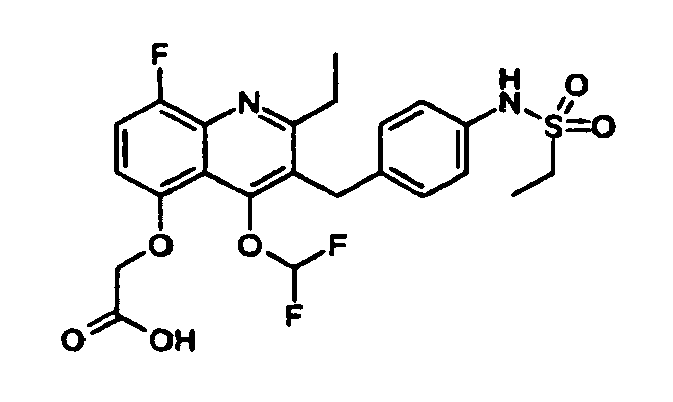
- A mixture of [3-(4-bromobenzyl)-4-difluoromethoxy-2-ethyl-8-fluoroquimolin-5-yloxy]acetic acid methyl ester (0.40 g), carbamic acid fert-butyl ester (0.19 g), tris(dibenzylideneacetone)dipalladium(0) (0.073 g), Xantphos (0.014 g), cesium carbonate (0.58 g) and 1,4-dioxane (5.0 mL) was heated at 100 °C for 10 hours. The mixture was cooled to room temperature, acidified by the addition of glacial acetic acid and partitioned between ethyl acetate and water. The organic phase was dried over magnesium sulfate and concentrated under reduced pressure. Purification of the residue by column chromatography on silica gel, eluting with a mixture of dichloromethane and ethyl acetate (1:0 to 10:1 by volume) gave title compound as a yellow gum (0.11 g).
- MS: ESI (+ve) (Method B): 535 (M+H)+, Retention time 4.3 min
- A solution of [3-(4-tert-butoxycarbonylaminobenzyl)-4-difluoromethoxy-2-ethyl-8-fluoroquinolin-5-yloxy]acetic acid methyl ester (0.11 g) in dichloromethane (2.5 mL) was treated with trifluoroacetic acid (0.25 mL) and the resulting mixture was allowed to stand at room temperature for 1 hour. The mixture was diluted with dichloromethane, washed with saturated aqueous sodium hydrogen carbonate solution and dried over magnesium sulfate. The solvent was removed under reduced pressure to afford title compound as a yellow gum (0.051 g).
- MS: ESI (+ve) (Method B): 435 (M+H)+, Retention time 2.8 min
- A mixture of [3-(4-aminobenzyl)-4-difluoromethoxy-2-ethyl-8-fluoroquinolin-5-yloxy]acetic acid methyl ester (0.051 g), pyridine (0.019 mL) and dichloromethane (0.5 mL) at 0 °C was treated with ethanesulfonyl chloride (0.013 mL) and the resulting mixture was stirred at room temperature overnight. The mixture was diluted with dichloromethane and water, and then acidified by the addition of glacial acetic acid. The organic phase was dried over magnesium sulfate, and then concentrated under reduced pressure to afford title compound as a yellow gum (0.051 g).
- MS: ESI (+ve) (Method B): 527 (M+H)+, Retention time 3.7 min
- A solution of [4-difluoromethoxy-3-(4-ethanesulfonylaminobenzyl)-2-ethyl-8-fluoroquinolin-5-yloxy]acetic acid methyl ester (0.051 g) in methanol (5.0 mL) and water (0.5 mL) was treated with 5.0 M aqueous sodium hydroxide solution (0.25 mL), and the resulting mixture was left to stand at room temperature for 1 hour. The mixture was acidified by the addition of glacial acetic acid, concentrated under reduced pressure, and the residue partitioned between ethyl acetate and water. The organic phase was dried over magnesium sulfate, and then concentrated under reduced pressure. Purification of the residue by column chromatography on silica gel, eluting with a mixture of dichloromethane, methanol and glacial acetic acid (100:1:0.5 to 25:1:0.125 by volume) gave title compound as a cream solid (0.032 g).
- 1H NMR (DMSO-d6): δ 1.10 (t, J = 7.4 Hz, 6H), 2.80 (q, J = 7.4 Hz, 2H), 3.00 (q, J = 7.4 Hz, 2H), 4.25 (s, 2H), 4.85 (s, 2H), 6.95 (dd, J = 3.6, 8.9 Hz, 1H), 7.00 (d, J = 8.6 Hz, 2H), 7.05 (d, J = 8.6 Hz, 2H), 7.25 (t, J = 75 Hz, 1H), 7.50 (dd, J = 8.9, 10.1 Hz, 1H), 9.60 (s, 1H)
MS: ESI (+ve) (Method A): 513 (M+H)+, Retention time 9.8 min
MS: ESI (+ve) (Method B): 513 (M+H)+, Retention time 3.4 min -

- The title compound was prepared by the method of Preparation 3a using 2-(4-acetylbenzyl)-3-oxopentanoic acid ethyl ester and 1-(4-bromomethylphenyl)ethanone.
- 1H NMR (CDCl3): δ 1.00 (t, J = 7.2 Hz, 3H), 1:20 (t, J = 7.2 Hz, 3H), 2.35 (m, 1H), 2.55 (s, 3H), 2.60 (m, 1H), 3.20 (m, 2H), 3.80 (t, J = 7.5 Hz, 1H), 4.15 (m, 2H), 7.25 (d, J = 8.5 Hz, 2H), 7.85 (d, J = 8.5 Hz, 2H)
- The title compound was prepared by the method of Preparation 1c using (3-amino-4-fluorophenoxy)acetic acid methyl ester and 2-(4-acetylbenzyl)-3-oxopentanoic acid ethyl ester.
- MS: ESI (+ve) (Method B): 412 (M+H)+, Retention time 2.9 min
- The title compound was prepared by the method of Preparation 1d using [3-(4-acetylbenzyl)-2-ethyl-8-fluoro-4-oxo-1,4-dihydroquinolin-5-yloxy]acetic acid methyl ester and acetic acid chlorodifluoromethyl ester.
- MS: ESI (+ve) (Method B): 462 (M+H)+, Retention time 4.0 min
- A solution of [3-(4-acetylbenzyl)-4-difluoromethoxy-2-ethyl-8-fluoroquinolin-5-yloxy]acetic acid methyl ester (0.13 g) in methanol (5.0 mL) was treated with 1.0 M aqueous lithium hydroxide solution (0.54 mL), and the resulting mixture was stirred at room temperature for 30 minutes. The mixture was concentrated under reduced pressure, diluted with water and acidified by the addition of 0.1 M aqueous hydrochloric acid. The mixture was extracted with ethyl acetate, and the combined extracts were washed with saturated aqueous sodium chloride solution and dried over magnesium sulfate. The solvent was removed under reduced pressure and the residue purified by column chromatography on C-18 column to afford title compound (0.20 g).
- 1H NMR (CD3OD): δ 1.15 (t, J = 7.5 Hz, 3H), 2.50 (s, 3H), 2.85 (q, J = 7.5 Hz, 2H), 4.45 (s, 2H), 4.85 (s, 2H), 6.90 (dd, J = 3.7, 8.8 Hz, 1H), 7.15 (t, J = 75 Hz, 1H), 7.20 (d, J = 8.3 Hz, 2H), 7.35 (dd, J = 8.8, 10.0 Hz, 1H), 7.90 (d, J = 8.3 Hz, 2H)
MS: ESI (+ve) (Method A): 448 (M+H)+, Retention time 10.4 min
MS: ESI (+ve) (Method B): 448 (M+H)+, Retention time 3.7 min -

- A mixture of [3-(4-bromobenzyl)-4-difluoromethoxy-2-ethyl-8-fluoroquinolin-5-yloxy]acetic acid methyl ester (0.22 g), 1-methyl-2-tributylstannanyl-1H-imidazole (0.50 g), tetrakis(triphenylphosphine)palladium(0) (0.055 g) and 1,4-dioxane (4.4 mL) was heated at 100 °C for 1 hour. The mixture was cooled to room temperature and used in the next step.
- MS: ESI (+ve) (Method B): 500 (M+H)+, Retention time 2.5 min
- The reaction mixture of Preparation 6a was treated with methanol (0.25 mL), water (1.0 mL) and 5.0 M aqueous lithium hydroxide solution (0.25 mL), and the resulting mixture was stirred at room temperature for 30 min. The mixture was diluted with water, acidified by the addition of glacial acetic acid and then concentrated to low bulk under reduced pressure. The residue was extracted with ethyl acetate, and the combined extracts were dried over magnesium sulfate. Purification of the residue by column chromatography on silica gel, eluting with a mixture of dichloromethane, methanol and glacial acetic acid (1:0:0 to 2:1:0.01 by volume), followed by preparative reverse-phase HPLC gave title compound as a white solid (0.025 g).
- 1H NMR (CD3OD): δ 1.20 (t, J = 7.6 Hz, 3H), 2.90 (q, J = 7.6 Hz, 2H), 3.70 (s, 3H), 4.45 (s, 2H), 4.65 (s, 2H), 6.85 (dd, J = 3.7, 8.8 Hz, 1H), 7.10 (d, J = 1.2 Hz, 1H), 7.25 (d, J = 8.3 Hz. 2H), 7.30-7.50 (m, 3H), 7.35 (t, J = 75 Hz, 1H), 8.10 (s, 1H)
MS: ESI (+ve) (Method A): 486 (M+H)+, Retention time 6.7 min -

- A mixture of 4-chloro-3-nitrophenol (25 g), N,N-dimethylformamide (200 mL), potassium carbonate (60 g) and bromoacetic acid methyl ester (15.5 mL) was stirred at room temperature for 2.5 hours. The mixture was partitioned between ethyl acetate and water, and the aqueous phase extracted with ethyl acetate. The combined extracts were dried over sodium sulfate and then concentrated under reduced pressure. The residue was washed with diethyl ether to afford title compound as a white solid (30 g).
- 1H NMR (CDCl3): δ 3.85 (s, 3H), 4.70 (s, 2H), 7.10 (dd, J = 3.0, 8.9 Hz, 1H), 7.40 (dd, J = 3.0 Hz, 1H), 7.45 (d, J = 8.9 Hz, 1H)
- A solution of (4-chloro-3-nitrophenoxy)acetic acid methyl ester (30 g) in methanol (100 mL) was added to a mixture of iron (26 g), ammonium chloride (33 g) and water (400 mL) at room temperature, and the resulting mixture was heated in an ultrasonic bath at 60 °C for 4 hours. The mixture was basified by the addition of sodium hydroxide, extracted with ethyl acetate, and the combined extracts were washed with 1.0 M aqueous hydrochloric acid solution. The pH of the combined aqueous phases was adjusted to 7-8 by the addition of sodium hydroxide, and the resulting precipitate was collected by filtration and then dried to afford title compound (14 g).
- 1H NMR (DMSO-d6): δ 3.70 (s, 3H), 4.60 (s, 2H), 5.35 (br s, 2H), 6.10 (dd, J = 3.0, 8.8 Hz, 1H), 6.35 (d, J = 3.0 Hz, 1H), 7.05 (d, J = 8.8 Hz, 1H)
- The title compound was prepared by the method of Preparation 1c using (3-amino-4-chlorophenoxy)acetic acid methyl ester and 3-oxo-2-(4-pyrazol-1-ylbenzyl)pentanoic acid ethyl ester.
- MS: ESI (+ve) (Method B): 452 (M+H)+, Retention time 3.2 min
- The title compound was prepared by the method of Preparation 1 d using [8-chloro-2-ethyl-4-oxo-3-(4-pyrazol-1-ylbenzyl)-1,4-dihydroquinolin-5-yloxy]acetic acid methyl ester and acetic acid chlorodifluoromethyl ester.
- MS: ESI (+ve) (Method B): 502 (M+H)+, Retention time 4.3 min
- A solution of [8-chloro-4-difluoromethoxy-2-ethyl-3-(4-pyrazol-1-ylbenzyl)quinolin-5-yloxy]acetic acid methyl ester (0.56 g) in tetrahydrofuran (20 mL) was treated with 1.0 M aqueous lithium hydroxide solution (2.4 mL), and the resulting mixture was stirred at room temperature for 30 minutes. The mixture was diluted with 0.1 M aqueous hydrochloric acid solution, concentrated under reduced pressure and then extracted with ethyl acetate. The combined extracts were washed with saturated aqueous sodium chloride solution, dried over magnesium sulfate and then concentrated under reduced pressure. The residue was purified by trituration with a mixture of methanol and water, followed by column chromatography on C-18 column to afford title compound (0.35 g).
- 1H NMR (DMSO-d6): δ 1.15 (t, J = 7.3 Hz, 3H), 2.85 (q, J = 7.3 Hz, 2H), 4.35 (s, 2H), 4.90 (s, 2H), 6.45 (dd, J = 1.7, 2.5 Hz, 1H), 7.00 (d, J = 8.8 Hz, 1H), 7.15 (d, J = 8.6 Hz, 2H), 7.20 (t, J = 75 Hz, 1H), 7.65 (d, J = 1.9 Hz, 1H), 7.70 (d, J = 8.6 Hz, 2H), 7.80 (d, J = 8.8 Hz, 1H), 8.35 (d, J = 1.9 Hz, 1H)
MS: ESI (+ve) (Method A): 488 (M+H)+, Retention time 12.2 min
MS: ESI (+ve) (Method B): 488 (M+H)+, Retention time 4.0 min -

- A mixture of [3-(4-bromobenryl)-4-difluoromethoxy-2-ethyl-8-fluoroquinolin-5-yloxy]acetic acid methyl ester (0.39 g), 4,4,5,5,4',4',5',5'-octamethyl[2,2']bi[[1,3,2]dioxaborolanyl] (0.24 g), [1,1'-bis(diphenylphosphino)ferrocene]dichloropalladium (0.060 g), potassium acetate (0.23 g) and 1,4-dioxane (4.4 mL) was heated at 100 °C for 18 hours. The mixture was cooled to room temperature, diluted with ethyl acetate and dichloromethane, and then filtered. The filtrate was concentrated under reduced pressure, and the residue purified by column chromatography on silica gel, eluting with a mixture of cyclohexane and ethyl acetate to afford title compound (0.24 g).
- MS: ESI (+ve) (Method B): 546 (M+H)+, Retention time 4.6 min
- A mixture of {4-difluoromethoxy-2-ethyl-8-fluoro-3-[4-(4,4,5,5-tetramethyl-[1,3,2]dioxaborolan-2-yl)benzyl]quinolin-5-yloxy}acetic acid methyl ester (0.052 g), 2-bromothiazole (0.076 g), [1,1'-bis(diphenylphosphino)ferrocene]dichioropalladium (0.060 g), 1,4-dioxane (2.0 mL) and 2.0 M aqueous cesium carbonate solution (0.19 mL) was heated at 90 °C overnight. The mixture was cooled to room temperature, diluted with ethyl acetate and filtered. The filtrate was concentrated under reduced pressure, and the residue dissolved in tetrahydrofuran (5.0 mL) and 1.0 M aqueous lithium hydroxide solution (0.19 mL), and the resulting mixture was stirred at room temperature for 1 hour. The mixture was concentrate to low bulk under reduced pressure, and the residue acidified by the addition 0.1 M aqueous hydrochloric acid solution and then extracted with ethyl acetate. The combined extracts were dried over magnesium sulfate and then concentrated under reduced pressure. Purification of the residue by column chromatography on C-18 column gave title compound (0.020 g).
- 1H NMR (CD3OD): δ 1.15 (t, J = 7.5 Hz, 3H), 2.90 (q, J = 7.5 Hz, 2H), 4.45 (s, 2H), 4.85 (s, 2H), 6.90 (dd, J = 3.5, 8.8 Hz, 1H), 7.15 (t, J = 75 Hz, 1H), 7.20 (d, J = 8.3 Hz, 2H), 7.35 (dd, J = 9.0, 10.0 Hz, 1H), 7.50 (d, J = 3.5 Hz, 1H), 7.80 (d, J = 3.5 Hz, 1H), 7.85 (d, J = 8.3 Hz, 2H)
MS: ESI (+ve) (Method A): 489 (M+H)+, Retention time 11.4 min
MS: ESI (+ve) (Method B): 489 (M+H)+, Retention time 3.8 min -

- A mixture of {4-difluoromethoxy-2-ethyl-8-fluoro-3-[4-(4,4,5,5-tetramethyl-[1,3,2]dioxaborolan-2-yl)benzyl]quinolin-5-yloxy}acetic acid methyl ester (0.10 g), 2-bromopyrimidine (0.076 g), [1,1'-bis(diphenylphosphino)ferrocene]dichloropalladium (0.016 g), 1,4-dioxane (2.0 mL) and 2.0 M aqueous cesium carbonate solution (0.38 mL) was heated by microwave irradiation at 90 to 130 °C for 1 hour. The mixture was cooled to room temperature, diluted with ethyl acetate and then filtered. The filtrate was concentrated under reduced pressure and the residue dissolved in tetrahydrofuran (5.0 mL) and 1.0 M aqueous lithium hydroxide solution (0.38 mL), and the resulting mixture was stirred at room temperature for 1 hour. The mixture was acidified by the addition of 0.1 M aqueous hydrochloric acid solution and then concentrated under reduced pressure. Purification of the residue by preparative reverse-phase HPLC gave title compound (0.021 g).
- 1H NMR (CD3OD): δ 1.15 (t, J = 7.5 Hz, 3H), 2.90 (q, J = 7.5 Hz, 2H), 4.45 (s, 2H), 4.90 (s, 2H), 6.90 (dd, J = 3.6, 8.8 Hz, 1H), 7.15 (t, J = 75 Hz, 1H), 7.20 (d, J = 8.3 Hz, 2H), 7.30 (t, J = 4.8 Hz, 1H), 7.35 (m, 1H), 8.25 (d, J = 8.3 Hz, 2H), 8.75 (d, J = 4.8 Hz, 2H)
MS: ESI (+ve) (Method A): 484 (M+H)+, Retention time 10.9 min
MS: ESI (+ve) (Method A): 484 (M+H)+, Retention time 3.7 min -

- The title compound was prepared by the method of Preparation 3a using 3-oxopentanoic acid ethyl ester and 1-(4-bromomethylphenyl)-2,2-dimethylpropan-1-one.
- The title compound was prepared by the method of Preparation 1 c using (3-amino-4-chlorophenoxy)acetic acid methyl ester and 2-[4-(2,2-dimethylpropionyl)benzyl]-3-oxopentanoic acid ethyl ester.
- MS: ESI (+ve) (Method B): 470 (M+H)+, Retention time 3.8 min
- A mixture of {8-chloro-3-(4-(2,2-dimethylpropionyl)benzyl}-2-ethyl-4-oxo-1,4-dihydroquinolin-5-yloxy}acetic acid methyl ester (0.14 g), N,N-dimethylformamide (5.0 mL) and potassium carbonate (0.13 g) was stirred at 40 °C for 5 hours under an atmosphere of chlorodifluoromethane. The mixture was diluted with water, extracted with ethyl acetate, and the combined extracts washed saturated aqueous sodium chloride solution and then dried over magnesium sulfate. The solvent was removed under reduced pressure and the residue purified by column chromatography on silica gel, eluting with a mixture of cyclohexane and ethyl acetate (7:3 by volume) to afford title compound (0.071 g).
- MS: ESI (+ve) (Method B): 520 (M+H)+, Retention time 4.7 min
- A solution of {8-chloro-4-difluoromethoxy-3-[4-(2,2-dimethylpropionyl)benzyl]-2-ethylquinolin-5-yloxy}acetic acid methyl ester (0.071 g) in tetrahydrofuran (5.0 mL) was treated with 1.0 M aqueous lithium hydroxide solution (0.28 mL), and the resulting mixture was stirred at room temperature for 1 hour. The mixture was concentrated to low bulk under reduced pressure, acidified by the addition of 0.1 M aqueous hydrochloric acid solution and extracted with ethyl acetate. The combined extracts were dried over magnesium sulfate and then concentrated under reduced pressure. Purification of the residue by preparative reverse-phase HPLC gave title compound as a yellow solid (0.040 g).
- 1H NMR (CD3OD): δ 1.25 (t, J = 7.4 Hz, 3H), 1.30 (s, 9H), 2.85 (q, J = 7.4 Hz, 2H), 4.40 (s, 2H), 4.90 (s, 2H), 6.95 (d, J = 8.9 Hz, 1H), 7.10 (t, J = 75 Hz, 1H), 7.15 (d, J = 8.3 Hz, 2H), 7.60 (d, J = 8.3 Hz, 2H), 7.75 (d, J = 8.7 Hz, 1H)
MS: ESI (+ve) (Method A): 506 (M+H)+, Retention time 13.6 min -

- A solution of 3-oxothiobutyric acid S-tert-butyl ester (3.7 g) in 1,2-dimethoxyethane (5.0 mL) was added to a stirred suspension of sodium hydride (60 % in oil, 0.92 g) in 1,2-dimethoxyethane (25 mL) at -10°C, and the resulting mixture was warmed to 15 °C over 15 minutes, cooled to -10°C and then treated dropwise with a mixture of 1-(4-bromomethylphenyl)-1H-pyrazole (5.0 g) in 1,2-dimethoxyethane (20 mL) over a period of 30 minutes. The resulting mixture was warmed to room temperature and then stirred at this temperature for overnight. The mixture was diluted water, pH adjusted to 5 by the addition of glacial acetic acid and then saturated with sodium chloride. The mixture was extracted ethyl acetate and the combined extracts were dried over magnesium sulfate and then concentrated under reduced pressure. Purification of the residue purified by column chromatography on silica gel, eluting with a mixture of pentane, dichloromethane and ethyl acetate (1:3:0, 0:1:0 to 0:10:1 by volume) gave title compound as a colourless gum (0.6 g).
- 1H NMR (CDCl3): δ 1.40 (s, 9H), 2.20 (s, 3H), 3.15 (m, 2H), 3.90 (t, J = 7.5 Hz, 1H), 6.45 (m, 1H), 7.25 (d, J = 8.5 Hz, 2H), 7.60 (d, J = 8.5 Hz, 2H), 7.70 (m, 1H), 7.90 (m, 1H).
- Silver trifluoroacetate (1.5 g) was added, over a period of 1 hour, to a stirred solution of 3-amino-4-chlorophenol (0.67 g) and 3-oxo-2-(4-pyrazol-1-ylbenzyl)thiobutyric acid S-tert-butyl ester (1.7 g) in 1,2-dimethoxyethane (10 mL) at room temperature, and the resulting mixture was stirred at room temperature for 4 hours. The mixture was concentrated under reduced pressure and the residue purified by column chromatography on silica gel, eluting with a mixture of dichloromethane and ethyl acetate (1:0 to 3:1 by volume) to afford title compound as a brown solid (1.1 g).
- MS: ESI (+ve) (Method B): 384 (M+H)+, Retention time 3.1 min
- A mixture of N-(2-chloro-5-hydroxyphenyl)-3-oxo-2-(4-pyrazol-1-ylbenzyl)butyramide (1.3 g) and methanesulfonic acid (7.0 mL) was heated at 100°C for 10 minutes. The mixture was cooled to room temperature and then poured into a saturated aqueous solution of sodium acetate. The resulting precipitate was collected by filtration, washed with water and dried to afford title compound as a beige solid (0.81 g).
- 1H NMR (DMSO-d6): δ 2.65 (s, 3H), 4.05 (s, 2H), 6.50 (dd, J = 1.8, 2.5 Hz, 1H), 6.65 (d, J = 8.7 Hz, 2H), 7.30 (d, J = 8.7 Hz, 2H), 7.40 (d, J = 8.7 Hz, 1H), 7.65-7.75 (m, 3H), 8.40 (dd, J = 0.5, 2.5 Hz, 1H), 10.30 (br s, 1H)
- The title compound was prepared by the method of Preparation 7a using 8-chloro-5-hydroxy-4-methyl-3-(4-pyrazol-1-ylbenzyl)-1H-quinolin-2-one and bromoacetic acid methyl ester.
- MS: ESI (+ve) (Method B): 438 (M+H)+, Retention time 3.5 min
- A mixture of [8-chloro-4-methyl-2-oxo-3-(4-pyrazol-1-ylbenzyl)-1,2-dihydroquinolin-5-yloxy]acetic acid methyl ester (0.35 g), potassium carbonate (0.33 g), iodomethane (0.50 mL) and N,N-dimethylformamide (5.0 mL) was stirred at room temperature for 16 hours. The mixture was diluted with water, acidified by the addition of glacial acetic acid and extracted with ethyl acetate. The combined extracts were washed with saturated aqueous sodium chloride solution, dried over magnesium sulfate and concentrated under reduced pressure to afford title compound as a cream solid (0.37 g).
- MS: ESI (+ve) (Method B): 452 (M+H)+, Retention time 4.5 min
- A solution of [8-chloro-2-methoxy-4-methyl-3-(4-pyrazol-1-yl-benzyl)quinolin-5-yloxy]acetic acid methyl ester (0.37 g) in methanol (7.0 mL) and water (0.7 mL) was treated with 5.0 M aqueous sodium hydroxide solution (0.32 mL), and the resulting mixture was stirred at room temperature for 2 hours. The mixture was acidified by the addition of glacial acetic acid, diluted with water and extracted with ethyl acetate. The combined extracts were dried over magnesium sulfate and then concentrated under reduced pressure. The residue was crystallised from methanol to give title compound as a white solid (0.18 g).
- 1H NMR (DMSO-d6): δ 2.75 (s, 3H), 4.00 (s, 3H), 4.15 (s, 2H), 4.75 (s, 2H), 6.45 (m, 1H), 6.80 (d, J = 8.7 Hz, 1H), 7.15 (d, J = 8.6 Hz, 2H), 7.60-7.65 (m, 4H), 8.35 (d, J = 2.4 Hz, 1H)
MS: ESI (+ve) (Method A): 438 (M+H)+, Retention time 12.5 min
MS: ESI (+ve) (Method B): 438 (M+H)+, Retention time 4.1 min -

- The title compound was prepared by the method of Preparation 11b using 3-oxo-2-(4-pyrazol-1-ylbenzyl)thiobutyric acid S-tert-butyl ester and 3-amino-4-fluorophenol.
- MS: ESI (+ve) (Method B): 368 (M+H)+, Retention time 2.9 min
- The title compound was prepared by the method of Preparation 11c using N-(2-fluoro-5-hydroxyphenyl)-3-oxo-2-(4-pyrazol-1-ylbenzyl)butyramide.
- 1H NMR (DMSO-d6): δ 2.65 (s, 3H), 4.05 (s, 2H), 6.50-6.55 (m, 2H), 7.15 (dd, J = 8.9, 10.2 Hz, 1H), 7.30 (d, J = 8.6 Hz, 2H), 7.70 (m, 3H), 8.40 (dd, J = 0.4, 2.5 Hz, 1H), 10.10 (s, 1H), 11.40 (s, 1H)
- The title compound was prepared by the method of Preparation 7a using 8-fluoro-5-hydroxy-4-methyl-3-(4-pyrazol-1-ylbenzyl)-1H-quinolin-2-one and bromoacetic acid methyl ester.
- MS: ESI (+ve) (Method B): 422 (M+H)+, Retention time 3.3 min
- The title compound was prepared by the method of Preparation 10c using [8-fluoro-4-methyl-2-oxo-3-(4-pyrazol-1-ylbenzyl)-1,2-dihydroquinolin-5-yloxy]acetic acid methyl ester and chlorodifluoromethane.
- MS: ESI (+ve) (Method B): 472 (M+H)+, Retention time 4.2 min
- A solution of [2-difluoromethoxy-8-ttuoro-4-methyl-3-(4-pyrazol-1-ylbenzyl)quinolin-5-yloxy]acetic acid methyl ester (0.43 g) in methanol (7.0 mL) and water (0.7 mL) was treated with 5.0 M aqueous sodium hydroxide solution (0.36 mL), and the resulting mixture was stirred at room temperature for 1.5 hours. The mixture was acidified by the addition of glacial acetic acid, diluted with water and then extracted with ethyl acetate. The combined extracts were dried over magnesium sulfate and then concentrated under reduced pressure. Purification of the residue by column chromatography on silica gel gave title compound as a white solid (0.034 g).
- 1H NMR (DMSO-d6): δ 2.85 (s, 3H), 4.20 (s, 2H), 4.80 (s, 2H), 6.45 (t, J = 2.0 Hz, 1H), 6.90 (dd, J = 4.0, 8.9 Hz, 1H), 7.20 (d, J = 8.6 Hz, 2H), 7.45 (dd, J = 8.9, 9.7 Hz, 1H), 7.65 (d, J = 2.0 Hz, 1H), 7.70 (d, J = 8.6 Hz, 2H), 7.85 (t, J = 72 Hz, 1H), 8.35 (d, J=2.7Hz. 1H)
MS: ESI (+ve) (Method A): 458 (M+H)+ Retention time 11.5 min
MS: ESI (+ve) (Method B): 458 (M+H)+, Retention time 3.8 min -

- The title compound was prepared by the method of Preparation 10c using [8-chloro-4-methyl-2-oxo-3-(4-pyrazol-1-ylbenzyl)-1,2-dihydroquinolin-5-yloxy]acetic acid methyl ester and chlorodifluoromethane.
- MS: ESI (+ve) (Method B): 488 (M+H)+, Retention time 4.4 min
- A solution of [8-chloro-2-difluoromethoxy-4-methyl-3-(4-pyrazol-1-ylbenzyl)quinolin-5-yloxy]acetic acid methyl ester (0.38 g) in methanol (7.0 mL) and water (0.7 mL) was treated with 5.0 M aqueous sodium hydroxide solution (0.32 mL), and the resulting mixture was stirred at room temperature for 3 hours. The mixture was acidified by the addition of glacial acetic acid, diluted with water and extracted with ethyl acetate. The combined extracts were dried over magnesium sulfate and then concentrated under reduced pressure. The residue was purified by trituration with methanol, followed by column chromatography on silica gel to afford title compound as a white solid (0.036 g).
- 1H NMR (DMSO-d6): δ 2.85 (s, 3H), 4.20 (s, 2H), 4.80 (s, 2H), 6.45 (dd, J = 1.7, 2.5 Hz, 1H), 6.95 (d, J = 8.6 Hz, 1H), 7.20 (d, J = 8.6 Hz, 2H), 7.65 (d, J = 1.7 Hz, 1H), 7.70 (d, J = 8.6 Hz, 2H), 7.75 (d, J = 8.6 Hz, 1H), 7.85 (t, J = 73 Hz, 1H), 8.35 (d, J = 2.6 Hz, 1H)
MS: ESI (+ve) (Method A): 474 (M+H)+, Retention time 12.2 min
MS: ESI (+ve) (Method B): 474 (M+H)+, Retention time 4.0 min -

- The title compound was prepared by the method of Preparation 3a using 3-oxopentanoic acid ethyl ester and 1-(4-bromomethylphenyl)-2-methylpropan-1-one.
- MS: ESI (+ve) (Method B): 305 (M+H)+, Retention time 3.8 min
- The title compound was prepared by the method of Preparation 1c using (3-amino-4-chlorophenoxy)acetic acid methyl ester and 2-(4-isobutyrylbenzyl)-3-oxopentanoic acid ethyl ester.
- MS: ESI (+ve) (Method B): 456 (M+H)+, Retention time 3.6 min
- The title compound was prepared by the method of Preparation 10c using [8-chloro-2-ethyl-3-(4-isobutyrylbenzyl)-4-oxo-1,4-dihydroquinolin-5-yloxy]acetic acid methyl ester and chlorodifluoromethane.
- MS: ESI (+ve) (Method B): 506 (M+H)+, Retention time 4.6 min
- A solution of (8-chtoro-4-difluoromethoxy-2-ethyl-3-(4-isobutyrylbenzyl)quinolin-5-yloxy]acetic acid methyl ester (0.22 g) in tetrahydrofuran (5.0 mL) and water (1.0 mL) was treated with 1.0 M aqueous lithium hydroxide solution (0.86 mL), and the resulting mixture was stirred at room temperature for 2 hours. The mixture was concentrated to low bulk under reduced pressure, and the pH adjusted to 4-5 by the addition of 1.0 M aqueous hydrochloric acid solution. The mixture was extracted with ethyl acetate, and the combined extracts were dried over magnesium sulfate and then concentrated under reduced pressure. Purification of the residue by preparative reverse-phase HPLC gave title compound (0.18 g).
- 1H NMR (CDCl3): δ 1.15 (d, J = 6.9 Hz, 6H), 1.30 (t, J = 7.4 Hz, 3H), 2.85 (q, J = 7.4 Hz, 2H), 3.45 (m, 1H), 4.40 (s, 2H), 4.85 (s, 2H), 6.10 (d, J = 8.3 Hz, 1H), 6.80 (t, J = 75 Hz, 1H), 7.15 (d, J = 8.4 Hz, 2H), 7.70 (d, J = 8.3 Hz, 1H), 7.80 (d, J = 8.3 Hz, 2H) MS: ESI (+ve) (Method A): 492 (M+H)+, Retention time 13.1 min
-

- The title compound was prepared by the method of Preparation 11e using [8-fluoro-4-methyl-2-oxo-3-(4-pyrazol-1-ylbenzyl)-1,2-dihydroquinolin-5-yloxy]acetic acid methyl ester and iodomethane.
- The title compound was prepared by the method of Preparation 13b using [8-fluoro-2-methoxy-4-methyl-3-(4-pyrazol-1-ylbenzyl)quinolin-5-yloxy]acetic acid methyl ester.
- 1H NMR (DMSO-d6): δ 2.80 (s, 3H), 3.95 (s, 3H), 4.20 (s, 2H), 4.75 (s, 2H), 6.45 (m, 1H), 6.75 (dd, J = 4.0, 8.9 Hz, 1H), 7.20 (d, J = 8.5 Hz, 2H), 7.30 (dd, J = 8.9, 9.8 Hz, 1H), 7.65 (m, 3H), 8.35 (d, J = 2.5 Hz, 1H)
MS: ESI (+ve) (Method A): 422 (M+H)+, Retention time 11.3 min -

- The title compound was prepared by the method of Preparation 3a using 3-oxopentanoic acid ethyl ester and 1-bromomethyl-4-trifluoromethoxybenzene.
- 1H NMR (CDCl3): δ 1.00 (t, J = 7.3 Hz, 3H), 1.20 (t, J = 7.1 Hz, 3H), 2.30-2.40 (m, 1H), 2.55-2.65 (m, 1H), 3.15 (m, 2H), 3.75 (t, J = 7.6 Hz, 1H), 4.15 (q, J = 7.1 Hz, 2H), 7.10 (m, 2H), 7.20 (m, 2H)
- The title compound was prepared by the method of Preparation 1c using (3-amino-4-chlorophenoxy)acetic acid methyl ester and 3-oxo-2-(4-trifluoromethoxybenzyl) pentanoic acid ethyl ester.
- MS: ESI (+ve) (Method B): 454 (M+H)+, Retention time 3.5 min
- The title compound was prepared by the method of Preparation 10c using [2-ethyl-8-fluoro-4-oxo-3-(4-trifluoromethoxybenzyl)-1,4-dihydroquinolin-5-yloxy]acetic acid methyl ester and chlorodifluoromethane.
- MS: ESI (+ve) (Method B): 504 (M+H)+, Retention time 4.5 min
- A solution of [4-difluoromethoxy-2-ethyl-8-fluoro-3-(4-trifluoromethoxybenzyl)quinolin-5-yloxy]acetic acid methyl ester (0.054 g) in tetrahydrofuran (4.0 mL) was treated with 1.0 M aqueous lithium hydroxide solution (0.21 mL), and the resulting mixture was stirred at room temperature for 3 hours. The mixture was acidified by the addition of 0.1 M aqueous hydrochloric acid and extracted with ethyl acetate. The combined extracts were washed with saturated aqueous sodium chloride solution, dried over magnesium sulfate and then concentrated under reduced pressure. Purification of the residue by preparative reverse-phase HPLC gave title compound as a white solid (0.042 g).
- 1H NMR (CDCl3): δ 1.25 (t, J = 7.5 Hz, 3H), 2.90 (q, J = 7.5 Hz, 2H), 4.35 (s, 2H), 4.85 (s, 2H), 6.75 (dd, J = 3.6, 8.6 Hz, 1H), 6.85 (t, J = 75 Hz, 1H), 7.06 (br s, 4H), 7.25 (m, 1H)
MS: ESI (+ve) (Method A): 490 (M+H)+, Retention time 12.6 min -

- The title compound was prepared by the method of Preparation 11a using 1-(4-bromomethylphenyl)-2,2-dimethylpropan-1-one and 3-oxothiobutyric acid S-tert-butyl ester
- MS: ESI (+ve) (Method A): 349 (M+H)+, Retention time 4.4 min
- The title compound was prepared by the method of Preparation 11b using 2-[4-(2,2-dimethylpropionyl)benzyl]-3-oxothiobutyric acid S-tert-butyl ester and 3-amino-4-chlorophenol.
- MS: ESI (+ve) (Method B): 402 (M+H)+, Retention time 3.5 min
- The title compound was prepared by the method of Preparation 11c using N-(2-chloro-5-hydroxyphenyl)-2-[4-(2,2-dimethylpropionyl)benzyl]-3-oxobutyramide
- MS: ESI (+ve) (Method B): 384 (M+H)+, Retention time 3.6 min
- The title compound was prepared by the method of Preparation 7a using 8-chloro-3-[4-(2,2-dimethylpropionyl)benzyl]-5-hydroxy-4-methyl-1H-quinolin-2-one and bromoacetic acid methyl ester.
- MS: ESI (+ve) (Method B): 456 (M+H)+, Retention time 4.0 min
- The title compound was prepared by the method of Preparation 10c using {8-chloro-3-[4-(2,2-dimethylpropionyl)benzyl]-4-methyl-2-oxo-1,2-dihydroquinolin-5-yloxy}acetic acid methyl ester and chlorodifluoromethane.
- MS: ESI (+ve) (Method B): 506 (M+H)+, Retention time 4.7 min
- A solution of {8-chloro-2-difluoromethoxy-3-[4-(2,2-dimethylpropionyl)benzyl]-4-methylquinolin-5-yloxy}acetic acid methyl ester (0.18 g) in tetrahydrofuran (10 mL) and water (1.5 mL) was treated with 1.0 M aqueous lithium hydroxide solution (0.71 mL), and the resulting mixture was stirred at room temperature for 2 hours. The mixture was concentrated under reduced pressure, diluted with water and dichloromethane and then acidified by the addition of 0.1 M aqueous hydrochloric acid solution. The aqueous phase was extracted with dichloromethane and the combined organic phases dried over magnesium sulfate. The solvent was removed under reduced pressure to give title compound as a white solid (0.16 g).
- 1H NMR (DMSO-d6): δ 1.20 (s, 9H), 2.85 (s, 3H), 4.25 (s, 2H), 4.80 (s, 2H), 6.95 (d, J =8.6Hz, 1H), 7.15 (d, J = 8.4 Hz, 2H), 7.60 (d. J = 8.4 Hz, 2H), 7.75 (d, J = 8.6 Hz, 1H), 7.85 (t, J = 72 Hz, 1H)
MS: ESI (+ve) (Method B): 492 (M+H)+, Retention time 4.4 min -

- A mixture of {4-difluoromethoxy-2-ethyl-8-fluoro-3-[4-(4,4,5,5-tetramethyl[1,3,2] dioxaborolan-2-yl)benzyl]quinolin-5-yloxy}acetic acid methyl ester (0.14 g), 4-chloro-1H-pyrazole (0.053 g), cuprous acetate (0.093 g) and pyridine (3 mL) was heated at 50°C for 116 hours. The mixture was cooled to room temperature, diluted with water (10 mL) and extracted with ethyl acetate. The combined extracts were washed with saturated aqueous sodium chloride solution, dried over magnesium sulphate and then concentrated under reduced pressure. Purification of the residue by column chromatography silica gel, eluting with a mixture of cyclohexane and ethyl acetate (1:0 to 7:3 by volume) gave title compound as a colourless oil (0.13 g).
- MS: ESI (+ve) (Method B): 520 (M+H)+, Retention time 4.5 min
- The title compound was prepared by the method of Preparation 1e using {3-[4-(4-chloropyrazol-1-yl)benzyl]-4-difluoromethoxy-ethyl-8-fluoroquinolin-5-yloxy}acetic acid methyl ester
- 1H NMR (DMSO-d6): δ 1.20 (t, J = 7.4 Hz, 3H), 2.85 (q, J = 7.4 Hz, 2H), 4.38 (s, 2H), 4.88 (s, 2H), 6.99 (m, 1H), 7.21 (d, J = 8.6 Hz, 2H), 7.30 (t, J = 75 Hz, 1H), 7.53 (t, J = 9 Hz, 1H), 7.70 (d, J = 8.6 Hz, 2H), 7.83 (s, 1H), 8.71 (s, 1H)
MS: ESI (+ve) (Method A): 506 (M+H)+, Retention time 12.1 min -

- The title compound was prepared by the method of Preparation 1b using 4-methyl-3-oxopentanoic acid ethyl ester and 1-(4-bromomethylphenyl)-1H-pyrazole.
- MS: ESI (+ve) (Method B): 315 (M+H)+, Retention time 3.8 min
- The title compound was prepared by the method of Preparation 1c using (3-amino-4-chlorophenoxy)acetic acid methyl ester and 4-methyl-3-oxo-2-(4-pyrazol-1-ylbenzyl)pentanoic acid ethyl ester.
- MS: ESI (+ve) (Method B): 466 (M+H)+, Retention time 3.8 min
- The title compound was prepared by the method of Preparation 10c using [8-chloro-2-isopropyl-4-oxo-3-(4-pyrazol-1-ylbenzyl)-1,4-dihydroquinolin-5-yloxy]acetic acid methyl ester and chlorodifluoromethane.
- MS: ESI (+ve) (Method B): 516 (M+H)+, Retention time 4.7 min
- The title compound was prepared by the method of Preparation 1e using [8-chloro-4-difluoromethoxy-2-isopropyl-3-(4-pyrazol-1-ylbenzyl)quinolin-5-yloxy]acetic acid methyl ester.
- 1H NMR (CDCl3): δ 1.25 (d, J = 6.7 Hz, 6H), 3.32 (m, 1H), 4.43 (s, 2H), 4.85 (s, 2H), 6.44 (t, J = 2.1 Hz, 1H), 6.74 (d, J = 8.6 Hz, 1H), 6.86 (t, J = 75 Hz, 1H), 7.15 (d, J = 8.3 Hz, 2H), 7.55 (d, J = 8.3 Hz, 2H), 7.68 (d, J = 8.6 Hz, 1H), 7.72 (d, J = 1.6 Hz, 1H), 7.86 (d, J = 2.1 Hz, 1H)
MS: ESI (+ve) (Method A): 502 (M+H)+, Retention time 13.3 min
MS: ESI (+ve) (Method B): 502 (M+H)+, Retention time 4.4 min -

- The title compound was prepared by the method of Preparation 18a using {4-difluoromethoxy-2-ethyl-8-fluoro-3-[4-(4,4,5,5-tetrarmethyl[1,3,2]dioxaborolan-2-yl) benzyl]quinolin-5-yloxy}acetic acid methyl ester and 3-chloro-1H-pyrazole.
- MS: ESI (+ve) (Method B): 520 (M+H)+, Retention time 4.4 min
- The title compound was prepared by the method of Preparation 1e using {3-[4-(3-chloropyrazol-1-yl)benzyl]-4-difluoromethoxy-2-ethyl-8-fluoroquinolin-5-yloxy}acetic acid methyl ester.
- 1H NMR (DMSO-d6): δ 1.18 (t, J = 7.4 Hz, 3H), 2.85 (q, J = 7.4 Hz, 2H), 4.38 (s, 2H), 4.89 (s, 2H), 6.62 (d, J = 2.6 Hz, 1H), 7.01 (dd, J = 3.6, 9.0 Hz, 1H), 7.21 (d, J = 8.6 Hz, 2H), 7.29 (t, J = 75 Hz, 1H), 7.53 (m, 1H), 7.69 (d, J = 8.6 Hz, 2H), 8.49 (d, J = 2.6 Hz, 1H)
MS: ESI (+ve) (Method A): 506 (M+H)+, Retention time 12.1 min -

- The title compound was prepared by the method of Preparation 1c using (3-amino-4-fluorophenoxy)acetic acid methyl ester and 4-methyl-3-oxo-2-(4-pyrazol-1-ylbenzyl)pentanoic acid ethyl ester.
- MS: ESI (+ve) (Method B): 450 (M+H)+, Retention time 3.5 min
- The title compound was prepared by the method of Preparation 10c using [8-fluoro-2-isopropyl-4-oxo-3-(4-pyrazol-1-ylbenzyl)-1,4-dihydroquinolin-5-yloxy]acetic acid methyl ester and chlorodifluoromethane.
- MS: ESI (+ve) (Method B): 500 (M+H)+, Retention time 4.3 min
- The title compound was prepared by the method of Preparation 1e using [4-difluoromethoxy-8-fluoro-2-isopropyl-3-(4-pyrazol-1-ylbenzyl)quinolin-5-yloxy]acetic acid methyl ester
- 1H NMR (CDCl3): δ 1.23 (d, J = 6.7 Hz, 6H), 3.32 (m, 1H), 4.43 (s, 2H), 4.82 (s, 2H), 6.44 (t, J = 2.2 Hz, 1H), 6.75 (dd, J = 3.3, 8.6 Hz, 1H), 6.87 (t. J = 75 Hz, 1H), 7.14 (d, J = 8.6 Hz, 2H), 7.26 (m, 1H), 7.56 (d, J = 8.6 Hz, 2H), 7.71 (d, J = 1.6 Hz. 1H), 7.86 (d, J = 2.2 Hz, 1H).
MS: ESI (+ve) (Method A): 486 (M+H)+, Retention time 12.2 min
MS: ESI (+ve) (Method B): 486 (M+H)+, Retention time 4.2 min. -

- 3-(4,4,5,5-Tetramethyl[1,3,2]dioxaborolan-2-yl)-1H-pyrazole (0.52 g) was added to a stirred suspension of sodium hydride (60 % in oil, 0.096 g) in N,N-dimethylformamide (18 mL) at 0°C, and the resulting mixture was stirred at room temperature for 1 hour. The mixture was then cooled to 0 °C, treated with 2-iodopropane (0.4 mL) and stirred at room temperature for 16 hours. The mixture was diluted with water (10 mL) and concentrated to low bulk under reduced pressure. The residue was extracted with ethyl acetate, and the combined extracts were washed with saturated aqueous sodium chloride solution and then dried over magnesium sulfate. The solvent was removed under reduced pressure to afford title compound (0.152 g).
- A mixture of [3-(4-bromobenzyl)-4-difluoromethoxy-2-ethyl-8-fluoroquinolin-5-yloxy]acetic acid methyl ester (0.05 g), 1-isopropyl-3-(4,4,5,5-tetramethyl[1,3,2] dioxaborolan-2-yl)-1H-pyrazole (0.047 g), tetrakis(triphenylphospine)palladium (0) (0.012 g), N,N-dimethylformamide (0.3 mL) and 2.0 M aqueous cesium carbonate solution (0.2 mL) was heated by microwave irradiation at 140 °C for 6 minutes. The mixture was cooled to room temperature, acidified by the addition of 1.0 M aqueous hydrochloric acid solution and then extracted with ethyl acetate. The combined extracts were washed with saturated aqueous sodium chloride solution, dried over magnesium sulfate and then concentrated under reduced pressure. Purification of the residue by preparative reverse-phase HPLC gave title compound (0.014 g).
- 1H NMR (DMSO-d6): 81.17 (t, J = 7.5 Hz, 3H), 1.42 (d, J = 6.7 Hz, 6H), 2.84 (q, J = 7.5 Hz, 2H), 4.35 (s, 2H), 4.50 (m, 1H), 4.81 (s, 2H), 6.59 (d, J = 2.3 Hz, 1H), 6.96 (dd, J = 3.7, 8.9 Hz, 1H), 7.09 (d, J = 8.3 Hz, 2H), 7.43 (t, J = 75 Hz, 1H), 7.51 (dd, J = 8.9, 10.0 Hz, 1H), 7.68 (d, J = 8.3 Hz, 2H), 7.76 (d, J = 2.3 Hz, 1H).
MS: ESI (+ve) (Method A): 514 (M+H)+, Retention time 11.7 min
MS: ESI (+ve) (Method B): 514 (M+H)+, Retention time 4.2 min -

- A mixture of {4-difluoromethoxy-2-ethyl-8-fluoro-3-[4-(4,4,5,5-tetramethyl[1,3,2] dioxaborolan-2-yl)benzy]quinolin-5-yloxy}acetic acid methyl ester (0.89 g), sodium periodate (1.7 g), ammonium acetate (0.46 g), acetone (23 mL) and water (11 mL) was stirred at room temperature for 41 hours. The mixture was concentrated to low bulk under reduced pressure, and the residue was diluted with water and then extracted with ethyl acetate. The combined extracts were washed with saturated aqueous sodium chloride solution, dried over magnesium sulphate and then concentrated under reduced pressure to afford title compound (0.70g).
- MS: ESI (+ve) (Method B): 464 (M+H)+, Retention time 4.5 min
- A mixture of (4-{[4-difluoromethoxy-2-ethyl-8-fluoro-5-(2-methoxy-2-oxoethoxy) quinolin-3-yl]methyl}phenyl)boronic acid (0.1 g), 4-cyclopropyl-1H-pyrazole (0.047 g), cuprous acetate (0.078 g) and pyridine (3 mL) was heated at 40 °C for 24 hours. The mixture was cooled to room temperature, diluted with water (10 mL) and extracted with ethyl acetate. The combined extracts were washed with saturated aqueous sodium chloride solution, dried over magnesium sulphate and then concentrated under reduced pressure. Purification of the residue by column chromatography on silica gel, eluting with a mixture of cyclohexane and ethyl acetate (1:0 to 7:3 by volume) gave title compound as pale green oil (0.09 g).
- MS: ESI (+ve) (Method B): 526 (M+H)+, Retention time 4.5 min
- The title compound was prepared by the method of Preparation 1e using {3-[4-(4-cyclopropylpyrazol-1-yl)benzyl]-4-difluoromethoxy-2-ethyl-8-fluoroquinolin-5-loxy} acetic acid methyl ester
- 1H NMR (DMSO-d6): δ 0.57 (m, 2H), 0.84 (m, 2H), 1.17 (t, J = 7.4 Hz, 3H), 1.74 (m, 1H), 2.86 (q, J = 7.4 Hz, 2H), 4.36 (s, 2H), 4.88 (s, 2H), 7.00 (dd, J = 3.5, 8.7 Hz, 1H), 7.16 (d, J = 8.3 Hz, 2H), 7.32 (t, J = 75 Hz, 1H), 7.50 (m, 2H), 7.67 (d, J = 8.3 Hz, 2H), 8.18 (s, 1H)
MS: ESI (+ve) (Method A): 512 (M+H)+, Retention time 11.9 min
MS: ESI (+ve) (Method B): 512 (M+H)+, Retention time 4.2 min -

- The title compound was prepared by the method of Preparation 23b using (4-{[4-difluoromethoxy-2-ethyl-8-fluoro-5-(2-methoxy-2-oxoethoxy)quinolin-3-yi]methyl} phenyl)boronic acid and 2-isopropyl-1H-imidazole.
- MS: ESI (+ve) (Method B): 528 (M+H)+, Retention time 2.7 min
- The title compound was prepared by the method of Preparation 1e using {4-difluoromethoxy-2-ethyl-8-fluoro-3-[4-(2-isopropylimidazol-1-yl)benzyl]quinolin-5-yloxy}acetic acid methyl ester.
- 1H NMR (DMSO-d6): δ 1.08 (d, J = 6.7 Hz, 6H), 1.18 (t, J = 7.3 Hz, 3H), 2.80 (m, 3H), 4.42 (s, 2H), 4.89 (s, 2H), 6.94 (br s, 1H), 7.00 (dd, J = 3.7, 8.9 Hz, 1H), 7.19 (d, J = 1.2 Hz, 1H), 7.25 (d, J = 8.5 Hz, 2H), 7.29 (t, J = 75 Hz, 1H), 7.33 (d, J = 8.5 Hz, 2H), 7.54 (dd, J = 8.9,10.1 Hz, 1H)
MS: ESI (+ve) (Method A): 514 (M+H)+, Retention time 7.2 min
MS: ESI (+ve) (Method B): 514 (M+H)+, Retention time 2.6 min -

- The title compound was prepared by the method of Preparation 23b using (4-{[4-difluoromethoxy-2-ethyl-8-fluoro-5-(2-methoxy-2-oxoethoxy)quinolin-3-yl]methyl} phenyl)boronic acid and 5-cyclopropyl-1H-pyrazole.
- MS: ESI (+ve) (Method B): 526 (M+H)+, Retention time 4.5 min
- The title compound was prepared by the method of Preparation 1e using {3-[4-(3-cyclopropylpyrazol-1-yl)benzyl]-4-difluoromethoxy-2-ethyl-8-fluoroquinolin-5-yloxy} acetic acid methyl ester.
- 1H NMR (DMSO-d6): δ 0.70 (m, 2H), 0.90 (m 2H), 1.17 (t, J = 7.4 Hz, 3H), 1.95 (m, 1H), 2.86 (q, J = 7.4 Hz, 2H), 4.36 (s, 2H), 4.89 (s, 2H), 6.20 (d. J = 2.5 Hz, 1H), 7.01 (dd, J = 3.7, 8.8 Hz, 1H), 7.16 (d, J = 8.6 Hz, 2H), 7.30 (t, J = 75 Hz, 1H), 7.51 (m, 1H), 7.60 (d, J = 8.6 Hz, 2H), 8.24 (d, J = 2.5 Hz, 1H)
MS: ESI (+ve) (Method A): 512 (M+H)+, Retention time 11.9 min
MS: ESI (+ve) (Method B): 512 (M+H)+, Retention time 4.2 min -

- The title compound was prepared by the method of Preparation 23b using (4-{[4-difluoromethoxy-2-ethyl-8-fluoro-5-(2-methoxy-2-oxoethoxy)quinolin-3-yl]methyl} phenyl)boronic acid and 5-cyclopropyl-1H-pyrazole.
- MS: ESI (+ve) (Method B): 526 (M+H)+, Retention time 4.4 min
- The title compound was prepared by the method of Preparation 1e using {3-[4-(5-cyclopropylpyrazol-1-yl)benzyl]-4-difluoromethoxy-2-ethyl-8-fluoroquinolin-5-yloxy} acetic acid methyl ester.
- 1H NMR (DMSO-d6): δ 0.67 (m, 2H), 0.91 (m, 2H), 1.18 (t, J = 7.4 Hz, 3H), 1.79 (m, 1H), 2.88 (q, J = 7.4 Hz, 2H), 4.41 (s, 2H), 4.89 (s, 2H), 6.06 (d, J = 1.6 Hz, 1H), 7.00 (dd, J = 3.7, 8.9 Hz, 1H), 7.23 (d, J = 8.5 Hz, 2H), 7.29 (t, J = 75 Hz, 1H), 7.48 (d, J = 1.6 Hz, 1H), 7.54 (m, 3H)
MS: ESI (+ve) (Method A): 512 (+H)+, Retention time 11.4 min -

- A mixture of (4-{[4-d'rfluoromethoxy-2-ethyl-8-fluoro-5-(2-methoxy-2-oxoethoxy) quinolin-3-yl]methyl}phenyl)boronic acid (0.15 g), 4-bromo-5-cyclopropylisoxazole (0.24 g), [1,1'-bis(diphenylphosphino)ferrocene]dichloropalladium (0.027 g), sodium hydrogen carbonate (0.082 g), 1,2-dimethoxyethane (1.0 mL) and water (0.4 mL) was heated at 85°C for 2 hours. The mixture was cooled to room temperature, diluted with water (5 mL), neutralised by the addition of 1.0 M aqueous hydrochloric acid solution (1.0 mL) and extracted with ethyl acetate. The combined extracts were washed with saturated aqueous sodium chloride solution, dried over magnesium sulphate and then concentrated under reduced pressure. Purification of the residue by column chromatography on silica gel, eluting with a mixture of cyclohexane and ethyl acetate (1:0 to 7:3 by volume) gave title compound as a colourless oil (0.03 g).
- MS: ESI (+ve) (Method B): 527 (M+H)+, Retention time 4.5 min
- The title compound was prepared by the method of Preparation 1e using {3-[4-(5-cyclopropylisoxazol-4-y)benzyl]-4-difluoromethoxy-2-ethy)-8-fluoroquinolin-5-yloxy} acetic acid methyl ester
- 1H NMR (DMSO-d6): δ 0.98 (m, 2H), 1.08 (m, 2H), 1.19 (t, J = 7.4 Hz, 3H), 2.26 (m, 1H), 2.87 (q, J = 7.4 Hz, 2H), 4.38 (s, 2H), 4.89 (s, 2H), 7.00 (dd, J = 3.8, 8.9 Hz, 1H), 7.18 (d, J = 8.2 Hz, 2H), 7.29 (t, J = 75 Hz, 1H), 7.51 (m, 3H), 8.77 (s, 1H)
MS: ESI (+ve) (Method A): 513 (M+H)+, Retention time 12.3 min
MS: ESI (+ve) (Method B): 513 (M+H)+, Retention time 4.2 min -

- The title compound was prepared by the method of Preparation 11a using 1-(4-bromomethylphenyl)-2,2-dimethylpropan-1-one and 3-oxothiobutyric acid S-tert-butyl ester
- MS: ESI (+ve) (Method B): 349 (M+H)+, Retention time 4.4 min
- The title compound was prepared by the method of Preparation 11b using 2-[4-(2,2-dimethylpropionyl)benzyl]-3-oxothiobutyric acid S-tert-butyl ester and 3-amino-4-fluorophenol.
- MS: ESI (+ve) (Method B): 386 (M+H)+, Retention time 3.4 min
- The title compound was prepared by the method of Preparation 11c using 2-[4-(2,2-dimethylpropionyl)benryl]-N-(2-fluoro-5-hydroxyphenyl)-3-oxobutyramide.
- MS: ESI (+ve) (Method B): 368 (M+H)+, Retention time 3.4 min
- The title compound was prepared by the method of Preparation 7a using 3-[4-(2,2-dimethylpropionyl)benzyl]-8-fluoro-5-hydroxy-4-methyl-1H-quinolin-2-one and bromoacetic acid methyl ester.
- MS: ESI (+ve) (Method B): 440 (M+H)+, Retention time 3.7 min
- The title compound was prepared by the method of Preparation 10c using {3-[4-(2,2-dimethylpropionyl)benzyl]-8-fluoro-4-methyl-2-oxo-1,2-dihydroquinolin-5-yloxy}acetic acid methyl ester and chlorodifluoromethane.
- MS: ESI (+ve) (Method B): 490 (M+H)+, Retention time 4.6 min
- The title compound was prepared by the method of Preparation 1e using {2-difluoromethoxy-3-[4-(2,2-dimethylpropionyl)benzyl]-8-fluoro-4-methylquinolin-5-yloxy}acetic acid methyl ester.
- 1H NMR (DMSO-d6): 1.24 (s, 9H), 2.88 (s, 3H), 4.27 (s, 2H), 4.82 (s, 2H), 6.93 (dd, J = 3.8, 8.8 Hz, 1H), 7.20 (d, J =. 8.4 Hz, 2H), 7.48 (dd, J = 8.8, 9.9 Hz, 1H), 7.66 (d, J = 8.4 Hz, 2H), 7.85 (t, J = 72 Hz, 1H)
MS: ESI (+ve) (Method A): 476 (M+H)+, Retention time 13.1 min
MS: ESI (+ve) (Method B): 476 (M+H)+, Retention time 4.2 min -

- The title compound was prepared by the method of Preparation 11a using 1-bromo-4-bromomethylbenzene and 3-oxothiobutyric acid S-tert-butyl ester.
- MS: ESI (+ve) (Method B): Retention time 4.4 min
- The title compound was prepared by the method of Preparation 11b using 2-(4-bromobenzyl)-3-oxothiobutyric acid S-tert-butyl ester and 3-amino-4-chlorophenol.
- MS: ESI (+ve) (Method B): 397 (M+H)+, Retention time 3.4 min
- The title compound was prepared by the method of Preparation 11c using 2-(4-bromobenzyl)-N-(2-chloro-5-hydroxyphenyl)-3-oxobutyramide.
- MS: ESI (+ve) (Method B): 379 (M+H)+, Retention time 3.6 min
- The title compound was prepared by the method of Preparation 7a using 3-(4-bromobenzyl)-8-chloro-5-hydroxy-4-methyl-1H-quinolin-2-one and bromoacetic acid tert-butyl ester.
- MS: ESI (+ve) (Method B): 493 (M+H)+, Retention time 4.5 min
- The title compound was prepared by the method of Preparation 10c using [3-(4-bromobenzyl)-8-chioro-4-methyl-2-oxo-1,2-dihydroquinolin-5-yloxy]acetic acid tert-butyl ester and chlorodifluoromethane.
- MS: ESI (+ve) (Method B): 543 (M+H)+, Retention time 5.1 min
- The title compound was prepared by the method of Preparation 22b using [3-(4-bromobenzyl)-8-chloro-2-difluoromethoxy-4-methylquinolin-5-yloxy]acetic acid tert-butyl ester and pyrazole-4-boronic acid.
- 1H NMR (DMSO-d6): 2.89 (s, 3H), 4.19 (s, 2H), 4.86 (s, 2H), 6.98 (d, J = 8.5 Hz, 1H), 7.10 (d, J = 8.4 Hz, 2H), 7.48 (d, J = 8.4 Hz, 2H), 7.78 (d, J = 8.5 Hz, 1H), 7.90 (t. J = 72 Hz, 1H), 7.96 (br s, 1H), 13.01 (br s, 1H).
MS: ESI (+ve) (Method A): 474 (M+H)+, Retention time 11.0 min -

- The title compound was prepared by the method of Preparation 22b using [3-(4-bromobenzyl)-8-chloro-2-difluoromethoxy-4-methylquinolin-5-yloxylacetic acid tert-butyl ester and 1-isopropyl-3-(4.4.5.5-tetramethyl[1,3,2]dioxaborolan-2-yl)-1H-pyrazole.
- MS: ESI (+ve) (Method B): 572 (M+H)+, Retention time 5.0 min
- A solution of {8-chloro-2-difluoromethoxy-3-[4-(1-isopropyl-1H-pyrazol-3-yl)benzyl]-4-methylquinolin-5-yloxy}acetic acid tert-butyl ester (0.24 g) in tetrahydrofuran (5.0 mL) was treated with 1.0 M aqueous sodium hydroxide solution (0.64 mL), and the resulting mixture was stirred at room temperature for 16 hour. The mixture was neutralised by the addition of 1.0 M aqueous hydrochloric acid solution (0.64 mL) and then concentrated under reduced pressure. Purification of the residue by preparative reverse-phase HPLC gave the title compound as a white solid (0.051 g).
- 1H NMR (DMSO-d6): δ 1.38 (d, J = 6.6 Hz, 6H), 2.86 (s, 3H), 4.16 (s, 2H), 4.45 (m, 1H), 4.81 (s, 2H), 6.55 (d, J = 2.5 Hz, 1H), 6.94 (d, J = 8.7 Hz, 1H), 7.10 (d, J = 8.4 Hz, 2H), 7.63.(d, J = 8.4 Hz, 2H), 7.71 (d, J = 2.5 Hz, 1H), 7.74 (d, J = 8.7 Hz, 1H), 7.85 (t, J = 72 Hz, 1H)
MS: ESI (+ve) (Method A): 516 (M+H)+, Retention time 13.3 min
MS: ESI (+ve) (Method B): 516 (M+H)+, Retention time 4.3 min -

- The title compound was prepared by the method of Preparation 22b using [3-(4-bromobenzyl)-8-chloro-2-difluoromethoxy-4-methylquinolin-5-yloxy]acetic acid tert-butyl ester and 1-isopropyl-4-(4,4,5,5-tetramethyl[1,3,2]dioxaborotan-2-yl)-1H-pyrazole.
- MS: ESI (+ve) (Method B): 572 (M+H)+, Retention time 4.9 min
- The title compound was prepared by the method of Preparation 30b using {8-chloro-2-difluoromethoxy-3-[4-(1-isopropyl-1-H-pyrazol-4-yl)benzyl]-4-methylquinolin-5-yloxy} acetic acid tert-butyl ester.
- 1H NMR (DMSO-d6): δ 1.41 (d, J = 6.6 Hz, 6H), 2.89 (s, 3H), 4.19 (s, 2H), 4.46 (m, 1H), 4.84 (s, 2H), 6.97 (d, J = 8.6 Hz, 1H), 7.10 (d, J = 8.2 Hz, 2H), 7.46 (d, J = 8.2 Hz, 2H), 7.78 (d, J = 8.6 Hz, 2H), 7.89 (t, J = 73 Hz, 1H), 8.12 (s, 1H)
MS: ESI (+ve) (Method A): 572 (M+H)+, Retention time 12.8 min
MS: ESI (+ve) (Method B): 572 (M+H)+, Retention time 4.1 min -

- The title compound was prepared by the method of Preparation 8a using [3-(4-bromobenzyl)-8-chloro-2-difluoromethoxy-4-methylquinolin-5-yloxy]acetic acid tert-butyl ester.
- MS: ESI (+ve) (Method B): 590 (M+H)+, Retention time 5.3 min
- The title compounds was prepared by the method of Preparation 18a using {8-chloro-2-difluoromethoxy-4-methyl-3-[4-(4,4,5,5.tetramethyl[1,3,2}dioxaborolan-2-yl)benzyl] quinolin-5-yioxy}acetic acid ten-butyl ester and 3-cyclopropyl-1H-pyrazole.
- {8-Chloro-3-[4-(3-cyclopropylpyrazol-1-yl)benzyl]-2-difluoromethoxy-4-methylquinolin-5-yloxy}acetic acid ten-butyl ester
- MS: ESI (+ve) (Method B): 570 (M+H)+, Retention time 5.1 min
- 8-Chloro-3-[4-(5-cyclopropylpyrazol-1-yl)benzyl]-2-difluoromethoxy-4-methylquinolin-5-yloxy} acetic acid tert-butyl ester
- MS: ESI (+ve) (Method B): 570 (M+H)+, Retention time 5.0 min
- A solution of {8-chloro-3-[4-(3-cyclopropylpyrazol-1-yl)benzyl]-2-difluoromethoxy-4-methylquinolin-5-yloxy}acetic acid tert-butyl ester (0.11 g) in dichloromethane (8.0 mL) was treated with trifluoroacetic acid (2.0 mL), and the resulting mixture was stirred at room temperature for 5 hours. The mixture was concentrated under reduced pressure, diluted with saturated aqueous sodium acetate solution and then extracted with ethyl acetate. The combined extracts were dried over magnesium sulphate and then concentrated under reduced pressure to afford the title compound as a white solid (0.034 g).
- 1H NMR (DMSO-d6): δ 0.70 (m, 2H), 0.89 (m, 2H), 1.94 (m, 1H), 2.90 (s, 3H), 4.22 (s, 2H), 4.61 (s, 2H), 6.19 (d, J = 2.5 Hz, 1H), 6.88 (d, J = 8.7 Hz, 1H), 7.19 (d, J = 8.6 Hz, 2H), 7.64 (d, J = 8.6 Hz, 2H), 7.73 (d, J = 8.7 Hz, 1H), 7.88 (t, J = 72 Hz, 1H), 8.23 (d, J = 2.5 Hz, 1H)
MS: ESI (+ve) (Method A): 514 (M+H)+, Retention time 13.6 min
MS: ESI (+ve) (Method B): 514 (M+H)+, Retention time 4.4 min - The title compound was prepared by the method of Preparation 32c using 8-chloro-3-[4-(5-cyclopropylpyrazol-1-yl)benzyl]-2-difluoromethoxy-4-methylquinolin-5-yloxy} acetic acid tert-butyl ester.
- 1H NMR (DMSO-d6): δ 0.69 (m, 2H), 0.93 (m, 2H), 1.80 (m, 1H), 2.93 (s, 3H), 4.30 (s, 2H), 4.87 (s, 2H), 6.07 (d, J = 1.6 Hz, 1H), 6.99 (d, J = 8.7 Hz, 1H), 7.28 (d, J = 8.6 Hz, 2H), 7.49 (d, J = 1.6 Hz, 1H), 7.54 (d, J = 8.6 Hz, 2H), 7.80 (d, J = 8.7 Hz, 1H), 7.90 (t, J = 72 Hz, 1H)
MS: ESI (+ve) (Method A): 514 (M+H)+, Retention time 13.0 min
MS: ESI (+ve) (Method B): 514 (M+H)+, Retention time 4.3 min -

- The title compound was prepared by the method of Preparation 11b using 2-(4-bromobenzyl)-3-oxothiobutyric acid S-tert-butyl ester and 3-amino-4-fluoro-phenol.
- MS: ESI (+ve) (Method B): 381 (M+H)+, Retention time 3.3 min
- The title compound was prepared by the method of Preparation 11c using 2-(4-bromobenryl)-N-(2-fluoro-5-hydroxyphenyl)-3-oxobutyramide.
- MS: ESI (+ve) (Method B): 363 (M+H)+, Retention time 3.4 min
- The title compound was prepared by the method of Preparation 7a using 3-(4-bromobenzyl)-8-fluoro-5-hydroxy-4-methyl-1H-quinatin-2-one and bromoacetic acid tert-butyl ester.
- MS: ESI (+ve) (Method B): 477 (M+H)+ Retention time 4.3 min
- The title compound was prepared by the method of Preparation 10c using [3-(4-bromobenzyl)-8-fluoro-4-methyl-2-oxo-1,2-dihydroquinolin-5-yloxylacetic acid tert-butyl ester and chlorodifluoromethane.
- MS: ESI (+ve) (Method B): 527 (M+H)+, Retention time 5.1 min
- The title compound was prepared by the method of Preparation 8a using [3-(4-bromobenzyl)-2-difluoromethoxy-8-fluoro-4-methylquinolin-5-yloxy]acetic acid tert-butyl ester.
- MS: ESI (+ve) (Method B): 574 (M+H)+, Retention time 5.1 min
- The title compound was prepared by the method of Preparation 23a using {2-difluoromethoxy-8-fluoro-4-methyl-3-[4-(4,4,5,5-tetramethyl[1,3,2]dioxaborolan-2-yl) benzyl]quinolin-5-yloxy}acetic acid tert-butyl ester.
- MS: ESI (+ve) (Method B): 492 (M+H)+, Retention time 4.1 min
- The title compound was prepared by the method of Preparation 18a using 4-(5-tert-butoxycarbonylmethoxy-2-difluoromethoxy-8-fluoro-4-methylquinolin-3-ylmethyl) boronic acid and 5-cyclopropyl-1H-pyrazole.
- MS: ESI (+ve) (Method B): 554 (M+H)+, Retention time 4.8 min
- The title compound was prepared by the method of Preparation 32c using {3-[4-(5-cyclopropylpyrazol-1-yl)benzyl]-2-difluoromethoxy-8-fluoro-4-methylquinolin-5-yloxy} acetic acid tert-butyl ester.
- 1H NMR (DMSO-d6): δ 0.67-0.71 (m, 2H), 0.90-0.95 (m, 2H), 1.78-1.84 (m, 1H), 2.93 (s, 3H), 4.30 (s, 2H), 4.83 (s, 2H), 6.07 (d, J = 1.5 Hz, 1H), 6.94 (dd, J = 4.0, 8.4 Hz, 1H), 7.29 (d, J = 8.4 Hz, 2H), 7.46-7.51 (m, 2H), 7.54 (d, J = 8.4 Hz, 2H), 7.88 (t, J = 7.2 Hz, 1H), 13.2 (br s, 1H)
MS: ESI (+ve) (Method A): 498 (M+H)+, Retention time 12.9 min
MS: ESI (+ve) (Method B): 498 (M+H)+, Retention time 4.1 min -

- The title compound was prepared by the method of Preparation 18a using 4-(5-tert-butoxycarbonylmethoxy-2-difluoromethoxy-8-fluoro-4-methylquinolin-3-ylmethyl) boronic acid and 4-cyclopropyl-1H-pyrazole.
- MS: ESI (+ve) (Method B): 554 (M+H)+, Retention time 4.9 min
- The title compound was prepared by the method of Preparation 32c using {3-[4-(4-cyclopropylpyrazol-1-yl)benzyl]-2-dirfluoromethoxy-8-fluoro-4-methylquinofin-5-yloxy} acetic acid tert-butyl ester.
- 1H NMR (DMSO-d6): δ 0.55-0.58 (m, 2H), 0.82-0.87 (m, 2H), 1.71-1.78 (m, 1H), 3.28 (s, 3H), 4.23 (s, 2H), 4.74 (s, 2H), 6.90 (dd, J = 4.0, 9.0 Hz, 1H), 7.21 (d, J = 8.6 Hz, 2H), 7.47 (dd, J = 9.0, 9.7 Hz, 1H), 7.50 (s, 1H), 7.67 (d, 8.6 Hz, 2H), 7.87 (t, J = 7.2 Hz, 1H), 8.18 (s, 1H)
MS: ESI (+ve) (Method A): 498 (M+H)+, Retention time 12.4 min
MS: ESI (+ve) (Method B): 498 (M+H)+, Retention time 4.2 min -

- The title compound was prepared by the method of Preparation 18a using 4-(5-tert-butoxycarbonylmethoxy-2-difluoromethoxy-8-fluoro-4-methylquinolin-3-ylmethyl) boronic acid and 2-isopropyl-1H-imidazole.
- MS: ESI (+ve) (Method B): 556 (M+H)+, Retention time 3.1 min
- The title compound was prepared by the method of Preparation 32c using {2-difluoromethoxy-8-fluoro-3-[4-(2-isopropylimidazol-1-yl)benzyl]-4-methylquinolin-5-yloxy}acetic acid tert-butyl ester.
- 1H NMR (DMSO-d6): δ 1.10 (d, J = 6.9 Hz, 6H), 2.90 (m, 1H), 2.93 (s, 3H), 4.31 (s, 2H), 4.83 (s, 2H), 6.89 (d, J = 1.3 Hz, 1H), 6.94 (dd, J = 4.1, 8.9 Hz, 1H), 7.15 (d, J = 1.3 Hz, 1H), 7.28-7.33 (m, 4H), 7.44 (dd, J = 8.9, 9.9 Hz, 1H), 7.88 (t, J = 72 Hz, 1H)
MS: ESI (+ve) (Method A): 500 (M+H)+, Retention time 8.7 min
MS: ESI (+ve) (Method B): 500 (M+H)+, Retention time 2.7 min -

- The title compounds was prepared by the method of Preparation 18a using {8-chloro-2-difluoromethoxy-4-methyl-3-[4-(4,4,5,5-tetramethyl[1,3,2]dioxaborolan-2-yl)benzyl] quinolin-5-yloxy}acetic acid tert-butyl ester and 4-cyclopropyl-1H-pyrazole.
- MS: ESI (+ve) (Method B): 570 (M+H)+, Retention time 5.0 min
- The title compound was prepared by the method of Preparation 32c using {8-chloro-3-[4-(4-cyclopropylpyrazol-1-yl)benzyl]-2-difluoromethoxy-4-methylquinolin-5-yloxy} acetic acid tert-butyl ester.
- 1H NMR (DMSO-d6): δ 0.56 (m, 2H), 0.83 (m, 2H), 1.73 (s, 1H), 2.86 (s, 3H), 4.18 (s, 2H), 4.69 (s, 2H), 6.92 (d, J = 8.7 Hz, 1H), 7.20 (d, J = 8.7 Hz, 2H), 7.49 (s, 1H), 7.64 (d, J = 8.7 Hz, 2H), 7.76 (d, J = 8.7 Hz, 1H), 7.88 (t, J = 72 Hz, 1H), 8.17 (s, 1H)
MS: ESI (+ve) (Method A): 514 (M+H)+, Retention time 13.7 min
MS: ESI (+ve) (Method B): 514 (M+H)+, Retention time 4.1 min -

- The title compound was prepared by the method of Preparation 18a using 4-(5-tert-butoxycarbonylmethoxy-2-difluoromethoxy-8-fluoro-4-methylquinolin-3-ylmethyl) boronic acid and 3-cyclopropyl-1H-pyrazole.
- MS: ESI (+ve) (Method B): 554 (M+H)+, Retention time 4.8 min
- The title compound was prepared by the method of Preparation 32c using {3-[4-(3-cyciopropylpyrazol-1-yl)benzyl]-2-difluoromethoxy-8-fluoro-4-methylquinolin-5-yloxy}acetic acid tert-butyl ester.
- 1H NMR (DMSO-d6): δ0.55-0.58 (m, 2H), 0.82-0.87 (m, 2H), 1.71-1.78 (m, 1H), 2.91 (s, 3H), 4.23 (s, 2H), 4.74 (s, 2H), 6.90 (dd, J = 4.0, 9.0 Hz, 1H), 7.21 (d, J = 8.6 Hz, 2H), 7.47 (dd, J = 9.0, 9.7 Hz, 1H), 7.50 (s, 1H), 7.66 (d, J = 8.6 Hz, 2H), 7.87 (t, J = 72 Hz, 1H),8.18(s, 1H)
MS: ESI (+ve) (Method A): 498 (M+H)+, Retention time 13.0 min
MS: ESI (+ve) (Method B): 498 (M+H)+, Retention time 4.2 min -
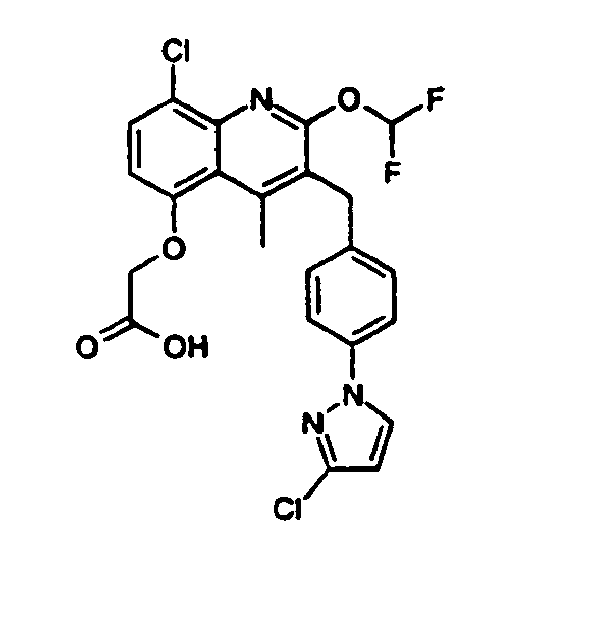
- The title compound was prepared by the method of Preparation 18a using {8-chloro-2-difluoromethoxy-4-methyl-3-[4-(4,4,5,5-tetramethyl[1,3,2]dioxaborolan-2-yl)benzyl] quinolin-5-yloxy}acetic acid tert-butyl ester and 3-chloro-1H-pyrazole.
- MS: ESI (+ve) (Method B): 564 (M+H)+, Retention time 5.0 min
- The title compound was prepared by the method of Preparation 32c using {8-chloro-3-[4-(3-chloropyrazol-1-yl)benzyl]-2-difluoromethoxy-4-methylquinolin-5-yloxy}acetic acid tert-butyl ester.
- 1H NMR (DMSO-d6): δ 2.91 (s, 3H), 4.23 (s, 2H), 4.48 (s, 2H), 6.60 (d, J = 2.6 Hz, 1H), 6.83 (d, J = 8.6 Hz, 1H), 7.23 (d, J = 8.3 Hz, 2H), 7.68 (m, 3H), 7.88 (t, J = 72 Hz, 1H), 8.48 (d, J = 2.6 Hz, 1H)
MS: ESI (+ve) (Method A): 508 (M+H)+, Retention time 13.1 min
MS: ESI (+ve) (Method B): 508 (M+H)+, Retention time 4.4 min -

- The title compound was prepared by the method described in
US65629651 - 1H NMR (CDCl3): δ1.16 (m, 4H), 2.09 (m 1H), 8.11 (s, 1H)
- The title compound was prepared by the method of Preparation 27a using 4-(5-tert-butoxycarbonylmethoxy-2-difluoromethoxy-8-fluoro-4-methylquinolin-3-ylmethyl) boronic acid and 4-bromo-5-cyciopropylisoxazole.
- MS: ESI (+ve) (Method B): 555 (M+H)+, Retention time 4.9 min
- The title compound was prepared by the method of Preparation 32c using {8-chloro-3-[4-(3-chloropyrazol-1-yl)benzyl]-2-difluoromethoxy-4-methylquinolin-5-yloxy}acetic acid tert-butyl ester.
- 1H NMR (DMSO-d6): δ 0.98 (m, 2H), 1.08 (m, 2H), 2.28 (m, 1H), 2.91 (s, 3H), 4.26 (s, 2H), 4.83 (s, 2H), 6.94 (dd, J = 4.0, 8.9 Hz, 1H), 7.24 (d, J = 8.2 Hz, 2H), 7.48 (dd, J = 8.9. 9.7 Hz, 1H), 7.53 (d, J = 8.2 Hz, 2H), 7.88 (t, J = 72 Hz, 1H), 8.77 (s. 1H)
MS: ESI (+ve) (Method A): 499 (M+H)+, Retention time 12.3 min
MS: ESI (+ve) (Method B): 499 (M+H)+, Retention time 4.2 min -

- The title compound was prepared by the method of Preparation 18a using {8-chloro-2-difluoromethoxy-4-methyl-3-[4-(4,4,5,5-tetramethyl[1,3,2]dioxaborolan-2-yl)benzyl] quinolin-5-yloxy}acetic acid tert-butyl ester and 4-chloro-1H-pyrazole.
- MS: ESI (+ve) (Method B): 564 (M+H)+, Retention time 5.1 min
- The title compound was prepared by the method of Preparation 32c using {8-chloro-3-[4-(4-chloropyrazol-1-yl)benzyl]-2-difluoromethoxy-4-methylquinolin-5-yloxy}acetic acid tert-butyl ester.
- 1H NMR (DMSO.d6): δ 2.90 (s. 3H), 4.26 (s, 2H), 4.86 (s, 2H), 6.98 (d, J = 8.7 Hz, 1H), 7.26 (d, J = 8.6 Hz, 2H), 7-70 (d, J = 8.6 Hz, 2H), 7.79 (d, J = 8.7 Hz, 1H), 7.82 (s, 1H), 7.89 (t, J = 72 Hz, 1H), 8.71 (s, 1H)
MS: ESI (+ve) (Method A): 508 (M+H)+, Retention time 13.7 min -

- The title compound was prepared by the method of Preparation 18a using {8-chloro-2-difluoromethoxy-4-methyl-3-[4-(4,4,5,5-tetramethyl[1,3,2]dioxaborolan-2-yl)benzyl] quinolin-5-yioxy}acetic acid tert-butyl ester and 2-isopropyl-1H-imidazole.
- MS: ESI (+ve) (Method B): 572 (M+H)+, Retention time 3.2 min
- The title compound was prepared by the method of Preparation 32c using {8-chloro-2-difluoromethoxy-3-[4-(2-isopropylimidazol-1-yl)benzyl]-4-methylquinolin-5-yloxy}acetic acid tert-butyl ester.
- 1H NMR (DMSO-d6): δ 1.11 (d, J = 6.7 Hz, 6H), 2.92 (m, 4H), 4.31 (s, 2H), 4.81 (s, 2H), 6.88 (d, J = 1.3 Hz, 1H), 6.97 (s, J = 8.6 Hz, 1H), 7.14 (d, J = 1.3 Hz, 1H), 7.30 (s, 4H), 7.79 (d, J = 8.6 Hz, 1H), 7.90 (t, J = 72 Hz, 1H)
MS: ESI (+ve) (Method A): 516 (M+H)+, Retention time 8.3 min
MS: ESI (+ve) (Method B): 516 (M+H)+, Retention time 2.9 min -

- A mixture of 8-fluoro-5-hydroxy-4-methyl-3-(4-pyrazol-1-ylbenzyl)-1H-quinolin-2-one (1.1 g) and phosphorus oxychloride (9.1 mL) was heated by microwave irradiation at 110°C for 1 hour. The mixture was cooled to room temperature, poured into ice/water (100 mL), and the resulting precipitate was collected by filtration, washed with water and dried to afford title compound (1.2 g).
- A mixture of phosphoric acid mono[8-fluoro-4-methyl-2-oxo-3-(4-pyrazol-1-ylbenzyl)-1,2-dihydroquinolin-5-yl]ester (0.34 g), potassium phosphate (0.88 g) and N,N-dimethylformamide (8.0 mL) was heated by microwave irradiation at 200 °C for 10 minutes. The mixture was cooled to room temperature, filtered through Celite and concentrated to under reduced pressure. Purification of the residue by column chromatography on silica gel, eluting with a mixture of cyclohexane and ethyl acetate (1:0 to 1:1 by volume) gave title compound as a yellow solid (0.11 g).
- 1H NMR (DMSO-d6): δ 2.89 (s, 3H), 4.41 (s, 2H), 6.51 (d, J = 1.8, 2.5 Hz, 1H), 6.90 (dd, J = 4.4, 8.6 Hz, 1H), 7.21 (m, 2H), 7.41 (dd, J = 8.6, 10.1 Hz, 1H), 7.71 (dd, J = 0.5,1.8 Hz, 1H), 7.74 (m, 2H), 8.42 (dd, J = 0.8, 2.5 Hz, 1H), 10.5 (s, 1H).
MS: ESI (+ve) (Method B): 368 (M+H)+, Retention time 3.7 min. - A mixture of 2-chloro-8-fluoro-4-methyl-3-(4-pyrazol-1-ylbenzyl)quinolin-5-ol (0.22 g), 2-isopropenyl-4,4,5,5-tetramethyl[1,3,2]dioxaborolane (0.23 mL), potassium phosphate monohydrate (0.68 g) and N,N-dimethylformamide (3.0 mL) was purged with argon for 20 minutes, and then treated with [1,1'-bis(diphenylphosphino)ferrocene]dichloropalladium (II) (0.048 g), and the mixture heated at 90 °C for 12 hours. The mixture was cooled to room temperature, filtered through Celite and concentrated under reduced pressure. The residue was diluted with saturated aqueous ammonium chloride solution (50 mL) and extracted with ethyl acetate (3 x 20 mL). The combined extracts were washed with water (5.0 mL) and saturated aqueous sodium chloride solution (5.0 mL), dried over magnesium sulfate and concentrated under reduced pressure. Purification of the residue by column chromatography on silica gel, eluting with a mixture of cyclohexane and ethyl acetate (1:0 to 1:1 by volume) gave title compound as a white solid (0.082 g).
- MS: ESI (+ve) (Method B): 374 (M+H)+, Retention time 3.3 min.
- A mixture of 8-fluoro-2-isopropenyl-4-methyl-3-(4-pyrazol-1-ylbenzyl)quinolin-5-ol (0.13 g), palladium hydroxide (0.047 g) and methanol (3.4 mL) was stirred at room temperature for 20 hours under an atmosphere of hydrogen. The mixture was filtered through Celite and concentrated under reduced pressure. Purification of the residue by column chromatography on silica gel, eluting with a mixture of cyclohexane and ethyl acetate (1:0 to 1:1 by volume) gave title compound as a white foam (0.077 g).
- 1H NMR (DMSO-d6): δ 1.19 (s, 3H), 1.20 (s, 3H), 2.81 (s, 3H), 3.37 (m, 1H), 4.32 (s, 2H), 6.51 (dd, J = 1.8, 2.5 Hz, 1H), 6.77 (dd, J = 4.4, 8.5 Hz, 1H), 7.12 (m, 2H), 7.26 (dd, J = 8.6, 10.3 Hz, 1H), 7.70 (dd, J = 0.5, 1.7 Hz, 1H), 7.74 (m, 2H), 8.42 (dd, J = 0.5, 2.5 Hz, 1H), 10.1 (s, 1H).
MS: ESI (+ve) (Method B): 376 (M+H)+, Retention time 3.9 min. - A mixture of 8-fluoro-2-isopropyl-4-methyl-3-(4-pyrazol-1-yl-benzyl)quinolin-5-ol (0.066 g), potassium carbonate (0.073 g) and N,N-dimethylformamide (0.35 mL) was treated with methyl bromoacetate (0.020 mL), and the resulting mixture was stirred at room temperature for 12 hours. The mixture was diluted with saturated aqueous ammonium chloride solution (3.0 mL) and water (20 mL), and extracted with ethyl acetate (3 x 5 mL). The combined extracts were washed with water (2.0 mL) and saturated aqueous sodium chloride solution (2.0 mL), and dried over magnesium sulfate. Purification of the residue by column chromatography on silica gel, eluting with a mixture of cyclohexane and ethyl acetate (1:0 to 1:1 by volume) gave title compound as a colourless oil (0.079 g).
- 1H NMR (DMSO-d6): δ 1.20 (s, 3H), 1.22 (s, 3H), 2.84 (s, 3H), 3.37 (m, 1H), 3.72 (s, 3H), 4.37 (s, 2H), 4.94 (s, 2H), 6.51 (dd, J = 1.8, 2.5 Hz, 1H), 6.90 (dd, J = 4.1, 8.9 Hz, 1H), 7.13 (m, 2H), 7.38 (dd, J = 8.7, 10.0 Hz, 1H), 7.70 (dd, J = 0.5, 1.8 Hz, 1H), 7.74 (m, 2H), 8.42 (dd, J = 0.6, 2.5 Hz, 1H).
MS: ESI (+ve) (Method B): 448 (M+H)+, Retention time 4.5 min. - A solution of [8-fluoro-2-isopropyl-4-methyl-3-(4-pyrazol-1-ylbenzyl)quinolin-5-yloxy]acetic acid methyl ester (0.062 g) in tetrahydrofuran (0.70 mL) and water (0.70 mL) was treated with lithium hydroxide (0.033 g), and the resulting mixture was stirred at room temperature. After 24 hours, the mixture was treated with additional lithium hydroxide (0.033 g) and stirring continued for 16 hours. The mixture was cooled to 0 °C, acidified with 1.0 M aqueous hydrochloric acid and extracted with ethyl acetate (3 x 5.0 mL). The combined extracts were washed with saturated aqueous sodium chloride solution (2.0 mL), dried over magnesium sulfate and concentrated under reduced pressure. Purification of the residue by preparative reverse-phase HPLC, eluting with a mixture of acetonitrile and water (40:60 to 19:1 by volume) gave title compound as a yellow solid (0.015 g).
- 1H NMR (DMSO-d6): δ 1.20 (s, 3H), 1.22 (s, 3H), 2.85 (s, 3H), 3.36 (m, 1H), 4.37 (s, 2H), 4.81 (s, 2H), 6.51 (dd, J = 1.8, 2.5 Hz, 1H), 6.87 (dd, J = 4.1, 8.8 Hz, 1H), 7.13 (m, 2H), 7.38 (dd, J = 8.7, 10.1 Hz, 1H), 7.70 (dd, J = 0.5, 1.7 Hz, 1H), 7.74 (m, 2H), 8.42 (dd, J = 0.6, 2.5 Hz, 1H), 13.1 (br s, 1H).
MS: ESI (+ve) (Method A): 434 (M+H)+, Retention time 11.8 min. -

- A mixture of 8-chloro-5-hydroxy-4-methyl-3-(4-pyrazol-1-ylbenryl)-1H-quinolin-2-one (1.4 g) and phosphorus oxychloride (20 mL) was heated by microwave irradiation at 110 °C for 15 minutes. The mixture was cooled to room temperature, poured into ice/water (100 mL), and the resulting precipitate was collected by filtration, washed with water and dried to afford title compound (0.92 g).
- MS: ESI (+ve) (Method B): 464 (M+H)+, Retention time 3.4 min.
- A mixture phosphoric acid mono-[2,8-dichloro-4-methyl-3-(4-pyrazol-1-yl-benzyl)quinolin-5-yl] ester (0.92 g), 2-isopropenyl-4,4,5,5-tetramethyl[1,3,2]dioxaborolane (0.75 mL), potassium phosphate monohydrate (2.3 g) and N,N-dimethylformamide (10 mL) was purged with argon for 20 minutes, and then treated with [1,1'-bis(diphenylphosphino)ferrocene]dichloropalladium (II) (0.080 g). The resulting mixture was heated at 90 °C for 12 hours, cooled to room temperature and filtered through Celite. The filtrate was concentrated under reduced pressure, diluted with saturated aqueous ammonium chloride solution (50 mL) and extracted with ethyl acetate (3 x 20 mL). The combined extracts were washed with saturated aqueous sodium chloride solution (50 mL), dried over magnesium sulfate and concentrated under reduced pressure. Purification of the residue by column chromatography on silica gel, eluting with a mixture of cyclohexane and ethyl acetate (1:0 to 1:1 by volume) gave title compound as a white solid (0.26 g).
- MS: ESI (+ve) (Method B): 390 (M+H)+, Retention time 3.9 min.
- A mixture of 8-chloro-2-isopropenyl-4-methyl-3-(4-pyrazol-1-ylbenzyl)quinolin-5-ol (0.26 g), ethyl acetate (10 mL), methanol (5.0 mL) and palladium hydroxide (0.05 g) was stirred at room temperature for 27 hours under an atmosphere of hydrogen. The mixture was filtered through Celite and the filtrated concentrated under reduced pressure. Purification of the residue by column chromatography on silica gel, eluting with a mixture of cyclohexane and ethyl acetate (1:0 to 0:1 by volume) gave title compound as a yellow oil (0.21 g).
- 1H NMR (CDCl3): δ 1.32 (d, J = 6.6 Hz, 6H), 2.77 (s, 3H), 4.32 (s, 2H), 6.47 (m, 1H), 6.66 (d, J = 8.2 Hz, 1H), 7.09 (d, J = 8.7 Hz, 2H), 7.53 (m, 3H), 7.74 (m, 1H), 7.88 (dd, J = 0.6, 2.5 Hz, 1H).
- A mixture of 8-chloro-2-isopropyl-4-methyl-3-(4-pyrazol-1-ylbenzyl)quinolin-5-ol (0.10 g), acetone (3.0 mL), potassium carbonate (0.035 g) and bromoacetic acid methyl ester (0.025 mL) was stirred at room temperature for 20 hours. The mixture was concentrated under reduced pressure and the residue partitioned between ethyl acetate and water. The organic phase was dried over magnesium sulfate and concentrated under reduced pressure. Purification of the residue by column chromatography on silica gel, eluting with a mixture of cyclohexane and ethyl acetate (10:0 to 8:2 by volume) gave title compound as colourless oil (0.087 g).
- MS: ESI (+ve) (Method B): 464 (M+H)+, Retention time 4.63 min.
- A solution of [8-chloro-2-isopropyl-4-methyl-3-(4-pyrazol-1-ylbenzyl)quinolin-5-yloxy]acetic acid methyl ester (0.087 g) in tetrahydrofuran (3.0 mL) and 1.0 M aqueous lithium hydroxide solution (0.5 mL) was stirred at room temperature for three hours. The mixture was concentrated under reduced pressure and the pH adjusted to 4 by the addition of 0.1 M aqueous hydrochloric acid (3 mL). The mixture was extracted with ethyl acetate and the combined extracts washed with saturated aqueous sodium chloride solution and dried over magnesium sulfate. The solvent was removed under reduced pressure and the residue purified by column chromatography on silica gel, eluting with a mixture of cyclohexane, ethyl acetate and formic acid (1:0:0:0.001 to 0:1:0.001 by volume) to afford title compound as pale yellow solid (0.06 g).
- 1H NMR (CDCl3): δ 1.30 (d, J = 6.6 Hz, 6H), 2.80 (s, 3H), 3.31 (m, 1H), 4.31 (s, 2H), 4.74 (s, 2H), 6.41 (t, J = 2.1 Hz, 1H), 6.62 (d, J = 8.5 Hz, 1H), 7.04 (d, J = 8.5 Hz, 2H), 7.52 (d, J = 8.5 Hz, 2H), 7.59 (d, J = 8.5 Hz, 1H), 7.69 (d, J = 1.4 Hz, 1H), 7.83 (d, J = 2.4 Hz, 1H).
MS: ESI (+ve) (Method A): 450 (M+H)+, Retention time 13.6 min. -

- A mixture of 2-chloro-8-fluoro-4-methyl-3-(4-pyrazol-1-ylbenryl)quinolin-5-ol (0.26 g), cyclopropylboronic acid (0.12 g), caesium carbonate (0.92 g), dioxane (5.7 mL) and water (1.4 mL) was purged with argon, and then treated with [1,1'-bis(diphenylphosphino)ferrocene]dichloropalladium (II) (0.058 g). The mixture was heated at 90 °C for 3 hours, cooled to room temperature, neutralised with saturated aqueous ammonium chloride solution and extracted with ethyl acetate (3 x 20 mL). The combined extracts were washed with saturated aqueous sodium chloride solution (5.0 mL), dried over magnesium sulfate and concentrated under reduced pressure. Purification of the residue by column chromatography on silica gel, eluting with a mixture of cyclohexane and ethyl acetate (1:0 to 3:2 by volume) gave title compound as a yellow oil (0.061 g).
- 1H NMR (DMSO-d6): δ 0.89 (m, 2H), 1.08 (m, 2H), 2.26 (m, 1H), 2.83 (s, 3H), 4.45 (s, 2H), 6.51 (dd, J = 1.8, 2.5 Hz, 1H), 6.73 (dd, J = 4.6, 8.6 Hz, 1H), 7.20 (m, 2 H), 7.23 (d, J = 8.6 Hz, 1H), 7.70 (dd, J = 0.5, 1.8 Hz, 1H), 7.74 (m, 2H), 8.42 (dd, J = 0.5, 2.5 Hz, 1H), 10.1 (br s, 1H).
MS: ESI (+ve) (Method B): 374 (M+H)+, Retention time 3.7 min. - A mixture of 2-cyclopropyl-8-fluoro-4-methyl-3-(4-pyrazol-1-ylbenzyl)quinolin-5-ol (0.040 g), potassium carbonate (0.044 g) and N,N-dimethylformamide (0.21 mL) was treated with methyl bromoacetate (0.011 mL), and the resulting mixture was stirred at room temperature for 1 hour. The mixture was diluted with water (30 mL), extracted with ethyl acetate (3 x 10 mL), and the combined extracts were dried over magnesium sulfate. The solvent was removed under reduced pressure and the residue purified by column chromatography on silica gel, eluting with a mixture of cyclohexane and ethyl acetate (1:0 to 3:2 by volume) to afford the title compound as a yellow oil (0.034 g).
- MS: ESI (+ve) (Method B): 446 (M+H)+, Retention time 4.2 min.
- A solution of [2-cyclopropyl-8-fluoro-4-methyl-3-(4-pyrazol-1-ylbenzyl)quinolin-5-yloxy]acetic acid methyl ester (0.034 g) in tetrahydrofuran (0.19 mL) and water (0.19 mL) was treated with lithium hydroxide (0.037 g), and the resulting mixture was stirred at room temperature for 2 hours. The mixture was diluted with water, cooled to 0 °C and acidified by the addition of 1.0 M aqueous hydrochloric acid. The resulting precipitate was collected by filtration and dried to afford title compound as a pale pink solid (0.022 g).
- 1H NMR (DMSO-d6): δ 0.87 (m, 2H), 1.05 (m, 2H), 2.25 (m, 1H), 2.82 (s, 3H), 4.45 (s, 2H), 4.72 (s, 2H), 6.46 (dd, J = 1.8, 2.6 Hz, 1H), 6.77 (dd, J = 4.2, 8.8 Hz, 1H), 7.16 (m, 2H), 7.29 (dd, J = 8.8, 10.1 Hz, 1H), 7.66 (d, J = 1.7 Hz, 1 H), 7.70 (m, 2H), 8.37 (d, J = 2.4 Hz, 1H), 13.10 (br s, 1H).
MS: ESI (+ve) (Method A): 432 (M+H)+, Retention time 11.5 min.
MS: ESI (+ve) (Method B): 432 (M+H)+, Retention time 3.8 min. -

- A mixture of 8-chloro-2-isopropyl-4-methyl-3-(4-pyrazol-1-ylbenzyl)quinolin-5-ol (0.1 g), dichloromethane (3.0 mL) and triethylamine (0.11 mL) at 0 ºC was treated with trifluoromethanesulfonic anhydride (0.064 mL), and the resulting mixture was stirred at 0 ºC for 15 minutes and then at room temperature for 1 hour. The mixture was cooled to 0 ºC, diluted with saturated aqueous sodium hydrogen carbonate solution (5.0 mL) and extracted with dichloromethane. The combined extracts were washed with saturated aqueous sodium chloride solution, dried over magnesium sulfate and concentrated under reduced pressure to afford title compound as yellow oil (0.075 g).
- MS: ESI (+ve) (Method B): 524 (M+H)+, Retention time 4.9 min.
- A mixture of trifluoromethanesulfonic acid 8-chloro-2-isopropyl-4-methyl-3-(4-pyrazol-1-ylbenzyl)quinolin-5-yl ester (0.075 g), tert-butyl-(1-methoxyvinyloxy)dimethylsilane (0.063 mL), lithium acetate (0.029 g) and tetrahydrofuran (2.0 mL) was purged with argon for 30 minutes, and then treated with tetrakis(triphenylphosphine)palladium (0) (0.017 g). The mixture was stirred at 70 ºC for four days, cooled to room temperature and filtered through Celite. The filtrate was concentrated under reduced pressure and the residue purified by column chromatography on silica gel, eluting with a mixture of cyclohexane and ethyl acetate (10:0 to 2:8 by volume) to give title compound as pale yellow oil (0.042 g).
- MS: ESI (+ve) (Method B): 448 (M+H)+, Retention time 4.5 min.
- A solution of [8-chloro-2-isopropyl-4-methyl-3-(4-pyrazol-1-ylbenzyl)quinolin-5-yl]acetic acid methyl ester (0.04 g) in tetrahydrofuran (3.0 mL) was treated with 1.0 M aqueous lithium hydroxide solution (0.3 mL), and the resulting mixture was stirred at room temperature for six hours. The mixture was concentrated under reduced pressure and the pH adjusted to 4 by the addition of 0.1 M aqueous hydrochloric acid (3.0 mL). The mixture was extracted with ethyl acetate and the combined extracts washed with saturated aqueous sodium chloride solution and dried over magnesium sulfate. The solvent was removed under reduced pressure and the residue purified by preparative reverse-phase HPLC, eluting with a mixture of acetonitrile and water (5:95 to 98:2 by volume) to afford title compound as white solid (0.024 g).
- 1H NMR (DMSO-d6): δ 1.24 (d, J = 6.4 Hz, 6H), 2.66 (s, 3H), 3.36 (m, 1H), 4.21 (s, 2H), 4.36 (s, 2H), 6.51 (m, 1H), 7.12 (d, J = 8.6 Hz, 2H), 7.35 (d, J = 7.9 Hz, 1H), 7.70 (d, J = 1.7 Hz, 1H), 7.73 (m, 2H), 7.78 (d, J = 7.9 Hz, 1H), 8.41 (d, J = 2.4 Hz, 1H).
MS: ESI (+ve) (Method A): 434 (M+H)+, Retention time 12.7 min. -

- A mixture of 2-cyclopropyl-8-fluoro-4-methyl-3-(4-pyrazol-1-ylbenzyl)quinolin-5-ol (0.064 g), N,N-dimethy"ormamide (0.86 mL), potassium carbonate (0.071 g) and (R)-2-chloropropionic acid methyl ester (0.032 g) was stirred at 40 °C for 3 days. The mixture was cooled to 0 °C, diluted with water (40 mL) and extracted with ethyl acetate (3 x 10 mL). The combined extracts were washed saturated aqueous sodium chloride solution, dried over magnesium sulfate and concentrated under reduced pressure. Purification of the residue by column chromatography on silica gel, eluting with a mixture of ethyl acetate and cyclohexane (0:1 to 4:6 by volume) gave title compound as a colourless oil (0.033 g).
- MS: ESI (+ve) (Method B): 460 (M+H)+, Retention time 4.4 min.
- A solution of (S)-2-[2-cyclopropyl-8-fluoro-4-methyl-3-(4-pyrazol-1-ylbenzyl)quinolin-5-yloxy]propionic acid methyl ester (0.033 g) in tetrahydrofuran (0.18 mL) and water (0.18 mL) was treated with lithium hydroxide (0.018 g), and the resulting mixture was stirred at room temperature for 4 hours. The mixture was cooled to 0 °C, diluted with water (10 mL) and acidified by the addition of 1.0 M aqueous hydrochloric acid. The mixture was extracted with ethyl acetate and the combined extracts were dried over magnesium sulfate and concentrated under reduced pressure to afford title compound as a yellow solid (0.023 g).
- 1H NMR (DMSO-d6): δ 0.88 (m, 2H), 1.05 (m, 2H), 1.54 (d, J = 6.9 Hz, 3H), 2.26 (m, 1H), 2.80 (s, 3H), 4.45 (s, 2H), 4.93 (q, J = 6.7 Hz, 1H), 6.47 (dd, J = 1.8, 2.6 Hz, 1H), 6.67 (dd, J = 4.1, 8.8 Hz, 1H), 7.17 (m, 2H), 7.28 (dd, J = 8.8, 10.1 Hz, 1H), 7.66 (d, J = 1.6 Hz, 1H), 7.71 (m, 2H), 8.37 (d, J = 2.6 Hz, 1H), 13.2 (br s, 1H).
MS: ESI (+ve) (Method A): 446 (M+H)+, Retention time 12.0 min. - Compounds of the invention of formula (I) were tested using the following biological test methods to determine their ability to displace PGD2 from the CRTH2 receptor and for their ability to antagonise the functional effects of PGD2 at the CRTH2 receptor in a whole cell system.
- The receptor binding assay is performed in a final volume of 200 µL binding buffer [10 mM BES (pH 7.4), 1 mM EDTA, 10 mM manganese chloride, 0.01 % BSA] and 1 nM [3H]-PGD2 (Amersham Biosciences UK Ltd). Ligands are added in assay buffer containing a constant amount of DMSO (1 % by volume). Total binding is determined using 1 % by volume of DMSO in assay buffer and non-specific binding is determined using 10 µM of unlabeled PGD2 (Sigma). Human embryonic kidney (HEK) cell membranes (3.5 µg) expressing the CRTH2 receptor are incubated with 1.5 mg wheatgerm agglutinin SPA beads and 1 nM [3H]-PGD2 (Amersham Biosciences UK Ltd) and the mixture incubated for 3 hours at room temperature. Bound [3H]-PGD2 is detected using a Microbeta TRILUX liquid scintillation counter (Perkin Elmer). Compound IC50 value is determined using a 6-point dose response curve in duplicate with a semi-log compound dilution series. IC50 calculations are performed using Excel and XUfit (Microsoft), and this value is used to determine a Ki value for the test compound using the Cheng-Prusoff equation.
- The GTPγS Assay is performed in a final volume of 200 mL assay buffer (20mM HEPES pH 7.4, 10mM MgCl2, 100mM NaCl, 10µg/mL saponin). DMSO concentrations are kept constant at 1% by volume. Human embryonic kidney (HEK) cell membranes (3.5 µg) expressing the CRTH2 receptor are incubated with the compounds for 15 min at 30° C prior to addition of PGD2 (30nM final concentration) and GTP (10µM final concentration). The assay solutions are then incubated for 30 minutes at 30° C, followed by addition of [35S]-GTPγS (0.1 nM final concentration). The assay plate is than shaken and incubated for 5 minutes at 30°C. Finally, SPA beads (Amersham Biosciences, UK) are added to a final concentration of 1.5mg/well and the plate shaken and incubated for 30 minute at 30° C. The sealed plate is centrifuged at 1000g for 10mins at 30oC and the bound [35S]-GTPγS is detected on Microbeta scintillation counter (Perkin Elmer). Compound IC50 value is determined using a 6-point dose response curve in duplicate with a semi-log compound dilution series. IC50 calculations are performed using Excel and XLfit (Microsoft), and this value is used to determine a Ki value for the test compound using the Cheng-Prusoff equation.
- Compounds of the Examples above were tested in the CRTH2 radioligand binding and GTPγS functional assays described above; the compounds all have IC50 values of less than 1 µM in both assays. For example, the compound of Example 1 had an IC50 value of 5.4 nM in the CRTH2 radioligand binding assay, and the compound of Example 2 had an IC50 value of 6.3 nM in that assay.
Claims (10)
- A compound of formula (I) or a pharmaceutically acceptable salt thereof:
 R1 is halogen or cyano;R2 is hydrogen or methyl;R3 and R4 are independently -OR6, C1-C6alkyl or C3-C6cycloalkyl, the latter two groups being optionally substituted by one or more halogen atoms;R5 is hydrogen or halogen;R6 is C1-C6alkyl or C3-C6cycloalkyl, either of which being optionally substituted by one or more halogen atoms;X is -CH2-, -S-, or -O-;one of Y and Y1 is hydrogen and the other is OR6, -C(=O)R7, NR8SO2R6 or a heterocyclic group selected from furan, thiophene, pyrrole, oxazole, thiazole, imidazole, pyrazole, isoxazole, isothiazole, 1,2,3-oxadiazole, 1,2,4-oxadiazole, 1,3,4-oxadiazole, furazan, 1,2,3-triazole, 1,2,4-triazole, 1,2,3-thiadiazole, 1,2,5-thiadiazole. 1,3,4-thiadiazole, tetrazole, pyridine, pyridazine, pyrimidine, pyrazine, 1,2,4-triazine and 1,3,5-triazine any of which may be optionally substituted by one or more substituents selected from halogen; cyano; C1-C6alkyl optionally substituted by one or more halogen atoms; C3-C6cycloalkyl optionally substituted by one or more halogen atoms; hydroxy; C1-C6alkoxy optionally substituted by one or more halogen atoms; C1-C6alkyl-O-CH2-, C1-C6alkyl-O-CH(RX)- and C1-C6alkyl-O-C(RXRY)- in which the C1-C6alkyl part is optionally substituted by one or more halogen atoms; NH2C(=O)-; RXNHC(=O)-; RXRYNC(=-O).; RXRYNS(=O)2-; RXNHS(=O)2-; NH2S(=O)2-; NH2-; RXNH-; RXRYN-; RXS(=O)2-; RXC(=O)-; RXS(=O)2NH-; RXS(=O)2NRY-; RXC(=O)NH- and RXC(=O)N(RY)-; wherein RXand RY are independently C1-C4alkyl or C3-C6cycloalkyl, either of which being optionally substituted by one or more halogen atoms; or RX and RY when attached to the same nitrogen atom form a cyclic amino ring;R7 is C1-C6alkyl or C3-C6cycloalkyl either of which being optionally substituted by one or more halogen atoms; or phenyl or monocyclic heteroaryl having 5 or 6 ring atoms, optionally substituted by one or more substituents independently selected from halogen; cyano; C1-C6alkyl optionally substituted by one or more halogen atoms; C3-C6 cycloalkyl optionally substituted by one or more halogen atoms; hydroxy; C1-C6alkoxy optionally substituted by one or more halogen atoms; C1-C6alkyl-O-CH2-, C1-C6alkyl-O-CH(RX)- and C1-C6alkyl-O-C(RXRY)- in which the C1-C6alkyl part is optionally substituted by one or more halogen atoms; NH2C(-O)-; RXNHC(=O)-; RXRYNC(=O)-; RXRYNS(=O)2-; RXNHS(=O)2-; NH2S(-O)2-; NH2-; RXNH-; RXRYN-; RXS(=O)2-; RXC(=O)-; RXS(=O)2NH-; RXS(=O)2NRY-; RXC(=O)NH- and RXC(=O)N(RY)-; wherein RX and RY are independently C1-C4alkyl or C3-C6cycloalkyl, either of which being optionally substituted by one or more halogen atoms; or RX and RY when attached to the same nitrogen atom form a cyclic amino ring; andR8 is hydrogen, C1-C6alkyl or C3-C6cycloalkyl, the latter two groups being optionally substituted by one or more halogen atoms.
 - A compound as claimed in claim 1 wherein R1 is fluoro or chloro.
- A compound as claimed in claim 1 or claim 2 wherein one of R3 and R4 is methyl, ethyl or isopropyl, and the other is methyl or difluoromethoxy.
- A compound as claimed in any of the preceding claims wherein X is -CH2-.
- A compound as claimed in claim 1 wherein R1 is chloro or fluoro, R2 is hydrogen or methyl, R3 is methyl or difluoromethoxy, R4 is ethyl, isopropyl or difluoromethoxy, R5 is hydrogen, fluoro or chloro, one of Y and Y1 is hydrogen and the other is pyrimidin-2-yl, pyrazol-1-yl, pyrazol-3-yl, pyrazol-4-yl, imidazol-1-yl, imidazol-2-yl, thiazol-2-yl, oxazol-2-yl or isoxazol-4-yl, any of which may be optionally substituted by one or more substituents selected from fluoro, chloro, cyano, methyl, ethyl, isopropyl, trifuoromethyl, difluoromethyl, cyclopropyl, hydroxy, methoxy, ethoxy, ispropoxy, difluoromethoxy, trifluoromethoxy, Z-O-CH2-, Z-O-CH(RX)- and Z-O-C(RXRY)-. NH2C(=O)-; RXNHC(=O)-; RXRYNC(=O)-; RXRYNS(=O)2-; RXNHS(=O)2-; NH2S(=O)2-; NH2-; RXNH-; RXRYN-; RXS(=O)2-; RXC(=O)-; RXS(=O)2NH-; RXS(=O)2NRY-; RXC(=O)NH- and RXC(=O)N(RY)-; wherein Z is selected from methyl, ethyl, isopropyl, trifuoromethyl, difluoromethyl, and cyclopropyl, and RX and RY are independently methyl, ethyl, isopropyl, trifuoromethyl, difluoromethyl, or cyclopropyl, or RX and RY when attached to the same nitrogen atom form a morpholino, piperidinyl, or piperazinyl ring, the latter being optionally N-substituted by methyl, ethyl, isopropyl or cyclopropyl.
- A compound as claimed in claim 1, which is of any of
[4-difluoromethoxy-2-ethyl-8-fluoro-3-(4-pyrazol-1-ylbenzyl) quinolin-5-yloxy]acetic acid
[4-difluoromethoxy-2-ethyl-8-fluoro-3-(4-oxazol-2-ylbenzyl)quinolin-5-yloxy]acetic acid
[4-difluoromethoxy-2-ethyl-8-fluoro-3-(4-methoxybenzyl)quinolin-5-yloxy]acetic acid
[4-difluoromethoxy-3-(4-ethanesulfonylaminobenzyl)-2-ethyl-8-fluoroquinolin-5-yloxy]acetic acid
[3-(4-acetylbenzyl)-4-difluoromethoxy-2-ethyl-8-fluoroquinolin-5-yloxy]acetic acid
{4-difluoromethoxy-2-ethyl-8-fluoro-3-[4-(1-methyl-1H-imidazol-2-yl)benzyl]quinolin-5-yloxylacetic acid
[8-chloro-4-difluoromethoxy-2-ethyl-3-(4-pyrazol-1-ylbenzyl) quinolin-5-yloxy]acetic acid
[4-difluoromethoxy-2-ethyl-8-fluoro-3-(4-thiazol-2-ylbenzyl)quinolin-5-yloxy]acetic acid
[4-difluoromethoxy-2-ethyl-8-fluoro-3-(4-pyrimidin-2-ylbenzyl) quinolin-5-yloxy]acetic acid
{8-chloro-4-difluoromethoxy-3-[4-(2,2-dimethylpropionyl)benzyl]-2-ethylquinolin-5-yloxy}acetic acid
[8-chloro-2-methoxy-4-methyl-3-(4-pyrazol-1-ylbenzyl)quinolin-5-yloxy]acetic acid
[2-difluoromethoxy-8-fluoro-4-methyl-3-(4-pyrazol-1-ylbenzyl) quinolin-5-yloxy]acetic acid
[8-chloro-2-difluoromethoxy-4-methyl-3-(4-pyrazol-1-ylbenzyl) quinolin-5-yloxy]acetic acid
[8-chloro-4-difluoromethoxy-2-ethyl-3-(4-isobutyrylbenzyl) quinolin-5-yloxy]acetic acid
[8-fluoro-2-methoxy-4-methyl-3-(4-pyrazol-1-yl-benzyl)quinolin-5-yloxy]acetic acid
[4-difluoromethoxy-2-ethyl-8-fluoro-3-(4-trifluoromethoxybenzyl)quinolin-5-yloxy]acetic acid
{8-chloro-2-difluoromethoxy-3-[4-(2,2-dimethylpropionyl)benzyl]-4-methylquinolin-5-yloxy}acetic acid
{3-[4-(4-chloropyrazol-1-yl)benzyl]-4-difluoromethoxy-2-ethyl-8-fluoroquinolin-5-yloxy}acetic acid
[8-chloro-4-difluoromethoxy-2-isopropyl-3-(4-pyrazol-1-ylbenzyl) quinolin-5-yloxy]acetic acid
{3-[4-(3-chloropyrazol-1-yl)benzylJ-4-ditluoromethoxy-2-ethyl-8-fluoroquinolin-5-yloxy}acetic acid
[4-difluoromethoxy-8-fluoro-2-isopropyl-3-(4-pyrazol-1-ylbenzyl) quinolin-5-yloxy]acetic acid
{4-difluoromethoxy-2-ethyl-8-fluoro-3-[4-(1-isopropyl-1H-pyrazol-3-yl)benzyl]quinolin-5-yloxy}acetic acid
{3-[4-(4-cyclopropylpyrazol-1-yl)benzyl]-4-difluoromethoxy-2-ethyl-8-fluoroquinolin-5-yloxy}acetic acid
{4-difluoromethoxy-2-ethyl-8-fluoro-3-[4-(2-isopropylimidazol-1-yl)benzyl]quinolin-5-yloxy}acetic acid
{3-[4-(3-cyclopropylpyrazol-1-yl)benzyl]-4-difluoromethoxy-2-ethyl-8-fluoroquinolin-5-yloxy}acetic acid
{3-[4-(5-cyclopropylpyrazol-1-yl)benzyl]-4-difluoromethoxy-2-ethyl-8-fluoroquinolin-5-yloxy}acetic acid
{3-[4-(5-cyclopropylisoxazol-4-yl)benzyl]-4-difluoromethoxy-2-ethyl-8-fluoroquinolin-5-yloxy}acetic acid
{2-difluoromethoxy-3-[4-(2,2-dimethylpropionyl)benzyl]-8-fluoro-4-methylquinolin-5-yloxy}acetic acid
{8-chloro-2-difluoromethoxy-4-methyl-3-[4-(1H-pyrazol-4-yl)benzyl] quinolin-5-yloxy}acetic acid
{8-chloro-2-difluoromethoxy-3-[4-(1-isopropyl-1H-pyrazol-3-yl) benzyl]-4-methylquinolin-5-yloxy}acetic acid
{8-chloro-2-difluoromethoxy-3-[4-(1-isopropyl-1H-pyrazol-4-yl) benzyl]-4-methylquinolin-5-yloxy}acetic acid
{8-chloro-3-[4-(3-cyclopropylpyrazol-1-yl)benzyl]-2-difluoromethoxy-4-methylquinolin-5-yloxy}acetic acid
{8-chloro-3-[4-(5-cyclopropyl-pyrazol-1-yl)benzyl]-2-difluoromethoxy-4-methylquinolin-5-yloxy}acetic acid
{3-[4-(5-cyclopropylpyrazol-1-yl)benzyl]-2-difluoromethoxy-8-fluoro-4-methylquinolin-5-yloxy}acetic acid
{3-[4-(4-cyclopropylpyrazol-1-yl)benzyl]-2-difluoromethoxy-8-fluoro-4-methylquinolin-5-yloxy}acetic acid
{2-difluoromethoxy-8-fluoro-3-[4-(2-isopropylimidazol-1-yl)benzyl]-4-methylquinolin-5-yloxy}acetic acid
{8-chloro-3-[4-(4-cyclopropylpyrazol-1-yl)benzyl]-2-difluoromethoxy-4-methylquinolin-5-yloxy}acetic acid
{3-[4-(3-cyclopropylpyrazol-1-yl)benzyl]-2-difluoromethoxy-8-fluoro-4-methylquinolin-5-yloxy}acetic acid
{8-chloro-3-[4-(3-chloropyrazol-1-yl)benzyl]-2-difluoromethoxy-4-methylquinolin-5-yloxy}acetic acid
{3-[4-(5-cyclopropylisoxazol-4-yl)benzyl]-2-difluoromethoxy-8-fluoro-4-methylquinolin-5-yloxy}acetic acid
{8-chloro-3-[4-(4-chloropyrazol-1-yl)benzyl]-2-difluoromethoxy-4-methylquinolin-5-yloxy}acetic acid
{8-chloro-2-difluoromethoxy-3-[4-(2-isopropylimidazol-1-yl) benzyl]-4-methylquinolin-5-yloxy}acetic acid
[8-fluoro-2-isopropyl-4-methyl-3-(4-pyrazol-1-ylbenzyl)quinolin-5-yloxy]acetic acid
[8-chloro-2-isopropyl-4-methyl-3-(4-pyrazol-1-ylbenzyl)quinolin-5-yloxy]acetic acid
[2-cyclopropyl-8-fluoro-4-methyl-3-(4-pyrazol-1-ylbenzyl)quinolin-5-yloxy]acetic acid
[8-chloro-2-isopropyl-4-methyl.3-(4-pyrazol-1-ylbenzyl)quinolin-5-yl]acetic acid and
(S)-2-[2-cyclopropyl-8-fluoro-4-methyl-3-(4-pyrazol-1-ylbenzyl)quinolin-5-yloxy]propionic acid. - A pharmaceutical composition comprising a compound as claimed in any of the preceding claims, in admixture with a pharmaceutically acceptable carrier or excipient.
- A compound as claimed in any of claims 1 to 6, for use in therapy.
- A compound as claimed in claim 8, for use in the treatment of a condition selected from asthma, chronic obstructive pulmonary disease, rhinitis, allergic airway syndrome and allergic rhinobronchitis.
- A compound as claimed in claim 8, foruse in the treatment of a condition selected from psoriasis, atopic and non-atopic dermatitis, Crohn's disease, ulcerative colitis and irritable bowel disease.
Priority Applications (3)
| Application Number | Priority Date | Filing Date | Title |
|---|---|---|---|
| PL08736891T PL2139881T3 (en) | 2007-04-04 | 2008-04-03 | Quinolines and their therapeutic use |
| SI200830512T SI2139881T1 (en) | 2007-04-04 | 2008-04-03 | Quinolines and their therapeutic use |
| CY20121100048T CY1112679T1 (en) | 2007-04-04 | 2012-01-17 | KINOLINES AND THERAPEUTIC USE OF THESE |
Applications Claiming Priority (3)
| Application Number | Priority Date | Filing Date | Title |
|---|---|---|---|
| GB0706636A GB0706636D0 (en) | 2007-04-04 | 2007-04-04 | Receptor ligands |
| GB0724430A GB0724430D0 (en) | 2007-12-14 | 2007-12-14 | Receptor ligands |
| PCT/GB2008/001201 WO2008122784A1 (en) | 2007-04-04 | 2008-04-03 | Quinolines and their therapeutic use |
Publications (2)
| Publication Number | Publication Date |
|---|---|
| EP2139881A1 EP2139881A1 (en) | 2010-01-06 |
| EP2139881B1 true EP2139881B1 (en) | 2011-11-09 |
Family
ID=39561800
Family Applications (1)
| Application Number | Title | Priority Date | Filing Date |
|---|---|---|---|
| EP08736891A Not-in-force EP2139881B1 (en) | 2007-04-04 | 2008-04-03 | Quinolines and their therapeutic use |
Country Status (21)
| Country | Link |
|---|---|
| US (2) | US8173812B2 (en) |
| EP (1) | EP2139881B1 (en) |
| JP (1) | JP5187862B2 (en) |
| CN (1) | CN101679359B (en) |
| AT (1) | ATE532780T1 (en) |
| AU (1) | AU2008235282B2 (en) |
| BR (1) | BRPI0809983A2 (en) |
| CA (1) | CA2680682C (en) |
| CY (1) | CY1112679T1 (en) |
| DK (1) | DK2139881T3 (en) |
| EA (1) | EA017093B1 (en) |
| ES (1) | ES2375588T3 (en) |
| HR (1) | HRP20110987T1 (en) |
| IL (1) | IL201013A (en) |
| MX (1) | MX2009010461A (en) |
| NZ (1) | NZ579659A (en) |
| PL (1) | PL2139881T3 (en) |
| PT (1) | PT2139881E (en) |
| SI (1) | SI2139881T1 (en) |
| WO (1) | WO2008122784A1 (en) |
| ZA (1) | ZA200906384B (en) |
Families Citing this family (11)
| Publication number | Priority date | Publication date | Assignee | Title |
|---|---|---|---|---|
| SI2139881T1 (en) * | 2007-04-04 | 2012-05-31 | Pulmagen Therapeutics Asthma Ltd | Quinolines and their therapeutic use |
| NZ585888A (en) | 2007-12-14 | 2012-02-24 | Pulmagen Therapeutics Asthma Ltd | Indoles and their therapeutic use |
| TW201201805A (en) * | 2010-07-05 | 2012-01-16 | Actelion Pharmaceuticals Ltd | 1-phenyl-substituted heterocyclyl derivatives and their use as prostaglandin D2 receptor modulators |
| EP2457900A1 (en) | 2010-11-25 | 2012-05-30 | Almirall, S.A. | New pyrazole derivatives having CRTh2 antagonistic behaviour |
| CN104011021B (en) | 2011-12-21 | 2016-08-24 | 埃科特莱茵药品有限公司 | Heterocyclic derivatives and their use as prostaglandin D2 receptor modulators |
| US9169270B2 (en) | 2012-07-05 | 2015-10-27 | Actelion Pharmaceuticals Ltd. | 1-phenyl-substituted heterocyclyl derivatives and their use as prostaglandin D2 receptor modulators |
| WO2014014874A1 (en) * | 2012-07-17 | 2014-01-23 | Boehringer Ingelheim International Gmbh | Pyrazole derivatives which inhibit leukotriene production |
| WO2015124703A1 (en) | 2014-02-24 | 2015-08-27 | Ventana Medical Systems, Inc. | Quinone methide analog signal amplification |
| EP2974729A1 (en) * | 2014-07-17 | 2016-01-20 | Abivax | Quinoline derivatives for use in the treatment of inflammatory diseases |
| WO2022175829A1 (en) * | 2021-02-17 | 2022-08-25 | Cellix Bio Private Limited | Topical formulations and compositions |
| CN118955546A (en) * | 2024-07-31 | 2024-11-15 | 上海毕得医药科技股份有限公司 | A method for synthesizing compound 1-isopropylpyrazole-3-boric acid pinacol ester |
Family Cites Families (5)
| Publication number | Priority date | Publication date | Assignee | Title |
|---|---|---|---|---|
| JPS58225065A (en) * | 1982-06-21 | 1983-12-27 | Nippon Shinyaku Co Ltd | 2-quinolone derivative |
| TW297025B (en) * | 1992-02-14 | 1997-02-01 | Squibb & Sons Inc | |
| SA04250253B1 (en) * | 2003-08-21 | 2009-11-10 | استرازينيكا ايه بي | Substiuted phenoxacetic as pharmaceutced compunds for treating respiratory diseases such as asthma and copd |
| DK1928457T3 (en) * | 2005-09-30 | 2013-02-04 | Pulmagen Therapeutics Asthma Ltd | QUINOLINES AND THEIR THERAPEUTIC USE |
| SI2139881T1 (en) * | 2007-04-04 | 2012-05-31 | Pulmagen Therapeutics Asthma Ltd | Quinolines and their therapeutic use |
-
2008
- 2008-04-03 SI SI200830512T patent/SI2139881T1/en unknown
- 2008-04-03 AU AU2008235282A patent/AU2008235282B2/en not_active Ceased
- 2008-04-03 BR BRPI0809983-9A2A patent/BRPI0809983A2/en not_active Application Discontinuation
- 2008-04-03 EA EA200970911A patent/EA017093B1/en not_active IP Right Cessation
- 2008-04-03 EP EP08736891A patent/EP2139881B1/en not_active Not-in-force
- 2008-04-03 US US12/531,935 patent/US8173812B2/en not_active Expired - Fee Related
- 2008-04-03 CN CN2008800110606A patent/CN101679359B/en not_active Expired - Fee Related
- 2008-04-03 ES ES08736891T patent/ES2375588T3/en active Active
- 2008-04-03 MX MX2009010461A patent/MX2009010461A/en active IP Right Grant
- 2008-04-03 NZ NZ579659A patent/NZ579659A/en not_active IP Right Cessation
- 2008-04-03 PT PT08736891T patent/PT2139881E/en unknown
- 2008-04-03 HR HR20110987T patent/HRP20110987T1/en unknown
- 2008-04-03 AT AT08736891T patent/ATE532780T1/en active
- 2008-04-03 JP JP2010501594A patent/JP5187862B2/en not_active Expired - Fee Related
- 2008-04-03 DK DK08736891.6T patent/DK2139881T3/en active
- 2008-04-03 WO PCT/GB2008/001201 patent/WO2008122784A1/en not_active Ceased
- 2008-04-03 CA CA2680682A patent/CA2680682C/en not_active Expired - Fee Related
- 2008-04-03 PL PL08736891T patent/PL2139881T3/en unknown
-
2009
- 2009-09-14 ZA ZA2009/06384A patent/ZA200906384B/en unknown
- 2009-09-17 IL IL201013A patent/IL201013A/en active IP Right Grant
-
2012
- 2012-01-17 CY CY20121100048T patent/CY1112679T1/en unknown
- 2012-03-30 US US13/435,242 patent/US8394830B2/en not_active Expired - Fee Related
Also Published As
| Publication number | Publication date |
|---|---|
| JP2010523537A (en) | 2010-07-15 |
| US20120184579A1 (en) | 2012-07-19 |
| AU2008235282B2 (en) | 2011-02-24 |
| CN101679359B (en) | 2013-03-06 |
| US20100144787A1 (en) | 2010-06-10 |
| CN101679359A (en) | 2010-03-24 |
| IL201013A0 (en) | 2010-05-17 |
| CA2680682A1 (en) | 2008-10-16 |
| WO2008122784A1 (en) | 2008-10-16 |
| SI2139881T1 (en) | 2012-05-31 |
| PL2139881T3 (en) | 2012-04-30 |
| MX2009010461A (en) | 2010-02-18 |
| BRPI0809983A2 (en) | 2014-10-14 |
| US8173812B2 (en) | 2012-05-08 |
| AU2008235282A1 (en) | 2008-10-16 |
| PT2139881E (en) | 2012-01-17 |
| ES2375588T3 (en) | 2012-03-02 |
| CA2680682C (en) | 2015-05-26 |
| NZ579659A (en) | 2012-01-12 |
| DK2139881T3 (en) | 2012-01-30 |
| HK1142604A1 (en) | 2010-12-10 |
| HRP20110987T1 (en) | 2012-01-31 |
| ATE532780T1 (en) | 2011-11-15 |
| EP2139881A1 (en) | 2010-01-06 |
| JP5187862B2 (en) | 2013-04-24 |
| EA017093B1 (en) | 2012-09-28 |
| US8394830B2 (en) | 2013-03-12 |
| CY1112679T1 (en) | 2016-02-10 |
| EA200970911A1 (en) | 2010-04-30 |
| ZA200906384B (en) | 2010-11-24 |
| AU2008235282A8 (en) | 2009-11-26 |
| IL201013A (en) | 2015-01-29 |
Similar Documents
| Publication | Publication Date | Title |
|---|---|---|
| US8394830B2 (en) | Quinolines and their therapeutic use | |
| EP2327693B1 (en) | Indoles and their therapeutic use | |
| JP5269086B2 (en) | Human immunodeficiency virus replication inhibitor | |
| TWI649325B (en) | Novel compound for treating cystic fibrosis and pharmaceutical composition thereof | |
| EP2129661B1 (en) | Quinoline derivatives as crth2 receptor ligands | |
| US20100093751A1 (en) | Indolizineacetic Acids and Their Therapeutic Use as Ligands of the CRTH2 Receptor | |
| WO2009060209A1 (en) | 6,6-fused bicyclic aromatic compounds and their therapeuti use | |
| JP2005534627A (en) | Tachykinin receptor antagonist | |
| WO2010142934A1 (en) | Indole derivatives as ligands of crth2 receptors | |
| WO2009044134A1 (en) | Indolizine derivatives with crth2 receptor affinity for the treatment of inflammatory diseases | |
| EP2609086B1 (en) | Substituted 2-oxo- and 2-thioxo-dihydroquinoline-3-carboxamides as kcnq2/3 modulators | |
| WO2010040989A1 (en) | Quinolin-2-one compounds | |
| WO2010040992A1 (en) | Quinoline derivatives having dp and / or crth2 receptor activity | |
| NZ580310A (en) | Quinoline derivatives as crth2 receptor ligands |
Legal Events
| Date | Code | Title | Description |
|---|---|---|---|
| PUAI | Public reference made under article 153(3) epc to a published international application that has entered the european phase |
Free format text: ORIGINAL CODE: 0009012 |
|
| 17P | Request for examination filed |
Effective date: 20091026 |
|
| AK | Designated contracting states |
Kind code of ref document: A1 Designated state(s): AT BE BG CH CY CZ DE DK EE ES FI FR GB GR HR HU IE IS IT LI LT LU LV MC MT NL NO PL PT RO SE SI SK TR |
|
| 17Q | First examination report despatched |
Effective date: 20100326 |
|
| DAX | Request for extension of the european patent (deleted) | ||
| RAP1 | Party data changed (applicant data changed or rights of an application transferred) |
Owner name: PULMAGEN THERAPEUTICS (ASTHMA) LIMITED |
|
| RAP1 | Party data changed (applicant data changed or rights of an application transferred) |
Owner name: PULMAGEN THERAPEUTICS (ASTHMA) LIMITED |
|
| RAP1 | Party data changed (applicant data changed or rights of an application transferred) |
Owner name: PULMAGEN THERAPEUTICS (ASTHMA) LIMITED |
|
| GRAP | Despatch of communication of intention to grant a patent |
Free format text: ORIGINAL CODE: EPIDOSNIGR1 |
|
| GRAS | Grant fee paid |
Free format text: ORIGINAL CODE: EPIDOSNIGR3 |
|
| GRAA | (expected) grant |
Free format text: ORIGINAL CODE: 0009210 |
|
| AK | Designated contracting states |
Kind code of ref document: B1 Designated state(s): AT BE BG CH CY CZ DE DK EE ES FI FR GB GR HR HU IE IS IT LI LT LU LV MC MT NL NO PL PT RO SE SI SK TR |
|
| REG | Reference to a national code |
Ref country code: GB Ref legal event code: FG4D |
|
| REG | Reference to a national code |
Ref country code: CH Ref legal event code: EP |
|
| REG | Reference to a national code |
Ref country code: IE Ref legal event code: FG4D |
|
| REG | Reference to a national code |
Ref country code: HR Ref legal event code: TUEP Ref document number: P20110987 Country of ref document: HR |
|
| REG | Reference to a national code |
Ref country code: DE Ref legal event code: R096 Ref document number: 602008011263 Country of ref document: DE Effective date: 20120105 |
|
| REG | Reference to a national code |
Ref country code: RO Ref legal event code: EPE |
|
| REG | Reference to a national code |
Ref country code: PT Ref legal event code: SC4A Free format text: AVAILABILITY OF NATIONAL TRANSLATION Effective date: 20120109 |
|
| REG | Reference to a national code |
Ref country code: NL Ref legal event code: T3 |
|
| REG | Reference to a national code |
Ref country code: DK Ref legal event code: T3 |
|
| REG | Reference to a national code |
Ref country code: HR Ref legal event code: T1PR Ref document number: P20110987 Country of ref document: HR Ref country code: SE Ref legal event code: TRGR |
|
| REG | Reference to a national code |
Ref country code: ES Ref legal event code: FG2A Ref document number: 2375588 Country of ref document: ES Kind code of ref document: T3 Effective date: 20120302 |
|
| REG | Reference to a national code |
Ref country code: NO Ref legal event code: T2 Effective date: 20111109 |
|
| REG | Reference to a national code |
Ref country code: EE Ref legal event code: FG4A Ref document number: E006304 Country of ref document: EE Effective date: 20120117 |
|
| REG | Reference to a national code |
Ref country code: GR Ref legal event code: EP Ref document number: 20120400287 Country of ref document: GR Effective date: 20120322 |
|
| REG | Reference to a national code |
Ref country code: PL Ref legal event code: T3 |
|
| REG | Reference to a national code |
Ref country code: SK Ref legal event code: T3 Ref document number: E 11088 Country of ref document: SK |
|
| REG | Reference to a national code |
Ref country code: HU Ref legal event code: AG4A Ref document number: E012829 Country of ref document: HU |
|
| PLBE | No opposition filed within time limit |
Free format text: ORIGINAL CODE: 0009261 |
|
| STAA | Information on the status of an ep patent application or granted ep patent |
Free format text: STATUS: NO OPPOSITION FILED WITHIN TIME LIMIT |
|
| 26N | No opposition filed |
Effective date: 20120810 |
|
| REG | Reference to a national code |
Ref country code: DE Ref legal event code: R097 Ref document number: 602008011263 Country of ref document: DE Effective date: 20120810 |
|
| REG | Reference to a national code |
Ref country code: FR Ref legal event code: PLFP Year of fee payment: 9 |
|
| REG | Reference to a national code |
Ref country code: FR Ref legal event code: PLFP Year of fee payment: 10 |
|
| REG | Reference to a national code |
Ref country code: HR Ref legal event code: ODRP Ref document number: P20110987 Country of ref document: HR Payment date: 20180612 Year of fee payment: 11 Ref country code: FR Ref legal event code: PLFP Year of fee payment: 11 |
|
| PGFP | Annual fee paid to national office [announced via postgrant information from national office to epo] |
Ref country code: IE Payment date: 20180612 Year of fee payment: 11 Ref country code: CH Payment date: 20180614 Year of fee payment: 11 Ref country code: MC Payment date: 20180612 Year of fee payment: 11 Ref country code: EE Payment date: 20180626 Year of fee payment: 11 Ref country code: LT Payment date: 20180620 Year of fee payment: 11 Ref country code: NL Payment date: 20180613 Year of fee payment: 11 Ref country code: LU Payment date: 20180608 Year of fee payment: 11 Ref country code: CZ Payment date: 20180608 Year of fee payment: 11 Ref country code: NO Payment date: 20180611 Year of fee payment: 11 Ref country code: PT Payment date: 20180618 Year of fee payment: 11 Ref country code: DK Payment date: 20180612 Year of fee payment: 11 Ref country code: ES Payment date: 20180628 Year of fee payment: 11 Ref country code: HR Payment date: 20180612 Year of fee payment: 11 Ref country code: FI Payment date: 20180612 Year of fee payment: 11 Ref country code: SK Payment date: 20180612 Year of fee payment: 11 |
|
| PGFP | Annual fee paid to national office [announced via postgrant information from national office to epo] |
Ref country code: SI Payment date: 20180612 Year of fee payment: 11 Ref country code: LV Payment date: 20180627 Year of fee payment: 11 Ref country code: BG Payment date: 20180615 Year of fee payment: 11 Ref country code: TR Payment date: 20180619 Year of fee payment: 11 Ref country code: RO Payment date: 20180611 Year of fee payment: 11 Ref country code: AT Payment date: 20180611 Year of fee payment: 11 Ref country code: BE Payment date: 20180614 Year of fee payment: 11 Ref country code: GR Payment date: 20180613 Year of fee payment: 11 Ref country code: IS Payment date: 20180627 Year of fee payment: 11 |
|
| PGFP | Annual fee paid to national office [announced via postgrant information from national office to epo] |
Ref country code: SE Payment date: 20180612 Year of fee payment: 11 Ref country code: HU Payment date: 20180620 Year of fee payment: 11 Ref country code: MT Payment date: 20180618 Year of fee payment: 11 |
|
| PGFP | Annual fee paid to national office [announced via postgrant information from national office to epo] |
Ref country code: PL Payment date: 20180704 Year of fee payment: 14 |
|
| PGFP | Annual fee paid to national office [announced via postgrant information from national office to epo] |
Ref country code: CY Payment date: 20180621 Year of fee payment: 11 |
|
| REG | Reference to a national code |
Ref country code: DE Ref legal event code: R081 Ref document number: 602008011263 Country of ref document: DE Owner name: GB001, INC. (N.D.GES. DES STAATES DELAWARE), S, US Free format text: FORMER OWNER: PULMAGEN THERAPEUTICS (ASTHMA) LIMITED, FULMER SLOUGH, GB |
|
| PGFP | Annual fee paid to national office [announced via postgrant information from national office to epo] |
Ref country code: DE Payment date: 20190429 Year of fee payment: 12 |
|
| PGFP | Annual fee paid to national office [announced via postgrant information from national office to epo] |
Ref country code: FR Payment date: 20190425 Year of fee payment: 12 |
|
| REG | Reference to a national code |
Ref country code: GB Ref legal event code: 732E Free format text: REGISTERED BETWEEN 20190829 AND 20190904 |
|
| REG | Reference to a national code |
Ref country code: HR Ref legal event code: PBON Ref document number: P20110987 Country of ref document: HR Effective date: 20190403 |
|
| REG | Reference to a national code |
Ref country code: LT Ref legal event code: MM4D Effective date: 20190403 |
|
| PG25 | Lapsed in a contracting state [announced via postgrant information from national office to epo] |
Ref country code: CZ Free format text: LAPSE BECAUSE OF NON-PAYMENT OF DUE FEES Effective date: 20190403 |
|
| PGFP | Annual fee paid to national office [announced via postgrant information from national office to epo] |
Ref country code: GB Payment date: 20190429 Year of fee payment: 12 |
|
| REG | Reference to a national code |
Ref country code: DE Ref legal event code: R082 Ref document number: 602008011263 Country of ref document: DE |
|
| REG | Reference to a national code |
Ref country code: EE Ref legal event code: MM4A Ref document number: E006304 Country of ref document: EE Effective date: 20190430 |
|
| REG | Reference to a national code |
Ref country code: NO Ref legal event code: MMEP |
|
| REG | Reference to a national code |
Ref country code: CH Ref legal event code: PL |
|
| REG | Reference to a national code |
Ref country code: DK Ref legal event code: EBP Effective date: 20190430 |
|
| REG | Reference to a national code |
Ref country code: SE Ref legal event code: EUG |
|
| REG | Reference to a national code |
Ref country code: NL Ref legal event code: MM Effective date: 20190501 |
|
| REG | Reference to a national code |
Ref country code: AT Ref legal event code: MM01 Ref document number: 532780 Country of ref document: AT Kind code of ref document: T Effective date: 20190403 |
|
| REG | Reference to a national code |
Ref country code: BE Ref legal event code: MM Effective date: 20190430 |
|
| PG25 | Lapsed in a contracting state [announced via postgrant information from national office to epo] |
Ref country code: LU Free format text: LAPSE BECAUSE OF NON-PAYMENT OF DUE FEES Effective date: 20190403 Ref country code: MC Free format text: LAPSE BECAUSE OF NON-PAYMENT OF DUE FEES Effective date: 20190430 |
|
| REG | Reference to a national code |
Ref country code: SK Ref legal event code: MM4A Ref document number: E 11088 Country of ref document: SK Effective date: 20190403 |
|
| PG25 | Lapsed in a contracting state [announced via postgrant information from national office to epo] |
Ref country code: LT Free format text: LAPSE BECAUSE OF NON-PAYMENT OF DUE FEES Effective date: 20190403 Ref country code: SK Free format text: LAPSE BECAUSE OF NON-PAYMENT OF DUE FEES Effective date: 20190403 Ref country code: PT Free format text: LAPSE BECAUSE OF NON-PAYMENT OF DUE FEES Effective date: 20191003 Ref country code: CY Free format text: LAPSE BECAUSE OF NON-PAYMENT OF DUE FEES Effective date: 20190403 Ref country code: AT Free format text: LAPSE BECAUSE OF NON-PAYMENT OF DUE FEES Effective date: 20190403 Ref country code: NO Free format text: LAPSE BECAUSE OF NON-PAYMENT OF DUE FEES Effective date: 20190430 Ref country code: HR Free format text: LAPSE BECAUSE OF NON-PAYMENT OF DUE FEES Effective date: 20190403 Ref country code: BG Free format text: LAPSE BECAUSE OF NON-PAYMENT OF DUE FEES Effective date: 20191031 Ref country code: SE Free format text: LAPSE BECAUSE OF NON-PAYMENT OF DUE FEES Effective date: 20190404 Ref country code: EE Free format text: LAPSE BECAUSE OF NON-PAYMENT OF DUE FEES Effective date: 20190430 Ref country code: RO Free format text: LAPSE BECAUSE OF NON-PAYMENT OF DUE FEES Effective date: 20190403 Ref country code: CH Free format text: LAPSE BECAUSE OF NON-PAYMENT OF DUE FEES Effective date: 20190430 Ref country code: HU Free format text: LAPSE BECAUSE OF NON-PAYMENT OF DUE FEES Effective date: 20190404 Ref country code: FI Free format text: LAPSE BECAUSE OF NON-PAYMENT OF DUE FEES Effective date: 20190403 Ref country code: LI Free format text: LAPSE BECAUSE OF NON-PAYMENT OF DUE FEES Effective date: 20190430 Ref country code: NL Free format text: LAPSE BECAUSE OF NON-PAYMENT OF DUE FEES Effective date: 20190501 |
|
| PG25 | Lapsed in a contracting state [announced via postgrant information from national office to epo] |
Ref country code: BE Free format text: LAPSE BECAUSE OF NON-PAYMENT OF DUE FEES Effective date: 20190430 Ref country code: SI Free format text: LAPSE BECAUSE OF NON-PAYMENT OF DUE FEES Effective date: 20190404 Ref country code: LV Free format text: LAPSE BECAUSE OF NON-PAYMENT OF DUE FEES Effective date: 20190403 Ref country code: GR Free format text: LAPSE BECAUSE OF NON-PAYMENT OF DUE FEES Effective date: 20191105 Ref country code: IS Free format text: LAPSE BECAUSE OF FAILURE TO SUBMIT A TRANSLATION OF THE DESCRIPTION OR TO PAY THE FEE WITHIN THE PRESCRIBED TIME-LIMIT Effective date: 20191101 |
|
| PG25 | Lapsed in a contracting state [announced via postgrant information from national office to epo] |
Ref country code: DK Free format text: LAPSE BECAUSE OF NON-PAYMENT OF DUE FEES Effective date: 20190430 Ref country code: IT Free format text: LAPSE BECAUSE OF NON-PAYMENT OF DUE FEES Effective date: 20190403 Ref country code: IE Free format text: LAPSE BECAUSE OF NON-PAYMENT OF DUE FEES Effective date: 20190403 |
|
| REG | Reference to a national code |
Ref country code: ES Ref legal event code: FD2A Effective date: 20200828 |
|
| PG25 | Lapsed in a contracting state [announced via postgrant information from national office to epo] |
Ref country code: ES Free format text: LAPSE BECAUSE OF NON-PAYMENT OF DUE FEES Effective date: 20190404 |
|
| REG | Reference to a national code |
Ref country code: DE Ref legal event code: R119 Ref document number: 602008011263 Country of ref document: DE |
|
| PG25 | Lapsed in a contracting state [announced via postgrant information from national office to epo] |
Ref country code: DE Free format text: LAPSE BECAUSE OF NON-PAYMENT OF DUE FEES Effective date: 20201103 Ref country code: FR Free format text: LAPSE BECAUSE OF NON-PAYMENT OF DUE FEES Effective date: 20200430 |
|
| GBPC | Gb: european patent ceased through non-payment of renewal fee |
Effective date: 20200403 |
|
| PG25 | Lapsed in a contracting state [announced via postgrant information from national office to epo] |
Ref country code: GB Free format text: LAPSE BECAUSE OF NON-PAYMENT OF DUE FEES Effective date: 20200403 |
|
| PG25 | Lapsed in a contracting state [announced via postgrant information from national office to epo] |
Ref country code: PL Free format text: LAPSE BECAUSE OF NON-PAYMENT OF DUE FEES Effective date: 20190403 |
|
| PG25 | Lapsed in a contracting state [announced via postgrant information from national office to epo] |
Ref country code: MT Free format text: LAPSE BECAUSE OF FAILURE TO SUBMIT A TRANSLATION OF THE DESCRIPTION OR TO PAY THE FEE WITHIN THE PRESCRIBED TIME-LIMIT Effective date: 20190403 |
|
| PG25 | Lapsed in a contracting state [announced via postgrant information from national office to epo] |
Ref country code: TR Free format text: LAPSE BECAUSE OF NON-PAYMENT OF DUE FEES Effective date: 20190403 |