EP2138814A1 - Sunlight sensor for extraterrestrial use - Google Patents
Sunlight sensor for extraterrestrial use Download PDFInfo
- Publication number
- EP2138814A1 EP2138814A1 EP08159257A EP08159257A EP2138814A1 EP 2138814 A1 EP2138814 A1 EP 2138814A1 EP 08159257 A EP08159257 A EP 08159257A EP 08159257 A EP08159257 A EP 08159257A EP 2138814 A1 EP2138814 A1 EP 2138814A1
- Authority
- EP
- European Patent Office
- Prior art keywords
- sunlight
- wavelength
- optoelectrical
- sensitive
- area
- Prior art date
- Legal status (The legal status is an assumption and is not a legal conclusion. Google has not performed a legal analysis and makes no representation as to the accuracy of the status listed.)
- Withdrawn
Links
Images
Classifications
-
- G—PHYSICS
- G01—MEASURING; TESTING
- G01J—MEASUREMENT OF INTENSITY, VELOCITY, SPECTRAL CONTENT, POLARISATION, PHASE OR PULSE CHARACTERISTICS OF INFRARED, VISIBLE OR ULTRAVIOLET LIGHT; COLORIMETRY; RADIATION PYROMETRY
- G01J1/00—Photometry, e.g. photographic exposure meter
- G01J1/02—Details
- G01J1/04—Optical or mechanical part supplementary adjustable parts
-
- B—PERFORMING OPERATIONS; TRANSPORTING
- B64—AIRCRAFT; AVIATION; COSMONAUTICS
- B64G—COSMONAUTICS; VEHICLES OR EQUIPMENT THEREFOR
- B64G1/00—Cosmonautic vehicles
- B64G1/22—Parts of, or equipment specially adapted for fitting in or to, cosmonautic vehicles
- B64G1/24—Guiding or controlling apparatus, e.g. for attitude control
- B64G1/36—Guiding or controlling apparatus, e.g. for attitude control using sensors, e.g. sun-sensors, horizon sensors
- B64G1/363—Guiding or controlling apparatus, e.g. for attitude control using sensors, e.g. sun-sensors, horizon sensors using sun sensors
-
- G—PHYSICS
- G01—MEASURING; TESTING
- G01J—MEASUREMENT OF INTENSITY, VELOCITY, SPECTRAL CONTENT, POLARISATION, PHASE OR PULSE CHARACTERISTICS OF INFRARED, VISIBLE OR ULTRAVIOLET LIGHT; COLORIMETRY; RADIATION PYROMETRY
- G01J1/00—Photometry, e.g. photographic exposure meter
- G01J1/02—Details
-
- G—PHYSICS
- G01—MEASURING; TESTING
- G01J—MEASUREMENT OF INTENSITY, VELOCITY, SPECTRAL CONTENT, POLARISATION, PHASE OR PULSE CHARACTERISTICS OF INFRARED, VISIBLE OR ULTRAVIOLET LIGHT; COLORIMETRY; RADIATION PYROMETRY
- G01J1/00—Photometry, e.g. photographic exposure meter
- G01J1/02—Details
- G01J1/0214—Constructional arrangements for removing stray light
-
- G—PHYSICS
- G01—MEASURING; TESTING
- G01J—MEASUREMENT OF INTENSITY, VELOCITY, SPECTRAL CONTENT, POLARISATION, PHASE OR PULSE CHARACTERISTICS OF INFRARED, VISIBLE OR ULTRAVIOLET LIGHT; COLORIMETRY; RADIATION PYROMETRY
- G01J1/00—Photometry, e.g. photographic exposure meter
- G01J1/02—Details
- G01J1/0266—Field-of-view determination; Aiming or pointing of a photometer; Adjusting alignment; Encoding angular position; Size of the measurement area; Position tracking; Photodetection involving different fields of view for a single detector
-
- G—PHYSICS
- G01—MEASURING; TESTING
- G01J—MEASUREMENT OF INTENSITY, VELOCITY, SPECTRAL CONTENT, POLARISATION, PHASE OR PULSE CHARACTERISTICS OF INFRARED, VISIBLE OR ULTRAVIOLET LIGHT; COLORIMETRY; RADIATION PYROMETRY
- G01J1/00—Photometry, e.g. photographic exposure meter
- G01J1/42—Photometry, e.g. photographic exposure meter using electric radiation detectors
-
- G—PHYSICS
- G01—MEASURING; TESTING
- G01J—MEASUREMENT OF INTENSITY, VELOCITY, SPECTRAL CONTENT, POLARISATION, PHASE OR PULSE CHARACTERISTICS OF INFRARED, VISIBLE OR ULTRAVIOLET LIGHT; COLORIMETRY; RADIATION PYROMETRY
- G01J1/00—Photometry, e.g. photographic exposure meter
- G01J1/42—Photometry, e.g. photographic exposure meter using electric radiation detectors
- G01J1/429—Photometry, e.g. photographic exposure meter using electric radiation detectors applied to measurement of ultraviolet light
-
- G—PHYSICS
- G01—MEASURING; TESTING
- G01J—MEASUREMENT OF INTENSITY, VELOCITY, SPECTRAL CONTENT, POLARISATION, PHASE OR PULSE CHARACTERISTICS OF INFRARED, VISIBLE OR ULTRAVIOLET LIGHT; COLORIMETRY; RADIATION PYROMETRY
- G01J1/00—Photometry, e.g. photographic exposure meter
- G01J1/02—Details
- G01J1/04—Optical or mechanical part supplementary adjustable parts
- G01J1/0488—Optical or mechanical part supplementary adjustable parts with spectral filtering
-
- G—PHYSICS
- G01—MEASURING; TESTING
- G01J—MEASUREMENT OF INTENSITY, VELOCITY, SPECTRAL CONTENT, POLARISATION, PHASE OR PULSE CHARACTERISTICS OF INFRARED, VISIBLE OR ULTRAVIOLET LIGHT; COLORIMETRY; RADIATION PYROMETRY
- G01J1/00—Photometry, e.g. photographic exposure meter
- G01J1/42—Photometry, e.g. photographic exposure meter using electric radiation detectors
- G01J2001/4266—Photometry, e.g. photographic exposure meter using electric radiation detectors for measuring solar light
Definitions
- the invention refers to a sunlight sensor for use in a spacecraft like e.g. a satellite which in operation orbits around the earth outside the earth sphere, the sensor comprising at least one optoelectrical element which can be exposed to incident sunlight.
- Such sensor may be used for detecting the position of the sun relative to the spacecraft.
- a known sunlight sensor e.g. comprises a non-translucent layer (membrane) having an aperture (or pinhole) in it, through which the sunlight shines upon an optoelectrical sensor array, located at a precisely known distance, causing a light spot on that array. From the position of the spot on the array the angle of incidence of the light can be assessed.
- the present invention aims to provide a more accurate sunlight sensor.
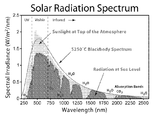
- the present invention is based upon the observation (see e.g. figure 1 ) that, as the albedo effect, i.e. the reflection of the sunlight by the earth sphere, does not occur for some (rather small) wavelength areas (connected with the spectral/absorption lines of O 3 , O 2 , H 2 0, CO 2 etc.), the sunlight within those wavelength areas will not be reflected by the earth sphere or, in other words, no albedo effect occurs in those non-reflecting areas.
- the invention applies that observation and understanding by detecting the sunlight solely in one or more of those wavelength areas where the sunlight is not reflected by the earth sphere.
- the present invention thus comprises a sunlight sensor for use in a spacecraft like e.g. a satellite which in operation orbits around the earth outside the earth sphere, the sensor comprising at least one optoelectrical element which can be exposed to incident sunlight.
- the at least one optoelectrical element is or has been made solely sensitive for a wavelength which corresponds to a wavelength area in the sunlight spectrum in which sunlight incident to the earth sphere is not substantially reflected by the earth sphere.
- One preferred option includes that said at least one optoelectrical element has been made solely sensitive for said wavelength area by applying one or more filters between the incident sunlight and said at least one optoelectrical element, which one or more filters are arranged and/or constituted to pass solely light within said wavelength area.
- Another preferred option includes that said at least one optoelectrical element is solely sensitive for said wavelength area by applying a (more or less dedicated) optoelectrical material for said at least one optoelectrical element which is solely or at least mainly optoelectrically active or sensitive for light within said wavelength area.
- one preferred absorbing (non-reflective, non albedo sensitive) wavelength area can be found within the area of about 200-300 nm, in the UV light area. Another preferred absorbing wavelength area can be found within the area of about 1350-1450 nm. Still another preferred absorbing wavelength area can be found within the area of about 1800-1950 nm.
- Preferred optoelectrical materials which are solely or at least mainly optoelectrically active or sensitive for light within the wavelength area of 200-300 nm are diamond, AlGaN, SiC or UV enhanced Si. Filters may be required to restrict or to improve the selectivity of the optoelectrical sensor to the .wavelength area of 200-300 nm (e.g. UV enhanced Si is sensitive as such for the wavelength area of about 200-800 nm, which has to be restricted, by one or more filters, to the area 200-300 nm, as the wavelength area between 300-800 nm would cause the undesired albedo effect due to reflection of the sunlight within the 300-800 nm area).
- UV enhanced Si is sensitive as such for the wavelength area of about 200-800 nm, which has to be restricted, by one or more filters, to the area 200-300 nm, as the wavelength area between 300-800 nm would cause the undesired albedo effect due to reflection of the sunlight within the 300-800 nm area).
- optoelectrical elements which comprise InGaAs as its optoelectrically active or sensitive material. The same applies for the wavelength area of 1800-1950 nm.
- the optoelectrical elements will need to include filters which solely pass the sunlight within the wavelength areas 1350-1450 nm or 1800-1950 nm respectively.
Landscapes
- Physics & Mathematics (AREA)
- General Physics & Mathematics (AREA)
- Spectroscopy & Molecular Physics (AREA)
- Engineering & Computer Science (AREA)
- Remote Sensing (AREA)
- Chemical & Material Sciences (AREA)
- Combustion & Propulsion (AREA)
- Radar, Positioning & Navigation (AREA)
- Aviation & Aerospace Engineering (AREA)
- Photometry And Measurement Of Optical Pulse Characteristics (AREA)
Abstract
Sunlight sensor for use in a spacecraft like e.g. a satellite which in operation orbits around the earth outside the earth sphere, the sensor comprising an optoelectrical element which can be exposed to incident sunlight. The optoelectrical element is solely sensitive for a wavelength which corresponds to a wavelength area in the sunlight spectrum in which sunlight incident to the earth sphere is not substantially reflected by the earth sphere, e.g. either by applying filters between the incident sunlight and the optoelectrical element, which constituted to pass solely light within said wavelength area, or by applying a dedicated optoelectrical material which is optoelectrically sensitive within said wavelength area. Preferred wavelength lie within the areas of 200-300 nm, 1350-1450 nm or 1800-1950 nm. Optoelectrical material optoelectrically sensitive for the wavelength area of 200-300 nm is e.g. diamond, AlGaN, SiC or UV enhanced Si. For the range from about 1350-1450 nm InGaAs can be applied as optoelectrically sensitive material, to be used in combination with relevant filters.
Description
- The invention refers to a sunlight sensor for use in a spacecraft like e.g. a satellite which in operation orbits around the earth outside the earth sphere, the sensor comprising at least one optoelectrical element which can be exposed to incident sunlight.
- Such sensor may be used for detecting the position of the sun relative to the spacecraft. A known sunlight sensor e.g. comprises a non-translucent layer (membrane) having an aperture (or pinhole) in it, through which the sunlight shines upon an optoelectrical sensor array, located at a precisely known distance, causing a light spot on that array. From the position of the spot on the array the angle of incidence of the light can be assessed.
- The accuracy of such sunlight sensors, however, is affected by the so-called albedo effect, i.e. the sunlight which is reflected by the earth sphere to the sensors installed in the satellite which orbits around the earth (just) outside the earth sphere.
- The present invention aims to provide a more accurate sunlight sensor.
- The present invention is based upon the observation (see e.g.
figure 1 ) that, as the albedo effect, i.e. the reflection of the sunlight by the earth sphere, does not occur for some (rather small) wavelength areas (connected with the spectral/absorption lines of O3, O2, H20, CO2etc.), the sunlight within those wavelength areas will not be reflected by the earth sphere or, in other words, no albedo effect occurs in those non-reflecting areas. The invention applies that observation and understanding by detecting the sunlight solely in one or more of those wavelength areas where the sunlight is not reflected by the earth sphere. - The present invention thus comprises a sunlight sensor for use in a spacecraft like e.g. a satellite which in operation orbits around the earth outside the earth sphere, the sensor comprising at least one optoelectrical element which can be exposed to incident sunlight. According to the invention it is preferred that said at least one optoelectrical element is or has been made solely sensitive for a wavelength which corresponds to a wavelength area in the sunlight spectrum in which sunlight incident to the earth sphere is not substantially reflected by the earth sphere.
- One preferred option includes that said at least one optoelectrical element has been made solely sensitive for said wavelength area by applying one or more filters between the incident sunlight and said at least one optoelectrical element, which one or more filters are arranged and/or constituted to pass solely light within said wavelength area.
- Another preferred option includes that said at least one optoelectrical element is solely sensitive for said wavelength area by applying a (more or less dedicated) optoelectrical material for said at least one optoelectrical element which is solely or at least mainly optoelectrically active or sensitive for light within said wavelength area.
- In other words, either the sunlight which incides to the sensor, is filtered to pass a wavelength area which is not prone to the albedo effect, viz. due to absorption of the sunlight having that wavelength area by the earth sphere, or a sensor is used which is solely sensitive/active for such a absorbing (non-reflective and thus non albedo sensitive) wavelength area.
- As can be derived from e.g.
figure 1 one preferred absorbing (non-reflective, non albedo sensitive) wavelength area can be found within the area of about 200-300 nm, in the UV light area. Another preferred absorbing wavelength area can be found within the area of about 1350-1450 nm. Still another preferred absorbing wavelength area can be found within the area of about 1800-1950 nm. - Preferred optoelectrical materials which are solely or at least mainly optoelectrically active or sensitive for light within the wavelength area of 200-300 nm are diamond, AlGaN, SiC or UV enhanced Si. Filters may be required to restrict or to improve the selectivity of the optoelectrical sensor to the .wavelength area of 200-300 nm (e.g. UV enhanced Si is sensitive as such for the wavelength area of about 200-800 nm, which has to be restricted, by one or more filters, to the area 200-300 nm, as the wavelength area between 300-800 nm would cause the undesired albedo effect due to reflection of the sunlight within the 300-800 nm area).
- In sunlight sensors having filters which are arranged and/or constituted to pass solely light within the wavelength area of 1350-1450 nm optoelectrical elements may be applies which comprise InGaAs as its optoelectrically active or sensitive material. The same applies for the wavelength area of 1800-1950 nm. As the optoelectrical sensitivity or activity of InGaAs is not restricted to 1350-1450 nm or 1800-1950 nm, the optoelectrical elements will need to include filters which solely pass the sunlight within the wavelength areas 1350-1450 nm or 1800-1950 nm respectively.
Claims (9)
- Sunlight sensor for use in a spacecraft like e.g. a satellite which in operation orbits around the earth outside the earth sphere, the sensor comprising at least one optoelectrical element which can be exposed to incident sunlight,
characterized in that
said at least one optoelectrical element is or has been made solely sensitive for a wavelength which corresponds to a wavelength area in the sunlight spectrum in which sunlight incident to the earth sphere is not substantially reflected by the earth sphere. - Sunlight sensor according to claim 1, wherein said at least one optoelectrical element has been made solely sensitive for said wavelength area by applying one or more filters between the incident sunlight and said at least one optoelectrical element, which one or more filters are arranged and/or constituted to pass solely light within said wavelength area.
- Sunlight sensor according to claim 1, wherein said at least one optoelectrical element is solely sensitive for said wavelength area by applying an optoelectrical material for said at least one optoelectrical element which is solely or at least mainly optoelectrically active or sensitive for light within said wavelength area.
- Sunlight sensor according to claim 1, wherein said wavelength lies within the area of 200-300 nm.
- Sunlight sensor according to claim 1, wherein said wavelength lies within the area of 1350-1450 nm.
- Sunlight sensor according to claim 1, wherein said wavelength lies within the area of 1800-1950 nm.
- Sunlight sensor according to claims 2 and 4 or 3 and 4, wherein said optoelectrical material which is solely or at least mainly optoelectrically active or sensitive for light within said wavelength area of 200-300 nm is diamond, AlGaN, SiC or UV enhanced Si.
- Sunlight sensor according to claims 2 and 5, wherein said one or more filters are arranged and/or constituted to pass solely light within said wavelength area of 1350-1450 nm and said at least one optoelectrical element comprises InGaAs as its optoelectrically active or sensitive material.
- Sunlight sensor according to claims 2 and 6, wherein said one or more filters are arranged and/or constituted to pass solely light within said wavelength area of 1800-1950 nm and said at least one optoelectrical element comprises InGaAs as its optoelectrically active or sensitive material.
Priority Applications (1)
| Application Number | Priority Date | Filing Date | Title |
|---|---|---|---|
| EP08159257A EP2138814A1 (en) | 2008-06-27 | 2008-06-27 | Sunlight sensor for extraterrestrial use |
Applications Claiming Priority (1)
| Application Number | Priority Date | Filing Date | Title |
|---|---|---|---|
| EP08159257A EP2138814A1 (en) | 2008-06-27 | 2008-06-27 | Sunlight sensor for extraterrestrial use |
Publications (1)
| Publication Number | Publication Date |
|---|---|
| EP2138814A1 true EP2138814A1 (en) | 2009-12-30 |
Family
ID=39952289
Family Applications (1)
| Application Number | Title | Priority Date | Filing Date |
|---|---|---|---|
| EP08159257A Withdrawn EP2138814A1 (en) | 2008-06-27 | 2008-06-27 | Sunlight sensor for extraterrestrial use |
Country Status (1)
| Country | Link |
|---|---|
| EP (1) | EP2138814A1 (en) |
Citations (3)
| Publication number | Priority date | Publication date | Assignee | Title |
|---|---|---|---|---|
| US4779980A (en) * | 1987-03-02 | 1988-10-25 | Midwest Research Institute | Atmospheric optical calibration system |
| US6098929A (en) * | 1998-01-28 | 2000-08-08 | Falbel; Gerald | Three axis attitude readout system for geosynchronous spacecraft |
| US7166825B1 (en) * | 2005-05-17 | 2007-01-23 | Itt Manufacturing Enterprises, Inc. | Solar calibration device and method |
-
2008
- 2008-06-27 EP EP08159257A patent/EP2138814A1/en not_active Withdrawn
Patent Citations (3)
| Publication number | Priority date | Publication date | Assignee | Title |
|---|---|---|---|---|
| US4779980A (en) * | 1987-03-02 | 1988-10-25 | Midwest Research Institute | Atmospheric optical calibration system |
| US6098929A (en) * | 1998-01-28 | 2000-08-08 | Falbel; Gerald | Three axis attitude readout system for geosynchronous spacecraft |
| US7166825B1 (en) * | 2005-05-17 | 2007-01-23 | Itt Manufacturing Enterprises, Inc. | Solar calibration device and method |
Non-Patent Citations (3)
| Title |
|---|
| KRABACH T N ET AL: "InGaAs detectors for miniature infrared instruments", PROCEEDINGS OF THE SPIE - THE INTERNATIONAL SOCIETY FOR OPTICAL ENGINEERING USA, vol. 1874, 1993, pages 214 - 223, XP002505075, ISSN: 0277-786X * |
| TURNBULL M C ET AL: "Spectrum of a habitable world: earthshine in the near-infrared", ASTROPHYSICAL JOURNAL UNIVERSITY OF CHICAGO PRESS FOR AMERICAN ASTRON. SOC USA, vol. 644, no. 1, 10 June 2006 (2006-06-10), pages 551 - 559, XP002505074, ISSN: 0004-637X * |
| YANG B ET AL: "High-performance back-illuminated solar-blind AlGaN metal-semiconductor-metal photodetectors", ELECTRONICS LETTERS, IEE STEVENAGE, GB, vol. 36, no. 22, 26 October 2000 (2000-10-26), pages 1866 - 1867, XP006015854, ISSN: 0013-5194 * |
Similar Documents
| Publication | Publication Date | Title |
|---|---|---|
| Arroyo-Mora et al. | Assessing the impact of illumination on UAV pushbroom hyperspectral imagery collected under various cloud cover conditions | |
| US11585749B2 (en) | Reference switch architectures for noncontact sensing of substances | |
| US20230103572A1 (en) | Limitation of Noise on Light Detectors using an Aperture | |
| KR102320479B1 (en) | Spectrometer and Method for Measuring spectrum using the same | |
| EP0472668B1 (en) | Process for determining the condition of a road surface | |
| US20160033328A1 (en) | Ambient light assisted spectroscopy | |
| WO2016129033A1 (en) | Multi-channel spectrophotometer and data processing method for multi-channel spectrophotometer | |
| US6246045B1 (en) | Reflected radiance sensors for detection of reflected radiation | |
| US20100044551A1 (en) | Photoelectric encoder | |
| DE102013000751B4 (en) | Sensor device for detecting moisture on a pane | |
| DE102017204037A1 (en) | Optical sensor with pad sensor | |
| CN110118602B (en) | Device for simultaneously acquiring broadband high-resolution spectral imaging information | |
| US8705014B2 (en) | Radiation sensor for detecting the position and intensity of a radiation source | |
| JP5929504B2 (en) | Spectrometer | |
| CA2934093A1 (en) | Remote sensing of natural gas leaks | |
| KR102076307B1 (en) | Quadrant solar sensor | |
| KR950010104A (en) | Image sensor | |
| US6717662B2 (en) | Arrangement for determining the position of a light source | |
| DE102012022258A1 (en) | Sensor for detection and localization of laser radiation sources | |
| EP3757546B1 (en) | A turbidity calibration standard, a method for manufacturing a turbidity calibration standard and use | |
| US20220228909A1 (en) | Optoelectronic Measuring Device for Measuring an Intensity of Electromagnetic Radiation | |
| WO2000052763A9 (en) | Polarization sensitive detector | |
| EP3035012A2 (en) | Method, semiconductor detector and a detector assembly for detection of sunlight | |
| DE102015001800A1 (en) | sensor device | |
| DE102023135083A1 (en) | Measuring device and tilting mirror with such a measuring device |
Legal Events
| Date | Code | Title | Description |
|---|---|---|---|
| PUAI | Public reference made under article 153(3) epc to a published international application that has entered the european phase |
Free format text: ORIGINAL CODE: 0009012 |
|
| AK | Designated contracting states |
Kind code of ref document: A1 Designated state(s): AT BE BG CH CY CZ DE DK EE ES FI FR GB GR HR HU IE IS IT LI LT LU LV MC MT NL NO PL PT RO SE SI SK TR |
|
| AX | Request for extension of the european patent |
Extension state: AL BA MK RS |
|
| AKY | No designation fees paid | ||
| REG | Reference to a national code |
Ref country code: DE Ref legal event code: 8566 |
|
| STAA | Information on the status of an ep patent application or granted ep patent |
Free format text: STATUS: THE APPLICATION IS DEEMED TO BE WITHDRAWN |
|
| 18D | Application deemed to be withdrawn |
Effective date: 20100701 |