EP2138479A1 - Phenyl glycolate derivatives - Google Patents
Phenyl glycolate derivatives Download PDFInfo
- Publication number
- EP2138479A1 EP2138479A1 EP08305321A EP08305321A EP2138479A1 EP 2138479 A1 EP2138479 A1 EP 2138479A1 EP 08305321 A EP08305321 A EP 08305321A EP 08305321 A EP08305321 A EP 08305321A EP 2138479 A1 EP2138479 A1 EP 2138479A1
- Authority
- EP
- European Patent Office
- Prior art keywords
- compound
- acetic acid
- phenoxy
- alkyl
- alkenyl
- Prior art date
- Legal status (The legal status is an assumption and is not a legal conclusion. Google has not performed a legal analysis and makes no representation as to the accuracy of the status listed.)
- Withdrawn
Links
- 0 *C(*)(C(*)=C(*)*)OC(COc1ccccc1)=O Chemical compound *C(*)(C(*)=C(*)*)OC(COc1ccccc1)=O 0.000 description 1
Classifications
-
- C—CHEMISTRY; METALLURGY
- C07—ORGANIC CHEMISTRY
- C07C—ACYCLIC OR CARBOCYCLIC COMPOUNDS
- C07C69/00—Esters of carboxylic acids; Esters of carbonic or haloformic acids
- C07C69/66—Esters of carboxylic acids having esterified carboxylic groups bound to acyclic carbon atoms and having any of the groups OH, O—metal, —CHO, keto, ether, acyloxy, groups, groups, or in the acid moiety
- C07C69/67—Esters of carboxylic acids having esterified carboxylic groups bound to acyclic carbon atoms and having any of the groups OH, O—metal, —CHO, keto, ether, acyloxy, groups, groups, or in the acid moiety of saturated acids
- C07C69/708—Ethers
- C07C69/712—Ethers the hydroxy group of the ester being etherified with a hydroxy compound having the hydroxy group bound to a carbon atom of a six-membered aromatic ring
-
- A—HUMAN NECESSITIES
- A23—FOODS OR FOODSTUFFS; TREATMENT THEREOF, NOT COVERED BY OTHER CLASSES
- A23L—FOODS, FOODSTUFFS OR NON-ALCOHOLIC BEVERAGES, NOT OTHERWISE PROVIDED FOR; PREPARATION OR TREATMENT THEREOF
- A23L27/00—Spices; Flavouring agents or condiments; Artificial sweetening agents; Table salts; Dietetic salt substitutes; Preparation or treatment thereof
- A23L27/20—Synthetic spices, flavouring agents or condiments
- A23L27/204—Aromatic compounds
-
- C—CHEMISTRY; METALLURGY
- C11—ANIMAL OR VEGETABLE OILS, FATS, FATTY SUBSTANCES OR WAXES; FATTY ACIDS THEREFROM; DETERGENTS; CANDLES
- C11B—PRODUCING, e.g. BY PRESSING RAW MATERIALS OR BY EXTRACTION FROM WASTE MATERIALS, REFINING OR PRESERVING FATS, FATTY SUBSTANCES, e.g. LANOLIN, FATTY OILS OR WAXES; ESSENTIAL OILS; PERFUMES
- C11B9/00—Essential oils; Perfumes
- C11B9/0061—Essential oils; Perfumes compounds containing a six-membered aromatic ring not condensed with another ring
Definitions
- the present invention relates to the field of fragrances and flavours. More particularly, the invention relates to new phenyl glycolate derivatives and their use in the fields of perfumery and flavouring.
- Unsaturated glycolates belong to an important class of fragrant ingredients and much work has already been done to prepare known compounds, such as Cyclogalbanate® and allyl phenoxy acetate and similar derivatives. These compounds have a characteristic green (galbanum) and/or fruity (pineapple) note.
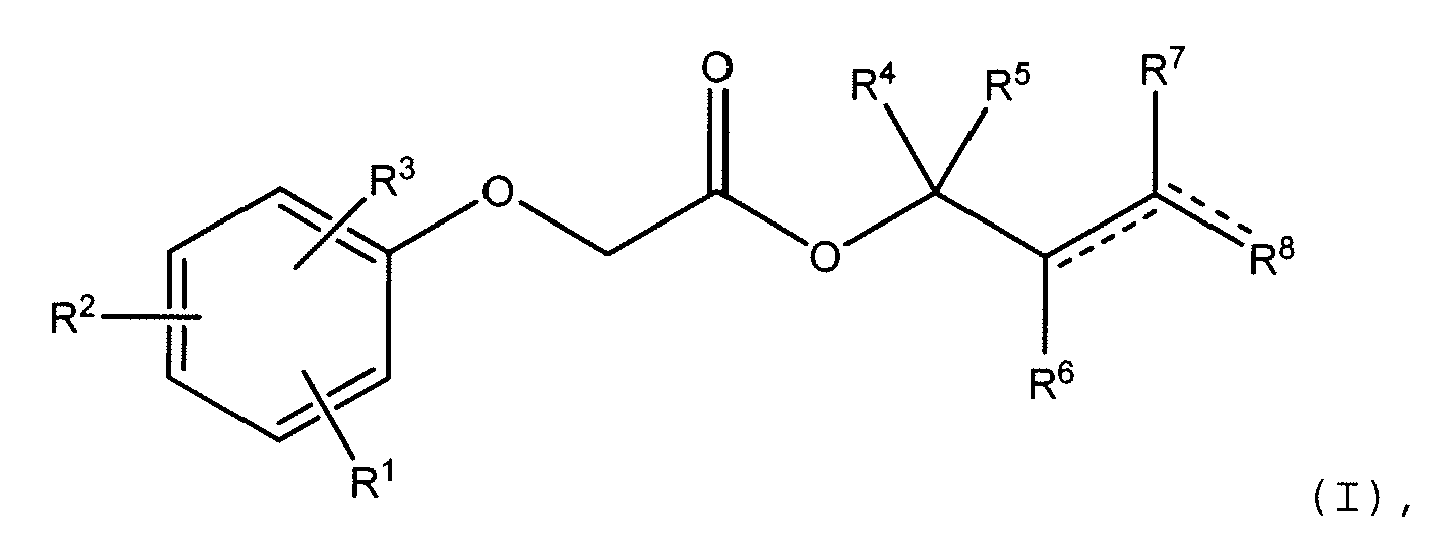
- the invention is directed to novel compounds of formula (I) wherein R 1 is H, alkyl, alkenyl, or alkoxy; R 2 and R 3 are independently alkyl, alkenyl, or alkoxy; R 4 , R 5 , R 6 , and R 7 are independently H, C 1 -C 5 alkyl, or C 2 -C 5 alkenyl; is a single or double bond, provided that one of the is a single bond and the other one is a double bond; if R 8 is attached to the double bond, it is H, C 1 -C 5 alkyl, or C 2 -C 5 alkenyl; and if R 8 is part of the double bond, it is -CR'R", wherein R' and R'' are independently H, C 1 -C 4 alkyl, or C 2 -C 4 alkenyl, with the proviso that R' and R'' together form at most a C 4 -alkyl or C 4 -alkenyl group.
- the compounds of the invention exhibit interesting olfactive properties, such as sweet and/or spicy notes with sometimes animalic aspects.
- the compounds of the invention are therefore of particular interest in the field of perfumery.
- the invention relates to compounds of formula (I) wherein R 1 is H, alkyl, alkenyl, or alkoxy; R 2 and R 3 are independently alkyl, alkenyl, or alkoxy; R 4 , R 5 , R 6 , and R 7 are independently H, C 1 -C 5 alkyl, or C 2 -C 5 alkenyl; is a single or double bond, provided that one of the is a single bond and the other one is a double bond; if R 8 is attached to the double bond, it is H, C 1 -C 5 alkyl, or C 2 -C 5 alkenyl; and if R 8 is part of the double bond, it is -CR'R", wherein R' and R'' are independently H, C 1 -C 4 alkyl, or C 2 -C 4 alkenyl, with the proviso that R' and R'' together form at most a C 4 -alkyl or C 4 -alkenyl group.
- the invention includes all isomers of the compounds of formula (I).
- R 1 is advantageously selected from H, C 1 -C 5 alkyl, or C 2 -C 5 alkenyl, or C 1 -C 5 alkoxy.
- R 2 and R 3 are independently selected from C 1 -C 5 alkyl, or C 2 -C 5 alkenyl, or C 1 -C 5 alkoxy.
- C 1 -C 5 alkyl comprises methyl, ethyl, propyl, butyl, and pentyl.
- C 2 -C 5 alkenyl comprises ethenyl, prop-1-enyl, allyl, butenyl, and pentenyl.
- C 1 -C 5 alkoxy comprises methoxy, ethoxy, propoxy, butoxy, and pentoxy.
- R 1 is H and R 2 and R 3 are C 1 -C 5 alkyl, preferably C 1 -C 4 alkyl, and even more preferably C 1 -C 3 alkyl. Particularly interesting results are obtained when R 2 and R 3 are both methyl or when R 2 is isopropyl and R 3 is methyl.
- R 1 is H
- R 2 is C 1 -C 5 alkyl, preferably C 1 -C 4 alkyl, and even more preferably C 1 -C 3 alkyl
- R 3 is C 1 -C 5 alkoxy, preferably C 1 -C 3 , and even more preferably methoxy. Particularly interesting results are obtained when R 2 is methyl and R 3 is methoxy.
- R 1 is H
- R 2 is C 2 -C 5 alkenyl, preferably C 2 -C 4 alkenyl, even more preferably C 2 -C 3 alkenyl, and most preferably C 3 alkenyl
- R 3 is C 1 -C 5 alkoxy, preferably C 1 -C 3 , and even more preferably methoxy. Particularly interesting results are obtained when R 2 is methoxy and R 3 is allyl or when R 2 is methoxy and R 3 is prop-1-en-1-yl.
- R 1 is H
- R 2 and R 3 are independently C 2 -C 5 alkenyl, preferably C 2 -C 4 alkenyl, even more preferably C 2 -C 3 alkenyl, and most preferably C 3 alkenyl.
- R 3 is allyl.
- R 1 is H
- R 2 and R 3 are independently C 1 -C 5 alkyl, preferably C 1 -C 4 alkyl, more preferably C 1 -C 3 alkyl, and most preferably methyl.
- the compound of formula (I) has formula (Ia) wherein R 1 to R 7 are defined as in respect of formula (I), and R 8 is H, C 1 -C 5 alkyl, or C 2 -C 5 alkenyl.
- the invention includes all isomers of the compounds of formula (Ia), in particular the E/Z isomers in respect of the double bond between CR 6 and CR 7 .
- the compound of formula (I) has formula (Ib) wherein R 1 to R 7 are defined as in respect of formula (I), and R' and R'' are independently H, C 1 -C 4 alkyl, or C 2 -C 4 alkenyl, with the proviso that R' and R'' together form at most a C 4 -alkyl or C 4 -alkenyl group.
- the invention includes all isomers of the compounds of formula (Ia), in particular the E/Z isomers in respect of the double bond between CR 7 and CR'R''.
- Particularly interesting compounds of formula (Ib) are those wherein R' is H and R'' is ethyl.
- the compounds of the invention exhibit interesting olfactive properties. Very unexpectedly and surprisingly, they do not show the typical green note that the skilled person would have expected, but rather sweet and/or spicy notes with sometimes animalic aspects.
- a further object of the invention is thus the use of a compound of formula (I) as defined above, for the preparation of perfumed bases and concentrates, fragrances, perfumes; topic compositions; cosmetic compositions, such as face and body creams, cleansers, facial treatments, talc powders, hair oils, shampoos, hair lotions, bath oils and salts, shower and bath gels, soaps, body anti-perspirants and deodorizers, pre-shave, shaving and post-shave creams and lotions, creams, toothpastes, mouth baths, pomades; and cleaning products, such as softeners, detergents, air deodorizers and household cleaning supplies.
- cosmetic compositions such as face and body creams, cleansers, facial treatments, talc powders, hair oils, shampoos, hair lotions, bath oils and salts, shower and bath gels, soaps, body anti-perspirants and deodorizers, pre-shave, shaving and post-shave creams and lotions, creams, toothpastes, mouth baths, pomades;
- the invention is also directed to the use of a compound of formula (I) as defined above, as flavouring agent for the preparation of foodstuffs, drinks, and tobacco.
- the foodstuffs and drinks are preferably selected from the group consisting of dairy products, ice creams, soups, sauces, dips, dishes, meat products, culinary assistances, salted biscuits, snacks, soft drinks, beers, wines and spirits.
- the invention is also directed to the use of a compound of formula (I) as defined above, as masking agent of odours and/or flavours, e.g. in pharmaceutical, cosmetic or food compositions.
- the invention also provides the use of a compound of formula (I) as defined above, in combination with other perfuming or flavouring ingredients, solvents or additives or fixatives.
- the compounds of the invention may be used in a concentration comprised in a range from 0.001% to 99% in weight, preferably from 0.1% to 50% in weight, more preferably from 0.1% to 30% in weight. It is known by the man skilled in the art that these values depend on the nature of the composition/article to be perfumed and/or flavoured, the desired intensity of the perfume and/or flavour, and of the nature of the other ingredients present in said composition or article. According to a preferred embodiment of the invention, compounds are used in an olfactory effective amount.
- fragment and “fragrant”, as used herein, are used interchangeably whenever a compound or a mixture of compounds is referred to, which is intended to pleasantly stimulate the sense of smell.
- flavouring relates to the flavouring of any liquid or solid, human or animal, in particular of drinks, dairy products, ice creams, soups, sauces, dips, dishes, meat products, culinary assistances, salted biscuits or snacks. It also means the flavouring of beers, wines and tobaccos.
- fragrance effective amount means a level or amount of fragrant/flavouring compound present in a material at which the incorporated compound exhibits a sensory effect.
- masking is meant reducing or eliminating malodour or bad flavour perception generated by one or more molecules entering in the composition of a product.
- isomer in the present invention, means molecules having the same chemical formula, which means same number and types of atoms, but in which the atoms are arranged differently.
- the term “isomer” includes structural isomers, geometric isomers, optical isomers and stereoisomers. It particularly includes the Z / E isomers of the compounds of formulae (I), (Ia), and (Ib).
- alkyl or "alkyl group”, in the present invention, means any linear or branched saturated hydrocarbon chain, having preferably 1, 2, 3, 4 or 5 carbon atoms and herein referred to as C 1-5 alkyl group, such as for example methyl, ethyl, n -propyl, iso -propyl, n -butyl, sec -butyl, iso butyl, tert -butyl, and pentyl.
- alkenyl or "alkenyl group”, in the present invention, means any linear or branched mono or poly unsaturated hydrocarbon chain, having preferably 2, 3, 4 or 5 carbon atoms and herein referred to as C 2-5 alkenyl group, such as for example ethenyl, prop-1-enyl, allyl, but-1-enyl, but-2-enyl, or pentenyl.
- alkoxy or "alkoxy group”, in the present invention, means a oxygen radical substituted with any linear or branched saturated hydrocarbon chain, having preferably 1, 2, 3, 4 or 5 carbon atoms and herein referred to as C 1-5 alkoxy group, such as for example methoxy, ethoxy, n -propoxy, iso -propoxy, n -butoxy, sec -butoxy, iso -butoxy, tert -butoxy, and pentoxy.
- IR film, cm -1 : 784w, 816w, 859w, 933w, 966m, 985m, 1036m, 1071m, 1144s, 1191s, 1259s, 1272s, 1259s, 1272s, 1298m, 1416m, 1463m, 1512s, 1585w, 1602w, 1738m, 1762s, 2916w, 2938w, 3019w.
- Example 9 Fragrance composition containing the derivatives obtained in example 3 and in example 4
- a lilac type accord was prepared from the following ingredients: Ingredients Accord A Accord B Accord C Accord D BENZYL SALICYLATE 60 60 60 60 PHENYL ETHYL ALCOOL 240 240 240 VANILLINE 30 30 30 30 HELIOTROPINE 70 70 70 IONONE ALPHA 20 20 20 20 TERPINEOL BI RECT 40 40 40 40 BENZYL ACETATE 40 40 40 40 DPG 500 460 460 (4-Allyl-2-methoxy-phenoxy)-acetic acid allyl ester (Example 3) 500 (2-Methoxy-4-propenyl-phenoxy)-acetic acid allyl ester (Example 4) 500 Iso -Eugenol 20
- Example 10 Fragrance composition containing the derivative obtained in example 4.
- a "Malaga Rhum-Raisin” accord was prepared from the following ingredients: Ingredients Accord A Accord B NOIX DE MUSCADE ESSENCE 15 15 CINNAMIQUE ALDEHYDE 4 4 EUGENOL RECTIFIE VMF 15 15 ETHYL VANILLINE 120 120 ETHYL MALTOL 30 30 AMYL ACETATE VMF 90 90 ETHYL PROPIONATE 210 210 ETHYL PHTALATE 516 16 (2-Methoxy-4-propenyl-phenoxy)-acetic acid allyl ester (Example 4) - 500
- compositions containing (A) or not (B) the (2-methoxy-4-propenyl-phenoxy)-acetic acid allyl ester from example 4, were used to perfume a candle at usual dilution, known to the person of the art. Again, the impact of the addition of the (2-methoxy-4-propenyl-phenoxy)-acetic acid allyl ester in formula A is important. Adding (2-methoxy-4-propenyl-phenoxy)-acetic acid allyl ester increases considerably the diffusivity of the perfume and brings a culinary, spicy, "Christmas spirit" facets.
- Example 11 Fragrance composition containing the derivative obtained in example 4.
- a Basil accord was prepared from the following ingredients: Ingredients Accord A Accord B LINALOL DE HO 500 500 EUCALYPTOL 20 20 HEXENOL CIS 3 20 20 OCIMENE 15 15 TERPINEOL DROIT CRIST 30 30 LIMONENE 100 100 BORNYL ACETATE 20 20 CITRAL PUR DU LITSEA 6 6 GERANYL ACETATE 5 5 ESTRAGOL 100% 14 14 (2-Methoxy-4-propenyl-phenoxy)-acetic acid allyl ester (Example 4) 270 - DPG - 270
- compositions containing (A) or not (B) the (2-methoxy-4-propenyl-phenoxy)-acetic acid allyl ester from example 4, were used in a Chypre composition, according to the following ingredients: Ingredients Composition A Composition B LAVANDE ESS URSS 80 80 LITSEA CUBEBA ESS 20 20 BERGAMOTE ESS 150 150 CITRON ESS 200 200 GERANIUM CHINE ESS 5 5 PATCHOULI ESS 30 30 VETYVER ESS HAITI 10 10 MOUSSE DE CHENE VMF ABS 50% EMKANOL 20 20 BENZYL ACETATE 10 10 LINALYL ACETATE GLIDDEN 154 154 CARVONE L VMF USA 10 10 COUMARINE 10 10 LINALOL HLR 170 170 INDOL 1 1 ALPHA METHYLIONONE 30 30 30 BASIL ACCORD A 40 BASIL ACCORD B 40
Landscapes
- Chemical & Material Sciences (AREA)
- Organic Chemistry (AREA)
- Life Sciences & Earth Sciences (AREA)
- Engineering & Computer Science (AREA)
- Chemical Kinetics & Catalysis (AREA)
- Oil, Petroleum & Natural Gas (AREA)
- Wood Science & Technology (AREA)
- Health & Medical Sciences (AREA)
- Nutrition Science (AREA)
- Food Science & Technology (AREA)
- Polymers & Plastics (AREA)
- Fats And Perfumes (AREA)
- Organic Low-Molecular-Weight Compounds And Preparation Thereof (AREA)
Abstract
Description
- The present invention relates to the field of fragrances and flavours. More particularly, the invention relates to new phenyl glycolate derivatives and their use in the fields of perfumery and flavouring.
- Unsaturated glycolates belong to an important class of fragrant ingredients and much work has already been done to prepare known compounds, such as Cyclogalbanate® and allyl phenoxy acetate and similar derivatives. These compounds have a characteristic green (galbanum) and/or fruity (pineapple) note.
- Developing new fragrant unsaturated glycolate derivatives, in particular phenoxy glycolates, is a huge challenge, since such compounds are quite stable to coloration, in particular compared to corresponding phenol compounds.
- The Applicant thus focused on the preparation of new unsaturated glycolate derivatives.
- The need for new compounds is of great importance for the development of the fragrance industry, which recently had to face stricter international regulatory requirements about the use of certain materials, as well as environmental concerns and customer demands for improved performance. Developing new fragrant and/or flavouring compounds is also important for providing alternatives to already existing fragrant and/or flavouring compounds so as to minimize the risk of allergies due to repeated exposure to the same compounds. Providing new fragrant and/or flavouring compounds as well as means of manufacturing such compounds, is therefore an object of the invention.
- In other words, it is an aim of the present invention to provide new fragrant compounds, in particular unsaturated glycolates.
- The invention is directed to novel compounds of formula (I)

R1 is H, alkyl, alkenyl, or alkoxy;
R2 and R3 are independently alkyl, alkenyl, or alkoxy;
R4, R5, R6, and R7 are independently H, C1-C5 alkyl, or C2-C5 alkenyl;is a single or double bond, provided that one of the is a single bond and the other one is a double bond;
if R8 is attached to the double bond, it is H, C1-C5 alkyl, or C2-C5 alkenyl; and
if R8 is part of the double bond, it is -CR'R", wherein R' and R'' are independently H, C1-C4 alkyl, or C2-C4 alkenyl, with the proviso that R' and R'' together form at most a C4-alkyl or C4-alkenyl group. - The compounds of the invention exhibit interesting olfactive properties, such as sweet and/or spicy notes with sometimes animalic aspects. The compounds of the invention are therefore of particular interest in the field of perfumery.
- As noted above, the invention relates to compounds of formula (I)

R1 is H, alkyl, alkenyl, or alkoxy;
R2 and R3 are independently alkyl, alkenyl, or alkoxy;
R4, R5, R6, and R7 are independently H, C1-C5 alkyl, or C2-C5 alkenyl;
is a single or double bond, provided that one of
theis a single bond and the other one is a double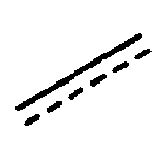
bond;
if R8 is attached to the double bond, it is H, C1-C5 alkyl, or C2-C5 alkenyl; and
if R8 is part of the double bond, it is -CR'R", wherein R' and R'' are independently H, C1-C4 alkyl, or C2-C4 alkenyl, with the proviso that R' and R'' together form at most a C4-alkyl or C4-alkenyl group. - The invention includes all isomers of the compounds of formula (I).
- R1 is advantageously selected from H, C1-C5 alkyl, or C2-C5 alkenyl, or C1-C5 alkoxy.
- Advantageously, R2 and R3 are independently selected from C1-C5 alkyl, or C2-C5 alkenyl, or C1-C5 alkoxy.
- C1-C5 alkyl comprises methyl, ethyl, propyl, butyl, and pentyl.
- C2-C5 alkenyl comprises ethenyl, prop-1-enyl, allyl, butenyl, and pentenyl.
- C1-C5 alkoxy comprises methoxy, ethoxy, propoxy, butoxy, and pentoxy.
- According to an advantageous embodiment, R1 is H and R2 and R3 are C1-C5 alkyl, preferably C1-C4 alkyl, and even more preferably C1-C3 alkyl. Particularly interesting results are obtained when R2 and R3 are both methyl or when R2 is isopropyl and R3 is methyl.
- According to another advantageous embodiment, R1 is H, R2 is C1-C5 alkyl, preferably C1-C4 alkyl, and even more preferably C1-C3 alkyl, and R3 is C1-C5 alkoxy, preferably C1-C3, and even more preferably methoxy. Particularly interesting results are obtained when R2 is methyl and R3 is methoxy.
- According to still another advantageous embodiment, R1 is H, R2 is C2-C5 alkenyl, preferably C2-C4 alkenyl, even more preferably C2-C3 alkenyl, and most preferably C3 alkenyl, and R3 is C1-C5 alkoxy, preferably C1-C3, and even more preferably methoxy. Particularly interesting results are obtained when R2 is methoxy and R3 is allyl or when R2 is methoxy and R3 is prop-1-en-1-yl.
- Further advantageous compounds are those wherein R1 is H, and R2 and R3 are independently C2-C5 alkenyl, preferably C2-C4 alkenyl, even more preferably C2-C3 alkenyl, and most preferably C3 alkenyl. Very interesting results are obtained when R3 is allyl.
- Another family of interesting compounds is obtained when R1 is H, and R2 and R3 are independently C1-C5 alkyl, preferably C1-C4 alkyl, more preferably C1-C3 alkyl, and most preferably methyl.
- In one variant of the invention, the compound of formula (I) has formula (Ia)

- According to another variant of the invention the compound of formula (I) has formula (Ib)

- Particularly interesting compounds of formula (Ib) are those wherein R' is H and R'' is ethyl.
- The compounds of the invention exhibit interesting olfactive properties. Very unexpectedly and surprisingly, they do not show the typical green note that the skilled person would have expected, but rather sweet and/or spicy notes with sometimes animalic aspects.
- A further object of the invention is thus the use of a compound of formula (I) as defined above, for the preparation of perfumed bases and concentrates, fragrances, perfumes; topic compositions; cosmetic compositions, such as face and body creams, cleansers, facial treatments, talc powders, hair oils, shampoos, hair lotions, bath oils and salts, shower and bath gels, soaps, body anti-perspirants and deodorizers, pre-shave, shaving and post-shave creams and lotions, creams, toothpastes, mouth baths, pomades; and cleaning products, such as softeners, detergents, air deodorizers and household cleaning supplies.
- The invention is also directed to the use of a compound of formula (I) as defined above, as flavouring agent for the preparation of foodstuffs, drinks, and tobacco. The foodstuffs and drinks are preferably selected from the group consisting of dairy products, ice creams, soups, sauces, dips, dishes, meat products, culinary assistances, salted biscuits, snacks, soft drinks, beers, wines and spirits.
- The invention is also directed to the use of a compound of formula (I) as defined above, as masking agent of odours and/or flavours, e.g. in pharmaceutical, cosmetic or food compositions.
- The invention also provides the use of a compound of formula (I) as defined above, in combination with other perfuming or flavouring ingredients, solvents or additives or fixatives.
- The compounds of the invention may be used in a concentration comprised in a range from 0.001% to 99% in weight, preferably from 0.1% to 50% in weight, more preferably from 0.1% to 30% in weight. It is known by the man skilled in the art that these values depend on the nature of the composition/article to be perfumed and/or flavoured, the desired intensity of the perfume and/or flavour, and of the nature of the other ingredients present in said composition or article. According to a preferred embodiment of the invention, compounds are used in an olfactory effective amount.
- The terms "fragrance" and "fragrant", as used herein, are used interchangeably whenever a compound or a mixture of compounds is referred to, which is intended to pleasantly stimulate the sense of smell.
- The terms "flavour" and "flavouring", as used herein, are used interchangeably whenever a compound or a mixture of compounds is referred to, which is intended to stimulate the sense of taste and smell. Also in the meaning of the invention, the term "flavouring" relates to the flavouring of any liquid or solid, human or animal, in particular of drinks, dairy products, ice creams, soups, sauces, dips, dishes, meat products, culinary assistances, salted biscuits or snacks. It also means the flavouring of beers, wines and tobaccos.
- The term "olfactory effective amount", as used herein, means a level or amount of fragrant/flavouring compound present in a material at which the incorporated compound exhibits a sensory effect.
- By the term "masking" is meant reducing or eliminating malodour or bad flavour perception generated by one or more molecules entering in the composition of a product.
- The term "isomer", in the present invention, means molecules having the same chemical formula, which means same number and types of atoms, but in which the atoms are arranged differently. The term "isomer" includes structural isomers, geometric isomers, optical isomers and stereoisomers. It particularly includes the Z/E isomers of the compounds of formulae (I), (Ia), and (Ib).
- The term "alkyl" or "alkyl group", in the present invention, means any linear or branched saturated hydrocarbon chain, having preferably 1, 2, 3, 4 or 5 carbon atoms and herein referred to as C1-5 alkyl group, such as for example methyl, ethyl, n-propyl, iso-propyl, n-butyl, sec-butyl, isobutyl, tert-butyl, and pentyl.
- The term "alkenyl" or "alkenyl group", in the present invention, means any linear or branched mono or poly unsaturated hydrocarbon chain, having preferably 2, 3, 4 or 5 carbon atoms and herein referred to as C2-5 alkenyl group, such as for example ethenyl, prop-1-enyl, allyl, but-1-enyl, but-2-enyl, or pentenyl.
- The term "alkoxy" or "alkoxy group", in the present invention, means a oxygen radical substituted with any linear or branched saturated hydrocarbon chain, having preferably 1, 2, 3, 4 or 5 carbon atoms and herein referred to as C1-5 alkoxy group, such as for example methoxy, ethoxy, n-propoxy, iso-propoxy, n-butoxy, sec-butoxy, iso-butoxy, tert-butoxy, and pentoxy.
- The present invention will be better understood with reference to the following examples. These examples are intended to representative of specific embodiments of the invention, and are not intended as limiting the scope of the invention.
- A solution of 3,5-dimethyl-phenol in refluxing acetone is treated overnight with chloroacetic acid allyl ester (1.1 eq.) and potassium carbonate (1 eq.).
The mixture is then poured into a 50:50 water/t-butyl methyl ether mixture and the aqueous phase is extracted twice with t-butyl methyl ether. The combined organic phases are washed with brine and dried over magnesium sulphate. The solvents are evaporated and the crude product is purified by distillation to give (3,5-dimethyl-phenoxy)-acetic acid allyl ester.
Odour description: musky, hot iron, not powerful.
1H-NMR (200 MHz, CDCl 3 ) : δ (ppm) 2.26 (s, 3H), 2.29 (s, 3H), 4.63 (s, 2H), 4.71 (td, J = 1.2 Hz, J = 5.8 Hz, 2H), 5.22-5.42 (m, 2H), 5.94 (tdd, J = 5.8 Hz, J = 10.3 Hz, J = 17.0 Hz, 1H), 6.55 (br s, 2H), 6.65 br s, 1H). 13C-NMR (50 MHz, CDCl 3 ): δ (ppm) 21.35, 65.20, 65.67, 112.34, 118.89, 123.48, 131.45, 139.26, 157.75, 168.75. IR (film, cm-1): 687m, 830m, 929m ; 987m, 1032w, 1096m, 1157s, 1171s, 1200s, 1277m, 1299m, 1324s, 1383w, 1442m, 1473m, 1596s, 1615m, 1739m, 1764s, 2922m, 3020w. MS [e/m (%)]: 220 (M+, 99), 135 (69), 105 (100), 103 (17), 91 (16), 79 (29), 77 (36), 41 (25), 39 (19). - It is prepared from thymol according to example 1.
Odour description: Costus.
1H-NMR (200 MHz, CDCl 3 ): δ (ppm) 1.25 (d, J = 6.9 Hz, 6H), 2.32 (s, 3H), 3.40 (sept., J = 6.9 Hz, 1H), 4.68 (s, 2H), 4.73 (td, J = 1.3 Hz, J = 5.8 Hz, 2H), 5.22-5.42 (m, 2H), 5.95 (tdd, J = 5.7 Hz, J = 10.4 Hz, J = 17.1 Hz, 1H), 6.57 (br s, 1H), 6.81 (br d, J = 7.7 Hz, 1H), 7.14 (br d, J = 7.7
Hz, 1H).
13C-NMR (50 MHz, CDCl3): δ (ppm) 21.72, 23.22, 27.03, 66.07, 112.77, 119.21, 122.75, 126.71, 131.99, 135.02, 136.71, 155.39, 169.31. IR (film, cm-1): 813m, 932m, 986m, 1071m, 1102m, 1120m, 1167s, 1194s, 1279m, 1416m, 1445m, 1507m, 1614w, 1740m, 1765s, 2871w, 2962m. MS [e/m (%)]: 248 (M+, 100), 233 (68), 207 (18), 187 (12), 179 (23), 149 (59), 147 (22), 121 (53), 105 (50), 91 (42), 77 (21), 41 (62), 39 (30). - It is prepared from eugenol according to example 1.
Odour description: Eugenol, carnation-type, woody.
Not as powerful as Eugenol, iso-Eugenol nor Methyl-Diantilis®.
1H-NMR (200 MHz, CDCl 3 ): δ (ppm) 3.32 (br d, J = 6.7 Hz, 2H); 3.85 (s, 3H); 4.64-4.70 (m, 2H); 4.68 (s, 2H); 5.0-5.05 (m, 1H); 5.05-5.13 (m, 1H); 5.19-5.37 (m, 2H); 5.80-6.03 (m, 2H); 6.64-6.80 (m, 3H).
13C-NMR (50 MHz, CDCl 3 ): δ (ppm) 39.69; 55.72; 65.55; 66.60; 112.47; 114.63; 115.65; 118.76; 120.28; 131.43; 134.43; 137.30; 145.46; 149.47; 168.72. IR (film, cm-1): 749w, 805m, 851w, 919m, 991m, 1036s, 1072m, 1148s, 1189s, 1262s, 1420m, 1464m, 1512s, 1593m, 1639w, 1738s, 1762s, 2836w, 2939m, 2977w, 3003w, 3079w. MS [e/m (%)]: 262 (M+, 100), 163 (25), 115 (14), 109 (9), 103 (17), 91 (17), 77 (10), 41 (22). - It is prepared from iso-eugenol according to example 1.
Odour description: Spicy (iso-Eugenol), leathery, carnation, saffron, fruity (plums, dried plums), woody (Vetyver), sweet. Not as powerful as Eugenol, iso-Eugenol nor Methyl-Diantilis®.
It consists in a (30:70) Z/E mixture of isomers. IR (film, cm-1): 784w, 816w, 859w, 933w, 966m, 985m, 1036m, 1071m, 1144s, 1191s, 1259s, 1272s, 1259s, 1272s, 1298m, 1416m, 1463m, 1512s, 1585w, 1602w, 1738m, 1762s, 2916w, 2938w, 3019w. - 1H-NMR (200 MHz, CDCl 3 ): δ (ppm) 1.89 (dd, J = 1.6 Hz, J = 7.3 Hz, 3H), 3.87 (s, 3H), 4.64-4.73 (m, 2H), 4.69 (s, 2H), 5.18-5.38 (m, 2H), 5.72 (ddd, J = 8.1 Hz, J = 12.5 Hz, J = 14.4 Hz, 1H), 6.07 (q, J = 6.4 Hz, 1H), 6.34-6.40 (m, 1H), 6.72 (br s, 1H), 6.77-6.82 (m, 1H), 6.82-6.86 (m, 1H). 13C-NMR (50 MHz, CDCl 3 ): δ (ppm) 14.55, 55.80, 65.64, 66.49, 112.84, 114.10, 118.36, 121.15, 125.87, 129.27, 131.44, 132.33, 145.77, 149.15, 168.65. MS [e/m (%)]: 262 (M+, 100), 163 (47), 162 (16), 115 (16), 107 (29), 103 (13), 91 (21), 77 (10), 41 (19), 39 (10).
- 1H-NMR (200 MHz, CDCl 3 ): δ (ppm) 1.85 (dd, J = 1.4 Hz, J = 6.4 Hz, 3H), 3.87 (s, 3H), 4.64-4.73 (m, 2H), 4.69 (s, 2H), 5.18-5.38 (m, 2H), 5.91 (tdd, J = 5.8 Hz, J = 10.4 Hz, J = 17.3 Hz, 1H), 6.14 (q, J = 6.3 Hz, 1H), 6.26-6.31 (m, 1H), 6.77 (br s, 1H), 6.77-6.82 (m, 1H), 6.88-6.91 (m, 1H). 13C-NMR (50 MHz, CDCl 3 ): δ (ppm) 18.29, 55.75, 65.64, 66.55, 109.26, 114.49, 118.36, 118.85, 124.46, 130.36, 131.44, 132.80, 146.22, 149.58, 168.65. MS [e/m (%)]: 262 (M+, 100), 163 (43), 162 (16), 115 (13), 107 (24), 103 (11), 91 (17), 77 (8), 41 (16), 39 (9).
- It is prepared from 2-allyl-phenol according to example 1. Odour description: Vanilla, plastic.
1H-NMR (200 MHz, CDCl3): δ (ppm) 3.48 (br d, J = 6.6 Hz, 2H); 4.68 (s, 2H); 4.71 (dt, J = 1.2 Hz, J = 5.9Hz, 2H); 5.02-5.07 (m, 1H); 5.07-5.15 (m, 1H); 5.23-5.40 (m, 2H); 6.04 (ddt, J = 5.8 Hz, J = 9.2 Hz, J = 15.1Hz, 1H); 5.94 (tdd, J = 5.7 Hz, J = 10.4 Hz, J = 17.1 Hz, 1H); 6.7-6.8 (m, 1H); 6.91-7.01 (m, 1H); 7.12-7.23 (m, 2H).
13C-NMR (50 MHz, CDCl 3 ): δ (ppm) 34.23; 65.59; 65.67; 111.39; 115.50; 118.88; 121.66; 127.21; 129.26; 130.14; 131.42; 136.76; 155.51; 168.66. IR (film, cm-1): 754s, 919m, 989m, 1072m, 1092m, 1129m, 1194s, 1276m, 1296m, 1441m, 1455m, 1493s, 1589m, 1601w, 1639w, 1739s, 1764s, 2980w, 3079w.
MS [e/m (%)]: 232 (M+, 95), 145 (100), 133 (22), 131 (27), 117 (20), 115 (75), 105 (17), 91 (62), 77 (20), 41 (53), 39 (37). - It is prepared from 2-methoxy-4-methyl-phenol according to example 1.
Odour description: Vanilla, spicy (iso-Eugenol).
1H-NMR (200 MHz, CDCl 3 ): δ (ppm) 2.29 (s, 3H), 3.85 (s, 3H), 4.65-4.71 (m, 2H), 4.66 (s, 2H), 5.20-5.38 (m, 2H), 5.91 (tdd, J = 5.8 Hz, J = 10.3 Hz, J = 17.1 Hz, 1H), 6.62-6.79 (m, 3H).
13C-NMR (50 MHz, CDCl3) δ (ppm) 20.99, 55.73, 65.59, 66.76, 113.10, 114.81, 118.80, 120.73, 131.49, 132.34, 144.99, 149.38, 168.84. IR (film, cm-1): 800w, 929w, 987w, 1037m, 1071w, 1148s, 1156s, 1191s, 1269s, 1465w, 1513s, 1593w, 1737m, 1762s, 2939w.
MS [e/m (%)]: 236 (M+, 100), 151 (11), 137 (46), 136 (39), 109 (20), 91 (40), 77 (16), 65 (15), 41 (21), 39 (17). - It is prepared from p-cresol and chloroacetic acid cis-3-hexenyl ester according to example 1.
Odour description: Animal, leathery.
1H-NMR (200 MHz, CDCl 3 ) δ (ppm) 0.97 (t, J = 7.5 Hz, 3H), 2.05 (br quint, J = 7.6 Hz, 2H), 2.29 (s, 3H), 2.41 (br q, J = 7.0 Hz, 2H), 4.20 (t, J = 6.9 Hz, 2H), 4.59 (s, 2H), 5.21-5.37 (m, 1H), 5.44-5.60 (m, 1H), 6.76-6.85 (m, 2H), 7.04-7.13 (m, 2H).
13C-NMR (50 MHz, CDCl 3 ): δ (ppm) 14.15, 20.42, 20.55, 26.61, 64.62, 65.52, 114.50 (2C), 123.89, 129.92 (2C), 130.96, 134.84, 155.71, 169.09.
IR (film, cm-1): 724m, 818m, 996m, 1086s, 1191s, 1290s, 1391w, 1443m, 1458m, 1512s, 1589w, 1391m, 1737s, 1762s, 2874m, 2932m, 2964s, 3012m.
MS [e/m (%)]: 248 (M+, 38), 166 (100), 121 (35), 108 (14), 107 (12), 91 (54), 82 (22), 77 (14), 67 (36), 65 (21), 55 (35), 41 (28). - It is prepared from 2-methoxy-4-methyl-phenol and chloroacetic acid cis-3-hexenyl ester according to example 1. Odour description: Vanilla, smokey.
1H-NMR (200 MHz, CDCl 3 ) δ (ppm) 0.95 (t, J = 7.5 Hz, 3H), 2.03 (br quintuplet, J = 7.6 Hz, 2H), 2.29 (s, 3H), 2.39 (br q, J = 7.1 Hz, 2H), 3.85 (s, 3H) ppm 4.18 (t, J = 7.0 Hz, 2H), 4.64 (s, 2H) ppm 5.27 (m, 1H), 5.49 (m, 1H), 6.61-6.77 (m, 3H).
13C-NMR (50 MHz, CDCl 3 ): δ (ppm) 14.13, 20.52, 21.0, 26.6, 55.75, 64.50, 66.74, 113.09, 114.71, 120.73, 123.22, 132.26, 134.74, 145.07, 149.38, 169.17.
IR (film, cm-1): 798w, 817w, 997w, 1038s, 1075m, 1148s, 1156s, 1191s, 1268s, 1414w, 1465m, 1513s, 1593w, 1735m, 1762s, 2874w, 2935m, 2963m, 3010w.
MS [e/m (%)]: 278 (M+, 100), 196 (55), 151 (11), 137 (44), 136 (27), 109 (15), 91 (26), 77 (12), 67 (17), 65 (11), 55 (28), 41 (22). - A lilac type accord was prepared from the following ingredients:
Ingredients Accord A Accord B Accord C Accord D BENZYL SALICYLATE 60 60 60 60 PHENYL ETHYL ALCOOL 240 240 240 240 VANILLINE 30 30 30 30 HELIOTROPINE 70 70 70 70 IONONE ALPHA 20 20 20 20 TERPINEOL BI RECT 40 40 40 40 BENZYL ACETATE 40 40 40 40 DPG 500 460 460 (4-Allyl-2-methoxy-phenoxy)-acetic acid allyl ester (Example 3) 500 (2-Methoxy-4-propenyl-phenoxy)-acetic acid allyl ester (Example 4) 500 Iso-Eugenol 20 - Despite the fact that (4-allyl-2-methoxy-phenoxy)-acetic acid allyl ester and (2-methoxy-4-propenyl-phenoxy)-acetic acid allyl ester are less powerful than Eugenol or iso-Eugenol, adding them to the accord A instead of iso-Eugenol leads to a more floral, carnation-lilac note. Moreover, (4-allyl-2-methoxy-phenoxy)-acetic acid allyl ester (Accord B) brings also a special vegetal fresh facets and is thus preferred for such an accord.
Iso-Eugenol gives a more phenolic vanilla-type note. - A "Malaga Rhum-Raisin" accord was prepared from the following ingredients:
Ingredients Accord A Accord B NOIX DE MUSCADE ESSENCE 15 15 CINNAMIQUE ALDEHYDE 4 4 EUGENOL RECTIFIE VMF 15 15 ETHYL VANILLINE 120 120 ETHYL MALTOL 30 30 AMYL ACETATE VMF 90 90 ETHYL PROPIONATE 210 210 ETHYL PHTALATE 516 16 (2-Methoxy-4-propenyl-phenoxy)-acetic acid allyl ester (Example 4) - 500 - Adding (2-methoxy-4-propenyl-phenoxy)-acetic acid allyl ester to accord A imparts a really more fruity (grapes), spicy, gourmand facets to the note.
- These 2 compositions, containing (A) or not (B) the (2-methoxy-4-propenyl-phenoxy)-acetic acid allyl ester from example 4, were used to perfume a candle at usual dilution, known to the person of the art. Again, the impact of the addition of the (2-methoxy-4-propenyl-phenoxy)-acetic acid allyl ester in formula A is important. Adding (2-methoxy-4-propenyl-phenoxy)-acetic acid allyl ester increases considerably the diffusivity of the perfume and brings a culinary, spicy, "Christmas spirit" facets.
- A Basil accord was prepared from the following ingredients:
Ingredients Accord A Accord B LINALOL DE HO 500 500 EUCALYPTOL 20 20 HEXENOL CIS 3 20 20 OCIMENE 15 15 TERPINEOL DROIT CRIST 30 30 LIMONENE 100 100 BORNYL ACETATE 20 20 CITRAL PUR DU LITSEA 6 6 GERANYL ACETATE 5 5 ESTRAGOL 100% 14 14 (2-Methoxy-4-propenyl-phenoxy)-acetic acid allyl ester (Example 4) 270 - DPG - 270 - Adding (2-methoxy-4-propenyl-phenoxy)-acetic acid allyl ester to the accord (Accord A) gives a more vegetal note, very natural, with earthy aspects. Thus accord A is more characteristic to a basil accord.
- These 2 compositions, containing (A) or not (B) the (2-methoxy-4-propenyl-phenoxy)-acetic acid allyl ester from example 4, were used in a Chypre composition, according to the following ingredients:
Ingredients Composition A Composition B LAVANDE ESS URSS 80 80 LITSEA CUBEBA ESS 20 20 BERGAMOTE ESS 150 150 CITRON ESS 200 200 GERANIUM CHINE ESS 5 5 PATCHOULI ESS 30 30 VETYVER ESS HAITI 10 10 MOUSSE DE CHENE VMF ABS 50% EMKANOL 20 20 BENZYL ACETATE 10 10 LINALYL ACETATE GLIDDEN 154 154 CARVONE L VMF USA 10 10 COUMARINE 10 10 LINALOL HLR 170 170 INDOL 1 1 ALPHA METHYLIONONE 30 30 BASIL ACCORD A 40 BASIL ACCORD B 40 - Adding accord A, containing (2-methoxy-4-propenyl-phenoxy)-acetic acid allyl ester, to the Chypre composition imparts very interesting, fresher, aromatic facets, with shiny, fusing, sparkling aspects.
Claims (15)
- A compound of formula (I)
R1 is H, alkyl, alkenyl, or alkoxy;
R2 and R3 are independently alkyl, alkenyl, or alkoxy;
R4, R5, R6, and R7 are independently H, C1-C5 alkyl, or C2-C5 alkenyl;
is a single or double bond, provided that one of
theis a single bond and the other one is a double bond;
if R8 is attached to the double bond, it is H, C1-C5 alkyl, or C2-C5 alkenyl; and
if R8 is part of the double bond, it is -CR'R", wherein R' and R'' are independently H, C1-C4 alkyl, or C2-C4 alkenyl, with the proviso that R' and R'' together form at most a C4-alkyl or C4-alkenyl group - The compound of claim 1, wherein R1 is H.
- The compound of claim 1 or 2, wherein R4, R5, R6, and R7 are H.
- The compound of claim 1 having formula (Ia)

- The compound of claim 4, wherein R7 and R8 are H.
- The compound of claim 4, wherein R4, R5, R6 and R7 are H.
- The compound of claim 4, wherein said compound is selected from the group consisting of (3,5-dimethyl-phenoxy)-acetic acid allyl ester, (2-isopropyl-5-methyl-phenoxy)-acetic acid allyl ester, (4-allyl-2-methoxy-phenoxy)-acetic acid allyl ester, (2-methoxy-4-propenyl-phenoxy)-acetic acid allyl ester, (2-allyl-phenoxy)-acetic acid allyl ester, and (2-methoxy-4-methyl-phenoxy)-acetic acid allyl ester.
- The compound of claim 1 having formula (Ib)

- The compound of claim 8, wherein R' is ethyl.
- The compound of claim 8 or 9, wherein R4, R5, R6, and R7 are H.
- The compound of claim 8, wherein said compound is selected from the group consisting of p-tolyloxy-acetic acid hex-3-enyl ester and (2-methoxy-4-methyl-phenoxy)-acetic acid hex-3-enyl ester.
- Use of a compound according to any of claims 1 to 11, as a fragrant agent or as a flavouring agent.
- Use of a compound according to any of claims 1 to 11, as a masking agent of odours and/or flavours.
- Use according to claim 12 or 13 characterized in that the compound is comprised in a composition selected from pharmaceutical, cosmetic or food compositions.
- Use according to any of claims 12 to 14
characterized in that the compound is used in combination with other perfuming or flavouring ingredients, solvents, additives or fixatives.
Priority Applications (1)
| Application Number | Priority Date | Filing Date | Title |
|---|---|---|---|
| EP08305321A EP2138479A1 (en) | 2008-06-25 | 2008-06-25 | Phenyl glycolate derivatives |
Applications Claiming Priority (1)
| Application Number | Priority Date | Filing Date | Title |
|---|---|---|---|
| EP08305321A EP2138479A1 (en) | 2008-06-25 | 2008-06-25 | Phenyl glycolate derivatives |
Publications (1)
| Publication Number | Publication Date |
|---|---|
| EP2138479A1 true EP2138479A1 (en) | 2009-12-30 |
Family
ID=39930735
Family Applications (1)
| Application Number | Title | Priority Date | Filing Date |
|---|---|---|---|
| EP08305321A Withdrawn EP2138479A1 (en) | 2008-06-25 | 2008-06-25 | Phenyl glycolate derivatives |
Country Status (1)
| Country | Link |
|---|---|
| EP (1) | EP2138479A1 (en) |
-
2008
- 2008-06-25 EP EP08305321A patent/EP2138479A1/en not_active Withdrawn
Non-Patent Citations (4)
| Title |
|---|
| DATABASE CA [online] CHEMICAL ABSTRACTS SERVICE, COLUMBUS, OHIO, US; ANDREEV, V. M. ET AL: "The synthesis of esters of 2-methyl-2-buten-4-ol (prenol) and 2-methyl-1-buten-4-ol (isobutenyl carbinol)", XP002503768, retrieved from STN Database accession no. 1993:649239 * |
| PHILIP KRAFT DR., ET AL: "Odds and Trends: Recent Developments in the Chemistry of Odorants", ANGEWANDTE CHEMIE INTERNATIONAL EDITION, vol. 39, no. 17, 1 September 2000 (2000-09-01), WEINHEIM, FED. REP. OF GERMANY, pages 2980 - 3010, XP055033318, DOI: 10.1002/1521-3773(20000901)39:17<2980::AID-ANIE2980>3.0.CO;2-# * |
| PISHCHEVAYA PROMYSHLENNOST (MOSCOW, RUSSIAN FEDERATION) , (9), 22 CODEN: PSPREF; ISSN: 0235-2486, 1992 * |
| S. ARCTANDER: "PERFUME AND FLAVOR CHEMICALS (AROMA CHEMICALS) I", 1969, S. ARCTANDER, MONTCLAIR, N. J. (U. S. A.), XP002503767 * |
Similar Documents
| Publication | Publication Date | Title |
|---|---|---|
| JP6671384B2 (en) | Flavoring composition having synergistic action | |
| US10040776B2 (en) | Pyran derivatives and their preparation | |
| EP1529770B1 (en) | Aldehyde as perfuming or flavoring ingredient | |
| US20180320105A1 (en) | 1-isopropoxy-1-oxopropan-2-yl pivalate as perfuming ingredient | |
| CN110621291A (en) | Organic compounds | |
| BRPI0719754A2 (en) | PYRANE DERIVATIVES, PROCESS FOR PREPARATION AND USE OF THEM IN FRAGRANCE AND FRAGRANCE | |
| EP2094650B1 (en) | Use of campholenic derivatives as fragrant ingredients in perfumery and flavouring | |
| BRPI0719945A2 (en) | Use of campholenic derivatives as perfumed ingredients in perfumery and fragrances | |
| EP2125767B1 (en) | Pyran derivatives, process of preparation and use thereof in perfumery and flavouring | |
| JP5355698B2 (en) | Chemically stable ingredient for lemon flavoring | |
| US20090263336A1 (en) | Novel pyran derivatives and their preparation | |
| CN103781890B (en) | Perfuming acetal | |
| BR112013029521B1 (en) | SENSORIAL USE OF 6- CYCLEPENTILIDENOHEXANE DERIVATIVES | |
| US7875737B2 (en) | Pyran derivatives, process of preparation and use thereof in perfumery and flavouring | |
| EP2168941A1 (en) | Novel Glycolate derivatives | |
| JPS6059892B2 (en) | Tiglic acid derivative, its production method and fragrance composition | |
| US20080138482A1 (en) | Use of new campholenic derivatives as fragrant ingredients in perfumery and flavouring | |
| CN106456473B (en) | Floral and green scent agent | |
| WO2011110614A1 (en) | Organic compounds | |
| EP2209389A1 (en) | Bicyclic campholenic derivatives | |
| EA023289B1 (en) | 5,5-DIMETHYL-2-PROPYL-HEXAHYDRO-2,4a-METHANONAPHTHALENE-1-ONE AS A FRAGRANCE AGENT |
Legal Events
| Date | Code | Title | Description |
|---|---|---|---|
| PUAI | Public reference made under article 153(3) epc to a published international application that has entered the european phase |
Free format text: ORIGINAL CODE: 0009012 |
|
| AK | Designated contracting states |
Kind code of ref document: A1 Designated state(s): AT BE BG CH CY CZ DE DK EE ES FI FR GB GR HR HU IE IS IT LI LT LU LV MC MT NL NO PL PT RO SE SI SK TR |
|
| AX | Request for extension of the european patent |
Extension state: AL BA MK RS |
|
| 17P | Request for examination filed |
Effective date: 20100507 |
|
| 17Q | First examination report despatched |
Effective date: 20100730 |
|
| AKX | Designation fees paid |
Designated state(s): AT BE BG CH CY CZ DE DK EE ES FI FR GB GR HR HU IE IS IT LI LT LU LV MC MT NL NO PL PT RO SE SI SK TR |
|
| GRAC | Information related to communication of intention to grant a patent modified |
Free format text: ORIGINAL CODE: EPIDOSCIGR1 |
|
| GRAP | Despatch of communication of intention to grant a patent |
Free format text: ORIGINAL CODE: EPIDOSNIGR1 |
|
| STAA | Information on the status of an ep patent application or granted ep patent |
Free format text: STATUS: THE APPLICATION IS DEEMED TO BE WITHDRAWN |
|
| 18D | Application deemed to be withdrawn |
Effective date: 20121228 |