EP2138324A2 - Artificial stone and preparing method thereof - Google Patents
Artificial stone and preparing method thereof Download PDFInfo
- Publication number
- EP2138324A2 EP2138324A2 EP09163461A EP09163461A EP2138324A2 EP 2138324 A2 EP2138324 A2 EP 2138324A2 EP 09163461 A EP09163461 A EP 09163461A EP 09163461 A EP09163461 A EP 09163461A EP 2138324 A2 EP2138324 A2 EP 2138324A2
- Authority
- EP
- European Patent Office
- Prior art keywords
- chips
- artificial stone
- sieve
- mould
- base part
- Prior art date
- Legal status (The legal status is an assumption and is not a legal conclusion. Google has not performed a legal analysis and makes no representation as to the accuracy of the status listed.)
- Withdrawn
Links
- 239000002969 artificial stone Substances 0.000 title claims abstract description 54
- 238000000034 method Methods 0.000 title claims abstract description 23
- 229920005989 resin Polymers 0.000 claims description 19
- 239000011347 resin Substances 0.000 claims description 19
- 239000004568 cement Substances 0.000 claims description 11
- 239000006260 foam Substances 0.000 claims description 10
- 239000004743 Polypropylene Substances 0.000 claims description 8
- 239000003822 epoxy resin Substances 0.000 claims description 8
- 229920000647 polyepoxide Polymers 0.000 claims description 8
- 239000002994 raw material Substances 0.000 claims description 6
- 239000004575 stone Substances 0.000 claims description 6
- 239000004698 Polyethylene Substances 0.000 claims description 5
- -1 polyethylene Polymers 0.000 claims description 5
- 239000000654 additive Substances 0.000 claims description 4
- 239000011521 glass Substances 0.000 claims description 4
- 239000004925 Acrylic resin Substances 0.000 claims description 3
- 229920000178 Acrylic resin Polymers 0.000 claims description 3
- 239000004848 polyfunctional curative Substances 0.000 claims description 3
- 229920006337 unsaturated polyester resin Polymers 0.000 claims description 3
- 230000000996 additive effect Effects 0.000 claims description 2
- LNEPOXFFQSENCJ-UHFFFAOYSA-N haloperidol Chemical compound C1CC(O)(C=2C=CC(Cl)=CC=2)CCN1CCCC(=O)C1=CC=C(F)C=C1 LNEPOXFFQSENCJ-UHFFFAOYSA-N 0.000 claims description 2
- 229920001155 polypropylene Polymers 0.000 claims description 2
- 239000013530 defoamer Substances 0.000 claims 1
- 229920000573 polyethylene Polymers 0.000 claims 1
- 229920005749 polyurethane resin Polymers 0.000 claims 1
- 239000002585 base Substances 0.000 description 15
- 239000011435 rock Substances 0.000 description 12
- 239000000463 material Substances 0.000 description 7
- 238000005498 polishing Methods 0.000 description 7
- 239000000843 powder Substances 0.000 description 7
- 239000003365 glass fiber Substances 0.000 description 6
- 238000002156 mixing Methods 0.000 description 4
- 239000000203 mixture Substances 0.000 description 4
- NIXOWILDQLNWCW-UHFFFAOYSA-M Acrylate Chemical compound [O-]C(=O)C=C NIXOWILDQLNWCW-UHFFFAOYSA-M 0.000 description 3
- LYCAIKOWRPUZTN-UHFFFAOYSA-N Ethylene glycol Chemical compound OCCO LYCAIKOWRPUZTN-UHFFFAOYSA-N 0.000 description 3
- OFOBLEOULBTSOW-UHFFFAOYSA-N Malonic acid Chemical compound OC(=O)CC(O)=O OFOBLEOULBTSOW-UHFFFAOYSA-N 0.000 description 3
- DNIAPMSPPWPWGF-UHFFFAOYSA-N Propylene glycol Chemical compound CC(O)CO DNIAPMSPPWPWGF-UHFFFAOYSA-N 0.000 description 3
- MTHSVFCYNBDYFN-UHFFFAOYSA-N diethylene glycol Chemical compound OCCOCCO MTHSVFCYNBDYFN-UHFFFAOYSA-N 0.000 description 3
- 230000005484 gravity Effects 0.000 description 3
- 229910052500 inorganic mineral Inorganic materials 0.000 description 3
- 229910052751 metal Inorganic materials 0.000 description 3
- 239000002184 metal Substances 0.000 description 3
- 150000002739 metals Chemical class 0.000 description 3
- 239000011707 mineral Substances 0.000 description 3
- 239000010453 quartz Substances 0.000 description 3
- VYPSYNLAJGMNEJ-UHFFFAOYSA-N silicon dioxide Inorganic materials O=[Si]=O VYPSYNLAJGMNEJ-UHFFFAOYSA-N 0.000 description 3
- 229920005992 thermoplastic resin Polymers 0.000 description 3
- XLYOFNOQVPJJNP-UHFFFAOYSA-N water Substances O XLYOFNOQVPJJNP-UHFFFAOYSA-N 0.000 description 3
- AZQWKYJCGOJGHM-UHFFFAOYSA-N 1,4-benzoquinone Chemical compound O=C1C=CC(=O)C=C1 AZQWKYJCGOJGHM-UHFFFAOYSA-N 0.000 description 2
- OZAIFHULBGXAKX-UHFFFAOYSA-N 2-(2-cyanopropan-2-yldiazenyl)-2-methylpropanenitrile Chemical compound N#CC(C)(C)N=NC(C)(C)C#N OZAIFHULBGXAKX-UHFFFAOYSA-N 0.000 description 2
- VZCYOOQTPOCHFL-OWOJBTEDSA-N Fumaric acid Chemical compound OC(=O)\C=C\C(O)=O VZCYOOQTPOCHFL-OWOJBTEDSA-N 0.000 description 2
- PEDCQBHIVMGVHV-UHFFFAOYSA-N Glycerine Chemical compound OCC(O)CO PEDCQBHIVMGVHV-UHFFFAOYSA-N 0.000 description 2
- QIGBRXMKCJKVMJ-UHFFFAOYSA-N Hydroquinone Chemical compound OC1=CC=C(O)C=C1 QIGBRXMKCJKVMJ-UHFFFAOYSA-N 0.000 description 2
- ISWSIDIOOBJBQZ-UHFFFAOYSA-N Phenol Chemical compound OC1=CC=CC=C1 ISWSIDIOOBJBQZ-UHFFFAOYSA-N 0.000 description 2
- OAICVXFJPJFONN-UHFFFAOYSA-N Phosphorus Chemical compound [P] OAICVXFJPJFONN-UHFFFAOYSA-N 0.000 description 2
- 238000007792 addition Methods 0.000 description 2
- 239000011230 binding agent Substances 0.000 description 2
- ZQMIGQNCOMNODD-UHFFFAOYSA-N diacetyl peroxide Chemical compound CC(=O)OOC(C)=O ZQMIGQNCOMNODD-UHFFFAOYSA-N 0.000 description 2
- 230000000694 effects Effects 0.000 description 2
- 238000012986 modification Methods 0.000 description 2
- 230000004048 modification Effects 0.000 description 2
- 238000000465 moulding Methods 0.000 description 2
- 229910052698 phosphorus Inorganic materials 0.000 description 2
- 239000011574 phosphorus Substances 0.000 description 2
- 229920000642 polymer Polymers 0.000 description 2
- 239000004800 polyvinyl chloride Substances 0.000 description 2
- 150000005846 sugar alcohols Polymers 0.000 description 2
- VZCYOOQTPOCHFL-UHFFFAOYSA-N trans-butenedioic acid Natural products OC(=O)C=CC(O)=O VZCYOOQTPOCHFL-UHFFFAOYSA-N 0.000 description 2
- BLKRGXCGFRXRNQ-SNAWJCMRSA-N (z)-3-carbonoperoxoyl-4,4-dimethylpent-2-enoic acid Chemical compound OC(=O)/C=C(C(C)(C)C)\C(=O)OO BLKRGXCGFRXRNQ-SNAWJCMRSA-N 0.000 description 1
- KGSFMPRFQVLGTJ-UHFFFAOYSA-N 1,1,2-triphenylethylbenzene Chemical compound C=1C=CC=CC=1C(C=1C=CC=CC=1)(C=1C=CC=CC=1)CC1=CC=CC=C1 KGSFMPRFQVLGTJ-UHFFFAOYSA-N 0.000 description 1
- JCTXKRPTIMZBJT-UHFFFAOYSA-N 2,2,4-trimethylpentane-1,3-diol Chemical compound CC(C)C(O)C(C)(C)CO JCTXKRPTIMZBJT-UHFFFAOYSA-N 0.000 description 1
- LCZVSXRMYJUNFX-UHFFFAOYSA-N 2-[2-(2-hydroxypropoxy)propoxy]propan-1-ol Chemical compound CC(O)COC(C)COC(C)CO LCZVSXRMYJUNFX-UHFFFAOYSA-N 0.000 description 1
- IFXDUNDBQDXPQZ-UHFFFAOYSA-N 2-methylbutan-2-yl 2-ethylhexaneperoxoate Chemical compound CCCCC(CC)C(=O)OOC(C)(C)CC IFXDUNDBQDXPQZ-UHFFFAOYSA-N 0.000 description 1
- VPWNQTHUCYMVMZ-UHFFFAOYSA-N 4,4'-sulfonyldiphenol Chemical compound C1=CC(O)=CC=C1S(=O)(=O)C1=CC=C(O)C=C1 VPWNQTHUCYMVMZ-UHFFFAOYSA-N 0.000 description 1
- VTYYLEPIZMXCLO-UHFFFAOYSA-L Calcium carbonate Chemical compound [Ca+2].[O-]C([O-])=O VTYYLEPIZMXCLO-UHFFFAOYSA-L 0.000 description 1
- MHAJPDPJQMAIIY-UHFFFAOYSA-N Hydrogen peroxide Chemical compound OO MHAJPDPJQMAIIY-UHFFFAOYSA-N 0.000 description 1
- YIVJZNGAASQVEM-UHFFFAOYSA-N Lauroyl peroxide Chemical compound CCCCCCCCCCCC(=O)OOC(=O)CCCCCCCCCCC YIVJZNGAASQVEM-UHFFFAOYSA-N 0.000 description 1
- 239000004640 Melamine resin Substances 0.000 description 1
- 229920000877 Melamine resin Polymers 0.000 description 1
- 239000004952 Polyamide Substances 0.000 description 1
- 229920005830 Polyurethane Foam Polymers 0.000 description 1
- XUIMIQQOPSSXEZ-UHFFFAOYSA-N Silicon Chemical compound [Si] XUIMIQQOPSSXEZ-UHFFFAOYSA-N 0.000 description 1
- NINIDFKCEFEMDL-UHFFFAOYSA-N Sulfur Chemical compound [S] NINIDFKCEFEMDL-UHFFFAOYSA-N 0.000 description 1
- ZJCCRDAZUWHFQH-UHFFFAOYSA-N Trimethylolpropane Chemical compound CCC(CO)(CO)CO ZJCCRDAZUWHFQH-UHFFFAOYSA-N 0.000 description 1
- 238000005299 abrasion Methods 0.000 description 1
- 239000006096 absorbing agent Substances 0.000 description 1
- 239000000853 adhesive Substances 0.000 description 1
- 230000001070 adhesive effect Effects 0.000 description 1
- 229910052783 alkali metal Inorganic materials 0.000 description 1
- 229910052782 aluminium Inorganic materials 0.000 description 1
- XAGFODPZIPBFFR-UHFFFAOYSA-N aluminium Chemical compound [Al] XAGFODPZIPBFFR-UHFFFAOYSA-N 0.000 description 1
- 150000001412 amines Chemical class 0.000 description 1
- 239000003963 antioxidant agent Substances 0.000 description 1
- 125000001797 benzyl group Chemical group [H]C1=C([H])C([H])=C(C([H])=C1[H])C([H])([H])* 0.000 description 1
- IISBACLAFKSPIT-UHFFFAOYSA-N bisphenol A Chemical class C=1C=C(O)C=CC=1C(C)(C)C1=CC=C(O)C=C1 IISBACLAFKSPIT-UHFFFAOYSA-N 0.000 description 1
- 239000004841 bisphenol A epoxy resin Substances 0.000 description 1
- WERYXYBDKMZEQL-UHFFFAOYSA-N butane-1,4-diol Chemical compound OCCCCO WERYXYBDKMZEQL-UHFFFAOYSA-N 0.000 description 1
- 125000004432 carbon atom Chemical group C* 0.000 description 1
- 239000003610 charcoal Substances 0.000 description 1
- 239000003638 chemical reducing agent Substances 0.000 description 1
- 239000003795 chemical substances by application Substances 0.000 description 1
- 239000003086 colorant Substances 0.000 description 1
- 238000004040 coloring Methods 0.000 description 1
- 238000009833 condensation Methods 0.000 description 1
- 230000005494 condensation Effects 0.000 description 1
- 238000011109 contamination Methods 0.000 description 1
- 238000005520 cutting process Methods 0.000 description 1
- 239000012933 diacyl peroxide Substances 0.000 description 1
- SZXQTJUDPRGNJN-UHFFFAOYSA-N dipropylene glycol Chemical compound OCCCOCCCO SZXQTJUDPRGNJN-UHFFFAOYSA-N 0.000 description 1
- 238000001035 drying Methods 0.000 description 1
- 239000000428 dust Substances 0.000 description 1
- 239000000975 dye Substances 0.000 description 1
- 125000001495 ethyl group Chemical group [H]C([H])([H])C([H])([H])* 0.000 description 1
- 239000003063 flame retardant Substances 0.000 description 1
- 239000001530 fumaric acid Substances 0.000 description 1
- 235000011187 glycerol Nutrition 0.000 description 1
- 125000003055 glycidyl group Chemical group C(C1CO1)* 0.000 description 1
- 239000010438 granite Substances 0.000 description 1
- 238000010438 heat treatment Methods 0.000 description 1
- 239000003112 inhibitor Substances 0.000 description 1
- 239000001023 inorganic pigment Substances 0.000 description 1
- 238000010030 laminating Methods 0.000 description 1
- VZCYOOQTPOCHFL-UPHRSURJSA-N maleic acid Chemical compound OC(=O)\C=C/C(O)=O VZCYOOQTPOCHFL-UPHRSURJSA-N 0.000 description 1
- 239000011976 maleic acid Substances 0.000 description 1
- FPYJFEHAWHCUMM-UHFFFAOYSA-N maleic anhydride Chemical compound O=C1OC(=O)C=C1 FPYJFEHAWHCUMM-UHFFFAOYSA-N 0.000 description 1
- 238000004519 manufacturing process Methods 0.000 description 1
- 239000007769 metal material Substances 0.000 description 1
- 125000002496 methyl group Chemical group [H]C([H])([H])* 0.000 description 1
- 239000000178 monomer Substances 0.000 description 1
- SLCVBVWXLSEKPL-UHFFFAOYSA-N neopentyl glycol Chemical compound OCC(C)(C)CO SLCVBVWXLSEKPL-UHFFFAOYSA-N 0.000 description 1
- 229910052755 nonmetal Inorganic materials 0.000 description 1
- 150000002843 nonmetals Chemical class 0.000 description 1
- 229920003986 novolac Polymers 0.000 description 1
- 239000012860 organic pigment Substances 0.000 description 1
- 238000004806 packaging method and process Methods 0.000 description 1
- 239000011049 pearl Substances 0.000 description 1
- 239000002304 perfume Substances 0.000 description 1
- 239000000049 pigment Substances 0.000 description 1
- 229920003229 poly(methyl methacrylate) Polymers 0.000 description 1
- 229920002647 polyamide Polymers 0.000 description 1
- 229920000728 polyester Polymers 0.000 description 1
- 239000005020 polyethylene terephthalate Substances 0.000 description 1
- 238000006116 polymerization reaction Methods 0.000 description 1
- 239000004926 polymethyl methacrylate Substances 0.000 description 1
- 239000011148 porous material Substances 0.000 description 1
- 238000003825 pressing Methods 0.000 description 1
- 238000010298 pulverizing process Methods 0.000 description 1
- 239000011342 resin composition Substances 0.000 description 1
- 229910052710 silicon Inorganic materials 0.000 description 1
- 239000010703 silicon Substances 0.000 description 1
- 239000002002 slurry Substances 0.000 description 1
- 238000005507 spraying Methods 0.000 description 1
- 239000000126 substance Substances 0.000 description 1
- 229910052717 sulfur Inorganic materials 0.000 description 1
- 239000011593 sulfur Substances 0.000 description 1
- NMOALOSNPWTWRH-UHFFFAOYSA-N tert-butyl 7,7-dimethyloctaneperoxoate Chemical compound CC(C)(C)CCCCCC(=O)OOC(C)(C)C NMOALOSNPWTWRH-UHFFFAOYSA-N 0.000 description 1
- CIHOLLKRGTVIJN-UHFFFAOYSA-N tert‐butyl hydroperoxide Chemical compound CC(C)(C)OO CIHOLLKRGTVIJN-UHFFFAOYSA-N 0.000 description 1
- ZIBGPFATKBEMQZ-UHFFFAOYSA-N triethylene glycol Chemical compound OCCOCCOCCO ZIBGPFATKBEMQZ-UHFFFAOYSA-N 0.000 description 1
- 238000005303 weighing Methods 0.000 description 1
Images


Classifications
-
- B—PERFORMING OPERATIONS; TRANSPORTING
- B44—DECORATIVE ARTS
- B44F—SPECIAL DESIGNS OR PICTURES
- B44F9/00—Designs imitating natural patterns
- B44F9/04—Designs imitating natural patterns of stone surfaces, e.g. marble
-
- C—CHEMISTRY; METALLURGY
- C04—CEMENTS; CONCRETE; ARTIFICIAL STONE; CERAMICS; REFRACTORIES
- C04B—LIME, MAGNESIA; SLAG; CEMENTS; COMPOSITIONS THEREOF, e.g. MORTARS, CONCRETE OR LIKE BUILDING MATERIALS; ARTIFICIAL STONE; CERAMICS; REFRACTORIES; TREATMENT OF NATURAL STONE
- C04B14/00—Use of inorganic materials as fillers, e.g. pigments, for mortars, concrete or artificial stone; Treatment of inorganic materials specially adapted to enhance their filling properties in mortars, concrete or artificial stone
- C04B14/02—Granular materials, e.g. microballoons
- C04B14/04—Silica-rich materials; Silicates
- C04B14/22—Glass ; Devitrified glass
-
- C—CHEMISTRY; METALLURGY
- C04—CEMENTS; CONCRETE; ARTIFICIAL STONE; CERAMICS; REFRACTORIES
- C04B—LIME, MAGNESIA; SLAG; CEMENTS; COMPOSITIONS THEREOF, e.g. MORTARS, CONCRETE OR LIKE BUILDING MATERIALS; ARTIFICIAL STONE; CERAMICS; REFRACTORIES; TREATMENT OF NATURAL STONE
- C04B26/00—Compositions of mortars, concrete or artificial stone, containing only organic binders, e.g. polymer or resin concrete
- C04B26/02—Macromolecular compounds
- C04B26/04—Macromolecular compounds obtained by reactions only involving carbon-to-carbon unsaturated bonds
- C04B26/06—Acrylates
-
- C—CHEMISTRY; METALLURGY
- C04—CEMENTS; CONCRETE; ARTIFICIAL STONE; CERAMICS; REFRACTORIES
- C04B—LIME, MAGNESIA; SLAG; CEMENTS; COMPOSITIONS THEREOF, e.g. MORTARS, CONCRETE OR LIKE BUILDING MATERIALS; ARTIFICIAL STONE; CERAMICS; REFRACTORIES; TREATMENT OF NATURAL STONE
- C04B26/00—Compositions of mortars, concrete or artificial stone, containing only organic binders, e.g. polymer or resin concrete
- C04B26/02—Macromolecular compounds
- C04B26/10—Macromolecular compounds obtained otherwise than by reactions only involving carbon-to-carbon unsaturated bonds
- C04B26/14—Polyepoxides
-
- C—CHEMISTRY; METALLURGY
- C04—CEMENTS; CONCRETE; ARTIFICIAL STONE; CERAMICS; REFRACTORIES
- C04B—LIME, MAGNESIA; SLAG; CEMENTS; COMPOSITIONS THEREOF, e.g. MORTARS, CONCRETE OR LIKE BUILDING MATERIALS; ARTIFICIAL STONE; CERAMICS; REFRACTORIES; TREATMENT OF NATURAL STONE
- C04B26/00—Compositions of mortars, concrete or artificial stone, containing only organic binders, e.g. polymer or resin concrete
- C04B26/02—Macromolecular compounds
- C04B26/10—Macromolecular compounds obtained otherwise than by reactions only involving carbon-to-carbon unsaturated bonds
- C04B26/16—Polyurethanes
-
- C—CHEMISTRY; METALLURGY
- C04—CEMENTS; CONCRETE; ARTIFICIAL STONE; CERAMICS; REFRACTORIES
- C04B—LIME, MAGNESIA; SLAG; CEMENTS; COMPOSITIONS THEREOF, e.g. MORTARS, CONCRETE OR LIKE BUILDING MATERIALS; ARTIFICIAL STONE; CERAMICS; REFRACTORIES; TREATMENT OF NATURAL STONE
- C04B28/00—Compositions of mortars, concrete or artificial stone, containing inorganic binders or the reaction product of an inorganic and an organic binder, e.g. polycarboxylate cements
-
- C—CHEMISTRY; METALLURGY
- C04—CEMENTS; CONCRETE; ARTIFICIAL STONE; CERAMICS; REFRACTORIES
- C04B—LIME, MAGNESIA; SLAG; CEMENTS; COMPOSITIONS THEREOF, e.g. MORTARS, CONCRETE OR LIKE BUILDING MATERIALS; ARTIFICIAL STONE; CERAMICS; REFRACTORIES; TREATMENT OF NATURAL STONE
- C04B28/00—Compositions of mortars, concrete or artificial stone, containing inorganic binders or the reaction product of an inorganic and an organic binder, e.g. polycarboxylate cements
- C04B28/02—Compositions of mortars, concrete or artificial stone, containing inorganic binders or the reaction product of an inorganic and an organic binder, e.g. polycarboxylate cements containing hydraulic cements other than calcium sulfates
-
- C—CHEMISTRY; METALLURGY
- C04—CEMENTS; CONCRETE; ARTIFICIAL STONE; CERAMICS; REFRACTORIES
- C04B—LIME, MAGNESIA; SLAG; CEMENTS; COMPOSITIONS THEREOF, e.g. MORTARS, CONCRETE OR LIKE BUILDING MATERIALS; ARTIFICIAL STONE; CERAMICS; REFRACTORIES; TREATMENT OF NATURAL STONE
- C04B2111/00—Mortars, concrete or artificial stone or mixtures to prepare them, characterised by specific function, property or use
- C04B2111/54—Substitutes for natural stone, artistic materials or the like
Definitions
- the present invention relates to artificial stone having a pattern on its surface formed by distributing chips having a specific size therein, and a preparing method thereof. Specifically, the present invention relates to artificial stone having a pattern formed on its surface by passing chips having a specific size through a sieve with meshes of specific sizes formed in a specific pattern, and a preparing method thereof.
- artificial stone which is used as an interior or exterior material for buildings, is prepared by mixing cement with chips (colored granite or marble chips), solidifying the mixture, and polishing its upper surface with a grinder.
- a process which comprises mixing a cement base with various natural rock chips to prepare an artificial stone slurry, and then treating the surface of the artificial stone after carrying out a pressing procedure.
- the chips have different sizes and are randomly arranged, and thus there is a problem in that it is hard to form beautiful patterns on the surface of an artificial stone.
- Korean laid-open patent publication No. 2004-0076842 discloses a process for forming patterns on the surface of an artificial stone, whereby photographic paper is attached to the surface of the artificial stone.
- Korean laid-open patent publication No. 1996-0700910 discloses a process which comprises dropping the upper layer of two layers to form patterns on the under layer.
- the present invention has been conceived to solve the above-mentioned problems in the prior art, and the object of the present invention is to provide a method for preparing artificial stone, which comprises: fixing a sieve to a mould and vibrating the mould to pass chips having a specific size through meshes of the sieve, having specific sizes corresponding to the sizes of the chips, whereby a pattern having a beautiful appearance may be formed on the surface of the artificial stone.
- an artificial stone which comprises: a base part; and a plurality of pattern parts formed on a surface of said base part, wherein each pattern part is formed by chips having different sizes.
- a method for preparing artificial stone comprises the steps of: inserting a sieve into a mould and fixing it thereto, wherein the sieve consists of meshes having specific sizes and forming specific patterns; pouring raw materials of the artificial stone, including chips having a specific size, into the mould; and vibrating the mould to sieve the chips and transfer the sieve patterns to a surface of the artificial stone.
- artificial stone according to the present invention has a creative appearance, and the preparing method thereof may provide a creative appearance and enhance the reliability of creating specific patterns.
- the present invention relates to artificial stone comprising a base part and a plurality of pattern parts formed on a surface of said base part, wherein each pattern part formed on the surface is formed by chips having different sizes.
- a method of forming patterns on a surface of an artificial stone with chips having a specific size comprises a step (2) of combining two or more chips having different sizes in a predetermined ratio into a cement base and a step (5) of pouring the base and the chips into a mould (1), wherein a sieve previously prepared and optionally designed is inserted, and vibrating (4) them so that the chips sink downwards.
- Chips having a size larger than that of the meshes formed in the sieve become entangled with the sieve, and chips having a size smaller than that of the meshes pass through the meshes of the sieve.
- Figure 3 consists of photographs showing artificial stones molded using such a sieve.
- the sieve mesh size is represented by a unit of mesh, and may be controlled depending on patterns to be formed on the surfaces of artificial stones.
- the sieve may be formed by, for example, metals or nonferrous metals such as aluminum, or PE, PP, PU foams, and the like, without being limited to these.
- a vibrator is used after charging the raw materials of the artificial stone into a mould.
- Such a vibrator serves to sink chips having a size smaller than that of the sieve mesh to the bottom of the mould and to remove bubbles contained in the raw materials of the artificial stone at the same time.
- artificial stones having various designs may be prepared by polishing the surface after curing and removing the mould.
- the chips used herein may be PMMA resin chips; glass chips; color glass chips; natural rock chips pulverized from natural rocks; or colored natural rock chips made by coloring pulverized natural rocks.
- resin chips prepared by mixing the same resin as a base resin with an additive such as a pigment, curing the mixture and pulverizing the cured product ,or chips made from natural rocks such as rock powder or quartz may be used herein.
- Such resin chips have excellent compatibility with a base resin. Also, natural rock chips having high strength such as rock powder or quartz have excellent abrasion resistance, but since they have high hardness, subsequent processes such as surface polishing may be required.
- Natural materials used in the natural rock chips may be one or more selected from the group consisting of nacre, stone, rock powder, quartz, charcoal powder, yellow earth, magnet powder, perfume, pearl and mirror powder, but any natural rock chips may be used without being particularly restricted, as long as they may pass through the sieve meshes and form patterns on a surface of an artificial stone.
- the amount of the added chips herein may be suitably selected depending on the desired appearance. Although it is not particularly restricted, chips are preferably added to the artificial stone according to the present invention in an amount of 200 to 400 parts by weight, and more preferably 240 to 350 parts by weight, relative to 100 parts by weight of a base resin.
- the base resin used herein may be one or more selected from the group consisting of an acrylic resin, an epoxy resin, a melamine resin and an unsaturated polyester resin, but the base resin is not particularly restricted, as long as it is a resin having chemical resistance and contamination resistance.
- Said acrylic resin may be formed from one or more monomers selected from the group consisting of a (meth)acrylic acid alkyl ester having 1 to 10 carbon atoms such as methyl(meth)acrylale or ethyl(meth)acrylate, benzyl(meth)acrylate and glycidyl(meth)acrylate, but it is not limited to these.
- a (meth)acrylic acid alkyl ester having 1 to 10 carbon atoms such as methyl(meth)acrylale or ethyl(meth)acrylate, benzyl(meth)acrylate and glycidyl(meth)acrylate, but it is not limited to these.
- Said epoxy resin is also not particularly restricted, as long as it is usually used in this field, but it is preferable to use difunctional or multifunctional epoxy resins.
- Said difunctional or multifunctional epoxy resin may be one or more selected from the group consisting of bisphenol A epoxy resin, bisphenol S epoxy resin, tetraphenyl ethane epoxy resin and phenol novolak epoxy resin.
- Said unsaturated polyester resin may be any one usually used in this field without being particularly restricted, and may be one obtained from condensation of a dicarboxylic acid and a polyhydric alcohol, and the like.
- the dicarboxylic acid may be maleic acid, maleic acid anhydride or fumaric acid, or a mixture of two or more thereof
- the polyhydric alcohol may be ethylene glycol, diethylene glycol, triethylene glycol, propylene glycol, dipropylene glycol, tripropylene glycol, 1,4-butylene glycol, hydrogenated bisphenol A, trimethylolpropane monoarylether, neopentyl glycol, 2,2,4-trimethyl-1,3-pentanediol or glycerin, or a mixture of two or more thereof, but it is not limited to these.
- the artificial stone according to the present invention may further comprise 0.1 to 10 parts by weight of a hardener, relative to 100 parts by weight of the base part.
- Said hardener may be any one usually used in the art without being particularly restricted, and may be, for example, one or more selected from the group consisting of diacyl peroxide, hydroperoxide, t-butylperoxy maleic acid, t-butylhydroperoxide, acetyl peroxide, lauroyl peroxide, azobisisobutyronitrile, azobisdimethylvaleronitrile, t-butylperoxyneodecanoate and t-amylperoxy 2-ethyl hexanoate.
- One or more additives may be added to the base resin composition, selected from the group consisting of defoamers; organic or inorganic pigments or dyes; ultraviolet absorbers; phosphorus or inorganic metallic flame retardants; stearic or silicon releasing agents; cathecol or hydroquinone polymerization inhibitors; and phenolic, amine, quinone, sulfur or phosphorus antioxidants, in addition to the above additives, in an amount which does not affect the effects of the present invention.
- the materials for the sieves used herein may depend on the materials of the desired artificial stones. For example, if cement-based artificial stones are prepared, it is preferable to use foams of metallic materials or resin foams having high specific gravity (2.4 ⁇ 2.6). Also, if resin-based artificial stones are prepared, it is preferable to use foams having a specific gravity similar to that of Paste Binder. The reason is because when the artificial stones are prepared, vibration is applied, and sieves formed by foams may rise above the mould, when the specific gravity is different from each other.
- the sieve may be made of meshes composed of metals or non-metals, or be formed in a foam shape foamed from a resin such as PE, PP, or PU.
- the foam shape foamed from a resin may consist of styrenic polymer, ethylenic polymer or alkali metal bicarbonate.
- the sieve used herein may be attached to a resin film such as PE, PP, PET or PVC, or a mineral material such as glass fiber mat, using a usual adhesive and fixed to the bottom of the mould, instead of inserting and fixing the sieve directly into the mould.
- a method of attaching the sieve to a resin film or a mineral material and then fixing it may be used.
- thermoplastic resin film such as polyester, polypropylene and polyamide, and preferably a film having smoothness and slipperiness at the same time, may be used.
- said glass fiber mat may be prepared by cutting glass fiber yarn treated with a thermoplastic resin to a size of 25 ⁇ 50 mm, laminating the cut glass fiber yarn in a predetermined thickness, passing it through a high temperature oven to enhance adhesion of the glass fibers to themselves, removing moisture by drying, and additionally heating it to harden the thermoplastic resin.
- PP foam was cut to a size of 10 mmT ⁇ 10 mmW ⁇ 400 mmL and inserted into the bottom side of a mould having a size of 400 mmL ⁇ 400 mmW ⁇ 40 mmT.
- the foam had a pore size of 3 mm.
- Cement paste was introduced as an artificial stone binder into the mould having the PP foam, wherein the used cement paste was composed of 100 parts by weight of cement, 190 parts by weight of natural stone chips (large chips) having a diameter of about 5 mm, 80 parts by weight of natural stone chips (small chips) having a diameter of about 2 mm, 70 parts by weight of natural stone powder, 30 parts by weight of water and 2 parts by weight of water reducing agent.
- the cement paste was poured into the mould, which was vibrated for 5 min using a vibrator, causing the natural chips to sink downwards in the mould, while bubbles were removed from the cement paste, followed by curing it at a constant temperature of 45 °C and constant humidity for 12 hours. After completing the curing, an artificial stone having a size of 400 mmL ⁇ 400 mmW ⁇ 20 mmT was prepared via the usual polishing and tailoring procedure for artificial stones.
Landscapes
- Chemical & Material Sciences (AREA)
- Engineering & Computer Science (AREA)
- Ceramic Engineering (AREA)
- Materials Engineering (AREA)
- Structural Engineering (AREA)
- Organic Chemistry (AREA)
- Chemical Kinetics & Catalysis (AREA)
- Inorganic Chemistry (AREA)
- Civil Engineering (AREA)
- Finishing Walls (AREA)
- Adornments (AREA)
- Casting Or Compression Moulding Of Plastics Or The Like (AREA)
Abstract
Description
- The present invention relates to artificial stone having a pattern on its surface formed by distributing chips having a specific size therein, and a preparing method thereof. Specifically, the present invention relates to artificial stone having a pattern formed on its surface by passing chips having a specific size through a sieve with meshes of specific sizes formed in a specific pattern, and a preparing method thereof.
- Generally, artificial stone, which is used as an interior or exterior material for buildings, is prepared by mixing cement with chips (colored granite or marble chips), solidifying the mixture, and polishing its upper surface with a grinder.
- Artificial stone prepared by such a method has an advantage in that its surface is smooth, it has a beautiful appearance, and is strong. However, when chips having high strength are polished with a grinder, a long polishing time is required and the process must be carried out by spraying abrasive water at the polishing position, lest the resulting dust is scattered. Therefore, it is inconvenient in that the polishing procedure increases approximately 5 to 6 times. Also, there are problems in that chip colors are limited and it is hard to display specific patterns.
- To solve said problems, a process was developed which comprises mixing a cement base with various natural rock chips to prepare an artificial stone slurry, and then treating the surface of the artificial stone after carrying out a pressing procedure. However, the chips have different sizes and are randomly arranged, and thus there is a problem in that it is hard to form beautiful patterns on the surface of an artificial stone.
- Korean laid-open patent publication No.
2004-0076842 - However, this prior art is different from the present invention because patterns are formed on the surface of an artificial stone without using chips.
- Korean laid-open patent publication No.
1996-0700910 - However, this prior art is also different from the present invention because pattern are formed without using chips.
- The present invention has been conceived to solve the above-mentioned problems in the prior art, and the object of the present invention is to provide a method for preparing artificial stone, which comprises: fixing a sieve to a mould and vibrating the mould to pass chips having a specific size through meshes of the sieve, having specific sizes corresponding to the sizes of the chips, whereby a pattern having a beautiful appearance may be formed on the surface of the artificial stone.
- In order to achieve said object, according to one aspect of the present invention an artificial stone is provided, which comprises: a base part; and a plurality of pattern parts formed on a surface of said base part, wherein each pattern part is formed by chips having different sizes.
- According to another aspect of the present invention, a method for preparing artificial stone is provided, which comprises the steps of: inserting a sieve into a mould and fixing it thereto, wherein the sieve consists of meshes having specific sizes and forming specific patterns; pouring raw materials of the artificial stone, including chips having a specific size, into the mould; and vibrating the mould to sieve the chips and transfer the sieve patterns to a surface of the artificial stone.
- As described above, artificial stone according to the present invention has a creative appearance, and the preparing method thereof may provide a creative appearance and enhance the reliability of creating specific patterns.
-
-
Figure 1 is a flowchart for preparing artificial stones according to the present invention, which consists of: weighing and introduction of raw materials, mixing, molding, surface treating, tailoring/inspecting/packaging steps, in chronological order. -
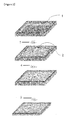
Figure 2 shows schedule drawings of a process for preparing patterns on the surface of artificial stone using a mould, to which a sieve is attached, according to one embodiment of the present invention. -
Figure 3 consists of photographs of products according to one embodiment of the present invention. - The present invention is explained in more detail below, with reference to the attached drawings. The attached drawings show exemplary aspects of the present invention, which are provided only for explaining the present invention in more detail, and do not restrict the technical scope of the present invention. The embodiments of the present invention have been described for illustrative purposes only, and it will be understood by one of ordinary skill in the art that various modifications, changes, and additions may be made thereto without departing from the spirit and scope of the present invention. All such modifications, changes, and additions should be regarded as being within the scope of the appended claims.
Figure 2 shows procedures for preparing an artificial stone according to one embodiment of the present invention, andFigure 3 consists of photographs showing products according to one embodiment of the present invention. - The present invention relates to artificial stone comprising a base part and a plurality of pattern parts formed on a surface of said base part, wherein each pattern part formed on the surface is formed by chips having different sizes.
- With reference to
Figure 2 , a method of forming patterns on a surface of an artificial stone with chips having a specific size comprises a step (2) of combining two or more chips having different sizes in a predetermined ratio into a cement base and a step (5) of pouring the base and the chips into a mould (1), wherein a sieve previously prepared and optionally designed is inserted, and vibrating (4) them so that the chips sink downwards. - Chips having a size larger than that of the meshes formed in the sieve become entangled with the sieve, and chips having a size smaller than that of the meshes pass through the meshes of the sieve.
-
Figure 3 consists of photographs showing artificial stones molded using such a sieve. - The sieve mesh size is represented by a unit of mesh, and may be controlled depending on patterns to be formed on the surfaces of artificial stones. The sieve may be formed by, for example, metals or nonferrous metals such as aluminum, or PE, PP, PU foams, and the like, without being limited to these.
- In molding artificial stones, when a member capable of carrying out the function of a sieve is inserted into a mould, various patterns may be formed on surfaces of artificial stones depending on the sieve mesh shape.
- On the one hand, when patterns are formed on edges of artificial stones, a method of attaching the sieve directly to the mould may be used. On the other hand, when patterns are formed in the center of artificial stones, it is hard to directly attach the sieve to the mould, and thus it may be attached to resin films such as PE, PP, PET and PVC, or mineral materials such as glass fiber, which are in turn attached to the bottom of the mould.
- To form patterns on raw materials, wherein chips are mixed with cement bases, a vibrator is used after charging the raw materials of the artificial stone into a mould. Such a vibrator serves to sink chips having a size smaller than that of the sieve mesh to the bottom of the mould and to remove bubbles contained in the raw materials of the artificial stone at the same time.
- Finally, artificial stones having various designs may be prepared by polishing the surface after curing and removing the mould.
- The chips used herein may be PMMA resin chips; glass chips; color glass chips; natural rock chips pulverized from natural rocks; or colored natural rock chips made by coloring pulverized natural rocks.
- Although the kinds of chips used in preparing artificial stones varies greatly, resin chips prepared by mixing the same resin as a base resin with an additive such as a pigment, curing the mixture and pulverizing the cured product ,or chips made from natural rocks such as rock powder or quartz may be used herein.
- Such resin chips have excellent compatibility with a base resin. Also, natural rock chips having high strength such as rock powder or quartz have excellent abrasion resistance, but since they have high hardness, subsequent processes such as surface polishing may be required.
- Natural materials used in the natural rock chips may be one or more selected from the group consisting of nacre, stone, rock powder, quartz, charcoal powder, yellow earth, magnet powder, perfume, pearl and mirror powder, but any natural rock chips may be used without being particularly restricted, as long as they may pass through the sieve meshes and form patterns on a surface of an artificial stone.
- The amount of the added chips herein may be suitably selected depending on the desired appearance. Although it is not particularly restricted, chips are preferably added to the artificial stone according to the present invention in an amount of 200 to 400 parts by weight, and more preferably 240 to 350 parts by weight, relative to 100 parts by weight of a base resin.
- The base resin used herein may be one or more selected from the group consisting of an acrylic resin, an epoxy resin, a melamine resin and an unsaturated polyester resin, but the base resin is not particularly restricted, as long as it is a resin having chemical resistance and contamination resistance.
- Said acrylic resin may be formed from one or more monomers selected from the group consisting of a (meth)acrylic acid alkyl ester having 1 to 10 carbon atoms such as methyl(meth)acrylale or ethyl(meth)acrylate, benzyl(meth)acrylate and glycidyl(meth)acrylate, but it is not limited to these.
- Said epoxy resin is also not particularly restricted, as long as it is usually used in this field, but it is preferable to use difunctional or multifunctional epoxy resins. Said difunctional or multifunctional epoxy resin may be one or more selected from the group consisting of bisphenol A epoxy resin, bisphenol S epoxy resin, tetraphenyl ethane epoxy resin and phenol novolak epoxy resin.
- Said unsaturated polyester resin may be any one usually used in this field without being particularly restricted, and may be one obtained from condensation of a dicarboxylic acid and a polyhydric alcohol, and the like. Here, the dicarboxylic acid may be maleic acid, maleic acid anhydride or fumaric acid, or a mixture of two or more thereof, and the polyhydric alcohol may be ethylene glycol, diethylene glycol, triethylene glycol, propylene glycol, dipropylene glycol, tripropylene glycol, 1,4-butylene glycol, hydrogenated bisphenol A, trimethylolpropane monoarylether, neopentyl glycol, 2,2,4-trimethyl-1,3-pentanediol or glycerin, or a mixture of two or more thereof, but it is not limited to these.
- The artificial stone according to the present invention may further comprise 0.1 to 10 parts by weight of a hardener, relative to 100 parts by weight of the base part. Said hardener may be any one usually used in the art without being particularly restricted, and may be, for example, one or more selected from the group consisting of diacyl peroxide, hydroperoxide, t-butylperoxy maleic acid, t-butylhydroperoxide, acetyl peroxide, lauroyl peroxide, azobisisobutyronitrile, azobisdimethylvaleronitrile, t-butylperoxyneodecanoate and t-amylperoxy 2-ethyl hexanoate.
- One or more additives may be added to the base resin composition, selected from the group consisting of defoamers; organic or inorganic pigments or dyes; ultraviolet absorbers; phosphorus or inorganic metallic flame retardants; stearic or silicon releasing agents; cathecol or hydroquinone polymerization inhibitors; and phenolic, amine, quinone, sulfur or phosphorus antioxidants, in addition to the above additives, in an amount which does not affect the effects of the present invention.
- The materials for the sieves used herein may depend on the materials of the desired artificial stones. For example, if cement-based artificial stones are prepared, it is preferable to use foams of metallic materials or resin foams having high specific gravity (2.4∼2.6). Also, if resin-based artificial stones are prepared, it is preferable to use foams having a specific gravity similar to that of Paste Binder. The reason is because when the artificial stones are prepared, vibration is applied, and sieves formed by foams may rise above the mould, when the specific gravity is different from each other.
- The sieve may be made of meshes composed of metals or non-metals, or be formed in a foam shape foamed from a resin such as PE, PP, or PU.
- In case of the foam shape foamed from a resin, it may consist of styrenic polymer, ethylenic polymer or alkali metal bicarbonate.
- The sieve used herein may be attached to a resin film such as PE, PP, PET or PVC, or a mineral material such as glass fiber mat, using a usual adhesive and fixed to the bottom of the mould, instead of inserting and fixing the sieve directly into the mould.
- As the method for forming patterns in the center of an artificial stone, a method of attaching the sieve to a resin film or a mineral material and then fixing it may be used.
- As said resin film, a thermoplastic resin film such as polyester, polypropylene and polyamide, and preferably a film having smoothness and slipperiness at the same time, may be used.
- For example, said glass fiber mat may be prepared by cutting glass fiber yarn treated with a thermoplastic resin to a size of 25 ∼ 50 mm, laminating the cut glass fiber yarn in a predetermined thickness, passing it through a high temperature oven to enhance adhesion of the glass fibers to themselves, removing moisture by drying, and additionally heating it to harden the thermoplastic resin.
- The present invention is explained by a preferred example in more detail below, but is not restricted to the example.
- PP foam was cut to a size of 10 mmT×10 mmW×400 mmL and inserted into the bottom side of a mould having a size of 400 mmL×400 mmW×40 mmT. The foam had a pore size of 3 mm. Cement paste was introduced as an artificial stone binder into the mould having the PP foam, wherein the used cement paste was composed of 100 parts by weight of cement, 190 parts by weight of natural stone chips (large chips) having a diameter of about 5 mm, 80 parts by weight of natural stone chips (small chips) having a diameter of about 2 mm, 70 parts by weight of natural stone powder, 30 parts by weight of water and 2 parts by weight of water reducing agent.
- The cement paste was poured into the mould, which was vibrated for 5 min using a vibrator, causing the natural chips to sink downwards in the mould, while bubbles were removed from the cement paste, followed by curing it at a constant temperature of 45 °C and constant humidity for 12 hours. After completing the curing, an artificial stone having a size of 400 mmL×400 mmW×20 mmT was prepared via the usual polishing and tailoring procedure for artificial stones.
Claims (7)
- An artificial stone comprising:a base part; anda plurality of pattern parts formed on a surface of said base part,wherein each pattern part is formed by chips having sizes different from each other.
- The artificial stone according to Claim 1, wherein the chips are one or more selected from the group consisting of resin chips, glass chips, colored glass chips, natural stone chips and colored natural stone chips.
- The artificial stone according to Claim 1, wherein the amount of chips is 240 to 350 parts by weight, relative to 100 parts by weight of the base part.
- The artificial stone according to Claim 1, wherein the base part is formed by one or more selected from the group consisting of cements, acrylic resins, epoxy resins and unsaturated polyester resins.
- The artificial stone according to Claim 4, wherein the base part further comprises one or more from the group consisting of a hardener, a defoamer and an additive.
- A method for preparing an artificial stone comprising the steps of:inserting a sieve into a mould and fixing it thereto, wherein the sieve consists of meshes having specific sizes forming one or more patterns;pouring raw materials of the artificial stone, including chips having specific sizes, into the mould; andvibrating the mould to sieve the chips and transfer the sieve patterns to a surface of the artificial stone.
- The method for preparing an artificial stone according to Claim 6, wherein the sieve is formed by a polyethylene, polypropylene or polyurethane resin foam.
Applications Claiming Priority (1)
| Application Number | Priority Date | Filing Date | Title |
|---|---|---|---|
| KR1020080060858A KR20100001085A (en) | 2008-06-26 | 2008-06-26 | The manufacture process of artificial stone by using sieve principle and artificial stone by the same method |
Publications (2)
| Publication Number | Publication Date |
|---|---|
| EP2138324A2 true EP2138324A2 (en) | 2009-12-30 |
| EP2138324A3 EP2138324A3 (en) | 2012-07-11 |
Family
ID=41228298
Family Applications (1)
| Application Number | Title | Priority Date | Filing Date |
|---|---|---|---|
| EP09163461A Withdrawn EP2138324A3 (en) | 2008-06-26 | 2009-06-23 | Artificial stone and preparing method thereof |
Country Status (3)
| Country | Link |
|---|---|
| EP (1) | EP2138324A3 (en) |
| KR (1) | KR20100001085A (en) |
| CN (1) | CN101612859A (en) |
Cited By (3)
| Publication number | Priority date | Publication date | Assignee | Title |
|---|---|---|---|---|
| EP2377896A4 (en) * | 2008-12-15 | 2013-10-09 | Cheil Ind Inc | Marble chips for an artificial marble, manufacturing method thereof, and artificial marble comprising same |
| EP2789765A1 (en) * | 2013-04-08 | 2014-10-15 | LG Hausys, Ltd. | Stone panel formed unitary with insulation material for covering a wall and method for manufacturing it |
| ES2908844A1 (en) * | 2020-10-30 | 2022-05-04 | Sanchez Carvajal Miguel | PROCEDURE FOR OBJECT COATING (Machine-translation by Google Translate, not legally binding) |
Citations (3)
| Publication number | Priority date | Publication date | Assignee | Title |
|---|---|---|---|---|
| KR960700910A (en) | 1993-12-21 | 1996-02-24 | 히로시 우찌다 | MOLDING METHOD USING AGITATION MEMBER FOR PRODUCTION OF PATTERN-CARRYING MOLDED BODIES |
| DE29705844U1 (en) * | 1996-04-02 | 1997-05-28 | Yang, Dening, Foshan | Artificial stone product with a granite or marble-like appearance |
| KR20040076842A (en) | 2004-08-05 | 2004-09-03 | 주식회사 바체 | Method for putting a pattern on artificial stone using paper materials and artificial stone manufactured by the same method |
Family Cites Families (6)
| Publication number | Priority date | Publication date | Assignee | Title |
|---|---|---|---|---|
| US3097080A (en) * | 1959-06-29 | 1963-07-09 | Arthur R Weir | Artificial stone facing plaque |
| DE58906718D1 (en) * | 1988-05-27 | 1994-02-24 | Schultze Kraft Andreas | ARTIFICIAL STONES, METHOD FOR THE PRODUCTION AND USE THEREOF. |
| EP0358908B1 (en) * | 1988-08-12 | 1992-10-28 | Hideharu Osada | A panel, a method for producing the same, and a method for treating the surface of a building and the like |
| JP3015628B2 (en) * | 1993-06-30 | 2000-03-06 | 日本プレストン株式会社 | Transfer type decorative sheet and manufacturing method thereof |
| IT1310007B1 (en) * | 1999-02-09 | 2002-02-05 | Silena Gaggini | PROCEDURE FOR THE FORMATION OF A MANUFACTURE FOR COATINGS, COMPONENTS OF HYDRO-SANITARY EQUIPMENT, OF KITCHENS AND OTHER, IN |
| CN1140391C (en) * | 2001-02-28 | 2004-03-03 | 孙立蓉 | Method for making color drawing unit |
-
2008
- 2008-06-26 KR KR1020080060858A patent/KR20100001085A/en not_active Ceased
-
2009
- 2009-06-23 EP EP09163461A patent/EP2138324A3/en not_active Withdrawn
- 2009-06-26 CN CN200910150292A patent/CN101612859A/en active Pending
Patent Citations (3)
| Publication number | Priority date | Publication date | Assignee | Title |
|---|---|---|---|---|
| KR960700910A (en) | 1993-12-21 | 1996-02-24 | 히로시 우찌다 | MOLDING METHOD USING AGITATION MEMBER FOR PRODUCTION OF PATTERN-CARRYING MOLDED BODIES |
| DE29705844U1 (en) * | 1996-04-02 | 1997-05-28 | Yang, Dening, Foshan | Artificial stone product with a granite or marble-like appearance |
| KR20040076842A (en) | 2004-08-05 | 2004-09-03 | 주식회사 바체 | Method for putting a pattern on artificial stone using paper materials and artificial stone manufactured by the same method |
Cited By (3)
| Publication number | Priority date | Publication date | Assignee | Title |
|---|---|---|---|---|
| EP2377896A4 (en) * | 2008-12-15 | 2013-10-09 | Cheil Ind Inc | Marble chips for an artificial marble, manufacturing method thereof, and artificial marble comprising same |
| EP2789765A1 (en) * | 2013-04-08 | 2014-10-15 | LG Hausys, Ltd. | Stone panel formed unitary with insulation material for covering a wall and method for manufacturing it |
| ES2908844A1 (en) * | 2020-10-30 | 2022-05-04 | Sanchez Carvajal Miguel | PROCEDURE FOR OBJECT COATING (Machine-translation by Google Translate, not legally binding) |
Also Published As
| Publication number | Publication date |
|---|---|
| EP2138324A3 (en) | 2012-07-11 |
| KR20100001085A (en) | 2010-01-06 |
| CN101612859A (en) | 2009-12-30 |
Similar Documents
| Publication | Publication Date | Title |
|---|---|---|
| US11865737B2 (en) | Method for manufacturing an engineered stone and an engineered stone | |
| US5364672A (en) | Artificial stones | |
| US20020098362A1 (en) | Method for making polymer surfaced composites | |
| US5047187A (en) | Method of making ornamental pre-cast terrazzo panels with integral inlay design | |
| KR100466696B1 (en) | Noctilucent or fluorescent artificial stone | |
| US5789032A (en) | Moldless coated board | |
| JPWO1998035919A1 (en) | Luminous or fluorescent artificial stones | |
| EP2138324A2 (en) | Artificial stone and preparing method thereof | |
| ES2593235T3 (en) | Hybrid polymeric coating for stone or ceramic substrates, stone or ceramic substrate, and obtaining procedure | |
| JP5443611B2 (en) | Artificial stone manufacturing method and manufacturing apparatus | |
| KR100642769B1 (en) | Hard Hard Composite | |
| Bera et al. | Recent developments in synthetic marble processing | |
| EP4303256A1 (en) | Composite material with coating layer | |
| KR102639265B1 (en) | Artificial marble and method for manufacturing thereof | |
| EP1888485A1 (en) | Artificial marble using low specific gravity material as chip and process for preparing the same | |
| KR20090059901A (en) | Artificial stone using glass chips and mirror chips coated in various colors | |
| KR20000016222A (en) | Artificial stone | |
| JPH04254456A (en) | Artificial marble and production thereof | |
| CA3075404C (en) | Method for manufacturing an engineered stone and an engineered stone | |
| KR20130133503A (en) | Artificial marble, method for fabricating thereof and method for fabricating artificial marble chip | |
| KR101260080B1 (en) | Artificial marble having various designs using adhesive sheet and process for preparing the same | |
| WO2025078943A1 (en) | Method for manufacturing an engineered stone and an engineered stone | |
| JPWO1998039267A1 (en) | Artificial stone molded body | |
| JPH10252244A (en) | Civil and building use member and manufacture thereof | |
| JPH01278308A (en) | Preparation of artificial marble |
Legal Events
| Date | Code | Title | Description |
|---|---|---|---|
| PUAI | Public reference made under article 153(3) epc to a published international application that has entered the european phase |
Free format text: ORIGINAL CODE: 0009012 |
|
| 17P | Request for examination filed |
Effective date: 20090623 |
|
| AK | Designated contracting states |
Kind code of ref document: A2 Designated state(s): AT BE BG CH CY CZ DE DK EE ES FI FR GB GR HR HU IE IS IT LI LT LU LV MC MK MT NL NO PL PT RO SE SI SK TR |
|
| PUAL | Search report despatched |
Free format text: ORIGINAL CODE: 0009013 |
|
| AK | Designated contracting states |
Kind code of ref document: A3 Designated state(s): AT BE BG CH CY CZ DE DK EE ES FI FR GB GR HR HU IE IS IT LI LT LU LV MC MK MT NL NO PL PT RO SE SI SK TR |
|
| AX | Request for extension of the european patent |
Extension state: AL BA RS |
|
| RIC1 | Information provided on ipc code assigned before grant |
Ipc: C04B 26/00 20060101ALI20120604BHEP Ipc: B44F 9/04 20060101AFI20120604BHEP |
|
| 17Q | First examination report despatched |
Effective date: 20150720 |
|
| STAA | Information on the status of an ep patent application or granted ep patent |
Free format text: STATUS: THE APPLICATION IS DEEMED TO BE WITHDRAWN |
|
| 18D | Application deemed to be withdrawn |
Effective date: 20151201 |