EP2135914A1 - Method for providing thixotropy to fluids downhole - Google Patents
Method for providing thixotropy to fluids downhole Download PDFInfo
- Publication number
- EP2135914A1 EP2135914A1 EP08158495A EP08158495A EP2135914A1 EP 2135914 A1 EP2135914 A1 EP 2135914A1 EP 08158495 A EP08158495 A EP 08158495A EP 08158495 A EP08158495 A EP 08158495A EP 2135914 A1 EP2135914 A1 EP 2135914A1
- Authority
- EP
- European Patent Office
- Prior art keywords
- fluid
- thixotropic agent
- encapsulated
- shearing action
- thixotropic
- Prior art date
- Legal status (The legal status is an assumption and is not a legal conclusion. Google has not performed a legal analysis and makes no representation as to the accuracy of the status listed.)
- Withdrawn
Links
Images

Classifications
-
- C—CHEMISTRY; METALLURGY
- C09—DYES; PAINTS; POLISHES; NATURAL RESINS; ADHESIVES; COMPOSITIONS NOT OTHERWISE PROVIDED FOR; APPLICATIONS OF MATERIALS NOT OTHERWISE PROVIDED FOR
- C09K—MATERIALS FOR MISCELLANEOUS APPLICATIONS, NOT PROVIDED FOR ELSEWHERE
- C09K8/00—Compositions for drilling of boreholes or wells; Compositions for treating boreholes or wells, e.g. for completion or for remedial operations
- C09K8/02—Well-drilling compositions
- C09K8/04—Aqueous well-drilling compositions
- C09K8/14—Clay-containing compositions
- C09K8/145—Clay-containing compositions characterised by the composition of the clay
-
- C—CHEMISTRY; METALLURGY
- C04—CEMENTS; CONCRETE; ARTIFICIAL STONE; CERAMICS; REFRACTORIES
- C04B—LIME, MAGNESIA; SLAG; CEMENTS; COMPOSITIONS THEREOF, e.g. MORTARS, CONCRETE OR LIKE BUILDING MATERIALS; ARTIFICIAL STONE; CERAMICS; REFRACTORIES; TREATMENT OF NATURAL STONE
- C04B20/00—Use of materials as fillers for mortars, concrete or artificial stone according to more than one of groups C04B14/00 - C04B18/00 and characterised by shape or grain distribution; Treatment of materials according to more than one of the groups C04B14/00 - C04B18/00 specially adapted to enhance their filling properties in mortars, concrete or artificial stone; Expanding or defibrillating materials
- C04B20/10—Coating or impregnating
- C04B20/1018—Coating or impregnating with organic materials
- C04B20/1029—Macromolecular compounds
-
- C—CHEMISTRY; METALLURGY
- C04—CEMENTS; CONCRETE; ARTIFICIAL STONE; CERAMICS; REFRACTORIES
- C04B—LIME, MAGNESIA; SLAG; CEMENTS; COMPOSITIONS THEREOF, e.g. MORTARS, CONCRETE OR LIKE BUILDING MATERIALS; ARTIFICIAL STONE; CERAMICS; REFRACTORIES; TREATMENT OF NATURAL STONE
- C04B28/00—Compositions of mortars, concrete or artificial stone, containing inorganic binders or the reaction product of an inorganic and an organic binder, e.g. polycarboxylate cements
- C04B28/02—Compositions of mortars, concrete or artificial stone, containing inorganic binders or the reaction product of an inorganic and an organic binder, e.g. polycarboxylate cements containing hydraulic cements other than calcium sulfates
-
- C—CHEMISTRY; METALLURGY
- C09—DYES; PAINTS; POLISHES; NATURAL RESINS; ADHESIVES; COMPOSITIONS NOT OTHERWISE PROVIDED FOR; APPLICATIONS OF MATERIALS NOT OTHERWISE PROVIDED FOR
- C09K—MATERIALS FOR MISCELLANEOUS APPLICATIONS, NOT PROVIDED FOR ELSEWHERE
- C09K8/00—Compositions for drilling of boreholes or wells; Compositions for treating boreholes or wells, e.g. for completion or for remedial operations
- C09K8/42—Compositions for cementing, e.g. for cementing casings into boreholes; Compositions for plugging, e.g. for killing wells
- C09K8/46—Compositions for cementing, e.g. for cementing casings into boreholes; Compositions for plugging, e.g. for killing wells containing inorganic binders, e.g. Portland cement
- C09K8/467—Compositions for cementing, e.g. for cementing casings into boreholes; Compositions for plugging, e.g. for killing wells containing inorganic binders, e.g. Portland cement containing additives for specific purposes
-
- C—CHEMISTRY; METALLURGY
- C09—DYES; PAINTS; POLISHES; NATURAL RESINS; ADHESIVES; COMPOSITIONS NOT OTHERWISE PROVIDED FOR; APPLICATIONS OF MATERIALS NOT OTHERWISE PROVIDED FOR
- C09K—MATERIALS FOR MISCELLANEOUS APPLICATIONS, NOT PROVIDED FOR ELSEWHERE
- C09K8/00—Compositions for drilling of boreholes or wells; Compositions for treating boreholes or wells, e.g. for completion or for remedial operations
- C09K8/42—Compositions for cementing, e.g. for cementing casings into boreholes; Compositions for plugging, e.g. for killing wells
- C09K8/46—Compositions for cementing, e.g. for cementing casings into boreholes; Compositions for plugging, e.g. for killing wells containing inorganic binders, e.g. Portland cement
- C09K8/467—Compositions for cementing, e.g. for cementing casings into boreholes; Compositions for plugging, e.g. for killing wells containing inorganic binders, e.g. Portland cement containing additives for specific purposes
- C09K8/487—Fluid loss control additives; Additives for reducing or preventing circulation loss
-
- C—CHEMISTRY; METALLURGY
- C09—DYES; PAINTS; POLISHES; NATURAL RESINS; ADHESIVES; COMPOSITIONS NOT OTHERWISE PROVIDED FOR; APPLICATIONS OF MATERIALS NOT OTHERWISE PROVIDED FOR
- C09K—MATERIALS FOR MISCELLANEOUS APPLICATIONS, NOT PROVIDED FOR ELSEWHERE
- C09K8/00—Compositions for drilling of boreholes or wells; Compositions for treating boreholes or wells, e.g. for completion or for remedial operations
- C09K8/50—Compositions for plastering borehole walls, i.e. compositions for temporary consolidation of borehole walls
- C09K8/504—Compositions based on water or polar solvents
- C09K8/5045—Compositions based on water or polar solvents containing inorganic compounds
-
- C—CHEMISTRY; METALLURGY
- C09—DYES; PAINTS; POLISHES; NATURAL RESINS; ADHESIVES; COMPOSITIONS NOT OTHERWISE PROVIDED FOR; APPLICATIONS OF MATERIALS NOT OTHERWISE PROVIDED FOR
- C09K—MATERIALS FOR MISCELLANEOUS APPLICATIONS, NOT PROVIDED FOR ELSEWHERE
- C09K8/00—Compositions for drilling of boreholes or wells; Compositions for treating boreholes or wells, e.g. for completion or for remedial operations
- C09K8/50—Compositions for plastering borehole walls, i.e. compositions for temporary consolidation of borehole walls
- C09K8/516—Compositions for plastering borehole walls, i.e. compositions for temporary consolidation of borehole walls characterised by their form or by the form of their components, e.g. encapsulated material
-
- C—CHEMISTRY; METALLURGY
- C04—CEMENTS; CONCRETE; ARTIFICIAL STONE; CERAMICS; REFRACTORIES
- C04B—LIME, MAGNESIA; SLAG; CEMENTS; COMPOSITIONS THEREOF, e.g. MORTARS, CONCRETE OR LIKE BUILDING MATERIALS; ARTIFICIAL STONE; CERAMICS; REFRACTORIES; TREATMENT OF NATURAL STONE
- C04B2103/00—Function or property of ingredients for mortars, concrete or artificial stone
- C04B2103/0068—Ingredients with a function or property not provided for elsewhere in C04B2103/00
- C04B2103/0085—Thixotropic agents
Definitions
- This invention relates to a method of changing a fluids rheological properties downhole.
- the invention relates to imparting thixotropy on demand at a known place to prevent or cure loss circulation in a wellbore.
- Lost circulation is a problem in the oilfield industry. Many technologies have been used to help combat lost circulation. Polymer pills, reactive mud chemistries, fibers, flakes, sized granules based on optimum particle size distribution or ideal packing theory, resilient materials, water swellable polymers, thixotropic cements are some of the methods used to attempt combat lost circulation.
- Thixotropic agents can provide fluids with the ability to lose viscosity when being sheared, such as by pumping, and then to return to a highly viscous form when at rest.
- the use of thixotropic agents for treating drilling fluids and well-servicing fluids is known.
- US4888120 describes adding synthetic layered silicates combined with synthetic polymers to make a high temperature stable thixotropic material to be added to the water based drilling fluids during preparation of the fluid.
- WO9620899 describes a thixotropic material comprising smectite clays which is capable of rapid gelling for cementicious formulations to help plug lost circulation zones.
- US4663663 discloses a shear thickening composition for well control fluids comprising a water-in oil emulsion having a clay dispersed in the oil phase and the aqueous phase containing dissolved polyacrylamide and a polycarboxylic acid. Each of the dispersed aqueous droplets being coated with a polymeric material that is broken when subjected to high shear forces.
- the present invention provides a method to impart thixotropy to fluids downhole at a known location so as to prevent loss circulation and improve wellbore strengthening during drilling, and/or assist cuttings removal from the wellbore.
- a first aspect of the invention comprises a method of providing thixotropy to a fluid downhole comprising:
- the thixotropic agent is encapsulated in a shear sensitive structure.
- the shear sensitive structure may comprise a coating of resin and porous silica
- the thixotropic agent may be added to a drilling fluid, cementatious formulation or polymer pill.
- the drilling fluid is water based.
- the thixotropic agent is preferably a dry suspension of synthetic layered silicates.
- the thixotropic agent is a hectorite clay.
- the shearing action may be caused by a restriction at the bottom hole assembly.
- the shearing action is caused by a restriction of flow through the drill bit.
- the thixotropic agent is released after the drilling fluid exits the drill bit.
- the thixotropic agent may be present in the fluid in an amount of 1% to 10% by weight thereof.
- the method may further comprise adding lost circulation material at the surface to the fluid.
- the lost circulation material may comprise flakes, organic and/or inorganic fibers, multimodal particles, and/or granules based on optimum particle size distribution or ideal packing theory
- a second aspect of the invention comprises a composition for providing thixotropy to a fluid downhole comprising a thixotropic agent wherein the thixotropic agent is encapsulated in a shear sensitive structure, such that the structure will rupture when subjected to shearing action.
- a thixotropic agent is encapsulated in a shear sensitive structure.
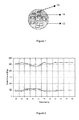
- a dry suspension may comprise an encapsulation of synthetic layered silicates 10 with a shear sensitive coating of resin 12 and porous silica 14.
- the thixotropic agents give the fluid the ability to lose viscosity when being sheared such as by pumping and to return to a gelled structure when at rest.
- the thixotropic agent can be any suitable agent for imparting thixotropy to the fluid for example synthetic layered silicates, and smectite clays, such as a hectorite clay.
- the dry suspension of encapsulated thixotropic agent may be added to the water based drilling fluid on the surface and pumped downhole though the drill pipe and drill bit.
- the borehole assembly does not need to be tripped out to pump the formulation, unlike when cementacious formulations are used to prevent loss circulation.
- the drill bit can be placed at the desired location downhole at the loss zone and the water based drilling fluid with encapsulated thixotropic agent will be pumped through the drill bit nozzles.
- the thixotropic agent is subjected to a shearing action caused by a restriction in the bottom hole assembly which produces an extensional flow, for example at the drill bit.
- the coating isolates the thixotropic agent from the fluid until the shear forces applied through the drill bit nozzle, causes the coating to break and release the encapsulated active product, i.e. Laponite a synthetic layered silicate, into the water based drilling fluid. Due to the downhole conditions there will be rapid hydration of Laponite which will impart thixotropy to the drilling fluid.
- the shearing action and pressure drop which occurs at the restriction in the nozzle causes the coating of the thixotropic agent to break. Therefore the active content is only released from its coating into the fluid when the drilling fluid has flowed through the drill bit nozzle, and therefore thixotropy is only imparted on the drilling fluid when the fluid comes out of the drill bit.
- the present invention has a number of advantages over earlier system for imparting thixotropy on drilling fluids.
- excess concentration of the thixotropic agent may be used easily without causing any pumping or rheology issues for the drilling fluid that would normally be associated with the use of such concentrations of a thixotropic agent.
- concentrations of a thixotropic agent For example more than 10% BWOW of Laponite may be used. Stopping and pumping is possible even at excess concentration of the thixotropic agent, as the thixotropic agent will only be exposed to the water based drilling fluid after the drill bit and not before.
- higher thixotropic agent concentrations may be used, higher yield stress will be possible at downhole conditions.
- thixotropic agent When a natural or untreated thixotropic agent is added to the fluid on the surface and then pumped downhole through coiled tubing and/or subjected to an excess shear environment, this may degrade the performance of the thixotropic agent due to breaking of the molecular chains of the agent.
- the thixotropic agent is encapsulated protecting the agent as it is pumped down the tubing until the encapsulation is broken by the shearing action at the drill bit.
- a further advantage of the invention is that the lost circulation materials, (LCM) can be combined with the drilling fluid and encapsulated thixotropic agent.
- LCM such as organic and inorganic fibres of different size, shapes and aspect ratios, multimodal particles or granules based on optimum particle size distribution or ideal packing theory, flakes sized particles etc, may also be mixed at the surface with the water based drilling fluid.
- the LCM can be pumped through the drill bit nozzles to be released into the borehole at the loss zone.
- LCM, especially fibres will form a fibrous net at the loss zone and collect the solids from the drilling fluid to form a filter cake.
- the thixotropic fluid that has been transported inside the loss zone will eventually be exposed to low overbalance pressure and less shear. Reduction in shear will transform the water based drilling fluid into a highly thixotropic fluid. Thixotropic fluid and glass fibres or other LCM that has been transported inside the loss zone will plug the loss circulation zones.
- Other compounds that effect the properties of the fluid may also be added to the fluid at the surface. These compounds may react with the thixotropic agent when the agent is released into the fluid. For example; polyacrylamide and laponite may react to provide a swellable gel also suitable for lost circulation applications; and/or butadiene-stryene latex and polyoxypropylene may react to provide a plugging solution to reduce the permeability of the formation.
- a 2wt% encapsulated dry suspension of LaponiteTM(Rockwood Additives Ltd) is mixed in a Haildolph mixer at 200rpm for 3 minutes with a 12lbs/bbl (barrel) (34kg/m 3 ) water based drilling fluid having 18% solid volume fraction.
- a Vane rheometer is used to measure critical yield stress development with respect to ageing time.
- a constant shear of 0.105 sec-1 is used for the measurement yield shear.
- the yield stress of the dry suspension of encapsulated Laponite is compared with the yield stress development of 2wt% natural Laponite (without encapsulation) in the same water based drilling fluid formulation. The results can be seen in Figure 2 .
- Figure 2 shows the yield stress development after 60mins of mixing 2wt% natural Laponite without encapsulation ( ⁇ ) and 2wt% encapsulated dry suspension of Laponite ( ⁇ ). After 60 minutes 2wt% natural Laponite (without encapsulation) is completely hydrated with a high yield stress compared to 2wt% encapsulated dry suspension Laponite. This shows that the encapsulation protected the core active material (Laponite) and reduced its diffusion in the aqueous medium.
- a 2wt% encapsulated dry suspension is mixed with the water based drilling fluid and kept unsheared for 30 minutes. After 30 minutes the drilling fluid is sheared at 10 bar ( ⁇ ), 25 bar (") and 30 bar ( ⁇ ). The yield stress development after each pressure drop is compared with a 2wt% natural Laponite solution without encapsulation ( ⁇ ). The results are shown in Figure 3 .
- the invention is described with reference to the use of the encapsulated thixotropic agent in a drilling fluid to prevent lost circulation the invention is also applicable to other fluids used in wellbore operations.
- the present invention can be used with drilling fluids, cement formulations and polymer systems to impart viscosifying and/or thixotropic effects.
- the present invention is also applicable to wellbore strengthening, cutting removals, etc.
Landscapes
- Chemical & Material Sciences (AREA)
- Engineering & Computer Science (AREA)
- Life Sciences & Earth Sciences (AREA)
- General Life Sciences & Earth Sciences (AREA)
- Organic Chemistry (AREA)
- Materials Engineering (AREA)
- Inorganic Chemistry (AREA)
- Ceramic Engineering (AREA)
- Structural Engineering (AREA)
- Dispersion Chemistry (AREA)
- Chemical Kinetics & Catalysis (AREA)
- Curing Cements, Concrete, And Artificial Stone (AREA)
- Sealing Material Composition (AREA)
Abstract
adding an encapsulated thixotropic agent to a fluid at the surface;
introducing the fluid into a borehole; and
subjecting the fluid to a shearing action so as to release the thixotropic agent into the fluid.
Description
- This invention relates to a method of changing a fluids rheological properties downhole. In particular the invention relates to imparting thixotropy on demand at a known place to prevent or cure loss circulation in a wellbore.
- Lost circulation is a problem in the oilfield industry. Many technologies have been used to help combat lost circulation. Polymer pills, reactive mud chemistries, fibers, flakes, sized granules based on optimum particle size distribution or ideal packing theory, resilient materials, water swellable polymers, thixotropic cements are some of the methods used to attempt combat lost circulation.
- Thixotropic agents can provide fluids with the ability to lose viscosity when being sheared, such as by pumping, and then to return to a highly viscous form when at rest. The use of thixotropic agents for treating drilling fluids and well-servicing fluids is known. For example
US4888120 describes adding synthetic layered silicates combined with synthetic polymers to make a high temperature stable thixotropic material to be added to the water based drilling fluids during preparation of the fluid. - WO9620899 describes a thixotropic material comprising smectite clays which is capable of rapid gelling for cementicious formulations to help plug lost circulation zones.
- US4663663 discloses a shear thickening composition for well control fluids comprising a water-in oil emulsion having a clay dispersed in the oil phase and the aqueous phase containing dissolved polyacrylamide and a polycarboxylic acid. Each of the dispersed aqueous droplets being coated with a polymeric material that is broken when subjected to high shear forces.
- The present invention provides a method to impart thixotropy to fluids downhole at a known location so as to prevent loss circulation and improve wellbore strengthening during drilling, and/or assist cuttings removal from the wellbore.
- A first aspect of the invention comprises a method of providing thixotropy to a fluid downhole comprising:
- adding an encapsulated thixotropic agent to a fluid at the surface; introducing the fluid into a borehole; and
- subjecting the fluid to a shearing action, so as to release the thixotropic agent into the fluid.
- Preferably the thixotropic agent is encapsulated in a shear sensitive structure. The shear sensitive structure may comprise a coating of resin and porous silica
- The thixotropic agent may be added to a drilling fluid, cementatious formulation or polymer pill. Preferably the drilling fluid is water based.
- The thixotropic agent is preferably a dry suspension of synthetic layered silicates. In particular it is preferred the thixotropic agent is a hectorite clay.
- The shearing action may be caused by a restriction at the bottom hole assembly. Preferably the shearing action is caused by a restriction of flow through the drill bit.
- The thixotropic agent is released after the drilling fluid exits the drill bit.
- The thixotropic agent may be present in the fluid in an amount of 1% to 10% by weight thereof.
- The method may further comprise adding lost circulation material at the surface to the fluid. The lost circulation material may comprise flakes, organic and/or inorganic fibers, multimodal particles, and/or granules based on optimum particle size distribution or ideal packing theory
- A second aspect of the invention comprises a composition for providing thixotropy to a fluid downhole comprising a thixotropic agent wherein the thixotropic agent is encapsulated in a shear sensitive structure, such that the structure will rupture when subjected to shearing action.
- Brief description of the drawings
-
-
Figure 1 shows a schematic of the encapsulated thixotropic agent; -
Figure 2 shows a graph of the yield stress development after 60 minutes without shear: ▲2 wt% encapsulated Laponite and + 2wt% Laponite without encapsulation; and -
Figure 3 shows a graph of the yield stress development at different pressure drop with shear after 30 minutes: ◆ 2wt% Laponite without encapsulation, ■ 2wt% encapsulated Laponite at 10 bar, ▲ 2wt% encapsulated Laponite at 30 bar and 2wt% encapsulated Laponite at 25 bar. - The invention is now described by way of example. A thixotropic agent is encapsulated in a shear sensitive structure. As shown in
Figure 1 a dry suspension may comprise an encapsulation of syntheticlayered silicates 10 with a shear sensitive coating ofresin 12 andporous silica 14. Although other coatings to encapsulate the thixotropic agent may be used. The thixotropic agents give the fluid the ability to lose viscosity when being sheared such as by pumping and to return to a gelled structure when at rest. The thixotropic agent can be any suitable agent for imparting thixotropy to the fluid for example synthetic layered silicates, and smectite clays, such as a hectorite clay. - When drilling, once loss circulation is observed the dry suspension of encapsulated thixotropic agent may be added to the water based drilling fluid on the surface and pumped downhole though the drill pipe and drill bit.
- The borehole assembly does not need to be tripped out to pump the formulation, unlike when cementacious formulations are used to prevent loss circulation. The drill bit can be placed at the desired location downhole at the loss zone and the water based drilling fluid with encapsulated thixotropic agent will be pumped through the drill bit nozzles. The thixotropic agent is subjected to a shearing action caused by a restriction in the bottom hole assembly which produces an extensional flow, for example at the drill bit. The coating isolates the thixotropic agent from the fluid until the shear forces applied through the drill bit nozzle, causes the coating to break and release the encapsulated active product, i.e. Laponite a synthetic layered silicate, into the water based drilling fluid. Due to the downhole conditions there will be rapid hydration of Laponite which will impart thixotropy to the drilling fluid.
- The shearing action and pressure drop which occurs at the restriction in the nozzle causes the coating of the thixotropic agent to break. Therefore the active content is only released from its coating into the fluid when the drilling fluid has flowed through the drill bit nozzle, and therefore thixotropy is only imparted on the drilling fluid when the fluid comes out of the drill bit.
- The present invention has a number of advantages over earlier system for imparting thixotropy on drilling fluids. As the thixotropic agent is isolated from the fluid as it is being pumped down the drill pipe excess concentration of the thixotropic agent may be used easily without causing any pumping or rheology issues for the drilling fluid that would normally be associated with the use of such concentrations of a thixotropic agent. For example more than 10% BWOW of Laponite may be used. Stopping and pumping is possible even at excess concentration of the thixotropic agent, as the thixotropic agent will only be exposed to the water based drilling fluid after the drill bit and not before. As higher thixotropic agent concentrations may be used, higher yield stress will be possible at downhole conditions.
- When a natural or untreated thixotropic agent is added to the fluid on the surface and then pumped downhole through coiled tubing and/or subjected to an excess shear environment, this may degrade the performance of the thixotropic agent due to breaking of the molecular chains of the agent. However in the present invention the thixotropic agent is encapsulated protecting the agent as it is pumped down the tubing until the encapsulation is broken by the shearing action at the drill bit.
- A further advantage of the invention is that the lost circulation materials, (LCM) can be combined with the drilling fluid and encapsulated thixotropic agent. LCM such as organic and inorganic fibres of different size, shapes and aspect ratios, multimodal particles or granules based on optimum particle size distribution or ideal packing theory, flakes sized particles etc, may also be mixed at the surface with the water based drilling fluid. The LCM can be pumped through the drill bit nozzles to be released into the borehole at the loss zone. LCM, especially fibres, will form a fibrous net at the loss zone and collect the solids from the drilling fluid to form a filter cake. Once the fibres form a filter cake on the loss zone, the thixotropic fluid that has been transported inside the loss zone will eventually be exposed to low overbalance pressure and less shear. Reduction in shear will transform the water based drilling fluid into a highly thixotropic fluid. Thixotropic fluid and glass fibres or other LCM that has been transported inside the loss zone will plug the loss circulation zones.
- Other compounds that effect the properties of the fluid may also be added to the fluid at the surface. These compounds may react with the thixotropic agent when the agent is released into the fluid. For example; polyacrylamide and laponite may react to provide a swellable gel also suitable for lost circulation applications; and/or butadiene-stryene latex and polyoxypropylene may react to provide a plugging solution to reduce the permeability of the formation.
- A 2wt% encapsulated dry suspension of Laponite™(Rockwood Additives Ltd) is mixed in a Haildolph mixer at 200rpm for 3 minutes with a 12lbs/bbl (barrel) (34kg/m3) water based drilling fluid having 18% solid volume fraction. A Vane rheometer is used to measure critical yield stress development with respect to ageing time. A constant shear of 0.105sec-1 is used for the measurement yield shear. The yield stress of the dry suspension of encapsulated Laponite is compared with the yield stress development of 2wt% natural Laponite (without encapsulation) in the same water based drilling fluid formulation. The results can be seen in
Figure 2 . -
Figure 2 shows the yield stress development after 60mins of mixing 2wt% natural Laponite without encapsulation (▲) and 2wt% encapsulated dry suspension of Laponite (◆). After 60 minutes 2wt% natural Laponite (without encapsulation) is completely hydrated with a high yield stress compared to 2wt% encapsulated dry suspension Laponite. This shows that the encapsulation protected the core active material (Laponite) and reduced its diffusion in the aqueous medium. - A 2wt% encapsulated dry suspension is mixed with the water based drilling fluid and kept unsheared for 30 minutes. After 30 minutes the drilling fluid is sheared at 10 bar (■), 25 bar (") and 30 bar (▲). The yield stress development after each pressure drop is compared with a 2wt% natural Laponite solution without encapsulation (◆). The results are shown in
Figure 3 . - The results show that a minimum pressure drop i.e. a certain shear, is required to release the active material from the encapsulation, and at 30 bar all the active material is released and the solution formed a yield stress equal to the 2wt% Laponite without encapsulation i.e. base line solution. The results suggest that the encapsulation is robust and durable and the encapsulated material can be handled and mixed in the oil field with the oilfield equipment, without rupturing and releasing the thixotropic agent until required. For example the core material, i.e. Laponite, will only be completely exposed to the surrounding medium when it comes out through a drill bit restriction.
- While the invention is described with reference to the use of the encapsulated thixotropic agent in a drilling fluid to prevent lost circulation the invention is also applicable to other fluids used in wellbore operations. The present invention can be used with drilling fluids, cement formulations and polymer systems to impart viscosifying and/or thixotropic effects. As well as loss circulation the present invention is also applicable to wellbore strengthening, cutting removals, etc.
- Further changes within the scope of the invention will be apparent.
Claims (14)
- A method of providing thixotropy to a fluid downhole comprising:adding an encapsulated thixotropic agent to a fluid at the surface;introducing the fluid into a borehole; andsubjecting the fluid to a shearing action so as to release the thixotropic agent into the fluid.
- A method according claim 1 wherein the thixotropic agent is encapsulated in a shear sensitive structure.
- A method according to claim 2 wherein the shear sensitive structure comprises a coating of resin and porous silica.
- A method according to claim 1, 2 or 3 wherein the fluid is a drilling fluid, cementatious formulation or polymer pill.
- A method according to claim 4 wherein the fluid is a water based drilling fluid.
- A method according to any preceding claim wherein the thixotropic agent comprises a dry suspension of synthetic layered silicates.
- A method according to any preceding claim wherein the thixotropic agent comprises a hectorite clay.
- A method according to any preceding claim wherein the shearing action is caused by a restriction at the bottom hole assembly.
- A method according to claim 8, wherein the shearing action is caused by a restriction of flow at the drill bit.
- A method according to any preceding claim wherein the thixotropic agent is released after the fluid exits the drill bit.
- A method according to any preceding claim wherein the thixotropic agent is present in the fluid in an amount of 1 % to 10% by weight thereof.
- A method according to any preceding claim further comprising adding lost circulation material at the surface to the fluid.
- A method according to claim 12 wherein the lost circulation material comprises flakes, organic and/or inorganic fibers, multimodal particles, and/or granules based on optimum particle size distribution or ideal packing theory.
- A composition for providing thixotropy to a fluid downhole comprising a thixotropic agent wherein the thixotropic agent is encapsulated in a shear sensitive structure, such that the structure will rupture when subjected to shearing action.
Priority Applications (4)
| Application Number | Priority Date | Filing Date | Title |
|---|---|---|---|
| EP08158495A EP2135914A1 (en) | 2008-06-18 | 2008-06-18 | Method for providing thixotropy to fluids downhole |
| CA2728109A CA2728109A1 (en) | 2008-06-18 | 2009-06-09 | Method for providing thixotropy to fluids downhole |
| US12/997,173 US8689869B2 (en) | 2008-06-18 | 2009-06-09 | Method for providing thixotrophy to fluids downhole |
| PCT/EP2009/004197 WO2009152989A1 (en) | 2008-06-18 | 2009-06-09 | Method for providing thixotropy to fluids downhole |
Applications Claiming Priority (1)
| Application Number | Priority Date | Filing Date | Title |
|---|---|---|---|
| EP08158495A EP2135914A1 (en) | 2008-06-18 | 2008-06-18 | Method for providing thixotropy to fluids downhole |
Publications (1)
| Publication Number | Publication Date |
|---|---|
| EP2135914A1 true EP2135914A1 (en) | 2009-12-23 |
Family
ID=39939789
Family Applications (1)
| Application Number | Title | Priority Date | Filing Date |
|---|---|---|---|
| EP08158495A Withdrawn EP2135914A1 (en) | 2008-06-18 | 2008-06-18 | Method for providing thixotropy to fluids downhole |
Country Status (4)
| Country | Link |
|---|---|
| US (1) | US8689869B2 (en) |
| EP (1) | EP2135914A1 (en) |
| CA (1) | CA2728109A1 (en) |
| WO (1) | WO2009152989A1 (en) |
Cited By (3)
| Publication number | Priority date | Publication date | Assignee | Title |
|---|---|---|---|---|
| EP3032026A1 (en) * | 2014-12-11 | 2016-06-15 | Services Pétroliers Schlumberger | Analyzing reservoir using fluid analysis |
| US10184334B2 (en) | 2014-12-11 | 2019-01-22 | Schlumberger Technology Corporation | Analyzing reservoir using fluid analysis |
| CN114961685A (en) * | 2022-06-23 | 2022-08-30 | 同济大学 | Method for mining underground resources by adopting negative thixotropic fluid |
Families Citing this family (11)
| Publication number | Priority date | Publication date | Assignee | Title |
|---|---|---|---|---|
| MY166385A (en) | 2011-03-11 | 2018-06-25 | Schlumberger Technology Bv | Well treatment |
| US10858570B2 (en) | 2012-07-17 | 2020-12-08 | Dow Global Technologies Llc | Aqueous cement compositions incorporating particles that are activated to control rheology when water soluble portions of the particles are released in the presence of water |
| GB2539359A (en) * | 2014-03-31 | 2016-12-14 | M-I L L C | Smart LCM for strengthening earthen formations |
| MX391099B (en) * | 2014-03-31 | 2025-03-21 | Mi Llc | SMART FILTERING FOR FORM REINFORCEMENT. |
| US10100614B2 (en) | 2016-04-22 | 2018-10-16 | Baker Hughes, A Ge Company, Llc | Automatic triggering and conducting of sweeps |
| CA3045772A1 (en) | 2017-01-17 | 2018-07-26 | Halliburton Energy Services, Inc. | Treatment fluids comprising synthetic silicates and methods for use |
| AU2018419509B2 (en) * | 2018-04-17 | 2023-07-27 | Halliburton Energy Services, Inc. | Thixotropic sealing composition and injection thereof for use during drilling |
| US12241016B2 (en) | 2022-08-08 | 2025-03-04 | Cnpc Usa Corporation | High temperature high salt low end rheology modifiers |
| US12258821B2 (en) | 2023-08-14 | 2025-03-25 | Baker Hughes Oilfield Operations Llc | Encapsulated lost circulation materials based on shape-memory polymer foam |
| US12448561B2 (en) | 2023-08-14 | 2025-10-21 | Baker Hughes Oilfield Operations Llc | Encapsulation of oilfield chemicals for on-demand triggered release |
| US12258822B2 (en) | 2023-08-14 | 2025-03-25 | Baker Hughes Oilfield Operations Llc | Encapsulated lost circulation materials based on swellable elastomers |
Citations (9)
| Publication number | Priority date | Publication date | Assignee | Title |
|---|---|---|---|---|
| US2836555A (en) * | 1956-07-30 | 1958-05-27 | Arthur L Armentrout | Material for recovering lost circulation in wells |
| US3898165A (en) * | 1972-04-18 | 1975-08-05 | Halliburton Co | Compositions for fracturing high temperature well formations |
| US4040967A (en) * | 1974-07-11 | 1977-08-09 | The Dow Chemical Company | Method of fracturing subterranean formations penetrated by a well |
| US4542791A (en) * | 1984-03-06 | 1985-09-24 | Exxon Research & Engineering Company | Method for plugging wellbores with polycarboxylic acid shear thickening composition |
| US4663663A (en) | 1985-05-06 | 1987-05-05 | Eastman Kodak Company | Digital color image processing method employing constrained correction of color reproduction functions |
| US4888120A (en) | 1986-09-18 | 1989-12-19 | Henkel Kommanditgesellschaft Auf Aktien | Water-based drilling and well-servicing fluids with swellable, synthetic layer silicates |
| WO1994028085A1 (en) * | 1993-05-28 | 1994-12-08 | Den Norske Stats Oljeselskap A.S. | Plugging liquid for plugging a subterranean formation zone |
| WO1996020899A1 (en) | 1995-01-04 | 1996-07-11 | Sofitech N.V. | Thixotropic materials |
| US20030236171A1 (en) * | 2002-06-25 | 2003-12-25 | Nguyen Philip D. | Method for removing drill cuttings from wellbores and drilling fluids |
Family Cites Families (4)
| Publication number | Priority date | Publication date | Assignee | Title |
|---|---|---|---|---|
| US3823939A (en) | 1971-11-03 | 1974-07-16 | R Bottorff | Football practice apparatus |
| US3988165A (en) * | 1974-07-08 | 1976-10-26 | Gould Inc. | Method of making a lead-acid storage battery, and cell, capable of activation by the addition of electrolyte |
| EP1268976B1 (en) * | 2000-04-05 | 2011-10-05 | Sofitech N.V. | Viscosity reduction of viscoelastic surfactant based fluids |
| US6840318B2 (en) * | 2002-06-20 | 2005-01-11 | Schlumberger Technology Corporation | Method for treating subterranean formation |
-
2008
- 2008-06-18 EP EP08158495A patent/EP2135914A1/en not_active Withdrawn
-
2009
- 2009-06-09 CA CA2728109A patent/CA2728109A1/en not_active Abandoned
- 2009-06-09 US US12/997,173 patent/US8689869B2/en not_active Expired - Fee Related
- 2009-06-09 WO PCT/EP2009/004197 patent/WO2009152989A1/en not_active Ceased
Patent Citations (9)
| Publication number | Priority date | Publication date | Assignee | Title |
|---|---|---|---|---|
| US2836555A (en) * | 1956-07-30 | 1958-05-27 | Arthur L Armentrout | Material for recovering lost circulation in wells |
| US3898165A (en) * | 1972-04-18 | 1975-08-05 | Halliburton Co | Compositions for fracturing high temperature well formations |
| US4040967A (en) * | 1974-07-11 | 1977-08-09 | The Dow Chemical Company | Method of fracturing subterranean formations penetrated by a well |
| US4542791A (en) * | 1984-03-06 | 1985-09-24 | Exxon Research & Engineering Company | Method for plugging wellbores with polycarboxylic acid shear thickening composition |
| US4663663A (en) | 1985-05-06 | 1987-05-05 | Eastman Kodak Company | Digital color image processing method employing constrained correction of color reproduction functions |
| US4888120A (en) | 1986-09-18 | 1989-12-19 | Henkel Kommanditgesellschaft Auf Aktien | Water-based drilling and well-servicing fluids with swellable, synthetic layer silicates |
| WO1994028085A1 (en) * | 1993-05-28 | 1994-12-08 | Den Norske Stats Oljeselskap A.S. | Plugging liquid for plugging a subterranean formation zone |
| WO1996020899A1 (en) | 1995-01-04 | 1996-07-11 | Sofitech N.V. | Thixotropic materials |
| US20030236171A1 (en) * | 2002-06-25 | 2003-12-25 | Nguyen Philip D. | Method for removing drill cuttings from wellbores and drilling fluids |
Cited By (4)
| Publication number | Priority date | Publication date | Assignee | Title |
|---|---|---|---|---|
| EP3032026A1 (en) * | 2014-12-11 | 2016-06-15 | Services Pétroliers Schlumberger | Analyzing reservoir using fluid analysis |
| US10184334B2 (en) | 2014-12-11 | 2019-01-22 | Schlumberger Technology Corporation | Analyzing reservoir using fluid analysis |
| CN114961685A (en) * | 2022-06-23 | 2022-08-30 | 同济大学 | Method for mining underground resources by adopting negative thixotropic fluid |
| CN114961685B (en) * | 2022-06-23 | 2023-02-21 | 同济大学 | Method for mining underground resources by adopting negative thixotropic fluid |
Also Published As
| Publication number | Publication date |
|---|---|
| US20110139454A1 (en) | 2011-06-16 |
| US8689869B2 (en) | 2014-04-08 |
| WO2009152989A1 (en) | 2009-12-23 |
| CA2728109A1 (en) | 2009-12-23 |
Similar Documents
| Publication | Publication Date | Title |
|---|---|---|
| US8689869B2 (en) | Method for providing thixotrophy to fluids downhole | |
| CA2523472C (en) | Well treating method to prevent or cure lost-circulation | |
| US9834719B2 (en) | Methods for servicing subterranean wells | |
| EP1412614B1 (en) | Shear-sensitive plugging fluid for plugging and a method for plugging a subterranean formation zone | |
| US7810562B2 (en) | In-situ formation of solids for well completions and zonal isolation | |
| RU2635310C1 (en) | Hardening compositions containing cement dust, and methods for their application | |
| EA028131B1 (en) | Cellulose nanowhiskers in well services | |
| EA027717B1 (en) | Method of lost circulation in a wellbore | |
| WO2013015923A1 (en) | Composite particulates and methods thereof for high permeability formations | |
| CN104039917A (en) | Hydrolyzable particle compositions, treatment fluids and methods | |
| US6818598B2 (en) | Shear-sensitive plugging fluid for plugging and a method for plugging a subterranean formation zone | |
| NO20161561A1 (en) | Smart filtrate for stregthening formations | |
| US20210292638A1 (en) | Breaker System for Emulsified Fluid System | |
| NO20220372A1 (en) | ||
| US10982126B2 (en) | Chemical packer composition and methods of using same for isolation of water/gas zones | |
| US6815399B1 (en) | Shear-sensitive plugging fluid for plugging and a method for plugging a subterranean formation zone | |
| WO2022010505A1 (en) | Method to use lost circulation material composition comprising alkaline nanoparticle based dispersion and sodium bicarbonate in downhole conditions | |
| EP0037418B1 (en) | Shear thickening fluid | |
| US10125301B2 (en) | Methods and compositions for in-situ polymerization reaction to improve shale inhibition | |
| WO2018101919A1 (en) | Emulsion-based breaker for nanoparticle clay fluid | |
| Patil et al. | Evaluation of an Environmentally Acceptable Colloidal Silica-Based Conformance Systems | |
| US12534662B2 (en) | Lost circulation composite materials and methods and systems related thereto | |
| Al-Yami et al. | Critical Review of the Literature on Curing Losses and Long-Term Shale Inhibition |
Legal Events
| Date | Code | Title | Description |
|---|---|---|---|
| PUAI | Public reference made under article 153(3) epc to a published international application that has entered the european phase |
Free format text: ORIGINAL CODE: 0009012 |
|
| AK | Designated contracting states |
Kind code of ref document: A1 Designated state(s): AT BE BG CH CY CZ DE DK EE ES FI FR GB GR HR HU IE IS IT LI LT LU LV MC MT NL NO PL PT RO SE SI SK TR |
|
| AX | Request for extension of the european patent |
Extension state: AL BA MK RS |
|
| 17P | Request for examination filed |
Effective date: 20100602 |
|
| 17Q | First examination report despatched |
Effective date: 20100709 |
|
| AKX | Designation fees paid |
Designated state(s): AT BE BG CH CY CZ DE DK EE ES FI FR GB GR HR HU IE IS IT LI LT LU LV MC MT NL NO PL PT RO SE SI SK TR |
|
| STAA | Information on the status of an ep patent application or granted ep patent |
Free format text: STATUS: THE APPLICATION HAS BEEN WITHDRAWN |
|
| 18W | Application withdrawn |
Effective date: 20101209 |