EP2135873A2 - Chemical coupling process with a phenyl boronic acid derivative - Google Patents
Chemical coupling process with a phenyl boronic acid derivative Download PDFInfo
- Publication number
- EP2135873A2 EP2135873A2 EP09170107A EP09170107A EP2135873A2 EP 2135873 A2 EP2135873 A2 EP 2135873A2 EP 09170107 A EP09170107 A EP 09170107A EP 09170107 A EP09170107 A EP 09170107A EP 2135873 A2 EP2135873 A2 EP 2135873A2
- Authority
- EP
- European Patent Office
- Prior art keywords
- phenyl
- oxadiazol
- formula
- process according
- boronic acid
- Prior art date
- Legal status (The legal status is an assumption and is not a legal conclusion. Google has not performed a legal analysis and makes no representation as to the accuracy of the status listed.)
- Granted
Links
- 0 *CC=CC=C(C=*)C1=I**=C*1 Chemical compound *CC=CC=C(C=*)C1=I**=C*1 0.000 description 2
- WDWXVKKYNDQJQG-UHFFFAOYSA-N Cc(nc1OC)cnc1N(P)S(c1c(-c(cc2)ccc2-c2nnc[o]2)nccc1)(=O)=O Chemical compound Cc(nc1OC)cnc1N(P)S(c1c(-c(cc2)ccc2-c2nnc[o]2)nccc1)(=O)=O WDWXVKKYNDQJQG-UHFFFAOYSA-N 0.000 description 1
- VWNQIDZFFVUFIE-UHFFFAOYSA-N Cc(nc1OC)cnc1NS(c(cccn1)c1Cl)(=O)=O Chemical compound Cc(nc1OC)cnc1NS(c(cccn1)c1Cl)(=O)=O VWNQIDZFFVUFIE-UHFFFAOYSA-N 0.000 description 1
Classifications
-
- C—CHEMISTRY; METALLURGY
- C07—ORGANIC CHEMISTRY
- C07F—ACYCLIC, CARBOCYCLIC OR HETEROCYCLIC COMPOUNDS CONTAINING ELEMENTS OTHER THAN CARBON, HYDROGEN, HALOGEN, OXYGEN, NITROGEN, SULFUR, SELENIUM OR TELLURIUM
- C07F5/00—Compounds containing elements of Groups 3 or 13 of the Periodic Table
- C07F5/02—Boron compounds
-
- C—CHEMISTRY; METALLURGY
- C07—ORGANIC CHEMISTRY
- C07D—HETEROCYCLIC COMPOUNDS
- C07D401/00—Heterocyclic compounds containing two or more hetero rings, having nitrogen atoms as the only ring hetero atoms, at least one ring being a six-membered ring with only one nitrogen atom
- C07D401/14—Heterocyclic compounds containing two or more hetero rings, having nitrogen atoms as the only ring hetero atoms, at least one ring being a six-membered ring with only one nitrogen atom containing three or more hetero rings
-
- A—HUMAN NECESSITIES
- A61—MEDICAL OR VETERINARY SCIENCE; HYGIENE
- A61P—SPECIFIC THERAPEUTIC ACTIVITY OF CHEMICAL COMPOUNDS OR MEDICINAL PREPARATIONS
- A61P13/00—Drugs for disorders of the urinary system
- A61P13/12—Drugs for disorders of the urinary system of the kidneys
-
- A—HUMAN NECESSITIES
- A61—MEDICAL OR VETERINARY SCIENCE; HYGIENE
- A61P—SPECIFIC THERAPEUTIC ACTIVITY OF CHEMICAL COMPOUNDS OR MEDICINAL PREPARATIONS
- A61P25/00—Drugs for disorders of the nervous system
- A61P25/04—Centrally acting analgesics, e.g. opioids
-
- A—HUMAN NECESSITIES
- A61—MEDICAL OR VETERINARY SCIENCE; HYGIENE
- A61P—SPECIFIC THERAPEUTIC ACTIVITY OF CHEMICAL COMPOUNDS OR MEDICINAL PREPARATIONS
- A61P35/00—Antineoplastic agents
-
- A—HUMAN NECESSITIES
- A61—MEDICAL OR VETERINARY SCIENCE; HYGIENE
- A61P—SPECIFIC THERAPEUTIC ACTIVITY OF CHEMICAL COMPOUNDS OR MEDICINAL PREPARATIONS
- A61P5/00—Drugs for disorders of the endocrine system
-
- A—HUMAN NECESSITIES
- A61—MEDICAL OR VETERINARY SCIENCE; HYGIENE
- A61P—SPECIFIC THERAPEUTIC ACTIVITY OF CHEMICAL COMPOUNDS OR MEDICINAL PREPARATIONS
- A61P9/00—Drugs for disorders of the cardiovascular system
-
- A—HUMAN NECESSITIES
- A61—MEDICAL OR VETERINARY SCIENCE; HYGIENE
- A61P—SPECIFIC THERAPEUTIC ACTIVITY OF CHEMICAL COMPOUNDS OR MEDICINAL PREPARATIONS
- A61P9/00—Drugs for disorders of the cardiovascular system
- A61P9/12—Antihypertensives
-
- C—CHEMISTRY; METALLURGY
- C07—ORGANIC CHEMISTRY
- C07D—HETEROCYCLIC COMPOUNDS
- C07D413/00—Heterocyclic compounds containing two or more hetero rings, at least one ring having nitrogen and oxygen atoms as the only ring hetero atoms
- C07D413/14—Heterocyclic compounds containing two or more hetero rings, at least one ring having nitrogen and oxygen atoms as the only ring hetero atoms containing three or more hetero rings
-
- C—CHEMISTRY; METALLURGY
- C07—ORGANIC CHEMISTRY
- C07F—ACYCLIC, CARBOCYCLIC OR HETEROCYCLIC COMPOUNDS CONTAINING ELEMENTS OTHER THAN CARBON, HYDROGEN, HALOGEN, OXYGEN, NITROGEN, SULFUR, SELENIUM OR TELLURIUM
- C07F5/00—Compounds containing elements of Groups 3 or 13 of the Periodic Table
- C07F5/02—Boron compounds
- C07F5/025—Boronic and borinic acid compounds
-
- Y—GENERAL TAGGING OF NEW TECHNOLOGICAL DEVELOPMENTS; GENERAL TAGGING OF CROSS-SECTIONAL TECHNOLOGIES SPANNING OVER SEVERAL SECTIONS OF THE IPC; TECHNICAL SUBJECTS COVERED BY FORMER USPC CROSS-REFERENCE ART COLLECTIONS [XRACs] AND DIGESTS
- Y02—TECHNOLOGIES OR APPLICATIONS FOR MITIGATION OR ADAPTATION AGAINST CLIMATE CHANGE
- Y02P—CLIMATE CHANGE MITIGATION TECHNOLOGIES IN THE PRODUCTION OR PROCESSING OF GOODS
- Y02P20/00—Technologies relating to chemical industry
- Y02P20/50—Improvements relating to the production of bulk chemicals
- Y02P20/55—Design of synthesis routes, e.g. reducing the use of auxiliary or protecting groups
Definitions
- the present invention relates to an improved chemical process for preparing intermediates. Certain of these intermediates are useful in the manufacture of compounds which are useful in the treatment of, for example, cancer, pain and cardiovascular diseases in a warm-blooded animal such as man, particularly compounds which possess endothelin receptor antagonist activity.
- the present invention relates to a chemical process for preparing [4-(1,3,4-oxadiazol-2-yl)phenyl]boronic acid which is used in the manufacture of N -(3-methoxy-5-methylpyrazin-2-yl)-2-(4-[1,3,4-oxadiazol-2-yl]phenyl)pyridine-3-sulphonamide which compound is disclosed as Example 36 of International Patent Application WO96/40681 .
- This compound possesses endothelin receptor antagonist activity, and accordingly is useful whenever such antagonist activity is desired, such as for research tools within pharmacological, diagnostic, and related studies or in the treatment of diseases and medical conditions including, but not limited to hypertension, pulmonary hypertension, cardiac or cerebral circulatory disease and renal disease.
- this compound is also useful in the treatment of cancer and pain, in a warm-blooded animal such as man.
- a route for preparing N -(3-methoxy-5-methylpyrazin-2-yl)-2-(4-[1,3,4-oxadiazol-2-yl] phenyl)pyridine-3-sulphonamide is disclosed in International Patent Applications WO 96/40681 and WO 98/40332 .
- the route involves the use of the compound N- (isobutoxycarbonyl)-2-(4-methoxycarbonylphenyl)-N-(3-methoxy-5-methylpyrazin-2-yl)pyridine-3-sulphonamide as an intermediate with the formation of the 1,3,4-oxadiazole in the 4-position of the phenyl group occurring at the end of the synthesis.
- heteroaryl moiety at the 4-position of the phenyl group is formed as the last step, it is necessary to undergo a linear synthesis approach with the rest of the molecule made first. This is clearly undesirable when substituents in distinct parts of the molecule need to be varied in order to investigate structure-activity relationships. It would be highly desirable if a convergent approach to the synthesis of this type of compound could be devised. This would also be of significant benefit in the efficiency of manufacturing large scale amounts of N -(3-methoxy-5-methylpyrazin-2-yl)-2-(4-[1,3,4-oxadiazol-2-yl]phenyl) pyridine-3-sulphonamide.
- one of the heteroaryl-phenyl boronic acids, [4-(1,3,4-oxadiazol-2-yl)phenyl]boronic acid, produced according to the present invention is used to prepare N -protected N -(3-methoxy-5-methylpyrazin-2-yl)-2-(4-[1,3,4-oxadiazol-2-yl]phenyl)pyridine-3-sulphonamides, in particular N -(isobutoxycarbonyl) N- (3-methoxy-5-methylpyrazin-2-yl)-2-(4-[1,3,4-oxadiazol-2-yl]phenyl) pyridine-3-sulphonamide.
- the process for the manufacture of heteroaryl-phenyl boronic acids of the present invention utilises the increased acidity of the heteroaryl ring proton, and involves the sequential use of two bases.
- Initial attempts at adding one equivalent of a base to a heteroaryl-phenyl bromo compound in order to induce halogen-metal exchange led to competing deprotonation of the heteroaryl ring.
- On quenching with a borate ester a negligible yield of the desired product was achieved, together with starting material and by-products.
- the present inventors found, surprisingly, that the sequential use of two bases leads to good yields of the desired heteroaryl-phenyl boronic acids.
- the heteroaryl ring is initially deprotonated with a (typically) "weaker” base, before inducing halogen-metal exchange with a (typically) "stronger” base.
- the reactions may conveniently be carried out in an inert solvent or diluent or an ethereal solvent such as diethyl ether, tetrahydrofuran, diethoxymethane, 1,2-dimethoxyethane or 1,4-dioxan.
- an inert solvent or diluent or an ethereal solvent such as diethyl ether, tetrahydrofuran, diethoxymethane, 1,2-dimethoxyethane or 1,4-dioxan.
- the reaction may be carried out by sequentially treating 2-(4-bromophenyl)-1,3,4-oxadiazole with 4-methylphenyllithium, followed by n-hexyllithium, and finally triisopropylborate in a suitable solvent or diluent, for example, an ethereal solvent such as tetrahydrofuran, at a temperature in the range, for example, -90 to -50°C, more particularly -70 to -55°C, conveniently at or near -70°C.
- a suitable solvent or diluent for example, an ethereal solvent such as tetrahydrofuran
- heteroaryl-phenyl bromo compound of Formula II can be charged to a solution of the first base to enable deprotonation, followed by the addition of the second base to induce transmetallation.
- This method although slightly less efficient in yield and quality does have advantages in cases where the first base must be generated in situ due to lack of stability at ambient temperatures. In this case only one cryogenic vessel is required to complete the processing.
- the molar ratios of the reagents used in process steps (i), (ii), and (iii), are preferably in the range from 1.0-1.5: 1.0-1.5: 2.1-3 respectively, but more preferably in the range 1.06-1.3: 1.07-1.1: 2.2-2.3 respectively.
- the lithiated intermediates formed during the conversion of compounds of the Formula II to compounds of Formula I are not isolated as such but are each prepared and used as a solution in an organic solvent. Thereby, compounds of Formula I may be manufactured from compounds of Formula II in a one-pot procedure.
- An aryl lithium is, for example, phenyl or naphthyl- lithium.
- An optional substituent for an aryl lithium is, for example, methyl.
- Particularly preferred optionally substituted aryl lithiums are, for example, phenyl-, 2-methylphenyl-, 4-methylphenyl-, mesityl- or naphthyl- lithium.
- a borate ester is an alkyl, alkenyl or aryl boronic ester, for example, trimethyl-, triethyl- or triisopropyl- borate.
- R 1 is a nitrogen-protecting group
- suitable methods for protection are those known to those skilled in the art.
- Conventional protecting groups may be used in accordance with standard practice (for illustration see T.W. Green, Protective Groups in Organic Synthesis, John Wiley and Sons, 1991 ).
- a suitable nitrogen- protecting group, R 1 is, for example, an (1-6C)alkyl, phenyl, allyl, methoxymethyl, benzyl, triphenylmethyl or diphenylphosphinyl protecting group.
- This first aspect of the present invention provides compounds of Formula I in commercially acceptable yields and of high quality.
- a further aspect of the present invention provides the use of [4-(1,3,4-oxadiazol-2-yl)phenyl] boronic acid, prepared according to the present invention, in the preparation of compounds of Formula IV which are intermediates useful in the preparation of N -(3-methoxy-5-methylpyrazin-2-yl)-2-(4-[1,3,4-oxadiazol-2-yl]phenyl)pyridine-3-sulphonamide.
- N -(3-Methoxy-5-methylpyrazin-2-yl)-2-(4-[1,3,4-oxadiazol-2-yl]phenyl)pyridine-3-sulphonamide is prepared by deprotecting compounds of Formula IV.
- [4-(1,3,4-oxadiazol-2-yl)phenyl]boronic acid is coupled with compounds of Formula III to form compounds of Formula IV.
- reaction takes place in an aqueous solvent, for example methanol, ethanol, isopropanol, industrial methylated spirit (IMS), isobutanol, NMP (N-methylpyrrolidinone), DMF; with or without an organic phase, for example toluene or xylenes at a temperature in the range, for example 60 to 100°C more particularly 75 to 85°C, in the presence of:
- an aqueous solvent for example methanol, ethanol, isopropanol, industrial methylated spirit (IMS), isobutanol, NMP (N-methylpyrrolidinone), DMF
- organic phase for example toluene or xylenes at a temperature in the range, for example 60 to 100°C more particularly 75 to 85°C, in the presence of:
- the source of palladium is palladium acetate.
- the base is N-methylmorpholine.
- the base is triethylamine.
- this reaction takes place in an aqueous solvent without an organic phase.
- this reaction takes place in an aqueous solvent with an organic phase.
- the organic phase comprises toluene.
- the organic phase comprises xylene.
- this reaction more specifically takes place in the presence of palladium acetate, 3,3',3"-phosphinidyne tris(benzenesulphonic acid) trisodium salt, N-methylmorpholine in water and isopropanol.
- this reaction more specifically takes place in the presence of palladium acetate, 3,3',3"-phosphinidyne tris(benzenesulphonic acid) trisodium salt, triethylamine, xylene, water and IMS.
- the molar ratios of the reagents used in process steps (i), (ii), (iii) and (iv), are preferably in the range from 1.0-2.0: 0.02-0.3: 0.06-0.9: 1.5-5.0 respectively, but more preferably in the range 1.4-1.6: 0.03-0.1: 0.09-0.3: 2.0-3.0 respectively.
- P is a nitrogen-protecting group. Suitable methods for protection are those known to those skilled in the art. Conventional protecting groups may be used in accordance with standard practice (for illustration see T.W. Green, Protective Groups in Organic Synthesis, John Wiley and Sons, 1991 ).
- a suitable value for P is, for example, an acyl group, for example a C 1-6 alkanoyl group such as acetyl; an aroyl group, for example benzoyl; a C 1-6 alkoxycarbonyl group, for example a methoxycarbonyl, ethoxycarbonyl, isobutoxycarbonyl or tert -butoxycarbonyl group; an arylmethoxycarbonyl group, for example benzyloxycarbonyl; a phosphinyl group, for example diphenylphosphinyl; a benzyl group or a C 2-6 alkenyl group such as allyl.
- an acyl group for example a C 1-6 alkanoyl group such as acetyl; an aroyl group, for example benzoyl; a C 1-6 alkoxycarbonyl group, for example a methoxycarbonyl, ethoxycarbonyl, isobutoxycarbonyl or
- a suitable value for P is a C 1-6 alkoxycarbonyl group. More suitable values for P are a methoxycarbonyl, ethoxycarbonyl or isobutoxycarbonyl group. More specifically a value for P is isobutoxycarbonyl.
- an acyl group such as a C 1-6 alkanoyl or a C 1-6 alkoxycarbonyl group or an aroyl group may be removed for example, by hydrolysis with a suitable base such as an alkali metal hydroxide, for example lithium or sodium hydroxide or an amine, for example ammonia.
- a suitable base such as an alkali metal hydroxide, for example lithium or sodium hydroxide or an amine, for example ammonia.
- an alkoxycarbonyl group such as a t-butoxycarbonyl group may be removed, for example, by treatment with a suitable acid as hydrochloric, sulphuric or phosphoric acid or trifluoroacetic acid and an arylmethoxycarbonyl group such as a benzyloxycarbonyl group may be removed, for example, by hydrogenation over a catalyst such as palladium-on-carbon, or by treatment with a Lewis acid for example boron tris(trifluoroacetate).
- a phosphinyl group may be removed by base hydrolysis such as an alkali metal hydroxide, for example lithium or sodium hydroxide or an amine, for example ammonia.
- a benzyl group may be removed by hydrogenation over a catalyst such as palladium-on-carbon.
- a C 2-6 alkenyl group such as allyl may be removed palladium assisted hydrolysis.
- the invention provides the use of [4-(1,3,4-oxadiazol-2-yl)phenyl] boronic acid, prepared according to the present invention, in the preparation of N -(isobutoxycarbonyl) N -(3-methoxy-5-methylpyrazin-2-yl)-2-(4-[1,3,4-oxadiazol-2-yl]phenyl) pyridine-3-sulphonamide a compound of Formula IV and an intermediate useful in the preparation of N -(3-methoxy-5-methylpyrazin-2-yl)-2-(4-[1,3,4-oxadiazol-2-yl] phenyl)pyridine-3-sulphonamide.
- [4-(1,3,4-oxadiazol-2-yl)phenyl]boronic acid is coupled with N -(isobutoxycarbonyl)-2-chloro- N -(3-methoxy-5-methylpyrazin-2-yl) pyridine-3-sulphonamide to form N -(isobutoxycarbonyl) N -(3-methoxy-5-methylpyrazin-2-yl)-2-(4-[1,3,4-oxadiazol-2-yl]phenyl) pyridine-3-sulphonamide.
- N -(isobutoxycarbonyl) N -(3-methoxy-5-methylpyrazin-2-yl)-2-(4-[1,3,4-oxadiazol-2-yl]phenyl) pyridine-3-sulphonamide which comprises coupling [4-(1,3,4-oxadiazol-2-yl)phenyl]boronic acid with N -(isobutoxycarbonyl)-2-chloro-N-(3-methoxy-5-methylpyrazin-2-yl) pyridine-3-sulphonamide.
- N- (isobutoxycarbonyl) N -(3-methoxy-5-methylpyrazin-2-yl)-2-(4-[1,3,4-oxadiazol-2-yl]phenyl) pyridine-3-sulphonamide in the preparation of N -(3-methoxy-5-methylpyrazin-2-yl)-2-(4-[1,3,4-oxadiazol-2-yl] phenyl)pyridine-3-sulphonamide.
- the 2-(4-bromophenyl)-1,3,4-oxadiazole used as a starting material was prepared as follows:
- Lithium granules (8.2 g) and tetrahydrofuran (670 g) were charged to a reactor under an argon atmosphere and the mixture cooled to -35°C.
- 4-Chlorotoluene (74.3 g) was added at -35°C and the mixture was held at this temperature for 6 hours.
- the resultant solution was added to a suspension of 2-(4-bromophenyl)-1,3,4-oxadiazole (124.4 g) in tetrahydrofuran (800 g) at -65°C.
- n-hexyllithium (33%w/w in hexanes) 240ml
- Example 2 was repeated but the charge of 4-chlorotoluene increased from 1.06 moles to 1.30 moles. The yield of the title compound increased to 89.3%.
- Tetrahydrofuran 250 g was charged to a mixture of lithium granules (3.02 g) and biphenyl (0.01 g) under an argon atmosphere and the mixture cooled to -30°C.
- 2-Chlorotoluene 27.55 g was slowly added at -30°C.
- the reaction was held at -30°C for 6 hours and then cooled to -65°C.
- reaction was held at -65°C for 30 minutes then a solution of n-hexyllithium (33%w/w in hexanes, 86 ml) was added at -65°C.
- n-hexyllithium 33%w/w in hexanes, 86 ml
- trimethylborate 48.7 g
- methanol 55.3 g
- 4-methyl-2-pentanone 240 g
- Tetrahydrofuran was charged to lithium granules (7.6 g) under an argon atmosphere and the mixture cooled to -30°C.
- 2-Chlorotoluene (69.4 g) was slowly added at -30°C.
- the reaction was held at -30°C for 6 hours then added to a suspension of 2-(4-bromophenyl)-1,3,4-oxadiazole (124.4 g) in tetrahydrofuran (800 g) at -65°C.
- the reaction was held at -65°C for 30 minutes then a solution of n-hexyllithium (33%w/w in hexanes, 245 ml) was added at -65°C.
- reaction was held at -65°C for 30 minutes and then trimethylborate (230.8 g) was added at -65°C.
- the reaction was held at -65°C for 30 minutes then methanol (175 ml) was added followed by 4-methyl-2-pentanone (600 g).
- the reaction mixture was warmed and the low boiling solvents distilled off under vacuum to a maximum temperature of 50°C.
- the reaction mixture was cooled to 5-10°C and the pH adjusted to 6.5 by the addition of 5%w/w sulphuric acid (990.5 g). Product precipitated.
- the mixture was heated to 40°C then cooled back to 10°C.
- Product was isolated, washed with THF and water, and dried yielding the title compound (79.3 g, 75.5%).
- Example 4 was repeated but chlorobenzene (61.6 g) was used instead of 2-chlorotoluene.
- the isolated yield of the title compound was 87.8 g, (83.8%).
- the reaction mixture was cooled to 30°C and filtered through a Whatman GF/B glass filter paper and the lower aqueous phase separated off.
- the reaction flask and filter cake was washed with xylene (20ml).
- the xylene wash was used to re-extract the aqueous phase.
- the combined organic phases were stirred and heated to reflux (85°C) in a clean 500ml 4-necked flask equipped with overhead stirrer, water condenser, and nitrogen atmosphere.
- Essochem solvent 30 hydrocarbons Bp 100-130°C
Landscapes
- Chemical & Material Sciences (AREA)
- Organic Chemistry (AREA)
- Health & Medical Sciences (AREA)
- General Health & Medical Sciences (AREA)
- Animal Behavior & Ethology (AREA)
- Veterinary Medicine (AREA)
- Chemical Kinetics & Catalysis (AREA)
- General Chemical & Material Sciences (AREA)
- Medicinal Chemistry (AREA)
- Nuclear Medicine, Radiotherapy & Molecular Imaging (AREA)
- Public Health (AREA)
- Pharmacology & Pharmacy (AREA)
- Life Sciences & Earth Sciences (AREA)
- Bioinformatics & Cheminformatics (AREA)
- Engineering & Computer Science (AREA)
- Cardiology (AREA)
- Heart & Thoracic Surgery (AREA)
- Neurosurgery (AREA)
- Pain & Pain Management (AREA)
- Biomedical Technology (AREA)
- Neurology (AREA)
- Endocrinology (AREA)
- Urology & Nephrology (AREA)
- Diabetes (AREA)
- Plural Heterocyclic Compounds (AREA)
- Pharmaceuticals Containing Other Organic And Inorganic Compounds (AREA)
- Organic Low-Molecular-Weight Compounds And Preparation Thereof (AREA)
- Pyridine Compounds (AREA)
- Acyclic And Carbocyclic Compounds In Medicinal Compositions (AREA)
- Heterocyclic Carbon Compounds Containing A Hetero Ring Having Nitrogen And Oxygen As The Only Ring Hetero Atoms (AREA)
- Nitrogen And Oxygen Or Sulfur-Condensed Heterocyclic Ring Systems (AREA)
Abstract
Description
- The present invention relates to an improved chemical process for preparing intermediates. Certain of these intermediates are useful in the manufacture of compounds which are useful in the treatment of, for example, cancer, pain and cardiovascular diseases in a warm-blooded animal such as man, particularly compounds which possess endothelin receptor antagonist activity.
- In particular, the present invention relates to a chemical process for preparing [4-(1,3,4-oxadiazol-2-yl)phenyl]boronic acid which is used in the manufacture of N-(3-methoxy-5-methylpyrazin-2-yl)-2-(4-[1,3,4-oxadiazol-2-yl]phenyl)pyridine-3-sulphonamide which compound is disclosed as Example 36 of International Patent Application
WO96/40681 - A route for preparing N-(3-methoxy-5-methylpyrazin-2-yl)-2-(4-[1,3,4-oxadiazol-2-yl] phenyl)pyridine-3-sulphonamide is disclosed in International Patent Applications
WO 96/40681 WO 98/40332 - Furthermore, as the heteroaryl moiety at the 4-position of the phenyl group is formed as the last step, it is necessary to undergo a linear synthesis approach with the rest of the molecule made first. This is clearly undesirable when substituents in distinct parts of the molecule need to be varied in order to investigate structure-activity relationships. It would be highly desirable if a convergent approach to the synthesis of this type of compound could be devised. This would also be of significant benefit in the efficiency of manufacturing large scale amounts of N-(3-methoxy-5-methylpyrazin-2-yl)-2-(4-[1,3,4-oxadiazol-2-yl]phenyl) pyridine-3-sulphonamide.
- We have now devised a much improved process for the manufacture of heteroaryl-phenyl boronic acids, in particular, [4-(1,3,4-oxadiazol-2-yl)phenyl]boronic acid. The process allows exploitation of a more convergent route to N-(3-methoxy-5-methylpyrazin-2-yl)-2-(4-[1,3,4-oxadiazol-2-yl]phenyl)pyridine-3-sulphonamide than the previously described route and allows a reduction in the number of intermediates that must be isolated. This provides significant advantages of time and cost of manufacture.
- In a further aspect of the present invention one of the heteroaryl-phenyl boronic acids, [4-(1,3,4-oxadiazol-2-yl)phenyl]boronic acid, produced according to the present invention, is used to prepare N-protected N-(3-methoxy-5-methylpyrazin-2-yl)-2-(4-[1,3,4-oxadiazol-2-yl]phenyl)pyridine-3-sulphonamides, in particular N-(isobutoxycarbonyl) N-(3-methoxy-5-methylpyrazin-2-yl)-2-(4-[1,3,4-oxadiazol-2-yl]phenyl) pyridine-3-sulphonamide. These intermediates may then be deprotected to form N-(3-methoxy-5-methylpyrazin-2-yl)-2-(4-[1,3,4-oxadiazol-2-yl]phenyl)pyridine-3-sulphonamide.
- The process for the manufacture of heteroaryl-phenyl boronic acids of the present invention utilises the increased acidity of the heteroaryl ring proton, and involves the sequential use of two bases. Initial attempts at adding one equivalent of a base to a heteroaryl-phenyl bromo compound in order to induce halogen-metal exchange led to competing deprotonation of the heteroaryl ring. On quenching with a borate ester, a negligible yield of the desired product was achieved, together with starting material and by-products. The present inventors found, surprisingly, that the sequential use of two bases leads to good yields of the desired heteroaryl-phenyl boronic acids. In the process of the present invention the heteroaryl ring is initially deprotonated with a (typically) "weaker" base, before inducing halogen-metal exchange with a (typically) "stronger" base.
- According to a first aspect of the present invention, there is provided a process for the preparation of a compound of the Formula I

- X1 is selected from O, NR1 or S; and
- X2 is selected from CH or N;
- the sequential reaction of a compound of the Formula II

- with,
- (i) methyl- or an optionally substituted aryl- lithium; and then
- (ii) n-butyl-, s-butyl-, t-butyl- or n-hexyl- lithium; and then
- (iii) a borate ester.
- For process steps (i), (ii) and (iii), the reactions may conveniently be carried out in an inert solvent or diluent or an ethereal solvent such as diethyl ether, tetrahydrofuran, diethoxymethane, 1,2-dimethoxyethane or 1,4-dioxan. Thus, for example, the reaction may be carried out by sequentially treating 2-(4-bromophenyl)-1,3,4-oxadiazole with 4-methylphenyllithium, followed by n-hexyllithium, and finally triisopropylborate in a suitable solvent or diluent, for example, an ethereal solvent such as tetrahydrofuran, at a temperature in the range, for example, -90 to -50°C, more particularly -70 to -55°C, conveniently at or near -70°C.
- Optionally the heteroaryl-phenyl bromo compound of Formula II can be charged to a solution of the first base to enable deprotonation, followed by the addition of the second base to induce transmetallation. This method although slightly less efficient in yield and quality does have advantages in cases where the first base must be generated in situ due to lack of stability at ambient temperatures. In this case only one cryogenic vessel is required to complete the processing.
- The molar ratios of the reagents used in process steps (i), (ii), and (iii), are preferably in the range from 1.0-1.5: 1.0-1.5: 2.1-3 respectively, but more preferably in the range 1.06-1.3: 1.07-1.1: 2.2-2.3 respectively. Conveniently, the lithiated intermediates formed during the conversion of compounds of the Formula II to compounds of Formula I are not isolated as such but are each prepared and used as a solution in an organic solvent. Thereby, compounds of Formula I may be manufactured from compounds of Formula II in a one-pot procedure.
- An aryl lithium is, for example, phenyl or naphthyl- lithium.
- An optional substituent for an aryl lithium is, for example, methyl.
- Particularly preferred optionally substituted aryl lithiums are, for example, phenyl-, 2-methylphenyl-, 4-methylphenyl-, mesityl- or naphthyl- lithium.
- A borate ester is an alkyl, alkenyl or aryl boronic ester, for example, trimethyl-, triethyl- or triisopropyl- borate.
- When R1 is a nitrogen-protecting group, then, for example, suitable methods for protection are those known to those skilled in the art. Conventional protecting groups may be used in accordance with standard practice (for illustration see T.W. Green, Protective Groups in Organic Synthesis, John Wiley and Sons, 1991).
- A suitable nitrogen- protecting group, R1, is, for example, an (1-6C)alkyl, phenyl, allyl, methoxymethyl, benzyl, triphenylmethyl or diphenylphosphinyl protecting group.
- This first aspect of the present invention provides compounds of Formula I in commercially acceptable yields and of high quality.
- Further values of X1 and X2 are as follows. Such values may be used where appropriate with any definitions, claims or embodiments defined hereinbefore or hereinafter.
- X1 is O.
- X1 is NR1
- X1 is S.
- X2 is CH.
- X2 is N.
- X1 is O, and X2 is CH.
- X1 is O, and X2 is N.
- X1 and X2 are N.
- X1 is NR1, and X2 is CH.
- X1 is NR1, and X2 is N.
- X1 is S and X2 is CH.
- X1 is S and X2 is N.
- R1 is allyl or benzyl.
- R1 is benzyl.
- Therefore in an additional aspect of the invention there is provided a process for the preparation of compounds of the Formula I

- X1 is selected from O, NR1 or S; and
- X2 is selected from CH or N;
- the sequential reaction of compounds of the Formula II
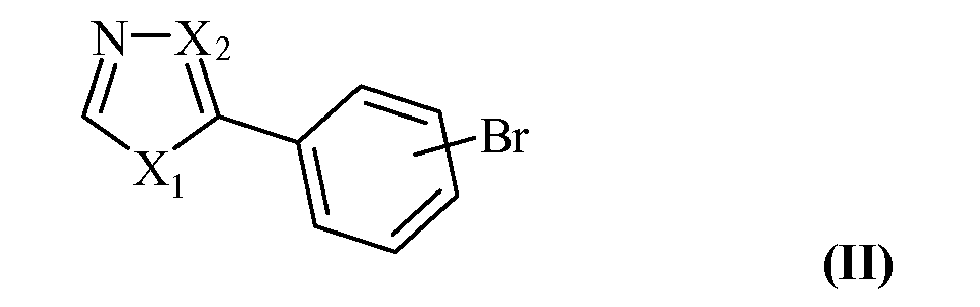
- with,
- (i) 4-methylphenyllithium; and then
- (ii) n-hexyllithium; and then
- (iii) triisopropylborate.
- In a further aspect of the invention there is provided a process for the preparation of compounds of the Formula I

- X1 is selected from O, NR1 or S; and
- X2 is selected from CH or N;
- the sequential reaction of compounds of the Formula II

- with,
- (i) methyllithium; and then
- (ii) n-hexyllithium; and then
- (iii) triisopropylborate.
- In a further aspect of the invention there is provided a process for the preparation of compounds of the Formula I

- X1 is O; and
- X2 is N;
- the sequential reaction of compounds of the Formula II

- with,
- (i) methyllithium; and then
- (ii) n-butyllithium; and then
- (iii) triisopropylborate.
- In a further aspect of the invention there is provided a process for the preparation of compounds of the Formula I,

- X1 is O; and
- X2 is N;
- the sequential reaction of compounds of the Formula II
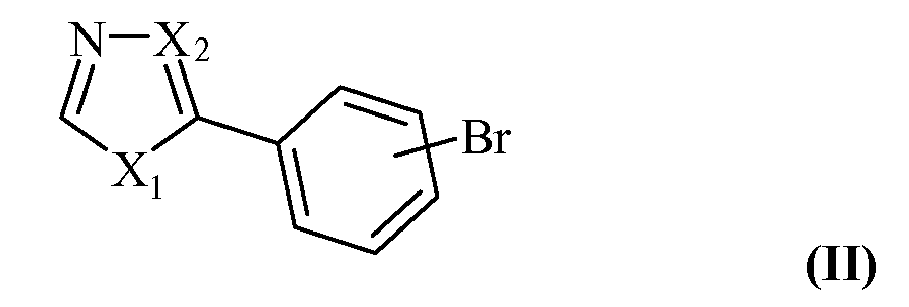
- with,
- (i) 4-methyphenyllithium; and then
- (ii) n-butyllithium; and then
- (iii) triisopropylborate.
- Compounds of the formula (II) may be prepared according to the experimental methods and procedures disclosed in Bioorganic & Medicinal Chemistry Letters, 2002, 12(20), 2879-2882; Eur. J. Med. Chem., 2000, 35, 157-162; Helvetica Chimica Acta, 1950, 33, 1271-1276; Eur. J. Med. Chem., 1985, 20(3), 257-66 and J. Het. Chem., 1989, 26, 1341.
- A further aspect of the present invention provides the use of [4-(1,3,4-oxadiazol-2-yl)phenyl] boronic acid, prepared according to the present invention, in the preparation of compounds of Formula IV which are intermediates useful in the preparation of N-(3-methoxy-5-methylpyrazin-2-yl)-2-(4-[1,3,4-oxadiazol-2-yl]phenyl)pyridine-3-sulphonamide.
- N-(3-Methoxy-5-methylpyrazin-2-yl)-2-(4-[1,3,4-oxadiazol-2-yl]phenyl)pyridine-3-sulphonamide is prepared by deprotecting compounds of Formula IV.
- In this aspect of the invention [4-(1,3,4-oxadiazol-2-yl)phenyl]boronic acid is coupled with compounds of Formula III to form compounds of Formula IV.

- Particularly this reaction takes place in an aqueous solvent, for example methanol, ethanol, isopropanol, industrial methylated spirit (IMS), isobutanol, NMP (N-methylpyrrolidinone), DMF; with or without an organic phase, for example toluene or xylenes at a temperature in the range, for example 60 to 100°C more particularly 75 to 85°C, in the presence of:
- (i) the boronic acid
- (ii) a suitable source of palladium (0), for example PdCl2, Pd(Ph3P)4 or Pd(OAc)2;
- (iii) a suitable ligand, for example triphenylphosphine or 3,3',3"-phosphinidyne tris(benzenesulphonic acid) trisodium salt;
- (iv) a base, for example triethylamine, benzyldimethylamine, N-methylmorpholine, N-methylpiperidine, triethanolamine, ethyldiethanolamine, diisopropylethylamine, potassium acetate, cesium fluoride or potassium fluoride.
- Particularly the source of palladium is palladium acetate.
- Particularly the base is N-methylmorpholine. In another aspect, particularly the base is triethylamine.
- Particularly this reaction takes place in an aqueous solvent without an organic phase. In another aspect, particularly this reaction takes place in an aqueous solvent with an organic phase. Where this reaction takes place in an aqueous solvent with an organic phase, particularly the organic phase comprises toluene. In another aspect of the present invention, where this reaction takes place in an aqueous solvent with an organic phase, particularly the organic phase comprises xylene.
- In another aspect, this reaction more specifically takes place in the presence of palladium acetate, 3,3',3"-phosphinidyne tris(benzenesulphonic acid) trisodium salt, N-methylmorpholine in water and isopropanol.
- In another aspect, this reaction more specifically takes place in the presence of palladium acetate, 3,3',3"-phosphinidyne tris(benzenesulphonic acid) trisodium salt, triethylamine, xylene, water and IMS.
- The molar ratios of the reagents used in process steps (i), (ii), (iii) and (iv), are preferably in the range from 1.0-2.0: 0.02-0.3: 0.06-0.9: 1.5-5.0 respectively, but more preferably in the range 1.4-1.6: 0.03-0.1: 0.09-0.3: 2.0-3.0 respectively.
- In compounds of Formula III or Formula IV, P is a nitrogen-protecting group. Suitable methods for protection are those known to those skilled in the art. Conventional protecting groups may be used in accordance with standard practice (for illustration see T.W. Green, Protective Groups in Organic Synthesis, John Wiley and Sons, 1991).
- A suitable value for P is, for example, an acyl group, for example a C1-6alkanoyl group such as acetyl; an aroyl group, for example benzoyl; a C1-6alkoxycarbonyl group, for example a methoxycarbonyl, ethoxycarbonyl, isobutoxycarbonyl or tert-butoxycarbonyl group; an arylmethoxycarbonyl group, for example benzyloxycarbonyl; a phosphinyl group, for example diphenylphosphinyl; a benzyl group or a C2-6alkenyl group such as allyl.
- A suitable value for P is a C1-6alkoxycarbonyl group. More suitable values for P are a methoxycarbonyl, ethoxycarbonyl or isobutoxycarbonyl group. More specifically a value for P is isobutoxycarbonyl.
- The deprotection conditions for the nitrogen protecting groups described herein necessarily vary with the choice of protecting group. Thus, for example, an acyl group such as a C1-6alkanoyl or a C1-6alkoxycarbonyl group or an aroyl group may be removed for example, by hydrolysis with a suitable base such as an alkali metal hydroxide, for example lithium or sodium hydroxide or an amine, for example ammonia. Alternatively an alkoxycarbonyl group such as a t-butoxycarbonyl group may be removed, for example, by treatment with a suitable acid as hydrochloric, sulphuric or phosphoric acid or trifluoroacetic acid and an arylmethoxycarbonyl group such as a benzyloxycarbonyl group may be removed, for example, by hydrogenation over a catalyst such as palladium-on-carbon, or by treatment with a Lewis acid for example boron tris(trifluoroacetate). A phosphinyl group may be removed by base hydrolysis such as an alkali metal hydroxide, for example lithium or sodium hydroxide or an amine, for example ammonia. A benzyl group may be removed by hydrogenation over a catalyst such as palladium-on-carbon. A C2-6alkenyl group such as allyl may be removed palladium assisted hydrolysis.
- In a further aspect of the invention there is provided a process for preparing a compound of Formula IV which comprises reacting [4-(1,3,4-oxadiazol-2-yl)phenyl]boronic acid with a compound of Formula III.
- In a further aspect of the invention there is provided a process for preparing a compound of Formula IV which comprises reacting [4-(1,3,4-oxadiazol-2-yl)phenyl]boronic acid, prepared according to the present invention, with a compound of Formula III.
- In this aspect of the invention, more specifically the invention provides the use of [4-(1,3,4-oxadiazol-2-yl)phenyl] boronic acid, prepared according to the present invention, in the preparation of N-(isobutoxycarbonyl) N-(3-methoxy-5-methylpyrazin-2-yl)-2-(4-[1,3,4-oxadiazol-2-yl]phenyl) pyridine-3-sulphonamide a compound of Formula IV and an intermediate useful in the preparation of N-(3-methoxy-5-methylpyrazin-2-yl)-2-(4-[1,3,4-oxadiazol-2-yl] phenyl)pyridine-3-sulphonamide.
- In this aspect of the invention [4-(1,3,4-oxadiazol-2-yl)phenyl]boronic acid is coupled with N-(isobutoxycarbonyl)-2-chloro-N-(3-methoxy-5-methylpyrazin-2-yl) pyridine-3-sulphonamide to form N-(isobutoxycarbonyl) N-(3-methoxy-5-methylpyrazin-2-yl)-2-(4-[1,3,4-oxadiazol-2-yl]phenyl) pyridine-3-sulphonamide.
- The preparation of N-(isobutoxycarbonyl)-2-chloro-N-(3-methoxy-5-methylpyrazin-2-yl) pyridine-3-sulphonamide is described in Example 1 of
WO96/40681 - Thus according to this aspect of the invention there is provided a process for preparing N-(isobutoxycarbonyl) N-(3-methoxy-5-methylpyrazin-2-yl)-2-(4-[1,3,4-oxadiazol-2-yl]phenyl) pyridine-3-sulphonamide which comprises coupling [4-(1,3,4-oxadiazol-2-yl)phenyl]boronic acid with N-(isobutoxycarbonyl)-2-chloro-N-(3-methoxy-5-methylpyrazin-2-yl) pyridine-3-sulphonamide.
- Therefore in a further aspect of the invention there is provided the use of [4-(1,3,4-oxadiazol-2-yl)phenyl]boronic acid in the preparation of N-(isobutoxycarbonyl) N-(3-methoxy-5-methylpyrazin-2-yl)-2-(4-[1,3,4-oxadiazol-2-yl]phenyl) pyridine-3-sulphonamide.
- In a further aspect of the invention there is provided the use of [4-(1,3,4-oxadiazol-2-yl)phenyl]boronic acid, prepared according to the process of the present invention, in the preparation of N-(isobutoxycarbonyl) N-(3-methoxy-5-methylpyrazin-2-yl)-2-(4-[1,3,4-oxadiazol-2-yl]phenyl) pyridine-3-sulphonamide.
- In a further aspect of the invention there is provided a compound of Formula IV.
- In a further aspect of the invention there is provided N-(isobutoxycarbonyl) N-(3-methoxy-5-methylpyrazin-2-yl)-2-(4-[1,3,4-oxadiazol-2-yl]phenyl) pyridine-3-sulphonamide.
- In a further aspect of the invention there is provided the use of N-(isobutoxycarbonyl) N-(3-methoxy-5-methylpyrazin-2-yl)-2-(4-[1,3,4-oxadiazol-2-yl]phenyl) pyridine-3-sulphonamide in the preparation of N-(3-methoxy-5-methylpyrazin-2-yl)-2-(4-[1,3,4-oxadiazol-2-yl] phenyl)pyridine-3-sulphonamide.
- The invention will now be illustrated by the following non-limiting Examples in which, unless otherwise stated:-
- (i) yields are intended for the assistance of the reader only and are not necessarily the maximum attainable by diligent process development;
- (ii) 1H NMR spectra were determined at either 270MHz or 400MHz in DMSOd6 using tetramethylsilane (TMS) as an internal standard, and are expressed as chemical shifts (delta values) in parts per million relative to TMS using conventional abbreviations for designation of major peaks: s, singlet; m, multiplet; t, triplet; br, broad; d, doublet.
- A solution of methyllithium (8% w/w in diethoxymethane) (65 ml) was added to a suspension of 2-(4-bromophenyl)-1,3,4-oxadiazole (40 g) in tetrahydrofuran (THF) (415 ml) at -65°C. After an hour a solution of n-butyllithium (2.5M in hexanes) (78 ml) was then added at -65°C. After an hour, triisopropylborate (90 ml)) was then added maintaining the reaction mixture at -65°C. The reaction mixture was held at -65°C for an hour and then warmed to -20°C and drowned out into a mixture of acetic acid (28 ml) in water (222 ml). The resultant solid was isolated, washed with THF and water, and dried to yield the title compound (28.96 g @ 95.1% w/w, 82%); 400MHz NMR Spectrum: (DMSOd6) 8.00 (s, 4H), 8.31 (s, 2H), 9.35 (s, 1H); Mass Spectrum MH+ 191.0628 (calc. using 11-B) Found 191.0633.
- The 2-(4-bromophenyl)-1,3,4-oxadiazole used as a starting material was prepared as follows:
- To a suspension of 4-bromobenzoic hydrazide (200 g) in industrial methylated spirit (700 ml) was added triethylorthoformate (309 ml), industrial methylated spirit (100 ml) and sulphuric acid (0.8 ml). The reaction mixture was heated to reflux for 1 hour. The reaction mixture was cooled to 0-5°C and product crystallised. Product was isolated, washed and dried to yield 2-(4-bromophenyl)-1,3,4-oxadiazole (186.1 g, 89.9%). 400MHz NMR Spectrum: (DMSOd6) 9.35 (s, 1H), 7.98 (d, 1H), 7.95 (d, 1H), 7.84 (d, 1H), 7.81 (d, 1H); Mass Spectrum
MH+ 224.9663 (calc. using 79-Br) Found 224.9701. - Lithium granules (8.2 g) and tetrahydrofuran (670 g) were charged to a reactor under an argon atmosphere and the mixture cooled to -35°C. 4-Chlorotoluene (74.3 g) was added at -35°C and the mixture was held at this temperature for 6 hours. The resultant solution was added to a suspension of 2-(4-bromophenyl)-1,3,4-oxadiazole (124.4 g) in tetrahydrofuran (800 g) at -65°C. After 30 mins a solution of n-hexyllithium (33%w/w in hexanes) (240ml) was then added at -65°C. After a futher 30 min triisopropylborate (230.8 g) was then added maintaining the reaction mixture at -65°C. The reaction mixture was allowed to warm to -35°C and drowned out into a solution of acetic acid (91.5 g) in water (688 g). The resultant solid was isolated, washed with THF and water, and dried to yield the title compound (92.2 g, 88%).
- Example 2 was repeated but the charge of 4-chlorotoluene increased from 1.06 moles to 1.30 moles. The yield of the title compound increased to 89.3%.
- Tetrahydrofuran (250 g) was charged to a mixture of lithium granules (3.02 g) and biphenyl (0.01 g) under an argon atmosphere and the mixture cooled to -30°C.
2-Chlorotoluene
(27.55 g) was slowly added at -30°C. The reaction was held at -30°C for 6 hours and then cooled to -65°C. A mixture of 2-(4-bromophenyl)-1,3,4-oxadiazole (50.0 g) in THF (300 g) was slowly added at -65°C. The reaction was held at -65°C for 30 minutes then a solution of n-hexyllithium (33%w/w in hexanes, 86 ml) was added at -65°C. The reaction was held at
-65°C for 30 minutes and then trimethylborate (48.7 g) was added at -65°C. The reaction was held at -65°C for 10 minutes then methanol (55.3 g) was added followed by 4-methyl-2-pentanone (240 g). The reaction mixture was warmed and the low boiling solvents distilled off under vacuum to a maximum temperature of 55°C. The residual mixture was cooled to 0°C and 10%w/w sulphuric acid (92 g) was added followed by water (92 g) whilst maintaining the temperature below 7°C. Product precipitated. The pH was adjusted to 6.5 by the addition of more 10%w/w sulphuric acid (85.3 g). The mixture was heated to 40°C then cooled back to 5-10°C. Product was isolated and washed with THF (56g) and water (60g), yielding wet title compound (25.2 g, 60%). - Tetrahydrofuran was charged to lithium granules (7.6 g) under an argon atmosphere and the mixture cooled to -30°C. 2-Chlorotoluene (69.4 g) was slowly added at -30°C. The reaction was held at -30°C for 6 hours then added to a suspension of 2-(4-bromophenyl)-1,3,4-oxadiazole (124.4 g) in tetrahydrofuran (800 g) at -65°C. The reaction was held at -65°C for 30 minutes then a solution of n-hexyllithium (33%w/w in hexanes, 245 ml) was added at -65°C. The reaction was held at -65°C for 30 minutes and then trimethylborate (230.8 g) was added at -65°C. The reaction was held at -65°C for 30 minutes then methanol (175 ml) was added followed by 4-methyl-2-pentanone (600 g). The reaction mixture was warmed and the low boiling solvents distilled off under vacuum to a maximum temperature of 50°C. The reaction mixture was cooled to 5-10°C and the pH adjusted to 6.5 by the addition of 5%w/w sulphuric acid (990.5 g). Product precipitated. The mixture was heated to 40°C then cooled back to 10°C. Product was isolated, washed with THF and water, and dried yielding the title compound (79.3 g, 75.5%).
- Example 4 was repeated but chlorobenzene (61.6 g) was used instead of 2-chlorotoluene. The isolated yield of the title compound was 87.8 g, (83.8%).
- Palladium acetate (0.4144g) and 3,3',3"-phosphinidyne tris(benzenesulphonic acid) trisodium salt 30% w/w aq sol (3.26g) were dissolved in water (35ml) over 6 minutes in an ultrasonic bath. The yellow solution was added to a stirred slurry of [4-(1,3,4-oxadiazol-2-yl)phenyl] boronic acid (10g) and isobutyl [(2-chloropyridin-3-yl)sulfonyl](3-methoxy-5-methylpyrazin-2-yl)carbamate (16.86g) in xylene (100ml), industrial methylated spirit (50ml) and triethylamine (17ml). The catalyst dissolution flask was then washed in with water (5ml) and the reaction mixture heated to reflux (80°C) on an oil bath (105°C) and stirred at reflux for 24.5 hours. The reaction mixture was cooled to 30°C and filtered through a Whatman GF/B glass filter paper and the lower aqueous phase separated off. The reaction flask and filter cake was washed with xylene (20ml). The xylene wash was used to re-extract the aqueous phase. The combined organic phases were stirred and heated to reflux (85°C) in a clean 500ml 4-necked flask equipped with overhead stirrer, water condenser, and nitrogen atmosphere. Essochem solvent 30 (hydrocarbons Bp 100-130°C) (100ml) was added dropwise over 6 min and the mixture was allowed to self cool to ambient temperature and then further cooled to -5°C and held for 1 hour. The product was filtered off and washed with Essochem solvent 30 (50ml). The cake was dried on the filter for 3 hours to give 15.20g @100% strength, yield 76.8%. 270 MHz 1H-NMR Spectrum: 0.70 (d, 6H), 1.72 (m, 1H), 2.51 (s, 3H), 3.84 (d, 2H), 4.00 (s, 3H), 7.59 (m, 1H); 7.80 (d, 2H), 7.90 (s, 1H), 8.17 (d, 2H), 8.50 (s, 1H), 8.90 (m, 1H) and 9.00 (d, 1H). Mass Spectrum MH+ = 525.2 (C24H25N6O6S = 525.16).
- To a nitrogen purged 500mL multi necked flask equipped with an overhead stirrer was charged isobutyl [(2-chloropyridin-3-yl)sulfonyl](3-methoxy-5-methylpyrazin-2-yl)carbamate (22.15g), [4-(1,3,4-oxadiazol-2-yl)phenyl] boronic acid (12.26g), isopropanol (60ml), water (140ml) and 3,3',3"-phosphinidyne tris(benzenesulphonic acid) trisodium salt 30% w/w aq sol (13.7g). Agitation was started and palladium acetate (0.541g) was added after 10 minutes. N-Methylmorpholine (13.25ml) was added and the temperature was adjusted to 80°C. After 4h 20min toluene (140ml) was added and the temperature adjusted to 60°C. After a further 45 min the mixture was filtered through a 1µm glass fibre filter paper and the aqueous phase separated off. The reaction flask and filter cake was washed with toluene (22ml). The toluene wash was used to re-extract the aqueous phase and the organic layers were combined. These contained the title compound (22.8g, 90%) which was not isolated.
- To a nitrogen purged 150ml multi necked flask equipped with an overhead stirrer was charged isobutyl [(2-chloropyridin-3-yl)sulfonyl](3-methoxy-5-methylpyrazin-2-yl)carbamate (7.75g), [4-(1,3,4-oxadiazol-2-yl)phenyl] boronic acid (4.29g), isopropanol (21ml), water (49ml) and 3,3',3 "-phosphinidyne tris(benzenesulphonic acid) trisodium salt 30% w/w aq sol (2.88g). Agitation was started and palladium acetate (0.114g) was added after 10 minutes. Potassium fluoride (2.48g) was added and the temperature was adjusted to 80°C. After 5h toluene (49ml) was added and the temperature adjusted to 60°C. After a further 10min the mixture was filtered through a 1µm glass fibre filter paper and the aqueous phase separated off. The organic phase contained the title compound (7.36g, 83%) which was not isolated.
which comprises :-
which comprises :-
Claims (13)
- A process for the preparation of a compound of the Formula I
 X1 is selected from O, NR1 or S; andX2 is selected from CH or N;wherein R1 is a nitrogen-protecting group,
which comprises :-the sequential reaction of a compound of the Formula II with,(i) methyl- or an optionally substituted aryl- lithium; and then(ii) n-butyl-, s-butyl-, t-butyl- or n-hexyl- lithium; and then(iii) a borate ester.
 - The process according to claim 1 wherein X1 is O.
- The process according to claim 1 or 2 wherein X2 is N.
- The process according to any one of claims 1-3 wherein said methyl- or an optionally substituted aryl- lithium is 4-methylphenyllithium or methyllithium.
- The process according to any one of claims 1-4 wherein said n-butyl-, s-butyl-, t-butyl- or n-hexyl- lithium is n-hexyllithium or n-butyllithium.
- The process according to any one of claims 1-5 wherein said borate ester is triisopropylborate.
- [4-(1,3,4-Oxadiazol-2-yl)phenyl]boronic acid prepared by the process as claimed in any one of claims 1-6.
- A process for preparing compounds of Formula IV:


- The process according to claim 8 which takes place in the presence of(i) a source of palladium (0) selected from PdCl2, Pd(Ph3P)4 or Pd(OAc)2;(ii) a suitable ligand selected from triphenylphosphine or 3,3',3"-phosphinidyne tris(benzenesulphonic acid) trisodium salt;(iii) a base selected from triethylamine, benzyldimethylamine, N-methylmorpholine, N-methylpiperidine, triethanolamine, ethyldiethanolamine, diisopropylethylamine, potassium acetate, cesium fluoride or potassium fluoride.
- The process according to claim 8 or claim 9wherein said [4-(1,3,4-oxadiazol-2-yl) phenyl]boronic acid is prepared according to the process as claimed in any one of claims 1-7.
- The process according to any one of claims 8 - 10 wherein P is isobutoxycarbonyl.
- A compound of Formula IV:

- A compound of Formula IV as claimed in claim 11 which is N-(isobutoxycarbonyl) N-(3-methoxy-5-methylpyrazin-2-yl)-2-(4-[1,3,4-oxadiazol-2-yl]phenyl) pyridine-3-sulphonamide.
Priority Applications (3)
| Application Number | Priority Date | Filing Date | Title |
|---|---|---|---|
| PL09170107T PL2135873T3 (en) | 2004-02-20 | 2005-02-17 | Chemical coupling process with a phenyl boronic acid derivative |
| EP10180344A EP2325189A3 (en) | 2004-02-20 | 2005-02-17 | Chemical coupling process with a phenyl boronic acid derivative |
| CY20121100084T CY1112555T1 (en) | 2004-02-20 | 2012-01-24 | CHEMICAL COGNITION PROCESSING WITH A DEROYLIC ACID FINISH |
Applications Claiming Priority (2)
| Application Number | Priority Date | Filing Date | Title |
|---|---|---|---|
| GBGB0403744.6A GB0403744D0 (en) | 2004-02-20 | 2004-02-20 | Chemical process |
| EP05708373A EP1718655A2 (en) | 2004-02-20 | 2005-02-17 | Chemical process |
Related Parent Applications (2)
| Application Number | Title | Priority Date | Filing Date |
|---|---|---|---|
| EP05708373A Division EP1718655A2 (en) | 2004-02-20 | 2005-02-17 | Chemical process |
| EP05708373.5 Division | 2005-02-17 |
Related Child Applications (1)
| Application Number | Title | Priority Date | Filing Date |
|---|---|---|---|
| EP10180344.3 Division-Into | 2010-09-27 |
Publications (3)
| Publication Number | Publication Date |
|---|---|
| EP2135873A2 true EP2135873A2 (en) | 2009-12-23 |
| EP2135873A3 EP2135873A3 (en) | 2010-03-24 |
| EP2135873B1 EP2135873B1 (en) | 2011-11-30 |
Family
ID=32040047
Family Applications (3)
| Application Number | Title | Priority Date | Filing Date |
|---|---|---|---|
| EP05708373A Ceased EP1718655A2 (en) | 2004-02-20 | 2005-02-17 | Chemical process |
| EP09170107A Expired - Lifetime EP2135873B1 (en) | 2004-02-20 | 2005-02-17 | Chemical coupling process with a phenyl boronic acid derivative |
| EP10180344A Withdrawn EP2325189A3 (en) | 2004-02-20 | 2005-02-17 | Chemical coupling process with a phenyl boronic acid derivative |
Family Applications Before (1)
| Application Number | Title | Priority Date | Filing Date |
|---|---|---|---|
| EP05708373A Ceased EP1718655A2 (en) | 2004-02-20 | 2005-02-17 | Chemical process |
Family Applications After (1)
| Application Number | Title | Priority Date | Filing Date |
|---|---|---|---|
| EP10180344A Withdrawn EP2325189A3 (en) | 2004-02-20 | 2005-02-17 | Chemical coupling process with a phenyl boronic acid derivative |
Country Status (31)
| Country | Link |
|---|---|
| US (2) | US7626020B2 (en) |
| EP (3) | EP1718655A2 (en) |
| JP (2) | JP2007523906A (en) |
| KR (2) | KR20120036998A (en) |
| CN (1) | CN1922193B (en) |
| AR (1) | AR047810A1 (en) |
| AT (1) | ATE535532T1 (en) |
| AU (1) | AU2005214138B2 (en) |
| BR (1) | BRPI0507847A (en) |
| CA (1) | CA2555554A1 (en) |
| CL (1) | CL2011003138A1 (en) |
| CY (1) | CY1112555T1 (en) |
| DK (1) | DK2135873T3 (en) |
| ES (1) | ES2375201T3 (en) |
| GB (1) | GB0403744D0 (en) |
| HR (1) | HRP20120031T1 (en) |
| IL (2) | IL177505A (en) |
| MY (1) | MY142268A (en) |
| NO (1) | NO20064012L (en) |
| PL (1) | PL2135873T3 (en) |
| PT (1) | PT2135873E (en) |
| RS (1) | RS52300B (en) |
| RU (1) | RU2386636C2 (en) |
| SA (1) | SA05260017B1 (en) |
| SG (1) | SG153856A1 (en) |
| SI (1) | SI2135873T1 (en) |
| TW (1) | TWI347947B (en) |
| UA (1) | UA83418C2 (en) |
| UY (1) | UY28754A1 (en) |
| WO (1) | WO2005080403A2 (en) |
| ZA (1) | ZA200606579B (en) |
Families Citing this family (9)
| Publication number | Priority date | Publication date | Assignee | Title |
|---|---|---|---|---|
| GB0219660D0 (en) | 2002-08-23 | 2002-10-02 | Astrazeneca Ab | Therapeutic use |
| JO3598B1 (en) | 2006-10-10 | 2020-07-05 | Infinity Discovery Inc | Boronic acids and esters as inhibitors of fatty acid amide hydrolase |
| EP2079734A1 (en) * | 2006-10-25 | 2009-07-22 | NeuroSearch A/S | Oxadiazole and thiadiazole compounds and their use as nicotinic acetylcholine receptor modulators |
| AU2009233711B2 (en) * | 2008-04-09 | 2015-02-12 | Infinity Pharmaceuticals, Inc | Inhibitors of fatty acid amide hydrolase |
| WO2010118159A1 (en) | 2009-04-07 | 2010-10-14 | Infinity Pharmaceuticals, Inc. | Inhibitors of fatty acid amide hydrolase |
| WO2010118155A1 (en) | 2009-04-07 | 2010-10-14 | Infinity Pharmaceuticals, Inc. | Inhibitors of fatty acid amide hydrolase |
| BR112012019120A2 (en) | 2010-02-03 | 2016-06-28 | Infinity Pharmaceuticais Inc | solid form, pharmaceutical composition, method of preparing compound 1, method of treating a faah-mediated condition |
| CN102491973A (en) * | 2011-12-15 | 2012-06-13 | 南京友杰医药科技有限公司 | Synthetic method for ZD (Zero Defects)-4054 |
| EP3913068B1 (en) | 2015-10-12 | 2023-08-02 | Advanced Cell Diagnostics, Inc. | In situ detection of nucleotide variants in high noise samples, and compositions and methods related thereto |
Family Cites Families (53)
| Publication number | Priority date | Publication date | Assignee | Title |
|---|---|---|---|---|
| US5514691A (en) | 1993-05-20 | 1996-05-07 | Immunopharmaceutics, Inc. | N-(4-halo-isoxazolyl)-sulfonamides and derivatives thereof that modulate the activity of endothelin |
| US5464853A (en) | 1993-05-20 | 1995-11-07 | Immunopharmaceutics, Inc. | N-(5-isoxazolyl)biphenylsulfonamides, N-(3-isoxazolyl)biphenylsulfonamides and derivatives thereof that modulate the activity of endothelin |
| US5591761A (en) | 1993-05-20 | 1997-01-07 | Texas Biotechnology Corporation | Thiophenyl-, furyl-and pyrrolyl-sulfonamides and derivatives thereof that modulate the activity of endothelin |
| TW270116B (en) | 1991-04-25 | 1996-02-11 | Hoffmann La Roche | |
| RU2086544C1 (en) | 1991-06-13 | 1997-08-10 | Хоффманн-Ля Рош АГ | Benzenesulfonamide derivatives of pyrimidine or their salts, pharmaceutical composition for treatment of diseases associated with endothelin activity |
| TW224462B (en) | 1992-02-24 | 1994-06-01 | Squibb & Sons Inc | |
| NZ247440A (en) | 1992-05-06 | 1995-04-27 | Squibb & Sons Inc | Phenyl sulphonamide derivatives, preparation and pharmaceutical compositions thereof |
| US5965732A (en) | 1993-08-30 | 1999-10-12 | Bristol-Myers Squibb Co. | Sulfonamide endothelin antagonists |
| FR2711368B1 (en) * | 1993-09-16 | 1996-01-05 | Roussel Uclaf | New process for the preparation of sulfur derivatives of imidazole and the new intermediates obtained. |
| US6063911A (en) | 1993-12-01 | 2000-05-16 | Marine Polymer Technologies, Inc. | Methods and compositions for treatment of cell proliferative disorders |
| GB9504854D0 (en) | 1994-03-31 | 1995-04-26 | Zeneca Ltd | Nitrogen derivatives |
| GB9409618D0 (en) | 1994-05-13 | 1994-07-06 | Zeneca Ltd | Pyridine derivatives |
| WO1996009818A1 (en) | 1994-09-27 | 1996-04-04 | Merck & Co., Inc. | Endothelin receptor antagonists for the treatment of emesis |
| GB2295616A (en) | 1994-12-01 | 1996-06-05 | Zeneca Ltd | N-Diazine-benzenesulphonamide derivatives as endothelin receptor antagonists |
| US5760038A (en) * | 1995-02-06 | 1998-06-02 | Bristol-Myers Squibb Company | Substituted biphenyl sulfonamide endothelin antagonists |
| UA58494C2 (en) | 1995-06-07 | 2003-08-15 | Зенека Лімітед | N-heteroaryl-pyridinesulfonamide derivatives, pharmaceutical composition, process for preparing thereof and method for endothelin influence counteraction |
| GB9512697D0 (en) | 1995-06-22 | 1995-08-23 | Zeneca Ltd | Heterocyclic compounds |
| US5780435A (en) | 1995-12-15 | 1998-07-14 | Praecis Pharmaceuticals Incorporated | Methods for treating prostate cancer with LHRH-R antagonists |
| GB9704762D0 (en) * | 1997-03-07 | 1997-04-23 | Zeneca Ltd | Chemical process |
| WO1999048530A1 (en) | 1998-03-23 | 1999-09-30 | Merck & Co., Inc. | Combination therapy for the treatment of benign prostatic hyperplasia |
| NZ508154A (en) | 1998-04-29 | 2003-07-25 | Osi Pharm Inc | N-(3-ethynylphenylamino)-6,7-bis(2-methoxyethoxy)-4-quinazolinamine mesylate anhydrate and monohydrate |
| US6673832B1 (en) | 1998-05-04 | 2004-01-06 | Gudarz Davar | Methods for identifying compounds for treating pain |
| US6355678B1 (en) | 1998-06-29 | 2002-03-12 | Parker Hughes Institute | Inhibitors of the EGF-receptor tyrosine kinase and methods for their use |
| DE69942009D1 (en) | 1998-10-15 | 2010-03-25 | Imp Innovations Ltd | CONNECTIONS FOR THE TREATMENT OF WEIGHT LOSS |
| DE19857765A1 (en) * | 1998-12-15 | 2000-06-21 | Clariant Gmbh | Process for the preparation of para-oxadiazolyl-phenyl-boronic acids |
| US7566452B1 (en) | 1999-05-04 | 2009-07-28 | New York University | Cancer treatment with endothelin receptor antagonists |
| US6545048B1 (en) | 1999-06-29 | 2003-04-08 | California Institute Of Technology | Compositions and methods of treating cancer using compositions comprising an inhibitor or endothelin receptor activity |
| WO2001044239A2 (en) | 1999-12-15 | 2001-06-21 | Bristol-Myers Squibb Co. | Biphenyl sulfonamides as dual angiotensin endothelin receptor antagonists |
| DE60032517T2 (en) | 2000-02-16 | 2007-10-04 | Astellas Pharma Inc. | AGENTS AGAINST ENDOTHELIN DISEASES |
| EP1289558A2 (en) | 2000-05-31 | 2003-03-12 | Warner-Lambert Company Llc | Combinations of an endothelin receptor antagonist and an antiepileptic compound having pain alleviating properties or analgesic |
| TWI306760B (en) | 2000-08-07 | 2009-03-01 | Abbott Lab | Use of an endothelin et-a receptor antagonist and orally delivered pharmaceutical composition comprising the same |
| US20020055457A1 (en) | 2000-08-07 | 2002-05-09 | Janus Todd J. | Methods of treating cancer and the pain associated therewith using endothelin antagonists |
| DE10113366A1 (en) | 2001-03-20 | 2002-09-26 | Boehringer Ingelheim Pharma | Medicament for treating inflammatory or obstructive respiratory diseases, e.g. asthma or chronic obstructive pulmonary disease, containing synergistic combination of anticholinergic agent and endothelin antagonist |
| DE10059418A1 (en) * | 2000-11-30 | 2002-06-20 | Aventis Pharma Gmbh | Ortho, meta-substituted bisaryl compounds, processes for their preparation, their use as medicaments and pharmaceutical preparations containing them |
| US6573285B2 (en) | 2000-12-21 | 2003-06-03 | Bristol-Myers Squibb Co. | Method for preventing or treating pain by administering an endothelin antagonist |
| WO2002069906A2 (en) | 2001-03-06 | 2002-09-12 | Cellegy Pharmaceuticals, Inc. | Compounds and methods for the treatment of urogenital disorders |
| GB0108689D0 (en) | 2001-04-05 | 2001-05-30 | Medical Res Council | Neuropathologies associated with expression of TNF-a |
| US20030092757A1 (en) | 2001-04-11 | 2003-05-15 | Amitabh Singh | Favorable modulation of health-related quality of life and health-related quality-adjusted time-to-progression of disease in patients with prostate cancer |
| IL158071A0 (en) | 2001-04-11 | 2004-03-28 | Abbott Lab | Favorable modulation of health-related quality of life and health-related quality-adjusted time-to-progression of disease in patients with prostate cancer |
| WO2003006041A1 (en) | 2001-07-12 | 2003-01-23 | Takeda Chemical Industries, Ltd. | Preventives/remedies for malignant tumor |
| US20030104976A1 (en) | 2001-07-23 | 2003-06-05 | Gudarz Davar | Analgesic methods using endothelin receptor ligands |
| SE0102616D0 (en) * | 2001-07-25 | 2001-07-25 | Astrazeneca Ab | Novel compounds |
| WO2003013518A1 (en) * | 2001-08-03 | 2003-02-20 | Smithkline Beecham Corporation | Alpha-ketoamide derivatives as cathepsin k inhibitors |
| WO2003015820A1 (en) | 2001-08-10 | 2003-02-27 | Takeda Chemical Industries, Ltd. | GnRH AGONIST COMBINATION DRUGS |
| DE10155076A1 (en) | 2001-11-09 | 2003-05-22 | Merck Patent Gmbh | Use of endothelin receptor antagonists for the treatment of tumor diseases |
| US7973064B2 (en) | 2001-11-27 | 2011-07-05 | The Board Of Trustees Of The University Of Illinois | Method and composition for potentiating an opiate analgesic |
| GB0219660D0 (en) | 2002-08-23 | 2002-10-02 | Astrazeneca Ab | Therapeutic use |
| GB0223367D0 (en) | 2002-10-09 | 2002-11-13 | Astrazeneca Ab | Therapeutic treatment |
| GB0223854D0 (en) | 2002-10-12 | 2002-11-20 | Astrazeneca Ab | Therapeutic treatment |
| GB0320806D0 (en) | 2003-09-05 | 2003-10-08 | Astrazeneca Ab | Therapeutic treatment |
| DK1761515T3 (en) | 2003-12-20 | 2009-02-16 | Merck Patent Gmbh | 2- (hetero-) aryl-substituted tetrahydroquinoline derivatives |
| GB0425854D0 (en) | 2004-11-25 | 2004-12-29 | Astrazeneca Ab | Therapeutic treatment |
| GB0514743D0 (en) | 2005-07-19 | 2005-08-24 | Astrazeneca Ab | Salt |
-
2004
- 2004-02-20 GB GBGB0403744.6A patent/GB0403744D0/en not_active Ceased
-
2005
- 2005-02-17 ES ES09170107T patent/ES2375201T3/en not_active Expired - Lifetime
- 2005-02-17 EP EP05708373A patent/EP1718655A2/en not_active Ceased
- 2005-02-17 DK DK09170107.8T patent/DK2135873T3/en active
- 2005-02-17 KR KR1020127002878A patent/KR20120036998A/en not_active Ceased
- 2005-02-17 SG SG200904318-3A patent/SG153856A1/en unknown
- 2005-02-17 PL PL09170107T patent/PL2135873T3/en unknown
- 2005-02-17 PT PT09170107T patent/PT2135873E/en unknown
- 2005-02-17 RU RU2006133455/04A patent/RU2386636C2/en not_active IP Right Cessation
- 2005-02-17 EP EP09170107A patent/EP2135873B1/en not_active Expired - Lifetime
- 2005-02-17 US US10/598,116 patent/US7626020B2/en not_active Expired - Fee Related
- 2005-02-17 EP EP10180344A patent/EP2325189A3/en not_active Withdrawn
- 2005-02-17 RS RS20120025A patent/RS52300B/en unknown
- 2005-02-17 AU AU2005214138A patent/AU2005214138B2/en not_active Ceased
- 2005-02-17 AT AT09170107T patent/ATE535532T1/en active
- 2005-02-17 MY MYPI20050598A patent/MY142268A/en unknown
- 2005-02-17 UA UAA200609976A patent/UA83418C2/en unknown
- 2005-02-17 CN CN2005800054068A patent/CN1922193B/en not_active Expired - Fee Related
- 2005-02-17 BR BRPI0507847-4A patent/BRPI0507847A/en not_active IP Right Cessation
- 2005-02-17 UY UY28754A patent/UY28754A1/en not_active Application Discontinuation
- 2005-02-17 KR KR1020067019278A patent/KR101196111B1/en not_active Expired - Fee Related
- 2005-02-17 WO PCT/GB2005/000567 patent/WO2005080403A2/en not_active Ceased
- 2005-02-17 JP JP2006553660A patent/JP2007523906A/en active Pending
- 2005-02-17 CA CA002555554A patent/CA2555554A1/en not_active Abandoned
- 2005-02-17 SI SI200531447T patent/SI2135873T1/en unknown
- 2005-02-18 AR ARP050100607A patent/AR047810A1/en not_active Application Discontinuation
- 2005-02-18 TW TW094104918A patent/TWI347947B/en not_active IP Right Cessation
- 2005-02-19 SA SA5260017A patent/SA05260017B1/en unknown
-
2006
- 2006-08-07 ZA ZA200606579A patent/ZA200606579B/en unknown
- 2006-08-15 IL IL177505A patent/IL177505A/en not_active IP Right Cessation
- 2006-09-06 NO NO20064012A patent/NO20064012L/en not_active Application Discontinuation
-
2008
- 2008-10-12 IL IL194709A patent/IL194709A/en not_active IP Right Cessation
-
2009
- 2009-10-16 US US12/580,704 patent/US20100094010A1/en not_active Abandoned
-
2011
- 2011-08-17 JP JP2011178493A patent/JP2012031174A/en active Pending
- 2011-12-12 CL CL2011003138A patent/CL2011003138A1/en unknown
-
2012
- 2012-01-10 HR HR20120031T patent/HRP20120031T1/en unknown
- 2012-01-24 CY CY20121100084T patent/CY1112555T1/en unknown
Also Published As
Similar Documents
| Publication | Publication Date | Title |
|---|---|---|
| US20100094010A1 (en) | Chemical process | |
| US9328087B2 (en) | Methods for preparing oxazolidinones and compositions containing them | |
| US5310928A (en) | Process for preparing biphenyltetrazole compounds | |
| JP2018508524A (en) | Chemical methods for preparing pyrimidine derivatives and their intermediates | |
| TWI804079B (en) | Synthesis of labeled imidazo[1,2-a]pyrimidines | |
| RU2552350C2 (en) | Method of biphenylimidazole compounds | |
| HK1157789A (en) | Chemical coupling process with a phenyl boronic acid derivative | |
| JP2007523906A5 (en) | ||
| WO2016115962A1 (en) | Preparation method for nebivolol intermediate and preparation method for nebivolol | |
| HK1139689B (en) | Chemical coupling process with a phenyl boronic acid derivative | |
| MXPA06009399A (en) | Chemical process | |
| US7714127B2 (en) | Process for making heteroaryl amine intermediate compounds | |
| JP6221148B2 (en) | Method for preparing carboxamidine compounds | |
| JP2019196359A (en) | Chemical process for preparing pyrimidine derivatives and intermediates thereof | |
| TW201943707A (en) | Methods for preparing substituted dihydroindene-4-carboxamide compounds | |
| JP2021075535A (en) | Chemical process for preparing pyrimidine derivatives and intermediates thereof | |
| JPS58134081A (en) | Preparation of 4-amino-5-dialkoxymethylpyrimidine derivative | |
| JPH0725781B2 (en) | Hydrazine compound | |
| PL176124B1 (en) | Method of obtaining precursors of 2-n-butyl-4-chloro-1-{[2'-[2h-tetrazol-5-yl]-1,1-biphenyl-4-yl]methyl}-5-hydroxymethyl-1h-imidazole |
Legal Events
| Date | Code | Title | Description |
|---|---|---|---|
| PUAI | Public reference made under article 153(3) epc to a published international application that has entered the european phase |
Free format text: ORIGINAL CODE: 0009012 |
|
| 17P | Request for examination filed |
Effective date: 20090911 |
|
| AC | Divisional application: reference to earlier application |
Ref document number: 1718655 Country of ref document: EP Kind code of ref document: P |
|
| AK | Designated contracting states |
Kind code of ref document: A2 Designated state(s): AT BE BG CH CY CZ DE DK EE ES FI FR GB GR HU IE IS IT LI LT LU MC NL PL PT RO SE SI SK TR |
|
| PUAL | Search report despatched |
Free format text: ORIGINAL CODE: 0009013 |
|
| AK | Designated contracting states |
Kind code of ref document: A3 Designated state(s): AT BE BG CH CY CZ DE DK EE ES FI FR GB GR HU IE IS IT LI LT LU MC NL PL PT RO SE SI SK TR |
|
| AX | Request for extension of the european patent |
Extension state: AL BA HR LV MK YU |
|
| 17Q | First examination report despatched |
Effective date: 20100310 |
|
| REG | Reference to a national code |
Ref country code: HK Ref legal event code: DE Ref document number: 1139689 Country of ref document: HK |
|
| GRAP | Despatch of communication of intention to grant a patent |
Free format text: ORIGINAL CODE: EPIDOSNIGR1 |
|
| RIC1 | Information provided on ipc code assigned before grant |
Ipc: C07F 5/02 20060101AFI20110323BHEP Ipc: C07D 413/14 20060101ALI20110323BHEP Ipc: C07D 401/14 20060101ALI20110323BHEP |
|
| GRAS | Grant fee paid |
Free format text: ORIGINAL CODE: EPIDOSNIGR3 |
|
| GRAA | (expected) grant |
Free format text: ORIGINAL CODE: 0009210 |
|
| AC | Divisional application: reference to earlier application |
Ref document number: 1718655 Country of ref document: EP Kind code of ref document: P |
|
| AK | Designated contracting states |
Kind code of ref document: B1 Designated state(s): AT BE BG CH CY CZ DE DK EE ES FI FR GB GR HU IE IS IT LI LT LU MC NL PL PT RO SE SI SK TR |
|
| AX | Request for extension of the european patent |
Extension state: AL BA HR LV MK YU |
|
| REG | Reference to a national code |
Ref country code: CH Ref legal event code: EP Ref country code: GB Ref legal event code: FG4D |
|
| REG | Reference to a national code |
Ref country code: IE Ref legal event code: FG4D |
|
| REG | Reference to a national code |
Ref country code: RO Ref legal event code: EPE |
|
| REG | Reference to a national code |
Ref country code: HR Ref legal event code: TUEP Ref document number: P20120031 Country of ref document: HR |
|
| REG | Reference to a national code |
Ref country code: PT Ref legal event code: SC4A Free format text: AVAILABILITY OF NATIONAL TRANSLATION Effective date: 20120104 |
|
| REG | Reference to a national code |
Ref country code: SE Ref legal event code: TRGR |
|
| REG | Reference to a national code |
Ref country code: NL Ref legal event code: T3 |
|
| REG | Reference to a national code |
Ref country code: DK Ref legal event code: T3 |
|
| REG | Reference to a national code |
Ref country code: DE Ref legal event code: R096 Ref document number: 602005031526 Country of ref document: DE Effective date: 20120216 |
|
| REG | Reference to a national code |
Ref country code: ES Ref legal event code: FG2A Ref document number: 2375201 Country of ref document: ES Kind code of ref document: T3 Effective date: 20120227 |
|
| REG | Reference to a national code |
Ref country code: HR Ref legal event code: T1PR Ref document number: P20120031 Country of ref document: HR |
|
| PGFP | Annual fee paid to national office [announced via postgrant information from national office to epo] |
Ref country code: LU Payment date: 20120229 Year of fee payment: 8 |
|
| REG | Reference to a national code |
Ref country code: PL Ref legal event code: T3 |
|
| REG | Reference to a national code |
Ref country code: SK Ref legal event code: T3 Ref document number: E 10887 Country of ref document: SK |
|
| REG | Reference to a national code |
Ref country code: EE Ref legal event code: FG4A Ref document number: E006326 Country of ref document: EE Effective date: 20120105 |
|
| REG | Reference to a national code |
Ref country code: GR Ref legal event code: EP Ref document number: 20120400200 Country of ref document: GR Effective date: 20120305 |
|
| PGFP | Annual fee paid to national office [announced via postgrant information from national office to epo] |
Ref country code: CH Payment date: 20120213 Year of fee payment: 8 Ref country code: FR Payment date: 20120224 Year of fee payment: 8 Ref country code: IE Payment date: 20120209 Year of fee payment: 8 Ref country code: LT Payment date: 20120215 Year of fee payment: 8 |
|
| PGFP | Annual fee paid to national office [announced via postgrant information from national office to epo] |
Ref country code: DE Payment date: 20120215 Year of fee payment: 8 Ref country code: EE Payment date: 20120210 Year of fee payment: 8 Ref country code: TR Payment date: 20120214 Year of fee payment: 8 Ref country code: PT Payment date: 20120209 Year of fee payment: 8 |
|
| PGFP | Annual fee paid to national office [announced via postgrant information from national office to epo] |
Ref country code: SE Payment date: 20120215 Year of fee payment: 8 Ref country code: GB Payment date: 20120215 Year of fee payment: 8 Ref country code: RO Payment date: 20120113 Year of fee payment: 8 Ref country code: FI Payment date: 20120217 Year of fee payment: 8 Ref country code: IT Payment date: 20120227 Year of fee payment: 8 Ref country code: BE Payment date: 20120224 Year of fee payment: 8 Ref country code: GR Payment date: 20120229 Year of fee payment: 8 Ref country code: DK Payment date: 20120215 Year of fee payment: 8 |
|
| REG | Reference to a national code |
Ref country code: HU Ref legal event code: AG4A Ref document number: E013436 Country of ref document: HU |
|
| PGFP | Annual fee paid to national office [announced via postgrant information from national office to epo] |
Ref country code: NL Payment date: 20120217 Year of fee payment: 8 Ref country code: HU Payment date: 20120210 Year of fee payment: 8 |
|
| REG | Reference to a national code |
Ref country code: HK Ref legal event code: GR Ref document number: 1139689 Country of ref document: HK |
|
| PGFP | Annual fee paid to national office [announced via postgrant information from national office to epo] |
Ref country code: CY Payment date: 20120215 Year of fee payment: 8 |
|
| PLBE | No opposition filed within time limit |
Free format text: ORIGINAL CODE: 0009261 |
|
| STAA | Information on the status of an ep patent application or granted ep patent |
Free format text: STATUS: NO OPPOSITION FILED WITHIN TIME LIMIT |
|
| 26N | No opposition filed |
Effective date: 20120831 |
|
| REG | Reference to a national code |
Ref country code: DE Ref legal event code: R097 Ref document number: 602005031526 Country of ref document: DE Effective date: 20120831 |
|
| REG | Reference to a national code |
Ref country code: HR Ref legal event code: ODRP Ref document number: P20120031 Country of ref document: HR Payment date: 20130102 Year of fee payment: 9 |
|
| PGFP | Annual fee paid to national office [announced via postgrant information from national office to epo] |
Ref country code: BG Payment date: 20121227 Year of fee payment: 9 Ref country code: MC Payment date: 20121231 Year of fee payment: 9 |
|
| PGFP | Annual fee paid to national office [announced via postgrant information from national office to epo] |
Ref country code: PL Payment date: 20121220 Year of fee payment: 9 |
|
| PGFP | Annual fee paid to national office [announced via postgrant information from national office to epo] |
Ref country code: AT Payment date: 20120222 Year of fee payment: 8 |
|
| PGFP | Annual fee paid to national office [announced via postgrant information from national office to epo] |
Ref country code: IS Payment date: 20130107 Year of fee payment: 9 |
|
| PGFP | Annual fee paid to national office [announced via postgrant information from national office to epo] |
Ref country code: SI Payment date: 20130115 Year of fee payment: 9 |
|
| PGFP | Annual fee paid to national office [announced via postgrant information from national office to epo] |
Ref country code: ES Payment date: 20120213 Year of fee payment: 8 |
|
| REG | Reference to a national code |
Ref country code: PT Ref legal event code: MM4A Free format text: LAPSE DUE TO NON-PAYMENT OF FEES Effective date: 20130819 |
|
| BERE | Be: lapsed |
Owner name: ASTRAZENECA A.B. Effective date: 20130228 |
|
| REG | Reference to a national code |
Ref country code: NL Ref legal event code: V1 Effective date: 20130901 |
|
| REG | Reference to a national code |
Ref country code: DK Ref legal event code: EBP |
|
| REG | Reference to a national code |
Ref country code: LT Ref legal event code: MM4D Effective date: 20130217 |
|
| REG | Reference to a national code |
Ref country code: CH Ref legal event code: PL |
|
| REG | Reference to a national code |
Ref country code: SE Ref legal event code: EUG |
|
| REG | Reference to a national code |
Ref country code: EE Ref legal event code: MM4A Ref document number: E006326 Country of ref document: EE Effective date: 20130228 Ref country code: AT Ref legal event code: MM01 Ref document number: 535532 Country of ref document: AT Kind code of ref document: T Effective date: 20130228 |
|
| REG | Reference to a national code |
Ref country code: GR Ref legal event code: ML Ref document number: 20120400200 Country of ref document: GR Effective date: 20130904 |
|
| GBPC | Gb: european patent ceased through non-payment of renewal fee |
Effective date: 20130217 |
|
| PG25 | Lapsed in a contracting state [announced via postgrant information from national office to epo] |
Ref country code: FI Free format text: LAPSE BECAUSE OF NON-PAYMENT OF DUE FEES Effective date: 20130217 Ref country code: GR Free format text: LAPSE BECAUSE OF NON-PAYMENT OF DUE FEES Effective date: 20130904 Ref country code: SK Free format text: LAPSE BECAUSE OF NON-PAYMENT OF DUE FEES Effective date: 20130217 Ref country code: LT Free format text: LAPSE BECAUSE OF NON-PAYMENT OF DUE FEES Effective date: 20130217 Ref country code: NL Free format text: LAPSE BECAUSE OF NON-PAYMENT OF DUE FEES Effective date: 20130901 Ref country code: EE Free format text: LAPSE BECAUSE OF NON-PAYMENT OF DUE FEES Effective date: 20130228 Ref country code: PT Free format text: LAPSE BECAUSE OF NON-PAYMENT OF DUE FEES Effective date: 20130819 Ref country code: CH Free format text: LAPSE BECAUSE OF NON-PAYMENT OF DUE FEES Effective date: 20130228 Ref country code: CZ Free format text: LAPSE BECAUSE OF NON-PAYMENT OF DUE FEES Effective date: 20130217 Ref country code: AT Free format text: LAPSE BECAUSE OF NON-PAYMENT OF DUE FEES Effective date: 20130228 Ref country code: HU Free format text: LAPSE BECAUSE OF NON-PAYMENT OF DUE FEES Effective date: 20130218 Ref country code: LI Free format text: LAPSE BECAUSE OF NON-PAYMENT OF DUE FEES Effective date: 20130228 Ref country code: SE Free format text: LAPSE BECAUSE OF NON-PAYMENT OF DUE FEES Effective date: 20130218 |
|
| REG | Reference to a national code |
Ref country code: SK Ref legal event code: MM4A Ref document number: E 10887 Country of ref document: SK Effective date: 20130217 |
|
| REG | Reference to a national code |
Ref country code: FR Ref legal event code: ST Effective date: 20131031 |
|
| PG25 | Lapsed in a contracting state [announced via postgrant information from national office to epo] |
Ref country code: CY Free format text: LAPSE BECAUSE OF NON-PAYMENT OF DUE FEES Effective date: 20130217 |
|
| REG | Reference to a national code |
Ref country code: IE Ref legal event code: MM4A |
|
| REG | Reference to a national code |
Ref country code: DE Ref legal event code: R119 Ref document number: 602005031526 Country of ref document: DE Effective date: 20130903 |
|
| PG25 | Lapsed in a contracting state [announced via postgrant information from national office to epo] |
Ref country code: IT Free format text: LAPSE BECAUSE OF NON-PAYMENT OF DUE FEES Effective date: 20130217 |
|
| PG25 | Lapsed in a contracting state [announced via postgrant information from national office to epo] |
Ref country code: DK Free format text: LAPSE BECAUSE OF NON-PAYMENT OF DUE FEES Effective date: 20130228 Ref country code: DE Free format text: LAPSE BECAUSE OF NON-PAYMENT OF DUE FEES Effective date: 20130903 Ref country code: IE Free format text: LAPSE BECAUSE OF NON-PAYMENT OF DUE FEES Effective date: 20130217 Ref country code: BE Free format text: LAPSE BECAUSE OF NON-PAYMENT OF DUE FEES Effective date: 20130228 Ref country code: GB Free format text: LAPSE BECAUSE OF NON-PAYMENT OF DUE FEES Effective date: 20130217 Ref country code: FR Free format text: LAPSE BECAUSE OF NON-PAYMENT OF DUE FEES Effective date: 20130228 |
|
| PG25 | Lapsed in a contracting state [announced via postgrant information from national office to epo] |
Ref country code: RO Free format text: LAPSE BECAUSE OF NON-PAYMENT OF DUE FEES Effective date: 20130217 |
|
| REG | Reference to a national code |
Ref country code: ES Ref legal event code: FD2A Effective date: 20140409 |
|
| PG25 | Lapsed in a contracting state [announced via postgrant information from national office to epo] |
Ref country code: ES Free format text: LAPSE BECAUSE OF NON-PAYMENT OF DUE FEES Effective date: 20130218 |
|
| REG | Reference to a national code |
Ref country code: HR Ref legal event code: PBON Ref document number: P20120031 Country of ref document: HR Effective date: 20140217 |
|
| PG25 | Lapsed in a contracting state [announced via postgrant information from national office to epo] |
Ref country code: MC Free format text: LAPSE BECAUSE OF NON-PAYMENT OF DUE FEES Effective date: 20140228 |
|
| PG25 | Lapsed in a contracting state [announced via postgrant information from national office to epo] |
Ref country code: BG Free format text: LAPSE BECAUSE OF NON-PAYMENT OF DUE FEES Effective date: 20140930 Ref country code: IS Free format text: LAPSE BECAUSE OF FAILURE TO SUBMIT A TRANSLATION OF THE DESCRIPTION OR TO PAY THE FEE WITHIN THE PRESCRIBED TIME-LIMIT Effective date: 20140829 |
|
| PG25 | Lapsed in a contracting state [announced via postgrant information from national office to epo] |
Ref country code: SI Free format text: LAPSE BECAUSE OF NON-PAYMENT OF DUE FEES Effective date: 20140218 |
|
| REG | Reference to a national code |
Ref country code: SI Ref legal event code: KO00 Effective date: 20141010 |
|
| PG25 | Lapsed in a contracting state [announced via postgrant information from national office to epo] |
Ref country code: PL Free format text: LAPSE BECAUSE OF NON-PAYMENT OF DUE FEES Effective date: 20140217 |
|
| REG | Reference to a national code |
Ref country code: PL Ref legal event code: LAPE |
|
| PG25 | Lapsed in a contracting state [announced via postgrant information from national office to epo] |
Ref country code: LU Free format text: LAPSE BECAUSE OF NON-PAYMENT OF DUE FEES Effective date: 20130217 |
|
| PG25 | Lapsed in a contracting state [announced via postgrant information from national office to epo] |
Ref country code: TR Free format text: LAPSE BECAUSE OF NON-PAYMENT OF DUE FEES Effective date: 20130217 |