EP2135620A1 - Ocular hypotensive agent comprising compound capable of inhibiting histone deacetylase as active ingredient - Google Patents
Ocular hypotensive agent comprising compound capable of inhibiting histone deacetylase as active ingredient Download PDFInfo
- Publication number
- EP2135620A1 EP2135620A1 EP08739138A EP08739138A EP2135620A1 EP 2135620 A1 EP2135620 A1 EP 2135620A1 EP 08739138 A EP08739138 A EP 08739138A EP 08739138 A EP08739138 A EP 08739138A EP 2135620 A1 EP2135620 A1 EP 2135620A1
- Authority
- EP
- European Patent Office
- Prior art keywords
- group
- carboxylic acid
- pyridine
- acid amide
- ureidomethyl
- Prior art date
- Legal status (The legal status is an assumption and is not a legal conclusion. Google has not performed a legal analysis and makes no representation as to the accuracy of the status listed.)
- Withdrawn
Links
- 0 CC(C)(C)OC(Nc(cccc1)c1NC(c1ncc(CN(CCCN(C)C)C(NCCc2ccccc2)=*)cc1)=O)=O Chemical compound CC(C)(C)OC(Nc(cccc1)c1NC(c1ncc(CN(CCCN(C)C)C(NCCc2ccccc2)=*)cc1)=O)=O 0.000 description 11
- SUDCGJIWBXPFPG-UHFFFAOYSA-N CC(C)(C)OC(C1=CC1)Nc1ccccc1NC(c1ncc(CN(CCN(C)C)C(Nc2cc(Cl)ccc2)=O)cc1)=O Chemical compound CC(C)(C)OC(C1=CC1)Nc1ccccc1NC(c1ncc(CN(CCN(C)C)C(Nc2cc(Cl)ccc2)=O)cc1)=O SUDCGJIWBXPFPG-UHFFFAOYSA-N 0.000 description 1
- ZSVGSQUKLHMGOV-UHFFFAOYSA-N CC(C)(C)OC(CCNCc(cc1)cnc1C(Nc1ccccc1NC(OC(C)(C)C)=O)=O)=O Chemical compound CC(C)(C)OC(CCNCc(cc1)cnc1C(Nc1ccccc1NC(OC(C)(C)C)=O)=O)=O ZSVGSQUKLHMGOV-UHFFFAOYSA-N 0.000 description 1
- FWMTYMIAZLGNPM-UHFFFAOYSA-N CC(C)(C)OC(Nc(cccc1)c1NC(c1cnc(CN(CCN(C)C)C(Nc2ccc3OCCOc3c2)=O)cc1)=O)=O Chemical compound CC(C)(C)OC(Nc(cccc1)c1NC(c1cnc(CN(CCN(C)C)C(Nc2ccc3OCCOc3c2)=O)cc1)=O)=O FWMTYMIAZLGNPM-UHFFFAOYSA-N 0.000 description 1
- UPAVVXZHGIQEFD-UHFFFAOYSA-N CC(C)(C)OC(Nc(cccc1)c1NC(c1cnc(CN(CCN(C)C)C(Nc2cccc(C)c2)=O)cc1)=O)=O Chemical compound CC(C)(C)OC(Nc(cccc1)c1NC(c1cnc(CN(CCN(C)C)C(Nc2cccc(C)c2)=O)cc1)=O)=O UPAVVXZHGIQEFD-UHFFFAOYSA-N 0.000 description 1
- ZARWMSGJIUDNLX-UHFFFAOYSA-N CC(C)(C)OC(Nc(cccc1)c1NC(c1ncc(CN(CCCN(C)C)C(Nc2ccc(C(F)(F)F)cc2)=O)cc1)=O)=O Chemical compound CC(C)(C)OC(Nc(cccc1)c1NC(c1ncc(CN(CCCN(C)C)C(Nc2ccc(C(F)(F)F)cc2)=O)cc1)=O)=O ZARWMSGJIUDNLX-UHFFFAOYSA-N 0.000 description 1
- WUBCLTAHOXQGNK-UHFFFAOYSA-N CC(C)(C)OC(Nc(cccc1)c1NC(c1ncc(CN(CCCN2CCOCC2)C(Nc2ccncc2)=O)cc1)=O)=O Chemical compound CC(C)(C)OC(Nc(cccc1)c1NC(c1ncc(CN(CCCN2CCOCC2)C(Nc2ccncc2)=O)cc1)=O)=O WUBCLTAHOXQGNK-UHFFFAOYSA-N 0.000 description 1
- PDJXKSAWRDHRCQ-UHFFFAOYSA-N CC(C)(C)OC(Nc1ccccc1NC(c1ccc(CN(CCCN2CCOCC2)C(Nc2cccc(C)c2)=O)cn1)=O)=O Chemical compound CC(C)(C)OC(Nc1ccccc1NC(c1ccc(CN(CCCN2CCOCC2)C(Nc2cccc(C)c2)=O)cn1)=O)=O PDJXKSAWRDHRCQ-UHFFFAOYSA-N 0.000 description 1
- ORCRJXPLMBKZNM-UHFFFAOYSA-N CC(C)(C)OC(Nc1ccccc1NC(c1cnc(CNCCN(C)C)cc1)=O)=O Chemical compound CC(C)(C)OC(Nc1ccccc1NC(c1cnc(CNCCN(C)C)cc1)=O)=O ORCRJXPLMBKZNM-UHFFFAOYSA-N 0.000 description 1
- HFXGXGBTFKZKNP-UHFFFAOYSA-O CC(C)NC(N(CCCN1CC[OH+]CC1)Cc1ccc(C(Nc2ccccc2NC(OC(C)(C)C)=O)=O)nc1)O Chemical compound CC(C)NC(N(CCCN1CC[OH+]CC1)Cc1ccc(C(Nc2ccccc2NC(OC(C)(C)C)=O)=O)nc1)O HFXGXGBTFKZKNP-UHFFFAOYSA-O 0.000 description 1
- YWHAQHKQTVFKIK-UHFFFAOYSA-N COc(cc1)ccc1NC(N(CCOC(Nc(cc1)ccc1OC)=O)Cc1ccc(C(Nc2ccccc2N)=O)nc1)=O Chemical compound COc(cc1)ccc1NC(N(CCOC(Nc(cc1)ccc1OC)=O)Cc1ccc(C(Nc2ccccc2N)=O)nc1)=O YWHAQHKQTVFKIK-UHFFFAOYSA-N 0.000 description 1
- JWNVKUFQWHNMBB-UHFFFAOYSA-N Nc1ccccc1NC(c1ncc(CN(CCOC(Nc(cc2)cc3c2OCCO3)=O)C(Nc2ccc3OCCOc3c2)=O)cc1)=O Chemical compound Nc1ccccc1NC(c1ncc(CN(CCOC(Nc(cc2)cc3c2OCCO3)=O)C(Nc2ccc3OCCOc3c2)=O)cc1)=O JWNVKUFQWHNMBB-UHFFFAOYSA-N 0.000 description 1
- OYKBQNOPCSXWBL-SNAWJCMRSA-N ONC(/C=C/c1cccc(C(NO)=O)c1)=O Chemical compound ONC(/C=C/c1cccc(C(NO)=O)c1)=O OYKBQNOPCSXWBL-SNAWJCMRSA-N 0.000 description 1
Classifications
-
- A—HUMAN NECESSITIES
- A61—MEDICAL OR VETERINARY SCIENCE; HYGIENE
- A61K—PREPARATIONS FOR MEDICAL, DENTAL OR TOILETRY PURPOSES
- A61K31/00—Medicinal preparations containing organic active ingredients
- A61K31/16—Amides, e.g. hydroxamic acids
- A61K31/165—Amides, e.g. hydroxamic acids having aromatic rings, e.g. colchicine, atenolol, progabide
-
- C—CHEMISTRY; METALLURGY
- C07—ORGANIC CHEMISTRY
- C07D—HETEROCYCLIC COMPOUNDS
- C07D213/00—Heterocyclic compounds containing six-membered rings, not condensed with other rings, with one nitrogen atom as the only ring hetero atom and three or more double bonds between ring members or between ring members and non-ring members
- C07D213/02—Heterocyclic compounds containing six-membered rings, not condensed with other rings, with one nitrogen atom as the only ring hetero atom and three or more double bonds between ring members or between ring members and non-ring members having three double bonds between ring members or between ring members and non-ring members
- C07D213/04—Heterocyclic compounds containing six-membered rings, not condensed with other rings, with one nitrogen atom as the only ring hetero atom and three or more double bonds between ring members or between ring members and non-ring members having three double bonds between ring members or between ring members and non-ring members having no bond between the ring nitrogen atom and a non-ring member or having only hydrogen or carbon atoms directly attached to the ring nitrogen atom
- C07D213/60—Heterocyclic compounds containing six-membered rings, not condensed with other rings, with one nitrogen atom as the only ring hetero atom and three or more double bonds between ring members or between ring members and non-ring members having three double bonds between ring members or between ring members and non-ring members having no bond between the ring nitrogen atom and a non-ring member or having only hydrogen or carbon atoms directly attached to the ring nitrogen atom with hetero atoms or with carbon atoms having three bonds to hetero atoms with at the most one bond to halogen, e.g. ester or nitrile radicals, directly attached to ring carbon atoms
- C07D213/78—Carbon atoms having three bonds to hetero atoms, with at the most one bond to halogen, e.g. ester or nitrile radicals
- C07D213/81—Amides; Imides
-
- A—HUMAN NECESSITIES
- A61—MEDICAL OR VETERINARY SCIENCE; HYGIENE
- A61K—PREPARATIONS FOR MEDICAL, DENTAL OR TOILETRY PURPOSES
- A61K31/00—Medicinal preparations containing organic active ingredients
- A61K31/33—Heterocyclic compounds
- A61K31/395—Heterocyclic compounds having nitrogen as a ring hetero atom, e.g. guanethidine or rifamycins
- A61K31/40—Heterocyclic compounds having nitrogen as a ring hetero atom, e.g. guanethidine or rifamycins having five-membered rings with one nitrogen as the only ring hetero atom, e.g. sulpiride, succinimide, tolmetin, buflomedil
-
- A—HUMAN NECESSITIES
- A61—MEDICAL OR VETERINARY SCIENCE; HYGIENE
- A61K—PREPARATIONS FOR MEDICAL, DENTAL OR TOILETRY PURPOSES
- A61K31/00—Medicinal preparations containing organic active ingredients
- A61K31/33—Heterocyclic compounds
- A61K31/395—Heterocyclic compounds having nitrogen as a ring hetero atom, e.g. guanethidine or rifamycins
- A61K31/435—Heterocyclic compounds having nitrogen as a ring hetero atom, e.g. guanethidine or rifamycins having six-membered rings with one nitrogen as the only ring hetero atom
- A61K31/44—Non condensed pyridines; Hydrogenated derivatives thereof
-
- A—HUMAN NECESSITIES
- A61—MEDICAL OR VETERINARY SCIENCE; HYGIENE
- A61K—PREPARATIONS FOR MEDICAL, DENTAL OR TOILETRY PURPOSES
- A61K31/00—Medicinal preparations containing organic active ingredients
- A61K31/33—Heterocyclic compounds
- A61K31/395—Heterocyclic compounds having nitrogen as a ring hetero atom, e.g. guanethidine or rifamycins
- A61K31/435—Heterocyclic compounds having nitrogen as a ring hetero atom, e.g. guanethidine or rifamycins having six-membered rings with one nitrogen as the only ring hetero atom
- A61K31/44—Non condensed pyridines; Hydrogenated derivatives thereof
- A61K31/4427—Non condensed pyridines; Hydrogenated derivatives thereof containing further heterocyclic ring systems
- A61K31/443—Non condensed pyridines; Hydrogenated derivatives thereof containing further heterocyclic ring systems containing a five-membered ring with oxygen as a ring hetero atom
-
- A—HUMAN NECESSITIES
- A61—MEDICAL OR VETERINARY SCIENCE; HYGIENE
- A61K—PREPARATIONS FOR MEDICAL, DENTAL OR TOILETRY PURPOSES
- A61K31/00—Medicinal preparations containing organic active ingredients
- A61K31/33—Heterocyclic compounds
- A61K31/395—Heterocyclic compounds having nitrogen as a ring hetero atom, e.g. guanethidine or rifamycins
- A61K31/435—Heterocyclic compounds having nitrogen as a ring hetero atom, e.g. guanethidine or rifamycins having six-membered rings with one nitrogen as the only ring hetero atom
- A61K31/44—Non condensed pyridines; Hydrogenated derivatives thereof
- A61K31/4427—Non condensed pyridines; Hydrogenated derivatives thereof containing further heterocyclic ring systems
- A61K31/4433—Non condensed pyridines; Hydrogenated derivatives thereof containing further heterocyclic ring systems containing a six-membered ring with oxygen as a ring hetero atom
-
- A—HUMAN NECESSITIES
- A61—MEDICAL OR VETERINARY SCIENCE; HYGIENE
- A61K—PREPARATIONS FOR MEDICAL, DENTAL OR TOILETRY PURPOSES
- A61K31/00—Medicinal preparations containing organic active ingredients
- A61K31/33—Heterocyclic compounds
- A61K31/395—Heterocyclic compounds having nitrogen as a ring hetero atom, e.g. guanethidine or rifamycins
- A61K31/435—Heterocyclic compounds having nitrogen as a ring hetero atom, e.g. guanethidine or rifamycins having six-membered rings with one nitrogen as the only ring hetero atom
- A61K31/44—Non condensed pyridines; Hydrogenated derivatives thereof
- A61K31/4427—Non condensed pyridines; Hydrogenated derivatives thereof containing further heterocyclic ring systems
- A61K31/4436—Non condensed pyridines; Hydrogenated derivatives thereof containing further heterocyclic ring systems containing a heterocyclic ring having sulfur as a ring hetero atom
-
- A—HUMAN NECESSITIES
- A61—MEDICAL OR VETERINARY SCIENCE; HYGIENE
- A61K—PREPARATIONS FOR MEDICAL, DENTAL OR TOILETRY PURPOSES
- A61K31/00—Medicinal preparations containing organic active ingredients
- A61K31/33—Heterocyclic compounds
- A61K31/395—Heterocyclic compounds having nitrogen as a ring hetero atom, e.g. guanethidine or rifamycins
- A61K31/435—Heterocyclic compounds having nitrogen as a ring hetero atom, e.g. guanethidine or rifamycins having six-membered rings with one nitrogen as the only ring hetero atom
- A61K31/44—Non condensed pyridines; Hydrogenated derivatives thereof
- A61K31/4427—Non condensed pyridines; Hydrogenated derivatives thereof containing further heterocyclic ring systems
- A61K31/4439—Non condensed pyridines; Hydrogenated derivatives thereof containing further heterocyclic ring systems containing a five-membered ring with nitrogen as a ring hetero atom, e.g. omeprazole
-
- A—HUMAN NECESSITIES
- A61—MEDICAL OR VETERINARY SCIENCE; HYGIENE
- A61K—PREPARATIONS FOR MEDICAL, DENTAL OR TOILETRY PURPOSES
- A61K31/00—Medicinal preparations containing organic active ingredients
- A61K31/33—Heterocyclic compounds
- A61K31/395—Heterocyclic compounds having nitrogen as a ring hetero atom, e.g. guanethidine or rifamycins
- A61K31/435—Heterocyclic compounds having nitrogen as a ring hetero atom, e.g. guanethidine or rifamycins having six-membered rings with one nitrogen as the only ring hetero atom
- A61K31/44—Non condensed pyridines; Hydrogenated derivatives thereof
- A61K31/4427—Non condensed pyridines; Hydrogenated derivatives thereof containing further heterocyclic ring systems
- A61K31/444—Non condensed pyridines; Hydrogenated derivatives thereof containing further heterocyclic ring systems containing a six-membered ring with nitrogen as a ring heteroatom, e.g. amrinone
-
- A—HUMAN NECESSITIES
- A61—MEDICAL OR VETERINARY SCIENCE; HYGIENE
- A61K—PREPARATIONS FOR MEDICAL, DENTAL OR TOILETRY PURPOSES
- A61K31/00—Medicinal preparations containing organic active ingredients
- A61K31/33—Heterocyclic compounds
- A61K31/395—Heterocyclic compounds having nitrogen as a ring hetero atom, e.g. guanethidine or rifamycins
- A61K31/535—Heterocyclic compounds having nitrogen as a ring hetero atom, e.g. guanethidine or rifamycins having six-membered rings with at least one nitrogen and one oxygen as the ring hetero atoms, e.g. 1,2-oxazines
- A61K31/5375—1,4-Oxazines, e.g. morpholine
- A61K31/5377—1,4-Oxazines, e.g. morpholine not condensed and containing further heterocyclic rings, e.g. timolol
-
- A—HUMAN NECESSITIES
- A61—MEDICAL OR VETERINARY SCIENCE; HYGIENE
- A61P—SPECIFIC THERAPEUTIC ACTIVITY OF CHEMICAL COMPOUNDS OR MEDICINAL PREPARATIONS
- A61P27/00—Drugs for disorders of the senses
-
- A—HUMAN NECESSITIES
- A61—MEDICAL OR VETERINARY SCIENCE; HYGIENE
- A61P—SPECIFIC THERAPEUTIC ACTIVITY OF CHEMICAL COMPOUNDS OR MEDICINAL PREPARATIONS
- A61P27/00—Drugs for disorders of the senses
- A61P27/02—Ophthalmic agents
-
- A—HUMAN NECESSITIES
- A61—MEDICAL OR VETERINARY SCIENCE; HYGIENE
- A61P—SPECIFIC THERAPEUTIC ACTIVITY OF CHEMICAL COMPOUNDS OR MEDICINAL PREPARATIONS
- A61P27/00—Drugs for disorders of the senses
- A61P27/02—Ophthalmic agents
- A61P27/06—Antiglaucoma agents or miotics
-
- A—HUMAN NECESSITIES
- A61—MEDICAL OR VETERINARY SCIENCE; HYGIENE
- A61P—SPECIFIC THERAPEUTIC ACTIVITY OF CHEMICAL COMPOUNDS OR MEDICINAL PREPARATIONS
- A61P43/00—Drugs for specific purposes, not provided for in groups A61P1/00-A61P41/00
-
- C—CHEMISTRY; METALLURGY
- C07—ORGANIC CHEMISTRY
- C07D—HETEROCYCLIC COMPOUNDS
- C07D207/00—Heterocyclic compounds containing five-membered rings not condensed with other rings, with one nitrogen atom as the only ring hetero atom
- C07D207/02—Heterocyclic compounds containing five-membered rings not condensed with other rings, with one nitrogen atom as the only ring hetero atom with only hydrogen or carbon atoms directly attached to the ring nitrogen atom
- C07D207/30—Heterocyclic compounds containing five-membered rings not condensed with other rings, with one nitrogen atom as the only ring hetero atom with only hydrogen or carbon atoms directly attached to the ring nitrogen atom having two double bonds between ring members or between ring members and non-ring members
- C07D207/32—Heterocyclic compounds containing five-membered rings not condensed with other rings, with one nitrogen atom as the only ring hetero atom with only hydrogen or carbon atoms directly attached to the ring nitrogen atom having two double bonds between ring members or between ring members and non-ring members with only hydrogen atoms, hydrocarbon or substituted hydrocarbon radicals, directly attached to ring carbon atoms
- C07D207/33—Heterocyclic compounds containing five-membered rings not condensed with other rings, with one nitrogen atom as the only ring hetero atom with only hydrogen or carbon atoms directly attached to the ring nitrogen atom having two double bonds between ring members or between ring members and non-ring members with only hydrogen atoms, hydrocarbon or substituted hydrocarbon radicals, directly attached to ring carbon atoms with substituted hydrocarbon radicals, directly attached to ring carbon atoms
- C07D207/333—Radicals substituted by oxygen or sulfur atoms
-
- C—CHEMISTRY; METALLURGY
- C07—ORGANIC CHEMISTRY
- C07D—HETEROCYCLIC COMPOUNDS
- C07D211/00—Heterocyclic compounds containing hydrogenated pyridine rings, not condensed with other rings
- C07D211/04—Heterocyclic compounds containing hydrogenated pyridine rings, not condensed with other rings with only hydrogen or carbon atoms directly attached to the ring nitrogen atom
- C07D211/06—Heterocyclic compounds containing hydrogenated pyridine rings, not condensed with other rings with only hydrogen or carbon atoms directly attached to the ring nitrogen atom having no double bonds between ring members or between ring members and non-ring members
- C07D211/08—Heterocyclic compounds containing hydrogenated pyridine rings, not condensed with other rings with only hydrogen or carbon atoms directly attached to the ring nitrogen atom having no double bonds between ring members or between ring members and non-ring members with hydrocarbon or substituted hydrocarbon radicals directly attached to ring carbon atoms
- C07D211/18—Heterocyclic compounds containing hydrogenated pyridine rings, not condensed with other rings with only hydrogen or carbon atoms directly attached to the ring nitrogen atom having no double bonds between ring members or between ring members and non-ring members with hydrocarbon or substituted hydrocarbon radicals directly attached to ring carbon atoms with substituted hydrocarbon radicals attached to ring carbon atoms
- C07D211/30—Heterocyclic compounds containing hydrogenated pyridine rings, not condensed with other rings with only hydrogen or carbon atoms directly attached to the ring nitrogen atom having no double bonds between ring members or between ring members and non-ring members with hydrocarbon or substituted hydrocarbon radicals directly attached to ring carbon atoms with substituted hydrocarbon radicals attached to ring carbon atoms with hydrocarbon radicals, substituted by doubly bound oxygen or sulfur atoms or by two oxygen or sulfur atoms singly bound to the same carbon atom
- C07D211/32—Heterocyclic compounds containing hydrogenated pyridine rings, not condensed with other rings with only hydrogen or carbon atoms directly attached to the ring nitrogen atom having no double bonds between ring members or between ring members and non-ring members with hydrocarbon or substituted hydrocarbon radicals directly attached to ring carbon atoms with substituted hydrocarbon radicals attached to ring carbon atoms with hydrocarbon radicals, substituted by doubly bound oxygen or sulfur atoms or by two oxygen or sulfur atoms singly bound to the same carbon atom by oxygen atoms
-
- C—CHEMISTRY; METALLURGY
- C07—ORGANIC CHEMISTRY
- C07D—HETEROCYCLIC COMPOUNDS
- C07D401/00—Heterocyclic compounds containing two or more hetero rings, having nitrogen atoms as the only ring hetero atoms, at least one ring being a six-membered ring with only one nitrogen atom
- C07D401/02—Heterocyclic compounds containing two or more hetero rings, having nitrogen atoms as the only ring hetero atoms, at least one ring being a six-membered ring with only one nitrogen atom containing two hetero rings
- C07D401/04—Heterocyclic compounds containing two or more hetero rings, having nitrogen atoms as the only ring hetero atoms, at least one ring being a six-membered ring with only one nitrogen atom containing two hetero rings directly linked by a ring-member-to-ring-member bond
-
- C—CHEMISTRY; METALLURGY
- C07—ORGANIC CHEMISTRY
- C07D—HETEROCYCLIC COMPOUNDS
- C07D401/00—Heterocyclic compounds containing two or more hetero rings, having nitrogen atoms as the only ring hetero atoms, at least one ring being a six-membered ring with only one nitrogen atom
- C07D401/02—Heterocyclic compounds containing two or more hetero rings, having nitrogen atoms as the only ring hetero atoms, at least one ring being a six-membered ring with only one nitrogen atom containing two hetero rings
- C07D401/12—Heterocyclic compounds containing two or more hetero rings, having nitrogen atoms as the only ring hetero atoms, at least one ring being a six-membered ring with only one nitrogen atom containing two hetero rings linked by a chain containing hetero atoms as chain links
-
- C—CHEMISTRY; METALLURGY
- C07—ORGANIC CHEMISTRY
- C07D—HETEROCYCLIC COMPOUNDS
- C07D405/00—Heterocyclic compounds containing both one or more hetero rings having oxygen atoms as the only ring hetero atoms, and one or more rings having nitrogen as the only ring hetero atom
- C07D405/02—Heterocyclic compounds containing both one or more hetero rings having oxygen atoms as the only ring hetero atoms, and one or more rings having nitrogen as the only ring hetero atom containing two hetero rings
- C07D405/12—Heterocyclic compounds containing both one or more hetero rings having oxygen atoms as the only ring hetero atoms, and one or more rings having nitrogen as the only ring hetero atom containing two hetero rings linked by a chain containing hetero atoms as chain links
-
- C—CHEMISTRY; METALLURGY
- C07—ORGANIC CHEMISTRY
- C07D—HETEROCYCLIC COMPOUNDS
- C07D405/00—Heterocyclic compounds containing both one or more hetero rings having oxygen atoms as the only ring hetero atoms, and one or more rings having nitrogen as the only ring hetero atom
- C07D405/14—Heterocyclic compounds containing both one or more hetero rings having oxygen atoms as the only ring hetero atoms, and one or more rings having nitrogen as the only ring hetero atom containing three or more hetero rings
-
- C—CHEMISTRY; METALLURGY
- C07—ORGANIC CHEMISTRY
- C07D—HETEROCYCLIC COMPOUNDS
- C07D409/00—Heterocyclic compounds containing two or more hetero rings, at least one ring having sulfur atoms as the only ring hetero atoms
- C07D409/02—Heterocyclic compounds containing two or more hetero rings, at least one ring having sulfur atoms as the only ring hetero atoms containing two hetero rings
- C07D409/12—Heterocyclic compounds containing two or more hetero rings, at least one ring having sulfur atoms as the only ring hetero atoms containing two hetero rings linked by a chain containing hetero atoms as chain links
-
- C—CHEMISTRY; METALLURGY
- C07—ORGANIC CHEMISTRY
- C07D—HETEROCYCLIC COMPOUNDS
- C07D413/00—Heterocyclic compounds containing two or more hetero rings, at least one ring having nitrogen and oxygen atoms as the only ring hetero atoms
- C07D413/02—Heterocyclic compounds containing two or more hetero rings, at least one ring having nitrogen and oxygen atoms as the only ring hetero atoms containing two hetero rings
- C07D413/12—Heterocyclic compounds containing two or more hetero rings, at least one ring having nitrogen and oxygen atoms as the only ring hetero atoms containing two hetero rings linked by a chain containing hetero atoms as chain links
-
- C—CHEMISTRY; METALLURGY
- C07—ORGANIC CHEMISTRY
- C07D—HETEROCYCLIC COMPOUNDS
- C07D417/00—Heterocyclic compounds containing two or more hetero rings, at least one ring having nitrogen and sulfur atoms as the only ring hetero atoms, not provided for by group C07D415/00
- C07D417/02—Heterocyclic compounds containing two or more hetero rings, at least one ring having nitrogen and sulfur atoms as the only ring hetero atoms, not provided for by group C07D415/00 containing two hetero rings
- C07D417/12—Heterocyclic compounds containing two or more hetero rings, at least one ring having nitrogen and sulfur atoms as the only ring hetero atoms, not provided for by group C07D415/00 containing two hetero rings linked by a chain containing hetero atoms as chain links
Definitions
- the present invention relates to an intraocular pressure-lowering agent comprising at least one pharmaceutically useful compound having a histone deacetylase (hereinafter referred to as "HDAC") inhibitory effect as an active ingredient.
- HDAC histone deacetylase
- the compound has an effect of morphological change on trabecular meshwork cells and/or an effect of intraocular pressure reduction, and is therefore useful as a preventive and/or therapeutic agent for a disease considered to be associated with aqueous humor circulation and/or intraocular pressure.
- the aqueous humor circulation in the eye is closely related to intraocular pressure, and the hindrance of the aqueous humor circulation has a considerable effect on the intraocular pressure.
- the intraocular pressure is increased to cause a disease considered to be associated with aqueous humor circulation or intraocular pressure such as glaucoma or ocular hypertension.
- aqueous humor is produced by filtration or active transport of plasma components and most aqueous humor flows out of the eyeball through the trabecular outflow pathway. That is, it becomes possible to prevent and/or treat a disease considered to be associated with aqueous humor circulation or intraocular pressure by changing the morphology of trabecular meshwork cells with a medicinal agent or the like to reduce the resistance to aqueous humor outflow thereby enhancing aqueous humor outflow.
- latrunculin A an actin polymerization inhibitor
- H-7 a myosin light-chain kinase (MLCK) inhibitor
- Y-39983 a Rho-kinase inhibitor
- eukaryotic chromosomal DNA wraps around core histone proteins, histones H2A, H2B, H3 and H4 to form a basic structure called nucleosome. Further, the nucleosome structures assemble to form a chromatin structure. Post-translational modifications of histones are closely related to the constitution of the chromatin structure, and as the post-translational modification, acetylation, methylation, phosphorylation, ubiquitylation and the like are known.
- histone acetylation is related to gene transcriptional induction, replication, repair and the like.
- histone acetylation is reversibly regulated by a histone acetyltransferase (hereinafter referred to as "HAT”) and a histone deacetylase.
- HAT histone acetyltransferase
- HDAC histone acetylation by HAT is enhanced and subsequent gene transcriptional induction, replication, repair and the like are activated, and therefore, various diseases considered to be associated with cell proliferation, senescence, etc. such as cancer, autoimmune diseases, neurodegenerative diseases and infectious diseases can be prevented and/or treated ( Protein, Nucleic Acid and Enzyme, Vol. 51. No. 14 (2006 ), JP-A-2005-272419 and JP-T-2006-517532 ).
- butyric acid which has an effect of cell cycle arrest, an effect of normalization and differentiation of transformed cells and the like
- trichostatin A which is a microbial metabolite and has an effect of cell cycle arrest, an effect of induction of differentiation and the like
- trapoxin which is a microbial metabolite and has an inhibitory effect of cell proliferation
- Antibiotics 43, 1524-1534 (1990 ) and J. Biol. Chem., 268, 22429-22435 (1993 ) and the like are known. Further, as an anticancer agent, compounds having an HDAC inhibitory effect such as SAHA, FK-228, MS 275, PXD-101, MGCD-0103, LBH-589, NSC-696085, CG-781 and CRA-026440 have been developed or on sale.
- the present inventors conducted intensive studies for finding a novel pharmacological effect of a compound having an HDAC inhibitory effect, and as a result, they found that the compound has an effect of morphological change on trabecular meshwork cells.
- the present inventors conducted a test for evaluation of intraocular-lowering effect by intracameral administration of the compound using male Japanese White rabbits, and as a result, they confirmed that the compound has an effect of intraocular pressure reduction, and thus completed the present invention.
- the compound having an HDAC inhibitory effect can be used as an intraocular pressure-lowering agent and is useful as a preventive and/or therapeutic agent for a disease considered to be associated with aqueous humor circulation and/or intraocular pressure.
- the invention is directed to:
- the compound represented by the following general formula (1) or a salt thereof (hereinafter referred to as "the present compound") is a novel compound which has not been written in any documents.
- the present invention provides intraocular pressure-lowering agent comprising a compound having an HDAC inhibitory effect as an active ingredient.
- the compound having an HDAC inhibitory effect has an effect of morphological change on trabecular meshwork cells and/or an effect of intraocular pressure reduction, and is therefore useful as a preventive and/or therapeutic agent for a disease associated with aqueous humor circulation and/or intraocular pressure, particularly as a therapeutic agent for glaucoma and/or ocular hypertension.
- the "compound having an HDAC inhibitory effect" in the present invention refers to any compounds which can inhibit HDAC including families or subfamilies thereof and is not limited. Preferred compounds are exemplified by those which exhibit an HDAC inhibitory effect in "Test for Evaluation of an HDAC Inhibitory Effect" under the item of "Pharmacological Tests”.
- halogen atom refers to a fluorine, chlorine, bromine or iodine atom.
- lower alkyl group refers to a straight-chain or branched alkyl group having 1 to 8, preferably 1 to 6 carbon atoms.
- lower alkenyl group refers to a straight -chain or branched alkenyl group having 2 to 8, preferably 2 to 6 carbon atoms. Specific examples thereof include vinyl, propenyl, butenyl, pentenyl, hexenyl, heptenyl, octenyl, isopropenyl, 2-methyl-1-propenyl and 2-methyl-2-butenyl groups.
- lower alkynyl group refers to a straight-chain or branched alkynyl group having 2 to 8, preferably 2 to 6 carbon atoms. Specific examples thereof include ethynyl, propynyl, butynyl, pentynyl, hexynyl, heptynyl, octynyl isobutynyl and isopentynyl groups.
- lower cycloalkyl group refers to a cycloalkyl group having 3 to 8, preferably 3 to 6 carbon atoms. Specific examples thereof include cyclopropyl, cyclobutyl, cyclopentyl, cyclohexyl, cycloheptyl and cyclooctyl groups.
- aryl group refers to a residue formed by removing one hydrogen atom from a monocyclic aromatic hydrocarbon group, or a bicyclic or tricyclic condensed polycyclic aromatic hydrocarbon having 6 to 14 carbon atoms. Specific examples thereof include phenyl, naphthyl, anthryl and phenanthryl groups.
- lower alkoxy group refers to a group formed by substituting the hydrogen atom of a hydroxy group with a lower alkyl group. Specific examples thereof include methoxy, ethoxy, n-propoxy, n-butoxy, n-pentyloxy, n-hexyloxy, n-heptyloxy, n-octyloxy, isopropoxy, isobutoxy, sec-butoxy, tert-butoxy and isopentyloxy groups.
- lower cycloalkyloxy group refers to a group formed by substituting the hydrogen atom of a hydroxy group with a lower cycloalkyl group. Specific examples thereof include cyclopropyloxy, cyclobutyloxy, cyclopentyloxy, cyclohexyloxy, cycloheptyloxy and cyclooctyloxy groups.
- aryloxy group refers to a group formed by substituting the hydrogen atom of a hydroxy group with an aryl group. Specific examples thereof include phenoxy, naphthoxy, anthryloxy and phenanthryloxy groups.
- lower alkylthio group refers to a group formed by substituting the hydrogen atom of a mercapto group with a lower alkyl group. Specific examples thereof include methylthio, ethylthio, n-propylthio, n-butylthio, n-pentylthio, n-hexylthio, n-heptylthio, n-octylthio, isopropylthio, isobutylthio, sec-butylthio, tert-butylthio and isopentylthio groups.
- lower cycloalkylthio group refers to a group formed by substituting the hydrogen atom of a mercapto group with a lower cycloalkyl group. Specific examples thereof include cyclopropylthio, cyclobutylthio, cyclopentylthio, cyclohexylthio, cycloheptylthio and cyclooctylthio groups.
- arylthio group refers to a group formed by substituting the hydrogen atom of a mercapto group with an aryl group. Specific examples thereof include phenylthio, naphthylthio, anthrylthio and phenanthrylthio groups.
- lower alkylcarbonyl group refers to a group formed by substituting the hydrogen atom of a formyl group with a lower alkyl group. Specific examples thereof include methylcarbonyl, ethylcarbonyl, n-propylcarbonyl, n-butylcarbonyl, n-pentylcarbonyl, n-hexylcarbonyl, n-heptylcarbonyl, n-octylcarbonyl, isopropylcarbonyl, isobutylcarbonyl, sec-butylcarbonyl, tert-butylcarbonyl and isopentylcarbonyl groups.
- lower alkoxycarbonyl group refers to a group formed by substituting the hydrogen atom of a formyl group with a lower alkoxy group. Specific examples thereof include methoxycarbonyl, ethoxycarbonyl, n-propoxycarbonyl, n-butoxycarbonyl, n-pentyloxycarbonyl, n-hexyloxycarbonyl, n-heptyloxycarbonyl, n-octyloxycarbonyl, isopropoxycarbonyl, isobutoxycarbonyl, sec-butoxycarbonyl, tert-butoxycarbonyl and isopentyloxycarbonyl groups.
- heterocyclic ring refers to a saturated or unsaturated monocyclic heterocyclic ring, or bicyclic or tricyclic condensed polycyclic heterocyclic ring having one or plural heteroatoms selected from a nitrogen atom, an oxygen atom and a sulfur atom in the ring.
- saturated monocyclic heterocyclic ring examples include aziridine, azetidine, pyrrolidine, pyrazolidine, imidazolidine, triazolidine, piperidine, hexahydropyridazine, hexahydropyrimidine, piperazine, homopiperidine and homopiperazine, having a nitrogen atom in the ring; tetrahydrofuran, tetrahydropyran, 1,4-dioxane and 1,2-dioxirane, having an oxygen atom in the ring; tetrahydrothiophene and tetrahydrothiopyran, having a sulfur atom in the ring; oxazolidine, isoxazolidine and morpholine, having a nitrogen atom and an oxygen atom in the ring; and thiazolidine, isothiazolidine and thiomorpholine, having a nitrogen atom and a sulfur atom in the ring.
- such a saturated monocyclic heterocyclic ring may be condensed with a benzene ring or the like to form a bicyclic or tricyclic condensed polycyclic heterocyclic ring such as dihydroindole, dihydroindazole, dihydrobenzimidazole, tetrahydroquinoline, tetrahydroisoquinoline, tetrahydrocinnoline, tetrahydrophthalazine, tetrahydroquinazoline, tetrahydroquinoxaline, dihydrobenzofuran, dihydroisobenzofuran, chroman, isochroman, benzo[1,3]dioxole, 2,3-dihydrobenzo[1,4]dioxin, dihydrobenzothiophene, dihydroisobenzothiophene, thiochroman, isothiochroman, dihydrobenzoxazole, dihydrobenzisoxazo
- the unsaturated monocyclic heterocyclic ring include dihydropyrrole, pyrrole, dihydropyrazole, pyrazole, dihydroimidazole, imidazole, dihydrotriazole, triazole, tetrahydropyridine, dihydropyridine, pyridine, tetrahydropyridazine, dihydropyridazine, pyridazine, tetrahydropyrimidine, dihydropyrimidine, pyrimidine, tetrahydropyrazine, dihydropyrazine and pyrazine, having a nitrogen atom in the ring; dihydrofuran, furan, dihydropyran and pyran, having an oxygen atom in the ring; dihydrothiophene, thiophene, dihydrothiopyran and thiopyran, having a sulfur atom in the ring; dihydrooxazole, oxazole, dihydro
- an unsaturated monocyclic heterocyclic ring may be condensed with a benzene ring or the like to form a bicyclic or tricyclic condensed polycyclic heterocyclic ring such as indole, indazole, benzimidazole, benzotriazole, dihydroquinoline, quinoline, dihydroisoquinoline, isoquinoline, phenanthridine, dihydrocinnoline, cinnoline, dihydrophthalazine, phthalazine, dihydroquinazoline, quinazoline, dihydroquinoxaline, quinoxaline, benzofuran, isobenzofuran, chromen, isochromen, benzothiophene, isobenzothiophene, thiochromen, isothiochromen, benzoxazole, benzisoxazole, benzoxazine, benzothiazole, benzoisothiazole, tetrahydro
- heterocyclic rings in the case of a heterocyclic ring having two hydrogen atoms on the same carbon atom, these hydrogen atoms may be substituted with an oxo group to form a heterocyclic ketone such as 2-pyrrolidone, 4-piperidone, 4-thiazolidone, pyran-4-(4H)-one or pyrazin-2-(3H)-one, and these heterocyclic ketones are also included in the scope of the heterocyclic ring of the invention.
- a heterocyclic ketone such as 2-pyrrolidone, 4-piperidone, 4-thiazolidone, pyran-4-(4H)-one or pyrazin-2-(3H)-one
- heterocyclic ring having one or plural heteroatoms selected from the group consisting of a nitrogen atom and an oxygen atom in the ring refers to a heterocyclic ring having one or plural nitrogen atoms and/or oxygen atoms in the ring among the above-mentioned heterocyclic rings.
- heterocyclic group refers to a residue formed by removing one hydrogen atom from a heterocyclic ring.
- cyclic hydrocarbon refers to a saturated or unsaturated monocyclic hydrocarbon, or bicyclic or tricyclic hydrocarbon having 3 to 10 carbon atoms.
- saturated monocyclic hydrocarbon examples include cyclopropane, cyclobutane, cyclopentane, cyclohexane, cycloheptane and cyclooctane.
- saturated bicyclic hydrocarbon examples include octahydropentalene, octahydroindene and decahydronaphthalene.
- saturated tricyclic hydrocarbon examples include bicyclo[2.2.1]heptane.
- unsaturated monocyclic hydrocarbon examples include cyclopentene, cyclohexene, cyclopentadiene, cyclohexadiene and benzene.
- unsaturated bicyclic hydrocarbon examples include indan, 1,2,3,4-tetrahydronaphthalene and naphthalene.
- lower alkylene group refers to a straight-chain or branched alkylene group having 1 to 8, preferably 1 to 6 carbon atoms. Specific examples thereof include methylene, ethylene, trimethylene, tetramethylene, pentamethylene, hexamethylene, heptamethylene, octamethylene, methylmethylene and ethylmethylene.
- lower alkyl group which may have a substituent refers to a "lower alkyl group", a “lower alkenyl group”, a “lower alkynyl group”, a “lower alkoxy group which may have a substituent”, “lower alkylthio group which may have a substituent”, “lower alkylcarbonyl group which may have a substituent”, “lower alkoxycarbonyl group which may have a substituent” and/or “lower alkylene group which may have a substituent” refers to a "lower alkyl group", a “lower alkenyl group”, a “lower alkynyl group”, a “lower alkoxy group”, a “lower alkylthio group", a “lower alkylcarbonyl group”, a “lower alkoxycarbonyl group” and/or a “lower alkylene group” which may have one or plural substituents selected from the group consisting of a halogen
- lower cycloalkyl group which may have a substituent refers to a "lower cycloalkyl group", an “aryl group”, a “heterocyclic group”, a “lower cycloalkyloxy group” and/or an "aryloxy group” which may have one or plural substituents selected from the group consisting of a halogen atom, a lower alkyl group, a lower alkenyl group, a lower alkynyl group, a lower cycloalkyl group, an aryl group, a heterocyclic group, a nitro group, a cyano group, an oxo group, -OR p , -SR q , -COR q ,
- R p , R q , R r , R s , R t , R u , R v and R w are the same or different and represent a group selected from the group consisting of a hydrogen atom, a lower alkyl group, a lower alkenyl group, a lower alkynyl group, a lower cycloalkyl group, an aryl group and a heterocyclic group.
- the respective groups may be the same or different, and the number of the groups is preferably 2 or 3, particularly preferably 2. Further, a hydrogen atom and a halogen atom are also included in the concept of the "group".
- the active ingredient of the invention may be in the form of a salt, and the salt is not particularly limited as long as it is a pharmaceutically acceptable salt.
- examples thereof include salts with an inorganic acid such as hydrochloric acid, hydrobromic acid, hydroiodic acid, nitric acid, sulfuric acid or phosphoric acid; salts with an organic acid such as acetic acid, fumaric acid, maleic acid, succinic acid, citric acid, tartaric acid, adipic acid, gluconic acid, glucoheptonic acid, glucuronic acid, terephthalic acid, methanesulfonic acid, lactic acid, hippuric acid, 1,2-ethanedisulfonic acid, isethionic acid, lactobionic acid, oleic acid, pamoic acid, polygalacturonic acid, stearic acid, tannic acid, trifluoromethanesulfonic acid, benzenesulfonic acid, p-toluenes
- the active ingredient of the invention may be in the form of a hydrate or a solvate.
- the tautomeric isomers thereof are also included in the invention.
- these crystalline polymorphisms and crystalline polymorphism groups are also included in the invention.
- the crystalline polymorphism groups mean individual crystal forms in respective stages when the crystal forms are changed by conditions for the production, crystallization, storage or the like of these crystals and/or states thereof (the states also include a formulated state) and/or all the processes thereof.
- the present compounds can be prepared according to the following methods. Each specific process for preparing this present compounds are described in detail in the following examples (section of Production Examples). Additionally, the term "Boc" used in the following synthetic routes represents a tert-butoxycarbonyl group. In the case that an oxygen atom, a nitrogen atom, a sulfur atom, and so on are contained in R 1 , R 2 , R 3 , R 4 , R 5 of the following scheme, they will be able to be protected or deprotected by generally used methods.
- the present compound (I) can be synthesized according to the synthetic route 1. That is, the compound (I) can be given by the treatment of the compound (II) in an organic solvent such as methanol in the presence of an acid such as hydrogen chloride-ethyl acetate solution at 0°C to room temperature for 30 minutes to 24 hours.
- an organic solvent such as methanol
- an acid such as hydrogen chloride-ethyl acetate solution
- the compound (III) can be synthesized according to the synthetic route 1-2. That is, it can be given by the reaction of the sulfonate (V) with an amine (VI) at 0°C to room temperature for 30 minutes to 24 hours.
- the compound (V) can be synthesized according to the synthetic route 1-3. That is, it can be given by the reaction of the compound (VII) with methanesulfonyl chloride (VIII) in an organic solvent such as dichloromethane in the presence of a base such as triethylamine at 0°C to room temperature for 30 minutes to 3 hours.
- a base such as triethylamine
- THF tetrahydrofuran
- the compound (IX) can be synthesized according to the synthetic route 1-5. That is, it can be given by the reaction of the compound (X) with the compound (XI) in an organic solvent such as N,N-dimethylformamide (hereinafter referred to as DMF) in the presence of a condensing reagent such as O-(7-azabenzotriazol-1-yl)-1,1,3,3-tetramethyluronium hexafluorophosphate (hereinafter referred to as HATU) and a base such as N,N-diisopropylethylamine at room temperature for 1 hour to 24 hours.
- DMF N,N-dimethylformamide
- HATU O-(7-azabenzotriazol-1-yl)-1,1,3,3-tetramethyluronium hexafluorophosphate
- the compound (X) can be synthesized according to the synthetic route 1-6. That is, it can be given by the reaction of the compound (XII) with di-tert-butyl dicarbonate (XIII) in an organic solvent such as THF in the presence of a base such as triethylamine at room temperature for 1 hour to 24 hours.
- the compound (II) can be synthesized according to the synthetic route 2. That is, it can be given by the reaction of the compound (III) with an amine (XIV) in an organic solvent such as THF in the presence of a reagent for urea formation such as 1,1'-carbonyldiimidazole at 0°C to 60°C for 30 minutes to 24 hours.
- a reagent for urea formation such as 1,1'-carbonyldiimidazole at 0°C to 60°C for 30 minutes to 24 hours.
- the present inventors studied an effect of morphological change on trabecular meshwork cells by a large number of compounds having an HDAC inhibitory effect and different chemical structures. That is, they studied an effect of cell morphological change by the compounds on trabecular meshwok cells in an evaluation system using the cell shape index (hereinafter referred to as "CSI") reported in The Journal of Clinical Investigation, 103, 1141-1150 (1999 ) as an index, and as a result, they found that the compounds have an excellent effect of morphological change of trabecular meshwork cells.
- CSI cell shape index
- the compounds having an HDAC inhibitory effect can be used as an intraocular pressure-lowering agent and are useful as a preventive and/or therapeutic agent for a disease considered to be associated with aqueous humor circulation and/or intraocular pressure and are particularly useful as a preventive and/or therapeutic agent for glaucoma or ocular hypertension.
- the intraocular pressure-lowering agent of the invention can be administered orally or parenterally.
- the dosage form include a tablet, a capsule, a granule, a powder, an injection and an eye drop, and such a preparation can be prepared by a widely used technique.
- an oral preparation such as a tablet, a capsule, a granule or a powder can be prepared by optionally adding a necessary amount of an excipient such as lactose, mannitol, starch, crystalline cellulose, light silicic anhydride, calcium carbonate or calcium hydrogen phosphate; a lubricant such as stearic acid, magnesium stearate or talc; a binder such as starch, hydroxypropyl cellulose, hydroxypropylmethyl cellulose or polyvinylpyrrolidone; a disintegrant such as carboxymethyl cellulose, low-substituted hydroxypropylmethyl cellulose or calcium citrate; a coating agent such as hydroxypropylmethyl cellulose, macrogol or a silicone resin; a stabilizer such as ethyl parahydroxybenzoate or benzyl alcohol; a corrigent such as a sweetener, a sour agent or a flavor; or the like.
- an excipient such as lac
- a parenteral preparation such as an injection or an eye drop can be prepared by optionally adding a necessary amount of a tonicity agent such as sodium chloride, concentrated glycerin, propylene glycol, polyethylene glycol, potassium chloride, sorbitol or mannitol; a buffer such as sodium phosphate, sodium hydrogen phosphate, sodium acetate, citric acid, glacial acetic acid or trometamol; a surfactant such as polysorbate 80, polyoxy 40 stearate or polyoxyethylene hydrogenated castor oil 60; a stabilizer such as sodium citrate or sodium edetate; a preservative such as benzalkonium chloride, paraben, benzethonium chloride, parahydroxybenzoate ester, sodium benzoate, chlorobutanol or sorbic acid; a pH adjusting agent such as hydrochloric acid, citric acid, phosphoric acid, glacial acetic acid, sodium hydroxide, sodium carbonate or sodium hydrogen carbonate; a
- the invention also relates to a method for changing morphology of trabecular meshwork cells and/or a method for lowering intraocular pressure, comprising administering an effective amount of the present compound to a patient; a method for preventing and/or treating a disease associated with aqueous humor circulation and/or intraocular pressure, comprising administering an effective amount of the present compound to a patient; and a method for preventing and/or treating glaucoma and/or ocular hypertension, comprising administering an effective amount of the present compound to a patient.
- the dose of the active ingredient of the intraocular pressure-lowering agent can be appropriately selected and employed depending on the symptoms, age, dosage form or the like.
- an oral preparation it can be administered in an amount of generally from 0.01 to 1000 mg, preferably from 1 to 100 mg per day in a single dose or several divided doses.
- a preparation containing the present compound at a concentration of generally from 0.0001 to 10% (w/v), preferably from 0.01 to 5% (w/v) can be administered in a single dose or several divided doses.
- the following compounds i) to ix) are commercially available compounds having an HDAC inhibitory effect, and further, the compound ii) can also be prepared according to the method described in JP-A-2003-226680 .
- HATU (21 g, 55 mmol) was added to a solution of 2-aminophenylcarbamic acid t-butyl ester (Reference Compound No.1-1, 10 g, 50 mmol), 5-methoxycarbonylpyridine-2-carboxylic acid (10 g, 55 mmol), and N-methylmorpholine (11 mL, 100 mmol) in DMF (100 mL), and then the reaction mixture was stirred at room temperature for 20 hours. Water (300 mL) was added thereto, and then the whole was extracted with ethyl acetate (300 mL) three times. The organic layer was washed with brine (200 mL), and then dried over anhydrous magnesium sulfate.
- 2-aminophenylcarbamic acid t-butyl ester Reference Compound No.1-1, 10 g, 50 mmol
- 5-methoxycarbonylpyridine-2-carboxylic acid 10 g, 55 mmol
- N-(2-t-Butoxycarbonylaminophenyl)-5-methanesulfonyloxymethylpyridine-2-carboxylic acid amide (Reference Compound No.4-1, 4.9 g, 12 mmol) was added to a suspension of N,N-dimethyl-1,3-propanediamine (3.0 mL, 24 mmol) and potassium carbonate (3.3 g, 24 mmol) in DMF (40 mL), and then the reaction mixture was stirred at room temperature for 6 hours. Saturated aqueous sodium hydrogen carbonate (100 mL) was added thereto, and then the whole was extracted with ethyl acetate (100 mL) twice.
- Phenethylisocyanate (15 ⁇ L, 0.11 mmol) was added to a solution of N-(2-t-butoxycarbonylaminophenyl)-5-(3-dimethylaminopropylaminomethyl)pyridine-2-carbo xylic acid amide (Reference Compound No.5-1, 27 mg, 0.060 mmol) in dichloromethane (1.0 mL), and then the mixture was stirred at room temperature for 2 hours. The reaction mixture was concentrated, and then the residue was purified by silica gel column chromatography (chloroform-methanol) to give 32 mg of the title reference compound as a colorless amorphous product.
- N,N-Diisopropylethylamine (2.2 mL, 13 mmol) and acetic anhydride (3.5 mL, 38 mmol) were added to a solution of 6-methylpyridine-3-carboxylic acid methyl ester N-oxide (Reference Compound No.8-1, 2.1 g, 13 mmol) in acetic acid (14 mL), and then the reaction mixture was stirred at 120°C for 135 minutes. After cooling, saturated aqueous sodium hydrogen carbonate solution (100 mL) was added thereto, and then sodium hydrogen carbonate was added until foam formation was ended.
- the obtained compound was dissolved in methanol (0.5 mL), 4.0 M hydrogen chloride-ethyl acetate solution (1.0 mL) was added thereto, and then the reaction mixture was stirred at room temperature for 4 hours. Saturated aqueous sodium hydrogen carbonate solution (30 mL) was added thereto, and then the whole was extracted with ethyl acetate (30 mL). The organic layer was dried over anhydrous magnesium sulfate, and then the solvent was evaporated under reduced pressure to give 27 mg of the title compound as a colorless amorphous product.
- the present compound 1 mg Lactose 100 mg Cornstarch 40 mg Calcium carboxymethyl cellulose 4.5 mg Hydroxypropyl cellulose 4 mg Magnesium stearate 0.5 mg
- a tablet of the above-mentioned formulation is coated using 3 mg of a coating agent (for example, a conventional coating agent such as hydroxypropylmethyl cellulose, macrogol or a silicone resin), whereby a desired tablet can be obtained.
- a coating agent for example, a conventional coating agent such as hydroxypropylmethyl cellulose, macrogol or a silicone resin
- a desired tablet can be obtained by appropriately changing the kinds and/or amounts of the present compound and additives.
- the present compound 5 mg Lactose 135 mg Calcium carboxymethyl cellulose 4.5 mg Hydroxypropyl cellulose 4 mg Magnesium stearate 1.5 mg
- a desired capsule can be obtained by appropriately changing the kinds and/or amounts of the present compound and additives.
- the present compound 100 mg Sodium chloride 900 mg Polysorbate 80 500 mg Sodium hydroxide q.s. Hydrochloric acid q.s. Sterile purified water q.s.
- a desired eye drop can be obtained by appropriately changing the kinds and/or amounts of the present compound and additives.
- HDAC Fluorimetric Assay /Drug Discovery Kit manufactured by Biomol
- an HDAC inhibitory effect of the present compounds was measured according to the protocol included with the kit.
- the kit contains Buffer, HeLa nuclear extract (includes an HDAC), Substrate, Developer and Trichostatin A (an HDAC inhibitor).
- test compound was dissolved in dimethyl sulfoxide, whereby a 2 mg/mL solution was prepared. Then, the resulting solution was diluted with Buffer containing 5% dimethyl sulfoxide, whereby a 150 ⁇ M test compound solution was prepared.
- the enzyme inhibitory rate of the respective test compound ⁇ Trichostatin A (manufactured by Wako Pure Chemical Industries), SAHA(produced according to the method described in JP-A-2003-226680 ), M 344 (manufactured by Wako Pure Chemical Industries), Oxamflatin (manufactured by Alexis Biochemicals), CBHA (manufactured by Calbiochem), MC1293 (manufactured by Wako Pure Chemical Industries), Depudecin (manufactured by Sigma), MS 275 (manufactured by Calbiochem), Apicidin (manufactured by Alexis Biochemicals), MGCD-0103 free base (produced according to the method described in JP-A-2006-514998 ), Compound 1-2, Compound 1-3, Compound 1-4, Compound 1-6, Compound 1-8, Compound 1-10, Compound 1-13, Compound 1-14, Compound 1-20, Compound 1-21, Compound 1-24, Compound 1-25,
- TM-1 cells human trabecular meshwork cell line
- Culture medium 1 A reagent was prepared by adding fetal bovine serum (10%), L-glutamine (2 mM), amphotericin B (2.5 ⁇ g/mL), and gentamicin (25 ⁇ g/mL) to Dulbecco's Modified Eagle Medium (hereinafter referred to as "D-MEM").
- D-MEM Dulbecco's Modified Eagle Medium
- Culture medium 2 Fetal bovine serum (3%), L-glutamine (2 mM), amphotericin B (2.5 ⁇ g/mL), and gentamicin (25 ⁇ g/mL) were added to D-MEM.
- a mixed liquid of Calcein-AM (16 ⁇ M) and Hoechst 33342 (40 ⁇ M) was prepared by diluting a Calcein-AM solution (cytoplasmic staining reagent, manufactured by Dojindo Laboratories) and a Hoechst 33342 solution (nuclear staining reagent, manufactured by Dojindo Laboratories) with D-MEM containing L-glutamine (2 mM), amphotericin B (2.5 ⁇ g/mL), and gentamicin (25 ⁇ g/mL).
- TM-1 cells subcultured at 37°C in a 8% carbon dioxide gas atmosphere were treated with a trypsin/EDTA solution (0.05% trypsin and 0.53 mM tetrasodium ethylenediaminetetraacetate) at 24 hours before performing a drug treatment mentioned below and seeded on a 96-well culture plate.
- the culture medium 1 was used for the subculture of the cells.
- the culture medium 2 was used for the cell culture after seeding the cells on the plate.
- test compound was dissolved in dimethyl sulfoxide, whereby a 5 mM solution was prepared. Then, the resulting solution was diluted with the culture medium 2, whereby a 200 ⁇ M test compound solution was prepared.
- Y-27632 which is a Rho kinase inhibitor induces a morphological change in trabecular meshwork cells in Investigative Ophthalmology & Visual Science, 42, 137-144 (2001 ). Therefore, Y-27632 (produced according to the method described in WO 90/05723 ) was used as a positive control, and dissolved in dimethyl sulfoxide in the same manner as the test compound, whereby a 5 mM solution was prepared, and then, the resulting solution was diluted with the culture medium 2, whereby a 200 ⁇ M positive control compound solution was prepared.
- CSI 4 ⁇ ⁇ ⁇ Cell Area / Cell Perimeter 2
- the CSI values of the respective test compound ⁇ Trichostatin A (manufactured by Wako Pure Chemical Industries), SAHA(produced according to the method described in JP-A-2003-226680 ), M 344 (manufactured by Wako Pure Chemical Industries), Oxamflatin (manufactured by Alexis Biochemicals), CBHA (manufactured by Calbiochem), MC1293 (manufactured by Wako Pure Chemical Industries), Depudecin (manufactured by Sigma), MS 275 (manufactured by Calbiochem), Apicidin (manufactured by Alexis Biochemicals), MGCD-0103 free base (produced according to the method described in JP-A-2006-514998 ), Compound 1-2, Compound 1-3, Compound 1-4, Compound 1-6, Compound 1-8, Compound 1-10, Compound 1-13, Compound 1-14, Compound 1-20, Compound 1-21, Compound 1-24, Compound 1-25, Com
- test compound was dissolved or suspended in physiological saline containing 0.5% dimethyl sulfoxide, whereby a 0.1 mM or 1 mM test compound administration liquid was prepared.
- test compound administration liquid (20 ⁇ L) was intracamerally administered to one eye.
- vehicle physiological saline containing 0.5% dimethyl sulfoxide
- one drop of 0.4% oxybuprocaine hydrochloride eye drop was instilled into the administered eye to achieve local anesthesia, and thereafter, the intraocular pressure was measured using an applanation tonometer.
- Intraocular Pressure Reduction Rate % 100 ⁇ Average Value of Intraocular Pressure of Control Group ⁇ Average Value of Intraocular Pressure of Each Test Compound Administration Group / Average Value of Intraocular Pressure of Control Group
- the present compounds have an excellent effect of morphological change on trabecular meshwork cells equal to or greater than that of Y-27632 used as the positive control (lower CSI indicates greater morphological changes in Table II). Further, as shown in Table III, the present compounds have an excellent intraocular pressure-lowering effect also in the test using actual animal models. Accordingly, the present compounds can be used as an intraocular pressure-lowering agent and are expected to be useful as a preventive and/or therapeutic agent for diseases associated with aqueous humor circulation and/or intraocular pressure, particularly as a preventive and/or therapeutic agent for glaucoma, ocular hypertension, etc.
- the compound having an HDAC inhibitory effect of the invention has an excellent effect of morphological change on trabecular meshwork cells and/or effect of intraocular pressure reduction, and is therefore useful as a preventive and/or therapeutic agent for a disease considered to be associated with aqueous humor circulation and/or intraocular pressure, particularly as a preventive and/or therapeutic agent for glaucoma or ocular hypertension.
Landscapes
- Chemical & Material Sciences (AREA)
- Organic Chemistry (AREA)
- Health & Medical Sciences (AREA)
- Animal Behavior & Ethology (AREA)
- Veterinary Medicine (AREA)
- Public Health (AREA)
- Medicinal Chemistry (AREA)
- General Health & Medical Sciences (AREA)
- Pharmacology & Pharmacy (AREA)
- Life Sciences & Earth Sciences (AREA)
- Epidemiology (AREA)
- General Chemical & Material Sciences (AREA)
- Nuclear Medicine, Radiotherapy & Molecular Imaging (AREA)
- Engineering & Computer Science (AREA)
- Chemical Kinetics & Catalysis (AREA)
- Bioinformatics & Cheminformatics (AREA)
- Ophthalmology & Optometry (AREA)
- Pharmaceuticals Containing Other Organic And Inorganic Compounds (AREA)
- Acyclic And Carbocyclic Compounds In Medicinal Compositions (AREA)
- Plural Heterocyclic Compounds (AREA)
- Medicines That Contain Protein Lipid Enzymes And Other Medicines (AREA)
- Pyridine Compounds (AREA)
Abstract
An object of the present invention is to find a novel pharmacological effect of a compound having an HDAC inhibitory effect. The compound having an HDAC inhibitory effect of the invention has an excellent effect of cell morphological change on trabecular meshwork cells and/or effect of intraocular pressure reduction, and is therefore useful as a preventive and/or therapeutic agent for a disease considered to be associated with aqueous humor circulation and/or intraocular pressure, particularly as a preventive and/or therapeutic agent for glaucoma or ocular hypertension.
Description
- The present invention relates to an intraocular pressure-lowering agent comprising at least one pharmaceutically useful compound having a histone deacetylase (hereinafter referred to as "HDAC") inhibitory effect as an active ingredient. The compound has an effect of morphological change on trabecular meshwork cells and/or an effect of intraocular pressure reduction, and is therefore useful as a preventive and/or therapeutic agent for a disease considered to be associated with aqueous humor circulation and/or intraocular pressure.
- The aqueous humor circulation in the eye is closely related to intraocular pressure, and the hindrance of the aqueous humor circulation has a considerable effect on the intraocular pressure. In particular, when the aqueous humor circulation is hindered, the intraocular pressure is increased to cause a disease considered to be associated with aqueous humor circulation or intraocular pressure such as glaucoma or ocular hypertension.
- In general, aqueous humor is produced by filtration or active transport of plasma components and most aqueous humor flows out of the eyeball through the trabecular outflow pathway. That is, it becomes possible to prevent and/or treat a disease considered to be associated with aqueous humor circulation or intraocular pressure by changing the morphology of trabecular meshwork cells with a medicinal agent or the like to reduce the resistance to aqueous humor outflow thereby enhancing aqueous humor outflow.
- For example, as a medicinal agent for changing the morphology of trabecular meshwork cells to enhance aqueous humor outflow, latrunculin A (an actin polymerization inhibitor), H-7 (a myosin light-chain kinase (MLCK) inhibitor), Y-39983 (a Rho-kinase inhibitor) (
WO 1997/030701 andWO 2000/009162 ) and the like are known. - On the other hand, eukaryotic chromosomal DNA wraps around core histone proteins, histones H2A, H2B, H3 and H4 to form a basic structure called nucleosome. Further, the nucleosome structures assemble to form a chromatin structure. Post-translational modifications of histones are closely related to the constitution of the chromatin structure, and as the post-translational modification, acetylation, methylation, phosphorylation, ubiquitylation and the like are known.
- For example, it is considered that histone acetylation is related to gene transcriptional induction, replication, repair and the like.
- The histone acetylation is reversibly regulated by a histone acetyltransferase (hereinafter referred to as "HAT") and a histone deacetylase.
- It is believed that if HDAC is inhibited, histone acetylation by HAT is enhanced and subsequent gene transcriptional induction, replication, repair and the like are activated, and therefore, various diseases considered to be associated with cell proliferation, senescence, etc. such as cancer, autoimmune diseases, neurodegenerative diseases and infectious diseases can be prevented and/or treated (Protein, Nucleic Acid and Enzyme, Vol. 51. No. 14 (2006),
JP-A-2005-272419 JP-T-2006-517532 - As typical examples of the compound having an HDAC inhibitory effect, butyric acid which has an effect of cell cycle arrest, an effect of normalization and differentiation of transformed cells and the like (J. Biol. Chem., 254, 1716-1723 (1979) ), trichostatin A which is a microbial metabolite and has an effect of cell cycle arrest, an effect of induction of differentiation and the like (Cancer Res., 47, 3688-3691 (1987), Exp. Cell Res., 177, 122-131 (1988) and J. Biol. Chem., 265, 17174-17179 (1990)), trapoxin which is a microbial metabolite and has an inhibitory effect of cell proliferation (J. Antibiotics, 43, 1524-1534 (1990) and J. Biol. Chem., 268, 22429-22435 (1993) and the like are known. Further, as an anticancer agent, compounds having an HDAC inhibitory effect such as SAHA, FK-228, MS 275, PXD-101, MGCD-0103, LBH-589, NSC-696085, CG-781 and CRA-026440 have been developed or on sale.
- However, the relationship between the compound having an HDAC inhibitory effect and the morphological change of trabecular meshwork cells and the relationship between the compound having an HDAC inhibitory effect and the effect of intraocular pressure reduction are completely unknown.
- It is a very interesting subject to find a novel pharmacological effect of a compound having an HDAC inhibitory effect.
- The present inventors conducted intensive studies for finding a novel pharmacological effect of a compound having an HDAC inhibitory effect, and as a result, they found that the compound has an effect of morphological change on trabecular meshwork cells.
- Further, the present inventors conducted a test for evaluation of intraocular-lowering effect by intracameral administration of the compound using male Japanese White rabbits, and as a result, they confirmed that the compound has an effect of intraocular pressure reduction, and thus completed the present invention.
- Accordingly, the compound having an HDAC inhibitory effect can be used as an intraocular pressure-lowering agent and is useful as a preventive and/or therapeutic agent for a disease considered to be associated with aqueous humor circulation and/or intraocular pressure.
- The invention is directed to:
- [1] an intraocular pressure-lowering agent comprising at least one compound having an HDAC inhibitory effect as an active ingredient;
- [2] the intraocular pressure-lowering agent according to [1], wherein the compound having an HDAC inhibitory effect is a compound selected from the following compounds or a salt thereof
- ·(2E,4E,6R)-7-(4-Dimethylaminophenyl)-N-hydroxy-4,6-dimethyl-7-oxo-2,4-heptadienamide (Trichostatin A),
- · N-Hydroxy-N'-phenyloctanediamide (SAHA),
- · 4-Dimethylamino-N-(6-hydroxycarbamoylhexyl)benzamide (M 344),
- · (E)-N-Hydroxy-5-[3-(phenylsulfonylamino)phenyl]-2-penten-4-ynamide (Oxamflatin),
- · N-Hydroxy-3-[3-hydroxyamino-3-oxo-1-propenyl]benzamide (CBHA),
- · (E)-N-Hydroxy-3-[1-methyl-4-(4-methylbenzoyl)-1H-pyrrol-2-yl]-2-propenamide (MC1293),
- · (1R)-[(2S,3S)-3-[(E)-2-[(2S,3S)-3-[(1R)-Hydroxyethyl]oxiran-2-yl] vinyl]oxiran-2-yl]-2-propen-1-ol (Depudecin),
- · N-(2-Aminophenyl)-4-(pyridin-3-ylmethyloxycarbonylaminomethyl)benzamide (MS 275),
- · cyclo[L-(2-Amino-8-oxodecanoyl)-(1'-methoxy-L-tryptophyl)-L-isoleucyl-D-pipecolinyl] (Apicidin); and
- · N-(2-Aminophenyl)-4-[4-(pyridin-3-yl)pyrimidin-2-ylaminomethyl]benzamide (free base of MGCD-0103).
- [3] the intraocular pressure-lowering agent according to [1], wherein the compound having an HDAC inhibitory effect is a compound represented by the following general formula (1) or a salt thereof.


R6 represents a halogen atom, a lower alkyl group which may have a substituent, a lower cycloalkyl group which may have a substituent, an aryl group which may have a substituent, a heterocyclic group which may have a substituent, a hydroxy group, a lower alkoxy group which may have a substituent, a lower cycloalkyloxy group which may have a substituent, an aryloxy group which may have a substituent, a mercapto group, a lower alkylthio group which may have a substituent, a lower cycloalkylthio group which may have a substituent, an arylthio group which may have a substituent, a formyl group, a lower alkylcarbonyl group which may have a substituent, a carboxy group, a lower alkoxycarbonyl group which may have a substituent, a nitro group, a cyano group or -NReRf;
R7 represents a lower alkyl group which may have a substituent, a lower cycloalkyl group which may have a substituent, an aryl group which may have a substituent, a hydroxy group, a lower alkoxy group which may have a substituent, a lower cycloalkyloxy group which may have a substituent or an aryloxy group which may have a substituent;
Ra and Rb are the same or different and represent a hydrogen atom, a lower alkyl group which may have a substituent, a lower cycloalkyl group which may have a substituent, an aryl group which may have a substituent or a heterocyclic group which may have a substituent;
Rc, Rd, Re and Rf are the same or different and represent a hydrogen atom, a lower alkyl group which may have a substituent, a lower cycloalkyl group which may have a substituent or an aryl group which may have a substituent;
the ring A represents a cyclic hydrocarbon or a heterocyclic ring;
the ring B represents a heterocyclic ring having one or plural heteroatoms selected from the group consisting of a nitrogen atom and an oxygen atom in the ring;
X represents a lower alkylene group which may have a substituent;
Y and Z are the same or different and represent a single bond or a lower alkylene group which may have a substituent;
W1-W2 represents N-C or C-N; and
1, m, n and o are the same or different and represent 0, 1, 2 or 3. The same shall apply hereinafter.]. - The compound represented by the following general formula (1) or a salt thereof (hereinafter referred to as "the present compound") is a novel compound which has not been written in any documents.
- The present invention provides intraocular pressure-lowering agent comprising a compound having an HDAC inhibitory effect as an active ingredient. The compound having an HDAC inhibitory effect has an effect of morphological change on trabecular meshwork cells and/or an effect of intraocular pressure reduction, and is therefore useful as a preventive and/or therapeutic agent for a disease associated with aqueous humor circulation and/or intraocular pressure, particularly as a therapeutic agent for glaucoma and/or ocular hypertension.
- Hereinafter, definitions of terms and phrases (activities, atoms, groups, rings and the like) to be used in the present specification and claims will be described in detail.
- The "compound having an HDAC inhibitory effect" in the present invention refers to any compounds which can inhibit HDAC including families or subfamilies thereof and is not limited. Preferred compounds are exemplified by those which exhibit an HDAC inhibitory effect in "Test for Evaluation of an HDAC Inhibitory Effect" under the item of "Pharmacological Tests".
- Specific examples thereof include compounds disclosed in
JP-A-2002-332267 JP-A-2001-64177 JP-A-2001-81031 JP-A-10-152462 JP-A-11-335375 JP-A-11-269140 JP-A-11-269146 JP-A-11-302173 JP-A-11-335373 US 20040162317 ,WO 2004069133 ,WO 2004052838 ,WO 2004087693 ,WO 2003087057 ,WO 2003092686 ,WO 2004035525 ,WO 2004069823 ,JP 2001316283 WO 2002030879 ,WO 2002022577 ,WO 2004092115 ,WO 2005019174 ,JP2007001885 - More specifically,
- · (2E,4E,6R)-7-(4-Dimethylaminophenyl)-N-hydroxy-4,6-dimethyl-7-oxo-2,4-heptadienamide (Trichostatin A, CAS Registry No.58880-19-6)

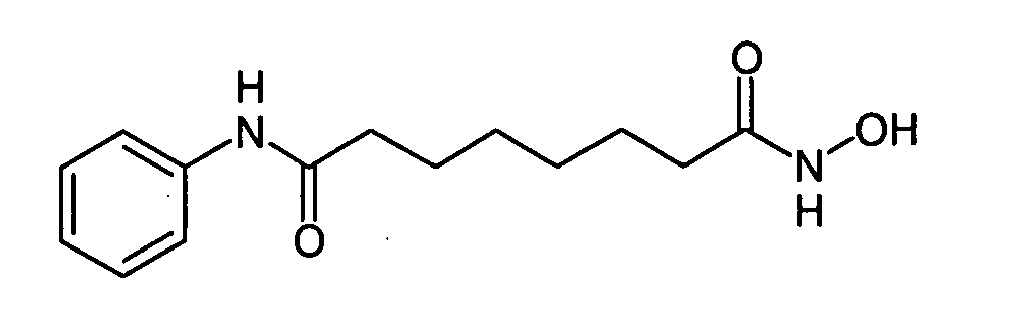
- · N-Hydroxy-N'-phenyloctanediamide (SAHA, CAS Registry No.149647-78-9)
- · 4-Dimethylamino-N-(6-hydroxycarbamoylhexyl)benzamide (M 344, CAS Registry No.251456-60-7)

- · (E)-N-Hydroxy-5-[3-(phenylsulfonylamino)phenyl]-2-penten-4-ynamide (Oxamflatin, CAS Registry No.151720-43-3)

- · N-Hydroxy-3-[3-hydroxyamino-3-oxo-1-propenyl]benzamide (CBHA, CAS Registry No.174664-65-4)

- · (E)-N-Hydroxy-3-[1-methyl-4-(4-methylbenzoyl)-1H-pyrrol-2-yl]-2-propenamide (MC1293, CAS Registry No.428872-06-4)

- · (1R)-[(2S,3S)-3-[(E)-2-[(2S,3S)-3-[(1R)-Hydroxyethyl]oxiran-2-yl]vinyl]oxiran-2-yl]-2-propen-1-ol (Depudecin, CAS Registry No.139508-73-9)

- N-(2-Aminophenyl)-4-(pyridin-3-ylmethyloxycarbonylaminomethyl)benzamide (MS 275, CAS Registry No.209783-80-2)

- · cyclo[L-(2-Amino-8-oxodecanoyl)-(1'-methoxy-L-tryptophyl)-L-isoleucyl-D-pipecolinyl] (Apicidin, CAS Registry No.183506-66-3)

- · N-(2-Aminophenyl)-4-[4-(pyridin-3-yl)pyrimidin-2-ylaminomethyl]benzamide (free base of MGCD-0103, CAS Registry No.726169-73-9)

- The "halogen atom" refers to a fluorine, chlorine, bromine or iodine atom.
- The "lower alkyl group" refers to a straight-chain or branched alkyl group having 1 to 8, preferably 1 to 6 carbon atoms.
- Specific examples thereof include methyl, ethyl, n-propyl, n-butyl, n-pentyl, n-hexyl, n-heptyl, n-octyl, isopropyl, isobutyl, sec-butyl, tert-butyl and isopentyl groups.
- The "lower alkenyl group" refers to a straight -chain or branched alkenyl group having 2 to 8, preferably 2 to 6 carbon atoms. Specific examples thereof include vinyl, propenyl, butenyl, pentenyl, hexenyl, heptenyl, octenyl, isopropenyl, 2-methyl-1-propenyl and 2-methyl-2-butenyl groups.
- The "lower alkynyl group" refers to a straight-chain or branched alkynyl group having 2 to 8, preferably 2 to 6 carbon atoms. Specific examples thereof include ethynyl, propynyl, butynyl, pentynyl, hexynyl, heptynyl, octynyl isobutynyl and isopentynyl groups.
- The "lower cycloalkyl group" refers to a cycloalkyl group having 3 to 8, preferably 3 to 6 carbon atoms. Specific examples thereof include cyclopropyl, cyclobutyl, cyclopentyl, cyclohexyl, cycloheptyl and cyclooctyl groups.
- The "aryl group" refers to a residue formed by removing one hydrogen atom from a monocyclic aromatic hydrocarbon group, or a bicyclic or tricyclic condensed polycyclic aromatic hydrocarbon having 6 to 14 carbon atoms. Specific examples thereof include phenyl, naphthyl, anthryl and phenanthryl groups.
- The "lower alkoxy group" refers to a group formed by substituting the hydrogen atom of a hydroxy group with a lower alkyl group. Specific examples thereof include methoxy, ethoxy, n-propoxy, n-butoxy, n-pentyloxy, n-hexyloxy, n-heptyloxy, n-octyloxy, isopropoxy, isobutoxy, sec-butoxy, tert-butoxy and isopentyloxy groups.
- The "lower cycloalkyloxy group" refers to a group formed by substituting the hydrogen atom of a hydroxy group with a lower cycloalkyl group. Specific examples thereof include cyclopropyloxy, cyclobutyloxy, cyclopentyloxy, cyclohexyloxy, cycloheptyloxy and cyclooctyloxy groups.
- The "aryloxy group" refers to a group formed by substituting the hydrogen atom of a hydroxy group with an aryl group. Specific examples thereof include phenoxy, naphthoxy, anthryloxy and phenanthryloxy groups.
- The "lower alkylthio group" refers to a group formed by substituting the hydrogen atom of a mercapto group with a lower alkyl group. Specific examples thereof include methylthio, ethylthio, n-propylthio, n-butylthio, n-pentylthio, n-hexylthio, n-heptylthio, n-octylthio, isopropylthio, isobutylthio, sec-butylthio, tert-butylthio and isopentylthio groups.
- The "lower cycloalkylthio group" refers to a group formed by substituting the hydrogen atom of a mercapto group with a lower cycloalkyl group. Specific examples thereof include cyclopropylthio, cyclobutylthio, cyclopentylthio, cyclohexylthio, cycloheptylthio and cyclooctylthio groups.
- The "arylthio group" refers to a group formed by substituting the hydrogen atom of a mercapto group with an aryl group. Specific examples thereof include phenylthio, naphthylthio, anthrylthio and phenanthrylthio groups.
- The "lower alkylcarbonyl group" refers to a group formed by substituting the hydrogen atom of a formyl group with a lower alkyl group. Specific examples thereof include methylcarbonyl, ethylcarbonyl, n-propylcarbonyl, n-butylcarbonyl, n-pentylcarbonyl, n-hexylcarbonyl, n-heptylcarbonyl, n-octylcarbonyl, isopropylcarbonyl, isobutylcarbonyl, sec-butylcarbonyl, tert-butylcarbonyl and isopentylcarbonyl groups.
- The "lower alkoxycarbonyl group" refers to a group formed by substituting the hydrogen atom of a formyl group with a lower alkoxy group. Specific examples thereof include methoxycarbonyl, ethoxycarbonyl, n-propoxycarbonyl, n-butoxycarbonyl, n-pentyloxycarbonyl, n-hexyloxycarbonyl, n-heptyloxycarbonyl, n-octyloxycarbonyl, isopropoxycarbonyl, isobutoxycarbonyl, sec-butoxycarbonyl, tert-butoxycarbonyl and isopentyloxycarbonyl groups.
- The "heterocyclic ring" refers to a saturated or unsaturated monocyclic heterocyclic ring, or bicyclic or tricyclic condensed polycyclic heterocyclic ring having one or plural heteroatoms selected from a nitrogen atom, an oxygen atom and a sulfur atom in the ring.
- Specific examples of the saturated monocyclic heterocyclic ring include aziridine, azetidine, pyrrolidine, pyrazolidine, imidazolidine, triazolidine, piperidine, hexahydropyridazine, hexahydropyrimidine, piperazine, homopiperidine and homopiperazine, having a nitrogen atom in the ring; tetrahydrofuran, tetrahydropyran, 1,4-dioxane and 1,2-dioxirane, having an oxygen atom in the ring; tetrahydrothiophene and tetrahydrothiopyran, having a sulfur atom in the ring; oxazolidine, isoxazolidine and morpholine, having a nitrogen atom and an oxygen atom in the ring; and thiazolidine, isothiazolidine and thiomorpholine, having a nitrogen atom and a sulfur atom in the ring.
- Further, such a saturated monocyclic heterocyclic ring may be condensed with a benzene ring or the like to form a bicyclic or tricyclic condensed polycyclic heterocyclic ring such as dihydroindole, dihydroindazole, dihydrobenzimidazole, tetrahydroquinoline, tetrahydroisoquinoline, tetrahydrocinnoline, tetrahydrophthalazine, tetrahydroquinazoline, tetrahydroquinoxaline, dihydrobenzofuran, dihydroisobenzofuran, chroman, isochroman, benzo[1,3]dioxole, 2,3-dihydrobenzo[1,4]dioxin, dihydrobenzothiophene, dihydroisobenzothiophene, thiochroman, isothiochroman, dihydrobenzoxazole, dihydrobenzisoxazole, dihydrobenzoxazine, dihydrobenzothiazole, dihydrobenzoisothiazole, dihydrobenzothiazine, xanthene, 4a-carbazole or perimidine.
- Specific examples of the unsaturated monocyclic heterocyclic ring include dihydropyrrole, pyrrole, dihydropyrazole, pyrazole, dihydroimidazole, imidazole, dihydrotriazole, triazole, tetrahydropyridine, dihydropyridine, pyridine, tetrahydropyridazine, dihydropyridazine, pyridazine, tetrahydropyrimidine, dihydropyrimidine, pyrimidine, tetrahydropyrazine, dihydropyrazine and pyrazine, having a nitrogen atom in the ring; dihydrofuran, furan, dihydropyran and pyran, having an oxygen atom in the ring; dihydrothiophene, thiophene, dihydrothiopyran and thiopyran, having a sulfur atom in the ring; dihydrooxazole, oxazole, dihydroisoxazole, isoxazole, dihydrooxazine and oxazine, having a nitrogen atom and an oxygen atom in the ring; dihydrothiazole, thiazole, dihydroisothiazole, isothiazole, dihydrothiazine and thiazine, having a nitrogen atom and a sulfur atom in the ring.
- Further, such an unsaturated monocyclic heterocyclic ring may be condensed with a benzene ring or the like to form a bicyclic or tricyclic condensed polycyclic heterocyclic ring such as indole, indazole, benzimidazole, benzotriazole, dihydroquinoline, quinoline, dihydroisoquinoline, isoquinoline, phenanthridine, dihydrocinnoline, cinnoline, dihydrophthalazine, phthalazine, dihydroquinazoline, quinazoline, dihydroquinoxaline, quinoxaline, benzofuran, isobenzofuran, chromen, isochromen, benzothiophene, isobenzothiophene, thiochromen, isothiochromen, benzoxazole, benzisoxazole, benzoxazine, benzothiazole, benzoisothiazole, tetrahydrobenzothiazole, benzothiazine, phenoxanthine, carbazole, 6-carboline, phenanthridine, acridine, phenanthroline, phenazine, phenothiazine or phenoxazine.
- Further, among these heterocyclic rings, in the case of a heterocyclic ring having two hydrogen atoms on the same carbon atom, these hydrogen atoms may be substituted with an oxo group to form a heterocyclic ketone such as 2-pyrrolidone, 4-piperidone, 4-thiazolidone, pyran-4-(4H)-one or pyrazin-2-(3H)-one, and these heterocyclic ketones are also included in the scope of the heterocyclic ring of the invention.
- The "heterocyclic ring having one or plural heteroatoms selected from the group consisting of a nitrogen atom and an oxygen atom in the ring" refers to a heterocyclic ring having one or plural nitrogen atoms and/or oxygen atoms in the ring among the above-mentioned heterocyclic rings.
- The "heterocyclic group" refers to a residue formed by removing one hydrogen atom from a heterocyclic ring.
- The "cyclic hydrocarbon" refers to a saturated or unsaturated monocyclic hydrocarbon, or bicyclic or tricyclic hydrocarbon having 3 to 10 carbon atoms.
- Specific examples of the saturated monocyclic hydrocarbon include cyclopropane, cyclobutane, cyclopentane, cyclohexane, cycloheptane and cyclooctane.
- Specific examples of the saturated bicyclic hydrocarbon include octahydropentalene, octahydroindene and decahydronaphthalene.
- Specific examples of the saturated tricyclic hydrocarbon include bicyclo[2.2.1]heptane.
- Specific examples of the unsaturated monocyclic hydrocarbon include cyclopentene, cyclohexene, cyclopentadiene, cyclohexadiene and benzene.
- Specific examples of the unsaturated bicyclic hydrocarbon include indan, 1,2,3,4-tetrahydronaphthalene and naphthalene.
- The "lower alkylene group" refers to a straight-chain or branched alkylene group having 1 to 8, preferably 1 to 6 carbon atoms. Specific examples thereof include methylene, ethylene, trimethylene, tetramethylene, pentamethylene, hexamethylene, heptamethylene, octamethylene, methylmethylene and ethylmethylene.
- The "lower alkyl group which may have a substituent", "lower alkenyl group which may have a substituent", "lower alkynyl group which may have a substituent", "lower alkoxy group which may have a substituent", "lower alkylthio group which may have a substituent", "lower alkylcarbonyl group which may have a substituent", "lower alkoxycarbonyl group which may have a substituent" and/or "lower alkylene group which may have a substituent" refers to a "lower alkyl group", a "lower alkenyl group", a "lower alkynyl group", a "lower alkoxy group", a "lower alkylthio group", a "lower alkylcarbonyl group", a "lower alkoxycarbonyl group" and/or a "lower alkylene group" which may have one or plural substituents selected from the group consisting of a halogen atom, a lower cycloalkyl group, an aryl group, a heterocyclic group, a nitro group, a cyano group, an oxo group, -ORp, -SRq, -CORr, -COORs, -CONRtRu and -NRvRw.
- The "lower cycloalkyl group which may have a substituent", "aryl group which may have a substituent", "heterocyclic group which may have a substituent", "lower cycloalkyloxy group which may have a substituent" and/or "aryloxy group which may have a substituent" refers to a "lower cycloalkyl group", an "aryl group", a "heterocyclic group", a "lower cycloalkyloxy group" and/or an "aryloxy group" which may have one or plural substituents selected from the group consisting of a halogen atom, a lower alkyl group, a lower alkenyl group, a lower alkynyl group, a lower cycloalkyl group, an aryl group, a heterocyclic group, a nitro group, a cyano group, an oxo group, -ORp, -SRq, -CORq, -COORr, -CONRsRt and -NRuRv .
- Here, Rp, Rq, Rr, Rs, Rt, Ru, Rv and Rw are the same or different and represent a group selected from the group consisting of a hydrogen atom, a lower alkyl group, a lower alkenyl group, a lower alkynyl group, a lower cycloalkyl group, an aryl group and a heterocyclic group.
- With regard to the term "plural groups" as used herein, the respective groups may be the same or different, and the number of the groups is preferably 2 or 3, particularly preferably 2. Further, a hydrogen atom and a halogen atom are also included in the concept of the "group".
- In the invention, when "l", "m", "n" and/or "o" represents 2 or 3, the respective plural groups represented by R4, R5, R6 or R7 may be the same or different. Incidentally, when "l", "m", "n" and/or "o" represents 0, the respective groups represented by R4, R5, R6 and/or R7 do not exist. That is, it shows that the compound does not have the substituents.
- The active ingredient of the invention may be in the form of a salt, and the salt is not particularly limited as long as it is a pharmaceutically acceptable salt. Examples thereof include salts with an inorganic acid such as hydrochloric acid, hydrobromic acid, hydroiodic acid, nitric acid, sulfuric acid or phosphoric acid; salts with an organic acid such as acetic acid, fumaric acid, maleic acid, succinic acid, citric acid, tartaric acid, adipic acid, gluconic acid, glucoheptonic acid, glucuronic acid, terephthalic acid, methanesulfonic acid, lactic acid, hippuric acid, 1,2-ethanedisulfonic acid, isethionic acid, lactobionic acid, oleic acid, pamoic acid, polygalacturonic acid, stearic acid, tannic acid, trifluoromethanesulfonic acid, benzenesulfonic acid, p-toluenesulfonic acid, lauryl sulfate, methyl sulfate, naphthalenesulfonic acid or sulfosalicylic acid; quaternary ammonium salts with methyl bromide, methyl iodide or the like; salts with a halogen ion such as a bromine ion, a chlorine ion or an iodine ion; salts with an alkali metal such as lithium, sodium or potassium; salts with an alkaline earth metal such as calcium or magnesium; salts with a metal such as iron or zinc; salts with ammonia; and salts with an organic amine such as triethylenediamine, 2-aminoethanol, 2,2-iminobis(ethanol), 1-deoxy-1-(methylamino)-2-D-sorbitol, 2-amino-2-(hydroxymethyl)-1,3-propanediol, procaine or N,N-bis(phenylmethyl)-1,2-ethanediamine.
- In the case where there are geometric isomers or optical isomers in the active ingredient of the invention, these isomers are also included in the scope of the invention.
- Further, the active ingredient of the invention may be in the form of a hydrate or a solvate.
- Further, in the case where there is proton tautomerism in the active ingredient of the invention, the tautomeric isomers thereof are also included in the invention.
- In the case where there are crystalline polymorphisms and crystalline polymorphism groups (crystalline polymorphism systems) in the active ingredient of the invention, these crystalline polymorphisms and crystalline polymorphism groups (crystalline polymorphism systems) are also included in the invention. Here, the crystalline polymorphism groups (crystalline polymorphism systems) mean individual crystal forms in respective stages when the crystal forms are changed by conditions for the production, crystallization, storage or the like of these crystals and/or states thereof (the states also include a formulated state) and/or all the processes thereof.
- (a) Preferred examples of the present compound include compounds in which the respective groups are as defined below and salts thereof in the compounds represented by the general formula (1) and salts thereof:
- (a1) R1 and R2 are the same or different and represent a hydrogen atom, a lower alkyl group, a lower alkyl group having a halogen atom as a substituent, a lower alkyl group having a methoxy group as a substituent, a lower alkyl group having a methylthio group as a substituent, a lower alkyl group having a cyano group as a substituent, a lower alkyl group having a methylaminocarbonyl group as a substituent, a lower alkyl group having a diisopropylamino group as a substituent, a lower alkenyl group, a lower alkynyl group or a group represented by the following general formula (2); and/or
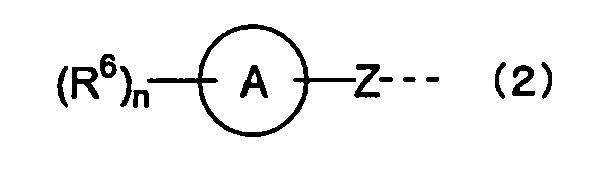
- (a2) R3 represents a hydroxy group, a lower alkoxy group, a lower cycloalkyloxy group, an aryloxy group, a carboxy group, a lower alkoxycarbonyl group, -OCONRaRb, -NRcRd or a group represented by the following general formula (3); and/or

- (a3) R4 and R5 are the same or different and represent a halogen atom, a lower alkyl group, a hydroxy group or a lower alkoxy group; and/or
- (a4) R6 represents a halogen atom, a lower alkyl group, a lower alkyl group having a halogen atom as a substituent, a lower alkyl group having a cyano group as a substituent, a lower cycloalkyl group, an aryl group, a heterocyclic group, a hydroxy group, a lower alkoxy group, a lower alkoxy group having a halogen atom as a substituent, a lower alkoxy group having an aryl group as a substituent, a lower cycloalkyloxy group, an aryloxy group, a mercapto group, a lower alkylthio group, a lower cycloalkylthio group, an arylthio group, a formyl group, a lower alkylcarbonyl group, a carboxy group, a lower alkoxycarbonyl group, a nitro group, a cyano group or
- -NReRf; and/or
- (a5) R7 represents a lower alkyl group, a lower cycloalkyl group, an aryl group, a hydroxy group, a lower alkoxy group, a lower cycloalkyloxy group or an aryloxy group; and/or
- (a6) Ra and Rb are the same or different and represent a hydrogen atom, a lower alkyl group, a lower cycloalkyl group, an aryl group or a heterocyclic group; and/or
- (a7) Rc, Rd, Re and Rf are the same or different and represent a hydrogen atom, a lower alkyl group, a lower cycloalkyl group or an aryl group; and/or
- (a8) the ring A represents a cyclic hydrocarbon or a heterocyclic ring; and/or
- (a9) the ring B represents a heterocyclic ring having one or plural heteroatoms selected from the group consisting of a nitrogen atom and an oxygen atom in the ring; and/or
- (a10) X represents a lower alkylene group; and/or
- (a11) Y and Z are the same or different and represent a single bond, a lower alkylene group or a lower alkylene group having an oxo group as a substituent; and/or
- (a12) W1-W2 represents N-C or C-N; and/or
- (a13) 1, m, n and o are the same or different and represent 0, 1, 2 or 3.
That is, preferred examples of the present compound include, in the compounds represented by the general formula (1), compounds which comprise one or a combination of two or more selected from the group consisting of the above-mentioned (a1), (a2), (a3), (a4), (a5), (a6), (a7), (a8), (a9), (a10), (a11), (a12) and (a13) and salts thereof.
- (a1) R1 and R2 are the same or different and represent a hydrogen atom, a lower alkyl group, a lower alkyl group having a halogen atom as a substituent, a lower alkyl group having a methoxy group as a substituent, a lower alkyl group having a methylthio group as a substituent, a lower alkyl group having a cyano group as a substituent, a lower alkyl group having a methylaminocarbonyl group as a substituent, a lower alkyl group having a diisopropylamino group as a substituent, a lower alkenyl group, a lower alkynyl group or a group represented by the following general formula (2); and/or
- (b) More preferred examples of the present compound include compounds in which the respective groups are as defined below and salts thereof in the compounds represented by the general formula (1) and salts thereof:
- (b1) R1 represents a lower alkyl group, a lower alkyl group having a halogen atom as a substituent, a lower alkyl group having a methoxy group as a substituent, a lower alkyl group having a methylthio group as a substituent, a lower alkyl group having a cyano group as a substituent, a lower alkyl group having a methylaminocarbonyl group as a substituent, a lower alkyl group having a diisopropylamino group as a substituent, a lower alkynyl group or a group represented by the following general formula (2); and/or

- (b2) R2 represents a hydrogen atom; and/or
- (b3) R3 represents a hydroxy group, a carboxy group, a lower alkoxycarbonyl group, -OCONRaRb, -NRcRd or a group represented by the following general formula (3); and/or

- (b4) R6 represents a halogen atom, a lower alkyl group, a lower alkyl group having a halogen atom as a substituent, a lower alkyl group having a cyano group as a substituent, an aryl group, a morpholino group, a hydroxy group, a lower alkoxy group, a lower alkoxy group having a halogen atom as a substituent, a lower alkoxy group having an aryl group as a substituent, a lower alkylthio group, a lower alkylcarbonyl group, a nitro group, a cyano group or -NReRf; and/or
- (b5) R7 represents a lower alkyl group or a lower alkoxy group; and/or
- (b6) Ra and Rb are the same or different and represent a hydrogen atom or a heterocyclic group; and/or
- (b7) Rc, Rd, Re and Rf represent a lower alkyl group; and/or
- (b8) the ring A represents a cyclic hydrocarbon or a heterocyclic ring; and/or
- (b9) the ring B represents a heterocyclic ring having plural heteroatoms selected from the group consisting of a nitrogen atom and an oxygen atom in the ring; and/or
- (b10) X and Y represent a lower alkylene group; and/or
- (b11) Z represents a single bond, a lower alkylene group or a lower alkylene group substituted with an oxo group; and/or
- (b12) W1-W2 represents C-N or N-C; and/or
- (b13) 1 and m represent 0; and/or
- (b14) o represents 0 or 1; and/or
- (b15) n represents 0, 1 or 2.
That is, more preferred examples of the present compound include, in the compounds represented by the general formula (1), compounds which comprise one or a combination of two or more selected from the group consisting of the above-mentioned (b1), (b2), (b3), (b4), (b5), (b6), (b7), (b8), (b9), (b10), (b11), (b12), (b13), (b14) and (b15) and salts thereof.
- (b1) R1 represents a lower alkyl group, a lower alkyl group having a halogen atom as a substituent, a lower alkyl group having a methoxy group as a substituent, a lower alkyl group having a methylthio group as a substituent, a lower alkyl group having a cyano group as a substituent, a lower alkyl group having a methylaminocarbonyl group as a substituent, a lower alkyl group having a diisopropylamino group as a substituent, a lower alkynyl group or a group represented by the following general formula (2); and/or
- (c) Preferred examples of the ring A include the following rings.
The ring A represents benzene, indan, thiophene, benzo[1,3]dioxole, 2,3-dihydrobenzofuran, 1H-benzimidazole, isoxazole, thiazole, benzothiazole, 2,3-dihydrobenzo[1,4]dioxin or pyridine.
Further, compounds which have the ring A and satisfy the requirements of the above-mentioned (a), (b), and/or the following (d) and salts thereof are particularly preferred. - (d) Other preferred examples of the ring B include the following rings.
The ring B represents pyrrolidine or morpholine.
Further, compounds which have the ring B and satisfy the requirements of the above-mentioned (a), (b), and/or (c) and salts thereof are particularly preferred. - (e) Particularly preferred specific examples of the present compound include the following compounds and salts thereof.
- · N-(2-Aminophenyl)-5-[3-(2,3-dihydrobenzo[1,4]dioxin-6-yl)-1-(3-dimethylaminopropyl)ureidomethyl]pyridine-2-carboxylic acid amide,
- · N-(2-Aminophenyl)-5-[3-(4-dimethylaminophenyl)-1-(3-(morpholin-4-yl) propyl)ureidomethyl]pyridine-2-carboxylic acid amide,
- · N-(2-Aminophenyl)-5-[1-(3-(morpholin-4-yl)propyl)-3-phenethylureidomethyl] pyridine-2-carboxylic acid amide,
- · N-(2-Aminophenyl)-5-[3-(3,4-difluorophenyl)-1-(3-dimethylaminopropyl) ureidomethyl]pyridine-2-carboxylic acid amide,
- · N-(2-Aminophenyl)-5-[1-(3-dimethylaminopropyl)-3-(4-methoxyphenyl) ureidomethyl]pyridine-2-carboxylic acid amide,
- · N-(2-Aminophenyl)-5-[3-(4-diethylaminophenyl)-1-(3-dimethylaminopropyl) ureidomethyl]pyridine-2-carboxylic acid amide,
- · N-(2-Aminophenyl)-5-[1-(3-dimethylaminopropyl)-3-(3-fluorophenyl) ureidomethyl]pyridine-2-carboxylic acid amide,
- · N-(2-Aminophenyl)-5-[1-(3-dimethylaminopropyl)-3-(3-fluoro-4-methylphenyl)ureidomethyl]pyridine-2-carboxylic acid amide,
- · N-(2-Aminophenyl)-5-[1-(3-dimethylaminopropyl)-3-(4-fluoro-3-methylphenyl)ureidomethyl]pyridine-2-carboxylic acid amide,
- · N-(2-Aminophenyl)-5-[3-(4-cyanophenyl)-1-(3-dimethylaminopropyl) ureidomethyl]pyridine-2-carboxylic acid amide,
- · N-(2-Aminophenyl)-5-[1-(3-dimethylaminopropyl)-3-(4-trifluoromethoxyphenyl) ureidomethyl]pyridine-2-carboxylic acid amide,
- · N-(2-Aminophenyl)-5-[3-(benzo[1,3]dioxol-5-yl)-1-(3-hydroxypropyl) ureidomethyl]pyridine-2-carboxylic acid amide,
- · N-(2-Aminophenyl)-5-[3-(4-dimethylaminophenyl)-1-(2-ethoxycarbonylethyl)ureidomethyl]pyiidine-2-carboxylic acid amide,
- · N-(2-Aminophenyl)-5-[3-(1,3-benzothiazol-2-yl)-1-(3-dimethylaminopropyl)ureidomethyl]pyridine-2-carboxylic acid amide,
- · N-(2-Aminophenyl)-5-[3-(1H-benzimidazol-2-yl)-1-(3-dimethylaminopropyl)ureidomethyl]pyridine-2-carboxylic acid amide,
- · N-(2-Aminophenyl)-5-[3-(2,3-dihydro-1-benzofuran-5-yl)-1-(3-(morpholin-4-yl)propyl)ureidomethyl]pyridine-2-carboxylic acid amide,
- · N-(2-Aminophenyl)-5-[3-(2,3-dihydrobenzo[1,4]dioxin-6-yl)-1-(2-hydroxyethyl)ureidomethyl]pyridine-2-carboxylic acid amide,
- · N-(2-Aminophenyl)-5-[1-(3-dimethylaminopropyl)-3-(phenylcarbonylmethyl)ureidomethyl]pyridine-2-carboxylic acid amide,
- · N-(2-Aminophenyl)-5-[1-(3-dimethylaminopropyl)-3-(1,3-thiazol-2-yl)ureidomethyl]pyridine-2-carboxylic acid amide,
- · N-(2-Aminophenyl)-5-[1-(3-dimethylaminopropyl)-3-(6-methoxy-1,3-benzothiazol-2-yl)ureidomethyl]pyridine-2-carboxylic acid amide,
- · N-(2-Aminophenyl)-5-[1-(3-dimethylaminopropyl)-3-(6-fluoro-1,3-benzothiazol-2-yl)ureidomethyl]pyridine-2-carboxylic acid amide,
- · N-(2-Aminophenyl)-5-[1-(3-diethylaminopropyl)-3-(3,4-difluorophenyl) ureidomethyl]pyridine-2-carboxylic acid amide,
- · N-(2-Aminopheny])-5-[1-(3-(morpholin-4-yl)propyl)-3-(pyridin-3-yl)ureidomethyl]pyridine-2-carboxylic acid amide,
- · N-(2-Aminophenyl)-5-[1-(3-dimethylaminopropyl)-3-(thiophen-3-yl)ureidomethyl]pyridine-2-carboxylic acid amide,
- · N-(2-Aminophenyl)-5-[1-(3-dimethylaminopropyl)-3-(3-fluoro-4-methoxyphenyl)ureidomethyl]pyridine-2-carboxylic acid amide,
- · N-(2-Aminophenyl)-5-[3-(3-chloro-4-fluorophenyl)-1-(3-diethylaminopropyl)ureidomethyl]pyridine-2-carboxylic acid amide,
- · N-(2-Aminophenyl)-5-[1-(3-diethylaminopropyl)-3-(4-fluoro-3-nitrophenyl)ureidomethyl]pyridine-2-carboxylic acid amide,
- · N-(2-Aminophenyl)-5-[3-(2,3-dihydrobenzo[1,4]dioxin-6-yl)-1-(2-dimethylaminoethyl)ureidomethyl]pyridine-2-carboxylic acid amide,
- · N-(2-Aminophenyl)-5-[1-(2-dimethylaminoethyl)-3-(3-methoxyphenyl) ureidomethyl]pyridine-2-carboxylic acid amide,
- · N-(2-Aminophenyl)-5-[1-(2-dimethylaminoethyl)-3-(3-fluorophenyl) ureidomethyl]pyridine-2-carboxylic acid amide,
- · N-(2-Aminophenyl)-5-[1-(2-dimethylaminoethyl)-3-(thiophen-3-yl) ureidomethyl]pyridine-2-carboxylic acid amide,
- · N-(2-Aminophenyl)-5-[3-(pyridin-3-yl)-1-[3-(pyrrolidin-1-yl)propyl] ureidomethyl]pyridine-2-carboxylic acid amide,
- · N-(2-Aminophenyl)-5-[1-(3-(morpholin-4-yl)propyl)-3-(phenylcarbonylmethyl) ureidomethyl]pyridine-2-carboxylic acid amide,
- · N-(2-Aminophenyl)-5-[3-(3-chlorophenyl)-1-(3-(morpholin-4-yl)propyl) ureidomethyl]pyridine-2-carboxylic acid amide,
- · N-(2-Aminophenyl)-5-[3-(4-fluorophenethyl)-1-(3-(morpholin-4-yl) propyl)ureidomethyl]pyridine-2-carboxylic acid amide,
- · N-(2-Aminophenyl)-5-[3-(4-cyanophenyl)-1-(3-hydroxypropyl) ureidomethyl]pyridine-2-carboxylic acid amide,
- · N-(2-Aminophenyl)-5-[3-(3-fluorophenyl)-1-[2-(4-methylpiperazin-1-yl)ethyl]ureidomethyl]pyridine-2-carboxylic acid amide,
- · N-(2-Aminophenyl)-5-[3-(2,3-dihydrobenzo[1,4]dioxin-6-yl)-1-[3-(4-methylpiperazin-1-yl)propyl]ureidomethyl]pyridine-2-carboxylic acid amide,
- · N-(2-Aminophenyl)-5-[1-(2-dimethylaminoethyl)-3-(3-methylphenyl) ureidomethyl]pyridine-2-carboxylic acid amide;
- · N-(2-Aminophenyl)-5-[3-(2,3-dihydrobenzo[1,4]dioxin-6-yl)-1-[4-(morpholin-4-yl)butyl]ureidomethyl]pyridine-2-carboxylic acid amide,
- · N-(2-Aminophenyl)-5-[1-(2-dimethylaminoethyl)-3-(1,3-thiazol-2-yl)ureidomethyl]pyridine-2-carboxylic acid amide,
- · N-(2-Aminophenyl)-5-[3-(2-methoxyphenyl)-1-[4-(morpholin-4-yl)butyl]ureidomethyl]pyridine-2-carboxylic acid amide,
- · N-(2-Aminophenyl)-5-[3-(3-methylphenyl)-1-[3-(4-methylpiperidin-1-yl)propyl]ureidomethyl]pyridine-2-carboxylic acid amide; and
- · N-(2-Aminophenyl)-5-[3-cyclopentyl-1-[5-(morpholin-4-yl)pentyl] ureidomethyflpyridine-2-carboxyhc acid amide.
- The present compounds can be prepared according to the following methods. Each specific process for preparing this present compounds are described in detail in the following examples (section of Production Examples). Additionally, the term "Boc" used in the following synthetic routes represents a tert-butoxycarbonyl group. In the case that an oxygen atom, a nitrogen atom, a sulfur atom, and so on are contained in R1, R2, R3, R4, R5 of the following scheme, they will be able to be protected or deprotected by generally used methods.
- The processes for preparing the present compounds are divided roughly into the methods described below, and the suitable method can be chosen according to the kind of substituent.
- 1) The present compound (I) can be synthesized according to the synthetic route 1. That is, the compound (I) can be given by the treatment of the compound (II) in an organic solvent such as methanol in the presence of an acid such as hydrogen chloride-ethyl acetate solution at 0°C to room temperature for 30 minutes to 24 hours.
-

- The compound (IIa, R2=H) can be synthesized according to the synthetic route 1-1. That is, it can be given by the reaction of the compound (III) with an isocyanate (IV) in an organic solvent such as dichloromethane at 0°C to room temperature for 30 minutes to 24 hours.
-

- The compound (III) can be synthesized according to the synthetic route 1-2. That is, it can be given by the reaction of the sulfonate (V) with an amine (VI) at 0°C to room temperature for 30 minutes to 24 hours.
-

- The compound (V) can be synthesized according to the synthetic route 1-3. That is, it can be given by the reaction of the compound (VII) with methanesulfonyl chloride (VIII) in an organic solvent such as dichloromethane in the presence of a base such as triethylamine at 0°C to room temperature for 30 minutes to 3 hours.
-

- The compound (VIIa, Y=CH2) can be synthesized according to the synthetic route 1-4. That is, it can be given by the treatment of the compound (IX) in an organic solvent such as tetrahydrofuran (hereinafter referred to as THF) in the presence of a reducing reagent such as lithium borohydride at 0°C to room temperature for 30 minutes to 24 hours.
-

- The compound (IX) can be synthesized according to the synthetic route 1-5. That is, it can be given by the reaction of the compound (X) with the compound (XI) in an organic solvent such as N,N-dimethylformamide (hereinafter referred to as DMF) in the presence of a condensing reagent such as O-(7-azabenzotriazol-1-yl)-1,1,3,3-tetramethyluronium hexafluorophosphate (hereinafter referred to as HATU) and a base such as N,N-diisopropylethylamine at room temperature for 1 hour to 24 hours.
-

- The compound (X) can be synthesized according to the synthetic route 1-6. That is, it can be given by the reaction of the compound (XII) with di-tert-butyl dicarbonate (XIII) in an organic solvent such as THF in the presence of a base such as triethylamine at room temperature for 1 hour to 24 hours.
-

- 2) The compound (II) can be synthesized according to the synthetic route 2. That is, it can be given by the reaction of the compound (III) with an amine (XIV) in an organic solvent such as THF in the presence of a reagent for urea formation such as 1,1'-carbonyldiimidazole at 0°C to 60°C for 30 minutes to 24 hours.
-

- Although a pharmacological effect of the present compound will be described in detail in the following Examples under the item of "Pharmacological Tests", the present inventors studied an effect of morphological change on trabecular meshwork cells by a large number of compounds having an HDAC inhibitory effect and different chemical structures. That is, they studied an effect of cell morphological change by the compounds on trabecular meshwok cells in an evaluation system using the cell shape index (hereinafter referred to as "CSI") reported in The Journal of Clinical Investigation, 103, 1141-1150 (1999) as an index, and as a result, they found that the compounds have an excellent effect of morphological change of trabecular meshwork cells.
- Further, they studied an effect of intraocular pressure reduction of the compounds by intracameral administration using male Japanese White rabbits in order to confirm an actual effect of intraocular pressure reduction of the compounds, and as a result, they confirmed that the compounds have an effect of intraocular pressure reduction.
- Accordingly, the compounds having an HDAC inhibitory effect can be used as an intraocular pressure-lowering agent and are useful as a preventive and/or therapeutic agent for a disease considered to be associated with aqueous humor circulation and/or intraocular pressure and are particularly useful as a preventive and/or therapeutic agent for glaucoma or ocular hypertension.
- The intraocular pressure-lowering agent of the invention can be administered orally or parenterally. Examples of the dosage form include a tablet, a capsule, a granule, a powder, an injection and an eye drop, and such a preparation can be prepared by a widely used technique.
- For example, an oral preparation such as a tablet, a capsule, a granule or a powder can be prepared by optionally adding a necessary amount of an excipient such as lactose, mannitol, starch, crystalline cellulose, light silicic anhydride, calcium carbonate or calcium hydrogen phosphate; a lubricant such as stearic acid, magnesium stearate or talc; a binder such as starch, hydroxypropyl cellulose, hydroxypropylmethyl cellulose or polyvinylpyrrolidone; a disintegrant such as carboxymethyl cellulose, low-substituted hydroxypropylmethyl cellulose or calcium citrate; a coating agent such as hydroxypropylmethyl cellulose, macrogol or a silicone resin; a stabilizer such as ethyl parahydroxybenzoate or benzyl alcohol; a corrigent such as a sweetener, a sour agent or a flavor; or the like.
- Further, a parenteral preparation such as an injection or an eye drop can be prepared by optionally adding a necessary amount of a tonicity agent such as sodium chloride, concentrated glycerin, propylene glycol, polyethylene glycol, potassium chloride, sorbitol or mannitol; a buffer such as sodium phosphate, sodium hydrogen phosphate, sodium acetate, citric acid, glacial acetic acid or trometamol; a surfactant such as polysorbate 80, polyoxy 40 stearate or polyoxyethylene hydrogenated castor oil 60; a stabilizer such as sodium citrate or sodium edetate; a preservative such as benzalkonium chloride, paraben, benzethonium chloride, parahydroxybenzoate ester, sodium benzoate, chlorobutanol or sorbic acid; a pH adjusting agent such as hydrochloric acid, citric acid, phosphoric acid, glacial acetic acid, sodium hydroxide, sodium carbonate or sodium hydrogen carbonate; a soothing agent such as benzyl alcohol; or the like.
- The invention also relates to a method for changing morphology of trabecular meshwork cells and/or a method for lowering intraocular pressure, comprising administering an effective amount of the present compound to a patient; a method for preventing and/or treating a disease associated with aqueous humor circulation and/or intraocular pressure, comprising administering an effective amount of the present compound to a patient; and a method for preventing and/or treating glaucoma and/or ocular hypertension, comprising administering an effective amount of the present compound to a patient.
- The dose of the active ingredient of the intraocular pressure-lowering agent can be appropriately selected and employed depending on the symptoms, age, dosage form or the like. For example, in the case of an oral preparation, it can be administered in an amount of generally from 0.01 to 1000 mg, preferably from 1 to 100 mg per day in a single dose or several divided doses. Further, in the case of an eye drop, a preparation containing the present compound at a concentration of generally from 0.0001 to 10% (w/v), preferably from 0.01 to 5% (w/v) can be administered in a single dose or several divided doses.
- Hereinafter, Production Examples of the active ingredient of the intraocular pressure-lowering agent, Preparation Examples and results of Pharmacological Tests will be described. However, these examples are described for the purpose of understanding the invention better and are not meant to limit the scope of the present invention.
- Incidentally, the following compounds i) to ix) are commercially available compounds having an HDAC inhibitory effect, and further, the compound ii) can also be prepared according to the method described in
JP-A-2003-226680 - i) (2E,4E,6R)-7-(4-Dimethylaminophenyl)-N-hydroxy-4,6-dimethyl-7-oxo-2,4-heptadienamide (Trichostatin A, product of Wako Pure Chemical).
- ii) N-Hydroxy-N'-phenyloctanediamide (SAHA, product of ALEXIS Biochemicals).
- iii) 4-Dimethylamino-N-(6-hydroxycarbamoylhexyl)benzamide (M 344, A, product of Wako Pure Chemical).
- iv) (E)-N-Hydroxy-5-[3-(phenylsulfonylamino)phenyl]-2-penten-4-ynamide (Oxamflatin, product of ALEXIS Biochemicals).
- v) N-Hydroxy-3-[3-hydroxyamino-3-oxo-1-propenyl]benzamide (CBHA, product of CALBIOCHEM).
- vi) (E)-N-Hydroxy-3-[1-methyl-4-(4-methylbenzoyl)-1H-pyrrol-2-yl]-2-propenamide (MC1293, product of Wako Pure Chemical).
- vii) (1R)-[(2S,3S)-3-[(E)-2-[(2S,3S)-3-[(1R)-Hydroxyethyl]oxiran-2-yl] vinyl]oxiran-2-yl]-2-propen-1-ol (Depudecin, product of SIGMA).
- viii) N-(2-Aminophenyl)-4-(pyridin-3-ylmethyloxycarbonylaminomethyl) benzamide (MS 275, product of CALBIOCHEM).
- ix) cyclo[L-(2-Amino-8-oxodecanoyD-(1'-methoxy-L-tryptophyl)-L-isoleucyl-D-pipecolinyl] (Apicidin, product of ALEXIS Biochemicals).
- A solution of di-t-butyl dicarbonate (44 g, 200 mmol) in THF (50 mL) was added dropwise to a solution of o-phenylenediamine (22 g, 200 mmol) and triethylamine (30 mL, 210 mmol) in THF (150 mL), and then the mixture was stirred at room temperature for 15 hours. The reaction mixture was concentrated, the obtained solid was filtered with ethyl acetate, and then the solid was dried under reduced pressure to give 21 g of the title reference compound as a white solid. Additionally, another solid which was obtained by concentration of the filtrate was collected by filtration with ethyl acetate, and then the solid was dried under reduced pressure to give 11 g of the title reference compound as a white solid. (Yield 76%)

1H-NMR (400 MHz, DMSO-d6)
δ 1.48 (s, 9H), 4.84 (s, 2H), 6.55 (td, J = 7.6, 1.4 Hz, 1H), 6.70 (dd, J = 7.6, 1.4 Hz, 1H), 6.86 (td, J = 7.6, 1.4 Hz, 1H), 7.20 (d, J = 7.6 Hz, 1H), 8.30 (br s, 1H) - HATU (21 g, 55 mmol) was added to a solution of 2-aminophenylcarbamic acid t-butyl ester (Reference Compound No.1-1, 10 g, 50 mmol), 5-methoxycarbonylpyridine-2-carboxylic acid (10 g, 55 mmol), and N-methylmorpholine (11 mL, 100 mmol) in DMF (100 mL), and then the reaction mixture was stirred at room temperature for 20 hours. Water (300 mL) was added thereto, and then the whole was extracted with ethyl acetate (300 mL) three times. The organic layer was washed with brine (200 mL), and then dried over anhydrous magnesium sulfate. The solvent was evaporated under reduced pressure, and then the obtained solid was collected by filtration to give 15 g of the title reference compound as a pale brown solid. (Yield 79%)

1H-NMR (400 MHz, CDCl3)
δ 1.53 (s, 9H), 4.01 (s, 3H), 6.90 (br s, 1H), 7.20-7.25 (m, 2H), 7.51 (m, 1H), 7.82 (m, 1H), 8.38 (dd, J = 8.1, 0.7 Hz, 1H), 8.50 (dd, J = 8.1, 2.1 Hz, 1H), 9.18 (dd, J = 2.1, 0.7 Hz, 1H), 10.28 (br s, 1H) - Under ice cooling, lithium tetrahydroborate (2.1 g, 100 mmol) was added to a solution of N-(2-t-butoxycarbonylaminophenyl)-5-methoxycarbonylpyridine-2-carboxylic acid amide (Reference Compound No.2-1, 38 g, 100 mmol) in THF (400 mL), and then the reaction mixture was stirred for 3 hours. Under ice cooling, water (200 mL) and 1.0 M aqueous hydrochloric acid (300 mL) were added thereto, the whole was extracted with ethyl acetate (300 mL), and then the organic layer was washed with water (500 mL) and brine (400 mL). After the organic layer was dried over anhydrous magnesium sulfate, the solvent was evaporated under reduced pressure. Ethyl acetate (20 mL) and hexane (30 mL) were added to the residue, and then the resulting solid was collected by filtration to give 18 g of the title reference compound as a white solid. (Yield 53%)

1H-NMR (400 MHz, DMSO-d6)
δ 1.50 (s, 9H), 4.66 (d, J = 5.1 Hz, 2H), 5.52 (t, J = 5.1 Hz, 1H), 7.15 (dd, J = 7.6, 1.5 Hz, 1H), 7.24-7.27 (m, 2H), 7.98 (dd, J = 7.9, 1.5 Hz, 1H), 8.02 (d, J = 7.6 Hz, 1H), 8.14 (d, J = 7.9 Hz, 1H), 8.58 (br s, 1H), 9.11 (br s, 1H), 10.47 (br s, 1H) - Under ice cooling, methanesulfonyl chloride (4.2 mL, 54 mmol) was added to a solution of N-(2-t-butoxycarbonylaminophenyl)-5-hydroxymethylpyridine-2-carboxylic acid amide (Reference Compound No.3-1, 16 g, 45 mmol) and triethylamine (16 mL, 110 mmol) in dichloromethane (150 mL), and then the reaction mixture was stirred for 1 hour. Water (400 mL) was added thereto, and then the whole was extracted with ethyl acetate (500 mL) five times. The organic layer was washed with water (500 mL), dried over anhydrous magnesium sulfate, and then the solvent was evaporated under reduced pressure. The resulting solid was collected by filtration with hexane (80 mL) and ethyl acetate (20 mL) to give 18 g of the title reference compound as a white solid. (Yield 94%)

1H-NMR (500 MHz, CDCl3)
δ 1.58 (s, 9H), 3.06 (s, 3H), 5.35 (s, 2H), 6.92 (br s, 1H), 7.21-7.24 (m, 2H), 7.53 (br s, 1H), 7.78 (br s, 1H), 7.98 (dd, J = 8.2, 2.1 Hz, 1H), 8.35 (d, J = 8.2 Hz, 1H), 8.65 (d, J = 2.1 Hz, 1H), 10.21 (br s, 1H) - N-(2-t-Butoxycarbonylaminophenyl)-5-methanesulfonyloxymethylpyridine-2-carboxylic acid amide (Reference Compound No.4-1, 4.9 g, 12 mmol) was added to a suspension of N,N-dimethyl-1,3-propanediamine (3.0 mL, 24 mmol) and potassium carbonate (3.3 g, 24 mmol) in DMF (40 mL), and then the reaction mixture was stirred at room temperature for 6 hours. Saturated aqueous sodium hydrogen carbonate (100 mL) was added thereto, and then the whole was extracted with ethyl acetate (100 mL) twice. The organic layer was washed with water (100 mL) three times, dried over anhydrous magnesium sulfate, and then the solvent was evaporated under reduced pressure. The residue was purified by silica gel column chromatography (chloroform-methanol) to give 1.9 g of the title reference compound as a yellow amorphous product. (Yield 38%)

1H-NMR (500 MHz, CDCl3)
δ 1.52 (s, 9H), 1.69 (m, 2H), 2.22 (s, 6H), 2.34 (t, J = 7.0 Hz, 2H), 2.69 (t, J = 7.0 Hz, 2H), 3.90 (s, 2H), 7.15 (br s, 1H), 7.18-7.24 (m, 2H), 7.59 (br s, 1H), 7.71 (br s, 1H), 7.88 (dd, J = 7.9, 1.8 Hz, 1H), 8.25 (d, J = 7.9 Hz, 1H), 8.55 (d, J = 1.8 Hz, 1H), 10.17 (br s, 1H)N-(2-t-Butoxycarbonylaminophenyl)-5-(3-diethylaminopropylaminomethyl)pyridine-2-carboxylic acid amide (Reference Compound No.5-2) 
1H-NMR (500 MHz, DMSO-d6)
δ 0.92 (t, J = 7.0 Hz, 6H), 1.49 (s, 9H), 1.53 (m, 2H), 2.38-2.43 (m, 6H), 3.32 (m, 2H), 3.80 (s, 2H), 7.15 (td, J = 7.6, 1.4 Hz, 1H), 7.24-7.27 (m, 2H), 7.98 (dd, J = 7.9, 1.7 Hz, 1H), 8.01 (d, J = 7.6 Hz, 1H), 8.11 (d, J = 7.9 Hz, 1H), 8.57 (d, J = 1.7 Hz, 1H), 9.10 (br s, 1H), 10.46 (br s, 1H)N-(2-t-Butoxycarbonylaminophenyl)-5-(t-butoxycarbonylmethylaminomethyl)pyridine-2-carboxylic acid amide (Reference Compound No.5-3) 1H-NMR (500 MHz, CDCl3)
δ 1.48 (s, 9H), 1.52 (s, 9H), 3.32 (s, 2H), 3.92 (s, 2H), 7.08 (br s, 1H), 7.18-7.24 (m, 2H), 7.60 (d, J = 6.1 Hz, 1H), 7.71 (d, J =
6.1 Hz, 1H), 7.91 (dd, J = 8.1, 1.7 Hz, 1H), 8.26 (dd, J = 8.1, 0.6 Hz, 1H), 8.56 (d, J = 1.7 Hz, 1H), 10.17 (br s, 1H) N-(2-t-Butoxycarbonylaminophenyl)-5-(3-hydroxypropylaminomethyl)pyridine-2-carboxylic acid amide (Reference Compound No.5-4) 
1H-NMR (400 MHz, CDCl3)
δ 1.52 (s, 9H), 1.77 (m, 2H), 2.91 (t, J = 5.9 Hz, 2H), 3.82 (t, J = 5.4 Hz, 2H), 3.91 (s, 2H), 7.08 (br s, 1H), 7.18-7.25 (m, 2H), 7.59 (d, J = 6.3 Hz, 1H), 7.71 (d, J = 6.3 Hz, 1H), 7.86 (dd, J = 8.1, 2.2 Hz, 1H), 8.27 (dd, J = 8.1, 0.6 Hz, 1H), 8.54 (d, J = 2.2 Hz, 1H), 10.17 (br s, 1H)N-(2-t-Butoxycarbonylaminophenyl)-5-(2-ethoxycarbonylethylaminomethyl)pyridine-2-carboxylic acid amide (Reference Compound No.5-5) 
1H-NMR (400 MHz, DMSO-d6)
δ 1.18 (t, J = 7.1 Hz, 3H), 1.49 (s, 9H), 2.45 (t, J = 6.7 Hz, 2H), 2.72 (m, 2H), 3.83 (s, 2H), 4.05 (q, J = 7.1 Hz, 2H), 7.15 (td, J = 7.5, 1.7 Hz, 1H), 7.24-7.27 (m, 2H), 7.98 (dd, J = 8.1, 1.7 Hz, 1H), 8.02 (d, J = 7.5 Hz, 1H), 8.12 (d, J = 8.1 Hz, 1H), 8.57 (d, J = 1.7 Hz, 1H), 9.11 (br s, 1H), 10.47 (br s, 1H)N-(2-t-Butoxycarbonylaminophenyl)-5-(2-hydroxyethylaminomethyl)pyridine-2-carboxylic acid amide (Reference Compound No.5-6) 
1H-NMR (400 MHz, CDCl3)
δ 1.51 (s, 9H), 2.83 (m, 2H), 3.70 (m, 2H), 3.93 (s, 2H), 7.14 (br s, 1H), 7.18-7.24 (m, 2H), 7.58 (d, J = 6.6 Hz, 1H), 7.72 (d, J = 6.1 Hz, 1H), 7.87 (dd, J = 8.1, 2.2 Hz, 1H), 8.24 (dd, J = 8.1, 0.7 Hz ,1H), 8.54 (dd, J = 2.2, 0.7 Hz, 1H), 10.18 (br s, 1H)N-(2-t-Butoxycarbonylaminophenyl)-5-(2-dimethylaminoethylaminomethyl)pyridine-2-carboxylic acid amide (Reference Compound No.5-7) 
1H-NMR (400 MHz, CDCl3)
δ 1.51 (s, 9H), 1.94 (s, 1H), 2.23 (s, 6H), 2.44 (t, J = 5.9 Hz, 2H), 2.66 (t, J = 5.9 Hz, 2H), 3.91 (s, 2H), 7.15 (br s, 1H), 7.16-7.22 (m, 2H), 7.58 (s, 1H), 7.70 (s, 1H), 7.89 (dd, J = 7.8, 2.1 Hz, 1H), 8.24 (d, J = 7.8 Hz, 1H), 8.55 (d, J = 2.1 Hz, 1H), 10.17 (s, 1H)N-(2-t-Butoxycarbonylaminophenyl)-5-[3-(pyrrolidin-1-yl)propylaminomethyl]pyridine-2-carboxylic acid amide (Reference Compound No.5-8) 
1H-NMR (500 MHz, CDCl3)
δ 1.52 (s, 9H), 1.72-1.80 (m, 6H), 2.48-2.55 (m, 6H), 2.70 (t, J = 6.9 Hz, 2H), 3.90 (s, 2H), 7.18-7.27 (m, 3H), 7.59 (br s, 1H), 7.71 (br s, 1H), 7.88 (dd, J = 7.9, 1.8 Hz, 1H), 8.25 (d, J = 7.9 Hz, 1H), 8.54 (d, J = 1.8 Hz, 1H), 10.17 (br s, 1H)N-(2-t-Butoxycarbonylaminophenyl)-5-(2-t-butoxycarbonylethylaminomethyl)pyridine-2-carboxylic acid amide (Reference Compound No.5-9) 
1H-NMR (500 MHz, CDCl3)
δ 1.46 (s, 9H), 1.52 (s, 9H), 2.46 (t, J = 6.4 Hz, 2H), 2.86 (t, J = 6.4 Hz, 2H), 3.92 (s, 2H), 7.09 (br s, 1H), 7.18-7.24 (m, 2H), 7.61 (d, J = 6.1 Hz, 1H), 7.70 (d, J = 6.1 Hz, 1H), 7.89 (dd, J = 7.9, 1.8 Hz, 1H), 8.26 (dd, J = 7.9, 0.6 Hz, 1H), 8.56 (d, J = 1.8 Hz, 1H), 10.16 (br s, 1H)N-(2-t-Butoxycarbonylaminophenyl)-5-[3-(morpholin-4-yl)propylaminomethyl)]pyridine-2-carboxylic acid amide (Reference Compound No.5-10) 
1H-NMR (400 MHz, CDCl3)
δ 1.52 (s, 9H), 1.72 (m, 2H), 2.40-2.44 (m, 6H), 2.70 (t, J = 6.8 Hz, 2H), 3.70 (m, 4H), 3.91 (s, 2H), 7.11 (br s, 1H), 7.18-7.25 (m, 2H), 7.59 (br s, 1H), 7.71 (br s, 1H), 7.88 (dd, J = 8.1, 2.2 Hz, 1H), 8.26 (dd, J = 8.1, 0.7 Hz, 1H), 8.55 (dd, J = 2.2, 0.7 Hz, 1H), 10.17 (br s, 1H)N-(2-t-Butoxycarbonylaminophenyl)-5-[2-(4-methylpiperazin-1-yl)ethylaminomethyl]pyridine-2-carboxylic acid amide (Reference Compound No.5-11) 
1H-NMR (400 MHz, CDCl3)
δ 1.52 (s, 9H), 2.29 (s, 3H), 2.46 (br s, 8H), 2.52 (t, J = 6.0 Hz, 2H), 2.71 (t, J = 6.0 Hz, 2H), 3.92 (s, 2H), 7.09 (br s, 1H), 7.17-7.25 (m, 2H), 7.60 (d, J = 7.3 Hz, 1H), 7.70 (d, J = 7.1 Hz, 1H), 7.89 (dd, J = 7.9, 2.2 Hz, 1H), 8.26 (d, J = 7.9 Hz, 1H), 8.55 (d, J = 2.2 Hz, 1H), 10.16 (s, 1H)N-(2-t-Butoxycarbonylaminophenyl)-5-[3-(4-methylpiperazin-1-yl)propylaminomethyl]pyridine-2-carboxylic acid amide (Reference Compound No.5-12) 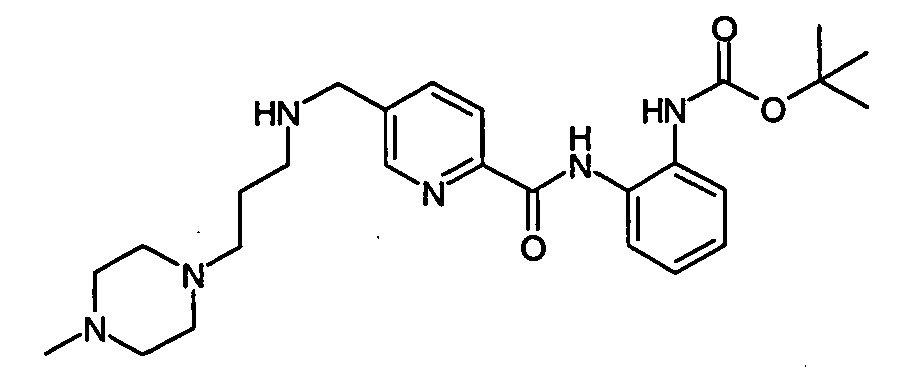
1H-NMR (400 MHz, CDCl3)
δ 1.52 (s, 9H), 1.72 (m, 2H), 2.28 (s, 3H), 2.43 (t, J = 6.9 Hz, 2H), 2.46 (br s, 8H), 2.69 (t, J = 6.9 Hz, 2H), 3.90 (s, 2H), 7.09 (br s, 1H), 7.17-7.25 (m, 2H), 7.60 (d, J = 6.6 Hz, 1H), 7.70 (d, J = 6.6 Hz, 1H), 7.88 (dd, J = 7.9, 2.0 Hz, 1H), 8.26 (d, J = 7.9 Hz, 1H), 8.55 (d, J = 2.0 Hz, 1H), 10.16 (s, 1H)N-(2-t-Butoxycarbonylaminophenyl)-5-[4-(pyrrolidin-1-yl)butylaminomethyl]pyridine-2-carboxylic acid amide (Reference Compound No.5-13) 
1H-NMR (500 MHz, CDCl3) δ 1.52 (s, 9H), 1.55-1.65 (m, 4H), 1.80-1.86 (m, 4H), 2.54 (t, J = 7.4 Hz, 2H), 2.59-2.64 (m, 4H), 2.67 (t, J = 6.8 Hz, 2H), 3.90 (s, 2H), 7.13 (br s, 1H), 7.18-7.25 (m, 2H), 7.59 (d, J = 5.5 Hz, 1H), 7.71 (d, J = 6.1 Hz, 1H), 7.90 (dd, J = 7.9, 1.8 Hz, 1H), 8.25 (d, J = 7.9 Hz, 1H), 8.55 (d, J = 1.8 Hz, 1H), 10.17 (s, 1H) N-(2-t-Butoxycarbonylaminophenyl)-5-(2-diethylaminoethylaminomethyl)pyridine-2-carboxylic acid amide (Reference Compound No.5-14) 
1H-NMR (400 MHz, CDCl3)
δ 1.01 (t, J = 7.2 Hz, 6H), 1.52 (s, 9H), 2.52 (q, J = 7.2 Hz, 4H), 2.58 (t, J = 5.7 Hz, 2H), 2.68 (t, J = 5.7 Hz, 2H), 3.92 (s, 2H), 7.09 (br s, 1H), 7.18-7.23 (m, 2H), 7.60 (d, J = 6.6 Hz, 1H), 7.70 (d, J = 6.3 Hz, 1H), 7.89 (dd, J = 8.1, 2.2 Hz, 1H), 8.26 (dd, J = 8.1, 0.6 Hz, 1H), 8.56 (dd, J = 2.2, 0.6 Hz, 1H), 10.17 (s, 1H)N-(2-t-Butoxycarbonylaminophenyl)-5-(4-dimethylaminobutylaminomethyl)pyridine-2-carboxylic acid amide (Reference Compound No.5-15) 
1H-NMR (400 MHz, CDCl3)
δ 1.52 (s, 9H), 1.63-1.69 (m, 4H), 2.36 (s, 6H), 2.51 (m, 2H), 2.71 (t, J = 6.5 Hz, 2H), 3.94 (s, 2H), 7.10 (br s, 1H), 7.18-7.25 (m, 2H), 7.60 (m, 1H), 7.71 (m, 1H), 7.97 (dd, J = 7.9, 2.2 Hz, 1H), 8.27 (dd, J = 7.9, 1.1 Hz, 1H), 8.59 (d, J = 2.2, 1.1 Hz, 1H), 10.17 (s, 1H)N-(2-t-Butoxycarbonylaminophenyl)-5-[4-(morpholin-4-yl)butylaminomethyl]pyridine-2-carboxylic acid amide (Reference Compound No.5-16) 
1H-NMR (500 MHz, CDCl3)
δ 1.52 (s, 9H), 1.54-1.60 (m, 4H), 2.35 (t, J = 7.0 Hz, 2H), 2.43 (br s, 4H), 2.66 (t, J = 6.7 Hz, 2H), 3.71 (t, J = 4.7 Hz, 4H), 3.91 (s, 2H), 7.08 (br s, 1H), 7.18-7.24 (m, 2H), 7.60 (d, J = 6.3 Hz, 1H), 7.70 (d, J = 6.3 Hz, 1H), 7.89 (dd, J = 7.9, 2.1 Hz, 1H), 8.26 (d, J = 7.9 Hz, 1H), 8.56 (d, J = 1.5 Hz, 1H), 10.16 (s, 1H)N-(2-t-Butoxycarbonylaminophenyl)-5-(5-dimethylaminopentylaminomethyl)pyridine-2-carboxylic acid amide (Reference Compound No.5-17) 
1H-NMR (400 MHz, CDCl3)
δ 1.38 (m, 2H), 1.52 (s, 9H), 1.52-1.59 (m, 4H), 2.31 (s, 6H), 2.37 (t, J = 7.6 Hz, 2H), 2.65 (t, J = 7.1 Hz, 2H), 3.90 (s, 2H), 7.11 (br s, 1H), 7.17-7.24 (m, 2H), 7.60 (d, J = 5.8 Hz, 1H), 7.70 (d, J = 5.8 Hz, 1H), 7.89 (dd, J = 7.9, 2.1 Hz, 1H), 8.26 (dd, J = 7.9, 0.7 Hz, 1H), 8.56 (dd, J = 2.1, 0.7 Hz, 1H), 10.17 (s, 1H)N-(2-t-Butoxycarbonylaminophenyl)-5-[3-(4-methylpiperidin-1-yl)propylaminomethyl]pyridine-2 -carboxylic acid amide (Reference Compound No.5-18) 
1H-NMR (500 MHz, CDCl3)
δ 0.91 (d, J = 6.4 Hz, 3H), 1.21 (m, 2H), 1.35 (m, 1H), 1.52 (s, 9H), 1.62 (m, 2H), 1.73 (m, 2H), 1.89 (m, 2H), 2.39 (t, J = 7.3 Hz, 2H), 2.68 (t, J = 6.7 Hz, 2H), 2.90 (d, J = 11.6 Hz, 2H), 3.90 (s, 2H), 7.10 (br s, 1H), 7.18-7.24 (m, 2H), 7.61 (d, J = 6.1 Hz, 1H), 7.70 (d, J = 6.4 Hz, 1H), 7.88 (dd, J = 7.9, 2.1 Hz, 1H), 8.26 (d, J = 7.9 Hz, 1H), 8.55 (d, J = 2.1 Hz, 1H), 10.16 (s, 1H)N-(2-t-Butoxycarbonylaminophenyl)-5-[5-(morpholin-4-yl)pentylaminomethyl]pyridine-2-carboxylic acid amide (Reference Compound No.5-19) 
1H-NMR (400 MHz, CDCl3)
δ 1.36 (m, 2H), 1.47-1.56 (m, 4H), 1.52 (s, 9H), 2.33 (t, J = 7.5 Hz, 2H), 2.43 (br s, 4H), 2.64 (t, J = 7.1 Hz, 2H), 3.71 (t, J = 4.8 Hz, 4H), 3.90 (s, 2H), 7.09 (br s, 1H), 7.18-7.25 (m, 2H), 7.60 (d, J = 6.6 Hz, 1H), 7.71 (d, J = 6.3 Hz, 1H), 7.88 (dd, J = 8.1, 2.2 Hz, 1H), 8.26 (d, J = 8.1 Hz, 1H), 8.55 (d, J = 2.2 Hz, 1H), 10.17 (s, 1H)N-(2-t-Butoxycarbonylaminophenyl)-6-(2-dimethylaminoethylaminomethyl)pyridine-3-carboxylic acid amide (Reference Compound No.5-20) 
1H-NMR (400 MHz, CDCl3)
δ 1.52 (s, 9H), 2.23 (s, 6H), 2.35 (t, J = 6.2 Hz, 2H), 2.76 (m, 2H), 4.01 (s, 2H), 7.02 (s, 1H), 7.18 (td, J = 7.8, 1.5 Hz, 1H), 7.22-7.25 (m, 2H), 7.44 (d, J = 8.2 Hz, 1H), 7.82 (d, J = 7.8 Hz, 1H), 8.20 (dd, J = 8.2, 2.1 Hz, 1H), 9.12 (d, J = 2.1 Hz, 1H), 9.51 (s, 1H) - Phenethylisocyanate (15 µL, 0.11 mmol) was added to a solution of N-(2-t-butoxycarbonylaminophenyl)-5-(3-dimethylaminopropylaminomethyl)pyridine-2-carbo xylic acid amide (Reference Compound No.5-1, 27 mg, 0.060 mmol) in dichloromethane (1.0 mL), and then the mixture was stirred at room temperature for 2 hours. The reaction mixture was concentrated, and then the residue was purified by silica gel column chromatography (chloroform-methanol) to give 32 mg of the title reference compound as a colorless amorphous product. (Yield 88%)

1H-NMR (500 MHz, DMSO-d6)
δ 1.48 (s, 9H), 1.53 (m, 2H), 2.04 (s, 6H), 2.13 (t, J = 6.4 Hz, 2H), 2.74 (t, J = 7.2 Hz, 2H), 3.13 (t, J = 6.4 Hz, 2H), 3.31 (m, 2H), 4.54 (s, 2H), 7.12-7.30 (m, 9H), 7.84 (dd, J = 7.9, 1.8 Hz, 1H), 8.02 (d, J = 7.3 Hz, 1H), 8.12 (d, J = 7.9 Hz, 1H), 8.48 (d, J = 1.8 Hz, 1H), 9.11 (br s, 1H), 10.46 (br s, 1H)N-(2-t-Butoxycarbonylaminophenyl)-5-[3-(2,3-dihydrobenzo[1,4]dioxin-6-yl)-1-(3-dimethylaminopropyl)ureidomethyl]pyridine-2-carboxylic acid amide (Reference Compound No.6-2) 
1H-NMR (500 MHz, DMSO-d6)
δ 1.47 (s, 9H), 1.67 (m, 2H), 2.17 (s, 6H), 2.25 (t, J = 6.3 Hz, 2H), 3.31 (m, 2H), 4.17-4.21 (m, 4H), 4.60 (s, 2H), 6.73 (d, J = 8.9 Hz, 1H), 6.77 (dd, J = 8.9, 2.4 Hz, 1H), 7.07 (d, J = 2.4 Hz, 1H), 7.15 (td, J = 7.0, 1.2 Hz, 1H), 7.23-7.27 (m, 2H), 7.96 (dd, J = 8.2, 1.8 Hz, 1H), 8.01 (d, J = 7.0 Hz, 1H), 8.14 (d, J = 8.2 Hz, 1H), 8.56 (br s, 1H), 9.11 (br s, 1H), 9.42 (br s, 1H), 10.46 (br s, 1H)N-(2-t-Butoxycarbonylaminophenyl)-5-[3-(3,4-difluorophenyl)-1-(3-dimethylaminopropyl)ureido methyl]pyridine-2-carboxylic acid amide (Reference Compound No.6-3) 
1H-NMR (500 MHz, DMSO-d6)
δ 1.47 (s, 9H), 1.70 (m, 2H), 2.19 (s, 6H), 2.26 (t, J = 6.3 Hz, 2H), 3.35 (m, 2H), 4.63 (s, 2H), 7.07 (m, 1H), 7.15 (td, J = 7.3, 1.5 Hz, 1H), 7.23-7.27 (m, 2H), 7.34 (dd, J = 19.7, 9.3 Hz, 1H), 7.68 (ddd, J = 13.7, 7.6, 2.4 Hz, 1H), 7.98 (dd, J = 7.9, 1.8 Hz, 1H), 8.01 (d,J = 7.3 Hz, 1H), 8.14 (d, J = 7.9 Hz, 1H). 8.58 (d, J = 1.8 Hz, 1H), 9.12 (br s, 1H), 9.43 (br s, 1H), 10.02 (br s, 1H)5-[3-(Benzo[1,3]dioxol-5-yl)-1-(3-dimethylaminopropyl)ureidomethyl]-N-(2-t-butoxycarbonylaminophenyl)pyridine-2-carboxylic acid amide (Reference Compound No.6-4) 
1H-NMR (500 MHz, DMSO-d6)
δ 1.47 (s, 9H), 1.68 (m, 2H), 2.18 (s, 6H), 2.25 (t, J = 6.3 Hz, 2H), 3.32 (m, 2H), 4.63 (s, 2H), 5.95 (s, 2H), 6.72 (dd, J = 8.2, 2.1 Hz, 1H), 6.80 (d, J = 8.2 Hz, 1H), 7.15 (td, J = 7.6, 1.5 Hz, 1H), 7.18 (d, J = 2.1 Hz, 1H), 7.23-7.27 (m, 2H), 7.97 (dd, J = 7.9, 1.8 Hz, 1H), 8.01 (d, J = 7.6 Hz, 1H), 8.14 (d, J = 7.9 Hz, 1H), 8.57 (d, J = 1.8 Hz, 1H), 9.11 (br s, 1H), 9.51 (br s, 1H), 10.47 (br s, 1H)N-(2-t-Butoxycarbonylaminophenyl)-5-[1-(3-dimethylaminopropyl)-3-(4-methoxyphenyl)ureidomethyl]pyridine-2-carboxylic acid amide (Reference Compound No.6-5) 
1H-NMR (400 MHz, DMSO-d6)
δ 1.47 (s, 9H), 1.68 (m, 2H), 2.18 (s, 6H), 2.26 (t, J = 6.3 Hz, 2H), 3.33 (m, 2H), 3.70 (s, 3H), 4.62 (s, 2H), 6.80 (d, J = 9.0 Hz, 2H), 7.15 (td, J = 8.3, 1.5 Hz, 1H), 7.23-7.27 (m, 2H), 7.33 (d, J = 9.0 Hz, 2H), 7.97 (dd, J = 8.1, 1.8 Hz, 1H), 8.01 (d, J = 8.3 Hz, 1H), 8.14 (d, J = 8.1 Hz, 1H), 8.57 (d, J = 1.8 Hz, 1H), 9.12 (br s, 1H), 9.42 (br s, 1H), 10.47 (br s, 1H)5-[3-(Benzo[1,3]dioxol-5-yl)-1-(3-diethylaminopropyl)ureidomethyl]-N-(2-t-butoxycarbonylaminophenyl)pyridine-2-carboxylic acid amide (Reference Compound No.6-6) 
1H-NMR (500 MHz, CDCl3)
δ 1.02 (t, J = 7.2 Hz, 6H), 1.51 (s, 9H), 1.74 (m, 2H), 2.51 (t, J = 6.0 Hz, 2H), 2.62 (q, J = 7.2 Hz, 4H), 3.37 (t, J = 5.7 Hz, 2H), 4.61 (s, 2H), 5.92 (s, 2H), 6.71-6.72 (m, 2H), 7.06 (br s, 1H), 7.14 (s, 1H), 7.17-7.24 (m, 2H), 7.60 (d, J = 7.2 Hz, 1H), 7.69 (d, J = 7.2 Hz, 1H), 7.93 (dd, J = 7.9, 2.0 Hz, 1H), 8.25 (d, J = 7.9 Hz, 1H), 8.58 (d, J = 2.0 Hz, 1H), 9.69 (s, 1H), 10.15 (s, 1H)N-(2-t-Butoxycarbonylaminophenyl)-5-[1-(3-dimethylaminopropyl)-3-(2-fluorophenyl)ureidom ethyl]pyridine-2-carboxylic acid amide (Reference Compound No.6-7) 
1H-NMR (500 MHz, DMSO-d6)
δ 1.47 (s, 9H), 1.75 (m, 2H), 2.16 (s, 6H), 2.28 (t, J = 6.1 Hz, 2H), 3.36 (t, J = 5.6 Hz, 2H), 4.63 (s, 2H), 7.04 (m, 1H), 7.11 (m, 1H), 7.14-7.21 (m, 2H), 7.24 (d, J = 7.7 Hz, 1H), 7.26 (m, 1H), 7.88 (t, J = 7.7 Hz, 1H), 7.99 (dd, J = 7.7, 1.5 Hz, 1H), 8.02 (d, J = 7.1 Hz, 1H), 8.14 (d, J = 7.7 Hz, 1H), 8.59 (d, J = 1.5 Hz, 1H), 9.10 (s, 1H), 9.87 (s, 1H), 10.47 (s, 1H)N-(2-t-Butoxycarbonylaminophenyl)-5-[1-(3-dimethylaminopropyl)-3-(3-fluorophenyl)ureidomethyl]pyridine-2-carboxylic acid amide (Reference Compound No.6-8) 
1H-NMR (500 MHz, DMSO-d6)
δ 1.46 (s, 9H), 1.71 (m, 2H), 2.20 (s, 6H), 2.28 (t, J = 6.3 Hz, 2H), 3.36 (t, J = 6.3 Hz, 2H), 4.63 (s, 2H), 6.75 (td, J = 8.2, 2.3 Hz, 1H), 7.07 (dd, J = 8.2, 1.2 Hz, 1H), 7.15 (td, J = 8.2, 1.5 Hz, 1H), 7.23-7.30 (m, 3H), 7.49 (ddd, J = 12.2, 2.3, 1.5 Hz, 1H), 7.98 (dd, J = 8.2, 2.3 Hz, 1H), 8.02 (d, J = 8.2 Hz, 1H), 8.14 (d, J = 8.2 Hz, 1H), 8.59 (d, J = 2.3 Hz, 1H), 9.11 (s, 1H), 10.00 (s, 1H), 10.47 (s, 1H)N-(2-t-Butoxycarbonylaminophenyl)-5-[3-(2,5-difluorophenyl)-1-(3-dimethylaminopropyl)ureidomethyl]pyridine-2-carboxylic acid amide (Reference Compound No.6-9) 
1H-NMR (500 MHz, DMSO-d6)
δ 1.46 (s, 9H), 1.75 (m, 2H), 2.15 (s, 6H), 2.28 (t, J = 6.1 Hz, 2H), 3.43 (t, J = 6.1 Hz, 2H), 4.62 (s, 2H), 6.81 (m, 1H), 7.15 (td, J = 7.7, 1.5 Hz, 1H), 7.22-7.28 (m, 3H), 7.93 (m, 1H), 7.99-8.02 (m, 2H), 8.14 (dd, J = 7.7, 0.6 Hz, 1H), 8.60 (d, J = 1.5 Hz, 1H), 9.11 (s, 1H), 10.42 (s, 1H), 10.48 (s, 1H)N-(2-t-Butoxycarbonylaminophenyl)-5-[3-(3,5-difluorophenyl)-1-(3-dimethylaminopropyl)ureidomethyl]pyridine-2-carboxylic acid amide (Reference Compound No.6-10) 
1H-NMR (500 MHz, DMSO-d6)
δ 1.47 (s, 9H), 1.71 (m, 2H), 2.20 (s, 6H), 2.27 (t, J = 6.4 Hz, 2H), 3.36 (t, J = 6.1 Hz, 2H), 4.64 (s, 2H), 6.76 (tt, J = 9.2, 2.2 Hz, 1H), 7.14-7.17 (m, 3H), 7.23-7.27 (m, 2H), 7.98 (dd, J = 7.9, 2.2 Hz, 1H), 8.01 (d, J = 7.9 Hz, 1H), 8.14 (d, J = 7.9 Hz, 1H), 8.58 (s, 1H), 9.11 (s, 1H), 10.13 (s, 1H), 10.47 (s, 1H)N-(2-t-Butoxycarbonylaminophenyl)-5-[1-(3-dimethylaminopropyl)-3-(3-fluoro-4-methylphenyl)ureidomethyl]pyridine-2-carboxylic acid amide (Reference Compound No.6-11) 
1H-NMR (500 MHz, DMSO-d6)
δ 1.47 (s, 9H), 1.70 (m, 2H), 2.15 (s, 3H), 2.20 (s, 6H), 2.26 (t, J = 6.4 Hz, 2H), 3.35 (t, J = 6.1 Hz, 2H), 4.62 (s, 2H), 6.98 (dd, J = 8.1, 2.1 Hz, 1H), 7.11-7.17 (m, 2H), 7.23-7.27 (m, 2H), 7.43 (dd, J = 12.8, 2.1 Hz, 1H), 7.98 (dd, J = 8.1, 2.1 Hz, 1H), 8.01 (d, J = 8.1 Hz, 1H), 8.14 (d, J = 8.1 Hz, 1H), 8.58 (d, J = 2.1 Hz, 1H), 9.11 (s, 1H), 9.82 (s, 1H), 10.47 (s, 1H)N-(2-t-Butoxycarbonylaminophenyl)-5-[1-(3-dimethylaminopropyl)-3-(4-fluoro-3-methylphenyl)ureidomethyl]pyridine-2-carboxylic acid amide (Reference Compound No.6-12) 
1H-NMR (500 MHz, DMSO-d6)
δ 1.47 (s, 9H), 1.69 (m, 2H), 2.18 (s, 6H), 2.20 (s, 3H), 2.26 (t, J = 6.4 Hz, 2H), 3.35 (t, J = 6.1 Hz, 2H), 4.62 (s, 2H), 7.01 (t, J = 9.2 Hz, 1H), 7.15 (td, J = 7.7, 1.5, 1H), 7.20-7.28 (m, 3H), 7.34 (dd, J = 7.0, 2.4 Hz, 1H), 7.97 (dd, J = 8.1, 2.0 Hz, 1H), 8.01 (d, J = 7.0 Hz, 1H), 8.14 (d, J = 8.1 Hz, 1H), 8.57 (s, 1H), 9.11 (s, 1H), 9.55 (s, 1H), 10.47 (s, 1H)N-(2-t-Butoxycarbonylaminophenyl)-5-(1-(t-butoxycarbonylmethyl)-3-(4-dimethylaminophenyl) ureidomethyl]pyridine-2-carboxylic acid amide (Reference Compound No.6-13) 
1H-NMR (400 MHz, DMSO-d6)
δ 1.34 (s, 9H), 1.48 (s, 9H), 2.82 (s, 6H), 4.11 (s, 2H), 4.70 (s, 2H), 6.66 (d, J = 9.3 Hz, 2H), 7.13-7.27 (m, 5H), 7.99 (dd, J = 8.1, 2.0 Hz, 1H), 8.01 (m, 1H), 8.13 (d, J = 8.1 Hz, 1H), 8.30 (br s, 1H), 8.60 (d, J = 2.0 Hz, 1H), 9.11 (br s, 1H), 10.48 (br s, 1H)5-[3-(Benzo[1,3]dioxol-5-yl)-1-(2-t-butoxycarbonylethyl)ureidomethyl]-N-(2-t-butoxycarbonylaminophenyl)pyridine-2-carboxylic acid amide (Reference Compound No.6-14) 
1H-NMR (500 MHz, DMSO-d6)
δ 1.38 (s, 9H), 1.47 (s, 9H), 2.52 (m, 2H), 3.55 (t, J = 7.0 Hz, 2H), 4.70 (s, 2H), 5.95 (s, 2H), 6.81 (m, 2H), 7.12 (m, 1H), 7.15 (td, J = 7.6, 1.5 Hz, 1H), 7.23-7.27 (m, 2H), 7.93 (dd, J = 8.2, 1.8 Hz, 1H), 8.01 (d, J = 7.6 Hz, 1H), 8.15 (d, J = 8.2 Hz, 1H), 8.47 (br s, 1H), 8.52 (d, J = 1.8 Hz, 1H), 9.12 (br s, 1H), 10.47 (br s, 1H)N-(2-t-Butoxycarbonylaminophenyl)-5-[1-(3-dimethylaminopropyl)-3-(indan-5-yl)ureidomethyl]pyridine-2-carboxylic acid amide (Reference Compound No.6-15) 
1H-NMR (400 MHz, DMSO-d6)
δ 1.47 (s, 9H), 1.69 (br s, 2H), 1.99 (m, 2H), 2.19 (s, 6H), 2.27 (t, J = 6.2 Hz, 2H), 2.76-2.83 (m, 4H), 3.36 (m, 2H), 4.61 (s, 2H), 7.08 (s, 1H), 7.09 (d, J = 7.6 Hz, 1H), 7.15 (td, J = 7.6, 1.6 Hz, 1H), 7.24 (d, J = 7.6 Hz, 1H), 7.25 (m, 1H), 7.37 (m, 1H), 7.97 (dd, J = 8.1, 1.8 Hz, 1H), 8.01 (d, J = 7.6 Hz, 1H), 8.14 (d, J = 8.1 Hz, 1H), 8.58 (d, J = 1.8 Hz, 1H), 9.13 (br s, 1H), 9.51 (br s, 1H), 10.47 (br s, 1H)5-[3-(Biphenyl-4-yl)-1-(3-dimethylaminopropyl) ureidomethyl]-N-(2-t-butoxycarbonylaminophenyl)pyridine-2-carboxylic acid amide (Reference Compound No.6-16) 
1H-NMR (500 MHz, DMSO-d6)
δ 1.47 (s, 9H), 1.72 (m, 2H), 2.23 (s, 6H), 2.29 (t, J = 6.3 Hz, 2H), 3.37 (t, J = 6.3 Hz, 2H), 4.65 (s, 2H), 7.15 (td, J = 7.6, 1.4 Hz, 1H), 7.25 (m, 1H), 7.31 (m, 1H), 7.43 (t, J = 7.6 Hz, 2H), 7.52-7.56 (m, 3H), 7.57-7.60 (m, 2H), 7.62-7.65 (m, 2H), 7.99-8.02 (m, 2H), 8.15 (d, J = 7.9 Hz, 1H), 8.60 (d, J = 1.7 Hz, 1H), 9.11 (br s, 1H), 9.84 (br s, 1H), 10.47 (br s, 1H)N-(2-t-Butoxycarbonylaminophenyl)-5-[1-(3-dimethylaminopropyl)-3-(4-trifluoromethylphenyl) ureidomethyl]pyridine-2-carboxylic acid amide (Reference Compound No.6-17) 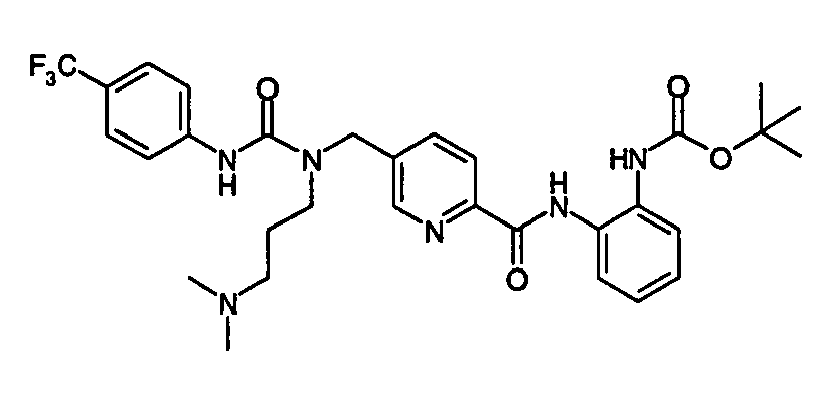
1H-NMR (500 MHz, DMSO-d6)
δ 1.47 (s, 9H), 1.71 (m, 2H), 2.06 (s, 6H), 2.28 (t, J = 6.1 Hz, 2H), 3.36 (t, J = 6.1, Hz, 2H), 4.65 (s, 2H), 7.15 (td, J = 7.9, 1.5 Hz, 1H), 7.25 (m, 1H), 7.39 (td, J = 7.9, 1.5 Hz, 1H), 7.65-7.72 (m, 4H), 7.95 (dd, J = 8.1, 1.8 Hz, 1H), 8.03 (dd, J = 7.9, 1.5 Hz, 1H), 8.14 (d, J = 8.1 Hz, 1H), 8.52 (d, J = 1.8 Hz, 1H), 9.12 (br s, 1H), 9.61 (br s, 1H), 10.46 (br s, 1H)N-(2-t-Butoxycarbonylaminophenyl)-5-[3-(4-cyanophenyl)-1-(3-dimethylaminopropyl)ureidomethyl]pyridine-2-carboxylic acid amide (Reference Compound No.6-18) 
1H-NMR (400 MHz, DMSO-d6)
δ 1.46 (s, 9H), 1.72 (m, 2H), 2.21 (s, 6H), 2.28 (t, J = 6.0 Hz, 2H), 3.37 (t, J = 6.0 Hz, 2H), 4.64 (s, 2H), 7.15 (td, J = 7.6, 1.7 Hz, 1H), 7.23-7.28 (m, 2H), 7.61 (m, 2H), 7.72 (m, 2H), 7.98-8.02 (m, 2H), 8.15 (d, J = 8.1 Hz, 1H), 8.59 (d, J = 1.8 Hz, 1H), 9.12 (br s, 1H), 10.17 (br s, 1H), 10.47 (br s, 1H)N-(2-t-Butoxycarbonylaminophenyl)-5-[1-(3-dimethylaminopropyl)-3-(4-trifluoromethoxyphenyl)ureidomethyl]pyridine-2-carboxylic acid amide (Reference Compound No.6-19) 
1H-NMR (400 MHz, DMSO-d6)
δ 1.46 (s, 9H), 1.71 (m, 2H), 2.20 (s, 6H), 2.27 (t, J = 6.1 Hz, 2H), 3.37 (t, J = 6.1 Hz, 2H), 4.64 (s, 2H), 7.15 (td, J = 7.6, 1.6 Hz, 1H), 7.23-7.30 (m, 3H), 7.51-7.56 (m, 3H), 7.98 (dd, J = 8.1, 1.8 Hz, 1H), 8.01 (d, J = 7.6 Hz, 1H), 8.14 (d, J = 8.1 Hz, 1H), 8.58 (d, J = 1.8 Hz, 1H), 9.13 (br s, 1H), 9.83 (br s, 1H), 10.47 (br s, 1H)N-(2-t-Butoxycarbonylaminophenyl)-5-[3-(4-dimethylaminophenyl)-1-(3-hydroxypropyl)ureidomethyl]pyridine-2-carboxylic acid amide (Reference Compound No.6-20) 
1H-NMR (400 MHz, DMSO-d6)
δ 1.47 (s, 9H), 1.67 (m, 2H), 2.82 (s, 6H), 3.39 (t, J = 6.5 Hz, 2H), 3.46 (m, 2H), 4.66 (s, 2H), 4.85 (br s, 1H), 6.66 (d, J = 9.0 Hz, 2H), 7.15 (td, J = 7.6, 1.6 Hz, 1H), 7.20-7.27 (m, 4H), 7.94 (dd, J = 8.1, 1.8 Hz, 1H), 8.01 (d, J = 7.6 Hz, 1H), 8.14 (d, J = 8.1 Hz, 1H), 8.31 (br s, 1H), 8.54 (d, J = 1.8 Hz, 1H), 9.12 (br s, 1H), 10.47 (br s, 1H)N-(2-t-Butoxycarbonylaminophenyl)-5-[3-(2,3-dihydrobenzo[1,4]dioxin-6-yl)-1-(3-hydroxypropyl)ureidomethyl]pyridine-2-carboxylic acid amide (Reference Compound No.6-21) 
1H-NMR (400 MHz, DMSO-d6)
δ 1.47 (s, 9H), 1.66 (m, 2H), 3.38 (t, J = 6.4 Hz, 2H), 3.46 (m, 2H), 4.16-4.21 (m, 4H), 4.65 (s, 2H), 4.91 (burs, 1H), 6.72 (d, J = 8.8 Hz, 1H). 6.84 (dd, J = 8.8, 2.4 Hz, 1H), 7.03 (d, J = 2.4 Hz, 1H), 7.15 (td, J = 7.7, 1.7 Hz, 1H), 7.23-7.27 (m, 2H), 7.94 (dd, J = 8.1, 1.7 Hz, 1H), 8.01 (d, J = 7.7 Hz, 1H), 8.14 (d, J = 8.1 Hz, 1H), 8.45 (br s, 1H), 8.54 (d, J = 1.7 Hz, 1H), 9.12 (br s, 1H), 10.47 (br s, 1H)N-(2-t-Butoxycarbonylaminophenyl)-5-[3-(4-cyanophenyl)-1-(3-hydroxcypropyl)ureidomethyl]pyridine-2-carboxylic acid amide (Reference Compound No.6-22) 
1H-NMR (400 MHz, DMSO-d6)
δ 1.46 (s, 9H), 1.69 (m, 2H), 3.33 (br s, 2H), 3.45 (m, 2H), 4.70 (s, 2H), 5.03 (br s, 1H), 7.15 (td, J = 7.7, 1.7 Hz, 1H), 7.23-7.27 (m, 2H), 7.65 (d, J = 9.0 Hz, 2H), 7.71 (d, J = 9.0 Hz, 2H), 7.97 (dd, J = 8.1, 1.7 Hz, 1H), 8.00 (d, J = 7.7 Hz, 1H), 8.14 (d, J = 8.1 Hz, 1H), 8.56 (d, J = 1.7 Hz, 1H), 9.13 (br s, 1H), 9.15 (br s, 1H), 10.47 (br s, 1H)5-[3-(Benzo(1,3]dioxol-5-yl)-1-(3-hydroxypropyl)ureidomethyl]-N-(2-t-butoxycarbonylaminophenyl)pyridine-2-carboxylic acid amide (Reference Compound No.6-23) 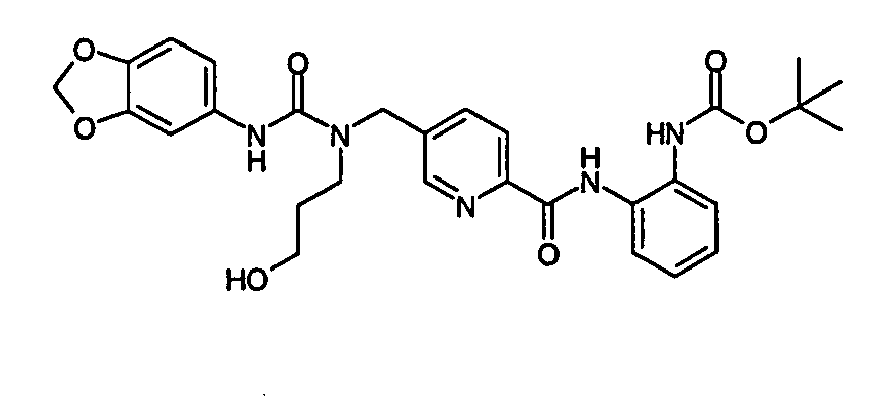
1H-NMR (400 MHz, DMSO-d6)
δ 1.47 (s, 9H), 1.67 (m, 2H), 3.39 (t, J = 6.6 Hz, 2H), 3.47 (m, 2H), 4.66 (s, 2H), 4.92 (br s, 1H), 5.95 (s, 2H), 6.79-6.82 (m, 2H), 7.12 (m, 1H), 7.15 (td, J = 7.8, 1.6 Hz, 1H), 7.23-7.27 (m, 2H), 7.95 (dd, J = 8.1, 2.0 Hz, 1H), 8.01 (d, J = 7.8 Hz, 1H), 8.15 (d, J = 8.1 Hz, 1H), 8.53 (br s, 1H), 8.56 (d, J = 2.0 Hz, 1H), 9.13 (br s, 1H), 10.47 (br s, 1H)N-(2-t-Butoxycarbonylaminophenyl)-5-[1-(3-hydroxypropyl)-3-(4-methoxyphenyl)ureidomethyl]pyridine-2-carboxylic acid amide (Reference Compound No.6-24) 
1H-NMR (400 MHz, DMSO-d6)
δ 1.47 (s, 9H), 1.68 (m, 2H), 3.40 (t, J = 6.6 Hz, 2H), 3.47 (m, 2H), 3.71 (s, 3H), 4.66 (s, 2H), 4.89 (br s, 1H), 6.84 (d, J = 9.3 Hz, 2H), 7.15 (td, J = 7.7, 1.6 Hz, 1H), 7.23-7.27 (m, 2H), 7.32 (d, J = 9.3 Hz, 2H), 7.95 (dd, J = 8.1, 1.8 Hz, 1H), 8.01 (d, J = 7.7 Hz, 1H), 8.15 (d, J = 8.1 Hz, 1H), 8.47 (br s, 1H), 8.55 (d, J = 1.8 Hz, 1H), 9.13 (br s, 1H), 10.47 (br s, 1H)N-(2-t-Butoxycarbonylaminophenyl)-5-[3-(4-dimethylaminophenyl)-1-(2-ethoxycarbonylethyl) ureidomethyl]pyridine-2-carboxylic acid amide (Reference Compound No.6-25) 
1H-NMR (400 MHz, DMSO-d6)
δ 1.16 (m, 3H), 1.47 (s, 9H), 2.60 (t, J = 7.1 Hz, 2H), 2.82 (s, 6H), 3.58 (t, J = 7.1 Hz, 2H), 4.03 (q, J = 7.1 Hz, 2H), 4.70 (s, 2H), 6.66 (d, J = 9.0 Hz, 2H), 7.15 (td, J = 7.8, 1.6 Hz, 1H), 7.21-7.27 (m, 4H), 7.93 (dd, J = 8.1, 1.7 Hz, 1H), 8.01 (d, J = 7.8 Hz, 1H), 8.15 (d, J = 8.1 Hz, 1H), 8.30 (br s, 1H), 8.52 (d, J = 1.7 Hz, 1H), 9.12 (br s, 1H), 10.47 (br s, 1H)5-[3-(Benzo[1,3]dioxol-5-yl)-1-(2-ethoxycarbonylethyl)ureidomethyl]-N-(2-t-butoxycarbonylaminophenyl)pyridine-2-carboxylic acid amide (Reference Compound No.6-26) 
1H-NMR (400 MHz, DMSO-d6)
δ 1.16 (m, 3H), 1.47 (s, 9H), 2.60 (t, J = 7.1 Hz, 2H), 3.59 (t, J.= 7.1 Hz, 2H), 4.03 (q, J = 7.1 Hz, 2H), 4.71 (s, 2H), 5.95 (s, 2H), 6.81 (m, 2H), 7.12 (m, 1H), 7.15 (td, J = 7.6, 1.6 Hz, 1H), 7.23-7.27 (m, 2H), 7.93 (dd, J = 8.1, 1.8 Hz, 1H), 8.01 (d, J = 7.6 Hz, 1H), 8.15 (d, J = 8.1 Hz, 1H), 8.48 (br s, 1H), 8.52 (d, J = 1.8 Hz, 1H), 9.13 (br s, 1H), 10.47 (br s, 1H)N-(2-t-Butoxycarbonylaminophenyl)-5-[1-(2-ethoxycarbonylethyl)-3-(4-methoxyphenyl)ureidomethyl]pyridine-2-carboxylic acid amide (Reference Compound No.6-27) 
1H-NMR (400 MHz, DMSO-d6)
δ 1.16 (m, 3H), 1.47 (s, 9H), 2.61 (t, J = 7.1 Hz, 2H), 3.59 (t, J = 7.1 Hz, 2H), 3.71 (s, 3H), 4.03 (q, J = 7.2 Hz, 2H), 4.71 (s, 2H), 6.84 (d, J = 9.0 Hz, 2H), 7.15 (td, J = 7.6, 1.3 Hz, 1H), 7.23-7.27 (m, 2H), 7.33 (d, J = 9.0 Hz, 2H), 7.93 (dd, J = 8.1, 1.8 Hz, 1H), 8.01 (d, J = 7.6 Hz, 1H), 8.15 (d, J = 8.1 Hz, 1H), 8.44 (br s, 1H), 8.52 (d, J = 1.8 Hz, 1H), 9.12 (br s, 1H), 10.47 (br s, 1H)N-(2-t-Butoxycarbonylaminophenyl)-5-[1-(3-dimethylaminopropyl)-3-(thiophen-2-yl)ureidomethyl]pyridine-2-carboxylic acid amide (Reference Compound No.6-28) 
1H-NMR (400 MHz, DMSO-d6)
δ 1.47 (s, 9H), 1.68 (m, 2H), 2.21 (br s, 6H), 2.27 (t, J = 6.1 Hz, 2H), 3.32 (m, 2H), 4.64 (s, 2H), 6.52 (dd, J = 3.4, 1.7 Hz, 1H), 6.78-6.82 (m, 2H), 7.15 (m, 1H), 7.23-7.27 (m, 2H), 7.96 (dd, J = 8.1, 1.8 Hz, 1H), 8.01 (d, J = 7.8 Hz, 1H), 8.15 (d, J = 8.1 Hz, 1H), 8.57 (d, J = 1.8 Hz, 1H), 9.12 (br s, 1H), 10.47 (br s, 1H), 11.09 (br s, 1H)N-(2-t-Butoxycarbonylaminophenyl)-5-[1-(3-dimethylaminopropyl)-3-(thiophen-3-yl)ureidomethyl]pyridine-2-carboxylic acid amide (Reference Compound No.6-29) 
1H-NMR (400 MHz, DMSO-d6)
δ 1.47 (s, 9H), 1.68 (m, 2H), 2.19 (s, 6H), 2.25 (t, J = 6.1 Hz, 2H), 3.33 (m, 2H), 4.63 (s, 2H), 7.04 (dd, J = 5.1, 1.2 Hz, 1H), 7.15 (td, J = 7.7, 1.3 Hz, 1H), 7.23-7.28 (m, 3H), 7.40 (dd, J = 5.1, 3.2 Hz, 1H), 7.96 (dd, J = 8.1, 1.3 Hz, 1H), 8.01 (d, J = 7.7 Hz, 1H), 8.14 (d, J = 8.1 Hz, 1H), 8.57 (d, J = 1.3 Hz, 1H), 9.12 (br s, 1H), 10.07 (br s, 1H), 10.47 (br s, 1H)N-(2-t-Butoxycarbonylaminophenyl)-5-[3-(2,3-dihydrobenzo[1,4]dioxin-6-yl)-1-[3-(morpholin-4-yl)propyl]ureidomethyl]pyridine-2-carboxylic acid amide (Reference Compound No.6-30) 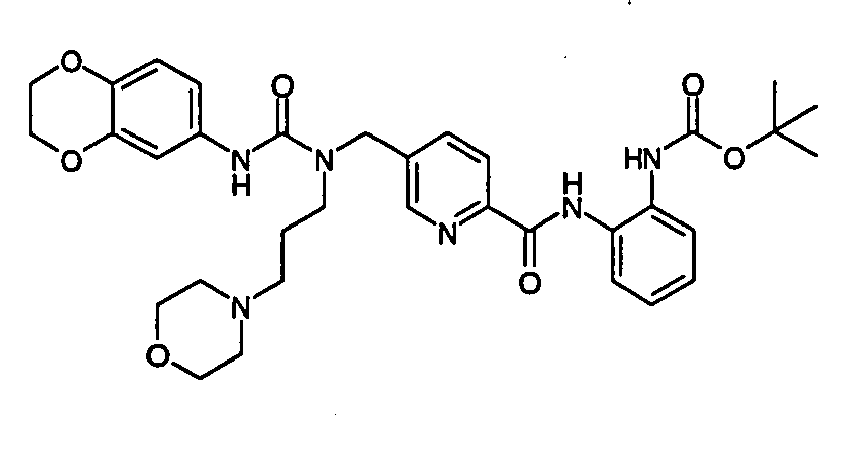
1H-NMR (400 MHz, DMSO-d6)
δ 1.47 (s, 9H), 1.68 (m, 2H), 2.26-2.30 (m, 6H), 3.34 (m, 2H), 3.53-3.55 (m, 4H), 4.17-4.22 (m, 4H), 4.67 (s, 2H), 6.72-6.78 (m, 2H), 6.87 (dd, J = 8.6, 2.6 Hz, 1H), 7.05 (m, 1H), 7.15 (dd, J = 7.6, 1.6 Hz, 1H), 7.24 (m, 1H), 7.94 (dd, J = 8.1, 1.7 Hz, 1H), 8.01 (d, J = 7.6 Hz, 1H), 8.14 (d, J = 8.1 Hz, 1H), 8.48 (br s, 1H), 8.54 (d, J = 1.7 Hz, 1H), 9.12 (br s, 1H), 10.47 (br s, 1H)5-[3-(Benzo[1,3]dioxol-5-yl)-1-[3-(morpholin-4-yl)propyl]ureidomethyl]-N-(2-t-butoxycarbonylaminophenyl)pyridine-2-carboxylic acid amide (Reference Compound No.6-31) 
1H-NMR (400 MHz, DMSO-d6)
δ 1.47 (s, 9H), 1.68 (m, 2H), 2.26-2.30 (m, 6H), 3.35 (m, 2H), 3.52-3.54 (m, 4H), 4.67 (s, 2H), 5.95 (s, 2H), 6.82 (m, 2H), 7.14-7.19 (m, 2H), 7.23-7.27 (m, 2H), 7.95 (dd, J = 8.1, 1.6 Hz, 1H), 8.01 (d, J = 7.6 Hz, 1H), 8.15 (d, J = 8.1 Hz, 1H), 8.54 (d, J = 1.6 Hz, 1H), 8.57 (br s, 1H), 9.13 (br s, 1H), 10.47 (br s, 1H)N-(2-t-Butoxycarbonylaminophenyl)-5-[3-(4-methoxyphenyl)-1-[3-(morpholin-4-yl)propyl]ureidomethyl]pyridine-2-carboxylic acid amide (Reference Compound No.6-32) 
1H-NMR (400 MHz, DMSO-d6)
δ 1.47 (s, 9H), 1.69 (m, 2H), 2.27-2.30 (m, 6H), 3.36 (m, 2H), 3.52-3.54 (m, 4H), 3.71 (s, 3H), 4.68 (s, 2H), 6.85 (d, J = 9.1 Hz, 2H), 7.15 (td, J = 7.6, 1.6 Hz, 1H), 7.24 (d, J = 7.6 Hz, 1H), 7.25 (m, 1H), 7.34 (d, J = 9.1 Hz, 2H), 7.95 (dd, J = 8.1, 1.6 Hz, 1H), 8.01 (d, J = 7.6 Hz, 1H), 8.15 (d, J = 8.1 Hz, 1H), 8.54 (d, J = 1.6 Hz, 1H), 8.55 (br s, 1H), 9.12 (br s, 1H), 10.47 (br s, 1H)N-(2-t-Butoxycarbonylaminophenyl)-5-[3-(2,3-dihydro-1-benzofuran-5-yl)-1-(3-dimethylaminopropyl)ureidomethyl]pyridine-2-carboxylic acid amide (Reference Compound No.6-33) 
1H-NMR (400 MHz, DMSO-d6)
δ 1.48 (s, 9H), 1.68 (m, 2H), 2.17 (s, 6H), 2.25 (t, J = 6.3 Hz, 2H), 2.50 (m, 2H), 3.14 (t, J = 8.7 Hz, 2H), 4.47 (t, J = 8.7 Hz, 2H), 4.61 (s, 2H), 6.64 (d, J = 8.4 Hz, 1H), 7.01 (dd, J = 8.4, 2.1 Hz, 1H), 7.15 (td, J = 7.7, 1.6 Hz, 1H), 7.23-7.27 (m, 2H), 7.35 (d, J = 2.1 Hz, 1H), 7.96 (dd, J = 8.1, 2.0 Hz, 1H), 8.01 (d, J = 7.7 Hz, 1H), 8.14 (dd, J = 8.1, 0.5 Hz, 1H), 8.57 (d, J = 2.0 Hz, 1H), 9.13 (br s, 1H), 9.32 (br s, 1H), 10.47 (br s, 1H)N-(2-t-Butoxycarbonylaminophenyl)-5-[3-(2,3-dihydro-1-benzofuran-5-yl)-1-[3-(morpholin-4-yl) propyl]ureidomethyl]pyridine-2-carboxylic acid amide (Reference Compound No.6-34) 
1H-NMR (400 MHz, DMSO-d6)
δ 1.48 (s, 9H), 1.68 (m, 2H), 2.27-2.32 (m, 6H), 3.14 (t, J = 8.5 Hz, 2H), 3.33 (m, 2H), 3.52-3.54 (m, 4H), 4.48 (t, J = 8.5 Hz, 2H), 4.67 (s, 2H), 6.65 (d, J = 8.5 Hz, 1H), 7.04 (dd, J = 8.5, 2.0 Hz, 1H), 7.15 (td, J = 7.6, 1.3 Hz, 1H), 7.23-7.27 (m, 2H), 7.32 (d, J = 2.0 Hz, 1H), 7.95 (dd, J = 8.1, 1.5 Hz, 1H), 8.01 (d, J = 7.6 Hz, 1H), 8.15 (d, J = 8.1 Hz, 1H), 8.50 (br s, 1H), 8.55 (d, J = 1.5 Hz, 1H), 9.13 (br s, 1H), 10.47 (br s, 1H)N-(2-t-Butoxycarbonylaminophenyl)-5-[1-(3-diethylaminopropyl)-3-(4-fluorophenyl)ureidometh yl]pyridine-2-carboxylic acid amide (Reference Compound No.6-35) 
1H-NMR (400 MHz, DMSO-d6)
δ 0.92 (t, J = 7.1 Hz, 6H), 1.47 (s, 9H), 1.67 (m, 2H), 2.37 (t, J = 6.3 Hz, 2H), 2.47 (m, 4H), 3.35 (m, 2H), 4.66 (s, 2H), 7.10 (t, J = 8.9 Hz, 2H), 7.15 (td, J = 7.5, 1.5 Hz, 1H), 7.23-7.27 (m, 2H), 7.43 (m, 2H), 7.95 (dd, J = 8.1, 1.6 Hz, 1H), 8.01 (d, J = 7.5 Hz, 1H), 8.15 (d, J = 8.1 Hz, 1H), 8.56 (d, J = 1.6 Hz, 1H), 9.11 (br s, 1H), 10.47 (br s, 1H)N-(2-t-Butoxycarbonylaminophenyl)-5-[1-(3-diethylaminopropyl)-3-(3,4-difluorophenyl)ureidomethyl]pyridine-2-carboxylic acid amide (Reference Compound No.6-36) 
1H-NMR (400 MHz, DMSO-d6)
δ 0.92 (t, J = 7.1 Hz, 6H), 1.46 (s, 9H), 1.67 (m, 2H), 2.36 (t, J = 6.3 Hz, 2H), 2.46 (m, 4H), 3.35 (m, 2H), 4.67 (s, 2H), 7.13-7.17 (m, 2H), 7.23-7.28 (m, 2H), 7.33 (dd, J = 19.7, 9.2 Hz, 1H), 7.65 (ddd, J = 13.7, 7.6, 2.4 Hz, 1H), 7.97 (dd, J = 8.1, 2.0 Hz, 1H), 8.01 (dd, J = 8.1, 1.2 Hz, 1H), 8.15 (d, J = 8.1 Hz, 1H), 8.56 (d, J = 2.0 Hz, 1H), 9.13 (br s, 1H), 9.30 (br s, 1H), 10.47 (br s, 1H)N-(2-t-Butoxycarbonylaminophenyl)-5-[1-(3-diethylaminopropyl)-3-(3,5-difluorophenyl)ureidomethyl]pyridine-2-carboxylic acid amide (Reference Compound No.6-37) 
1H-NMR (400 MHz, DMSO-d6)
δ 0.93 (t, J = 7.1 Hz, 6H), 1.46 (s, 9H), 1.67 (m, 2H), 2.36 (t, J = 6.6 Hz, 2H), 2.48 (m, 4H), 3.36 (t, J = 6.6 Hz, 2H), 4.68 (s, 2H), 6.77 (tt, J = 9.3, 2.4 Hz, 1H), 7.13-7.28 (m, 5H), 7.97 (dd, J = 8.1, 1.7 Hz, 1H), 8.01 (dd, J = 8.2, 1.7 Hz, 1H), 8.15 (d, J = 8.1 Hz, 1H), 8.57 (d, J = 1.7 Hz, 1H), 9.13 (br s, 1H), 9.47 (br s, 1H), 10.47 (br s, 1H)N-(2-t-Butoxycarbonylaminophenyl)-5-[3-(3-chloro-4-fluorophenyl)-1-(3-diethylaminopropyl)ureidomethyl]pyridine-2-carboxylic acid amide (Reference Compound No.6-38) 
1H-NMR (400 MHz, DMSO-d6)
δ 0.92 (t, J = 7.1 Hz, 6H), 1.46 (s, 9H), 1.67 (m, 2H), 2.36 (t, J = 6.7 Hz, 2H), 2.47 (m, 4H), 3.36 (t, J = 6.7 Hz, 2H), 4.67 (s, 2H), 7.15 (td, J = 7.6, 1.5 Hz, 1H), 7.22-7.28 (m, 2H), 7.31-7.35 (m, 2H), 7.78 (m, 1H), 7.97 (dd, J = 8.1, 1.7 Hz, 1H), 8.01 (d, J = 7.6, 1.5 Hz, 1H), 8.15 (d, J = 8.1 Hz, 1H), 8.56 (d, J = 1.7 Hz, 1H), 9.12 (br s, 1H), 9.25 (br s, 1H), 10.47 (br s, 1H)N-(2-t-Butoxycarbonylaminophenyl)-5-[1-(3-diethylaminopropyl)-3-(3-fluorophenyl)ureidomethyl]pyridine-2-carboxylic acid amide (Reference Compound No.6-39) 
1H-NMR (400 MHz, DMSO-d6)
δ 0.94 (t, J = 7.2 Hz, 6H), 1.46 (s, 9H), 1.68 (m, 2H), 2.37 (t, J = 6.5 Hz, 2H), 2.48 (m, 4H), 3.36 (t, J = 6.5 Hz, 2H), 4.67 (s, 2H), 6.77 (m, 1H), 7.12-7.17 (m, 2H), 7.23-7.32 (m, 3H), 7.46 (m, 1H), 7.98 (dd, J = 8.2, 2.0 Hz, 1H), 8.01 (dd, J = 8.1, 1.0 Hz, 1H), 8.15 (d, J = 8.2 Hz, 1H), 8.57 (d, J = 2.0 Hz, 1H), 9.12 (br s, 1H), 9.36 (br s, 1H), 10.47 (br s, 1H)N-(2-t-Butoxycarbonylaminophenyl)-5-[1-(3-diethlaminopropyl)-3-(4-fluoro-3-methylphenyl)ureidomethyl]pyridine-2-carboxylic acid amide (Reference Compound No.6-40) 
1H-NMR (400 MHz, CDCl3)
δ 1.03 (t, J = 7.2 Hz, 6H), 1.51 (s, 9H), 1.76 (m, 2H), 2.25 (d, J = 2.0 Hz, 3H), 2.51 (t, J = 6.1 Hz, 2H), 2.63 (q, J = 7.2 Hz, 4H), 3.38 (t, J = 5.9 Hz, 2H), 4.62 (s, 2H), 6.91 (t, J = 9.0 Hz, 1H), 7.05 (br s, 1H), 7.10 (m, 1H), 7.17-7.25 (m, 2H), 7.34 (m, 1H), 7.60 (d, J = 7.3 Hz, 1H), 7:69 (d, J = 7.3 Hz, 1H), 7.93 (dd, J = 8.1, 2.2 Hz, 1H), 8.26 (d, J = 8.1 Hz, 1H), 8.58 (d, J = 2.2 Hz, 1H), 9.73 (s, 1H), 10.15 (s, 1H)N-(2-t-Butoxycarbonylaminophenyl)-5-[1-(3-diethylaminopropyl)-3-(4-fluoro-3-nitrophenyl)ureidomethyl]pyridine-2-carboxylic acid amide (Reference Compound No.6-41) 
1H-NMR (500 MHz, CDCl3)
δ 1.08 (t, J = 7.2 Hz, 6H), 1.52 (s, 9H), 1.80 (m, 2H), 2.54 (t, J = 6.1 Hz, 2H), 2.68 (q, J = 7.2 Hz, 4H), 3.40 (t, J = 5.7 Hz, 2H), 4.63 (s, 2H), 7.02 (br s, 1H), 7.18-7.24 (m, 2H), 7.58 (d, J = 6.4 Hz, 1H), 7.62-7.76 (m, 1H), 7.71 (d, J = 6.4 Hz, 1H), 7.88-7.93 (m, 2H), 8.03 (dd, J = 6.4, 2.7 Hz, 1H), 8.27 (d, J = 7.9 Hz, 1H), 8.59 (d, J = 1.5 Hz, 1H), 10.16 (s, 1H), 10.53 (s, 1H)N-(2-t-Butoxycarbonylaminophenyl)-5-[1-(3-diethylaminopropyl)-3-(3-ethoxyphenyl)ureidomethyl]pyridine-2-carboxylic acid amide (Reference Compound No.6-42) 
1H-NMR (400 MHz, CDCl3)
δ 1.06 (t, J = 7.2 Hz, 6H), 1.40 (t, J = 7.0 Hz, 3H), 1.51 (s, 9H), 1.76 (m, 2H), 2.51 (t, J = 6.1 Hz, 2H), 2.66 (q, J = 7.2 Hz, 4H), 3.38 (t, J = 5.6 Hz, 2H), 4.03 (q, J = 7.0 Hz, 2H), 4.63 (s, 2H), 6.56 (m, 1H), 6.90 (m, 1H), 7.05 (br s, 1H), 7.15 (t, J = 8.2 Hz, 1H), 7.19-7.23 (m, 3H), 7.60 (d, J = 6.9 Hz, 1H), 7.69 (d, J = 6.9 Hz, 1H), 7.93 (dd, J = 8.1, 2.2 Hz, 1H), 8.26 (d, J = 8.1 Hz, 1H), 8.58 (d, J = 2.2 Hz, 1H), 9.79 (s, 1H), 10.15 (s, 1H)N-(2-t-Butoxycarbonylaminophenyl)-5-[3-(2,3-dihydrobenzo[1,4]dioxin-6-yl)-1-(2-dimethylaminoethyl)ureidomethyl]pyridine-2-carboxylic acid amide (Reference Compound No.6-43) 
1H-NMR (400 MHz, CDCl3)
δ 1.52 (s, 9H), 2.38 (s, 6H), 2.51 (t, J = 4.3 Hz, 2H), 3.31 (t, J = 4.3 Hz, 2H, 4.21-4.25 (m, 4H), 4.64 (s, 2H), 6.76-6.82 (m, 2H), 6.93 (d, J = 2.0 Hz, 1H), 7.08 (br s, 1H), 7.18-7.23 (m, 2H), 7.58 (br s, 1H), 7.72 (br s, 1H), 7.91 (dd, J = 8.1, 2.2 Hz, 1H), 8.26 (d, J = 8.1 Hz, 1H), 8.56 (d, J = 2.2 Hz, 1H), 10.16 (s, 1H), 10.85 (s, 1H)N-(2-t-Butoxycarbonylaminophenyl)-5-(1-(2-dimethylaminoethyl)-3-(3-methoxyphenyl)ureidomethyl]pyridine-2-carboxylic acid amide (Reference Compound No.6-44) 
1H-NMR (400 MHz, CDCl3)
δ 1.51 (s, 9H), 2.40 (s, 6H), 2.53 (t, J = 4.3 Hz, 2H), 3.33 (t, J = 4.3 Hz, 2H), 3.81 (s, 3H), 4.66 (s, 2H), 6.56 (ddd, J = 7.8, 2.7, 0.8 Hz, 1H), 6.84 (dd, J = 7.8, 1.2 Hz, 1H), 7.07 (s, 1H), 7.14-7.22 (m, 4H), 7.58 (br s, 1H), 7.73 (br s, 1H), 7.91 (dd, J = 7.8, 2.1 Hz, 1H), 8.26 (d, J = 7.8 Hz, 1H), 8.57 (d, J = 2.1 Hz, 1H), 10.17 (s, 1H), 11.12 (s, 1H)N-(2-t-Butoxycarbonylaminophenyl)-5-[1-(2-dimethylaminoethyl)-3-(3-fluorophenyl)ureidomethyl]pyridine-2-carboxylic acid amide (Reference Compound No.6-45) 
1H-NMR (400 MHz, CDCl3)
δ 1.52 (s, 9H), 2.41 (s, 6H), 2.55 (t, J = 4.3 Hz, 2H), 3.33 (t, J = 4.3 Hz, 2H), 4.66 (s, 2H), 6.68 (td, J = 8.4, 1.6 Hz, 1H), 6.98-7.07 (m, 2H), 7.18-7.29 (m, 4H), 7.58 (br s, 1H), 7.73 (br s, 1H), 7.91 (dd, J = 8.1, 2.2 Hz, 1H), 8.28 (d, J = 8.1 Hz, 1H), 8.58 (d, J = 2.2 Hz, 1H), 10.17 (s, 1H), 11.33 (s, 1H)N-(2-t-Butoxycarbonylaminophenyl)-5-[1-(2-dimethylaminoethyl)-3-(thiophen-3-yl)ureidomethyl]pyridine-2-carboxylic acid amide (Reference Compound No.6-46) 
1H-NMR (400 MHz, CDCl3)
δ 1.51 (s, 9H), 2.39 (s, 6H), 2.53 (t, J = 4.3 Hz, 2H), 3.31 (t, J = 4.3 Hz, 2H), 4.67 (s, 2H), 6.87 (dd, J = 5.1, 1.2 Hz, 1H), 7.00 (s, 1H), 7.18-7.22 (m, 3H), 7.30 (dd, J = 5.1, 1.3 Hz, 1H), 7.58 (br s, 1H), 7.71 (br s, 1H), 7.91 (dd, J = 7.9, 2.2 Hz, 1H), 8.26 (d, J = 7.9 Hz, 1H), 8.56 (d, J = 2.2 Hz, 1H), 10.16 (s, 1H), 11.49 (s, 1H)N-(2-t-Butoxycarbonylaminophenyl)-5-[3-(3,4-difluorophenyl)-1-[3-(pyrrolidin-1-yl)propyl]ureidomethyl]pyridine-2-carboxylic acid amide (Reference Compound No.6-47) 
1H-NMR (400 MHz, DMSO-d6)
δ 1.47 (s, 9H), 1.69-1.74 (m, 6H), 2.40-2.44 (m, 6H), 3.40 (t, J = 6.2 Hz, 2H), 4.65 (s, 2H), 7.10 (m, 1H), 7.15 (td, J = 7.6, 1.5 Hz, 1H), 7.23-7.27 (m, 2H), 7.35 (dd, J = 19.8, 9.3 Hz, 1H), 7.65 (ddd, J = 13.7, 7.6, 2.4 Hz, 1H), 7.97 (dd, J = 8.1, 1.8 Hz, 1H), 8.01 (d, J = 8.1 Hz, 1H), 8.14 (dd, J = 8.1, 0.5 Hz, 1H), 8.57 (d, J = 1.8 Hz, 1H), 9.12 (br s, 1H), 9.55 (br s, 1H), 10.47 (br s, 1H)N-(2-t-Butoxycarbonylaminophenyl)-5-[3-(pyridin-3-yl)-1-[3-(pyrrolidin-1-yl)propyl]ureidomethyl]pyridine-2-carboxylic acid amide (Reference Compound No.6-48) 
1H-NMR (500 MHz, DMSO-d6)
δ 1.47 (s, 9H), 1.72-1.74 (m, 6H), 2.42-2.46 (m, 6H), 3.43 (t, J = 6.3 Hz, 2H), 4.67 (s, 2H), 7.15 (td, J = 7.5, 1.5 Hz, 1H), 7.24-7.27 (m, 2H), 7.30 (dd, J = 8.2, 4.7 Hz, 1H), 7.89 (ddd, J = 8.2, 2.4, 1.5 Hz, 1H), 7.98 (dd, J = 7.9, 1.7 Hz, 1H), 8.01 (d, J = 7.5 Hz, 1H), 8.14 (d, J = 7.9 Hz, 1H), 8.18 (dd, J = 4.7, 1.5 Hz, 1H), 8.56 (d, J = 2.4 Hz, 1H), 8.57 (d, J = 1.7 Hz, 1H), 9.11 (br s, 1H), 9.58 (br s, 1H), 10.47 (br s, 1H)N-(2-t-Butoxycarbonylaminophenyl)-5-[3-(3-chlorophenyl)-1-[3-(morpholin-4-yl)propyl]ureidomethyl]pyridine-2-carboxylic acid amide (Reference Compound No.6-49) 
1H-NMR (500 MHz, CDCl3)
δ 1.52 (s, 9H), 1.80 (m, 2H), 2.45-2.52 (m, 6H), 3.39 (t, J = 5.7 Hz, 2H), 3.69-3.74 (m, 4H), 4.64 (s, 2H), 7.02 (br s, 1H), 7.09 (d, J = 8.1 Hz, 1H), 7.18-7.25 (m, 3H), 7.31 (d, J = 8.1 Hz, 1H), 7.55-7.61 (m, 2H), 7.71 (d, J = 6.4 Hz, 1H), 7.91 (dd, J = 8.1, 1.8 Hz, 1H), 8.26 (d, J = 8.1 Hz, 1H), 8.58 (d, J = 1.8 Hz, 1H), 9.04 (s, 1H), 10.16 (s, 1H)N-(2-t-Butoxycarbonylaminophenyl)-5-[3-(2-fluorophenethyl)-1-[3-(morpholin-4-yl)propyl]ureidomethyl]pyridine-2-carboxylic acid amide (Reference Compound No.6-50) 
1H-NMR (400 MHz, CDCl3)
δ 1.52 (s, 9H), 1.62 (m, 2H), 2.27-2.36 (m, 6H), 2.92 (t, J = 6.6 Hz, 2H), 3.14 (t, J = 5.6 Hz, 2H), 3.49 (td, J = 6.6, 6.6 Hz, 2H), 3.56 (br s, 4H), 4.57 (s, 2H), 7.00-7.11 (m, 3H), 7.17-7.25 (m, 4H), 7.34 (br s, 1H), 7.61 (br s, 1H), 7.69 (br s, 1H), 7.78 (dd, J = 8.0, 1.8 Hz, 1H), 8.24 (dd, J = 8.0, 0.6 Hz, 1H); 8.50 (d, J = 1.8 Hz, 1H), 10.15 (s, 1H)N-(2-t-Butoxycarbonylaminophenyl)-5-[3-(4-fluorophenethyl)-1-[3-(morpholin-4-yl)propyl]ureid omethyl]pyridine-2-carboxylic acid amide (Reference Compound No.6-51) 
1-NMR (500 MHz, CDCl3)
δ 1.51 (s, 9H), 1.63 (m, 2H), 2.27-2.36 (m, 6H), 2.84 (t, J = 6.8 Hz, 2H), 3.15 (t, J = 5.5 Hz, 2H), 3.45 (td, J = 6.8, 6.8 Hz, 2H), 3.57 (br s, 4H), 4.57 (s, 2H), 7.00 (t, J = 8.7 Hz, 2H), 7.08 (br s, 1H), 7.16 (dd, J = 8.7, 5.4 Hz, 2H), 7.19-7.25 (m, 3H), 7.62 (br s, 1H), 7.69 (br s, 1H), 7.82 (dd, J = 8.0, 1.8 Hz, 1H), 8.26 (dd, J = 8.0, 0.6 Hz, 1H), 8.47 (d, J = 1.8 Hz, 1H), 10.15 (s, 1H)N-(2-t-Butoxycarbonylaminophenyl)-5-[1-[3-(morpholin-4-yl)propyl]-3-phenethylureidomethyl] pyridine-2-carboxylic acid amide (Reference Compound No.6-52) 
1H-NMR (400 MHz, CDCl3)
δ 1.53 (s, 9H), 1.61 (m, 2H), 2.27-2.32 (m, 6H), 2.86 (t, J = 6.7 Hz, 2H), 3.15 (t, J = 5.6 Hz, 2H), 3.45-3.52 (m, 6H), 4.58 (s, 2H), 7.14 (br s, 1H), 7.18-7.23 (m, 5H), 7.26-7.32 (m, 3H), 7.60 (br s, 1H), 7.69 (br s, 1H), 7.81 (dd, J = 8.2, 2.2 Hz, 1H), 8.25 (d, J = 8.2 Hz, 1H), 8.51 (d, J = 2.2 Hz, 1H), 10.15 (s, 1H)N-(2-t-Butoxycarbonylaminophenyl)-5-[3-(3-fluorophenyl)-1-[2-(4-methylpiperazin-1-yl)ethyl]ureidomethyl]pyridine-2-carboxylic acid amide (Reference Compound No.6-53) 
1H-NMR (400 MHz, CDCl3)
δ 1.52 (s, 9H), 2.33 (s, 3H), 2.54 (br s, 4H), 2.60 (t, J = 4.3 Hz, 2H), 2.68 (br s, 4H), 3.37 (t, J = 4.3 Hz, 2H), 4.65 (s, 2H), 6.74 (m, 1H), 7.03 (br s, 1H), 7.17-7.28 (m, 4H), 7.37 (m, 1H), 7.58 (d, J = 6.1 Hz, 1H), 7.72 (d, J = 6.1 Hz, 1H), 7.92 (dd, J = 8.1, 2.2 Hz, 1H), 8.27 (d, J = 8.1 Hz, 1H), 8.58 (d, J = 2.2 Hz, 1H), 10.17 (s, 1H), 10.19 (s, 1H)N-(2-t-Butoxycarbonylaminophenyl)-5-[3-(3,4-difluorophenyl)-1-[2-(4-methylpiperazin-1-yl)ethyl]ureidomethyl]pyridine-2-carboxylic acid amide (Reference Compound No.6-54) 
1H-NMR (400 MHz, CDCl3)
δ 1.52 (s, 9H), 2.32 (s, 3H), 2.51 (br s, 4H), 2.60 (t, J = 4.2 Hz, 2H), 2.67 (br s, 4H), 3.36 (t, J = 4.2 Hz, 2H), 4.64 (s, 2H), 7.02 (br s, 1H), 7.07-7.10 (m, 2H), 7.18-7.25 (m, 2H), 7.47 (m, 1H), 7.58 (d, J = 6.3 Hz, 1H), 7.72 (d, J = 6.3 Hz, 1H), 7.91 (dd, J = 8.1, 1.7 Hz, 1H), 8.28 (d, J = 8.1 Hz, 1H), 8.57 (d, J = 1.7 Hz, 1H), 10.17 (s, 1H), 10.23 (s, 1H)N-(2-t-Butoxycarbonylaminophenyl)-5-[3-(2,3-dihydrobenzo[1 ,4]dioxin-6-yl)-1-[2-(4-methylpiperazin-1-yl)ethyl]ureidomethyl]pyddine-2-carbox ylic acid amide (Reference Compound No.6-55) 
1H-NMR (400 MHz, CDCl3)
δ 1.52 (s, 9H), 2.31 (s, 3H), 2.52 (br s, 4H), 2.56 (t, J = 4.2 Hz, 2H), 2.64 (br s, 4H), 3.34 (t, J = 4.2 Hz, 2H), 4.22-4.26 (m, 4H), 4.64 (s, 2H), 6.80 (d, J = 8.7 Hz, 1H), 6.88 (dd, J = 8.7, 2.6 Hz, 1H), 7.03 (d, J = 2.6 Hz, 1H), 7.05 (br s, 1H), 7.18-7.25 (m, 2H), 7.59 (d, J = 6.8 Hz, 1H), 7.71 (d, J = 6.8 Hz, 1H), 7.92 (dd, J = 8.1, 2.1 Hz, 1H), 8.26 (d, J = 8.1 Hz, 1H), 8.56 (d, J = 2.1 Hz, 1H), 9.86 (s, 1H), 10.16 (s, 1H)N-(2-t-Butoxycarbonylaminophenyl)-5-[3-(3-fluorophenyl)-1-[3-(4-methylpiperazin-1-yl)propyl]ureidomethyl]pyridine-2-carboxylic acid amide (Reference Compound No.6-56) 
1H-NMR (400 MHz, CDCl3)
δ 1.51 (s, 9H), 1.79 (m, 2H), 2.29 (s, 3H), 2.46 (br s, 4H), 2.48 (t, J = 5.7 Hz, 2H), 2.52 (br s, 4H), 3.37 (t, J = 5.7 Hz, 2H), 4.64 (s, 2H), 6.78 (m, 1H), 7.04 (br s, 1H), 7.17-7.28 (m, 4H), 7.38 (m, 1H), 7.59 (d, J = 6.6 Hz, 1H), 7.70 (d, J = 6.6 Hz, 1H), 7.92 (dd, J = 8.1, 2.2 Hz, 1H), 8.25 (d, J = 8.1 Hz, 1H), 8.58 (d, J = 2.2 Hz, 1H), 9.20 (s, 1H), 10.16 (s, 1H)N-(2-t-Butoxycarbonylaminophenyl)-5-[3-(3,4-diflorophenyl)-1-[3-(4-methylpiperazin-1-yl)propyl]ureidomethyl]pyridine-2-carboxylic acid amide (Reference Compound No.6-57) 
1H-NMR (500 MHz, CDCl3)
δ 1.51 (s, 9H), 1.79 (m, 2H), 2.26 (s, 3H), 2.40 (br s, 4H), 2.48 (t, J = 5.7 Hz, 2H), 2.49 (br s, 4H), 3.36 (t, J = 5.7 Hz, 2H), 4.62 (s, 2H), 7.03 (br s, 1H), 7.05-7.11 (m, 2H), 7.18-7.24 (m, 2H), 7.46 (m, 1H), 7.59 (d, J = 6.7 Hz, 1H), 7.70 (d, J = 6.7 Hz, 1H), 7.91 (dd, J = 7.9, 2.1 Hz, 1H), 8.25 (d, J = 7.9 Hz, 1H), 8.57 (d, J = 2.1 Hz, 1H), 9.31 (s, 1H), 10.15 (s, 1H)N-(2-t-Butoxycarbonylaminophenyl)-5-[3-(2,3-dihydrobenzo[1,4]dioxin-6-yl)-1-[3-(4-methylpiperazin-1-yl)propyl]ureidomethyl]pyridine-2-carbo xylic acid amide (Reference Compound No.6-58) 
1H-NMR (400 MHz, CDCl3)
δ 1.51 (s, 9H), 1.76 (m, 2H), 2.24 (s, 3H), 2.39 (br s, 4H), 2.47 (t, J = 5.6 Hz, 2H), 2.48 (br s, 4H), 3.35 (t, J = 5.6 Hz, 2H), 4.24-4.25 (m, 4H), 4.62 (s, 2H), 6.78-6.86 (m, 2H), 7.02 (d, J = 2.2 Hz, 1H), 7.07 (br s, 1H), 7.17-7.24 (m, 2H), 7.60 (d, J = 6.6 Hz, 1H), 7.68 (d, J = 6.6 Hz, 1H), 7.93 (d, J = 8.1 Hz, 1H), 8.24 (d, J = 8.1 Hz, 1H), 8.56 (s, 1H), 9.06 (s, 1H), 10.14 (s, 1H)N-(2-t-Butoxycarbonylaminophenyl)-5-[3-(3-fluorophenyl)-1-[4-(pyrrolidin-1-yl)butyl]ureidomethyl]pyridine-2-carboxylic acid amide (Reference Compound No.6-59) 
1H-NMR (400 MHz, CDCl3)
δ 1.51 (s, 9H), 1.56 (m, 2H), 1.71-1.78 (m, 6H), 2.49-2.53 (m, 6H), 3.30 (t, J = 8.3 Hz, 2H), 4.69 (s, 2H), 6.78 (m, 1H), 7.05 (m, 1H), 7.07 (br s, 1H), 7.19-7.28 (m, 4H), 7.34 (s, 1H), 7.59 (d, J = 6.8 Hz, 1H), 7.71 (d, J = 6.8 Hz, 1H), 7.89 (dd, J = 8.1, 2.2 Hz, 1H), 8.26 (d, J = 8.1 Hz, 1H), 8.57 (d, J = 2.2 Hz, 1H), 10.17 (s, 1H)N-(2-t-Butoxycarbonylaminophenyl)-5-[3-(3,4-difluorophenyl)-1-[4-(pyrrolidin-1-yl)butyl]ureidomethyl]pyridine-2-carboxylic acid amide (Reference Compound No.6-60) 
1H-NMR (400 MHz, CDCl3)
δ 1.51 (s, 9H), 1.55 (m, 2H), 1.66-1.77 (m, 6H), 2.48-2.54 (m, 6H), 3.28 (t, J = 8.2 Hz, 2H), 4.67 (s, 2H), 6.97 (m, 1H), 7.07 (m, 1H), 7.08 (br s, 1H), 7.18-7.25 (m, 2H), 7.34 (m, 1H), 7.55 (s, 1H), 7.58 (d, J = 7.0 Hz, 1H), 7.71 (d, J = 7.0 Hz, 1H), 7.88 (dd, J = 8.1, 2.1 Hz, 1H), 8.26 (d, J = 8.1 Hz, 1H), 8.56 (d, J = 2.1 Hz, 1H), 10.17 (s, 1H)N-(2-t-Butoxycarbonylaminophenyl)-5-[3-(2,3-dihydrobenzo[1,4]dioxin-6-yl)-1-[4-(pyrrolidin-1-yl)butyl]ureidomethyl]pyridine-2-carboxylic acid amide (Reference Compound No.6-61) 
1H-NMR (400 MHz, CDCl3)
δ 1.52 (s, 9H), 1.53 (m, 2H), 1.64-1.68 (m, 4H), 1.72 (t, J = 8.3 Hz, 2H), 2.46-2.53 (m, 6H), 3.27 (t, J = 8.3 Hz, 2H), 4.23-4.24 (m, 4H), 4.67 (s, 2H), 6.75 (dd, J = 8.3, 2.2 Hz, 1H), 6.79 (d, J = 8.3 Hz, 1H), 6.89 (d, J = 2.2 Hz, 1H), 7.08 (br s, 1H), 7.17-7.25 (m, 2H), 7.37 (s, 1H), 7.60 (d, J = 7.1 Hz, 1H), 7.70 (d, J = 7.1 Hz, 1H), 7.89 (dd, J = 8.1, 2.0 Hz, 1H), 8.25 (d, J = 8.1 Hz, 1H), 8.56 (d, J = 2.0 Hz, 1H), 10.16 (s, 1H)N-(2-t-Butoxycarbonylaminophenyl)-5-[1-(2-diethylaminoethyl)-3-(3-fluorophenyl)ureidomethyl]pyridine-2-carboxylic acid amide (Reference Compound No.6-62) 
s1H-NMR (400 MHz, CDCl3)
δ 1.10 (t, J = 7.2 Hz, 6H), 1.52 (s, 9H), 2.61 (t, J = 4.0 Hz, 2H), 2.68 (q, J = 7.2 Hz, 4H), 3.35 (t, J = 4.0 Hz, 2H), 4.66 (s, 2H), 6.69 (m, 1H), 7.02 (m, 1H), 7.02 (br, 1H), 7.18-7.29 (m, 4H), 7.59 (d, J = 7.1 Hz, 1H), 7.72 (d, J = 7.1 Hz, 1H), 7.92 (dd, J = 8.1, 2.0 Hz, 1H), 8.27 (d, J = 8.1 Hz, 1H), 8.58 (d, J = 2.0 Hz, 1H), 10.17 (s, 1H), 11.23 (s, 1H)N-(2-t-Butoxycarbonylaminophenyl)-5-[1-(2-diethylaminoethyl)-3-(3,4-difluorophenyl)ureidomethyl]pyridine-2-carboxylic acid amide (Reference Compound No.6-63) 
1H-NMR (500 MHz, CDCl3)
δ 1.09 (t, J = 7.1 Hz, 6H), 1.52 (s, 9H), 2.61 (t, J = 4.3 Hz, 2H), 2.67 (q, J = 7.1 Hz, 4H), 3.35 (t, J = 4.3 Hz, 2H), 4.65 (s, 2H), 6.92 (m, 1H), 7.03 (br s, 1H), 7.05 (m, 1H), 7.19-7.24 (m, 2H), 7.39 (m, 1H), 7.58 (d, J = 6.7 Hz, 1H), 7.72 (d, J =6.7 Hz, 1H), 7.91 (dd, J = 7.9, 2.1 Hz, 1H), 8.28 (d, J = 7.9 Hz, 1H), 8.58 (d, J = 2.1 Hz, 1H), 10.17 (s, 1H), 11.23 (s, 1H)-(2-t-Butoxycarbonylaminophenyl)-5-[1-(2-diethylaminoethyl)-3-(2,3-dihydrobenzo[1,4]dioxin-6-yl)ureidomethyl]pyridine-2-carboxylic acid amide (Reference Compound No.6-64) 
1H-NMR (400 MHz, CDCl3)
δ 1.08 (t, J = 7.2 Hz, 6H), 1.52 (s, 9H), 2.57 (t, J = 4.0 Hz, 2H), 2.64 (q, J = 7.2 Hz, 4H), 3.33 (t, J = 4.0 Hz, 2H), 4.21-4.25 (m, 4H), 4.65 (s, 2H), 6.80 (d, J = 8.5 Hz, 1H), 6.82 (dd, J = 8.5, 2.0 Hz, 1H), 6.93 (d, J = 2.0 Hz, 1H), 7.05 (br s, 1H), 7.17-7.25 (m, 2H), 7.60 (d, J = 6.8 Hz, 1H), 7.71 (d, J = 6.8 Hz, 1H), 7.93 (dd, J = 8.1, 2.2 Hz, 1H), 8.26 (d, J = 8.1 Hz, 1H), 8.57 (d, J = 2.2 Hz, 1H), 10.16 (s, 1H), 10.79 (s, 1H)N-(2-t-Butoxycarbonylaminophenyl)-5-[3-(2,3-dihydrobenzo[1,4]dioxin-6-yl)-1-(4-dimethylaminobutyl)ureidomethyl]pyridine-2-carboxylic acid amide (Reference Compound No.6-65) 
1H-NMR (500 MHz, CDCl3)
δ 1.52 (s, 9H), 1.54 (m, 2H), 1.69 (m, 2H), 2.21 (s, 6H), 2.35 (t, J = 6.4 Hz, 2H), 3.23 (t, J = 8.2 Hz, 2H), 4.23 (br s, 4H), 4.68 (s, 2H), 6.78 (d, J = 2.0 Hz, 1H), 6.79 (d, J = 0.8 Hz, 1H), 6.90 (dd, J = 2.0, 0.8 Hz, 1H), 7.08 (br s, 1H), 7.18-7.24 (m, 2H), 7.60 (d, J = 5.5 Hz, 1H), 7.70 (d, J = 6.2 Hz, 1H), 7.90 (dd, J = 8.2, 2.1 Hz, 1H), 8.25 (d, J = 8.2 Hz, 1H), 8.56 (d, J = 2.1 Hz, 1H), 10.16 (s, 1H)N-(2-t-Butoxycarbonylaminophenyl)-5-[1-(4-dimethylaminobutyl)-3-(3-fluorophenyl)ureidomethyl]pyridine-2-carboxylic acid amide (Reference Compound No.6-66) 
1H-NMR (500 MHz, CDCl3)
δ 1.52 (s, 9H), 1.55 (m, 2H), 1.72 (m, 2H), 2.24 (s, 6H), 2.36 (t, J = 6.5 Hz, 2H), 3.26 (t, J = 8.4 Hz, 2H), 4.69 (s, 2H), 6.77 (tdd, J = 8.4, 2.4, 0.8 Hz, 1H), 7.06 (d, J = 8.4 Hz, 1H), 7.07 (br s, 1H), 7.18-7.24 (m, 4H), 7.60 (d, J = 6.7 Hz, 1H), 7.70 (d, J = 6.1 Hz, 1H), 7.90 (dd, J = 8.1, 2.1 Hz, 1H), 7.99 (s, 1H), 8.26 (d, J = 8.1 Hz, 1H), 8.55 (d, J = 2.1 Hz, 1H), 10.17 (s, 1H)N-(2-t-Butoxycarbonylaminophenyl)-5-[1-(2-dimethylaminoethyl)-3-(3-methylphenyl)ureidomethyl]pyridine-2-carboxylic acid amide (Reference Compound No.6-67) 
1H-NMR (500 MHz, CDCl3)
δ 1.52 (s, 9H), 2.34 (s, 3H), 2.40 (s, 6H), 2.53 (t, J = 4.4 Hz, 2H), 3.33 (t, J = 4.4 Hz, 2H), 4.66 (s, 2H), 6.82 (d, J = 7.3 Hz, 1H), 7.03 (br s, 1H), 7.05 (m, 1H), 7.15-7.24 (m, 3H), 7.29 (s, 1H), 7.59 (d, J = 6.7 Hz, 1H), 7.71 (d, J = 6.7 Hz, 1H), 7.92 (dd, J = 7.9, 2.1 Hz, 1H), 8.27 (d, J = 7.9 Hz, 1H), 8.57 (d, J = 2.1 Hz, 1H), 10.16 (s, 1H), 10.96 (s, 1H)N-(2-t-Butoxycarbonylaminophenyl)-5-[3-(3-chlorophenyl)-1-(2-dimethylaminoethyl)ureidomethyl]pyridine-2-carboxylic acid amide (Reference Compound No.6-68) 
1H-NMR (500 MHz, CDCl3)
δ 1.52 (s, 9H), 2.41 (s, 6H), 2.55 (t, J = 4.3 Hz, 2H), 3.33 (t, J = 4.3 Hz, 2H), 4.66 (s, 2H), 6.96 (dt, J = 7.3, 1.8 Hz, 1H), 7.02 (br s, 1H), 7.15-7.24 (m, 4H), 7.47 (t, J = 1.8 Hz, 1H), 7.58 (d, J = 5.8 Hz, 1H), 7.72 (d, J = 6.1 Hz, 1H), 7.91 (dd, J = 7.9, 2.1 Hz, 1H), 8.27 (d, J = 7.9 Hz, 1H), 8.58 (d, J = 2.1 Hz, 1H), 10.17 (s, 1H), 11.30 (s, 1H)N-(2-t-Butoxycarbonylaminophenyl)-5-[1-(2-dimethylaminoethyl)-3-(pyridin-3-yl)ureidomethyl]pyridine-2-carboxylic acid amide (Reference Compound No.6-69) 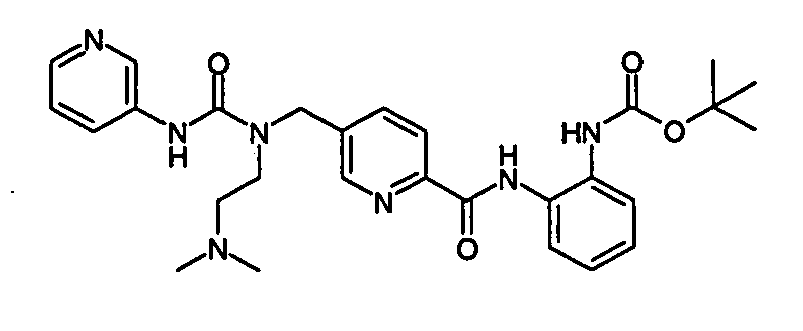
1H-NMR (500 MHz, CDCl3)
δ 1.52 (s, 9H), 2.42 (s, 6H), 2.58 (t, J = 4.3 Hz, 2H), 3.36 (t, J = 4.3 Hz, 2H), 4.67 (s, 2H), 7.03 (br s, 1H), 7.19-7.26 (m, 3H), 7.58 (d, J = 6.4 Hz, 1H), 7.72 (d, J = 5.8 Hz, 1H), 7.92 (dd, J = 7.9, 2.0 Hz, 1H), 8.09 (m, 1H), 8.23 (dd, J = 4.7, 1.4 Hz, 1H), 8.28 (d, J = 7.9 Hz, 1H), 8.32 (d, J = 2.4 Hz, 1H), 8.58 (d, J = 2.0 Hz, 1H), 10.17 (s, 1H), 11.53 (s, 1H)N-(2-t-Butoxycarbonylaminophenyl)-5-[3-(3-chlorophenyl)-1-(3-dimethylaminopropyl)ureidomethyl]pyridine-2-carboxylic acid amide (Reference Compound No.6-70) 
1H-NMR (400 MHz, DMSO-d6)
δ 1.47 (s, 9H), 1.71 (m, 2H), 2.20 (s, 6H), 2.27 (t, J = 6.3 Hz, 2H), 3.35 (m, 2H), 4.63 (s, 2H), 6.99 (ddd, J = 7.8, 2.0, 1.0 Hz, 1H), 7.15 (td, J = 8.1, 1.5 Hz, 1H), 7.19-7.30 (m, 4H), 7.73 (t, J = 2.1 Hz, 1H), 7.98 (dd, J = 8.1, 1.8 Hz, 1H), 8.02 (dd, J = 8.1, 1.0 Hz, 1H), 8.14 (d, J = 8.1 Hz, 1H), 8.58 (d, J = 1.8 Hz, 1H), 9.13 (br s, 1H), 9.95 (br s, 1H), 10.48 (br s, 1H)N-(2-t-Butoxycarbonylaminophenyl)-5-[1-(3-dimethylaminopropyl)-3-(3-methylphenyl)ureidomethyl]pyridine-2-carboxylic acid amide (Reference Compound No.6-71) 
1H-NMR (400 MHz, DMSO-d6)
δ 1.47 (s, 9H), 1.70 (t, J = 6.1 Hz, 2H), 2.20 (s, 6H), 2.26 (s, 3H), 2.28 (m, 2H), 3.35 (m, 2H), 4.62 (s, 2H), 6.76 (d, J = 7.3 Hz, 1H), 7.11-7.28 (m, 6H), 7.98 (dd, J = 8.1, 1.8 Hz, 1H), 8.01 (dd, J = 8.1, 1.0 Hz, 1H), 8.14 (d, J = 8.0 Hz, 1H), 8.58 (d, J = 1.8 Hz, 1H), 9.12 (br s, 1H), 9.61 (br s, 1H), 10.47 (br s, 1H)N-(2-t-Butoxycarbonylaminophenyl)-5-[3-(4-dimethylaminophenyl)-1-[4-(morpholin-4-yl)butyl]ureidomethyl]pyridine-2-carboxylic acid amide (Reference Compound No.6-72) 
1H-NMR (500 MHz, CDCl3)
δ 1.52 (s, 9H), 1.54 (m, 2H), 1.70 (m, 2H), 2.39 (t, J = 6.9 Hz, 2H), 2.43 (m, 4H), 2.92 (s, 6H), 3.30 (t, J = 8.1 Hz, 2H), 3.63 (t, J = 4.3 Hz, 4H), 4.68 (s, 2H), 6.61 (s, 1H), 6.71 (d, J = 8.9 Hz, 2H), 7.06 (br s, 1H), 7.17(d, J = 8.9 Hz, 2H), 7.19-7.22 (m, 2H), 7.59 (d, J = 5.8 Hz, 1H), 7.71 (d, J = 6.1 Hz, 1H), 7.90 (dd, J = 7.9, 1.8 Hz, 1H), 8.27 (d, J = 7.9 Hz, 1H), 8.56 (d, J = 1.8 Hz, 1H), 10.16 (s, 1H)N-(2-t-Butoxycarbonylaminophenyl)-5-[3-(3-fluorophenyl)-1-[4-(morpholin-4-yl)butyl]ureidomethyl]pyridine-2-carboxylic acid amide (Reference Compound No.6-73) 
1H-NMR (500 MHz, CDCl3)
δ 1.52 (s, 9H), 1.55 (m, 2H), 1.71 (m, 2H), 2.39 (t, J = 7.0 Hz, 2H), 2.43 (m, 4H), 3.33 (t, J = 7.9 Hz, 2H), 3.67 (t, J = 4.7 Hz, 4H), 4.68 (s, 2H), 6.70 (s, 1H), 6.78 (td, J = 8.4, 2.4 Hz, 1H), 7.01 (dd, J = 7.9, 1.8 Hz, 1H), 7.05 (br s, 1H), 7.19-7.25 (m, 3H), 7.31 (dt, J = 10.8, 2.4 Hz, 1H), 7.56 (d, J = 6.1 Hz, 1H), 7.73 (d, J = 5.2 Hz, 1H), 7.87 (dd, J = 7.9, 2.1 Hz, 1H), 8.26 (d, J = 7.9 Hz, 1H), 8.55 (d, J = 2.1 Hz, 1H), 10.18 (s, 1H)N-(2-t-Butoxycarbonylaminophenyl)-5-[1-[4-(morpholin-4-yl)butyl]-3-(thiophen-3-yl)ureidomethyl]pyridine-2-carboxylic acid amide (Reference Compound No.6-74) 
1H-NMR (500 MHz, CDCl3)
δ 1.51 (s, 9H), 1.54 (m, 2H), 1.70 (m, 2H), 2.38 (t, J = 7.0 Hz, 2H), 2.43 (t, J = 4.5 Hz, 4H), 3.31 (t, J = 7.9 Hz, 2H), 3.67 (t, J = 4.5 Hz, 4H), 4.69 (s, 2H), 6.86 (s, 1H), 6.98 (dd, J = 5.2, 1.5 Hz, 1H), 7.05 (br s, 1H), 7.20-7.25 (m, 3H), 7.27 (dd, J = 3.2, 1.5 Hz, 1H), 7.58 (d, J = 6.1 Hz, 1H), 7.72 (d, J = 6.4 Hz, 1H), 7.87 (dd, J = 7.9, 2.0 Hz, 1H), 8.26 (d, J = 7.9 Hz, 1H), 8.55 (d, J = 2.0 Hz, 1H), 10.16 (s, 1H)N-(2-t-Butoxycarbonylaminophenyl)-5-[3-(2,3-dihydrobenzo[1,4]dioxin-6-yl)-1-[4-(morpholin-4-yl)butyl]ureidomethyl]pyridine-2-carboxylic acid amide (Reference Compound No.6-75) 
1H-NMR (500 MHz, CDCl3)
δ 1.52 (s, 9H), 1.54 (m, 2H), 1.70 (m, 2H), 2.39 (t, J = 7.0 Hz, 2H), 2.43 (m, 4H), 3.29 (t, J = 7.9 Hz, 2H), 3.64 (t, J = 4.6 Hz, 4H), 4.24 (br s, 4H), 4.67 (s, 2H), 6.61 (s, 1H), 6.75 (dd, J = 8.6, 2.4 Hz, 1H), 6.80 (d, J = 8.6 Hz, 1H), 6.92 (d, J = 2.4 Hz, 1H), 7.05 (br s, 1H), 7.19-7.24 (m, 2H), 7.59 (d, J = 6.1 Hz, 1H), 7.72 (d, J = 5.5 Hz, 1H), 7.89 (dd, J = 7.9, 1.8 Hz, 1H), 8.27 (d, J = 7.9 Hz, 1H), 8.56 (d, J = 1.8 Hz, 1H), 10.16 (s, 1H)N-(2-t-Butoxycarbonylaminophenyl)-5-[1-[4-(morpholin-4-yl)butyl]-3-(pyridin-3-yl)ureidomethyl]pyridine-2-carboxylic acid amide (Reference Compound No.6-76) 
1H-NMR (500 MHz, CDCl3)
δ 1.51 (s, 9H), 1.57 (m, 2H), 1.74 (m, 2H), 2.41 (t, J = 7.0 Hz, 2H), 2.43 (t, J = 4.6 Hz, 4H), 3.36 (t, J = 8.1 Hz, 2H), 3.66 (t, J = 4.6 Hz, 4H), 4.70 (s, 2H), 6.86 (s, 1H), 7.05 (br s, 1H), 7.19-7.25 (m, 2H), 7.28 (dd, J = 8.7, 4.6 Hz, 1H), 7.55 (d, J = 6.4 Hz, 1H), 7.74 (d, J = 5.8 Hz, 1H), 7.87 (dd, J = 8.0, 2.0 Hz, 1H), 7.98 (ddd, J = 8.7, 2.4, 1.3 Hz, 1H), 8.26 (d, J = 8.0 Hz, 1H), 8.34 (dd, J = 4.6, 1.3 Hz, 1H), 8.45 (d, J = 2.4 Hz, 1H), 8.56 (d, J = 2.0 Hz, 1H), 10.19 (s, 1H)N-(2-t-Butoxycarbonylaminophenyl)-5-[1-[4-(morpholin-4-yl)butyl]-3-phenethylureidomethyl]pyridine-2-carboxylic acid amide (Reference Compound No.6-77) 
1H-NMR (500 MHz, CDCl3)
δ 1.40 (m, 2H), 1.49 (m, 2H), 1.52 (s, 9H), 2.25 (t, J = 7.0 Hz, 2H), 2.33 (m, 4H), 2.86 (t, J = 6.7 Hz, 2H), 3.09 (t, J = 7.9 Hz, 2H), 3.55 (td, J = 6.7, 5.7 Hz, 2H), 3.65 (t, J = 4.6 Hz, 4H), 4.58 (s, 2H), 4.75 (t, J = 5.7 Hz, 1H), 7.07 (br s, 1H), 7.17 (m, 2H), 7.19-7.25 (m, 3H), 7.27-7.30 (m, 2H), 7.59 (d, J = 6.7 Hz, 1H), 7.71 (d, J = 6.4 Hz, 1H), 7.76 (dd, J = 8.1, 1.8 Hz, 1H), 8.23 (d, J = 8.1 Hz, 1H), 8.47 (d, J = 1.8 Hz, 1H), 10.15 (s, 1H)N-(2-t-Butoxycarbonylaminophenyl)-5-[3-(3-me thoxyphenyl)-1-[4-(morpholin-4-yl)butyl]ureido methyl]pyridine-2-carboxylic acid amide (Reference Compound No.6-78) 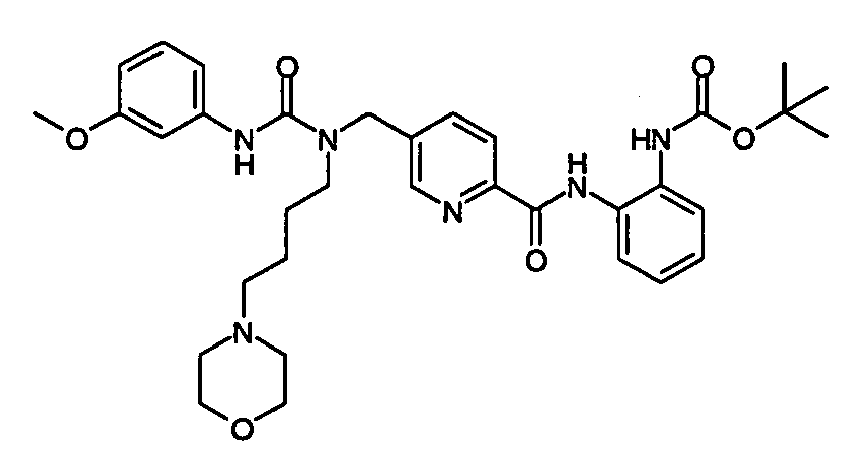
1H-NMR (500 MHz, CDCl3) δ 1.51 (s, 9H), 1.54 (m, 2H), 1.71 (m, 2H), 2.38 (t, J = 7.0 Hz, 2H), 2.42 (m, 4H), 3.33 (t, J = 7.9 Hz, 2H), 3.67 (t, J = 4.6 Hz, 4H), 3.81 (s, 3H), 4.70 (s, 2H), 6.59 (s, 1H), 6.64 (dd, J = 8.0, 2.1 Hz, 1H), 6.84 (dd, J = 8.0, 2.1 Hz, 1H), 7.04 (br s, 1H), 7.11 (t, J = 2.1 Hz, 1H), 7.18-7.24 (m, 2H), 7.20 (t, J = 8.0 Hz, 1H), 7.58 (d, J = 6.1 Hz, 1H), 7.73 (d, J = 6.1 Hz, 1H), 7.89 (dd, J = 8.1, 2.0 Hz, 1H), 8.28 (d, J = 8.1 Hz, 1H), 8.57 (d, J = 2.0 Hz, 1H), 10.16 (s, 1H) N-(2-t-Butoxycarbonylaminophenyl)-5-[3-(2,3-dihydrobenzo[1,4]dioxin-6-yl)-1-(5-dimethylaminopentyl)ureidomethyl]pyridine-2-carboxylic acid amide (Reference Compound No.6-79) 
1H-NMR (500 MHz, CDCl3)
δ 1.38 (m, 2H), 1.50 (m, 2H), 1.52 (s, 9H), 1.67 (m, 2H), 2.20 (s, 6H), 2.25 (t, J = 7.0 Hz, 2H), 3.27 (t, J = 7.8 Hz, 2H), 4.21-4.27 (m, 4H), 4.67 (s, 2H), 6.53 (s, 1H), 6.74 (dd, J = 8.7, 2.4 Hz, 1H), 6.80 (d, J = 8.7 Hz, 1H), 6.95 (d, J = 2.4 Hz, 1H), 7.08 (br s, 1H), 7.18-7.24 (m, 2H), 7.59 (d, J = 6.1 Hz, 1H), 7.70 (d, J = 6.7 Hz, 1H), 7.87 (dd, J = 7.9, 2.1 Hz, 1H), 8.26 (d, J = 7.9 Hz, 1H), 8.55 (d, J = 2.1 Hz, 1H), 10.16 (s, 1H)N-(2-t-Butoxycarbonylaminophenyl)-5-[1-(5-dimethylaminopentyl)-3-(3-fluorophenyl)ureidomethyl]pyridine-2-carboxylic acid amide (Reference Compound No.6-80) 
1H-NMR (500 MHz, CDCl3)
δ 1.40 (m, 2H), 1.50 (m, 2H), 1.52 (s, 9H), 1.68 (m, 2H), 2.20 (s, 6H), 2.26 (t, J = 7.0 Hz, 2H), 3.31 (t, J = 7.8 Hz, 2H), 4.69 (s, 2H), 6.73 (s, 1H), 6.78 (td, J = 8.4, 2.3 Hz, 1H), 7.02 (m, 1H), 7.06 (br s, 1H), 7.18-7.23 (m, 3H), 7.34 (dt, J = 11.1, 2.3 Hz, 1H), 7.56 (d, J = 6.1 Hz, 1H), 7.71 (d, J = 5.8 Hz, 1H), 7.87 (dd, J = 7.9, 1.8 Hz, 1H), 8.26 (d, J = 7.9 Hz, 1H), 8.56 (d, J = 1.8 Hz, 1H), 10.18 (s, 1H)N-(2-t-Butoxycarbonylaminophenyl)-5-[1-(3-dimethylaminopropyl)-3-(pyridin-3-yl)ureidomethyl]pyridine-2-carboxylic acid amide (Reference Compound No.6-81) 
1H-NMR (500 MHz, DMSO-d6)
δ 1.47 (s, 9H), 1.71 (m, 2H), 2.20 (s, 6H), 2.28 (t, J = 6.3 Hz, 2H), 3.38 (t, J = 6.3 Hz, 2H), 4.65 (s, 2H), 7.15 (t, J = 8.1 Hz, 1H), 7.23-7.25 (m, 2H), 7.29 (dd, J = 8.4, 4.7 Hz, 1H), 7.90 (ddd, J = 8.4, 2.6, 1.5 Hz, 1H), 7.99 (dd, J = 7.9, 2.0 Hz, 1H), 8.01 (d, J = 8.1 Hz, 1H), 8.15 (m, 1H), 8.16 (dd, J = 4.7, 1.5 Hz, 1H), 8.58 (d, J = 2.6 Hz, 1H), 8.59 (d, J = 2.0 Hz, 1H), 9.12 (br s, 1H), 9.93 (br s, 1H), 10.47 (br s, 1H)N-(2-t-Butoxycarbonylaminophenyl)-5-[1-(3-dimethylaminopropyl)-3-(3-nitrophenyl)ureidomethyl]pyridine-2-carboxylic acid amide (Reference Compound No.6-82) 
1H-NMR (400 MHz, DMSO-d6)
δ 1.46 (s, 9H), 1.73 (m, 2H), 2.21 (s, 6H), 2.29 (t, J = 6.2 Hz, 2H), 3.39 (t, J = 6.1 Hz, 2H), 4.67 (s, 2H), 7.15 (td, J = 7.8, 1.5 Hz, 1H), 7.23-7.29 (m, 2H), 7.55 (t, J = 8.2 Hz, 1H), 7.71 (dd, J = 7.8, 1.5 Hz, 1H), 7.81 (m, 1H), 7.99-8.02 (m, 2H), 8.15 (d, J = 8.1 Hz, 1H), 8.56 (m, 1H), 8.60 (d, J = 1.2 Hz, 1H), 9.13 (br s, 1H), 10.27 (br s, 1H), 10.48 (br s, 1H)5-[3-(3-Acetylphenyl)-1-(3-dimethylaminopropyl)ureidomethyl]-N-(2-t-butoxycarbonylaminophenyl)pyridine-2-carboxylic acid amide (Reference Compound No.6-83) 
1H-NMR (400 MHz, DMSO-d6)
δ 1.46 (s, 9H), 1.71 (m, 2H), 2.21 (s, 6H), 2.28 (t, J = 6.2 Hz, 2H), 2.56 (s, 3H), 3.38 (t, J = 6.1 Hz, 2H), 4.65 (s, 2H), 7.15 (t, J = 7.6 Hz, 1H), 7.23-7.27 (m, 2H), 7.41 (t, J = 7.8 Hz, 1H), 7.57 (m, 1H), 7.70 (m, 1H), 7.98-8.03 (m, 3H), 8.15 (d, J = 7.8 Hz, 1H), 8.59 (d, J = 1.5 Hz, 1H), 9.12 (br s, 1H), 9.90 (br s, 1H), 10.48 (br s, 1H)N-(2-t-Butoxycarbonylaminophenyl)-5-[1-(3-dimethylaminopropyl)-3-(3-methylthiophenyl)ureidomethyl]pyridine-2-carboxylic acid amide (Reference Compound No.6-84) 
1H-NMR (400 MHz, DMSO-d6)
δ 1.47 (s, 9H), 1.70 (m, 2H), 2.20 (s, 6H), 2.27 (t, J = 6.2 Hz, 2H), 2.45 (s, 3H), 3.35 (m, 2H), 4.62 (s, 2H), 6.84 (ddd, J = 7.6, 1.8, 1.1 Hz, 1H), 7.12-7.28 (m, 5H), 7.45 (t, J = 1.8 Hz, 1H), 7.98 (dd, J = 8.1, 1.8 Hz, 1H), 8.01 (d, J = 7.1 Hz, 1H), 8.15 (d, J = 8.1 Hz, 1H), 8.58 (d, J = 1.8 Hz, 1H), 9.13 (br s, 1H), 9.75 (br s, 1H), 10.48 (br s, 1H)N-(2-t-Butoxycarbonylaminophenyl)-5-[3-(3-fluorophenyl)-1-[3-(morpholin-4-yl)propyl]ureidomethyl]pyridine-2-carboxylic acid amide (Reference Compound No.6-85) 
1H-NMR (400 MHz, CDCl3)
δ 1.51 (s, 9H), 1.80 (m, 2H), 2.43-2.54 (m, 6H), 3.39 (t, J = 5.6 Hz, 2H), 3.72 (t, J = 4.6 Hz, 4H), 4.65 (s, 2H), 6.79 (tdd, J = 8.4, 2.4, 0.8 Hz, 1H), 7.03 (br s, 1H), 7.13 (m, 1H), 7.17-7.30 (m, 3H), 7.42 (m, 1H), 7.59 (d, J = 6.3 Hz, 1H), 7.70 (d, J = 7.3 Hz, 1H), 7.92 (dd, J = 8.1, 2.1 Hz, 1H), 8.26 (dd, J = 8.1, 0.5 Hz, 1H), 8.58 (dd, J = 2.1, 0.5 Hz, 1H), 9.05 (s, 1H), 10.16 (s, 1H)N-(2-t-Butoxycarbonylaminophenyl)-5-[3-(3-fluoro-4-methylphenyl)-1-[3-(morpholin-4-yl)propyl]ureidomethyl]pyridine-2-carboxylic acid amide (Reference Compound No.6-86) 
1H-NMR (400 MHz, CDCl3)
δ 1.51 (s, 9H), 1.79 (m, 2H), 2.23 (d, J = 1.7 Hz, 3H), 2.44-2.51 (m, 6H), 3.37 (t, J = 5.5 Hz, 2H), 3.69 (t, J = 4.5 Hz, 4H), 4.64 (s, 2H), 7.01 (dd, J = 8.1, 1.7 Hz, 1H), 7.04 (br s, 1H), 7.10 (t, J = 8.1 Hz, 1H), 7.17-7.25 (m, 2H), 7.31 (m, 1H), 7.59 (d, J = 6.1 Hz, 1H), 7.70 (d, J = 6.6 Hz, 1H), 7.92 (dd, J = 8.1, 2.2 Hz, 1H), 8.25 (dd, J = 8.1, 0.7 Hz, 1H), 8.57 (dd, J = 2.2, 0.7 Hz, 1H), 9.01 (s, 1H), 10.15 (s, 1H)N-(2-t-Butoxycarbonylaminophenyl)-5-[1-[3-(morpholin-4-yl)propyl]-3-(thiophen-3-yl)ureidomethyl]pyridine-2-carboxylic acid amide (Reference Compound No.6-87) 
1H-NMR (400 MHz, CDCl3)
δ 1.51 (s, 9H), 1.78 (m, 2H), 2.41-2.52 (m, 6H), 3.36 (t, J = 5.6 Hz, 2H), 3.72 (t, J = 4.6 Hz, 4H), 4.65 (s, 2H), 7.05 (br s, 1H), 7.10 (dd, J = 5.1, 1.4 Hz, 1H), 7.17-7.25 (m, 2H), 7.25 (dd, J = 5.1, 3.4 Hz, 1H), 7.31 (dd, J = 3.4, 1.4 Hz, 1H), 7.60 (d, J = 7.1 Hz, 1H), 7.69 (d, J = 6.6 Hz, 1H), 7.92 (dd, J = 8.1, 2.2 Hz, 1H), 8.25 (dd, J = 8.1, 0.7 Hz, 1H), 8.57 (dd, J = 2.2, 0.7 Hz, 1H), 9.25 (s, 1H), 10.15 (s, 1H)N-(2-t-Butoxycarbonylaminophenyl)-5-[3-(4-me thoxyphenyl)-1-[4-(morpholin-4-yl)butyl]ureido methyl]pyridine-2-carboxylic acid amide (Reference Compound No.6-88) 
1H-NMR (500 MHz, CDCl3) δ 1.52 (s, 9H), 1.55 (m, 2H), 1.72 (m, 2H), 2.39 (t, J = 6.9 Hz, 2H), 2.42 (m, 4H), 3.31 (t, J = 7.9 Hz, 2H), 3.63 (t, J = 4.6 Hz, 4H), 3.80 (s, 3H), 4.68 (s, 2H), 6.68 (s, 1H), 6.87 (d, J = 9.2 Hz, 2H), 7.05 (br s, 1H), 7.18-7.24 (m, 2H), 7.23 (d, J = 9.2 Hz, 2H), 7.58 (d, J = 5.8 Hz, 1H), 7.72 (d, J = 6.1 Hz, 1H), 7.89 (dd, J = 7.9, 1.8 Hz, 1H), 8.27 (dd, J = 7.9, 0.6 Hz, 1H), 8.56 (dd, J = 1.8, 0.6 Hz, 1H), 10.16 (s, 1H) N-(2-t-Butoxycarbonylaminophenyl)-5-[3-(4-methylphenyl)-1-[4-(morpholin-4-yl)butyl]ureidomethyl]pyridine-2-carboxylic acid amide (Reference Compound No.6-89) 
1H-NMR (400 MHz, CDCl3)
δ 1.51 (s, 9H), 1.56 (m, 2H), 1.71 (m, 2H), 2.31 (s, 3H), 2.38 (t, J = 7.0 Hz, 2H), 2.42 (t, J = 4.5 Hz, 4H), 3.32 (t, J = 7.9 Hz, 2H), 3.65 (t, J = 4.5 Hz, 4H), 4.68 (s, 2H), 6.62 (s, 1H), 7.06 (br s, 1H), 7.12 (d, J = 8.1 Hz, 2H), 7.20-7.25 (m, 2H), 7.22 (d, J = 8.1 Hz, 2H), 7.58 (d, J = 6.6 Hz, 1H), 7.72 (d, J = 6.1 Hz, 1H), 7.89 (dd, J = 8.1, 2.2 Hz, 1H), 8.26 (dd, J = 8.1, 0.7 Hz, 1H), 8.56 (dd, J = 2.2, 0.7 Hz, 1H), 10.16 (s, 1H)N-(2-t-Butoxycarbonylaminophenyl)-5-[3-(3,4-dimethoxyphenyl)-1-[4-(morpholin-4-yl)butyl]ureidomethyl]pyridine-2-carboxylic acid amide (Reference Compound No.6-90) 
1H-NMR (500 MHz, CDCl3)
δ 1.51 (s, 9H), 1.53 (m, 2H), 1.71 (m, 2H), 2.39 (t, J = 7.0 Hz, 2H), 2.41 (m, 4H), 3.32 (t, J = 7.9 Hz, 2H), 3.64 (t, J = 4.5 Hz, 4H), 3.86 (s, 3H), 3.90 (s, 3H), 4.70 (s, 2H), 6.64 (s, 1H), 6.71 (dd, J = 8.5, 2.4 Hz, 1H), 6.80 (d, J = 8.5 Hz, 1H), 7.04 (br s, 1H), 7.13 (d, J = 2.4 Hz, 1H), 7.19-7.25 (m, 2H), 7.58 (d, J = 5.5 Hz, 1H), 7.72 (d, J = 6.1 Hz, 1H), 7.89 (dd, J = 7.9, 2.0 Hz, 1H), 8.28 (d, J = 7.9 Hz, 1H), 8.57 (d, J = 2.0 Hz, 1H), 10.16 (s, 1H)N-(2-t-Butoxycarbonylaminophenyl)-5-[3-(3-ethoxyphenyl)-1-[4-(morpholin-4-yl)butyl]ureidomethyl]pyridine-2-carboxylic acid amide (Reference Compound No.6-91) 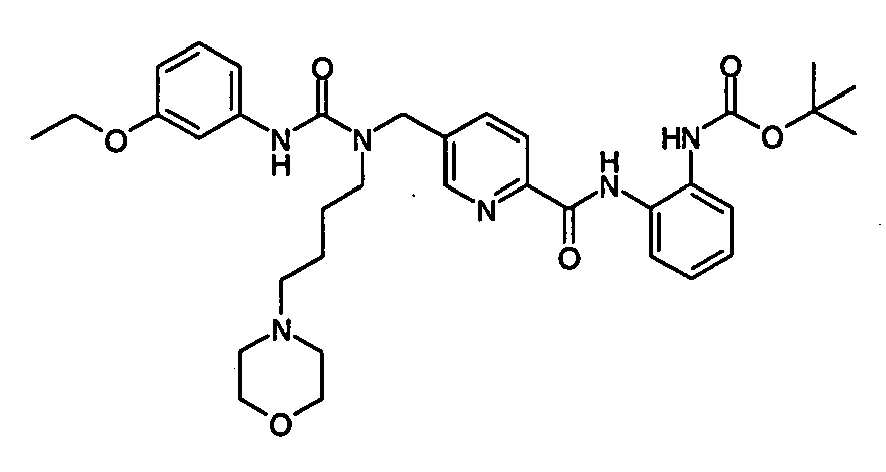
1H-NMR (400 MHz, CDCl3)
δ 1.40 (t, J = 7.0 Hz, 3H), 1.51 (s, 9H), 1.54 (m, 2H), 1.71 (m, 2H), 2.38 (t, J = 7.1 Hz, 2H), 2.42 (t, J = 4.4 Hz, 4H), 3.32 (t, J = 7.8 Hz, 2H), 3.67 (t, J = 4.4 Hz, 4H), 4.03 (q, J = 7.0 Hz, 2H), 4.69 (s, 2H), 6.60 (s, 1H), 6.63 (ddd, J = 8.2, 2.3, 0.9 Hz, 1H), 6.83 (ddd, J = 8.2, 2.3, 0.9 Hz, 1H), 7.06 (br s, 1H), 7.10 (t, J = 2.3 Hz, 1H), 7.17 (t, J = 8.2 Hz, 1H), 7.20-7.23 (m, 2H), 7.57 (d, J = 6.3 Hz, 1H), 7.73 (d, J = 6.3 Hz, 1H), 7.88 (dd, J = 8.1, 2.2 Hz, 1H), 8.26 (dd, J = 8.1, 0.7 Hz, 1H), 8.55 (dd, J = 2.2, 0.7 Hz, 1H), 10.17 (s, 1H)N-(2-t-Butoxycarbonylaminophenyl)-5-[3-(3-methylphenyl)-1-[4-(morpholin-4-yl)butyl]ureidomethyl]pyridine-2-carboxylic acid amide (Reference Compound No.6-92) 
1H-NMR (500 MHz, CDCl3)
δ 1.52 (s, 9H), 1.54 (m, 2H), 1.72 (m, 2H), 2.34 (s, 3H), 2.39 (t, J = 7.0 Hz, 2H), 2.44 (t, J = 4.7 Hz, 4H), 3.33 (t, J = 7.9 Hz, 2H), 3.67 (t, J = 4.7 Hz, 4H), 4.69 (s, 2H), 6.57 (s, 1H), 6.91 (d, J = 7.8 Hz, 1H), 7.04 (br s, 1H), 7.12 (d, J = 7.8 Hz, 1H), 7.18-7.24 (m, 3H), 7.20 (t, J = 7.8 Hz, 1H), 7.58 (d, J = 5.8 Hz, 1H), 7.72 (d, J = 5.5 Hz, 1H), 7.89 (dd, J = 7.9, 2.1 Hz, 1H), 8.28 (dd, J = 7.9, 0.7 Hz, 1H), 8.57 (dd, J = 2.1, 0.7 Hz, 1H), 10.16 (s, 1H)5-[3-(3-Acetylphenyl)-1-[4-(morpholin-4-yl)butyl]ureidomethyl]-N-(2-t-butoxycarbonylaminophenyl)pyridine-2-carboxylic acid amide (Reference Compound No.6-93) 
1H-NMR (400 MHz, CDCl3)
δ 1.51 (s, 9H), 1.55 (m, 2H), 1.74 (m, 2H), 2.41 (t, J = 7.0 Hz, 2H), 2.44 (t, J = 4.6 Hz, 4H), 2.61 (s, 3H), 3.35 (t, J = 7.9 Hz, 2H), 3.66 (t, J = 4.6 Hz, 4H), 4.70 (s, 2H), 6.83 (s, 1H), 7.05 (br s, 1H), 7.18-7.25 (m, 2H), 7.43 (t, J = 7.9 Hz, 1H), 7.55 (d, J = 6.3 Hz, 1H), 7.67 (ddd, J = 7.9, 1.8, 1.1 Hz, 1H), 7.72 (d, J = 6.8 Hz, 1H), 7.78 (ddd, J = 7.9, 1.8, 1.1 Hz, 1H), 7.82 (t, J = 1.8 Hz, 1H), 7.89 (dd, J = 8.0, 2.2 Hz, 1H), 8.28 (dd, J = 8.0, 0.6 Hz, 1H), 8.57 (dd, J = 2.2, 0.6 Hz, 1H), 10.17 (s, 1H)N-(2-t-Butoxycarbonylaminophenyl)-5-[3-(2-methoxyphenyl)-1-[4-(morpholin-4-yl)butyl]ureidomethyl]pyridine-2-carboxylic acid amide (Reference Compound No.6-94) 
1H-NMR (400 MHz, CDCl3)
δ 1.51 (s, 9H), 1.56 (m, 2H), 1.73 (m, 2H), 2.37 (t, J = 7.3 Hz, 2H), 2.42 t, J = 4.6 Hz, 4H), 3.38 (t, J = 7.6 Hz, 2H), 3.69 (t, J = 4.6 Hz, 4H), 3.82 (s, 3H), 4.70 (s, 2H), 6.86 (dd, J = 7.2, 2.4 Hz, 1H), 6.98 (td, J = 7.2, 2.4 Hz, 1H), 7.01 (td, J = 7.2, 2.4 Hz, 1H), 7.05 (br s, 1H), 7.19-7.23 (m, 2H), 7.57 (d, J = 5.9 Hz, 1H), 7.73 (d, J = 5.6 Hz, 1H), 7.90 (dd, J = 8.1, 2.2 Hz, 1H), 8.13 (dd, J = 7.2, 2.4 Hz, 1H), 8.28 (dd, J = 8.1, 0.7 Hz, 1H), 8.57 (dd, J = 2.2, 0.7 Hz, 1H), 10.17 (s, 1H)N-(2-t-Butoxycarbonylaminophenyl)-5-[3-(3-methylphenyl)-1-[3-(4-methylpiperidin-1-yl)propyl]ureidomethyl]pyridine-2-carboxylic acid amide (Reference Compound No.6-95) 
1H-NMR (500 MHz, CDCl3)
δ 0.90 (d, J = 6.4 Hz, 3H), 1.21 (m, 2H), 1.38 (m, 1H), 1.51 (s, 9H), 1.59 (m, 2H), 1.76 (m, 2H), 1.92 (m, 2H), 2.34 (s, 3H), 2.42 (t, J = 6.0 Hz, 2H), 2.88 (d, J = 11.6 Hz, 2H), 3.37 (t, J = 5.7 Hz, 2H), 4.63 (s, 2H), 6.89 (d, J = 7.6 Hz, 1H), 7.06 (s, 1H), 7.17-7.24 (m, 3H), 7.28-7.30 (m, 2H), 7.61 (d, J = 7.3 Hz, 1H), 7.68 (d, J = 7.0 Hz, 1H), 7.93 (dd, J = 7.9, 2.1 Hz, 1H), 8.24 (d, J = 7.9 Hz, 1H), 8.57 (d, J = 2.1 Hz, 1H), 9.34 (s, 1H), 10.14 (s, 1H)N-(2-t-Butoxycarbonylaminophenyl)-5-[3-(3,4-difluorophenyl)-1-[3-(4-methylpiperidin-1-yl)propyl]ureidomethyl]pyridine-2-carboxylic acid amide (Reference Compound No.6-96) 
1H-NMR (500 MHz, CDCl3)
δ 0.90 (d, J = 6.4 Hz, 3H), 1.12 (m, 2H), 1.40 (m, 1H), 1.51 (s, 9H), 1.60 (m, 2H), 1.77 (m, 2H), 1.95 (m, 2H), 2.42 (t, J = 6.1 Hz, 2H), 2.86 (d, J = 11.6 Hz, 2H), 3.36 (t, J = 5.7 Hz, 2H), 4.61 (s, 2H), 7.03-7.10 (m, 3H), 7.18-7.24 (m, 2H), 7.45 (m, 1H), 7.59 (d, J = 6.4 Hz, 1H), 7.70 (d, J = 6.7 Hz, 1H), 7.91 (dd, J = 7.9, 2.1 Hz, 1H), 8.25 (d, J = 7.9 Hz, 1H), 8.57 (d, J = 2.1 Hz, 1H), 9.70 (s, 1H), 10.15 (s, 1H)N-(2-t-Butoxycarbonylaminophenyl)-5-[3-(2,3-dihydrobenzo[1,4]dioxin-6-yl)-1-[3-(4-methylpiperidin--yl)propyl]ureidomethyl]pyridine-2-carboxylic acid amide (Reference Compound No.6-97) 
1H-NMR (400 MHz, CDCl3)
δ 0.87 (d, J = 6.3 Hz, 3H), 1.13 (m, 2H), 1.36 (m, 1H), 1.51 (s, 9H), 1.54 (m, 2H), 1.74 (m, 2H), 1.91 (m, 2H), 2.41 (t, J = 6.0 Hz, 2H), 2.85 (d, J = 11.5 Hz, 2H), 3.34 (t, J = 5.4 Hz, 2H), 4.23-4.24 (m, 4H), 4.61 (s, 2H), 6.79 (d, J = 8.7 Hz, 1H), 6.85 (dd, J = 8.7, 2.4 Hz, 1H), 7.01 (d, J = 2.4 Hz, 1H), 7.08 (br s, 1H), 7.17-7.24 (m, 2H), 7.61 (d, J = 7.1 Hz, 1H), 7.68 (d, J = 6.3 Hz, 1H), 7.93 (dd, J = 8.1, 2.2 Hz, 1H), 8.24 (d, J = 8.1 Hz, 1H), 8.56 (d, J = 2.2 Hz, 1H), 9.42 (s, 1H), 10.14 (s, 1H)N-(2-t-Butoxycarbonylaminophenyl)-5-[3-(4-fluorophenyl)-1-[3-(morpholin-4-yl)propyl]ureidomethyl]pyridine-2-carboxylic acid amide (Reference Compound No.6-98) 
1H-NMR (500 MHz, CDCl3)
δ 1.51 (s, 9H), 1.79 (m, 2H), 2.45 (br s, 4H), 2.49 (t, J = 6.0 Hz, 2H), 3.39 (t, J = 5.5 Hz, 2H), 3.64 (t, J = 4.4 Hz, 4H), 4.64 (s, 2H), 7.03 (t, J = 8.7 Hz, 2H), 7.03 (br s, 1H), 7.18-7.24 (m, 2H), 7.38 (dd, J = 8.7, 4.9 Hz, 2H), 7.59 (d, J = 7.3 Hz, 1H), 7.69 (d, J = 7.0 Hz, 1H), 7.92 (dd, J = 8.1, 2.1 Hz, 1H), 8.25 (dd, J = 8.1, 0.6 Hz, 1H), 8.57 (dd, J = 2.1, 0.6 Hz, 1H), 9.08 (s, 1H), 10.14 (s, 1H)N-(2-t-Butoxycarbonylaminophenyl)-5-[3-(4-fluoro-3-methylphenyl)-1-[3-(morpholin-4-yl)propyl]ureidomethyl]pyridine-2-carboxylic acid amide (Reference Compound No.6-99) 
1H-NMR (500 MHz, CDCl3)
δ 1.51 (s, 9H), 1.79 (m, 2H), 2.27 (d, J = 1.8 Hz, 3H), 2.45 (br s, 4H), 2.49 (t, J = 6.0 Hz, 2H), 3.38 (t, J = 5.7 Hz, 2H), 3.64 (t, J = 4.6 Hz, 4H), 4.64 (s, 2H), 6.95 (t, J = 8.8 Hz, 1H), 7.05 (br s, 1H), 7.13 (ddd, J = 8.8, 4.3, 2.7 Hz, 1H), 7.18-7.24 (m, 2H), 7.30 (dd, J = 6.9, 2.7 Hz, 1H), 7.60 (d, J = 6.4 Hz, 1H), 7.69 (d, J = 7.3 Hz, 1H), 7.92 (dd, J = 7.9, 2.0 Hz, 1H), 8.25 (d, J = 7.9 Hz, 1H), 8.57 (d, J = 2.0 Hz, 1H), 9.00 (s, 1H), 10.14 (s, 1H)N-(2-t-Butoxycarbonylaminophenyl)-5-[3-(3,4-difluorophenyl)-1-[3-(morpholin-4-yl)propyl]ureidomethyl]pyridine-2-carboxylic acid amide (Reference Compound No.6-100) 
1H-NMR (500 MHz, CDCl3)
δ 1.51 (s, 9H), 1.80 (m, 2H), 2.46-2.50 (m, 6H), 3.38 (t, J = 5.7 Hz, 2H), 3.67 (t, J = 4.7 Hz, 4H), 4.63 (s, 2H), 6.95-7.06 (m, 2H), 7.10 (m, 1H), 7.17-7.25 (m, 2H), 7.50 (ddd, J = 12.2, 7.3, 2.4 Hz, 1H), 7.58 (d, J = 6.1 Hz, 1H), 7.71 (d, J = 5.8 Hz, 1H), 7.91 (dd, J = 7.9, 2.1 Hz, 1H), 8.26 (dd, J = 7.9, 0.6 Hz, 1H), 8.57 (dd, J = 2.1, 0.6 Hz, 1H), 9.15 (s, 1H), 10.15 (s, 1H)N-(2-t-Butoxycarbonylaminophenyl)-5-[3-(3-methylphenyl)-1-[3-(morpholin-4-yl)propyl]ureidomethyl]pyridine-2-carboxylic acid amide (Reference Compound No.6-101) 
1H-NMR (500 MHz, CDCl3)
δ 1.51 (s, 9H), 1.79 (m, 2H), 2.35 (s, 3H), 2.46 (br s, 4H), 2.49 (t, J = 6.1 Hz, 2H), 3.39 (t, J = 5.7 Hz, 2H), 3.70 (t, J = 4.6 Hz, 4H), 4.65 (s, 2H), 6.91 (m, 1H), 7.05 (br s, 1H), 7.17-7.25 (m, 4H), 7.33 (s, 1H), 7.60 (d, J = 7.0 Hz, 1H), 7.69 (d, J = 6.7 Hz, 1H), 7.93 (dd, J = 8.2, 1.9 Hz, 1H), 8.25 (d, J = 8.2 Hz, 1H), 8.57 (d, J = 1.9 Hz, 1H), 8.86 (s, 1H), 10.15 (s, 1H)5-[3-(3-Acetylphenyl)-1-[3-(morpholin-4-yl)propyl]ureidomethyl]-N-(2-t-butoxycarbonylaminophenyl)pyridine-2-carboxylic acid amide (Reference Compound No.6-102) 
1H-NMR (500 MHz, CDCl3)
δ 1.51 (s, 9H), 1.83 (m, 2H), 2.49 (br s, 4H), 2.51 (t, J = 6.1 Hz, 2H), 2.62 (s, 3H), 3.42 (t, J = 5.5 Hz, 2H), 3.72 (t, J = 4.6 Hz, 4H), 4.66 (s, 2H), 7.03 (br s, 1H), 7.17-7.24 (m, 2H), 7.44 (t, J = 7.9 Hz, 1H), 7.59 (d, J = 6.1 Hz, 1H), 7.67 (d, J = 7.9 Hz, 1H), 7.70 (m, 1H), 7.80 (dd, J = 7.9, 1.8 Hz, 1H), 7.93 (dd, J = 8.0, 1.9 Hz, 1H), 7.99 (t, J = 1.8 Hz, 1H), 8.26 (d, J = 8.0 Hz, 1H), 8.58 (d, J = 1.9 Hz, 1H), 9.21 (s, 1H), 10.15 (s, 1H)N-(2-t-Butoxycarbonylaminophenyl)-5-[3-(3-methylphenyl)-1-[5-(morpholin-4-yl)pentyl]ureidomethyl]pyridine-2-carboxylic acid amide (Reference Compound No.6-103) 
1H-NMR (500 MHz, CDCl3)
δ 1.38 (m, 2H), 1.50-1.56 (m, 4H), 1.51 (s, 9H), 1.68 (m, 2H), 2.32 (t, J = 7.6 Hz, 2H), 2.34 (s, 3H), 2.41 (br s, 4H), 3.31 (t, J = 7.6 Hz, 2H), 3.70 (t, J = 4.6 Hz, 4H), 4.69 (s, 2H), 6.89 (d, J = 7.6 Hz, 1H), 7.04 (br s, 1H), 7.12 (d, J = 8.6 Hz, 1H), 7.17-7.25 (m, 3H), 7.58 (d, J = 6.1 Hz, 1H), 7.72 (d, J = 6.1 Hz, 1H), 7.88 (dd, J = 7.9, 2.1 Hz, 1H), 8.28 (d, J = 7.9 Hz, 1H), 8.56 (d, J = 2.1 Hz, 1H), 10.17 (s, 1H)N-(2-t-Butoxycarbonylaminophenyl)-5-[3-(3,4-difluorophenyl)-1-[5-(morpholin-4-yl)pentyl]ureidomethyl]pyridine-2-carboxylic acid amide (Reference Compound No.6-104) 
1H-NMR (500 MHz, CDCl3)
δ 1.37 (m, 2H), 1.51 (s, 9H), 1.53 (m, 2H), 1.67 (m, 2H), 2.32 (t, J = 7.6 Hz, 2H), 2.41 (br s, 4H), 3.30 (t, J = 7.6 Hz, 2H), 3.70 (t, J = 4.6 Hz, 4H), 4.67 (s, 2H), 6.41 (s, 1H), 6.94 (m, 1H), 7.04-7.10 (m, 2H), 7.19-7.24 (m, 2H), 7.46 (m, 1H), 7.56 (br s, 1H), 7.74 (br s, 1H), 7.85 (dd, J = 7.9, 2.1 Hz, 1H), 8.25 (d, J = 7.9 Hz, 1H), 8.54 (d, J = 2.1 Hz, 1H), 10.17 (s, 1H)N-(2-t-Butoxycarbonylaminophenyl)-5-[3-(2,3-dihydrobenzo[1,4]dioxin-6-yl)-1-[5-(morpholin-4-yl)pentyl]ureidomethyl]pyridine-2-carboxylic acid amide (Reference Compound No.6-105) 
1H-NMR (500 MHz, CDCl3)
δ 1.37 (m, 2H), 1.52 (s, 9H), 1.53 (m, 2H), 1.66 (m, 2H), 2.31 (t, J = 7.5 Hz, 2H), 2.41 (br s, 4H), 3.28 (t, J = 7.6 Hz, 2H), 3.70 (t, J = 4.6 Hz, 4H), 4.21-4.25 (m, 4H), 4.67 (s, 2H), 6.20 (s, 1H), 6.76 (dd, J = 8.6, 2.1 Hz, 1H), 6.79 (d, J = 8.6 Hz, 1H), 6.96 (d, J = 2.1 Hz, 1H), 7.07 (br s, 1H), 7.19-7.24 (m, 2H), 7.58 (d, J = 5.5 Hz, 1H), 7.72 (d, J = 5.2 Hz, 1H), 7.87 (dd, J = 7.9, 2.1 Hz, 1H), 8.26 (d, J = 7.9 Hz, 1H), 8.55 (d, J = 2.1 Hz, 1H), 10.16 (s, 1H)N-(2-t-Butoxycarbonylaminophenyl)-5-[3-cyclopentyl-1-[3-(morpholin-4-yl)propyl]ureidomethyl]pyridine-2-carboxylic acid amide (Reference Compound No.6-106) 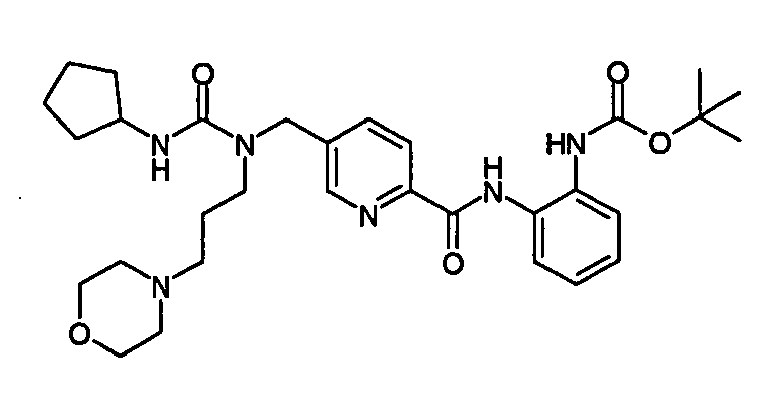
1H-NMR (400 MHz, CDCl3)
δ 1.35 (m, 2H), 1.52 (s, 9H), 1.62 (m, 2H), 1.69 (m, 4H), 2.06 (m, 2H), 2.37 (t, J = 6.1 Hz, 2H), 2.44 (t, J = 4.6 Hz, 4H), 3.21 (t, J = 6.0 Hz, 2H), 3.74 (t, J = 4.6 Hz, 4H), 4.11 (m, 1H), 4.58 (s, 2H), 5.92 (d, J = 7.3 Hz, 1H), 7.05 (br s, 1H), 7.18-7.24 (m, 2H), 7.59 (d, J = 7.1 Hz, 1H), 7.70 (d, J = 6.6 Hz, 1H), 7.85 (dd, J = 8.1, 2.2 Hz, 1H), 8.25 (dd, J = 8.1, 0.7 Hz, 1H), 8.52 (dd, J = 2.2, 0.7 Hz, 1H), 10.14 (s, 1H)5-[3-[2-(Benzo[1,3]dioxol-5-yl)ethyl]-1-[3-(morpholin-4-yl)propyl]ureidomethyl]-N-(2-t-butoxycarbonylaminophenyl)pyridine-2-carboxylic acid amide (Reference Compound No.6-107) 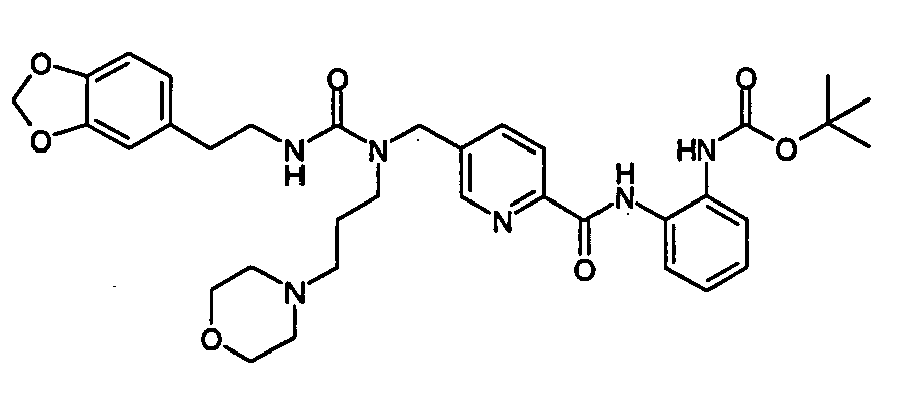
1H-NMR (500 MHz, CDCl3)
δ 1.51 (s, 9H), 1.63 (m, 2H), 2.33 (t, J = 5.8 Hz, 2H), 2.33 (m, 4H), 2.77 (t, J = 6.7 Hz, 2H), 3.17 (t, J = 5.7 Hz, 2H), 3.43 (q, J = 6.7 Hz, 2H), 3.60 (s, 4H), 4.57 (s, 2H), 5.92 (s, 2H), 6.64 (dd, J = 7.7, 1.5 Hz, 1H), 6.70 (d, J = 1.5 Hz, 1H), 6.75 (d, J = 7.7 Hz, 1H), 7.07 (m, 1H), 7.18-7.24 (m, 2H), 7.61 (d, J = 6.7 Hz, 1H), 7.69 (d, J = 6.4 Hz, 1H), 7.80 (dd, J = 8.0, 1.9 Hz, 1H), 8.25 (d, J = 8.0 Hz, 1H), 8.47 (d, J = 1.9 Hz, 1H), 10.15 (s, 1H)N-(2-t-Butoxycarbonylaminophenyl)-5-[3-isopropyl-1-[3-(morpholin-4-yl)propyl]ureidomethyl]pyridine-2-carboxylic acid amide (Reference Compound No.6-108) 
1H-NMR (400 MHz, CDCl3)
δ 1.20 (d, J = 6.6 Hz, 6H), 1.52 (s, 9H), 1.69 (m, 2H), 2.37 (t, J = 6.1 Hz, 2H), 2.45 (t, J = 4.5 Hz, 4H), 3.21 (t, J = 6.0 Hz, 2H), 3.76 (t, J = 4.5 Hz, 4H), 4.02 (m, 1H), 4.57 (s, 2H), 5.90 (d, J = 7.8 Hz, 1H), 7.06 (br s, 1H), 7.17-7.25 (m, 2H), 7.56 (d, J = 6.6 Hz, 1H), 7.70 (d, J = 6.1 Hz, 1H), 7.85 (dd, J = 8.1, 2.0 Hz, 1H), 8.24 (dd, J = 8.1, 0.7 Hz, 1H), 8.52 (dd, J = 2.0, 0.7 Hz, 1H), 10.15 (s, 1H)N-(2-t-Butoxycarbonylaminophenyl)-5-[1-[3-(morpholin-4-yl)propyl]-3-propylureidomethyl]pyridine-2-carboxylic acid amide (Reference Compound No.6-109) 
1H-NMR (500 MHz, CDCl3)
δ 0.95 (t, J = 7.5 Hz, 3H), 1.52 (s, 9H), 1.52 (m, 2H), 1.68 (m, 2H), 2.39 (t, J = 6.1 Hz, 2H), 2.45 (s, 4H), 3.19 (t, J = 6.3 Hz, 2H), 3.23 (t, J = 5.9 Hz, 2H), 3.74 (t, J = 4.4 Hz, 4H), 4.58 (s, 2H), 7.03 (t, J = 6.3 Hz, 1H), 7.05 (br s, 1H), 7.18-7.24 (m, 2H), 7.60 (d, J = 5.9 Hz, 1H), 7.68 (d, J = 7.6 Hz, 1H), 7.85 (dd, J = 7.9, 2.1 Hz, 1H), 8.24 (d, J = 7.9, 0.6 Hz, 1H), 8.52 (d, J = 2.1, 0.6 Hz, 1H), 10.14 (s, 1H)N-(2-t-Butoxycarbonylaminophenyl)-5-[1-[4-(morpholin-4-yl)butyl]-3-propylureidomethyl]pyridine-2-carboxylic acid amide (Reference Compound No.6-110) 
1H-NMR (500 MHz, CDCl3) δ 0.92 (t, J = 7.3 Hz, 3H), 1.46-1.64 (m, 6H), 1.52 (s, 9H), 2.35 (t, J = 7.0 Hz, 2H), 2.41 (br s, 4H), 3.17 (t, J = 7.9 Hz, 2H), 3.25 (q, J = 5.7 Hz, 2H), 3.71 (t, J = 4.6 Hz, 4H), 4.61 (s, 2H), 4.78 (t, J = 5.7 Hz, 1H), 7.04 (br s, 1H), 7.18-7.24 (m, 2H), 7.59 (d, J = 6.7 Hz, 1H), 7.71 (d, J = 7.0 Hz, 1H), 7.82 (dd, J = 7.9, 2.1 Hz, 1H), 8.25 (d, J = 7.9 Hz, 1H), 8.51 (d, J = 2.1 Hz, 1H), 10.15 (s, 1H) N-(2-t-Butoxycarbonylaminophenyl)-5-[3-isopropyl-1-[4-(morpholin-4-yl)butyl]ureidomethyl]pyridine-2-carboxylic acid amide (Reference Compound No.6-111) 
1H-NMR (500 MHz, CDCl3)
δ 1.17 (d, J = 6.4 Hz, 6H), 1.49 (m, 2H), 1.52 (s, 9H), 1.58 (m, 2H), 2.34 (t, J = 7.2 Hz, 2H), 2.41 (br s, 4H), 3.17 (t, J = 7.6 Hz, 2H), 3.71 (t, J = 4.6 Hz, 4H), 4.03 (m, 1H), 4.24 (d, J = 7.3 Hz, 1H), 4.59 (s, 2H), 7.04 (br s, 1H), 7.18-7.24 (m, 2H), 7.58 (d, J = 6.7 Hz, 1H), 7.72 (d, J = 6.7 Hz, 1H), 7.81 (dd, J = 7.9, 2.1 Hz, 1H), 8.26 (d, J = 7.9 Hz, 1H), 8.50 (d, J = 2.1 Hz, 1H), 10.15 (s, 1H)N-(2-t-Butoxycarbonylaminophenyl)-5-[3-cyclopentyl-1-[4-(morpholin-4-yl)butyl]ureidomethyl]pyridine-2-carboxylic acid amide (Reference Compound No.6-112) 
1H-NMR (500 MHz, CDCl3)
δ 1.34 (m, 2H), 1.45-1.66 (m, 8H), 1.52 (s, 9H), 2.01 (m, 2H), 2.33 (t, J = 7.2 Hz, 2H), 2.41 (br s, 4H), 3.17 (t, J = 7.8 Hz, 2H), 3.70 (t, J = 4.7 Hz, 4H), 4.15 (m, 1H), 4.35 (d, J = 7.0 Hz, 1H), 4.59 (s, 2H), 7.04 (br s, 1H), 7.18-7.24 (m, 2H), 7.59 (d, J = 6.7 Hz, 1H), 7.72 (d, J = 7.0 Hz, 1H), 7.82 (dd, J = 8.2, 2.1 Hz, 1H), 8.26 (d, J = 8.2 Hz, 1H), 8.50 (d, J = 2.1 Hz, 1H), 10.15 (s, 1H)N-(2-t-Butoxycarbonylaminophenyl)-5-[1-[5-(morpholin-4-yl)pentyl]-3-propylureidomethyl]pyridine-2-carboxylic acid amide (Reference Compound No.6-113) 
1H-NMR (400 MHz, CDCl3)
δ 0.92 (t, J = 7.3 Hz, 3H), 1.32 (m, 2H), 1.46-1.62 (m, 6H), 1.52 (s, 9H), 2.30 (t, J = 7.6 Hz, 2H), 2.41 (br s, 4H), 3.17 (t, J = 7.7 Hz, 2H), 3.24 (m, 2H), 3.70 (t, J = 4.6 Hz, 4H), 4.42 (t, J = 5.6 Hz, 1H), 4.60 (s, 2H), 7.05 (br s, 1H), 7.18-7.25 (m, 2H), 7.59 (d, J = 6.6 Hz, 1H), 7.72 (d, J = 7.3 Hz, 1H), 7.81 (dd, J = 8.0, 2.2 Hz, 1H), 8.26 (d, J = 8.0 Hz, 1H), 8.50 (d, J = 2.2 Hz, 1H), 10.15 (s, 1H)N-(2-t-Butoxycarbonylaminophenyl)-5-[3-isopropyl-1-[5-(morpholin-4-yl)pentyl]ureidomethyl]pyridine-2-carboxylic acid amide (Reference Compound No.6-114) 
1H-NMR (400 MHz, CDCl3)
δ 1.17 (d, J. = 6.3 Hz, 6H), 1.31 (m, 2H), 1.46-1.61 (m, 4H), 1.52 (s, 9H), 2.30 (t, J = 7.6 Hz, 2H), 2.41 (br s, 4H), 3.15 (t, J = 7.6 Hz, 2H), 3.70 (t, J = 4.6 Hz, 4H), 4.02 (m, 1H), 4.16 (d, J = 7.6 Hz, 1H), 4.59 (s, 2H), 7.05 (br s, 1H), 7.18-7.25 (m, 2H), 7.58 (d, J = 7.1 Hz, 1H), 7.72 (d, J = 6.8 Hz, 1H), 7.81 (dd, J = 8.0, 2.2 Hz, 1H), 8.26 (d, J = 8.0 Hz, 1H), 8.50 (d, J = 2.2 Hz, 1H), 10.16 (s, 1H)N-(2-t-Butoxycarbonylaminophenyl)-5-[3-cyclopentyl-1-[5-(morpholin-4-yl)pentyl]ureidomethyl ]pyridine-2-carboxylic acid amide (Reference Compound No.6-115) 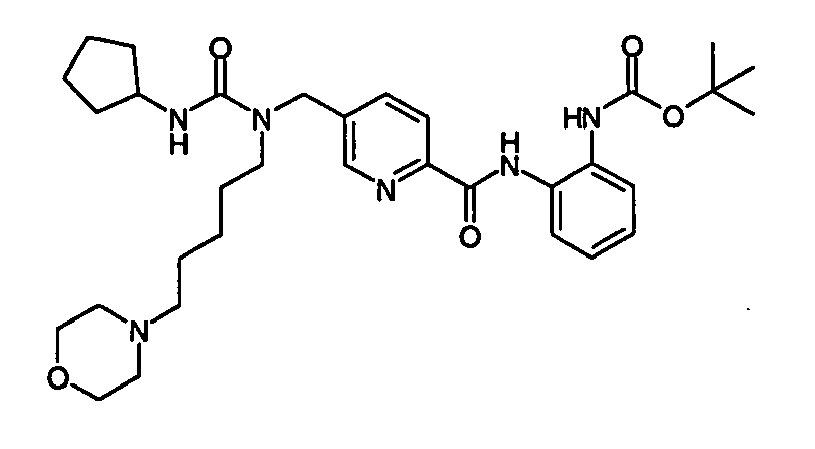
1H-NMR (400 MHz, CDCl3)
δ 1.27-1.38 (m, 4H), 1.46-1.65 (m, 8H), 1.52 (s, 9H), 2.01 (m, 2H), 2.30 (t, J = 7.6 Hz, 2H), 2.41 (br s, 4H), 3.15 (t, J = 7.7 Hz, 2H), 3.70 (t, J = 4.6 Hz, 4H), 4.14 (m, 1H), 4.29 (d, J = 6.8 Hz, 1H), 4.59 (s, 2H), 7.05 (br s, 1H), 7.18-7.25 (m, 2H), 7.58 (d, J = 7.1 Hz, 1H), 7.72 (d, J = 6.8 Hz, 1H), 7.81 (dd, J = 8.0, 2.2 Hz, 1H), 8.26 (d, J = 8.0 Hz, 1H), 8.50 (d, J = 2.2 Hz, 1H), 10.16 (s, 1H)N-(2-t-Butoxycarbonylaminophenyl)-5-[1-(2-dimethylaminoethyl)-3-propylureidomethyl]pyridine-2-carboxylic acid amide (Reference Compound No.6-116) 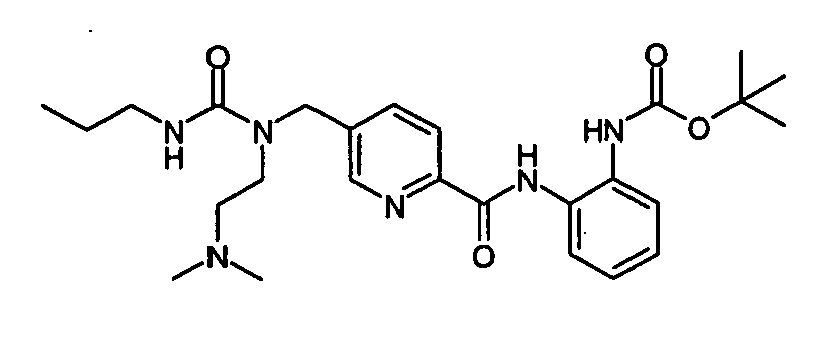
1H-NMR (400 MHz, CDCl3)
δ 0.95 (t, J = 7.5 Hz, 3H), 1.52 (s, 9H), 1.53 (m, 2H), 2.26 (s, 6H), 2.41 (t, J = 4.6 Hz, 2H), 3.15-3.21 (m, 4H), 4.60 (s, 2H), 7.05 (s, 1H), 7.18-7.24 (m, 2H), 7.60 (d, J = 6.4 Hz, 1H), 7.69 (d, J = 7.0 Hz, 1H), 7.79 (t, J = 4.9 Hz, 1H), 7.86 (dd, J = 7.9, 2.1 Hz, 1H), 8.24 (d, J = 7.9 Hz, 1H), 8.51 (d, J = 2.1 Hz, 1H), 10.14 (s, 1H)N-(2-t-Butoxycarbonylaminophenyl)-5-[1-(2-dimethylaminoethyl)-3-isopropylureidomethyl]pyridine-2-carboxylic acid amide (Reference Compound No.6-117) 
1H-NMR (500 MHz, CDCl3)
δ 1.15 (d, J = 6.7 Hz, 6H), 1.52 (s, 9H), 2.26 (s, 6H), 2.40 (t, J = 4.5 Hz, 2H), 3.18 (t, J = 4.5 Hz, 2H), 3.91 (m, 1H), 4.59 (s, 2H), 7.05 (br s, 1H), 7.18-7.24 (m, 2H), 7.59 (d, J = 6.7 Hz, 1H), 7.70 (d, J = 6.7 Hz, 1H), 7.85 (dd, J = 7.9, 2.0 Hz, 1H), 7.93 (d, J = 6.7 Hz, 1H), 8.24 (d, J = 7.9 Hz, 1H), 8.51 (d, J = 2.0 Hz, 1H), 10.15 (s, 1H)N-(2-t-Butoxycarbonylaminophenyl)-5-[3-sec-butyl-1-(2-dimethylaminoethyl)ureidomethyl]pyridine-2-carboxylic acid amide (Reference Compound No.6-118) 
1H-NMR (500 MHz, CDCl3)
δ 0.93 (t, J = 7.3 Hz, 3H), 1.12 (d, J = 6.4 Hz, 3H), 1.47 (m, 2H), 1.52 (s, 9H), 2.25 (s, 6H), 2.40 (t, J = 4.6 Hz, 2H), 3.18 (t, J = 4.6 Hz, 2H), 3.74 (m, 1H), 4.58 (d, J = 16.9 Hz, 1H), 4.62 (d, J = 16.9 Hz, 1H), 7.07 (br s, 1H), 7.17-7.24 (m, 2H), 7.59 (d, J = 6.4 Hz, 1H), 7.71 (d, J = 6.7 Hz, 1H), 7.83 (d, J = 7.3 Hz, 1H), 7.85 (dd, J = 7.9, 2.0 Hz, 1H), 8.24 (d, J = 7.9 Hz, 1H), 8.51 (d, J = 2.0 Hz, 1H), 10.15 (s, 1H)N-(2-t-Butoxycarbonylaminophenyl)-5-[3-cyclopentyl-1-(2-dimethylaminoethyl)ureidomethyl]pyridine-2-carboxylic acid amide (Reference Compound No.6-119) 
1H-NMR (500 MHz, CDCl3)
δ 1.36-1.41 (m, 2H), 1.52 (s, 9H), 1.61-1.68 (m, 4H), 1.93-1.99 (m, 2H), 2.25 (s, 6H), 2.40 (t, J = 4.4 Hz, 2H), 3.18 (t, J = 4.4 Hz, 2H), 4.08 (m, 1H), 4.59 (s, 2H), 7.06 (br s, 1H), 7.18-7.24 (m, 2H), 7.60 (d, J = 7.0 Hz, 1H), 7.70 (d, J = 6.7 Hz, 1H), 7.86 (dd, J = 7.9, 2.1 Hz, 1H), 8.03 (d, J = 6.4 Hz, 1H), 8.24 (dd, J = 7.9, 0.6 Hz, 1H), 8.51 (dd, J = 2.1, 0.6 Hz, 1H), 10.15 (s, 1H)N-(2-t-Butoxycarbonylaminophenyl)-5-[1-(2-dimethylaminoethyl)-3-hexylureidomethyl)pyridine-2-carboxylic acid amide (Reference Compound No.6-120) 
1H-NMR (500 MHz, CDCl3)
δ 0.89 (t, J = 7.0 Hz, 3H), 1.29-1.38 (m, 6H), 1.48 (m, 2H), 1.52 (s, 9H), 2.26 (s, 6H), 2.41 (t, J = 4.6 Hz, 2H), 3.19 (t, J = 4.6 Hz, 2H), 3.21 (m, 2H), 4.60 (s, 2H), 7.06 (br s, 1H), 7.17-7.24 (m, 2H), 7.60 (d, J = 7.0 Hz, 1H), 7.68 (d, J = 6.7 Hz, 1H), 7.75 (t, J = 4.9 Hz, 1H), 7.86 (dd, J = 8.0, 1.9 Hz, 1H), 8.24 (d, J = 8.0 Hz, 1H), 8.51 (d, J = 1.9 Hz, 1H), 10.14 (s, 1H)N-(2-t-Butoxycarbonylaminophenyl)-5-[3-cyclohexyl-1-(2-dimethylaminoethyl)ureidomethyl]pyridine-2-carboxylic acid amide (Reference Compound No.6-121) 
1H-NMR (500 MHz, CDCl3)
δ 1.06-1.19 (m, 4H), 1.38 (m, 2H), 1.52 (s, 9H), 1.70 (m, 2H), 1.94 (m, 2H), 2.25 (s, 6H), 2.40 (t, J = 4.7 Hz, 2H), 3.19 (t, J = 4.7 Hz, 2H), 3.59 (m, 1H), 4.59 (s, 2H), 7.05 (br s, 1H), 7.17-7.24 (m, 2H), 7.60 (d, J = 7.3 Hz, 1H), 7.69 (d, J = 7.3 Hz, 1H), 7.86 (dd, J = 8.2, 1.8 Hz, 1H), 7.89 (d, J = 6.7 Hz, 1H), 8.24 (d, J = 8.2 Hz, 1H), 8.51 (d, J = 1.8 Hz, 1H), 10.14 (s, 1H)N-(2-t-Butoxycarbonylaminophenyl)-5-[1-(2-dimethylaminoethyl)-3-phenethylureidomethyl]pyridine-2-carboxylic acid amide (Reference Compound No.6-122) 
1H-NMR (500 MHz, CDCl3)
δ 1.52 (s, 9H), 2.04 (s, 6H), 2.31 (t, J = 4.7 Hz, 2H), 2.84 (t, J = 6.9 Hz, 2H), 3.12 (t, J = 4.7 Hz, 2H), 3.53 (td, J = 6.9, 5.5 Hz, 2H), 4.59 (s, 2H), 7.06 (br s, 1H), 7.17-7.24 (m, 4H), 7.29 (d, J = 7.6 Hz, 2H), 7.31 (m, 1H), 7.60 (d, J = 7.0 Hz, 1H), 7.69 (d, J = 5.6 Hz, 1H), 7.69 (m, 1H), 7.82 (dd, J = 7.9, 2.0 Hz, 1H), 8.24 (dd, J = 7.9, 0.6 Hz, 1H), 8.50 (dd, J = 2.0, 0.6 Hz, 1H), 10.14 (s, 1H)N-(2-t-Butoxycarbonylaminophenyl)-5-[1-(2-dimethylaminoethyl)-3-[2-(thiophen-2-yl)ethyl]ureidomethyl]pyridine-2-carboxylic acid amide (Reference Compound No.6-123) 
1H-NMR (500 MHz, CDCl3)
δ 1.51 (s, 9H), 2.09 (s, 6H), 2.33 (t, J = 4.7 Hz, 2H), 3.05 (t, J = 6.5 Hz, 2H), 3.16 (t, J = 4.7 Hz, 2H), 3.53 (q, J = 6.5 Hz, 2H), 4.59 (s, 2H), 6.81 (dd, J = 3.4, 1.3 Hz, 1H), 6.93 (dd, J = 5.2, 3.4 Hz, 1H), 7.09 (br s, 1H), 7.14 (dd, J = 5.2, 1.3 Hz, 1H), 7.17-7.24 (m, 2H), 7.59 (d, J = 6.4 Hz, 1H), 7.71 (d, J = 6.4 Hz, 1H), 7.83 (dd, J = 7.9, 2.1 Hz, 1H), 7.90 (br s, 1H), 8.23 (dd, J = 7.9, 0.6 Hz, 1H), 8.50 (dd, J = 2.1, 0.6 Hz, 1H), 10.15 (s, 1H)N-(2-t-Butoxycarbonylaminophenyl)-5-[3-isopropyl-1-[2-(4-methylpiperazin-1-yl)ethyl]ureidomethyl]pyridine-2-carboxylic acid amide (Reference Compound No.6-124) 
1H-NMR (400 MHz, CDCl3)
δ 1.22 (d, J = 6.6 Hz, 6H), 1.52 (s, 9H), 2.30 (s, 3H), 2.46 (t, J = 4.5 Hz, 2H), 2.54 (br s, 8H), 3.21 (t, J = 4.5 Hz, 2H), 3.99 (m, 1H), 4.59 (s, 2H), 7.02-7.07 (m, 2H), 7.17-7.25 (m, 2H), 7.60 (d, J = 6.6 Hz, 1H), 7.70 (d, J = 6.6 Hz, 1H), 7.85 (dd, J = 8.0, 2.2 Hz, 1H), 8.24 (d, J = 8.0 Hz, 1H), 8.51 (d, J = 2.2 Hz, 1H), 10.14 (s, 1H)N-(2-t-Butoxycarbonylaminophenyl)-5-[1-[2-(4-methylpiperazin-1-yl)ethyl]-3-phenethylureidomethyl]pyridine-2-carboxylic acid amide (Reference Compound No.6-125) 
1H-NMR (400 MHz, CDCl3)
δ 1.51 (s, 9H), 2.24 (s, 3H), 2.32 (br s, 8H), 2.39 (t, J = 4.5 Hz, 2H), 2.87 (t, J = 7.0 Hz, 2H), 3.16 (t, J = 4.5 Hz, 2H), 3.49 (m, 2H), 4.60 (s, 2H), 7.06 (br s, 1H), 7.17-7.25 (m, 5H), 7.26-7.32 (m, 2H), 7.60 (d, J = 7.1 Hz, 1H), 7.69-7.75 (m, 2H), 7.82 (dd, J = 7.9, 2.1 Hz, 1H), 8.25 (d, J = 7.9 Hz, 1H), 8.50 (d, J = 2.1 Hz, 1H), 10.15 (s, 1H)N-(2-t-Butoxycarbonylaminophenyl)-5-[3-(4-methylphenyl)-1-[2-(4-methylpiperazin-1-yl)ethyl]ureidomethyl]pyridine-2-carboxylic acid amide (Reference Compound No.6-126) 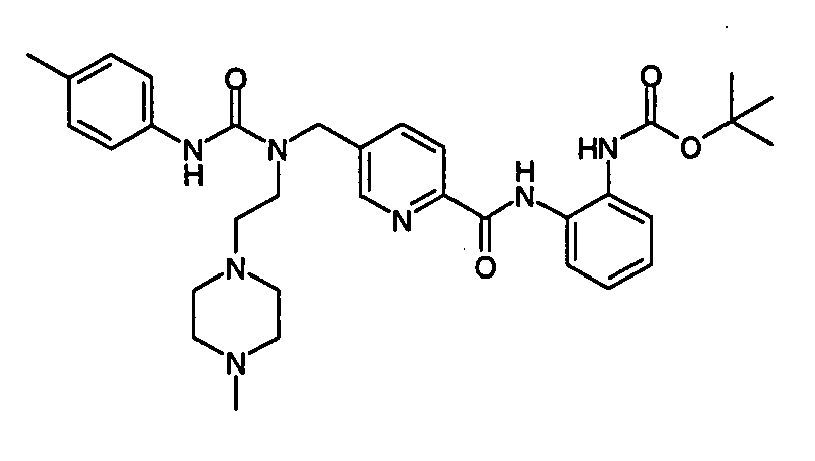
1H-NMR (400 MHz, CDCl3)
δ 1.52 (s, 9H), 2.31 (s, 3H), 2.32 (s, 3H), 2.53 (br s, 4H), 2.58 (t, J = 4.3 Hz, 2H), 2.65 (br s, 4H), 3.36 (t, J = 4.3 Hz, 2H), 4.65 (s, 2H), 7.04 (br s, 1H), 7.12 (d, J = 8.3 Hz, 2H), 7.18-7.25 (m, 2H), 7.34 (d, J = 8.3 Hz, 2H), 7.60 (d, J = 6.6 Hz, 1H), 7.71 (d, J = 6.6 Hz, 1H), 7.93 (dd, J = 7.9, 2.1 Hz, 1H), 8.27 (d, J = 7.9 Hz, 1H), 8.57 (d, J = 2.1 Hz, 1H), 9.88 (s, 1H), 10.16 (s, 1H)N-(2-t-Butoxycarbonylaminophenyl)-5-[3-isopropyl-1-[3-(4-methylpiperazin-1-yl)propyl]ureidomethyl]pyridine-2-carboxylic acid amide (Reference Compound No.6-127) 
1H-NMR (400 MHz, CDCl3)
δ 1.21 (d, J = 6.6 Hz, 6H), 1.52 (s, 9H), 1.68 (m, 2H), 2.32 (s, 3H), 2.36 (t, J = 6.1 Hz, 2H), 2.48 (br s, 8H), 3.19 (t, J = 6.0 Hz, 2H), 4.01 (m, 1H), 4.57 (s, 2H), 6.04 (d, J = 8.3 Hz, 1H), 7.07 (br s, 1H), 7.17-7.25 (m, 2H), 7.61 (d, J = 7.1 Hz, 1H), 7.69 (d, J = 6.6 Hz, 1H), 7.85 (dd, J = 8.0, 2.2 Hz, 1H), 8.24 (d, J = 8.0 Hz, 1H), 8.52 (d, J = 2.2 Hz, 1H), 10.14 (s, 1H)N-(2-t-Butoxycarbonylaminophenyl)-5-[1-[3-(4-methylpiperazin-1-yl)propyl]-3-phenethylureidomethyl]pyridine-2-carboxylic acid amide (Reference Compound No.6-128) 
1H-NMR (400 MHz, CDCl3)
δ 1.51 (s, 9H), 1.62 (m, 2H), 2.27 (s, 3H), 2.30 (br s, 8H), 2.32 (t, J = 6.1 Hz, 2H), 2.87 (t, J = 7.0 Hz, 2H), 3.15 (t, J = 5.5 Hz, 2H), 3.49 (m, 2H), 4.58 (s, 2H), 7.07 (br s, 1H), 7.17-7.35 (m, 8H), 7.61 (d, J = 6.3 Hz, 1H), 7.69 (d, J = 6.6 Hz, 1H), 7.80 (dd, J = 8.0, 2.2 Hz, 1H), 8.25 (d, J = 8.0 Hz, 1H), 8.51 (d, J = 2.2 Hz, 1H), 10.15 (s, 1H)N-(2-t-Butoxycarbonylaminophenyl)-5-[3-(4-methylphenyl)-1-[3-(4-methylpiperazin-1-yl)propyl]ureidomethyl]pyridine-2-carboxylic acid amide(Reference Compound No.6-129) 
1H-NMR (400 MHz, CDCl3)
δ 1.51 (s, 9H), 1.77 (m, 2H), 2.25 (s, 3H), 2.32 (s, 3H), 2.41 (br s, 4H), 2.48 (t, J = 5.9 Hz, 2H), 2.49 (br s, 4H), 3.37 (t, J = 5.6 Hz, 2H), 4.64 (s, 2H), 7.06 (br s, 1H), 7.12 (d, J = 8.3 Hz, 2H), 7.17-7.24 (m, 2H), 7.33 (d, J = 8.3 Hz, 2H), 7.60 (d, J = 7.3 Hz, 1H), 7.68 (d, J = 7.1 Hz, 1H), 7.93 (dd, J = 8.0, 2.2 Hz, 1H), 8.24 (d, J = 8.0 Hz, 1H), 8.57 (d, J = 2.2 Hz, 1H), 8.99 (s, 1H), 10.14 (s, 1H)N-(2-t-Butoxycarbonylaminophenyl)-5-[1-[3-(4-methylpiperidin-1-yl)propyl]-3-phenethylureidomethyl]pyridine-2-carboxylic acid amide (Reference Compound No.6-130) 
1H-NMR (500 MHz, CDCl3)
δ 0.92 (d, J = 6.7 Hz, 3H), 1.00 (m, 2H), 1.36 (m, 1H), 1.51 (s, 9H), 1.58-1.63 (m, 4H), 1.84 (t, J = 11.6 Hz, 2H), 2.28 (t, J = 6.1 Hz, 2H), 2.71 (d, J = 11.6 Hz, 2H), 2.85 (t, J = 7.0 Hz, 2H), 3.15 (t, J = 5.5 Hz, 2H), 3.47 (m, 2H), 4.57 (s, 2H), 7.08 (br s, 1H), 7.18-7.24 (m, 5H), 7.27-7.31 (m, 2H), 7.62 (d, J = 6.7 Hz, 1H), 7.66-7.70 (m, 2H), 7.79 (dd, J = 8.1, 2.0 Hz, 1H), 8.24 (d, J = 8.1 Hz, 1H), 8.50 (d, J = 2.0 Hz, 1H), 10.15 (s, 1H)N-(2-t-Butoxycarbonylaminophenyl)-5-[1-[5-(morpholin-4-yl)pentyl]-3-phenethylureidomethyl]pyridine-2-carboxylic acid amide (Reference Compound No.6-131) 
1H-NMR (500 MHz, CDCl3)
δ 1.20 (m, 2H), 1.39-1.48 (m, 4H), 1.52 (s, 9H), 2.27 (t, J = 7.5 Hz, 2H), 2.40 (br s, 4H), 2.84 (t, J = 6.6 Hz, 2H), 3.07 (t, J = 7.6 Hz, 2H), 3.54 (m, 2H), 3.70 (t, J = 4.6 Hz, 4H), 4.34 (t, J = 5.5 Hz, 1H), 4.55 (s, 2H), 7.08 (br s, 1H), 7.15-7.17 (m, 2H), 7.19-7.25 (m, 3H), 7.26-7.30 (m, 2H), 7.60 (d, J = 7.0 Hz, 1H), 7.71 (m, 1H), 7.73 (dd, J = 8.1, 2.0 Hz, 1H), 8.22 (d, J = 8.1 Hz, 1H), 8.45 (d, J = 2.0 Hz, 1H), 10.15 (s, 1H)N-(2-t-Butoxycarbonylaminophenyl)-5-[3-(4-methoxyphenyl)-1-[5-(morpholin-4-yl)pentyl]ureidomethyl]pyridine-2-carboxylic acid amide (Reference Compound No.6-132) 
1H-NMR (400 MHz, CDCl3)
δ 1.38 (m, 2H), 1.52 (s, 9H), 1.55 (m, 2H), 1.68 (m, 2H), 2.32 (t, J = 7.4 Hz, 2H), 2.42 (t, J = 4.6 Hz, 4H), 3.30 (t, J = 7.7 Hz, 2H), 3.70 (t, J = 4.6 Hz, 4H), 3.79 (s, 3H), 4.68 (s, 2H), 6.24 (s, 1H), 6.85 (d, J = 9.0 Hz, 2H), 7.05 (br s, 1H), 7.19-7.22 (m, 2H), 7.25 (d, J = 9.0 Hz, 2H), 7.57 (d, J = 6.0 Hz, 1H), 7.72 (d, J = 6.6 Hz, 1H), 7.88 (dd, J = 8.0, 1.9 Hz, 1H), 8.28 (d, J = 8.0 Hz, 1H), 8.56 (d, J = 1.9 Hz, 1H), 10.17 (s, 1H)5-[3-(4-Benzyloxyphenyl)-1-[5-(morpholin-4-yl)pentyl]ureidomethyl]-N-(2-t-butoxycarbonylaminophenyl)pyridine-2-carboxylic acid amide (Reference Compound No.6-133) 
1H-NMR (500 MHz, CDCl3)
δ 1.38 (m, 2H), 1.52 (s, 9H), 1.57 (m, 2H), 1.68 (m, 2H), 2.32 (t, J = 7.5 Hz, 2H), 2.41 (s, 4H), 3.30 (t, J = 7.8 Hz, 2H), 3.70 (t, J = 4.6 Hz, 4H), 4.68 (s, 2H), 5.05 (s, 2H), 6.23 (s, 1H), 6.93 (d, J = 8.9 Hz, 2H), 7.05 (br s, 1H), 7.19-7.24 (m, 2H), 7.26 (m, 2H), 7.32 (d, J = 7.3 Hz, 1H), 7.36-7.40 (m, 2H), 7.42 (d, J = 7.3 Hz, 2H), 7.58 (d, J = 6.1 Hz, 1H), 7.73 (d, J = 7.9 Hz, 1H), 7.88 (d, J = 8.0, 1.9 Hz, 1H), 8.28 (d, J = 8.0 Hz, 1H), 8.56 (d, J = 1.9 Hz, 1H), 10.16 (s, 1H)N-(2-t-Butoxycarbonylaminophenyl)-5-[3-(2-methoxyphenyl)-1-[5-(morpholin-4-yl)pentyl]ureidomethyl]pyridine-2-carboxylic acid amide (Reference Compound No.6-134) 
1H-NMR (500 MHz, CDCl3)
δ 1.39 (m, 2H), 1.51 (s, 9H), 1.54 (m, 2H), 1.71 (m, 2H), 2.33 (t, J = 7.6 Hz, 2H), 2.42 (m, 4H), 3.36 (t, J = 7.6 Hz, 2H), 3.70 (t, J = 4.7 Hz, 4H), 3.83 (s, 3H), 4.70 (s, 2H), 6.85 (m, 1H), 6.96-6.99 (m, 2H), 7.15 (s, 1H), 7.20-7.23 (m, 2H), 7.57 (d, J = 6.7 Hz, 1H), 7.73 (d, J = 6.4 Hz, 1H), 7.89 (dd, J = 7.9, 1.8 Hz, 1H), 8.17 (m, 1H), 8.28 (d, J = 7.9 Hz, 1H), 8.57 (d, J = 1.8 Hz, 1H), 10.17 (s, 1H)N-(2-t-Butoxycarbonylaminophenyl)-5-[1-[3-(morpholin-4-yl)propyl]-3-(pyridin-3-yl)ureidomethyl]pyridine-2-carboxylic acid amide (Reference Compound No.6-135) 
1H-NMR (500 MHz, CDCl3)
δ 1.51 (s, 9H), 1.82 (m, 2H), 2.48 (t, J = 4.5 Hz, 4H), 2.51 (t, J = 6.0 Hz, 2H), 3.42 (t, J = 5.5 Hz, 2H), 3.69 (t, J = 4.5 Hz, 4H), 4.65 (s, 2H), 7.04 (br s, 1H), 7.17-7.24 (m, 2H), 7.29 (ddd, J = 8.0, 4.8, 0.9 Hz, 1H), 7.58 (d, J = 6.4 Hz, 1H), 7.71 (d, J = 6.1 Hz, 1H), 7.92 (dd, J = 7.9, 2.1 Hz, 1H), 8.04 (ddd, J = 8.0, 2.4, 1.2 Hz, 1H), 8.26 (dd, J = 7.9, 0.9 Hz, 1H), 8.34 (dd, J = 4.8, 1.2 Hz, 1H), 8.58 (dd, J = 2.1, 0.9 Hz, 1H), 8.58 (dd, J = 2.4, 0.9 Hz, 1H), 9.24 (s, 1H), 10.15 (s, 1H)N-(2-t-Butoxycarbonylaminophenyl)-6-[1-(2-dimethylaminoethyl)-3-(3-methylphenyl)ureidomethyl]pyridine-3-carboxylic acid amide (Reference Compound No.6-136) 
1H-NMR (400 MHz, CDCl3)
δ 1.51 (s, 9H), 2.32 (s, 3H), 2.39 (s, 6H), 2.58 (t, J = 4.4 Hz, 2H), 3.46 (t, J = 4.4 Hz, 2H), 4.73 (s, 2H), 6.78 (s, 1H), 6.80 (d, J = 7.8 Hz, 1H), 6.85 (d, J = 7.8 Hz, 1H), 7.06 (m, 1H), 7.10-7.25 (m, 4H), 7.54 (d, J = 7.8 Hz, 1H), 7.84 (d, J = 8.1 Hz, 1H), 8.21 (dd, J = 8.1, 2.0 Hz, 1H), 9.11 (d, J = 2.0 Hz, 1H), 9.48 (s, 1H), 10.91 (s, 1H)N-(2-t-Butoxycarbonylaminophenyl)-6-[1-(2-dimethylaminoethyl)-3-(3-fluorophenyl)ureidomethyl]pyridine-3-carboxylic acid amide (Reference Compound No.6-137) 
1H-NMR (400 MHz, CDCl3)
δ 1.51 (s, 9H), 2.40 (s, 6H), 2.61 (t, J = 4.3 Hz, 2H), 3.47 (t, J = 4.3 Hz, 2H), 4.72 (s, 2H), 6.64-6.71 (m, 2H), 6.77 (s, 1H), 6.97-7.00 (m, 2H), 7.17-7.22 (m, 3H), 7.53 (d, J = 7.6 Hz, 1H), 7.85 (d, J = 8.0 Hz, 1H), 8.22 (dd, J = 8.0, 1.9 Hz, 1H), 9.11 (d, J = 1.9 Hz, 1H), 9.50 (s, 1H), 11.30 (s, 1H)N-(2-t-Butoxycarbonylaminophenyl)-6-[1-(2-dimethylaminoethyl)-3-(thiophen-3-yl)ureidomethyl]pyridine-3-carboxylic acid amide (Reference Compound No.6-138) 
1H-NMR (400 MHz, CDCl3)
δ 1.51 (s, 9H), 2.39 (s, 6H), 2.58 (t, J = 4.3 Hz, 2H), 3.45 (t, J = 4.3 Hz, 2H), 4.74 (s, 2H), 6.80 (s, 1H), 6.86-6.89 (m, 2H), 7.19-7.24 (m, 3H), 7.28 (dd, J = 3.3, 1.3 Hz, 1H), 7.51 (d, J = 8.2 Hz, 1H), 7.84 (d, J = 8.2 Hz, 1H), 8.18 (dd, J = 8.2, 2.1 Hz, 1H), 9.09 (d, J = 2.1 Hz, 1H), 9.48 (s, 1H), 11.46 (s, 1H)N-(2-t-Butoxycarbonylaminophenyl)-6-[3-(2,3-dihydrobenzo[1,4]dioxin-6-yl)-1-(2-dimethylaminoethyl)ureidomethyl]pyridine-3-carboxylic acid amide (Reference Compound No.6-139) 
1H-NMR (400 MHz, CDCl3)
δ 1.51 (s, 9H), 2.37 (s, 6H), 2.56 (t, J = 4.2 Hz, 2H), 3.44 (t, J = 4.2 Hz, 2H), 4.20-4.24 (m, 4H), 4.71 (s, 2H), 6.72-6.83 (m, 4H), 6.92 (d, J = 2.2 Hz, 1H), 7.16-7.25 (m, 2H), 7.53 (d, J = 8.1 Hz, 1H), 7.83 (d, J = 7.6 Hz, 1H), 8.20 (dd, J = 8.1, 2.1 Hz, 1H), 9.10 (d, J = 2.1 Hz, 1H), 9.49 (s, 1H), 10.81 (s, 1H)N-(2-t-Butoxycarbonylaminophenyl)-6-[1-(2-dimethylaminoethyl)-3-(3-methoxyphenyl)ureidomethyl]pyridine-3-carboxylic acid amide (Reference Compound No.6-140) 
1H-NMR (400 MHz, CDCl3)
δ 1.51, (s, 9H), 2.39 (s, 6H), 2.58 (t, J = 4.4 Hz, 2H), 3.46 (t, J = 4.4 Hz, 2H), 3.79 (s, 3H), 4.73 (s, 2H), 6.54 (ddd, J = 8.2, 2.2, 0.8 Hz, 1H), 6.79 (m, 1H), 6.80 (ddd, J = 8.2, 2.2, 1.0 Hz, 1H), 7.07 (t, J = 2.2 Hz, 1H), 7.13-7.24 (m, 3H), 7.16 (t, J = 8.3 Hz, 1H), 7.53 (d, J = 8.2 Hz, 1H), 7.84 (d, J = 8.2 Hz, 1H), 8.21 (dd, J = 8.2, 2.2 Hz, 1H), 9.11 (d, J = 2.2 Hz, 1H), 9.49 (s, 1H), 11.08 (s, 1H)N-(2-t-Butoxycarbonylaminophenyl)-5-[1-(4-dimethylaminobutyl)-3-(4-dimethylaminophenyl)ureidomethyl]pyridine-2-carboxylic acid amide (Reference Compound No.6-141) 
1H-NMR (400 MHz, CDCl3)
δ 1.52 (s, 9H), 1.53 (m, 2H), 1.71 (m, 2H), 2.19 (s, 6H), 2.34 (t, J = 6.5 Hz, 2H), 2.91 (s, 6H), 3.24 (t, J = 8.2 Hz, 2H), 4.69 (s, 2H), 6.72 (dd, J = 9.0 Hz, 2H), 7.11 (br s, 1H), 7.17-7.24 (m, 2H), 7.18 (d, J = 9.0 Hz, 2H), 7.60 (d, J = 6.4 Hz, 1H), 7.70 (d, J = 6.1 Hz, 1H), 7.84 (s, 1H), 7.91 (dd, J = 8.1, 2.1 Hz, 1H), 8.25 (dd, J = 8.1, 0.7 Hz, 1H), 8.57 (dd, J = 2.1, 0.7 Hz, 1H), 10.16 (s, 1H) - Under ice cooling, 2-amino-1,3-benzothiazole (100 mg, 0.60 mmol) was added to a solution of N,N'-carbonyldiimidazole (98 mg, 0.60 mmol) in THF (3.0 mL), and then the reaction mixture was stirred for 2 hours. N-(2-t-butoxycarbonylaminophenyl)-5-(3-dimethylaminopropylaminomethyl)pyridine-2-carbo xylic acid amide (Reference Compound No.5-1, 90 mg, 0.20 mmol) was added thereto, and then the reaction mixture was stirred at 60°C for 3 hours. Water (30 mL) was added thereto, the whole was extracted with ethyl acetate (30 mL) twice, and then the organic layer was washed with water (30 mL) and brine (30 mL). After the organic layer was dried over anhydrous magnesium sulfate, the solvent was evaporated under reduced pressure to give 220 mg of a mixture containing the title reference compound as a white amorphous product.

1H-NMR (400 MHz, DMSO-d6) δ 1.45 (s, 9H), 1.74 (br s, 2H), 2.30 (br s, 6H), 2.38 (br s, 2H), 3.43 (br s, 2H), 4.70 (s, 2H), 7.13-7.27 (m, 4H), 7.34 (m, 1H), 7.44 (br s, 1H), 7.58 (br s, 1H), 7.84 (br s, 1H), 8.00-8.01 (m, 2H), 8.15 (d, J = 8.1 Hz, 1H), 8.60 (br s, 1H), 9.11 (br s, 1H), 10.47 (br s, 1H) 5-[3-(1H-Benzimidazol-2-yl)-1-(3-dimethylaminopropyl)ureidomethyl]-N-(2-t-butoxycarbonylaminophenyl)pyridine-2-carboxylic acid amide (Reference Compound No.7-2) 
1H-NMR (400 MHz, DMSO-d6)
δ 1.41 (s, 9H), 1.71 (br s, 2H), 2.20 (br s, 8H), 3.42 (br s, 2H), 4.72 (s, 2H), 7.01-7.03 (m, 2H), 7.14 (td, J = 7.6, 1.5 Hz, 1H), 7.22-7.29 (m, 4H), 8.00-8.02 (m, 2H), 8.14 (d, J = 8.1 Hz, 1H), 8.59 (d, J = 1.2 Hz, 1H), 9.11 (br s, 1H), 10.47 (br s, 1H), 11.81 (br s, 2H)N-(2-t-Butoxycarbonylaminophenyl)-5-[1-(3-dimethylaminopropyl)-3-(3-fluoro-4-methoxyphenyl)ureidomethyl]pyridine-2-carboxylic acid amide (Reference Compound No.7-3) 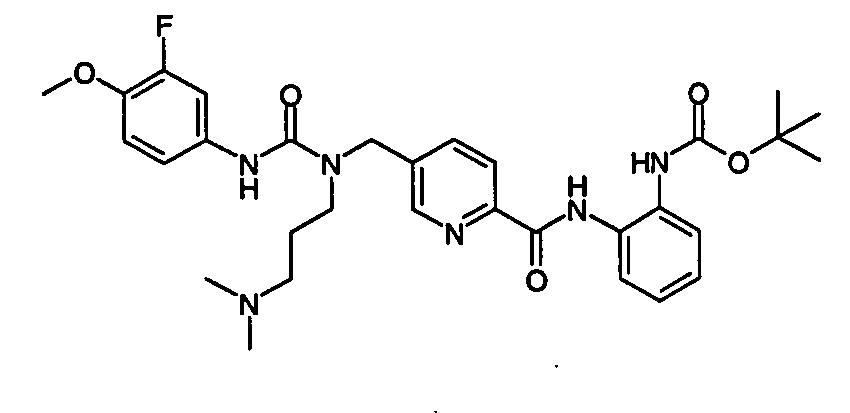
1H-NMR (400 MHz, CDCl3)
δ 1.51 (s, 9H), 1.73 (m, 2H), 2.30 (s, 6H), 2.40 (t, J = 6.0 Hz, 2H), 3.37 (t, J = 5.6 Hz, 2H), 3.86 (s, 3H), 4.61 (s, 2H), 6.88 (t, J = 9.1 Hz, 1H), 7.06-7.09 (m, 2H), 7.17-7.24 (m, 2H), 7.32 (dd, J = 13.4, 2.4 Hz, 1H), 7.58 (m, 1H), 7.69 (m, 1H), 7.92 (dd, J = 7.9, 2.2 Hz, 1H), 8.25 (dd, J = 7.9, 0.6 Hz, 1H), 8.58 (d, J = 2.2 Hz, 1H), 10.16 (s, 1H), 10.17 (s, 1H)N-(2-t-Butoxycarbonylaminophenyl)-5-[1-(3-dimethylaminopropyl)-3-(phenylcarbonylmethyl)ureidomethyl]pyridine-2-carboxylic acid amide (Reference Compound No.7-4) 
1H-NMR (400 MHz, CDCl3)
δ 1.51 (s, 9H), 1.71 (m, 2H), 2.22 (s, 6H), 2.40 (t, J = 6.1 Hz, 2H), 3.38 (t, J = 5.7 Hz, 2H), 4.61 (s, 2H), 4.71 (d, J = 4.4 Hz, 2H), 7.17-7.24 (m, 3H), 7.45-7.49 (m, 2H), 7.59 (t, J = 8.0 Hz, 2H), 7.62 (s, 1H), 7.87 (dd, J = 8.1, 2.2 Hz, 1H), 7.99 (dd, J = 8.0, 1.2 Hz, 2H), 8.24 (d, J = 8.1 Hz, 1H), 8.34 (s, 1H), 8.53 (d, J = 2.2 Hz, 1H), 10.15 (s, 1H)N-(2-t-Butoxycarbonylaminophenyl)-5-[1-(3-dimethylaminopropyl)-3-(1,3-thiazol-2-yl)ureidomethyl]pyridine-2-carboxylic acid amide (Reference Compound No.7-5) 
1H-NMR (400 MHz, CDCl3)
δ 1.51 (s, 9H), 1.73 (m, 2H), 2.35 (s, 6H), 2.40 (t, J = 6.0 Hz, 2H), 3.40 (m, 2H), 4.66 (s, 2H), 6.85 (d, J = 3.7 Hz, 1H), 7.08 (br s, 1H), 7.17-7.24 (m, 2H), 7.37 (d, J = 3.7 Hz, 1H), 7.58 (br s, 1H), 7.72 (br s, 1H), 7.91 (dd, J = 8.1, 2.1 Hz, 1H), 8.26 (dd, J = 8.1, 0.5 Hz, 1H), 8.57 (dd, J = 2.1, 0.5 Hz, 1H), 10.17 (br s, 1H), 13.17 (br s, 1H)N-(2-t-Butoxycarbonylaminophenyl)-5-[1-(3-dimethylaminopropyl)-3-(6-methoxy-1,3-benzothiazol-2-yl)ureidomethyl]pyridine-2-carboxylic acid amide (Reference Compound No.7-6) 
1H-NMR (400 MHz, DMSO-d6)
δ 1.46 (s, 9H), 1.73 (m, 2H), 2.28 (s, 6H), 2.33 (m, 2H), 3.41 (t, J = 5.1 Hz, 2H), 3.79 (s, 3H), 4.71 (s, 2H), 6.94 (dd, J = 8.8, 2.3 Hz, 1H), 7.15 (td, J = 7.6, 1.2 Hz, 1H), 7.21-7.29 (m, 3H), 7.45 (d, J = 2.3 Hz, 1H), 7.99-8.02 (m, 2H), 8.16 (d, J = 8.1 Hz, 1H), 8.61 (br s, 1H), 9.11 (br s, 1H), 10.47 (br s, 1H)N-(2-t-Butoxycarbonylaminophenyl)-5-[3-(6-chloro-1,3-benzothiazol-2-yl)-1-(3-dimethylaminopropyl)ureidomethyl]pyridine-2-carboxylic acid amide (Reference Compound No.7-7) 
1H-NMR (400 MHz, DMSO-d6)
δ 1.45 (s, 9H), 1.75 (br s, 2H), 2.35 (br s, 8H), 3.42 (t, J = 6.3 Hz, 2H), 4.70 (s, 2H), 7.15 (td, J = 7.6, 1.5 Hz, 1H), 7.22-7.27 (m, 2H), 7.29 (d, J = 8.5 Hz, 1H), 7.34 (dd, J = 8.5, 2.1 Hz, 1H), 7.77 (d, J = 2.1 Hz, 1H), 7.96-8.02 (m, 2H), 8.15 (d, J = 8.1 Hz, 1H), 8.61 (br s, 1H), 9.11 (br s, 1H), 10.47 (br s, 1H)N-(2-t-Butoxycarbonylaminophenyl)-5-[1-(3-dimethylaminopropyl)-3-(6-fluoro-1,3-benzothiazol-2-yl)ureidomethyl]pyridine-2-carboxylic acid amide (Reference Compound No.7-8) 
1H-NMR (400 MHz, DMSO-d6)
δ 1.45 (s, 9H), 1.74 (m, 2H), 2.33 (br s, 6H), 2.40 (br s, 2H), 3.42 (t, J = 5.5 Hz, 2H), 4.70 (s, 2H), 7.13-7.20 (m, 2H), 7.23-7.27 (m, 2H), 7.58 (m, 1H), 7.77 (dd, J = 8.9, 2.1 Hz, 1H), 7.99-8.02 (m, 2H), 8.15 (d, J = 8.1 Hz, 1H), 8.60 (br s, 1H), 9.12 (br s, 1H), 10.47 (br s, 1H)N-(2-t-Butoxycarbonylaminophenyl)-5-[1-[3-(morpholin-4-yl)propyl]-3-(phenylcarbonylmethyl)ureidomethyl]pyridine-2-carboxylic acid amide (Reference Compound No.7-9) 
1H-NMR (400 MHz, CDCl3)
δ 1.52 (s, 9H), 1.77 (m, 2H), 2.44-2.52 (m, 6H), 3.39 (t, J = 6.0 Hz, 2H), 3.67 (t, J = 4.4 Hz, 4H), 4.63 (s, 2H), 4.72 (d, J = 5.1 Hz, 2H), 7.16-7.24 (m, 2H), 7.30 (m, 1H), 7.39 (t, J = 7.9 Hz, 1H), 7.48-7.52 (m, 2H), 7.61-7.63 (m, 2H), 7.68 (s, 1H), 7.88 (dd, J = 8.1, 2.2 Hz, 1H), 8.00 (dd, J = 8.5, 1.5 Hz, 2H), 8.26 (d, J = 8.1 Hz, 1H), 8.54 (d, J = 2.2 Hz, 1H), 10.14 (s, 1H)5-[3-(1,3-Benzothiazol-2-yl)-1-[3-(morpholin-4-yl)propyl]ureidomethyl]-N-(2-t-butoxycarbonylaminophenyl)pyridine-2-carboxylic acid amide (Reference Compound No.7-10) 
1H-NMR (500 MHz, DMSO-d6)
δ 1.44 (s, 9H), 1.75 (br s, 2H), 2.38 (br s, 6H), 3.40-3.49 (m, 2H), 3.76 (br s, 4H), 4.75 (br s, 2H), 7.15 (td, J = 7.6, 1.5 Hz, 1H), 7.23-7.27 (m, 3H), 7.36 (t, J = 7.3 Hz, 1H), 7.60 (br s, 1H), 7.85 (br s, 1H), 7.98-8.01 (m, 2H), 8.15 (d, J = 8.2 Hz, 1H), 8.59 (s, 1H), 9.10 (br s, 1H), 10.47 (br s, 1H)N-(2-t-Butoxycarbonylaminophenyl)-5-[3-(6-fluoro-1,3-benzothiazol-2-yl)-1-[3-(morpholin-4-yl)propyl]ureidomethyl]pyridine-2-carboxylic acid amide (Reference Compound No.7-11) 
1H-NMR (400 MHz, CDCl3)
δ 1.51 (s, 9H), 1.83 (m, 2H), 2.49 (t, J = 6.0 Hz, 2H), 2.55 (br s, 4H), 3.43 (m, 2H), 4.11 (t, J = 7.2 Hz, 4H), 4.69 (s, 2H), 7.03 (m, 1H), 7.10 (td, J = 9.0, 2.4 Hz, 1H), 7.18-7.24 (m, 2H), 7.46 (dd, J = 8.1, 2.4 Hz, 1H), 7.57 (d, J = 5.6 Hz, 1H), 7.64 (dd, J = 9.0, 4.6 Hz, 1H), 7.72 (d, J = 4.9 Hz, 1H), 7.92 (dd, J = 8.1, 2.2 Hz, 1H), 8.27 (dd, J = 8.1, 0.7 Hz, 1H), 8.59 (dd, J = 2.2, 0.7 Hz, 1H), 10.17 (br s, 1H)N-(2-t-Butoxycarbonylaminophenyl)-5-[1-[3-(morpholin-4-yl)propyl]-3-(pyridin-2-yl)ureidomethyl]pyridine-2-carboxylic acid amide (Reference Compound No.7-12) 
1H-NMR (400MHz, Solv. CDCl3)
δ 1.51 (s, 9H), 1.81 (m, 2H), 2.46 (t, J = 6.1 Hz, 2H), 2.51 (br s, 4H), 3.44 (t, J = 5.6 Hz, 2H), 3.99 (t, J = 4.3 Hz, 4H), 4.66 (s, 2H), 6.93 (ddd, J = 7.2, 4.9, 1.0 Hz, 1H), 7.05 (br s, 1H), 7.17-7.25 (m, 2H), 7.59 (d, J = 7.3 Hz, 1H), 7.63 (ddd, J = 8.6, 7.2, 2.0 Hz, 1H), 7.70 (d, J = 6.8 Hz, 1H), 7.92 (dd, J = 8.1, 2.2 Hz, 1H), 8.00 (dt, J = 8.6, 1.0 Hz, 1H), 8.22 (ddd, J = 4.9, 2.0, 1.0 Hz, 1H), 8.27 (dd, J = 8.1, 0.6 Hz, 1H), 8.59 (dd, J = 2.2, 0.6 Hz, 1H), 9.83 (s, 1H), 10.16 (s, 1H)N-(2-t-Butoxycarbonylaminophenyl)-5-[1-[3-(morpholin-4-yl)propyl]-3-(pyridin-4-yl)ureidomethyl]pyridine-2-carboxylic acid amide (Reference Compound No.7-13) 
1H-NMR (500 MHz, CDCl3)
δ 1.51 (s, 9H), 1.83 (m, 2H), 2.44-2.56 (m, 6H), 3.39 (t, J = 5.6 Hz, 2H), 3.80 (t, J = 4.6 Hz, 4H), 4.65 (s, 2H), 7.02 (br s, 1H), 7.18-7.25 (m, 2H), 7.49 (d, J = 6.3 Hz, 2H), 7.57 (d, J = 6.3 Hz, 1H), 7.71 (d, J = 6.3 Hz, 1H), 7.91 (dd, J = 8.0, 2.2 Hz, 1H), 8.27 (dd, J = 8.0, 0.7 Hz, 1H), 8.47 (d, J = 6.3 Hz, 2H), 8.58 (dd, J = 2.2, 0.7 Hz, 1H), 9.10 (s, 1H), 10.17 (s, 1H)5-[3-(1,3-Benzothiazol-2-yl)-1-(2-dimethylaminoethyl)ureidomethyl]-N-(2-t-butoxycarbonylaminophenyl)pyridine-2-carboxylic acid amide (Reference Compound No.7-144) 
1H-NMR (500 MHz, CDCl3)
δ 1.51 (s, 9H), 2.50 (s, 6H), 2.60 (t, J = 4.3 Hz, 2H), 3.39 (t, J = 4.3 Hz, 2H), 4.73 (s, 2H), 7.02 (br s, 1H), 7.19-7.24 (m, 3H), 7.36 (m, 1H), 7.57 (d, J = 5.5 Hz, 1H), 7.70 (d, J = 8.7 Hz, 1H), 7.73 (m,1H), 7.77 (d, J = 7.6 Hz, 1H), 7.92 (dd, J = 7.9, 2.1 Hz, 1H), 8.29 (d, J = 7.9 Hz, 1H), 8.58 (d, J = 2.1 Hz, 1H), 10.17 (s, 1H)N-(2-t-Butoxycarbonylaminophenyl)-5-[1-(2-dimethylaminoethyl)-3-(quinolin-6-yl)ureidomethyl]pyridine-2-carboxylic acid amide (Reference Compound No.7-15) 
1H-NMR (500 MHz, CDCl3)
δ 1.51 (s, 9H), 2.48 (s, 6H), 2.61 (t, J = 4.3 Hz, 2H), 3.40 (t, J = 4.3 Hz, 2H), 4.71 (s, 2H), 7.05 (br s, 1H), 7.19-7.24 (m, 2H), 7.35 (dd, J = 8.2, 4.3 Hz, 1H), 7.39 (dd, J = 9.0, 2.4 Hz, 1H), 7.59 (d, J = 6.1 Hz, 1H), 7.72 (d, J = 6.1 Hz, 1H), 7.95 (dd, J = 7.9, 2.1 Hz, 1H), 8.01 (d, J = 9.0 Hz, 1H), 8.09 (d, J = 8.2 Hz, 1H), 8.18 (d, J = 2.4 Hz, 1H), 8.29 (d, J = 7.9 Hz, 1H), 8.61 (d, J = 2.1 Hz, 1H), 8.77 (d, J = 4.3 Hz, 1H), 10.17 (s, 1H), 11.50 (s, 1H)N-(2-t-Butoxycarbonylaminophenyl)-5-[1-(2-dimethylaminoethyl)-3-(1,3-thiazol-2-yl)ureidomethyl]pyridine-2-carboxylic acid amide (Reference Compound No.7-16) 
1H-NMR (400 MHz, CDCl3)
δ 1.51 (s, 9H), 2.45 (s, 6H), 2.57 (t, J = 4.3 Hz, 2H), 3.35 (t, J = 4.3 Hz, 2H), 4.71 (s, 2H), 6.86 (d, J = 3.7 Hz, 1H), 7.02 (br s, 1H), 7.18-7.25 (m, 2H), 7.39 (d, J = 3.7 Hz, 1H), 7.58 (d, J = 6.3 Hz, 1H), 7.72 (d, J = 6.1 Hz, 1H), 7.90 (dd, J = 8.1, 2.2 Hz, 1H), 8.28 (d, J = 8.1 Hz, 1H), 8.56 (d, J = 2.2 Hz, 1H), 10.16 (s, 1H)N-(2-t-Butoxycarbonylaminophenyl)-5-[1-(2-dimethylaminoethyl)-3-phenylcarbonylmethylureidomethyl]pyridine-2-carboxylic acid amide (Reference Compound No.7-17) 
1H-NMR (400 MHz, CDCl3)
δ 1.51 (s, 9H), 2.35 (s, 6H), 2.51 (t, J = 5.0 Hz, 2H), 3.34 (t, J = 5.0 Hz, 2H), 4.66 (s, 2H), 4.79 (d, J = 3.7 Hz, 2H), 7.07 (br s, 1H), 7.17-7.25 (m, 2H), 7.47-7.52 (m, 2H), 7.58-7.63 (m, 2H), 7.69 (d, J = 8.1 Hz, 1H), 7.89 (dd, J = 8.1, 2.0 Hz, 1H), 7.99-8.01 (m, 2H), 8.27 (d, J = 8.1 Hz, 1H), 8.41 (br s, 1H, 8.54 (d, J = 2.0 Hz, 1H), 10.15 (s, 1H)N-(2-t-Butoxycarbonylaminophenyl)-5-[1-(3-dimethylaminopropyl)-3-(4,5,6,7-tetrahydro-1,3-benzothiazol-2-yl)ureidomethyl]pyridine-2-carboxylic acid amide (Reference Compound No.7-18) 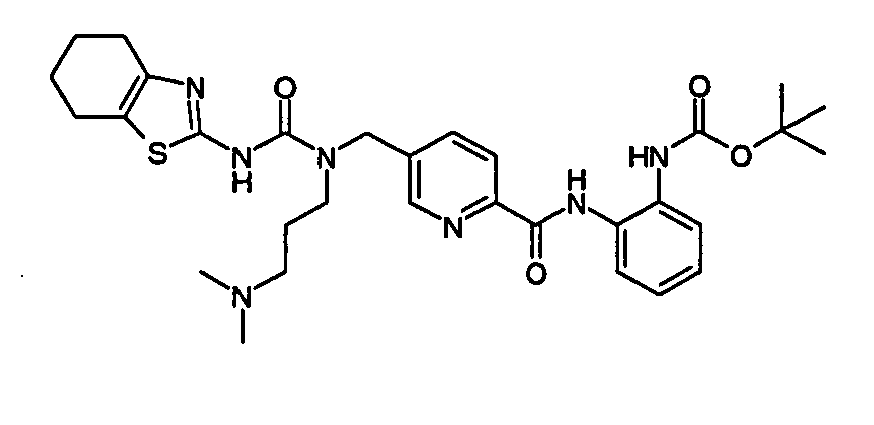
1H-NMR (400 MHz, DMSO-d6)
δ 1.46 (s, 9H), 1.67 (m, 2H), 1.74 (br s, 4H), 2.18 (s, 6H), 2.25 (br s, 2H), 2.49-2.55 (m, 4H), 3.34 (m, 2H), 4.66 (s, 2H), 7.15 (t, J = 7.4 Hz, 1H), 7.24 (d, J = 7.4 Hz, 1H), 7.25 (m, 1H), 7.94 (d, J = 8.1 Hz, 1H), 8.00 (d, J = 7.4 Hz, 1H), 8.14 (d, J = 8.1 Hz, 1H), 8.56 (s, 1H), 9.12 (br s, 1H), 10.47 (br s, 1H), 12.39 (br s, 1H)N-(2-t-Butoxycarbonylaminophenyl)-5-[1-[3-(morpholin-4-yl)propyl]-3-[2-(morpholin-4-yl)pyridin-5-yl]ureidomethyl]pyridine-2-carboxylic acid amide (Reference Compound No.7-19) 
1H-NMR (400 MHz, CDCl3)
δ 1.51 (s, 9H), 1.79 (m, 2H), 2.45 (br s, 4H), 2.50 (t, J = 6.0 Hz, 2H), 3.39 (t, J = 5.4 Hz, 2H), 3.46 (t, J = 4.9 Hz, 4H), 3.61 (t, J = 4.4 Hz, 4H), 3.83 (t, J = 4.9 Hz, 4H), 4.63 (s, 2H), 6.66 (d, J = 9.0 Hz, 1H), 7.05 (br s, 1H), 7.17-7.25 (m, 2H), 7.60 (d, J = 6.8 Hz, 1H), 7.70 (m, 1H), 7.70 (dd, J = 9.0, 2.8 Hz, 1H), 7.92 (dd, J = 7.9, 2.1 Hz, 1H), 8.11 (d, J = 2.8 Hz, 1H), 8.25 (dd, J = 7.9, 0.7 Hz, 1H), 8.57 (dd, J = 2.1, 0.7 Hz, 1H), 9.20 (s, 1H), 10.14 (s, 1H)N-(2-t-Butoxycarbonylaminophenyl)-5-[1-(3-dimethylaminopropyl)-3-(4-phenyl-1,3-thiazol-2-yl)ureiomethyl]pyridine-2-carboxylic acid amide (Reference Compound No.7-20) 
1H-NMR (400 MHz, DMSO-d6)
δ 1.47 (s, 9H), 1.74 (m, 2H), 2.33 (s, 6H), 2.37 (m, 2H), 3.41 (t, J = 5.6 Hz, 2H), 4.68 (s, 2H), 7.15 (t, J = 8.1 Hz, 1H), 7.23-7.27 (m, 2H), 7.29 (t, J = 7.7 Hz, 1H), 7.41 (t, J = 7.7 Hz, 2H), 7.48 (s, 1H), 7.89-7.91 (m, 2H), 8.01 (d, J = 7.7 Hz, 2H), 8.16 (d, J = 8.1 Hz,1H), 8.61 (s, 1H), 9.12 (br s, 1H), 10.48 (br s, 1H), 13.44 (br s, 1H)N-(2-t-Butoxycarbonylaminophenyl)-5-[3-(2-methoxypyridin-5-yl)-1-[3-(morpholin-4-yl)propyl]ureidomethyl]pyridine-2-carboxylic acid amide (Reference Compound No.7-21) 
1H-NMR (400 MHz, CDCl3)
δ 1.51 (s, 9H), 1.79 (m, 2H), 2.45 (br s, 4H), 2.51 (t, J = 5.9 Hz, 2H), 3.40 (t, J = 5.2 Hz, 2H), 3.62 (t, J = 4.3 Hz, 4H), 3.92 (s, 3H), 4.64 (s, 2H), 6.75 (dd, J = 8.9, 0.6 Hz, 1H), 7.05 (br s, 1H), 7.17-7.25 (m, 2H), 7.60 (d, J = 7.3 Hz, 1H), 7.69 (d, J = 7.3 Hz, 1H), 7.78 (dt, J = 8.9, 2.6 Hz, 1H), 7.92 (dd, J = 8.1, 2.1 Hz, 1H), 8.06 (m, 1H), 8.26 (dd, J = 8.1, 0.7 Hz, 1H), 8.57 (dd, J = 2.1, 0.7 Hz, 1H), 9.27 (s, 1H), 10.15 (s, 1H)N-(2-t-Butoxycarbinylaminophenyl)-5-[3-(4-methylpyridin-2-yl)-1[[3-(morpholin-4-yl)propyl]ureidomethyl]pyridine-2-carboxylic acid amide (Reference Compound No.7-22) 
1H-NMR (500 MHz, CDCl3)
δ 1.51 (s, 9H), 1.80 (m, 2H), 2.34 (s, 3H), 2.45 (t, J = 6.0 Hz, 2H), 2.50 (br s, 4H), 3.44 (t, J = 5.7 Hz, 2H), 3.97 (br s, 4H), 4.66 (s, 2H), 6.76 (d, J = 5.0 Hz, 1H), 7.06 (br s, 1H), 7.17-7.25 (m, 2H), 7.59 (d, J = 5.8 Hz, 1H), 7.70 (d, J = 5.5 Hz, 1H), 7.86 (s, 1H), 7.92 (dd, J = 7.9, 1.8 Hz, 1H), 8.08 (d, J = 5.0 Hz, 1H), 8.27 (d, J = 7.9 Hz, 1H), 8.59 (d, J = 1.8 Hz, 1H), 9.70 (s, 1H), 10.16 (s, 1H)N-(2-t-Butoxycarbonylaminophenyl)-5-[1-(2-dimethylaminoethyl)-3-[2-(piperidin-1-y))ethyl]ureidomethyl]pyridine-2-carboxylic acid amide (Reference Compound No.7-23) 
1H-NMR (400 MHz, CDCl3)
δ 1.51 (s, 9H), 1.55 (m, 4H), 1.70 (m, 4H), 2.26 (s, 6H), 2.39 (s, 2H), 2.42 (t, J = 5.6 Hz, 2H), 2.44 (t, J = 6.8 Hz, 2H), 3.26 (t, J = 5.6 Hz, 2H), 3.33 (q, J = 6.8 Hz, 2H), 4.61 (s, 2H), 7.08 (br s, 1H), 7.13 (br s, 1H), 7.18-7.24 (m, 2H), 7.61 (d, J = 7.3 Hz, 1H), 7.68 (d, J = 7.6 Hz, 1H), 7.86 (dd, J = 7.9, 2.1 Hz, 1H), 8.25 (dd, J = 8.0, 0.7 Hz, 1H), 8.52 (dd, J = 2.1, 0.7 Hz, 1H), 10.14 (s, 1H)N-(2-t-Butoxycarbonylaminophenyl)-5-[3-(2-diisopropylaminoethyl)-1-(2-dimethylaminoethyl)ureidomethyl]pyridine-2-carboxylic acid amide (Reference Compound No.7-24) 
1H-NMR (400 MHz, CDCl3)
δ 1.00 (d, J = 4.9 Hz,, 12H), 1.52 (s, 9H), 2.25 (s, 6H), 2.43 (t, J = 5.9 Hz, 2H), 2.58 (s, 2H), 3.00 (s, 2H), 3.22 (s, 2H), 3.27 (s, 2H), 4.63 (s, 2H), 6.62 (s, 1H), 7.06 (br s, 1H), 7.17-7.25 (m, 2H), 7.60 (d, J = 7.6 Hz, 1H), 7.69 (d, J = 6.8 Hz, 1H), 7.85 (dd, J = 8.0, 2.1 Hz, 1H), 8.25 (dd, J = 8.0, 0.7 Hz, 1H), 8.51 (dd, J = 2.1, 0.7 Hz, 1H), 10.14 (s, 1H)N-(2-t-Butoxycarbonylaminophenyl)-5-[3-[2-(cyclohexen-1-yl)ethyl]-1-(2-dimethylaminoethyl)ureidomethyl]pyridine-2-carboxylic acid amide (Reference Compound No.7-25) 
1H-NMR (400 MHz, CDCl3)
δ 1.51 (s, 9H), 1.55 (m, 2H), 1.62 (m, 2H), 1.92-1.97 (m, 4H), 2.14 (t, J = 7.0 Hz, 2H), 2.24 (s, 6H), 2.40 (t, J = 5.0 Hz, 2H), 3.20 (t, J = 5.0 Hz, 2H), 3.30 (td, J = 7.0, 5.1 Hz, 2H), 4.59 (s, 2H), 5.45 (m, 1H), 7.09 (br s, 1H), 7.17-7.24 (m, 2H), 7.33 (m, 1H), 7.60 (d, J = 6.8 Hz, 1H), 7.69 (d, J = 7.3 Hz, 1H), 7.84 (dd, J = 8.0, 2.2 Hz, 1H), 8.24 (dd, J = 8.0, 0.7 Hz, 1H), 8.50 (dd, J = 2.2, 0.7 Hz, 1H), 10.15 (s, 1H)N-(2-t-Butoxycarbonylaminophenyl)-5-[1-(2-dimethylaminoethyl)-3-(2,2,2-trifluoroethyl)ureidomethyl]pyridine-2-carboxylic acid amide (Reference Compound No.7-26) 
1H-NMR (400 MHz, CDCl3)
δ 1.52 (s, 9H), 2.28 (s, 6H), 2.45 (t, J = 4.3 Hz, 2H), 3.24 (t, J = 4.3 Hz, 2H), 3.87 (m, 2H), 4.61 (s, 2H), 7.09 (br s, 1H), 7.19-7.21 (m, 2H), 7.56 (d, J = 5.8 Hz, 1H), 7.73 (d, J = 5.5 Hz, 1H), 7.83 (dd, J = 7.9, 2.1 Hz, 1H), 8.25 (dd, J = 7.9, 0.6 Hz, 1H), 8.51 (dd, J = 2.1, 0.6 Hz, 1H), 9.48 (s, 1H), 10.18 (s, 1H)N-(2-t-Butoxycarbonylaminophenyl)-5-[3-(2-cyanoethyl)-1-(2-dimethylaminoethyl)ureidomethyl]pyridine-2-carboxylic acid amide (Reference Compound No.7-27) 
1H-NMR (500 MHz, CDCl3)
δ 1.52 (s, 9H), 2.32 (s, 6H), 2.45 (t, J = 4.4 Hz, 2H), 2.59 (t, J = 6.3 Hz, 2H), 3.24 (t, J = 4.4 Hz, 2H), 3.45 (m, 2H), 4.60 (s, 2H), 7.10 (m, 1H), 7.19-7.25 (m, 2H), 7.58 (d, J = 6.7 Hz, 1H), 7.71 (d, J = 6.7 Hz, 1H), 7.84 (dd, J = 7.9, 2.1 Hz, 1H), 8.25 (dd, J = 7.9, 0.6 Hz, 1H), 8.51 (dd, J = 2.1, 0.6 Hz, 1H), 9.06 (s, 1H), 10.17 (s, 1H)N-(2-t-Butoxycarbonylaminophenyl)-5-[1-(2-dimethylaminoethyl)-3-[3-(pyrrolidin-2-on-1-yl)propyl]ureidomethyl]pyridine-2-carboxylic acid amide (Reference Compound No.7-28) 
1H-NMR (500 MHz, CDCl3)
δ 1. 52 (s, 9H), 1.71 (m, 2H), 2.04 (m, 2H), 2.27 (s, 6H), 2.39 (t, J = 8.2 Hz, 2H), 2.46 (t, J = 5.5 Hz, 2H), 3.20 (m, 2H), 3.30-3.34 (m, 4H), 3.40 (t, J = 7.2 Hz, 2H), 4.63 (s, 2H), 7.10 (br s, 1H), 7.17-7.24 (m, 2H), 7.38 (s, 1H), 7.60 (d, J = 7.0 Hz, 1H), 7.68 (m, 1H), 7.85 (dd, J = 7.9, 2.0 Hz, 1H), 8.24 (d, J = 7.9 Hz, 1H), 8.52 (d, J = 2.0 Hz, 1H), 10.14 (s, 1H)N-(2-t-Butoxycarbonylaminophenyl)-5-[3-propargyl-1-(2-dimethylaminoethyl)ureidomethyl]pyridine-2-carboxylic acid amide (Reference Compound No.7-29) 
1H-NMR (500 MHz, CDCl3)
δ 1.52 (s, 9H), 2.20 (t, J = 2.5 Hz, 1H), 2.29 (s, 6H), 2.44 (t, J = 4.4 Hz, 2H), 3.22 (t, J = 4.4 Hz, 2H), 3.99 (dd, J = 4.9, 2.5 Hz, 2H), 4.61 (s, 2H), 7.09 (m, 1H), 7.18-7.24 (m, 2H), 7.59 (d, J = 6.7 Hz, 1H), 7.70 (d, J = 6.4 Hz, 1H), 7.85 (dd, J = 7.8, 2.1 Hz, 1H), 8.24 (dd, J = 7.8, 0.6 Hz, 1H), 8.51 (dd, J = 2.1, 0.6 Hz, 1H), 8.80 (s, 1H), 10.15 (s, 1H)N-(2-t-Butoxycarbonylaminophenyl)-5-[1-(2-dimethylaminoethyl)-3-(2-methoxyethyl)ureidomethyl]pyridine-2-carboxylic acid amide (Reference Compound No.7-30) 
1H-NMR (400 MHz, CDCl3)
δ 1.52 (s, 9H), 2.26 (s, 6H), 2.42 (t, J = 4.7 Hz, 2H), 3.22 (t, J = 4.7 Hz, 2H), 3.36 (s, 3H), 3.41 (m, 2H), 3.49 (t, J = 4.9 Hz, 2H), 4.61 (s, 2H), 7.10 (br s, 1H), 7.17-7.25 (m, 2H), 7.60 (d, J = 7.3 Hz, 1H), 7.69 (m, 1H), 7.85 (dd, J = 8.0, 2.0 Hz, 1H), 8:10 (br s, 1H), 8.24 (d, J = 8.0 Hz, 1H), 8.51 (d, J = 2.0 Hz, 1H), 10.16 (s, 1H)N-(2-t-Butoxycarbonylaminophenyl)-5-[1-(2-dimethylaminoethyl)-3-(2-methylthioethyl)ureidomethyl]pyridine-2-carboxylic acid amide (Reference Compound No.7-31) 
1H-NMR (400 MHz, CDCl3)
δ 1.52 (s, 9H), 2.13 (s, 3H), 2.28 (s, 6H), 2.43 (t, J = 4.7 Hz, 2H), 2.66 (t, J = 6.5 Hz, 2H), 3.23 (t, J = 4.7 Hz, 2H), 3.45 (m, 2H), 4.61 (s, 2H), 7.10 (br s, 1H), 7.17-7.24 (m, 2H), 7.59 (d, J = 7.1 Hz, 1H), 7.69 (m, 1H), 7.85 (dd, J = 8.0, 2.2 Hz, 1H), 8.11 (m, 1H), 8.24 (dd, J = 8.0, 0.6 Hz, 1H), 8.51 (dd, J = 2.2, 0.6 Hz, 1H), 10.16 (s, 1H)N-(2-t-Butoxycarbonylaminophenyl)-5-[1-(2-dimethylaminoethyl)-3-methylaminocarbonylmethylureidomethyl]pyridine-2-carboxylic acid amide (Reference Compound No.7-32) 
1H-NMR (400 MHz, CDCl3)
δ 1.52 (s, 9H), 2.46 (s, 6H), 2.67 (t, J = 4.2 Hz, 2H), 2.83 (d, J = 4.9 Hz, 3H), 3.44 (t, J = 4.2 Hz, 2H), 3.86 (d, J = 5.1 Hz, 2H), 4.65 (s, 2H), 6.76 (br s, 1H), 7.06 (br s, 1H), 7.18-7.23 (m, 2H), 7.54 (d, J = 6.8 Hz, 1H), 7.72 (m, 1H), 7.82 (dd, J = 7.9, 1.9 Hz, 1H), 7.97 (br s, 1H), 8.25 (d, J = 7.9 Hz, 1H), 8.50 (d, J = 1.9 Hz, 1H), 10.16 (s, 1H)N-(2-t-Butoxycarbonylaminophenyl)-5-[3-cyclopropyl-1-(2-dimethylaminoethyl)ureidomethyl]pyridine-2-carboxylic acid amide (Reference Compound No.7-33) 
1H-NMR (400 MHz, CDCl3)
δ 0.38 (m, 2H), 0.70 (td, J = 6.8, 5.2 Hz, 2H), 1.52 (s, 9H), 2.24 (s, 6H), 2.38 (t, J = 4.5 Hz, 2H), 2.69 (m, 1H), 3.15 (t, J = 4.5 Hz, 2H), 4.59 (s, 2H), 7.07 (br s, 1H), 7.17-7.24 (m, 2H), 7.56 (d, J = 7.1 Hz, 1H), 7.69 (m, 1H), 7.86 (dd, J = 8.0, 2.2 Hz, 1H), 8.24 (dd, J = 8.0, 0.7 Hz, 1H), 8.28 (s, 1H), 8.51 (dd, J = 2.2, 0.7 Hz, 1H), 10.15 (s, 1H)N-(2-t-Butoxycarbonylaminophenyl)-5-[1-(2-dimethylaminoethyl)-3-[2-(pyridin-4-yl)ethyl]ureidomethyl]pyridine-2-carboxylic acid amide (Reference Compound No.7-34) 
1H-NMR (400 MHz, CDCl3)
δ 1.51 (s, 9H), 2.06 (s, 6H), 2.33 (t, J = 4.5 Hz, 2H), 2.85 (t, J = 6.8 Hz, 2H), 3.14 (t, J = 4.5 Hz, 2H), 3.53 (m, 2H), 4.57 (s, 2H), 7.06 (br s, 1H), 7.16 (d, J = 6.1 Hz, 2H), 7.18-7.23 (m, 2H), 7.60 (d, J = 6.8 Hz, 1H), 7.73 (d, J = 6.6 Hz, 1H), 7.81 (dd, J = 7.9, 2.2 Hz, 1H), 7.92 (s, 1H), 8.24 (dd, J = 7.9, 0.6 Hz, 1H), 8.46 (dd, J = 2.2, 0.6 Hz, 1H), 8.52 (d, J = 6.1 Hz, 2H), 10.16 (s, 1H)N-(2-t-Butoxycarbonylaminophenyl)-5-[1-(2-dimethylaminoethyl)-3-[2-(indol-3-yl)ethyl]ureidomethyl]pyridine-2-carboxylic acid amide (Reference Compound No.7-35) 
1H-NMR (400 MHz, CDCl3)
δ 1.52 (s, 9H), 1.97 (s, 6H), 2.28 (t, J = 5.0 Hz, 2H), 2.99 (t, J = 6.7 Hz, 2H), 3.13 (t, J = 5.0 Hz, 2H), 3.60 (m, 2H), 4.58 (s, 2H), 7.02 (d, J = 2.2 Hz, 1H), 7.07 (br s, 1H), 7.08 (m, 1H), 7.18 (dd, J = 8.1, 1.1 Hz, 1H), 7.20-7.24 (m, 2H), 7.35 (dt, J = 8.1, 1.1 Hz, 1H), 7.52 (m, 1H), 7.57 (m, 1H), 7.62 (d, J = 8.1 Hz, 1H), 7.72 (m, 1H), 7.77 (dd, J = 8.0, 2.2 Hz, 1H), 8.20 (dd, J = 8.0, 0.6 Hz, 1H), 8.27 (s, 1H), 8.46 (dd, J = 2.2, 0.6 Hz, 1H), 10.19 (s, 1H)N-(2-t-Butoxycarbonylaminophenyl)-5-[1-[2-(4-methylpiperazin-1-yl)ethyl]-3-(1,3-thiazol-2-yl)ureidomethyl]pyridine-2-carboxylic acid amide (Reference Compound No.7-36) 
1H-NMR (400 MHz, CDCl3)
δ 1.51 (s, 9H), 2.38 (s, 3H), 2.60 (t, J = 4.1 Hz, 2H), 2.71 (br s, 4H), 2.76 (br s, 4H), 3.38 (t, J = 4.1 Hz, 2H), 4.71 (s, 2H), 6.88 (d, J = 3.6 Hz, 1H), 7.10 (br s, 1H), 7.18-7.25 (m, 2H), 7.39 (d, J = 3.6 Hz, 1H), 7.56 (m, 1H), 7.73 (m, 1H), 7.89 (dd, J = 8.0, 2.2 Hz, 1H), 8.27 (d, J = 8.0 Hz, 1H), 8.56 (d, J = 2.2 Hz, 1H), 10.18 (s, 1H)N-(2-t-Butoxycarbonylaminophenyl)-5-[1-[3-(4-methylpiperazin-1-yl)propyl]-3-(1,3-thiazol-2-yl)ureidomethyl]pyridine-2-carboxylic acid amide (Reference Compound No.7-37) 
1H-NMR (400 MHz, CDCl3)
δ 1.51 (s, 9H), 1.80 (m, 2H), 2.40 (s, 3H), 2.46 (t, J = 5.8 Hz, 2H), 2.56 (br s, 4H), 2.77 (br s, 4H), 3.39 (t, J = 5.8 Hz, 2H), 4.67 (s, 2H), 6.87 (d, J = 3.7 Hz, 1H), 7.11 (m, 1H), 7.18-7.25 (m, 2H), 7.37 (d, J = 3.7 Hz, 1H), 7.57 (d, J = 8.8 Hz, 1H), 7.72 (m, 1H), 7.90 (dd, J = 8.0, 2.2 Hz, 1H), 8.26 (d, J = 8.0 Hz, 1H), 8.57 (d, J = 2.2 Hz, 1H), 10.18 (s, 1H)N-(2-t-Butoxycarbonylaminophenyl)-5-[1-[4-(morpholin-4-yl)butyl]-3-(1,3-thiazol-2-yl)ureidomethyl]pyridine-2-carboxylic acid amide (Reference Compound No.7-38) 
1H-NMR (400 MHz, CDCl3)
δ 1.51 (s, 9H), 1.52 (m, 2H), 1.70 (m, 2H), 2.39 (t, J = 6.8 Hz, 2H), 2.47 (t, J = 4.8 Hz, 4H), 3.36 (t, J = 8.0 Hz, 2H), 3.77 (t, J = 4.8 Hz, 4H), 4.73 (s, 2H), 6.88 (d, J = 3.6 Hz, 1H), 7.08 (br s, 1H), 7.18-7.25 (m, 2H), 7.33 (d, J = 3.6 Hz, 1H), 7.58 (m, 1H), 7.73 (m, 1H), 7.86 (dd, J = 8.0, 2.2 Hz, 1H), 8.28 (d, J = 8.0 Hz, 1H), 8.54 (d, J = 2.2 Hz, 1H), 10.16 (s, 1H)N-(2-t-Butoxycarbonylaminophenyl)-5-[1-[3-(4-methylpiperidin-1-yl)propyl]-3-(1,3-thiazol-2-yl)ureidomethyl]pyridine-2-carboxylic acid amide (Reference Compound No.7-39) 
1H-NMR (400 MHz, CDCl3)
δ 1.01 (d, J = 6.6 Hz, 3H), 1.44 (m, 1H), 1.51 (s, 9H), 1.57 (m, 2H), 1.74-1.86 (m, 4H), 2.01 (t, J = 11.7 Hz, 2H), 2.40 (t, J = 6.0 Hz, 2H), 2.90 (d, J = 11.7 Hz, 2H), 3.39 (t, J = 5.6 Hz, 2H), 4.66 (s, 2H), 6.86 (d, J = 3.7 Hz, 1H), 7.03 (br s, 1H), 7.18-7.25 (m, 2H), 7.36 (d, J = 3.7 Hz, 1H), 7.59 (d, J = 7.3 Hz, 1H), 7.71 (d, J = 6.6 Hz, 1H), 7.91 (dd, J = 8.0, 2.0 Hz, 1H), 8.27 (d, J = 8.0 Hz, 1H), 8.57 (d, J = 2.0 Hz, 1H), 10.16 (s, 1H)N-(2-t-Butoxycarbonylaminophenyl)-5-[1-[3-(morpholin-4-yl)propyl]-3-(1,3-thiazol-2-yl)ureidomethyl]pyridine-2-carboxylic acid amide (Reference Compound No.7-40) 
1H-NMR (500 MHz, CDCl3)
δ 1.51 (s, 9H), 1.80 (m, 2H), 2.46 (t, J = 6.1 Hz, 2H), 2.51 (br s, 4H), 3.40 (t, J = 5.7 Hz, 2H), 4.04 (br s, 4H), 4.68 (s, 2H), 6.87 (d, J = 3.7 Hz, 1H), 7.01 (br s, 1H), 7.18-7.24 (m, 2H), 7.37 (d, J = 3.7 Hz, 1H), 7.58 (d, J = 6.1 Hz, 1H), 7.71 (d, J = 6.1 Hz, 1H), 7.91 (dd, J = 8.1, 2.2 Hz, 1H), 8.27 (dd, J = 8.1, 0.8 Hz, 1H), 8.58 (dd, J = 2.2, 0.8 Hz, 1H), 10.16 (s, 1H), 11.67 (br s, 1H)N-(2-t-Butoxycarbonylaminophenyl)-5-[1-[3-(morpholin-4-yl)propyl]-3-(5-nitro-1,3-thiazol-2-yl)ureidomethyl]pyridine-2-carboxylic acid amide (Reference Compound No.7-41) 
1H-NMR (500 MHz, CDCl3)
δ 1.52 (s, 9H), 1.85 (m, 2H), 2.49 (t, J = 6.1 Hz, 2H), 2.54 (br s, 4H), 3.40 (t, J = 5.7 Hz, 2H), 4.01 (br s, 4H), 4.66 (s, 2H), 6.96 (br s, 1H), 7.19-7.25 (m, 2H), 7.55 (br s, 1H), 7.75 (br s, 1H), 7.90 (dd, J = 7.9, 2.0 Hz, 1H), 8.26 (s, 1H), 8.29 (d, J = 7.9 Hz, 1H), 8.60 (d, J = 2.0 Hz, 1H), 10.19 (s, 1H)N-(2-t-Butoxycarbonylaminophenyl)-5-[3-(1-methylpiperidin-4-yl)-1-[3-(morpholin-4-yl)propyl]ureidomethyl]pyridine-2-carboxylic acid amide (Reference Compound No.7-42) 
1H-NMR (400 MHz, CDCl3)
δ 1.42-1.55 (m, 2H), 1.52 (s, 9H), 1.70 (m, 2H), 1.96 (d, J = 12.0 Hz, 2H), 2.03-2.12 (m, 2H), 2.27 (s, 3H), 2.37 (t, J = 6.2 Hz, 2H), 2.44 (t, J = 4.5 Hz, 4H), 2.84 (d, J = 12.0 Hz, 2H), 3.22 (t, J = 6.1 Hz, 2H), 3.66 (m, 1H), 3.75 (t, J = 4.5 Hz, 4H), 4.57 (s, 2H), 5.84 (d, J = 7.6 Hz, 1H), 7.06 (br s, 1H), 7.17-7.26 (m, 2H), 7.60 (d, J = 7.3 Hz, 1H), 7.69 (d, J = 7.1 Hz, 1H), 7.85 (dd, J = 8.0, 2.1 Hz, 1H), 8.25 (dd, J = 8.0, 0.7 Hz, 1H), 8.52 (dd, J = 2.1, 0.7 Hz, 1H), 10.14 (s, 1H)N-(2-t-Butoxycarbonylaminophenyl)-5-[1-(2-dimethylaminoethyl)-3-(5,5-dimethyl-4,5-dihydro-1,3-thiazol-4-on-2-yl)ureidomethyl]pyridine-2-carboxylic acid amide (Reference Compound No.7-43) 
1H-NMR (400 MHz, CDCl3)
δ 1.52 (s, 9H), 2.25 (s, 6H), 2.29 (s, 6H), 2.52 (t, J = 5.7 Hz, 2H), 3.49 (t, J = 5.7 Hz, 2H), 4.71 (s, 2H), 7.09 (br s, 1H), 7.19-7.24 (m, 2H), 7.57 (d, J = 7.1 Hz, 1H), 7.77 (m, 1H), 7.86 (dd, J = 8.0, 2.0 Hz, 1H), 8.19 (d, J = 8.0 Hz, 1H), 8.44 (s, 1H), 8.54 (d, J = 2.0 Hz, 1H), 10.19 (s, 1H)N-(2-t-Butoxycarbonylaminophenyl)-5-[3-(4,5-dihydro-1,3-thiazol-2-yl)-1-(2-dimethylaminoethyl)ureidomethyl]pyridine-2-carboxylic acid amide (Reference Compound No.7-44) 
1H-NMR (400 MHz, CDCl3)
δ 1.52 (s, 9H), 2.24 (s, 6H), 2.46 (m, 2H), 3.23 (t, J = 7.6 Hz, 2H), 3.44 (m, 1H), 3.58 (m, 1H), 3.75 (br s, 2H), 4.70 (br s, 1H), 4.88 (br s, 1H), 7.04 (br s, 1H), 7.17-7.25 (m, 2H), 7.59 (m, 1H), 7.69 (m, 1H), 7.81 (m, 1H), 8.22 (d, J = 7.8 Hz, 1H), 8.50 (m, 1H), 10.17 (m, 1H)5-[3-(Bicyclo[2,2,1]heptan-2-yl)-1-(2-dimethylaminoethyl)ureidomethyl]-N-(2-t-butoxycarbonylaminophenyl)pyridine-2-carboxylic acid amide (Reference Compound No.7-45) 
1H-NMR (400 MHz, CDCl3)
δ 0.69 (m, 1H), 1.16 (m, 1H), 1.32 (m, 1H), 1.44 (m, 2H), 1.52 (s, 9H), 1.58 (m, 2H), 2.08 (m, 1H), 2.18 (m, 1H), 2.28 (s, 6H), 2.41 (m, 1H), 2.45 (m, 2H), 3.20 (m, 2H), 4.02 (m, 1H), 4.53 (d, J = 15.6 Hz, 1H), 4.64 (d, J = 15.6 Hz, 1H), 7.06 (br s, 1H), 7.17-7.24 (m, 2H), 7.60 (d, J = 7.3 Hz, 1H), 7.68 (d, J = 6.9 Hz, 1H), 7.86 (dd, J = 8.0, 2.2 Hz, 1H), 8.05 (d, J = 7.1 Hz, 1H), 8.24 (dd, J = 8.0, 0.7 Hz, 1H), 8.51 (dd, J = 2.2, 0.7 Hz, 1H), 10.14 (s, 1H)N-(2-t-Butoxycarbonylaminophenyl)-5-[1-(2-dimethylaminoethyl)-3-(5-nitro-1,3-thiazol-2-yl)ureidomethyl]pyridine-2-carboxylic acid amide (Reference Compound No.7-46) 
1H-NMR (400 MHz, CDCl3)
δ 1.52 (s, 9H), 2.48 (s, 6H), 2.67 (t, J = 4.4 Hz, 2H), 3.39 (t, J = 4.4 Hz, 2H), 4.70 (s, 2H), 7.04 (s, 1H), 7.18-7.24 (m, 2H), 7.54 (m, 1H), 7.75 (m, 1H), 7.87 (dd, J = 8.0, 1.8 Hz, 1H), 8.26 (s, 1H), 8.28 (d, J = 8.0 Hz, 1H), 8.56 (d, J = 1.8 Hz, 1H), 10.19 (s, 1H)N-(2-t-Butoxycarbonylaminophenyl)-5-[1-[5-(morpholin-4-yl)pentyl]-3-(pyrrolidin-1-yl)ureidomethyl]pyridine-2-carboxylic acid amide (Reference Compound No.7-47) 
1H-NMR (400 MHz; CDCl3)
δ 1.30 (m, 2H), 1.48 (m, 2H), 1.52 (s, 9H), 1.67 (m, 2H), 1.76-1.81 (m, 4H), 2.30 (t, J = 7.7 Hz, 2H), 2.41 (t, J = 4.4 Hz, 4H), 2.80-2.85 (m, 4H), 3.20 (t, J = 7.7 Hz, 2H), 3.71 (t, J = 4.4 Hz, 4H), 4.61 (s, 2H), 7.06 (br s, 1H), 7.20-7.23 (m, 2H), 7.57 (d, J = 6.8 Hz, 1H), 7.73 (m, 1H), 7.83 (dd, J = 8.0, 2.1 Hz, 1H), 8.26 (dd, J = 8.0, 0.5 Hz, 1H), 8.51 (dd, J = 2.1, 0.5 Hz, 1H), 10.17 (s, 1H)N-(2-t-Butoxycarbonylaminophenyl)-5-[1-[3-(morpholin-4-yl)propyl]-3-(pyrrolidin-1-yl)ureidomethyl]pyridine-2-carboxylic acid amide (Reference Compound No.7-48) 
1H-NMR (400 MHz, CDCl3)
δ 1.52 (s, 9H), 1.71 (m, 2H), 1.86 (br s, 4H), 2.38 (t, J = 6.1 Hz, 2H), 2.48 (br s, 4H), 2.99 (br s, 4H), 3.20 (t, J = 6.0 Hz, 2H), 3.78 (t, J = 4.6 Hz, 4H), 4.56 (s, 2H), 7.06 (br s, 1H), 7.17-7.26 (m, 2H), 7.60 (d, J = 6.8 Hz, 1H), 7.69 (d, J = 7.3 Hz, 1H), 7.73 (br s, 1H), 7.92 (dd, J = 8.0, 2.2 Hz, 1H), 8.25 (dd, J = 8.0, 0.7 Hz, 1H), 8.54 (dd, J = 2.2, 0.7 Hz, 1H), 10.14 (s, 1H)N-(2-t-Butoxycarbonylaminophenyl)-5-[3-(morpholin-4-yl)-1-[3-(morpholin-4-yl)propyl]ureidomethyl]pyridine-2-carboxylic acid amide (Reference Compound No.7-49) 
1H-NMR (400 MHz, CDCl3)
δ 1.52 (s, 9H), 1.72 (m, 2H), 2.39 (t, J = 5.9 Hz, 2H), 2.49 (br s, 4H), 2.97 (t, J = 4.8 Hz, 4H), 3.21 (t, J = 5.7 Hz, 2H), 3.80 (t, J = 4.8 Hz, 4H), 3.82 (t, J = 4.8 Hz, 4H), 4.55 (s, 2H), 7.05 (br s, 1H), 7.17-7.25 (m, 2H), 7.60 (d, J = 7.3 Hz, 1H), 7.69 (d, J = 7.3 Hz, 1H), 7.91 (dd, J = 8.0, 2.0 Hz, 1H), 7.97 (s, 1H), 8.25 (dd, J = 8.0, 0.5 Hz, 1H), 8.54 (dd, J = 2.0, 0.5 Hz, 1H), 10.14 (s, 1H) - 30% Hydrogen peroxide in water (5.7 mL, 50 mmol) and sodium tungstate dihydrate (270 mg, 0.80 mmol) were added to 6-methylpyridine-3-carboxylic acid methyl ester (3.0 g, 20 mmol). The reaction mixture was stirred at 60°C for 70 minutes and at 80°C for 4.5 hours. Under ice cooling, methanol (10 mL) and manganese oxide (0.51 g, 6.0 mmol) were added thereto, and then the reaction mixture was stirred at room temperature for 16 hours. After the insoluble was filtered off with celite, the filtrate was concentrated to give 3.2 g of the title reference compound as a pale brown solid. (Yield 98%)

1H-NMR (400 MHz, DMSO-d6)
δ 2.42 (s, 3H), 3.88 (s, 3H), 7.64 (d, J = 8.2 Hz, 1H), 7.72 (dd, J = 8.2, 1.5 Hz, 1H), 8.58 (d, J = 1.5 Hz, 1H) - N,N-Diisopropylethylamine (2.2 mL, 13 mmol) and acetic anhydride (3.5 mL, 38 mmol) were added to a solution of 6-methylpyridine-3-carboxylic acid methyl ester N-oxide (Reference Compound No.8-1, 2.1 g, 13 mmol) in acetic acid (14 mL), and then the reaction mixture was stirred at 120°C for 135 minutes. After cooling, saturated aqueous sodium hydrogen carbonate solution (100 mL) was added thereto, and then sodium hydrogen carbonate was added until foam formation was ended. The whole was extracted with ethyl acetate (100 mL, 50 mL), the organic layer was dried over anhydrous magnesium sulfate, and then the solvent was evaporated under reduced pressure. The residue was purified by silica gel column chromatography (hexane-ethyl acetate), and then the resulting solid was collected by filtration with hexane and ethyl acetate to give 1.2 g of the title reference compound as a pale yellow solid. (Yield 48%)

1H-NMR (400 MHz, DMSO-d6)
δ 2.15 (s, 3H), 3.89 (s, 3H), 5.23 (s, 2H), 7.57 (dd, J = 8.1, 0.7 Hz, 1H), 8.32 (dd, J = 8.1, 2.1 Hz, 1H), 9.05 (dd, J = 2.1, 0.7 Hz, 1H) - Under ice cooling, 2 M aqueous sodium hydroxide solution (3.0 mL) was added to a solution of 6-acetoxymethylpyridine-3-carboxylic acid methyl ester (Reference Compound No.9-1, 0.60 g, 2.9 mmol) in methanol (6.0 mL). The reaction mixture was stirred under ice cooling for 40 minutes and at room temperature for 4 hours. Under ice cooling, 2 M hydrochloric acid (3.1 mL) was added thereto, and then the solvent was evaporated under reduced pressure to give the title reference compound as an orange solid.

1H-NMR (400 MHz, DMSO-d6)
δ 4.64 (s, 2H), 5.31 (br s, 1H), 7.63 (d, J = 8.2 Hz, 1H), 8.30 (dd, J = 8.2, 2.2 Hz, 1H), 8.97 (d, J = 2.2 Hz, 1H), 13.34 (s, 1H) - 2-Aminophenyl carbamic acid t-butyl ester (Reference Compound No.1-1, 0.60 g, 2.9 mmol), N,N-diisopropylethylamine (1.5 mL, 8.6 mmol), and HATU (1.1 g, 2.9 mmol) were added to a suspension of 6-hydroxymethylpyridine-3-carboxylic acid (Reference Compound No. 10-1) in DMF (10 mL), and then the reaction mixture was stirred at room temperature for 2 hours. Water (200 mL) was added thereto, the whole was extracted with ethyl acetate (100 mL, 50 mL), and then the organic layer was washed with brine (100 mL) twice. After the organic layer was dried over anhydrous magnesium sulfate, the solvent was evaporated under reduced pressure. The residue was purified by silica gel column chromatography (hexane-ethyl acetate) to give 0.66 g of the title reference compound as a brown oil. (Yield 67% in 2 steps)
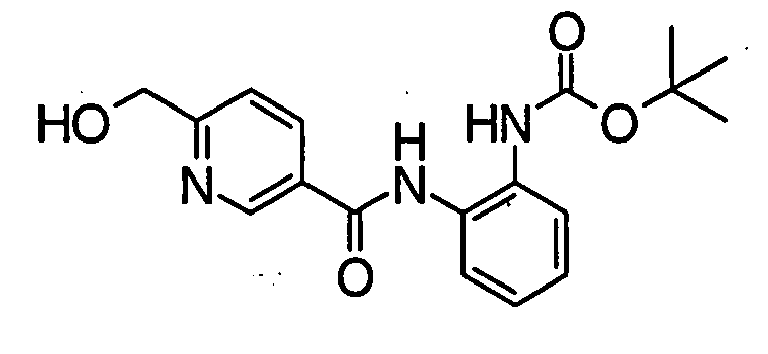
1H-NMR (400 MHz, DMSO-d6)
δ 1.44 (s, 9H), 4.65 (d, J = 5.9 Hz, 2H), 5.59 (t, J = 5.9 Hz, 1H), 7.14 (td, J = 7.7, 1.5 Hz, 1H), 7.21 (td, J = 7.7, 1.5 Hz, 1H), 7.52 (dd, J = 7.7, 1.5 Hz, 1H), 7.59 (dd, J = 7.7, 1.5 Hz, 1H), 7.63 (d, J = 8.3 Hz, 1H), 8.31 (dd, J = 8.3, 2.1 Hz, 1H), 8.69 (s, 1H), 9.03 (d, J = 2.1 Hz, 1H), 9.94 (s, 1H) - 4.0 M hydrogen chloride-ethyl acetate solution (1.0 mL) was added to a solution of N-(2-t-butoxycarbonylaminophenyl)-5-[1-(3-dimethylaminopropyl)-3-phenethylureidomethyl] pyridine-2-carboxylic acid amide (Reference Compound No.6-1, 31 mg, 0.060 mmol) in methanol (2.0 mL), and then the reaction mixture was stirred at room temperature for 4 hours. Saturated aqueous sodium hydrogen carbonate solution (30 mL) was added thereto, and then the whole was extracted with ethyl acetate (30 mL) three times. After the organic layer was dried over anhydrous magnesium sulfate, the solvent was evaporated under reduced pressure. The residue was purified by silica gel column chromatography (chloroform-methanol) to give 24 mg of the title compound as a yellow amorphous product. (Yield 84%)

1H-NMR (500 MHz, DMSO-d6)
δ 1.56 (m, 2H), 2.08 (s, 6H), 2.17 (br s, 2H), 2.74 (t, J = 7.3 Hz, 2H), 3.14 (t, J = 6.6 Hz, 2H), 3.31 (m, 2H), 4.50 (s, 2H), 4.90 (br s, 2H), 6.66 (td, J = 7.8, 1.2 Hz, 1H), 6.83 (dd, J = 7.8, 1.2 Hz, 1H), 6.95 (td, J = 7.8, 1.2 Hz, 1H), 7.12 (br s, 1H), 7.18-7.22 (m, 3H), 7.27-7.31 (m, 2H), 7.51 (dd, J = 7.8, 1.2 Hz, 1H), 7.82 (dd, J = 7.9, 2.0 Hz, 1H), 8.09 (d, J = 7.9 Hz, 1H), 8.56 (d, J = 7.9 Hz, 1H), 10.03 (br s, 1H)


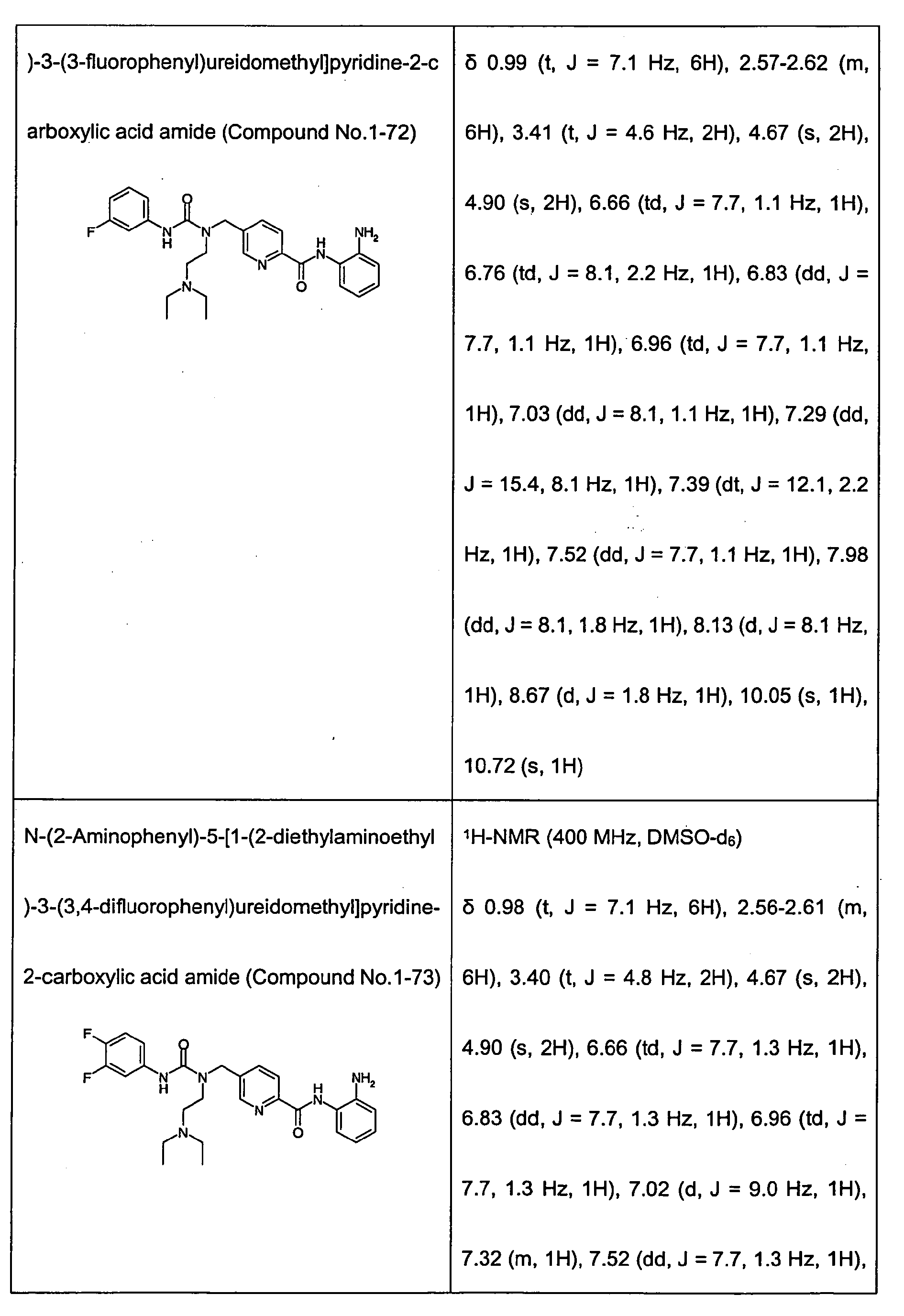


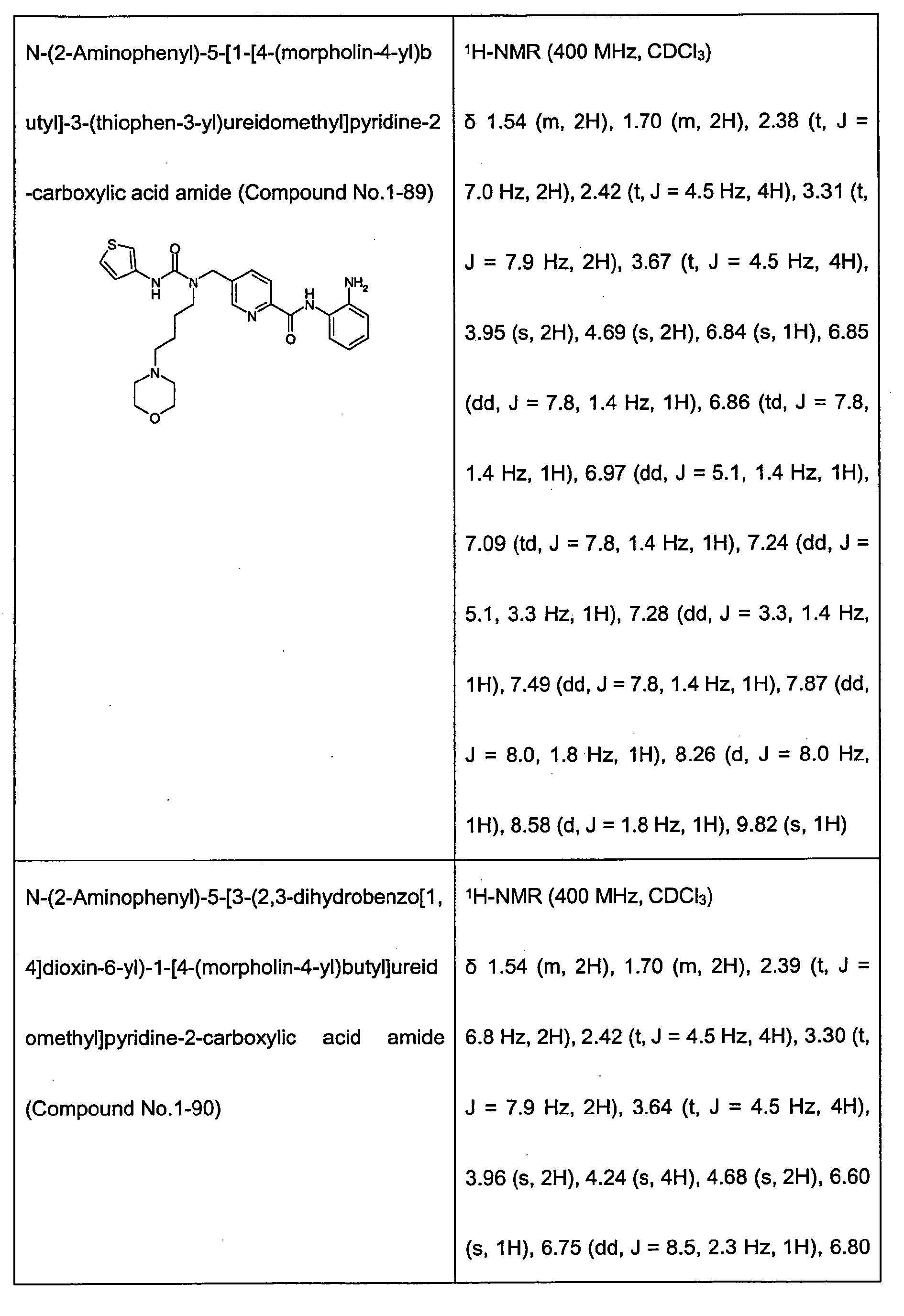


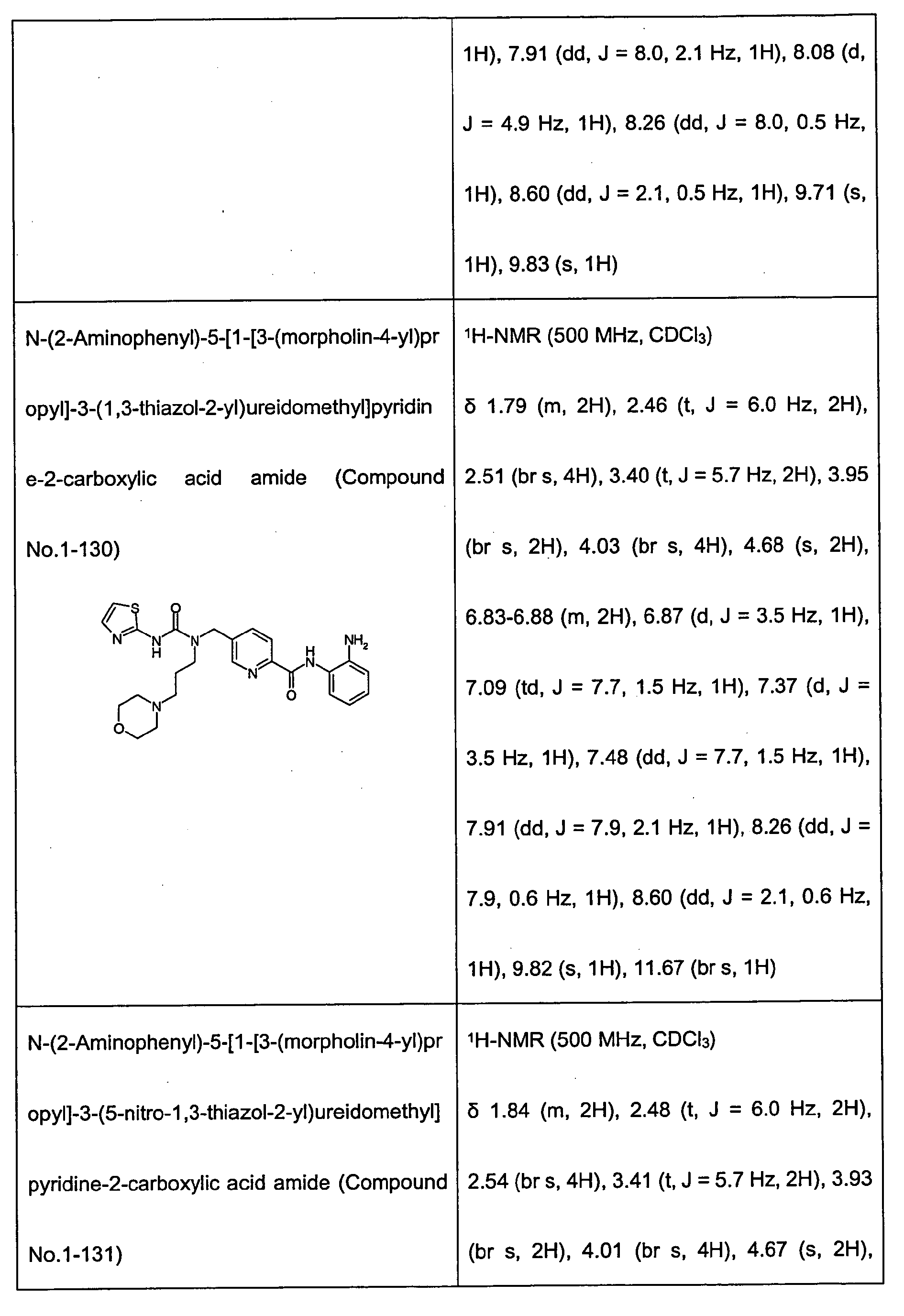


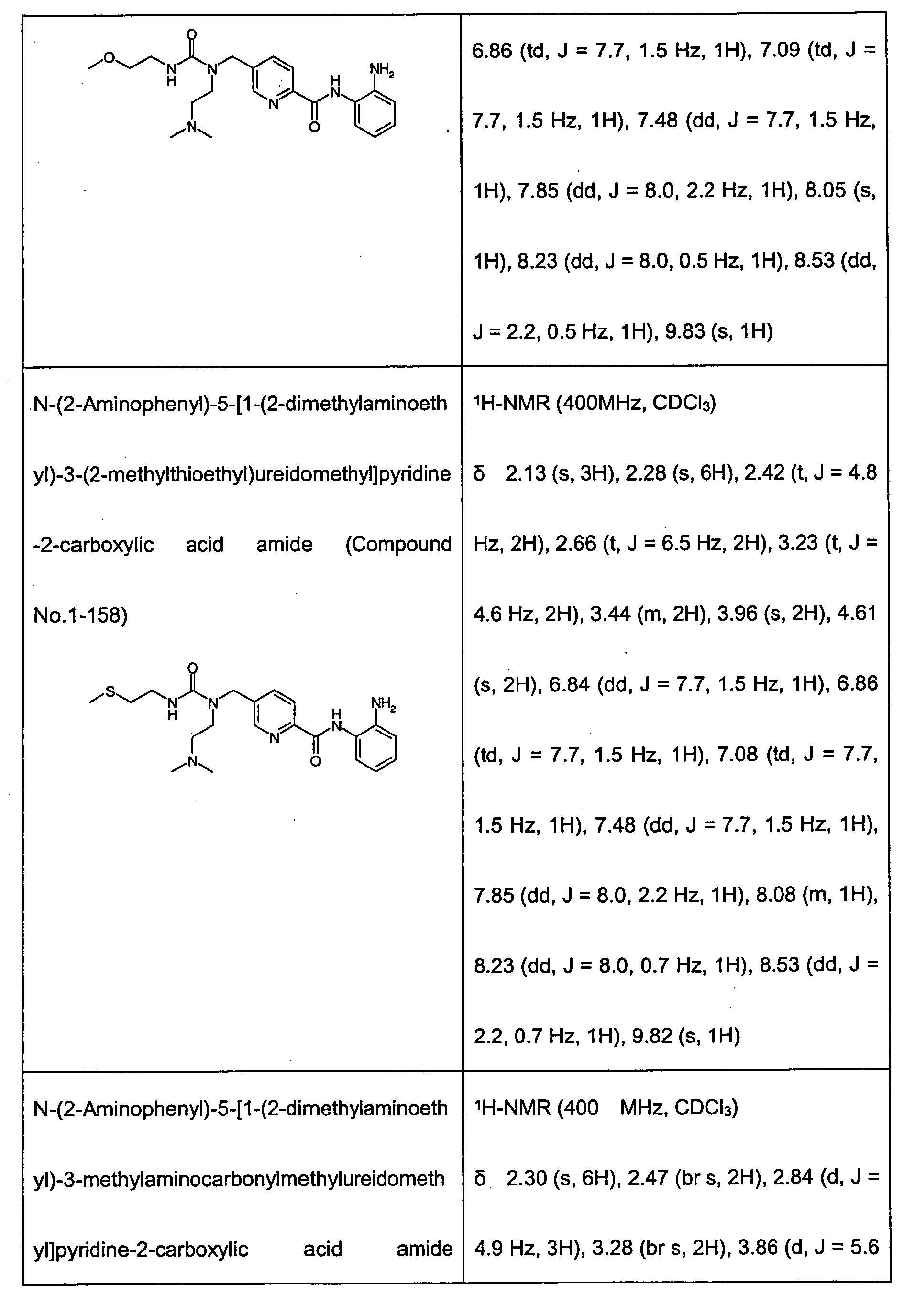


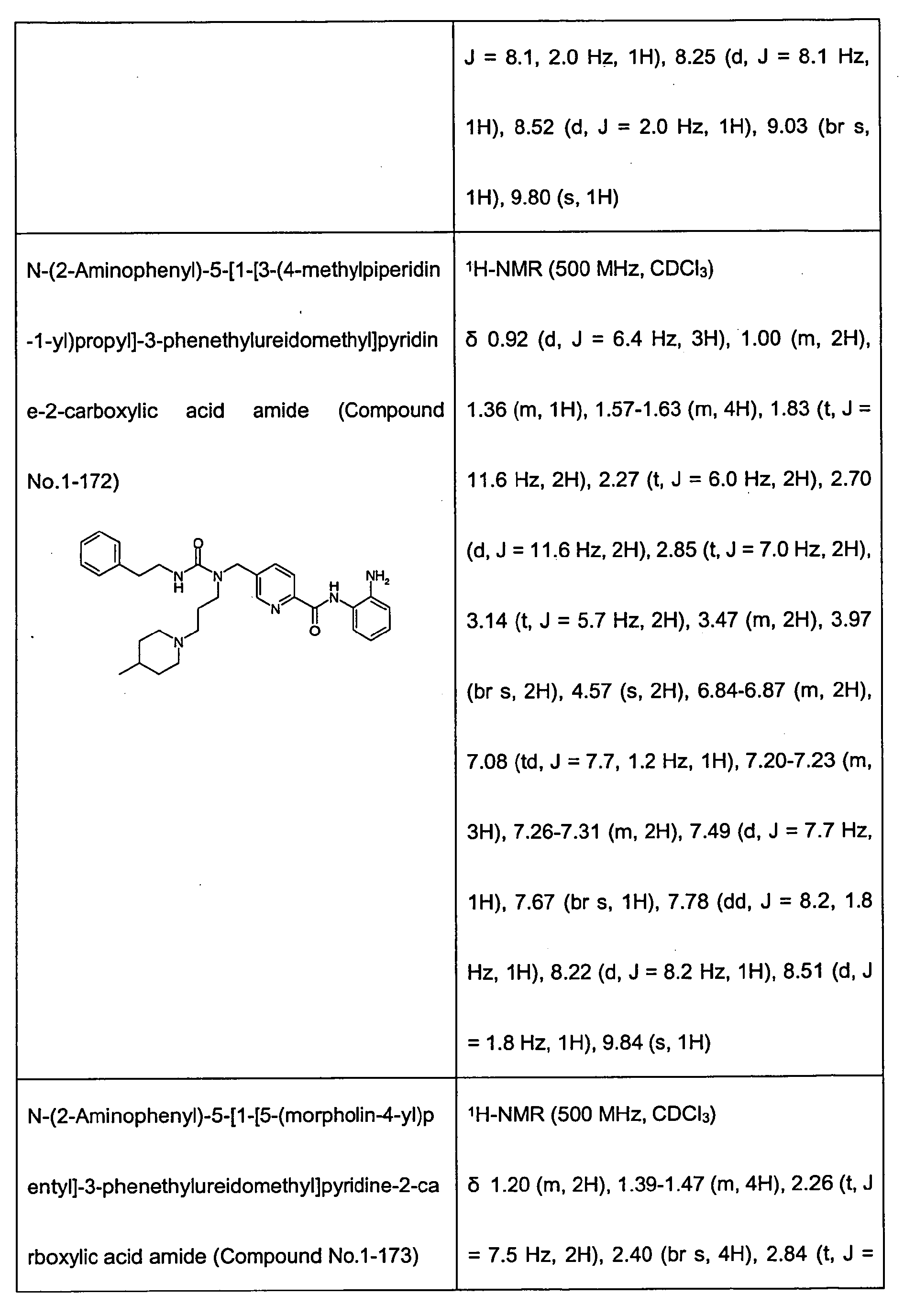
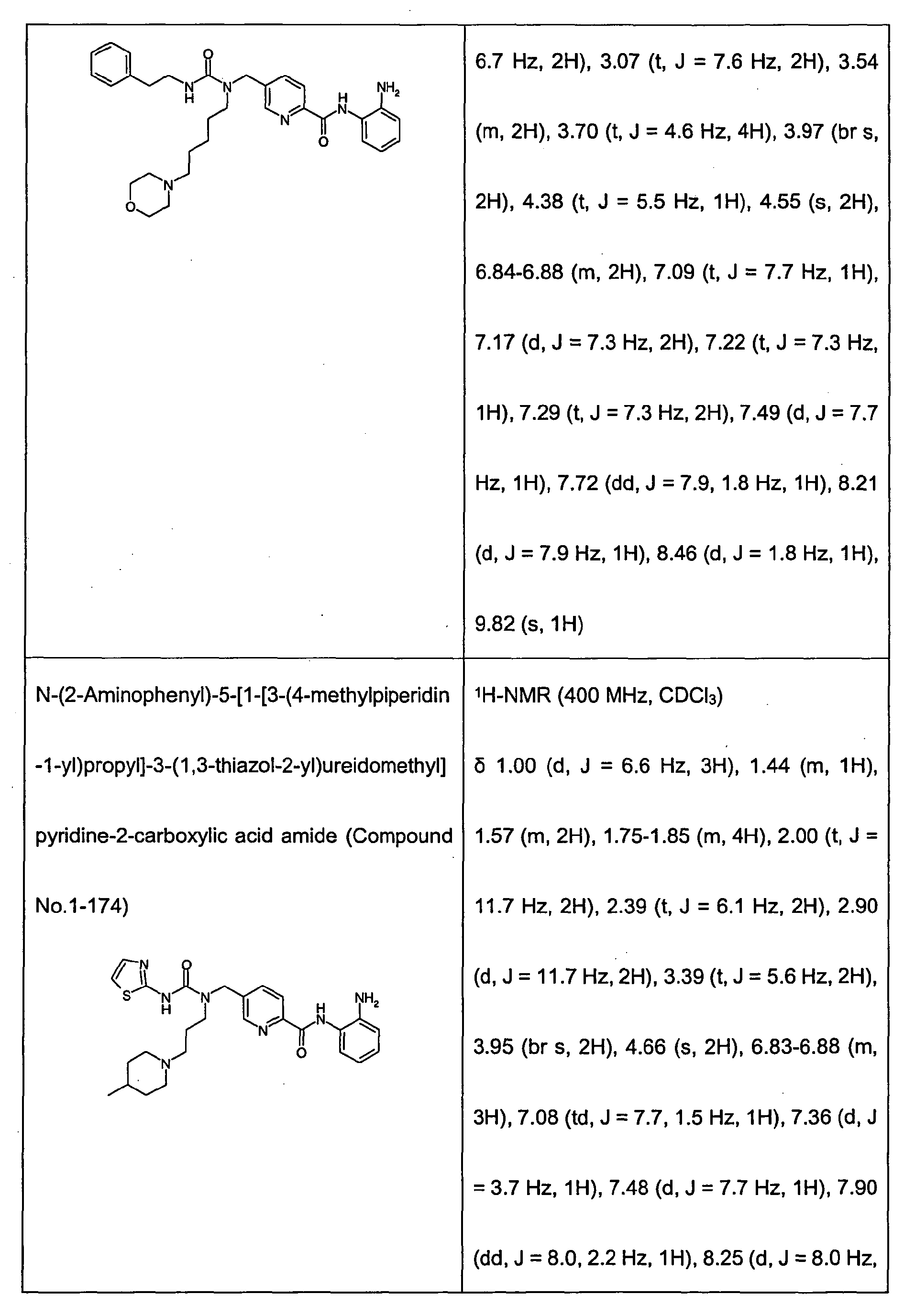


- 4-Dimethylaminophenylisocyanate (23 mg 0.14 mmol) was added to a solution of N-(2-t-butoxycarbonylaminophenyl)-5-[3-(morpholin-4-yl)propylaminomethyl)]pyridine-2-car boxylic acid amide (Reference Compound No.5-10, 25 mg, 0.053 mmol) in dichloromethane (1.0 mL), and then the mixture was stirred at room temperature for 2 hours. The reaction mixture was purified by silica gel column chromatography (NH-modified silica gel, hexane-ethyl acetate) to give a colorless compound. The obtained compound was dissolved in methanol (0.5 mL), 4.0 M hydrogen chloride-ethyl acetate solution (1.0 mL) was added thereto, and then the reaction mixture was stirred at room temperature for 4 hours. Saturated aqueous sodium hydrogen carbonate solution (30 mL) was added thereto, and then the whole was extracted with ethyl acetate (30 mL). The organic layer was dried over anhydrous magnesium sulfate, and then the solvent was evaporated under reduced pressure to give 27 mg of the title compound as a colorless amorphous product. (Yield 77%)

1H-NMR (500 MHz, DMSO-d6)
δ 1.70 (m, 2H), 2.29-2.32 (m, 6H), 2.83 (s, 6H), 3.35 (t, J = 6.7 Hz, 2H), 3.52-3.54 (m, 4H), 4.66 (s, 2H), 4.89 (br s, 2H), 6.65 (m, 1H), 6.67 (d, J = 9.0 Hz, 2H), 6.82 (d, J = 7.6 Hz, 1H), 6.95 (td, J = 7.6, 1.2 Hz, 1H), 7.23 (d, J = 9.0 Hz, 2H), 7.50 (d, J = 7.6 Hz, 1H), 7.93 (dd, J = 8.2, 2.0 Hz, 1H), 8.12 (d, J = 8.2 Hz, 1H), 8.45 (br s, 1H), 8.64 (d, J = 2.0 Hz, 1H), 10.03 (br s, 1H)N-(2-Aminophenyl)-5-[3-(4-cyanomethylphenyl)-1-[3-(morpholin-4-yl)propyl]ureidomethyl]pyridine-2-carboxylic acid amide (Compound No.2-2) 
1H-NMR (400 MHz, DMSO-d6)
δ 1.71 (m, 2H), 2.28-2.31 (m, 6H), 3.33 (s, 2H), 3.39 (t, J = 6.6 Hz, 2H), 3.54-3.56 (m, 4H), 4.70 (s, 2H), 4.89 (br s, 2H), 6.65 (t, J = 7.8 Hz, 1H), 6.82 (d, J = 7.8 Hz, 1H), 6.95 (td, J = 7.8, 1.1 Hz, 1H), 7.13 (m, 1H), 7.23 (d, J = 8.5 Hz, 1H), 7.42 (m, 1H), 7.49-7.53 (m, 2H), 7.93 (d, J = 8.2 Hz, 1H), 8.12 (d, J = 8.2 Hz, 1H), 8.62-8.69 (m, 2H), 10.04 (br s, 1H)N-(2-Aminophenyl)-5-[3-(4-diethylaminophenyl)-1-(3-dimethylaminopropyl)ureidomethyl]pyridine-2-carboxylic acid amide (Compound No.2-3) 
1H-NMR (500 MHz, DMSO-d6)
δ 1.05 (t, J = 7.0 Hz, 6H), 1.69 (m, 2H), 2.18 (s, 6H), 2.26 (t, J = 6.4 Hz, 2H), 3.26 (q, J = 7.0 Hz, 4H), 3.32 (m, 2H), 4.61 (s, 2H), 4.89 (br s, 2H), 6.61 (d, J = 9.0 Hz, 2H), 6.65 (td, J = 7.9, 1.2 Hz, 1H), 6.82 (dd, J = 7.9, 1.2 Hz, 1H), 6.95 (td, J = 7.9, 1.2 Hz, 1H), 7.19 (d, J = 9.0 Hz, 2H), 7.51 (dd, J = 7.9, 1.2 Hz, 1H), 7.94 (dd, J = 8.2, 1.8 Hz, 1H), 8.11 (d, J = 8.2 Hz, 1H), 8.65 (d, J = 1.8 Hz, 1H), 9.15 (br s, 1H), 10.02 (br s, 1H)N-(2-Aminophenyl)-5-[1-(3-diethylaminopropyl)-3-(4-dimethylaminophenyl)ureidomethyl]pyridine-2-carboxylic acid amide (Compound No.2-4) 
1H-NMR (400 MHz, DMSO-d6)
δ 0.93 (t, J = 7.1 Hz, 6H), 1.68 (m, 2H), 2.39 (br s, 2H), 2.50 (m, 4H), 2.82 (s, 6H), 3.33 (m, 2H), 4.64 (s, 2H), 4.89 (br s, 2H), 6.63-6.69 (m, 3H), 6.82 (dd, J = 7.8, 1.2 Hz, 1H), 6.95 (td, J = 7.8, 1.2 Hz, 1H), 7.22 (d, J = 9.0 Hz, 2H), 7.50 (dd, J = 7.8, 1.2 Hz, 1H), 7.94 (dd, J = 8.1, 1.8 Hz, 1H), 8.12 (d, J = 8.1 Hz, 1H), 8.65 (d, J = 1.8 Hz, 1H), 8.78 (br s, 1H), 10.03 (br s, 1H)N-(2-Aminophenyl)-5-[1-(3-diethylaminopropyl)-3-(4-methoxyphenyl)ureidomethyl]pyridine-2-carboxylic acid amide (Compound No.2-5) 
1H-NMR (400 MHz, DMSO-d6)
δ 0.93 (t, J = 7.1 Hz, 6H), 1.69 (m, 2H), 2.39 (t, J = 6.6 Hz, 2H), 2.49 (m, 4H), 3.35 (m, 2H), 3.71 (s, 3H), 4.65 (s, 2H), 4.89 (br s, 2H), 6.65 (td, J = 7.8, 1.3 Hz, 1H), 6.81-6.86 (m, 3H), 6.95 (td, J = 7.8, 1.3 Hz, 1H), 7.32 (d, J = 9.0 Hz, 2H), 7.50 (dd, J = 7.8, 1.3 Hz, 1H), 7.94 (dd, J = 8.1, 1.8 Hz, 1H), 8.12 (d, J = 8.1 Hz, 1H), 8.65 (d, J = 1.8 Hz, 1H), 8.93 (br s, 1H), 10.03 (br s, 1H)5-[3-(4-Acetylphenyl)-1-[3-(morpholin-4-yl)propyl]ureidomethyl]-N-(2-aminophenyl)pyridine-2-carboxylic acid amide (Compound No.2-6) 
1H-NMR (500 MHz, DMSO-d6)
δ 1.73 (m, 2H), 2.28-2.32 (m, 6H), 2.51 (s, 3H), 3.43 (t, J = 6.7 Hz, 2H), 3.54-3.57 (m, 4H), 4.74 (s, 2H), 4.89 (br s, 2H), 6.65 (td, J = 7.6, 1.2 Hz, 1H), 6.82 (dd, J = 7.6, 1.2 Hz, 1H), 6.95 (td, J = 7.6, 1.2 Hz, 1H), 7.51 (d, J = 7.6 Hz, 1H), 7.66 (d, J = 9.0 Hz, 2H), 7.88 (d, J = 9.0 Hz, 2H), 7.95 (dd, J = 8.1, 1.8 Hz, 1H), 8.13 (d, J = 8.1 Hz, 1H), 8.66 (d, J = 1.8 Hz, 1H), 8.93 (br s, 1H), 10.03 (br s, 1H)N-(2-Aminophenyl)-5-[3-(3,5-dimethylisoxazol-4-yl)-1-[3-(morpholin-4-yl)propyl]ureidomethyl]pyridine-2-carboxylic acid amide (Compound No.2-7) 
1H-NMR (500 MHz, DMSO-d6)
δ 1.71 (m, 2H), 2.08 (s, 3H), 2.25 (s, 3H), 2.30-2.33 (m, 6H), 3.35 (t, J = 6.7 Hz, 2H), 3.49-3.50 (m, 4H), 4.66 (s, 2H), 4.89 (br s, 2H), 6.65 (td, J = 7.6, 1.2 Hz, 1H), 6.82 (dd, J = 7.6, 1.2 Hz, 1H), 6.96 (td, J = 7.6, 1.2 Hz, 1H), 7.49 (dd, J = 7.6, 1.2 Hz, 1H), 7.92 (dd, J = 8.1, 2.0 Hz, 1H), 8.13 (d, J = 8.1 Hz, 1H), 8.36 (br s, 1H), 8.63 (d, J = 2.0 Hz, 1H), 10.04 (br s, 1H)N-(2-Aminophenyl)-5-[1-(2-carboxyethyl)-3-(2,3-dihydrobenzo[1,4]dioxin-6-yl)ureidomethyl]pyridine-2-carboxylic acid amide (Compound No.2-8) 
1H-NMR (500 MHz, DMSO-d6)
δ 2.56 (t, J = 7.2 Hz, 2H), 3.54 (m, 2H), 4.17-4.26 (m, 4H), 4.67-4.72 (m, 4H), 6.65 (m, 1H), 6.73 (d, J = 8.7 Hz, 1H), 6.82 (dd, J = 7.9, 1.2 Hz, 1H), 6.87 (dd, J = 8.7, 2.6 Hz, 1H), 6.95 (td, J = 7.9, 1.2 Hz, 1H), 7.04 (d, J = 2.6 Hz, 1H), 7.51 (dd, J = 7.9, 1.2 Hz, 1H), 7.91 (dd, J = 7.9, 1.8 Hz, 1H), 8.12 (d, J = 7.9 Hz, 1H), 8.46 (br s, 1H), 8.62 (d, J = 1.8 Hz, 1H), 10.03 (br s, 1H)N-(2-Aminophenyl)-5-[1-(2-carboxyethyl)-3-(3,4-difluorophenyl)ureidomethyl]pyridine-2-carboxylic acid amide (Compound No.2-9) 
1H-NMR (500 MHz, DMSO-d6)
δ 2.55 (t, J = 7.0 Hz, 2H), 3.56 (t, J = 7.0 Hz, 2H), 4.70 (s, 2H), 4.90 (br s, 2H), 6.65 (td, J = 7.6, 1.4 Hz, 1H), 6.82 (dd, J = 7.6, 1.4 Hz, 1H), 6.95 (td, J = 7.6, 1.4 Hz, 1H), 7.24 (m, 1H), 7.31 (dd, J = 19.7, 9.3 Hz, 1H), 7.51 (dd, J = 7.6, 1.4 Hz, 1H), 7.64 (ddd, J = 13.7, 7.6, 2.4 Hz, 1H), 7.93 (dd, J = 7.9, 2.0 Hz, 1H), 8.12 (d, J = 7.9 Hz, 1H), 8.63 (d, J = 2.0 Hz, 1H), 9.13 (br s, 1H), 10.16 (br s, 1H)N-(2-Aminophenyl)-5-[3-(2,3-dihydrobenzo[1,4]dioxin-6-yl)-1-(2-hydroxyethyl)ureidomethyl]pyridine-2-carboxylic acid amide (Compound No.2-10) 
1H-NMR (400 MHz, DMSO-d6)
δ 3.43 (t, J = 5.1 Hz, 2H), 3.58 (t, J = 5.1 Hz, 2H), 4.16-4.21 (m, 4H), 4.69 (s, 2H), 4.90 (br s, 2H), 5.28 (br s, 1H), 6.65 (td, J = 7.7, 1.2 Hz, 1H), 6.72 (d, J = 8.8 Hz, 1H), 6.80 (dd, J = 8.8, 2.4 Hz, 1H), 6.83 (m, 1H), 6.95 (td, J = 7.7, 1.2 Hz, 1H), 7.02 (d, J = 2.4 Hz, 1H), 7.50 (dd, J = 7.7, 1.2 Hz, 1H), 7.93 (dd, J = 8.1, 1.8 Hz, 1H), 8.11 (dd, J = 8.1, 0.5 Hz, 1H), 8.55 (br s, 1H), 8.64 (d, J = 1.8 Hz, 1H), 10.03 (br s, 1H)N-(2-Aminophenyl)-5-[1-(2-hydroxyethyl)-3-(4-methoxyphenyl)ureidomethyl]pyridine-2-carboxylic acid amide (Compound No.2-11) 
1H-NMR (400 MHz, DMSO-d6)
δ 3.44 (t, J = 5.1 Hz, 2H), 3.59 (m, 2H), 3.70 (s, 3H), 4.71 (s, 2H), 4.90 (br s, 2H), 5.27 (br s, 1H), 6.65 (td, J = 7.6, 1.2 Hz, 1H), 6.83 (m, 1H), 6.84 (d, J = 9.0 Hz, 2H), 6.95 (td, J = 7.6, 1.2 Hz, 1H), 7.30 (d, J = 9.0 Hz, 2H), 7.51 (dd, J = 7.6, 1.2 Hz, 1H), 7.94 (dd, J = 8.1, 1.8 Hz, 1H), 8.11 (d, J = 8.1 Hz ,1H), 8.57 (br s, 1H), 8.65 (d, J = 1.8 Hz, 1H), 10.03 (br s, 1H)N-(2-Aminophenyl)-5-[3-(2,3-dihydrobenzo[1,4]dioxin-6-yl)-1-[2-(2,3-dihydrobenzo[1,4]dioxin-6-ylaminocarbonyloxy)ethyl]ureidomethyl] pyridine-2-carboxylic acid amide (Compound No.2-12) 
1H-NMR (400 MHz, DMSO-d6)
δ 3.65 (t, J = 5.5 Hz, 2H), 4.16-4.22 (m, 10H), 4.77 (s, 2H), 4.89 (br s, 2H), 6.65 (td, J = 7.6, 1.2 Hz, 1H), 6.71 (d, J = 8.5 Hz, 1H), 6.74 (d, J = 8.5 Hz, 1H), 6.82 (d, J = 7.6 Hz, 1H), 6.86 (m, 1H), 6.87 (dd, J = 8.5, 2.6 Hz, 1H), 6.95 (td, J = 7.6, 1.2 Hz, 1H), 7.01 (m, 1H), 7.04 (d, J = 2.6 Hz, 1H), 7.49 (dd, J = 7.6, 1.2 Hz, 1H), 7.92 (dd, J = 8.2, 1.6 Hz, 1H), 8.11 (d, J = 8.2 Hz, 1H), 8.36 (br s, 1H), 8.62 (d, J = 1.6 Hz, 1H), 9.43 (br s, 1H), 10.01 (br s, 1H)N-(2-Aminophenyl)-5-[3-(benzo[1,3]dioxol-5-yl)-1-[2-(benzo[1,3]dioxol-5-ylaminocarbonyloxy)ethyl]ureidomethyl]pyridine-2-carboxylic acid amide (Compound No.2-13) 
1H-NMR (500 MHz, DMSO-d6)
δ 3.66 (t, J = 5.8 Hz, 2H), 4.22 (t, J = 5.8 Hz, 2H), 4.77 (s, 2H), 4.88 (br s, 2H), 5.94 (s, 2H), 5.95 (s, 2H), 6.65 (td, J = 7.8, 1.2 Hz, 1H), 6.78 (d, J = 8.2 Hz, 1H), 6.81-6.84 (m, 4H), 6.95 (td, J = 7.8, 1.2 Hz, 1H), 7.08 (br s, 1H), 7.12 (d, J = 1.8 Hz, 1H), 7.50 (dd, J = 7.8, 1.2 Hz, 1H), 7.93 (dd, J = 8.0, 1.5 Hz, 1H), 8.11 (d, J = 8.0 Hz, 1H), 8.44 (br s, 1H), 8.63 (d, J = 1.5 Hz, 1H), 9.51 (br s, 1H), 10.01 (br s, 1H)N-(2-Aminophenyl)-5-[3-(4-methoxyphenyl)-1-[2-(4-methoxyphenylaminocarbonyloxy)ethyl]ureidomethyl]pyridine-2-carboxylic acid amide (Compound No.2-14) 
1H-NMR (400 MHz, DMSO-d6)
δ 3.67 (m, 2H), 3.69 (s, 3H), 3.70 (s, 3H), 4.22 (t, J = 5.5 Hz, 2H), 4.79 (s, 2H), 4.89 (br s, 2H), 6.65 (td, J = 7.8, 1.3 Hz, 1H), 6.81-6.86 (m, 5H), 6.95 (td, J = 7.8, 1.3 Hz, 1H), 7.32-7.36 (m, 4H), 7.50 (dd, J = 7.8, 1.3 Hz, 1H), 7.94 (d, J = 7.8 Hz, 1H), 8.12 (d, J = 7.8 Hz, 1H), 8.42 (br s, 1H), 8.64 (d, J = 1.2 Hz, 1H), 9.45 (br s, 1H), 10.02 (br s, 1H)N-(2-Aminophenyl)-5-[1-(2-dimethylaminoethyl)-3-(1H-pyrazol-3-yl)ureidomethyl]pyddine-2-carboxylic acid amide (Compound No.2-15) 
1H-NMR (500 MHz, CDCl3)
δ 2.40 (s, 6H), 2.54 (t, J = 4.4 Hz, 2H), 3.34 (t, J = 4.4 Hz, 2H), 3.95 (s, 2H), 4.67 (s, 2H), 6.01 (s, 1H), 6.84 (dd, J = 7.7, 1.4 Hz, 1H), 6.86 (td, J = 7.7, 1.4 Hz, 1H), 7.09 (td, J = 7.7, 1.4 Hz, 1H), 7.43 (d, J = 2.1 Hz, 1H), 7.49 (dd, J = 7.7, 1.4 Hz, 1H), 7.89 (dd, J = 7.9, 2.0 Hz, 1H), 8.26 (d, J = 7.9 Hz, 1H), 8.57 (d, J = 2.0 Hz, 1H), 9.82 (s, 1H), 12.18 (s, 1H) - Under a nitrogen atmosphere, 10% palladium on carbon (30 mg) was added to a solution of N-(2-aminophenyl)-5-[3-(4-benzyloxyphenyl)-1-[5-(morpholin-4-yl)pentyl]ureidomethyl]pyridi ne-2-carboxylic acid amide (Compound No.1-182, 45 mg, 0.072 mmol) in a mixed solvent (ethyl acetate (2.0 mL) and methanol (3.0 mL)), and then the reaction mixture was stirred under a hydrogen atmosphere at room temperature for 2 hours. After the insoluble was filtered off with celite, the filtrate was concentrated. The residue was purified by silica gel column chromatography (chloroform-methanol) to give 32 mg of the title compound as a yellow oil. (Yield 84%)
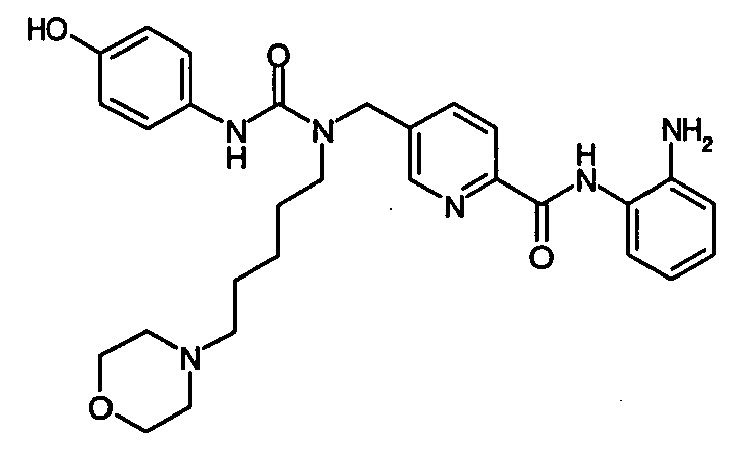
1H-NMR (500 MHz, CDCl3)
δ 1.34 (m, 2H), 1.52 (m, 2H), 1.63 (m, 2H), 2.33 (t, J = 7.6 Hz, 2H), 2.44 (m, 4H), 3.28 (t, J = 7.6 Hz, 2H), 3.71 (t, J = 4.7 Hz, 4H), 3.98 (s, 2H), 4.62 (s, 2H), 6.40 (s, 1H), 6.69 (d, J = 8.9 Hz, 2H), 6.84 (dd, J = 7.8, 1.4 Hz, 1H), 6.86 (td, J = 7.8, 1.4 Hz, 1H),7.09 (td, J = 7.8, 1.4 Hz, 1H), 7.10 (d, J = 8.9 Hz, 2H), 7.49 (dd, J = 7.8, 1.4 Hz, 1H), 7.80 (dd, J = 8.0, 2.0 Hz, 1H), 8.21 (d, J = 8.0 Hz, 1H), 8.52 (d, J = 2.0 Hz, 1H), 9.82 (s, 1H) - Hereinafter, typical preparation examples of the present compound will be shown.
-
The present compound 1 mg Lactose 100 mg Cornstarch 40 mg Calcium carboxymethyl cellulose 4.5 mg Hydroxypropyl cellulose 4 mg Magnesium stearate 0.5 mg - A tablet of the above-mentioned formulation is coated using 3 mg of a coating agent (for example, a conventional coating agent such as hydroxypropylmethyl cellulose, macrogol or a silicone resin), whereby a desired tablet can be obtained. In addition, a desired tablet can be obtained by appropriately changing the kinds and/or amounts of the present compound and additives.
-
The present compound 5 mg Lactose 135 mg Calcium carboxymethyl cellulose 4.5 mg Hydroxypropyl cellulose 4 mg Magnesium stearate 1.5 mg - A desired capsule can be obtained by appropriately changing the kinds and/or amounts of the present compound and additives.
-
The present compound 100 mg Sodium chloride 900 mg Polysorbate 80 500 mg Sodium hydroxide q.s. Hydrochloric acid q.s. Sterile purified water q.s. - A desired eye drop can be obtained by appropriately changing the kinds and/or amounts of the present compound and additives.
- Using HDAC Fluorimetric Assay /Drug Discovery Kit (manufactured by Biomol), an HDAC inhibitory effect of the present compounds was measured according to the protocol included with the kit. The kit contains Buffer, HeLa nuclear extract (includes an HDAC), Substrate, Developer and Trichostatin A (an HDAC inhibitor).
- A test compound was dissolved in dimethyl sulfoxide, whereby a 2 mg/mL solution was prepared. Then, the resulting solution was diluted with Buffer containing 5% dimethyl sulfoxide, whereby a 150 µM test compound solution was prepared.
-
- 1) To a 384-well culture plate, the test compound solution was added in an amount of 2 µL per well.
- 2) HeLa nuclear extract was diluted 30-fold with Buffer. The resulting solution was added in an amount of 3 µL per well and then, incubation was performed at 37°C for 2 hours.
- 3) Substrate was diluted 500-fold with Buffer. The resulting solution was added in an amount of 5 µL per well (the final concentration of the test compound was 30 µM) and then, incubation was performed at 37°C for 10 minutes.
- 4) Developer was diluted 20-fold with Buffer and Trichostatin A (2 µM) was added to it. The resulting solution was added in an amount of 10 µL per well and then, incubation was performed at room temperature for 15 minutes.
- 5) The fluorescence intensity of each well was measured using multilabel counter ARVO (manufactured by Wallac) with excitation at 360 nm and emission at 460 nm.
- 6) A control data was obtained from the same experiment except that Buffer containing 5% DMSO was added instead of the test compound solution as the above-mentioned procedure from 1) to 5).
- 7) A blank data was obtained from the same experiment except that Buffer containing 5% DMSO was added instead of the test compound solution and that Buffer was added instead of Hela nuclear extract as the above-mentioned procedure from 1) to 5).
- Enzyme inhibitory rate (%) was calculated using the following equation.


- As an example of the test results, the enzyme inhibitory rate of the respective test compound {Trichostatin A (manufactured by Wako Pure Chemical Industries), SAHA(produced according to the method described in
JP-A-2003-226680 JP-A-2006-514998 Table I Test
CompoundEnzyme Inhibitory Rate (%) Trichostatin A 100 SAHA 97 M 344 99 Oxamflatin 100 CBHA 99 MC1293 65 Depudecin 99 MS 275 99 Apicidin 98 MGCD-0103 free base 96 Compound 1-2 100 Compound 1-3 100 Compound 1-4 100 Compound 1-6 100 Compound 1-8 96 Compound 1-10 98 Compound 1-13 100 Compound 1-14 100 Compound 1-20 99 Compound 1-21 98 Compound 1-24 96 Compound 1-25 97 Compound 1-27 97 Compound 1-30 100 Compound 1-31 99 Compound 1-38 97 Compound 1-40 97 Compound 1-41 96 Compound 1-42 98 Compound 1-44 98 Compound 1-46 98 Compound 1-51 98 Compound 1-53 98 Compound 1-55 98 Compound 1-56 97 Compound 1-58 98 Compound 1-63 97 Compound 1-68 99 Compound 1-79 98 Compound 1-90 98 Compound 1-96 98 Compound 1-115 97 Compound 1-116 100 Compound 1-141 91 Compound 2-1 98 Compound 2-3 100 Compound 2-10 99 - If the enzyme inhibitory rate was more than 100%, the value is shown to be 100% in Table I.
- As a method for evaluating a cellular morphological change, an evaluation system using the cell shape index (hereinafter referred to as "CSI") as an index has been reported in The Journal of Clinical Investigation, 103, 1141-1150 (1999). Therefore, according to the method described in the above document, an effect of morphological change by the present compounds on trabecular meshwork cells was evaluated.
- A human trabecular meshwork cell line (hereinafter referred to as "TM-1 cells") reported in Investigative Ophthalmology & Visual Science, 43, 151-161 (2002) was used.
- Culture medium 1: A reagent was prepared by adding fetal bovine serum (10%), L-glutamine (2 mM), amphotericin B (2.5 µg/mL), and gentamicin (25 µg/mL) to Dulbecco's Modified Eagle Medium (hereinafter referred to as "D-MEM").
- Culture medium 2: Fetal bovine serum (3%), L-glutamine (2 mM), amphotericin B (2.5 µg/mL), and gentamicin (25 µg/mL) were added to D-MEM.
- Cell staining liquid: A mixed liquid of Calcein-AM (16 µM) and Hoechst 33342 (40 µM) was prepared by diluting a Calcein-AM solution (cytoplasmic staining reagent, manufactured by Dojindo Laboratories) and a Hoechst 33342 solution (nuclear staining reagent, manufactured by Dojindo Laboratories) with D-MEM containing L-glutamine (2 mM), amphotericin B (2.5 µg/mL), and gentamicin (25 µg/mL).
- TM-1 cells subcultured at 37°C in a 8% carbon dioxide gas atmosphere were treated with a trypsin/EDTA solution (0.05% trypsin and 0.53 mM tetrasodium ethylenediaminetetraacetate) at 24 hours before performing a drug treatment mentioned below and seeded on a 96-well culture plate. The culture medium 1 was used for the subculture of the cells. The culture medium 2 was used for the cell culture after seeding the cells on the plate.
- A test compound was dissolved in dimethyl sulfoxide, whereby a 5 mM solution was prepared. Then, the resulting solution was diluted with the culture medium 2, whereby a 200 µM test compound solution was prepared.
- It has been reported that Y-27632 which is a Rho kinase inhibitor induces a morphological change in trabecular meshwork cells in Investigative Ophthalmology & Visual Science, 42, 137-144 (2001). Therefore, Y-27632 (produced according to the method described in
WO 90/05723 -
- 1) To a 96-well culture plate, a solution of TM-1 cells adjusted to a cell density of 1.6 x 10⁴ cells/mL was added in an amount of 95 µL (1.5 x 10⁴ cells) per well.
- 2) Incubation was performed at 37°C in a 8% carbon dioxide gas atmosphere for 24 hours.
- 3) The test compound solution or positive control compound solution was added in an amount of 5 µL per well (the final concentration of the test compound or positive control compound was 10 µM). As a control, the culture medium 2 containing dimethyl sulfoxide (4%) was added in an amount of 5 µL per well.
- 4) Incubation was performed at 37°C in a 8% carbon dioxide gas atmosphere for 24 hours.
- 5) The cell staining liquid was added in an amount of 10 µL per well.
- 6) Incubation was performed at 37°C in a 8% carbon dioxide gas atmosphere for 1 hour to stain the cells.
- 7) A 37% formaldehyde solution was added in an amount of 10 µL per well.
- 8) Incubation was performed at room temperature for 1 hour to fix the cells.
- 9) Washing with phosphate-buffered saline was performed.
- 10) Using Array Scan Vti HCS reader (manufactured by Cellomics), images of stained cells magnified with a 20-fold objective lens were captured in 80 fields (10 fields x 8 wells) per test compound addition group.
- 11) CSI was calculated for each cell and an average value was obtained for each test compound addition group.
- CSI was calculated using the following equation.

- As an example of the test results, the CSI values of the respective test compound {Trichostatin A (manufactured by Wako Pure Chemical Industries), SAHA(produced according to the method described in
JP-A-2003-226680 JP-A-2006-514998 Table II Test Compound CSI Control 0.679 Trichostatin A 0.496 SAHA 0.501 M 344 0.500 Oxamflatin 0.551 CBHA 0.545 MC1293 0.628 Depudecin 0.618 MS 275 0.552 Apicidin 0.489 MGCD-0103 free base 0.584 Compound 1-2 0.516 Compound 1-3 0.569 Compound 1-4 0.556 Compound 1-6 0.549 Compound 1-8 0.538 Compound 1-10 0.528 Compound 1-13 0.545 Compound 1-14 0.520 Compound 1-20 0.516 Compound 1-21 0.575 Compound 1-24 0.597 Compound 1-25 0.571 Compound 1-27 0.624 Compound 1-30 0.564 Compound 1-31 0.551 Compound 1-38 0.575 Compound 1-40 0.572 Compound 1-41 0.499 Compound 1-42 0.536 Compound 1-44 0.554 Compound 1-46 0.547 Compound 1-51 0.518 Compound 1-53 0.502 Compound 1-55 0.525 Compound 1-56 0.526 Compound 1-58 0.518 Compound 1-63 0.521 Compound 1-68 0.502 Compound 1-79 0.497 Compound 1-90 0.480 Compound 1-96 0.489 Compound 1-115 0.467 Compound 1-116 0.455 Compound 1-141 0.515 Compound 2-1 0.574 Compound 2-3 0.550 Compound 2-10 0.582 Y-27632 0.543 - In order to evaluate an intraocular pressure-lowering effect of the present compounds, a test for evaluation of intraocular pressure-lowering effect by intracameral administration of a drug using male Japanese White rabbits was performed.
- A test compound was dissolved or suspended in physiological saline containing 0.5% dimethyl sulfoxide, whereby a 0.1 mM or 1 mM test compound administration liquid was prepared.
- One drop of 0.4% oxybuprocaine hydrochloride eye drop was instilled into both eyes of each male Japanese White rabbit to achieve local anesthesia, and thereafter, the intraocular pressure was measured using an applanation tonometer. Then, by using a syringe fitted with a 30-gauge needle, the test compound administration liquid (20 µL) was intracamerally administered to one eye. As a control, 20 µL of the vehicle (physiological saline containing 0.5% dimethyl sulfoxide) for the test compound was intracamerally administered. After the lapse of a certain period of time from the administration of the test compound or vehicle, one drop of 0.4% oxybuprocaine hydrochloride eye drop was instilled into the administered eye to achieve local anesthesia, and thereafter, the intraocular pressure was measured using an applanation tonometer.
- The intraocular pressure-lowering effect of each test compound was evaluated by calculating an intraocular pressure reduction rate. The intraocular pressure reduction rate (%) was calculated using the following equation.

- As an example of the test results, the intraocular pressure reduction rates of the respective test compound administration groups at 8 or 9 hours after administering the respective test compounds {Trichostatin A (manufactured by Alexis Biochemicals), SAHA (manufactured by Alexis Biochemicals), Oxamflatin (manufactured by Alexis Biochemicals), MS 275 (manufactured by Calbiochem), Apicidin (manufactured by Calbiochem), MGCD-0103 free base (produced according to the method described in
JP-A-2006-514998 Table III Test
CompoundConcentration of Test Compound Intraocular Pressure Reduction Rate (%) Trichostatin A 1 mM 18 SAHA 1 mM 17 Oxamflatin 1 mM 26 MS 275 1 mM 13 Apicidin 0.1 mM 13 MGCD-0103 free base 1 mM 23 Compound 1-96 1 mM 18 - As shown in Table II, the present compounds have an excellent effect of morphological change on trabecular meshwork cells equal to or greater than that of Y-27632 used as the positive control (lower CSI indicates greater morphological changes in Table II). Further, as shown in Table III, the present compounds have an excellent intraocular pressure-lowering effect also in the test using actual animal models. Accordingly, the present compounds can be used as an intraocular pressure-lowering agent and are expected to be useful as a preventive and/or therapeutic agent for diseases associated with aqueous humor circulation and/or intraocular pressure, particularly as a preventive and/or therapeutic agent for glaucoma, ocular hypertension, etc.
- The compound having an HDAC inhibitory effect of the invention has an excellent effect of morphological change on trabecular meshwork cells and/or effect of intraocular pressure reduction, and is therefore useful as a preventive and/or therapeutic agent for a disease considered to be associated with aqueous humor circulation and/or intraocular pressure, particularly as a preventive and/or therapeutic agent for glaucoma or ocular hypertension.
Claims (11)
- An intraocular pressure-lowering agent comprising at least one compound having a histone deacetylase inhibitory effect as an active ingredient.
- The intraocular pressure-lowering agent according to claim 1, wherein the compound having a histone deacetylase inhibitory effect is a compound selected from the following compounds or a salt thereof:·(2E,4E,6R)-7-(4-Dimethylaminophenyl)-N-hydroxy-4,6-dimethyl-7-oxo-2,4-heptadienamide (Trichostatin A),·N-Hydroxy-N'-phenyloctanediamide (SAHA),·4-Dimethylamino-N-(6-hydroxycarbamoylhexyl)benzamide (M 344),.(E)-N-Hydroxy-5-[3-(phenylsulfonylamino)phenyl]-2-penten-4-ynamide (Oxamflatin),·N-Hydroxy-3-[3-hydroxyamino-3-oxo-1-propenyl]benzamide (CBHA),·(E)-N-Hydroxy-3-[1-methyl-4-(4-methylbenzoyl)-1H-pyrrol-2-yl]-2-propenamide (MC1293),·(1R)-[(2S,3S)-3-[(E)-2-[(2S,3S)-3-[(1R)-Hydroxyethyl]oxiran-2-yl] vinyl]oxiran-2-yl]-2-propen-1-ol (Depudecin),·N-(2-Aminophenyl)-4-(pyridin-3-ylmethyloxycarbonylaminomethyl) benzamide (MS 275),cyclo[L-(2-Amino-8-oxodecanoyl)-(1'-methoxy-L-tryptophyl)-L-isoleucyl-D-pipecolinyl] (Apicidin); and·N-(2-Aminophenyl)-4-[4-(pyridin-3-yl)pyrimidin-2-ylaminomethyl]benzamide (free base of MGCD-0103).
- The intraocular pressure-lowering agent according to claim 1, wherein the compound having a histone deacetylase inhibitory effect is a compound represented by the following general formula (1) or a salt thereof:


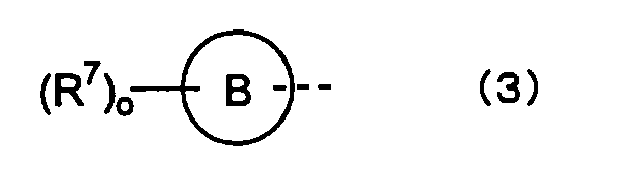
R6 represents a halogen atom, a lower alkyl group which may have a substituent, a lower cycloalkyl group which may have a substituent, an aryl group which may have a substituent, a heterocyclic group which may have a substituent, a hydroxy group, a lower alkoxy group which may have a substituent, a lower cycloalkyloxy group which may have a substituent, an aryloxy group which may have a substituent, a mercapto group, a lower alkylthio group which may have a substituent, a lower cycloalkylthio group which may have a substituent, an arylthio group which may have a substituent, a formyl group, a lower alkylcarbonyl group which may have a substituent, a carboxy group, a lower alkoxycarbonyl group which may have a substituent, a nitro group, a cyano group or -NReRf;
R7 represents a lower alkyl group which may have a substituent, a lower cycloalkyl group which may have a substituent, an aryl group which may have a substituent, a hydroxy group, a lower alkoxy group which may have a substituent, a lower cycloalkyloxy group which may have a substituent or an aryloxy group which may have a substituent;
Ra and Rb are the same or different and represent a hydrogen atom, a lower alkyl group which may have a substituent, a lower cycloalkyl group which may have a substituent, an aryl group which may have a substituent or a heterocyclic group which may have a substituent;
Rc, Rd, Re and Rf are the same or different and represent a hydrogen atom, a lower alkyl group which may have a substituent, a lower cycloalkyl group which may have a substituent or an aryl group which may have a substituent;
the ring A represents a cyclic hydrocarbon or a heterocyclic ring;
the ring B represents a heterocyclic ring having one or plural heteroatoms selected from the group consisting of a nitrogen atom and an oxygen atom in the ring;
X represents a lower alkylene group which may have a substituent;
Y and Z are the same or different and represent a single bond or a lower alkylene group which may have a substituent;
W1-W2 represents N-C or C-N; and
l, m, n and o are the same or different and represent 0, 1, 2 or 3]. - The intraocular pressure-lowering agent according to claim 3, wherein in the general formula (1),
R1 and R2 are the same or different and represent a hydrogen atom, a lower alkyl group, a lower alkyl group having a halogen atom as a substituent, a lower alkyl group having a methoxy group as a substituent, a lower alkyl group having a methylthio group as a substituent, a lower alkyl group having a cyano group as a substituent, a lower alkyl group having a methylaminocarbonyl group as a substituent, a lower alkyl group having a diisopropylamino group as a substituent, a lower alkenyl group, a lower alkynyl group or a group represented by the following general formula (2);

R6 represents a halogen atom, a lower alkyl group, a lower alkyl group having a halogen atom as a substituent, a lower alkyl group having a cyano group as a substituent, a lower cycloalkyl group, an aryl group, a heterocyclic group, a hydroxy group, a lower alkoxy group, a lower alkoxy group having a halogen atom as a substituent, a lower alkoxy group having an aryl group as a substituent, a lower cycloalkyloxy group, an aryloxy group, a mercapto group, a lower alkylthio group, a lower cycloalkylthio group, an arylthio group, a formyl group, a lower alkylcarbonyl group, a carboxy group, a lower alkoxycarbonyl group, a nitro group, a cyano group or -NReRf;
R7 represents a lower alkyl group, a lower cycloalkyl group, an aryl group, a hydroxy group, a lower alkoxy group, a lower cycloalkyloxy group or an aryloxy group;
Ra and Rb are the same or different and represent a hydrogen atom, a lower alkyl group, a lower cycloalkyl group, an aryl group or a heterocyclic group;
Rc, Rd, Re and Rf are the same or different and represent a hydrogen atom, a lower alkyl group, a lower cycloalkyl group or an aryl group;
the ring A represents a cyclic hydrocarbon or a heterocyclic ring;
the ring B represents a heterocyclic ring having one or plural heteroatoms selected from the group consisting of a nitrogen atom and an oxygen atom in the ring;
X represents a lower alkylene group;
Y and Z are the same or different and represent a single bond, a lower alkylene group or a lower alkylene group having an oxo group as a substituent;
W1-W2 represents N-C or C-N; and
1, m, n and o are the same or different and represent 0, 1, 2 or 3. - The intraocular pressure-lowering agent according to claim 3, wherein in the general formula (1),
R1 represents a lower alkyl group, a lower alkyl group having a halogen atom as a substituent, a lower alkyl group having a methoxy group as a substituent, a lower alkyl group having a methylthio group as a substituent, a lower alkyl group having a cyano group as a substituent, a lower alkyl group having a methylaminocarbonyl group as a substituent, a lower alkyl group having a diisopropylamino group as a substituent, a lower alkynyl group or a group represented by the following general formula (2);
R3 represents a hydroxy group, a carboxy group, a lower alkoxycarbonyl group, -OCONRaRb, -NRcRd or a group represented by the following general formula (3);
R7 represents a lower alkyl group or an alkoxy group;
Ra and Rb are the same or different and represent a hydrogen atom, an aryl group or a heterocyclic group;
Rc, Rd, Re and Rf represent a lower alkyl group;
the ring A represents a cyclic hydrocarbon or a heterocyclic ring;
the ring B represents a heterocyclic ring having plural heteroatoms selected from the group consisting of a nitrogen atom and an oxygen atom in the ring;
X and Y represent a lower alkylene group;
Z represents a single bond, a lower alkylene group or a lower alkylene group substituted with an oxo group;
W1-W2 represents C-N or N-C;
l and m represent 0;
o represents 0 or 1; and
n represents 0, 1 or 2. - The intraocular pressure-lowering agent according to claim 3, wherein in the general formula (1), the ring A represents benzene, indan, thiophene, benzo[1,3]dioxole, 2,3-dihydrobenzofuran, 1H-benzimidazole, isoxazole, thiazole, benzothiazole, 2,3-dihydrobenzo[1,4]dioxin or pyridine.
- The intraocular pressure-lowering agent according to any one of claim 3, wherein in the general formula (1), the ring B represents pyrrolidine or morpholine.
- The intraocular pressure-lowering agent according to claim 1, wherein the compound having a histone deacetylase inhibitory effect is a compound selected from the following compounds or a salt thereof:· N-(2-AminophenyD-5-[3-(2,3-dihydrobenzo[1,4]dioxin-6-yD-1-(3-dimethylaminopropyl)ureidomethyl]pyridine-2-carboxylic acid amide,· N-(2-Aminophenyl)-5-[3-(4-dimethylaminophenyl)-1-(3-(morpholin-4-yl) propyl)ureidomethyl]pyridine-2-carboxylic acid amide,· N-(2-Aminophenyl)-5-[1-(3-(morpholin-4-yl)propyl)-3-phenethylureidomethyl] pyridine-2-carboxylic acid amide,· N-(2-Aminophenyl)-5-[3-(3,4-difluorophenyl)-1-(3-dimethylaminopropyl) ureidomethyflpyridine-2-carboxyhc acid amide,· N-(2-Aminophenyl)-5-[1-(3-dimethylaminopropyl)-3-(4-methoxyphenyl) ureidomethyl]pyridine-2-carboxylic acid amide,· N-(2-Aminophenyl)-5-[3-(4-diethylaminophenyl)-1-(3-dimethylaminopropyl) ureidomethyllpyridine-2-carboxylic acid amide,· N-(2-Aminophenyl)-5-[1-(3-dimethylaminopropyl)-3-(3-fluorophenyl) ureidomethyflpyridine-2-carboxylic acid amide,· N-(2-AminophenyD-5-[1-(3-dimethylaminopropyl)-3-(3-fluoro-4-methylphenyl)ureidomethyflpyridine-2-carboxylic acid amide,· N-(2-AminophenyD-5-[1-(3-dimethylaminopropyl)-3-(4-fluoro-3-methylphenyl)ureidomethyl]pyridine-2-carboxylic acid amide,· N-(2-Aminophenyl)-5-[3-(4-cyanophenyl)-1-(3-dimethylaminopropyl) ureidomethyl]pyridine-2-carboxylic acid amide,· N-(2-Aminophenyl)-5-[1-(3-dimethylaminopropyl)-3-(4-trifluoromethoxyphenyl) ureidomethyl]pyridine-2-carboxylic acid amide,· N-(2-Aminophenyl)-5-[3-(benzo[1,3]dioxol-5-yl)-1-(3-hydroxypropyl) ureidomethyl]pyridine-2-carboxylic acid amide,· N-(2-Aminophenyl)-5-[3-(4-dimethylaminophenyl)-1-(2-ethoxycarbonylethyl)ureidomethyl]pyridine-2-carboxylic acid amide,· N-(2-Aminophenyl)-5-[3-(1,3-benzothiazol-2-yl)-1-(3-dimethylaminopropyl)ureidomethyl]pyridine-2-carboxylic acid amide,· N-(2-Aminophenyl)-5-[3-(1H-benzimidazol-2-yl)-1-(3-dimethylaminopropyl)ureidomethyl]pyridine-2-carboxylic acid amide,· N-(2-Aminophenyl)-5-[3-(2,3-dihydro-1-benzofuran-5-yl)-1-(3-(morpholin-4-yl)propyl)ureidomethyl]pyridine-2-carboxylic acid amide,· N-(2-Aminophenyl)-5-[3-(2,3-dihydrobenzo[1,4]dioxin-6-yl)-1-(2-hydroxyethyl)ureidomethyl]pyridine-2-carboxylic acid amide,· N-(2-Aminophenyl-5-[1-(3-dimethylaminopropyl)-3-(phenylcarbonylmethyl)ureidomethyl]pyridine-2-carboxylic acid amide,· N-(2-Aminophenyl)-5-[1-(3-dimethylaminopropyl)-3-(1,3-thiazol-2-yl)ureidomethyl)pyridine-2-carboxylic acid amide,· N-(2-Aminophenyl)-5-[1-(3-dimethylaminopropyl)-3-(6-methoxy-1,3-benzothiazol-2-yl)ureidomethyl]pyridine-2-carboxylic acid amide,· N-(2-Aminophenyl)-5-[1-(3-dimethylaminopropyl)-3-(6-fluoro-1,3-benzothiazol-2-yl)ureidomethyl]pyridine-2-carboxylic acid amide,· N-(2-Aminophenyl)-5-[1-(3-diethylaminopropyl)-3-(3,4-difluorophenyl) ureidomethyl]pyridine-2-carboxylic acid amide,· N-(2-Aminophenyl)-5-[1-(3-(morpholin-4-yl)propyl)-3-(pyridin-3-yl)ureidomethyl]pyridine-2-carboxylic acid amide,· N-(2-Aminophenyl)-5-[1-(3-dimethylaminopropyl)-3-(thiophen-3-yl)ureidomethyl]pyridine-2-carboxylic acid amide,· N-(2-Aminophenyl)-5-[1-(3-dimethylaminopropyl)-3-(3-fluoro-4-methoxyphenyl)ureidomethyl]pyridine-2-carboxylic acid amide,· N-(2-Aminophenyl)-5-[3-(3-chloro-4-fluorophenyl)-1-(3-diethylaminopropyl)ureidomethyl]pyridine-2-carboxylic acid amide,· N-(2-Aminophenyl)-5-[1-(3-diethylaminopropyl)-3-(4-fluoro-3-nitrophenyl)ureidomethyl]pyridine-2-carboxylic acid amide,· N-(2-Aminophenyl)-5-[3-(2,3-dihydrobenzo[1,4]dioxin-6-yl)-1-(2-dimethylaminoethyl)ureidomethyl]pyridine-2-carboxylic acid amide,· N-(2-Aminophenyl)-5-[1-(2-dimethylaminoethyl)-3-(3-methoxyphenyl) ureidomethyl]pyridine-2-carboxylic acid amide,· N-(2-Aminophenyl)-5-[1-(2-dimethylaminoethyl)-3-(3-fluorophenyl) ureidomethyl]pyridine-2-carboxylic acid amide,· N-(2-Aminophenyl)-5-[1-(2-dimethylaminoethyl)-3-(thiophen-3-yl) ureidomethyl]pyridine-2-carboxylic acid amide,· N-(2-Aminophenyl)-5-[3-(pyridin-3-yl)-1-[3-(pyrrohdin-1-yl)propyl] ureidomethyl]pyridine-2-carboxylic acid amide,· N-(2-Aminophenyl)-5-[1-(3-(morpholin-4-yl)propyl)-3-(phenylcarbonylmethyl) ureidomethyl]pyridine-2-carboxylic acid amide,· N-(2-Aminophenyl)-5-[3-(3-chlorophenyl)-1-(3-(morpholin-4-yl)propyl) ureidomethyl]pyridine-2-carboxylic acid amide,· N-(2-Aminophenyl)-5-[3-(4-fluorophenethyl)-1-(3-(morpholin-4-yl) propyl)ureidomethyl]pyridine-2-carboxylic acid amide,· N-(2-Aminophenyl)-5-[3-(4-cyanophenyl)-1-(3-hydroxypropyl) ureidomethyl]pyridine-2-carboxylic acid amide,· N-(2-Aminophenyl)-5-[3-(3-fluorophenyl)-1-[2-(4-methylpiperazin-1-yl)ethyl]ureidomethyl]pyridine-2-carboxylic acid amide,· N-(2-Aminophenyl)-5-[3-(2,3-dihydrobenzo[1,4]dioxin-6-yl)-1-[3-(4-methylpiperazin-1-yl)propyl]ureidomethyl]pyridine-2-carboxylic acid amide,· N-(2-Aminophenyl)-5-[1-(2-dimethylaminoethyl)-3-(3-methylphenyl) ureidomethyl]pyridine-2-carboxylic acid amide,· N-(2-Aminophenyl)-5-[3-(2,3-dihydrobenzo[1,4]dioxin-6-yl)-1-[4-(morpholin-4-yl)butyl]ureidomethyl]pyridine-2-carboxylic acid amide,· N-(2-Aminophenyl)-5-[1-(2-dimethylaminoethyl)-3-(1,3-thiazol-2-yl)ureidomethyl]pyridine-2-carboxylic acid amide,· N-(2-Aminophenyl)-5-[3-(2-methoxyphenyl)-1-[4-(morpholin-4-yl)butyl]ureidomethyl]pyridine-2-carboxylic acid amide,· N-(2-Aminophenyl)-5-[3-(3-methylphenyl)-1-[3-(4-methylpiperidin-1-yl)propyl]ureidomethyl]pyridine-2-carboxylic acid amide; and· N-(2-Aminophenyl)-5-[3-cyclopentyl-1-[5-(morpholin-4-yl)pentyl] ureidomethyl]pyridine-2-carboxylic acid amide.
- A method for changing morphology of trabecular meshwork cells and/or a method for reducing intraocular pressure, comprising administering to a patient an effective amount of the intraocular pressure-lowering agent according to any one of claims 1 to 8.
- A method for preventing and/or treating a disease associated with aqueous humor circulation and/or intraocular pressure, comprising administering to a patient an effective amount of the intraocular pressure-lowering agent according to any one of claims 1 to 8.
- A method for preventing and/or treating glaucoma and/or ocular hypertension, comprising administering to a patient an effective amount of the intraocular pressure-lowering agent according to any one of claims 1 to 8.
Applications Claiming Priority (2)
| Application Number | Priority Date | Filing Date | Title |
|---|---|---|---|
| JP2007084356 | 2007-03-28 | ||
| PCT/JP2008/056014 WO2008123395A1 (en) | 2007-03-28 | 2008-03-28 | Ocular hypotensive agent comprising compound capable of inhibiting histone deacetylase as active ingredient |
Publications (2)
| Publication Number | Publication Date |
|---|---|
| EP2135620A1 true EP2135620A1 (en) | 2009-12-23 |
| EP2135620A4 EP2135620A4 (en) | 2010-12-29 |
Family
ID=39830880
Family Applications (1)
| Application Number | Title | Priority Date | Filing Date |
|---|---|---|---|
| EP08739138A Withdrawn EP2135620A4 (en) | 2007-03-28 | 2008-03-28 | Ocular hypotensive agent comprising compound capable of inhibiting histone deacetylase as active ingredient |
Country Status (7)
| Country | Link |
|---|---|
| US (1) | US20100056522A1 (en) |
| EP (1) | EP2135620A4 (en) |
| JP (1) | JP2008266322A (en) |
| KR (1) | KR20090125209A (en) |
| CN (1) | CN101646460A (en) |
| CA (1) | CA2680838A1 (en) |
| WO (1) | WO2008123395A1 (en) |
Families Citing this family (11)
| Publication number | Priority date | Publication date | Assignee | Title |
|---|---|---|---|---|
| WO2009142321A1 (en) * | 2008-05-23 | 2009-11-26 | 参天製薬株式会社 | Novel thiophenediamine derivative having urea structure |
| AU2009289649B2 (en) | 2008-09-03 | 2016-05-05 | Biomarin Pharmaceutical Inc. | Compositions including 6-aminohexanoic acid derivatives as HDAC inhibitors |
| KR20120031170A (en) * | 2009-06-08 | 2012-03-30 | 길리애드 사이언시즈, 인코포레이티드 | Alkanoylamino benzamide aniline hdac inhibitor compounds |
| US8912184B1 (en) | 2010-03-01 | 2014-12-16 | Alzheimer's Institute Of America, Inc. | Therapeutic and diagnostic methods |
| US8957066B2 (en) | 2011-02-28 | 2015-02-17 | Biomarin Pharmaceutical Inc. | Histone deacetylase inhibitors |
| JP6250403B2 (en) | 2011-02-28 | 2017-12-20 | バイオマリン ファーマシューティカル インク | Histone deacetylase inhibitor |
| US10059723B2 (en) | 2011-02-28 | 2018-08-28 | Biomarin Pharmaceutical Inc. | Histone deacetylase inhibitors |
| PT2970139T (en) | 2013-03-15 | 2018-08-01 | Biomarin Pharm Inc | Hdac inhibitors |
| USRE49240E1 (en) * | 2013-11-05 | 2022-10-11 | The General Hospital Corporation | Inhibitors of histone deacetylase |
| JP2019531296A (en) * | 2016-09-29 | 2019-10-31 | 彦臣生技藥品股▲ふん▼有限公司NatureWise Biotech& Medicals Corporation | Methods for treating eye diseases |
| KR102234258B1 (en) | 2019-01-28 | 2021-03-31 | 경북대학교 산학협력단 | Animal model having increased intraocular pressure, method of producing the same and uses thereof |
Family Cites Families (32)
| Publication number | Priority date | Publication date | Assignee | Title |
|---|---|---|---|---|
| WO1990005723A1 (en) | 1988-11-24 | 1990-05-31 | Yoshitomi Pharmaceutical Industries, Ltd. | Trans-4-amino(alkyl)-1-pyridylcarbamoyl-cyclohexane compounds and their medicinal use |
| US5369108A (en) | 1991-10-04 | 1994-11-29 | Sloan-Kettering Institute For Cancer Research | Potent inducers of terminal differentiation and methods of use thereof |
| US5798380A (en) | 1996-02-21 | 1998-08-25 | Wisconsin Alumni Research Foundation | Cytoskeletal active agents for glaucoma therapy |
| JP4105451B2 (en) | 1996-09-30 | 2008-06-25 | バイエル・シエーリング・ファーマ アクチエンゲゼルシャフト | Differentiation inducer |
| JP3354090B2 (en) | 1996-09-30 | 2002-12-09 | シエーリング アクチエンゲゼルシャフト | Differentiation inducer |
| JPH11269140A (en) | 1998-03-23 | 1999-10-05 | Mitsui Chem Inc | Differentiation-inducing agent |
| JPH11269146A (en) | 1998-03-24 | 1999-10-05 | Mitsui Chem Inc | Differentiation-inducting agent |
| JP4405602B2 (en) | 1998-04-16 | 2010-01-27 | バイエル・シエーリング・ファーマ アクチエンゲゼルシャフト | Histone deacetylase inhibitor |
| JPH11335375A (en) | 1998-05-20 | 1999-12-07 | Mitsui Chem Inc | Benzamide derivative having histone deacetylase inhibiting action |
| JPH11335373A (en) | 1998-05-25 | 1999-12-07 | Taisho Pharmaceut Co Ltd | Arylmethylenepiperidinopyrimidine derivatives |
| CA2635412C (en) | 1998-08-17 | 2011-06-21 | Senju Pharmaceutical Co., Ltd. | Agent for prophylaxis and treatment of asthenopia or pseudomyopia |
| JP2001064177A (en) | 1999-08-16 | 2001-03-13 | Schering Ag | Pharmaceutical preparation including benzamide derivative as ingredient |
| JP2001081031A (en) | 1999-08-30 | 2001-03-27 | Schering Ag | Benzamide derivative-containing preparation having improved solubility and oral adsorption |
| JP2001316283A (en) | 2000-02-28 | 2001-11-13 | Yasushi Kaneda | Gene expression promoting agent |
| PE20020354A1 (en) | 2000-09-01 | 2002-06-12 | Novartis Ag | HYDROXAMATE COMPOUNDS AS HISTONE-DESACETILASE (HDA) INHIBITORS |
| JP4975941B2 (en) | 2000-09-29 | 2012-07-11 | トポターゲット ユーケー リミテッド | (E) -N-hydroxy-3- (3-sulfamoyl-phenyl) acrylamide compound and therapeutic use thereof |
| US6897220B2 (en) | 2001-09-14 | 2005-05-24 | Methylgene, Inc. | Inhibitors of histone deacetylase |
| TWI319387B (en) | 2002-04-05 | 2010-01-11 | Astrazeneca Ab | Benzamide derivatives |
| GB0209715D0 (en) | 2002-04-27 | 2002-06-05 | Astrazeneca Ab | Chemical compounds |
| EP1551795A1 (en) | 2002-10-17 | 2005-07-13 | Methylgene, Inc. | Inhibitors of histone deacetylase |
| JP2006508120A (en) * | 2002-11-12 | 2006-03-09 | アルコン,インコーポレイテッド | Histone deacetylase inhibitors for treating degenerative diseases of the eye |
| TW200426138A (en) * | 2002-12-10 | 2004-12-01 | Hoffmann La Roche | Novel arylene-carboxylic acid (2-amino-phenyl)-amide derivatives, their manufacture and use as pharmaceutical agents |
| AU2004205372B2 (en) * | 2003-01-17 | 2011-02-24 | Topotarget Uk Limited | Hydroxamic acid compounds comprising an ester or ketone linkage as HDAC inhibitors |
| TW200424174A (en) | 2003-02-06 | 2004-11-16 | Hoffmann La Roche | New TP diamide |
| US7208491B2 (en) | 2003-02-07 | 2007-04-24 | Hoffmann-La Roche Inc. | N-monoacylated o-phenylenediamines |
| TW200424187A (en) | 2003-04-04 | 2004-11-16 | Hoffmann La Roche | New oxime derivatives and their use as pharmaceutically active agents |
| PL1611088T3 (en) | 2003-04-07 | 2009-11-30 | Pharmacyclics Inc | Hydroxamates as therapeutic agents |
| WO2005019174A1 (en) | 2003-08-20 | 2005-03-03 | Axys Pharmaceuticals, Inc. | Acetylene derivatives as inhibitors of histone deacetylase |
| JP2005272419A (en) | 2004-03-26 | 2005-10-06 | Nippon Kayaku Co Ltd | Histon deacetylase inhibitor |
| JP4528918B2 (en) | 2005-06-21 | 2010-08-25 | 学校法人 関西大学 | Carboxamide derivatives |
| JP2007191398A (en) * | 2006-01-17 | 2007-08-02 | Saisentan Igaku Kenkyusho:Kk | Therapeutic agent for eye disease |
| JP5150332B2 (en) * | 2007-03-28 | 2013-02-20 | 参天製薬株式会社 | Novel pyridinecarboxylic acid (2-aminophenyl) amide derivatives having a urea structure |
-
2008
- 2008-03-28 KR KR1020097022488A patent/KR20090125209A/en not_active Withdrawn
- 2008-03-28 WO PCT/JP2008/056014 patent/WO2008123395A1/en not_active Ceased
- 2008-03-28 EP EP08739138A patent/EP2135620A4/en not_active Withdrawn
- 2008-03-28 CA CA002680838A patent/CA2680838A1/en not_active Abandoned
- 2008-03-28 JP JP2008085322A patent/JP2008266322A/en active Pending
- 2008-03-28 US US12/450,388 patent/US20100056522A1/en not_active Abandoned
- 2008-03-28 CN CN200880010302A patent/CN101646460A/en active Pending
Also Published As
| Publication number | Publication date |
|---|---|
| US20100056522A1 (en) | 2010-03-04 |
| CA2680838A1 (en) | 2008-10-16 |
| CN101646460A (en) | 2010-02-10 |
| KR20090125209A (en) | 2009-12-03 |
| EP2135620A4 (en) | 2010-12-29 |
| WO2008123395A1 (en) | 2008-10-16 |
| JP2008266322A (en) | 2008-11-06 |
Similar Documents
| Publication | Publication Date | Title |
|---|---|---|
| US20100056522A1 (en) | Intraocular pressure-lowering agent comprising compound having histone deacetylase inhibitor effect as active ingredient | |
| EP2133339A1 (en) | Novel (2-aminophenyl)pyridinecarboxamide derivative having urea structure | |
| ES2375522T3 (en) | NEW DERIVATIVE OF N- (2-AMINOFENIL) BENZAMIDA WITH UREA STRUCTURE. | |
| EP2119703A1 (en) | Novel indole derivative having inhibitory activity on i b kinase | |
| CA2643070A1 (en) | Novel 1,2,3,4-tetrahydroquinoxaline derivative having glucocorticoid receptor binding activity | |
| OA12631A (en) | Anthranilic acid amides with a heteroarylsulfonyl side chain, process for their preparation, their use as medicaments or diagnostic agents and pharmaceutical preparations comprising said compounds. | |
| EP2733144B1 (en) | Novel compound having parp inhibitory activity | |
| CA2724055C (en) | Glucocorticoid receptor agonist comprising 2,2,4-trimethyl-6-phenyl-1,2 -dihydroquinoline derivatives having substituted oxy group | |
| US8288380B2 (en) | Thiophenediamine derivative having urea structure | |
| JP2008266321A (en) | An intraocular pressure lowering agent comprising a phenylenediamine derivative as an active ingredient | |
| US8088817B2 (en) | Pyrrole derivative having, as substituents, ureido group, aminocarbonly group and bicyclic group which may have substituent | |
| WO1999006376A1 (en) | Novel sulphonamide derived from substituted anilines useful as medicines | |
| JP2011190238A (en) | Novel cyclic squaric acid amide derivative | |
| WO2012046793A1 (en) | Novel jak3 inhibitor containing, as active ingredient, thiophene derivative having ureido group and aminocarbonyl group as substituents |
Legal Events
| Date | Code | Title | Description |
|---|---|---|---|
| PUAI | Public reference made under article 153(3) epc to a published international application that has entered the european phase |
Free format text: ORIGINAL CODE: 0009012 |
|
| 17P | Request for examination filed |
Effective date: 20091001 |
|
| AK | Designated contracting states |
Kind code of ref document: A1 Designated state(s): AT BE BG CH CY CZ DE DK EE ES FI FR GB GR HR HU IE IS IT LI LT LU LV MC MT NL NO PL PT RO SE SI SK TR |
|
| DAX | Request for extension of the european patent (deleted) | ||
| A4 | Supplementary search report drawn up and despatched |
Effective date: 20101201 |
|
| 17Q | First examination report despatched |
Effective date: 20121102 |
|
| STAA | Information on the status of an ep patent application or granted ep patent |
Free format text: STATUS: THE APPLICATION IS DEEMED TO BE WITHDRAWN |
|
| 18D | Application deemed to be withdrawn |
Effective date: 20130313 |