EP2133342A1 - Protein tyrosine phosphatase 1b inhibitor, preparation methods and uses thereof - Google Patents
Protein tyrosine phosphatase 1b inhibitor, preparation methods and uses thereof Download PDFInfo
- Publication number
- EP2133342A1 EP2133342A1 EP08706537A EP08706537A EP2133342A1 EP 2133342 A1 EP2133342 A1 EP 2133342A1 EP 08706537 A EP08706537 A EP 08706537A EP 08706537 A EP08706537 A EP 08706537A EP 2133342 A1 EP2133342 A1 EP 2133342A1
- Authority
- EP
- European Patent Office
- Prior art keywords
- substituted
- halogen
- phenyl
- carboxyl
- cycloalkyl
- Prior art date
- Legal status (The legal status is an assumption and is not a legal conclusion. Google has not performed a legal analysis and makes no representation as to the accuracy of the status listed.)
- Withdrawn
Links
- 0 C*c1ccc(C[U]c2ccc(C[C@](*)c3nc(C=C(C)C=C(C)*)c[s]3)cc2)cc1 Chemical compound C*c1ccc(C[U]c2ccc(C[C@](*)c3nc(C=C(C)C=C(C)*)c[s]3)cc2)cc1 0.000 description 16
- KVFDZFBHBWTVID-UHFFFAOYSA-N O=CC1CCCCC1 Chemical compound O=CC1CCCCC1 KVFDZFBHBWTVID-UHFFFAOYSA-N 0.000 description 2
- NNWUEBIEOFQMSS-UHFFFAOYSA-N CC1NCCCC1 Chemical compound CC1NCCCC1 NNWUEBIEOFQMSS-UHFFFAOYSA-N 0.000 description 1
- VSSAZBXXNIABDN-UHFFFAOYSA-N OCC1CCCCC1 Chemical compound OCC1CCCCC1 VSSAZBXXNIABDN-UHFFFAOYSA-N 0.000 description 1
Images

Classifications
-
- C—CHEMISTRY; METALLURGY
- C07—ORGANIC CHEMISTRY
- C07D—HETEROCYCLIC COMPOUNDS
- C07D277/00—Heterocyclic compounds containing 1,3-thiazole or hydrogenated 1,3-thiazole rings
- C07D277/02—Heterocyclic compounds containing 1,3-thiazole or hydrogenated 1,3-thiazole rings not condensed with other rings
- C07D277/20—Heterocyclic compounds containing 1,3-thiazole or hydrogenated 1,3-thiazole rings not condensed with other rings having two or three double bonds between ring members or between ring members and non-ring members
- C07D277/22—Heterocyclic compounds containing 1,3-thiazole or hydrogenated 1,3-thiazole rings not condensed with other rings having two or three double bonds between ring members or between ring members and non-ring members with only hydrogen atoms, hydrocarbon or substituted hydrocarbon radicals, directly attached to ring carbon atoms
- C07D277/30—Radicals substituted by carbon atoms having three bonds to hetero atoms with at the most one bond to halogen, e.g. ester or nitrile radicals
-
- A—HUMAN NECESSITIES
- A61—MEDICAL OR VETERINARY SCIENCE; HYGIENE
- A61P—SPECIFIC THERAPEUTIC ACTIVITY OF CHEMICAL COMPOUNDS OR MEDICINAL PREPARATIONS
- A61P3/00—Drugs for disorders of the metabolism
- A61P3/04—Anorexiants; Antiobesity agents
-
- A—HUMAN NECESSITIES
- A61—MEDICAL OR VETERINARY SCIENCE; HYGIENE
- A61P—SPECIFIC THERAPEUTIC ACTIVITY OF CHEMICAL COMPOUNDS OR MEDICINAL PREPARATIONS
- A61P3/00—Drugs for disorders of the metabolism
- A61P3/06—Antihyperlipidemics
-
- A—HUMAN NECESSITIES
- A61—MEDICAL OR VETERINARY SCIENCE; HYGIENE
- A61P—SPECIFIC THERAPEUTIC ACTIVITY OF CHEMICAL COMPOUNDS OR MEDICINAL PREPARATIONS
- A61P3/00—Drugs for disorders of the metabolism
- A61P3/08—Drugs for disorders of the metabolism for glucose homeostasis
- A61P3/10—Drugs for disorders of the metabolism for glucose homeostasis for hyperglycaemia, e.g. antidiabetics
-
- A—HUMAN NECESSITIES
- A61—MEDICAL OR VETERINARY SCIENCE; HYGIENE
- A61P—SPECIFIC THERAPEUTIC ACTIVITY OF CHEMICAL COMPOUNDS OR MEDICINAL PREPARATIONS
- A61P43/00—Drugs for specific purposes, not provided for in groups A61P1/00-A61P41/00
-
- C—CHEMISTRY; METALLURGY
- C07—ORGANIC CHEMISTRY
- C07D—HETEROCYCLIC COMPOUNDS
- C07D417/00—Heterocyclic compounds containing two or more hetero rings, at least one ring having nitrogen and sulfur atoms as the only ring hetero atoms, not provided for by group C07D415/00
- C07D417/02—Heterocyclic compounds containing two or more hetero rings, at least one ring having nitrogen and sulfur atoms as the only ring hetero atoms, not provided for by group C07D415/00 containing two hetero rings
- C07D417/12—Heterocyclic compounds containing two or more hetero rings, at least one ring having nitrogen and sulfur atoms as the only ring hetero atoms, not provided for by group C07D415/00 containing two hetero rings linked by a chain containing hetero atoms as chain links
Definitions
- the present invention relates to a class of protein tyrosine phosphatase 1B (FTP 1B) inhibitors, and in particular, to a class of novel organic compounds with small molecules which can be used as PTP1B inhibitors.
- FTP 1B protein tyrosine phosphatase 1B
- the present invention also relates to a process for producing such inhibitors, and the uses thereof as insulin sensitisers in preventing, delaying or treating diseases which are related to diseases mediated by PTP1B, especially type II diabetes and obesity.
- Diabetes mellitus is a group of clinical syndromes induced by the genetic and environmental interactions, and involves a series of metabolic disorders in carbohydrate, protein, fat, water, electrolyte, etc. due to absolute or relative deficiencies in insulin secretion and reduced insulin sensitivity of the target tissue cells.
- Clinically, diabetes mellitus is mainly characterized by hyperglycemia, and may lead to various complications, such as blindness, cardiovascular diseases, kidney damage, and the like, as time goes on, and acute metabolic disorders such as ketoacidosis etc. may occur in serious conditions and stress. Therefore, diabetes mellitus and complications thereof have been worldwide public health problems that severely threaten human health.
- Diabetes mellitus is mainly classified into two types, namely type I diabetes mellitus (insulin-dependent diabetes mellitus, IDDM) and type II diabetes mellitus (non-insulin-dependent diabetes mellitus, NIDDM).
- Type I diabetic patients have abnormal response to stimuli of environmental factors due to genetic susceptibility determined by HLA-D gene in the short arm of chromosome 6, which leads to the destruction of the pancreatic beta-cells through autoimmune response, and thus the insulin is absolutely deficient.
- the type I patients have to rely on insulin therapy to maintain their lives.
- the type II diabetes mellitus which accounts for 90% or more in the diabetic patients is caused by the relative deficiencies in insulin secretion and/or insulin resistance.
- Type II diabetes mellitus is also strongly affected by genetic factors, and shows significant heterogeneity, that is, its pathogenesis is varied and complicated, and there are great differences among type II diabetic patients.
- Type II diabetes mellitus is accompanying with the decrease in insulin sensitity of tissues sensitive to insulin, i.e. insulin resistance, which is because the insulin singal is weakened or disordered during the transduction, resulting the impaired glucolipids metabolism in muscle, liver and adipose tissues.
- insulin receptor IR
- the insulin secreted into body fluid binds with the insulin receptor (IR) subunits of the cells sensitive to insulin first.
- IRs insulin receptor subunits form dimers
- the subunits phosphorylate the tyrosines at the active sites by auto-phosphorylation, thus activating the protein tyrosine kinase (PTK) of the IR subunits.
- PTK protein tyrosine kinase
- adapter proteins containing SH2 domain such as insulin receptor substrate (IRS) 1-4, are recruited to the SH2 binding sites of the IR, and PI3Ks are activated. After that, the PKBs and GLUT4s in the downstream glucose metabolism pathway are further activated, and the glucolipids metabolism in body is initialized.
- an important regulating mechanism is the reversible regulation of the protein tyrosine phosphorylation of IR, IRS and other downstream molecules ( White M.F., Kahn C.R.; J. Bio.
- PTPases include a large family of transmembrane receptor and intracellular non-receptor type enzymes.
- the intracellular protein tyrosine phosphatase 1B (PTP1B) is one of PTPases that is first purified and determined the biological properties. It is about 50 kDa in length, and has a cutable hydrophobic segment with 35 amino acids at its C end. The segment is responsible for locating PTP1Bs in endoplasmic reticulum ( Frangioni J.V, Beahm P.H., Shifrin V., et al.; Cell, 1992, 68, 544-560 ).
- the PTP1Bs located in endoplasmic reticulum are dephosphorylated by interacting with receptor type kinases such as IR, EGFR (epidermal growth factor receptor) and PDGFR (platelet-derived growth factor receptor) ( Boute N., Boubekeur S., Lacasa D., et al.; EMBO Rep., 2003, 4(3), 313-319 ; Haj F.G., Verveer P.J., Squire A., et al.; Science, 2002, 295(5560), 1708-1711 ).
- receptor type kinases such as IR, EGFR (epidermal growth factor receptor) and PDGFR (platelet-derived growth factor receptor)
- PTP1B plays a key role in negatively regulating the kinase activity of IR and the phosphorylation level of IRS ( Johnson T.O., Ermolieff J., Jirouesk M.R.; Nat. Rev. Drug disc., 2002, 1(9), 696-709 ).
- PTP1B is generally expressed in the tissues sensitive to insulin, and its protein expression and phosphatase activity are higher in the skeletal muscles and adipocytes of abetic peoples and rodent animals suffering insulin resistance than in control group , which shows that the improved PTP1B may have an important function during the pathological process of insulin resistance ( Ahmad F., Azevedo J.L., Cortright R., et al.; J. Clin.
- PTP1B knockout mice A more important experimental evidence comes from PTP1B knockout mice. It is reported by Elchebly et al. that the PTP1B knockout mice produced by homologous recombination can maintain their normal physiological conditions, and have significantly enhanced insulin sensitivity, which are related to the enhanced phosphorylation levels of IR and IRS-1 in liver and skeletal muscle ( Elchebly M., et al.; Science, 283, 1544-1548 ). Surprisingly, PTP1B knockout mice are also capable to a certain extent of resisting the weight gain and insulin resistance induced by food, which is because the adipocyte volume decreases without varying the amount of the adipocytes and the in vivo energy metabolism rate increases ( Klaman L. D., et al. Mol. Cell. Bio., 20(15), 5479-5489 ). These prove the important roles of PTP1B in insulin sensitivity, energy consumption and fat storage.
- PTP1B is related to insulin resistance, obesity, type II diabetes, and the like, with the progress in Human Genome Project.
- the human protein tyrosine phosphatase 1B (hPTP1B) gene is located in 20q13.1-13.2 of human chromosome, and has 10 exons with two splicing forms, wherein one contains only the previous 9 exons and the other includes all the 10 exons. Both expressions of the two forms are regulated by the insulin signal itself ( Forsell P.A., Boie Y., Montalibet T., et al.; Gene, 2003, 260(1-2), 145-153 ).
- PTP1B is a novel potential target for treating diabetes and obesity.
- the therapeutic effect for diabetes and obesity will be greatly improved by repressing the PTP1B activity in the tissues sensitive to insulin. Therefore, it has a wide application prospect for selecting a specific inhibitor against PTP1B.
- One object of the present invention is to provide a class of small molecular organic compounds as PTP1B inhibitors.
- Another object of the present invention is to provide a process for producing such compounds.
- a further object of the present invention is to provide a use of such compounds as insulin sensitisers in preventing, delaying or treating diseases which are related to diseases mediated by PIP1B, especially type II diabetes and obesity.
- R 1 is OCOR 9 , OCOCOR 9 , NHCOR 9 , NHCOCOR 9 , NHCONHR 9 , or CH 2 R 9 ,
- R 9 and R 9 ' are each independently C2-C6 alkenyl; C1-C2 alkoxycarbonyl; C3-C6 cycloalkyl, or C3-C6 cycloalkyl substituted by O, N and/or S; phenyl, naphthyl, or phenyl substituted by halogen, carboxyl or C1-C6 alkoxyl; benzyl, or benzyl substituted by halogen, carboxyl or C1-C6 alkoxyl; C1-C13 alkyl substituted by halogen, carboxyl, substituted or unsubtituted phenyl, substituted or unsubtituted benzyl, 5- or 6-membered aromatic cyclic group substituted by O, N and/or S, C3-C6 cycloalkyl, C3-C6 cycloalkyl substituted by O, N and/or S, or hydroxyl; 5- or 6-membered aromatic cyclic group substitute
- R 13 is phenyl, or phenyl substituted by halogen, C1-C6 alkoxyl or hydroxyl; benzyl, or benzyl substituted by halogen, C1-C6 alkoxyl or hydroxyl; thiazolyl, furyl, thienyl, pyranyl, pyridyl, benzothiazolyl, benzothienyl, naphthyl; C3-C6 cycloalkyl, or C3-C6 cycloalkyl substituted by O, N and/or S;
- R 2 is H; halogen; C2-C6 alkenyl; C1-C2 alkoxycarbonyl; C3-C6 cycloalkyl, C3-C6 cycloalkyl sustituted by halogen or carboxyl, or 5- or 6-membered cycloalkyl substituted by O, N and/or S; phenyl, naphthyl, or phenyl substituted by halogen, carboxyl or C1-C6 alkoxyl; benzyl, or benzyl substituted by halogen, carboxyl or C1-C6 alkoxyl; C1-C13 alkyl substituted by halogen, carboxyl, substituted or unsubtituted phenyl, substituted or unsubtituted benzyl, 5- or 6-membered aromatic cyclic group substituted by O, N and/or S, C3-C6 cycloalkyl, C3-C6 cycloalkyl substituted by
- R 3 is H; halogen; C2-C6 alkenyl; C1-C2 alkoxycarbonyl; C3-C6 cycloalkyl, C3-C6 cycloalkyl sustituted by halogen or carboxyl, or 5- or 6-membered cycloalkyl substituted by O, N and/or S; phenyl, naphthyl, or phenyl substituted by halogen, carboxyl or C1-C6 alkoxyl; benzyl, or benzyl substituted by halogen, carboxyl or C1-C6 alkoxyl; C1-C13 alkyl substituted by halogen, carboxyl or hydroxyl; 5- or 6-membered aromatic cyclic group substituted by O, N and/or S, or benzo-fused 5- or 6-membered aromatic cyclic group substituted by O, N and/or S; C1-C4 alkyl having carboxyl, methoxycarbonyl or e
- R 4 , R 5 , R 6 and R 7 are each independently H; halogen; C2-C6 alkenyl; C3-C6 cycloalkyl; phenyl or halogenated phenyl; benzyl; C1-C13 alkyl substituted by halogen, C1-C6 alkoxyl or hydroxyl; C1-C4 alkyl having carboxyl, methoxycarbonyl or ethoxycarbonyl; preferably H or methyl;
- the double bond between R 4 and R 5 can be in a cis- or trans - configuration; and the double bond between R 6 and R 7 can be in a cis- or trans- configuration;
- R 8 is C1-C4 alkyl having carboxyl, methoxycarbonyl or ethoxycarbonyl; preferably ethoxycarbonyl or carboxyl.
- R 3 is preferably H or phenyl
- R 4 , R 5 , R 6 and R 7 are each independently and preferably H, C1-C4 alkyl, more preferably H or methyl
- R 8 is preferably C1-C4 alkyl having carboxyl, methoxycarbonyl or ethoxycarbonyl, more preferably ethoxycarbonyl or carboxyl.
- the compound according to the present invention may have a structure represented by the following formula II,
- Y is S, O or NH; C1-C6 alkyl; C2-C6 alkenyl;
- R 10 is H; halogen; hydroxyl; C2-C6 alkenyl; C1-C13 alkyl substituted by halogen, C1-C6 alkoxyl, phenyl, benzyloxy or hydroxyl; phenyl, naphthyl, or phenyl substituted by halogen, carboxyl, C1-C6 alkyl or alkoxyl; benzyl, or benzyl substituted by halogen, C1-C6 alkyl or alkoxyl; C1-C4 alkyl having carboxyl, ethoxycarbonyl or ethoxycarbonyl; OCH2R 12 or OR 12 ,
- R 12 is H; C2-C6 alkenyl; C1-C13 alkyl substituted by halogen, C1-C6 alkoxyl, phenyl or hydroxyl; C1-C4 alkyl, having carboxyl, methoxycarbonyl or ethoxycarbonyl; thiazolyl, furyl, thienyl, pyranyl, pyridyl, benzothiazolyl, benzothienyl, naphthyl; benzyl; phenyl, or phenyl substituted by halogen, C1-C6 alkoxyl or hydroxyl; C3-C6 cycloalkyl, or 5- or 6-membered cycloalkyl substituted by O, N and/or S,
- R 11 is H; hydroxyl; halogen; C1-C6 alkyl; C1-C6 alkoxyl; preferably H.
- the compound according to the present invention may have a structure represented by the following formula III,
- Y is preferably -CH 2 -;
- R 11 is preferably H.
- the compound according to the present invention may have a structure represented by the following formula IV,
- R 9 is C2-C6 alkenyl; C1-C2 alkoxycarbonyl; C3-C6 cycloalkyl, or C3-C6 cycloalkyl substituted by O, N and/or S; phenyl, naphthyl, or phenyl substituted by halogen, carboxyl or C1-C6 alkoxyl; benzyl, or benzyl substituted by halogen, carboxyl or C1-C6 alkoxyl; C1-C13 alkyl substituted by halogen, carboxyl, substituted or unsubtituted phenyl, substituted or unsubtituted benzyl, 5- or 6-membered aromatic cyclic group substituted by O, N and/or S, C3-C6 cycloalkyl, C3-C6 cycloalkyl substituted by O, N and/or S, or hydroxyl; 5- or 6-membered aromatic cyclic group substituted by O, N and/
- R 13 is phenyl, or phenyl substituted by halogen, C1-C6 alkoxyl or hydroxyl; benzyl, or benzyl substituted by halogen, C1-C6 alkoxyl or hydroxyl; thiazolyl, furyl, thienyl, pyranyl, pyridyl, benzothiazolyl, benzothienyl, naphthyl; C3-C6 cycloalkyl, or C3-C6 cycloalkyl substituted by O, N and/or S;
- W is CO, CO-CO, CO-NH or CO-NR 9 ';
- R 9 ' is C2-C6 alkenyl; C1-C2 alkoxycarbonyl; C3-C6 cycloalkyl, or C3-C6 cycloalkyl substituted by O, N and/or S; phenyl, naphthyl, or phenyl substituted by halogen, carboxyl or C1-C6 alkoxyl; benzyl, or benzyl substituted by halogen, carboxyl or C1-C6 alkoxyl; C1-C13 alkyl substituted by halogen, carboxyl, substituted or unsubtituted phenyl, substituted or unsubtituted benzyl, 5- or 6-membered aromatic cyclic group substituted by O, N and/or S, C3-C6 cycloalkyl, C3-C6 cycloalkyl substituted by O, N and/or S, or hydroxyl; 5- or 6-membered aromatic cyclic group substituted by O, N
- R 13 is phenyl, or phenyl substituted by halogen, C1-C6 alkoxyl or hydroxyl; benzyl, or benzyl substituted by halogen, C1-C6 alkoxyl or hydroxyl; thiazolyl, furyl, thienyl, pyranyl, pyridyl, benzothiazolyl, benzothienyl, naphthyl; C3-C6 cycloalkyl, or C3-C6 cycloalkyl substituted by O, N and/or S.
- the compound according to the present invention may have a structure represented by the following formula V or VI,
- the compound according to the present invention may have a structure represented by the following formula VII,
- R 9 ' is C2-C6 alkenyl; C1-C2 alkoxycarbonyl; C3-C6 cycloalkyl, or C3-C6 cycloalkyl substituted by O, N and/or S; phenyl, naphthyl, or phenyl substituted by halogen, carboxyl or C1-C6 alkoxyl; benzyl, or benzyl substituted by halogen, carboxyl or C1-C6 alkoxyl; C1-C13 alkyl substituted by halogen, carboxyl, substituted or unsubtituted phenyl, substituted or unsubtituted benzyl, 5- or 6-membered aromatic cyclic group substituted by O, N and/or S, C3-C6 cycloalkyl, C3-C6 cycloalkyl substituted by O, N and/or S, or hydroxyl; 5- or 6-membered aromatic cyclic group substituted by O, N
- R 13 is phenyl, or phenyl substituted by halogen, C1-C6 alkoxyl or hydroxyl; benzyl, or benzyl substituted by halogen, C1-C6 alkoxyl or hydroxyl; thiazolyl, furyl, thienyl, pyranyl, pyridyl, benzothiazolyl, benzothienyl, naphthyl; C3-C6 cycloalkyl, or C3-C6 cycloalkyl substituted by O, N and/or S.
- R 3 is preferably H or phenyl
- R 4 , R 5 , R 6 and R 7 are each independently and preferably H or C1-C4 alkyl, more preferably H or methyl;
- R 8 is preferably C1-C4 alkyl having carboxyl, methoxycarbonyl or ethoxycarbonyl, more preferably ethoxycarbonyl or carboxyl;
- R 9 is C2-C6 alkenyl; C1-C2 alkoxycarbonyl; C3-C6 cycloalkyl, or C3-C6 cycloalkyl substituted by O, N and/or S; phenyl, naphthyl, or phenyl substituted by halogen, carboxyl or C1-C6 alkoxyl; benzyl, or benzyl substituted by halogen, carboxyl or C1-C6 alkoxyl; C1-C13 alkyl substituted by halogen, carboxyl, substituted or unsubtituted phenyl, substituted or unsubtituted benzyl, 5- or 6-membered aromatic cyclic group substituted by O, N and/or S, C3-C6 cycloalkyl, C3-C6 cycloalkyl substituted by O, N and/or S, or hydroxyl; 5- or 6-membered aromatic cyclic group substituted by O, N and/
- Y is preferably -CH 2 -;
- W is preferably CO
- R 11 is preferably H.
- the compound according to the present invention may have a structure represented by the following formula VIII,
- R 9 is preferably C2-C6 alkenyl; C1-C2 alkoxycarbonyl; C3-C6 cycloalkyl, or C3-C6 cycloalkyl substituted by O, N and/or S; phenyl, naphthyl, or phenyl substituted by halogen, carboxyl or C1-C6 alkoxyl; benzyl, or benzyl substituted by halogen, carboxyl or C1-C6 alkoxyl; C1-C13 alkyl substituted by halogen, carboxyl, substituted or unsubtituted phenyl, substituted or unsubtituted benzyl, 5- or 6-membered aromatic cyclic group substituted by O, N and/or S, C3-C6 cycloalkyl, C3-C6 cycl
- n 0, 1, 2, 3, preferably 0.
- the compound according to the present invention is preferably
- the present invention further provides a process for preparing the above compounds, compring:
- Step 1 as illustrated in the following reaction scheme, a carboxylic compound 1 was coupled with a primary amine hydrochloride compound 2 at room temperature using dichloromethane as a solvent to produce the compound 3. Then the compound 3 was cyclized under refluxing using tetrahydrofuran as a solvent to obtain an aromatic cyclic thiazole compound 4 wherein X is S in the presence of Lawssen reagent, or to obtain an aromatic cyclic oxazole compound 4 wherein X is O in the presence of phosphorus oxychloride, or to obtain an aromatic cyclic imidazole compound 4 wherein X is NH in the presence of acetic acid and sodium acetate;
- Step 2 as illustrated in the following reaction scheme, the ethoxycarbonyl-substituted aromatic cyclic compound 4 was reduced by diisobutyl aluminium hydride at -78°C using dichloromethane as a solvent to obtain a corresponding aldehyde compound 5. Then the formaldehyde-substituted aromatic cyclic compound 5 was reacted with a Grignard reagent under room temperature or heating using tetrahydrofuran as a solvent to afford a corresponding sec-alcohol compound 6.
- Step 3 as illustrated in the following reaction scheme, the ⁇ , ⁇ -unsaturated ethyl carboxylate compound 8 was reduced by lithium aluminium hydride at a temperature in the range of 0 °C to room temperature using tetrahydrofuran as a solvent to obtain a corresponding alcohol compound, which was then oxidized by IBX at 50°C using toluene and dimethylsulfoxide as solvents to a corresponding aldehyde compound 9. The ⁇ , ⁇ -unsaturated aldehyde compound 9 was then reacted with a Grignard reagent under room temperature or heating using tetrahydrofuran as a solvent to afford a corresponding sec-alcohol compound 10.
- Step 4 as illustrated in the following reaction scheme, a compound I was obtained by removing the protecting group for R 13 of compound 12, followed by coupling with the corresponding R 9 COOH, R 9 COCl or R 9 COCOOH using dichloromethane as a solvent, or with R 9 NH 2 in the presence of carbonyldiimidazole using tetrahydrofuran as a solvent, or with R 9 COC(PPh 3 )CN under ozonized conditions using dichloromethane as a solvent.
- X, R 1 , R 3 -R 9 and R 13 are the same as defined in the compound I; Y and R 10 -R 12 are the same as defined in the compound II.
- R 13 is preferably NHBoc or OTBS.
- the reaction time of the above reactions is dependent on the specific reactants.
- the reactions are generally tracked with TLC.
- the post-treatments after reaction typically include vacuum filtration, concentration of reaction liquid to remove solvents, recrystallization, extraction, column chromatographic separation, and the like.
- the final products were identified by nuclear magnetic resonance (NMR) spectrum.
- novel fused heterocyclic triazole PTP1B inhibitors designed and synthesized in the present invention show effective activity for inhibiting the activity of PTP1B in vitro tests, therefore can be used to prepare medicants for preventing, delaying or treating diseases which are related to the diseases mediated by PTP1B, especially type II diabetes and obesity.
- Fig. 1 shows the effect of WY586s on the phosphorylation level of insulin receptors in CHO/IR cells, that is, the effect of compound WY586s on the phosphorylation of insulin receptors (p-IR) at the four final concentrations of 0.21, 0.43, 0.85, 1.70 ⁇ M, respectively, using the solvent DMSO as negative control (represented with 0) and sodium vanadate as a positive compound (represented with V), and IR ⁇ was insulin receptor ⁇ -subunit, representing the basal expression level of insulin receptors.
- NMR spectra were measured on a Varian Mercury-Vx 300M instrument, and standardized with ⁇ H/C 7.26/77.23 ppm (CDCl 3 ).
- the reagents were mainly provided by Shanghai Chemical Co. Ltd., and the products were mainly purified by column chromatography using ZLX-II silica gel (200-300 mesh), which is commercially available from Qingdao Haiyang Chemical Co. Ltd.
- the compound 16 (7.5 mmol) was dissolved in 50 mL dichloromethane, followed by dropwise addition of a solution of DIBAL-H (19 mmol) in n-hexane (192mL) at -78 ⁇ . After reacted for 10 h, the reaction mixture was quenched with acetone, and then heated to room temperature, followed by addition of 20% sodium potassium tartrate solution. After stirred for 10 h, the reaction mixture was extracted with ethyl acetate. The organic phase was concentrated, and the residue was purified through column chromatography to obtain compound 17 (yield: 70%).
- Example 2-13 listed in Table 1-1 were prepared in a process similar to that described in Example 1.
- Compound R 9 Formula 1 H NMR (CDCl 3 , 300 MHz) 2 WY594 phenyl ⁇ 1.27 (t, 3H), 2.03 (s, 3H), 2.17 (s, 3H), 3.32 (d, 2H), 4.21 (q, 2H), 5.01 (s, 2H), 5.58 (q, 1H), 6.28 (s, 1H), 6.49 (s, 1H), 7.00 (d, 2H), 7.03 (s, 1H), 7.06 (d, 2H), 7.30-7.49 (8H), 7.61 (d, 1H), 7.76 (d, 1H), 8.26 (d, 1H).
- Example 36-54 listed in Table 1-3 were prepared in a process similar to that described in Example 35.
- Compound R 12 Formula 1 H NMR (CDCl 3 , 300 MHz) 37 WY482h H ⁇ 1.27 (t, 3H), 1.30-1.44 (4H), 1.66-1.81 (6H), 2.02 (s, 3H), 2.07 (m, 1H), 2.13 (s, 3H), 3.17 (d, 2H) , 4.21 (q, 2H), 5.53 (q, 1H), 6.27 (s, 1H), 6.39 (d, 1H), 6.48 (s, 1H), 6.70 (d, 2H), 6,90 (d, 2H), 6.99 (s, 1H).
- Example 57 listed in Table 1-4 was prepared in a process similar to that described in Example 56.
- Example Compound R 10 Formula 1 H NMR (CDCl 3 , 300 MHz) 57 WY542h phenyl ⁇ 1.27 (t, 3H), 1.30-1.44 (4H), 1.66-1.80 (6H), 2.03 (s, 3H), 2.07 (m, 1H), 2.15 (s, 3H), 3.23 (dd, 2H), 4.21 (q, 2H), 5.60 (q, 1H), 6.27 (br, 2H), 6.47 (br, 1H), 7.01 (s, 1H), 7.13-7.57 (8H).
- 0.05 mmol compound 20' was dissolved in 1mL dichloromethane, followed by dropwise addition of 0.3 mL trifluoroacetic acid. After the reaction mixture was reacted for 2 h, the solvent and trifluoroacetic acid were removed by rotary evaporation. Then 0.056 mmol cyclohexanecarboxylic acid, 0.12 mmol EDCI, 0.01 mmol DMAP and 2mL DMF were added, and the reaction mixture was reacted overnight, and then quenched with ice water, and extracted with ethyl acetate. The organic phase was concentrated, and the residue was purified through column chromatography.
- WY572-3 ⁇ 1.30 (t, 3H), 1.32-1.41 (4H), 1.66-1.80 (6H), 1.90 (s, 3H), 2.11 (s, 3H), 2.13 (m, 1H), 3.19 (m, 2H), 4.22 (q, 2H), 5.02 (s, 2H), 5.51 (q, 1H), 6.36 (d, 1H), 6.55 (s, 1H), 6.90 (d, 2H), 6.95 (d, 2H), 6.97 (s, 1H), 7.31-7.43 (5H), 7.79 (s, 1H).
- WY645s ⁇ 1.22-1.32 (6H), 1.62 (m, 2H), 1.85 (m, 2H), 2.02 (s, 3H), 2.12 (s, 3H), 2.45 (m, 1H), 2.86 (m, 2H), 3.22 (m, 2H), 3.80 (m, 2H), 4.18 (m, 4H), 4.95 (d, 1H), 5.00 (s, 2H), 5.42 (br, 1H), 6.26 (br, 1H), 6.48 (br, 1H), 6.81 (d, 2H), 6.98 (br, 3H), 7.30-7.42 (5H).
- WY617a ⁇ 1.26 (t, 3H), 1.65 (m, 2H), 1.91 (m, 2H), 2.03 (s, 3H), 2.10 (s, 3H), 2.51 (m, 1H), 2.92 (m, 2H), 3.22 (dq, 2H), 3.85 (m, 2H), 4.20 (q, 2H), 5.01 (s, 2H), 5.42 (q, 1H), 5.59 (d, 1H), 6.27 (bar, 1H), 6.49 (br, 1H), 6.84 (d, 2H), 6.97 (d, 3H), 7.00 (s, 1H), 7.30-7.42 (5H).
- WY628z isobutyl cyclonexyl ⁇ 0.89 (d, 6H), 1.26 (t, 3H), 1.29-1.44 (4H), 1.66-1.85 (6H), 2.03 (s, 3H), 2.08 (m, 1H), 2.13 (s, 3H), 2.56 (d, 2H), 3.20 (m, 2H) , 4.20 (q, 2H), 5.01 (s, 2H), 5.47 (q, 1H), 6.25 (br, 2H), 6.36 (d, 1H), 6.82 (d, 2H), 6.96 (d, 2H), 7.31-7.42 (5H).
- WY628z2 isobutyl cyclohexyl ⁇ 0.89 (d, 6H), 1.26 (t, 3H), 1.29-1.44 (4H), 1.66-1.85 (6H), 2.03 (s, 3H), 2.08 (m, 1H), 2.13 (s, 3H), 2.56 (d, 2H), 3.20 (m, 2H) , 4.20 (q, 2H), 5.01 (s, 2H), 5.47 (q, 1H), 6.25 (br, 2H), 6.36 (d, 1H), 6.82 (d, 2H), 6.96 (d, 2H), 7.31-7.42(51-1).
- WY544-2 ⁇ 1.30-1.44 (4H), 1.66-1.80 (6H), 2.10 (s, 3H), 2.15 (br, 1H), 2.30 (s, 3H), 3.00 (d, 2H), 4.49 (d, 1H), 5.06 (s, 2H), 5.20 (m, 2H), 6.60 (s, 1H), 6.91 (d, 2H), 7.17 (s, 1H), 7.18 (d, 2H), 7.31-7.44 (5H), 7.56 (s, 1H), 8.46 (d, 1H).
- WY558a ⁇ 0.85 (m, 2H), 1.16 (m, 3H), 1.62-1.72 (6H), 2.03 (s, 3H), 2.07 (m, 2H), 2.14 (s, 3H), 3.22 (d, 2H) 4.99 (s, 2H), 5.54 (q, 1H), 6.34 (s, 1H), 6.58 (s, 1H), 6.83 (d, 2H), 6.95 (d, 1H), 7.01 (br, 3H), 7.27-7.39 (5H).
- WY620a ⁇ 1.34-1.42 (4H), 1.63-1.78 (6H), 2.05 (s, 3H), 2.08 (m, 1H), 2.17 (s, 3H), 3.23 (d, 2H), 5.00 (s, 2H), 5.54 (q, 1H), 6.29 (s, 1H), 6.36 (s, 1H), 6.85 (d, 2H), 6.91 (d, 1H), 7.06 (d, 2H), 7.28-7.39 (10H).
- WY634a ⁇ 0.89 (m, 2H), 1.64-1.75 (9H), 2.01 (m, 2H), 2.03 (s, 3H), 2.15 (s, 3H), 3.22 (d, 2H), 4.98 (s, 2H), 5.57 (q, 1H), 6.28 (s, 1H), 6.38 (d, 1H), 6.85 (d, 2H), 7.07 (d, 2H), 7.30-7.38 (10H).
- Test principle The catalytic structural domain of hPTP1B was expressed in E-coli system by a molecular biology protocol.
- the purified hPTP1B recombinant protein can hydrolyze the phosphoester linkage of the pNPP substrate to obtain a product which has a strong light absorption at 410 nm. Therefore, the variation of the enzyme activity and the inhibitory activity of a compound against the enzyme can be observed by directly monitoring the changes in the light absorption at 410 nm.
- a typical activity assay system is as follows: 50 mM Mops, PH 7.0, 1 mM EDTA, 2 mM DTT, 2 mM PNPP, 2% DMSO, 40 nM hPTP1B.
- Results were the %inhibitory rate against the enzyme when the compound concentration was 20 ⁇ g/mL. IC50 value was calculated according to a conventional screening when the inhibitory rate exceeded 50%.
- the IC50 value of each test compound against hPTP1B is listed in Table 2.
Landscapes
- Organic Chemistry (AREA)
- Chemical & Material Sciences (AREA)
- Health & Medical Sciences (AREA)
- Diabetes (AREA)
- General Health & Medical Sciences (AREA)
- Animal Behavior & Ethology (AREA)
- Medicinal Chemistry (AREA)
- Nuclear Medicine, Radiotherapy & Molecular Imaging (AREA)
- Chemical Kinetics & Catalysis (AREA)
- Pharmacology & Pharmacy (AREA)
- Life Sciences & Earth Sciences (AREA)
- Bioinformatics & Cheminformatics (AREA)
- Engineering & Computer Science (AREA)
- Public Health (AREA)
- Veterinary Medicine (AREA)
- General Chemical & Material Sciences (AREA)
- Obesity (AREA)
- Hematology (AREA)
- Child & Adolescent Psychology (AREA)
- Emergency Medicine (AREA)
- Endocrinology (AREA)
- Pharmaceuticals Containing Other Organic And Inorganic Compounds (AREA)
- Plural Heterocyclic Compounds (AREA)
- Acyclic And Carbocyclic Compounds In Medicinal Compositions (AREA)
- Thiazole And Isothizaole Compounds (AREA)
- Pyridine Compounds (AREA)
Abstract
Description
- The present invention relates to a class of protein tyrosine phosphatase 1B (FTP 1B) inhibitors, and in particular, to a class of novel organic compounds with small molecules which can be used as PTP1B inhibitors. The present invention also relates to a process for producing such inhibitors, and the uses thereof as insulin sensitisers in preventing, delaying or treating diseases which are related to diseases mediated by PTP1B, especially type II diabetes and obesity.
- Diabetes mellitus is a group of clinical syndromes induced by the genetic and environmental interactions, and involves a series of metabolic disorders in carbohydrate, protein, fat, water, electrolyte, etc. due to absolute or relative deficiencies in insulin secretion and reduced insulin sensitivity of the target tissue cells. Clinically, diabetes mellitus is mainly characterized by hyperglycemia, and may lead to various complications, such as blindness, cardiovascular diseases, kidney damage, and the like, as time goes on, and acute metabolic disorders such as ketoacidosis etc. may occur in serious conditions and stress. Therefore, diabetes mellitus and complications thereof have been worldwide public health problems that severely threaten human health.
- Diabetes mellitus is mainly classified into two types, namely type I diabetes mellitus (insulin-dependent diabetes mellitus, IDDM) and type II diabetes mellitus (non-insulin-dependent diabetes mellitus, NIDDM). Type I diabetic patients have abnormal response to stimuli of environmental factors due to genetic susceptibility determined by HLA-D gene in the short arm of chromosome 6, which leads to the destruction of the pancreatic beta-cells through autoimmune response, and thus the insulin is absolutely deficient. Hence, the type I patients have to rely on insulin therapy to maintain their lives. The type II diabetes mellitus which accounts for 90% or more in the diabetic patients is caused by the relative deficiencies in insulin secretion and/or insulin resistance. Type II diabetes mellitus is also strongly affected by genetic factors, and shows significant heterogeneity, that is, its pathogenesis is varied and complicated, and there are great differences among type II diabetic patients.
- Type II diabetes mellitus is accompanying with the decrease in insulin sensitity of tissues sensitive to insulin, i.e. insulin resistance, which is because the insulin singal is weakened or disordered during the transduction, resulting the impaired glucolipids metabolism in muscle, liver and adipose tissues. During the signal transduction in the insulin signaling pathway, the insulin secreted into body fluid binds with the insulin receptor (IR) subunits of the cells sensitive to insulin first. After IRs form dimers, the subunits phosphorylate the tyrosines at the active sites by auto-phosphorylation, thus activating the protein tyrosine kinase (PTK) of the IR subunits. Then adapter proteins containing SH2 domain, such as insulin receptor substrate (IRS) 1-4, are recruited to the SH2 binding sites of the IR, and PI3Ks are activated. After that, the PKBs and GLUT4s in the downstream glucose metabolism pathway are further activated, and the glucolipids metabolism in body is initialized. During the signal transduction, an important regulating mechanism is the reversible regulation of the protein tyrosine phosphorylation of IR, IRS and other downstream molecules (White M.F., Kahn C.R.; J. Bio. Chem., 1996, 269, 1-4): the activated phosphorylated IRs are internalized, migrated to endoplasmic reticulum and de-phosphorylated by a specific tyrosine phosphatase (PTPase) such as PTP1B to lose their activity, thus terminating the insulin signal. Therefore, it can be seen that, the impaired enzyme activity between the specific PTPases and the PTKs in insulin pathway may be the reason to cause the insulin resistance of the type II diabetes mellitus. Thus, it has been a more and more important approach for treating type II diabetes mellitus by inhibiting the activity of PTPases through searching an inhibitor which slectivelyacts on the PTPases in the pathway to enhance and prolong the insulin signal.
- PTPases include a large family of transmembrane receptor and intracellular non-receptor type enzymes. The intracellular protein tyrosine phosphatase 1B (PTP1B) is one of PTPases that is first purified and determined the biological properties. It is about 50 kDa in length, and has a cutable hydrophobic segment with 35 amino acids at its C end. The segment is responsible for locating PTP1Bs in endoplasmic reticulum (Frangioni J.V, Beahm P.H., Shifrin V., et al.; Cell, 1992, 68, 544-560). The PTP1Bs located in endoplasmic reticulum are dephosphorylated by interacting with receptor type kinases such as IR, EGFR (epidermal growth factor receptor) and PDGFR (platelet-derived growth factor receptor) (Boute N., Boubekeur S., Lacasa D., et al.; EMBO Rep., 2003, 4(3), 313-319; Haj F.G., Verveer P.J., Squire A., et al.; Science, 2002, 295(5560), 1708-1711).
- Experimental results show that PTP1B plays a key role in negatively regulating the kinase activity of IR and the phosphorylation level of IRS (Johnson T.O., Ermolieff J., Jirouesk M.R.; Nat. Rev. Drug disc., 2002, 1(9), 696-709). PTP1B is generally expressed in the tissues sensitive to insulin, and its protein expression and phosphatase activity are higher in the skeletal muscles and adipocytes of abetic peoples and rodent animals suffering insulin resistance than in control group , which shows that the improved PTP1B may have an important function during the pathological process of insulin resistance (Ahmad F., Azevedo J.L., Cortright R., et al.; J. Clin. Invest., 1997, 100(2), 449-458; Ahmad F., Considine R.V., Bauer T.L., et al.; Metabolism, 1997, 46(10), 1140-1145). The high expression of PTP1B in L6 muscle cells and Fao cells by adenovirus-mediated gene transfection , can significantly suppress the phosphorylation levels of IR and IRS-1 which are induced by insulin, thereby inhibiting the transduction of the downstream pathway thereof and the final glyconeogenesis (Egawa K. et al.; J. Biol. Chem., 276(13), 10207-10211). By treating rat hepatocytes KRC-7 with a specific neutralizing antibody of PTP1B, Ahmad et al. found that the sensitivity of the insulin signaling pathway could be improved by inhibiting the activity of intracellar PTP1B with the antibody, and the phosphorylation levels of IR and IRS-1 and the PI3K activity of the downstream pathway thereof can also be increased apparently (Ahmad F., et al.; J. Biol. Chem., 1995, 170(35), 20503-20508).
- A more important experimental evidence comes from PTP1B knockout mice. It is reported by Elchebly et al. that the PTP1B knockout mice produced by homologous recombination can maintain their normal physiological conditions, and have significantly enhanced insulin sensitivity, which are related to the enhanced phosphorylation levels of IR and IRS-1 in liver and skeletal muscle (Elchebly M., et al.; Science, 283, 1544-1548). Surprisingly, PTP1B knockout mice are also capable to a certain extent of resisting the weight gain and insulin resistance induced by food, which is because the adipocyte volume decreases without varying the amount of the adipocytes and the in vivo energy metabolism rate increases (Klaman L. D., et al. Mol. Cell. Bio., 20(15), 5479-5489). These prove the important roles of PTP1B in insulin sensitivity, energy consumption and fat storage.
- There are increasing genetic evidences showing that PTP1B is related to insulin resistance, obesity, type II diabetes, and the like, with the progress in Human Genome Project. The human protein tyrosine phosphatase 1B (hPTP1B) gene is located in 20q13.1-13.2 of human chromosome, and has 10 exons with two splicing forms, wherein one contains only the previous 9 exons and the other includes all the 10 exons. Both expressions of the two forms are regulated by the insulin signal itself (Forsell P.A., Boie Y., Montalibet T., et al.; Gene, 2003, 260(1-2), 145-153). It was found that the insulin sensitivity of retinal adipose tissue decreased when PTP1B was over-expressed and had excessive activity in the tissue, resulting in insulin resistance in the whole body (Wu X.D., et al.; J. Clin. Endocrinol Metab, 2001, 86, 5973-5980). It is found that a inserional mutation in some people can improve the stability of PTP1B mRNA, and thus increase the expression level of PTP1B, while it is often accompanied with insulin resistance and the increase of triglyceride and high-density lipoprotein (HDL) in these people (Echwald S.M., et al.; Diabetes, 2002, 51, 1-6). In addition, a rare Pro387/Leu mutation was found and it can prevent Ser in the PTP1B regulating sequence from being phosphorylated, and result in a relatively high enzyme activity of PTP1B on average. The probability of these people to suffer type II diabetes is 3.7 folds higher than that of normal people (Echwald S.M., et al.; Diabetes, 2002, 51, 1-6). Single nucleotide polymorphism (SNP) of 981T/981C located in exon No. 8 was found in OJI-OREE people, while the risk of these people to suffer type II diabetes and impaired glucose tolerance (IGT) is 42% lower than that of normal people, which is due to the relatively low enzyme activity of PTP1B on average (Di Paoia R., et al.; Am. J. Hum. Genet., 2002,70, 806-812).
- In summary, PTP1B is a novel potential target for treating diabetes and obesity. The therapeutic effect for diabetes and obesity will be greatly improved by repressing the PTP1B activity in the tissues sensitive to insulin. Therefore, it has a wide application prospect for selecting a specific inhibitor against PTP1B.
- Some progresses have been made in the study on the selective inhibitors against PTP1B. However, most of the selective inhibitors are limited to some peptide or peptoid compounds, such as EEDE(F2PMP)M (Ki = 7.2 nM) and Glu-F2PMP-F2PMP (IC50 = 40 nM) which are inhibitors designed based on the sequence of the de-phosphorylating substrate of PTP1B. It is hard for these peptide inhibitors to be drugs due to the fact that they are peptide phosphate compounds, although they have a relatively strong inhibiting activity and a relatively high selectivity. Recently, a series of PTP1B inhibitors which are nou-peptide non-phosphate compounds were reported that they have certain selectivity. More importantly, some of the compounds have significant activity on reducing the glucose and insulin levels in the blood plasma of ob/ob mice. This is the first direct evidence in pharmacology showing that PTP1B inhibitors have an activity for treating diabetes (Malamas, M. S., et al. J. Med. Chem., 2000, 43, 1293-1310). These results provide a potential without doubt to find novel small molecular non-peptide organic compounds to be used as PTP1B inhibitors with high activity and selectivity.
- One object of the present invention is to provide a class of small molecular organic compounds as PTP1B inhibitors.
- Another object of the present invention is to provide a process for producing such compounds.
- A further object of the present invention is to provide a use of such compounds as insulin sensitisers in preventing, delaying or treating diseases which are related to diseases mediated by PIP1B, especially type II diabetes and obesity.
- In order to achieve the above objects, there is provided a compound having a structure represented by the following formula I,

- wherein X is S, O, NH or CH=CH;
- R1 is OCOR9, OCOCOR9, NHCOR9, NHCOCOR9, NHCONHR9,

- wherein, R9 and R9' are each independently C2-C6 alkenyl; C1-C2 alkoxycarbonyl; C3-C6 cycloalkyl, or C3-C6 cycloalkyl substituted by O, N and/or S; phenyl, naphthyl, or phenyl substituted by halogen, carboxyl or C1-C6 alkoxyl; benzyl, or benzyl substituted by halogen, carboxyl or C1-C6 alkoxyl; C1-C13 alkyl substituted by halogen, carboxyl, substituted or unsubtituted phenyl, substituted or unsubtituted benzyl, 5- or 6-membered aromatic cyclic group substituted by O, N and/or S, C3-C6 cycloalkyl, C3-C6 cycloalkyl substituted by O, N and/or S, or hydroxyl; 5- or 6-membered aromatic cyclic group substituted by O, N and/or S, or benzo-fused 5-or 6-membered aromatic cyclic group substituted by O, N and/or S; C1-C4 alkyl having carboxyl, methoxycarbonyl, or ethoxycarbonyl; or CH2OR13,
- wherein, R13 is phenyl, or phenyl substituted by halogen, C1-C6 alkoxyl or hydroxyl; benzyl, or benzyl substituted by halogen, C1-C6 alkoxyl or hydroxyl; thiazolyl, furyl, thienyl, pyranyl, pyridyl, benzothiazolyl, benzothienyl, naphthyl; C3-C6 cycloalkyl, or C3-C6 cycloalkyl substituted by O, N and/or S;
- R2 is H; halogen; C2-C6 alkenyl; C1-C2 alkoxycarbonyl; C3-C6 cycloalkyl, C3-C6 cycloalkyl sustituted by halogen or carboxyl, or 5- or 6-membered cycloalkyl substituted by O, N and/or S; phenyl, naphthyl, or phenyl substituted by halogen, carboxyl or C1-C6 alkoxyl; benzyl, or benzyl substituted by halogen, carboxyl or C1-C6 alkoxyl; C1-C13 alkyl substituted by halogen, carboxyl, substituted or unsubtituted phenyl, substituted or unsubtituted benzyl, 5- or 6-membered aromatic cyclic group substituted by O, N and/or S, C3-C6 cycloalkyl, C3-C6 cycloalkyl substituted by O, N and/or S, or hydroxyl; 5- or 6-membered aromatic cyclic group substituted by O, N and/or S, or benzo-fused 5- or 6-membered aromatic cyclic group substituted by O, N and/or S; C1-C4 alkyl having carboxyl, methoxycarbonyl or ethoxycarbonyl; mercapto, oxy, amino, C1-C6 alkyl or C2-C6 alkenyl which are substituted by unsubstituted or substituted aryl;
- R3 is H; halogen; C2-C6 alkenyl; C1-C2 alkoxycarbonyl; C3-C6 cycloalkyl, C3-C6 cycloalkyl sustituted by halogen or carboxyl, or 5- or 6-membered cycloalkyl substituted by O, N and/or S; phenyl, naphthyl, or phenyl substituted by halogen, carboxyl or C1-C6 alkoxyl; benzyl, or benzyl substituted by halogen, carboxyl or C1-C6 alkoxyl; C1-C13 alkyl substituted by halogen, carboxyl or hydroxyl; 5- or 6-membered aromatic cyclic group substituted by O, N and/or S, or benzo-fused 5- or 6-membered aromatic cyclic group substituted by O, N and/or S; C1-C4 alkyl having carboxyl, methoxycarbonyl or ethoxycarbonyl; preferably H or phenyl;
- R4, R5, R6 and R7 are each independently H; halogen; C2-C6 alkenyl; C3-C6 cycloalkyl; phenyl or halogenated phenyl; benzyl; C1-C13 alkyl substituted by halogen, C1-C6 alkoxyl or hydroxyl; C1-C4 alkyl having carboxyl, methoxycarbonyl or ethoxycarbonyl; preferably H or methyl;
- wherein, the double bond between R4 and R5 can be in a cis- or trans- configuration; and the double bond between R6 and R7 can be in a cis- or trans- configuration;
- R8 is C1-C4 alkyl having carboxyl, methoxycarbonyl or ethoxycarbonyl; preferably ethoxycarbonyl or carboxyl.
- In particular, R3 is preferably H or phenyl; R4, R5, R6 and R7 are each independently and preferably H, C1-C4 alkyl, more preferably H or methyl; R8 is preferably C1-C4 alkyl having carboxyl, methoxycarbonyl or ethoxycarbonyl, more preferably ethoxycarbonyl or carboxyl.
- The compound according to the present invention may have a structure represented by the following formula II,

- wherein X, R1 and R3-R8 are the same as defined in the compound I;
- Y is S, O or NH; C1-C6 alkyl; C2-C6 alkenyl;
- R10 is H; halogen; hydroxyl; C2-C6 alkenyl; C1-C13 alkyl substituted by halogen, C1-C6 alkoxyl, phenyl, benzyloxy or hydroxyl; phenyl, naphthyl, or phenyl substituted by halogen, carboxyl, C1-C6 alkyl or alkoxyl; benzyl, or benzyl substituted by halogen, C1-C6 alkyl or alkoxyl; C1-C4 alkyl having carboxyl, ethoxycarbonyl or ethoxycarbonyl; OCH2R12 or OR12,
- wherein, R12 is H; C2-C6 alkenyl; C1-C13 alkyl substituted by halogen, C1-C6 alkoxyl, phenyl or hydroxyl; C1-C4 alkyl, having carboxyl, methoxycarbonyl or ethoxycarbonyl; thiazolyl, furyl, thienyl, pyranyl, pyridyl, benzothiazolyl, benzothienyl, naphthyl; benzyl; phenyl, or phenyl substituted by halogen, C1-C6 alkoxyl or hydroxyl; C3-C6 cycloalkyl, or 5- or 6-membered cycloalkyl substituted by O, N and/or S,
- In particular, R10 can be H; -OH; phenyl; -OCH3; -OCH2CH=CH2; -OCH2COOEt; -OCH2COOH; -OBn; 2-ethoxycarbonylethoxy; 2-hydroxylethoxy; butoxy; 4-cyanobenzyloxy; 4-fluorobenzyloxy; 4-methoxybenzyloxy; 3-fluorobenzyloxy; 2-fluorobenzyloxy; 2-naphthylmethoxy; 4-nitro-fluorophenoxy; phenylethoxy; 1-pyridylmethoxy; 4-pyridylmethoxy; 2-furylmethoxy; 2-pyranylmethoxy;
- R11 is H; hydroxyl; halogen; C1-C6 alkyl; C1-C6 alkoxyl; preferably H.
- The compound according to the present invention may have a structure represented by the following formula III,

- wherein X, R1, R3-R8, Y and R10-R11 are the same as defined in the compound II.
- In particular, in the above formulas II and III,
- Y is preferably -CH2-;
- R10 is preferably H; hydroxyl; phenyl; -OCH3; -OCH2CH=CH2; -OCH2COOEt; -OCH2COOH; -OBn; 2-ethoxycarbonylethoxy; 2-hydroxylethoxy; butoxy; 4-cyanobenzyloxy; 4-fluorobenzyloxy; 4-methoxybenzyloxy; 3-fluorobenzyloxy; 2-fluorobenzyloxy; 2-naphthylmethoxy; 4-nitro-2-fluorophenoxy; phenylethoxy; 1-pyridylmethoxy; 4-pyridylmethoxy; 2-furylmethoxy; 2-pyranylmethoxy;
- R11 is preferably H.
- The compound according to the present invention may have a structure represented by the following formula IV,

- wherein X, R3-R8, Y and R10-R11 are the same as defined in the compound III;
- R9 is C2-C6 alkenyl; C1-C2 alkoxycarbonyl; C3-C6 cycloalkyl, or C3-C6 cycloalkyl substituted by O, N and/or S; phenyl, naphthyl, or phenyl substituted by halogen, carboxyl or C1-C6 alkoxyl; benzyl, or benzyl substituted by halogen, carboxyl or C1-C6 alkoxyl; C1-C13 alkyl substituted by halogen, carboxyl, substituted or unsubtituted phenyl, substituted or unsubtituted benzyl, 5- or 6-membered aromatic cyclic group substituted by O, N and/or S, C3-C6 cycloalkyl, C3-C6 cycloalkyl substituted by O, N and/or S, or hydroxyl; 5- or 6-membered aromatic cyclic group substituted by O, N and/or S, or benzo-fused 5- or 6-membered aromatic cyclic group substituted by O, N and/or S; C1-C4 alkyl having carboxyl, methoxycarbonyl or ethoxycarbonyl; or CH2OR13;
- wherein, R13 is phenyl, or phenyl substituted by halogen, C1-C6 alkoxyl or hydroxyl; benzyl, or benzyl substituted by halogen, C1-C6 alkoxyl or hydroxyl; thiazolyl, furyl, thienyl, pyranyl, pyridyl, benzothiazolyl, benzothienyl, naphthyl; C3-C6 cycloalkyl, or C3-C6 cycloalkyl substituted by O, N and/or S;
- W is CO, CO-CO, CO-NH or CO-NR9';
- wherein, R9' is C2-C6 alkenyl; C1-C2 alkoxycarbonyl; C3-C6 cycloalkyl, or C3-C6 cycloalkyl substituted by O, N and/or S; phenyl, naphthyl, or phenyl substituted by halogen, carboxyl or C1-C6 alkoxyl; benzyl, or benzyl substituted by halogen, carboxyl or C1-C6 alkoxyl; C1-C13 alkyl substituted by halogen, carboxyl, substituted or unsubtituted phenyl, substituted or unsubtituted benzyl, 5- or 6-membered aromatic cyclic group substituted by O, N and/or S, C3-C6 cycloalkyl, C3-C6 cycloalkyl substituted by O, N and/or S, or hydroxyl; 5- or 6-membered aromatic cyclic group substituted by O, N and/or S, or benzo-fused 5- or 6-membered aromatic cyclic group substituted by O, N and/or S; C1-C4 alkyl having carboxyl, methoxycarbonyl or ethoxycarbonyl; or CH2OR13;
- wherein, R13 is phenyl, or phenyl substituted by halogen, C1-C6 alkoxyl or hydroxyl; benzyl, or benzyl substituted by halogen, C1-C6 alkoxyl or hydroxyl; thiazolyl, furyl, thienyl, pyranyl, pyridyl, benzothiazolyl, benzothienyl, naphthyl; C3-C6 cycloalkyl, or C3-C6 cycloalkyl substituted by O, N and/or S.
- The compound according to the present invention may have a structure represented by the following formula V or VI,

- wherein X, W, Y, R3-R8, R9 and R10-R11 are the same as defined in the compound IV.
- The compound according to the present invention may have a structure represented by the following formula VII,

- wherein X, Y, R3-R8, R9 and R10-R11 are the same as defined in the compound V or VI;
- R9' is C2-C6 alkenyl; C1-C2 alkoxycarbonyl; C3-C6 cycloalkyl, or C3-C6 cycloalkyl substituted by O, N and/or S; phenyl, naphthyl, or phenyl substituted by halogen, carboxyl or C1-C6 alkoxyl; benzyl, or benzyl substituted by halogen, carboxyl or C1-C6 alkoxyl; C1-C13 alkyl substituted by halogen, carboxyl, substituted or unsubtituted phenyl, substituted or unsubtituted benzyl, 5- or 6-membered aromatic cyclic group substituted by O, N and/or S, C3-C6 cycloalkyl, C3-C6 cycloalkyl substituted by O, N and/or S, or hydroxyl; 5- or 6-membered aromatic cyclic group substituted by O, N and/or S, or benzo-fused 5- or 6-membered aromatic cyclic group substituted by O, N and/or S; C1-C4 alkyl having carboxyl, methoxycarbonyl or ethoxycarbonyl; or CH2OR13;
- wherein, R13 is phenyl, or phenyl substituted by halogen, C1-C6 alkoxyl or hydroxyl; benzyl, or benzyl substituted by halogen, C1-C6 alkoxyl or hydroxyl; thiazolyl, furyl, thienyl, pyranyl, pyridyl, benzothiazolyl, benzothienyl, naphthyl; C3-C6 cycloalkyl, or C3-C6 cycloalkyl substituted by O, N and/or S.
- In particular, in the formulas IV-VII,
- R3 is preferably H or phenyl;
- R4, R5, R6 and R7 are each independently and preferably H or C1-C4 alkyl, more preferably H or methyl;
- R8 is preferably C1-C4 alkyl having carboxyl, methoxycarbonyl or ethoxycarbonyl, more preferably ethoxycarbonyl or carboxyl;
- R9 is C2-C6 alkenyl; C1-C2 alkoxycarbonyl; C3-C6 cycloalkyl, or C3-C6 cycloalkyl substituted by O, N and/or S; phenyl, naphthyl, or phenyl substituted by halogen, carboxyl or C1-C6 alkoxyl; benzyl, or benzyl substituted by halogen, carboxyl or C1-C6 alkoxyl; C1-C13 alkyl substituted by halogen, carboxyl, substituted or unsubtituted phenyl, substituted or unsubtituted benzyl, 5- or 6-membered aromatic cyclic group substituted by O, N and/or S, C3-C6 cycloalkyl, C3-C6 cycloalkyl substituted by O, N and/or S, or hydroxyl; 5- or 6-membered aromatic cyclic group substituted by O, N and/or S, or benzo-fused 5- or 6-membered aromatic cyclic group substituted by O, N and/or S; C1-C4 alkyl having carboxyl, methoxycarbonyl or ethoxycarbonyl;
- Y is preferably -CH2-;
- W is preferably CO;
- R10 is preferably H; hydroxyl; phenyl; -OCH3; -OCH2CH=CH2; -OCH2COOEt; -OCH2COOH; -OBn; 2-ethoxycarbonylethoxy; 2-hydroxylethoxy; butoxy; 4-cyanobenzyloxy; 4-fluorobenzyloxy; 4-methoxybenzyloxy; 3-fluorobenzyloxy; 2-fluorobenzyloxy; 2-naphthylmethoxy; 4-nitro-2-fluorophenoxy; phenylethoxy; 1-pyridylmethoxy; 4-pyridylmethoxy; 2-furylmethoxy; 2-pyranylmethoxy;
- R11 is preferably H.
- The compound according to the present invention may have a structure represented by the following formula VIII,

- wherein X, Y, R3-R8, R9 and R10-R11 are the same as defined in the compound V or VI, and R9 is preferably C2-C6 alkenyl; C1-C2 alkoxycarbonyl; C3-C6 cycloalkyl, or C3-C6 cycloalkyl substituted by O, N and/or S; phenyl, naphthyl, or phenyl substituted by halogen, carboxyl or C1-C6 alkoxyl; benzyl, or benzyl substituted by halogen, carboxyl or C1-C6 alkoxyl; C1-C13 alkyl substituted by halogen, carboxyl, substituted or unsubtituted phenyl, substituted or unsubtituted benzyl, 5- or 6-membered aromatic cyclic group substituted by O, N and/or S, C3-C6 cycloalkyl, C3-C6 cycloalkyl substituted by O, N and/or S, or hydroxyl; 5- or 6-membered aromatic cyclic group substituted by O, N and/or S, or benzo-fused 5- or 6-membered aromatic cyclic group substituted by O, N and/or S; C1-C4 alkyl having carboxyl, methoxycarbonyl or ethoxycarbonyl;
- n = 0, 1, 2, 3, preferably 0.
- The compound according to the present invention is preferably













- The present invention further provides a process for preparing the above compounds, compring:
- Step 1: as illustrated in the following reaction scheme, a carboxylic compound 1 was coupled with a primary amine hydrochloride compound 2 at room temperature using dichloromethane as a solvent to produce the compound 3. Then the compound 3 was cyclized under refluxing using tetrahydrofuran as a solvent to obtain an aromatic cyclic thiazole compound 4 wherein X is S in the presence of Lawssen reagent, or to obtain an aromatic cyclic oxazole compound 4 wherein X is O in the presence of phosphorus oxychloride, or to obtain an aromatic cyclic imidazole compound 4 wherein X is NH in the presence of acetic acid and sodium acetate;

- Step 2: as illustrated in the following reaction scheme, the ethoxycarbonyl-substituted aromatic cyclic compound 4 was reduced by diisobutyl aluminium hydride at -78°C using dichloromethane as a solvent to obtain a corresponding aldehyde compound 5. Then the formaldehyde-substituted aromatic cyclic compound 5 was reacted with a Grignard reagent under room temperature or heating using tetrahydrofuran as a solvent to afford a corresponding sec-alcohol compound 6. After the sec-alcohol compound 6 was oxidized by IBX at 50°C using toluene and dimethylsulfoxide as solvents to a corresponding ketone compound 7, the ketone compound 7 was finally reacted with Wittig-Horner reagent at a temperature in the range of 0°C to room temperature using tetrahydrofuran as a solvent to provide an α, β-unsaturated ethyl carboxylate compound 8 in the cis- or trans- configuration;

- Step 3: as illustrated in the following reaction scheme, the α, β-unsaturated ethyl carboxylate compound 8 was reduced by lithium aluminium hydride at a temperature in the range of 0 °C to room temperature using tetrahydrofuran as a solvent to obtain a corresponding alcohol compound, which was then oxidized by IBX at 50°C using toluene and dimethylsulfoxide as solvents to a corresponding aldehyde compound 9. The α, β-unsaturated aldehyde compound 9 was then reacted with a Grignard reagent under room temperature or heating using tetrahydrofuran as a solvent to afford a corresponding sec-alcohol compound 10. After the sec-alcohol compound 10 was oxidized by IBX at 50°C using toluene and dimethylsulfoxide as solvents to a corresponding ketone compound 11, the ketone compound 11 was finally reacted with Wittig-Horner reagent at a temperature in the range of 0°C to room temperature using tetrahydrofuran as a solvent to provide an aromatic cyclic compound 12 in the cis- or trans-configuration which is substituted by conjugated double bonds;

- Step 4: as illustrated in the following reaction scheme, a compound I was obtained by removing the protecting group for R13 of compound 12, followed by coupling with the corresponding R9COOH, R9COCl or R9COCOOH using dichloromethane as a solvent, or with R9NH2 in the presence of carbonyldiimidazole using tetrahydrofuran as a solvent, or with R9COC(PPh3)CN under ozonized conditions using dichloromethane as a solvent.

- In the above four steps, X, R1, R3-R9 and R13 are the same as defined in the compound I; Y and R10-R12 are the same as defined in the compound II.
- R13 is preferably NHBoc or OTBS.
- The reaction time of the above reactions is dependent on the specific reactants. The reactions are generally tracked with TLC. The post-treatments after reaction typically include vacuum filtration, concentration of reaction liquid to remove solvents, recrystallization, extraction, column chromatographic separation, and the like. The final products were identified by nuclear magnetic resonance (NMR) spectrum.
- The novel fused heterocyclic triazole PTP1B inhibitors designed and synthesized in the present invention show effective activity for inhibiting the activity of PTP1B in vitro tests, therefore can be used to prepare medicants for preventing, delaying or treating diseases which are related to the diseases mediated by PTP1B, especially type II diabetes and obesity.
-
Fig. 1 shows the effect of WY586s on the phosphorylation level of insulin receptors in CHO/IR cells, that is, the effect of compound WY586s on the phosphorylation of insulin receptors (p-IR) at the four final concentrations of 0.21, 0.43, 0.85, 1.70 µM, respectively, using the solvent DMSO as negative control (represented with 0) and sodium vanadate as a positive compound (represented with V), and IRβ was insulin receptor β-subunit, representing the basal expression level of insulin receptors. - Hereinafter, the present invention will be described in more detail through the following examples, which are provided to facilitate the understanding of the present invention. However, the present invention is not limited to or by the examples.
- In the follwing preparative examples, NMR spectra were measured on a Varian Mercury-Vx 300M instrument, and standardized with δH/C 7.26/77.23 ppm (CDCl3). The reagents were mainly provided by Shanghai Chemical Co. Ltd., and the products were mainly purified by column chromatography using ZLX-II silica gel (200-300 mesh), which is commercially available from Qingdao Haiyang Chemical Co. Ltd.
-

- 55 mmol tyrosine was suspended in a mixture of 100 mL H2O and 100mL 1,4-dioxane, followed bv addition of 110 mmol triethylamine. After the reaction mixture was reacted for 1 h, 83 mmol (Boc)2O was added, and the reaction was continued for 20 h. The reaction solution was then rotarily evaporated to dryness. The residue was diluted with ice water, and washed with ethyl acetate. The water phase was adjusted to pH 2, and extracted with ethyl acetate. The concentrated product was dissolved in 100 mL DME, and 0.22 mol imidazole was added therein. After stirred for 10 min, 0.1mol TBSCl was added. The mixture was reacted overnight, and then quenched with ice water, extrated with ethyl ether, and concentrated to obtain compound 14 (yield: 80%).
- 32 mmol compound 14 was dissolved in 200mL redistilled DME, followed by addition of 32 mmol N-methylmorpholine and 32 mmol isobutyl chloroformate at -13 □. After reacted for 1 h at room temperature, the reaction mixture was purged with ammonia for 4 h, and then quenched with ice water, extracted with chloroform. The concentrated product was dissolved in 200mL redistilled DME, followed by addition of 16mmol Lawesson reagent. The mixture was reacted for 5 h, and then quenched with ice water, adjusted to pH 8, and extracted with dichloromethane. After ratorily evaporated to dryness, the residue was purified through column chromatography to obtain compound 15 (yield: 80%).
- 1 mmol compound 15 and 8 mmol potassium bicarbonate were dissolved in 10 mL redistilled DME, and the mixture was reacted for 15 min, followed by addition of 3mmol α-ethyl bromopyruvate. After the reaction mixture was reacted for 3 h, a solution of trifluoroacetic anhydride (4mmol) and 2,6-dimethylpyridine (8mmol) in 5mL DME was added dropwise at 0□, and the reaction was continued for 5 h. After DME was removed by rotary evaporation, the residue was washed with water, extracted with ethyl acetate. The organic phase was rotarily evaporated to dryness, and the residue was purified through column chromatography to obtain compound 16 (yield: 90%).
- The compound 16 (7.5 mmol) was dissolved in 50 mL dichloromethane, followed by dropwise addition of a solution of DIBAL-H (19 mmol) in n-hexane (192mL) at -78□. After reacted for 10 h, the reaction mixture was quenched with acetone, and then heated to room temperature, followed by addition of 20% sodium potassium tartrate solution. After stirred for 10 h, the reaction mixture was extracted with ethyl acetate. The organic phase was concentrated, and the residue was purified through column chromatography to obtain compound 17 (yield: 70%).
- 6 mmol phosphonate compound of (EtO)2P(O)CH(CH3)CO2Et was dissolved in 10 mL anhydrous THF, followed by addition of 7 mmol NaH. After the reaction mixture was reacted for 30 min, a solution of 3 mmol compound 17 in THF was added under ice bath, and the reaction was continued for 4 h. The reaction mixture was then quenched with ice water, and extracted with ethyl acetate. The organic phase was concentrated, and the residue was purified through column chromatography to obtain compound 18 (yield: 82%).
- 0.5 mmol lithium aluminium hydride was dissolved in 20mL anhydrous THF, followed by addition of a solution of 0.5 mmol compound 18 in THF (10mL). The reaction mixture was reacted for 1h, then quenched with ice water, and extracted with ethyl acetate. The concentrated product was used in the next reaction. 1 mmol oxalyl chloride was dissolved in 2 mL dichloromethane. After the solution was cooled to -78 □, a solution of dimethyl sulfoxide (2mmol) in dichloromethane was added, and the reaction mixture was stirred for 30 min. Then a solution of compound 20 (0.5 mmol) in dichloromethane was added dropwise, and the mixture was reacted for 8h, followed by addition of 3 mmol triethylamine. After the reaction mixture was stirred for 10h at room temperature, ice water was added. The reaction mixture was extracted with dichloromethane, and the organic phase was concentrated. The residue was purified through column chromatography to obtain compound 19 (yield: 70%).
- 27mmol 18-crown-6 and 5.5mmol phosphonate compound of (CF3CH2O)2P(O)CH(CH3)CO2Et were dissolved in 10mL anhydrous THF, and the solution was cooled to -78 □. After addition of 5.5mmol potassium bis(trimethylsilyl)amide solution, the reaction mixture was reacted for 1h. Then a solution of compound 19 (1.3mmol) in THF (5mL) was added, and the reaction was continued for 2h. The reaction mixture was quenched with saturated ammonium chloride solution, heated to room temperature, diluted with ice water, and extracted with ethyl acetate. The organic phase was concentrated, and the residue was purified through column chromatography to obtain compound 20 (yield: 90%).
- 0.05 mmol compound 20 was dissolved in redistilled THF, followed by dropwise addition of 0.075 mmol tetrabutylammonium fluoride. After the reaction mixture was reacted for 2h, the solvent was removed by rotary evaporation, and 0.5 mmol anhydrous potassium carbonate and 2mL DMF were added. After dropwise addition of 0.25 mmol benzyl bromide, the reaction mixture was reacted overnight, then quenched with ice water, and extracted with ethyl acetate. The organic phase was concentrated, and the residue was purified through column chromatography to obtain compound 21 (yield: 80%).
- 0.05 mmol compound 21 was dissolved in 2mL dichloromethane, followed by dropwise addition of 0.75 mL trifluoroacetic acid. After the mixture was reacted for 2h, the solvent and trifluoroacetic acid were removed by rotary evaporation, and the obtained intermediate was stored for use. A ylide of CH3(CH2)2COC(PPh3)CN (0.1mmol) was dissolved in 10mL anhydrous dichloromethane, and the solution was cooled to -78□, and then purged with ozone until the system became blue. A solution of the intermediate obtained before from compound 21 in dichloromethane (2mL) was added, and the reaction mixture was reacted for 1h. After the solvent was removed by rotary evaporation, a solution of silver oxide (0.5mmol) in THF/H2O (0.4 mL/0.1 mL) was added. The reaction mixture was reacted overnight, then quenched with ice water, and extracted with dichloromethane. The organic phase was concentrated, and the residue was purified through column chromatography (petroleum ether : ethyl acetate =4 : 1) to obtain compound 22 (yield: 20-50%).

- The final products of Example 2-13 listed in Table 1-1 were prepared in a process similar to that described in Example 1.
Table 1-1 Final products (R5 = R7 = Me) Exa mple Compound R9 Formula 1H NMR (CDCl3, 300 MHz) 2 WY594 phenyl 
δ1.27 (t, 3H), 2.03 (s, 3H), 2.17 (s, 3H), 3.32 (d, 2H), 4.21 (q, 2H), 5.01 (s, 2H), 5.58 (q, 1H), 6.28 (s, 1H), 6.49 (s, 1H), 7.00 (d, 2H), 7.03 (s, 1H), 7.06 (d, 2H), 7.30-7.49 (8H), 7.61 (d, 1H), 7.76 (d, 1H), 8.26 (d, 1H). 3 WY558 cyclopropyl 
δ 1.16 (dd, 4H), 1.25 (t, 3H), 2.03 (s, 3H), 2.16 (s, 3H), 3.04 (m, 1H), 3.27 (dd, 2H), 4.22 (q, 2H), 5.01 (s, 2H), 5.47 (q, 1H), 6.27 (s, 1H), 6.47 (s, 1H), 6.85 (d, 2H), 6.87 (s, 1H), 6.88 (d, 2H), 7.31-7.43 (5H), 7.69 (d, 1H). 4 WY612 4-fluorophenyl 
δ1.27 (t, 3H), 2.03 (s, 3H), 2.17 (s, 3H), 3.31 (d, 2H), 4.21 (q, 2H), 5.02 (s, 2H), 5.58 (q, 1H), 6.28 (s, 1H), 6.49 (s, 1H), 6.87 (d, 2H), 7.02 (s, 1H), 7.05 (d, 2H), 7.13 (t, 2H), 7.30-7.49 (5H), 7.82 (d, 1H), 8.37 (dd, 1H). 5 WY600 cyclohexyl 
δ 1.25 (t, 3H), 1.40-1.50 (4H), 1.65-1.75 (6H), 2.03 (s, 3H), 2.16 (s, 3H), 3.25 (d, 2H), 3.27 (m, 1H), 4.22 (q, 2H), 5.01 (s, 2H), 5.45 (q, 1H), 6.27 (s, 1H), 6.48 (s, 1H), 6.84 (d, 2H), 6.96 (s, 1H), 7.04 (d, 2H), 7.30-7.43 (5H), 7.63 (d, 1H). 6 WY586 cyclopentyl 
δ 1.26 (t, 3H), 1.58-1.78 (4H), 1.80-1.96 (4H), 1.98 (s, 3H), 2.11 (s, 3H), 3.26 (d, 2H), 3.72 (m, 1H), 4.21 (q, 2H), 5.01 (s, 2H), 5.45 (q, 1H), 6.27 (s, 1H), 6.47 (s, 1H), 6.84 (d, 2H), 6.99 (s, 1H), 7.00 (d, 2H), 7.31-7.39 (5H), 7.79 (d, 1H). 7 WY562 methoxymethyl 
δ 1.25 (t, 3H), 2.03 (s, 3H), 2.16 (s, 3H), 3.25 (d, 2H), 3.36 (s, 3H), 3.88 (d, 2H), 4.21 (q, 2H), 5.02 (s, 2H), 5.54 (q, 1H), 6.28 (s, 1H), 6.48 (s, 1H), 6.87 (d, 2H), 6.99 (s, 1H), 7.02 (d, 2H), 7.31-7.42 (6H). 8 WY638 benzyloxymethyl 
δ 1.28 (t, 3H), 2.03 (s, 3H), 2.14 (s, 3H), 3.26 (d, 2H), 3.99 (s, 2H), 4.19 (q, 2H), 4.51 (s, 2H), 5.01 (s, 2H), 5.57 (q, 1H), 6.27 (s, 1H), 6.48 (s, 1H), 6.84 (d, 2H), 6.98 (d, 2H), 6.99 (s, 1H), 7.26 (d, 1H), 7.27-7.42 (9H). 9 WY572 cyclobutyl 
δ 1.27 (t, 3H), 2.03 (s, 3H), 2.16 (s, 3H), 2.18-2.27 (m, 6H), 4.21 (q, 2H), 4.02 (m, 1H), 5.01 (s, 2H), 5.43 (q, 1H), 6.28 (s, 1H), 6.48 (s, 1H), 6.85 (d, 2H), 6.99 (s, 1H), 7.01 (d, 2H), 7.33-7.42 (5H), 7.72 (d, 1H). 10 WY588 2-tetrahydrofuryl 
δ 1.27 (t, 3H), 1.54-1.87 (4H), 2.03 (s, 3H), 2.11 (d, 3H), 3.24 (dt, 2H), 3.81 (dq, 2H), 4.21 (q, 2H), 4.34 (m, 1H), 5.02 (d, 2H), 5.53 (q, 1H), 6.27 (s, 1H), 6.47 (d, 1H), 6.94 (d, 2H), 7.00-7.09 (3H), 7.26-7.40 (6H). 11 WY583 2-pyrrolyl 
δ1.26 (t, 3H), 2.04 (s, 3H), 2.18 (s, 3H), 3.32 (d, 2H), 4.22 (q, 2H), 5.00 (s, 2H), 5.52 (q, 1H), 6.35 (s, 1H), 6.36 (d, 1H), 6.50 (s, 1H), 6.85 (d, 2H), 7.01 (s, 1H), 7.05 (d, 2H), 7.10 (br, 1H), 7.31-7.42 (5H), 8.23 (br, 1H) 12 WY548 methylol 
δ 1.27 (t, 3H), 2.03 (s, 3H), 2.12 (s, 3H), 3.23 (dd, 2H), 4.10 (d, 2H), 4.20 (q, 2H), 5.01 (s, 2H), 5.55 (q, 1H), 6.27 (s, 1H), 6.47 (s, 1H), 6.84 (d, 2H), 6.83 (s, 1H), 7.00 (d, 2H), 7.32-7.42 (6H). 13 WY600t 2-thienyl 
δ1.25 (t, 3H), 2.04 (s, 3H), 2.18 (s, 3H), 3.32 (d, 2H), 4.22 (q, 2H), 5.00 (s, 2H), 5.53 (q, 1H), 6.28 (s, 1H), 6.49 (d, 1H), 6.87 (d, 2H), 7.01 (s, 1H), 7.04 (d, 2H), 7.16 (t, 1H), 7.31-7.42 (5H), 7.82 (dd, 2H), 8.04 (d, 2H), 8.39 (dd, 2H). -

- The preparation of compound 21 was the same as described in Example 1.
- 0.05 mmol compound 21 was dissolved in 1 mL dichloromethane, followed by dropwise addition of 0.3 mL trifluoroacetic acid. After the mixture was reacted for 2h, the solvent and trifluoroacetic acid were removed by rotary evaporation. 0.06 mmol F3CCOOH, 0.12 mmol EDCI, 0.01 mmol DMAP and 2 mL DMF were added, and the reaction mixture was reacted overnight, and then quenched with ice water, and extracted with ethyl acetate. The organic phase was concentrated, and the residue was purified through column chromatography (petroleum ether : ethyl acetate = 4 : 1) to obtain compound 23 (yield: 50-90%).

- The final products of Example 15-34 listed in Table 1-2 were prepared in a process similar to that described in Example 14.
Table 1-2 Final products (R5 = R7 = Me) Exa mple Compound R9 Formula 1H NMR (CDCl3, 300 MHz) 15 WY584s 4-fluorophenyl 
δ1.24 (t, 3H), 1.99 (s, 3H), 2.14 (s, 3H), 3.34 (dq, 2H), 4.17 (q, 2H), 5.01 (s, 2H), 5.69 (q, 1H), 6.27 (s, 1H), 6.49 (s, 1H), 6.84 (d, 2H), 7.00 (s, 1H), 7.02 (d, 2H), 7.09 (m, 2H), 7.31-7.42 (5H), 7.76 (m, 2H). 16 WY566s phenyl 
δ1.26 (t, 3H), 2.03 (s, 3H), 2.16 (s, 3H), 3.34 (dq, 2H), 4.21 (q, 2H), 5.01 (s, 2H), 5.72 (q, 1H), 6.28 (s, 1H), 6.50 (s, 1H), 6.85 (d, 2H), 7.05 (s, 1H), 7.08 (d, 2H), 7.12 (d, 1H), 7.31-7.74 (8H), 7.75 (d, 2H). 17 WY558s cyclopentyl 
δ 1.25 (t, 3H), 1.50-1.90 (8H), 2.03 (s, 3H), 2.03 (m, 1H), 2.14 (s, 3H), 3.23 (d, 2H) , 4.21 (q, 2H), 5.01 (s, 2H), 5.53 (q, 1H), 6.27 (br, 2H), 6.48 (s, 1H), 6.84 (d, 2H), 6.97 (d, 2H), 6.99 (s, 1H), 7.31-7.43 (5H). 18 WY544s cyclobutyl 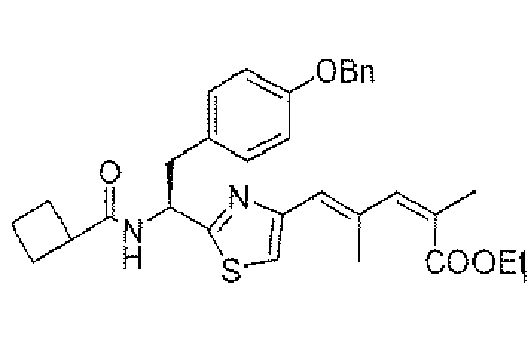
δ 1.24 (t, 3H), 1.87 (m, 2H), 1.98 (s, 3H), 2.18 (s, 3H), 2.21 (m, 4H), 3.00 (m, 1H), 3.22 (d, 2H) , 4.20 (q, 2H), 5.01 (s, 2H), 5.52 (q, 1H), 6.17 (d, 1H), 6.27 (s, 1H), 6.48 (s, 1H), 6.84 (d, 2H), 6.98 (d, 2H), 6.99 (s, 1H), 7.28-7.42 (5H). 19 WY610s benzyloxymet hyl 
δ 1.26 (t, 3H), 2.04 (s, 3H), 2.15 (s, 3H), 3.26 (d, 2H), 4.00 (s, 2H), 4.19 (q, 2H), 4.52 (s, 2H), 5.00 (s, 2H), 5.58 (q, 1H), 6.28 (s, 1H), 6.50 (s, 1H), 6.83 (d, 2H), 6.99 (d, 2H), 7.01 (s, 1H), 7.27 (d, 2H), 7.28-7.43 (8H). 20 WY562s acetyloxymet hyl 
δ 1.26 (t, 3H), 2.03 (s, 3H), 2.11 (s, 3H), 2.15 (s, 3H), 3.24 (dq, 2H), 4.20 (q, 2H), 4.57 (d, 2H), 5.01 (s, 2H), 5.54 (q, 1H), 6.27 (s, 1H), 6.46 (s, 1H), 6.90 (d, 2H), 7.01 (d, 2H), 7.04 (s, 1H), 7.31-7.43 (5H). 21 WY530s cyclopropyl 
δ 0.74 (m, 2H), 0.90 (m, 2H), 1.24 (t, 3H), 1.38 (m, 1H), 2.03 (s, 3H), 2.14 (s, 3H), 3.24 (dq, 2H) , 4.21 (q, 2H), 5.01 (s, 2H), 5.53 (q, 1H), 6.27 (d, 1H), 6.50 (br, 2H), 6.86 (d, 2H), 6.98 (d, 2H), 7.00 (s, 1H), 7.30-7.43 (5H). 22 WY622s 2-benzothienyl 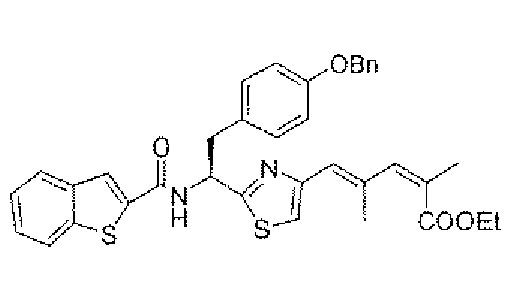
δ1.27 (t, 3H), 2.04 (s, 3H), 2.17 (s, 3H), 3.37 (dq, 2H), 4.21 (q, 2H), 5.00 (s, 2H), 5.72 (q, 1H), 6.29 (s, 1H), 6.51 (s, 1H), 6.86 (d, 2H), 7.02 (s, 1H), 7.04 (d, 2H), 7.24 (d, 2H), 7.28-7.45 (8H), 7.78 (s, 1H), 7.82 (t, 2H). 23 WY596s 4-methoxyph enyl 
δ1.26 (t, 3H), 2.04 (s, 3H), 2.15 (s, 3H), 3.34 (dq, 2H), 3.83 (s, 3H), 4.21 (q, 2H), 5.01 (s, 2H), 5.71 (q, 1H), 6.28 (s, 1H), 6.50 (s, 1H), 6.85 (d, 2H), 6.90 (d, 2H), 7.02 (d, 2H), 7.09 (m, 2H), 7.29-7.40 (5H), 7.73 (d, 2H). 24 WY560s 2-tetrahydrof uryl 
δ 1.27 (t, 3H), 1.85 (m 4H), 2.05 (s, 3H), 2.25 (d, 3H), 3.22 (dq, 2H), 3.75 (m, 2H), 4.18 (q, 2H), 4.34 (q, 1H), 5.01 (d, 2H), 5.48 (q, 1H), 6.27 (s, 1H), 6.47 (d, 1H), 6.85 (d, 2H), 6.98 (m, 3H), 7.29-7.43 (5H). 25 WY560t 2,2-dimethylp ropyl 
δ 1.03 (s, 9H), 1.26 (t, 3H), 2.03 (s, 3H), 2.05 (s, 2H), 2.14 (s, 3H), 3.22 (d, 2H) , 4.20 (q, 2H), 5.01 (s, 2H), 5.54 (q, 1H), 6.26 (br, 2H), 6.48 (s, 1H), 6.84 (d, 2H), 6.99 (s, 1H), 7.01 (d, 2H), 7.28-7.39 (5H). 26 WY580s benzyl 
δ 1.26 (t, 3H), 2.04 (s, 3H), 2.09 (s, 3H), 3.13 (d, 2H), 3.57 (s, 2H), 4.21 (q, 2H), 5.02 (s, 2H), 5.52 (q, 1H), 6.15 (d, 2H), 6.26 (s, 1H), 6.43 (s, 1H), 6.78 (br, 4H), 6,97 (br, 1H), 7.17 (m, 2H), 7.29-7.44 (8H). 27 WY556s 2-furyl 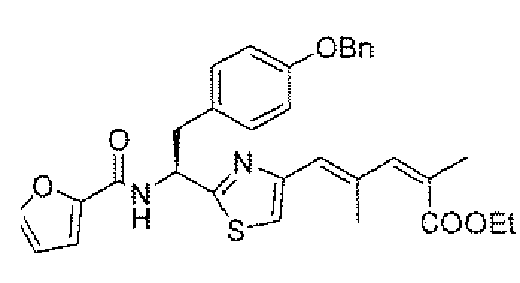
δ1.26 (t, 3H), 2.03 (s, 3H), 2.17 (s, 3H), 3.33 (dq, 2H), 4.21 (q, 2H), 5.01 (s, 2H), 5.68 (q, 1H), 6.28 (s, 1H), 6.49 (br, 2H), 6.85 (d, 2H), 7.00 (s, 1H), 7.04 (d, 2H), 7.09 (d, 1H), 7.15 (d, 1H), 7.31-7.43 (5H). 28 WY532s isopropyl 
δ 1.11 (dd, 6H), 1.26 (t, 3H), 2.03 (s, 3H), 2.14 (s, 3H), 2.38 (m, 1H), 3.22 (dd, 2H) , 4.21 (q, 2H), 5.02 (s, 2H), 5.5 (q, 1H), 6.27 (s, 1H), 6.37 (d, 1H), 6.48 (s, 1H), 6.84 (d, 2H), 6.98 (d, 2H), 7.00 (s, 1H), 7.28-7.42 (5H). 29 WY652s 1-benzyloxy-2-methyl-propyl 
δ 0.94 (dd, 6H), 1.26 (t, 3H), 2.04 (s, 3H), 2.15 (s, 3H), 3.34 (dq, 2H), 3.63 (d, 1H), 4.21 (q, 2H), 4.37 (s, 2H), 4.97 (s, 2H), 5.63 (q, 1H), 6.28 (s, 1H), 6.48 (br, 2H), 6.80 (d, 2H), 7.01 (s, 1H), 7.03 (d, 2H), 7.29-7.42 (10H). 30 WY584 phenylmethyl ol 
δ 2.03 (s, 3H), 2.09 (d, 3H), 3.20 (m, 2H), 3.75 (s, 3H), 5.01 (d, 2H), 5.04 (br, 1H), 5.52 (q, 1H), 6.26 (s, 1H), 6.42 (s, 1H), 6.74-6.99 (6H), 7.24-7.44 (8H). 31 WY602-2 cyclohexylme thylol 
δ 1.26 (t, 3H), 1.30-1.44 (4H), 1.66-1.80 (6H), 2.03 (s, 3H), 2.07 (m, 1H), 2.14 (s, 3H), 3.27 (d, 2H) , 4.21 (q, 2H), 5.01 (s, 2H), 5.55 (q, 1H), 6.14 (d, 1H), 6.27 (s, 1H), 6.48 (s, 1H), 6.85 (d, 2H), 6.99 (d, 2H), 7.01 (s, 1H), 7.32-7.42 (5H). 32 WY586s cyclohexylme thyl 
δ 0.85 (m, 2H), 1.16 (m, 3H), 1.28 (t, 3H), 1.62-1.72 (6H), 2.03 (s, 3H), 2.07 (m, 2H), 2.14 (s, 3H), 3.22 (d, 2H), 4.21 (q, 2H), 5.01 (s, 2H), 5.56 (q, 1H), 6.21 (d, 1H), 6.27 (s, 1H), 6.48 (s, 1H), 6.86 (d, 2H), 6.99 (s, 1H), 7.01 (d, 2H), 7.31-7.43 (5H). 33 WY586d 2--cyclohexanonyl 
δ 1.28 (t, 3H), 1.68 (br, 4H), 1.93 (m, 1H), 2.03 (s, 3H), 2.11 (m, 2H), 2.17 (s. 3H), 2.30 (br, 1H), 3.15-3.22 (3H), 4.21 (q, 2H), 5.02 (s, 2H), 5.56 (q, 1H), 6.25 (d, 1H), 6.27 (s, 1H), 6.47 (s, 1H), 6.85 (d, 2H), 7.00 (d, 2H), 7.03 (d, 2H), 7.06 (t, 1H), 7.31-7.42 (4H). 34 WY587s 4-N-methylpiperidyl 
δ 1.26 (t, 3H), 1.70-1.82 (2H), 1.96-2.02 (2H), 2.03 (s, 3H), 2.07 (m, 1H), 2.13 (s, 3H), 2.28 (s, 3H), 2.86 (m, 2H), 3.22 (dd, 2H) , 4.20 (q, 2H), 5.01 (s, 2H), 5.53 (q, 1H), 6.27 (s, 1H), 6.31 (d, 1H), 6.47 (s, 1H), 6.84 (d, 2H), 6.96 (d, 2H), 6.99 (s, 1H), 7.31-7.42 (5H). 35 WY572s cyclohexyl 
δ 1.26 (t, 3H), 1.30-1.44 (4H), 1.66-1.80 (6H), 2.03 (s, 3H), 2.07 (m, 1H), 2.14 (s, 3H), 3.22 (dd, 2H), 4.20 (q, 2H), 5.02 (s, 2H), 5.53 (q, 1H), 6.27 (s, 1H), 6.32 (d, 1H), 6.48 (s, 1H), 6.84 (d, 2H), 6.98 (d, 2H), 6.99 (s, 1H), 7.30-7.43 (5H). -

- The preparation of compound 20 was the same as described in Example 1.
- 0.05 mmol compound 20 was dissolved in 1mL dichloromethane, followed by dropwise addition of 0.3mL trifluoroacetic acid. After the reaction mixture was reacted for 2 h, the solvent and trifluoroacetic acid were removed by rotary evaporation. 0.056 mmol cyclohexanecarboxylic acid, 0.12 mmol EDCI, 0.01 mmol DMAP and 2mL DMF were added, and the reaction mixture was reacted overnight, and then quenched with ice water, and extracted with ethyl acetate. The organic phase was concentrated, and the residue was purified through column chromatography to obtain compound 24 (yield: 80%).
- 0.04 mmol compound 24 was dissolved in 1mL THF, followed by dropwise addition of 06 mmol tetrabutylammonium fluoride. After the reaction mixture was reacted for 2 h, the solvent was removed by rotary evaporation. 0.5 mmol anhydrous potassium carbonate and 2 mL DMF were added, followed by dropwise addition of CH3I. The reaction mixture was reacted overnight, and then quenched with ice water, and extracted with ethyl acetate. The organic phase was concentrated, and the residue was purified through column chromatography (petroleum ether : ethyl acetate = 4 : 1) to obtain compound 25 (yield: 60-95%),

- The final products of Example 36-54 listed in Table 1-3 were prepared in a process similar to that described in Example 35.
Table 1-3 Final products (R5 = R7 = Me) Exa mple Compound R12 Formula 1H NMR (CDCl3, 300 MHz) 37 WY482h H 
δ 1.27 (t, 3H), 1.30-1.44 (4H), 1.66-1.81 (6H), 2.02 (s, 3H), 2.07 (m, 1H), 2.13 (s, 3H), 3.17 (d, 2H) , 4.21 (q, 2H), 5.53 (q, 1H), 6.27 (s, 1H), 6.39 (d, 1H), 6.48 (s, 1H), 6.70 (d, 2H), 6,90 (d, 2H), 6.99 (s, 1H). 38 WY568h ethyl acetate group 
δ 1.27 (m, 6H), 1.30-1.44 (4H), 1.66-1.81 (6H), 2.02 (s, 3H), 2.07 (m, 1H), 2.13 (s, 3H), 3.22 (m, 2H) , 4.22 (m, 4H), 4.56 (s, 2H), 5.51 (q, 1H), 6.24 (d, 1H), 6.26 (s, 1H), 6.46 (s, 1H), 6.77 (d, 2H), 6.97 (d, 2H), 6.98 (5, 1H). 39 WY540a carboxymethyl 
δ 1.27 (m, 3H), 1.30-1.44 (4H), 1.66-1.81 (6H), 2.02 (s, 3H), 2.06 (m, 1H), 2.13 (s, 3H), 3.16 (m, 2H) , 4.22 (q, 2H), 4.61 (s, 2H), 5.51 (q, 1H), 6.26 (s, 1H), 6.47 (s, 1H), 6.67 (d, 1H), 6.78 (d, 2H), 6.95 (d, 2H), 7.00 (s, 1H). 40 WY582h (1-carbonylethoxy)ethyl 
δ 1.27 (m, 9H), 1.30-1.44 (4H), 1.66-1.81 (6H), 1.57 (d, 2H), 2.02 (s, 3H), 2.07 (m, 1H), 3.19 (m, 2H) , 4.22 (m, 4H), 4.67 (q, 1H), 5.50 (q, 1H), 6.23 (dd, 1H), 6.26 (s, 1H), 6.46 (s, 1H), 6.72 (d. 2H), 6.93 (d, 2H), 6.97 (s, 1H). 41 WY526h 2-hydroxylethyl 
δ 1.27 (t, 3H), 1.30-1.44 (4H), 1.66-1.81 (6H), 2.02 (s, 3H), 2.07 (m, 1H), 2.14 (s, 3H), 3.21 (m, 2H), 3.94 (br, 2H), 4.02 (d, 2H), 4.21 (q, 2H), 5.52 (q, 1H), 6.27 (br, 2H), 6.47 (s, 1H), 6.77 (d, 2H), 6.96 (d, 2H), 6.99 (s, 1H). 42 WY538h n-butyl 
δ 0.96 (t, 3H), 1.27 (t, 3H), 1.30-1.44 (5H), 1.66-1.81 (9H), 2.02 (s, 3H), 2.07 (m, 1H), 2.14 (s, 3H), 3.22 (m, 2H) , 3.90 (t, 2H), 4.21 (q, 2H), 5.52 (q, 1H), 6.23 (d, 1H), 6.27 (s, 1H), 6.47 (s, 1H), 6.76 (d, 2H), 6.95 (d, 2H), 6.99 (s, 1H). 43 WY597h 4-cyanobenzyl 
δ 1.27 (t, 3H), 1.32-1.44 (4H), 1.66-1.80 (6H), 2.02 (s, 3H), 2.07 (m, 1H), 2.13 (s, 3H), 3.22 (d, 2H), 4.20 (q, 2H), 5.07 (s, 2H), 5.50 (q, 1H), 6.26 (s, 1H), 6.28 (d, 1H), 6.47 (s, 1H), 6.80 (d, 2H), 6.90 (d, 2H), 6.99 (s, 1H), 7.52 (d, 2H), 7.66 (d, 2H). 44 WY590h 4-fluorobenzyl 
δ 1.27 (t, 3H), 1.32-1.44 (4H), 1.66-1.80 (6H), 2.03 (s, 3H), 2.07 (m, 1H), 2.14 (s, 3H), 3.21 (d, 2H), 4.21 (q, 2H), 4.97 (s, 2H), 5.52 (q, 1H), 6.25 (d, 1H), 6.27 (s, 1H), 6.48 (s, 1H), 6.82 (d, 2H), 6.85 (d, 2H), 6.86 (s, 1H), 6.99 (dd, 2H), 7.38 (dd, 2H). 45 WY602h 4-methoxybenzyl 
δ 1.27 (t, 3H), 1.32-1.44 (4H), 1.66-1.80 (6H), 2.03 (s, 3H), 2.07 (m, 1H), 2.14 (s, 3H), 3.22 (d, 2H), 3.80 (s, 3H), 4.21 (q, 2H), 4.93 (s, 2H), 5.53 (q, 1H), 6.26 (d, 1H), 6.27 (s, 1H), 6.48 (s, 1H), 6.83 (d, 2H), 6.89 (d, 2H), 6.97 (d, 2H), 6.99 (s, 1H), 7.33 (d, 2H). 46 WY590h3 3-fluorobenzyl 
δ 1.27 (t, 3H), 1.32-1.44 (4H), 1.66-1.80 (6H), 2.03 (s, 3H), 2.07 (m, 1H), 2.14 (s, 3H), 3.22 (d, 2H), 4.21 (q, 2H), 5.01 (s, 2H), 5.52 (q, 1H), 6.26 (d, 1H), 6.27 (s, 1H), 6.48 (s, 1H), 6.82 (d, 2H), 6.98 (d, 2H), 6.99 (s, 1H), 7.11-7.34 (4H). 47 WY590h2 2-fluorobenzyl 
δ 1.27 (t, 3H), 1.32-1.44 (4H), 1.66-1.80 (6H), 2.03 (s, 3H), 2.07 (m, 1H), 2.14 (s, 3H), 3.22 (d, 2H), 4.21 (q, 2H), 5.08 (s, 2H), 5.52 (q, 1H), 6.25 (d, 1H), 6.27 (s, 1H), 6.48 (s, 1H), 6.84 (d, 2H), 6.98 (d, 2H), 6.99 (s, 1H), 7.07 (t, 1H), 7.15 (t, 1H), 7.29(t, 1H), 7.48 (t, 1H). 48 WY622h 2-naphthyl 
δ 1.25 (t, 3H), 1.32-1.44 (4H), 1.66-1.80 (6H), 2.03 (s, 3H), 2.07 (m, 1H), 2.13 (s, 3H), 3.23 (m, 2H), 4.20 (q, 2H), 5.19 (s, 2H), 5.52 (q, 1H), 6.23 (d, 1H), 6.27 (s, 1H), 6.48 (s, 1H), 6.89 (d, 2H), 6.93-7.03 (4H), 7.47-7.53 (2H), 7.83-7.87 (3H). 49 WY621h 4-nitro-2-fluo rophenyl 
δ 1.27 (t, 3H), 1.32-1.44 (4H), 1.66-1.80 (6H), 2.03 (s, 3H), 2.07 (m, 1H), 2.14 (s, 3H), 3.27 (d, 2H), 4.22 (q, 2H), 5.56 (q, 1H), 6.27 (s, 1H), 6.33 (d, 1H), 6.47 (s, 1H), 6.90 (t, 1H), 6.96 (d, 2H), 7.02 (s, 1H), 7.13 (d, 2H), 7.98 (dd, 1H), 8.07 (dd, 1H). 50 WY586h phenolmethyl 
δ 1.26 (t, 3H), 1.30-1.44 (4H), 1.66-1.80 (6H), 2.03 (s, 3H), 2.07 (m, 1H), 2.14 (s, 3H), 3.07 (t, 2H), 3.24 (m, 2H) , 4.12 (t, 2H), 4.24 (q, 2H), 5.53 (q, 1H), 6.22 (d, 1H), 6.27 (s, 1H), 6.48 (s, 1H), 6.75 (d, 2H), 6.94 (d, 2H), 6.98 (s, 1H), 7.30-7.43 (5H). 51 WY573h 2-piperidyl 
δ 1.26 (t, 3H), 1.30-1.44 (4H), 1.66-1.80 (6H), 2.03 (s, 3H), 2.07 (m, 1H), 2.14 (s, 3H), 3.22 (m, 2H), 4.22 (q, 2H), 5.16 (s, 2H), 5.53 (q, 1H), 6.22 (d, 1H), 6.27 (s, 1H), 6.47 (s, 1H), 6.83 (d, 2H), 6.97 (d, 2H), 6.99 (s, 1H), 7.22 (t, 1H), 7.49 (d, 1H), 7.70 (t, 1H), 8.59 (d, 1H). 52 WY573h4 4-piperidyl 
δ 1.26 (t, 3H), 1.30-1.44 (4H), 1.66-1.80 (6H), 2.02 (s, 3H), 2.07 (m, 1H), 2.12 (s, 3H), 3.21 (d, 2H), 4.19 (q, 2H), 5.03 (s, 2H), 5.51 (q, 1H), 6.26 (s, 1H), 6.33 (d, 1H), 6.46 (s, 1H), 6.80 (d, 2H), 6.97 (d, 2H), 6.98 (s, 1H), 7.32 (d, 2H), 8.58 (d, 2H). 53 WY560h furyl-3-methyl 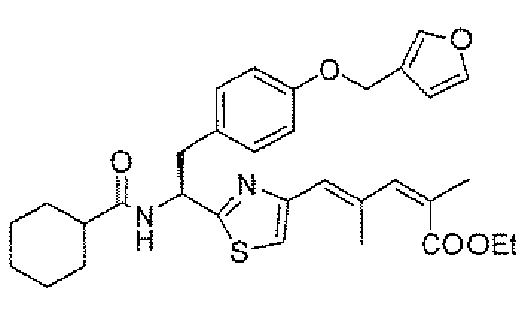
δ 1.27 (t, 3H), 1.30-1.44 (4H), 1.66-1.80 (6H), 2.02 (s, 3H), 2.07 (m, 1H), 2.12 (s, 3H), 3.22 (m, 2H) , 4.21 (q, 2H), 4.88 (s, 2H), 5.52 (q, 1H), 6.25 (d, 1H), 6.27 (s, 1H), 6.47 (br, 2H), 6.82 (d, 2H), 6.97 (d, 2H), 6.99 (s, 1H), 7.42 (br, 1H), 7.48 (br, 1H). 54 WY578h thiophene-3-methyl 
δ 1.27 (t, 3H), 1.30-1.44 (4H), 1.66-1.80 (6H), 2.02 (s, 3H), 2.07 (m, 1H), 2.14 (s, 3H), 3.22 (m, 2H) , 4.21 (q, 2H), 5.02 (s, 2H), 5.52 (q, 1H), 6.23 (d, 1H), 6.27 (s, 1H), 6.48 (s, 1H), 6.83 (d, 2H), 6.97 (d, 2H), 6.99 (s, 1H), 7.12 (br, 1H), 7.30 (m, 2H). 55 WY522h allyl 
δ 1.27 (t, 3H), 1.30-1.44 (4H), 1.66-1.81 (6H), 2.02 (s, 3H), 2.07 (m, 1H), 2.14 (s, 3H), 3.22 (br, 2H) , 4.21 (q, 2H), 4.48 (d, 2H), 5.26 (d, 1H), 5.38 (d, 1H), 5.52 (q, 1H), 6.02 (m, 1H), 6.24 (d, 1H), 6.27 (s, 1H), 6.47 (s, 1H), 6.77 (d, 2H), 6.96 (d, 2H), 6.99 (s, 1H). -

- The preparation of the compound 20 was the same as described in Example 1.
- 0.05 mmol compound 20 was dissolved in mL dichloromethane, followed by dropwise addition of 0.3mL trifluoroacetic acid. After the reaction mixture was reacted for 2 h, the solvent and trifluoroacetic acid were removed by rotary evaporation. After 0.125 mmol triflic anhydride, 0.15 mmol DMAP and 2mL CH2Cl2 were added, the reaction mixture was reacted overnight, and then concentrated to obtain compound 26 (yield: 100%).
- 0.04 mmol compound 26, 0.004 mmol tetrakis(triphenylphosphine)palladium, 0.06 mmol anhydrous potassium carbonate and boric acid were dissolved in 2mL redistilled toluene. The reaction mixture was reacted overnight at 50□, and then quenched with ice water, and extracted with ethyl acetate. The organic phase was concentrated, and the residue was purified through column chromatography (petroleum ether : ethyl acetate = 4 : 1) to obtain compound 27 (yield: 60-90%).

- The final product of Example 57 listed in Table 1-4 was prepared in a process similar to that described in Example 56.
Table 1-4 Final product (R5 = R7 = Me) Example Compound R10 Formula 1H NMR (CDCl3, 300 MHz) 57 WY542h phenyl 
δ 1.27 (t, 3H), 1.30-1.44 (4H), 1.66-1.80 (6H), 2.03 (s, 3H), 2.07 (m, 1H), 2.15 (s, 3H), 3.23 (dd, 2H), 4.21 (q, 2H), 5.60 (q, 1H), 6.27 (br, 2H), 6.47 (br, 1H), 7.01 (s, 1H), 7.13-7.57 (8H). -


- The preparation of the compound 25 was the same as described in Example 36.
- 0.2 mmol compound 25 was dissolved in 5 mL dichloromethane, followed by dropwise addition of 1.2 mmol boron trichloride-trifluoroacetic acid under ice salt bath. After reacted for 3 h, the reaction mixture was quenched with ice water, and extracted with ethyl acetate. The organic phase was concentrated, and the residue was purified through column chromatography (petroleum ether : ethyl acetate = 4 : 1) to obtain compound 28 (yield: 50-80%).
Table 1-5 Final products (R5 = R7 = Me) Compound R12 Formula 1H NMR (CDCl3, 300 MHz) WY522b allyl 
δ 1.27 (t, 3H), 1.30-1.44 (4H), 1.66-1.81 (6H), 2.02 (s, 3H), 2.07 (m, 1H), 2.14 (s, 3H), 3.21 (m, 2H), 4.19 (q, 2H), 4.48 (d, 2H), 5.26 (d, 1H), 5.34 (d, 1H), 5.51 (q, 1H), 6.02 (m, 1H), 6.26 (s, 1H), 6.29 (d, 1H), 6.47 (s, 1H), 6.77 (d, 2H), 6.96 (d, 2H), 6.98 (s, 1H). WY572t benzyl 
δ 1.27 (t, 3H), 1.30-1.44 (4H), 1.66-1.81 (6H), 2.02 (s, 3H), 2.05 (m, 1H), 2.11 (s, 3H), 3.14 (dd, 2H) , 3.89 (s, 2H), 4.20 (q, 2H), 5.49 (q, 1H), 6.26 (s, 1H), 6.32 (d, 1H), 6.47 (s, 1H), 6.64 (d, 2H), 6.74 (s, 1H), 6.79 (d, 2H), 6.95 (s, 1H), 7.12-7.24 (3H). -

- The preparation of the compound 17 was the same as described in Example 1.
- With respect to the preparation of the compound 18', compound 19' and compound 20', please refer to the procedures described in Example 1 for preparing compound 18, compound 19 and compound 20, respectively.
- 0.05 mmol compound 20' was dissolved in 1mL dichloromethane, followed by dropwise addition of 0.3 mL trifluoroacetic acid. After the reaction mixture was reacted for 2 h, the solvent and trifluoroacetic acid were removed by rotary evaporation. Then 0.056 mmol cyclohexanecarboxylic acid, 0.12 mmol EDCI, 0.01 mmol DMAP and 2mL DMF were added, and the reaction mixture was reacted overnight, and then quenched with ice water, and extracted with ethyl acetate. The organic phase was concentrated, and the residue was purified through column chromatography. The above obtained compound was dissolved in 1mL THF, followed by dropwise addition of 0.075mmol tetrabutylammonium fluoride. After the reaction mixture was reacted for 2 h, the solvent was removed by rotary evaporation. 0.5 mmol anhydrous potassium carbonate and 2 mL DMF were added, followed by dropwise addition of 0.25 mmol benzyl bromide. The reaction mixture was reacted overnight, and then quenched with ice water, and extracted with ethyl acetate. The organic phase was concentrated, and the residue was purified through column chromatography (petroleum ether : ethyl acetate = 4 : 1) to obtain compound 29 (yield: 50-80%),
Table 1-6 Final product 29 (R5 = R7 = Me) Compound Formula 1H NMR (CDCl3, 300 MHz) WY572-2 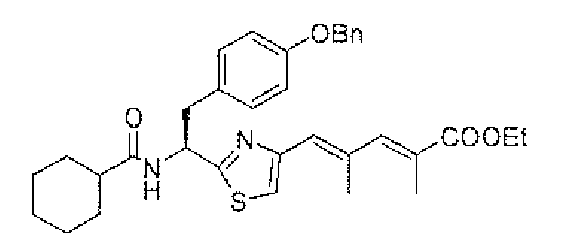
δ 1.26 (t, 3H), 1.30-1.44 (4H), 1.66-1.80 (6H), 2.10 (s, 3H), 2.15 (br, 1H), 2.30 (s, 3H), 3.24 (d, 2H), 4.24 (q, 2H), 5.02 (s, 2H), 5.56 (q, 1H), 6.33 (d, 1H), 6.60 (s, 1H), 6.85 (d, 2H), 7.00 (d, 2H), 7.07 (s, 1H), 7.28 (s, 1H), 7.32-7.42 (5H). WY572-3 
δ 1.30 (t, 3H), 1.32-1.41 (4H), 1.66-1.80 (6H), 1.90 (s, 3H), 2.11 (s, 3H), 2.13 (m, 1H), 3.19 (m, 2H), 4.22 (q, 2H), 5.02 (s, 2H), 5.51 (q, 1H), 6.36 (d, 1H), 6.55 (s, 1H), 6.90 (d, 2H), 6.95 (d, 2H), 6.97 (s, 1H), 7.31-7.43 (5H), 7.79 (s, 1H). WY572-4 
δ 1.26 (t, 3H), 1.32-1.41 (4H), 1.66-1.80 (6H), 2.03 (br, 6H), 2.10 (m, 1H), 3.21 (d, 2H), 4.16 (q, 2H), 5.01 (s, 2H), 5.49 (q, 1H), 6.36 (d, 1H), 6.40 (s, 1H), 6.75 (s, 1H), 6.84 (d, 2H), 6.91 (s, 1H), 6.97 (d, 2H), 7.32-7.43 (5H). -

- The preparation of the compound 21 was the same as described in Example 1.
- 0.05 mmol compound 21 was dissolved in 1mL dichloromethane, followed by dropwise addition of 0.3mL trifluoroacetic acid. After the reaction mixture was reacted for 2 h, the solvent and trifluoroacetic acid were removed by rotary evaporation. 0.06 mmol R9NHR9' was dissolved in 1mL THF, followed by addition of 0.06 mmol carbonyldiimidazole. After the solution was stirred for 2 h, a solution of the above product in THF (0.5 mL) was added, and the reaction mixture was reacted overnight under refluxing. The solvent was removed by rotary evaporation, and the residue was purified through column chromatography (petroleum ether : ethyl acetate = 4 : 1) to obtain compound 30 (yield: 50-90%).
Table 1-7 Final product 30 Compound Formula 1H NMR (CDCl3, 300 MHz) WY951 
δ 1.26 (t, 3H), 2.03 (s, 3H), 2.12 (s, 3H), 3.26 (dq, 2H) , 4.21 (q, 2H), 5.03 (s, 2H), 5.46 (q, 1H), 6.27 (s, 1H), 6.45 (s, 1H), 6.86 (d, 2H), 6.97 (d, 2H), 7.04 (s, 1H), 7.32-7.44 (5H). WY645s 
δ 1.22-1.32 (6H), 1.62 (m, 2H), 1.85 (m, 2H), 2.02 (s, 3H), 2.12 (s, 3H), 2.45 (m, 1H), 2.86 (m, 2H), 3.22 (m, 2H), 3.80 (m, 2H), 4.18 (m, 4H), 4.95 (d, 1H), 5.00 (s, 2H), 5.42 (br, 1H), 6.26 (br, 1H), 6.48 (br, 1H), 6.81 (d, 2H), 6.98 (br, 3H), 7.30-7.42 (5H). WY617a 
δ 1.26 (t, 3H), 1.65 (m, 2H), 1.91 (m, 2H), 2.03 (s, 3H), 2.10 (s, 3H), 2.51 (m, 1H), 2.92 (m, 2H), 3.22 (dq, 2H), 3.85 (m, 2H), 4.20 (q, 2H), 5.01 (s, 2H), 5.42 (q, 1H), 5.59 (d, 1H), 6.27 (bar, 1H), 6.49 (br, 1H), 6.84 (d, 2H), 6.97 (d, 3H), 7.00 (s, 1H), 7.30-7.42 (5H). -

- 50 mmol compound 13 was dissolved in sodium hydroxide solution (100 mmol/50 mL), and stirred for 1.5 h, followed by dropwise addition of copper sulfate solution (25 mmol/25 mL). After the reaction mixture was stirred for 30 min, methanol was added, followed by dropwise addition of 51 mmol benzyl bromide. The reaction mixture was reacted for 3h at room temperature, and filtrated under reduced pressure. The filter cake was washed with 2N HCl, and dried in vacuo. The obtained product was suspended in a mixture of 100 mL water and 100 mL 1,4-dioxane, followed by addition of 110 mmol triethylamine. After the reaction mixture was reacted for 1h, 75 mmol (Boc)2O was added therein, and the reaction was continued for 20h. The reaction mixture was rotarily evaporated to dryness. The residue was diluted with ice water, and extracted with ethyl acetate. The water phase was adjusted to pH 2, and extracted with ethyl acetate. The organic phase was concentrated to obtain compound 31 (yield: 80%),
- In 50 mL dichloromethane was dissolved 12 mmol compound 31 with 10 mmol CH3COC(COOEt)NH2HCl, 12 mmol EDCI, 2 mmol DMAP and 20 mmol pyridine. The reaction mixture was reacted overnight, and then diluted with ice water, and extracted with ethyl acetate. The organic phase was concentrated, and the residue was purified through column chromatography to obtain compound 32 (yield: 70%).
- 1 mmol compound 32 and 1.5 mmol Lawssen reagent were dissolved in 10mL THF, and the reaction mixture was reacted overnight under refluxing. The solvent was removed by rotary evaporation, and the residue was purified through column chromatography to obtain compound 33 (yield: 60-95%).
- With respect to the prepration of compound 34 from compound 33, please refer to the procedure described in Example 1 for preparing compound 20 from compound 16.
- With respect to the preparation of compound 35 from compound 34, please refer to the procedure described in Example 14 for preparing compound 23 from compound 21.
Table 1-8 Final product 35 (R5 = R7 = Me) Compoun d R3 R9 Formula 1H NMR (CDCl3, 300 MHz) WY586z methyl cyclohexyl 
δ 1.27 (t, 3H), 1.29-1.43 (4H), 1.66-1.86 (6H), 2.03 (s, 3H), 2.07 (m, 1H), 2.11 (s, 1H), 2.32 (s, 3H), 3.20 (dd, 2H) , 4.20 (q, 2H), 5.02 (s, 2H), 5.45 (q, 1H), 6.28 (br, 2H), 6.31 (d, 1H), 6.84 (d, 2H), 6.99 (d, 2H), 6.99 (s, 1H), 7.31-7.42 (5H). WY648z phenyl cyclone xyl 
δ 1.25 (t, 3H), 1.28-1.45 (4H), 1.68-1.88 (6H), 2.00 (s, 3H), 2.09 (m, 1H), 2.17 (s, 3H), 3.27 (m, 2H), 4.17 (q, 2H), 5.03 (s, 2H), 5.55 (q, 1H), 5.20 (s, 1H), 6.30 (d, 1H), 6.33 (s, 1H), 6.87 (d, 2H), 7.05 (d, 2H), 7.31-7.43 (10H). WY628z isobutyl cyclonexyl 
δ 0.89 (d, 6H), 1.26 (t, 3H), 1.29-1.44 (4H), 1.66-1.85 (6H), 2.03 (s, 3H), 2.08 (m, 1H), 2.13 (s, 3H), 2.56 (d, 2H), 3.20 (m, 2H) , 4.20 (q, 2H), 5.01 (s, 2H), 5.47 (q, 1H), 6.25 (br, 2H), 6.36 (d, 1H), 6.82 (d, 2H), 6.96 (d, 2H), 7.31-7.42 (5H). WY662z phenyl cyclone xylmethyl 
δ 0.89 (m, 2H), 1.26 (t, 3H), 1.64-1.75 (9H), 2.00 (s, 3H), 2.07 (m, 2H), 2.18 (s, 3H), 3.27 (m, 2H), 4.17 (q, 2H), 5.02 (s, 2H), 5.58 (q, 1H), 6.20 (s, 1H), 6.23 (d, 1H), 6.34 (d, 1H), 6.87 (d, 2H), 7.07 (d, 2H), 7.31-7.50 (10H). WY628z2 isobutyl cyclohexyl 
δ 0.89 (d, 6H), 1.26 (t, 3H), 1.29-1.44 (4H), 1.66-1.85 (6H), 2.03 (s, 3H), 2.08 (m, 1H), 2.13 (s, 3H), 2.56 (d, 2H), 3.20 (m, 2H) , 4.20 (q, 2H), 5.01 (s, 2H), 5.47 (q, 1H), 6.25 (br, 2H), 6.36 (d, 1H), 6.82 (d, 2H), 6.96 (d, 2H), 7.31-7.42(51-1). -

- 0.02 mmol compound 36 and 0.08 mmol lithium hydroxide were dissolved in a mixed solvent of water and dioxane (0.5nmL/0.5mL), and refluxed overnight. The reaction mixture was adjusted to pH 2, and extracted with ethyl acetate. The organic phase was concentrated to obtain compound 37 (yield: 100%).
Table 1-9 Final product 37 Compound Formula 1H NMR (CDC13, 300 MHz) WY544a 
δ 1.30-1.44 (4H), 1.66-1.80 (6H), 2.03 (s, 3H), 2.07 (m, 1H), 2.15 (s, 3H), 3.19 (br, 2H), 5.00 (s, 2H), 5.53 (q, 1H), 6.36 (s, 1H), 6.58 (s, 1H), 6.84 (d, 2H), 6.98 (d, 2H), 7.01 (s, 1H), 7.30-7.42 (5H). WY544-2 
δ1.30-1.44 (4H), 1.66-1.80 (6H), 2.10 (s, 3H), 2.15 (br, 1H), 2.30 (s, 3H), 3.00 (d, 2H), 4.49 (d, 1H), 5.06 (s, 2H), 5.20 (m, 2H), 6.60 (s, 1H), 6.91 (d, 2H), 7.17 (s, 1H), 7.18 (d, 2H), 7.31-7.44 (5H), 7.56 (s, 1H), 8.46 (d, 1H). WY558a 
δ 0.85 (m, 2H), 1.16 (m, 3H), 1.62-1.72 (6H), 2.03 (s, 3H), 2.07 (m, 2H), 2.14 (s, 3H), 3.22 (d, 2H) 4.99 (s, 2H), 5.54 (q, 1H), 6.34 (s, 1H), 6.58 (s, 1H), 6.83 (d, 2H), 6.95 (d, 1H), 7.01 (br, 3H), 7.27-7.39 (5H). WY620a 
δ 1.34-1.42 (4H), 1.63-1.78 (6H), 2.05 (s, 3H), 2.08 (m, 1H), 2.17 (s, 3H), 3.23 (d, 2H), 5.00 (s, 2H), 5.54 (q, 1H), 6.29 (s, 1H), 6.36 (s, 1H), 6.85 (d, 2H), 6.91 (d, 1H), 7.06 (d, 2H), 7.28-7.39 (10H). WY634a 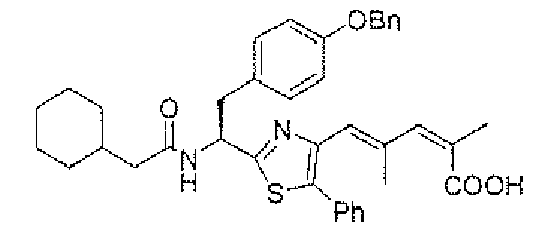
δ 0.89 (m, 2H), 1.64-1.75 (9H), 2.01 (m, 2H), 2.03 (s, 3H), 2.15 (s, 3H), 3.22 (d, 2H), 4.98 (s, 2H), 5.57 (q, 1H), 6.28 (s, 1H), 6.38 (d, 1H), 6.85 (d, 2H), 7.07 (d, 2H), 7.30-7.38 (10H). - 1) Test principle: The catalytic structural domain of hPTP1B was expressed in E-coli system by a molecular biology protocol. The purified hPTP1B recombinant protein can hydrolyze the phosphoester linkage of the pNPP substrate to obtain a product which has a strong light absorption at 410 nm. Therefore, the variation of the enzyme activity and the inhibitory activity of a compound against the enzyme can be observed by directly monitoring the changes in the light absorption at 410 nm. A typical activity assay system is as follows: 50 mM Mops, PH 7.0, 1 mM EDTA, 2 mM DTT, 2 mM PNPP, 2% DMSO, 40 nM hPTP1B.

- 2) Measuring Index: The light absorption was dynamically measured at 410 nm for 3 min. The slope of the first-order reaction of the dynamic curve thereof was considered as the activity index of the enzymes.
- 3) Measurement:
- 1. 1 mg sample was dissolved in 200 µL DMSO. To each wall of the A2-H1 of a 96-wells polypropylene plate, 20 µL of the solution was added, followed by addition of 80 µL DMSO. The plate was used as mother plate.
- 2. To each corresponding wall of a 96-wells polypropylene plate, 2 µL of sample was added with a Biomek 2000 automation workstation. The plate was used as daughter plate for screening.
- 3. To each wall of A1-D1 and E12-H12, 2 µL DMSO was added. These walls were regarded as 100% of enzyme activity for control.
- 4. To each wall of A12-D12 and E1-H1, 2 µL positive control with different concentrations (four concentrations prepared by double-fold dilution from 10 µL/mL) was added respectively.
- 5. To each wall of A1-H12, 88 µL Assay mix was added respectively.
- 6. To each wall of A1-H12, 10 µL hPTP1B was added respectively.
- 7. The light absorption was measured at 410 nm for 3 min on a SpectraMAX 340 spectrometer.
- 8. Exporting the output into a TXT file, and opening the file with Excel. The average of the Vmax values of A1-D1 and E12-H12 was considered as 100% of enzyme activity. The inhibitory rate of the compound against PTP1B was calculated by the following equation:

- 4) Results: The screening results were the %inhibitory rate against the enzyme when the compound concentration was 20 µg/mL. IC50 value was calculated according to a conventional screening when the inhibitory rate exceeded 50%. The IC50 value of the positive control, 4-[4-(4-oxalyl-phenoxymethyl)-benzyloxy]-phenyl-oxo-acetic acid, is 5.4 µM [Christopher T. Seto, et al. J. Med. Chem., 2002, 45, 3946-3952]. The IC50 value of each test compound against hPTP1B is listed in Table 2.

Table 2 inhibitory activity of the test compounds against PTP1B compound IC50(µM) compound IC50(µM) WY558 8.14 WY562 10.25 WY572 8.52 WY586 10.98 WY600 3.44 WY588 10.44 WY574 8.58 WY594 6.92 WY612 5.13 WY638 4.10 WY600t 10.92 WY583 >35 WY548 >35 WY532s 20.85 WY566s 15.20 WY580s 23.10 WY622s 25.59 WY610s 9.42 WY560t 20.18 WY572s 6.29 WY586d 8.44 WY652s 9.98 WY586s 2.48 WY558s 12.72 WY558f >35 WY596s 44.78 WY602-2 13.54 WY584s >35 WY544s >40 WY562s >40 WY530s >35 WY560s >40 WY556s >40 WY532s >40 WY584 >35 WY587s >35 WY578h 11.97 WY466h 34.23 WY496h 30.14 WY482h 27.83 WY538h 22.12 WY522h 34.36 WY590h 25.59 WY592h2 31.75 WY590h3 24.10 WY560h 12.32 WY602h 25.55 WY568h >40 WY540a >40 WY582h >35 WY526h >40 WY597h >35 WY622h >35 WY621h >35 WY586h >35 WY573h >35 WY573h4 >40 WY560h >40 WY542h >40 WY522b >40 WY572-2 6.38 WY572-3 8.69 WY572-4 7.90 WY544a 4.40 WY544-2 11.25 WY628z 6.68 WY648z 3.30 WY572t 4.47 WY586z 4.86 WY951 6.29 WY558a 9.32 WY634a 3.97 WY620a 4.00 WY628z2 10.48 WY645s 10.48 WY617a 6.47 -
- 1). Experimental priciple: The phosphorylation levels of insulin receptors (IRs) in cells sensitive to insulin are regulated by PTK and PTPase. PTP1B is a negative regulator during the process. It can be evaluated by measuring the phosphorylation level of IRs in CHO/IR cells whether the PTP 1B inhibitor has entered into the cells and how its effect in cells is.
- 2). Experimental protocol:
- 1. Cell inoculation: Cells in good growth condition were inoculated into a 6-well plate with a density of 3-4×10⁵ cells/well. To each well was added 2 mL F12 culture media containing 10% FBS.
- 2. Starvation: After cultivation for 24 h, to each well was added 2 mL serum-free F12 culture media. Then the plate was cultivated overnight.
- 3. Administration: After removing the old culture media, to each well was added 0.9 mLserum-free F12 culture media containing the test compound, wherein 1 mM Na3VO4 and 0.1% DMSO were used as positive and negative control, respectively. The plate was incubated for 2-4 h.
- 4. Insulin stimulation: To each well was added 100µL 100nM insulin solution so that the final concentration was 10nM. The reaction was carried out for 10 min.
- 5. Sample collection: After discarding the culture media, to each well was added 150 µL ×1 loading buffer. The cells were lysed, and the samples were collected.
- 3). Experimental results: The experiment evalutated the effect of WY586s on the phosphorylation levels of insulin receptors in CHO/IR cells. The final concentration of test compound, WY586s, was set at 0.21, 0.43, 0.85, 1.70 µM, respectively. The DMSO solvent was used as negative control (represented with 0), and sodium vanadate was used as positive compound (represented with V). As shown in
Fig. 1 , p-IR is the phosphorylated insulin receptor, representing the activity level of insulin receptor; IRβ is the insulin receptor β-subunit, representing the basal expression level of insulin receptor; β-activated protein was used as internal control, representing total loading amount. It is shown from the investigation on the compound of WY586s that the phosphorylation level of IR significantly increases with the increase of the concentration of the inhibitor. Therefore, it can be seen that WY586s plays an inhibitory function in the dephosphorylation of IR in cells, and can improve the insulin sensitivity of cells, indicating that this class of compounds can enhance the effect of insulin, and release insulin resistance to a certain extent.
Claims (15)
- A compound having a structure represented by the following formula I,

R1 is OCOR9, OCOCOR9, NHCOR9, NHCOCOR9, NHCONHR9,
wherein R9 and R9' are each independently C2-C6 alkenyl; C1-C2 alkoxycarbonyl; C3-C6 cycloalkyl, or C3-C6 cycloalkyl substituted by O, N and/or S; phenyl, naphthyl, or phenyl substituted by halogen, carboxyl or C1-C6 alkoxyl; benzyl, or benzyl substituted by halogen, carboxyl or C1-C6 alkoxyl; C1-C13 alkyl substituted by halogen, carboxyl, substituted or unsubtituted phenyl, substituted or unsubtituted benzyl, 5- or 6-membered aromatic cyclic group substituted by O, N and/or S, C3-C6 cycloalkyl, C3-C6 cycloalkyl substituted by O, N and/or S, or hydroxyl; 5- or 6-membered aromatic cyclic group substituted by O, N and/or S, or benzo-fused 5- or 6-membered aromatic cyclic group substituted by O, N and/or S; C1-C4 alkyl having carboxyl, methoxycarbonyl or ethoxycarbonyl; or CH2OR13,
wherein, R13 is phenyl, or phenyl substituted by halogen, C1-C6 alkoxyl or hydroxyl; benzyl, or benzyl substituted by halogen, C1-C6 alkoxyl or hydroxyl; thiazolyl, furyl, thienyl, pyranyl, pyridyl, benzothiazolyl, benzothienyl, naphthyl; C3-C6 cycloalkyl, or C3-C6 cycloalkyl substituted by O, N and/or S;
R2 is H; halogen; C2-C6 alkenyl; C1-C2 alkoxycarbonyl; C3-C6 cycloalkyl, C3-C6 cycloalkyl sustituted by halogen or carboxyl, or 5- or 6-membered cycloalkyl substituted by O, N and/or S; phenyl, naphthyl, or phenyl substituted by halogen, carboxyl or C1-C6 alkoxyl; benzyl, or benzyl substituted by halogen, carboxyl or C1-C6 alkoxyl; C1-C13 alkyl substituted by halogen, carboxyl, substituted or unsubtituted phenyl, substituted or unsubtituted benzyl, 5- or 6-membered aromatic cyclic group substituted by O, N and/or S, C3-C6 cycloalkyl, C3-C6 cycloalkyl substituted by O, N and/or S, or hydroxyl; 5- or 6-membered aromatic cyclic group substituted by O, N and/or S, or benzo-fused 5- or 6-membered aromatic cyclic group substituted by O, N and/or S; C1-C4 alkyl having carboxyl, methoxycarbonyl or ethoxycarbonyl; mercapto, oxy, amino, C1-C6 alkyl or C2-C6 alkenyl which are substituted by unsubstituted or substituted aryl;
R3 is H; halogen; C2-C6 alkenyl; C1-C2 alkoxycarbonyl; C3-C6 cycloalkyl, C3-C6 cycloalkyl sustituted by halogen or carboxyl, or 5- or 6-membered cycloalkyl substituted by O, N and/or S; phenyl, naphthyl, or phenyl substituted by halogen, carboxyl or C1-C6 alkoxyl; benzyl, or benzyl substituted by halogen, carboxyl or C1-C6 alkoxyl; C1-C13 alkyl substituted by halogen, carboxyl or hydroxyl; 5- or 6-membered aromatic cyclic group substituted by O, N and/or S, or benzo-fused 5- or 6-membered aromatic cyclic group substituted by O, N and/or S; C1-C4 alkyl having carboxyl, methoxycarbonyl or ethoxycarbonyl;
R4, R5, R6 and R7 are each independently H; halogen; C2-C6 alkenyl; C3-C6 cycloalkyl; phenyl or halogenated phenyl; benzyl; C1-C13 alkyl substituted by halogen, C1-C6 alkoxyl or hydroxyl; C1-C4 alkyl having carboxyl, methoxycarbonyl or ethoxycarbonyl;
wherein, the double bond between R4 and R5 can be in a cis- or trans- configuration; the double bond between R6 and R7 can be in a cis- or trans- configuration;
R8 is C1-C4 alkyl having carboxyl, methoxycarbonyl or ethoxycarbonyl. - A compound according to claim 1, wherein, R3 is H or phenyl; R4, R5, R6 and R7 are each independently H or C1-C4 alkyl, preferably H or methyl; R8 is C1-C4 alkyl having carboxyl, methoxycarbonyl or ethoxycarbonyl, preferably ethoxycarbonyl or carboxyl.
- A compound according to claim 1, having a structure represented by the following formula 11,

Y is S, O or NH; C1-C6 alkyl; C2-C6 alkenyl;
R10 is H; halogen; hydroxyl; C2-C6 alkenyl; C1-C13 alkyl substituted by halogen, C1-C6 alkoxyl, phenyl, benzyloxy or hydroxyl; phenyl, naphthyl, or phenyl substituted by halogen, carboxyl, C1-C6 alkyl or alkoxyl; benzyl, or benzyl substituted by halogen, C1-C6 alkyl or alkoxyl; C1-C4 alkyl having carboxyl, methoxycarbonyl or ethoxycarbonyl; OCH2R12 or OR12;
wherein, R12 is H; C2-C6 alkenyl; C1-C13 alkyl substituted by halogen, C1-C6 alkoxyl, phenyl or hydroxyl; C1-C4 alkyl having carboxyl, methoxycarbonyl or ethoxycarbonyl; thiazolyl, furyl, thienyl, pyranyl, pyridyl, benzothiazolyl, benzothienyl, naphthyl; benzyl; phenyl, or phenyl substituted by halogen, C1-C6 alkoxyl or hydroxyl; C3-C6 cycloalkyl, or 5- or 6-membered cycloalkyl substituted by O, N and/or S;
R11 is H; hydroxyl; halogen; C1-C6 alkyl; or C1-C6 alkoxyl. - A compound according to claim 3, having a structure represented by the following formula III,

- A compound according to claim 3 or 4, wherein
Y is -CH2-;
R10 is H; hydroxyl; phenyl; -OCH3; -OCH2CH=CH2; -OCH2COOEt; -OCH2COOH; -OBn; 2-ethoxycarbonylethoxy; 2-hydroxylethoxy; butoxy; 4-cyanobenzyloxy; 4-fluorobenzyloxy; 4-methoxybenzyloxy; 3-fluorobenzyloxy; 2-fluorobenzyloxy; 2-naphthylmethoxy; 4-nitro-2-fluorophenoxy; phenylethoxy; 1-pyridylznethoxy; 4-pyndylmethoxy; 2-furylmethoxy; 2-pyranylmethoxy;
R11 is H. - A compound according to claim 4, having a structure represented by the following formula IV,

R9 is C2-C6 alkenyl; C1-C2 alkoxycarbonyl; C3-C6 cycloalkyl, or C3-C6 cycloalkyl substituted by O, N and/or S; phenyl, naphthyl, or phenyl substituted by halogen, carboxyl or C1-C6 alkoxyl; benzyl, or benzyl substituted by halogen, carboxyl or C1-C6 alkoxyl; C1-C13 alkyl substituted by halogen, carboxyl, substituted or unsubtituted phenyl, substituted or unsubtituted benzyl, 5- or 6-membered aromatic cyclic group substituted by O, N and/or S, C3-C6 cycloalkyl, C3-C6 cycloalkyl substituted by O, N and/or S, or hydroxyl; 5- or 6-membered aromatic cyclic group substituted by O, N and/or S, or benzo-fused 5- or 6-membered aromatic cyclic group substituted by O, N and/or S; C1-C4 alkyl having carboxyl, ethoxycarbonyl or ethoxycarbonyl; or CH2OR13;
wherein, R13 is phenyl, or phenyl substituted by halogen, C1-C6 alkoxyl or hydroxyl; benzyl, or benzyl substituted by halogen, C1-C6 alkoxyl or hydroxyl; thiazolyl, furyl, thienyl, pyranyl, pyridyl, benzothiazolyl, benzothienyl, naphthyl; C3-C6 cycloalkyl, or C3-C6 cycloalkyl substituted by O, N and/or S;
W is CO, CO-CO, CO-NH or CO-NR9';
wherein, R9' is C2-C6 alkenyl; C1-C2 alkoxycarbonyl; C3-C6 cycloalkyl, or C3-C6 cycloalkyl substituted by O, N and/or S; phenyl, naphthyl, or phenyl substituted by halogen, carboxyl or C1-C6 alkoxyl; benzyl, or benzyl substituted by halogen, carboxyl or C1-C6 alkoxyl,; C1-C13 alkyl substituted by halogen, carboxyl, substituted or unsubtituted phenyl, substituted or unsubtituted benzyl, 5- or 6-membered aromatic cyclic group substituted by O, N and/or S, C3-C6 cycloalkyl, C3-C6 cycloalkyl substituted by O, N and/or S, or hydroxyl; 5- or 6-membered aromatic cyclic group substituted by O, N and/or S, or benzo-fused 5- or 6-membered aromatic cyclic group substituted by O, N and/or S; C1-C4 alkyl having carboxyl, methoxycarbonyl or ethoxycarbonyl; or CH2OR13;
wherein, R13 is phenyl, or phenyl substituted by halogen, C1-C6 alkoxyl or hydroxyl; benzyl, or benzyl substituted by halogen, C1-C6 alkoxyl or hydroxyl; thiazolyl, furyl, thienyl, pyranyl, pyridyl, benzothiazolyl, benzothienyl, naphthyl; C3-C6 cycloalkyl, or C3-C6 cycloalkyl substituted by O, N and/or S. - A compound according to claim 6, having a structure represented by the following formula V or VI,

- A compound according to claim 6, having a structure represented by the following formula VII,
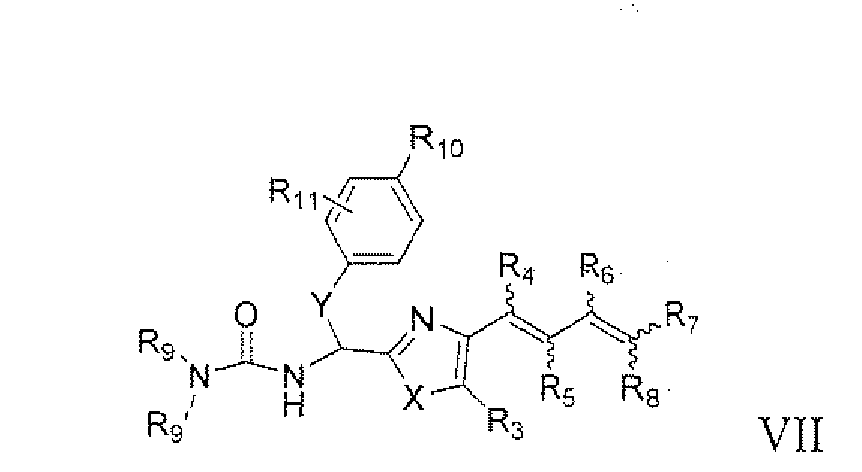
R9' is C2-C6 alkenyl; C1-C2 alkoxycarbonyl; C3-C6 cycloalkyl, or C3-C6 cycloalkyl substituted by O, N and/or S; phenyl, naphthyl, or phenyl substituted by halogen, carboxyl or C1-C6 alkoxyl; benzyl, or benzyl substituted by halogen, carboxyl or C1-C6 alkoxyl; C1-C13 alkyl substituted by halogen, carboxyl, substituted or unsubtituted phenyl, substituted or unsubtituted benzyl, 5- or 6-membered aromatic cyclic group substituted by O, N and/or S, C3-C6 cycloalkyl, C3-C6 cycloalkyl substituted by O, N and/or S, or hydroxyl; 5- or 6-membered aromatic cyclic group substituted by O, N and/or S, or benzo-fused 5- or 6-membered aromatic cyclic group substituted by O, N and/or S; C1-C4 alkyl having carboxyl, methoxycarbonyl or ethoxycarbonyl; or CH2OR13;
wherein, R13 is phenyl, or phenyl substituted by halogen, C1-C6 alkoxyl or hydroxyl; benzyl, or benzyl substituted by halogen, C1-C6 alkoxyl or hydroxyl; thiazolyl, furyl, thienyl, pyranyl, pyridyl, benzothiazolyl, benzothienyl, naphthyl; C3-C6 cycloalkyl, or C3-C6 cycloalkyl substituted by O, N and/or S. - A compound according to any one of claims 6-8, wherein,
R3 is H or phenyl;
R4, R5, R6 and R7 are each independently H or C1-C4 alkyl, preferably H or methyl; R8 is C1-C4 alkyl having carboxyl, methoxycarbonyl or ethoxycarbonyl, preferably ethoxycarbonyl or carboxyl;
Rg is C2-C6 alkenyl; C1-C2 alkoxycarbonyl; C3-C6 cycloalkyl, or C3-C6 cycloalkyl substituted by O, N and/or S; phenyl, naphthyl, or phenyl substituted by halogen, carboxyl or C1-C6 alkoxyl; benzyl, or benzyl substituted by halogen, carboxyl or C1-C6 alkoxyl; C1-C13 alkyl substituted by halogen, carboxyl, substituted or unsubtituted phenyl, substituted or unsubtituted benzyl 5- or 6-membered aromatic cyclic group substituted by O, N and/or S, C3-C6 cycloalkyl, C3-C6 cycloalkyl substituted by O, N and/or S, or hydroxyl; 5- or 6-membered aromatic cyclic group substituted by O, N and/or S, or benzo-fused 5- or 6-membered aromatic cyclic group substituted by O, N and/or S; C1-C4 alkyl having carboxyl, methoxycarbonyl or ethoxycarbonyl;
Y is -CH2-;
W is CO;
R10 is H; hydroxyl; phenyl; -OCH3; -OCH2CH=CH2; OCH2COOEt; -OCH2COOH; -OBn; 2-ethoxycarbonylethoxy; 2-hydroxylethoxy; butoxy; 4-cyanobenzyloxy; 4-fluorobenzyloxy; 4-methoxybenzyloxy; 3-fluorobenzyloxy; 2-fluorobenzyloxy; 2-naphthylmethoxy; 4-nitro-2-fluorophenoxy; phenylethoxy; 1-pyridylmethoxy; 4-pyridylmethoxy; 2-furylmethoxy; 2-pyranyltnethoxy;
R11 is H. - A compound according to claim 6, having a structure represented by the following formula VIII,

n=0,1,2, or 3. - A compound according to claim 10, wherein,
n=0;
R9 is C2-C6 alkenyl; C1-C2 alkoxycarbonyl; C3-C6 cycloalkyl, or C3-C6 cycloalkyl substituted by O, N and/or S; phenyl, naphthyl, or phenyl substituted by halogen, carboxyl or C1-C6 alkoxyl; benzyl, or benzyl substituted by halogen, carboxyl or C1-C6 alkoxyl; C1-C13 alkyl substituted by halogen, carboxyl, substituted or unsubtituted phenyl, substituted or unsubtituted benzyl, 5- or 6-membered aromatic cyclic group substituted by O, N and/or S, C3-C6 cycloalkyl, C3-C6 cycloalkyl substituted by O, N and/or S, or hydroxyl; 5- or 6-membered aromatic cyclic group substituted by O, N and/or S, or benzo-fused 5- or 6-membered aromatic cyclic group substituted by O, N and/or S; C1-C4 alkyl having carboxyl, methoxycarbonyl or ethoxycarbonyl. - A compound according to claim 1, which is one selected from a group consisting of
















- A compound according to claim 12, which is

- A process for producing the compound according to claim 1, comprising:Step 1: an aromatic cyclic compound 4 was synthesized through Hantzsch reaction, as illutstrated in the following reaction scheme;
 Step 2: as illustrated in the follwing reaction scheme, a corresponding aldehyde compound 5 was synthesized from the reduction of the aromatic cyclic compound 4, and then reacted with a Grignard reagent to obtain a corresponding sec-aleolnol compound 6 which is then oxidized to a corresponding ketone compound 7; the resultant ketone compound 7 was then reacted with a Wittig-Horner reagent to obtain an α, β-unsauturated ethyl carboxylate compound 8 in cis- or trans- configuration;
 Step 3 : as illustrated in the follwing reaction scheme, an aromatic cyclic compound 12 was obtained in the same manner as that in Step 2, wherein the compound 12 is in cis- or trans-configuration and is substituted by conjugated double bonds;
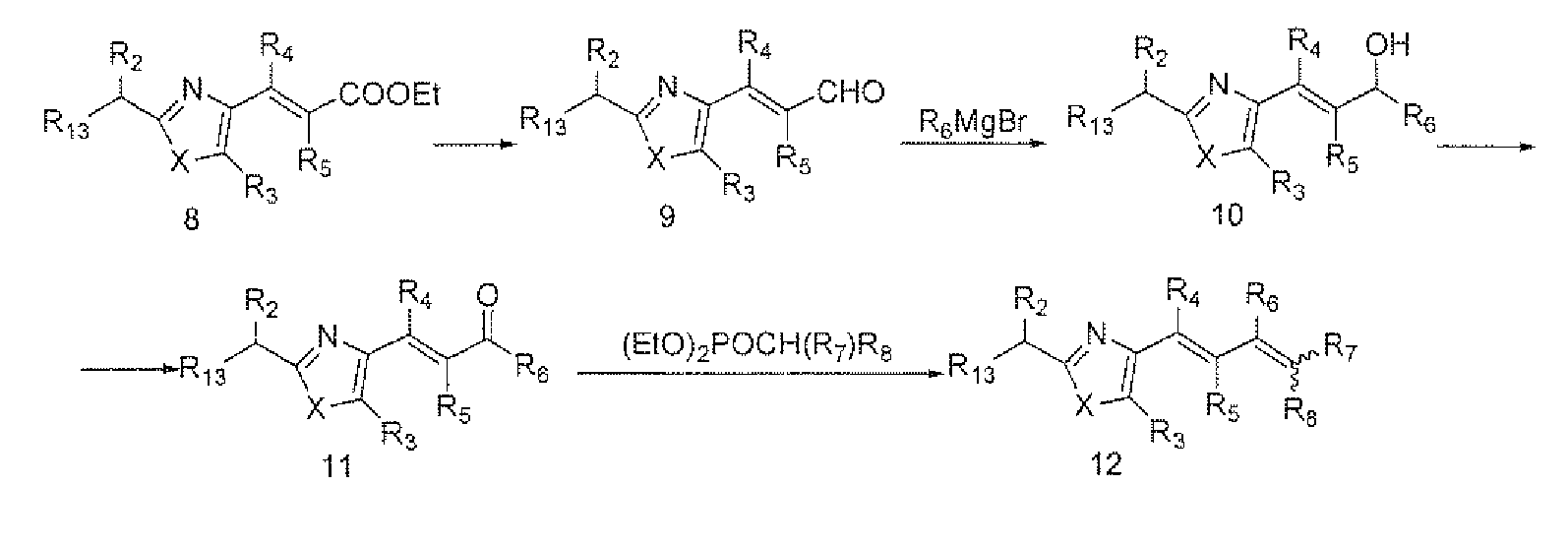 Step 4 : as illustrated in the follwing reaction scheme, a compound I was obtained by removing the protecting group for R13 of the compound 12, followed by coupling with the corresponding R9COOH, R9COCl, R9COCOOH, R9NH2 or R9COC(PPh3)CN;wherein, in the case of coupling with R9COOH, R9COCl or R9COCOOH, the reaction solvent was dichloromethane; in the case of coupling with R9NH2, the reaction was performed in the presence of carbonyldiimidazole using tetrahydrofuran as a reactin solvent; in the case of coupling with R9COC(PPh3)CN, the reaction was carried out under an ozonized condition using dichloromethane as a reaction solvent;
in the above four steps, X, R1 and R3-R8 are the same as defined in claim 1, and Y and R10-R11 are the same as defined in claim 3;
R13 is phenyl, or phenyl substituted by halogen, C1-C6 alkoxyl or hydroxyl; benzyl, or benzyl substituted by halogen, C1-C6 alkoxyl or hydroxyl; thiazolyl, furyl, thienyl, pyranyl, pyridyl, benzothiazolyl, benzothienyl, naphthyl; C3-C6 cycloalkyl, or C3-C6 cycloalkyl substituted by O, N and/or S. - Use of the compound according to claim 1 as an insulin sensitizer in preparing medicants for preventing, delaying or treating diseases which are related to diseases mediated by PTP1B, especially type II diabetes and obesity.
Applications Claiming Priority (2)
| Application Number | Priority Date | Filing Date | Title |
|---|---|---|---|
| CN2007100378481A CN101260086B (en) | 2007-03-06 | 2007-03-06 | Protein-tyrosine-phosphatase 1B inhibitor and its preparation method and use |
| PCT/CN2008/000400 WO2008106860A1 (en) | 2007-03-06 | 2008-02-26 | Protein tyrosine phosphatase 1b inhibitor, preparation methods and uses thereof |
Publications (2)
| Publication Number | Publication Date |
|---|---|
| EP2133342A1 true EP2133342A1 (en) | 2009-12-16 |
| EP2133342A4 EP2133342A4 (en) | 2010-12-29 |
Family
ID=39737781
Family Applications (1)
| Application Number | Title | Priority Date | Filing Date |
|---|---|---|---|
| EP08706537A Withdrawn EP2133342A4 (en) | 2007-03-06 | 2008-02-26 | TYROSINE PHOSPHATASE 1B PROTEIN INHIBITORS, PREPARATION METHODS AND USES THEREOF |
Country Status (6)
| Country | Link |
|---|---|
| US (1) | US8183383B2 (en) |
| EP (1) | EP2133342A4 (en) |
| JP (1) | JP5302901B2 (en) |
| CN (1) | CN101260086B (en) |
| CA (1) | CA2696232C (en) |
| WO (1) | WO2008106860A1 (en) |
Families Citing this family (14)
| Publication number | Priority date | Publication date | Assignee | Title |
|---|---|---|---|---|
| JP5657524B2 (en) | 2008-04-24 | 2015-01-21 | エフツージー リミテッド | Pyrrole antifungal agent |
| ES2754246T3 (en) * | 2013-03-15 | 2020-04-16 | Otsuka Pharma Co Ltd | Composition for use in a method of measuring the sugar / fatty acid burn ratio |
| CN104788410B (en) * | 2014-01-22 | 2017-11-17 | 中国科学院上海药物研究所 | A kind of phenyl ring aromatic rings series connection compound, its preparation method and medical usage |
| CN104059060B (en) * | 2014-05-30 | 2017-08-01 | 西安交通大学 | A kind of ketones derivant of 5 (methylene of 1H indoles 3) 1,3 thiazolidine 4 and its synthetic method and application |
| AU2015348043B2 (en) | 2014-11-21 | 2019-08-22 | F2G Limited | Antifungal agents |
| CN104744386A (en) * | 2015-03-03 | 2015-07-01 | 佛山市赛维斯医药科技有限公司 | PTP1B inhibitor containing tetrazole structure and use of PTP1B inhibitor |
| CN104744385A (en) * | 2015-03-03 | 2015-07-01 | 佛山市赛维斯医药科技有限公司 | PTP1B inhibitor containing tetrazole structure and use of PTP1B inhibitor |
| CN104803933A (en) * | 2015-03-03 | 2015-07-29 | 佛山市赛维斯医药科技有限公司 | PTP1B inhibitors containing tetrazole structures as well as preparation methods and applications of inhibitors |
| CN104803932A (en) * | 2015-03-03 | 2015-07-29 | 佛山市赛维斯医药科技有限公司 | PTP (protein tyrosine phosphatase)1B inhibitors containing tetrazole structures and application of PTP1B inhibitors |
| CN104803931A (en) * | 2015-03-03 | 2015-07-29 | 佛山市赛维斯医药科技有限公司 | PTP (protein tyrosine phosphatase)1B inhibitors containing tetrazole structure as well as preparation methods and application of PTP1B inhibitors |
| GB201609222D0 (en) | 2016-05-25 | 2016-07-06 | F2G Ltd | Pharmaceutical formulation |
| EP3584245A4 (en) | 2017-02-17 | 2020-08-26 | Wuhan LL Science And Technology Development Co., Ltd. | ANTIBACTERIAL DERIVATIVE OF TRIAZOLE AND THE PHARMACEUTICAL COMPOSITION AND USES THEREOF |
| CN110078724A (en) * | 2018-12-14 | 2019-08-02 | 延边大学 | A kind of PTP1B inhibitor of the structure of rhodanine containing indolepopionic acid and its preparation and application |
| US11819503B2 (en) | 2019-04-23 | 2023-11-21 | F2G Ltd | Method of treating coccidioides infection |
Family Cites Families (9)
| Publication number | Priority date | Publication date | Assignee | Title |
|---|---|---|---|---|
| US5312828A (en) * | 1989-06-14 | 1994-05-17 | Finkelstein Joseph A | Substituted imidazoles having angiotensin II receptor blocking activity |
| US5965558A (en) * | 1995-06-19 | 1999-10-12 | Ontogen Corporation | Modulators of proteins with phosphotyrosine recognition units |
| CA2330558A1 (en) * | 1998-05-12 | 1999-11-18 | Wyeth | (2-acylaminothiazole-4-yl)acetic acid derivatives |
| WO2002018321A2 (en) * | 2000-08-29 | 2002-03-07 | Abbott Laboratories | Amino(oxo)acetic acid protein tyrosine phosphatase inhibitors |
| ATE338057T1 (en) * | 2001-11-16 | 2006-09-15 | Taiho Pharmaceutical Co Ltd | PEPTIDE DERIVATIVE, PHARMACEUTICALLY ACCEPTABLE SALT THEREOF, METHOD FOR THE PRODUCTION AND USE THEREOF |
| WO2004071448A2 (en) * | 2003-02-12 | 2004-08-26 | Transtech Pharma Inc. | Substituted azole derivatives as inhibitors of protein tyrosine phosphatases |
| US7169797B2 (en) * | 2003-02-14 | 2007-01-30 | Abbott Laboratories | Protein-tyrosine phosphatase inhibitors and uses thereof |
| JP3819415B2 (en) * | 2003-04-09 | 2006-09-06 | 日本たばこ産業株式会社 | Heteroaromatic 5-membered ring compound and its pharmaceutical use |
| JP2005112802A (en) * | 2003-10-09 | 2005-04-28 | Ono Pharmaceut Co Ltd | PTP1B inhibitor |
-
2007
- 2007-03-06 CN CN2007100378481A patent/CN101260086B/en not_active Expired - Fee Related
-
2008
- 2008-02-26 EP EP08706537A patent/EP2133342A4/en not_active Withdrawn
- 2008-02-26 US US12/530,281 patent/US8183383B2/en not_active Expired - Fee Related
- 2008-02-26 CA CA2696232A patent/CA2696232C/en not_active Expired - Fee Related
- 2008-02-26 JP JP2009552047A patent/JP5302901B2/en not_active Expired - Fee Related
- 2008-02-26 WO PCT/CN2008/000400 patent/WO2008106860A1/en not_active Ceased
Also Published As
| Publication number | Publication date |
|---|---|
| CN101260086B (en) | 2011-08-10 |
| CN101260086A (en) | 2008-09-10 |
| US20100197927A1 (en) | 2010-08-05 |
| CA2696232C (en) | 2013-12-17 |
| WO2008106860A1 (en) | 2008-09-12 |
| CA2696232A1 (en) | 2008-09-12 |
| JP5302901B2 (en) | 2013-10-02 |
| EP2133342A4 (en) | 2010-12-29 |
| JP2010520240A (en) | 2010-06-10 |
| US8183383B2 (en) | 2012-05-22 |
Similar Documents
| Publication | Publication Date | Title |
|---|---|---|
| US8183383B2 (en) | Protein tyrosine phosphatase 1B inhibitor, preparation methods and uses thereof | |
| US5047411A (en) | Benzazole compounds and pharmaceutical composition comprising the same | |
| US6090833A (en) | Polycyclic dihydrothiazoles, their preparation, and use as pharmaceuticals | |
| JP3916064B2 (en) | Diacid-substituted heteroaryl derivatives as matrix metalloproteinase inhibitors | |
| CA2731323A1 (en) | Cycloalkylidene and heterocycloalkylidene histone deacetylase inhibitor compounds | |
| EP1824843A2 (en) | Inhibitors of protein kinases | |
| KR20040106451A (en) | Thiazolidinones and their use as polo-like kinase inhibitors | |
| CA2844982A1 (en) | Lysophosphatidic acid receptor antagonists | |
| JP2009535387A (en) | Thiazole derivatives as PI3 kinase inhibitors | |
| WO2009109999A1 (en) | Novel protein tyrosine phosphatase - ib inhibitors | |
| CN1335837A (en) | Imidazole compounds and medicinal use thereof | |
| EP3901156A1 (en) | Nitrooxyderivative of rock kinase inhibitor | |
| WO2009109998A1 (en) | Novel protein tyrosine phosphatase - ib inhibitors | |
| TWI751271B (en) | Potassium channel modulators | |
| US5599813A (en) | Thiazolopyrimidine derivatives | |
| CA3162388A1 (en) | 4-phenyl-n-(phenyl)thiazol-2-amine derivatives and related compounds as aryl hydrocarbon receptor (ahr) agonists for the treatment of e.g. angiogenesis implicated or inflammatory disorder | |
| SK282977B6 (en) | Thiol derivatives with metallopeptidase inhibitory activity | |
| Haroun | In silico design, synthesis and evaluation of novel series of benzothiazole-based pyrazolidinediones as potent hypoglycemic agents | |
| JP2001072660A (en) | TNF-α production inhibitor and / or IL-10 production promoter | |
| EP1973408A2 (en) | Inhibitors of protein kinases | |
| US6114526A (en) | Heterocyclic compounds, process for their preparation and pharmaceutical compositions containing them and their use in the treatment of diabetes and related diseases | |
| Chen et al. | Parallel synthesis of a library of bidentate protein tyrosine phosphatase inhibitors based on the α-ketoacid motif | |
| BRPI0619835A2 (en) | organic compounds | |
| KR101095734B1 (en) | Novel rhodanine derivatives and their pharmaceutical uses | |
| NO175476B (en) | Analogous procedure for the preparation of therapeutically active cycloalkylthiazole derivatives |
Legal Events
| Date | Code | Title | Description |
|---|---|---|---|
| PUAI | Public reference made under article 153(3) epc to a published international application that has entered the european phase |
Free format text: ORIGINAL CODE: 0009012 |
|
| 17P | Request for examination filed |
Effective date: 20091002 |
|
| AK | Designated contracting states |
Kind code of ref document: A1 Designated state(s): AT BE BG CH CY CZ DE DK EE ES FI FR GB GR HR HU IE IS IT LI LT LU LV MC MT NL NO PL PT RO SE SI SK TR |
|
| DAX | Request for extension of the european patent (deleted) | ||
| A4 | Supplementary search report drawn up and despatched |
Effective date: 20101125 |
|
| 17Q | First examination report despatched |
Effective date: 20111027 |
|
| GRAP | Despatch of communication of intention to grant a patent |
Free format text: ORIGINAL CODE: EPIDOSNIGR1 |
|
| INTG | Intention to grant announced |
Effective date: 20130704 |
|
| RIC1 | Information provided on ipc code assigned before grant |
Ipc: A61K 31/44 20060101ALI20130621BHEP Ipc: C07D 277/22 20060101AFI20130621BHEP Ipc: A61P 3/04 20060101ALI20130621BHEP Ipc: C07D 417/12 20060101ALI20130621BHEP Ipc: C07D 277/30 20060101ALI20130621BHEP Ipc: C07D 263/32 20060101ALI20130621BHEP Ipc: A61K 31/421 20060101ALI20130621BHEP Ipc: A61K 31/426 20060101ALI20130621BHEP Ipc: C07D 213/55 20060101ALI20130621BHEP Ipc: A61K 31/427 20060101ALI20130621BHEP Ipc: A61P 3/10 20060101ALI20130621BHEP |
|
| STAA | Information on the status of an ep patent application or granted ep patent |
Free format text: STATUS: THE APPLICATION IS DEEMED TO BE WITHDRAWN |
|
| 18D | Application deemed to be withdrawn |
Effective date: 20131115 |