EP2133335A1 - Sphingosine compound, method for producing the same, and sphingomyelinase inhibitor - Google Patents
Sphingosine compound, method for producing the same, and sphingomyelinase inhibitor Download PDFInfo
- Publication number
- EP2133335A1 EP2133335A1 EP08721356A EP08721356A EP2133335A1 EP 2133335 A1 EP2133335 A1 EP 2133335A1 EP 08721356 A EP08721356 A EP 08721356A EP 08721356 A EP08721356 A EP 08721356A EP 2133335 A1 EP2133335 A1 EP 2133335A1
- Authority
- EP
- European Patent Office
- Prior art keywords
- compound
- formula
- represented
- reaction
- solution
- Prior art date
- Legal status (The legal status is an assumption and is not a legal conclusion. Google has not performed a legal analysis and makes no representation as to the accuracy of the status listed.)
- Granted
Links
- -1 Sphingosine compound Chemical class 0.000 title claims abstract description 80
- WWUZIQQURGPMPG-UHFFFAOYSA-N (-)-D-erythro-Sphingosine Natural products CCCCCCCCCCCCCC=CC(O)C(N)CO WWUZIQQURGPMPG-UHFFFAOYSA-N 0.000 title claims abstract description 32
- 238000004519 manufacturing process Methods 0.000 title claims abstract description 14
- 239000002732 sphingomyelin phosphodiesterase inhibitor Substances 0.000 title claims description 9
- 229940122171 Sphingomyelinase inhibitor Drugs 0.000 title claims description 8
- 125000000217 alkyl group Chemical group 0.000 claims abstract description 21
- 229910052739 hydrogen Inorganic materials 0.000 claims abstract description 21
- 239000001257 hydrogen Substances 0.000 claims abstract description 21
- 150000003839 salts Chemical class 0.000 claims abstract description 15
- 125000006552 (C3-C8) cycloalkyl group Chemical group 0.000 claims abstract description 12
- 125000001997 phenyl group Chemical group [H]C1=C([H])C([H])=C(*)C([H])=C1[H] 0.000 claims abstract description 12
- 125000006625 (C3-C8) cycloalkyloxy group Chemical group 0.000 claims abstract description 11
- 125000004191 (C1-C6) alkoxy group Chemical group 0.000 claims abstract description 10
- 125000000882 C2-C6 alkenyl group Chemical group 0.000 claims abstract description 10
- SXPUVBFQXJHYNS-UHFFFAOYSA-N α-furil Chemical compound C=1C=COC=1C(=O)C(=O)C1=CC=CO1 SXPUVBFQXJHYNS-UHFFFAOYSA-N 0.000 claims abstract description 9
- 125000004435 hydrogen atom Chemical group [H]* 0.000 claims abstract description 4
- 150000001875 compounds Chemical class 0.000 claims description 95
- 150000002431 hydrogen Chemical group 0.000 claims description 17
- 238000000034 method Methods 0.000 claims description 16
- 229910001887 tin oxide Inorganic materials 0.000 claims description 9
- 229910052736 halogen Inorganic materials 0.000 claims description 5
- 150000002367 halogens Chemical group 0.000 claims description 4
- 102000011971 Sphingomyelin Phosphodiesterase Human genes 0.000 abstract description 25
- 108010061312 Sphingomyelin Phosphodiesterase Proteins 0.000 abstract description 25
- 230000002401 inhibitory effect Effects 0.000 abstract description 12
- OKKJLVBELUTLKV-UHFFFAOYSA-N Methanol Chemical compound OC OKKJLVBELUTLKV-UHFFFAOYSA-N 0.000 description 57
- 239000000203 mixture Substances 0.000 description 52
- 239000000243 solution Substances 0.000 description 48
- 238000006243 chemical reaction Methods 0.000 description 40
- YMWUJEATGCHHMB-UHFFFAOYSA-N Dichloromethane Chemical compound ClCCl YMWUJEATGCHHMB-UHFFFAOYSA-N 0.000 description 26
- RTZKZFJDLAIYFH-UHFFFAOYSA-N Diethyl ether Chemical compound CCOCC RTZKZFJDLAIYFH-UHFFFAOYSA-N 0.000 description 17
- 238000009472 formulation Methods 0.000 description 17
- WYURNTSHIVDZCO-UHFFFAOYSA-N Tetrahydrofuran Chemical compound C1CCOC1 WYURNTSHIVDZCO-UHFFFAOYSA-N 0.000 description 16
- HEDRZPFGACZZDS-MICDWDOJSA-N Trichloro(2H)methane Chemical compound [2H]C(Cl)(Cl)Cl HEDRZPFGACZZDS-MICDWDOJSA-N 0.000 description 16
- 230000000694 effects Effects 0.000 description 15
- 239000002904 solvent Substances 0.000 description 15
- HEDRZPFGACZZDS-UHFFFAOYSA-N Chloroform Chemical compound ClC(Cl)Cl HEDRZPFGACZZDS-UHFFFAOYSA-N 0.000 description 14
- 239000011541 reaction mixture Substances 0.000 description 13
- FAPWRFPIFSIZLT-UHFFFAOYSA-M Sodium chloride Chemical class [Na+].[Cl-] FAPWRFPIFSIZLT-UHFFFAOYSA-M 0.000 description 12
- HEMHJVSKTPXQMS-UHFFFAOYSA-M Sodium hydroxide Chemical compound [OH-].[Na+] HEMHJVSKTPXQMS-UHFFFAOYSA-M 0.000 description 12
- YXFVVABEGXRONW-UHFFFAOYSA-N Toluene Chemical compound CC1=CC=CC=C1 YXFVVABEGXRONW-UHFFFAOYSA-N 0.000 description 12
- 239000007858 starting material Substances 0.000 description 12
- ZMXDDKWLCZADIW-UHFFFAOYSA-N N,N-Dimethylformamide Chemical compound CN(C)C=O ZMXDDKWLCZADIW-UHFFFAOYSA-N 0.000 description 11
- XEKOWRVHYACXOJ-UHFFFAOYSA-N Ethyl acetate Chemical compound CCOC(C)=O XEKOWRVHYACXOJ-UHFFFAOYSA-N 0.000 description 9
- XLYOFNOQVPJJNP-UHFFFAOYSA-N water Substances O XLYOFNOQVPJJNP-UHFFFAOYSA-N 0.000 description 9
- 101001093930 Bacillus cereus Sphingomyelinase C Proteins 0.000 description 8
- 101001093931 Bacillus cereus Sphingomyelinase C Proteins 0.000 description 8
- 101001093932 Bacillus cereus Sphingomyelinase C Proteins 0.000 description 8
- 238000005033 Fourier transform infrared spectroscopy Methods 0.000 description 8
- VEXZGXHMUGYJMC-UHFFFAOYSA-N Hydrochloric acid Chemical compound Cl VEXZGXHMUGYJMC-UHFFFAOYSA-N 0.000 description 8
- HVYWMOMLDIMFJA-DPAQBDIFSA-N cholesterol Chemical compound C1C=C2C[C@@H](O)CC[C@]2(C)[C@@H]2[C@@H]1[C@@H]1CC[C@H]([C@H](C)CCCC(C)C)[C@@]1(C)CC2 HVYWMOMLDIMFJA-DPAQBDIFSA-N 0.000 description 8
- 235000008504 concentrate Nutrition 0.000 description 8
- 239000012141 concentrate Substances 0.000 description 8
- 239000012044 organic layer Substances 0.000 description 8
- 239000000047 product Substances 0.000 description 8
- 238000010898 silica gel chromatography Methods 0.000 description 8
- YLQBMQCUIZJEEH-UHFFFAOYSA-N tetrahydrofuran Natural products C=1C=COC=1 YLQBMQCUIZJEEH-UHFFFAOYSA-N 0.000 description 8
- 208000024827 Alzheimer disease Diseases 0.000 description 7
- UHOVQNZJYSORNB-UHFFFAOYSA-N Benzene Chemical compound C1=CC=CC=C1 UHOVQNZJYSORNB-UHFFFAOYSA-N 0.000 description 6
- 208000026106 cerebrovascular disease Diseases 0.000 description 6
- VLKZOEOYAKHREP-UHFFFAOYSA-N n-Hexane Chemical compound CCCCCC VLKZOEOYAKHREP-UHFFFAOYSA-N 0.000 description 6
- 238000002360 preparation method Methods 0.000 description 6
- FPGGTKZVZWFYPV-UHFFFAOYSA-M tetrabutylammonium fluoride Chemical compound [F-].CCCC[N+](CCCC)(CCCC)CCCC FPGGTKZVZWFYPV-UHFFFAOYSA-M 0.000 description 6
- YDNKGFDKKRUKPY-JHOUSYSJSA-N C16 ceramide Natural products CCCCCCCCCCCCCCCC(=O)N[C@@H](CO)[C@H](O)C=CCCCCCCCCCCCCC YDNKGFDKKRUKPY-JHOUSYSJSA-N 0.000 description 5
- CRJGESKKUOMBCT-VQTJNVASSA-N N-acetylsphinganine Chemical compound CCCCCCCCCCCCCCC[C@@H](O)[C@H](CO)NC(C)=O CRJGESKKUOMBCT-VQTJNVASSA-N 0.000 description 5
- 241001494479 Pecora Species 0.000 description 5
- PMZURENOXWZQFD-UHFFFAOYSA-L Sodium Sulfate Chemical compound [Na+].[Na+].[O-]S([O-])(=O)=O PMZURENOXWZQFD-UHFFFAOYSA-L 0.000 description 5
- 229940106189 ceramide Drugs 0.000 description 5
- ZVEQCJWYRWKARO-UHFFFAOYSA-N ceramide Natural products CCCCCCCCCCCCCCC(O)C(=O)NC(CO)C(O)C=CCCC=C(C)CCCCCCCCC ZVEQCJWYRWKARO-UHFFFAOYSA-N 0.000 description 5
- 229960004132 diethyl ether Drugs 0.000 description 5
- 239000012153 distilled water Substances 0.000 description 5
- 125000002496 methyl group Chemical group [H]C([H])([H])* 0.000 description 5
- VVGIYYKRAMHVLU-UHFFFAOYSA-N newbouldiamide Natural products CCCCCCCCCCCCCCCCCCCC(O)C(O)C(O)C(CO)NC(=O)CCCCCCCCCCCCCCCCC VVGIYYKRAMHVLU-UHFFFAOYSA-N 0.000 description 5
- 230000000704 physical effect Effects 0.000 description 5
- 230000003389 potentiating effect Effects 0.000 description 5
- 239000011780 sodium chloride Substances 0.000 description 5
- 238000012360 testing method Methods 0.000 description 5
- 238000001644 13C nuclear magnetic resonance spectroscopy Methods 0.000 description 4
- 238000005160 1H NMR spectroscopy Methods 0.000 description 4
- LFQSCWFLJHTTHZ-UHFFFAOYSA-N Ethanol Chemical compound CCO LFQSCWFLJHTTHZ-UHFFFAOYSA-N 0.000 description 4
- PCLIMKBDDGJMGD-UHFFFAOYSA-N N-bromosuccinimide Chemical compound BrN1C(=O)CCC1=O PCLIMKBDDGJMGD-UHFFFAOYSA-N 0.000 description 4
- 206010039966 Senile dementia Diseases 0.000 description 4
- 239000007983 Tris buffer Substances 0.000 description 4
- XJHCXCQVJFPJIK-UHFFFAOYSA-M caesium fluoride Chemical compound [F-].[Cs+] XJHCXCQVJFPJIK-UHFFFAOYSA-M 0.000 description 4
- 235000012000 cholesterol Nutrition 0.000 description 4
- 239000003814 drug Substances 0.000 description 4
- 210000003743 erythrocyte Anatomy 0.000 description 4
- 150000004820 halides Chemical class 0.000 description 4
- 239000003112 inhibitor Substances 0.000 description 4
- 125000000959 isobutyl group Chemical group [H]C([H])([H])C([H])(C([H])([H])[H])C([H])([H])* 0.000 description 4
- 239000002502 liposome Substances 0.000 description 4
- 230000035484 reaction time Effects 0.000 description 4
- VZGDMQKNWNREIO-UHFFFAOYSA-N tetrachloromethane Chemical compound ClC(Cl)(Cl)Cl VZGDMQKNWNREIO-UHFFFAOYSA-N 0.000 description 4
- QHGNHLZPVBIIPX-UHFFFAOYSA-N tin(ii) oxide Chemical class [Sn]=O QHGNHLZPVBIIPX-UHFFFAOYSA-N 0.000 description 4
- JOXIMZWYDAKGHI-UHFFFAOYSA-N toluene-4-sulfonic acid Chemical compound CC1=CC=C(S(O)(=O)=O)C=C1 JOXIMZWYDAKGHI-UHFFFAOYSA-N 0.000 description 4
- TXGFBFSPEJQTGH-UHFFFAOYSA-N 2-pyridin-2-yl-6-(tribromomethyl)pyridine Chemical compound BrC(Br)(Br)C1=CC=CC(C=2N=CC=CC=2)=N1 TXGFBFSPEJQTGH-UHFFFAOYSA-N 0.000 description 3
- QTBSBXVTEAMEQO-UHFFFAOYSA-N Acetic acid Chemical compound CC(O)=O QTBSBXVTEAMEQO-UHFFFAOYSA-N 0.000 description 3
- WEVYAHXRMPXWCK-UHFFFAOYSA-N Acetonitrile Chemical compound CC#N WEVYAHXRMPXWCK-UHFFFAOYSA-N 0.000 description 3
- 206010003210 Arteriosclerosis Diseases 0.000 description 3
- 206010008111 Cerebral haemorrhage Diseases 0.000 description 3
- 206010019196 Head injury Diseases 0.000 description 3
- KFZMGEQAYNKOFK-UHFFFAOYSA-N Isopropanol Chemical compound CC(C)O KFZMGEQAYNKOFK-UHFFFAOYSA-N 0.000 description 3
- CSNNHWWHGAXBCP-UHFFFAOYSA-L Magnesium sulfate Chemical compound [Mg+2].[O-][S+2]([O-])([O-])[O-] CSNNHWWHGAXBCP-UHFFFAOYSA-L 0.000 description 3
- 206010028980 Neoplasm Diseases 0.000 description 3
- 208000008589 Obesity Diseases 0.000 description 3
- 208000018737 Parkinson disease Diseases 0.000 description 3
- UIIMBOGNXHQVGW-UHFFFAOYSA-M Sodium bicarbonate Chemical class [Na+].OC([O-])=O UIIMBOGNXHQVGW-UHFFFAOYSA-M 0.000 description 3
- ZMANZCXQSJIPKH-UHFFFAOYSA-N Triethylamine Chemical compound CCN(CC)CC ZMANZCXQSJIPKH-UHFFFAOYSA-N 0.000 description 3
- 208000011775 arteriosclerosis disease Diseases 0.000 description 3
- JFDZBHWFFUWGJE-UHFFFAOYSA-N benzonitrile Chemical compound N#CC1=CC=CC=C1 JFDZBHWFFUWGJE-UHFFFAOYSA-N 0.000 description 3
- SIPUZPBQZHNSDW-UHFFFAOYSA-N bis(2-methylpropyl)aluminum Chemical compound CC(C)C[Al]CC(C)C SIPUZPBQZHNSDW-UHFFFAOYSA-N 0.000 description 3
- 201000011510 cancer Diseases 0.000 description 3
- 239000000969 carrier Substances 0.000 description 3
- 206010008118 cerebral infarction Diseases 0.000 description 3
- 238000001816 cooling Methods 0.000 description 3
- 125000000753 cycloalkyl group Chemical group 0.000 description 3
- 206010012601 diabetes mellitus Diseases 0.000 description 3
- JGFBRKRYDCGYKD-UHFFFAOYSA-N dibutyl(oxo)tin Chemical compound CCCC[Sn](=O)CCCC JGFBRKRYDCGYKD-UHFFFAOYSA-N 0.000 description 3
- 229940079593 drug Drugs 0.000 description 3
- 125000001495 ethyl group Chemical group [H]C([H])([H])C([H])([H])* 0.000 description 3
- 238000002474 experimental method Methods 0.000 description 3
- 208000019622 heart disease Diseases 0.000 description 3
- 208000026278 immune system disease Diseases 0.000 description 3
- 238000001727 in vivo Methods 0.000 description 3
- 208000027866 inflammatory disease Diseases 0.000 description 3
- 239000004615 ingredient Substances 0.000 description 3
- 125000001972 isopentyl group Chemical group [H]C([H])([H])C([H])(C([H])([H])[H])C([H])([H])C([H])([H])* 0.000 description 3
- 125000001449 isopropyl group Chemical group [H]C([H])([H])C([H])(*)C([H])([H])[H] 0.000 description 3
- 208000017169 kidney disease Diseases 0.000 description 3
- 125000004108 n-butyl group Chemical group [H]C([H])([H])C([H])([H])C([H])([H])C([H])([H])* 0.000 description 3
- 125000004123 n-propyl group Chemical group [H]C([H])([H])C([H])([H])C([H])([H])* 0.000 description 3
- 230000004770 neurodegeneration Effects 0.000 description 3
- 208000015122 neurodegenerative disease Diseases 0.000 description 3
- 235000020824 obesity Nutrition 0.000 description 3
- 230000037361 pathway Effects 0.000 description 3
- 230000002265 prevention Effects 0.000 description 3
- 238000010992 reflux Methods 0.000 description 3
- 239000011734 sodium Substances 0.000 description 3
- 238000003756 stirring Methods 0.000 description 3
- 239000006228 supernatant Substances 0.000 description 3
- 239000000725 suspension Substances 0.000 description 3
- LENZDBCJOHFCAS-UHFFFAOYSA-N tris Chemical compound OCC(N)(CO)CO LENZDBCJOHFCAS-UHFFFAOYSA-N 0.000 description 3
- VZSRBBMJRBPUNF-UHFFFAOYSA-N 2-(2,3-dihydro-1H-inden-2-ylamino)-N-[3-oxo-3-(2,4,6,7-tetrahydrotriazolo[4,5-c]pyridin-5-yl)propyl]pyrimidine-5-carboxamide Chemical compound C1C(CC2=CC=CC=C12)NC1=NC=C(C=N1)C(=O)NCCC(N1CC2=C(CC1)NN=N2)=O VZSRBBMJRBPUNF-UHFFFAOYSA-N 0.000 description 2
- OZAIFHULBGXAKX-UHFFFAOYSA-N 2-(2-cyanopropan-2-yldiazenyl)-2-methylpropanenitrile Chemical compound N#CC(C)(C)N=NC(C)(C)C#N OZAIFHULBGXAKX-UHFFFAOYSA-N 0.000 description 2
- ZNBUXTFASGDVCL-UHFFFAOYSA-N 3-o-tert-butyl 4-o-methyl 2,2-dimethyl-1,3-oxazolidine-3,4-dicarboxylate Chemical compound COC(=O)C1COC(C)(C)N1C(=O)OC(C)(C)C ZNBUXTFASGDVCL-UHFFFAOYSA-N 0.000 description 2
- VHYFNPMBLIVWCW-UHFFFAOYSA-N 4-Dimethylaminopyridine Chemical compound CN(C)C1=CC=NC=C1 VHYFNPMBLIVWCW-UHFFFAOYSA-N 0.000 description 2
- CSCPPACGZOOCGX-UHFFFAOYSA-N Acetone Chemical compound CC(C)=O CSCPPACGZOOCGX-UHFFFAOYSA-N 0.000 description 2
- IJGRMHOSHXDMSA-UHFFFAOYSA-N Atomic nitrogen Chemical compound N#N IJGRMHOSHXDMSA-UHFFFAOYSA-N 0.000 description 2
- 102000004127 Cytokines Human genes 0.000 description 2
- 108090000695 Cytokines Proteins 0.000 description 2
- XTHFKEDIFFGKHM-UHFFFAOYSA-N Dimethoxyethane Chemical compound COCCOC XTHFKEDIFFGKHM-UHFFFAOYSA-N 0.000 description 2
- IAZDPXIOMUYVGZ-UHFFFAOYSA-N Dimethylsulphoxide Chemical compound CS(C)=O IAZDPXIOMUYVGZ-UHFFFAOYSA-N 0.000 description 2
- 108010010803 Gelatin Proteins 0.000 description 2
- MZRVEZGGRBJDDB-UHFFFAOYSA-N N-Butyllithium Chemical compound [Li]CCCC MZRVEZGGRBJDDB-UHFFFAOYSA-N 0.000 description 2
- AFCARXCZXQIEQB-UHFFFAOYSA-N N-[3-oxo-3-(2,4,6,7-tetrahydrotriazolo[4,5-c]pyridin-5-yl)propyl]-2-[[3-(trifluoromethoxy)phenyl]methylamino]pyrimidine-5-carboxamide Chemical compound O=C(CCNC(=O)C=1C=NC(=NC=1)NCC1=CC(=CC=C1)OC(F)(F)F)N1CC2=C(CC1)NN=N2 AFCARXCZXQIEQB-UHFFFAOYSA-N 0.000 description 2
- QAOWNCQODCNURD-UHFFFAOYSA-N Sulfuric acid Chemical compound OS(O)(=O)=O QAOWNCQODCNURD-UHFFFAOYSA-N 0.000 description 2
- 108060008682 Tumor Necrosis Factor Proteins 0.000 description 2
- 102000000852 Tumor Necrosis Factor-alpha Human genes 0.000 description 2
- 239000013543 active substance Substances 0.000 description 2
- 239000000654 additive Substances 0.000 description 2
- 150000001408 amides Chemical class 0.000 description 2
- 150000004945 aromatic hydrocarbons Chemical class 0.000 description 2
- 230000015572 biosynthetic process Effects 0.000 description 2
- 210000004369 blood Anatomy 0.000 description 2
- 239000008280 blood Substances 0.000 description 2
- 238000009835 boiling Methods 0.000 description 2
- 239000000872 buffer Substances 0.000 description 2
- 230000015556 catabolic process Effects 0.000 description 2
- 239000003153 chemical reaction reagent Substances 0.000 description 2
- MVPPADPHJFYWMZ-UHFFFAOYSA-N chlorobenzene Chemical compound ClC1=CC=CC=C1 MVPPADPHJFYWMZ-UHFFFAOYSA-N 0.000 description 2
- 238000004440 column chromatography Methods 0.000 description 2
- 239000013078 crystal Substances 0.000 description 2
- 125000001995 cyclobutyl group Chemical group [H]C1([H])C([H])([H])C([H])(*)C1([H])[H] 0.000 description 2
- 125000000582 cycloheptyl group Chemical group [H]C1([H])C([H])([H])C([H])([H])C([H])([H])C([H])(*)C([H])([H])C1([H])[H] 0.000 description 2
- 125000000113 cyclohexyl group Chemical group [H]C1([H])C([H])([H])C([H])([H])C([H])(*)C([H])([H])C1([H])[H] 0.000 description 2
- 125000000640 cyclooctyl group Chemical group [H]C1([H])C([H])([H])C([H])([H])C([H])([H])C([H])(*)C([H])([H])C([H])([H])C1([H])[H] 0.000 description 2
- 125000001511 cyclopentyl group Chemical group [H]C1([H])C([H])([H])C([H])([H])C([H])(*)C1([H])[H] 0.000 description 2
- 125000001559 cyclopropyl group Chemical group [H]C1([H])C([H])([H])C1([H])* 0.000 description 2
- 238000000354 decomposition reaction Methods 0.000 description 2
- 238000006731 degradation reaction Methods 0.000 description 2
- WNVQCJNZEDLILP-UHFFFAOYSA-N dimethyl(oxo)tin Chemical compound C[Sn](C)=O WNVQCJNZEDLILP-UHFFFAOYSA-N 0.000 description 2
- LQRUPWUPINJLMU-UHFFFAOYSA-N dioctyl(oxo)tin Chemical compound CCCCCCCC[Sn](=O)CCCCCCCC LQRUPWUPINJLMU-UHFFFAOYSA-N 0.000 description 2
- 125000003438 dodecyl group Chemical group [H]C([H])([H])C([H])([H])C([H])([H])C([H])([H])C([H])([H])C([H])([H])C([H])([H])C([H])([H])C([H])([H])C([H])([H])C([H])([H])C([H])([H])* 0.000 description 2
- 239000002552 dosage form Substances 0.000 description 2
- 239000000706 filtrate Substances 0.000 description 2
- 239000000499 gel Substances 0.000 description 2
- 239000008273 gelatin Substances 0.000 description 2
- 229920000159 gelatin Polymers 0.000 description 2
- 235000019322 gelatine Nutrition 0.000 description 2
- 235000011852 gelatine desserts Nutrition 0.000 description 2
- 230000002140 halogenating effect Effects 0.000 description 2
- GNOIPBMMFNIUFM-UHFFFAOYSA-N hexamethylphosphoric triamide Chemical compound CN(C)P(=O)(N(C)C)N(C)C GNOIPBMMFNIUFM-UHFFFAOYSA-N 0.000 description 2
- 238000004128 high performance liquid chromatography Methods 0.000 description 2
- 238000002955 isolation Methods 0.000 description 2
- 150000002632 lipids Chemical class 0.000 description 2
- 125000001280 n-hexyl group Chemical group C(CCCCC)* 0.000 description 2
- 125000000740 n-pentyl group Chemical group [H]C([H])([H])C([H])([H])C([H])([H])C([H])([H])C([H])([H])* 0.000 description 2
- 125000001971 neopentyl group Chemical group [H]C([*])([H])C(C([H])([H])[H])(C([H])([H])[H])C([H])([H])[H] 0.000 description 2
- 125000002347 octyl group Chemical group [H]C([*])([H])C([H])([H])C([H])([H])C([H])([H])C([H])([H])C([H])([H])C([H])([H])C([H])([H])[H] 0.000 description 2
- LJCNRYVRMXRIQR-OLXYHTOASA-L potassium sodium L-tartrate Chemical compound [Na+].[K+].[O-]C(=O)[C@H](O)[C@@H](O)C([O-])=O LJCNRYVRMXRIQR-OLXYHTOASA-L 0.000 description 2
- 229940074439 potassium sodium tartrate Drugs 0.000 description 2
- 239000000843 powder Substances 0.000 description 2
- 238000000746 purification Methods 0.000 description 2
- 125000002914 sec-butyl group Chemical group [H]C([H])([H])C([H])([H])C([H])(*)C([H])([H])[H] 0.000 description 2
- 235000011006 sodium potassium tartrate Nutrition 0.000 description 2
- 150000003410 sphingosines Chemical class 0.000 description 2
- 125000004079 stearyl group Chemical group [H]C([*])([H])C([H])([H])C([H])([H])C([H])([H])C([H])([H])C([H])([H])C([H])([H])C([H])([H])C([H])([H])C([H])([H])C([H])([H])C([H])([H])C([H])([H])C([H])([H])C([H])([H])C([H])([H])C([H])([H])C([H])([H])[H] 0.000 description 2
- 238000003786 synthesis reaction Methods 0.000 description 2
- 239000006188 syrup Substances 0.000 description 2
- 235000020357 syrup Nutrition 0.000 description 2
- JKAJAOBVDVKBPE-XZOQPEGZSA-N tert-butyl (4s)-4-[(1r)-1-hydroxyhexadec-2-ynyl]-2,2-dimethyl-1,3-oxazolidine-3-carboxylate Chemical compound CCCCCCCCCCCCCC#C[C@@H](O)[C@@H]1COC(C)(C)N1C(=O)OC(C)(C)C JKAJAOBVDVKBPE-XZOQPEGZSA-N 0.000 description 2
- PNJXYVJNOCLJLJ-UHFFFAOYSA-N tert-butyl 4-formyl-2,2-dimethyl-1,3-oxazolidine-3-carboxylate Chemical compound CC(C)(C)OC(=O)N1C(C=O)COC1(C)C PNJXYVJNOCLJLJ-UHFFFAOYSA-N 0.000 description 2
- 125000000999 tert-butyl group Chemical group [H]C([H])([H])C(*)(C([H])([H])[H])C([H])([H])[H] 0.000 description 2
- BPYHBJRHEAGKDA-LEWJYISDSA-N tert-butyl n-[(2s,3r)-1,3-dihydroxyoctadec-4-yn-2-yl]carbamate Chemical compound CCCCCCCCCCCCCC#C[C@@H](O)[C@H](CO)NC(=O)OC(C)(C)C BPYHBJRHEAGKDA-LEWJYISDSA-N 0.000 description 2
- UMUDVBSIURBUGW-BWMVHVDHSA-N tert-butyl n-[(e,2s,3r)-1,3-dihydroxyoctadec-4-en-2-yl]carbamate Chemical compound CCCCCCCCCCCCC\C=C\[C@@H](O)[C@H](CO)NC(=O)OC(C)(C)C UMUDVBSIURBUGW-BWMVHVDHSA-N 0.000 description 2
- 125000001973 tert-pentyl group Chemical group [H]C([H])([H])C([H])([H])C(*)(C([H])([H])[H])C([H])([H])[H] 0.000 description 2
- LOGFVTREOLYCPF-KXNHARMFSA-N (2s,3r)-2-[[(2r)-1-[(2s)-2,6-diaminohexanoyl]pyrrolidine-2-carbonyl]amino]-3-hydroxybutanoic acid Chemical compound C[C@@H](O)[C@@H](C(O)=O)NC(=O)[C@H]1CCCN1C(=O)[C@@H](N)CCCCN LOGFVTREOLYCPF-KXNHARMFSA-N 0.000 description 1
- MZOFCQQQCNRIBI-VMXHOPILSA-N (3s)-4-[[(2s)-1-[[(2s)-1-[[(1s)-1-carboxy-2-hydroxyethyl]amino]-4-methyl-1-oxopentan-2-yl]amino]-5-(diaminomethylideneamino)-1-oxopentan-2-yl]amino]-3-[[2-[[(2s)-2,6-diaminohexanoyl]amino]acetyl]amino]-4-oxobutanoic acid Chemical compound OC[C@@H](C(O)=O)NC(=O)[C@H](CC(C)C)NC(=O)[C@H](CCCN=C(N)N)NC(=O)[C@H](CC(O)=O)NC(=O)CNC(=O)[C@@H](N)CCCCN MZOFCQQQCNRIBI-VMXHOPILSA-N 0.000 description 1
- WSLDOOZREJYCGB-UHFFFAOYSA-N 1,2-Dichloroethane Chemical compound ClCCCl WSLDOOZREJYCGB-UHFFFAOYSA-N 0.000 description 1
- LZDKZFUFMNSQCJ-UHFFFAOYSA-N 1,2-diethoxyethane Chemical compound CCOCCOCC LZDKZFUFMNSQCJ-UHFFFAOYSA-N 0.000 description 1
- RYHBNJHYFVUHQT-UHFFFAOYSA-N 1,4-Dioxane Chemical compound C1COCCO1 RYHBNJHYFVUHQT-UHFFFAOYSA-N 0.000 description 1
- OCJBOOLMMGQPQU-UHFFFAOYSA-N 1,4-dichlorobenzene Chemical compound ClC1=CC=C(Cl)C=C1 OCJBOOLMMGQPQU-UHFFFAOYSA-N 0.000 description 1
- 125000004973 1-butenyl group Chemical group C(=CCC)* 0.000 description 1
- 125000006039 1-hexenyl group Chemical group 0.000 description 1
- 125000006023 1-pentenyl group Chemical group 0.000 description 1
- HEWZVZIVELJPQZ-UHFFFAOYSA-N 2,2-dimethoxypropane Chemical compound COC(C)(C)OC HEWZVZIVELJPQZ-UHFFFAOYSA-N 0.000 description 1
- ZIIUUSVHCHPIQD-UHFFFAOYSA-N 2,4,6-trimethyl-N-[3-(trifluoromethyl)phenyl]benzenesulfonamide Chemical compound CC1=CC(C)=CC(C)=C1S(=O)(=O)NC1=CC=CC(C(F)(F)F)=C1 ZIIUUSVHCHPIQD-UHFFFAOYSA-N 0.000 description 1
- NBLYCBYEQGWSHH-UHFFFAOYSA-N 2-(bromomethyl)-6-pyridin-2-ylpyridine Chemical compound BrCC1=CC=CC(C=2N=CC=CC=2)=N1 NBLYCBYEQGWSHH-UHFFFAOYSA-N 0.000 description 1
- ZWEHNKRNPOVVGH-UHFFFAOYSA-N 2-Butanone Chemical compound CCC(C)=O ZWEHNKRNPOVVGH-UHFFFAOYSA-N 0.000 description 1
- UDOPITICNQWATG-UHFFFAOYSA-N 2-[1-(4-chlorophenyl)-2,5-dioxoimidazolidin-4-yl]acetic acid Chemical compound O=C1C(CC(=O)O)NC(=O)N1C1=CC=C(Cl)C=C1 UDOPITICNQWATG-UHFFFAOYSA-N 0.000 description 1
- 125000004974 2-butenyl group Chemical group C(C=CC)* 0.000 description 1
- 125000006040 2-hexenyl group Chemical group 0.000 description 1
- 125000006022 2-methyl-2-propenyl group Chemical group 0.000 description 1
- LLCYXFYLGPOKQO-UHFFFAOYSA-N 2-methyl-6-pyridin-2-ylpyridine Chemical compound CC1=CC=CC(C=2N=CC=CC=2)=N1 LLCYXFYLGPOKQO-UHFFFAOYSA-N 0.000 description 1
- 125000006024 2-pentenyl group Chemical group 0.000 description 1
- 125000003903 2-propenyl group Chemical group [H]C([*])([H])C([H])=C([H])[H] 0.000 description 1
- YLZOPXRUQYQQID-UHFFFAOYSA-N 3-(2,4,6,7-tetrahydrotriazolo[4,5-c]pyridin-5-yl)-1-[4-[2-[[3-(trifluoromethoxy)phenyl]methylamino]pyrimidin-5-yl]piperazin-1-yl]propan-1-one Chemical compound N1N=NC=2CN(CCC=21)CCC(=O)N1CCN(CC1)C=1C=NC(=NC=1)NCC1=CC(=CC=C1)OC(F)(F)F YLZOPXRUQYQQID-UHFFFAOYSA-N 0.000 description 1
- 125000004975 3-butenyl group Chemical group C(CC=C)* 0.000 description 1
- 125000006041 3-hexenyl group Chemical group 0.000 description 1
- 125000006042 4-hexenyl group Chemical group 0.000 description 1
- 125000006043 5-hexenyl group Chemical group 0.000 description 1
- NLXLAEXVIDQMFP-UHFFFAOYSA-N Ammonia chloride Chemical class [NH4+].[Cl-] NLXLAEXVIDQMFP-UHFFFAOYSA-N 0.000 description 1
- 108010029697 CD40 Ligand Proteins 0.000 description 1
- 102100032937 CD40 ligand Human genes 0.000 description 1
- 0 CNC1=CC=C**1 Chemical compound CNC1=CC=C**1 0.000 description 1
- BSKHPKMHTQYZBB-UHFFFAOYSA-N Cc1ncccc1 Chemical compound Cc1ncccc1 BSKHPKMHTQYZBB-UHFFFAOYSA-N 0.000 description 1
- 108010067225 Cell Adhesion Molecules Proteins 0.000 description 1
- 102000016289 Cell Adhesion Molecules Human genes 0.000 description 1
- VEXZGXHMUGYJMC-UHFFFAOYSA-M Chloride anion Chemical compound [Cl-] VEXZGXHMUGYJMC-UHFFFAOYSA-M 0.000 description 1
- XDTMQSROBMDMFD-UHFFFAOYSA-N Cyclohexane Chemical compound C1CCCCC1 XDTMQSROBMDMFD-UHFFFAOYSA-N 0.000 description 1
- ZAFNJMIOTHYJRJ-UHFFFAOYSA-N Diisopropyl ether Chemical compound CC(C)OC(C)C ZAFNJMIOTHYJRJ-UHFFFAOYSA-N 0.000 description 1
- SNRUBQQJIBEYMU-UHFFFAOYSA-N Dodecane Natural products CCCCCCCCCCCC SNRUBQQJIBEYMU-UHFFFAOYSA-N 0.000 description 1
- 239000004097 EU approved flavor enhancer Substances 0.000 description 1
- 102000004190 Enzymes Human genes 0.000 description 1
- 108090000790 Enzymes Proteins 0.000 description 1
- 206010018910 Haemolysis Diseases 0.000 description 1
- 206010061218 Inflammation Diseases 0.000 description 1
- 102000003777 Interleukin-1 beta Human genes 0.000 description 1
- 108090000193 Interleukin-1 beta Proteins 0.000 description 1
- NTIZESTWPVYFNL-UHFFFAOYSA-N Methyl isobutyl ketone Chemical compound CC(C)CC(C)=O NTIZESTWPVYFNL-UHFFFAOYSA-N 0.000 description 1
- UIHCLUNTQKBZGK-UHFFFAOYSA-N Methyl isobutyl ketone Natural products CCC(C)C(C)=O UIHCLUNTQKBZGK-UHFFFAOYSA-N 0.000 description 1
- 239000004909 Moisturizer Substances 0.000 description 1
- MKYBYDHXWVHEJW-UHFFFAOYSA-N N-[1-oxo-1-(2,4,6,7-tetrahydrotriazolo[4,5-c]pyridin-5-yl)propan-2-yl]-2-[[3-(trifluoromethoxy)phenyl]methylamino]pyrimidine-5-carboxamide Chemical compound O=C(C(C)NC(=O)C=1C=NC(=NC=1)NCC1=CC(=CC=C1)OC(F)(F)F)N1CC2=C(CC1)NN=N2 MKYBYDHXWVHEJW-UHFFFAOYSA-N 0.000 description 1
- NIPNSKYNPDTRPC-UHFFFAOYSA-N N-[2-oxo-2-(2,4,6,7-tetrahydrotriazolo[4,5-c]pyridin-5-yl)ethyl]-2-[[3-(trifluoromethoxy)phenyl]methylamino]pyrimidine-5-carboxamide Chemical compound O=C(CNC(=O)C=1C=NC(=NC=1)NCC1=CC(=CC=C1)OC(F)(F)F)N1CC2=C(CC1)NN=N2 NIPNSKYNPDTRPC-UHFFFAOYSA-N 0.000 description 1
- GRYLNZFGIOXLOG-UHFFFAOYSA-N Nitric acid Chemical compound O[N+]([O-])=O GRYLNZFGIOXLOG-UHFFFAOYSA-N 0.000 description 1
- CTQNGGLPUBDAKN-UHFFFAOYSA-N O-Xylene Chemical compound CC1=CC=CC=C1C CTQNGGLPUBDAKN-UHFFFAOYSA-N 0.000 description 1
- 102000015439 Phospholipases Human genes 0.000 description 1
- 108010064785 Phospholipases Proteins 0.000 description 1
- 229910009254 Sn(OCH3)2 Inorganic materials 0.000 description 1
- 239000004902 Softening Agent Substances 0.000 description 1
- 239000013504 Triton X-100 Substances 0.000 description 1
- 229920004890 Triton X-100 Polymers 0.000 description 1
- JEDZLBFUGJTJGQ-UHFFFAOYSA-N [Na].COCCO[AlH]OCCOC Chemical compound [Na].COCCO[AlH]OCCOC JEDZLBFUGJTJGQ-UHFFFAOYSA-N 0.000 description 1
- 238000002835 absorbance Methods 0.000 description 1
- 239000002253 acid Substances 0.000 description 1
- 239000004480 active ingredient Substances 0.000 description 1
- 230000002411 adverse Effects 0.000 description 1
- 150000001298 alcohols Chemical class 0.000 description 1
- 150000001338 aliphatic hydrocarbons Chemical class 0.000 description 1
- 125000003342 alkenyl group Chemical group 0.000 description 1
- 125000003545 alkoxy group Chemical group 0.000 description 1
- 239000003242 anti bacterial agent Substances 0.000 description 1
- 229940088710 antibiotic agent Drugs 0.000 description 1
- 239000002518 antifoaming agent Substances 0.000 description 1
- 239000004599 antimicrobial Substances 0.000 description 1
- 239000003963 antioxidant agent Substances 0.000 description 1
- 230000006907 apoptotic process Effects 0.000 description 1
- 125000001204 arachidyl group Chemical group [H]C([*])([H])C([H])([H])C([H])([H])C([H])([H])C([H])([H])C([H])([H])C([H])([H])C([H])([H])C([H])([H])C([H])([H])C([H])([H])C([H])([H])C([H])([H])C([H])([H])C([H])([H])C([H])([H])C([H])([H])C([H])([H])C([H])([H])C([H])([H])[H] 0.000 description 1
- 125000003118 aryl group Chemical group 0.000 description 1
- 125000002511 behenyl group Chemical group [H]C([*])([H])C([H])([H])C([H])([H])C([H])([H])C([H])([H])C([H])([H])C([H])([H])C([H])([H])C([H])([H])C([H])([H])C([H])([H])C([H])([H])C([H])([H])C([H])([H])C([H])([H])C([H])([H])C([H])([H])C([H])([H])C([H])([H])C([H])([H])C([H])([H])C([H])([H])[H] 0.000 description 1
- SRSXLGNVWSONIS-UHFFFAOYSA-N benzenesulfonic acid Chemical compound OS(=O)(=O)C1=CC=CC=C1 SRSXLGNVWSONIS-UHFFFAOYSA-N 0.000 description 1
- 229940092714 benzenesulfonic acid Drugs 0.000 description 1
- 239000011230 binding agent Substances 0.000 description 1
- 239000007844 bleaching agent Substances 0.000 description 1
- 210000004556 brain Anatomy 0.000 description 1
- 239000002775 capsule Substances 0.000 description 1
- 210000004027 cell Anatomy 0.000 description 1
- 230000030833 cell death Effects 0.000 description 1
- 230000003915 cell function Effects 0.000 description 1
- 230000004663 cell proliferation Effects 0.000 description 1
- 239000002738 chelating agent Substances 0.000 description 1
- 239000007795 chemical reaction product Substances 0.000 description 1
- 239000003638 chemical reducing agent Substances 0.000 description 1
- 239000003795 chemical substances by application Substances 0.000 description 1
- 239000003086 colorant Substances 0.000 description 1
- 239000006071 cream Substances 0.000 description 1
- 125000002704 decyl group Chemical group [H]C([H])([H])C([H])([H])C([H])([H])C([H])([H])C([H])([H])C([H])([H])C([H])([H])C([H])([H])C([H])([H])C([H])([H])* 0.000 description 1
- 239000000645 desinfectant Substances 0.000 description 1
- ZXDVQYBUEVYUCG-UHFFFAOYSA-N dibutyltin(2+);methanolate Chemical compound CCCC[Sn](OC)(OC)CCCC ZXDVQYBUEVYUCG-UHFFFAOYSA-N 0.000 description 1
- 229940117389 dichlorobenzene Drugs 0.000 description 1
- 230000004069 differentiation Effects 0.000 description 1
- 201000010099 disease Diseases 0.000 description 1
- 208000037265 diseases, disorders, signs and symptoms Diseases 0.000 description 1
- 239000002270 dispersing agent Substances 0.000 description 1
- 239000000975 dye Substances 0.000 description 1
- 239000000839 emulsion Substances 0.000 description 1
- 239000003623 enhancer Substances 0.000 description 1
- 150000002170 ethers Chemical class 0.000 description 1
- 229940052303 ethers for general anesthesia Drugs 0.000 description 1
- 239000000796 flavoring agent Substances 0.000 description 1
- 235000013355 food flavoring agent Nutrition 0.000 description 1
- 235000019264 food flavour enhancer Nutrition 0.000 description 1
- 235000008617 food flavour solvent Nutrition 0.000 description 1
- 239000011521 glass Substances 0.000 description 1
- 239000008187 granular material Substances 0.000 description 1
- 239000007902 hard capsule Substances 0.000 description 1
- 230000008588 hemolysis Effects 0.000 description 1
- 230000002949 hemolytic effect Effects 0.000 description 1
- 125000000755 henicosyl group Chemical group [H]C([*])([H])C([H])([H])C([H])([H])C([H])([H])C([H])([H])C([H])([H])C([H])([H])C([H])([H])C([H])([H])C([H])([H])C([H])([H])C([H])([H])C([H])([H])C([H])([H])C([H])([H])C([H])([H])C([H])([H])C([H])([H])C([H])([H])C([H])([H])C([H])([H])[H] 0.000 description 1
- 125000003187 heptyl group Chemical group [H]C([*])([H])C([H])([H])C([H])([H])C([H])([H])C([H])([H])C([H])([H])C([H])([H])[H] 0.000 description 1
- YWGHUJQYGPDNKT-UHFFFAOYSA-N hexanoyl chloride Chemical compound CCCCCC(Cl)=O YWGHUJQYGPDNKT-UHFFFAOYSA-N 0.000 description 1
- 239000005556 hormone Substances 0.000 description 1
- 229940088597 hormone Drugs 0.000 description 1
- 210000000987 immune system Anatomy 0.000 description 1
- 230000001771 impaired effect Effects 0.000 description 1
- 230000004054 inflammatory process Effects 0.000 description 1
- 238000001802 infusion Methods 0.000 description 1
- 238000002347 injection Methods 0.000 description 1
- 239000007924 injection Substances 0.000 description 1
- 125000004491 isohexyl group Chemical group C(CCC(C)C)* 0.000 description 1
- 125000000555 isopropenyl group Chemical group [H]\C([H])=C(\*)C([H])([H])[H] 0.000 description 1
- 150000002576 ketones Chemical class 0.000 description 1
- 239000010410 layer Substances 0.000 description 1
- 239000007788 liquid Substances 0.000 description 1
- 239000012669 liquid formulation Substances 0.000 description 1
- 239000000314 lubricant Substances 0.000 description 1
- 125000002960 margaryl group Chemical group [H]C([*])([H])C([H])([H])C([H])([H])C([H])([H])C([H])([H])C([H])([H])C([H])([H])C([H])([H])C([H])([H])C([H])([H])C([H])([H])C([H])([H])C([H])([H])C([H])([H])C([H])([H])C([H])([H])C([H])([H])[H] 0.000 description 1
- 238000005259 measurement Methods 0.000 description 1
- 239000012528 membrane Substances 0.000 description 1
- 230000037353 metabolic pathway Effects 0.000 description 1
- SANNKFASHWONFD-LURJTMIESA-N methyl (2s)-3-hydroxy-2-[(2-methylpropan-2-yl)oxycarbonylamino]propanoate Chemical compound COC(=O)[C@H](CO)NC(=O)OC(C)(C)C SANNKFASHWONFD-LURJTMIESA-N 0.000 description 1
- 150000007522 mineralic acids Chemical class 0.000 description 1
- 239000012046 mixed solvent Substances 0.000 description 1
- 230000001333 moisturizer Effects 0.000 description 1
- 125000001421 myristyl group Chemical group [H]C([*])([H])C([H])([H])C([H])([H])C([H])([H])C([H])([H])C([H])([H])C([H])([H])C([H])([H])C([H])([H])C([H])([H])C([H])([H])C([H])([H])C([H])([H])C([H])([H])[H] 0.000 description 1
- 229910017604 nitric acid Inorganic materials 0.000 description 1
- 150000002825 nitriles Chemical class 0.000 description 1
- 229910052757 nitrogen Inorganic materials 0.000 description 1
- 125000001196 nonadecyl group Chemical group [H]C([*])([H])C([H])([H])C([H])([H])C([H])([H])C([H])([H])C([H])([H])C([H])([H])C([H])([H])C([H])([H])C([H])([H])C([H])([H])C([H])([H])C([H])([H])C([H])([H])C([H])([H])C([H])([H])C([H])([H])C([H])([H])C([H])([H])[H] 0.000 description 1
- 125000001400 nonyl group Chemical group [H]C([*])([H])C([H])([H])C([H])([H])C([H])([H])C([H])([H])C([H])([H])C([H])([H])C([H])([H])C([H])([H])[H] 0.000 description 1
- 239000002674 ointment Substances 0.000 description 1
- 150000007524 organic acids Chemical class 0.000 description 1
- 235000005985 organic acids Nutrition 0.000 description 1
- VPPWQRIBARKZNY-UHFFFAOYSA-N oxo(diphenyl)tin Chemical compound C=1C=CC=CC=1[Sn](=O)C1=CC=CC=C1 VPPWQRIBARKZNY-UHFFFAOYSA-N 0.000 description 1
- 125000000913 palmityl group Chemical group [H]C([*])([H])C([H])([H])C([H])([H])C([H])([H])C([H])([H])C([H])([H])C([H])([H])C([H])([H])C([H])([H])C([H])([H])C([H])([H])C([H])([H])C([H])([H])C([H])([H])C([H])([H])C([H])([H])[H] 0.000 description 1
- DONJGKADZJEXRJ-UHFFFAOYSA-N pentadec-1-yne Chemical compound CCCCCCCCCCCCCC#C DONJGKADZJEXRJ-UHFFFAOYSA-N 0.000 description 1
- 125000002958 pentadecyl group Chemical group [H]C([*])([H])C([H])([H])C([H])([H])C([H])([H])C([H])([H])C([H])([H])C([H])([H])C([H])([H])C([H])([H])C([H])([H])C([H])([H])C([H])([H])C([H])([H])C([H])([H])C([H])([H])[H] 0.000 description 1
- 239000003208 petroleum Substances 0.000 description 1
- 239000000546 pharmaceutical excipient Substances 0.000 description 1
- YHHSONZFOIEMCP-UHFFFAOYSA-O phosphocholine Chemical compound C[N+](C)(C)CCOP(O)(O)=O YHHSONZFOIEMCP-UHFFFAOYSA-O 0.000 description 1
- 239000000049 pigment Substances 0.000 description 1
- 239000006187 pill Substances 0.000 description 1
- 239000002244 precipitate Substances 0.000 description 1
- 125000001844 prenyl group Chemical group [H]C([*])([H])C([H])=C(C([H])([H])[H])C([H])([H])[H] 0.000 description 1
- 239000003755 preservative agent Substances 0.000 description 1
- FVSKHRXBFJPNKK-UHFFFAOYSA-N propionitrile Chemical compound CCC#N FVSKHRXBFJPNKK-UHFFFAOYSA-N 0.000 description 1
- ZDYVRSLAEXCVBX-UHFFFAOYSA-N pyridinium p-toluenesulfonate Chemical compound C1=CC=[NH+]C=C1.CC1=CC=C(S([O-])(=O)=O)C=C1 ZDYVRSLAEXCVBX-UHFFFAOYSA-N 0.000 description 1
- 238000001953 recrystallisation Methods 0.000 description 1
- 238000006722 reduction reaction Methods 0.000 description 1
- 230000001105 regulatory effect Effects 0.000 description 1
- 238000011160 research Methods 0.000 description 1
- 238000000926 separation method Methods 0.000 description 1
- 230000019491 signal transduction Effects 0.000 description 1
- 239000012419 sodium bis(2-methoxyethoxy)aluminum hydride Substances 0.000 description 1
- 239000007901 soft capsule Substances 0.000 description 1
- 239000007787 solid Substances 0.000 description 1
- WWUZIQQURGPMPG-KRWOKUGFSA-N sphingosine Chemical compound CCCCCCCCCCCCC\C=C\[C@@H](O)[C@@H](N)CO WWUZIQQURGPMPG-KRWOKUGFSA-N 0.000 description 1
- 239000012089 stop solution Substances 0.000 description 1
- 125000001424 substituent group Chemical group 0.000 description 1
- 239000000758 substrate Substances 0.000 description 1
- 150000003462 sulfoxides Chemical class 0.000 description 1
- 239000004094 surface-active agent Substances 0.000 description 1
- 208000024891 symptom Diseases 0.000 description 1
- 239000003826 tablet Substances 0.000 description 1
- DZLFLBLQUQXARW-UHFFFAOYSA-N tetrabutylammonium Chemical compound CCCC[N+](CCCC)(CCCC)CCCC DZLFLBLQUQXARW-UHFFFAOYSA-N 0.000 description 1
- JRMUNVKIHCOMHV-UHFFFAOYSA-M tetrabutylammonium bromide Chemical compound [Br-].CCCC[N+](CCCC)(CCCC)CCCC JRMUNVKIHCOMHV-UHFFFAOYSA-M 0.000 description 1
- DPKBAXPHAYBPRL-UHFFFAOYSA-M tetrabutylazanium;iodide Chemical compound [I-].CCCC[N+](CCCC)(CCCC)CCCC DPKBAXPHAYBPRL-UHFFFAOYSA-M 0.000 description 1
- 239000002562 thickening agent Substances 0.000 description 1
- 230000000699 topical effect Effects 0.000 description 1
- 125000002469 tricosyl group Chemical group [H]C([*])([H])C([H])([H])C([H])([H])C([H])([H])C([H])([H])C([H])([H])C([H])([H])C([H])([H])C([H])([H])C([H])([H])C([H])([H])C([H])([H])C([H])([H])C([H])([H])C([H])([H])C([H])([H])C([H])([H])C([H])([H])C([H])([H])C([H])([H])C([H])([H])C([H])([H])C([H])([H])[H] 0.000 description 1
- 125000002889 tridecyl group Chemical group [H]C([*])([H])C([H])([H])C([H])([H])C([H])([H])C([H])([H])C([H])([H])C([H])([H])C([H])([H])C([H])([H])C([H])([H])C([H])([H])C([H])([H])C([H])([H])[H] 0.000 description 1
- 125000002948 undecyl group Chemical group [H]C([*])([H])C([H])([H])C([H])([H])C([H])([H])C([H])([H])C([H])([H])C([H])([H])C([H])([H])C([H])([H])C([H])([H])C([H])([H])[H] 0.000 description 1
- 125000000391 vinyl group Chemical group [H]C([*])=C([H])[H] 0.000 description 1
- 229920002554 vinyl polymer Polymers 0.000 description 1
- 238000005406 washing Methods 0.000 description 1
- 239000008096 xylene Substances 0.000 description 1
Classifications
-
- C—CHEMISTRY; METALLURGY
- C07—ORGANIC CHEMISTRY
- C07D—HETEROCYCLIC COMPOUNDS
- C07D213/00—Heterocyclic compounds containing six-membered rings, not condensed with other rings, with one nitrogen atom as the only ring hetero atom and three or more double bonds between ring members or between ring members and non-ring members
- C07D213/02—Heterocyclic compounds containing six-membered rings, not condensed with other rings, with one nitrogen atom as the only ring hetero atom and three or more double bonds between ring members or between ring members and non-ring members having three double bonds between ring members or between ring members and non-ring members
- C07D213/04—Heterocyclic compounds containing six-membered rings, not condensed with other rings, with one nitrogen atom as the only ring hetero atom and three or more double bonds between ring members or between ring members and non-ring members having three double bonds between ring members or between ring members and non-ring members having no bond between the ring nitrogen atom and a non-ring member or having only hydrogen or carbon atoms directly attached to the ring nitrogen atom
- C07D213/06—Heterocyclic compounds containing six-membered rings, not condensed with other rings, with one nitrogen atom as the only ring hetero atom and three or more double bonds between ring members or between ring members and non-ring members having three double bonds between ring members or between ring members and non-ring members having no bond between the ring nitrogen atom and a non-ring member or having only hydrogen or carbon atoms directly attached to the ring nitrogen atom containing only hydrogen and carbon atoms in addition to the ring nitrogen atom
- C07D213/22—Heterocyclic compounds containing six-membered rings, not condensed with other rings, with one nitrogen atom as the only ring hetero atom and three or more double bonds between ring members or between ring members and non-ring members having three double bonds between ring members or between ring members and non-ring members having no bond between the ring nitrogen atom and a non-ring member or having only hydrogen or carbon atoms directly attached to the ring nitrogen atom containing only hydrogen and carbon atoms in addition to the ring nitrogen atom containing two or more pyridine rings directly linked together, e.g. bipyridyl
-
- A—HUMAN NECESSITIES
- A61—MEDICAL OR VETERINARY SCIENCE; HYGIENE
- A61P—SPECIFIC THERAPEUTIC ACTIVITY OF CHEMICAL COMPOUNDS OR MEDICINAL PREPARATIONS
- A61P13/00—Drugs for disorders of the urinary system
- A61P13/12—Drugs for disorders of the urinary system of the kidneys
-
- A—HUMAN NECESSITIES
- A61—MEDICAL OR VETERINARY SCIENCE; HYGIENE
- A61P—SPECIFIC THERAPEUTIC ACTIVITY OF CHEMICAL COMPOUNDS OR MEDICINAL PREPARATIONS
- A61P25/00—Drugs for disorders of the nervous system
- A61P25/14—Drugs for disorders of the nervous system for treating abnormal movements, e.g. chorea, dyskinesia
- A61P25/16—Anti-Parkinson drugs
-
- A—HUMAN NECESSITIES
- A61—MEDICAL OR VETERINARY SCIENCE; HYGIENE
- A61P—SPECIFIC THERAPEUTIC ACTIVITY OF CHEMICAL COMPOUNDS OR MEDICINAL PREPARATIONS
- A61P25/00—Drugs for disorders of the nervous system
- A61P25/28—Drugs for disorders of the nervous system for treating neurodegenerative disorders of the central nervous system, e.g. nootropic agents, cognition enhancers, drugs for treating Alzheimer's disease or other forms of dementia
-
- A—HUMAN NECESSITIES
- A61—MEDICAL OR VETERINARY SCIENCE; HYGIENE
- A61P—SPECIFIC THERAPEUTIC ACTIVITY OF CHEMICAL COMPOUNDS OR MEDICINAL PREPARATIONS
- A61P29/00—Non-central analgesic, antipyretic or antiinflammatory agents, e.g. antirheumatic agents; Non-steroidal antiinflammatory drugs [NSAID]
-
- A—HUMAN NECESSITIES
- A61—MEDICAL OR VETERINARY SCIENCE; HYGIENE
- A61P—SPECIFIC THERAPEUTIC ACTIVITY OF CHEMICAL COMPOUNDS OR MEDICINAL PREPARATIONS
- A61P3/00—Drugs for disorders of the metabolism
- A61P3/04—Anorexiants; Antiobesity agents
-
- A—HUMAN NECESSITIES
- A61—MEDICAL OR VETERINARY SCIENCE; HYGIENE
- A61P—SPECIFIC THERAPEUTIC ACTIVITY OF CHEMICAL COMPOUNDS OR MEDICINAL PREPARATIONS
- A61P3/00—Drugs for disorders of the metabolism
- A61P3/08—Drugs for disorders of the metabolism for glucose homeostasis
- A61P3/10—Drugs for disorders of the metabolism for glucose homeostasis for hyperglycaemia, e.g. antidiabetics
-
- A—HUMAN NECESSITIES
- A61—MEDICAL OR VETERINARY SCIENCE; HYGIENE
- A61P—SPECIFIC THERAPEUTIC ACTIVITY OF CHEMICAL COMPOUNDS OR MEDICINAL PREPARATIONS
- A61P35/00—Antineoplastic agents
-
- A—HUMAN NECESSITIES
- A61—MEDICAL OR VETERINARY SCIENCE; HYGIENE
- A61P—SPECIFIC THERAPEUTIC ACTIVITY OF CHEMICAL COMPOUNDS OR MEDICINAL PREPARATIONS
- A61P37/00—Drugs for immunological or allergic disorders
- A61P37/02—Immunomodulators
-
- A—HUMAN NECESSITIES
- A61—MEDICAL OR VETERINARY SCIENCE; HYGIENE
- A61P—SPECIFIC THERAPEUTIC ACTIVITY OF CHEMICAL COMPOUNDS OR MEDICINAL PREPARATIONS
- A61P43/00—Drugs for specific purposes, not provided for in groups A61P1/00-A61P41/00
-
- A—HUMAN NECESSITIES
- A61—MEDICAL OR VETERINARY SCIENCE; HYGIENE
- A61P—SPECIFIC THERAPEUTIC ACTIVITY OF CHEMICAL COMPOUNDS OR MEDICINAL PREPARATIONS
- A61P9/00—Drugs for disorders of the cardiovascular system
-
- A—HUMAN NECESSITIES
- A61—MEDICAL OR VETERINARY SCIENCE; HYGIENE
- A61P—SPECIFIC THERAPEUTIC ACTIVITY OF CHEMICAL COMPOUNDS OR MEDICINAL PREPARATIONS
- A61P9/00—Drugs for disorders of the cardiovascular system
- A61P9/10—Drugs for disorders of the cardiovascular system for treating ischaemic or atherosclerotic diseases, e.g. antianginal drugs, coronary vasodilators, drugs for myocardial infarction, retinopathy, cerebrovascula insufficiency, renal arteriosclerosis
Definitions
- the present invention relates to a sphingosine compound, a method for producing the sphingosine compound, and a sphingomyelinase inhibitor.
- Sphingomyelinase also known as sphingomyelin phosphodiesterase, is a type of phospholipase that breaks down the substrate sphingomyelin, which is a type of membrane lipid, into ceramide and phosphocholine. Sphingomyelinase is believed to play an important role in regulating the sphingomyelin metabolic pathway in vivo.
- Sphingomyelinase is activated by extracellular cytokines, hormones, and the like. Ceramide thus produced is believed to play an important role as a lipid second messenger in various cellular functions, such as apoptosis, cell proliferation, differentiation, etc.
- This signal transduction pathway is referred to as the sphingomyelin pathway, and physiologically active substances known to be involved in this pathway are cell adhesion molecules such as tumor necrosis factor (TNF- ⁇ ), interleukin 1 ⁇ (IL-1 ⁇ ), and like cytokines, Fas, D28, CD40-ligand, etc.
- TNF- ⁇ tumor necrosis factor
- IL-1 ⁇ interleukin 1 ⁇
- Fas Fas
- D28 CD40-ligand
- Sphingomyelinase-specific inhibitors are promising drugs for the prevention and treatment of cerebral hemorrhage, cerebral infarction, and like cerebrovascular diseases, head injuries, senile dementia represented by Parkinson's disease and Alzheimer's disease, and like neurodegenerative diseases, diabetes, obesity, arteriosclerosis, inflammatory diseases, immune diseases, cancer, renal diseases, and cardiac diseases.
- PTL 1 to 4 many sphingomyelinase inhibitors have been proposed (PTL 1 to 4) .
- An object of the invention is to provide a novel sphingosine compound with an inhibitory activity against sphingomyelinase, and a method for producing the sphingosine compound.
- the present inventors conducted extensive research to solve the above-described object, and consequently found that a sphingosine compound which was first synthesized by the inventors exhibits a potent inhibitory activity against sphingomyelinase.
- the invention was accomplished based on this finding.
- the invention provides a sphingomyelinase compound, a method for producing the sphingomyelinase compound, and a sphingomyelinase inhibitor containing the sphingomyelinase compound, as summarized in Items 1 to 5 below.
- the sphingosine compound of the invention is represented by Formula (1): wherein R 1 , R 2 and R 3 are as defined above.
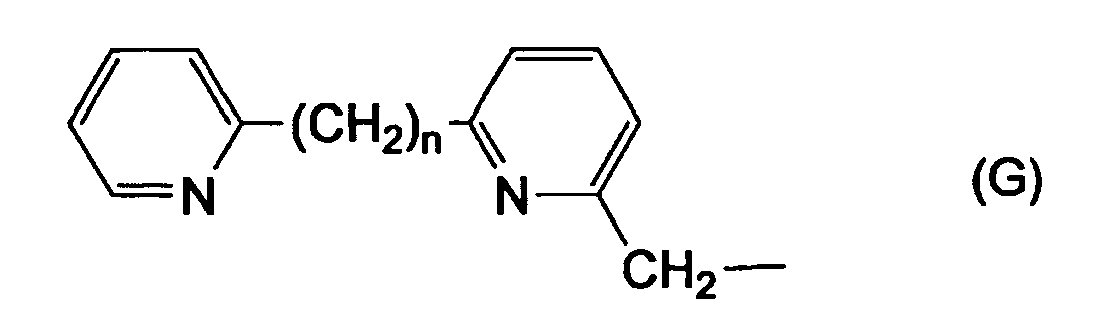
- R 1 and R 2 are hydrogen, and the other is a substituent represented by Formula (G): wherein n is 0 or 1.
- the sphingosine compound represented by Formula (1) encompasses the sphingosine compounds represented by Formulae (1A) and (1B): wherein n and R 3 are as defined above.
- the sphingosine compounds represented by Formula (1A) are preferred.
- C 1-23 alkyl represented by R 3 in Formula (1) examples include C 1-23 straight- or branched-chain alkyl, such as methyl, ethyl, n-propyl, isopropyl, n-butyl, isobutyl, sec-butyl, tert-butyl, n-pentyl, isopentyl, neopentyl, tert-pentyl, n-hexyl, isohexyl, heptyl, octyl, nonyl, decyl, undecyl, dodecyl, tridecyl, tetradecyl, pentadecyl, hexadecyl, heptadecyl, octadecyl, nonadecyl, icosyl, henicosyl, docosyl, tricosyl, etc.
- C 3-8 cycloalkyl represented by R 3 in Formula (1) examples include C 3-8 cycloalkyl, such as cyclopropyl, cyclobutyl, cyclopentyl, cyclohexyl, cycloheptyl, cyclooctyl, etc.
- C 2-6 alkenyl represented by R 3 in Formula (1) examples include C 2-6 straight- or branched-chain alkenyl, such as vinyl, allyl, isopropenyl, 1-butenyl, 2-butenyl, 3-butenyl, 2-methyl-2-propenyl, 1-pentenyl, 2-pentenyl, 3-pentenyl, 4-pentenyl, 3-methyl-2-butenyl, 1-hexenyl, 2-hexenyl, 3-hexenyl, 4-hexenyl, 5-hexenyl, etc.
- alkenyl such as vinyl, allyl, isopropenyl, 1-butenyl, 2-butenyl, 3-butenyl, 2-methyl-2-propenyl, 1-pentenyl, 2-pentenyl, 3-pentenyl, 4-pentenyl, 3-methyl-2-butenyl, 1-hexenyl, 2-hexenyl, 3-hexenyl, 4-hexenyl, 5-
- Examples of C 1-6 alkoxy represented by R 3 in Formula (1) include C 1-6 straight- or branched-chain alkoxy, such as methoxy, ethoxy, n-propoxy, isopropoxy, n-butoxy, sec-butoxy, tert-butoxy, n-pentyloxy, isopentyloxy, neopentyloxy, tert-pentyloxy, n-hexyloxy, isohexyloxy, etc.
- C 3-8 cycloalkyloxy represented by R 3 in Formula (1) examples include C 3-8 cycloalkyloxy, such as cyclopropyloxy, cyclobutyloxy, cyclopenthyloxy, cyclohexyloxy, cycloheptyloxy, cyclooctyloxy, etc.
- R 3 Preferable among the examples of R 3 are C 1-23 alkyl.
- C 1-23 alkyl are C 1-11 straight- or branched-chain alkyl (C 1-11 alkyl), and more preferable are C 2-5 straight- or branched-chain alkyl (C 2-5 alkyl), such as ethyl, n-propyl, isopropyl, n-butyl, isobutyl, sec-butyl, tert-butyl, n-pentyl, isopentyl, neopentyl, tert-pentyl, etc., with C 5 alkyl being particularly preferable.
- Sphingosine Compound (1) of the invention may form a salt with an acid.
- the salt is not limited as long as it is pharmaceutically acceptable; examples of such salts include salts with inorganic acids such as hydrochloric acid, sulfuric acid, and nitric acid, and organic acids such as acetic acid and benzenesulfonic acid.
- Sphingosine Compound (1) of the invention can be produced, for example, according to the steps shown in the following Reaction Scheme-1: wherein R 1 , R 2 , R 3 , n, and X are as defined above.
- Compound (1) of the invention can be produced by reacting the compound represented by Formula (2) with a tin oxide compound in a suitable solvent, followed by reacting the resulting compound with the bipyridyl compound represented by Formula (3).
- this reaction includes the first step of reacting Compound (2) with a tin oxide compound; and the second step of reacting the resulting compound with Compound (3).
- solvents can be used in the first and second steps of this reaction, as long as they do not adversely affect the reaction.
- solvents include aromatic hydrocarbons such as benzene, toluene, and xylene; halogenated aromatic hydrocarbons such as chlorobenzene and dichlorobenzene; aliphatic hydrocarbons such as n-hexane, cyclohexane, and petroleum ether; aliphatic halogenated hydrocarbons such as dichloromethane, 1,2-dichloroethane, chloroform, and carbon tetrachloride; alcohols such as methanol, ethanol, and isopropyl alcohol; ethers such as diethylether, diisopropyl ether, dioxane, tetrahydrofuran (THF), ethylene glycol dimethyl ether, and ethylene glycol diethylether; ketones such as acetone, 2-butanone, and methyl isobutyl
- an alcohol such as methanol is preferable as the solvent used in the first step of this reaction
- an amide such as N,N-dimethylformamide is preferable as the solvent used in the second step.
- Examples of tin oxide compounds used in the first step include a tin oxide compound represented by Formula (4): (R 4 ) 2 SnO (4) wherein R 4 is alkyl, cycloalkyl, or phenyl; and a tin oxide compound represented by Formula (5): (R 9 ) 2 Sn(OR 5 ) 2 (5) wherein R 5 is alkyl, cycloalkyl, or phenyl; and R 4 is as defined above.
- alkyl represented by R 4 and R 5 examples include methyl, ethyl, n-propyl, isopropyl, n-butyl, n-amyl, isoamyl, n-hexyl, n-octyl, 2-ethylhexyl, lauryl, and stearyl.
- cycloalkyl represented by R 4 and R 5 include C 3-8 cycloalkyl, such as cyclopropyl, cyclobutyl, cyclopentyl, cyclohexyl, cycloheptyl, and cyclooctyl.
- tin oxide compounds represented by Formula (4) include dimethyl tin oxide ((CH 3 ) 2 SnO), diethyl tin oxide ((C 2 H 5)2 SnO), dibutyltin oxide ((C 4 H 9 ) 2 SnO), dioctyl tin oxide ((C 8 H 17 ) 2 SnO), and diphenyl tin oxide ((C 6 H 5 ) 2 SnO), with dimethyl tin oxide, dibutyltin oxide, and dioctyl tin oxide being preferable.
- tin oxide compounds represented by Formula (5) is dibutyltin dimethoxide ((C 4 H 9 ) 2 Sn(OCH 3 ) 2 ).
- tin oxide compounds are commercially available, or can be produced according to a known method.
- the amount of tin oxide compound is not limited as long as it is a stoichiometric quantity; generally, the amount of tin oxide compound is about 1 to about 3 moles, and preferably about 1.1 to 2 moles, per 1 mole of Compound (2).
- the reaction temperature is not limited, but may generally be within the range of -10°C to below the boiling point of the solvent used, preferably about 20 to about 100°C, and more preferably about 40 to about 80°C.
- the reaction time varies depending on the conditions, such as the types and amounts of the starting compounds, the reaction temperature, etc., but is generally about 0.5 to about 3 hours, and preferably about 1 to about 2 hours.
- the resulting stannylene compound represented by Formula (6) may be isolated and purified prior to use in the subsequent step, or may be used in the subsequent step without isolation and purification.
- the solvent in the reaction mixture obtained in the first step may be concentrated or distilled off, and a fresh solvent that is suitably selected may be added before the product is subjected to the subsequent step.
- a halogen ion is preferably present in the reaction system.
- a halide may be supplied into the reaction system.
- halides include tetraalkylammonium halides such as tetrabutylammonium fluoride, tetrabuthylammonium chloride, tetrabutylammonium bromide, and tetrabutylammonium iodide; and cesium fluoride.
- tetraalkylammonium halides such as tetrabutylammonium fluoride, tetrabuthylammonium chloride, tetrabutylammonium bromide, and tetrabutylammonium iodide
- cesium fluoride Among the above, tetrabutylammonium fluoride and cesium fluoride are preferable.
- the amount of the halide used is not limited, and may be suitably selected from a wide range of amounts.
- the amount of the halide used is generally 1 to 5 moles, and preferably 1.1 to 2 moles, per 1 mole of Compound (2).
- the amount of Compound (3) used is not limited, and may be suitably selected from a wide range of amounts.
- the amount of Compound (3) used is generally 0.8 to 3 moles, preferably 1.0 to 2.5 moles, and more preferably 1.1 to 1.5 moles, per 1 mole of Compound (2).
- the reaction temperature is not limited, but may generally be within the range of -10°C to below the boiling point of the solvent used, preferably about 10 to about 40°C, and more preferably about 20 to about 30°C.
- the reaction time varies depending on the conditions, such as the types and amounts of the starting compounds, the reaction temperature, etc., but is generally 24 hours or less, and preferably about 6 to about 12 hours.
- the thus-obtained Compound (1) can be easily isolated from the reaction mixture and purified by usual isolation and purification means, e.g., column chromatography, recrystallization, etc.
- Compound (1) is produced as a mixture of Compound (1A) and Compound (1B); these mixtures can be easily isolated and produced by a usual separation means such as HPLC. As a result, in this reaction, Compound (1A) is produced in an amount of about 4 times that of Compound (1B).
- Starting Compound (2) can be produced according to the steps shown in the following Reaction Scheme-2: wherein R 3 is as defined above, and Y is halogen.
- Compound (2) is produced by reacting the known sphingosine represented by Formula (7) with the known carbonyl halide compound represented by Formula (8).
- the reaction conditions may follow a usual method for producing an amide compound by reacting a carbonyl halide and an amino compound.
- the Examples below describe specific examples of the reaction conditions, such as the reagents, solvents, reaction temperature, and reaction time employed in this reaction.
- Starting Compound (3) can be produced according to the steps shown in the following Reaction Scheme-3: wherein n and X are as defined above.
- Compound (3) is produced by reacting known Compound (9) with a halogenating agent such as N-bromosuccinimide, followed by reacting the reaction product with a reducing agent for the purpose of eliminating excess substituted halogen.
- a halogenating agent such as N-bromosuccinimide
- the reaction conditions may follow a usual method for halogenating an aromatic substituted methyl group.
- the Reference Examples below describe specific examples of the reaction conditions, such as the reagents, solvents, reaction temperature, and reaction time employed in this reaction.
- Compound (1) of the invention exhibits excellent inhibitory activity against sphingomyelinase. Accordingly, Compound (1) is useful as a sphingomyelinase inhibitor, and is useful as a drug for the prevention and/or treatment of cerebral hemorrhage, cerebral infarction, and like cerebrovascular diseases, head injuries, senile dementia represented by Parkinson's disease and Alzheimer's disease, and like neurodegenerative diseases, diabetes, obesity, arteriosclerosis, inflammatory diseases, immune diseases, cancer, renal diseases, and cardiac diseases.
- the invention provides a sphingomyelinase inhibitor (hereinafter also referred to as the "formulation") containing the sphingosine compound represented by Formula (1) as an active ingredient.
- the formulation of the invention may solely contain Compound (1), or may be a composition that additionally contains any carriers and/or additives, and is prepared into a form suitable to a desired purpose according to a conventionally known method.
- Compound (1) may contain one of the compounds represented by Formula (1A) and (1B), or may be a mixture of Compounds (1A) and (1B).
- the formulation of the invention may be a composition that additionally contains any carriers and/or additives, and is prepared into a form suitable to a desired purpose according to a conventionally known method.
- dosage forms of the formulation of the invention include, but are not limited to, solid formulations such as tablets, powders, granules, pills, powder syrups, and capsules (hard and soft capsules); paste or gel formulations such as creams, ointments, and gels; and liquid formulations such as solutions, suspensions, emulsions, syrups, and elixirs.
- the amount of Sphingosine Compound (1) used in the formulation of the invention is not limited as long as the formulation can exhibit an inhibitory effect against sphingomyelinase.
- the amount of Sphingosine Compound (1) can be suitably adjusted within the range of 0.001 to 99 wt%, preferably 0.01 to 50 wt%, and more preferably 0.1 to 30 wt%, based on 100 wt% of the formulation.
- the formulation may contain Compound (1) in a proportion sufficient to exhibit an inhibitory effect against sphingomyelinase, and may also contain other ingredients as long as this effect is not impaired.
- the other ingredients are not limited as long as they are pharmacologically and pharmaceutically acceptable.
- ingredients include carriers commonly used in manufacturing pharmaceuticals, such as excipients, binders, dispersants, thickeners, lubricants, pH adjusters, and solubilizers; and antibiotics, antimicrobial agents, disinfectants, preservatives, builders, bleaching agents, enzymes, chelating agents, anti-foaming agents, coloring agents (dyes, pigments, etc.), softening agents, moisturizers, surfactants, antioxidants, flavoring agents, taste enhancers, flavor enhancers, and solvents.
- carriers commonly used in manufacturing pharmaceuticals such as excipients, binders, dispersants, thickeners, lubricants, pH adjusters, and solubilizers
- antibiotics antimicrobial agents
- disinfectants preservatives
- builders bleaching agents
- enzymes enzymes
- chelating agents anti-foaming agents
- coloring agents dye, pigments, etc.
- softening agents moisturizers, surfactants, antioxidants, flavoring agents, taste enhancers, flavor enhancer
- Methods of using the formulation of the invention include oral administration and administration by infusion, injection, and other routes of the formulation into the body; and topical application of the formulation to an afflicted area.
- a suitable daily dose of formulation calculated as the amount of Sphingosine Compound (1) is generally about 1 ng/ml to about 100 mg/ml, and preferably about 10 ng/ml to about 50 mg/ml, per 1 kg of an adult.
- the dose of the formulation can be suitably adjusted within this range according to the age and symptoms of the patient.
- the formulation may be given in one to several doses per day.
- the sphingosine compound of the invention exhibits an inhibitory activity against sphingomyelinase, and therefore can be suitably used as a drug for the prevention or treatment of cerebral hemorrhage, cerebral infarction, and like cerebrovascular diseases, head injuries, senile dementia represented by Parkinson's disease and Alzheimer's disease, and like neurodegenerative diseases, diabetes, obesity, arteriosclerosis, inflammatory diseases, immune diseases, cancer, renal diseases, and cardiac diseases.
- the above-described novel sphingosine compound having a potent inhibitory activity against sphingomyelinase is provided.
- Starting Compound (7) can be a commercially available product, or can be synthesized according to the following known method.
- N-tert-butoxycarbonyl-serine methyl ester 2.0 g, 9.122 mmol
- 2,2-dimethoxypropane 1.9 g, 18.24 mmol
- pyridinium-p-toluene sulfonate 26 mg, 137 ⁇ mol
- benzene 29 ml
- a saturated sodium hydrogen carbonate solution was added to the reaction mixture, and the mixture was extracted with diethylether; the organic layer was subsequently washed with a saturated sodium chloride solution. The washed product was then dried over anhydrous magnesium sulfate and filtered, and the filtrate was subsequently concentrated.
- N-tert-butoxycarbonyl sphingosine (100 mg, 0.25 mmol) was dissolved in 6 M hydrochloric acid/THF (1:5), and stirred at room temperature for 2 hours. The resulting mixture was heated to 50°C and stirred for 16 hours. The mixture was neutralized with a 10% sodium hydroxide solution and extracted with dichloromethane, and the product was dried over anhydrous sodium sulfate, filtered and concentrated. The resulting crude crystals were recrystallized using n-hexane to produce Starting Compound (7) (74 mg, 98% yield).
- 6-methyl-2,2'-bipyridine 200 mg, 1.17 mmol was dissolved in carbon tetrachloride; N-bromosuccinimide (1.4 g, 5.85 mmol) and 2,2'-azobis isobutyronitrile (13.5 mg, 82.32 ⁇ mol) were added to the solution, and the mixture was heated under reflux for 12 hours. After cooling to room temperature, a saturated sodium chloride solution was added, the resulting mixture was extracted with dichloromethane, and the organic layer was dried over anhydrous sodium sulfate, filtered and concentrated. The concentrate was purified by silica gel column chromatography to produce 6-tribromomethyl-2,2'-bipyridine in a quantitative yield as colorless crystals. The subsequent reduction reaction was performed using the 6-tribromomethyl-2,2'-bipyridine.
- the 6-tribromomethyl-2,2'-bipyridine (205 mg, 503.8 ⁇ mol) was dissolved in dichloromethane (5 ml) and cooled to -78°C; a dichloromethane solution of diisobutylaluminum hydride (DIBAL) (0.97 M, 1.5 ml) was subsequently added dropwise.
- DIBAL diisobutylaluminum hydride
- methanol was added, and the reaction was stopped.
- the reaction mixture was heated to 0°C, and a 10% potassium sodium tartrate solution was subsequently added.
- the resulting mixture was extracted with diethylether, and the product was washed with a saturated sodium chloride solution, dried over anhydrous sodium sulfate, filtered and concentrated.
- the concentrate was purified by silica gel column chromatography to produce Compound (3-1) (6-bromomethyl-2,2'-bipyridine) (54 mg, 54% yield).
- the concentrate was purified by silica gel column chromatography to produce ceramide (67 mg, 57%).
- SM sphingomyelin
- cholesterol sphingomyelin
- CF solution sphingomyelin
- NaOH sodium hydroxide
- the CF solution was warmed to 55°C, and 80 ⁇ l of the CF solution was added with stirring to the SM from which the solvent was distilled (the molar ratio of cholesterol to CF solution: 1:1), and a procedure of placing the mixture in a water bath at 55°C and stirring the mixture was repeated three times at 30-second intervals.
- a suitable amount of TBS was added, the mixture was centrifuged for 20 minutes at 15,000 rpm and 4°C, and the supernatant was removed.
- a suspension of the resulting product in 300 ⁇ l of TBS was used as a liposome.
- [Method] Bc-SMase (50 ng/ml) was mixed with the solution of Compound (1a) with each concentration or the solution of Compound (1b) with each concentration, and the mixture was adjusted with GTBS (pH 5.5) to a total volume of 180 ⁇ l and pre-treated for 10 minutes at 37°C, after which 20 ⁇ l of the SM-liposome was added to the resulting reaction mixture and incubated for 30 minutes at 37°C.
- the reaction mixture was measured using a fluorometer (Corona Electric Co., Ltd.; MTP32 Microplate Reader, Ex 490 , Em 530 ).
- Triton X-100 0.5 g was dissolved in 100 ml of 0.02 M TB.
Landscapes
- Health & Medical Sciences (AREA)
- Organic Chemistry (AREA)
- Chemical & Material Sciences (AREA)
- Engineering & Computer Science (AREA)
- Bioinformatics & Cheminformatics (AREA)
- Nuclear Medicine, Radiotherapy & Molecular Imaging (AREA)
- Animal Behavior & Ethology (AREA)
- Medicinal Chemistry (AREA)
- Veterinary Medicine (AREA)
- Chemical Kinetics & Catalysis (AREA)
- Pharmacology & Pharmacy (AREA)
- Life Sciences & Earth Sciences (AREA)
- General Chemical & Material Sciences (AREA)
- General Health & Medical Sciences (AREA)
- Public Health (AREA)
- Diabetes (AREA)
- Neurology (AREA)
- Biomedical Technology (AREA)
- Neurosurgery (AREA)
- Cardiology (AREA)
- Urology & Nephrology (AREA)
- Heart & Thoracic Surgery (AREA)
- Hematology (AREA)
- Obesity (AREA)
- Immunology (AREA)
- Pain & Pain Management (AREA)
- Endocrinology (AREA)
- Hospice & Palliative Care (AREA)
- Rheumatology (AREA)
- Child & Adolescent Psychology (AREA)
- Psychiatry (AREA)
- Emergency Medicine (AREA)
- Vascular Medicine (AREA)
- Psychology (AREA)
- Pharmaceuticals Containing Other Organic And Inorganic Compounds (AREA)
- Organic Low-Molecular-Weight Compounds And Preparation Thereof (AREA)
- Pyridine Compounds (AREA)
- Acyclic And Carbocyclic Compounds In Medicinal Compositions (AREA)
- Preparation Of Compounds By Using Micro-Organisms (AREA)
Abstract
The novel sphingosine compound or a salt thereof according to the invention is represented by Formula (1):

Description
- The present invention relates to a sphingosine compound, a method for producing the sphingosine compound, and a sphingomyelinase inhibitor.
- Sphingomyelinase, also known as sphingomyelin phosphodiesterase, is a type of phospholipase that breaks down the substrate sphingomyelin, which is a type of membrane lipid, into ceramide and phosphocholine. Sphingomyelinase is believed to play an important role in regulating the sphingomyelin metabolic pathway in vivo.
- Sphingomyelinase is activated by extracellular cytokines, hormones, and the like. Ceramide thus produced is believed to play an important role as a lipid second messenger in various cellular functions, such as apoptosis, cell proliferation, differentiation, etc. This signal transduction pathway is referred to as the sphingomyelin pathway, and physiologically active substances known to be involved in this pathway are cell adhesion molecules such as tumor necrosis factor (TNF-α), interleukin 1β (IL-1β), and like cytokines, Fas, D28, CD40-ligand, etc. These in vivo physiologically active substances are believed to be deeply involved in the onset of various diseases or the expression of various life phenomena, such as inflammation, cell death, immune system control, etc. This indicates the importance of the sphingomyelin pathway in vivo.
- Sphingomyelinase-specific inhibitors are promising drugs for the prevention and treatment of cerebral hemorrhage, cerebral infarction, and like cerebrovascular diseases, head injuries, senile dementia represented by Parkinson's disease and Alzheimer's disease, and like neurodegenerative diseases, diabetes, obesity, arteriosclerosis, inflammatory diseases, immune diseases, cancer, renal diseases, and cardiac diseases. Thus, many sphingomyelinase inhibitors have been proposed (PTL 1 to 4) .
- However, no sphingomyelinase inhibitor has been developed that is effective for patients of senile dementia, the population of which is expected to increase in the future.
-
- [PTL 1] Japanese Unexamined Patent Publication No.
2000-86601 - [PTL 2] Japanese Unexamined Patent Publication No.
2001-213858 - [PTL 3] Japanese Unexamined Patent Publication No.
2004-175735 - [PTL 4] Japanese Unexamined Patent Publication No.
2005-281209 - An object of the invention is to provide a novel sphingosine compound with an inhibitory activity against sphingomyelinase, and a method for producing the sphingosine compound.
- The present inventors conducted extensive research to solve the above-described object, and consequently found that a sphingosine compound which was first synthesized by the inventors exhibits a potent inhibitory activity against sphingomyelinase. The invention was accomplished based on this finding.
- The invention provides a sphingomyelinase compound, a method for producing the sphingomyelinase compound, and a sphingomyelinase inhibitor containing the sphingomyelinase compound, as summarized in Items 1 to 5 below.
- Item 1: A sphingosine compound or a salt thereof represented by Formula (1):


- Item 2: The sphingosine compound or a salt thereof according to Item 1, wherein R1 is a group represented by Formula (G), and R2 is hydrogen.
- Item 3: The sphingosine compound or a salt thereof according to Item 1, wherein R1 is hydrogen, and R2 is a group represented by Formula (G).
- Item 4: A method for producing a sphingosine compound or a salt thereof represented by Formula (1):


- reacting a tin oxide compound with a compound represented by Formula (2):

- reacting the resulting compound with a bipyridyl compound represented by Formula (3):

- reacting a tin oxide compound with a compound represented by Formula (2):
- Item 5: A sphingomyelinase inhibitor containing a sphingosine compound or a salt thereof represented by Formula (1):


- The sphingosine compound of the invention is represented by Formula (1):

- In Formula (1), one of R1 and R2 is hydrogen, and the other is a substituent represented by Formula (G):

- The sphingosine compound represented by Formula (1) encompasses the sphingosine compounds represented by Formulae (1A) and (1B):


- Compounds represented by Formulae (1A) and (1B) wherein n is 0 are preferred.
- The sphingosine compounds represented by Formula (1A) are preferred.
- Examples of C1-23 alkyl represented by R3 in Formula (1) include C1-23 straight- or branched-chain alkyl, such as methyl, ethyl, n-propyl, isopropyl, n-butyl, isobutyl, sec-butyl, tert-butyl, n-pentyl, isopentyl, neopentyl, tert-pentyl, n-hexyl, isohexyl, heptyl, octyl, nonyl, decyl, undecyl, dodecyl, tridecyl, tetradecyl, pentadecyl, hexadecyl, heptadecyl, octadecyl, nonadecyl, icosyl, henicosyl, docosyl, tricosyl, etc.
- Examples of C3-8 cycloalkyl represented by R3 in Formula (1) include C3-8 cycloalkyl, such as cyclopropyl, cyclobutyl, cyclopentyl, cyclohexyl, cycloheptyl, cyclooctyl, etc.
- Examples of C2-6 alkenyl represented by R3 in Formula (1) include C2-6 straight- or branched-chain alkenyl, such as vinyl, allyl, isopropenyl, 1-butenyl, 2-butenyl, 3-butenyl, 2-methyl-2-propenyl, 1-pentenyl, 2-pentenyl, 3-pentenyl, 4-pentenyl, 3-methyl-2-butenyl, 1-hexenyl, 2-hexenyl, 3-hexenyl, 4-hexenyl, 5-hexenyl, etc.
- Examples of C1-6 alkoxy represented by R3 in Formula (1) include C1-6 straight- or branched-chain alkoxy, such as methoxy, ethoxy, n-propoxy, isopropoxy, n-butoxy, sec-butoxy, tert-butoxy, n-pentyloxy, isopentyloxy, neopentyloxy, tert-pentyloxy, n-hexyloxy, isohexyloxy, etc.
- Examples of C3-8 cycloalkyloxy represented by R3 in Formula (1) include C3-8 cycloalkyloxy, such as cyclopropyloxy, cyclobutyloxy, cyclopenthyloxy, cyclohexyloxy, cycloheptyloxy, cyclooctyloxy, etc.
- Preferable among the examples of R3 are C1-23 alkyl. Preferable as C1-23 alkyl are C1-11 straight- or branched-chain alkyl (C1-11 alkyl), and more preferable are C2-5 straight- or branched-chain alkyl (C2-5 alkyl), such as ethyl, n-propyl, isopropyl, n-butyl, isobutyl, sec-butyl, tert-butyl, n-pentyl, isopentyl, neopentyl, tert-pentyl, etc., with C5 alkyl being particularly preferable.
- Sphingosine Compound (1) of the invention may form a salt with an acid.
- The salt is not limited as long as it is pharmaceutically acceptable; examples of such salts include salts with inorganic acids such as hydrochloric acid, sulfuric acid, and nitric acid, and organic acids such as acetic acid and benzenesulfonic acid.
- Sphingosine Compound (1) of the invention can be produced, for example, according to the steps shown in the following Reaction Scheme-1:


- As shown in Reaction Scheme-1, Compound (1) of the invention can be produced by reacting the compound represented by Formula (2) with a tin oxide compound in a suitable solvent, followed by reacting the resulting compound with the bipyridyl compound represented by Formula (3).
- That is, this reaction includes the first step of reacting Compound (2) with a tin oxide compound; and the second step of reacting the resulting compound with Compound (3).
- A wide range of known solvents can be used in the first and second steps of this reaction, as long as they do not adversely affect the reaction. Examples of such solvents include aromatic hydrocarbons such as benzene, toluene, and xylene; halogenated aromatic hydrocarbons such as chlorobenzene and dichlorobenzene; aliphatic hydrocarbons such as n-hexane, cyclohexane, and petroleum ether; aliphatic halogenated hydrocarbons such as dichloromethane, 1,2-dichloroethane, chloroform, and carbon tetrachloride; alcohols such as methanol, ethanol, and isopropyl alcohol; ethers such as diethylether, diisopropyl ether, dioxane, tetrahydrofuran (THF), ethylene glycol dimethyl ether, and ethylene glycol diethylether; ketones such as acetone, 2-butanone, and methyl isobutyl ketone; nitriles such as acetonitrile, propionitrile, and benzonitrile; amides such as N,N-dimethylformamide and hexamethylphosphoric triamide (HMPA); sulfoxides such as dimethyl sulfoxide; and mixtures thereof.
- Among the above, an alcohol such as methanol is preferable as the solvent used in the first step of this reaction, and an amide such as N,N-dimethylformamide is preferable as the solvent used in the second step.
- Examples of tin oxide compounds used in the first step include a tin oxide compound represented by Formula (4):
(R4)2SnO (4)
wherein R4 is alkyl, cycloalkyl, or phenyl; and
a tin oxide compound represented by Formula (5):
(R9)2Sn(OR5)2 (5)
wherein R5 is alkyl, cycloalkyl, or phenyl; and R4 is as defined above. - Examples of alkyl represented by R4 and R5 include methyl, ethyl, n-propyl, isopropyl, n-butyl, n-amyl, isoamyl, n-hexyl, n-octyl, 2-ethylhexyl, lauryl, and stearyl.
- Examples of cycloalkyl represented by R4 and R5 include C3-8 cycloalkyl, such as cyclopropyl, cyclobutyl, cyclopentyl, cyclohexyl, cycloheptyl, and cyclooctyl.
- Specific examples of tin oxide compounds represented by Formula (4) include dimethyl tin oxide ((CH3)2SnO), diethyl tin oxide ((C2H5)2SnO), dibutyltin oxide ((C4H9)2SnO), dioctyl tin oxide ((C8H17)2SnO), and diphenyl tin oxide ((C6H5)2SnO), with dimethyl tin oxide, dibutyltin oxide, and dioctyl tin oxide being preferable.
- A specific example of tin oxide compounds represented by Formula (5) is dibutyltin dimethoxide ((C4H9)2Sn(OCH3)2).
- These tin oxide compounds are commercially available, or can be produced according to a known method.
- The amount of tin oxide compound is not limited as long as it is a stoichiometric quantity; generally, the amount of tin oxide compound is about 1 to about 3 moles, and preferably about 1.1 to 2 moles, per 1 mole of Compound (2).
- The reaction temperature is not limited, but may generally be within the range of -10°C to below the boiling point of the solvent used, preferably about 20 to about 100°C, and more preferably about 40 to about 80°C. The reaction time varies depending on the conditions, such as the types and amounts of the starting compounds, the reaction temperature, etc., but is generally about 0.5 to about 3 hours, and preferably about 1 to about 2 hours.
- The reaction of a tin oxide compound with Compound (2) in the first step produces a stannylene compound represented by Formula (6):

- The resulting stannylene compound represented by Formula (6) may be isolated and purified prior to use in the subsequent step, or may be used in the subsequent step without isolation and purification.
- Moreover, the solvent in the reaction mixture obtained in the first step may be concentrated or distilled off, and a fresh solvent that is suitably selected may be added before the product is subjected to the subsequent step.
- In the second step, a halogen ion is preferably present in the reaction system. To achieve this, a halide may be supplied into the reaction system.
- Examples of halides include tetraalkylammonium halides such as tetrabutylammonium fluoride, tetrabuthylammonium chloride, tetrabutylammonium bromide, and tetrabutylammonium iodide; and cesium fluoride. Among the above, tetrabutylammonium fluoride and cesium fluoride are preferable.
- The amount of the halide used is not limited, and may be suitably selected from a wide range of amounts. The amount of the halide used is generally 1 to 5 moles, and preferably 1.1 to 2 moles, per 1 mole of Compound (2).
- The amount of Compound (3) used is not limited, and may be suitably selected from a wide range of amounts. The amount of Compound (3) used is generally 0.8 to 3 moles, preferably 1.0 to 2.5 moles, and more preferably 1.1 to 1.5 moles, per 1 mole of Compound (2).
- The reaction temperature is not limited, but may generally be within the range of -10°C to below the boiling point of the solvent used, preferably about 10 to about 40°C, and more preferably about 20 to about 30°C. The reaction time varies depending on the conditions, such as the types and amounts of the starting compounds, the reaction temperature, etc., but is generally 24 hours or less, and preferably about 6 to about 12 hours.
- The thus-obtained Compound (1) can be easily isolated from the reaction mixture and purified by usual isolation and purification means, e.g., column chromatography, recrystallization, etc.
- In this reaction, Compound (1) is produced as a mixture of Compound (1A) and Compound (1B); these mixtures can be easily isolated and produced by a usual separation means such as HPLC. As a result, in this reaction, Compound (1A) is produced in an amount of about 4 times that of Compound (1B).
- Starting Compound (2) used in Reaction Scheme-1 is easily produced according to a known method.
- For example, Starting Compound (2) can be produced according to the steps shown in the following Reaction Scheme-2:

- As shown in Reaction Scheme-2, Compound (2) is produced by reacting the known sphingosine represented by Formula (7) with the known carbonyl halide compound represented by Formula (8). The reaction conditions may follow a usual method for producing an amide compound by reacting a carbonyl halide and an amino compound. The Examples below describe specific examples of the reaction conditions, such as the reagents, solvents, reaction temperature, and reaction time employed in this reaction.
- Starting Compound (3) used in Reaction Scheme-1 can be easily produced according to a known method.
- For example, Starting Compound (3) can be produced according to the steps shown in the following Reaction Scheme-3:

- As shown in Reaction Scheme-3, Compound (3) is produced by reacting known Compound (9) with a halogenating agent such as N-bromosuccinimide, followed by reacting the reaction product with a reducing agent for the purpose of eliminating excess substituted halogen. The reaction conditions may follow a usual method for halogenating an aromatic substituted methyl group. The Reference Examples below describe specific examples of the reaction conditions, such as the reagents, solvents, reaction temperature, and reaction time employed in this reaction.
- As will be evident from the Test Examples below, Compound (1) of the invention exhibits excellent inhibitory activity against sphingomyelinase. Accordingly, Compound (1) is useful as a sphingomyelinase inhibitor, and is useful as a drug for the prevention and/or treatment of cerebral hemorrhage, cerebral infarction, and like cerebrovascular diseases, head injuries, senile dementia represented by Parkinson's disease and Alzheimer's disease, and like neurodegenerative diseases, diabetes, obesity, arteriosclerosis, inflammatory diseases, immune diseases, cancer, renal diseases, and cardiac diseases.
- The invention provides a sphingomyelinase inhibitor (hereinafter also referred to as the "formulation") containing the sphingosine compound represented by Formula (1) as an active ingredient.
- The formulation of the invention may solely contain Compound (1), or may be a composition that additionally contains any carriers and/or additives, and is prepared into a form suitable to a desired purpose according to a conventionally known method. Further, Compound (1) may contain one of the compounds represented by Formula (1A) and (1B), or may be a mixture of Compounds (1A) and (1B). Further, the formulation of the invention may be a composition that additionally contains any carriers and/or additives, and is prepared into a form suitable to a desired purpose according to a conventionally known method.
- Examples of dosage forms of the formulation of the invention include, but are not limited to, solid formulations such as tablets, powders, granules, pills, powder syrups, and capsules (hard and soft capsules); paste or gel formulations such as creams, ointments, and gels; and liquid formulations such as solutions, suspensions, emulsions, syrups, and elixirs.
- The amount of Sphingosine Compound (1) used in the formulation of the invention is not limited as long as the formulation can exhibit an inhibitory effect against sphingomyelinase. The amount of Sphingosine Compound (1) can be suitably adjusted within the range of 0.001 to 99 wt%, preferably 0.01 to 50 wt%, and more preferably 0.1 to 30 wt%, based on 100 wt% of the formulation.
- The formulation may contain Compound (1) in a proportion sufficient to exhibit an inhibitory effect against sphingomyelinase, and may also contain other ingredients as long as this effect is not impaired. The other ingredients are not limited as long as they are pharmacologically and pharmaceutically acceptable. Examples of such ingredients include carriers commonly used in manufacturing pharmaceuticals, such as excipients, binders, dispersants, thickeners, lubricants, pH adjusters, and solubilizers; and antibiotics, antimicrobial agents, disinfectants, preservatives, builders, bleaching agents, enzymes, chelating agents, anti-foaming agents, coloring agents (dyes, pigments, etc.), softening agents, moisturizers, surfactants, antioxidants, flavoring agents, taste enhancers, flavor enhancers, and solvents.
- Methods of using the formulation of the invention include oral administration and administration by infusion, injection, and other routes of the formulation into the body; and topical application of the formulation to an afflicted area.
- The amount of the formulation of the invention will depend on the dosage form, the method of application (use), etc., and thus, cannot be generally specified. For example, a suitable daily dose of formulation calculated as the amount of Sphingosine Compound (1) is generally about 1 ng/ml to about 100 mg/ml, and preferably about 10 ng/ml to about 50 mg/ml, per 1 kg of an adult. The dose of the formulation can be suitably adjusted within this range according to the age and symptoms of the patient. The formulation may be given in one to several doses per day.
- The sphingosine compound of the invention exhibits an inhibitory activity against sphingomyelinase, and therefore can be suitably used as a drug for the prevention or treatment of cerebral hemorrhage, cerebral infarction, and like cerebrovascular diseases, head injuries, senile dementia represented by Parkinson's disease and Alzheimer's disease, and like neurodegenerative diseases, diabetes, obesity, arteriosclerosis, inflammatory diseases, immune diseases, cancer, renal diseases, and cardiac diseases.
- In accordance with the method of the invention, the above-described novel sphingosine compound having a potent inhibitory activity against sphingomyelinase is provided.
- The present invention will be further clarified with reference to the following Production Examples and Test Examples of Sphingosine Compound (1) of the invention; however, the invention is not limited by these Examples. In the reaction schemes shown below, Me represents a methyl group.
- Starting Compound (7) can be a commercially available product, or can be synthesized according to the following known method.
-

- Commercially available N-tert-butoxycarbonyl-serine methyl ester (2.0 g, 9.122 mmol), 2,2-dimethoxypropane (1.9 g, 18.24 mmol), and pyridinium-p-toluene sulfonate (26 mg, 137 µmol) were dissolved in benzene (29 ml) and heated under reflux for 15 hours. A saturated sodium hydrogen carbonate solution was added to the reaction mixture, and the mixture was extracted with diethylether; the organic layer was subsequently washed with a saturated sodium chloride solution. The washed product was then dried over anhydrous magnesium sulfate and filtered, and the filtrate was subsequently concentrated. The resulting concentrate was purified by silica gel column chromatography to produce 3-tert-butyl 4-methyl 2,2-dimethyloxazolidine-3,4-dicarboxylate (2.78 g, 91% yield).
FTIR (diffuse reflectance): 2979, 1760, 1737, 1713, 1390 cm-1
HRMS: calculated for (CI)C12H22NO5 (M+H+), 260.1498, found, 260.1495 -
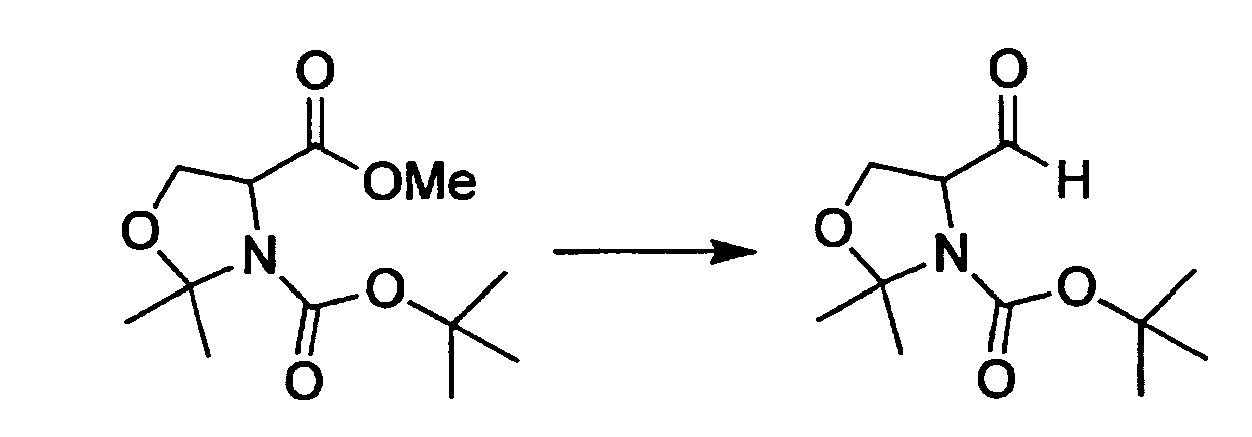
- The 3-tert-butyl 4-methyl 2,2-dimethyloxazolidine-3,4-dicarboxylate (6.42 g, 24.97 mmol) obtained in the above-described reaction was dissolved in toluene (50 ml) and cooled to -78°C; subsequently, a toluene solution of diisobutylaluminum hydride (0.93 M) was slowly added dropwise. After 30 minutes, methanol was added to the mixture and the reaction was stopped; a 10% potassium sodium tartrate solution (150 ml) was further added, and the mixture was extracted with ethyl acetate. The organic layer was dried over anhydrous magnesium sulfate, filtered and concentrated. The resulting concentrate was purified by silica gel column chromatography to produce tert-butyl 4-formyl-2,2-dimethyloxazolidine-3-carboxylate (4.22 g, 74% yield).
FTIR (diffuse reflectance): 3449, 2978, 1737, 1694, 1366, 1258, 1172 cm-1
HRMS: calculated for (CI)C11H20NO4 (M+H+), 230.1392, found, 230.1390 -

- 1-Pentadecyne (1.7 g, 8.17 mmol) was dissolved in tetrahydrofuran (THF) (7.5 ml) and cooled to 0°C. An n-hexane solution of n-butyllithium (7.6 ml, 7.85 mmol) was slowly added dropwise to this solution. After 90 minutes of stirring, a THF solution (75 ml) of the tert-butyl 4-formyl-2,2-dimethyloxazolidine-3-carboxylate (1.0 g, 4.36 mmol) obtained in the above-described reaction was added at -40°C, and the mixture was further stirred for 20 minutes. A saturated ammonium chloride solution was added to the resulting mixture, and the reaction was stopped; the mixture was subsequently extracted with diethylether, and the organic layer was washed with a saturated sodium chloride solution, dried and concentrated. The concentrate was purified by silica gel column chromatography to produce (S)-tert-butyl 4-((R)-1-hydroxy-2-hexadecynyl)-2,2-dimethyloxazolidine-3-carboxylate) (1.2 g, 49% yield).
-

- The (S)-tert-butyl 4-((R)-1-hydroxy-2-hexadecynyl)-2,2-dimethyloxazolidine-3-carboxylate) (100 mg, 0.23 mmol) obtained in the above-described reaction was dissolved in methanol (4.4 ml); p-toluenesulfonic acid (0.8 mg, 4.6 µmol) was added to the solution, and the mixture was stirred at room temperature for 12 hours. P-toluenesulfonic acid (0.8 mg, 4.6 µmol) was added to this reaction mixture, stirred for 6 hours, heated to 60°C, and further stirred for 2 hours. Saturated sodium hydrogen carbonate was added to this reaction mixture, and the reaction was stopped; the mixture was subsequently extracted with ethyl acetate, and the organic layer was dried and filtered. The resulting filtrate was purified by column chromatography to produce tert-butyl (2S,3R)-1,3-dihydroxyoctadec-4-yn-2-ylcarbamate (85 mg, 93% yield).
FTIR (diffuse reflectance): 3449, 2926, 2854, 1703, 1458, 1394, 1366 cm-1
HRMS (FAB): calculated for C23H43NO4Na (M+Na+), 420.3089, found, 420.3058 -

- The tert-butyl (2S,3R)-1,3-dihydroxyoctadec-4-yn-2-ylcarbamate (85 mg, 0.21 mmol) obtained in the above-described reaction was dissolved in THF (21 ml) and cooled to 0°C; a 65% toluene solution of sodium bis(2-methoxyethoxy)aluminium hydride (Red-Al) (258 µl, 0.850 mmol) was subsequently added dropwise. The resulting mixture was heated to room temperature and stirred for 2.5 hours. 1 M hydrochloric acid was subsequently added to the mixture, and the reaction was stopped; the mixture was extracted with diethylether, and the organic layer was dried over anhydrous sodium sulfate, filtered and concentrated. The concentrate was purified by silica gel column chromatography to produce N-tert-butoxycarbonyl sphingosine (52 mg, 64%).
FTIR (diffuse reflectance): 3370, 2924, 2853, 1689, 1508, 1170 cm-1
HRMS: calculated for (CI)C23H46NO4 (M+H+), 400.3427, found, 400.3433 -

- N-tert-butoxycarbonyl sphingosine (100 mg, 0.25 mmol) was dissolved in 6 M hydrochloric acid/THF (1:5), and stirred at room temperature for 2 hours. The resulting mixture was heated to 50°C and stirred for 16 hours. The mixture was neutralized with a 10% sodium hydroxide solution and extracted with dichloromethane, and the product was dried over anhydrous sodium sulfate, filtered and concentrated. The resulting crude crystals were recrystallized using n-hexane to produce Starting Compound (7) (74 mg, 98% yield).
- Physical Properties of Starting Compound (7):
- FTIR (diffuse reflectance): 3352, 2921, 2951, 1614, 1472, 1383 cm-1
- HRMS: calculated for (CI)C18H38NO2 (M+H+), 300.2902, found, 300.2903
-

- Commercially available 6-methyl-2,2'-bipyridine (200 mg, 1.17 mmol) was dissolved in carbon tetrachloride; N-bromosuccinimide (1.4 g, 5.85 mmol) and 2,2'-azobis isobutyronitrile (13.5 mg, 82.32 µmol) were added to the solution, and the mixture was heated under reflux for 12 hours. After cooling to room temperature, a saturated sodium chloride solution was added, the resulting mixture was extracted with dichloromethane, and the organic layer was dried over anhydrous sodium sulfate, filtered and concentrated. The concentrate was purified by silica gel column chromatography to produce 6-tribromomethyl-2,2'-bipyridine in a quantitative yield as colorless crystals. The subsequent reduction reaction was performed using the 6-tribromomethyl-2,2'-bipyridine.
-

- The 6-tribromomethyl-2,2'-bipyridine (205 mg, 503.8 µmol) was dissolved in dichloromethane (5 ml) and cooled to -78°C; a dichloromethane solution of diisobutylaluminum hydride (DIBAL) (0.97 M, 1.5 ml) was subsequently added dropwise. After the consumption of the starting material was confirmed by TLC, methanol was added, and the reaction was stopped. The reaction mixture was heated to 0°C, and a 10% potassium sodium tartrate solution was subsequently added. The resulting mixture was extracted with diethylether, and the product was washed with a saturated sodium chloride solution, dried over anhydrous sodium sulfate, filtered and concentrated. The concentrate was purified by silica gel column chromatography to produce Compound (3-1) (6-bromomethyl-2,2'-bipyridine) (54 mg, 54% yield).
- Physical Properties of Compound (3-1):
- 1H NMR (200 MHz, CDCl3) δ 4.63 (s, 2H), 7.27-7.33 (ddd, J = 7.8, 4.6, 1.0 Hz, 1H), 7.45 (dt, J = 7.8, 1.0 Hz, 1H), 7.80 (t, J = 7.8 Hz, 2H), 8.31 (dd, J = 7.8, 1.0 Hz, 1H), 8.45 (dt, J = 7.8, 1.0 Hz, 1H), 8.67 (m, 1H)
- 13C NMR (50 MHz, CDCl3) δ 34.14, 120.22, 121.32, 123.35, 123.85, 136.89, 137.89, 149.13, 155.66, 155.88, 156.20 cm-1
- FTIR (diffuse reflectance): 3024, 2924, 2853, 1581, 1492, 1454, 1429 cm-1
- HRMS: calculated for C11H9N2Br (M+), 247.9949, found, 247.9967
-

- Starting Compound (7) (97 mg, 326 µmol), 4-dimethylaminopyridine (1 mg), and triethylamine (10 µl) were dissolved in dichloromethane (3 ml), and cooled to 0°C; a dichloromethane solution of hexanoyl chloride (40 mg, 297 µmol, CH2Cl2 3 ml) was subsequently added. After 10 minutes, a saturated sodium hydrogen carbonate solution was added, and the mixture was extracted with dichloromethane. The resulting organic layer was dried over anhydrous magnesium sulfate, filtered and concentrated.
- The concentrate was purified by silica gel column chromatography to produce ceramide (67 mg, 57%).
- Physical Properties of Ceramide:
- 1H NMR (200 MHz, CDCl3) δ 0.88 (t, J = 6.2 Hz, 3H), 0.90 (t, J = 6.2 Hz, 3H), 1.22-1.40 (m, 28H), 1.63 (m, 2H), 2.22 (t, J = 7.4 Hz, 2H), 3.60-3.73 (m, 2H), 3.88-3.92 (m, 2H), 4.27 (m, 1H), 5.50 (dd, J = 6.4, 15.4 Hz, 1H), 5.76 (t, J = 6.6, 15.4 Hz, 1H), 6.47 (br d, J = 7.4 Hz, 1H)
- 13C NMR (50 MHz, CDCl3)δ 13.86q, 14.10q, 22.33t, 22.61t, 25.39t, 29.14t, 29.22t, 29.29t, 29.46t, 29.59t (2C), 29.64t (3C), 31.37t, 31.86t, 32.27t, 36.68t, 54.63d, 62.21t, 74.07d, 128.85d, 133.87d, 174.08s
- FTIR (diffuse reflectance): 3297, 2920, 3251, 1645, 1542 cm-1
- HRMS (FAB): calculated for C24H47N1O3Na (M+Na+), 420.3454, found, 420.3437
-

- Ceramide (67 mg, 168.5 µmol) was dissolved in methanol (1.7 ml), and dibutyltin oxide (42.4 mg, 170.2 µmol) was added to the solution and heated under reflux for 1 hour. After cooling to room temperature, the methanol was distilled off under reduced pressure, and anhydrous N,N-dimethylformamide (DMF) (1.9 ml) was added. Compound (3-1) (46 mg, 185 µmol) and tetra-n-butylammonium fluoride (1M THF, 185 µl) were further added, and the mixture was stirred at room temperature for 24 hours. Water was added to the reaction mixture, and the reaction mixture was extracted with ethyl acetate; the organic layer was subsequently dried over anhydrous sodium sulfate, filtered and concentrated. The concentrate was purified by silica gel column chromatography to produce the target compound as a mixture of Compound (1a) and Compound (1b) (27.5 mg, 29% yield). This mixture was purified by high-performance liquid chromatography (HPLC) (ODS, methanol:water = 10:1) to produce Compound (1a) and Compound (1b) in a ratio of 4:1.
- Physical Properties of Compound (1a):
- 1H NMR (200 MHz, CDCl3) δ 0.87 (t, J = 6.2 Hz, 6H), 1.25-1.32 (m, 24H), 1.58 (m, 2H), 1.99 (m, 2H), 2.18 (t, J = 7.6 Hz, 2H), 3.73 (m, 1H), 3.78 (dd, J = 9.6, 3.8 Hz, 1H), 3.94 (dd, J = 9.6, 3.8 Hz, 1H), 4.11 (m, 1H), 4.14 (m, 1H), 4.65 (d, J = 12.8 Hz, 1H), 4.74 (d, J = 12.8 Hz, 1H), 5.49 (dd, J = 15.4, 5.2 Hz, 1H), 5.73 (dt, J = 15.4, 6.8 Hz, 1H), 6.35 (d, J = 7.8 Hz, 1H), 7.31 (m, 2H), 7.83 (t, J = 7.8 Hz, 2H), 8.33 (d, J = 7.8 Hz, 1H), 8.42 (d, J = 7.8 Hz, 1H), 8.67 (br d, J = 4.6 Hz, 1H)
- 13C NMR (50 MHz, CDCl3) δ 13.94, 14.13, 22.40, 22.70, 25.44, 29.22(C2), 29.22, 29.37, 29.51-29.70 (5C), 31.43, 31.94, 32.29, 36.80, 52.93, 70.67, 74.27, 74.37, 120.24, 121.26, 121.48, 123.85, 129.19, 133.41, 136.97, 137.61, 149.24, 155.90, 156.04, 156,93, 173.36
- FTIR (diffuse reflectance): 3279, 2954, 2919, 2851, 1635, 1546, 1430 cm-1
- HRMS: calculated for (CI)C35H56N3O3 (M+H+), 566.4321, found, 566.4321
- Physical Properties of Compound (1b):
- 1H NMR (300 MHz, CDCl3) δ 0.85(t, J = 6.6 Hz, 3H), 0.87 (t, J = 6.6 Hz, 3H), 1.24-1.36 (m, 24H), 1.55 (m, 2H), 2.07 (m, 4H), 3.61 (m, 2H), 4.01 (m, 1H), 4.09 (m, 2H), 4.54 (d, J = 13.2 Hz, 1H), 4.80 (d, J = 13.2 Hz, 1H), 5.47 (dd, J = 7.8, 15.6 Hz, 1H), 5.80 (dt, J = 6.6, 15.6 Hz, 1H), 6.31 (d, J = 8.1 Hz, 1H), 7.27-7.34 (m, 2H), 7.82 (m, 2H), 8.27 (d, J = 7.8 Hz, 1H), 8.36 (d, J = 7.8 Hz, 1H), 8.67 (br d, J = 5.1 Hz, 1H)
- 13C NMR (50 MHz, CDCl3) δ 13.90, 14.13, 22.38, 22.70, 25.36, 29.11, 29.23, 29.37, 29.49, 29.70 (5C), 31.39, 31.93, 32.35, 36.75, 53.80, 62.20, 71.18, 82.43, 120.29, 121.32, 121.66, 123.88, 126.22, 137.02, 137.37, 137.63, 149.30, 155.92, 156.15, 157.51, 173.67
- HRMS (FAB): calculated for C35H55N3O3Na (M+Na+), 588.4141, found, 588.4160
- 24.2 g of tris (Nacalai code: 35434-34) was dissolved in 1,000 ml of distilled water (DW), and adjusted to pH 7.5 with hydrochloric acid.
- 9 g of sodium chloride (NaCl) was added to 100 ml of TB, and adjusted to a total volume of 1,000 ml with DW.
- 4.5 g of NaCl and 1.25 g of gelatin (Merck code: 1.04078.0500) were added to 50 ml of 0.2 M TB (pH 7.5), and adjusted to a total volume of 500 ml with DW.
- 1.0 ml of preserved sheep blood was suspended in TBS and centrifuged for 3 minutes at 2,500 rpm, and the supernatant was removed. The same centrifugal operation as above was repeated a total of three times, and the precipitate was suspended in 1.5 ml of TBS to prepare a washed erythrocyte solution.
- The sphingomyelin (SM), cholesterol, and CF solution used were as follows:
- SM: sphingomyelin from bovin brain, code: 32156-74
- Cholesterol: Nakarai code: 08721-75
- CF solution: 5(6)-carbosyfluorescein; SIGMA C8166, FW=460.4
- About 100 µl of 1 N sodium hydroxide (NaOH) was added to CF (27 mg/3 ml, DW) to prepare a CF solution. At this time, NaOH was added to give a pH of 7 to 8 as measured by a pH test paper.
- 59 µl of a solution obtained by dissolving 2 mg of sphingomyelin (SM) in 160 µl of a mixed solvent of chloroform (CHCl3) and methanol (MeOH) (CHCl3:MeOH = 2:1) was mixed with 20 µl of a solution obtained by dissolving 19.3 mg of cholesterol in 1 ml of CHCl3; the mixture was homogeneously spread to the bottom of a glass test tube while the CHCl3 and MeOH were distilled under nitrogen, and dried in a desiccator for 30 minutes. The CF solution was warmed to 55°C, and 80 µl of the CF solution was added with stirring to the SM from which the solvent was distilled (the molar ratio of cholesterol to CF solution: 1:1), and a procedure of placing the mixture in a water bath at 55°C and stirring the mixture was repeated three times at 30-second intervals. A suitable amount of TBS was added, the mixture was centrifuged for 20 minutes at 15,000 rpm and 4°C, and the supernatant was removed. A suspension of the resulting product in 300 µl of TBS was used as a liposome.
- Compound (1a) was dissolved in MeOH and adjusted to 1.7 mM and 17 mM.
- Compound (1b) was dissolved in MeOH and adjusted to 1.7 mM and 17 mM.
- [Method] 30 ng/ml Bacillus cereus-SMase was mixed with the solution of Compound (1a) with each concentration or the suspension of Compound (1b) with each concentration, and the mixture was adjusted with GTBS (pH 5.5) to a total volume of 240 µl and pre-treated for 10 minutes at 37°C, after which 60 µl of the washed sheep erythrocyte (6 x 10¹¹ cells/(ml)) was added to the resulting reaction mixture and incubated for 30 minutes at 37°C. After cooling in ice for 10 minutes at 4°C, TBS was added to the product and the resulting product was centrifuged for 3 minutes at 2,500 rpm; the supernatant was dispensed into a 96- well microplate, and the absorbance (O.D.550) was measured (Corona Electric Co., Ltd.; MTP32 Microplate Reader).
-
Table 1 Inhibitor Concentration (µM) Sphingomyelinase Activity (%) Control 100 Compound (1a) 1 98.2±1.4 5 76.4±4.3 10 54.4±3.1 100 32.7±2.5 Compound (1b) 1 96.2±2.7 5 86.5±3.3 10 82.7±4.2 100 78.8±2.3 - As shown in Table 1, as the concentration of the solution of Compound (1a) was increased to 1, 5, 10, and 100 µM, the sphingomyelinase activity was inhibited as the concentration was increased; when a 100-µM solution of Compound (1a) was added, the sphingomyelinase activity was inhibited by about 30%. On the other hand, Compound (1b) did not show as potent an inhibitory effect as Compound (1a).
- Compound (1a) was dissolved in MeOH and adjusted to 1.7 mM and 17 mM.
- Compound (1b) was dissolved in MeOH and adjusted to 1.7 mM and 17 mM.
- [Method] Bc-SMase (50 ng/ml) was mixed with the solution of Compound (1a) with each concentration or the solution of Compound (1b) with each concentration, and the mixture was adjusted with GTBS (pH 5.5) to a total volume of 180 µl and pre-treated for 10 minutes at 37°C, after which 20 µl of the SM-liposome was added to the resulting reaction mixture and incubated for 30 minutes at 37°C. The reaction mixture was measured using a fluorometer (Corona Electric Co., Ltd.; MTP32 Microplate Reader, Ex490, Em530).
-
Table 2 Inhibitor Concentration (µM) Sphingomyelinase Activity (%) Control 100 Compound (1a) 1 99.0±0.2 5 49.4±1.4 10 N.D. 100 N.D. Compound (1b) 1 99.1±0.3 5 97.2±1.1 10 96.4±1.7 100 72.9±3.2 N.D.: Not Detected - As shown in Table 2, as the concentration of the solution of Compound (1a) was increased to 1, 5, 10, and 100 µM, the sphingomyelinase activity was inhibited as the concentration was increased; when a 100-µM solution of Compound (1a) was added, the sphingomyelinase activity was substantially completely inhibited. On the other hand, Compound (1b) did not show as potent an inhibitory effect as Compound (1a).
- Compound (1a) was dissolved in MeOH and adjusted to 1.7 mM and 17 mM.
- Compound (1b) was dissolved in MeOH and adjusted to 1.7 mM and 17 mM.
- 0.5 g of Triton X-100 was dissolved in 100 ml of 0.02 M TB.
- [Method] 30 ng/ml Bacillus cereus-SMase was mixed with the solution of Compound (1a) with each concentration or the solution of Compound (1b) with each concentration, and the mixture was adjusted with TX-buffer (pH 5.5) to a total volume of 200 µl and pre-treated for 10 minutes at 37°C, after which 10 µl of 14C-sphingomyelin was added to the reaction mixture, and the resulting mixture was incubated for 30 minutes at 37°C. 600 µl of a solvent to stop the reaction (stop solution; CHCl3:MeOH = 1:2) was added to the reaction mixture and the resulting mixture was stirred for 30 seconds twice, and centrifuged for 20 minutes at 2,000 rpm, after which the upper layer was measured using a liquid scintillation counter.
-
Table 3 Inhibitor Concentration (µM) Sphingomyelinase Activity (%) Control 100 Compound (1a) 1 98.6±1.3 5 56.6±1.6 10 50.1±2.5 100 25.6±1.5 Compound (1b) 1 98.2±2.3 5 88.7±1.3 10 84.8±4.0 100 76.8±2.5 - As shown in Table 3, as the concentration of the solution of Compound (1a) was increased to 1, 5, 10, and 100 µM, the sphingomyelinase activity was inhibited as the concentration was increased; when a 100-µM solution of Compound (1a) was added, the sphingomyelinase activity was inhibited by about 25%. On the other hand, Compound (1b) did not show as potent an inhibitory effect as Compound (1a).
Claims (5)
- A sphingosine compound or a salt thereof represented by Formula (1):


- The sphingosine compound or a salt thereof according to claim 1, wherein R1 is a group represented by Formula (G), and R2 is hydrogen.
- The sphingosine compound or a salt thereof according to claim 1, wherein R1 is hydrogen, and R2 is a group represented by Formula (G).
- A method for producing a sphingosine compound or a salt thereof represented by Formula (1):

 reacting a tin oxide compound with a compound represented by Formula (2):
 reacting the resulting compound with a bipyridyl compound represented by Formula (3):
- A sphingomyelinase inhibitor containing a sphingosine compound or a salt thereof represented by Formula (1):


Applications Claiming Priority (2)
| Application Number | Priority Date | Filing Date | Title |
|---|---|---|---|
| JP2007060950 | 2007-03-09 | ||
| PCT/JP2008/053936 WO2008111450A1 (en) | 2007-03-09 | 2008-03-05 | Sphingosine compound, method for producing the same, and sphingomyelinase inhibitor |
Publications (4)
| Publication Number | Publication Date |
|---|---|
| EP2133335A1 true EP2133335A1 (en) | 2009-12-16 |
| EP2133335A4 EP2133335A4 (en) | 2010-12-15 |
| EP2133335B1 EP2133335B1 (en) | 2011-09-28 |
| EP2133335B9 EP2133335B9 (en) | 2012-03-21 |
Family
ID=39759393
Family Applications (1)
| Application Number | Title | Priority Date | Filing Date |
|---|---|---|---|
| EP08721356A Not-in-force EP2133335B9 (en) | 2007-03-09 | 2008-03-05 | Sphingosine compound, method for producing the same, and sphingomyelinase inhibitor |
Country Status (6)
| Country | Link |
|---|---|
| US (1) | US8093395B2 (en) |
| EP (1) | EP2133335B9 (en) |
| JP (1) | JP5178707B2 (en) |
| AT (1) | ATE526313T1 (en) |
| TW (1) | TWI391377B (en) |
| WO (1) | WO2008111450A1 (en) |
Cited By (2)
| Publication number | Priority date | Publication date | Assignee | Title |
|---|---|---|---|---|
| WO2014140787A3 (en) * | 2013-03-15 | 2015-03-26 | Cerenis Therapeutics Holding Sa | Methods for the synthesis of sphingomyelins and dihydrosphingomyelins |
| US9708354B2 (en) | 2013-03-15 | 2017-07-18 | Cerenis Therapeutics Holding Sa | Methods for the synthesis of sphingomyelins and dihydrosphingomyelins |
Families Citing this family (2)
| Publication number | Priority date | Publication date | Assignee | Title |
|---|---|---|---|---|
| BR102013031043B1 (en) * | 2013-12-02 | 2018-03-13 | Fundação Butantan | USE OF CHEMICAL COMPOUNDS ABLE TO INHIBIT THE TOXIC ACTION OF SPXOMYELINASES D FROM LOXOSCEL SPIDEN POISON AND PHARMACEUTICAL COMPOSITION UNDERSTANDING THE COMPOUND COMPOUNDS |
| WO2022138757A1 (en) * | 2020-12-24 | 2022-06-30 | デンカ株式会社 | Dna construct, vector, bacterium and method for producing polypeptide |
Family Cites Families (5)
| Publication number | Priority date | Publication date | Assignee | Title |
|---|---|---|---|---|
| JP2000086601A (en) | 1998-09-04 | 2000-03-28 | Otsuka Pharmaceut Co Ltd | Ceramide derivative |
| JP2001213858A (en) | 1999-11-24 | 2001-08-07 | Sagami Chem Res Center | Sphingosine derivative |
| WO2001038295A1 (en) * | 1999-11-24 | 2001-05-31 | Taisho Pharmaceutical Co.,Ltd. | Sphingosine derivatives |
| JP4165198B2 (en) | 2002-11-28 | 2008-10-15 | ダイソー株式会社 | Sphingomyelin analogs and methods for their production |
| JP4182910B2 (en) | 2004-03-30 | 2008-11-19 | ダイソー株式会社 | Sphingomyelin analogs and methods for their production |
-
2008
- 2008-03-05 US US12/530,311 patent/US8093395B2/en not_active Expired - Fee Related
- 2008-03-05 JP JP2009503989A patent/JP5178707B2/en not_active Expired - Fee Related
- 2008-03-05 WO PCT/JP2008/053936 patent/WO2008111450A1/en not_active Ceased
- 2008-03-05 EP EP08721356A patent/EP2133335B9/en not_active Not-in-force
- 2008-03-05 AT AT08721356T patent/ATE526313T1/en not_active IP Right Cessation
- 2008-03-07 TW TW097108119A patent/TWI391377B/en not_active IP Right Cessation
Non-Patent Citations (2)
| Title |
|---|
| No further relevant documents disclosed * |
| See also references of WO2008111450A1 * |
Cited By (3)
| Publication number | Priority date | Publication date | Assignee | Title |
|---|---|---|---|---|
| WO2014140787A3 (en) * | 2013-03-15 | 2015-03-26 | Cerenis Therapeutics Holding Sa | Methods for the synthesis of sphingomyelins and dihydrosphingomyelins |
| US9643915B2 (en) | 2013-03-15 | 2017-05-09 | Cerenis Therapeutics Holding Sa | Methods for the synthesis of sphingomyelins and dihydrosphingomyelins |
| US9708354B2 (en) | 2013-03-15 | 2017-07-18 | Cerenis Therapeutics Holding Sa | Methods for the synthesis of sphingomyelins and dihydrosphingomyelins |
Also Published As
| Publication number | Publication date |
|---|---|
| JPWO2008111450A1 (en) | 2010-06-24 |
| US8093395B2 (en) | 2012-01-10 |
| US20100099881A1 (en) | 2010-04-22 |
| EP2133335B1 (en) | 2011-09-28 |
| EP2133335B9 (en) | 2012-03-21 |
| WO2008111450A1 (en) | 2008-09-18 |
| TWI391377B (en) | 2013-04-01 |
| TW200900381A (en) | 2009-01-01 |
| ATE526313T1 (en) | 2011-10-15 |
| JP5178707B2 (en) | 2013-04-10 |
| EP2133335A4 (en) | 2010-12-15 |
Similar Documents
| Publication | Publication Date | Title |
|---|---|---|
| US12391692B2 (en) | Spiro ring-containing quinazoline compound | |
| JP7035108B2 (en) | Analogs of pridopidin, their manufacture and use | |
| US20230143751A1 (en) | Aromatic Compound And Use Thereof In Preparing Antineoplastic Drugs | |
| EP0641767B1 (en) | Cytotoxic stilbene derivatives and pharmaceutical composition containing them | |
| EP2116532B1 (en) | Azapeptide derivatives as HIV protease inhibitors | |
| US20230061083A1 (en) | Kras g12c inhibitor compound and use thereof | |
| US20180085378A1 (en) | Antimicrobial Compound | |
| EP4317146A1 (en) | Tetrahydronaphthalene compound, and preparation method therefor and use thereof in medicine | |
| UA89514C2 (en) | Derivatives of 4-(benzyl)-piperazine-1-carboxylic acid phenylamides and related compounds as modulators of fatty acid amide hydrolase for the treatment of anxiety, pain and other states | |
| JPS6089474A (en) | Morphinan derivative, production thereof and antitumor agent containing said compound | |
| US20080103191A1 (en) | Entacapone-derivatives | |
| EP3778593A1 (en) | Heteroaryl-substituted pyrazole compound and medicinal use thereof | |
| EP2133335B1 (en) | Sphingosine compound, method for producing the same, and sphingomyelinase inhibitor | |
| EP4026564A1 (en) | Therapeutic or prophylactic method for diabetes using combination medicine | |
| EP4342900A1 (en) | Sesquiterpene derivatives as well as pharmaceutical compositions thereof, preparation method therefor, and use thereof | |
| JP2020520949A (en) | Compositions and methods of preparing and using mitochondrial uncouplers | |
| CN117500808A (en) | Anthracene compounds, their preparation methods and medicinal uses | |
| EP0180190A2 (en) | 3,4-Dihydrobenzopyran compounds and pharmaceutical composition containing the same | |
| JPH05221938A (en) | Substituted aminopropane, preparation thereof and use thereof | |
| EP3889133B1 (en) | 4-[[2-[[5-[1-(1h-indol-2-yl)-2-(phenyl)-1-ethen-1-yl]-2-pyridinyl]oxy]ethyl]amino]-2-butenamide derivatives for the treatment of estrogen receptor positive breast cancer | |
| EP2851363A1 (en) | Agomelatine acid radical composite, and preparation method and application thereof | |
| WO2024234619A1 (en) | Crystal form of compound, and pharmaceutical composition and use thereof | |
| CN119192111B (en) | Preparation of a vinylpyranone compound with anti-inflammatory and antioxidant effects | |
| US5239082A (en) | Sulfonamide tetrazole ACAT inhibitors | |
| RU2832735C2 (en) | Oestrogen receptor antagonist |
Legal Events
| Date | Code | Title | Description |
|---|---|---|---|
| PUAI | Public reference made under article 153(3) epc to a published international application that has entered the european phase |
Free format text: ORIGINAL CODE: 0009012 |
|
| 17P | Request for examination filed |
Effective date: 20090917 |
|
| AK | Designated contracting states |
Kind code of ref document: A1 Designated state(s): AT BE BG CH CY CZ DE DK EE ES FI FR GB GR HR HU IE IS IT LI LT LU LV MC MT NL NO PL PT RO SE SI SK TR |
|
| DAX | Request for extension of the european patent (deleted) | ||
| A4 | Supplementary search report drawn up and despatched |
Effective date: 20101112 |
|
| GRAP | Despatch of communication of intention to grant a patent |
Free format text: ORIGINAL CODE: EPIDOSNIGR1 |
|
| RIC1 | Information provided on ipc code assigned before grant |
Ipc: A61P 9/10 20060101ALI20110325BHEP Ipc: A61P 9/00 20060101ALI20110325BHEP Ipc: A61P 37/02 20060101ALI20110325BHEP Ipc: A61P 3/04 20060101ALI20110325BHEP Ipc: C07D 213/22 20060101AFI20110325BHEP Ipc: A61P 35/00 20060101ALI20110325BHEP Ipc: A61P 3/10 20060101ALI20110325BHEP Ipc: A61P 25/28 20060101ALI20110325BHEP Ipc: A61P 25/16 20060101ALI20110325BHEP Ipc: A61K 31/44 20060101ALI20110325BHEP Ipc: A61P 13/12 20060101ALI20110325BHEP Ipc: A61P 43/00 20060101ALI20110325BHEP Ipc: A61P 29/00 20060101ALI20110325BHEP |
|
| GRAS | Grant fee paid |
Free format text: ORIGINAL CODE: EPIDOSNIGR3 |
|
| GRAA | (expected) grant |
Free format text: ORIGINAL CODE: 0009210 |
|
| AK | Designated contracting states |
Kind code of ref document: B1 Designated state(s): AT BE BG CH CY CZ DE DK EE ES FI FR GB GR HR HU IE IS IT LI LT LU LV MC MT NL NO PL PT RO SE SI SK TR |
|
| REG | Reference to a national code |
Ref country code: GB Ref legal event code: FG4D |
|
| REG | Reference to a national code |
Ref country code: CH Ref legal event code: EP Ref country code: CH Ref legal event code: NV Representative=s name: SERVOPATENT GMBH |
|
| REG | Reference to a national code |
Ref country code: IE Ref legal event code: FG4D |
|
| REG | Reference to a national code |
Ref country code: DE Ref legal event code: R082 Ref document number: 602008010132 Country of ref document: DE Representative=s name: MUELLER-BORE & PARTNER, PATENTANWAELTE, EUROPE, DE Ref country code: DE Ref legal event code: R082 Ref document number: 602008010132 Country of ref document: DE Representative=s name: MUELLER-BORE & PARTNER PATENTANWAELTE, EUROPEA, DE |
|
| REG | Reference to a national code |
Ref country code: DE Ref legal event code: R096 Ref document number: 602008010132 Country of ref document: DE Effective date: 20111124 |
|
| REG | Reference to a national code |
Ref country code: NL Ref legal event code: VDEP Effective date: 20110928 |
|
| PG25 | Lapsed in a contracting state [announced via postgrant information from national office to epo] |
Ref country code: SE Free format text: LAPSE BECAUSE OF FAILURE TO SUBMIT A TRANSLATION OF THE DESCRIPTION OR TO PAY THE FEE WITHIN THE PRESCRIBED TIME-LIMIT Effective date: 20110928 Ref country code: HR Free format text: LAPSE BECAUSE OF FAILURE TO SUBMIT A TRANSLATION OF THE DESCRIPTION OR TO PAY THE FEE WITHIN THE PRESCRIBED TIME-LIMIT Effective date: 20110928 Ref country code: LT Free format text: LAPSE BECAUSE OF FAILURE TO SUBMIT A TRANSLATION OF THE DESCRIPTION OR TO PAY THE FEE WITHIN THE PRESCRIBED TIME-LIMIT Effective date: 20110928 Ref country code: FI Free format text: LAPSE BECAUSE OF FAILURE TO SUBMIT A TRANSLATION OF THE DESCRIPTION OR TO PAY THE FEE WITHIN THE PRESCRIBED TIME-LIMIT Effective date: 20110928 Ref country code: NO Free format text: LAPSE BECAUSE OF FAILURE TO SUBMIT A TRANSLATION OF THE DESCRIPTION OR TO PAY THE FEE WITHIN THE PRESCRIBED TIME-LIMIT Effective date: 20111228 |
|
| LTIE | Lt: invalidation of european patent or patent extension |
Effective date: 20110928 |
|
| PG25 | Lapsed in a contracting state [announced via postgrant information from national office to epo] |
Ref country code: CY Free format text: LAPSE BECAUSE OF FAILURE TO SUBMIT A TRANSLATION OF THE DESCRIPTION OR TO PAY THE FEE WITHIN THE PRESCRIBED TIME-LIMIT Effective date: 20110928 Ref country code: SI Free format text: LAPSE BECAUSE OF FAILURE TO SUBMIT A TRANSLATION OF THE DESCRIPTION OR TO PAY THE FEE WITHIN THE PRESCRIBED TIME-LIMIT Effective date: 20110928 Ref country code: LV Free format text: LAPSE BECAUSE OF FAILURE TO SUBMIT A TRANSLATION OF THE DESCRIPTION OR TO PAY THE FEE WITHIN THE PRESCRIBED TIME-LIMIT Effective date: 20110928 Ref country code: GR Free format text: LAPSE BECAUSE OF FAILURE TO SUBMIT A TRANSLATION OF THE DESCRIPTION OR TO PAY THE FEE WITHIN THE PRESCRIBED TIME-LIMIT Effective date: 20111229 Ref country code: AT Free format text: LAPSE BECAUSE OF FAILURE TO SUBMIT A TRANSLATION OF THE DESCRIPTION OR TO PAY THE FEE WITHIN THE PRESCRIBED TIME-LIMIT Effective date: 20110928 |
|
| REG | Reference to a national code |
Ref country code: AT Ref legal event code: MK05 Ref document number: 526313 Country of ref document: AT Kind code of ref document: T Effective date: 20110928 |
|
| PG25 | Lapsed in a contracting state [announced via postgrant information from national office to epo] |
Ref country code: BE Free format text: LAPSE BECAUSE OF FAILURE TO SUBMIT A TRANSLATION OF THE DESCRIPTION OR TO PAY THE FEE WITHIN THE PRESCRIBED TIME-LIMIT Effective date: 20110928 |
|
| PG25 | Lapsed in a contracting state [announced via postgrant information from national office to epo] |
Ref country code: SK Free format text: LAPSE BECAUSE OF FAILURE TO SUBMIT A TRANSLATION OF THE DESCRIPTION OR TO PAY THE FEE WITHIN THE PRESCRIBED TIME-LIMIT Effective date: 20110928 Ref country code: CZ Free format text: LAPSE BECAUSE OF FAILURE TO SUBMIT A TRANSLATION OF THE DESCRIPTION OR TO PAY THE FEE WITHIN THE PRESCRIBED TIME-LIMIT Effective date: 20110928 Ref country code: IS Free format text: LAPSE BECAUSE OF FAILURE TO SUBMIT A TRANSLATION OF THE DESCRIPTION OR TO PAY THE FEE WITHIN THE PRESCRIBED TIME-LIMIT Effective date: 20120128 |
|
| PG25 | Lapsed in a contracting state [announced via postgrant information from national office to epo] |
Ref country code: RO Free format text: LAPSE BECAUSE OF FAILURE TO SUBMIT A TRANSLATION OF THE DESCRIPTION OR TO PAY THE FEE WITHIN THE PRESCRIBED TIME-LIMIT Effective date: 20110928 Ref country code: PT Free format text: LAPSE BECAUSE OF FAILURE TO SUBMIT A TRANSLATION OF THE DESCRIPTION OR TO PAY THE FEE WITHIN THE PRESCRIBED TIME-LIMIT Effective date: 20120130 Ref country code: NL Free format text: LAPSE BECAUSE OF FAILURE TO SUBMIT A TRANSLATION OF THE DESCRIPTION OR TO PAY THE FEE WITHIN THE PRESCRIBED TIME-LIMIT Effective date: 20110928 Ref country code: EE Free format text: LAPSE BECAUSE OF FAILURE TO SUBMIT A TRANSLATION OF THE DESCRIPTION OR TO PAY THE FEE WITHIN THE PRESCRIBED TIME-LIMIT Effective date: 20110928 |
|
| PG25 | Lapsed in a contracting state [announced via postgrant information from national office to epo] |
Ref country code: DK Free format text: LAPSE BECAUSE OF FAILURE TO SUBMIT A TRANSLATION OF THE DESCRIPTION OR TO PAY THE FEE WITHIN THE PRESCRIBED TIME-LIMIT Effective date: 20110928 |
|
| PLBE | No opposition filed within time limit |
Free format text: ORIGINAL CODE: 0009261 |
|
| STAA | Information on the status of an ep patent application or granted ep patent |
Free format text: STATUS: NO OPPOSITION FILED WITHIN TIME LIMIT |
|
| REG | Reference to a national code |
Ref country code: DE Ref legal event code: R082 Ref document number: 602008010132 Country of ref document: DE Representative=s name: MUELLER-BORE & PARTNER PATENTANWAELTE, EUROPEA, DE |
|
| PG25 | Lapsed in a contracting state [announced via postgrant information from national office to epo] |
Ref country code: PL Free format text: LAPSE BECAUSE OF FAILURE TO SUBMIT A TRANSLATION OF THE DESCRIPTION OR TO PAY THE FEE WITHIN THE PRESCRIBED TIME-LIMIT Effective date: 20110928 |
|
| 26N | No opposition filed |
Effective date: 20120629 |
|
| REG | Reference to a national code |
Ref country code: DE Ref legal event code: R081 Ref document number: 602008010132 Country of ref document: DE Owner name: GLYTECH, INC., JP Free format text: FORMER OWNER: OTSUKA CHEMICAL CO., LTD., OSAKA, JP Effective date: 20120820 Ref country code: DE Ref legal event code: R082 Ref document number: 602008010132 Country of ref document: DE Representative=s name: MUELLER-BORE & PARTNER PATENTANWAELTE, EUROPEA, DE Effective date: 20120820 Ref country code: DE Ref legal event code: R082 Ref document number: 602008010132 Country of ref document: DE Representative=s name: MUELLER-BORE & PARTNER PATENTANWAELTE PARTG MB, DE Effective date: 20111114 Ref country code: DE Ref legal event code: R082 Ref document number: 602008010132 Country of ref document: DE Representative=s name: MUELLER-BORE & PARTNER PATENTANWAELTE PARTG MB, DE Effective date: 20120820 Ref country code: DE Ref legal event code: R081 Ref document number: 602008010132 Country of ref document: DE Owner name: GLYTECH, INC., KYOTO-SHI, JP Free format text: FORMER OWNER: OTSUKA CHEMICAL CO., LTD., OSAKA, JP Effective date: 20120820 |
|
| REG | Reference to a national code |
Ref country code: DE Ref legal event code: R097 Ref document number: 602008010132 Country of ref document: DE Effective date: 20120629 |
|
| PG25 | Lapsed in a contracting state [announced via postgrant information from national office to epo] |
Ref country code: MC Free format text: LAPSE BECAUSE OF NON-PAYMENT OF DUE FEES Effective date: 20120331 |
|
| REG | Reference to a national code |
Ref country code: IE Ref legal event code: MM4A |
|
| PG25 | Lapsed in a contracting state [announced via postgrant information from national office to epo] |
Ref country code: IE Free format text: LAPSE BECAUSE OF NON-PAYMENT OF DUE FEES Effective date: 20120305 |
|
| PG25 | Lapsed in a contracting state [announced via postgrant information from national office to epo] |
Ref country code: ES Free format text: LAPSE BECAUSE OF FAILURE TO SUBMIT A TRANSLATION OF THE DESCRIPTION OR TO PAY THE FEE WITHIN THE PRESCRIBED TIME-LIMIT Effective date: 20120108 |
|
| PG25 | Lapsed in a contracting state [announced via postgrant information from national office to epo] |
Ref country code: BG Free format text: LAPSE BECAUSE OF FAILURE TO SUBMIT A TRANSLATION OF THE DESCRIPTION OR TO PAY THE FEE WITHIN THE PRESCRIBED TIME-LIMIT Effective date: 20111228 |
|
| PG25 | Lapsed in a contracting state [announced via postgrant information from national office to epo] |
Ref country code: MT Free format text: LAPSE BECAUSE OF FAILURE TO SUBMIT A TRANSLATION OF THE DESCRIPTION OR TO PAY THE FEE WITHIN THE PRESCRIBED TIME-LIMIT Effective date: 20110928 |
|
| REG | Reference to a national code |
Ref country code: CH Ref legal event code: PUE Owner name: GLYTECH, INC., JP Free format text: FORMER OWNER: OTSUKA CHEMICAL CO., LTD., JP |
|
| REG | Reference to a national code |
Ref country code: GB Ref legal event code: 732E Free format text: REGISTERED BETWEEN 20140220 AND 20140226 |
|
| PG25 | Lapsed in a contracting state [announced via postgrant information from national office to epo] |
Ref country code: TR Free format text: LAPSE BECAUSE OF FAILURE TO SUBMIT A TRANSLATION OF THE DESCRIPTION OR TO PAY THE FEE WITHIN THE PRESCRIBED TIME-LIMIT Effective date: 20110928 |
|
| PGFP | Annual fee paid to national office [announced via postgrant information from national office to epo] |
Ref country code: DE Payment date: 20140326 Year of fee payment: 7 Ref country code: CH Payment date: 20140305 Year of fee payment: 7 |
|
| PG25 | Lapsed in a contracting state [announced via postgrant information from national office to epo] |
Ref country code: LU Free format text: LAPSE BECAUSE OF NON-PAYMENT OF DUE FEES Effective date: 20120305 |
|
| PGFP | Annual fee paid to national office [announced via postgrant information from national office to epo] |
Ref country code: IT Payment date: 20140319 Year of fee payment: 7 Ref country code: FR Payment date: 20140314 Year of fee payment: 7 |
|
| PGFP | Annual fee paid to national office [announced via postgrant information from national office to epo] |
Ref country code: GB Payment date: 20140305 Year of fee payment: 7 |
|
| REG | Reference to a national code |
Ref country code: FR Ref legal event code: TP Owner name: GLYTECH, INC., JP Effective date: 20140612 |
|
| PG25 | Lapsed in a contracting state [announced via postgrant information from national office to epo] |
Ref country code: HU Free format text: LAPSE BECAUSE OF FAILURE TO SUBMIT A TRANSLATION OF THE DESCRIPTION OR TO PAY THE FEE WITHIN THE PRESCRIBED TIME-LIMIT Effective date: 20080305 |
|
| REG | Reference to a national code |
Ref country code: DE Ref legal event code: R119 Ref document number: 602008010132 Country of ref document: DE |
|
| REG | Reference to a national code |
Ref country code: CH Ref legal event code: PL |
|
| GBPC | Gb: european patent ceased through non-payment of renewal fee |
Effective date: 20150305 |
|
| PG25 | Lapsed in a contracting state [announced via postgrant information from national office to epo] |
Ref country code: IT Free format text: LAPSE BECAUSE OF NON-PAYMENT OF DUE FEES Effective date: 20150305 |
|
| REG | Reference to a national code |
Ref country code: FR Ref legal event code: ST Effective date: 20151130 |
|
| PG25 | Lapsed in a contracting state [announced via postgrant information from national office to epo] |
Ref country code: DE Free format text: LAPSE BECAUSE OF NON-PAYMENT OF DUE FEES Effective date: 20151001 Ref country code: GB Free format text: LAPSE BECAUSE OF NON-PAYMENT OF DUE FEES Effective date: 20150305 Ref country code: LI Free format text: LAPSE BECAUSE OF NON-PAYMENT OF DUE FEES Effective date: 20150331 Ref country code: CH Free format text: LAPSE BECAUSE OF NON-PAYMENT OF DUE FEES Effective date: 20150331 |
|
| PG25 | Lapsed in a contracting state [announced via postgrant information from national office to epo] |
Ref country code: FR Free format text: LAPSE BECAUSE OF NON-PAYMENT OF DUE FEES Effective date: 20150331 |
|
| REG | Reference to a national code |
Ref country code: DE Ref legal event code: R082 Ref document number: 602008010132 Country of ref document: DE Representative=s name: MUELLER-BORE & PARTNER PATENTANWAELTE PARTG MB, DE |