EP2132261B1 - Process to make a monovinylaromatic polymer composition comprising a polymer made from renewable resources as a dispersed phase - Google Patents
Process to make a monovinylaromatic polymer composition comprising a polymer made from renewable resources as a dispersed phase Download PDFInfo
- Publication number
- EP2132261B1 EP2132261B1 EP08718007A EP08718007A EP2132261B1 EP 2132261 B1 EP2132261 B1 EP 2132261B1 EP 08718007 A EP08718007 A EP 08718007A EP 08718007 A EP08718007 A EP 08718007A EP 2132261 B1 EP2132261 B1 EP 2132261B1
- Authority
- EP
- European Patent Office
- Prior art keywords
- polymer
- bio
- monovinylaromatic
- sourced
- rubber
- Prior art date
- Legal status (The legal status is an assumption and is not a legal conclusion. Google has not performed a legal analysis and makes no representation as to the accuracy of the status listed.)
- Not-in-force
Links
- 229920000642 polymer Polymers 0.000 title claims abstract description 182
- 239000000203 mixture Substances 0.000 title claims abstract description 48
- 238000000034 method Methods 0.000 title claims abstract description 38
- 229920001971 elastomer Polymers 0.000 claims abstract description 50
- 239000000178 monomer Substances 0.000 claims abstract description 50
- 239000005060 rubber Substances 0.000 claims abstract description 50
- 229920000747 poly(lactic acid) Polymers 0.000 claims description 37
- -1 Poly(lactic acid) Polymers 0.000 claims description 7
- 239000005014 poly(hydroxyalkanoate) Substances 0.000 claims description 4
- 229920000903 polyhydroxyalkanoate Polymers 0.000 claims description 4
- 229920000218 poly(hydroxyvalerate) Polymers 0.000 claims description 3
- 229920002792 polyhydroxyhexanoate Polymers 0.000 claims description 3
- 229920002795 polyhydroxyoctanoate Polymers 0.000 claims description 3
- 229920000331 Polyhydroxybutyrate Polymers 0.000 claims description 2
- 239000005015 poly(hydroxybutyrate) Substances 0.000 claims description 2
- 229920001273 Polyhydroxy acid Polymers 0.000 claims 1
- 239000002245 particle Substances 0.000 abstract description 25
- 238000002156 mixing Methods 0.000 abstract 1
- PPBRXRYQALVLMV-UHFFFAOYSA-N Styrene Chemical compound C=CC1=CC=CC=C1 PPBRXRYQALVLMV-UHFFFAOYSA-N 0.000 description 34
- 239000004626 polylactic acid Substances 0.000 description 34
- 239000004793 Polystyrene Substances 0.000 description 25
- 229920002223 polystyrene Polymers 0.000 description 20
- 229920001577 copolymer Polymers 0.000 description 15
- 238000006116 polymerization reaction Methods 0.000 description 14
- 150000003254 radicals Chemical class 0.000 description 12
- 239000002131 composite material Substances 0.000 description 9
- YNQLUTRBYVCPMQ-UHFFFAOYSA-N Ethylbenzene Chemical compound CCC1=CC=CC=C1 YNQLUTRBYVCPMQ-UHFFFAOYSA-N 0.000 description 8
- 239000003999 initiator Substances 0.000 description 8
- 239000011159 matrix material Substances 0.000 description 7
- 229920002857 polybutadiene Polymers 0.000 description 7
- 229920001400 block copolymer Polymers 0.000 description 6
- 238000011065 in-situ storage Methods 0.000 description 6
- 239000002904 solvent Substances 0.000 description 6
- 241001237745 Salamis Species 0.000 description 5
- 125000005262 alkoxyamine group Chemical group 0.000 description 5
- 239000002775 capsule Substances 0.000 description 5
- 239000003795 chemical substances by application Substances 0.000 description 5
- 229920005669 high impact polystyrene Polymers 0.000 description 5
- 239000004797 high-impact polystyrene Substances 0.000 description 5
- 235000015175 salami Nutrition 0.000 description 5
- 238000004627 transmission electron microscopy Methods 0.000 description 5
- KAKZBPTYRLMSJV-UHFFFAOYSA-N Butadiene Chemical compound C=CC=C KAKZBPTYRLMSJV-UHFFFAOYSA-N 0.000 description 4
- RRHGJUQNOFWUDK-UHFFFAOYSA-N Isoprene Chemical compound CC(=C)C=C RRHGJUQNOFWUDK-UHFFFAOYSA-N 0.000 description 4
- 239000005062 Polybutadiene Substances 0.000 description 4
- 238000004458 analytical method Methods 0.000 description 4
- 239000006185 dispersion Substances 0.000 description 4
- JVTAAEKCZFNVCJ-UHFFFAOYSA-N lactic acid Chemical compound CC(O)C(O)=O JVTAAEKCZFNVCJ-UHFFFAOYSA-N 0.000 description 4
- 239000000463 material Substances 0.000 description 4
- 229920003023 plastic Polymers 0.000 description 4
- 239000004033 plastic Substances 0.000 description 4
- 229920003229 poly(methyl methacrylate) Polymers 0.000 description 4
- 239000004926 polymethyl methacrylate Substances 0.000 description 4
- 239000007787 solid Substances 0.000 description 4
- GTJOHISYCKPIMT-UHFFFAOYSA-N 2-methylundecane Chemical compound CCCCCCCCCC(C)C GTJOHISYCKPIMT-UHFFFAOYSA-N 0.000 description 3
- NLHHRLWOUZZQLW-UHFFFAOYSA-N Acrylonitrile Chemical compound C=CC#N NLHHRLWOUZZQLW-UHFFFAOYSA-N 0.000 description 3
- 229920002943 EPDM rubber Polymers 0.000 description 3
- 229920000181 Ethylene propylene rubber Polymers 0.000 description 3
- SGVYKUFIHHTIFL-UHFFFAOYSA-N Isobutylhexyl Natural products CCCCCCCC(C)C SGVYKUFIHHTIFL-UHFFFAOYSA-N 0.000 description 3
- OKKJLVBELUTLKV-UHFFFAOYSA-N Methanol Chemical compound OC OKKJLVBELUTLKV-UHFFFAOYSA-N 0.000 description 3
- GYCMBHHDWRMZGG-UHFFFAOYSA-N Methylacrylonitrile Chemical compound CC(=C)C#N GYCMBHHDWRMZGG-UHFFFAOYSA-N 0.000 description 3
- 208000034530 PLAA-associated neurodevelopmental disease Diseases 0.000 description 3
- YXFVVABEGXRONW-UHFFFAOYSA-N Toluene Chemical compound CC1=CC=CC=C1 YXFVVABEGXRONW-UHFFFAOYSA-N 0.000 description 3
- 239000002253 acid Substances 0.000 description 3
- 239000000654 additive Substances 0.000 description 3
- 238000012662 bulk polymerization Methods 0.000 description 3
- 239000011258 core-shell material Substances 0.000 description 3
- 150000001993 dienes Chemical class 0.000 description 3
- 239000003085 diluting agent Substances 0.000 description 3
- 238000004090 dissolution Methods 0.000 description 3
- 238000001033 granulometry Methods 0.000 description 3
- ZSDPJPHNMOTSQZ-UHFFFAOYSA-N hydroxy propan-2-yl carbonate Chemical compound CC(C)OC(=O)OO ZSDPJPHNMOTSQZ-UHFFFAOYSA-N 0.000 description 3
- VKPSKYDESGTTFR-UHFFFAOYSA-N isododecane Natural products CC(C)(C)CC(C)CC(C)(C)C VKPSKYDESGTTFR-UHFFFAOYSA-N 0.000 description 3
- 229920002521 macromolecule Polymers 0.000 description 3
- 238000004519 manufacturing process Methods 0.000 description 3
- 238000010526 radical polymerization reaction Methods 0.000 description 3
- 239000000126 substance Substances 0.000 description 3
- 229920002554 vinyl polymer Polymers 0.000 description 3
- SMZOUWXMTYCWNB-UHFFFAOYSA-N 2-(2-methoxy-5-methylphenyl)ethanamine Chemical compound COC1=CC=C(C)C=C1CCN SMZOUWXMTYCWNB-UHFFFAOYSA-N 0.000 description 2
- 239000004342 Benzoyl peroxide Substances 0.000 description 2
- LFQSCWFLJHTTHZ-UHFFFAOYSA-N Ethanol Chemical compound CCO LFQSCWFLJHTTHZ-UHFFFAOYSA-N 0.000 description 2
- 229920002633 Kraton (polymer) Polymers 0.000 description 2
- CERQOIWHTDAKMF-UHFFFAOYSA-N Methacrylic acid Chemical compound CC(=C)C(O)=O CERQOIWHTDAKMF-UHFFFAOYSA-N 0.000 description 2
- BAPJBEWLBFYGME-UHFFFAOYSA-N Methyl acrylate Chemical group COC(=O)C=C BAPJBEWLBFYGME-UHFFFAOYSA-N 0.000 description 2
- VVQNEPGJFQJSBK-UHFFFAOYSA-N Methyl methacrylate Chemical compound COC(=O)C(C)=C VVQNEPGJFQJSBK-UHFFFAOYSA-N 0.000 description 2
- NIXOWILDQLNWCW-UHFFFAOYSA-N acrylic acid group Chemical group C(C=C)(=O)O NIXOWILDQLNWCW-UHFFFAOYSA-N 0.000 description 2
- 238000013019 agitation Methods 0.000 description 2
- XYLMUPLGERFSHI-UHFFFAOYSA-N alpha-Methylstyrene Chemical compound CC(=C)C1=CC=CC=C1 XYLMUPLGERFSHI-UHFFFAOYSA-N 0.000 description 2
- PNEYBMLMFCGWSK-UHFFFAOYSA-N aluminium oxide Inorganic materials [O-2].[O-2].[O-2].[Al+3].[Al+3] PNEYBMLMFCGWSK-UHFFFAOYSA-N 0.000 description 2
- 239000003963 antioxidant agent Substances 0.000 description 2
- 235000006708 antioxidants Nutrition 0.000 description 2
- 235000019400 benzoyl peroxide Nutrition 0.000 description 2
- 125000003178 carboxy group Chemical group [H]OC(*)=O 0.000 description 2
- SNRUBQQJIBEYMU-UHFFFAOYSA-N dodecane Chemical compound CCCCCCCCCCCC SNRUBQQJIBEYMU-UHFFFAOYSA-N 0.000 description 2
- 210000003027 ear inner Anatomy 0.000 description 2
- 230000005611 electricity Effects 0.000 description 2
- 238000010528 free radical solution polymerization reaction Methods 0.000 description 2
- 125000004435 hydrogen atom Chemical group [H]* 0.000 description 2
- 239000004310 lactic acid Substances 0.000 description 2
- 235000014655 lactic acid Nutrition 0.000 description 2
- JJTUDXZGHPGLLC-UHFFFAOYSA-N lactide Chemical compound CC1OC(=O)C(C)OC1=O JJTUDXZGHPGLLC-UHFFFAOYSA-N 0.000 description 2
- 150000001451 organic peroxides Chemical class 0.000 description 2
- 150000002978 peroxides Chemical class 0.000 description 2
- 239000003348 petrochemical agent Substances 0.000 description 2
- 229920000070 poly-3-hydroxybutyrate Polymers 0.000 description 2
- 230000000379 polymerizing effect Effects 0.000 description 2
- 229920005996 polystyrene-poly(ethylene-butylene)-polystyrene Polymers 0.000 description 2
- 239000011347 resin Substances 0.000 description 2
- 229920005989 resin Polymers 0.000 description 2
- 229920003048 styrene butadiene rubber Polymers 0.000 description 2
- CWERGRDVMFNCDR-UHFFFAOYSA-N thioglycolic acid Chemical compound OC(=O)CS CWERGRDVMFNCDR-UHFFFAOYSA-N 0.000 description 2
- 125000004178 (C1-C4) alkyl group Chemical group 0.000 description 1
- SCYULBFZEHDVBN-UHFFFAOYSA-N 1,1-Dichloroethane Chemical compound CC(Cl)Cl SCYULBFZEHDVBN-UHFFFAOYSA-N 0.000 description 1
- IMYCVFRTNVMHAD-UHFFFAOYSA-N 1,1-bis(2-methylbutan-2-ylperoxy)cyclohexane Chemical compound CCC(C)(C)OOC1(OOC(C)(C)CC)CCCCC1 IMYCVFRTNVMHAD-UHFFFAOYSA-N 0.000 description 1
- NALFRYPTRXKZPN-UHFFFAOYSA-N 1,1-bis(tert-butylperoxy)-3,3,5-trimethylcyclohexane Chemical compound CC1CC(C)(C)CC(OOC(C)(C)C)(OOC(C)(C)C)C1 NALFRYPTRXKZPN-UHFFFAOYSA-N 0.000 description 1
- HSLFISVKRDQEBY-UHFFFAOYSA-N 1,1-bis(tert-butylperoxy)cyclohexane Chemical compound CC(C)(C)OOC1(OOC(C)(C)C)CCCCC1 HSLFISVKRDQEBY-UHFFFAOYSA-N 0.000 description 1
- UVHXEHGUEKARKZ-UHFFFAOYSA-N 1-ethenylanthracene Chemical compound C1=CC=C2C=C3C(C=C)=CC=CC3=CC2=C1 UVHXEHGUEKARKZ-UHFFFAOYSA-N 0.000 description 1
- OGMADIBCHLQMIP-UHFFFAOYSA-N 2-aminoethanethiol;hydron;chloride Chemical compound Cl.NCCS OGMADIBCHLQMIP-UHFFFAOYSA-N 0.000 description 1
- 241000234282 Allium Species 0.000 description 1
- 235000002732 Allium cepa var. cepa Nutrition 0.000 description 1
- GUBGYTABKSRVRQ-XLOQQCSPSA-N Alpha-Lactose Chemical compound O[C@@H]1[C@@H](O)[C@@H](O)[C@@H](CO)O[C@H]1O[C@@H]1[C@@H](CO)O[C@H](O)[C@H](O)[C@H]1O GUBGYTABKSRVRQ-XLOQQCSPSA-N 0.000 description 1
- OMPJBNCRMGITSC-UHFFFAOYSA-N Benzoylperoxide Chemical compound C=1C=CC=CC=1C(=O)OOC(=O)C1=CC=CC=C1 OMPJBNCRMGITSC-UHFFFAOYSA-N 0.000 description 1
- CBLBZCXEWSYFQH-UHFFFAOYSA-N CCC(C)(CC)[NH+](C)[O-]C Chemical compound CCC(C)(CC)[NH+](C)[O-]C CBLBZCXEWSYFQH-UHFFFAOYSA-N 0.000 description 1
- OKTJSMMVPCPJKN-UHFFFAOYSA-N Carbon Chemical compound [C] OKTJSMMVPCPJKN-UHFFFAOYSA-N 0.000 description 1
- XDTMQSROBMDMFD-UHFFFAOYSA-N Cyclohexane Chemical compound C1CCCCC1 XDTMQSROBMDMFD-UHFFFAOYSA-N 0.000 description 1
- RWSOTUBLDIXVET-UHFFFAOYSA-N Dihydrogen sulfide Chemical class S RWSOTUBLDIXVET-UHFFFAOYSA-N 0.000 description 1
- MYMOFIZGZYHOMD-UHFFFAOYSA-N Dioxygen Chemical compound O=O MYMOFIZGZYHOMD-UHFFFAOYSA-N 0.000 description 1
- IMROMDMJAWUWLK-UHFFFAOYSA-N Ethenol Chemical compound OC=C IMROMDMJAWUWLK-UHFFFAOYSA-N 0.000 description 1
- WQZGKKKJIJFFOK-GASJEMHNSA-N Glucose Natural products OC[C@H]1OC(O)[C@H](O)[C@@H](O)[C@@H]1O WQZGKKKJIJFFOK-GASJEMHNSA-N 0.000 description 1
- UFHFLCQGNIYNRP-UHFFFAOYSA-N Hydrogen Chemical group [H][H] UFHFLCQGNIYNRP-UHFFFAOYSA-N 0.000 description 1
- GUBGYTABKSRVRQ-QKKXKWKRSA-N Lactose Natural products OC[C@H]1O[C@@H](O[C@H]2[C@H](O)[C@@H](O)C(O)O[C@@H]2CO)[C@H](O)[C@@H](O)[C@H]1O GUBGYTABKSRVRQ-QKKXKWKRSA-N 0.000 description 1
- 239000004698 Polyethylene Substances 0.000 description 1
- 239000004743 Polypropylene Substances 0.000 description 1
- XUIMIQQOPSSXEZ-UHFFFAOYSA-N Silicon Chemical compound [Si] XUIMIQQOPSSXEZ-UHFFFAOYSA-N 0.000 description 1
- 229920002472 Starch Polymers 0.000 description 1
- 239000002174 Styrene-butadiene Substances 0.000 description 1
- 229930006000 Sucrose Natural products 0.000 description 1
- CZMRCDWAGMRECN-UGDNZRGBSA-N Sucrose Chemical compound O[C@H]1[C@H](O)[C@@H](CO)O[C@@]1(CO)O[C@@H]1[C@H](O)[C@@H](O)[C@H](O)[C@@H](CO)O1 CZMRCDWAGMRECN-UGDNZRGBSA-N 0.000 description 1
- 229920010524 Syndiotactic polystyrene Polymers 0.000 description 1
- 239000012963 UV stabilizer Substances 0.000 description 1
- 150000001252 acrylic acid derivatives Chemical class 0.000 description 1
- 230000000996 additive effect Effects 0.000 description 1
- 150000001338 aliphatic hydrocarbons Chemical class 0.000 description 1
- 125000005250 alkyl acrylate group Chemical group 0.000 description 1
- 125000005907 alkyl ester group Chemical group 0.000 description 1
- YLFIGGHWWPSIEG-UHFFFAOYSA-N aminoxyl Chemical compound [O]N YLFIGGHWWPSIEG-UHFFFAOYSA-N 0.000 description 1
- 230000003078 antioxidant effect Effects 0.000 description 1
- 239000003849 aromatic solvent Substances 0.000 description 1
- 125000003118 aryl group Chemical group 0.000 description 1
- 239000012298 atmosphere Substances 0.000 description 1
- WQZGKKKJIJFFOK-VFUOTHLCSA-N beta-D-glucose Chemical compound OC[C@H]1O[C@@H](O)[C@H](O)[C@@H](O)[C@@H]1O WQZGKKKJIJFFOK-VFUOTHLCSA-N 0.000 description 1
- 229920000229 biodegradable polyester Polymers 0.000 description 1
- 239000004622 biodegradable polyester Substances 0.000 description 1
- UORVGPXVDQYIDP-UHFFFAOYSA-N borane Chemical class B UORVGPXVDQYIDP-UHFFFAOYSA-N 0.000 description 1
- 229910000085 borane Inorganic materials 0.000 description 1
- SQHOHKQMTHROSF-UHFFFAOYSA-N but-1-en-2-ylbenzene Chemical compound CCC(=C)C1=CC=CC=C1 SQHOHKQMTHROSF-UHFFFAOYSA-N 0.000 description 1
- BXIQXYOPGBXIEM-UHFFFAOYSA-N butyl 4,4-bis(tert-butylperoxy)pentanoate Chemical compound CCCCOC(=O)CCC(C)(OOC(C)(C)C)OOC(C)(C)C BXIQXYOPGBXIEM-UHFFFAOYSA-N 0.000 description 1
- 229910052799 carbon Inorganic materials 0.000 description 1
- 239000006229 carbon black Substances 0.000 description 1
- 238000006243 chemical reaction Methods 0.000 description 1
- 238000013329 compounding Methods 0.000 description 1
- 238000007872 degassing Methods 0.000 description 1
- 235000013681 dietary sucrose Nutrition 0.000 description 1
- 238000006471 dimerization reaction Methods 0.000 description 1
- 239000003995 emulsifying agent Substances 0.000 description 1
- 239000000839 emulsion Substances 0.000 description 1
- 238000007720 emulsion polymerization reaction Methods 0.000 description 1
- 238000005516 engineering process Methods 0.000 description 1
- BXOUVIIITJXIKB-UHFFFAOYSA-N ethene;styrene Chemical group C=C.C=CC1=CC=CC=C1 BXOUVIIITJXIKB-UHFFFAOYSA-N 0.000 description 1
- HARQWLDROVMFJE-UHFFFAOYSA-N ethyl 3,3-bis(tert-butylperoxy)butanoate Chemical compound CCOC(=O)CC(C)(OOC(C)(C)C)OOC(C)(C)C HARQWLDROVMFJE-UHFFFAOYSA-N 0.000 description 1
- DNJIEGIFACGWOD-UHFFFAOYSA-N ethyl mercaptane Natural products CCS DNJIEGIFACGWOD-UHFFFAOYSA-N 0.000 description 1
- 238000001125 extrusion Methods 0.000 description 1
- 230000002349 favourable effect Effects 0.000 description 1
- 239000000835 fiber Substances 0.000 description 1
- 239000000945 filler Substances 0.000 description 1
- 239000003063 flame retardant Substances 0.000 description 1
- 235000013305 food Nutrition 0.000 description 1
- 238000009472 formulation Methods 0.000 description 1
- 239000000446 fuel Substances 0.000 description 1
- 125000000524 functional group Chemical group 0.000 description 1
- 238000007306 functionalization reaction Methods 0.000 description 1
- 239000008103 glucose Substances 0.000 description 1
- 239000005431 greenhouse gas Substances 0.000 description 1
- 229920001519 homopolymer Polymers 0.000 description 1
- 239000001257 hydrogen Substances 0.000 description 1
- 229910052739 hydrogen Inorganic materials 0.000 description 1
- 150000002432 hydroperoxides Chemical class 0.000 description 1
- 239000012442 inert solvent Substances 0.000 description 1
- 239000008101 lactose Substances 0.000 description 1
- 239000000314 lubricant Substances 0.000 description 1
- FPYJFEHAWHCUMM-UHFFFAOYSA-N maleic anhydride Chemical compound O=C1OC(=O)C=C1 FPYJFEHAWHCUMM-UHFFFAOYSA-N 0.000 description 1
- 150000002734 metacrylic acid derivatives Chemical class 0.000 description 1
- VHRYZQNGTZXDNX-UHFFFAOYSA-N methacryloyl chloride Chemical compound CC(=C)C(Cl)=O VHRYZQNGTZXDNX-UHFFFAOYSA-N 0.000 description 1
- 239000012764 mineral filler Substances 0.000 description 1
- 239000002480 mineral oil Substances 0.000 description 1
- 235000010446 mineral oil Nutrition 0.000 description 1
- 235000013379 molasses Nutrition 0.000 description 1
- ODUCDPQEXGNKDN-UHFFFAOYSA-N nitroxyl Chemical compound O=N ODUCDPQEXGNKDN-UHFFFAOYSA-N 0.000 description 1
- SSDSCDGVMJFTEQ-UHFFFAOYSA-N octadecyl 3-(3,5-ditert-butyl-4-hydroxyphenyl)propanoate Chemical compound CCCCCCCCCCCCCCCCCCOC(=O)CCC1=CC(C(C)(C)C)=C(O)C(C(C)(C)C)=C1 SSDSCDGVMJFTEQ-UHFFFAOYSA-N 0.000 description 1
- 239000003921 oil Substances 0.000 description 1
- 235000019198 oils Nutrition 0.000 description 1
- 229910000489 osmium tetroxide Inorganic materials 0.000 description 1
- 238000004806 packaging method and process Methods 0.000 description 1
- 239000000049 pigment Substances 0.000 description 1
- 239000004014 plasticizer Substances 0.000 description 1
- 229920001603 poly (alkyl acrylates) Polymers 0.000 description 1
- 229920001195 polyisoprene Polymers 0.000 description 1
- 229920000098 polyolefin Polymers 0.000 description 1
- 239000004810 polytetrafluoroethylene Substances 0.000 description 1
- 229920001343 polytetrafluoroethylene Polymers 0.000 description 1
- HJWLCRVIBGQPNF-UHFFFAOYSA-N prop-2-enylbenzene Chemical compound C=CCC1=CC=CC=C1 HJWLCRVIBGQPNF-UHFFFAOYSA-N 0.000 description 1
- 238000004064 recycling Methods 0.000 description 1
- 238000000518 rheometry Methods 0.000 description 1
- 238000007151 ring opening polymerisation reaction Methods 0.000 description 1
- 239000010703 silicon Substances 0.000 description 1
- 229910052710 silicon Inorganic materials 0.000 description 1
- 239000008107 starch Substances 0.000 description 1
- 235000019698 starch Nutrition 0.000 description 1
- 229920006132 styrene block copolymer Polymers 0.000 description 1
- 239000000758 substrate Substances 0.000 description 1
- 229960004793 sucrose Drugs 0.000 description 1
- 239000000454 talc Substances 0.000 description 1
- 229910052623 talc Inorganic materials 0.000 description 1
- 238000005979 thermal decomposition reaction Methods 0.000 description 1
- 238000006276 transfer reaction Methods 0.000 description 1
- 235000015112 vegetable and seed oil Nutrition 0.000 description 1
- 239000008158 vegetable oil Substances 0.000 description 1
- 125000000391 vinyl group Chemical group [H]C([*])=C([H])[H] 0.000 description 1
- ZTWTYVWXUKTLCP-UHFFFAOYSA-N vinylphosphonic acid Chemical compound OP(O)(=O)C=C ZTWTYVWXUKTLCP-UHFFFAOYSA-N 0.000 description 1
- 239000001993 wax Substances 0.000 description 1
- 239000008096 xylene Substances 0.000 description 1
- 150000003738 xylenes Chemical class 0.000 description 1
- DGVVWUTYPXICAM-UHFFFAOYSA-N β‐Mercaptoethanol Chemical compound OCCS DGVVWUTYPXICAM-UHFFFAOYSA-N 0.000 description 1
Images

Classifications
-
- C—CHEMISTRY; METALLURGY
- C08—ORGANIC MACROMOLECULAR COMPOUNDS; THEIR PREPARATION OR CHEMICAL WORKING-UP; COMPOSITIONS BASED THEREON
- C08L—COMPOSITIONS OF MACROMOLECULAR COMPOUNDS
- C08L67/00—Compositions of polyesters obtained by reactions forming a carboxylic ester link in the main chain; Compositions of derivatives of such polymers
- C08L67/04—Polyesters derived from hydroxycarboxylic acids, e.g. lactones
-
- C—CHEMISTRY; METALLURGY
- C08—ORGANIC MACROMOLECULAR COMPOUNDS; THEIR PREPARATION OR CHEMICAL WORKING-UP; COMPOSITIONS BASED THEREON
- C08F—MACROMOLECULAR COMPOUNDS OBTAINED BY REACTIONS ONLY INVOLVING CARBON-TO-CARBON UNSATURATED BONDS
- C08F279/00—Macromolecular compounds obtained by polymerising monomers on to polymers of monomers having two or more carbon-to-carbon double bonds as defined in group C08F36/00
- C08F279/02—Macromolecular compounds obtained by polymerising monomers on to polymers of monomers having two or more carbon-to-carbon double bonds as defined in group C08F36/00 on to polymers of conjugated dienes
-
- C—CHEMISTRY; METALLURGY
- C08—ORGANIC MACROMOLECULAR COMPOUNDS; THEIR PREPARATION OR CHEMICAL WORKING-UP; COMPOSITIONS BASED THEREON
- C08F—MACROMOLECULAR COMPOUNDS OBTAINED BY REACTIONS ONLY INVOLVING CARBON-TO-CARBON UNSATURATED BONDS
- C08F283/00—Macromolecular compounds obtained by polymerising monomers on to polymers provided for in subclass C08G
- C08F283/02—Macromolecular compounds obtained by polymerising monomers on to polymers provided for in subclass C08G on to polycarbonates or saturated polyesters
-
- C—CHEMISTRY; METALLURGY
- C08—ORGANIC MACROMOLECULAR COMPOUNDS; THEIR PREPARATION OR CHEMICAL WORKING-UP; COMPOSITIONS BASED THEREON
- C08L—COMPOSITIONS OF MACROMOLECULAR COMPOUNDS
- C08L25/00—Compositions of, homopolymers or copolymers of compounds having one or more unsaturated aliphatic radicals, each having only one carbon-to-carbon double bond, and at least one being terminated by an aromatic carbocyclic ring; Compositions of derivatives of such polymers
-
- C—CHEMISTRY; METALLURGY
- C08—ORGANIC MACROMOLECULAR COMPOUNDS; THEIR PREPARATION OR CHEMICAL WORKING-UP; COMPOSITIONS BASED THEREON
- C08L—COMPOSITIONS OF MACROMOLECULAR COMPOUNDS
- C08L25/00—Compositions of, homopolymers or copolymers of compounds having one or more unsaturated aliphatic radicals, each having only one carbon-to-carbon double bond, and at least one being terminated by an aromatic carbocyclic ring; Compositions of derivatives of such polymers
- C08L25/02—Homopolymers or copolymers of hydrocarbons
- C08L25/04—Homopolymers or copolymers of styrene
- C08L25/06—Polystyrene
-
- C—CHEMISTRY; METALLURGY
- C08—ORGANIC MACROMOLECULAR COMPOUNDS; THEIR PREPARATION OR CHEMICAL WORKING-UP; COMPOSITIONS BASED THEREON
- C08F—MACROMOLECULAR COMPOUNDS OBTAINED BY REACTIONS ONLY INVOLVING CARBON-TO-CARBON UNSATURATED BONDS
- C08F2438/00—Living radical polymerisation
- C08F2438/02—Stable Free Radical Polymerisation [SFRP]; Nitroxide Mediated Polymerisation [NMP] for, e.g. using 2,2,6,6-tetramethylpiperidine-1-oxyl [TEMPO]
-
- C—CHEMISTRY; METALLURGY
- C08—ORGANIC MACROMOLECULAR COMPOUNDS; THEIR PREPARATION OR CHEMICAL WORKING-UP; COMPOSITIONS BASED THEREON
- C08L—COMPOSITIONS OF MACROMOLECULAR COMPOUNDS
- C08L2205/00—Polymer mixtures characterised by other features
- C08L2205/03—Polymer mixtures characterised by other features containing three or more polymers in a blend
-
- C—CHEMISTRY; METALLURGY
- C08—ORGANIC MACROMOLECULAR COMPOUNDS; THEIR PREPARATION OR CHEMICAL WORKING-UP; COMPOSITIONS BASED THEREON
- C08L—COMPOSITIONS OF MACROMOLECULAR COMPOUNDS
- C08L51/00—Compositions of graft polymers in which the grafted component is obtained by reactions only involving carbon-to-carbon unsaturated bonds; Compositions of derivatives of such polymers
- C08L51/08—Compositions of graft polymers in which the grafted component is obtained by reactions only involving carbon-to-carbon unsaturated bonds; Compositions of derivatives of such polymers grafted on to macromolecular compounds obtained otherwise than by reactions only involving unsaturated carbon-to-carbon bonds
Definitions
- the present invention concerns a process to make a monovinylaromatic polymer composition
- a monovinylaromatic polymer composition comprising a polymer made from renewable resources as a dispersed phase.
- Common plastic material production draws on fossil (i.e. non-renewable) reserves thus contributing to the depletion of essential and increasingly scare resources for centuries.
- PLA Poly(lactic acid)
- bio-polymers presenting the highest potential in terms of physical and mechanical properties, but also processability, considered as very close to polystyrene' ones.
- Other bio-sourced polymers may be contemplated, and more especially biodegradable polyesters such as polyhydroxyalkanoates (PHAs).
- US 7160948 in example 1 describes a composition as follows: 26.3% by weight of polylactic acid, 26.3% by weight of polymethyl methacrylate, 11.6% by weight of polyolefin and 35.8% by weight of a block copolymer of methyl methacrylate and styrene, said block copolymer comprising 30% of PS. This means clearly that the polystyrene is not the major part of the composition.
- Japanese patent application published on 8 december 2005 under the No JP 2005-336666 describes lactic acid fibers containing by weight 3 to 15% of syndiotactic polystyrene.
- WO 92-04413 describes blends of PLA and general purpose polystyrene comprising by weight 10 to 25% of PLA. These blends are made by compounding PLA and PS, no structure is described. Because there is no compatibilizer and/or no functionalization of the PLA the PLA is not finely dispersed in the PS matrix and thus mechanical properties are poor.
- poly( ⁇ -hydroxyacids) and polyhydroxyalkanoates can be selected from poly( ⁇ -hydroxyacids) and polyhydroxyalkanoates. Among these latters, polylactic acid (PLA), poly-3-hydroxybutyrate (P3HB), polyhydroxyvalerate (PHV), polyhydroxyhexanoate (PHH), polyhydroxyoctanoate (PHO) and their copolymers are mostly preferred. Most preferably, PLA is used as the bio-sourced dispersed polymer phase. Said compositions can be made as follows:
- compositions comprise a rubber.
- YUAN Z ET AL "Macroporous poly(I-lactide) of controlled pore size derived from the annealing of co-continuous polystyrene/poly(I-lactide) blends" BIOMATERIALS, ELSEVIER SCIENCE PUBLISHERS BV., BARKING, GB, vol. 25, no. 11, May 2004 (2004-05), pages 2161-2170 , XP004485134 relates to a composition made by melt blending PLA and polystyrene (page 2163- ⁇ 2.2).
- SARAZIN PIERRE ET AL "Morphology control in co-continuous poly(L-lactide)/polystyrene blends: A route towards highly structured and interconnected porosity in poly(L-lactide) materials" BIOMACROMOLECULES, vol. 4, no. 6, 2003, pages 1669-1679 , XP002450897 relates to a composition made by melt blending PLA and polystyrene (page 1671- ⁇ 2.5).
- FARAH ET AL "Poly(epsilon-caprolactone)-block-polystyrene metallopolymers via sequential ROP and ATRP condition with in situ generated ruthenium catalyst"
- POLYMER, ELSEVIER, OXFORD, GB, vol. 47, no. 12, 31 May 2006 (2006-05-31), pages 4282-4291, XP005459645 ISSN: 0032-3861 relates to the copolymerization of styrene and caprolactone.
- Caprolactone is a linear C6 hydroxy acid which is not in the formula of our claimed bio-polymer.
- the present invention relates to a process to make a monovinylaromatic polymer composition comprising a bio-sourced polymer dispersed phase and optionally a rubber dispersed phase, said process comprising admixing :
- the present invention also relates to a process to make a monovinylaromatic polymer composition comprising a bio-sourced polymer dispersed phase and optionally a rubber dispersed phase, said process comprising admixing :
- the bio-sourced polymer particles can contain monovinylaromatic polymer inclusions, which means any bio-sourced polymer particle may contain itself at least one sub-particle of monovinylaromatic polymer.
- the rubber and bio-sourced polymer phases are present as independent particles characterized by a more or less spherical shape and dispersed within the PS continuous phase.
- Both the rubber and bio-sourced particles may contain at least one sub-particle of occluded vinyl aromatic polymer.
- Rubber and bio-sourced polymer particles containing a single encapsulated sub-particle of vinyl aromatic polymer - also called “occlusion" - are typically referred as capsule or "core-shell" particles, whereas those containing at least 2 vinyl-aromatic occluded particles are of the so-called “salami" morphology type.
- dispersed phase morphologies can be encountered whatever the dispersed phase considered in the product obtained according to the present invention.
- core-shell, salami or other morphologies e.g. labyrinths, onions, rods, droplets.
- the weight proportions of the monovinylaromatic polymer composition are:
- the weight proportions of the monovinylaromatic polymer composition are:
- the weight proportions of the monovinylaromatic polymer composition are:
- the monovinylaromatic polymer composition of the invention can comprise additives.
- additives include fillers such as chain transfer agents, talc or any mineral filler organoclays (clays wetted by an organic compatibilizer), anti-oxidants, UV stabilizers, lubricants, mineral oil, silicon oil, vegetable oil, PE, PP or PTFE waxes, plasticizers, pigments, carbon black, flame retardants. Any additive known to be useful in monovinylaromatic polymers to those of ordinary skill in the art of such polymers can be used within the present invention.
- the monovinylaromatic monomer it relates to any aromatic bearing a vinyl function.
- monovinylaromatic monomer A part of the monovinylaromatic monomer may be replaced by unsaturated monomers copolymerizable with styrene.
- unsaturated monomers copolymerizable with styrene By way of example mention may be made of alkyl esters of acrylic or methacrylic acid, acrylonitrile and methacrylonitrile.
- the proportion of comonomer may be from 0 to 50% by weight for respectively 100 to 50% of the monovinylaromatic monomer.
- the monovinylaromatic polymer comprises :
- PLA is the most preferred bio-sourced polymer.
- Advantageously high-Mw (> 100,000) PLA is used.
- High-Mw (> 100,000) PLA is a commercially available bio-sourced polymer manufactured by Ring Opening Polymerization of lactide. Lactide is the product of thermal dimerization of lactic acid, itself produced by fermenting pure (glucose, saccharose, lactose%) or impure (starch, molasses, lactoserum%) natural carbon substrates.
- PLA general formula is :
- D,L- or L,L-poly(lactic acids) can both be used in the framework of the present invention.
- EPR the abbreviation for ethylene-propylene rubber or ethylene- propylene elastomer
- EPDM the abbreviation for ethylene- propylene-diene rubber or ethylene-propylene-diene elastomer
- polybutadiene acrylonitrile-butadiene copolymer, polyisoprene, isoprene-acrylonitrile copolymer
- SBR Styrene butadiene rubber
- SEBS styrene butadiene rubber
- SEPS styrenic block copolymers with a hydrogenated midblock of styrene-ethylene/butylene-styrene
- SEPS styrene-ethylene/propylene-styrene
- copolymers having styrene blocks are advantageously copolymers with styrene blocks and blocks made of butadiene or isoprene or of a mixture butadiene /isoprene.
- block copolymers can be linear block copolymers or star block copolymers, hydrogenated and/or functionalized. These copolymers are described in ULLMANN'S ENCYCLOPEDIA OF INDUSTRIAL CHEMISTRY, fifth edition (1995) Vol A26, pages 655-659 .
- the rubber can be selected from the group consisting of:
- the monovinylaromatic polymer compositions of the present invention are useful as environmental-friendly substitutes of general purpose monovinylaromatic polymer (by way of example GPPS) or high-impact monovinylaromatic polymer (by way of example HiPS), insofar as they incorporate a fraction of material made from renewable resources. They may be foamed, extruded & thermoformed or injected & moulded to form articles similar to those commonly made of GPPS, HiPS, or ABS. More particularly, they can be wisely used for making food packagings or disposable items which can be burnt after use for producing heat or electricity. In that case, the green-house gas balance is more favourable compared to conventional styrenic polymers as a part of the material was made from vegetable-origin resources and CO 2 was captured from the atmosphere during their cultivation.
- Suitable chain transfer agents e.g. mercaptans or alphamethyl styrene dimer, may also be added to control polymer molecular weight and the bio-courced polymer and optional rubber particle sizes.
- the bio-sourced polymer (or the bio-sourced polymer and the rubber) is "dissolved” in the monovinylaromatic monomer (actually the rubber is infinitely swollen with the monomer).
- Monovinylaromatic polymer is initially formed from the monovinylaromatic monomer within the homogeneous bio-sourced polymer (or bio-sourced polymer and rubber) solution in monovinylaromatic monomer.
- the reacting solution is at a point prior to the bio-sourced polymer (or bio-sourced polymer and rubber) / monovinylaromatic monomer inversion point, i.e.
- the point at which the solution being reacted goes from monovinylaromatic polymer particles in a bio-sourced polymer (or bio-sourced polymer and rubber) / monovinylaromatic monomer matrix to bio-sourced polymer (or bio-sourced polymer and rubber) particles in a monovinylaromatic polymer matrix.
- a phase inversion occurs e.g. the monovinylaromatic monomer / monovinylaromatic polymer phase becomes continuous and the bio-sourced polymer (or bio-sourced polymer and rubber) phase becomes discontinuous.
- a portion of the monovinylaromatic monomer is polymerized by grafting on the bio-sourced polymer (or bio-sourced polymer and rubber) due to the presence in the bio-sourced polymer macromolecules of labile hydrogen atoms that can be easily abstracted in the presence of active radicals (possibly coming from the initiator). Hydrogen atoms-abstraction from bio-sourced polymer macromolecules results in the in situ production of bio-sourced polymer - graft -monovinylaromatic copolymers that act as emulsifier for the bio-sourced polymer -in-monovinylaromatic monomer phase dispersed within the monovinylaromatic polymer-in monovinylaromatic monomer continuous phase.
- bio-sourced polymer - graft -monovinylaromatic copolymers are compatibilizers of the bio-sourced polymer and monovinylaromatic polymer.
- bio-sourced polymer dispersed phase morphologies very similar to the rubber phase morphologies that can be obtained in convention HiPS (High Impact Polystyrene) process: depending on the bio-sourced polymer grafting level, bio-sourced polymer morphologies can consists of salami-like or capsule (core-shell) particles.
- the bio-sourced polymer grafting level can be easily adjusted by introducing in the polymerization bulk adapted initiators or grafting promoters, such as organic peroxides (e.g.
- bio-sourced polymer When the rubber is present, most of the bio-sourced polymer generates a secondary population of dispersed particles. These dispersed bio-sourced polymer particles may entrap at least one occluded PS sub-particles and exhibit the particle inner morphologies typically encountered in the conventional HiPS process, e.g. salami, capsule, labyrinth, rod or droplet morphologies.
- the compositions of the invention can be produced batchwise or continuously in a series of continuously tank reactors and/or plug-flow reactors; the reactor wherein phase inversion occurs being called "inversion reactor".
- the reactors downstream of the inversion reactor allow the vinylaromatic monomer polymerization to proceed further until a solid content sufficiently high (typically 60-90%wt) for degassing the composition of the invention using the conventional flash-devolatilization or vacuum-extrusion technologies.
- a styrenic composite material containing a part of bio-sourced polymer is obtained therefrom.
- Functionalized alkoxyamines (i) are molecules bearing at least:
- Alkoxyamines from Arkema's BlocBuilderTM commercial range, such as (2), can be advantageously used for chemically converting the bio-sourced polymer into a macroinitiator.
- Functionalised chain transfer agents (iii) are molecules bearing at least: one chemical function able to react readily with the bio-sourced polymer alcohol and/or carboxyl acid end-groups; a functional group able to undergo radical chain transfer reactions with (macro)radicals during styrene polymerization.
- chain transfer agents examples include: mercapto-ethanol, mercapto-acetic acid, mercapto-ethylamine hydrochloride.
- this specific process takes advantage of the presence in the bio-sourced polymer macromolecules of labile hydrogen atoms that can be easily abstracted in the presence of active radicals (see Scheme (2) below for PLA used as an illustration model).
- the resulting bio-sourced polymer macro-radicals are trapped by Nitroxyle counter-radicals to form dormant bio-sourced polymer macro-initiators that can be activated by heat.
- the resulting functionalized bio-sourced polymer chains exhibit at least one radical-active function.
- a radical-active function is a reactive group able to generate one or several reactive radicals above a given temperature and/or in the presence of radicals.
- the radical-active function is an alcoxyamine group and the considered bio-sourced polymer is PLA:
- the bio-sourced polymer dispersed phase get stabilized as monovinylaromatic polymer-block- bio-sourced polymer (-block- monovinylaromatic polymer) is formed in situ in the reactor.
- the functionalized bio-sourced polymer by a blend of the bio-sourced polymer and a block copolymer having at least a block consisting essentially of poly(alkylmethacrylate) or poly(alkylacrylate) and at least a block consisting essentially of a monovinylaromatic polymer.
- alkylmethacrylate is methylmethacrylate
- alkylacrylate is methylacrylate.
- copolymers having polystyrene blocks and PMMA (polymethylmethacrylate) blocks are described in US 5264527 and EP 1085029 .
- copolymers having a polystyrene block, a polybutadiene block and a PMMA block are described in US 7144952 .
- Example 1 PS-PLA "reactor blend" produced in the presence of a PLA-g-PS compatibilizer prepared in a separate process prior to styrene radical polymerization
- 70 g (10%wt) of this partly modified PLA were dissolved for 3 hours at 80°C in styrene (602 g, 86%wt) and ethylbenzene (28 g, 4 %wt).
- styrene 602 g, 86%wt
- ethylbenzene 28 g, 4 %wt
- the PLA in styrene and EB solution was transferred into a 1.5 liter continuously stirred batch reactor.
- 0.530 g (500 ppm) of a 75%wt solution of isopropyl peroxycarbonate in isododecane were then added and the solution temperature was raised to 125°C so as to allow styrene to polymerize.
- the polymer solution was poured in alumina panels and heated at 150°C for 3 hours and 180°C for 2 hours in an oven for polymerization finishing.
- the final polymer composite was submitted to laser granulometry and transmission electron microscopy analyses.
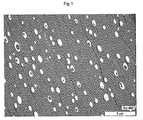
- the composite material appeared to consist of a dispersion of 1.1 ⁇ m (D50 surface) PLA capsule particles in a PS matrix (see fig 1 ).
- fig 1 the white particules (capsules) are in PLA, some of them contain inclusions of polystyrene (in grey).
- Example 2 PS-PLA "reactor blend" with PLA-g-PS compatibilizer formed in situ during styrene radical polymerization.
- PS-PLA polymer composite exhibited properties very similar to a commercial general purpose PS of equivalent melt-flow index (see Scheme (5)), except for transparency, the composite being opaque.
- Example 3 HiPS-PLA "reactor blend" with PLA-g-PS and polybutadiene- grafted -PS compatibilizers formed both in situ during styrene radical polymerization.
- 35 g (5%wt) of pre-dried commercial PLA from Unitika (TERRAMACTM TE-4000) were dissolved for 3 hours at 80°C in a 6%wt polybutadiene rubber (CB 528 T low-cis rubber supplied by Lanxess) in solution in styrene (42 g of polybutadiene dissolved into 563.5 g of commercial styrene monomer) and ethylbenzene (42 g, 6 %wt).
- CB 528 T low-cis rubber supplied by Lanxess 6%wt polybutadiene rubber supplied by Lanxess
- styrene 42 g of polybutadiene dissolved into 563.5 g of commercial styrene monomer
- ethylbenzene 42 g, 6 %wt
- the composite material appeared to consist of a dispersion of 1.3 ⁇ m (D50 surface) polybutadiene and PLA particles in a PS matrix.
- the TEM analysis revealed that both the rubber and PLA dispersed phases were made of particles characterized by the so-called salami morphology (see Figure 2 ).
- TEM photo OsO4 used to tint the rubber
- In grey polystyrene, the matrix.
- PLA said PLA contain one or more PS inclusions.
- There are other particules, not white and not black These are particules of the salami type made of polybutadiene rubber and completely filled with PS inclusions. Said PS inclusions are of a lighter grey than the grey of the matrix.
Landscapes
- Chemical & Material Sciences (AREA)
- Health & Medical Sciences (AREA)
- Chemical Kinetics & Catalysis (AREA)
- Medicinal Chemistry (AREA)
- Polymers & Plastics (AREA)
- Organic Chemistry (AREA)
- Graft Or Block Polymers (AREA)
- Compositions Of Macromolecular Compounds (AREA)
- Processes Of Treating Macromolecular Substances (AREA)
Abstract
Description
- The present invention concerns a process to make a monovinylaromatic polymer composition comprising a polymer made from renewable resources as a dispersed phase. Common plastic material production draws on fossil (i.e. non-renewable) reserves thus contributing to the depletion of essential and increasingly scare resources for mankind. Beyond recycling used plastic materials or valorising plastic wastes as fuel in incinerators for heat and electricity supply, it is desirable to incorporate some parts of polymers made from renewable resources in conventional plastics coming from petrochemistry. PLA (Poly(lactic acid)) is probably one of the so-called bio-polymers presenting the highest potential in terms of physical and mechanical properties, but also processability, considered as very close to polystyrene' ones. Other bio-sourced polymers may be contemplated, and more especially biodegradable polyesters such as polyhydroxyalkanoates (PHAs).
- Japanese patent application published on 29 september 2005 under the No
JP 2005-264086 - Japanese patent application published on 18 january 2000 under the No
JP 2000-017038 -
US 7160948 in example 1 describes a composition as follows: 26.3% by weight of polylactic acid, 26.3% by weight of polymethyl methacrylate, 11.6% by weight of polyolefin and 35.8% by weight of a block copolymer of methyl methacrylate and styrene, said block copolymer comprising 30% of PS. This means clearly that the polystyrene is not the major part of the composition. - Japanese patent application published on 8 december 2005 under the No
JP 2005-336666 -
WO 92-04413 - It has now been discovered a process to make monovinylaromatic polymer compositions comprising a finely dispersed phase of at least one polymer made from renewable resources. Said polymer made from renewable resources can be selected from poly(α-hydroxyacids) and polyhydroxyalkanoates. Among these latters, polylactic acid (PLA), poly-3-hydroxybutyrate (P3HB), polyhydroxyvalerate (PHV), polyhydroxyhexanoate (PHH), polyhydroxyoctanoate (PHO) and their copolymers are mostly preferred. Most preferably, PLA is used as the bio-sourced dispersed polymer phase. Said compositions can be made as follows:
- by polymerizing monovinylaromatic monomer in the presence of functionalized bio-sourced polymers, or mixtures of bio-sourced polymers and functionalized bio-sourced polymers; or
- by polymerizing monovinylaromatic monomer in the presence of bio-sourced polymers and at conditions effective to generate a compatibilizer of bio-sourced polymers and monovinylaromatic polymer.
- Optionally these compositions comprise a rubber.
- YUAN Z ET AL: "Macroporous poly(I-lactide) of controlled pore size derived from the annealing of co-continuous polystyrene/poly(I-lactide) blends" BIOMATERIALS, ELSEVIER SCIENCE PUBLISHERS BV., BARKING, GB, vol. 25, no. 11, May 2004 (2004-05), pages 2161-2170, XP004485134 relates to a composition made by melt blending PLA and polystyrene (page 2163-§2.2).
- SARAZIN PIERRE ET AL: "Morphology control in co-continuous poly(L-lactide)/polystyrene blends: A route towards highly structured and interconnected porosity in poly(L-lactide) materials" BIOMACROMOLECULES, vol. 4, no. 6, 2003, pages 1669-1679, XP002450897 relates to a composition made by melt blending PLA and polystyrene (page 1671-§2.5).
- FARAH ET AL: "Poly(epsilon-caprolactone)-block-polystyrene metallopolymers via sequential ROP and ATRP condition with in situ generated ruthenium catalyst" POLYMER, ELSEVIER, OXFORD, GB, vol. 47, no. 12, 31 May 2006 (2006-05-31), pages 4282-4291, XP005459645 ISSN: 0032-3861 relates to the copolymerization of styrene and caprolactone. Caprolactone is a linear C6 hydroxy acid which is not in the formula of our claimed bio-polymer.
- The present invention relates to a process to make a monovinylaromatic polymer composition comprising a bio-sourced polymer dispersed phase and optionally a rubber dispersed phase, said process comprising admixing :
- a monovinylaromatic monomer,
- at least one bio-sourced polymer,
- optionally a rubber,
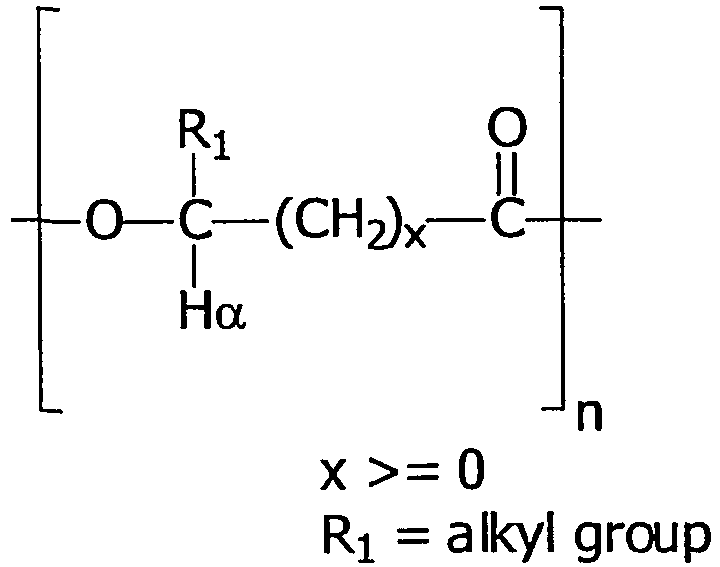
- at conditions effective to polymerize at least a part of the monovinylaromatic monomer and generate a compatibilizer of the bio-sourced polymer(s) and the monovinylaromatic polymer, wherein the bio-sourced polymer has the following formula :
- The present invention also relates to a process to make a monovinylaromatic polymer composition comprising a bio-sourced polymer dispersed phase and optionally a rubber dispersed phase, said process comprising admixing :
- a monovinylaromatic monomer,
- at least one functionalized bio-sourced polymer, or mixtures of at least one bio-sourced polymer and functionalized bio-sourced polymer(s),
- optionally a rubber,
- at conditions effective to polymerize at least a part of the monovinylaromatic monomer, wherein the bio-sourced polymer has the following formula :

- The bio-sourced polymer particles can contain monovinylaromatic polymer inclusions, which means any bio-sourced polymer particle may contain itself at least one sub-particle of monovinylaromatic polymer.
- In the optional case where a rubber has been incorporated in the initial formulation, the rubber and bio-sourced polymer phases are present as independent particles characterized by a more or less spherical shape and dispersed within the PS continuous phase. Both the rubber and bio-sourced particles may contain at least one sub-particle of occluded vinyl aromatic polymer. Rubber and bio-sourced polymer particles containing a single encapsulated sub-particle of vinyl aromatic polymer - also called "occlusion" - are typically referred as capsule or "core-shell" particles, whereas those containing at least 2 vinyl-aromatic occluded particles are of the so-called "salami" morphology type. These two types of dispersed phase morphologies can be encountered whatever the dispersed phase considered in the product obtained according to the present invention. Depending on the level of grafting of both the bio-sourced polymer and the optional rubber, core-shell, salami or other morphologies (e.g. labyrinths, onions, rods, droplets...) may be generated.
- Advantageously the weight proportions of the monovinylaromatic polymer composition are:
- 50 to 99% of monovinylaromatic polymer,
- 1 to 50% of bio-sourced polymer,
- 0 to 35% of rubber,
- with the condition that the proportions of bio-sourced polymer+rubber is 1 to 50% for respectively 99 to 50% of monovinylaromatic polymer.
- Preferably the weight proportions of the monovinylaromatic polymer composition are:
- 70 to 99% of monovinylaromatic polymer,
- 1 to 30% of bio-sourced polymer,
- 0 to 25% of rubber,
- with the condition that the proportions of bio-sourced polymer+rubber is 1 to 30% for respectively 99 to 70% of monovinylaromatic polymer.
- More preferably the weight proportions of the monovinylaromatic polymer composition are:
- 80 to 99% of monovinylaromatic polymer,
- 1 to 20% of bio-sourced polymer,
- 0 to 15% of rubber,
- with the condition that the proportions of bio-sourced polymer+rubber is 1 to 20% for respectively 99 to 80% of monovinylaromatic polymer.
- More preferably the weight proportions of the monovinylaromatic polymer composition are:
- 80 to 95% of monovinylaromatic polymer,
- 5 to 20% of bio-sourced polymer,
- 0 to 15% of rubber,
- with the condition that the proportions of bio-sourced polymer+rubber is 5 to 20% for respectively 95 to 80% of monovinylaromatic polymer.
- In addition to the monovinylaromatic polymer, the bio-sourced polymer and the rubber, the monovinylaromatic polymer composition of the invention can comprise additives. Exemplary additives include fillers such as chain transfer agents, talc or any mineral filler organoclays (clays wetted by an organic compatibilizer), anti-oxidants, UV stabilizers, lubricants, mineral oil, silicon oil, vegetable oil, PE, PP or PTFE waxes, plasticizers, pigments, carbon black, flame retardants. Any additive known to be useful in monovinylaromatic polymers to those of ordinary skill in the art of such polymers can be used within the present invention.
- As regards the monovinylaromatic monomer, it relates to any aromatic bearing a vinyl function. By way of example, mention may be made of styrene, vinyl toluene, alphamethylstyrene, alphaethylstyrene, methyl-4-styrene, methyl-3-styrene, methoxy-4-styrene, hydroxymethyl-2-styrene, ethyl-4-styrene, ethoxy-4-styrene, dimethyl-3,4-styrene, chloro-2-styrene, chloro-3-styrene, chloro-4-methyl-3-styrene, tert.-butyl-3-styrene, dichloro-2,4-styrene, dichloro-2,6-styrene,vinyl-1-naphtalene and vinylanthracene. It would not depart from the scope of the invention to use more than one monovinylaromatic monomer. A part of the monovinylaromatic monomer may be replaced by unsaturated monomers copolymerizable with styrene. By way of example mention may be made of alkyl esters of acrylic or methacrylic acid, acrylonitrile and methacrylonitrile. The proportion of comonomer may be from 0 to 50% by weight for respectively 100 to 50% of the monovinylaromatic monomer. In a specific embodiment the monovinylaromatic polymer comprises :
- i) from 60 to 100 weight % of one or more C8-12 monovinylaromatic monomers; and
- ii) from 0 to 40 weight % of one or more monomers selected from the group consisting of C1-4 alkyl esters of acrylic or methacrylc acid and acrylonitrile and methacrylonitrile.
- As regards the bio-sourced polymers, should be preferably chosen among polylactic acids and polyhydroxybutyrates. PLA is the most preferred bio-sourced polymer. Advantageously high-Mw (> 100,000) PLA is used. High-Mw (> 100,000) PLA is a commercially available bio-sourced polymer manufactured by Ring Opening Polymerization of lactide. Lactide is the product of thermal dimerization of lactic acid, itself produced by fermenting pure (glucose, saccharose, lactose...) or impure (starch, molasses, lactoserum...) natural carbon substrates. PLA general formula is :

- D,L- or L,L-poly(lactic acids) can both be used in the framework of the present invention.
- As regards the rubber, mention may be made of EPR (the abbreviation for ethylene-propylene rubber or ethylene- propylene elastomer), EPDM (the abbreviation for ethylene- propylene-diene rubber or ethylene-propylene-diene elastomer), polybutadiene, acrylonitrile-butadiene copolymer, polyisoprene, isoprene-acrylonitrile copolymer, SBR (Styrene butadiene rubber), styrenic block copolymers with a hydrogenated midblock of styrene-ethylene/butylene-styrene (SEBS) or styrene-ethylene/propylene-styrene (SEPS), and any copolymer having styrene blocks. More particularly the copolymers having styrene blocks are advantageously copolymers with styrene blocks and blocks made of butadiene or isoprene or of a mixture butadiene /isoprene. These block copolymers can be linear block copolymers or star block copolymers, hydrogenated and/or functionalized. These copolymers are described in ULLMANN'S ENCYCLOPEDIA OF INDUSTRIAL CHEMISTRY, fifth edition (1995) Vol A26, pages 655-659. They are sold by Total Petrochemicals under the trade mark Finaclear®, by BASF under the trade mark Styrolux®, by Kraton under the trade name of Kraton® D, and under the trade mark K-Resin® by Chevron Phillips Chemical.
- By way of example the rubber can be selected from the group consisting of:
- a) co- and homopolymers of C4-6 conjugated diolefins,
- b) copolymers comprising from 60 to 85 weight % of one or more C4-6 conjugated diolefins and from 15 to 40 weight % of a monomer selected from the group consisting of acrylonitrile and methacrylonitrile and
- c) copolymers comprising from 20 to 60, preferably from 40 to 50 weight % of one or more C8-12 vinyl aromatic monomers which are unsubstituted or substituted by a C1-4 alkyl radical and from 60 to 40, preferably from 60 to 50 weight % of one or more monomers selected from the group consisting of C4-6 conjugated diolefins. The rubber may be prepared by a number of methods, preferably by emulsion or solution polymerization. These processes are well known to those skilled in the art. It would not depart from the scope of the invention to use more than one rubber.
- The monovinylaromatic polymer compositions of the present invention are useful as environmental-friendly substitutes of general purpose monovinylaromatic polymer (by way of example GPPS) or high-impact monovinylaromatic polymer (by way of example HiPS), insofar as they incorporate a fraction of material made from renewable resources. They may be foamed, extruded & thermoformed or injected & moulded to form articles similar to those commonly made of GPPS, HiPS, or ABS. More particularly, they can be wisely used for making food packagings or disposable items which can be burnt after use for producing heat or electricity. In that case, the green-house gas balance is more favourable compared to conventional styrenic polymers as a part of the material was made from vegetable-origin resources and CO2 was captured from the atmosphere during their cultivation.
- As regards the process to make said monovinylaromatic polymer composition, said process comprising admixing:
- a monovinylaromatic monomer,
- at least one bio-sourced polymer,
- optionally a rubber,
- at conditions effective to polymerize at least a part of the monovinylaromatic monomer and generate in situ a compatibilizer of the bio-sourced polymer and the monovinylaromatic polymer. It can be carried out in a conventional manner by bulk polymerization, solution polymerization, or polymerization in aqueous dispersion, the bio-sourced polymer (or the bio-sourced polymer and the rubber) first being dissolved in the polymerizable monomer, this solution being then subjected to polymerization in the possible presence of a radical initiator. Advantageously the process of the invention is carried out as a diluted bulk polymerization process. When using diluted bulk polymerization, the starting solution may be mixed with up to about twenty percent (20%) by weight, based on the monovinylaromatic monomer employed, of an inert solvent so as to lower the polymerization bulk viscosity, to moderate polymerization heat and to improve thermal exchanges and heat homogeneity within the bulk. Suitable diluents include aromatic solvents such as ethylbenzene, toluene, xylenes, cyclohexane, and aliphatic hydrocarbon solvents, such as dodecane, and mixtures thereof. The diluent can also consists of a mixture of the abovementioned solvents, or a mixture of one of these solvents with the vinylaromatic monomer used for the purpose of the present invention. In that latter case, the diluent is typically made of recycled solvent and unreacted vinylaromatic monomer, often referred as "recycles". Any solvent useful to improve heat homogeneity within the bulk during polymerization, that can be removed after polymerization of the monovinylaromatic monomer, and that does not interfere with the polymerization of the monovinylaromatic monomer and the optional comonomer(s), can be used with the process of the present invention.
- Suitable chain transfer agents, e.g. mercaptans or alphamethyl styrene dimer, may also be added to control polymer molecular weight and the bio-courced polymer and optional rubber particle sizes.
- The bio-sourced polymer (or the bio-sourced polymer and the rubber) is "dissolved" in the monovinylaromatic monomer (actually the rubber is infinitely swollen with the monomer). Monovinylaromatic polymer is initially formed from the monovinylaromatic monomer within the homogeneous bio-sourced polymer (or bio-sourced polymer and rubber) solution in monovinylaromatic monomer. At the beginning of the polymerization the reacting solution is at a point prior to the bio-sourced polymer (or bio-sourced polymer and rubber) / monovinylaromatic monomer inversion point, i.e. the point at which the solution being reacted goes from monovinylaromatic polymer particles in a bio-sourced polymer (or bio-sourced polymer and rubber) / monovinylaromatic monomer matrix to bio-sourced polymer (or bio-sourced polymer and rubber) particles in a monovinylaromatic polymer matrix. In other words when the monovinylaromatic polymer phase volume fraction approximately equals the bio-sourced polymer (or bio-sourced polymer and rubber) phase volume fraction, a phase inversion occurs e.g. the monovinylaromatic monomer / monovinylaromatic polymer phase becomes continuous and the bio-sourced polymer (or bio-sourced polymer and rubber) phase becomes discontinuous.
- When there is no rubber, monovinylaromatic monomer is polymerized around and within the bio-sourced polymer particles which leads to monovinylaromatic polymer inclusions in the bio-sourced polymer particles.
- A portion of the monovinylaromatic monomer is polymerized by grafting on the bio-sourced polymer (or bio-sourced polymer and rubber) due to the presence in the bio-sourced polymer macromolecules of labile hydrogen atoms that can be easily abstracted in the presence of active radicals (possibly coming from the initiator). Hydrogen atoms-abstraction from bio-sourced polymer macromolecules results in the in situ production of bio-sourced polymer - graft-monovinylaromatic copolymers that act as emulsifier for the bio-sourced polymer -in-monovinylaromatic monomer phase dispersed within the monovinylaromatic polymer-in monovinylaromatic monomer continuous phase. These bio-sourced polymer -graft-monovinylaromatic copolymers are compatibilizers of the bio-sourced polymer and monovinylaromatic polymer.
- This process leads to bio-sourced polymer dispersed phase morphologies very similar to the rubber phase morphologies that can be obtained in convention HiPS (High Impact Polystyrene) process: depending on the bio-sourced polymer grafting level, bio-sourced polymer morphologies can consists of salami-like or capsule (core-shell) particles. The bio-sourced polymer grafting level can be easily adjusted by introducing in the polymerization bulk adapted initiators or grafting promoters, such as organic peroxides (e.g. 1,1-di-(t-butylperoxy)cyclohexane; 1,1-di-(t-amylperoxy)cyclohexane); 1,1-di-(t-butylperoxy)-3,3,5-trimethyl-cyclohexane; 00-t-amyl-0-(2-ethylbexyl monoperoxy-carbonate); 00-t-butyl O-isopropyl monoperoxy-carbonate; 00-t-butyl-0-(2-ethylhexyl) monoperoxy-carbonate; butyl 4,4-di(t-butylperoxy)valerate; Ethyl 3,3-Di-(t-butylperoxy)butyrate; and mixtures thereof), hydroperoxides, singlet-oxygen (1O2) or amine-complexed boranes possibly in combination with the above mentioned peroxides. Grafting promoter amounts are typically within the 0 -1000 ppm range.
- When the rubber is present, most of the bio-sourced polymer generates a secondary population of dispersed particles. These dispersed bio-sourced polymer particles may entrap at least one occluded PS sub-particles and exhibit the particle inner morphologies typically encountered in the conventional HiPS process, e.g. salami, capsule, labyrinth, rod or droplet morphologies.
- In this specific process, the compositions of the invention can be produced batchwise or continuously in a series of continuously tank reactors and/or plug-flow reactors; the reactor wherein phase inversion occurs being called "inversion reactor". The reactors downstream of the inversion reactor allow the vinylaromatic monomer polymerization to proceed further until a solid content sufficiently high (typically 60-90%wt) for degassing the composition of the invention using the conventional flash-devolatilization or vacuum-extrusion technologies. A styrenic composite material containing a part of bio-sourced polymer is obtained therefrom.
- As regards the process to make said monovinylaromatic polymer composition, said process comprising admixing :
- a monovinylaromatic monomer,
- functionalized bio-sourced polymer, or mixtures of bio-sourced polymer and
- functionalized bio-sourced polymer,
- optionally a rubber,
- at conditions effective to polymerize at least a part of the monovinylaromatic monomer, the main difference with the first process is the use of a functionalized bio-sourced polymer, or mixtures of bio-sourced polymer and functionalized bio-sourced polymer. Other conditions are similar. The use of radical initiators such as peroxides is optional. This functionalized bio-sourced polymer is any modified bio-sourced polymer which leads to the in situ production of bio-sourced polymer -graft-monovinylaromatic copolymers when said modified bio-sourced polymer is in contact with monovinylaromatic monomer under conditions effective to polymerize at least a part of said monovinylaromatic monomer. This modified bio-sourced polymer may be referred also as bio-sourced polymer macro-initiator. They are prepared prior to the admixing with the monovinylaromatic monomer. By way of example said functionalized bio-sourced polymer can be prepared by reacting the bio-sourced polymer with :
- i) functionalized alkoxyamines,
- ii) functionalized comonomers, such as acrylic acid, methacrylic acid, acrylates, methacrylates, vinyl alcohol, vinyl phosphonic acid, methacryloyl chloride, maleic anhydride.
- iii) functionalised chain transfer agents,
- iv) functionalized organic initiators (for instance, Akzo V50 azo- initiator),
- v) mixtures of organic peroxides generating during thermal decomposition H-abstracting radicals; and nitroxyl stable free radicals, in an adapted solvent.
- Functionalized alkoxyamines (i) are molecules bearing at least:
- a) one chemical function able to react readily with the bio-sourced polymer alcohol and/or carboxyl acid end-groups;
- b) an alkoxyamine function that can decompose and generate an active radical group when heated above about 60°C combined with a stable nitroxyl radical. The so-called active radical can initiate styrenic monomer polymerization.
- Examples of suitable alkoxyamines are depicted below:

- Alkoxyamines from Arkema's BlocBuilder™ commercial range, such as (2), can be advantageously used for chemically converting the bio-sourced polymer into a macroinitiator.
- Functionalised chain transfer agents (iii) are molecules bearing at least: one chemical function able to react readily with the bio-sourced polymer alcohol and/or carboxyl acid end-groups;
a functional group able to undergo radical chain transfer reactions with (macro)radicals during styrene polymerization. - Examples of suitable chain transfer agents are: mercapto-ethanol, mercapto-acetic acid, mercapto-ethylamine hydrochloride.
- About (v), this specific process takes advantage of the presence in the bio-sourced polymer macromolecules of labile hydrogen atoms that can be easily abstracted in the presence of active radicals (see Scheme (2) below for PLA used as an illustration model). The resulting bio-sourced polymer macro-radicals are trapped by Nitroxyle counter-radicals to form dormant bio-sourced polymer macro-initiators that can be activated by heat.

- In all cases, the resulting functionalized bio-sourced polymer chains exhibit at least one radical-active function. A radical-active function is a reactive group able to generate one or several reactive radicals above a given temperature and/or in the presence of radicals. In the example described below, the radical-active function is an alcoxyamine group and the considered bio-sourced polymer is PLA:

- It would not depart from the scope of the invention to replace, in whole or in part, the functionalized bio-sourced polymer by a blend of the bio-sourced polymer and a block copolymer having at least a block consisting essentially of poly(alkylmethacrylate) or poly(alkylacrylate) and at least a block consisting essentially of a monovinylaromatic polymer. Example of alkylmethacrylate is methylmethacrylate, example of alkylacrylate is methylacrylate. By way of example, copolymers having polystyrene blocks and PMMA (polymethylmethacrylate) blocks are described in
US 5264527 andEP 1085029 . By way of example, copolymers having a polystyrene block, a polybutadiene block and a PMMA block are described inUS 7144952 . - 150 µmol of benzoyl peroxide (BPO 75%wt commercial solution -0,050 g) and 86 µmol (0,044 g) of stable free nitroxyl radicals Prostab 5415 from Ciba Specialties are added to a 20%wt PLA (TERRAMAC™ TE-4000 from Unitika, 50 g) solution in dichloroethane (400 g). The solution is then heated and maintained under vigorous agitation at 80°C for 3 hours. The resulting polymer containing some parts of nitroxyle-functionalized PLA chains is subsequently precipitated in methanol, filtered and dried under primary vacuum at room temperature. 70 g (10%wt) of this partly modified PLA were dissolved for 3 hours at 80°C in styrene (602 g, 86%wt) and ethylbenzene (28 g, 4 %wt). When dissolution was completed, the PLA in styrene and EB solution was transferred into a 1.5 liter continuously stirred batch reactor. 0.530 g (500 ppm) of a 75%wt solution of isopropyl peroxycarbonate in isododecane were then added and the solution temperature was raised to 125°C so as to allow styrene to polymerize. When solid content reached 60%wt, the polymer solution was poured in alumina panels and heated at 150°C for 3 hours and 180°C for 2 hours in an oven for polymerization finishing. The final polymer composite was submitted to laser granulometry and transmission electron microscopy analyses. The composite material appeared to consist of a dispersion of 1.1 µm (D50 surface) PLA capsule particles in a PS matrix (see
fig 1 ). Infig 1 the white particules (capsules) are in PLA, some of them contain inclusions of polystyrene (in grey). - 1100 g of PLA (TERRAMAC™ TE-4000 from Unitika) were pre-dried at 100°C for 4 hours prior to being dissolved under vigorous agitation for 2 hours at 90°C in a 20 liter batch reactor containing 9460 g styrene monomer and 440 g ethylbenzene. Once dissolution was complete, 8.25 g (750 ppm as it is) of a 75%wt isopropyl peroxycarbonate solution in isododecane were injected and the whole solution was set to polymerize at 120°C until a 65%wt solid content was reached. The reaction bulk was then preheated and degassed in a flash-devolatilizer at 230°C and 43 torrs. The resulting polymer composite was finally extruded and pelletized. Laser granulometry and transmission electron microscopy analyses revealed that the PS-PLA composite material consisted of a dispersion of 0.4 µm capsule-like PLA particles in PS. Rheological and mechanical properties are tabulated below:
Product Commercial GPPS Total Petrochemicals 1450N PS-PLA Reactor Blend of Example 2 Melt Rheology @ 200°C MFI (gr/10 min) 6.5 9.6 [η]0 (Pa.s) 4950 8100 [η] @ 10s-1 (Pa.s) 2240 2200 [η] @ 100s-1 (Pa.s) 670 610 Elongational Rheology Melt-Strength, Fmax (N) 0.128 0.114 Max. take-Up Speed (m/min) 250 184 Thermal Properties Vicat 50 N (°C) 100.2 100.0 Mechanical Properties Unnotched Charpy (kJ/m2) 9.1 8.0 Reversion (%) 35 36.7 Flex. Modulus (MPa) 3280 3216 Deformation @ Brk under flexion (%) 2.2 1.7 - The thus obtained PS-PLA polymer composite exhibited properties very similar to a commercial general purpose PS of equivalent melt-flow index (see Scheme (5)), except for transparency, the composite being opaque.

- 35 g (5%wt) of pre-dried commercial PLA from Unitika (TERRAMAC™ TE-4000) were dissolved for 3 hours at 80°C in a 6%wt polybutadiene rubber (CB 528 T low-cis rubber supplied by Lanxess) in solution in styrene (42 g of polybutadiene dissolved into 563.5 g of commercial styrene monomer) and ethylbenzene (42 g, 6 %wt). When dissolution was completed, the PLA in styrene and EB solution was transferred into a 1.5 liter continuously stirred batch reactor. 0.140 g (200 ppm) of a 75%wt solution of isopropyl peroxycarbonate in isododecane and 0.470 g (670 ppm) of Irganox 1076 antioxidant (supplied by Ciba Specialties) were then added and the solution temperature was raised to 125°C so as to allow styrene to polymerize. When solid content reached 50%wt, the polymer solution was poured in alumina panels and heated at 150°C for 3 hours and 180°C for 2 hours in an oven for polymerization finishing. The final polymer composite was submitted to laser granulometry and transmission electron microscopy (TEM) analyses. The composite material appeared to consist of a dispersion of 1.3 µm (D50 surface) polybutadiene and PLA particles in a PS matrix. The TEM analysis revealed that both the rubber and PLA dispersed phases were made of particles characterized by the so-called salami morphology (see
Figure 2 ).
TEM photo (OsO4 used to tint the rubber)
In (deep) dark: polybutadiene rubber
In grey: polystyrene, the matrix.
In white: PLA, said PLA contain one or more PS inclusions.
There are other particules, not white and not black : These are particules of the salami type made of polybutadiene rubber and completely filled with PS inclusions. Said PS inclusions are of a lighter grey than the grey of the matrix.
Claims (4)
- Process to make a monovinylaromatic polymer composition comprising a bio-sourced polymer dispersed phase and optionally a rubber dispersed phase, said process comprising admixing :a monovinylaromatic monomer,at least one bio-sourced polymer,optionally a rubber,at conditions effective to polymerize at least a part of themonovinylaromatic monomer and generate a compatibilizer of the bio-sourced polymer(s) and the monovinylaromatic polymer, wherein the bio-sourced polymer has the following formula :

- Process to make a monovinylaromatic polymer composition comprising a bio-sourced polymer dispersed phase and optionally a rubber dispersed phase, said process comprising admixing :a monovinylaromatic monomer,at least one functionalized bio-sourced polymer, or mixtures of at least one bio-sourced polymer and functionalized bio-sourced polymer(s),optionally a rubber,at conditions effective to polymerize at least a part of the monovinylaromatic monomer, wherein the bio-sourced polymer has the following formula :

- Process according to claim 1 or 2 wherein the bio-sourced polymer is selected among polyhydroxyacids and polyhydroxyalkanoates.
- Process according to claim 3 wherein the said bio-sourced polymer is Poly(lactic acid), polyhydroxybutyrate, polyhydroxyvalerate, polyhydroxyhexanoate or polyhydroxyoctanoate.
Priority Applications (2)
| Application Number | Priority Date | Filing Date | Title |
|---|---|---|---|
| PL08718007T PL2132261T3 (en) | 2007-03-30 | 2008-03-19 | Process to make a monovinylaromatic polymer composition comprising a polymer made from renewable resources as a dispersed phase |
| EP08718007A EP2132261B1 (en) | 2007-03-30 | 2008-03-19 | Process to make a monovinylaromatic polymer composition comprising a polymer made from renewable resources as a dispersed phase |
Applications Claiming Priority (3)
| Application Number | Priority Date | Filing Date | Title |
|---|---|---|---|
| EP07290396A EP1975201A1 (en) | 2007-03-30 | 2007-03-30 | Monovinylaromatic polymer composition comprising a polymer made from renewable resources as a dispersed phase |
| EP08718007A EP2132261B1 (en) | 2007-03-30 | 2008-03-19 | Process to make a monovinylaromatic polymer composition comprising a polymer made from renewable resources as a dispersed phase |
| PCT/EP2008/053281 WO2008119668A1 (en) | 2007-03-30 | 2008-03-19 | Monovinylaromatic polymer composition comprising a polymer made from renewable resources as a dispersed phase |
Publications (2)
| Publication Number | Publication Date |
|---|---|
| EP2132261A1 EP2132261A1 (en) | 2009-12-16 |
| EP2132261B1 true EP2132261B1 (en) | 2012-06-20 |
Family
ID=38434653
Family Applications (2)
| Application Number | Title | Priority Date | Filing Date |
|---|---|---|---|
| EP07290396A Withdrawn EP1975201A1 (en) | 2007-03-30 | 2007-03-30 | Monovinylaromatic polymer composition comprising a polymer made from renewable resources as a dispersed phase |
| EP08718007A Not-in-force EP2132261B1 (en) | 2007-03-30 | 2008-03-19 | Process to make a monovinylaromatic polymer composition comprising a polymer made from renewable resources as a dispersed phase |
Family Applications Before (1)
| Application Number | Title | Priority Date | Filing Date |
|---|---|---|---|
| EP07290396A Withdrawn EP1975201A1 (en) | 2007-03-30 | 2007-03-30 | Monovinylaromatic polymer composition comprising a polymer made from renewable resources as a dispersed phase |
Country Status (8)
| Country | Link |
|---|---|
| US (2) | US8575271B2 (en) |
| EP (2) | EP1975201A1 (en) |
| JP (1) | JP2010523732A (en) |
| KR (1) | KR101207819B1 (en) |
| CN (1) | CN101679704B (en) |
| ES (1) | ES2389746T3 (en) |
| PL (1) | PL2132261T3 (en) |
| WO (1) | WO2008119668A1 (en) |
Families Citing this family (7)
| Publication number | Priority date | Publication date | Assignee | Title |
|---|---|---|---|---|
| JP5467871B2 (en) * | 2008-01-11 | 2014-04-09 | 株式会社カネカ | Composition and molded body thereof |
| CN102276965B (en) * | 2011-06-25 | 2013-03-06 | 四川大学 | Method for toughening and modifying polylactic acid by natural rubber |
| US8957152B2 (en) * | 2011-06-29 | 2015-02-17 | Fina Technology, Inc. | Polarity manipulation in polystyrene for enhanced bio-polymer miscibility |
| FR2994435B1 (en) * | 2012-08-09 | 2014-10-24 | Arkema France | POLYMER COMPOSITION BASED ON PLA |
| US20200190308A1 (en) * | 2016-09-06 | 2020-06-18 | Total Research & Technology Feluy | Improved Monovinlyaromatic Polymer Composition Comprising Biopolymer |
| EP4183828A4 (en) * | 2020-07-17 | 2024-10-09 | Kaneka Corporation | ALIPHATIC POLYESTER-BASED RESIN COMPOSITION AND USE THEREOF |
| CN118834471B (en) * | 2024-09-23 | 2025-01-24 | 杭州师范大学 | A rigid-toughness balanced polypropylene composite material and preparation method thereof |
Citations (1)
| Publication number | Priority date | Publication date | Assignee | Title |
|---|---|---|---|---|
| EP1911807A1 (en) * | 2005-08-04 | 2008-04-16 | Toray Industries, Inc. | Resin composition and molded article comprising the same |
Family Cites Families (11)
| Publication number | Priority date | Publication date | Assignee | Title |
|---|---|---|---|---|
| EP0548284A1 (en) * | 1990-09-06 | 1993-06-30 | Biopak Technology Ltd | Packaging thermoplastics from lactic acid |
| JP3349755B2 (en) | 1993-04-15 | 2002-11-25 | 三井化学株式会社 | Macromonomer |
| GB9420644D0 (en) * | 1994-10-13 | 1994-11-30 | Dow Chemical Co | Non-linear styrenic polymer-based foams |
| CN1159462A (en) * | 1996-03-09 | 1997-09-17 | 拜奥帕克技术有限公司 | Legradable thermoplastics from lactides |
| CA2305928A1 (en) * | 1999-04-15 | 2000-10-15 | Elf Atochem North America, Inc. | Process for preparation of elastomer modified polymer compositions with enhanced rubber phase volume fraction |
| US7053125B2 (en) * | 2002-11-14 | 2006-05-30 | The Board Of Trustees Of The University Of Illinois | Controlled dispersion of colloidal suspension by comb polymers |
| JP2004196718A (en) * | 2002-12-19 | 2004-07-15 | Shiro Seiyama | Microencapsulated agrochemical preparation and method for producing the same |
| ATE509985T1 (en) * | 2004-09-17 | 2011-06-15 | Toray Industries | RESIN COMPOSITION AND MOLDED BODY THEREOF |
| CN101142282B (en) * | 2005-03-11 | 2013-10-02 | 富士通株式会社 | Plant resin composition and plant resin molded article |
| JP4611117B2 (en) * | 2005-05-30 | 2011-01-12 | シーピー化成株式会社 | Thermoplastic resin foam sheet and method for producing the sheet container |
| JP2007321141A (en) * | 2006-05-01 | 2007-12-13 | Toray Ind Inc | Block copolymer containing polylactic acid segment, method for producing the same, and resin composition |
-
2007
- 2007-03-30 EP EP07290396A patent/EP1975201A1/en not_active Withdrawn
-
2008
- 2008-03-19 CN CN2008800159345A patent/CN101679704B/en not_active Expired - Fee Related
- 2008-03-19 WO PCT/EP2008/053281 patent/WO2008119668A1/en not_active Ceased
- 2008-03-19 EP EP08718007A patent/EP2132261B1/en not_active Not-in-force
- 2008-03-19 JP JP2010500222A patent/JP2010523732A/en active Pending
- 2008-03-19 KR KR1020097020321A patent/KR101207819B1/en not_active Expired - Fee Related
- 2008-03-19 PL PL08718007T patent/PL2132261T3/en unknown
- 2008-03-19 US US12/593,957 patent/US8575271B2/en not_active Expired - Fee Related
- 2008-03-19 ES ES08718007T patent/ES2389746T3/en active Active
-
2013
- 2013-03-20 US US13/847,855 patent/US9371446B2/en not_active Expired - Fee Related
Patent Citations (1)
| Publication number | Priority date | Publication date | Assignee | Title |
|---|---|---|---|---|
| EP1911807A1 (en) * | 2005-08-04 | 2008-04-16 | Toray Industries, Inc. | Resin composition and molded article comprising the same |
Also Published As
| Publication number | Publication date |
|---|---|
| US20100184919A1 (en) | 2010-07-22 |
| KR101207819B1 (en) | 2012-12-05 |
| CN101679704B (en) | 2012-07-04 |
| EP2132261A1 (en) | 2009-12-16 |
| WO2008119668A1 (en) | 2008-10-09 |
| ES2389746T3 (en) | 2012-10-31 |
| US20130289208A1 (en) | 2013-10-31 |
| EP1975201A1 (en) | 2008-10-01 |
| US9371446B2 (en) | 2016-06-21 |
| PL2132261T3 (en) | 2013-01-31 |
| KR20090123932A (en) | 2009-12-02 |
| CN101679704A (en) | 2010-03-24 |
| US8575271B2 (en) | 2013-11-05 |
| JP2010523732A (en) | 2010-07-15 |
Similar Documents
| Publication | Publication Date | Title |
|---|---|---|
| US9371446B2 (en) | Monovinylaromatic polymer composition comprising a polymer made from renewable resources as a dispersed phase | |
| US6849689B2 (en) | Rubber-reinforced thermoplastic resin and rubber-reinforced thermoplastic resin composition | |
| US9862817B2 (en) | Process to make a composition comprising a monovinylaromatic polymer and a polymer made from renewable resources | |
| KR20020037767A (en) | Improved mass polymerized rubber-modified monovinylidene aromatic copolymer compositions | |
| WO2021110751A1 (en) | Thermoplastic compounds containing recycling material with superior quality | |
| EP1910435B1 (en) | Methods of producing vinyl aromatic polymers using (meth)acrylic macroinitiators | |
| KR20010071372A (en) | Shock vinylaromatic polymer by polymerisation of a vinylaromatic monomer in the presence of a stable free radical and a polymerisation initiator | |
| JP5718756B2 (en) | Thermoplastic resin composition and molded article | |
| EP2470591A1 (en) | High impact polymers and methods of making and using same | |
| JP5775401B2 (en) | Thermoplastic resin composition and molded article | |
| JP5660948B2 (en) | Thermoplastic resin composition and molded article | |
| TW201313811A (en) | Polarity manipulation in polystyrene for enhanced bio-polymer miscibility | |
| JP5860260B2 (en) | Thermoplastic resin composition and molded article | |
| KR100896208B1 (en) | Continuous production method of low gloss rubber modified resin | |
| JP5759153B2 (en) | Thermoplastic resin composition and molded article | |
| Kuehl et al. | Biobased Core-Shell Polymers | |
| JP2005179644A (en) | Transparent rubber-modified polystyrene resin | |
| JP2015131977A (en) | Thermoplastic resin composition and molded article |
Legal Events
| Date | Code | Title | Description |
|---|---|---|---|
| PUAI | Public reference made under article 153(3) epc to a published international application that has entered the european phase |
Free format text: ORIGINAL CODE: 0009012 |
|
| 17P | Request for examination filed |
Effective date: 20090930 |
|
| AK | Designated contracting states |
Kind code of ref document: A1 Designated state(s): AT BE BG CH CY CZ DE DK EE ES FI FR GB GR HR HU IE IS IT LI LT LU LV MC MT NL NO PL PT RO SE SI SK TR |
|
| 17Q | First examination report despatched |
Effective date: 20100201 |
|
| DAX | Request for extension of the european patent (deleted) | ||
| REG | Reference to a national code |
Ref country code: DE Ref legal event code: R079 Ref document number: 602008016457 Country of ref document: DE Free format text: PREVIOUS MAIN CLASS: C08L0025000000 Ipc: C08F0283020000 |
|
| GRAP | Despatch of communication of intention to grant a patent |
Free format text: ORIGINAL CODE: EPIDOSNIGR1 |
|
| RIC1 | Information provided on ipc code assigned before grant |
Ipc: C08L 25/06 20060101ALI20111109BHEP Ipc: C08F 279/02 20060101ALI20111109BHEP Ipc: C08L 67/04 20060101ALI20111109BHEP Ipc: C08L 51/08 20060101ALI20111109BHEP Ipc: C08F 283/02 20060101AFI20111109BHEP |
|
| RTI1 | Title (correction) |
Free format text: PROCESS TO MAKE A MONOVINYLAROMATIC POLYMER COMPOSITION COMPRISING A POLYMER MADE FROM RENEWABLE RESOURCES AS A DISPERSED PHASE |
|
| GRAS | Grant fee paid |
Free format text: ORIGINAL CODE: EPIDOSNIGR3 |
|
| GRAA | (expected) grant |
Free format text: ORIGINAL CODE: 0009210 |
|
| AK | Designated contracting states |
Kind code of ref document: B1 Designated state(s): AT BE BG CH CY CZ DE DK EE ES FI FR GB GR HR HU IE IS IT LI LT LU LV MC MT NL NO PL PT RO SE SI SK TR |
|
| REG | Reference to a national code |
Ref country code: GB Ref legal event code: FG4D |
|
| REG | Reference to a national code |
Ref country code: CH Ref legal event code: EP |
|
| REG | Reference to a national code |
Ref country code: AT Ref legal event code: REF Ref document number: 563053 Country of ref document: AT Kind code of ref document: T Effective date: 20120715 |
|
| REG | Reference to a national code |
Ref country code: IE Ref legal event code: FG4D |
|
| REG | Reference to a national code |
Ref country code: DE Ref legal event code: R096 Ref document number: 602008016457 Country of ref document: DE Effective date: 20120823 |
|
| PG25 | Lapsed in a contracting state [announced via postgrant information from national office to epo] |
Ref country code: SE Free format text: LAPSE BECAUSE OF FAILURE TO SUBMIT A TRANSLATION OF THE DESCRIPTION OR TO PAY THE FEE WITHIN THE PRESCRIBED TIME-LIMIT Effective date: 20120620 Ref country code: FI Free format text: LAPSE BECAUSE OF FAILURE TO SUBMIT A TRANSLATION OF THE DESCRIPTION OR TO PAY THE FEE WITHIN THE PRESCRIBED TIME-LIMIT Effective date: 20120620 Ref country code: NO Free format text: LAPSE BECAUSE OF FAILURE TO SUBMIT A TRANSLATION OF THE DESCRIPTION OR TO PAY THE FEE WITHIN THE PRESCRIBED TIME-LIMIT Effective date: 20120920 Ref country code: LT Free format text: LAPSE BECAUSE OF FAILURE TO SUBMIT A TRANSLATION OF THE DESCRIPTION OR TO PAY THE FEE WITHIN THE PRESCRIBED TIME-LIMIT Effective date: 20120620 |
|
| REG | Reference to a national code |
Ref country code: ES Ref legal event code: FG2A Ref document number: 2389746 Country of ref document: ES Kind code of ref document: T3 Effective date: 20121031 |
|
| REG | Reference to a national code |
Ref country code: NL Ref legal event code: VDEP Effective date: 20120620 |
|
| REG | Reference to a national code |
Ref country code: AT Ref legal event code: MK05 Ref document number: 563053 Country of ref document: AT Kind code of ref document: T Effective date: 20120620 |
|
| REG | Reference to a national code |
Ref country code: LT Ref legal event code: MG4D Effective date: 20120620 |
|
| PG25 | Lapsed in a contracting state [announced via postgrant information from national office to epo] |
Ref country code: LV Free format text: LAPSE BECAUSE OF FAILURE TO SUBMIT A TRANSLATION OF THE DESCRIPTION OR TO PAY THE FEE WITHIN THE PRESCRIBED TIME-LIMIT Effective date: 20120620 Ref country code: SI Free format text: LAPSE BECAUSE OF FAILURE TO SUBMIT A TRANSLATION OF THE DESCRIPTION OR TO PAY THE FEE WITHIN THE PRESCRIBED TIME-LIMIT Effective date: 20120620 Ref country code: HR Free format text: LAPSE BECAUSE OF FAILURE TO SUBMIT A TRANSLATION OF THE DESCRIPTION OR TO PAY THE FEE WITHIN THE PRESCRIBED TIME-LIMIT Effective date: 20120620 Ref country code: GR Free format text: LAPSE BECAUSE OF FAILURE TO SUBMIT A TRANSLATION OF THE DESCRIPTION OR TO PAY THE FEE WITHIN THE PRESCRIBED TIME-LIMIT Effective date: 20120921 |
|
| PG25 | Lapsed in a contracting state [announced via postgrant information from national office to epo] |
Ref country code: IS Free format text: LAPSE BECAUSE OF FAILURE TO SUBMIT A TRANSLATION OF THE DESCRIPTION OR TO PAY THE FEE WITHIN THE PRESCRIBED TIME-LIMIT Effective date: 20121020 Ref country code: EE Free format text: LAPSE BECAUSE OF FAILURE TO SUBMIT A TRANSLATION OF THE DESCRIPTION OR TO PAY THE FEE WITHIN THE PRESCRIBED TIME-LIMIT Effective date: 20120620 Ref country code: CZ Free format text: LAPSE BECAUSE OF FAILURE TO SUBMIT A TRANSLATION OF THE DESCRIPTION OR TO PAY THE FEE WITHIN THE PRESCRIBED TIME-LIMIT Effective date: 20120620 Ref country code: RO Free format text: LAPSE BECAUSE OF FAILURE TO SUBMIT A TRANSLATION OF THE DESCRIPTION OR TO PAY THE FEE WITHIN THE PRESCRIBED TIME-LIMIT Effective date: 20120620 Ref country code: CY Free format text: LAPSE BECAUSE OF FAILURE TO SUBMIT A TRANSLATION OF THE DESCRIPTION OR TO PAY THE FEE WITHIN THE PRESCRIBED TIME-LIMIT Effective date: 20120620 Ref country code: SK Free format text: LAPSE BECAUSE OF FAILURE TO SUBMIT A TRANSLATION OF THE DESCRIPTION OR TO PAY THE FEE WITHIN THE PRESCRIBED TIME-LIMIT Effective date: 20120620 Ref country code: AT Free format text: LAPSE BECAUSE OF FAILURE TO SUBMIT A TRANSLATION OF THE DESCRIPTION OR TO PAY THE FEE WITHIN THE PRESCRIBED TIME-LIMIT Effective date: 20120620 |
|
| REG | Reference to a national code |
Ref country code: PL Ref legal event code: T3 |
|
| PG25 | Lapsed in a contracting state [announced via postgrant information from national office to epo] |
Ref country code: PT Free format text: LAPSE BECAUSE OF FAILURE TO SUBMIT A TRANSLATION OF THE DESCRIPTION OR TO PAY THE FEE WITHIN THE PRESCRIBED TIME-LIMIT Effective date: 20121022 |
|
| PG25 | Lapsed in a contracting state [announced via postgrant information from national office to epo] |
Ref country code: NL Free format text: LAPSE BECAUSE OF FAILURE TO SUBMIT A TRANSLATION OF THE DESCRIPTION OR TO PAY THE FEE WITHIN THE PRESCRIBED TIME-LIMIT Effective date: 20120620 |
|
| PLBE | No opposition filed within time limit |
Free format text: ORIGINAL CODE: 0009261 |
|
| STAA | Information on the status of an ep patent application or granted ep patent |
Free format text: STATUS: NO OPPOSITION FILED WITHIN TIME LIMIT |
|
| PG25 | Lapsed in a contracting state [announced via postgrant information from national office to epo] |
Ref country code: DK Free format text: LAPSE BECAUSE OF FAILURE TO SUBMIT A TRANSLATION OF THE DESCRIPTION OR TO PAY THE FEE WITHIN THE PRESCRIBED TIME-LIMIT Effective date: 20120620 |
|
| PGFP | Annual fee paid to national office [announced via postgrant information from national office to epo] |
Ref country code: DE Payment date: 20130321 Year of fee payment: 6 Ref country code: FR Payment date: 20130408 Year of fee payment: 6 Ref country code: ES Payment date: 20130326 Year of fee payment: 6 |
|
| 26N | No opposition filed |
Effective date: 20130321 |
|
| PGFP | Annual fee paid to national office [announced via postgrant information from national office to epo] |
Ref country code: PL Payment date: 20130315 Year of fee payment: 6 |
|
| REG | Reference to a national code |
Ref country code: DE Ref legal event code: R097 Ref document number: 602008016457 Country of ref document: DE Effective date: 20130321 |
|
| REG | Reference to a national code |
Ref country code: HU Ref legal event code: AG4A Ref document number: E015803 Country of ref document: HU |
|
| PG25 | Lapsed in a contracting state [announced via postgrant information from national office to epo] |
Ref country code: BG Free format text: LAPSE BECAUSE OF FAILURE TO SUBMIT A TRANSLATION OF THE DESCRIPTION OR TO PAY THE FEE WITHIN THE PRESCRIBED TIME-LIMIT Effective date: 20120920 |
|
| PGFP | Annual fee paid to national office [announced via postgrant information from national office to epo] |
Ref country code: BE Payment date: 20130320 Year of fee payment: 6 |
|
| PGFP | Annual fee paid to national office [announced via postgrant information from national office to epo] |
Ref country code: HU Payment date: 20130325 Year of fee payment: 6 |
|
| PG25 | Lapsed in a contracting state [announced via postgrant information from national office to epo] |
Ref country code: MC Free format text: LAPSE BECAUSE OF NON-PAYMENT OF DUE FEES Effective date: 20130331 |
|
| REG | Reference to a national code |
Ref country code: CH Ref legal event code: PL |
|
| GBPC | Gb: european patent ceased through non-payment of renewal fee |
Effective date: 20130319 |
|
| REG | Reference to a national code |
Ref country code: IE Ref legal event code: MM4A |
|
| PG25 | Lapsed in a contracting state [announced via postgrant information from national office to epo] |
Ref country code: GB Free format text: LAPSE BECAUSE OF NON-PAYMENT OF DUE FEES Effective date: 20130319 Ref country code: IE Free format text: LAPSE BECAUSE OF NON-PAYMENT OF DUE FEES Effective date: 20130319 Ref country code: CH Free format text: LAPSE BECAUSE OF NON-PAYMENT OF DUE FEES Effective date: 20130331 Ref country code: LI Free format text: LAPSE BECAUSE OF NON-PAYMENT OF DUE FEES Effective date: 20130331 |
|
| PG25 | Lapsed in a contracting state [announced via postgrant information from national office to epo] |
Ref country code: MT Free format text: LAPSE BECAUSE OF FAILURE TO SUBMIT A TRANSLATION OF THE DESCRIPTION OR TO PAY THE FEE WITHIN THE PRESCRIBED TIME-LIMIT Effective date: 20120620 |
|
| REG | Reference to a national code |
Ref country code: DE Ref legal event code: R119 Ref document number: 602008016457 Country of ref document: DE |
|
| REG | Reference to a national code |
Ref country code: FR Ref legal event code: ST Effective date: 20141128 |
|
| REG | Reference to a national code |
Ref country code: DE Ref legal event code: R119 Ref document number: 602008016457 Country of ref document: DE Effective date: 20141001 |
|
| PG25 | Lapsed in a contracting state [announced via postgrant information from national office to epo] |
Ref country code: FR Free format text: LAPSE BECAUSE OF NON-PAYMENT OF DUE FEES Effective date: 20140331 Ref country code: DE Free format text: LAPSE BECAUSE OF NON-PAYMENT OF DUE FEES Effective date: 20141001 |
|
| PG25 | Lapsed in a contracting state [announced via postgrant information from national office to epo] |
Ref country code: HU Free format text: LAPSE BECAUSE OF NON-PAYMENT OF DUE FEES Effective date: 20140320 |
|
| PG25 | Lapsed in a contracting state [announced via postgrant information from national office to epo] |
Ref country code: IT Free format text: LAPSE BECAUSE OF NON-PAYMENT OF DUE FEES Effective date: 20140319 |
|
| REG | Reference to a national code |
Ref country code: ES Ref legal event code: FD2A Effective date: 20150424 |
|
| PG25 | Lapsed in a contracting state [announced via postgrant information from national office to epo] |
Ref country code: PL Free format text: LAPSE BECAUSE OF NON-PAYMENT OF DUE FEES Effective date: 20140319 |
|
| PG25 | Lapsed in a contracting state [announced via postgrant information from national office to epo] |
Ref country code: TR Free format text: LAPSE BECAUSE OF FAILURE TO SUBMIT A TRANSLATION OF THE DESCRIPTION OR TO PAY THE FEE WITHIN THE PRESCRIBED TIME-LIMIT Effective date: 20120620 |
|
| REG | Reference to a national code |
Ref country code: PL Ref legal event code: LAPE |
|
| PG25 | Lapsed in a contracting state [announced via postgrant information from national office to epo] |
Ref country code: ES Free format text: LAPSE BECAUSE OF NON-PAYMENT OF DUE FEES Effective date: 20140320 Ref country code: LU Free format text: LAPSE BECAUSE OF NON-PAYMENT OF DUE FEES Effective date: 20130319 |
|
| PG25 | Lapsed in a contracting state [announced via postgrant information from national office to epo] |
Ref country code: BE Free format text: LAPSE BECAUSE OF NON-PAYMENT OF DUE FEES Effective date: 20140331 |