EP2132200B1 - Nitro-imidazole hypoxia imaging agents - Google Patents
Nitro-imidazole hypoxia imaging agents Download PDFInfo
- Publication number
- EP2132200B1 EP2132200B1 EP08745183.7A EP08745183A EP2132200B1 EP 2132200 B1 EP2132200 B1 EP 2132200B1 EP 08745183 A EP08745183 A EP 08745183A EP 2132200 B1 EP2132200 B1 EP 2132200B1
- Authority
- EP
- European Patent Office
- Prior art keywords
- group
- alkyl
- alkylenyl
- substituted
- compound
- Prior art date
- Legal status (The legal status is an assumption and is not a legal conclusion. Google has not performed a legal analysis and makes no representation as to the accuracy of the status listed.)
- Not-in-force
Links
- 206010021143 Hypoxia Diseases 0.000 title claims description 52
- 230000007954 hypoxia Effects 0.000 title claims description 20
- YZEUHQHUFTYLPH-UHFFFAOYSA-N 2-nitroimidazole Chemical compound [O-][N+](=O)C1=NC=CN1 YZEUHQHUFTYLPH-UHFFFAOYSA-N 0.000 title description 10
- 239000012216 imaging agent Substances 0.000 title description 8
- 125000005466 alkylenyl group Chemical group 0.000 claims description 71
- 206010028980 Neoplasm Diseases 0.000 claims description 67
- 150000001875 compounds Chemical class 0.000 claims description 59
- 125000006273 (C1-C3) alkyl group Chemical group 0.000 claims description 49
- 238000000034 method Methods 0.000 claims description 42
- 230000002285 radioactive effect Effects 0.000 claims description 34
- 210000004027 cell Anatomy 0.000 claims description 33
- 230000001146 hypoxic effect Effects 0.000 claims description 32
- 125000002887 hydroxy group Chemical group [H]O* 0.000 claims description 29
- 125000004429 atom Chemical group 0.000 claims description 26
- 239000000203 mixture Substances 0.000 claims description 22
- 125000000217 alkyl group Chemical group 0.000 claims description 20
- 125000004432 carbon atom Chemical group C* 0.000 claims description 20
- 125000004178 (C1-C4) alkyl group Chemical group 0.000 claims description 19
- 125000006552 (C3-C8) cycloalkyl group Chemical group 0.000 claims description 18
- 125000002924 primary amino group Chemical group [H]N([H])* 0.000 claims description 18
- 150000003573 thiols Chemical class 0.000 claims description 18
- 125000004169 (C1-C6) alkyl group Chemical group 0.000 claims description 15
- 125000000592 heterocycloalkyl group Chemical group 0.000 claims description 15
- 238000000163 radioactive labelling Methods 0.000 claims description 15
- 125000004001 thioalkyl group Chemical group 0.000 claims description 14
- 125000003545 alkoxy group Chemical group 0.000 claims description 13
- 241000124008 Mammalia Species 0.000 claims description 7
- 238000006073 displacement reaction Methods 0.000 claims description 7
- 238000001514 detection method Methods 0.000 claims description 6
- 150000001540 azides Chemical group 0.000 claims description 5
- 210000004881 tumor cell Anatomy 0.000 claims description 5
- 125000000229 (C1-C4)alkoxy group Chemical group 0.000 claims description 4
- NLFBCYMMUAKCPC-KQQUZDAGSA-N ethyl (e)-3-[3-amino-2-cyano-1-[(e)-3-ethoxy-3-oxoprop-1-enyl]sulfanyl-3-oxoprop-1-enyl]sulfanylprop-2-enoate Chemical compound CCOC(=O)\C=C\SC(=C(C#N)C(N)=O)S\C=C\C(=O)OCC NLFBCYMMUAKCPC-KQQUZDAGSA-N 0.000 claims description 4
- CBOIHMRHGLHBPB-UHFFFAOYSA-N hydroxymethyl Chemical compound O[CH2] CBOIHMRHGLHBPB-UHFFFAOYSA-N 0.000 claims description 4
- 125000000446 sulfanediyl group Chemical group *S* 0.000 claims description 4
- 125000001425 triazolyl group Chemical group 0.000 claims description 4
- 150000004957 nitroimidazoles Chemical class 0.000 claims description 3
- HTSGKJQDMSTCGS-UHFFFAOYSA-N 1,4-bis(4-chlorophenyl)-2-(4-methylphenyl)sulfonylbutane-1,4-dione Chemical compound C1=CC(C)=CC=C1S(=O)(=O)C(C(=O)C=1C=CC(Cl)=CC=1)CC(=O)C1=CC=C(Cl)C=C1 HTSGKJQDMSTCGS-UHFFFAOYSA-N 0.000 claims description 2
- 229940126062 Compound A Drugs 0.000 claims description 2
- NLDMNSXOCDLTTB-UHFFFAOYSA-N Heterophylliin A Natural products O1C2COC(=O)C3=CC(O)=C(O)C(O)=C3C3=C(O)C(O)=C(O)C=C3C(=O)OC2C(OC(=O)C=2C=C(O)C(O)=C(O)C=2)C(O)C1OC(=O)C1=CC(O)=C(O)C(O)=C1 NLDMNSXOCDLTTB-UHFFFAOYSA-N 0.000 claims description 2
- HSFWRNGVRCDJHI-UHFFFAOYSA-N alpha-acetylene Natural products C#C HSFWRNGVRCDJHI-UHFFFAOYSA-N 0.000 claims description 2
- 125000002534 ethynyl group Chemical group [H]C#C* 0.000 claims description 2
- 230000000302 ischemic effect Effects 0.000 claims description 2
- 230000000717 retained effect Effects 0.000 claims description 2
- LMBFAGIMSUYTBN-MPZNNTNKSA-N teixobactin Chemical compound C([C@H](C(=O)N[C@@H]([C@@H](C)CC)C(=O)N[C@@H](CO)C(=O)N[C@H](CCC(N)=O)C(=O)N[C@H]([C@@H](C)CC)C(=O)N[C@@H]([C@@H](C)CC)C(=O)N[C@@H](CO)C(=O)N[C@H]1C(N[C@@H](C)C(=O)N[C@@H](C[C@@H]2NC(=N)NC2)C(=O)N[C@H](C(=O)O[C@H]1C)[C@@H](C)CC)=O)NC)C1=CC=CC=C1 LMBFAGIMSUYTBN-MPZNNTNKSA-N 0.000 claims description 2
- 125000001475 halogen functional group Chemical group 0.000 claims 8
- XEKOWRVHYACXOJ-UHFFFAOYSA-N Ethyl acetate Chemical compound CCOC(C)=O XEKOWRVHYACXOJ-UHFFFAOYSA-N 0.000 description 90
- YMWUJEATGCHHMB-UHFFFAOYSA-N Dichloromethane Chemical compound ClCCl YMWUJEATGCHHMB-UHFFFAOYSA-N 0.000 description 55
- 238000006243 chemical reaction Methods 0.000 description 54
- KRHYYFGTRYWZRS-BJUDXGSMSA-N ac1l2y5h Chemical compound [18FH] KRHYYFGTRYWZRS-BJUDXGSMSA-N 0.000 description 51
- 235000019439 ethyl acetate Nutrition 0.000 description 44
- OKKJLVBELUTLKV-UHFFFAOYSA-N Methanol Chemical compound OC OKKJLVBELUTLKV-UHFFFAOYSA-N 0.000 description 36
- VYPSYNLAJGMNEJ-UHFFFAOYSA-N Silicium dioxide Chemical compound O=[Si]=O VYPSYNLAJGMNEJ-UHFFFAOYSA-N 0.000 description 36
- WEVYAHXRMPXWCK-UHFFFAOYSA-N Acetonitrile Chemical compound CC#N WEVYAHXRMPXWCK-UHFFFAOYSA-N 0.000 description 32
- LFQSCWFLJHTTHZ-UHFFFAOYSA-N Ethanol Chemical compound CCO LFQSCWFLJHTTHZ-UHFFFAOYSA-N 0.000 description 32
- 239000000243 solution Substances 0.000 description 30
- XLYOFNOQVPJJNP-UHFFFAOYSA-N water Substances O XLYOFNOQVPJJNP-UHFFFAOYSA-N 0.000 description 29
- HEDRZPFGACZZDS-MICDWDOJSA-N Trichloro(2H)methane Chemical compound [2H]C(Cl)(Cl)Cl HEDRZPFGACZZDS-MICDWDOJSA-N 0.000 description 28
- 239000000741 silica gel Substances 0.000 description 28
- 229910002027 silica gel Inorganic materials 0.000 description 28
- 229910001868 water Inorganic materials 0.000 description 27
- 239000003480 eluent Substances 0.000 description 24
- 201000011510 cancer Diseases 0.000 description 23
- 238000003384 imaging method Methods 0.000 description 19
- KRHYYFGTRYWZRS-UHFFFAOYSA-M Fluoride anion Chemical compound [F-] KRHYYFGTRYWZRS-UHFFFAOYSA-M 0.000 description 18
- 239000007787 solid Substances 0.000 description 18
- 238000005160 1H NMR spectroscopy Methods 0.000 description 17
- 238000002600 positron emission tomography Methods 0.000 description 17
- DKGAVHZHDRPRBM-UHFFFAOYSA-N Tert-Butanol Chemical compound CC(C)(C)O DKGAVHZHDRPRBM-UHFFFAOYSA-N 0.000 description 16
- 239000000463 material Substances 0.000 description 16
- 0 **[n]1nnc(*[n]2c([N+]([O-])=O)ncc2)c1 Chemical compound **[n]1nnc(*[n]2c([N+]([O-])=O)ncc2)c1 0.000 description 15
- ZMANZCXQSJIPKH-UHFFFAOYSA-N Triethylamine Chemical compound CCN(CC)CC ZMANZCXQSJIPKH-UHFFFAOYSA-N 0.000 description 15
- 229940125904 compound 1 Drugs 0.000 description 15
- 210000002700 urine Anatomy 0.000 description 15
- 125000003118 aryl group Chemical group 0.000 description 14
- 238000004949 mass spectrometry Methods 0.000 description 14
- VLKZOEOYAKHREP-UHFFFAOYSA-N n-Hexane Chemical class CCCCCC VLKZOEOYAKHREP-UHFFFAOYSA-N 0.000 description 14
- 239000011541 reaction mixture Substances 0.000 description 14
- 210000001519 tissue Anatomy 0.000 description 14
- 210000004369 blood Anatomy 0.000 description 13
- 239000008280 blood Substances 0.000 description 13
- 239000000523 sample Substances 0.000 description 13
- 238000000746 purification Methods 0.000 description 12
- DNHBKQXETVPSLC-UHFFFAOYSA-N 2-nitro-1-prop-2-ynylimidazole Chemical compound [O-][N+](=O)C1=NC=CN1CC#C DNHBKQXETVPSLC-UHFFFAOYSA-N 0.000 description 11
- 239000012230 colorless oil Substances 0.000 description 11
- 125000005843 halogen group Chemical group 0.000 description 11
- 239000000047 product Substances 0.000 description 11
- 230000015572 biosynthetic process Effects 0.000 description 10
- 125000001072 heteroaryl group Chemical group 0.000 description 10
- 239000012044 organic layer Substances 0.000 description 10
- BWHMMNNQKKPAPP-UHFFFAOYSA-L potassium carbonate Chemical compound [K+].[K+].[O-]C([O-])=O BWHMMNNQKKPAPP-UHFFFAOYSA-L 0.000 description 10
- 239000000700 radioactive tracer Substances 0.000 description 10
- 239000002904 solvent Substances 0.000 description 10
- 229910002092 carbon dioxide Inorganic materials 0.000 description 9
- PGRNTIDECABJKF-UHFFFAOYSA-N 2-[4-[(2-nitroimidazol-1-yl)methyl]triazol-1-yl]ethanol Chemical compound N1=NN(CCO)C=C1CN1C([N+]([O-])=O)=NC=C1 PGRNTIDECABJKF-UHFFFAOYSA-N 0.000 description 8
- CSNNHWWHGAXBCP-UHFFFAOYSA-L Magnesium sulfate Chemical compound [Mg+2].[O-][S+2]([O-])([O-])[O-] CSNNHWWHGAXBCP-UHFFFAOYSA-L 0.000 description 8
- NWMKSJCWXGTRLJ-UHFFFAOYSA-N n-[[1-(2-hydroxyethyl)triazol-4-yl]methyl]-2-(2-nitroimidazol-1-yl)acetamide Chemical compound N1=NN(CCO)C=C1CNC(=O)CN1C([N+]([O-])=O)=NC=C1 NWMKSJCWXGTRLJ-UHFFFAOYSA-N 0.000 description 8
- 238000011282 treatment Methods 0.000 description 8
- 241000699666 Mus <mouse, genus> Species 0.000 description 7
- 238000012879 PET imaging Methods 0.000 description 7
- 241000700159 Rattus Species 0.000 description 7
- -1 iso-propylenyl Chemical group 0.000 description 7
- 125000005647 linker group Chemical group 0.000 description 7
- FSKJVNDEVKJKAS-UHFFFAOYSA-N 2-azidopropane-1,3-diol Chemical compound OCC(CO)N=[N+]=[N-] FSKJVNDEVKJKAS-UHFFFAOYSA-N 0.000 description 6
- CIWBSHSKHKDKBQ-JLAZNSOCSA-N Ascorbic acid Natural products OC[C@H](O)[C@H]1OC(=O)C(O)=C1O CIWBSHSKHKDKBQ-JLAZNSOCSA-N 0.000 description 6
- RTZKZFJDLAIYFH-UHFFFAOYSA-N Diethyl ether Chemical compound CCOCC RTZKZFJDLAIYFH-UHFFFAOYSA-N 0.000 description 6
- VEXZGXHMUGYJMC-UHFFFAOYSA-N Hydrochloric acid Chemical compound Cl VEXZGXHMUGYJMC-UHFFFAOYSA-N 0.000 description 6
- KFZMGEQAYNKOFK-UHFFFAOYSA-N Isopropanol Chemical compound CC(C)O KFZMGEQAYNKOFK-UHFFFAOYSA-N 0.000 description 6
- PXIPVTKHYLBLMZ-UHFFFAOYSA-N Sodium azide Chemical compound [Na+].[N-]=[N+]=[N-] PXIPVTKHYLBLMZ-UHFFFAOYSA-N 0.000 description 6
- MTBNRMPQUKMHHP-UHFFFAOYSA-N [1-azido-3-(4-methylphenyl)sulfonyloxypropan-2-yl] acetate Chemical compound [N-]=[N+]=NCC(OC(=O)C)COS(=O)(=O)C1=CC=C(C)C=C1 MTBNRMPQUKMHHP-UHFFFAOYSA-N 0.000 description 6
- CSCPPACGZOOCGX-WFGJKAKNSA-N acetone d6 Chemical compound [2H]C([2H])([2H])C(=O)C([2H])([2H])[2H] CSCPPACGZOOCGX-WFGJKAKNSA-N 0.000 description 6
- 150000001345 alkine derivatives Chemical class 0.000 description 6
- 235000010323 ascorbic acid Nutrition 0.000 description 6
- 239000011668 ascorbic acid Substances 0.000 description 6
- 229960005070 ascorbic acid Drugs 0.000 description 6
- 239000003795 chemical substances by application Substances 0.000 description 6
- 125000000753 cycloalkyl group Chemical group 0.000 description 6
- 238000002347 injection Methods 0.000 description 6
- 239000007924 injection Substances 0.000 description 6
- TYQCGQRIZGCHNB-JLAZNSOCSA-N l-ascorbic acid Chemical compound OC[C@H](O)[C@H]1OC(O)=C(O)C1=O TYQCGQRIZGCHNB-JLAZNSOCSA-N 0.000 description 6
- 238000002360 preparation method Methods 0.000 description 6
- 238000001953 recrystallisation Methods 0.000 description 6
- 238000003756 stirring Methods 0.000 description 6
- 238000003786 synthesis reaction Methods 0.000 description 6
- 150000003852 triazoles Chemical class 0.000 description 6
- GSOZMIFQWCNBHZ-UHFFFAOYSA-N (3-azido-2-hydroxypropyl) 4-methylbenzenesulfonate Chemical compound CC1=CC=C(S(=O)(=O)OCC(O)CN=[N+]=[N-])C=C1 GSOZMIFQWCNBHZ-UHFFFAOYSA-N 0.000 description 5
- GDPAFQRBCUSHJH-UHFFFAOYSA-N 2-azido-3-fluoropropan-1-ol Chemical compound OCC(CF)N=[N+]=[N-] GDPAFQRBCUSHJH-UHFFFAOYSA-N 0.000 description 5
- APOYTRAZFJURPB-UHFFFAOYSA-N 2-methoxy-n-(2-methoxyethyl)-n-(trifluoro-$l^{4}-sulfanyl)ethanamine Chemical compound COCCN(S(F)(F)F)CCOC APOYTRAZFJURPB-UHFFFAOYSA-N 0.000 description 5
- ZSSPATINHRVRTN-UHFFFAOYSA-N 3-fluoro-2-[4-[(2-nitroimidazol-1-yl)methyl]triazol-1-yl]propan-1-ol Chemical compound N1=NN(C(CF)CO)C=C1CN1C([N+]([O-])=O)=NC=C1 ZSSPATINHRVRTN-UHFFFAOYSA-N 0.000 description 5
- VYVBDPPXTISKMT-UHFFFAOYSA-N [1-(4-methylphenyl)sulfonyloxy-3-[4-[(2-nitroimidazol-1-yl)methyl]triazol-1-yl]propan-2-yl] acetate Chemical compound C1=C(CN2C(=NC=C2)[N+]([O-])=O)N=NN1CC(OC(=O)C)COS(=O)(=O)C1=CC=C(C)C=C1 VYVBDPPXTISKMT-UHFFFAOYSA-N 0.000 description 5
- HOKUHBQGCWLJBK-UHFFFAOYSA-N [3-hydroxy-2-[4-[(2-nitroimidazol-1-yl)methyl]triazol-1-yl]propyl] acetate Chemical compound N1=NN(C(CO)COC(=O)C)C=C1CN1C([N+]([O-])=O)=NC=C1 HOKUHBQGCWLJBK-UHFFFAOYSA-N 0.000 description 5
- 238000010828 elution Methods 0.000 description 5
- 230000029142 excretion Effects 0.000 description 5
- 230000014759 maintenance of location Effects 0.000 description 5
- 229910052760 oxygen Inorganic materials 0.000 description 5
- 229910000027 potassium carbonate Inorganic materials 0.000 description 5
- 239000002243 precursor Substances 0.000 description 5
- 230000005855 radiation Effects 0.000 description 5
- 238000011894 semi-preparative HPLC Methods 0.000 description 5
- 235000010378 sodium ascorbate Nutrition 0.000 description 5
- PPASLZSBLFJQEF-RKJRWTFHSA-M sodium ascorbate Substances [Na+].OC[C@@H](O)[C@H]1OC(=O)C(O)=C1[O-] PPASLZSBLFJQEF-RKJRWTFHSA-M 0.000 description 5
- 229960005055 sodium ascorbate Drugs 0.000 description 5
- PPASLZSBLFJQEF-RXSVEWSESA-M sodium-L-ascorbate Chemical compound [Na+].OC[C@H](O)[C@H]1OC(=O)C(O)=C1[O-] PPASLZSBLFJQEF-RXSVEWSESA-M 0.000 description 5
- 238000011146 sterile filtration Methods 0.000 description 5
- FAKHBKIYWQJVES-UHFFFAOYSA-N (2-azido-3-hydroxypropyl) benzoate Chemical compound [N-]=[N+]=NC(CO)COC(=O)C1=CC=CC=C1 FAKHBKIYWQJVES-UHFFFAOYSA-N 0.000 description 4
- AUZPMIQENQLFBV-UHFFFAOYSA-N 1-azido-3-fluoropropan-2-ol Chemical compound FCC(O)CN=[N+]=[N-] AUZPMIQENQLFBV-UHFFFAOYSA-N 0.000 description 4
- AGCPPSNKHQEFRX-UHFFFAOYSA-N 1-azidoethanol Chemical compound CC(O)N=[N+]=[N-] AGCPPSNKHQEFRX-UHFFFAOYSA-N 0.000 description 4
- RMFRVPCPYRNDJE-UHFFFAOYSA-N 1-fluoro-3-[4-[(2-nitroimidazol-1-yl)methyl]triazol-1-yl]propan-2-ol Chemical compound N1=NN(CC(CF)O)C=C1CN1C([N+]([O-])=O)=NC=C1 RMFRVPCPYRNDJE-UHFFFAOYSA-N 0.000 description 4
- FDXPMNDORQBUDN-UHFFFAOYSA-N 2-bromo-n-prop-2-ynylacetamide Chemical compound BrCC(=O)NCC#C FDXPMNDORQBUDN-UHFFFAOYSA-N 0.000 description 4
- UVQPFNDBXKEGFH-UHFFFAOYSA-N 2-nitro-1-prop-1-ynylimidazole Chemical compound CC#CN1C=CN=C1[N+]([O-])=O UVQPFNDBXKEGFH-UHFFFAOYSA-N 0.000 description 4
- PVVVCERWZQLGGT-UHFFFAOYSA-N 4-(azidomethyl)-2,2-dimethyl-1,3-dioxolane Chemical compound CC1(C)OCC(CN=[N+]=[N-])O1 PVVVCERWZQLGGT-UHFFFAOYSA-N 0.000 description 4
- VHYFNPMBLIVWCW-UHFFFAOYSA-N 4-Dimethylaminopyridine Chemical compound CN(C)C1=CC=NC=C1 VHYFNPMBLIVWCW-UHFFFAOYSA-N 0.000 description 4
- SPXOTSHWBDUUMT-UHFFFAOYSA-M 4-nitrobenzenesulfonate Chemical compound [O-][N+](=O)C1=CC=C(S([O-])(=O)=O)C=C1 SPXOTSHWBDUUMT-UHFFFAOYSA-M 0.000 description 4
- YYROPELSRYBVMQ-UHFFFAOYSA-N 4-toluenesulfonyl chloride Chemical compound CC1=CC=C(S(Cl)(=O)=O)C=C1 YYROPELSRYBVMQ-UHFFFAOYSA-N 0.000 description 4
- QACWTGGKNGOTBK-UHFFFAOYSA-N 5-azido-2-phenyl-1,3-dioxane Chemical compound O1CC(N=[N+]=[N-])COC1C1=CC=CC=C1 QACWTGGKNGOTBK-UHFFFAOYSA-N 0.000 description 4
- 102000004190 Enzymes Human genes 0.000 description 4
- 108090000790 Enzymes Proteins 0.000 description 4
- 241001465754 Metazoa Species 0.000 description 4
- JGFZNNIVVJXRND-UHFFFAOYSA-N N,N-Diisopropylethylamine (DIPEA) Chemical compound CCN(C(C)C)C(C)C JGFZNNIVVJXRND-UHFFFAOYSA-N 0.000 description 4
- 229910019142 PO4 Inorganic materials 0.000 description 4
- 239000012267 brine Substances 0.000 description 4
- 239000013078 crystal Substances 0.000 description 4
- 231100000433 cytotoxic Toxicity 0.000 description 4
- 230000001472 cytotoxic effect Effects 0.000 description 4
- 239000003085 diluting agent Substances 0.000 description 4
- 230000000694 effects Effects 0.000 description 4
- 230000034659 glycolysis Effects 0.000 description 4
- 125000000623 heterocyclic group Chemical group 0.000 description 4
- 238000004128 high performance liquid chromatography Methods 0.000 description 4
- 150000002430 hydrocarbons Chemical group 0.000 description 4
- 238000001727 in vivo Methods 0.000 description 4
- 229910052943 magnesium sulfate Inorganic materials 0.000 description 4
- 239000003921 oil Substances 0.000 description 4
- 235000019198 oils Nutrition 0.000 description 4
- KJIFKLIQANRMOU-UHFFFAOYSA-N oxidanium;4-methylbenzenesulfonate Chemical compound O.CC1=CC=C(S(O)(=O)=O)C=C1 KJIFKLIQANRMOU-UHFFFAOYSA-N 0.000 description 4
- NBIIXXVUZAFLBC-UHFFFAOYSA-K phosphate Chemical compound [O-]P([O-])([O-])=O NBIIXXVUZAFLBC-UHFFFAOYSA-K 0.000 description 4
- 239000010452 phosphate Substances 0.000 description 4
- 102000004169 proteins and genes Human genes 0.000 description 4
- 108090000623 proteins and genes Proteins 0.000 description 4
- 239000000377 silicon dioxide Substances 0.000 description 4
- HPALAKNZSZLMCH-UHFFFAOYSA-M sodium;chloride;hydrate Chemical compound O.[Na+].[Cl-] HPALAKNZSZLMCH-UHFFFAOYSA-M 0.000 description 4
- 230000001225 therapeutic effect Effects 0.000 description 4
- 238000002560 therapeutic procedure Methods 0.000 description 4
- CJXRDHKNWHBZPL-UHFFFAOYSA-N (2-azido-3-fluoropropyl) benzoate Chemical compound [N-]=[N+]=NC(CF)COC(=O)C1=CC=CC=C1 CJXRDHKNWHBZPL-UHFFFAOYSA-N 0.000 description 3
- WGTHAWZTWCHTBV-UHFFFAOYSA-N (2-azido-3-hydroxypropyl) acetate Chemical compound CC(=O)OCC(CO)N=[N+]=[N-] WGTHAWZTWCHTBV-UHFFFAOYSA-N 0.000 description 3
- REDNYVMNIXZUDI-UHFFFAOYSA-N 1-(2-fluoroethyl)-4-[(2-nitroimidazol-1-yl)methyl]triazole Chemical compound [O-][N+](=O)C1=NC=CN1CC1=CN(CCF)N=N1 REDNYVMNIXZUDI-UHFFFAOYSA-N 0.000 description 3
- QWENRTYMTSOGBR-UHFFFAOYSA-N 1H-1,2,3-Triazole Chemical compound C=1C=NNN=1 QWENRTYMTSOGBR-UHFFFAOYSA-N 0.000 description 3
- IOKQVLZEUPIIKC-UHFFFAOYSA-N 2-(2-nitroimidazol-1-yl)-n-prop-2-ynylacetamide Chemical compound [O-][N+](=O)C1=NC=CN1CC(=O)NCC#C IOKQVLZEUPIIKC-UHFFFAOYSA-N 0.000 description 3
- MGFQSWSVFOJPLV-UHFFFAOYSA-N 2-[4-[(2-nitroimidazol-1-yl)methyl]triazol-1-yl]ethyl 4-methylbenzenesulfonate Chemical compound C1=CC(C)=CC=C1S(=O)(=O)OCCN1N=NC(CN2C(=NC=C2)[N+]([O-])=O)=C1 MGFQSWSVFOJPLV-UHFFFAOYSA-N 0.000 description 3
- DZFVNKKIVKUKEJ-UHFFFAOYSA-N 2-[4-[[[2-(2-nitroimidazol-1-yl)acetyl]amino]methyl]triazol-1-yl]ethyl 4-methylbenzenesulfonate Chemical compound C1=CC(C)=CC=C1S(=O)(=O)OCCN1N=NC(CNC(=O)CN2C(=NC=C2)[N+]([O-])=O)=C1 DZFVNKKIVKUKEJ-UHFFFAOYSA-N 0.000 description 3
- ZCXUVYAZINUVJD-AHXZWLDOSA-N 2-deoxy-2-((18)F)fluoro-alpha-D-glucose Chemical compound OC[C@H]1O[C@H](O)[C@H]([18F])[C@@H](O)[C@@H]1O ZCXUVYAZINUVJD-AHXZWLDOSA-N 0.000 description 3
- QTBSBXVTEAMEQO-UHFFFAOYSA-N Acetic acid Chemical group CC(O)=O QTBSBXVTEAMEQO-UHFFFAOYSA-N 0.000 description 3
- WFDIJRYMOXRFFG-UHFFFAOYSA-N Acetic anhydride Chemical compound CC(=O)OC(C)=O WFDIJRYMOXRFFG-UHFFFAOYSA-N 0.000 description 3
- IAZDPXIOMUYVGZ-UHFFFAOYSA-N Dimethylsulphoxide Chemical compound CS(C)=O IAZDPXIOMUYVGZ-UHFFFAOYSA-N 0.000 description 3
- WQZGKKKJIJFFOK-GASJEMHNSA-N Glucose Natural products OC[C@H]1OC(O)[C@H](O)[C@@H](O)[C@@H]1O WQZGKKKJIJFFOK-GASJEMHNSA-N 0.000 description 3
- 241000699670 Mus sp. Species 0.000 description 3
- UIIMBOGNXHQVGW-UHFFFAOYSA-M Sodium bicarbonate Chemical compound [Na+].OC([O-])=O UIIMBOGNXHQVGW-UHFFFAOYSA-M 0.000 description 3
- HEMHJVSKTPXQMS-UHFFFAOYSA-M Sodium hydroxide Chemical compound [OH-].[Na+] HEMHJVSKTPXQMS-UHFFFAOYSA-M 0.000 description 3
- 239000008186 active pharmaceutical agent Substances 0.000 description 3
- 238000013459 approach Methods 0.000 description 3
- 238000003556 assay Methods 0.000 description 3
- QVGXLLKOCUKJST-UHFFFAOYSA-N atomic oxygen Chemical compound [O] QVGXLLKOCUKJST-UHFFFAOYSA-N 0.000 description 3
- 125000003178 carboxy group Chemical group [H]OC(*)=O 0.000 description 3
- 230000003197 catalytic effect Effects 0.000 description 3
- 238000001311 chemical methods and process Methods 0.000 description 3
- 238000001816 cooling Methods 0.000 description 3
- 201000010099 disease Diseases 0.000 description 3
- 208000037265 diseases, disorders, signs and symptoms Diseases 0.000 description 3
- 238000009509 drug development Methods 0.000 description 3
- 229940088679 drug related substance Drugs 0.000 description 3
- 238000001704 evaporation Methods 0.000 description 3
- 230000002349 favourable effect Effects 0.000 description 3
- 229910052731 fluorine Inorganic materials 0.000 description 3
- 239000012634 fragment Substances 0.000 description 3
- 239000008103 glucose Substances 0.000 description 3
- 238000006460 hydrolysis reaction Methods 0.000 description 3
- 238000005259 measurement Methods 0.000 description 3
- 230000001404 mediated effect Effects 0.000 description 3
- VXEWIGDXMLFRIF-UHFFFAOYSA-N n-[[1-(2-fluoroethyl)triazol-4-yl]methyl]-2-(2-nitroimidazol-1-yl)acetamide Chemical compound [O-][N+](=O)C1=NC=CN1CC(=O)NCC1=CN(CCF)N=N1 VXEWIGDXMLFRIF-UHFFFAOYSA-N 0.000 description 3
- 210000000056 organ Anatomy 0.000 description 3
- 239000001301 oxygen Substances 0.000 description 3
- 238000006213 oxygenation reaction Methods 0.000 description 3
- 238000001959 radiotherapy Methods 0.000 description 3
- 102000005962 receptors Human genes 0.000 description 3
- 108020003175 receptors Proteins 0.000 description 3
- 230000004044 response Effects 0.000 description 3
- 125000001424 substituent group Chemical group 0.000 description 3
- CTEIQEFIWKXRFK-UHFFFAOYSA-N (2-phenyl-1,3-dioxan-5-yl) 4-methylbenzenesulfonate Chemical compound C1=CC(C)=CC=C1S(=O)(=O)OC1COC(C=2C=CC=CC=2)OC1 CTEIQEFIWKXRFK-UHFFFAOYSA-N 0.000 description 2
- PDVFSPNIEOYOQL-UHFFFAOYSA-N (4-methylphenyl)sulfonyl 4-methylbenzenesulfonate Chemical compound C1=CC(C)=CC=C1S(=O)(=O)OS(=O)(=O)C1=CC=C(C)C=C1 PDVFSPNIEOYOQL-UHFFFAOYSA-N 0.000 description 2
- QSOGZKQDCUCPSD-UHFFFAOYSA-N 1-nitroprop-1-yne Chemical compound CC#C[N+]([O-])=O QSOGZKQDCUCPSD-UHFFFAOYSA-N 0.000 description 2
- 238000010176 18-FDG-positron emission tomography Methods 0.000 description 2
- AZKSAVLVSZKNRD-UHFFFAOYSA-M 3-(4,5-dimethylthiazol-2-yl)-2,5-diphenyltetrazolium bromide Chemical compound [Br-].S1C(C)=C(C)N=C1[N+]1=NC(C=2C=CC=CC=2)=NN1C1=CC=CC=C1 AZKSAVLVSZKNRD-UHFFFAOYSA-M 0.000 description 2
- 229960000549 4-dimethylaminophenol Drugs 0.000 description 2
- ZCYVEMRRCGMTRW-UHFFFAOYSA-N 7553-56-2 Chemical group [I] ZCYVEMRRCGMTRW-UHFFFAOYSA-N 0.000 description 2
- NLXLAEXVIDQMFP-UHFFFAOYSA-N Ammonia chloride Chemical compound [NH4+].[Cl-] NLXLAEXVIDQMFP-UHFFFAOYSA-N 0.000 description 2
- VHUUQVKOLVNVRT-UHFFFAOYSA-N Ammonium hydroxide Chemical compound [NH4+].[OH-] VHUUQVKOLVNVRT-UHFFFAOYSA-N 0.000 description 2
- 206010002091 Anaesthesia Diseases 0.000 description 2
- XKRFYHLGVUSROY-UHFFFAOYSA-N Argon Chemical compound [Ar] XKRFYHLGVUSROY-UHFFFAOYSA-N 0.000 description 2
- IJGRMHOSHXDMSA-UHFFFAOYSA-N Atomic nitrogen Chemical compound N#N IJGRMHOSHXDMSA-UHFFFAOYSA-N 0.000 description 2
- 206010006187 Breast cancer Diseases 0.000 description 2
- 208000026310 Breast neoplasm Diseases 0.000 description 2
- WKBOTKDWSSQWDR-UHFFFAOYSA-N Bromine atom Chemical compound [Br] WKBOTKDWSSQWDR-UHFFFAOYSA-N 0.000 description 2
- 108700012439 CA9 Proteins 0.000 description 2
- 102100024423 Carbonic anhydrase 9 Human genes 0.000 description 2
- 206010008342 Cervix carcinoma Diseases 0.000 description 2
- ZAMOUSCENKQFHK-UHFFFAOYSA-N Chlorine atom Chemical compound [Cl] ZAMOUSCENKQFHK-UHFFFAOYSA-N 0.000 description 2
- 229910016374 CuSO45H2O Inorganic materials 0.000 description 2
- IAZDPXIOMUYVGZ-WFGJKAKNSA-N Dimethyl sulfoxide Chemical compound [2H]C([2H])([2H])S(=O)C([2H])([2H])[2H] IAZDPXIOMUYVGZ-WFGJKAKNSA-N 0.000 description 2
- PXGOKWXKJXAPGV-UHFFFAOYSA-N Fluorine Chemical compound FF PXGOKWXKJXAPGV-UHFFFAOYSA-N 0.000 description 2
- 102000042092 Glucose transporter family Human genes 0.000 description 2
- 108091052347 Glucose transporter family Proteins 0.000 description 2
- 102000005548 Hexokinase Human genes 0.000 description 2
- 108700040460 Hexokinases Proteins 0.000 description 2
- 238000006736 Huisgen cycloaddition reaction Methods 0.000 description 2
- 102000016878 Hypoxia-Inducible Factor 1 Human genes 0.000 description 2
- 108010028501 Hypoxia-Inducible Factor 1 Proteins 0.000 description 2
- 206010039491 Sarcoma Diseases 0.000 description 2
- VMHLLURERBWHNL-UHFFFAOYSA-M Sodium acetate Chemical compound [Na+].CC([O-])=O VMHLLURERBWHNL-UHFFFAOYSA-M 0.000 description 2
- WQDUMFSSJAZKTM-UHFFFAOYSA-N Sodium methoxide Chemical compound [Na+].[O-]C WQDUMFSSJAZKTM-UHFFFAOYSA-N 0.000 description 2
- 208000006105 Uterine Cervical Neoplasms Diseases 0.000 description 2
- 108010073929 Vascular Endothelial Growth Factor A Proteins 0.000 description 2
- 102000005789 Vascular Endothelial Growth Factors Human genes 0.000 description 2
- 108010019530 Vascular Endothelial Growth Factors Proteins 0.000 description 2
- ZCXUVYAZINUVJD-GLCXRVCCSA-N [18F]fluorodeoxyglucose Chemical compound OC[C@H]1OC(O)[C@H]([18F])[C@@H](O)[C@@H]1O ZCXUVYAZINUVJD-GLCXRVCCSA-N 0.000 description 2
- 239000002253 acid Substances 0.000 description 2
- 125000000304 alkynyl group Chemical group 0.000 description 2
- 230000037005 anaesthesia Effects 0.000 description 2
- 238000004458 analytical method Methods 0.000 description 2
- XRWSZZJLZRKHHD-WVWIJVSJSA-N asunaprevir Chemical compound O=C([C@@H]1C[C@H](CN1C(=O)[C@@H](NC(=O)OC(C)(C)C)C(C)(C)C)OC1=NC=C(C2=CC=C(Cl)C=C21)OC)N[C@]1(C(=O)NS(=O)(=O)C2CC2)C[C@H]1C=C XRWSZZJLZRKHHD-WVWIJVSJSA-N 0.000 description 2
- 230000008236 biological pathway Effects 0.000 description 2
- 230000036765 blood level Effects 0.000 description 2
- 210000004556 brain Anatomy 0.000 description 2
- GDTBXPJZTBHREO-UHFFFAOYSA-N bromine Substances BrBr GDTBXPJZTBHREO-UHFFFAOYSA-N 0.000 description 2
- 229910052794 bromium Inorganic materials 0.000 description 2
- 239000003560 cancer drug Substances 0.000 description 2
- 230000001413 cellular effect Effects 0.000 description 2
- 201000010881 cervical cancer Diseases 0.000 description 2
- 239000000460 chlorine Substances 0.000 description 2
- 229910052801 chlorine Inorganic materials 0.000 description 2
- 238000013375 chromatographic separation Methods 0.000 description 2
- 238000004587 chromatography analysis Methods 0.000 description 2
- 229940125961 compound 24 Drugs 0.000 description 2
- ARUVKPQLZAKDPS-UHFFFAOYSA-L copper(II) sulfate Chemical compound [Cu+2].[O-][S+2]([O-])([O-])[O-] ARUVKPQLZAKDPS-UHFFFAOYSA-L 0.000 description 2
- 229910000366 copper(II) sulfate Inorganic materials 0.000 description 2
- 238000011161 development Methods 0.000 description 2
- ZUOUZKKEUPVFJK-UHFFFAOYSA-N diphenyl Chemical compound C1=CC=CC=C1C1=CC=CC=C1 ZUOUZKKEUPVFJK-UHFFFAOYSA-N 0.000 description 2
- 238000007876 drug discovery Methods 0.000 description 2
- 230000001747 exhibiting effect Effects 0.000 description 2
- 238000002474 experimental method Methods 0.000 description 2
- 239000011737 fluorine Substances 0.000 description 2
- 125000000524 functional group Chemical group 0.000 description 2
- 210000000232 gallbladder Anatomy 0.000 description 2
- 229910052736 halogen Inorganic materials 0.000 description 2
- 150000002367 halogens Chemical class 0.000 description 2
- 125000005842 heteroatom Chemical group 0.000 description 2
- 230000001965 increasing effect Effects 0.000 description 2
- 229910052740 iodine Inorganic materials 0.000 description 2
- 239000010410 layer Substances 0.000 description 2
- 210000004185 liver Anatomy 0.000 description 2
- 210000004072 lung Anatomy 0.000 description 2
- 239000012139 lysis buffer Substances 0.000 description 2
- 230000003211 malignant effect Effects 0.000 description 2
- 230000002503 metabolic effect Effects 0.000 description 2
- BDAGIHXWWSANSR-UHFFFAOYSA-N methanoic acid Natural products OC=O BDAGIHXWWSANSR-UHFFFAOYSA-N 0.000 description 2
- 210000003205 muscle Anatomy 0.000 description 2
- VMGAPWLDMVPYIA-HIDZBRGKSA-N n'-amino-n-iminomethanimidamide Chemical compound N\N=C\N=N VMGAPWLDMVPYIA-HIDZBRGKSA-N 0.000 description 2
- 239000012038 nucleophile Substances 0.000 description 2
- 230000003287 optical effect Effects 0.000 description 2
- 239000003960 organic solvent Substances 0.000 description 2
- 150000002905 orthoesters Chemical class 0.000 description 2
- 239000008363 phosphate buffer Substances 0.000 description 2
- 239000002244 precipitate Substances 0.000 description 2
- 230000002062 proliferating effect Effects 0.000 description 2
- 150000005838 radical anions Chemical class 0.000 description 2
- 238000011127 radiochemotherapy Methods 0.000 description 2
- BOLDJAUMGUJJKM-LSDHHAIUSA-N renifolin D Natural products CC(=C)[C@@H]1Cc2c(O)c(O)ccc2[C@H]1CC(=O)c3ccc(O)cc3O BOLDJAUMGUJJKM-LSDHHAIUSA-N 0.000 description 2
- 229920006395 saturated elastomer Polymers 0.000 description 2
- 238000002603 single-photon emission computed tomography Methods 0.000 description 2
- 239000001632 sodium acetate Substances 0.000 description 2
- 235000017281 sodium acetate Nutrition 0.000 description 2
- 229910052717 sulfur Inorganic materials 0.000 description 2
- 230000004083 survival effect Effects 0.000 description 2
- 238000011285 therapeutic regimen Methods 0.000 description 2
- 210000003462 vein Anatomy 0.000 description 2
- UAOUIVVJBYDFKD-XKCDOFEDSA-N (1R,9R,10S,11R,12R,15S,18S,21R)-10,11,21-trihydroxy-8,8-dimethyl-14-methylidene-4-(prop-2-enylamino)-20-oxa-5-thia-3-azahexacyclo[9.7.2.112,15.01,9.02,6.012,18]henicosa-2(6),3-dien-13-one Chemical compound C([C@@H]1[C@@H](O)[C@@]23C(C1=C)=O)C[C@H]2[C@]12C(N=C(NCC=C)S4)=C4CC(C)(C)[C@H]1[C@H](O)[C@]3(O)OC2 UAOUIVVJBYDFKD-XKCDOFEDSA-N 0.000 description 1
- SRKDUHUULIWXFT-UHFFFAOYSA-N (2,2-dimethyl-1,3-dioxolan-4-yl)methyl 4-methylbenzenesulfonate Chemical compound C1=CC(C)=CC=C1S(=O)(=O)OCC1OC(C)(C)OC1 SRKDUHUULIWXFT-UHFFFAOYSA-N 0.000 description 1
- CEGXZKXILQSJHO-AKNDJLBFSA-N (3R,4S,5R)-3,4,5,6-tetrahydroxyhexan(18F)oyl fluoride Chemical compound [18F]C(=O)C[C@@H](O)[C@H](O)[C@H](O)CO CEGXZKXILQSJHO-AKNDJLBFSA-N 0.000 description 1
- KDLLNMRYZGUVMA-ZXXIGWHRSA-N (8r,9s,13s,14s,16r,17r)-16-fluoro-13-methyl-6,7,8,9,11,12,14,15,16,17-decahydrocyclopenta[a]phenanthrene-3,17-diol Chemical compound OC1=CC=C2[C@H]3CC[C@](C)([C@H]([C@H](F)C4)O)[C@@H]4[C@@H]3CCC2=C1 KDLLNMRYZGUVMA-ZXXIGWHRSA-N 0.000 description 1
- 125000000027 (C1-C10) alkoxy group Chemical group 0.000 description 1
- 125000000008 (C1-C10) alkyl group Chemical group 0.000 description 1
- NDQXKKFRNOPRDW-UHFFFAOYSA-N 1,1,1-triethoxyethane Chemical compound CCOC(C)(OCC)OCC NDQXKKFRNOPRDW-UHFFFAOYSA-N 0.000 description 1
- ASOKPJOREAFHNY-UHFFFAOYSA-N 1-Hydroxybenzotriazole Chemical compound C1=CC=C2N(O)N=NC2=C1 ASOKPJOREAFHNY-UHFFFAOYSA-N 0.000 description 1
- HIIJZYSUEJYLMX-JZRMKITLSA-N 1-fluoranyl-3-(2-nitroimidazol-1-yl)propan-2-ol Chemical compound [18F]CC(O)CN1C=CN=C1[N+]([O-])=O HIIJZYSUEJYLMX-JZRMKITLSA-N 0.000 description 1
- HIIJZYSUEJYLMX-UHFFFAOYSA-N 1-fluoro-3-(2-nitroimidazol-1-yl)propan-2-ol Chemical compound FCC(O)CN1C=CN=C1[N+]([O-])=O HIIJZYSUEJYLMX-UHFFFAOYSA-N 0.000 description 1
- 238000001644 13C nuclear magnetic resonance spectroscopy Methods 0.000 description 1
- 238000004293 19F NMR spectroscopy Methods 0.000 description 1
- SNTWKPAKVQFCCF-UHFFFAOYSA-N 2,3-dihydro-1h-triazole Chemical compound N1NC=CN1 SNTWKPAKVQFCCF-UHFFFAOYSA-N 0.000 description 1
- SYOANZBNGDEJFH-UHFFFAOYSA-N 2,5-dihydro-1h-triazole Chemical compound C1NNN=C1 SYOANZBNGDEJFH-UHFFFAOYSA-N 0.000 description 1
- OIFAHDAXIUURLN-UHFFFAOYSA-N 2-(fluoromethyl)oxirane Chemical compound FCC1CO1 OIFAHDAXIUURLN-UHFFFAOYSA-N 0.000 description 1
- TVTJUIAKQFIXCE-HUKYDQBMSA-N 2-amino-9-[(2R,3S,4S,5R)-4-fluoro-3-hydroxy-5-(hydroxymethyl)oxolan-2-yl]-7-prop-2-ynyl-1H-purine-6,8-dione Chemical compound NC=1NC(C=2N(C(N(C=2N=1)[C@@H]1O[C@@H]([C@H]([C@H]1O)F)CO)=O)CC#C)=O TVTJUIAKQFIXCE-HUKYDQBMSA-N 0.000 description 1
- LSTRKXWIZZZYAS-UHFFFAOYSA-N 2-bromoacetyl bromide Chemical compound BrCC(Br)=O LSTRKXWIZZZYAS-UHFFFAOYSA-N 0.000 description 1
- WPHUUIODWRNJLO-UHFFFAOYSA-N 2-nitrobenzenesulfonyl chloride Chemical compound [O-][N+](=O)C1=CC=CC=C1S(Cl)(=O)=O WPHUUIODWRNJLO-UHFFFAOYSA-N 0.000 description 1
- 150000004959 2-nitroimidazoles Chemical class 0.000 description 1
- 125000005917 3-methylpentyl group Chemical group 0.000 description 1
- XKTYXVDYIKIYJP-UHFFFAOYSA-N 3h-dioxole Chemical compound C1OOC=C1 XKTYXVDYIKIYJP-UHFFFAOYSA-N 0.000 description 1
- OSWFIVFLDKOXQC-UHFFFAOYSA-N 4-(3-methoxyphenyl)aniline Chemical compound COC1=CC=CC(C=2C=CC(N)=CC=2)=C1 OSWFIVFLDKOXQC-UHFFFAOYSA-N 0.000 description 1
- 208000023275 Autoimmune disease Diseases 0.000 description 1
- BWKDAAFSXYPQOS-UHFFFAOYSA-N Benzaldehyde glyceryl acetal Chemical compound O1CC(O)COC1C1=CC=CC=C1 BWKDAAFSXYPQOS-UHFFFAOYSA-N 0.000 description 1
- 206010005003 Bladder cancer Diseases 0.000 description 1
- 206010005949 Bone cancer Diseases 0.000 description 1
- 208000018084 Bone neoplasm Diseases 0.000 description 1
- 208000003174 Brain Neoplasms Diseases 0.000 description 1
- OKTJSMMVPCPJKN-UHFFFAOYSA-N Carbon Chemical compound [C] OKTJSMMVPCPJKN-UHFFFAOYSA-N 0.000 description 1
- CURLTUGMZLYLDI-UHFFFAOYSA-N Carbon dioxide Chemical compound O=C=O CURLTUGMZLYLDI-UHFFFAOYSA-N 0.000 description 1
- 208000024172 Cardiovascular disease Diseases 0.000 description 1
- 102000002745 Choline Kinase Human genes 0.000 description 1
- 108010018888 Choline kinase Proteins 0.000 description 1
- 206010009944 Colon cancer Diseases 0.000 description 1
- 206010052360 Colorectal adenocarcinoma Diseases 0.000 description 1
- 208000035473 Communicable disease Diseases 0.000 description 1
- 230000004543 DNA replication Effects 0.000 description 1
- 208000000461 Esophageal Neoplasms Diseases 0.000 description 1
- 102000003688 G-Protein-Coupled Receptors Human genes 0.000 description 1
- 108090000045 G-Protein-Coupled Receptors Proteins 0.000 description 1
- 208000022072 Gallbladder Neoplasms Diseases 0.000 description 1
- 208000032612 Glial tumor Diseases 0.000 description 1
- 206010018338 Glioma Diseases 0.000 description 1
- 102000009465 Growth Factor Receptors Human genes 0.000 description 1
- 108010009202 Growth Factor Receptors Proteins 0.000 description 1
- 206010061218 Inflammation Diseases 0.000 description 1
- PIWKPBJCKXDKJR-UHFFFAOYSA-N Isoflurane Chemical compound FC(F)OC(Cl)C(F)(F)F PIWKPBJCKXDKJR-UHFFFAOYSA-N 0.000 description 1
- 208000008839 Kidney Neoplasms Diseases 0.000 description 1
- 206010023825 Laryngeal cancer Diseases 0.000 description 1
- 108090000543 Ligand-Gated Ion Channels Proteins 0.000 description 1
- 102000004086 Ligand-Gated Ion Channels Human genes 0.000 description 1
- 206010058467 Lung neoplasm malignant Diseases 0.000 description 1
- 206010025323 Lymphomas Diseases 0.000 description 1
- 208000032271 Malignant tumor of penis Diseases 0.000 description 1
- 102000003939 Membrane transport proteins Human genes 0.000 description 1
- 108090000301 Membrane transport proteins Proteins 0.000 description 1
- 206010027476 Metastases Diseases 0.000 description 1
- 208000003445 Mouth Neoplasms Diseases 0.000 description 1
- NQTADLQHYWFPDB-UHFFFAOYSA-N N-Hydroxysuccinimide Chemical compound ON1C(=O)CCC1=O NQTADLQHYWFPDB-UHFFFAOYSA-N 0.000 description 1
- 206010029113 Neovascularisation Diseases 0.000 description 1
- 206010030155 Oesophageal carcinoma Diseases 0.000 description 1
- 102000043276 Oncogene Human genes 0.000 description 1
- 108700020796 Oncogene Proteins 0.000 description 1
- 235000019502 Orange oil Nutrition 0.000 description 1
- 206010033128 Ovarian cancer Diseases 0.000 description 1
- 206010061535 Ovarian neoplasm Diseases 0.000 description 1
- 206010061902 Pancreatic neoplasm Diseases 0.000 description 1
- 208000002471 Penile Neoplasms Diseases 0.000 description 1
- 206010034299 Penile cancer Diseases 0.000 description 1
- 108050003267 Prostaglandin G/H synthase 2 Proteins 0.000 description 1
- 102100038280 Prostaglandin G/H synthase 2 Human genes 0.000 description 1
- 206010060862 Prostate cancer Diseases 0.000 description 1
- 208000000236 Prostatic Neoplasms Diseases 0.000 description 1
- 208000015634 Rectal Neoplasms Diseases 0.000 description 1
- 206010038389 Renal cancer Diseases 0.000 description 1
- 208000000453 Skin Neoplasms Diseases 0.000 description 1
- 208000000102 Squamous Cell Carcinoma of Head and Neck Diseases 0.000 description 1
- 208000005718 Stomach Neoplasms Diseases 0.000 description 1
- NINIDFKCEFEMDL-UHFFFAOYSA-N Sulfur Chemical compound [S] NINIDFKCEFEMDL-UHFFFAOYSA-N 0.000 description 1
- 208000024313 Testicular Neoplasms Diseases 0.000 description 1
- 206010057644 Testis cancer Diseases 0.000 description 1
- 108091023040 Transcription factor Proteins 0.000 description 1
- 102000040945 Transcription factor Human genes 0.000 description 1
- 206010066901 Treatment failure Diseases 0.000 description 1
- 102000001742 Tumor Suppressor Proteins Human genes 0.000 description 1
- 108010040002 Tumor Suppressor Proteins Proteins 0.000 description 1
- 206010046431 Urethral cancer Diseases 0.000 description 1
- 206010046458 Urethral neoplasms Diseases 0.000 description 1
- 208000007097 Urinary Bladder Neoplasms Diseases 0.000 description 1
- 208000002495 Uterine Neoplasms Diseases 0.000 description 1
- VEPJXWVPOYMCNK-UHFFFAOYSA-N [2-[4-[(2-nitroimidazol-1-yl)methyl]triazol-1-yl]-3-(2-nitrophenyl)sulfonyloxypropyl] acetate Chemical compound C1=C(CN2C(=NC=C2)[N+]([O-])=O)N=NN1C(COC(=O)C)COS(=O)(=O)C1=CC=CC=C1[N+]([O-])=O VEPJXWVPOYMCNK-UHFFFAOYSA-N 0.000 description 1
- 210000001015 abdomen Anatomy 0.000 description 1
- 230000003187 abdominal effect Effects 0.000 description 1
- XSQUKJJJFZCRTK-BJUDXGSMSA-N ac1l9ph1 Chemical compound N[11C](N)=O XSQUKJJJFZCRTK-BJUDXGSMSA-N 0.000 description 1
- YGYAWVDWMABLBF-BJUDXGSMSA-N ac1l9pip Chemical compound Cl[11C](Cl)=O YGYAWVDWMABLBF-BJUDXGSMSA-N 0.000 description 1
- 238000009825 accumulation Methods 0.000 description 1
- 150000001298 alcohols Chemical class 0.000 description 1
- 150000001299 aldehydes Chemical class 0.000 description 1
- PNEYBMLMFCGWSK-UHFFFAOYSA-N aluminium oxide Inorganic materials [O-2].[O-2].[O-2].[Al+3].[Al+3] PNEYBMLMFCGWSK-UHFFFAOYSA-N 0.000 description 1
- 150000001412 amines Chemical class 0.000 description 1
- 125000006295 amino methylene group Chemical group [H]N(*)C([H])([H])* 0.000 description 1
- 235000019270 ammonium chloride Nutrition 0.000 description 1
- 230000033115 angiogenesis Effects 0.000 description 1
- 239000003957 anion exchange resin Substances 0.000 description 1
- 239000002246 antineoplastic agent Substances 0.000 description 1
- 230000006907 apoptotic process Effects 0.000 description 1
- 229910052786 argon Inorganic materials 0.000 description 1
- 125000004104 aryloxy group Chemical group 0.000 description 1
- 239000012298 atmosphere Substances 0.000 description 1
- 238000010462 azide-alkyne Huisgen cycloaddition reaction Methods 0.000 description 1
- 239000000090 biomarker Substances 0.000 description 1
- 239000004305 biphenyl Substances 0.000 description 1
- 235000010290 biphenyl Nutrition 0.000 description 1
- 230000036770 blood supply Effects 0.000 description 1
- 208000024055 brain glioblastoma Diseases 0.000 description 1
- 201000011609 brain glioblastoma multiforme Diseases 0.000 description 1
- 210000000481 breast Anatomy 0.000 description 1
- ATDGTVJJHBUTRL-BJUDXGSMSA-N bromoformonitrile Chemical compound Br[11C]#N ATDGTVJJHBUTRL-BJUDXGSMSA-N 0.000 description 1
- 125000000484 butyl group Chemical group [H]C([*])([H])C([H])([H])C([H])([H])C([H])([H])[H] 0.000 description 1
- 125000005467 butylenyl group Chemical group 0.000 description 1
- VNWKTOKETHGBQD-BJUDXGSMSA-N carbane Chemical compound [11CH4] VNWKTOKETHGBQD-BJUDXGSMSA-N 0.000 description 1
- 229910052799 carbon Inorganic materials 0.000 description 1
- OKTJSMMVPCPJKN-BJUDXGSMSA-N carbon-11 Chemical compound [11C] OKTJSMMVPCPJKN-BJUDXGSMSA-N 0.000 description 1
- 150000007942 carboxylates Chemical class 0.000 description 1
- 150000001735 carboxylic acids Chemical class 0.000 description 1
- 230000015556 catabolic process Effects 0.000 description 1
- 230000010261 cell growth Effects 0.000 description 1
- 230000004663 cell proliferation Effects 0.000 description 1
- 230000004637 cellular stress Effects 0.000 description 1
- 210000003679 cervix uteri Anatomy 0.000 description 1
- 239000003153 chemical reaction reagent Substances 0.000 description 1
- 230000000973 chemotherapeutic effect Effects 0.000 description 1
- 238000002512 chemotherapy Methods 0.000 description 1
- 229940044683 chemotherapy drug Drugs 0.000 description 1
- 150000001805 chlorine compounds Chemical class 0.000 description 1
- OEYIOHPDSNJKLS-UHFFFAOYSA-N choline Chemical compound C[N+](C)(C)CCO OEYIOHPDSNJKLS-UHFFFAOYSA-N 0.000 description 1
- 229960001231 choline Drugs 0.000 description 1
- 208000029742 colonic neoplasm Diseases 0.000 description 1
- 229940125851 compound 27 Drugs 0.000 description 1
- 238000012790 confirmation Methods 0.000 description 1
- GBRBMTNGQBKBQE-UHFFFAOYSA-L copper;diiodide Chemical compound I[Cu]I GBRBMTNGQBKBQE-UHFFFAOYSA-L 0.000 description 1
- 125000004122 cyclic group Chemical group 0.000 description 1
- 238000006352 cycloaddition reaction Methods 0.000 description 1
- 125000000113 cyclohexyl group Chemical group [H]C1([H])C([H])([H])C([H])([H])C([H])(*)C([H])([H])C1([H])[H] 0.000 description 1
- 239000002254 cytotoxic agent Substances 0.000 description 1
- 229940127089 cytotoxic agent Drugs 0.000 description 1
- 231100000599 cytotoxic agent Toxicity 0.000 description 1
- 238000002784 cytotoxicity assay Methods 0.000 description 1
- 231100000263 cytotoxicity test Toxicity 0.000 description 1
- 230000003247 decreasing effect Effects 0.000 description 1
- 238000006731 degradation reaction Methods 0.000 description 1
- 206010012601 diabetes mellitus Diseases 0.000 description 1
- 238000009792 diffusion process Methods 0.000 description 1
- 208000010643 digestive system disease Diseases 0.000 description 1
- 229940079593 drug Drugs 0.000 description 1
- 239000003814 drug Substances 0.000 description 1
- 238000001035 drying Methods 0.000 description 1
- 238000005516 engineering process Methods 0.000 description 1
- 230000002708 enhancing effect Effects 0.000 description 1
- 201000004101 esophageal cancer Diseases 0.000 description 1
- 125000001495 ethyl group Chemical group [H]C([H])([H])C([H])([H])* 0.000 description 1
- 125000005469 ethylenyl group Chemical group 0.000 description 1
- 238000011156 evaluation Methods 0.000 description 1
- 208000024519 eye neoplasm Diseases 0.000 description 1
- 210000002950 fibroblast Anatomy 0.000 description 1
- 238000003818 flash chromatography Methods 0.000 description 1
- 150000002221 fluorine Chemical class 0.000 description 1
- 230000037406 food intake Effects 0.000 description 1
- 235000019253 formic acid Nutrition 0.000 description 1
- 201000010175 gallbladder cancer Diseases 0.000 description 1
- 229960002963 ganciclovir Drugs 0.000 description 1
- 239000007789 gas Substances 0.000 description 1
- 206010017758 gastric cancer Diseases 0.000 description 1
- 210000001035 gastrointestinal tract Anatomy 0.000 description 1
- 230000014509 gene expression Effects 0.000 description 1
- 230000000762 glandular Effects 0.000 description 1
- 150000002303 glucose derivatives Chemical class 0.000 description 1
- 230000012010 growth Effects 0.000 description 1
- 150000004820 halides Chemical class 0.000 description 1
- 201000000459 head and neck squamous cell carcinoma Diseases 0.000 description 1
- 230000036541 health Effects 0.000 description 1
- 210000002216 heart Anatomy 0.000 description 1
- 238000006077 hetero Diels-Alder cycloaddition reaction Methods 0.000 description 1
- 125000005553 heteroaryloxy group Chemical group 0.000 description 1
- 229940088597 hormone Drugs 0.000 description 1
- 239000005556 hormone Substances 0.000 description 1
- 125000004435 hydrogen atom Chemical group [H]* 0.000 description 1
- NPZTUJOABDZTLV-UHFFFAOYSA-N hydroxybenzotriazole Substances O=C1C=CC=C2NNN=C12 NPZTUJOABDZTLV-UHFFFAOYSA-N 0.000 description 1
- 238000011503 in vivo imaging Methods 0.000 description 1
- 208000027866 inflammatory disease Diseases 0.000 description 1
- 230000002757 inflammatory effect Effects 0.000 description 1
- 230000004054 inflammatory process Effects 0.000 description 1
- 150000002484 inorganic compounds Chemical class 0.000 description 1
- 238000002721 intensity-modulated radiation therapy Methods 0.000 description 1
- 230000003834 intracellular effect Effects 0.000 description 1
- 238000010253 intravenous injection Methods 0.000 description 1
- 125000005468 isobutylenyl group Chemical group 0.000 description 1
- 229960002725 isoflurane Drugs 0.000 description 1
- 150000002576 ketones Chemical class 0.000 description 1
- 210000003734 kidney Anatomy 0.000 description 1
- 201000010982 kidney cancer Diseases 0.000 description 1
- 206010023841 laryngeal neoplasm Diseases 0.000 description 1
- 208000032839 leukemia Diseases 0.000 description 1
- 239000003446 ligand Substances 0.000 description 1
- 208000012987 lip and oral cavity carcinoma Diseases 0.000 description 1
- 238000004895 liquid chromatography mass spectrometry Methods 0.000 description 1
- 201000007270 liver cancer Diseases 0.000 description 1
- 210000005229 liver cell Anatomy 0.000 description 1
- 208000014018 liver neoplasm Diseases 0.000 description 1
- 230000004807 localization Effects 0.000 description 1
- 201000005202 lung cancer Diseases 0.000 description 1
- 208000020816 lung neoplasm Diseases 0.000 description 1
- 239000006166 lysate Substances 0.000 description 1
- 208000015486 malignant pancreatic neoplasm Diseases 0.000 description 1
- 239000003550 marker Substances 0.000 description 1
- 239000012528 membrane Substances 0.000 description 1
- 239000002207 metabolite Substances 0.000 description 1
- CURLTUGMZLYLDI-BJUDXGSMSA-N methanedione Chemical compound O=[11C]=O CURLTUGMZLYLDI-BJUDXGSMSA-N 0.000 description 1
- 125000002496 methyl group Chemical group [H]C([H])([H])* 0.000 description 1
- UGFAIRIUMAVXCW-BJUDXGSMSA-N methylidyneoxidanium Chemical compound [O+]#[11C-] UGFAIRIUMAVXCW-BJUDXGSMSA-N 0.000 description 1
- OBBCSXFCDPPXOL-UHFFFAOYSA-N misonidazole Chemical compound COCC(O)CN1C=CN=C1[N+]([O-])=O OBBCSXFCDPPXOL-UHFFFAOYSA-N 0.000 description 1
- 229950010514 misonidazole Drugs 0.000 description 1
- 238000002156 mixing Methods 0.000 description 1
- 239000002808 molecular sieve Substances 0.000 description 1
- 238000012544 monitoring process Methods 0.000 description 1
- JJLSADOCAFGEER-UHFFFAOYSA-N n-[4-[[[2-oxo-2-(2-pyridin-2-ylhydrazinyl)acetyl]amino]sulfamoyl]phenyl]acetamide Chemical compound C1=CC(NC(=O)C)=CC=C1S(=O)(=O)NNC(=O)C(=O)NNC1=CC=CC=N1 JJLSADOCAFGEER-UHFFFAOYSA-N 0.000 description 1
- 125000001624 naphthyl group Chemical group 0.000 description 1
- 230000004770 neurodegeneration Effects 0.000 description 1
- 208000015122 neurodegenerative disease Diseases 0.000 description 1
- 229910052757 nitrogen Inorganic materials 0.000 description 1
- 208000002154 non-small cell lung carcinoma Diseases 0.000 description 1
- 231100000065 noncytotoxic Toxicity 0.000 description 1
- 125000005492 nosylate group Chemical group 0.000 description 1
- 201000008106 ocular cancer Diseases 0.000 description 1
- 239000010502 orange oil Substances 0.000 description 1
- 150000002894 organic compounds Chemical class 0.000 description 1
- 150000002902 organometallic compounds Chemical class 0.000 description 1
- 230000002018 overexpression Effects 0.000 description 1
- 210000000496 pancreas Anatomy 0.000 description 1
- 201000002528 pancreatic cancer Diseases 0.000 description 1
- 208000008443 pancreatic carcinoma Diseases 0.000 description 1
- 230000037361 pathway Effects 0.000 description 1
- 125000003538 pentan-3-yl group Chemical group [H]C([H])([H])C([H])([H])C([H])(*)C([H])([H])C([H])([H])[H] 0.000 description 1
- 125000001147 pentyl group Chemical group C(CCCC)* 0.000 description 1
- 230000035699 permeability Effects 0.000 description 1
- 230000003285 pharmacodynamic effect Effects 0.000 description 1
- 239000003880 polar aprotic solvent Substances 0.000 description 1
- 125000003367 polycyclic group Chemical group 0.000 description 1
- 230000008569 process Effects 0.000 description 1
- 230000035755 proliferation Effects 0.000 description 1
- JKANAVGODYYCQF-UHFFFAOYSA-N prop-2-yn-1-amine Chemical compound NCC#C JKANAVGODYYCQF-UHFFFAOYSA-N 0.000 description 1
- YORCIIVHUBAYBQ-UHFFFAOYSA-N propargyl bromide Chemical compound BrCC#C YORCIIVHUBAYBQ-UHFFFAOYSA-N 0.000 description 1
- 125000001436 propyl group Chemical group [H]C([*])([H])C([H])([H])C([H])([H])[H] 0.000 description 1
- 125000005470 propylenyl group Chemical group 0.000 description 1
- 238000000425 proton nuclear magnetic resonance spectrum Methods 0.000 description 1
- 238000011002 quantification Methods 0.000 description 1
- 239000002534 radiation-sensitizing agent Substances 0.000 description 1
- 230000005258 radioactive decay Effects 0.000 description 1
- 239000002287 radioligand Substances 0.000 description 1
- 239000012217 radiopharmaceutical Substances 0.000 description 1
- 229940121896 radiopharmaceutical Drugs 0.000 description 1
- 230000002799 radiopharmaceutical effect Effects 0.000 description 1
- 206010038038 rectal cancer Diseases 0.000 description 1
- 201000001275 rectum cancer Diseases 0.000 description 1
- 230000022983 regulation of cell cycle Effects 0.000 description 1
- 208000023504 respiratory system disease Diseases 0.000 description 1
- 125000006413 ring segment Chemical group 0.000 description 1
- 150000003839 salts Chemical class 0.000 description 1
- 238000005070 sampling Methods 0.000 description 1
- 125000003548 sec-pentyl group Chemical group [H]C([H])([H])C([H])([H])C([H])([H])C([H])(*)C([H])([H])[H] 0.000 description 1
- 230000035945 sensitivity Effects 0.000 description 1
- 230000019491 signal transduction Effects 0.000 description 1
- 201000000849 skin cancer Diseases 0.000 description 1
- 201000002314 small intestine cancer Diseases 0.000 description 1
- 150000003384 small molecules Chemical class 0.000 description 1
- 239000011734 sodium Substances 0.000 description 1
- URGAHOPLAPQHLN-UHFFFAOYSA-N sodium aluminosilicate Chemical compound [Na+].[Al+3].[O-][Si]([O-])=O.[O-][Si]([O-])=O URGAHOPLAPQHLN-UHFFFAOYSA-N 0.000 description 1
- 229910000030 sodium bicarbonate Inorganic materials 0.000 description 1
- 210000004872 soft tissue Anatomy 0.000 description 1
- 125000003003 spiro group Chemical group 0.000 description 1
- 210000000952 spleen Anatomy 0.000 description 1
- 239000011550 stock solution Substances 0.000 description 1
- 201000011549 stomach cancer Diseases 0.000 description 1
- 238000006467 substitution reaction Methods 0.000 description 1
- 239000011593 sulfur Substances 0.000 description 1
- 239000006228 supernatant Substances 0.000 description 1
- 201000003120 testicular cancer Diseases 0.000 description 1
- 125000005490 tosylate group Chemical group 0.000 description 1
- 230000009466 transformation Effects 0.000 description 1
- 238000000844 transformation Methods 0.000 description 1
- 229940086542 triethylamine Drugs 0.000 description 1
- 150000008648 triflates Chemical class 0.000 description 1
- IECKAVQTURBPON-UHFFFAOYSA-N trimethoxymethylbenzene Chemical compound COC(OC)(OC)C1=CC=CC=C1 IECKAVQTURBPON-UHFFFAOYSA-N 0.000 description 1
- 208000029729 tumor suppressor gene on chromosome 11 Diseases 0.000 description 1
- 230000003827 upregulation Effects 0.000 description 1
- 201000005112 urinary bladder cancer Diseases 0.000 description 1
- 206010046766 uterine cancer Diseases 0.000 description 1
- 206010046885 vaginal cancer Diseases 0.000 description 1
- 208000013139 vaginal neoplasm Diseases 0.000 description 1
- 238000003260 vortexing Methods 0.000 description 1
- 239000003643 water by type Substances 0.000 description 1
Images


Classifications
-
- C—CHEMISTRY; METALLURGY
- C07—ORGANIC CHEMISTRY
- C07D—HETEROCYCLIC COMPOUNDS
- C07D403/00—Heterocyclic compounds containing two or more hetero rings, having nitrogen atoms as the only ring hetero atoms, not provided for by group C07D401/00
- C07D403/02—Heterocyclic compounds containing two or more hetero rings, having nitrogen atoms as the only ring hetero atoms, not provided for by group C07D401/00 containing two hetero rings
- C07D403/06—Heterocyclic compounds containing two or more hetero rings, having nitrogen atoms as the only ring hetero atoms, not provided for by group C07D401/00 containing two hetero rings linked by a carbon chain containing only aliphatic carbon atoms
-
- A—HUMAN NECESSITIES
- A61—MEDICAL OR VETERINARY SCIENCE; HYGIENE
- A61K—PREPARATIONS FOR MEDICAL, DENTAL OR TOILETRY PURPOSES
- A61K31/00—Medicinal preparations containing organic active ingredients
- A61K31/33—Heterocyclic compounds
- A61K31/395—Heterocyclic compounds having nitrogen as a ring hetero atom, e.g. guanethidine or rifamycins
- A61K31/41—Heterocyclic compounds having nitrogen as a ring hetero atom, e.g. guanethidine or rifamycins having five-membered rings with two or more ring hetero atoms, at least one of which being nitrogen, e.g. tetrazole
- A61K31/4192—1,2,3-Triazoles
-
- A—HUMAN NECESSITIES
- A61—MEDICAL OR VETERINARY SCIENCE; HYGIENE
- A61P—SPECIFIC THERAPEUTIC ACTIVITY OF CHEMICAL COMPOUNDS OR MEDICINAL PREPARATIONS
- A61P35/00—Antineoplastic agents
-
- C—CHEMISTRY; METALLURGY
- C07—ORGANIC CHEMISTRY
- C07B—GENERAL METHODS OF ORGANIC CHEMISTRY; APPARATUS THEREFOR
- C07B59/00—Introduction of isotopes of elements into organic compounds ; Labelled organic compounds per se
- C07B59/002—Heterocyclic compounds
-
- C—CHEMISTRY; METALLURGY
- C07—ORGANIC CHEMISTRY
- C07D—HETEROCYCLIC COMPOUNDS
- C07D403/00—Heterocyclic compounds containing two or more hetero rings, having nitrogen atoms as the only ring hetero atoms, not provided for by group C07D401/00
- C07D403/02—Heterocyclic compounds containing two or more hetero rings, having nitrogen atoms as the only ring hetero atoms, not provided for by group C07D401/00 containing two hetero rings
- C07D403/12—Heterocyclic compounds containing two or more hetero rings, having nitrogen atoms as the only ring hetero atoms, not provided for by group C07D401/00 containing two hetero rings linked by a chain containing hetero atoms as chain links
Definitions
- PET scanning using the glucose analog [ 18 F]FDG which primarily targets glucose transporters and hexokinase, is an accurate clinical tool for the early detection, staging, and restaging of cancer.
- PET-FDG imaging is also used to monitor cancer chemotherapy and chemoradiotherapy because early changes in glucose utilization have been shown to correlate with outcome predictions.
- a characteristic feature of tumor cells is their accelerated glycolysis rate, which results from the high metabolic demands of rapidly proliferating tumor tissue.
- FDG is taken up by cancer cells via glucose transporters and is phosphorylated by hexokinase to FDG-6 phosphate. FDG-6 phosphate cannot proceed any further in the glycolysis chain, or leave the cell due to its charge, allowing cells with high glycolysis rates to be detected.
- FDG-PET imaging for monitoring cancer
- Accumulation in inflammatory tissue limits the specificity of FDG-PET.
- nonspecific FDG uptake may also limit the sensitivity of PET for tumor response prediction.
- Therapy induced cellular stress reactions have been shown to cause a temporary increase in FDG-uptake in tumor cell lines treated by radiotherapy and chemotherapeutic drugs.
- physiologically high normal background activity e.g. in the brain
- PET imaging tracers are being developed to target other enzyme-mediated transformations in cancer tissue, such as 3'-[F-18]Fluoro-3'-deoxythymidine (FLT) for DNA replication, and [C-11](methyl)choline for choline kinase, as well as ultra high-specific activity receptor-ligand binding (e.g., 16 ⁇ [F-18]fluoroestradiol) and potentially gene expression (e.g., [F-18]fluoro-ganciclovir).
- FLT 3'-[F-18]Fluoro-3'-deoxythymidine
- [C-11](methyl)choline for choline kinase
- ultra high-specific activity receptor-ligand binding e.g. 16 ⁇ [F-18]fluoroestradiol
- gene expression e.g., [F-18]fluoro-ganciclovir
- hypoxia inducible factor-1 leads to the up-regulation of several proteins necessary for tumor survival including vascular endothelial growth factor (VEGF), carbonic anhydrase-IX (CA-IX), and glycolysis enzymes.
- X is selected from the group consisting of -CONR'-, -(C 1 -C 4 )alkylCONR'-, -CONR'(C 1 -C 4 )alkyl- and -(C 1 -C 4 )alkylCONR'(C 1 -C 4 ) alkyl-, and wherein R' is H or (C 1 -C 3 )alkyl.
- the compound is of formula II or III
- Z is selected from the group consisting of -CH 2 -, -CH 2 -CH 2 -, -CH 2 -CH 2 -CH 2 -, -CH 2 -CH 2 -CH 2 -, -CH 2 -CH(OH)-, -CH(OH)-C H 2 -, -CH(OH)-CH 2 -CH 2 -, -CH(CH 2 OH)-CH 2 -, -CH 2 -CH(OH)-CH 2 -, -CH 2 -CH(OH)-CH 2 -, -CH 2 -CH 2 -CH(OH)-a nd -CH 2 -CH(OH)-CH(OH)-CH 2 -.
- A is 18 F or 11 C-Me.
- A is 18 F.
- the compound is of the formula
- the radiolabeling agent is K 18 F.
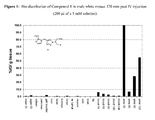
- FIG. 1 Bio-distribution of Compound 1 in male white mouse 120 min post IV injection (200 ⁇ l of a 5 mM solution).
- novel compounds described herein contain the requisite 2-nitroimidazole core that is necessary for imaging hypoxic tumors.
- intracellular bioreduction under hypoxic conditions modifies the 2-nitroimidazole core which then undergoes covalently-mediated localization within the cell.
- the bioreduced nitroimidazole returns to its native state and diffuses freely into and out of the cell.
- novel compounds disclosed herein also display favorable imaging pharmacokinetic properties.
- the compounds possess favorable clearance properties via renal excretion, thus exhibiting lower uptake in the liver and gut regions. These compounds also clear quickly from both blood and muscle tissue, thus leading to desirable tumor to background ratios.
- these favorable clearance properties translate into peak tumor to background ratios at a timepoint earlier than the "gold standard" [ 18 F]F-MISO.
- These tracers are highly selective for hypoxic tumors over non-hypoxic tumors. In xenograph mice and rats, the tracer preferentially localizes within hypoxic tumors and, in most cases, with tumor to background ratios greater than 2:1.
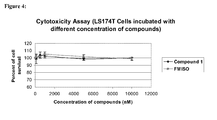
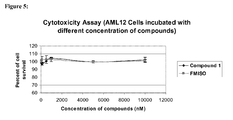
- This class of compounds appears to be benign on the cellular level in that, for example, Compound 1 exhibits no cytotoxic effects in either normal human or cancer cells at concentrations up to 10,000 nM.
- Alkyl refers to a hydrocarbon chain, typically ranging from about 1 to 20 atoms in length. Such hydrocarbon chains may be branched or straight chain, although typically straight chain is preferred. Exemplary alkyl groups include ethyl, propyl, butyl, pentyl, 1-methylbutyl, 1-ethylpropyl, 3-methylpentyl, and the like. As used herein, “alkyl” includes cycloalkyl when three or more carbon atoms are referenced.
- Alkylenyl refers to a hydrocarbon chain, typically ranging from about 1 to 20 atoms in length, or 1 to 10 carbon atoms in length, that is divalently bonded to two different groups. Such hydrocarbon chains may be branched or straight chain.
- alkylenyl groups include ethylenyl, propylenyl, iso-propylenyl, butylenyl, iso-butylenyl, pentylenyl, 1-methylbutylenyl, 1-ethylpropylenyl, 3-methylpentylenyl, and the like, wherein the divalent bonds may be at any of the carbon atoms of the alkylenyl group, or as specifically indicated.
- alkylenyl also includes cycloalkylenyl when three or more carbon atoms are referenced.
- Fragment "A” when the atoms form an unsubstituted (C 3 -C 8 )cycloalkyl group such as a cyclohexyl group, the fragment may form as shown in Fragment "B.”
- Cycloalkyl refers to a saturated, partially unsaturated or unsaturated cyclic hydrocarbon chain, including bridged, fused, or spiro cyclic rings, preferably made up of 3 to about 12 carbon atoms, more preferably 3 to 8 carbon atoms.
- Heteroaryl is an aryl group containing from one to four heteroatoms, preferably N, O, or S, or a combination thereof. Heteroaryl rings may also be fused with one or more cyclic hydrocarbon, heterocyclic, aryl, or heteroaryl rings.
- Linker refers to a chain comprising 1 to 10 atoms and may comprise of 1, 2 or 3 adjacent or non-adjacent atoms or groups, such as C, -NR-, O, S, -S(O)-, -S(O) 2 -, CO, -C(NR)- and the like, and wherein R is H or is selected from the group consisting of (C 1-10 )alkyl, (C 3-8 )cycloalkyl, aryl(C 1-5 )alkyl, heteroaryl(C 1-5 )alkyl, amino, aryl, heteroaryl, hydroxy, (C 1-10 )alkoxy, aryloxy, heteroaryloxy, each substituted or unsubstituted.
- the linker may comprise of the groups: -CH 2 -, -CH 2 -CH 2 -, -CH 2 -O-CH 2 -, -CH 2 -CH 2 -O-CH 2 -CH 2 -, -CH 2 -NH-CH 2 -, -CH 2 -CH 2 -NH-CH 2 -CH 2 -, -CH 2 -NHC(O)-CH 2 -, -CH 2 -C(O)NH-CH 2 -, -CH 2 -C(O)-CH 2 - etc...
- the linker chain may also comprise part of a saturated, unsaturated or aromatic ring, including polycyclic and heteroaromatic rings.
- variables X and Z may be the linker or linker chain.
- the representation of "(C 1-3 )alkyl", for example, is used interchangeably with “C 1 -C 4 alkyl” to mean the same.
- patient and “subject” refer to any human or animal subject, particularly including all mammals.
- Radioactive isotopes are named herein using various commonly used combinations of the name or symbol of the element and its mass number (e.g., 18 F, F-18, or fluorine-18).
- Exemplary radioactive isotopes include 1-124, F-18 fluoride, C-11, N-13, and O-15, which have half-lives of 4.2 days, 110 minutes, 20 minutes, 10 minutes, and 2 minutes, respectively.
- the radioactive isotope is preferably dissolved in an organic solvent, such as a polar aprotic solvent.
- the radioactive isotopes used in the present method include F-18, C-11, I-123, I-124, I-127, I-131, Br-76, Cu-64, Tc-99m, Y-90, Ga-67, Cr-51, Ir-192, Mo-99, Sm-153 and Tl-201.
- the radioactive isotope used in the present method is F-18.
- Other radioactive isotopes that may be employed include: As-72, As-74, Br-75, Co-55, Cu-61, Cu-67, Ga-68, Ge-68, I-125, I-132, In-111, Mn-52, Pb-203 and Ru-97.
- Click chemistry provides chemists an opportunity to rapidly produce libraries of candidate imaging agents, from which potential small molecule PET imaging tracers with optimal pharmacodynamic and pharmacokinetic properties may be identified.
- Click chemistry is a modular approach to chemical synthesis that utilizes only the most practical and reliable chemical transformations. Click chemistry techniques are described, for example, in the following references:
- cycloaddition reactions is preferred, particularly the reaction of azides with alkynyl groups.
- Alkynes, such as terminal alkynes, and azides undergo 1,3-dipolar cycloaddition forming 1,4-disubstituted 1,2,3-triazoles.
- a 1,5-disubstituted 1,2,3-triazole can be formed using azide and alkynyl reagents ( Krasinski, A., Fokin, V.V. & Barry, K. Organic Litters 2004, 1237-1240 ).
- Hetero-Diels-Alder reactions or 1,3-dipolar cycloaddition reactions could also be used (see Huisgen 1,3-Dipolar Cycloaddition Chemistry (Vol. 1) (Padwa, A., ed.), pp. 1-176, Wiley ; Jorgensen Angew. Chem. Int. Ed. Engl. 2000, 39, 3558-3588 ; Tietze, L.F. and Kettschau, G. Top. Curr. Chem. 1997, 189, 1-120 ).
- the click chemistry method as provided herein provides novel compounds that are further incorporated with a PET label.
- 2-Nitro-1-(prop-2-ynyl)-1H-imidazole (10) To a round bottom flask was added 2-nitroimidazole (500 mg, 4.42 mmol), propargyl bromide (631 mg, 5.31 mmol), potassium carbonate (733 mg, 5.31 mmol) and DMF (5 mL). The reaction was stirred overnight at RT. TLC (EtOAc) indicated complete reaction. The reaction was poured onto water (20 mL) and extracted into EtOAc (3x20 mL). The combined organics were washed with water (5x20 mL).
- 2-Bromo-N-(prop-2-ynyl)acetamide (18): To a round bottom flask containing 2-bromoacetyl bromide (10 g, 49.5 mmol), TEA (5.01 g, 49.5 mmol) and DCM (20 mL) at 0 °C, was added dropwise propargyl amine (2.73 g, 49.5 mmol) as a solution in DCM (10 mL) over 1 hr. The reaction stirred overnight at RT. The reaction was poured onto water (20 mL) and washed with sat'd NaHCO 3 (1x 20mL). The organic layer was washed with 1N HC1 (1x20 mL).
- 2-Azido-3-hydroxypropyl acetate (24) 2-Azidopropane-1,3-diol 23 (10.46 g, 89.3 mmol) was dissolved in CH 2 Cl 2 (450 mL) and treated with a catalytic amount of p- toluene sulfonic acid monohydrate (340 mg, 1.8 mmol) and triethylorthoacetate (24.4 mL, 134 mmol) at room temperature for 1 hr. After the formation of the orthoester was complete, a stoichiometric amount of water (2.4 mL, 134 mmol) was added to the mixture. The mixture was then stirred for 40 min and then concentrated in vacuo.
- the reaction was stirred at RT for 2 hrs.
- the reaction was concentrated in vacuo onto silica gel and purified on a silica gel cartridge using MeOH:DCM (2% MeOH:DCM to 10% MeOH:DCM) as the eluent to afford 9.74 g of a pale yellow solid.
- MeOH:DCM 2% MeOH:DCM to 10% MeOH:DCM
- the material was further purified via recystallization using EtOAc:Hex to afford 4.5 g (30.5% yield) of a white solid.
- Neat 23 (1.48 g, 12.65 mmol) was dissolved in CH 2 Cl 2 (127 mL) and treated with a catalytic amount of p -toluene sulfonic acid monohydrate (0.048 g, 20 ⁇ mol) and (trimethoxymethyl)benzene (3.26 mL, 18.98 mmol) in CH 2 Cl 2 at room temperature for 1 hr. After the formation of the orthoester was complete, a stoichiometric amount of water (340 ⁇ L, 18.98 mmol) was added to the mixture. The mixture was then stirred for 40 min and concentrated in vacuo.
- [F-18]Fluoride ion preparation Aqueous [F-18]fluoride ion, which is produced in the cyclotron target, is delivered to and then trapped on an anion exchange resin cartridge located on the chemistry module. The F-18 is then eluted into the reaction vessel using a solution of potassium carbonate (3 mg) in water (0.4 mL). Kryptofix ® 222 (20 mg) dissolved in acetonitrile (1 mL) is then added to the reaction vessel.
- the solution is concentrated to dryness to remove the acetonitrile and water (70-95 °C, under reduced pressure (250 mbar) and a stream of argon), which will afford a relatively dry, highly activated form of [F-18]fluoride ion.
- a solution of the precursor 12, (20 ⁇ mol) in acetonitrile (0.9 mL) is added to the dried [F-18]fluoride ion.
- the mixture is heated to approximately 110 °C for 10 minutes to allow reaction with the [F-18]fluoride ion.
- a solution of the precursor 16, (15 ⁇ 5 mg, 20-40 ⁇ mol) dissolved in a mixture of acetonitrile (0.5 mL) and t-BuOH (0.5 mL) is added to the reaction vessel containing the anhydrous [F-18]Fluoride.
- the vessel is heated to 125 ⁇ 15 °C for 7.5 ⁇ 2.5 minutes to induce displacement of the nosylate leaving group by [F-18]fluoride.
- the explora ® RN chemistry module is equipped with both UV and Geiger Mueller (GM) detectors.
- GM Geiger Mueller
- the product is collected from the column as monitored by flow-through radioactivity and UV (254 nm) detectors.
- the retention time of the [F-18]3 is approximately 8-10 minutes.
- the fraction containing the [F-18]-labeled tracer is passed through a sterile filter (0.22 ⁇ m) and collected into a sterile vial.
- the volume of the drug substance collected is typically 8-10 mL.
- the explora ® RN chemistry module is equipped with both UV and Geiger Mueller (GM) detectors.
- GM Geiger Mueller
- the product is collected from the column as monitored by flow-through radioactivity and UV (254 nm) detectors.
- the retention time of the [F-18]5 is approximately 7-9 minutes.
- the fraction containing the [F-18]-labeled tracer is passed through a sterile filter (0.22 ⁇ m) and collected into a sterile vial.
- the volume of the drug substance collected is typically 8-10 mL.
- a solution of the precursor 26, (15 ⁇ 5 mg, 20-40 ⁇ mol) dissolved in a mixture of acetonitrile (0.5 mL) and t-BuOH (0.5 mL) is added to the reaction vessel containing the anhydrous [F-18]Fluoride.
- the vessel is heated to 125 ⁇ 15 °C for 7.5 ⁇ 2.5 minutes to induce displacement of the nosylate leaving group by [F-18]fluoride.
- aqueous hydrochloric acid (1.0 N, 0.8 mL) is added and the mixture heated to 110 ⁇ 5 °C for 7.5 ⁇ 2.5 minutes. This hydrolyzes the acetate group converting it to a hydroxyl group. This hydrolysis reaction results in the formation of crude [F-18] 1.
- the reaction mixture is cooled and neutralized by addition of sodium acetate (2.0 M, 0.4 mL).
- reaction mixture and sterile filtration The reaction mixture containing crude [F-18]1 is passed through a alumina sep-pak lite (to remove unreacted [F-18]fluoride) and then transferred to the HPLC sample loop.
- the crude reaction material was purified via chromatographic separation using a semi-preparative HPLC column (Waters ACE AQ reverse phase semi-prep column (250 x 10 mm), p/n ACE-126-2510, 250 x 10 mm, 5% ethanol in 21 mM 95% Phosphate Buffer, 5.0 mL/min).
- the column effluent is monitored using UV (254 nm) and radiometric detectors connected in series.
- the explora ® RN chemistry module is equipped with both UV and Geiger Mueller (GM) detectors.
- the product is collected from the column as monitored by flow-through radioactivity and UV (254 nm) detectors.
- the retention time of the [F-18]1 is approximately 17 ⁇ 5 minutes.
- a sterile empty collection vial is preloaded with 5-10 mL of sterile diluent containing 1-6% ethanol, 75 mg/mL of ascorbic acid and 95% 21 mM phosphate.
- the purified [F-18]1 fraction eluted from the HPLC purification column is processed through a 0.2 ⁇ m sterile filter into the preloaded collection vial.
- Radioactive [F-18]fluoride is transferred into a 3 mL V-vial with 0.5 mL of K222/K 2 CO 3 solution (660 mg of K222 and 210 mg of K 2 CO 3 in 9 mL of MeCN and 9 mL of H 2 O).
- the [F-18]Fluoride is azeotropically dried with 3 x 1 mL MeCN under Ar flow.
- a solution of the precursor 26, (16 ⁇ 5 mg, 20-40 ⁇ mol) dissolved in acetonitrile (1.0 mL) is added to the reaction vessel containing the anhydrous [F-18]Fluoride.
- the vessel is heated to 95 ⁇ 5 °C for 7.5 ⁇ 2.5 minutes to induce displacement of the nosylate leaving group by [F-18]fluoride.
- reaction mixture Purification of reaction mixture and sterile filtration: The crude reaction material was purified via chromatographic separation using a semi-preparative HPLC column (Phenomenex Luna reverse phase semi-prep column (250 x 10 mm, 10 ⁇ ), 6% ethanol, 5.0 mL/min). The column effluent is monitored using UV (254 nm) and radiometric detectors connected in series.
- the explora ® RN chemistry module is equipped with both UV and Geiger Mueller (GM) detectors.
- the product is collected from the column as monitored by flow-through radioactivity and UV (254 nm) detectors.
- the retention time of the [F-18]1 is approximately 17 ⁇ 5 minutes.
- a sterile empty collection vial is preloaded with 5-10 mL of sterile diluent containing 1-6% ethanol, 75 mg/mL of ascorbic acid and 95% 21 mM phosphate.
- the purified [F-18]1 fraction eluted from the HPLC purification column is processed through a 0.2 ⁇ m sterile filter into the preloaded collection vial.
- Blood and urine samples were collected at 30, 60, 90 and 120 minutes. Samples were immediately placed on ice to prevent compound degradation. After blood and urine sampling were completed at 120 minutes, the mouse was sacrificed by cervical dislocation. The following whole organs were harvested within 30-40 minutes in the following order; lower GI, upper GI, spleen, pancreas, gall bladder, liver, heart, kidneys, lungs, about 0.3 gram of muscle from both legs, about 0.4 gram of skin at the back, the entire brain and about 0.4 gram of fat inside the abdomen.
- lysis buffer about 5 ml/gram tissue
- 50 ⁇ L of lysis buffer was added to the blood and urine samples, followed by briefly vortexing.
- 200 ⁇ l of organ homogenate was sampled into a 1.5 ml Eppendorf tube. All samples were heated at 100 °C for 2 minutes to denature the proteins and then placed in ice for 15 minutes. Then 40 ⁇ l of formic acid was added to the organ samples and 20 ⁇ l was added to the blood and urine samples. All tubes were vortexed to achieve complete mixing of sample with acid. Samples were then placed on ice for 15 minutes before being centrifuged at 13000 rpm for 15 minutes at 4 °C. 30 ⁇ l of the supernatant was transferred to an HPLC vial for MSD analysis.
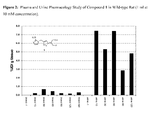
- the blood levels of Compound 1 are 0.67 and 0.15 %ID/g at 30 and 120 minutes, respectively.
- the urine level was 5.3 %ID/g at 30 minute.
- the urine excretion index (averaged urine %ID/g divided by blood %ID/g at 120 minute) was 36.62.
- Compound 1 in rat urine excretion and blood clearance is fast given the high %ID/g in the urine and low %ID/g in the blood.
- the assay is based on the ability of viable cells to reduce 3-[4,5-dimethylthiazol-2-yl]-2,5-diphenyl tetrazolium bromide to colored formazan crystals.
- Ls174T human colorectal adenocarcinoma, A172 human brain glioblastoma, MRC5 human normal lung fibroblast, and ALM 12 mouse normal liver cell lines were selected for this study.
- Cells were cultured with different concentration of Compound 1 (0, 100, 500, 1000, 5000, 10000 nM) for 24 hours and then incubated with 0.5 mg/ml of 3-[4,5-dimethylthiazol-2-yl]-2,5-diphenyl tetrazolium bromide for 1 hour.
- Cells were lysed and formazan crystals were dissolved with 2-propanol for 1 hour and the optical density of the resultant colored 2-propanol was measured. The percentages of cell survival were calculated based on the optical densities.
Landscapes
- Chemical & Material Sciences (AREA)
- Organic Chemistry (AREA)
- Health & Medical Sciences (AREA)
- Veterinary Medicine (AREA)
- General Health & Medical Sciences (AREA)
- Medicinal Chemistry (AREA)
- Public Health (AREA)
- Pharmacology & Pharmacy (AREA)
- Life Sciences & Earth Sciences (AREA)
- Animal Behavior & Ethology (AREA)
- General Chemical & Material Sciences (AREA)
- Nuclear Medicine, Radiotherapy & Molecular Imaging (AREA)
- Chemical Kinetics & Catalysis (AREA)
- Epidemiology (AREA)
- Medicines Containing Antibodies Or Antigens For Use As Internal Diagnostic Agents (AREA)
- Pharmaceuticals Containing Other Organic And Inorganic Compounds (AREA)
- Medicines That Contain Protein Lipid Enzymes And Other Medicines (AREA)
- Plural Heterocyclic Compounds (AREA)
Description
- The present invention relates to novel radioactively labeled bioreducible tracers useful for detecting hypoxic cells in vivo. In one aspect, the present application relates to a novel hypoxia imaging agent that displays low background uptake leading to good tumor to background ratios.
- Positron Emission Tomography (PET) is a molecular imaging technology that is used effectively for the detection of disease. PET imaging systems create images based on the distribution of positron-emitting isotopes in the tissue of a patient. The isotopes are typically administered to a patient by injection of probe molecules that comprise a positron-emitting isotope, such as F-18, C-11, N-13 or O-15, covalently attached to a molecule that is readily metabolized or localized in cells (e.g., glucose) or that chemically binds to receptor sites within cells. In some cases, the isotope is administered to the patient as an ionic solution or by inhalation. One of the most widely used positron-emitter labeled PET molecular imaging probes is 2-deoxy-2-[18F]fluoro-D-glucose ([18F]FDG).
- PET scanning using the glucose analog [18F]FDG, which primarily targets glucose transporters and hexokinase, is an accurate clinical tool for the early detection, staging, and restaging of cancer. PET-FDG imaging is also used to monitor cancer chemotherapy and chemoradiotherapy because early changes in glucose utilization have been shown to correlate with outcome predictions. A characteristic feature of tumor cells is their accelerated glycolysis rate, which results from the high metabolic demands of rapidly proliferating tumor tissue. Like glucose, FDG is taken up by cancer cells via glucose transporters and is phosphorylated by hexokinase to FDG-6 phosphate. FDG-6 phosphate cannot proceed any further in the glycolysis chain, or leave the cell due to its charge, allowing cells with high glycolysis rates to be detected.
- Although useful in many contexts, limitations of FDG-PET imaging for monitoring cancer exist as well. Accumulation in inflammatory tissue limits the specificity of FDG-PET. Conversely, nonspecific FDG uptake may also limit the sensitivity of PET for tumor response prediction. Therapy induced cellular stress reactions have been shown to cause a temporary increase in FDG-uptake in tumor cell lines treated by radiotherapy and chemotherapeutic drugs. Further, physiologically high normal background activity (e.g. in the brain) can render the quantification of cancer-related FDG-uptake impossible in some areas of the body.
- Due to these limitations, other PET imaging tracers are being developed to target other enzyme-mediated transformations in cancer tissue, such as 3'-[F-18]Fluoro-3'-deoxythymidine (FLT) for DNA replication, and [C-11](methyl)choline for choline kinase, as well as ultra high-specific activity receptor-ligand binding (e.g., 16α [F-18]fluoroestradiol) and potentially gene expression (e.g., [F-18]fluoro-ganciclovir). Molecularly targeted agents have demonstrated great potential value for non-invasive PET imaging in cancers.
- These studies have demonstrated the great value of non-invasive PET imaging for specific metabolic targets of cancer. Despite the clear clinical value of incorporating PET imaging into patient management, limitations do exist. In certain instances, current imaging probes lack specificity or have inadequate signal to background characteristics. In addition, new biological targets that are being tested for therapeutic intervention will require new imaging probes to evaluate therapeutic potential.
- Thus, additional biomarkers are needed that show a very high affinity to, and specificity for, tumor targets to support cancer drug development and to provide health care providers with a means to accurately diagnose diseases and monitor treatment. Such imaging probes could dramatically improve the patient's outcome, allowing smaller tumors to be detected, with only nanomole quantities of the tracer injected into patients.
- Key to the clinical success of cancer treatment is the ability to predict how a particular type of cancer will respond to treatment. In the specific case of tumors, factors such as the tumor's phenotype, size and location all dramatically affect therapeutic treatment decisions. While standard chemotherapeutic or radiation regimens are employed to treat a variety of tumors, certain tumor types resist standard therapeutic regimens and thus may worsen a patient's clinical outcome.
- Due to the unique nature of cancer cell growth, its proliferative nature can offer clues for its therapeutic treatment. For instance, because of the rapid and disorganized growth of cancerous tumors, they oftentimes develop disorganized neovascularization leading to poorly vascularized environments. (Wang, J. and L. Maurer, Positron Emission Tomography: Applications in Drug Discovery and Drug Development Curr. Top. Med. Chem., 2005, 5: p. 1053-1075). In turn, environments that are removed 100-200 µm from blood supplies can become hypoxic, characterized by a tissue pO2 of less than 10 mmHg. In response to these hypoxic conditions, tumor overexpression of hypoxia inducible factor-1 (HIF-1) leads to the up-regulation of several proteins necessary for tumor survival including vascular endothelial growth factor (VEGF), carbonic anhydrase-IX (CA-IX), and glycolysis enzymes.
- Hypoxic tumors are clinically problematic: they resist both the effects of radiation and cytotoxic therapy which can result in treatment failure. (Adams, G., Hypoxia-mediated drugs for radiation and chemotherapy. Cancer, 1981. 48: p. 696-707; Moulder, J. and S. Rockwell, Hypoxic fractions of solid tumors: experimental techniques, methods of analysis, and a survey of existing data. Int. J. Radiat. Oncol. Biol. Phys., 1984, 10: p. 695-712; Nordsmark, M., M. Overgaard, and J. Overgaard, Pretreatment oxygenation predicts radiation response in advanced squamous cell carcinoma of the head and neck. Radiother. Oncol, 1996. 41: p. 31-39.) Moreover, hypoxic cancer cells have been linked to malignant cancers that are known to spread invasively throughout the patient. (Brizel, D. M., et al., Tumour oxygenation predicts for the likelihood of distant metastases in human soft tissue. sarcoma. Cancer Res., 1996. 56: p. 941-943; Höckel, M., et al., Association between tumor hypoxia and malignant progression in advanced cancer of the cervix. Cancer Res., 1996. 56: p. 941-943.) Several types of human cancers are well known to become hypoxic including breast, cervical cancer and non-small cell lung cancer. (Vaupel, P., et al., Oxygenation of human tumours: evaluation of tissue oxygen distribution in breast cancers by computerized O2 tension measurements. Cancer Res., 1991, 51: p. 3316-3322.)
- Because hypoxic tumors respond poorly to both traditional radiation and cytotoxic therapies, several alternate approaches exist for treating hypoxic cancer cells including hyperbaric O2, ARCON, radiosensitizers and bioreductive cytotoxic agents. (Seddon, B. M. and P. Workman, The role of functional and molecular imaging in cancer drug discovery and development Brit. J. Radiol., 2003. 76: p. .) In the last example, the bioreductive agents containing the nitroimidazole chemotype are reduced intracellularly, forming radical anion metabolites that eventually become trapped intracellularly. In oxic environments, the radical anion reacts with O2 and returns to its premetabolized state.
- Confirmation of tumor hypoxia in patients is necessary in order to appropriately plan bioreductive-based therapies for treatment. Determining tumor hypoxia via electrode measurements of pO2 concentrations within the tumor is an impractical endeavor at best. In addition, it is only possible to interrogate superficial tumors with this technique. A more general and less invasive method for detecting the hypoxic nature of cancer cells relies on radioactively labeled, bioreducible tracers that localize within hypoxic cells inversely proportional to their cellular pO2.
- There are several bioreducible imaging agents that can detect hypoxic cells in vivo including [18F]F-MISO (Rasey, J. S., et al., Determining the hypoxic fraction in a rat glioma by uptake of radiolabeled fluoromisonidazole. Radiat. Res., 2000. 153: p. 84-92; Bentzen, L., et al., Feasibility of detecting hypoxia in experimental mouse tumours with 18F-fluorinated tracers and positron emission tomography: a study evaluating 18F-Fluoromisonidazole and [18F] Fluoro-2-deoxy-D-glucose. Acta. Oncol., 2000. 39: p. 629-637), [18F]F-EF1 (Hustinx, R., et al., Non-invasive assessment of tumor hypoxia with the 2-nitroimidazole, 18F-EFI and PET J. Nucl. Med., 1999. 4: p. 99P (abstract 401)), [18F]-FETNIM (Chao, K. S., et al., A novel approach to overcome hypoxic tumor resistance: Cu-ATSM-guided intensity-modulated radiation therapy. Int. J. Radiat. Oncol. Biol. Phys., 2001. 49: p. 1171-1182; Yang, D.J., et al., Development of 18F-labeled fluoroerythronitronimidazole as a PET agent for imaging tumor hypoxia. Radiology, 1995. 194: p. 795-800; Gronroos, T., et al., Pharmacokinetics of [18F]-FETNIM. A potential hypoxia marker for PET J. Nucl. Med., 2001. 42: p. 1397-1404), [18F]FRP-170 (Ishikawa, Y., et al., Development of [18F]FRP-170 injection for imaging hypoxia by PET., Kaku Igaku., 2005. 42: p. 1-10.), and [62Cu]-ATSM (Fujibayashi, Y., et al., Copper-62-ATSM- α new hypoxia imaging agent with high membrane permeability and low redox potential. J. Nucl. Med., 1997. 38: p. 1155-1160).
- One of most clinically studied hypoxia markers is [18F]F-MISO, the fluorine analog of the hypoxic cell radiosensitizer misonidazole. [18F]F-MISO successfully identifies hypoxic tumors in patients, however, its slow diffusion into hypoxic tumors requires longer uptake times before imaging and, in addition, high background uptake leads to small tumor to background ratios. As an alternative, several groups have prepared nitroimidazoles with less lipophilic character in an attempt to increase the tumor to background ratio by increasing the tracer's washout from normoxic tissue.
-
WO 96/04249 - While these hypoxic imaging agents show clinical promise, there exists an unmet need for hypoxia tracers that possess enhanced pharmacokinetic profiles leading to peak signal to noise ratios in shorter periods for faster and potentially more accurate hypoxia assessments.
- The present invention relates to novel hypoxia imaging agents that display low background uptake leading to high tumor to background ratios. More specifically, the present invention relates to novel 2-nitroimidazole based hypoxia imaging agents that display rapid, predominantly renal clearance, leading to low background uptake, low abdominal uptake and generally high tumor to background ratios.
- The present invention relates to novel radioactively labeled bioreducible tracers useful for detecting hypoxic tumors in vivo. In one embodiment, the tracers consist of a 2-nitroimidazole moiety, a triazole, metabolically stable linker with pharmacokinetics enhancing substituents, and a radioisotope suitable for single photon emission computed tomography (SPECT) or positron emission tomography (PET) imaging. The preferred in vivo imaging modality is positron emission tomography. Because hypoxic cells resist cytotoxic and radiation therapies, and also possess an increased propensity of proliferation and propagation into nearby tissues, accurate assessment of the hypoxic nature of a patient's cancer can guide and greatly affect the therapeutic regimen and outcome.
- In one aspect, there is provided a compound comprising the formula I:

- X is a (C1-C10)alkylenyl, unsubstituted or substituted with 1, 2, 3 or 4 X1, wherein one of the (C1-C10)alkylenyl carbon atoms is optionally replaced by a group selected from -CO-, -CONR'-, -NR'CO-, -NR'-, -O- and -S-, or wherein 2, 3 or 4 contiguous atoms of the (C1-C10)alkylenyl group form an unsubstituted or substituted (C3-C8)cycloalkyl or a (C3-C8)heterocycloalkyl ring, unsubstituted or substituted with 1, 2, 3 or 4 X1, or a combination thereof;
- each X1 is independently hydroxyl, thiol, amino, alkyl, alkoxy, thioalkyl, or halo;
- Y is a triazolyl of the formula;

- Z is an (C1-C10)alkylenyl group wherein one of the carbon atoms is optionally replaced by a group selected from-CO-, -CONR", -NR"CO-, -NR"-, -O- and -S-, and wherein the (C1-C10)alkylenyl group is unsubstituted or substituted with 1, 2, 3 or 4 X1;
- A is a radioactive element; and R' and R" are each independently H or are each independently selected from the group consisting of (C1-C6)alkyl, -CO(C1-C3)alkyl, -CONH(C1-C3)alkyl and -CO2(C1-C3)alkyl.
- In one variation of the above, X is a (C1-C4)alkylenyl group optionally substituted with 1, 2 or 3 hydroxyl groups or 1, 2 or 3 -NH2 or -NH(C1-C4)alkyl group. In another variation, X is selected from the group consisting of -CH2-, -CH2-CH2-, -CH2-CH2-CH2-, -CH2-CH2-CH2-CH2-, -CH2-CH(OH)-, -CH(OH)-C H2-, -CH(OH)-CH2-CH2-, -CH2-CH(OH)-CH2-, -CH2-CH2-CH(OH)- and -CH2-CH(OH)-C H(OH)-CH2-. In a particular variation, X is selected from the group consisting of-CONR'-, -(C1-C4)alkylCONR'-, -CONR'(C1-C4)alkyl-, -(C1-C4)alkylCONR'(C1-C4)alkyl, wherein R' is H or (C1-C3)alkyl. In a particular variation of the above compound, A is 11C.
- In another aspect, there is provided a compound of the formula II or III

- wherein X is a (C1-C10)afkylenyl, unsubstituted or substituted with 1, 2, 3 or 4 X1, wherein one of the (C1-C10)alkylenyl carbon atoms is optionally replaced by a group selected from -CO-, -CONR'-, -NR'CO-, -NR'-, -O- and -S-, or wherein 2, 3 or 4 contiguous atoms of the (C1-C10)alkylenyl group form an unsubstituted or substituted (C3-C8)cycloalkyl or a (C3-C8)heterocycloalkyl ring, unsubstituted or substituted with 1, 2, 3 or 4 X1, or a combination thereof;
- each X1 is independently selected from the group consisting of hydroxyl, thiol, amino, alkyl, alkoxy, thioalkyl and halo;
- Z is an (C1-C10)alkylenyl group wherein one of the carbon atoms is optionally replaced by a group selected from -CO-, -CONR"-, -NR"CO-, -NR"-, -O- and -S-, are unsubstituted or substituted with 1, 2, 3 or 4 X1;
- A is a radioactive element; and
- R' and R" are each independently H or are each independently selected from the group consisting of (C1-C6)alkyl, -CO(C1-C3)alkyl, -CONH(C1-C3)alkyl and -CO2(C1-C3)alkyl.
- In one particular embodiment, there is provided a compound comprising the formula IIb:

- Z is an (C1-C10)alkylenyl group wherein one of the carbon atoms of the (C1-C10)alkylenyl group is optionally replaced by a group selected from -CO-, -CONR"-, -NR"CO-, -NR"-, -O- and -S-, and the (C1-C10)alkylenyl group is unsubstituted or substituted with 1, 2, 3 or 4 X1;
- R" is H or is selected from the group consisting of (C1-C6)alkyl, -CO(C1-C3)alkyl, -CONH(C1-C3)alkyl and -CO2(C1-C3)alkyl;
- each X1 is independently hydroxyl, thiol, amino, alkyl, alkoxy, thioalkyl or halo; and A is a radioactive element.
- In a particular variation according to each of the above, Z is an (C1-C4)alkylenyl group optionally substituted with 1, 2 or 3 groups independently selected from the group consisting of hydroxyl, thiol, amino, (C1-C4)alkyl, (C1-C4)alkoxy, thio(C1-C4)alkyl and halo. In one variation of the above compound, Z is selected from the group consisting of -CH2-, -CH2-CH2-, -CH2-CH2-CH2-, -CH2-CH2-CH2-CH2-, -CH2-CH(OH)-, -CH(OH)-C H2-, -CH(OH)-CH2-CH2-, -CH(CH2OH)-CH2-, -CH2-CH(OH)-CH2-, -CH2-CH2-CH(OH)-a nd -CH2-CH(OH)-CH(OH)-CH2-.
- In a variation according to each of the above, A is 18F or 11C-Me. In a particular variation of the above, A is 18F. In one variation of the above, there is provided a compound of the formula:

- In another embodiment, there is provided a compound comprising the formula IV:

- X is a (C1-C10)alkylenyl, unsubstituted or substituted with 1, 2, 3 or 4 X1, wherein one of the (C1-C10)alkylenyl carbon atoms is optionally replaced by a group selected from -CO-, -CONR'-, -NR'CO-, -NR'-, -O- and -S-, or wherein 2, 3 or 4 contiguous atoms of the (C1-C10)alkylenyl group form an unsubstituted or substituted (C3-C8)cycloalkyl or a (C3-C8)heterocycloalkyl ring, unsubstituted or substituted with 1, 2, 3 or 4 X1, or a combination thereof;
- R' is H or is selected from the group consisting of (C1-C6)alkyl, -CO(C1-C3)alkyl, -CONH(C1-C3)alkyl and -CO2(C1-C3)alkyl; and
- each X1 is independently selected from the group consisting of hydroxyl, thiol, amino, (C1-C4)alkyl, (C1-C4)alkoxy, thio(C1-C4)alkyl and halo.
- In a particular variation of the above compound, X is (C1-C5)alkylenyl, unsubstituted or substituted with 1 or 2 X1, or wherein one of the (C1-C10)alkylenyl carbon atoms is optionally replaced by a group selected from -CONR'- or -NR'CO-, or wherein 2, 3 or 4 contiguous atoms of the (C1-C10)alkylenyl group form an unsubstituted or substituted (C3-C8)cycloalkyl unsubstituted or substituted with 1, 2 or 3 X1, wherein X1 is -OH or NH2.
- In another embodiment, there is provided a compound comprising the formula V:

- X is a (C1-C10)alkylenyl, unsubstituted or substituted with 1, 2, 3 or 4 X1, wherein one of the (C1-C10)alkylenyl carbon atoms is optionally replaced by a group selected from -CO-, -CONR'-, -NR'CO-, -NR'-, -O- and -S-, or wherein 2, 3 or 4 contiguous atoms of the (C1-C10)alkylenyl group form an unsubstituted or substituted (C3-C8)cycloalkyl or a (C3-C8)heterocycloalkyl ring, unsubstituted or substituted with 1, 2, 3 or 4 X1, or a combination thereof;
- R' is H or is selected from the group consisting of (C1-C6)alkyl, -CO(C1-C3)alkyl, -CONH(C1-C3)alkyl and -CO2(C1-C3)alkyl; and
- each X1 is independently selected from the group consisting of hydroxyl, thiol, amino, alkyl, alkoxy, thioalkyl and halo.
- In a particular variation of the above, there is provided a compound comprising the formula

- In another aspect of the above compounds, there is provided the following compounds:
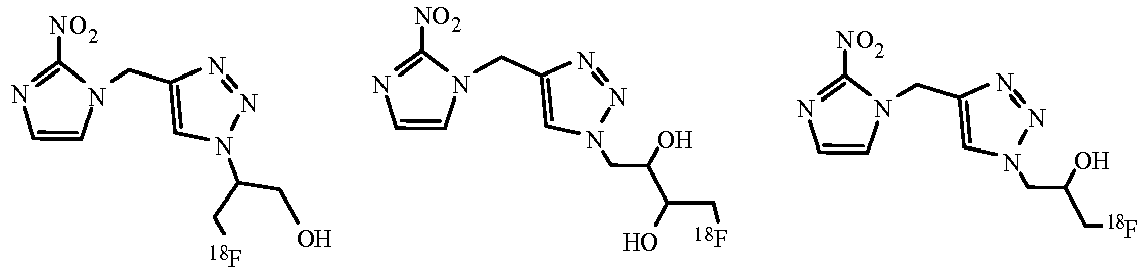


- In another embodiment, there is provided a method for detecting hypoxia in cells comprising: a) administering to a mammal a compound of the formula I:

- wherein X is a (C1-C10)alkylenyl, unsubstituted or substituted with 1, 2, 3 or 4 X1, wherein one of the (C1-C10)alkylenyl carbon atoms is optionally replaced by a group selected from -CO-, -CONR'-, -NR'CO-, -NR'-, -O- and -S-, or wherein 2, 3 or 4 contiguous atoms of the (C1-C10)alkylenyl group form an unsubstituted or substituted (C3-C8)cycloalkyl or a (C3-C8)heterocycloalkyl ring, unsubstituted or substituted with 1, 2, 3 or 4 X1, or a combination thereof;
- each X1 is independently selected from the group consisting of hydroxyl, thiol, amino, alkyl, alkoxy, thioalkyl and halo;
- Y is a triazolyl of the formula;

- Z is an (C1-C10)alkylenyl group wherein one of the carbon atoms of the (C1-C10)alkylenyl group is optionally replaced by a group selected from -CO-, -CONR'-, -NR'CO-, -NR'-, -O- and -S-, and the (C1-C10)alkylenyl group is unsubstituted or substituted with 1, 2, 3 or 4 X1;
- A is a radioactive element; and
- R' and R" are each independently H or are each independently selected from the group consisting of (C1-C6)alkyl, -CO(C1-C3)alkyl, -CONH(C1-C3)alkyl and -CO2(C1-C3)alkyl; and b) detecting by PET the presence of retained radioactive element in hypoxic cells of the mammal.
- In a particular variation of the above method, X is a (C1-C4)alkylenyl group optionally substituted with 1, 2 or 3 hydroxyl groups or 1, 2 or 3 -NH2 or -NH(C1-C4)alkyl group. In another variation of the above, X is selected from the group consisting of -CH2-, -CH2-CH2-, -CH2-CH2-CH2-, -CH2-CH2-CH2-CH2-, -CH2-CH(OH)-, -CH(OH)-C H2-, -CH(OH)-CH2-CH2-, -CH2-CH(OH)-CH2-, -CH2-CH2-CH(OH)- and -CH2-CH(OH)-C H(OH)-CH2-. In another variation of the above method, X is selected from the group consisting of -CONR'-, -(C1-C4)alkylCONR'-, -CONR'(C1-C4)alkyl- and -(C1-C4)alkylCONR'(C1-C4) alkyl-, and wherein R' is H or (C1-C3)alkyl.
- In one particular variation of the above method, the compound is of formula II or III

- wherein: X is a (C1-C10)alkylenyl, unsubstituted or substituted with 1, 2, 3 or 4 X1, wherein one of the (C1-C10)alkylenyl carbon atoms is optionally replaced by a group selected from -CO-, -CONR'-, -NR'CO-, -NR'-, -O- and -S-, or wherein 2, 3 or 4 contiguous atoms of the (C1-C10)alkylenyl group form an unsubstituted or substituted (C3-C8)cycloalkyl or a (C3-C8)heterocycloalkyl ring, unsubstituted or substituted with 1, 2, 3 or 4 X1, or a combination thereof;
- each X1 is independently selected from the group consisting of hydroxyl, thiol, amino, alkyl, alkoxy, thioalkyl and halo;
- Z is an (C1-C10)alkylenyl group wherein one of the carbon atoms of the (C1-C10)alkylenyl group is optionally replaced by a group selected from -CO-, -CONR"-, -NR"CO-, -NR"-, -O- and -S-, and the (C1-C10)alkylenyl group is unsubstituted or substituted with 1, 2, 3 or 4 X1;
- A is a radioactive element; and R' and R" are each independently H or are each independently selected from the group consisting of (C1-C6)alkyl, -CO(C1-C3)alkyl,-CONH(C1-C3)alkyl and -CO2(C1-C3)alkyl.
- In one variation of the above method, the compound is of the formula II. In another variation of each of the above method, Z is (C1-C4)alkylenyl group optionally substituted with 1, 2 or 3 hydroxyl groups or 1, 2 or 3 hydroxy(C1-C4)alkyl groups. In one particular variation of the above method, Z is selected from the group consisting of -CH2-, -CH2-CH2-, -CH2-CH2-CH2-, -CH2-CH2-CH2-CH2-, -CH2-CH(OH)-, -CH(OH)-C H2-, -CH(OH)-CH2-CH2-, -CH(CH2OH)-CH2-, -CH2-CH(OH)-CH2-, -CH2-CH2-CH(OH)- a nd -CH2-CH(OH)-CH(OH)-CH2-. In a particular variation of each of the above methods, A is 18F or 11C-Me. In another particular variation of the method, A is 18F.
- In one variation of the above method, the compound comprises the formula:


- In a particular aspect of the above method, the hypoxic cells are tumor cells or ischemic cells.
- In another embodiment, there is provided a method of preparing a compound of formula II or III, or a mixture thereof:

- wherein, X is a (C1-C10)alkylenyl, unsubstituted or substituted with 1, 2, 3 or 4 X1, wherein one of the (C1-C10)alkylenyl carbon atoms is optionally replaced by a group selected from -CO-, -CONR'-, -NR'CO-, -NR'-, -O- and -S-, or wherein 2, 3 or 4 contiguous atoms of the (C1-C10)alkylenyl group form an unsubstituted or substituted (C3-C8)cycloalkyl or a (C3-C8)heterocycloalkyl ring, unsubstituted or substituted with 1, 2, 3 or 4 X1, or a combination thereof
- each X1 is independently selected from the group consisting of hydroxyl, thiol, amino, alkyl, alkoxy, thioalkyl and halo;
- Z is an (C1-C10)alkylenyl group wherein one of the carbon atoms of the (C1-C10)alkylenyl group is optionally replaced by a group selected from -CO-, -CONR"-, -NR"CO-, -NR"-, -O- and -S-, and the (C1-C10)alkylenyl group is unsubstituted or substituted with 1, 2, 3 or 4 X1;
- A is a radioactive element; and
- R' and R" are each independently H or are each independently selected from the group consisting of (C1-C6)alkyl, -CO(C1-C3)alkyl, -CONH(C1-C3)alkyl and -CO2(C1-C3)alkyl;
- a) treating an azide substituted compound A'-Z-N3 with an acetylene substituted nitroimidazole, wherein A' is a leaving group; and

- b) radiolabeling the product of step a) by the displacement of A' with a radiolabeling agent to form compound II or III or a mixture thereof, wherein A is either 18F or 11C.
- In one variation of the above, the compound is of the formula

- In a particular variation of the above method, the radiolabeling agent is K18F.
-
Figure 1 . Bio-distribution ofCompound 1 in malewhite mouse 120 min post IV injection (200 µl of a 5 mM solution). - The present invention will now be described more fully hereinafter. This invention may, however, be embodied in many different forms and should not be construed as limited to the embodiments set forth herein; rather, these embodiments are provided so that this disclosure will be thorough and complete, and will fully convey the scope of the invention to those skilled in the art.
- The novel compounds described herein contain the requisite 2-nitroimidazole core that is necessary for imaging hypoxic tumors. Mechanistically, intracellular bioreduction under hypoxic conditions modifies the 2-nitroimidazole core which then undergoes covalently-mediated localization within the cell. Under oxic conditions, the bioreduced nitroimidazole returns to its native state and diffuses freely into and out of the cell.
- The novel compounds disclosed herein also display favorable imaging pharmacokinetic properties. The compounds possess favorable clearance properties via renal excretion, thus exhibiting lower uptake in the liver and gut regions. These compounds also clear quickly from both blood and muscle tissue, thus leading to desirable tumor to background ratios. In addition, these favorable clearance properties translate into peak tumor to background ratios at a timepoint earlier than the "gold standard" [18F]F-MISO. These tracers are highly selective for hypoxic tumors over non-hypoxic tumors. In xenograph mice and rats, the tracer preferentially localizes within hypoxic tumors and, in most cases, with tumor to background ratios greater than 2:1.
- This class of compounds appears to be benign on the cellular level in that, for example,
Compound 1 exhibits no cytotoxic effects in either normal human or cancer cells at concentrations up to 10,000 nM. - As used herein, the singular forms "a", "an", "the", include plural referents unless the context clearly dictates otherwise.
- "Alkyl" refers to a hydrocarbon chain, typically ranging from about 1 to 20 atoms in length. Such hydrocarbon chains may be branched or straight chain, although typically straight chain is preferred. Exemplary alkyl groups include ethyl, propyl, butyl, pentyl, 1-methylbutyl, 1-ethylpropyl, 3-methylpentyl, and the like. As used herein, "alkyl" includes cycloalkyl when three or more carbon atoms are referenced.
- "Alkylenyl" refers to a hydrocarbon chain, typically ranging from about 1 to 20 atoms in length, or 1 to 10 carbon atoms in length, that is divalently bonded to two different groups. Such hydrocarbon chains may be branched or straight chain. Exemplary alkylenyl groups include ethylenyl, propylenyl, iso-propylenyl, butylenyl, iso-butylenyl, pentylenyl, 1-methylbutylenyl, 1-ethylpropylenyl, 3-methylpentylenyl, and the like, wherein the divalent bonds may be at any of the carbon atoms of the alkylenyl group, or as specifically indicated. As used herein, "alkylenyl" also includes cycloalkylenyl when three or more carbon atoms are referenced.
- "Aryl" means one or more aromatic rings, each of 5 or 6 core carbon atoms. Aryl includes multiple aryl rings that may be fused, as in naphthyl or unfused, as in biphenyl. Aryl rings may also be fused or unfused with one or more cyclic hydrocarbon, heteroaryl, or heterocyclic rings. As used herein, "aryl" includes heteroaryl.
- A "biological target" can be any biological molecule involved in biological pathways associated with any of various diseases and conditions, including cancer (e.g., leukemia, lymphomas, brain tumors, breast cancer, lung cancer, prostate cancer, gastric cancer, as well as skin cancer, bladder cancer, bone cancer, cervical cancer, colon cancer, esophageal cancer, eye cancer, gallbladder cancer, liver cancer, kidney cancer, laryngeal cancer, oral cancer, ovarian cancer, pancreatic cancer, penile cancer, glandular tumors, rectal cancer, small intestine cancer, sarcoma, testicular cancer, urethral cancer, uterine cancer, and vaginal cancer), diabetes, neurodegenerative diseases, cardiovascular diseases, respiratory diseases, digestive system diseases, infectious diseases, inflammatory diseases, autoimmune diseases, and the like. Exemplary biological pathways include, for example, cell cycle regulation (e.g., cellular proliferation and apoptosis), angiogenesis, signaling pathways, tumor suppressor pathways, inflammation (COX-2), oncogenes, and growth factor receptors. The biological target may also be referred to as the "target biomacromolecule" or the "biomacromolecule." The biological target can be a receptor, such as enzyme receptors, ligand-gated ion channels, G-protein-coupled receptors, and transcription factors. The biological target is preferably a protein or protein complex, such as enzymes, membrane transport proteins, hormones, and antibodies.
- "Contiguous atoms" means atoms that are adjacent to each other. For example, the phrase "2, 3 or 4 contiguous atoms of the (C1-C10)alkylenyl group form an unsubstituted or substituted (C3-C8)cycloalkyl or a (C3-C8)heterocycloalkyl ring" means that the 2, 3 or 4 adjacent atoms in an alkylenyl group or a linker, for example, form part of a (C3-C8)cycloalkyl or a (C3-C8)heterocycloalkyl ring. For example, for the 3 contiguous carbon atoms represented in Fragment "A" below, when the atoms form an unsubstituted (C3-C8)cycloalkyl group such as a cyclohexyl group, the fragment may form as shown in Fragment "B."

- "Cycloalkyl" refers to a saturated, partially unsaturated or unsaturated cyclic hydrocarbon chain, including bridged, fused, or spiro cyclic rings, preferably made up of 3 to about 12 carbon atoms, more preferably 3 to 8 carbon atoms.
- "Heteroaryl" is an aryl group containing from one to four heteroatoms, preferably N, O, or S, or a combination thereof. Heteroaryl rings may also be fused with one or more cyclic hydrocarbon, heterocyclic, aryl, or heteroaryl rings.
- "Heterocycle" or "heterocyclic" means one or more rings of 3-12 atoms, preferably 5-7 atoms, with or without unsaturation or aromatic character, and having at least one ring atom which is not a carbon. Preferred heteroatoms include sulfur, oxygen, and nitrogen.
- "Leaving group", as used herein refers to groups that are readily displaced, for example, by a nucleophile, such as an amine, a thiol or an alcohol nucleophile or its salt. Such leaving groups are well known and include, for example carboxylates, N-hydroxysuccinimide, N-hydroxybenzotriazole, halides, triflates, tosylates, nosylates, -OR and -SR and the like.
- "Linker" as used herein refers to a chain comprising 1 to 10 atoms and may comprise of 1, 2 or 3 adjacent or non-adjacent atoms or groups, such as C, -NR-, O, S, -S(O)-, -S(O)2-, CO, -C(NR)- and the like, and wherein R is H or is selected from the group consisting of (C1-10)alkyl, (C3-8)cycloalkyl, aryl(C1-5)alkyl, heteroaryl(C1-5)alkyl, amino, aryl, heteroaryl, hydroxy, (C1-10)alkoxy, aryloxy, heteroaryloxy, each substituted or unsubstituted. That is, for example, the linker may comprise of the groups: -CH2-, -CH2-CH2-, -CH2-O-CH2-, -CH2-CH2-O-CH2-CH2-, -CH2-NH-CH2-, -CH2-CH2-NH-CH2-CH2-, -CH2-NHC(O)-CH2-, -CH2-C(O)NH-CH2-, -CH2-C(O)-CH2- etc... The linker chain may also comprise part of a saturated, unsaturated or aromatic ring, including polycyclic and heteroaromatic rings. In certain aspect of the compounds of the present application, the variables X and Z may be the linker or linker chain. As used herein, the representation of "(C1-3)alkyl", for example, is used interchangeably with "C1-C4alkyl" to mean the same.
- The terms "patient" and "subject" refer to any human or animal subject, particularly including all mammals.
- As used herein, "radiochemical" is intended to encompass any organic, inorganic or organometallic compound comprising a covalently-attached radioactive isotope, any inorganic radioactive ionic solution (e.g., Na[18F]F ionic solution), or any radioactive gas (e.g., [11C]CO2), particularly including radioactive molecular imaging probes intended for administration to a patient (e.g., by inhalation, ingestion or intravenous injection) for tissue imaging purposes, which are also referred to in the art as radiopharmaceuticals, radiotracers or radioligands. Although the present invention is primarily directed to synthesis of positron-emitting molecular imaging probes for use in PET imaging systems, the invention could be readily adapted for synthesis of any radioactive compound comprising a radionuclide, including radiochemicals useful in other imaging systems, such as single photon emission computed tomography (SPECT).
- As used herein, the term "radioactive isotope" or "radioactive element" refers to isotopes exhibiting radioactive decay (i.e., emitting positrons) and radiolabeling agents comprising a radioactive isotope (e.g., [11C]methane, [11C]carbon monoxide, [11C]carbon dioxide, [11C]phosgene, [11C]urea, [11C]cyanogen bromide, as well as various acid chlorides, carboxylic acids, alcohols, aldehydes, and ketones containing carbon-11). Such isotopes or elements are also referred to in the art as radioisotopes or radionuclides. Radioactive isotopes are named herein using various commonly used combinations of the name or symbol of the element and its mass number (e.g., 18F, F-18, or fluorine-18). Exemplary radioactive isotopes include 1-124, F-18 fluoride, C-11, N-13, and O-15, which have half-lives of 4.2 days, 110 minutes, 20 minutes, 10 minutes, and 2 minutes, respectively. The radioactive isotope is preferably dissolved in an organic solvent, such as a polar aprotic solvent. Preferably, the radioactive isotopes used in the present method include F-18, C-11, I-123, I-124, I-127, I-131, Br-76, Cu-64, Tc-99m, Y-90, Ga-67, Cr-51, Ir-192, Mo-99, Sm-153 and Tl-201. Preferably, the radioactive isotope used in the present method is F-18. Other radioactive isotopes that may be employed include: As-72, As-74, Br-75, Co-55, Cu-61, Cu-67, Ga-68, Ge-68, I-125, I-132, In-111, Mn-52, Pb-203 and Ru-97.
- "Substituted" or a "substituent" as used herein, means that a compound or functional group comprising one or more hydrogen atom of which is substituted by a group (a substituent) such as a -C1-5alkyl, C2-5alkenyl, halogen or halo (chlorine, fluorine, bromine, iodine atom), -CF3, nitro, amino (-NH2, -NHR, -NR2, etc ...), oxo (i.e., forming -C(=O)-), -OH, carboxyl (-COOH), -COOC1-5alkyl, -OC1-5alkyl, -CONHC1-5alkyl, -NHCOC1-5alkyl, -OSOC1-5alkyl, -SOOC1-5alkyl, -SOONHC1-5alkyl, -NHSO2C1-5alkyl, aryl, heteroaryl and the like, each of which may be further substituted.
- "Thioalkyl" means a C1-10alkyl-S- group that may be unsubstituted or substituted with a -C1-5alkyl, C2-5alkenyl, halogen or halo (chlorine, fluorine, bromine, iodine atom), -CF3, nitro, amino (-NH2, -NHR, -NR2, etc ...), oxo (i.e., forming -C(=O)-), -OH, carboxyl, -COOC1-5alkyl, -OC1-5alkyl, -CONHC1-5alkyl, -NHCOC1-5alkyl, -OSOC1-5alkyl,-SOOC1-5alkyl, -SOONHC1-5alkyl, -NHSO2C1-5alkyl, aryl and heteroaryl.
- "Triazole" as used herein means either 1,3,4- or 1,2,3-triazole, or mixtures thereof. In a preferred embodiment, the "triazole" is a 1,2,3-triazole, substituted in the 1-and 5-positions ("syn") or in the 1- and 4-positions ("anti") or mixtures thereof. In a particularly preferred embodiment, the 1,2,3-triazole is substituted in the 1- and 4-positions.
- Click chemistry provides chemists an opportunity to rapidly produce libraries of candidate imaging agents, from which potential small molecule PET imaging tracers with optimal pharmacodynamic and pharmacokinetic properties may be identified. Click chemistry is a modular approach to chemical synthesis that utilizes only the most practical and reliable chemical transformations. Click chemistry techniques are described, for example, in the following references:
- 1. Kolb, H. C.; Finn, M. G.; Sharpless, K. B. Angewandte Chemie, International Edition 2001, 40, 2004-2021.
- 2. Kolb, H. C.; Sharpless, K. B. Drug Discovery Today 2003, 8, 1128-1137. Rostovtsev, V. V.; Green, L. G.; Fokin, V. V.; Sharpless, K. B. Angewandte Chemise, International Edition 2002, 41, 2596-2599.
- 3. Tornøe, C. W.; Christensen, C.; Meldal, M. Journal of Organic Chemistry 2002, 67, 3057-3064.
- 4. Wang, Q.; Chan, T. R.; Hilgraf, R.; Fokin, V. V.; Sharpless, K. B.; Finn, M. G. Journal of the American Chemical Society 2003, 125, 3192-3193 .
- 5. Lee, L. V.; Mitchell, M. L.; Huang, S.-J.; Fokin, V. V.; Sharpless, K. B.; Wong, C.-H. Journal of the American Chemical Society 2003, 125, 9588-9589 .
- 6. Lewis, W. G.; Green, L. G.; Grynszpan, F.; Radic, Z.; Carlier, P. R.; Taylor, P.; Finn, M. G.; Barry, K. Angew. Chef., Int. Ed. 2002, 41, 1053-1057.
- 7. Manetsch, R.; Krasinski, A.; Radic, Z.; Raushel, J.; Taylor, P.; Sharpless, K. B.; Kolb, H. C. Journal of the American Chemical Society 2004, 126, 12809-12818.
- 8. Mocharla, V. P.; Colasson, B.; Lee, L. V.; Roeper, S.; Sharpless, K. B.; Wong, C.-H.; Kolb, H. C. Angew. Chef. Int. Ed. 2005, 44, 116-120.
- 9. M. Whiting, J. Muldoon, Y.-C. Lin, S. M. Silverman, W. Lindstrom, A. J. Olson, H. C. Kolb, M. G. Finn, K. B. Sharpless, J. H. Elder, V. V. Fokin, Angew. Chem. 2006, 118, 1463-1467; Angew. Chem. Int. Ed. Engl. 2006, 45, 1435-1439.
- Although other click chemistry functional groups can be utilized, such as those described in the above references, the use of cycloaddition reactions is preferred, particularly the reaction of azides with alkynyl groups. Alkynes, such as terminal alkynes, and azides undergo 1,3-dipolar cycloaddition forming 1,4-disubstituted 1,2,3-triazoles. Alternatively, a 1,5-disubstituted 1,2,3-triazole can be formed using azide and alkynyl reagents (Krasinski, A., Fokin, V.V. & Barry, K. Organic Litters 2004, 1237-1240). Hetero-Diels-Alder reactions or 1,3-dipolar cycloaddition reactions could also be used (see
Huisgen 1,3-Dipolar Cycloaddition Chemistry (Vol. 1) (Padwa, A., ed.), pp. 1-176, Wiley - Outlined below are the general procedures for the synthesis of the compounds of formulae II and III:


- As depicted in the above general schemes, where A is a group, such as an alkyl group, comprising a leaving group or where A is a leaving group, then the triazole comprising a radioactive isotope or radioactive element may be prepared by the displacement or substitution of A with the radioactive isotope or the radioactive element, as disclosed herein.
- All reactions were carried out in oven dried glassware under an atmosphere of Ar. Gradient conditions for normal phase purification using silica gel cartridges are listed below for EtOAc:Hex mixtures. The duration of the run is given in column volumes (cv). The detection wavelength was set at 254 nm. Solvents for reactions were purchased as anhydrous grade and used without further purification.
Duration (cv) 0 1.8 19.6 5.4 0 1.8 %EtOAc 0 0 100 100 0 0 -

- 2-Nitro-1-(prop-2-ynyl)-1H-imidazole (10): To a round bottom flask was added 2-nitroimidazole (500 mg, 4.42 mmol), propargyl bromide (631 mg, 5.31 mmol), potassium carbonate (733 mg, 5.31 mmol) and DMF (5 mL). The reaction was stirred overnight at RT. TLC (EtOAc) indicated complete reaction. The reaction was poured onto water (20 mL) and extracted into EtOAc (3x20 mL). The combined organics were washed with water (5x20 mL). The organic layer was then concentrated in vacuo and purified on a silica gel cartridge using EtOAc:Hex as the eluent to afford 571 mg (85% yield) of 10 as a pale yellow solid. 1H NMR (CDCl3, 400 MHz), δ: 2.63 (1H, d, J = 5.6 Hz), 5.23 (2H, d, J = 2.4 Hz), 7.20 (1H, d, J = 1.2 Hz), 7.46 (1H, s). Mass Spec (lo-res): Calc'd for C6H5N3O2: 151.04; found: 152.10 (M+H).
- 2-(4-((2-Nitro-1H-imidazol-1-yl)methyl)-1H-1,2,3-triazol-1-yl)ethanol (11): To a round bottom flask was added nitropropyne 10 (150 mg, 0.99 mmol) and azido ethanol (86 mg, 0.99 mmol). To this flask was added CuSO4 (0.04M, 100 uL) and sodium ascorbate (0.1 M, 100 uL). After 16 hrs, the reaction was poured onto EtOAc and washed with NH4OH. The organics were combined and the residue was purified on a combiflash system using EtOAc:Hex as the eluent followed by DCM:MeOH to afford 180 mg (76.3% yield) of 11 as a clear colorless oil. Mass Spec (lo-res): Calc'd for C8H10N6O3: 238.08; found: 239.10 (M+H).
- 2-(4-((2-Nitro-1H-imidazol-1-yl)methyl)-1H-1,2,3-triazol-1-yl)ethanol (11): To a round bottom flask is added nitropropyne 10 (150 mg, 0.99 mmol) and azido ethanol (86 mg, 0.99 mmol). The reaction is stirred overnight at 60 °C. The residue is purified on a combiflash system using EtOAc:Hex as the eluent followed by DCM:MeOH to afford 11 as a clear colorless oil.
- 1-(2-Fluoroethyl)-4-((2-nitro-1H-imidazol-1-yl)methyl)-1H-1,2,3-triazole (8): To a round bottom flask containing alcohol 11 (20 mg, 0.084 mmol) in DCM (5 mL) at 0 °C was added BAST (20.3 mg, 0.126 mmol). The reaction was stirred at 0 °C for 1 hr. The reaction was concentrated in vacuo and purified on a silica gel cartridge using EtOAc:Hex as the eluent to afford 12 mg (60% yield) of 8 as a clear, colorless oil.
- 2-(4-((2-Nitro-1H-imidazol-1-yl)methyl)-1H-1,2,3-triazol-1-yl)ethyl 4-methylbenzenesulfonate (12): To a round bottom flask containing alcohol 11 (160 mg, 0.672 mmol), TEA (136 mg, 1.34 mmol) and DCM (5 mL) was added Ts2O (263 mg, 0.806 mmol). The reaction was stirred at RT for 4 hrs. TLC indicated that the reaction was complete. The reaction was concentrated in vacuo and purified on a silica gel cartridge using EtOAc:Hex as the eluent to afford 140 mg (53 % yield) of 12 as a pale orange oil. Mass Spec (lo-res): Calc'd for C15H16N6O5S: 392.092; found: 393.10 (M+H).
-

- 4-(Azidomethyl)-2,2-dimethyl-1,3-dioxolane (13): To a solution of (2,2-dimethyl-1,3-dioxolan-4-yl)methyl 4-methylbenzenesulfonate (5.73 g, 20.00 mmol) in DMF (40 mL) was added sodium azide (2.6 g, 40.00 mmol) and the reaction mixture was stirred at 80°C for 18 hr. The solvent was evaporated under reduced pressure, diluted with water (100 mL) and extracted 3 times with ethyl acetate (3x75 mL), which was consecutively washed with H2O (100 mL), brine (100 mL) and finally dried over MgSO4. The solvent was removed under vacuum to afford 2.2 g of 13 as brown oil (76 % yield). 1H NMR (CDCl3, 400 MHz) δ: 4.21 - 4.27 (m, 1H), 4.02 (dd, J = 6.4, 8.4 Hz, 1H), 3.74 (dd, J = 6.0, 8.4 Hz, 1H), 3.36 (dd, J= 4.8, 12.8 Hz, 1H), 3.26 (dd, J = 5.6, 12.8 Hz, 1H), 1.43 (s, 3H), 1.33 (s, 3H).
- 3-Azido-2-hydroxypropyl 4-methylbenzenesulfonate (14): 4-(Azidomethyl)-2,2-dimethyl-l,3-dioxolane 13 (2.2 g, 13.99 mmol) was dissolved in methanol (25 mL). To this solution was added a solution of HCl in diethyl ether (2M, 5 mL) at 0 °C. The mixture was stirred at room temperature overnight, and then concentrated under reduced pressure to afford a yellow oil which was used for the next step without purification. After drying for 0.5 hr, the residue was dissolved in CH2Cl2 (30 mL) and was treated with Bu2SnO (0.071 mg, 0.3 mmol), followed by TsCl (2.86 g, 15.0 mmol) and TEA (2.2 mL, 16 mmol). After stirring for 3 hr at room temperature, water (30 mL) was added and the organic layer was separated. The aqueous layer was extracted with CH2Cl2 (2x50mL) and the organic layer was consecutively washed with H2O (50 mL) and brine (50 mL) and dried over MgSO4. The solvent was removed under vacuum and the residue was purified on silica gel using 33% EtOAc/hexanes as the eluent to afford 1.86 g of 14 (48% yield) as a clear, colorless oil. 1H NMR (CDCl3, 400 MHz) δ: 7.77 (d, J = 8.0 Hz, 2H), 7.34 (d, J= 8.0 Hz, 2H), 3.96 - 4.09 (m, 3H), 3.31 - 3.40 (m, 2H), 2.43 (s, 3H). Mass Spec (lo-res): Calc'd for C10H13N3O4S: 271.06; found: 294.1 (M + Na+).
- 1-Azido-3-(tosyloxy)propan-2-yl acetate (15): 3-Azido-2-hydroxypropyl 4-methylbenzenesulfonate 14 (1.83 g, 6.70 mmol) was dissolved in CH2Cl2 (15 mL) and treated with TEA (1.4 mL, 10.00 mmol), a catalytic amount of DMAP and acetic anhydride (0.95 mL, 10.00 mmol) at room temperature. After stirring for 1 hr, silica was added to the reaction mixture, the solvent was evaporated and the residue was purified on silica gel using 50% EtOAc/hexanes as the eluent to afford 2.07 g of 15 (98.8 % yield) as a thick, clear, colorless oil. 1H NMR (CDCl3, 400 MHz) δ: 7.79 (d, J = 8.4 Hz, 2H), 7.37 (d, J = 8.0 Hz, 2H), 5.02 - 5.07 (m, 1H), 4.09 - 4.21 (m, 2H), 3.43 - 3.53 (m, 2H), 2.46 (s, 3H), 2.05 (s, 3H).
Mass Spec (lo-res): Calc'd for C12H15N3O5S: 313.07; found: 314.1 (M + H+). - 1-(4-((2-Nitro-1H-imidazol-1-yl)methyl)-1H-1,2,3-triazol-1-yl)-3-(tosyloxy)propan-2-yl acetate (16): 2-Nitro-1-(prop-2-ynyl)-1H-imidazole 10 (0.2 g, 1.32 mmol) is heated with 1-azido-3-(tosyloxy)propan-2-yl acetate 15 (0.41 g, 1.32 mmol) at 60 °C overnight. The residue is purified by chromatography on silica gel (MeOH/CH2Cl2, 1:10) to afford 16.
- 1-(4-((2-Nitro-1H-imidazol-1-yl)methyl)-1H-1,2,3-triazol-1-yl)-3-(tosyloxy)propan-2-yl acetate (16): To a solution of 2-nitro-1-(prop-2-ynyl)-1H-imidazole (0.2 gm, 1.32 mmol) and 1-azido-3-(tosyloxy)propan-2-yl acetate (0.41 gm, 1.32 mmol) in THF (2.5 mL), was treated with Cul (0.025 gm, 0.132 mmol) and DIPEA (0.3 mL, 1.46 mmol) at room temperature. After stirring the reaction mixture for overnight, silica was added, solvent evaporated under reduced pressure and purified by chromatography on silica gel (MeOH/CH2Cl2, 1/10) to give the 1-(4-((2-nitro-1H-imidazol-1-yl)methyl)-1H-1,2,3-triazol-1-yl)-3-(tosyloxy)propan-2-yl acetate (0.5 gm, 81 %) as white solid. 1H NMR (CDCl3, 400 MHz) δ: 7.76 - 7.78 (m, 3H), 7.35 - 7.39 (m, 3H), 7.15 (br, 1H), 5.68 (d, J= 5.6 Hz, 2H), 5.27 - 5.32 (m, 1H), 4.56 - 4.67 (m, 2H), 4.19 (dd, J= 4.0, 11.2 Hz, 1H), 4.08 (dd, J = 4.0, 11.2 Hz, 1H), 2.46 (s, 3H), 1.97 (s, 3H); Mass Spec (lo-res): Calc'd for C18H20N6O7S: 464.11; found: 465.1 (M + H+).

- 1-Azido-3-fluoropropan-2-ol (17): Epifluorohydrin (13.15 mmol) was dissolved in a mixture of ethanol (10 ml) and water (10 ml). Ammonium chloride (23.6 mmol) was added followed by sodium azide (21.91 mmol). The resulting solution was stirred 50°C for overnight. The ethanol was removed in vacuo. The mixture was extracted with ethyl acetate (2x50 ml). The organic layer was then concentrated and purified on a silica gel column using EtOAc:Hex as the eluent to afford 740 mg of 17 as a clear, colorless oil. The 1H NMR spectrum was consistent with published results.
- 1-Fluoro-3-(4-((2-nitro-1H-imidazol-1-yl)methyl)-1H-1,2,3-triazol-1-yl)propan-2-ol (3): To a vial was added fluoroazide 17 (690 mg, 5.79 mmol) and 1-propynyl-2-nitroimidazole (876 mg, 5.79 mmol). To this flask was added THF (3 mL), t-BuOH (3 mL), water (3 mL), CuSO4 (185 mg, 1.16 mmol) and sodium ascorbate (1.15 g, 5.79 mmol). After 16 hrs, the reaction was poured onto EtOAc and washed with NH4OH. The organics were combined and the material was then purified on a silica gel column using EtOAc:Hex as the eluent. The material was then further purified via recrystallization using EtOAc:Hex to afford 65 mg (4% yield) of pale yellow crystals. 1H NMR (DMSO-d6, 400 MHz), δ: 4.04 (1H, br d, J = 20.4 Hz), 4.20-4.47 (4H, m), 5.53 (1H, br s), 5.66 (2H, s), 7.16, (1H, s), 7.68 (1H, s), 8.05 (1H, s).
- 1-Fluoro-3-(4-((2-nitro-1H-imidazol-1-yl)methyl)-1H-1,2,3-triazol-1-yl)propan-2-ol (3): To a vial is added fluoroazide 17 (5.79 mmol) and 1-propynyl-2-nitroimidazole (5.79 mmol). The solution is heated at 60°C overnight. The material is then purified on a silica gel column using EtOAc:Hex as the eluent. The material is then further purified via recrystallization using EtOAc:Hex to afford pale yellow crystals.
-

- 2-Bromo-N-(prop-2-ynyl)acetamide (18): To a round bottom flask containing 2-bromoacetyl bromide (10 g, 49.5 mmol), TEA (5.01 g, 49.5 mmol) and DCM (20 mL) at 0 °C, was added dropwise propargyl amine (2.73 g, 49.5 mmol) as a solution in DCM (10 mL) over 1 hr. The reaction stirred overnight at RT. The reaction was poured onto water (20 mL) and washed with sat'd NaHCO3 (1x 20mL). The organic layer was washed with 1N HC1 (1x20 mL). The organic layer was concentrated to dryness and purified on a silica gel cartridge using EtOAc:Hex as the eluent to afford 2.44 g (28% yield) of 18 as a pale orange solid. 1H NMR (CDCl3, 400 MHz), δ: 2.25 (1H, s), 3.84 (2H, s), 4.05 (2H, s), 6.82 (1H, br s). Mass Spec (lo-res): Calc'd for C5H6BrNO: 174.96; found: 176.00, 178.00 (M+H).
- 2-(2-Nitro-1H-imidazol-1-yl)-N-(prop-2-ynyl)acetamide (19): To a round bottom flask was added alkyne 18 (1.56 g, 8.84 mmol), 2-nitroimidazole 10 (1 g, 8.84 mmol) and K2CO3 (1.22 g, 8.84 mmol) in DMF (10 mL). The reaction was stirred overnight. The reaction was diluted with water (100 mL) and the resultant precipitate (1.2 g) was filtered off and washed with water (2x40 mL). The aqueous layer was extracted into EtOAc. The organic layer was concentrated to dryness and combined with the precipitate. The material was purified on a silica gel cartridge using EtOAc:Hex as the eluent to afford a 19 white solid (324 mg, 18%). Mass Spec (lo-res): Calc'd for C8H8N4O3: 208.06; found: 209.10 (M+H).
- N-((1-(2-Hydroxyethyl)-1H-1,2,3-triazol-4-yl)methyl)-2-(2-nitro-1H-imidazol-1-yl)acetamide (20): To a vial was added alkyne (375 mg, 1.8 mmol) and azidoethanol (157 mg, 1.8 mmol). To this vial was added THF (5 mL), DIPEA (345 µL, 1.98 mmol) and copper iodide (34.3 mg, 0.18 mmol). After a few hours, sodium ascorbate (50 mg) was added to force the reaction to completion. The material was then purified on a silica gel column using EtOAc:Hex as the eluent. The material was then further purified via recrystallization using EtOAc:Hex to afford 300 mg (56% yield) of 20 as a solid.
- N-((1-(2-Hydroxyethyl)-1H-1,2,3-triazol-4-yl)methyl)-2-(2-nitro-1H-imidazol-1-yl)acetamide (20): To a vial is added alkyne (375 mg, 1.8 mmol) and azidoethanol (157 mg, 1.8 mmol). The solution is heated at 60°C overnight. The material is then purified on a silica gel column using EtOAc:Hex as the eluent. The material is then further purified via recrystallization using EtOAc:Hex to afford 20 as a solid.
- 2-(4-((2-(2-Nitro-1H-imidazol-1-yl)acetamido)methyl)-1H-1,2,3-triazol-1-yl)ethyl 4-methylbenzenesulfonate (21): To a round bottom flask was added the alcohol 20 (106 mg, 0.359 mmol), TEA (36.3 mg, 0.359 mmol) and DCM (10 mL). Ts2O (117 mg, 0.359 mmol) was added in one portion. The reaction was stirred at RT for 4 hrs. The reaction was then concentrated to dryness and purified on a silica gel cartridge using EtOAc:Hex as the eluent to afford 55 mg (34 % yield) of 21 as a white solid. Mass Spec (lo-res): Calc'd for C17H19N7O6S: 449.11; found: 450.1 (M+H).
- N-((1-(2-Fluoroethyl)-1H-1,2,3-triazol-4-yl)methyl)-2-(2-nitro-1H-imidazol-1-yl)acetamide (5): To a round bottom flask containing alcohol 20 (20 mg, 0.07 mmol) in DCM (5 mL) at 0 °C was added BAST (20.3 mg, 0.126 mmol). The reaction was stirred at 0 °C for 1 hr. The reaction was concentrated in vacuo and purified on a silica gel cartridge using EtOAc:Hex as the eluent to afford 5 as a clear, colorless oil.
-

- 2-Phenyl-1,3-dioxan-5-yl 4-methylbenzenesulfonate: To a 2 liter round bottom flask was added 2-phenyl-1,3-dioxan-5-ol (50 g, 277 mmol), triethyl amine (42.1 g, 416 mmol), DMAP (3.39 g, 27.7 mmol) and dichloromethane (1 L). The reaction was cooled to 0 °C. To this solution was added tosyl chloride (58.2 g, 305 mmol) and the reaction was stirred overnight at RT. The reaction was poured onto water (800 mL) and extracted into DCM. The organic layers were combined and concentrated to dryness. The crude mixture was recrystallized from EtOAc:Hex to afford 88 g (96% yield) of a white solid. 1H NMR (CDCl3, 400 MHz), δ: 2.44 (3H, s), 4.09 (2H, dd, J= 13.6, 2 Hz), 4.27 (2H, dd, J= 13.6, 1.6 Hz), 4.51 (2H, pseudo t, J = 1.6 Hz), 7.33-7.36 (5H, m), 7.44-7.45 (2H, m), 7.85 (2H, d, J = 8.39 Hz). Mass Spec (lo-res): Calc'd for C17H18O5S: 334.09; found: 335.1 (M+H).
- 5-Azido-2-phenyl-1,3-dioxane (22): To a 1L round bottom flask was added 2-phenyl-1,3-dioxan-5-yl 4-methylbenzenesulfonate (40 g, 120 mmol) and DMF (500 mL). NaN3 (31.3 g, 478 mmol) was added as a solution in water (150 mL). The reaction was stirred at 105 °C for 2 days. The reaction was then concentrated to dryness. The solid was dissolved in water (700 mL) and extracted into EtOAc (3x500 mL). The combined organic layers were washed with water (5x) and concentrated to dryness to afford an orange solid. The material was then recrystallized from hexanes to afford 20.7 g (84% yield) of 22 as a pale brown solid. 1H NMR (CDCl3,400 MHz), δ: 3.67 (2H, pseudo t, J = 11.59 Hz), 3.78-3.88 (1H, m), 4.36-4.04 (2H, m), 7.36-7.39 (3H, m), 7.45-7.47 (2H, m). Mass Spec (lo-res): Calc'd for C10H11N3O2: 205.09; found: 178.1 (M+H-N2).
- 2-Azidopropane-1,3-diol (23): To a 1 L round bottom flask containing 22 (21.7 g, 106 mmol) in Et2O (294 mL) was conc. HCl (126 mL). The reaction was stirred at RT overnight. The material was then concentrated in vacuo over silica gel and purified using EtOAc:Hex as the eluent (20% EtOAc to 100% EtOAc) to afford 10.5 g (84% yield) of 23 as a yellow/amber oil. 1H NMR (CDCl3, 400 MHz), δ: 1.94 (2H, br s), 3.63-3.68 (1H, m), 3.75-3.86 (4H, m).
- 2-Azido-3-hydroxypropyl acetate (24): 2-Azidopropane-1,3-diol 23 (10.46 g, 89.3 mmol) was dissolved in CH2Cl2 (450 mL) and treated with a catalytic amount of p-toluene sulfonic acid monohydrate (340 mg, 1.8 mmol) and triethylorthoacetate (24.4 mL, 134 mmol) at room temperature for 1 hr. After the formation of the orthoester was complete, a stoichiometric amount of water (2.4 mL, 134 mmol) was added to the mixture. The mixture was then stirred for 40 min and then concentrated in vacuo. Purification of the residue on a silica gel cartridge using EtOAc:Hex as the eluent (5% EtOAc to 100% EtOAc) afforded 8.14 g (57% yield) of 24 as a clear, colorless oil. 1H NMR (CDCl3, 400 MHz), δ: 2.45 (1H, br s), 2.12 (3H, s), 3.63-3.78 (3H, m), 4.20-4.30 (2H, m).
- 3-Hydroxy-2-(4-((2-nitro-1H-imidazol-1-yl)methyl)-1H-1,2,3-triazol-1-yl)propyl acetate (25): A vial containing Compound 24 (500 mg, 3.14 mmol) and 1-propynyl-2-nitroimidazole (475 mg, 3.14 mmol) was heated at 60 °C overnight. The resultant solid was purified on a silica gel cartridge using EtOAc:Hex as the eluent to afford 504 mg (52% yield) of a white solid.
- 3-Hydroxy-2-(4-((2-nitro-1H-imidazol-1-yl)methyl)-1H-1,2,3-triazol-1-yl)propyl acetate (25): A vial containing Compound 24 (5.5 g, 34.9 mmol) in t-BuOH:THF:H2O (120 mL, 1:1:1) was added CuSO45H2O (435 mg, 1.75 mmol), sodium ascorbate (691 mg, 3.49 mmol) and 1-propynyl-2-nitroimidazole (5.27 g, 34.9 mmol) and the reaction was stirred overnight at room temperature. The reaction was then concentrated to dryness over silica. The resultant solid was purified on a silica gel cartridge using 50% EtOAc:Hex followed by 10% MeOH:DCM as the eluent to afford 9.17 g (90% yield) of a viscous yellow oil. 1H NMR (CDCl3, 400 MHz), δ: 2.06 (3H, s), 4.11-4.13 (2H, m), 4.47-4.59 (2H, m), 4.81-4.84 (1H, m), 5.72 (2H, s), 7.17 (1H, d, J = 1.12 Hz), 7.38 (1H, d, J = 1.12 Hz), 7.88 (1H, s). Mass Spec (lo-res): Calc'd for C11H14N6O5: 310.10; found: 311.10 (M+H).
- (2-(4-((2-Nitro-1H-imidazol-1-yl)methyl)-1H-1,2,3-triazol-1-yl)-3-(2-nitrophenylsulfonyloxy)propyl acetate) 26: To a round bottom flask containing 25 (9.17 g, 29.6 mmol) in DCM (200 mL) at 0 °C was added TEA (8.3 mL, 59.2 mmol) and 4Å molecular sieves (2 g). The reaction was stirred for 1 hr. 2-nitrobenzenesulfonyl chloride (7.87 g, 35.5 mmol) was added and the reaction was allowed to warm to RT. The reaction was stirred at RT for 2 hrs. The reaction was concentrated in vacuo onto silica gel and purified on a silica gel cartridge using MeOH:DCM (2% MeOH:DCM to 10% MeOH:DCM) as the eluent to afford 9.74 g of a pale yellow solid. The material was further purified via recystallization using EtOAc:Hex to afford 4.5 g (30.5% yield) of a white solid. 1H NMR (CDCl3, 400 MHz), δ: 2.06 (3H, s), 4.54 (2H, d, J= 5.6 Hz), 4.75 (2H, dt, J= 11.2, 6.80), 5.12-5.16 (1H, m), 5.68 (2H, d, J = 3.20), 7.17 (1H, d, J = 0.8 Hz), 7.33 (1H, d, J = 1.12 Hz), 7.75-7.87 (4H, m), 8.09 (1H, dd, J= 7.59, 1.2 Hz). Mass Spec (lo-res): Calc'd for C17H17N7O9S: 495.08; found: 496.10 (M+H).

- 2-Azido-3-hydroxypropyl benzoate (27): Neat 23 (1.48 g, 12.65 mmol) was dissolved in CH2Cl2 (127 mL) and treated with a catalytic amount of p-toluene sulfonic acid monohydrate (0.048 g, 20 µmol) and (trimethoxymethyl)benzene (3.26 mL, 18.98 mmol) in CH2Cl2 at room temperature for 1 hr. After the formation of the orthoester was complete, a stoichiometric amount of water (340 µL, 18.98 mmol) was added to the mixture. The mixture was then stirred for 40 min and concentrated in vacuo. Purification of the residue by silica gel flash chromatography using 25% EtOAc/hexanes gave 2.6 g of monoacylated product 27 (93% yield) as a clear, colorless oil. 1H NMR (CDCl3, 400 MHz) δ: 8.03 - 8.06 (m, 2H), 7.58 (tt, J = 1.6, 2.0, 1.6 1H), 7.43 - 7.47 (m, 2H), 4.54 (dd, J = 4.4, 12.0 Hz, 1H), 4.46 (dd, J = 6.8, 12.0 Hz, 1 H), 3.85 - 3.91 (m, 1H), 3.80 (dd, J = 4.8, 11.6 Hz, 1H), 3.73 (dd, J = 6.0, 11.6 Hz, 1H).
- 2-Azido-3-fluoropropyl benzoate (28): Compound 27 (9 g, 40.72 mmol) was dissolved in CH2Cl2 (70 mL) and treated dropwise at room temperature with BAST (3.75 mL, 20.36 mmol). After stirring for 1 hr, an additional 3.75 mL (20.36 mmol) of BAST was added dropwise at room temperature. After stirring for a further 1 hr, an additional 3.75 mL (20.36 mmol) of BAST was added dropwise at room temperature and the reaction mixture was stirred for 12 hr. The reaction mixture was quenched with saturated NaHCO3, the organic layer was consecutively washed with H2O and brine and dried over MgSO4, and the solvent removed under vacuum. The residue was purified on silica gel using 25% Ether:hexanes as the eluent to afford 3.24 g (37% yield) of 28 as a clear, colorless oil. 5 g of 27 was also recovered. 1H NMR (CDCl3, 400 MHz) δ: 8.04-8.07 (m, 2H), 7.60 (tt, J = 1.6, 2.0, 1.6 1H), 7.45 - 7.49 (m, 2H), 4.62 - 4.70 (m, 1H), 4.52-4.57 (m, 2H), 4.42 - 4.46 (m, 1H), 3.98 - 4.08 (m, 1H), 3.73 (dd, J = 6.0, 11.6 Hz, 1H).
- 2-Azido-3-fluoropropan-1-ol (29): Compound 28 (1.63 g, 7.30 mmol) was dissolved in methanol (15 mL) and treated with NaOMe (0.8 g, 14.8 mmol) at room temperature. After stirring for 1 hr, silica was added to the reaction mixture and the solvent was evaporated and purified on silica gel using 50% EtOAc/hexanes as the eluent to afford 0.828 g of 29 (95% yield) as a clear, colorless oil. 1H NMR (CDCl3, 400 MHz) δ: 4.59-4.68 (m, 1H), 4.47 - 4.56 (m, 1H), 3.68 - 3.84 (m, 3H).
- 3-Fluoro-2-(4-((2-nitro-1H-imidazol-1-yl)methyl)-1H-1,2,3-triazol-1-yl)propan-1-ol (1): To a vial is added alkyne 10 (1.9 g, 12.6 mmol) and 29 (1.5 g, 12.6 mmol). The solution is heated at 60 °C overnight. The material is then purified on a silica gel column using 10% MeOH:CH2Cl2 as the eluent. The material is then further purified via recrystallization using EtOAc:Hex to afford 1 as a solid.
- 3-Fluoro-2-(4-((2-nitro-1H-imidazol-1-yl)methyl)-1H-1,2,3-triazol-1-yl)propan-1-ol (1): A solution of 10 (1.9 g, 12.6 mmol) and 29 (1.5 g, 12.6 mmol) in t-BuOH:THF:H2O (22.5 mL, 1:1:1) was treated with CuSO45H2O (0.31 g, 1.26 mmol) and sodium ascorbate (0.5 g, 2.52 mmol) and stirred for 1 hr at room temperature. Organic solvents removed under vacuum, the residue dissolved in CH2Cl2 and consecutively washed with H2O, then brine, then dried over MgSO4. The solvent was then concentrated in vacuo and the residue was purified on silica gel using 10% MeOH:CH2Cl2 as the solvent to afford 1 (3.00 g, 88%) as white solid. The product was further purified via recrystallization from EtOAc/hexanes. 1H NMR ((CD3)2CO, 400 MHz) δ: 8.15 (s, 1H), 7.57 (d, J = 1.2 Hz, 1H), 7.11 (d, J = 1.2 Hz, 1H), 5.79 (s, 2H), 4.87-5.05 (m, 2H), 4.82 (dd, J = 4.0, 10.0 Hz, 1H), 4.17 - 4.45 (m, 1H), 4.03 (t, J = 5.6 Hz, 2H). 13C NMR ((CD3)2CO, 100 MHz) δ: 141. 127.9, 127.1, 123.5, 83.0, 81.3, 63.0 (d, J = 18.69 Hz, 1C), 60.5 (d, J = 6.73 Hz, 1C), δ: 44.8; 19F NMR ((CD3)2CO, 376 MHz) 230.2 (ddd, J = 19.18, 19.55, 21.60 Hz, 1F); Mass Spec (1o-res): Calc'd for C9H11FN6O3: 270.09; found: 271.1 (M+H).
- The reaction takes place in an explora® RN chemistry module, which is controlled by a computer using the GINA-Star software.
- [F-18]Fluoride ion preparation: Aqueous [F-18]fluoride ion, which is produced in the cyclotron target, is delivered to and then trapped on an anion exchange resin cartridge located on the chemistry module. The F-18 is then eluted into the reaction vessel using a solution of potassium carbonate (3 mg) in water (0.4 mL). Kryptofix® 222 (20 mg) dissolved in acetonitrile (1 mL) is then added to the reaction vessel.
- The solution is concentrated to dryness to remove the acetonitrile and water (70-95 °C, under reduced pressure (250 mbar) and a stream of argon), which will afford a relatively dry, highly activated form of [F-18]fluoride ion.
- A solution of the precursor 12, (20 µmol) in acetonitrile (0.9 mL) is added to the dried [F-18]fluoride ion. The mixture is heated to approximately 110 °C for 10 minutes to allow reaction with the [F-18]fluoride ion.
- Purification of reaction mixture and sterile filtration: The crude [F-18]-labeled tracer product solution is transferred to the sample loop (1.5 mL) and then injected onto the semi-preparative HPLC column (Ex. ACE C18, 5AQ, 250 x 10 mm, 10% ethanol / 10% water (v/v), 4.0 mL/min).
- The explora® RN chemistry module is equipped with both UV and Geiger Mueller (GM) detectors. The product is collected from the column as monitored by flow-through radioactivity and UV (254 nm) detectors.
- Under the described elution conditions, the retention time of the [F-18]8 is approximately 8-10 minutes. The fraction containing the [F-18]-labeled tracer is passed through a sterile filter (0.22 µm) and collected into a sterile vial. The volume of the drug substance collected is typically 8-10 mL.
-

- A solution of the precursor 16, (15 ± 5 mg, 20-40 µmol) dissolved in a mixture of acetonitrile (0.5 mL) and t-BuOH (0.5 mL) is added to the reaction vessel containing the anhydrous [F-18]Fluoride. The vessel is heated to 125 ± 15 °C for 7.5 ± 2.5 minutes to induce displacement of the nosylate leaving group by [F-18]fluoride.
- After cooling and evaporating the acetonitrile and t-butanol, aqueous hydrochloric acid (1.0 N, 0.8 mL) is added and the mixture heated to 110 ± 5 °C for 7.5 ± 2.5 minutes. This hydrolyzes the acetate group converting it to a hydroxyl group. This hydrolysis reaction results in the formation of crude [F-18]3. The reaction mixture is cooled and neutralized by addition of sodium acetate (2.0 M, 0.4 mL).
- Purification of reaction mixture and sterile filtration: The crude [F-18]-labeled tracer product solution is transferred to the sample loop (1.5 mL) and then injected onto the semi-preparative HPLC column (Ex. Synergi, 250 x 10 mm, 5% ethanol / 95% water (v/v), 5.0 mL/min).
- The explora® RN chemistry module is equipped with both UV and Geiger Mueller (GM) detectors. The product is collected from the column as monitored by flow-through radioactivity and UV (254 nm) detectors.
- Under the described elution conditions, the retention time of the [F-18]3 is approximately 8-10 minutes. The fraction containing the [F-18]-labeled tracer is passed through a sterile filter (0.22 µm) and collected into a sterile vial. The volume of the drug substance collected is typically 8-10 mL.

- A solution of the precursor 21, (15 ± 5 mg, 20-40 µmol) dissolved in a mixture of acetonitrile (0.5 mL) and t-BuOH (0.5 mL) is added to the reaction vessel containing the anhydrous [F-18]Fluoride. The vessel is heated to 125 ± 15 °C for 7.5 ± 2.5 minutes to induce displacement of the nosylate leaving group by [F-18]fluoride.
- Purification of reaction mixture and sterile filtration: The crude [F-18]-labeled tracer product solution is transferred to the sample loop (1.5 mL) and then injected onto the semi-preparative HPLC column (Ex. Synergi, 250 x 10 mm, 8% ethanol in 21 mM: 92% Phosphate Buffer (v/v), 4 mL/min).
- The explora ® RN chemistry module is equipped with both UV and Geiger Mueller (GM) detectors. The product is collected from the column as monitored by flow-through radioactivity and UV (254 nm) detectors.
- Under the described elution conditions, the retention time of the [F-18]5 is approximately 7-9 minutes. The fraction containing the [F-18]-labeled tracer is passed through a sterile filter (0.22 µm) and collected into a sterile vial. The volume of the drug substance collected is typically 8-10 mL.

- A solution of the precursor 26, (15 ± 5 mg, 20-40 µmol) dissolved in a mixture of acetonitrile (0.5 mL) and t-BuOH (0.5 mL) is added to the reaction vessel containing the anhydrous [F-18]Fluoride. The vessel is heated to 125 ± 15 °C for 7.5 ± 2.5 minutes to induce displacement of the nosylate leaving group by [F-18]fluoride.
- After cooling and evaporating the acetonitrile and t-butanol, aqueous hydrochloric acid (1.0 N, 0.8 mL) is added and the mixture heated to 110 ± 5 °C for 7.5 ± 2.5 minutes. This hydrolyzes the acetate group converting it to a hydroxyl group. This hydrolysis reaction results in the formation of crude [F-18]1. The reaction mixture is cooled and neutralized by addition of sodium acetate (2.0 M, 0.4 mL).
- Purification of reaction mixture and sterile filtration: The reaction mixture containing crude [F-18]1 is passed through a alumina sep-pak lite (to remove unreacted [F-18]fluoride) and then transferred to the HPLC sample loop. The crude reaction material was purified via chromatographic separation using a semi-preparative HPLC column (Waters ACE AQ reverse phase semi-prep column (250 x 10 mm), p/n ACE-126-2510, 250 x 10 mm, 5% ethanol in 21 mM 95% Phosphate Buffer, 5.0 mL/min). The column effluent is monitored using UV (254 nm) and radiometric detectors connected in series.
- The explora ® RN chemistry module is equipped with both UV and Geiger Mueller (GM) detectors. The product is collected from the column as monitored by flow-through radioactivity and UV (254 nm) detectors. Under the described elution conditions, the retention time of the [F-18]1 is approximately 17 ± 5 minutes. A sterile empty collection vial is preloaded with 5-10 mL of sterile diluent containing 1-6% ethanol, 75 mg/mL of ascorbic acid and 95% 21 mM phosphate. The purified [F-18]1 fraction eluted from the HPLC purification column is processed through a 0.2 µm sterile filter into the preloaded collection vial. Based on an in-process assay for total radioactivity, sufficient ascorbic acid and sterile diluent is added to adjust the ascorbic acid concentration to 5% (50 mg/mL) and the radioactive concentration to not more than 30 mCi/mL.
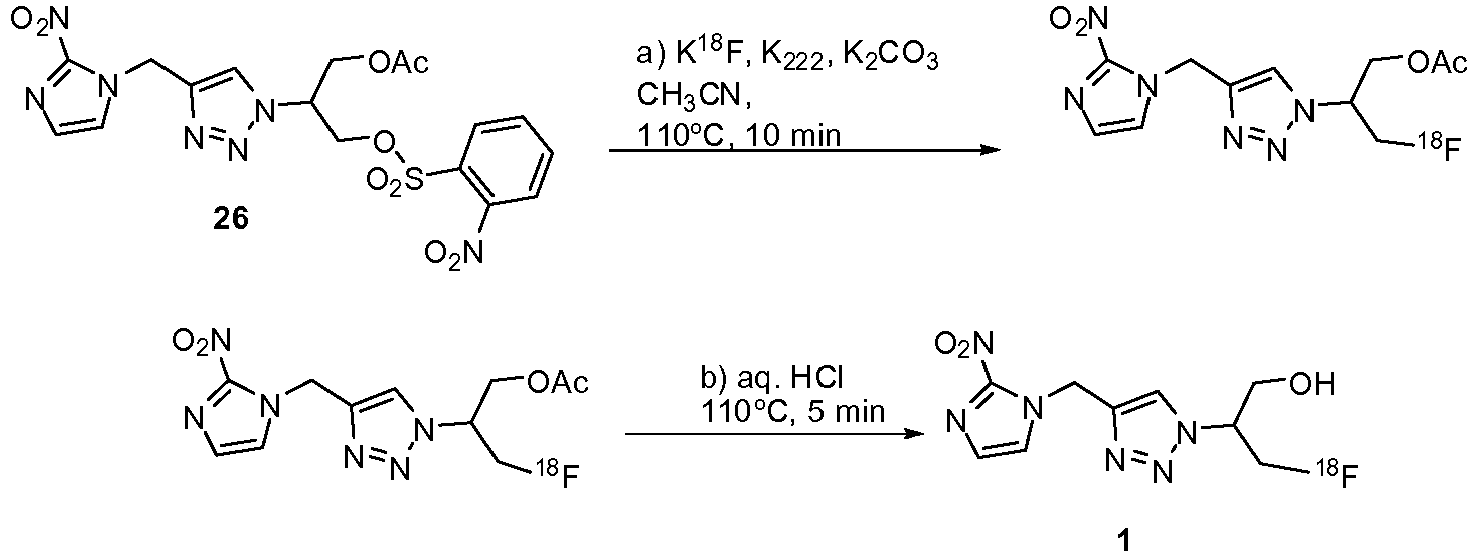

- Radioactive [F-18]fluoride is transferred into a 3 mL V-vial with 0.5 mL of K222/K2CO3 solution (660 mg of K222 and 210 mg of K2CO3 in 9 mL of MeCN and 9 mL of H2O). The [F-18]Fluoride is azeotropically dried with 3 x 1 mL MeCN under Ar flow. A solution of the precursor 26, (16 ± 5 mg, 20-40 µmol) dissolved in acetonitrile (1.0 mL) is added to the reaction vessel containing the anhydrous [F-18]Fluoride. The vessel is heated to 95 ± 5 °C for 7.5 ± 2.5 minutes to induce displacement of the nosylate leaving group by [F-18]fluoride.
- After cooling and evaporating the acetonitrile to approximately 0.1 mL, aqueous NaOH (0.05 N, 2.0 mL) is added and the mixture heated to 60 ± 5 °C for 3 ± 1 minutes. This hydrolyzes the acetate group converting it to a hydroxyl group. This hydrolysis reaction results in the formation of crude [F-18]1.
- Purification of reaction mixture and sterile filtration: The crude reaction material was purified via chromatographic separation using a semi-preparative HPLC column (Phenomenex Luna reverse phase semi-prep column (250 x 10 mm, 10µ), 6% ethanol, 5.0 mL/min). The column effluent is monitored using UV (254 nm) and radiometric detectors connected in series.
- The explora ® RN chemistry module is equipped with both UV and Geiger Mueller (GM) detectors. The product is collected from the column as monitored by flow-through radioactivity and UV (254 nm) detectors. Under the described elution conditions, the retention time of the [F-18]1 is approximately 17 ± 5 minutes. A sterile empty collection vial is preloaded with 5-10 mL of sterile diluent containing 1-6% ethanol, 75 mg/mL of ascorbic acid and 95% 21 mM phosphate. The purified [F-18]1 fraction eluted from the HPLC purification column is processed through a 0.2 µm sterile filter into the preloaded collection vial. Based on an in-process assay for total radioactivity, sufficient ascorbic acid and sterile diluent is added to adjust the ascorbic acid concentration to 5% (50 mg/mL) and the radioactive concentration to not more than 30 mCi/mL.

- Method:
Compound 1 was dissolved in DMSO to achieve a 100 mM stock solution. This was then diluted with 1X PBS containing 3% Solutol to achieve a concentration of 5 mM. 200 µl of 5mM Compound 1 solution was injected into the tail vein in mice animals under isofluorane anesthesia. The in vivo uptake was two hours. - Blood and urine samples were collected at 30, 60, 90 and 120 minutes. Samples were immediately placed on ice to prevent compound degradation. After blood and urine sampling were completed at 120 minutes, the mouse was sacrificed by cervical dislocation. The following whole organs were harvested within 30-40 minutes in the following order; lower GI, upper GI, spleen, pancreas, gall bladder, liver, heart, kidneys, lungs, about 0.3 gram of muscle from both legs, about 0.4 gram of skin at the back, the entire brain and about 0.4 gram of fat inside the abdomen.
- To the samples were added a proportional amount of lysis buffer (about 5 ml/gram tissue) before the tissue was homogenized using a powered homogenizer. 50 µL of lysis buffer was added to the blood and urine samples, followed by briefly vortexing. 200 µl of organ homogenate was sampled into a 1.5 ml Eppendorf tube. All samples were heated at 100 °C for 2 minutes to denature the proteins and then placed in ice for 15 minutes. Then 40 µl of formic acid was added to the organ samples and 20 µl was added to the blood and urine samples. All tubes were vortexed to achieve complete mixing of sample with acid. Samples were then placed on ice for 15 minutes before being centrifuged at 13000 rpm for 15 minutes at 4 °C. 30 µl of the supernatant was transferred to an HPLC vial for MSD analysis.
- A standard curve with a wide range of
Compound 1 concentrations was prepared using the same method described above for tissue lysate treatment. The corresponding peak of the compound was identified first in the standards. The areas of the peaks were measured and converted into a standard correlation curve for estimation ofCompound 1 concentration in the samples. The amount of compound in each sample is expressed as % injected dose/gram tissue (%ID/g tissue). - Method:
Compound 1 solution was prepared as described previously. One ml of 10mM Compound 1 solution was injected intravenously (tail vein) into rats under isofluorane anesthesia. Blood and urine samples were collected before injection and at 15, 30, 60, 90 and 120 minutes after injection. Samples treatments and LC/MS measurement are the same as the mouse samples described in 1A. - In mouse, the blood level of
Compound 1 was 4.1 %ID/g at 30 minutes and decreased to 0.59% at 120 minutes. Blood clearance and urine excretion is fast given the high %ID/g in urine and low %ID/g in blood (95.6 %ID/g at 30 minute urine, 4.1 %ID/g at 30 minute blood). The urine excretion index (averaged urine %ID/g divided by blood %ID/g at 120 minute) was 88.69. The levels ofCompound 1 in gall bladder and GI system are low. - In rats, the blood levels of
Compound 1 are 0.67 and 0.15 %ID/g at 30 and 120 minutes, respectively. The urine level was 5.3 %ID/g at 30 minute. The urine excretion index (averaged urine %ID/g divided by blood %ID/g at 120 minute) was 36.62. Thus,Compound 1 in rat urine excretion and blood clearance is fast given the high %ID/g in the urine and low %ID/g in the blood. - Method: The assay is based on the ability of viable cells to reduce 3-[4,5-dimethylthiazol-2-yl]-2,5-diphenyl tetrazolium bromide to colored formazan crystals. Ls174T human colorectal adenocarcinoma, A172 human brain glioblastoma, MRC5 human normal lung fibroblast, and ALM 12 mouse normal liver cell lines were selected for this study. Cells were cultured with different concentration of Compound 1 (0, 100, 500, 1000, 5000, 10000 nM) for 24 hours and then incubated with 0.5 mg/ml of 3-[4,5-dimethylthiazol-2-yl]-2,5-diphenyl tetrazolium bromide for 1 hour. Cells were lysed and formazan crystals were dissolved with 2-propanol for 1 hour and the optical density of the resultant colored 2-propanol was measured. The percentages of cell survival were calculated based on the optical densities.
- Results: In all of these four cell lines (normal and cancerous), statistically, the numbers of viable cells treated with different concentrations of
Compound 1 showed no difference from those of untreated control cells. Thus,Compound 1 is not cytotoxic to normal or cancer cells (Figures 3-5 ). - Animals were anesthetized using isoflurane/oxygen inhalation for the duration of each PET scanning procedure (up to 2 hours). Anesthetized animals were placed on a heated pad for the duration of each PET scan. Typical injection volumes were 250 µL typically containing 250 µCi of activity. Continuous, dynamic PET scanning commenced immediately following administration of the F18-labeled tracer.
Claims (33)
- A compound of formula I:
 X is a (C1-C10)alkylenyl, unsubstituted or substituted with 1, 2, 3 or 4 X1, wherein one of the (C1-C10)alkylenyl carbon atoms is optionally replaced by a group selected from -CO-, -CONR'-, -NR'CO-, -NR'-, -O- and -S-, or wherein 2, 3 or 4 contiguous atoms of the (C1-C10)alkylenyl group form an unsubstituted or substituted (C3-C8)cycloalkyl or a (C3-C8)heterocycloalkyl ring, unsubstituted or substituted with 1, 2, 3 or 4 X1, or a combination thereof;each X1 is independently selected from the group consisting of hydroxyl, thiol, amino, alkyl, alkoxy, thioalkyl and halo;Y is a triazolyl of the formula;
 Z is an (C1-C10)alkylenyl group wherein one of the carbon atoms of the (C1-C10)alkylenyl group is optionally replaced by a group selected from -CO-, -CONR", -NR"CO-, -NR"-, -O- and -S-, and wherein the (C1-C10)alkylenyl group is unsubstituted or substituted with 1, 2, 3 or 4 X1;A is a radioactive element; andR' and R" are each independently H or are each independently selected from the group consisting of (C1-C6)alkyl, -CO(C1-C3)alkyl, -CONH(C1-C3)alkyl and -CO2(C1-C3)alkyl.
 - The compound of Claim 1, wherein X is a (C1-C4)alkylenyl group optionally substituted with 1, 2 or 3 hydroxyl groups or 1, 2 or 3 -NH2 or -NH(C1-C4)alkyl group.
- The compound of Claim 2, wherein X is selected from the group consisting of -CH2-, -CH2-CH2-, -CH2-CH2-CH2-, -CH2-CH2-CH2-CH2-, -CH2-CH(OH)-, -CH(OH)-CH2-, -CH(OH)-CH2-CH2-, -CH2-CH(OH)-CH2-, -CH2-CH2-CH(OH)- and -CH2-CH(OH)-CH(OH)-C H2-.
- The compound of Claim 1, wherein X is selected from the group consisting of-CONR'-, -(C1-C4)alkylCONR'-, -CONR'(C1-C4)alkyl- and -(C1-C4)alkylCONR'(C1-C4)alkyl, wherein R' is H or (C1-C3)alkyl.
- The compound of Claim 1, wherein A is 11C.
- The compound of Claim 1 of formula II or III
 X is a (C1-C10)alkylenyl, unsubstituted or substituted with 1, 2, 3 or 4 X1, wherein one of the (C1-C10)alkylenyl carbon atoms is optionally replaced by a group selected from -CO-, -CONR'-, -NR'CO-, -NR'-, -O- and -S-, or wherein 2, 3 or 4 contiguous atoms of the (C1-C10)alkylenyl group form an unsubstituted or substituted (C3-C8)cycloalkyl or a (C3-C8)heterocycloalkyl ring, unsubstituted or substituted with 1, 2, 3 or 4 X1, or a combination thereof;each X1 is independently hydroxyl, thiol, amino, alkyl, alkoxy, thioalkyl, or halo;Z is an (C1-C10)alkylenyl group wherein one of the carbon atoms of the (C1-C10)alkylenyl group is optionally replaced by a group selected from -CO-, -CONR"-, -NR"CO-, -NR"-, -O- and -S-, and the (C1-C10)alkylenyl group is unsubstituted or substituted with 1, 2, 3 or 4 X1;A is a radioactive element; andR' and R" are each independently H or are each independently selected from the group consisting of (C1-C6)alkyl, -CO(C1-C3)alkyl, -CONH(C1-C3)alkyl and -CO2(C1-C3)alkyl.
 - The compound of claim 1 of formula IIb:
 Z is an (C1-C10)alkylenyl group wherein one of the carbon atoms of the (C1-C10)alkylenyl group is optionally replaced by a group selected from -CO-, -CONR"-, -NR"CO-, -NR"-, -O- and -S-, and the (C1-C10)alkylenyl group is unsubstituted or substituted with 1, 2, 3 or 4 X1;R" is H or is selected from the group consisting of (C1-C6)alkyl, -CO(C1-C3)alkyl, - CONH(C1-C3)alkyl and -CO2(C1-C3)alkyl.each X1 is independently selected from the group consisting of hydroxyl, thiol, amino, alkyl, alkoxy, thioalkyl and halo; andA is a radioactive element.
 - The compound of any one of Claims 1-7, wherein Z is an (C1-C4)alkylenyl group optionally substituted with 1, 2 or 3 groups independently selected from the group consisting of hydroxyl, thiol, amino, (C1-C4)alkyl, (C1-C4)alkoxy, thio(C1-C4)alkyl and halo.
- The compound of Claim 8, wherein Z is selected from the group consisting of -CH2-, -CH2-CH2-, -CH2-CH2-CH2-, -CH2-CH2-CH2-CH2-, -CH2-CH(OH)-, -CH(OH)-CH2-, -CH(OH)-CH2-CH2-, -CH(CH2OH)-CH2-, -CH2-CH(OH)-CH2-, -CH2-CH2-CH(OH)- and -CH2-CH(OH)-CH(OH)-CH2-.
- The compound of any one of Claims 1-9, wherein A is 18F or 11C-Me.
- The compound of Claim 10, wherein A is 18F.
- The compound of Claim 11 of formula:

- A compound of claim 1 which is a compound of formula IV:
 X is a (C1-C10)alkylenyl, unsubstituted or substituted with 1, 2, 3 or 4 X1, wherein one of the (C1-C10)alkylenyl carbon atoms is optionally replaced by a group selected from -CO-, -CONR'-, -NR'CO-, -NR'-, -O- and -S-, or wherein 2, 3 or 4 contiguous atoms of the (C1-C10)alkylenyl group form an unsubstituted or substituted (C3-C8)cycloalkyl or a (C3-C8)heterocycloalkyl ring, unsubstituted or substituted with 1, 2, 3 or 4 X1 or a combination thereof;R' is H or is selected from the group consisting of (C1-C6)alkyl, -CO(C1-C3)alkyl, -CONH(C1-C3)alkyl and -CO2(C1-C3)alkyl; andeach X1 is independently selected from the group consisting of hydroxyl, thiol, amino, (C1-C4)alkyl, (C1-C4)alkoxy, thio(C1-C4)alkyl and halo.
 - The compound of Claim 13, wherein X is (C1-C5)alkylenyl, unsubstituted or substituted with 1 or 2 X1, or wherein one of the (C1-C10)alkylenyl carbon atoms is optionally replaced by a group selected from -CONR'- or -NR'CO-, or wherein 2, 3 or 4 contiguous atoms of the (C1-C10)alkylenyl group form an unsubstituted or substituted (C3-C8)cycloalkyl unsubstituted or substituted with 1, 2 or 3 X1, wherein X1 is -OH or NH2.
- A compound of claim 1 of formula V:
 X is a (C1-C10)alkylenyl, unsubstituted or substituted with 1, 2, 3 or 4 X1 wherein one of the (C1-C10)alkylenyl carbon atoms is optionally replaced by a group selected from -CO-, -CONR'-, -NR'CO-, -NR'-, -O- and -S-, or wherein 2, 3 or 4 contiguous atoms of the (C1-C10)alkylenyl group form an unsubstituted or substituted (C3-C8)cycloalkyl or a (C3-C8)heterocycloalkyl ring, unsubstituted or substituted with 1, 2, 3 or 4 X1, or a combination thereof;R' is H or is selected from the group consisting of (C1-C6)alkyl, -CO(C1-C3)alkyl, -CONH(C1-C3)alkyl and -CO2(C1-C3)alkyl; andeach X1 is independently selected from the group consisting of hydroxyl, thiol, amino, alkyl, alkoxy, thioalkyl and halo.
 - The compound of Claim 15 of the formula

- The compound of Claim 1 selected from the group consisting of:


- A method for detecting hypoxia in cells comprising:a) administering to a mammal a compound of the formula I:
 X is a (C1-C10alkylenyl, unsubstituted or substituted with 1, 2, 3 or 4 X1, wherein one of the (C1-C10alkylenyl carbon atoms is optionally replaced by a group selected from -CO-, -CONR'-, -NR'CO-, -NR'-, -O- and -S-, or wherein 2, 3 or 4 contiguous atoms of the (C1-C10alkylenyl group form an unsubstituted or substituted (C3-C8)cycloalkyl or a (C3-C8)heterocycloalkyl ring, unsubstituted or substituted with 1, 2, 3 or 4 X1, or a combination thereof;each X1 is independently selected from the group consisting of hydroxyl, thiol, amino, alkyl, alkoxy, thioalkyl and halo;Y is a triazolyl of the formula;
 Z is an (C1-C10)alkylenyl group wherein one of the carbon atoms of the (C1-C10)alkylenyl group is optionally replaced by a group selected from -CO-, -CONR'-, -NR'CO-, -NR'-, -O- and -S-, and wherein the (C1-C10)alkylenyl group is unsubstituted or substituted with 1, 2, 3 or 4 X1;A is a radioactive element; andR' and R" are each independently H or are each independently selected from the group consisting of (C1-C6)alkyl, -CO(C1-C3)alkyl, -CONH(C1-C3)alkyl and -CO2(C1-C3)alkyl; andb) detecting by PET the presence of retained radioactive element in hypoxic cells of the mammal.
 - The method of Claim 18, wherein X is a (C1-C4)alkylenyl group optionally substituted with 1, 2 or 3 hydroxyl groups or 1, 2 or 3 -NH2 or -NH(C1-C4)alkyl group.
- The method of Claim 19, wherein X is selected from the group consisting of-CH2-, -CH2-CH2-, -CH2-CH2-CH2-, -CH2-CH2-CH2-CH2-, -CH2-CH(OH)-, -CH(OH)-CH2-, -C H(OH)-CH2-CH2-, -CH2-CH(OH)-CH2-, -CH2-CH2-CH(OH)- and -CH2-CH(OH)-CH(OH)-CH2
- The method of Claim 18, wherein X is selected from the group consisting of-CONR'-, -(C1-C4)alkylCONR'-, -CONR'(C1-C4)alkyl- and -(C1-C4)alkylCONR'(C1-C4)alky 1-, and wherein R' is H or (C1-C3)alkyl.
- The method of Claim 18, wherein the compound is of formula II or III
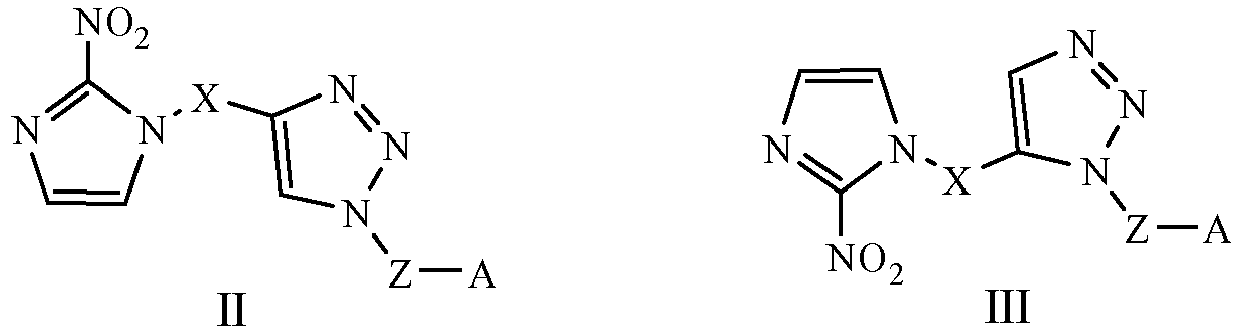 X is a (C1-C10)alkylenyl, unsubstituted or substituted with 1, 2, 3 or 4 X1 wherein one of the (C1-C10)alkylenyl carbon atoms is optionally replaced by a group selected from -CO-, -CONR'-, -NR'CO-, -NR'-, -O- and -S-, or wherein 2, 3 or 4 contiguous atoms of the (C1-C10)alkylenyl group form an unsubstituted or substituted (C3-C8)cycloalkyl or a (C3-C8)heterocycloalkyl ring, unsubstituted or substituted with 1, 2, 3 or 4 X1, or a combination thereof;each X1 is independently selected from the group consisting of hydroxyl, thiol, amino, alkyl, alkoxy, thioalkyl and halo;Z is an (C1-C10)alkylenyl group wherein one of the carbon atoms of the (C1-C10)alkylenyl group is optionally replaced by a group selected from -CO-, -CONR"-, -NR"CO-, -NR"-, -O- and -S-, and the (C1-C10)alkylenyl group is unsubstituted or substituted with 1, 2, 3 or 4 X1;A is a radioactive element; andR' and R" are each independently H or are each independently selected from the group consisting of (C1-C6)alkyl, -CO(C1-C3)alkyl, -CONH(C1-C3)alkyl and -CO2(C1-C3)alkyl.
 - The method of Claim 22, wherein the compound is of the formula II.
- The method of any one of Claims 18-23, wherein Z is (C1-C4)alkylenyl group optionally substituted with 1, 2 or 3 hydroxyl groups or 1, 2 or 3 hydroxy(C1-C4)alkyl groups.
- The method of Claim 24, wherein Z is selected from the group consisting of -CH2-, -CH2-CH2-, -CH2-CH2-CH2-, -CH2-CH2-CH2-CH2-, -CH2-CH(OH)-, -CH(OH)-CH2-, -CH(OH)-CH2-CH2-, -CH(CH2OH)-CH2-, -CH2-CH(OH)-CH2-, -CH2-CH2-CH(OH)- and -CH2-CH(OH)-CH(OH)-CH2-.
- The method of any one of Claims 18-25, wherein A is 18F or 11C-Me.
- The method of Claim 26, wherein A is 18F.
- The method of Claim 18, wherein the compound is of the formula:



- The method of Claim 18, wherein the hypoxic cells are tumor cells or ischemic cells.
- A method of preparing a compound of formula II or III of claim 6, or a mixture thereof, comprising:a) treating an azide substituted compound A'-Z-N3 with an acetylene substituted nitroimidazole, wherein A' is a leaving group; and
 b) radio labeling the product of step a) by the displacement of A' with a radio labeling agent to form compound II or III or a mixture thereof, wherein A is either 18F or 11C.
 - The method of Claim 30, wherein the compound is of the formula

- The method of Claim 30, wherein the radiolabeling agent is K18F.
- A compound of any one of Claims 1 to 17, for use in the detection of hypoxic tumors in a mammal in need thereof, the detection comprising administration to the mammal of a detection effective amount of said compound.
Applications Claiming Priority (3)
| Application Number | Priority Date | Filing Date | Title |
|---|---|---|---|
| US92193207P | 2007-04-05 | 2007-04-05 | |
| US96425407P | 2007-08-10 | 2007-08-10 | |
| PCT/US2008/059505 WO2008124651A2 (en) | 2007-04-05 | 2008-04-04 | Nitro-imidazole hypoxia imaging agents |
Publications (2)
| Publication Number | Publication Date |
|---|---|
| EP2132200A2 EP2132200A2 (en) | 2009-12-16 |
| EP2132200B1 true EP2132200B1 (en) | 2016-03-23 |
Family
ID=39831553
Family Applications (1)
| Application Number | Title | Priority Date | Filing Date |
|---|---|---|---|
| EP08745183.7A Not-in-force EP2132200B1 (en) | 2007-04-05 | 2008-04-04 | Nitro-imidazole hypoxia imaging agents |
Country Status (7)
| Country | Link |
|---|---|
| US (2) | US7807394B2 (en) |
| EP (1) | EP2132200B1 (en) |
| JP (1) | JP5347164B2 (en) |
| KR (1) | KR101523257B1 (en) |
| CN (1) | CN101652360B (en) |
| CA (1) | CA2683433C (en) |
| WO (1) | WO2008124651A2 (en) |
Families Citing this family (22)
| Publication number | Priority date | Publication date | Assignee | Title |
|---|---|---|---|---|
| CN101652360B (en) * | 2007-04-05 | 2014-06-25 | 美国西门子医疗解决公司 | Nitroimidazole hypoxic contrast agent |
| CN101709060B (en) * | 2009-12-02 | 2013-05-01 | 北京师范大学 | F-triazole ring-polyethylene glycol-metronidazole compound and preparation method thereof |
| RU2631500C2 (en) | 2010-02-08 | 2017-09-25 | Лантеус Медикал Имаджинг, Инк. | Methods and apparatus for synthesizing imaging agents, and intermediates thereof |
| US10639608B2 (en) | 2010-04-08 | 2020-05-05 | Siemens Medical Solutions Usa, Inc. | System, device and method for preparing tracers and transferring materials during radiosynthesis |
| US9023316B2 (en) | 2010-04-08 | 2015-05-05 | Siemens Medical Solutions Usa, Inc. | Synthesis of 18F-labeled tracers in hydrous organic solvents |
| CN101921263A (en) * | 2010-04-16 | 2010-12-22 | 兰州大学 | 2-nitroimidazole derivatives and their use and preparation method |
| MX343721B (en) | 2010-05-11 | 2016-11-17 | Lantheus Medical Imaging Inc | Compositions, methods and systems for the synthesis and use of imaging agents. |
| US9550000B2 (en) | 2011-09-09 | 2017-01-24 | Lantheus Medical Imaging, Inc. | Compositions, methods, and systems for the synthesis and use of imaging agents |
| WO2013054788A1 (en) * | 2011-10-14 | 2013-04-18 | 住友重機械工業株式会社 | Charged particle beam irradiation system, and charged particle beam irradiation planning method |
| WO2014007650A1 (en) * | 2011-12-23 | 2014-01-09 | Auckland Uniservices Limited | Compounds and methods for selective imaging and/or ablation |
| US9278124B2 (en) | 2012-10-16 | 2016-03-08 | Halozyme, Inc. | Hypoxia and hyaluronan and markers thereof for diagnosis and monitoring of diseases and conditions and related methods |
| JP6073508B2 (en) | 2014-01-13 | 2017-02-01 | ベルハジ−タハール ハフィド | Dendrimer compositions, synthesis methods, and uses thereof |
| EP3199183A4 (en) * | 2014-09-25 | 2018-02-21 | Nihon Medi-Physics Co., Ltd. | Renal imaging agent |
| WO2016179117A1 (en) * | 2015-05-01 | 2016-11-10 | Vanderbilt University | Composition and method for detecting hypoxia |
| US10695450B2 (en) | 2016-07-26 | 2020-06-30 | Laboratoires Cyclopharma | Synthesis of a radioactive agent composition |
| CN106977501A (en) * | 2017-03-20 | 2017-07-25 | 华东师范大学 | A kind of hypoxemia activation prodrug based on the alkylol of 2 nitroimidazole 1 |
| FR3068695B1 (en) * | 2017-07-05 | 2019-08-16 | Centre National De La Recherche Scientifique | COMPOUNDS USEFUL AS HYPOXIA IMAGING AGENT |
| CN111372940A (en) * | 2017-09-19 | 2020-07-03 | 阿尔伯塔大学理事会 | Bioreduction-activated compounds, prodrugs thereof, radiopharmaceuticals, compositions and their use in multimodal therapeutic control of hypoxic diseases including cancer |
| US12600742B2 (en) | 2017-09-19 | 2026-04-14 | Wwiky Biosciences Inc. | Markers, conjugates, compositions and methods for hypoxia imaging, mapping, and therapy |
| AU2020417293A1 (en) | 2020-01-03 | 2022-09-01 | Berg Llc | Polycyclic amides as UBE2K modulators for treating cancer |
| CN111233821B (en) * | 2020-01-20 | 2022-12-27 | 上海交通大学医学院附属仁济医院 | Novel antimycin derivative containing 3-hydroxybenzene acid group and preparation method and application thereof |
| CN114478489B (en) * | 2022-01-18 | 2023-04-28 | 中国科学院精密测量科学与技术创新研究院 | Preparation method and application of fluorine-19 modified nitroimidazole compound and derivative thereof |
Family Cites Families (4)
| Publication number | Priority date | Publication date | Assignee | Title |
|---|---|---|---|---|
| US5674693A (en) * | 1994-03-18 | 1997-10-07 | Natural Pharmacia International Inc. | Derivatives of 2-nitro-imidazoles as hypoxic cell markers |
| US5721265A (en) * | 1994-08-05 | 1998-02-24 | Sri International | Fluorinated 2-nitroimidazole analogs for detecting hypoxic tumor cells |
| ES2246858T3 (en) * | 1999-08-11 | 2006-03-01 | Universite Catholique De Louvain | METHODS TO PREPARE PERFORMED NITROIMIDAZOL DERIVATIVES RADIOMARCATED WITH (18F) FOR THE DETECTION OF CELLULAR HYPOXIA. |
| CN101652360B (en) * | 2007-04-05 | 2014-06-25 | 美国西门子医疗解决公司 | Nitroimidazole hypoxic contrast agent |
-
2008
- 2008-04-04 CN CN200880011415.1A patent/CN101652360B/en not_active Expired - Fee Related
- 2008-04-04 KR KR1020097023183A patent/KR101523257B1/en not_active Expired - Fee Related
- 2008-04-04 CA CA2683433A patent/CA2683433C/en not_active Expired - Fee Related
- 2008-04-04 EP EP08745183.7A patent/EP2132200B1/en not_active Not-in-force
- 2008-04-04 JP JP2010502341A patent/JP5347164B2/en not_active Expired - Fee Related
- 2008-04-04 US US12/098,390 patent/US7807394B2/en not_active Expired - Fee Related
- 2008-04-04 WO PCT/US2008/059505 patent/WO2008124651A2/en not_active Ceased
-
2010
- 2010-07-15 US US12/836,926 patent/US7977361B2/en not_active Expired - Fee Related
Also Published As
| Publication number | Publication date |
|---|---|
| CA2683433A1 (en) | 2008-10-16 |
| KR101523257B1 (en) | 2015-05-27 |
| EP2132200A2 (en) | 2009-12-16 |
| US20110002850A1 (en) | 2011-01-06 |
| CN101652360B (en) | 2014-06-25 |
| WO2008124651A2 (en) | 2008-10-16 |
| JP2010523596A (en) | 2010-07-15 |
| US7807394B2 (en) | 2010-10-05 |
| KR20090130106A (en) | 2009-12-17 |
| CN101652360A (en) | 2010-02-17 |
| WO2008124651A3 (en) | 2009-04-02 |
| JP5347164B2 (en) | 2013-11-20 |
| CA2683433C (en) | 2016-10-11 |
| US20090010846A1 (en) | 2009-01-08 |
| US7977361B2 (en) | 2011-07-12 |
Similar Documents
| Publication | Publication Date | Title |
|---|---|---|
| US7807394B2 (en) | Nitro-imidazole hypoxia imaging agents | |
| US20060263293A1 (en) | Click chemistry method for synthesizing molecular imaging probes | |
| Kumar et al. | Design, synthesis, and preliminary biological evaluation of 6-O-glucose–azomycin adducts for diagnosis and therapy of hypoxic tumors | |
| US9107964B2 (en) | Radioactive fluorine-labeled compound | |
| US7928210B2 (en) | Nucleoside based proliferation imaging markers | |
| US10358434B2 (en) | 2-(3-pyridinyl)-1H-benzimidazole derivative compound and medicament containing same | |
| EP2841402B1 (en) | Labelled quinoxaline derivatives as multimodal radiopharmaceuticals and their precursors | |
| Cao et al. | Synthesis of novel PEG-modified nitroimidazole derivatives via “hot-click” reaction and their biological evaluation as potential PET imaging agent for tumors | |
| Kiritsis et al. | Synthesis and preclinical evaluation of rhenium and technetium-99m “4+ 1” mixed-ligand complexes bearing quinazoline derivatives as potential EGFR imaging agents | |
| Liu et al. | Development of STING probes and visualization of STING in multiple tumor types | |
| EP1202973B1 (en) | Preparation of compounds useful for the detection of hypoxia | |
| Wong et al. | Synthesis and 18 F-radiolabeling of thymidine AMBF 3 conjugates | |
| JP2019043882A (en) | Therapeutic effect predictors for alternative anticancer drugs | |
| US8969546B2 (en) | Compounds useful in imaging and therapy | |
| Sand | Synthetic studies toward [18F]-fluorination of solid-supported silyl ethers | |
| HK1232878B (en) | 2-(3-pyridinyl)-1h-benzimidazole derivative compound and medicine containing same | |
| HK1232878A1 (en) | 2-(3-pyridinyl)-1h-benzimidazole derivative compound and medicine containing same | |
| HK1207852B (en) | Labelled quinoxaline derivatives as multimodal radiopharmaceuticals and their precursors |
Legal Events
| Date | Code | Title | Description |
|---|---|---|---|
| PUAI | Public reference made under article 153(3) epc to a published international application that has entered the european phase |
Free format text: ORIGINAL CODE: 0009012 |
|
| 17P | Request for examination filed |
Effective date: 20090826 |
|
| AK | Designated contracting states |
Kind code of ref document: A2 Designated state(s): AT BE BG CH CY CZ DE DK EE ES FI FR GB GR HR HU IE IS IT LI LT LU LV MC MT NL NO PL PT RO SE SI SK TR |
|
| DAX | Request for extension of the european patent (deleted) | ||
| 17Q | First examination report despatched |
Effective date: 20140627 |
|
| RAP1 | Party data changed (applicant data changed or rights of an application transferred) |
Owner name: THRESHOLD PHARMACEUTICALS, INC. |
|
| GRAP | Despatch of communication of intention to grant a patent |
Free format text: ORIGINAL CODE: EPIDOSNIGR1 |
|
| RIC1 | Information provided on ipc code assigned before grant |
Ipc: C07B 59/00 20060101ALI20150903BHEP Ipc: C07D 403/12 20060101ALI20150903BHEP Ipc: C07D 403/06 20060101AFI20150903BHEP Ipc: A61K 51/04 20060101ALI20150903BHEP |
|
| INTG | Intention to grant announced |
Effective date: 20150918 |
|
| GRAS | Grant fee paid |
Free format text: ORIGINAL CODE: EPIDOSNIGR3 |
|
| GRAA | (expected) grant |
Free format text: ORIGINAL CODE: 0009210 |
|
| AK | Designated contracting states |
Kind code of ref document: B1 Designated state(s): AT BE BG CH CY CZ DE DK EE ES FI FR GB GR HR HU IE IS IT LI LT LU LV MC MT NL NO PL PT RO SE SI SK TR |
|
| REG | Reference to a national code |
Ref country code: GB Ref legal event code: FG4D |
|
| REG | Reference to a national code |
Ref country code: CH Ref legal event code: EP |
|
| REG | Reference to a national code |
Ref country code: FR Ref legal event code: PLFP Year of fee payment: 9 |
|
| REG | Reference to a national code |
Ref country code: AT Ref legal event code: REF Ref document number: 783003 Country of ref document: AT Kind code of ref document: T Effective date: 20160415 |
|
| REG | Reference to a national code |
Ref country code: IE Ref legal event code: FG4D |
|
| REG | Reference to a national code |
Ref country code: DE Ref legal event code: R096 Ref document number: 602008043050 Country of ref document: DE |
|
| PGFP | Annual fee paid to national office [announced via postgrant information from national office to epo] |
Ref country code: LU Payment date: 20160413 Year of fee payment: 9 |
|
| PGFP | Annual fee paid to national office [announced via postgrant information from national office to epo] |
Ref country code: NL Payment date: 20160411 Year of fee payment: 9 |
|
| REG | Reference to a national code |
Ref country code: ES Ref legal event code: FG2A Ref document number: 2577709 Country of ref document: ES Kind code of ref document: T3 Effective date: 20160718 |
|
| REG | Reference to a national code |
Ref country code: LT Ref legal event code: MG4D |
|
| REG | Reference to a national code |
Ref country code: NL Ref legal event code: MP Effective date: 20160323 |
|
| PG25 | Lapsed in a contracting state [announced via postgrant information from national office to epo] |
Ref country code: GR Free format text: LAPSE BECAUSE OF FAILURE TO SUBMIT A TRANSLATION OF THE DESCRIPTION OR TO PAY THE FEE WITHIN THE PRESCRIBED TIME-LIMIT Effective date: 20160624 Ref country code: NO Free format text: LAPSE BECAUSE OF FAILURE TO SUBMIT A TRANSLATION OF THE DESCRIPTION OR TO PAY THE FEE WITHIN THE PRESCRIBED TIME-LIMIT Effective date: 20160623 Ref country code: FI Free format text: LAPSE BECAUSE OF FAILURE TO SUBMIT A TRANSLATION OF THE DESCRIPTION OR TO PAY THE FEE WITHIN THE PRESCRIBED TIME-LIMIT Effective date: 20160323 |
|
| PGFP | Annual fee paid to national office [announced via postgrant information from national office to epo] |
Ref country code: CH Payment date: 20160411 Year of fee payment: 9 Ref country code: MC Payment date: 20160412 Year of fee payment: 9 Ref country code: IE Payment date: 20160411 Year of fee payment: 9 |
|
| REG | Reference to a national code |
Ref country code: AT Ref legal event code: MK05 Ref document number: 783003 Country of ref document: AT Kind code of ref document: T Effective date: 20160323 |
|
| PG25 | Lapsed in a contracting state [announced via postgrant information from national office to epo] |
Ref country code: NL Free format text: LAPSE BECAUSE OF FAILURE TO SUBMIT A TRANSLATION OF THE DESCRIPTION OR TO PAY THE FEE WITHIN THE PRESCRIBED TIME-LIMIT Effective date: 20160323 Ref country code: LV Free format text: LAPSE BECAUSE OF FAILURE TO SUBMIT A TRANSLATION OF THE DESCRIPTION OR TO PAY THE FEE WITHIN THE PRESCRIBED TIME-LIMIT Effective date: 20160323 Ref country code: SE Free format text: LAPSE BECAUSE OF FAILURE TO SUBMIT A TRANSLATION OF THE DESCRIPTION OR TO PAY THE FEE WITHIN THE PRESCRIBED TIME-LIMIT Effective date: 20160323 Ref country code: LT Free format text: LAPSE BECAUSE OF FAILURE TO SUBMIT A TRANSLATION OF THE DESCRIPTION OR TO PAY THE FEE WITHIN THE PRESCRIBED TIME-LIMIT Effective date: 20160323 |
|
| PGFP | Annual fee paid to national office [announced via postgrant information from national office to epo] |
Ref country code: BE Payment date: 20160413 Year of fee payment: 9 Ref country code: IS Payment date: 20160509 Year of fee payment: 9 Ref country code: AT Payment date: 20160411 Year of fee payment: 9 Ref country code: DK Payment date: 20160412 Year of fee payment: 9 |
|
| PG25 | Lapsed in a contracting state [announced via postgrant information from national office to epo] |
Ref country code: PL Free format text: LAPSE BECAUSE OF FAILURE TO SUBMIT A TRANSLATION OF THE DESCRIPTION OR TO PAY THE FEE WITHIN THE PRESCRIBED TIME-LIMIT Effective date: 20160323 Ref country code: IS Free format text: LAPSE BECAUSE OF FAILURE TO SUBMIT A TRANSLATION OF THE DESCRIPTION OR TO PAY THE FEE WITHIN THE PRESCRIBED TIME-LIMIT Effective date: 20160723 Ref country code: EE Free format text: LAPSE BECAUSE OF FAILURE TO SUBMIT A TRANSLATION OF THE DESCRIPTION OR TO PAY THE FEE WITHIN THE PRESCRIBED TIME-LIMIT Effective date: 20160323 |
|
| PG25 | Lapsed in a contracting state [announced via postgrant information from national office to epo] |
Ref country code: CZ Free format text: LAPSE BECAUSE OF FAILURE TO SUBMIT A TRANSLATION OF THE DESCRIPTION OR TO PAY THE FEE WITHIN THE PRESCRIBED TIME-LIMIT Effective date: 20160323 Ref country code: SK Free format text: LAPSE BECAUSE OF FAILURE TO SUBMIT A TRANSLATION OF THE DESCRIPTION OR TO PAY THE FEE WITHIN THE PRESCRIBED TIME-LIMIT Effective date: 20160323 Ref country code: PT Free format text: LAPSE BECAUSE OF FAILURE TO SUBMIT A TRANSLATION OF THE DESCRIPTION OR TO PAY THE FEE WITHIN THE PRESCRIBED TIME-LIMIT Effective date: 20160725 Ref country code: RO Free format text: LAPSE BECAUSE OF FAILURE TO SUBMIT A TRANSLATION OF THE DESCRIPTION OR TO PAY THE FEE WITHIN THE PRESCRIBED TIME-LIMIT Effective date: 20160323 Ref country code: AT Free format text: LAPSE BECAUSE OF FAILURE TO SUBMIT A TRANSLATION OF THE DESCRIPTION OR TO PAY THE FEE WITHIN THE PRESCRIBED TIME-LIMIT Effective date: 20160323 |
|
| PG25 | Lapsed in a contracting state [announced via postgrant information from national office to epo] |
Ref country code: BE Free format text: LAPSE BECAUSE OF FAILURE TO SUBMIT A TRANSLATION OF THE DESCRIPTION OR TO PAY THE FEE WITHIN THE PRESCRIBED TIME-LIMIT Effective date: 20160323 |
|
| REG | Reference to a national code |
Ref country code: DE Ref legal event code: R097 Ref document number: 602008043050 Country of ref document: DE |
|
| PLBE | No opposition filed within time limit |
Free format text: ORIGINAL CODE: 0009261 |
|
| STAA | Information on the status of an ep patent application or granted ep patent |
Free format text: STATUS: NO OPPOSITION FILED WITHIN TIME LIMIT |
|
| PG25 | Lapsed in a contracting state [announced via postgrant information from national office to epo] |
Ref country code: DK Free format text: LAPSE BECAUSE OF FAILURE TO SUBMIT A TRANSLATION OF THE DESCRIPTION OR TO PAY THE FEE WITHIN THE PRESCRIBED TIME-LIMIT Effective date: 20160323 |
|
| PG25 | Lapsed in a contracting state [announced via postgrant information from national office to epo] |
Ref country code: BG Free format text: LAPSE BECAUSE OF FAILURE TO SUBMIT A TRANSLATION OF THE DESCRIPTION OR TO PAY THE FEE WITHIN THE PRESCRIBED TIME-LIMIT Effective date: 20160623 |
|
| 26N | No opposition filed |
Effective date: 20170102 |
|
| REG | Reference to a national code |
Ref country code: FR Ref legal event code: PLFP Year of fee payment: 10 |
|
| PGFP | Annual fee paid to national office [announced via postgrant information from national office to epo] |
Ref country code: FR Payment date: 20170313 Year of fee payment: 10 |
|
| PG25 | Lapsed in a contracting state [announced via postgrant information from national office to epo] |
Ref country code: SI Free format text: LAPSE BECAUSE OF FAILURE TO SUBMIT A TRANSLATION OF THE DESCRIPTION OR TO PAY THE FEE WITHIN THE PRESCRIBED TIME-LIMIT Effective date: 20160323 |
|
| PGFP | Annual fee paid to national office [announced via postgrant information from national office to epo] |
Ref country code: GB Payment date: 20170329 Year of fee payment: 10 |
|
| PGFP | Annual fee paid to national office [announced via postgrant information from national office to epo] |
Ref country code: ES Payment date: 20170317 Year of fee payment: 10 |
|
| PGFP | Annual fee paid to national office [announced via postgrant information from national office to epo] |
Ref country code: DE Payment date: 20170329 Year of fee payment: 10 |
|
| PGFP | Annual fee paid to national office [announced via postgrant information from national office to epo] |
Ref country code: IT Payment date: 20170420 Year of fee payment: 10 |
|
| REG | Reference to a national code |
Ref country code: CH Ref legal event code: PL |
|
| REG | Reference to a national code |
Ref country code: IE Ref legal event code: MM4A |
|
| PG25 | Lapsed in a contracting state [announced via postgrant information from national office to epo] |
Ref country code: MC Free format text: LAPSE BECAUSE OF NON-PAYMENT OF DUE FEES Effective date: 20170502 |
|
| PG25 | Lapsed in a contracting state [announced via postgrant information from national office to epo] |
Ref country code: CH Free format text: LAPSE BECAUSE OF NON-PAYMENT OF DUE FEES Effective date: 20170430 Ref country code: LI Free format text: LAPSE BECAUSE OF NON-PAYMENT OF DUE FEES Effective date: 20170430 Ref country code: LU Free format text: LAPSE BECAUSE OF NON-PAYMENT OF DUE FEES Effective date: 20170404 |
|
| PG25 | Lapsed in a contracting state [announced via postgrant information from national office to epo] |
Ref country code: IE Free format text: LAPSE BECAUSE OF NON-PAYMENT OF DUE FEES Effective date: 20170404 |
|
| PG25 | Lapsed in a contracting state [announced via postgrant information from national office to epo] |
Ref country code: HU Free format text: LAPSE BECAUSE OF FAILURE TO SUBMIT A TRANSLATION OF THE DESCRIPTION OR TO PAY THE FEE WITHIN THE PRESCRIBED TIME-LIMIT; INVALID AB INITIO Effective date: 20080404 Ref country code: CY Free format text: LAPSE BECAUSE OF FAILURE TO SUBMIT A TRANSLATION OF THE DESCRIPTION OR TO PAY THE FEE WITHIN THE PRESCRIBED TIME-LIMIT Effective date: 20160323 |
|
| PG25 | Lapsed in a contracting state [announced via postgrant information from national office to epo] |
Ref country code: HR Free format text: LAPSE BECAUSE OF FAILURE TO SUBMIT A TRANSLATION OF THE DESCRIPTION OR TO PAY THE FEE WITHIN THE PRESCRIBED TIME-LIMIT Effective date: 20160323 Ref country code: TR Free format text: LAPSE BECAUSE OF FAILURE TO SUBMIT A TRANSLATION OF THE DESCRIPTION OR TO PAY THE FEE WITHIN THE PRESCRIBED TIME-LIMIT Effective date: 20160323 |
|
| PG25 | Lapsed in a contracting state [announced via postgrant information from national office to epo] |
Ref country code: MT Free format text: LAPSE BECAUSE OF NON-PAYMENT OF DUE FEES Effective date: 20170404 |
|
| PGFP | Annual fee paid to national office [announced via postgrant information from national office to epo] |
Ref country code: MT Payment date: 20160415 Year of fee payment: 9 |
|
| REG | Reference to a national code |
Ref country code: DE Ref legal event code: R119 Ref document number: 602008043050 Country of ref document: DE |
|
| GBPC | Gb: european patent ceased through non-payment of renewal fee |
Effective date: 20180404 |
|
| PG25 | Lapsed in a contracting state [announced via postgrant information from national office to epo] |
Ref country code: DE Free format text: LAPSE BECAUSE OF NON-PAYMENT OF DUE FEES Effective date: 20181101 |
|
| PG25 | Lapsed in a contracting state [announced via postgrant information from national office to epo] |
Ref country code: GB Free format text: LAPSE BECAUSE OF NON-PAYMENT OF DUE FEES Effective date: 20180404 |
|
| PG25 | Lapsed in a contracting state [announced via postgrant information from national office to epo] |
Ref country code: IT Free format text: LAPSE BECAUSE OF NON-PAYMENT OF DUE FEES Effective date: 20180404 Ref country code: FR Free format text: LAPSE BECAUSE OF NON-PAYMENT OF DUE FEES Effective date: 20180430 |
|
| REG | Reference to a national code |
Ref country code: ES Ref legal event code: FD2A Effective date: 20190911 |
|
| PG25 | Lapsed in a contracting state [announced via postgrant information from national office to epo] |
Ref country code: ES Free format text: LAPSE BECAUSE OF NON-PAYMENT OF DUE FEES Effective date: 20180405 |