EP2131274A2 - Controlling an electronic device - Google Patents
Controlling an electronic device Download PDFInfo
- Publication number
- EP2131274A2 EP2131274A2 EP09250847A EP09250847A EP2131274A2 EP 2131274 A2 EP2131274 A2 EP 2131274A2 EP 09250847 A EP09250847 A EP 09250847A EP 09250847 A EP09250847 A EP 09250847A EP 2131274 A2 EP2131274 A2 EP 2131274A2
- Authority
- EP
- European Patent Office
- Prior art keywords
- command
- function
- electronic device
- pattern
- patterns
- Prior art date
- Legal status (The legal status is an assumption and is not a legal conclusion. Google has not performed a legal analysis and makes no representation as to the accuracy of the status listed.)
- Withdrawn
Links
Images




Classifications
-
- G—PHYSICS
- G06—COMPUTING OR CALCULATING; COUNTING
- G06F—ELECTRIC DIGITAL DATA PROCESSING
- G06F3/00—Input arrangements for transferring data to be processed into a form capable of being handled by the computer; Output arrangements for transferring data from processing unit to output unit, e.g. interface arrangements
- G06F3/01—Input arrangements or combined input and output arrangements for interaction between user and computer
- G06F3/048—Interaction techniques based on graphical user interfaces [GUI]
- G06F3/0487—Interaction techniques based on graphical user interfaces [GUI] using specific features provided by the input device, e.g. functions controlled by the rotation of a mouse with dual sensing arrangements, or of the nature of the input device, e.g. tap gestures based on pressure sensed by a digitiser
- G06F3/0488—Interaction techniques based on graphical user interfaces [GUI] using specific features provided by the input device, e.g. functions controlled by the rotation of a mouse with dual sensing arrangements, or of the nature of the input device, e.g. tap gestures based on pressure sensed by a digitiser using a touch-screen or digitiser, e.g. input of commands through traced gestures
- G06F3/04883—Interaction techniques based on graphical user interfaces [GUI] using specific features provided by the input device, e.g. functions controlled by the rotation of a mouse with dual sensing arrangements, or of the nature of the input device, e.g. tap gestures based on pressure sensed by a digitiser using a touch-screen or digitiser, e.g. input of commands through traced gestures for inputting data by handwriting, e.g. gesture or text
Definitions
- This invention relates generally to controlling an electronic device.
- Embodiments of this invention relate to techniques for controlling electronic devices, and more particularly to a system and method for effectively selecting functions in an electronic device.
- enhanced device capability to perform various advanced operations may provide additional benefits to a system user, but may also place increased demands on the control and management of various system components.
- an enhanced electronic network device that effectively manages electronic content information may benefit from an effective implementation because of the large amount and complexity of the digital data involved.
- an electronic device may enter a command edit mode in response to any appropriate event including, but not limited to, a request from a device user.
- the device user may input a desired pattern into the electronic device using any effective techniques.
- the pattern may be input by utilizing a touchscreen, a touch-sensitive pad, or a motion sensor of the electronic device.
- a command manager of the electronic device then stores the pattern into a command database in the electronic device.
- the device user may then select a particular device function to correspond to the previously-input pattern by utilizing any effective methods.
- the desired function may be selected from a function list displayed on a display of the electronic device.
- the command manager may link the selected function to the appropriate pattern by utilizing any effective techniques.
- the command manager stores the selected function with the corresponding pattern in the command database. Additional commands may be defined by utilizing similar procedures.
- a device user may input a defined pattern into the electronic device using any effective techniques.
- the pattern may be input by utilizing the touchscreen, touch-sensitive pad, or motion sensor of the electronic device.
- a pattern recognizer then performs a recognition procedure by utilizing any appropriate techniques to identify the input pattern.
- the command manager may retrieve a linked command from the command database to identify a particular device function that corresponds to the input pattern.
- the electronic device may then advantageously execute the identified function. Additional defined commands may be selected and executing in a similar manner. For at least the foregoing reasons, embodiments of the present invention therefore provide an improved system and method for effectively selecting functions in an electronic device.
- Embodiments of the present invention seek to provide an improvement in electronic device control techniques.
- the following description is presented to enable one of ordinary skill in the art to make and use the invention, and is provided in the context of a patent application and its requirements.
- Various modifications to the disclosed embodiments will be readily apparent to those skilled in the art, and the generic principles herein may be applied to other embodiments. Therefore, the present invention is not intended to be limited to the embodiments shown, but is to be accorded the widest scope consistent with the principles and features described herein.
- Embodiments of the present invention comprise a system and method for effectively selecting functions in an electronic device, and includes a command database that is created for storing device commands that include specifically-defined patterns and corresponding respective device functions.
- Appropriate pattern input means may be utilized for detecting the patterns that are typically input by device users.
- a command manager utilizes the recognized patterns to identify corresponding device functions from the command database. The electronic device may then advantageously execute the identified device functions.
- electronic device 114 may include, but is not limited to, a central processing unit (CPU) 116, a display 122, a memory 118, and one or more input/output interface(s) (I/O interface(s)) 124.
- CPU central processing unit
- display 122 a display 122
- memory 118 a memory 118
- I/O interface(s) input/output interface(s)
- the foregoing components of electronic device 114 may be coupled to, and communicate through, a device bus 128.
- electronic device 114 may be implemented using components and configurations in addition to, or instead of, certain of those components and configurations discussed in conjunction with the FIG. 1 embodiment. Furthermore, in the FIG. 1 embodiment, electronic device 114 may be implemented as any type of appropriate electronic device. For example, in certain embodiments, electronic device 114 may be implemented as any type of stationary or portable electronic device, such as a personal computer, a television, a consumer-electronics device, a cellular telephone, a settop box, an audio-visual entertainment device, or a personal digital assistant (PDA).
- PDA personal digital assistant
- CPU 116 may be implemented to include any appropriate and compatible microprocessor device that preferably executes software instructions to thereby control and manage the operation of electronic device 114.
- the FIG. 1 display 122 may include any effective type of display technology including a cathode-ray-tube monitor or a liquid-crystal display device with an appropriate screen for displaying various information to a device user.
- display 122 may include a touchscreen sensor that allows a display 122 to detect pressure applied by a device user on the surface of a display screen of display 122.
- memory 118 may be implemented to include any combination of desired storage devices, including, but not limited to, read-only memory (ROM), random-access memory (RAM), and various types of non-volatile memory, such as floppy disks, memory sticks, compact disks, or hard disks.
- ROM read-only memory
- RAM random-access memory
- non-volatile memory such as floppy disks, memory sticks, compact disks, or hard disks.
- I/O interface(s) 124 may include one or more input and/or output interfaces to receive and/or transmit any required types of information by electronic device 114.
- I/O interface(s) 124 may include one or more means for allowing a device user to communicate with electronic device 114.
- the foregoing means may include a keyboard device, a touch-sensitive input pad, a wireless remote-control device, a speech-recognition module with corresponding microphone, a graphical user interface with touch-screen capability, a motion sensor device, a hand-held device controller unit, or a selection button array mounted externally on electronic device 114.
- the implementation and control of electronic device 114 are further discussed below in conjunction with FIGS. 2-7 .
- FIG. 2 a frontal drawing of one exemplary embodiment of the FIG. 1 electronic device 114 is shown.
- the FIG. 2 embodiment is presented for purposes of illustration, and in alternate embodiments, electronic device 114 may be implemented using components, features, and configurations in addition to, or instead of, certain of those components, features, and configurations discussed in conjunction with the FIG. 1 embodiment. Furthermore, in alternate embodiments, electronic device 114 may be implemented as any other type of portable or non-portable device.
- electronic device 114 includes a display 122 for displaying appropriate information to a system user.
- electronic device 114 also includes one or more external I/O interfaces 124 to permit the system user to provide control information to electronic device 114.
- display 122 because of the relatively small size of display 122, there is limited space for display icons and shortcuts on the screen of display 122. Furthermore, navigating through multiple levels of dropdown menus is both time-consuming and difficult, especially if a full keyboard and mouse are not available.
- embodiments of the present invention allow a device user to utilize a pattern mode for inputting a pre-defined pattern to easily activate a linked function in a user-friendly manner.
- the pattern may be any desired pattern that is input by utilizing any effective techniques.
- a device user may input a pattern by tracing the desired pattern on a touchscreen of display 122 or adjacent to a proximity sensor device, or on a touch-sensitive pad from external I/O interfaces 124.
- electronic device 114 may include a motion sensor module that senses 3-dimentional pattern information when a device user moves electronic device 114 in a pre-defined pattern.
- various types of patterns may also be input by physically manipulating external controls (keys, buttons, switches, etc.) from I/O interfaces 124.
- electronic device 114 may then recognize the input pattern and execute an associated device function, such as launching a desired application, entering a particular mode, or performing a specified task.
- a feature extractor (see FIG. 3 ) of electronic device 114 may create pattern features from the input pattern, and a pattern recognizer ( FIG. 3 ) may then utilize the pattern features to recognize the specific pattern.
- any effective techniques may be utilized to recognize an input pattern.
- electronic device 114 may utilize pattern matching, fuzzy logic, or artificial neural network techniques to identify the input pattern. A corresponding device function may then be located and executed based upon the foregoing identified pattern.
- a desired device function may be automatically launched when a device user inputs a first initial character of the desired device function by utilizing pattern input means. For example, tracing a letter "N" may launch a navigation function, or a letter "C" may launch a calculator function.
- the electronic device 114 may also present a device user with all function options corresponding to a first initial character that are currently supported by the electronic device 114. For example, inputting the letter "N" may provide a list including a navigation application and a notepad application.
- electronic device 114 may responsively present the device user with an updated list of only those function options corresponding to both the first initial character and the one or more subsequent characters. For example, if the device user inputs the letter "A" after the foregoing letter "N", then the function list may be updated to remove the notepad application. Additional details for the implementation of electronic device 114 are further discussed below in conjunction with FIGS. 3-7 .
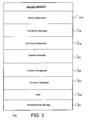
- memory 118 includes, but is not limited to, a device application 312, a command manager 316, a command database 318, a feature extractor 320, a pattern recognizer 322, a function database 324, data 328, and miscellaneous storage 332.
- memory 118 may include various other components and functionalities in addition to, or instead of, certain of those components and functionalities discussed in conjunction with the FIG. 3 embodiment.
- device application 312 may include program instructions that are preferably executed by a CPU 116 ( FIG. 1 ) to perform various functions and operations for a electronic device 114.
- the particular nature and functionality of device application 312 typically varies depending upon factors such as the specific type and particular functionality of the corresponding electronic device 114.
- electronic device 114 utilizes command manager 316 to support and coordinate the pattern mode discussed above in conjunction with FIG. 2 .
- command database 318 stores various patterns and corresponding linked device functions. Command database 318 is further discussed below in conjunction with FIG. 4 .
- electronic device 114 may utilize feature extractor 320 and pattern recognizer 322 to identify input patterns, as discussed above in conjunction with FIG. 2 .
- function database 324 may include a listing of all applications, functions, tasks, modes, and other relevant information that is associated with electronic device 114. The utilization of function database 324 is further discussed below in conjunction with FIG. 5 .
- Data 328 may store any desired type of data for utilization by electronic device 114. Miscellaneous storage 332 may be utilized to store any other type of information, data, or software instructions for electronic device 114. The implementation and control of electronic device 114 are further discussed below in conjunction with FIGS. 4 through 7 .
- command database 318 may include other components and information in addition to, or instead of, certain of those components and information discussed in conjunction with the FIG. 4 embodiment.
- command database includes, but is not limited to, individual command selections corresponding respectively to command A 440(a) through command N 440(n).
- Each of the commands is comprised of a pattern and a corresponding device function.
- a command A 440(a) has a pattern A that is linked to a function A.
- electronic device 114 may access command database 318 to either create new commands 440 or to identify an appropriate function for a particular input pattern.
- some or all of command database 318 may be predefined and populated during manufacture of electronic device 114. Utilization of command database 318 is further discussed below in conjunction with FIGS. 6-7 .
- function database 324 may include other components and information in addition to, or instead of, certain of those components and information discussed in conjunction with the FIG. 5 embodiment.
- function database 324 includes, but is not limited to, a listing of applications, functions, tasks, modes, and other relevant information that are associated with electronic device 114.
- function database 324 includes a function A 540(a) through a function X 540(x).
- command manager 316 FIG. 3
- function database 324 may utilize function database 324 to support a text command function during which a device user inputs a word or phrase by utilizing any effective techniques such as a keyboard, a touchscreen, speech recognition, a mouse pad, or a menu selection. This text command function is especially advantageous in situations where no pattern has been previously entered into command database 318 ( FIG. 4 ).
- command manager 316 or other appropriate entity may then recognize the input text and search through function database 324 to locate one or more identical or related matches.
- these function matches may be defined by predetermined text mapping rules that are selected according to any effective and appropriate criteria.
- Electronic device 114 may then take a specified responsive action that may include, but is not limited to, displaying information related to the identified function(s), or executing the particular function.
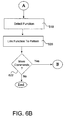
- FIGS. 6A-6B a flowchart of method steps for performing a command editing procedure is shown, in accordance with one embodiment of the present invention.
- the flowchart of FIGS. 6A-6B is presented for purposes of illustration, and in alternate embodiments, the present invention may utilize steps and sequences other than those steps and sequences discussed in conjunction with FIGS. 6A-6B .
- an electronic device 114 may enter a command edit mode in response to any appropriate event including, but not limited to, a request from a device user.
- the device user may input a desired pattern into the electronic device 114 using any effective techniques.
- the pattern may be input by utilizing a touchscreen, a touch-sensitive pad, or a motion sensor of the electronic device 114.
- a command manager 316 of the electronic device 114 then stores the pattern into a command database 318 in the electronic device 114.
- the device user may then select a particular device function 540 to correspond to the previously-input pattern by utilizing any effective methods.
- the desired function 540 may be selected from a function list displayed on a display 122 of the electronic device 114.
- command manager 316 may link the selected function to the appropriate pattern by utilizing any effective techniques.
- the command manager 316 stores the selected function 540 with the corresponding pattern in the command database 318.
- the command manager 316 determines whether any more commands remain to be created. If additional commands remain, then the FIG. 6 process returns to step 614 to define any additional commands. However, if no additional commands remain to be defined, then the FIG. 6 process may terminate.
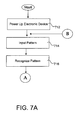
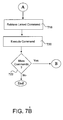
- FIGS. 7A-7B a flowchart of method steps for performing a command execution procedure is shown, in accordance with one embodiment of the present invention.
- the flowchart of FIGS. 7A-7B is presented for purposes of illustration, and in alternate embodiments, the present invention may utilize steps and sequences other than those steps and sequences discussed in conjunction with FIGS. 7A-7B .
- step 712 operating power is supplied to an electronic device 114.
- a device user may input a desired pattern into the electronic device 114 using any effective techniques.
- the pattern may be input by utilizing a touchscreen, a touch-sensitive pad, or a motion sensor of the electronic device 114.
- a pattern recognizer 322 performs a recognition procedure by utilizing any appropriate techniques to identify the previously-input pattern.
- command manager 318 may dynamically prompt the device user to store the unrecognized pattern and link the pattern to a corresponding function, as discussed above in conjunction with FIG. 6 . Furthermore, during functions that were not initiated by entering a previously-defined pattern, command manager 316 may automatically prompt a device user to add an appropriate command to command database 318.
- a command manager 316 may retrieve a linked command from a command database 318 to identify a particular device function 540 that corresponds to the previously-input pattern.
- electronic device 114 may then advantageously execute the identified function.
- the command manager 316 determines whether any more commands remain to be executed. If additional commands remain, then the FIG. 7 process returns to step 714 to select and execute any additional commands. However, if no additional commands remain to be defined, then the FIG. 7 process may terminate. For at least the foregoing reasons, embodiments of the present invention therefore provide an improved system and method for effectively selecting functions in an electronic device.
Landscapes
- Engineering & Computer Science (AREA)
- General Engineering & Computer Science (AREA)
- Theoretical Computer Science (AREA)
- Human Computer Interaction (AREA)
- Physics & Mathematics (AREA)
- General Physics & Mathematics (AREA)
- User Interface Of Digital Computer (AREA)
- Stored Programmes (AREA)
- Information Retrieval, Db Structures And Fs Structures Therefor (AREA)
Abstract
A system and method for effectively selecting functions in an electronic device includes a command database that is created for storing device commands that include specifically-defined - patterns and corresponding respective device functions. Appropriate pattern input means may be utilized for detecting the patterns that are input by device users. A command manager utilizes the recognized patterns to identify corresponding device functions from the command database. The electronic device may then execute the identified device functions.
Description
- This invention relates generally to controlling an electronic device. Embodiments of this invention relate to techniques for controlling electronic devices, and more particularly to a system and method for effectively selecting functions in an electronic device.
- Implementing effective methods for controlling electronic devices is a significant consideration for designers and manufacturers of contemporary electronic devices. However, developing techniques for effectively controlling electronic devices may create substantial challenges for system designers. For example, enhanced demands for increased device functionality and performance may require more system processing power and require additional software resources. An increase in processing or software requirements may also result in a corresponding detrimental economic impact due to increased production costs and operational inefficiencies.
- Furthermore, enhanced device capability to perform various advanced operations may provide additional benefits to a system user, but may also place increased demands on the control and management of various system components. For example, an enhanced electronic network device that effectively manages electronic content information may benefit from an effective implementation because of the large amount and complexity of the digital data involved.
- Due to growing demands on system resources and substantially increasing data magnitudes, it is apparent that developing new techniques for controlling electronic devices is a matter of concern for related electronic technologies. Therefore, for all the foregoing reasons, developing effective techniques for controlling electronic devices remains a significant consideration for designers, manufacturers, and users of contemporary electronic devices.
- Various respective aspects and features of the invention are defined in the appended claims. Combinations of features from the dependent claims may be combined with features of the independent claims as appropriate and not merely as explicitly set out in the claims.
- In accordance with embodiments of the present invention, a system and method for effectively selecting functions in an electronic device are disclosed. In one embodiment, an electronic device may enter a command edit mode in response to any appropriate event including, but not limited to, a request from a device user. The device user may input a desired pattern into the electronic device using any effective techniques. For example, the pattern may be input by utilizing a touchscreen, a touch-sensitive pad, or a motion sensor of the electronic device. A command manager of the electronic device then stores the pattern into a command database in the electronic device.
- The device user may then select a particular device function to correspond to the previously-input pattern by utilizing any effective methods. For example, the desired function may be selected from a function list displayed on a display of the electronic device. The command manager may link the selected function to the appropriate pattern by utilizing any effective techniques. In certain embodiments, the command manager stores the selected function with the corresponding pattern in the command database. Additional commands may be defined by utilizing similar procedures.
- Subsequently, a device user may input a defined pattern into the electronic device using any effective techniques. For example, the pattern may be input by utilizing the touchscreen, touch-sensitive pad, or motion sensor of the electronic device. A pattern recognizer then performs a recognition procedure by utilizing any appropriate techniques to identify the input pattern. In response to the input pattern, the command manager may retrieve a linked command from the command database to identify a particular device function that corresponds to the input pattern. The electronic device may then advantageously execute the identified function. Additional defined commands may be selected and executing in a similar manner. For at least the foregoing reasons, embodiments of the present invention therefore provide an improved system and method for effectively selecting functions in an electronic device.
- Embodiments of the invention will now be described with reference to the accompanying drawings, throughout which like parts are referred to by like references, and in which:
-
FIG. 1 is a block diagram for one embodiment of an electronic device; -
FIG. 2 is a frontal drawing for one embodiment of electronic device ofFIG. 1 ; -
FIG. 3 is a block diagram for one embodiment of the memory fromFIG. 3 ; -
FIG. 4 is a block diagram for one embodiment of the command database ofFIG. 3 ; -
FIG. 5 is a block diagram for one embodiment of the function database ofFIG. 3 ; -
FIGS. 6A-6B are a flowchart of method steps for performing a command editing procedure, in accordance with one embodiment of the present invention; and -
FIGS. 7A-7B are a flowchart of method steps for performing a command execution procedure, in accordance with one embodiment of the present invention. - Embodiments of the present invention seek to provide an improvement in electronic device control techniques. The following description is presented to enable one of ordinary skill in the art to make and use the invention, and is provided in the context of a patent application and its requirements. Various modifications to the disclosed embodiments will be readily apparent to those skilled in the art, and the generic principles herein may be applied to other embodiments. Therefore, the present invention is not intended to be limited to the embodiments shown, but is to be accorded the widest scope consistent with the principles and features described herein.
- Embodiments of the present invention comprise a system and method for effectively selecting functions in an electronic device, and includes a command database that is created for storing device commands that include specifically-defined patterns and corresponding respective device functions. Appropriate pattern input means may be utilized for detecting the patterns that are typically input by device users. A command manager utilizes the recognized patterns to identify corresponding device functions from the command database. The electronic device may then advantageously execute the identified device functions.
- Referring now to
FIG. 1 , a block diagram for one embodiment of anelectronic device 114 is shown. In theFIG. 1 embodiment,electronic device 114 may include, but is not limited to, a central processing unit (CPU) 116, adisplay 122, amemory 118, and one or more input/output interface(s) (I/O interface(s)) 124. The foregoing components ofelectronic device 114 may be coupled to, and communicate through, adevice bus 128. - In alternate embodiments,
electronic device 114 may be implemented using components and configurations in addition to, or instead of, certain of those components and configurations discussed in conjunction with theFIG. 1 embodiment. Furthermore, in theFIG. 1 embodiment,electronic device 114 may be implemented as any type of appropriate electronic device. For example, in certain embodiments,electronic device 114 may be implemented as any type of stationary or portable electronic device, such as a personal computer, a television, a consumer-electronics device, a cellular telephone, a settop box, an audio-visual entertainment device, or a personal digital assistant (PDA). - In the
FIG. 1 embodiment,CPU 116 may be implemented to include any appropriate and compatible microprocessor device that preferably executes software instructions to thereby control and manage the operation ofelectronic device 114. TheFIG. 1 display 122 may include any effective type of display technology including a cathode-ray-tube monitor or a liquid-crystal display device with an appropriate screen for displaying various information to a device user. Furthermore, in certain embodiments,display 122 may include a touchscreen sensor that allows adisplay 122 to detect pressure applied by a device user on the surface of a display screen ofdisplay 122. - In the
FIG. 1 embodiment,memory 118 may be implemented to include any combination of desired storage devices, including, but not limited to, read-only memory (ROM), random-access memory (RAM), and various types of non-volatile memory, such as floppy disks, memory sticks, compact disks, or hard disks. The contents and functionality ofdevice memory 118 are further discussed below in conjunction withFIG. 3 . - In the
FIG. 1 embodiment, I/O interface(s) 124 may include one or more input and/or output interfaces to receive and/or transmit any required types of information byelectronic device 114. I/O interface(s) 124 may include one or more means for allowing a device user to communicate withelectronic device 114. For example, the foregoing means may include a keyboard device, a touch-sensitive input pad, a wireless remote-control device, a speech-recognition module with corresponding microphone, a graphical user interface with touch-screen capability, a motion sensor device, a hand-held device controller unit, or a selection button array mounted externally onelectronic device 114. The implementation and control ofelectronic device 114 are further discussed below in conjunction withFIGS. 2-7 . - Referring now to
FIG. 2 , a frontal drawing of one exemplary embodiment of theFIG. 1 electronic device 114 is shown. TheFIG. 2 embodiment is presented for purposes of illustration, and in alternate embodiments,electronic device 114 may be implemented using components, features, and configurations in addition to, or instead of, certain of those components, features, and configurations discussed in conjunction with theFIG. 1 embodiment. Furthermore, in alternate embodiments,electronic device 114 may be implemented as any other type of portable or non-portable device. - In the
FIG. 2 embodiment,electronic device 114 includes adisplay 122 for displaying appropriate information to a system user. In theFIG. 2 embodiment,electronic device 114 also includes one or more external I/O interfaces 124 to permit the system user to provide control information toelectronic device 114. In many embodiments, because of the relatively small size ofdisplay 122, there is limited space for display icons and shortcuts on the screen ofdisplay 122. Furthermore, navigating through multiple levels of dropdown menus is both time-consuming and difficult, especially if a full keyboard and mouse are not available. - Therefore, embodiments of the present invention allow a device user to utilize a pattern mode for inputting a pre-defined pattern to easily activate a linked function in a user-friendly manner. The pattern may be any desired pattern that is input by utilizing any effective techniques. For example, a device user may input a pattern by tracing the desired pattern on a touchscreen of
display 122 or adjacent to a proximity sensor device, or on a touch-sensitive pad from external I/O interfaces 124. Alternately,electronic device 114 may include a motion sensor module that senses 3-dimentional pattern information when a device user moveselectronic device 114 in a pre-defined pattern. In certain embodiments, various types of patterns may also be input by physically manipulating external controls (keys, buttons, switches, etc.) from I/O interfaces 124. - In certain embodiments,
electronic device 114 may then recognize the input pattern and execute an associated device function, such as launching a desired application, entering a particular mode, or performing a specified task. In certain embodiments, a feature extractor (seeFIG. 3 ) ofelectronic device 114 may create pattern features from the input pattern, and a pattern recognizer (FIG. 3 ) may then utilize the pattern features to recognize the specific pattern. In various embodiments, any effective techniques may be utilized to recognize an input pattern. For example,electronic device 114 may utilize pattern matching, fuzzy logic, or artificial neural network techniques to identify the input pattern. A corresponding device function may then be located and executed based upon the foregoing identified pattern. - In certain embodiments, a desired device function may be automatically launched when a device user inputs a first initial character of the desired device function by utilizing pattern input means. For example, tracing a letter "N" may launch a navigation function, or a letter "C" may launch a calculator function. The
electronic device 114 may also present a device user with all function options corresponding to a first initial character that are currently supported by theelectronic device 114. For example, inputting the letter "N" may provide a list including a navigation application and a notepad application. - If the device user enters one or more subsequent characters of the desired device function,
electronic device 114 may responsively present the device user with an updated list of only those function options corresponding to both the first initial character and the one or more subsequent characters. For example, if the device user inputs the letter "A" after the foregoing letter "N", then the function list may be updated to remove the notepad application. Additional details for the implementation ofelectronic device 114 are further discussed below in conjunction withFIGS. 3-7 . - Referring now to
FIG. 3 , a block diagram for one embodiment of theFIG. 1 memory 118 is shown. In theFIG. 3 embodiment,memory 118 includes, but is not limited to, adevice application 312, acommand manager 316, acommand database 318, afeature extractor 320, apattern recognizer 322, afunction database 324,data 328, andmiscellaneous storage 332. In alternate embodiments,memory 118 may include various other components and functionalities in addition to, or instead of, certain of those components and functionalities discussed in conjunction with theFIG. 3 embodiment. - In the
FIG. 3 embodiment,device application 312 may include program instructions that are preferably executed by a CPU 116 (FIG. 1 ) to perform various functions and operations for aelectronic device 114. The particular nature and functionality ofdevice application 312 typically varies depending upon factors such as the specific type and particular functionality of the correspondingelectronic device 114. - In the
FIG. 3 embodiment,electronic device 114 utilizescommand manager 316 to support and coordinate the pattern mode discussed above in conjunction withFIG. 2 . In theFIG. 3 embodiment,command database 318 stores various patterns and corresponding linked device functions.Command database 318 is further discussed below in conjunction withFIG. 4 . In certain embodiments,electronic device 114 may utilizefeature extractor 320 andpattern recognizer 322 to identify input patterns, as discussed above in conjunction withFIG. 2 . - In the
FIG. 3 embodiment,function database 324 may include a listing of all applications, functions, tasks, modes, and other relevant information that is associated withelectronic device 114. The utilization offunction database 324 is further discussed below in conjunction withFIG. 5 .Data 328 may store any desired type of data for utilization byelectronic device 114.Miscellaneous storage 332 may be utilized to store any other type of information, data, or software instructions forelectronic device 114. The implementation and control ofelectronic device 114 are further discussed below in conjunction withFIGS. 4 through 7 . - Referring now to
FIG. 4 , a block diagram for one embodiment of theFIG. 3 command database 318 is shown. TheFIG. 4 embodiment is presented for purposes of illustration, and in alternate embodiments,command database 318 may include other components and information in addition to, or instead of, certain of those components and information discussed in conjunction with theFIG. 4 embodiment. - In the
FIG. 4 embodiment, command database includes, but is not limited to, individual command selections corresponding respectively to command A 440(a) through command N 440(n). Each of the commands is comprised of a pattern and a corresponding device function. For example, in theFIG. 4 embodiment, a command A 440(a) has a pattern A that is linked to a function A. In theFIG. 4 embodiment,electronic device 114 may accesscommand database 318 to either createnew commands 440 or to identify an appropriate function for a particular input pattern. In certain embodiments, some or all ofcommand database 318 may be predefined and populated during manufacture ofelectronic device 114. Utilization ofcommand database 318 is further discussed below in conjunction withFIGS. 6-7 . - Referring now to
FIG. 5 , a block diagram for one embodiment of theFIG. 3 function database 324 is shown. TheFIG. 5 embodiment is presented for purposes of illustration, and in alternate embodiments,function database 324 may include other components and information in addition to, or instead of, certain of those components and information discussed in conjunction with theFIG. 5 embodiment. - In the
FIG. 5 embodiment,function database 324 includes, but is not limited to, a listing of applications, functions, tasks, modes, and other relevant information that are associated withelectronic device 114. In theFIG. 5 embodiment,function database 324 includes a function A 540(a) through a function X 540(x). In certain embodiments of the present invention, command manager 316 (FIG. 3 ) may utilizefunction database 324 to support a text command function during which a device user inputs a word or phrase by utilizing any effective techniques such as a keyboard, a touchscreen, speech recognition, a mouse pad, or a menu selection. This text command function is especially advantageous in situations where no pattern has been previously entered into command database 318 (FIG. 4 ). - In the
FIG. 5 embodiment,command manager 316 or other appropriate entity may then recognize the input text and search throughfunction database 324 to locate one or more identical or related matches. In certain embodiments, these function matches may be defined by predetermined text mapping rules that are selected according to any effective and appropriate criteria.Electronic device 114 may then take a specified responsive action that may include, but is not limited to, displaying information related to the identified function(s), or executing the particular function. - Referring now to
FIGS. 6A-6B , a flowchart of method steps for performing a command editing procedure is shown, in accordance with one embodiment of the present invention. The flowchart ofFIGS. 6A-6B is presented for purposes of illustration, and in alternate embodiments, the present invention may utilize steps and sequences other than those steps and sequences discussed in conjunction withFIGS. 6A-6B . - In the
FIG. 6 embodiment, instep 612, anelectronic device 114 may enter a command edit mode in response to any appropriate event including, but not limited to, a request from a device user. Instep 614, the device user may input a desired pattern into theelectronic device 114 using any effective techniques. For example, the pattern may be input by utilizing a touchscreen, a touch-sensitive pad, or a motion sensor of theelectronic device 114. Instep 616, acommand manager 316 of theelectronic device 114 then stores the pattern into acommand database 318 in theelectronic device 114. - In
step 618, the device user may then select aparticular device function 540 to correspond to the previously-input pattern by utilizing any effective methods. For example, the desiredfunction 540 may be selected from a function list displayed on adisplay 122 of theelectronic device 114. Instep 620,command manager 316 may link the selected function to the appropriate pattern by utilizing any effective techniques. In certain embodiments, thecommand manager 316 stores the selectedfunction 540 with the corresponding pattern in thecommand database 318. Instep 622, thecommand manager 316 determines whether any more commands remain to be created. If additional commands remain, then theFIG. 6 process returns to step 614 to define any additional commands. However, if no additional commands remain to be defined, then theFIG. 6 process may terminate. - Referring now to
FIGS. 7A-7B , a flowchart of method steps for performing a command execution procedure is shown, in accordance with one embodiment of the present invention. The flowchart ofFIGS. 7A-7B is presented for purposes of illustration, and in alternate embodiments, the present invention may utilize steps and sequences other than those steps and sequences discussed in conjunction withFIGS. 7A-7B . - In the
FIG. 7 embodiment, instep 712, operating power is supplied to anelectronic device 114. Instep 714, a device user may input a desired pattern into theelectronic device 114 using any effective techniques. For example, the pattern may be input by utilizing a touchscreen, a touch-sensitive pad, or a motion sensor of theelectronic device 114. Instep 716, apattern recognizer 322 performs a recognition procedure by utilizing any appropriate techniques to identify the previously-input pattern. - In certain embodiments, if an input pattern is unrecognized, then the
command manager 318 may dynamically prompt the device user to store the unrecognized pattern and link the pattern to a corresponding function, as discussed above in conjunction withFIG. 6 . Furthermore, during functions that were not initiated by entering a previously-defined pattern,command manager 316 may automatically prompt a device user to add an appropriate command to commanddatabase 318. - In
step 718, in response to the input pattern, acommand manager 316 may retrieve a linked command from acommand database 318 to identify aparticular device function 540 that corresponds to the previously-input pattern. Instep 720,electronic device 114 may then advantageously execute the identified function. Instep 722, thecommand manager 316 determines whether any more commands remain to be executed. If additional commands remain, then theFIG. 7 process returns to step 714 to select and execute any additional commands. However, if no additional commands remain to be defined, then theFIG. 7 process may terminate. For at least the foregoing reasons, embodiments of the present invention therefore provide an improved system and method for effectively selecting functions in an electronic device. - The invention has been explained above with reference to certain embodiments. Other embodiments will be apparent to those skilled in the art in light of this disclosure. For example, the present invention may readily be implemented using certain configurations and techniques other than those described in the specific embodiments above. Additionally, the present invention may effectively be used in conjunction with systems other than those described above. Therefore, these and other variations upon the discussed embodiments are intended to be covered by the present invention, which is limited only by the appended claims.
- In so far as the embodiments of the invention described above are implemented, at least in part, using software-controlled data processing apparatus, it will be appreciated that a computer program providing such software control and a transmission, storage or other medium by which such a computer program is provided are envisaged as aspects of the present invention.
Claims (23)
- A system for performing a function selection procedure to control an electronic device, comprising:a command database for storing device commands that include patterns and device functions that correspond to said patterns;pattern input means coupled to said electronic device for detecting said patterns that are input by a device user; anda command manager that utilizes said patterns to identify said device functions in said command database, said electronic device then executing said device functions.
- The system of claim 1 wherein said electronic device is implemented as a portable electronic device that responds to said device commands from said function selection procedure.
- The system of claim 2 wherein said portable electronic device includes a display screen of a limited size, said function selection procedure conserving display space on said display screen.
- The system of claim 2 wherein said function selection procedure allows said device user to directly access said device functions without navigating through function menus on a display screen of said electronic device.
- The system of claim 1 wherein said device user inputs said patterns by drawing said patterns on a touchscreen display of said electronic device.
- The system of claim 1 wherein said device user inputs said patterns by tracing said patterns on a touch-sensitive pad of said electronic device.
- The system of claim 1 wherein said device user inputs said patterns by moving said electronic device to cause a motion pattern that is detected by a motion sensor of said electronic device.
- The system of claim 1 wherein said device commands are predefined and stored in said command database during a device manufacturing process.
- The system of claim 1 wherein said device commands are dynamically defined and stored in said command database by said device user.
- The system of claim 1 wherein a feature extractor creates pattern features corresponding to said patterns, a pattern recognizer then analyzing said pattern features to identify said patterns.
- The system of claim 1 wherein said command manager prompts said device user to create a new device command when an undefined pattern is received by said pattern input means.
- The system of claim 1 wherein said command manager prompts said device user to create a new device command corresponding to a current device function that is not represented in said command database.
- The system of claim 1 wherein said command manager identifies said patterns by utilizing at least one of pattern matching, fuzzy logic, and artificial neural network techniques.
- The system of claim 1 wherein said command manager utilizes a function database to support a text command function during which a device user enters input text, said command manager utilizing said input text to search through said function database to locate one or more function matches.
- The system of claim 14 wherein said function matches are defined by predetermined text mapping rules, said electronic device then take a specified responsive action that includes either displaying said one or more function matches or executing said one or more function matches.
- The system of claim 1 wherein said device user begins a command creating procedure by requesting said electronic device to enter a command edit mode, said device user inputting an input pattern, said command manager storing said input pattern in said command database.
- The system of claim 16 wherein said device user then choose a desired device function to correspond to said input pattern, said command manager linking said desired device function to said input pattern by storing said desired device function in said command database.
- The system of claim 1 wherein said device user begins a command execution procedure by inputting a selected pattern, a pattern recognizer then identifying said selected pattern.
- The system of claim 18 wherein said command manager retrieves a linked device function that corresponds to said selected pattern in said command database, said electronic device then executing said linked device function.
- The system of claim 1 therein a desired device function is automatically launched when a device user inputs a first initial character of said desired device function by utilizing said pattern input means.
- The system of claim 20 wherein said command manager presents said device user with all function options corresponding to said first initial character that are currently supported by said electronic device.
- The system of claim 21 wherein said device user enters one or more subsequent characters of said desired device function, said command manager responsively presenting said device user with an updated list of only those function options corresponding to both said first initial character and said one or more subsequent characters.
- A method for controlling an electronic device, comprising:creating a command database for storing device commands that include patterns and device functions that corresponds to said patterns;detecting said patterns with pattern input means, said patterns being input by a device user through said pattern input means; andutilizing a command manager to identify said device functions in said command database by utilizing said patterns, said electronic device then executing said device functions.
Applications Claiming Priority (1)
| Application Number | Priority Date | Filing Date | Title |
|---|---|---|---|
| US12/156,631 US20090300492A1 (en) | 2008-06-03 | 2008-06-03 | System and method for effectively selecting functions in an electronic device |
Publications (1)
| Publication Number | Publication Date |
|---|---|
| EP2131274A2 true EP2131274A2 (en) | 2009-12-09 |
Family
ID=40627073
Family Applications (1)
| Application Number | Title | Priority Date | Filing Date |
|---|---|---|---|
| EP09250847A Withdrawn EP2131274A2 (en) | 2008-06-03 | 2009-03-25 | Controlling an electronic device |
Country Status (5)
| Country | Link |
|---|---|
| US (1) | US20090300492A1 (en) |
| EP (1) | EP2131274A2 (en) |
| JP (1) | JP2009295160A (en) |
| CN (1) | CN101598999A (en) |
| TW (1) | TW201005531A (en) |
Families Citing this family (8)
| Publication number | Priority date | Publication date | Assignee | Title |
|---|---|---|---|---|
| US8289287B2 (en) * | 2008-12-30 | 2012-10-16 | Nokia Corporation | Method, apparatus and computer program product for providing a personalizable user interface |
| US8943437B2 (en) * | 2009-06-15 | 2015-01-27 | Nuance Communications, Inc. | Disambiguation of USSD codes in text-based applications |
| US10423248B2 (en) | 2011-10-28 | 2019-09-24 | Wacom Co., Ltd. | Touch-sensitive system with motion filtering |
| USD682288S1 (en) * | 2011-12-23 | 2013-05-14 | Microsoft Corporation | Display screen with graphical user interface |
| USD699743S1 (en) * | 2011-12-23 | 2014-02-18 | Microsoft Corporation | Display screen with an animated graphical user interface |
| CN104461493B (en) * | 2013-09-25 | 2019-11-26 | 联想(北京)有限公司 | A kind of information processing method and electronic equipment |
| CN104253910A (en) * | 2014-09-24 | 2014-12-31 | 百度在线网络技术(北京)有限公司 | Interaction method and interaction system for voice service calls |
| JP6589532B2 (en) * | 2015-10-01 | 2019-10-16 | 中国電力株式会社 | Information processing apparatus and control method of information processing apparatus |
Family Cites Families (6)
| Publication number | Priority date | Publication date | Assignee | Title |
|---|---|---|---|---|
| US6057845A (en) * | 1997-11-14 | 2000-05-02 | Sensiva, Inc. | System, method, and apparatus for generation and recognizing universal commands |
| US6861946B2 (en) * | 2000-05-17 | 2005-03-01 | Caveo Technology Llc. | Motion-based input system for handheld devices |
| US6980175B1 (en) * | 2000-06-30 | 2005-12-27 | International Business Machines Corporation | Personal smart pointing device |
| US7191411B2 (en) * | 2002-06-06 | 2007-03-13 | Moehrle Armin E | Active path menu navigation system |
| US6979087B2 (en) * | 2002-10-31 | 2005-12-27 | Hewlett-Packard Development Company, L.P. | Display system with interpretable pattern detection |
| US7365737B2 (en) * | 2004-03-23 | 2008-04-29 | Fujitsu Limited | Non-uniform gesture precision |
-
2008
- 2008-06-03 US US12/156,631 patent/US20090300492A1/en not_active Abandoned
-
2009
- 2009-03-25 EP EP09250847A patent/EP2131274A2/en not_active Withdrawn
- 2009-04-16 TW TW098112653A patent/TW201005531A/en unknown
- 2009-06-02 JP JP2009133122A patent/JP2009295160A/en not_active Withdrawn
- 2009-06-03 CN CNA2009101455855A patent/CN101598999A/en active Pending
Also Published As
| Publication number | Publication date |
|---|---|
| CN101598999A (en) | 2009-12-09 |
| JP2009295160A (en) | 2009-12-17 |
| US20090300492A1 (en) | 2009-12-03 |
| TW201005531A (en) | 2010-02-01 |
Similar Documents
| Publication | Publication Date | Title |
|---|---|---|
| EP2131274A2 (en) | Controlling an electronic device | |
| EP3195101B1 (en) | Gesture shortcuts for invocation of voice input | |
| EP3288024B1 (en) | Method and apparatus for executing a user function using voice recognition | |
| JP6450768B2 (en) | Quick task for on-screen keyboard | |
| US7480863B2 (en) | Dynamic and intelligent hover assistance | |
| US7895518B2 (en) | System and method for preview and selection of words | |
| EP2602730B1 (en) | Presenting context information in a computing device | |
| JP2019220237A (en) | Method and apparatus for providing character input interface | |
| JP2003186614A (en) | Automatic software input panel selection based on application program state | |
| WO2007024595A1 (en) | Navigational interface providing auxiliary character support for mobile and wearable computers | |
| CN118535073A (en) | Automated assistant controlled compressed spoken utterances for complex application GUIs | |
| CN112463000B (en) | Interaction method, device, system, electronic equipment and vehicle | |
| US10462264B2 (en) | Downloading an application to an apparatus | |
| MX2014002955A (en) | Formula entry for limited display devices. | |
| EP3748481A1 (en) | Control method and electronic device | |
| TW201445426A (en) | A method for a handwriting signal starts program or an application | |
| US20060172267A1 (en) | Input device training and automatic assignment | |
| WO2010070528A1 (en) | Method of and apparatus for emulating input | |
| KR102869440B1 (en) | Character input device implemented in software | |
| WO2025034609A1 (en) | Suggesting automated assistant routines based on detected user actions | |
| WO2025104818A1 (en) | Program, programmable display, setting device, and setting method | |
| JP2007141204A (en) | Character input system and method using analog joystick controller |
Legal Events
| Date | Code | Title | Description |
|---|---|---|---|
| PUAI | Public reference made under article 153(3) epc to a published international application that has entered the european phase |
Free format text: ORIGINAL CODE: 0009012 |
|
| AK | Designated contracting states |
Kind code of ref document: A2 Designated state(s): AT BE BG CH CY CZ DE DK EE ES FI FR GB GR HR HU IE IS IT LI LT LU LV MC MK MT NL NO PL PT RO SE SI SK TR |
|
| AX | Request for extension of the european patent |
Extension state: AL BA RS |
|
| STAA | Information on the status of an ep patent application or granted ep patent |
Free format text: STATUS: THE APPLICATION HAS BEEN WITHDRAWN |
|
| 18W | Application withdrawn |
Effective date: 20100113 |