EP2130585A1 - Process for making crystalline metallosilicates - Google Patents
Process for making crystalline metallosilicates Download PDFInfo
- Publication number
- EP2130585A1 EP2130585A1 EP08157768A EP08157768A EP2130585A1 EP 2130585 A1 EP2130585 A1 EP 2130585A1 EP 08157768 A EP08157768 A EP 08157768A EP 08157768 A EP08157768 A EP 08157768A EP 2130585 A1 EP2130585 A1 EP 2130585A1
- Authority
- EP
- European Patent Office
- Prior art keywords
- metallosilicate
- process according
- metal
- silicon
- ratio
- Prior art date
- Legal status (The legal status is an assumption and is not a legal conclusion. Google has not performed a legal analysis and makes no representation as to the accuracy of the status listed.)
- Withdrawn
Links
- 238000000034 method Methods 0.000 title claims abstract description 54
- VYPSYNLAJGMNEJ-UHFFFAOYSA-N Silicium dioxide Chemical compound O=[Si]=O VYPSYNLAJGMNEJ-UHFFFAOYSA-N 0.000 claims abstract description 57
- 239000000203 mixture Substances 0.000 claims abstract description 46
- 229910052751 metal Inorganic materials 0.000 claims abstract description 43
- 239000002184 metal Substances 0.000 claims abstract description 43
- 229910052710 silicon Inorganic materials 0.000 claims abstract description 35
- 239000010703 silicon Substances 0.000 claims abstract description 35
- 238000002425 crystallisation Methods 0.000 claims abstract description 32
- 239000000377 silicon dioxide Substances 0.000 claims abstract description 26
- 239000002609 medium Substances 0.000 claims abstract description 25
- 230000008025 crystallization Effects 0.000 claims abstract description 23
- 239000003795 chemical substances by application Substances 0.000 claims abstract description 15
- 239000007788 liquid Substances 0.000 claims abstract description 13
- 229910052681 coesite Inorganic materials 0.000 claims abstract description 10
- 229910052906 cristobalite Inorganic materials 0.000 claims abstract description 10
- 239000011541 reaction mixture Substances 0.000 claims abstract description 10
- 229910052682 stishovite Inorganic materials 0.000 claims abstract description 10
- 229910052905 tridymite Inorganic materials 0.000 claims abstract description 10
- 239000012736 aqueous medium Substances 0.000 claims abstract description 7
- 238000002156 mixing Methods 0.000 claims abstract description 7
- FGUUSXIOTUKUDN-IBGZPJMESA-N C1(=CC=CC=C1)N1C2=C(NC([C@H](C1)NC=1OC(=NN=1)C1=CC=CC=C1)=O)C=CC=C2 Chemical compound C1(=CC=CC=C1)N1C2=C(NC([C@H](C1)NC=1OC(=NN=1)C1=CC=CC=C1)=O)C=CC=C2 FGUUSXIOTUKUDN-IBGZPJMESA-N 0.000 claims abstract description 6
- 238000001816 cooling Methods 0.000 claims abstract description 4
- 230000003247 decreasing effect Effects 0.000 claims abstract description 3
- 238000006243 chemical reaction Methods 0.000 claims description 33
- 239000013078 crystal Substances 0.000 claims description 26
- HNPSIPDUKPIQMN-UHFFFAOYSA-N dioxosilane;oxo(oxoalumanyloxy)alumane Chemical compound O=[Si]=O.O=[Al]O[Al]=O HNPSIPDUKPIQMN-UHFFFAOYSA-N 0.000 claims description 22
- 239000003054 catalyst Substances 0.000 claims description 17
- 229930195733 hydrocarbon Natural products 0.000 claims description 16
- 150000002430 hydrocarbons Chemical class 0.000 claims description 16
- 239000002344 surface layer Substances 0.000 claims description 11
- 239000004215 Carbon black (E152) Substances 0.000 claims description 10
- 229910000323 aluminium silicate Inorganic materials 0.000 claims description 5
- 239000010410 layer Substances 0.000 claims description 4
- 229910021485 fumed silica Inorganic materials 0.000 claims description 3
- 239000000017 hydrogel Substances 0.000 claims description 3
- 239000000725 suspension Substances 0.000 claims description 3
- 239000010457 zeolite Substances 0.000 description 31
- XUIMIQQOPSSXEZ-UHFFFAOYSA-N Silicon Chemical compound [Si] XUIMIQQOPSSXEZ-UHFFFAOYSA-N 0.000 description 27
- 230000015572 biosynthetic process Effects 0.000 description 18
- 229910021536 Zeolite Inorganic materials 0.000 description 17
- 150000001336 alkenes Chemical class 0.000 description 17
- 238000003786 synthesis reaction Methods 0.000 description 16
- UHOVQNZJYSORNB-UHFFFAOYSA-N Benzene Chemical compound C1=CC=CC=C1 UHOVQNZJYSORNB-UHFFFAOYSA-N 0.000 description 15
- 150000001768 cations Chemical class 0.000 description 15
- XLYOFNOQVPJJNP-UHFFFAOYSA-N water Substances O XLYOFNOQVPJJNP-UHFFFAOYSA-N 0.000 description 15
- -1 boron chloride Chemical class 0.000 description 14
- 239000000243 solution Substances 0.000 description 13
- ZSIAUFGUXNUGDI-UHFFFAOYSA-N hexan-1-ol Chemical compound CCCCCCO ZSIAUFGUXNUGDI-UHFFFAOYSA-N 0.000 description 12
- QAOWNCQODCNURD-UHFFFAOYSA-N Sulfuric acid Chemical compound OS(O)(=O)=O QAOWNCQODCNURD-UHFFFAOYSA-N 0.000 description 11
- 230000029936 alkylation Effects 0.000 description 11
- 238000005804 alkylation reaction Methods 0.000 description 11
- 150000004945 aromatic hydrocarbons Chemical class 0.000 description 10
- 239000000463 material Substances 0.000 description 10
- 230000002378 acidificating effect Effects 0.000 description 9
- 230000003197 catalytic effect Effects 0.000 description 9
- 150000003839 salts Chemical class 0.000 description 9
- 239000010936 titanium Substances 0.000 description 9
- 229910052719 titanium Inorganic materials 0.000 description 9
- LFQSCWFLJHTTHZ-UHFFFAOYSA-N Ethanol Chemical compound CCO LFQSCWFLJHTTHZ-UHFFFAOYSA-N 0.000 description 8
- XEEYBQQBJWHFJM-UHFFFAOYSA-N Iron Chemical compound [Fe] XEEYBQQBJWHFJM-UHFFFAOYSA-N 0.000 description 8
- 239000011148 porous material Substances 0.000 description 8
- HEMHJVSKTPXQMS-UHFFFAOYSA-M Sodium hydroxide Chemical compound [OH-].[Na+] HEMHJVSKTPXQMS-UHFFFAOYSA-M 0.000 description 7
- 239000002253 acid Substances 0.000 description 7
- 150000001298 alcohols Chemical class 0.000 description 7
- 235000011149 sulphuric acid Nutrition 0.000 description 7
- OKKJLVBELUTLKV-UHFFFAOYSA-N Methanol Chemical compound OC OKKJLVBELUTLKV-UHFFFAOYSA-N 0.000 description 6
- XAGFODPZIPBFFR-UHFFFAOYSA-N aluminium Chemical compound [Al] XAGFODPZIPBFFR-UHFFFAOYSA-N 0.000 description 6
- 125000004432 carbon atom Chemical group C* 0.000 description 6
- RTAQQCXQSZGOHL-UHFFFAOYSA-N Titanium Chemical compound [Ti] RTAQQCXQSZGOHL-UHFFFAOYSA-N 0.000 description 5
- 150000004703 alkoxides Chemical class 0.000 description 5
- PNEYBMLMFCGWSK-UHFFFAOYSA-N aluminium oxide Inorganic materials [O-2].[O-2].[O-2].[Al+3].[Al+3] PNEYBMLMFCGWSK-UHFFFAOYSA-N 0.000 description 5
- 238000004458 analytical method Methods 0.000 description 5
- 239000011230 binding agent Substances 0.000 description 5
- 238000001354 calcination Methods 0.000 description 5
- 150000001875 compounds Chemical class 0.000 description 5
- 239000007791 liquid phase Substances 0.000 description 5
- 239000003960 organic solvent Substances 0.000 description 5
- 239000012071 phase Substances 0.000 description 5
- 239000012429 reaction media Substances 0.000 description 5
- 238000007669 thermal treatment Methods 0.000 description 5
- GYHNNYVSQQEPJS-UHFFFAOYSA-N Gallium Chemical compound [Ga] GYHNNYVSQQEPJS-UHFFFAOYSA-N 0.000 description 4
- VQTUBCCKSQIDNK-UHFFFAOYSA-N Isobutene Chemical compound CC(C)=C VQTUBCCKSQIDNK-UHFFFAOYSA-N 0.000 description 4
- LSDPWZHWYPCBBB-UHFFFAOYSA-N Methanethiol Chemical compound SC LSDPWZHWYPCBBB-UHFFFAOYSA-N 0.000 description 4
- PXHVJJICTQNCMI-UHFFFAOYSA-N Nickel Chemical compound [Ni] PXHVJJICTQNCMI-UHFFFAOYSA-N 0.000 description 4
- KDLHZDBZIXYQEI-UHFFFAOYSA-N Palladium Chemical compound [Pd] KDLHZDBZIXYQEI-UHFFFAOYSA-N 0.000 description 4
- CDBYLPFSWZWCQE-UHFFFAOYSA-L Sodium Carbonate Chemical compound [Na+].[Na+].[O-]C([O-])=O CDBYLPFSWZWCQE-UHFFFAOYSA-L 0.000 description 4
- UIIMBOGNXHQVGW-UHFFFAOYSA-M Sodium bicarbonate Chemical compound [Na+].OC([O-])=O UIIMBOGNXHQVGW-UHFFFAOYSA-M 0.000 description 4
- MCMNRKCIXSYSNV-UHFFFAOYSA-N Zirconium dioxide Chemical compound O=[Zr]=O MCMNRKCIXSYSNV-UHFFFAOYSA-N 0.000 description 4
- 239000012670 alkaline solution Substances 0.000 description 4
- 229910052782 aluminium Inorganic materials 0.000 description 4
- VSCWAEJMTAWNJL-UHFFFAOYSA-K aluminium trichloride Chemical compound Cl[Al](Cl)Cl VSCWAEJMTAWNJL-UHFFFAOYSA-K 0.000 description 4
- QVGXLLKOCUKJST-UHFFFAOYSA-N atomic oxygen Chemical compound [O] QVGXLLKOCUKJST-UHFFFAOYSA-N 0.000 description 4
- 238000004523 catalytic cracking Methods 0.000 description 4
- 229910052733 gallium Inorganic materials 0.000 description 4
- 238000010438 heat treatment Methods 0.000 description 4
- 125000004435 hydrogen atom Chemical class [H]* 0.000 description 4
- 229910052742 iron Inorganic materials 0.000 description 4
- 238000006317 isomerization reaction Methods 0.000 description 4
- JRZJOMJEPLMPRA-UHFFFAOYSA-N olefin Natural products CCCCCCCC=C JRZJOMJEPLMPRA-UHFFFAOYSA-N 0.000 description 4
- 239000001301 oxygen Substances 0.000 description 4
- 229910052760 oxygen Inorganic materials 0.000 description 4
- BASFCYQUMIYNBI-UHFFFAOYSA-N platinum Chemical compound [Pt] BASFCYQUMIYNBI-UHFFFAOYSA-N 0.000 description 4
- 238000004544 sputter deposition Methods 0.000 description 4
- 238000003756 stirring Methods 0.000 description 4
- BQMLWEKOSHSOFT-UHFFFAOYSA-N 1-ethoxy-2,2-dimethylpropane Chemical compound CCOCC(C)(C)C BQMLWEKOSHSOFT-UHFFFAOYSA-N 0.000 description 3
- ZOXJGFHDIHLPTG-UHFFFAOYSA-N Boron Chemical compound [B] ZOXJGFHDIHLPTG-UHFFFAOYSA-N 0.000 description 3
- RWSOTUBLDIXVET-UHFFFAOYSA-N Dihydrogen sulfide Chemical class S RWSOTUBLDIXVET-UHFFFAOYSA-N 0.000 description 3
- CPLXHLVBOLITMK-UHFFFAOYSA-N Magnesium oxide Chemical compound [Mg]=O CPLXHLVBOLITMK-UHFFFAOYSA-N 0.000 description 3
- OFOBLEOULBTSOW-UHFFFAOYSA-N Malonic acid Chemical compound OC(=O)CC(O)=O OFOBLEOULBTSOW-UHFFFAOYSA-N 0.000 description 3
- BZLVMXJERCGZMT-UHFFFAOYSA-N Methyl tert-butyl ether Chemical compound COC(C)(C)C BZLVMXJERCGZMT-UHFFFAOYSA-N 0.000 description 3
- BPQQTUXANYXVAA-UHFFFAOYSA-N Orthosilicate Chemical compound [O-][Si]([O-])([O-])[O-] BPQQTUXANYXVAA-UHFFFAOYSA-N 0.000 description 3
- MUBZPKHOEPUJKR-UHFFFAOYSA-N Oxalic acid Chemical compound OC(=O)C(O)=O MUBZPKHOEPUJKR-UHFFFAOYSA-N 0.000 description 3
- GWEVSGVZZGPLCZ-UHFFFAOYSA-N Titan oxide Chemical compound O=[Ti]=O GWEVSGVZZGPLCZ-UHFFFAOYSA-N 0.000 description 3
- YXFVVABEGXRONW-UHFFFAOYSA-N Toluene Chemical compound CC1=CC=CC=C1 YXFVVABEGXRONW-UHFFFAOYSA-N 0.000 description 3
- 150000007513 acids Chemical class 0.000 description 3
- 238000013019 agitation Methods 0.000 description 3
- 239000003513 alkali Substances 0.000 description 3
- 229910052796 boron Inorganic materials 0.000 description 3
- 238000004517 catalytic hydrocracking Methods 0.000 description 3
- 238000006555 catalytic reaction Methods 0.000 description 3
- KRKNYBCHXYNGOX-UHFFFAOYSA-N citric acid Chemical compound OC(=O)CC(O)(C(O)=O)CC(O)=O KRKNYBCHXYNGOX-UHFFFAOYSA-N 0.000 description 3
- 239000012153 distilled water Substances 0.000 description 3
- 230000000694 effects Effects 0.000 description 3
- 150000002170 ethers Chemical class 0.000 description 3
- 238000001914 filtration Methods 0.000 description 3
- 239000001257 hydrogen Substances 0.000 description 3
- 229910052739 hydrogen Inorganic materials 0.000 description 3
- 150000007522 mineralic acids Chemical class 0.000 description 3
- 239000002808 molecular sieve Substances 0.000 description 3
- 150000007524 organic acids Chemical group 0.000 description 3
- 150000002894 organic compounds Chemical class 0.000 description 3
- 230000000737 periodic effect Effects 0.000 description 3
- 239000002243 precursor Substances 0.000 description 3
- QQONPFPTGQHPMA-UHFFFAOYSA-N propylene Natural products CC=C QQONPFPTGQHPMA-UHFFFAOYSA-N 0.000 description 3
- 125000004805 propylene group Chemical group [H]C([H])([H])C([H])([*:1])C([H])([H])[*:2] 0.000 description 3
- 239000002210 silicon-based material Substances 0.000 description 3
- URGAHOPLAPQHLN-UHFFFAOYSA-N sodium aluminosilicate Chemical compound [Na+].[Al+3].[O-][Si]([O-])=O.[O-][Si]([O-])=O URGAHOPLAPQHLN-UHFFFAOYSA-N 0.000 description 3
- HVZJRWJGKQPSFL-UHFFFAOYSA-N tert-Amyl methyl ether Chemical compound CCC(C)(C)OC HVZJRWJGKQPSFL-UHFFFAOYSA-N 0.000 description 3
- NUMQCACRALPSHD-UHFFFAOYSA-N tert-butyl ethyl ether Chemical compound CCOC(C)(C)C NUMQCACRALPSHD-UHFFFAOYSA-N 0.000 description 3
- GNFTZDOKVXKIBK-UHFFFAOYSA-N 3-(2-methoxyethoxy)benzohydrazide Chemical compound COCCOC1=CC=CC(C(=O)NN)=C1 GNFTZDOKVXKIBK-UHFFFAOYSA-N 0.000 description 2
- QGZKDVFQNNGYKY-UHFFFAOYSA-N Ammonia Chemical compound N QGZKDVFQNNGYKY-UHFFFAOYSA-N 0.000 description 2
- QGZKDVFQNNGYKY-UHFFFAOYSA-O Ammonium Chemical compound [NH4+] QGZKDVFQNNGYKY-UHFFFAOYSA-O 0.000 description 2
- XKRFYHLGVUSROY-UHFFFAOYSA-N Argon Chemical compound [Ar] XKRFYHLGVUSROY-UHFFFAOYSA-N 0.000 description 2
- IJGRMHOSHXDMSA-UHFFFAOYSA-N Atomic nitrogen Chemical compound N#N IJGRMHOSHXDMSA-UHFFFAOYSA-N 0.000 description 2
- RYGMFSIKBFXOCR-UHFFFAOYSA-N Copper Chemical compound [Cu] RYGMFSIKBFXOCR-UHFFFAOYSA-N 0.000 description 2
- LCGLNKUTAGEVQW-UHFFFAOYSA-N Dimethyl ether Chemical compound COC LCGLNKUTAGEVQW-UHFFFAOYSA-N 0.000 description 2
- YNQLUTRBYVCPMQ-UHFFFAOYSA-N Ethylbenzene Chemical compound CCC1=CC=CC=C1 YNQLUTRBYVCPMQ-UHFFFAOYSA-N 0.000 description 2
- VZCYOOQTPOCHFL-OWOJBTEDSA-N Fumaric acid Chemical compound OC(=O)\C=C\C(O)=O VZCYOOQTPOCHFL-OWOJBTEDSA-N 0.000 description 2
- VEXZGXHMUGYJMC-UHFFFAOYSA-N Hydrochloric acid Chemical compound Cl VEXZGXHMUGYJMC-UHFFFAOYSA-N 0.000 description 2
- ZOKXTWBITQBERF-UHFFFAOYSA-N Molybdenum Chemical compound [Mo] ZOKXTWBITQBERF-UHFFFAOYSA-N 0.000 description 2
- 229910002651 NO3 Inorganic materials 0.000 description 2
- UFWIBTONFRDIAS-UHFFFAOYSA-N Naphthalene Chemical compound C1=CC=CC2=CC=CC=C21 UFWIBTONFRDIAS-UHFFFAOYSA-N 0.000 description 2
- GRYLNZFGIOXLOG-UHFFFAOYSA-N Nitric acid Chemical compound O[N+]([O-])=O GRYLNZFGIOXLOG-UHFFFAOYSA-N 0.000 description 2
- URLKBWYHVLBVBO-UHFFFAOYSA-N Para-Xylene Chemical group CC1=CC=C(C)C=C1 URLKBWYHVLBVBO-UHFFFAOYSA-N 0.000 description 2
- NBIIXXVUZAFLBC-UHFFFAOYSA-N Phosphoric acid Chemical compound OP(O)(O)=O NBIIXXVUZAFLBC-UHFFFAOYSA-N 0.000 description 2
- 238000002441 X-ray diffraction Methods 0.000 description 2
- HCHKCACWOHOZIP-UHFFFAOYSA-N Zinc Chemical compound [Zn] HCHKCACWOHOZIP-UHFFFAOYSA-N 0.000 description 2
- 238000001994 activation Methods 0.000 description 2
- WNLRTRBMVRJNCN-UHFFFAOYSA-N adipic acid Chemical compound OC(=O)CCCCC(O)=O WNLRTRBMVRJNCN-UHFFFAOYSA-N 0.000 description 2
- 239000002168 alkylating agent Substances 0.000 description 2
- 229940100198 alkylating agent Drugs 0.000 description 2
- AZDRQVAHHNSJOQ-UHFFFAOYSA-N alumane Chemical class [AlH3] AZDRQVAHHNSJOQ-UHFFFAOYSA-N 0.000 description 2
- 239000004411 aluminium Substances 0.000 description 2
- SMZOGRDCAXLAAR-UHFFFAOYSA-N aluminium isopropoxide Chemical compound [Al+3].CC(C)[O-].CC(C)[O-].CC(C)[O-] SMZOGRDCAXLAAR-UHFFFAOYSA-N 0.000 description 2
- JLDSOYXADOWAKB-UHFFFAOYSA-N aluminium nitrate Chemical compound [Al+3].[O-][N+]([O-])=O.[O-][N+]([O-])=O.[O-][N+]([O-])=O JLDSOYXADOWAKB-UHFFFAOYSA-N 0.000 description 2
- ANBBXQWFNXMHLD-UHFFFAOYSA-N aluminum;sodium;oxygen(2-) Chemical compound [O-2].[O-2].[Na+].[Al+3] ANBBXQWFNXMHLD-UHFFFAOYSA-N 0.000 description 2
- 150000001638 boron Chemical class 0.000 description 2
- 229910052810 boron oxide Inorganic materials 0.000 description 2
- 238000005119 centrifugation Methods 0.000 description 2
- 239000003153 chemical reaction reagent Substances 0.000 description 2
- 229910052802 copper Inorganic materials 0.000 description 2
- 239000010949 copper Substances 0.000 description 2
- RWGFKTVRMDUZSP-UHFFFAOYSA-N cumene Chemical compound CC(C)C1=CC=CC=C1 RWGFKTVRMDUZSP-UHFFFAOYSA-N 0.000 description 2
- BUACSMWVFUNQET-UHFFFAOYSA-H dialuminum;trisulfate;hydrate Chemical compound O.[Al+3].[Al+3].[O-]S([O-])(=O)=O.[O-]S([O-])(=O)=O.[O-]S([O-])(=O)=O BUACSMWVFUNQET-UHFFFAOYSA-H 0.000 description 2
- JKWMSGQKBLHBQQ-UHFFFAOYSA-N diboron trioxide Chemical compound O=BOB=O JKWMSGQKBLHBQQ-UHFFFAOYSA-N 0.000 description 2
- 238000007323 disproportionation reaction Methods 0.000 description 2
- 238000001035 drying Methods 0.000 description 2
- 150000002258 gallium Chemical class 0.000 description 2
- 150000002500 ions Chemical group 0.000 description 2
- QQVIHTHCMHWDBS-UHFFFAOYSA-N isophthalic acid Chemical compound OC(=O)C1=CC=CC(C(O)=O)=C1 QQVIHTHCMHWDBS-UHFFFAOYSA-N 0.000 description 2
- 230000000670 limiting effect Effects 0.000 description 2
- 239000000395 magnesium oxide Substances 0.000 description 2
- 229910044991 metal oxide Inorganic materials 0.000 description 2
- 150000004706 metal oxides Chemical class 0.000 description 2
- 150000002739 metals Chemical class 0.000 description 2
- BDAGIHXWWSANSR-UHFFFAOYSA-N methanoic acid Natural products OC=O BDAGIHXWWSANSR-UHFFFAOYSA-N 0.000 description 2
- 229910052750 molybdenum Inorganic materials 0.000 description 2
- 239000011733 molybdenum Substances 0.000 description 2
- 229910052759 nickel Inorganic materials 0.000 description 2
- 229910017604 nitric acid Inorganic materials 0.000 description 2
- 238000010899 nucleation Methods 0.000 description 2
- 230000006911 nucleation Effects 0.000 description 2
- 238000006384 oligomerization reaction Methods 0.000 description 2
- 229910052763 palladium Inorganic materials 0.000 description 2
- 235000011007 phosphoric acid Nutrition 0.000 description 2
- XNGIFLGASWRNHJ-UHFFFAOYSA-N phthalic acid Chemical compound OC(=O)C1=CC=CC=C1C(O)=O XNGIFLGASWRNHJ-UHFFFAOYSA-N 0.000 description 2
- 229910052697 platinum Inorganic materials 0.000 description 2
- 239000000843 powder Substances 0.000 description 2
- 229910052761 rare earth metal Inorganic materials 0.000 description 2
- 150000002910 rare earth metals Chemical class 0.000 description 2
- 238000004062 sedimentation Methods 0.000 description 2
- 239000011734 sodium Substances 0.000 description 2
- 229910001388 sodium aluminate Inorganic materials 0.000 description 2
- 229910000030 sodium bicarbonate Inorganic materials 0.000 description 2
- 229910000029 sodium carbonate Inorganic materials 0.000 description 2
- 239000002904 solvent Substances 0.000 description 2
- 238000006467 substitution reaction Methods 0.000 description 2
- HDUMBHAAKGUHAR-UHFFFAOYSA-J titanium(4+);disulfate Chemical class [Ti+4].[O-]S([O-])(=O)=O.[O-]S([O-])(=O)=O HDUMBHAAKGUHAR-UHFFFAOYSA-J 0.000 description 2
- VZCYOOQTPOCHFL-UHFFFAOYSA-N trans-butenedioic acid Natural products OC(=O)C=CC(O)=O VZCYOOQTPOCHFL-UHFFFAOYSA-N 0.000 description 2
- 238000010555 transalkylation reaction Methods 0.000 description 2
- FAQYAMRNWDIXMY-UHFFFAOYSA-N trichloroborane Chemical compound ClB(Cl)Cl FAQYAMRNWDIXMY-UHFFFAOYSA-N 0.000 description 2
- WFKWXMTUELFFGS-UHFFFAOYSA-N tungsten Chemical compound [W] WFKWXMTUELFFGS-UHFFFAOYSA-N 0.000 description 2
- 229910052721 tungsten Inorganic materials 0.000 description 2
- 239000010937 tungsten Substances 0.000 description 2
- 235000012431 wafers Nutrition 0.000 description 2
- 229910052725 zinc Inorganic materials 0.000 description 2
- 239000011701 zinc Substances 0.000 description 2
- IAUKWGFWINVWKS-UHFFFAOYSA-N 1,2-di(propan-2-yl)naphthalene Chemical compound C1=CC=CC2=C(C(C)C)C(C(C)C)=CC=C21 IAUKWGFWINVWKS-UHFFFAOYSA-N 0.000 description 1
- RTBFRGCFXZNCOE-UHFFFAOYSA-N 1-methylsulfonylpiperidin-4-one Chemical compound CS(=O)(=O)N1CCC(=O)CC1 RTBFRGCFXZNCOE-UHFFFAOYSA-N 0.000 description 1
- NVEOATUZNGIRFP-UHFFFAOYSA-N 2,2,2-trichloroacetic acid;2,2,2-trifluoroacetic acid Chemical compound OC(=O)C(F)(F)F.OC(=O)C(Cl)(Cl)Cl NVEOATUZNGIRFP-UHFFFAOYSA-N 0.000 description 1
- PAWQVTBBRAZDMG-UHFFFAOYSA-N 2-(3-bromo-2-fluorophenyl)acetic acid Chemical compound OC(=O)CC1=CC=CC(Br)=C1F PAWQVTBBRAZDMG-UHFFFAOYSA-N 0.000 description 1
- MHNNAWXXUZQSNM-UHFFFAOYSA-N 2-methylbut-1-ene Chemical class CCC(C)=C MHNNAWXXUZQSNM-UHFFFAOYSA-N 0.000 description 1
- YHQXBTXEYZIYOV-UHFFFAOYSA-N 3-methylbut-1-ene Chemical compound CC(C)C=C YHQXBTXEYZIYOV-UHFFFAOYSA-N 0.000 description 1
- XMIIGOLPHOKFCH-UHFFFAOYSA-N 3-phenylpropionic acid Chemical compound OC(=O)CCC1=CC=CC=C1 XMIIGOLPHOKFCH-UHFFFAOYSA-N 0.000 description 1
- OSWFIVFLDKOXQC-UHFFFAOYSA-N 4-(3-methoxyphenyl)aniline Chemical compound COC1=CC=CC(C=2C=CC(N)=CC=2)=C1 OSWFIVFLDKOXQC-UHFFFAOYSA-N 0.000 description 1
- ATRRKUHOCOJYRX-UHFFFAOYSA-N Ammonium bicarbonate Chemical compound [NH4+].OC([O-])=O ATRRKUHOCOJYRX-UHFFFAOYSA-N 0.000 description 1
- VHUUQVKOLVNVRT-UHFFFAOYSA-N Ammonium hydroxide Chemical compound [NH4+].[OH-] VHUUQVKOLVNVRT-UHFFFAOYSA-N 0.000 description 1
- OYPRJOBELJOOCE-UHFFFAOYSA-N Calcium Chemical compound [Ca] OYPRJOBELJOOCE-UHFFFAOYSA-N 0.000 description 1
- OKTJSMMVPCPJKN-UHFFFAOYSA-N Carbon Chemical compound [C] OKTJSMMVPCPJKN-UHFFFAOYSA-N 0.000 description 1
- FEWJPZIEWOKRBE-JCYAYHJZSA-N Dextrotartaric acid Chemical compound OC(=O)[C@H](O)[C@@H](O)C(O)=O FEWJPZIEWOKRBE-JCYAYHJZSA-N 0.000 description 1
- KCXVZYZYPLLWCC-UHFFFAOYSA-N EDTA Chemical compound OC(=O)CN(CC(O)=O)CCN(CC(O)=O)CC(O)=O KCXVZYZYPLLWCC-UHFFFAOYSA-N 0.000 description 1
- VGGSQFUCUMXWEO-UHFFFAOYSA-N Ethene Chemical compound C=C VGGSQFUCUMXWEO-UHFFFAOYSA-N 0.000 description 1
- 239000005977 Ethylene Substances 0.000 description 1
- UFHFLCQGNIYNRP-UHFFFAOYSA-N Hydrogen Chemical compound [H][H] UFHFLCQGNIYNRP-UHFFFAOYSA-N 0.000 description 1
- DGAQECJNVWCQMB-PUAWFVPOSA-M Ilexoside XXIX Chemical compound C[C@@H]1CC[C@@]2(CC[C@@]3(C(=CC[C@H]4[C@]3(CC[C@@H]5[C@@]4(CC[C@@H](C5(C)C)OS(=O)(=O)[O-])C)C)[C@@H]2[C@]1(C)O)C)C(=O)O[C@H]6[C@@H]([C@H]([C@@H]([C@H](O6)CO)O)O)O.[Na+] DGAQECJNVWCQMB-PUAWFVPOSA-M 0.000 description 1
- AFCARXCZXQIEQB-UHFFFAOYSA-N N-[3-oxo-3-(2,4,6,7-tetrahydrotriazolo[4,5-c]pyridin-5-yl)propyl]-2-[[3-(trifluoromethoxy)phenyl]methylamino]pyrimidine-5-carboxamide Chemical compound O=C(CCNC(=O)C=1C=NC(=NC=1)NCC1=CC(=CC=C1)OC(F)(F)F)N1CC2=C(CC1)NN=N2 AFCARXCZXQIEQB-UHFFFAOYSA-N 0.000 description 1
- CTQNGGLPUBDAKN-UHFFFAOYSA-N O-Xylene Chemical compound CC1=CC=CC=C1C CTQNGGLPUBDAKN-UHFFFAOYSA-N 0.000 description 1
- KDYFGRWQOYBRFD-UHFFFAOYSA-N Succinic acid Natural products OC(=O)CCC(O)=O KDYFGRWQOYBRFD-UHFFFAOYSA-N 0.000 description 1
- NINIDFKCEFEMDL-UHFFFAOYSA-N Sulfur Chemical compound [S] NINIDFKCEFEMDL-UHFFFAOYSA-N 0.000 description 1
- FEWJPZIEWOKRBE-UHFFFAOYSA-N Tartaric acid Natural products [H+].[H+].[O-]C(=O)C(O)C(O)C([O-])=O FEWJPZIEWOKRBE-UHFFFAOYSA-N 0.000 description 1
- 229920006362 Teflon® Polymers 0.000 description 1
- ATJFFYVFTNAWJD-UHFFFAOYSA-N Tin Chemical compound [Sn] ATJFFYVFTNAWJD-UHFFFAOYSA-N 0.000 description 1
- 230000004913 activation Effects 0.000 description 1
- 239000013543 active substance Substances 0.000 description 1
- 239000001361 adipic acid Substances 0.000 description 1
- 235000011037 adipic acid Nutrition 0.000 description 1
- 239000003463 adsorbent Substances 0.000 description 1
- 229910001413 alkali metal ion Inorganic materials 0.000 description 1
- 229910001420 alkaline earth metal ion Inorganic materials 0.000 description 1
- 150000004996 alkyl benzenes Chemical class 0.000 description 1
- 150000001350 alkyl halides Chemical class 0.000 description 1
- JYIBXUUINYLWLR-UHFFFAOYSA-N aluminum;calcium;potassium;silicon;sodium;trihydrate Chemical compound O.O.O.[Na].[Al].[Si].[K].[Ca] JYIBXUUINYLWLR-UHFFFAOYSA-N 0.000 description 1
- 229910021529 ammonia Inorganic materials 0.000 description 1
- 239000001099 ammonium carbonate Substances 0.000 description 1
- 235000012501 ammonium carbonate Nutrition 0.000 description 1
- 239000000908 ammonium hydroxide Substances 0.000 description 1
- 150000003863 ammonium salts Chemical class 0.000 description 1
- JFCQEDHGNNZCLN-UHFFFAOYSA-N anhydrous glutaric acid Natural products OC(=O)CCCC(O)=O JFCQEDHGNNZCLN-UHFFFAOYSA-N 0.000 description 1
- 239000007864 aqueous solution Substances 0.000 description 1
- 229910052786 argon Inorganic materials 0.000 description 1
- 125000003118 aryl group Chemical group 0.000 description 1
- 239000007853 buffer solution Substances 0.000 description 1
- KDYFGRWQOYBRFD-NUQCWPJISA-N butanedioic acid Chemical compound O[14C](=O)CC[14C](O)=O KDYFGRWQOYBRFD-NUQCWPJISA-N 0.000 description 1
- 229910052791 calcium Inorganic materials 0.000 description 1
- 239000011575 calcium Substances 0.000 description 1
- 238000011088 calibration curve Methods 0.000 description 1
- 229910052799 carbon Inorganic materials 0.000 description 1
- 239000000969 carrier Substances 0.000 description 1
- 235000015165 citric acid Nutrition 0.000 description 1
- 229910001603 clinoptilolite Inorganic materials 0.000 description 1
- 239000000571 coke Substances 0.000 description 1
- 239000008119 colloidal silica Substances 0.000 description 1
- 239000002178 crystalline material Substances 0.000 description 1
- 238000000354 decomposition reaction Methods 0.000 description 1
- 230000007812 deficiency Effects 0.000 description 1
- 238000007872 degassing Methods 0.000 description 1
- 229960001484 edetic acid Drugs 0.000 description 1
- 230000003628 erosive effect Effects 0.000 description 1
- 229910001657 ferrierite group Inorganic materials 0.000 description 1
- 238000004231 fluid catalytic cracking Methods 0.000 description 1
- NBVXSUQYWXRMNV-UHFFFAOYSA-N fluoromethane Chemical compound FC NBVXSUQYWXRMNV-UHFFFAOYSA-N 0.000 description 1
- 235000019253 formic acid Nutrition 0.000 description 1
- 239000000446 fuel Substances 0.000 description 1
- 239000001530 fumaric acid Substances 0.000 description 1
- 239000007789 gas Substances 0.000 description 1
- 239000003502 gasoline Substances 0.000 description 1
- YBMRDBCBODYGJE-UHFFFAOYSA-N germanium oxide Inorganic materials O=[Ge]=O YBMRDBCBODYGJE-UHFFFAOYSA-N 0.000 description 1
- 150000004820 halides Chemical class 0.000 description 1
- 150000005826 halohydrocarbons Chemical class 0.000 description 1
- 238000000265 homogenisation Methods 0.000 description 1
- BHEPBYXIRTUNPN-UHFFFAOYSA-N hydridophosphorus(.) (triplet) Chemical compound [PH] BHEPBYXIRTUNPN-UHFFFAOYSA-N 0.000 description 1
- 238000005984 hydrogenation reaction Methods 0.000 description 1
- GPRLSGONYQIRFK-UHFFFAOYSA-N hydron Chemical compound [H+] GPRLSGONYQIRFK-UHFFFAOYSA-N 0.000 description 1
- 238000010335 hydrothermal treatment Methods 0.000 description 1
- XLYOFNOQVPJJNP-UHFFFAOYSA-M hydroxide Chemical compound [OH-] XLYOFNOQVPJJNP-UHFFFAOYSA-M 0.000 description 1
- 150000004679 hydroxides Chemical class 0.000 description 1
- 150000002484 inorganic compounds Chemical class 0.000 description 1
- 229910010272 inorganic material Inorganic materials 0.000 description 1
- 238000005342 ion exchange Methods 0.000 description 1
- 238000010884 ion-beam technique Methods 0.000 description 1
- 150000002505 iron Chemical class 0.000 description 1
- 239000010687 lubricating oil Substances 0.000 description 1
- VZCYOOQTPOCHFL-UPHRSURJSA-N maleic acid Chemical compound OC(=O)\C=C/C(O)=O VZCYOOQTPOCHFL-UPHRSURJSA-N 0.000 description 1
- 239000011976 maleic acid Substances 0.000 description 1
- 239000011159 matrix material Substances 0.000 description 1
- 238000005259 measurement Methods 0.000 description 1
- 229910001092 metal group alloy Inorganic materials 0.000 description 1
- MGFYIUFZLHCRTH-UHFFFAOYSA-N nitrilotriacetic acid Chemical compound OC(=O)CN(CC(O)=O)CC(O)=O MGFYIUFZLHCRTH-UHFFFAOYSA-N 0.000 description 1
- 229910052757 nitrogen Inorganic materials 0.000 description 1
- 239000012811 non-conductive material Substances 0.000 description 1
- TVMXDCGIABBOFY-UHFFFAOYSA-N octane Chemical compound CCCCCCCC TVMXDCGIABBOFY-UHFFFAOYSA-N 0.000 description 1
- 238000010915 one-step procedure Methods 0.000 description 1
- 235000005985 organic acids Nutrition 0.000 description 1
- 239000011368 organic material Substances 0.000 description 1
- 235000006408 oxalic acid Nutrition 0.000 description 1
- PVADDRMAFCOOPC-UHFFFAOYSA-N oxogermanium Chemical compound [Ge]=O PVADDRMAFCOOPC-UHFFFAOYSA-N 0.000 description 1
- 239000012188 paraffin wax Substances 0.000 description 1
- 230000036961 partial effect Effects 0.000 description 1
- 239000003208 petroleum Substances 0.000 description 1
- 150000002989 phenols Chemical class 0.000 description 1
- 125000005575 polycyclic aromatic hydrocarbon group Chemical group 0.000 description 1
- 125000003367 polycyclic group Chemical group 0.000 description 1
- 238000002203 pretreatment Methods 0.000 description 1
- 238000005086 pumping Methods 0.000 description 1
- 230000001698 pyrogenic effect Effects 0.000 description 1
- 239000000376 reactant Substances 0.000 description 1
- 230000002829 reductive effect Effects 0.000 description 1
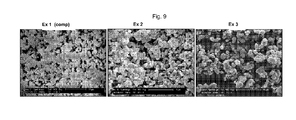
- 238000001878 scanning electron micrograph Methods 0.000 description 1
- 238000001004 secondary ion mass spectrometry Methods 0.000 description 1
- 238000000926 separation method Methods 0.000 description 1
- 238000007086 side reaction Methods 0.000 description 1
- 229910052814 silicon oxide Inorganic materials 0.000 description 1
- 239000002002 slurry Substances 0.000 description 1
- 229910052708 sodium Inorganic materials 0.000 description 1
- 159000000000 sodium salts Chemical class 0.000 description 1
- 238000001179 sorption measurement Methods 0.000 description 1
- 230000003068 static effect Effects 0.000 description 1
- 239000000126 substance Substances 0.000 description 1
- 239000011593 sulfur Substances 0.000 description 1
- 229910052717 sulfur Inorganic materials 0.000 description 1
- 238000005211 surface analysis Methods 0.000 description 1
- 235000002906 tartaric acid Nutrition 0.000 description 1
- 239000011975 tartaric acid Substances 0.000 description 1
- 229910052714 tellurium Inorganic materials 0.000 description 1
- PORWMNRCUJJQNO-UHFFFAOYSA-N tellurium atom Chemical compound [Te] PORWMNRCUJJQNO-UHFFFAOYSA-N 0.000 description 1
- 125000000383 tetramethylene group Chemical group [H]C([H])([*:1])C([H])([H])C([H])([H])C([H])([H])[*:2] 0.000 description 1
- 238000005011 time of flight secondary ion mass spectroscopy Methods 0.000 description 1
- 229910052718 tin Inorganic materials 0.000 description 1
- 238000005406 washing Methods 0.000 description 1
- 239000008096 xylene Substances 0.000 description 1
Images



Classifications
-
- C—CHEMISTRY; METALLURGY
- C01—INORGANIC CHEMISTRY
- C01B—NON-METALLIC ELEMENTS; COMPOUNDS THEREOF; METALLOIDS OR COMPOUNDS THEREOF NOT COVERED BY SUBCLASS C01C
- C01B39/00—Compounds having molecular sieve and base-exchange properties, e.g. crystalline zeolites; Their preparation; After-treatment, e.g. ion-exchange or dealumination
- C01B39/02—Crystalline aluminosilicate zeolites; Isomorphous compounds thereof; Direct preparation thereof; Preparation thereof starting from a reaction mixture containing a crystalline zeolite of another type, or from preformed reactants; After-treatment thereof
-
- B—PERFORMING OPERATIONS; TRANSPORTING
- B01—PHYSICAL OR CHEMICAL PROCESSES OR APPARATUS IN GENERAL
- B01J—CHEMICAL OR PHYSICAL PROCESSES, e.g. CATALYSIS OR COLLOID CHEMISTRY; THEIR RELEVANT APPARATUS
- B01J29/00—Catalysts comprising molecular sieves
- B01J29/04—Catalysts comprising molecular sieves having base-exchange properties, e.g. crystalline zeolites
- B01J29/06—Crystalline aluminosilicate zeolites; Isomorphous compounds thereof
-
- B—PERFORMING OPERATIONS; TRANSPORTING
- B01—PHYSICAL OR CHEMICAL PROCESSES OR APPARATUS IN GENERAL
- B01J—CHEMICAL OR PHYSICAL PROCESSES, e.g. CATALYSIS OR COLLOID CHEMISTRY; THEIR RELEVANT APPARATUS
- B01J29/00—Catalysts comprising molecular sieves
- B01J29/04—Catalysts comprising molecular sieves having base-exchange properties, e.g. crystalline zeolites
- B01J29/06—Crystalline aluminosilicate zeolites; Isomorphous compounds thereof
- B01J29/40—Crystalline aluminosilicate zeolites; Isomorphous compounds thereof of the pentasil type, e.g. types ZSM-5, ZSM-8 or ZSM-11, as exemplified by patent documents US3702886, GB1334243 and US3709979, respectively
-
- C—CHEMISTRY; METALLURGY
- C01—INORGANIC CHEMISTRY
- C01B—NON-METALLIC ELEMENTS; COMPOUNDS THEREOF; METALLOIDS OR COMPOUNDS THEREOF NOT COVERED BY SUBCLASS C01C
- C01B39/00—Compounds having molecular sieve and base-exchange properties, e.g. crystalline zeolites; Their preparation; After-treatment, e.g. ion-exchange or dealumination
- C01B39/02—Crystalline aluminosilicate zeolites; Isomorphous compounds thereof; Direct preparation thereof; Preparation thereof starting from a reaction mixture containing a crystalline zeolite of another type, or from preformed reactants; After-treatment thereof
- C01B39/36—Pentasil type, e.g. types ZSM-5, ZSM-8 or ZSM-11
- C01B39/38—Type ZSM-5
-
- C—CHEMISTRY; METALLURGY
- C01—INORGANIC CHEMISTRY
- C01B—NON-METALLIC ELEMENTS; COMPOUNDS THEREOF; METALLOIDS OR COMPOUNDS THEREOF NOT COVERED BY SUBCLASS C01C
- C01B39/00—Compounds having molecular sieve and base-exchange properties, e.g. crystalline zeolites; Their preparation; After-treatment, e.g. ion-exchange or dealumination
- C01B39/02—Crystalline aluminosilicate zeolites; Isomorphous compounds thereof; Direct preparation thereof; Preparation thereof starting from a reaction mixture containing a crystalline zeolite of another type, or from preformed reactants; After-treatment thereof
- C01B39/36—Pentasil type, e.g. types ZSM-5, ZSM-8 or ZSM-11
- C01B39/38—Type ZSM-5
- C01B39/40—Type ZSM-5 using at least one organic template directing agent
-
- C—CHEMISTRY; METALLURGY
- C01—INORGANIC CHEMISTRY
- C01B—NON-METALLIC ELEMENTS; COMPOUNDS THEREOF; METALLOIDS OR COMPOUNDS THEREOF NOT COVERED BY SUBCLASS C01C
- C01B39/00—Compounds having molecular sieve and base-exchange properties, e.g. crystalline zeolites; Their preparation; After-treatment, e.g. ion-exchange or dealumination
- C01B39/02—Crystalline aluminosilicate zeolites; Isomorphous compounds thereof; Direct preparation thereof; Preparation thereof starting from a reaction mixture containing a crystalline zeolite of another type, or from preformed reactants; After-treatment thereof
- C01B39/44—Ferrierite type, e.g. types ZSM-21, ZSM-35 or ZSM-38
-
- C—CHEMISTRY; METALLURGY
- C01—INORGANIC CHEMISTRY
- C01B—NON-METALLIC ELEMENTS; COMPOUNDS THEREOF; METALLOIDS OR COMPOUNDS THEREOF NOT COVERED BY SUBCLASS C01C
- C01B39/00—Compounds having molecular sieve and base-exchange properties, e.g. crystalline zeolites; Their preparation; After-treatment, e.g. ion-exchange or dealumination
- C01B39/02—Crystalline aluminosilicate zeolites; Isomorphous compounds thereof; Direct preparation thereof; Preparation thereof starting from a reaction mixture containing a crystalline zeolite of another type, or from preformed reactants; After-treatment thereof
- C01B39/44—Ferrierite type, e.g. types ZSM-21, ZSM-35 or ZSM-38
- C01B39/445—Ferrierite type, e.g. types ZSM-21, ZSM-35 or ZSM-38 using at least one organic template directing agent
-
- C—CHEMISTRY; METALLURGY
- C01—INORGANIC CHEMISTRY
- C01B—NON-METALLIC ELEMENTS; COMPOUNDS THEREOF; METALLOIDS OR COMPOUNDS THEREOF NOT COVERED BY SUBCLASS C01C
- C01B39/00—Compounds having molecular sieve and base-exchange properties, e.g. crystalline zeolites; Their preparation; After-treatment, e.g. ion-exchange or dealumination
- C01B39/02—Crystalline aluminosilicate zeolites; Isomorphous compounds thereof; Direct preparation thereof; Preparation thereof starting from a reaction mixture containing a crystalline zeolite of another type, or from preformed reactants; After-treatment thereof
- C01B39/46—Other types characterised by their X-ray diffraction pattern and their defined composition
-
- C—CHEMISTRY; METALLURGY
- C01—INORGANIC CHEMISTRY
- C01B—NON-METALLIC ELEMENTS; COMPOUNDS THEREOF; METALLOIDS OR COMPOUNDS THEREOF NOT COVERED BY SUBCLASS C01C
- C01B39/00—Compounds having molecular sieve and base-exchange properties, e.g. crystalline zeolites; Their preparation; After-treatment, e.g. ion-exchange or dealumination
- C01B39/02—Crystalline aluminosilicate zeolites; Isomorphous compounds thereof; Direct preparation thereof; Preparation thereof starting from a reaction mixture containing a crystalline zeolite of another type, or from preformed reactants; After-treatment thereof
- C01B39/46—Other types characterised by their X-ray diffraction pattern and their defined composition
- C01B39/48—Other types characterised by their X-ray diffraction pattern and their defined composition using at least one organic template directing agent
-
- C—CHEMISTRY; METALLURGY
- C07—ORGANIC CHEMISTRY
- C07C—ACYCLIC OR CARBOCYCLIC COMPOUNDS
- C07C2/00—Preparation of hydrocarbons from hydrocarbons containing a smaller number of carbon atoms
- C07C2/54—Preparation of hydrocarbons from hydrocarbons containing a smaller number of carbon atoms by addition of unsaturated hydrocarbons to saturated hydrocarbons or to hydrocarbons containing a six-membered aromatic ring with no unsaturation outside the aromatic ring
- C07C2/64—Addition to a carbon atom of a six-membered aromatic ring
- C07C2/66—Catalytic processes
-
- C—CHEMISTRY; METALLURGY
- C10—PETROLEUM, GAS OR COKE INDUSTRIES; TECHNICAL GASES CONTAINING CARBON MONOXIDE; FUELS; LUBRICANTS; PEAT
- C10G—CRACKING HYDROCARBON OILS; PRODUCTION OF LIQUID HYDROCARBON MIXTURES, e.g. BY DESTRUCTIVE HYDROGENATION, OLIGOMERISATION, POLYMERISATION; RECOVERY OF HYDROCARBON OILS FROM OIL-SHALE, OIL-SAND, OR GASES; REFINING MIXTURES MAINLY CONSISTING OF HYDROCARBONS; REFORMING OF NAPHTHA; MINERAL WAXES
- C10G11/00—Catalytic cracking, in the absence of hydrogen, of hydrocarbon oils
- C10G11/02—Catalytic cracking, in the absence of hydrogen, of hydrocarbon oils characterised by the catalyst used
- C10G11/04—Oxides
- C10G11/05—Crystalline alumino-silicates, e.g. molecular sieves
-
- C—CHEMISTRY; METALLURGY
- C10—PETROLEUM, GAS OR COKE INDUSTRIES; TECHNICAL GASES CONTAINING CARBON MONOXIDE; FUELS; LUBRICANTS; PEAT
- C10G—CRACKING HYDROCARBON OILS; PRODUCTION OF LIQUID HYDROCARBON MIXTURES, e.g. BY DESTRUCTIVE HYDROGENATION, OLIGOMERISATION, POLYMERISATION; RECOVERY OF HYDROCARBON OILS FROM OIL-SHALE, OIL-SAND, OR GASES; REFINING MIXTURES MAINLY CONSISTING OF HYDROCARBONS; REFORMING OF NAPHTHA; MINERAL WAXES
- C10G45/00—Refining of hydrocarbon oils using hydrogen or hydrogen-generating compounds
- C10G45/58—Refining of hydrocarbon oils using hydrogen or hydrogen-generating compounds to change the structural skeleton of some of the hydrocarbon content without cracking the other hydrocarbons present, e.g. lowering pour point; Selective hydrocracking of normal paraffins
- C10G45/60—Refining of hydrocarbon oils using hydrogen or hydrogen-generating compounds to change the structural skeleton of some of the hydrocarbon content without cracking the other hydrocarbons present, e.g. lowering pour point; Selective hydrocracking of normal paraffins characterised by the catalyst used
- C10G45/64—Refining of hydrocarbon oils using hydrogen or hydrogen-generating compounds to change the structural skeleton of some of the hydrocarbon content without cracking the other hydrocarbons present, e.g. lowering pour point; Selective hydrocracking of normal paraffins characterised by the catalyst used containing crystalline alumino-silicates, e.g. molecular sieves
-
- B—PERFORMING OPERATIONS; TRANSPORTING
- B01—PHYSICAL OR CHEMICAL PROCESSES OR APPARATUS IN GENERAL
- B01J—CHEMICAL OR PHYSICAL PROCESSES, e.g. CATALYSIS OR COLLOID CHEMISTRY; THEIR RELEVANT APPARATUS
- B01J2229/00—Aspects of molecular sieve catalysts not covered by B01J29/00
- B01J2229/60—Synthesis on support
- B01J2229/62—Synthesis on support in or on other molecular sieves
-
- C—CHEMISTRY; METALLURGY
- C07—ORGANIC CHEMISTRY
- C07C—ACYCLIC OR CARBOCYCLIC COMPOUNDS
- C07C2529/00—Catalysts comprising molecular sieves
- C07C2529/04—Catalysts comprising molecular sieves having base-exchange properties, e.g. crystalline zeolites, pillared clays
- C07C2529/06—Crystalline aluminosilicate zeolites; Isomorphous compounds thereof
- C07C2529/70—Crystalline aluminosilicate zeolites; Isomorphous compounds thereof of types characterised by their specific structure not provided for in groups C07C2529/08 - C07C2529/65
Definitions
- the present invention relates to a process for making crystalline metallosilicates (or zeolites).
- Zeolites have been demonstrated to possess catalytic properties for various types of hydrocarbon conversions.
- the zeolites have been used as adsorbents and catalyst carriers for various types of hydrocarbon conversion processes, and other applications.
- the crystalline metallosilicates made by the process of the present invention comprise crystallites having on the outer surface, and close to the outer surface, a ratio of silicon to metal higher than in the inner part of the crystallite.
- the outer surface and the part close to the outer surface can be referred as the outer layer or the shell, the inner part can be referred as the core.
- Crystalline metallosilicates are ordered, porous, crystalline material having a definite crystalline structure as determined by x-ray diffraction, possessing a large number of smaller cavities that may be interconnected by pores.
- the dimensions of these channels or pores are such as to allow adsorption of molecules with certain dimensions while rejecting those with larger dimensions.
- the interstitial spaces or channels formed by the crystalline network enable zeolites to be used as molecular sieves in separation processes and catalysts and catalyst supports in a wide variety of hydrocarbon conversion processes.
- Zeolites or metallosilicates are comprised of a lattice of silicon oxide and optionally a metal oxide combined optionally with exchangeable cations such as alkali or alkaline earth metal ions.
- zeolites includes materials containing silica and optionally alumina, it is recognized that the silica and alumina portions may be replaced in whole or in part with other oxides.
- germanium oxide can replace the silica portion.
- the metal cations other than silicon in the oxide framework of metallosilicates may be iron, aluminium, titanium, gallium and boron.
- Zeolites means here microporous crystalline metallosilicates materials.
- the catalytic properties of metallosilicates are the result of the presence of elements different than silicon in the framework of the zeolite. Substitution of metal cations for silicon in the oxide framework gives rise to potential catalytic active sites.
- the best known metallosilicates are aluminosilicates that exhibit acidic groups in the pores of the crystals.
- the substitution of silica with elements such as alumina with a lower valence state creates a positive charge deficiency, which can be compensated by a cation such as a hydrogen ion.
- the acidity of the zeolite can be on the surface of the zeolite and also within the channels of the zeolite.
- hydrocarbon conversion reactions such as paraffin isomerization, olefin skeletal or double bond isomerization, oligomerisation, disproportionation, alkylation, and transalkylation of aromatics may be governed by constraints imposed by the channel size of the molecular sieve.
- the acidic protons, present in the interior of the pores, are subject to shape selective constraints.
- shape selective catalysis have been extensively reviewed, e.g. by N.Y. Chen, W.E. Garwood and F.G. Dwyer in "Shape selective catalysis in industrial applications", 36, Marcel Dekker, Inc., 1989 .
- acidic groups can also be present at the external surface of the metallosilicate crystals. These acidic groups are not subject to the shape selective constraints imposed by the crystalline pore-structure.
- the acidic groups on the external surface is called here external surface acidity.
- the external surface acidity may catalyse undesirable reactions that decrease the product selectivity.
- Typical unselective surface catalysed reactions that are not subject to the constraints imposed by the crystalline pore-structure are: (1) extensive oligo/polymerisation of olefins, (2) isomerisation of alkylaromatics, selectively produced inside the constrained pore-structure (3) formation of polycyclic aromatics (4) multiple alkylation of aromatics (5) multiple branching of olefins and/or paraffins and (6) formation of macromolecular type precursors of coke leading to undesired carbon lay down.
- the relative amount of external surface acidity is determined by the crystal size; small crystals possess more external surface acidity than large crystals. It is often advantageous to reduce the presence of the external surface acidity of the zeolites or metallosilicate in order to improve their process performance. Performance measures include product selectivity, product quality and catalyst stability.
- EP 1661859 A1 and WO 2006 092657 describes a process to make directly crystallites having on the outer surface, and close to the outer surface, a ratio of silicon to metal higher than in the inner part of the crystallite.
- EP 1661859 A1 describes a crystalline metallosilicate composition comprising crystallites having a crystal outer surface layer having a depth of about 10 nm below the outer surface, and an inner part extending inwardly from a depth of about 50 nm below the outer surface, wherein the atomic ratio of silicon to metal in the metallosilicate composition is at least 1.5 times higher in the crystal outer surface layer as compared to that in the inner part.
- the process for producing said crystalline metallosilicate composition comprises the steps of :
- the present invention relates to a process for making a crystalline metallosilicate composition and comprising crystallites having an inner part (the core) and an outer part (the outer layer or shell) such that :
- This process provides a solution to enhance the yield of the zeolite crystals in the synthesis.
- the metallosilicates have reduced surface activity relative to the internal pores, which are subject to shape-selective constraints of the pore-structure.
- the pH of the mixture a)+b)+c), before crystallization is higher than 13, preferably higher than 13.1, more preferably higher than 13.2, still more preferably higher than 13.3 and most preferred higher than 13.4.
- the operating parameters of the crystallization of step g) could be the same or different as the operating parameters in the crystallisation of step d).
- the inorganic source of silicon is selected from at least one of precipitated silica, pyrogenic (fumed) silica, and an aqueous colloidal suspension of silica.
- the inorganic source of silicon has a limited solubility in the water before addition of alkali medium.
- the organic source of silicon is a tetraalkyl orthosilicate.
- the decrease of pH in step f) can be made by any means and advantageously by adding a pH lowering agent.
- Said pH lowering agent can be any water soluble compound or a mixture of compounds used in concentration sufficient for providing the pH of the aqueous solution lower by 0.1 than pH value of reaction mixture after the first crystallization step.
- the pH is lowered by at least 0.1 preferably by 0.3 to 4, more preferably by 0.5 to 3.
- the lowering pH agent is an organic or inorganic acids or a salt providing acidic pH.
- the organic acids may comprise an organic acid such as citric acid, formic acid, oxalic acid, tartaric acid, malonic acid, succinic acid, glutaric acid, adipic acid, maleic acid, phthalic acid, isophthalic acid, fumaric acid, nitrilotriacetic acid, hydroxyethylenediaminetriacetic acid, ethylenediaminetetracetic acid, trichloroacetic acid trifluoroacetic acid or a salt of such an acid ( e . g . the sodium salt) or a mixture of two or more of such acids or salts.
- organic acid such as citric acid, formic acid, oxalic acid, tartaric acid, malonic acid, succinic acid, glutaric acid, adipic acid, maleic acid, phthalic acid, isophthalic acid, fumaric acid, nitrilotriacetic acid, hydroxyethylenediaminetriacetic acid, ethylenediaminetetracetic acid,
- the inorganic acids may comprise an inorganic acid such as nitric acid, hydrochloric acid, methansulfuric acid, sulfuric acid, phosphoric, carbonic or a salt of such an acid ( e . g . the sodium or ammonium salts) or a mixture of two or more of such acids or salts.
- an inorganic acid such as nitric acid, hydrochloric acid, methansulfuric acid, sulfuric acid, phosphoric, carbonic or a salt of such an acid (e . g . the sodium or ammonium salts) or a mixture of two or more of such acids or salts.
- the metal source is selected from at least one of the metal oxide, a metal salt, and a metal alkoxide.
- the metallosilicate is an aluminosilicate (the Metal is Al), and the source of aluminum is advantageously selected from at least one of hydrated alumina dissolved in an alkaline solution, aluminum metal, a water-soluble aluminum salt, such as aluminum sulphate or aluminium nitrate or aluminium chloride, sodium aluminate and an alkoxide, such as aluminum isopropoxide.
- the source of aluminum is advantageously selected from at least one of hydrated alumina dissolved in an alkaline solution, aluminum metal, a water-soluble aluminum salt, such as aluminum sulphate or aluminium nitrate or aluminium chloride, sodium aluminate and an alkoxide, such as aluminum isopropoxide.
- the metallosilicate is a borosilicate
- the source of boron is selected from at least one of hydrated boron oxide dissolved in an alkaline solution, a water-soluble boron salt, such as boron chloride, and an alkoxide.
- the metallosilicate is a ferrosilicate
- the source of iron is a water soluble iron salt.
- the metallosilicate is a gallosilicate
- the source of gallium is a water soluble gallium salt.
- the metallosilicate is a titanosilicate
- the source of titanium is selected from at least one of titanium halides, titanium oxyhalides, titanium sulphates and titanium alkoxides.
- the non-aqueous liquid medium comprises an organic solvent which is substantially water insoluble or water immiscible.
- the organic solvent comprises at least one of an alcohol having at least 5 carbon atoms or a mercaptan having at least 5 carbon atoms.
- the alcohol has up to 18 carbon atoms and the mercaptan has up to 18 carbon atoms.
- the source of OH - anions is sodium hydroxide.
- the present invention also provides a crystalline metallosilicate composition
- a crystalline metallosilicate composition comprising crystallites having a crystal outer surface layer having a depth of about 10 nm below the outer surface, and an inner part extending inwardly from a depth of about 50 nm below the outer surface, wherein the atomic ratio of silicon to metal in the metallosilicate composition is advantageously at least 1.5 times higher in the crystal outer surface layer as compared to that in the inner part.
- the atomic ratio of silicon to metal in the metallosilicate composition is preferably from 1.5 to 15, more preferably from 2 to 10, most preferably from 3 to 5 times higher in the crystal outer surface layer as compared to that in the inner part.
- the inner part has a silicon/metal atomic ratio of from 11 to 1000, more preferably from 22 to 500, and the crystal surface has a silicon/metal atomic ratio of from 17 to 15000, more preferably from 34 to 5000.
- the inner part has a substantially constant silicon/metal atomic ratio.
- the present invention additionally provides the use of the crystalline metallosilicate composition obtained by the process of the present invention as a catalyst component in a hydrocarbon conversion process.
- the medium b) and c) are mixed first and medium a) is further added slowly in the mixture b)+c) until a hydrogel is obtained. Then the crystallization is made by heating advantageously under stirring conditions. Further to the crystallization there is a cooling, a filtration, a washing, a drying and finally a calcination step as in any zeolite synthesis.
- Metallosilicates characterised by a spatial distribution of the constituting elements and characterised by a surface enriched in silicon that can be produced by the process of the present invention can be any of the synthetic crystalline zeolites able to be synthesized in basic medium.
- the zeolite according to invention is selected from the group MFI (ZSM-5, silicalite, TS-1), MEL (ZSM-11, silicalite-2, TS-2), MTT (ZSM-23, EU-13, ISI-4, KZ-1), MFS (ZSM-57), HEU (Clinoptilolite), FER (ZSM-35, Ferrierite, FU-9, ISI-6, NU-23, Sr-D), TON (ZSM-22, Theta-1, ISI-1, KZ-2 and NU-10), LTL (L), MAZ (mazzite, Omega, ZSM-4).
- MFI ZSM-5, silicalite, TS-1
- MEL ZSM-11, silicalite-2, TS-2
- the metallosilicates obtained by the process of the present invention may comprise a charge balancing cation M selected from the group consisting of hydrogen, ammonium, monovalent, divalent and trivalent cations and mixtures thereof.
- the sources of the various elements of the metallosilicate may be any of those found in the commerce or prepared on purpose.
- the source of silicon may be a silicate, e.g., a tetraalkyl orthosilicate, precipitated or pyrogenic silica, or preferably an aqueous colloidal suspension of silica.
- the metallosilicate is an aluminosilicate zeolite
- the source of aluminum is preferably hydrated alumina dissolved in an alkaline solution or aluminum metal, a water-soluble aluminum salt, e.g., aluminum sulphate or aluminium chloride, sodium-aluminate or an alkoxide, e.g., aluminum isopropoxide.
- the source of boron is preferably hydrated boron oxide dissolved in an alkaline solution or a water-soluble boron salt, e.g., boron chloride or an alkoxide.
- a water-soluble boron salt e.g., boron chloride or an alkoxide.
- the source of iron or gallium can almost be any iron or gallium salts that is readily soluble in water.
- the source of titanium can be titanium halides, titanium oxyhalides, titanium sulphates or titanium alkoxides.
- the atomic ratio of silicon to metal depends on the metal and on the use of the metallosilicate and is at least 2/1 to about 10000/1, preferably from 5/1 to about 5000/1 and most preferred from about 10/1 to 1000/1.
- one or more templating agent (or directing agent) such as organic or inorganic compounds containing nitrogen, oxygen, sulfur, or phosphorous may be introduced into the synthesis mixture.
- the directing agent is a cation, it may also be introduced in the form of a mixture of hydroxide and salt, e.g., a halide.
- the agent used will depend on the metallosilicate prepared by the process.
- the amount of the directing agent depends on the metallosilicate prepared by the process.
- the source of M cations may be alkali or alkaline earth hydroxides or salts. M may also be ammonium hydroxide or salts. Together with the directing agent(s) the M cation will impact the pH of the crystallising medium.
- the proportion of the source of OH - in the aqueous medium a) has to be in accordance with the templating agent and the M cation to comply with the molar ratio OH - /SiO 2 of at least 0.3 and preferably from 0.3 to 0.6 in the mixture a)+b)+c) at step d).
- the organic solvent medium preferably is essentially water-insoluble or water-immiscible.
- the organic solvent medium preferably contains at least one alcohol or mercaptan, which is essentially water-insoluble.
- alcohols or mercaptans which are essentially water-insoluble are alcohols or mercaptans with at least 5 up to about 18 carbons.
- the organic solvent medium can optionally contain other water-insoluble organic compounds that do not bear an alcohol or mercaptan functional group.
- Organic compounds that may be employed together with the required amount of water-insoluble alcohols or mercaptans can be halohydrocarbons, paraffinic, cycloparaffinic, aromatic hydrocarbons or mixture thereof.
- the order of mixing of a), b) and c) is not essential and will depend on the zeolite being prepared.
- the crystallisation medium (a)+b)+c)) may be aged at a temperature at which no crystallisation occurs, optionally nucleation may be started.
- nucleation may be started.
- metallosilicates can be prepared by using autoclaves, which have sufficient agitation to homogenise the crystallisation mixture during heat up until the effective nucleation and crystallisation temperature of the mixture is achieved.
- the crystallisation vessel can be made of a metal or metal alloys resisting the conditions of the crystallisation or optionally can be coated with a fluorocarbon such as Teflon®TM.
- a fluorocarbon such as Teflon®TM.
- Other means of introducing agitation known to one skilled in the art can be employed, such as pumping the synthesis mixture from one part of the autoclave to another.
- the crystallisation medium obtained by mixing a), b) and c) is maintained under stirring conditions at room temperature for a period of 10 minutes to 2 hours. Then the crystallization medium is submitted to autogenous pressure and elevated temperature.
- the reaction mixture is heated up to the crystallization temperature that may range from about 120°C to 250°C, preferably from 130°C to 230°C, most preferably from 160°C to 220°C. Heating up to the crystallization temperature is typically carried for a period of time ranging from about 0,5 to about 30 hours, preferably from about 1 to 12 hours, most preferably from about 2 to 9 hours.
- the temperature may be increased stepwise or continuously. However, continuous heating is preferred.
- the crystallization medium may be kept static or agitated by means of tumbling or stirring the reaction vessel during hydrothermal treatment.
- the reaction mixture is tumbled or stirred, most preferably stirred.
- the temperature is then maintained at the crystallization temperature for a period of time ranging from 2 to 200 hours. Heat and agitation is applied for a period of time effective to form crystalline product.
- the reaction mixture is kept at the crystallization temperature for a period of from 16 to 96 hours. Any oven such as a conventional oven and a microwave oven can be used.
- the operating parameters of the crystallization of step g) could be the same or different as the operating parameters in the crystallisation of step d).
- the crystalline metallosilicate is formed as a slurry and can be recovered by standard means, such as by sedimentation, centrifugation or filtration.
- the separated crystalline metallosilicate is washed, recovered by sedimentation, centrifugation or filtration and dried at a temperature of typically from about 25°C to about 250°C, and more preferably from 80°C to about 120°C. Calcination of the metallosilicate is known per se.
- the recovered metallosilicate contains within its pores at least a portion of the template used.
- activation is performed in such a manner that the template is removed from the metallosilicate, leaving active catalytic sites with the microporous channels of the metallosilicate open for contact with a feedstock.
- the activation process is typically accomplished by calcining, or essentially heating the metallosilicate comprising the template at a temperature of from 200 to 800°C in the presence of an oxygen-containing gas. In some cases, it may be desirable to heat the metallosilicate in an environment having a low oxygen concentration. This type of process can be used for partial or complete removal of the template from the intracrystalline pore system.
- the crystalline metallosilicate Once the crystalline metallosilicate is made, it can be used as itself as a catalyst. In another embodiment it can be formulated into a catalyst by combining the crystalline metallosilicate with other materials that provide additional hardness or catalytic activity to the finished catalyst product.
- the crystals prepared by the instant invention can be formed into a wide variety of forms.
- the catalyst needs to possess a shape to be applicable in industrial reactors.
- the crystals can be shaped before drying or partially dried and then shaped or the crystals can be calcined to remove organic template and then shaped.
- it is desirable that crystalline zeolites prepared by the process of the present invention are incorporated with binder material resistant to the temperature and other conditions employed in organic conversion processes.
- binder material does not contain the metal element that is incorporated into the framework of the metallosilicate characterised by a spatial distribution of the constituting elements and characterised by a surface enriched in silicon.
- the binder material does not contain elements that destroy the spatial distribution of the constituting elements of the metallosilicate or the surface enriched in silicon of the metallosilicate.
- binder material may be composited with a porous matrix material, such as silica, zirconia, magnesia, titania, silica-magnesia, silica-zirconia, silica-thoria, and silica-titania, as well as ternary compositions, such as silica-magnesia-zirconia.
- a porous matrix material such as silica, zirconia, magnesia, titania, silica-magnesia, silica-zirconia, silica-thoria, and silica-titania
- ternary compositions such as silica-magnesia-zirconia.
- the relative proportions of metallosilicate component and binder material will vary widely with the metallosilicate content ranging from between about 1 to about 99 percent by weight, more preferably in the range of about 10 to about 85 percent by weight of metallosilicate component, and still more preferred from about 20 to about 80 percent.
- the metallosilicate prepared by the process of the present invention may be further ion exchanged after calcination to remove organic template as is known in the art either to replace at least in part the original charge-balancing cations present in the metallosilicate with a different cation, e.g. a Group IB to VIII of the Periodic Table metal such as tungsten, molybdenum, nickel, copper, zinc, palladium, platinum, calcium or rare earth metal, or to provide a more acidic form of the zeolite by exchange of original charge-balancing cation with ammonium cations, followed by calcination of the ammonium form to provide the acidic hydrogen form.
- a different cation e.g. a Group IB to VIII of the Periodic Table metal such as tungsten, molybdenum, nickel, copper, zinc, palladium, platinum, calcium or rare earth metal, or to provide a more acidic form of the zeolite by exchange of original charge-balancing cation with ammoni
- the acidic form may be readily prepared by ion exchange using a suitable reagent such as ammonium nitrate, ammonium carbonate or protonic acids, like HCI, HNO3 and H3PO4.
- the metallosilicate may then be calcined at a temperature of 400 to 550° C to remove ammonia and create the hydrogen form.
- Particularly preferred cations will depend on the use of the metallosilicate and include hydrogen, rare earth metals, and metals of Groups IIA, 1IIA, IVA, IB, IIB, IIIB, IVB, and VIII of the Periodic Table of the Elements.
- the metallosilicate prepared by the process of the present invention may be further supported by at least one different precursor of metals that have catalytic activity after known pretreatments, e.g. a Group IIA, IIIA to VIIIA, IB, IIB, IIIB to VIB of the Periodic Table metal such as tungsten, molybdenum, nickel, copper, zinc, palladium, platinum, gallium, tin, and/or tellurium metal precursors.
- a Group IIA, IIIA to VIIIA, IB, IIB, IIIB to VIB of the Periodic Table metal such as tungsten, molybdenum, nickel, copper, zinc, palladium, platinum, gallium, tin, and/or tellurium metal precursors.
- the metallosilicate of the present invention characterised by a spatial distribution of the constituted elements and characterised by a surface enriched in silicon have controlled catalytic activity which is the result of the presence of catalytic active sites mainly in the inner part of the metallosilicate crystals and largely the absence of unselective catalytic active sites near the external surface of the metallosilicate crystals, which can cause undesirable side reactions to occur
- the metallosilicate of the present invention by itself or in combination with one or more catalytically active substances can have high activity, high selectivity, high stability, or combinations thereof when used as catalysts for a variety of hydrocarbon conversion processes. Examples of such processes include, as non-limiting examples, the following:
- the invention is illustrated by the following non-limiting Examples.
- the techniques used to produce and characterise the obtained materials are given.
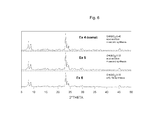
- X-ray diffraction was used to obtain a diffraction pattern, to ensure that desired crystal structure is confirmed or to detect presence of foreign crystalline phases and to determine degree of crystallinity compared with a reference zeolite.
- the diffractometer was a Philips PW1830 (Co K ⁇ ).
- the spatial distribution of the constituting elements was measured by means of "secondary ion mass spectrometry" or SIMS.
- the apparatus used was a CAMECA TOF-SIMS IV. To avoid charge effects, zeolites being non-conductive materials, a low energy electron floodgun was used.
- a sputtering gun was used simultaneously to the analysis gun. Both guns used argon as primary ions, the energy of the sputtering gun ion beam being 3 keV for a current density of 20 nA, and the analysis gun having an energy of 10 keV with a current of 1 pA.
- the sputtering gun eroded a surface area of 200 x 200 micron, and the surface analysis gun scanned a surface area of about 5 x 5 micron.
- Profiles were performed in non-interlaced mode, meaning that analysis and sputtering of the samples was completely dissociated. The cycle sequence was as follows: 30 seconds analysis-30 seconds sputtering-2 seconds pausing.
- An MFI aluminosilicate was prepared by mixing solutions a), b) and c).
- Solution b) and c) were mixed in an autoclave for a period of 15 minutes and a hydrogel was obtained by adding slowly solution a). After stirring for 30 min at room temperature, the crystallization reaction was performed.
- the first crystallization was performed via 3 hours microwave thermal treatment under autogeneous pressure at 170 °C (stirred with magnetic bar). Then the sample 1 was directly recovered from reaction medium after the first synthesis. The reaction media of sample 2 and 3 are cooled down till room temperature and 1 M H 2 SO 4 solution is added to decrease the pH by 2 (table 2, 3). The second synthesis was performed under autogeneous pressure via 16 hours microwave thermal treatment at 170 °C.
- the first crystallization was performed via 18 hours microwave thermal treatment under autogeneous pressure at 170 °C (stirred with magnetic bar). Then the sample 4 was directly recovered from reaction medium after the first synthesis.
- the reaction media of sample 5-7 are cooled down till room temperature and 1 M H 2 SO 4 solution is added to decrease the pH by 2 (table 2, 3).
- the second synthesis was performed under autogeneous pressure via 21 hours microwave thermal treatment at 170 °C.
- the reaction media of sample 8 is cooled down till room temperature and a buffer solution containing 0.05 M Na 2 CO 3 /NaHCO 3 is added to decrease the pH (table 2, 3).
- the second synthesis was performed under autogeneous pressure via 21 hours microwave thermal treatment at 170 °C.
- the product was then cooled and washed with 0.75 liters of distilled water, dried at 110°C for 16 hours and then calcined at 600°C for 5 hours in order to remove the organic material.
- the powder yield increases from 74.98 (ex 1) % to 90.64 and 93.10 for the samples 2 and 3, and from 73.19 % (ex 4) to 90.32 % and 84.48 % for sample 5 and 6 respectively.
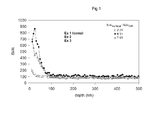
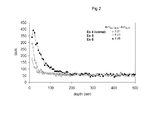
- the SIMS profile shows a more expressed gradient in case of the 2-step synthesis, in respect to one-step procedure with an increase of the Si/Al surface / Si/Al bulk ratio ( figure 1-2 ).
Landscapes
- Chemical & Material Sciences (AREA)
- Organic Chemistry (AREA)
- General Life Sciences & Earth Sciences (AREA)
- Geology (AREA)
- Life Sciences & Earth Sciences (AREA)
- Chemical Kinetics & Catalysis (AREA)
- Engineering & Computer Science (AREA)
- Materials Engineering (AREA)
- Inorganic Chemistry (AREA)
- Crystallography & Structural Chemistry (AREA)
- Oil, Petroleum & Natural Gas (AREA)
- General Chemical & Material Sciences (AREA)
- Catalysts (AREA)
- Silicates, Zeolites, And Molecular Sieves (AREA)
Abstract
The present invention relates to a process for making a crystalline metallosilicate composition and comprising crystallites having an inner part (the core) and an outer part (the outer layer or shell) such that :
the ratio Si/Metal is higher in the outer part than in the inner part,
the crystallites have a continuous distribution of metal and silicon over the crystalline cross-section,
said process comprising :
a) providing an aqueous medium comprising OH- anions and a metal source,
b) providing an aqueous medium comprising an inorganic source of silicon and optionally a templating agent,
c) optionally providing a non aqueous liquid medium comprising optionally an organic source of silica,
d) mixing the medium a), b) and the optional c) at conditions effective to partly crystallize the desired metallosilicate,
e) cooling down the reaction mixture a)+b)+c) to about room temperature,
f) decreasing the pH of the reaction mixture by at least 0.1 preferably by 0.3 to 4, more preferably by 0.5 to 3,
g) subjecting the resulting mixture of step f) at conditions effective to continue the crystallization of the desired metallosilicate,
h) recovering the desired metallosilicate,
wherein at step d) in the mixture a)+b)+c), before crystallization,
the ratio Si org/Si inorganic is < 0.3 , advantageously < 0.2 and preferably 0,
the molar ratio OH-/SiO2 is at least 0.3, preferably from 0.3 to 0.6 and more preferably from 0.33 to 0.6 .
the ratio Si/Metal is higher in the outer part than in the inner part,
the crystallites have a continuous distribution of metal and silicon over the crystalline cross-section,
said process comprising :
a) providing an aqueous medium comprising OH- anions and a metal source,
b) providing an aqueous medium comprising an inorganic source of silicon and optionally a templating agent,
c) optionally providing a non aqueous liquid medium comprising optionally an organic source of silica,
d) mixing the medium a), b) and the optional c) at conditions effective to partly crystallize the desired metallosilicate,
e) cooling down the reaction mixture a)+b)+c) to about room temperature,
f) decreasing the pH of the reaction mixture by at least 0.1 preferably by 0.3 to 4, more preferably by 0.5 to 3,
g) subjecting the resulting mixture of step f) at conditions effective to continue the crystallization of the desired metallosilicate,
h) recovering the desired metallosilicate,
wherein at step d) in the mixture a)+b)+c), before crystallization,
the ratio Si org/Si inorganic is < 0.3 , advantageously < 0.2 and preferably 0,
the molar ratio OH-/SiO2 is at least 0.3, preferably from 0.3 to 0.6 and more preferably from 0.33 to 0.6 .
Description
- The present invention relates to a process for making crystalline metallosilicates (or zeolites). Zeolites have been demonstrated to possess catalytic properties for various types of hydrocarbon conversions. In addition, the zeolites have been used as adsorbents and catalyst carriers for various types of hydrocarbon conversion processes, and other applications. More precisely the crystalline metallosilicates made by the process of the present invention comprise crystallites having on the outer surface, and close to the outer surface, a ratio of silicon to metal higher than in the inner part of the crystallite. In the following description the outer surface and the part close to the outer surface can be referred as the outer layer or the shell, the inner part can be referred as the core.
- Crystalline metallosilicates are ordered, porous, crystalline material having a definite crystalline structure as determined by x-ray diffraction, possessing a large number of smaller cavities that may be interconnected by pores. The dimensions of these channels or pores are such as to allow adsorption of molecules with certain dimensions while rejecting those with larger dimensions. The interstitial spaces or channels formed by the crystalline network enable zeolites to be used as molecular sieves in separation processes and catalysts and catalyst supports in a wide variety of hydrocarbon conversion processes. Zeolites or metallosilicates are comprised of a lattice of silicon oxide and optionally a metal oxide combined optionally with exchangeable cations such as alkali or alkaline earth metal ions. Although the term "zeolites" includes materials containing silica and optionally alumina, it is recognized that the silica and alumina portions may be replaced in whole or in part with other oxides. For example, germanium oxide can replace the silica portion. The metal cations other than silicon in the oxide framework of metallosilicates may be iron, aluminium, titanium, gallium and boron. Accordingly, the term "Zeolites" means here microporous crystalline metallosilicates materials. The catalytic properties of metallosilicates are the result of the presence of elements different than silicon in the framework of the zeolite. Substitution of metal cations for silicon in the oxide framework gives rise to potential catalytic active sites. The best known metallosilicates are aluminosilicates that exhibit acidic groups in the pores of the crystals. The substitution of silica with elements such as alumina with a lower valence state creates a positive charge deficiency, which can be compensated by a cation such as a hydrogen ion. The acidity of the zeolite can be on the surface of the zeolite and also within the channels of the zeolite. Within a pore of the zeolite, hydrocarbon conversion reactions such as paraffin isomerization, olefin skeletal or double bond isomerization, oligomerisation, disproportionation, alkylation, and transalkylation of aromatics may be governed by constraints imposed by the channel size of the molecular sieve. The acidic protons, present in the interior of the pores, are subject to shape selective constraints. The principles of "shape selective" catalysis have been extensively reviewed, e.g. by N.Y. Chen, W.E. Garwood and F.G. Dwyer in "Shape selective catalysis in industrial applications", 36, Marcel Dekker, Inc., 1989. However, acidic groups can also be present at the external surface of the metallosilicate crystals. These acidic groups are not subject to the shape selective constraints imposed by the crystalline pore-structure. The acidic groups on the external surface is called here external surface acidity. The external surface acidity may catalyse undesirable reactions that decrease the product selectivity. Typical unselective surface catalysed reactions that are not subject to the constraints imposed by the crystalline pore-structure are: (1) extensive oligo/polymerisation of olefins, (2) isomerisation of alkylaromatics, selectively produced inside the constrained pore-structure (3) formation of polycyclic aromatics (4) multiple alkylation of aromatics (5) multiple branching of olefins and/or paraffins and (6) formation of macromolecular type precursors of coke leading to undesired carbon lay down. The relative amount of external surface acidity is determined by the crystal size; small crystals possess more external surface acidity than large crystals. It is often advantageous to reduce the presence of the external surface acidity of the zeolites or metallosilicate in order to improve their process performance. Performance measures include product selectivity, product quality and catalyst stability.
- Many prior arts have described crystallites having on the outer surface, and close to the outer surface, a ratio of silicon to metal higher than in the inner part of the crystallite. Said prior arts describe a first type of process wherein a crystallite is produced and then said crystallite is coated by silica or a composition rich in silica. In a second type of process a crystallite is produced and is further treated to remove a part of the metal from the surface layer to obtain a ratio of silicon to metal higher than in the inner part of the crystallite. In a third type of process a crystallite is produced and is further treated to hinder the metal sites in the outer layer. These prior arts are cited in the introduction part of
EP 1661859 A1 . - Each of
EP 1661859 A1 andWO 2006 092657 describes a process to make directly crystallites having on the outer surface, and close to the outer surface, a ratio of silicon to metal higher than in the inner part of the crystallite.
EP 1661859 A1 describes a crystalline metallosilicate composition comprising crystallites having a crystal outer surface layer having a depth of about 10 nm below the outer surface, and an inner part extending inwardly from a depth of about 50 nm below the outer surface, wherein the atomic ratio of silicon to metal in the metallosilicate composition is at least 1.5 times higher in the crystal outer surface layer as compared to that in the inner part. The process for producing said crystalline metallosilicate composition comprises the steps of : - (a) providing a two-phase liquid medium comprising an aqueous liquid phase and a non-aqueous liquid phase, the two-phase liquid medium further comprising at least one silicon-containing compound and at least one metal-containing compound; and
- (b) crystallising the crystalline metallosilicate composition from the two-phase liquid medium.
- (a) providing an aqueous liquid phase comprising at least one silicon-containing compound and at least one metal-containing compound; and
- (b) crystallising the crystalline metallosilicate composition from the aqueous liquid phase, the crystallising step having a first stage followed by a second stage and wherein the concentration of the at least one silicon-containing compound in the aqueous liquid phase is increased in the second stage.
- It has now been discovered a new process to make said crystallites having on the outer surface, and close to the outer surface, a ratio of silicon to metal higher than in the inner part of the crystallite which is more efficient and more simple to carry out.
- The present invention relates to a process for making a crystalline metallosilicate composition and comprising crystallites having an inner part (the core) and an outer part (the outer layer or shell) such that :
- the ratio Si/Metal is higher in the outer part than in the inner part,
- the crystallites have a continuous distribution of metal and silicon over the crystalline cross-section,
- said process comprising :
- a) providing an aqueous medium comprising OH- anions and a metal source,
- b) providing an aqueous medium comprising an inorganic source of silicon and optionally a templating agent,
- c) optionally providing a non aqueous liquid medium comprising optionally an organic source of silica,
- d) mixing the medium a), b) and the optional c) at conditions effective to partly crystallize the desired metallosilicate,
- e) cooling down the reaction mixture a)+b)+c) to about room temperature,
- f) decreasing the pH of the reaction mixture by at least 0.1 preferably by 0.3 to 4, more preferably by 0.5 to 3,
- g) subjecting the resulting mixture of step f) at conditions effective to continue the crystallization of the desired metallosilicate,
- h) recovering the desired metallosilicate,
- This process provides a solution to enhance the yield of the zeolite crystals in the synthesis.
- As a result, the metallosilicates have reduced surface activity relative to the internal pores, which are subject to shape-selective constraints of the pore-structure.
- Advantageously the pH of the mixture a)+b)+c), before crystallization, is higher than 13, preferably higher than 13.1, more preferably higher than 13.2, still more preferably higher than 13.3 and most preferred higher than 13.4.
- The operating parameters of the crystallization of step g) could be the same or different as the operating parameters in the crystallisation of step d).
- Advantageously, the inorganic source of silicon is selected from at least one of precipitated silica, pyrogenic (fumed) silica, and an aqueous colloidal suspension of silica. Preferably, the inorganic source of silicon has a limited solubility in the water before addition of alkali medium.
- Preferably, the organic source of silicon is a tetraalkyl orthosilicate.
- The decrease of pH in step f) can be made by any means and advantageously by adding a pH lowering agent. Said pH lowering agent can be any water soluble compound or a mixture of compounds used in concentration sufficient for providing the pH of the aqueous solution lower by 0.1 than pH value of reaction mixture after the first crystallization step. The pH is lowered by at least 0.1 preferably by 0.3 to 4, more preferably by 0.5 to 3. Advantageously, the lowering pH agent is an organic or inorganic acids or a salt providing acidic pH. The organic acids may comprise an organic acid such as citric acid, formic acid, oxalic acid, tartaric acid, malonic acid, succinic acid, glutaric acid, adipic acid, maleic acid, phthalic acid, isophthalic acid, fumaric acid, nitrilotriacetic acid, hydroxyethylenediaminetriacetic acid, ethylenediaminetetracetic acid, trichloroacetic acid trifluoroacetic acid or a salt of such an acid (e.g. the sodium salt) or a mixture of two or more of such acids or salts. The inorganic acids may comprise an inorganic acid such as nitric acid, hydrochloric acid, methansulfuric acid, sulfuric acid, phosphoric, carbonic or a salt of such an acid (e.g. the sodium or ammonium salts) or a mixture of two or more of such acids or salts.
- Advantageously, the metal source is selected from at least one of the metal oxide, a metal salt, and a metal alkoxide.
- Advantageously, the metallosilicate is an aluminosilicate (the Metal is Al), and the source of aluminum is advantageously selected from at least one of hydrated alumina dissolved in an alkaline solution, aluminum metal, a water-soluble aluminum salt, such as aluminum sulphate or aluminium nitrate or aluminium chloride, sodium aluminate and an alkoxide, such as aluminum isopropoxide.
- Advantageously, the metallosilicate is a borosilicate, and the source of boron is selected from at least one of hydrated boron oxide dissolved in an alkaline solution, a water-soluble boron salt, such as boron chloride, and an alkoxide.
- Advantageously, the metallosilicate is a ferrosilicate, and the source of iron is a water soluble iron salt.
- Advantageously, the metallosilicate is a gallosilicate, and the source of gallium is a water soluble gallium salt.
- Advantageously, the metallosilicate is a titanosilicate, and the source of titanium is selected from at least one of titanium halides, titanium oxyhalides, titanium sulphates and titanium alkoxides.
- Advantageously, the non-aqueous liquid medium comprises an organic solvent which is substantially water insoluble or water immiscible. Preferably, the organic solvent comprises at least one of an alcohol having at least 5 carbon atoms or a mercaptan having at least 5 carbon atoms. Preferably, the alcohol has up to 18 carbon atoms and the mercaptan has up to 18 carbon atoms.
- Advantageously, the source of OH- anions is sodium hydroxide.
- The present invention also provides a crystalline metallosilicate composition comprising crystallites having a crystal outer surface layer having a depth of about 10 nm below the outer surface, and an inner part extending inwardly from a depth of about 50 nm below the outer surface, wherein the atomic ratio of silicon to metal in the metallosilicate composition is advantageously at least 1.5 times higher in the crystal outer surface layer as compared to that in the inner part. The atomic ratio of silicon to metal in the metallosilicate composition is preferably from 1.5 to 15, more preferably from 2 to 10, most preferably from 3 to 5 times higher in the crystal outer surface layer as compared to that in the inner part. Preferably, the inner part has a silicon/metal atomic ratio of from 11 to 1000, more preferably from 22 to 500, and the crystal surface has a silicon/metal atomic ratio of from 17 to 15000, more preferably from 34 to 5000. Preferably, the inner part has a substantially constant silicon/metal atomic ratio.
- The present invention additionally provides the use of the crystalline metallosilicate composition obtained by the process of the present invention as a catalyst component in a hydrocarbon conversion process.
- Advantageously, the medium b) and c) are mixed first and medium a) is further added slowly in the mixture b)+c) until a hydrogel is obtained. Then the crystallization is made by heating advantageously under stirring conditions. Further to the crystallization there is a cooling, a filtration, a washing, a drying and finally a calcination step as in any zeolite synthesis.
- Metallosilicates characterised by a spatial distribution of the constituting elements and characterised by a surface enriched in silicon that can be produced by the process of the present invention can be any of the synthetic crystalline zeolites able to be synthesized in basic medium.
Advantageously, the zeolite according to invention is selected from the group MFI (ZSM-5, silicalite, TS-1), MEL (ZSM-11, silicalite-2, TS-2), MTT (ZSM-23, EU-13, ISI-4, KZ-1), MFS (ZSM-57), HEU (Clinoptilolite), FER (ZSM-35, Ferrierite, FU-9, ISI-6, NU-23, Sr-D), TON (ZSM-22, Theta-1, ISI-1, KZ-2 and NU-10), LTL (L), MAZ (mazzite, Omega, ZSM-4). These zeolites and their isotypes are described in "Atlas of Zeolite Structure Types", eds. W. H. Meier, D. H. Olson and Ch. Baerlocher, Elsevier, Fourth Edition, 1996, which is hereby incorporated by reference. The structure types are provided by the "IUPAC Commission of Zeolite Nomenclature". The conventional procedure for the synthesis of these zeolite is given in "Verified synthesis of zeolytic materials, eds H. Robson, Elsevier 2001. - The metallosilicates obtained by the process of the present invention may comprise a charge balancing cation M selected from the group consisting of hydrogen, ammonium, monovalent, divalent and trivalent cations and mixtures thereof.
- The sources of the various elements of the metallosilicate may be any of those found in the commerce or prepared on purpose. For example, the source of silicon may be a silicate, e.g., a tetraalkyl orthosilicate, precipitated or pyrogenic silica, or preferably an aqueous colloidal suspension of silica. When the metallosilicate is an aluminosilicate zeolite, the source of aluminum is preferably hydrated alumina dissolved in an alkaline solution or aluminum metal, a water-soluble aluminum salt, e.g., aluminum sulphate or aluminium chloride, sodium-aluminate or an alkoxide, e.g., aluminum isopropoxide. When the metallosilicate is a borosilicate zeolite, the source of boron is preferably hydrated boron oxide dissolved in an alkaline solution or a water-soluble boron salt, e.g., boron chloride or an alkoxide. When the metallosilicate is a ferrosilicate or gallosilicate, the source of iron or gallium can almost be any iron or gallium salts that is readily soluble in water. When the metallosilicate is titanosilicate, the source of titanium can be titanium halides, titanium oxyhalides, titanium sulphates or titanium alkoxides. The atomic ratio of silicon to metal depends on the metal and on the use of the metallosilicate and is at least 2/1 to about 10000/1, preferably from 5/1 to about 5000/1 and most preferred from about 10/1 to 1000/1. Optionally one or more templating agent (or directing agent), such as organic or inorganic compounds containing nitrogen, oxygen, sulfur, or phosphorous may be introduced into the synthesis mixture. When the directing agent is a cation, it may also be introduced in the form of a mixture of hydroxide and salt, e.g., a halide. The agent used will depend on the metallosilicate prepared by the process. The amount of the directing agent depends on the metallosilicate prepared by the process. The source of M cations may be alkali or alkaline earth hydroxides or salts. M may also be ammonium hydroxide or salts. Together with the directing agent(s) the M cation will impact the pH of the crystallising medium. The proportion of the source of OH- in the aqueous medium a) has to be in accordance with the templating agent and the M cation to comply with the molar ratio OH-/SiO2 of at least 0.3 and preferably from 0.3 to 0.6 in the mixture a)+b)+c) at step d).
- The organic solvent medium preferably is essentially water-insoluble or water-immiscible. The organic solvent medium preferably contains at least one alcohol or mercaptan, which is essentially water-insoluble. Examples of alcohols or mercaptans which are essentially water-insoluble are alcohols or mercaptans with at least 5 up to about 18 carbons. The organic solvent medium can optionally contain other water-insoluble organic compounds that do not bear an alcohol or mercaptan functional group. A person skilled in the art knows how to alter the hydrophobicity of the organic medium when required for the synthesis of a particular metallosilicate. Organic compounds that may be employed together with the required amount of water-insoluble alcohols or mercaptans can be halohydrocarbons, paraffinic, cycloparaffinic, aromatic hydrocarbons or mixture thereof.
- The order of mixing of a), b) and c) is not essential and will depend on the zeolite being prepared. Optionally the crystallisation medium (a)+b)+c)) may be aged at a temperature at which no crystallisation occurs, optionally nucleation may be started. Persons skilled in the art know equipment used to prepare the zeolite crystals of the present invention. Generally, metallosilicates can be prepared by using autoclaves, which have sufficient agitation to homogenise the crystallisation mixture during heat up until the effective nucleation and crystallisation temperature of the mixture is achieved. The crystallisation vessel can be made of a metal or metal alloys resisting the conditions of the crystallisation or optionally can be coated with a fluorocarbon such as Teflon®™. Other means of introducing agitation known to one skilled in the art can be employed, such as pumping the synthesis mixture from one part of the autoclave to another.
- In an advantageous embodiment the crystallisation medium obtained by mixing a), b) and c) is maintained under stirring conditions at room temperature for a period of 10 minutes to 2 hours. Then the crystallization medium is submitted to autogenous pressure and elevated temperature. The reaction mixture is heated up to the crystallization temperature that may range from about 120°C to 250°C, preferably from 130°C to 230°C, most preferably from 160°C to 220°C. Heating up to the crystallization temperature is typically carried for a period of time ranging from about 0,5 to about 30 hours, preferably from about 1 to 12 hours, most preferably from about 2 to 9 hours. The temperature may be increased stepwise or continuously. However, continuous heating is preferred. The crystallization medium may be kept static or agitated by means of tumbling or stirring the reaction vessel during hydrothermal treatment. Preferably, the reaction mixture is tumbled or stirred, most preferably stirred. The temperature is then maintained at the crystallization temperature for a period of time ranging from 2 to 200 hours. Heat and agitation is applied for a period of time effective to form crystalline product. In a specific embodiment, the reaction mixture is kept at the crystallization temperature for a period of from 16 to 96 hours. Any oven such as a conventional oven and a microwave oven can be used.
The operating parameters of the crystallization of step g) could be the same or different as the operating parameters in the crystallisation of step d). - Typically, the crystalline metallosilicate is formed as a slurry and can be recovered by standard means, such as by sedimentation, centrifugation or filtration. The separated crystalline metallosilicate is washed, recovered by sedimentation, centrifugation or filtration and dried at a temperature of typically from about 25°C to about 250°C, and more preferably from 80°C to about 120°C. Calcination of the metallosilicate is known per se. As a result of the metallosilicate crystallization process, the recovered metallosilicate contains within its pores at least a portion of the template used. In a preferred embodiment, activation is performed in such a manner that the template is removed from the metallosilicate, leaving active catalytic sites with the microporous channels of the metallosilicate open for contact with a feedstock. The activation process is typically accomplished by calcining, or essentially heating the metallosilicate comprising the template at a temperature of from 200 to 800°C in the presence of an oxygen-containing gas. In some cases, it may be desirable to heat the metallosilicate in an environment having a low oxygen concentration. This type of process can be used for partial or complete removal of the template from the intracrystalline pore system.
Once the crystalline metallosilicate is made, it can be used as itself as a catalyst. In another embodiment it can be formulated into a catalyst by combining the crystalline metallosilicate with other materials that provide additional hardness or catalytic activity to the finished catalyst product. - The crystals prepared by the instant invention can be formed into a wide variety of forms. In cases where a catalyst is produced from the metallosilicate produced by the present invention, the catalyst needs to possess a shape to be applicable in industrial reactors. The crystals can be shaped before drying or partially dried and then shaped or the crystals can be calcined to remove organic template and then shaped. In the case of many catalysts, it is desirable that crystalline zeolites prepared by the process of the present invention are incorporated with binder material resistant to the temperature and other conditions employed in organic conversion processes. It will be easily understood by the person skilled in the art that binder material does not contain the metal element that is incorporated into the framework of the metallosilicate characterised by a spatial distribution of the constituting elements and characterised by a surface enriched in silicon. In addition, the binder material does not contain elements that destroy the spatial distribution of the constituting elements of the metallosilicate or the surface enriched in silicon of the metallosilicate. Examples of binder material may be composited with a porous matrix material, such as silica, zirconia, magnesia, titania, silica-magnesia, silica-zirconia, silica-thoria, and silica-titania, as well as ternary compositions, such as silica-magnesia-zirconia. The relative proportions of metallosilicate component and binder material will vary widely with the metallosilicate content ranging from between about 1 to about 99 percent by weight, more preferably in the range of about 10 to about 85 percent by weight of metallosilicate component, and still more preferred from about 20 to about 80 percent. The metallosilicate prepared by the process of the present invention may be further ion exchanged after calcination to remove organic template as is known in the art either to replace at least in part the original charge-balancing cations present in the metallosilicate with a different cation, e.g. a Group IB to VIII of the Periodic Table metal such as tungsten, molybdenum, nickel, copper, zinc, palladium, platinum, calcium or rare earth metal, or to provide a more acidic form of the zeolite by exchange of original charge-balancing cation with ammonium cations, followed by calcination of the ammonium form to provide the acidic hydrogen form. The acidic form may be readily prepared by ion exchange using a suitable reagent such as ammonium nitrate, ammonium carbonate or protonic acids, like HCI, HNO3 and H3PO4. The metallosilicate may then be calcined at a temperature of 400 to 550° C to remove ammonia and create the hydrogen form. Particularly preferred cations will depend on the use of the metallosilicate and include hydrogen, rare earth metals, and metals of Groups IIA, 1IIA, IVA, IB, IIB, IIIB, IVB, and VIII of the Periodic Table of the Elements. The metallosilicate prepared by the process of the present invention may be further supported by at least one different precursor of metals that have catalytic activity after known pretreatments, e.g. a Group IIA, IIIA to VIIIA, IB, IIB, IIIB to VIB of the Periodic Table metal such as tungsten, molybdenum, nickel, copper, zinc, palladium, platinum, gallium, tin, and/or tellurium metal precursors.
- Since the metallosilicate of the present invention characterised by a spatial distribution of the constituted elements and characterised by a surface enriched in silicon have controlled catalytic activity which is the result of the presence of catalytic active sites mainly in the inner part of the metallosilicate crystals and largely the absence of unselective catalytic active sites near the external surface of the metallosilicate crystals, which can cause undesirable side reactions to occur, the metallosilicate of the present invention by itself or in combination with one or more catalytically active substances can have high activity, high selectivity, high stability, or combinations thereof when used as catalysts for a variety of hydrocarbon conversion processes. Examples of such processes include, as non-limiting examples, the following:
- 1. The alkylation of aromatic hydrocarbons with light olefins to provide short chain alkyl aromatic compounds, e.g., the alkylation of benzene with propylene to provide cumene and alkylation of benzene with ethylene to provide ethylbenzene. Typical reaction conditions include a temperature of from about 100° C. to about 450° C, a pressure of from about 5 to about 80 bars, and an aromatic hydrocarbon weight hourly space velocity of from 1 hr-1 to about 100 hr-1.
- 2. The alkylation of polycyclic aromatic hydrocarbons with light olefins to provide short chain alkyl polycyclic aromatic compounds, e.g., the alkylation of naphthalene with propylene to provide mono-or di-isopropyl-naphthalene. Typical reaction conditions include a temperature of from about 100° C to about 400° C, a pressure of from about 2 to about 80 bars, and an aromatic hydrocarbon weight hourly space velocity of from 1 hr-1 to about 100 hr-1
- 3. The alkylation of aromatic hydrocarbons, e.g., benzene and alkylbenzenes, in the presence of an alkylating agent, e.g., alkyl halides and alcohols having 1 to about 20 carbon atoms. Typical reaction conditions include a temperature of from about 100° C to about 550° C, a pressure of from about atmospheric to about 50 bars, a weight hourly space velocity of from about 1 hr-1 to about 1000 hr-1 and an aromatic hydrocarbon/alkylating agent mole ratio of from about 1/1 to about 20/1.
- 4. The alkylation of aromatic hydrocarbons, e.g., benzene, with long chain olefins, e.g., C14 olefin. Typical reaction conditions include a temperature of from about 50° C to about 300° C, a pressure of from about atmospheric to about 200 bars, a weight hourly space velocity of from about 2 hr-1 to about 1000 hr-1 and an aromatic hydrocarbon/olefin mole ratio of from about 1/1 to about 20/1.
- 5. The alkylation of phenols with olefins or equivalent alcohols to provide long chain alkyl phenols. Typical reaction conditions include temperatures from about 100° C to about 250° C, pressures from about I to 50 bars and total weight hourly space velocity of from about 2 hr-1 to about 10 hr-1.
- 6. The transalkylation of aromatic hydrocarbons in the presence of polyalkylaromatic hydrocarbons. Typical reaction conditions include a temperature of from about 150° C to about 550° C, a pressure of from about atmospheric to about 100 bars, a weight hourly space velocity of from about 1 hr-1 to about 500 hr-1 and an aromatic hydrocarbon/polyalkylaromatic hydrocarbon mole ratio of from about 1/1 to about 20/1.
- 7. The isomerization of aromatic (e.g., xylene) feedstock components. Typical reaction conditions for such include a temperature of from about 200° C to about 550° C, a pressure of from about 1 bars to about 50 bars, a weight hourly space velocity of from about 0.1 hr-1 to about 200 hr-1 and a hydrogen/hydrocarbon mole ratio of from about 0 to about 100.
- 8. The disproportionation of toluene to make benzene and paraxylene. Typical reaction conditions including a temperature of from about 200° C to about 600° C, a pressure of from about atmospheric to about 60 bar, and a weight hourly space velocity of from about 0.1 hr-1 to about 30 hr-1.
- 9. The catalytic cracking of naphtha feed to produce light olefins. Typical reaction conditions include from about 450° C to about 650° C, pressures of atmospheric to about 8 bars and weight hourly space velocity of from about 5 hr-1 to 50 hr-1.
- 10. The catalytic cracking of butenes feed to produce light olefins, e.g. propylene. Typical reaction conditions include from about 450° C to about 650° C, pressures of atmospheric to about 8 bars and weight hourly space velocity of from about 5 hr-1 to 50 hr-1.
- 11. The catalytic cracking of high molecular weight hydrocarbons to lower weight hydrocarbons. The metallosilicate of the instant invention may be employed in combination with conventional catalyst used in fluid catalytic cracking units. Typical reaction conditions for catalytic cracking include temperatures of from about 450° C to about 650° C, pressures of from about 0.1 bar to about 10 bars, and weight hourly space velocities of from about 1 hr-1 to about 300 hr-1.
- 12. The dewaxing of hydrocarbons by selectively removing straight chain paraffins. Typical reaction conditions include a temperature between about 200° C and 450° C, a pressure from 10 to up to 100 bars and a liquid hourly space velocity from 0.1 hr-1 to 20 hr-1.
- 13. The hydrocracking of heavy petroleum feedstocks. The metallosilicate catalyst contains an effective amount of at least one hydrogenation component of the type employed in hydrocracking catalysts.
- 14. A combination hydrocracking/dewaxing process in which optionally more than one metallosilicate or combinations of metallosilicate with other zeolites or molecular sieves are employed.
- 15. The conversion of light paraffins to olefins and/or aromatics. Typical reaction conditions include temperatures from about 425° C to about 750° C and pressures from about I to about 60 bars.
- 16. The conversion of light olefins to gasoline, distillate and lube range hydrocarbons. Typical reaction conditions include temperatures of from about 175° C to about 450° C and a pressure of from about 3 to about 100 bars.
- 17. The conversion of naphtha (e.g. C6-C10) into products having a substantial higher octane aromatics content by contacting the hydrocarbon feed with the catalyst at a temperature in the range of from about 400° C to 600° C, preferably 480° C to 550° C at pressures ranging from atmospheric to 40 bar and liquid hourly space velocities ranging from 0.1 hr-1 to 35 hr-1.
- 18. The reaction of alcohols with olefins to provide mixed ethers, e. g., the reaction of methanol or ethanol with isobutene and/or isopentene to provide methyl-t-butyl ether (MTBE) or ethyl-t-butyl ether (ETBE) and/or t-amyl methyl ether (TAME) or t-amyl-ethyl-ether (TAEE). Typical conversion conditions including temperatures from about 20° C to about 250° C, pressures from 2 to about 100 bar, a liquid hourly space from about 0.1 hr-1 to about 200 hr-1 and an alcohol to olefin molar feed ratio from about 0.2/1 to about 3/1.
- 19. The decomposition of ethers like MTBE, ETBE, TAME or TAEE into isobutene and isopentenes and the corresponding alcohol. Typical conversion conditions including temperatures from about 20° C to about 300° C, pressures from 0.5 to about 10 bars, a liquid hourly space from about 0.1 hr-1 to about 200 hr-1.
- 20. The conversion of oxygenates, e.g., alcohols, such as methanol, or ethers, such as dimethylether, or mixtures thereof to hydrocarbons including olefins and aromatics with reaction conditions including a temperature of from about 275° C to about 600° C, a pressure of from about 0.5 bar to about 60 bar and a liquid hourly space velocity of from about 0.1 hr-1 to about 100 hr-1
- 21. The oligomerization of straight and branched chain olefins having from about 2 to about 10 carbon atoms. The oligomers that are the products of the process have 6 to about 50 carbons, which are useful for both fuels blending feedstock, as solvents, lube oils, alkylation agents and reactants for preparing various kinds of oxygen containing chemicals. The oligomerization process is generally carried out at a temperature in the range of from about 150° C to about 350° C, a liquid hourly space velocity of from about 0.2 hr-1 to about 70 hr-1 and a pressure of from about 5 to about 100 bar.
- The invention is illustrated by the following non-limiting Examples.
In the following Examples, the techniques used to produce and characterise the obtained materials are given.
X-ray diffraction was used to obtain a diffraction pattern, to ensure that desired crystal structure is confirmed or to detect presence of foreign crystalline phases and to determine degree of crystallinity compared with a reference zeolite. The diffractometer was a Philips PW1830 (Co Kα). The spatial distribution of the constituting elements was measured by means of "secondary ion mass spectrometry" or SIMS. The apparatus used was a CAMECA TOF-SIMS IV. To avoid charge effects, zeolites being non-conductive materials, a low energy electron floodgun was used. To realise in depth composition profiles, a sputtering gun was used simultaneously to the analysis gun. Both guns used argon as primary ions, the energy of the sputtering gun ion beam being 3 keV for a current density of 20 nA, and the analysis gun having an energy of 10 keV with a current of 1 pA.
The sputtering gun eroded a surface area of 200 x 200 micron, and the surface analysis gun scanned a surface area of about 5 x 5 micron. Profiles were performed in non-interlaced mode, meaning that analysis and sputtering of the samples was completely dissociated. The cycle sequence was as follows: 30 seconds analysis-30 seconds sputtering-2 seconds pausing. Zeolite powder was compacted and pressed into a wafer. The wafers were fixed on a support and placed in a vacuum of 10-6 to 10-7 Torr. After degassing for a period of 24 hours analysis was performed. Only monoatomic species of aluminium and silicon were taken into account for concentration profiles and only the double charged cations are considered for quantitative measurements (Si2+/Al2+) . A prior calibration had been realised on zeolites with well known Si/Al ratios. Under the circumstances of the analysis the calibration curve responded to the following equation:
Si/Al in framework = 2.1008 Si2+/Al2+ by SIMS
By means of a profilometer the erosion velocity had been measured and corresponded to 0.17 nm/second. - An MFI aluminosilicate was prepared by mixing solutions a), b) and c).
- Solution a) : xxx g of sodium hydroxyde in xxx ml of distilled water and xxx g of AI(NO3)3.9 H2O was mixed, followed by 15 min homogenisation (Table 2)
- Solution b) : xxx g of template in xxx ml of distilled water and xxx ml of colloidal silica solution containing 40%wt SiO2 (Ludox AS-40) (Table 2).
- Solution c) : xxx ml of hexanol-1 (Table 2)
- Solution b) and c) were mixed in an autoclave for a period of 15 minutes and a hydrogel was obtained by adding slowly solution a). After stirring for 30 min at room temperature, the crystallization reaction was performed.
- In case of the examples 1-3, the first crystallization was performed via 3 hours microwave thermal treatment under autogeneous pressure at 170 °C (stirred with magnetic bar). Then the
sample 1 was directly recovered from reaction medium after the first synthesis.
The reaction media ofsample - In case of the examples 4-8, the first crystallization was performed via 18 hours microwave thermal treatment under autogeneous pressure at 170 °C (stirred with magnetic bar). Then the
sample 4 was directly recovered from reaction medium after the first synthesis.
The reaction media of sample 5-7 are cooled down till room temperature and 1 M H2SO4 solution is added to decrease the pH by 2 (table 2, 3). The second synthesis was performed under autogeneous pressure via 21 hours microwave thermal treatment at 170 °C.
The reaction media ofsample 8 is cooled down till room temperature and a buffer solution containing 0.05 M Na2CO3/NaHCO3 is added to decrease the pH (table 2, 3). The second synthesis was performed under autogeneous pressure via 21 hours microwave thermal treatment at 170 °C. - The product was then cooled and washed with 0.75 liters of distilled water, dried at 110°C for 16 hours and then calcined at 600°C for 5 hours in order to remove the organic material.
- The exact amount of each compound is reported in table 2, and the synthesis conditions and molar ratio of the reagent in table 1. Table 3 shows the pH evolution during the synthesis.
- The ratios Si/Al are displayed on
-
fig 1 (ex 1-3), -
fig 2 (ex 4-6), -
fig. 3 (ex 7) -
fig. 4 (ex 8) -
fig 5 (ex 1-3) -
fig 6 (ex 4-6) -
fig. 7 (ex 7) -
fig. 8 (ex 8) -
fig 9 (ex 1-3) - The resulting crystals show no significant difference in morphology and crystal size, when
samples figure 9 ). - The powder yield increases from 74.98 (ex 1) % to 90.64 and 93.10 for the
samples sample - The crystallinity and phase composition also remain similar (
figures 5-8 ). - The SIMS profile shows a more expressed gradient in case of the 2-step synthesis, in respect to one-step procedure with an increase of the Si/Alsurface / Si/Albulk ratio (
figure 1-2 ). -
Fig. 3 ,4 demonstrated that this recipe is applicable and gives good results also for the samples with low Si/Al ratio.Table 1 molar composition volume Example Structure Template Si/Al Template/SiO2 Na/SiO2 OH-/SiO2 H2O/SiO2 Vorg/Vaq Solvent 1 (comp) MFI TPA 115 0.07 0.33 0.33 32 0.5 1-hexanol 2 MFI TPA 115 0.07 0.33 0.33 32 0.5 1-hexanol 3 MFI TPA 115 0.14 0.33 0.33 32 0.5 1-hexanol 4 (comp MFI TPA 70 0.07 0.33 0.33 32 0.5 1-hexanol 5 MFI TPA 70 0.07 0.33 0.33 32 0.5 1-hexanol 6 MFI TPA 70 0.07 0.4 0.4 32 0.5 1-hexanol 7 MFI TPA 40 0.07 0.4 0.4 32 0 none 8 MFI TPA 25 0.07 0.45 0.45 32 0 none "TPA" means tetrapropylammonium cation Table 2 Solution a) Solution c) Solution b) Example NaOH (g) H2O (ml) AI(NO3)3×9 H2O (g) Hexanol-1 (ml) Ludox AS-40 (ml) H2O (ml) Template (g) pH lowering agent (ml) 1 (comp) 0.4583 10 0.1133 10,000 4.0219 5.9781 0.6604 0 (1M H2SO4) 2 0.4583 10 0.1133 10,000 4.0219 5.9781 0.6604 2.5 (1M H2SO4) 3 0.4583 10 0.1133 10,000 4.0219 5.9781 1.3207 2.75 (1M H2SO4) 4 (comp) 0.4583 10 0.1861 10,000 4.0219 5.9781 0.6604 0 (1M H2SO4) 5 0.4583 10 0.1861 10,000 4.0219 5.9781 0.6604 2.5 (1M H2SO4) 6 0.5556 10 0.1861 10,000 4.0219 5.9781 0.6604 3.5 (1M H2SO4) 7 0.2778 5 0.1628 0,000 2.0109 2.9891 0.3302 1.0 (1M H2SO4) 8 0.4688 4.4836 0.3908 0,000 3.0164 7.5000 0.4953 3 ml (0.05 M Na2CO3) + 5ml(0.05 M NaHCO3) Table 3 pH evolution Example 1 2 3 4 5 6 7 8 initial 13.43 13.43 13.46 13.40 13.40 13.57 13.52 13.612 After the first crystallization 12.05 12.05 12.12 12.40 12.40 12.22 11.82 12.420 After adding 1M H3PO4 - 10.17 10.23 - 10.38 10.48 10.03 9.650 After second synthesis - 11.34 11.26 - 10.92 10.558 11.92 11.090
the ratio Si org/Si inorganic is < 0.3 , advantageously < 0.2 and preferably 0,
the molar ratio OH-/SiO2 is at least 0.3, preferably from 0.3 to 0.6 and more preferably from 0.33 to 0.6 .
Claims (15)
- Process for making a crystalline metallosilicate composition and comprising crystallites having an inner part (the core) and an outer part (the outer layer or shell) such that :
the ratio Si/Metal is higher in the outer part than in the inner part,
the crystallites have a continuous distribution of metal and silicon over the crystalline cross-section,
said process comprising :a) providing an aqueous medium comprising OH- anions and a metal source,b) providing an aqueous medium comprising an inorganic source of silicon and optionally a templating agent,c) optionally providing a non aqueous liquid medium comprising optionally an organic source of silica,d) mixing the medium a), b) and the optional c) at conditions effective to partly crystallize the desired metallosilicate,e) cooling down the reaction mixture a)+b)+c) to about room temperature,f) decreasing the pH of the reaction mixture by at least 0.1,g) subjecting the resulting mixture of step f) at conditions effective to continue the crystallization of the desired metallosilicate,h) recovering the desired metallosilicate,wherein at step d) in the mixture a)+b)+c), before crystallization,
the ratio Si org/Si inorganic is < 0.3 ,
the molar ratio OH-/SiO2 is at least 0.3. - Process according to claim 1 wherein the ratio Si org/Si inorganic is < 0.2.
- Process according to claim 2 wherein the ratio Si org/Si inorganic is 0.
- Process according to any one of the preceding claims wherein at step f) the decrease of pH is of 0.3 to 4 .
- Process according to claim 4 wherein at step f) the decrease of pH is of 0.5 to 3.
- Process according to any one of the preceding claims wherein at step d) in the mixture a)+b)+c), the molar ratio OH-/SiO2 is from 0.3 to 0.6 .
- Process according to any one of the preceding claims wherein the metallosiliocate is an aluminosilicate.
- Process according to any one of the preceding claims wherein the metallosilicate is an MFI.
- Process according to any one of claims 1 to 7 wherein the metallosilicate is selected from the group MEL, MTT, MFS, HEU, FER, TON, LTL, MAZ.
- Process according to any one of the preceding claims wherein he atomic ratio of silicon to metal in the metallosilicate composition is from 1.5 to 15 times higher in the crystal outer surface layer as compared to that in the inner part.
- Process according to claim 10 wherein the atomic ratio of silicon to metal in the metallosilicate composition is from 2 to 10 times higher in the crystal outer surface layer as compared to that in the inner part.
- Process according to claim 11 wherein the atomic ratio of silicon to metal in the metallosilicate composition is from 3 to 5 times higher in the crystal outer surface layer as compared to that in the inner part.
- Process according to any one of the preceding claims wherein the inorganic source of silicon is selected from at least one of precipitated silica, pyrogenic silica (or fumed silica), and an aqueous colloidal suspension of silica.
- Process according to any one of the preceding claims wherein the medium b) and c) are mixed first and medium a) is further added slowly in the mixture b)+c) until a hydrogel is obtained.
- Use of the crystalline metallosilicate composition obtained by the process according to any one of the preceding claims as a catalyst component in a hydrocarbon conversion process.
Priority Applications (8)
| Application Number | Priority Date | Filing Date | Title |
|---|---|---|---|
| EP08157768A EP2130585A1 (en) | 2008-06-06 | 2008-06-06 | Process for making crystalline metallosilicates |
| PCT/EP2009/052169 WO2009146954A1 (en) | 2008-06-06 | 2009-02-24 | Process for making crystalline metallosilicates |
| JP2011512040A JP5588973B2 (en) | 2008-06-06 | 2009-02-24 | Method for producing crystalline metallosilicate |
| US12/994,567 US20110201861A1 (en) | 2008-06-06 | 2009-02-24 | Process for Making Crystalline Metallosilicates |
| KR1020107027178A KR101290542B1 (en) | 2008-06-06 | 2009-02-24 | Process for making crystalline metallosilicates |
| EP09757337.2A EP2300160B1 (en) | 2008-06-06 | 2009-02-24 | Process for making crystalline metallosilicates |
| CN2009801210818A CN102056667B (en) | 2008-06-06 | 2009-02-24 | Process for making crystalline metallosilicates |
| ZA2010/08078A ZA201008078B (en) | 2008-06-06 | 2010-11-11 | Process for making crystalline metallosilicates |
Applications Claiming Priority (1)
| Application Number | Priority Date | Filing Date | Title |
|---|---|---|---|
| EP08157768A EP2130585A1 (en) | 2008-06-06 | 2008-06-06 | Process for making crystalline metallosilicates |
Publications (1)
| Publication Number | Publication Date |
|---|---|
| EP2130585A1 true EP2130585A1 (en) | 2009-12-09 |
Family
ID=39832038
Family Applications (1)
| Application Number | Title | Priority Date | Filing Date |
|---|---|---|---|
| EP08157768A Withdrawn EP2130585A1 (en) | 2008-06-06 | 2008-06-06 | Process for making crystalline metallosilicates |
Country Status (1)
| Country | Link |
|---|---|
| EP (1) | EP2130585A1 (en) |
Cited By (3)
| Publication number | Priority date | Publication date | Assignee | Title |
|---|---|---|---|---|
| CN103708490A (en) * | 2014-01-09 | 2014-04-09 | 北京北大先锋科技有限公司 | Preparation method of HEU (Heulandite) structural molecular sieve |
| CN104556131A (en) * | 2013-10-28 | 2015-04-29 | 中国石油化工股份有限公司 | Microwave synthesis method of ZSM-5/Silicalite-1 core-shell molecular sieve |
| CN116161667A (en) * | 2022-09-08 | 2023-05-26 | 安徽科达新材料有限公司 | Method for preparing silicon monoxide by adding fluxing agent |
Citations (3)
| Publication number | Priority date | Publication date | Assignee | Title |
|---|---|---|---|---|
| US4203869A (en) * | 1976-09-24 | 1980-05-20 | Mobil Oil Corporation | ZSM-5 Containing aluminum-free shells on its surface |
| EP1661859A1 (en) | 2004-11-26 | 2006-05-31 | Total France | Zeolite compositions and preparation and use thereof |
| WO2006092657A1 (en) | 2004-11-26 | 2006-09-08 | Total France | Zeolite compositions and preparation and use thereof |
-
2008
- 2008-06-06 EP EP08157768A patent/EP2130585A1/en not_active Withdrawn
Patent Citations (3)
| Publication number | Priority date | Publication date | Assignee | Title |
|---|---|---|---|---|
| US4203869A (en) * | 1976-09-24 | 1980-05-20 | Mobil Oil Corporation | ZSM-5 Containing aluminum-free shells on its surface |
| EP1661859A1 (en) | 2004-11-26 | 2006-05-31 | Total France | Zeolite compositions and preparation and use thereof |
| WO2006092657A1 (en) | 2004-11-26 | 2006-09-08 | Total France | Zeolite compositions and preparation and use thereof |
Non-Patent Citations (3)
| Title |
|---|
| "Atlas of Zeolite Structure Types", 1996, ELSEVIER |
| "Verified synthesis of zeolytic materials", 2001, ELSEVIER |
| N.Y. CHEN; W.E. GARWOOD; F.G. DWYER: "Shape selective catalysis in industrial applications", vol. 36, 1989, MARCEL DEKKER, INC. |
Cited By (5)
| Publication number | Priority date | Publication date | Assignee | Title |
|---|---|---|---|---|
| CN104556131A (en) * | 2013-10-28 | 2015-04-29 | 中国石油化工股份有限公司 | Microwave synthesis method of ZSM-5/Silicalite-1 core-shell molecular sieve |
| CN104556131B (en) * | 2013-10-28 | 2017-04-19 | 中国石油化工股份有限公司 | Microwave synthesis method of ZSM-5/Silicalite-1 core-shell molecular sieve |
| CN103708490A (en) * | 2014-01-09 | 2014-04-09 | 北京北大先锋科技有限公司 | Preparation method of HEU (Heulandite) structural molecular sieve |
| CN116161667A (en) * | 2022-09-08 | 2023-05-26 | 安徽科达新材料有限公司 | Method for preparing silicon monoxide by adding fluxing agent |
| CN116161667B (en) * | 2022-09-08 | 2024-05-31 | 安徽科达新材料有限公司 | A method for preparing silicon monoxide by adding flux |
Similar Documents
| Publication | Publication Date | Title |
|---|---|---|
| EP2300160B1 (en) | Process for making crystalline metallosilicates | |
| US7922996B2 (en) | Zeolite compositions and preparation and use thereof | |
| CA2427614C (en) | Crystalline aluminosilicate zeolitic composition: uzm-4 and processes using the composition | |
| EP1812346B1 (en) | Zeolite compositions and preparation and use thereof | |
| US20110190561A1 (en) | Process for Making Crystalline Metallosilicates | |
| KR101261426B1 (en) | Process for making crystalline metallosilicates | |
| EP2130584A1 (en) | Process for making crystalline metallosilicates | |
| EP2130586A1 (en) | Process for making crystalline metallosilicates |
Legal Events
| Date | Code | Title | Description |
|---|---|---|---|
| PUAI | Public reference made under article 153(3) epc to a published international application that has entered the european phase |
Free format text: ORIGINAL CODE: 0009012 |
|
| AK | Designated contracting states |
Kind code of ref document: A1 Designated state(s): AT BE BG CH CY CZ DE DK EE ES FI FR GB GR HR HU IE IS IT LI LT LU LV MC MT NL NO PL PT RO SE SI SK TR |
|
| AX | Request for extension of the european patent |
Extension state: AL BA MK RS |
|
| AKY | No designation fees paid | ||
| REG | Reference to a national code |
Ref country code: DE Ref legal event code: 8566 |
|
| STAA | Information on the status of an ep patent application or granted ep patent |
Free format text: STATUS: THE APPLICATION IS DEEMED TO BE WITHDRAWN |
|
| 18D | Application deemed to be withdrawn |
Effective date: 20100610 |