EP2128438A2 - Method and apparatus for determining and/or providing power output information of wind turbine farms - Google Patents
Method and apparatus for determining and/or providing power output information of wind turbine farms Download PDFInfo
- Publication number
- EP2128438A2 EP2128438A2 EP09161148A EP09161148A EP2128438A2 EP 2128438 A2 EP2128438 A2 EP 2128438A2 EP 09161148 A EP09161148 A EP 09161148A EP 09161148 A EP09161148 A EP 09161148A EP 2128438 A2 EP2128438 A2 EP 2128438A2
- Authority
- EP
- European Patent Office
- Prior art keywords
- wind
- data points
- measurement data
- wind turbines
- farm
- Prior art date
- Legal status (The legal status is an assumption and is not a legal conclusion. Google has not performed a legal analysis and makes no representation as to the accuracy of the status listed.)
- Withdrawn
Links
Images



Classifications
-
- F—MECHANICAL ENGINEERING; LIGHTING; HEATING; WEAPONS; BLASTING
- F03—MACHINES OR ENGINES FOR LIQUIDS; WIND, SPRING, OR WEIGHT MOTORS; PRODUCING MECHANICAL POWER OR A REACTIVE PROPULSIVE THRUST, NOT OTHERWISE PROVIDED FOR
- F03D—WIND MOTORS
- F03D7/00—Controlling wind motors
- F03D7/02—Controlling wind motors the wind motors having rotation axis substantially parallel to the air flow entering the rotor
- F03D7/04—Automatic control; Regulation
- F03D7/042—Automatic control; Regulation by means of an electrical or electronic controller
- F03D7/048—Automatic control; Regulation by means of an electrical or electronic controller controlling wind farms
-
- F—MECHANICAL ENGINEERING; LIGHTING; HEATING; WEAPONS; BLASTING
- F03—MACHINES OR ENGINES FOR LIQUIDS; WIND, SPRING, OR WEIGHT MOTORS; PRODUCING MECHANICAL POWER OR A REACTIVE PROPULSIVE THRUST, NOT OTHERWISE PROVIDED FOR
- F03D—WIND MOTORS
- F03D17/00—Monitoring or testing of wind motors, e.g. diagnostics
-
- G—PHYSICS
- G06—COMPUTING OR CALCULATING; COUNTING
- G06Q—INFORMATION AND COMMUNICATION TECHNOLOGY [ICT] SPECIALLY ADAPTED FOR ADMINISTRATIVE, COMMERCIAL, FINANCIAL, MANAGERIAL OR SUPERVISORY PURPOSES; SYSTEMS OR METHODS SPECIALLY ADAPTED FOR ADMINISTRATIVE, COMMERCIAL, FINANCIAL, MANAGERIAL OR SUPERVISORY PURPOSES, NOT OTHERWISE PROVIDED FOR
- G06Q10/00—Administration; Management
- G06Q10/06—Resources, workflows, human or project management; Enterprise or organisation planning; Enterprise or organisation modelling
- G06Q10/063—Operations research, analysis or management
-
- F—MECHANICAL ENGINEERING; LIGHTING; HEATING; WEAPONS; BLASTING
- F05—INDEXING SCHEMES RELATING TO ENGINES OR PUMPS IN VARIOUS SUBCLASSES OF CLASSES F01-F04
- F05B—INDEXING SCHEME RELATING TO WIND, SPRING, WEIGHT, INERTIA OR LIKE MOTORS, TO MACHINES OR ENGINES FOR LIQUIDS COVERED BY SUBCLASSES F03B, F03D AND F03G
- F05B2270/00—Control
- F05B2270/10—Purpose of the control system
- F05B2270/103—Purpose of the control system to affect the output of the engine
- F05B2270/1033—Power (if explicitly mentioned)
-
- F—MECHANICAL ENGINEERING; LIGHTING; HEATING; WEAPONS; BLASTING
- F05—INDEXING SCHEMES RELATING TO ENGINES OR PUMPS IN VARIOUS SUBCLASSES OF CLASSES F01-F04
- F05B—INDEXING SCHEME RELATING TO WIND, SPRING, WEIGHT, INERTIA OR LIKE MOTORS, TO MACHINES OR ENGINES FOR LIQUIDS COVERED BY SUBCLASSES F03B, F03D AND F03G
- F05B2270/00—Control
- F05B2270/10—Purpose of the control system
- F05B2270/20—Purpose of the control system to optimise the performance of a machine
- F05B2270/204—Purpose of the control system to optimise the performance of a machine taking into account the wake effect
-
- F—MECHANICAL ENGINEERING; LIGHTING; HEATING; WEAPONS; BLASTING
- F05—INDEXING SCHEMES RELATING TO ENGINES OR PUMPS IN VARIOUS SUBCLASSES OF CLASSES F01-F04
- F05B—INDEXING SCHEME RELATING TO WIND, SPRING, WEIGHT, INERTIA OR LIKE MOTORS, TO MACHINES OR ENGINES FOR LIQUIDS COVERED BY SUBCLASSES F03B, F03D AND F03G
- F05B2270/00—Control
- F05B2270/30—Control parameters, e.g. input parameters
- F05B2270/32—Wind speeds
-
- F—MECHANICAL ENGINEERING; LIGHTING; HEATING; WEAPONS; BLASTING
- F05—INDEXING SCHEMES RELATING TO ENGINES OR PUMPS IN VARIOUS SUBCLASSES OF CLASSES F01-F04
- F05B—INDEXING SCHEME RELATING TO WIND, SPRING, WEIGHT, INERTIA OR LIKE MOTORS, TO MACHINES OR ENGINES FOR LIQUIDS COVERED BY SUBCLASSES F03B, F03D AND F03G
- F05B2270/00—Control
- F05B2270/30—Control parameters, e.g. input parameters
- F05B2270/321—Wind directions
-
- F—MECHANICAL ENGINEERING; LIGHTING; HEATING; WEAPONS; BLASTING
- F05—INDEXING SCHEMES RELATING TO ENGINES OR PUMPS IN VARIOUS SUBCLASSES OF CLASSES F01-F04
- F05B—INDEXING SCHEME RELATING TO WIND, SPRING, WEIGHT, INERTIA OR LIKE MOTORS, TO MACHINES OR ENGINES FOR LIQUIDS COVERED BY SUBCLASSES F03B, F03D AND F03G
- F05B2270/00—Control
- F05B2270/30—Control parameters, e.g. input parameters
- F05B2270/335—Output power or torque
-
- F—MECHANICAL ENGINEERING; LIGHTING; HEATING; WEAPONS; BLASTING
- F05—INDEXING SCHEMES RELATING TO ENGINES OR PUMPS IN VARIOUS SUBCLASSES OF CLASSES F01-F04
- F05B—INDEXING SCHEME RELATING TO WIND, SPRING, WEIGHT, INERTIA OR LIKE MOTORS, TO MACHINES OR ENGINES FOR LIQUIDS COVERED BY SUBCLASSES F03B, F03D AND F03G
- F05B2270/00—Control
- F05B2270/80—Devices generating input signals, e.g. transducers, sensors, cameras or strain gauges
- F05B2270/802—Calibration thereof
-
- Y—GENERAL TAGGING OF NEW TECHNOLOGICAL DEVELOPMENTS; GENERAL TAGGING OF CROSS-SECTIONAL TECHNOLOGIES SPANNING OVER SEVERAL SECTIONS OF THE IPC; TECHNICAL SUBJECTS COVERED BY FORMER USPC CROSS-REFERENCE ART COLLECTIONS [XRACs] AND DIGESTS
- Y02—TECHNOLOGIES OR APPLICATIONS FOR MITIGATION OR ADAPTATION AGAINST CLIMATE CHANGE
- Y02E—REDUCTION OF GREENHOUSE GAS [GHG] EMISSIONS, RELATED TO ENERGY GENERATION, TRANSMISSION OR DISTRIBUTION
- Y02E10/00—Energy generation through renewable energy sources
- Y02E10/70—Wind energy
- Y02E10/72—Wind turbines with rotation axis in wind direction
-
- Y—GENERAL TAGGING OF NEW TECHNOLOGICAL DEVELOPMENTS; GENERAL TAGGING OF CROSS-SECTIONAL TECHNOLOGIES SPANNING OVER SEVERAL SECTIONS OF THE IPC; TECHNICAL SUBJECTS COVERED BY FORMER USPC CROSS-REFERENCE ART COLLECTIONS [XRACs] AND DIGESTS
- Y04—INFORMATION OR COMMUNICATION TECHNOLOGIES HAVING AN IMPACT ON OTHER TECHNOLOGY AREAS
- Y04S—SYSTEMS INTEGRATING TECHNOLOGIES RELATED TO POWER NETWORK OPERATION, COMMUNICATION OR INFORMATION TECHNOLOGIES FOR IMPROVING THE ELECTRICAL POWER GENERATION, TRANSMISSION, DISTRIBUTION, MANAGEMENT OR USAGE, i.e. SMART GRIDS
- Y04S10/00—Systems supporting electrical power generation, transmission or distribution
- Y04S10/50—Systems or methods supporting the power network operation or management, involving a certain degree of interaction with the load-side end user applications
Definitions
- This invention relates generally to wind turbine power generation, and more particularly to methods and apparatus for determining and/or providing power output information of wind turbine farms.
- a plurality of wind turbines are commonly used in conjunction with one another to generate electricity.
- This plurality of wind turbines comprise a "wind farm.”
- Wind turbines on a wind farm typically include their own meteorological monitors that perform, for example, temperature, wind speed, wind direction, barometric pressure, and/or air density measurements.
- a separate meteorological mast or tower having higher quality meteorological instruments that can provide more accurate measurements at one point in the farm is commonly provided. The correlation of meteorological data with power output allows the empirical determination of a "power curve" for a wind turbine.
- Prior wind turbines do not fully and accurately predict wind farm performance because they do not take into account interaction between wind turbines in a wind farm and other anomalies that may occur during its operation. It would thus be desirable to obtain wind farm level estimates of the performance of wind farms that are not simply extrapolations of the power curve of a single wind turbine.
- some embodiments of the present invention provide a computerized method for determining a power curve for a wind farm having a plurality of wind turbines and a meteorological mast (met mast).
- the method includes collecting measurement data points of at least wind speed and wind direction over time for each of the wind turbines and the met mast.
- the measurement data points also include measured power output for each of the wind turbines.
- the method further includes removing measurement data points for wind turbines performing in a non-standard manner or that are unavailable to generate remaining measurement data points, statistically determining a power curve model for the wind farm using the remaining measurement data points, and displaying the power curve model for the wind farm.
- some embodiments of the present invention provide a computer-aided method for entering into contracts relating to a wind farm having a plurality of wind turbines and a meteorological mast (met mast).
- the method includes collecting measurement data points including at least wind speed and wind direction over time for each of the wind turbines and the met mast.
- the measurement data points also include measured power output for each of the wind turbines.
- the method further includes removing measurement data points for wind turbines performing in a non-standard manner or that are unavailable to generate remaining measurement data points, statistically determining a power curve model for the wind farm using the remaining measurement data points, displaying the power curve model for the wind farm, and using the displayed power curve model for the wind farm to contractually guarantee a wind farm power output to the operator of the wind farm.
- some embodiments of the present invention provide a machine readable medium or media having recorded thereon instructions configured to instruct a computer to monitor a wind farm having a plurality of wind turbines and a meteorological mast (met mast).
- the instructions are configured to instruct the computer to collect measurement data points including at least wind speed and wind direction over time for each of the wind turbines and the met mast.
- the measurement data points also include measured power output for each of the wind turbines.
- the instructions are further configured to instruct the computer to remove measurement data points for wind turbines performing in a non-standard manner or that are unavailable to generate remaining measurement data points, statistically determine a power curve model for the wind farm using the remaining measurement data points, and display the power curve model for the wind farm.
- some configurations of the present invention provide a computational and/or monitoring tool for wind farm level performance of a wind plant.
- a statistically significant shift in a farm power curve as detected by some embodiments of the present invention alerts a plant manager to the existence of potential performance issues in the farm.
- the farm level power curve also enables product and service offerings to be made to customers such as contractual service agreements based on performance guarantees of a wind plant.
- the functional blocks are not necessarily indicative of the division between hardware circuitry.
- one or more of the functional blocks e.g., processors or memories
- the programs may be stand alone programs, may be incorporated as subroutines in an operating system, may be functions in an installed software package, and the like. It should be understood that the various embodiments are not limited to the arrangements and instrumentality shown in the drawings.
- display means to make available, either in printed form or displayed on a display screen, or electronically recorded on media for display on the computer or electronically transmitted to another computer or display apparatus for remote display or printing.
- computer means a general or special purpose computer, workstation, server, or processor together with display capabilities and at least primary storage (RAM and/or ROM, for example). Many computers also have secondary storage (e.g., a hard drive, a floppy drive, flash ROM and/or RAM, and/or a CD or DVD reader and/or writer).
- primary storage RAM and/or ROM, for example.
- secondary storage e.g., a hard drive, a floppy drive, flash ROM and/or RAM, and/or a CD or DVD reader and/or writer.
- One technical effect of various aspects of the present invention is the determination of an accurate power curve for an entire wind farm as a whole.
- This power curve is useful for maintaining or guaranteeing the performance of the wind farm.
- this software may be used in a service application to monitor existing wind turbine farms.
- a farm level power curve is determined with respect to a reference point with free stream wind speeds. More particularly, an exemplary computerized method for determining a power curve for a wind farm comprising a plurality of wind turbines and a meteorological mast (met mast) includes, at 102, identifying in-wake zones for each of the wind turbines in the wind farm. At 104, a computer collects measurement data points comprising at least wind speed and wind direction over time for each of the wind turbines and the met mast. (The met mast is a tower on which more accurate meteorological instruments are mounted than that supplied with the wind turbines.) The measurement data points also include measured power output for each respective wind turbine.
- measurement data points for wind turbines that are performing in a non-standard manner or that are unavailable to generate remaining measurement data points are removed. Only one (non-standard or unavailable) data point can be determined or both without limitation.
- non-standard manner what is meant herein is a wind turbine producing an anomalous output, either as a result of an anomalous wind condition (e.g., a wind turbine within the wake of another wind turbine) or a fault of the wind turbine or measurement equipment.
- Faults may be determined in some embodiments of the present invention as outlier data points when compared to a nominal or anticipated wind turbine power curve.
- Some conditions, such as "in maintenance” may be indicated automatically by flags in the data received from individual wind turbines. In some instances, these flags may be set manually.
- removing measurement data points for unavailable wind turbines further comprises checking at least one of manually set status flags and automatically set status flags for each wind turbine.
- the method continues at 108 by statistically determining a power curve model for the wind farm using the remaining measurement data points. For example, a curve of wind speed at a reference point in the wind farm (such as at the met mast) vs. power output for the wind farm is determined using a least square error method. Other types of curve fitting may also be used. In some embodiments of the present invention, this fitting is also used to determine a confidence or error measure.
- the power curve model developed by this fitting (and in some embodiments, the confidence or error measure) is displayed for the wind farm.
- the computer may print or plot the power curve on paper, or display it on a suitable visual display such as a CRT or LCD display.
- in-wake zones for the wind turbines are determined at 102.
- removing measurement data points for wind turbines performing in a non-standard manner further comprises removing measurement data points for wind turbines within in-wake zones.
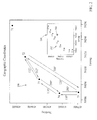
- the determination of in-wake zones begins with a map 200 of wind farm 202, shown in the inset of the Figure. Map 200 plots wind turbines 67, 68, 69, 70, 71, 72, 73, 74, and 75 and met mast 204 of wind farm 202 against a set of geographic coordinates.
- the main portion 206 of Figure 2 illustrates a set of wind turbines likely to produce wakes in conjunction with wind turbine 75, which has been selected for the purposes of this example to show the determination of wakes for a wind turbine. This process would be repeated for each wind turbine in wind farm 202.
- Figure 2 shows that the direction of wind turbine 74 from wind turbine 75 is 290°, so that a wake might be expected at wind turbine 75 from a wind blowing from the 290° direction.
- Figure 2 is not drawn to scale, so that the angles of the lines and arrows on the Figure need not exactly match the actual angles printed adjacent them.
- 0° is considered to be measured from a line with an arrowhead pointing eastward rather than northward for this example, although the selection of a 0° reference is arbitrary.
- wind turbine 74 might be expected to be in a wake of wind turbine 75 when the wind is blowing from the 110° direction. There may be other wakes caused between wind turbine 75 and each of wind turbines 73 and 72, but wind turbine 71 in this example is considered too distant to interact with wind turbine 75 to cause wake disturbances.
- data points 300 including wind direction (as measured at a reference point, e.g., met mast 204) and power output are collected from both turbines 74, 75 and the ratio of the output powers of the turbines 74, 75 is correlated against wind direction. (By correlating power ratios, the effect of wind speed is eliminated or at least reduced.)
- a sharp peak 304 is found at 110° and a sharp dip 306 at 290° in this example ( FIG. 3 ).
- a smaller peak 308 is found at about 320°.
- Sharp dip 304 is indicative of wind incident angles at which wind turbine 75 is in the wake of (at least) wind turbine 74.
- Sharp peak 306 at 110° is indicative of the wind incident angles at which wind turbine 74 is in the wake of (at least) wind turbine 75.
- Smaller peak 308 at 320° may indicate an angle at which wind turbine 74 is in the wake of a wind turbine other than wind turbine 75.
- sharp dip 306 is used for purposes of determining the wake region of wind turbine 75 resulting from wind turbine 74.
- Figure 4 shows curves 302, 402, 404 resulting from correlation of output power of wind turbine 75 with wind turbines 74, 73, and 72, respectively. Peaks and dips in curves 302, 402, and 404 may result from wakes other than those indicating interaction of wind turbines 74, 73, and 72 with wind turbine 75, but it is clear from Figure 4 that the wake region that is of concern for wind turbine 75 in this example is region 408. Thus, only valid measurement data at angles indicated by valid region 406 are used for wind turbine 75. Measurement data at angles indicated by invalid region 408 is discarded.
- Figure 5 shows a power curve 500 for turbine 75 resulting from plotting the remaining measurements as power vs. wind speed. Measurements 502 from wind turbine 75 while in-wake and outlier measurements 504 from wind turbine 75 (e.g., anomalous measurements and those taken while wind turbine 75 was out of service) are shown in Figure 5 , but are discarded for purposes of determining power curve 500. Only remaining data points 506 are used to produce power curve 500 for wind turbine 75.
- Figure 6 is a histogram 600 showing the residual power in kW vs. the number of remaining data points 506 used in plotting power curve 500 of Figure 5 .
- Histogram 600 can be used in calculating statistical measures of confidence in power curve 500 of Figure 5 , including standard error bars, for example.
- the statistical measures of confidence and the power curves can be combined in a statistically valid manner for all wind turbines in the wind farm. By doing so, one obtains a more accurate wind curve at the wind farm level than would be obtained by adding the design power curves of each of the wind turbines together without the corrections provided by embodiments of the present invention.
- Figure 7 is a wind farm level power curve 700 generated by an embodiment of the present invention.
- Power curve 700 is not necessarily the same wind farm as used in the examples of Figures 2 through 6 .
- All measurement data points 702 are shown, including discarded measurement data points.
- power curve 700 is not influenced by outlier measurement data points or measurement data points influenced by in wake conditions.
- power curve 700 represents a more accurate model of the output of the wind farm as a function of wind speed at a particular turbine or met mast.
- Figure 8 is another wind farm level power curve 800 for a different wind farm that was generated by an embodiment of the present invention.
- a design power curve 802 generated by assuming nominal performance by each wind turbine at all times and wind directions is shown for comparison, as are all measurement data points 804.
- the rated power of each wind turbine is 1500 kW, the number of turbines is 41, and the data collection period is about one year.
- the wind speed and power are given in terms of 10 minute averages, although any other averaging periods may be used. For example, an averaging period between 5 and 15 minutes, or exactly 5 minutes, may be used in some embodiments. It can be observed that the difference between the design power curve 802 and the more accurate farm specific power curve 800 is quite significant.
- removing measurement data points for wind turbines performing in a non-standard manner may further comprise removing measurement data points for wind turbines within in-wake zones.
- removing measurement data points for unavailable wind turbines further comprises checking at least one of manually set status flags and automatically set status flags for each wind turbine.
- the computer determines and displays at least one estimate of statistical confidence for the determined power curve. For example, error bars may be shown on the power curve, or a particular confidence statistic (e.g., ⁇ in Figure 6 ) may be printed or displayed. Also, in some embodiments, the power curve is used in conjunction with current data measurements to monitor wind farm performance and to determine when to service wind turbines on the wind farm.
- a computer-aided method for entering into contracts relating to a wind farm comprising a plurality of wind turbines and a meteorological mast (met mast) is provided.
- This method includes, referring to flow chart 900 of Figure 9 , collecting measurement data points comprising at least wind speed and wind direction over time for each of the wind turbines and the met mast at 902.
- the measurement data points include measured power output for each of the wind turbines.
- the method continues by removing measurement data points for wind turbines performing in a non-standard manner or that are unavailable to generate remaining measurement data points.
- the method further includes statistically determining a power curve model for the wind farm using the remaining measurement data points, and at 908, displaying the power curve model for the wind farm.
- the method also includes using the displayed power curve model for the wind farm to contractually guarantee a wind farm power output to the operator of the wind farm.
- the contract may be made at a price that reflects the certainty of the curve and the amount of power being generated, among other things.
- removing measurement data points for wind turbines performing in a non-standard manner may further comprise removing measurement data points for wind turbines within in-wake zones.
- removing measurement data points for unavailable wind turbines further comprises checking at least one of manually set status flags and automatically set status flags for each wind turbine.
- the method used in some embodiments may further include determining and displaying at least one estimate of statistical confidence for the determined power curve, which is useful for determining various contractual terms.
- Wind farm performance may also be monitored to determine when to service wind turbines on the wind farm in furtherance of the contract.
- the statistically determination a power curve model for the wind farm using the remaining measurement data points may further comprise averaging wind speed and power over intervals of from about 5 minutes to about 15 minutes.
- the various method embodiments of the present invention may be physically embodied on a machine readable medium or media having recorded thereon instructions configured to instruct a computer to monitor a wind farm comprising a plurality of wind turbines and a meteorological mast (met mast) to perform the various method embodiments or portions thereof.
- the machine readable medium or media may include (but is not limited to) one or more ROMs, RAMs, floppy disks, hard disks, flash RAM or ROM, CD-ROM, CD-RW, various kinds of DVDs, and combinations thereof.
- Software is also commonly distributed via networks such as the Internet and collected on internal hard drives, etc., so the term "machine readable medium or media" is intended to encompass media internal to a computer, such as ROM, RAM, or hard disks.
- the collection of measurement data points in some embodiments of the present invention may be controlled by the same computer or by a different computer.
Landscapes
- Engineering & Computer Science (AREA)
- Business, Economics & Management (AREA)
- Human Resources & Organizations (AREA)
- Sustainable Energy (AREA)
- Chemical & Material Sciences (AREA)
- Combustion & Propulsion (AREA)
- Mechanical Engineering (AREA)
- General Engineering & Computer Science (AREA)
- Entrepreneurship & Innovation (AREA)
- Sustainable Development (AREA)
- Strategic Management (AREA)
- Economics (AREA)
- Life Sciences & Earth Sciences (AREA)
- Educational Administration (AREA)
- Game Theory and Decision Science (AREA)
- Development Economics (AREA)
- Marketing (AREA)
- Operations Research (AREA)
- Quality & Reliability (AREA)
- Tourism & Hospitality (AREA)
- Physics & Mathematics (AREA)
- General Business, Economics & Management (AREA)
- General Physics & Mathematics (AREA)
- Theoretical Computer Science (AREA)
- Wind Motors (AREA)
Abstract
A machine readable medium or media having recorded thereon instructions configured to instruct a computer to monitor a wind farm (202) including a plurality of wind turbines (67, 68, 69, 70, 71, 72, 73, 74, 75, 76) and a meteorological mast (met mast) (204). The instructions are configured to collect measurement data points (300) including at least wind speed and wind direction over time for each of the wind turbines and the met mast removes measurement data points for wind turbines performing in a non-standard manner or that are unavailable to generate remaining measurement data points. The instructions are then configured to statistically determine a power curve model (500) for the wind farm using the remaining measurement data points and outputting data corresponding to the power curve model.
Description
- This invention relates generally to wind turbine power generation, and more particularly to methods and apparatus for determining and/or providing power output information of wind turbine farms.
- A plurality of wind turbines are commonly used in conjunction with one another to generate electricity. This plurality of wind turbines comprise a "wind farm." Wind turbines on a wind farm typically include their own meteorological monitors that perform, for example, temperature, wind speed, wind direction, barometric pressure, and/or air density measurements. In addition, a separate meteorological mast or tower ("met mast") having higher quality meteorological instruments that can provide more accurate measurements at one point in the farm is commonly provided. The correlation of meteorological data with power output allows the empirical determination of a "power curve" for a wind turbine.
- Prior wind turbines do not fully and accurately predict wind farm performance because they do not take into account interaction between wind turbines in a wind farm and other anomalies that may occur during its operation. It would thus be desirable to obtain wind farm level estimates of the performance of wind farms that are not simply extrapolations of the power curve of a single wind turbine.
- In one aspect, some embodiments of the present invention provide a computerized method for determining a power curve for a wind farm having a plurality of wind turbines and a meteorological mast (met mast). The method includes collecting measurement data points of at least wind speed and wind direction over time for each of the wind turbines and the met mast. The measurement data points also include measured power output for each of the wind turbines. The method further includes removing measurement data points for wind turbines performing in a non-standard manner or that are unavailable to generate remaining measurement data points, statistically determining a power curve model for the wind farm using the remaining measurement data points, and displaying the power curve model for the wind farm.
- In another aspect, some embodiments of the present invention provide a computer-aided method for entering into contracts relating to a wind farm having a plurality of wind turbines and a meteorological mast (met mast). The method includes collecting measurement data points including at least wind speed and wind direction over time for each of the wind turbines and the met mast. The measurement data points also include measured power output for each of the wind turbines. The method further includes removing measurement data points for wind turbines performing in a non-standard manner or that are unavailable to generate remaining measurement data points, statistically determining a power curve model for the wind farm using the remaining measurement data points, displaying the power curve model for the wind farm, and using the displayed power curve model for the wind farm to contractually guarantee a wind farm power output to the operator of the wind farm.
- In yet another aspect, some embodiments of the present invention provide a machine readable medium or media having recorded thereon instructions configured to instruct a computer to monitor a wind farm having a plurality of wind turbines and a meteorological mast (met mast). The instructions are configured to instruct the computer to collect measurement data points including at least wind speed and wind direction over time for each of the wind turbines and the met mast. The measurement data points also include measured power output for each of the wind turbines. The instructions are further configured to instruct the computer to remove measurement data points for wind turbines performing in a non-standard manner or that are unavailable to generate remaining measurement data points, statistically determine a power curve model for the wind farm using the remaining measurement data points, and display the power curve model for the wind farm.
- It will be appreciated that some configurations of the present invention provide a computational and/or monitoring tool for wind farm level performance of a wind plant. A statistically significant shift in a farm power curve as detected by some embodiments of the present invention alerts a plant manager to the existence of potential performance issues in the farm. The farm level power curve also enables product and service offerings to be made to customers such as contractual service agreements based on performance guarantees of a wind plant.
- Various aspects and embodiments of the present invention will now be described in connection with the accompanying drawings, in which:
-
Figure 1 is a flow chart of an exemplary embodiment of a method of the present invention. -
Figure 2 is a geographical map of a wind farm. -
Figure 3 is a plot of power output by a first wind turbine divided by power output of a second wind turbine generating a wake affecting the first wind turbine at some wind directions. -
Figure 4 is a plot similar toFigure 3 , but showing power ratios of the first wind turbine with additional wind turbines. -
Figure 5 is a power curve for a specific wind turbine resulting from fitting a reduced set of measurements from the wind turbine as power vs. wind speed. -
Figure 6 is a histogram showing residual power in kW vs. the number of data points used in plotting the power curve ofFigure 5 . -
Figure 7 is an exemplary wind farm level power curve generated by an embodiment of the present invention. The wind farm is not necessarily the same wind farm used forFigures 2-6 . -
Figure 8 is another wind farm level power curve for a different wind farm generated by an embodiment of the present invention. -
Figure 9 is a flow chart of another exemplary embodiment of the present invention. - The foregoing summary, as well as the following detailed description of certain embodiments of the present invention, will be better understood when read in conjunction with the appended drawings. To the extent that the figures illustrate diagrams of the functional blocks of various embodiments, the functional blocks are not necessarily indicative of the division between hardware circuitry. Thus, for example, one or more of the functional blocks (e.g., processors or memories) may be implemented in a single piece of hardware (e.g., a general purpose signal processor or a block or random access memory, hard disk, or the like). Similarly, the programs may be stand alone programs, may be incorporated as subroutines in an operating system, may be functions in an installed software package, and the like. It should be understood that the various embodiments are not limited to the arrangements and instrumentality shown in the drawings.
- As used herein, an element or step recited in the singular and proceeded with the word "a" or "an" should be understood as not excluding plural said elements or steps, unless such exclusion is explicitly stated. Furthermore, references to "one embodiment" of the present invention are not intended to be interpreted as excluding the existence of additional embodiments that also incorporate the recited features. Moreover, unless explicitly stated to the contrary, embodiments "comprising" or "having" an element or a plurality of elements having a particular property may include additional such elements not having that property.
- As used herein, the term "display" means to make available, either in printed form or displayed on a display screen, or electronically recorded on media for display on the computer or electronically transmitted to another computer or display apparatus for remote display or printing.
- Also as used herein, "computer" means a general or special purpose computer, workstation, server, or processor together with display capabilities and at least primary storage (RAM and/or ROM, for example). Many computers also have secondary storage (e.g., a hard drive, a floppy drive, flash ROM and/or RAM, and/or a CD or DVD reader and/or writer).
- One technical effect of various aspects of the present invention is the determination of an accurate power curve for an entire wind farm as a whole. This power curve is useful for maintaining or guaranteeing the performance of the wind farm. In addition, this software may be used in a service application to monitor existing wind turbine farms.
- In one exemplary embodiment of a method of the present invention and referring to
flow chart 100 ofFigure 1 , a farm level power curve is determined with respect to a reference point with free stream wind speeds. More particularly, an exemplary computerized method for determining a power curve for a wind farm comprising a plurality of wind turbines and a meteorological mast (met mast) includes, at 102, identifying in-wake zones for each of the wind turbines in the wind farm. At 104, a computer collects measurement data points comprising at least wind speed and wind direction over time for each of the wind turbines and the met mast. (The met mast is a tower on which more accurate meteorological instruments are mounted than that supplied with the wind turbines.) The measurement data points also include measured power output for each respective wind turbine. - At 106, measurement data points for wind turbines that are performing in a non-standard manner or that are unavailable to generate remaining measurement data points are removed. Only one (non-standard or unavailable) data point can be determined or both without limitation. By "non-standard manner," what is meant herein is a wind turbine producing an anomalous output, either as a result of an anomalous wind condition (e.g., a wind turbine within the wake of another wind turbine) or a fault of the wind turbine or measurement equipment. Faults may be determined in some embodiments of the present invention as outlier data points when compared to a nominal or anticipated wind turbine power curve. Some conditions, such as "in maintenance," may be indicated automatically by flags in the data received from individual wind turbines. In some instances, these flags may be set manually. Thus, in some embodiment of the present invention, removing measurement data points for unavailable wind turbines further comprises checking at least one of manually set status flags and automatically set status flags for each wind turbine.
- Next, the method continues at 108 by statistically determining a power curve model for the wind farm using the remaining measurement data points. For example, a curve of wind speed at a reference point in the wind farm (such as at the met mast) vs. power output for the wind farm is determined using a least square error method. Other types of curve fitting may also be used. In some embodiments of the present invention, this fitting is also used to determine a confidence or error measure. At 110, the power curve model developed by this fitting (and in some embodiments, the confidence or error measure) is displayed for the wind farm. For example, the computer may print or plot the power curve on paper, or display it on a suitable visual display such as a CRT or LCD display.
- In some embodiments of the present invention, in-wake zones for the wind turbines are determined at 102. In these embodiments, removing measurement data points for wind turbines performing in a non-standard manner further comprises removing measurement data points for wind turbines within in-wake zones. In some embodiments of the present invention and referring to
Figure 2 , the determination of in-wake zones begins with amap 200 ofwind farm 202, shown in the inset of the Figure.Map 200plots wind turbines mast 204 ofwind farm 202 against a set of geographic coordinates. Themain portion 206 ofFigure 2 illustrates a set of wind turbines likely to produce wakes in conjunction withwind turbine 75, which has been selected for the purposes of this example to show the determination of wakes for a wind turbine. This process would be repeated for each wind turbine inwind farm 202. -
Figure 2 shows that the direction ofwind turbine 74 fromwind turbine 75 is 290°, so that a wake might be expected atwind turbine 75 from a wind blowing from the 290° direction. (Figure 2 is not drawn to scale, so that the angles of the lines and arrows on the Figure need not exactly match the actual angles printed adjacent them. Also, 0° is considered to be measured from a line with an arrowhead pointing eastward rather than northward for this example, although the selection of a 0° reference is arbitrary.) Conversely,wind turbine 74 might be expected to be in a wake ofwind turbine 75 when the wind is blowing from the 110° direction. There may be other wakes caused betweenwind turbine 75 and each ofwind turbines wind turbine 71 in this example is considered too distant to interact withwind turbine 75 to cause wake disturbances. - For the wake at
wind turbine 75 resulting fromwind turbine 74 and referring toFigure 3 ,data points 300 including wind direction (as measured at a reference point, e.g., met mast 204) and power output are collected from bothturbines turbines curve 302, asharp peak 304 is found at 110° and asharp dip 306 at 290° in this example (FIG. 3 ). Asmaller peak 308 is found at about 320°.Sharp dip 304 is indicative of wind incident angles at whichwind turbine 75 is in the wake of (at least)wind turbine 74.Sharp peak 306 at 110° is indicative of the wind incident angles at whichwind turbine 74 is in the wake of (at least)wind turbine 75.Smaller peak 308 at 320° may indicate an angle at whichwind turbine 74 is in the wake of a wind turbine other thanwind turbine 75. For purposes of determining the wake region ofwind turbine 75 resulting fromwind turbine 74, onlysharp dip 306 is used. -
Figure 4 showscurves wind turbine 75 withwind turbines curves wind turbines wind turbine 75, but it is clear fromFigure 4 that the wake region that is of concern forwind turbine 75 in this example isregion 408. Thus, only valid measurement data at angles indicated byvalid region 406 are used forwind turbine 75. Measurement data at angles indicated byinvalid region 408 is discarded. -
Figure 5 shows apower curve 500 forturbine 75 resulting from plotting the remaining measurements as power vs. wind speed.Measurements 502 fromwind turbine 75 while in-wake andoutlier measurements 504 from wind turbine 75 (e.g., anomalous measurements and those taken whilewind turbine 75 was out of service) are shown inFigure 5 , but are discarded for purposes of determiningpower curve 500. Only remainingdata points 506 are used to producepower curve 500 forwind turbine 75. -
Figure 6 is a histogram 600 showing the residual power in kW vs. the number of remainingdata points 506 used in plottingpower curve 500 ofFigure 5 . Histogram 600 can be used in calculating statistical measures of confidence inpower curve 500 ofFigure 5 , including standard error bars, for example. The statistical measures of confidence and the power curves can be combined in a statistically valid manner for all wind turbines in the wind farm. By doing so, one obtains a more accurate wind curve at the wind farm level than would be obtained by adding the design power curves of each of the wind turbines together without the corrections provided by embodiments of the present invention. -
Figure 7 is a wind farmlevel power curve 700 generated by an embodiment of the present invention. (Power curve 700 is not necessarily the same wind farm as used in the examples ofFigures 2 through 6 .) Allmeasurement data points 702 are shown, including discarded measurement data points. As is readily observable fromFigure 7 ,power curve 700 is not influenced by outlier measurement data points or measurement data points influenced by in wake conditions. Thus,power curve 700 represents a more accurate model of the output of the wind farm as a function of wind speed at a particular turbine or met mast. -
Figure 8 is another wind farmlevel power curve 800 for a different wind farm that was generated by an embodiment of the present invention. Adesign power curve 802 generated by assuming nominal performance by each wind turbine at all times and wind directions is shown for comparison, as are all measurement data points 804. Aline 806 indicating a wind speed at which each turbine is expected to operate at rated power is shown. (For the wind farm represented byFigure 8 , the rated power of each wind turbine is 1500 kW, the number of turbines is 41, and the data collection period is about one year.) The wind speed and power are given in terms of 10 minute averages, although any other averaging periods may be used. For example, an averaging period between 5 and 15 minutes, or exactly 5 minutes, may be used in some embodiments. It can be observed that the difference between thedesign power curve 802 and the more accurate farmspecific power curve 800 is quite significant. - In such embodiments, removing measurement data points for wind turbines performing in a non-standard manner may further comprise removing measurement data points for wind turbines within in-wake zones. In some embodiments, removing measurement data points for unavailable wind turbines further comprises checking at least one of manually set status flags and automatically set status flags for each wind turbine.
- In some embodiments of the present invention, the computer determines and displays at least one estimate of statistical confidence for the determined power curve. For example, error bars may be shown on the power curve, or a particular confidence statistic (e.g., µ in
Figure 6 ) may be printed or displayed. Also, in some embodiments, the power curve is used in conjunction with current data measurements to monitor wind farm performance and to determine when to service wind turbines on the wind farm. - In some embodiments of the present invention, a computer-aided method for entering into contracts relating to a wind farm comprising a plurality of wind turbines and a meteorological mast (met mast) is provided. One embodiment of this method includes, referring to
flow chart 900 ofFigure 9 , collecting measurement data points comprising at least wind speed and wind direction over time for each of the wind turbines and the met mast at 902. The measurement data points include measured power output for each of the wind turbines. At 904, the method continues by removing measurement data points for wind turbines performing in a non-standard manner or that are unavailable to generate remaining measurement data points. At 906, the method further includes statistically determining a power curve model for the wind farm using the remaining measurement data points, and at 908, displaying the power curve model for the wind farm. At 910, the method also includes using the displayed power curve model for the wind farm to contractually guarantee a wind farm power output to the operator of the wind farm. The contract may be made at a price that reflects the certainty of the curve and the amount of power being generated, among other things. - Some embodiments of the above method comprise, at 901, determining in-wake zones for the wind turbines. In such embodiments, removing measurement data points for wind turbines performing in a non-standard manner may further comprise removing measurement data points for wind turbines within in-wake zones. In some embodiments, removing measurement data points for unavailable wind turbines further comprises checking at least one of manually set status flags and automatically set status flags for each wind turbine. The method used in some embodiments may further include determining and displaying at least one estimate of statistical confidence for the determined power curve, which is useful for determining various contractual terms. Wind farm performance may also be monitored to determine when to service wind turbines on the wind farm in furtherance of the contract. The statistically determination a power curve model for the wind farm using the remaining measurement data points may further comprise averaging wind speed and power over intervals of from about 5 minutes to about 15 minutes.
- The various method embodiments of the present invention may be physically embodied on a machine readable medium or media having recorded thereon instructions configured to instruct a computer to monitor a wind farm comprising a plurality of wind turbines and a meteorological mast (met mast) to perform the various method embodiments or portions thereof. The machine readable medium or media may include (but is not limited to) one or more ROMs, RAMs, floppy disks, hard disks, flash RAM or ROM, CD-ROM, CD-RW, various kinds of DVDs, and combinations thereof. Software is also commonly distributed via networks such as the Internet and collected on internal hard drives, etc., so the term "machine readable medium or media" is intended to encompass media internal to a computer, such as ROM, RAM, or hard disks. The collection of measurement data points in some embodiments of the present invention may be controlled by the same computer or by a different computer.
- While the invention has been described in terms of various specific embodiments, those skilled in the art will recognize that the invention can be practiced with modification within the spirit and scope of the claims.
- Various aspects and embodiments of the present invention are now defined by the following numbered clauses:
- 1. A method for determining a power curve for a wind farm comprising a plurality of wind turbines and a meteorological mast (met mast), said method comprising:
- collecting measurement data points comprising at least wind speed and wind direction over time for at least two of the wind turbines and the met mast;
- removing measurement data points for wind turbines performing in a non-standard manner or that are unavailable to generate remaining measurement data points;
- statistically determining a power curve model for the wind farm using the remaining measurement data points; and
- outputting data corresponding to the power curve model.
- 2. A method in accordance with Clause 1 further comprising determining in-wake zones for the wind turbines, and wherein removing measurement data points for wind turbines performing in a non-standard manner further comprises removing measurement data points for wind turbines within in-wake zones.
- 3. A method in accordance with any preceding Clause wherein removing measurement data points for unavailable wind turbines further comprises checking at least one of manually set status flags and automatically set status flags for each wind turbine.
- 4. A method in accordance with any preceding Clause further comprising determining in-wake zones for the wind turbines, and wherein removing measurement data points for wind turbines performing in a non-standard manner further comprises removing measurement data points for wind turbines within in-wake zones.
- 5. A method in accordance with any preceding Clause further comprising determining and displaying at least one estimate of statistical confidence for the determined power curve.
- 6. A method in accordance with any preceding Clause used to monitor wind farm performance and to determine when to service wind turbines on the wind farm.
- 7. A method in accordance with any preceding Clause wherein said statistically determining a power curve model for the wind farm using the remaining measurement data points further comprises averaging wind speed and power over intervals of from 5 minutes to 15 minutes.
- 8. A method in accordance with any preceding Clause wherein the measurement data points include measured power output for each of the wind turbines.
- 9. A computer-aided method for providing a power output of a wind farm comprising a plurality of wind turbines and a meteorological mast (met mast), said method comprising:
- collecting measurement data points comprising at least wind speed and wind direction over time for at least two of the wind turbines and the met mast;
- removing measurement data points for wind turbines performing in a non-standard manner or that are unavailable to generate remaining measurement data points;
- statistically determining a power curve model for the wind farm using the remaining measurement data points;
- outputting data corresponding to the power curve model; and
- using the output data power curve model for the wind farm to provide a wind farm power output to the operator of the wind farm.
- 10. A method in accordance with Clause 9 further comprising determining in-wake zones for the wind turbines, and wherein removing measurement data points for wind turbines performing in a non-standard manner further comprises removing measurement data points for wind turbines within in-wake zones.
- 11. A method in accordance with
Clause 9 or 10 wherein removing measurement data points for unavailable wind turbines further comprises checking at least one of manually set status flags and automatically set status flags for each wind turbine. - 12. A method in accordance with any of Clauses 9 to 11 further comprising determining in-wake zones for the wind turbines, and wherein removing measurement data points for wind turbines performing in a non-standard manner further comprises removing measurement data points for wind turbines within in-wake zones.
- 13. A method in accordance with any of Clauses 9 to 12 further comprising determining and displaying at least one estimate of statistical confidence for the determined power curve.
- 14. A method in accordance with any of Clauses 9 to 13 used to monitor wind farm performance and to determine when to service wind turbines on the wind farm.
- 15. A method in accordance with any of Clauses 9 to 14 wherein said statistically determining a power curve model for the wind farm using the remaining measurement data points further comprises averaging wind speed and power over intervals of from 5 minutes to 15 minutes.
- 16. A method in accordance with any of Clauses 9 to 15 wherein the measurement data points include measured power output for each of the wind turbines.
- 17. A machine readable medium or media having recorded thereon instructions configured to instruct a computer to monitor a wind farm comprising a plurality of wind turbines and a meteorological mast (met mast), said instructions configured to:
- collect measurement data points comprising at least wind speed and wind direction over time for each of the wind turbines and the met mast;
- remove measurement data points for wind turbines performing in a non-standard manner or that are unavailable to generate remaining measurement data points;
- statistically determine a power curve model for the wind farm using the remaining measurement data points; and
- outputting data corresponding to the power curve model.
- 18. A medium or media in accordance with Clause 17 wherein said instructions further configured to instruct the computer to determine in-wake zones for the wind turbines, and wherein to remove measurement data points for wind turbines performing in a non-standard manner, said instructions further configured to instruct the computer to remove measurement data points for wind turbines within in-wake zones.
- 19. A medium or media in accordance with Clause 17 or 18 wherein to remove measurement data points for unavailable wind turbines, said instructions further configured to instruct the computer to check at least one of manually set status flags and automatically set status flags for each wind turbine.
- 20. A medium or media in accordance with any of Clauses 17 to 19 wherein said instructions further configured to instruct the computer to determine in-wake zones for the wind turbines, and wherein to remove measurement data points for wind turbines performing in a non-standard manner, said instructions further configured to remove measurement data points for wind turbines within in-wake zones.
- 21. A medium or media in accordance with any of Clauses 17 to 20 wherein said instructions further configured to instruct the computer to determine and display at least one estimate of statistical confidence for the determined power curve.
- 22. A medium or media in accordance with any of Clauses 17 to 21 wherein the measurement data points include measured power output for each of the wind turbines.
- 23. A wind turbine farm comprising at least two wind turbines and a meteorological mast (met mast), said farm also comprising a control circuit that controls operation of the wind turbine, said control circuit configured to:
- collect measurement data points comprising at least wind speed and wind direction over time for each of the wind turbines and the met mast;
- remove measurement data points for wind turbines performing in a non-standard manner or that are unavailable to generate remaining measurement data points;
- statistically determine a power curve model for the wind farm using the remaining measurement data points; and
- outputting data corresponding to the power curve model.
Claims (7)
- A machine readable medium or media having recorded thereon instructions configured to instruct a computer to monitor a wind farm (202) comprising a plurality of wind turbines (67, 68, 69, 70, 71, 72, 73, 74, 75, 76) and a meteorological mast (met mast) (204), said instructions configured to:collect measurement data points (300) comprising at least wind speed and wind direction over time for each of the wind turbines and the met mast;remove measurement data points for wind turbines performing in a non-standard manner or that are unavailable to generate remaining measurement data points;statistically determine a power curve model (500) for the wind farm using the remaining measurement data points; andoutputting data corresponding to the power curve model.
- A medium or media in accordance with Claim 1 wherein said instructions further configured to instruct the computer to determine in-wake zones for the wind turbines (67, 68, 69, 70, 71, 72, 73, 74, 75, 76), and wherein to remove measurement data points (300) for wind turbines performing in a non-standard manner, said instructions further configured to instruct the computer to remove measurement data points for wind turbines within in-wake zones.
- A medium or media in accordance with any preceding Claim wherein to remove measurement data points (300) for unavailable wind turbines (67, 68, 69, 70, 71, 72, 73, 74, 75, 76), said instructions further configured to instruct the computer to check at least one of manually set status flags and automatically set status flags for each wind turbine.
- A medium or media in accordance with any preceding Claim wherein said instructions further configured to instruct the computer to determine in-wake zones for the wind turbines (67, 68, 69, 70, 71, 72, 73, 74, 75, 76), and wherein to remove measurement data points (300) for wind turbines performing in a non-standard manner, said instructions further configured to remove measurement data points for wind turbines within in-wake zones.
- A medium or media in accordance with any preceding Claim wherein said instructions further configured to instruct the computer to determine and display at least one estimate of statistical confidence for the determined power curve (500).
- A medium or media in accordance with any preceding Claim wherein the measurement data points (300) include measured power output for each of the wind turbines (67, 68, 69, 70, 71, 72, 73, 74, 75, 76).
- A wind turbine farm (202) comprising at least two wind turbines (67, 68, 69, 70, 71, 72, 73, 74, 75, 76) and a meteorological mast (met mast) (204), said farm also comprising a control circuit that controls operation of the wind turbine, said control circuit configured to:collect measurement data points (300) comprising at least wind speed and wind direction over time for each of the wind turbines and the met mast;remove measurement data points for wind turbines performing in a non-standard manner or that are unavailable to generate remaining measurement data points;statistically determine a power curve model (500) for the wind farm using the remaining measurement data points; andoutputting data corresponding to the power curve model.
Applications Claiming Priority (1)
| Application Number | Priority Date | Filing Date | Title |
|---|---|---|---|
| US12/129,560 US20090299780A1 (en) | 2008-05-29 | 2008-05-29 | Method and apparatus for determining and/or providing power output information of wind turbine farms |
Publications (1)
| Publication Number | Publication Date |
|---|---|
| EP2128438A2 true EP2128438A2 (en) | 2009-12-02 |
Family
ID=41066707
Family Applications (1)
| Application Number | Title | Priority Date | Filing Date |
|---|---|---|---|
| EP09161148A Withdrawn EP2128438A2 (en) | 2008-05-29 | 2009-05-26 | Method and apparatus for determining and/or providing power output information of wind turbine farms |
Country Status (3)
| Country | Link |
|---|---|
| US (1) | US20090299780A1 (en) |
| EP (1) | EP2128438A2 (en) |
| CN (1) | CN101592128A (en) |
Cited By (8)
| Publication number | Priority date | Publication date | Assignee | Title |
|---|---|---|---|---|
| WO2012065876A1 (en) | 2010-11-18 | 2012-05-24 | Ssb Wind Systems Gmbh & Co. Kg | Meteorological measuring device |
| KR101215503B1 (en) | 2011-02-21 | 2012-12-26 | 삼성중공업 주식회사 | System and method for compensation nacelle wind velocity of wind turbine |
| EP2644889A1 (en) * | 2012-03-29 | 2013-10-02 | Alstom Wind, S.L.U. | Detecting a wake situation in a wind farm |
| WO2014197671A1 (en) * | 2013-06-05 | 2014-12-11 | WindLogics Inc. | Wind farm prediction of potential and actual power generation |
| EP2667023A3 (en) * | 2012-05-21 | 2017-03-29 | RWE Innogy GmbH | Control of a wind energy system |
| GB2560223A (en) * | 2016-12-21 | 2018-09-05 | Romax Tech Limited | Wind turbine farm level loads management control strategy |
| EP3791064B1 (en) | 2018-06-08 | 2022-06-29 | Siemens Gamesa Renewable Energy A/S | Controlling wind turbines in presence of wake interactions |
| CN116123041A (en) * | 2023-02-16 | 2023-05-16 | 中国长江三峡集团有限公司 | Wind driven generator power limiting process identification method and system |
Families Citing this family (27)
| Publication number | Priority date | Publication date | Assignee | Title |
|---|---|---|---|---|
| US20090281820A1 (en) * | 2008-05-12 | 2009-11-12 | General Electric Company | Method and system to quantify performance of a power generating system |
| US8275489B1 (en) * | 2009-04-21 | 2012-09-25 | Devine Timothy J | Systems and methods for deployment of wind turbines |
| ES2381094B1 (en) * | 2010-04-13 | 2013-04-23 | Gamesa Innovation & Technology, S.L. | METHODS OF MONITORING OF AEROGENERATORS |
| CN102251926B (en) * | 2010-07-15 | 2013-09-25 | 大唐南京自动化有限公司 | Turbulence suppression method of wind driven generator |
| CN102032107B (en) * | 2010-12-07 | 2012-08-22 | 北京交通大学 | Method and device for processing wind power monitoring system data |
| US8219356B2 (en) | 2010-12-23 | 2012-07-10 | General Electric Company | System and method for detecting anomalies in wind turbines |
| DE102011003799C5 (en) * | 2011-02-08 | 2017-10-26 | Wobben Properties Gmbh | Method for determining lost energy |
| US8606418B1 (en) | 2011-03-18 | 2013-12-10 | Rockwell Collins, Inc. | Wind prediction for wind farms through the use of weather radar |
| US9002483B1 (en) | 2011-03-18 | 2015-04-07 | Rockwell Collins, Inc. | Diploid control of water heaters |
| US8489247B1 (en) * | 2011-03-18 | 2013-07-16 | Rockwell Collins, Inc. | Agent-based chaotic control of wind turbines |
| US8849737B1 (en) | 2011-03-18 | 2014-09-30 | Rockwell Collins, Inc. | Prediction method of predicting a future state of a system |
| CN103244354B (en) * | 2012-02-08 | 2015-02-18 | 北京能高自动化技术股份有限公司 | Power curve self-adapting optimizing method for wind generating sets |
| KR101425016B1 (en) * | 2012-09-18 | 2014-08-01 | 한국전력공사 | Method for Automatically Generating Power Curve Limits for Power Curve Monitoring in Wind Turbines |
| DE102013205838A1 (en) * | 2013-04-03 | 2014-10-09 | Senvion Se | Efficiency monitoring procedure of a wind turbine park |
| US9551322B2 (en) | 2014-04-29 | 2017-01-24 | General Electric Company | Systems and methods for optimizing operation of a wind farm |
| EP2940295B1 (en) | 2014-04-29 | 2018-04-11 | General Electric Company | System and method for controlling a wind farm |
| CN104156575B (en) * | 2014-07-28 | 2017-09-05 | 国家电网公司 | Wind power plant theoretical power (horse-power) computational methods based on anemometer tower data extrapolation |
| CN104653410A (en) * | 2014-09-10 | 2015-05-27 | 国家电网公司 | System and method for testing operation power characteristics of wind generation set based on laser radar wind meter |
| CN104747368B (en) * | 2015-01-27 | 2017-11-07 | 风脉(武汉)可再生能源技术有限责任公司 | A kind of method and system of Wind turbines power optimization |
| US10487804B2 (en) | 2015-03-11 | 2019-11-26 | General Electric Company | Systems and methods for validating wind farm performance improvements |
| CN104794357B (en) * | 2015-04-29 | 2018-06-26 | 南京航空航天大学 | A kind of two dimension wake flow method for numerical simulation |
| CN105046349B (en) * | 2015-06-25 | 2018-07-27 | 广东电网有限责任公司电力科学研究院 | It is a kind of meter and wake effect wind power forecasting method |
| CN108431404B (en) * | 2015-12-23 | 2020-03-03 | 维斯塔斯风力系统集团公司 | Method and system for controlling multiple wind turbines |
| US10385829B2 (en) | 2016-05-11 | 2019-08-20 | General Electric Company | System and method for validating optimization of a wind farm |
| CN107784371B (en) * | 2016-08-24 | 2021-03-23 | 天津理工大学 | Nonlinear fitting-based intelligent self-adaptive control method for wind power yaw state |
| DE102017009838A1 (en) * | 2017-10-23 | 2019-04-25 | Senvion Gmbh | Control system and method for operating multiple wind turbines |
| WO2022015493A1 (en) | 2020-07-13 | 2022-01-20 | WindESCo, Inc. | Methods and systems of advanced yaw control of a wind turbine |
Family Cites Families (12)
| Publication number | Priority date | Publication date | Assignee | Title |
|---|---|---|---|---|
| US4155252A (en) * | 1978-01-11 | 1979-05-22 | Morrill Ralph A | Wind energy metering and recording systems |
| US4525633A (en) * | 1982-09-28 | 1985-06-25 | Grumman Aerospace Corporation | Wind turbine maximum power tracking device |
| US7275025B2 (en) * | 2000-12-27 | 2007-09-25 | General Electric Company | Method and system for analyzing performance of a turbine |
| EP1438501B1 (en) * | 2001-09-28 | 2009-08-19 | Vestas Wind Systems A/S | A method and a computer system for handling operational data of wind power plants |
| US6975925B1 (en) * | 2002-03-19 | 2005-12-13 | Windlynx Systems, B.V. | Forecasting an energy output of a wind farm |
| US6925385B2 (en) * | 2003-05-16 | 2005-08-02 | Seawest Holdings, Inc. | Wind power management system and method |
| US20050192859A1 (en) * | 2004-02-27 | 2005-09-01 | Mertins Karl-Heinz O. | Method and system of establishing a wind-powered electrical energy facility |
| US7134631B2 (en) * | 2004-06-10 | 2006-11-14 | Loth John L | Vorticity cancellation at trailing edge for induced drag elimination |
| US7228235B2 (en) * | 2005-02-01 | 2007-06-05 | Windlogics, Inc. | System and method for enhanced measure-correlate-predict for a wind farm location |
| US20070124025A1 (en) * | 2005-11-29 | 2007-05-31 | General Electric Company | Windpark turbine control system and method for wind condition estimation and performance optimization |
| US7523001B2 (en) * | 2006-09-28 | 2009-04-21 | General Electric Company | Method and apparatus for operating wind turbine generators |
| CA2666897A1 (en) * | 2006-10-20 | 2008-08-14 | Southwest Windpower Inc. | Method and system for deriving wind speed in a stall controlled wind turbine |
-
2008
- 2008-05-29 US US12/129,560 patent/US20090299780A1/en not_active Abandoned
-
2009
- 2009-05-26 EP EP09161148A patent/EP2128438A2/en not_active Withdrawn
- 2009-05-31 CN CNA2009101459061A patent/CN101592128A/en active Pending
Cited By (16)
| Publication number | Priority date | Publication date | Assignee | Title |
|---|---|---|---|---|
| DE102010060663A1 (en) | 2010-11-18 | 2012-05-24 | Ssb Wind Systems Gmbh & Co. Kg | Meteorological measuring arrangement |
| WO2012065876A1 (en) | 2010-11-18 | 2012-05-24 | Ssb Wind Systems Gmbh & Co. Kg | Meteorological measuring device |
| US9075168B2 (en) | 2010-11-18 | 2015-07-07 | Ssb Wind Systems Gmbh & Co. Kg | Meteorological measurement system |
| KR101215503B1 (en) | 2011-02-21 | 2012-12-26 | 삼성중공업 주식회사 | System and method for compensation nacelle wind velocity of wind turbine |
| US9103318B2 (en) | 2011-02-21 | 2015-08-11 | Samsung Heavy Ind. Co., Ltd. | System and method for correcting nacelle wind velocity of wind power generator |
| EP2644889A1 (en) * | 2012-03-29 | 2013-10-02 | Alstom Wind, S.L.U. | Detecting a wake situation in a wind farm |
| US9086337B2 (en) | 2012-03-29 | 2015-07-21 | Alstom Renovables Espana, S.L. | Detecting a wake situation in a wind farm |
| EP2667023A3 (en) * | 2012-05-21 | 2017-03-29 | RWE Innogy GmbH | Control of a wind energy system |
| WO2014197671A1 (en) * | 2013-06-05 | 2014-12-11 | WindLogics Inc. | Wind farm prediction of potential and actual power generation |
| US9690884B2 (en) | 2013-06-05 | 2017-06-27 | WindLogics Inc. | Wind farm prediction of potential and actual power generation |
| GB2560223A (en) * | 2016-12-21 | 2018-09-05 | Romax Tech Limited | Wind turbine farm level loads management control strategy |
| GB2560223B (en) * | 2016-12-21 | 2020-03-25 | Romax Tech Limited | Wind turbine farm level loads management control strategy |
| EP3791064B1 (en) | 2018-06-08 | 2022-06-29 | Siemens Gamesa Renewable Energy A/S | Controlling wind turbines in presence of wake interactions |
| US12037985B2 (en) | 2018-06-08 | 2024-07-16 | Siemens Gamesa Renewable Energy A/S | Controlling wind turbines in presence of wake interactions |
| EP3791064B2 (en) † | 2018-06-08 | 2025-08-27 | Siemens Gamesa Renewable Energy A/S | Controlling wind turbines in presence of wake interactions |
| CN116123041A (en) * | 2023-02-16 | 2023-05-16 | 中国长江三峡集团有限公司 | Wind driven generator power limiting process identification method and system |
Also Published As
| Publication number | Publication date |
|---|---|
| CN101592128A (en) | 2009-12-02 |
| US20090299780A1 (en) | 2009-12-03 |
Similar Documents
| Publication | Publication Date | Title |
|---|---|---|
| EP2128438A2 (en) | Method and apparatus for determining and/or providing power output information of wind turbine farms | |
| Bangalore et al. | Analysis of SCADA data for early fault detection, with application to the maintenance management of wind turbines | |
| CN103016264B (en) | Data analysis instrument for predicting wind turbine component failures | |
| Pettas et al. | On the effects of inter-farm interactions at the offshore wind farm Alpha Ventus | |
| CN102748219A (en) | Monitoring wind turbine performance | |
| CN111082749B (en) | Photovoltaic string running state identification method, device and storage medium | |
| US20110130982A1 (en) | Monitoring System for Power Grid Distributed Power Generation Devices | |
| CN112231361B (en) | A wind power project generation evaluation method based on wind turbine operation data | |
| EP2685097A1 (en) | Construction time selection device and construction time selection method | |
| EP2851561A1 (en) | Monitoring of wind turbine performance | |
| EP3101616A1 (en) | Fault detection in energy generation arrangments | |
| CN103675355B (en) | Anemoscope monitoring method and system | |
| JP6054998B2 (en) | How to determine lost energy | |
| CN117195136B (en) | Power grid new energy abnormal data monitoring method | |
| CN113030516A (en) | Anemometer fault detection method, device, equipment and storage medium | |
| Mittelmeier et al. | Monitoring offshore wind farm power performance with SCADA data and an advanced wake model | |
| CN118209260B (en) | Oil leakage monitoring and early warning system for transformer oil storage cabinet | |
| WO2016042652A1 (en) | Wind-powered power generation facility and degree-of-damage diagnosis device for wind-powered power generation facility | |
| CN107218180B (en) | A kind of wind power generating set driving unit fault alarm method based on vibration acceleration measurement | |
| CN116029116B (en) | A smart substation smart management and control digital twin system | |
| CN110174413B (en) | Blade defect detection method and maintenance method | |
| Khatab | Performance analysis of operating wind farms | |
| CN118801332A (en) | A method and system for predicting wind power in a wind farm | |
| CN118469196A (en) | A production management method and system for a new energy intelligent station | |
| Ambühl et al. | On different maintenance strategies for casted components of offshore wind turbines |
Legal Events
| Date | Code | Title | Description |
|---|---|---|---|
| PUAI | Public reference made under article 153(3) epc to a published international application that has entered the european phase |
Free format text: ORIGINAL CODE: 0009012 |
|
| AK | Designated contracting states |
Kind code of ref document: A2 Designated state(s): AT BE BG CH CY CZ DE DK EE ES FI FR GB GR HR HU IE IS IT LI LT LU LV MC MK MT NL NO PL PT RO SE SI SK TR |
|
| STAA | Information on the status of an ep patent application or granted ep patent |
Free format text: STATUS: THE APPLICATION IS DEEMED TO BE WITHDRAWN |
|
| 18D | Application deemed to be withdrawn |
Effective date: 20131203 |