EP2125794B1 - Imidazolidinonyl aminopyrimidine compounds for the treatment of cancer - Google Patents
Imidazolidinonyl aminopyrimidine compounds for the treatment of cancer Download PDFInfo
- Publication number
- EP2125794B1 EP2125794B1 EP07855060A EP07855060A EP2125794B1 EP 2125794 B1 EP2125794 B1 EP 2125794B1 EP 07855060 A EP07855060 A EP 07855060A EP 07855060 A EP07855060 A EP 07855060A EP 2125794 B1 EP2125794 B1 EP 2125794B1
- Authority
- EP
- European Patent Office
- Prior art keywords
- fluoro
- ethyl
- benzo
- thiophen
- ylamino
- Prior art date
- Legal status (The legal status is an assumption and is not a legal conclusion. Google has not performed a legal analysis and makes no representation as to the accuracy of the status listed.)
- Active
Links
Classifications
-
- C—CHEMISTRY; METALLURGY
- C07—ORGANIC CHEMISTRY
- C07D—HETEROCYCLIC COMPOUNDS
- C07D409/00—Heterocyclic compounds containing two or more hetero rings, at least one ring having sulfur atoms as the only ring hetero atoms
- C07D409/14—Heterocyclic compounds containing two or more hetero rings, at least one ring having sulfur atoms as the only ring hetero atoms containing three or more hetero rings
-
- A—HUMAN NECESSITIES
- A61—MEDICAL OR VETERINARY SCIENCE; HYGIENE
- A61K—PREPARATIONS FOR MEDICAL, DENTAL OR TOILETRY PURPOSES
- A61K31/00—Medicinal preparations containing organic active ingredients
- A61K31/33—Heterocyclic compounds
- A61K31/38—Heterocyclic compounds having sulfur as a ring hetero atom
- A61K31/381—Heterocyclic compounds having sulfur as a ring hetero atom having five-membered rings
-
- A—HUMAN NECESSITIES
- A61—MEDICAL OR VETERINARY SCIENCE; HYGIENE
- A61K—PREPARATIONS FOR MEDICAL, DENTAL OR TOILETRY PURPOSES
- A61K31/00—Medicinal preparations containing organic active ingredients
- A61K31/33—Heterocyclic compounds
- A61K31/395—Heterocyclic compounds having nitrogen as a ring hetero atom, e.g. guanethidine or rifamycins
- A61K31/41—Heterocyclic compounds having nitrogen as a ring hetero atom, e.g. guanethidine or rifamycins having five-membered rings with two or more ring hetero atoms, at least one of which being nitrogen, e.g. tetrazole
- A61K31/4164—1,3-Diazoles
- A61K31/4178—1,3-Diazoles not condensed 1,3-diazoles and containing further heterocyclic rings, e.g. pilocarpine, nitrofurantoin
-
- A—HUMAN NECESSITIES
- A61—MEDICAL OR VETERINARY SCIENCE; HYGIENE
- A61P—SPECIFIC THERAPEUTIC ACTIVITY OF CHEMICAL COMPOUNDS OR MEDICINAL PREPARATIONS
- A61P35/00—Antineoplastic agents
Definitions
- Plk1 belongs to a small family of protein kinases characterized by a phosphoserine/threonine binding domain known as the polo box domain. Plk1 plays a central role in the regulation of the cell cycle. Among other functions, Plk1 is thought to regulate initiation, progression, and exit from mitosis, the stage when cancer cells divide. Consequently, blocking Plk1 in cancer cells prevents their division or mitosis.
- VELCADE® is an antineoplastic agent that inhibits the 26S proteosome.
- Plk inhibitors specifically target dividing cells and may be able to avoid the undesirable toxicities.
- Inhibitors of Plk1 are known in the art. See for example, WO 06/066172 . Additionally, WO 06/021548 discloses certain dihydropteridinone analogs (e.g., BI-2536) as inhibitors of Plk1. Currently, BI-2536 is in phase II clinical trials but has high clearance (CL >1000 mL/min) and is dose limited by myelosupression in man. There is still a need for further compounds that inhibit Plk 1 which possess improved potency or pharmacokinetic properties. It would also be advantageous to have a Plk1 inhibitor that could be dosed orally.
- the present invention provides novel imidazolidinonyl aminopyrimidine compounds believed to have clinical use for treatment of cancer through inhibiting Plkl. Certain of these compounds are believed to have improved potency over compounds disclosed in WO 06/066172 . Additionally, certain of these compounds are believed to have improved pharmacokinetic properties over BI-2536. Further, due to the oral bioavailability of the compounds of the present invention that were tested, it is believed that certain of these compounds could be dosed orally.
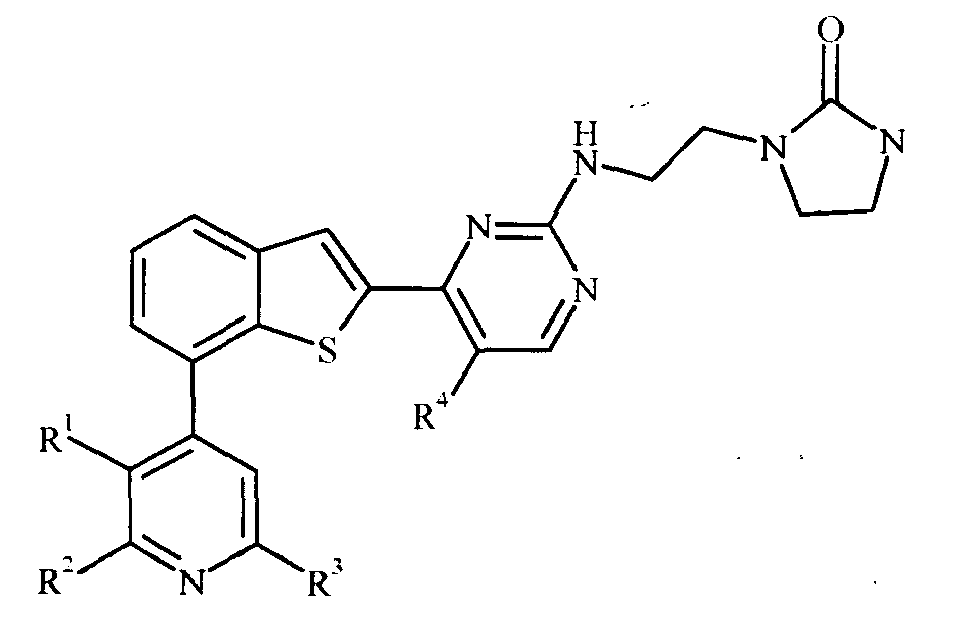
- the present invention provides compounds of Formula I: wherein:
- the present application discloses a method of treating cancer selected from the group consisting of non-small cell lung, oropharyngeal, oesophageal, gastric, melanoma, epidermoid carcinoma of the skin, breast, ovarian, endometrial, colorectal, neuroglioma, glioblastoma, thyroid carcinoma, cervical, pancreatic, prostate, hepatoblastoma and non-Hodgkin lymphoma cancers in a mammal comprising administering to a mammal in need of such treatment an effective amount of a compound of Formula I or a pharmaceutically acceptable salt thereof.
- This invention also provides a compound of Formula I or a pharmaceutically acceptable salt thereof for use in the preparation of a medicament. Additionally, this invention provides a compound of Formula I or a pharmaceutically acceptable salt thereof for use in the preparation of a medicament for the treatment of cancer in mammals, selected from the group consisting of non-small cell lung, oropharyngeal, oesophageal, gastric, melanoma, epidermoid carcinoma of the skin, breast, ovarian, endometrial, colorectal, neuroglioma, glioblastoma, thyroid carcinoma, cervical, pancreatic, prostate, hepatoblastoma and non-Hodgkin lymphoma cancers.
- this invention provides a pharmaceutical composition adapted for the treatment of cancer selected from the group consisting of non-small cell lung, oropharyngeal, oesophageal, gastric, melanoma, epidermoid carcinoma of the skin, breast, ovarian, endometrial, colorectal, neuroglioma, glioblastoma, thyroid carcinoma, cervical, pancreatic, prostate, hepatoblastoma and non-Hodgkin lymphoma cancers comprising a compound of Formula I or a pharmaceutically acceptable salt thereof in combination with one or more pharmaceutically acceptable excipients, carriers, or diluents.
- cancer selected from the group consisting of non-small cell lung, oropharyngeal, oesophageal, gastric, melanoma, epidermoid carcinoma of the skin, breast, ovarian, endometrial, colorectal, neuroglioma, glioblastoma, thyroid carcinoma, cervical, pancreatic, prostate, he
- the present invention also provides compounds of the Formula: wherein:
- C 1 -C 3 alkyl means straight or branched chain alkyls such as methyl, ethyl, propyl, and isopropyl.
- C 1 -C 2 alkyl is included in the meaning of "C 1 -C 3 alkyl” and means methyl and ethyl.
- halo means fluoro, chloro, bromo, and iodo.
- the compounds of the present invention are capable of forming salts.
- the compounds of the present invention are amines, and accordingly react with any of a number of inorganic and organic acids to form pharmaceutically acceptable acid addition salts.
- Such pharmaceutically acceptable acid addition salts and common methodology for preparing them are well known in the art. See, e.g., P. Stahl, et al., HANDBOOK OF PHARMACEUTICAL SALTS: PROPERTIES, SELECTION AND USE, (VCHA/Wiley-VCH, 2002 ); S.M. Berge, et al., "Pharmaceutical Salts, " Journal of Pharmaceutical Sciences, Vol 66, No. 1, January 1977 .
- Typical stoichiometry for this reaction is about 2 equivalents of amines (2) or (3) or 1 equivalent of (2) or (3) in the presence of excess acid scavengers, such as, triethylamine or diisopropylethyl amine.
- compounds (1) can be readily prepared by methods similar to those described herein with procedures that are well-known and established in the art.
- compound (1) is prepared by coupling an optionally substituted pyridinyl compound with an optionally substituted benzothiophenyl compound by Suzuki coupling methods.
- the resulting Suzuki adduct is boronylated by methods well known in the art and further coupled to an optionally substituted pyrimidine halide via Suzuki coupling methods.
- the steps required to prepare compound (1) can be carried out in any order including reaction of an intermediate to compound (1) with compound (2) or (3) such that later carbon-carbon bond formation, coupling reaction, etc, provide compound (4).
- Solution A Combine 4-(4-benzo[ b ]thiophen-7-yl-6-fluoro-pyridin-3-ylmethyl)-morpholine (0.43 g, 1.31 mmol) and triisopropylborate (0.43 g, 2.63 mmol) in dry THF (5 mL) at -78 °C under nitrogen. Add 1.5 M lithium diisopropylamide mono(THF) in cyclohexane (2.2 mL, 3.28 mmol) under nitrogen. Stir under nitrogen at -78 °C for I hour and warm the reaction to room temperature.
- Solution B Combine 2,4-dichloropyrimidine (0.29 g, 1.97 mmol), 2-(di- tert- butylphospho)biphenyl (0.01 g, 0.04 mmol) and sodium carbonate (0.42 g, 3.94 mmol) in THF (7 mL) and water (3 mL). Purge with nitrogen for 5 min. Add [1,1'-bis(diphenylphosphino)ferrocene]dichluropalladium(II), complex with dichloromethane (1:1) (0.05 g, 0.07 mmol). Heat the mixture at 60 °C under nitrogen.
- Plk1 has been shown to be over expressed in many human tumors, such as non-small cell lung, oropharyngeal, oesophageal, gastric, melanoma, breast, ovarian, endometrial, colorectal, glioblastoma, papillary, pancreatic, prostate, hepatoblastoma and non-Hodgkin lymphoma cancers. Furthermore, Plk1 expression has prognostic significance in non-small cell lung, oropharyngeal, oesophageal, melanoma, colorectal, hepatoblastoma and non-Hodgkin lymphoma cancers ( Strebhardt, K. and A. Ullrich.
- Plkl phosphorylated substrates regulate progression of mitosis by coordinating centrosome maturation, entry into mitosis, sister chromatid separation and cytokinesis (Eckerdt and Strebhardt 2006; Strebhardt and Ullrich 2006; van de Weerdt, B. C. and R. H. Medema. Cell Cycle 5(8): 853-64 (2006 )).
- Inhibiting Plkl function using antibody injection, expression of a dominant negative Plk1, and antisense mRNA reduction produces monopole spindles and anaphase arrest leading to mitotic cell death in tumor cell lines but reversible G2 arrest in normal non-transformed primary cell lines.
- Plk may be useful in the treatment of rhabdoid tumors, ( Morozov A., et al., Clinical Cancer Research. 13(6):4721-30, (Aug 15, 2007 ).
- the virus e.g., baculovirus bearing a Plk1-Flag-His 6 tag polynucleotide construct
- a suitable host cell such as Sf9 cells.
- the culture should be treated with okadaic acid (0.1 ⁇ M) for a sufficient period of time (e.g., 3 hours).
- the Plkl-Flag-His 6 tag fusion is purified from cell pellets using a metal affinity resin, such as TALONTM (Clontech, Catalog# 635503) using methods well known in the art.
- Purified Plk1-Flag His 6 tag fusion is stored in a suitable medium, such as 10 mM HEPES, 150 mM NaCl, 0.01% TRITON® X-100, 1 mM dithiothreitol (DTT), 10 % glycerol, pH 7.5, at -80 °C. in small aliquots until use.
- a suitable medium such as 10 mM HEPES, 150 mM NaCl, 0.01% TRITON® X-100, 1 mM dithiothreitol (DTT), 10 % glycerol, pH 7.5, at -80 °C. in small aliquots until use.
- the identity of the purified Plk1-Flag-His 6 tag fusion protein is confirmed by MALDI (Matrix-Assisted Laser Desorption/Ionization).
- Human Cdc25C cDNA which may be obtained from any appropriate source, such as Incyte (accession number: AY497474), may be expressed in any convenient expression system, after which purification is effected by well known methods similar to that described by Bin Ouyang et al, Oncogene, 18, 6029 -6036 (1999 ).
- One convenient system involves overnight growth at 18 °C of E.coli BL21 tranformed with the pGEX-2T vector (Amersham) into which the cDNA for human Cds25C has been engineered for induced expression using 1 mM isopropyl-beta-D-thiogalactopyranoside.
- the expressed GST-Cdc25C(1-206), the substrate for Plk1 may be purified by GLUTATHIONE SEPHAROSE® 4B and stored in an appropriate solution, such as 10 mM HEPES, 100 mM NaCl, pH 7.5 in small aliquots at -80 °C.
- Plk1 kinase reactions contain Plk1-Flag-His6 tag fusion enzyme (0.2 ng/ ⁇ L) in a buffer containing 50 mM HEPES, pH 7.3, 1.0 mM dithiothreitol, 5.0 ⁇ M ATP, 10 mM MgCl 2 , 0.01% TRITON® X-100, 0.4 ⁇ Ci 33 P-ATP, and 0.06 ⁇ g/ ⁇ L GST-Cdc25c (1-206) peptide.
- Compounds are provided as 10 mM stocks in DMSO.
- Compounds are serially diluted 1:3 in 20 % DMSO to create a 10-point concentration-response curve and subsequently are diluted 1:5 (20 ⁇ M to 0.001 ⁇ M final in 4 % final DMSO concentration) in the reaction mixture to determine compound activity.
- the reaction is carried out at room temperature for 60 min and then quenched by adding 60 ⁇ L of 10.0 % H 3 PO 4 .
- the reaction mixture (85 ⁇ L) is transferred to a 96 well phosphocellulose filter plate pre-wetted with 30 ⁇ L of 10.0 % H 3 PO 4 , incubated at room temperature for 20-30 min and then washed 3X with 0.5 % H 3 PO 4 .
- HeLa Cells from the American Type Culture Collection are plated at 200 cells/well in 96 well Beckman Dickinson BIOCOATTM plates, and are incubated in MEM (Minimum Essential Medium, e.g., GIBCO, catalog #11095) with 10% FBS (Fetal Bovine Serum) in 37 °C, 5 % CO 2 for 24 hours. Cells are treated by adding compound (in 0.25 % DMSO) to the medium, dosing at 10 points across the range 0.5 ⁇ M to 0.0098 ⁇ M.
- MEM Minimum Essential Medium
- FBS Fetal Bovine Serum
- Image analysis are based on cellular fluorescent signals for identifying cells in different subpopulations, pHH3(S10) positive cells are identified by mean intensity at 500-530 nm above the threshold.
- Total intensity at 655-705 nm from propidium iodide/DNA is used to identify individual cells (cells with DNA content from 2N to 4N) and subpopulations in cell cycle (2N cells, 4N cells). Peak intensity at 575-640 nm is used to identify DNA condensation that is used as the marker to identify mitotic cells among 4N cells.
- Assay outputs are percentage of each identified subpopulations, %pHH3, % 2N, %4N, %mitotic and total cell number.
- the EC 50 is determined by curve fitting to a four parameter logistic for each output using ACTIVITY BASETM.
- the resulting EC 50s for pHH3(s10), DNA content, and mitotic have an MSR of 2.6, 2.4 and 2.5, respectively.
- HCT116 cells which may be obtained from the American Type Culture Collection, may be seeded at ⁇ 2000 cells/well in 96-well plates and allowed to attach overnight in a humidified CO 2 incubator at 37 °C. Following the 20-24 hour incubation, half-log serially diluted compounds are added and the plates are returned to the incubator. After an appropriate length of exposure (e.g., 72 hours), cell proliferation is estimated using well-known methods.
- a tetrazolium salt such as Alamar BlueTM is added to the cell plates.
- fluorescence 530 nm excitation, 580 nm emission
- the resulting IC 50 has an MSR of 3.1.
- the compounds of the present invention are preferably formulated as pharmaceutical compositions administered by a variety of routes. Most preferably, such compositions are for oral administration.
- Such pharmaceutical compositions and processes for preparing same are well known in the art. See, e.g., REMINGTON: THE SCIENCE AND PRACTICE OF PHARMACY (A. Gennaro , et al., eds., 19 th ed., Mack Publishing Co., 1995).
- the compounds of Formula I are generally effective over a wide dosage range.
- dosages per day normally fall within the range of about 0.01 to about 20 mg/kg of body weight, preferably 0.1 to 20 mg/kg of body weight.
- dosage levels below the lower limit of the aforesaid range may be more than adequate, while in other cases still larger doses may be employed without causing any harmful side effect, and therefore the above dosage range is not intended to limit the scope of the invention in any way.
- the amount of the compound actually administered will be determined by a physician, in the light of the relevant circumstances, including the condition to be treated, the chosen route of administration, the actual compound or compounds administered, the age, weight, and response of the individual patient, and the severity of the patient's symptoms.
Landscapes
- Chemical & Material Sciences (AREA)
- Organic Chemistry (AREA)
- Health & Medical Sciences (AREA)
- Life Sciences & Earth Sciences (AREA)
- General Health & Medical Sciences (AREA)
- Veterinary Medicine (AREA)
- Public Health (AREA)
- Pharmacology & Pharmacy (AREA)
- Medicinal Chemistry (AREA)
- Animal Behavior & Ethology (AREA)
- Epidemiology (AREA)
- Chemical Kinetics & Catalysis (AREA)
- General Chemical & Material Sciences (AREA)
- Nuclear Medicine, Radiotherapy & Molecular Imaging (AREA)
- Pharmaceuticals Containing Other Organic And Inorganic Compounds (AREA)
- Plural Heterocyclic Compounds (AREA)
- Cosmetics (AREA)
Abstract
Description
- Plk1 belongs to a small family of protein kinases characterized by a phosphoserine/threonine binding domain known as the polo box domain. Plk1 plays a central role in the regulation of the cell cycle. Among other functions, Plk1 is thought to regulate initiation, progression, and exit from mitosis, the stage when cancer cells divide. Consequently, blocking Plk1 in cancer cells prevents their division or mitosis.
- Potent anticancer agents have been identified that interfere with mitosis such as the vinca alkaloids (NAVELBINE®), taxoids (TAXOTERE®) and topoisomerase II inhibitors (ADRIAMYCIN®). VELCADE® is an antineoplastic agent that inhibits the 26S proteosome. However, these drugs cause considerable side effects upon normal, non-dividing cells. Plk inhibitors specifically target dividing cells and may be able to avoid the undesirable toxicities.
- Inhibitors of Plk1 are known in the art. See for example,
WO 06/066172 WO 06/021548 - The present invention provides novel imidazolidinonyl aminopyrimidine compounds believed to have clinical use for treatment of cancer through inhibiting Plkl. Certain of these compounds are believed to have improved potency over compounds disclosed in
WO 06/066172 - The present invention provides compounds of Formula I:

- R1 is aminomethyl, (C1-C3 alkyl)aminomethyl, di(C1-C2 alkyl)aminomethyl, N-ethyl-N-methyl-aminomethyl, 1-aminoethyl, 1-((C1-C2 alkyl)amino)-ethyl, 3,3,3-trifluoropropylaminomethyl, ethynyl, 2-hydroxy-ethoxy, 2-hydroxyethylaminomethyl, 2-cyanoethylaminomethyl, morpholin-4-ylmethyl, methoxymethoxymethyl, cyclopropyl, 1-azetidinylmethyl, 1-pyrrolidinylmethyl, or 1,3-dioxolan-2-yl;
- R2 is hydrogen or halo;
- R3 is hydrogen or halo;
- provided that at least one of R2 and R3 is hydrogen;
- R4 is hydrogen, methyl, or halo; and
- ---- is a single bond that is either present or absent, or
- The present application discloses a method of treating cancer selected from the group consisting of non-small cell lung, oropharyngeal, oesophageal, gastric, melanoma, epidermoid carcinoma of the skin, breast, ovarian, endometrial, colorectal, neuroglioma, glioblastoma, thyroid carcinoma, cervical, pancreatic, prostate, hepatoblastoma and non-Hodgkin lymphoma cancers in a mammal comprising administering to a mammal in need of such treatment an effective amount of a compound of Formula I or a pharmaceutically acceptable salt thereof.
- The present invention also provides a pharmaceutical composition comprising a compound of Formula I or a pharmaceutically acceptable salt thereof, in combination with a pharmaceutically acceptable excipient, carrier, or diluent.
- This invention also provides a compound of Formula I or a pharmaceutically acceptable salt thereof for use in the preparation of a medicament. Additionally, this invention provides a compound of Formula I or a pharmaceutically acceptable salt thereof for use in the preparation of a medicament for the treatment of cancer in mammals, selected from the group consisting of non-small cell lung, oropharyngeal, oesophageal, gastric, melanoma, epidermoid carcinoma of the skin, breast, ovarian, endometrial, colorectal, neuroglioma, glioblastoma, thyroid carcinoma, cervical, pancreatic, prostate, hepatoblastoma and non-Hodgkin lymphoma cancers. Furthermore, this invention provides a pharmaceutical composition adapted for the treatment of cancer selected from the group consisting of non-small cell lung, oropharyngeal, oesophageal, gastric, melanoma, epidermoid carcinoma of the skin, breast, ovarian, endometrial, colorectal, neuroglioma, glioblastoma, thyroid carcinoma, cervical, pancreatic, prostate, hepatoblastoma and non-Hodgkin lymphoma cancers comprising a compound of Formula I or a pharmaceutically acceptable salt thereof in combination with one or more pharmaceutically acceptable excipients, carriers, or diluents.
- The present invention also provides compounds of the Formula:
- R1 is dimethylaminomethyl, morpholinylmethyl, methoxymethoxymethyl, cyclopropyl, or 1,3-dioxolan-2y1;
- R2 is hydrogen, or halo;
- R3 is hydrogen or halo;
- provided that at least one of R2 and R3 is hydrogen;
- R4 is hydrogen, or halo; or
- The general chemical terms used in the formulae above have their usual meanings. For example, the term "C1-C3 alkyl" means straight or branched chain alkyls such as methyl, ethyl, propyl, and isopropyl. "C1-C2 alkyl" is included in the meaning of "C1-C3 alkyl" and means methyl and ethyl. The term "halo" means fluoro, chloro, bromo, and iodo.
- It will be understood by the skilled reader that most or all of the compounds of the present invention are capable of forming salts. The compounds of the present invention are amines, and accordingly react with any of a number of inorganic and organic acids to form pharmaceutically acceptable acid addition salts. Such pharmaceutically acceptable acid addition salts and common methodology for preparing them are well known in the art. See, e.g., P. Stahl, et al., HANDBOOK OF PHARMACEUTICAL SALTS: PROPERTIES, SELECTION AND USE, (VCHA/Wiley-VCH, 2002); S.M. Berge, et al., "Pharmaceutical Salts, " Journal of Pharmaceutical Sciences, Vol 66, No. 1, January 1977.
- Preferred are compounds of Formula I wherein:
- a) R1 is dimethylaminomethyl;
- b) R1 is methylaminomethyl;
- c) R1 is aminomethyl;
- d) R2 is hydrogen;
- e) R3 is halo;
- f) R3 is fluoro;
- g) R4 is halo;
- h) R4 is fluoro;
- i) R1 is dimethylaminomethyl, R2 is hydrogen, R3 is fluoro, and R4 is fluoro;
- j) R1 is methylaminomethyl, R2 is hydrogen, R3 is fluoro, and R4 is fluoro; and k) R1 is aminomethyl, R2 is hydrogen, R3 is fluoro, and R4 is fluoro.
- The skilled artisan will appreciate that not all of the substituents in the compounds of the present invention will tolerate certain reaction conditions employed to synthesize the compounds. These moieties may be introduced at a convenient point in the synthesis, or may be protected and then deprotected as necessary or desired. The skilled artisan will appreciate that the protecting groups may be removed at any convenient point in the synthesis of the compounds of the present invention. Methods for introducing and removing nitrogen and oxygen protecting groups are well known in the art; see, for example, Greene and Wuts, Protective Groups in Organic Synthesis, 3rd Ed., John Wiley and Sons, New York, Chapter 7 (1999). Furthermore, the skilled artisan will appreciate that in many circumstances, the order in which moieties are introduced is not critical. The particular order of steps required to produce the compounds of the present invention can be dependent upon the particular compound being synthesized, the starting compound, and the relative lability of the substituted moieties.
- In the schemes below all substituents, unless otherwise indicated, are as previously defined and reagents are well known and appreciated in the art or exemplified in the preparations and examples.

- A 2-halopyrimidine compound (1) is reacted with 1-(2-aminoethyl)-2-imidazolidinone (2) or 1-(2-aminoethyl)-1,3-dihydro-2H-imidazol-2-one (3) to give compound (4) via a nucleophilic displacement reaction. Such reactions are carried out in a suitable solvent, such as n-butanol, dioxane, and the like. Generally, the reactions are carried out at temperatures of from about 120 °C to 150 °C using an oil bath or a microwave reactor. Typical stoichiometry for this reaction is about 2 equivalents of amines (2) or (3) or 1 equivalent of (2) or (3) in the presence of excess acid scavengers, such as, triethylamine or diisopropylethyl amine.
- In an optional step, a pharmaceutically acceptable salt of a compound (4) is formed. The formation of such salts is well known and appreciated in the art.
- As will be readily appreciated, compounds (1) can be readily prepared by methods similar to those described herein with procedures that are well-known and established in the art. For example, compound (1) is prepared by coupling an optionally substituted pyridinyl compound with an optionally substituted benzothiophenyl compound by Suzuki coupling methods. The resulting Suzuki adduct is boronylated by methods well known in the art and further coupled to an optionally substituted pyrimidine halide via Suzuki coupling methods. Also, it is recognized that the steps required to prepare compound (1) can be carried out in any order including reaction of an intermediate to compound (1) with compound (2) or (3) such that later carbon-carbon bond formation, coupling reaction, etc, provide compound (4).
- The present invention is further illustrated by the following examples and preparations. These examples and preparations are illustrative only and are not intended to limit the invention in any way. The terms used in the examples and preparations have their normal meanings unless otherwise designated. The example compounds below were named using ChemDraw®, Version 10.
- Combine 7-bromo-benzo[b]thiophene (426 mg, 2 mmol), bis(pinacolato)diboron (756 mg, 3 mmol), [1,1'-bis(diphenylphosphino)ferrocene]dichloropalladium (II), complex with dichloromethane (1:1) (81 mg, 0.1 mmol), potassium acetate (294 mg, 3 mmol) in dimethyl sulfoxide (DMSO) (10 mL) in a flask. Bubble nitrogen through the mixture for 5 min. Seal the flask and put it into an oil bath and heat at 100 °C for 4 hours. Dilute the mixture with chloroform/isopropanol (3/1). Wash the solution with saturated aqueous sodium chloride. Dry the organic solution over sodium sulfate. Concentrate the solution in vacuo to a dark residue. Purify by column chromatography (hexane to 20 % ethyl acetate in hexane) to afford the title compound (342 mg, 66 %) as a colorless solid. MS (ES) m/z 261 [M+1]+.
- Combine 7-bromobenzo[h]thiophene (300 g, 1.41 mmol) and triisopropylborate (403.6 g, 2.15 mmol) in anhydrous tetrahydrofuran (THF) (4000 mL) in a 12-L Morton flask fitted with a mechanical stirrer and cool under nitrogen in a dry-ice/acetone bath to - 70 °C. Add n-butyl lithium (1.6 M in hexane, 714 g, 1.68 mmol) dropwise at such a rate as to keep the internal temperature less than -67.5 °C. After the addition is complete, allow the reaction mixture to stir at this temperature for 1 hour. Remove the cooling bath and slowly add 4 L of water. Next, add concentrated HCl (75 mL) until the pH of the solution is about pH=2. Allow the slurry to stir for 1 hour. Add sufficient 5 N aqueous NaOH to adjust the pH of the mixture to about pH=12. Separate the layers and save the aqueous layer. Dilute the organic layer with 4 L or methyl-tert-butyl ether and extract with 1L of 5N aqueous NaOH. Separate the layers. Combine the aqueous layer with the previous aqueous extract. Wash the aqueous layer with additional methyl-tert-butyl ether (4 L). Separate the layers and transfer the aqueous layers to a 12 L 3-neck round bottom flask fitted with a mechanical stirrer. Cool the solution to +5 °C with an ice-water bath. Add concentrated HCl slowly until the pH of the solution is about pH = 2. Stir the mixture for 30 min and filter off the resulting solid. Rinse the solid on the funnel twice with 2 L of water and allow to air-dry for 30 min. Place the solid in a vacuum oven at 50 °C and dry under vacuum overnight. Remove the yellow color by slurrying the dried solid with 2 L of n-heptane for 30 min. Again filter off the solid, air-dry for 30 min, and vacuum dry at 40 °C overnight to afford the title compound (188.8 g, 75 %) as a white solid. 1H NMR (400 MHz, CD3OD) δ 7.86 (d, J= 8 Hz, 1H), 7.49-7.57 (m, 2H), 7.30-7.39 (m, 2H).
- In a flask, combine 2-fluoro-4-iodo-picoline (10.0 g, 42.19 mmol), N-bromosuccinimide (9.76 g, 54.85 mmol), 2, 2'-azobisisobutyronitrile (3.46 g, 21.10 mmol) and dry CCl4 (100 mL). Heat at 70 °C under nitrogen for 16 hours. Cool to room temperature. Dilute with dichloromethane and wash with water and saturated aqueous sodium chloride. Separate the layers and dry the organic layer over magnesium sulfate. Concentrate in vacuo to give crude product. Purify by column chromatography (1% to 15 % ethyl acetate in hexane) to afford the title compound (8.27 g, 62 %). MS (EI) m/z 315 M+.
- In a flask, combine 5-bromomethyl-2-fluoro-4-iodo-pyridine (6.13 g, 19.40 mmol), morpholine (3.38 g, 38.80 mmol) and dry CH3CN (100 mL) under nitrogen. Add N, N-diisopropylethylamine (6.76 mL, 38.80 mmol, 2 M THF solution). Heat at 81 °C for 2 hours and cool to room temperature. Dilute with dichloromethane and wash with water and saturated aqueous sodium chloride. Separate the organic layer from the aqueous layer and dry over magnesium sulfate. After filtration, concentrate in vacuo to give the crude title compound 6.23 g (99.7 %). MS (ES) m/z 323 [M+1]+.
- Synthesize the following compounds using a similar procedure as for 4-(6-fluoro-4-iodo-pyridin-3-ylmethyl)-morpholine with the appropriate amine.
Prep Compound Name GC m/z M+ Comments 5 (6-Fluoro-4-iodo-pyridin-3-ylmethyl)-dimethyl-amine 280 dimethylamine (2 M THF solution) 6 Diethyl-(6-fluoro-4-iodo-pyridin-3-ylmethyl)-amine 308 diethylamine 7 (6-Fluoro-4-iodo-pyridin-3-ylmethyl)-propyl-amine 294 propylamine 8 Ethyl-(6-fluoro-4-iodo-pyridin-3-ylmethyl)-amine 280 ethylamine (2 M THF solution) 9 Ethyl-(6-fluoro-4-iodo-pyridin-3-ylmethyl)-methyl-amine 294 N-ethylmethyl amine 10 2-[(6-Fluoro-4-iodo-pyridin-3-ylmethyl)-amino]-ethanol 296 2-ethanol amine 11 2-Fluoro-4-iodo-5-pyrrolidin-1-ylmethyl-pyridine 306 pyrrolidine 12 5-Azetidin-1-ylmethyl-2-fluoro-4-iodo-pyridine 292 cyclobutyl amine 13 (6-Fluoro-4-iodo-pyridin-3-ylmethyl)-methyl-amine 266 Purified on normal phase silica after BOC protection - Add a solution of 5-bromomethyl-2-fluoro-4-iodo-pyridine (0.315 g, 997 µmol) in acetonitrile (2 mL) to a solution of 3,3,3-trifluoropropylamine hydrochloride (298 mg, 1.99 mmol) and diisopropylethylamine (521 µL, 2.99 mmol) in acetonitrile (2 mL) dropwise at room temperature. Stir the mixture overnight. Add diisopropylethylamine (522 µL, 2.99 mmoles) and di-tert-butyldicarbonate (1.088 g, 4.99 mmol) to the mixture and stir at room temperature for 6 hours. Concentrate and purify the product by column chromatography on 80 g silica gel eluting with a gradient from 1:1 hexane/dichloromethane to 50 % ethyl acetate/1:1 hexane dichloromethane to give the title compound (813 mg) as a 1 to 1 mixture with (3,3,3-trifluoro-propyl)-carbamic acid tert-butyl ester. MS (ES) m/z 449 [M+1]+.
- Synthesize the following compound using a similar procedure as in (6-fluoro-4-iodo-pyridin-3-ylmethyl)-(3,3,3-trifluoro-propyl)-carbamic acid tert-butyl ester.
Prep Compound Name GC mlz M+ comments 15 (2-Cyano-ethyl)-(6-fluoro-4-iodo-pyridin-3-ylmethyl)-carbamic acid tert-butyl ester 405 3-amino propionitrile - De-gas a suspension of (6-fluoro-4-iodo-pyridin-3-ylmethyl)-(3,3,3-trifluoropropyl)-carbamic acid tert-butyl ester (600 mg, 1.3 mmol), potassium acetate (262.8 mg, 2.7 mmol), bis(pinacolato)diboron (407.9 mg, 1.6 mmol), and [1,1'-bis(diphenylphosphino)ferrocene]dichloropalladium(II) CH2Cl2 (109.2 mg, 133.9 µmol) in DMSO (5 mL). Heat the mixture at 80 °C in a sealed vessel for 4 hours. Cool the mixture to room temperature and dilute with ethyl acetate. Wash the organic solution with three portions water and one portion saturated aqueous sodium chloride, dry over sodium sulfate, filter, and evaporate. Load the crude product onto a 25 g silicate gel loading column with dichloromethane and elute onto a 40 g silica gel column with a gradient from hexane to dichloromethane and then from dichloromethane to ethyl acetate to.give the title compound (600 mg) as a dark oil. The product still contains (3,3,3-trifluoro-propyl)-carbamic acid tert-butyl ester from the previous step. Carry forward without further purification. GC (EI) m/z 448 M+.
- Add 6-fluoro-pyridin-3-ol (3.5 g, 30.95 mmol) to a suspension of sodium hydride (1.49 g, 37.14 mmol) in dimethylformamide (20 mL). Stir the mixture for 1 hour. Add chloromethyl methyl ether (2 g, 25.0 mmol). Stir the mixture at room temperature overnight. Dilute the mixture with ethyl acetate and water. Wash the organic layer with water and saturated aqueous sodium chloride. Dry the mixture over sodium sulfate. Concentrate the solution in vacuo to brown oil. Purify by column chromatography (10 % ethyl acetate in hexane) to afford the title compound (4.30 g, 88.4 %) as yellow oil. 1H NMR (400 MHz, CDCl3) δ 3.48 (s, 3H), 5.15 (s, 2H), 6.85 (dd, J = 3.6 Hz, J= 8.8 Hz, 1H), 7.47 (m, 1H), 7.96 (m, 1H).
- Cool a solution of 2-fluoro-5-metlioxymethoxy-pyridine (4.1 g, 26.1 mmol) in THF (60 mL) to -75 °C. Add tert-butyllithium (1.7 M in pentane, 30.4 mL, 51.66 mmol) over a period of 30 min. Stir the mixture for an additional half an hour. Add iodine (9.8 g, 38.61 mmol, dissolved in 60 mL of tetrhydrofuran). Stir for 1 hour after the addition is complete. Allow the temperature to rise to room temperature over 1 hour while stirring. Treat the mixture with water. Extract the solution with ethyl acetate three times. Wash the organic layer with saturated aqueous sodium chloride. Dry the mixture over sodium sulfate. Concentrate the solution in vacuo to a brown solid. Triturate the brown solid with hexane. Filter to afford the title compound (3.9 g, 52.8 %) as a brown solid. 1H NMR (400 MHz, CDCl3) δ 3.53 (s, 3H), 5.23 (s, 2H), 7.39 (d, J= 4.0 Hz, 1H), 7.96 (d, J = 1.6 Hz, 1H).
- Add HCl (3 M in water, 31 mL, 93.01 mmol) to a solution of 2-fluoro-4-iodo-5-methoxymethoxy-pyridine (3.9 g, 13.78 mmol) in THF (20 mL). Stir the mixture at 60 °C for 3 hours. Cool down the mixture. Adjust the pH to 7 with slow addition of saturated aqueous sodium bicarbonate solution. Extract the solution with ethyl acetate three times. Wash the organic layer with saturated aqueous sodium chloride. Dry the mixture over sodium sulfate. Concentrate the solution in vacuo to afford the title compound (3.2 g, 97.18 %) as a yellow solid. MS (EI) m/z 240 [M+1]+.
- Add 6-fluoro-4-iodo-pyridin-3 -ol (0.5 g, 2.09 mmol) to a suspension of sodium hydride (60 % dispersion in mineral oil, 0.1 g, 2.51 mmol) in dimethylformamide (6 mL). Stir the mixture for 1 hour. Add 2-(2-bromo-ethoxy)-tetrahydro-pyran (0.51 g, 2.34 mmol). Stir the solution at room temperature overnight. Dilute the mixture with ethyl acetate and water. Wash the organic layer with saturated aqueous sodium chloride and water. Dry the mixture over sodium sulfate. Concentrate the solution in vacuo to give yellow oil. Purify the oil by column chromatography (10% ethyl acetate in hexane) to afford the title compound (0.58 g, 75.5 %) as a light yellow oil. MS (EI) ni/z 368 [M+1]+.
- To a solution of 4-chloro-3-iodo pyridine (2.0 g, 8.3 mmol) in toluene (20 mL) add triphenyl phosphine (0.219 g, 0.83 mmol), copper iodide (0.079 g, 0.41 mmol) and palladium (II) acetate (0.093 g, 0.41 mmol), add triethylamine (3.49 mL, 25 mmol) dropwise at room temperature followed by the addition of trimethylsilylacetylene (1.65 mL, 11.69 mmol) at room temperature with continuous stirring. Stir the reaction mixture at room temperature for 2 hours. Concentrate the reaction mixture by evaporating the toluene under vacuum. Extract the compound (almost pure) by triturating with hexane and then decanting the hexane layer 4 to 5 times. Evaporate hexane under vacuum and dry it to obtain the pure compound (1.68 g, 96 %). 1H NMR (400 MHz, CDCl3) δ 8.677 (s, 1H), 8.4 R (s, 1H), 7.338 (d, J = 2.6 Hz, 1H), 0.286 (s, 9H). MS (ES) m/z 210 [M+1]+.
- Combine the crude mixture of (6-fluoro-4-iodo-pyridin-3-ylmethyl)-methyl-amine (8 g, 30.07 mmol) with diisopropylethylamine (10.49 mL, 60.14 mmol) in dry acetonitrile (50 mL) under nitrogen. Add di-tert-butyldicarbonate (13.13 g, 60.14 mmol) and stir overnight. Wash the mixture with saturated bicarbonate, water and saturated aqueous sodium chloride. Separate the organic layer from the aqueous layer and dry over MgSO4 After filtration, remove the organic solvent to dryness to give a crude product. Purify the crude by column chromatography 5 % to 25 % ethyl acetate in hexanes to give the title compound (8.24 g, 75 %). MS (ES) m/z 367 [M+1]+.
- Add methyl magnesium bromide (3 M in ether, 12 mL, 36 mmol) at 0 °C under nitrogen to a solution of 6-fluoro-pyridine-3-carbaldehyde (3 g, 24 mmol) in THF (20 mL). Continue to stir the mixture for overnight at room temperature. Hydrolyze the mixture with 1 N HCl and follow the basification with diluted ammonium hydroxide to ~pH 9. Abstract the product with chloroform/isopropyl alcohol (3/1). Dry over sodium sulfate. Concentrate the solution in vacuo to yellow oil. Purify by column chromatography (10 % methanol in dichloromethane) to give the product as a colorless oil (2.3 g, 68 %). MS (ES) m/z 142 [M+1]+.
- Add N,N'-diisopropylethylamine and chloromethoxymethane to a solution of 1-(6-fluoro-pyridin-3-yl)-ethanol (3.0 g, 21.3 mmol) in dichloromethane at 0 °C. Continue to stir the mixture for 30 min at 0 °C, then overnight at room temperature. Dilute the mixture with chloroform/isopropyl alcohol (3/1). Wash the solution with saturated aqueous sodium chloride. Dry it over sodium sulfate. Concentrate the solution in vacuo to a dark residue. Purify by column chromatography (hexane→ 20 % ethyl acetate in hexane) to afford the product as a colorless solid (3 g, 66 %). MS (ES) m/z 186 [M+1]+.
- Combine 5-bromomethyl-2-fluoro-4-iodo-pyridine (0.45 g, 1.4 mmol), sodium azide (370 mg, 5.7 mmol), and 18-crown ether (45 mg, 0.17 mml) in dimethylformamide (10 mL) in a round bottom flask. Stir the mixture for 4 hours at room temperature. Dilute the reaction mixture with chloroform, and wash with water and saturated aqueous sodium chloride. Separate the organic layer from the aqueous layer and dry over MgSO4. After filtration, evaporate the organic solvent in vacuo to give a crude product. Purify the crude with flash column chromatography (eluted with 20 % methyl acetate in hexane) to give the title compound (colorless oil, 0.0.32 g, 82 %). MS (ES) m/z 279 [M+1]+
- Combine 4-chloronicotinic acid (0.10 g, 6.0 mmol) and 1,1'-carbonyldiimidazole (0.97 g, 6.0 mmol) in dry THF (15 5 mL). Stir at room temperature under nitrogen for 90 min. Add morpholine (1.58 mL, 18.0 mmol) and stir at room temperature under nitrogen for 15 hours. Dilute with dichloromethane, wash with saturated aqueous sodium hydrogen carbonate solution, and saturated aqueous sodium chloride. Separate the layers and dry the organic layer over magnesium sulfate. Concentrate in vacuo. Purify the crude residue by column chromatography [5 % to 25 % (10 % 2 M ammonia/methanol solution in dichloromethane)/dichloromethane] to give the title compound (1.17 g, 86 %). MS (ES) m/z 227 [M+1]+.
- Dissolve (4-chloro-pyridin-3-yl)-morpholin-4-yl-methanone (1.17 g, 5.17 mmol) in dry THF (10 mL). Add a solution of 2 M BH3-Me2S/THF (15 mL, 31.0 mmol) dropwise at room temperature under nitrogen. Stir at room temperature for 15 hours under nitrogen. Add methanol (11.0 mL) very slowly dropwise. Heat at 60 °C for 3 hours, and cool to room temperature in vacuo to afford the title compound (1.1 g, 100 %). MS (ES) m/z 213 [M+1]+.
- In a pressure vessel, combine 6-fluoro-pyridine-3-carbaldehyde (4 g, 32 mmol), ethylene glycol (3 g, 48 mmol), copper (II) chloride di-hydrate (0.56 g, 3.2 mmol) and THF (10 mL). Heat the mixture at 100 °C for 1 hour. Dilute the mixture with chloroform-isopropanol (3:1, 100 mL). Wash the organic phase with saturated aqueous sodium chloride and water. Dry the organic layer over sodium sulfate. Concentrate the solution in vacuo to brown oil. Purify by column chromatography (20 % ethyl acetate in hexane) to afford the title compound (2.1 g, 39 %) as a pale yellow oil. MS (ES) m/z 170 [M+1]+.
- Cool a solution of 5-[1,3]dioxolan-2-yl-2-fluoro-pyridine (2.0 g, 11.8 mmol) in THF (20 mL) to -75 °C. Add lithium diisopropylamide (2 M in THF, 6 mL, 12 mmol) over a period of 30 min. Stir the mixture for an additional 3 hours. Add iodine (3.0 g, 11.8 mmol, dissolved in 100 mL of THF). Stir for 2 hours after the addition is complete. Add water (100 mL) to the mixture and allow the temperature to rise to room temperature over 1 hour while stirring. Treat the mixture with saturated aqueous sodium thiosulfate solution (50 mL). Extract the solution with ether. Concentrate the solution in vacuo to a brown oil. Purify by column chromatography (hexane to 20 % ethyl acetate in hexane) to afford the title compound (2.1 g, 60 %) as a yellow oil. MS (ES) m/z 296 [M+1]+.
- Synthesize the following compounds using a similar procedure as for 5-[1,3]dioxolan-2-yl-2-fluoro-3-iodo-pyridine.
Prep Compound Name MS(ES)
[M+1]+30 2-Fluoro-3-iodo-5-(1-methoxymethoxy-ethyl)-pyridine 312 - Cool a solution of 5-[1, 3]dioxolan-2-yl-2-fluoro-3-iodo-pyridine (2.0 g, 6.8 mmol) in THF (20 mL) to -75 °C. Add lithium diisopropylamide (2 M in THF, 3.4 mL, 6.8 mmol) over a period of 30 min. Stir the mixture for an additional 3 hours. Add water (100 mL) and allow the temperature to rise to room temperature over I hour while stirring. Extract the solution with ether. Concentrate the solution in vacuo to a brown oil. Purify by column chromatography (hexane to 15 % ethyl acetate in hexane) to afford the title compound (1.03 g, 51 %) as a yellow oil. MS (ES) m/z 296 [M+1]+,
- Synthesize the following compounds using a similar procedure as for 5-[1,3]dioxolan-2-yl-2-fluoro-4-iodo-pyridine.
Prep Compound Name MS (ES)
[M+1]+32 2-Fluoro-4-iodo-5-(1-methoxymethoxy-ethyl)-pyridine 312 - Add I N HCl (5 mL) to a solution of 2-fluoro-4-iodo-5-(1-methoxymethoxy-ethyl)-pyridine (1 g, 3.2 mmol) in methanol (10 mL). Stir the mixture overnight. Dilute the reaction mixture with 2 N sodium carbonate. Abstract the product into chloroform. Dry the organic phase over sodium sulfate. Concentrate the solution in vacuo to a give the crude. Purify the crude by column chromatography (10 % methanol in dichloromethane) to afford the product as a white solid (0.75 g, 87 %). MS (ES) m/z 268 [M+1]+.
- Add tetra-N-butylammonium azide to a solution of triphenylphine (11 g, 42 mmol) and 1,4-cyclohexadiene-2,2-dicarbonitrile,4,5-dichloro-3,6-dioxo- (9 g, 40 mmol) in dichloromethane (150 mL) under ice-bath cooling. Then add 1-(6-fluoro-4-iodo-pyridin-3-yl)-ethanol (6.7 g, 25.1 mmol) to the above solution. Stir the mixture at room temperature for 1 hour. Concentrate the mixture in vacuo to about 50 mL. Purify the residue by flash column chromatography (hexane to 20 % ethyl acetate in hexane as gradient) to give target product as colorless oil (5.7 g, 78 %). MS (ES) m/z 293 [M+1]+.
- Separate 5-(1-azido-ethyl)-2-fluoro-4-iodo-pyridine (11.7 g) by chiral chromatography (Chiralpak® AS-H column, 15:RS:isopropyl alcohol/C7 at 270 nm) to give R-1-(1-azido-ethyl)-4-fluoro-2-iodo-benzene (3.82 g, 33 %).
- Stir a mixture of 1-(6-chloro-pyridin-3-yl)-ethanone (5 g, 32.14 mmol) in titanium tetra (isopropoxide) (18.27 g, 64.27 mmol) and ammonia (160.7 mmol, 2 M in MeOH) under N2 for 6 hours at room temperature. To this mixture add sodium tetrahydroborate (1.82 g, 48.21 mmol) and stir overnight. Quench the reaction mixture with ammonium hydroxide and filter the mixture. From the filtrate remove the solvent and extract the residue with dichloromethane, wash with saturated aqueous sodium chloride and dry over Na2SO4, filter and remove the solvent to obtain a dark yellow oil (4.2 g). MS (ES) m/z 157 [M+1]+.
- To a solution of 1-(6-chloro-pyridin-3-yl)-ethylamine (4.2 g, 26.82 mmol) in acetonitrile (50 mL) add diisopropylethylamine (5.2 g, 40.23 mmol) and di-tert-butyldicarbonate (7.02 g, 32.18 mmol) and stir the mixture overnight. Wash the mixture with saturated NaHCO3 (200 mL) and extract in dichloromethane, wash with saturated aqueous sodium chloride and dry over Na2SO4. Purify by column chromatography 5 % to 20 % ethyl acetate in hexanes to obtain a white solid (5.1 g). MS (ES) m/z 257 [M+1]+.
- Add tert-butyllithium (35 mL, 59.6 mmol) to a solution of [1-(6-chloro-pyridin-3-yl)-ethyl]-carbamic acid tert-butyl ester (5.1 g, 19.87 mmol) in THF (60 mL) under N2 at -78 °C. After 30 min, add iodine (7.6 g, 29.8 mmol) in THF (20 mL) over 30 min at -78 °C. Stir for 1 hour and then warm up to room temperature. Quench with water, extract in ethyl acetate with saturated aqueous sodium chloride, dry over Na2SO4. Purify on column chromatography 5 % to 20 % ethyl acetate in hexanes to obtain product (1 g). MS (ES) m/z 383 [M+1]+.
- To a 1-L flask kept cold in a ice bath, add triphenylphosphine (27.9 g, 106.3 mmol), 1,4-cyclohexadiene-1,2-dicarbonitrile, 4,5-dichloro-3,6-dioxo-(24.12 g, 106.3 mmol). Add dichloromethane slowly with stirring (150 mL). To the dark solution add tetra-N-butylammonium azide (30.23 g, 106.3 mmol) slowly, followed by 1-(6-fluoro-pyridin-3-yl)-ethanol (10 g, 70.85 mmol) dissolved in dichloromethane (10 mL). Remove the flask from the ice bath and stir at room temperature for 1 hour. Remove the solvent on a rotovap and purify by normal phase chromatography 5 % to 20 % ethyl acetate in hexanes to obtain the product as colorless oil (7.75 g). GCMS (EI) m/z 166 M+.
- Hydrogenate 5-(1-azido-ethyl)-2-fluoro-pyridine (4.09 g, 24.59 mmol) under a 60 psi pressure in ethanol (200 mL) in presence of PtO2 (6 % w/w). Filter the mixture after 4 hours, remove the solvent on a rotovap, and dry the resulting oil under vacuum to obtain the product (3.149 g). GCMS (EI) m/z 140 M+.
- To a solution of 1-(6-fluoro-pyridin-3-yl)-ethylamine (14.86 g, 106.01 mmol) in acetonitrile (100 mL) add diisopropylethylamine (37 mL, 212 mmol) and di-tert-butyldicarbonate (46.27 g, 212 mmol). Stir the mixture overnight. Wash with saturated NaHCO3, extract in dichloromethane, wash with saturated aqueous sodium chloride, dry over Na2SO4. Purify on column chromatography 10 % to 70 % ethyl acetate in hexanes to obtain product as white solid (20 g). MS (ES) m/z 241 [M+1]+.
- Add a solution of [1-(6-fluoro-pyridin-3-yl)-ethyl]-carbamic acid tert-butyl ester (9.3 g, 38.8 mmol) in dry THF (90 mL) into tert-butyllithium (68.4 mL, 116.3 mmol, 1.7 M solution in pentane) in dry THF (70 mL) over 15 min under N2 at -78 °C. Stir at -78 °C for 1 hour. Add a solution of iodine (14.8 g, 58.2 mmol) in dry THF (90 mL) over 15 min. Stir at -78 °C. for 2 hours. Warm up to 0 °C. Add water. Warm up to room temperature. Extract with ethyl acetate. Wash the organic layer with Na2CO3 solution, water and saturated aqueous sodium chloride, and dry over MgSO4. After filtration, concentrate and purify the crude by flash chromatography (5 % to 20 % ethyl acetate/hexane). Afford the desired product [1-(6-fluoro-4-iodo-pyridin-3-yl)-ethyl]-carbamic acid tert-butyl ester (2.8 g, 20 %), MS (ES) m/z 367 [M+1]+.
- Add sodium hydride (84.0 mg, 2.1 mmol, 60 % dispersion in mineral oil) to a solution of [1-(6-fluoro-4-iodo-pyridin-3-yl)-ethyl]-carbamic acid tert-butyl ester (0.37 g, 1.0 mmol) in dimethylformamide (10 mL). Stir at room temperature for 30 min. Add iodoethane (0.2 mL, 2.1 mmol). Stir for I hour. Quench the reaction with water. Extract with CH2Cl2. Wash the organic layer with water and saturated aqueous sodium chloride. Dry over MgSO4. After filtration, afford crude product ethyl-[1-(6-fluoro-4-iodo-pyridin-3-yl)-ethyl]-carbamic acid tert-butyl ester (0.4 g, 97 %) with 90 % HPLC purity, MS (ES) m/z 395 [M+1]+.
- Prepare the following compound with procedures similar to ethyl-[1-(6-fluoro-4-iodo-pyridin-3-yl)-ethyl]-carbamic acid tert-butyl ester.
Prep Compound Name MS(ES)
[M+1]+44 1-(6-Fluoro-4-iodo-pyridin-3-yl)-ethyl]-methyl-carbamic acid tert-butyl ester 381 - Add chloromethyl methyl ether (2 g, 25.0 mmol) gradually to a solution of 2-fluoro-4-iodo-pyridin-3-yl)-methanol (1.0 g, 3.95 mmol) and N,N-diisopropylethylamine (5 g, 39 mmol) in dichloromethane (5 mL). Stir the mixture at room temperature overnight. Dilute the mixture with chloroform. Wash the organic layer with saturated aqueous sodium chloride and water. Dry the mixture over sodium sulfate. Concentrate the solution in vacuo to a brown oil. Purify by column chromatography (10 % methanol in dichloromethane) to afford the title compound (0.90 g, 77 %) as yellow oil. MS (ES) m/z 298 [M+1]+.
- In a flask, combine 2-fluoro-5-iodo-pyridine (1.12 g, 5 mmol), cyclopropylboronic acid (645 mg, 7.5 mmol), palladium acetate (56 mg, 0.25 mmol), potassium phosphate (3.2 g, 15 mmol), and toluene-water (20:1, 21 mL). Heat the mixture at 100 °C for 4 hours. Dilute the mixture with chloroform-isopropanol (3:1, 100 mL). Wash the organic phase with saturated aqueous sodium chloride and water. Dry the mixture over sodium sulfate. Concentrate the solution in vacuo to a brown oil. Purify by column chromatography (20 % ethyl acetate in hexane) to afford the title compound (430 mg, 63 %) as a pale yellow oil. 1H NMR (400 MHz-CDCl3) δ 7.99 (d, J= 3 Hz, 1H), 7.39 (td, J= 3, 5 Hz, 1H), 6.79 (dd, J= 3, 8 hz, 1H), 0.96-1.02 (m, 2H), 0.63-0.69 (m, 2H).
- Cool a solution of 5-cyclopropyl-2-fluoro-pyridine (1.3 g, 9.5 mmol) in THF (20 mL) to -75 °C in a dry ice-acetone bath under nitrogen. Add lithium diisopropylamide (2 M in THF, 6 mL, 12 mmol) over a period of 30 min. Stir the mixture for an additional 3 hours. Add iodine (2.9 g, 11.4 mmol, dissolved in 50 mL of THF) and stir the mixture for 2 hours. Add water (100 mL) and allow the temperature to rise to room temperature over 1 hour while stirring. Treat the mixture with saturated aqueous sodium thiosulfate solution (50 mL). Extract the solution with ether. Concentrate the solution in vacuo to brown oil. Purify by column chromatography (hexane to 20 % ethyl acetate in hexane) to afford the title compound (1.7 g, 68 %) as a yellow oil. 1H NMR (400MHz-CDCl3) δ 8.03 (dd, J= 3, 8 Hz, 1H), 7.99 (s, 1H), 0.91-1.00 (m, 2H), 0.71-0.78 (m, 2H).
- Cool a solution of 5-cyclopropyl-2-fluoro-3-iodo-pyridine (1.7 g, 6.5 mmol) in THF (20 mL) to -75 °C in dry ice-acetone bath under nitrogen. Add lithium diisopropylamide (2 M in THF, 3.9 mL, 7.8 mmol) during a period of 30 min. Stir the mixture for another 3 hours before adding water (100 mL). Then allow the temperature to rise to room temperature during 1 hour under stirring. Extract the solution with ether. Concentrate the solution in vacuo to brown oil. Purify the oil by column chromatography (hexane→ 15 % ethyl acetate in hexane) to afford the product as a yellow oil (1.1 g, 65 %).
- Combine 4-(6-fluoro-4-iodo-pyridin-3-ylmethyl)-morpholine (0.48 g, 1.5 mmol), 2-benzo[b]thiophen-7-yl-4,4,5,5-tetramethyl-[1,3,2]dioxaborolane (0.47 g, 1.8 mmol) and sodium carbonate (0.39 g, 3.75 mmol) in CH3CN (8 mL) and water (4 mL). Purge the mixture with nitrogen for 5 min. Add [1,1'-bis(diphenylphosphino)ferrocene] dichloropalladium(II), complex with dichloromethane (1:1) (5.0 mg, 0.6 mmol) and purge with nitrogen for an additional 5 min. Heat the mixture at 120 °C for 10 min in microwave reactor and cool to room temperature. Dilute the reaction mixture with ethyl acetate, wash with water and saturated aqueous sodium chloride. Separate the organic layer and dry over magnesium sulfate. Filter and concentrate in vacuo to give a crude mixture. Purify by column chromatography (0.1 % to 1% 2 M ammonia in methanol/dichloromethane) to afford the title compound (0.43 g, 87 %). MS (ES) m/z 329 [M+1]+.
- Prepare the following compounds using the procedure of 4-(4-benzo[b]thiophen-7-yl-6-fluoro-pyridin-3-ylmcthyl)-morpholine using the appropriate starting material.
Prep Compound Name Physical Data MS (ES) m/z [M+1]+ 50 1-(2-{4-[7-(5-Dimethylaminomethyl-2-fluoro-pyridin-4-yl)-benzo[b]thiophen-2-yl]-5-fluoro-pyrimidin-2-ylamino}-ethyl) imidazolidin-2-one; compound with methane 287 51 4-(4-Benzo[b]thiophen-7-yl-pyridin-3-ylmethyl)-morpholine 311 52 4-Benzo[b]thiophen-7-yl-5-[1,3]dioxolan-2-yl-2-fluoro-pyridine 302 53 4-Benzo[b]thiophen-7-yl-2-fluoro-3-methoxymethoxymethyl-pyridine 304 54 4-Benzo[b]thiophen-7-yl-5-cyclopropyl-2-fluoro-pyridine 270 55 (4-Benzo[b]thiophen-7-yl-6-fluoro-pyridin-3-ylmethyl)-methyl-carbamic acid tert-butyl ester 373 56 R-5-(1-Azido-ethyl)-4-benzo[b]thiophen-7-yl-2-fluoro-pyridine 299 - To a solution of R-5-(1-azido-ethyl)-4-benzo[b]thiophen-7-yl-2-fluoro-pyridine (580 mg, 1.9 mmol) in ethanol (10 mL) in a round bottom flask add hydrazine formic acid salt (1:1) and 0.5 g of Raney Nickel. Stir the mixture for 3 hours at room temperature. Pour the reaction mixture diluted sodium carbonate solution. Abstract the product into chloroform, and wash with water and saturated aqueous sodium chloride. Separate the organic layer from the aqueous layer and dry over Na2SO4. After filtration, evaporate the organic solvent in vacuo to give the desired product as yellow solid (530 mg, 100 %). MS (ES) m/z 273 [M+1]+.
- To a solution of 1-(4-benzo[b]thiophen-7-yl-6-fluoro-pyridin-3-yl)-ethylamine (530 mg, 1.9 mmol) in dioxane (30 mL) and water (10 mL) in a round bottom flask add di-tert-butyldicarbonate (647 mg, 2.9 mmol). Stir the mixture for 2 hours at room temperature. Pour the reaction mixture into chloroform, and wash with water and saturated aqueous sodium chloride. Separate the organic layer from the aqueous layer and dry over Na2SO4. After filtration, evaporate the organic solvent in vacuo to give the crude. Purify the crude by flash chromatography (hexane to 20 % ethyl acetate in hexane) to give the desired product as a white solid (550 mg, 76 %). MS (ES) m/z 373 [M+1]+.
- Add 4-chloro-3-trimethylsilylethynyl-pyridine (1.0 g, 4.78 mmol) to a solution of THF:H2O, add potassium carbonate (1.97 g, 14.3 mmol) and 2-benzo[b]thiophen-7-yl-4,4,5,5-tetramethyl-[1,3,2]dioxaborolane (1.49 g, 5.72 mmol). De-gas the reaction mixture for 30 min. Add Pd catalyst (0.21 8 g, 0.2 mmol) and tri(tert-butyl phosphino) tetrafluoro borate (0.120 g, 0.4 mmol) under N2 atmosphere. Heat the reaction mixture at 80 °C for 2 hours. Evaporate all THF under vacuum, dilute the reaction mixture with ethyl acetate and wash with saturated aqueous sodium chloride, extract the organic layer and dry over Na2SO4 Filter and concentrate under vacuum, pass the crude through silica gel (60-120 mesh) column to have pure compound. Yield (0.7 g, 48 %), MS (ES) m/z 308 [M+1]+.
- Solution A: Combine 4-(4-benzo[b]thiophen-7-yl-6-fluoro-pyridin-3-ylmethyl)-morpholine (0.43 g, 1.31 mmol) and triisopropylborate (0.43 g, 2.63 mmol) in dry THF (5 mL) at -78 °C under nitrogen. Add 1.5 M lithium diisopropylamide mono(THF) in cyclohexane (2.2 mL, 3.28 mmol) under nitrogen. Stir under nitrogen at -78 °C for I hour and warm the reaction to room temperature.
- Solution B: Combine 2,4-dichloropyrimidine (0.29 g, 1.97 mmol), 2-(di-tert-butylphospho)biphenyl (0.01 g, 0.04 mmol) and sodium carbonate (0.42 g, 3.94 mmol) in THF (7 mL) and water (3 mL). Purge with nitrogen for 5 min. Add [1,1'-bis(diphenylphosphino)ferrocene]dichluropalladium(II), complex with dichloromethane (1:1) (0.05 g, 0.07 mmol). Heat the mixture at 60 °C under nitrogen.
- Add solution A to solution B dropwise through a syringe over 20 min. Heat the reaction mixture for 1 hour at 60 °C under nitrogen and cool to room temperature. Dilute the reaction mixture with ethyl acetate, wash with water and saturated aqueous sodium chloride. Separate the organic layer and dry over magnesium sulfate. Filter and concentrate in vacuo to give the crude product. Purify by column chromatography [0.1 % to 1 % 2 M ammonia in methanol/dichloromethane] to afford the title compound (0.42 g, 73 %). MS (ES) m/z 441 [M+1]+.
- Prepare the following compounds essentially according to the preparation of 4- {4-[2-(2-chloro-pyrimidin-4-yl)-benzo[b]thiophen-7-yl]-6-fluoro-pyridin-3-ylmethyl}-morpholine using the appropriate starting material.
Prep Compound Name MS (ES) m/z [M+1]+ 61 {4-[2-(2-Chloro-5-fluoro-pyrimidin-4-yl)-benzo[b]thiophen-7-yl]-6-fluoro -pyridin-3-ylmethyl}-dimethyl-amine 417 62 4-{4-[2-(2-Chloro-5-fluoro-pyrimidin-4-yl)-benzo[b]thiophen-7-yl]-6-fluoro-pyridin-3-ylmethyl}-morpholine 459 63 {4-[2-(2-Chloro-pyrimidin-4-yl)-benzo[b]thiophen-7-yl]-6-fluoro-pyridin-3-ylmethyl}-dimethyl-amine 399 64 4-{4-[2-(2-Chloro-5-fluoro-pyrimidin-4-yl)-benzo[b]thiophen-7-yl]-pyridin-3-ylmethyl}-morpholine 441 65 2-Chloro-4-[7-(2-fluoro-5-methyl-pyridin-4-yl)-benzo[b]thiophen-2-yl]-pyrimidine 432 66 2-Chloro-5-fluoro-4-[7-(2-fluoro-3-methoxymethoxymethyl- pyridin-4-yl)-benzo[b]thiophen-2-yl]-pyrimidine 434 67 2-Chloro-4-[7-(2-cyclopropyl-5-fluoro-phenyl)-benzo[b]thiophen-2-yl]-5-fluoro-pyrimidine 400 68 (1-{4-[2-(2-Chloro-5-fluoro-pyrimidin-4-yl)-benzo[b]thiophen-7-yl]-6-fluoro-pyridin-3-yl}-ethyl)-carbamic acid tert-butyl ester 503 69 {4-[2-(2-Chloro-5-fluoro-pyrimidin-4-yl)-benzo[b]thiophen-7-yl]-6-fluoro-pyridin-3-ylmethyl}-methyl-carbamic acid tert-butyl ester 503 70 {4-[2-(2-Chloro-5-methyl-pyrimidin-4-yl)-benzo[b]thiophen-7-yl]-6-fluoro-pyridin-3-ylmethyl}-methyl-carbamic acid tert-butyl ester 500 71 4-(7-Bromo-benzo[b]thiophen-2-yl)-2-chloro-5-fluoro-pyrimidine 476 72 4-(7-Bromo-benzo[b]thiophen-2-yl)-2-chloro-5-chloro-pyrimidine 361 73 4-(7-Bromo-benzo[b]thiophen-2-yl)-2-chloro-5-methyl-pyrimidine 340
GCMS
(EI) M+74 4-(7-Bromo-benzo[b]thiophen-2-yl)-2-chloro-pyrimidine 327 - Add ethyl chloroformate (2.52 g, 23.25 mmol) dropwise to a solution of 3-tert-butoxycarbonylamino-propionic acid (4 g, 21.14 mmol) and 4-methyl morpholine (2.35 g, 23.25 mmol) in THF (60 mL) at - 20 °C. After 40 min, warm the suspension to - 5 °C and add dropwise a solution of sodium azide (3.44 g, 52.85 mmol) in water (10 mL). After 10 min, dilute the mixture with ethyl acetate (60 mL) and wash with water, saturated aqueous sodium chloride, dry over MgSO4. After filtration, remove the organic solvent to afford the product as clear oil (4.3 g, 95 %). 1H NMR (DMSO -d6 ) δ 6.91 (broad s, 1H), 3.18 (n, J= 6.4 Hz, 2H), 2.51-2.48 (m, 2H), 1.37 (s, 9H).
- Stir a solution of (2-azidocarbonyl-ethyl)-carbamic acid tert-butyl ester (4.3 g, 20.07 mmol) in toluene (50 mL) at 65 °C for 25 minutes until the evolution of N2 gas stops. Cool the solution. 1H NMR (DMSO -d6 ) δ 7.06 (broad s, 1H), 3.33-3.29 (m, 2H), 3.12 (q, J= 5.8 Hz, 2H), 1.39 (s, 9H).
- Add 2,2-diethoxy ethanamine (3.33 g, 25.04 mmol) to a solution of (2-isocyanatoethyl)-carbamic acid tert-butyl ester (3.73 g, 20.03 mmol) in toluene (50 mL). After I hour, concentrate the mixture to afford a white solid (6.39 g). 1H NMR (DMSO -d 6) δ 6.74 (t, J= 5 Hz, 1H), 6.03 (t, J = 5.6 Hz, 1H), 5.85 (t, J = 5.8 Hz, 1H), 4.39 (t, J = 5.4 Hz, 1H), 3.61-3.55 (m, 2H), 3.48-3.42 (m, 2H), 3.06(t, J = 5.7 Hz, 2H), 3.01 (q, J = 6.2 Hz, 2H), 2.92 (q, J= 6.2 Hz, 2H), 1.37 (s, 9H), 1.11 (t, J = 6.4 Hz, 6H).
- Dissolve {2-[3-(2,2-diethoxy-ethyl)-ureido]-ethyl}-carbamic acid tert-butyl ester (6.5 g, 20.35 mmol) in methanol (75 mL) and water (40 mL). To the reaction mixture add HCl (0.4 N, 50 mL) dropwise over 30 min. Stir the mixture overnight and neutralize by adding KOH (0.4 M, 50 mL), and concentrate in vacuo. Extract the residue in chloroform and wash with saturated aqueous sodium chloride, dry over MgSO4, filter and remove solvent on a rotovap to give a crude white solid. Purify by column chromatography 1 % to 10 % MeOH in dichloromethane to afford the pure product as a white solid (2.53 g, 11.13 mmol). GCMS (EI) m/z 227 M+.
- Add trifluoro-acetic acid (10 mL) to a solution of [2-(2-oxo-2,3-dihydro-imidazol-1-yl)-ethyl]-carbamic acid tert-butyl ester (2.5 g, 11 mmol) in dichloromethane (10 mL). Stir the mixture for 3 hours. Remove most of the solvent and trifluoro-acetic acid on a rotovap and dry the yellowish thick oil under vacuum to get the product. GCMS (EI) m/z 127 M+.
- Combine (1-{4-[2-(2-chloro-5-fluoro-pyrimidin-4-yl)-benzo[b]thiophen-7-yl]-6-fluoro-pyridin-3-yl}-ethyl)-carbamic acid tert-butyl ester (150 mg, 0.3 mmol), 1-(2-amino-ethyl)-1,3-dihydro-imidazol-2-one (70 mg, 0.55 mmol) and triethylamine (80 mg, 0.8 mmol) in N-methylpyrrolidone (1.0 mL) in a pressure tube. Heat the reaction mixture at 130 °C for 1 hour in a microwave reactor and then cool to room temperature. Dilute the reaction mixture with ethyl acetate, and wash with water and saturated aqueous sodium chloride. Separate the organic layer from the aqueous layer and dry over MgSO4 After filtration, evaporate the organic solvent to give the crude. Purify the crude by column chromatography (10 % methanol in dichloromethane) to afford the desired product (80 mg, 74 %). MS (ES) m/z 538 [M+t-Bu]+, 494 [M-Boc]-, 616 [M+Na]+.
- Add 2,4-dichloro pyrimidine (0.29 g, 1 mmol) and sodium carbonate (2.0 M, 0.273 g, 2.6 mmol) to the solution of THF in a round bottom flask. De-gas the reaction mixture for 30 min and add the Pd catalyst (0.053 g, 0.06 mmol) and then reflux the reaction mixture for 1.5 hours. Simultaneously in another round bottom flask add 4-benzo[b]thiophen-7-trimethylsilylethynyl-1-pyridine (0.40 g, 1.3 mmol) under N2 atmosphere, add tris-isopropyl borate (0.59 mL, 2.5 mmol) at room temperature. Add lithium diisopropylamide (1.9 mL, 3.8 mmol) at -78 °C drop wise. Stir the solution for 1.5 hours at -78 °C. After 1.5 hours add above solution to the first refluxing reaction mixture. Again, reflux the reaction mixture for 2 hours more. Evaporate all THF under vacuum and extract the reaction mixture by taking it in ethyl acetate and washing with saturated aqueous sodium chloride. Dry the organic phase over Na2SO4, filter and concentrate under vacuum to give the crude compound. Pass the crude through silica gel (60-120 mesh) column to elute the pure compound. Yield (0.180 g, 33 %), 1H NMR (400 MHz, CDCl3) δ 8.863 (s, 1H), 8.663 (d, J = 4.8 Hz 1H), 8.621 (d, J= 5.6 Hz, 1H), 8.207 (s, 1H), 7.832 (d, J= 7.6 Hz, 1H), 7.595 (t, J= 5.6 Hz 3H), 7.508 (t, J = 7.6 Hz, 1H), 0.286 (s, 9H); MS (ES) m/z 420.17 [M+1]+
- Prepare the following intermediate with procedures similar to those used for 2-chloro-4-[7-(3-trimethylsilanylethynyl-pyridin-4-yl)-benzo[b]-thiophen-2-yl]-pyrimidine.
Prep Compound name MS(ES)
[M+1]+82 2-Chloro-4-[7-(3-trimethylsilanylethynyl-pyridin-4-yl)-benzo[b]-thiophen-2-yl]-5-fluoro-pyrimidine 438 - Prepare the following intermediates essentially according to the preparation of 1-(2-{4-[7-(5-dimethylaminomethyl-2-fluoro-pyridin-4-yl)-benzo[b]thiophen-2-yl]-5-fluoro-pyrimidin-2-ylamino}-ethyl)-imidazolidin-2-one below using the appropriate starting material.
Prep Compound name Physical
Data
MS (ES)
m/z
[M+1]+83 [6-Fluor-4-(2-{5-methyl-2-[2-(2-oxo-imidazolidin=1-yl)-ethylamino]-pyrimidin-4-yl}-benzo[b]thiophen-7-yl)-pyridin-3-ylmethyl]-methyl-carbamic acid tert-butyl ester 592 84 [6-Fluoro-4-(2-{5-fluoro-2-[2-(2-oxo-imidazolidin-1-yl)-ethylamino]-pyrimidin-4-yl}-benzo[b]thiophen-7-yl)-pyridin-3-ylmethyl]-(3,3,3-trifluoro-propy)-carbamic acid tert-butyl ester 678 85 (2-Cyano-ethyl)-[6-fluoro-4-(2-{5-fluoro-2-[2-(2-oxo-imidazolidin-1-yl)-ethylamino]-pyrimidin-4-yl}-benzo[b]thiophen-7-yl)-pyridin-3-ylmethyl]-carbamic acid tert- butyl ester 635 86 1-{2-[4-(7-Bromo-benzo[b]thiophen-2-yl)-5-fluoro-pyrimidin-2-ylamino]-ethyl}-imidazolidin-2-one 436 87 1- {2-[4-(7-Bromo-benzo[b]thiophen-2-yl)-5-chloro-pyrimidin-2-ylamino]-ethyl}-imidazolidin-2-one 454 88 1-{2-[4-(7-Bromo-benzo[b]thiophen-2-yl)-5-ethyl-pyrimidin-2-ylamino]-ethyl}-imidazolidin-2-one 434 89 1-{2-[4-(7-Bromo-benzo[b]thiophen-2-yl)-pyrimidin-2-ylamino]-ethyl}-imidazolidin-2-one 420 90 1-{2-[5-Fluoro-4-(7-{2-fluoro-5-[2-(tetrahydro-pyran-2-yloxy)-ethoxy]-pyridin-4-yl}-benzo[b]thiophen-2-yl)-pyrimidin-2-ylamino]-ethyl}-imidazolidin-2-one 619 - Add 2-chloro-4-[7-(3-trimethylsilanylethynyl-pyridin-4-yl)-benzo[b]-thiophen-2-yl]- pyrimidine (0.180 g, 0.4 mmol) to a sealed tube and add n-butanol (2 mL) to it. Add N-2-amino ethyl imidazolidin-2-one (0.103 g, 0.8 mmol). Seal the tube and heat in an oil bath for 4-5 hours at 120 °C. Concentrate the reaction mixture under reduced pressure and purify the crude through column chromatography. Yield (0.1 g, 49 %); 1H NMR (400 MHz, DMSO -d6) δ 8.832 (s, 1H), 8.725 (d, J= 5.2 Hz, 1H), 8.394 (s, 1H), 8.369 (s, 1H), 8.015 (d, J= R.R Hz 1H), 7.711 (d, J= 5.2 Hz, 1H), 7.552 (m, 2H), 7.356 (s, 1H), 7.272 (d, J = 4.8 Hz, 1H), 6.288 (s, 1H), 3.185 (m, 4H), 0.286 (s, 9H); MS (ES) m/z 513 [M+1]+.
- Prepare the following intermediate with procedures similar to those used for 1-(2-[4-[7-(3-trimethylsilanylethynyl-pyridin-4-yl)-benzo[b]-thiophen-2-yl]-pyrimidin-2-ylamino)-ethyl imidazolidin-2-one.
Prep Compound name Physical
Data
MS (ES)
m/z
[M+1]+92 1-(2-[4-[7-(3-Trimethylsilanylethynyl-pyridin-4-yl)-benzo[b]-thiophen-2-yl]-pyrimidin-2-yl-amino)-ethyl imidazolidin-2-one 531 - Combine 7-1-{2-[4-(7-bromo-benzo[b]thiophen-2-yl)-5-fluoro-pyrimidin-2-ylamino]-ethyl}-imidazolidin-2-one (5.5 g, 12.6 mmol), bis(pinacolato)diboron (3.84 g, 15.3 mmol), (1,1'-bis(diphenylphosphino)-ferrocene)dichloropalladium(II) (1.0 g, 1.3 mmol), potassium acetate (2.5 g, 25 mmol) in DMSO (80 mL) in a flask. Bubble nitrogen through the mixture for 10 min. Seal the flask and put it into an oil bath to heat at 85 °C overnight. Dilute the mixture with chloroform/isopropyl alcohol (3/1). Wash the solution with saturated aqueous sodium chloride. Dry it over sodium sulfate. Concentrate the solution in vacuo to a dark residue. Purify the residue by column chromatography (hexane→ 20 % ethyl acetate in hexane→ 10% methanol in dichloromethane) to afford the product as a brown solid (5 g, 82 %). MS (ES) m/z 484 [M+1]+.
- Prepare the following compounds with procedures similar to those described for 1-(2-{5-fluoro-4-[7-(4,4,5,5-tetramethyl-[1,3,2]dioxaborolan-2-yl)-benzo[b]thiophen-2-yl]-pyrimidin-2-ylamino}-ethyl)-imidazolidin-2-one.
Prep Compound name Physical
Data
MS (ES)
m/z
[M+1]+94 1-(2-{5-Methyl-4-[7-(4,4,5,5-tetramethyl-[1,3,2]dioxaborolan-2-yl)-benzo[b]thiophen-2-yl]-pyrimidin-2-ylamino}-ethyl)-imidazolidin-2-one 500 95 1-(2-{5-Chloro-4-[7-(4,4,5,5-tetramethyl-[1,3,2]dioxaborolan-2-yl)-benzo[b]thiophen-2-yl]-pyrimidin-2-ylamino}-ethyl)-imidazolidin-2-one 480 96 1-(2-{4-[7-(4,4,5,5-Tetramethyl-[1,3,2]dioxaborolan-2-yl)-benzo[b]thiophen-2-yl]-pyrimidin-2-ylamino}-ethyl)-imidazolidin-2-one 466 - Combine 5-azidomethyl-2-fluoro-4-iodo-pyridine (70 mg, 0.25 mmol) and 1-(2-{5-fluoro-4-[7-(4,4,5,5-tetramethyl-[1,3,2]dioxaborolan-2-yl)-benzo[b]thiophen-2-yl]-pyrimidin-2-ylamino}-ethyl)-imidazolidin-2-one (100 mg, 0.21 mmol) bis(diphenylphosphino)ferrocene)dicholoro palladium (8.5 mg, 0.01 mmol) and NaHCO3 (35 mg, 0.41 mmol) in DMSO (87 mL) and water (3 mL). Purge the mixture through nitrogen for 5 min twice. Heat the mixture at 85 °C for 1 hour in an oil bath. Cool to room temperature. Dilute the reaction mixture with chloroform/isopropyl alcohol 93/1), and wash with water and saturated aqueous sodium chloride. Separate the organic layer from the aqueous layer and dry over sodium sulfate. After filtration, remove the organic solvent to give a crude mixture.- Purify the crude by column chromatography (10 % methanol in dichloromethane) to afford the title compound (105 mg, 100 %). MS (ES) m/z 508 [M+1]+.
- Prepare the following intermediates with procedures similar to those described for 1-(2-{4-[7-(5-azidomethyl-2-fluoro-pyridin-4-yl)-benzo[b]thiophen-2-yl]-5-fluoro-pyrimidin-2-ylamino}-ethyl)-imidazolidin-2-one.
Prep Compound name MS (ES)
[M+1]+Comments 98 1-[2-(4-{7-[5-(1-Azido-ethyl)-2-fluoro-pyridin-4-yl]-benzo[b]thiophen-2-yl}-5-fluoro-pyrimidin-2-ylamino)-ethyl]-imidazolidin-2-one 522 99 [4-(2-{5-Fluoro-2-[2-(2-oxo-imidazolidin-1-yl)-ethylamino]-pyrimidin-4-yl}-benzo[b]thiophen-7-yl)-6-fluoro-pyridin-3-ylmethyl]-methyl-carbamic acid tert-butyl ester 596 100 [4-(2-{5-Chloro-2-[2-(2-oxo-imidazolidin-1-yl)-ethylamino]-pyrimidin-4-yl}-benzo[b]thiophen-7-yl)-6-fluoro-pyridin-3-ylmethyl]-methyl-carbamic acid tert-butyl ester 613 NaHCO3 used as base 101 [6-Fluoro-4-(2-{2-[2-(2-oxo-imidazolidin-1-yl)-ethylamino]-pyrimidin-4-yl}-benzo[b]thiophen-7-yl)-pyridin-3-ylmethyl]-methyl-carbamic acid tert-butyl ester 578 NaHCO3 used as base - In a microwave vial, combine [1-(6-chloro-4-iodo-pyridin-3-yl)-ethyl]-carbamic acid tert-butyl ester (250 mg, 0.65 mmol) and 1-(2-{5-fluoro-4-[7-(4,4,5,5-tetramethyl-[1,3,2]dioxaborolan-2-yl)-benzo[b]thiophen-2-yl]-pyrimidin-2-ylamino}-ethyl)-imidazolidin-2-one (380 mg, 0.78 mmol), bis(diphenylphosphino)ferrocene)dichloro palladium (53 mg, 0.07 mmol) and NaHCO3 (110 mg, 1.31 mmol) in acetonitrile (7 mL) and water (3 mL). Purge the mixture with nitrogen for 5 min. Heat the mixture at 100 °C for 15 min in a microwave. Remove solvent on a rotovap. Purify by normal phase column chromatography using 0.5 % to 5 % MeOH in dichloromethane to get off white solid product (220 mg). MS (ES) m/z 612 [M+1]+
- Combine {4-[2-(2-chloro-5-fluoro-pyrimidin-4-yl)-benzo[b]thiophen-7-yl]-6-fluoro-pyridin-3-ylmethyl}-methyl-carbamic acid tert-butyl ester (0.52 g, 1.04 mmol) and triethylamine (0.87 mL, 6.24 mmol) in n-butanol (10.0 mL). Add 1-(2-amino-ethyl)-1,3-dihydro-imidazol-2-one; compound with trifluoro-acetic acid (0.75 g, 3.12 mmol). Heat the reaction mixture at 120 °C for 54 hours for completion, then cool to room temperature. Remove solvent on a rotovap to obtain the crude product. Purify the crude by column chromatography (0.5 % to 6 % 2 M NH3 in methanol solution in dichloromethane) to afford the desired product (0.28 g). MS (ES) m/z 594 [M+1]+.
-

- Combine {4-[2-(2-chloro-5-fluoro-pyrimidin-4-yl)-benzo[b]thiophen-7-yl]-6-fluoro-pyridin-3-ylmethyl}-dimethyl-amine (0.25 g, 0.59 mmol) and triethylamine (0.25 mL, 1.78 mmol) in n-butanol (8.0 mL). Add 1-(2-aminoethyl) imidazolidin-2-one (0.23 g, 1.78 mmol). Heat the reaction mixture at 120 °C overnight (15 hours), then cool to room temperature. Dilute the reaction mixture with ethyl acetate, and wash with water and saturated aqueous sodium chloride. Separate the organic layer from aqueous layer and dry over MgSO4. After filtration, remove the organic solvent to give a crude. Purify the crude by column chromatography (0.5 % to 10 % 2 N NH3 in methanol solution/dichloromethane) to afford the title compound (0.19 g, 63 %). MS (ES) m/z 510 [M+1]+.
- Prepare the following compounds essentially according to the preparation of 1-(2-{4-[7-(5-((dimethylamino)methyl)-2-fluoro-pyridin-4-yl)benzo[b]thiophen-2-yl]-5-fluoropyrimidin-2-ylamino}ethyl)imidazolidin-2-one using the appropriate starting material.
Ex Compound name Structure Physical Data MS (ES) m/z [M+1]+ 2 1-(2-{4-[7-(2-Fluoro-5-(morpholinomethyl)-pyridin-4-yl)benzo[b]thiophen-2-yl]pyrimidin-2-ylamino} ethyl)imidazolidi n-2-one 
534 3 1-(2-{5-Fluoro-4-[7-(2-fluoro-5-(morpholinomethyl)pyridin -4-yl)benzo[b]thiophen-2-yl]-pyrimidin-2-ylamino}ethyl)imidazolidi n-2-one 
552 4 1-(2-{4-[7-(5-((Dimethylamino)methyl)-2-fluoropyridin-4-yl)benzo[b]thiophen-2-yl]pyrimidin-2-ylamino}ethyl)imidazolidi n-2-one 
492 5 1-(2-{5-Fluoro-4-[7-(3-(morpholinomethyl)-pyridin-4-yl)benzo[b]thiophen-2-yl]pyrimidin-2-ylamino}ethyl)imidazolidi n-2-one 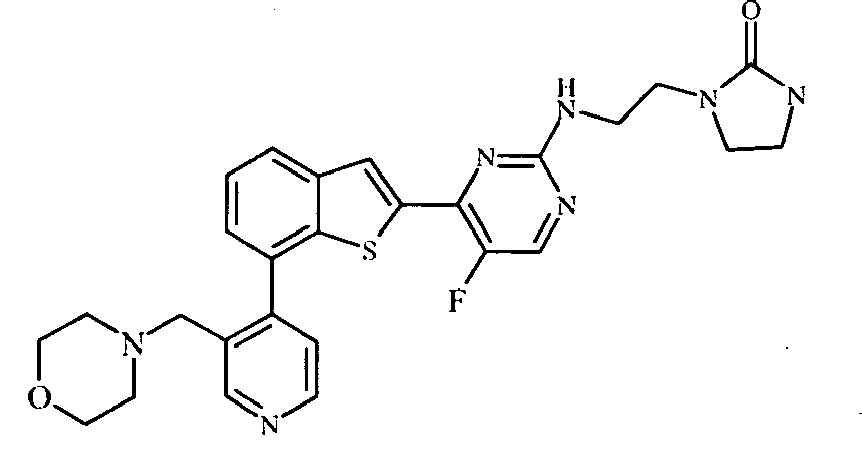
534 6 1-(2-{4-[7-(5-(1,3-Dioxolan-2-yl)-2-fluoropyridin-4-yl)benzo[b]thiophen-2-yl]-5-fluoropyrimidin-2-ylamino}ethyl)imidazolidi n-2-one 
525 7 1-(2-{5-Fluoro-4-[7-(2-fluoro-3-((methoxymethoxy)methyl )-pyridin-4-yl)benzo[b]thiophen-2-yl]pyrimidin-2-ylamino}ethyl)imidazolidi n-2-one 
527 8 1-(2-{4-[7-(5-Cyclopropyl-2-fluoropyridin-4-yl)benzo[b]thiophen-2-yl]-5-fluoropyrimidin-2-ylamino}ethyl)imidazolidi n-2-one 
493 - Prepare the following examples with procedures similar to those described for 1-(2-{4-[7-(5-azidomethyl-2-fluoro-pyridin-4-yl)-benzo[b]thiophen-2-yl]-5-fluoro-pyrimidin-2-ylamino}-ethyl)-imidazolidin-2-one.
Ex Compound name Structure MS (ES) [M+1]+ 9 1-(2-{5-Fluoro-4-[7-(2-fluoro-5-(pyrrolidin-1-ylmethyl)pyridin-4-yl)benzo[b]thiophen-2-yl]pyrimidin-2-ylamino} ethyl)imidazolidin-2-one 
536 10 1-(2-{4-[7-(5-(Azetidin-1-ylmethyl)-2-fluoropyridin-4-yl)benzo[b]thiophen-2-yl]-5-fluoropyrimidin-2-ylamino} ethyl)imidazolidin-2-one 
522 11 1-(2-{5-Chloro-4-[7-(5-((dimethylamino)methyl)-2-fluoropyridin-4-yl)benzo[b]thiophen-2-yl]pyrimidin-2-ylamino} ethyl)imidazolidin-2-one 
527 12 1-(2-[5-Fluoro-4-(7-,2-fluoro-5-[(2-hydroxy-ethylamino)-methyl]pyridin-4-yl}benzo[b]thiophen-2-yl)pyrimidin-2-ylamino]-ethyl} imidazolidin-2-one 
526 13 1-(2-{5-Fluoro-4-[7-(2-fluoro-5-((propylamino)methyl)pyrid in-4-yl)benzo[b]thiophen-2-yl]pyrimidin-2-ylamino}ethyl)imidazolidin-2-one 
524 14 1-(2-(4-(7-(5-((Ethylamino)methyl)-2-fluoropyridin-4-yl)benzo[b]thiophen-2-yl)-5-fluoropyrimidin-2-ylamino)ethyl)imidazolidin-2-one 
510 15 1-{2-[4-(7-{5-[(Ethyl(methyl)amino)-methyl]-2-fluoropyridin-4-yl}benzo[b]thiophen-2-yl)-5-fluoropyrimidin-2-ylamino]ethyl}imidazolidin-2-one 
524 16 1-(2-{4-[7-(5-((Diethylamino)methyl)-2-fluoropyridin-4-yl)benzo[b]thiophen-2-yl]-5-fluoropyrimidin-2-ylamino} ethyl)imidazolidin-2-one 
538 17 1-(2-{4-[7-(5-((Dimethylamino)methyl)-2-fluoropyridin-4-yl)-benzo[b]thiophen-2-yl]-5-methylpyrimidin-2-ylamino} ethyl)imidazolidin-2-one 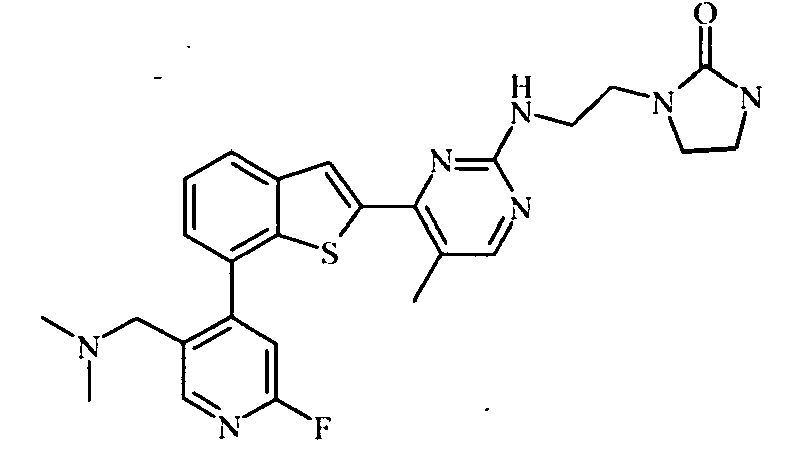
506 -

- Dissolve [4-(2-{5-fluoro-2-[2-(2-oxo-imidazolidin-1-yl)-ethylamino]-pyrimidin-4-yl}-benzo[b]thiophen-7-yl)-6-fluoro-pyridin-3-ylmethyl]-methyl-carbamic acid tert-butyl ester (0.19 g, 0.32 mmol) in dry CH2Cl2 (1.4 mL) and CF3COOH (1.4 mL). Stir at room temperature for 1 hour. Remove solvent completely. Dilute the trifluoro-acetic acid salt with CH2Cl2. Wash with saturated NaHCO3 solution, water and saturated aqueous sodium chloride. Dry with MgSO4. After filtration, remove solvent. Dry in vacuo overnight to afford the title compound (0.12 g, 78 %). MS (ES) m/z 495 [M+1]+.
- Prepare the following examples with procedures similar to those described for 1-(2- {5-fluoro-4-[7-(2-fluoro-5-methylaminomethyl-pyridin-4-yl)-benzo[b]thiophen-2-yl]-pyrimidin-2-ylamino}-ethyl)-imidazolidin-2-one.
Ex Compound name Structure MS (ES) [M+1]+ 19 1-(2-{4-[7-(2-Fluoro-5-((methylamino)methyl) pyridin-4-yl)benzo[b]thiophen-2-yl]-5-mcthylpyrimidin-2-ylamino}ethyl)imidazo lidin-2-one 
492 20 1-(2-{5-Chloro-4-[7-(2-fluoro-5-((methylamino)methyl) pyridin-4-yl)benzo[b]thiophen-2-yl]pyrimidin-2-ylamino}ethyl)imidazo lidin-2-one 
512 21 1-(2-{4-[7-(2-Fluoro-5-((methylamino)methyl) pyridin-4-yl)benzo[b]thiophen-2-yl]pyrimidin-2-ylamino}ethyl)imidazo lidin-2-one 
478 22 1-[2-(4-{7-[5-(1-Aminoethyl)-2-fluoropyridin-4-yl]benzo[b]thiophen-2-yl}-5-fluoropyrimidin-2-ylamino)ethyl]imidazol idin-2-one 
494 -

- Add trifluoro-acetic acid (1 mL) to a solution of [6-fluoro-4-(2-{5-fluoro-2-[2-(2-oxo-2,3-dihydro-imidazol-1-yl)-ethylamino]-pyrimidin-4-yl}-benzo[b]thiophen-7-yl)-pyridin-3-ylmethyl]-methyl-carbamic acid tert-butyl ester (280 mg, 0.47 mmol) in dichloromethane (1 mL). Stir for 1 hour and remove solvent on a rotovap. Wash with saturated NaHCO3 and extract in dichloromethane, wash with saturated aqueous sodium chloride, dry over Na2SO4, and filter. Remove solvent on a rotovap to obtain the solid and dry under vacuum to afford the product (196 mg). MS (ES) m/z 494 [M+1]+.
-

- Add hydrogen chloride (2 mL, 1 M in diethyl ether) to a solution of [6-fluoro-4-(2-{5-fluoro-2-[2-(2-oxo-imidazolidin-1-yl)-ethylamino]-pyrimidin-4-yl}-benzo[b]thiophen-7-y)-pyridin-3-ylmethyl]-(3,3,3-trifluoro-propyl) carbamic acid tert-butyl ester (0.136 g, 200.68 µmol) in dichloromethane (3 mL). Stir the mixture overnight at room temperature. Evaporate the solvent and suspend the resulting solid in dichloromethane and treat with 30 % aqueous potassium carbonate. Wash the organic phase with saturated aqueous sodium chloride and load the organic solution onto a 25 g silica gel loading column with dichloromethane and elute onto a 40 g silica gel column with a gradient from dichloromethane to ethyl acetate and then from ethyl acetate to 10 % methanol in ethyl acetate to give the title compound. Purify the material further by HPLC (HPLC Conditions: 38-42 % CH3CN/10 mM NH4HCO3, pH 10 at 20 mL/min on XBride®MS C18 19 x 100 mm). Collect the appropriate fractions and concentrate it. Co-evaporate the residue with two portions absolute ethanol, one portion toluene, and transfer to a 10 mL round bottom with dichloromethane. Convert the material to a solid using dichloromethane hexane co-evaporation to give the title compound 45 mg (39 %) as a yellow solid. MS (ES) m/z 578 [M+1]+.
- Prepare the following example with procedures similar to those described for 1-{2-[5-fluoro-4-(7-{2-fluoro-5-[(3,3,3-trifluoro-propylamino)-methyl]-pyridin-4-yl}benzo[b]thiophen-2-yl)pyrimidin-2-ylamino]ethyl}imidazolidin-2-one.
Ex Compound Name Structure MS(ES)
[M+1]+25 3-{[6-Ftuoro-4-(2-{5-fluoro-2-[2-(2-oxoimidazolidin-1-yl)ethylamino]pyri midin-4-yl}benzo[b]thiophe n-7-yl)pyridin-3-yl]methylamino}-propanenitrile 
535 -

- To a solution of 1-(2-{4-[7-(5-azidomethyl-2-fluoro-pyridin-4-yl)-benzo[b]thiophen-2-yl]-5-fluoro-pyrimidin-2-ylamino}-ethyl)-imidazolidin-2-one (105 mg, 0.3 mmol) in ethanol (10 mL) in a round bottom flask add 2 g hydrazine formic acid salt (1:1) and 0.5 g of Raney Nickel. Stir the mixture for 3 hours at room temperature. Pour the reaction mixture diluted sodium carbonate solution. Abstract the product into chloroform, and wash with water and saturated aqueous sodium chloride. Separate organic layer from aqueous layer and dry over Na2SO4. After filtration, evaporate the organic solvent in vacuo to give a crude product. Purify the crude with flash column chromatography (chloroform/methanol/ammonium hydroxide, 7/3/0.05) to give the title compound as a yellow solid (0.50 mg, 53 %). MS (ES) m/z 482 [M+1]+.
-


- Separate 1-[2-(4-{7-[5-(1-aminoethyl)-2-fluoropyridin-4-yl]benzo[b]thiophen-2-yl}-5-fluoropyrimidin-2-ylamino)ethyl]imidazolidin-2-one (180 mg, 0.36 mmol) by chiral HPLC (Chiratpak®) AD-H, 9/1 EtOH/acetonitrile, 0.2 % N,N-dimethylethanolamine, 1 mL/min, 225 nm) to give the first fraction as the S-enantiomer (50 mg, 28 %) and the second fraction as the R-enantiomer (51 mg, 28 %). MS (ES) m/z 496 [M+1]+.
-

- Add pyridinium p-toluenesulfonate (4.3 mg, 0.02 mmol) to a solution of 1-{2-[5-fluoro-4-(7-{2-fluoro-5-[2-(tetrahydro-pyran-2-yloxy)-ethoxy]-pyridin-4-yl}-benzo[b]thiophen-2-yl)-pyrimidin-2-ylamino]-ethyl}-imidazolidin-2-one (100 mg, 0.17 mmol) in ethanol (4 mL). Stir the mixture at 55 °C overnight. Cool the solution. Concentrate the solution in vacuo to yellow oil. Purify the oil by column chromatography (methylene chloride to 10 % methanol in methylene chloride) to afford the title compound (75 mg, 87 %) as a light yellow solid. MS (ES) m/z 513 [M+1]+.
-

- Add 1-(2-[4-[7-(3-trimethylsilanylethynyl-pyridin-4-yl)-benzo[b]-thiophen-2-yl]-pyrimidin-2-yl-amino)-ethyl imidazolidin-2-one (0.1 g, 0.19 mmol) in methanol in a round bottom flask. Add potassium carbonate (0.053 g, 0.38 mmol). Stir the reaction mixture at room temperature for 20 min. Evaporate all the solvent under vacuum. Extract the compound by diluting with dichloromethane and washing with water. Dry the compound under vacuum (0.083 g, 40 %). M S (ES) m/z 441.26 [M+1]+.
- Prepare the following example with procedures similar to those used for 1-(2-(4-(7-(3-ethynylpyridin-4-yl)benzo[b]thiophen-2-yl)pyrimidin-2-ylamino)ethyl)imidazolidin-2-one.
Ex Compound Name Structure MS (ES)
[M+1]+31 1-(2-(4-(7-(3-Ethynylpyridin-4-yl)benzo[b]thiophen-2-yl)-5-fluoropyrimidin-2-ylamino)ethyl)imidaz olidin-2-one 
459 -

- Add trifluoro-acetic acid (1 mL) to a solution of tert-butyl 1-(6-chloro-4-(2-(5-fluoro-2-(2-(2-oxoimidazolidin-1-yl)ethylamino)pyrimidin-4-yl)benzo[b]thiophen-7-yl)pyridin-3-yl)ethylcarbamate (220 mg, 0.36 mmol) in dichloromethane (1 mL). Stir for I hour and remove solvent on a rotovap. Wash with saturated NaHCO3 and extract in dichloromethane, wash with saturated aqueous sodium chloride, dry over Na2SO4, and filter. Remove solvent on a rotovap to obtain the solid and dry under vacuum to afford the product (158 mg). MS (ES) m/z 512 [M+1]+.
- Separate the product (90 mg, 0.18 mmol) by chiral HPLC (Chiralpak® AS-H, 100 % MeOH/0.02 % dimethylethanolamine \CO2, 5 mL/min, 225 nm) to obtain the first eluted isomer (39 mg). MS (ES) m/z 512 [M+1]+.
-

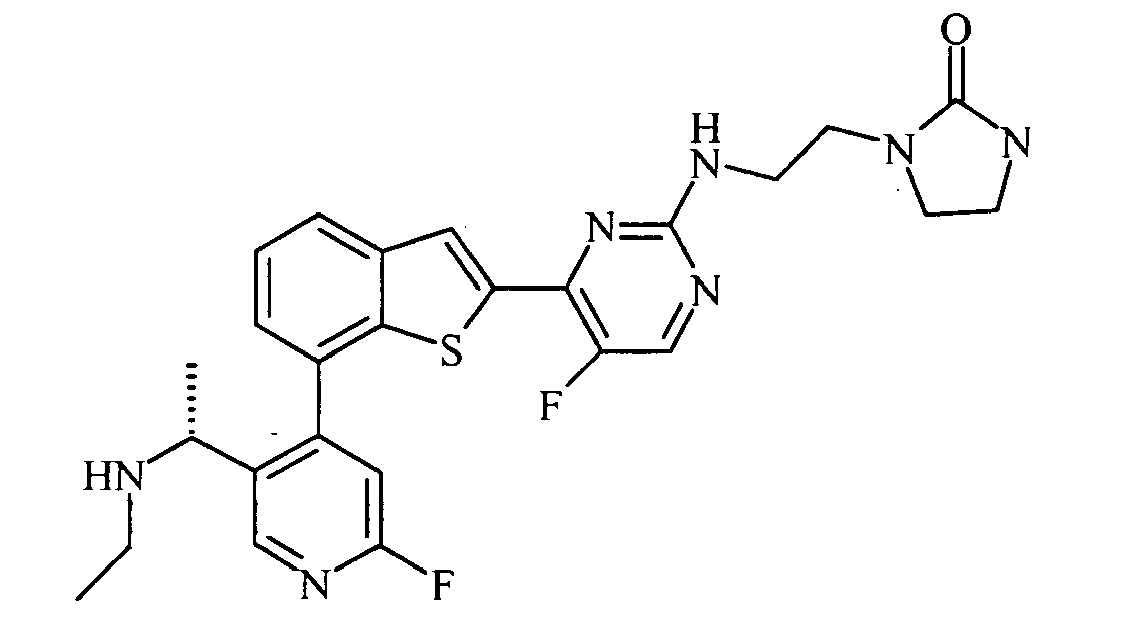
- Separate 1-(2-(4-(7-(5-(1-(ethylamino)ethyl)-2-fluoropyridin-4-yl)benzo[b]thiophen-2-yl)-5-fluoropyrimidin-2-ylamino)ethyl)imidazolidin-2-one (150 mg, 0.29 mmol) by chiral HPLC (Chiralpak® AD-H 30 % MeOH/0.2 % isopropylamine/CO2 5 mL/min 225 nm) to give the first fraction as the S-enantiomer (58.4 mg, 38 %) and the second fraction as R-enantiomer (58.4 mg, 38 %). MS (ES) m/z 524 [M+1]+.
-


- Prepare 1-(2-(5-fluoro-4-(7-(2-fluoro-5-(1-(methylamino)ethyl)pyridin-4-yl)benzo[b]thiophen-2-yl)pyrimidin-2-ylamino)ethyl)imidazolidin-2-one-with procedures similar to those described for 1-(2-{5-fluoro-4-[7-(2-fluoro-5-methylaminomethyl-pyridin-4-yl)-benzo[b]thiophen-2-yl]-pyrimidin-2-ylamino}-ethyl)-imidazolidin-2-one. Separate 1-(2-(5-fluoro-4-(7-(2-fluoro-5-(1-(methylamino)ethyl)pyridin-4-yl)benzo[b]thiophen-2-yl)pyrimidin-2-ylamino)ethyl)imidazolidin-2-one (196 mg, 0.38 mmol) by chiral HPLC (Chiralpak® AD-H, 40 % EtOH (0.2 % isopropylamine)/CO2 5 mL/min 225 nm) to give the first fraction as the S-enantiomer (60.2 mg, 31 %) and the second fraction as the R-enantiomer (58.9 mg, 30 %). MS (ES) m/z 510 [M+1]+.
- Plk1 has been shown to be over expressed in many human tumors, such as non-small cell lung, oropharyngeal, oesophageal, gastric, melanoma, breast, ovarian, endometrial, colorectal, glioblastoma, papillary, pancreatic, prostate, hepatoblastoma and non-Hodgkin lymphoma cancers. Furthermore, Plk1 expression has prognostic significance in non-small cell lung, oropharyngeal, oesophageal, melanoma, colorectal, hepatoblastoma and non-Hodgkin lymphoma cancers (Strebhardt, K. and A. Ullrich. Nature Reviews Cancer 6(4): 321-30 (2006)). Plkl phosphorylated substrates regulate progression of mitosis by coordinating centrosome maturation, entry into mitosis, sister chromatid separation and cytokinesis (Eckerdt and Strebhardt 2006; Strebhardt and Ullrich 2006; van de Weerdt, B. C. and R. H. Medema. Cell Cycle 5(8): 853-64 (2006)). Inhibiting Plkl function using antibody injection, expression of a dominant negative Plk1, and antisense mRNA reduction produces monopole spindles and anaphase arrest leading to mitotic cell death in tumor cell lines but reversible G2 arrest in normal non-transformed primary cell lines.
- Additionally, it has been reported that Plk may be useful in the treatment of rhabdoid tumors, (Morozov A., et al., Clinical Cancer Research. 13(6):4721-30, (Aug 15, 2007).
- BI-2536 has demonstrated activity in preclinical models using HCT116, A549 and NCIH460 murine xenografts (Baum, A., P. Garin-Chesa, et al. (2006). #C191 In vivo activity of BI 2536, a potent and selective inhibitor of the mitotic kinase PLK1, in a range of cancer xenografts. AACR-NCI-EORTC International Conference on "molecular Targets and Cancer Therapeutics", Philidelphia, PA).
- The results of the following assays demonstrate evidence that the compounds of the present invention are useful as anticancer agents.
- Human Plk1 cDNA, which may be obtained from a number of sources, such as Incyte (accession number: NM_005030), may be directly linked at one of its termini with a polynucleotide sequence expressing a His6 tag, such as the C-terminal FLAG-His6 tag, and inserted into an appropriate expression vector, such as a pFastBac™ vector (Invitrogen) and transfected into an appropriate system, such as baculovirus similar to what has been reported by Yue-Wei Qian, et al., Science, 282, 1701 (1998) for xPlkk1. If a viral expression system is used, then the virus (e.g., baculovirus bearing a Plk1-Flag-His6 tag polynucleotide construct) is infected into a culture of a suitable host cell, such as Sf9 cells. When sufficient amounts of the Plk1-Flag-His6 tag fusion protein have been expressed, for example, at about 46 hours after infection, the culture should be treated with okadaic acid (0.1 µM) for a sufficient period of time (e.g., 3 hours). The Plkl-Flag-His6 tag fusion is purified from cell pellets using a metal affinity resin, such as TALON™ (Clontech, Catalog# 635503) using methods well known in the art. Purified Plk1-Flag His6 tag fusion is stored in a suitable medium, such as 10 mM HEPES, 150 mM NaCl, 0.01% TRITON® X-100, 1 mM dithiothreitol (DTT), 10 % glycerol, pH 7.5, at -80 °C. in small aliquots until use. The identity of the purified Plk1-Flag-His6 tag fusion protein is confirmed by MALDI (Matrix-Assisted Laser Desorption/Ionization).
- Human Cdc25C cDNA, which may be obtained from any appropriate source, such as Incyte (accession number: AY497474), may be expressed in any convenient expression system, after which purification is effected by well known methods similar to that described by Bin Ouyang et al, Oncogene, 18, 6029 -6036 (1999). One convenient system involves overnight growth at 18 °C of E.coli BL21 tranformed with the pGEX-2T vector (Amersham) into which the cDNA for human Cds25C has been engineered for induced expression using 1 mM isopropyl-beta-D-thiogalactopyranoside. The expressed GST-Cdc25C(1-206), the substrate for Plk1, may be purified by GLUTATHIONE SEPHAROSE® 4B and stored in an appropriate solution, such as 10 mM HEPES, 100 mM NaCl, pH 7.5 in small aliquots at -80 °C.
- Plk1 kinase reactions contain Plk1-Flag-His6 tag fusion enzyme (0.2 ng/µL) in a buffer containing 50 mM HEPES, pH 7.3, 1.0 mM dithiothreitol, 5.0 µM ATP, 10 mM MgCl2, 0.01% TRITON® X-100, 0.4 µCi 33P-ATP, and 0.06 µg/µL GST-Cdc25c (1-206) peptide. Compounds are provided as 10 mM stocks in DMSO. Compounds are serially diluted 1:3 in 20 % DMSO to create a 10-point concentration-response curve and subsequently are diluted 1:5 (20 µM to 0.001 µM final in 4 % final DMSO concentration) in the reaction mixture to determine compound activity. The reaction is carried out at room temperature for 60 min and then quenched by adding 60 µL of 10.0 % H3PO4. The reaction mixture (85 µL) is transferred to a 96 well phosphocellulose filter plate pre-wetted with 30 µL of 10.0 % H3PO4, incubated at room temperature for 20-30 min and then washed 3X with 0.5 % H3PO4. Wells are dried before addition of 40 µL of MicroScintTM20 (Packard) and then counted on a Wallac MICROBETA ® Jet. The percentage inhibition values from the 10-point concentration response data are subsequently analyzed, for example, using ACTIVITY BASE™ software (IDBS), using a 4-parameter logistic equation. Absolute IC50 values are calculated from the resulting curve fit. All exemplified compounds have an IC50 less than 100 nM with a Minimum Significant Ratio (MSR) of 3.6. For example, Example 4 has an IC50 of about 25 nM.
- HeLa Cells from the American Type Culture Collection (ATCC) are plated at 200 cells/well in 96 well Beckman Dickinson BIOCOAT™ plates, and are incubated in MEM (Minimum Essential Medium, e.g., GIBCO, catalog #11095) with 10% FBS (Fetal Bovine Serum) in 37 °C, 5 % CO2 for 24 hours. Cells are treated by adding compound (in 0.25 % DMSO) to the medium, dosing at 10 points across the range 0.5 µM to 0.0098 µM. After 23 hours exposure to the compounds, cells are fixed, for example with the PREFER™ fixative [Anatech LTD., Catalog #414] for 30 min then are permeablized with 0.1% TRITON® X100 in phospate buffered saline (PBS) solution for 15 min. Cells are washed 3 times with PBS then digested with 50 µg/mL RNAse. Primary antibody, phosphohistone H3 (Upstate Cat#06-570), is added at 1:500 in PBS with 1 % bovine serum albumin (BSA) to the cells over night at 4 °C. After 3 PBS washes, cells are incubated with Alexa488 labeled secondary antibody (Invitrogen cat # A11008) for 1 hour at room temperature. Again they are washed 3 times with PBS, and then 15 µM propidium iodide (Molecular Probes cat # P3566) is added for 30 min to stain nuclei. Fluorescence Plates are scanned with ACUMEN EXPLORER™ [Laser-scanning fluorescence microplate cytometer (comprising of 488 nm argon ion laser excitation and multiple photomultiplier tube detection), manufactured by TTP LABTECH LTD] to measure phosphohistone H3, DNA content and mitotic cells as measured by DNA condensation. Image analysis are based on cellular fluorescent signals for identifying cells in different subpopulations, pHH3(S10) positive cells are identified by mean intensity at 500-530 nm above the threshold. Total intensity at 655-705 nm from propidium iodide/DNA is used to identify individual cells (cells with DNA content from 2N to 4N) and subpopulations in cell cycle (2N cells, 4N cells). Peak intensity at 575-640 nm is used to identify DNA condensation that is used as the marker to identify mitotic cells among 4N cells. Assay outputs are percentage of each identified subpopulations, %pHH3, % 2N, %4N, %mitotic and total cell number. The EC50 is determined by curve fitting to a four parameter logistic for each output using ACTIVITY BASE™. The resulting EC50s for pHH3(s10), DNA content, and mitotic have an MSR of 2.6, 2.4 and 2.5, respectively. For example, Example 4 has a pHH3(s10) EC50 = 24 nM (n = 1), DNA content EC50 = 35 nM (n = 2) and mitotic EC50 = 22 nM (n = 1).
- The effects of compounds on cell proliferation can be determined using cells and cell proliferation methods well-known in the art (Robert C. Squatrito et al., Gynecological Oncology, 58, 101-105, (1995)). For example, HCT116 cells, which may be obtained from the American Type Culture Collection, may be seeded at ∼2000 cells/well in 96-well plates and allowed to attach overnight in a humidified CO2 incubator at 37 °C. Following the 20-24 hour incubation, half-log serially diluted compounds are added and the plates are returned to the incubator. After an appropriate length of exposure (e.g., 72 hours), cell proliferation is estimated using well-known methods. In one method, 10 µL of a tetrazolium salt, such as Alamar Blue™ is added to the cell plates. After an appropriate exposure to the dye, fluorescence (530 nm excitation, 580 nm emission) is determined. The resulting IC50 has an MSR of 3.1. For example, Example 4 has an IC50 of 44 nM (n = 3).
- The compounds of the present invention are preferably formulated as pharmaceutical compositions administered by a variety of routes. Most preferably, such compositions are for oral administration. Such pharmaceutical compositions and processes for preparing same are well known in the art. See, e.g., REMINGTON: THE SCIENCE AND PRACTICE OF PHARMACY (A. Gennaro, et al., eds., 19th ed., Mack Publishing Co., 1995).
- The compounds of Formula I are generally effective over a wide dosage range. For example, dosages per day normally fall within the range of about 0.01 to about 20 mg/kg of body weight, preferably 0.1 to 20 mg/kg of body weight. In some instances dosage levels below the lower limit of the aforesaid range may be more than adequate, while in other cases still larger doses may be employed without causing any harmful side effect, and therefore the above dosage range is not intended to limit the scope of the invention in any way. It will be understood that the amount of the compound actually administered will be determined by a physician, in the light of the relevant circumstances, including the condition to be treated, the chosen route of administration, the actual compound or compounds administered, the age, weight, and response of the individual patient, and the severity of the patient's symptoms.
Claims (10)
- A compound of the formula:
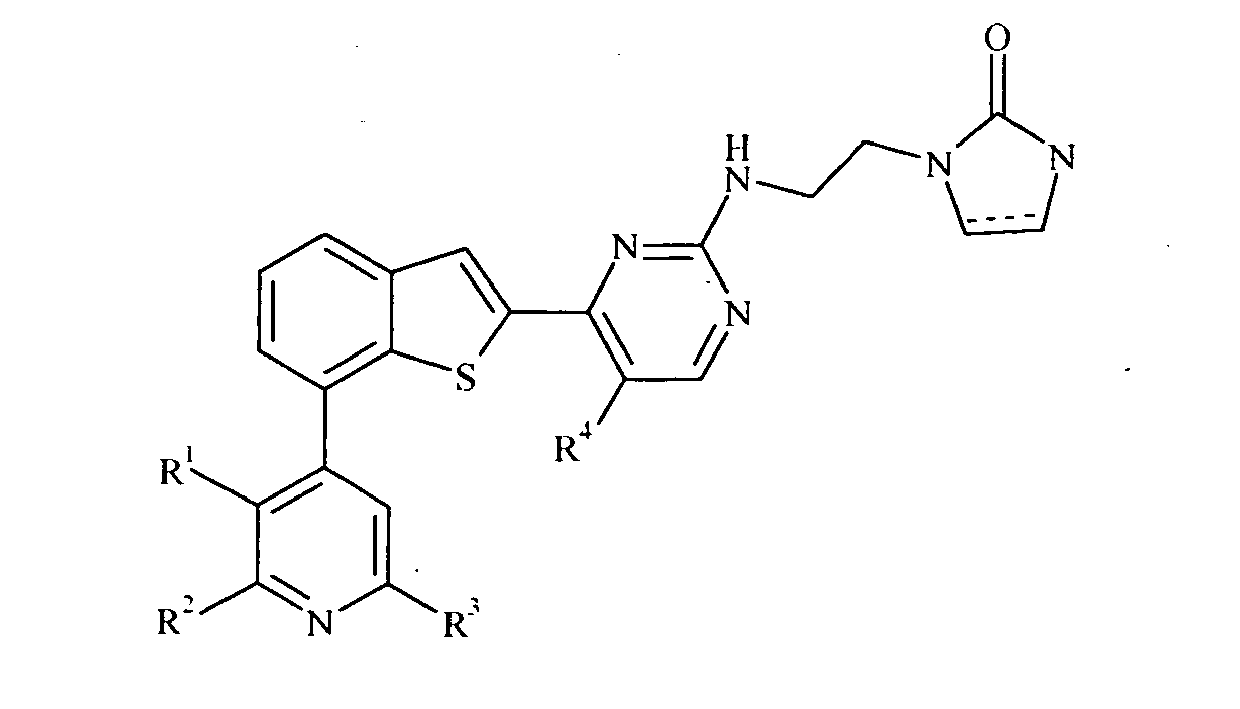 R1 is aminomethyl, (C1-C3 alkyl)aminomethyl, di(C1-C2 alkyl)aminomethyl, N-ethyl-N-methyl-aminomethyl, 1-aminoethyl, 1-((C1-C2 alkyl)amino)-ethyl, 3,3,3-trifluoropropylaminomethyl, ethynyl, 2-hydroxy-ethoxy, 2-hydroxyethylaminomethyl, 2-cyanoethylaminomethyl, morpholin-4-ylmethyl, methoxymethoxymethyl, cyclopropyl, 1-azetidinylmethyl, 1-pyrrolidinylmethyl, or 1,3-dioxolan-2-yl;R2 is hydrogen or halo;R3 is hydrogen or halo;provided that at least one of -R2 and R3 is hydrogen;R4 is hydrogen, methyl, or halo; and---- is a single bond that is either present or absent, ora pharmaceutically acceptable salt thereof.
 - The compound of Claim 1 wherein:R2 is hydrogen or fluoro;R3 is hydrogen, chloro, or fluoro; provided that at least one of R2 and R3 is hydrogen; andR4 is hydrogen, methyl, chloro, or fluoro; ora pharmaceutically acceptable salt thereof.
- The compound of Claim 1 wherein:R1 is dimethylaminomethyl, methylaminomethyl or aminomethyl;R2 is hydrogen, or fluoro;R3 is hydrogen, chloro, or fluoro; provided that at least one of R2 and R3 is hydrogen; andR4 is hydrogen, methyl, chloro, or fluoro; ora pharmaceutically acceptable salt thereof.
- The compound of Claim 1 wherein R1 is dimethylaminomethyl, R2 is hydrogen, R3 is fluoro, and R4 is fluoro or a pharmaceutically acceptable salt thereof.
- The compound of Claim 1 wherein R1 is methylaminomethyl, R2 is hydrogen, R3 is fluoro, and R4 is fluoro or a pharmaceutically acceptable salt thereof
- The compound of Claim I wherein R1 is aminomethyl, R2 is hydrogen, R3 is halo, and R4 is halo or a pharmaceutically acceptable salt thereof.
- A compound selected from the group consisting of:1-(2-{4-[7-(5-((Dimethylamino)methyl)-2-fluoro-pyridin-4-yl)benzo[b]thiophen-2-yl]-5-fluoropyrimidin-2-ylamino}ethyl)imidazolidin-2-one,1-(2-{4-[7-(2-Fluoro-5-(morpholinomethyl)-pyridin-4-yl)benzo[b]thiophen-2-yl]pyrimidin-2-ylamino}ethyl)imidazolidin-2-one,1-(2-{5-Fluoro-4-[7-(2-fluoro-5-(morpholinomethyl)pyridin-4-yl)benzo[b]thiophen-2-yl]-pyrimidin-2-ylamino}ethyl)imidazolidin-2-one,1-(2-{4-[7-(5-((Dimethylamino)methyl)-2-fluoropyridin-4-yl)benzo[b]thiophen-2-yl]pyrimidin-2-ylamino}ethyl)imidazolidin-2-one,1-(2-{5-Fluoro-4-[7-(3-(morpholinomethyl)-pyridin-4-yl)benzo[b]thiophen-2-yl]pyrimidin-2-ylamino}ethyl)imidazolidin-2-one,1-(2-{4-[7-(5-(1,3-Dioxolan-2-yl)-2-fluoropyridin-4-yl)benzo[b]thiophen-2-yl]-5-fluoropyrimidin-2-ylamino}ethyl)imidazolidin-2-one,1-(2-{5-Fluoro-4-[7-(2-fluoro-3-((methoxymethoxy)methyl)-pyridin-4-yl)benzo[b]thiophen-2-yl]pyrimidin-2-ylamino}ethyl)imidazolidin-2-one,1-(2-{4-[7-(5-Cyclopropyl-2-fluoropyridin-4-yl)benzo[b]thiophen-2-yl]-5-fluoropyrimidin-2-ylamino}ethyl)imidazolidin-2-one,1-(2-{5-Fluoro-4-[7-(2-fluoro-5-(pyrrolidin-1-ylmethyl)pyridin-4-yl)benzo[b]thiophen-2-yl]pyrimidin-2-ylamino}ethyl)imidazolidin-2-one,1-(2-{4-[7-(5-(Azetidin-1-ylmethyl)-2-fluoropyridin-4-yl)benzo[b]thiophen-2-yl]-5-fluoropyrimidin-2-ylamino}ethyl)imidazolidin-2-one,1-(2-{5-Chloro-4-[7-(5-((dimethylamino)methyl)-2-fluoropyridin-4-yl)benzo[b]thiophen-2-yl]pyrimidin-2-ylamino}ethyl)imidazolidin-2-one,1-{2-[5-Fluoro-4-(7-{2-fluoro-5-[(2-hydroxy-ethylamino)-methyl]pyridin-4-yl}benzo[b]thiophen-2-yl)pyrimidin-2-ylamino]-ethyl}imidazolidin-2-one,1-(2-{5-Fluoro-4-[7-(2-fluoro-5-((propylamino)methyl)pyridin-4-yl)benzo[b]thiophen-2-yl]pyrimidin-2-ylamino}ethyl)imidazolidin-2-one,1-(2-(4-(7-(5-((Ethylamino)methyl)-2-fluoropyridin-4-yl)benzo[b]thiophen-2-yl)-5-fluoropyrimidin-2-ylamino)ethyl)imidazolidin-2-one,1-{2-[4-(7-{5-[(Ethyl(methyl)amino)-methyl]-2-fluoropyridin-4-yl}benzo[b]thiophen-2-yl)-5-fluoropyrimidin-2-ylamino]ethyl}imidazolidin-2-one,1-(2-{4-[7-(5-((Diethylamino)methyl)-2-fluoropyridin-4-yl)benzo[b]thiophen-2-yl]-5-fluoropyrimidin-2-ylamino}ethyl)imidazolidin-2-one,1-(2-{4-[7-(5-((Dimethylamino)methyl)-2-fluoropyridin-4-yl)-benzo[b]thiophen-2-yl]-5-methylpyrimidin-2-ylamino}ethyl)imidazolidin-2-one,1-(2-{5-Fluoro-4-[7-(2-fluoro-5-((methylamino)methyl)pyridin-4-yl)benzo[b]thiophen-2-yl]-pyrimidin-2-ylamino}ethyl)imidazolidin-2-one,1-(2-{4-[7-(2-Fluoro-5-((methylamino)methyl)pyridin-4-yl)benzo[b]thiophen-2-yl]-5-methylpyrimidin-2-ylamino}ethyl)imidazolidin-2-one,1-(2-{5-Chloro-4-[7-(2-fluoro-5-((methylamino)methyl)pyridin-4-yl)benzo[b]thiophen-2-yl]pyrimidin-2-ylamino}ethyl)imidazolidin-2-one,1-(2-{4-[7-(2-Fluoro-5-((methylamino)methyl)pyridin-4-yl)benzo[b]thiophen-2-yl]pyrimidin-2-ylamino}ethyl)imidazolidin-2-one,1-[2-(4-{7-[5-(1-Aminoethyl)-2-fluoropyridin-4-yl]benzo[b]thiophen-2-yl}-5-fluoropyrimidin-2-ylamino)ethyl]imidazolidin-2-one,1-(2-{5-Fluoro-4-[7-(2-fluoro-5-((methylamino)methyl)pyridin-4-yl)benzo[b]thiophen-2-yl]pyrimidin-2-ylamino}ethyl)-1H-imidazol-2(3H)-one,1-{2-[5-Fluoro-4-(7-{2-fluoro-5-[(3,3,3-trifluoro-propylamino)-methyl]-pyridin-4-yl}benzo[b]thiophen-2-yl)pyrimidin-2-ylamino]ethyl}imidazolidin-2-one,3-{[6-Fluoro-4-(2-{5-fluoro-2-[2-(2-oxoimidazolidin-1-yl)ethylamino]pyrimidin-4-yl}benzo[b]thiophen-7-yl)pyridin-3-yl]methylamino}-propanenitrile,1-(2-{4-[7-(5-(Aminomethyl)-2-fluoropyridin-4-yl)benzo[b]thiophen-2-yl]-5-fluoropyrimidin-2-ylamino}ethyl)imidazolidin-2-one,R-1-[2-(4-{7-[5-(1-Aminoethyl)-2-fluoropyridin-4-yl]benzo[b]thiophen-2-yl}-5-fluoropyrimidin-2-ylamino)ethyl]imidazolidin-2-one,S-1-[2-(4-{7-[5-(1-Aminoethyl)-2-fluoropyridin-4-yl]benzo[b]thiophen-2-yl}-5-fluoropyrimidin-2-ylamino)ethyl]imidazolidin-2-one,1-[2-(5-Fluoro-4-{7-[2-fluoro-5-(2-hydroxyethoxy)pyridin-4-yl]benzo[b]thiophen-2-yl}pyrimidin-2-ylamino)ethyl]imidazolidin-2-one,1-(2-(4-(7-(3-Ethynylpyridin-4-yl)benzo[b]thiophen-2-yl)pyrimidin-2-ylamino)ethyl)imidazolidin-2-one,1-(2-(4-(7-(3-Ethynylpyridin-4-yl)benzo[b]thiophen-2-yl)-5-fluoropyrimidin-2-ylamino)ethyl)imidazolidin-2-one,1-(2-(4-(7-(5-(1-Aminoethyl)-2-chloropyridin-4-yl)benzo[b]thiophen-2-yl)-5-fluoropyrimidin-2-ylamino)ethyl)imidazolidin-2-one,S-1-(2-(4-(7-(5-(1-(Ethylamino)ethyl)-2-fluoropyridin-4-yl)benzo[b]thiophen-2-yl)-5-fluoropyrimidin-2-ylamino)ethyl)imidazolidin-2-one,R-1-(2-(4-(7-(5-(1-(Ethylamino)ethyl)-2-fluoropyridin-4-yl)benzo[b]thiophen-2-yl)-5-fluoropyrimidin-2-ylamino)ethyl)imidazolidin-2-one,S-1-(2-(5-Fluoro-4-(7-(2-fluoro-5-(1-(methylamino)ethyl)pyridin-4-yl)benzo[b]thiophen-2-yl)pyrimidin-2-ylamino)ethyl)imidazolidin-2-one, andR-1-(2-(5-Fluoro-4-(7-(2-fluoro-5-(1-(methylamino)ethyl)pyridin-4-yl)benzo[b]thiophen-2-yl)pyrimidin-2-ylamino)ethyl)imidazolidin-2-one;or a pharmaceutically acceptable salt.
- A pharmaceutical composition comprising a compound of Claims 1-7 or a pharmaceutically acceptable salt thereof, in combination with a pharmaceutically acceptable carrier, diluent or excipient.
- The compound of any of Claims 1-7 or a pharmaceutically acceptable salt thereof for use in therapy.
- The compound of any of Claims 1-7 or a pharmaceutically acceptable salt thereof for use in the treatment of a cancer selected from the group consisting of non-small cell lung, oropharyngeal, oesophageal, gastric, melanoma, epidermoid carcinoma of the skin, breast, ovarian, endometrial, colorectal, neuroglioma, glioblastoma, thyroid carcinoma, cervical, pancreatic, prostate, hepatoblastoma and non-Hodgkin lymphoma cancers in a mammal.
Priority Applications (3)
| Application Number | Priority Date | Filing Date | Title |
|---|---|---|---|
| PL07855060T PL2125794T3 (en) | 2006-12-21 | 2007-12-11 | Imidazolidinonyl aminopyrimidine compounds for the treatment of cancer |
| SI200730463T SI2125794T1 (en) | 2006-12-21 | 2007-12-11 | Imidazolidinonyl aminopyrimidine compounds for the treatment of cancer |
| CY20101101083T CY1110950T1 (en) | 2006-12-21 | 2010-11-26 | IMIDAZOLIDINYNL AMINOPYRIMIDINE COMPOUNDS FOR CANCER TREATMENT |
Applications Claiming Priority (2)
| Application Number | Priority Date | Filing Date | Title |
|---|---|---|---|
| US87132206P | 2006-12-21 | 2006-12-21 | |
| PCT/US2007/087046 WO2008076705A1 (en) | 2006-12-21 | 2007-12-11 | Imidazolidinonyl aminopyrimidine compounds for the treatment of cancer |
Publications (2)
| Publication Number | Publication Date |
|---|---|
| EP2125794A1 EP2125794A1 (en) | 2009-12-02 |
| EP2125794B1 true EP2125794B1 (en) | 2010-10-20 |
Family
ID=39185681
Family Applications (1)
| Application Number | Title | Priority Date | Filing Date |
|---|---|---|---|
| EP07855060A Active EP2125794B1 (en) | 2006-12-21 | 2007-12-11 | Imidazolidinonyl aminopyrimidine compounds for the treatment of cancer |
Country Status (21)
| Country | Link |
|---|---|
| US (1) | US8063212B2 (en) |
| EP (1) | EP2125794B1 (en) |
| JP (1) | JP2010513553A (en) |
| KR (1) | KR101080594B1 (en) |
| CN (1) | CN101568539B (en) |
| AT (1) | ATE485291T1 (en) |
| AU (1) | AU2007334040B2 (en) |
| BR (1) | BRPI0720607A2 (en) |
| CA (1) | CA2673564A1 (en) |
| CY (1) | CY1110950T1 (en) |
| DE (1) | DE602007010041D1 (en) |
| DK (1) | DK2125794T3 (en) |
| EA (1) | EA016178B1 (en) |
| ES (1) | ES2351371T3 (en) |
| HR (1) | HRP20100641T1 (en) |
| MX (1) | MX2009006635A (en) |
| PL (1) | PL2125794T3 (en) |
| PT (1) | PT2125794E (en) |
| RS (1) | RS51526B (en) |
| SI (1) | SI2125794T1 (en) |
| WO (1) | WO2008076705A1 (en) |
Families Citing this family (5)
| Publication number | Priority date | Publication date | Assignee | Title |
|---|---|---|---|---|
| CA2671738A1 (en) | 2006-12-21 | 2008-06-26 | Eli Lilly And Company | Imidazolidinonyl aminopyrimidine compounds for the treatment of cancer |
| CA2691997A1 (en) * | 2007-05-16 | 2008-11-27 | Eli Lilly And Company | Triazolyl aminopyrimidine compounds |
| CA2876382A1 (en) | 2012-06-14 | 2013-12-19 | Daiichi Sankyo Company, Limited | Piperidinylpyrazolopyridine derivative |
| EP2929883A1 (en) | 2014-04-08 | 2015-10-14 | Institut Pasteur | Pyrazole derivatives as dihydroorotate dehydrogenase (DHODH) inhibitors |
| KR102693614B1 (en) | 2022-04-04 | 2024-08-08 | 경희대학교 산학협력단 | Imidazolium derivative substituted with a naphthalen-2-ylalkyl group and composition for treating cancer comprising the same as an active ingredient |
Family Cites Families (9)
| Publication number | Priority date | Publication date | Assignee | Title |
|---|---|---|---|---|
| US4929726A (en) | 1988-02-09 | 1990-05-29 | Georgia State University Foundation, Inc. | Novel diazines and their method of preparation |
| WO2004063192A1 (en) * | 2003-01-10 | 2004-07-29 | Pharmacopeia Drug Discovery, Inc. | Imidazolyl pyrimidine derivatives useful as il-8 receptor modulators |
| GB0308466D0 (en) | 2003-04-11 | 2003-05-21 | Novartis Ag | Organic compounds |
| JP4932735B2 (en) | 2004-12-17 | 2012-05-16 | アムジエン・インコーポレーテツド | Aminopyrimidine compounds and methods of use |
| TW200800201A (en) * | 2005-11-18 | 2008-01-01 | Lilly Co Eli | Pyrimidinyl benzothiophene compounds |
| WO2007117465A2 (en) * | 2006-03-31 | 2007-10-18 | Abbott Laboratories | Indazole compounds |
| CA2671738A1 (en) | 2006-12-21 | 2008-06-26 | Eli Lilly And Company | Imidazolidinonyl aminopyrimidine compounds for the treatment of cancer |
| CA2691997A1 (en) | 2007-05-16 | 2008-11-27 | Eli Lilly And Company | Triazolyl aminopyrimidine compounds |
| MX2009012233A (en) | 2007-05-16 | 2009-12-01 | Lilly Co Eli | Triazolyl aminopyrimidine compounds. |
-
2007
- 2007-12-11 RS RSP-2010/0547A patent/RS51526B/en unknown
- 2007-12-11 DE DE602007010041T patent/DE602007010041D1/en active Active
- 2007-12-11 PL PL07855060T patent/PL2125794T3/en unknown
- 2007-12-11 BR BRPI0720607-0A2A patent/BRPI0720607A2/en not_active IP Right Cessation
- 2007-12-11 EP EP07855060A patent/EP2125794B1/en active Active
- 2007-12-11 PT PT07855060T patent/PT2125794E/en unknown
- 2007-12-11 EA EA200970616A patent/EA016178B1/en not_active IP Right Cessation
- 2007-12-11 CA CA002673564A patent/CA2673564A1/en not_active Abandoned
- 2007-12-11 HR HR20100641T patent/HRP20100641T1/en unknown
- 2007-12-11 SI SI200730463T patent/SI2125794T1/en unknown
- 2007-12-11 WO PCT/US2007/087046 patent/WO2008076705A1/en not_active Ceased
- 2007-12-11 CN CN2007800477447A patent/CN101568539B/en not_active Expired - Fee Related
- 2007-12-11 ES ES07855060T patent/ES2351371T3/en active Active
- 2007-12-11 KR KR1020097012768A patent/KR101080594B1/en not_active Expired - Fee Related
- 2007-12-11 AT AT07855060T patent/ATE485291T1/en active
- 2007-12-11 MX MX2009006635A patent/MX2009006635A/en active IP Right Grant
- 2007-12-11 AU AU2007334040A patent/AU2007334040B2/en not_active Ceased
- 2007-12-11 DK DK07855060.5T patent/DK2125794T3/en active
- 2007-12-11 JP JP2009543062A patent/JP2010513553A/en not_active Withdrawn
- 2007-12-11 US US12/516,251 patent/US8063212B2/en not_active Expired - Fee Related
-
2010
- 2010-11-26 CY CY20101101083T patent/CY1110950T1/en unknown
Also Published As
| Publication number | Publication date |
|---|---|
| PL2125794T3 (en) | 2011-04-29 |
| JP2010513553A (en) | 2010-04-30 |
| ATE485291T1 (en) | 2010-11-15 |
| AU2007334040A1 (en) | 2008-06-26 |
| RS51526B (en) | 2011-06-30 |
| HRP20100641T1 (en) | 2010-12-31 |
| EP2125794A1 (en) | 2009-12-02 |
| DE602007010041D1 (en) | 2010-12-02 |
| ES2351371T3 (en) | 2011-02-03 |
| KR20090086111A (en) | 2009-08-10 |
| BRPI0720607A2 (en) | 2014-04-08 |
| EA200970616A1 (en) | 2009-10-30 |
| PT2125794E (en) | 2011-01-10 |
| AU2007334040B2 (en) | 2012-02-16 |
| CY1110950T1 (en) | 2015-06-10 |
| US20100081641A1 (en) | 2010-04-01 |
| MX2009006635A (en) | 2009-06-30 |
| US8063212B2 (en) | 2011-11-22 |
| CA2673564A1 (en) | 2008-06-26 |
| EA016178B1 (en) | 2012-02-28 |
| SI2125794T1 (en) | 2011-02-28 |
| CN101568539A (en) | 2009-10-28 |
| KR101080594B1 (en) | 2011-11-04 |
| CN101568539B (en) | 2012-04-25 |
| WO2008076705A1 (en) | 2008-06-26 |
| DK2125794T3 (en) | 2011-01-24 |
Similar Documents
| Publication | Publication Date | Title |
|---|---|---|
| AU2008254319B2 (en) | Triazolyl aminopyrimidine compounds | |
| US8063212B2 (en) | Imidazolidinonyl aminopyrimidine compounds for the treatment of cancer | |
| US8114872B2 (en) | Triazolyl aminopyrimidine compounds | |
| EP2125793B1 (en) | Imidazolidinonyl aminopyrimidine compounds for the treatment of cancer |
Legal Events
| Date | Code | Title | Description |
|---|---|---|---|
| PUAI | Public reference made under article 153(3) epc to a published international application that has entered the european phase |
Free format text: ORIGINAL CODE: 0009012 |
|
| 17P | Request for examination filed |
Effective date: 20090721 |
|
| AK | Designated contracting states |
Kind code of ref document: A1 Designated state(s): AT BE BG CH CY CZ DE DK EE ES FI FR GB GR HU IE IS IT LI LT LU LV MC MT NL PL PT RO SE SI SK TR |
|
| AX | Request for extension of the european patent |
Extension state: AL BA HR MK RS |
|
| GRAP | Despatch of communication of intention to grant a patent |
Free format text: ORIGINAL CODE: EPIDOSNIGR1 |
|
| GRAC | Information related to communication of intention to grant a patent modified |
Free format text: ORIGINAL CODE: EPIDOSCIGR1 |
|
| GRAS | Grant fee paid |
Free format text: ORIGINAL CODE: EPIDOSNIGR3 |
|
| GRAA | (expected) grant |
Free format text: ORIGINAL CODE: 0009210 |
|
| AK | Designated contracting states |
Kind code of ref document: B1 Designated state(s): AT BE BG CH CY CZ DE DK EE ES FI FR GB GR HU IE IS IT LI LT LU LV MC MT NL PL PT RO SE SI SK TR |
|
| AX | Request for extension of the european patent |
Extension state: AL BA HR MK RS |
|
| REG | Reference to a national code |
Ref country code: GB Ref legal event code: FG4D |
|
| REG | Reference to a national code |
Ref country code: CH Ref legal event code: NV Representative=s name: E. BLUM & CO. AG PATENT- UND MARKENANWAELTE VSP Ref country code: CH Ref legal event code: EP |
|
| REG | Reference to a national code |
Ref country code: IE Ref legal event code: FG4D Ref country code: HR Ref legal event code: TUEP Ref document number: P20100641 Country of ref document: HR |
|
| REG | Reference to a national code |
Ref country code: RO Ref legal event code: EPE |
|
| REG | Reference to a national code |
Ref country code: NL Ref legal event code: T3 |
|
| REF | Corresponds to: |
Ref document number: 602007010041 Country of ref document: DE Date of ref document: 20101202 Kind code of ref document: P |
|
| REG | Reference to a national code |
Ref country code: SE Ref legal event code: TRGR |
|
| REG | Reference to a national code |
Ref country code: GR Ref legal event code: EP Ref document number: 20100402711 Country of ref document: GR |
|
| REG | Reference to a national code |
Ref country code: HR Ref legal event code: T1PR Ref document number: P20100641 Country of ref document: HR |
|
| REG | Reference to a national code |
Ref country code: PT Ref legal event code: SC4A Free format text: AVAILABILITY OF NATIONAL TRANSLATION Effective date: 20110103 |
|
| REG | Reference to a national code |
Ref country code: DK Ref legal event code: T3 |
|
| REG | Reference to a national code |
Ref country code: ES Ref legal event code: FG2A Effective date: 20110124 |
|
| REG | Reference to a national code |
Ref country code: SK Ref legal event code: T3 Ref document number: E 8339 Country of ref document: SK |
|
| REG | Reference to a national code |
Ref country code: HU Ref legal event code: AG4A Ref document number: E009779 Country of ref document: HU |
|
| REG | Reference to a national code |
Ref country code: PL Ref legal event code: T3 |
|
| PLBE | No opposition filed within time limit |
Free format text: ORIGINAL CODE: 0009261 |
|
| STAA | Information on the status of an ep patent application or granted ep patent |
Free format text: STATUS: NO OPPOSITION FILED WITHIN TIME LIMIT |
|
| 26N | No opposition filed |
Effective date: 20110721 |
|
| REG | Reference to a national code |
Ref country code: DE Ref legal event code: R097 Ref document number: 602007010041 Country of ref document: DE Effective date: 20110721 |
|
| PG25 | Lapsed in a contracting state [announced via postgrant information from national office to epo] |
Ref country code: IT Free format text: LAPSE BECAUSE OF NON-PAYMENT OF DUE FEES Effective date: 20101211 |
|
| PGFP | Annual fee paid to national office [announced via postgrant information from national office to epo] |
Ref country code: BG Payment date: 20130927 Year of fee payment: 7 |
|
| REG | Reference to a national code |
Ref country code: HR Ref legal event code: ODRP Ref document number: P20100641 Country of ref document: HR Payment date: 20131204 Year of fee payment: 7 |
|
| PGFP | Annual fee paid to national office [announced via postgrant information from national office to epo] |
Ref country code: DK Payment date: 20131126 Year of fee payment: 7 |
|
| PGFP | Annual fee paid to national office [announced via postgrant information from national office to epo] |
Ref country code: PT Payment date: 20130611 Year of fee payment: 7 Ref country code: SE Payment date: 20131206 Year of fee payment: 7 Ref country code: CZ Payment date: 20131125 Year of fee payment: 7 Ref country code: LT Payment date: 20131125 Year of fee payment: 7 Ref country code: IE Payment date: 20131127 Year of fee payment: 7 Ref country code: IS Payment date: 20131112 Year of fee payment: 7 Ref country code: MC Payment date: 20131128 Year of fee payment: 7 Ref country code: CH Payment date: 20131029 Year of fee payment: 7 Ref country code: EE Payment date: 20131127 Year of fee payment: 7 Ref country code: AT Payment date: 20131126 Year of fee payment: 7 Ref country code: GB Payment date: 20131126 Year of fee payment: 7 Ref country code: SK Payment date: 20131122 Year of fee payment: 7 |
|
| PGFP | Annual fee paid to national office [announced via postgrant information from national office to epo] |
Ref country code: RO Payment date: 20131202 Year of fee payment: 7 Ref country code: SI Payment date: 20131126 Year of fee payment: 7 Ref country code: ES Payment date: 20131218 Year of fee payment: 7 Ref country code: GR Payment date: 20131129 Year of fee payment: 7 Ref country code: HU Payment date: 20131126 Year of fee payment: 7 Ref country code: NL Payment date: 20131206 Year of fee payment: 7 Ref country code: FR Payment date: 20131126 Year of fee payment: 7 Ref country code: LU Payment date: 20140103 Year of fee payment: 7 Ref country code: TR Payment date: 20131004 Year of fee payment: 7 Ref country code: LV Payment date: 20131127 Year of fee payment: 7 Ref country code: FI Payment date: 20131205 Year of fee payment: 7 Ref country code: IT Payment date: 20131219 Year of fee payment: 7 Ref country code: PL Payment date: 20131115 Year of fee payment: 7 |
|
| PGFP | Annual fee paid to national office [announced via postgrant information from national office to epo] |
Ref country code: BE Payment date: 20131230 Year of fee payment: 7 |
|
| PGFP | Annual fee paid to national office [announced via postgrant information from national office to epo] |
Ref country code: DE Payment date: 20131230 Year of fee payment: 7 |
|
| PGFP | Annual fee paid to national office [announced via postgrant information from national office to epo] |
Ref country code: CY Payment date: 20131209 Year of fee payment: 7 |
|
| REG | Reference to a national code |
Ref country code: PT Ref legal event code: MM4A Free format text: LAPSE DUE TO NON-PAYMENT OF FEES Effective date: 20150611 |
|
| PG25 | Lapsed in a contracting state [announced via postgrant information from national office to epo] |
Ref country code: BE Free format text: LAPSE BECAUSE OF NON-PAYMENT OF DUE FEES Effective date: 20141231 |
|
| REG | Reference to a national code |
Ref country code: DE Ref legal event code: R119 Ref document number: 602007010041 Country of ref document: DE |
|
| REG | Reference to a national code |
Ref country code: HR Ref legal event code: PBON Ref document number: P20100641 Country of ref document: HR Effective date: 20141211 |
|
| REG | Reference to a national code |
Ref country code: DK Ref legal event code: EBP Effective date: 20141231 |
|
| REG | Reference to a national code |
Ref country code: NL Ref legal event code: V1 Effective date: 20150701 |
|
| REG | Reference to a national code |
Ref country code: LT Ref legal event code: MM4D Effective date: 20141211 |
|
| REG | Reference to a national code |
Ref country code: NL Ref legal event code: V1 Effective date: 20150701 |
|
| PG25 | Lapsed in a contracting state [announced via postgrant information from national office to epo] |
Ref country code: LU Free format text: LAPSE BECAUSE OF NON-PAYMENT OF DUE FEES Effective date: 20141211 Ref country code: PT Free format text: LAPSE BECAUSE OF NON-PAYMENT OF DUE FEES Effective date: 20150611 Ref country code: CZ Free format text: LAPSE BECAUSE OF NON-PAYMENT OF DUE FEES Effective date: 20141211 Ref country code: RO Free format text: LAPSE BECAUSE OF NON-PAYMENT OF DUE FEES Effective date: 20141211 Ref country code: CY Free format text: LAPSE BECAUSE OF NON-PAYMENT OF DUE FEES Effective date: 20141211 Ref country code: LT Free format text: LAPSE BECAUSE OF NON-PAYMENT OF DUE FEES Effective date: 20141211 Ref country code: FI Free format text: LAPSE BECAUSE OF NON-PAYMENT OF DUE FEES Effective date: 20141211 Ref country code: SE Free format text: LAPSE BECAUSE OF NON-PAYMENT OF DUE FEES Effective date: 20141212 |
|
| REG | Reference to a national code |
Ref country code: CH Ref legal event code: PL |
|
| REG | Reference to a national code |
Ref country code: SE Ref legal event code: EUG |
|
| REG | Reference to a national code |
Ref country code: AT Ref legal event code: MM01 Ref document number: 485291 Country of ref document: AT Kind code of ref document: T Effective date: 20141211 |
|
| REG | Reference to a national code |
Ref country code: EE Ref legal event code: MM4A Ref document number: E004891 Country of ref document: EE Effective date: 20141231 |
|
| GBPC | Gb: european patent ceased through non-payment of renewal fee |
Effective date: 20141211 |
|
| PG25 | Lapsed in a contracting state [announced via postgrant information from national office to epo] |
Ref country code: LV Free format text: LAPSE BECAUSE OF NON-PAYMENT OF DUE FEES Effective date: 20141211 |
|
| PGFP | Annual fee paid to national office [announced via postgrant information from national office to epo] |
Ref country code: MT Payment date: 20131105 Year of fee payment: 7 |
|
| REG | Reference to a national code |
Ref country code: SK Ref legal event code: MM4A Ref document number: E 8339 Country of ref document: SK Effective date: 20141211 Ref country code: GR Ref legal event code: ML Ref document number: 20100402711 Country of ref document: GR Effective date: 20150722 |
|
| REG | Reference to a national code |
Ref country code: IE Ref legal event code: MM4A |
|
| REG | Reference to a national code |
Ref country code: FR Ref legal event code: ST Effective date: 20150831 |
|
| PG25 | Lapsed in a contracting state [announced via postgrant information from national office to epo] |
Ref country code: NL Free format text: LAPSE BECAUSE OF NON-PAYMENT OF DUE FEES Effective date: 20150701 |
|
| REG | Reference to a national code |
Ref country code: SI Ref legal event code: KO00 Effective date: 20150826 |
|
| PG25 | Lapsed in a contracting state [announced via postgrant information from national office to epo] |
Ref country code: LI Free format text: LAPSE BECAUSE OF NON-PAYMENT OF DUE FEES Effective date: 20141231 Ref country code: GB Free format text: LAPSE BECAUSE OF NON-PAYMENT OF DUE FEES Effective date: 20141211 Ref country code: IE Free format text: LAPSE BECAUSE OF NON-PAYMENT OF DUE FEES Effective date: 20141211 Ref country code: BG Free format text: LAPSE BECAUSE OF NON-PAYMENT OF DUE FEES Effective date: 20150930 Ref country code: DE Free format text: LAPSE BECAUSE OF NON-PAYMENT OF DUE FEES Effective date: 20150701 Ref country code: EE Free format text: LAPSE BECAUSE OF NON-PAYMENT OF DUE FEES Effective date: 20141231 Ref country code: CH Free format text: LAPSE BECAUSE OF NON-PAYMENT OF DUE FEES Effective date: 20141231 Ref country code: SK Free format text: LAPSE BECAUSE OF NON-PAYMENT OF DUE FEES Effective date: 20141211 |
|
| PG25 | Lapsed in a contracting state [announced via postgrant information from national office to epo] |
Ref country code: HU Free format text: LAPSE BECAUSE OF NON-PAYMENT OF DUE FEES Effective date: 20141212 Ref country code: IS Free format text: LAPSE BECAUSE OF FAILURE TO SUBMIT A TRANSLATION OF THE DESCRIPTION OR TO PAY THE FEE WITHIN THE PRESCRIBED TIME-LIMIT Effective date: 20150701 Ref country code: SI Free format text: LAPSE BECAUSE OF NON-PAYMENT OF DUE FEES Effective date: 20141212 Ref country code: AT Free format text: LAPSE BECAUSE OF NON-PAYMENT OF DUE FEES Effective date: 20141211 Ref country code: GR Free format text: LAPSE BECAUSE OF NON-PAYMENT OF DUE FEES Effective date: 20150722 Ref country code: FR Free format text: LAPSE BECAUSE OF NON-PAYMENT OF DUE FEES Effective date: 20141231 |
|
| PG25 | Lapsed in a contracting state [announced via postgrant information from national office to epo] |
Ref country code: IT Free format text: LAPSE BECAUSE OF NON-PAYMENT OF DUE FEES Effective date: 20141211 |
|
| PG25 | Lapsed in a contracting state [announced via postgrant information from national office to epo] |
Ref country code: DK Free format text: LAPSE BECAUSE OF NON-PAYMENT OF DUE FEES Effective date: 20141231 |
|
| REG | Reference to a national code |
Ref country code: ES Ref legal event code: FD2A Effective date: 20160129 |
|
| PG25 | Lapsed in a contracting state [announced via postgrant information from national office to epo] |
Ref country code: ES Free format text: LAPSE BECAUSE OF NON-PAYMENT OF DUE FEES Effective date: 20141212 |
|
| PG25 | Lapsed in a contracting state [announced via postgrant information from national office to epo] |
Ref country code: MC Free format text: LAPSE BECAUSE OF NON-PAYMENT OF DUE FEES Effective date: 20141231 Ref country code: PL Free format text: LAPSE BECAUSE OF NON-PAYMENT OF DUE FEES Effective date: 20141211 |
|
| PG25 | Lapsed in a contracting state [announced via postgrant information from national office to epo] |
Ref country code: MT Free format text: LAPSE BECAUSE OF NON-PAYMENT OF DUE FEES Effective date: 20141231 |
|
| PG25 | Lapsed in a contracting state [announced via postgrant information from national office to epo] |
Ref country code: TR Free format text: LAPSE BECAUSE OF NON-PAYMENT OF DUE FEES Effective date: 20141211 |
|
| PG25 | Lapsed in a contracting state [announced via postgrant information from national office to epo] |
Ref country code: MT Free format text: LAPSE BECAUSE OF NON-PAYMENT OF DUE FEES Effective date: 20141211 |