EP2125793B1 - Imidazolidinonyl aminopyrimidine compounds for the treatment of cancer - Google Patents
Imidazolidinonyl aminopyrimidine compounds for the treatment of cancer Download PDFInfo
- Publication number
- EP2125793B1 EP2125793B1 EP07855058A EP07855058A EP2125793B1 EP 2125793 B1 EP2125793 B1 EP 2125793B1 EP 07855058 A EP07855058 A EP 07855058A EP 07855058 A EP07855058 A EP 07855058A EP 2125793 B1 EP2125793 B1 EP 2125793B1
- Authority
- EP
- European Patent Office
- Prior art keywords
- benzo
- thiophen
- ethyl
- ylamino
- imidazolidin
- Prior art date
- Legal status (The legal status is an assumption and is not a legal conclusion. Google has not performed a legal analysis and makes no representation as to the accuracy of the status listed.)
- Not-in-force
Links
- 206010028980 Neoplasm Diseases 0.000 title claims abstract description 18
- 201000011510 cancer Diseases 0.000 title claims abstract description 11
- VLUNZXPZDFIDHY-UHFFFAOYSA-N 1-(2-aminopyrimidin-4-yl)imidazolidin-2-one Chemical class NC1=NC=CC(N2C(NCC2)=O)=N1 VLUNZXPZDFIDHY-UHFFFAOYSA-N 0.000 title abstract description 3
- 239000001257 hydrogen Substances 0.000 claims abstract description 42
- 229910052739 hydrogen Inorganic materials 0.000 claims abstract description 42
- 125000004435 hydrogen atom Chemical group [H]* 0.000 claims abstract description 23
- 150000003839 salts Chemical class 0.000 claims abstract description 23
- 125000002496 methyl group Chemical group [H]C([H])([H])* 0.000 claims abstract description 18
- 125000002924 primary amino group Chemical group [H]N([H])* 0.000 claims abstract description 6
- 125000003545 alkoxy group Chemical group 0.000 claims abstract description 5
- 125000004093 cyano group Chemical group *C#N 0.000 claims abstract description 5
- 125000000250 methylamino group Chemical group [H]N(*)C([H])([H])[H] 0.000 claims abstract description 5
- UFHFLCQGNIYNRP-UHFFFAOYSA-N Hydrogen Chemical compound [H][H] UFHFLCQGNIYNRP-UHFFFAOYSA-N 0.000 claims abstract description 3
- 150000001875 compounds Chemical class 0.000 claims description 101
- 125000005843 halogen group Chemical group 0.000 claims description 21
- YAMHXTCMCPHKLN-UHFFFAOYSA-N imidazolidin-2-one Chemical compound O=C1NCCN1 YAMHXTCMCPHKLN-UHFFFAOYSA-N 0.000 claims description 12
- 125000001153 fluoro group Chemical group F* 0.000 claims description 10
- -1 hydroxy, hydroxymethyl Chemical group 0.000 claims description 10
- 208000015914 Non-Hodgkin lymphomas Diseases 0.000 claims description 6
- 208000006359 hepatoblastoma Diseases 0.000 claims description 6
- 210000004072 lung Anatomy 0.000 claims description 6
- 201000001441 melanoma Diseases 0.000 claims description 6
- 125000000175 2-thienyl group Chemical group S1C([*])=C([H])C([H])=C1[H] 0.000 claims description 5
- 210000000481 breast Anatomy 0.000 claims description 5
- 125000001309 chloro group Chemical group Cl* 0.000 claims description 5
- 230000002357 endometrial effect Effects 0.000 claims description 5
- 230000002496 gastric effect Effects 0.000 claims description 5
- 208000005017 glioblastoma Diseases 0.000 claims description 5
- 230000002611 ovarian Effects 0.000 claims description 5
- 239000008194 pharmaceutical composition Substances 0.000 claims description 5
- 210000002307 prostate Anatomy 0.000 claims description 5
- 241000124008 Mammalia Species 0.000 claims description 4
- 208000033781 Thyroid carcinoma Diseases 0.000 claims description 4
- 208000024770 Thyroid neoplasm Diseases 0.000 claims description 4
- 125000004216 fluoromethyl group Chemical group [H]C([H])(F)* 0.000 claims description 4
- 201000010106 skin squamous cell carcinoma Diseases 0.000 claims description 4
- 201000002510 thyroid cancer Diseases 0.000 claims description 4
- 208000013077 thyroid gland carcinoma Diseases 0.000 claims description 4
- FEIFDKWXAXVGBG-UHFFFAOYSA-N 1-[2-[[5-chloro-4-[7-(5-chloro-2-fluoropyridin-4-yl)-1-benzothiophen-2-yl]pyrimidin-2-yl]amino]ethyl]imidazolidin-2-one Chemical compound C1=NC(F)=CC(C=2C=3SC(=CC=3C=CC=2)C=2C(=CN=C(NCCN3C(NCC3)=O)N=2)Cl)=C1Cl FEIFDKWXAXVGBG-UHFFFAOYSA-N 0.000 claims description 3
- 239000003085 diluting agent Substances 0.000 claims description 3
- 239000003937 drug carrier Substances 0.000 claims description 3
- 239000000546 pharmaceutical excipient Substances 0.000 claims description 3
- BMPXXAMNRCAZPZ-UHFFFAOYSA-N 1-[2-[[4-[7-(2,5-dichloropyridin-4-yl)-1-benzothiophen-2-yl]-5-fluoropyrimidin-2-yl]amino]ethyl]imidazolidin-2-one Chemical compound N1=C(C=2SC3=C(C=4C(=CN=C(Cl)C=4)Cl)C=CC=C3C=2)C(F)=CN=C1NCCN1CCNC1=O BMPXXAMNRCAZPZ-UHFFFAOYSA-N 0.000 claims description 2
- XUACBJRTROSWEN-UHFFFAOYSA-N 1-[2-[[4-[7-(2-chloro-5-ethoxypyridin-4-yl)-1-benzothiophen-2-yl]-5-fluoropyrimidin-2-yl]amino]ethyl]imidazolidin-2-one Chemical compound CCOC1=CN=C(Cl)C=C1C1=CC=CC2=C1SC(C=1C(=CN=C(NCCN3C(NCC3)=O)N=1)F)=C2 XUACBJRTROSWEN-UHFFFAOYSA-N 0.000 claims description 2
- OUUOZNCFGJKEKS-UHFFFAOYSA-N 1-[2-[[4-[7-(2-chloro-5-fluoropyridin-4-yl)-1-benzothiophen-2-yl]-5-fluoropyrimidin-2-yl]amino]ethyl]imidazolidin-2-one Chemical compound FC1=CN=C(Cl)C=C1C1=CC=CC2=C1SC(C=1C(=CN=C(NCCN3C(NCC3)=O)N=1)F)=C2 OUUOZNCFGJKEKS-UHFFFAOYSA-N 0.000 claims description 2
- WOVXJFVMRVWOLJ-UHFFFAOYSA-N 1-[2-[[4-[7-(3-amino-2-fluoropyridin-4-yl)-1-benzothiophen-2-yl]pyrimidin-2-yl]amino]ethyl]imidazolidin-2-one Chemical compound NC1=C(F)N=CC=C1C1=CC=CC2=C1SC(C=1N=C(NCCN3C(NCC3)=O)N=CC=1)=C2 WOVXJFVMRVWOLJ-UHFFFAOYSA-N 0.000 claims description 2
- JSRKJTDNAHLIOE-UHFFFAOYSA-N 1-[2-[[4-[7-(3-aminopyridin-4-yl)-1-benzothiophen-2-yl]-5-fluoropyrimidin-2-yl]amino]ethyl]imidazolidin-2-one Chemical compound NC1=CN=CC=C1C1=CC=CC2=C1SC(C=1C(=CN=C(NCCN3C(NCC3)=O)N=1)F)=C2 JSRKJTDNAHLIOE-UHFFFAOYSA-N 0.000 claims description 2
- RWJWUEDSSDTSTA-UHFFFAOYSA-N 1-[2-[[4-[7-(3-aminopyridin-4-yl)-1-benzothiophen-2-yl]-5-methylpyrimidin-2-yl]amino]ethyl]imidazolidin-2-one Chemical compound N1=C(C=2SC3=C(C=4C(=CN=CC=4)N)C=CC=C3C=2)C(C)=CN=C1NCCN1CCNC1=O RWJWUEDSSDTSTA-UHFFFAOYSA-N 0.000 claims description 2
- SOEIVZZPNCSOOH-UHFFFAOYSA-N 1-[2-[[4-[7-(3-chloropyridin-4-yl)-1-benzothiophen-2-yl]-5-fluoropyrimidin-2-yl]amino]ethyl]imidazolidin-2-one Chemical compound N1=C(C=2SC3=C(C=4C(=CN=CC=4)Cl)C=CC=C3C=2)C(F)=CN=C1NCCN1CCNC1=O SOEIVZZPNCSOOH-UHFFFAOYSA-N 0.000 claims description 2
- VHKAROBLCHHEBL-UHFFFAOYSA-N 1-[2-[[4-[7-(5-chloro-2-fluoropyridin-4-yl)-1-benzothiophen-2-yl]pyrimidin-2-yl]amino]ethyl]imidazolidin-2-one Chemical compound C1=NC(F)=CC(C=2C=3SC(=CC=3C=CC=2)C=2N=C(NCCN3C(NCC3)=O)N=CC=2)=C1Cl VHKAROBLCHHEBL-UHFFFAOYSA-N 0.000 claims description 2
- XCPYVYGAUYPLKI-UHFFFAOYSA-N 1-[2-[[4-[7-[3-(methylamino)pyridin-4-yl]-1-benzothiophen-2-yl]pyrimidin-2-yl]amino]ethyl]imidazolidin-2-one Chemical compound CNC1=CN=CC=C1C1=CC=CC2=C1SC(C=1N=C(NCCN3C(NCC3)=O)N=CC=1)=C2 XCPYVYGAUYPLKI-UHFFFAOYSA-N 0.000 claims description 2
- VWCGJTFFADMLDZ-UHFFFAOYSA-N 1-[2-[[5-chloro-4-(7-pyridin-4-yl-1-benzothiophen-2-yl)pyrimidin-2-yl]amino]ethyl]imidazolidin-2-one Chemical compound N1=C(C=2SC3=C(C=4C=CN=CC=4)C=CC=C3C=2)C(Cl)=CN=C1NCCN1CCNC1=O VWCGJTFFADMLDZ-UHFFFAOYSA-N 0.000 claims description 2
- XDZWTBWGMFTIRO-UHFFFAOYSA-N 1-[2-[[5-chloro-4-[7-(2-chloropyridin-4-yl)-1-benzothiophen-2-yl]pyrimidin-2-yl]amino]ethyl]imidazolidin-2-one Chemical compound C1=NC(Cl)=CC(C=2C=3SC(=CC=3C=CC=2)C=2C(=CN=C(NCCN3C(NCC3)=O)N=2)Cl)=C1 XDZWTBWGMFTIRO-UHFFFAOYSA-N 0.000 claims description 2
- ZMDFCLXXASVWNH-UHFFFAOYSA-N 1-[2-[[5-fluoro-4-(7-pyridin-4-yl-1-benzothiophen-2-yl)pyrimidin-2-yl]amino]ethyl]imidazolidin-2-one Chemical compound N1=C(C=2SC3=C(C=4C=CN=CC=4)C=CC=C3C=2)C(F)=CN=C1NCCN1CCNC1=O ZMDFCLXXASVWNH-UHFFFAOYSA-N 0.000 claims description 2
- KQHBGRUYKNWWFH-UHFFFAOYSA-N 1-[2-[[5-fluoro-4-[7-(2-fluoropyridin-4-yl)-1-benzothiophen-2-yl]pyrimidin-2-yl]amino]ethyl]imidazolidin-2-one Chemical compound C1=NC(F)=CC(C=2C=3SC(=CC=3C=CC=2)C=2C(=CN=C(NCCN3C(NCC3)=O)N=2)F)=C1 KQHBGRUYKNWWFH-UHFFFAOYSA-N 0.000 claims description 2
- ZPYNMFDPTTYDHM-UHFFFAOYSA-N 1-[2-[[5-fluoro-4-[7-(3-methoxypyridin-4-yl)-1-benzothiophen-2-yl]pyrimidin-2-yl]amino]ethyl]imidazolidin-2-one Chemical compound COC1=CN=CC=C1C1=CC=CC2=C1SC(C=1C(=CN=C(NCCN3C(NCC3)=O)N=1)F)=C2 ZPYNMFDPTTYDHM-UHFFFAOYSA-N 0.000 claims description 2
- LTZIKWGCZMAVOE-UHFFFAOYSA-N 1-[2-[[5-methyl-4-(7-pyridin-4-yl-1-benzothiophen-2-yl)pyrimidin-2-yl]amino]ethyl]imidazolidin-2-one Chemical compound N1=C(C=2SC3=C(C=4C=CN=CC=4)C=CC=C3C=2)C(C)=CN=C1NCCN1CCNC1=O LTZIKWGCZMAVOE-UHFFFAOYSA-N 0.000 claims description 2
- 125000005605 benzo group Chemical group 0.000 claims description 2
- AIWQQXXMGQKZDN-UHFFFAOYSA-N 1-[2-[[4-[7-(2-fluoro-5-methylpyridin-4-yl)-1-benzothiophen-2-yl]-5-methylpyrimidin-2-yl]amino]ethyl]imidazolidin-2-one Chemical compound CC1=CN=C(F)C=C1C1=CC=CC2=C1SC(C=1C(=CN=C(NCCN3C(NCC3)=O)N=1)C)=C2 AIWQQXXMGQKZDN-UHFFFAOYSA-N 0.000 claims 1
- KUAGVMSXOALRBK-UHFFFAOYSA-N 1-[2-[[4-[7-(3-aminopyridin-4-yl)-1-benzothiophen-2-yl]pyrimidin-2-yl]amino]ethyl]imidazolidin-2-one Chemical compound NC1=CN=CC=C1C1=CC=CC2=C1SC(C=1N=C(NCCN3C(NCC3)=O)N=CC=1)=C2 KUAGVMSXOALRBK-UHFFFAOYSA-N 0.000 claims 1
- NMLWDOAOIXAWTO-UHFFFAOYSA-N 1-[2-[[4-[7-(3-ethoxypyridin-4-yl)-1-benzothiophen-2-yl]-5-fluoropyrimidin-2-yl]amino]ethyl]imidazolidin-2-one Chemical compound CCOC1=CN=CC=C1C1=CC=CC2=C1SC(C=1C(=CN=C(NCCN3C(NCC3)=O)N=1)F)=C2 NMLWDOAOIXAWTO-UHFFFAOYSA-N 0.000 claims 1
- CFTYSRILPXBSJY-UHFFFAOYSA-N 1-[2-[[4-[7-(5-chloro-2-fluoropyridin-4-yl)-1-benzothiophen-2-yl]-5-methylpyrimidin-2-yl]amino]ethyl]imidazolidin-2-one Chemical compound N1=C(C=2SC3=C(C=4C(=CN=C(F)C=4)Cl)C=CC=C3C=2)C(C)=CN=C1NCCN1CCNC1=O CFTYSRILPXBSJY-UHFFFAOYSA-N 0.000 claims 1
- HFTBHRHTPQBMNQ-UHFFFAOYSA-N 1-[2-[[5-chloro-4-[7-(2-fluoro-5-methylpyridin-4-yl)-1-benzothiophen-2-yl]pyrimidin-2-yl]amino]ethyl]imidazolidin-2-one Chemical compound CC1=CN=C(F)C=C1C1=CC=CC2=C1SC(C=1C(=CN=C(NCCN3C(NCC3)=O)N=1)Cl)=C2 HFTBHRHTPQBMNQ-UHFFFAOYSA-N 0.000 claims 1
- NMHYXOUISVXOJR-UHFFFAOYSA-N 1-[2-[[5-fluoro-4-[7-(2-fluoro-5-methylpyridin-4-yl)-1-benzothiophen-2-yl]pyrimidin-2-yl]amino]ethyl]imidazolidin-2-one Chemical compound CC1=CN=C(F)C=C1C1=CC=CC2=C1SC(C=1C(=CN=C(NCCN3C(NCC3)=O)N=1)F)=C2 NMHYXOUISVXOJR-UHFFFAOYSA-N 0.000 claims 1
- WZLVUMHSYHZLKS-UHFFFAOYSA-N 1-[2-[[5-fluoro-4-[7-(3-hydroxypyridin-4-yl)-1-benzothiophen-2-yl]pyrimidin-2-yl]amino]ethyl]imidazolidin-2-one Chemical compound OC1=CN=CC=C1C1=CC=CC2=C1SC(C=1C(=CN=C(NCCN3C(NCC3)=O)N=1)F)=C2 WZLVUMHSYHZLKS-UHFFFAOYSA-N 0.000 claims 1
- RDIRYPZQIAYBMQ-UHFFFAOYSA-N 1-[2-[[5-fluoro-4-[7-(3-methylpyridin-4-yl)-1-benzothiophen-2-yl]pyrimidin-2-yl]amino]ethyl]imidazolidin-2-one Chemical compound CC1=CN=CC=C1C1=CC=CC2=C1SC(C=1C(=CN=C(NCCN3C(NCC3)=O)N=1)F)=C2 RDIRYPZQIAYBMQ-UHFFFAOYSA-N 0.000 claims 1
- 125000000339 4-pyridyl group Chemical group N1=C([H])C([H])=C([*])C([H])=C1[H] 0.000 claims 1
- 238000002560 therapeutic procedure Methods 0.000 claims 1
- 108010056274 polo-like kinase 1 Proteins 0.000 abstract description 18
- 150000002431 hydrogen Chemical class 0.000 abstract description 15
- 230000002401 inhibitory effect Effects 0.000 abstract description 3
- 125000001475 halogen functional group Chemical group 0.000 abstract 5
- 125000004356 hydroxy functional group Chemical group O* 0.000 abstract 1
- YMWUJEATGCHHMB-UHFFFAOYSA-N Dichloromethane Chemical compound ClCCl YMWUJEATGCHHMB-UHFFFAOYSA-N 0.000 description 135
- OKKJLVBELUTLKV-UHFFFAOYSA-N Methanol Chemical compound OC OKKJLVBELUTLKV-UHFFFAOYSA-N 0.000 description 63
- XEKOWRVHYACXOJ-UHFFFAOYSA-N Ethyl acetate Chemical compound CCOC(C)=O XEKOWRVHYACXOJ-UHFFFAOYSA-N 0.000 description 60
- 239000000243 solution Substances 0.000 description 59
- 239000000203 mixture Substances 0.000 description 54
- FAPWRFPIFSIZLT-UHFFFAOYSA-M Sodium chloride Chemical compound [Na+].[Cl-] FAPWRFPIFSIZLT-UHFFFAOYSA-M 0.000 description 44
- VLKZOEOYAKHREP-UHFFFAOYSA-N n-Hexane Chemical compound CCCCCC VLKZOEOYAKHREP-UHFFFAOYSA-N 0.000 description 38
- XLYOFNOQVPJJNP-UHFFFAOYSA-N water Substances O XLYOFNOQVPJJNP-UHFFFAOYSA-N 0.000 description 37
- WYURNTSHIVDZCO-UHFFFAOYSA-N Tetrahydrofuran Chemical compound C1CCOC1 WYURNTSHIVDZCO-UHFFFAOYSA-N 0.000 description 36
- 238000002360 preparation method Methods 0.000 description 36
- 210000004027 cell Anatomy 0.000 description 35
- 239000007787 solid Substances 0.000 description 30
- 239000012141 concentrate Substances 0.000 description 28
- 229920006395 saturated elastomer Polymers 0.000 description 24
- IAZDPXIOMUYVGZ-UHFFFAOYSA-N Dimethylsulphoxide Chemical compound CS(C)=O IAZDPXIOMUYVGZ-UHFFFAOYSA-N 0.000 description 22
- 239000011780 sodium chloride Substances 0.000 description 22
- HEDRZPFGACZZDS-UHFFFAOYSA-N Chloroform Chemical compound ClC(Cl)Cl HEDRZPFGACZZDS-UHFFFAOYSA-N 0.000 description 20
- 238000003756 stirring Methods 0.000 description 20
- PMZURENOXWZQFD-UHFFFAOYSA-L Sodium Sulfate Chemical compound [Na+].[Na+].[O-]S([O-])(=O)=O PMZURENOXWZQFD-UHFFFAOYSA-L 0.000 description 19
- 238000000034 method Methods 0.000 description 19
- 229910052938 sodium sulfate Inorganic materials 0.000 description 19
- 235000011152 sodium sulphate Nutrition 0.000 description 19
- IJGRMHOSHXDMSA-UHFFFAOYSA-N Atomic nitrogen Chemical compound N#N IJGRMHOSHXDMSA-UHFFFAOYSA-N 0.000 description 18
- KFZMGEQAYNKOFK-UHFFFAOYSA-N Isopropanol Chemical compound CC(C)O KFZMGEQAYNKOFK-UHFFFAOYSA-N 0.000 description 18
- 238000006243 chemical reaction Methods 0.000 description 18
- YLQBMQCUIZJEEH-UHFFFAOYSA-N tetrahydrofuran Natural products C=1C=COC=1 YLQBMQCUIZJEEH-UHFFFAOYSA-N 0.000 description 18
- ZMXDDKWLCZADIW-UHFFFAOYSA-N N,N-Dimethylformamide Chemical compound CN(C)C=O ZMXDDKWLCZADIW-UHFFFAOYSA-N 0.000 description 16
- VYPSYNLAJGMNEJ-UHFFFAOYSA-N Silicium dioxide Chemical compound O=[Si]=O VYPSYNLAJGMNEJ-UHFFFAOYSA-N 0.000 description 16
- CDBYLPFSWZWCQE-UHFFFAOYSA-L Sodium Carbonate Chemical compound [Na+].[Na+].[O-]C([O-])=O CDBYLPFSWZWCQE-UHFFFAOYSA-L 0.000 description 16
- 239000010410 layer Substances 0.000 description 15
- WEVYAHXRMPXWCK-UHFFFAOYSA-N Acetonitrile Chemical compound CC#N WEVYAHXRMPXWCK-UHFFFAOYSA-N 0.000 description 14
- QGZKDVFQNNGYKY-UHFFFAOYSA-N Ammonia Chemical compound N QGZKDVFQNNGYKY-UHFFFAOYSA-N 0.000 description 14
- NXQGGXCHGDYOHB-UHFFFAOYSA-L cyclopenta-1,4-dien-1-yl(diphenyl)phosphane;dichloropalladium;iron(2+) Chemical compound [Fe+2].Cl[Pd]Cl.[CH-]1C=CC(P(C=2C=CC=CC=2)C=2C=CC=CC=2)=C1.[CH-]1C=CC(P(C=2C=CC=CC=2)C=2C=CC=CC=2)=C1 NXQGGXCHGDYOHB-UHFFFAOYSA-L 0.000 description 13
- 238000004440 column chromatography Methods 0.000 description 12
- 239000000047 product Substances 0.000 description 11
- 239000007858 starting material Substances 0.000 description 11
- 239000000284 extract Substances 0.000 description 10
- RTZKZFJDLAIYFH-UHFFFAOYSA-N Diethyl ether Chemical compound CCOCC RTZKZFJDLAIYFH-UHFFFAOYSA-N 0.000 description 9
- ZMANZCXQSJIPKH-UHFFFAOYSA-N Triethylamine Chemical compound CCN(CC)CC ZMANZCXQSJIPKH-UHFFFAOYSA-N 0.000 description 9
- 229910052757 nitrogen Inorganic materials 0.000 description 9
- RYHBNJHYFVUHQT-UHFFFAOYSA-N 1,4-Dioxane Chemical compound C1COCCO1 RYHBNJHYFVUHQT-UHFFFAOYSA-N 0.000 description 8
- 238000005160 1H NMR spectroscopy Methods 0.000 description 8
- 108020004414 DNA Proteins 0.000 description 8
- HEDRZPFGACZZDS-MICDWDOJSA-N Trichloro(2H)methane Chemical compound [2H]C(Cl)(Cl)Cl HEDRZPFGACZZDS-MICDWDOJSA-N 0.000 description 8
- 230000000694 effects Effects 0.000 description 8
- 230000000394 mitotic effect Effects 0.000 description 8
- 238000000746 purification Methods 0.000 description 8
- 229910000029 sodium carbonate Inorganic materials 0.000 description 8
- UIIMBOGNXHQVGW-UHFFFAOYSA-M Sodium bicarbonate Chemical compound [Na+].OC([O-])=O UIIMBOGNXHQVGW-UHFFFAOYSA-M 0.000 description 7
- 229910021529 ammonia Inorganic materials 0.000 description 7
- CNXMDTWQWLGCPE-UHFFFAOYSA-N ditert-butyl-(2-phenylphenyl)phosphane Chemical group CC(C)(C)P(C(C)(C)C)C1=CC=CC=C1C1=CC=CC=C1 CNXMDTWQWLGCPE-UHFFFAOYSA-N 0.000 description 7
- 239000000543 intermediate Substances 0.000 description 7
- 239000012071 phase Substances 0.000 description 7
- 239000011541 reaction mixture Substances 0.000 description 7
- 230000002441 reversible effect Effects 0.000 description 7
- CSCPPACGZOOCGX-UHFFFAOYSA-N Acetone Chemical compound CC(C)=O CSCPPACGZOOCGX-UHFFFAOYSA-N 0.000 description 6
- CSNNHWWHGAXBCP-UHFFFAOYSA-L Magnesium sulfate Chemical compound [Mg+2].[O-][S+2]([O-])([O-])[O-] CSNNHWWHGAXBCP-UHFFFAOYSA-L 0.000 description 6
- HEMHJVSKTPXQMS-UHFFFAOYSA-M Sodium hydroxide Chemical compound [OH-].[Na+] HEMHJVSKTPXQMS-UHFFFAOYSA-M 0.000 description 6
- 238000003556 assay Methods 0.000 description 6
- 239000012043 crude product Substances 0.000 description 6
- 239000012044 organic layer Substances 0.000 description 6
- 239000000741 silica gel Substances 0.000 description 6
- 229910002027 silica gel Inorganic materials 0.000 description 6
- 239000012299 nitrogen atmosphere Substances 0.000 description 5
- 239000012074 organic phase Substances 0.000 description 5
- 239000000377 silicon dioxide Substances 0.000 description 5
- CYPYTURSJDMMMP-WVCUSYJESA-N (1e,4e)-1,5-diphenylpenta-1,4-dien-3-one;palladium Chemical compound [Pd].[Pd].C=1C=CC=CC=1\C=C\C(=O)\C=C\C1=CC=CC=C1.C=1C=CC=CC=1\C=C\C(=O)\C=C\C1=CC=CC=C1.C=1C=CC=CC=1\C=C\C(=O)\C=C\C1=CC=CC=C1 CYPYTURSJDMMMP-WVCUSYJESA-N 0.000 description 4
- 108091003079 Bovine Serum Albumin Proteins 0.000 description 4
- CURLTUGMZLYLDI-UHFFFAOYSA-N Carbon dioxide Chemical compound O=C=O CURLTUGMZLYLDI-UHFFFAOYSA-N 0.000 description 4
- IAZDPXIOMUYVGZ-WFGJKAKNSA-N Dimethyl sulfoxide Chemical compound [2H]C([2H])([2H])S(=O)C([2H])([2H])[2H] IAZDPXIOMUYVGZ-WFGJKAKNSA-N 0.000 description 4
- BZLVMXJERCGZMT-UHFFFAOYSA-N Methyl tert-butyl ether Chemical compound COC(C)(C)C BZLVMXJERCGZMT-UHFFFAOYSA-N 0.000 description 4
- LRHPLDYGYMQRHN-UHFFFAOYSA-N N-Butanol Chemical compound CCCCO LRHPLDYGYMQRHN-UHFFFAOYSA-N 0.000 description 4
- MZRVEZGGRBJDDB-UHFFFAOYSA-N N-Butyllithium Chemical compound [Li]CCCC MZRVEZGGRBJDDB-UHFFFAOYSA-N 0.000 description 4
- SECXISVLQFMRJM-UHFFFAOYSA-N N-Methylpyrrolidone Chemical compound CN1CCCC1=O SECXISVLQFMRJM-UHFFFAOYSA-N 0.000 description 4
- OFBQJSOFQDEBGM-UHFFFAOYSA-N Pentane Chemical compound CCCCC OFBQJSOFQDEBGM-UHFFFAOYSA-N 0.000 description 4
- 239000000654 additive Substances 0.000 description 4
- 230000000996 additive effect Effects 0.000 description 4
- 230000004663 cell proliferation Effects 0.000 description 4
- 238000003818 flash chromatography Methods 0.000 description 4
- 239000003112 inhibitor Substances 0.000 description 4
- SCVFZCLFOSHCOH-UHFFFAOYSA-M potassium acetate Chemical compound [K+].CC([O-])=O SCVFZCLFOSHCOH-UHFFFAOYSA-M 0.000 description 4
- BWHMMNNQKKPAPP-UHFFFAOYSA-L potassium carbonate Chemical compound [K+].[K+].[O-]C([O-])=O BWHMMNNQKKPAPP-UHFFFAOYSA-L 0.000 description 4
- 239000002904 solvent Substances 0.000 description 4
- SRQUKKXMVKOMKN-UHFFFAOYSA-N (6-fluoro-4-iodopyridin-3-yl)methanol Chemical compound OCC1=CN=C(F)C=C1I SRQUKKXMVKOMKN-UHFFFAOYSA-N 0.000 description 3
- KZPYGQFFRCFCPP-UHFFFAOYSA-N 1,1'-bis(diphenylphosphino)ferrocene Chemical compound [Fe+2].C1=CC=C[C-]1P(C=1C=CC=CC=1)C1=CC=CC=C1.C1=CC=C[C-]1P(C=1C=CC=CC=1)C1=CC=CC=C1 KZPYGQFFRCFCPP-UHFFFAOYSA-N 0.000 description 3
- NCQDYBJTTFCQCS-UHFFFAOYSA-N 1-[2-[[4-(7-bromo-1-benzothiophen-2-yl)-5-fluoropyrimidin-2-yl]amino]ethyl]imidazolidin-2-one Chemical compound N1=C(C=2SC3=C(Br)C=CC=C3C=2)C(F)=CN=C1NCCN1CCNC1=O NCQDYBJTTFCQCS-UHFFFAOYSA-N 0.000 description 3
- JCRBJFGTHIEUJV-UHFFFAOYSA-N 1-[2-[[4-[7-(2-chloropyridin-4-yl)-1-benzothiophen-2-yl]pyrimidin-2-yl]amino]ethyl]imidazolidin-2-one Chemical compound C1=NC(Cl)=CC(C=2C=3SC(=CC=3C=CC=2)C=2N=C(NCCN3C(NCC3)=O)N=CC=2)=C1 JCRBJFGTHIEUJV-UHFFFAOYSA-N 0.000 description 3
- HGMJCQKNPCUDAM-UHFFFAOYSA-N 1-[2-[[5-fluoro-4-[7-(4,4,5,5-tetramethyl-1,3,2-dioxaborolan-2-yl)-1-benzothiophen-2-yl]pyrimidin-2-yl]amino]ethyl]imidazolidin-2-one Chemical compound O1C(C)(C)C(C)(C)OB1C1=CC=CC2=C1SC(C=1C(=CN=C(NCCN3C(NCC3)=O)N=1)F)=C2 HGMJCQKNPCUDAM-UHFFFAOYSA-N 0.000 description 3
- JKMHFZQWWAIEOD-UHFFFAOYSA-N 2-[4-(2-hydroxyethyl)piperazin-1-yl]ethanesulfonic acid Chemical compound OCC[NH+]1CCN(CCS([O-])(=O)=O)CC1 JKMHFZQWWAIEOD-UHFFFAOYSA-N 0.000 description 3
- XVPCCIKIXUDQKP-UHFFFAOYSA-N 2-chloro-4-[7-(2-chloropyridin-4-yl)-1-benzothiophen-2-yl]pyrimidine Chemical compound C1=NC(Cl)=CC(C=2C=3SC(=CC=3C=CC=2)C=2N=C(Cl)N=CC=2)=C1 XVPCCIKIXUDQKP-UHFFFAOYSA-N 0.000 description 3
- QBCHAVSIELFPPP-UHFFFAOYSA-N 2-chloro-4-iodo-5-(methoxymethoxy)pyridine Chemical compound COCOC1=CN=C(Cl)C=C1I QBCHAVSIELFPPP-UHFFFAOYSA-N 0.000 description 3
- MJZSYWVNPVRPDY-UHFFFAOYSA-N 2-chloro-5-(methoxymethoxy)pyridine Chemical compound COCOC1=CC=C(Cl)N=C1 MJZSYWVNPVRPDY-UHFFFAOYSA-N 0.000 description 3
- UEHRAKHRJFMBOY-UHFFFAOYSA-N 3-(methoxymethoxy)pyridine Chemical compound COCOC1=CC=CN=C1 UEHRAKHRJFMBOY-UHFFFAOYSA-N 0.000 description 3
- HRQMITJARWOZDT-UHFFFAOYSA-N 4-(1-benzothiophen-7-yl)-2-chloropyridine Chemical compound C1=NC(Cl)=CC(C=2C=3SC=CC=3C=CC=2)=C1 HRQMITJARWOZDT-UHFFFAOYSA-N 0.000 description 3
- CXHOJLOLUDOQIT-UHFFFAOYSA-N 6-chloro-4-iodopyridin-3-ol Chemical compound OC1=CN=C(Cl)C=C1I CXHOJLOLUDOQIT-UHFFFAOYSA-N 0.000 description 3
- NOICDPBEDNMHQK-UHFFFAOYSA-N 7-bromo-1-benzothiophene Chemical compound BrC1=CC=CC2=C1SC=C2 NOICDPBEDNMHQK-UHFFFAOYSA-N 0.000 description 3
- LFQSCWFLJHTTHZ-UHFFFAOYSA-N Ethanol Chemical compound CCO LFQSCWFLJHTTHZ-UHFFFAOYSA-N 0.000 description 3
- PEDCQBHIVMGVHV-UHFFFAOYSA-N Glycerine Chemical compound OCC(O)CO PEDCQBHIVMGVHV-UHFFFAOYSA-N 0.000 description 3
- 239000007995 HEPES buffer Substances 0.000 description 3
- IMNFDUFMRHMDMM-UHFFFAOYSA-N N-Heptane Chemical compound CCCCCCC IMNFDUFMRHMDMM-UHFFFAOYSA-N 0.000 description 3
- NFHFRUOZVGFOOS-UHFFFAOYSA-N Pd(PPh3)4 Substances [Pd].C1=CC=CC=C1P(C=1C=CC=CC=1)C1=CC=CC=C1.C1=CC=CC=C1P(C=1C=CC=CC=1)C1=CC=CC=C1.C1=CC=CC=C1P(C=1C=CC=CC=1)C1=CC=CC=C1.C1=CC=CC=C1P(C=1C=CC=CC=1)C1=CC=CC=C1 NFHFRUOZVGFOOS-UHFFFAOYSA-N 0.000 description 3
- NBIIXXVUZAFLBC-UHFFFAOYSA-N Phosphoric acid Chemical compound OP(O)(O)=O NBIIXXVUZAFLBC-UHFFFAOYSA-N 0.000 description 3
- 238000006069 Suzuki reaction reaction Methods 0.000 description 3
- 239000002253 acid Substances 0.000 description 3
- 239000002246 antineoplastic agent Substances 0.000 description 3
- 230000015572 biosynthetic process Effects 0.000 description 3
- 230000022131 cell cycle Effects 0.000 description 3
- KRKNYBCHXYNGOX-UHFFFAOYSA-N citric acid Chemical compound OC(=O)CC(O)(C(O)=O)CC(O)=O KRKNYBCHXYNGOX-UHFFFAOYSA-N 0.000 description 3
- 239000002299 complementary DNA Substances 0.000 description 3
- VHJLVAABSRFDPM-QWWZWVQMSA-N dithiothreitol Chemical compound SC[C@@H](O)[C@H](O)CS VHJLVAABSRFDPM-QWWZWVQMSA-N 0.000 description 3
- 239000003814 drug Substances 0.000 description 3
- 238000001914 filtration Methods 0.000 description 3
- 230000004927 fusion Effects 0.000 description 3
- 238000002290 gas chromatography-mass spectrometry Methods 0.000 description 3
- 229910052943 magnesium sulfate Inorganic materials 0.000 description 3
- 229910000030 sodium bicarbonate Inorganic materials 0.000 description 3
- 235000017557 sodium bicarbonate Nutrition 0.000 description 3
- 238000012799 strong cation exchange Methods 0.000 description 3
- 238000003786 synthesis reaction Methods 0.000 description 3
- 229940086542 triethylamine Drugs 0.000 description 3
- NHDIQVFFNDKAQU-UHFFFAOYSA-N tripropan-2-yl borate Chemical compound CC(C)OB(OC(C)C)OC(C)C NHDIQVFFNDKAQU-UHFFFAOYSA-N 0.000 description 3
- 0 *CC*(CC*1)C1=* Chemical compound *CC*(CC*1)C1=* 0.000 description 2
- JOZLNWHVAGSSLH-UHFFFAOYSA-N 1-[2-[[4-(7-bromo-1-benzothiophen-2-yl)-5-chloropyrimidin-2-yl]amino]ethyl]imidazolidin-2-one Chemical compound N1=C(C=2SC3=C(Br)C=CC=C3C=2)C(Cl)=CN=C1NCCN1CCNC1=O JOZLNWHVAGSSLH-UHFFFAOYSA-N 0.000 description 2
- LGQOWEOYCYQBAZ-UHFFFAOYSA-N 1-[2-[[4-[7-(5-amino-2-fluoropyridin-4-yl)-1-benzothiophen-2-yl]pyrimidin-2-yl]amino]ethyl]imidazolidin-2-one Chemical compound NC1=CN=C(F)C=C1C1=CC=CC2=C1SC(C=1N=C(NCCN3C(NCC3)=O)N=CC=1)=C2 LGQOWEOYCYQBAZ-UHFFFAOYSA-N 0.000 description 2
- PNPHOIZEFCAWEB-UHFFFAOYSA-N 2-(1-benzothiophen-7-yl)-4,4,5,5-tetramethyl-1,3,2-dioxaborolane Chemical compound O1C(C)(C)C(C)(C)OB1C1=CC=CC2=C1SC=C2 PNPHOIZEFCAWEB-UHFFFAOYSA-N 0.000 description 2
- OZAIFHULBGXAKX-UHFFFAOYSA-N 2-(2-cyanopropan-2-yldiazenyl)-2-methylpropanenitrile Chemical compound N#CC(C)(C)N=NC(C)(C)C#N OZAIFHULBGXAKX-UHFFFAOYSA-N 0.000 description 2
- LYJBGPPEXGBYNF-UHFFFAOYSA-N 2-chloro-5-fluoro-4-[7-[3-(methoxymethoxy)pyridin-4-yl]-1-benzothiophen-2-yl]pyrimidine Chemical compound COCOC1=CN=CC=C1C1=CC=CC2=C1SC(C=1C(=CN=C(Cl)N=1)F)=C2 LYJBGPPEXGBYNF-UHFFFAOYSA-N 0.000 description 2
- XIHADZNCYUWASW-UHFFFAOYSA-N 2-fluoro-5-(fluoromethyl)-4-iodopyridine Chemical compound FCC1=CN=C(F)C=C1I XIHADZNCYUWASW-UHFFFAOYSA-N 0.000 description 2
- GRFNBEZIAWKNCO-UHFFFAOYSA-N 3-pyridinol Chemical compound OC1=CC=CN=C1 GRFNBEZIAWKNCO-UHFFFAOYSA-N 0.000 description 2
- HOPGXKHCKBRSQE-UHFFFAOYSA-N 4-(1-benzothiophen-7-yl)-2-fluoro-5-methylpyridine Chemical compound CC1=CN=C(F)C=C1C1=CC=CC2=C1SC=C2 HOPGXKHCKBRSQE-UHFFFAOYSA-N 0.000 description 2
- PUDPWGWYGGDDML-UHFFFAOYSA-N 4-(7-bromo-1-benzothiophen-2-yl)-2-chloro-5-fluoropyrimidine Chemical compound FC1=CN=C(Cl)N=C1C1=CC2=CC=CC(Br)=C2S1 PUDPWGWYGGDDML-UHFFFAOYSA-N 0.000 description 2
- VHYFNPMBLIVWCW-UHFFFAOYSA-N 4-Dimethylaminopyridine Chemical compound CN(C)C1=CC=NC=C1 VHYFNPMBLIVWCW-UHFFFAOYSA-N 0.000 description 2
- IJZNIWPHSCQVJU-UHFFFAOYSA-N 4-[2-(2-chloro-5-fluoropyrimidin-4-yl)-1-benzothiophen-7-yl]pyridin-3-ol Chemical compound OC1=CN=CC=C1C1=CC=CC2=C1SC(C=1C(=CN=C(Cl)N=1)F)=C2 IJZNIWPHSCQVJU-UHFFFAOYSA-N 0.000 description 2
- ZOSIXKLMVJHENK-UHFFFAOYSA-N 5-(bromomethyl)-2-fluoro-4-iodopyridine Chemical compound FC1=CC(I)=C(CBr)C=N1 ZOSIXKLMVJHENK-UHFFFAOYSA-N 0.000 description 2
- ZCYVEMRRCGMTRW-UHFFFAOYSA-N 7553-56-2 Chemical compound [I] ZCYVEMRRCGMTRW-UHFFFAOYSA-N 0.000 description 2
- XJUZRXYOEPSWMB-UHFFFAOYSA-N Chloromethyl methyl ether Chemical compound COCCl XJUZRXYOEPSWMB-UHFFFAOYSA-N 0.000 description 2
- OKKJLVBELUTLKV-MZCSYVLQSA-N Deuterated methanol Chemical compound [2H]OC([2H])([2H])[2H] OKKJLVBELUTLKV-MZCSYVLQSA-N 0.000 description 2
- AOJJSUZBOXZQNB-TZSSRYMLSA-N Doxorubicin Chemical compound O([C@H]1C[C@@](O)(CC=2C(O)=C3C(=O)C=4C=CC=C(C=4C(=O)C3=C(O)C=21)OC)C(=O)CO)[C@H]1C[C@H](N)[C@H](O)[C@H](C)O1 AOJJSUZBOXZQNB-TZSSRYMLSA-N 0.000 description 2
- 208000033962 Fontaine progeroid syndrome Diseases 0.000 description 2
- TWRXJAOTZQYOKJ-UHFFFAOYSA-L Magnesium chloride Chemical compound [Mg+2].[Cl-].[Cl-] TWRXJAOTZQYOKJ-UHFFFAOYSA-L 0.000 description 2
- JGFZNNIVVJXRND-UHFFFAOYSA-N N,N-Diisopropylethylamine (DIPEA) Chemical compound CCN(C(C)C)C(C)C JGFZNNIVVJXRND-UHFFFAOYSA-N 0.000 description 2
- PCLIMKBDDGJMGD-UHFFFAOYSA-N N-bromosuccinimide Chemical compound BrN1C(=O)CCC1=O PCLIMKBDDGJMGD-UHFFFAOYSA-N 0.000 description 2
- 238000005481 NMR spectroscopy Methods 0.000 description 2
- KDLHZDBZIXYQEI-UHFFFAOYSA-N Palladium Chemical compound [Pd] KDLHZDBZIXYQEI-UHFFFAOYSA-N 0.000 description 2
- 229920004890 Triton X-100 Polymers 0.000 description 2
- 150000001412 amines Chemical class 0.000 description 2
- 239000006286 aqueous extract Substances 0.000 description 2
- 239000008346 aqueous phase Substances 0.000 description 2
- IPWKHHSGDUIRAH-UHFFFAOYSA-N bis(pinacolato)diboron Chemical compound O1C(C)(C)C(C)(C)OB1B1OC(C)(C)C(C)(C)O1 IPWKHHSGDUIRAH-UHFFFAOYSA-N 0.000 description 2
- 230000037396 body weight Effects 0.000 description 2
- ZADPBFCGQRWHPN-UHFFFAOYSA-N boronic acid Chemical compound OBO ZADPBFCGQRWHPN-UHFFFAOYSA-N 0.000 description 2
- 229940098773 bovine serum albumin Drugs 0.000 description 2
- 235000011089 carbon dioxide Nutrition 0.000 description 2
- 239000003054 catalyst Substances 0.000 description 2
- WGXZDYPGLJYBJW-UHFFFAOYSA-N chloroform;propan-2-ol Chemical compound CC(C)O.ClC(Cl)Cl WGXZDYPGLJYBJW-UHFFFAOYSA-N 0.000 description 2
- 229940061627 chloromethyl methyl ether Drugs 0.000 description 2
- 238000009833 condensation Methods 0.000 description 2
- 230000005494 condensation Effects 0.000 description 2
- 238000001816 cooling Methods 0.000 description 2
- 238000005859 coupling reaction Methods 0.000 description 2
- CSJLBAMHHLJAAS-UHFFFAOYSA-N diethylaminosulfur trifluoride Chemical compound CCN(CC)S(F)(F)F CSJLBAMHHLJAAS-UHFFFAOYSA-N 0.000 description 2
- 238000002330 electrospray ionisation mass spectrometry Methods 0.000 description 2
- 230000005284 excitation Effects 0.000 description 2
- 239000012091 fetal bovine serum Substances 0.000 description 2
- 108020001507 fusion proteins Proteins 0.000 description 2
- 102000037865 fusion proteins Human genes 0.000 description 2
- RWSXRVCMGQZWBV-WDSKDSINSA-N glutathione Chemical compound OC(=O)[C@@H](N)CCC(=O)N[C@@H](CS)C(=O)NCC(O)=O RWSXRVCMGQZWBV-WDSKDSINSA-N 0.000 description 2
- 230000005764 inhibitory process Effects 0.000 description 2
- 229910052740 iodine Inorganic materials 0.000 description 2
- 239000011630 iodine Substances 0.000 description 2
- HVTICUPFWKNHNG-UHFFFAOYSA-N iodoethane Chemical compound CCI HVTICUPFWKNHNG-UHFFFAOYSA-N 0.000 description 2
- ZCSHNCUQKCANBX-UHFFFAOYSA-N lithium diisopropylamide Chemical compound [Li+].CC(C)[N-]C(C)C ZCSHNCUQKCANBX-UHFFFAOYSA-N 0.000 description 2
- UBJFKNSINUCEAL-UHFFFAOYSA-N lithium;2-methylpropane Chemical compound [Li+].C[C-](C)C UBJFKNSINUCEAL-UHFFFAOYSA-N 0.000 description 2
- 239000002609 medium Substances 0.000 description 2
- 239000007758 minimum essential medium Substances 0.000 description 2
- 230000011278 mitosis Effects 0.000 description 2
- IONSZLINWCGRRI-UHFFFAOYSA-N n'-hydroxymethanimidamide Chemical compound NC=NO IONSZLINWCGRRI-UHFFFAOYSA-N 0.000 description 2
- 239000003960 organic solvent Substances 0.000 description 2
- 108091033319 polynucleotide Proteins 0.000 description 2
- 102000040430 polynucleotide Human genes 0.000 description 2
- 239000002157 polynucleotide Substances 0.000 description 2
- 235000011056 potassium acetate Nutrition 0.000 description 2
- 229910000027 potassium carbonate Inorganic materials 0.000 description 2
- 230000003389 potentiating effect Effects 0.000 description 2
- XJMOSONTPMZWPB-UHFFFAOYSA-M propidium iodide Chemical compound [I-].[I-].C12=CC(N)=CC=C2C2=CC=C(N)C=C2[N+](CCC[N+](C)(CC)CC)=C1C1=CC=CC=C1 XJMOSONTPMZWPB-UHFFFAOYSA-M 0.000 description 2
- 125000006239 protecting group Chemical group 0.000 description 2
- KIDHWZJUCRJVML-UHFFFAOYSA-N putrescine Chemical compound NCCCCN KIDHWZJUCRJVML-UHFFFAOYSA-N 0.000 description 2
- 238000010992 reflux Methods 0.000 description 2
- 230000004044 response Effects 0.000 description 2
- 239000002002 slurry Substances 0.000 description 2
- AKHNMLFCWUSKQB-UHFFFAOYSA-L sodium thiosulfate Chemical compound [Na+].[Na+].[O-]S([O-])(=O)=S AKHNMLFCWUSKQB-UHFFFAOYSA-L 0.000 description 2
- 235000019345 sodium thiosulphate Nutrition 0.000 description 2
- 125000001424 substituent group Chemical group 0.000 description 2
- 239000000758 substrate Substances 0.000 description 2
- DYHSDKLCOJIUFX-UHFFFAOYSA-N tert-butoxycarbonyl anhydride Chemical compound CC(C)(C)OC(=O)OC(=O)OC(C)(C)C DYHSDKLCOJIUFX-UHFFFAOYSA-N 0.000 description 2
- FXGNEIOGSGKPFL-UHFFFAOYSA-N tert-butyl n-(6-fluoropyridin-3-yl)carbamate Chemical compound CC(C)(C)OC(=O)NC1=CC=C(F)N=C1 FXGNEIOGSGKPFL-UHFFFAOYSA-N 0.000 description 2
- MQCZYIMOPABHCY-UHFFFAOYSA-N tert-butyl n-[4-(1-benzothiophen-7-yl)-6-fluoropyridin-3-yl]carbamate Chemical compound CC(C)(C)OC(=O)NC1=CN=C(F)C=C1C1=CC=CC2=C1SC=C2 MQCZYIMOPABHCY-UHFFFAOYSA-N 0.000 description 2
- VZGDMQKNWNREIO-UHFFFAOYSA-N tetrachloromethane Chemical compound ClC(Cl)(Cl)Cl VZGDMQKNWNREIO-UHFFFAOYSA-N 0.000 description 2
- LWIHDJKSTIGBAC-UHFFFAOYSA-K tripotassium phosphate Chemical compound [K+].[K+].[K+].[O-]P([O-])([O-])=O LWIHDJKSTIGBAC-UHFFFAOYSA-K 0.000 description 2
- 241000701447 unidentified baculovirus Species 0.000 description 2
- 239000013598 vector Substances 0.000 description 2
- UTCNOKCGQCXVAK-UHFFFAOYSA-N (5-chloro-2-fluoropyridin-4-yl)boronic acid Chemical compound OB(O)C1=CC(F)=NC=C1Cl UTCNOKCGQCXVAK-UHFFFAOYSA-N 0.000 description 1
- FMRFJLGGYCCBHT-UHFFFAOYSA-N 1-[2-[[4-(7-bromo-1-benzothiophen-2-yl)-5-methylpyrimidin-2-yl]amino]ethyl]imidazolidin-2-one Chemical compound N1=C(C=2SC3=C(Br)C=CC=C3C=2)C(C)=CN=C1NCCN1CCNC1=O FMRFJLGGYCCBHT-UHFFFAOYSA-N 0.000 description 1
- MJITZBRSEKCDLH-UHFFFAOYSA-N 1-[2-[[4-(7-bromo-1-benzothiophen-2-yl)pyrimidin-2-yl]amino]ethyl]imidazolidin-2-one Chemical compound S1C=2C(Br)=CC=CC=2C=C1C(N=1)=CC=NC=1NCCN1CCNC1=O MJITZBRSEKCDLH-UHFFFAOYSA-N 0.000 description 1
- IGOYEBNSIXBBAD-UHFFFAOYSA-N 1-[2-[[4-[7-(2-chloropyridin-4-yl)-1-benzothiophen-2-yl]-5-fluoropyrimidin-2-yl]amino]ethyl]imidazolidin-2-one Chemical compound N1=C(C=2SC3=C(C=4C=C(Cl)N=CC=4)C=CC=C3C=2)C(F)=CN=C1NCCN1CCNC1=O IGOYEBNSIXBBAD-UHFFFAOYSA-N 0.000 description 1
- WVWZVELWWODUPG-UHFFFAOYSA-N 1-[2-[[4-[7-(2-fluoro-5-methylpyridin-4-yl)-1-benzothiophen-2-yl]pyrimidin-2-yl]amino]ethyl]imidazolidin-2-one Chemical compound CC1=CN=C(F)C=C1C1=CC=CC2=C1SC(C=1N=C(NCCN3C(NCC3)=O)N=CC=1)=C2 WVWZVELWWODUPG-UHFFFAOYSA-N 0.000 description 1
- DXEQMMQDCVEATQ-UHFFFAOYSA-N 1-[2-[[4-[7-(5-chloro-2-fluoropyridin-4-yl)-1-benzothiophen-2-yl]-5-fluoropyrimidin-2-yl]amino]ethyl]imidazolidin-2-one Chemical compound C1=NC(F)=CC(C=2C=3SC(=CC=3C=CC=2)C=2C(=CN=C(NCCN3C(NCC3)=O)N=2)F)=C1Cl DXEQMMQDCVEATQ-UHFFFAOYSA-N 0.000 description 1
- UDHQOBVZQJNWRK-UHFFFAOYSA-N 1-[2-[[5-fluoro-4-[7-[2-fluoro-5-(fluoromethyl)pyridin-4-yl]-1-benzothiophen-2-yl]pyrimidin-2-yl]amino]ethyl]imidazolidin-2-one Chemical compound FCC1=CN=C(F)C=C1C1=CC=CC2=C1SC(C=1C(=CN=C(NCCN3C(NCC3)=O)N=1)F)=C2 UDHQOBVZQJNWRK-UHFFFAOYSA-N 0.000 description 1
- BKAFWPUQWULECS-UHFFFAOYSA-N 1-[2-[[5-fluoro-4-[7-[2-fluoro-5-(hydroxymethyl)pyridin-4-yl]-1-benzothiophen-2-yl]pyrimidin-2-yl]amino]ethyl]imidazolidin-2-one Chemical compound OCC1=CN=C(F)C=C1C1=CC=CC2=C1SC(C=1C(=CN=C(NCCN3C(NCC3)=O)N=1)F)=C2 BKAFWPUQWULECS-UHFFFAOYSA-N 0.000 description 1
- RVFILKCRCVFHPV-UHFFFAOYSA-N 1-benzothiophen-7-ylboronic acid Chemical compound OB(O)C1=CC=CC2=C1SC=C2 RVFILKCRCVFHPV-UHFFFAOYSA-N 0.000 description 1
- VQXVCVTZSTYIMG-UHFFFAOYSA-N 2,2-dimethyl-n-pyridin-3-ylpropanamide Chemical compound CC(C)(C)C(=O)NC1=CC=CN=C1 VQXVCVTZSTYIMG-UHFFFAOYSA-N 0.000 description 1
- BTTNYQZNBZNDOR-UHFFFAOYSA-N 2,4-dichloropyrimidine Chemical compound ClC1=CC=NC(Cl)=N1 BTTNYQZNBZNDOR-UHFFFAOYSA-N 0.000 description 1
- APRACAHYNWYLLA-UHFFFAOYSA-N 2,5-dichloro-4-[7-(2-fluoro-5-methylpyridin-4-yl)-1-benzothiophen-2-yl]pyrimidine Chemical compound CC1=CN=C(F)C=C1C1=CC=CC2=C1SC(C=1C(=CN=C(Cl)N=1)Cl)=C2 APRACAHYNWYLLA-UHFFFAOYSA-N 0.000 description 1
- UUEQDBHKMOFLDP-UHFFFAOYSA-N 2-chloro-4-(4,4,5,5-tetramethyl-1,3,2-dioxaborolan-2-yl)pyridine Chemical compound O1C(C)(C)C(C)(C)OB1C1=CC=NC(Cl)=C1 UUEQDBHKMOFLDP-UHFFFAOYSA-N 0.000 description 1
- BQLGMROPPFZNQS-UHFFFAOYSA-N 2-chloro-4-[7-(2-fluoro-5-methylpyridin-4-yl)-1-benzothiophen-2-yl]-5-methylpyrimidine Chemical compound CC1=CN=C(Cl)N=C1C1=CC2=CC=CC(C=3C(=CN=C(F)C=3)C)=C2S1 BQLGMROPPFZNQS-UHFFFAOYSA-N 0.000 description 1
- CLNITYVHJACURB-UHFFFAOYSA-N 2-chloro-4-[7-(2-fluoro-5-methylpyridin-4-yl)-1-benzothiophen-2-yl]pyrimidine Chemical compound CC1=CN=C(F)C=C1C1=CC=CC2=C1SC(C=1N=C(Cl)N=CC=1)=C2 CLNITYVHJACURB-UHFFFAOYSA-N 0.000 description 1
- WYDWNAIKLCKNGH-UHFFFAOYSA-N 2-chloro-4-[7-(3-ethoxypyridin-4-yl)-1-benzothiophen-2-yl]-5-fluoropyrimidine Chemical compound CCOC1=CN=CC=C1C1=CC=CC2=C1SC(C=1C(=CN=C(Cl)N=1)F)=C2 WYDWNAIKLCKNGH-UHFFFAOYSA-N 0.000 description 1
- DQUKZKQWTLBMSF-UHFFFAOYSA-N 2-chloro-5-ethoxy-4-iodopyridine Chemical compound CCOC1=CN=C(Cl)C=C1I DQUKZKQWTLBMSF-UHFFFAOYSA-N 0.000 description 1
- LNKSKNDKAYMUNW-UHFFFAOYSA-N 2-chloro-5-fluoro-4-(7-pyridin-4-yl-1-benzothiophen-2-yl)pyrimidine Chemical compound FC1=CN=C(Cl)N=C1C1=CC2=CC=CC(C=3C=CN=CC=3)=C2S1 LNKSKNDKAYMUNW-UHFFFAOYSA-N 0.000 description 1
- TZGUMWCKJPYFQU-UHFFFAOYSA-N 2-chloro-5-fluoro-4-[7-(2-fluoro-5-methylpyridin-4-yl)-1-benzothiophen-2-yl]pyrimidine Chemical compound CC1=CN=C(F)C=C1C1=CC=CC2=C1SC(C=1C(=CN=C(Cl)N=1)F)=C2 TZGUMWCKJPYFQU-UHFFFAOYSA-N 0.000 description 1
- QOXBRVMQZCDRLK-UHFFFAOYSA-N 2-chloro-5-fluoro-4-[7-(3-methoxypyridin-4-yl)-1-benzothiophen-2-yl]pyrimidine Chemical compound COC1=CN=CC=C1C1=CC=CC2=C1SC(C=1C(=CN=C(Cl)N=1)F)=C2 QOXBRVMQZCDRLK-UHFFFAOYSA-N 0.000 description 1
- CUASIRGWFQPHTI-UHFFFAOYSA-N 2-chloro-5-methyl-4-(7-pyridin-4-yl-1-benzothiophen-2-yl)pyrimidine Chemical compound CC1=CN=C(Cl)N=C1C1=CC2=CC=CC(C=3C=CN=CC=3)=C2S1 CUASIRGWFQPHTI-UHFFFAOYSA-N 0.000 description 1
- RTDUMHJGLTYSTI-UHFFFAOYSA-N 2-fluoro-4-iodo-2-methyl-1h-pyridine Chemical compound CC1(F)NC=CC(I)=C1 RTDUMHJGLTYSTI-UHFFFAOYSA-N 0.000 description 1
- DPHOQZPEXMFCGW-UHFFFAOYSA-N 2-fluoro-4-iodo-5-(methoxymethoxy)pyridine Chemical compound COCOC1=CN=C(F)C=C1I DPHOQZPEXMFCGW-UHFFFAOYSA-N 0.000 description 1
- KBJTVWOIYDHMEE-UHFFFAOYSA-N 2-fluoro-5-(methoxymethoxy)pyridine Chemical compound COCOC1=CC=C(F)N=C1 KBJTVWOIYDHMEE-UHFFFAOYSA-N 0.000 description 1
- WEVWMDXKENHVCZ-UHFFFAOYSA-N 3,4-dihydro-1h-pteridin-2-one Chemical class C1=CN=C2NC(=O)NCC2=N1 WEVWMDXKENHVCZ-UHFFFAOYSA-N 0.000 description 1
- IPBNQTRHMAXPRJ-UHFFFAOYSA-N 3-(2-aminoethyl)-1h-imidazol-2-one Chemical compound NCCN1C=CNC1=O IPBNQTRHMAXPRJ-UHFFFAOYSA-N 0.000 description 1
- JGKAYVZMLYUXQK-UHFFFAOYSA-N 4-(1-benzothiophen-7-yl)-2-chloro-5-ethoxypyridine Chemical compound CCOC1=CN=C(Cl)C=C1C1=CC=CC2=C1SC=C2 JGKAYVZMLYUXQK-UHFFFAOYSA-N 0.000 description 1
- LJRZWVRUQUDUTE-UHFFFAOYSA-N 4-(1-benzothiophen-7-yl)-2-fluoropyridin-3-amine Chemical compound NC1=C(F)N=CC=C1C1=CC=CC2=C1SC=C2 LJRZWVRUQUDUTE-UHFFFAOYSA-N 0.000 description 1
- IFYXCEYIPYBLSE-UHFFFAOYSA-N 4-(1-benzothiophen-7-yl)pyridine Chemical compound C=12SC=CC2=CC=CC=1C1=CC=NC=C1 IFYXCEYIPYBLSE-UHFFFAOYSA-N 0.000 description 1
- OZEYRFKVHYNJHO-UHFFFAOYSA-N 4-(7-bromo-1-benzothiophen-2-yl)-2,5-dichloropyrimidine Chemical compound ClC1=NC=C(Cl)C(C=2SC3=C(Br)C=CC=C3C=2)=N1 OZEYRFKVHYNJHO-UHFFFAOYSA-N 0.000 description 1
- ZYYGAIIULONQRU-UHFFFAOYSA-N 4-(7-bromo-1-benzothiophen-2-yl)-2-chloro-5-methylpyrimidine Chemical compound CC1=CN=C(Cl)N=C1C1=CC2=CC=CC(Br)=C2S1 ZYYGAIIULONQRU-UHFFFAOYSA-N 0.000 description 1
- SLHZWVCCPGOZBS-UHFFFAOYSA-N 4-(7-bromo-1-benzothiophen-2-yl)-2-chloropyrimidine Chemical compound ClC1=NC=CC(C=2SC3=C(Br)C=CC=C3C=2)=N1 SLHZWVCCPGOZBS-UHFFFAOYSA-N 0.000 description 1
- HTCVGOVOAFNLFM-UHFFFAOYSA-N 4-[2-[2-[2-(2-oxoimidazolidin-1-yl)ethylamino]pyrimidin-4-yl]-1-benzothiophen-7-yl]pyridine-2-carbonitrile Chemical compound O=C1NCCN1CCNC1=NC=CC(C=2SC3=C(C=4C=C(N=CC=4)C#N)C=CC=C3C=2)=N1 HTCVGOVOAFNLFM-UHFFFAOYSA-N 0.000 description 1
- KVCOOWROABTXDJ-UHFFFAOYSA-N 6-chloropyridin-3-ol Chemical compound OC1=CC=C(Cl)N=C1 KVCOOWROABTXDJ-UHFFFAOYSA-N 0.000 description 1
- DVJNMERQFYKTEG-UHFFFAOYSA-N 6-fluoro-4-iodopyridin-3-ol Chemical compound OC1=CN=C(F)C=C1I DVJNMERQFYKTEG-UHFFFAOYSA-N 0.000 description 1
- YTHMOBMZVVFNBE-UHFFFAOYSA-N 6-fluoropyridin-3-amine Chemical compound NC1=CC=C(F)N=C1 YTHMOBMZVVFNBE-UHFFFAOYSA-N 0.000 description 1
- NLXLAEXVIDQMFP-UHFFFAOYSA-N Ammonia chloride Chemical compound [NH4+].[Cl-] NLXLAEXVIDQMFP-UHFFFAOYSA-N 0.000 description 1
- ATRRKUHOCOJYRX-UHFFFAOYSA-N Ammonium bicarbonate Chemical compound [NH4+].OC([O-])=O ATRRKUHOCOJYRX-UHFFFAOYSA-N 0.000 description 1
- 229910000013 Ammonium bicarbonate Inorganic materials 0.000 description 1
- 108020005544 Antisense RNA Proteins 0.000 description 1
- 108091060290 Chromatid Proteins 0.000 description 1
- 238000010485 C−C bond formation reaction Methods 0.000 description 1
- 229940124087 DNA topoisomerase II inhibitor Drugs 0.000 description 1
- 108090000790 Enzymes Proteins 0.000 description 1
- 102000004190 Enzymes Human genes 0.000 description 1
- 241000588724 Escherichia coli Species 0.000 description 1
- 230000037060 G2 phase arrest Effects 0.000 description 1
- 108010024636 Glutathione Proteins 0.000 description 1
- 241001529936 Murinae Species 0.000 description 1
- ZDZOTLJHXYCWBA-VCVYQWHSSA-N N-debenzoyl-N-(tert-butoxycarbonyl)-10-deacetyltaxol Chemical compound O([C@H]1[C@H]2[C@@](C([C@H](O)C3=C(C)[C@@H](OC(=O)[C@H](O)[C@@H](NC(=O)OC(C)(C)C)C=4C=CC=CC=4)C[C@]1(O)C3(C)C)=O)(C)[C@@H](O)C[C@H]1OC[C@]12OC(=O)C)C(=O)C1=CC=CC=C1 ZDZOTLJHXYCWBA-VCVYQWHSSA-N 0.000 description 1
- DSRURXJKZBHZPZ-UHFFFAOYSA-N NC=1C=NC=CC=1C1=CC=CC2=C1SC(=C2)C1=NC(NC=C1)(F)NCCN1C(NCC1)=O Chemical compound NC=1C=NC=CC=1C1=CC=CC2=C1SC(=C2)C1=NC(NC=C1)(F)NCCN1C(NCC1)=O DSRURXJKZBHZPZ-UHFFFAOYSA-N 0.000 description 1
- BZQFBWGGLXLEPQ-UHFFFAOYSA-N O-phosphoryl-L-serine Natural products OC(=O)C(N)COP(O)(O)=O BZQFBWGGLXLEPQ-UHFFFAOYSA-N 0.000 description 1
- 108700020796 Oncogene Proteins 0.000 description 1
- 102000014434 POLO box domains Human genes 0.000 description 1
- 108050003399 POLO box domains Proteins 0.000 description 1
- 108091000080 Phosphotransferase Proteins 0.000 description 1
- 102000001253 Protein Kinase Human genes 0.000 description 1
- 208000008938 Rhabdoid tumor Diseases 0.000 description 1
- 229940124639 Selective inhibitor Drugs 0.000 description 1
- 229920002684 Sepharose Polymers 0.000 description 1
- 102100031463 Serine/threonine-protein kinase PLK1 Human genes 0.000 description 1
- KEAYESYHFKHZAL-UHFFFAOYSA-N Sodium Chemical compound [Na] KEAYESYHFKHZAL-UHFFFAOYSA-N 0.000 description 1
- QAOWNCQODCNURD-UHFFFAOYSA-N Sulfuric acid Chemical compound OS(O)(=O)=O QAOWNCQODCNURD-UHFFFAOYSA-N 0.000 description 1
- AYFVYJQAPQTCCC-UHFFFAOYSA-N Threonine Natural products CC(O)C(N)C(O)=O AYFVYJQAPQTCCC-UHFFFAOYSA-N 0.000 description 1
- 239000004473 Threonine Substances 0.000 description 1
- 239000000317 Topoisomerase II Inhibitor Substances 0.000 description 1
- 229940122803 Vinca alkaloid Drugs 0.000 description 1
- 241000700605 Viruses Species 0.000 description 1
- 229940009456 adriamycin Drugs 0.000 description 1
- 150000001408 amides Chemical class 0.000 description 1
- 235000012538 ammonium bicarbonate Nutrition 0.000 description 1
- 239000001099 ammonium carbonate Substances 0.000 description 1
- 230000031016 anaphase Effects 0.000 description 1
- 230000001028 anti-proliverative effect Effects 0.000 description 1
- 229940034982 antineoplastic agent Drugs 0.000 description 1
- 239000007864 aqueous solution Substances 0.000 description 1
- XKRFYHLGVUSROY-UHFFFAOYSA-N argon Substances [Ar] XKRFYHLGVUSROY-UHFFFAOYSA-N 0.000 description 1
- 229910052786 argon Inorganic materials 0.000 description 1
- QVGXLLKOCUKJST-UHFFFAOYSA-N atomic oxygen Chemical group [O] QVGXLLKOCUKJST-UHFFFAOYSA-N 0.000 description 1
- 230000033228 biological regulation Effects 0.000 description 1
- 230000000903 blocking effect Effects 0.000 description 1
- GXJABQQUPOEUTA-RDJZCZTQSA-N bortezomib Chemical compound C([C@@H](C(=O)N[C@@H](CC(C)C)B(O)O)NC(=O)C=1N=CC=NC=1)C1=CC=CC=C1 GXJABQQUPOEUTA-RDJZCZTQSA-N 0.000 description 1
- 125000001246 bromo group Chemical group Br* 0.000 description 1
- 239000000872 buffer Substances 0.000 description 1
- 239000007975 buffered saline Substances 0.000 description 1
- 210000004899 c-terminal region Anatomy 0.000 description 1
- FJDQFPXHSGXQBY-UHFFFAOYSA-L caesium carbonate Chemical compound [Cs+].[Cs+].[O-]C([O-])=O FJDQFPXHSGXQBY-UHFFFAOYSA-L 0.000 description 1
- 229910000024 caesium carbonate Inorganic materials 0.000 description 1
- 239000012830 cancer therapeutic Substances 0.000 description 1
- 229960004424 carbon dioxide Drugs 0.000 description 1
- 230000023359 cell cycle switching, meiotic to mitotic cell cycle Effects 0.000 description 1
- 230000030833 cell death Effects 0.000 description 1
- 230000001413 cellular effect Effects 0.000 description 1
- 210000003793 centrosome Anatomy 0.000 description 1
- 239000003153 chemical reaction reagent Substances 0.000 description 1
- 210000004756 chromatid Anatomy 0.000 description 1
- 238000004587 chromatography analysis Methods 0.000 description 1
- 230000008878 coupling Effects 0.000 description 1
- 238000010168 coupling process Methods 0.000 description 1
- 230000021953 cytokinesis Effects 0.000 description 1
- 230000001419 dependent effect Effects 0.000 description 1
- 238000003795 desorption Methods 0.000 description 1
- 238000001514 detection method Methods 0.000 description 1
- 229950006137 dexfosfoserine Drugs 0.000 description 1
- 238000006073 displacement reaction Methods 0.000 description 1
- 231100000673 dose–response relationship Toxicity 0.000 description 1
- 229940079593 drug Drugs 0.000 description 1
- 150000002148 esters Chemical class 0.000 description 1
- 125000001301 ethoxy group Chemical group [H]C([H])([H])C([H])([H])O* 0.000 description 1
- FCZCIXQGZOUIDN-UHFFFAOYSA-N ethyl 2-diethoxyphosphinothioyloxyacetate Chemical compound CCOC(=O)COP(=S)(OCC)OCC FCZCIXQGZOUIDN-UHFFFAOYSA-N 0.000 description 1
- 230000031376 exit from mitosis Effects 0.000 description 1
- 239000013604 expression vector Substances 0.000 description 1
- 239000000706 filtrate Substances 0.000 description 1
- 239000000834 fixative Substances 0.000 description 1
- 239000011521 glass Substances 0.000 description 1
- 229960003180 glutathione Drugs 0.000 description 1
- PCHJSUWPFVWCPO-UHFFFAOYSA-N gold Chemical compound [Au] PCHJSUWPFVWCPO-UHFFFAOYSA-N 0.000 description 1
- 229910052737 gold Inorganic materials 0.000 description 1
- 239000010931 gold Substances 0.000 description 1
- 238000010438 heat treatment Methods 0.000 description 1
- 125000002887 hydroxy group Chemical group [H]O* 0.000 description 1
- 239000005457 ice water Substances 0.000 description 1
- 238000010191 image analysis Methods 0.000 description 1
- 238000001727 in vivo Methods 0.000 description 1
- 238000011534 incubation Methods 0.000 description 1
- 208000015181 infectious disease Diseases 0.000 description 1
- 230000000977 initiatory effect Effects 0.000 description 1
- 238000002347 injection Methods 0.000 description 1
- 239000007924 injection Substances 0.000 description 1
- 125000002346 iodo group Chemical group I* 0.000 description 1
- BPHPUYQFMNQIOC-NXRLNHOXSA-N isopropyl beta-D-thiogalactopyranoside Chemical compound CC(C)S[C@@H]1O[C@H](CO)[C@H](O)[C@H](O)[C@H]1O BPHPUYQFMNQIOC-NXRLNHOXSA-N 0.000 description 1
- 125000001449 isopropyl group Chemical group [H]C([H])([H])C([H])(*)C([H])([H])[H] 0.000 description 1
- 238000004895 liquid chromatography mass spectrometry Methods 0.000 description 1
- 229910001629 magnesium chloride Inorganic materials 0.000 description 1
- 235000019341 magnesium sulphate Nutrition 0.000 description 1
- 238000003760 magnetic stirring Methods 0.000 description 1
- 239000003550 marker Substances 0.000 description 1
- 230000035800 maturation Effects 0.000 description 1
- 229910052751 metal Inorganic materials 0.000 description 1
- 239000002184 metal Substances 0.000 description 1
- 125000000956 methoxy group Chemical group [H]C([H])([H])O* 0.000 description 1
- 150000007522 mineralic acids Chemical class 0.000 description 1
- 230000008600 mitotic progression Effects 0.000 description 1
- 239000003068 molecular probe Substances 0.000 description 1
- 230000005404 monopole Effects 0.000 description 1
- UUMWMOYPOUKDRL-UHFFFAOYSA-N n-[4-[2-(2-chloro-5-fluoropyrimidin-4-yl)-1-benzothiophen-7-yl]pyridin-3-yl]-2,2-dimethylpropanamide Chemical compound CC(C)(C)C(=O)NC1=CN=CC=C1C1=CC=CC2=C1SC(C=1C(=CN=C(Cl)N=1)F)=C2 UUMWMOYPOUKDRL-UHFFFAOYSA-N 0.000 description 1
- KSNXUMZOSGVVGQ-UHFFFAOYSA-N n-[4-[2-[5-fluoro-2-[2-(2-oxoimidazolidin-1-yl)ethylamino]pyrimidin-4-yl]-1-benzothiophen-7-yl]pyridin-3-yl]-2,2-dimethylpropanamide Chemical compound CC(C)(C)C(=O)NC1=CN=CC=C1C1=CC=CC2=C1SC(C=1C(=CN=C(NCCN3C(NCC3)=O)N=1)F)=C2 KSNXUMZOSGVVGQ-UHFFFAOYSA-N 0.000 description 1
- 229940086322 navelbine Drugs 0.000 description 1
- LYGJENNIWJXYER-UHFFFAOYSA-N nitromethane Chemical compound C[N+]([O-])=O LYGJENNIWJXYER-UHFFFAOYSA-N 0.000 description 1
- 238000007339 nucleophilic aromatic substitution reaction Methods 0.000 description 1
- 230000000269 nucleophilic effect Effects 0.000 description 1
- 210000004940 nucleus Anatomy 0.000 description 1
- QNDVLZJODHBUFM-WFXQOWMNSA-N okadaic acid Chemical compound C([C@H](O1)[C@H](C)/C=C/[C@H]2CC[C@@]3(CC[C@H]4O[C@@H](C([C@@H](O)[C@@H]4O3)=C)[C@@H](O)C[C@H](C)[C@@H]3[C@@H](CC[C@@]4(OCCCC4)O3)C)O2)C(C)=C[C@]21O[C@H](C[C@@](C)(O)C(O)=O)CC[C@H]2O QNDVLZJODHBUFM-WFXQOWMNSA-N 0.000 description 1
- VEFJHAYOIAAXEU-UHFFFAOYSA-N okadaic acid Natural products CC(CC(O)C1OC2CCC3(CCC(O3)C=CC(C)C4CC(=CC5(OC(CC(C)(O)C(=O)O)CCC5O)O4)C)OC2C(O)C1C)C6OC7(CCCCO7)CCC6C VEFJHAYOIAAXEU-UHFFFAOYSA-N 0.000 description 1
- 150000007524 organic acids Chemical class 0.000 description 1
- 235000005985 organic acids Nutrition 0.000 description 1
- 229910052763 palladium Inorganic materials 0.000 description 1
- UQPUONNXJVWHRM-UHFFFAOYSA-N palladium;triphenylphosphane Chemical compound [Pd].C1=CC=CC=C1P(C=1C=CC=CC=1)C1=CC=CC=C1 UQPUONNXJVWHRM-UHFFFAOYSA-N 0.000 description 1
- 230000036961 partial effect Effects 0.000 description 1
- 239000008188 pellet Substances 0.000 description 1
- 238000009521 phase II clinical trial Methods 0.000 description 1
- 229940080469 phosphocellulose Drugs 0.000 description 1
- BZQFBWGGLXLEPQ-REOHCLBHSA-N phosphoserine Chemical compound OC(=O)[C@@H](N)COP(O)(O)=O BZQFBWGGLXLEPQ-REOHCLBHSA-N 0.000 description 1
- 102000020233 phosphotransferase Human genes 0.000 description 1
- 229910000160 potassium phosphate Inorganic materials 0.000 description 1
- 235000011009 potassium phosphates Nutrition 0.000 description 1
- LPNYRYFBWFDTMA-UHFFFAOYSA-N potassium tert-butoxide Chemical compound [K+].CC(C)(C)[O-] LPNYRYFBWFDTMA-UHFFFAOYSA-N 0.000 description 1
- 230000008569 process Effects 0.000 description 1
- 108090000765 processed proteins & peptides Proteins 0.000 description 1
- 108060006633 protein kinase Proteins 0.000 description 1
- QLULGIRFKAWHOJ-UHFFFAOYSA-N pyridin-4-ylboronic acid Chemical compound OB(O)C1=CC=NC=C1 QLULGIRFKAWHOJ-UHFFFAOYSA-N 0.000 description 1
- JUJWROOIHBZHMG-UHFFFAOYSA-N pyridine Substances C1=CC=NC=C1 JUJWROOIHBZHMG-UHFFFAOYSA-N 0.000 description 1
- 238000010791 quenching Methods 0.000 description 1
- 230000009467 reduction Effects 0.000 description 1
- 230000002829 reductive effect Effects 0.000 description 1
- 239000011347 resin Substances 0.000 description 1
- 229920005989 resin Polymers 0.000 description 1
- 238000004366 reverse phase liquid chromatography Methods 0.000 description 1
- 238000012552 review Methods 0.000 description 1
- 238000000926 separation method Methods 0.000 description 1
- 229910001494 silver tetrafluoroborate Inorganic materials 0.000 description 1
- 239000012312 sodium hydride Substances 0.000 description 1
- 229910000104 sodium hydride Inorganic materials 0.000 description 1
- 239000000126 substance Substances 0.000 description 1
- 208000024891 symptom Diseases 0.000 description 1
- 229940063683 taxotere Drugs 0.000 description 1
- UNIDGGTUOKNTAG-UHFFFAOYSA-N tert-butyl n-(2-fluoro-4-iodopyridin-3-yl)carbamate Chemical compound CC(C)(C)OC(=O)NC1=C(I)C=CN=C1F UNIDGGTUOKNTAG-UHFFFAOYSA-N 0.000 description 1
- QPAZSNGSVRYMDE-UHFFFAOYSA-N tert-butyl n-(2-fluoropyridin-3-yl)carbamate Chemical compound CC(C)(C)OC(=O)NC1=CC=CN=C1F QPAZSNGSVRYMDE-UHFFFAOYSA-N 0.000 description 1
- DYQCBPRXZVCWTJ-UHFFFAOYSA-N tert-butyl n-(6-fluoro-4-iodopyridin-3-yl)carbamate Chemical compound CC(C)(C)OC(=O)NC1=CN=C(F)C=C1I DYQCBPRXZVCWTJ-UHFFFAOYSA-N 0.000 description 1
- LSBGFLSHJWUGPF-UHFFFAOYSA-N tert-butyl n-[4-(1-benzothiophen-7-yl)pyridin-3-yl]-n-methylcarbamate Chemical compound CC(C)(C)OC(=O)N(C)C1=CN=CC=C1C1=CC=CC2=C1SC=C2 LSBGFLSHJWUGPF-UHFFFAOYSA-N 0.000 description 1
- YRWKBNNRYUEFMI-UHFFFAOYSA-N tert-butyl n-[4-[2-(2-chloropyrimidin-4-yl)-1-benzothiophen-7-yl]-6-fluoropyridin-3-yl]carbamate Chemical compound CC(C)(C)OC(=O)NC1=CN=C(F)C=C1C1=CC=CC2=C1SC(C=1N=C(Cl)N=CC=1)=C2 YRWKBNNRYUEFMI-UHFFFAOYSA-N 0.000 description 1
- XNOOBYCBSHSKSM-UHFFFAOYSA-N tert-butyl n-[6-fluoro-4-[2-[2-[2-(2-oxoimidazolidin-1-yl)ethylamino]pyrimidin-4-yl]-1-benzothiophen-7-yl]pyridin-3-yl]carbamate Chemical compound CC(C)(C)OC(=O)NC1=CN=C(F)C=C1C1=CC=CC2=C1SC(C=1N=C(NCCN3C(NCC3)=O)N=CC=1)=C2 XNOOBYCBSHSKSM-UHFFFAOYSA-N 0.000 description 1
- 125000003831 tetrazolyl group Chemical group 0.000 description 1
- 231100000419 toxicity Toxicity 0.000 description 1
- 230000001988 toxicity Effects 0.000 description 1
- WLPUWLXVBWGYMZ-UHFFFAOYSA-N tricyclohexylphosphine Chemical compound C1CCCCC1P(C1CCCCC1)C1CCCCC1 WLPUWLXVBWGYMZ-UHFFFAOYSA-N 0.000 description 1
- 210000004881 tumor cell Anatomy 0.000 description 1
- 238000001291 vacuum drying Methods 0.000 description 1
- 238000003828 vacuum filtration Methods 0.000 description 1
- 229940099039 velcade Drugs 0.000 description 1
- CILBMBUYJCWATM-PYGJLNRPSA-N vinorelbine ditartrate Chemical compound OC(=O)[C@H](O)[C@@H](O)C(O)=O.OC(=O)[C@H](O)[C@@H](O)C(O)=O.C1N(CC=2C3=CC=CC=C3NC=22)CC(CC)=C[C@H]1C[C@]2(C(=O)OC)C1=CC([C@]23[C@H]([C@@]([C@H](OC(C)=O)[C@]4(CC)C=CCN([C@H]34)CC2)(O)C(=O)OC)N2C)=C2C=C1OC CILBMBUYJCWATM-PYGJLNRPSA-N 0.000 description 1
- 230000003612 virological effect Effects 0.000 description 1
- GTLDTDOJJJZVBW-UHFFFAOYSA-N zinc cyanide Chemical compound [Zn+2].N#[C-].N#[C-] GTLDTDOJJJZVBW-UHFFFAOYSA-N 0.000 description 1
Classifications
-
- C—CHEMISTRY; METALLURGY
- C07—ORGANIC CHEMISTRY
- C07D—HETEROCYCLIC COMPOUNDS
- C07D409/00—Heterocyclic compounds containing two or more hetero rings, at least one ring having sulfur atoms as the only ring hetero atoms
- C07D409/14—Heterocyclic compounds containing two or more hetero rings, at least one ring having sulfur atoms as the only ring hetero atoms containing three or more hetero rings
-
- A—HUMAN NECESSITIES
- A61—MEDICAL OR VETERINARY SCIENCE; HYGIENE
- A61K—PREPARATIONS FOR MEDICAL, DENTAL OR TOILETRY PURPOSES
- A61K31/00—Medicinal preparations containing organic active ingredients
- A61K31/33—Heterocyclic compounds
- A61K31/38—Heterocyclic compounds having sulfur as a ring hetero atom
- A61K31/381—Heterocyclic compounds having sulfur as a ring hetero atom having five-membered rings
-
- A—HUMAN NECESSITIES
- A61—MEDICAL OR VETERINARY SCIENCE; HYGIENE
- A61K—PREPARATIONS FOR MEDICAL, DENTAL OR TOILETRY PURPOSES
- A61K31/00—Medicinal preparations containing organic active ingredients
- A61K31/33—Heterocyclic compounds
- A61K31/395—Heterocyclic compounds having nitrogen as a ring hetero atom, e.g. guanethidine or rifamycins
- A61K31/435—Heterocyclic compounds having nitrogen as a ring hetero atom, e.g. guanethidine or rifamycins having six-membered rings with one nitrogen as the only ring hetero atom
- A61K31/44—Non condensed pyridines; Hydrogenated derivatives thereof
- A61K31/4427—Non condensed pyridines; Hydrogenated derivatives thereof containing further heterocyclic ring systems
- A61K31/4436—Non condensed pyridines; Hydrogenated derivatives thereof containing further heterocyclic ring systems containing a heterocyclic ring having sulfur as a ring hetero atom
-
- A—HUMAN NECESSITIES
- A61—MEDICAL OR VETERINARY SCIENCE; HYGIENE
- A61P—SPECIFIC THERAPEUTIC ACTIVITY OF CHEMICAL COMPOUNDS OR MEDICINAL PREPARATIONS
- A61P35/00—Antineoplastic agents
-
- A—HUMAN NECESSITIES
- A61—MEDICAL OR VETERINARY SCIENCE; HYGIENE
- A61P—SPECIFIC THERAPEUTIC ACTIVITY OF CHEMICAL COMPOUNDS OR MEDICINAL PREPARATIONS
- A61P35/00—Antineoplastic agents
- A61P35/04—Antineoplastic agents specific for metastasis
-
- A—HUMAN NECESSITIES
- A61—MEDICAL OR VETERINARY SCIENCE; HYGIENE
- A61P—SPECIFIC THERAPEUTIC ACTIVITY OF CHEMICAL COMPOUNDS OR MEDICINAL PREPARATIONS
- A61P43/00—Drugs for specific purposes, not provided for in groups A61P1/00-A61P41/00
Definitions
- Plk1 belongs to a small family of protein kinases characterized by a phosphoserine/threonine binding domain known as the polo box domain. Plk1 plays a central role in the regulation of the cell cycle. Among other functions, Plk1 is thought to regulate initiation, progression, and exit from mitosis, the stage when cancer cells divide. Consequently, blocking Plk1 in cancer cells prevents their division or mitosis.
- VELCADE® is an antineoplastic agent that inhibits the 26S proteosome.
- Plk inhibitors specifically target dividing cells and may be able to avoid the undesirable toxicities.
- Inhibitors of Plk1 are known in the art. See for example, WO 06/066172 . Additionally, WO 06/021548 discloses certain dihydropteridinone analogs (e.g., BI-2536) as inhibitors of Plk1. Currently, BI-2536 is in phase II clinical trials but has high clearance (CL >1000 mL/min) and is dose limited by myelosupression in man. There is still a need for further compounds that inhibit Plk1 which possess improved potency or pharmacokinetic properties. It would also be advantageous to have a Plk1 inhibitor that could be dosed orally.
- the present invention provides novel imidazolidinonyl aminopyrimidine compounds believed to have clinical use for treatment of cancer through inhibiting Plk1. Certain of these compounds are believed to have improved potency over compounds disclosed in WO 06/066172 . Additionally, certain of these compounds are believed to have improved pharmacokinetic properties over BI-2536. Further, due to the oral bioavailability of the compounds of the present invention that were tested, it is believed that certain of these compounds could be dosed orally.
- the present invention provides compounds of Formula I: wherein:
- the present application discloses a method of treating cancer selected from the group consisting of non-small cell lung, oropharyngeal, oesophageal, gastric, melanoma, epidermoid carcinoma of the skin, breast, ovarian, endometrial, colorectal, neuroglioma, glioblastoma, thyroid carcinoma, cervical, pancreatic, prostate, hepatoblastoma and non-Hodgkin lymphoma cancers in a mammal comprising administering to a mammal in need of such treatment an effective amount of a compound of Formula I or a pharmaceutically acceptable salt thereof.
- the present invention also provides a pharmaceutical composition
- a pharmaceutical composition comprising a compound of Formula I or a pharmaceutically acceptable salt thereof, in combination with a pharmaceutically acceptable excipient, carrier, or diluent.
- This invention also provides a compound of Formula I or a pharmaceutically acceptable salt thereof for use in the preparation of a medicament. Additionally, this invention provides a compound of Formula I or a pharmaceutically acceptable salt thereof for use in the preparation of a medicament for the treatment of cancer in mammals, selected from the group consisting of non-small cell lung, oropharyngeal, oesophageal, gastric, melanoma, epidermoid carcinoma of the skin, breast, ovarian, endometrial, colorectal, neuroglioma, glioblastoma, thyroid carcinoma, cervical, pancreatic, prostate, hepatoblastoma and non-Hodgkin lymphoma cancers.
- this invention provides a pharmaceutical composition adapted for the treatment of cancer selected from the group consisting of non-small cell lung, oropharyngeal, oesophageal, gastric, melanoma, epidermoid carcinoma of the skin, breast, ovarian, endometrial, colorectal, neuroglioma, glioblastoma, thyroid carcinoma, cervical, pancreatic, prostate, hepatoblastoma and non-Hodgkin lymphoma cancers comprising a compound of Formula I or a pharmaceutically acceptable salt thereof in combination with one or more pharmaceutically acceptable excipients, carriers, or diluents.
- cancer selected from the group consisting of non-small cell lung, oropharyngeal, oesophageal, gastric, melanoma, epidermoid carcinoma of the skin, breast, ovarian, endometrial, colorectal, neuroglioma, glioblastoma, thyroid carcinoma, cervical, pancreatic, prostate, he
- the present invention also provides compounds of the Formula: wherein:
- the compounds of the present invention are capable of forming salts.
- the compounds of the present invention are amines, and accordingly react with any of a number of inorganic and organic acids to form pharmaceutically acceptable acid addition salts.
- Such pharmaceutically acceptable acid addition salts and common methodology for preparing them are well known in the art. See, e . g ., P. Stahl, et al., HANDBOOK OF PHARMACEUTICAL SALTS: PROPERTIES, SELECTION AND USE, (VCHA/Wiley-VCH, 2002 ); S.M. Berge, et al., "Pharmaceutical Salts, " Journal of Pharmaceutical Sciences, Vol 66, No. 1, January 1977 .
- a compound of Formula (1) is reacted with 2-(amino-ethyl)-1,3-dihydro-imidazol-one (2) to give a compound of Formula (5) via a nucleophilic displacement reaction.
- a nucleophilic displacement reaction Such reactions are carried out in a suitable solvent, such as n -butanol, dioxane, N- methylpyrolidin-2-one (NMP), and the like.
- NMP N- methylpyrolidin-2-one
- the reactions are carried out at temperatures of from about 120 °C to 150°C using an oil bath or a microwave reactor. Typical stoichiometry for this reaction is based on the compound of Formula (3) and about 2 equivalents of 2-(amino-ethyl)-1,3-dihydro-imidazol-one are used.
- Amine bases such as triethyl amine, diisopropylethyl amine, and the like, can be used.
- a compound of Formula (3) is reacted with a compound of Formula (4) in a Suzuki reaction using a suitable palladium catalyst, such as tetrakia(triphenylphosphine)palladium(0), [1,1'-bis(diphenylphosphino)ferrocene]dicliloropalladium(II), and the like in the presence of a base, such as sodium carbonate, potassium carbonate, and the like.
- a suitable solvent such as THF, dioxane, water, and the like.
- the reactions are carried out at temperatures of from about 100 °C to 150 °C using an oil bath or a microwave reactor.
- a pharmaceutically acceptable salt of a compound of the present invention is formed.
- the formation of such salts is well known and appreciated in the art.
- compounds of Formulas (1) and (3) can be readily prepared by methods similar to those described herein by procedures that are well-known and established in the art.
- compounds of Formula (1) are prepared by coupling an optionally substituted pyridinyl compound with an optionally substituted benzothiophenyl compound by Suzuki coupling methods, as described above.
- the resulting Suzuki adduct is boronylated by methods well known in the art and further coupled to an optionally substituted pyrimidine halide via Suzuki coupling methods, as described above.
- Compounds of Formula (3) are prepared by boronylation of an optionally substituted benzothiophenyl compound by methods well known in the art followed by addition of 2-(amino-ethyl)-1,3-dihydro-imidazol-one (2) to the resulting boronic acid/ester via nucleophilic aromatic substitution. Also, it is recognized that the steps required to prepare a compound of Formula (1) or (3) can be carried out in any order including reaction of a partial compound of Formula (1) or (3) with a compound of Formula (2) and/or Formula (4), such that the later carried out carbon-carbon bond formation, coupling reaction, etc, provide a compound of the present invention.
- Solution A Treat a solution of 3-methoxymethoxy-pyridine (2.5 g, 18 mmol) in diethyl ether (90 mL) at -70 °C with tert -butyl lithium (1.7 M in pentane, 10 mL, 18 mmol) dropwise over 10 min. Stir the mixture at -70 °C for 40 min and add a solution of triisopropyl borate (5 mL, 22 mmol) in THF (10 mL) dropwise over 5 min. Stir the mixture at -70 °C for one hour and then remove the ice bath and allow the mixture to slowly warm to room temperature.
- Solution B Treat a solution of 7-bromo-benzo[ b ]thiophene (3.8 g, 18 mmol), 2-(di- tert -butylphosphino)biphenyl (268 mg, 0.90 mmol), [1,1'-bis(diphenylphosphino)ferrocene]dichloropalladium(II), complex with dichloromethane (1:1) (732 mg, 0.90 mmol) in 1,4-dioxane (30 mL) with 2 M aqueous sodium carbonate (72 mL, 36 mmol). Once solution A reaches room temperature, heat the solution to 80 °C.
- Plk1 has been shown to be over expressed in many human tumors, such as non-small cell lung, oropharyngeal, oesophageal, gastric, melanoma, breast, ovarian, endometrial, colorectal, glioblastoma, papillary, pancreatic, prostate, hepatoblastoma and non-Hodgkin lymphoma cancers. Furthermore, Plk1 expression has prognostic significance in non-small cell lung, oropharyngeal, oesophageal, melanoma, colorectal, hepatoblastoma and non-Hodgkin lymphoma cancers ( Strebhardt, K. and A. Ullrich (2006).
- Plkl phosphorylated substrates regulate progression of mitosis by coordinating centrosome maturation, entry into mitosis, sister chromatid separation and cytokinesis (Eckerdt and Strebhardt 2006; Strebhardt and Ullrich 2006; van de Weerdt, B. C. and R. H. Medema (2006). Cell Cycle 5(8): 853-64 ).
- Inhibiting Plk1 function using antibody injection, expression of a dominant negative Plk1, and antisense mRNA reduction produces monopole spindles and anaphase arrest leading to mitotic cell death in tumor cell lines but reversible G2 arrest in normal non-transformed primary cell lines.
- Plk may be useful in the treatment of rhabdoid tumors, ( Morozov. A., et al., Clinical Cancer Research. 13(16):4721-30 (Aug 15,2007 ).
- B1-2536 has demonstrated activity in preclinical models using HCT116, A549 and NCIH460 murine xenografts ( Baum, A., P. Garin-Chesa, et al. (2006). #C191 In vivo activity of BI 2536, a potent and selective inhibitor of the mitotic kinase PLK1, in a range of cancer xenografts. AACR-NCI-EORTC International Conference on "Molecular Targets and Cancer Therapeutics", Philidelphia, PA ).
- Human Plkl cDNA which may be obtained from a number of sources, such as Incyte (accession number: NM_005030), may be directly linked at one of its termini with a polynucleotide sequence expressing a His 6 tag, such as the C-terminal FLAG-His 6 tag, and inserted into an appropriate expression vector, such as a pFastBacTM vector (Invitrogen) and transfected into an appropriate system, such as baculovirus similar to what has been reported by Yue-Wei Qian, et al., Science 282, 1701 (1998 ) for xPlkk1.
- an appropriate expression vector such as a pFastBacTM vector (Invitrogen) and transfected into an appropriate system, such as baculovirus similar to what has been reported by Yue-Wei Qian, et al., Science 282, 1701 (1998 ) for xPlkk1.
- the virus e.g., baculovirus bearing a Plk1-Flag-His 6 tag polynucleotide construct
- a suitable host cell such as Sf9 cells.
- the culture should be treated with okadaic acid (0.1 ⁇ M) for a sufficient period of time (e.g., 3 hours).
- the Plk1-Flag-His 6 tag fusion is purified from cell pellets using a metal affinity resin, such as TALONTM (Clontech, Catalog# 635503) using methods well known in the art.
- Purified Plk1-Flag-His 6 tag fusion is stored in a suitable medium, such as 10 mM HEPES, 150 mM NaCl, 0.01%-TRITON®; X-100, 1mM dithiothreitol (DTT), 10 % glycerol, pH 7.5, at -80 °C in small aliquots until use.
- a suitable medium such as 10 mM HEPES, 150 mM NaCl, 0.01%-TRITON®; X-100, 1mM dithiothreitol (DTT), 10 % glycerol, pH 7.5, at -80 °C in small aliquots until use.
- the identity of the purified Pik1-Flag-HiS 6 tag fusion protein is confirmed by MALDI (Matrix-Assisted Laser Desorption/Ionization).
- Human Cdc25C cDNA which may be obtained from any appropriate source, such as Incyte (accession number: AY497474), may be expressed in any convenient expression system, after which purification is effected by well known methods similar to that described by Bin Ouyang et al, Oncogene, 18, 6029 -6036 (1999 ).
- One convenient system involves overnight growth at 18 °C of E.coli BL21 tranformed with the pGEX-2T vector (Amersham) into which the cDNA for human Cds25C has been engineered for induced expression using I mM isopropyl-beta-D-thiogalactopyranoside.
- the expressed GST-Cdc25C(1-206), the substrate for Plk1 may be purified by GLUTATHIONE SEPHAROSE® 4B and stored in an appropriate solution, such as 10 mM HEPES, 100 mM NaCl, pH 7.5 in small aliquots at -80 °C.
- Plkl kinase reactions contain Plk1-Flag-His 6 tag fusion enzyme (0.2 ng/ ⁇ L) in a buffer containing 50 mM HEPES, pH 7.3, 1.0 mM dithiothreitol, 5.0 ⁇ M ATP, 10 mM MgCl 2 , 0.01% TRITON® X-100, 0.4 ⁇ Ci 33 P-ATP, and 0.06 ⁇ g/ ⁇ L GST-Cdc25c (I-206) peptide.
- Compounds are provided as 10 mM stocks in DMSO.
- Compounds are serially diluted 1:3 in 20 % DMSO to create a 10-point concentration-response curve and subsequently are diluted 1:5 (20 ⁇ M to 0.001 ⁇ M final in 4 % final DMSO concentration) in the reaction mixture to determine compound activity.
- the reaction is carried out at room temperature for 60 min and then quenched by adding 60 ⁇ L of 10.0 % H 3 PO 4 .
- the reaction mixture (85 ⁇ L) is transferred to a 96 well phosphocellulose filter plate pre-wetted with 30 ⁇ L of 10.0 % H 3 PO 4 , incubated at room temperature for 20-30 min and then washed 3X with 0.5 % H 3 PO 4 , Wells are dried before addition of 40 ⁇ L of MicroScintTM20 (Packard) and then counted on a Wallac MICROBETA ® Jet.
- the percentage inhibition values from the 10-point concentration response data are subsequently analyzed, for example, using ACTIVITY BASETM software (IDBS), using a 4-parameter logistic equation. Absolute IC 50 values are calculated from the resulting curve fit. All exemplified compounds have an IC 50 less than 100 nM with a Minimum Significant Ratio (MSR) of 3.6. For example, Example 13 has an IC 50 of about 23 nM.
- HeLa Cells from the American Type Culture Collection are plated at 200 cells/well in 96 well Beckman Dickinson BIOCOATTM plates, and are incubated in MEM (Minimum Essential Medium, e.g., GIBCO, catalog #11095) with 10% FBS (Fetal Bovine Serum) in 37 °C, 5 % CO 2 for 24 hours. Cells are treated by adding compound (in 0.25 % DMSO) to the medium, dosing at 10 points across the range 0.5 ⁇ M to 0.0098 ⁇ M.
- MEM Minimum Essential Medium
- FBS Fetal Bovine Serum
- Image analyses are based on cellular fluorescent signals for identifying cells in different subpopulations. pHH3(S10) positive cells are identified by mean intensity at 500-530 nm above the threshold. Total intensity at 655-705 nm from propidium iodide/DNA is used to identify individual cells (cells with DNA content from 2N to 4N) and subpopulations in cell cycle (2N cells, 4N cells). Peak intensity at 575-640 nm is used to identify DNA condensation that is used as the marker to identify mitotic cells among 4N cells. Assay outputs are percentage of each identified subpopulations, %pHH3, % 2N, %4N, %mitotic and total cell number.
- the EC 50 is determined by curve fitting to a four parameter logistic for each output using ACTIVITY BASETM.
- the resulting EC 50 s for PHH3(s10), DNA content, and mitotic have an MSR of 2.6, 2.4 and 2.5, respectively.
- HCT116 cells which may be obtained from the American Type Culture Collection, may be seeded at ⁇ 2000 cells/well in 96-well plates and allowed to attach overnight in a humidified CO 2 incubator at 37 °C. Following the 20-24 hour incubation, half-log serially diluted compounds are added and the plates are returned to the incubator. After an appropriate length of exposure (e.g., 72 hours), cell proliferation is estimated using well-known methods.
- a tetrazolium salt such as Alamar BlueTM is added to the cell plates.
- fluorescence 530 nm excitation, 580 nm emission
- the resulting IC 50 has an MSR of 3.1.
- the compounds of the present invention are preferably formulated as pharmaceutical compositions administered by a variety of routes. Most preferably, such compositions are for oral administration.
- Such pharmaceutical compositions and processes for preparing same are well known in the art. See, e.g., REMINGTON: THE SCIENCE AND PRACTICE OF PHARMACY (A. Gennaro, et al., eds., 19th ed., Mack Publishing Co., 1995 ).
- the compounds of Formula I are generally effective over a wide dosage range.
- dosages per day normally fall within the range of about 0.01 to about 20 mg/kg of body weight, more preferably 0.1 to 20 mg/kg of body weight.
- dosage levels below the lower limit of the aforesaid range may be more than adequate, while in other cases still larger doses may be employed without causing any harmful side effect, and therefore the above dosage range is not intended to limit the scope of the invention in any way.
- the amount of the compound actually administered will be determined by a physician, in the light of the relevant circumstances, including the condition to be treated, the chosen route of administration, the actual compound or compounds administered, the age, weight, and response of the individual patient, and the severity of the patient's symptoms.
Landscapes
- Chemical & Material Sciences (AREA)
- Health & Medical Sciences (AREA)
- Organic Chemistry (AREA)
- Public Health (AREA)
- Veterinary Medicine (AREA)
- Medicinal Chemistry (AREA)
- General Health & Medical Sciences (AREA)
- Animal Behavior & Ethology (AREA)
- Pharmacology & Pharmacy (AREA)
- Life Sciences & Earth Sciences (AREA)
- Chemical Kinetics & Catalysis (AREA)
- Nuclear Medicine, Radiotherapy & Molecular Imaging (AREA)
- General Chemical & Material Sciences (AREA)
- Epidemiology (AREA)
- Oncology (AREA)
- Engineering & Computer Science (AREA)
- Bioinformatics & Cheminformatics (AREA)
- Pharmaceuticals Containing Other Organic And Inorganic Compounds (AREA)
- Plural Heterocyclic Compounds (AREA)
Abstract
Description
- Plk1 belongs to a small family of protein kinases characterized by a phosphoserine/threonine binding domain known as the polo box domain. Plk1 plays a central role in the regulation of the cell cycle. Among other functions, Plk1 is thought to regulate initiation, progression, and exit from mitosis, the stage when cancer cells divide. Consequently, blocking Plk1 in cancer cells prevents their division or mitosis.
- Potent anticancer agents have been identified that interfere with mitosis such as the vinca alkaloids (NAVELBINE®), taxoids (TAXOTERE®) and topoisomerase II inhibitors (ADRIAMYCIN®). VELCADE® is an antineoplastic agent that inhibits the 26S proteosome. However, these drugs cause considerable side effects upon normal, non-dividing cells. Plk inhibitors specifically target dividing cells and may be able to avoid the undesirable toxicities.
- Inhibitors of Plk1 are known in the art. See for example,
WO 06/066172 WO 06/021548 - The present invention provides novel imidazolidinonyl aminopyrimidine compounds believed to have clinical use for treatment of cancer through inhibiting Plk1. Certain of these compounds are believed to have improved potency over compounds disclosed in
WO 06/066172 - The present invention provides compounds of Formula I:

- R1 hydrogen, hydroxy, hydroxymethyl, halo, methyl, fluoromethyl, C1-C2 alkoxy, amino, or methylamino;
- R2 is hydrogen, halo, or cyano;
- R3 is hydrogen or halo;
- provided that at least one of R1, R2, and R3 is hydrogen; and
- R4 is hydrogen, halo, or methyl; or
- The present application discloses a method of treating cancer selected from the group consisting of non-small cell lung, oropharyngeal, oesophageal, gastric, melanoma, epidermoid carcinoma of the skin, breast, ovarian, endometrial, colorectal, neuroglioma, glioblastoma, thyroid carcinoma, cervical, pancreatic, prostate, hepatoblastoma and non-Hodgkin lymphoma cancers in a mammal comprising administering to a mammal in need of such treatment an effective amount of a compound of Formula I or a pharmaceutically acceptable salt thereof.
- The present invention also provides a pharmaceutical composition comprising a compound of Formula I or a pharmaceutically acceptable salt thereof, in combination with a pharmaceutically acceptable excipient, carrier, or diluent.
- This invention also provides a compound of Formula I or a pharmaceutically acceptable salt thereof for use in the preparation of a medicament. Additionally, this invention provides a compound of Formula I or a pharmaceutically acceptable salt thereof for use in the preparation of a medicament for the treatment of cancer in mammals, selected from the group consisting of non-small cell lung, oropharyngeal, oesophageal, gastric, melanoma, epidermoid carcinoma of the skin, breast, ovarian, endometrial, colorectal, neuroglioma, glioblastoma, thyroid carcinoma, cervical, pancreatic, prostate, hepatoblastoma and non-Hodgkin lymphoma cancers. Furthermore, this invention provides a pharmaceutical composition adapted for the treatment of cancer selected from the group consisting of non-small cell lung, oropharyngeal, oesophageal, gastric, melanoma, epidermoid carcinoma of the skin, breast, ovarian, endometrial, colorectal, neuroglioma, glioblastoma, thyroid carcinoma, cervical, pancreatic, prostate, hepatoblastoma and non-Hodgkin lymphoma cancers comprising a compound of Formula I or a pharmaceutically acceptable salt thereof in combination with one or more pharmaceutically acceptable excipients, carriers, or diluents.
- The present invention also provides compounds of the Formula:

- R1 hydrogen, hydroxy, halo, methyl, C1-C2 alkoxy, amino, or methylamino;
- R2 is hydrogen, halo, or cyano;
- R3 is hydrogen or halo;
- R4 is hydrogen, halo, or methyl;
- provided that at least two of R1, R2, R3, and R4 are hydrogen;
- R5 is hydrogen, halo, or methyl; or
- The general chemical terms used in the formulae above have their usual meanings. For example, the term "(C1-C2)aloxy" means methoxy and ethoxy. The term "halo" means fluoro, chloro, bromo, and iodo.
- It will be understood by the skilled reader that most or all of the compounds of the present invention are capable of forming salts. The compounds of the present invention are amines, and accordingly react with any of a number of inorganic and organic acids to form pharmaceutically acceptable acid addition salts. Such pharmaceutically acceptable acid addition salts and common methodology for preparing them are well known in the art. See, e.g., P. Stahl, et al., HANDBOOK OF PHARMACEUTICAL SALTS: PROPERTIES, SELECTION AND USE, (VCHA/Wiley-VCH, 2002); S.M. Berge, et al., "Pharmaceutical Salts, " Journal of Pharmaceutical Sciences, Vol 66, No. 1, January 1977.
- Preferred are compounds of Formula I wherein:
- a) R1 is hydrogen or methyl;
- b) R2 is hydrogen or halo;
- c) R3 is hydrogen or halo;
- d) R4 is halo;
- e) R4 is methyl;
- f) R4 is hydrogen;
- g) R1 is hydrogen, R2 is chloro, R3 is hydrogen, and R4 is hydrogen;
- h) R1 is methyl, R2 is hydrogen, R3 is fluoro, and R4 is fluoro; and
- i) R1 is methyl, R2 is hydrogen, R3 is fluoro, and R4 is methyl;
- The skilled artisan will appreciate that not all of the substituents in the compounds of the present invention will tolerate certain reaction conditions employed to synthesize the compounds. These moieties may be introduced at a convenient point in the synthesis, or may be protected and then deprotected as necessary or desired. The skilled artisan will appreciate that the protecting groups may be removed at any convenient point in the synthesis of the compounds of the present invention. Methods for introducing and removing nitrogen and oxygen protecting groups are well known in the art; see, for example, Greene and Wuts, Protective Groups in Organic Synthesis, 3rd Ed., John Wiley and Sons, New York, Chapter 7 (1999). Furthermore, the skilled artisan will appreciate that in many circumstances, the order in which moieties are introduced is not critical. The particular order of steps required to produce the compounds of the present invention can be dependent upon the particular compound being synthesized, the starting compound, and the relative lability of the substituted moieties.
- Compounds of the present invention can be prepared by carrying out at least two variants discussed below. In the schemes below all substituents, unless otherwise indicated, are as previously defined and suitable reagents are well known and appreciated in the art. In Scheme 2, Y is halo and Z is boronic acid.

- A compound of Formula (1) is reacted with 2-(amino-ethyl)-1,3-dihydro-imidazol-one (2) to give a compound of Formula (5) via a nucleophilic displacement reaction. Such reactions are carried out in a suitable solvent, such as n-butanol, dioxane, N-methylpyrolidin-2-one (NMP), and the like. Generally, the reactions are carried out at temperatures of from about 120 °C to 150°C using an oil bath or a microwave reactor. Typical stoichiometry for this reaction is based on the compound of Formula (3) and about 2 equivalents of 2-(amino-ethyl)-1,3-dihydro-imidazol-one are used. Amine bases, such as triethyl amine, diisopropylethyl amine, and the like, can be used.
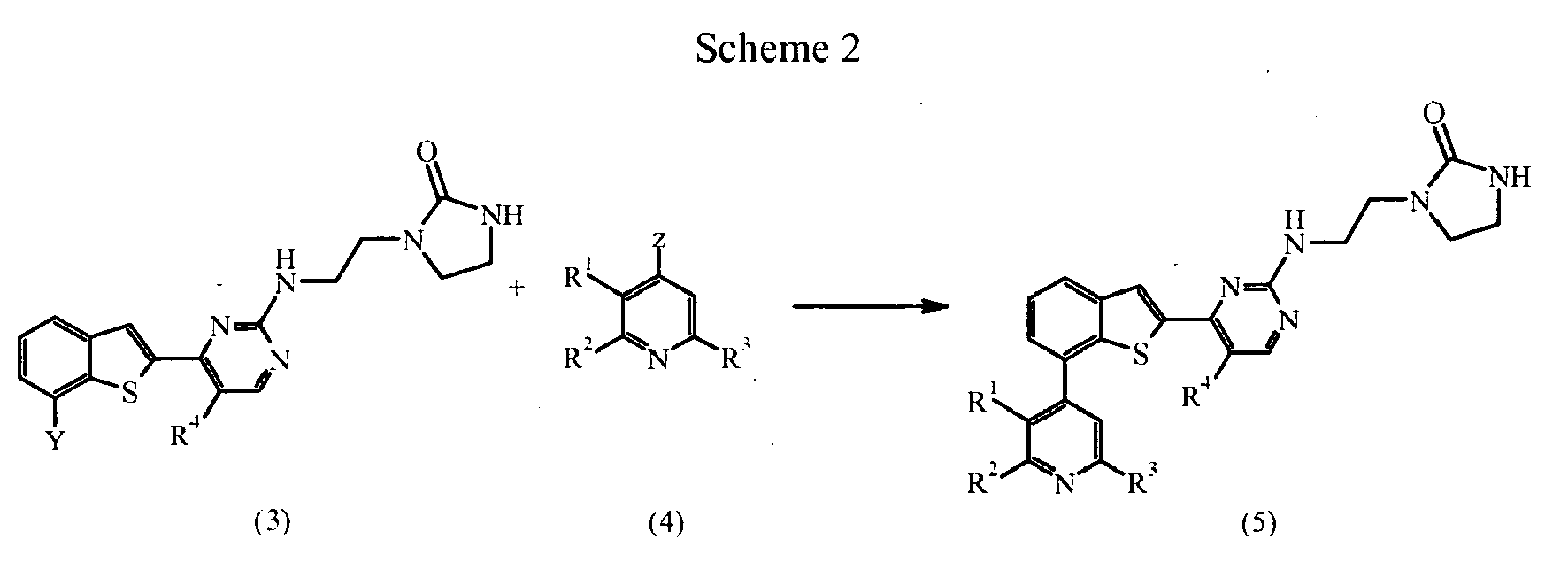
- A compound of Formula (3) is reacted with a compound of Formula (4) in a Suzuki reaction using a suitable palladium catalyst, such as tetrakia(triphenylphosphine)palladium(0), [1,1'-bis(diphenylphosphino)ferrocene]dicliloropalladium(II), and the like in the presence of a base, such as sodium carbonate, potassium carbonate, and the like. Such reactions are carried out in a suitable solvent, such as THF, dioxane, water, and the like. Generally, the reactions are carried out at temperatures of from about 100 °C to 150 °C using an oil bath or a microwave reactor.
- In an optional step, a pharmaceutically acceptable salt of a compound of the present invention is formed. The formation of such salts is well known and appreciated in the art.
- As will be readily appreciated compounds of Formulas (1) and (3) can be readily prepared by methods similar to those described herein by procedures that are well-known and established in the art. For example, compounds of Formula (1) are prepared by coupling an optionally substituted pyridinyl compound with an optionally substituted benzothiophenyl compound by Suzuki coupling methods, as described above. The resulting Suzuki adduct is boronylated by methods well known in the art and further coupled to an optionally substituted pyrimidine halide via Suzuki coupling methods, as described above. Compounds of Formula (3) are prepared by boronylation of an optionally substituted benzothiophenyl compound by methods well known in the art followed by addition of 2-(amino-ethyl)-1,3-dihydro-imidazol-one (2) to the resulting boronic acid/ester via nucleophilic aromatic substitution. Also, it is recognized that the steps required to prepare a compound of Formula (1) or (3) can be carried out in any order including reaction of a partial compound of Formula (1) or (3) with a compound of Formula (2) and/or Formula (4), such that the later carried out carbon-carbon bond formation, coupling reaction, etc, provide a compound of the present invention.
- The present invention is further illustrated by the following examples and preparations. These examples and preparations are illustrative only and are not intended to limit the invention in any way. The terms used in the examples and preparations have their normal meanings unless otherwise designated. The example compounds below were named using ChemDraw®, Version 10.
- Combine 7-bromo-benzo[b]thiopliene (426 mg, 2 mmol), bis(pinacolato)diboron (756 mg, 3 mmol), [1,1'-bis(diphenylphosphino)ferrocene]dichloropalladium(II), complex with dichloromethane (1:1) (81 mg, 0.1 mmol), potassium acetate (294 mg, 3 mmol) in dimethyl sulfoxide (DMSO) (10 mL) in a flask. Bubble nitrogen through the mixture for 5 min. Seal the flask and heat in an oil bath at 100°C for 4 hours. Dilute the mixture with chloroform/isopropanol (3/1). Wash the solution with saturated aqueous sodium chloride. Dry the solution over sodium sulfate. Concentrate the solution in vacuo to a dark residue. Purify by column chromatography (hexane to 20 % ethyl acetate in hexane) to afford the title compound (342 mg, 66 %) as a colorless solid. MS (ES) m/z 261 [M+1]+
- Combine 7-bromobenzo[b]thiophene (300 g, 1.41 mmol) and triisopropylborate (403.6 g, 2.15 mmol) in anhydrous tetrahydrofuran (THF) (4000 mL) in a 12 L Morton flask fitted with a mechanical stirrer and cool under nitrogen in a dry-ice/acetone bath to - 70 °C. Add n-butyl lithium (1.6 M in hexane, 714 g, 1.68 mmol) dropwise at such a rate as to keep the internal temperature less than -67.5 °C. After the addition is complete, allow the reaction mixture to stir at this temperature for 1 hour. Remove the cooling bath and slowly add 4 L of water. Add concentrated HCl (75 mL) until the pH of the solution is about pH=2. Allow the slurry to stir for 1 hour. Add sufficient 5 N aqueous NaOH to adjust the pH of the mixture to about pH=12. Separate the layers and save the aqueous layer. Dilute organic layer with 4 L of methyl-tert-butyl ether and extract with 1 L of 5 N aqueous NaOH. Separate the layers. Combine the aqueous layer with the previous aqueous extract. Wash the aqueous layer with additional methyl-tert-butyl ether (4 L). Separate the layers and transfer the aqueous layers to a 12 L 3-neck round bottom flask fitted with a mechanical stirrer. Cool the solution to +5 °C with an ice-water bath. Add concentrated HCl slowly until the pH of the solution is about pH=2. Stir the mixture for 30 min and filter off the resulting solid. Rinse the solid on the funnel twice with 2 L of water and allow to air-dry for 30 min. Place the solid in a vacuum oven at 50 °C and dry under vacuum overnight. Remove the yellow color by slurrying the dried solid with 2 L of n-heptane for 30 min. Again filter off the solid, air-dry for 30 min, and vacuum dry at 40 °C overnight to afford the title compound (188.8 g, 75 %) as a white solid. 1H NMR (400 MHz, CD3OD) δ 7.86 (d, J = 8 Hz, 1H), 7.49-7.57 (m, 2H), 7.30-7.39 (m, 2H).
- Equip a 100 mL 3 neck round bottom flask with: a magnetic stirrer, a thermocouple controlled heating mantle, a condenser, and a nitrogen atmosphere. Charge 5-amino-2-fluoro-pyridine (5 g, 44.6 mmol), THF (50 mL), 4-dimethylaminopyridine (549 mg, 4.5 mmol, 10 mol %), and di-tert-butyl-dicarbonate (10.7 g, 49 mmol). Heat the mixture to 50 °C for 4 hours. Cool and concentrate in vacuo. Dissolve residue into dichloromethane/water and filter. Transfer filtrate to a separatory funnel and separate the dichloromethane layer. Dry the dichloromethane over sodium sulfate, filter and concentrate in vacuo. Chromatograph on silica eluting with an isocratic mixture of 10 % isopropanol /90 % dichloromethane to give the title compound (1.64 g, 17 %) as a tan, clear oil that solidifies upon vacuum drying. MS (EI) m/z 261 M+.
- Prepare the title compound essentially according to the preparation of (6-fluoro-pyridin-3-yl)-carbamic acid tert-butyl ester using the appropriate starting material. GCMS (EI) m/z 212 M+.
- Equip a 250 mL 3-neck round bottom flask with: a magnetic stirrer, a thermocouple, a dry ice/acetone bath, a nitrogen atmosphere, and an addition funnel. Charge 2,2-dimethyl-N-pyridin-3-yl-propionamide (3.0 g, 16.8 mmol), diethyl ether (67 mL), tetramethylene diamine (4.68 g, 6.08 mL, 40.3 mmol). Cool the reaction to -78°C. Add slowly via glass syringe n-butyllithium (2.5 M solution in hexane, 16.2 mL, 40.3 mmol) over 10 min. Allow the reaction to warm to -13 °C over 2 hours. Cool the reaction to -78 °C. Add an iodine solution (8.5 g, 33.6 mmol in 20 mL THF) to the reaction via the addition funnel and mix 2.5 hours at -68 °C. Quench the reaction by the addition of saturated aqueous NH4Cl solution (40 mL). Extract with ethyl acetate (100 mL) and discard the aqueous phase. Wash the organic layer with a saturated aqueous sodium thiosulfate solution (100 mL) and saturated aqueous sodium chloride. Dry the organic phase over sodium sulfate and filter. Concentrate in vacuo to give brown oil. Chromatograph on silica (80 g) eluting with a gradient of 100 % dichloromethane to 70 % ethyl acetate /30 % dichloromethane to afford the title compound (1.19 g, 23 %). MS (ES) m/z 305 [M+1]+
- Prepare the following compounds essentially according to the preparation of N-(4-iodo-pyridin-3-yl)-2,2-dimethyl-propionamide using the appropriate starting material.
Prep Compound Name Physical
Data6 (6-Fluoro-4-iodo-pyridin-3-yl)-carbamic acid tert-butyl ester MS (ES)
m/z 339
[M+1]+7 (2-Fluoro-4-iodo-pyridin-3-yl)-carbamic acid tert-butyl ester GC-MS (EI)
m/z 338 M+ - Dissolve 3-hydroxypyridine (7 g, 74 mmol) in THF (20.6 mL) and dimethylformamide (34.4 mL) and cool to -15 °C. Add potassium tert-butoxide (8.3 g, 74 mmol) and stir at -15°C for 30 min. Treat the mixture with chloromethylmethyl ether (5.81 mL, 77 mmol) dropwise over 40 min. After the addition is complete, stir the mixture at -15°C for an additional hour. Remove the ice bath and allow the mixture to warm slowly to 15 °C. Pour the mixture into saturated aqueous sodium chloride and stir vigorously for 10 min. Extract the resulting solution with three portions of ethyl acetate. Combine the organic extracts and wash with saturated aqueous sodium chloride, dry over sodium sulfate, filter, and concentrate in vacuo. Use the resulting product without further purification. 1H NMR (400 MHz, CDCl3) δ 8.42 (d, J = 3 Hz, 1H), 8.28 (d, J = 5 Hz, 1H), 7.37-7.42 (m, 1H), 7.21-7.27 (m, 1H), 5.20 (s, 2H), 3.49 (s, 3H).
- Suspend sodium hydride (3.7 g, 93 mmol) in DMF (50 mL) and add a solution of 2-chloro-5-hydroxypyridine (10 g, 77 mmol) in DMF (20 mL) dropwise over 45 min. Stir the resulting solution at room temperature for 1.5 hours. Add chloromethylmethyl ether (6.6 mL, 86 mmol) dropwise over 45 min. Stir the resulting mixture at room temperature for 12 hours. Dilute the mixture with ethyl acetate, water, and saturated aqueous sodium chloride. Isolate the organic solution and wash with three portions of water, one portion of saturated aqueous sodium chloride, dry over sodium sulfate, filter, and concentrate in vacuo. Purify the crude product by column chromatography on 330 g of silica gel eluting with a gradient from hexane to 30 % ethyl acetate in hexane over 20 min and then hold at 30 % ethyl acetate in hexane for 30 min to give the title compound (10.8 g, 81 %) as a clear oil. MS (ES) m/z 174.0 [M+1]+.
- Prepare the following intermediate with methods similar to those used for 2-chloro-5-methoxymethoxy-pyridine.
Prep Compound Name NMR 10 2-Fluoro-5-methoxymethoxy-pyridine 1H NMR (400 MHz, CDCl3) δ 3.48 (s, 3H), 5.15 (s, 2H), 6.85 (dd, J = 3.6 Hz, J = 8.8 Hz, 1H), 7.47 (m, 1 H), 7.96 (m, 1 H) - Add tert-buty lithium (1.7 M in pentane, 72 mL, 123 mmol) to a solution of 2-chloro-5-methoxymethoxy-pyridine (10.8 g, 62 mmol) in THF (300 mL) at -70 °C dropwise over 10 min. Stir the resulting solution at -70 °C for 30 min. Add a solution of iodine (23 g, 92 mmol) in THF (150 mL) dropwise over 30 min. Stir the resulting solution at -70 °C for 1-hour. Remove the ice bath and allow the reaction to warm to room temperature. Dilute the mixture with ethyl acetate and water and isolate the phases. Extract the aqueous phase with two portions of ethyl acetate. Combine the organic extracts and wash with two portions of aqueous sodium thiosulfate, one portion of water, one portion of saturated aqueous sodium chloride, dry over sodium sulfate, filter and concentrate in vacuo. Triturate the resulting solid with hexane. Collect the solid by vacuum filtration and wash the solid with hexane. Dry the solid under vacuum to give the title compound (10.8 g, 58 %) as a brown solid. 1H NMR (400 MHz, DMSO-d6) δ 8.08 (s, 1H), 7.98 (s, 1H), 5.43 (s, 2H), 3.40 (s, 3H).
- Prepare the following intermediate using essentially the procedure for 2-chloro-4-iodo-5-methoxymethoxy-pyridine.
Prep Compound Name NMR 12 2-Fluoro-4-iodo-5-methoxymethoxy-pyridine 1H NMR (400 MHz, CDCl3) δ 3.53 (s, 3H), 5.23 (s, 2H), 7.39 (d, J =4.0 Hz, 1H), 7.96 (d, J = 1.6 Hz, 1H) - Treat a solution of 2-chloro-4-iodo-5-methoxymethoxy-pyridine (8.1 g, 27 mmol) in THF (40 mL) with 3 N HCl (61 mL). Heat the resulting mixture to 60 °C for 3-hours. Cool the mixture to room temperature and adjust the pH to 7 by the slow addition of saturated aqueous sodium bicarbonate solution. Extract the mixture with three portions of ethyl acetate. Combine the organic extracts and dry over sodium sulfate, filter, and concentrate in vacuo to give the title compound (6.8 g, 98 %) as a brown solid used without further purification. 1H NMR (400 MHz, DMSO-d6) δ 11.04 (s, 1H), 7.81-7.87 (m, 2H).
- Prepare the following intermediate using essentially the procedure for 6-chloro-4-iodo-pyridin-3-ol.
Prep Compound Name MS (ES)
[M+1]+14 6-Fluoro-4-iodo-pyridin-3-ol 240 - Treat a solution of 6-chloro-4-iodo-pyridin-3-ol (4.9 g, 19 mmol) and potassium carbonate (8.0 g, 58 mmol) in dimethylformamide (50 mL) with ethyl iodide (4.7 mL, 58 mmol). Heat at 60 °C for 3 hours. Cool the mixture to room temperature and filter. Dilute the mixture with ethyl acetate and wash with a 10 % aqueous citric acid solution. Combine the aqueous solutions and extract with two additional portions of ethyl acetate. Combine the organic extracts and wash with three portions of water, one portion of saturated aqueous sodium chloride, dry over sodium sulfate, filter, and concentrate in vacuo to give the title compound (5.1 g, 93 %) as a brown solid used without further purification. 1H NMR (400 MHz, DMSO-d 6) δ 8.00(,s, 1H), 7.93 (s, 1H), 4.18 (q, J = 7 Hz, 2H), 1.35 (t, J = 7 Hz, 3H).
- In a flask, combine 7-bromo-benzo[b]thiophene (1.7 g, 12 mmol), 2-chloro-4-(4,4,5,5-tetramethyl-[1,3,2]dioxaborolan-2-yl)-pyridine (1.6 g, 7 mmol), [1,1'-bis(diphenylphosphino)ferrocene]dichloropalladium(II), complex with dichloromethane (1:1) (285 mg, 0.3 mmol), 2-(di-tert-butylphosphino)biphenyl (63 mg, 0.2 mmol), sodium carbonate (2 M, 8 mL, 16 mmol) and THF (20 mL). Heat the mixture at 100°C for 3 hours. Dilute the mixture with chloroform/isopropanol (3/1). Wash the solution with saturated aqueous sodium chloride. Dry over sodium sulfate. Concentrate the solution in vacuo to a dark residue. Purify by column chromatography (dichloromethane to 20 % THF in dichloromethane) to afford the title compound (1.14 g, 66 %) as a yellow solid. MS (ES) m/z 246 [M+1]+.
- Prepare the following compounds by methods similar to those used for 4-benzo[b]thiophen-7-yl-2-chloro-pyridine using DMSO.
Prep Compound Name MS (ES)
[M+1]+Comments 17 4-Benzo[b]thiophen-7-yl-pyridine 212 Heat at 100°C catalyst Pd(PPh3)4 - In a flask, combine 2-fluoro-4-iodo-5-mcthyl-pyridine (355 mg, 1.5 mmol), 2-benzo[b]thiophen-7-yl-4,4,5,5-tetramethyl-[1,3,2]dioxaborolane (282 mg, 1.8 mmol), [1,1'-bis(diphenylphosphino)ferrocene]dichloropalladium(II), complex with dichloromethane (1:1) (61 mg, 0.07 mmol), 2-(di-tert-butylphosphino)biphenyl (13 mg, 0.04 mmol), sodium carbonate (2 M, 1.5 mL, 3 mmol) and THF (10 mL). Heat the mixture at 100 °C for 3 hours in an oil bath. Dilute the mixture with chloroform/isopropanol (3/1). Wash the solution with saturated aqueous sodium chloride. Dry over sodium sulfate. Concentrate in vacuo to a dark residue. Purify by column chromatography (20 % ethyl acetate in hexane) to afford the title compound (300 mg, 82 %) as yellow oil. MS (ES) m/z 244 [M+1]+.
- Prepare the following intermediates essentially according to the preparation of 4-benzo[b]thiophen-7-yl-2-fluoro-5-methyl-pyridine using the appropriate starting material.
Prep Compound Name Physical Data MS (ES) m/z [M+1]+ Comments 19 (4-Benzo[b]thiophen-7-yl-6-fluoro-pyridin-3-yl)-carbamic acid tert-butyl ester 345 N2 atmosphere 20 4-Benzo[b]thiophen-7-yl-2-fluoro-pyridin-3-ylamine 345 N2 atmosphere 21 4-Benzo[b]thiophen-7-yl-2-chloro-5-ethoxy-pyridine 290 N2 atmosphere 22 (4-Benzo[b]thiophen-7-yl-6-fluoro-pyridin-3-yl)-carbamic acid tert-butyl ester 345 Deoxygenated (N2) 23 (4-Benzo[b]thiophen-7-yl-pyridin-3-yl)-methyl-carbamic acid tert-butyl ester 325 Deoxygenated (N2) - Solution A: Treat a solution of 3-methoxymethoxy-pyridine (2.5 g, 18 mmol) in diethyl ether (90 mL) at -70 °C with tert-butyl lithium (1.7 M in pentane, 10 mL, 18 mmol) dropwise over 10 min. Stir the mixture at -70 °C for 40 min and add a solution of triisopropyl borate (5 mL, 22 mmol) in THF (10 mL) dropwise over 5 min. Stir the mixture at -70 °C for one hour and then remove the ice bath and allow the mixture to slowly warm to room temperature.
- Solution B: Treat a solution of 7-bromo-benzo[b]thiophene (3.8 g, 18 mmol), 2-(di-tert-butylphosphino)biphenyl (268 mg, 0.90 mmol), [1,1'-bis(diphenylphosphino)ferrocene]dichloropalladium(II), complex with dichloromethane (1:1) (732 mg, 0.90 mmol) in 1,4-dioxane (30 mL) with 2 M aqueous sodium carbonate (72 mL, 36 mmol). Once solution A reaches room temperature, heat the solution to 80 °C.
- Treat solution B with solution A dropwise over 10 min. Heat the combined solution to 85 °C for 5 hours. Cool the mixture to room temperature and dilute with ethyl acetate and water. Wash the organic phase with water and saturated aqueous sodium chloride, dry over sodium sulfate, filter, and concentrate in vacuo. Purify the crude product by column chromatography on 120 g silica gel eluting with a gradient of dichloromethane to ethyl acetate to give the title compound (3.8 g) containing some starting 3-methoxymethoxy-pyridine. Use product without further purification. 1H NMR (400 MHz, CDCl3) δ 8.68 (s, 1H), 8.42 (d, J = 4 Hz, 1H), 7.88 (d, J = 8 Hz, 1H), 7.33-7.50 (m, 5H), 5.12 (s, 2H), 3.36 (s, 3H).
- In a 500 mL round bottom flask, cool a solution of 4-benzo[b]thiophen-7-yl-2-chloro-pyridine (13 g, 53.1 mmol) and triisopropylborate (20 g, 106 mmol) in THF (150 mL) to -70° under nitrogen. To the cooled-solution, add lithium diisopropylamide (2 M in THF, 53 mL, 106 mmol) gradually over a period of 30 min. Stir the mixture continually for an additional 1 hour in the cooling bath. Gradually transfer the mixture into a refluxing solution of 2,4-dichloro-pyrimidine (12 g, 106 mmol), [1,1'-bis(diphenyl-phosphino)ferrocene]dichloropalladium(II), complex with dichloromethane (1:1) (2.2 g, 53 mmol) and sodium carbonate (35 mL, 3 M, 106 mmol) in THF (150 mL) over a period of 30 min. Reflux for an additional 1 hour. Cool the mixture to room temperature and dilute with 500 mL of chloroform/isopropanol (3/1) and 200 mL of water. Collect the resulting solid by filtration and reserve the chloroform/isopropanol/water mixture. Wash the solid with dichloromethane and dry it under vacuum. Separate the layers of the chloroform/isopropanol/water mixture. Wash the organic phase with water and saturated aqueous sodium chloride, dry over sodium sulfate and concentrate in vacuo to give a brown residue. Purify the residue by flash column chromatography (10 % methanol in dichloromethane) to afford additional product. Combine the two portions to give the title compound (13 g, 68 %) MS (ES) m/z 358 [M+1]+.
- Prepare the following intermediates essentially according to the preparation of 2-chloro-4-[7-(2-chloro-pyridin-4-yl)-benzo[b]thiophen-2-yl]-pyrimidine using the appropriate starting material.
Prep Compound Name Physical Data MS (ES) m/z [M+1]+ Comments 26 2-Chloro-5-fluoro-4-(7-pyridin-4-yl-benzo[b]thiophen-2-yl)-pyrimidine 342 27 2-Chloro-5-methyl-4-(7-pyridin-4-yl-benzo[b]thiophen-2-yl)-pyrimidine 338 28 2-Chloro-5-fluoro-4-[7-(2-fluoro-5-methyl-pyridin-4-yl)-benzo[b]thiophen-2-yl]-pyrimidine 374 29 2-Chloro-4-[7-(2-fluoro-5-methyl-pyridin-4-yl)-benzo[b]thiophen-2-yl]-5-methyl-pyrimidine 370 30 2-Chloro-4-[7-(2-fluoro-5-methyl-pyridin-4-yl)-benzo[b]thiophen-2-yl]-pyrimidine 356 Additive: 2-(di-tert-butylphosphino)biph enyl 31 2-Chloro-5-fluoro-4-[7-(3-methoxymethoxy-pyridin-4-yl)-benzo[b]thiophen-2-yl]-pyrimidine 402 32 2-Chloro-4-[7-(2-chloro-5-ethoxy-pyridin-4-yl)-benzo[b]thiophen-2-yi]-5-fluoro-pyrimidine 420 33 {4-[2-(2-Chioro-pyrimidin-4-yl)-benzo[b]thiophen-7-yl]-6-fluoro-pyridin-3-yl}-carbamic acid tert-butyl ester 457 34 4-(7-Bromo-benzo[b]thiophen-2-yl)-2-chloro-5-fluoro-pyrimidine 343 35 2,5-Dichloro-4-[7-(2-fluoro-5-methyl-pyridin-4-yl)-benzo[b]thiophen-2-yl]-pyrimidine 390 Additive: 2-(di-tert-butylphosphino)biphenyl 36 4-(7-Bromo-benzo[b]thiophen-2-yl)-2-chloro-5-chloro-pyrimidine 361 37 4-(7-Bromo-benzo[b]thiophen-2-yl)-2-chloro-5-methyl-pyrimidine 340 GCMS (EI) M+ 38 4-(7-Bromo-benzo[b]thiophen-2-yl)-2-chloro-pyrimidine 327 - Treat a solution of 2-chloro-5-fluoro-4-[7-(3-methoxymethoxy-pyridin-4-yl)-benzo[b]thiophen-2-yl]-pyrimidine (4 g, 10 mmol) in THF (10 mL) with 5 N HCl (3 mL). Stir the mixture at room temperature for 6 hours. Concentrate the reaction in vacuo and dilute with saturated aqueous sodium bicarbonate and dichloromethane. Separate the layers and filter each layer. Wash the solid from the organic phase with dichloromethane to give the title compound (300 mg) as a tan solid. Wash the solid from the aqueous layer with water and dry to give the title compound (300 mg) as a tan solid. Combine the solids to give the title compound (600 mg, 17 %) as a tan solid. MS (ES) m/z 358 [M+1]+.
- Treat a solution of 4-[2-(2-chloro-5-fluoro-pyrimidin-4-yl)-benzo[b]thiophen-7-yl]-pyridin-3-ol (100 mg, 0.28 mmol) and cesium carbonate (100 mg, 0.28 mmol) in dimethylformamide (1 mL) with ethyl iodide (44 mg, 0.28 mmol). Stir the mixture at room temperature for 12 hours. Dilute the mixture with ethyl acetate and wash the solution with three portions of water, one portion of saturated aqueous sodium chloride, dry over sodium sulfate, filter, and concentrate in vacuo. Purify the crude product by column chromatography on 12 g silica gel eluting with a gradient of dichloromethane to ethyl acetate to give the title compound (48 mg, 45 %) as a brown solid. MS (ES) m/z 386 [M+1]+.
- Prepare the title compound essentially according to the preparation of 2-chloro-4-[7-(3-ethoxy-pyridin-4-yl)-benzo[b]thiophen-2-yl]-5-fluoro-pyrimidine using the appropriate starting material. MS (ES) m/z 372 [M+1]
- Combine 1-(2-aminoethyl)-2-imidazolone (100 g, 774 mmol) with 4-(7-bromo-benzo[b]thiophen-2-yl)-2-chloro-5-fluoro-pyrimidine (90 g, 262 mmol) in 1,4-dioxane (650 mL) and heat to 90 °C with stirring under nitrogen for 3 hours. Cool the reaction to room temperature. Filter and wash the solid with water (3 x 500 mL) and diethyl ether (500 mL). Vacuum-dry at 50 °C to give the title compound (59.2 g, 52 %) as a yellow solid. MS (ES) m/z 436 [M+1]+.
- Prepare the following intermediates essentially according to the preparation of 1-{2-[4-(7-bromo-benzo[b]thiophen-2-yl)-5-fluoro-pyrimidin-2-ylamino]-ethyl}-imidazolidin-2-one using the appropriate starting material.
Prep Compound name Physical Data MS (ES) m/z
[M+1]+43 1-{2-[4-(7-Bromo-benzo[b]thiophen-2-yl)-5-chloro-pyrimidin-2-ylamino]-ethyl}-imidazohdin-2-one 454 44 1-{2-[4-(7-Bromo-benzo[b]thiophen-2-yl)-5-methyl-pyrimidin-2-ylamino]-ethyl}-imidazolidin-2-one 432 45 1-{2-[4-(7-Bromo-benzo[b]thiophen-2-yl)-pyrimidin-2-ylamino]-ethyl}-imidazolidin-2-one 420 - In a flask, combine 2-fluoro-4-iodo-picoline (10.0 g, 42.19 mmol), N-bromosuccinimide (9.76 g, 54.85 mmol), 2, 2'-azobisisobutyronitrile (3.46 g, 21.10 mmol) and dry CCl4 (100 mL). Heat at 70 °C under nitrogen for 16 hours. Cool to room temperature. Dilute with dichloromethane and wash with water and saturated aqueous sodium chloride. Separate the layers and dry the organic layer over magnesium sulfate. Concentrate in vacuo to give crude product. Purify by column chromatography (1 % to 15 % ethyl acetate in hexane) to afford the title compound (8.27 g, 62 %). MS (EI) m/z 315 M+.
- Combine 1-{2-[4-(7-bromo-benzo[b]thiophen-2-yl)-5-fluoro-pyrimidin-2-ylamino]-ethyl}-imidazolidin-2-one (5.5 g, 12.6 mmol), bis(pinacolato)diboron (3.84 g, 15.3 mmol), (1,1'-bis(diphenylphosphino)-ferrocene)dichloropallidium(II) (1.0 g, 1.3 mmol), potassium acetate (2.5 g, 25 mmol) in DMSO (80 mL) in a flask. Bubble nitrogen through the mixture for 10 min. Seal the flask and put it into an oil bath to heat at 85 °C overnight. Dilute the mixture with chloroform/isopropyl alcohol (3/1). Wash the-solution with saturated aqueous sodium chloride. Dry it over sodium sulfate. Concentrate the solution in vacuo to a dark residue. Purify the residue by column chromatography-(hexane→ 20 % ethyl acetate in hexane → 10 % methanol in dichloromethane) to afford the product as a brown solid (5 g, 82 %). MS (ES) m/z 484 [M+1]+.
- Combine 5-bromomethyl-2-fluoro-4-iodo-pyridine (0.9 g, 2.85 mmol), nitromethane (15 mL, 278 mmol), silver tetrafluoroborate (721 mg, 3.7 mmol), and dimethylformamide (5 mL) in a round bottom flask. Stir the mixture overnight at room temperature. Add sodium carbonate (1.81 g, 17.1 mmol) and methanol (10 mL) into the mixture. Stir at room temperature for another 4 hours. Dilute the reaction mixture with chloroform, and wash with water and saturated aqueous sodium chloride. Separate the organic layer from the aqueous layer and dry over MgSO4. After filtration, evaporate the organic solvent in vacuo to give the crude product. Purify the crude with flash column chromatography (eluted with 10 % methanol in dichloromethane) to give the desired product (0.6 g, 83%). MS (ES) m/z 254 [M+1]+.
- Add diethylaminosulfur trifluoride (892 mg, 4 mmol) drop-wise to a solution of (6-fluoro-4-iodo-pyridin-3-yl)-methanol in dichloromethane (25 mL) in a round bottom flask under nitrogen, and then add ethanol (0.3 mL) at 0-5 °C. Stir the mixture for 3 hours. Pour the reaction mixture into saturated sodium bicarbonate solution. Abstract the product into chloroform, and wash with water and saturated aqueous sodium chloride. Separate the organic layer from the aqueous layer and dry over MgSO4. After filtration, evaporate the organic solvent in vacuo to give a crude product. Purify the crude with flash column chromatography (10 % methanol in dichloromethane) to give the title compound (0.32 g, 53 %). MS (ES) m/z 256 [M+1]+.
-

- Combine 2-chloro-4-[7-(2-chloro-pyridin-4-yl)-benzo[b]thiophen-2-yl]-pyrimidine (9 g, 25.1 mmol) and 2-(amino-ethyl)-1,3-dihydro-imidazol-one (6.4 g, 50.2 mmol) in n-butanol (200 mL) in a pressure vessel. Heat the mixture in an oil bath at 120 °C for 5 hours. Dilute the mixture with chloroform/isopropanol (3/1). Wash the solution with saturated aqueous sodium chloride. Dry it over sodium sulfate. Concentrate the solution in vacuo to a dark residue. Purify by column chromatography (dichloromethane to 10 % methanol in dichloromethane) to afford the title compound (9 g, 93 %) as a yellow solid. MS (ES) m/z 451 [M+1]+.
- Prepare the following examples essentially according to the preparation of 1-(2-{4-[7-(2-chloro-pyridin-4-yl)-benzo[b]thiophen-2-yl]pyrimidin-2-ylamino}-ethyl)-imidazolidin-2-one using the appropriate starting material.
Ex Compound name Structure Physical Data MS (ES) m/z [M+1]+ Comments 2 1-(2-{5-Fluoro-4-[7-(2-fluoro-5-methylpyridin-4-yl)-benzo[b]thiophen-2-yl]-pyrimidin-2-ylamino}ethyl)imi dazolidin-2-one 
467 Microwave, 1,4-dioxane-NMP 120°C 3 1-(2-{4-[7-(2-Fluoro-5-methylpyridin-4-yl)-benzo[b]thiophen-2-yl]-5-methylpyrimidin-2-ylamino}ethyl)imi dazolidin-2-one 
463 Microwave, 1,4-dioxane-NMP 120°C 4 1-(2-{4-[7-(2-Fluoro-5-methylpyridin-4-yl)-benzo[b]thiophen-2-yl]pyrimidin-2-ylamino}-ethyl)imidazolidin -2-one 
449 Additive: Triethyl amine - 3 equivalents 5 1-{2-[5-Methyl-4-(7-pyridin-4-yl-benzo[b]thiophen-2-yl)pyrimidin-2--ylamino]-ethyl}imidazolidin -2-one 
431 Microwave, NMP 120°C 6 1-(2-{5-Chloro-4-[7-(2-fluoro-5-methylpyridin-4-yl)benzo[h]thioph en-2-yl]-pyrimidin-2-ylamino}ethyl)imi dazolidin-2-one 
483 Additive: Triethyl amine - 3 equivalents 7 1-{2-[5-Fluoro-4-(7-pyridin-4-yl-benzo[b]thiophen-2-yl)pyrimidin-2-ylamino]-ethyl}imidazolidi n-2-one 
435 Microwave, NMP 120°C 8 1-(2-{4-[7-(3-Ethoxypyridin-4-yl)-benzo[b]thiophen-2-yl]-5-fluoropyrimidin-2-ylamino}ethyl)imi dazolidin-2-one 
479 9 1-(2-(5-Fluoro-4-(7-(3-hydroxypyridin-4-yl)benzo[b]thioph en-2-yl)pyrimidin-2-ylamino)ethyl)imi dazolidin-2-one 
451 10 1-(2-{4-[7-(2-Chloro-5-ethoxypyridin-4-yl)-benzo[b]thiophen-2-yl]-5-fluoropyrimidin-2-ylamino}-ethyl)imidazolidin -2-one 
513 11 1-(2-{5-Fluoro-4-[7-(3-methoxypyridin-4-yl)-benzo[b]thiophen-2-yl]pyrimidin-2-ylamino}-ethyl)imidazolidin-2-one 
465 -

- Combine 1-{2-[4-(7-bromo-benzo[b]thiophen-2-yl)-5-chloro-pyrimidin-2-ylamino]-ethyl}-imidazolidin-2-one (81.6 mg, 0.18 mmol), pyridine-4-boronic acid (36.8 mg, 0.3 mmol), and sodium bicarbonate (18.1 mg, 0.2 mmol) in a mixture of water (1 mL) and DMSO (1 mL). Add tetrakis(triphenylphosphine)palladium(0) (10.4 mg, 0.009 mmol). Irradiate the mixture at 150 °C for 15 min with magnetic stirring. Pour the crude reaction mixture onto a strong cation exchange (SCX) (10 g) column. Elute the desired product with 2 N ammonia in methanol (40 mL) and concentrate under reduced pressure. Purify by reverse phase chromatography (30 to 90 % gradient at 80 mL/min for 11 min on a 30 x 100 mm, 5 mm, C18 MS Xterra® column, Solvent A: water with 0.01 M ammonium bicarbonate, Solvent B: acetonitrile) to afford the title compound (20.4 mg, 25.1 %). MS (ES) m/z 451 [M+1]+.
-
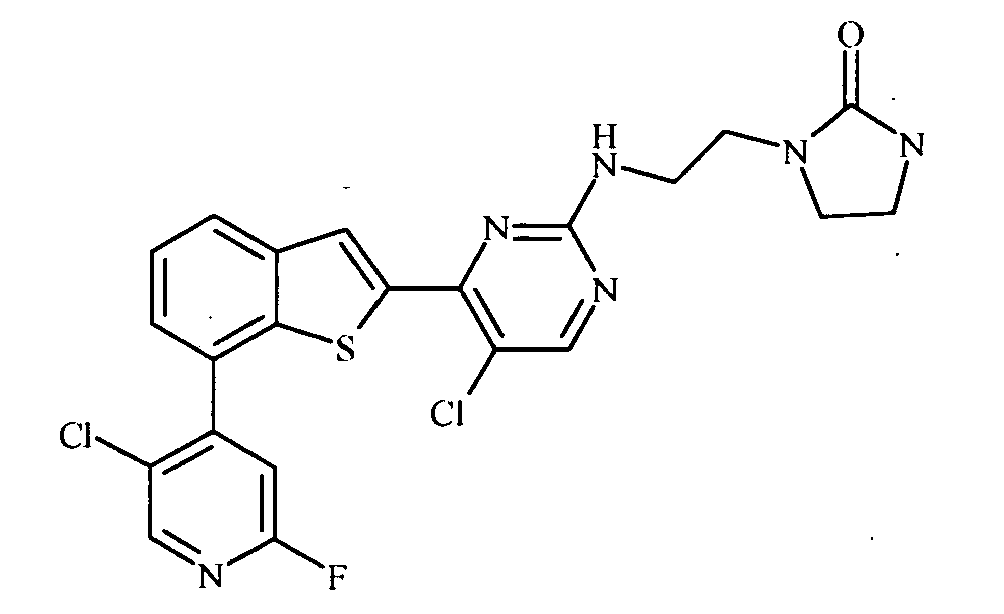
- In a microwave vial, combine 1-{2-[4-(7-bromo-benzo[b]thiophen-2-yl)-5-chloro-pyrimidin-2-ylamino]-ethyl}-imidazolidin-2-one (500 mg, 1.1 mmol), 5-chloro-2-fluoropyridine-4-boronic, acid (578 mg, 3.3 mmol), [1,1'-bis(diphenylphosphino) ferrocene]dichloropalladium(II), complex with dichloromethane (1:1) (90 mg, 0.11 mmol), 2-(di-tert-butylphosphino)biphenyl (20 mg, 0.066 mmol) and sodium carbonate (350 mg, 3.3 mmol) in THF (3 mL) and water (1.5 mL). Bubble nitrogen through the mixture for 5 min. Heat the mixture to 100 °C for 10 min. Concentrate the organic layer to dryness in vacuo. Slurry the resulting solid into dichloromethane/methanol and purify by column chromatography (1 % 2 N ammonia/methanol solution in dichloromethane to 10 % 2 N ammonia/methanol solution in dichloromethane) to afford the title compound. For further purification, dissolve the product in DMSO and purify by reverse phase column chromatography (50 % acetonitrile in water (with 0.03 % HCl) to 95 % acetonitrile in water (with 0.03 % HCl) to afford the title compound (146 mg, 26%). MS (ES) m/z 503 [M+1]+.
- Prepare the following examples essentially according to the preparation of 1-(2-{5-chloro-4-[7-(5-chloro-2-fluoropyridin-4-yl)benzo[b]thiophen-2-yl]-pyrimidin-2-ylamino}ethyl)imidazolidin-2-one using the appropriate starting material.
Ex Compound Name Structure Physical Data MS (ES) m/z [M+1]+ Comments 14 1-(2-{4-[7-(2-Chloro-pyridin-4-yl)-benzo[b]thiophen-2-yl]-5-fluoropyrimidin-2-ylamino}ethyl)imidazolidin-2-one 
469 15 1-(2-{5-Chloro-4-[7-(2-chloro-pyridin-4-yl)benzo[b]thiophen-2-yl]pyrimidin-2-ylamino}ethyl)imidazolidin-2-one 
486 16 1-(2-{4-[7-(5-Chloro-2-fluoro-pyridin-4-yl)-benzo[b]thiophen-2-yl]-5-fluoropyrimidin-2-ylamino}ethyl)imidazolidin-2-one 
487 Purify by reverse phase, CH3CN and water 17 1-(2-{4-[7-(2-Chloro-5-fluoropyridin-4-yl)-benzo[b]thiophen-2-yl]-5-fluoropyrimidin -2-ylamino}-ethyl)imidazolidin-2-one 
487 Purify by reverse phase, CH3CN and water 18 1-(2-{4-[7-(3-Chloro-pyridin-4-yl)-benzo[b]thiophen-2-yl]-5-fluoropyrimidin-2-ylamino}ethyl)imidazolidin-2-one 
469 Purify by reverse phase, CH3CN and water 19 1-(2-{5-Fluoro-4-[7-(3-methylpyridin-4-yl)-benzo[b]thiophen-2-yl]pyrimidin-2-ylamin}ethyl)imidazolidin-2-one 
449 Purify on reverse phase, CH3CN and water 20 1-(2-{4-[7-(5-Chloro-2-fluoropyridin-4-yl)-benzo[b]thiophen-2-yl]-5- methylpyrimidin-2-ylamino}ethyl)i midazolidin-2-one 
483 Purify on reverse phase, CH3CN and water 21 1-(2-{4-[7-(2,5-Dichloropyridin-4-yl)-benzo[b]thiophen-2-yl]-5-fluoropyrimidin-2-ylamino}ethyl)imidazolidin-2-one 
503 22 1-(2-{5-Fluoro-4-[7-(2-fluoropyridin-4-yl)-benzo[b]thiophen-2-yl]pyrimidin-2-ylamino}ethyl)imidazolidin-2-one 
453 23 1-(2-{4-[7-(5-Chloro-2-fluoro-pyridin-4-yl)-benzo[b]thiophen-2-yl]pyrimidin-2-ylamino}ethyl)imidazolidin-2-one 
469 -
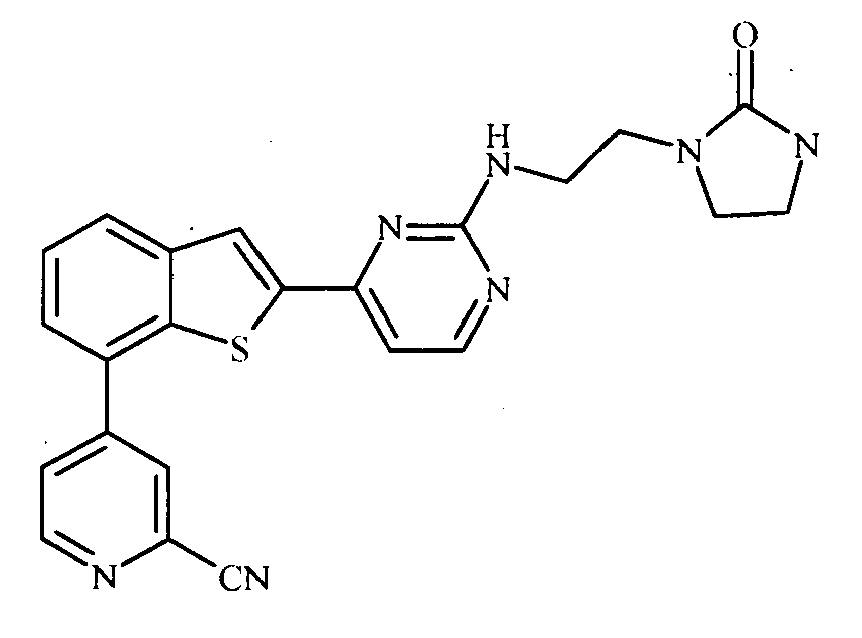
- Combine 1-(2-{4-[7-(2-chloro-pyridin-4-yl)-benzo[b]thiophen-2-yl]-pyrimidin-2-ylamino}-ethyl)-imidazolidin-2-one (100 mg, 0.22 mmol), zinc cyanide (51 mg, 0.44 mmol), tris(dibenzylideneacetone)dipalladium(0) (10 mg, 0.01 mmol), 1,1'-bis(diphenylphosphino)-ferrocene (6 mg, 0.01 mmol) in DMSO (6 mL). Heat the mixture at 100 °C for 4 hours. Cool the mixture to room temperature and load onto a silica column. Elute the column with 10 % methanol in dichloromethane to afford the title compound (0.7 g, 72 %) as yellow oil. MS (ES) m/z 442 [M+1]+.
-

- Combine N-{4-[2-(2-chloro-5-fluoro-pyrimidin-4-yl)-benzo[b]thiophen-7-yl]-pyridin-3-yl}-2,2-dimethyl-propionamide (330 mg, 0.75 mmol), 2-(amino-ethyl)-1,3-dihydro-imidazolone (386 mg, 3.0 mmol), and 1,4-dioxane (6 mL) in a capped vial and heat at 85 °C for 4 hours. Concentrate in vacuo. Dilute the mixture with dichloromethane and water. Wash the organic solution with water. Dry the organic solution over sodium sulfate. Filter and concentrate the solution in vacuo to a dark residue. Purify by column chromatography (dichloromethane to 7 % methanol in dichloromethane) to afford N-[4-(2-{5-fluoro-2-[2-(2-oxo-imidazolidin-1-yl)-ethylamino]-pyrimidin-4-yl}-benzo[b]thiophen-7-yl)-pyridin-3-yl]-2,2-dimethyl-propionamide.
- Transfer the amide intermediate to a 40 mL septum capped vial. Add a magnetic stir bar and charge water (20 mL) and concentrated H2SO4 (5 mL) to the vial. Warm the vial to 90 °C in an oil bath for 5 hours. Cool the reaction to room temperature and pass through an SCX (10 g) column. Elute with water/methanol 1:1, then 100 % methanol, then 1:1 dichloromethane/methanol, and finally elute the product off with 10 % 2 M ammonia in methanol/90 % dichloromethane. Concentrate in vacuo. Chromatograph on silica (80 g) eluting with gradient of 0% to 10% 2 M ammonia/methanol solution in dichloromethane. Dry in vacuum oven at 42 °C for 2 hours to give the title compound (192.6 mg, 48 %) as a gold solid. MS (ES) m/z 450 [M+1]+.
- Prepare the following examples essentially according to the preparation of 1-(2-{4-[7-(3-amino-pyridin-4-yl)benzo[b]thiophen-2-yl]-5-fluoropyrimidin-2-ylamino}-ethyl)imidazolidin-2-one using the appropriate starting material.
Ex Compound name Structure Physical Data MS (ES) m/z
[M+1]+26 1-(2-{4-[7-(3-Methylamino-pyridin-4-yl)benzo[b]thiophen-2-yl]pyrimidin-2-ylamino}ethyl)imidazolidin-2-one 
446 27 1-(2-{4-[7-(3-Amino-pyridin-4-yl)benzo[b]thiophen-2-yl]-5-methylpyrimidin-2-ylamino}ethyl)imidazolidin-2-one 
446 28 1-(2-{4-[7-(3-Amino-pyridin-4-yl)benzo[b]thiophen-2-yl]-pyrimidin-2-ylamino}ethyl)imidaz olidin-2-one 
432 -

- Combine {4-[2-(2-chloro-pyrimidin-4-yl)-benzo[b]thiophen-7-yl]-6-fluoro-pyridin-3-yl}-carbamic acid tert-butyl ester (813 mg, 1.77 mmol), 2-(amino-ethyl)-1,3-dihydro-imidazol-one (919 mg, 7.11 mmol), and 1,4-dioxane (22 mL) in a capped vial and heat at 70 °C for 15 hours. Concentrate in vacuo. Dilute the mixture with dichloromethane and water. Wash the organic solution with water. Dry the organic solution over sodium sulfate. Filter and concentrate the solution in vacuo to a dark residue. Purify by column chromatography (dichloromethane to ethyl acetate) to afford [6-fluoro-4-(2-{2-[2-(2-oxo-imidazolidin-1-yl)-ethylamino]-pyrimidin-4-yl}-benzo[b]thiophen-7-yl)-pyridin-3-yl]-carbamic acid tert-butyl ester.
- Dissolve the [6-fluoro-4-(2-{2-[2-(2-oxo-imidazolidin-1-yl)-ethylaminb]-pyrimidin-4-yl}-benzo[b]thiophen-7-yl)-pyridin-3-yl]-carbamic acid tert-butyl ester into dichloromethane and adsorb onto silica gel (10 g) via concentration in vacuo. Dry under high vacuum for 24 hours. Place silica gel into a round bottom flask and heat in a temperature controlled oil bath to 98-99 °C while under high vacuum for 2 hours. Cool to room temperature. Extract product from silica gel with 10% 7 N ammonia in methanol/90 % dichloromethane. Concentrate in vacuo. Chromatograph on silica eluting with a gradient of 100 % dichloromethane to 7 % 2 N ammonia in methanol/93 % dichloromethane to afford the title compound (65.2 mg, 8.2 %). MS (ES) m/z 450 [M+1]+.
-

- Prepare the title compound essentially according to the preparation of 1-(2-{4-[7-(5-amino-2-fluoro-pyridin-4-yl)-benzo[b]thiophen-2-yl]-pyrimidin-2-ylamino}-ethyl)-imidazolidin-2-one using the appropriate starting material. MS (ES) m/z 450 [M+]+.
-

- Combine 1-(2-{5-fluoro-4-[7-(4,4,5,5-tetramethyl-[1,3,2]dioxaborolan-2-yl)-benzo[b]thiophen-2-yl]-pyrimidin-2-ylamino}-ethyl)-imidazolidin-2-one (120 mg , 0.25 mmol), (6-fluoro-4-iodo-pyridin-3-yl)-methanol (100 mg; 0.32 mmol), (1,1'-bis(diphenylphosphino)ferrocene)palladium(II) chloride (10.14 mg; 0.01 mmol), 2-(di-tert-butylphosphino)biphenyl (2 mg; 0.01 mmol) and sodium carbonate (2 M, 0.2 mL, 0.4 mmol) in 5 mL of dioxane in a pressure tube. Heat the mixture at 100 °C overnight in oil bath. Cool the mixture down to room temperature, dilute it with chloroform-isopropyl alcohol (3/l). Wash the organic phase with saturated aqueous sodium chloride, dry it over sodium sulfate and concentrate it to an oily residue. Purify the crude by flash column chromatography (10 % methanol in dichloromethane) to afford the title compound (25 mg, 21 %). MS (ES) m/z 483 [M+1]+.
-

- Combine 1-(2-{5-fluoro-4-[7-(4,4,5,5-tetramethyl-[1,3,2]dioxaborolan-2-yl)-benzo[b]thiophen-2-yl]-pyrimidin-2-ylamino}-ethyl)-imidazolidin-2-one (120 mg, 248.26 µmol), 2-fluoro-5-fluoromethyl-4-iodo-pyridine (100 mg, 392.15 µmol) tris(dibenzylideneacetone)dipalladium (0) (11.37 mg; 12.41 µmol) tricyclohexylphosphine (2.09 mg, 7.45 µmol), potassium phosphate (105.39 mg, 496.51 µmol) in 5 mL of dioxane in a sealed pressure tube. Heat the mixture at 100 °C for 3 hours in the oil bath. LC-MS shows a peak at 485. Cool the reaction mixture down to room temperature and dilute it with chloroform-isopropyl alcohol (3/1). Wash the organic solution with saturated aqueous sodium chloride, dry it over sodium sulfate and concentrate it to crude. Purify the crude by flush chromatography (10 % methanol in dichloromethane) to give the target product (70 mg, 58.2 %). MS (ES) m/z 485 [M+1]+.
- Plk1 has been shown to be over expressed in many human tumors, such as non-small cell lung, oropharyngeal, oesophageal, gastric, melanoma, breast, ovarian, endometrial, colorectal, glioblastoma, papillary, pancreatic, prostate, hepatoblastoma and non-Hodgkin lymphoma cancers. Furthermore, Plk1 expression has prognostic significance in non-small cell lung, oropharyngeal, oesophageal, melanoma, colorectal, hepatoblastoma and non-Hodgkin lymphoma cancers (Strebhardt, K. and A. Ullrich (2006). Nature Reviews Cancer 6(4): 321-30). Plkl phosphorylated substrates regulate progression of mitosis by coordinating centrosome maturation, entry into mitosis, sister chromatid separation and cytokinesis (Eckerdt and Strebhardt 2006; Strebhardt and Ullrich 2006; van de Weerdt, B. C. and R. H. Medema (2006). Cell Cycle 5(8): 853-64). Inhibiting Plk1 function using antibody injection, expression of a dominant negative Plk1, and antisense mRNA reduction produces monopole spindles and anaphase arrest leading to mitotic cell death in tumor cell lines but reversible G2 arrest in normal non-transformed primary cell lines.
- Additionally, it has been reported that Plk may be useful in the treatment of rhabdoid tumors, (Morozov. A., et al., Clinical Cancer Research. 13(16):4721-30 (Aug 15,2007).
- B1-2536 has demonstrated activity in preclinical models using HCT116, A549 and NCIH460 murine xenografts (Baum, A., P. Garin-Chesa, et al. (2006). #C191 In vivo activity of BI 2536, a potent and selective inhibitor of the mitotic kinase PLK1, in a range of cancer xenografts. AACR-NCI-EORTC International Conference on "Molecular Targets and Cancer Therapeutics", Philidelphia, PA).
- The results of the following assays demonstrate evidence that the compounds of the present invention are useful as anticancer agents.
- Human Plkl cDNA, which may be obtained from a number of sources, such as Incyte (accession number: NM_005030), may be directly linked at one of its termini with a polynucleotide sequence expressing a His6 tag, such as the C-terminal FLAG-His6 tag, and inserted into an appropriate expression vector, such as a pFastBac™ vector (Invitrogen) and transfected into an appropriate system, such as baculovirus similar to what has been reported by Yue-Wei Qian, et al., Science 282, 1701 (1998) for xPlkk1. If a viral expression system is used, then the virus (e.g., baculovirus bearing a Plk1-Flag-His6 tag polynucleotide construct) is infected into a culture of a suitable host cell, such as Sf9 cells. When sufficient amounts of the Pik1-Flag-HiS6 tag fusion protein have been expressed, for example, at about 46 hours after infection, the culture should be treated with okadaic acid (0.1 µM) for a sufficient period of time (e.g., 3 hours). The Plk1-Flag-His6 tag fusion is purified from cell pellets using a metal affinity resin, such as TALON™ (Clontech, Catalog# 635503) using methods well known in the art. Purified Plk1-Flag-His6 tag fusion is stored in a suitable medium, such as 10 mM HEPES, 150 mM NaCl, 0.01%-TRITON®; X-100, 1mM dithiothreitol (DTT), 10 % glycerol, pH 7.5, at -80 °C in small aliquots until use. The identity of the purified Pik1-Flag-HiS6 tag fusion protein is confirmed by MALDI (Matrix-Assisted Laser Desorption/Ionization).
- Human Cdc25C cDNA, which may be obtained from any appropriate source, such as Incyte (accession number: AY497474), may be expressed in any convenient expression system, after which purification is effected by well known methods similar to that described by Bin Ouyang et al, Oncogene, 18, 6029 -6036 (1999). One convenient system involves overnight growth at 18 °C of E.coli BL21 tranformed with the pGEX-2T vector (Amersham) into which the cDNA for human Cds25C has been engineered for induced expression using I mM isopropyl-beta-D-thiogalactopyranoside. The expressed GST-Cdc25C(1-206), the substrate for Plk1, may be purified by GLUTATHIONE SEPHAROSE® 4B and stored in an appropriate solution, such as 10 mM HEPES, 100 mM NaCl, pH 7.5 in small aliquots at -80 °C.
- Plkl kinase reactions contain Plk1-Flag-His6 tag fusion enzyme (0.2 ng/µL) in a buffer containing 50 mM HEPES, pH 7.3, 1.0 mM dithiothreitol, 5.0 µM ATP, 10 mM MgCl2, 0.01% TRITON® X-100, 0.4 µCi 33P-ATP, and 0.06 µg/µL GST-Cdc25c (I-206) peptide. Compounds are provided as 10 mM stocks in DMSO. Compounds are serially diluted 1:3 in 20 % DMSO to create a 10-point concentration-response curve and subsequently are diluted 1:5 (20 µM to 0.001 µM final in 4 % final DMSO concentration) in the reaction mixture to determine compound activity. The reaction is carried out at room temperature for 60 min and then quenched by adding 60 µL of 10.0 % H3PO4. The reaction mixture (85 µL) is transferred to a 96 well phosphocellulose filter plate pre-wetted with 30 µL of 10.0 % H3PO4, incubated at room temperature for 20-30 min and then washed 3X with 0.5 % H3PO4, Wells are dried before addition of 40 µL of MicroScintTM20 (Packard) and then counted on a Wallac MICROBETA ® Jet. The percentage inhibition values from the 10-point concentration response data are subsequently analyzed, for example, using ACTIVITY BASE™ software (IDBS), using a 4-parameter logistic equation. Absolute IC50 values are calculated from the resulting curve fit. All exemplified compounds have an IC50 less than 100 nM with a Minimum Significant Ratio (MSR) of 3.6. For example, Example 13 has an IC50 of about 23 nM.
- HeLa Cells from the American Type Culture Collection (ATCC) are plated at 200 cells/well in 96 well Beckman Dickinson BIOCOAT™ plates, and are incubated in MEM (Minimum Essential Medium, e.g., GIBCO, catalog #11095) with 10% FBS (Fetal Bovine Serum) in 37 °C, 5 % CO2 for 24 hours. Cells are treated by adding compound (in 0.25 % DMSO) to the medium, dosing at 10 points across the range 0.5 µM to 0.0098 µM. After 23 hours exposure to the compounds, cells are fixed, for example with the PREFER™ fixative [Anatech LTD., Catalog #414] for 30 min then are permeablized with 0.1 % TRITON® X 100 in phospate buffered saline (PBS) solution for 15 min. Cells are washed 3 times with PBS then digested with 50 µg/mL RNAse. Primary antibody, phosphohistone H3 (Upstate Cat#06-570), is added at 1:500 in PBS with 1 % bovine serum albumin (BSA) to the cells over night at 4 °C. After 3 PBS washes, cells are incubated with Alexa488 labeled secondary antibody (Invitrogen cat # A11008) for 1 hour at room temperature. Again they are washed 3 times with PBS, and then 15 µM propidium iodide (Molecular Probes cat # P3566) is added for 30 min to stain nuclei. Fluorescence Plates are scanned with ACUMEN EXPLORER™ [Laser-scanning fluorescence microplate cytometer (comprising of 488 nm argon ion laser excitation and multiple photomultiplier tube detection), manufactured by TTP LABTECH LTD] to measure phosphohistone H3, DNA content and mitotic cells as measured by DNA condensation. Image analyses are based on cellular fluorescent signals for identifying cells in different subpopulations. pHH3(S10) positive cells are identified by mean intensity at 500-530 nm above the threshold. Total intensity at 655-705 nm from propidium iodide/DNA is used to identify individual cells (cells with DNA content from 2N to 4N) and subpopulations in cell cycle (2N cells, 4N cells). Peak intensity at 575-640 nm is used to identify DNA condensation that is used as the marker to identify mitotic cells among 4N cells. Assay outputs are percentage of each identified subpopulations, %pHH3, % 2N, %4N, %mitotic and total cell number. The EC50 is determined by curve fitting to a four parameter logistic for each output using ACTIVITY BASE™. The resulting EC50s for PHH3(s10), DNA content, and mitotic have an MSR of 2.6, 2.4 and 2.5, respectively. For example, Example 13 has a pHH3(s10) EC50 = 42 nM (n=2), DNA content EC50 = 40 nM (n=2) and mitotic EC50 = 45 nM (n=1).
- The effects of compounds on cell proliferation can be determined using cells and cell proliferation methods well-known in the art (Robert C. Squatrito et al., Gynecological Oncology, 58, 101-105, (1995)). For example, HCT116 cells, which may be obtained from the American Type Culture Collection, may be seeded at ∼2000 cells/well in 96-well plates and allowed to attach overnight in a humidified CO2 incubator at 37 °C. Following the 20-24 hour incubation, half-log serially diluted compounds are added and the plates are returned to the incubator. After an appropriate length of exposure (e.g., 72 hours), cell proliferation is estimated using well-known methods. In one method, 10 µL of a tetrazolium salt, such at Alamar Blue™ is added to the cell plates. After an appropriate exposure to the dye, fluorescence (530 nm excitation, 580 nm emission) is determined. The resulting IC50 has an MSR of 3.1. For example, Example 13 has an IC50 of 11 nM (n=3).
- The compounds of the present invention are preferably formulated as pharmaceutical compositions administered by a variety of routes. Most preferably, such compositions are for oral administration. Such pharmaceutical compositions and processes for preparing same are well known in the art. See, e.g., REMINGTON: THE SCIENCE AND PRACTICE OF PHARMACY (A. Gennaro, et al., eds., 19th ed., Mack Publishing Co., 1995).
- The compounds of Formula I are generally effective over a wide dosage range. For example, dosages per day normally fall within the range of about 0.01 to about 20 mg/kg of body weight, more preferably 0.1 to 20 mg/kg of body weight. In some instances dosage levels below the lower limit of the aforesaid range may be more than adequate, while in other cases still larger doses may be employed without causing any harmful side effect, and therefore the above dosage range is not intended to limit the scope of the invention in any way. It will be understood that the amount of the compound actually administered will be determined by a physician, in the light of the relevant circumstances, including the condition to be treated, the chosen route of administration, the actual compound or compounds administered, the age, weight, and response of the individual patient, and the severity of the patient's symptoms.
Claims (8)
- A compound of the formula:
 R1 hydrogen, hydroxy, hydroxymethyl, halo, methyl, fluoromethyl C1-C2 alkoxy, amino, or methylamino;R2 is hydrogen, halo, or cyano:R3 is hydrogen or halo;provided that at least one of R1, R2, and R3 is hydrogen: andR4 is hydrogen, halo, or methyl: ora pharmaceutically acceptable salt thereof.
 - The compound of Claim 1 wherein:R1 hydrogen, hydroxy, hydroxymethyl, chloro, fluoro, methyl, fluoromethyl. C1-C2 alkoxy, amino, or methylamino;R2 is hydrogen, fluoro, or cyano:R3 is hydrogen, chloro, or fluoro; provided that at least one of R1, R2 and R3 is hydrogen; andR4 is hydrogen, chloro, fluoro, or methyl; ora pharmaceutically acceptable salt thereof.
- The compound of Claim 1 wherein:R1 hydrogen or methyl, fluoromethyl;R2 is hydrogen or fluoro;R3 is hydrogen chloro, or fluoro; provided that at least one of R1, R2 and R3 is hydrogen; andR4 is hydrogen, chloro, fluoro, or methyl: ora pharmaceutically acceptable salt thereof.
- The compound of Claim 1 wherein R1 is halo, R2 is hydrogen. R3 is halo, and R4 is halo or a pharmaceutically acceptable salt thereof.
- A compound selected from the group consisting of:1-(2-{4-[7-(2-Chloro-pyridin-4-yl)-benzo[b]thiophen-2-yl]pyrimidin-2-y(amino}ethyl)imidazolidin-2-one,1-(2-{5-Fluoro-4-[7-(2-fluoro-5-methylpyridin-4-yl)-benzo[b]thiophen-2-yl]-pyrimidin-2-ylamino}ethyl)imidazolidin-2-one.1-(2-{4-[7-(2-Fluoro-5-methylpyridin-4-yl)-benzo[b]thiophen-2-yl]-5-methylpyrimidin-2-ylamino}ethyl)imidazolidin-2-one.1-(2-{4-[7-(2-Fluoro-5-methylpyridin-4-yl)-benzo[b]thiophen-2-yl]pyrimidin-2-ylamino]-ethyl)imidazolidin-2-one,1-{2-[5-Methyl-4-(7-pyridin-4-yl-benzo[b]thiophen-2-yl)pyrimidin-2-ylamino]-ethyl}imidazolidin-2-one,1-(2-{5-Chloro-4-[7-(2-fluoro-5-methylpyridin-4-yl)benzo[b]thiophen-2-yl]-pyrimidin-2-ylamino}ethyl)imidazolidin-2-one,1-{2-[5-Fluoro-4-(7-pyridin-4-yl-benzo[b]thiophen-2-yl)pyrimidin-2-ylamino]-ethyl}imidazolidin-2-one.1-(2-{4-[7-(3-Ethoxypyridin-4-yl)-benzo[b]thiophen-2-yl]-5-fluoropyrimidin-2-ylamino}ethyl)imidazolidin-2-one.1-(2-(5-Fluoro-4-(7-(3-hydroxypyridin-4-yl)benzo[b]thiophen-2-yl)pyrimidin-2-ylamino)ethyl)imidazolidin-2-one.1-(2-{4-[7-(2-Chloro-5-ethoxypyridin-4-yl)benzo[b]thiophen-2-yl]-5-fluoropyrimidin-2-ylamino}-ethyl)imidazolidin-2-one.1-(2-{5-Fluoro-4-[7-(3-methoxypyridin-4-yl)-benzo[b]thiophen-2-yl]pyrimidin-2-ylamino}-ethyl)imidazolidin-2-one,1-(2-(5-Chloro-4-(7-(pyridin-4-yl)benzo[b]thiophen-2-yl)pyrimidin-2-ylamino)ethyl)imidazolidin-2-one.1-(2-{5-Chloro-4-[7-(5-chloro-2-fluoropyridin-4-yl)-benzo[b]thiophen-2-yl]pyrimidin-2-ylamino}ethyl)imidazolidin-2-one.1-(2-{4-[7-(2-chloro-pyridin-4-yl)-benzo[b]thiophen-2-yl]-5-fluoropyrimidin-2-ylamino}ethyl)imidazotidin-2-one.1-(2-{5-Chloro-4-[7-(2-chloro-pyridin-4-yl)benzo[b]thiophen-2-yl]pyrimidin-2-ylamino}ethyl)imidazolidin-2-one.1-(2-{4-[7-(5-Chloro-2-fluoro-pylidin-4-yl)-benzo[b]thiophen-2-yl]-5-fluoropyrimidin-2-ylamino}ethyl)imidazolidin-2-one.1-(2-{4-[7-(2-Chloro-5-fluoropyridin-4-yl)-benzo[b]thiophen-2-yl]-5-fluoropyrimidin-2-ylamino}-ethyl)imidazolidin-2-one,1-(2-{4-[7-(3-Chloro-pyridin-4-yl)-benzo[b]thiophen-2-yl]-5-fluoropyrimidin-2-ylamino}ethyl)imidazolidin-2-one,1-(2-{5-Fluoro-4-[7-(3-methylpyridin-4-yl)-benzo[b]thiophen-2-yl]pyrimidin-2-ylamino}ethyl)imidazolidin-2-one,1-(2-{4-[7-(5-Chloro-2-fluoropyridin-4-yl)benzo[b]thiophen-2-yl]-5-methylpyrimidin-2-ylamino}ethyl)imidazolidin-2-one,1-(2-{4-[7-(2.5-Dichloropyridin-4-yl)-benzo[b]thiophen-2-yl]-5-fluoropyrimidin-2-ylamino}ethyl)imidazolidin-2-one,1-(2-{5-Fluoro-4-[7-(2-fluoropyridin-4-yl)-benzo[b]thiophen-2-yl]pyrimidin-2-ylamino}ethyl)imidazolidin-2-one.1-(2-{4-[7-(5-Chloro-2-fluoro-pyridin-4-yl)-benzo[b]thiophen-2-yl]pyrimidin-2-ylamino}ethyl)imidazolidin-2-one.4-(2-(2-(2-(2-Oxoimidazolidin-1-yl)ethylamino)pyrimidin-4-yl)benzo[b]thiophen-7-yl)picalinonitrile.1-(2-{4-[7-(3-Amino-pyridin-4-yl)benzo[b]thiophen-2-yl]-5-fluoropyrimidin-2-ylamino}ethyl)imidazolidin-2-one.1-(2-{4-[7-(3-Methylamino-pyridin-4-yl)benzo[b]thiophen-2-yl]pyrimidin-2-ylamino}ethyl)imidazolidin-2-one,1-(2-{4-[7-(3-Amino-pyridin-4-yl)benzo[b]thiophen-2-yl]-5-methylpyrimidin-2-ylamino}ethyl)imidazolidin-2-one,1-(2-{4-[7-(3-Amino-pyridin-4-yl)benzo[b]thiophen-2-yl]pyrimidin-2-ylamino}ethyl)imidazolidin-2-one,1-(2-{4-[7-(5-Amino-2-fluoropyridin-4-yl)benzo[b]thiophen-2-yl]pyrimidin-2-ylamino}ethylimidazolidin-2-one.1-(2-{4-[7-(3-Amino-2-fluoropyridin-4-yl)benzo[b]thiophen-2-yl]pyrimidin-2-ylamino}ethyl)imidazolidin-2-one.1-(2-{5-Fluoro-4-[7-(2-fluoro-5-hydroxymethyl-pyridin-4-yl)henzo[b]thiphen-2-yl]pyrimidin-2-ylamino}ethyl)imidazolidin-2-one, and1-(2-{5-Fluoro-4-[7-(2-fluoro-5-(fluooromethyl)pyridin-4-yl)benzo[b]thiophen-2-yl]pyrimidin-2-ylamino}ethyl)imidazolidin-2-one: ora pharmaceutically acceptable salt.
- A pharmaceutical composition comprising a compound of Claims 1-5 or a pharmaceutically acceptable salt thereof, in combination with a pharmaceutically acceptable carrier, diluent or excipient.
- A compound of any of Claims 1-5 or a pharmaceutically acceptable salt thereof for use in therapy.
- A compound of any of Claims 1-5 or a pharmaceutically acceptable salt thereof for use in the treatment of a cancer selected from the group consisting of non-small cell lung, oropharyngeal, oesophageal, gastric, melanoma, epidermoid carcinoma of the skin, breast, ovarian, endometrial, colorectal, neuroglioma, glioblastoma, thyroid carcinoma, cervical, pancreatic, prostate, hepatoblastoma and non-Hodgkin lymphoma cancers in a mammal.
Applications Claiming Priority (2)
| Application Number | Priority Date | Filing Date | Title |
|---|---|---|---|
| US87130206P | 2006-12-21 | 2006-12-21 | |
| PCT/US2007/087044 WO2008076704A1 (en) | 2006-12-21 | 2007-12-11 | Imidazolidinonyl aminopyrimidine compounds for the treatment' of cancer |
Publications (2)
| Publication Number | Publication Date |
|---|---|
| EP2125793A1 EP2125793A1 (en) | 2009-12-02 |
| EP2125793B1 true EP2125793B1 (en) | 2010-09-01 |
Family
ID=39186811
Family Applications (1)
| Application Number | Title | Priority Date | Filing Date |
|---|---|---|---|
| EP07855058A Not-in-force EP2125793B1 (en) | 2006-12-21 | 2007-12-11 | Imidazolidinonyl aminopyrimidine compounds for the treatment of cancer |
Country Status (14)
| Country | Link |
|---|---|
| US (1) | US8101628B2 (en) |
| EP (1) | EP2125793B1 (en) |
| JP (1) | JP5166441B2 (en) |
| KR (1) | KR101088291B1 (en) |
| CN (1) | CN101563342B (en) |
| AT (1) | ATE479680T1 (en) |
| AU (1) | AU2007334039B2 (en) |
| BR (1) | BRPI0721045A2 (en) |
| CA (1) | CA2671738A1 (en) |
| DE (1) | DE602007008952D1 (en) |
| EA (1) | EA016177B1 (en) |
| ES (1) | ES2349169T3 (en) |
| MX (1) | MX2009006634A (en) |
| WO (1) | WO2008076704A1 (en) |
Families Citing this family (4)
| Publication number | Priority date | Publication date | Assignee | Title |
|---|---|---|---|---|
| RS51526B (en) | 2006-12-21 | 2011-06-30 | Eli Lilly & Company | IMIDAZOLIDINONYL AMINOPYRIMIDINE COMPOUNDS FOR CANCER TREATMENT |
| CA2691997A1 (en) * | 2007-05-16 | 2008-11-27 | Eli Lilly And Company | Triazolyl aminopyrimidine compounds |
| MX2009012233A (en) | 2007-05-16 | 2009-12-01 | Lilly Co Eli | Triazolyl aminopyrimidine compounds. |
| CN108853111B (en) * | 2018-08-07 | 2020-06-05 | 浙江大学 | Application of a composition in the preparation of a drug for the treatment of gefitinib hepatotoxicity |
Family Cites Families (11)
| Publication number | Priority date | Publication date | Assignee | Title |
|---|---|---|---|---|
| US4929726A (en) | 1988-02-09 | 1990-05-29 | Georgia State University Foundation, Inc. | Novel diazines and their method of preparation |
| US6939877B2 (en) * | 2002-09-12 | 2005-09-06 | Wyeth | Antidepressant piperidine derivatives of heterocycle-fused benzodioxans |
| WO2004063192A1 (en) * | 2003-01-10 | 2004-07-29 | Pharmacopeia Drug Discovery, Inc. | Imidazolyl pyrimidine derivatives useful as il-8 receptor modulators |
| GB0308466D0 (en) | 2003-04-11 | 2003-05-21 | Novartis Ag | Organic compounds |
| EP1651629A1 (en) * | 2003-07-31 | 2006-05-03 | Boehringer Ingelheim Pharmaceuticals Inc. | Substituted benzothiophene compounds and uses thereof |
| JP4932735B2 (en) | 2004-12-17 | 2012-05-16 | アムジエン・インコーポレーテツド | Aminopyrimidine compounds and methods of use |
| TW200800201A (en) * | 2005-11-18 | 2008-01-01 | Lilly Co Eli | Pyrimidinyl benzothiophene compounds |
| WO2007117465A2 (en) * | 2006-03-31 | 2007-10-18 | Abbott Laboratories | Indazole compounds |
| RS51526B (en) | 2006-12-21 | 2011-06-30 | Eli Lilly & Company | IMIDAZOLIDINONYL AMINOPYRIMIDINE COMPOUNDS FOR CANCER TREATMENT |
| CA2691997A1 (en) | 2007-05-16 | 2008-11-27 | Eli Lilly And Company | Triazolyl aminopyrimidine compounds |
| MX2009012233A (en) | 2007-05-16 | 2009-12-01 | Lilly Co Eli | Triazolyl aminopyrimidine compounds. |
-
2007
- 2007-12-11 CA CA002671738A patent/CA2671738A1/en not_active Abandoned
- 2007-12-11 MX MX2009006634A patent/MX2009006634A/en active IP Right Grant
- 2007-12-11 AU AU2007334039A patent/AU2007334039B2/en not_active Ceased
- 2007-12-11 AT AT07855058T patent/ATE479680T1/en not_active IP Right Cessation
- 2007-12-11 WO PCT/US2007/087044 patent/WO2008076704A1/en not_active Ceased
- 2007-12-11 EA EA200970615A patent/EA016177B1/en not_active IP Right Cessation
- 2007-12-11 DE DE602007008952T patent/DE602007008952D1/en active Active
- 2007-12-11 BR BRPI0721045-0A patent/BRPI0721045A2/en not_active IP Right Cessation
- 2007-12-11 EP EP07855058A patent/EP2125793B1/en not_active Not-in-force
- 2007-12-11 US US12/516,514 patent/US8101628B2/en not_active Expired - Fee Related
- 2007-12-11 CN CN2007800472640A patent/CN101563342B/en not_active Expired - Fee Related
- 2007-12-11 ES ES07855058T patent/ES2349169T3/en active Active
- 2007-12-11 JP JP2009543061A patent/JP5166441B2/en not_active Expired - Fee Related
- 2007-12-11 KR KR1020097012835A patent/KR101088291B1/en not_active Expired - Fee Related
Also Published As
| Publication number | Publication date |
|---|---|
| EA016177B1 (en) | 2012-02-28 |
| CN101563342A (en) | 2009-10-21 |
| AU2007334039B2 (en) | 2012-02-16 |
| EP2125793A1 (en) | 2009-12-02 |
| CA2671738A1 (en) | 2008-06-26 |
| WO2008076704A1 (en) | 2008-06-26 |
| DE602007008952D1 (en) | 2010-10-14 |
| US8101628B2 (en) | 2012-01-24 |
| KR101088291B1 (en) | 2011-11-30 |
| EA200970615A1 (en) | 2009-10-30 |
| BRPI0721045A2 (en) | 2014-07-29 |
| JP2010513552A (en) | 2010-04-30 |
| CN101563342B (en) | 2012-09-05 |
| US20100076001A1 (en) | 2010-03-25 |
| MX2009006634A (en) | 2009-06-30 |
| KR20090086114A (en) | 2009-08-10 |
| ES2349169T3 (en) | 2010-12-28 |
| ATE479680T1 (en) | 2010-09-15 |
| AU2007334039A1 (en) | 2008-06-26 |
| JP5166441B2 (en) | 2013-03-21 |
Similar Documents
| Publication | Publication Date | Title |
|---|---|---|
| AU2008254319B2 (en) | Triazolyl aminopyrimidine compounds | |
| EP2125794B1 (en) | Imidazolidinonyl aminopyrimidine compounds for the treatment of cancer | |
| US8101628B2 (en) | Imidazolidinonyl aminopyrimidine compounds for the treatment of cancer | |
| US8114872B2 (en) | Triazolyl aminopyrimidine compounds |
Legal Events
| Date | Code | Title | Description |
|---|---|---|---|
| PUAI | Public reference made under article 153(3) epc to a published international application that has entered the european phase |
Free format text: ORIGINAL CODE: 0009012 |
|
| 17P | Request for examination filed |
Effective date: 20090721 |
|
| AK | Designated contracting states |
Kind code of ref document: A1 Designated state(s): AT BE BG CH CY CZ DE DK EE ES FI FR GB GR HU IE IS IT LI LT LU LV MC MT NL PL PT RO SE SI SK TR |
|
| GRAP | Despatch of communication of intention to grant a patent |
Free format text: ORIGINAL CODE: EPIDOSNIGR1 |
|
| DAX | Request for extension of the european patent (deleted) | ||
| GRAS | Grant fee paid |
Free format text: ORIGINAL CODE: EPIDOSNIGR3 |
|
| GRAA | (expected) grant |
Free format text: ORIGINAL CODE: 0009210 |
|
| AK | Designated contracting states |
Kind code of ref document: B1 Designated state(s): AT BE BG CH CY CZ DE DK EE ES FI FR GB GR HU IE IS IT LI LT LU LV MC MT NL PL PT RO SE SI SK TR |
|
| REG | Reference to a national code |
Ref country code: GB Ref legal event code: FG4D |
|
| REG | Reference to a national code |
Ref country code: CH Ref legal event code: EP |
|
| REG | Reference to a national code |
Ref country code: IE Ref legal event code: FG4D |
|
| REF | Corresponds to: |
Ref document number: 602007008952 Country of ref document: DE Date of ref document: 20101014 Kind code of ref document: P |
|
| REG | Reference to a national code |
Ref country code: ES Ref legal event code: FG2A Effective date: 20101215 |
|
| REG | Reference to a national code |
Ref country code: NL Ref legal event code: VDEP Effective date: 20100901 |
|
| PG25 | Lapsed in a contracting state [announced via postgrant information from national office to epo] |
Ref country code: AT Free format text: LAPSE BECAUSE OF FAILURE TO SUBMIT A TRANSLATION OF THE DESCRIPTION OR TO PAY THE FEE WITHIN THE PRESCRIBED TIME-LIMIT Effective date: 20100901 Ref country code: LT Free format text: LAPSE BECAUSE OF FAILURE TO SUBMIT A TRANSLATION OF THE DESCRIPTION OR TO PAY THE FEE WITHIN THE PRESCRIBED TIME-LIMIT Effective date: 20100901 Ref country code: FI Free format text: LAPSE BECAUSE OF FAILURE TO SUBMIT A TRANSLATION OF THE DESCRIPTION OR TO PAY THE FEE WITHIN THE PRESCRIBED TIME-LIMIT Effective date: 20100901 |
|
| LTIE | Lt: invalidation of european patent or patent extension |
Effective date: 20100901 |
|
| PG25 | Lapsed in a contracting state [announced via postgrant information from national office to epo] |
Ref country code: PL Free format text: LAPSE BECAUSE OF FAILURE TO SUBMIT A TRANSLATION OF THE DESCRIPTION OR TO PAY THE FEE WITHIN THE PRESCRIBED TIME-LIMIT Effective date: 20100901 Ref country code: SI Free format text: LAPSE BECAUSE OF FAILURE TO SUBMIT A TRANSLATION OF THE DESCRIPTION OR TO PAY THE FEE WITHIN THE PRESCRIBED TIME-LIMIT Effective date: 20100901 Ref country code: CY Free format text: LAPSE BECAUSE OF FAILURE TO SUBMIT A TRANSLATION OF THE DESCRIPTION OR TO PAY THE FEE WITHIN THE PRESCRIBED TIME-LIMIT Effective date: 20100901 |
|
| PG25 | Lapsed in a contracting state [announced via postgrant information from national office to epo] |
Ref country code: NL Free format text: LAPSE BECAUSE OF FAILURE TO SUBMIT A TRANSLATION OF THE DESCRIPTION OR TO PAY THE FEE WITHIN THE PRESCRIBED TIME-LIMIT Effective date: 20100901 Ref country code: GR Free format text: LAPSE BECAUSE OF FAILURE TO SUBMIT A TRANSLATION OF THE DESCRIPTION OR TO PAY THE FEE WITHIN THE PRESCRIBED TIME-LIMIT Effective date: 20101202 Ref country code: SE Free format text: LAPSE BECAUSE OF FAILURE TO SUBMIT A TRANSLATION OF THE DESCRIPTION OR TO PAY THE FEE WITHIN THE PRESCRIBED TIME-LIMIT Effective date: 20100901 Ref country code: LV Free format text: LAPSE BECAUSE OF FAILURE TO SUBMIT A TRANSLATION OF THE DESCRIPTION OR TO PAY THE FEE WITHIN THE PRESCRIBED TIME-LIMIT Effective date: 20100901 |
|
| PG25 | Lapsed in a contracting state [announced via postgrant information from national office to epo] |
Ref country code: EE Free format text: LAPSE BECAUSE OF FAILURE TO SUBMIT A TRANSLATION OF THE DESCRIPTION OR TO PAY THE FEE WITHIN THE PRESCRIBED TIME-LIMIT Effective date: 20100901 Ref country code: CZ Free format text: LAPSE BECAUSE OF FAILURE TO SUBMIT A TRANSLATION OF THE DESCRIPTION OR TO PAY THE FEE WITHIN THE PRESCRIBED TIME-LIMIT Effective date: 20100901 Ref country code: PT Free format text: LAPSE BECAUSE OF FAILURE TO SUBMIT A TRANSLATION OF THE DESCRIPTION OR TO PAY THE FEE WITHIN THE PRESCRIBED TIME-LIMIT Effective date: 20110103 Ref country code: IS Free format text: LAPSE BECAUSE OF FAILURE TO SUBMIT A TRANSLATION OF THE DESCRIPTION OR TO PAY THE FEE WITHIN THE PRESCRIBED TIME-LIMIT Effective date: 20110101 Ref country code: SK Free format text: LAPSE BECAUSE OF FAILURE TO SUBMIT A TRANSLATION OF THE DESCRIPTION OR TO PAY THE FEE WITHIN THE PRESCRIBED TIME-LIMIT Effective date: 20100901 Ref country code: RO Free format text: LAPSE BECAUSE OF FAILURE TO SUBMIT A TRANSLATION OF THE DESCRIPTION OR TO PAY THE FEE WITHIN THE PRESCRIBED TIME-LIMIT Effective date: 20100901 |
|
| PG25 | Lapsed in a contracting state [announced via postgrant information from national office to epo] |
Ref country code: BE Free format text: LAPSE BECAUSE OF FAILURE TO SUBMIT A TRANSLATION OF THE DESCRIPTION OR TO PAY THE FEE WITHIN THE PRESCRIBED TIME-LIMIT Effective date: 20100901 |
|
| PLBE | No opposition filed within time limit |
Free format text: ORIGINAL CODE: 0009261 |
|
| STAA | Information on the status of an ep patent application or granted ep patent |
Free format text: STATUS: NO OPPOSITION FILED WITHIN TIME LIMIT |
|
| PG25 | Lapsed in a contracting state [announced via postgrant information from national office to epo] |
Ref country code: MC Free format text: LAPSE BECAUSE OF NON-PAYMENT OF DUE FEES Effective date: 20101231 |
|
| 26N | No opposition filed |
Effective date: 20110606 |
|
| PG25 | Lapsed in a contracting state [announced via postgrant information from national office to epo] |
Ref country code: DK Free format text: LAPSE BECAUSE OF FAILURE TO SUBMIT A TRANSLATION OF THE DESCRIPTION OR TO PAY THE FEE WITHIN THE PRESCRIBED TIME-LIMIT Effective date: 20100901 |
|
| REG | Reference to a national code |
Ref country code: DE Ref legal event code: R097 Ref document number: 602007008952 Country of ref document: DE Effective date: 20110606 |
|
| PG25 | Lapsed in a contracting state [announced via postgrant information from national office to epo] |
Ref country code: IE Free format text: LAPSE BECAUSE OF NON-PAYMENT OF DUE FEES Effective date: 20101211 |
|
| PG25 | Lapsed in a contracting state [announced via postgrant information from national office to epo] |
Ref country code: IT Free format text: LAPSE BECAUSE OF NON-PAYMENT OF DUE FEES Effective date: 20101211 Ref country code: MT Free format text: LAPSE BECAUSE OF FAILURE TO SUBMIT A TRANSLATION OF THE DESCRIPTION OR TO PAY THE FEE WITHIN THE PRESCRIBED TIME-LIMIT Effective date: 20100901 |
|
| REG | Reference to a national code |
Ref country code: CH Ref legal event code: PL |
|
| PG25 | Lapsed in a contracting state [announced via postgrant information from national office to epo] |
Ref country code: HU Free format text: LAPSE BECAUSE OF FAILURE TO SUBMIT A TRANSLATION OF THE DESCRIPTION OR TO PAY THE FEE WITHIN THE PRESCRIBED TIME-LIMIT Effective date: 20110302 Ref country code: BG Free format text: LAPSE BECAUSE OF FAILURE TO SUBMIT A TRANSLATION OF THE DESCRIPTION OR TO PAY THE FEE WITHIN THE PRESCRIBED TIME-LIMIT Effective date: 20100901 Ref country code: LU Free format text: LAPSE BECAUSE OF NON-PAYMENT OF DUE FEES Effective date: 20101211 |
|
| PG25 | Lapsed in a contracting state [announced via postgrant information from national office to epo] |
Ref country code: CH Free format text: LAPSE BECAUSE OF NON-PAYMENT OF DUE FEES Effective date: 20111231 Ref country code: LI Free format text: LAPSE BECAUSE OF NON-PAYMENT OF DUE FEES Effective date: 20111231 Ref country code: TR Free format text: LAPSE BECAUSE OF FAILURE TO SUBMIT A TRANSLATION OF THE DESCRIPTION OR TO PAY THE FEE WITHIN THE PRESCRIBED TIME-LIMIT Effective date: 20100901 |
|
| PG25 | Lapsed in a contracting state [announced via postgrant information from national office to epo] |
Ref country code: BG Free format text: LAPSE BECAUSE OF FAILURE TO SUBMIT A TRANSLATION OF THE DESCRIPTION OR TO PAY THE FEE WITHIN THE PRESCRIBED TIME-LIMIT Effective date: 20101201 |
|
| PGFP | Annual fee paid to national office [announced via postgrant information from national office to epo] |
Ref country code: GB Payment date: 20131126 Year of fee payment: 7 |
|
| PGFP | Annual fee paid to national office [announced via postgrant information from national office to epo] |
Ref country code: ES Payment date: 20131218 Year of fee payment: 7 Ref country code: IT Payment date: 20131219 Year of fee payment: 7 Ref country code: FR Payment date: 20131126 Year of fee payment: 7 |
|
| PGFP | Annual fee paid to national office [announced via postgrant information from national office to epo] |
Ref country code: DE Payment date: 20131230 Year of fee payment: 7 |
|
| REG | Reference to a national code |
Ref country code: DE Ref legal event code: R119 Ref document number: 602007008952 Country of ref document: DE |
|
| GBPC | Gb: european patent ceased through non-payment of renewal fee |
Effective date: 20141211 |
|
| REG | Reference to a national code |
Ref country code: FR Ref legal event code: ST Effective date: 20150831 |
|
| PG25 | Lapsed in a contracting state [announced via postgrant information from national office to epo] |
Ref country code: DE Free format text: LAPSE BECAUSE OF NON-PAYMENT OF DUE FEES Effective date: 20150701 Ref country code: GB Free format text: LAPSE BECAUSE OF NON-PAYMENT OF DUE FEES Effective date: 20141211 |
|
| PG25 | Lapsed in a contracting state [announced via postgrant information from national office to epo] |
Ref country code: FR Free format text: LAPSE BECAUSE OF NON-PAYMENT OF DUE FEES Effective date: 20141231 |
|
| PG25 | Lapsed in a contracting state [announced via postgrant information from national office to epo] |
Ref country code: IT Free format text: LAPSE BECAUSE OF NON-PAYMENT OF DUE FEES Effective date: 20141211 |
|
| REG | Reference to a national code |
Ref country code: ES Ref legal event code: FD2A Effective date: 20160128 |
|
| PG25 | Lapsed in a contracting state [announced via postgrant information from national office to epo] |
Ref country code: ES Free format text: LAPSE BECAUSE OF NON-PAYMENT OF DUE FEES Effective date: 20141212 |