EP2124592B1 - Hydrated fat compositions and dough articles - Google Patents
Hydrated fat compositions and dough articles Download PDFInfo
- Publication number
- EP2124592B1 EP2124592B1 EP08728026.9A EP08728026A EP2124592B1 EP 2124592 B1 EP2124592 B1 EP 2124592B1 EP 08728026 A EP08728026 A EP 08728026A EP 2124592 B1 EP2124592 B1 EP 2124592B1
- Authority
- EP
- European Patent Office
- Prior art keywords
- oil
- hydrated
- fat
- composition
- dough
- Prior art date
- Legal status (The legal status is an assumption and is not a legal conclusion. Google has not performed a legal analysis and makes no representation as to the accuracy of the status listed.)
- Revoked
Links
- 239000000203 mixture Substances 0.000 title claims description 213
- 235000019197 fats Nutrition 0.000 claims description 289
- XLYOFNOQVPJJNP-UHFFFAOYSA-N water Substances O XLYOFNOQVPJJNP-UHFFFAOYSA-N 0.000 claims description 49
- 239000007787 solid Substances 0.000 claims description 44
- 239000007788 liquid Substances 0.000 claims description 42
- 239000003995 emulsifying agent Substances 0.000 claims description 36
- CKQVRZJOMJRTOY-UHFFFAOYSA-N octadecanoic acid;propane-1,2,3-triol Chemical compound OCC(O)CO.CCCCCCCCCCCCCCCCCC(O)=O CKQVRZJOMJRTOY-UHFFFAOYSA-N 0.000 claims description 34
- 235000015112 vegetable and seed oil Nutrition 0.000 claims description 32
- 239000008158 vegetable oil Substances 0.000 claims description 32
- 239000003921 oil Substances 0.000 claims description 27
- 235000019198 oils Nutrition 0.000 claims description 22
- 235000013310 margarine Nutrition 0.000 claims description 21
- 239000003264 margarine Substances 0.000 claims description 21
- 235000010692 trans-unsaturated fatty acids Nutrition 0.000 claims description 21
- 239000000828 canola oil Substances 0.000 claims description 16
- 235000019519 canola oil Nutrition 0.000 claims description 16
- 238000005496 tempering Methods 0.000 claims description 15
- 235000012424 soybean oil Nutrition 0.000 claims description 14
- 239000003549 soybean oil Substances 0.000 claims description 14
- 235000015895 biscuits Nutrition 0.000 claims description 13
- 235000012343 cottonseed oil Nutrition 0.000 claims description 13
- 239000008172 hydrogenated vegetable oil Substances 0.000 claims description 13
- 235000013305 food Nutrition 0.000 claims description 12
- 230000000284 resting effect Effects 0.000 claims description 12
- 239000010514 hydrogenated cottonseed oil Substances 0.000 claims description 11
- 238000004519 manufacturing process Methods 0.000 claims description 11
- 235000019482 Palm oil Nutrition 0.000 claims description 10
- QIQXTHQIDYTFRH-UHFFFAOYSA-N octadecanoic acid Chemical compound CCCCCCCCCCCCCCCCCC(O)=O QIQXTHQIDYTFRH-UHFFFAOYSA-N 0.000 claims description 10
- 239000002540 palm oil Substances 0.000 claims description 10
- 238000012360 testing method Methods 0.000 claims description 7
- 235000019486 Sunflower oil Nutrition 0.000 claims description 6
- 238000001816 cooling Methods 0.000 claims description 6
- 239000002385 cottonseed oil Substances 0.000 claims description 6
- 239000002600 sunflower oil Substances 0.000 claims description 6
- 244000223760 Cinnamomum zeylanicum Species 0.000 claims description 5
- 235000019774 Rice Bran oil Nutrition 0.000 claims description 5
- 235000019485 Safflower oil Nutrition 0.000 claims description 5
- 240000008042 Zea mays Species 0.000 claims description 5
- 235000005824 Zea mays ssp. parviglumis Nutrition 0.000 claims description 5
- 235000002017 Zea mays subsp mays Nutrition 0.000 claims description 5
- 235000017803 cinnamon Nutrition 0.000 claims description 5
- 235000005822 corn Nutrition 0.000 claims description 5
- 235000013312 flour Nutrition 0.000 claims description 5
- 235000014594 pastries Nutrition 0.000 claims description 5
- 235000012830 plain croissants Nutrition 0.000 claims description 5
- 239000008165 rice bran oil Substances 0.000 claims description 5
- 235000005713 safflower oil Nutrition 0.000 claims description 5
- 239000003813 safflower oil Substances 0.000 claims description 5
- 230000007306 turnover Effects 0.000 claims description 5
- 235000019484 Rapeseed oil Nutrition 0.000 claims description 4
- 239000003240 coconut oil Substances 0.000 claims description 4
- 235000019864 coconut oil Nutrition 0.000 claims description 4
- 235000005687 corn oil Nutrition 0.000 claims description 4
- 239000002285 corn oil Substances 0.000 claims description 4
- 239000008173 hydrogenated soybean oil Substances 0.000 claims description 4
- 239000004006 olive oil Substances 0.000 claims description 4
- 235000008390 olive oil Nutrition 0.000 claims description 4
- 239000003346 palm kernel oil Substances 0.000 claims description 4
- 235000019865 palm kernel oil Nutrition 0.000 claims description 4
- 239000003925 fat Substances 0.000 description 246
- 238000010030 laminating Methods 0.000 description 41
- 238000000034 method Methods 0.000 description 21
- 235000014113 dietary fatty acids Nutrition 0.000 description 17
- 229930195729 fatty acid Natural products 0.000 description 17
- 239000000194 fatty acid Substances 0.000 description 17
- 150000004665 fatty acids Chemical class 0.000 description 17
- 230000008569 process Effects 0.000 description 15
- DNIAPMSPPWPWGF-UHFFFAOYSA-N Propylene glycol Chemical compound CC(O)CO DNIAPMSPPWPWGF-UHFFFAOYSA-N 0.000 description 9
- 150000004671 saturated fatty acids Chemical class 0.000 description 9
- 239000007762 w/o emulsion Substances 0.000 description 9
- 239000004615 ingredient Substances 0.000 description 8
- 238000002156 mixing Methods 0.000 description 8
- 239000000839 emulsion Substances 0.000 description 7
- 235000003441 saturated fatty acids Nutrition 0.000 description 7
- BGNXCDMCOKJUMV-UHFFFAOYSA-N Tert-Butylhydroquinone Chemical compound CC(C)(C)C1=CC(O)=CC=C1O BGNXCDMCOKJUMV-UHFFFAOYSA-N 0.000 description 6
- OGBUMNBNEWYMNJ-UHFFFAOYSA-N batilol Chemical class CCCCCCCCCCCCCCCCCCOCC(O)CO OGBUMNBNEWYMNJ-UHFFFAOYSA-N 0.000 description 6
- IPCSVZSSVZVIGE-UHFFFAOYSA-N hexadecanoic acid Chemical compound CCCCCCCCCCCCCCCC(O)=O IPCSVZSSVZVIGE-UHFFFAOYSA-N 0.000 description 6
- ZQPPMHVWECSIRJ-KTKRTIGZSA-N oleic acid group Chemical group C(CCCCCCC\C=C/CCCCCCCC)(=O)O ZQPPMHVWECSIRJ-KTKRTIGZSA-N 0.000 description 6
- 235000010958 polyglycerol polyricinoleate Nutrition 0.000 description 6
- 239000003996 polyglycerol polyricinoleate Substances 0.000 description 6
- ZCYVEMRRCGMTRW-UHFFFAOYSA-N 7553-56-2 Chemical compound [I] ZCYVEMRRCGMTRW-UHFFFAOYSA-N 0.000 description 5
- -1 for example Substances 0.000 description 5
- 201000006747 infectious mononucleosis Diseases 0.000 description 5
- 229910052740 iodine Inorganic materials 0.000 description 5
- 239000011630 iodine Substances 0.000 description 5
- 239000004033 plastic Substances 0.000 description 5
- 238000012545 processing Methods 0.000 description 5
- DNISEZBAYYIQFB-PHDIDXHHSA-N (2r,3r)-2,3-diacetyloxybutanedioic acid Chemical class CC(=O)O[C@@H](C(O)=O)[C@H](C(O)=O)OC(C)=O DNISEZBAYYIQFB-PHDIDXHHSA-N 0.000 description 4
- 230000015572 biosynthetic process Effects 0.000 description 4
- 230000015556 catabolic process Effects 0.000 description 4
- 238000007542 hardness measurement Methods 0.000 description 4
- 238000002844 melting Methods 0.000 description 4
- 229920000223 polyglycerol Polymers 0.000 description 4
- LDVVTQMJQSCDMK-UHFFFAOYSA-N 1,3-dihydroxypropan-2-yl formate Chemical compound OCC(CO)OC=O LDVVTQMJQSCDMK-UHFFFAOYSA-N 0.000 description 3
- IIZPXYDJLKNOIY-JXPKJXOSSA-N 1-palmitoyl-2-arachidonoyl-sn-glycero-3-phosphocholine Chemical compound CCCCCCCCCCCCCCCC(=O)OC[C@H](COP([O-])(=O)OCC[N+](C)(C)C)OC(=O)CCC\C=C/C\C=C/C\C=C/C\C=C/CCCCC IIZPXYDJLKNOIY-JXPKJXOSSA-N 0.000 description 3
- HVUMOYIDDBPOLL-XWVZOOPGSA-N Sorbitan monostearate Chemical compound CCCCCCCCCCCCCCCCCC(=O)OC[C@@H](O)[C@H]1OC[C@H](O)[C@H]1O HVUMOYIDDBPOLL-XWVZOOPGSA-N 0.000 description 3
- LPQOADBMXVRBNX-UHFFFAOYSA-N ac1ldcw0 Chemical compound Cl.C1CN(C)CCN1C1=C(F)C=C2C(=O)C(C(O)=O)=CN3CCSC1=C32 LPQOADBMXVRBNX-UHFFFAOYSA-N 0.000 description 3
- 235000014121 butter Nutrition 0.000 description 3
- 238000002425 crystallisation Methods 0.000 description 3
- 230000008025 crystallization Effects 0.000 description 3
- 238000005516 engineering process Methods 0.000 description 3
- 150000002148 esters Chemical class 0.000 description 3
- 125000005456 glyceride group Chemical group 0.000 description 3
- 230000036541 health Effects 0.000 description 3
- 238000005984 hydrogenation reaction Methods 0.000 description 3
- 239000000787 lecithin Substances 0.000 description 3
- 235000010445 lecithin Nutrition 0.000 description 3
- 229940067606 lecithin Drugs 0.000 description 3
- 229940067631 phospholipid Drugs 0.000 description 3
- 150000003904 phospholipids Chemical class 0.000 description 3
- 229920000136 polysorbate Polymers 0.000 description 3
- 229950008882 polysorbate Drugs 0.000 description 3
- 150000003839 salts Chemical class 0.000 description 3
- 235000021003 saturated fats Nutrition 0.000 description 3
- 238000004904 shortening Methods 0.000 description 3
- 239000001587 sorbitan monostearate Substances 0.000 description 3
- 235000011076 sorbitan monostearate Nutrition 0.000 description 3
- 229940035048 sorbitan monostearate Drugs 0.000 description 3
- 238000003860 storage Methods 0.000 description 3
- 150000003445 sucroses Chemical class 0.000 description 3
- 239000004250 tert-Butylhydroquinone Substances 0.000 description 3
- 235000019281 tert-butylhydroquinone Nutrition 0.000 description 3
- 235000021122 unsaturated fatty acids Nutrition 0.000 description 3
- 150000004670 unsaturated fatty acids Chemical class 0.000 description 3
- GVJHHUAWPYXKBD-UHFFFAOYSA-N (±)-α-Tocopherol Chemical compound OC1=C(C)C(C)=C2OC(CCCC(C)CCCC(C)CCCC(C)C)(C)CCC2=C1C GVJHHUAWPYXKBD-UHFFFAOYSA-N 0.000 description 2
- CHHHXKFHOYLYRE-UHFFFAOYSA-M 2,4-Hexadienoic acid, potassium salt (1:1), (2E,4E)- Chemical compound [K+].CC=CC=CC([O-])=O CHHHXKFHOYLYRE-UHFFFAOYSA-M 0.000 description 2
- 229920000742 Cotton Polymers 0.000 description 2
- 235000010469 Glycine max Nutrition 0.000 description 2
- 244000068988 Glycine max Species 0.000 description 2
- 235000021314 Palmitic acid Nutrition 0.000 description 2
- VYGQUTWHTHXGQB-FFHKNEKCSA-N Retinol Palmitate Chemical compound CCCCCCCCCCCCCCCC(=O)OC\C=C(/C)\C=C\C=C(/C)\C=C\C1=C(C)CCCC1(C)C VYGQUTWHTHXGQB-FFHKNEKCSA-N 0.000 description 2
- 235000021355 Stearic acid Nutrition 0.000 description 2
- HVYWMOMLDIMFJA-DPAQBDIFSA-N cholesterol Chemical compound C1C=C2C[C@@H](O)CC[C@]2(C)[C@@H]2[C@@H]1[C@@H]1CC[C@H]([C@H](C)CCCC(C)C)[C@@]1(C)CC2 HVYWMOMLDIMFJA-DPAQBDIFSA-N 0.000 description 2
- 238000010924 continuous production Methods 0.000 description 2
- 239000013078 crystal Substances 0.000 description 2
- 230000003247 decreasing effect Effects 0.000 description 2
- 238000006731 degradation reaction Methods 0.000 description 2
- 239000000796 flavoring agent Substances 0.000 description 2
- 235000019634 flavors Nutrition 0.000 description 2
- 238000009472 formulation Methods 0.000 description 2
- 235000012470 frozen dough Nutrition 0.000 description 2
- JVTAAEKCZFNVCJ-UHFFFAOYSA-N lactic acid Chemical compound CC(O)C(O)=O JVTAAEKCZFNVCJ-UHFFFAOYSA-N 0.000 description 2
- 238000003475 lamination Methods 0.000 description 2
- 239000000463 material Substances 0.000 description 2
- 230000008018 melting Effects 0.000 description 2
- 230000005012 migration Effects 0.000 description 2
- 238000013508 migration Methods 0.000 description 2
- WQEPLUUGTLDZJY-UHFFFAOYSA-N n-Pentadecanoic acid Natural products CCCCCCCCCCCCCCC(O)=O WQEPLUUGTLDZJY-UHFFFAOYSA-N 0.000 description 2
- 235000016709 nutrition Nutrition 0.000 description 2
- 230000035764 nutrition Effects 0.000 description 2
- OQCDKBAXFALNLD-UHFFFAOYSA-N octadecanoic acid Natural products CCCCCCCC(C)CCCCCCCCC(O)=O OQCDKBAXFALNLD-UHFFFAOYSA-N 0.000 description 2
- 239000004302 potassium sorbate Substances 0.000 description 2
- 235000010241 potassium sorbate Nutrition 0.000 description 2
- 229940069338 potassium sorbate Drugs 0.000 description 2
- ZUFQODAHGAHPFQ-UHFFFAOYSA-N pyridoxine hydrochloride Chemical compound Cl.CC1=NC=C(CO)C(CO)=C1O ZUFQODAHGAHPFQ-UHFFFAOYSA-N 0.000 description 2
- 235000012471 refrigerated dough Nutrition 0.000 description 2
- WXMKPNITSTVMEF-UHFFFAOYSA-M sodium benzoate Chemical compound [Na+].[O-]C(=O)C1=CC=CC=C1 WXMKPNITSTVMEF-UHFFFAOYSA-M 0.000 description 2
- 239000004299 sodium benzoate Substances 0.000 description 2
- 235000010234 sodium benzoate Nutrition 0.000 description 2
- 235000002316 solid fats Nutrition 0.000 description 2
- 239000008117 stearic acid Substances 0.000 description 2
- 150000003626 triacylglycerols Chemical class 0.000 description 2
- PZNPLUBHRSSFHT-RRHRGVEJSA-N 1-hexadecanoyl-2-octadecanoyl-sn-glycero-3-phosphocholine Chemical compound CCCCCCCCCCCCCCCCCC(=O)O[C@@H](COP([O-])(=O)OCC[N+](C)(C)C)COC(=O)CCCCCCCCCCCCCCC PZNPLUBHRSSFHT-RRHRGVEJSA-N 0.000 description 1
- 235000019737 Animal fat Nutrition 0.000 description 1
- 235000002756 Erythrina berteroana Nutrition 0.000 description 1
- 244000088811 Erythrina rubrinervia Species 0.000 description 1
- 235000002753 Erythrina rubrinervia Nutrition 0.000 description 1
- 241000173371 Garcinia indica Species 0.000 description 1
- 108010010803 Gelatin Proteins 0.000 description 1
- UFHFLCQGNIYNRP-UHFFFAOYSA-N Hydrogen Chemical compound [H][H] UFHFLCQGNIYNRP-UHFFFAOYSA-N 0.000 description 1
- PXHVJJICTQNCMI-UHFFFAOYSA-N Nickel Chemical compound [Ni] PXHVJJICTQNCMI-UHFFFAOYSA-N 0.000 description 1
- VYGQUTWHTHXGQB-UHFFFAOYSA-N Retinol hexadecanoate Natural products CCCCCCCCCCCCCCCC(=O)OCC=C(C)C=CC=C(C)C=CC1=C(C)CCCC1(C)C VYGQUTWHTHXGQB-UHFFFAOYSA-N 0.000 description 1
- 241000612118 Samolus valerandi Species 0.000 description 1
- LXNHXLLTXMVWPM-UHFFFAOYSA-N Vitamin B6 Natural products CC1=NC=C(CO)C(CO)=C1O LXNHXLLTXMVWPM-UHFFFAOYSA-N 0.000 description 1
- QYSXJUFSXHHAJI-XFEUOLMDSA-N Vitamin D3 Natural products C1(/[C@@H]2CC[C@@H]([C@]2(CCC1)C)[C@H](C)CCCC(C)C)=C/C=C1\C[C@@H](O)CCC1=C QYSXJUFSXHHAJI-XFEUOLMDSA-N 0.000 description 1
- 229930003427 Vitamin E Natural products 0.000 description 1
- 239000005862 Whey Substances 0.000 description 1
- 102000007544 Whey Proteins Human genes 0.000 description 1
- 108010046377 Whey Proteins Proteins 0.000 description 1
- 239000002253 acid Substances 0.000 description 1
- 230000009471 action Effects 0.000 description 1
- 125000002252 acyl group Chemical group 0.000 description 1
- OENHQHLEOONYIE-UKMVMLAPSA-N all-trans beta-carotene Natural products CC=1CCCC(C)(C)C=1/C=C/C(/C)=C/C=C/C(/C)=C/C=C/C=C(C)C=CC=C(C)C=CC1=C(C)CCCC1(C)C OENHQHLEOONYIE-UKMVMLAPSA-N 0.000 description 1
- 238000004458 analytical method Methods 0.000 description 1
- 239000004599 antimicrobial Substances 0.000 description 1
- 239000003963 antioxidant agent Substances 0.000 description 1
- 230000003078 antioxidant effect Effects 0.000 description 1
- 235000006708 antioxidants Nutrition 0.000 description 1
- 238000013459 approach Methods 0.000 description 1
- 235000015173 baked goods and baking mixes Nutrition 0.000 description 1
- 235000013734 beta-carotene Nutrition 0.000 description 1
- TUPZEYHYWIEDIH-WAIFQNFQSA-N beta-carotene Natural products CC(=C/C=C/C=C(C)/C=C/C=C(C)/C=C/C1=C(C)CCCC1(C)C)C=CC=C(/C)C=CC2=CCCCC2(C)C TUPZEYHYWIEDIH-WAIFQNFQSA-N 0.000 description 1
- 239000011648 beta-carotene Substances 0.000 description 1
- 229960002747 betacarotene Drugs 0.000 description 1
- 239000001201 calcium disodium ethylene diamine tetra-acetate Substances 0.000 description 1
- 235000011188 calcium disodium ethylene diamine tetraacetate Nutrition 0.000 description 1
- SHWNNYZBHZIQQV-UHFFFAOYSA-L calcium;disodium;2-[2-[bis(carboxylatomethyl)azaniumyl]ethyl-(carboxylatomethyl)azaniumyl]acetate Chemical compound [Na+].[Na+].[Ca+2].[O-]C(=O)C[NH+](CC([O-])=O)CC[NH+](CC([O-])=O)CC([O-])=O SHWNNYZBHZIQQV-UHFFFAOYSA-L 0.000 description 1
- 239000011203 carbon fibre reinforced carbon Substances 0.000 description 1
- 239000003054 catalyst Substances 0.000 description 1
- 230000008859 change Effects 0.000 description 1
- 238000006243 chemical reaction Methods 0.000 description 1
- 235000012000 cholesterol Nutrition 0.000 description 1
- FDJOLVPMNUYSCM-WZHZPDAFSA-L cobalt(3+);[(2r,3s,4r,5s)-5-(5,6-dimethylbenzimidazol-1-yl)-4-hydroxy-2-(hydroxymethyl)oxolan-3-yl] [(2r)-1-[3-[(1r,2r,3r,4z,7s,9z,12s,13s,14z,17s,18s,19r)-2,13,18-tris(2-amino-2-oxoethyl)-7,12,17-tris(3-amino-3-oxopropyl)-3,5,8,8,13,15,18,19-octamethyl-2 Chemical compound [Co+3].N#[C-].N([C@@H]([C@]1(C)[N-]\C([C@H]([C@@]1(CC(N)=O)C)CCC(N)=O)=C(\C)/C1=N/C([C@H]([C@@]1(CC(N)=O)C)CCC(N)=O)=C\C1=N\C([C@H](C1(C)C)CCC(N)=O)=C/1C)[C@@H]2CC(N)=O)=C\1[C@]2(C)CCC(=O)NC[C@@H](C)OP([O-])(=O)O[C@H]1[C@@H](O)[C@@H](N2C3=CC(C)=C(C)C=C3N=C2)O[C@@H]1CO FDJOLVPMNUYSCM-WZHZPDAFSA-L 0.000 description 1
- 230000001143 conditioned effect Effects 0.000 description 1
- 238000010586 diagram Methods 0.000 description 1
- 230000004069 differentiation Effects 0.000 description 1
- 239000006185 dispersion Substances 0.000 description 1
- 230000000694 effects Effects 0.000 description 1
- 238000011049 filling Methods 0.000 description 1
- ZZUFCTLCJUWOSV-UHFFFAOYSA-N furosemide Chemical compound C1=C(Cl)C(S(=O)(=O)N)=CC(C(O)=O)=C1NCC1=CC=CO1 ZZUFCTLCJUWOSV-UHFFFAOYSA-N 0.000 description 1
- WIGCFUFOHFEKBI-UHFFFAOYSA-N gamma-tocopherol Natural products CC(C)CCCC(C)CCCC(C)CCCC1CCC2C(C)C(O)C(C)C(C)C2O1 WIGCFUFOHFEKBI-UHFFFAOYSA-N 0.000 description 1
- 229920000159 gelatin Polymers 0.000 description 1
- 239000008273 gelatin Substances 0.000 description 1
- 235000019322 gelatine Nutrition 0.000 description 1
- 235000011852 gelatine desserts Nutrition 0.000 description 1
- IPCSVZSSVZVIGE-UHFFFAOYSA-M hexadecanoate Chemical compound CCCCCCCCCCCCCCCC([O-])=O IPCSVZSSVZVIGE-UHFFFAOYSA-M 0.000 description 1
- 238000002372 labelling Methods 0.000 description 1
- 239000004310 lactic acid Substances 0.000 description 1
- 235000014655 lactic acid Nutrition 0.000 description 1
- 238000007726 management method Methods 0.000 description 1
- 235000013336 milk Nutrition 0.000 description 1
- 239000008267 milk Substances 0.000 description 1
- 210000004080 milk Anatomy 0.000 description 1
- 230000000704 physical effect Effects 0.000 description 1
- 229920000728 polyester Polymers 0.000 description 1
- 238000002360 preparation method Methods 0.000 description 1
- RADKZDMFGJYCBB-UHFFFAOYSA-N pyridoxal hydrochloride Natural products CC1=NC=C(CO)C(C=O)=C1O RADKZDMFGJYCBB-UHFFFAOYSA-N 0.000 description 1
- 235000019171 pyridoxine hydrochloride Nutrition 0.000 description 1
- 239000011764 pyridoxine hydrochloride Substances 0.000 description 1
- 229960004172 pyridoxine hydrochloride Drugs 0.000 description 1
- 229940108325 retinyl palmitate Drugs 0.000 description 1
- 235000019172 retinyl palmitate Nutrition 0.000 description 1
- 239000011769 retinyl palmitate Substances 0.000 description 1
- 229920006395 saturated elastomer Polymers 0.000 description 1
- 235000002639 sodium chloride Nutrition 0.000 description 1
- 239000008347 soybean phospholipid Substances 0.000 description 1
- PHYFQTYBJUILEZ-IUPFWZBJSA-N triolein Chemical compound CCCCCCCC\C=C/CCCCCCCC(=O)OCC(OC(=O)CCCCCCC\C=C/CCCCCCCC)COC(=O)CCCCCCC\C=C/CCCCCCCC PHYFQTYBJUILEZ-IUPFWZBJSA-N 0.000 description 1
- 235000013311 vegetables Nutrition 0.000 description 1
- 229930003231 vitamin Natural products 0.000 description 1
- 235000013343 vitamin Nutrition 0.000 description 1
- 239000011782 vitamin Substances 0.000 description 1
- 229940088594 vitamin Drugs 0.000 description 1
- 235000019158 vitamin B6 Nutrition 0.000 description 1
- 239000011726 vitamin B6 Substances 0.000 description 1
- QYSXJUFSXHHAJI-YRZJJWOYSA-N vitamin D3 Chemical compound C1(/[C@@H]2CC[C@@H]([C@]2(CCC1)C)[C@H](C)CCCC(C)C)=C\C=C1\C[C@@H](O)CCC1=C QYSXJUFSXHHAJI-YRZJJWOYSA-N 0.000 description 1
- 235000005282 vitamin D3 Nutrition 0.000 description 1
- 239000011647 vitamin D3 Substances 0.000 description 1
- 235000019165 vitamin E Nutrition 0.000 description 1
- 239000011709 vitamin E Substances 0.000 description 1
- 229940046009 vitamin E Drugs 0.000 description 1
- 229940011671 vitamin b6 Drugs 0.000 description 1
- 229940021056 vitamin d3 Drugs 0.000 description 1
- OENHQHLEOONYIE-JLTXGRSLSA-N β-Carotene Chemical compound CC=1CCCC(C)(C)C=1\C=C\C(\C)=C\C=C\C(\C)=C\C=C\C=C(/C)\C=C\C=C(/C)\C=C\C1=C(C)CCCC1(C)C OENHQHLEOONYIE-JLTXGRSLSA-N 0.000 description 1
Images

Classifications
-
- A—HUMAN NECESSITIES
- A23—FOODS OR FOODSTUFFS; TREATMENT THEREOF, NOT COVERED BY OTHER CLASSES
- A23D—EDIBLE OILS OR FATS, e.g. MARGARINES, SHORTENINGS OR COOKING OILS
- A23D7/00—Edible oil or fat compositions containing an aqueous phase, e.g. margarines
- A23D7/001—Spread compositions
-
- A—HUMAN NECESSITIES
- A21—BAKING; EDIBLE DOUGHS
- A21D—TREATMENT OF FLOUR OR DOUGH FOR BAKING, e.g. BY ADDITION OF MATERIALS; BAKING; BAKERY PRODUCTS
- A21D13/00—Finished or partly finished bakery products
- A21D13/10—Multi-layered products
- A21D13/16—Multi-layered pastry, e.g. puff pastry; Danish pastry or laminated dough
-
- A—HUMAN NECESSITIES
- A21—BAKING; EDIBLE DOUGHS
- A21D—TREATMENT OF FLOUR OR DOUGH FOR BAKING, e.g. BY ADDITION OF MATERIALS; BAKING; BAKERY PRODUCTS
- A21D2/00—Treatment of flour or dough by adding materials thereto before or during baking
- A21D2/08—Treatment of flour or dough by adding materials thereto before or during baking by adding organic substances
- A21D2/14—Organic oxygen compounds
- A21D2/16—Fatty acid esters
- A21D2/165—Triglycerides
-
- A—HUMAN NECESSITIES
- A23—FOODS OR FOODSTUFFS; TREATMENT THEREOF, NOT COVERED BY OTHER CLASSES
- A23D—EDIBLE OILS OR FATS, e.g. MARGARINES, SHORTENINGS OR COOKING OILS
- A23D7/00—Edible oil or fat compositions containing an aqueous phase, e.g. margarines
- A23D7/003—Compositions other than spreads
-
- A—HUMAN NECESSITIES
- A23—FOODS OR FOODSTUFFS; TREATMENT THEREOF, NOT COVERED BY OTHER CLASSES
- A23D—EDIBLE OILS OR FATS, e.g. MARGARINES, SHORTENINGS OR COOKING OILS
- A23D7/00—Edible oil or fat compositions containing an aqueous phase, e.g. margarines
- A23D7/005—Edible oil or fat compositions containing an aqueous phase, e.g. margarines characterised by ingredients other than fatty acid triglycerides
- A23D7/0056—Spread compositions
-
- A—HUMAN NECESSITIES
- A23—FOODS OR FOODSTUFFS; TREATMENT THEREOF, NOT COVERED BY OTHER CLASSES
- A23D—EDIBLE OILS OR FATS, e.g. MARGARINES, SHORTENINGS OR COOKING OILS
- A23D7/00—Edible oil or fat compositions containing an aqueous phase, e.g. margarines
- A23D7/02—Edible oil or fat compositions containing an aqueous phase, e.g. margarines characterised by the production or working-up
-
- A—HUMAN NECESSITIES
- A23—FOODS OR FOODSTUFFS; TREATMENT THEREOF, NOT COVERED BY OTHER CLASSES
- A23L—FOODS, FOODSTUFFS OR NON-ALCOHOLIC BEVERAGES, NOT OTHERWISE PROVIDED FOR; PREPARATION OR TREATMENT THEREOF
- A23L35/00—Foods or foodstuffs not provided for in groups A23L5/00 - A23L33/00; Preparation or treatment thereof
- A23L35/10—Emulsified foodstuffs
Definitions
- Laminated dough products are prepared from dough comprising a plurality of thin dough layers that are separated from one another by thin continuous layers of a laminating fat.
- the laminated dough is baked, the individual layers of dough separate from one another due to the presence of the fat layers to provide a plurality of thin baked dough layers.
- This layered structure is associated with a very desirable light, delicate, and flaky texture.
- Well known examples of laminated dough products include biscuits, crescents, croissants, puff pastry, Danish, cinnamon rolls, turnovers, rolls, strudel, breadsticks, and corn sticks.
- laminated dough is typically accomplished by a process of applying a pre-crystallized and packaged laminating fat onto the surface of a dough layer and repeatedly folding and sheeting the dough in order to form a laminated dough structure.
- the properties of the Laminating fat are important. Specifically, the Laminating fat must be capable of plastic behavior so that it can be drawn down into thinner and thinner layers as the laminated dough is successively folded and sheeted to form the laminated structure. If, for example, the fat is too soft, it will be absorbed into the dough and the layers will not separate upon baking. If the fat is too hard, the dough may tear when sheeted or may distribute unevenly in the laminated dough product.
- laminated dough has been prepared using animal fat (e.g. butter) as the source of the fat.
- Butter is costly and is not robust to commercial processing without significant risk to emulsion breakdown.
- Health and nutrition concerns with animal fats center on saturated fat and cholesterol content.
- Another known approach has been to use compositions comprised of partially hydrogenated vegetable oils. These materials, however, not only contain saturated fat, but also an undesirable amount of trans fatty acids. Trans fatty acids also have negative health implications.
- One method of lowering the trans fatty acid content of a laminated dough product is to use a hydrated laminating fat.
- the water in the hydrated laminating fat acts to lower the overall trans fat acid content by replaying some of the trans fat that would otherwise be present.
- moisture management in the dough is critical to assure expected dough handling and finished product characteristics. For example, if moisture is not properly emulsified with the fat, the emulsion may breakdown causing water to be released into the dough. Because of the need to control moisture, laminated doughs prepared for extended storage requirements are typically prepared using anhydrous laminating fats.
- a hydrated laminating fat that can be used in laminated dough products, where the laminating fat has a low level of trans fatty acids and a low to moderate level of saturated fatty acids. Also desirable is a hydrated laminating fat that can be used in laminated dough products that are designed to be held for an extended period in an unbaked state at refrigerator or freezer temperatures with properties comparable to an anhydrous laminating fat. Further, if the functionality of the laminating fat can be extended so that less fat is required, this is desirable from health, nutrition and economic perspectives.
- the present invention provides hydrated fat compositions that are low in trans-fatty acids ( ⁇ 0.5 grams/serving) and have a moderate to low level ( ⁇ about 30 wt%) of saturated fatty acids.
- the hydrated fat compositions are useful as a roll-in fat in laminated doughs, such as those used in biscuits, crescent and other flaky type dinner rolls, croissants, puff pastry, and Danish, cinnamon rolls, turnovers, rolls, strudel, breadsticks, corn sticks.
- the hydrated fat compositions are useful as laminating fats for use in laminated dough products that are designed to be prepared and held at refrigerator or freezer temperature for an extended time period prior to baking.
- the laminated dough products may be refrigerated for about 75 days or more, or about 120 days, or may be frozen for about 2 months or more, or about 8 months or more, prior to baking without loss of properties.
- hydrated refers to a fat composition comprising water that is in the form of a water-in-oil emulsion.
- laminating fat refers to a fat composition that is plastic at room temperature.
- saturated fatty acids refers to fatty acids that contain no carbon-carbon double bonds in the acyl chain of the fatty acid. Examples include stearic acid and palmitic acid.
- trans fatty acid refers to unsaturated fatty acids that contain one or more isolated (i.e., nonconjugated) double bonds in a trans configuration (see, e.g., 21 C.F.R. ⁇ 101).
- the invention provides a hydrated fat composition comprising a water-in-oil emulsion comprising:
- the solid fat component of the hydrated fat composition is a fully-hydrogenated vegetable oil, for example, fully-hydrogenated cottonseed oil, fully-hydrogenated soybean oil, fully-hydrogenated palm oil, fully-hydrogenated palm kemel oil, fully-hydrogenated coconut oil, and mixtures thereof.
- Fully-hydrogenated vegetable oils typically have an iodine value of about 10 or less or about 5 or less.
- the solid fat component of the hydrated fat composition comprises a stearine fraction of a vegetable oil, for example, soybean oil stearine, cottonseed stearine, palm stearine, and mixtures thereof.
- the liquid fat component is a low-trans fatty acid liquid vegetable oil.
- Low trans fatty acid vegetable oils typically have about 5% wt. or less trans fatty acids. These liquid oils typically are not hydrogenated in order to avoid the formation of trans fatty acids that results during the hydrogenation process. Examples of low trans fatty acid vegetable oils include canola oil, corn oil, cottonseed oil, olive oil, palm oil, rapeseed oil, rice bran oil, safflower oil, soybean oil, sunflower oil, or mixtures thereof.
- the low-trans fatty acid property of the laminating fat of the invention allows finished food products (e.g., dough products) to be formulated such that they have a trans fatty acid level that does not exceed 0.5 grams of trans fatty acid per serving of the finished food product
- the emulsifier is present to stabilize the water phase in the form of a water-in-oil emulsion.
- emulsifier include alpha-monoglyceride stearate (AMGS), sorbitan monostearate, diacetyl tartaric acid esters of monoglycerides (DATEM), polyglycerol monostearate (PGMS), polyglycerol polyricinoleate (PGPR), propylene glycol monoesters, sucrose esters, monos/dis, SSL, lecithin, phospholipids, polysorbate esters, monoglyceride blends, or combinations thereof.
- AMGS alpha-monoglyceride stearate
- DATEM diacetyl tartaric acid esters of monoglycerides
- PGMS polyglycerol monostearate
- PGPR polyglycerol polyricinoleate
- propylene glycol monoesters sucrose esters, monos/dis, SSL
- the emulsifier is present in an amount ranging from about 1 wt.% to about 10 wt.%, or from about 1 wt.% to about 5 wt.%.
- the emulsifier can be selected to provide desired properties to the hydrated fat composition.
- the emulsifier type and amount may be used to control, for example, hardness, emulsion stability, and texture of the hydrated fat composition.
- the hydrated fat composition comprises a water-in-oil emulsion comprising: (a) about 20 wt.% to about 30 wt.% of a solid fat comprising fully-hydrogenated cottonseed oil; (b) about 60 wt.% to about 70 wt.% of liquid oil comprising soybean oil; (c) about 1.0 wt.% to about 3.0 % wt. of an emulsifier comprising alpha-monoglyceride stearate; and (d) about 5 wt.% to about 20 wt.% water.
- the invention provides food compositions comprising the hydrated fat composition of the invention.
- food compositions include flour-based doughs.
- the hydrated fat is used in a laminated dough comprising a plurality of layers of a dough composition; and a plurality of layers of the hydrated fat composition.
- the layers of the dough composition are each separated by a layer of the hydrated fat composition.
- Laminated dough compositions are useful for preparing biscuits, crescents, croissants, puff pastry, Danish, cinnamon rolls, turnovers, rolls, strudel, breadsticks, corn sticks.
- the invention provides a method of making a laminated dough comprising the steps of:
- the hydrated fat compositions of the invention may be prepared and used in laminated dough without going through a tempering step.
- Tempering refers to the process where a fat composition is conditioned at a desired temperature for a desired period of time in order to promote crystal formation in the fat. Since the hydrated fat compositions of the invention do not require tempering to display plastic behavior, they are suitable for use in a continuous process where the hydrated fat is prepared and flows directly (i.e., without a tempering step) to the fat applicator (e.g., a fat horn) where it is applied to a surface of a dough composition.
- the fat applicator e.g., a fat horn
- the invention provides a hydrated fat composition comprising a water-in-oil emulsion comprising:
- Hydrated fat compositions of the invention comprise a hardstock or solid fat component.
- hardstock or solid fat it is meant that the fat is a solid at or near room temperature.
- the solid fat typically comprises glycerides of fatty acids (e.g., monoglycerides, diglycerides, and triglycerides).
- the glycerides have a fatty acid composition that comprises a very high percentage of saturated fatty acids.
- the solid fat component is typically very low in trans-fatty acids, since only a very few of the fatty acids have residual sites of unsaturation.
- the solid fat is produced by hydrogenating the unsaturated fatty acids that are present in a vegetable oil in order to increase the amount of saturated fatty acids.
- Techniques for hydrogenation of vegetable oils include, for example, reacting a vegetable oil having unsaturated fatty acids with hydrogen gas in the presence of a hydrogenation catalyst, for example, a supported nickel catalyst.
- the hydrogenated vegetable oil is topically fully-hydrogenated in order to achieve an iodine value (IV) of about 10 or less, more typically about 5 or less.
- Representative hydrogenated solid fats include hydrogenated cottonseed oil, hydrogenated soybean oil, hydrogenated palm oil, palm oil, fully-hydrogenated palm kernel oil, fully-hydrogenated coconut oil, and mixtures thereof.
- the solid fat comprises the stearine fraction of a vegetable oil.
- a stearine fraction refers to a fraction of a vegetable oil that has a fatty acid composition that is high in stearic acid (i.e., a C19 saturated fatty acid) and palmitic acid (i.e., a C16 saturated fatty acid).
- Stearine fractions may be obtained by fractionization of a vegetable oil composition, which separates the higher-melting solid fraction (stearine) from the lower-melting liquid fraction (olein).
- Representative vegetable oil stearine fractions that may be used include cottonseed stearine, soybean stearine, and palm stearine.
- Useful hardstock solid fats typically have a melting point ranging from about 122° F (50° C) to about 176° F (80° C), more typically ranging from about 140° F (60° C) to about 158° F (70° C).
- the hardstock or solid fat is typically present in the hydrated fat of the invention in an amount ranging from about 5 wt.% to about 40 wt.%.
- the solid fat is present in an amount ranging from about 20 wt.% to about 30 wt.%.
- the solid fat may be fully-hydrogenated cottonseed oil, which is present at 25 wt.% of the hydrated fat composition.
- Suitable hydrogenated cottonseed oil can be obtained commercially under the trade designation "DRITEX C FLAKES” (from ACH Food Companies, Inc.). This fully-hydrogenated cottonseed oil has a melting point of about 148° F (64.4° C) and an iodine value of about 5 or less.
- Hydrated fat compositions of the invention comprise liquid oil.
- liquid oil it is meant that the oil is a liquid when it is at or near room temperature.
- Useful liquid oils comprise glycerides (e.g., monoglycerides, diglycerides, and triglycerides) that have a fatty acid composition that is low in trans-fatty acids and low in saturated fatty acids.
- the liquid fat may comprises about 4% or less trans-fatty acids, for example, about 3% or less, about 2% or loss, or about 1% or less.
- liquid oils examples include canola oil, corn oil, cottonseed oil, olive oil, palm oil, rapeseed oil, rice bran oil, safflower oil, soybean oil, and sunflower oil.
- the liquid oil is not hydrogenated.
- the liquid oil is typically present in the hydrated fat in an amount ranging from about 20 wt.% to about 80 wt.%. In exemplary embodiments, the liquid oil is present in an amount ranging from about 50 wt.% to about 70 wt.%, or about 60 wt.% to about 70 wt.%.
- Liquid oils may be obtained, for example, from Bunge Foods, Golden Brands, Sunlight Foods, ADM, AC Humko Corporation (e.g., TRI-SUN high oleic sunflower oil), Cargill, Incorporated (e.g., ODYSSEY Canola Oil and CLEAR VALLEY 65 and 75 high oleic canola oil), Canamera Foods, and PITO (e.g., high oleic safflower oil and high oryzanol rice bran oil).
- Bunge Foods, Golden Brands, Sunlight Foods, ADM, AC Humko Corporation e.g., TRI-SUN high oleic sunflower oil
- Cargill, Incorporated e.g., ODYSSEY Canola Oil and CLEAR VALLEY 65 and 75 high oleic canola oil
- Canamera Foods e.g., high oleic safflower oil and high oryzanol rice bra
- Emulsifier is a liquid crystal Emulsifier
- Hydrated fat compositions of the invention are water-in-oil type emulsions comprising a dispersed phase that comprises water and a continuous phrase that comprises the solid fat and the liquid oil.
- the hydrated fat compositions comprise an emulsifier that functions to emulsify the water so that it is present in the form of a plurality of small water droplets that are distributed throughout the continucus phase of the hydrated fat.
- the choice of emulsifier may affect the final properties of the hydrated fat including, for example, emulsion stabilify, hardness, texture, and consistency of properties over various tempering conditions.
- Useful emulsifiers for water-in-oil emulsions typically have an HLB (i.e., a hydropbillic/lipophilic balance) that ranges from about 3 to about 6, although emulsifiers having an HLB outside of this range may also be useful.
- HLB i.e., a hydropbillic/lipophilic balance
- emulsifiers examples include alpha-monoglyceride stearate (AMGS), sorbitan monostearate, diacetyl tartaric acid esters of monoglycerides (DATEM), polyglycerol monostearate (PGMS), polyglycerol polyricinoleate (PGPR), propylene glycol monoesters, sucrose esters, monos/dis, SSL, lecithin, phospholipids, polysorbate esters, monoglyceride blends, or combinations thereof.
- AMGS alpha-monoglyceride stearate
- DATEM diacetyl tartaric acid esters of monoglycerides
- PGMS polyglycerol monostearate
- PGPR polyglycerol polyricinoleate
- propylene glycol monoesters sucrose esters, monos/dis, SSL, lecithin, phospholipids, polysorbate esters, monoglyceride blends, or combinations thereof.
- the emulsifier is typically present in an amount ranging from about 0 wt.% to about 10 wt.%, or from about 1 wt.% to about 5 wt.%, or from about 1 wt.% to about 3 wt.%.
- AMGS In hydrated fats of the invention, AMGS has been found to produce fats that are hard, uniform in appearance, and consistent across various tempering conditions. AMGS is commercially available under the trade designation "PANALITE 90-03" and “PANALITE 90-03 PK” (from Archer Daniels Midland Co.).
- the emulsifier is AMOS that is present in an amount of about 1 wt.% to about 5 wt.%, or about wt.% to about 3 wt.% of the hydrated fat composition.
- Hydrated fat compositions of the invention comprise water that is present in the form of a dispersed phase comprising a plurality of small water droplets. Water is topically present in an amount of about 5 wt.% to about 50 wt.%. In exemplary embodiments, the hydrated fat compositions comprise about 5 wt.% to 30 wt.% water, more typically about 5 wt.% to about 15 wt.% water.
- Hydrated fat compositions of the invention may optionally include such ingredients as an antimicrobial agent (e.g., potassium sorbate; sodium benzoate); an antioxidant (e.g., TBHQ); salt, color, flavor, vitamins, etc.
- an antimicrobial agent e.g., potassium sorbate; sodium benzoate
- an antioxidant e.g., TBHQ
- salt color, flavor, vitamins, etc.
- Embodiments of the hydrated fat compositions of the invention display plastic behavior making them suitable for use as laminating fat compositions in laminated dough compositions.
- the laminating fat must be capable of plastic behavior so that it can be drawn down into thinner and thinner layers as the laminated dough is successively folded and sheeted to form the laminated structure. If, for example, the fat is too soft it will be absorbed into the dough and the layers will not separate upon baking. If the fat is too hard, the dough may tear when sheeted.
- Useful hydrated fat compositions have a hardness value of about 3 kg to about 18 kg, or from about 5 kg to about 14 kg, when measured using the margarine spreadability test using a texture analyzer (TA-XTplus). Hardness can also be measured using the AOCS cone penetrometer method (Cc 16-60) with a hardness values ranging from about 30mm to 220 mm, or from about 80 mm to about 140 mm.
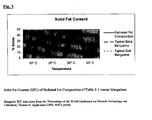
- the hydrated fat compositions of the invention display a solid fat content (SFC) versus temperature profile that has a lower rate of change (i.e., a flatter profile) with temperature when compared to typical margarine compositions.
- SFC solid fat content
- Fig. 3 shows a SFC versus temperature profile for a hydrated fat composition of the invention (see, Table 2-1) as compared to two typical margarine compositions.
- the hydrated fat composition of the invention has a significantly higher percentage of solid fat at 95° F (35°C) as compared to the margarine compositions.
- a higher percentage of solid fat at 95° F (35°C) may cause the hydrated fat compositions of the invention to display a somewhat waxier mouth-feel than is typical of margarine.
- the hydrated fat compositions of the invention function well as "low/no trans" laminating fats under high speed production of commercial baked goods.
- the hydrated fats of the invention may be used to prepare laminated dough articles.
- laminated dough articles are often prepared by the steps of: (a) providing a hydrated fat composition of the invention; (b) applying a layer of the hydrated fat composition to a layer of a dough composition comprising flour and water; and (c) repeatedly folding and compressing (sheeting) the dough layer and hydrated fat layer to form a laminated dough comprising alternating layers of dough composition and hydrated fat.
- Laminating fats are selected, inter alia, for their ability to match the material characteristics of the dough composition that they are being used with. Desirably laminating fats are both firm and yielding, thereby having a plasticity that approximately matches the dough that is being laminated. If a laminating fat is too soft, it will flow from the dough during the laminating process. If a laminating fat is too firm, it will tear the dough or will flow unevenly across a layer of the dough during lamination. Laminating fats preferably maintain the desired characteristics throughout the Laminating process where the dough is repeatedly folded and sheeted to achieve a decrease its thickness. After preparation of the laminated dough article, the laminating fat needs to maintain its layer integrity throughout the expected shelf life of the dough article, and during the initial phase of baking. If it does not, then the dough article may suffer from a loss of desirable properties.
- hydrated Laminating fats of the invention may be used to make acceptable laminated dough articles that can be stored in a refrigerator or freezer for an extended period of time prior to baking without suffering significant loss of properties due to moisture migration.
- the laminated dough articles of the invention can be refrigerated (e.g., at a temperature of about 35°F (1.7° C) to about 45°F (7.2° C)) for an extended time period prior to baking (e.g., about 75 days or more, or about 120 days or more) without degradation in dough properties, for example, layer lamination, product differentiation/identity, excessive product stickiness, decreased baked volume, and misshapen product after baking.
- Refrigerated canned laminated dough products have specific desired dough properties. In biscuits when the can is opened the dough should be easy to remove and the individual biscuits should be easy to identify and separate. In crescent you should be able to easily un-roll the dough and separate the individual crescents.
- the laminated dough articles of the invention may be frozen (e.g., at a temperature of about ⁇ - 10°F (-23,3° C)) for about 2 months or more, or about 8 months or more prior to baking without degradation in dough properties such as decreased bake volume, loss of layer integrity, and misshapen product after baking.
- the laminating fat compositions of the invention have improved processing tolerance when subjected to high temperature and high shear. This allows the laminating fats of the invention to be used in high speed automated dough making processes such as the processes that are used to make refrigerated or frozen dough products. Margarine and butter also do not quality as healthy fats in terms of the level of trans fatty acid and saturated fatty acids that are present. Embodiments of hydrated fats of the invention will process in refrigerated and/or frozen dough and meet the trans labeling requirements without significant increases in saturated fat.
- a hydrated fat composition of the invention In order to prepare a hydrated fat composition of the invention, the desired amount of liquid oil (e.g., canola oil) is heated to a temperature of about 122° F (50° C) to about 158° F (70° C). Next, the required amount of water is added to the liquide oil and the resulting composition is mixed at a high shear rate. Separately, the solid fat component (e.g., cottonseed stearine) is melted and the required amount of melted solid fat is added to the liquid oil/water composition while mixing at a high shear rate. The required amount of emulsifier (e.g., AMGS) may be melted along with the solid fat component or may be dissolved in the water phase and added with the water portion of the formulation. After mixing the fat components, the water (optionally including the emulsifier) is then added to the fat mixture and the resulting composition is mixed at a high shear rate to form a blend.
- liquid oil e.g., can
- the blend may then be fed into a scraped surface heat exchanger where heat is removed in order to cause crystallization of the fat.
- a scraped surface heat exchanger is sequenced in series in order to process the hydrated fat.
- a useful scraped surface heat exchanger is commercially available under the trade designation "KOMBINATOR” (from Schröder)
- Other useful scraped surface heat exchangers are available under the trade designation “VOTATOR” (from SPX Process Equipment Co.).
- the resulting composition may be then fed through one or more pin workers.
- a pin worker is essentially a hollow cylinder having finger-like projections extending from the walls in multiple locations.
- a rotating rod is centrally positioned within the pin worker and tines or fingers projecting from the rod intermesh with those extending from the walls to provide a mixing action when the central rod is rotated.
- the pin worker functions to modify the crystalline form of the hydrated fat of the invention.
- the resulting hydrated fat composition is transferred into a container (e.g., a lined cardboard box) for tempering, storage, and/or shipment purposes.
- the hydrated fat composition is tempered by exposing the hydrated fat to a defined temperature for a defined time period. Tempering is useful for setting the desired crystal structure in the hydrated fat composition.
- tempering is conducted at a temperature ranging from about 59° F (15° C) to about 86° F (30° C) for several hours to several days (e.g., 24 hours to 14 days).
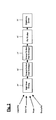
- FIG. 1 A schematic process flow diagram is presented in FIG. 1 where 10 identifies the high-shear blending operation, 12 and 14 identify two scraped surface heat exchangers positioned in series, 16 identifies the pin-worker, 18 identifies the filling operation, and 20 identifies the tempering operation.
- the hydrated fat composition is fed directly from the pin worker to a dispensing apparatus for delivery of the hydrated fat directly onto a layer of a dough composition in an automated dough-making process.
- the fat would move from the scrape-surface heat exchanger directly to dough application.
- Some further crystallization can be achieved by using a resting tube in place of the pin worker.
- hydrated fat compositions of the invention can be fed directly from the pin worker, scrape-surface heat exchanger or resting tube to the dispensing apparatus without the need for a separate tempering step.
- the ingredients making up the hydrated fat composition are mixed together and the resulting mixture is fed through one or more scraped surface heat exchangers and a pin-worker to form the hydrated fat.
- the hydrated fat is fed directly (i.e., without a tempering step) to a dispensing device (e.g., fed through a jacketed tube and fat horn) for application to a layer of a dough composition. That is, the hydrated fat flows continuously from the pin-worker, scrape-surface heat exchanger or resting tube to the dispensing device where it is dispensed onto a dough composition.
- the time period from the pin-worker, scrape-surface heat exchanger, or resting tube to the dispensing device is about 15 minutes or less, or about 5 minutes or less.
- FIG. 2 is one schematic representation of this process where 10' represents the high shear rate mixing operation, 12' and 14' represent two scraped surface heat exchangers positioned in series, 16' represents the pin-worker, and 20' represents the dispensing device where the hydrated fat composition is applied to a layer of a dough composition. The hydrated fat flows in continuous fashion from pin-worker 16' to dispensing device 20'.
- the present invention is summarized by the following items:
- a hydrated fat composition of the invention was prepared as described below.
- a hydrated fat composition of the invention was prepared using the formulation listed in TABLE 2-1. After mixing the ingredients together, the hydrated fat was processed (i.e., votated) through a series of two scraped surface heat exchangers (A1, A2) that fed into a pin worker (B1). The votation conditions are provided in TABLE 2-2. The physical properties of the hydrated fat are provided in TABLE 2-3.
- Hydrated fat compositions were prepared according to the formula in TABLE 3-1.
- the emulsifiers that were evaluated are provided in TABLE 3-2.
- TABLE 3-1 Ingredient Amount (wt.%) High Oleic Canola Oil 68 Cottonseed Stearine 20 Water 10 Emulsifier 2 TABLE 3-2 Type Description AMGS Alpha-monoglyceride stearate PGMS Polyglycerol monostearate Panodan 150K Diacetyl tartaric acid esters of monoglycerides (DATEM) Pimodan HP K-A Alpha-monoglyceride palmitate
- the hydrated fat compositions were prepared as follows:
- Hardness measurements were made using a using a Texture Technologies TA.XT.plus Texture Analyser.
- a hydrated laminating fat of the invention was compared to a commercially available margarine (PROMISE LIGHT margarine) and a biscuit roll-in fat composition.
- the hydrated laminating fat comprised 63% soybean oil, 25% cotton stearine, 10% water, and 2% AMGS.
- PROMISE LIGHT is a 35% vegetable oil spread comprising water, vegetable oil blend (liquid soybean, canola oil, sunflower oil, palm oil, palm kernel oil), whey (from milk), salt, gelatin, vegetable mono and diglycerides, soy lecithin, (potassium sorbate, calcium disodium EDTA), lactic acid, vitamin E, artificial flavor, vitamin A palmitate, beta carotene, vitamin D3, pyridoxine hydrochloride (vitamin B6), and cyanocobalamin (vitamin B12).
- the hardness value for the PROMISE LIGHT margarine is very low in comparison to hydrated laminating fats of the invention.
- the PROMISE LIGHT margarine is too soft to function as a laminating fat using typical automated dough processing system.
Landscapes
- Chemical & Material Sciences (AREA)
- Life Sciences & Earth Sciences (AREA)
- Engineering & Computer Science (AREA)
- Food Science & Technology (AREA)
- Polymers & Plastics (AREA)
- Oil, Petroleum & Natural Gas (AREA)
- Health & Medical Sciences (AREA)
- Nutrition Science (AREA)
- Bakery Products And Manufacturing Methods Therefor (AREA)
- Edible Oils And Fats (AREA)
- Fats And Perfumes (AREA)
Description
- Laminated dough products are prepared from dough comprising a plurality of thin dough layers that are separated from one another by thin continuous layers of a laminating fat. When the laminated dough is baked, the individual layers of dough separate from one another due to the presence of the fat layers to provide a plurality of thin baked dough layers. This layered structure is associated with a very desirable light, delicate, and flaky texture. Well known examples of laminated dough products include biscuits, crescents, croissants, puff pastry, Danish, cinnamon rolls, turnovers, rolls, strudel, breadsticks, and corn sticks.
- The formation of laminated dough is typically accomplished by a process of applying a pre-crystallized and packaged laminating fat onto the surface of a dough layer and repeatedly folding and sheeting the dough in order to form a laminated dough structure. In order to form laminated dough using this technique, the properties of the Laminating fat are important. Specifically, the Laminating fat must be capable of plastic behavior so that it can be drawn down into thinner and thinner layers as the laminated dough is successively folded and sheeted to form the laminated structure. If, for example, the fat is too soft, it will be absorbed into the dough and the layers will not separate upon baking. If the fat is too hard, the dough may tear when sheeted or may distribute unevenly in the laminated dough product.
- Traditionally, laminated dough has been prepared using animal fat (e.g. butter) as the source of the fat. Butter is costly and is not robust to commercial processing without significant risk to emulsion breakdown. Health and nutrition concerns with animal fats center on saturated fat and cholesterol content. Another known approach has been to use compositions comprised of partially hydrogenated vegetable oils. These materials, however, not only contain saturated fat, but also an undesirable amount of trans fatty acids. Trans fatty acids also have negative health implications.
- One method of lowering the trans fatty acid content of a laminated dough product is to use a hydrated laminating fat. The water in the hydrated laminating fat acts to lower the overall trans fat acid content by replaying some of the trans fat that would otherwise be present. However, when laminated doughs are held refrigerated or frozen for an extended time period before being baked, moisture management in the dough is critical to assure expected dough handling and finished product characteristics. For example, if moisture is not properly emulsified with the fat, the emulsion may breakdown causing water to be released into the dough. Because of the need to control moisture, laminated doughs prepared for extended storage requirements are typically prepared using anhydrous laminating fats.
- In view of the foregoing, what is desired is a hydrated laminating fat that can be used in laminated dough products, where the laminating fat has a low level of trans fatty acids and a low to moderate level of saturated fatty acids. Also desirable is a hydrated laminating fat that can be used in laminated dough products that are designed to be held for an extended period in an unbaked state at refrigerator or freezer temperatures with properties comparable to an anhydrous laminating fat. Further, if the functionality of the laminating fat can be extended so that less fat is required, this is desirable from health, nutrition and economic perspectives.
- The present invention provides hydrated fat compositions that are low in trans-fatty acids (< 0.5 grams/serving) and have a moderate to low level (< about 30 wt%) of saturated fatty acids. In many embodiments, the hydrated fat compositions are useful as a roll-in fat in laminated doughs, such as those used in biscuits, crescent and other flaky type dinner rolls, croissants, puff pastry, and Danish, cinnamon rolls, turnovers, rolls, strudel, breadsticks, corn sticks. In exemplary embodiments, the hydrated fat compositions are useful as laminating fats for use in laminated dough products that are designed to be prepared and held at refrigerator or freezer temperature for an extended time period prior to baking. For example, the laminated dough products may be refrigerated for about 75 days or more, or about 120 days, or may be frozen for about 2 months or more, or about 8 months or more, prior to baking without loss of properties.
- As used herein the term "hydrated" refers to a fat composition comprising water that is in the form of a water-in-oil emulsion. As used herein the term "laminating fat" refers to a fat composition that is plastic at room temperature. As used herein "saturated fatty acids" refers to fatty acids that contain no carbon-carbon double bonds in the acyl chain of the fatty acid. Examples include stearic acid and palmitic acid. As used herein the term trans fatty acid" refers to unsaturated fatty acids that contain one or more isolated (i.e., nonconjugated) double bonds in a trans configuration (see, e.g., 21 C.F.R. §101).
- In one aspect, the invention provides a hydrated fat composition comprising a water-in-oil emulsion comprising:
- (a) a continuous phase comprising:
- a solid fat comprising a fully- hydrogenated vegetable oil, a stearine fraction of a vegetable oil, or a mixture thereof, in an amount ranging from about 5 wt.% to about 40 wt.% (more typically 20 wt.% to 30 wt.%) of the hydrated fat; and
- a low trans fatty acid liquid vegetable oil in an amount ranging from about 20 wt.% to about 80 wt.% of the hydrated fat composition;
- (b) a dispersed phase comprising water in an amount ranging from about 5 wt.% to about 50 wt.% of the hydrated fat composition; and
- (c) an emulsifier.
- In some embodiments, the solid fat component of the hydrated fat composition is a fully-hydrogenated vegetable oil, for example, fully-hydrogenated cottonseed oil, fully-hydrogenated soybean oil, fully-hydrogenated palm oil, fully-hydrogenated palm kemel oil, fully-hydrogenated coconut oil, and mixtures thereof. Fully-hydrogenated vegetable oils typically have an iodine value of about 10 or less or about 5 or less. In other embodiments, the solid fat component of the hydrated fat composition comprises a stearine fraction of a vegetable oil, for example, soybean oil stearine, cottonseed stearine, palm stearine, and mixtures thereof.
- The liquid fat component is a low-trans fatty acid liquid vegetable oil. Low trans fatty acid vegetable oils typically have about 5% wt. or less trans fatty acids. These liquid oils typically are not hydrogenated in order to avoid the formation of trans fatty acids that results during the hydrogenation process. Examples of low trans fatty acid vegetable oils include canola oil, corn oil, cottonseed oil, olive oil, palm oil, rapeseed oil, rice bran oil, safflower oil, soybean oil, sunflower oil, or mixtures thereof. Desirably, the low-trans fatty acid property of the laminating fat of the invention allows finished food products (e.g., dough products) to be formulated such that they have a trans fatty acid level that does not exceed 0.5 grams of trans fatty acid per serving of the finished food product
- The emulsifier is present to stabilize the water phase in the form of a water-in-oil emulsion. Examples of emulsifier include alpha-monoglyceride stearate (AMGS), sorbitan monostearate, diacetyl tartaric acid esters of monoglycerides (DATEM), polyglycerol monostearate (PGMS), polyglycerol polyricinoleate (PGPR), propylene glycol monoesters, sucrose esters, monos/dis, SSL, lecithin, phospholipids, polysorbate esters, monoglyceride blends, or combinations thereof. In some embodiments, the emulsifier is present in an amount ranging from about 1 wt.% to about 10 wt.%, or from about 1 wt.% to about 5 wt.%. The emulsifier can be selected to provide desired properties to the hydrated fat composition. For example, the emulsifier type and amount may be used to control, for example, hardness, emulsion stability, and texture of the hydrated fat composition.
- In a preferred embodiment, the hydrated fat composition comprises a water-in-oil emulsion comprising: (a) about 20 wt.% to about 30 wt.% of a solid fat comprising fully-hydrogenated cottonseed oil; (b) about 60 wt.% to about 70 wt.% of liquid oil comprising soybean oil; (c) about 1.0 wt.% to about 3.0 % wt. of an emulsifier comprising alpha-monoglyceride stearate; and (d) about 5 wt.% to about 20 wt.% water.
- In another aspect, the invention provides food compositions comprising the hydrated fat composition of the invention. Examples of food compositions include flour-based doughs. In some embodiments the hydrated fat is used in a laminated dough comprising a plurality of layers of a dough composition; and a plurality of layers of the hydrated fat composition. The layers of the dough composition are each separated by a layer of the hydrated fat composition. Laminated dough compositions are useful for preparing biscuits, crescents, croissants, puff pastry, Danish, cinnamon rolls, turnovers, rolls, strudel, breadsticks, corn sticks.
- Accordingly, in another aspect, the invention provides a method of making a laminated dough comprising the steps of:
- (a) combining a solid fat, a liquid fat, water, and an emulsifier to form a hydrated fat composition in the form of a water-in-oil emulsion comprising:
- (i) a continuous phase comprising:
- a solid fat comprising a fully-hydrogenated vegetable oil, a stearine fraction of a vegetable oil, or a mixture thereof, in an amount ranging from about 5 wt.% to about 40 wt.% of the hydrated fat; and
- a low trans-fat liquid vegetable oil in an amount ranging from about 20 wt.% to about 80 wt.% of the hydrated fat composition;
- (ii) a dispersed phase comprising water in an amount ranging from about 5 wt.% to about 50 wt.% of the hydrated fat composition; and
- (iii) an emulsifier;
- (i) a continuous phase comprising:
- (b) cooling and crystallizing the hydrated fat composition; and
- (c) applying a layer of the hydrated fat composition to a layer of a dough composition comprising flour and water; and
- (d) folding the dough layer and hydrated fat layer one or more times to form a dough article comprising alternating layers of the dough composition and the hydrated fat.
- Advantageously, in some embodiments, the hydrated fat compositions of the invention may be prepared and used in laminated dough without going through a tempering step. Tempering refers to the process where a fat composition is conditioned at a desired temperature for a desired period of time in order to promote crystal formation in the fat. Since the hydrated fat compositions of the invention do not require tempering to display plastic behavior, they are suitable for use in a continuous process where the hydrated fat is prepared and flows directly (i.e., without a tempering step) to the fat applicator (e.g., a fat horn) where it is applied to a surface of a dough composition.
- The invention will be described further in connection with the attached drawings wherein:
-
FIG. 1 is a schematic representation of a process for making a hydrated fat of the invention. -
FIG. 2 is a schematic representation of a process for making and applying a hydrated fat composition of the invention. -
FIG. 3 is a graph of the solid fat content (SFC) of a hydrated fat composition of the invention (see, Table 2-1) as compared to typical margarine compositions. - In one aspect, the invention provides a hydrated fat composition comprising a water-in-oil emulsion comprising:
- (a) a continuous phase comprising:
- a solid fat comprising a fully-hydrogenated vegetable oil, a stearine fraction of a vegetable oil, or a mixture thereof, in an amount ranging from about 5 wt.% to about 40 wt.% of the hydrated fat; and
- a low trans-fat liquid vegetable oil in an amount ranging from about 20 wt.% to about 80 wt.% of the hydrated fat composition;
- (b) a dispersed phase comprising water in an amount ranging from about 5 wt.% to about 50 wt.% of the hydrated fat composition; and
- (c) an emulsifier.
- Hydrated fat compositions of the invention comprise a hardstock or solid fat component. By hardstock or solid fat it is meant that the fat is a solid at or near room temperature. The solid fat typically comprises glycerides of fatty acids (e.g., monoglycerides, diglycerides, and triglycerides). The glycerides have a fatty acid composition that comprises a very high percentage of saturated fatty acids. The solid fat component is typically very low in trans-fatty acids, since only a very few of the fatty acids have residual sites of unsaturation.
- In some embodiments, the solid fat is produced by hydrogenating the unsaturated fatty acids that are present in a vegetable oil in order to increase the amount of saturated fatty acids. Techniques for hydrogenation of vegetable oils are known in the art and include, for example, reacting a vegetable oil having unsaturated fatty acids with hydrogen gas in the presence of a hydrogenation catalyst, for example, a supported nickel catalyst. The hydrogenated vegetable oil is topically fully-hydrogenated in order to achieve an iodine value (IV) of about 10 or less, more typically about 5 or less. Representative hydrogenated solid fats include hydrogenated cottonseed oil, hydrogenated soybean oil, hydrogenated palm oil, palm oil, fully-hydrogenated palm kernel oil, fully-hydrogenated coconut oil, and mixtures thereof.
- In some embodiments, the solid fat comprises the stearine fraction of a vegetable oil. A stearine fraction refers to a fraction of a vegetable oil that has a fatty acid composition that is high in stearic acid (i.e., a C19 saturated fatty acid) and palmitic acid (i.e., a C16 saturated fatty acid). Stearine fractions may be obtained by fractionization of a vegetable oil composition, which separates the higher-melting solid fraction (stearine) from the lower-melting liquid fraction (olein). Representative vegetable oil stearine fractions that may be used include cottonseed stearine, soybean stearine, and palm stearine.
- Useful hardstock solid fats typically have a melting point ranging from about 122° F (50° C) to about 176° F (80° C), more typically ranging from about 140° F (60° C) to about 158° F (70° C). The hardstock or solid fat is typically present in the hydrated fat of the invention in an amount ranging from about 5 wt.% to about 40 wt.%. In exemplary embodiments, the solid fat is present in an amount ranging from about 20 wt.% to about 30 wt.%. For example, the solid fat may be fully-hydrogenated cottonseed oil, which is present at 25 wt.% of the hydrated fat composition. Suitable hydrogenated cottonseed oil can be obtained commercially under the trade designation "DRITEX C FLAKES" (from ACH Food Companies, Inc.). This fully-hydrogenated cottonseed oil has a melting point of about 148° F (64.4° C) and an iodine value of about 5 or less.
- Hydrated fat compositions of the invention comprise liquid oil. By liquid oil it is meant that the oil is a liquid when it is at or near room temperature. Useful liquid oils comprise glycerides (e.g., monoglycerides, diglycerides, and triglycerides) that have a fatty acid composition that is low in trans-fatty acids and low in saturated fatty acids. For example, the liquid fat may comprises about 4% or less trans-fatty acids, for example, about 3% or less, about 2% or loss, or about 1% or less.
- Examples of useful liquid oils include canola oil, corn oil, cottonseed oil, olive oil, palm oil, rapeseed oil, rice bran oil, safflower oil, soybean oil, and sunflower oil. In order to avoid the introduction of trans-fatty acids, the liquid oil is not hydrogenated. The liquid oil is typically present in the hydrated fat in an amount ranging from about 20 wt.% to about 80 wt.%. In exemplary embodiments, the liquid oil is present in an amount ranging from about 50 wt.% to about 70 wt.%, or about 60 wt.% to about 70 wt.%. Liquid oils may be obtained, for example, from Bunge Foods, Golden Brands, Sunlight Foods, ADM, AC Humko Corporation (e.g., TRI-SUN high oleic sunflower oil), Cargill, Incorporated (e.g., ODYSSEY Canola Oil and CLEAR VALLEY 65 and 75 high oleic canola oil), Canamera Foods, and PITO (e.g., high oleic safflower oil and high oryzanol rice bran oil).
- Hydrated fat compositions of the invention are water-in-oil type emulsions comprising a dispersed phase that comprises water and a continuous phrase that comprises the solid fat and the liquid oil. The hydrated fat compositions comprise an emulsifier that functions to emulsify the water so that it is present in the form of a plurality of small water droplets that are distributed throughout the continucus phase of the hydrated fat. The choice of emulsifier may affect the final properties of the hydrated fat including, for example, emulsion stabilify, hardness, texture, and consistency of properties over various tempering conditions.
- Useful emulsifiers for water-in-oil emulsions typically have an HLB (i.e., a hydropbillic/lipophilic balance) that ranges from about 3 to about 6, although emulsifiers having an HLB outside of this range may also be useful. Examples of useful emulsifiers include alpha-monoglyceride stearate (AMGS), sorbitan monostearate, diacetyl tartaric acid esters of monoglycerides (DATEM), polyglycerol monostearate (PGMS), polyglycerol polyricinoleate (PGPR), propylene glycol monoesters, sucrose esters, monos/dis, SSL, lecithin, phospholipids, polysorbate esters, monoglyceride blends, or combinations thereof. The emulsifier is typically present in an amount ranging from about 0 wt.% to about 10 wt.%, or from about 1 wt.% to about 5 wt.%, or from about 1 wt.% to about 3 wt.%.
- In hydrated fats of the invention, AMGS has been found to produce fats that are hard, uniform in appearance, and consistent across various tempering conditions. AMGS is commercially available under the trade designation "PANALITE 90-03" and "PANALITE 90-03 PK" (from Archer Daniels Midland Co.). In exemplary embodiments, the emulsifier is AMOS that is present in an amount of about 1 wt.% to about 5 wt.%, or about wt.% to about 3 wt.% of the hydrated fat composition.
- Hydrated fat compositions of the invention comprise water that is present in the form of a dispersed phase comprising a plurality of small water droplets. Water is topically present in an amount of about 5 wt.% to about 50 wt.%. In exemplary embodiments, the hydrated fat compositions comprise about 5 wt.% to 30 wt.% water, more typically about 5 wt.% to about 15 wt.% water.
- Hydrated fat compositions of the invention may optionally include such ingredients as an antimicrobial agent (e.g., potassium sorbate; sodium benzoate); an antioxidant (e.g., TBHQ); salt, color, flavor, vitamins, etc.
- Embodiments of the hydrated fat compositions of the invention display plastic behavior making them suitable for use as laminating fat compositions in laminated dough compositions. Specifically, the laminating fat must be capable of plastic behavior so that it can be drawn down into thinner and thinner layers as the laminated dough is successively folded and sheeted to form the laminated structure. If, for example, the fat is too soft it will be absorbed into the dough and the layers will not separate upon baking. If the fat is too hard, the dough may tear when sheeted.
- Useful hydrated fat compositions have a hardness value of about 3 kg to about 18 kg, or from about 5 kg to about 14 kg, when measured using the margarine spreadability test using a texture analyzer (TA-XTplus). Hardness can also be measured using the AOCS cone penetrometer method (Cc 16-60) with a hardness values ranging from about 30mm to 220 mm, or from about 80 mm to about 140 mm.
- In some embodiments, the hydrated fat compositions of the invention display a solid fat content (SFC) versus temperature profile that has a lower rate of change (i.e., a flatter profile) with temperature when compared to typical margarine compositions. This can be seen in
Fig. 3 which shows a SFC versus temperature profile for a hydrated fat composition of the invention (see, Table 2-1) as compared to two typical margarine compositions. As shown inFig. 3 , the hydrated fat composition of the invention has a significantly higher percentage of solid fat at 95° F (35°C) as compared to the margarine compositions. A higher percentage of solid fat at 95° F (35°C) may cause the hydrated fat compositions of the invention to display a somewhat waxier mouth-feel than is typical of margarine. Despite this characteristic, however, the hydrated fat compositions of the invention function well as "low/no trans" laminating fats under high speed production of commercial baked goods. - The hydrated fats of the invention may be used to prepare laminated dough articles. For example, laminated dough articles are often prepared by the steps of: (a) providing a hydrated fat composition of the invention; (b) applying a layer of the hydrated fat composition to a layer of a dough composition comprising flour and water; and (c) repeatedly folding and compressing (sheeting) the dough layer and hydrated fat layer to form a laminated dough comprising alternating layers of dough composition and hydrated fat.
- Laminating fats are selected, inter alia, for their ability to match the material characteristics of the dough composition that they are being used with. Desirably laminating fats are both firm and yielding, thereby having a plasticity that approximately matches the dough that is being laminated. If a laminating fat is too soft, it will flow from the dough during the laminating process. If a laminating fat is too firm, it will tear the dough or will flow unevenly across a layer of the dough during lamination. Laminating fats preferably maintain the desired characteristics throughout the Laminating process where the dough is repeatedly folded and sheeted to achieve a decrease its thickness. After preparation of the laminated dough article, the laminating fat needs to maintain its layer integrity throughout the expected shelf life of the dough article, and during the initial phase of baking. If it does not, then the dough article may suffer from a loss of desirable properties.
- Conventionally, many laminated dough articles that are designed to be refrigerated or frozen in an unbaked state prior to baking are prepared using anhydrous laminating fats in order to minimize any undesirable effects that may result from moisture migration from a hydrated laminating fat to the dough during the refrigerated or frozen storage. It has been found that hydrated Laminating fats of the invention may be used to make acceptable laminated dough articles that can be stored in a refrigerator or freezer for an extended period of time prior to baking without suffering significant loss of properties due to moisture migration. For example, in some embodiments, the laminated dough articles of the invention can be refrigerated (e.g., at a temperature of about 35°F (1.7° C) to about 45°F (7.2° C)) for an extended time period prior to baking (e.g., about 75 days or more, or about 120 days or more) without degradation in dough properties, for example, layer lamination, product differentiation/identity, excessive product stickiness, decreased baked volume, and misshapen product after baking. Refrigerated canned laminated dough products have specific desired dough properties. In biscuits when the can is opened the dough should be easy to remove and the individual biscuits should be easy to identify and separate. In crescent you should be able to easily un-roll the dough and separate the individual crescents. Poor performing biscuits show no definition between individual biscuits, poor biscuit formation, and sticky dough. Poor performing crescents are difficult to un-roll due to dough stickiness and difficult to separate due to increased dough extensibility. In some embodiments, the laminated dough articles of the invention may be frozen (e.g., at a temperature of about ≤ -10°F (-23,3° C)) for about 2 months or more, or about 8 months or more prior to baking without degradation in dough properties such as decreased bake volume, loss of layer integrity, and misshapen product after baking.
- In contrast to margarine and butter, the laminating fat compositions of the invention have improved processing tolerance when subjected to high temperature and high shear. This allows the laminating fats of the invention to be used in high speed automated dough making processes such as the processes that are used to make refrigerated or frozen dough products. Margarine and butter also do not quality as healthy fats in terms of the level of trans fatty acid and saturated fatty acids that are present. Embodiments of hydrated fats of the invention will process in refrigerated and/or frozen dough and meet the trans labeling requirements without significant increases in saturated fat.
- In order to prepare a hydrated fat composition of the invention, the desired amount of liquid oil (e.g., canola oil) is heated to a temperature of about 122° F (50° C) to about 158° F (70° C). Next, the required amount of water is added to the liquide oil and the resulting composition is mixed at a high shear rate. Separately, the solid fat component (e.g., cottonseed stearine) is melted and the required amount of melted solid fat is added to the liquid oil/water composition while mixing at a high shear rate. The required amount of emulsifier (e.g., AMGS) may be melted along with the solid fat component or may be dissolved in the water phase and added with the water portion of the formulation. After mixing the fat components, the water (optionally including the emulsifier) is then added to the fat mixture and the resulting composition is mixed at a high shear rate to form a blend.
- After forming the blend, the blend may then be fed into a scraped surface heat exchanger where heat is removed in order to cause crystallization of the fat. In some embodiments, one or more scraped surface heat exchangers are sequenced in series in order to process the hydrated fat. A useful scraped surface heat exchanger is commercially available under the trade designation "KOMBINATOR" (from Schröder) Other useful scraped surface heat exchangers are available under the trade designation "VOTATOR" (from SPX Process Equipment Co.).
- Optionally, after processing through the scraped surface heat exchanger(s), the resulting composition may be then fed through one or more pin workers. A pin worker is essentially a hollow cylinder having finger-like projections extending from the walls in multiple locations. A rotating rod is centrally positioned within the pin worker and tines or fingers projecting from the rod intermesh with those extending from the walls to provide a mixing action when the central rod is rotated. The pin worker functions to modify the crystalline form of the hydrated fat of the invention.
- After processing though the pin worker, the resulting hydrated fat composition is transferred into a container (e.g., a lined cardboard box) for tempering, storage, and/or shipment purposes. In some embodiments, the hydrated fat composition is tempered by exposing the hydrated fat to a defined temperature for a defined time period. Tempering is useful for setting the desired crystal structure in the hydrated fat composition. In some embodiments, tempering is conducted at a temperature ranging from about 59° F (15° C) to about 86° F (30° C) for several hours to several days (e.g., 24 hours to 14 days). A schematic process flow diagram is presented in
FIG. 1 where 10 identifies the high-shear blending operation, 12 and 14 identify two scraped surface heat exchangers positioned in series, 16 identifies the pin-worker, 18 identifies the filling operation, and 20 identifies the tempering operation. - In one embodiment, the hydrated fat composition is fed directly from the pin worker to a dispensing apparatus for delivery of the hydrated fat directly onto a layer of a dough composition in an automated dough-making process. Optionally, the fat would move from the scrape-surface heat exchanger directly to dough application. Some further crystallization can be achieved by using a resting tube in place of the pin worker. Advantageously, hydrated fat compositions of the invention can be fed directly from the pin worker, scrape-surface heat exchanger or resting tube to the dispensing apparatus without the need for a separate tempering step. This allows a continuous process to be conducted where the ingredients making up the hydrated fat composition are mixed together and the resulting mixture is fed through one or more scraped surface heat exchangers and a pin-worker to form the hydrated fat. Following the pin-worker, scrape-surface heat exchanger or resting tube the hydrated fat is fed directly (i.e., without a tempering step) to a dispensing device (e.g., fed through a jacketed tube and fat horn) for application to a layer of a dough composition. That is, the hydrated fat flows continuously from the pin-worker, scrape-surface heat exchanger or resting tube to the dispensing device where it is dispensed onto a dough composition. Typically, the time period from the pin-worker, scrape-surface heat exchanger, or resting tube to the dispensing device is about 15 minutes or less, or about 5 minutes or less.
-
FIG. 2 is one schematic representation of this process where 10' represents the high shear rate mixing operation, 12' and 14' represent two scraped surface heat exchangers positioned in series, 16' represents the pin-worker, and 20' represents the dispensing device where the hydrated fat composition is applied to a layer of a dough composition. The hydrated fat flows in continuous fashion from pin-worker 16' to dispensing device 20'. - The present invention is summarized by the following items:
- 1. A hydrated fat composition comprising a water-in-oil emulsion comprising:
- (a) a continuous phase comprising:
- a solid fat comprising a fully-hydrogenated vegetable oil, a stearine fraction of a vegetable oil, or a mixture thereof, in an amount ranging from about 5 wt.% to about 40 wt.% of the hydrated fat; and
- a low trans fat liquid vegetable oil in an amount ranging from about 20 wt.% to about 80 wt.% of the hydrated fat composition;
- (b) a dispersed phase comprising water in an amount ranging from about 5 wt.% to about 50 wt.% of the hydrated fat composition; and
- (c) an emulsifier.
- (a) a continuous phase comprising:
- 2. The hydrated fat composition of item 2, wherein the solid fat has an iodine value of less than about 10.
- 3. The hydrated fat composition of item 2, wherein the solid fat has an iodine value of less than about 5.
- 4. The hydrated fat composition of item 1, wherein the solid fat is present in an amount ranging from about 15 wt.% to about 30 wt.%.
- 5. The hydrated fat composition of item t, wherein the solid fat comprises a fully-hydrogated vegetable oil.
- 6. The hydrated fat composition of item 5, wherein the fully-hydrogenated vegetable oil is selected from fully-hydrogenated cottonseed oil, fully-hydrogenated soybean oil, fully-hydrogenated palm oil, fully-hydrogenated palm kernel oil, fully-hydrogenated coconut oil and mixtures thereof.
- 7. The hydrated fat composition of item 1, wherein the solid fat component comprises a stearine fraction of a vegetable oil.
- 8. The hydrated fat composition of item 7, wherein the vegetable oil stearine comprises soybean oil stearine, cottonseed stearine, palm stearine, and mixtures thereof.
- 9. The hydrated fat composition of item 1, wherein the liquid fat comprises canoja oil, corn oil, cottonseed oil, olive oil, palm oil, rapeseed oil, rice bran oil, safflower oil, soybean oil, sunflower oil, or a mixture thereof.
- 10. The hydrated fat composition of item 1, wherein the liquid fat comprises canola oil.
- 11. The hydrated fat composition of item 1, wherein the liquid fat comprises soybean oil.
- 12. The hydrated fat composition of item 1, wherein the liquid fat comprises less than about 5 wt.% trans fatty acids.
- 13. The hydrated fat composition of item, 1, wherein the liquid fat is not hydrogenated.
- 14. The hydrated fat composition of item 1, wherein the emulsifier is present in an amount ranging from about 1 wt.% to about 10 wt.%.
- 15. The hydrated fat composition of item 1, wherein the emulsifier is present in an amount ranging from about 1 wt.% to about 5 wt.%.
- 16. The hydrated fat composition of item 1, wherein the emulsifier comprises alpha-monoglyceride stearate (AMGS), sorbitan monostearate, diacetyl tartaric acid esters of monoglycerides (DATEM), polyglycerol monostearate (PGMS), polyglycerol polyricinoleate (PGPR), propylene glycol monoesters, sucrose esters, monos/dis, SSL, lecithin, phospholipids, polysorbate esters, monoglyceride blends, or combinations thereof.
- 17. The hydrated fat composition of item 1, wherein the water is present in an amount ranging from about 5 wt.% to about 30 wt.%.
- 18. The hydrated fat composition of item 1, wherein the water is present in an amount ranging from about 5 wt.% to about 15 wt.%.
- 19. The hydrated fat composition of item 1, wherein the hydrated fat has a hardness that ranges from about 3 kg to about 18 kg when measured using the margarine spreadability test using a texture analyzer (TA-XTplus).
- 20. The hydrated fat composition of item 1, wherein the hydrated fat has a hardness that ranges from about 30 mm to about 220 mm when measured using AOCS cone penetrometer method (Cc 16-60).
- 21. The hydrated fat composition of item 1, wherein the hydrated fat has a hardness that ranges from about 5kg to about 14 kg when measured using the margarine spreadability test using a texture analyzer (TA-XTplus).
- 22. The hydrated fat composition of item 1, wherein the hydrated fat has a hardness that ranges from about 80 mm to about 140 mm when measured using AOCS cone penetrometer method (Cc 16-60).
- 23. A hydrated fat composition comprising: (a) about 20 wt.% to about 30 wt.% of a solid fat comprising fully-hydrogenated cottonseed oil; (b) about 60 wt.% to about 70 wt.% of liquid oil comprising soybean oil; (c) about 1.0 wt.% to about 3.0 % wt. of an emulsifier comprising alpha-monoglyceride stearate; and (d) about 5 wt.% to about 20 wt.% water; wherein the hydrated fat composition is a water-in-oil emulsion.
- 24. A food composition comprising the hydrated fat composition of item 1.
- 25. The food composition of item 24, wherein the food composition comprises less than 0.5 grams trans fat per serving.
- 26. A dough article comprising the hydrated fat composition of item 1.
- 27. The dough article of item 26, wherein the dough article comprises:
- a plurality of layers of a dough composition; and
- a plurality of layers of hydrated fat composition;
- wherein the layers of the dough composition are each separated by a layer of the hydrated fat composition.
- 28. The dough composition of item 27, wherein the dough composition is a puff pastry, biscuit, crescent, croissant, Danish, cinnamon roll, turnover, roll, strudel, breadstick, or corn stick.
- 29. A method of making a laminated dough comprising the steps of:
- (a) combining a solid fat, a liquid oil, water, and an emulsifier to form a hydrated fat composition in the form of a water-in-oil emulsion comprising:
- (i) a continuous phase comprising:
- a solid fat comprising a fully-hydrogenated vegetable oil, a stearine fraction of a vegetable oil, or a mixture thereof, in an amount ranging from about 5 wt.% to about 40 wt.% of the hydrated fat; and
- a low trans-fat liquid vegetable oil in an amount ranging from about 20 wt.% to about 80 wt.% of the hydrated fat composition;
- (ii) a dispersed phase comprising water in an amount ranging from about 5 wt.% to about 50 wt.% of the hydrated fat composition; and
- (iii) an emulsifier;
- (i) a continuous phase comprising:
- (b) cooling and crystallizing the hydrated fat composition;
- (c) applying a layer of the hydrated fat composition to a layer of a dough composition that comprises flour and water to form a hydrated fat-coated dough layer; and
- (d) folding the hydrated fat-coated dough layer one or more times to form a laminated dough comprising alternating layers of the dough composition and the hydrated fat.
- (a) combining a solid fat, a liquid oil, water, and an emulsifier to form a hydrated fat composition in the form of a water-in-oil emulsion comprising:
- 30. The method of making a laminated dough of item 29, wherein the cooling and crystallizing step is conducted by passing the hydrated fat composition of step (a) through one or more scrape-surface heat exchangers, pin-workers, or resting tubes.
- 31. The method of making a laminated dough of item 29, wherein the hydrated fat composition flows continuously, without a tempering step, from the pin-worker, scrape-surface heat exchanger, or resting tube to a dispensing device for applying a layer of hydrated fat composition to a layer of a dough composition.
- 32. The method of making a laminated dough of item 31, wherein the hydrated fat composition flows from the pin-worker, scrape-surface heat exchanger, or resting tube to the dispensing device in a time period that is about 15 minutes or less.
- 33. The method of making a laminated dough of item 31, wherein the hydrated fat composition flows from the pin-worker, scrape-surface heat exchanger, or resting tube to the dispensing device in a time period that is about 5 minutes or less.
- The following examples are presented to illustrate the present invention and to assist one of ordinary skill in making and using the same. The examples are not intended in any way to limit the scope of the invention.
- A hydrated fat composition of the invention was prepared as described below.
- 1. A jacketed 30-gallon reaction vessel was charged with 64,000 grams of canola oil and the canola oil was heated to a temperature of 122° F (50° C).
- 2. 10,000 grams of water was added to the heated canola oil and the composition was mixed using a high shear mixer (in-line IKA mixer) to ensure good dispersion of the water in the canola oil.
- 3. 25,000 grams of fully hydrogenated cottonseed oil and 1000 grams AMGS emulsifier were charged to a separate melt-kettle and were melted to form a liquid.
- 4. The mixture of cottonseed oil and AMGS was pumped as a liquid into the 30-gallon reactor containing the canola oil and water mixture.
- 5. The resulting emulsion was heated to 140° F (60° C) to 158° F (70° C) and was transferred by a pump to a scraped surface heat exchanger and pin-worker unit ("KOMBINATOR" from Schröder) for cooling and crystallization. The process conditions are summarized below.
Oil Inlet Temperature of Scraped surface Heat Exchanger = 140° -158° F (60°-70°C)
Speed of Scraped surface Heat Exchanger = 600-800 rpm (High)
Speed of Pin-worker = 200-400 rpm (Low)
Discharge Temperature from Pin-worker = 64.4° - 69.8° F (18°-21° C)
Flow rate = 110-200 lbs/hr (High)
Back Pressure = 100-200 psi (Med-High)
Fat Collection Temperature = 78.8° - 86° F (26-30° C) 6. The resulting hydrated fat was collected in plastic-lined 50 lb. cardboard boxes and was tempered at 158° F (70° C). - A hydrated fat composition of the invention was prepared using the formulation listed in TABLE 2-1. After mixing the ingredients together, the hydrated fat was processed (i.e., votated) through a series of two scraped surface heat exchangers (A1, A2) that fed into a pin worker (B1). The votation conditions are provided in TABLE 2-2. The physical properties of the hydrated fat are provided in TABLE 2-3.
TABLE 2-1: Hydrated Fat Composition Ingredient Amount % Soybean Oil 62.88 Fully Hydro Cottonseed Oil 25.00 Distilled Mono's (Panalite 90-03K) 2.00 Sodium benzoate 0.1% TBHQ 0.02 Water 10.00 TABLE 2-2: Votation Conditions - Configuration A+A+B→Fill Parameter Condition #1 Condition #2 Condition #3 Condition #4 Condition #5 Feed Temp 161.3°F (71.8°C) 164.7°F (73.7°C) 164.7°F (73.7°C) 147.6°F (64.2°C) 170°F (76.6°C) A1 (F) 90 91.0 78.0 91.1 93 A1 (rpm) 800 800 800 800 800 A2 (F) 85 91.0 76 83.3 82 A2 (rpm) 400 400 400 400 250 B2 (rpm) 200 110 200 200 200 B2 (F) 100 100 90 100 94.6 Rate (lbs./hour) 250 250 250 280 200 Back Pressure (bar) 10-15 4 22 19 9 TABLE 2-3 Analysis Hydrated Fat Mettler Drop Point (°F) 135.5 SFC @ 50°F (10°C) 34.42 SFC @ 70°F (21.1°C) 31.65 SFC @ 80°F (26.7°C) 29.41 SFC @ 92°F (33.3°C) 26.27 SFC @ 110°F (37.8°C) 23.44 SFC @ 104°F (40°C) 21.52 Moisture (%) 9.55 Salt %) 0 %Total C16:0 FA 14.24 %Total C18:0 FA 24.27 %Total C18:1 trans FA 0.09 %Total C18:1 cis FA 16.26 %Total C18:2 trans FA 0.24 %Total C18 2 cis FA 37.11 %Total C18:3 trans FA 0.19 %Total C18:3cis FA 5.00 %Total Saturated FA 39.83 %Total trans FA 0.51 - Hydrated fat compositions were prepared according to the formula in TABLE 3-1. The emulsifiers that were evaluated are provided in TABLE 3-2.
TABLE 3-1 Ingredient Amount (wt.%) High Oleic Canola Oil 68 Cottonseed Stearine 20 Water 10 Emulsifier 2 TABLE 3-2 Type Description AMGS Alpha-monoglyceride stearate PGMS Polyglycerol monostearate Panodan 150K Diacetyl tartaric acid esters of monoglycerides (DATEM) Pimodan HP K-A Alpha-monoglyceride palmitate - The hydrated fat compositions were prepared as follows:
- 1. The ingredients were weighed out.
- 2. The canola oil was heated to 122° F (50° C).
- 3. The water was added to the heated canola oil and the composition was mixed at high shear.
- 4. The cottonseed stearine was melted and was slowly added to the composition while mixing at high shear.
- 5. The emulsifier was melted and was slowly added to the composition while mixing at high shear.
- 6. The resulting hydrated fat composition was split into three samples for tempering. The samples were tempered at the hollowing conditions.
- 1 sample at 60° F (15.5° C) for 4 days
- 1 sample at 70° F (21.1° C) for 4 days
- 1 sample at 85° F (29° C) for 4 days
- Hardness measurements were taken on the hydrated fat compositions using a Texture Technologies TA.XT.plus Texture Analyzer. The margarine application for the spreadability/softness of margarine was used. The samples were packed into the cups and run at room temperature (~70° F) (21.1° C). The result of the testing is provide in TABLE 3-3.
TABLE 3-3 60F (15.5°C) temper 70°F (21.1°C) temper 85°F (29.4°C) temper Avg Hardness Avg Hardness Avg Hardness Description kg - 70F kg - 70F Kg - 70F AMGS 5.82 6.12 5.48 PGMS 4.52 4.64 4.30 Panodan 150K 5.37 4.13 3.88 Dimodan HP K-A 4.62 4.88 3.68 - Hardness measurements were made using a using a Texture Technologies TA.XT.plus Texture Analyser. A hydrated laminating fat of the invention was compared to a commercially available margarine (PROMISE LIGHT margarine) and a biscuit roll-in fat composition.
- The hydrated laminating fat comprised 63% soybean oil, 25% cotton stearine, 10% water, and 2% AMGS.
- PROMISE LIGHT is a 35% vegetable oil spread comprising water, vegetable oil blend (liquid soybean, canola oil, sunflower oil, palm oil, palm kernel oil), whey (from milk), salt, gelatin, vegetable mono and diglycerides, soy lecithin, (potassium sorbate, calcium disodium EDTA), lactic acid, vitamin E, artificial flavor, vitamin A palmitate, beta carotene, vitamin D3, pyridoxine hydrochloride (vitamin B6), and cyanocobalamin (vitamin B12).
- The results of the testing are provided in TABLE 4-1.
TABLE 4-1 Description Hardness at 70° F (21.1 °C) (kg) Hardness at 60° F (15.5°C) (kg) Hydrated Laminating Fat 13.6 14.0 PROMISE LIGHT margarine 1.1 1.6 Biscuit Rooll-in 11.0 15.3 - As shown in the data, the hardness value for the PROMISE LIGHT margarine is very low in comparison to hydrated laminating fats of the invention. The PROMISE LIGHT margarine is too soft to function as a laminating fat using typical automated dough processing system.
- Hardness measurements of certain Laminating fats were made using a using a Texture Technologies TA.XT.plus Texture Analyzer. The composition of the anhydrous Laminating fat and the hydrated laminating fat are provided in TABLE 5-1. The harness values are provided in TABLE 5-2.
TABLE 5-1 Ingredient Anhydous Fat (wt. %) Hydrated Fat (wt. %) Soybean Oil 71% 56% Cotton Stearine 27% 22 % Water 0% 200% AMGS 2% 2% TBHQ 0.02% 0.42% TABLE 5-2 Description Hardness (kg) Hydrated Laminating Fat 11.1 Anhydrous Shortening 10.0 Partially-hydrogenated Crescent Control Shortening 11.8 Pertially hydrogenated Biscuit Control Shortening 9.4 Margarine (16% water) 5.7 Margarine (8.5% water) 6.4
Claims (18)
- A hydrated fat composition comprising a water-in-oil émulsion comprising:(a) a continuous phase comprising:a solid fat comprising a fully-hydrogenated vegetable oil, a stearine fraction of a vegetable oil, or a mixture thereof, in an amount ranging from 5 wt.% to 40 wt.% of the hydrated fat; anda low trans fat liquid vegetable oil in an amount ranging from 20 wt.% to 80 wit.% of the hydrated fat composition;(b) a dispersed phase comprising water in an amount ranging from wt% to 50 wt.% of the hydrated fat composition; and(c) an emulsifier.
- The hydrated fat composition of claim 1, wherein the solid fat comprises a fully-hydrogenated vegetable oil selected from fully-hydrogenated cottonseed oil, fully-hydrogenated soybean oil, fully-hydrogenated palm oils fully-hydrogenated palm kernel oil, fully-hydrognated coconut oil and mixtures thereof.
- The hydrated fat composition of claim 1, wherein the solid fat component comprises a stearine fraction of a vegetable oil.
- The hydrated fat composition of claim 3, wherein the vegetable oil stearine comprises soybean oil stearine, cottonseed stearine, palm stearine, and mixtures thereof.
- The hydrated fat composition of claim 1, wherein the liquid fat comprises canola oil, corn oil, cottonseed oil, olive oil, palm oil, rapeseed oil, rice bran oil, safflower oil, soybean oil, sunflower oil, or a mixture thereof.
- The hydrated fat composition of claim 1, wherein the liquid fat comprises less than 5 wit.% trans fatty acids.
- The hydrated fat composition of claim 1, wherein the liquid fat is not hydrogenated.
- The hydrated fat composition of claim 1, wherein the water is present in an amount ranging from 5 wt.% to 30 wt.%.
- The hydrated fat composition of claim 1, wherein the hydrated fat has a hardness that ranges from 3 kg to 18 kg when measured using the margarine spreadability test using a texture analyzer (TA-XTplus).
- The hydrated fat composition of claim 1, wherein the hydrated fat has a hardness that ranges from 5kg to 14 kg when measured using the margarine spreadability test using a texture analyzer (TA-XTplus).
- A hydrated fat composition comprising: (a) 20 wt.% to 30 wt.% of a solid fat comprising fully-hydrogenated cottonseed oil; (b) 60 wt.% to 70 wt.% of liquid oil comprising soybean oil; (c) 1.0 wt.% to 3.0 % wt. of an emulsifier comprising alpha-monoglyceride stearate; and (d) 5 wt.% to 20 wt.% water; wherein the hydrated fat composition is a water-in-oil émulsion.
- A food composition comprising the hydrated fat composition of any of claims 1 to 11.
- A dough article composing the hydrated fat composition of any of claims 1 to 11.
- The dough article of claim 13, wherein the dough article comprises:a plurality of layers of a dough composition; anda pluralité of layers of hydrated fat composition;wherein the layers of the dough composition are each separated by a layer of the hydrated fat composition.
- The dough article of claim 14, wherein the dough article is a puff pastry, biscuit, crescent, croissant, Danish, cinnamon roll, turnover, roll, strudel, breadstick, or corn stick.
- A method of making a laminated dough comprising the steps of:(a) combining a solid fat, a liquid oil, water, and an emulsifier to form a hydrated fat composition in the form of a water-in-oil émulsion comprising:(i) a continuous phase comprising:a solid fat comprising a fully-hydrogenated vegetable oil, a stearine fraction of a vegetable oil, or a mixture thereof, in an amount ranging from 5 wt.% to 40 wit.% of the hydrated fat; anda low trans-fat liquid vegetable oil in an amount ranging from 20 wt.% to 80 wt.% of the hydrated fat composition;(ii) a dispersed phase comprising water in an amount ranging from 5 wt.% to 50 wt.% of the hydrate fat composition; and(iii) an emulsifier;(b) cooling and crystallizing the hydrated fat composition;(c) applying a layer of the hydrated fat composition to a layer of a dough composition that comprises flour and water to form a hydrated fat-coated dough layer; and(d) folding the hydrated fat-coated dough layer one or more times too form a laminated dough comprising alternating Layers of the dough composition and the hydrated fat.
- The method of making a laminated dough of claim 16, wherein the cooling and crystallizing step is conducted by passing the hydrated fat composition of step (a) through one or more scrape-surface heat exchangers, pin-workers, or resting tubes.
- The method of making a laminated dough of claim 16, wherein the hydrated fat composition flows continuously, without a tempering step, from the pin-worker, scrape-surface heat exchanger, or resting tube to a dispensing device for applying a layer of hydrated fat composition to a layer of a dough composition and , wherein the hydrated fat composition flows from the pin-worker, scrape-surface heat exchangers, or resting tube to the dispensing device in a time period that is about 15 minutes or less.
Applications Claiming Priority (2)
| Application Number | Priority Date | Filing Date | Title |
|---|---|---|---|
| US88179907P | 2007-01-22 | 2007-01-22 | |
| PCT/US2008/051618 WO2008091842A1 (en) | 2007-01-22 | 2008-01-22 | Hydrated fat compositions and dough articles |
Publications (3)
| Publication Number | Publication Date |
|---|---|
| EP2124592A1 EP2124592A1 (en) | 2009-12-02 |
| EP2124592A4 EP2124592A4 (en) | 2010-12-29 |
| EP2124592B1 true EP2124592B1 (en) | 2015-03-11 |
Family
ID=39641493
Family Applications (1)
| Application Number | Title | Priority Date | Filing Date |
|---|---|---|---|
| EP08728026.9A Revoked EP2124592B1 (en) | 2007-01-22 | 2008-01-22 | Hydrated fat compositions and dough articles |
Country Status (7)
| Country | Link |
|---|---|
| US (3) | US20080175958A1 (en) |
| EP (1) | EP2124592B1 (en) |
| AR (1) | AR064990A1 (en) |
| AU (1) | AU2008208066A1 (en) |
| BR (1) | BRPI0808658A2 (en) |
| CA (1) | CA2674867C (en) |
| WO (1) | WO2008091842A1 (en) |
Families Citing this family (12)
| Publication number | Priority date | Publication date | Assignee | Title |
|---|---|---|---|---|
| EP3178328B1 (en) * | 2008-06-11 | 2019-02-20 | General Mills Marketing, Inc. | Hydrated fat piece compositions and dough articles made therefrom |
| AR076109A1 (en) * | 2009-03-13 | 2011-05-18 | Gen Mills Marketing Inc | PROCESSES FOR THE PRODUCTION OF LIPID PARTICLES |
| EP2706863B1 (en) | 2011-05-09 | 2017-10-04 | General Mills, Inc. | Fat compositions including shortening particles and shortening compositions without added non-interesterified hardstock fat, and related products |
| BR112014023715B1 (en) | 2012-04-03 | 2020-03-24 | Unilever N.V. | METHOD FOR PREPARING A COMPOSITION IN THE FORM OF A WATER-IN-OIL WATER EMULSION, COMPOSITION OBTAINED AND USE OF THE SAME |
| WO2013162802A1 (en) | 2012-04-27 | 2013-10-31 | General Mills, Inc. | Fat particle compositions containing salt, dough and baked dough articles made therefrom, and related methods |
| CN104255953A (en) * | 2014-10-11 | 2015-01-07 | 江南大学 | Preparation method of shortening without trans-fatty acids |
| PT3053453T (en) | 2015-01-27 | 2018-10-18 | Csm Bakery Solutions Europe Holding B V | Fat-continuous bakery emulsion |
| US20190335781A1 (en) * | 2018-05-03 | 2019-11-07 | Utah State University | Methods for reduced oil migration |
| US20240156107A1 (en) * | 2017-12-11 | 2024-05-16 | Dupont Nutrition Biosciences Aps | Composition comprising powdered fatty acid glyceride |
| WO2020040760A1 (en) | 2018-08-22 | 2020-02-27 | General Mills, Inc. | Baking ingredients suitable for fat replacement |
| US20230062018A1 (en) * | 2020-01-13 | 2023-03-02 | Archer Daniels Midland Company | Enzymatic intraesterification of non-tropical plant oil for structuring food spreads and margarine |
| CN114451460B (en) * | 2020-11-09 | 2025-12-30 | 嘉吉公司 | Lipid compositions for baking products |
Family Cites Families (39)
| Publication number | Priority date | Publication date | Assignee | Title |
|---|---|---|---|---|
| US3985911A (en) * | 1971-12-10 | 1976-10-12 | Scm Corporation | Pastry shortening |
| US4341813A (en) * | 1980-09-16 | 1982-07-27 | Nabisco Brands, Inc. | Edible fat product II |
| US4568556A (en) * | 1983-06-24 | 1986-02-04 | The Procter & Gamble Company | Margarine product and process |
| GB8522622D0 (en) * | 1985-09-12 | 1985-10-16 | Unilever Plc | Edible water-in-oil emulsions |
| US4986992A (en) * | 1988-11-10 | 1991-01-22 | Vie De France Bakery Corporation | Partially baked croissant and pastry and method of manufacture |
| US5407695A (en) * | 1989-09-20 | 1995-04-18 | Nabisco, Inc. | Low-palmitic, reduced-trans margarines and shortenings |
| AU7163991A (en) | 1990-01-04 | 1991-07-24 | Procter & Gamble Company, The | Low saturate, all-purpose plastic shortening with specially hydrogenated intermediate-melting fat component |
| US5190776A (en) * | 1991-01-10 | 1993-03-02 | Kraft General Foods, Inc. | Low/no fat bakery ingredient |
| ATE192902T1 (en) | 1991-03-06 | 2000-06-15 | Nabisco Inc | MARGARINES AND BAKING FAULTS WITH LOW PALMITIC ACID AND REDUCED TRANS ACID CONTENT |
| JP2777613B2 (en) * | 1992-08-28 | 1998-07-23 | レオン自動機株式会社 | Short-time baking method for breads |
| DE69401498T2 (en) * | 1993-03-04 | 1997-05-22 | Loders Croklaan Bv | BAKING FATS AND THESE DOUGHTS |
| US6033703A (en) | 1993-06-24 | 2000-03-07 | The Procter & Gamble Company | Beta-stable low-saturate, low trans, all purpose shortening |
| US5395638A (en) * | 1993-07-09 | 1995-03-07 | Bunge Foods Corporation | Reduced fat roll-in baking compositions and baked goods |
| US5578334A (en) * | 1995-04-07 | 1996-11-26 | Brandeis University | Increasing the HDL level and the HDL/LDL ratio in human serum with fat blends |
| CA2173545C (en) * | 1995-04-07 | 2004-06-29 | Kalyana Sundram | Increasing the hdl level and the hdl/ldl ratio in human serum by balancing saturated and polyunsaturated dietary fatty acids |
| US6630192B2 (en) * | 1995-04-07 | 2003-10-07 | Brandeis University | Increasing the HDL level and the HDL/LDL ratio in human serum by balancing saturated and polyunsaturated dietary fatty acids |
| CA2197838C (en) | 1996-03-01 | 2004-09-28 | Mark S. Miller | Mouthfeel and lubricity enhancing composition |
| US5866187A (en) | 1996-08-28 | 1999-02-02 | Bunge Foods Corporation | Baking formulation containing pelletized shortening |
| US6423363B1 (en) | 1997-08-22 | 2002-07-23 | Lipton, Division Of Conopco, Inc. | Aqueous dispersion |
| US6068876A (en) | 1999-02-26 | 2000-05-30 | Kraft Foods, Inc. | Mesophase-stabilized emulsions and dispersions for use in low-fat and fat-free food products |
| GB2350618A (en) * | 1999-06-01 | 2000-12-06 | Danisco | Shortening systems comprising a non-hydrogenated vegetable oil and either a stearine fraction or a saturated fatty acid diglyceride |
| US6544579B1 (en) | 1999-10-18 | 2003-04-08 | Land O'lakes, Inc. | Trans-isomer-free fat blend and a process for forming the trans-isomer-free fat blend |
| US20030161935A1 (en) | 2000-04-20 | 2003-08-28 | Yukio Kakuda | Process for preparing high liquid oil margarine |
| US6495188B2 (en) | 2000-12-13 | 2002-12-17 | Arco Chemical Technology L.P. | Plastic and semisolid edible shortening products with reduced trans-fatty acid content |
| US6630172B2 (en) * | 2001-01-22 | 2003-10-07 | Kareem I. Batarseh | Microbicidal composition containing potassium sodium tartrate |
| US6863915B2 (en) | 2001-10-24 | 2005-03-08 | Cargill, Inc. | Aerated flake shortening |
| MXPA04009316A (en) | 2002-03-26 | 2005-06-08 | Fuji Oil Europe | Low-trans fats for confectionery and bakery fat compositions. |
| US8029847B2 (en) * | 2002-07-12 | 2011-10-04 | General Mills Marketing, Inc. | Trans fat replacement system and method of making a baked good with a trans fat replacement system |
| US20050042332A1 (en) * | 2002-07-12 | 2005-02-24 | Lonergan Dennis A. | Method of making a laminated dough product and a product produced thereby |
| CA2526163C (en) | 2003-06-04 | 2012-05-29 | Danisco A/S | Shortening system |
| EP1656439A4 (en) | 2003-07-31 | 2010-11-10 | Cargill Inc | Low trans-fatty acid fat compositions; low-temperature hydrogenation, e.g., of edible oils |
| US7713570B2 (en) | 2004-04-14 | 2010-05-11 | Firouz Jahaniaval | Process for preparing high liquid oil, no trans, very low saturates, regular margarine with phospholipids |
| US7357957B2 (en) | 2004-05-07 | 2008-04-15 | Fractec Research & Development Inc. | Spreadable food product |
| US7618670B2 (en) | 2004-06-14 | 2009-11-17 | Premium Vegetable Oils Sdn. Bhd. | Trans free non-hydrogenated hard structural fat and non-hydrogenated hard palm oil fraction component |
| US7736684B2 (en) * | 2004-06-22 | 2010-06-15 | General Mills, Inc. | Viscous fat compositions having low amounts of trans-fat, methods and products |
| US20080199582A1 (en) | 2004-07-02 | 2008-08-21 | Cargill, Incorporated | Fat Products Containing Little or No Trans Fatty Acids |
| US20060105092A1 (en) | 2004-11-12 | 2006-05-18 | Kraft Foods Holdings, Inc. | Trans-fatty acid free shortening |
| WO2006133124A1 (en) * | 2005-06-06 | 2006-12-14 | Aarhuskarlshamn Usa, Inc. | Low trans puff pastry composition, method of use and puff pastry products |
| FR3015184B1 (en) | 2013-12-23 | 2017-07-07 | Savane Brossard | PALM OIL-FREE LIPID COMPOSITION, METHOD FOR MANUFACTURING THE SAME, USE IN A FOOD PRODUCT, AND FOOD PRODUCT COMPRISING THE SAME |
-
2008
- 2008-01-22 CA CA2674867A patent/CA2674867C/en active Active
- 2008-01-22 WO PCT/US2008/051618 patent/WO2008091842A1/en not_active Ceased
- 2008-01-22 BR BRPI0808658-3A patent/BRPI0808658A2/en not_active IP Right Cessation
- 2008-01-22 US US12/017,522 patent/US20080175958A1/en not_active Abandoned
- 2008-01-22 EP EP08728026.9A patent/EP2124592B1/en not_active Revoked
- 2008-01-22 AU AU2008208066A patent/AU2008208066A1/en not_active Abandoned
- 2008-01-23 AR ARP080100268A patent/AR064990A1/en not_active Application Discontinuation
-
2014
- 2014-07-10 US US14/327,986 patent/US9795151B2/en active Active
-
2017
- 2017-10-23 US US15/790,895 patent/US10004246B2/en active Active
Also Published As
| Publication number | Publication date |
|---|---|
| US20080175958A1 (en) | 2008-07-24 |
| BRPI0808658A2 (en) | 2014-08-19 |
| US9795151B2 (en) | 2017-10-24 |
| WO2008091842A1 (en) | 2008-07-31 |
| AU2008208066A1 (en) | 2008-07-31 |
| US20180042257A1 (en) | 2018-02-15 |
| US10004246B2 (en) | 2018-06-26 |
| EP2124592A1 (en) | 2009-12-02 |
| US20140322420A1 (en) | 2014-10-30 |
| AR064990A1 (en) | 2009-05-06 |
| EP2124592A4 (en) | 2010-12-29 |
| CA2674867C (en) | 2015-08-11 |
| CA2674867A1 (en) | 2008-07-31 |
Similar Documents
| Publication | Publication Date | Title |
|---|---|---|
| US10004246B2 (en) | Hydrated fat compositions and dough articles | |
| EP2509432B1 (en) | High diglyceride structuring composition and products and methods using the same | |
| CN102056493B (en) | Plastic fat composition | |
| US10653162B2 (en) | Oil-in-water structured emulsion composition for use as a fat substitute | |
| AU2009257619B2 (en) | Hydrated fat piece compositions and dough articles made therefrom | |
| JP2013531479A (en) | Food composition containing organogel | |
| CN115915949A (en) | Transesterified cottonseed stearin as an alternative fat | |
| CN102006779A (en) | Low fat water-in-oil emulsion | |
| JP6371035B2 (en) | Oil composition for variety red | |
| US20100215824A1 (en) | Compositions suitable for food systems and methods for forming the same | |
| US20240397958A1 (en) | Emulsifier compositions, and methods of production and use | |
| TW201340878A (en) | Roll-in emulsified oil and fat composition | |
| JP7660553B2 (en) | Shape modifier for layered expanded foods | |
| JP2017018018A (en) | Plastic fat composition and kneaded pie dough comprising the plastic fat composition | |
| CN1964631B (en) | Water-in-oil type emulsifying composition to be rolled in | |
| JP2018166414A (en) | Roll-in water-in-oil-type emulsion composition | |
| US20140030411A1 (en) | Shortening compositions and methods for forming the same | |
| CN116349745A (en) | A kind of low saturated oil composition and its application | |
| JP5479713B2 (en) | Method for producing plastic fat composition | |
| JP2022177982A (en) | Sheet-like fat and oil composition as filling material | |
| JP2022156423A (en) | Folding oil-and-fat composition | |
| JP2017074025A (en) | Sheet-like roll-in fat composition | |
| HK1177108A (en) | High diglyceride structuring composition and products and methods using the same |
Legal Events
| Date | Code | Title | Description |
|---|---|---|---|
| PUAI | Public reference made under article 153(3) epc to a published international application that has entered the european phase |
Free format text: ORIGINAL CODE: 0009012 |
|
| 17P | Request for examination filed |
Effective date: 20090812 |
|
| AK | Designated contracting states |
Kind code of ref document: A1 Designated state(s): AT BE BG CH CY CZ DE DK EE ES FI FR GB GR HR HU IE IS IT LI LT LU LV MC MT NL NO PL PT RO SE SI SK TR |
|
| RIN1 | Information on inventor provided before grant (corrected) |
Inventor name: OLSON, ERIC Inventor name: SEIBOLD, JON, D. Inventor name: MANDL, KAREN Inventor name: FOLSTAD, JENNIFER E. Inventor name: STAEGER, MICHAEL A. Inventor name: ENZ, JEFFREY |
|
| DAX | Request for extension of the european patent (deleted) | ||
| A4 | Supplementary search report drawn up and despatched |
Effective date: 20101126 |
|
| RIC1 | Information provided on ipc code assigned before grant |
Ipc: A23D 7/00 20060101AFI20080812BHEP Ipc: A23D 7/005 20060101ALI20101122BHEP Ipc: A21D 13/00 20060101ALI20101122BHEP Ipc: A21D 2/16 20060101ALI20101122BHEP |
|
| GRAP | Despatch of communication of intention to grant a patent |
Free format text: ORIGINAL CODE: EPIDOSNIGR1 |
|
| INTG | Intention to grant announced |
Effective date: 20140826 |
|
| GRAS | Grant fee paid |
Free format text: ORIGINAL CODE: EPIDOSNIGR3 |
|
| GRAA | (expected) grant |
Free format text: ORIGINAL CODE: 0009210 |
|
| AK | Designated contracting states |
Kind code of ref document: B1 Designated state(s): AT BE BG CH CY CZ DE DK EE ES FI FR GB GR HR HU IE IS IT LI LT LU LV MC MT NL NO PL PT RO SE SI SK TR |
|
| REG | Reference to a national code |
Ref country code: GB Ref legal event code: FG4D |
|
| REG | Reference to a national code |
Ref country code: CH Ref legal event code: EP |
|
| REG | Reference to a national code |
Ref country code: IE Ref legal event code: FG4D |
|
| REG | Reference to a national code |
Ref country code: AT Ref legal event code: REF Ref document number: 714813 Country of ref document: AT Kind code of ref document: T Effective date: 20150415 |
|
| REG | Reference to a national code |
Ref country code: DE Ref legal event code: R096 Ref document number: 602008037089 Country of ref document: DE Effective date: 20150423 |
|
| REG | Reference to a national code |
Ref country code: NL Ref legal event code: VDEP Effective date: 20150311 |
|
| REG | Reference to a national code |
Ref country code: NL Ref legal event code: VDEP Effective date: 20150311 |
|
| PG25 | Lapsed in a contracting state [announced via postgrant information from national office to epo] |
Ref country code: SE Free format text: LAPSE BECAUSE OF FAILURE TO SUBMIT A TRANSLATION OF THE DESCRIPTION OR TO PAY THE FEE WITHIN THE PRESCRIBED TIME-LIMIT Effective date: 20150311 Ref country code: FI Free format text: LAPSE BECAUSE OF FAILURE TO SUBMIT A TRANSLATION OF THE DESCRIPTION OR TO PAY THE FEE WITHIN THE PRESCRIBED TIME-LIMIT Effective date: 20150311 Ref country code: HR Free format text: LAPSE BECAUSE OF FAILURE TO SUBMIT A TRANSLATION OF THE DESCRIPTION OR TO PAY THE FEE WITHIN THE PRESCRIBED TIME-LIMIT Effective date: 20150311 Ref country code: NO Free format text: LAPSE BECAUSE OF FAILURE TO SUBMIT A TRANSLATION OF THE DESCRIPTION OR TO PAY THE FEE WITHIN THE PRESCRIBED TIME-LIMIT Effective date: 20150611 Ref country code: ES Free format text: LAPSE BECAUSE OF FAILURE TO SUBMIT A TRANSLATION OF THE DESCRIPTION OR TO PAY THE FEE WITHIN THE PRESCRIBED TIME-LIMIT Effective date: 20150311 Ref country code: LT Free format text: LAPSE BECAUSE OF FAILURE TO SUBMIT A TRANSLATION OF THE DESCRIPTION OR TO PAY THE FEE WITHIN THE PRESCRIBED TIME-LIMIT Effective date: 20150311 |
|
| REG | Reference to a national code |
Ref country code: AT Ref legal event code: MK05 Ref document number: 714813 Country of ref document: AT Kind code of ref document: T Effective date: 20150311 |
|
| REG | Reference to a national code |
Ref country code: LT Ref legal event code: MG4D |
|
| PG25 | Lapsed in a contracting state [announced via postgrant information from national office to epo] |
Ref country code: LV Free format text: LAPSE BECAUSE OF FAILURE TO SUBMIT A TRANSLATION OF THE DESCRIPTION OR TO PAY THE FEE WITHIN THE PRESCRIBED TIME-LIMIT Effective date: 20150311 |
|
| REG | Reference to a national code |
Ref country code: GR Ref legal event code: EP Ref document number: 20150401207 Country of ref document: GR Effective date: 20150720 |
|
| PG25 | Lapsed in a contracting state [announced via postgrant information from national office to epo] |
Ref country code: NL Free format text: LAPSE BECAUSE OF FAILURE TO SUBMIT A TRANSLATION OF THE DESCRIPTION OR TO PAY THE FEE WITHIN THE PRESCRIBED TIME-LIMIT Effective date: 20150311 |
|
| PG25 | Lapsed in a contracting state [announced via postgrant information from national office to epo] |
Ref country code: SK Free format text: LAPSE BECAUSE OF FAILURE TO SUBMIT A TRANSLATION OF THE DESCRIPTION OR TO PAY THE FEE WITHIN THE PRESCRIBED TIME-LIMIT Effective date: 20150311 Ref country code: PT Free format text: LAPSE BECAUSE OF FAILURE TO SUBMIT A TRANSLATION OF THE DESCRIPTION OR TO PAY THE FEE WITHIN THE PRESCRIBED TIME-LIMIT Effective date: 20150713 Ref country code: CZ Free format text: LAPSE BECAUSE OF FAILURE TO SUBMIT A TRANSLATION OF THE DESCRIPTION OR TO PAY THE FEE WITHIN THE PRESCRIBED TIME-LIMIT Effective date: 20150311 Ref country code: RO Free format text: LAPSE BECAUSE OF FAILURE TO SUBMIT A TRANSLATION OF THE DESCRIPTION OR TO PAY THE FEE WITHIN THE PRESCRIBED TIME-LIMIT Effective date: 20150311 Ref country code: EE Free format text: LAPSE BECAUSE OF FAILURE TO SUBMIT A TRANSLATION OF THE DESCRIPTION OR TO PAY THE FEE WITHIN THE PRESCRIBED TIME-LIMIT Effective date: 20150311 |
|
| PG25 | Lapsed in a contracting state [announced via postgrant information from national office to epo] |
Ref country code: AT Free format text: LAPSE BECAUSE OF FAILURE TO SUBMIT A TRANSLATION OF THE DESCRIPTION OR TO PAY THE FEE WITHIN THE PRESCRIBED TIME-LIMIT Effective date: 20150311 Ref country code: IS Free format text: LAPSE BECAUSE OF FAILURE TO SUBMIT A TRANSLATION OF THE DESCRIPTION OR TO PAY THE FEE WITHIN THE PRESCRIBED TIME-LIMIT Effective date: 20150711 Ref country code: PL Free format text: LAPSE BECAUSE OF FAILURE TO SUBMIT A TRANSLATION OF THE DESCRIPTION OR TO PAY THE FEE WITHIN THE PRESCRIBED TIME-LIMIT Effective date: 20150311 |
|
| REG | Reference to a national code |
Ref country code: DE Ref legal event code: R026 Ref document number: 602008037089 Country of ref document: DE |
|
| PLBI | Opposition filed |
Free format text: ORIGINAL CODE: 0009260 |
|
| PLBI | Opposition filed |
Free format text: ORIGINAL CODE: 0009260 |
|
| PG25 | Lapsed in a contracting state [announced via postgrant information from national office to epo] |
Ref country code: IT Free format text: LAPSE BECAUSE OF FAILURE TO SUBMIT A TRANSLATION OF THE DESCRIPTION OR TO PAY THE FEE WITHIN THE PRESCRIBED TIME-LIMIT Effective date: 20150311 |
|
| 26 | Opposition filed |
Opponent name: CSM BAKERY SOLUTIONS EUROPE HOLDING B.V. Effective date: 20151208 |
|
| 26 | Opposition filed |
Opponent name: VANDEMOORTELE LIPIDS NV Effective date: 20151211 Opponent name: AAK AB Effective date: 20151210 Opponent name: UNILEVER NV Effective date: 20151210 |
|
| PG25 | Lapsed in a contracting state [announced via postgrant information from national office to epo] |
Ref country code: DK Free format text: LAPSE BECAUSE OF FAILURE TO SUBMIT A TRANSLATION OF THE DESCRIPTION OR TO PAY THE FEE WITHIN THE PRESCRIBED TIME-LIMIT Effective date: 20150311 |
|
| PLAX | Notice of opposition and request to file observation + time limit sent |
Free format text: ORIGINAL CODE: EPIDOSNOBS2 |
|
| PG25 | Lapsed in a contracting state [announced via postgrant information from national office to epo] |
Ref country code: SI Free format text: LAPSE BECAUSE OF FAILURE TO SUBMIT A TRANSLATION OF THE DESCRIPTION OR TO PAY THE FEE WITHIN THE PRESCRIBED TIME-LIMIT Effective date: 20150311 |
|
| PG25 | Lapsed in a contracting state [announced via postgrant information from national office to epo] |
Ref country code: BE Free format text: LAPSE BECAUSE OF NON-PAYMENT OF DUE FEES Effective date: 20160131 |
|
| PLAB | Opposition data, opponent's data or that of the opponent's representative modified |
Free format text: ORIGINAL CODE: 0009299OPPO |
|
| PLAF | Information modified related to communication of a notice of opposition and request to file observations + time limit |
Free format text: ORIGINAL CODE: EPIDOSCOBS2 |
|
| R26 | Opposition filed (corrected) |
Opponent name: UNILEVER NV Effective date: 20151210 |
|
| PG25 | Lapsed in a contracting state [announced via postgrant information from national office to epo] |
Ref country code: LU Free format text: LAPSE BECAUSE OF FAILURE TO SUBMIT A TRANSLATION OF THE DESCRIPTION OR TO PAY THE FEE WITHIN THE PRESCRIBED TIME-LIMIT Effective date: 20160122 Ref country code: BE Free format text: LAPSE BECAUSE OF FAILURE TO SUBMIT A TRANSLATION OF THE DESCRIPTION OR TO PAY THE FEE WITHIN THE PRESCRIBED TIME-LIMIT Effective date: 20150311 |
|
| REG | Reference to a national code |
Ref country code: CH Ref legal event code: PL |
|
| PLBB | Reply of patent proprietor to notice(s) of opposition received |
Free format text: ORIGINAL CODE: EPIDOSNOBS3 |
|
| PG25 | Lapsed in a contracting state [announced via postgrant information from national office to epo] |
Ref country code: MC Free format text: LAPSE BECAUSE OF FAILURE TO SUBMIT A TRANSLATION OF THE DESCRIPTION OR TO PAY THE FEE WITHIN THE PRESCRIBED TIME-LIMIT Effective date: 20150311 |
|
| REG | Reference to a national code |
Ref country code: FR Ref legal event code: ST Effective date: 20160930 |
|
| PG25 | Lapsed in a contracting state [announced via postgrant information from national office to epo] |
Ref country code: LI Free format text: LAPSE BECAUSE OF NON-PAYMENT OF DUE FEES Effective date: 20160131 Ref country code: CH Free format text: LAPSE BECAUSE OF NON-PAYMENT OF DUE FEES Effective date: 20160131 |
|
| REG | Reference to a national code |
Ref country code: IE Ref legal event code: MM4A |
|
| PG25 | Lapsed in a contracting state [announced via postgrant information from national office to epo] |
Ref country code: FR Free format text: LAPSE BECAUSE OF NON-PAYMENT OF DUE FEES Effective date: 20160201 |
|
| PG25 | Lapsed in a contracting state [announced via postgrant information from national office to epo] |
Ref country code: IE Free format text: LAPSE BECAUSE OF NON-PAYMENT OF DUE FEES Effective date: 20160122 |
|
| PG25 | Lapsed in a contracting state [announced via postgrant information from national office to epo] |
Ref country code: MT Free format text: LAPSE BECAUSE OF FAILURE TO SUBMIT A TRANSLATION OF THE DESCRIPTION OR TO PAY THE FEE WITHIN THE PRESCRIBED TIME-LIMIT Effective date: 20150311 |
|
| REG | Reference to a national code |
Ref country code: DE Ref legal event code: R064 Ref document number: 602008037089 Country of ref document: DE Ref country code: DE Ref legal event code: R103 Ref document number: 602008037089 Country of ref document: DE |
|
| RDAF | Communication despatched that patent is revoked |
Free format text: ORIGINAL CODE: EPIDOSNREV1 |
|
| STAA | Information on the status of an ep patent application or granted ep patent |
Free format text: STATUS: THE PATENT HAS BEEN GRANTED |
|
| PGFP | Annual fee paid to national office [announced via postgrant information from national office to epo] |
Ref country code: DE Payment date: 20180129 Year of fee payment: 11 Ref country code: GB Payment date: 20180129 Year of fee payment: 11 |
|
| PG25 | Lapsed in a contracting state [announced via postgrant information from national office to epo] |
Ref country code: HU Free format text: LAPSE BECAUSE OF FAILURE TO SUBMIT A TRANSLATION OF THE DESCRIPTION OR TO PAY THE FEE WITHIN THE PRESCRIBED TIME-LIMIT; INVALID AB INITIO Effective date: 20080122 Ref country code: CY Free format text: LAPSE BECAUSE OF FAILURE TO SUBMIT A TRANSLATION OF THE DESCRIPTION OR TO PAY THE FEE WITHIN THE PRESCRIBED TIME-LIMIT Effective date: 20150311 |
|
| PGFP | Annual fee paid to national office [announced via postgrant information from national office to epo] |
Ref country code: GR Payment date: 20180129 Year of fee payment: 11 |
|
| RDAG | Patent revoked |
Free format text: ORIGINAL CODE: 0009271 |
|
| STAA | Information on the status of an ep patent application or granted ep patent |
Free format text: STATUS: PATENT REVOKED |
|
| PG25 | Lapsed in a contracting state [announced via postgrant information from national office to epo] |
Ref country code: MT Free format text: LAPSE BECAUSE OF FAILURE TO SUBMIT A TRANSLATION OF THE DESCRIPTION OR TO PAY THE FEE WITHIN THE PRESCRIBED TIME-LIMIT Effective date: 20160131 Ref country code: TR Free format text: LAPSE BECAUSE OF FAILURE TO SUBMIT A TRANSLATION OF THE DESCRIPTION OR TO PAY THE FEE WITHIN THE PRESCRIBED TIME-LIMIT Effective date: 20150311 |
|
| 27W | Patent revoked |
Effective date: 20180206 |
|
| GBPR | Gb: patent revoked under art. 102 of the ep convention designating the uk as contracting state |
Effective date: 20180206 |
|
| PG25 | Lapsed in a contracting state [announced via postgrant information from national office to epo] |
Ref country code: BG Free format text: LAPSE BECAUSE OF FAILURE TO SUBMIT A TRANSLATION OF THE DESCRIPTION OR TO PAY THE FEE WITHIN THE PRESCRIBED TIME-LIMIT Effective date: 20150311 |