EP2124497B1 - Method and apparatus for averaging measured reception levels in a mobile communication system - Google Patents
Method and apparatus for averaging measured reception levels in a mobile communication system Download PDFInfo
- Publication number
- EP2124497B1 EP2124497B1 EP09251300A EP09251300A EP2124497B1 EP 2124497 B1 EP2124497 B1 EP 2124497B1 EP 09251300 A EP09251300 A EP 09251300A EP 09251300 A EP09251300 A EP 09251300A EP 2124497 B1 EP2124497 B1 EP 2124497B1
- Authority
- EP
- European Patent Office
- Prior art keywords
- cell reselection
- average
- mobile terminal
- cell
- reception
- Prior art date
- Legal status (The legal status is an assumption and is not a legal conclusion. Google has not performed a legal analysis and makes no representation as to the accuracy of the status listed.)
- Not-in-force
Links
Images




Classifications
-
- H—ELECTRICITY
- H04—ELECTRIC COMMUNICATION TECHNIQUE
- H04J—MULTIPLEX COMMUNICATION
- H04J11/00—Orthogonal multiplex systems, e.g. using WALSH codes
- H04J11/0069—Cell search, i.e. determining cell identity [cell-ID]
- H04J11/0086—Search parameters, e.g. search strategy, accumulation length, range of search, thresholds
-
- H—ELECTRICITY
- H04—ELECTRIC COMMUNICATION TECHNIQUE
- H04W—WIRELESS COMMUNICATION NETWORKS
- H04W36/00—Hand-off or reselection arrangements
- H04W36/24—Reselection being triggered by specific parameters
- H04W36/30—Reselection being triggered by specific parameters by measured or perceived connection quality data
- H04W36/302—Reselection being triggered by specific parameters by measured or perceived connection quality data due to low signal strength
-
- H—ELECTRICITY
- H04—ELECTRIC COMMUNICATION TECHNIQUE
- H04W—WIRELESS COMMUNICATION NETWORKS
- H04W36/00—Hand-off or reselection arrangements
- H04W36/24—Reselection being triggered by specific parameters
- H04W36/32—Reselection being triggered by specific parameters by location or mobility data, e.g. speed data
- H04W36/324—Reselection being triggered by specific parameters by location or mobility data, e.g. speed data by mobility data, e.g. speed data
-
- H—ELECTRICITY
- H04—ELECTRIC COMMUNICATION TECHNIQUE
- H04W—WIRELESS COMMUNICATION NETWORKS
- H04W88/00—Devices specially adapted for wireless communication networks, e.g. terminals, base stations or access point devices
- H04W88/02—Terminal devices
Definitions
- a certain aspect of the present invention relates to mobile communication technologies. More particularly, the present invention relates to a mobile terminal and a method used in the mobile terminal.
- a mobile terminal in the standby mode performs a cell search and selects a suitable cell based on the results of the cell search.
- Cell selection is performed regardless of whether the mobile terminal is stationary or moving.
- a mobile terminal in the standby mode is stationary, substantial changes in the radio propagation conditions are not normally observed and therefore it is not normally necessary to frequently perform cell selection.
- instantaneous measurements of radio propagation conditions change continuously. Therefore, if cell selection is performed based on instantaneous values of radio propagation conditions, unnecessary reselection of cells is performed frequently and as a result, efficiency of the network or the mobile terminal is reduced.
- the mobile terminal averages measurements of radio propagation conditions to prevent such frequent reselection of cells and thereby to lengthen the standby time. In the method, the mobile terminal averages the measurements based on an averaging (filtering) factor that is a fixed value provided in the mobile terminal.
- Japanese Patent Application Publication No. 2007-258845 and Japanese Patent Application Publication No. 2007-202096 disclose a method for determining whether to switch the mobile terminal to an intermittent reception mode or a different frequency measurement mode based on an average of signal measurements.
- a mobile terminal regularly receives broadcast information from a base station which includes parameters related to a cell measurement interval and cell reselection specified by the network. Such parameters may change according to the conditions of cells. If the conditions of cells change, the timing and frequency at which cell reselection is required may also change and therefore it is preferable to change the method of averaging measurements of, for example, the signal reception level. Particularly, when the mobile terminal is moving, suitable cells change constantly and therefore it is preferable to frequently calculate or update the average of reception level measurements.
- the averaging factor provided in the mobile terminal is fixed (constant) and the same averaging method is used regardless of the cell conditions. Accordingly, with the related-art technologies, it is difficult to appropriately average measurements of communication quality of neighboring cells according to actual cell conditions and thereby to select a suitable cell.
- US2007/218906A discloses a mobile terminal for a cellular mobile communication system comprising a wireless local area network, WLAN, and a mobile radio network, the mobile terminal comprising: a measuring unit configured to measure reception levels of received signals, an averaging unit configured to calculate a weighted average of the measured reception levels, wherein the weighting factors depend on the speed of the terminal, a cell reselection unit configured to execute a handover between the WLAN and the mobile radio network based on the averaged reception level, and a factor determining unit configured to determine the weighting factors according to the speed of the mobile terminal, wherein the speed is set based on parameters sent from a Global Positioning System, GPS.
- a measuring unit configured to measure reception levels of received signals
- an averaging unit configured to calculate a weighted average of the measured reception levels, wherein the weighting factors depend on the speed of the terminal
- a cell reselection unit configured to execute a handover between the WLAN and the mobile radio network based on the averaged reception level
- the invention is a mobile terminal and a method as defined in Claims 1 and 4.
- the present invention can solve or reduce one or more problems caused by the limitations and disadvantages of the related art.
- a forgetting factor ⁇ used in averaging measurements of a neighboring cell is determined according to parameters including an intermittent reception interval, a cell reselection wait period, and/or a cell reselection threshold specified by the network.
- Fn indicates an updated average
- F n-1 indicates a previous average (an average before being updated)
- Mn indicates a most recent measurement (instantaneous value).
- k indicates an averaging (filtering) factor and is greater than or equal to 0. Accordingly, the forgetting factor ⁇ becomes a value less than or equal to 1.
- this approach makes it possible to change the weight of the previous average F n-1 with respect to the most recent measurement Mn by changing the averaging factor k and thereby changing the forgetting factor ⁇ .
- cell reselection is performed if the reception level of signals from a neighboring cell becomes higher than the reception level of signals from a serving cell and the difference between the reception levels continues to be greater than or equal to a cell reselection threshold (hysteresis level) for a cell reselection wait period or longer.
- the parameters described above may include a cell reselection wait period T reselection .
- the length of the cell reselection wait period affects the probability that cell reselection will be performed. Therefore, it is preferable to determine the weight of the previous average F n-1 with respect to the most recent measurement Mn taking into account the length of the cell reselection wait period.
- the parameters described above may include a hysteresis level Q hyst because the hysteresis level also affects the probability that cell reselection will be performed.
- the forgetting factor ⁇ is determined according to the moving speed of the mobile terminal.
- the moving speed affects the frequency at which the channel conditions change. Therefore, it is preferable to determine the forgetting factor ⁇ , i.e., the weight of the previous average F n-1 with respect to the most recent measurement Mn, according to the moving speed.
- FIG. 1 is a schematic block diagram illustrating a mobile terminal according to an embodiment of the present invention.
- the mobile terminal may be implemented as any user device such as a cell phone or a personal computer.
- the mobile terminal includes a receiving unit 11, an averaging unit 12, a cell selection unit 13, a movement sensor 14, and an averaging factor determining unit 15.
- the receiving unit 11 receives radio signals from a base station, and demodulates and decodes the received radio signals.
- pilot signals and broadcast information in the radio signals are particularly relevant.
- Broadcast information includes various information and parameters specified by the network.
- broadcast information includes parameters such as a cell search threshold (S-intra), an intermittent reception interval (T DRX ), a cell reselection wait period (T reselection ), and a hysteresis level (Q hyst ) used as a cell reselection threshold.
- S-intra cell search threshold
- T DRX intermittent reception interval
- Q hyst hysteresis level
- pilot signals and those parameters are represented by ⁇ , ⁇ , and ⁇ .
- the receiving unit 11 also measures instantaneous reception levels of pilot signals from a serving cell and/or a neighboring cell.
- a "reception level” indicates instantaneous or average quality of radio conditions.
- the reception level may be represented, for example, by a received power, a received signal strength indicator (RSSI), a received signal code power (RSCP), a path loss, a signal-to-noise (S/N) ratio, or an energy-per-chip-to-noise ratio (Ec/N 0 ).
- RSSI received signal strength indicator
- RSCP received signal code power
- S/N signal-to-noise
- Ec/N 0 energy-per-chip-to-noise ratio
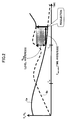
- FIG. 2 is a graph used to describe parameters related to cell selection.
- the control signal in this case, generally refers to a paging indicator channel (PICH).
- PICH paging indicator channel
- the mobile terminal performs a neighboring cell search when the reception level of a signal of the serving cell becomes less than or equal to the cell search threshold (S-intra).
- S-intra cell search threshold
- "Sa" indicates an average of reception levels of signals received from the base station of the serving cell and is calculated using a fixed forgetting factor as in the related art.
- Sb indicates an average of reception levels of signals received from the base station of a neighboring cell (that is likely to be selected) and is calculated using a fixed forgetting factor as in the related art.
- the reception levels are represented by Ec/N 0 .
- reception levels may be represented by any other appropriate indicator.
- cell reselection is performed if the reception level Sb of signals from the neighboring cell becomes higher than the reception level Sa of signals from the serving cell and the difference between the reception levels continues to be greater than or equal to the hysteresis level Q hyst for the cell reselection wait period T reselection or longer.
- cell reselection is performed after the cell reselection wait period T reselection from time T b .
- the averaging unit 12 averages measured reception levels of the serving cell and/or the neighboring cell. For example, the averaging unit 12 averages the measured reception levels using a forgetting factor ⁇ ( ⁇ 1).
- ⁇ a forgetting factor
- the forgetting factor ⁇ in this embodiment is variable.
- the cell selection unit 13 determines whether it is necessary to switch cells based on the averaged measurement and performs cell reselection if necessary.
- the movement sensor 14 measures the mobility (or moving speed) of the mobile terminal. For example, the movement sensor 14 determines the mobility by measuring the maximum Doppler frequency f D .
- the averaging factor determining unit 15 adjusts the forgetting factor ⁇ according to communication conditions.
- the communication conditions may be determined, for example, based on parameters in broadcast information and/or the mobility measured by the movement sensor 14. As described above, in this embodiment, measurements are averaged using the formula (A) described above.
- the forgetting factor is fixed in the related art, the forgetting factor ⁇ in this embodiment is variable.
- k indicates an averaging (filtering) factor and is greater than or equal to 0.
- FIG. 3 is a table showing relationships between the filtering factor k, the forgetting factor ⁇ , and the average Fn.
- the previous average F n-1 is not taken into account and Fn equals the instantaneous value Mn.
- the influence of the previous average F n-1 on the updated average Fn increases.
- the forgetting factor ⁇ may be represented by any other formula than the formula (B) and the averaging factor k may take any values as long as the average Fn shows a tendency as shown in FIG. 3 .
- FIG. 4 is a drawing illustrating qualitative relationships between the averaging factor k and various parameters.
- the averaging factor k is set at a large value so that the average Fn changes slowly.
- the averaging factor k is set at a small value to increase the weight of the instantaneous value Mn and thereby to make the average Fn to exactly reflect the current communication conditions.
- the averaging factor k is set at a large value so that the average Fn changes slowly.
- the averaging factor k is set at a small value to increase the weight of the instantaneous value Mn and thereby to quickly change the average Fn to exactly reflect the current communication conditions.
- the averaging factor k is set at a large value so that the average Fn changes slowly.
- the averaging factor k is set at a small value to increase the weight of the instantaneous value Mn and thereby to quickly change the average Fn to exactly reflect the current communication conditions.
- the averaging factor k is set at a large value so that the average Fn changes slowly.
- the averaging factor k is set at a small value to increase the weight of the instantaneous value Mn and thereby to change the average Fn to exactly reflect the frequently-changing current communication conditions.
- the parameters and their characteristics described above are just examples.
- the averaging factor k may be adjusted based on the value of any other parameter in a manner as described above.
- the same weight may be given to the above parameters or greater weight may be given to a given one of the parameters.
- greater weight may be given to the intermittent reception interval T DRX and the mobility f D .
- the intermittent reception interval T DRX is long, it is normally not necessary to increase the weight of the instantaneous value Mn so that the average Fn is quickly changed to reflect the current communication conditions.
- the hysteresis level Q hyst is large, it may be necessary to quickly change the average Fn to reflect the current communication conditions.
- FIG. 5 is a table showing exemplary parameter settings (1).
- the averaging factor k is set at 1 in examples 1 and 2, set at 2 in example 3, and set at 3 in example 4.
- the averaging factor k in example 3 is larger than that in examples 1 and 2 because the intermittent reception interval T DRX and the cell reselection wait period T reselection are longer and the hysteresis level Q hyst is larger.
- the averaging factor k in example 4 is still larger than that in example 3 because the cell reselection wait period T reselection is longer and the hysteresis level Q hyst is larger.
- FIG. 6 is a table showing exemplary parameter settings (2).
- different values are set for the averaging factor k depending on the mobility. For example, a user moving at a speed of 60 km/h or higher is classified as a high-speed user and a user moving at a lower speed is classified as a low-speed user.
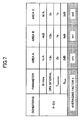
- FIG. 7 is a table showing exemplary parameter settings (3).
- different values are set for the averaging factor k for areas A, B, and C where different telecommunication carriers provide services.
- the values of the parameters differ depending on the telecommunication carriers and the averaging factor k is set according to the parameter values.
- the parameter settings as shown in FIGs. 5 , 6 , and 7 may be stored in the mobile terminal as a table.
- the averaging factor k may be determined without using a table as described above with reference to FIG. 4 .
- FIG. 8 is a flowchart showing an exemplary process performed by the mobile terminal of FIG. 1 .
- the mobile terminal receives broadcast information including parameters.
- the broadcast information includes parameters such as a cell search threshold (S-intra), an intermittent reception interval (T DRX ), a cell reselection wait period (T reselection ), and a hysteresis level (Q hyst ).
- step S2 the mobile terminal measures the mobility.
- the mobility is, for example, determined by measuring the maximum Doppler frequency f D .
- step S3 the mobile terminal determines an averaging factor k based on the received parameters and/or the mobility.
- the averaging factor k may be determined as described above with reference to FIG. 4 .
- step S4 the mobile terminal calculates a forgetting factor based on the determined averaging factor k and averages measured reception levels based on the forgetting factor. Then, the mobile terminal reselects a cell as needed.
- step S2 is performed after step S1.
- steps S1 and S2 may be performed in any order or may be performed simultaneously.
- step S2 is not essential and may be omitted.
- the averaging factor k may be determined solely on one or more of the parameters in the broadcast information.
- an embodiment of the present invention makes it possible to appropriately change the averaging factor, which is fixed in the related art technologies, according to parameters related to a measurement interval and cell selection specified by the network and/or the moving speed of a mobile terminal. This in turn makes it possible to appropriately average measurements of neighboring cell quality, to more appropriately reselect a cell, and thereby to improve the call connection quality and to reduce the power consumption.
- embodiments of the present invention make it possible for a mobile terminal to average measurements of neighboring cell quality according to communication conditions in a corresponding area.
- the present invention may be applied to any type of cellular mobile communication system.
- the present invention may be applied to an IMT-2000 system, an HSDPA/HSUPA W-CDMA system, an LTE system, an IMT-Advanced system, a WiMAX system, and a Wi-Fi system.
- the apparatus may be implemented by hardware, software, or a combination of them.
Landscapes
- Engineering & Computer Science (AREA)
- Computer Networks & Wireless Communication (AREA)
- Signal Processing (AREA)
- Databases & Information Systems (AREA)
- Mobile Radio Communication Systems (AREA)
- Circuits Of Receivers In General (AREA)
- Monitoring And Testing Of Transmission In General (AREA)
Abstract
Description
- A certain aspect of the present invention relates to mobile communication technologies. More particularly, the present invention relates to a mobile terminal and a method used in the mobile terminal.
- A mobile terminal in the standby mode performs a cell search and selects a suitable cell based on the results of the cell search. Cell selection is performed regardless of whether the mobile terminal is stationary or moving. When a mobile terminal in the standby mode is stationary, substantial changes in the radio propagation conditions are not normally observed and therefore it is not normally necessary to frequently perform cell selection. Still, however, instantaneous measurements of radio propagation conditions change continuously. Therefore, if cell selection is performed based on instantaneous values of radio propagation conditions, unnecessary reselection of cells is performed frequently and as a result, efficiency of the network or the mobile terminal is reduced. In a related-art method, the mobile terminal averages measurements of radio propagation conditions to prevent such frequent reselection of cells and thereby to lengthen the standby time. In the method, the mobile terminal averages the measurements based on an averaging (filtering) factor that is a fixed value provided in the mobile terminal.
- Meanwhile, Japanese Patent Application Publication No.
2007-258845 2007-202096 - A mobile terminal regularly receives broadcast information from a base station which includes parameters related to a cell measurement interval and cell reselection specified by the network. Such parameters may change according to the conditions of cells. If the conditions of cells change, the timing and frequency at which cell reselection is required may also change and therefore it is preferable to change the method of averaging measurements of, for example, the signal reception level. Particularly, when the mobile terminal is moving, suitable cells change constantly and therefore it is preferable to frequently calculate or update the average of reception level measurements.
- However, in the related art, the averaging factor provided in the mobile terminal is fixed (constant) and the same averaging method is used regardless of the cell conditions. Accordingly, with the related-art technologies, it is difficult to appropriately average measurements of communication quality of neighboring cells according to actual cell conditions and thereby to select a suitable cell.
- To summarize, related-art technologies have disadvantages as described below.
- (a) The averaging factor used to average measurements of cell quality for cell selection is not changed even when parameters related to a measurement interval and cell selection specified by the network are changed. Therefore, it is difficult to average the measurements according to actual or current conditions of cells.
- (b) Although communication conditions are much influenced by the moving speed of the mobile terminal, the averaging factor used in averaging measurements of cell quality is not changed even when the moving speed changes. Therefore, it is difficult to average the measurements according to the communication conditions.
-
US2007/218906A discloses a mobile terminal for a cellular mobile communication system comprising a wireless local area network, WLAN, and a mobile radio network, the mobile terminal comprising: a measuring unit configured to measure reception levels of received signals, an averaging unit configured to calculate a weighted average of the measured reception levels, wherein the weighting factors depend on the speed of the terminal, a cell reselection unit configured to execute a handover between the WLAN and the mobile radio network based on the averaged reception level, and a factor determining unit configured to determine the weighting factors according to the speed of the mobile terminal, wherein the speed is set based on parameters sent from a Global Positioning System, GPS. - The invention is a mobile terminal and a method as defined in
Claims - The present invention can solve or reduce one or more problems caused by the limitations and disadvantages of the related art.
-
-
FIG. 1 is a schematic block diagram illustrating a mobile terminal according to an embodiment of the present invention; -
FIG. 2 is a graph used to describe parameters to be broadcast; -
FIG. 3 is a table showing relationships between an averaging (filtering) factor k, a forgetting factor α, and an average Fn; -
FIG. 4 is a drawing illustrating qualitative relationships between an averaging factor k and various parameters; -
FIG. 5 is a table showing exemplary parameter settings (1); -
FIG. 6 is a table showing exemplary parameter settings (2); -
FIG. 7 is a table showing exemplary parameter settings (3); and -
FIG. 8 is a flowchart showing an exemplary process performed by a mobile terminal. - Preferred embodiments of the present invention are described below with reference to the accompanying drawings.
- According to an embodiment of the present invention, a forgetting factor α used in averaging measurements of a neighboring cell is determined according to parameters including an intermittent reception interval, a cell reselection wait period, and/or a cell reselection threshold specified by the network. For example, measurements of cell quality such as the reception level may be averaged by the following formula:

- In the above formula, Fn indicates an updated average, Fn-1 indicates a previous average (an average before being updated), and Mn indicates a most recent measurement (instantaneous value). The forgetting factor α may be obtained by the following formula:

- In this formula, k indicates an averaging (filtering) factor and is greater than or equal to 0. Accordingly, the forgetting factor α becomes a value less than or equal to 1.
- In averaging measurements, this approach makes it possible to change the weight of the previous average Fn-1 with respect to the most recent measurement Mn by changing the averaging factor k and thereby changing the forgetting factor α.
- According to another embodiment of the present invention, cell reselection is performed if the reception level of signals from a neighboring cell becomes higher than the reception level of signals from a serving cell and the difference between the reception levels continues to be greater than or equal to a cell reselection threshold (hysteresis level) for a cell reselection wait period or longer. In this case, the parameters described above may include a cell reselection wait period Treselection. The length of the cell reselection wait period affects the probability that cell reselection will be performed. Therefore, it is preferable to determine the weight of the previous average Fn-1 with respect to the most recent measurement Mn taking into account the length of the cell reselection wait period. Alternatively, the parameters described above may include a hysteresis level Qhyst because the hysteresis level also affects the probability that cell reselection will be performed.
- According to another embodiment of the present invention, the forgetting factor α is determined according to the moving speed of the mobile terminal. The moving speed affects the frequency at which the channel conditions change. Therefore, it is preferable to determine the forgetting factor α, i.e., the weight of the previous average Fn-1 with respect to the most recent measurement Mn, according to the moving speed.
-
FIG. 1 is a schematic block diagram illustrating a mobile terminal according to an embodiment of the present invention. The mobile terminal may be implemented as any user device such as a cell phone or a personal computer. As shown inFIG. 1 , the mobile terminal includes areceiving unit 11, anaveraging unit 12, acell selection unit 13, amovement sensor 14, and an averagingfactor determining unit 15. - The
receiving unit 11 receives radio signals from a base station, and demodulates and decodes the received radio signals. In this embodiment, pilot signals and broadcast information in the radio signals are particularly relevant. Broadcast information includes various information and parameters specified by the network. For example, broadcast information includes parameters such as a cell search threshold (S-intra), an intermittent reception interval (TDRX), a cell reselection wait period (Treselection), and a hysteresis level (Qhyst) used as a cell reselection threshold. InFIG. 1 , pilot signals and those parameters are represented by α, β, and γ. The receivingunit 11 also measures instantaneous reception levels of pilot signals from a serving cell and/or a neighboring cell. In this embodiment, a "reception level" indicates instantaneous or average quality of radio conditions. The reception level may be represented, for example, by a received power, a received signal strength indicator (RSSI), a received signal code power (RSCP), a path loss, a signal-to-noise (S/N) ratio, or an energy-per-chip-to-noise ratio (Ec/N0). -
FIG. 2 is a graph used to describe parameters related to cell selection. In the graph, it is assumed that the mobile terminal is in the standby mode and regularly receiving a control signal at an intermittent reception interval (TDRX) of, for example, 2.5 s. The control signal, in this case, generally refers to a paging indicator channel (PICH). The mobile terminal performs a neighboring cell search when the reception level of a signal of the serving cell becomes less than or equal to the cell search threshold (S-intra). InFIG. 2 , "Sa" indicates an average of reception levels of signals received from the base station of the serving cell and is calculated using a fixed forgetting factor as in the related art. "Sb" indicates an average of reception levels of signals received from the base station of a neighboring cell (that is likely to be selected) and is calculated using a fixed forgetting factor as in the related art. In this example, the reception levels are represented by Ec/N0. However, reception levels may be represented by any other appropriate indicator. When the mobile terminal comes close to the cell edge at time Tab, the order of the reception levels (averages) Sa and Sb changes (Sb becomes greater than Sa). If the cells are switched (reselected) immediately when the order of the reception levels Sa and Sb changes, the problem (unnecessary, frequent reselection of cells) as described above may occur. For this reason, cell reselection is performed if the reception level Sb of signals from the neighboring cell becomes higher than the reception level Sa of signals from the serving cell and the difference between the reception levels continues to be greater than or equal to the hysteresis level Qhyst for the cell reselection wait period Treselection or longer. In this example, cell reselection is performed after the cell reselection wait period Treselection from time Tb. - The averaging
unit 12 averages measured reception levels of the serving cell and/or the neighboring cell. For example, the averagingunit 12 averages the measured reception levels using a forgetting factor α (< 1). When Fn-1 indicates a previous average and Mn indicates a most recent measurement (instantaneous value), an updated average Fn is, for example, represented by the following formula:
- As described later, unlike in the related art, the forgetting factor α in this embodiment is variable.
- The
cell selection unit 13 determines whether it is necessary to switch cells based on the averaged measurement and performs cell reselection if necessary. - The
movement sensor 14 measures the mobility (or moving speed) of the mobile terminal. For example, themovement sensor 14 determines the mobility by measuring the maximum Doppler frequency fD. - The averaging
factor determining unit 15 adjusts the forgetting factor α according to communication conditions. The communication conditions may be determined, for example, based on parameters in broadcast information and/or the mobility measured by themovement sensor 14. As described above, in this embodiment, measurements are averaged using the formula (A) described above. Although the forgetting factor is fixed in the related art, the forgetting factor α in this embodiment is variable. The forgetting factor α in this embodiment is defined by the following formula:
- In the formula (B), k indicates an averaging (filtering) factor and is greater than or equal to 0.
-
FIG. 3 is a table showing relationships between the filtering factor k, the forgetting factor α, and the average Fn. As shown inFIG. 3 , when k=0, the previous average Fn-1 is not taken into account and Fn equals the instantaneous value Mn. As the value of k increases, the influence of the previous average Fn-1 on the updated average Fn increases. In other words, the smaller the value of k is, the greater the weight of the instantaneous value Mn becomes; and as the value of k increases, the average Fn changes more slowly. The forgetting factor α may be represented by any other formula than the formula (B) and the averaging factor k may take any values as long as the average Fn shows a tendency as shown inFIG. 3 . -
FIG. 4 is a drawing illustrating qualitative relationships between the averaging factor k and various parameters. - When the intermittent reception interval TDRX is long, the reception level is measured less frequently. In this case, an average value is more important than an instantaneous value. Therefore, the averaging factor k is set at a large value so that the average Fn changes slowly. On the contrary, when the intermittent reception interval TDRX is short, the reception level is measured frequently. In this case, the averaging factor k is set at a small value to increase the weight of the instantaneous value Mn and thereby to make the average Fn to exactly reflect the current communication conditions.
- When the cell reselection wait period Treselection is long, i.e., cell reselection is performed after a long period from time Tb in
FIG. 2 , an average value is more important than an instantaneous value. Therefore, the averaging factor k is set at a large value so that the average Fn changes slowly. On the other hand, when the cell reselection wait period Treselection is short, i.e., reselection is performed after a short period from time Tb inFIG. 2 , an instantaneous value is more important than an average value. In this case, the averaging factor k is set at a small value to increase the weight of the instantaneous value Mn and thereby to quickly change the average Fn to exactly reflect the current communication conditions. - When the hysteresis level Qhyst is large, the probability of cell reselection is low. In this case, an average value is more important than an instantaneous value. Therefore, the averaging factor k is set at a large value so that the average Fn changes slowly. On the other hand, when the hysteresis level Qhyst is small, the probability of cell reselection is high. In this case, the averaging factor k is set at a small value to increase the weight of the instantaneous value Mn and thereby to quickly change the average Fn to exactly reflect the current communication conditions.
- When the mobility fD is low, the channel conditions do not change frequently. In this case, an average value is more important than an instantaneous value. Therefore, the averaging factor k is set at a large value so that the average Fn changes slowly. On the other hand, when the mobility fD is high, the channel conditions change frequently. In this case, the averaging factor k is set at a small value to increase the weight of the instantaneous value Mn and thereby to change the average Fn to exactly reflect the frequently-changing current communication conditions.
- The parameters and their characteristics described above are just examples. The averaging factor k may be adjusted based on the value of any other parameter in a manner as described above. The same weight may be given to the above parameters or greater weight may be given to a given one of the parameters. For example, greater weight may be given to the intermittent reception interval TDRX and the mobility fD. When, for example, the intermittent reception interval TDRX is long, it is normally not necessary to increase the weight of the instantaneous value Mn so that the average Fn is quickly changed to reflect the current communication conditions. On the other hand, even if the hysteresis level Qhyst is large, it may be necessary to quickly change the average Fn to reflect the current communication conditions.
-
FIG. 5 is a table showing exemplary parameter settings (1). InFIG. 5 , the averaging factor k is set at 1 in examples 1 and 2, set at 2 in example 3, and set at 3 in example 4. The averaging factor k in example 3 is larger than that in examples 1 and 2 because the intermittent reception interval TDRX and the cell reselection wait period Treselection are longer and the hysteresis level Qhyst is larger. The averaging factor k in example 4 is still larger than that in example 3 because the cell reselection wait period Treselection is longer and the hysteresis level Qhyst is larger. -
FIG. 6 is a table showing exemplary parameter settings (2). In this example, different values are set for the averaging factor k depending on the mobility. For example, a user moving at a speed of 60 km/h or higher is classified as a high-speed user and a user moving at a lower speed is classified as a low-speed user. -
FIG. 7 is a table showing exemplary parameter settings (3). In this example, different values are set for the averaging factor k for areas A, B, and C where different telecommunication carriers provide services. The values of the parameters differ depending on the telecommunication carriers and the averaging factor k is set according to the parameter values. - The parameter settings as shown in
FIGs. 5 ,6 , and7 may be stored in the mobile terminal as a table. Alternatively, the averaging factor k may be determined without using a table as described above with reference toFIG. 4 . -
FIG. 8 is a flowchart showing an exemplary process performed by the mobile terminal ofFIG. 1 . In step S1, the mobile terminal receives broadcast information including parameters. For example, the broadcast information includes parameters such as a cell search threshold (S-intra), an intermittent reception interval (TDRX), a cell reselection wait period (Treselection), and a hysteresis level (Qhyst). - In step S2, the mobile terminal measures the mobility. The mobility is, for example, determined by measuring the maximum Doppler frequency fD.
- In step S3, the mobile terminal determines an averaging factor k based on the received parameters and/or the mobility. The averaging factor k may be determined as described above with reference to
FIG. 4 . - In step S4, the mobile terminal calculates a forgetting factor based on the determined averaging factor k and averages measured reception levels based on the forgetting factor. Then, the mobile terminal reselects a cell as needed.
- In the above exemplary process, step S2 is performed after step S1. However, steps S1 and S2 may be performed in any order or may be performed simultaneously. Also, step S2 is not essential and may be omitted. In other words, the averaging factor k may be determined solely on one or more of the parameters in the broadcast information.
- As described above, an embodiment of the present invention makes it possible to appropriately change the averaging factor, which is fixed in the related art technologies, according to parameters related to a measurement interval and cell selection specified by the network and/or the moving speed of a mobile terminal. This in turn makes it possible to appropriately average measurements of neighboring cell quality, to more appropriately reselect a cell, and thereby to improve the call connection quality and to reduce the power consumption.
- Thus, embodiments of the present invention make it possible for a mobile terminal to average measurements of neighboring cell quality according to communication conditions in a corresponding area.
- The present invention may be applied to any type of cellular mobile communication system. For example, the present invention may be applied to an IMT-2000 system, an HSDPA/HSUPA W-CDMA system, an LTE system, an IMT-Advanced system, a WiMAX system, and a Wi-Fi system.
- Although a functional block diagram is used to describe an apparatus in the above embodiments, the apparatus may be implemented by hardware, software, or a combination of them.
Claims (6)
- A mobile terminal for a cellular mobile communication system, the mobile terminal comprising:a measuring unit (11)configured to measure reception levels of received signals;an averaging unit (12) configured to calculate an average reception level based on a previous average of the measured reception levels, a latest reception level, and a forgetting factor for determining a weight of the previous average of the measured reception levels with respect to the latest reception level;a cell reselection unit (13) configured to perform cell reselection based on the average reception level; anda factor determining unit (15) configured to determine the forgetting factor according to parameters including a cell reselection wait period and a cell reselection threshold sent from a base station in the cellular mobile communication system,wherein the cell reselection unit is configured to perform the cell reselection if the average reception level of a received signal from a neighboring cell becomes higher than the average reception level of a received signal from a serving cell and a difference between the average reception levels continues to be greater than or equal to the cell reselection threshold for the cell reselection wait period or longer.
- The mobile terminal as claimed in claim 1, wherein the parameters further include an intermittent reception interval, and wherein the factor determining unit is configured to determine the forgetting factor according to a moving speed of the mobile terminal.
- The mobile terminal as claimed in claim 2, wherein the factor determining unit is configured to change the forgetting factor according to a change in one or more of the intermittent reception interval, the cell reselection wait period, the cell reselection threshold, and the moving speed.
- A method for a mobile terminal to measure neighboring cell quality in a cellular mobile communication system, the method comprising the steps of:measuring reception levels of received signals;calculating an average reception level based on a previous average of the measured reception levels, a latest reception level, and a forgetting factor for determining a weight of the previous average of the measured reception levels with respect to the latest reception level;determining the forgetting factor according to parameters including a cell reselection wait period and a cell reselection threshold sent from a base station in the cellular mobile communication system; andperforming cell reselection if the average reception level of a received signal from a neighboring cell becomes higher than the average reception level of a received signal from a serving cell and a difference between the average reception levels continues to be greater than or equal to the cell reselection threshold for the cell reselection wait period or longer.
- The method as claimed in claim 4, wherein the parameters further include an intermittent reception interval and wherein the forgetting factor is determined according to a moving speed of the mobile terminal.
- The method as claimed in claim 5, wherein the forgetting factor is changed according to a change in one or more of the intermittent reception interval, the cell reselection wait period, the cell reselection threshold, and the moving speed.
Applications Claiming Priority (1)
| Application Number | Priority Date | Filing Date | Title |
|---|---|---|---|
| JP2008134601A JP5179258B2 (en) | 2008-05-22 | 2008-05-22 | Mobile terminal and method used in mobile terminal |
Publications (2)
| Publication Number | Publication Date |
|---|---|
| EP2124497A1 EP2124497A1 (en) | 2009-11-25 |
| EP2124497B1 true EP2124497B1 (en) | 2010-08-04 |
Family
ID=40957698
Family Applications (1)
| Application Number | Title | Priority Date | Filing Date |
|---|---|---|---|
| EP09251300A Not-in-force EP2124497B1 (en) | 2008-05-22 | 2009-05-12 | Method and apparatus for averaging measured reception levels in a mobile communication system |
Country Status (6)
| Country | Link |
|---|---|
| US (1) | US8401556B2 (en) |
| EP (1) | EP2124497B1 (en) |
| JP (1) | JP5179258B2 (en) |
| CN (1) | CN101588623B (en) |
| AT (1) | ATE476850T1 (en) |
| DE (1) | DE602009000094D1 (en) |
Families Citing this family (20)
| Publication number | Priority date | Publication date | Assignee | Title |
|---|---|---|---|---|
| JP4943272B2 (en) * | 2007-08-13 | 2012-05-30 | 株式会社エヌ・ティ・ティ・ドコモ | User apparatus and method in mobile communication system |
| JP2011155592A (en) * | 2010-01-28 | 2011-08-11 | Ntt Docomo Inc | Mobile station and mobile communication method |
| KR101722204B1 (en) | 2010-04-27 | 2017-04-03 | 삼성전자주식회사 | Apparatus and method for providing handover support inforamtion in mobile communication system |
| CN102457894B (en) * | 2010-10-27 | 2015-09-30 | 华为技术有限公司 | Cell switching method, method of measurement, equipment and system |
| JP2012124585A (en) * | 2010-12-06 | 2012-06-28 | Kddi Corp | Communication quality estimation device, base station device, communication quality estimation method, and communication quality estimation program |
| JP2012142851A (en) * | 2011-01-05 | 2012-07-26 | Nec Casio Mobile Communications Ltd | Wireless communication device and method of measuring same frequency cell in standby |
| JP2013038686A (en) * | 2011-08-10 | 2013-02-21 | Ntt Docomo Inc | Mobile station and mobile communication method |
| US9241298B2 (en) | 2011-11-18 | 2016-01-19 | Qualcomm Incorporated | Devices and methods for facilitating access probe sequences |
| US8750876B2 (en) * | 2012-02-15 | 2014-06-10 | Telefonaktiebolaget L M Ericsson (Publ) | Methods and devices for adjusting resource management procedures in heterogeneous communication networks based on cell information |
| JP5247923B1 (en) * | 2012-09-25 | 2013-07-24 | ソフトバンクモバイル株式会社 | Terminal, control method thereof, and control program |
| US9668191B2 (en) * | 2012-06-11 | 2017-05-30 | Qualcomm Incorporated | Methods and apparatuses for saving user equipment power by search length reduction |
| US20140036868A1 (en) * | 2012-08-03 | 2014-02-06 | Innovative Sonic Corporation | Method and apparatus for prioritizing small cells in a wireless communication system |
| US20140071840A1 (en) * | 2012-09-11 | 2014-03-13 | Hand Held Products, Inc., doing business as Honeywell Scanning & Mobility | Mobile computer configured to select wireless communication network |
| US9420605B2 (en) * | 2013-05-10 | 2016-08-16 | Blackberry Limited | Method and apparatus for cell coordination in heterogeneous cellular networks |
| US9510273B2 (en) * | 2013-09-18 | 2016-11-29 | Samsung Electronics Co., Ltd. | Communication system with cell selection mechanism and method of operation thereof |
| DE102014210292B4 (en) * | 2014-05-30 | 2026-04-23 | Rohde & Schwarz GmbH & Co. Kommanditgesellschaft | Measuring instrument, measuring system and method for operating a measuring system with rapid synchronization of settings |
| CN105611586B (en) * | 2016-01-12 | 2018-09-11 | 广东欧珀移动通信有限公司 | Residence reselecting, device and base station |
| CN107820718B (en) | 2017-04-21 | 2020-07-31 | 深圳前海达闼云端智能科技有限公司 | Method and device for reselecting cell |
| JP7372755B2 (en) * | 2019-03-29 | 2023-11-01 | 太陽誘電株式会社 | Communication devices, communication methods, programs, and communication systems |
| CN111551778A (en) * | 2020-03-20 | 2020-08-18 | 北京元心科技有限公司 | Mobile terminal power consumption debugging method and system and corresponding mobile terminal |
Family Cites Families (14)
| Publication number | Priority date | Publication date | Assignee | Title |
|---|---|---|---|---|
| SE466082B (en) | 1990-05-03 | 1991-12-09 | Ericsson Telefon Ab L M | PROCEDURE FOR PREDICTING THE VALUE IN A MOBILE RADIO SYSTEM |
| JPH0541689A (en) | 1991-08-05 | 1993-02-19 | Nippon Telegr & Teleph Corp <Ntt> | Channel switching method in cellular mobile communication |
| US5335356A (en) | 1991-09-05 | 1994-08-02 | Telefonaktiebolaget L M Ericsson | Adaptive resource allocation in a mobile telephone system |
| EP1548973B1 (en) * | 1999-12-09 | 2008-01-02 | Nokia Corporation | Mobile equipment based filtering for packet radio service applications |
| JP4453168B2 (en) | 2000-06-23 | 2010-04-21 | 日本電気株式会社 | Mobile communication control method, cellular system, mobile station, base station, and base station controller |
| JP4129272B2 (en) * | 2003-06-27 | 2008-08-06 | 三菱電機株式会社 | Mobile communication system, mobile device, and network host device |
| DE102005009897A1 (en) * | 2005-03-01 | 2006-09-14 | T-Mobile International Ag & Co. Kg | Method for optimizing the cell reselection performance in a mobile network according to UMTS standard |
| US7616604B2 (en) | 2005-10-25 | 2009-11-10 | Cisco Technology, Inc. | Identifying one or more access points in one or more channels to facilitate communication |
| JP4732924B2 (en) | 2005-12-28 | 2011-07-27 | 株式会社エヌ・ティ・ティ・ドコモ | Mobile station apparatus, base station apparatus, and neighboring cell measurement control method |
| DE102006012743A1 (en) | 2006-03-17 | 2007-09-27 | Nec Europe Ltd. | Method for operating a mobile node |
| JP4812479B2 (en) | 2006-03-20 | 2011-11-09 | 株式会社エヌ・ティ・ティ・ドコモ | Mobile station and peripheral cell measurement method |
| JP2008134601A (en) | 2006-11-01 | 2008-06-12 | Canon Inc | Image forming apparatus |
| US8369857B2 (en) * | 2007-11-02 | 2013-02-05 | Telefonaktiebolaget Lm Ericsson (Publ) | Speed-dependent adaptation of mobility parameters with dual speed measurement |
| JP5695384B2 (en) * | 2009-10-05 | 2015-04-01 | 花王株式会社 | Hair shape susceptibility gene |
-
2008
- 2008-05-22 JP JP2008134601A patent/JP5179258B2/en not_active Expired - Fee Related
-
2009
- 2009-05-11 US US12/463,744 patent/US8401556B2/en not_active Expired - Fee Related
- 2009-05-12 DE DE602009000094T patent/DE602009000094D1/en active Active
- 2009-05-12 EP EP09251300A patent/EP2124497B1/en not_active Not-in-force
- 2009-05-12 AT AT09251300T patent/ATE476850T1/en not_active IP Right Cessation
- 2009-05-22 CN CN2009102028015A patent/CN101588623B/en not_active Expired - Fee Related
Also Published As
| Publication number | Publication date |
|---|---|
| ATE476850T1 (en) | 2010-08-15 |
| US8401556B2 (en) | 2013-03-19 |
| JP2009284251A (en) | 2009-12-03 |
| US20090291688A1 (en) | 2009-11-26 |
| DE602009000094D1 (en) | 2010-09-16 |
| CN101588623A (en) | 2009-11-25 |
| CN101588623B (en) | 2013-06-12 |
| EP2124497A1 (en) | 2009-11-25 |
| JP5179258B2 (en) | 2013-04-10 |
Similar Documents
| Publication | Publication Date | Title |
|---|---|---|
| US8401556B2 (en) | Mobile terminal and method used in the same | |
| US12621754B2 (en) | Inter-radio access technology (RAT) | |
| EP1532837B1 (en) | Limiting cell reselection based on pilot power | |
| JP5801366B2 (en) | Method and apparatus for reselecting cells | |
| EP2206378B1 (en) | Speed-dependent adaptation of mobility parameters with dual speed measurement | |
| EP2781120B1 (en) | Methods and devices for facilitating modified cell reselection parameters and procedures when access terminals exhibit little or no mobility | |
| US7409215B2 (en) | Mobile communication hand-off control system and unit | |
| EP2298011B1 (en) | Searching for signals in a wireless communication system | |
| US7209728B2 (en) | Mobile communication terminal apparatus which performs intermittent reception | |
| KR101595682B1 (en) | Performing idle mode mobility measurements in a mobile communication network | |
| JP2005012429A (en) | Mobile communication terminal and handover control method | |
| JP2004356684A (en) | Cell search method of mobile radio terminal device and mobile radio terminal device | |
| US8731509B2 (en) | Methods and apparatus for signal monitoring in a wireless communication network | |
| GB2370197A (en) | Method of determining handoff | |
| KR100833358B1 (en) | Radio communication terminal and handoff decision method | |
| US12543077B2 (en) | Reducing unnecessary roam scan behavior | |
| EP2317800B1 (en) | Method and apparatus for signal monitoring in a wireless communication network | |
| EP1949720B1 (en) | Apparatus, method and computer program product providing automatically adjusted time periods used for event evaluation | |
| JP5140439B2 (en) | Mobile communication terminal and control method thereof | |
| JP2001285911A (en) | Wireless telephone device | |
| KR100557182B1 (en) | Cell reselection method in mobile communication terminal | |
| US20080176551A1 (en) | Mobile terminal and method of receiving radio waveform at the same | |
| US20250106743A1 (en) | Out-of-Service Recovery Search Method and Out-of-Service Recovery Search System Capable of Performing High Search Efficiency and Link Tracking for Cell Detection | |
| KR100715807B1 (en) | Mobile terminal and cell reselection method | |
| JPWO2001020936A1 (en) | Mobile communication terminal device |
Legal Events
| Date | Code | Title | Description |
|---|---|---|---|
| PUAI | Public reference made under article 153(3) epc to a published international application that has entered the european phase |
Free format text: ORIGINAL CODE: 0009012 |
|
| 17P | Request for examination filed |
Effective date: 20090522 |
|
| AK | Designated contracting states |
Kind code of ref document: A1 Designated state(s): AT BE BG CH CY CZ DE DK EE ES FI FR GB GR HR HU IE IS IT LI LT LU LV MC MK MT NL NO PL PT RO SE SI SK TR |
|
| RIC1 | Information provided on ipc code assigned before grant |
Ipc: H04W 36/30 20090101AFI20091222BHEP |
|
| GRAP | Despatch of communication of intention to grant a patent |
Free format text: ORIGINAL CODE: EPIDOSNIGR1 |
|
| GRAS | Grant fee paid |
Free format text: ORIGINAL CODE: EPIDOSNIGR3 |
|
| GRAA | (expected) grant |
Free format text: ORIGINAL CODE: 0009210 |
|
| AK | Designated contracting states |
Kind code of ref document: B1 Designated state(s): AT BE BG CH CY CZ DE DK EE ES FI FR GB GR HR HU IE IS IT LI LT LU LV MC MK MT NL NO PL PT RO SE SI SK TR |
|
| REG | Reference to a national code |
Ref country code: GB Ref legal event code: FG4D |
|
| REG | Reference to a national code |
Ref country code: CH Ref legal event code: EP |
|
| REG | Reference to a national code |
Ref country code: IE Ref legal event code: FG4D |
|
| REF | Corresponds to: |
Ref document number: 602009000094 Country of ref document: DE Date of ref document: 20100916 Kind code of ref document: P |
|
| REG | Reference to a national code |
Ref country code: NL Ref legal event code: VDEP Effective date: 20100804 |
|
| LTIE | Lt: invalidation of european patent or patent extension |
Effective date: 20100804 |
|
| PG25 | Lapsed in a contracting state [announced via postgrant information from national office to epo] |
Ref country code: LT Free format text: LAPSE BECAUSE OF FAILURE TO SUBMIT A TRANSLATION OF THE DESCRIPTION OR TO PAY THE FEE WITHIN THE PRESCRIBED TIME-LIMIT Effective date: 20100804 Ref country code: NO Free format text: LAPSE BECAUSE OF FAILURE TO SUBMIT A TRANSLATION OF THE DESCRIPTION OR TO PAY THE FEE WITHIN THE PRESCRIBED TIME-LIMIT Effective date: 20101104 Ref country code: AT Free format text: LAPSE BECAUSE OF FAILURE TO SUBMIT A TRANSLATION OF THE DESCRIPTION OR TO PAY THE FEE WITHIN THE PRESCRIBED TIME-LIMIT Effective date: 20100804 Ref country code: FI Free format text: LAPSE BECAUSE OF FAILURE TO SUBMIT A TRANSLATION OF THE DESCRIPTION OR TO PAY THE FEE WITHIN THE PRESCRIBED TIME-LIMIT Effective date: 20100804 Ref country code: NL Free format text: LAPSE BECAUSE OF FAILURE TO SUBMIT A TRANSLATION OF THE DESCRIPTION OR TO PAY THE FEE WITHIN THE PRESCRIBED TIME-LIMIT Effective date: 20100804 |
|
| PG25 | Lapsed in a contracting state [announced via postgrant information from national office to epo] |
Ref country code: PL Free format text: LAPSE BECAUSE OF FAILURE TO SUBMIT A TRANSLATION OF THE DESCRIPTION OR TO PAY THE FEE WITHIN THE PRESCRIBED TIME-LIMIT Effective date: 20100804 Ref country code: SI Free format text: LAPSE BECAUSE OF FAILURE TO SUBMIT A TRANSLATION OF THE DESCRIPTION OR TO PAY THE FEE WITHIN THE PRESCRIBED TIME-LIMIT Effective date: 20100804 Ref country code: IS Free format text: LAPSE BECAUSE OF FAILURE TO SUBMIT A TRANSLATION OF THE DESCRIPTION OR TO PAY THE FEE WITHIN THE PRESCRIBED TIME-LIMIT Effective date: 20101204 Ref country code: CY Free format text: LAPSE BECAUSE OF FAILURE TO SUBMIT A TRANSLATION OF THE DESCRIPTION OR TO PAY THE FEE WITHIN THE PRESCRIBED TIME-LIMIT Effective date: 20100804 Ref country code: BG Free format text: LAPSE BECAUSE OF FAILURE TO SUBMIT A TRANSLATION OF THE DESCRIPTION OR TO PAY THE FEE WITHIN THE PRESCRIBED TIME-LIMIT Effective date: 20101104 |
|
| PG25 | Lapsed in a contracting state [announced via postgrant information from national office to epo] |
Ref country code: BE Free format text: LAPSE BECAUSE OF FAILURE TO SUBMIT A TRANSLATION OF THE DESCRIPTION OR TO PAY THE FEE WITHIN THE PRESCRIBED TIME-LIMIT Effective date: 20100804 Ref country code: GR Free format text: LAPSE BECAUSE OF FAILURE TO SUBMIT A TRANSLATION OF THE DESCRIPTION OR TO PAY THE FEE WITHIN THE PRESCRIBED TIME-LIMIT Effective date: 20101105 Ref country code: SE Free format text: LAPSE BECAUSE OF FAILURE TO SUBMIT A TRANSLATION OF THE DESCRIPTION OR TO PAY THE FEE WITHIN THE PRESCRIBED TIME-LIMIT Effective date: 20100804 Ref country code: LV Free format text: LAPSE BECAUSE OF FAILURE TO SUBMIT A TRANSLATION OF THE DESCRIPTION OR TO PAY THE FEE WITHIN THE PRESCRIBED TIME-LIMIT Effective date: 20100804 |
|
| PG25 | Lapsed in a contracting state [announced via postgrant information from national office to epo] |
Ref country code: DK Free format text: LAPSE BECAUSE OF FAILURE TO SUBMIT A TRANSLATION OF THE DESCRIPTION OR TO PAY THE FEE WITHIN THE PRESCRIBED TIME-LIMIT Effective date: 20100804 |
|
| PG25 | Lapsed in a contracting state [announced via postgrant information from national office to epo] |
Ref country code: IT Free format text: LAPSE BECAUSE OF FAILURE TO SUBMIT A TRANSLATION OF THE DESCRIPTION OR TO PAY THE FEE WITHIN THE PRESCRIBED TIME-LIMIT Effective date: 20100804 Ref country code: SK Free format text: LAPSE BECAUSE OF FAILURE TO SUBMIT A TRANSLATION OF THE DESCRIPTION OR TO PAY THE FEE WITHIN THE PRESCRIBED TIME-LIMIT Effective date: 20100804 Ref country code: EE Free format text: LAPSE BECAUSE OF FAILURE TO SUBMIT A TRANSLATION OF THE DESCRIPTION OR TO PAY THE FEE WITHIN THE PRESCRIBED TIME-LIMIT Effective date: 20100804 Ref country code: CZ Free format text: LAPSE BECAUSE OF FAILURE TO SUBMIT A TRANSLATION OF THE DESCRIPTION OR TO PAY THE FEE WITHIN THE PRESCRIBED TIME-LIMIT Effective date: 20100804 Ref country code: RO Free format text: LAPSE BECAUSE OF FAILURE TO SUBMIT A TRANSLATION OF THE DESCRIPTION OR TO PAY THE FEE WITHIN THE PRESCRIBED TIME-LIMIT Effective date: 20100804 |
|
| PLBE | No opposition filed within time limit |
Free format text: ORIGINAL CODE: 0009261 |
|
| STAA | Information on the status of an ep patent application or granted ep patent |
Free format text: STATUS: NO OPPOSITION FILED WITHIN TIME LIMIT |
|
| PG25 | Lapsed in a contracting state [announced via postgrant information from national office to epo] |
Ref country code: ES Free format text: LAPSE BECAUSE OF FAILURE TO SUBMIT A TRANSLATION OF THE DESCRIPTION OR TO PAY THE FEE WITHIN THE PRESCRIBED TIME-LIMIT Effective date: 20101115 |
|
| 26N | No opposition filed |
Effective date: 20110506 |
|
| REG | Reference to a national code |
Ref country code: DE Ref legal event code: R097 Ref document number: 602009000094 Country of ref document: DE Effective date: 20110506 |
|
| PG25 | Lapsed in a contracting state [announced via postgrant information from national office to epo] |
Ref country code: HR Free format text: LAPSE BECAUSE OF FAILURE TO SUBMIT A TRANSLATION OF THE DESCRIPTION OR TO PAY THE FEE WITHIN THE PRESCRIBED TIME-LIMIT Effective date: 20110629 |
|
| PG25 | Lapsed in a contracting state [announced via postgrant information from national office to epo] |
Ref country code: MC Free format text: LAPSE BECAUSE OF NON-PAYMENT OF DUE FEES Effective date: 20110531 Ref country code: MT Free format text: LAPSE BECAUSE OF FAILURE TO SUBMIT A TRANSLATION OF THE DESCRIPTION OR TO PAY THE FEE WITHIN THE PRESCRIBED TIME-LIMIT Effective date: 20100804 |
|
| REG | Reference to a national code |
Ref country code: FR Ref legal event code: ST Effective date: 20120131 |
|
| REG | Reference to a national code |
Ref country code: IE Ref legal event code: MM4A |
|
| PG25 | Lapsed in a contracting state [announced via postgrant information from national office to epo] |
Ref country code: FR Free format text: LAPSE BECAUSE OF NON-PAYMENT OF DUE FEES Effective date: 20110531 Ref country code: IE Free format text: LAPSE BECAUSE OF NON-PAYMENT OF DUE FEES Effective date: 20110512 |
|
| PG25 | Lapsed in a contracting state [announced via postgrant information from national office to epo] |
Ref country code: MK Free format text: LAPSE BECAUSE OF FAILURE TO SUBMIT A TRANSLATION OF THE DESCRIPTION OR TO PAY THE FEE WITHIN THE PRESCRIBED TIME-LIMIT Effective date: 20100804 |
|
| PG25 | Lapsed in a contracting state [announced via postgrant information from national office to epo] |
Ref country code: LU Free format text: LAPSE BECAUSE OF NON-PAYMENT OF DUE FEES Effective date: 20110512 |
|
| PG25 | Lapsed in a contracting state [announced via postgrant information from national office to epo] |
Ref country code: PT Free format text: LAPSE BECAUSE OF NON-PAYMENT OF DUE FEES Effective date: 20100804 |
|
| PG25 | Lapsed in a contracting state [announced via postgrant information from national office to epo] |
Ref country code: TR Free format text: LAPSE BECAUSE OF FAILURE TO SUBMIT A TRANSLATION OF THE DESCRIPTION OR TO PAY THE FEE WITHIN THE PRESCRIBED TIME-LIMIT Effective date: 20100804 |
|
| PG25 | Lapsed in a contracting state [announced via postgrant information from national office to epo] |
Ref country code: HU Free format text: LAPSE BECAUSE OF FAILURE TO SUBMIT A TRANSLATION OF THE DESCRIPTION OR TO PAY THE FEE WITHIN THE PRESCRIBED TIME-LIMIT Effective date: 20100804 |
|
| PG25 | Lapsed in a contracting state [announced via postgrant information from national office to epo] |
Ref country code: HR Free format text: LAPSE BECAUSE OF FAILURE TO SUBMIT A TRANSLATION OF THE DESCRIPTION OR TO PAY THE FEE WITHIN THE PRESCRIBED TIME-LIMIT Effective date: 20100804 |
|
| REG | Reference to a national code |
Ref country code: CH Ref legal event code: PL |
|
| PG25 | Lapsed in a contracting state [announced via postgrant information from national office to epo] |
Ref country code: CH Free format text: LAPSE BECAUSE OF NON-PAYMENT OF DUE FEES Effective date: 20130531 Ref country code: LI Free format text: LAPSE BECAUSE OF NON-PAYMENT OF DUE FEES Effective date: 20130531 |
|
| PGFP | Annual fee paid to national office [announced via postgrant information from national office to epo] |
Ref country code: GB Payment date: 20180329 Year of fee payment: 10 |
|
| PGFP | Annual fee paid to national office [announced via postgrant information from national office to epo] |
Ref country code: DE Payment date: 20180502 Year of fee payment: 10 |
|
| REG | Reference to a national code |
Ref country code: DE Ref legal event code: R119 Ref document number: 602009000094 Country of ref document: DE |
|
| GBPC | Gb: european patent ceased through non-payment of renewal fee |
Effective date: 20190512 |
|
| PG25 | Lapsed in a contracting state [announced via postgrant information from national office to epo] |
Ref country code: DE Free format text: LAPSE BECAUSE OF NON-PAYMENT OF DUE FEES Effective date: 20191203 Ref country code: GB Free format text: LAPSE BECAUSE OF NON-PAYMENT OF DUE FEES Effective date: 20190512 |