EP2123748A1 - 2'-5'-oligoadenylate synthetase 3 for preventing and treating positive-sense single-stranded rna virus infection - Google Patents
2'-5'-oligoadenylate synthetase 3 for preventing and treating positive-sense single-stranded rna virus infection Download PDFInfo
- Publication number
- EP2123748A1 EP2123748A1 EP08290470A EP08290470A EP2123748A1 EP 2123748 A1 EP2123748 A1 EP 2123748A1 EP 08290470 A EP08290470 A EP 08290470A EP 08290470 A EP08290470 A EP 08290470A EP 2123748 A1 EP2123748 A1 EP 2123748A1
- Authority
- EP
- European Patent Office
- Prior art keywords
- oas3
- virus
- protein
- tet
- cells
- Prior art date
- Legal status (The legal status is an assumption and is not a legal conclusion. Google has not performed a legal analysis and makes no representation as to the accuracy of the status listed.)
- Withdrawn
Links
- 101000597332 Homo sapiens 2'-5'-oligoadenylate synthase 3 Proteins 0.000 title claims abstract description 36
- 102100035389 2'-5'-oligoadenylate synthase 3 Human genes 0.000 title claims abstract description 26
- 208000009341 RNA Virus Infections Diseases 0.000 title claims abstract description 9
- 239000003814 drug Substances 0.000 claims abstract description 6
- 108090000623 proteins and genes Proteins 0.000 claims description 86
- 102000004169 proteins and genes Human genes 0.000 claims description 73
- 241000700605 Viruses Species 0.000 claims description 60
- 208000015181 infectious disease Diseases 0.000 claims description 36
- 108091033319 polynucleotide Proteins 0.000 claims description 34
- 102000040430 polynucleotide Human genes 0.000 claims description 34
- 239000002157 polynucleotide Substances 0.000 claims description 34
- 230000000840 anti-viral effect Effects 0.000 claims description 33
- 238000000034 method Methods 0.000 claims description 23
- 241001493065 dsRNA viruses Species 0.000 claims description 21
- 239000013598 vector Substances 0.000 claims description 19
- 241000710772 Yellow fever virus Species 0.000 claims description 16
- 229940051021 yellow-fever virus Drugs 0.000 claims description 16
- 241000710929 Alphavirus Species 0.000 claims description 13
- 239000012634 fragment Substances 0.000 claims description 13
- 238000003556 assay Methods 0.000 claims description 12
- 150000007523 nucleic acids Chemical class 0.000 claims description 12
- 239000013604 expression vector Substances 0.000 claims description 11
- 108090000765 processed proteins & peptides Proteins 0.000 claims description 11
- FWMNVWWHGCHHJJ-SKKKGAJSSA-N 4-amino-1-[(2r)-6-amino-2-[[(2r)-2-[[(2r)-2-[[(2r)-2-amino-3-phenylpropanoyl]amino]-3-phenylpropanoyl]amino]-4-methylpentanoyl]amino]hexanoyl]piperidine-4-carboxylic acid Chemical compound C([C@H](C(=O)N[C@H](CC(C)C)C(=O)N[C@H](CCCCN)C(=O)N1CCC(N)(CC1)C(O)=O)NC(=O)[C@H](N)CC=1C=CC=CC=1)C1=CC=CC=C1 FWMNVWWHGCHHJJ-SKKKGAJSSA-N 0.000 claims description 10
- 102000039446 nucleic acids Human genes 0.000 claims description 10
- 108020004707 nucleic acids Proteins 0.000 claims description 10
- 102000004196 processed proteins & peptides Human genes 0.000 claims description 10
- 108700026244 Open Reading Frames Proteins 0.000 claims description 9
- 230000035772 mutation Effects 0.000 claims description 9
- 229920001184 polypeptide Polymers 0.000 claims description 9
- 108020004705 Codon Proteins 0.000 claims description 7
- 238000001514 detection method Methods 0.000 claims description 7
- 244000005700 microbiome Species 0.000 claims description 6
- 241000711557 Hepacivirus Species 0.000 claims description 5
- 241001502567 Chikungunya virus Species 0.000 claims description 4
- 208000001490 Dengue Diseases 0.000 claims description 4
- 206010012310 Dengue fever Diseases 0.000 claims description 4
- 241000710781 Flaviviridae Species 0.000 claims description 4
- 241000710842 Japanese encephalitis virus Species 0.000 claims description 4
- 208000025729 dengue disease Diseases 0.000 claims description 4
- 238000000338 in vitro Methods 0.000 claims description 4
- 238000007894 restriction fragment length polymorphism technique Methods 0.000 claims description 4
- 230000008859 change Effects 0.000 claims description 3
- 230000029087 digestion Effects 0.000 claims description 3
- 238000002360 preparation method Methods 0.000 claims description 3
- 241000710961 Semliki Forest virus Species 0.000 claims description 2
- 241000710960 Sindbis virus Species 0.000 claims description 2
- 229940124599 anti-inflammatory drug Drugs 0.000 claims description 2
- 230000003110 anti-inflammatory effect Effects 0.000 claims description 2
- 229940124622 immune-modulator drug Drugs 0.000 claims description 2
- 230000002265 prevention Effects 0.000 claims description 2
- 125000003275 alpha amino acid group Chemical group 0.000 claims 3
- 108010055991 BglII endonuclease Proteins 0.000 claims 1
- 241000710945 Eastern equine encephalitis virus Species 0.000 claims 1
- 206010066919 Epidemic polyarthritis Diseases 0.000 claims 1
- 241001466978 Kyasanur forest disease virus Species 0.000 claims 1
- 241000710908 Murray Valley encephalitis virus Species 0.000 claims 1
- 241000710942 Ross River virus Species 0.000 claims 1
- 241000710888 St. Louis encephalitis virus Species 0.000 claims 1
- 241000710771 Tick-borne encephalitis virus Species 0.000 claims 1
- 241000710959 Venezuelan equine encephalitis virus Species 0.000 claims 1
- 201000006449 West Nile encephalitis Diseases 0.000 claims 1
- 241000710951 Western equine encephalitis virus Species 0.000 claims 1
- 230000003321 amplification Effects 0.000 claims 1
- 238000003199 nucleic acid amplification method Methods 0.000 claims 1
- 208000034826 Genetic Predisposition to Disease Diseases 0.000 abstract description 2
- 239000003550 marker Substances 0.000 abstract description 2
- 210000004027 cell Anatomy 0.000 description 143
- 235000018102 proteins Nutrition 0.000 description 58
- 230000014509 gene expression Effects 0.000 description 28
- 108010047761 Interferon-alpha Proteins 0.000 description 27
- 102000006992 Interferon-alpha Human genes 0.000 description 27
- OHDXDNUPVVYWOV-UHFFFAOYSA-N n-methyl-1-(2-naphthalen-1-ylsulfanylphenyl)methanamine Chemical compound CNCC1=CC=CC=C1SC1=CC=CC2=CC=CC=C12 OHDXDNUPVVYWOV-UHFFFAOYSA-N 0.000 description 26
- 150000001413 amino acids Chemical class 0.000 description 23
- 238000004519 manufacturing process Methods 0.000 description 23
- 241000710886 West Nile virus Species 0.000 description 14
- 239000002773 nucleotide Substances 0.000 description 13
- 125000003729 nucleotide group Chemical group 0.000 description 13
- 230000029812 viral genome replication Effects 0.000 description 13
- 102000003960 Ligases Human genes 0.000 description 12
- 108090000364 Ligases Proteins 0.000 description 12
- 239000002299 complementary DNA Substances 0.000 description 12
- 230000000694 effects Effects 0.000 description 12
- 108020000999 Viral RNA Proteins 0.000 description 11
- 230000005764 inhibitory process Effects 0.000 description 11
- 230000010076 replication Effects 0.000 description 11
- 241000710831 Flavivirus Species 0.000 description 10
- 239000000203 mixture Substances 0.000 description 10
- UCSJYZPVAKXKNQ-HZYVHMACSA-N streptomycin Chemical compound CN[C@H]1[C@H](O)[C@@H](O)[C@H](CO)O[C@H]1O[C@@H]1[C@](C=O)(O)[C@H](C)O[C@H]1O[C@@H]1[C@@H](NC(N)=N)[C@H](O)[C@@H](NC(N)=N)[C@H](O)[C@H]1O UCSJYZPVAKXKNQ-HZYVHMACSA-N 0.000 description 10
- 230000003612 virological effect Effects 0.000 description 10
- 108091032973 (ribonucleotides)n+m Proteins 0.000 description 9
- 102100027769 2'-5'-oligoadenylate synthase 1 Human genes 0.000 description 9
- 241001302714 Aedes pseudoscutellaris Species 0.000 description 9
- IAZDPXIOMUYVGZ-UHFFFAOYSA-N Dimethylsulphoxide Chemical compound CS(C)=O IAZDPXIOMUYVGZ-UHFFFAOYSA-N 0.000 description 9
- 101001008907 Homo sapiens 2'-5'-oligoadenylate synthase 1 Proteins 0.000 description 9
- 101150107547 OAS3 gene Proteins 0.000 description 9
- SIIZPVYVXNXXQG-KGXOGWRBSA-N [(2r,3r,4r,5r)-5-(6-aminopurin-9-yl)-4-[[(3s,4r)-5-(6-aminopurin-9-yl)-3,4-dihydroxyoxolan-2-yl]methoxy-hydroxyphosphoryl]oxy-3-hydroxyoxolan-2-yl]methyl [(2r,4r,5r)-2-(6-aminopurin-9-yl)-4-hydroxy-5-(phosphonooxymethyl)oxolan-3-yl] hydrogen phosphate Polymers C1=NC2=C(N)N=CN=C2N1[C@@H]1O[C@H](COP(O)(=O)OC2[C@@H](O[C@H](COP(O)(O)=O)[C@H]2O)N2C3=NC=NC(N)=C3N=C2)[C@@H](O)[C@H]1OP(O)(=O)OCC([C@@H](O)[C@H]1O)OC1N1C(N=CN=C2N)=C2N=C1 SIIZPVYVXNXXQG-KGXOGWRBSA-N 0.000 description 9
- 201000009182 Chikungunya Diseases 0.000 description 8
- 239000004098 Tetracycline Substances 0.000 description 8
- 210000005260 human cell Anatomy 0.000 description 8
- 230000001404 mediated effect Effects 0.000 description 8
- 229960002180 tetracycline Drugs 0.000 description 8
- 229930101283 tetracycline Natural products 0.000 description 8
- 235000019364 tetracycline Nutrition 0.000 description 8
- 150000003522 tetracyclines Chemical class 0.000 description 8
- 239000006144 Dulbecco’s modified Eagle's medium Substances 0.000 description 7
- 238000004458 analytical method Methods 0.000 description 7
- 239000001963 growth medium Substances 0.000 description 7
- 102000043481 human OAS3 Human genes 0.000 description 7
- 108020004999 messenger RNA Proteins 0.000 description 7
- 239000000047 product Substances 0.000 description 7
- 230000009467 reduction Effects 0.000 description 7
- 102100027621 2'-5'-oligoadenylate synthase 2 Human genes 0.000 description 6
- 108091003079 Bovine Serum Albumin Proteins 0.000 description 6
- 108020004414 DNA Proteins 0.000 description 6
- 101001008910 Homo sapiens 2'-5'-oligoadenylate synthase 2 Proteins 0.000 description 6
- 101000959820 Homo sapiens Interferon alpha-1/13 Proteins 0.000 description 6
- 241000124008 Mammalia Species 0.000 description 6
- 241001465754 Metazoa Species 0.000 description 6
- 239000012894 fetal calf serum Substances 0.000 description 6
- 238000003119 immunoblot Methods 0.000 description 6
- 230000006698 induction Effects 0.000 description 6
- 230000002401 inhibitory effect Effects 0.000 description 6
- 239000000463 material Substances 0.000 description 6
- 239000008194 pharmaceutical composition Substances 0.000 description 6
- 238000006467 substitution reaction Methods 0.000 description 6
- 102000004190 Enzymes Human genes 0.000 description 5
- 108090000790 Enzymes Proteins 0.000 description 5
- 108700024394 Exon Proteins 0.000 description 5
- ZDXPYRJPNDTMRX-VKHMYHEASA-N L-glutamine Chemical compound OC(=O)[C@@H](N)CCC(N)=O ZDXPYRJPNDTMRX-VKHMYHEASA-N 0.000 description 5
- 101710135898 Myc proto-oncogene protein Proteins 0.000 description 5
- 102100038895 Myc proto-oncogene protein Human genes 0.000 description 5
- 229930182555 Penicillin Natural products 0.000 description 5
- JGSARLDLIJGVTE-MBNYWOFBSA-N Penicillin G Chemical compound N([C@H]1[C@H]2SC([C@@H](N2C1=O)C(O)=O)(C)C)C(=O)CC1=CC=CC=C1 JGSARLDLIJGVTE-MBNYWOFBSA-N 0.000 description 5
- 101710150448 Transcriptional regulator Myc Proteins 0.000 description 5
- 238000009825 accumulation Methods 0.000 description 5
- 230000002238 attenuated effect Effects 0.000 description 5
- 210000002919 epithelial cell Anatomy 0.000 description 5
- 238000002474 experimental method Methods 0.000 description 5
- 238000000684 flow cytometry Methods 0.000 description 5
- 230000037361 pathway Effects 0.000 description 5
- 229940049954 penicillin Drugs 0.000 description 5
- 229960005322 streptomycin Drugs 0.000 description 5
- 230000009261 transgenic effect Effects 0.000 description 5
- 206010014614 Encephalitis western equine Diseases 0.000 description 4
- GRRNUXAQVGOGFE-UHFFFAOYSA-N Hygromycin-B Natural products OC1C(NC)CC(N)C(O)C1OC1C2OC3(C(C(O)C(O)C(C(N)CO)O3)O)OC2C(O)C(CO)O1 GRRNUXAQVGOGFE-UHFFFAOYSA-N 0.000 description 4
- 102000014150 Interferons Human genes 0.000 description 4
- 108010050904 Interferons Proteins 0.000 description 4
- 208000005466 Western Equine Encephalomyelitis Diseases 0.000 description 4
- 201000005806 Western equine encephalitis Diseases 0.000 description 4
- 239000002775 capsule Substances 0.000 description 4
- 238000004113 cell culture Methods 0.000 description 4
- 230000001413 cellular effect Effects 0.000 description 4
- 238000012217 deletion Methods 0.000 description 4
- 230000037430 deletion Effects 0.000 description 4
- 230000001419 dependent effect Effects 0.000 description 4
- GRRNUXAQVGOGFE-NZSRVPFOSA-N hygromycin B Chemical compound O[C@@H]1[C@@H](NC)C[C@@H](N)[C@H](O)[C@H]1O[C@H]1[C@H]2O[C@@]3([C@@H]([C@@H](O)[C@@H](O)[C@@H](C(N)CO)O3)O)O[C@H]2[C@@H](O)[C@@H](CO)O1 GRRNUXAQVGOGFE-NZSRVPFOSA-N 0.000 description 4
- 229940097277 hygromycin b Drugs 0.000 description 4
- 230000001965 increasing effect Effects 0.000 description 4
- 230000001939 inductive effect Effects 0.000 description 4
- 238000003780 insertion Methods 0.000 description 4
- 230000037431 insertion Effects 0.000 description 4
- 229940079322 interferon Drugs 0.000 description 4
- NICJCIQSJJKZAH-AWEZNQCLSA-N irofulven Chemical compound O=C([C@@]1(O)C)C2=CC(C)=C(CO)C2=C(C)C21CC2 NICJCIQSJJKZAH-AWEZNQCLSA-N 0.000 description 4
- 229950005254 irofulven Drugs 0.000 description 4
- HQKMJHAJHXVSDF-UHFFFAOYSA-L magnesium stearate Chemical compound [Mg+2].CCCCCCCCCCCCCCCCCC([O-])=O.CCCCCCCCCCCCCCCCCC([O-])=O HQKMJHAJHXVSDF-UHFFFAOYSA-L 0.000 description 4
- 230000007246 mechanism Effects 0.000 description 4
- 239000012528 membrane Substances 0.000 description 4
- 230000002829 reductive effect Effects 0.000 description 4
- 230000004044 response Effects 0.000 description 4
- 238000003757 reverse transcription PCR Methods 0.000 description 4
- 229960005486 vaccine Drugs 0.000 description 4
- 230000009385 viral infection Effects 0.000 description 4
- 239000013603 viral vector Substances 0.000 description 4
- 241000282552 Chlorocebus aethiops Species 0.000 description 3
- 102000004127 Cytokines Human genes 0.000 description 3
- 108090000695 Cytokines Proteins 0.000 description 3
- 241000702421 Dependoparvovirus Species 0.000 description 3
- 206010014596 Encephalitis Japanese B Diseases 0.000 description 3
- 206010014611 Encephalitis venezuelan equine Diseases 0.000 description 3
- 208000000832 Equine Encephalomyelitis Diseases 0.000 description 3
- LFQSCWFLJHTTHZ-UHFFFAOYSA-N Ethanol Chemical compound CCO LFQSCWFLJHTTHZ-UHFFFAOYSA-N 0.000 description 3
- 239000001828 Gelatine Substances 0.000 description 3
- 241000282412 Homo Species 0.000 description 3
- 201000005807 Japanese encephalitis Diseases 0.000 description 3
- 229930182816 L-glutamine Natural products 0.000 description 3
- 241000699666 Mus <mouse, genus> Species 0.000 description 3
- 241000709664 Picornaviridae Species 0.000 description 3
- 208000004006 Tick-borne encephalitis Diseases 0.000 description 3
- 208000002687 Venezuelan Equine Encephalomyelitis Diseases 0.000 description 3
- 201000009145 Venezuelan equine encephalitis Diseases 0.000 description 3
- 208000003152 Yellow Fever Diseases 0.000 description 3
- 125000000539 amino acid group Chemical group 0.000 description 3
- 210000004899 c-terminal region Anatomy 0.000 description 3
- 239000000969 carrier Substances 0.000 description 3
- 239000013553 cell monolayer Substances 0.000 description 3
- 239000003795 chemical substances by application Substances 0.000 description 3
- 230000006870 function Effects 0.000 description 3
- 229920000159 gelatin Polymers 0.000 description 3
- 235000019322 gelatine Nutrition 0.000 description 3
- 238000003205 genotyping method Methods 0.000 description 3
- 238000003018 immunoassay Methods 0.000 description 3
- 210000003734 kidney Anatomy 0.000 description 3
- 238000002941 microtiter virus yield reduction assay Methods 0.000 description 3
- 230000004048 modification Effects 0.000 description 3
- 238000012986 modification Methods 0.000 description 3
- 239000002245 particle Substances 0.000 description 3
- 230000000644 propagated effect Effects 0.000 description 3
- 238000012755 real-time RT-PCR analysis Methods 0.000 description 3
- 239000006228 supernatant Substances 0.000 description 3
- 230000014616 translation Effects 0.000 description 3
- 241000701161 unidentified adenovirus Species 0.000 description 3
- 241001430294 unidentified retrovirus Species 0.000 description 3
- 210000003501 vero cell Anatomy 0.000 description 3
- 230000006656 viral protein synthesis Effects 0.000 description 3
- 102000040650 (ribonucleotides)n+m Human genes 0.000 description 2
- 102000007445 2',5'-Oligoadenylate Synthetase Human genes 0.000 description 2
- 108010086241 2',5'-Oligoadenylate Synthetase Proteins 0.000 description 2
- 102100027962 2-5A-dependent ribonuclease Human genes 0.000 description 2
- 108010000834 2-5A-dependent ribonuclease Proteins 0.000 description 2
- 102100022900 Actin, cytoplasmic 1 Human genes 0.000 description 2
- 108010085238 Actins Proteins 0.000 description 2
- GUBGYTABKSRVRQ-XLOQQCSPSA-N Alpha-Lactose Chemical compound O[C@@H]1[C@@H](O)[C@@H](O)[C@@H](CO)O[C@H]1O[C@@H]1[C@@H](CO)O[C@H](O)[C@H](O)[C@H]1O GUBGYTABKSRVRQ-XLOQQCSPSA-N 0.000 description 2
- 208000002267 Anti-neutrophil cytoplasmic antibody-associated vasculitis Diseases 0.000 description 2
- 208000004293 Chikungunya Fever Diseases 0.000 description 2
- FBPFZTCFMRRESA-KVTDHHQDSA-N D-Mannitol Chemical compound OC[C@@H](O)[C@@H](O)[C@H](O)[C@H](O)CO FBPFZTCFMRRESA-KVTDHHQDSA-N 0.000 description 2
- RTZKZFJDLAIYFH-UHFFFAOYSA-N Diethyl ether Chemical compound CCOCC RTZKZFJDLAIYFH-UHFFFAOYSA-N 0.000 description 2
- 101150082674 E2 gene Proteins 0.000 description 2
- 208000006825 Eastern Equine Encephalomyelitis Diseases 0.000 description 2
- 201000005804 Eastern equine encephalitis Diseases 0.000 description 2
- 206010014587 Encephalitis eastern equine Diseases 0.000 description 2
- 102100038132 Endogenous retrovirus group K member 6 Pro protein Human genes 0.000 description 2
- 102000002227 Interferon Type I Human genes 0.000 description 2
- 108010014726 Interferon Type I Proteins 0.000 description 2
- 102000003855 L-lactate dehydrogenase Human genes 0.000 description 2
- 108700023483 L-lactate dehydrogenases Proteins 0.000 description 2
- GUBGYTABKSRVRQ-QKKXKWKRSA-N Lactose Natural products OC[C@H]1O[C@@H](O[C@H]2[C@H](O)[C@@H](O)C(O)O[C@@H]2CO)[C@H](O)[C@@H](O)[C@H]1O GUBGYTABKSRVRQ-QKKXKWKRSA-N 0.000 description 2
- 241000713666 Lentivirus Species 0.000 description 2
- 229930195725 Mannitol Natural products 0.000 description 2
- 229920002873 Polyethylenimine Polymers 0.000 description 2
- 102000007066 Prostate-Specific Antigen Human genes 0.000 description 2
- 108010072866 Prostate-Specific Antigen Proteins 0.000 description 2
- 108020004511 Recombinant DNA Proteins 0.000 description 2
- 238000012300 Sequence Analysis Methods 0.000 description 2
- 241000700584 Simplexvirus Species 0.000 description 2
- 229920002472 Starch Polymers 0.000 description 2
- 238000000692 Student's t-test Methods 0.000 description 2
- 241000251539 Vertebrata <Metazoa> Species 0.000 description 2
- 241000711975 Vesicular stomatitis virus Species 0.000 description 2
- 208000036142 Viral infection Diseases 0.000 description 2
- 230000009471 action Effects 0.000 description 2
- 239000000654 additive Substances 0.000 description 2
- 230000000996 additive effect Effects 0.000 description 2
- OIRDTQYFTABQOQ-KQYNXXCUSA-N adenosine Chemical compound C1=NC=2C(N)=NC=NC=2N1[C@@H]1O[C@H](CO)[C@@H](O)[C@H]1O OIRDTQYFTABQOQ-KQYNXXCUSA-N 0.000 description 2
- 239000002671 adjuvant Substances 0.000 description 2
- 230000015572 biosynthetic process Effects 0.000 description 2
- 230000003197 catalytic effect Effects 0.000 description 2
- 230000002759 chromosomal effect Effects 0.000 description 2
- 210000000349 chromosome Anatomy 0.000 description 2
- 238000004590 computer program Methods 0.000 description 2
- 229940079593 drug Drugs 0.000 description 2
- 230000005014 ectopic expression Effects 0.000 description 2
- 230000008030 elimination Effects 0.000 description 2
- 238000003379 elimination reaction Methods 0.000 description 2
- 238000001415 gene therapy Methods 0.000 description 2
- ZDXPYRJPNDTMRX-UHFFFAOYSA-N glutamine Natural products OC(=O)C(N)CCC(N)=O ZDXPYRJPNDTMRX-UHFFFAOYSA-N 0.000 description 2
- 239000003102 growth factor Substances 0.000 description 2
- 230000008105 immune reaction Effects 0.000 description 2
- 230000028993 immune response Effects 0.000 description 2
- 239000003022 immunostimulating agent Substances 0.000 description 2
- 238000001727 in vivo Methods 0.000 description 2
- 230000002458 infectious effect Effects 0.000 description 2
- 238000002347 injection Methods 0.000 description 2
- 239000007924 injection Substances 0.000 description 2
- 239000008101 lactose Substances 0.000 description 2
- 230000000670 limiting effect Effects 0.000 description 2
- 239000002502 liposome Substances 0.000 description 2
- 235000019359 magnesium stearate Nutrition 0.000 description 2
- 210000004962 mammalian cell Anatomy 0.000 description 2
- 239000000594 mannitol Substances 0.000 description 2
- 235000010355 mannitol Nutrition 0.000 description 2
- 238000005259 measurement Methods 0.000 description 2
- 239000004005 microsphere Substances 0.000 description 2
- 238000010369 molecular cloning Methods 0.000 description 2
- LWGJTAZLEJHCPA-UHFFFAOYSA-N n-(2-chloroethyl)-n-nitrosomorpholine-4-carboxamide Chemical compound ClCCN(N=O)C(=O)N1CCOCC1 LWGJTAZLEJHCPA-UHFFFAOYSA-N 0.000 description 2
- 230000002018 overexpression Effects 0.000 description 2
- 238000007911 parenteral administration Methods 0.000 description 2
- 244000052769 pathogen Species 0.000 description 2
- 239000000546 pharmaceutical excipient Substances 0.000 description 2
- 229920001223 polyethylene glycol Polymers 0.000 description 2
- 229920000151 polyglycol Polymers 0.000 description 2
- 239000010695 polyglycol Substances 0.000 description 2
- 229920001451 polypropylene glycol Polymers 0.000 description 2
- 239000013641 positive control Substances 0.000 description 2
- 230000001105 regulatory effect Effects 0.000 description 2
- 238000012552 review Methods 0.000 description 2
- 238000002864 sequence alignment Methods 0.000 description 2
- 238000012163 sequencing technique Methods 0.000 description 2
- 241000894007 species Species 0.000 description 2
- 235000019698 starch Nutrition 0.000 description 2
- 238000010254 subcutaneous injection Methods 0.000 description 2
- 239000007929 subcutaneous injection Substances 0.000 description 2
- 239000000126 substance Substances 0.000 description 2
- 210000001519 tissue Anatomy 0.000 description 2
- 238000013518 transcription Methods 0.000 description 2
- 230000035897 transcription Effects 0.000 description 2
- 238000013519 translation Methods 0.000 description 2
- 239000003981 vehicle Substances 0.000 description 2
- 102100035473 2'-5'-oligoadenylate synthase-like protein Human genes 0.000 description 1
- 101710169336 5'-deoxyadenosine deaminase Proteins 0.000 description 1
- 241000251468 Actinopterygii Species 0.000 description 1
- 102000055025 Adenosine deaminases Human genes 0.000 description 1
- 108700028369 Alleles Proteins 0.000 description 1
- 241000271566 Aves Species 0.000 description 1
- 241000283690 Bos taurus Species 0.000 description 1
- 239000002126 C01EB10 - Adenosine Substances 0.000 description 1
- 108090000565 Capsid Proteins Proteins 0.000 description 1
- 108010076119 Caseins Proteins 0.000 description 1
- 102000011632 Caseins Human genes 0.000 description 1
- 241000700198 Cavia Species 0.000 description 1
- 102000020313 Cell-Penetrating Peptides Human genes 0.000 description 1
- 108010051109 Cell-Penetrating Peptides Proteins 0.000 description 1
- 241000282693 Cercopithecidae Species 0.000 description 1
- 102100023321 Ceruloplasmin Human genes 0.000 description 1
- 206010067256 Chikungunya virus infection Diseases 0.000 description 1
- 108020004638 Circular DNA Proteins 0.000 description 1
- 108091028075 Circular RNA Proteins 0.000 description 1
- 108091026890 Coding region Proteins 0.000 description 1
- 229920002261 Corn starch Polymers 0.000 description 1
- 241000711573 Coronaviridae Species 0.000 description 1
- 241000938605 Crocodylia Species 0.000 description 1
- 241000701022 Cytomegalovirus Species 0.000 description 1
- 150000008574 D-amino acids Chemical class 0.000 description 1
- 102000053602 DNA Human genes 0.000 description 1
- 241000450599 DNA viruses Species 0.000 description 1
- 241000725619 Dengue virus Species 0.000 description 1
- 239000004097 EU approved flavor enhancer Substances 0.000 description 1
- 241000710188 Encephalomyocarditis virus Species 0.000 description 1
- 102100030013 Endoribonuclease Human genes 0.000 description 1
- 108010093099 Endoribonucleases Proteins 0.000 description 1
- 101710121417 Envelope glycoprotein Proteins 0.000 description 1
- YQYJSBFKSSDGFO-UHFFFAOYSA-N Epihygromycin Natural products OC1C(O)C(C(=O)C)OC1OC(C(=C1)O)=CC=C1C=C(C)C(=O)NC1C(O)C(O)C2OCOC2C1O YQYJSBFKSSDGFO-UHFFFAOYSA-N 0.000 description 1
- 241000283086 Equidae Species 0.000 description 1
- 241000588724 Escherichia coli Species 0.000 description 1
- 241000289695 Eutheria Species 0.000 description 1
- 208000000666 Fowlpox Diseases 0.000 description 1
- 241000531123 GB virus C Species 0.000 description 1
- 206010071602 Genetic polymorphism Diseases 0.000 description 1
- 241000608297 Getah virus Species 0.000 description 1
- WQZGKKKJIJFFOK-GASJEMHNSA-N Glucose Natural products OC[C@H]1OC(O)[C@H](O)[C@@H](O)[C@@H]1O WQZGKKKJIJFFOK-GASJEMHNSA-N 0.000 description 1
- 102100039611 Glutamine synthetase Human genes 0.000 description 1
- 102100031181 Glyceraldehyde-3-phosphate dehydrogenase Human genes 0.000 description 1
- 108090000288 Glycoproteins Proteins 0.000 description 1
- 102000003886 Glycoproteins Human genes 0.000 description 1
- 208000005176 Hepatitis C Diseases 0.000 description 1
- 101000597360 Homo sapiens 2'-5'-oligoadenylate synthase-like protein Proteins 0.000 description 1
- 101000959704 Homo sapiens Interferon alpha-5 Proteins 0.000 description 1
- 241000701044 Human gammaherpesvirus 4 Species 0.000 description 1
- 108010091358 Hypoxanthine Phosphoribosyltransferase Proteins 0.000 description 1
- 102100029098 Hypoxanthine-guanine phosphoribosyltransferase Human genes 0.000 description 1
- 101710125507 Integrase/recombinase Proteins 0.000 description 1
- 108091092195 Intron Proteins 0.000 description 1
- 108010025815 Kanamycin Kinase Proteins 0.000 description 1
- 208000003140 Kyasanur forest disease Diseases 0.000 description 1
- WHUUTDBJXJRKMK-VKHMYHEASA-N L-glutamic acid Chemical compound OC(=O)[C@@H](N)CCC(O)=O WHUUTDBJXJRKMK-VKHMYHEASA-N 0.000 description 1
- 108010059343 MM Form Creatine Kinase Proteins 0.000 description 1
- 241000282553 Macaca Species 0.000 description 1
- 201000005505 Measles Diseases 0.000 description 1
- 241000289419 Metatheria Species 0.000 description 1
- 241000289390 Monotremata Species 0.000 description 1
- 201000005805 Murray valley encephalitis Diseases 0.000 description 1
- 101100198353 Mus musculus Rnasel gene Proteins 0.000 description 1
- 241000699670 Mus sp. Species 0.000 description 1
- PYUSHNKNPOHWEZ-YFKPBYRVSA-N N-formyl-L-methionine Chemical compound CSCC[C@@H](C(O)=O)NC=O PYUSHNKNPOHWEZ-YFKPBYRVSA-N 0.000 description 1
- 108020004485 Nonsense Codon Proteins 0.000 description 1
- 238000000636 Northern blotting Methods 0.000 description 1
- 241000714209 Norwalk virus Species 0.000 description 1
- 101150011144 Oas1b gene Proteins 0.000 description 1
- 108091034117 Oligonucleotide Proteins 0.000 description 1
- 241000702244 Orthoreovirus Species 0.000 description 1
- 241000282579 Pan Species 0.000 description 1
- 229930040373 Paraformaldehyde Natural products 0.000 description 1
- 108091005804 Peptidases Proteins 0.000 description 1
- 239000002202 Polyethylene glycol Substances 0.000 description 1
- 241000288906 Primates Species 0.000 description 1
- DNIAPMSPPWPWGF-UHFFFAOYSA-N Propylene glycol Chemical class CC(O)CO DNIAPMSPPWPWGF-UHFFFAOYSA-N 0.000 description 1
- 239000004365 Protease Substances 0.000 description 1
- 108010029485 Protein Isoforms Proteins 0.000 description 1
- 102000001708 Protein Isoforms Human genes 0.000 description 1
- 102000001253 Protein Kinase Human genes 0.000 description 1
- 241000125945 Protoparvovirus Species 0.000 description 1
- 238000010240 RT-PCR analysis Methods 0.000 description 1
- 206010037742 Rabies Diseases 0.000 description 1
- 241000711798 Rabies lyssavirus Species 0.000 description 1
- 241000700159 Rattus Species 0.000 description 1
- 108020005091 Replication Origin Proteins 0.000 description 1
- 241000712907 Retroviridae Species 0.000 description 1
- IWUCXVSUMQZMFG-AFCXAGJDSA-N Ribavirin Chemical compound N1=C(C(=O)N)N=CN1[C@H]1[C@H](O)[C@H](O)[C@@H](CO)O1 IWUCXVSUMQZMFG-AFCXAGJDSA-N 0.000 description 1
- 241000283984 Rodentia Species 0.000 description 1
- 206010039491 Sarcoma Diseases 0.000 description 1
- FAPWRFPIFSIZLT-UHFFFAOYSA-M Sodium chloride Chemical compound [Na+].[Cl-] FAPWRFPIFSIZLT-UHFFFAOYSA-M 0.000 description 1
- 241000713675 Spumavirus Species 0.000 description 1
- 206010041896 St. Louis Encephalitis Diseases 0.000 description 1
- 108091027544 Subgenomic mRNA Proteins 0.000 description 1
- 229930006000 Sucrose Natural products 0.000 description 1
- CZMRCDWAGMRECN-UGDNZRGBSA-N Sucrose Chemical compound O[C@H]1[C@H](O)[C@@H](CO)O[C@@]1(CO)O[C@@H]1[C@H](O)[C@@H](O)[C@H](O)[C@@H](CO)O1 CZMRCDWAGMRECN-UGDNZRGBSA-N 0.000 description 1
- 241000282887 Suidae Species 0.000 description 1
- 108020005038 Terminator Codon Proteins 0.000 description 1
- 108010022394 Threonine synthase Proteins 0.000 description 1
- 102000006601 Thymidine Kinase Human genes 0.000 description 1
- 108020004440 Thymidine kinase Proteins 0.000 description 1
- 241000710924 Togaviridae Species 0.000 description 1
- 206010046865 Vaccinia virus infection Diseases 0.000 description 1
- 108010067390 Viral Proteins Proteins 0.000 description 1
- 206010057293 West Nile viral infection Diseases 0.000 description 1
- 239000002253 acid Substances 0.000 description 1
- 230000002378 acidificating effect Effects 0.000 description 1
- 150000007513 acids Chemical class 0.000 description 1
- 230000004913 activation Effects 0.000 description 1
- 239000012190 activator Substances 0.000 description 1
- 208000005652 acute fatty liver of pregnancy Diseases 0.000 description 1
- 229960005305 adenosine Drugs 0.000 description 1
- 230000002411 adverse Effects 0.000 description 1
- AVKUERGKIZMTKX-NJBDSQKTSA-N ampicillin Chemical compound C1([C@@H](N)C(=O)N[C@H]2[C@H]3SC([C@@H](N3C2=O)C(O)=O)(C)C)=CC=CC=C1 AVKUERGKIZMTKX-NJBDSQKTSA-N 0.000 description 1
- 229960000723 ampicillin Drugs 0.000 description 1
- 210000004102 animal cell Anatomy 0.000 description 1
- 230000002744 anti-aggregatory effect Effects 0.000 description 1
- 239000000427 antigen Substances 0.000 description 1
- 108091007433 antigens Proteins 0.000 description 1
- 102000036639 antigens Human genes 0.000 description 1
- 239000003963 antioxidant agent Substances 0.000 description 1
- 230000006907 apoptotic process Effects 0.000 description 1
- 239000012736 aqueous medium Substances 0.000 description 1
- 208000004668 avian leukosis Diseases 0.000 description 1
- WQZGKKKJIJFFOK-VFUOTHLCSA-N beta-D-glucose Chemical compound OC[C@H]1O[C@@H](O)[C@H](O)[C@@H](O)[C@@H]1O WQZGKKKJIJFFOK-VFUOTHLCSA-N 0.000 description 1
- 239000011230 binding agent Substances 0.000 description 1
- 230000000903 blocking effect Effects 0.000 description 1
- 239000000872 buffer Substances 0.000 description 1
- 239000001506 calcium phosphate Substances 0.000 description 1
- 229910000389 calcium phosphate Inorganic materials 0.000 description 1
- 235000011010 calcium phosphates Nutrition 0.000 description 1
- -1 carrier Substances 0.000 description 1
- 239000013592 cell lysate Substances 0.000 description 1
- 230000006037 cell lysis Effects 0.000 description 1
- 239000001913 cellulose Substances 0.000 description 1
- 229920002678 cellulose Polymers 0.000 description 1
- 125000003636 chemical group Chemical group 0.000 description 1
- 238000006243 chemical reaction Methods 0.000 description 1
- 239000003153 chemical reaction reagent Substances 0.000 description 1
- 238000004587 chromatography analysis Methods 0.000 description 1
- 208000019425 cirrhosis of liver Diseases 0.000 description 1
- 238000012411 cloning technique Methods 0.000 description 1
- 230000000295 complement effect Effects 0.000 description 1
- 238000007796 conventional method Methods 0.000 description 1
- 239000008120 corn starch Substances 0.000 description 1
- 229940099112 cornstarch Drugs 0.000 description 1
- 230000008878 coupling Effects 0.000 description 1
- 238000010168 coupling process Methods 0.000 description 1
- 238000005859 coupling reaction Methods 0.000 description 1
- 230000001086 cytosolic effect Effects 0.000 description 1
- 230000007123 defense Effects 0.000 description 1
- 230000002939 deleterious effect Effects 0.000 description 1
- 102000004419 dihydrofolate reductase Human genes 0.000 description 1
- 239000012895 dilution Substances 0.000 description 1
- 238000010790 dilution Methods 0.000 description 1
- 239000000539 dimer Substances 0.000 description 1
- 201000010099 disease Diseases 0.000 description 1
- 208000037265 diseases, disorders, signs and symptoms Diseases 0.000 description 1
- 239000000975 dye Substances 0.000 description 1
- 102000010982 eIF-2 Kinase Human genes 0.000 description 1
- 108010037623 eIF-2 Kinase Proteins 0.000 description 1
- 238000001962 electrophoresis Methods 0.000 description 1
- 238000004520 electroporation Methods 0.000 description 1
- 238000005516 engineering process Methods 0.000 description 1
- 239000003623 enhancer Substances 0.000 description 1
- 230000002255 enzymatic effect Effects 0.000 description 1
- 210000003527 eukaryotic cell Anatomy 0.000 description 1
- 238000011156 evaluation Methods 0.000 description 1
- 239000000284 extract Substances 0.000 description 1
- 230000003328 fibroblastic effect Effects 0.000 description 1
- 239000000796 flavoring agent Substances 0.000 description 1
- 235000019264 food flavour enhancer Nutrition 0.000 description 1
- 235000003599 food sweetener Nutrition 0.000 description 1
- 230000004927 fusion Effects 0.000 description 1
- 108020001507 fusion proteins Proteins 0.000 description 1
- 102000037865 fusion proteins Human genes 0.000 description 1
- 230000002068 genetic effect Effects 0.000 description 1
- 238000010353 genetic engineering Methods 0.000 description 1
- 231100000024 genotoxic Toxicity 0.000 description 1
- 230000001738 genotoxic effect Effects 0.000 description 1
- 239000008103 glucose Substances 0.000 description 1
- 229930195712 glutamate Natural products 0.000 description 1
- 108020002326 glutamine synthetase Proteins 0.000 description 1
- 108020004445 glyceraldehyde-3-phosphate dehydrogenase Proteins 0.000 description 1
- 150000002334 glycols Chemical class 0.000 description 1
- 238000009499 grossing Methods 0.000 description 1
- 230000036541 health Effects 0.000 description 1
- 229910001385 heavy metal Inorganic materials 0.000 description 1
- 208000006454 hepatitis Diseases 0.000 description 1
- 231100000283 hepatitis Toxicity 0.000 description 1
- 206010073071 hepatocellular carcinoma Diseases 0.000 description 1
- 231100000844 hepatocellular carcinoma Toxicity 0.000 description 1
- 108091008147 housekeeping proteins Proteins 0.000 description 1
- 238000009396 hybridization Methods 0.000 description 1
- 108010002685 hygromycin-B kinase Proteins 0.000 description 1
- 210000001822 immobilized cell Anatomy 0.000 description 1
- 230000000984 immunochemical effect Effects 0.000 description 1
- 230000002163 immunogen Effects 0.000 description 1
- 239000004615 ingredient Substances 0.000 description 1
- 239000003112 inhibitor Substances 0.000 description 1
- 238000007918 intramuscular administration Methods 0.000 description 1
- 238000001990 intravenous administration Methods 0.000 description 1
- 239000000644 isotonic solution Substances 0.000 description 1
- 150000002632 lipids Chemical class 0.000 description 1
- 230000007774 longterm Effects 0.000 description 1
- 239000000314 lubricant Substances 0.000 description 1
- ZLNQQNXFFQJAID-UHFFFAOYSA-L magnesium carbonate Chemical compound [Mg+2].[O-]C([O-])=O ZLNQQNXFFQJAID-UHFFFAOYSA-L 0.000 description 1
- 239000001095 magnesium carbonate Substances 0.000 description 1
- 229910000021 magnesium carbonate Inorganic materials 0.000 description 1
- 201000004792 malaria Diseases 0.000 description 1
- 210000001161 mammalian embryo Anatomy 0.000 description 1
- 238000001840 matrix-assisted laser desorption--ionisation time-of-flight mass spectrometry Methods 0.000 description 1
- 239000002609 medium Substances 0.000 description 1
- 210000004897 n-terminal region Anatomy 0.000 description 1
- 238000002663 nebulization Methods 0.000 description 1
- 230000007935 neutral effect Effects 0.000 description 1
- 239000012457 nonaqueous media Substances 0.000 description 1
- 230000037434 nonsense mutation Effects 0.000 description 1
- 238000010606 normalization Methods 0.000 description 1
- 238000007899 nucleic acid hybridization Methods 0.000 description 1
- 238000002515 oligonucleotide synthesis Methods 0.000 description 1
- 230000017448 oviposition Effects 0.000 description 1
- 229920002866 paraformaldehyde Polymers 0.000 description 1
- 230000008506 pathogenesis Effects 0.000 description 1
- 108010085336 phosphoribosyl-AMP cyclohydrolase Proteins 0.000 description 1
- 230000003169 placental effect Effects 0.000 description 1
- 239000013612 plasmid Substances 0.000 description 1
- 230000008488 polyadenylation Effects 0.000 description 1
- 238000003752 polymerase chain reaction Methods 0.000 description 1
- 102000054765 polymorphisms of proteins Human genes 0.000 description 1
- 229920001282 polysaccharide Polymers 0.000 description 1
- 239000005017 polysaccharide Substances 0.000 description 1
- 239000002243 precursor Substances 0.000 description 1
- 235000013772 propylene glycol Nutrition 0.000 description 1
- 108060006633 protein kinase Proteins 0.000 description 1
- 230000005180 public health Effects 0.000 description 1
- 238000012175 pyrosequencing Methods 0.000 description 1
- 238000011002 quantification Methods 0.000 description 1
- 210000000664 rectum Anatomy 0.000 description 1
- 230000000754 repressing effect Effects 0.000 description 1
- 238000011160 research Methods 0.000 description 1
- 230000000284 resting effect Effects 0.000 description 1
- 229960000329 ribavirin Drugs 0.000 description 1
- HZCAHMRRMINHDJ-DBRKOABJSA-N ribavirin Natural products O[C@@H]1[C@H](O)[C@@H](CO)O[C@H]1N1N=CN=C1 HZCAHMRRMINHDJ-DBRKOABJSA-N 0.000 description 1
- JQXXHWHPUNPDRT-WLSIYKJHSA-N rifampicin Chemical compound O([C@](C1=O)(C)O/C=C/[C@@H]([C@H]([C@@H](OC(C)=O)[C@H](C)[C@H](O)[C@H](C)[C@@H](O)[C@@H](C)\C=C\C=C(C)/C(=O)NC=2C(O)=C3C([O-])=C4C)C)OC)C4=C1C3=C(O)C=2\C=N\N1CC[NH+](C)CC1 JQXXHWHPUNPDRT-WLSIYKJHSA-N 0.000 description 1
- 229960001225 rifampicin Drugs 0.000 description 1
- 238000007363 ring formation reaction Methods 0.000 description 1
- 229920002477 rna polymer Polymers 0.000 description 1
- CVHZOJJKTDOEJC-UHFFFAOYSA-N saccharin Chemical compound C1=CC=C2C(=O)NS(=O)(=O)C2=C1 CVHZOJJKTDOEJC-UHFFFAOYSA-N 0.000 description 1
- 230000035945 sensitivity Effects 0.000 description 1
- 210000002966 serum Anatomy 0.000 description 1
- 230000035939 shock Effects 0.000 description 1
- 230000019491 signal transduction Effects 0.000 description 1
- 210000002027 skeletal muscle Anatomy 0.000 description 1
- 239000011780 sodium chloride Substances 0.000 description 1
- 239000007787 solid Substances 0.000 description 1
- 239000000243 solution Substances 0.000 description 1
- 239000002904 solvent Substances 0.000 description 1
- 241000114864 ssRNA viruses Species 0.000 description 1
- 230000010473 stable expression Effects 0.000 description 1
- 239000008107 starch Substances 0.000 description 1
- 238000007920 subcutaneous administration Methods 0.000 description 1
- 239000005720 sucrose Substances 0.000 description 1
- 239000004094 surface-active agent Substances 0.000 description 1
- 208000034996 susceptibility to West Nile virus Diseases 0.000 description 1
- 239000000725 suspension Substances 0.000 description 1
- 230000002459 sustained effect Effects 0.000 description 1
- 239000003765 sweetening agent Substances 0.000 description 1
- 238000003786 synthesis reaction Methods 0.000 description 1
- 239000006188 syrup Substances 0.000 description 1
- 235000020357 syrup Nutrition 0.000 description 1
- 239000000454 talc Substances 0.000 description 1
- 235000012222 talc Nutrition 0.000 description 1
- 229910052623 talc Inorganic materials 0.000 description 1
- 238000004448 titration Methods 0.000 description 1
- 230000005030 transcription termination Effects 0.000 description 1
- 230000002103 transcriptional effect Effects 0.000 description 1
- 238000001890 transfection Methods 0.000 description 1
- 238000012546 transfer Methods 0.000 description 1
- 230000010474 transient expression Effects 0.000 description 1
- QORWJWZARLRLPR-UHFFFAOYSA-H tricalcium bis(phosphate) Chemical compound [Ca+2].[Ca+2].[Ca+2].[O-]P([O-])([O-])=O.[O-]P([O-])([O-])=O QORWJWZARLRLPR-UHFFFAOYSA-H 0.000 description 1
- 208000037972 tropical disease Diseases 0.000 description 1
- 239000002753 trypsin inhibitor Substances 0.000 description 1
- 241001529453 unidentified herpesvirus Species 0.000 description 1
- 241000712461 unidentified influenza virus Species 0.000 description 1
- 238000011144 upstream manufacturing Methods 0.000 description 1
- 208000007089 vaccinia Diseases 0.000 description 1
- 230000035899 viability Effects 0.000 description 1
- XLYOFNOQVPJJNP-UHFFFAOYSA-N water Substances O XLYOFNOQVPJJNP-UHFFFAOYSA-N 0.000 description 1
- 238000001262 western blot Methods 0.000 description 1
- 235000021247 β-casein Nutrition 0.000 description 1
Images







Classifications
-
- A—HUMAN NECESSITIES
- A61—MEDICAL OR VETERINARY SCIENCE; HYGIENE
- A61K—PREPARATIONS FOR MEDICAL, DENTAL OR TOILETRY PURPOSES
- A61K38/00—Medicinal preparations containing peptides
- A61K38/16—Peptides having more than 20 amino acids; Gastrins; Somatostatins; Melanotropins; Derivatives thereof
- A61K38/43—Enzymes; Proenzymes; Derivatives thereof
- A61K38/45—Transferases (2)
-
- A—HUMAN NECESSITIES
- A61—MEDICAL OR VETERINARY SCIENCE; HYGIENE
- A61P—SPECIFIC THERAPEUTIC ACTIVITY OF CHEMICAL COMPOUNDS OR MEDICINAL PREPARATIONS
- A61P1/00—Drugs for disorders of the alimentary tract or the digestive system
- A61P1/16—Drugs for disorders of the alimentary tract or the digestive system for liver or gallbladder disorders, e.g. hepatoprotective agents, cholagogues, litholytics
-
- A—HUMAN NECESSITIES
- A61—MEDICAL OR VETERINARY SCIENCE; HYGIENE
- A61P—SPECIFIC THERAPEUTIC ACTIVITY OF CHEMICAL COMPOUNDS OR MEDICINAL PREPARATIONS
- A61P31/00—Antiinfectives, i.e. antibiotics, antiseptics, chemotherapeutics
- A61P31/12—Antivirals
-
- A—HUMAN NECESSITIES
- A61—MEDICAL OR VETERINARY SCIENCE; HYGIENE
- A61P—SPECIFIC THERAPEUTIC ACTIVITY OF CHEMICAL COMPOUNDS OR MEDICINAL PREPARATIONS
- A61P31/00—Antiinfectives, i.e. antibiotics, antiseptics, chemotherapeutics
- A61P31/12—Antivirals
- A61P31/14—Antivirals for RNA viruses
-
- C—CHEMISTRY; METALLURGY
- C12—BIOCHEMISTRY; BEER; SPIRITS; WINE; VINEGAR; MICROBIOLOGY; ENZYMOLOGY; MUTATION OR GENETIC ENGINEERING
- C12N—MICROORGANISMS OR ENZYMES; COMPOSITIONS THEREOF; PROPAGATING, PRESERVING, OR MAINTAINING MICROORGANISMS; MUTATION OR GENETIC ENGINEERING; CULTURE MEDIA
- C12N9/00—Enzymes; Proenzymes; Compositions thereof; Processes for preparing, activating, inhibiting, separating or purifying enzymes
- C12N9/10—Transferases (2.)
- C12N9/12—Transferases (2.) transferring phosphorus containing groups, e.g. kinases (2.7)
- C12N9/1241—Nucleotidyltransferases (2.7.7)
-
- C—CHEMISTRY; METALLURGY
- C12—BIOCHEMISTRY; BEER; SPIRITS; WINE; VINEGAR; MICROBIOLOGY; ENZYMOLOGY; MUTATION OR GENETIC ENGINEERING
- C12Q—MEASURING OR TESTING PROCESSES INVOLVING ENZYMES, NUCLEIC ACIDS OR MICROORGANISMS; COMPOSITIONS OR TEST PAPERS THEREFOR; PROCESSES OF PREPARING SUCH COMPOSITIONS; CONDITION-RESPONSIVE CONTROL IN MICROBIOLOGICAL OR ENZYMOLOGICAL PROCESSES
- C12Q1/00—Measuring or testing processes involving enzymes, nucleic acids or microorganisms; Compositions therefor; Processes of preparing such compositions
- C12Q1/68—Measuring or testing processes involving enzymes, nucleic acids or microorganisms; Compositions therefor; Processes of preparing such compositions involving nucleic acids
- C12Q1/6813—Hybridisation assays
- C12Q1/6827—Hybridisation assays for detection of mutation or polymorphism
-
- C—CHEMISTRY; METALLURGY
- C12—BIOCHEMISTRY; BEER; SPIRITS; WINE; VINEGAR; MICROBIOLOGY; ENZYMOLOGY; MUTATION OR GENETIC ENGINEERING
- C12Q—MEASURING OR TESTING PROCESSES INVOLVING ENZYMES, NUCLEIC ACIDS OR MICROORGANISMS; COMPOSITIONS OR TEST PAPERS THEREFOR; PROCESSES OF PREPARING SUCH COMPOSITIONS; CONDITION-RESPONSIVE CONTROL IN MICROBIOLOGICAL OR ENZYMOLOGICAL PROCESSES
- C12Q1/00—Measuring or testing processes involving enzymes, nucleic acids or microorganisms; Compositions therefor; Processes of preparing such compositions
- C12Q1/68—Measuring or testing processes involving enzymes, nucleic acids or microorganisms; Compositions therefor; Processes of preparing such compositions involving nucleic acids
- C12Q1/6876—Nucleic acid products used in the analysis of nucleic acids, e.g. primers or probes
- C12Q1/6883—Nucleic acid products used in the analysis of nucleic acids, e.g. primers or probes for diseases caused by alterations of genetic material
-
- C—CHEMISTRY; METALLURGY
- C12—BIOCHEMISTRY; BEER; SPIRITS; WINE; VINEGAR; MICROBIOLOGY; ENZYMOLOGY; MUTATION OR GENETIC ENGINEERING
- C12Q—MEASURING OR TESTING PROCESSES INVOLVING ENZYMES, NUCLEIC ACIDS OR MICROORGANISMS; COMPOSITIONS OR TEST PAPERS THEREFOR; PROCESSES OF PREPARING SUCH COMPOSITIONS; CONDITION-RESPONSIVE CONTROL IN MICROBIOLOGICAL OR ENZYMOLOGICAL PROCESSES
- C12Q1/00—Measuring or testing processes involving enzymes, nucleic acids or microorganisms; Compositions therefor; Processes of preparing such compositions
- C12Q1/70—Measuring or testing processes involving enzymes, nucleic acids or microorganisms; Compositions therefor; Processes of preparing such compositions involving virus or bacteriophage
- C12Q1/701—Specific hybridization probes
-
- C—CHEMISTRY; METALLURGY
- C12—BIOCHEMISTRY; BEER; SPIRITS; WINE; VINEGAR; MICROBIOLOGY; ENZYMOLOGY; MUTATION OR GENETIC ENGINEERING
- C12Q—MEASURING OR TESTING PROCESSES INVOLVING ENZYMES, NUCLEIC ACIDS OR MICROORGANISMS; COMPOSITIONS OR TEST PAPERS THEREFOR; PROCESSES OF PREPARING SUCH COMPOSITIONS; CONDITION-RESPONSIVE CONTROL IN MICROBIOLOGICAL OR ENZYMOLOGICAL PROCESSES
- C12Q2600/00—Oligonucleotides characterized by their use
- C12Q2600/156—Polymorphic or mutational markers
-
- C—CHEMISTRY; METALLURGY
- C12—BIOCHEMISTRY; BEER; SPIRITS; WINE; VINEGAR; MICROBIOLOGY; ENZYMOLOGY; MUTATION OR GENETIC ENGINEERING
- C12Q—MEASURING OR TESTING PROCESSES INVOLVING ENZYMES, NUCLEIC ACIDS OR MICROORGANISMS; COMPOSITIONS OR TEST PAPERS THEREFOR; PROCESSES OF PREPARING SUCH COMPOSITIONS; CONDITION-RESPONSIVE CONTROL IN MICROBIOLOGICAL OR ENZYMOLOGICAL PROCESSES
- C12Q2600/00—Oligonucleotides characterized by their use
- C12Q2600/158—Expression markers
-
- Y—GENERAL TAGGING OF NEW TECHNOLOGICAL DEVELOPMENTS; GENERAL TAGGING OF CROSS-SECTIONAL TECHNOLOGIES SPANNING OVER SEVERAL SECTIONS OF THE IPC; TECHNICAL SUBJECTS COVERED BY FORMER USPC CROSS-REFERENCE ART COLLECTIONS [XRACs] AND DIGESTS
- Y02—TECHNOLOGIES OR APPLICATIONS FOR MITIGATION OR ADAPTATION AGAINST CLIMATE CHANGE
- Y02A—TECHNOLOGIES FOR ADAPTATION TO CLIMATE CHANGE
- Y02A50/00—TECHNOLOGIES FOR ADAPTATION TO CLIMATE CHANGE in human health protection, e.g. against extreme weather
- Y02A50/30—Against vector-borne diseases, e.g. mosquito-borne, fly-borne, tick-borne or waterborne diseases whose impact is exacerbated by climate change
Definitions
- the invention relates to 2'-5'-oligoadenylate synthetase 3 (OAS3) as a medicament for preventing and treating positive-sense single-stranded RNA virus infection.
- OAS3 2'-5'-oligoadenylate synthetase 3
- the invention relates also to 2'-5'-oligoadenylate synthetase 3 as a marker for determining the genetic susceptibility to positive-sense single-stranded RNA virus infection.
- Flaviviridae and Togaviridae are positive-sense single-stranded RNA viruses comprising pathogens that can affect human and animal health world wide.
- these viruses include Flaviviruses such as Dengue (DEN), Yellow Fever (YF), Tick-Borne Encephalitis (TBE), Japanese Encephalitis (JE) and West Nile (WN) viruses, Hepaciviruses such as Hepatitis C and Hepatitis G viruses and Alphaviruses such as Chikungunya (CHIK), Eastern Equine Encephalitis (EEE), Venezuelan Equine Encephalitis (VEE), Semliki Forest (SF), O'Nyong Nyong (ONN), Ross River (RR), Berma Forest (BF), Sindbis (SIN) and Western Equine Encephalitis (WEE) viruses.
- Flaviviruses such as Dengue (DEN), Yellow Fever (YF), Tick-Borne Encephalitis (TBE), Japanese Encephalitis (JE) and West
- Chikungunya fever is an arbovirosis of major impact in public health in South Asia and Africa ( Eptsein, P.R., Am. J. Trop. Med. Hyg., 200, 76, 403-404 ).
- Dengue-virus is the second most important arthropod-borne tropical disease after malaria ( Gubler, D. J., Trends Microbiol., 2002, 10, 100-103 ); the disease is now endemic in more than 100 countries in Africa, the Americas, the Eastern Mediterranean, South-east Asia and the Western Pacific, with South-east Asia and the Western Pacific being most seriously affected.
- WNV West Nile virus
- HCV infection with pegylated interferon alpha (IFN- ⁇ ) in combination with ribavirin may achieve a sustained response in patients infected with HCV viral genotypes 2 or 3 (80 %) but the response rate is much lower in patients infected with HCV viral genotype 1 (42 %).
- IFN- ⁇ pegylated interferon alpha
- IFN- ⁇ / ⁇ Type-I interferons
- IFN- ⁇ / ⁇ are potentially the most important pathways of host cell defense limiting viral replication. Indeed, IFN- ⁇ / ⁇ are able to trigger the activation of a specific signal transduction pathway leading to the induction of IFN-stimulated genes that are responsible for the establishment of an antiviral state.
- the IFN-induced proteins believed to affect RNA virus replication in single cells are the RNA-specific Adenosine Desaminase (ADAR), the proteins of the myxovirus resistance (Mx) family, the double-stranded RNA-dependent protein kinase (PKR), and the 2',5'-oligoadenylate synthetase (2',5'-OAS or OAS) family associated to endoribonuclease RNaseL.
- ADAR RNA-specific Adenosine Desaminase
- Mx myxovirus resistance
- PLR double-stranded RNA-dependent protein kinase
- 2',5'-oligoadenylate synthetase (2',5'-OAS or OAS) family associated to endoribonuclease RNaseL.
- the OAS/Rnase L system is a RNA decay pathway known to play an important role in the established endogeneous antiviral pathway. Binding of enzymatically active OAS to activator double-stranded (ds) viral RNA results in the production of 2'- to 5'-linked oligoadenylates (2-5A). Latent monomeric RNase L is enzymatically activated through homodimerization induced by binding to 2-5A oligomers. Once activated RNase L degrades single-stranded RNA molecules including mRNA and viral RNA, suppressing viral replication ( Silverman, R.H., J. Virol., 2007, 81, 12720-12729 ).
- Human OAS is a family of enzymes encoded by three closely linked genes on chromosome 12q24.2, with the following order: small (OAS1, p40/46), medium (OAS2, p69/71), and large (OAS3, p100) OAS isoforms ( Hovnanian et al., Genomics, 1998, 52, 267-277 ; Rebouillat, D.
- Each OAS gene consists of a conserved OAS unit composed of five translated exons (exons A-E).
- OAS1 has one unit
- OAS2 and OAS3 have two and three units, respectively, and all three genes encode active 2'-5'-oligoadenylate synthetase.
- Another gene, OASL (OAS-Like) encodes a single-unit of OAS-like protein, which however, lacks 2'-5' synthetase activity ( Hartmann et al., Nucleic Acids Res., 1998, 26, 4121-4128 ; Rebouillat et al., Eur. J. Biochem., 1998; 257, 319-330 ). Within each size class, multiple members arise as a result of alternate splicing of the primary transcript.
- OAS proteins share a conserved unit/domain of about 350 amino acids (OAS unit); OAS1 (p40/p46), OAS2 (p69/71) and OAS3 (p100) contains one, two and three tandem copies of the OAS unit, respectively.
- OAS unit contains one, two and three tandem copies of the OAS unit, respectively.
- Each OAS protein accumulates in different cellular locations, require different amounts of dsRNA to be activated, and catalyse the formation of differently sized 2-5A products.
- the OAS 1 functions as a tetramer, whereas OAS2 is only active as a dimer. However, the biological significance of these differences has yet to be assessed.
- OAS 2'-5'-oligoadenylate synthetase
- OAS polymorphism analysis in human demonstrated that genetic markers in OAS1 and OAS2 but not in OAS3 were the most strongly associated with enzyme activity, indicating that OAS1 but not OAS3 is an excellent candidate for a human gene that influences host susceptibility to viral infection ( Bonnevie-Nielsen et al., Am. J. Hum. Genet., 2005, 76, 623-633 ). Indeed, a series of OAS1 genotypes linked with the outcome of HCV infection have been identified (International PCT Application WO 03/089003 and WO 2005/040428 ).
- OAS1 cDNA leads to resistance to encephalomyocarditis virus (picornavirus) replication, but not VSV virus replication.
- IFN- ⁇ induced OAS is considered to play no role in the elimination of HCV in patients treated with IFN- ⁇ , as opposed to the IFN- ⁇ induced RNA-dependent protein kinase ( PKR ) and myxovirus resistance 1 ( MxA ) genes.
- PKR RNA-dependent protein kinase
- MxA myxovirus resistance 1
- CHIKV type I interferons
- IFN- ⁇ / ⁇ type I interferons
- OAS3 represents a new antiviral pathway by which IFN- ⁇ / ⁇ controls positive-sense single-stranded RNA virus replication in mammalian cells.
- human epithelial cells respond to OAS3 expression by efficiently inhibiting alphavirus (CHIKV, SINV, SFV) and flavivirus (WNV) replication inside the infected cells.
- CHIKV alphavirus
- SINV SINV
- WNV flavivirus
- OAS3 polymorphism in Caucasian individuals, indicated that OAS3-R844X was less effective in inhibiting CHIKV growth, supporting a possible role of OAS3 in the susceptibility of humans to infection with alphaviruses and flaviviruses, as well as in the pathogenesis and the replication of alphaviruses and flaviviruses.
- a subject of the invention is an isolated 2'-5'-oligoadenylate synthetase 3 protein or an isolated polynucleotide encoding said 2'-5'-oligoadenylate synthetase 3 protein, as a medicament.
- the 2'-5'-oligoadenylate synthetase activity of the OAS3 protein of the invention may be assayed by chromatographic or electrophoretic methods to determine the end-point amounts of oligoadenylates formed ( St Laurent et al., Cell, 1983, 33, 95-102 ; Johnston et al., In : Interferon 3: Mechanisms of Production and Action, 1984, 189-298, Friedman, R.M, Ed, Elsevier, Amsterd am; Justesen et al., Proc. Natl. Acad.
- the inhibition of positive-sense single-stranded RNA virus replication by the OAS3 protein of the invention may be determined by infecting appropriate cells with a positive-sense single-stranded RNA virus, and assaying said positive-sense single-stranded RNA virus replication in the presence or absence of the OAS3 protein of the invention by any assay well-known in the art including : virus titration, Northern-Blot, RT-PCR and Western-Blot.
- One change refers to the deletion, substitution or insertion of one amino acid as compared to residues 1 to 1087 of SEQ ID NO: 2.
- the invention encompasses modified OAS3 protein including one or more modifications selected from the group consisting of : the mutation (insertion, deletion, substitution) of one or more amino acids in the OAS3 amino acid sequence, the addition of an amino acid fusion moiety, the substitution of amino acid residues by non-natural amino acids (D-amino-acids or non-amino acid analogs), the modification of the peptide bond, the cyclization, the addition of chemical groups to the side chains (lipids, oligo-or -polysaccharides), and the coupling to an appropriate carrier.
- modifications which are introduced by procedures well-known in the art, result in a modified OAS3 protein which is still active for 2'-5'-oligoadenylate synthetase and inhibition of positive-sense single-stranded RNA virus replication activities.
- said 2'-5'-aligoadenylate synthetase 3 is human 2'-5'-oligoadenylate synthetase 3.
- said OAS3 protein has at least 70 % amino acid sequence identity or 80 % amino acid sequence similarity, preferably at least 80 % amino acid sequence identity or 90 % amino acid sequence similarity to residues 1 to 1087 of SEQ ID NO: 2.
- said OAS3 comprises or consists of the amino acid sequence SEQ ID NO: 7.
- said OAS3 polynucleotide is coding for a protein as defined above, more preferably it comprises or consists of the nucleotide sequence SEQ ID NO: 6.
- said polynucleotide is inserted in an expression vector.
- a vector refers to a nucleic acid molecule capable of transporting another nucleic acid to which it has been linked.
- a vector which can be used in the present invention includes, but is not limited to, a viral vector, a plasmid, a RNA vector or a linear or circular DNA or RNA molecule which may consists of a chromosomal, non chromosomal, semi-synthetic or synthetic nucleic acids.
- Preferred vectors are those capable of autonomous replication (episomal vector) and/or expression of nucleic acids to which they are linked (expression vectors). Large numbers of suitable vectors are known to those of skill in the art and commercially available.
- Viral vectors include retrovirus, adenovirus, parvovirus (e. g. adeno-associated viruses or AAVs), coronavirus, negative strand RNA viruses such as ortho-myxovirus (e. g., influenza virus), rhabdovirus (e. g., rabies and vesicular stomatitis virus), paramyxovirus (e. g. measles and Sendai), positive strand RNA viruses such as picornavirus and alphavirus, and double-stranded DNA viruses including adenovirus, herpesvirus (e. g., Herpes Simplex virus types 1 and 2, Epstein-Barr virus, cytomegalovirus), and poxvirus (e.
- adenovirus e. g., Herpes Simplex virus types 1 and 2, Epstein-Barr virus, cytomegalovirus
- poxvirus e.
- viruses include Norwalk virus, togavirus, flavivirus, reoviruses, papovavirus, hepadnavirus, and hepatitis virus, for example.
- retroviruses include: avian leukosis-sarcoma, mammalian C-type, B-type viruses, D type viruses, HTLV-BLV group, lentivirus, spumavirus ( Coffin, J. M., Retroviridae: The viruses and their replication, In Fundamental Virology, Third Edition, B. N. Fields, et al., Eds., Lippincott-Raven Publishers, Philadelphia, 1996 ).
- said vectors are expression vectors, wherein the sequence encoding the OAS3 protein of the invention is placed under control of appropriate transcriptional and translational control elements to permit production or synthesis of said protein. Therefore, said polynucleotide is comprised in an expression cassette. More particularly, the vector comprises a replication origin, a promoter operatively linked to said encoding polynucleotide, a ribosome-binding site, an RNA-splicing site (when genomic DNA is used), a polyadenylation site and a transcription termination site. It also can comprise an enhancer. Selection of the promoter will depend upon the cell in which the polypeptide is expressed. Suitable promoters include tissue specific and/or inducible promoters.
- inducible promoters are: eukaryotic metallothionine promoter which is induced by increased levels of heavy metals, heat shock promoter which is induced by increased temperature.
- tissue specific promoters are skeletal muscle creatine kinase, prostate-specific antigen (PSA), ⁇ -antitrypsin protease, human surfactant (SP) A and B proteins and ⁇ -casein.
- Vectors can comprise selectable markers, for example: neomycin phosphotransferase, histidinol dehydrogenase, dihydrofolate reductase, hygromycin phosphotransferase, herpes simplex virus thymidine kinase, adenosine deaminase, glutamine synthetase, and hypoxanthine-guanine phosphoribosyl transferase for eukaryotic cell culture; TRP1 , URA3 and LEU2 for S. cerevisiae ; tetracycline, rifampicin or ampicillin resistance in E. coli.
- selectable markers for example: neomycin phosphotransferase, histidinol dehydrogenase, dihydrofolate reductase, hygromycin phosphotransferase, herpes simplex virus thymidine kinase, adeno
- the choice of the vector depends on their use (stable or transient expression) or and on the host cell; viral vectors and "naked"nucleic acid vectors are preferred vectors for expression in mammal cells (human and animal). Use may be made, inter alia, of viral vectors such as adenoviruses, retroviruses, lentiviruses and AAVs, into which the sequence of interest has been inserted beforehand.
- viral vectors such as adenoviruses, retroviruses, lentiviruses and AAVs
- the subject-matter of the present invention is also a pharmaceutical composition characterized in that it comprises at least one OAS3 protein or one OAS3 polynucleotide, preferably inserted in an expression vector, as defined above, and at least one acceptable vehicle, carrier, additive and/or immunostimulating agent.
- any suitable carrier known to those of ordinary skill in the art may be employed in the pharmaceutical composition of the present invention, the type of carrier varying depending on the mode of administration.
- the carrier preferably comprises water, saline buffer, lactose, mannitol, glutamate, a fat or a wax and the injectable pharmaceutical composition is preferably an isotonic solution (around 300-320 mosmoles).
- any of the above carriers or a solid carrier such as mannitol, lactose, starch, magnesium stearate, sodium saccharine, talcum, cellulose, glucose, sucrose, and magnesium carbonate, may be employed.
- Biodegradable microspheres e.g.
- polylactic galactide may also be employed as carriers for the pharmaceutical compositions of this invention.
- Suitable biodegradable microspheres are disclosed, for example in US Patent 4,897,268 and 5,075,109 .
- the additive may be chosen among antiaggregating agents, antioxidants, dyes, flavor enhancers, or smoothing, assembling or isolating agents, and in general among any excipient conventionally used in the pharmaceutical industry. Any of the variety of immunostimulating agent may be employed in the compositions of the present invention to enhance the immune response.
- the pharmaceutical composition may be in a form suitable for oral administration.
- the composition is in the form of tablets, ordinary capsules, gelatine capsules or syrup for oral administration.
- These gelatine capsules, ordinary capsules and tablet forms can contain excipients conventionally used in pharmaceutical formulation, such as adjuvants or binders like starches, gums and gelatine, adjuvants like calcium phosphate, disintegrating agents like cornstarch or algenic acids, a lubricant like magnesium stearate, sweeteners or flavourings.
- Solutions or suspensions can be prepared in aqueous or non-aqueous media by the addition of pharmacologically compatible solvents. These include glycols, polyglycols, propylene glycols, polyglycol ether, DMSO and ethanol.
- the OAS3 protein or the OAS3 polynucleotide are introduced into cells, in vitro, ex vivo or in vivo, by any convenient means well-known to those in the art, which are appropriate for the particular cell type, alone or in association with at least either an appropriate vehicle and/or carrier.
- the OAS3 protein/polynucleotide may be associated with a substance capable of providing protection for said sequences in the organism or allowing it to cross the host-cell membrane.
- the OAS3 protein may be advantageously associated with liposomes, polyethyleneimine (PEI), and/or membrane translocating peptides ( Bonetta, The Principle, 2002, 16, 38 ; Ford et al., Gene Ther., 2001, 8, 1-4 ; Wadia and Dowdy, Curr. Opin. Biotechnol., 2002, 13, 52-56 ; Langel, U. In Handbook of cell penetrating peptides (2nd Ed.), 2006, Lavoisier, FRANCE ); in the latter case, the sequence of the OAS3 protein is fused with the sequence of a membrane translocating peptide (fusion protein).
- PEI polyethyleneimine
- Polynucleotide encoding OAS3 may be introduced into a cell by a variety of methods (e.g., injection, direct uptake, projectile bombardment, liposomes, electroporation).
- OAS3 protein can be stably or transiently expressed into cells using appropriate expression vectors as defined above.
- the OAS3 protein/polynucleotide is substantially non-immunogenic, i.e., engenders little or no adverse immunological response.
- a variety of methods for ameliorating or eliminating deleterious immunological reactions of this sort can be used in accordance with the invention.
- the OAS3 protein is substantially free of N-formyl methionine.
- Another way to avoid unwanted immunological reactions is to conjugate protein/polynucleotide to polyethylene glycol (“PEG”) or polypropylene glycol (“PPG”) (preferably of 500 to 20,000 daltons average molecular weight (MW)).
- Another subject of the present invention is an OAS3 protein or a polynucleotide coding for said OAS3 protein as defined above for preventing or treating an infection with a positive-sense single-stranded RNA virus.
- said virus is of the Alphavirus genus. More preferably, it is selected from the group consisting of: Chikungunya (CHIK), Sindbis (SIN), Semliki Forest (SF), Eastern Equine Encephalitis (EEE), Western Equine Encephalitis (WEE), decielian Equine Encephalitis (VEE), Ross River (RR), O'Nyong Nyong (ONN) and Barma Forest (BF) viruses.
- said virus is of the Flaviviridae family which includes the Flavivirus and Hepacivirus genus. More preferably, said virus is selected from the group consisting of: Dengue Fever, Japanese Encephalitis, Kyasanur Forest Disease, Murray Valley Encephalitis, St. Louis Encephalitis, Tick-Borne Encephalitis, West Nile, Yellow Fever, Hepatitis C viruses and OMSK virus.
- the subject-matter of the present invention is also products containing at least an OAS3 protein or an OAS3 polynucleotide, preferably inserted in an expression vector, as defined above and a second product which is different from the first one, said second product being selected from the group consisting of: antiviral, anti-inflammatory and immunomodulatory drugs, as a combined preparation for simultaneous, separate or sequential use in the prevention or the treatment of a positive-sense single-stranded RNA virus infection.
- the subject-matter of the present invention is also a method for preventing or curing a positive-sense single-stranded RNA virus infection in an individual in need thereof, said method comprising the step of administering to said individual a composition as defined above, by any means.
- composition may be administered by parenteral injection (e.g., intradermal, intramuscular, intravenous or subcutaneous), intranasally (e.g. by aspiration or nebulization), orally, sublingually, or topically, through the skin or through the rectum.
- parenteral injection e.g., intradermal, intramuscular, intravenous or subcutaneous
- intranasally e.g. by aspiration or nebulization
- parenteral injection e.g., intradermal, intramuscular, intravenous or subcutaneous
- intranasally e.g. by aspiration or nebulization
- sublingually e.g. by aspiration or nebulization
- the amount of OAS3 (protein/polypeptide) present in the composition of the present invention is a therapeutically effective amount.
- a therapeutically effective amount of OAS3 (protein/polypeptide) is that amount necessary so that OAS3 protein performs its role of inhibiting positive-sense single-stranded RNA virus replication without causing, overly negative effects in the subject to which the composition is administered.
- the exact amount of OAS3 (protein/polypeptide) to be used and the composition to be administered will vary according to factors such as the positive-sense single-stranded RNA virus species and the individual species (human, animal) being treated, the mode of administration, the frequency of administration as well as the other ingredients in the composition.
- the composition is composed of from about 10 ⁇ g to about 10 mg and more preferably from about 100 ⁇ g to about 1 mg, of OAS3 (protein/polypeptide).
- OAS3 protein/polypeptide
- individual to be treated could be subjected to a 1 dose schedule of from about 10 ⁇ g to about 10 mg of OAS3 (protein/polypeptide) per day during 3 consecutive days.
- the treatment may be repeated once one week later.
- the individual to be treated could be subjected to a 1 dose of from about 10 ⁇ g to about 10 mg and more preferably from about 100 ⁇ g to about 1 mg, of OAS3 (protein/polypeptide).
- the treatment may be repeated once one week later.
- a subject of the invention is also a method in vitro for evaluating the susceptibility of an individual to an infection with a positive-sense single-stranded RNA virus as defined above, comprising: the detection of a polymorphism in the OAS3 gene in a nucleic acid sample obtained from said individual.
- the nucleic acid sample may be genomic DNA, total mRNA or cDNA.
- the polymorphism is detected by any method known in the art that allows the detection of mutation in nucleic acid sequences as those described for example In Current Protocols in Human Genetics, 2008, John Wiley & Sons, Inc .
- genotyping assays include with no limitation: RAPD, RFLP, AFLP, sequence specific oligonucleotide hybridization, SnapShot PCR, Ligase detection reaction, PCR and Maldi-TOF, Pyrosequencing.
- said positive-sense single-stranded RNA virus is an alphavirus, preferably Chikungunya virus.
- said polymorphism is the change of the Arg844 codon to a stop codon (R844X); said polymorphism detected in the Caucasian population, is associated with an increased susceptibility to positive-sense single-stranded RNA virus infection, particularly Chikungunya virus infection.
- the R844X mutation may be detected by PCR-RFLP using the pair of primers (SEQ ID NO: 11 and SEQ ID NO: 12), followed by digestion of the 183 bp PCR product with Bgl II; the presence of two fragments of 115 bp and 68 bp indicates the presence of OAS3.R844X mutation.
- a subject of the invention is also an isolated OAS3 protein comprising or consisting of SEQ ID NO: 7.
- a subject of the invention is also an isolated OAS3 protein fragment comprising or consisting of SEQ ID NO: 9; this OAS3 fragment which includes residues 1 to 843 of SEQ ID NO: 7 comprises the first and the second OAS domains of OAS3 but lacks most of the third (C-terminal) OAS domain.
- a subject of the invention is also an isolated polynucleotide comprising or consisting of SEQ ID NO: 6, which encodes the OAS3 protein of SEQ ID NO: 7.
- a subject of the invention is also an isolated polynucleotide comprising or consisting of SEQ ID NO: 8, which encodes the OAS3 protein fragment of SEQ ID NO: 9.
- a subject of the invention is also a recombinant vector, preferably an expression vector comprising a polynucleotide of SEQ ID NO: 6 or SEQ ID NO: 8.
- a subject of the invention is also a host cell transfected or transformed by a polynucleotide comprising or consisting of SEQ ID NO: 6 or SEQ ID NO: 8.
- HeLa-Tet-Off cell line expressing a recombinant human OAS3, named HeLa-Tet-Off/OAS3#C417-1, deposited February 26, 2008, at the Collection Nationale de Cultures de Microorganismes, 25 rue du Dondel Roux, 75724 Paris Cedex 15, under the accession number I-3927.
- it is an a-Tet-Off cell line expressing a truncated recombinant human OAS3, named HeLa-Tet-Off/OAS3/delta/1C, deposited April 17, 2008, at the Collection Nationale de Cultures de Microorganismes, 25 rue du Dondel Roux, 75724 Paris Cedex 15, under the accession number I-3968.
- a subject of the invention is also a non-human transgenic animal comprising a polynucleotide as defined above.
- a subject of the invention is also a transgenic plant comprising a polynucleotide as defined above.
- the OAS3 protein/polynucleotide of the invention are prepared using well-known recombinant DNA and genetic engineering techniques. For example, a sequence comprising the OAS3 ORF is amplified from a DNA template, by polymerase chain reaction with specific primers. The PCR fragment is then cloned in an expression vector by using appropriate restriction sites. The OAS3 protein is expressed in a host cell or a transgenic animal/plant modified by the expression vector, under conditions suitable for the expression of the OAS3 protein, and the OAS3 protein is recovered from the host cell culture or from the transgenic animal/plant.
- Example 1 Establishment and evaluation of HeLaTet-Off/OAS3 cell lines
- HeLa.Tet-Off cell line was purchased from BD BIOSCIENCES CLONTECH. HeLa.Tet-Off cells are maintained in 5 % CO 2 at 37 °C, in DMEM (INVITROGEN), supplemented with 10 % heat-inactivated fetal calf serum (FCS), 4 mM L-glutamine, 100 UI/ml penicillin, 10 ⁇ g/ml streptomycin and 200 ⁇ g.mL -1 G418 (INVITROGEN).
- the HeLa.Tet-Off/OAS3 cell line (CNCM I-3927) is maintained in DMEM, 10 % FCS, 4 mM L-glutamine, 100 UI/ml penicillin, 10 ⁇ g/ml streptomycin, 200 ⁇ g.mL -1 G418, 100 ⁇ g.mL -1 hygromycin B (BD BIOSCIENCES CLONTECH), and 2 ⁇ g.mL -1 tetracycline (SIGMA-ALDRICH).
- the cells are grown in monolayers; the expected cell density is of 80 % to 100 %; the population doubling time is of about two days.
- the cells are harvested by trypsinization; they are sub-cultured 1/10 every week.
- the cells have a limited lifespan (15 to 20 passages).
- the cells are frozen in DMEM supplemented with 20 % FCS, 10 % DMSO, 4 mM glutamine, 100 UI/ml penicillin, 10 ⁇ g/ml streptomycin, 200 ⁇ g.mL -1 G418, 100 ⁇ g.mL -1 hygromycin B, and 2 ⁇ g.mL -1 tetracycline.
- the HeLa.Tet-Off/OAS3/delta/1C (OAS3 ⁇ C-term ) cell line (CNCM I-3968) is maintained in DMEM, 10 % FCS, 20 mM L-glutamine, 10,000 UI/ml penicillin, 10 ⁇ g/ml streptomycin, 200 ⁇ g.mL -1 G418, 100 ⁇ g.mL -1 hygromycin B (BD BIOSCIENCES CLONTECH), and 10 ⁇ g.mL -1 tetracycline (SIGMA-ALDRICH).
- the cells are grown in monolayers; the expected cell density is of 90 %; the population doubling time is of about two days.
- the cells are harvested by trypsinization; they are sub-cultured 1/10 every week.
- the cells have a limited lifespan (25 passages).
- the cells are frozen in DMEM supplemented with 20 % FCS, 10 % DMSO, 4 mM glutamine, 10,000 UI/ml penicillin, 10 ⁇ g/ml streptomycin, 200 ⁇ g.mL -1 G418, 100 ⁇ g.mL -1 hygromycin B, and 10 ⁇ g.mL -1 tetracycline.
- the OAS3 sequences was modified by PCR to be flanked on the 3' open reading frame end by the c-myc tag (EQKLISKEDL; SEQ ID NO: 10) followed by a stop-codon with the couple of primers pTet-OAS3-univ1 and pTet-OAS3-rev2 for OAS3 and the couple of primers pTet-OAS3-univlbis and pTet-OAS3-rev2bis for OAS3 [1-843] (Table II).
- Enzyme recognition site are underlined. Sequence complementary to a stop codon are shown in bold.
- the OAS3 sequences (SEQ ID NO: 23 and 25) are flanked by the NotI and EcoRV restriction enzymatic sites at the downstream and upstream ends, respectively.
- the PCR products were digested with NotI and EcoRV and then inserted into the unique sites NotI and EcoRV of pTRE2hyg expression vector (BD BIOSCIENCES CLONTECH) to generate pTRE2hyg-OAS3 ( Figure 1 ) and pTRE2hyg/OAS3C ⁇ C-term (OAS3 1-843).
- the OAS3 insert is under the control of the Tet-Off expression system.
- Tet-Off system allows the induction of a foreign gene expression by the withdrawal of repressor tetracycline (Tet).
- Tet repressor tetracycline
- HeLa.Tet-Off cells (BD BIOSCIENCES CLONTECH) were transfected with pTRE2hyg-OAS3 or pTRE2hyg/OAS3C ⁇ C-term , using transfectant reagent Fugene 6 (ROCHE)) according to the manufacturer's recommended procedure.
- Tet-Off expression system was repressed by adding 2 ⁇ g/ml of Tet to culture medium.
- the transfected cells were selected on growth medium containing inhibitors G418 and hygromycin and then cloned from single cells by limiting dilution in presence of 10 ⁇ g.mL -1 repressor Tetracycline (Tet).
- Tet Tetracycline
- cell monolayers were trypsined and cells were washed at least five times with non-supplemented DMEM before replacing with DMEM/10 % FBS supplemented with genotoxic drugs only.
- the level of recombinant OAS3 mRNA production in induced cells (- Tet) relative to that in uninduced cells (+ Tet) was determined by RT-PCR analysis using the couple of primers OAS3-For and OAS3-Rev (Table II). Based on these experiments, the inducible HeLa.Tet-Off/OAS3#C417-1 and HeLa.Tet-Off/OAS3/delta/1C (OAS3 ⁇ C-term ) clones were selected.
- the HeLa.Tet-Off/OAS3#C417-1 cell line was deposited February 26, 2008, at the Collection Nationale de Cultures de Microorganismes, 25 rue du Dondel Roux, 75724 Paris Cedex 15, under the accession number I-3927.
- the HeLa-Tet-Off/OAS3/delta/1C cell line was deposited April 17, 2008, at the Collection Nationale de Cultures de Microorganismes, 25 rue du Dondel Roux, 75724 Paris Cedex 15, under the accession number I-3968. Both HeLa.Tet-Off/OAS3 cell lines were maintained under repressing condition in the presence of 2 ⁇ g.mL -1 Tet.
- the stable HeLa.Tet-Off/OAS3#C417-1 cell clone that up-regulates OAS3 protein expression under the control of the Tet-Off expression system was selected to assess the antiviral activity of the large form of OAS.
- the recombinant OAS3 protein is composed of three adjacent OAS units (domain I, II, and III) including three potential active catalytic sites ( Figure 3C ).
- the expression of recombinant OAS3 protein was analyzed by immunoblotting of cell lysates with a polyclonal immune serum directed against the C-terminal region of human OAS3 protein ( Figure 3D ). Cells incubated with 1,000 IU.mL -1 of IFN- ⁇ for 5 hours served as a positive control.
- HeLa.Tet-Off/OAS3 cells were infected 18 h with CHIKV.06-49 at 1 MOI.
- uninduced HeLa.Tet-Off/OAS3 and HeLa.Tet-Off cells displayed similar susceptibility to CHIKV infection ( Figure 4A ).
- Induction of HeLa.Tet-Off/OAS3 cells 24 h prior to virus exposure resulted in reduction of CHIKV-infected cells by at least 20 %.
- IFN- ⁇ treatment reduced the percentage of infected HeLa.Tet-Off cells by 75 %.
- CHIKV is sensitive to ectopic expression of OAS3 in human epithelial cells.
- Lactate dehydrogenase a cytoplasmic enzyme that is released into the culture medium upon cell lysis and therefore is a measure of membrane integrity, showed no significant loss of viability of infected HeLa/Tet-Off/OAS3 cells within the first 24 h of infection as compared to infected parental cells.
- LDH Lactate dehydrogenase
- Example 3 Antiviral action of OAS3 against other positive-sense single-stranded RNA viruses
- Sindbis virus strain AR339 (SINV AR339) and Semliki Forest Virus strain SF 64 (SFV 64) were propagated on African green monkey kidney (VERO) cell line and infectivity titers were expressed as plaque forming units (PFU) on VERO cells.
- PFU plaque forming units
- human IFN- ⁇ (BIOSOURCE) was directly added to culture medium at 1,000 IU.mL -1 .
- HeLa.Tet-off and induced HeLa.Tet-Off/OAS3 cells were infected 48 hours with flavivirus (WNV) at 0.1, 1 or 10 MOI ( Figure 5 and 6 ). Based on the measurement of viral titers, it was shown that human epithelial cells respond to OAS3 expression by efficiently inhibiting WN virus replication. At 0.1 MOI, there was a 1.5 log reduction in the viral titer recovered from HeLa.Tet-Off/OAS3 as compared with HeLa.Tet-Off cells ( Figure 6 ). Induction of OAS3 protein expression was able to reduce the progeny virus production by at least 1.0 log at 72 h post-infection. Thus, OAS3-expressing HeLa cells show lower susceptibility to WN virus infection as compared to parental cells. In conclusion, the data show that OAS3 has antiviral action against RNA viruses such as alphaviruses and flaviviruses inside human cells.
- RNA viruses such as alphaviruses and flavi
- the SNP OAS3.R844X was genotyped by PCR-RFLP assay using the couple of primers OAS3.R844X-F and OAS3.R844X-R (Table II).
- the 183 bp-long PCR product was subjected to digestion with Bgl II and the detection of two fragments of 115 and 68 bp indicated the presence of OAS3.R844X.
- the OAS3 gene was screened for polymorphisms. Re-sequencing total 16 exons, flanking introns and 2 kb 5' to the OAS3 gene in fourty-eight healthy Caucasians individuals identified a single-nucleotide polymorphism (SNP) at the first position of codon CGA-844 where the substitution T for C resulted in non-sense mutation (OAS3.R844X) (Table I). This SNP was further screened in 180 healthy Caucasian individuals and identified two heterozygotes which gave allele frequency of 0.5 %.
- SNP single-nucleotide polymorphism
- OAS3.R844X possibly truncates about 20 % of the OAS3 protein from the carboxy terminus ( Figure 3C ).
- Attenuated Yellow Fever Virus (YFV) vaccine strain (STAMARIL®, AVENTIS-PASTEUR) was propagated on African green monkey kidney (VERO) cell line and infectivity titers were expressed as plaque forming units (PFU) on VERO cells.
- YFV Yellow Fever Virus
- STAMARIL® African green monkey kidney
- PFU plaque forming units
- human IFN- ⁇ (BIOSOURCE) was directly added to culture medium at 1,000 IU.ml -1 .
- Examples 2, 3 and 4 provided the first evidence that OAS3-dependent antiviral activity mediated by IFN- ⁇ / ⁇ represents a major human cell defence strategy against alphaviruses such as Chikungunya virus and flaviviruses such as West Nile virus in human cells.
- OAS3 displays antiviral activity against yellow fever virus (YFV).
- live-attenuated 17D-204 vaccine strain of YFV STAMARIL, Aventis-Pasteur
- VERO African green monkey kidney
- infectivity titers were expressed as Plaque Forming Units (PFU) on VERO cells.
- HeLa cells were infected with YFV 17D at 1 PFU/cell and then treated with 1,000 IU/ml human IFN- ⁇ or mock-treated (control) at various time-points post-infection. Virus progeny productions were determined at 72 h post-infection.
- IFN- ⁇ is able to establish an antiviral state against YFV 17D in human epithelial HeLa cells.
- HeLa (control) and induced HeLa.Tet-Off/OAS3 (OAS3) cells were exposed to YFV strain 17D at low (1PFU/cell; Figure 11A ) or high (10 PFU/cell ; Figure 11B ) virus input. There was no obvious differences in YFV replication between both cell populations ( Figure 11 ).
- Kinetic studies showed that 17D is resistant to OAS3-mediated antiviral effects in human cells regardless either the timepoints of post- infection or the multiplicity of infection.
Landscapes
- Health & Medical Sciences (AREA)
- Life Sciences & Earth Sciences (AREA)
- Chemical & Material Sciences (AREA)
- Organic Chemistry (AREA)
- Engineering & Computer Science (AREA)
- Zoology (AREA)
- Wood Science & Technology (AREA)
- Proteomics, Peptides & Aminoacids (AREA)
- Bioinformatics & Cheminformatics (AREA)
- General Health & Medical Sciences (AREA)
- Genetics & Genomics (AREA)
- Immunology (AREA)
- Molecular Biology (AREA)
- Analytical Chemistry (AREA)
- General Engineering & Computer Science (AREA)
- Biochemistry (AREA)
- Microbiology (AREA)
- Biotechnology (AREA)
- Medicinal Chemistry (AREA)
- Physics & Mathematics (AREA)
- Biophysics (AREA)
- Public Health (AREA)
- Virology (AREA)
- Pharmacology & Pharmacy (AREA)
- Animal Behavior & Ethology (AREA)
- Veterinary Medicine (AREA)
- Gastroenterology & Hepatology (AREA)
- Chemical Kinetics & Catalysis (AREA)
- Nuclear Medicine, Radiotherapy & Molecular Imaging (AREA)
- General Chemical & Material Sciences (AREA)
- Biomedical Technology (AREA)
- Epidemiology (AREA)
- Pathology (AREA)
- Communicable Diseases (AREA)
- Oncology (AREA)
- Medicines That Contain Protein Lipid Enzymes And Other Medicines (AREA)
- Pharmaceuticals Containing Other Organic And Inorganic Compounds (AREA)
- Measuring Or Testing Involving Enzymes Or Micro-Organisms (AREA)
- Micro-Organisms Or Cultivation Processes Thereof (AREA)
- Enzymes And Modification Thereof (AREA)
Abstract
Description
- The invention relates to 2'-5'-oligoadenylate synthetase 3 (OAS3) as a medicament for preventing and treating positive-sense single-stranded RNA virus infection.
- The invention relates also to 2'-5'-oligoadenylate synthetase 3 as a marker for determining the genetic susceptibility to positive-sense single-stranded RNA virus infection.
- Flaviviridae and Togaviridae are positive-sense single-stranded RNA viruses comprising pathogens that can affect human and animal health world wide. Examples of these viruses include Flaviviruses such as Dengue (DEN), Yellow Fever (YF), Tick-Borne Encephalitis (TBE), Japanese Encephalitis (JE) and West Nile (WN) viruses, Hepaciviruses such as Hepatitis C and Hepatitis G viruses and Alphaviruses such as Chikungunya (CHIK), Eastern Equine Encephalitis (EEE), Venezuelan Equine Encephalitis (VEE), Semliki Forest (SF), O'Nyong Nyong (ONN), Ross River (RR), Berma Forest (BF), Sindbis (SIN) and Western Equine Encephalitis (WEE) viruses..
- Chikungunya fever is an arbovirosis of major impact in public health in South Asia and Africa (Eptsein, P.R., Am. J. Trop. Med. Hyg., 200, 76, 403-404). Dengue-virus is the second most important arthropod-borne tropical disease after malaria (Gubler, D. J., Trends Microbiol., 2002, 10, 100-103); the disease is now endemic in more than 100 countries in Africa, the Americas, the Eastern Mediterranean, South-east Asia and the Western Pacific, with South-east Asia and the Western Pacific being most seriously affected. WNV is one of the most widely distributed arboviruses with a geographic range including Africa, Australia, Europe, the Middle-East, West-Asia and recently, the United States of America. Furthermore, the emergence of virulent variant of West Nile virus (WNV) has been associated with a dramatic increase in severity of infection in humans (Ceccaldi et al., FEMS Microbiol. Lett., 2004, 233, 1-6). HCV infection is common worldwide; it is estimated that about 3 % of the world's population have HCV and there are about 4 million carriers in Europe alone. Between 20 and 30 % of these individuals will develop hepatic cirrhosis and its long-term sequelae such as hepatocellular carcinoma.
- Treatment of HCV infection with pegylated interferon alpha (IFN-α) in combination with ribavirin may achieve a sustained response in patients infected with HCV viral genotypes 2 or 3 (80 %) but the response rate is much lower in patients infected with HCV viral genotype 1 (42 %).
- Innate antiviral mechanisms mediated by Type-I interferons (IFN-α/β) are potentially the most important pathways of host cell defense limiting viral replication. Indeed, IFN-α/β are able to trigger the activation of a specific signal transduction pathway leading to the induction of IFN-stimulated genes that are responsible for the establishment of an antiviral state. The IFN-induced proteins believed to affect RNA virus replication in single cells are the RNA-specific Adenosine Desaminase (ADAR), the proteins of the myxovirus resistance (Mx) family, the double-stranded RNA-dependent protein kinase (PKR), and the 2',5'-oligoadenylate synthetase (2',5'-OAS or OAS) family associated to endoribonuclease RNaseL.
- The OAS/Rnase L system is a RNA decay pathway known to play an important role in the established endogeneous antiviral pathway. Binding of enzymatically active OAS to activator double-stranded (ds) viral RNA results in the production of 2'- to 5'-linked oligoadenylates (2-5A). Latent monomeric RNase L is enzymatically activated through homodimerization induced by binding to 2-5A oligomers. Once activated RNase L degrades single-stranded RNA molecules including mRNA and viral RNA, suppressing viral replication (Silverman, R.H., J. Virol., 2007, 81, 12720-12729).
- Human OAS is a family of enzymes encoded by three closely linked genes on chromosome 12q24.2, with the following order: small (OAS1, p40/46), medium (OAS2, p69/71), and large (OAS3, p100) OAS isoforms (Hovnanian et al., Genomics, 1998, 52, 267-277; Rebouillat, D. and Hovanessian, A.G., Journal of Interferon and Cytokine Research, 1999, 19, 295-308; Rebouillat et al., Genomics, 2000, 70, 232-240; Justesen et al., Cellular and Molecular Life Sciences, 2000, 57, 1593-1612; Rebouillat; Hovanessian, A.G., Cytokine and Growth Factor Reviews, 2007, 18, 351-361). Each OAS gene consists of a conserved OAS unit composed of five translated exons (exons A-E). OAS1 has one unit, whereas OAS2 and OAS3 have two and three units, respectively, and all three genes encode active 2'-5'-oligoadenylate synthetase. Another gene, OASL (OAS-Like) encodes a single-unit of OAS-like protein, which however, lacks 2'-5' synthetase activity (Hartmann et al., Nucleic Acids Res., 1998, 26, 4121-4128; Rebouillat et al., Eur. J. Biochem., 1998; 257, 319-330). Within each size class, multiple members arise as a result of alternate splicing of the primary transcript. The OAS proteins share a conserved unit/domain of about 350 amino acids (OAS unit); OAS1 (p40/p46), OAS2 (p69/71) and OAS3 (p100) contains one, two and three tandem copies of the OAS unit, respectively. Each OAS protein accumulates in different cellular locations, require different amounts of dsRNA to be activated, and catalyse the formation of differently sized 2-5A products. The
OAS 1 functions as a tetramer, whereas OAS2 is only active as a dimer. However, the biological significance of these differences has yet to be assessed. - The first direct evidence for the involvement of OAS in the antiviral effect exhibited by IFN was provided by transfection of 2'-5'-oligoadenylate synthetase (OAS) cDNA into cells. Overexpression of OAS1 and OAS2 but not OAS3 cDNA leads resistance of cells against picornavirus replication (Hovanessian, A.G., Cytokine and Growth Factor Reviews, 2007, 18, 351-361). The importance of OAS for clearing viral infections in vivo was provided in the mouse, by showing that host susceptibility to West Nile virus infection is controlled by Oas1b gene, the mouse homologue of OAS1 (Mashimo, T. et al., Proc. Natl. Acad. Sci. USA, 2002, 99, 11311-11316; Lucas et al., Immunol. Cell. Biol., 2003, 81, 230-236; Kajaste-Rudnitski et al., Journal of Biological Chemistry, 2006, 281, 46244637; International
PCT Application WO 02/081741 PCT Application WO 03/089003 WO 2005/040428 ). - Hence, the antiviral activity of OAS is selective for specific viruses. For example, overexpression of OAS1 cDNA leads to resistance to encephalomyocarditis virus (picornavirus) replication, but not VSV virus replication. The IFN-α induced OAS is considered to play no role in the elimination of HCV in patients treated with IFN-α, as opposed to the IFN-α induced RNA-dependent protein kinase (PKR) and myxovirus resistance 1 (MxA) genes. Transcription of OAS, PKR and Mx interferon-stimulated genes are activated after DENV infection in Macaque (Sariol et al., Clinical and Vaccine Immunology, 14, 2007, 756-766). However, the antiviral action of these genes against DENV was not studied. It has been reported that CHIKV is highly sensitive to the antiviral action of type I interferons (IFN-α/β), (Couderc et al., PloS Pathogens, 2007, 4,e29). Recent studies suggest that IFN-α/β controls alphavirus replication in inhibiting cap-dependent translation of viral RNA (Tesfay et al., J. Virol., 2008, 82, 2620-2630). However, which interferon-stimulated gene is involved in the establishment of an anti-alphaviral state in human cells is currently unknown.
- The inventors have demonstrated that OAS3 represents a new antiviral pathway by which IFN-α/β controls positive-sense single-stranded RNA virus replication in mammalian cells. The inventors have demonstrated that human epithelial cells respond to OAS3 expression by efficiently inhibiting alphavirus (CHIKV, SINV, SFV) and flavivirus (WNV) replication inside the infected cells. The inefficiency of CHIKV to productively infect OAS3-expressing cells was attributable to a lack of viral RNA accumulation and in blocking in viral protein synthesis. In addition, analysis of OAS3 polymorphism in Caucasian individuals, indicated that OAS3-R844X was less effective in inhibiting CHIKV growth, supporting a possible role of OAS3 in the susceptibility of humans to infection with alphaviruses and flaviviruses, as well as in the pathogenesis and the replication of alphaviruses and flaviviruses.
- A subject of the invention is an isolated 2'-5'-oligoadenylate synthetase 3 protein or an isolated polynucleotide encoding said 2'-5'-oligoadenylate synthetase 3 protein, as a medicament.
-
- "polynucleotide" refers to a genomic DNA fragment, a cDNA fragment or an RNA molecule.
- "2'-5'-oligoadenylate synthetase 3", "OAS3", "OAS 3", "2'-5'-oligoadenylate synthetase 3 (100 kD)", (2-5')oligo(A)synthetase 3", "oligoadenylate synthetase p100", "p100 OAS" or "p100OAS" refers to a protein which is encoded by the OAS3 gene of a mammal and has 2'-5'-oligoadenylate synthetase activity, and to the derived variants, including natural variants resulting from polymorphism in the OAS3 gene and artificial variants resulting from mutation (insertion, deletion, substitution) of one or more nucleotides in the OAS3 gene/open reading frame (ORF) sequences, providing that the variant has 2'-5'-oligoadenylate synthetase activity and is capable of inhibiting positive-sense single-stranded RNA virus replication. Preferably, the variant comprises three OAS domains. The OAS3 gene and the deduced OAS3 ORF and amino acid sequence of various mammals are available in sequence databases and other OAS3 gene/ORF sequences may be determined by standard cloning and sequencing techniques which are known by one skilled in the art.
- "human OAS3 gene" is a 34806 bp sequence corresponding to positions 111860632 to 111895437 on GenBank sequence accession number NC_000012. The human OAS3 gene is located on chromosome 12 (12q24.2) and comprises 16 Exons: Exon 1: 1 to 264 ; Exon 2 :3127 to 3409 ; Exon 3 : 6033 to 6208 ; Exon 4 : 8300 to 8538 ; Exon 5 : 9503 to 9656 ; Exon 6 : 10418 to 10762 ; Exon 7 : 12250 to 12532 ; Exon 8 : 22628 to 22803 ; Exon 9 : 24209 to 24459 ; Exon 10 : 24870 to 25014 ; Exon 11 : 25792 to 25965 ; Exon 12 : 27301 to 27586 ; Exon 13 : 28975 to 29150 ; Exon 14 : 29493 to 29731 ; Exon 15 : 31165 to 31312 ; Exon 16 : 31519 to 34806.
- "human OAS3 open reading frame (ORF)" is the sequence SEQ ID NO: 1 which corresponds to positions 88 to 3351 on the 6646 bp human cDNA sequence GenBank accession number: NM_006187. The positions of
Exons 1 to 16 on the cDNA sequence NM_006187 are : 1 to 264, 265 to 547, 548 to 723, 724 to 962, 963 to 1116, 1117 to 1461, 1462 to 1744, 1745 to 1920, 1921 to 2171, 2172 to 2316, 2317 to 2490, 2491 to 2776, 2777 to 2952, 2953 to 3191, 3192 to 3339, 3340 to 6627, respectively. - "human OAS3 protein" is a 1087 amino acid sequence corresponding to GenBank accession number NP_006178 or SEQ ID NO: 2 ; the three OAS domains correspond to
positions 6 to 343 (SEQ ID NO : 3), 411 to 742 (SEQ ID NO : 4) and 750 to 1084 (SEQ ID NO : 5), respectively. - "OAS3 activity" refers to both 2'-5'-oligoadenylate synthetase and positive-sense single-stranded RNA virus replication inhibition activities.
- The 2'-5'-oligoadenylate synthetase activity of the OAS3 protein of the invention may be assayed by chromatographic or electrophoretic methods to determine the end-point amounts of oligoadenylates formed (St Laurent et al., Cell, 1983, 33, 95-102; Johnston et al., In : Interferon 3: Mechanisms of Production and Action, 1984, 189-298, Friedman, R.M, Ed, Elsevier, Amsterd am; Justesen et al., Proc. Natl. Acad. Sci., USA, 1980, 77, 4618-4622; Justesen et al., Nucleic Acids Res., 1980, 8, 3073-3085; Justesen, J. and Kjelgaard, N.O., Anal. Biochem., 1992, 207, 90-93).
- The inhibition of positive-sense single-stranded RNA virus replication by the OAS3 protein of the invention may be determined by infecting appropriate cells with a positive-sense single-stranded RNA virus, and assaying said positive-sense single-stranded RNA virus replication in the presence or absence of the OAS3 protein of the invention by any assay well-known in the art including : virus titration, Northern-Blot, RT-PCR and Western-Blot.
- "positive-sense single-stranded RNA virus" refers to a virus that has positive-sense single-stranded ribonucleic acid (ssRNA) as its genetic material and does not replicate using a DNA intermediate. Positive-sense ssRNA viruses belong to Group IV of the Baltimore classification system of classifying viruses.
- "identity" with respect to both amino acid sequences and nucleic acid sequences, refers to a measure of the degree of identity of two sequences based upon alignment of the sequences which maximizes identity between aligned amino acid residues or nucleotides, an which is a function of the number of identical residues or nucleotide, the number of total residues (1087 residues in the case of the present invention) or nucleotides (3261 nucleotides in the case of the present invention), and the presence and length or gaps in the sequence alignment. Various alignment algorithms and/or computer programs are available for determining sequence identity using standard parameters, including FASTA, or BLAST which are available as a part of the GCG sequence analysis package (University of Wisconsin, Madison, Wis.), and can be used with, e.g., default settings.
- A protein having 75 % identity with
residues 1 to 1087 of SEQ ID NO: 2 is a protein whose sequence may include up to (25 x 10.87 = 271) changes when the protein sequence is aligned and compared toresidues 1 to 1087 of with SEQ ID NO: 2. One change refers to the deletion, substitution or insertion of one amino acid as compared toresidues 1 to 1087 of SEQ ID NO: 2. For example, a 1080 amino acid sequences having 50 changes with the first 1080 residues of SEQ ID NO: 2 has 1080-50/10.87= 94.75 % identity with SEQ ID NO: 2. For example, a 1090 amino acid sequences having 50 changes withresidues 1 to 1087 of SEQ ID NO: 2 has 1087-50/10.87= 95.4 % identity with SEQ ID NO: 2. - "similarity" refers to a measure of the degree of similarity of two amino acid sequences based upon alignment of the sequences which maximizes similarity between aligned amino acid residues, and which is a function of the number of identical or similar residues, the number of total residues (1087 residues in the case of the present invention), and the presence and length or gaps in the sequence alignment. Various alignment algorithms and/or computer programs are available for determining sequence identity using standard parameters, including FASTA, or BLAST which are available as a part of the GCG sequence analysis package (University of Wisconsin, Madison, Wis.), and can be used with, e.g., default settings. Similar residues refer to residues having comparable chemical properties (size, charge (neutral, basic, acidic), hydrophilicity/hydrophobicity).
- "individual" includes mammals, as well as other vertebrates (e.g., birds, fish and reptiles). The terms "mammal" and "mammalian", as used herein, refer to any vertebrate animal, including monotremes, marsupials and placental, that suckle their young and either give birth to living young (eutharian or placental mammals) or are egg-laying (metatharian or nonplacental mammals). Examples of mammalian species include humans and other primates (e.g., monkeys, chimpanzees), rodents (e.g., rats, mice, guinea pigs) and others such as for example: cows, pigs and horses.
- by "mutation" is intended the substitution, deletion, insertion of one or more nucleotides/amino acids in a polynucleotide (cDNA, gene) or a polypeptide sequence. Said mutation can affect the coding sequence of a gene or its regulatory sequence. It may also affect the structure of the genomic sequence or the structure/stability of the encoded mRNA.
- The invention encompasses modified OAS3 protein including one or more modifications selected from the group consisting of : the mutation (insertion, deletion, substitution) of one or more amino acids in the OAS3 amino acid sequence, the addition of an amino acid fusion moiety, the substitution of amino acid residues by non-natural amino acids (D-amino-acids or non-amino acid analogs), the modification of the peptide bond, the cyclization, the addition of chemical groups to the side chains (lipids, oligo-or -polysaccharides), and the coupling to an appropriate carrier. These modifications which are introduced by procedures well-known in the art, result in a modified OAS3 protein which is still active for 2'-5'-oligoadenylate synthetase and inhibition of positive-sense single-stranded RNA virus replication activities.
- According to a preferred embodiment of the invention, said 2'-5'-aligoadenylate synthetase 3 (OAS3) is human 2'-5'-oligoadenylate synthetase 3.
- According to another preferred embodiment of the invention, said OAS3 protein has at least 70 % amino acid sequence identity or 80 % amino acid sequence similarity, preferably at least 80 % amino acid sequence identity or 90 % amino acid sequence similarity to
residues 1 to 1087 of SEQ ID NO: 2. According to a more preferred embodiment of the invention, said OAS3 comprises or consists of the amino acid sequence SEQ ID NO: 7. - According to another preferred embodiment of the invention, said OAS3 polynucleotide is coding for a protein as defined above, more preferably it comprises or consists of the nucleotide sequence SEQ ID NO: 6.
- According to another preferred embodiment of the invention, said polynucleotide is inserted in an expression vector.
- A vector refers to a nucleic acid molecule capable of transporting another nucleic acid to which it has been linked. A vector which can be used in the present invention includes, but is not limited to, a viral vector, a plasmid, a RNA vector or a linear or circular DNA or RNA molecule which may consists of a chromosomal, non chromosomal, semi-synthetic or synthetic nucleic acids. Preferred vectors are those capable of autonomous replication (episomal vector) and/or expression of nucleic acids to which they are linked (expression vectors). Large numbers of suitable vectors are known to those of skill in the art and commercially available.
- Viral vectors include retrovirus, adenovirus, parvovirus (e. g. adeno-associated viruses or AAVs), coronavirus, negative strand RNA viruses such as ortho-myxovirus (e. g., influenza virus), rhabdovirus (e. g., rabies and vesicular stomatitis virus), paramyxovirus (e. g. measles and Sendai), positive strand RNA viruses such as picornavirus and alphavirus, and double-stranded DNA viruses including adenovirus, herpesvirus (e. g., Herpes
Simplex virus types 1 and 2, Epstein-Barr virus, cytomegalovirus), and poxvirus (e. g., vaccinia, fowlpox and canarypox). Other viruses include Norwalk virus, togavirus, flavivirus, reoviruses, papovavirus, hepadnavirus, and hepatitis virus, for example. Examples of retroviruses include: avian leukosis-sarcoma, mammalian C-type, B-type viruses, D type viruses, HTLV-BLV group, lentivirus, spumavirus (Coffin, J. M., Retroviridae: The viruses and their replication, In Fundamental Virology, Third Edition, B. N. Fields, et al., Eds., Lippincott-Raven Publishers, Philadelphia, 1996). - Preferably said vectors are expression vectors, wherein the sequence encoding the OAS3 protein of the invention is placed under control of appropriate transcriptional and translational control elements to permit production or synthesis of said protein. Therefore, said polynucleotide is comprised in an expression cassette. More particularly, the vector comprises a replication origin, a promoter operatively linked to said encoding polynucleotide, a ribosome-binding site, an RNA-splicing site (when genomic DNA is used), a polyadenylation site and a transcription termination site. It also can comprise an enhancer. Selection of the promoter will depend upon the cell in which the polypeptide is expressed. Suitable promoters include tissue specific and/or inducible promoters. Examples of inducible promoters are: eukaryotic metallothionine promoter which is induced by increased levels of heavy metals, heat shock promoter which is induced by increased temperature. Examples of tissue specific promoters are skeletal muscle creatine kinase, prostate-specific antigen (PSA), α-antitrypsin protease, human surfactant (SP) A and B proteins and β-casein. Vectors can comprise selectable markers, for example: neomycin phosphotransferase, histidinol dehydrogenase, dihydrofolate reductase, hygromycin phosphotransferase, herpes simplex virus thymidine kinase, adenosine deaminase, glutamine synthetase, and hypoxanthine-guanine phosphoribosyl transferase for eukaryotic cell culture; TRP1, URA3 and LEU2 for S. cerevisiae; tetracycline, rifampicin or ampicillin resistance in E. coli.
- The choice of the vector depends on their use (stable or transient expression) or and on the host cell; viral vectors and "naked"nucleic acid vectors are preferred vectors for expression in mammal cells (human and animal). Use may be made, inter alia, of viral vectors such as adenoviruses, retroviruses, lentiviruses and AAVs, into which the sequence of interest has been inserted beforehand.
- The subject-matter of the present invention is also a pharmaceutical composition characterized in that it comprises at least one OAS3 protein or one OAS3 polynucleotide, preferably inserted in an expression vector, as defined above, and at least one acceptable vehicle, carrier, additive and/or immunostimulating agent.
- Any suitable carrier known to those of ordinary skill in the art may be employed in the pharmaceutical composition of the present invention, the type of carrier varying depending on the mode of administration. For parenteral administration, such as subcutaneous injection, the carrier preferably comprises water, saline buffer, lactose, mannitol, glutamate, a fat or a wax and the injectable pharmaceutical composition is preferably an isotonic solution (around 300-320 mosmoles). For oral administration, any of the above carriers or a solid carrier, such as mannitol, lactose, starch, magnesium stearate, sodium saccharine, talcum, cellulose, glucose, sucrose, and magnesium carbonate, may be employed. Biodegradable microspheres (e.g. polylactic galactide) may also be employed as carriers for the pharmaceutical compositions of this invention. Suitable biodegradable microspheres are disclosed, for example in
US Patent 4,897,268 and5,075,109 . The additive may be chosen among antiaggregating agents, antioxidants, dyes, flavor enhancers, or smoothing, assembling or isolating agents, and in general among any excipient conventionally used in the pharmaceutical industry. Any of the variety of immunostimulating agent may be employed in the compositions of the present invention to enhance the immune response. - The pharmaceutical composition may be in a form suitable for oral administration. For example, the composition is in the form of tablets, ordinary capsules, gelatine capsules or syrup for oral administration. These gelatine capsules, ordinary capsules and tablet forms can contain excipients conventionally used in pharmaceutical formulation, such as adjuvants or binders like starches, gums and gelatine, adjuvants like calcium phosphate, disintegrating agents like cornstarch or algenic acids, a lubricant like magnesium stearate, sweeteners or flavourings. Solutions or suspensions can be prepared in aqueous or non-aqueous media by the addition of pharmacologically compatible solvents. These include glycols, polyglycols, propylene glycols, polyglycol ether, DMSO and ethanol.
- The OAS3 protein or the OAS3 polynucleotide (isolated or inserted in a vector) are introduced into cells, in vitro, ex vivo or in vivo, by any convenient means well-known to those in the art, which are appropriate for the particular cell type, alone or in association with at least either an appropriate vehicle and/or carrier. For example, the OAS3 protein/polynucleotide may be associated with a substance capable of providing protection for said sequences in the organism or allowing it to cross the host-cell membrane. The OAS3 protein may be advantageously associated with liposomes, polyethyleneimine (PEI), and/or membrane translocating peptides (Bonetta, The Scientist, 2002, 16, 38; Ford et al., Gene Ther., 2001, 8, 1-4 ; Wadia and Dowdy, Curr. Opin. Biotechnol., 2002, 13, 52-56; Langel, U. In Handbook of cell penetrating peptides (2nd Ed.), 2006, Lavoisier, FRANCE); in the latter case, the sequence of the OAS3 protein is fused with the sequence of a membrane translocating peptide (fusion protein). Polynucleotide encoding OAS3 (isolated or inserted in a vector) may be introduced into a cell by a variety of methods (e.g., injection, direct uptake, projectile bombardment, liposomes, electroporation). OAS3 protein can be stably or transiently expressed into cells using appropriate expression vectors as defined above.
- In one embodiment of the present invention, the OAS3 protein/polynucleotide is substantially non-immunogenic, i.e., engenders little or no adverse immunological response. A variety of methods for ameliorating or eliminating deleterious immunological reactions of this sort can be used in accordance with the invention. In a preferred embodiment, the OAS3 protein is substantially free of N-formyl methionine. Another way to avoid unwanted immunological reactions is to conjugate protein/polynucleotide to polyethylene glycol ("PEG") or polypropylene glycol ("PPG") (preferably of 500 to 20,000 daltons average molecular weight (MW)).
- Another subject of the present invention is an OAS3 protein or a polynucleotide coding for said OAS3 protein as defined above for preventing or treating an infection with a positive-sense single-stranded RNA virus.
- According to a more preferred embodiment, said virus is of the Alphavirus genus. More preferably, it is selected from the group consisting of: Chikungunya (CHIK), Sindbis (SIN), Semliki Forest (SF), Eastern Equine Encephalitis (EEE), Western Equine Encephalitis (WEE), Venezuelian Equine Encephalitis (VEE), Ross River (RR), O'Nyong Nyong (ONN) and Barma Forest (BF) viruses.
- According to another more preferred embodiment, said virus is of the Flaviviridae family which includes the Flavivirus and Hepacivirus genus. More preferably, said virus is selected from the group consisting of: Dengue Fever, Japanese Encephalitis, Kyasanur Forest Disease, Murray Valley Encephalitis, St. Louis Encephalitis, Tick-Borne Encephalitis, West Nile, Yellow Fever, Hepatitis C viruses and OMSK virus.
- The subject-matter of the present invention is also products containing at least an OAS3 protein or an OAS3 polynucleotide, preferably inserted in an expression vector, as defined above and a second product which is different from the first one, said second product being selected from the group consisting of: antiviral, anti-inflammatory and immunomodulatory drugs, as a combined preparation for simultaneous, separate or sequential use in the prevention or the treatment of a positive-sense single-stranded RNA virus infection.
- The subject-matter of the present invention is also a method for preventing or curing a positive-sense single-stranded RNA virus infection in an individual in need thereof, said method comprising the step of administering to said individual a composition as defined above, by any means.
- In general, the composition may be administered by parenteral injection (e.g., intradermal, intramuscular, intravenous or subcutaneous), intranasally (e.g. by aspiration or nebulization), orally, sublingually, or topically, through the skin or through the rectum.
- The amount of OAS3 (protein/polypeptide) present in the composition of the present invention is a therapeutically effective amount. A therapeutically effective amount of OAS3 (protein/polypeptide) is that amount necessary so that OAS3 protein performs its role of inhibiting positive-sense single-stranded RNA virus replication without causing, overly negative effects in the subject to which the composition is administered. The exact amount of OAS3 (protein/polypeptide) to be used and the composition to be administered will vary according to factors such as the positive-sense single-stranded RNA virus species and the individual species (human, animal) being treated, the mode of administration, the frequency of administration as well as the other ingredients in the composition.
- Preferably, the composition is composed of from about 10 µg to about 10 mg and more preferably from about 100 µg to about 1 mg, of OAS3 (protein/polypeptide). By "about", it is meant that the value of said quantity (µg or mg) of EFD preparation can vary within a certain range depending on the margin of error of the method used to evaluate such quantity.
- For instance, during an oral administration of the composition of the invention, individual to be treated could be subjected to a 1 dose schedule of from about 10 µg to about 10 mg of OAS3 (protein/polypeptide) per day during 3 consecutive days. The treatment may be repeated once one week later.
- For parenteral administration, such as subcutaneous injection, the individual to be treated could be subjected to a 1 dose of from about 10 µg to about 10 mg and more preferably from about 100 µg to about 1 mg, of OAS3 (protein/polypeptide). The treatment may be repeated once one week later.
- A subject of the invention is also a method in vitro for evaluating the susceptibility of an individual to an infection with a positive-sense single-stranded RNA virus as defined above, comprising: the detection of a polymorphism in the OAS3 gene in a nucleic acid sample obtained from said individual.
- The nucleic acid sample may be genomic DNA, total mRNA or cDNA.
- The polymorphism is detected by any method known in the art that allows the detection of mutation in nucleic acid sequences as those described for example In Current Protocols in Human Genetics, 2008, John Wiley & Sons, Inc . Examples of genotyping assays include with no limitation: RAPD, RFLP, AFLP, sequence specific oligonucleotide hybridization, SnapShot PCR, Ligase detection reaction, PCR and Maldi-TOF, Pyrosequencing.
- According to a preferred embodiment of said method, said positive-sense single-stranded RNA virus is an alphavirus, preferably Chikungunya virus.
- According to another preferred embodiment of said method, said polymorphism is the change of the Arg844 codon to a stop codon (R844X); said polymorphism detected in the Caucasian population, is associated with an increased susceptibility to positive-sense single-stranded RNA virus infection, particularly Chikungunya virus infection. The R844X mutation may be detected by PCR-RFLP using the pair of primers (SEQ ID NO: 11 and SEQ ID NO: 12), followed by digestion of the 183 bp PCR product with BglII; the presence of two fragments of 115 bp and 68 bp indicates the presence of OAS3.R844X mutation.
- A subject of the invention is also an isolated OAS3 protein comprising or consisting of SEQ ID NO: 7.
- A subject of the invention is also an isolated OAS3 protein fragment comprising or consisting of SEQ ID NO: 9; this OAS3 fragment which includes
residues 1 to 843 of SEQ ID NO: 7 comprises the first and the second OAS domains of OAS3 but lacks most of the third (C-terminal) OAS domain. - A subject of the invention is also an isolated polynucleotide comprising or consisting of SEQ ID NO: 6, which encodes the OAS3 protein of SEQ ID NO: 7. A subject of the invention is also an isolated polynucleotide comprising or consisting of SEQ ID NO: 8, which encodes the OAS3 protein fragment of SEQ ID NO: 9.
- A subject of the invention is also a recombinant vector, preferably an expression vector comprising a polynucleotide of SEQ ID NO: 6 or SEQ ID NO: 8.
- A subject of the invention is also a host cell transfected or transformed by a polynucleotide comprising or consisting of SEQ ID NO: 6 or SEQ ID NO: 8.
- According to a preferred embodiment of the invention, it is an HeLa-Tet-Off cell line expressing a recombinant human OAS3, named HeLa-Tet-Off/OAS3#C417-1, deposited February 26, 2008, at the Collection Nationale de Cultures de Microorganismes, 25 rue du Docteur Roux, 75724
Paris Cedex 15, under the accession number I-3927. - According to another preferred embodiment of the invention, it is an a-Tet-Off cell line expressing a truncated recombinant human OAS3, named HeLa-Tet-Off/OAS3/delta/1C, deposited April 17, 2008, at the Collection Nationale de Cultures de Microorganismes, 25 rue du Docteur Roux, 75724
Paris Cedex 15, under the accession number I-3968. - These cell lines which are derived from HeLa cells which can be infected with various viruses are useful for assaying the susceptibility of a virus to OAS3 mediated antiviral activity.
- A subject of the invention is also a non-human transgenic animal comprising a polynucleotide as defined above.
- A subject of the invention is also a transgenic plant comprising a polynucleotide as defined above.
- The OAS3 protein/polynucleotide of the invention are prepared using well-known recombinant DNA and genetic engineering techniques. For example, a sequence comprising the OAS3 ORF is amplified from a DNA template, by polymerase chain reaction with specific primers. The PCR fragment is then cloned in an expression vector by using appropriate restriction sites. The OAS3 protein is expressed in a host cell or a transgenic animal/plant modified by the expression vector, under conditions suitable for the expression of the OAS3 protein, and the OAS3 protein is recovered from the host cell culture or from the transgenic animal/plant.
- The practice of the present invention will employ, unless otherwise indicated, conventional techniques of cell biology, cell culture, molecular biology, transgenic biology, microbiology, recombinant DNA, and immunology, which are within the skill of the art. Such techniques are explained fully in the literature. See, for example, Current Protocols in Molecular Biology (Frederick M. AUSUBEL, 2000, Wiley and son Inc, Library of Congress, USA); Molecular Cloning: A Laboratory Manual, Third Edition, (Sambrook et al, 2001, Cold Spring Harbor, New York: Cold Spring Harbor Laboratory Press); Oligonucleotide Synthesis (M. J. Gait ed., 1984.);
Mullis et al. U.S. Pat. No. 4,683,195 ; Nucleic Acid Hybridization (B. D. Harries & S. J. Higgins eds. 1984); Transcription And Translation (B. D. Hames & S. J. Higgins eds. 1984); Culture Of Animal Cells (R. I. Freshney, Alan R. Liss, Inc., 1987); Immobilized Cells And Enzymes (IRL Press, 1986); B. Perbal, A Practical Guide To Molecular Cloning (1984); the series, Methods In ENZYMOLOGY (J. Abelson and M. Simon, eds.-in-chief, Academic Press, Inc., New York), specifically, Vols.154 and 155 (Wu et al. eds.) and Vol. 185, "Gene Expression Technology" (D. Goeddel, ed.); Gene Transfer Vectors For Mammalian Cells (J. H. Miller and M. P. Calos eds., 1987, Cold Spring Harbor Laboratory); Immunochemical Methods In Cell And Molecular Biology (Mayer and Walker, eds., Academic Press, London, 1987); Handbook Of Experimental Immunology, Volumes I-IV (D. M. Weir and C. C. Blackwell, eds., 1986); and Manipulating the Mouse Embryo, (Cold Spring Harbor Laboratory Press, Cold Spring Harbor, N.Y., 1986). Current Protocols in Human Genetics (John Wiley & Sons, Inc, 2008), specifically " and Chapter 13 "Delivery Systems for Gene Therapy"). -
figure 1 represents the nucleotide (A) and amino acid (B) sequences of human recombinant OAS3 (clone OAS3C 17.1) tagged with a c-myc epitope. Changes between OAS3 mRNA reference sequence and cloned OAS3 cDNA are underlined if synonymous or shown in bold if non synonymous. The nucleotide and amino acid sequences of the c-myc tag are underlined. The 5' NotI and 3' EcoRV restriction sites are shown in italics. -
figure 2 illustrates the establishment of an inducible HeLa-Tet-Off/OAS3#C417-1 cell line expressing recombinant human OAS3. -
figure 3 illustrates the detection of OAS3 in HeLa cells. In (A), HeLa.Tet-Off cells were infected with different Focus Forming Units (AP61FFU) per cell of CHIK virus strain 06-49 (CHIKV 06-49). At 20 h post-infection (p.i.), virus particles produced in the supernatants of infected cells were titered on mosquito Aedes pseudoscutellaris AP61 cells by focus immunoassay. In (B), HeLa.Tet-Off cells were treated with 1,000 IU/ml human IFN-α or mock-treated (control) 5 hours prior to CHIKV input at a multiplicity of infection of one AP61FFU per cell (1 MOI). Virus progeny productions were determined at 18 h p.i as described above. In (C), the graph depicts the structures of full-length and truncated form of OAS3. In (D), expression of ectopic OAS3 in induced (- Tet) or uninduced (+ Tet) Tet-Off/OAS3 cells was analyzed by immunoblot analysis using OAS3-specific antibody. As controls, HeLa.Tet-Off cells were treated with 1,000 IU IFN-α (+ IFN) or mock-treated (mock). The β-actin served as a house-keeping protein control. -
figure 4 illustrates the inhibition of CHIKV growth in OAS3-expressing HeLa cells. In (A), cells were infected 18 h with CHIKV at 1 MOI and analyzed by flow cytometry using anti-CHIK.E2 MAb 3E4. Analysis of CHIKV E2 protein production in mock-infected cells (No virus), in CHIKV-infected HeLa.Tet-off cells incubated with1,000 IU/ml human IFN-α (+ IFN) 5 h prior virus input or mock-treated (control), and CHIKV-infected Tet-Off/OAS3 cells in the presence (+ tet) or in absence (- tet) of tetracycline. In (B), cells were infected with CHIKV at different MOI and virus progeny productions were determined at 18 and 24 h p.i. In (C), inhibition of CHIKV growth was monitored at various times p.i. In (D), cells were infected with SINV or SFV at 1 MOI and virus progeny productions were determined at 18 h p.i. -
figure 5 illustrates WN virus sensitivity to antiviral activities of OAS3. HeLa/Tet-off and induced HeLa.Tet-Off/OAS3#C417-1 cells were infected with 0.1, 1.0 or 10 AP61FFU per cell of WN virus strain IS-98-ST1 for 24, 48 and 72 hours. Infectious virus particles produced in supernatants of infected cells were titered at various times post-infection on mosquito Aedes pseudoscutellaris AP61 cells by focus immunoassay. -
figure 6 illustrates inhibition of WN virus growth in OAS3-expressing cells. HeLa/Tet-Off and induced HeLa.Tet-Off/OAS3#C417-1 cells were infected with 0.1 AP61FFU per cell of WN virus strain IS-98-ST1 and infectious virus particles produced in supernatants of infected cells were titered at various times post-infection on mosquito Aedes pseudoscutellaris AP61 cells by focus immunoassay. -
figure 7 illustrates the consequences of OAS3 expression for CHIKV replication. In (A), immunoblot assay was performed on cell extracts from HeLa.Tet-off cells and HeLa.Tet-Off/OAS3 cells infected with CHIKV (virus) or mock-infected (m.i.) using anti-CHIK HMAF (left) or anti-CHIKV E2 MAb 3E4 (right). The β-actin served as protein control. In (B), real-time RT-PCR analysis of viral RNA production in HeLa.Tet-Off cells (control) and HeLa.Tet-Off/OAS3 cells (OAS3) infected with CHIKV at 1 MOI was performed at 8 h p.i. -
figure 8 illustrates the anti-alphaviral activity of truncated form of OAS3. HeLa.Tet-off (control), HeLa.Tet-Off/OAS3 (OAS3) and HeLa.Tet-Off/OAS3/delta/1C (OAS3ΔC-term) cells were infected with CHIKV at 1 MOI and virus progeny productions were determined at 18 h p.i. The values were compared statistically according to Student's t tests (*** : P < 0.001). -
figure 9 illustrates the anti-flaviviral activity of truncated form of OAS3. HeLa.Tet-off (control), HeLa.Tet-Off/OAS3 (OAS3) and HeLa.Tet-Off/OAS3/delta/1C (OAS3ΔC-term) cells were infected with WNV at 1 MOI and virus progeny productions were determined at 18 h p.i. The values were compared statistically according to Student's t tests (*** : P < 0.001). -
figure 10 shows that IFN-α is able to establish an antiviral state against YFV 17D in human epithelial HeLa cells. HeLa cells were infected with YFV 17D at 1 PFU/cell and then treated with 1,000 IU/ml human IFN-α or mock-treated (control) at various time-points post-infection. Virus progeny productions were determined at 72 h post-infection. -
figure 11 shows that 17D live-attenuated strain of YFV shows unexpected resistance to OAS3-mediated antiviral effects in human cells regardless either the timepoints of post- infection or the multiplicity of infection. HeLa (control) and induced HeLa.Tet-Off/OAS3 (OAS3) cells were exposed to YFV strain 17D at low (panel A; 1PFU/cell) or high (panel B; 10 PFU/cell) virus input. -
figure 12 represents the nucleotide (A) and amino acid (B) sequences of truncated human recombinant OAS3 (OAS3 1-843) tagged with a c-myc epitope. Changes between OAS3 mRNA reference sequence and cloned OAS3 cDNA fragment are underlined if synonymous or shown in bold if non synonymous. The nucleotide and amino acid sequences of the c-myc tag are underlined. The 5' NotI and 3' EcoRV restriction sites are shown in italics. - The HeLa.Tet-Off cell line was purchased from BD BIOSCIENCES CLONTECH. HeLa.Tet-Off cells are maintained in 5 % CO2 at 37 °C, in DMEM (INVITROGEN), supplemented with 10 % heat-inactivated fetal calf serum (FCS), 4 mM L-glutamine, 100 UI/ml penicillin, 10 µg/ml streptomycin and 200 µg.mL-1 G418 (INVITROGEN).
- The HeLa.Tet-Off/OAS3 cell line (CNCM I-3927) is maintained in DMEM, 10 % FCS, 4 mM L-glutamine, 100 UI/ml penicillin, 10 µg/ml streptomycin, 200 µg.mL-1 G418, 100 µg.mL-1 hygromycin B (BD BIOSCIENCES CLONTECH), and 2 µg.mL-1 tetracycline (SIGMA-ALDRICH). The cells are grown in monolayers; the expected cell density is of 80 % to 100 %; the population doubling time is of about two days. The cells are harvested by trypsinization; they are sub-cultured 1/10 every week. The cells have a limited lifespan (15 to 20 passages). The cells are frozen in DMEM supplemented with 20 % FCS, 10 % DMSO, 4 mM glutamine, 100 UI/ml penicillin, 10 µg/ml streptomycin, 200 µg.mL-1 G418, 100 µg.mL-1 hygromycin B, and 2 µg.mL-1 tetracycline.
- The HeLa.Tet-Off/OAS3/delta/1C (OAS3ΔC-term) cell line (CNCM I-3968) is maintained in DMEM, 10 % FCS, 20 mM L-glutamine, 10,000 UI/ml penicillin, 10 µg/ml streptomycin, 200 µg.mL-1 G418, 100 µg.mL-1 hygromycin B (BD BIOSCIENCES CLONTECH), and 10 µg.mL-1 tetracycline (SIGMA-ALDRICH). The cells are grown in monolayers; the expected cell density is of 90 %; the population doubling time is of about two days. The cells are harvested by trypsinization; they are sub-cultured 1/10 every week. The cells have a limited lifespan (25 passages). The cells are frozen in DMEM supplemented with 20 % FCS, 10 % DMSO, 4 mM glutamine, 10,000 UI/ml penicillin, 10 µg/ml streptomycin, 200 µg.mL-1 G418, 100 µg.mL-1 hygromycin B, and 10 µg.mL-1 tetracycline.
- Two overlapping cDNA fragments of human OAS3 cloned separately in the PCR4-TOPO vector (INVITROGEN), were used as templates for expression of the full-length OAS3 protein (
aa 1 to 1,087; SEQ ID NO: 24 andFigure 1 ) or the truncated form OAS3ΔC-term or OAS3[1-843] (aa 1 to 843; SEQ ID NO: 26 andFigures 2 ,3C ,9 and12 ). Nucleotide and amino acids differences between reference OAS3 sequence (GenBank accession number NM-006178) and OAS3 cDNA used in this study (Figure 1 ) are listed in Table I.
- The OAS3 sequences was modified by PCR to be flanked on the 3' open reading frame end by the c-myc tag (EQKLISKEDL; SEQ ID NO: 10) followed by a stop-codon with the couple of primers pTet-OAS3-univ1 and pTet-OAS3-rev2 for OAS3 and the couple of primers pTet-OAS3-univlbis and pTet-OAS3-rev2bis for OAS3[1-843] (Table II).
Table II: Primers sequences (SEQ ID NO: 11 to 22) primer Nucleotide sequence (5' -> 3') OAS3.R844X-F gtggtgttcctcagctgctt OAS3.R844X-R catcgtctgggatgtcagtg pTet-OAS3-univ1 attaatgcggccgcaacgaaaccagaaatccgaaggcc pTet-OAS3-rev2 
pTet-OAS3-univ-lbis attaatgcggccgcatggacttgtacagcaccccggccgctgcg pTet-OAS3-rev-3bis 
OAS3-For cggacggtgctggggctcgtg OAS3-Rev cttgtcttcgagtagaggcttctc Chik/E2/9018/+ caccgccgcaactaccg Chik/E2/9235/- gattggtgaccgcggca GAPDH-For gggagccaaaaggg GAPDH-Rev ggggacacggaagg - Enzyme recognition site are underlined. Sequence complementary to a stop codon are shown in bold. The OAS3 sequences (SEQ ID NO: 23 and 25) are flanked by the NotI and EcoRV restriction enzymatic sites at the downstream and upstream ends, respectively. The PCR products were digested with NotI and EcoRV and then inserted into the unique sites NotI and EcoRV of pTRE2hyg expression vector (BD BIOSCIENCES CLONTECH) to generate pTRE2hyg-OAS3 (
Figure 1 ) and pTRE2hyg/OAS3CΔC-term (OAS3 1-843). In this configuration, the OAS3 insert is under the control of the Tet-Off expression system. The Tet-Off system allows the induction of a foreign gene expression by the withdrawal of repressor tetracycline (Tet). HeLa.Tet-Off cells (BD BIOSCIENCES CLONTECH) were transfected with pTRE2hyg-OAS3 or pTRE2hyg/OAS3CΔC-term, using transfectant reagent Fugene 6 (ROCHE)) according to the manufacturer's recommended procedure. The Tet-Off expression system was repressed by adding 2 µg/ml of Tet to culture medium.The transfected cells were selected on growth medium containing inhibitors G418 and hygromycin and then cloned from single cells by limiting dilution in presence of 10 µg.mL-1 repressor Tetracycline (Tet). For Tet withdrawal, cell monolayers were trypsined and cells were washed at least five times with non-supplemented DMEM before replacing with DMEM/10 % FBS supplemented with genotoxic drugs only. The level of recombinant OAS3 mRNA production in induced cells (- Tet) relative to that in uninduced cells (+ Tet) was determined by RT-PCR analysis using the couple of primers OAS3-For and OAS3-Rev (Table II). Based on these experiments, the inducible HeLa.Tet-Off/OAS3#C417-1 and HeLa.Tet-Off/OAS3/delta/1C (OAS3ΔC-term) clones were selected. The HeLa.Tet-Off/OAS3#C417-1 cell line was deposited February 26, 2008, at the Collection Nationale de Cultures de Microorganismes, 25 rue du Docteur Roux, 75724Paris Cedex 15, under the accession number I-3927. The HeLa-Tet-Off/OAS3/delta/1C cell line was deposited April 17, 2008, at the Collection Nationale de Cultures de Microorganismes, 25 rue du Docteur Roux, 75724Paris Cedex 15, under the accession number I-3968. Both HeLa.Tet-Off/OAS3 cell lines were maintained under repressing condition in the presence of 2 µg.mL-1 Tet. - Production of clinical isolate Chikungunya virus strain 06-49 (CHIKV 06-49; Schuffenecker et al., PLoS Medicine 3, 2006, e263) on mosquito Aedes pseudoscutellaris (AP61) cell monolayers and virus titration by focus immunodetection assay (Desprès et al., Virology, 1993, 196, 209-219) were performed as previously described (Brehin et al., Virology, 2008, 371, 185-195). Infectivity titers were expressed as focus forming units (FFU) on AP61 cells. In order to assay its antiviral effect, human IFN-α (BIOSOURCE) was directly added to culture medium at 1,000 IU.mL-1.
- Cellular proteins were subjected to immunoblot analysis as previously described (Bréhin et al., Virology, 2008, 371, 185-195). Viral protein expression was detected using anti-CHIKV HMAF or anti-CHIK.E2 MAb 3E4 (Bréhin et al., Virology, 2008, 371, 185-195). OAS3 protein expression was detected using anti-OAS3 N-term (Santa-Cruz) or C-term (ABGENT) antibodies.
- Cells were detached and then fixed with 3.2 % paraformaldehyde in PBS. Fixed cells were permeabilized, stained with anti-CHIKV HMAF and analyzed by flow cytometry as described previously (Bréhin et al., Virology, 2008, 371, 185-195).
- First, the susceptibility of parental HeLa.Tet-Off cell line to CHIKV infection, was evaluated (
Figure 3A ). An analysis of CHIKV replication in these cells infected at 1 multiplicity of infection (MOI) showed that production of progeny virus reached ∼ 7.0 log FFU.mL-1 at 18 h p.i. By flow cytometry analysis using MAb 3E4 reactive to CHIKV E2 glycoprotein (Bréhin et al., Virology, 2008, 371, 185-195), about 50 % of CHIKV-infected HeLa.Tet-Off cells were positive for viral antigens. Then, the ability of IFN-α to establish an antiviral state in HeLa.Tet-Off cells, was investigated. Pretreatment of HeLa.Tet-off cells with 1,000 IU.mL-1 human IFN-α 5 hours prior CHIK exposure (1 MOI) resulted in about 1.5 log reduction in virus titer at 18 h p.i. (Figure 3B ). Thus, IFN-dependent antiviral pathways are functional in HeLa.Tet-Off cells and provide protection against CHIKV at cellular level. However, CHIKV-infected cells showed complete resistance to IFN-α at 5 h p.i. once virus replication is established inside infected HeLa.Tet-Off cells. - The stable HeLa.Tet-Off/OAS3#C417-1 cell clone that up-regulates OAS3 protein expression under the control of the Tet-Off expression system was selected to assess the antiviral activity of the large form of OAS. The recombinant OAS3 protein is composed of three adjacent OAS units (domain I, II, and III) including three potential active catalytic sites (
Figure 3C ). The expression of recombinant OAS3 protein was analyzed by immunoblotting of cell lysates with a polyclonal immune serum directed against the C-terminal region of human OAS3 protein (Figure 3D ). Cells incubated with 1,000 IU.mL-1 of IFN-α for 5 hours served as a positive control. Upon IFN-α treatment, the production of endogenous OAS3 molecules was clearly detected in HeLa.Tet-Off cells whereas no basal expression of OAS3 was observed in resting cells. Thus, OAS3 gene expression may be actively up-regulated by IFN-α/β. A basal level of recombinant OAS3 protein was observed in uninduced HeLa.Tet-Off/OAS3 cells (2 µg.mL-1 Tet) indicating that shut-off was incomplete (Figure 3D ). When the repressor Tet was removed 24 h from the culture medium, there was a significant increase in production level of recombinant OAS3 protein compared with that found in uninduced cells. - The experimental procedures are as described in example 1.
- To investigate the effect of OAS3 protein on infection of human epithelial cells by CHIKV, HeLa.Tet-Off/OAS3 cells were infected 18 h with CHIKV.06-49 at 1 MOI. As determined by flow cytometry using MAb 3E4, uninduced HeLa.Tet-Off/OAS3 and HeLa.Tet-Off cells displayed similar susceptibility to CHIKV infection (
Figure 4A ). Induction of HeLa.Tet-Off/OAS3 cells 24 h prior to virus exposure resulted in reduction of CHIKV-infected cells by at least 20 %. As a positive control, IFN-α treatment reduced the percentage of infected HeLa.Tet-Off cells by 75 %. Thus, CHIKV is sensitive to ectopic expression of OAS3 in human epithelial cells. - To further assess the efficiency with which HeLa.Tet-Off/OAS3 cells inhibit CHIKV growth, induced cells were exposed to increasing input of CHIKV-06.49 (
Figure 4B ). At 18 h p.i., expression of recombinant OAS3 protein reduced the progeny virus production by 1.5 to 2.0 log regardless of the MOI tested. At 24 h p.i., there was about 3.0 log reduction in the viral titer at the lower MOI tested. Thus, expression of OAS3 can suppress the cell-to-cell spread of CHIKV in human fibroblastic cells. At moderate MOI, the virus progeny was still reduced by at least 2.0 log. At 10 MOI, viral growth was reduced only by about 0.5 log suggesting that CHIKV has the ability to avoid the antiviral activities of OAS3 when infection was performed at high virus input. - Kinetic studies showed that OAS3-mediated inhibition of CHIKV was effective during virus life cycle (
Figure 4C ). At 12 h p.i., there was a 2.0 log reduction in the viral titer recovered from HeLa.Tet-Off/OAS3 cells as compared with HeLa.Tet-Off cells. Induction of OAS3 protein expression was still able to reduce the progeny virus production by at least 1.5 log at 24 h p.i. - Measurements of Lactate dehydrogenase (LDH), a cytoplasmic enzyme that is released into the culture medium upon cell lysis and therefore is a measure of membrane integrity, showed no significant loss of viability of infected HeLa/Tet-Off/OAS3 cells within the first 24 h of infection as compared to infected parental cells. Thus, the resistance to CHIKV infection was directly related to the antiviral activity of the OAS3 rather than elimination of virus-infected cells through apoptosis induction.
- The experimental procedures are as described in example 1. In addition virus production and titration were performed as described below.
- Production of low passaged West Nile Virus (WNV) IS-98-ST1 strain (GenBank accession number AF 481864) on mosquito Aedes pseudoscutellaris (AP61) cell monolayers and virus titration by focus immunodetection assay (Desprès et al., Virology, 1993, 196, 209-219) were performed as previously described (Bréhin et al., Virology, 2008, 371, 185-195; International Application
WO 02/081741 - The ability of the large form of OAS to inhibit growth of SINV strain AR339, SFV strain SF 64 and WNV strain IS-98-ST1 in human epithelial cells was examined (
Figures 4D ,5 and6 ). HeLa.Tet-off and induced HeLa.Tet-Off/OAS3 cells were infected with alphaviruses at 1 MOI. In response to OAS3 protein expression, there was a comparable degree of inhibition ( ∼ 2 log) in progeny virus production between SINV and SFV at 18 h p.i (Figure 4D ). HeLa.Tet-off and induced HeLa.Tet-Off/OAS3 cells were infected 48 hours with flavivirus (WNV) at 0.1, 1 or 10 MOI (Figure 5 and6 ). Based on the measurement of viral titers, it was shown that human epithelial cells respond to OAS3 expression by efficiently inhibiting WN virus replication. At 0.1 MOI, there was a 1.5 log reduction in the viral titer recovered from HeLa.Tet-Off/OAS3 as compared with HeLa.Tet-Off cells (Figure 6 ). Induction of OAS3 protein expression was able to reduce the progeny virus production by at least 1.0 log at 72 h post-infection. Thus, OAS3-expressing HeLa cells show lower susceptibility to WN virus infection as compared to parental cells. In conclusion, the data show that OAS3 has antiviral action against RNA viruses such as alphaviruses and flaviviruses inside human cells. - The experimental procedures are as described in example 1. In addition quantitative RT-PCR was performed as described below.
- Real-Time RT-PCR analysis of viral RNA accumulation was performed with an ABI Prism 7700 sequence detection using the SYBR® Green PCR essentially as described previously (Kajaste-Rudnistki et al., J. Biol. Chem., 2006, 281, 4624-4637). The primers for CHIKV E2 gene are Chik/E2/9018/+ and Chik/E2/9235/- (Table II. GAPDH mRNA was used as an endogenous sequence control for the normalization of each sample. The primers GAPDH-For and GAPDH-Rev are listed in Table II. For the quantification of viral RNA copies, an in vitro CHIK RNA transcript encoding the N-terminal region of E2 was performed to build the standard curve as previously described (Vazeille et al., PLoS One, 2007, 2(11): e1168).
- In an effort to resolve the molecular basis of the antiviral action of OAS3, it was determined whether inhibition of CHIKV growth was due to a lack of accumulation of structural virus proteins. Total proteins were extracted from Hela.Tet-off and induced HeLa.Tet-Off/OAS3 cells at the 18-h timepoint post-infection and capsid protein (C), envelope glycoproteins pE2 (precursor of E2), E2, and E1 were detected by immunoblot using anti-CHIKV HMAF or anti-CHIKV E2 MAb 3E4. As shown in
Figure 7A , there was a background level of structural virus proteins in response to OAS3 protein expression. Thus, the inability of CHIKV to productively infect OAS3-expressing HeLa cells is associated with a severe reduction in viral protein synthesis. - It was determined whether the inefficiency of viral protein synthesis was due to a lack of accumulation of viral RNA. Total RNA was extracted from Hela.Tet-off and induced HeLa.Tet-Off/OAS3 cells at the 8 h time-point post-infection and production of genomic and subgenomic viral RNAs was analyzed using RT-PCR assay with primers designed on the basis of CHIKV E2 gene. As determined by real-time RT-PCR analysis, there was a 2 log reduction in viral RNA level recovered from OAS3-expressing cells when compared to that found in parental cells (
Figure 7B ). Thus, OAS3 expression prevents viral RNA accumulation inside infected cells. On the basis of these results, it can be concluded that OAS3 expression affects alphaviral replication inside infected human cells. - The experimental procedures are as described in example 1. In addition, genotyping of OAS3 polymorphism was assayed as described below.
- The SNP OAS3.R844X was genotyped by PCR-RFLP assay using the couple of primers OAS3.R844X-F and OAS3.R844X-R (Table II). The 183 bp-long PCR product was subjected to digestion with Bgl II and the detection of two fragments of 115 and 68 bp indicated the presence of OAS3.R844X.
- The OAS3 gene was screened for polymorphisms. Re-sequencing total 16 exons, flanking introns and 2 kb 5' to the OAS3 gene in fourty-eight healthy Caucasians individuals identified a single-nucleotide polymorphism (SNP) at the first position of codon CGA-844 where the substitution T for C resulted in non-sense mutation (OAS3.R844X) (Table I). This SNP was further screened in 180 healthy Caucasian individuals and identified two heterozygotes which gave allele frequency of 0.5 %. Because OAS3.R844X possibly truncates about 20 % of the OAS3 protein from the carboxy terminus (
Figure 3C ), the stable HeLa.Tet-off/OAS3ΔC-term cell clone which contains the OAS3-1 to OAS3-843 sequence, was generated. It is of interest to note that OAS3ΔC-term lacks the D889 residue which composes the triad defining the active catalytic site of the third domain of OAS3 (Sarkar et al., 1999; Rambouillat et al., 2000). To assess the ability of mutant OAS3 to inhibit CHIKV and WNV growth, induced HeLa.Tet-Off/OAS3 and HeLa.Tet-off/OAS3ΔC-term cells were infected at 1 MOI with either CHIKV-06-49 or West Nile Virus (WNV) IS-98-ST1 strain. As shown inFigures 8 and9 , OAS3ΔC-term -expressing cells displayed resistance to CHIKV and WNV infection indicating that OAS-1 to OAS3-843 sequence is still able to provide protection. Analysis of viral growth showed that ectopic expression of OAS3ΔC-term resulted in a lower efficiency of CHIKV and WNV inhibition as compared to full-length OAS3. Such result suggests that SNP at codon CGA-844 may have an impact on the antiviral activity. - Attenuated Yellow Fever Virus (YFV) vaccine strain (STAMARIL®, AVENTIS-PASTEUR) was propagated on African green monkey kidney (VERO) cell line and infectivity titers were expressed as plaque forming units (PFU) on VERO cells. In order to assay its antiviral effect, human IFN-α (BIOSOURCE) was directly added to culture medium at 1,000 IU.ml-1.
- Examples 2, 3 and 4 provided the first evidence that OAS3-dependent antiviral activity mediated by IFN-α/β represents a major human cell defence strategy against alphaviruses such as Chikungunya virus and flaviviruses such as West Nile virus in human cells.
- It was investigated whether OAS3 displays antiviral activity against yellow fever virus (YFV). For this, live-attenuated 17D-204 vaccine strain of YFV (STAMARIL, Aventis-Pasteur) were twice propagated on African green monkey kidney (VERO) cell line and infectivity titers were expressed as Plaque Forming Units (PFU) on VERO cells. HeLa cells were infected with YFV 17D at 1 PFU/cell and then treated with 1,000 IU/ml human IFN-α or mock-treated (control) at various time-points post-infection. Virus progeny productions were determined at 72 h post-infection. As shown in
Figure 10 , IFN-α is able to establish an antiviral state against YFV 17D in human epithelial HeLa cells. To assess the ability of OAS3 to inhibit viral growth, HeLa (control) and induced HeLa.Tet-Off/OAS3 (OAS3) cells were exposed to YFV strain 17D at low (1PFU/cell;Figure 11A ) or high (10 PFU/cell ;Figure 11B ) virus input. There was no obvious differences in YFV replication between both cell populations (Figure 11 ). Kinetic studies showed that 17D is resistant to OAS3-mediated antiviral effects in human cells regardless either the timepoints of post- infection or the multiplicity of infection. - The observation that live-attenuated strains of YFV shows unexpected resistance to antiflaviviral action of OAS3 opens a new avenue for elucidating the mechanism of flavivirus attenuation.


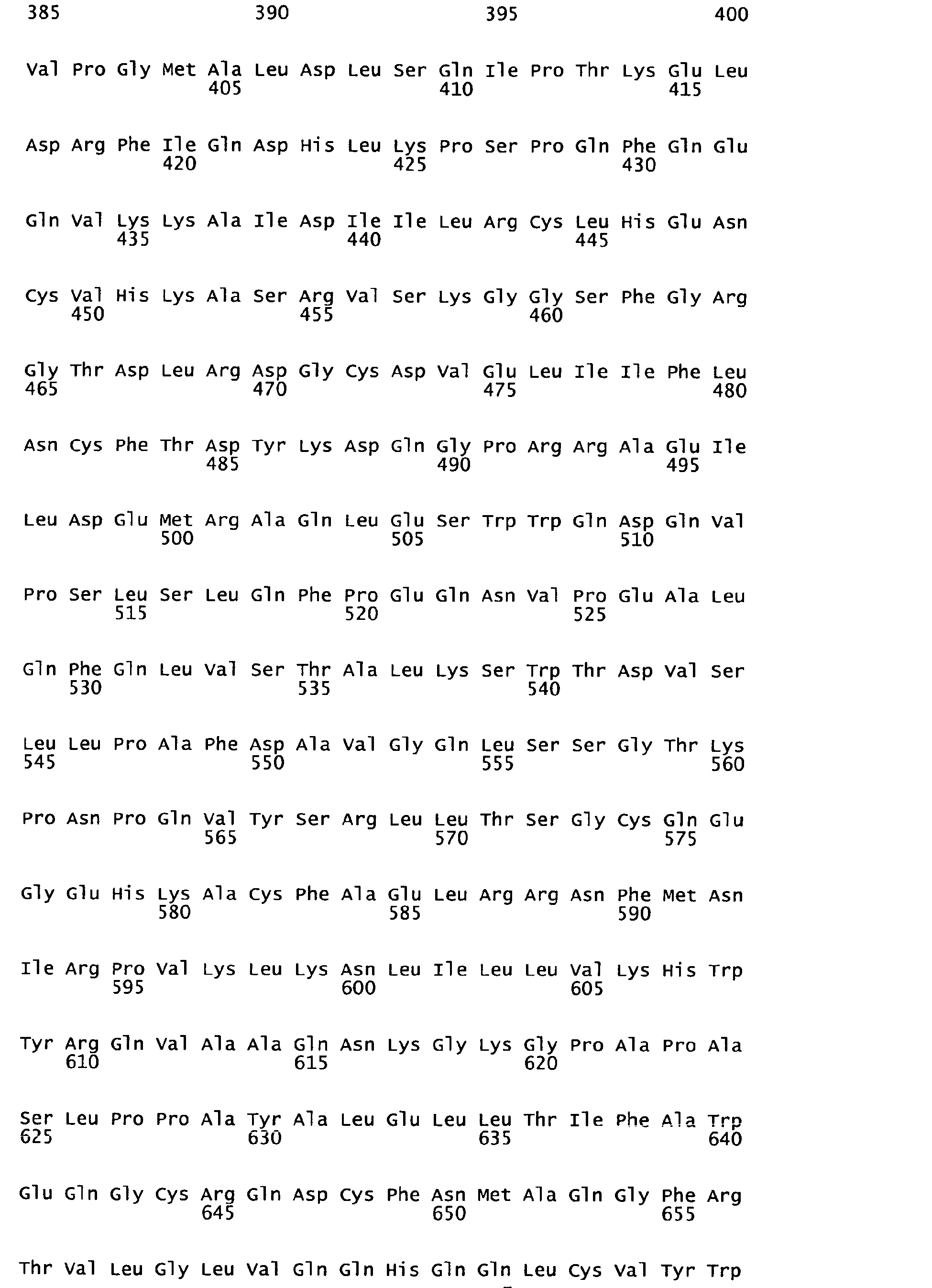


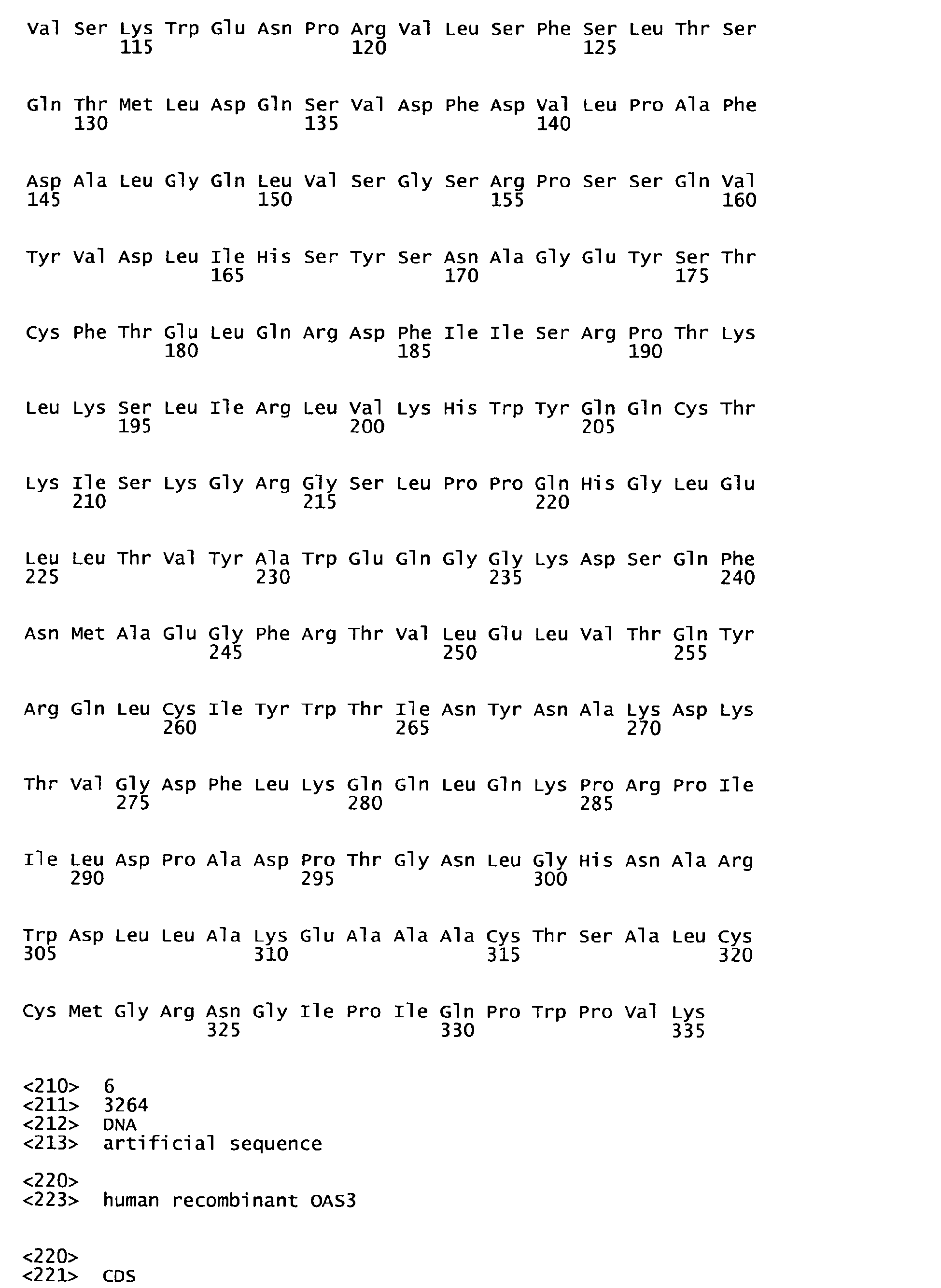


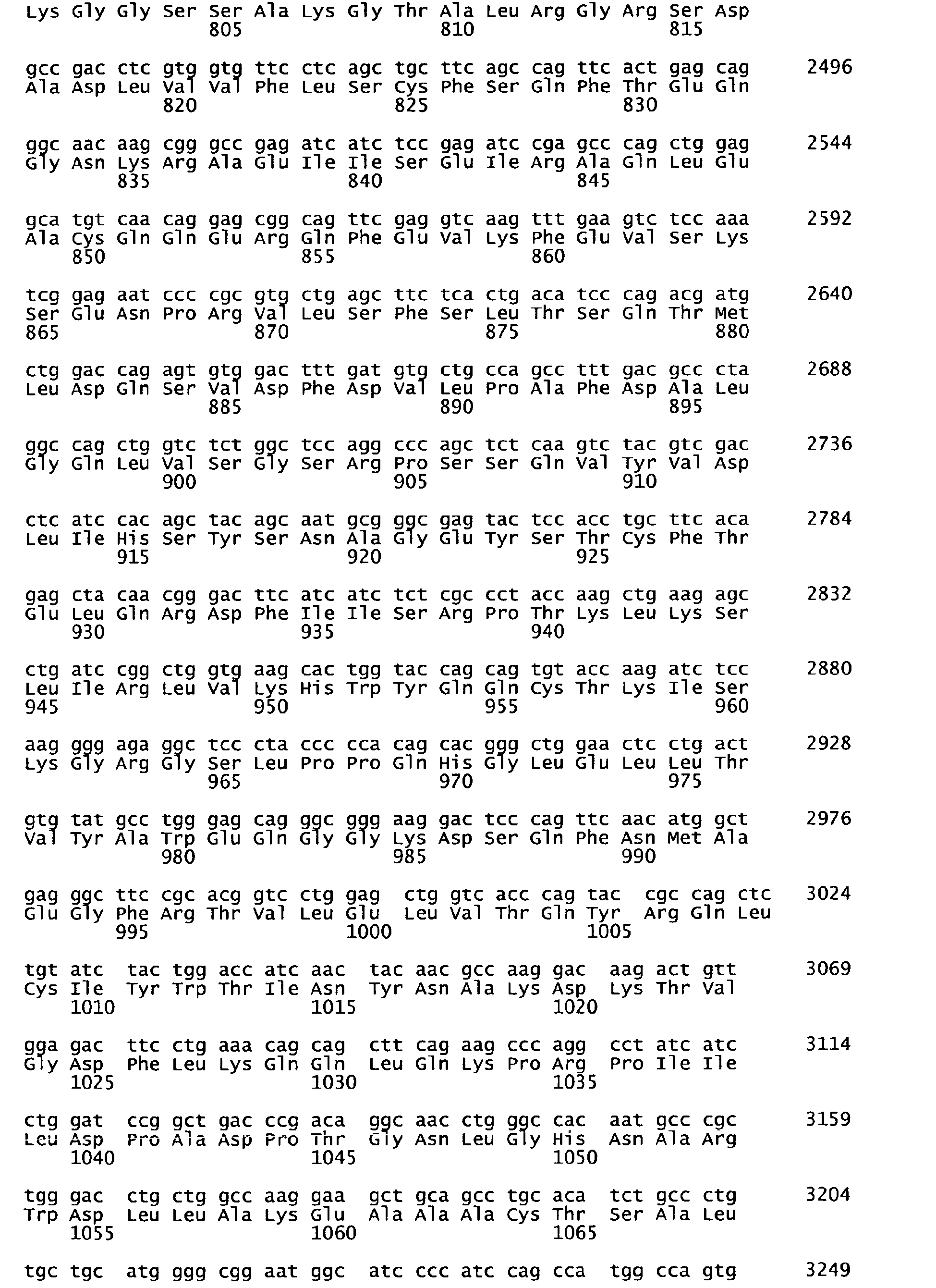


Claims (23)
- An isolated 2'-5'-oligoadenylate synthetase 3 protein or an isolated polynucleotide encoding said 2'-5'-oligoadenylate synthetase 3 protein, as a medicament.
- The protein or polynucleotide of claim 1 which has the sequence of human 2'-5'-oligoadenylate synthetase 3.
- The protein of claim 1 or claim 2, which has at least 70 % amino acid sequence identity or 80 % amino acid sequence similarity to residues 1 to 1087 of SEQ ID NO: 2.
- The protein of anyone of claims 1 to 3, which consists of the amino acid sequence SEQ ID NO: 7.
- The polynucleotide of claim 1 or claim 2, which is encoding a protein as defined in claim 4.
- The polynucleotide of claim 5, which consists of the sequence SEQ ID NO: 6.
- The polynucleotide of anyone of claims 1, 5 and 6, which is inserted in an expression vector.
- An isolated 2'-5'-oligoadenylate synthetase 3 protein or polypeptide as defined in anyone of claims 1 to 7, for preventing or treating an infection with a positive-sense single-stranded RNA virus.
- The protein or polynucleotide of claim 8, which is for treating an infection with an alphavirus.
- The protein or polynucleotide of claim 9, wherein said alphavirus is selected from the group consisting of: Chikungunya virus, Sindbis virus, Eastern equine encephalitis virus, Western equine encephalitis virus, Venezuelan equine encephalitis virus, Ross River virus, Semliki Forest virus, Barma Forest virus and O'nyong'nyong virus.
- The protein or polynucleotide of claim 8, which is for treating an infection with a virus of the Flaviviridae family.
- The protein or polynucleotide of claim 11, wherein said virus of the Flaviviridae family is selected from the group consisting of: Dengue fever virus, Japanese encephalitis virus, Kyasanur Forest disease virus, Murray Valley encephalitis virus, St. Louis encephalitis virus, Tick-borne encephalitis virus, West Nile encephalitis virus, Yellow fever virus, Hepatitis C viruses and OMSK virus.
- Products containing at least an 2'-5'-oligoadenylate synthetase 3 as defined in anyone of claims 1 to 7 and a second product which is different from the first one, said second product being selected from the group consisting of: antiviral, anti-inflammatory and immunomodulatory drugs, as a combined preparation for simultaneous, separate or sequential use in the prevention or the treatment of a positive-sense single-stranded RNA virus infection as defined in anyone of claims 8 to 12.
- A method in vitro for evaluating the susceptibility of an individual to an infection with a positive-sense single-stranded RNA virus as defined in anyone of claims 9 to 12, comprising: the detection of a polymorphism in the 2'-5'-oligoadenylate synthetase 3 gene in a nucleic acid sample obtained from said individual.
- The method of claim 14, wherein said polymorphism is the change of the Arg844 codon to a stop codon (R844X) in the 2'-5'-oligoadenylate synthetase 3 open reading frame.
- The method of claim 15, wherein the R844X mutation is detected by a PCR-RFLP assay comprising:a) the amplification of a 183 bp product by PCR using the pair of primers SEQ ID NO: 11 and 12, andb) the digestion of the PCR product with BglII endonuclease, wherein the presence of two fragments of 115 bp and 68 bp indicates the presence of the R844X mutation.
- An isolated OAS3 protein comprising the sequence SEQ ID NO: 7.
- An isolated OAS3 protein fragment comprising the sequence SEQ ID NO: 9
- An isolated polynucleotide comprising the sequence SEQ ID NO: 6 that encodes the OAS3 protein according to claim 17 or the sequence SEQ ID NO: 8 that encodes the OAS3 protein fragment according to claim 18.
- A recombinant vector comprising a polynucleotide sequence as defined in claim 19.
- A host cell transfected or transformed by a polynucleotide sequence as defined in claim 19.
- The host cell of claim 21, which is an HeLa-Tet-Off cell line expressing recombinant human 2'-5'-oligoadenylate synthetase 3, named HeLa-Tet-Off/OAS3#C417-1, deposited February 26, 2008, at the Collection Nationale de Cultures de Microorganismes, 25 rue du Docteur Roux, 75724 Paris Cedex 15, under the accession number I-3927.
- The host cell of claim 21, which is an HeLa-Tet-Off cell line expressing a truncated recombinant human 2'-5'-oligoadenylate synthetase 3, named HeLa-Tet-Off/OAS3/delta/1C, deposited 17 April 2008, at the Collection Nationale de Cultures de Microorganismes, 25 rue du Docteur Roux, 75724 Paris Cedex 15, under the accession number I-3968.
Priority Applications (10)
| Application Number | Priority Date | Filing Date | Title |
|---|---|---|---|
| EP08290470A EP2123748A1 (en) | 2008-05-20 | 2008-05-20 | 2'-5'-oligoadenylate synthetase 3 for preventing and treating positive-sense single-stranded rna virus infection |
| CN2009801283486A CN102124101A (en) | 2008-05-20 | 2009-05-20 | The large form of human 2', 5'-oligoadenylate synthetase OAS3 for preventing or treating infection with positive-sense single-stranded RNA viruses |
| CA2725527A CA2725527A1 (en) | 2008-05-20 | 2009-05-20 | The large form of human 2',5'-oligoadenylate synthetase oas3 for preventing or treating infection with positive-sense single-stranded rna viruses |
| EP13151181.8A EP2597163A1 (en) | 2008-05-20 | 2009-05-20 | The large form of human 2',5'-oligoadenylate synthetase OAS3 for preventing or treating infection with positive-sense single-stranded RNA viruses |
| US12/993,422 US20110189155A1 (en) | 2008-05-20 | 2009-05-20 | Large Form Of Human 2',5'-Oligoadenylate Synthetase OAS3 for Preventing or Treating Infection With Positive-Sense Single-Stranded RNA Viruses |
| KR1020107028447A KR20110049749A (en) | 2008-05-20 | 2009-05-20 | Large human 2 ', 5'-oligoadenylate synthase OAS3 for preventing or treating infection with positive-sense single-chain RNA viruses |
| EP09750188A EP2294189A2 (en) | 2008-05-20 | 2009-05-20 | The large form of human 2', 5'-oligoadenylate synthetase oas3 for preventing or treating infection with positive-sense single-stranded rna viruses |
| PCT/IB2009/005956 WO2009141731A2 (en) | 2008-05-20 | 2009-05-20 | The large form of human 2', 5'-oligoadenylate synthetase oas3 for preventing or treating infection with positive-sense single-stranded rna viruses |
| BRPI0913071A BRPI0913071A2 (en) | 2008-05-20 | 2009-05-20 | large form of human oas3 2,5-oligoadenylate synthetase to prevent or treat positive sense single-stranded rna virus infection |
| JP2011510066A JP2011522527A (en) | 2008-05-20 | 2009-05-20 | Human large 2 ', 5'-oligoadenylate synthase OAS3 for prevention or treatment of infection with plus single-stranded RNA virus |
Applications Claiming Priority (1)
| Application Number | Priority Date | Filing Date | Title |
|---|---|---|---|
| EP08290470A EP2123748A1 (en) | 2008-05-20 | 2008-05-20 | 2'-5'-oligoadenylate synthetase 3 for preventing and treating positive-sense single-stranded rna virus infection |
Publications (1)
| Publication Number | Publication Date |
|---|---|
| EP2123748A1 true EP2123748A1 (en) | 2009-11-25 |
Family
ID=39777103
Family Applications (3)
| Application Number | Title | Priority Date | Filing Date |
|---|---|---|---|
| EP08290470A Withdrawn EP2123748A1 (en) | 2008-05-20 | 2008-05-20 | 2'-5'-oligoadenylate synthetase 3 for preventing and treating positive-sense single-stranded rna virus infection |
| EP13151181.8A Withdrawn EP2597163A1 (en) | 2008-05-20 | 2009-05-20 | The large form of human 2',5'-oligoadenylate synthetase OAS3 for preventing or treating infection with positive-sense single-stranded RNA viruses |
| EP09750188A Withdrawn EP2294189A2 (en) | 2008-05-20 | 2009-05-20 | The large form of human 2', 5'-oligoadenylate synthetase oas3 for preventing or treating infection with positive-sense single-stranded rna viruses |
Family Applications After (2)
| Application Number | Title | Priority Date | Filing Date |
|---|---|---|---|
| EP13151181.8A Withdrawn EP2597163A1 (en) | 2008-05-20 | 2009-05-20 | The large form of human 2',5'-oligoadenylate synthetase OAS3 for preventing or treating infection with positive-sense single-stranded RNA viruses |
| EP09750188A Withdrawn EP2294189A2 (en) | 2008-05-20 | 2009-05-20 | The large form of human 2', 5'-oligoadenylate synthetase oas3 for preventing or treating infection with positive-sense single-stranded rna viruses |
Country Status (8)
| Country | Link |
|---|---|
| US (1) | US20110189155A1 (en) |
| EP (3) | EP2123748A1 (en) |
| JP (1) | JP2011522527A (en) |
| KR (1) | KR20110049749A (en) |
| CN (1) | CN102124101A (en) |
| BR (1) | BRPI0913071A2 (en) |
| CA (1) | CA2725527A1 (en) |
| WO (1) | WO2009141731A2 (en) |
Families Citing this family (5)
| Publication number | Priority date | Publication date | Assignee | Title |
|---|---|---|---|---|
| US8801801B2 (en) | 2009-04-03 | 2014-08-12 | Biomerix Corporation | At least partially resorbable reticulated elastomeric matrix elements and methods of making same |
| US10955414B2 (en) | 2016-08-01 | 2021-03-23 | Inbios International, Inc. | Immunoassay methods and compositions for detecting infection involving use of test antigens as cross-reactive control antigens |
| JP7032775B2 (en) * | 2016-11-09 | 2022-03-09 | 公立大学法人名古屋市立大学 | How to streamline the expression of artificially synthesized mRNA |
| CN110556184B (en) * | 2019-10-09 | 2022-11-29 | 中国人民解放军总医院 | Non-coding RNA and disease relation prediction method based on Hessian regular nonnegative matrix decomposition |
| CN120305392B (en) * | 2025-04-15 | 2025-11-07 | 中山大学 | Application of OAS2 gene and/or OAS2 protein in preparation of anti-Ebola virus infection product |
Citations (11)
| Publication number | Priority date | Publication date | Assignee | Title |
|---|---|---|---|---|
| US4683195A (en) | 1986-01-30 | 1987-07-28 | Cetus Corporation | Process for amplifying, detecting, and/or-cloning nucleic acid sequences |
| US4897268A (en) | 1987-08-03 | 1990-01-30 | Southern Research Institute | Drug delivery system and method of making the same |
| US5075109A (en) | 1986-10-24 | 1991-12-24 | Southern Research Institute | Method of potentiating an immune response |
| WO2002081741A2 (en) | 2001-04-04 | 2002-10-17 | Institut Pasteur | Use of products of genes of the 2'-5' oligoadenylate synthetase family (oas) for screening antiviral agents and for detecting responsiveness to flaviviridae infection |
| WO2002090552A2 (en) * | 2001-05-08 | 2002-11-14 | Switch Biotech Ag | Use of 2'-5'-oligoadenylate synthetase and/or rnasel or nucleic acids encoding them for diagnosis, prophylaxis or treatment of wound healing |
| WO2003089003A1 (en) | 2002-04-19 | 2003-10-30 | Imperial College Innovations Limited | Methods of treatment and diagnosis of patients with hepatitis c infection |
| US20040009152A1 (en) * | 2002-04-30 | 2004-01-15 | Mohapatra Shyam S. | Materials and methods for prevention and treatment of RNA viral diseases |
| WO2005013917A2 (en) * | 2003-02-28 | 2005-02-17 | Intermune, Inc. | Combination therapy for treating alphavirus infection and liver fibrosis |
| WO2005040428A2 (en) | 2003-10-23 | 2005-05-06 | Illumigen Biosciences, Inc. | Detection of mutations in a gene associated with resistance to viral infection, oas1 |
| US20070111231A1 (en) * | 2005-08-23 | 2007-05-17 | Illumigen Biosciences, Inc. | Detection of mutations in a gene associated with resistance to viral infection, OAS2 and OAS3 |
| US20070269828A1 (en) * | 2002-06-19 | 2007-11-22 | Brinton Margo A | Compositions and methods for viral resistance genes |
Family Cites Families (2)
| Publication number | Priority date | Publication date | Assignee | Title |
|---|---|---|---|---|
| ATE389668T1 (en) * | 2000-07-31 | 2008-04-15 | Greenpeptide Co Ltd | TUMOR ANTIGENS |
| US20100120627A1 (en) * | 2006-08-02 | 2010-05-13 | Abdelmajid Belouchi | Genemap of the human genes associated with psoriasis |
-
2008
- 2008-05-20 EP EP08290470A patent/EP2123748A1/en not_active Withdrawn
-
2009
- 2009-05-20 BR BRPI0913071A patent/BRPI0913071A2/en not_active IP Right Cessation
- 2009-05-20 JP JP2011510066A patent/JP2011522527A/en active Pending
- 2009-05-20 US US12/993,422 patent/US20110189155A1/en not_active Abandoned
- 2009-05-20 CN CN2009801283486A patent/CN102124101A/en active Pending
- 2009-05-20 EP EP13151181.8A patent/EP2597163A1/en not_active Withdrawn
- 2009-05-20 CA CA2725527A patent/CA2725527A1/en not_active Abandoned
- 2009-05-20 EP EP09750188A patent/EP2294189A2/en not_active Withdrawn
- 2009-05-20 KR KR1020107028447A patent/KR20110049749A/en not_active Withdrawn
- 2009-05-20 WO PCT/IB2009/005956 patent/WO2009141731A2/en not_active Ceased
Patent Citations (12)
| Publication number | Priority date | Publication date | Assignee | Title |
|---|---|---|---|---|
| US4683195A (en) | 1986-01-30 | 1987-07-28 | Cetus Corporation | Process for amplifying, detecting, and/or-cloning nucleic acid sequences |
| US4683195B1 (en) | 1986-01-30 | 1990-11-27 | Cetus Corp | |
| US5075109A (en) | 1986-10-24 | 1991-12-24 | Southern Research Institute | Method of potentiating an immune response |
| US4897268A (en) | 1987-08-03 | 1990-01-30 | Southern Research Institute | Drug delivery system and method of making the same |
| WO2002081741A2 (en) | 2001-04-04 | 2002-10-17 | Institut Pasteur | Use of products of genes of the 2'-5' oligoadenylate synthetase family (oas) for screening antiviral agents and for detecting responsiveness to flaviviridae infection |
| WO2002090552A2 (en) * | 2001-05-08 | 2002-11-14 | Switch Biotech Ag | Use of 2'-5'-oligoadenylate synthetase and/or rnasel or nucleic acids encoding them for diagnosis, prophylaxis or treatment of wound healing |
| WO2003089003A1 (en) | 2002-04-19 | 2003-10-30 | Imperial College Innovations Limited | Methods of treatment and diagnosis of patients with hepatitis c infection |
| US20040009152A1 (en) * | 2002-04-30 | 2004-01-15 | Mohapatra Shyam S. | Materials and methods for prevention and treatment of RNA viral diseases |
| US20070269828A1 (en) * | 2002-06-19 | 2007-11-22 | Brinton Margo A | Compositions and methods for viral resistance genes |
| WO2005013917A2 (en) * | 2003-02-28 | 2005-02-17 | Intermune, Inc. | Combination therapy for treating alphavirus infection and liver fibrosis |
| WO2005040428A2 (en) | 2003-10-23 | 2005-05-06 | Illumigen Biosciences, Inc. | Detection of mutations in a gene associated with resistance to viral infection, oas1 |
| US20070111231A1 (en) * | 2005-08-23 | 2007-05-17 | Illumigen Biosciences, Inc. | Detection of mutations in a gene associated with resistance to viral infection, OAS2 and OAS3 |
Non-Patent Citations (51)
| Title |
|---|
| "Culture Of Animal Cells", 1987, ALAN R. LISS, INC. |
| "Current Protocols in Human Genetics", 2008, JOHN WILEY & SONS, INC |
| "Gene Expression Technology", vol. 185 |
| "Gene Transfer Vectors For Mammalian Cells", 1987, COLD SPRING HARBOR LABORATORY |
| "Handbook Of Experimental Immunology", vol. I-IV, 1986 |
| "Immobilized Cells And Enzymes", 1986, IRL PRESS |
| "Immunochemical Methods In Cell And Molecular Biology", 1987, ACADEMIC PRESS |
| "In Current Protocols in Human Genetics", 2008, JOHN WILEY & SONS, INC. |
| "Manipulating the Mouse Embryo", 1986, COLD SPRING HARBOR LABORATORY PRESS, COLD SPRING HARBOR |
| "Methods In ENZYMOLOGY", ACADEMIC PRESS, INC. |
| "Nucleic Acid Hybridization", 1984 |
| "Oligonucleotide Synthesis", 1984 |
| "Transcription And Translation", 1984 |
| B. PERBAL: "A Practical Guide To Molecular Cloning", 1984 |
| BONETTA, THE SCIENTIST, vol. 16, 2002, pages 38 |
| BONNEVIE-NIELSEN ET AL., AM. J. HUM. GENET., vol. 76, 2005, pages 623 - 633 |
| BRDHIN ET AL., VIROLOGY, vol. 371, 2008, pages 185 - 195 |
| BRÉHIN ET AL., VIROLOGY, vol. 371, 2008, pages 185 - 195 |
| BRÉHIN, VIROLOGY, vol. 371, 2008, pages 185 - 195 |
| CECCALDI ET AL., FEMS MICROBIOL. LETT., vol. 233, 2004, pages 1 - 6 |
| COFFIN, J. M. ET AL.: "In Fundamental Virology", 1996, LIPPINCOTT-RAVEN PUBLISHERS, article "Retroviridae: The viruses and their replication" |
| COUDERC ET AL., PLOS PATHOGENS, vol. 4, 2007, pages E29 |
| DESPRÈS ET AL., VIROLOGY, vol. 196, 1993, pages 209 - 219 |
| EPTSEIN, P.R., AM. J. TROP. MED. HYG., vol. 200, no. 76, pages 403 - 404 |
| FORD ET AL., GENE THER., vol. 8, 2001, pages 1 - 4 |
| FREDERICK M. AUSUBEL: "Current Protocols in Molecular Biology", 2000, WILEY AND SON INC |
| GUBLER, D. J., TRENDS MICROBIOL., vol. 10, 2002, pages 100 - 103 |
| HARTMANN ET AL., NUCLEIC ACIDS RES., vol. 26, 1998, pages 4121 - 4128 |
| HOVANESSIAN, A.G., CYTOKINE AND GROWTH FACTOR REVIEWS, vol. 18, 2007, pages 351 - 361 |
| HOVNANIAN ET AL., GENOMICS, vol. 52, 1998, pages 267 - 277 |
| JOHNSTON: "Interferon 3: Mechanisms of Production and Action", 1984, ELSEVIER, pages: 189 - 298 |
| JUSTESEN ET AL., CELLULAR AND MOLECULAR LIFE SCIENCES, vol. 57, 2000, pages 1593 - 1612 |
| JUSTESEN ET AL., NUCLEIC ACIDS RES., vol. 8, 1980, pages 3073 - 3085 |
| JUSTESEN ET AL., PROC. NATL. ACAD. SCI., USA, vol. 77, 1980, pages 4618 - 4622 |
| JUSTESEN, J.; KJELGAARD, N.O., ANAL. BIOCHEM., vol. 207, 1992, pages 90 - 93 |
| KAJASTE-RUDNISTKI ET AL., J. BIOL. CHEM., vol. 281, 2006, pages 4624 - 4637 |
| KAJASTE-RUDNITSKI ET AL., JOURNAL OF BIOLOGICAL CHEMISTRY, vol. 281, 2006, pages 4624 - 4637 |
| LANGEL, U.: "Handbook of cell penetrating peptides", 2006, LAVOISIER |
| LUCAS ET AL., IMMUNOL. CELL. BIOL., vol. 81, 2003, pages 230 - 236 |
| MASHIMO, T. ET AL., PROC. NATL. ACAD. SCI. USA, vol. 99, 2002, pages 11311 - 11316 |
| REBOUILLAT ET AL., EUR. J. BIOCHEM., vol. 257, 1998, pages 319 - 330 |
| REBOUILLAT ET AL., GENOMICS, vol. 70, 2000, pages 232 - 240 |
| REBOUILLAT, D.; HOVANESSIAN, A.G., JOURNAL OF INTERFERON AND CYTOKINE RESEARCH, vol. 19, 1999, pages 295 - 308 |
| SAMBROOK ET AL.: "Molecular Cloning: A Laboratory Manual", 2001, COLD SPRING HARBOR, NEW YORK: COLD SPRING HARBOR LABORATORY PRESS |
| SARIOL ET AL., CLINICAL AND VACCINE IMMUNOLOGY, vol. 14, 2007, pages 756 - 766 |
| SILVERMAN, R.H., J. VIROL., vol. 81, 2007, pages 12720 - 12729 |
| ST LAURENT ET AL., CELL, vol. 33, 1983, pages 95 - 102 |
| TESFAY ET AL., J. VIROL., vol. 82, 2008, pages 2620 - 2630 |
| VAZEILLE ET AL., PLOS ONE, vol. 2, no. 11, 2007, pages 168 |
| WADIA; DOWDY, CURR. OPIN. BIOTECHNOL., vol. 13, 2002, pages 52 - 56 |
| YAKUB IMTIAZ ET AL: "Single nucleotide polymorphisms in genes for 2 '-5 '-Oligoadenylate synthetase and RNase L in patients hospitalized with West Nile virus infection", JOURNAL OF INFECTIOUS DISEASES, vol. 192, no. 10, November 2005 (2005-11-01), pages 1741 - 1748, XP002499518, ISSN: 0022-1899 * |
Also Published As
| Publication number | Publication date |
|---|---|
| CN102124101A (en) | 2011-07-13 |
| CA2725527A1 (en) | 2009-11-26 |
| US20110189155A1 (en) | 2011-08-04 |
| BRPI0913071A2 (en) | 2019-09-24 |
| WO2009141731A3 (en) | 2010-03-11 |
| EP2294189A2 (en) | 2011-03-16 |
| WO2009141731A2 (en) | 2009-11-26 |
| KR20110049749A (en) | 2011-05-12 |
| EP2597163A1 (en) | 2013-05-29 |
| JP2011522527A (en) | 2011-08-04 |
Similar Documents
| Publication | Publication Date | Title |
|---|---|---|
| Evans et al. | Differential effects of mutations in NS4B on West Nile virus replication and inhibition of interferon signaling | |
| Bréhin et al. | The large form of human 2′, 5′-Oligoadenylate Synthetase (OAS3) exerts antiviral effect against Chikungunya virus | |
| Espert et al. | ISG20, a new interferon-induced RNase specific for single-stranded RNA, defines an alternative antiviral pathway against RNA genomic viruses | |
| Medina et al. | The different tactics of foot-and-mouth disease virus to evade innate immunity | |
| US20250134941A1 (en) | Hsv-1 oncolytic virus therapies that specifically kill alt dependent cancers | |
| CN110420331B (en) | Application of ALKBH5 inhibitor in treatment of virus infectious diseases | |
| Teramoto et al. | Infection of Aedes albopictus mosquito C6/36 cells with the w Melpop strain of Wolbachia modulates dengue virus-Induced host cellular transcripts and induces critical sequence alterations in the dengue viral genome | |
| CN110257357A (en) | Purposes of the MERS-CoV 3CLpro as deubiquitinating enzymes and interferon inhibitor | |
| EP2597163A1 (en) | The large form of human 2',5'-oligoadenylate synthetase OAS3 for preventing or treating infection with positive-sense single-stranded RNA viruses | |
| Jung et al. | Influence of Zika virus 3′-end sequence and nonstructural protein evolution on the viral replication competence and virulence | |
| US20040009951A1 (en) | DNA deamination mediates innate immunity to (retro)viral infection | |
| RU2465328C2 (en) | Mutations in oas1 genes | |
| CN1910293B (en) | Method for detecting mutations in the gene OAS1 associated with resistance to viral infectivity | |
| US7794928B2 (en) | Norovirus detection, methods and compositions therefor | |
| US20110104138A1 (en) | Use of the innate immunity gene oasl for preventing or treating infection with negative strand rna viruses | |
| US20050064396A1 (en) | Cellular regulators of infectious agents and methods of use | |
| US20090247455A1 (en) | Isolation of Inhibitors of IRES-Mediated Translation | |
| Wilson | The role of type I interferon in the immunobiology of chikungunya virus | |
| Pinja et al. | SARS-CoV-2 infection in hiPSC-derived neurons is cathepsin-dependent and causes accumulation of HIF1ɑ and phosphorylated tau | |
| Zhang et al. | nervous system (CNS) and neurological diseases | |
| Avena | Characterizing Sudan virus evolution: insights into population diversity and inter-genomic relationships | |
| US20090155234A1 (en) | Detection of mutations in a gene associated with resistance to viral infection, mx1 | |
| Villamayor Coronado et al. | Interferon alpha inducible protein 6 is a negative regulator of innate immune responses by modulating RIG-I activation | |
| Pawęska | Host Gene Expression Triggered by West Nile Virus Infection | |
| EP4408431A1 (en) | Treatment of nudt2 mutation |
Legal Events
| Date | Code | Title | Description |
|---|---|---|---|
| PUAI | Public reference made under article 153(3) epc to a published international application that has entered the european phase |
Free format text: ORIGINAL CODE: 0009012 |
|
| AK | Designated contracting states |
Kind code of ref document: A1 Designated state(s): AT BE BG CH CY CZ DE DK EE ES FI FR GB GR HR HU IE IS IT LI LT LU LV MC MT NL NO PL PT RO SE SI SK TR |
|
| AX | Request for extension of the european patent |
Extension state: AL BA MK RS |
|
| 17P | Request for examination filed |
Effective date: 20100517 |
|
| 17Q | First examination report despatched |
Effective date: 20100616 |
|
| AKX | Designation fees paid |
Designated state(s): AT BE BG CH CY CZ DE DK EE ES FI FR GB GR HR HU IE IS IT LI LT LU LV MC MT NL NO PL PT RO SE SI SK TR |
|
| GRAP | Despatch of communication of intention to grant a patent |
Free format text: ORIGINAL CODE: EPIDOSNIGR1 |
|
| INTG | Intention to grant announced |
Effective date: 20140108 |
|
| STAA | Information on the status of an ep patent application or granted ep patent |
Free format text: STATUS: THE APPLICATION IS DEEMED TO BE WITHDRAWN |
|
| 18D | Application deemed to be withdrawn |
Effective date: 20140520 |