EP2123640B1 - Metal complex, light-emitting device and display - Google Patents
Metal complex, light-emitting device and display Download PDFInfo
- Publication number
- EP2123640B1 EP2123640B1 EP08721377.3A EP08721377A EP2123640B1 EP 2123640 B1 EP2123640 B1 EP 2123640B1 EP 08721377 A EP08721377 A EP 08721377A EP 2123640 B1 EP2123640 B1 EP 2123640B1
- Authority
- EP
- European Patent Office
- Prior art keywords
- dmpz
- light
- metal complex
- group
- emitting device
- Prior art date
- Legal status (The legal status is an assumption and is not a legal conclusion. Google has not performed a legal analysis and makes no representation as to the accuracy of the status listed.)
- Not-in-force
Links
Images


Classifications
-
- C—CHEMISTRY; METALLURGY
- C07—ORGANIC CHEMISTRY
- C07D—HETEROCYCLIC COMPOUNDS
- C07D231/00—Heterocyclic compounds containing 1,2-diazole or hydrogenated 1,2-diazole rings
- C07D231/02—Heterocyclic compounds containing 1,2-diazole or hydrogenated 1,2-diazole rings not condensed with other rings
- C07D231/10—Heterocyclic compounds containing 1,2-diazole or hydrogenated 1,2-diazole rings not condensed with other rings having two or three double bonds between ring members or between ring members and non-ring members
- C07D231/12—Heterocyclic compounds containing 1,2-diazole or hydrogenated 1,2-diazole rings not condensed with other rings having two or three double bonds between ring members or between ring members and non-ring members with only hydrogen atoms, hydrocarbon or substituted hydrocarbon radicals, directly attached to ring carbon atoms
-
- C—CHEMISTRY; METALLURGY
- C07—ORGANIC CHEMISTRY
- C07F—ACYCLIC, CARBOCYCLIC OR HETEROCYCLIC COMPOUNDS CONTAINING ELEMENTS OTHER THAN CARBON, HYDROGEN, HALOGEN, OXYGEN, NITROGEN, SULFUR, SELENIUM OR TELLURIUM
- C07F15/00—Compounds containing elements of Groups 8, 9, 10 or 18 of the Periodic Table
- C07F15/0006—Compounds containing elements of Groups 8, 9, 10 or 18 of the Periodic Table compounds of the platinum group
- C07F15/0086—Platinum compounds
- C07F15/0093—Platinum compounds without a metal-carbon linkage
-
- C—CHEMISTRY; METALLURGY
- C09—DYES; PAINTS; POLISHES; NATURAL RESINS; ADHESIVES; COMPOSITIONS NOT OTHERWISE PROVIDED FOR; APPLICATIONS OF MATERIALS NOT OTHERWISE PROVIDED FOR
- C09K—MATERIALS FOR MISCELLANEOUS APPLICATIONS, NOT PROVIDED FOR ELSEWHERE
- C09K11/00—Luminescent materials, e.g. electroluminescent or chemiluminescent
- C09K11/06—Luminescent materials, e.g. electroluminescent or chemiluminescent containing organic luminescent materials
-
- H—ELECTRICITY
- H10—SEMICONDUCTOR DEVICES; ELECTRIC SOLID-STATE DEVICES NOT OTHERWISE PROVIDED FOR
- H10K—ORGANIC ELECTRIC SOLID-STATE DEVICES
- H10K85/00—Organic materials used in the body or electrodes of devices covered by this subclass
- H10K85/30—Coordination compounds
- H10K85/341—Transition metal complexes, e.g. Ru(II)polypyridine complexes
- H10K85/346—Transition metal complexes, e.g. Ru(II)polypyridine complexes comprising platinum
-
- H—ELECTRICITY
- H10—SEMICONDUCTOR DEVICES; ELECTRIC SOLID-STATE DEVICES NOT OTHERWISE PROVIDED FOR
- H10K—ORGANIC ELECTRIC SOLID-STATE DEVICES
- H10K85/00—Organic materials used in the body or electrodes of devices covered by this subclass
- H10K85/30—Coordination compounds
- H10K85/361—Polynuclear complexes, i.e. complexes comprising two or more metal centers
-
- C—CHEMISTRY; METALLURGY
- C09—DYES; PAINTS; POLISHES; NATURAL RESINS; ADHESIVES; COMPOSITIONS NOT OTHERWISE PROVIDED FOR; APPLICATIONS OF MATERIALS NOT OTHERWISE PROVIDED FOR
- C09K—MATERIALS FOR MISCELLANEOUS APPLICATIONS, NOT PROVIDED FOR ELSEWHERE
- C09K2211/00—Chemical nature of organic luminescent or tenebrescent compounds
- C09K2211/10—Non-macromolecular compounds
- C09K2211/1018—Heterocyclic compounds
- C09K2211/1025—Heterocyclic compounds characterised by ligands
- C09K2211/1044—Heterocyclic compounds characterised by ligands containing two nitrogen atoms as heteroatoms
-
- C—CHEMISTRY; METALLURGY
- C09—DYES; PAINTS; POLISHES; NATURAL RESINS; ADHESIVES; COMPOSITIONS NOT OTHERWISE PROVIDED FOR; APPLICATIONS OF MATERIALS NOT OTHERWISE PROVIDED FOR
- C09K—MATERIALS FOR MISCELLANEOUS APPLICATIONS, NOT PROVIDED FOR ELSEWHERE
- C09K2211/00—Chemical nature of organic luminescent or tenebrescent compounds
- C09K2211/18—Metal complexes
- C09K2211/188—Metal complexes of other metals not provided for in one of the previous groups
-
- H—ELECTRICITY
- H10—SEMICONDUCTOR DEVICES; ELECTRIC SOLID-STATE DEVICES NOT OTHERWISE PROVIDED FOR
- H10K—ORGANIC ELECTRIC SOLID-STATE DEVICES
- H10K2101/00—Properties of the organic materials covered by group H10K85/00
- H10K2101/10—Triplet emission
-
- H—ELECTRICITY
- H10—SEMICONDUCTOR DEVICES; ELECTRIC SOLID-STATE DEVICES NOT OTHERWISE PROVIDED FOR
- H10K—ORGANIC ELECTRIC SOLID-STATE DEVICES
- H10K50/00—Organic light-emitting devices
- H10K50/10—OLEDs or polymer light-emitting diodes [PLED]
- H10K50/11—OLEDs or polymer light-emitting diodes [PLED] characterised by the electroluminescent [EL] layers
-
- H—ELECTRICITY
- H10—SEMICONDUCTOR DEVICES; ELECTRIC SOLID-STATE DEVICES NOT OTHERWISE PROVIDED FOR
- H10K—ORGANIC ELECTRIC SOLID-STATE DEVICES
- H10K85/00—Organic materials used in the body or electrodes of devices covered by this subclass
- H10K85/30—Coordination compounds
- H10K85/371—Metal complexes comprising a group IB metal element, e.g. comprising copper, gold or silver
Definitions
- Non-Patent Document 1 As a method of increasing emission efficiency, phosphorescence generated from a triplet excited state has attracted particular attention recently (see Non-Patent Document 1, for example). In such a case, the emission efficiency may be 100% in theory.
- a metal complex according to an aspect of the present invention comprises the following composition: [(Pt II ) 2 (Au I ) 2 (M I ) 2 (L) 8 ] where M I denotes Ag I or Cu I , or a combination of both, and L denotes each or a combination of any of structures represented by the formula (1).
- L denotes a monovalent anion in which a proton is dissociated from pyrazole and its derivatives.
- a metal complex of the present invention includes a composition represented by the following formula: [(Pt II ) 2 (Au I ) 2 (M I ) 2 (L) 8 ] where M I denotes Ag I or Cu I , or a combination of both, and L denotes each or a combination of any of structures represented by the formula (1).
- [Pt(dmpzH) 4 ]Cl 2 was synthesized. Specifically, a solution of dmpzH (1155mg, 12.0mmol) in toluene (40ml) was added to a suspension of [PtCl 2 (C 2 H 5 CN) 2 ] (1130mg, 3.0mmol) in toluene (20ml), and the mixture was refluxed for three hours under an Ar atmosphere. The resultant white precipitate was collected, sequentially washed with toluene, hexane and diethyl ether, and then dried under reduced pressure. The yield was 1905mg (97.5%). The synthetic method of [Pt(dmpzH) 4 ]Cl 2 is shown in chemical reaction formula 1.
- the product was identified by elemental analysis, and IR and 1 H NMR spectra. The result of the elemental analysis of the product is shown in Table 2.
- a metal complex [Pt 2 Au 2 H 2 ( ⁇ -dmpz) 8 ] was synthesized as a precursor, and [Pt 2 Au 2 Cu 2 ( ⁇ -dmpz) 8 ], which is an example of the metal complex of the present invention, was synthesized by using the precursor. Details of the synthetic method of the metal complex will be described below.
- the precursor metal complex [Pt 2 Au 2 H 2 ( ⁇ -dmpz) 8 ] was synthesized using the same method as described in Example 1.
- [Pt 2 Au 2 Cu 2 ( ⁇ -dmpz) 8 ] exhibits orange luminescence in the solid state with an emission maximum wavelength at 598nm, and exhibits red luminescence in dichloromethane with an emission maximum wavelength at 673nm.
Landscapes
- Chemical & Material Sciences (AREA)
- Organic Chemistry (AREA)
- Engineering & Computer Science (AREA)
- Materials Engineering (AREA)
- Inorganic Chemistry (AREA)
- Crystallography & Structural Chemistry (AREA)
- Physics & Mathematics (AREA)
- High Energy & Nuclear Physics (AREA)
- Electroluminescent Light Sources (AREA)
Description
- The present invention relates to a metal complex. The present invention also relates to a light-emitting device having a light-emitting layer including the metal complex. The present invention further relates to a display having the light-emitting device.
- Recently, organic EL devices have attracted attention as light-emitting displays alternative to liquid crystal displays. Organic EL devices according to prior arts utilize emission (fluorescence) from a singlet excited state. In such a case, a local maximum emission efficiency is 25% based on a principle of an organic EL phenomenon, and therefore the emission efficiency is extremely low.
- As a method of increasing emission efficiency, phosphorescence generated from a triplet excited state has attracted particular attention recently (see Non-Patent Document 1, for example).
In such a case, the emission efficiency may be 100% in theory. - Many PtII complexes having diimine or terpyridine and their derivatives exhibit emission which are assigned to MLCT (abbreviation of metal-to-ligand charge transfer; charge transfer from a metal ion to a ligand) or MMLCT (abbreviation of metal-metal-to-ligand charge transfer; charge transfer from a dσ* orbital formed by metal-metal interaction to a ligand), and photophysical properties of these compounds have attracted much interest (See Non-Patent
Document 2, for example).
Polynuclear CuI and AuI complexes of pyrazole and its derivatives are also known to exhibit emission (see Non-Patent Document 3, for example).
Accordingly, when a molecule is synthesized with PtII ions and CuI ions, AgI ions or AuI ions and these metal ions are bridged by pyrazole or its derivatives, it is promising to produce a new molecule having emission properties by a synergetic effect of different metal ions. - In development of a novel metal complex based on this idea, a mixed metal complex [Pd2Ag4(µ-dmpz)8] having two PdII ions and four AgI ions bridged by 3,5-dimethylpyrazolate (denoted as dmpz, which is a monovalent anion in which a proton is dissociated from 3,5-dimethylpyrazole (dmpzH)) is known (see Non-Patent Document 4); however, emission properties of this compound have never been reported.
The present inventors also have already synthesized a mixed metal complex [Pt2Ag4(µ-pz)8] having PtII ions and AgI ions bridged by pyrazolate by using pyrazole (denoted as pz, which is a monovalent anion in which a proton is dissociated from pyrazole (pzH)) without substituent groups (see Non-Patent Document 5); however, this compound does not show emission. Similar complexes have been disclosed inWO 2006/101276 - Furthermore, in development of displays for commercialization, there is an increasing demand for a novel metal complex used as a dopant having improved thermal stability, volatility, film-forming properties during deposition, solubility in various solvents, emission intensity, color purity, and stability when applying a potential.
-
- [Non-Patent Document 1] M. A. Baldo, S. Lamansky, P. E. Burrows, M. E. Thompson, S. R. Forrest, Appl. Phys. Lett., 1999, 75, 4-6.
- [Non-Patent Document 2] S.-W. Lai, C.-M. Che, Topics in Current Chemistry, 2004, 241(Transition Metal and Rare Earth Compounds III), 27-63.
- [Non-Patent Document 3] H. V. R. Dias, H. V. K. Diyabalanage, M. G. Eldabaja, O. Elbjeirami, M. A. Rawashdeh-Omary, M. A. Omary, J. Am. Chem. Soc., 2005, 127, 7489-7501.
- [Non-Patent Document 4] G. A. Ardizzoia, G. La Monica, S. Cenini, M. Moret, N. Masciocchi, J. Chem. Soc., Dalton Trans. 1996, 1351-1357.
- [Non-Patent Document 5] K. Umakoshi, Y. Yamauchi, K. Nakamiya, T. Kojima, M. Yamasaki, H. Kawano, M. Onishi, Inorg. Chem. 2003, 42, 3907-3916.
- In view of the aforesaid problems, an object of the present invention is to provide a novel luminescent metal complex.
Another object of the present invention is to provide a novel light-emitting device having a light-emitting layer including the metal complex.
Still another object of the present invention is to provide a novel display having the light-emitting device. - In order to solve aforesaid problems and achieve the objects of the present invention, a metal complex according to an aspect of the present invention comprises the following composition:
[(PtII)2(AuI)2(MI)2(L)8]
where MI denotes AgI or CuI, or a combination of both, and L denotes each or a combination of any of structures represented by the formula (1). Herein L denotes a monovalent anion in which a proton is dissociated from pyrazole and its derivatives. -


- where R1, R2 and R3 independently denote a hydrogen atom, a chlorine atom, a bromine atom, an iodine atom, a hydroxyl group, a phenyl group, a trifluoromethylphenyl group, a pentafluorophenyl group, a naphthyl group, a methyl group, an ethyl group, an i-propyl group, a t-butyl group, a trifluoromethyl group, a hydroxymethyl group or a hydroxyethyl group.)
- It is preferred that at least one of R1, R2 and R3 in Formula (1) is not a hydrogen atom.
- A light-emitting device according to another aspect of the present invention has a light-emitting layer containing the aforesaid metal complex of the present invention.
A display according to further another aspect of the present invention has the aforesaid light-emitting device of the present invention. - The present invention has the following advantages.
With the metal complex of the present invention, it is possible to provide a metal complex having excellent emission properties.
With the light-emitting device of the present invention, it is possible to provide a light-emitting device having improved emission properties by containing the metal complex of the present invention in the light-emitting layer.
With the light-emitting apparatus of the present invention, it is possible to provide a reliable light-emitting apparatus capable of displaying a high-quality image by including the aforesaid light-emitting device in the light-emitting apparatus. -
-
FIG. 1 is a cross-sectional view showing an example of a light-emitting device of the present invention. -
FIG. 2 is an ORTEP diagram showing a molecular structure of [Pt2Au2H2(µ-dmpz)8]. -
FIG. 3 is an ORTEP diagram showing a molecular structure of [Pt2Au2Ag2(µ-dmpz)8]. -
FIG. 4 is an ORTEP diagram showing a molecular structure of [Pt2Au2Cu2(µ-dmpz)8]. -
FIG. 5A shows emission spectra of [Pt2Au2Ag2(µ-dmpz)8] and [Pt2Au2Cu2(µ-dmpz)8] in the solid state, andFIG. 5B shows emission spectra of [Pt2Au2Ag2(µ-dmpz)8] and [Pt2Au2Cu2(µ-dmpz)8] in dichloromethane. - A best mode for carrying out the present invention will be described below.
- A metal complex of the present invention includes a composition represented by the following formula:
[(PtII)2(AuI)2(MI)2(L)8]
where MI denotes AgI or CuI, or a combination of both, and L denotes each or a combination of any of structures represented by the formula (1). - In the formulas, R1, R2 and R3 independently denote a hydrogen atom, a chlorine atom, a bromine atom, an iodine atom, a hydroxyl group, a phenyl group, a trifluoromethylphenyl group, a pentafluorophenyl group, a naphthyl group, a methyl group, an ethyl group, an i-propyl group, a t-butyl group, a trifluoromethyl group, a hydroxymethyl group or a hydroxyethyl group.
- More preferably, at least one of R1, R2 and R3 in the formula (1) is not a hydrogen atom, that is, at least one of R1, R2 and R3 is a substituent group.
- In the next part, the synthesis of the metal complex of the present invention will be described. In the following, dmpzH denotes 3,5-dimethylpyrazole, and dmpz denotes a monovalent anion in which a proton is dissociated from 3,5-dimethylpyrazole.
- First, the synthetic method of [Pt2Au2Ag2(µ-dmpz)8] will be described as an example of the metal complex of the present invention. In the metal complex of this example, M is Ag.
- This complex [Pt2Au2Ag2(µ-dmpz)8] may be synthesized by the following procedure, for example.
First, [Pt(dmpzH)4]Cl2 is synthesized by reacting [PtCl2(C2H5CN)2] with dmpzH.
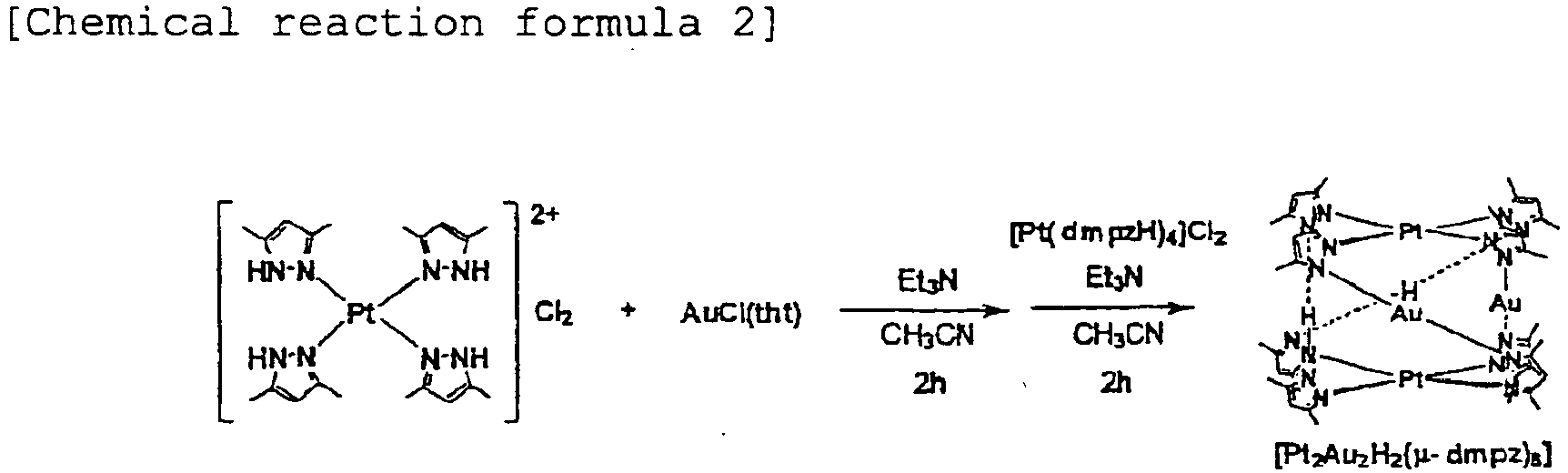
Next, the metal complex [Pt2Au2H2(u-dmpz)8] is synthesized by reacting [Pt(dmpzH)4]Cl2 with [AuCl(tht)] (tht=tetrahydrothiophene) in the presence of triethylamine in acetonitrile, and further adding [Pt(dmpzH)4]Cl2 to the reaction solution to complete the reaction.
Further, [Pt2Au2Ag2(µ-dmpz)8] is obtained by reacting the metal complex [Pt2Au2H2(µ-dmpz)8] with AgBF4 in the presence of triethylamine in acetonitrile. - The synthetic method of [Pt(dmpzH)4]Cl2 is not limited to the aforementioned method. Alternatively, there are two other synthetic methods as follows.
- One synthetic method is: suspending [PtCl2(C2H5CN)2] in water, methanol or ethanol, adding an excess amount of dmpzH to the suspension, and refluxing the mixture for one hour. The solution is allowed to cool and then concentrated under reduced pressure, and acetone or diethyl ether is added to the residue to precipitate [Pt(dmpzH)4]Cl2. The precipitated [Pt(dmpzH)4]Cl2 is collected, washed with diethyl ether, and then dried under reduced pressure.
- The other synthetic method is: dissolving K2[PtCl4] in acid water, adding 4 equivalents of dmpzH, and refluxing the solution for six hours. The solution is allowed to cool and then concentrated under reduced pressure, and acetone is added to the residue to precipitate [Pt(dmpzH)4]Cl2. The precipitated [Pt(dmpzH)4]Cl2 is collected, washed with diethyl ether, and then dried under reduced pressure.
- The synthetic method of [Pt2Au2H2(µ-dmpz)8] is not limited to the aforementioned methods. Alternatively, there is another synthetic method described as follows.
- [Pt(dmpzH)4]Cl2 is reacted with [AuCl(tht)] (tht=tetrahydrothiophene) in the presence of triethylamine in acetonitrile to isolate [PtAu4(µ-dmpz)4Cl2(tht)2]. Further, [Pt2Au2H2(µ-dmpz)8] is obtained by reacting [PtAu4(µ-dmpz)4Cl2(tht)2] with [Pt(dmpzH)4]Cl2 in the presence of triethylamine in acetonitrile.
- Next, the synthetic method of [Pt2Au2Cu2(µ-dmpz)8] will be described as an example of the metal complex of the present invention. In the metal complex of this example, M is Cu.
- This complex [Pt2Au2Cu2(µ-dmpz)8] may be synthesized by the following procedure, for example.
[Pt2Au2Cu2(µ-dmpz)8] is synthesized by reacting the metal complex [Pt2Au2H2(µ-dmpz)8], which is synthesized using the aforementioned method, with [Cu(CH3CN)4]BF4.
Note that, the synthetic method of [Pt2Au2Cu2(µ-dmpz)8] is not limited to the aforementioned methods. - In the next part, the use of the metal complex of the present invention will be described below. The metal complex can be used as a luminescent agent contained in a light-emitting layer of a light-emitting device such as an organic EL device.
However, the metal complex may not be only used as a luminescent agent. The metal complex can also be used as a sensor for organic molecules or gas molecules, an antitumor agent, or a paint that is usually colorless and transparent but emits light only when exposed to UV radiation, for example. - Next, a light-emitting device whose light-emitting layer includes such a metal complex will be described below.
FIG. 1 is a cross-sectional view showing an example of a light-emitting device of the present invention.
A substrate 1 is formed of a transparent material such as glass. Ananode 2 is formed on the substrate 1. A hole injection layer 3, a hole transport layer 4, a light-emittinglayer 5, an electron transport layer 6 and anelectron injection layer 7 are formed on theanode 2. Acathode 8 is formed on theelectron injection layer 7. - The light-emitting device of the present invention is not limited to the aforementioned five-layer light-emitting device.
Alternatively, the light-emitting device may be a four-layer light-emitting device in which the electron transport layer is omitted from the five-layer light-emitting device. The light-emitting device may also be a three-layer light-emitting device in which the hole injection layer and the electron injection layer are omitted from the five-layer light-emitting device. The light-emitting device may also be a two-layer light-emitting device having one layer used as both a light-emitting layer and an electron transport layer of the three-layer light-emitting device. The light-emitting device may also be a single-layer light-emitting device having only a light-emitting layer formed between an anode and a cathode. - The light-emitting device in which the aforementioned metal complex may be advantageously used is essentially a light-emitting device including a metal complex having light-emitting ability, and is usually mainly used as a stacked light-emitting device including an anode of applying positive voltage, a cathode of applying negative voltage, a hole injection/transport layer of injecting and transporting holes from the anode, an electron injection/transport layer of injecting and transporting electrons from the cathode, and a light-emitting layer of recombining the holes with the electrons to output light.
The aforementioned metal complex has significant light-emitting ability and is therefore extremely useful as a host luminescent agent in the light-emitting device.
Furthermore, when a slight amount of the aforementioned metal complex is doped to a hole injection/transport layer material, an electron injection/transport layer material, or another host luminescent agent including a metal complex having 8-quinolinol as a ligand such as tris(8-hydroxyquinolinato)aluminum, the aforementioned metal complex functions as a guest luminescent agent to improve their emission efficiency and emission spectra.
Therefore, in a light-emitting device including one or a plurality of such materials as essential elements, the aforementioned metal complex may be extremely advantageously used alone or in combination with other luminescent agents such as dicyanomethylene (DCM), coumarin, perylene or rubrene or a hole injection/transport layer material and/or an electron injection/transport layer material, for example.
In a stacked light-emitting device, when luminescent agents also have hole injection/transport ability or electron injection/transport ability, a hole injection/transport layer or an electron injection/transport layer may be omitted, or when one of a hole injection/transport layer and an electron injection/transport layer functions as the other, the hole injection/transport layer or the electron injection/transport layer may be omitted, respectively. - The metal complex of the present invention may be used for both a single-layer light-emitting device and a stacked light-emitting device.
An operation of a light-emitting device essentially includes a process of injecting electrons and holes from electrodes, a process of transferring the electrons and the holes in a solid, a process of recombining the electrons with the holes to produce a triplet exciton, and a process of allowing the exciton to emit light. These processes are essentially not different between a single-layer light-emitting device and a stacked light-emitting device.
However, a stacked light-emitting device may generally provide desired performance more easily as compared with a single-layer light-emitting device. While in the single-layer light-emitting device, characteristics of the four processes may be improved only by changing the molecular structure of a luminescent agent, in the stacked light-emitting device, functions required for each process may be shared by a plurality of materials and each material may be independently optimized. Thus, desired performance may be more easily achieved in a case where the metal complex is formed in the stacked light-emitting device than in a case where the metal complex is formed in the single-layer light-emitting device. - The aforementioned light-emitting device may be used in a display. Specifically, a display including the light-emitting device as a component may include the aforementioned metal complex in a light-emitting layer of the light-emitting device.
- The present invention is not limited to the aforementioned best mode for carrying out the present invention. Obviously, various other embodiments can be provided without departing from the gist of the present invention.
- Examples of the present invention will be specifically described below. However, it should be noted that the present invention is not limited to these examples.
- A metal complex [Pt2Au2H2(µ-dmpz)8] was synthesized as a precursor, and [Pt2Au2Ag2(µ-dmpz)8], which is an example of the metal complex of the present invention, was synthesized by using the precursor.
Details of the synthetic method of the metal complex will be described below. - First, [Pt(dmpzH)4]Cl2 was synthesized.
Specifically, a solution of dmpzH (1155mg, 12.0mmol) in toluene (40ml) was added to a suspension of [PtCl2(C2H5CN)2] (1130mg, 3.0mmol) in toluene (20ml), and the mixture was refluxed for three hours under an Ar atmosphere. The resultant white precipitate was collected, sequentially washed with toluene, hexane and diethyl ether, and then dried under reduced pressure. The yield was 1905mg (97.5%).
The synthetic method of [Pt(dmpzH)4]Cl2 is shown in chemical reaction formula 1. -

- The product was identified by IR and 1H NMR spectra.
The infrared frequencies are as follows.
IR(KBr) : 3121 (m), 3068(s), 2927(s), 2849(s), 2765(s), 1580(s), 1420(m), 1297(m), 195(w), 1150(w), 1075(w), 806(m)
The 1H NMR data are summarized in Table 1. -
[Table 1] 1H NMR of [Pt(dmpzH)4]Cl2 (in CD3OD, 300 MHz) δ (ppm) Shape (J/Hz) Int. Assign. 6.12 s 1 H4 of dmpzH 2.29 s 3 5-CH3 of dmpzH 1.94 s 3 3-CH3 of dmpzH - Next, the precursor metal complex [Pt2Au2H2(µ-dmpz)8] was synthesized from [Pt(dmpzH)4]Cl2.
Specifically, under an Ar atmosphere, a solution of AuCl(tht) (123mg, 0.4mmol) in CH3CN (20 ml) and Et3N (73µl, 0.05mmol) were added into a solution of [Pt(dmpzH)4]Cl2 (65mg, 0.1mmol) in CH3CN (20 ml), and the resultant solution was stirred for two hours. Thereafter, a solution of [Pt(dmpzH)4]Cl2 (33mg, 0.05mmol) in CH3CN (10 ml) and Et3N (55µl, 0.038mmol) were added to the solution with stirring, and the resultant solution was further stirred for two hours. The solution was filtered and then concentrated under air, and the precipitated solid was collected, washed with acetonitrile, and then dried under reduced pressure. The yield was 83mg (57%). The complex was recrystallized from chloroform/acetonitrile.
The synthetic method of the metal complex [Pt2Au2H2(µ-dmpz)8] is shown inchemical reaction formula 2. -
- The obtained compound exhibits yellow luminescence in the solid state upon exposure to UV radiation, and its emission spectrum has the local maximum at 544nm. The emission quantum yield of the compound was 0.08 in the solid state. However, the compound only showed weak emission in dichloromethane.
With regard to solubility in a solvent, the compound is soluble in chloroform and methylene chloride, slightly soluble in ether and acetone, and hardly-soluble in acetonitrile, methanol and toluene. - The product was identified by elemental analysis, and IR and 1H NMR spectra.
The result of the elemental analysis of the product is shown in Table 2. -
[Table 2] Elemental Analysis of [Pt2Au2H2(µ-dmpz)8] Calc. Found Δ C(%) 31.05 31.46 +0.41 H(%) 3.78 3.61 -0.17 N(%) 14.49 14.58 +0.09 - The infrared frequencies are as follows.
IR(KBr): 3113(w), 2957(w), 2919(s), 2853(w), 1863(br), 1572(s), 1533(s), 1417(s), 1367(m), 1170(w), 1147(w), 1036(w), 981(w), 765(s), 652(w), 592(w), 487(w), 375(w), 325(w)
The 1H NMR data are summarized in Table 3. -
[Table 3] 1H NMR data of [Pt2Au2H2(µ-dmpz)8] (CDCl3, TMS, 300 MHz) δ (ppm) Shape(J/Hz) Int. Assign. 17.78 s 1 NH 5.74 s 1 H4 of dmpz 5.68 s 1 H4 of dmpz 5.58 s 1 H4 of dmpz 5.45 s 1 H4 of dmpz 2.08 s 3 CH3 of dmpz 1.90 s 3 CH3 of dmpz 1.89 s 3 CH3 of dmpz 1.86 s 3 CH3 of dmpz 1.85 s 3 CH3 of dmpz 1.82 s 3 CH3 of dmpz 1.64 s 3 CH3 of dmpz 1.56 s 3 CH3 of dmpz - Next, the metal complex [Pt2Au2Ag2(µ-dmpz)8] was synthesized from the precursor metal complex [Pt2Au2H2(µ-dmpz)8].
Specifically, a solution of [Pt2Au2H2(µ-dmpz)8] (50mg, 0.033mmol) in CH3CN (30ml) and a solution of AgBF4 (13mg, 0.067mmol) in CH3CN (10ml) were mixed with each other, a solution of Et3N (9.2µl, 0.066mmol) in CH3CN (10ml) was added, and the resultant solution was stirred for twelve hours. Thereafter, the precipitated solid was filtered off and dried under reduced pressure. The yield was 36mg (61%). The complex was recrystallized from chloroform/acetonitrile.
The synthetic method of the metal complex [Pt2Au2Ag2(µ-dmpz)8] is shown in chemical reaction formula 3. -

- The obtained compound exhibits sky-blue luminescence in the solid state upon exposure to UV radiation.
With regard to solubility in a solvent, the compound is soluble in chloroform and methylene chloride, slightly soluble in ether and acetone, and hardly-soluble in acetonitrile, methanol and toluene. - The product was identified by elemental analysis, and IR and 1H NMR spectra.
The result of the elemental analysis of the product is shown in Table 4. -
[Table 4] Calc. Found Δ C (%) 27.28 27.19 -0.09 H (%) 3.21 2.89 -0.32 N (%) 12.73 12.74 +0.01 - The infrared frequencies are as follows.
IR(KBr): 3117(w), 2971(w), 2917(s), 2856(w), 1531(s), 1421(s), 1354(m), 1161(w), 1050(m), 979(w), 763(s), 652(w), 592(w), 379(w), 338(w)
The 1H NMR data are summarized in Table 5. -
[Table 5] 1H NMR data of [Pt2Au2Ag2(µ-dmpz)8] (CDCl3, TMS, 300 MHz) δ (ppm) Shape Int. Assign. 5.76 s 2 H4 of dmpz 5.67 s 2 H4 of dmpz 1.94 s 9 CH3 of dmpz 1.92 s 3 CH3 of dmpz 1.89 s 3 CH3 of dmpz 1.88 s 3 CH3 of dmpz 1.86 s 3 CH3 of dmpz 1.75 s 3 CH3 of dmpz - Further, mass spectroscopy was performed by FABMS. The result is as follows.
FABMS: m/z: 1760.1 [M+] - A metal complex [Pt2Au2H2(µ-dmpz)8] was synthesized as a precursor, and [Pt2Au2Cu2(µ-dmpz)8], which is an example of the metal complex of the present invention, was synthesized by using the precursor.
Details of the synthetic method of the metal complex will be described below. - First, the precursor metal complex [Pt2Au2H2(µ-dmpz)8] was synthesized using the same method as described in Example 1.
- Next, the metal complex [Pt2Au2Cu2(µ-dmpz)8] was synthesized from the precursor metal complex [Pt2Au2H2(µ-dmpz)8].
Specifically, under an Ar atmosphere, a solution of [Pt2Au2H2(µ-dmpz)8] (100mg, 0.066mmol) in CH2Cl2 (30ml) and a solution of [Cu(CH3CN)4]BF4 (42mg, 0.134mmol) in CH2Cl2 (10ml) were mixed with each other, and the resultant solution was stirred for fourteen hours. The reaction solution was filtered, and the filtrate was concentrated by an evaporator. Precipitate resulted by adding a small amount of CH3CN was filtered off and dried under reduced pressure. The yield was 32mg (30%). The complex was recrystallized from chloroform/acetonitrile.
The synthetic method of the metal complex [Pt2Au2Cu2(µ-dmpz)8] is shown in chemical reaction formula 4. -

- The obtained compound exhibits orange luminescence in the solid state upon exposure to UV radiation.
With regard to solubility in a solvent, the compound is soluble in chloroform and methylene chloride, slightly soluble in ether and acetone, and hardly-soluble in acetonitrile, methanol and toluene. - The product was identified by elemental analysis, and IR and 1H NMR spectra.
The result of the elemental analysis of the product is shown in Table 6. -
[Table 6] Calc. Found Δ C (%) 28.73 28.77 +0.04 H (%) 3.38 3.18 -0.20 N (%) 13.40 13.50 +0.10 - The infrared frequencies are as follows.
IR(KBr): 3117(w), 2970(w), 2916(s), 2856(w), 2362(w), 1532(s), 1422(s), 1359(m), 1158(w), 1083(w), 1055(w), 1035(w), 980(w), 760(s), 652(w), 592(w), 481(w), 350(w)
The 1H NMR data are summarized in Table 7. -
[Table 7] 1H NMR data of [Pt2Au2Cu2(µ-dmpz)8] (CDCl3, TMS, 300 MHz) δ (ppm) Shape Int. Assign. 5.76 s 1 H4 of dmpz 5.73 s 1 H4 of dmpz 5.63 s 1 H4 of dmpz 5.60 s 1 H4 of dmpz 1.98 s 3 CH3 of dmpz 1.92 s 3 CH3 of dmpz 1.90 s 3 CH3 of dmpz 1.88 s 3 CH3 of dmpz 1.85 s 3 CH3 of dmpz 1.83 s 3 CH3 of dmpz 1.81 s 3 CH3 of dmpz 1.77 s 3 CH3 of dmpz - Further, mass spectroscopy was performed by FABMS. The result is as follows.
FABMS: m/z: 1672.2 [M+] - Further, the structure and emission properties of the finally produced metal complexes in the respective examples will be described below.
- The molecular structure of the metal complex [Pt2Au2H2(µ-dmpz)8] used as precursor was determined by single crystal X-ray structural analysis, and the crystallographic data are shown in Table 8.
-
[Table 8] Crystallographic Data of [Pt2Au2H2(µ-dmpz)8] [Pt2Au2H2(µ-dmpz)8] empirical formula C40H58 Au2N16Pt2 fw 1547.12 T, K 296 λ, Å 0.71070 cryst syst monoclinic space group C2/c (# 15) a, Å 39.572(2) b, Å 11.7455(5) c, Å 21.379(1) β, deg 100.2401(5) V, Å3 9778.7(8) Z 8 ρcalcd, g cm-3 2.102 µ(Mo Kα), mm-1 11.731 no. of unique rflns 11112 (R int = 0.031) data/restraints/params 11111/0/549 final R indices [I > 2σ(I)] R1 = 0.040 R indices (all data) R = 0.058, Rw = 0.108 GOF 1.07 - The molecular structure of the metal complex [Pt2Au2H2(µ-dmpz)8] is shown in the ORTEP diagram of
FIG. 2 .
As shown inFIG. 2 , the molecular structure of the metal complex [Pt2Au2H2(µ-dmpz)8] consists of two PtII ions, two AuI ions, six dmpz ligands and two dmpzH ligands, and is equivalent to a structure formed by replacing two adjacent M atoms of the molecular structure of [Pt2M4(µ-dmpz)8](M=Ag,Cu) with hydrogen atoms. Since the hydrogen atoms, which replace M atoms, each form an intramolecular hydrogen bond between two dmpz ligands coordinating to the respective Pt atoms, two Pt coordination planes are not parallel to each other. The Pt1•••Pt2 distance is 4.4640(4)Å, which is 0.69Å shorter than the Pt•••Pt distance of [Pt2Ag4(µ-dmpz)8](5.1578(8)Å) and 0.19Å shorter than the Pt•••Pt distance of [Pt2Cu4(µ-dmpz)8](4.6567 (5)Å). - The molecular structures of the finally produced metal complexes [Pt2Au2Ag2(µ-dmpz)8] and [Pt2Au2Cu2(µ-dmpz)8] in the respective examples were also determined by single crystal X-ray structural analysis. The crystallographic data of [Pt2Au2Ag2(µ-dmpz)8] and [Pt2Au2Cu2(µ-dmpz)8] are shown in Table 9.
-
[Table 9] Crystallographic Data of [Pt2Au2Ag2(µ-dmpz)8] and [Pt2Au2Cu2(µ-dmpz)8] [Pt2Au2Ag2(µ-dmpz)8] [Pt2Au2Cu2(µ-dmpz)8] empirical formula C40H56Au2Ag2N16Pt2 C40H56Au2Cu2N16Pt2 fw 1760.84 1672.19 T, K 296 296 λ, Å 0.71070 0.71070 cryst syst monoclinic monoclinic space group C2/c (#15) C2/c (#15) a, Å 20.672(1) 20.076(2) b, Å 12.9501(7) 13.1601(9) c, Å 19.524(2) 19.634(1) α, deg 90 90 β, deg 105.113(1) 105.9426(7) γ, deg 90 90 V, Å3 5046.1(6) 4987.9(6) Z 4 4 ρcaled, Mg m-3 2.318 2.227 µ(Mo Kα), cm-1 121.19 123.30 no. of unique rflns 5540 (R int = 0.034) 5629(R int = 0.037) data/restraints/params 5540/0/280 5629/0/280 final R indices [I> 2σ(I)] R1 = 0.030 R1 = 0.052 R indices (all data) R = 0.049, Rw = 0.080 R = 0.089, RW = 0.148 GOF 0.87 1.10 - The molecular structure of the metal complex [Pt2Au2Ag2(µ-dmpz)8] is shown in the ORTEP diagram of
FIG. 3 .
As shown inFIG. 3 , the metal complex [Pt2Au2Ag2(µ-dmpz)8] has a structure obtained by replacing the two bridging H+ ions of [Pt2Au2H2(µ-dmpz)8] shown inFIG. 2 with AgI ions.
This [Pt2Au2Ag2(µ-dmpz)8] has a pseudo 4-fold axis passing through the two Pt atoms and a crystallographically imposed 2-fold axis perpendicular to the 4-fold rotation axis. The 2-fold axis passes through the midpoint of M1•••M1* and the midpoint of M2•••M2*. The Au atoms and Ag atoms are disordered in the crystal. The occupancies of Au atom and Ag atom for M1 site are 0.55 and 0.45 respectively, and those of Au atom and Ag atom for M2 site are 0.45 and 0.55 respectively.
Selected bond distances of this [Pt2Au2Ag2(µ-dmpz)8] are shown in Table 10. -
[Table 10] Selected Bond Distances (Å) Pt1-Pt1* : 5.1038(6) M1-Pt1 : 3.5400(5) M2-Pt1 : 3.5202(5) M1*-Pt1 : 3.4830(4) M2*-Pt1 : 3.5229(5) M1-M1* : 3.4011(7) M2-M2* : 3.3441(8) M1-M2 : 4.8387(5) M1-M2* : 3.4702(6) - As shown in Table 10, in [Pt2Au2Ag2(µ-dmpz)8], the Pt•••Pt distance is 5.1038(6)Å, and the Pt•••M distances are in a range of 3.4830(4)Å-3.5400(5)Å. Further, the adjacent M•••M distances are in a range of 3.3441(8)Å-3.4702(6)Å, and the diagonal M•••M distance is 4.8387(5)Å.
- The molecular structure of the metal complex [Pt2Au2Cu2(µ-dmpz)8] is shown in the ORTEP diagram of
FIG. 4 .
As shown inFIG. 4 , the metal complex [Pt2Au2Cu2(µ-dmpz)8] has a structure obtained by replacing the two bridging H+ ions of [Pt2Au2H2(µ-dmpz)8] shown inFIG. 2 with CuI ions.
This [Pt2Au2Cu2(µ-dmpz)8] has a pseudo 4-fold axis passing through the two Pt atoms and a crystallographically imposed 2-fold axis perpendicular to the 4-fold rotation axis. The 2-fold axis passes through the midpoint of M1•••M1* and the midpoint of M2•••M2*. The Au atoms and Cu atoms are disordered in the crystal. The occupancies of Au atom and Cu atom are 0.5, respectively, both for M1 and M2 sites.
Selected bond distances of this [Pt2Au2Cu2(µ-dmpz)8] are shown in Table 11. -
[Table 11] Selected Bond Distances (Å) Pt1···Pt1* : 4.7748(9) M1···Pt1 : 3.4583(8) M2···Pt1 : 3.4945(9) M1*···Pt1 : 3.502(1) M2*···Pt1 : 3.479(1) M1···M1* : 3557(2) M2···M2* : 3.499(2) M1···M2 : 3.645(1) M1···M2* : 5.073(1) - As shown in Table 11, in [Pt2Au2Cu2(µ-dmpz)8], the Pt•••Pt distance is 4.7748(9)Å, and the Pt•••M distances are in a range of 3.4583(8)Å-3.502(1)Å. Further, the adjacent M•••M distances are in a range of 3.499(2)Å-3.645(1)Å, and the diagonal M•••M distance is 5.073(1)Å.
- Next, photophysical properties of each of the metal complexes will be described below.
- [Pt2Au2Ag2(µ-dmpz)8] exhibits sky-blue luminescence in the solid state with an emission maximum wavelength at 495nm, and exhibits green luminescence in dichloromethane with an emission maximum wavelength at 529nm. The emission quantum yields were Φ=0.28 in the solid state and Φ=0.032 in dichloromethane, respectively.
The emission maximum wavelengths of [Pt2Au2Ag2(µ-dmpz)8] in the solid state and in dichloromethane are very close to those of [Pt2Ag4(µ-dmpz)8], respectively. However, since the half width of the emission spectrum of [Pt2Au2Ag2(µ-dmpz)8] is wider than that of [Pt2Ag4(µ-dmpz)8], the color of the luminescence of [Pt2Au2Ag2(µ-dmpz)8] is slightly different from that of [Pt2Ag4(µ-dmpz)8] in the solid state. - Emission spectra and emission decay curves in the solid state and in dichloromethane were measured respectively. The emission decay curves were analyzed by a biexponential function (I(t)=A1exp(-t/τ1)+A2exp(-t/τ2)) both in the solid state and in dichloromethane.
The result of the measurement is shown in Table 12. Further, the emission spectra of [Pt2Au2Ag2(µ-dmpz)8] are shown inFIG. 5A and FIG. 5B. FIG. 5A shows the emission spectra in the solid state, andFIG. 5B shows the emission spectra in dichloromethane. -
[Table 12] Emission decay parameters of [Pt2Au2Ag2(µdmpz)8] and [Pt2Au2Cu2(µ-dmpz)8] in solid and in CH2Cl2 τ1 / µs A 1 τ2 / µs A 2 [Pt2Au2Ag2(µ-Me2pz)8] solid 3.6 0.58 8.4 0.42 CH2Cl2 0.43 0.34 6.2 0.66 [Pt2Au2Cu2(µ-Me2pz)8] solid 3.5 0.71 12.8 0.29 CH2Cl2 0.81 0.25 5.8 0.75 - It can be known from Table 12 that, since the emission lifetime of [Pt2Au2Ag2(µ-dmpz)8] is relatively long, the emissive state for [Pt2Au2Ag2(µ-dmpz)8] might be assigned to a triplet excited state in the same manner as other similar complexes.
- On the other hand, [Pt2Au2Cu2(µ-dmpz)8] exhibits orange luminescence in the solid state with an emission maximum wavelength at 598nm, and exhibits red luminescence in dichloromethane with an emission maximum wavelength at 673nm. The emission quantum yields were Φ=0.20 in the solid state and Φ=0.040 in dichloromethane, respectively.
Since the emission maximum wavelengths of [Pt2Au2Cu2(µ-dmpz)8] both in the solid state and in dichloromethane are largely shifted from those of [Pt2Cu4(µ-dmpz)8] (625nm in the solid state and 820nm in dichloromethane), there is no reason to consider the contribution of emission by [Pt2Cu4(µ-dmpz)8] to the emission spectra of [Pt2Au2Cu2(µ-dmpz)8].
This indicates that a crystal of [Pt2Au2Cu2(µ-dmpz)8] is not a mixture of [Pt2Au4(µ-dmpz)8] and [Pt2Cu4(µ-dmpz)8], but undoubtedly is a mixed metal complex whose molecule contains the same number of Au atoms and Cu atoms. - Measurements of emission spectra and emission decay curves in the solid state and in dichloromethane are respectively performed on [Pt2Au2Cu2(µ-dmpz)8]. The emission decay curves were analyzed by the biexponential function both in the solid state and in dichloromethane.
The results of the measurement are also shown in Table 12. Further, the emission spectra of [Pt2Au2Cu2(µ-dmpz)8] both in the solid state and in dichloromethane are also shown inFIG. 5A and FIG. 5B . - It can be known from Table 12 that, since the emission lifetime of [Pt2Au2Cu2(µ-dmpz)8] is relatively long, the emissive state for [Pt2Au2Cu2(µ-dmpz)8] might be assigned to a triplet excited state in the same manner as other similar metal complexes.
- As described above, the metal complex of the present invention has potential for industrial applications such as light-emitting device and display.
-
- 1
- substrate
- 2
- anode
- 3
- hole injection layer
- 4
- hole transport layer
- 5
- light-emitting layer
- 6
- electron transport layer
- 7
- electron injection layer
- 8
- cathode
Claims (4)
- A metal complex comprising the following composition:
[(PtII)2(AuI)2(MI)2(L)8]
where MI denotes AgI or CuI, and L denotes a structure represented by the formula (1),)
- The metal complex according to claim 1, wherein at least one of R1, R2 and R3 in the formula is not a hydrogen atom.
- A light-emitting device comprising a light-emitting layer containing the metal complex according to claim 1 or 2.
- A display comprising the light-emitting device according to claim 3.
Applications Claiming Priority (2)
| Application Number | Priority Date | Filing Date | Title |
|---|---|---|---|
| JP2007056128 | 2007-03-06 | ||
| PCT/JP2008/053957 WO2008108407A1 (en) | 2007-03-06 | 2008-03-05 | Metal complex, light-emitting device and display |
Publications (3)
| Publication Number | Publication Date |
|---|---|
| EP2123640A1 EP2123640A1 (en) | 2009-11-25 |
| EP2123640A4 EP2123640A4 (en) | 2011-12-28 |
| EP2123640B1 true EP2123640B1 (en) | 2013-11-06 |
Family
ID=39738280
Family Applications (1)
| Application Number | Title | Priority Date | Filing Date |
|---|---|---|---|
| EP08721377.3A Not-in-force EP2123640B1 (en) | 2007-03-06 | 2008-03-05 | Metal complex, light-emitting device and display |
Country Status (4)
| Country | Link |
|---|---|
| US (1) | US7973167B2 (en) |
| EP (1) | EP2123640B1 (en) |
| JP (1) | JPWO2008108407A1 (en) |
| WO (1) | WO2008108407A1 (en) |
Families Citing this family (7)
| Publication number | Priority date | Publication date | Assignee | Title |
|---|---|---|---|---|
| JP5142118B2 (en) * | 2005-09-20 | 2013-02-13 | 国立大学法人 長崎大学 | Metal complex, light emitting element, display device |
| US8765952B2 (en) | 2010-09-21 | 2014-07-01 | Nagasaki University | Metal complex, light emitting element, and display device |
| EP2551274B1 (en) * | 2011-07-25 | 2015-12-09 | Universal Display Corporation | Tetradentate platinum complexes |
| US9783564B2 (en) | 2011-07-25 | 2017-10-10 | Universal Display Corporation | Organic electroluminescent materials and devices |
| US9493698B2 (en) | 2011-08-31 | 2016-11-15 | Universal Display Corporation | Organic electroluminescent materials and devices |
| EP2816376A1 (en) * | 2013-06-19 | 2014-12-24 | cynora GmbH | Method for the detection of radiation |
| WO2022253220A1 (en) * | 2021-05-31 | 2022-12-08 | Versitech Limited | Dinuclear platinum emitter complexes and methods of making and using thereof |
Family Cites Families (3)
| Publication number | Priority date | Publication date | Assignee | Title |
|---|---|---|---|---|
| US20090198069A1 (en) | 2005-03-25 | 2009-08-06 | Nagasaki University, National University Corporati | Metal complex, light-emitting device and display |
| JP5142118B2 (en) | 2005-09-20 | 2013-02-13 | 国立大学法人 長崎大学 | Metal complex, light emitting element, display device |
| JP5189495B2 (en) * | 2006-11-01 | 2013-04-24 | 国立大学法人 長崎大学 | Metal complex, light emitting element, display device |
-
2008
- 2008-03-05 EP EP08721377.3A patent/EP2123640B1/en not_active Not-in-force
- 2008-03-05 JP JP2009502610A patent/JPWO2008108407A1/en active Pending
- 2008-03-05 WO PCT/JP2008/053957 patent/WO2008108407A1/en not_active Ceased
- 2008-03-05 US US12/529,742 patent/US7973167B2/en not_active Expired - Fee Related
Non-Patent Citations (1)
| Title |
|---|
| SAITO K ET AL: "3,5-Dimethylpyrazole o Haiishi to shita Hakkin - 11-zoku Kinzoku Kongo Sakutai no Gosei to Seishitsu", DAI 87 ANNUAL MEETING ON CHEMICAL SOCIETY OF JAPAN IN SPRING (2007) KOEN YOKOSHU I,, 12 March 2007 (2007-03-12), pages 541,ABSTR.NO.2R2 - 07, XP003021980 * |
Also Published As
| Publication number | Publication date |
|---|---|
| EP2123640A4 (en) | 2011-12-28 |
| US20100105918A1 (en) | 2010-04-29 |
| EP2123640A1 (en) | 2009-11-25 |
| WO2008108407A1 (en) | 2008-09-12 |
| JPWO2008108407A1 (en) | 2010-06-17 |
| US7973167B2 (en) | 2011-07-05 |
Similar Documents
| Publication | Publication Date | Title |
|---|---|---|
| EP2197980B1 (en) | Complexes with tridentate ligands | |
| EP2044169B1 (en) | Use of pt- and pd-bis- and tetra-carbon complexes with bridged carbon ligands in oleds | |
| Ragni et al. | Blue emitting iridium complexes: synthesis, photophysics and phosphorescent devices | |
| Tronnier et al. | (C^ C*) Cyclometalated binuclear N-heterocyclic biscarbene platinum (II) complexes–highly emissive phosphorescent emitters | |
| US20100145044A1 (en) | Organometallic Complex and Light-Emitting Element, Light-Emitting Device, and Electronic Device Using the Same | |
| EP2123640A1 (en) | Metal complex, light-emitting device and display | |
| Werrett et al. | Methylated Re (I) tetrazolato complexes: photophysical properties and Light Emitting Devices | |
| Brulatti et al. | Tuning the colour and efficiency in OLEDs by using amorphous or polycrystalline emitting layers | |
| US20090092854A1 (en) | Complexes with tridentate ligands | |
| US20100141120A1 (en) | Oligomers of Isonitrile-Metal Complexes as Triplett Emitters for OLED Applications | |
| US20090198069A1 (en) | Metal complex, light-emitting device and display | |
| US7893611B2 (en) | Metal complex, light-emitting device and display | |
| US12342716B2 (en) | Tandem-carbene phosphors | |
| KR101071328B1 (en) | METHOD FOR PRODUCING TRIS-ORTHO-METALLATED COMPLEXES AND USE OF SUCH COMPLEXES IN OLEDs | |
| Liu et al. | New red–orange phosphorescent/electroluminescent cycloplatinated complexes of 2, 6-bis (2′-indolyl) pyridine | |
| JP5142118B2 (en) | Metal complex, light emitting element, display device | |
| JP2011190180A (en) | Metal complex, light emitting element, and display | |
| US8765952B2 (en) | Metal complex, light emitting element, and display device | |
| Liu et al. | Improved electroluminescence efficiency derived from functionalized decoration of 1, 3, 4-oxadiazole (OXD)-based Ir (III) complexes | |
| US12331064B2 (en) | Tandem carbene phosphors | |
| US20250051366A1 (en) | Organic electroluminescent materials and devices | |
| Costa et al. | Tuning Emitting Color of Electroluminescent Devices Containing Tris (2-acyl-1, 3-indandionate) aluminum (III) Complexes as Emitting Layers | |
| KR20260058172A (en) | Organic electroluminescent materials and devices | |
| Phan et al. | Synthesis and photoluminescence of iridium (III) arylacetylide complexes with acetylide-localized emissive excited states | |
| KR20260051258A (en) | Organic electroluminescent materials and devices |
Legal Events
| Date | Code | Title | Description |
|---|---|---|---|
| PUAI | Public reference made under article 153(3) epc to a published international application that has entered the european phase |
Free format text: ORIGINAL CODE: 0009012 |
|
| 17P | Request for examination filed |
Effective date: 20090902 |
|
| AK | Designated contracting states |
Kind code of ref document: A1 Designated state(s): AT BE BG CH CY CZ DE DK EE ES FI FR GB GR HR HU IE IS IT LI LT LU LV MC MT NL NO PL PT RO SE SI SK TR |
|
| DAX | Request for extension of the european patent (deleted) | ||
| A4 | Supplementary search report drawn up and despatched |
Effective date: 20111129 |
|
| RIC1 | Information provided on ipc code assigned before grant |
Ipc: C07F 1/08 20060101ALI20111123BHEP Ipc: H01L 51/00 20060101ALI20111123BHEP Ipc: H01L 51/50 20060101ALI20111123BHEP Ipc: C09K 11/06 20060101ALI20111123BHEP Ipc: C07D 231/12 20060101AFI20111123BHEP Ipc: C07F 1/10 20060101ALI20111123BHEP Ipc: C07F 15/00 20060101ALI20111123BHEP Ipc: C07F 1/12 20060101ALI20111123BHEP |
|
| 17Q | First examination report despatched |
Effective date: 20121108 |
|
| GRAP | Despatch of communication of intention to grant a patent |
Free format text: ORIGINAL CODE: EPIDOSNIGR1 |
|
| INTG | Intention to grant announced |
Effective date: 20130524 |
|
| GRAS | Grant fee paid |
Free format text: ORIGINAL CODE: EPIDOSNIGR3 |
|
| GRAA | (expected) grant |
Free format text: ORIGINAL CODE: 0009210 |
|
| AK | Designated contracting states |
Kind code of ref document: B1 Designated state(s): AT BE BG CH CY CZ DE DK EE ES FI FR GB GR HR HU IE IS IT LI LT LU LV MC MT NL NO PL PT RO SE SI SK TR |
|
| REG | Reference to a national code |
Ref country code: GB Ref legal event code: FG4D |
|
| REG | Reference to a national code |
Ref country code: CH Ref legal event code: EP |
|
| REG | Reference to a national code |
Ref country code: AT Ref legal event code: REF Ref document number: 639387 Country of ref document: AT Kind code of ref document: T Effective date: 20131215 |
|
| REG | Reference to a national code |
Ref country code: IE Ref legal event code: FG4D |
|
| REG | Reference to a national code |
Ref country code: DE Ref legal event code: R096 Ref document number: 602008028548 Country of ref document: DE Effective date: 20140102 |
|
| REG | Reference to a national code |
Ref country code: NL Ref legal event code: VDEP Effective date: 20131106 |
|
| REG | Reference to a national code |
Ref country code: AT Ref legal event code: MK05 Ref document number: 639387 Country of ref document: AT Kind code of ref document: T Effective date: 20131106 |
|
| REG | Reference to a national code |
Ref country code: LT Ref legal event code: MG4D |
|
| PG25 | Lapsed in a contracting state [announced via postgrant information from national office to epo] |
Ref country code: NL Free format text: LAPSE BECAUSE OF FAILURE TO SUBMIT A TRANSLATION OF THE DESCRIPTION OR TO PAY THE FEE WITHIN THE PRESCRIBED TIME-LIMIT Effective date: 20131106 Ref country code: LT Free format text: LAPSE BECAUSE OF FAILURE TO SUBMIT A TRANSLATION OF THE DESCRIPTION OR TO PAY THE FEE WITHIN THE PRESCRIBED TIME-LIMIT Effective date: 20131106 Ref country code: SE Free format text: LAPSE BECAUSE OF FAILURE TO SUBMIT A TRANSLATION OF THE DESCRIPTION OR TO PAY THE FEE WITHIN THE PRESCRIBED TIME-LIMIT Effective date: 20131106 Ref country code: HR Free format text: LAPSE BECAUSE OF FAILURE TO SUBMIT A TRANSLATION OF THE DESCRIPTION OR TO PAY THE FEE WITHIN THE PRESCRIBED TIME-LIMIT Effective date: 20131106 Ref country code: FI Free format text: LAPSE BECAUSE OF FAILURE TO SUBMIT A TRANSLATION OF THE DESCRIPTION OR TO PAY THE FEE WITHIN THE PRESCRIBED TIME-LIMIT Effective date: 20131106 Ref country code: IS Free format text: LAPSE BECAUSE OF FAILURE TO SUBMIT A TRANSLATION OF THE DESCRIPTION OR TO PAY THE FEE WITHIN THE PRESCRIBED TIME-LIMIT Effective date: 20140306 Ref country code: NO Free format text: LAPSE BECAUSE OF FAILURE TO SUBMIT A TRANSLATION OF THE DESCRIPTION OR TO PAY THE FEE WITHIN THE PRESCRIBED TIME-LIMIT Effective date: 20140206 |
|
| PG25 | Lapsed in a contracting state [announced via postgrant information from national office to epo] |
Ref country code: ES Free format text: LAPSE BECAUSE OF FAILURE TO SUBMIT A TRANSLATION OF THE DESCRIPTION OR TO PAY THE FEE WITHIN THE PRESCRIBED TIME-LIMIT Effective date: 20131106 Ref country code: LV Free format text: LAPSE BECAUSE OF FAILURE TO SUBMIT A TRANSLATION OF THE DESCRIPTION OR TO PAY THE FEE WITHIN THE PRESCRIBED TIME-LIMIT Effective date: 20131106 Ref country code: BE Free format text: LAPSE BECAUSE OF FAILURE TO SUBMIT A TRANSLATION OF THE DESCRIPTION OR TO PAY THE FEE WITHIN THE PRESCRIBED TIME-LIMIT Effective date: 20131106 Ref country code: AT Free format text: LAPSE BECAUSE OF FAILURE TO SUBMIT A TRANSLATION OF THE DESCRIPTION OR TO PAY THE FEE WITHIN THE PRESCRIBED TIME-LIMIT Effective date: 20131106 |
|
| PG25 | Lapsed in a contracting state [announced via postgrant information from national office to epo] |
Ref country code: PT Free format text: LAPSE BECAUSE OF FAILURE TO SUBMIT A TRANSLATION OF THE DESCRIPTION OR TO PAY THE FEE WITHIN THE PRESCRIBED TIME-LIMIT Effective date: 20140306 |
|
| PGFP | Annual fee paid to national office [announced via postgrant information from national office to epo] |
Ref country code: GB Payment date: 20140305 Year of fee payment: 7 |
|
| PG25 | Lapsed in a contracting state [announced via postgrant information from national office to epo] |
Ref country code: EE Free format text: LAPSE BECAUSE OF FAILURE TO SUBMIT A TRANSLATION OF THE DESCRIPTION OR TO PAY THE FEE WITHIN THE PRESCRIBED TIME-LIMIT Effective date: 20131106 |
|
| REG | Reference to a national code |
Ref country code: DE Ref legal event code: R097 Ref document number: 602008028548 Country of ref document: DE |
|
| PG25 | Lapsed in a contracting state [announced via postgrant information from national office to epo] |
Ref country code: RO Free format text: LAPSE BECAUSE OF FAILURE TO SUBMIT A TRANSLATION OF THE DESCRIPTION OR TO PAY THE FEE WITHIN THE PRESCRIBED TIME-LIMIT Effective date: 20131106 Ref country code: IT Free format text: LAPSE BECAUSE OF FAILURE TO SUBMIT A TRANSLATION OF THE DESCRIPTION OR TO PAY THE FEE WITHIN THE PRESCRIBED TIME-LIMIT Effective date: 20131106 Ref country code: PL Free format text: LAPSE BECAUSE OF FAILURE TO SUBMIT A TRANSLATION OF THE DESCRIPTION OR TO PAY THE FEE WITHIN THE PRESCRIBED TIME-LIMIT Effective date: 20131106 Ref country code: SK Free format text: LAPSE BECAUSE OF FAILURE TO SUBMIT A TRANSLATION OF THE DESCRIPTION OR TO PAY THE FEE WITHIN THE PRESCRIBED TIME-LIMIT Effective date: 20131106 Ref country code: CZ Free format text: LAPSE BECAUSE OF FAILURE TO SUBMIT A TRANSLATION OF THE DESCRIPTION OR TO PAY THE FEE WITHIN THE PRESCRIBED TIME-LIMIT Effective date: 20131106 |
|
| PGFP | Annual fee paid to national office [announced via postgrant information from national office to epo] |
Ref country code: DE Payment date: 20140401 Year of fee payment: 7 |
|
| PLBE | No opposition filed within time limit |
Free format text: ORIGINAL CODE: 0009261 |
|
| STAA | Information on the status of an ep patent application or granted ep patent |
Free format text: STATUS: NO OPPOSITION FILED WITHIN TIME LIMIT |
|
| PG25 | Lapsed in a contracting state [announced via postgrant information from national office to epo] |
Ref country code: DK Free format text: LAPSE BECAUSE OF FAILURE TO SUBMIT A TRANSLATION OF THE DESCRIPTION OR TO PAY THE FEE WITHIN THE PRESCRIBED TIME-LIMIT Effective date: 20131106 |
|
| 26N | No opposition filed |
Effective date: 20140807 |
|
| PG25 | Lapsed in a contracting state [announced via postgrant information from national office to epo] |
Ref country code: LU Free format text: LAPSE BECAUSE OF FAILURE TO SUBMIT A TRANSLATION OF THE DESCRIPTION OR TO PAY THE FEE WITHIN THE PRESCRIBED TIME-LIMIT Effective date: 20140305 |
|
| REG | Reference to a national code |
Ref country code: CH Ref legal event code: PL |
|
| REG | Reference to a national code |
Ref country code: DE Ref legal event code: R097 Ref document number: 602008028548 Country of ref document: DE Effective date: 20140807 |
|
| REG | Reference to a national code |
Ref country code: FR Ref legal event code: ST Effective date: 20141128 |
|
| REG | Reference to a national code |
Ref country code: IE Ref legal event code: MM4A |
|
| PG25 | Lapsed in a contracting state [announced via postgrant information from national office to epo] |
Ref country code: FR Free format text: LAPSE BECAUSE OF NON-PAYMENT OF DUE FEES Effective date: 20140331 Ref country code: LI Free format text: LAPSE BECAUSE OF NON-PAYMENT OF DUE FEES Effective date: 20140331 Ref country code: CH Free format text: LAPSE BECAUSE OF NON-PAYMENT OF DUE FEES Effective date: 20140331 Ref country code: IE Free format text: LAPSE BECAUSE OF NON-PAYMENT OF DUE FEES Effective date: 20140305 |
|
| PG25 | Lapsed in a contracting state [announced via postgrant information from national office to epo] |
Ref country code: SI Free format text: LAPSE BECAUSE OF FAILURE TO SUBMIT A TRANSLATION OF THE DESCRIPTION OR TO PAY THE FEE WITHIN THE PRESCRIBED TIME-LIMIT Effective date: 20131106 |
|
| REG | Reference to a national code |
Ref country code: DE Ref legal event code: R119 Ref document number: 602008028548 Country of ref document: DE |
|
| GBPC | Gb: european patent ceased through non-payment of renewal fee |
Effective date: 20150305 |
|
| PG25 | Lapsed in a contracting state [announced via postgrant information from national office to epo] |
Ref country code: DE Free format text: LAPSE BECAUSE OF NON-PAYMENT OF DUE FEES Effective date: 20151001 Ref country code: GB Free format text: LAPSE BECAUSE OF NON-PAYMENT OF DUE FEES Effective date: 20150305 |
|
| PG25 | Lapsed in a contracting state [announced via postgrant information from national office to epo] |
Ref country code: MT Free format text: LAPSE BECAUSE OF FAILURE TO SUBMIT A TRANSLATION OF THE DESCRIPTION OR TO PAY THE FEE WITHIN THE PRESCRIBED TIME-LIMIT Effective date: 20131106 |
|
| PG25 | Lapsed in a contracting state [announced via postgrant information from national office to epo] |
Ref country code: MC Free format text: LAPSE BECAUSE OF FAILURE TO SUBMIT A TRANSLATION OF THE DESCRIPTION OR TO PAY THE FEE WITHIN THE PRESCRIBED TIME-LIMIT Effective date: 20131106 Ref country code: BG Free format text: LAPSE BECAUSE OF FAILURE TO SUBMIT A TRANSLATION OF THE DESCRIPTION OR TO PAY THE FEE WITHIN THE PRESCRIBED TIME-LIMIT Effective date: 20131106 |
|
| PG25 | Lapsed in a contracting state [announced via postgrant information from national office to epo] |
Ref country code: CY Free format text: LAPSE BECAUSE OF FAILURE TO SUBMIT A TRANSLATION OF THE DESCRIPTION OR TO PAY THE FEE WITHIN THE PRESCRIBED TIME-LIMIT Effective date: 20131106 Ref country code: GR Free format text: LAPSE BECAUSE OF FAILURE TO SUBMIT A TRANSLATION OF THE DESCRIPTION OR TO PAY THE FEE WITHIN THE PRESCRIBED TIME-LIMIT Effective date: 20140207 |
|
| PG25 | Lapsed in a contracting state [announced via postgrant information from national office to epo] |
Ref country code: TR Free format text: LAPSE BECAUSE OF FAILURE TO SUBMIT A TRANSLATION OF THE DESCRIPTION OR TO PAY THE FEE WITHIN THE PRESCRIBED TIME-LIMIT Effective date: 20131106 Ref country code: HU Free format text: LAPSE BECAUSE OF FAILURE TO SUBMIT A TRANSLATION OF THE DESCRIPTION OR TO PAY THE FEE WITHIN THE PRESCRIBED TIME-LIMIT; INVALID AB INITIO Effective date: 20080305 |