EP2123638A1 - Metal complex - Google Patents
Metal complex Download PDFInfo
- Publication number
- EP2123638A1 EP2123638A1 EP08721744A EP08721744A EP2123638A1 EP 2123638 A1 EP2123638 A1 EP 2123638A1 EP 08721744 A EP08721744 A EP 08721744A EP 08721744 A EP08721744 A EP 08721744A EP 2123638 A1 EP2123638 A1 EP 2123638A1
- Authority
- EP
- European Patent Office
- Prior art keywords
- group
- metal complex
- ligand
- metal
- solution
- Prior art date
- Legal status (The legal status is an assumption and is not a legal conclusion. Google has not performed a legal analysis and makes no representation as to the accuracy of the status listed.)
- Granted
Links
Images


Classifications
-
- C—CHEMISTRY; METALLURGY
- C07—ORGANIC CHEMISTRY
- C07F—ACYCLIC, CARBOCYCLIC OR HETEROCYCLIC COMPOUNDS CONTAINING ELEMENTS OTHER THAN CARBON, HYDROGEN, HALOGEN, OXYGEN, NITROGEN, SULFUR, SELENIUM OR TELLURIUM
- C07F15/00—Compounds containing elements of Groups 8, 9, 10 or 18 of the Periodic Table
- C07F15/06—Cobalt compounds
-
- C—CHEMISTRY; METALLURGY
- C07—ORGANIC CHEMISTRY
- C07D—HETEROCYCLIC COMPOUNDS
- C07D213/00—Heterocyclic compounds containing six-membered rings, not condensed with other rings, with one nitrogen atom as the only ring hetero atom and three or more double bonds between ring members or between ring members and non-ring members
- C07D213/02—Heterocyclic compounds containing six-membered rings, not condensed with other rings, with one nitrogen atom as the only ring hetero atom and three or more double bonds between ring members or between ring members and non-ring members having three double bonds between ring members or between ring members and non-ring members
- C07D213/04—Heterocyclic compounds containing six-membered rings, not condensed with other rings, with one nitrogen atom as the only ring hetero atom and three or more double bonds between ring members or between ring members and non-ring members having three double bonds between ring members or between ring members and non-ring members having no bond between the ring nitrogen atom and a non-ring member or having only hydrogen or carbon atoms directly attached to the ring nitrogen atom
- C07D213/24—Heterocyclic compounds containing six-membered rings, not condensed with other rings, with one nitrogen atom as the only ring hetero atom and three or more double bonds between ring members or between ring members and non-ring members having three double bonds between ring members or between ring members and non-ring members having no bond between the ring nitrogen atom and a non-ring member or having only hydrogen or carbon atoms directly attached to the ring nitrogen atom with substituted hydrocarbon radicals attached to ring carbon atoms
- C07D213/28—Radicals substituted by singly-bound oxygen or sulphur atoms
- C07D213/30—Oxygen atoms
-
- B—PERFORMING OPERATIONS; TRANSPORTING
- B01—PHYSICAL OR CHEMICAL PROCESSES OR APPARATUS IN GENERAL
- B01J—CHEMICAL OR PHYSICAL PROCESSES, e.g. CATALYSIS OR COLLOID CHEMISTRY; THEIR RELEVANT APPARATUS
- B01J31/00—Catalysts comprising hydrides, coordination complexes or organic compounds
- B01J31/16—Catalysts comprising hydrides, coordination complexes or organic compounds containing coordination complexes
- B01J31/18—Catalysts comprising hydrides, coordination complexes or organic compounds containing coordination complexes containing nitrogen, phosphorus, arsenic or antimony as complexing atoms, e.g. in pyridine ligands, or in resonance therewith, e.g. in isocyanide ligands C=N-R or as complexed central atoms
- B01J31/1805—Catalysts comprising hydrides, coordination complexes or organic compounds containing coordination complexes containing nitrogen, phosphorus, arsenic or antimony as complexing atoms, e.g. in pyridine ligands, or in resonance therewith, e.g. in isocyanide ligands C=N-R or as complexed central atoms the ligands containing nitrogen
- B01J31/181—Cyclic ligands, including e.g. non-condensed polycyclic ligands, comprising at least one complexing nitrogen atom as ring member, e.g. pyridine
- B01J31/1815—Cyclic ligands, including e.g. non-condensed polycyclic ligands, comprising at least one complexing nitrogen atom as ring member, e.g. pyridine with more than one complexing nitrogen atom, e.g. bipyridyl, 2-aminopyridine
-
- B—PERFORMING OPERATIONS; TRANSPORTING
- B01—PHYSICAL OR CHEMICAL PROCESSES OR APPARATUS IN GENERAL
- B01J—CHEMICAL OR PHYSICAL PROCESSES, e.g. CATALYSIS OR COLLOID CHEMISTRY; THEIR RELEVANT APPARATUS
- B01J31/00—Catalysts comprising hydrides, coordination complexes or organic compounds
- B01J31/16—Catalysts comprising hydrides, coordination complexes or organic compounds containing coordination complexes
- B01J31/18—Catalysts comprising hydrides, coordination complexes or organic compounds containing coordination complexes containing nitrogen, phosphorus, arsenic or antimony as complexing atoms, e.g. in pyridine ligands, or in resonance therewith, e.g. in isocyanide ligands C=N-R or as complexed central atoms
- B01J31/1805—Catalysts comprising hydrides, coordination complexes or organic compounds containing coordination complexes containing nitrogen, phosphorus, arsenic or antimony as complexing atoms, e.g. in pyridine ligands, or in resonance therewith, e.g. in isocyanide ligands C=N-R or as complexed central atoms the ligands containing nitrogen
- B01J31/181—Cyclic ligands, including e.g. non-condensed polycyclic ligands, comprising at least one complexing nitrogen atom as ring member, e.g. pyridine
- B01J31/1825—Ligands comprising condensed ring systems, e.g. acridine, carbazole
- B01J31/183—Ligands comprising condensed ring systems, e.g. acridine, carbazole with more than one complexing nitrogen atom, e.g. phenanthroline
-
- B—PERFORMING OPERATIONS; TRANSPORTING
- B01—PHYSICAL OR CHEMICAL PROCESSES OR APPARATUS IN GENERAL
- B01J—CHEMICAL OR PHYSICAL PROCESSES, e.g. CATALYSIS OR COLLOID CHEMISTRY; THEIR RELEVANT APPARATUS
- B01J31/00—Catalysts comprising hydrides, coordination complexes or organic compounds
- B01J31/16—Catalysts comprising hydrides, coordination complexes or organic compounds containing coordination complexes
- B01J31/22—Organic complexes
-
- B—PERFORMING OPERATIONS; TRANSPORTING
- B01—PHYSICAL OR CHEMICAL PROCESSES OR APPARATUS IN GENERAL
- B01J—CHEMICAL OR PHYSICAL PROCESSES, e.g. CATALYSIS OR COLLOID CHEMISTRY; THEIR RELEVANT APPARATUS
- B01J31/00—Catalysts comprising hydrides, coordination complexes or organic compounds
- B01J31/16—Catalysts comprising hydrides, coordination complexes or organic compounds containing coordination complexes
- B01J31/22—Organic complexes
- B01J31/2204—Organic complexes the ligands containing oxygen or sulfur as complexing atoms
- B01J31/2208—Oxygen, e.g. acetylacetonates
- B01J31/2226—Anionic ligands, i.e. the overall ligand carries at least one formal negative charge
- B01J31/2243—At least one oxygen and one nitrogen atom present as complexing atoms in an at least bidentate or bridging ligand
-
- C—CHEMISTRY; METALLURGY
- C07—ORGANIC CHEMISTRY
- C07D—HETEROCYCLIC COMPOUNDS
- C07D409/00—Heterocyclic compounds containing two or more hetero rings, at least one ring having sulfur atoms as the only ring hetero atoms
- C07D409/14—Heterocyclic compounds containing two or more hetero rings, at least one ring having sulfur atoms as the only ring hetero atoms containing three or more hetero rings
-
- C—CHEMISTRY; METALLURGY
- C07—ORGANIC CHEMISTRY
- C07D—HETEROCYCLIC COMPOUNDS
- C07D471/00—Heterocyclic compounds containing nitrogen atoms as the only ring hetero atoms in the condensed system, at least one ring being a six-membered ring with one nitrogen atom, not provided for by groups C07D451/00 - C07D463/00
- C07D471/02—Heterocyclic compounds containing nitrogen atoms as the only ring hetero atoms in the condensed system, at least one ring being a six-membered ring with one nitrogen atom, not provided for by groups C07D451/00 - C07D463/00 in which the condensed system contains two hetero rings
- C07D471/04—Ortho-condensed systems
-
- C—CHEMISTRY; METALLURGY
- C08—ORGANIC MACROMOLECULAR COMPOUNDS; THEIR PREPARATION OR CHEMICAL WORKING-UP; COMPOSITIONS BASED THEREON
- C08F—MACROMOLECULAR COMPOUNDS OBTAINED BY REACTIONS ONLY INVOLVING CARBON-TO-CARBON UNSATURATED BONDS
- C08F4/00—Polymerisation catalysts
- C08F4/42—Metals; Metal hydrides; Metallo-organic compounds; Use thereof as catalyst precursors
-
- C—CHEMISTRY; METALLURGY
- C08—ORGANIC MACROMOLECULAR COMPOUNDS; THEIR PREPARATION OR CHEMICAL WORKING-UP; COMPOSITIONS BASED THEREON
- C08G—MACROMOLECULAR COMPOUNDS OBTAINED OTHERWISE THAN BY REACTIONS ONLY INVOLVING UNSATURATED CARBON-TO-CARBON BONDS
- C08G61/00—Macromolecular compounds obtained by reactions forming a carbon-to-carbon link in the main chain of the macromolecule
- C08G61/12—Macromolecular compounds containing atoms other than carbon in the main chain of the macromolecule
-
- B—PERFORMING OPERATIONS; TRANSPORTING
- B01—PHYSICAL OR CHEMICAL PROCESSES OR APPARATUS IN GENERAL
- B01J—CHEMICAL OR PHYSICAL PROCESSES, e.g. CATALYSIS OR COLLOID CHEMISTRY; THEIR RELEVANT APPARATUS
- B01J2531/00—Additional information regarding catalytic systems classified in B01J31/00
- B01J2531/02—Compositional aspects of complexes used, e.g. polynuclearity
- B01J2531/0238—Complexes comprising multidentate ligands, i.e. more than 2 ionic or coordinative bonds from the central metal to the ligand, the latter having at least two donor atoms, e.g. N, O, S, P
- B01J2531/0241—Rigid ligands, e.g. extended sp2-carbon frameworks or geminal di- or trisubstitution
- B01J2531/0252—Salen ligands or analogues, e.g. derived from ethylenediamine and salicylaldehyde
-
- B—PERFORMING OPERATIONS; TRANSPORTING
- B01—PHYSICAL OR CHEMICAL PROCESSES OR APPARATUS IN GENERAL
- B01J—CHEMICAL OR PHYSICAL PROCESSES, e.g. CATALYSIS OR COLLOID CHEMISTRY; THEIR RELEVANT APPARATUS
- B01J2531/00—Additional information regarding catalytic systems classified in B01J31/00
- B01J2531/10—Complexes comprising metals of Group I (IA or IB) as the central metal
- B01J2531/16—Copper
-
- B—PERFORMING OPERATIONS; TRANSPORTING
- B01—PHYSICAL OR CHEMICAL PROCESSES OR APPARATUS IN GENERAL
- B01J—CHEMICAL OR PHYSICAL PROCESSES, e.g. CATALYSIS OR COLLOID CHEMISTRY; THEIR RELEVANT APPARATUS
- B01J2531/00—Additional information regarding catalytic systems classified in B01J31/00
- B01J2531/70—Complexes comprising metals of Group VII (VIIB) as the central metal
- B01J2531/72—Manganese
-
- B—PERFORMING OPERATIONS; TRANSPORTING
- B01—PHYSICAL OR CHEMICAL PROCESSES OR APPARATUS IN GENERAL
- B01J—CHEMICAL OR PHYSICAL PROCESSES, e.g. CATALYSIS OR COLLOID CHEMISTRY; THEIR RELEVANT APPARATUS
- B01J2531/00—Additional information regarding catalytic systems classified in B01J31/00
- B01J2531/80—Complexes comprising metals of Group VIII as the central metal
- B01J2531/84—Metals of the iron group
-
- C—CHEMISTRY; METALLURGY
- C08—ORGANIC MACROMOLECULAR COMPOUNDS; THEIR PREPARATION OR CHEMICAL WORKING-UP; COMPOSITIONS BASED THEREON
- C08F—MACROMOLECULAR COMPOUNDS OBTAINED BY REACTIONS ONLY INVOLVING CARBON-TO-CARBON UNSATURATED BONDS
- C08F110/00—Homopolymers of unsaturated aliphatic hydrocarbons having only one carbon-to-carbon double bond
- C08F110/02—Ethene
-
- C—CHEMISTRY; METALLURGY
- C08—ORGANIC MACROMOLECULAR COMPOUNDS; THEIR PREPARATION OR CHEMICAL WORKING-UP; COMPOSITIONS BASED THEREON
- C08F—MACROMOLECULAR COMPOUNDS OBTAINED BY REACTIONS ONLY INVOLVING CARBON-TO-CARBON UNSATURATED BONDS
- C08F110/00—Homopolymers of unsaturated aliphatic hydrocarbons having only one carbon-to-carbon double bond
- C08F110/04—Monomers containing three or four carbon atoms
- C08F110/06—Propene
Definitions
- the present invention relates to a metal complex, and more specifically, to a metal complex useful as a catalyst.
- Metal complexes each act as a catalyst in a redox reaction involving electron transfer such as an oxygenation reaction, an oxidative coupling reaction, a dehydrogenation reaction, a hydrogenation reaction, an oxide decomposition reaction, or an electrode reaction, and are each used in the production of an organic compound or polymer compound.
- each of the metal complexes has been recently used as a phosphorescent complex for an organic EL material.
- the metal complexes are used in various applications including additives, modifiers, cells, and sensor materials.
- Schiff base type metal complexes are known to have the highly-active and highly-selective catalytic abilities.
- Org. Biomol. Chem., 2005, 3, 2126 describes that an optically active Schiff base type complex is used as a catalyst to oxidize the double bond of styrene so that an asymmetric cyclopropanation reaction may occur, and the asymmetric reaction may proceed favorably.
- Inorg. Chem., 2001, 40, 1329 describes that the production of water by the electrolytic reduction of oxygen is performed by using a Schiff base type metal complex.
- the metal complex disclosed in Org. Biomol. Chem., 2005, 3, 2126 involves the possibility that when the metal complex is used as a catalyst, the catalyst is destabilized under heating, and hence its activity lowers. Further, the catalyst is used in a limited range of applications owing to the possibility that the catalyst is destabilized also in the presence of a strong acid. As described above, a metal complex that has been conventionally disclosed has the potential to be decomposed under some reaction conditions.
- a metal complex excellent in stability and useful as a redox reaction catalyst or the like can be provided.
- R 1 to R 6 each independently represent a hydrogen atom or a substituent
- R 1 and R 2 , R 2 and R 3 , R 4 and R 5 , and/or R 5 and R 6 may be linked to each other to form a ring
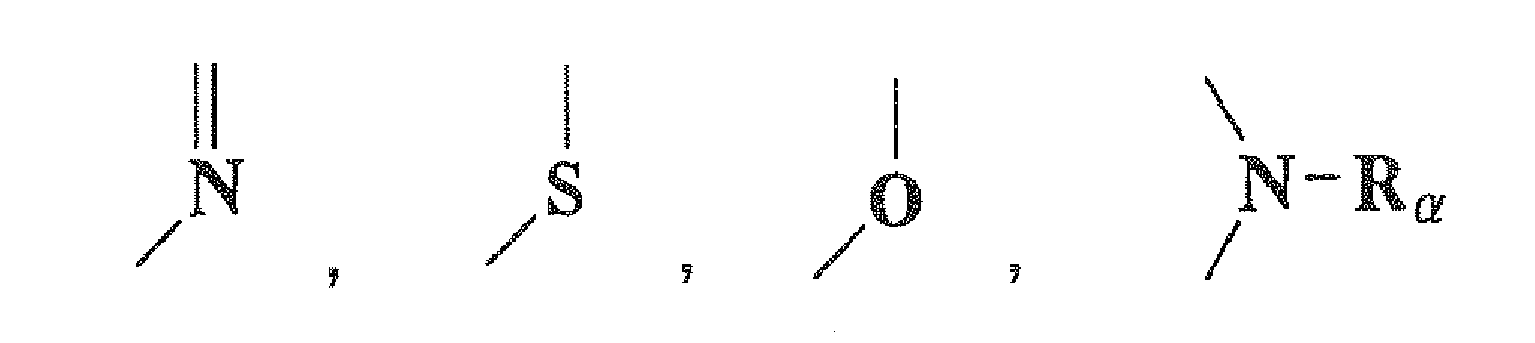
- Y 1 and Y 2 each independently represent any one of the following groups:
- R a represents a hydrogen atom or a hydrocarbon group having 1 to 4 carbon atoms
- P 1 represents a group of atoms necessary for forming a heterocyclic ring together with Y 1 and the two carbon atoms at a position adjacent to Y 1
- P 2 represents a group of atoms necessary for forming a heterocyclic ring together with Y 2 and the two carbon atoms at a position adjacent to Y 2
- P 1 and P 2 may be linked to each other to form a ring
- M represents a transition metal element or typical metal element described in the periodic table
- m represents 1 or 2; when m is 2, two M's may be the same as or different from each other
- X represents a counter ion or a neutral molecule
- n represents the number of X's in the complex, and an integer of 0 or more; when a plurality of X's are present, the X's may be the same as or different from each other
- Q 1 and Q 2 each
- R 7 to R 18 each independently represent a hydrogen atom or a substituent;
- R 10 and R 11 , R 11 and R 12 , R 12 and R 16 , R 13 and R 14 , R 14 and R 15 , R 16 and R 17 and/or R 17 and R 18 may be linked to each other to form a ring;
- M represents a transition metal element or typical metal element described in the periodic table (IUPAC 2001);
- m represents an integer of 1 or 2; when m is 2, two M's may be the same as or different from each other;
- X represents a counter ion or a neutral molecule;
- n represents the number of X's in the complex, and an integer of 0 or more; when a plurality of X's are present, the X's may be the same as or different from each other; and
- Q 3 and Q 4 each independently represent an aromatic heterocyclic group.
- the metal complex represented by the formula (1) as a first embodiment of the present invention is described.
- the metal complex is a complex comprising a metal atom M as a transition metal atom element or typical metal element, and a ligand having four heteroatoms and two oxygen atoms.
- a bond that links an oxygen atom and the metal atom is a coordination bond or an ionic bond; when two metal atoms are present, the metal atoms may be coordinated with each other by bridge coordination.
- the term "transition metal” as used herein has the same meaning as that of a "transition element” described in p 1283 of "Chemistry Unabridged Dictionary” (edited by Michinori Ohki et al.
- transition metal atom M in the present invention may be uncharged, or may be a charged ion; the same holds true for the typical metal atom M, and the typical metal atom M may be uncharged, or may be a charged ion.
- transition metal M examples include scandium, titanium, vanadium, chromium, manganese, iron, cobalt, nickel, copper, zinc, yttrium, zirconium, niobium, molybdenum, ruthenium, rhodium, palladium, silver, cadmium, hafnium, tantalum, tungsten, rhenium, osmium, iridium, platinum, gold, and mercury.
- the metal complex represented by the formula (1) is preferably one represented by the formula (2).
- M suitably represents a metal atom selected from the transition metal atoms belonging to Groups 3 to 9 described in the periodic table.
- Two M's may be the same as or different from each other.
- the transition metal atom M may be a transition metal ion.
- M described in the formulae (1) and (2), when m represents 1, represents one selected from the group consisting of the transition metal atoms and typical metal atoms, preferably aluminum, titanium, vanadium, chromium, manganese, iron, cobalt, nickel, copper, zinc, gallium, germanium, zirconium, niobium, molybdenum, ruthenium, rhodium, palladium, silver, cadmium, indium, tin, antimony, tantalum, tungsten, rhenium, osmium, iridium, platinum, or gold, more preferably aluminum, titanium, vanadium, chromium, manganese, iron, cobalt, nickel, copper, zinc, gallium, molybdenum, ruthenium, rhodium, palladium, silver, tungsten, rhenium, osmium, iridium, platinum, or gold, and particularly preferably a transition metal belonging to Period 4, and specifically, titanium, vana
- R 1 to R 6 each independently represent a hydrogen atom or a substituent.
- substituents include: a halogen group such as a fluoro group, a chloro group, a bromo group, and an iodo group; a hydroxyl group; a carboxyl group; a mercapto group; a sulfonic acid group; a nitro group; a phosphonic acid group; a silyl group having an alkyl group with 1 to 4 carbon atoms; a linear, branched, or cyclic saturated hydrocarbon groups each having a total carbon atoms of 1 to about 50, such as a methyl group, an ethyl group, a propyl group, an isopropyl group, a cyclopropyl group, a butyl group, an isobutyl group, a tert-butyl group,
- R 1 to R 6 each preferably represent: a halogeno group such as a fluoro group, a chloro group, a bromo group, or an iodo group; a mercapto group; a hydroxyl group; a carboxyl group; a hydrocarbon group having a total carbon atoms of 1 to about 20 including exemplified by a methyl group, an ethyl group, a propyl group, an isopropyl group, a butyl group, a pentyl group, a tert-butyl group, a cyclohexyl group, a norbornyl group, or an adamantyl group; a linear, or branched alkoxy group having a total carbon atoms of 1 to about 10 including exemplified by a methoxy group, an ethoxy group, a propioxy group, a butoxy group, or a pentyloxy group; an aromatic group having a
- More preferred is a chloro group, a bromo group, a hydroxy group, a carboxyl group, a methyl group, an ethyl group, a tert-butyl group, a cyclohexyl group, a norbornyl group, an adamantyl group, a methoxy group, an ethoxy group, a phenyl group, or a hydrogen atom.
- R 1 and R 2 , R 2 and R 3 , R 4 and R 5 , and/or R 5 and R 6 may be linked to each other to form a ring.
- the ring include: hydrocarbon rings such as a cyclohexene ring, a benzene ring, a naphthalene ring, an anthracene ring, and an acenaphthene ring; and aromatic heterocyclic rings such as a furan ring and a thiophene ring.
- the ring formed by the coupling of two substituents may further have a substituent, and examples of such substituent include substituents equivalent to above exemplary substituents.
- Y 1 and Y 2 each independently represent any one of the following groups.
- R ⁇ represents a hydrogen atom or a hydrocarbon group having 1 to 8, preferably 1 to 4 carbon atoms.
- the monovalent hydrocarbon group represented by R ⁇ is the same as any one of the above exemplary substituents.
- P 1 and P 2 each independently represent a group of atoms necessary for forming a heterocyclic ring together with Y 1 and Y 2 and the two carbon atoms at positions adjacent to Y 1 and Y 2 (which may hereinafter be referred to as "P 1 and P 2 structures"). It should be noted that the two carbon atoms at adjacent positions do not include carbon atoms that can be include in R ⁇ .
- heterocyclic ring examples include pyridine, pyrazine, pyrimidine, pyrrole, N-alkyl pyrrole, furan, thiophene, thiazole, imidazole, oxazole, benzimidazole, benzofuran, benzothiophene, isoquinoline, and quinazoline, preferably pyridine, pyrazine, pyrimidine, pyrrole, furan, thiophene, and N-alkylpyrrole, and more preferably pyridine, pyrrole, furan, and thiophene.
- the P 1 and P 2 structures may be linked to each other to form a new ring, which preferably has a structure represented by any one of the following formulae (1-a) to (1-i), and more preferably has a structure represented by any one of the formulae (1-a) to (1-d).
- R represents a hydrogen atom or a hydrocarbon group having 1 to 30 carbon atoms. It should be noted that each of the P 1 and P 2 structures may have a substituent, and examples of such substituent include substituents equivalent to the exemplary substituents applied to R 1 to R 6 .
- Substituents Q 1 and Q 2 represent an aromatic heterocyclic group.
- the aromatic heterocyclic group specifically refers to a pyridyl group, a pyrazyl group, a pyrimidyl group, a pyridazyl group, a pyrrolyl group, a furyl group, a thienyl group, a thiazolyl group, an imidazolyl group, an oxazolyl group, a triazolyl group, an indolyl group, a benzoimidazolyl group, a benzofuryl group, a benzothienyl group, a quinolyl group, an isoquinolyl group, a cinnolyl group, a phthalazyl group, a quinazolyl group, a quinoxanyl group, and a benzodiazyl group, preferably a pyridyl group, a pyrazyl group, a
- the metal complex represented by the formula (1) preferably has a ligand structure obtained by combining those represented by the above specific examples of P 1 and P 2 , and Y 1 and Y 2 , and those represented by the above specific examples of Q 1 and Q 2 .
- the metal complex of the present invention is preferably a metal complex represented by the formula (2).
- the ligand has at least two nitrogen atoms and two oxygen atoms as coordinating atoms.
- the ring may have a substituent, and R 7 to R 18 in the formula (2) each independently represent a hydrogen atom or a substituent.
- the substituent includes the same substituent represented by any one of R 1 to R 6 in the formula (1).
- Q 3 and Q 4 represent an aromatic heterocyclic group.
- the aromatic heterocyclic group include a pyridyl group, a pyrazyl group, a pyrimidyl group, a pyridazyl group, a pyrrolyl group, a furyl group, a thienyl group, a thiazolyl group, an imidazolyl group, an oxazolyl group, a triazolyl group, an indolyl group, a benzoimidazolyl group, a benzofuryl group, a benzothienyl group, a quinolyl group, an isoquinolyl group, a cinnolyl group, a phthalazyl group, a quinazolyl group, a quinoxanyl group, and a benzodiazyl group, preferably a pyridyl group, a pyrazyl group, pyridazyl group, a
- aromatic heterocyclic group may be linked at any position of the rings, the aromatic heterocyclic group is preferably linked at ortho-position or meta-position with respect to hetero elements.
- each of these aromatic heterocyclic groups Q 3 and Q 4 may further have substituents, and examples of such substituents include substituents equivalent to the exemplary substituents applied to R 1 to R 6 in the formula (1).
- the metal complex represented by the formula (2) preferably has a ligand structure obtained by combining those represented by the above specific examples of Q 3 and Q 4 .
- the metal complex more preferably has any one of the following ligand structure structures (I) to (XII).
- R described in the structure structure (III), (V), (VI) or (VIII) represents a hydrogen atom or a hydrocarbon group having 1 to 30 carbon atoms.
- an electric charge is omitted.
- X in each of the formulae (1) and (2) represents a neutral molecule or a counter ion that electrically neutralizes the metal complex.
- the neutral molecule include a molecule that solvates to form a solvated salt and a ligand except the cyclic ligand in each of the above formulae (1) and (2).
- neutral molecule examples include water, methanol, ethanol, n-propanol, isopropyl alcohol, 2-methoxyethanol, 1,1-dimethyl ethanol, ethylene glycol, N,N'-dimethyl formamide, N,N'-dimethyl acetamide, N-methyl-2-pyrrolidone, dimethyl sulfoxide, acetone, chloroform, acetonitrile, benzonitrile, triethyl amine, pyridine, pyrazine, diazabicyclo[2,2,2]octane, 4,4'-bipyridine, tetrahydrofuran, diethyl ether, dimethoxy ethane, methylethyl ether, and 1,4-dioxane, and preferably water, methanol, ethanol, isopropyl alcohol, ethylene glycol, N,N'-dimethyl formamide, N,N'-dimethyl acetamide, N-methyl
- X represents an ion
- a negative ion which neutralizes the atom electrically is selected and X represents a fluorine ion, a chlorine ion, a bromine ion, an iodine ion, a sulfide ion, an oxide ion, a hydroxide ion, a hydride ion, a sulfite ion, a phosphate ion, a cyanide ion, an acetate ion, a carbonate ion, a sulfate ion, a nitrate ion, a hydrogen carbonate ion, a trifluoroacetate ion, a 2-ethylhexanoate ion, a thiocyanide ion, a trifluoromethane sulfonate ion, an ace
- the metal complex represented by the formula (2) is preferably obtained by combining any one of the ligand structures (I) to (XII) shown above and the specific examples of M and X described above and a particularly preferable metal complex is a metal complex obtained by combining any one of the ligand structures (I) to (IV) shown above, the transition metal atom M belonging to Period 4, and an acetate ion, a chloride ion, a nitrate ion, and a 2-ethylhexanoate ion.
- a polymer having a residue of the metal complex represented by formula (1) or (2) means to a polymer having a group comprising an atomic group obtained by removing a part or all of the hydrogen atoms (one hydrogen atom in ordinary cases) in the metal complex represented by the formula (1) or (2), and the polymer to be used in this case is not particularly limited and examples of the polymer include a conductive polymer, a dendrimer, a natural polymer, a solid polymer electrolyte, polyethylene, polyethylene glycol, and polypropylene. Of those, the conductive polymer or the solid polymer electrolyte is particularly preferred.
- conductive polymer is a collective term for polymer substances each showing metallic or semi-metallic conductivity ( Iwanami Physical and Chemical Science Dictionary, fifth edition: issued in 1988 ).
- examples of the conductive polymer include: polyacetylene and a derivative of polyacetylene, polyparaphenylene and a derivative of polyparaphenylene, polyparaphenylene vinylene and a derivative of polyparaphenylene vinylene, polyaniline and a derivative of polyaniline, polythiophene and a derivative of polythiophene, polypyrrole and a derivative of polypyrrole, polyfluorene and a derivative of polyfluorene, polyfluorene and a derivative of polyfluorene, polycarbazole and a derivative of polycarbazole, and polyindole and a derivative of polyindole described in " Conductive Polymer” (written by Shinichi Yoshimura, KYORITSU SHUPPAN CO., LTD ) and " New Applications of Conducting Polymers
- Examples of the solid polymer electrolyte include polymers obtained by sulfonating perflurosulfonic acid, polyether ether ketone, polyimide, polyphenylene, polyarylene, and polyarylene ether sulfone.
- a polymer having the residue of the metal complex represented by formula (1) or (2) as a repeating unit means to a polymer having the group comprising an atomic group obtained by removing a part or all of the hydrogen atoms (two hydrogen atoms in ordinary cases) in the metal complex represented by formula (1) or (2) as a repeating unit, and the polymer is produced by, for example, polymerizing a bifunctional monomer containing a macrocyclic ligand.
- the metal complex represented by each of the formulae (1) and (2) can be obtained by: synthesizing the ligand organo-chemically; and mixing the ligand and a reaction agent that provides the metal atom M (hereinafter referred to as "metal-providing agent") in a reaction solvent.
- metal-providing agent is a metal salt comprising a combination of the metal atom M and the counter ion X described above.
- metal atom M include manganese, iron, cobalt, nickel, and copper
- counter ion X include an acetate ion, a chloride ion, a nitrate ion, and a 2-ethylhexanoate ion; a metal salt comprising a combination of the metal atom M and the counter ion X is preferable.
- the ligand can be synthesized by: performing an addition reaction of an organometallic reactant to an aromatic heterocyclic compound and an oxidation followed by a halogenation reaction; and further by a cross-coupling reaction with a transition metal catalyst.
- the ligand can be synthesized by performing a multistage cross-coupling reaction using a halogenated aromatic heterocyclic compound.
- the metal complex of the present invention can be obtained by mixing the ligand and the metal-providing agent in the presence of a appropriate reaction solvent.
- the reaction solvent include water, acetic acid, oxalic acid, ammonia water, methanol, ethanol, n-propanol, isopropyl alcohol, 2-methoxyethanol, 1-butanol, 1,1-dimethylethanol, ethylene glycol, diethyl ether, 1,2-dimethoxyethane, methylethyl ether, 1,4-dioxane, tetrahydrofuran, benzene, toluene, xylene, mesitylene, durene, decalin, dichloromethane, chloroform, carbon tetrachloride, chlorobenzene, 1,2-dichlorobenzene, N,N'-dimethylformamide, N,N'-dimethyl acetamide, N-methyl-2-pyrrolidone,
- a reaction solvent obtained by mixing two or more kinds of them may be used and a solvent which can dissolve a ligand and a metal-providing agent is preferred.
- the reaction can be performed at a temperature of generally -10 to 200°C, preferably 0 to 150°C, or particularly preferably 0 to 100°C for a time period of generally 1 minute to 1 week, preferably 5 minutes to 24 hours, or particularly preferably 1 hour to 12 hours. It should be noted that the reaction temperature and the reaction time can also be appropriately optimized depending on the kinds of the ligand and the metal-providing agent.
- An optimum method selected from a known recrystallization method, a known redeposit method, and a known chromatography method can be appropriately employed as a method involving isolating the produced metal complex from the reaction solution after the reaction and purifying the metal complex, and two or more of these methods may be employed in combination.
- the produced metal complex may precipitate depending on the kind of the reaction solvent; the precipitated metal complex can be isolated and purified by separating the metal complex by a solid-liquid separation method such as filtration and subjecting the separated product to a washing operation and a drying operation as required.
- each of the complexes Since the basic structures of the metal complexes represented by the formulae (1) and (2) are each aromatic, each of the complexes has high heat resistance and high acid resistance, and hence maintains its structure stably even at high temperatures or even in the presence of a strong acid. Accordingly, each of the complexes is expected to exert a catalytic action related to the two metal sites.
- the metal complexes are particularly suitable for use as, for example, redox catalysts, and specific examples of the applications of the metal complexes include: decomposition catalysts for hydrogen peroxide; oxidation polymerization catalysts for aromatic compounds; catalysts for purifying an exhaust gas and waste water; redox catalyst layers for dye sensitization solar cells; carbon dioxide reduction catalysts; catalysts for the production of reformed hydrogen; and oxygen sensors.
- the metal complexes can be used as organic semiconductor materials such as organic EL materials, organic transistors, and dye sensitization solar cells by taking advantage of the fact that each of the metal complexes has an expanded conjugation.
- the metal complex of the present invention is excellent in stability (such as heat resistance and acid resistance), and is useful as, for example, a redox reaction catalyst. That is the metal complex is inhibited from decreasing in its catalystic activity and can serve as a catalyst for a wide valiety of applications and therefore the metal complex is industrially useful.
- Me, Et, and Ac represent methyl, ethyl, and acetyl, respectively.
- Metal complex (A) was synthesized by mixing a ligand and 2-methoxyethanol solution containing cobalt acetate tetrahydrate and by causing them to react with each other in accordance with the following reaction formula.
- the following ligand as a raw material for the complex was synthesized on the basis of Tetrahedron., 1999, 55, 8377 .
- Metal complex (B) was synthesized by mixing a ligand and ethanol solution containing cobalt acetate tetrahydrate and by causing them to react with each other in accordance with the following reaction formula.
- the following ligand as a raw material for the complex was synthesized on the basis of Tetrahedron., 1999, 55, 8377 .
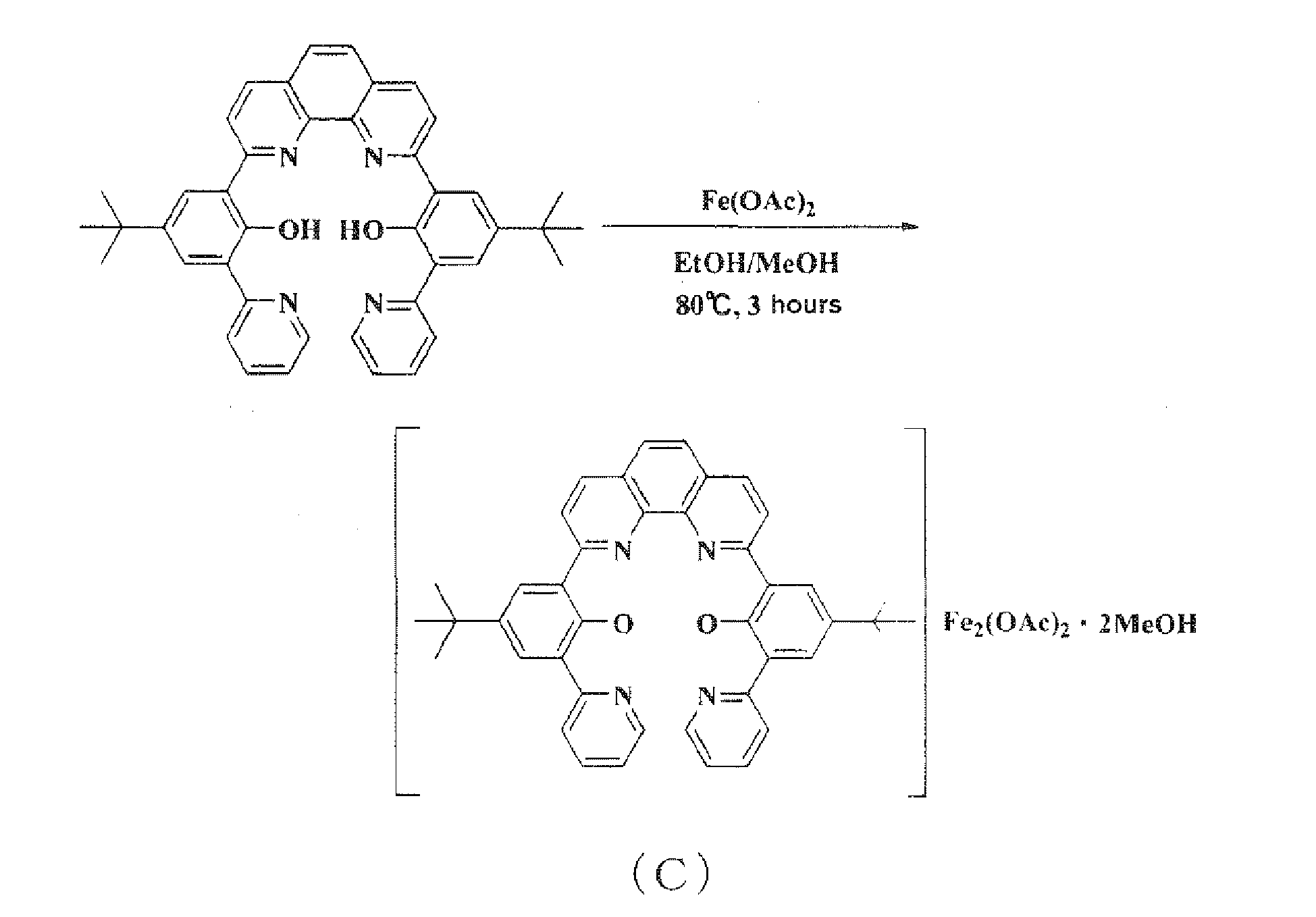
- Metal complex (C) was synthesized by mixing ethanol solution containing a ligand and methanol solution containing ferrous acetate and by causing them to react with each other in accordance with the following reaction formula.
- the following ligand as a raw material for the complex was synthesized on the basis of Tetrahedron., 1999, 55, 8377 .
- Metal Complex (D) was synthesized by mixing chloroform solution containing a ligand and ethanol solution containing manganous chloride tetrahydrate and by causing them to react with each other in accordance with the following reaction formula.
- the following ligand as a raw material for the complex was synthesized on the basis of Tetrahedron., 1999, 55, 8377 .
- Metal Complex (E) was synthesized by mixing ethanol solution containing a ligand and methanol solution containing manganese acetate tetrahydrate and by causing them to react with each other in accordance with the following reaction formula.
- the following ligand as a raw material for the complex was synthesized on the basis of Tetrahedron., 1999, 55, 8377 .
- Metal Complex (F) was synthesized by mixing a ligand and chloroform solution containing cobalt 2-ethylhexanoate and by causing them to react with each other in accordance with the following reaction formula.
- the following ligand as a raw material for the complex was synthesized on the basis of Tetrahedron., 1999, 55, 8377 .
- Metal Complex (G) was synthesized by mixing a ligand and ethanol solution containing nickel acetate tetrahydrate and by causing them to react with each other in accordance with the following reaction formula.
- the following ligand as a raw material for the complex was synthesized on the basis of Tetrahedron., 1999, 55, 8377 .
- Metal Complex (H) was synthesized by mixing a ligand and ethanol solution containing cupric acetate monohydrate and by causing them to react with each other in accordance with the following reaction formula.
- the following ligand as a raw material for the complex was synthesized on the basis of Tetrahedron., 1999, 55, 8377 .
- Metal Complex (I) was synthesized by mixing a ligand and ethanol solution containing ferrous acetate and by causing them to react with each other in accordance with the following reaction formula.
- the following ligand as a raw material for the complex was synthesized on the basis of Tetrahedron., 1999, 55, 8377 .
- Metal Complex (J) was synthesized by mixing a ligand and ethanol solution containing nickel acetate and by causing them to react with each other in accordance with the following reaction formula.
- the following ligand as a raw material for the complex was synthesized on the basis of Tetrahedron., 1999, 55, 8377 .
- Metal Complex (K) was synthesized by mixing chloroform solution containing a ligand and methanol solution containing cobalt nitrate hexahydrate and by causing them to react with each other in accordance with the following reaction formula.
- the following ligand as a raw material for the complex was synthesized on the basis of Tetrahedron., 1999, 55, 8377 .
- Metal Complex (L) was synthesized by mixing chloroform/ethanol mixed solution containing the Metal Complex (B) and ethanol solution containing copper chloride and by causing them to react with each other in accordance with the following reaction formula.
- Metal Complex was synthesized by mixing a ligand and ethanol solution containing cobalt acetate tetrahydrate and by causing them to react with each other in accordance with the following reaction formula.
- the following ligand as a raw material for the complex was synthesized on the basis of Tetrahedron., 1999, 55, 8377 .
- N Metal Complex (N) was synthesized by mixing a ligand and ethanol solution containing cobalt acetate tetrahydrate and by causing them to react with each other in accordance with the following reaction formula.
- the following ligand as a raw material for the complex was synthesized on the basis of Tetrahedron., 1999, 55, 8377 .
- Metal Complex (Q) was synthesized via Compound (O) and Ligand (P) in accordance with the following reaction formula.
- Metal Complex (T) was synthesized via Compound (R) and Ligand (S) in accordance with the following reaction formula.
- Metal Complex (W) was synthesized via Compound (U) and Ligand (V) in accordance with the following reaction formula.
- Metal Complex was synthesized by mixing chloroform containing a Schiff base ligand and ethanol containing cobalt acetate tetrahydrate and by causing them to react with each other in accordance with the following reaction formula.
- the Schiff base ligand as a raw material for the complex and Metal Complex (AA) were each synthesized in accordance with the method described in A chemistry, European Journal, 1999, 5, 1460 .
- TGA thermogravimetric/differential thermal analyzer
- EXSTAR-6300 produced by Seiko Instruments Inc.
- a mass reduction percentage was determined from a ratio to the initial metal complex subjected to the measurement.
- Conditions for the measurement were as follows: the measurement was performed under a nitrogen atmosphere in the range of 40 to 800°C (at a rate of temperature increase of 10°C/min), and an alumina dish was used in the heat treatment. Table 6 shows the mass reduction percentage at 800°C.
- Example 28 For comparison, the same experiment as that of Example 28 was performed with a thermogravimetric/differential thermal analyzer (EXSTAR-6300 produced by Seiko Instruments Inc.) except that Metal Complex (A) in Example 28 was replaced with Metal Complex (X), (Y), (Z), (AA), or (AB). Table 6 shows the mass reduction percentage. It should be noted that Metal Complex (AB) described above as a comparative example is an N,N'-disalicylalethylenediamine iron(II) complex (produced by TCl), which was used instead of Metal Complex (A) in Example 28.
- EXSTAR-6300 produced by Seiko Instruments Inc.
- Table 6 revealed that each of Metal Complexes (A), (B), (D), and (L) of the present invention showed a mass reduction percentage smaller than those of the metal complexes of comparative examples, which were of the same kind and were of the same nuclear number, and was hence excellent in heat resistance.
- a septum was attached to one neck of the two-necked flask containing the catalyst mixed solution, and the other neck was coupled with a gas buret.
- aqueous solution of hydrogen peroxide (11.4 mol/L, 0.20 mL (2.28 mmol)) was added to the solution with a syringe, and then a hydrogen peroxide decomposition reaction was performed at 80°C for 20 minutes.
- the produced oxygen was measured with the gas buret, and the amount of decomposed hydrogen peroxide was determined.
- the amount of decomposed hydrogen peroxide was determined from the volume of gases containing the oxygen produced by the hydrogen peroxide decomposition test.
- V 273 ⁇ v ⁇ P - p 760 ⁇ 273 + t )
- P represents an atmospheric pressure (mmHg)
- p represents a vapor pressure of water (mmHg)
- t represents a temperature (°C)
- v represents an actual volume of the produced gases (mL)
- V represents a gas volume (mL) at 0°C and 101,325 Pa (760 mmHg).
- Example 29 The same experiment as that of Example 29 was performed except that Metal Complex (D) of Example 29 was changed to Metal Complex (Z).
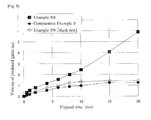
- Fig. 5 shows the results together with those of Example 29.
- the volume of produced gases did not differ from that in the blank test, so the catalytic effect on the decomposition of hydrogen peroxide could not be confirmed.
- the metal complex of the present invention is excellent in stability (such as heat resistance and acid resistance), and is hence useful as, for example, a redox reaction catalyst. Therefore, a reduction in the catalytic activity of the metal complex can be suppressed even at high temperatures or even in the presence of a strong acid, and the metal complex can be used in a wide variety of applications, so the metal complex is industrially useful.
Landscapes
- Chemical & Material Sciences (AREA)
- Organic Chemistry (AREA)
- Chemical Kinetics & Catalysis (AREA)
- Engineering & Computer Science (AREA)
- Materials Engineering (AREA)
- Inorganic Chemistry (AREA)
- Health & Medical Sciences (AREA)
- Medicinal Chemistry (AREA)
- Polymers & Plastics (AREA)
- Catalysts (AREA)
- Pyridine Compounds (AREA)
- Nitrogen Condensed Heterocyclic Rings (AREA)
Abstract


Description
- The present invention relates to a metal complex, and more specifically, to a metal complex useful as a catalyst.
- Metal complexes each act as a catalyst in a redox reaction involving electron transfer such as an oxygenation reaction, an oxidative coupling reaction, a dehydrogenation reaction, a hydrogenation reaction, an oxide decomposition reaction, or an electrode reaction, and are each used in the production of an organic compound or polymer compound. In addition, each of the metal complexes has been recently used as a phosphorescent complex for an organic EL material. Further, the metal complexes are used in various applications including additives, modifiers, cells, and sensor materials.
- In particular, as for a redox reaction catalyst, Schiff base type metal complexes are known to have the highly-active and highly-selective catalytic abilities. For example, Org. Biomol. Chem., 2005, 3, 2126 describes that an optically active Schiff base type complex is used as a catalyst to oxidize the double bond of styrene so that an asymmetric cyclopropanation reaction may occur, and the asymmetric reaction may proceed favorably. In addition, Inorg. Chem., 2001, 40, 1329 describes that the production of water by the electrolytic reduction of oxygen is performed by using a Schiff base type metal complex.
- However, the metal complex disclosed in Org. Biomol. Chem., 2005, 3, 2126 involves the possibility that when the metal complex is used as a catalyst, the catalyst is destabilized under heating, and hence its activity lowers. Further, the catalyst is used in a limited range of applications owing to the possibility that the catalyst is destabilized also in the presence of a strong acid. As described above, a metal complex that has been conventionally disclosed has the potential to be decomposed under some reaction conditions.
- According to the present invention, there can be provided a metal complex excellent in stability and useful as a redox reaction catalyst or the like.
- According to the present invention, there is provided the following means:
- (1) A metal complex represented by the following formula (1):
-

-
- (2) A metal complex represented by the following formula (2):
-

- (3) The metal complex according to the above (1) or (2), wherein, in the formula (1) or (2), m represents 2, and M represents a transition metal element belonging to Groups 3 to 9 described in the periodic table (IUPAC 2001).
- (4) The metal complex according to the above (1) or (2), wherein, in the formula (1) or (2), m represents 1.
- (5) A polymer, comprising a residue of the metal complex represented by the formula (1) or (2).
- (6) The polymer according to the above (5), comprising the residue of the metal complex represented by the formula (1) or (2) as a repeating unit.
- (7) A catalyst obtained by using the metal complex according to any one of the above items (1) to (4) and/or the polymer according to the above (5) or (6).
- Other and further features and advantages of the invention will appear more fully from the following description, appropriately referring to the accompanying drawings.
-
-
Fig. 1 shows an IR absorption spectrum of Metal Complex (A). -
Fig. 2 shows an IR absorption spectrum of Metal Complex (M). -
Fig. 3 shows an IR absorption spectrum of Metal Complex (N). -
Fig. 4 shows an IR absorption spectrum of Metal Complex (W). -
Fig. 5 shows results of hydrogen peroxide decomposition tests of Example 29 and Comparative Example 7. - The metal complex represented by the formula (1) as a first embodiment of the present invention is described.
The metal complex is a complex comprising a metal atom M as a transition metal atom element or typical metal element, and a ligand having four heteroatoms and two oxygen atoms. In addition, a bond that links an oxygen atom and the metal atom is a coordination bond or an ionic bond; when two metal atoms are present, the metal atoms may be coordinated with each other by bridge coordination. The term "transition metal" as used herein has the same meaning as that of a "transition element" described in p 1283 of "Chemistry Unabridged Dictionary" (edited by Michinori Ohki et al. and issued by Tokyo Kagaku Dojin on July 1, 2005), and means to an element having an incomplete d or f subshell. It should be noted that the transition metal atom M in the present invention may be uncharged, or may be a charged ion; the same holds true for the typical metal atom M, and the typical metal atom M may be uncharged, or may be a charged ion. - Here, specific examples of the transition metal M include scandium, titanium, vanadium, chromium, manganese, iron, cobalt, nickel, copper, zinc, yttrium, zirconium, niobium, molybdenum, ruthenium, rhodium, palladium, silver, cadmium, hafnium, tantalum, tungsten, rhenium, osmium, iridium, platinum, gold, and mercury.
- In addition, specific examples of the typical metal include aluminum, gallium, germanium, indium, tin, antimony, thallium, lead, and bismuth.
The metal complex represented by the formula (1) is preferably one represented by the formula (2). - In each of the formulae (1) and (2), when m represents 2, M suitably represents a metal atom selected from the transition metal atoms belonging to Groups 3 to 9 described in the periodic table. Two M's may be the same as or different from each other.
- The transition metal atom M belonging to Groups 3 to 9, when m represents 2, represents preferably scandium, titanium, vanadium, chromium, manganese, iron, cobalt, yttrium, zirconium, niobium, molybdenum, ruthenium, rhodium, hafnium, tantalum, tungsten, rhenium, osmium, or iridium, more preferably titanium, vanadium, chromium, manganese, iron, cobalt, zirconium, niobium, molybdenum, ruthenium, or rhodium, and particularly preferably a transition metal belonging to Period 4, and specifically, titanium, vanadium, chromium, manganese, iron, or cobalt. In the present invention, as described above, the transition metal atom M may be a transition metal ion.
- M described in the formulae (1) and (2), when m represents 1, represents one selected from the group consisting of the transition metal atoms and typical metal atoms, preferably aluminum, titanium, vanadium, chromium, manganese, iron, cobalt, nickel, copper, zinc, gallium, germanium, zirconium, niobium, molybdenum, ruthenium, rhodium, palladium, silver, cadmium, indium, tin, antimony, tantalum, tungsten, rhenium, osmium, iridium, platinum, or gold, more preferably aluminum, titanium, vanadium, chromium, manganese, iron, cobalt, nickel, copper, zinc, gallium, molybdenum, ruthenium, rhodium, palladium, silver, tungsten, rhenium, osmium, iridium, platinum, or gold, and particularly preferably a transition metal belonging to Period 4, and specifically, titanium, vanadium, chromium, manganese, iron, cobalt, nickel, copper, or zinc. In the present invention, as described above, M may represent an ion of a transition metal or a typical metal.
- Next, the ligand of the metal complex represented by the above formula (1) is described. In the formula (1), R1 to R6 each independently represent a hydrogen atom or a substituent.
Here, specific examples of the substituent include: a halogen group such as a fluoro group, a chloro group, a bromo group, and an iodo group; a hydroxyl group; a carboxyl group; a mercapto group; a sulfonic acid group; a nitro group; a phosphonic acid group; a silyl group having an alkyl group with 1 to 4 carbon atoms; a linear, branched, or cyclic saturated hydrocarbon groups each having a total carbon atoms of 1 to about 50, such as a methyl group, an ethyl group, a propyl group, an isopropyl group, a cyclopropyl group, a butyl group, an isobutyl group, a tert-butyl group, a pentyl group, a cyclopentyl group, a hexyl group, a cyclohexyl group, a norbornyl group, a nonyl group, a cyclononyl group, a decyl group, a 3,7-dimethyloctyl group, an adamantyl group, a dodecyl group, a cyclododecyl group, a pentadecyl group, an octadecyl group, and a docosyl group; a linear, branched, or cyclic alkoxy groups each having a total carbon atoms of 1 to about 50 such as a methoxy group, an ethoxy group, a propioxy group, a butoxy group, a pentyloxy group, a cyclohexyloxy group, a norbonyloxy group, a decyloxy group, and a dodecyloxy group; and aromatic groups each having a total carbon atoms of 6 to about 60 such as a phenyl group, a 4-methylphenyl group, a 1-naphthyl group, a 2-naphthyl group, and a 9-anthryl group.
R1 to R6 each preferably represent: a halogeno group such as a fluoro group, a chloro group, a bromo group, or an iodo group; a mercapto group; a hydroxyl group; a carboxyl group; a hydrocarbon group having a total carbon atoms of 1 to about 20 including exemplified by a methyl group, an ethyl group, a propyl group, an isopropyl group, a butyl group, a pentyl group, a tert-butyl group, a cyclohexyl group, a norbornyl group, or an adamantyl group; a linear, or branched alkoxy group having a total carbon atoms of 1 to about 10 including exemplified by a methoxy group, an ethoxy group, a propioxy group, a butoxy group, or a pentyloxy group; an aromatic group having a total carbon atoms of 6 to about 30 such as a phenyl group, a 1-naphthyl group, a 2-naphthyl group, and a 9-anthryl group; or a hydrogen atom.
More preferred is a chloro group, a bromo group, a hydroxy group, a carboxyl group, a methyl group, an ethyl group, a tert-butyl group, a cyclohexyl group, a norbornyl group, an adamantyl group, a methoxy group, an ethoxy group, a phenyl group, or a hydrogen atom. - R1 and R2, R2 and R3, R4 and R5, and/or R5 and R6 may be linked to each other to form a ring.
Here, examples of the ring include: hydrocarbon rings such as a cyclohexene ring, a benzene ring, a naphthalene ring, an anthracene ring, and an acenaphthene ring; and aromatic heterocyclic rings such as a furan ring and a thiophene ring.
It should be noted that the ring formed by the coupling of two substituents may further have a substituent, and examples of such substituent include substituents equivalent to above exemplary substituents. - Y1 and Y2 each independently represent any one of the following groups.
-

- The monovalent hydrocarbon group represented by Rα is the same as any one of the above exemplary substituents. P1 and P2 each independently represent a group of atoms necessary for forming a heterocyclic ring together with Y1 and Y2 and the two carbon atoms at positions adjacent to Y1 and Y2 (which may hereinafter be referred to as "P1 and P2 structures").
It should be noted that the two carbon atoms at adjacent positions do not include carbon atoms that can be include in Rα. Specific examples of the heterocyclic ring include pyridine, pyrazine, pyrimidine, pyrrole, N-alkyl pyrrole, furan, thiophene, thiazole, imidazole, oxazole, benzimidazole, benzofuran, benzothiophene, isoquinoline, and quinazoline, preferably pyridine, pyrazine, pyrimidine, pyrrole, furan, thiophene, and N-alkylpyrrole, and more preferably pyridine, pyrrole, furan, and thiophene.
In addition, the P1 and P2 structures may be linked to each other to form a new ring, which preferably has a structure represented by any one of the following formulae (1-a) to (1-i), and more preferably has a structure represented by any one of the formulae (1-a) to (1-d). -


It should be noted that each of the P1 and P2 structures may have a substituent, and examples of such substituent include substituents equivalent to the exemplary substituents applied to R1 to R6. - Substituents Q1 and Q2 represent an aromatic heterocyclic group. In the present invention, the aromatic heterocyclic group specifically refers to a pyridyl group, a pyrazyl group, a pyrimidyl group, a pyridazyl group, a pyrrolyl group, a furyl group, a thienyl group, a thiazolyl group, an imidazolyl group, an oxazolyl group, a triazolyl group, an indolyl group, a benzoimidazolyl group, a benzofuryl group, a benzothienyl group, a quinolyl group, an isoquinolyl group, a cinnolyl group, a phthalazyl group, a quinazolyl group, a quinoxanyl group, and a benzodiazyl group, preferably a pyridyl group, a pyrazyl group, a pyridazyl group, a pyrrolyl group, a furyl group, a thienyl group, a thiazolyl group, an indolyl group, and a benzoimidazolyl group, and more preferably a pyridyl group, a pyrrolyl group, a furyl group, a thienyl group, and a thiazolyl group.
In addition, these rings may further have substituents and the substituents include substituents equivalent to the exemplary substituents of R1 to R6. - The metal complex represented by the formula (1) preferably has a ligand structure obtained by combining those represented by the above specific examples of P1 and P2, and Y1 and Y2, and those represented by the above specific examples of Q1 and Q2.
- Next, the metal complex of the present invention is preferably a metal complex represented by the formula (2). As described above, the ligand has at least two nitrogen atoms and two oxygen atoms as coordinating atoms. The ring may have a substituent, and R7 to R18 in the formula (2) each independently represent a hydrogen atom or a substituent.
Here, the substituent includes the same substituent represented by any one of R1 to R6 in the formula (1). - Q3 and Q4 represent an aromatic heterocyclic group. Specific examples of the aromatic heterocyclic group include a pyridyl group, a pyrazyl group, a pyrimidyl group, a pyridazyl group, a pyrrolyl group, a furyl group, a thienyl group, a thiazolyl group, an imidazolyl group, an oxazolyl group, a triazolyl group, an indolyl group, a benzoimidazolyl group, a benzofuryl group, a benzothienyl group, a quinolyl group, an isoquinolyl group, a cinnolyl group, a phthalazyl group, a quinazolyl group, a quinoxanyl group, and a benzodiazyl group, preferably a pyridyl group, a pyrazyl group, pyridazyl group, a pyrrolyl group, a furyl group, a thienyl group, a thiazolyl group, an indolyl group, and a benzoimidazolyl group, and more preferably a pyridyl group, a pyrrolyl group, a furyl group, a thienyl group, and a thiazolyl group. While, the aromatic heterocyclic group may be linked at any position of the rings, the aromatic heterocyclic group is preferably linked at ortho-position or meta-position with respect to hetero elements.
In addition, each of these aromatic heterocyclic groups Q3 and Q4 may further have substituents, and examples of such substituents include substituents equivalent to the exemplary substituents applied to R1 to R6 in the formula (1). - The metal complex represented by the formula (2) preferably has a ligand structure obtained by combining those represented by the above specific examples of Q3 and Q4. To be specific, the metal complex more preferably has any one of the following ligand structure structures (I) to (XII).
-

In the structures (I) to (XII), an electric charge is omitted. - X in each of the formulae (1) and (2) represents a neutral molecule or a counter ion that electrically neutralizes the metal complex. Examples of the neutral molecule include a molecule that solvates to form a solvated salt and a ligand except the cyclic ligand in each of the above formulae (1) and (2). Specific examples of the neutral molecule include water, methanol, ethanol, n-propanol, isopropyl alcohol, 2-methoxyethanol, 1,1-dimethyl ethanol, ethylene glycol, N,N'-dimethyl formamide, N,N'-dimethyl acetamide, N-methyl-2-pyrrolidone, dimethyl sulfoxide, acetone, chloroform, acetonitrile, benzonitrile, triethyl amine, pyridine, pyrazine, diazabicyclo[2,2,2]octane, 4,4'-bipyridine, tetrahydrofuran, diethyl ether, dimethoxy ethane, methylethyl ether, and 1,4-dioxane, and preferably water, methanol, ethanol, isopropyl alcohol, ethylene glycol, N,N'-dimethyl formamide, N,N'-dimethyl acetamide, N-methyl-2-pyrrolidone, chloroform, acetonitrile, benzonitrile, triethyl amine, pyridine, pyrazine, diazabicyclo[2,2,2]octane, 4,4'-bipyridine, tetrahydrofuran, dimethoxy ethane, and 1,4-dioxane.
- In addition, when X represents an ion, because the transition metal atom and typical metal atom generally have a positive charge, a negative ion which neutralizes the atom electrically is selected and X represents a fluorine ion, a chlorine ion, a bromine ion, an iodine ion, a sulfide ion, an oxide ion, a hydroxide ion, a hydride ion, a sulfite ion, a phosphate ion, a cyanide ion, an acetate ion, a carbonate ion, a sulfate ion, a nitrate ion, a hydrogen carbonate ion, a trifluoroacetate ion, a 2-ethylhexanoate ion, a thiocyanide ion, a trifluoromethane sulfonate ion, an acetyl acetonate, a tefrafuloroborate ion, a hexafluorophosphate ion, and a tetraphenyl borate ion, and preferably a chloride ion, a bromide ion, an iodide ion, an oxide ion, a hydroxide ion, a hydride ion, a phosphate ion, a cyanide ion, an acetate ion, a carbonate ion, a sulfate ion, a nitrate ion, a 2-ethylhexanoate ion, an acetyl acetonate, and a tetraphenyl borate ion.
In addition, when a plurality of X's are present, the X's may be the same as or different from each other, or a neutral molecule and an ion may be coexistent with each other.
To be specific, the metal complex represented by the formula (2) is preferably obtained by combining any one of the ligand structures (I) to (XII) shown above and the specific examples of M and X described above and a particularly preferable metal complex is a metal complex obtained by combining any one of the ligand structures (I) to (IV) shown above, the transition metal atom M belonging to Period 4, and an acetate ion, a chloride ion, a nitrate ion, and a 2-ethylhexanoate ion. - A polymer having a residue of the metal complex represented by formula (1) or (2) means to a polymer having a group comprising an atomic group obtained by removing a part or all of the hydrogen atoms (one hydrogen atom in ordinary cases) in the metal complex represented by the formula (1) or (2), and the polymer to be used in this case is not particularly limited and examples of the polymer include a conductive polymer, a dendrimer, a natural polymer, a solid polymer electrolyte, polyethylene, polyethylene glycol, and polypropylene. Of those, the conductive polymer or the solid polymer electrolyte is particularly preferred. The term "conductive polymer" is a collective term for polymer substances each showing metallic or semi-metallic conductivity (Iwanami Physical and Chemical Science Dictionary, fifth edition: issued in 1988). Examples of the conductive polymer include: polyacetylene and a derivative of polyacetylene, polyparaphenylene and a derivative of polyparaphenylene, polyparaphenylene vinylene and a derivative of polyparaphenylene vinylene, polyaniline and a derivative of polyaniline, polythiophene and a derivative of polythiophene, polypyrrole and a derivative of polypyrrole, polyfluorene and a derivative of polyfluorene, polyfluorene and a derivative of polyfluorene, polycarbazole and a derivative of polycarbazole, and polyindole and a derivative of polyindole described in "Conductive Polymer" (written by Shinichi Yoshimura, KYORITSU SHUPPAN CO., LTD) and "New Applications of Conducting Polymers" (edited by Yukio Kobayashi, CMC Publishing CO., LTD.); and copolymers of the conductive polymers.
Examples of the solid polymer electrolyte include polymers obtained by sulfonating perflurosulfonic acid, polyether ether ketone, polyimide, polyphenylene, polyarylene, and polyarylene ether sulfone. - A polymer having the residue of the metal complex represented by formula (1) or (2) as a repeating unit means to a polymer having the group comprising an atomic group obtained by removing a part or all of the hydrogen atoms (two hydrogen atoms in ordinary cases) in the metal complex represented by formula (1) or (2) as a repeating unit, and the polymer is produced by, for example, polymerizing a bifunctional monomer containing a macrocyclic ligand.
- Next, a method of synthesizing the metal complex represented by each of the formulae (1) and (2) will be described.
The metal complex represented by each of the formulae (1) and (2) can be obtained by: synthesizing the ligand organo-chemically; and mixing the ligand and a reaction agent that provides the metal atom M (hereinafter referred to as "metal-providing agent") in a reaction solvent. Here, the metal-providing agent is a metal salt comprising a combination of the metal atom M and the counter ion X described above. Specific preferable examples of the metal atom M include manganese, iron, cobalt, nickel, and copper, and specific preferable examples of the counter ion X include an acetate ion, a chloride ion, a nitrate ion, and a 2-ethylhexanoate ion; a metal salt comprising a combination of the metal atom M and the counter ion X is preferable. - As described in a non-patent document "Tetrahedron., 1999, 55, 8377.", the ligand can be synthesized by: performing an addition reaction of an organometallic reactant to an aromatic heterocyclic compound and an oxidation followed by a halogenation reaction; and further by a cross-coupling reaction with a transition metal catalyst.
Alternatively, the ligand can be synthesized by performing a multistage cross-coupling reaction using a halogenated aromatic heterocyclic compound. - As described above, the metal complex of the present invention can be obtained by mixing the ligand and the metal-providing agent in the presence of a appropriate reaction solvent. Specific examples of the reaction solvent include water, acetic acid, oxalic acid, ammonia water, methanol, ethanol, n-propanol, isopropyl alcohol, 2-methoxyethanol, 1-butanol, 1,1-dimethylethanol, ethylene glycol, diethyl ether, 1,2-dimethoxyethane, methylethyl ether, 1,4-dioxane, tetrahydrofuran, benzene, toluene, xylene, mesitylene, durene, decalin, dichloromethane, chloroform, carbon tetrachloride, chlorobenzene, 1,2-dichlorobenzene, N,N'-dimethylformamide, N,N'-dimethyl acetamide, N-methyl-2-pyrrolidone, dimethylsulfoxide, acetone, acetonitrile, benzonitrile, triethylamine, and pyridine. A reaction solvent obtained by mixing two or more kinds of them may be used and a solvent which can dissolve a ligand and a metal-providing agent is preferred. The reaction can be performed at a temperature of generally -10 to 200°C, preferably 0 to 150°C, or particularly preferably 0 to 100°C for a time period of generally 1 minute to 1 week, preferably 5 minutes to 24 hours, or particularly preferably 1 hour to 12 hours. It should be noted that the reaction temperature and the reaction time can also be appropriately optimized depending on the kinds of the ligand and the metal-providing agent.
An optimum method selected from a known recrystallization method, a known redeposit method, and a known chromatography method can be appropriately employed as a method involving isolating the produced metal complex from the reaction solution after the reaction and purifying the metal complex, and two or more of these methods may be employed in combination.
It should be noted that the produced metal complex may precipitate depending on the kind of the reaction solvent; the precipitated metal complex can be isolated and purified by separating the metal complex by a solid-liquid separation method such as filtration and subjecting the separated product to a washing operation and a drying operation as required. - Since the basic structures of the metal complexes represented by the formulae (1) and (2) are each aromatic, each of the complexes has high heat resistance and high acid resistance, and hence maintains its structure stably even at high temperatures or even in the presence of a strong acid. Accordingly, each of the complexes is expected to exert a catalytic action related to the two metal sites.
The metal complexes are particularly suitable for use as, for example, redox catalysts, and specific examples of the applications of the metal complexes include: decomposition catalysts for hydrogen peroxide; oxidation polymerization catalysts for aromatic compounds; catalysts for purifying an exhaust gas and waste water; redox catalyst layers for dye sensitization solar cells; carbon dioxide reduction catalysts; catalysts for the production of reformed hydrogen; and oxygen sensors. In addition, the metal complexes can be used as organic semiconductor materials such as organic EL materials, organic transistors, and dye sensitization solar cells by taking advantage of the fact that each of the metal complexes has an expanded conjugation. - The metal complex of the present invention is excellent in stability (such as heat resistance and acid resistance), and is useful as, for example, a redox reaction catalyst. That is the metal complex is inhibited from decreasing in its catalystic activity and can serve as a catalyst for a wide valiety of applications and therefore the metal complex is industrially useful.
- The present invention will be described in more detail based on the following examples, but the invention is not intended to be limited thereto. In EXAMPLE, Me, Et, and Ac represent methyl, ethyl, and acetyl, respectively.
- Metal complex (A) was synthesized by mixing a ligand and 2-methoxyethanol solution containing cobalt acetate tetrahydrate and by causing them to react with each other in accordance with the following reaction formula. The following ligand as a raw material for the complex was synthesized on the basis of Tetrahedron., 1999, 55, 8377.
-

Fig. 1 .
Elementary Analysis Value (%): - Calculated Value (Calcd for C49H50Co2N4O8); C, 62.56; H, 5.36; N, 5.96;
- Co, 12.53
- Actual Measurement Value: C, 62.12; H, 5.07; N, 6.03; Co, 12.74
- ESI-MS [M-OAc]+: 805.0
- Metal complex (B) was synthesized by mixing a ligand and ethanol solution containing cobalt acetate tetrahydrate and by causing them to react with each other in accordance with the following reaction formula. The following ligand as a raw material for the complex was synthesized on the basis of Tetrahedron., 1999, 55, 8377.
-

Elementary Analysis Value (%): - Calculated Value (Calcd for C42H40CoN4O4)., C, 69.70; H, 5.57; N, 7.74
- Actual Measurement Value: C, 70.01; H, 5.80; N, 7.56
- ESI-MS [M-]+: 687.1
- Metal complex (C) was synthesized by mixing ethanol solution containing a ligand and methanol solution containing ferrous acetate and by causing them to react with each other in accordance with the following reaction formula. The following ligand as a raw material for the complex was synthesized on the basis of Tetrahedron., 1999, 55, 8377.
-
Elementary Analysis Value (%): - Calculated Value (Calcd for C48H50Fe2N4O8), C, 62.49; H, 5.46; N, 6.07
- Actual Measurement Value: C, 59.93; H, 5.29; N, 5.70
- Metal Complex (D) was synthesized by mixing chloroform solution containing a ligand and ethanol solution containing manganous chloride tetrahydrate and by causing them to react with each other in accordance with the following reaction formula. The following ligand as a raw material for the complex was synthesized on the basis of Tetrahedron., 1999, 55, 8377.
-

Elementary Analysis Value (%): - Calculated Value (Calcd for C42H40Mn2N4O4); C, 59.66; H, 4.77; N, 6.63
- Actual Measurement Value: C, 58.26; H, 4.58; N,6.33
- FD-MS [M·]+: 808.0
- Metal Complex (E) was synthesized by mixing ethanol solution containing a ligand and methanol solution containing manganese acetate tetrahydrate and by causing them to react with each other in accordance with the following reaction formula. The following ligand as a raw material for the complex was synthesized on the basis of Tetrahedron., 1999, 55, 8377.
-

- Metal Complex (F) was synthesized by mixing a ligand and chloroform solution containing cobalt 2-ethylhexanoate and by causing them to react with each other in accordance with the following reaction formula. The following ligand as a raw material for the complex was synthesized on the basis of Tetrahedron., 1999, 55, 8377.
-

ESI-MS [M·]+: 1032.2
Elementary Analysis Value (%): - Calculated Value (Calcd for C58H66Co2N4O6); C, 67.43; H, 6.44; N, 5.42
- Actual Measurement Value: C, 60.97; H, 6.21; N, 5.27
- Metal Complex (G) was synthesized by mixing a ligand and ethanol solution containing nickel acetate tetrahydrate and by causing them to react with each other in accordance with the following reaction formula. The following ligand as a raw material for the complex was synthesized on the basis of Tetrahedron., 1999, 55, 8377.
-

Elementary Analysis Value (%): - Calcd for C42H36N4NiO2; C, 73.38; H, 5.28; N, 8.15
- Found: C, 72.42; H, 5.27; N, 7.96
- ESI-MS [M·]+: 687.1
- Metal Complex (H) was synthesized by mixing a ligand and ethanol solution containing cupric acetate monohydrate and by causing them to react with each other in accordance with the following reaction formula. The following ligand as a raw material for the complex was synthesized on the basis of Tetrahedron., 1999, 55, 8377.
-

Elementary Analysis Value (%): - Calcd for C42H36CuN4O2: C, 72.87; H, 5.24; N, 8.09
- Found: C, 72.22; H, 5.37; N, 7.77
- ESI-MS [M·]+: 692.1
- Metal Complex (I) was synthesized by mixing a ligand and ethanol solution containing ferrous acetate and by causing them to react with each other in accordance with the following reaction formula. The following ligand as a raw material for the complex was synthesized on the basis of Tetrahedron., 1999, 55, 8377.
-

Elementary Analysis Value (%): - Calcd for C42H36FeN4O2; C, 73.68; H, 5.30; N, 8.18
- Found: C, 72.20; H, 5.42; N, 7.85
- ESI-MS [M·]+ 684.0
- Metal Complex (J) was synthesized by mixing a ligand and ethanol solution containing nickel acetate and by causing them to react with each other in accordance with the following reaction formula. The following ligand as a raw material for the complex was synthesized on the basis of Tetrahedron., 1999, 55, 8377.
-

Elementary Analysis Value (%): - Calculated Value (Calcd for C46H42N4Ni2O6): C, 63.93; H, 4.90; N,6.07
- Actual Measurement Value: C, 63.22; H, 5.02; N, 6.43
- Metal Complex (K) was synthesized by mixing chloroform solution containing a ligand and methanol solution containing cobalt nitrate hexahydrate and by causing them to react with each other in accordance with the following reaction formula. The following ligand as a raw material for the complex was synthesized on the basis of Tetrahedron., 1999, 55, 8377.
-

ESI-MS [M-NO3]+: 808.0 - Metal Complex (L) was synthesized by mixing chloroform/ethanol mixed solution containing the Metal Complex (B) and ethanol solution containing copper chloride and by causing them to react with each other in accordance with the following reaction formula.
-

ESI-MS [M-CI]+: 787.0 - Metal Complex (M) was synthesized by mixing a ligand and ethanol solution containing cobalt acetate tetrahydrate and by causing them to react with each other in accordance with the following reaction formula. The following ligand as a raw material for the complex was synthesized on the basis of Tetrahedron., 1999, 55, 8377.
-

ESI-MS [M+H]+: 664.2
The infrared ray (IR) absorption spectrum of the obtained Metal Complex (M) is shown inFig. 2 . - Metal Complex (N) was synthesized by mixing a ligand and ethanol solution containing cobalt acetate tetrahydrate and by causing them to react with each other in accordance with the following reaction formula. The following ligand as a raw material for the complex was synthesized on the basis of Tetrahedron., 1999, 55, 8377.
-

ESI-MS [M-OAc]+: 781.0
The infrared ray (IR) absorption spectrum of the obtained Metal Complex (N) is shown inFig. 3 . - Metal Complex (Q) was synthesized via Compound (O) and Ligand (P) in accordance with the following reaction formula.
-

1H-NMR (300 MHz, CDCl3) δ 1.34 (s, 18H), 1.37 (s, 18H), 3.30 (s, 6H), 6.21 (m, 2H), 6.27 (m, 2H), 7.37 (m, 2H), 7.41 (s, 2H), 7.82 (s, 2H),8.00 (s, 2H), 8.19 (d, J = 8.6 Hz, 2H), 8.27 (d, J = 8.6 Hz, 2H) -

1H-NMR (300 MHz, CDCl3) δ 1.40 (s, 18H), 6.25 (m, 2H), 6.44 (m, 2H), 6.74 (m, 2H), 7.84 (s, 2H), 7.89 (s, 2H), 7.92 (s, 2H), 8.35 (d, J = 8.4 Hz, 2H), 8.46 (d, J = 8.4 Hz, 2H), 10.61 (s, 2H), 15.88 (s, 2H). -

ESI-MS [M·]+: 663.1 - Metal Complex (T) was synthesized via Compound (R) and Ligand (S) in accordance with the following reaction formula.
-

1H-NMR (300 MHz, CDCl3) δ 1.42 (s, 18H), 3.48 (s, 6H), 7.12 (dd, 2H), 7.38 (d, J = 5.0 Hz, 2H), 7.52 (d, J = 2.9 Hz, 2H), 7.73 (s, 2H), 7.87 (s, 2H), 7.98 (s, 2H), 8.28 (d, J = 8.6 Hz, 2H), 8.30 (d, J = 8.6 Hz, 2H). -

1H-NMR (300 MHz, CDCl3) δ 1.40 (s, 18H), 6.25 (m, 2H), 6.44 (m, 2H), 6.74 (m, 2H), 7.84 (s, 2H), 7.89 (s, 2H), 7.92 (s, 2H), 8.35 (d, J = 8.4 Hz, 2H), 8.46 (d, J = 8.4 Hz, 2H), 10.61 (s, 2H), 15.88 (s, 2H) -

ESI-MS [M·]+: 697.0 - Metal Complex (W) was synthesized via Compound (U) and Ligand (V) in accordance with the following reaction formula.
-

-

1H-NMR (300 MHz, CDCl3) δ 1.47 (s, 18H), 7.44 (t, J = 6.2 Hz, 2H), 7.55 (s, 2H), 7.95 (s, 2H), 8.16 (s, 2H), 8.40 (d, J = 8.3 Hz, 2H), 8.53 (d, J = 8.3 Hz, 2H), 8.67 (d, J = 7.5 Hz, 2H), 9.47 (s, 2H), 9.79 (d, J = 2.8 Hz, 2H), 15.36 (s, 2H) -

ESI-MS [M·]+: 687.1
The infrared ray (IR) absorption spectrum of the obtained Metal Complex (W) is shown inFig. 4 . - Metal Complex (X) was synthesized in accordance with the following reaction formula.
-

Elementary Analysis Value (%): - Calculated Value (Calcd for C36H38Cl2Co2N4O4); C, 55.47; H, 4.91; N, 7.19
- Actual Measurement Value: C, 56.34; H, 4.83; N,7.23
- Metal Complex (Y) shown in the following reaction formula was synthesized in accordance with the method described in Australian Journal of Chemistry, 23, 2225 (1970).
-

Elementary Analysis Value (%): - Calculated Value (Calcd for C26H34Cl2Co2N4O4); C, 47.65; H, 5.23; N, 8.55
- Actual Measurement Value: C, 46.64; H, 5.02; N, 8.58
- Metal Complex (Z) shown in the following reaction formula was synthesized in accordance with the method described in Bulletin of Chemical Society of Japan, 68, 1105 (1995).
-

Elementary Analysis Value (%): - Calculated Value (Calcd for C28H32Mn2N4O6); C, 53.34; H, 5.12; N, 8.89
- Actual Measurement Value: C, 53.07; H, 5.12; N,8.72
- Metal Complex (AA) was synthesized by mixing chloroform containing a Schiff base ligand and ethanol containing cobalt acetate tetrahydrate and by causing them to react with each other in accordance with the following reaction formula. The Schiff base ligand as a raw material for the complex and Metal Complex (AA) were each synthesized in accordance with the method described in A chemistry, European Journal, 1999, 5, 1460.
-

1H-NMR; δ: 12.83 (s, 2H), 8, 64 (s, 2H), 7.41 (d, 8.7 Hz, 2H), 7.36-7.32 (m, 4H), 7.25-7.21 (m, 4H), 6.99 (d: 8.7 Hz, 2H), 1.32 (s, 18H)
Subsequently, Metal Complex (AA) was synthesized by mixing chloroform containing the Schiff base ligand and ethanol containing cobalt acetate tetrahydrate and by causing them to react with each other. -

Elementary Analysis Value (%): - Calcd for C28H34CoN2O4, C, 64.49; H, 6.57; N, 5.37
- Found: C, 64.92; H, 6.13; N, 5.06
- ESI-MS [M·]+: 485.1
-
- (1) Metal Complex (A) of the present invention was tested for its acid resistance with sulfuric acid. First, 7.90 mg of Metal Complex (A) were weighted and dissolved in 36 mL of methanol, and 9.0 mL of the solution were taken, and 1.0 mL of 1-M aqueous solution of sulfuric acid was added to the solution. After the mixture had been quickly stirred, 0.3 mL of the mixture was taken and diluted tenfold. The resultant solution was charged into a cell, and the cell was lidded. Then, the solution was heated to 60°C. A change in ultraviolet and visible absorption of the solution with time was observed with a spectrophotometer (Cary5E procuded by Varian, Inc.). Table 1 shows the absorbance at wavelength of 359 nm and ratios of the absorbance after certain time periods from immediately after the dropping. The results revealed that Metal Complex (A) of the present invention showed substantially no reduction in its absorbance even in the presence of an acid, and was hence excellent in stability.
-
Table 1 Absorbance at 359 nm Ratio of Absorbance Immediately after dropping 0.457 1.00 After 30 minutes 0.477 1.00 After 1 hour 0.489 1.03 After 2 hours 0.497 1.04 After 3 hours 0.509 1.07 - The same operations as those described above were performed except that Metal Complex (A) was replaced with Metal Complex (B). Then, a change in UV absorption with time was observed. Table 2 shows the absorbance at wavelength of 444 nm and ratios of the absorbance after certain time periods from immediately after the dropping. The results revealed that Metal Complex (B) of the present invention showed substantially no reduction in its absorbance even in the presence of an acid, and was hence excellent in stability.
-
Table 2 Absorbance at 444 nm Ratio of Absorbance Immediately after dropping 0.103 1.00 After 30 minutes 0.105 1.02 After 1 hour 0.104 1.02 After 2 hours 0.106 1.03 After 3 hours 0.108 1.05 - The same operations as those described above were performed except that Metal Complex (A) was replaced with Metal Complex (D). Then, a change in UV absorption with time was observed. Table 3 shows the absorbance at wavelength of 441 nm and ratios of the absorbance after certain time periods from immediately after the dropping. The results revealed that Metal Complex (D) of the present invention showed substantially no reduction in its absorbance even in the presence of an acid, and was hence excellent in stability.
-
Table 3 Absorbance at 441 nm Ratio of Absorbance Immediately after dropping 0.075 1.00 After 30 minutes 0.075 1.00 After 1 hour 0.075 0.99 After 2 hours 0.077 1.02 After 3 hours 0.075 1.00 - The same operations as those described above were performed except that Metal Complex (A) was replaced with Metal Complex (I). Then, a change in UV absorption with time was observed. Table 4 shows the absorbance at wavelength of 547 nm and ratios of the absorbance after certain time periods from immediately after the dropping. The results revealed that Metal Complex (I) of the present invention showed substantially no reduction in its absorbance even in the presence of an acid, and was hence excellent in stability.
-
Table 4 Absorbance at 547 nm Ratio of Absorbance Immediately after dropping 0.065 1.00 After 30 minutes 0.066 1.00 After 1 hour 0.067 1.03 After 2 hours 0.066 1.00 After 3 hours 0.072 1.10 - For comparison, the same operations as those described above were performed except that Metal Complex (A) was replaced with Metal Complex (X) in Comparative Example. Then, a change in UV absorption with time was observed. Table 5 shows the absorbance at wavelength of 455 nm and ratios of the absorbance after certain time periods from immediately after the dropping. Metal Complex (X) of Comparative Example showed a significant reduction in its absorbance with time in the presence of an acid, and was hence found to be decomposed.
-
Table 5 Absorbance at 455 nm Ratio of Absorbance Immediately after dropping 0.363 1.00 After 30 minutes 0.366 1.01 After 1 hour 0.326 0.90 After 2 hours 0.265 0.73 After 3 hours 0.136 0.37 - A change in mass (TGA) of each of Metal Complexes (A), (B), (D), and (L) upon heat treatment of each metal complex in the range of 40 to 800°C was measured with a thermogravimetric/differential thermal analyzer (EXSTAR-6300 produced by Seiko Instruments Inc.), and a mass reduction percentage was determined from a ratio to the initial metal complex subjected to the measurement. Conditions for the measurement were as follows: the measurement was performed under a nitrogen atmosphere in the range of 40 to 800°C (at a rate of temperature increase of 10°C/min), and an alumina dish was used in the heat treatment. Table 6 shows the mass reduction percentage at 800°C.
- For comparison, the same experiment as that of Example 28 was performed with a thermogravimetric/differential thermal analyzer (EXSTAR-6300 produced by Seiko Instruments Inc.) except that Metal Complex (A) in Example 28 was replaced with Metal Complex (X), (Y), (Z), (AA), or (AB). Table 6 shows the mass reduction percentage. It should be noted that Metal Complex (AB) described above as a comparative example is an N,N'-disalicylalethylenediamine iron(II) complex (produced by TCl), which was used instead of Metal Complex (A) in Example 28.
- Table 6 revealed that each of Metal Complexes (A), (B), (D), and (L) of the present invention showed a mass reduction percentage smaller than those of the metal complexes of comparative examples, which were of the same kind and were of the same nuclear number, and was hence excellent in heat resistance.
-
Table 6 Mass Reduction Percentage at 800°C (%) Metal Complex (A) 29.98 Metal Complex (B) 35.57 Metal Complex (D) 32.45 Metal Complex (L) 33.18 Metal Complex (X) 36.71 Metal Complex (Y) 50.41 Metal Complex (Z) 42.60 Metal Complex (AA) 58.00 Metal Complex (AB) 65.00 - In a two-necked flask, 3.4 mg (about 8 µmol (per metal atom)) of Metal Complex (D) were weighed. A tartaric acid/sodium tartrate buffer solution (1.00 mL (prepared from 0.20-mol/L aqueous solution of tartaric acid and 0.10-mol/L aqueous solution of sodium tartrate, pH 4.0)) and ethylene glycol (1.00 mL) were added as solvents to the flask, and the mixture was stirred. The resultant was used as a catalyst mixed solution.
- A septum was attached to one neck of the two-necked flask containing the catalyst mixed solution, and the other neck was coupled with a gas buret. After the flask had been stirred at 80°C for 5 minutes, aqueous solution of hydrogen peroxide (11.4 mol/L, 0.20 mL (2.28 mmol)) was added to the solution with a syringe, and then a hydrogen peroxide decomposition reaction was performed at 80°C for 20 minutes. The produced oxygen was measured with the gas buret, and the amount of decomposed hydrogen peroxide was determined.
The amount of decomposed hydrogen peroxide was determined from the volume of gases containing the oxygen produced by the hydrogen peroxide decomposition test. An actual volume v of the produced gases was converted into a gas volume V at 0°C and 101,325 Pa (760 mmHg) taking a vapor pressure into consideration by using the following equation.
Fig. 5 shows the results. Metal Complex (D) of the present invention led to the production of a larger volume of gases than that in the blank test to be described later, and hence its catalytic effect on the decomposition of hydrogen peroxide was confirmed. -

(In the formula, P represents an atmospheric pressure (mmHg), p represents a vapor pressure of water (mmHg), t represents a temperature (°C), v represents an actual volume of the produced gases (mL), and V represents a gas volume (mL) at 0°C and 101,325 Pa (760 mmHg).) - To a two-necked flask, 1.00 mL of buffer solution of aqueous solution of tartaric acid and sodium tartrate (prepared from 0.20-mol/L aqueous solution of tartaric acid and 0.10-mol/L aqueous solution of sodium tartrate, pH 4.0) and 1.00 mL of ethylene glycol were added as solvents. A septum was attached to one neck of the two-necked flask, and the other neck was coupled with a gas buret. After the flask had been stirred at 80°C for 5 minutes, aqueous solution of hydrogen peroxide (11.4 mol/L, 0.200 mL (2.28 mmol)) was added to the solution, and the produced gases at 80°C for 20 minutes was measured with the gas buret.
In the blank test, air and the like dissolved in the solution may be mainly detected. - The same experiment as that of Example 29 was performed except that Metal Complex (D) of Example 29 was changed to Metal Complex (Z).
Fig. 5 shows the results together with those of Example 29.
The volume of produced gases did not differ from that in the blank test, so the catalytic effect on the decomposition of hydrogen peroxide could not be confirmed. - The metal complex of the present invention is excellent in stability (such as heat resistance and acid resistance), and is hence useful as, for example, a redox reaction catalyst. Therefore, a reduction in the catalytic activity of the metal complex can be suppressed even at high temperatures or even in the presence of a strong acid, and the metal complex can be used in a wide variety of applications, so the metal complex is industrially useful.
- Having described our invention as related to the present embodiments, it is our intention that the invention not be limited by any of the details of the description, unless otherwise specified, but rather be construed broadly within its spirit and scope as set out in the accompanying claims.
Claims (7)
- A metal complex represented by the following formula (1):
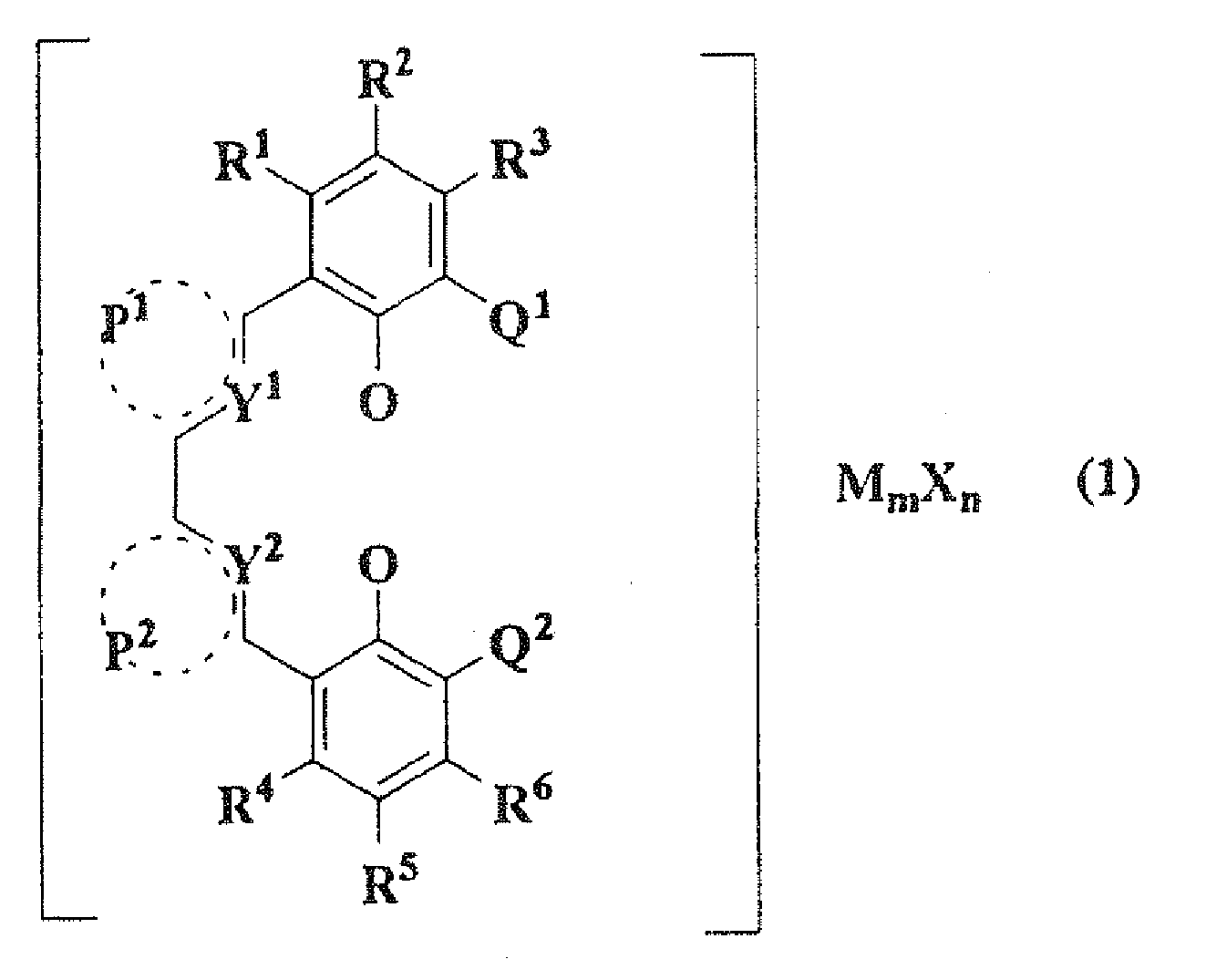

- A metal complex represented by the following formula (2):

- The metal complex according to Claim 1 or 2, wherein, in the formula (1) or (2), m represents 2, and M represents a transition metal element belonging to Groups 3 to 9 described in the periodic table.
- The metal complex according to Claim 1 or 2, wherein, in the formula (1) or (2), m represents 1.
- A polymer, comprising a residue of the metal complex represented by the formula (1) or (2).
- The polymer according to Claim 5, comprising the residue of the metal complex represented by the formula (1) or (2) as a repeating unit.
- A catalyst, comprising the metal complex according to any one of Claims 1 to 4 and/or the polymer according to Claim 5 or 6.
Applications Claiming Priority (2)
| Application Number | Priority Date | Filing Date | Title |
|---|---|---|---|
| JP2007061007 | 2007-03-09 | ||
| PCT/JP2008/054328 WO2008111567A1 (en) | 2007-03-09 | 2008-03-10 | Metal complex |
Publications (3)
| Publication Number | Publication Date |
|---|---|
| EP2123638A1 true EP2123638A1 (en) | 2009-11-25 |
| EP2123638A4 EP2123638A4 (en) | 2011-04-06 |
| EP2123638B1 EP2123638B1 (en) | 2018-09-12 |
Family
ID=39759502
Family Applications (1)
| Application Number | Title | Priority Date | Filing Date |
|---|---|---|---|
| EP08721744.4A Not-in-force EP2123638B1 (en) | 2007-03-09 | 2008-03-10 | Metal complex |
Country Status (7)
| Country | Link |
|---|---|
| US (1) | US8329929B2 (en) |
| EP (1) | EP2123638B1 (en) |
| JP (1) | JP5396031B2 (en) |
| KR (1) | KR20090118096A (en) |
| CN (1) | CN101631775A (en) |
| CA (1) | CA2680240A1 (en) |
| WO (1) | WO2008111567A1 (en) |
Cited By (14)
| Publication number | Priority date | Publication date | Assignee | Title |
|---|---|---|---|---|
| EP2239263A4 (en) * | 2007-12-28 | 2011-07-06 | Sumitomo Chemical Co | CYCLIC COMPOUND, ITS METALLIC COMPLEX, AND MODIFIED METAL COMPLEX |
| WO2019003064A1 (en) * | 2017-06-30 | 2019-01-03 | Johnson & Johnson Vision Care, Inc. | Hydroxyphenyl phenanthrolines as polymerizable blockers of high energy light for preparing ophthalmic devices, such as e.g. contact lenses |
| US10526296B2 (en) | 2017-06-30 | 2020-01-07 | Johnson & Johnson Vision Care, Inc. | Hydroxyphenyl naphthotriazoles as polymerizable blockers of high energy light |
| US10752720B2 (en) | 2017-06-26 | 2020-08-25 | Johnson & Johnson Vision Care, Inc. | Polymerizable blockers of high energy light |
| US10935695B2 (en) | 2018-03-02 | 2021-03-02 | Johnson & Johnson Vision Care, Inc. | Polymerizable absorbers of UV and high energy visible light |
| US11543683B2 (en) | 2019-08-30 | 2023-01-03 | Johnson & Johnson Vision Care, Inc. | Multifocal contact lens displaying improved vision attributes |
| US11958824B2 (en) | 2019-06-28 | 2024-04-16 | Johnson & Johnson Vision Care, Inc. | Photostable mimics of macular pigment |
| US11993037B1 (en) | 2018-03-02 | 2024-05-28 | Johnson & Johnson Vision Care, Inc. | Contact lens displaying improved vision attributes |
| US12486403B2 (en) | 2018-03-02 | 2025-12-02 | Johnson & Johnson Vision Care, Inc. | Polymerizable absorbers of UV and high energy visible light |
| US12486348B2 (en) | 2019-08-30 | 2025-12-02 | Johnson & Johnson Vision Care, Inc. | Contact lens displaying improved vision attributes |
| US12509428B2 (en) | 2019-06-28 | 2025-12-30 | Johnson & Johnson Vision Care, Inc. | Polymerizable fused tricyclic compounds as absorbers of UV and visible light |
| US12534623B2 (en) | 2018-03-02 | 2026-01-27 | Johnson & Johnson Vision Care, Inc. | Contact lens with improved tear film optical quality |
| US12595370B2 (en) | 2018-03-02 | 2026-04-07 | Johnson & Johnson Vision Care, Inc. | Polymerizable absorbers of UV and high energy visible light |
| US12595371B2 (en) | 2018-03-02 | 2026-04-07 | Johnson & Johnson Vision Care, Inc. | Contact lens with improved vision break-up time |
Families Citing this family (9)
| Publication number | Priority date | Publication date | Assignee | Title |
|---|---|---|---|---|
| EP2133336B1 (en) * | 2007-03-09 | 2014-05-07 | Sumitomo Chemical Company, Limited | Modified metal complexes and use thereof |
| JP5396031B2 (en) * | 2007-03-09 | 2014-01-22 | 住友化学株式会社 | Metal complex |
| US10837949B1 (en) * | 2012-03-22 | 2020-11-17 | Piers Richard Warburton | Peracetic acid sensor with filter to remove hydrogen peroxide |
| US9468883B2 (en) | 2013-03-29 | 2016-10-18 | The University Of Kentucky Research Foundation | Solvent and method for removal of an acid gas from a fluid stream |
| US9266102B2 (en) | 2013-03-29 | 2016-02-23 | The University Of Kentucky Research Foundation | Catalysts and methods of increasing mass transfer rate of acid gas scrubbing solvents |
| US9409125B2 (en) | 2013-03-29 | 2016-08-09 | The University Of Kentucky Research Foundation | Method of increasing mass transfer rate of acid gas scrubbing solvents |
| CN108140920A (en) * | 2015-10-27 | 2018-06-08 | 住友化学株式会社 | Magnesium air electrode for cell and magnesium air battery and aromatic compound and metal complex |
| CN112142775B (en) * | 2020-09-15 | 2023-01-13 | 万华化学集团股份有限公司 | Phenolphenanthroline IVB group metal complex and preparation and application thereof |
| CN114621259A (en) * | 2020-12-10 | 2022-06-14 | 中国科学院大连化学物理研究所 | Metal organic hydride complex material and preparation method and application thereof |
Family Cites Families (4)
| Publication number | Priority date | Publication date | Assignee | Title |
|---|---|---|---|---|
| CN1281320C (en) | 2001-04-18 | 2006-10-25 | 住友化学工业株式会社 | Complex catalyst process for producing the complex catalyst and process for producing alcohol derivative with the complex catalyst |
| EP2133336B1 (en) * | 2007-03-09 | 2014-05-07 | Sumitomo Chemical Company, Limited | Modified metal complexes and use thereof |
| JP5396031B2 (en) * | 2007-03-09 | 2014-01-22 | 住友化学株式会社 | Metal complex |
| KR20090127419A (en) * | 2007-03-09 | 2009-12-11 | 내셔날 인스티튜트 오브 어드밴스드 인더스트리얼 사이언스 앤드 테크놀로지 | Electrode Catalyst for Fuel Cell |
-
2008
- 2008-03-07 JP JP2008058581A patent/JP5396031B2/en active Active
- 2008-03-10 CA CA002680240A patent/CA2680240A1/en not_active Abandoned
- 2008-03-10 CN CN200880007673A patent/CN101631775A/en active Pending
- 2008-03-10 US US12/530,413 patent/US8329929B2/en not_active Expired - Fee Related
- 2008-03-10 WO PCT/JP2008/054328 patent/WO2008111567A1/en not_active Ceased
- 2008-03-10 EP EP08721744.4A patent/EP2123638B1/en not_active Not-in-force
- 2008-03-10 KR KR1020097020744A patent/KR20090118096A/en not_active Withdrawn
Cited By (21)
| Publication number | Priority date | Publication date | Assignee | Title |
|---|---|---|---|---|
| US8546291B2 (en) | 2007-12-28 | 2013-10-01 | Sumitomo Chemical Company, Limited | Cyclic compound, its metal complex and modified metal complex |
| US9236613B2 (en) | 2007-12-28 | 2016-01-12 | Sumitomo Chemical Company, Limited | Cyclic compound, its metal complex and modified metal complex |
| EP2239263A4 (en) * | 2007-12-28 | 2011-07-06 | Sumitomo Chemical Co | CYCLIC COMPOUND, ITS METALLIC COMPLEX, AND MODIFIED METAL COMPLEX |
| US10752720B2 (en) | 2017-06-26 | 2020-08-25 | Johnson & Johnson Vision Care, Inc. | Polymerizable blockers of high energy light |
| US10975040B2 (en) | 2017-06-30 | 2021-04-13 | Johnson & Johnson Vision Care, Inc. | Hydroxyphenyl naphthotriazoles as polymerizable blockers of high energy light |
| WO2019003064A1 (en) * | 2017-06-30 | 2019-01-03 | Johnson & Johnson Vision Care, Inc. | Hydroxyphenyl phenanthrolines as polymerizable blockers of high energy light for preparing ophthalmic devices, such as e.g. contact lenses |
| US10526296B2 (en) | 2017-06-30 | 2020-01-07 | Johnson & Johnson Vision Care, Inc. | Hydroxyphenyl naphthotriazoles as polymerizable blockers of high energy light |
| US10723732B2 (en) | 2017-06-30 | 2020-07-28 | Johnson & Johnson Vision Care, Inc. | Hydroxyphenyl phenanthrolines as polymerizable blockers of high energy light |
| US11820899B2 (en) | 2018-03-02 | 2023-11-21 | Johnson & Johnson Vision Care, Inc. | Polymerizable absorbers of UV and high energy visible light |
| US10935695B2 (en) | 2018-03-02 | 2021-03-02 | Johnson & Johnson Vision Care, Inc. | Polymerizable absorbers of UV and high energy visible light |
| US11993037B1 (en) | 2018-03-02 | 2024-05-28 | Johnson & Johnson Vision Care, Inc. | Contact lens displaying improved vision attributes |
| US12486403B2 (en) | 2018-03-02 | 2025-12-02 | Johnson & Johnson Vision Care, Inc. | Polymerizable absorbers of UV and high energy visible light |
| US12534623B2 (en) | 2018-03-02 | 2026-01-27 | Johnson & Johnson Vision Care, Inc. | Contact lens with improved tear film optical quality |
| US12595370B2 (en) | 2018-03-02 | 2026-04-07 | Johnson & Johnson Vision Care, Inc. | Polymerizable absorbers of UV and high energy visible light |
| US12595371B2 (en) | 2018-03-02 | 2026-04-07 | Johnson & Johnson Vision Care, Inc. | Contact lens with improved vision break-up time |
| US11958824B2 (en) | 2019-06-28 | 2024-04-16 | Johnson & Johnson Vision Care, Inc. | Photostable mimics of macular pigment |
| US12497379B2 (en) | 2019-06-28 | 2025-12-16 | Johnson & Johnson Vision Care, Inc. | Photostable mimics of macular pigment |
| US12509428B2 (en) | 2019-06-28 | 2025-12-30 | Johnson & Johnson Vision Care, Inc. | Polymerizable fused tricyclic compounds as absorbers of UV and visible light |
| US11543683B2 (en) | 2019-08-30 | 2023-01-03 | Johnson & Johnson Vision Care, Inc. | Multifocal contact lens displaying improved vision attributes |
| US12481173B2 (en) | 2019-08-30 | 2025-11-25 | Johnson & Johnson Vision Care, Inc. | Multifocal contact lens displaying improved vision attributes |
| US12486348B2 (en) | 2019-08-30 | 2025-12-02 | Johnson & Johnson Vision Care, Inc. | Contact lens displaying improved vision attributes |
Also Published As
| Publication number | Publication date |
|---|---|
| US20100105853A1 (en) | 2010-04-29 |
| KR20090118096A (en) | 2009-11-17 |
| EP2123638B1 (en) | 2018-09-12 |
| EP2123638A4 (en) | 2011-04-06 |
| CA2680240A1 (en) | 2008-09-18 |
| US8329929B2 (en) | 2012-12-11 |
| JP2008255106A (en) | 2008-10-23 |
| JP5396031B2 (en) | 2014-01-22 |
| WO2008111567A1 (en) | 2008-09-18 |
| CN101631775A (en) | 2010-01-20 |
Similar Documents
| Publication | Publication Date | Title |
|---|---|---|
| EP2123638B1 (en) | Metal complex | |
| EP2239263B1 (en) | Cyclic compound, its metal complex, and modified metal complex | |
| US8519131B2 (en) | Modified metal complex and use thereof | |
| WO2007091616A1 (en) | Metal complex and use thereof | |
| JP2007238601A (en) | Modified polynuclear metal complex and use thereof | |
| JP5352099B2 (en) | Redox catalyst using modified metal complex | |
| Suhr et al. | Spin state in homoleptic iron (II) terpyridine complexes influences mixed valency and electrocatalytic CO2 reduction | |
| KR101352015B1 (en) | Organometal/polymer composite and preparing method of the same, and catalyst for reducing carbon dioxide including the same | |
| US20090318681A1 (en) | Metal complex, and use thereof | |
| CN108997435B (en) | Dipyridyl pyrrole-ruthenium (I) complex, preparation method thereof and application thereof as electrochemical reduction catalyst | |
| JP2009234918A (en) | Modified metal complex and its use | |
| Kersting | Preparation, Structures, and Properties of Dinuclear Ni and Pd Complexes of Tridentate Amine‐Chalcogenolate Ligands | |
| Omoniyi et al. | Stability and reactivity of dinuclear iron (III)-salen complexes as catalysts in ethylene polymerization: A computational approach | |
| EP3072590B1 (en) | Hydrogen oxidation catalyst | |
| Boutaybi et al. | Synthesis, Characterization, DFT, and Thermogravimetric Analysis of Neutral Co (II)/Pyrazole Complex, Catalytic Activity toward Catecholase and Phenoxazinone Oxidation. Crystals 2023, 13, 155 | |
| Fan et al. | Six metal–organic architectures from a 5-methoxyisophthalate linker: assembly, structural variety and catalytic features | |
| CN101631776A (en) | Modified metal complexes and use thereof | |
| JP5378709B2 (en) | Metal complex | |
| Mukherjee et al. | A unique series of dinuclear transition metal–polyradical complexes with am-phenylenediamine spacer and their catalytic reactivity | |
| CN121181489A (en) | A hexaazahexanone macrocyclic molecule and its preparation method | |
| JP2008169203A (en) | Binuclear metal complexes and uses thereof | |
| Omoniyi et al. | Results in Chemistry | |
| Abbo et al. | Green and efficient hydroxylation of phenol using H2O2 catalyzed by coordination polymers |
Legal Events
| Date | Code | Title | Description |
|---|---|---|---|
| PUAI | Public reference made under article 153(3) epc to a published international application that has entered the european phase |
Free format text: ORIGINAL CODE: 0009012 |
|
| 17P | Request for examination filed |
Effective date: 20091007 |
|
| AK | Designated contracting states |
Kind code of ref document: A1 Designated state(s): AT BE BG CH CY CZ DE DK EE ES FI FR GB GR HR HU IE IS IT LI LT LU LV MC MT NL NO PL PT RO SE SI SK TR |
|
| DAX | Request for extension of the european patent (deleted) | ||
| A4 | Supplementary search report drawn up and despatched |
Effective date: 20110307 |
|
| 17Q | First examination report despatched |
Effective date: 20160307 |
|
| STAA | Information on the status of an ep patent application or granted ep patent |
Free format text: STATUS: EXAMINATION IS IN PROGRESS |
|
| GRAP | Despatch of communication of intention to grant a patent |
Free format text: ORIGINAL CODE: EPIDOSNIGR1 |
|
| STAA | Information on the status of an ep patent application or granted ep patent |
Free format text: STATUS: GRANT OF PATENT IS INTENDED |
|
| RIC1 | Information provided on ipc code assigned before grant |
Ipc: C07D 409/14 20060101ALI20180221BHEP Ipc: C08F 110/06 20060101ALI20180221BHEP Ipc: C08F 110/02 20060101ALI20180221BHEP Ipc: C08F 4/40 20060101ALI20180221BHEP Ipc: B01J 31/22 20060101ALI20180221BHEP Ipc: B01J 31/18 20060101ALI20180221BHEP Ipc: C07D 471/04 20060101ALI20180221BHEP Ipc: C07D 213/30 20060101AFI20180221BHEP |
|
| INTG | Intention to grant announced |
Effective date: 20180323 |
|
| GRAS | Grant fee paid |
Free format text: ORIGINAL CODE: EPIDOSNIGR3 |
|
| GRAA | (expected) grant |
Free format text: ORIGINAL CODE: 0009210 |
|
| STAA | Information on the status of an ep patent application or granted ep patent |
Free format text: STATUS: THE PATENT HAS BEEN GRANTED |
|
| AK | Designated contracting states |
Kind code of ref document: B1 Designated state(s): AT BE BG CH CY CZ DE DK EE ES FI FR GB GR HR HU IE IS IT LI LT LU LV MC MT NL NO PL PT RO SE SI SK TR |
|
| REG | Reference to a national code |
Ref country code: GB Ref legal event code: FG4D |
|
| REG | Reference to a national code |
Ref country code: CH Ref legal event code: EP |
|
| REG | Reference to a national code |
Ref country code: IE Ref legal event code: FG4D |
|
| REG | Reference to a national code |
Ref country code: DE Ref legal event code: R096 Ref document number: 602008056932 Country of ref document: DE |
|
| REG | Reference to a national code |
Ref country code: AT Ref legal event code: REF Ref document number: 1040420 Country of ref document: AT Kind code of ref document: T Effective date: 20181015 |
|
| REG | Reference to a national code |
Ref country code: NL Ref legal event code: MP Effective date: 20180912 |
|
| REG | Reference to a national code |
Ref country code: LT Ref legal event code: MG4D |
|
| PG25 | Lapsed in a contracting state [announced via postgrant information from national office to epo] |
Ref country code: NO Free format text: LAPSE BECAUSE OF FAILURE TO SUBMIT A TRANSLATION OF THE DESCRIPTION OR TO PAY THE FEE WITHIN THE PRESCRIBED TIME-LIMIT Effective date: 20181212 Ref country code: GR Free format text: LAPSE BECAUSE OF FAILURE TO SUBMIT A TRANSLATION OF THE DESCRIPTION OR TO PAY THE FEE WITHIN THE PRESCRIBED TIME-LIMIT Effective date: 20181213 Ref country code: BG Free format text: LAPSE BECAUSE OF FAILURE TO SUBMIT A TRANSLATION OF THE DESCRIPTION OR TO PAY THE FEE WITHIN THE PRESCRIBED TIME-LIMIT Effective date: 20181212 Ref country code: FI Free format text: LAPSE BECAUSE OF FAILURE TO SUBMIT A TRANSLATION OF THE DESCRIPTION OR TO PAY THE FEE WITHIN THE PRESCRIBED TIME-LIMIT Effective date: 20180912 Ref country code: LT Free format text: LAPSE BECAUSE OF FAILURE TO SUBMIT A TRANSLATION OF THE DESCRIPTION OR TO PAY THE FEE WITHIN THE PRESCRIBED TIME-LIMIT Effective date: 20180912 Ref country code: SE Free format text: LAPSE BECAUSE OF FAILURE TO SUBMIT A TRANSLATION OF THE DESCRIPTION OR TO PAY THE FEE WITHIN THE PRESCRIBED TIME-LIMIT Effective date: 20180912 |
|
| PG25 | Lapsed in a contracting state [announced via postgrant information from national office to epo] |
Ref country code: LV Free format text: LAPSE BECAUSE OF FAILURE TO SUBMIT A TRANSLATION OF THE DESCRIPTION OR TO PAY THE FEE WITHIN THE PRESCRIBED TIME-LIMIT Effective date: 20180912 Ref country code: HR Free format text: LAPSE BECAUSE OF FAILURE TO SUBMIT A TRANSLATION OF THE DESCRIPTION OR TO PAY THE FEE WITHIN THE PRESCRIBED TIME-LIMIT Effective date: 20180912 Ref country code: ES Free format text: LAPSE BECAUSE OF FAILURE TO SUBMIT A TRANSLATION OF THE DESCRIPTION OR TO PAY THE FEE WITHIN THE PRESCRIBED TIME-LIMIT Effective date: 20180912 |
|
| REG | Reference to a national code |
Ref country code: AT Ref legal event code: MK05 Ref document number: 1040420 Country of ref document: AT Kind code of ref document: T Effective date: 20180912 |
|
| PG25 | Lapsed in a contracting state [announced via postgrant information from national office to epo] |
Ref country code: PL Free format text: LAPSE BECAUSE OF FAILURE TO SUBMIT A TRANSLATION OF THE DESCRIPTION OR TO PAY THE FEE WITHIN THE PRESCRIBED TIME-LIMIT Effective date: 20180912 Ref country code: EE Free format text: LAPSE BECAUSE OF FAILURE TO SUBMIT A TRANSLATION OF THE DESCRIPTION OR TO PAY THE FEE WITHIN THE PRESCRIBED TIME-LIMIT Effective date: 20180912 Ref country code: IS Free format text: LAPSE BECAUSE OF FAILURE TO SUBMIT A TRANSLATION OF THE DESCRIPTION OR TO PAY THE FEE WITHIN THE PRESCRIBED TIME-LIMIT Effective date: 20190112 Ref country code: RO Free format text: LAPSE BECAUSE OF FAILURE TO SUBMIT A TRANSLATION OF THE DESCRIPTION OR TO PAY THE FEE WITHIN THE PRESCRIBED TIME-LIMIT Effective date: 20180912 Ref country code: AT Free format text: LAPSE BECAUSE OF FAILURE TO SUBMIT A TRANSLATION OF THE DESCRIPTION OR TO PAY THE FEE WITHIN THE PRESCRIBED TIME-LIMIT Effective date: 20180912 Ref country code: IT Free format text: LAPSE BECAUSE OF FAILURE TO SUBMIT A TRANSLATION OF THE DESCRIPTION OR TO PAY THE FEE WITHIN THE PRESCRIBED TIME-LIMIT Effective date: 20180912 Ref country code: NL Free format text: LAPSE BECAUSE OF FAILURE TO SUBMIT A TRANSLATION OF THE DESCRIPTION OR TO PAY THE FEE WITHIN THE PRESCRIBED TIME-LIMIT Effective date: 20180912 Ref country code: CZ Free format text: LAPSE BECAUSE OF FAILURE TO SUBMIT A TRANSLATION OF THE DESCRIPTION OR TO PAY THE FEE WITHIN THE PRESCRIBED TIME-LIMIT Effective date: 20180912 |
|
| PGFP | Annual fee paid to national office [announced via postgrant information from national office to epo] |
Ref country code: GB Payment date: 20190306 Year of fee payment: 12 |
|
| PG25 | Lapsed in a contracting state [announced via postgrant information from national office to epo] |
Ref country code: SK Free format text: LAPSE BECAUSE OF FAILURE TO SUBMIT A TRANSLATION OF THE DESCRIPTION OR TO PAY THE FEE WITHIN THE PRESCRIBED TIME-LIMIT Effective date: 20180912 Ref country code: PT Free format text: LAPSE BECAUSE OF FAILURE TO SUBMIT A TRANSLATION OF THE DESCRIPTION OR TO PAY THE FEE WITHIN THE PRESCRIBED TIME-LIMIT Effective date: 20190112 |
|
| REG | Reference to a national code |
Ref country code: DE Ref legal event code: R097 Ref document number: 602008056932 Country of ref document: DE |
|
| PLBE | No opposition filed within time limit |
Free format text: ORIGINAL CODE: 0009261 |
|
| STAA | Information on the status of an ep patent application or granted ep patent |
Free format text: STATUS: NO OPPOSITION FILED WITHIN TIME LIMIT |
|
| PG25 | Lapsed in a contracting state [announced via postgrant information from national office to epo] |
Ref country code: DK Free format text: LAPSE BECAUSE OF FAILURE TO SUBMIT A TRANSLATION OF THE DESCRIPTION OR TO PAY THE FEE WITHIN THE PRESCRIBED TIME-LIMIT Effective date: 20180912 |
|
| 26N | No opposition filed |
Effective date: 20190613 |
|
| PG25 | Lapsed in a contracting state [announced via postgrant information from national office to epo] |
Ref country code: SI Free format text: LAPSE BECAUSE OF FAILURE TO SUBMIT A TRANSLATION OF THE DESCRIPTION OR TO PAY THE FEE WITHIN THE PRESCRIBED TIME-LIMIT Effective date: 20180912 |
|
| REG | Reference to a national code |
Ref country code: DE Ref legal event code: R119 Ref document number: 602008056932 Country of ref document: DE |
|
| PG25 | Lapsed in a contracting state [announced via postgrant information from national office to epo] |
Ref country code: MC Free format text: LAPSE BECAUSE OF FAILURE TO SUBMIT A TRANSLATION OF THE DESCRIPTION OR TO PAY THE FEE WITHIN THE PRESCRIBED TIME-LIMIT Effective date: 20180912 |
|
| REG | Reference to a national code |
Ref country code: CH Ref legal event code: PL |
|
| PG25 | Lapsed in a contracting state [announced via postgrant information from national office to epo] |
Ref country code: LU Free format text: LAPSE BECAUSE OF NON-PAYMENT OF DUE FEES Effective date: 20190310 |
|
| REG | Reference to a national code |
Ref country code: BE Ref legal event code: MM Effective date: 20190331 |
|
| PG25 | Lapsed in a contracting state [announced via postgrant information from national office to epo] |
Ref country code: DE Free format text: LAPSE BECAUSE OF NON-PAYMENT OF DUE FEES Effective date: 20191001 Ref country code: LI Free format text: LAPSE BECAUSE OF NON-PAYMENT OF DUE FEES Effective date: 20190331 Ref country code: IE Free format text: LAPSE BECAUSE OF NON-PAYMENT OF DUE FEES Effective date: 20190310 Ref country code: CH Free format text: LAPSE BECAUSE OF NON-PAYMENT OF DUE FEES Effective date: 20190331 |
|
| PG25 | Lapsed in a contracting state [announced via postgrant information from national office to epo] |
Ref country code: BE Free format text: LAPSE BECAUSE OF NON-PAYMENT OF DUE FEES Effective date: 20190331 |
|
| PG25 | Lapsed in a contracting state [announced via postgrant information from national office to epo] |
Ref country code: TR Free format text: LAPSE BECAUSE OF FAILURE TO SUBMIT A TRANSLATION OF THE DESCRIPTION OR TO PAY THE FEE WITHIN THE PRESCRIBED TIME-LIMIT Effective date: 20180912 |
|
| PG25 | Lapsed in a contracting state [announced via postgrant information from national office to epo] |
Ref country code: MT Free format text: LAPSE BECAUSE OF NON-PAYMENT OF DUE FEES Effective date: 20190310 |
|
| GBPC | Gb: european patent ceased through non-payment of renewal fee |
Effective date: 20200310 |
|
| PG25 | Lapsed in a contracting state [announced via postgrant information from national office to epo] |
Ref country code: GB Free format text: LAPSE BECAUSE OF NON-PAYMENT OF DUE FEES Effective date: 20200310 |
|
| PGFP | Annual fee paid to national office [announced via postgrant information from national office to epo] |
Ref country code: FR Payment date: 20210210 Year of fee payment: 14 |
|
| PG25 | Lapsed in a contracting state [announced via postgrant information from national office to epo] |
Ref country code: CY Free format text: LAPSE BECAUSE OF FAILURE TO SUBMIT A TRANSLATION OF THE DESCRIPTION OR TO PAY THE FEE WITHIN THE PRESCRIBED TIME-LIMIT Effective date: 20180912 |
|
| PG25 | Lapsed in a contracting state [announced via postgrant information from national office to epo] |
Ref country code: HU Free format text: LAPSE BECAUSE OF FAILURE TO SUBMIT A TRANSLATION OF THE DESCRIPTION OR TO PAY THE FEE WITHIN THE PRESCRIBED TIME-LIMIT; INVALID AB INITIO Effective date: 20080310 |
|
| PG25 | Lapsed in a contracting state [announced via postgrant information from national office to epo] |
Ref country code: FR Free format text: LAPSE BECAUSE OF NON-PAYMENT OF DUE FEES Effective date: 20220331 |